WO2014154011A1 - 蓝相液晶复合材料和含该材料的液晶显示器 - Google Patents
蓝相液晶复合材料和含该材料的液晶显示器 Download PDFInfo
- Publication number
- WO2014154011A1 WO2014154011A1 PCT/CN2013/091127 CN2013091127W WO2014154011A1 WO 2014154011 A1 WO2014154011 A1 WO 2014154011A1 CN 2013091127 W CN2013091127 W CN 2013091127W WO 2014154011 A1 WO2014154011 A1 WO 2014154011A1
- Authority
- WO
- WIPO (PCT)
- Prior art keywords
- liquid crystal
- blue phase
- phase liquid
- crystal composite
- monomer
- Prior art date
- Legal status (The legal status is an assumption and is not a legal conclusion. Google has not performed a legal analysis and makes no representation as to the accuracy of the status listed.)
- Ceased
Links
Classifications
-
- C—CHEMISTRY; METALLURGY
- C09—DYES; PAINTS; POLISHES; NATURAL RESINS; ADHESIVES; COMPOSITIONS NOT OTHERWISE PROVIDED FOR; APPLICATIONS OF MATERIALS NOT OTHERWISE PROVIDED FOR
- C09K—MATERIALS FOR MISCELLANEOUS APPLICATIONS, NOT PROVIDED FOR ELSEWHERE
- C09K19/00—Liquid crystal materials
- C09K19/02—Liquid crystal materials characterised by optical, electrical or physical properties of the components, in general
- C09K19/0275—Blue phase
-
- C—CHEMISTRY; METALLURGY
- C09—DYES; PAINTS; POLISHES; NATURAL RESINS; ADHESIVES; COMPOSITIONS NOT OTHERWISE PROVIDED FOR; APPLICATIONS OF MATERIALS NOT OTHERWISE PROVIDED FOR
- C09K—MATERIALS FOR MISCELLANEOUS APPLICATIONS, NOT PROVIDED FOR ELSEWHERE
- C09K19/00—Liquid crystal materials
- C09K19/04—Liquid crystal materials characterised by the chemical structure of the liquid crystal components, e.g. by a specific unit
- C09K19/06—Non-steroidal liquid crystal compounds
- C09K19/08—Non-steroidal liquid crystal compounds containing at least two non-condensed rings
- C09K19/10—Non-steroidal liquid crystal compounds containing at least two non-condensed rings containing at least two benzene rings
- C09K19/20—Non-steroidal liquid crystal compounds containing at least two non-condensed rings containing at least two benzene rings linked by a chain containing carbon and oxygen atoms as chain links, e.g. esters or ethers
- C09K19/2007—Non-steroidal liquid crystal compounds containing at least two non-condensed rings containing at least two benzene rings linked by a chain containing carbon and oxygen atoms as chain links, e.g. esters or ethers the chain containing -COO- or -OCO- groups
- C09K19/2021—Compounds containing at least one asymmetric carbon atom
-
- C—CHEMISTRY; METALLURGY
- C09—DYES; PAINTS; POLISHES; NATURAL RESINS; ADHESIVES; COMPOSITIONS NOT OTHERWISE PROVIDED FOR; APPLICATIONS OF MATERIALS NOT OTHERWISE PROVIDED FOR
- C09K—MATERIALS FOR MISCELLANEOUS APPLICATIONS, NOT PROVIDED FOR ELSEWHERE
- C09K19/00—Liquid crystal materials
- C09K19/52—Liquid crystal materials characterised by components which are not liquid crystals, e.g. additives with special physical aspect: solvents, solid particles
- C09K19/54—Additives having no specific mesophase characterised by their chemical composition
-
- C—CHEMISTRY; METALLURGY
- C09—DYES; PAINTS; POLISHES; NATURAL RESINS; ADHESIVES; COMPOSITIONS NOT OTHERWISE PROVIDED FOR; APPLICATIONS OF MATERIALS NOT OTHERWISE PROVIDED FOR
- C09K—MATERIALS FOR MISCELLANEOUS APPLICATIONS, NOT PROVIDED FOR ELSEWHERE
- C09K19/00—Liquid crystal materials
- C09K19/52—Liquid crystal materials characterised by components which are not liquid crystals, e.g. additives with special physical aspect: solvents, solid particles
- C09K19/58—Dopants or charge transfer agents
- C09K19/586—Optically active dopants; chiral dopants
- C09K19/588—Heterocyclic compounds
-
- G—PHYSICS
- G02—OPTICS
- G02F—OPTICAL DEVICES OR ARRANGEMENTS FOR THE CONTROL OF LIGHT BY MODIFICATION OF THE OPTICAL PROPERTIES OF THE MEDIA OF THE ELEMENTS INVOLVED THEREIN; NON-LINEAR OPTICS; FREQUENCY-CHANGING OF LIGHT; OPTICAL LOGIC ELEMENTS; OPTICAL ANALOGUE/DIGITAL CONVERTERS
- G02F1/00—Devices or arrangements for the control of the intensity, colour, phase, polarisation or direction of light arriving from an independent light source, e.g. switching, gating or modulating; Non-linear optics
- G02F1/01—Devices or arrangements for the control of the intensity, colour, phase, polarisation or direction of light arriving from an independent light source, e.g. switching, gating or modulating; Non-linear optics for the control of the intensity, phase, polarisation or colour
- G02F1/13—Devices or arrangements for the control of the intensity, colour, phase, polarisation or direction of light arriving from an independent light source, e.g. switching, gating or modulating; Non-linear optics for the control of the intensity, phase, polarisation or colour based on liquid crystals, e.g. single liquid crystal display cells
- G02F1/133—Constructional arrangements; Operation of liquid crystal cells; Circuit arrangements
- G02F1/1333—Constructional arrangements; Manufacturing methods
- G02F1/133365—Cells in which the active layer comprises a liquid crystalline polymer
-
- G—PHYSICS
- G02—OPTICS
- G02F—OPTICAL DEVICES OR ARRANGEMENTS FOR THE CONTROL OF LIGHT BY MODIFICATION OF THE OPTICAL PROPERTIES OF THE MEDIA OF THE ELEMENTS INVOLVED THEREIN; NON-LINEAR OPTICS; FREQUENCY-CHANGING OF LIGHT; OPTICAL LOGIC ELEMENTS; OPTICAL ANALOGUE/DIGITAL CONVERTERS
- G02F1/00—Devices or arrangements for the control of the intensity, colour, phase, polarisation or direction of light arriving from an independent light source, e.g. switching, gating or modulating; Non-linear optics
- G02F1/01—Devices or arrangements for the control of the intensity, colour, phase, polarisation or direction of light arriving from an independent light source, e.g. switching, gating or modulating; Non-linear optics for the control of the intensity, phase, polarisation or colour
- G02F1/13—Devices or arrangements for the control of the intensity, colour, phase, polarisation or direction of light arriving from an independent light source, e.g. switching, gating or modulating; Non-linear optics for the control of the intensity, phase, polarisation or colour based on liquid crystals, e.g. single liquid crystal display cells
- G02F1/137—Devices or arrangements for the control of the intensity, colour, phase, polarisation or direction of light arriving from an independent light source, e.g. switching, gating or modulating; Non-linear optics for the control of the intensity, phase, polarisation or colour based on liquid crystals, e.g. single liquid crystal display cells characterised by the electro-optical or magneto-optical effect, e.g. field-induced phase transition, orientation effect, guest-host interaction or dynamic scattering
-
- C—CHEMISTRY; METALLURGY
- C09—DYES; PAINTS; POLISHES; NATURAL RESINS; ADHESIVES; COMPOSITIONS NOT OTHERWISE PROVIDED FOR; APPLICATIONS OF MATERIALS NOT OTHERWISE PROVIDED FOR
- C09K—MATERIALS FOR MISCELLANEOUS APPLICATIONS, NOT PROVIDED FOR ELSEWHERE
- C09K19/00—Liquid crystal materials
- C09K19/04—Liquid crystal materials characterised by the chemical structure of the liquid crystal components, e.g. by a specific unit
- C09K2019/0425—Liquid crystal materials characterised by the chemical structure of the liquid crystal components, e.g. by a specific unit characterized by a specific unit that results in a functional effect
- C09K2019/0437—Liquid crystal materials characterised by the chemical structure of the liquid crystal components, e.g. by a specific unit characterized by a specific unit that results in a functional effect the specific unit being an optically active chain used as linking group between rings or as end group
-
- C—CHEMISTRY; METALLURGY
- C09—DYES; PAINTS; POLISHES; NATURAL RESINS; ADHESIVES; COMPOSITIONS NOT OTHERWISE PROVIDED FOR; APPLICATIONS OF MATERIALS NOT OTHERWISE PROVIDED FOR
- C09K—MATERIALS FOR MISCELLANEOUS APPLICATIONS, NOT PROVIDED FOR ELSEWHERE
- C09K19/00—Liquid crystal materials
- C09K19/04—Liquid crystal materials characterised by the chemical structure of the liquid crystal components, e.g. by a specific unit
- C09K19/06—Non-steroidal liquid crystal compounds
- C09K19/34—Non-steroidal liquid crystal compounds containing at least one heterocyclic ring
- C09K19/3402—Non-steroidal liquid crystal compounds containing at least one heterocyclic ring having oxygen as hetero atom
- C09K19/3405—Non-steroidal liquid crystal compounds containing at least one heterocyclic ring having oxygen as hetero atom the heterocyclic ring being a five-membered ring
- C09K2019/3408—Five-membered ring with oxygen(s) in fused, bridged or spiro ring systems
-
- G—PHYSICS
- G02—OPTICS
- G02F—OPTICAL DEVICES OR ARRANGEMENTS FOR THE CONTROL OF LIGHT BY MODIFICATION OF THE OPTICAL PROPERTIES OF THE MEDIA OF THE ELEMENTS INVOLVED THEREIN; NON-LINEAR OPTICS; FREQUENCY-CHANGING OF LIGHT; OPTICAL LOGIC ELEMENTS; OPTICAL ANALOGUE/DIGITAL CONVERTERS
- G02F1/00—Devices or arrangements for the control of the intensity, colour, phase, polarisation or direction of light arriving from an independent light source, e.g. switching, gating or modulating; Non-linear optics
- G02F1/01—Devices or arrangements for the control of the intensity, colour, phase, polarisation or direction of light arriving from an independent light source, e.g. switching, gating or modulating; Non-linear optics for the control of the intensity, phase, polarisation or colour
- G02F1/13—Devices or arrangements for the control of the intensity, colour, phase, polarisation or direction of light arriving from an independent light source, e.g. switching, gating or modulating; Non-linear optics for the control of the intensity, phase, polarisation or colour based on liquid crystals, e.g. single liquid crystal display cells
- G02F1/137—Devices or arrangements for the control of the intensity, colour, phase, polarisation or direction of light arriving from an independent light source, e.g. switching, gating or modulating; Non-linear optics for the control of the intensity, phase, polarisation or colour based on liquid crystals, e.g. single liquid crystal display cells characterised by the electro-optical or magneto-optical effect, e.g. field-induced phase transition, orientation effect, guest-host interaction or dynamic scattering
- G02F1/13793—Blue phases
Definitions
- Embodiments of the present invention relate to a blue phase liquid crystal composite material and a liquid crystal display comprising the same. Background technique
- BPs Liquid crystalline Blue Phases
- the blue phase is a lattice defect phase with no birefringence, and its lattice parameter size is equivalent to the order of visible wavelength (several hundred nanometers).
- the blue phase can be divided into three sub-phases from the crystal structure, which are named blue phase I (BPI), blue phase II ( ⁇ ) and blue phase III (BPIII), respectively.
- BPI blue phase I
- ⁇ blue phase II
- BPIII blue phase III
- the corresponding lattice structures are respectively body-centered cubic structures. Single-cube structure and amorphous state.
- the blue phase liquid crystal material is considered to be the most promising next-generation liquid crystal display material due to its microsecond-order electric field response speed. Compared with traditional liquid crystal displays, blue-phase liquid crystal displays have the following four major advantages:
- the blue phase liquid crystal has a microsecond-order electric field response speed, field sequential driving can be used, and color filters are no longer needed, which can not only reduce material cost, but also improve backlight utilization;
- the blue phase liquid crystal display has wide visual characteristics, no need for visual compensation film, and the visual width can be adjusted according to actual needs;
- the content of the polymer monomer in the polymer blue phase liquid crystal is usually less than 10% by weight, the polymer network is extremely susceptible to deformation under electric field damage, and the life of the liquid crystal display is greatly shortened.
- the blue phase liquid crystal droplets can be uniformly dispersed in the polymer matrix to form a polymer dispersed blue phase liquid crystal, and the polymer network has good stability under the action of an electric field, and is easy to realize large Area production.
- Embodiments of the present invention provide a blue phase liquid crystal composite material having a low driving voltage and almost no electro-optical hysteresis and a liquid crystal display comprising the blue phase liquid crystal composite material.
- a blue phase liquid crystal composite material which is formed by photopolymerization of a raw material component comprising: a mother blue phase liquid crystal, a photopolymerizable monomer, a light bow I hair and inorganic nanoparticles.
- the feedstock component comprises, based on the total weight of the feedstock components:
- Mother blue phase liquid crystal 68.0 wt% ⁇ 88.95 wt%;
- Photopolymerizable monomer 10.0 wt% ⁇ 30.0 wt%;
- Photoinitiator 1.0 wt% ⁇ 3.0 wt%
- Inorganic nanoparticles 0.05 wt% ⁇ 2.0 wt%.
- the blue phase temperature of the parent blue phase liquid crystal is greater than or equal to 5.0 °C.
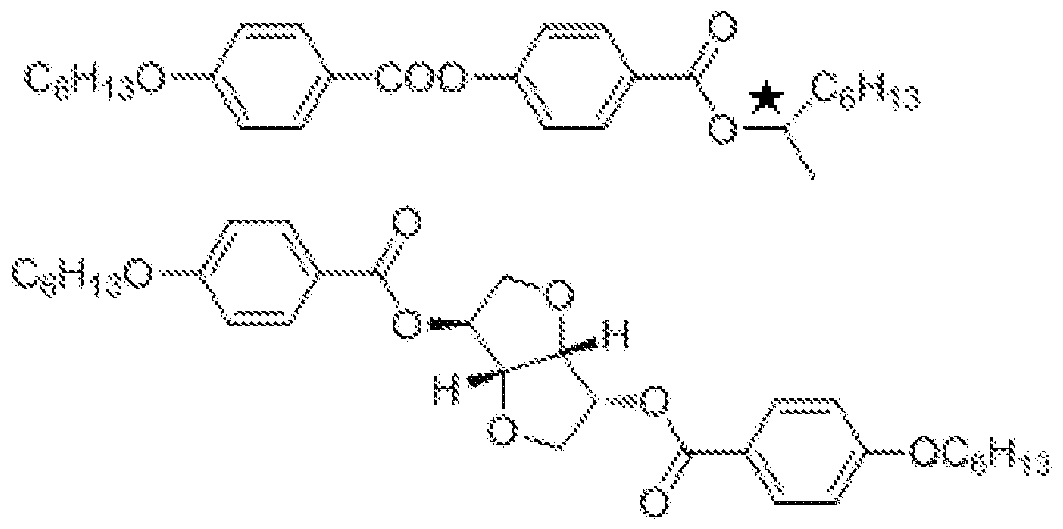
- composition of the parent blue phase liquid crystal comprises: SLC-X, R811, and Iso-(60BA) 2 , wherein the structural formula of R811 and Iso-(60BA) 2 is:
- the parent blue phase liquid crystal includes, based on the total weight of the parent blue phase liquid crystal, SLC-X: 70.0 wt% ⁇ 85.0 wt%, R811: 5.0 wt% ⁇ 15.0 wt%, and Iso-(60BA) 2 : 5.0 wt% 15.0 wt%rac
- the blue phase temperature range of the parent blue phase liquid crystal is from 5.0 ° C to 20.0 ° C.
- the photoinitiator has the structural formula:
- the photopolymerizable monomer is a non-liquid crystalline acrylate monomer.
- the non-liquid crystalline acrylate monomer is a mixed monomer of a monofunctional monomer and a polyfunctional monomer, and the monofunctional monomer and polyfunctional in the non-liquid crystalline acrylate monomer.
- the molar ratio of the monomers is from 1:1 to 1:9.
- the monofunctional monomer is TMHA
- the polyfunctional monomer is BDDA
- the structural formula of TMHA is as follows:
- BDDA structure of BDDA
- the inorganic nanoparticles have a particle size of from 3 nm to 300 nm.
- the inorganic nanoparticles are surface modified.
- the inorganic nanoparticles are selected from the group consisting of non-ferroelectric nanoparticles ZnS.
- the inorganic nanoparticles are selected from the group consisting of ferroelectric nanoparticles BaTi0 3 .
- FIG. 1 is a voltage transmittance curve of a blue phase liquid crystal composite material prepared in Example 1 of the present invention
- FIG. 2 is a driving voltage, electro-optical hysteresis, and ZnS nanoparticle concentration of a blue phase liquid crystal composite material; relation chart;
- Figure 3 is a plot of the Cole constant K of the blue phase liquid crystal composite and the concentration of the device parameter A and the ZnS nanoparticles;
- FIG. 4 is a voltage transmittance curve of a blue phase liquid crystal composite material prepared in Example 2 of the present invention
- FIG. 5 is a graph showing relationship between driving voltage and electro-optic hysteresis of blue phase liquid crystal composite material and concentration of BaTiO 3 nanoparticles
- Figure 6 is a graph showing the Cole constant K of the blue phase liquid crystal composite and the relationship between the device parameter A and the BaTiO 3 nanoparticle concentration. detailed description
- the driving voltage of the polymer dispersed blue phase liquid crystal material mainly depends on the Coel constant K of the material and the device parameter A of the display device. Increasing the K value or decreasing the A value is beneficial to lowering the driving voltage of the blue phase liquid crystal;
- the birefringence and the dielectric constant are favorable for increasing the K value, and A mainly depends on the electrode configuration of the device, and the electrode structure capable of generating a uniform electric field in the liquid crystal layer is advantageous for lowering the A value.
- Inorganic nanoparticles have a large refractive index and dielectric constant.
- the introduction of nanoparticles into the liquid crystal is beneficial to increase the birefringence and dielectric constant of the liquid crystal, thereby increasing the Cole constant of the blue phase liquid crystal, which can reduce the blue to some extent.
- the driving voltage of the phase liquid crystal composite material is beneficial to increase the birefringence and dielectric constant of the liquid crystal, thereby increasing the Cole constant of the blue phase liquid crystal, which can reduce the blue to some extent.
- the larger dipole moment of inorganic nanoparticles can reduce the electro-optic hysteresis of blue phase liquid crystal composites.
- the inorganic ferroelectric nanoparticles can generate a polarization field under the action of an electric field, after introducing the ferroelectric nanoparticles into the blue phase liquid crystal, the polarization field generated by the ferroelectric nanoparticles can be used in the liquid crystal layer. The formation of a uniformly distributed electric field will eventually reduce the device parameter A of the display device, thereby greatly reducing the driving voltage of the blue phase liquid crystal.
- the embodiment of the present invention greatly reduces the driving voltage of the blue phase liquid crystal display material by introducing the inorganic nanoparticles into the blue phase liquid crystal, and can realize the reversible recovery of the blue phase liquid crystal under the action of the electric field.
- the blue phase liquid crystal composite material of the embodiment of the invention has stable preparation system, simple process tube, low viscosity, low driving voltage, no electro-optic hysteresis, and fast response to an electric field.
- a blue phase liquid crystal composite material which is formed by photopolymerization of a raw material component comprising: a mother blue phase liquid crystal, a photopolymerizable monomer, Photoinitiators, inorganic nanoparticles.
- the raw material component may include, based on the total weight of the raw material component:
- Mother blue phase liquid crystal 68.0 wt% ⁇ 88.95 wt%;
- Photopolymerizable monomer 10.0 wt% ⁇ 30.0 wt%;
- Photoinitiator 1.0 wt% ⁇ 3.0 wt%
- Inorganic nanoparticles 0.05 wt% ⁇ 2.0 wt%.
- the parent blue phase liquid crystal may be, for example, 68.0%, 68.5%, 75%, 80%, 85% or 88.95% based on the total weight of the raw material component;
- the photopolymerizable monomer may be, for example, based on 10%, 15%, 20%, 22.95%, 27% or 30% of the total weight of the raw material component;
- the photoinitiator may be, for example, 1.0%, 2.0% based on the total weight of the raw material component Or 3.0%; and the inorganic nanoparticles may be, for example, 0.05%, 0.5%, 1.0%, 1.5% or 2.0% based on the total weight of the raw material component.
- the blue phase temperature range of the above-mentioned mother blue phase liquid crystal may be 5.0 ° C or more.
- composition of the above-mentioned parent blue phase liquid crystal may include: SLC-X, R811 and Iso-(60BA) 2 , wherein the structural formula of R811 and Iso-(60BA) 2 is:
- the above parent blue phase liquid crystal may include: based on the total weight of the parent blue phase liquid crystal, SLC-X: 70.0 wt% - 85.0 wt%; R811: 5.0 wt% ⁇ 15.0 wt%; and Iso-(60BA) 2 : 5.0 wt % ⁇ 15.0 wt%schreib
- the SLC-X may be, for example, 70%, 75%, 80%, 82% or 85% based on the total weight of the parent blue phase liquid crystal; the weight percentage of the R811 may be, for example, based on the mother blue phase liquid crystal 5%, 8%, 10% or 15% of the total weight; and the weight percentage of Iso-(60BA) 2 may be, for example, 5%, 8%, 10% based on the total weight of the parent blue phase liquid crystal , 12% or 15%.
- the blue phase temperature range of the above-mentioned parent blue phase liquid crystal may be 5.0 ° C to 20.0 ° C.
- the parent blue phase liquid crystal can also use other components and ratios of the prior art, only The blue phase temperature range is greater than or equal to 5 ° C.
- the blue phase liquid crystal material has a viscosity of less than 50 mPa, a melting point in the range of -20 ° C to 25 ° C, and a clearing point in the range of 30 ° C to 200 ° C.
- the photoinitiator described above may have the following structure:
- the above photopolymerizable monomer may be a non-liquid crystalline acrylate monomer.
- the non-liquid crystalline acrylate monomer may be a mixed monomer of a monofunctional monomer and a polyfunctional monomer, and the monofunctional monomer and the polyfunctional single in the non-liquid crystalline acrylate monomer.
- the molar ratio of the body can be from 1:1 to 1:9.
- the above monofunctional monomer may be TMHA
- the polyfunctional monomer may be BDDA
- the above inorganic nanoparticles may have a particle diameter of 3 nm to 300 nm.
- the particle size of the inorganic nanoparticles may be, for example, 3 nm, 30 nm, 100 nm, 300 nm.
- the above inorganic nanoparticles may be any one or more selected from the group consisting of non-ferroelectric nanoparticles ZnS, ZnO, GdS, and GdS e .
- the above inorganic nanoparticles may be selected from the group consisting of ferroelectric nanoparticles BaTi0 3 , Sn 2 P 2 S 6 , LiNb0 3 And one or more of PbTi0 3 .
- the above inorganic nanoparticles can be surface-modified.
- surface modification may be performed by surface modification methods such as microemulsion method or surfactant method before use to obtain better dispersibility;
- Electro-nanoparticles such as BaTi0 3 , Sn 2 P 2 S 6 , LiNb0 3 , and PbTi0 3 , may also be surface-modified by adding a surfactant at the time of use to have better dispersibility.
- a liquid crystal display comprising the blue phase liquid crystal composite material described herein is also provided.
- the liquid crystal display can be: any product or component having a display function such as a liquid crystal panel, a mobile phone, a tablet, a television, a display, a notebook, a digital photo frame, a navigator, and the like.
- a blue phase liquid crystal composite material is prepared by photopolymerization of 100 g of a raw material component comprising 68.5 g of a mother blue phase liquid crystal, 30.0 g of a photopolymerizable monomer, 1.0 g of a photoinitiator, and 0.5 g of an inorganic nanoparticle. Particle ZnS.
- the above blue phase liquid crystal composite material is prepared by the following steps:
- Step 1 Preparation of inorganic nanoparticles ZnS
- Triton X-100 Triton X-100
- Triton X-100 50 ml of surfactant Triton X-100 (Triton X-100) was added to 200 ml of cyclohexane.
- 60 ml of a 0.3 mol/L thioacetamide solution was added to the cyclohexane solution X-100 dissolved in the above-mentioned surfactant, and 120 ml of n-butyl was slowly added dropwise under magnetic stirring. The alcohol, until the solution is clear, forms a thioacetamide microemulsion.
- An acetic acid microemulsion was prepared in a manner similar to the above except that an equimolar amount of 0.3 mol L of a solution of acetic acid was used in place of the above thioacetamide solution instead of the thioacetamide solution.
- the obtained thioacetamide microemulsion and the acetic acid microemulsion were mixed, stirred uniformly with a magnetic stirrer, and reacted under ultrasonic waves for 6 hours to obtain a pale yellow emulsion.
- the emulsion was steamed, ethanol was added to break, centrifuged, and washed twice with water and ethanol, and dried under vacuum to obtain 1.0 g spherical non-ferroelectric inorganic nanoparticles ZnS having an average particle diameter of about 3 nm.
- a mixed monomer of a monofunctional monomer TMHA and a difunctional monomer BDDA was used as the photo-combinable monomer, wherein the molar ratio of the monofunctional monomer TMHA to the difunctional monomer BDDA was 1:4.
- the structural formula of the monofunctional polymerizable monomer TMHA is as follows:
- a blue phase liquid crystal prepolymer was prepared by mixing 30.0 g of a photopolymerizable monomer, 1.0 g of a photoinitiator, and 68.5 g of the precursor blue phase liquid crystal prepared in the step 2.
- the nanoparticles are doped with a blue phase liquid crystal prepolymer.
- a blue phase liquid crystal composite material (PDBP + ZnS) can be obtained by crosslinking a molecule of a photocrosslinking group to form a polymer network.
- the electro-optic hysteresis characteristic of a blue phase liquid crystal is generally defined as ⁇ . ⁇ , where, . ⁇ is the voltage value corresponding to the maximum transmittance, and ⁇ is the difference between the voltage forward acting and the reverse acting voltage when the transmittance is half of the highest transmittance. ⁇ / .
- A represents the device parameter and its value is affected by the electrode configuration
- K is the Kerr constant of the material.
- the voltage transmittance curves of the blue phase liquid crystal prepolymer (PDBP) and the blue phase liquid crystal composite material (PDBP + ZnS) can be seen from the figure, after adding 0.5 wt% of ZnS nanoparticles, The driving voltage of the liquid crystal is lowered from 100V to 90V.
- the inventors also applied the driving voltage and electro-optic hysteresis of the blue phase liquid crystal composite material.
- the concentration relationship of ZnS nanoparticles has been studied. It can be seen from the figure that as the concentration of nanoparticles increases, the driving voltage of blue-phase liquid crystal composites decreases gradually, while the electro-optic hysteresis decreases first and then increases, of which 0.5 wt% is added. When ZnS nanoparticles are used, they can be considered almost without hysteresis.
- a blue phase liquid crystal composite material is prepared by photopolymerization of 100 g of a raw material component comprising 88.95 g of a mother blue phase liquid crystal; 10.0 g of a photopolymerizable monomer; 1.0 g of a photoinitiator; and 0.05 g of an inorganic component Nanoparticle BaTi0 3 .
- the blue phase liquid crystal composite material was prepared by the following procedure.
- Step 1 Preparation of inorganic nanoparticles BaTi0 3
- a large particle BaTi03 powder (0.5 g) having a diameter of about 1 ⁇ m was mixed with a surfactant oleic acid (1 g) and a carrier liquid heptane (5 g), and after ultrasonic dispersion, it was ground by a planetary high-energy ball mill for 15 hours. The ball-milled dispersion was transferred to a beaker and allowed to stand for 3 days. Then, the particles having a large particle diameter are filtered and removed by a screen to obtain a dispersion. Take 1 ml of the dispersion and dry it. The weight of the obtained powder was weighed to 0.058 g, and the concentration of the dispersion was calculated to be 0.25 mol/L.
- the mother blue phase liquid crystal obtained by 88.95 g was taken for the next use.
- a blue phase liquid crystal prepolymer was prepared in a similar manner to Step 3 of Example 1, except that the molar ratio of the monofunctional monomer TMHA to the difunctional monomer BDDA was 1:1; and the photopolymerizable used The amounts of monomer, photoinitiator and parent blue phase liquid crystal were 10.0 g 1.0 g and 88.95 g, respectively.
- the dispersion containing 0.5 g of the inorganic nanoparticle BaTi03 was dissolved in heptane together with the blue phase liquid crystal prepolymer prepared in the step 3, sonicated for 1 h, and then the heptane was slowly evaporated in an environment of 45 ° C or higher for 24 h. Finally, the mixed system was transferred to a vacuum environment of 1023 Torr and a temperature of 50 ° C for 24 h to completely evaporate the solvent, thereby preparing a desired nanoparticle-doped blue phase liquid crystal prepolymer (PDBP).
- PDBP nanoparticle-doped blue phase liquid crystal prepolymer
- the nanoparticle-doped blue phase liquid crystal prepolymer obtained in the step 4 is uniformly stirred, and then poured into the liquid crystal cell by the principle of siphon; the sample is kept in a blue phase state by a precision temperature control hot table, and irradiated with ultraviolet light for 30 minutes.
- a blue phase liquid crystal composite material (PDBP + BaTi0 3 ) can be obtained by crosslinking a molecule of a photocrosslinking group to form a polymer network.
- the test method was the same as that in Example 1.
- the voltage transmittance curves of the blue phase liquid crystal prepolymer (PDBP) and the blue phase liquid crystal composite material (PDBP+BaTi0 3 ) can be seen from the figure, after adding BaTi0 3 nanoparticles, the liquid crystal Drive The voltage is reduced from 100 V to 65 V.
- the inventors also studied the relationship between the driving voltage and electro-optic hysteresis of blue phase liquid crystal composites and the concentration of BaTi0 3 nanoparticles. It can be seen from the figure that the blue phase liquid crystal recombination increases with the increase of the concentration of nanoparticles.
- the driving voltage of the material gradually decreases, and the electro-optic hysteresis first decreases and then increases. Among them, when adding 0.5 wt% of BaTi0 3 nanoparticles, it can be regarded as almost no hysteresis.
- a blue phase liquid crystal composite material is prepared by photopolymerization of 100 g of a raw material component comprising 68.0 g of a mother blue phase liquid crystal; 27.0 g of a photopolymerizable monomer; 3.0 g of a photoinitiator; and 2.0 g of an inorganic component Nanoparticles ⁇
- the blue phase liquid crystal composite material was prepared by the following procedure.
- Step 1 Preparation of inorganic nanoparticles ZnO
- the polytetrafluoroethylene liner of the hydrothermal reaction kettle was peeled and weighed, and oleic acid was sucked into the inner liner by a pipette. In this way, 7.06 g (25 mmol) of oleic acid was weighed into the inner liner, and the fed liner was placed in a 1000 mL hydrothermal reaction kettle. Then, sodium hydroxide (160 mg) and acetic acid dihydrate (438 mg) were dissolved in water (400 ml), and the resulting mixture was added to a hydrothermal reaction vessel with constant stirring. The kettle was then sealed, placed in a dry box, and warmed to 130 ° C for 4 h.
- reaction vessel is naturally cooled to room temperature, the upper liquid in the kettle is recovered, and the lower solid is washed with distilled water and ethanol, respectively, and naturally dried to obtain oxidized nanoparticles (2.0 g) having an average particle diameter of about 300.
- Spherical ZnO non-ferroelectric inorganic nanoparticles of nm are naturally dried.
- the precursor blue phase liquid crystal obtained by 68.0 g was taken for the next step.
- Step 3 Preparation of blue phase liquid crystal prepolymer A blue phase liquid crystal prepolymer was prepared using a method similar to that of Step 3 of Example 1, except that the molar ratio of the monofunctional monomer TMHA to the difunctional monomer BDDA was 1:9; and the photopolymerizable used The amounts of monomer, photoinitiator and parent blue phase liquid crystal were 27.0 g, 3.0 g and 68.0 g, respectively.
- Step 4 Preparation of nanoparticle doped blue phase liquid crystal prepolymer
- the nanoparticle-doped blue phase liquid crystal prepolymer obtained in the step 4 is uniformly stirred, and then poured into the liquid crystal cell by the principle of siphon; the sample is kept in a blue phase state by a precision temperature control hot stage, and irradiated with ultraviolet light for 60 minutes.
- a blue phase liquid crystal composite material (PDBP+ZnO) can be obtained by crosslinking a molecule of a photocrosslinking group to form a polymer network.
- the test method was the same as that in Example 1.
- the driving voltage of the blue phase liquid crystal composite was reduced from 100 V to 91 V, and the electro-optic hysteresis was reduced to almost zero.
- the concentration of nanoparticles increases, the driving voltage of the blue phase liquid crystal gradually decreases, and the Cole constant K gradually increases, while the device parameter A decreases, but the variation is not large.
- the electro-optic hysteresis first decreased and then increased. Among them, when adding 2 wt% of ZnO nanoparticles, it can be regarded as almost no hysteresis.
- a blue phase liquid crystal composite material is prepared by photopolymerization of 100 g of a raw material component comprising 75.0 g of a mother blue phase liquid crystal; 22.95 g of a photopolymerizable monomer; 2.0 g of a photoinitiator; and 0.05 g of an inorganic component Nanoparticles Sn 2 P 2 S 6 .
- Step 1 preparing inorganic nanoparticles Sn 2 P 2 S 6
- Ferroelectric nanoparticles Sn 2 P 2 S 6 were prepared in a similar manner to Step 1 of Example 2, except that large particles of Sn 2 P 2 S 6 (about 1 ⁇ m in diameter) were used to perform step 1 of Example 2.
- the concentration of the obtained dispersion was 0.15 mol/L, and the obtained Sn 2 P 2 S 6 nanometers The average diameter of the particles is 100 nm.
- a blue phase liquid crystal prepolymer was prepared in a manner similar to that of Step 3 of Example 1, except that the molar ratio of the monofunctional monomer TMHA to the difunctional monomer BDDA was 1:7; and the photopolymerizable used The amounts of monomer, photoinitiator and parent blue phase liquid crystal were 22.95 g, 2.0 g and 75.0 g, respectively.
- the dispersion containing m.15 mol/L inorganic nanoparticle Sn 2 P 2 S 6 and the blue phase liquid crystal prepolymer obtained in step 3 were dissolved in heptane (50 ml), sonicated for 1 h, and then at 45°. Slowly evaporate heptane for 24 h in the environment above C. Finally, the mixed system was transferred to a vacuum of 1023 Torr and placed in a vacuum environment at 50 ° C for 24 h to completely evaporate the solvent, thus preparing the desired nanoparticle blend.
- PDBP Hetero Blue Phase Liquid Crystal Prepolymer
- the nanoparticle-doped blue phase liquid crystal prepolymer obtained in the step 4 is stirred and hooked, and then poured into the liquid crystal cell by using the siphon principle; the sample is kept in the blue phase state by the precise temperature control hot stage, and the ultraviolet light is irradiated 20 In a minute, a cross-linking reaction occurs between the molecules of the photocrosslinking group to form a polymer network, and a blue phase liquid crystal composite material (PDBP + Sn 2 P 2 S 6 ) can be obtained.
- PDBP + Sn 2 P 2 S 6 blue phase liquid crystal composite material
- the test method was the same as that in Example 1.
- the driving voltage of the blue phase liquid crystal composite was lowered from 100 V to 67 V, and the electro-optic hysteresis was reduced to almost zero.
- the concentration of nanoparticles increases, the driving voltage of the blue phase liquid crystal gradually decreases, the Cole constant K gradually increases, and the device parameter A decreases significantly.
- the electro-optic hysteresis first decreases and then increases, wherein 0.05 wt% of Sn 2 P 2 S 6 nm is added. When particles are used, they can be considered almost without hysteresis.
- the driving voltage of the blue phase liquid crystal composite prepared by the invention is lower than that before the doping of the inorganic nanoparticles
Landscapes
- Chemical & Material Sciences (AREA)
- Physics & Mathematics (AREA)
- Crystallography & Structural Chemistry (AREA)
- Engineering & Computer Science (AREA)
- Materials Engineering (AREA)
- Organic Chemistry (AREA)
- Nonlinear Science (AREA)
- General Physics & Mathematics (AREA)
- Optics & Photonics (AREA)
- Liquid Crystal (AREA)
- Mathematical Physics (AREA)
- Liquid Crystal Substances (AREA)
Abstract
Description


Claims


Priority Applications (1)
| Application Number | Priority Date | Filing Date | Title |
|---|---|---|---|
| US14/236,226 US9273248B2 (en) | 2013-03-28 | 2013-12-31 | Blue phase liquid crystal composite material and liquid crystal display containing the same |
Applications Claiming Priority (2)
| Application Number | Priority Date | Filing Date | Title |
|---|---|---|---|
| CN2013101050802A CN103215050A (zh) | 2013-03-28 | 2013-03-28 | 一种蓝相液晶复合材料和含该材料的液晶显示器 |
| CN201310105080.2 | 2013-03-28 |
Publications (1)
| Publication Number | Publication Date |
|---|---|
| WO2014154011A1 true WO2014154011A1 (zh) | 2014-10-02 |
Family
ID=48813224
Family Applications (1)
| Application Number | Title | Priority Date | Filing Date |
|---|---|---|---|
| PCT/CN2013/091127 Ceased WO2014154011A1 (zh) | 2013-03-28 | 2013-12-31 | 蓝相液晶复合材料和含该材料的液晶显示器 |
Country Status (2)
| Country | Link |
|---|---|
| CN (1) | CN103215050A (zh) |
| WO (1) | WO2014154011A1 (zh) |
Families Citing this family (11)
| Publication number | Priority date | Publication date | Assignee | Title |
|---|---|---|---|---|
| CN103215050A (zh) * | 2013-03-28 | 2013-07-24 | 京东方科技集团股份有限公司 | 一种蓝相液晶复合材料和含该材料的液晶显示器 |
| US9273248B2 (en) | 2013-03-28 | 2016-03-01 | Boe Technology Group Co., Ltd. | Blue phase liquid crystal composite material and liquid crystal display containing the same |
| CN103499900B (zh) * | 2013-09-02 | 2015-11-11 | 京东方科技集团股份有限公司 | 液晶面板及其制作方法、显示器 |
| CN103645586B (zh) * | 2013-12-12 | 2016-03-02 | 京东方科技集团股份有限公司 | 一种液晶显示面板及其制造方法、显示装置 |
| JP2016136247A (ja) * | 2015-01-16 | 2016-07-28 | 三菱化学株式会社 | 液晶表示装置の製造方法 |
| CN105700262B (zh) | 2016-04-13 | 2019-04-30 | 深圳市华星光电技术有限公司 | 液晶显示装置及其制作方法 |
| CN107632465B (zh) * | 2017-10-16 | 2021-03-23 | 京东方科技集团股份有限公司 | 液晶显示面板及其制备方法 |
| CN110358549B (zh) * | 2018-03-26 | 2020-10-30 | 中国科学院理化技术研究所 | 一种蓝相液晶复合材料 |
| CN111154501B (zh) * | 2020-01-15 | 2021-10-26 | 北京航空航天大学 | 一种宽温域、低驱动电压的量子点掺杂蓝相液晶的制备方法 |
| CN111748356B (zh) * | 2020-07-24 | 2023-03-14 | 京东方科技集团股份有限公司 | 液晶组合材料及显示面板 |
| CN116286019A (zh) * | 2023-01-12 | 2023-06-23 | 西京学院 | 一种蓝相液晶显示装置 |
Citations (5)
| Publication number | Priority date | Publication date | Assignee | Title |
|---|---|---|---|---|
| CN101449203A (zh) * | 2006-04-24 | 2009-06-03 | 剑桥实业有限公司 | 液晶器件 |
| US20090213285A1 (en) * | 2008-02-21 | 2009-08-27 | Samsung Electronics Co., Ltd. | Display device and method of manufacturing the same |
| US20120262662A1 (en) * | 2011-04-15 | 2012-10-18 | Kent State University | Blue phase liquid crystal nanocomposites and devices containing the same |
| CN102952551A (zh) * | 2012-10-24 | 2013-03-06 | 京东方科技集团股份有限公司 | 聚合物分散蓝相液晶材料及其制备方法、液晶显示装置 |
| CN103215050A (zh) * | 2013-03-28 | 2013-07-24 | 京东方科技集团股份有限公司 | 一种蓝相液晶复合材料和含该材料的液晶显示器 |
Family Cites Families (2)
| Publication number | Priority date | Publication date | Assignee | Title |
|---|---|---|---|---|
| CN102585841A (zh) * | 2012-01-12 | 2012-07-18 | 北京科技大学 | 一种纳米粒子稳定蓝相液晶复合材料的制备方法 |
| CN102786935B (zh) * | 2012-08-28 | 2014-03-05 | 昆山龙腾光电有限公司 | 蓝相液晶复合材料及其制作方法 |
-
2013
- 2013-03-28 CN CN2013101050802A patent/CN103215050A/zh active Pending
- 2013-12-31 WO PCT/CN2013/091127 patent/WO2014154011A1/zh not_active Ceased
Patent Citations (5)
| Publication number | Priority date | Publication date | Assignee | Title |
|---|---|---|---|---|
| CN101449203A (zh) * | 2006-04-24 | 2009-06-03 | 剑桥实业有限公司 | 液晶器件 |
| US20090213285A1 (en) * | 2008-02-21 | 2009-08-27 | Samsung Electronics Co., Ltd. | Display device and method of manufacturing the same |
| US20120262662A1 (en) * | 2011-04-15 | 2012-10-18 | Kent State University | Blue phase liquid crystal nanocomposites and devices containing the same |
| CN102952551A (zh) * | 2012-10-24 | 2013-03-06 | 京东方科技集团股份有限公司 | 聚合物分散蓝相液晶材料及其制备方法、液晶显示装置 |
| CN103215050A (zh) * | 2013-03-28 | 2013-07-24 | 京东方科技集团股份有限公司 | 一种蓝相液晶复合材料和含该材料的液晶显示器 |
Also Published As
| Publication number | Publication date |
|---|---|
| CN103215050A (zh) | 2013-07-24 |
Similar Documents
| Publication | Publication Date | Title |
|---|---|---|
| CN103215050A (zh) | 一种蓝相液晶复合材料和含该材料的液晶显示器 | |
| CN106773234B (zh) | 一种具有屏蔽近红外光功能的温控调光膜及其制备方法 | |
| CN102786935B (zh) | 蓝相液晶复合材料及其制作方法 | |
| JP4937252B2 (ja) | 二色性ゲスト−ホスト偏光子 | |
| CN109627658B (zh) | 包含官能化聚乙烯醇和含有液晶介质的纳米胶囊的组合物 | |
| CN102649907A (zh) | 磁控液晶材料、液晶显示器件的制备方法及显示装置 | |
| US9139776B2 (en) | Composite comprising a polymer and a blue phase liquid crystal, a method for preparing the composite, and a liquid crystal display device comprising the composite | |
| EP3443050A1 (en) | Composition for nanoencapsulation and nanocapsules comprising a liquid-crystalline medium | |
| WO2018152257A1 (en) | Liquid crystal composition containing a five-membered heterocyclic ring, reverse-mode polymer dispersed liquid crystal element, and associated selectively dimmable device | |
| CN117970672B (zh) | 一种基于软螺旋超结构的圆偏振室温磷光不对称因子动态调控方法 | |
| CN107011923A (zh) | 一种碳纳米管掺杂的聚合物分散液晶膜的制备方法 | |
| US9273248B2 (en) | Blue phase liquid crystal composite material and liquid crystal display containing the same | |
| WO2018189068A1 (en) | Composition for nanoencapsulation and nanocapsules comprising a liquid-crystalline medium | |
| CN114247394B (zh) | 一种具有快速电光响应的液晶微胶囊的制备方法 | |
| CN118759770A (zh) | 一种基于负性胆甾相液晶体系的双稳态电控液晶调光膜及其制备方法 | |
| US11118111B2 (en) | Compounds with circularly polarized luminescence | |
| CN103361080B (zh) | 一种蓝相液晶组合物 | |
| Singh et al. | Nematic Liquid Crystals Dispersed with Thermoelectric Gallium Oxide (Ga2O3) Microrods: A Perspective for Improving the Response Time of Electro-Optical Devices | |
| CN111902519A (zh) | 包含五元杂环的液晶组合物、反向模式聚合物分散的液晶元件以及相关的选择性可调光装置 | |
| CN116507969A (zh) | 改善的透明性的聚合物壁装置及其制造方法 | |
| CN110358549B (zh) | 一种蓝相液晶复合材料 | |
| JP2009150944A (ja) | 液晶表示装置 | |
| CN109581775B (zh) | 一种具有低驱动电压的电控调光膜及其制备方法 | |
| CN107557022B (zh) | 含有单环化合物的液晶组合物及其显示器件 | |
| TWI385154B (zh) | 碟型含銀化合物及其應用 |
Legal Events
| Date | Code | Title | Description |
|---|---|---|---|
| WWE | Wipo information: entry into national phase |
Ref document number: 14236226 Country of ref document: US |
|
| 121 | Ep: the epo has been informed by wipo that ep was designated in this application |
Ref document number: 13880544 Country of ref document: EP Kind code of ref document: A1 |
|
| NENP | Non-entry into the national phase |
Ref country code: DE |
|
| 32PN | Ep: public notification in the ep bulletin as address of the adressee cannot be established |
Free format text: NOTING OF LOSS OF RIGHTS PURSUANT TO RULE 112(1) EPC , EPO FORM 1205A DATED 26.01.16 |
|
| 122 | Ep: pct application non-entry in european phase |
Ref document number: 13880544 Country of ref document: EP Kind code of ref document: A1 |