WO2014149208A1 - Purine-based pesticidal compositions and related methods - Google Patents
Purine-based pesticidal compositions and related methods Download PDFInfo
- Publication number
- WO2014149208A1 WO2014149208A1 PCT/US2014/014719 US2014014719W WO2014149208A1 WO 2014149208 A1 WO2014149208 A1 WO 2014149208A1 US 2014014719 W US2014014719 W US 2014014719W WO 2014149208 A1 WO2014149208 A1 WO 2014149208A1
- Authority
- WO
- WIPO (PCT)
- Prior art keywords
- alkyl
- substituted
- halogen
- haloalkoxy
- haloalkyl
- Prior art date
- Legal status (The legal status is an assumption and is not a legal conclusion. Google has not performed a legal analysis and makes no representation as to the accuracy of the status listed.)
- Ceased
Links
- 0 Cc(nc1C(F)(F)F)nc(O)c1N=*c1ccccc1 Chemical compound Cc(nc1C(F)(F)F)nc(O)c1N=*c1ccccc1 0.000 description 5
- CTTKFXIDZALTSE-ULIFNZDWSA-N CC(C)(C)OC(NNc(nc(-c1cnc(C(F)(F)F)cc1)nc1C(F)(F)F)c1/N=N/c1ccccc1)=O Chemical compound CC(C)(C)OC(NNc(nc(-c1cnc(C(F)(F)F)cc1)nc1C(F)(F)F)c1/N=N/c1ccccc1)=O CTTKFXIDZALTSE-ULIFNZDWSA-N 0.000 description 1
- MBVCARGASZOFFT-QVIHXGFCSA-N CNc(nc(-c1cnc(C(F)(F)F)cc1)nc1C(F)(F)F)c1/N=N/c1ccccc1 Chemical compound CNc(nc(-c1cnc(C(F)(F)F)cc1)nc1C(F)(F)F)c1/N=N/c1ccccc1 MBVCARGASZOFFT-QVIHXGFCSA-N 0.000 description 1
- PFJVTBSSAJMING-UHFFFAOYSA-N Nc1c(N)nc(-c(cc2)ccc2F)nc1C(F)(F)F Chemical compound Nc1c(N)nc(-c(cc2)ccc2F)nc1C(F)(F)F PFJVTBSSAJMING-UHFFFAOYSA-N 0.000 description 1
Classifications
-
- C—CHEMISTRY; METALLURGY
- C07—ORGANIC CHEMISTRY
- C07D—HETEROCYCLIC COMPOUNDS
- C07D473/00—Heterocyclic compounds containing purine ring systems
- C07D473/40—Heterocyclic compounds containing purine ring systems with halogen atoms or perhalogeno-alkyl radicals directly attached in position 2 or 6
-
- A—HUMAN NECESSITIES
- A01—AGRICULTURE; FORESTRY; ANIMAL HUSBANDRY; HUNTING; TRAPPING; FISHING
- A01N—PRESERVATION OF BODIES OF HUMANS OR ANIMALS OR PLANTS OR PARTS THEREOF; BIOCIDES, e.g. AS DISINFECTANTS, AS PESTICIDES OR AS HERBICIDES; PEST REPELLANTS OR ATTRACTANTS; PLANT GROWTH REGULATORS
- A01N43/00—Biocides, pest repellants or attractants, or plant growth regulators containing heterocyclic compounds
- A01N43/90—Biocides, pest repellants or attractants, or plant growth regulators containing heterocyclic compounds having two or more relevant hetero rings, condensed among themselves or with a common carbocyclic ring system
Definitions
- aspects and embodiments relate generally to pesticidal compositions and to methods of preparing and using such pesticidal compositions. Particular aspects and embodiments generally relate to purine-based pesticidal compositions and to the methods of producing and using such pesticidal compositions.
- Controlling insect populations is essential to modern agriculture, food storage, and hygiene. There are more than ten thousand species of insects that cause losses in agriculture. The world-wide agricultural losses amount to billions of U.S. dollars each year. Accordingly, there exists a continuous need for new pesticides and for methods of producing and using such pesticides.
- Embodiments of the present disclosure include purine-based compounds and pesticidal compositions comprising such purine-based compound.
- Embodiments of the present disclosure further include methods of producing purine-based compounds.
- Further embodiments of the present disclosure include methods of controlling pests that comprise applying a purine-based pesticidal composition near a population of pests.
- alkyl refers to an acyclic, saturated, branched or unbranched, substituent consisting of carbon and hydrogen, for example, methyl, ethyl, propyl, isopropyl, 1 -butyl, 2-butyl, isobutyl, tert-butyl, pentyl, 2-methylbutyl, 1 ,1-dimethylpropyl, hexyl, heptyl, octyl, nonyl, and decyl.
- cycloalkyl means a monocyclic or polycyclic, saturated substituent consisting of carbon and hydrogen, such as, for example, cyclopropyl, cyclobutyl, cyclopentyl, cyclohexyl, cycloheptyl, cyclooctyl, cyclodecyl, norbornyl, bicycle[2.2.2]octyl, and decahydronapthyl .
- alkenyl means and includes a straight, branched, or cyclic hydrocarbon containing at least one carbon-carbon double bond. Examples may include, but are not limited to, ethenyl, propenyl, butenyl, pentenyl, hexenyl, heptenyl, octenyl, nonenyl, or decenyl.
- cycloalkenyl means a cyclic hydrocarbon containing at least one carbon-carbon double bond, such as, for example, cyclopentenyl, cyclohexenyl, cycloheptenyl, cyclooctenyl, and cyclodecenyl.
- alkynyl means and includes a straight, branched, or cyclic hydrocarbon containing at least one carbon-carbon triple bond. Examples may include, but are not limited to, ethynyl, propargyl, butynyl, pentynyl, hexynyl, heptynyl, octynyl, nonynyl, or decynyl.
- aryl means and includes an aromatic ring compound with or without any substitution, such as, for example, phenyl and naphthyl.
- alkoxy means and includes an alkyl or a cycloalkyl group containing at least one carbon-oxygen single bond. Non-limiting examples may include methoxy, ethoxy, propoxy, butoxy, cyclopropxy, cyclobutoxy, or cyclopentoxy.
- alkylthio means and includes an alkyl group containing at least one carbon-sulfur single bond.
- haloalkylthio means and includes an alkyl group containing at least one carbon-sulfur single bond and halogen atom.
- halo and halogen mean and include fluorine, chlorine, bromine, or iodine.
- heteroatom means and includes sulfur (S), oxygen (O) or nitrogen (N) atom.
- heteroaryl means and includes an aromatic moiety containing at least one sulfur (S), oxygen (O), or nitrogen (N) atom in the aromatic ring.
- Non-limiting examples may include furyl, pyridyl, pyrimidyl, thienyl, isothiazolyl, imidazolyl, tetrazolyl, pyrazinyl, benzofuranyl, benzothiophenyl, quinolyl, isoquinolyl, benzothienyl, isobenzofuryl, pyrazolyl, indolyl, isoindolyl, benzimidazolyl, purinyl, carbozolyl, oxazolyl, thiazolyl, isothiazolyl, 1 ,2,4-thiadiazolyl, isooxazolyl, pyrrolyl, pyrazolyl, quinazolinyl, pyridazinyl, pyrazinyl, cinnolinyl, phthalazinyl, quinoxalinyl, xanthinyl, hypoxanthinyl, pteridinyl,
- heteroalkyl means and includes an alkyl moiety as defined herein containing at least one sulfur (S), oxygen (O), or nitrogen (N) atom.
- cyano means and includes a functional group containing a carbon-nitrogen triple bond.
- nitro means and includes a functional group containing a nitrogen atom joined to two oxygen atoms.
- esticidally effective amount means and includes an amount of active material that causes an adverse effect to the at least one insect, wherein the adverse effect may include deviations from natural development, killing, regulation, or the like.
- control means and includes regulating the number of living insects or regulating the number of viable eggs of the pests.
- the pesticidal composition may comprise a purine compound having general formula I, or any agriculturally acceptable salt thereof:
- Ar may be any aryl or heteroaryl moiety including, but not limited to, phenyl, pyridyl, pyrimidinyl, pyridazinyl, pyrazinyl, triazinyl, pyrazolo, imidazolo, thiophenyl, furyl, or any other heteroaromatic ring system. Ar may be substituted or unsubstituted.
- Ar may be substituted with alkoxy, cycloalkoxy, haloalkyl, cyclohaloalkyl, haloalkoxy, cyclohaloalkoxy, alkylthio, haloalkylthio, halothio, cyano, nitro, sulfone, sulfoxide, ester, acetate, amide, unsubstituted amines, substituted amines, unsubstituted aryloxy, substituted aryloxy, or combinations thereof;
- R 2 , R.3, R4 and R 6 each may independently be selected from:
- aryl or heteroaryl substituted with any combination of hydrogen, halogen, alkyl, cycloalkyl, alkoxy, cycloalkoxy, haloalkyl, cyclohaloalkyl, haloalkoxy, cyclohaloalkoxy, alkenyl, cycloalkenyl, alkynyl, alkylthio, haloalkylthio, halothio, cyano, nitro, sulfone, sulfoxide, ester, acetate, amide or substituted amine group, unsubstituted aryloxy, substituted aryloxy; and the alkyl, alkenyl, or alkynyl group may be substituted with one or more heteroatoms such as N, O, Si, or SO n (n 0, 1 , 2) at any position; or (i) an amino moiety substituted with hydrogen, C1 -C8 alkyl, C3-C8 cycloalkyl, C
- the pesticidal composition may comprise a purine compound of formula I or any agriculturally acceptable salt thereof, wherein:
- Ar, R 2 and R 3 each may be selected from the groups as described above,
- R may be selected from the group consisting of C1-C8 alkyl substituted with at least two halogen atoms, C3-C8 cycloalkyl substituted with at least two halogen atoms, 0- Cl-C8) alkyl that may be substituted with at least two halogen atoms, 0 ⁇ (C3-C8) cycloalkyl that may be substituted with at least one halogen atom, phenyl substituted with at least one of halogen, haloalkyl and haloalkoxy, and heteroaiyl substituted with at least one of halogen, haloalkyl and haloalkoxy, and
- R 6 may be selected from the group consisting of C1 -C8 alkyl, C1-C8 alkyl substituted with at least two halogen atoms, C3-C8 cycloalkyl, C3-C8 cycloalkyl substituted with at least two halogen atoms , 0-(Cl-C8) alkyl , 0- Cl-C8) alkyl that may be substituted with two halogen atoms, 0-(C3-C8) cycloalkyl , 0 ⁇ C3-C8) cycloalkyl that may be substituted with at least one halogen atom, phenyl substituted with at least one of halogen, haloalkyl and haloalkoxy, heteroaryl substituted with at least one of halogen, haloalkyl and haloalkoxy, O- phenyl substituted with at least one of halogen, haloalkyl and haloalkoxy, O- phenyl
- the pesticidal composition may comprise a purine compound having general formula III or any agriculturally acceptable salt thereof, wherein Ar, R 2 , R3, R 4 and R ⁇ j are as described above.
- the pesticidal composition may comprise a purine compound having general formula II-l or any agriculturally acceptable salt thereof, wherein Ar, R 4 , and R 6 are as described above.
- the pesticidal composition may comprise a purine compound having general formula II-2 or any agriculturally acceptable salt thereof, wherein Ar and R 6 are as described above.
- the pesticidal composition may comprise a purine compound having general formula II-3 or any agriculturally acceptable salt thereof:
- Ar and Ar' each may be an aryl or heteroaryl group selected from the group consisting of furyl, phenyl, pyridyl, pyrimidinyl, pyridazinyl, pyrazinyl, triazinyl, pyrazolo, imidazolo, and thiophenyl, and wherein the aryl group is substituted at any open position with at least one of hydrogen, halogen, alkyl, alkenyl, alkynyl, alkoxy, haloalkyl, haloalkoxy, alkylthio, haloalkylthio, halothio, cyano, nitro, sulfone, amines, aryloxy, and combinations thereof, and R-2 and R4 each may independently be selected from the group consisting of:
- R' is selected from the group consisting of an alkyl moiety substituted with at least one heteroatom, aryl or heteroaryl with at least one substituent being any combination of halogen, alkoxy, haloalkyl, haloalkoxy, alkylthio, haloalkylthio, halothio, cyano, nitro, sulfone, and aryloxy;
- the purine compounds of formula II and III may be produced by reacting 2-R6-4-N' V- H,R2-amine-6-R 4 -pyrimidine-5-amine compound XI with an aldehyde compound IV as shown in Scheme 1.
- Scheme 1 2-R6-4-N' V- H,R2-amine-6-R 4 -pyrimidine-5-amine compound XI with an aldehyde compound IV as shown in Scheme 1.
- the method of Scheme 1 may comprise reacting 2-R 6 -4-A r ', V- Ri ,R2-amine-6-R 4 -pyrimidine-5-amine compound XI with an aldehyde compound IV in a dry polar aprotic solvent, such as DMF, at temperature from about 80°C tol00°C to provide the purine compounds of formula II and HI.
- a dry polar aprotic solvent such as DMF
- the purine compounds of formula II-l and III-l may be produced by the method of Scheme 2, wherin R4 may be a (CI -C8)alkyl substituted with at least two or more halogen atoms, (C3-C8)cycloalkyl substituted with at least two or more halogen atoms, substituted aryl or substituted hetroaryl, R6 may be (Cl -C8)alkyl with or without substitutent, (C3-C8)cycloalkyl with or without substitutent, substituted phenyl or substituted hetroaryl, 0(C1 -C8)alkyl substituted, O-phenyl substituted, O-heteroaryl substituted, S(Cl -C8)alkyl substituted, S-phenyl substituted, S-heteroaryl substituted, N(Cl -C8)alkyl, N-phenyl substituted, N-heteroaryl substituted, where the substituent of the
- the purine compounds II-l and III-l may be produced from the reaction of 2-R 6 -4-TV',TV'- R] ,R2-amine-6-R 4 -pyrimidine-5-amine compound XI with Ar-substituted aldehyde of formula IV-1, that is a substituted phenyl or substituted heteroaryl and iron (III) chloride (FeCl 3 ) adsorbed on silica gel, in a dry polar aprotic solvent, such as 1 ,4-dioxane, at temperatures between 80°C and 100°C for about 18 hours (h) to about 24 h.
- a dry polar aprotic solvent such as 1 ,4-dioxane
- the isolated residue may or may not be treated with an oxididant, such as 4,5-dichloro-3,6-dioxocyclohexa-l ,4-diene-l,2-dicarbonitrile (DDQ), to provide purine compounds II-l and III-l
- wherin R4 may be a (Cl-C8)alkyl substituted with at least two or more halogen atoms, (C3-C8)cycloalkyl substituted with at least two or more halogen atoms, substituted aryl or substituted hetroaryl
- 3 ⁇ 4 may be (Cl-C8)alkyl with or without substitutent, (C3-C8)cycloalkyl with or without substitutent, substituted phenyl or substituted hetroaryl, 0(C1 -C8)alkyl substituted, O-phenyl substituted, O-heteroaryl substituted, S(Cl-C8)alkyl substituted, S-phenyl substitute
- compound 2-R ⁇ -4-N',N'-Ri,R 2 -amine-6-R ⁇ 4-pyrimidine-5-amine may be produced as shown in Scheme 3.
- the phenyl diazonium salt may be prepared by reacting an aryl amine, such as aniline, in an acidic solvent such as concentrated hydrochloric acid (HC1) with an aqueous solution of sodium nitrite (NaN0 2 ) at a temperature from about - 10°C to about 10°C.
- the method may include diazotizing compound R4-substituted- ? ⁇ diketoacetate (V) with phenyldiazonium salt in a basic solution, such as aqueous sodium acetate (NaOAc), at a temperature from about -10°C to about 10°C to provide the diazenyl-oxo-butanoates compound VI, then reacting compound VI with R 6 -substituted imidamide (VII) in the presence of base, such as sodium «-butoxide (NaO/zBu), in a polar protic solvent such as n-butanol to provide 2-R 6 -5-(phenyldiazenyl)-6-R 4 -pyrimidin-4-ol compound VIII.
- a basic solution such as aqueous sodium acetate (NaOAc)
- base such as sodium «-butoxide (NaO/zBu)
- a polar protic solvent such as n-butanol
- the hydroxy substituent group at the 4-position of the pyrimidinol compound VIII may be converted to the chloride group using a chlorinating reagent such as phosphorus oxychloride (POCI 3 ) in the presence of a base, such as NN-diethylaniline, at a temperature from about 100°C to about 1 10°C to provide 2-R 6 -4-chloro-5-(phenyldiazenyl)-6-R 4 -pyrimidine compound IX.
- a chlorinating reagent such as phosphorus oxychloride (POCI 3 ) in the presence of a base, such as NN-diethylaniline, at a temperature from about 100°C to about 1 10°C to provide 2-R 6 -4-chloro-5-(phenyldiazenyl)-6-R 4 -pyrimidine compound IX.
- Rj and R 2 are hydrogen atoms
- a polar protic solvent such as methanol (MeOH)
- Rj and R 2 are hydrogen atoms
- a polar protic solvent such as methanol (MeOH)
- R 2 is C1 -C8 alkyl with or without halogens
- R 2 is an amine substituted with C1-C8 alkyl that is substituted and a protecting group such as BOC in a polar aprotic solvents, such as tetrahydrofuran (THF), at ambient temperature i.e.
- THF tetrahydrofuran
- 2-R 6 -4-N' 7V'-Ri,R 2 -amine-5-(phenyldiazenyl)-6-R 4 -pyrimidine compound X may be obtained. Then, the pyrimidine compound X may be subjected to hydrogenation to produce 2-R 6 -4-N'7V'-R),R 2 -amine-6-R 4 -pyrimidine-5-amine compound XI.
- the hydrogenation of pyrimidine compound X may be performed in a polar protic solvent, such as EtOH, under a hydrogen atmosphere (1 atmosphere) at an RT stirring for 24 h to provide 2-R 6 -4-N',N'-Ri,R 2 -amine-6-R 4 -pyrimidine-5-amine compound XI, wherein R may be a (Cl-C8)alkyl substituted with at least two or more halogen atoms, (C3-C8)cycloalkyl substituted with at least two or more halogen atoms, substituted aryl or substituted hetroaryl, R 6 may be (Cl-C8)alkyl with or without substitutent, (C3-C8)cycloalkyl with or without substitutent, substituted phenyl or substituted hetroaryl, 0(C1-C8)alkyl substituted, O-phenyl substituted, O-heteroaryl substituted, S(Cl-C8)alkyl
- XI may be produced as shown in Scheme 4.
- the method may comprise reacting 2-chloro-4-7V',
- N'-R] ,R2-amine-5-nitro-6-R 4 -pyrimidine compound XII with an alcohol (e.g., MeOH) and a base (e.g., pyridine), or with a thiol (e.g., methanethiol) and a base (e.g., sodium) in a polar aprotic solvent such as THF at an RT for 24 h to provide 2-R6-4- V',N'-Ri ,R2-amine-5-nitro-6-R 4 -pyrimidine compound XIII, as described in Clark, J. et al. J. Chem. Soc.
- (C), 1971, 12, 2278-2282, wherein 3 ⁇ 4 may be 0-(Cl-C8) alkyl substituted, O-phenyl substituted with halogen, alkyl, haloalkyl, alkoxy or haloalkoxy, O-heteroaryl substituted with halogen, alkyl, haloalkyl, alkoxy or haloalkoxy, S-(C1-C8)alkyl substituted, S- phenyl substituted with halogen, alkyl, haloalkyl, alkoxy or haloalkoxy, and S-heteroaryl substituted with halogen, alkyl, haloalkyl, alkoxy or haloalkoxy.
- the nitro substituent group on compound XIII may be reduced with sodium hyposulfite (Na 2 S 2 0 3 ) and a base, such as an aqueous saturated sodium bicarbonate (NaHC0 3 ) solution, in a polar solvent such as acetone at an RT for about 20 minutes (min) to about 1 h to provide 2-R 6 -4-N',N'-R 1 ,R 2 -amine-6-R 4 -pyrimidine-5-amine compound XI.
- sodium hyposulfite Na 2 S 2 0 3
- a base such as an aqueous saturated sodium bicarbonate (NaHC0 3 ) solution
- a polar solvent such as acetone
- the purine compounds of formula II-l may be produced by reacting protected compound II with an acid to remove the protecting group, as shown in Scheme 5.
- the method of Scheme 5 may comprise reacting the protected compound II in a solvent, such as dichloromethane (CH2CI2), with triethylsilane and trifluoroacetic acid (TFA) at a temperature of about 40°C for about four h.
- a solvent such as dichloromethane (CH2CI2)
- TFA trifluoroacetic acid
- the pesticidal composition comprising a purine compound of formula I may be used to control a wide variety of pests.
- the pesticidal composition comprising a purine compound of formula I may be used to control one or more members of at least one of Phylum Arthropoda, Phylum Nematoda, Subphylum Chelicerata, Subsphylum Myriapoda, Subphylum Hexapoda, Class Insecta, Class Arachnida, and Class Symphyla.
- the method of the present disclosure may be used to control one or more members of at least one of Class Insecta and Class Arachnida.
- the method of the present disclosure may be used to control one or more members of at least one of Phylum Arthropoda, Phylum Nematoda, Subphylum Chelicerata, Subsphylum Myriapoda, Subphylum Hexapoda, Class Insecta, Class Arachnida, and Class Symphyla.
- the method of the present disclosure may be used to control one or more members of at least one of Class Insecta and Class Arachnida.
- the method of the present disclosure may be used to control members of the Order Coleoptera (beetles) including, but not limited to, Acanthoscelides spp. (weevils), Acanthoscelides obtectus (common bean weevil), Agrilus planipennis (emerald ash borer), Agriotes spp. (wireworms), Anoplophora glabripennis (Asian longhorned beetle), Anthonomus spp. (weevils), Anthonomus grandis (boll weevil), Aphidius spp., Apion spp. (weevils), Apogonia spp.
- Acanthoscelides spp. (weevils)
- Acanthoscelides obtectus common bean weevil
- Agrilus planipennis emerald ash borer
- Agriotes spp. wireworms
- Ataenius spretulus Black Turfgrass Ataenius
- Atomaria linearis pygmy mangold beetle
- Aulacophore spp. Bothynoderes punctiventris (beet root weevil), Bruchus spp. (weevils), Bruchus pisorum (pea weevil), Cacoesia spp., Callosobruchus maculatus (southern cow pea weevil), Carpophilus hemipteras (dried fruit beetle), Cassida vittata, Cerosterna spp., Cerotoma spp.
- the method of the present disclosure may be used to control members of the Order Dermaptera (earwigs).
- the method of the present disclosure may be used to control members of the Order Dictyoptera (cockroaches) including, but is not limited to, Blattella germanica (German cockroach), Blatta orientalis (oriental cockroach), Parcoblatta pennylvanica, Periplaneta americana (American cockroach), Periplaneta australoasiae (Australian cockroach), Periplaneta brunnea (brown cockroach), Periplaneta fuliginosa (smokybrown cockroach), Pyncoselus suninamensis (Surinam cockroach), and Supella longipalpa (brownbanded cockroach).
- cockroaches including, but is not limited to, Blattella germanica (German cockroach), Blatta orientalis (oriental cockroach), Parcoblatta pennylvanica, Periplaneta americana (American cockroach), Periplaneta australoasiae (Australian cockroach), Periplan
- the method of the present disclosure may be used to control members of the Order Diptera (true flies) including, but is not limited to, Aedes spp. (mosquitoes), Agromyza frontella (alfalfa blotch leafminer), Agromyza spp. (leaf miner flies), Anastrepha spp. (fruit flies), Anastrepha suspensa (Caribbean fruit fly), Anopheles spp. (mosquitoes), Batrocera spp. (fruit flies), Bactrocera cucurbitae (melon fly), Bactrocera dorsalis (oriental fruit fly), Ceratitis spp.
- Aedes spp. mosquitoes
- Agromyza frontella alfalfa blotch leafminer
- Agromyza spp. leaf miner flies
- Anastrepha spp. fruit flies
- Muscid flies Musca autumnalis (face fly), Musca domestica (house fly), Oestrus ovis (sheep bot fly), Oscinella frit (frit fly), Vegomyia betae (beet leafminer), Phorbia spp., PsUa rosae (carrot rust fly), Rhagoletis cerasi (cherry fruit fly), Rhagoletis pomonella (apple maggot), Sitodiplosis mosellana (orange wheat blossom midge), Stomoxys calcitrans (stable fly), Tabanus spp. (horse flies), and Tipula spp. (crane flies).
- the method of the present disclosure may be used to control members of the Order Hemiptera (true bugs) including, but is not limited to, Acrosternum hilare (green stink bug), Blissus leucopterus (chinch bug), Calocoris norvegicus (potato mirid), Cimex hemipterus (tropical bed bug), Cimex lectularius (bed bug), Dagbertus fasciatus, Dichelops furcatus, Dysdercus suturellus (cotton stainer), Edessa meditabunda, Eurygaster maura (cereal bug), Euschistus heros, Euschistus servus (brown stink bug), Helopeltis antonii, Helopeltis theivora (tea blight plantbug), Lagynotomus spp.
- Acrosternum hilare green stink bug
- Blissus leucopterus chinch bug
- Calocoris norvegicus pot
- the method of the present disclosure may be used to control members of the Order Homoptera (aphids, scales, whiteflies, leaflhoppers) including, but is not limited to, Acrythosiphon pisum (pea aphid), Adelges spp. (adelgids), Aleurodes proletella (cabbage whitefly), Aleurodicus disperses, Aleurothrixus floccosus (woolly whitefly), Aluacaspis spp., Amrasca bigutella bigutella, Aphrophora spp. (leafhoppers), Aonidiella aurantii (California red scale), Aphis spp.
- Acrythosiphon pisum pea aphid
- Adelges spp. Adelges spp.
- Aleurodes proletella cabbage whitefly
- Aleurodicus disperses Aleurothrixus floccosus (woo
- Aphids Aphis gossypii (cotton aphid), Aphis pomi (apple aphid), Aulacorthum solani (foxglove aphid), Bemisia spp. (whiteflies), Bemisia argentifolii, Bemisia tabaci (sweetpotato whitefly), Brachycolus noxius (Russian aphid), Brachycorynella asparagi (asparagus aphid), Brevennia rehi, Brevicoiyne brassicae (cabbage aphid), Ceroplastes spp.
- Rhapalosiphum spp. aphids
- Rhapalosiphum maida corn leaf aphid
- Rhapalosiphum padi oat bird-cherry aphid
- Saissetia spp. scales
- Saissetia oleae black scale
- Schizaphis graminum greenbug
- Sitobion avenae English grain aphid
- Sogatella furcifera white-backed planthopper
- the method of the present disclosure may be used to control Myzus persicae.
- the method of the present disclosure may be used to control members of the Order Hymenoptera (ants, wasps, and bees) including, but not limited to, Acromyrrmex spp., Athalia rosae, Atta spp. (leafcutting ants), Camponotus spp. (carpenter ants), Diprion spp. (sawflies), Formica spp. (ants), Iridomyrmex humilis (Argentine ant), Monomorium ssp., Monomorium minumum (little black ant), Monomorium pharaonis (Pharaoh ant), Neodiprion spp. (sawflies), Pogonomyrmex spp.
- Acromyrrmex spp. Athalia rosae
- Atta spp. leafcutting ants
- Camponotus spp. carpenter ants
- Diprion spp. sawflies
- the method of the present disclosure may be used to control members of the Order Isoptera (termites) including, but not limited to, Coptotermes spp., Coptotermes curvignathus, Coptotermes frenchii, Coptotermes formosanus (Formosan subterranean termite), Cornitermes spp. (nasute termites), Cryptotermes spp. (drywood termites), Heterotermes spp. (desert subterranean termites), Heterotermes aureus, Kalotermes spp. (drywood termites), Incistitermes spp. (drywood termites), Macrotermes spp. (fungus growing termites), Marginitermes spp.
- Coptotermes spp. Coptotermes curvignathus, Coptotermes frenchii, Coptotermes formosanus (Formosan subterranean termite), Cornitermes spp. (nasute termites), Cryptotermes spp. (drywood termites), Heterotermes
- the method of the present disclosure may be used to control members of the Order Lepidoptera (moths and butterflies) including, but not limited to, Achoea janata, Adoxophyes spp., Adoxophyes orana, Agrotis spp.
- members of the Order Lepidoptera including, but not limited to, Achoea janata, Adoxophyes spp., Adoxophyes orana, Agrotis spp.
- Pseud moths Pseudaletia unipunctata (armyworm), Pseudoplusia includens (soybean looper), Rachiplusia nu, Scirpophaga inceriulas, Sesamia spp. (stemborers), Sesamia inferens (pink rice stem borer), Sesamia nonagrioides, Setora nitens, Sitotroga cerealella (Angoumois grain moth), Sparganothis pilleriana, Spodoptera spp.
- the method of the present disclosure may be used to control Spodoptera exigua.
- the method of the present disclosure may be used to control members of the Order Mallophaga (chewing lice) including, but not limited to, Bovicola ovis (sheep biting louse), Menacanthus stramineus (chicken body louse), and Menopon gallinea (common hen house).
- the method of the present disclosure may be used to control members of the Order Orthoptera (grasshoppers, locusts, and crickets) including, but not limited to, Anabrus simplex (Mormon cricket), Gryllotalpidae (mole crickets), Locusta migratoria, Melanoplus spp. (grasshoppers), Microcentrum retinerve (angularwinged katydid), Pterophylla spp. (kaydids), chistocerca gregaria, Scudderia furcata (forktailed bush katydid), and Valanga nigricorni.
- the method of the present disclosure may be used to control members of the Order Phthiraptera (sucking lice) including, but not limited to, Haematopinus spp. (cattle and hog lice), Linognathus ovillus (sheep louse), Pediculus humanus capitis (human body louse), Pediculus humanus humanus (human body lice), and Pthirus pubis (crab louse).
- the method of the present disclosure may be used to control members of the Order Siphonaptera (fleas) including, but not limited to, Ctenocephalides canis (dog flea), Ctenocephalides felis (cat flea), and Pulex irritans (human flea).
- the method of the present disclosure may be used to control members of the Order Thysanoptera (thrips) including, but not limited to, Frankliniella fusca (tobacco thrips), Frankliniella occidentalis (western flower thrips), Frankliniella shultzei, Frankliniella williamsi (corn thrips), Heliothrips haemorrhaidalis (greenhouse thrips), Riphiphorothrips cruentatus, Scirtothrips spp., Scirtothrips citri (citrus thrips), Scirtothrips dorsalis (yellow tea thrips), Taeniothrips rhopalantennalis, and Thrips spp.
- Thysanoptera including, but not limited to, Frankliniella fusca (tobacco thrips), Frankliniella occidentalis (western flower thrips), Frankliniella shultzei, Frankliniella williamsi (
- the method of the present disclosure may be used to control members of the Order Thysanura (bristletails) including, but not limited to, Lepisma spp. (silverfish) and Thermobia spp. (firebrats).
- Thysanura bristletails
- Lepisma spp. silverfish
- Thermobia spp. firebrats
- the method of the present disclosure may be used to control members of the Order Acari (mites and ticks) including, but not limited to, Acarapsis woodi (tracheal mite of honeybees), Acarus spp. (food mites), Acarus siro (grain mite), Aceria mangiferae (mango bud mite), Aculops spp., Aculops lycopersici (tomato russet mite), Aculops pelekasi, Aculus pelekassi, Aculus convincedendali (apple rust mite), Amblyomma americanum (lone star tick), Boophilus spp.
- Acarapsis woodi tracheal mite of honeybees
- Acarus spp. food mites
- Acarus siro grain mite
- Aceria mangiferae mango bud mite
- Aculops spp. Aculops lycopersici (tomato russet mite)
- the method of the present disclosure may be used to control members of the Order Nematoda (nematodes) including, but not limited to, Aphelenchoides spp. (bud and leaf& pine wood nematodes), Belonolaimus spp. (sting nematodes), Criconemella spp. (ring nematodes), Dirofilaria immitis (dog heartwom), Ditylenchusspp. (stem and bulb nematodes), Heterodera spp. (cyst nematodes), Heterodera zeae (corn cyst nematode), Hirschmanniella spp. (root nematodes), Hoplolaimus spp.
- Aphelenchoides spp. bud and leaf& pine wood nematodes
- Belonolaimus spp. sting nematodes
- Criconemella spp. ring nematodes
- Dirofilaria immitis dog heartwo
- the method of the present disclosure may be used to control at least one insect in one or more of the Orders Lepidoptera, Coleoptera, Homoptera, Hemiptera, Thysanoptera, Isoptera, Orthoptera, Diptera, Hymenoptera, and Siphonaptera, and at least one mite in the Order Acari.
- CEW Cabbage Looper
- CL Cabbage Looper
- BAW has few effective parasites, diseases, or predators to lower its population.
- BAW infests many weeds, trees, grasses, legumes, and field crops. In various places, it is of economic concern upon asparagus, cotton, corn, soybeans, tobacco, alfalfa, sugar beets, peppers, tomatoes, potatoes, onions, peas, sunflowers, and citrus, among other plants.
- CEW is known to attack corn and tomatoes, but it also attacks artichoke, asparagus, cabbage, cantaloupe, collards, cowpeas, cucumbers, eggplant, lettuce, lima beans, melon, okra, peas, peppers, potatoes, pumpkin, snap beans, spinach, squash, sweet potatoes, and watermelon, among other plants.
- CEW is also known to be resistant to certain insecticides.
- CL feeds on a wide variety of cultivated plants and weeds. It feeds readily on crucifers, and has been reported damaging broccoli, cabbage, cauliflower, Chinese cabbage, collards, kale, mustard, radish, rutabaga, turnip, and watercress.
- Other vegetable crops injured include beet, cantaloupe, celery, cucumber, lima bean, lettuce, parsnip, pea, pepper, potato, snap bean, spinach, squash, sweet potato, tomato, and watermelon.
- CL is also known to be resistant to certain insecticides. Consequently, because of the above factors control of these pests is important. Furthermore, molecules that control these pests are useful in controlling other pests.
- Bioassays on BAW were conducted using a 128-well diet tray assay.
- One to five second instar BAW larvae were placed in each well (3 mL) of the diet tray that had been previously filled with 1 mL of artificial diet to which 50 ⁇ of the test compound (dissolved in 50 of 90:10 acetone-water mixture) had been applied (to each of eight wells) and then allowed to dry.
- Trays were covered with a clear self-adhesive cover, and held at 25°C, 14: 10 light-dark for five to seven days. Percent mortality was recorded for the larvae in each well; activity in the eight wells was then averaged. The results are indicated in the tables entitled "Table 1" (See Table Section).
- Bioassays on CEW were conducted using a 128-well diet tray assay.
- One to five second instar CEW larvae were placed in each well (3 mL) of the diet tray that had been previously filled with 1 mL of artificial diet to which 50 ⁇ g /cm " of the test compound (dissolved in 50 ⁇ xL of 90:10 acetone-water mixture) had been applied (to each of eight wells) and then allowed to dry. Trays were covered with a clear self-adhesive cover, and held at 25°C, 14:10 light-dark for five to seven days. Percent mortality was recorded for the larvae in each well; activity in the eight wells was then averaged. The results are indicated in the table entitled "Table 1" (See Table Section).
- Bioassays on CL were conducted using a 128-well diet tray assay.
- One to five second instar CL larvae were placed in each well (3 mL) of the diet tray that had been previously filled with 1 mL of artificial diet to which 50 ⁇ g /cm 2 of the test compound (dissolved in 50 of 90:10 acetone-water mixture) had been applied (to each of eight wells) and then allowed to dry.
- Trays were covered with a clear self-adhesive cover, and held at 25°C, 14:10 light-dark for five to seven days. Percent mortality was recorded for the larvae in each well; activity in the eight wells was then averaged. The results are indicated in the table entitled "Table 1" (See Table Section).
- Example B Bioassays on Green Peach Aphid (“GPA”) (Myzus persicae).
- GPA is the most significant aphid pest of peach trees, causing decreased growth, shriveling of the leaves, and the death of various tissues. It is also hazardous because it acts as a vector for the transport of plant viruses, such as potato viais Y and potato leafroll virus to members of the nightshade/potato family Solanaceae, and various mosaic viruses to many other food crops. GPA attacks such plants as broccoli, burdock, cabbage, carrot, cauliflower, daikon, eggplant, green beans, lettuce, macadamia, papaya, peppers, sweet potatoes, tomatoes, watercress, and zucchini, among other plants. GPA also attacks many ornamental crops such as carnation, chrysanthemum, flowering white cabbage, poinsettia, and roses. GPA has developed resistance to many pesticides.
- the seedlings were infested with 20-50 GPA (wingless adult and nymph stages) one day prior to chemical application.
- Test compounds (2 mg) were dissolved in 2 mL of acetone/MeOH (1 :1) solvent, forming stock solutions of 1000 ppm test compound.
- the stock solutions were diluted 5X with 0.025% Tween 20 in H 2 0 to obtain the solution at 200 ppm test compound.
- a hand-held aspirator-type sprayer was used for spraying a solution to both sides of cabbage leaves until runoff.
- Reference plants (solvent check) were sprayed with the diluent only containing 20% by volume of acetone/MeOH (1 :1) solvent. Treated plants were held in a holding room for three days at approximately 25°C and ambient relative humidity (RH) prior to grading. Evaluation was conducted by counting the number of live aphids per plant under a microscope. Percent Control was measured by using Abbott's correction formula (W.S. Abbott, "A Method of Computing the Effectiveness of an Insecticide" J. Econ. Entomol. 18 (1925), pp.265-267) as follows.
- Example C BlOASSAYS ON Yellow Fever Mosquito "YFM" (Aedes aegypti).
- YFM prefers to feed on humans during the daytime and is most frequently found in or near human habitations.
- YFM is a vector for transmitting several diseases. It is a mosquito that can spread the dengue fever and yellow fever viruses. Yellow fever is the second most dangerous mosquito-borne disease after malaria. Yellow fever is an acute viral hemorrhagic disease and up to 50% of severely affected persons without treatment will die from yellow fever. There are an estimated 200,000 cases of yellow fever, causing 30,000 deaths, worldwide each year. Dengue fever is a nasty, viral disease; it is sometimes called "breakbone fever” or "break-heart fever” because of the intense pain it can produce. Dengue fever kills about 20,000 people annually. Consequently, because of the above factors control of this pest is important. Furthermore, molecules that control this pest (YFM), which is known as a sucking pest, are useful in controlling other pests that cause human and animal suffering.
- Master plates containing 400 ⁇ g of a molecule dissolved in 100 of dimethyl sulfoxide (DMSO) (equivalent to a 4000 ppm solution) are used.
- a master plate of assembled molecules contains 15 ⁇ , per well.
- 135 of a 90: 10 watenacetone mixture is added to each well.
- a robot Biomek® NXP Laboratory Automation Workstation
- a robot is programmed to dispense 15 aspirations from the master plate into an empty 96-well shallow plate ("daughter” plate).
- mosquito eggs are placed in Millipore water containing liver powder to begin hatching (4 g. into 400 ml). After the daughter plates are created using the robot, they are infested with 220 ⁇ , of the liver powder/larval mosquito mixture (about 1 day-old larvae). After plates are infested with mosquito larvae, a non-evaporative lid is used to cover the plate to reduce drying. Plates are held at RT for 3 days prior to grading. After 3 days, each well is observed and scored based on mortality.
- TABLE 1 shows the pesticidal activities of the benzimidazole compounds against several insects: beet armyworm (BAW), corn earworm (CEW), cabbage looper (CL), green peach aphid (GPA), and yellow fever mosquitoes (YFM).
- BAW beet armyworm
- CEW corn earworm
- CL cabbage looper
- GPA green peach aphid
- YFM yellow fever mosquitoes
- the mortality efficiency of the benzimidazole compounds against BAW, CEW, CL and GPA insects is determined after five days of treatment.
- the mortality efficiency against YFM is determined after three days of treatment.
- the mortality efficiency is rated as shown in TABLES 2-4.
- TABLE 1 shows the mortality study results of the purine compounds 1-106 against several insects: beet armyworm (BAW), corn earworm (CEW), cabbage looper (CL), green peach aphid (GPA), and yellow fever mosquitos (YFM).
- Embodiments of the present disclosure further include methods of controlling pests that comprises applying an pesticidal composition comprising a purine compound of the general formula I near a population of pests.
- the pesticidal composition may comprise a purine compound of the general formula I in a phytologically-acceptable inert carrier (e.g., solid carrier or liquid carrier), and may be applied near a population of pests.
- a phytologically-acceptable inert carrier e.g., solid carrier or liquid carrier
- the control of insects may be achieved by applying an pesticidally effective amount of the purine-based composition in form of sprays, topical treatment, gels, seed coatings, microcapsulations, systemic uptake, baits, eartags, boluses, foggers, fumigants aerosols, dusts, or the like.
- the purine-based pesticidal compositions may be in the form of solid.
- the solid forms may include power, dust or granular formulations.
- the purine-based pesticidal compositions may be in the form of liquid formulation.
- the liquid forms may include, but not limited to, dispersion, suspension, emulsion or solution in appropriate liquid carrier.
- the purine-based pesticidal compositions may be in the form of liquid dispersion, wherein the purine compound may be dispersed in water or other agriculturally suitable liquid carrier.
- the purine-based pesticidal compositions may be in the form of solution in an appropriate organic solvent.
- the spray oils which are widely used in agricultural chemistry, may be used as the organic solvent for the purine-based pesticidal compositions.
- the purine-based pesticidal compositions may be used in conjunction with at least one of other pesticides, fungicides and herbicides to obtain control of a wider variety of pests, diseases and weeds.
- the purine-based pesticidal compositions may be formulated with the other pesticides or fungicides or herbicide, or applied sequentially with the other pesticides or fungicides or herbicides.
- aniline (21.2 g, 228 mmol) was dissolved in concentrated HC1 (65 mL) and mixed at 0°C with a solution of NaN0 2 (17.7 g, 256 mmol) in distilled water (36 mL). To this mixture was slowly added a solution of NaOAc (183 g, 2231 mmol) in distilled water (440 mL) with continuous stirring, and the temperature was kept at 0°C.
- compound XI-23, XI -24, XI -25, XI-26, XI-27, XI-28, XI-29, XI-38, XI-39 and XI-40 (1 eq.) each was mixed with an appropriate aldehyde (2 eq.) in anhydrous dioxane (5 mL).
- the reaction mixture was treated with FeCl 3 /Si0 2 (15%, 2 eq.) at 100°C under nitrogen for 18 h.
- the cooled mixture was filtered and washed with EtOAc (2 x 15 mL).
- Aldehydes used include: 2,6-dichlorobenzaldehyde, 2,6-dichloro-4-(trifluoromethyl) benzaldehyde, 2-chloro-5-(trifluoromethyl)benzaldehyde, 3-chlorothiophene-2-carbaldehyde, 2,4-dicWorobenzaldehyde,2-chloro-4-(dimethylamino)benzaldehyde,2-chloro-6-methylbenzalde hyde, 2-methoxy-4-(trifluoromethyl)benzaldehyde, 2-fluoro-4-(trifluoromethyl)-benzaldehyde, 2,4,6-tricUorobenzaldehyde,2,5-dicUorothiophene-3-carbaldehyde,5-chloro-thiophene-2-carbal dehyde,5-(trifluoromethyl)picolinaldehyde,2,6-di
- reaction mixture was poured into a separatory funnel containing CH 2 CI 2 (50 mL), washed with sodium hydroxide (NaOH) aqueous solution (1 N, 3 x 25 mL). The aqueous layer was back-extracted with CH 2 CI 2 (1 x 25mL), and combined with the organic phases. The combined organic phases were dried over magnesium sulfate (MgS0 4 ), and filtered. After addition of S1O 2 (5g), the solvent was removed under vacuum. The residue was purified by column chromatography (hexanes - EtOAc:gradient; 25g column) to afford the purine Compound 86 and Compound 87.
- NaOH sodium hydroxide
- tert-butyl (8-(2-methoxy-4-(trifluoromethyl)phenyl)-6-(trifluoromethyl)-2- (6-(trifluoromethyl)pyridin-3-y)-9H-purin-9-yl)carbamate
- Compound 93 and tert-butyl (8-(2-methoxy-4-(trifluoromethyl)phenyl)-6-(trifluoromethyl)-2-(6-(trifluoromethyl)pyridin-3-y) -7H-purin-9(8H)-yl)carbamate
- Compound 94 was prepared from -methoxy-4-(trifluoromethyl)-benzaldehyde).
Landscapes
- Chemical & Material Sciences (AREA)
- Organic Chemistry (AREA)
- Life Sciences & Earth Sciences (AREA)
- Agronomy & Crop Science (AREA)
- Pest Control & Pesticides (AREA)
- Plant Pathology (AREA)
- Health & Medical Sciences (AREA)
- Engineering & Computer Science (AREA)
- Dentistry (AREA)
- General Health & Medical Sciences (AREA)
- Wood Science & Technology (AREA)
- Zoology (AREA)
- Environmental Sciences (AREA)
- Agricultural Chemicals And Associated Chemicals (AREA)
Abstract
Pesticidal composition comprising a purine compound of general formula I, or any agriculturally acceptable salt thereof, wherein Ar, R2, R3, R4 and R6 are as described herein. Disclosed also is the pesticidal composition, comprising a purine compound of general formula I or any agriculturally acceptable salt thereof. Further disclosed are the methods of preparing such pesticidal compositions and the method of controlling insects using such pesticidal compositions. I
Description
PURINE-BASED PESTICIDAL COMPOSITIONS
AND RELATED METHODS
PRIORITY CLAIM
This application claims the benefit of the filing date of United States Provisional Patent Application Serial Number 61/798,680, filed March 15, 2013, for "PURINE-BASED PESTICIDAL COMPOSITIONS AND RELATED METHODS."
TECHNICAL FIELD
Various aspects and embodiments relate generally to pesticidal compositions and to methods of preparing and using such pesticidal compositions. Particular aspects and embodiments generally relate to purine-based pesticidal compositions and to the methods of producing and using such pesticidal compositions.
BACKGROUND
Controlling insect populations is essential to modern agriculture, food storage, and hygiene. There are more than ten thousand species of insects that cause losses in agriculture. The world-wide agricultural losses amount to billions of U.S. dollars each year. Accordingly, there exists a continuous need for new pesticides and for methods of producing and using such pesticides.
DISCLOSURE
Embodiments of the present disclosure include purine-based compounds and pesticidal compositions comprising such purine-based compound.
Embodiments of the present disclosure further include methods of producing purine-based compounds.
Further embodiments of the present disclosure include methods of controlling pests that comprise applying a purine-based pesticidal composition near a population of pests.
MODE(S) FOR CARRYING OUT THE INVENTION
As used herein, the term "alkyl" refers to an acyclic, saturated, branched or unbranched, substituent consisting of carbon and hydrogen, for example, methyl, ethyl, propyl, isopropyl,
1 -butyl, 2-butyl, isobutyl, tert-butyl, pentyl, 2-methylbutyl, 1 ,1-dimethylpropyl, hexyl, heptyl, octyl, nonyl, and decyl.
As used herein the term "cycloalkyl" means a monocyclic or polycyclic, saturated substituent consisting of carbon and hydrogen, such as, for example, cyclopropyl, cyclobutyl, cyclopentyl, cyclohexyl, cycloheptyl, cyclooctyl, cyclodecyl, norbornyl, bicycle[2.2.2]octyl, and decahydronapthyl .
As used herein, the term "alkenyl" means and includes a straight, branched, or cyclic hydrocarbon containing at least one carbon-carbon double bond. Examples may include, but are not limited to, ethenyl, propenyl, butenyl, pentenyl, hexenyl, heptenyl, octenyl, nonenyl, or decenyl.
As used herein the term "cycloalkenyl" means a cyclic hydrocarbon containing at least one carbon-carbon double bond, such as, for example, cyclopentenyl, cyclohexenyl, cycloheptenyl, cyclooctenyl, and cyclodecenyl.
As used herein, the term "alkynyl" means and includes a straight, branched, or cyclic hydrocarbon containing at least one carbon-carbon triple bond. Examples may include, but are not limited to, ethynyl, propargyl, butynyl, pentynyl, hexynyl, heptynyl, octynyl, nonynyl, or decynyl.
As used herein, the term "aryl" means and includes an aromatic ring compound with or without any substitution, such as, for example, phenyl and naphthyl.
As used herein, the term "alkoxy" means and includes an alkyl or a cycloalkyl group containing at least one carbon-oxygen single bond. Non-limiting examples may include methoxy, ethoxy, propoxy, butoxy, cyclopropxy, cyclobutoxy, or cyclopentoxy.
As used herein, the term "alkylthio" means and includes an alkyl group containing at least one carbon-sulfur single bond.
As used herein, the term "haloalkylthio" means and includes an alkyl group containing at least one carbon-sulfur single bond and halogen atom.
As used herein, the terms "halo" and "halogen" mean and include fluorine, chlorine, bromine, or iodine.
As used herein, the terms "haloalkyl" and "haloalkoxy," respectively, mean and include an alkyl group and an alkoxy group substituted with at least one halogen atom or halothio group.
As used herein, the term "heteroatom" means and includes sulfur (S), oxygen (O) or nitrogen (N) atom.
As used herein, the term "heteroaryl" means and includes an aromatic moiety containing at least one sulfur (S), oxygen (O), or nitrogen (N) atom in the aromatic ring. Non-limiting examples may include furyl, pyridyl, pyrimidyl, thienyl, isothiazolyl, imidazolyl, tetrazolyl, pyrazinyl, benzofuranyl, benzothiophenyl, quinolyl, isoquinolyl, benzothienyl, isobenzofuryl, pyrazolyl, indolyl, isoindolyl, benzimidazolyl, purinyl, carbozolyl, oxazolyl, thiazolyl, isothiazolyl, 1 ,2,4-thiadiazolyl, isooxazolyl, pyrrolyl, pyrazolyl, quinazolinyl, pyridazinyl, pyrazinyl, cinnolinyl, phthalazinyl, quinoxalinyl, xanthinyl, hypoxanthinyl, pteridinyl, 5-azacytidinyl, 5-azauracilyl, triazolopyridinyl, imidazolopyridinyl, pyrrolopyrimidinyl, or pyrazolopyrimidinyl .
As used herein, the term "heteroalkyl" means and includes an alkyl moiety as defined herein containing at least one sulfur (S), oxygen (O), or nitrogen (N) atom.
As used herein, the term "cyano" means and includes a functional group containing a carbon-nitrogen triple bond.
As used herein, the term "nitro" means and includes a functional group containing a nitrogen atom joined to two oxygen atoms.
As used herein the term, "pesticidally effective amount" means and includes an amount of active material that causes an adverse effect to the at least one insect, wherein the adverse effect may include deviations from natural development, killing, regulation, or the like.
As used herein, the term "control" or grammatical variations thereof means and includes regulating the number of living insects or regulating the number of viable eggs of the pests.
The pesticidal composition may comprise a purine compound having general formula I, or any agriculturally acceptable salt thereof:

I wherein
Ar may be any aryl or heteroaryl moiety including, but not limited to, phenyl, pyridyl, pyrimidinyl, pyridazinyl, pyrazinyl, triazinyl, pyrazolo, imidazolo, thiophenyl, furyl, or any other heteroaromatic ring system. Ar may be substituted or unsubstituted. Ar may be
substituted at any open position with hydrogen, halogen, alkyl, cycloalkyl, alkenyl, cycloalkenyl, alkynyl, or combinations thereof; and the alkyl, alkenyl, or alkynyl group may be substituted with one or more heteroatoms such as N, O, Si, or SOn (n = 0, 1, 2) at any position. Additionally, Ar may be substituted with alkoxy, cycloalkoxy, haloalkyl, cyclohaloalkyl, haloalkoxy, cyclohaloalkoxy, alkylthio, haloalkylthio, halothio, cyano, nitro, sulfone, sulfoxide, ester, acetate, amide, unsubstituted amines, substituted amines, unsubstituted aryloxy, substituted aryloxy, or combinations thereof;
R2, R.3, R4 and R6 each may independently be selected from:
(a) hydrogen, halogen, haloalkyl, alkoxy, haloalkoxy, alkylthio, haloalkylthio or halothio;
(b) C1-C8 alkyl, C2-C8 alkenyl or C2-C8 alkynyl;
(c) 0-C1-C8 alkyl, 0-C2-C8 alkenyl or 0-C2-C8 alkynyl;
(d) C1-C8 alkyl, C2-C8 alkenyl or C2-C8 alkynyl moiety substituted with one or more heteroatoms such as N, O, Si, or SOn (n = 0, 1, 2) at any position;
(e) amine, alkoxyamine, or cyano amine;
(f) C(0)R', C(0)OR' or C(0)NR' where R' may be alkyl optionally substituted with one or more heteroatoms such as N, O, Si, or SOn (n = 0,1 , 2) at any position, aryl or heteroaryl with at least one substituent being any combination of hydrogen, halogen, alkyl, cycloalkyl, alkoxy, cycloalkoxy, haloalkyl, cyclohaloalkyl, haloalkoxy, cyclohaloalkoxy, alkenyl, cycloalkenyl, alkynyl, alkylthio, haloalkylthio, halothio, cyano, nitro, sulfone, sulfoxide, ester, acetate, amide or substituted amine group, unsubstituted aryloxy and substituted aryloxy;
(g) SOn (n = 0, 1 , 2) substituted with C1-C8 alkyl that may include one or more heteroatoms such as N, O, Si or SOn (n = 0, 1, 2) at any position, aryl or heteroaryl with at least one substituent being any combination of hydrogen, halogen, alkyl, cycloalkyl, alkoxy, cycloalkoxy, haloalkyl, cyclohaloalkyl, haloalkoxy, cyclohaloalkoxy, alkenyl, cycloalkenyl, alkynyl, alkylthio, haloalkylthio, halothio, cyano, nitro, sulfone, sulfoxide, ester, acetate, amide or substituted amine group, unsubstituted aryloxy and substituted aryloxy;
(h) aryl or heteroaryl substituted with any combination of hydrogen, halogen, alkyl, cycloalkyl, alkoxy, cycloalkoxy, haloalkyl, cyclohaloalkyl, haloalkoxy, cyclohaloalkoxy, alkenyl, cycloalkenyl, alkynyl, alkylthio, haloalkylthio, halothio, cyano, nitro, sulfone, sulfoxide, ester, acetate, amide or substituted amine group, unsubstituted aryloxy, substituted aryloxy; and the alkyl, alkenyl, or alkynyl group may be substituted with one or more heteroatoms such as N, O, Si, or SOn (n = 0, 1 , 2) at any position; or
(i) an amino moiety substituted with hydrogen, C1 -C8 alkyl, C3-C8 cycloalkyl, C2-C8 alkenyl or C2-C8 alkynyl moiety that may be substituted with one or more heteroatoms, such as N, O, Si, or SOn (n = 0, 1 , 2) at any position, halogen, alkoxy, haloalkyl, or haloalkoxy; C(0)R', C(0)OR' or C(0)NR' where R' is selected from the group consisting of an alkyl moiety which may be substituted with at least one heteroatom such as N, O, Si, or SOn (n = 0,1 , 2) at any position, halogen, alkoxy, haloalkyl, or haloalkoxy or R' may be an aryl or heteroaryl with at least one substituent being any combination of hydrogen, C1 -C8 alkyl, C2-C8 alkenyl or C2-C8 alkynyl moiety that may be substituted with one or more heteroatoms, such as N, O, Si, or SOn (n = 0, 1, 2) at any position, halogen, alkyl, cycloalkyl, alkoxy, cycloalkoxy, haloalkyl, cyclohaloalkyl, haloalkoxy, cyclohaloalkoxy, alkenyl, cycloalkenyl, alkynyl, alkylthio, haloalkylthio, halothio, cyano, nitro, sulfone, sulfoxide, ester, acetate, amide or substituted amine group, unsubstituted aryloxy and substituted aryloxy;
In one embodiment, the pesticidal composition may comprise a purine compound of formula I or any agriculturally acceptable salt thereof, wherein:
Ar, R2 and R3 each may be selected from the groups as described above,
R may be selected from the group consisting of C1-C8 alkyl substituted with at least two halogen atoms, C3-C8 cycloalkyl substituted with at least two halogen atoms, 0- Cl-C8) alkyl that may be substituted with at least two halogen atoms, 0~(C3-C8) cycloalkyl that may be substituted with at least one halogen atom, phenyl substituted with at least one of halogen, haloalkyl and haloalkoxy, and heteroaiyl substituted with at least one of halogen, haloalkyl and haloalkoxy, and
R6 may be selected from the group consisting of C1 -C8 alkyl, C1-C8 alkyl substituted with at least two halogen atoms, C3-C8 cycloalkyl, C3-C8 cycloalkyl substituted with at least two halogen atoms , 0-(Cl-C8) alkyl , 0- Cl-C8) alkyl that may be substituted with two halogen atoms, 0-(C3-C8) cycloalkyl , 0~{C3-C8) cycloalkyl that may be substituted with at least one halogen atom, phenyl substituted with at least one of halogen, haloalkyl and haloalkoxy, heteroaryl substituted with at least one of halogen, haloalkyl and haloalkoxy, O- phenyl substituted with at least one of halogen, haloalkyl and haloalkoxy, O-heteroaryl substituted with at least one of halogen, haloalkyl and haloalkoxy, S-(C1-C8)alkyl, S- (Cl -C8)alkyl substituted with at least one halogen atom, S-phenyl substituted with at least one of halogen, haloalkyl and haloalkoxy, S-heteroaryl substituted with at least one of halogen, haloalkyl and haloalkoxy.
In one embodiment, the pesticidal composition may comprise a purine compound having general formula II or any agriculturally acceptable salt thereof, wherein Ar, R2, R4 and R0 are as described above.

II
In another embodiment, the pesticidal composition may comprise a purine compound having general formula III or any agriculturally acceptable salt thereof, wherein Ar, R2, R3, R4 and R<j are as described above.

In a particular embodiment, the pesticidal composition may comprise a purine compound having general formula II-l or any agriculturally acceptable salt thereof, wherein Ar, R4, and R6 are as described above.

II I
In another embodiment, the pesticidal composition may comprise a purine compound having general formula II-2 or any agriculturally acceptable salt thereof, wherein Ar and R6 are as described above.

In yet another embodiment, the pesticidal composition may comprise a purine compound having general formula II-3 or any agriculturally acceptable salt thereof:

II-3
wherein
Ar and Ar' each may be an aryl or heteroaryl group selected from the group consisting of furyl, phenyl, pyridyl, pyrimidinyl, pyridazinyl, pyrazinyl, triazinyl, pyrazolo, imidazolo, and
thiophenyl, and wherein the aryl group is substituted at any open position with at least one of hydrogen, halogen, alkyl, alkenyl, alkynyl, alkoxy, haloalkyl, haloalkoxy, alkylthio, haloalkylthio, halothio, cyano, nitro, sulfone, amines, aryloxy, and combinations thereof, and R-2 and R4 each may independently be selected from the group consisting of:
(a) hydrogen, halogen, haloalkyl, alkoxy, haloalkoxy, alkylthio, haloalkylthio, halothio;
(b) C1-C8 alkyl, C2-C8 alkenyl, C2-C8 alkynyl;
(c) C1-C8 alkyl, C2-C8 alkenyl, C2-C8 alkynyl moiety substituted with at least one heteroatom;
(d) amine, cyano amine;
(e) C(0)R', C(0)OR', C(0)NR' where R' is selected from the group consisting of an alkyl moiety substituted with at least one heteroatom, aryl or heteroaryl with at least one substituent being any combination of halogen, alkoxy, haloalkyl, haloalkoxy, alkylthio, haloalkylthio, halothio, cyano, nitro, sulfone, and aryloxy;
(f) SOn (n = 0, 1 , 2) substituted with C 1 -C8 alkyl group;
(g) aryl or heteroaryl substituted with any combination of halogen, alkoxy, haloalkyl, haloalkoxy, alkylthio, haloalkylthio, halothio, cyano, nitro or sulfone group; and
(h) amino moiety substituted with alkyl, C(0)R', C(0)OR' or C(0)NR' where R' is selected from the group consisting of an alkyl moiety which may be substituted with at least one heteroatom such as N, O, Si, or SOn (n = 0,1 , 2) at any position, halogen, alkoxy, haloalkyl, haloalkoxy, or an aryl or heteroaryl groups that is substituted with any combination of halogen, alkoxy, haloalkyl, haloalkoxy, alkylthio, haloalkylthio, halothio, cyano, nitro, and sulfone.
In some embodiments, the purine compounds of formula II and III may be produced by reacting 2-R6-4-N' V- H,R2-amine-6-R4-pyrimidine-5-amine compound XI with an aldehyde compound IV as shown in Scheme 1.
Scheme 1

XI IV II III
The method of Scheme 1 may comprise reacting 2-R6-4-Ar', V- Ri ,R2-amine-6-R4-pyrimidine-5-amine compound XI with an aldehyde compound IV in a dry polar aprotic solvent, such as DMF, at temperature from about 80°C tol00°C to provide the purine compounds of formula II and HI.
Scheme 2

XI IV-1 n-i III-l
In some embodiments, the purine compounds of formula II-l and III-l may be produced by the method of Scheme 2, wherin R4 may be a (CI -C8)alkyl substituted with at least two or more halogen atoms, (C3-C8)cycloalkyl substituted with at least two or more halogen atoms, substituted aryl or substituted hetroaryl, R6 may be (Cl -C8)alkyl with or without substitutent, (C3-C8)cycloalkyl with or without substitutent, substituted phenyl or substituted hetroaryl, 0(C1 -C8)alkyl substituted, O-phenyl substituted, O-heteroaryl substituted, S(Cl -C8)alkyl substituted, S-phenyl substituted, S-heteroaryl substituted, N(Cl -C8)alkyl, N-phenyl substituted, N-heteroaryl substituted, where the substituent of the aryl or heteroary may be at least one of halogen, alkyl, haloalkyl, alkoxy and haloalkoxy.
The purine compounds II-l and III-l may be produced from the reaction of 2-R6-4-TV',TV'- R] ,R2-amine-6-R4-pyrimidine-5-amine compound XI with Ar-substituted aldehyde of formula IV-1, that is a substituted phenyl or substituted heteroaryl and iron (III) chloride (FeCl3) adsorbed on silica gel, in a dry polar aprotic solvent, such as 1 ,4-dioxane, at temperatures between 80°C and 100°C for about 18 hours (h) to about 24 h. Additionally, the
isolated residue may or may not be treated with an oxididant, such as 4,5-dichloro-3,6-dioxocyclohexa-l ,4-diene-l,2-dicarbonitrile (DDQ), to provide purine compounds II-l and III-l, wherin R4 may be a (Cl-C8)alkyl substituted with at least two or more halogen atoms, (C3-C8)cycloalkyl substituted with at least two or more halogen atoms, substituted aryl or substituted hetroaryl, ¾ may be (Cl-C8)alkyl with or without substitutent, (C3-C8)cycloalkyl with or without substitutent, substituted phenyl or substituted hetroaryl, 0(C1 -C8)alkyl substituted, O-phenyl substituted, O-heteroaryl substituted, S(Cl-C8)alkyl substituted, S-phenyl substituted, S-heteroaryl substituted, N(Cl-C8)alkyl, N-phenyl substituted, N-heteroaryl substituted, where the substituent of the aryl or heteroary may be at least one of halogen, alkyl, haloalkyl, alkoxy and haloalkoxy.
In one embodiment, compound 2-R^-4-N',N'-Ri,R2-amine-6-R\4-pyrimidine-5-amine (XI) may be produced as shown in Scheme 3. The phenyl diazonium salt may be prepared by reacting an aryl amine, such as aniline, in an acidic solvent such as concentrated hydrochloric acid (HC1) with an aqueous solution of sodium nitrite (NaN02) at a temperature from about - 10°C to about 10°C.
Scheme 3

The method, as shown in Scheme 3, may include diazotizing compound R4-substituted- ?~diketoacetate (V) with phenyldiazonium salt in a basic solution, such as aqueous sodium acetate (NaOAc), at a temperature from about -10°C to about 10°C to provide the diazenyl-oxo-butanoates compound VI, then reacting compound VI with R6-substituted
imidamide (VII) in the presence of base, such as sodium «-butoxide (NaO/zBu), in a polar protic solvent such as n-butanol to provide 2-R6-5-(phenyldiazenyl)-6-R4-pyrimidin-4-ol compound VIII. The hydroxy substituent group at the 4-position of the pyrimidinol compound VIII may be converted to the chloride group using a chlorinating reagent such as phosphorus oxychloride (POCI3) in the presence of a base, such as NN-diethylaniline, at a temperature from about 100°C to about 1 10°C to provide 2-R6-4-chloro-5-(phenyldiazenyl)-6-R4-pyrimidine compound IX. Upon reacting the pyrimidine compound IX with ammonia (i.e., Rj and R2 are hydrogen atoms) in a polar protic solvent, such as methanol (MeOH), or with substituted amines wherein Ri is hydrogen and R2 is C1 -C8 alkyl with or without halogens, or R2 is an amine substituted with C1-C8 alkyl that is substituted and a protecting group such as BOC in a polar aprotic solvents, such as tetrahydrofuran (THF), at ambient temperature i.e. room temperature (RT, about 22 °C), 2-R6-4-N' 7V'-Ri,R2-amine-5-(phenyldiazenyl)-6-R4-pyrimidine compound X may be obtained. Then, the pyrimidine compound X may be subjected to hydrogenation to produce 2-R6-4-N'7V'-R),R2-amine-6-R4-pyrimidine-5-amine compound XI. In some embodiments, the hydrogenation of pyrimidine compound X may be performed in a polar protic solvent, such as EtOH, under a hydrogen atmosphere (1 atmosphere) at an RT stirring for 24 h to provide 2-R6-4-N',N'-Ri,R2-amine-6-R4-pyrimidine-5-amine compound XI, wherein R may be a (Cl-C8)alkyl substituted with at least two or more halogen atoms, (C3-C8)cycloalkyl substituted with at least two or more halogen atoms, substituted aryl or substituted hetroaryl, R6 may be (Cl-C8)alkyl with or without substitutent, (C3-C8)cycloalkyl with or without substitutent, substituted phenyl or substituted hetroaryl, 0(C1-C8)alkyl substituted, O-phenyl substituted, O-heteroaryl substituted, S(Cl-C8)alkyl substituted, S-phenyl substituted, S-heteroaryl substituted N(Cl-C8)alkyl, N-phenyl substituted, N-heteroaryl substituted, where the substituent of the aryl or heteroary may be at least one of halogen, alkyl, haloalkyl, alkoxy and haloalkoxy.
In another embodiment, 2-R6-4-jV',N'-Ri,R2-amine-6-R4-pyrimidine-5-amine compound
XI may be produced as shown in Scheme 4.
Scheme 4

XII XIII XI
The method may comprise reacting 2-chloro-4-7V',
N'-R] ,R2-amine-5-nitro-6-R4-pyrimidine compound XII with an alcohol (e.g., MeOH) and a base (e.g., pyridine), or with a thiol (e.g., methanethiol) and a base (e.g., sodium) in a polar aprotic solvent such as THF at an RT for 24 h to provide 2-R6-4- V',N'-Ri ,R2-amine-5-nitro-6-R4-pyrimidine compound XIII, as described in Clark, J. et al. J. Chem. Soc. (C), 1971, 12, 2278-2282, wherein ¾ may be 0-(Cl-C8) alkyl substituted, O-phenyl substituted with halogen, alkyl, haloalkyl, alkoxy or haloalkoxy, O-heteroaryl substituted with halogen, alkyl, haloalkyl, alkoxy or haloalkoxy, S-(C1-C8)alkyl substituted, S- phenyl substituted with halogen, alkyl, haloalkyl, alkoxy or haloalkoxy, and S-heteroaryl substituted with halogen, alkyl, haloalkyl, alkoxy or haloalkoxy. Then, the nitro substituent group on compound XIII may be reduced with sodium hyposulfite (Na2S203) and a base, such as an aqueous saturated sodium bicarbonate (NaHC03) solution, in a polar solvent such as acetone at an RT for about 20 minutes (min) to about 1 h to provide 2-R6-4-N',N'-R1 ,R2-amine-6-R4-pyrimidine-5-amine compound XI.
In one embodiment, the purine compounds of formula II-l may be produced by reacting protected compound II with an acid to remove the protecting group, as shown in Scheme 5.
Scheme 5

Π Π-1
The method of Scheme 5 may comprise reacting the protected compound II in a solvent, such as dichloromethane (CH2CI2), with triethylsilane and trifluoroacetic acid (TFA) at a temperature of about 40°C for about four h.
The pesticidal composition comprising a purine compound of formula I may be used to control a wide variety of pests. As a non-limiting example, in one or more embodiments, the pesticidal composition comprising a purine compound of formula I may be used to control one or more members of at least one of Phylum Arthropoda, Phylum Nematoda, Subphylum Chelicerata, Subsphylum Myriapoda, Subphylum Hexapoda, Class Insecta, Class Arachnida,
and Class Symphyla. In at least some embodiments, the method of the present disclosure may be used to control one or more members of at least one of Class Insecta and Class Arachnida.
As a non-limiting example, in one or more embodiments, the method of the present disclosure may be used to control one or more members of at least one of Phylum Arthropoda, Phylum Nematoda, Subphylum Chelicerata, Subsphylum Myriapoda, Subphylum Hexapoda, Class Insecta, Class Arachnida, and Class Symphyla. In at least some embodiments, the method of the present disclosure may be used to control one or more members of at least one of Class Insecta and Class Arachnida.
In additional embodiments, the method of the present disclosure may be used to control members of the Order Coleoptera (beetles) including, but not limited to, Acanthoscelides spp. (weevils), Acanthoscelides obtectus (common bean weevil), Agrilus planipennis (emerald ash borer), Agriotes spp. (wireworms), Anoplophora glabripennis (Asian longhorned beetle), Anthonomus spp. (weevils), Anthonomus grandis (boll weevil), Aphidius spp., Apion spp. (weevils), Apogonia spp. (grubs), Ataenius spretulus (Black Turfgrass Ataenius), Atomaria linearis (pygmy mangold beetle), Aulacophore spp., Bothynoderes punctiventris (beet root weevil), Bruchus spp. (weevils), Bruchus pisorum (pea weevil), Cacoesia spp., Callosobruchus maculatus (southern cow pea weevil), Carpophilus hemipteras (dried fruit beetle), Cassida vittata, Cerosterna spp., Cerotoma spp. (chrysomelids), Cerotoma trifurcata (bean leaf beetle), Ceutorhynchus spp. (weevils), Ceutorhynchus assimilis (cabbage seedpod weevil), Ceutorhynchus napi (cabbage curculio), Chaetocnema spp. (chrysomelids), Colaspis spp. (soil beetles), Conoderus scalaris, Conoderus stigmosus, Conotrachelus nenuphar (plum curculio), Cotinus nitidis (Green June beetle), Crioceris asparagi (asparagus beetle), Cryptolestes ferrugineus (rusty grain beetle), Cryptolestes pusillus (flat grain beetle), Cryptolestes turcicus (Turkish grain beetle), Ctenicera spp. (wireworms), Curculio spp. (weevils), Cyclocephala spp. (grubs), Cylindrocpturus adspersus (sunflower stem weevil), Deporaus marginatus (mango leaf-cutting weevil), Dermestes lardarius (larder beetle), Dermestes maculates (hide beetle), Diabrotica spp. (chrysomelids), Epilachna varivestis (Mexican bean beetle), Faustinus cubae, Hylobius pales (pales weevil), Hypera spp. (weevils), Hypera postica (alfalfa weevil), Hyperdoes spp. (Hyperodes weevil), Hypothenemus hampei (coffee berry beetle), Ips spp. (engravers), Lasioderma serricorne (cigarette beetle), Leptinotarsa decemlineata (Colorado potato beetle), Liogenys fuscus, Liogenys suturalis, Lissorhoptrus oryzophilus (rice water weevil), Lyctus spp. (wood beetles/powder post beetles), Maecolaspis joliveti, Megascelis spp., Melanotus communis, Meligethes spp., Meligethes aeneus (blossom beetle), Melolontha
melolontha (common European cockchafer), Oberea brevis, Oberea linearis, Oryctes rhinoceros (date palm beetle), Oryzaephilus mercator (merchant grain beetle), Oryzaephilus surinamensis (sawtoothed grain beetle), Otiorhynchus spp. (weevils), Oulema melanopus (cereal leaf beetle), Oulema oryzae, Pantomorus spp. (weevils), Phyllophaga spp. (May/June beetle), Phyllophaga cuyabana (chrysomelids), Phynchites spp., Popillia japonica (Japanese beetle), Prostephanus truncates (larger grain borer), Rhizopertha dominica (lesser grain borer), Rhizotrogus spp. (European chafer), Rhynchophorus spp. (weevils), Scolytus spp. (wood beetles), Shenophorus spp. (Billbug), Sitona lineatus (pea leaf weevil), Sitophilus spp. (grain weevils), Sitophilus granaries (granary weevil), Sitophilus oryzae (rice weevil), Stegobium paniceum (drugstore beetle), Tribolium spp. (flour beetles), Tribolium castaneum (red flour beetle), Tribolium confusum (confused flour beetle), Trogoderma variabile (warehouse beetle), and Zabrus tenebioides.
In additional embodiments, the method of the present disclosure may be used to control members of the Order Dermaptera (earwigs).
In additional embodiments, the method of the present disclosure may be used to control members of the Order Dictyoptera (cockroaches) including, but is not limited to, Blattella germanica (German cockroach), Blatta orientalis (oriental cockroach), Parcoblatta pennylvanica, Periplaneta americana (American cockroach), Periplaneta australoasiae (Australian cockroach), Periplaneta brunnea (brown cockroach), Periplaneta fuliginosa (smokybrown cockroach), Pyncoselus suninamensis (Surinam cockroach), and Supella longipalpa (brownbanded cockroach).
In additional embodiments, the method of the present disclosure may be used to control members of the Order Diptera (true flies) including, but is not limited to, Aedes spp. (mosquitoes), Agromyza frontella (alfalfa blotch leafminer), Agromyza spp. (leaf miner flies), Anastrepha spp. (fruit flies), Anastrepha suspensa (Caribbean fruit fly), Anopheles spp. (mosquitoes), Batrocera spp. (fruit flies), Bactrocera cucurbitae (melon fly), Bactrocera dorsalis (oriental fruit fly), Ceratitis spp. (fruit flies), Ceratitis capitata (Mediterranea fruit fly), Chrysops spp. (deer flies), Cochliomyia spp. (screwworms), Contarinia spp. (Gall midges), Culex spp. (mosquitoes), Dasineura spp. (gall midges), Dasineura brassicae (cabbage gall midge), Delia spp., Delia platura (seedcorn maggot), Drosophila spp. (vinegar flies), Fannia spp. (filth flies), Fannia canicularis (little house fly), Fannia scalaris (latrine fly), Gasterophilus intestinalis (horse bot fly), Gracillia perseae, Haematobia irritans (horn fly), Hylemyia spp. (root maggots), Hypoderma lineatum (common cattle grub), Liriomyza spp. (leafminer flies),
Liriomyza brassica (serpentine leafininer), Melophagus ovinus (sheep ked), Musca spp. (muscid flies), Musca autumnalis (face fly), Musca domestica (house fly), Oestrus ovis (sheep bot fly), Oscinella frit (frit fly), Vegomyia betae (beet leafminer), Phorbia spp., PsUa rosae (carrot rust fly), Rhagoletis cerasi (cherry fruit fly), Rhagoletis pomonella (apple maggot), Sitodiplosis mosellana (orange wheat blossom midge), Stomoxys calcitrans (stable fly), Tabanus spp. (horse flies), and Tipula spp. (crane flies).
In additional embodiments, the method of the present disclosure may be used to control members of the Order Hemiptera (true bugs) including, but is not limited to, Acrosternum hilare (green stink bug), Blissus leucopterus (chinch bug), Calocoris norvegicus (potato mirid), Cimex hemipterus (tropical bed bug), Cimex lectularius (bed bug), Dagbertus fasciatus, Dichelops furcatus, Dysdercus suturellus (cotton stainer), Edessa meditabunda, Eurygaster maura (cereal bug), Euschistus heros, Euschistus servus (brown stink bug), Helopeltis antonii, Helopeltis theivora (tea blight plantbug), Lagynotomus spp. (stink bugs), Leptocorisa oratorius, Leptocorisa varicornis, Lygus spp. (plant bugs), Lygus hesperus (western tarnished plant bug), Maconellicoccus hirsutus, Neurocolpus longirostris, Nezara viridula (southern green stink bug), Phytocoris spp. (plant bugs), Phytocoris californicus, Phytocoris relativus, Piezodorus guildingi, Poecilocapsus lineatus (fourlined plant bug), Psallus vaccinicola, Pseudacysta perseae, Scaptocoris castanea, and Triatoma spp. (bloodsucking conenose bugs/kissing bugs).
In additional embodiments, the method of the present disclosure may be used to control members of the Order Homoptera (aphids, scales, whiteflies, leaflhoppers) including, but is not limited to, Acrythosiphon pisum (pea aphid), Adelges spp. (adelgids), Aleurodes proletella (cabbage whitefly), Aleurodicus disperses, Aleurothrixus floccosus (woolly whitefly), Aluacaspis spp., Amrasca bigutella bigutella, Aphrophora spp. (leafhoppers), Aonidiella aurantii (California red scale), Aphis spp. (aphids), Aphis gossypii (cotton aphid), Aphis pomi (apple aphid), Aulacorthum solani (foxglove aphid), Bemisia spp. (whiteflies), Bemisia argentifolii, Bemisia tabaci (sweetpotato whitefly), Brachycolus noxius (Russian aphid), Brachycorynella asparagi (asparagus aphid), Brevennia rehi, Brevicoiyne brassicae (cabbage aphid), Ceroplastes spp. (scales), Ceroplastes rubens (red wax scale), Chionaspis .^.(scales), Chrysomphalus spp. (scales), Coccus spp. (scales), Dysaphis plantaginea (rosy apple aphid), Empoasca spp. (leafhoppers), Eriosoma lanigerum (woolly apple aphid), Icerya purchasi (cottony cushion scale), Idioscopus nitidulus (mango leafhopper), Laodelphax striatellus (smaller brown planthopper), Lepidosaphes spp., Macrosiphum spp., Macrosiphum euphorbiae (potato aphid), Macrosiphum granarium (English grain aphid), Macrosiphum rosae (rose
aphid), Macrosteles quadrilineatus (aster leafhopper), Mahanarva frimbiolata, Metopolophium dirhodum (rose grain aphid), Mictis longicomis, Myzus spp., Myzus persicae (green peach aphid), Nephotettix spp. (leafhoppers), Nephotettix cinctipes (green leafhopper), Nilaparvata lugens (brown planthopper), Parlatoria pergandii (chaff scale), Parlatoria ziziphi (ebony scale), Peregrinus maidis (corn delphacid), Philaenus spp. (spittlebugs), Phylloxera vitifoliae (grape phylloxera), Physokermes piceae (spruce bud scale), Planococcus spp. (mealybugs), Pseudococcus spp. (mealybugs), Pseudococcus brevipes (pine apple mealybug), Quadraspidiotus perniciosus (San Jose scale), Rhapalosiphum spp. (aphids), Rhapalosiphum maida (corn leaf aphid), Rhapalosiphum padi (oat bird-cherry aphid), Saissetia spp. (scales), Saissetia oleae (black scale), Schizaphis graminum (greenbug), Sitobion avenae (English grain aphid), Sogatella furcifera (white-backed planthopper), Therioaphis spp. (aphids), Toumeyella spp. (scales), Toxoptera spp. (aphids), Trialeurodes spp. (whiteflies), Trialeurodes vaporarionim (greenhouse whitefly), Trialeurodes abutiloneus (bandedwing whitefly), Unaspis spp. (scales), Unaspis yanonensis (arrowhead scale), and Zulia entreriana. In at least some embodiments, the method of the present disclosure may be used to control Myzus persicae.
In additional embodiments, the method of the present disclosure may be used to control members of the Order Hymenoptera (ants, wasps, and bees) including, but not limited to, Acromyrrmex spp., Athalia rosae, Atta spp. (leafcutting ants), Camponotus spp. (carpenter ants), Diprion spp. (sawflies), Formica spp. (ants), Iridomyrmex humilis (Argentine ant), Monomorium ssp., Monomorium minumum (little black ant), Monomorium pharaonis (Pharaoh ant), Neodiprion spp. (sawflies), Pogonomyrmex spp. (harvester ants), Polistes spp. (paper wasps), Solenopsis spp. (fire ants), Tapoinoma sessile (odorous house ant), Tetranomorium spp. (pavement ants), Vespula spp. (yellow jackets), and Xylocopa spp. (carpenter bees).
In additional embodiments, the method of the present disclosure may be used to control members of the Order Isoptera (termites) including, but not limited to, Coptotermes spp., Coptotermes curvignathus, Coptotermes frenchii, Coptotermes formosanus (Formosan subterranean termite), Cornitermes spp. (nasute termites), Cryptotermes spp. (drywood termites), Heterotermes spp. (desert subterranean termites), Heterotermes aureus, Kalotermes spp. (drywood termites), Incistitermes spp. (drywood termites), Macrotermes spp. (fungus growing termites), Marginitermes spp. (drywood termites), Microcerotermes spp. (harvester termites), Microtermes obesi, Procornitermes spp., Reticulitermes spp. (subterranean termites), Reticulitermes banyulensis, Reticulitermes grassei, Reticulitermes flavipes (eastern subterranean termite), Reticulitermes hageni, Reticulitermes hesperus (western subterranean termite),
Reticulitermes santonensis, Reticulitermes speratus, Reticulitermes tibialis, Reticutitermes virginicus, Schedorhinotermes spp., and Zootermopsis spp. (rotten-wood termites).
In additional embodiments, the method of the present disclosure may be used to control members of the Order Lepidoptera (moths and butterflies) including, but not limited to, Achoea janata, Adoxophyes spp., Adoxophyes orana, Agrotis spp. (cutworms), Agrotis ipsilon (black cutworm), Alabama argillacea (cotton leafworm), Amorbia cuneana, Amyelosis transitella (navel orangeworm), Anacamptodes defectaria, Anarsia lineatella (peach twig borer), Anomis sabulifera (jute looper), Anticarsia gemmatalis (velvetbean caterpillar), Archips argyrospila (fruittree leafroller), Archips rosana (rose leaf roller), Argyrotaenia spp. (tortricid moths), Argyrotaenia citrana (orange tortrix), Autographa gamma, Bonagota cranaodes, Borbo cinnara (rice leaf folder), Bucculatrix thurberiella (cotton leafperforator), Caloptilia spp. (leaf miners), Capua reticulana, Carposina niponensis (peach fruit moth), Chilo spp., Chlumetia transversa (mango shoot borer), Choristoneura rosaceana (obliquebanded leafroller), Chrysodeixis spp., Cnaphalocerus medinalis (grass leafroller), Colias spp., Conpomorpha cramerella, Cossus cossus (carpenter moth), Crambus spp. (Sod webworms), Cydiajiinebrana (plum fruit moth), Cydia molesta (oriental fruit moth), Cydia nignicana (pea moth), Cydia pomonella (codling moth), Darna diducta, Diaphania spp. (stem borers), Diatraea spp. (stalk borers), Diatraea saccharalis (sugarcane borer), Diatraea graniosella (southwester corn borer), Earias spp. (bollworms), Earias insulata (Egyptian bollworm), Earias vitella (rough northern bollworm), Ecdytopopha aurantianum, Elasmopalpus lignosellus (lesser cornstalk borer), Epiphysias postruttana (light brown apple moth), Ephestia spp. (flour moths), Ephestia cautella (almond moth), Ephestia elutella (tobbaco moth), Ephestia kuehniella (Mediterranean flour moth), Epimeces spp., Epinotia aporema, Erionota thrax (banana skipper), Eupoecilia ambiguella (grape berry moth), Euxoa auxiliaris (army cutworm), Feltia spp. (cutworms), Gortyna spp. (stemborers), Grapholita molesta (oriental fruit moth), Hedylepta indicata (bean leaf webber), Helicoverpa spp. (noctuid moths), Helicoverpa armigera (cotton bollworm), Helicoverpa zea (bollworm/corn earworm), Heliothis spp. (noctuid moths), Heliothis virescens (tobacco budworm), Helhda undalis (cabbage webworm), Indarbela spp. (root borers), Keiferia lycopersicella (tomato pinworm), Leucinodes orbonalis (eggplant fruit borer), Leucoptera malifoliella, Lithocollectis spp., Lobesia botrana (grape fruit moth), Loxagrotis spp. (noctuid moths), Loxagrotis albicosta (western bean cutworm), Lymantria dispar (gypsy moth), Lyonetia clerkella (apple leaf miner), Mahasena corbetti (oil palm bagworm), Malacosoma spp. (tent caterpillars), Mamestra brassicae (cabbage armyworm), Maruca testulalis (bean pod borer),
Metisa plana (bagworm), Mythimna unipuncta (true armyworm), Neoleucinodes elegantalis (small tomato borer), Nymphula depunctalis (rice caseworm), Operophthera brumata (winter moth), Ostrinia nubilalis (European corn borer), Oxydia vesulia, Pandemis cerasana (common currant tortrix), Pandemis heparana (brown apple tortrix), Papilio demodocus, Pectinophora gossypiella (pink bollworm), Peridroma spp. (cutworms), Peridroma saucia (variegated cutworm), Perileucoptera coffeella (white coffee leafminer), Phthorimaea operculella (potato tuber moth), Phyllocnisitis citrella, Phyllonorycter spp. (leafminers), Pieris rapae (imported cabbageworm), Plathypena scabra, Plodia interpunctella (Indian meal moth), Plutella xylostella (diamondback moth), Polychrosis viteana (grape berry moth), Prays endocarpa, Prays oleae (olive moth), Pseudaletia spp. (noctuid moths), Pseudaletia unipunctata (armyworm), Pseudoplusia includens (soybean looper), Rachiplusia nu, Scirpophaga inceriulas, Sesamia spp. (stemborers), Sesamia inferens (pink rice stem borer), Sesamia nonagrioides, Setora nitens, Sitotroga cerealella (Angoumois grain moth), Sparganothis pilleriana, Spodoptera spp. (armyworms), Spodoptera exigua (beet armyworm), Spodoptera fugiperda (fall armyworm), Spodoptera oridania (southern armyworm), Synanthedon spp. (root borers), Thecla basilides, Thermisia gemmatalis, Tineola bisselliella (webbing clothes moth), Trichoplusia ni (cabbage looper), Tuta absoluta, Yponomeuta spp., Zeuzera coffeae (red branch borer), and Zeuzera pyrina (leopard moth). In at least some embodiments, the method of the present disclosure may be used to control Spodoptera exigua.
In additional embodiments, the method of the present disclosure may be used to control members of the Order Mallophaga (chewing lice) including, but not limited to, Bovicola ovis (sheep biting louse), Menacanthus stramineus (chicken body louse), and Menopon gallinea (common hen house).
In additional embodiments, the method of the present disclosure may be used to control members of the Order Orthoptera (grasshoppers, locusts, and crickets) including, but not limited to, Anabrus simplex (Mormon cricket), Gryllotalpidae (mole crickets), Locusta migratoria, Melanoplus spp. (grasshoppers), Microcentrum retinerve (angularwinged katydid), Pterophylla spp. (kaydids), chistocerca gregaria, Scudderia furcata (forktailed bush katydid), and Valanga nigricorni.
In additional embodiments, the method of the present disclosure may be used to control members of the Order Phthiraptera (sucking lice) including, but not limited to, Haematopinus spp. (cattle and hog lice), Linognathus ovillus (sheep louse), Pediculus humanus capitis (human body louse), Pediculus humanus humanus (human body lice), and Pthirus pubis (crab louse).
In additional embodiments, the method of the present disclosure may be used to control members of the Order Siphonaptera (fleas) including, but not limited to, Ctenocephalides canis (dog flea), Ctenocephalides felis (cat flea), and Pulex irritans (human flea).
In additional embodiments, the method of the present disclosure may be used to control members of the Order Thysanoptera (thrips) including, but not limited to, Frankliniella fusca (tobacco thrips), Frankliniella occidentalis (western flower thrips), Frankliniella shultzei, Frankliniella williamsi (corn thrips), Heliothrips haemorrhaidalis (greenhouse thrips), Riphiphorothrips cruentatus, Scirtothrips spp., Scirtothrips citri (citrus thrips), Scirtothrips dorsalis (yellow tea thrips), Taeniothrips rhopalantennalis, and Thrips spp.
In additional embodiments, the method of the present disclosure may be used to control members of the Order Thysanura (bristletails) including, but not limited to, Lepisma spp. (silverfish) and Thermobia spp. (firebrats).
In additional embodiments, the method of the present disclosure may be used to control members of the Order Acari (mites and ticks) including, but not limited to, Acarapsis woodi (tracheal mite of honeybees), Acarus spp. (food mites), Acarus siro (grain mite), Aceria mangiferae (mango bud mite), Aculops spp., Aculops lycopersici (tomato russet mite), Aculops pelekasi, Aculus pelekassi, Aculus schlechtendali (apple rust mite), Amblyomma americanum (lone star tick), Boophilus spp. (ticks), Brevipalpus obovatus (privet mite), Brevipalpus phoenicis (red and black flat mite), Demodex spp. (mange mites), Dermacentor spp. (hard ticks), Dermacentor variabilis (american dog tick), Dermatophagoides pteronyssinus (house dust mite), Eotetranycus spp., Eotetranychus carpini (yellow spider mite), Epitimerus spp., Eriophyes spp., Ixodes spp. (ticks), Metatetranycus spp., Notoedres cati, Oligonychus spp., Oligonychus coffee, Oligonychus ilicus (southern red mite), Panonychus spp., Panonychus citri (citrus red mite), Panonychus ulmi (European red mite), Phyllocoptruta oleivora (citrus rust mite), Polyphagotarsonemun latus (broad mite), Rhipicephalus sanguineus (brown dog tick), Rhizoglyphus spp. (bulb mites), Sarcoptes scabiei (itch mite), Tegolophus perseaflorae, Tetranychus spp., Tetranychus urticae (twospotted spider mite), and Varroa destructor (honey bee mite).
In additional embodiments, the method of the present disclosure may be used to control members of the Order Nematoda (nematodes) including, but not limited to, Aphelenchoides spp. (bud and leaf& pine wood nematodes), Belonolaimus spp. (sting nematodes), Criconemella spp. (ring nematodes), Dirofilaria immitis (dog heartwom), Ditylenchusspp. (stem and bulb nematodes), Heterodera spp. (cyst nematodes), Heterodera zeae (corn cyst nematode),
Hirschmanniella spp. (root nematodes), Hoplolaimus spp. (lance nematodes), Meloidogyne spp. (root knot nematodes), Meloidogyne incognita (root knot nematode), Onchocerca volvulus (hook-tail worm), Pratylenchus spp. (lesion nematodes), Radopholus spp. (burrowing nematodes), and Rotylenchus reniformis (kidney-shaped nematode).
In at least some embodiments, the method of the present disclosure may be used to control at least one insect in one or more of the Orders Lepidoptera, Coleoptera, Homoptera, Hemiptera, Thysanoptera, Isoptera, Orthoptera, Diptera, Hymenoptera, and Siphonaptera, and at least one mite in the Order Acari.
Example A: Bioassays on Beet Armyworm ("BAW") and Corn Earworm
("CEW") and Cabbage Looper ("CL")
BAW has few effective parasites, diseases, or predators to lower its population. BAW infests many weeds, trees, grasses, legumes, and field crops. In various places, it is of economic concern upon asparagus, cotton, corn, soybeans, tobacco, alfalfa, sugar beets, peppers, tomatoes, potatoes, onions, peas, sunflowers, and citrus, among other plants. CEW is known to attack corn and tomatoes, but it also attacks artichoke, asparagus, cabbage, cantaloupe, collards, cowpeas, cucumbers, eggplant, lettuce, lima beans, melon, okra, peas, peppers, potatoes, pumpkin, snap beans, spinach, squash, sweet potatoes, and watermelon, among other plants. CEW is also known to be resistant to certain insecticides. CL feeds on a wide variety of cultivated plants and weeds. It feeds readily on crucifers, and has been reported damaging broccoli, cabbage, cauliflower, Chinese cabbage, collards, kale, mustard, radish, rutabaga, turnip, and watercress. Other vegetable crops injured include beet, cantaloupe, celery, cucumber, lima bean, lettuce, parsnip, pea, pepper, potato, snap bean, spinach, squash, sweet potato, tomato, and watermelon. CL is also known to be resistant to certain insecticides. Consequently, because of the above factors control of these pests is important. Furthermore, molecules that control these pests are useful in controlling other pests.
Certain molecules disclosed in this document were tested against BAW, CEW and CL using procedures described in the following examples. In the reporting of the results, the "TABLE 2: Mortality Rating for Beet Armyworm (BAW), Corn Earworm (CEW), and Cabbage Looper (CL) Insects" was used (See Table Section).
BIOASSAYS ON BAW (Spodoptera exigua)
Bioassays on BAW were conducted using a 128-well diet tray assay. One to five second instar BAW larvae were placed in each well (3 mL) of the diet tray that had been previously
filled with 1 mL of artificial diet to which 50 μ^ατι of the test compound (dissolved in 50 of 90:10 acetone-water mixture) had been applied (to each of eight wells) and then allowed to dry. Trays were covered with a clear self-adhesive cover, and held at 25°C, 14: 10 light-dark for five to seven days. Percent mortality was recorded for the larvae in each well; activity in the eight wells was then averaged. The results are indicated in the tables entitled "Table 1" (See Table Section).
BlOASSAYS ON CEW {Helicoverpa zed)
Bioassays on CEW were conducted using a 128-well diet tray assay. One to five second instar CEW larvae were placed in each well (3 mL) of the diet tray that had been previously filled with 1 mL of artificial diet to which 50 μg /cm" of the test compound (dissolved in 50 \xL of 90:10 acetone-water mixture) had been applied (to each of eight wells) and then allowed to dry. Trays were covered with a clear self-adhesive cover, and held at 25°C, 14:10 light-dark for five to seven days. Percent mortality was recorded for the larvae in each well; activity in the eight wells was then averaged. The results are indicated in the table entitled "Table 1" (See Table Section).
Bioassays on CL (Trichoplusia ni)
Bioassays on CL were conducted using a 128-well diet tray assay. One to five second instar CL larvae were placed in each well (3 mL) of the diet tray that had been previously filled with 1 mL of artificial diet to which 50 μg /cm2 of the test compound (dissolved in 50
 of 90:10 acetone-water mixture) had been applied (to each of eight wells) and then allowed to dry. Trays were covered with a clear self-adhesive cover, and held at 25°C, 14:10 light-dark for five to seven days. Percent mortality was recorded for the larvae in each well; activity in the eight wells was then averaged. The results are indicated in the table entitled "Table 1" (See Table Section).
Example B: Bioassays on Green Peach Aphid ("GPA") (Myzus persicae).
GPA is the most significant aphid pest of peach trees, causing decreased growth, shriveling of the leaves, and the death of various tissues. It is also hazardous because it acts as a vector for the transport of plant viruses, such as potato viais Y and potato leafroll virus to members of the nightshade/potato family Solanaceae, and various mosaic viruses to many other food crops. GPA attacks such plants as broccoli, burdock, cabbage, carrot, cauliflower, daikon,
eggplant, green beans, lettuce, macadamia, papaya, peppers, sweet potatoes, tomatoes, watercress, and zucchini, among other plants. GPA also attacks many ornamental crops such as carnation, chrysanthemum, flowering white cabbage, poinsettia, and roses. GPA has developed resistance to many pesticides.
Certain molecules disclosed in this document were tested against GPA using procedures described in the following example. In the reporting of the results, the "TABLE 3: Mortality Rating for Green Peach Aphid (GPA) Insects
" was used (See Table Section).
Cabbage seedlings grown in 3 -inch pots, with 2-3 small (3-5 cm) true leaves, were used as test substrate. The seedlings were infested with 20-50 GPA (wingless adult and nymph stages) one day prior to chemical application. Four pots with individual seedlings were used for each treatment. Test compounds (2 mg) were dissolved in 2 mL of acetone/MeOH (1 :1) solvent, forming stock solutions of 1000 ppm test compound. The stock solutions were diluted 5X with 0.025% Tween 20 in H20 to obtain the solution at 200 ppm test compound. A hand-held aspirator-type sprayer was used for spraying a solution to both sides of cabbage leaves until runoff. Reference plants (solvent check) were sprayed with the diluent only containing 20% by volume of acetone/MeOH (1 :1) solvent. Treated plants were held in a holding room for three days at approximately 25°C and ambient relative humidity (RH) prior to grading. Evaluation was conducted by counting the number of live aphids per plant under a microscope. Percent Control was measured by using Abbott's correction formula (W.S. Abbott, "A Method of Computing the Effectiveness of an Insecticide" J. Econ. Entomol. 18 (1925), pp.265-267) as follows.
Corrected % Control = 100 * (X - Y) / X
where
X = No. of live aphids on solvent check plants and
Y = No. of live aphids on treated plants
The results are indicated in the tables entitled "Table 1" (See Table Section).
Example C: BlOASSAYS ON Yellow Fever Mosquito "YFM" (Aedes aegypti).
YFM prefers to feed on humans during the daytime and is most frequently found in or near human habitations. YFM is a vector for transmitting several diseases. It is a mosquito that can spread the dengue fever and yellow fever viruses. Yellow fever is the second most dangerous mosquito-borne disease after malaria. Yellow fever is an acute viral hemorrhagic
disease and up to 50% of severely affected persons without treatment will die from yellow fever. There are an estimated 200,000 cases of yellow fever, causing 30,000 deaths, worldwide each year. Dengue fever is a nasty, viral disease; it is sometimes called "breakbone fever" or "break-heart fever" because of the intense pain it can produce. Dengue fever kills about 20,000 people annually. Consequently, because of the above factors control of this pest is important. Furthermore, molecules that control this pest (YFM), which is known as a sucking pest, are useful in controlling other pests that cause human and animal suffering.
Certain molecules disclosed in this document were tested against YFM using procedures described in the following paragraph. In the reporting of the results, the "TABLE 4: Mortality Rating for Yellow Fever Mosquitos (YFM)" was used (See Table Section).
Master plates containing 400 μg of a molecule dissolved in 100 of dimethyl sulfoxide (DMSO) (equivalent to a 4000 ppm solution) are used. A master plate of assembled molecules contains 15 μΐ, per well. To this plate, 135
 of a 90: 10 watenacetone mixture is added to each well. A robot (Biomek® NXP Laboratory Automation Workstation) is programmed to dispense 15 aspirations from the master plate into an empty 96-well shallow plate ("daughter" plate). There are 6 reps ("daughter" plates) created per master. The created daughter plates are then immediately infested with YFM larvae.
The day before plates are to be treated, mosquito eggs are placed in Millipore water containing liver powder to begin hatching (4 g. into 400 ml). After the daughter plates are created using the robot, they are infested with 220 μΐ, of the liver powder/larval mosquito mixture (about 1 day-old larvae). After plates are infested with mosquito larvae, a non-evaporative lid is used to cover the plate to reduce drying. Plates are held at RT for 3 days prior to grading. After 3 days, each well is observed and scored based on mortality.
The results are indicated in Table 1 (See Table Section).
TABLE 1 shows the pesticidal activities of the benzimidazole compounds against several insects: beet armyworm (BAW), corn earworm (CEW), cabbage looper (CL), green peach aphid (GPA), and yellow fever mosquitoes (YFM). The mortality efficiency of the benzimidazole compounds against BAW, CEW, CL and GPA insects is determined after five days of treatment. The mortality efficiency against YFM is determined after three days of treatment. The mortality efficiency is rated as shown in TABLES 2-4.
TABLE 1 shows the mortality study results of the purine compounds 1-106 against several insects: beet armyworm (BAW), corn earworm (CEW), cabbage looper (CL), green peach aphid (GPA), and yellow fever mosquitos (YFM).
TABLE 1
Compound BAW CEW CL GPA YFM
No. Results Results Results Results Results
1 A D C C D
2 A A C C D
3 A D C C D
4 A A C B D
5 A A C B D
6 D D C C D
7 D D C C B
8 D A C B D
9 A A C B D
10 A A C B D
1 1 A A C B A
12 D D C C D
13 A A C B D
14 A A C D D
15 A A C B A
16 D D C C D
17 A A C C D
18 A D C D D
19 A A C D D
20 A A C D D
21 A A C C D
22 A A C C B
23 A A C B A
24 A A C C D
25 D D C C D
26 D D C C D
27 D D C C D
28 D D C C D
29 D D C C D
30 D D C C D
31 D D C C D
32 D D C C D
33 D D C C D
Compound BAW CEW CL GPA YFM No. Results Results Results Results Results
34 D D C C B
35 D D C C D
36 B D C C D
37 D D C C D
38 B D C C D
39 D D C C D
40 A A C D D
41 A A C B D
42 D D C C D
43 A A C C B
44 A A C B B
45 A A C C B
46 A D C C D
47 A D C C D
48 D D C C D
49 D D C C D
50 D D C C D
51 C C C C D
52 A C A A B
53 A A C D D
54 D D C C D
55 C C C D A
56 A A C A D
57 A C A B A
58 A D C C D
59 A C D C D
60 D D C C D
61 D D C C D
62 B D C C D
63 D D C C D
64 D D C B D
65 B D C B D
66 A A C D A
67 D D C A D
68 A A C D D
69 A D C B D
70 D A C B A
71 A A C B D
72 A A C C D
Compound BAW CEW CL GPA YFM No. Results Results Results Results Results
73 A A C C D
74 D D C D B
75 D D C D A
76 A B C C B
77 A D C B B
78 D D C B D
79 D D C C C
80 D D C C D
81 D D C C B
82 D D C C D
83 D D C C B
84 A A C C A
85 A A C C B
86 D D C C D
87 A A C C A
88 D D C C D
89 D D C C D
90 D A C C B
91 A B C C C
92 D D C C C
93 D D C C C
94 D D C C C
95 D D C C C
96 D D C C C
97 D D C C C
98 A A C C C
99 D D C C C
100 D D C C C
101 A D C C D
102 A A C C B
103 A A C C A
104 A A C C D
105 D D C C D
106 A A C C A
TABLE 2: Mortality Rating for Beet Armyworm (BAW), Corn Earworm (CEW), and
Cabbage Looper (CL) Insects

TABLE 3: Mortality Rating for Green Peach Aphid (GPA) Insects

TABLE 4: Mortality Rating for Yellow Fever Mosquitos (YFM)

Embodiments of the present disclosure further include methods of controlling pests that comprises applying an pesticidal composition comprising a purine compound of the general formula I near a population of pests.
In some embodiments, the pesticidal composition may comprise a purine compound of the general formula I in a phytologically-acceptable inert carrier (e.g., solid carrier or liquid carrier), and may be applied near a population of pests.
The control of insects may be achieved by applying an pesticidally effective amount of the purine-based composition in form of sprays, topical treatment, gels, seed coatings, microcapsulations, systemic uptake, baits, eartags, boluses, foggers, fumigants aerosols, dusts, or the like.
In some embodiments, the purine-based pesticidal compositions may be in the form of solid. Non-limiting examples of the solid forms may include power, dust or granular formulations.
In other embodiments, the purine-based pesticidal compositions may be in the form of liquid formulation. Examples of the liquid forms may include, but not limited to, dispersion, suspension, emulsion or solution in appropriate liquid carrier.
In alternative embodiments, the purine-based pesticidal compositions may be in the form of liquid dispersion, wherein the purine compound may be dispersed in water or other agriculturally suitable liquid carrier.
In other embodiments, the purine-based pesticidal compositions may be in the form of solution in an appropriate organic solvent. In one embodiment, the spray oils, which are widely used in agricultural chemistry, may be used as the organic solvent for the purine-based pesticidal compositions.
When desired, the purine-based pesticidal compositions may be used in conjunction with at least one of other pesticides, fungicides and herbicides to obtain control of a wider variety of pests, diseases and weeds. When used in conjunction with other pesticides or fungicides or herbicides, the purine-based pesticidal compositions may be formulated with the other pesticides or fungicides or herbicide, or applied sequentially with the other pesticides or fungicides or herbicides.
The following examples serve to explain embodiments of the present disclosure in more detail. These examples are not to be construed as being exhaustive or exclusive as to the scope of the disclosure.
EXAMPLES
Example 1
Preparation of ethyl 4,4,4-trifluoro-3-oxo-2-(phenyldiazenyl)butanoate
[Compound VI-1]

VI I
Accoording to the procedure adapted from J. Am. Chem. Soc. (1958), 80, 5744-5752, aniline (21.2 g, 228 mmol) was dissolved in concentrated HC1 (65 mL) and mixed at 0°C with a solution of NaN02 (17.7 g, 256 mmol) in distilled water (36 mL). To this mixture was slowly added a solution of NaOAc (183 g, 2231 mmol) in distilled water (440 mL) with continuous stirring, and the temperature was kept at 0°C. Ethyl 4,4,4-trifluoro-3-oxobutanoate (45.5 g, 247 mmol) in ethanol (EtOH, 36 mL) was added dropwise at 0°C, and after a few min, a yellow crystalline precipitate formed which turned red. The precipitate mixture was stirred at 0°C for 4 h and warmed to RT for overnight. The red precipitate was filtered over a Buchner funnel, washed with ice cold distilled water and dried under vacuum to give compound VI-1 as a red solid (56.0 g, 81.0%): mp 76°C-79°C; 1H NMR (400 MHz, DMSO-¾) δ 12.95 (s, 1H), 7.57 (d, J= 7.6 Hz, 2H), 7.49 (t, J= 7.9 Hz, 2H), 7.27 (t, J - 7.3 Hz, 1H), 4.36 (q, J = 7.1 Hz, 2H), 1.33 (t, J= 7.1 Hz, 3H); ESIMS m/z 287.4 ([M-l]").
Example 2
Preparation of 5-(phenyldiazenyl)-6-(trifluoromethyl)-2-(6-(trifluoromethyl)
pyridin-3-yl)pyrimidin-4-ol
[Compound VIII-2]

Accoording to the procedure adapted from J. Am. Chem. Soc. (1958), 80, 5744-5752, to a 250 mL round-bottomed flask was added NaCwBu (36.7 ml, 66.8 mmol) and n-butanol (20 ml), followed by the addition of 6-(trifluoromethyl)nicotinimidamide hydrochloride (5.0 g, 22.26 mmol) and heated to 60°C with stirring for 10 min. To the suspension was added in portions over 1 min (E)-ethyl 4,4,4-trifluoro-3-oxo-2-(phenyldiazenyl)butanoate (VI-1) (6.41 g, 22.24 mmol) to give a deep red mixture and heated to 120°C for 2.5 h. The reaction mixture was cooled, and most solvent was removed under vacuum to give viscous deep red oil. The residue oil was diluted with distilled water (200 mL) and then acidified with glacial acetic acid (AcOH) until the solution had a pH 5. The mixture was extracted with ethyl acetate (EtOAc, 1 x 300 mL) and (3 x 50 mL). The combined organic layers was dried over sodium sulfate (Na2S04) overnight, filtered and concentrated under vacuum to give a red solid. The solid was dissolved in CH2C12, EtOAc and MeOH solvent mixture, and dry loaded on 25 grams of Si02. The residue was purified by column chromatography (hexanes-EtOAc gradient; 220 grams Si02 column) to afford compound VIII-2 as an orange solid (2.7 g, 26.0%): mp 181 °C-183°C; Ή NMR (400 MHz, DMSO-i¾ δ 14.19 (brs, 1H), 9.45 (d, J = 1.9 Hz, 1 H), 8.78 (dd, J - 8.2, 1.9 Hz, 1H), 8.17 (d, J = 8.2 Hz, 1 H), 7.97-7.83 (m, 2H), 7.71-7.63 (m, 3H); ESIMS m/z 413.9 ([M+l ]+).
The following compounds were made in accordance with the procedures disclosed in Example 2.
(E)-2-methyl-5-(phenyldiazenyl)-6-(trifluoromethyl)pyrimidin-4-oI [Compound
VIII-3] was prepared from acetimidamide and was isolated as a yellow solid (1.5g, 53%): Ή
NMR (300 MHz, DMSO-rfd) δ 13.58 (brs, 1H), 7.85-7.82 (m 2H), 7.66-7.64 (m, 3H), 2.45 (s, 3H); ESIMS m/z 283 ([M+l]+).

VIII-3
(£)-2-cyclopropyl-5-(phenyldiazenyl)-6-(trifluoromethyl)pyrimidin-4-ol
[Compound VIII-4] was prepared from cyclopropanecarboximidamide and was isolated as a yellow solid (5.6g, 60%): ]H NMR (300 MHz, DMSO-i 6) δ 7.14-7.1 1 (m 2H), 6.78-6.75 (m, 3H), 1.28-1.20 (m, 1H), 0.56-0.52 (m, 2H), 0.49-0.44 (m, 2H); ESIMS m/z 309 ([M+l]+).

VIII-4
(£)-2-(4-fluorophenyl)-5-(phenyldiazenyl)-6-(trifluoromethyI)pyrimidin-4-oI
[Compound VIII-5] was prepared from 4-fluorobenzimidamide and was isolated as a yellow solid (3.0g, 28.6%): ]H NMR (300 MHz, DMSO-<¾ δ 13.89 (s, 1H), 8.35-8.31 (m, 2H), 7.89- 7.87 (m 2H), 7.67-7.65 (m 2H), 7.50-7.44 (m, 3H); ESIMS m/z 363 ([M+l]+).

VIII-5
(jE)-5-(phenyldiazenyl)-2-(thiophen-2-yl)-6-(trifluoromethyl)pyrimidin-4-ol
[Compound VIII-6] was prepared from thiophene-2-carboximidamide and was isolated as a crude yellow solid (5.8g, 55%): ESIMS m/z 351 ([M+l]+).

VIII-6 (^-2-(2-(lH-imidazol-l-yl)ethyl)-5-(phenyldiazenyl)-6-(trifluoromethyl)-pyrimidin -4-ol [Compound VIII-7] was prepared from 3-(lH-imidazol-l-yl)propanimidamide) and was isolated as a crude yellow solid (1.8g, 99%): ESIMS m/z 363 ([M+l]+).

VIII-7
(^-2-(2-methoxyphenyl)-5-(phenyldiazenyl)-6-(trifluoromethyl)pyrimidin-4-ol [Compound VIII-8] was prepared from 2-methoxybenzimidamide and was isolated as a crude yellow solid (3.7g, 50%): ESIMS m/z 375 ([M+l]+).

VIII-8
Example 3
Preparation of (ii)-5-(phenyldiazenyl)-2,6-bis(trifluoromethyl)pyrimidin-4-ol
[Compound VIII-9]

VIII-9
Accoording to the procedure adapted from J. Am. Chem. Soc. (1958), 80, 5744-5752, 2,2,2-trifluoroacetimidamide (1.2 g, 10.7 mmol) was added to a solution of sodium (231.4 mg, 10.0 mmol) in 1-butanol (8.0 mL), and the mixture stirred at 60°C for 15 min. To the mixture was added (E)-ethyl 4,4,4-trifluoro-3-oxo-2-(phenyldiazenyl)butanoate (VI-1) (2.9 g, 10.0 mmol) and heated to reflux for 3 h. The reaction mixture was cooled, and most solvent was removed under vacuum. The residue was diluted with distilled water and then acidified with glacial AcOH until the solution had a pH 5. The mixture was extracted with EtOAc (1 x 50 mL), dried over a2S04, filtered and concentrated under vacuum to afford compound VIII-9 (1.0 g, 29.6%): 1H NMR (300 MHz, DMSO-i¾ δ 7.94-7.82 (m, 2H), 7.72-7.59 (m, 3H); ESIMS m/z 335 ([M-l]").
Example 4
Preparation of (ii)-5-(phenyldiazenyI)-6-(trifluoroniethyl)-2-(6-(trifluoromethyl)pyridin-
3-yl)pyrimidin-4-amine
[Compound X-10]

To a mixture of compound VI-2 (4.9 g, 11.9 mmol) in POCl3 (40 mL), NN-diethylbenzenamine (3.5 g, 23.5 mmol) was added dropwise while the temperature was maintained between 20°C to 25°C. The mixture was stirred and reffuxed for 2 h, followed by removal of POCl3 by vacuum distillation. The residue was added to cracked ice and extracted with EtOAc (2 x 100 mL). The extracts were washed with brine, dried over Na2S04, and concentrated under vacuum. The resulting dark oil was dissolved into a MeOH solution of ammonia (2M, 50 mL), and stirred at RT overnight. Most of the solvent was removed under vacuum, and the residue was extracted with EtOAc (2 x 100 mL). The organic phases were dried over Na2S04, concentrated and purified by column chromatography (petroleum ether - EtOAc = 5: 1) to afford compound X-10 as a yellow foam (1.6 g, 32.6%): Ή NMR (300 MHz, DMSO- 6) δ 9.66 (s, 1H), 9.36-9.25 (m, 2H), 8.96 (d, J = 8.4 Hz, 1H), 8.19-8.06 (m, 3H), 7.67-7.65 (m, 3H); ESIMS m/z 413 ([M+l]+).
The following intermediates were made in accordance with the procedures disclosed in Example 4.
(i^-2-methyl-5-(phenyldiazenyl)-6-(trifluoromethyl)pyrimidin-4-amine [Compound X-ll] was prepared from compound VIII-3 and was isolated as a yellow solid (1.5g, 58%): Ή NMR (300 MHz, DMSO-i¾ δ 9.15 (brs, 1H), 8.91 (brs, 1H), 8.02-7.99 (m, 2H), 7.66-7.58 (m, 3H), 2.57 (s, 3H); ESIMS m/z 282 ([M+l]+).

(ii)-2-cyclopropyl-5-(phenyldiazenyl)-6-(trifluoromethyl)pyrimidm-4-ainine
[Compound X-12] was prepared from compound VIII-4 and was isolated as a yellow solid (2.6g, 46%): 1H NMR (300 MHz, DMSO- 6) δ 9.144 (brs, 1H), 8.81 1 (brs, 1H), 7.99-7.97 (m, 2H), 7.66-7.57 (m, 3H), 2.21 -2.12 (m, 1 H), 1.14-1.13 (m, 2H), 1.12-1.1 1 (m, 2H); ESIMS m/z 308 ([M+l]+).

X-12
(ii)-2-(4-fluorophenyI)-5-(phenyldiazenyl)-6-(trifluoromethyl)pyrimidm-4-amine [Compound X-13] was prepared from compound VIII-5 and was isolated as a yellow solid (1.8g, 60%): Ή NMR (300 MHz, DMSO-d6) 5 8.51-8.46 (m, 2H), 8.01-7.97 (m, 2H), 7.79-7.72 (m, 3H), 7.52-7.46 (m, 2H); ESIMS m/z 362 ([M+l]+).

(i?)-5-(phenyldiazenyl)-2-(thiophen-2-yl)-6-(trifluoromethyl)pyrimidin-4-amine [Compound X-14] was prepared from compound VIII-6 and was isolated as a yellow solid (2.6g, 46%): Ή NMR (300 MHz, DMSO-i¾) δ 8.1 1-8.09 (m, 1H). 7.96-7.93 (m, 2H), 7.71 -7.69 (m, 1H), 7.61-7.53 (m, 3H), 7.22-7.19 (m, 1H); ESIMS m/z 350 ([M+l]+).

X-14
(^-2-(2-(lH-imidazol-l-yl)ethyl)-5-(phenyldiazenyI)-6-(trifluoromethyl)-pyrimidin -4-amine [Compound X-15] was prepared from compound VIII-7 and was isolated as a yellow solid (l .Og, 48%): Ή NMR (300 MHz, DMSO-d6) δ 9.16 (s, 1H). 8.96 (s, 1H), 7.99-7.97 (m, 2H), 7.69-7.59 (m, 2H), 7.19 (s, 1H), 7.04 (brs, 2H), 6.86 (s, 1H), 4.46 (t, J= 6.8 Hz, 2H), 3.28 (t, J= 6.8 Hz, 2H); ESIMS m/z 362 ([M+l]+).

X-15
(^-2-(2-methoxyphenyl)-5-(phenyldiazenyl)-6-(trifluoromethyl)pyrimidm-4-amine [Compound X-16] was prepared from compound VIII-8 and was isolated as a yellow solid
(2.8g, 75%): Ή NMR (300 MHz, DMSO-i¾ δ 9.23 (s, 1H), 9.05 (s, 1H), 8.06-8.03 (m, 3H), 7.69-7.61 (m, 3H), 7.56-7.50 (m, 1 H), 7.22-7.08 (m, 2H), 3.84 (s, 3H); ESIMS m/z 374 ([M+l]+).

X-16
(ii)-5-(phenyldiazenyl)-2,6-bis(trifluoromethyl)pyrimidin-4-amine [Compound X-17] was prepared from compound VIII-9 and was isolated (186 mg, 50%): Ή NMR (300 MHz, DMSO-i¾ δ 9.58 (s, 1 H), 9.40 (s, 1H), 8.25-7.98 (m, 2H), 7.80-7.52 (m, 3H); ESIMS m/z 334 ([M-ir).

X-17
Example 5
Preparation of
(^-4-chIoro-5-(phenyldiazenyl)-6-(trifluoromethyl)-2-(6-(trifluoromethyl)pyridin-3-yl)pyr imidine
-18]

In a 100 mL round-bottomed flask was added compound VI-2 (2.6 g, 6.29 mmol) and POCl3 (15 ml, 161 mmol). NN-diethylaniline (2.001 ml, 12.58 mmol) was added dropwisely into the solution to gave a deep red solution. The reaction mixture was heated to 105°C for two h. After being cooled down, POCI3 was removed under vacuum to give red oil. Toluene (4 mL) was added to the residue, and the solvent was removed under vacuum. The residue red oil was then poured over cracked ice (100 g), and transferred into a separatory funnel with EtOAc (200 mL) and distilled water (75 mL). The mixture was shook into separated layers, and the aqueous layer was extracted with EtOAc (2 x 25mL). The combined organic layers were washed with saturated sodium chloride (NaCl) solution (2xl00mL). The organic phase was dried over Na2S04, filtered and concentrated under vacuum to afford compound IX-18 as crude red oil (3g): ESIMS m/z 432 ([M+l] ). Compound IX-18 was used without further purification.
Example 6
Preparation of
(£)-N-methyl-5-(phenyldiazenyl)-6-(trifluoromethyI)-2-(6-(trifluoromethyl)pyridin-
3-yI)pyrimidin-4-amine
[Compound X-19]

To a 25 mL vial was added 2M methylamine in THF (7.5 mL, 15 mmol), followed by a solution of IX-18 (0.648 g, 1.5 mmol) in THF (5 mL) to give a deep red solution that immediately turned to a thick orange-red suspension. The mixture was stirred at RT for one h and then concentrated under vacuum to give an orange-red residue. The residue was diluted in EtOAc (50 mL), transferred to a separatory funnel containing EtOAc (100 mL) and washed with saturated NaCl solution (2 x lOOmL). The organic phase was dried over Na2S04, filtered and concentrated under vacuum to give a brown residue. The residue was dissolved in CH2CI2 (50mL) and EtOAc (100 mL), dried onto Si02 (lOg), and followed by column chromatography (hexanes-EtOAc; gradient 80g column) to afford compound X-19 as an orange solid (0.547 g, 81 %): mp 203°C-206°C; Ή NMR (400 MHz, DMSO-i¾ δ 9.93 (d, J = 4.7 Hz, 1 H), 9.68 (d, J= 1.9 Hz, 1H), 8.97 (dd, J = 8.1 , 1.7 Hz, lH), 8.12 (d, J = 8.3 Hz, 1H), 8.08-8.01 (m, 2H), 7.69-7.57 (m, 3H), 3.29 (d, J= 4.9 Hz, 3H); ESIMS m/z Α2Ί.9 ([M+l]+).
The following intermediates were made in accordance with the procedures disclosed in
Example 6.
(£ tert-butyl
2-(5-(phenyldiazenyl)-6-(trifluoromethyl)-2-(6-(trifluoro-methyI)-pyridm-3-yl)pyriniidm-4- yl)hydrazinecarboxylate [Compound X-20] was prepared from teri-butyl hydrazinecarboxylate, and was isolated as an orange solid (0.655 g, 79%): mp 184°C-187°C; Ή NMR (400 MHz, DMSO-i¾: δ 11.03 (s, 1 H), 9.86 (s, 1H), 9.67 (s, 1 H), 8.96 (d, J = 7.6 Hz,
1H), 8.20 (d, J = 7.8 Hz, 1H), 8.15-8.09 (m, 2H), 7.73-7.56 (m, 3H), 1.51 (s, 9H). ESIMS m/z

(£)-tert-butyl
l-methyl-2-(5-(phenyldiazenyl)-6-(trifluoromethyl)-2-(6-(trifluoromethyl)pyridin-3-yl)pyri midin-4-yl)hydrazinecarboxyIate [Compound X-21] was prepared from tert-buty\ 1 -methylhydrazinecarboxylate, and was isolated as an orange solid (0.769 g, 90%): mp 198°C-200°C; Ή NMR (400 MHz, DMSO-i¾ δ 11.27-11.08 (m, 1H), 9.62 (s, 1H), 8.93 (d, J= 7.8 Hz, 1H), 8.26-8.11 (m, 3H), 7.66 (s, 3H), 3.31-3.18 (m, 3H), 1.50 (s, 4H), 1.28-1.17 (m, 5H); ESIMS m/z 543.1 ([M+l]+).

(£)-5-(phenyldiazenyl)-N-(2,2,2-trifluoroethyl)-6-(trifluoromethyl)-2-(6-(trifluorom ethyI)pyridin-3-yl)pyrimidin-4-amine [Compound X-22] was prepared from 2,2,2-trifluoroethanamine, and was isolated as an orange solid (0.521 g, 67%): mp 190°C-192°C; Ή NMR (400 MHz, DMSO-i¾) δ 10.16 (t, J = 6.5 Hz, 1 H), 9.74 (d, J = 1.9 Hz, 1H), 9.01 (dd, J = 8.1 , 1.7 Hz, 1H), 8.14 (d, J = 8.2 Hz, 1H), 8.08-8.00 (m, 2H), 7.74- 7.63 (m, 3H), 4.87-4.68 (m, 2H); ESIMS m/z 494.75 ([M+l f ).

Example 7
Preparation of
6-(trifluoromethyl)-2-(6-(trifluoromethyI)pyridm-3-yI)pyrimidme-4,5-diamine [Compound
XI-23

A solution of compound X-10 (2.4 g, 5.8 mmol) in absolute EtOH (50 mL) was hydro genated at atmosphere pressure and RT in the presence of 5% palladium-charcoal (1.2 g) for 3 h. The reaction mixture was filtered, concentrated under vacuum to give a residue that was purified by column chromatography to afford compound XI-23 as a yellow solid (1.8 g, 95.0%): Ή NMR (300 MHz, DMSO-i¾ δ 9.43 (s, 1H), 8.68 (d, J = 8.4 Hz, 1H), 8.00 (d, J = 8.4 Hz, 1H), 7.40 (brs, 2H), 5.83 (brs, 2H); ESIMS m/z 324 ([M+l]+).
The following intermediates were made in accordance with the procedures disclosed in Example 7.
2-methyl-6-(trifluoromethyI)pyrimidme-4,5-dianiine [Compound XI-24] was prepared from compound X-ll, and was isolated as a yellow solid (564g, 95%): Ή NMR (300 MHz, DMSO-t 6) δ 6.97 (brs, 2H), 5.14 (brs, 2H), 2.256 (s, 3H); ESIMS m/z 193 ([M+l]+).

XI-24
2-cyclopropyl-6-(trifluoromethyl)pyrinudme-4,5-diamine [Compound XI-25] was prepared from compound X-12, and was isolated as a yellow solid (1.6g, 90%): Ή NMR (300 MHz, DMSO-i¾ δ 6.93 (brs, 2H), 5.07 (brs, 2H), 1.88-1.80 (m, 1H), 0.81-0.79 (m, 4H); ESIMS m/z 219 ([M+l]+).

XI-25
2-(4-fluorophenyl)-6-(trifluoromethyl)pyrimidine-4,5-diamine [Compound XI-26] was prepared from compound X-13, and was isolated as a yellow solid (1.2g, 88%): Ή NMR (300 MHz, DMSO-i¾) δ 8.24-8.19 (m, 2H), 7.30-7.24 (m, 2H), 7.19 (brs, 2H), 5.52 (brs, 2H); ESIMS m/z 273 ([M+l]+).

2-(thiophen-2-yl)-6-(trifluoromethyl)pyrimidme-4,5-diamine [Compound XI-27] was prepared from compound X-14, and was isolated as a yellow solid (1.4g, 70%): Ή NMR (300 MHz, DMSO- fi) δ 7.62-7.60 (m, 1H), 7.55-7.53 (m, 1 H), 7.20 (brs, 2H), 7.12-7.10 (m, 1 H), 5.50 (brs, 2H); ESIMS m/z 26\ ([M+l]+).

XI-27
2-(2-(lH-imidazol-l-yl)ethyl)-6-(trifluoromethyl)pyrimidine-4,5-diamine
[Compound XI-28] was prepared from compound X-15, and was isolated as a yellow solid (0.3 g, 40%): Ή NMR (300 MHz, DMSO- 6) δ 7.59 (s, 1H), 7.12 (s, 1H), 7.04 (brs, 2H), 6.83 (s, 1H), 5.23 (brs, 2H), 4.31 (t, J = 7.1 Hz, 2H), 2.96 (t, J = 7.1 Hz, 2H); ESIMS m/z 273 ([M+l]+).

XI-28
2-(2-methoxyphenyl)-6-(trifluoromethyl)pyrimidine-4,5-diannne [Compound XI-29] was prepared from compound X-16, and was isolated as a yellow solid (1.95g, 91%>): Ή NMR (300 MHz, DMSO- ) δ 7.40-7.33 (m, 2H), 7.08 (brs, 2H), 7.05-6.96 (m, 2H), 5.39 (brs, 2H), 3.74 (s, 3H); ESIMS m/z 285 ([M+l]+).

XI-29
2,6-bis(trifluoromethyl)pyrimidine-4,5-diamine[Compound XI-30] was prepared from compound X-17 and was isolated (1 10 mg, 89%): Ή NMR (300 MHz, OMSO-dfi) δ 7.68 (brs, 1 H), 6.06 (brs, 1 H): ESIMS m/z 247 ([M+l ]+).

XI-30
4-N-methylamine-6-trifluoromethyl-2-(6-(trifluoromethyl)pyridm-3-yl)pyrimidme- 4,5-diamine [Compound XI-31] was prepared from compound X-19, and was isolated as an off-white solid (0.334 g, 76%): mp 182°C-184°C; Ή NMR (400 MHz, DMSO-i¾ δ 9.48 (d, J= 1.9 Hz, 1H), 8.72 (dd, J = 8.2, 1.4 Hz, 1H), 8.02- 7.92 (m, 1H), 7.53 (d, J = 4.4 Hz, 1H), 5.80 (s, 2H), 3.07 (d, J= 4.4 Hz, 3H); ESIMS m/z 338.4 ([M+l]+).


N4-(2,2,2-trifluoroethyl)-6-(trifluoromethyl)-2-(6-(trifluoromethyl)pyridin-3-yI)pyri midine-4,5-diamine [Compound XI-34] was prepared from compound X-22, and was isolated an an off-white solid (0.348 g, 80%): mp 220°C-222°C; 1H NMR (400 MHz, DMSO-<¾ δ 9.50 (s, 1H), 8.73 (d, J = 8.2 Hz, 1H), 8.05-7.89 (m, 2H), 6.03 (s, 2H), 4.56 (d, J = 8.6 Hz, 2H); ESIMS m/z 403.0 ([M-l]").

Example 8
Preparation of 2-methoxy-5-nitro-6-(trifluoromethyl)pyrimidin-4-
[Com ound XIII-35]

XIII-35
Using a modified procedure adapted from J. Chem. Soc. [Section] C: Organic (1971), 12, 2278-2282, to a solution of 4-amino-2-chloro-5-nitro-6-trifluoromethyl pyrimidine (300 mg, 1.24 mmol), as prepared in J. Chem. Soc. [Section] C: Organic (1969), (13), 1751-1754, in MeOH (5.0 mL) was added pyridine (2.0 mL). The reaction mixture was stirred overnight at RT, and the solvent was removed under vacuum. The residue was diluted with EtOAc (30 mL) and washed with water (20 mL), then HC1 (1 M, 20 mL). The organic phase was dried over Na2S04, filtered and concentrated to afford compound XIII-35 as a yellow foam (300 mg, 100%): 1H NMR (300 MHz, CDC13) δ 4.050 (s, 3H); ESIMS m/z 239 ([M+H]+).
The following intermediate was made in accordance with the procedures disclosed in Example 8.
5-nitro-2-(2,2,2-trifluoroethoxy)-6-(trifluoromethyl)pyrimidin-4-amine[ Compound ΧΙΠ-36] was prepared from 2,2,2-trifluoroethanol, and was isolated as a yellow solid (1.6g, 100%): Ή NMR (300 MHz, DMSO-i¾ δ 8.96 (brs, 1H). 8.32 (brs, 1H), 5.03 (q, J = 8.9 Hz, 2H); ESIMS m/z 307 ([M+H]+).

XIII-36
Example 9
Preparation of 2-(methylthio)-5-nitro-6-(trifluoromethyl)pyrimidin-4-amine
[Com ound XIII-37]

X!II-37
To a solution of 4-amino-2-chloro-5-nitro-6-trifluoromethylpyrimidine (1.5 g, 6.2 mmol) in THF (20 mL) and water (10 mL) was added sodium methanethiolate (870 mg, 12.4 mmol). The reaction mixture was stirred for overnight at RT and then concentrated under vacuum. The
resulting residue was extracted with EtOAc (3 x 20 mL). The combined organics dried over Na2S04, concentrated and purified by column chromatography (CH2Cl2-EtOAc = 50:1) to afford compound XIII-37 as a yellow solid (1.4 g, 89%): Ή NMR (300 MHz, CDC13) δ 3.36 (s, 3H); ESIMS m/z 255 ([M+H]+).
Example 10
Preparation of 2-methoxy-6-(trifluoromethyl)pyrimidme-4,5-diamine
[Compound XI-38]

XI-38
Using a modified procedure adapted from J. Chem. Soc. [Section] C: Organic (1971), 12, 2278-2282, saturated NaHC03 solution (10 mL) was added to a solution of compound XIII-35 (100 mg, 0.42 mmol) in acetone (10 mL). To the mixture was added Na2S203 (3.6 g, 21 mmol) in portions, and the mixture was stirred for 20 min. The mixture was filtered. The filtrate was diluted with water, extracted with EtOAc, dried over Na2S04, and concentrated. The residue was purified by preparative thin layer chromatography to afford compound XI-38 as a white solid (60 mg, 68.7%): !H NMR (300 MHz, DMSO-i¾ δ 7.20 (brs, 2H), 4.86 (brs, 2H), 3.72 (s, 3H); ESIMS m/z 209 ([M+H]+).
The following intermediates were made in accordance with the procedures disclosed in Example 10.
2-(2,2,2-trifluoroethoxy)-6-(trifluoromethyl)pyrimidine-4,5-diamine [Compound XI-39] was prepared from compound XIII-36), and was isolated as a yellow solid (0.66 g, 46%): Ή NMR (300 MHz, DMSO-^) δ 7.41 (brs, 2H), 5.07 (brs, 2H), 4.80 (q, J= 9.1 Hz, 2H; ESIMS m/z 277 ([M+H]+).
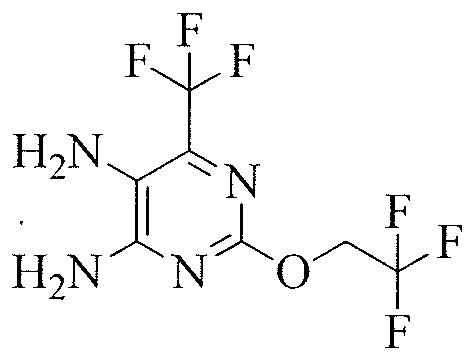
XI-39
2-(methylthio)-6-(trifluoromethyl)pyrimidme-4,5-diamine [Compound XI-40] was prepared from compound XIH-37), and was isolated as a yellow solid (0.78 g, 63%): Ή NMR (300 MHz, DMSO-iifc) δ 7.19 (brs, 2H), 5.15 (brs, 2H), 2.36 (s, 3H); ESIMS m/z 225 ([M+H]+).

XI-40
Example 11
Preparation of 2,8-(substituted)-6-(trifluoromethyl)-9H-purines
[Compounds 1-63]

Separately, compound XI-23, XI -24, XI -25, XI-26, XI-27, XI-28, XI-29, XI-38, XI-39 and XI-40 (1 eq.) each was mixed with an appropriate aldehyde (2 eq.) in anhydrous dioxane (5 mL). The reaction mixture was treated with FeCl3/Si02 (15%, 2 eq.) at 100°C under nitrogen for 18 h. The cooled mixture was filtered and washed with EtOAc (2 x 15 mL). The filtrate was concentrated under vacuum, and the residue was purified by silica gel chromatography to give 2,8-(Substituted)-6-(trifluoromethyl)-9H-purine (Compounds 1-63), respectively.
Aldehydes used include: 2-chloro-5-(trifluoromethyl)benzaldehyde,
2-fluoro-4-(trifluoromethyl)benzaldehyde, 2-methoxy-4-(trifluoromethyl)benzaldehyde, 6-(trifluoromethyl)-nicotinaldehyde, 2,5-dichlorobenzaldehyde, 2,6-dichloro-4-(trifIuoromethyl) benzaldehyde, 4-(diniethylamino)benzaldehyde, 2,4,6-trimethoxybenzaldehyde, or 3 ,4,5-trimethoxybenzaldehyde.
The purine compounds 1-63 in TABLE 5 were made in accordance with the procedures disclosed in Example 11.
Example 12
Preparation of 8-Substituted-2,6-bis(trifluoromethyl)-9H-purine
[Compounds 64-80]

In separate flasks, a solution of intermediate XI-30 (0.24 mmol) in anhydrous dioxane (3 mL) was mixed with an aldehyde (0.24 mmol). The reaction mixture was treated with 15% FeCl3/Si02 (0.48 mmol) and heated with stirring at 100°C under nitrogen for 20 h. The mixture was cooled, filtered and washed with EtOAc (15 mL). The filtrate was concentrated under vacuum to give a residue, which was dissolved with EtOAc (15 mL) and washed with distilled water (10 mL). The organic phase was dried over Na2S04, and concentrated under vacuum. The residue was purified by preparative HPLC to afford 8-Substituted-2,6-bis(trifluoromethyl)-9H-purine (Compounds 64-80).
Aldehydes used include: 2,6-dichlorobenzaldehyde, 2,6-dichloro-4-(trifluoromethyl) benzaldehyde, 2-chloro-5-(trifluoromethyl)benzaldehyde, 3-chlorothiophene-2-carbaldehyde, 2,4-dicWorobenzaldehyde,2-chloro-4-(dimethylamino)benzaldehyde,2-chloro-6-methylbenzalde hyde, 2-methoxy-4-(trifluoromethyl)benzaldehyde, 2-fluoro-4-(trifluoromethyl)-benzaldehyde, 2,4,6-tricUorobenzaldehyde,2,5-dicUorothiophene-3-carbaldehyde,5-chloro-thiophene-2-carbal dehyde,5-(trifluoromethyl)picolinaldehyde,2,6-di
inaldehyde, 3 ,5-dichloroisonicotinaldehyde, 3-chloropicolinaldehyde.
The purine Compounds 64-80 in TABLE 5 were made in accordance with the procedures disclosed in Example 12.
Example 13
Preparation of
8-(2-fluoro-4-(trifluoromethyl)phenyl)-9-methyl-6-(trifluoromethyl)-2-(6-(trifluoromethyl) pyridin-3-yl)-9H-purine
[Compound 81]

2-fluoro-4-(trifluoromethyl)benzaldehyde (0.114 g, 0.593 mmol) dissolved in 1,4-dioxane (5 mL). To the solution was added 15% FeCl3/Si02 (0.641 g, 0.593 mmol) followed by addition of 1 ,4-dioxane (10 mL) to give a brown suspension that was heated to a temperature of about 00°C. After 4 h, an additional 15% FeCl3/Si02 (0.2 g) was added, and the reaction mixture was heated overnight. Then, an additional 2-fluoro-4-trifluoromethyl benzaldehyde (0.1 g) was added, and the reaction mixture was continued to be heated at a temperature of about 100°C for another 10 h. The reaction mixture was cooled to RT, filtered over silica gel. The filtrate was washed with EtOAc (4 x lOmL) and CH2C12 (3 x lOmL). The organic mixture was dried over Si02 (5 g) and the solvent was removed under vacuum. The residue was purified by column chromatography (hexanes - EtOAc: gradient; 40g column) to afford the purine Compound 81 as a white solid (0.072 g, 47%): mp 159°C-161°C; 1H NMR (400 MHz, CDC13) δ 9.88 (d, J = 1.8 Hz, 1H), 9.04 (dd, J= 8.2, 1.6 Hz, 1H), 8.01 (t, J = 7.4 Hz, 1H), 7.85 (d, J= 8.3 Hz, 1 H), 7.71 (d, J= 8.1 Hz, 1H), 7.62 (d, J= 9.8 Hz, 1H), 4.01 (d, J = 2.6 Hz, 3H); ESIMS m/z 51 1 .0 ([M+ i f).
Example 14
Preparation of
8-(2-methoxy-4-(trifluoromethyl)phenyl)-9-methyl-6-(trifluoromethyl)-2-(6-(trifluorometh yl)pyridin-3-yl)-9H-purine [Compound 82]
and
-(2-methoxy-4-(trifluoromethyl)phenyl)-9-methyl-6-(trifluoromethyl)-2-(6-(trifluorometh yl)pyridin-3-yl)-8,9-dihydro-7H-purine [Compound 83]

Compound 82 Compound 83
To a 25 mL vial was added compound XI-31 (0.1 g, 0.297 mmol) and 2-methoxy-4-(trifluoromethyl)benzaldehyde (0.121 g, 0.593 mmol) dissolved in 1 ,4-dioxane (5 mL). To the solution was added 15% FeCl3/Si02 (0.641 g, 0.593 mmol) followed by addition of 1,4-dioxane (10 mL) to give a brown suspension that was heated to 100°C for 4 h, and then cooled to RT and stirred overnight. The mixture was filtered over silica gel and washed with EtOAc (4 x lOmL) and CH2Cl2 (3 x lOmL). The organic mixture was dried over Si02 (5 g), and the solvent was removed under vacuum. The residue was purified by column chromatography (hexanes - EtOAc: gradient; 40g column) to afford the purine Compound 82 and Compound 83.
Compound 82 was a white solid (0.086 g, 52%): mp 200°C-202°C; 1H NMR (400 MHz, DMSO- 6) δ 9.78 (d, J= 1.9 Hz, 1H), 9.05 (dd, J= 8.2, 1.7 Hz, 1H), 8.16 (d, J = 8.3 Hz, 1H), 7.86 (d, J= 7.8 Hz, 1H), 7.63 (s, 1H), 7.58 (d, J= 7.9 Hz, 1H), 3.99 (s, 3H), 3.83 (s, 3H); ESIMS m/z 522.0 ([M+l]+).
Compound 83 was as a pale white solid (0.042 g, 27%): mp 154°C-157°C; Ή NMR (400 MHz, CDC13) δ 9.60 (d, J = 1.6 Hz, 1H), 8.74 (dd, J = 8.2, 1.4 Hz, 1H), 7.70 (d, J = 8.1 Hz, 1H), 7.46 (d, J = 7.9 Hz, 1H), 7.33 (d, J = 8.1 Hz, 1H), 7.20 (s, 1H), 6.67 (s, 1H), 5.05 (s, l H), 3.92 (s, 3H), 3.03 (s, 3H); ESIMS m/z 524.9 ([M+l]+).
The following purine compounds were prepared in accordance with the procedures disclosed in Example 14.
8-(2-chloro-5-(trifluoromethyl)phenyl)-9-methyl-6-(trifluoromethyl)-2-(6-(trifluorometh yl)pyridin-3-yl)-9H-purine [Compound 84] and 8-(2-chloro-5-(trifluoromethyl)-phenyl)-
9-methyl-6-(trifluoromethyl)-2-(6-(trifluoromethyl)pyridin-3-yl)-8,9-dihydro-7H-purine
[Compound 85] was prepared from 2-chloro-5-(trifluoromethyl)benzaldehyde).

Compound 84 Compound 85
Compound 84 was isolated as pale yellow foam (0.046 g, 29%): Ή NMR (400 MHz, CDC13) δ 9.89 (d, J= 1.9 Hz, 1H), 9.10- 9.00 (m, 1H), 7.94 (d, J= 2.1 Hz, 1H), 7.91- 7.82 (m, 2H), 7.77 (d, J = 8.5 Hz, 1H), 3.92 (s, 3H); 19F NMR (376 MHz, CDCI3): δ -62.71 (s), -66.14 (s), -67.96 (s); ESIMS m/z; 527.2 ([M+l]+).
Compound 85 was isolated as as pale yellow foam (0.055 g, 34%): 1H NMR (400 MHz, CDCI3) δ 9.61 (d, J = 1.8 Hz, 1H), 8.75 (dd, J = 8.2, 1.4 Hz, 1H), 7.77-7.61 (m, 4H), 6.82 (s, 1H), 5.20 (s, 1H), 3.04 (s, 3H); 19F NMR (376 MHz, CDCI3): δ -62.64 (s), -65.94 (s), -67.76 (s); ESIMS m/z 529.0 ([M+l]+).
Example 15
Preparation of
8-(2-fluoro-4-(trifluoromethyl)phenyl)-9-(2,2,2-trifluoroethyl)-6-(trifluoromethyl)-2-(6-(trif luoromethyl)pyridin-3-yl)-9H-purine [Compound 86]
and
8-(2-fluoro-4-(trifluoromethyl)phenyl)-9-(2,2,2-trifluoroethyl)-6-(trifluoromethyl)-2-(6-(trif

Compound 86 Compound 87
To a 25 mL vial was added compound XI-34 (0.1 g, 0.247 mmol) and 2-fluoro-4-(trifluoromethyl)benzaldehyde (0.1 19 g, 0.617 mmol) dissolved in 1 ,4-dioxane (5 mL). To the solution was added 15% FeCl3/Si02 (0.534 g, 0.494 mmol) followed by addition of 1,4-dioxane (10 mL) to give a brown suspension that was heated to 100°C for 18 h. Then, additional 2-fluoro-4-(trifluoromethyl)benzaldehyde (0.1 g) was added, and the reaction mixture was heated for 24 h. The reaction mixture was cooled to RT, filtered with silica gel, and washed with EtOAc (4 x lOmL) and CH2CI2 ( 3 x lOmL). Then, the solvent was removed under vacuum. The resulting residue was dissolved in CH2CI2 (25 mL), cooled to 0°C with ice bath, followed by the addition of DDQ (0.056 g, 0.247 mmol). The reaction mixture was stirred cold for 30 min, and warmed to RT for 45 min. Then, the reaction mixture was poured into a separatory funnel containing CH2CI2 (50 mL), washed with sodium hydroxide (NaOH) aqueous solution (1 N, 3 x 25 mL). The aqueous layer was back-extracted with CH2CI2 (1 x 25mL), and combined with the organic phases. The combined organic phases were dried over magnesium sulfate (MgS04), and filtered. After addition of S1O2 (5g), the solvent was removed under vacuum. The residue was purified by column chromatography (hexanes - EtOAc:gradient; 25g column) to afford the purine Compound 86 and Compound 87.
Compound 86 was isolated as an off-white solid (0.064 g, 44%): mp 194°C-196°C; JH NMR (400 MHz, DMSO-^) δ 9.83 (d, J= 1.9 Hz, 1H), 9.09 (dd, J = 8.2, 1.6 Hz, 1H), 8.19 (d, J= 8.3 Hz, 1H), 8.15-8.07 (m, 2H), 7.92 (d, J= 8.0 Hz, 1H), 5.49 (q, J = 8.9 Hz, 2H); ESIMS m/z 578.2 ([M+l]+).
Compound 87 was isolated as a pale white solid (0.025 g, 17%): mp 159°C-162°C; !H NMR (400 MHz, CDC13) δ 9.59 (d, J= 1.6 Hz, 1H), 8.73 (dd, J= 8.2, 1.4 Hz, 1H), 7.73 (d, J = 8.3 Hz, 1H), 7.68-7.54 (m, 2H), 7.48 (d, J = 10.2 Hz, 1H), 6.87 (s, 1H), 5.20 (s, 1H), 4.56 (dt, J= 15.8, 9.2 Hz, 1H), 3.48 (dq, J= 16.3, 8.2 Hz, 1H); ESIMS m/z 581.1 ([M+l ).
The following compounds were made in accordance with the procedures disclosed in Example 15.
8-(2-methoxy-4-(trifluoromethyl)phenyl)-9-(2,2,2-trifluoroethyl)-6-(trifluoromethyl)-2-( 6-(trifluoromethyl)pyridin-3-yl)-9H-purine [Compound 88] was prepared from 2-methoxy-5-(trifluoromethyl)benzaldehyde) and isolated as an off-white solid (0.122 g, 82%): mp 192°C-194°C; Ή NMR (400 MHz, DMSO-i¾) δ 9.81 (d, J = 1.9 Hz, 1H), 9.07 (dd, J= 8.2, 1.7 Hz, 1H), 8.18 (d, J= 8.3 Hz, 1H), 7.87 (d, J= 7.8 Hz, 1H), 7.62 (s, 1H), 7.58 (d, J = 7.9 Hz, 1 H), 5.39 (q, J= 8.9 Hz, 2H), 3.96 (s, 3H); ESIMS m/z 588.5 ([M-l]").

Compound 88
8-(2-chloro-5-(trifluoromethyl)phenyl)-9-(2,2,2-trifluoroethyl)-6-(trifluoromethyl) trifluoromethyl)pyridin-3-yl)-9H-purine [Compound 89] and
8-(2-chloro-5-(trifluoromethyl)phenyl)-9-(2,2,2-trifluoroethyl)-6-(trifluoromethyl)-2-(6-(trifl omethyl)pyridin-3-yl)-8,9-dihydro-7H-purine [Compound 90] were prepared from 2-chloro-5-(trifluoromethyl)-benzaldehyde.

Compound 89 Compound 90
Compound 89 was isolated as an off-white solid (0.076 g, 51%): mp 208°C-211°C; Ή NMR (400 MHz, CDC13) δ 9.88 (d, J= 1.8 Hz, 1H), 9.04 (dd, J= 8.2, 1.6 Hz, 1H), 7.96 (s, 1H), 7.93- 7.84 (m, 2H), 7.78 (d, J= 8.5 Hz, 1H), 5.13- 4.86 (m, 2H); ESIMS m/z 595.2 ([M+l]+).
Compound 90 was isolated as an off white solid (0.024 g, 16%): Ή NMR (400 MHz, CDC13) δ 9.61 (d, J = 1.6 Hz, 1H), 8.75 (dd, J = 8.2, 1.5 Hz, 1H), 7.83- 7.59 (m, 4H), 7.02 (s, 1H), 5.24 (s, 1H), 4.70- 4.39 (m, 1H), 3.64-3.42 (m, 1H); 19F NMR (376 MHz, CDC13) δ -62.69 (s), -66.01 (s), -67.84 (s), -69.03 (s); ESIMS m/z 596.5 ([M+l]+).
Example 16
Preparation of tert-butyl
(8-(2-fluoro-4-(trifluoromethyl)phenyl)-6-(trifluoromethyl)-2-(6-(trifluoromethyI)pyridin
-yl)-9H-purin-9-yl)carbamate [Compound 91]
and
teri-butyl
(8-(2-fluoro-4-(trifluoromethyl)phenyl)-6-(trifluoromethyI)-2-(6-(trifluoromethyl)pyridin
-yl)-7H-purin-9(8H)-yl)carbamate [Compound 92]

Compound 91 Compound 92
To a solution of XI-32 (0.105 g, 0.24 mmol) and 2-fluoro-4-(trifluoromethyl)-benzaldehyde (0.092 g, 0.479 mmol) in N,N-dimethylformamide (DMF, 3 mL) was added chlorotrimethylsilane (0.065 g, 0.599 mmol) to give a pale yellow solution that was stirred at RT for 18 h. The reaction mixture was added 2-fluoro-4-(trifluoromethyl)-benzaldehyde (0.2 g) and stirred for 72 h, followed by the addition of chlorotrimethylsilane (0.05 g) stirring for 16 h. The reaction mixture was poured into a separatory funnel containing EtOAc (50 mL) and washed with saturated NaCl solution (3 x 50mL). The organic phase was dried over MgS04, filtered and concentrated under vacuum to give a yellow residue material that was purified by column chromatography ( hexanes-EtOAc; gradient 40g column) to afford a white solid Compound 92 (0.097 g, 64%): mp 185°C-186°C; 1H NMR (400 MHz, DMSO-<¾) δ 10.44 (s, 1H), 9.40 (d, J = 1.8 Hz, 1 H), 8.67 (dd, J = 8.2, 1.6 Hz, 1H), 8.02 (d, J = 8.1 Hz, 1H), 7.86-7.69 (m, 2H), 7.58 (d, J = 7.9 Hz, 1H), 7.41 (t, J = 7.8 Hz, 1H), 6.80 (d, J= 4.1 Hz, 1H), 1.47 (s, 9H); ESIMS m/z 61 1.5 ([M-l ]").
To a cooled solution of Compound 92 (0.087 g, 0.14 mmol) in CH2C12 (5 mL) was added DDQ (54.4 mg, 0.240 mmol), changing the color of the solution change to pale orange. After 15 min the opaque red mixture was wanned to RT and stirred for two h. The reaction mixture was poured into a separatory funnel containing CH2CI2 (20 mL) and washed with IN
NaOH aqueous solution (3 x 25 mL). The organic phase was dried over MgS04, filtered and added Si02 (5g). The solvent was removed under vacuum, and the residue was purified by column chromatography (hexanes-EtOAc: gradient; 40g column) to afford Compound 91 (0.075 g, 88%): mp 191°C-193°C; Ή NMR (400 MHz, DMSO-i¾ δ 1 1.50 (s, 1H), 9.68 (s, 1H), 8.99 (d, J= 8.7 Hz, 1H), 8.19 (d, J= 8.3 Hz, 1H), 8.13 (d, J= 10.3 Hz, 1H), 8.07-7.99 (m, lH), 7.92 (d, J= 8.1 Hz, 1H), 1.38 (s, 9H); ESIMS m/z 609.1 ([M-l]").
The following compounds were made in accordance with the procedures disclosed in Example 16.
tert-butyl (8-(2-methoxy-4-(trifluoromethyl)phenyl)-6-(trifluoromethyl)-2- (6-(trifluoromethyl)pyridin-3-y)-9H-purin-9-yl)carbamate [Compound 93] and tert-butyl (8-(2-methoxy-4-(trifluoromethyl)phenyl)-6-(trifluoromethyl)-2-(6-(trifluoromethyl)pyridin-3-y) -7H-purin-9(8H)-yl)carbamate [Compound 94] was prepared from -methoxy-4-(trifluoromethyl)-benzaldehyde).

Compound 93 Compound 94
Compound 93 was isolated as a white solid (0.110 g, 72%) having a melting point of about 205°-207° C. 1H NMR (400 MHz, DMSO-<¾: δ 11.16 (s, 1H), 9.67 (s, 1H), 8.98 (d, J= 7.5 Hz, 1H), 8.18 (d, J = 8.3 Hz, 1H), 7.78 (d, J = 7.7 Hz, 1H), 7.67-7.44 (m, 2H), 3.92 (s, 3H), 1.39 (s, 9H). ESIMS m/z 621.7 ([M-l]").
Compound 94 was isolated as a light yellow solid (0.126 g, 83%): mp 163°C-165°C; Ή NMR (400 MHz, OMSO-d6) δ 10.34 (s, 1H), 9.40 (d, J - 1.6 Hz, 1H), 8.66 (dd, J = 8.3, 1.6 Hz, 1H), 8.02 (d, J = 8.3 Hz, 1H), 7.61 (s, 1H), 7.37 (s, 1H), 7.29 (d, J = 8.1 Hz, 1H), 7.22 (d, J= 8.0 Hz, 1H), 6.79 (d, J = 3.8 Hz, 1H), 3.95 (s, 3H), 1.48 (s, 9H); ESIMS m/z 624.9 ([M+l]+).
tert-butyl
(8-(2-chloro-5-(trifluoromethyl)phenyl)-6-(trifluoromethyl)-2-(6-(trifluoromethyl)pyridin-3-yl)- 9H-purin-9-yl)carbamate [Compound 95] and tert-butyl (8-(2-chloro-5-(trifluoromethyl)
phenyl)-6-(trifluoromethyl)-2-(6-(trifluoromethyl)pyridin-3-yl)-7H-purin-9(8/J)-yl)carbam
[Compound 96] were prepared from 2-chloro-5-(trifluoromethyl)-benzaldehyde).

Compound 95 was isolated as a white solid (0.120 g, 78%): mp 185°C-187°C; !H NMR (400 MHz, CDC13) δ 9.87 (s, 1H), 9.04 (dd, J = 8.2, 1.7 Hz, 1H), 8.15 (s, 1H), 8.01 (s, 1H), 7.91- 7.78 (m, 2H), 7.74 (d, J= 8.5 Hz, 1H), 1.40 (s, 9H); ESIMS m/z 628.5 ([M+l]+).
Compound 96 was isolated as a light yellow solid (0.137 g, 89%): mp 189°C-191°C; 1H NMR (400 MHz, DMSO-<¾) δ 10.39 (s, 1H), 9.41 (d, J = 1.7 Hz, 1H), 8.68 (dd, J= 8.2, 1.6 Hz, 1H), 8.02 (d, J = 8.3 Hz, 1H), 7.88 - 7.75 (m, 3H), 7.41 (s, 1H), 6.78 (d, J = 4.2 Hz, 1H), 1.47 (s, 9H); ESIMS m/z 630.4 ([M+l]+).
Example 19
8-(2-fluoro-4-(trifluoromethyl)phenyl)-/V-methyl-6-(trifluoromethyl)-2-(6-(trifluoromethyl) pyridin-3-yl)-7H-purm-9(8H)-amine [Compound 97]
and
8-(2-fluoro-4-(trifluoromethyl)phenyl)-N-methyl-6-(trifluoromethyl)-2-(6-(trifluoromethyl) pyridin-3-yl)-7H-purin-9(8H)-amine [Compound 98]

Compound 97 Compound 98
To a solution of compound XI-33 (0.125 g, 0.276 mmol) and 2-fluoro-4-(trifiuoromethyl)benzaldehyde (0.106 g, 0.553 mmol) in DMF (2 mL) was added chlorotnmethylsilane (0.075 g, 0.691 mmol) to give a pale yellow solution that was stirred at RT for 72 h. The reaction mixture was added 2-fluoro-4-(trifluoromethyl)benzaldehyde (0.1 g) and chlorotrimethylsilane (0.1 g) and stirred for 48 h. Then, the reaction mixture was poured into a separatory funnel containing EtOAc (50 mL) and washed with saturated NaCl solution (3 x 50 mL). The organic phase was dried over MgS04 and filtered. The solvent was removed under vacuum to give a yellow residue that was purified by column chromatography (hexanes- EtOAc; gradient 40g column) to afford an off-white solid Compound 98 (0.018 g, 11.7%): mp 137°C-139°C; Ή NMR (400 MHz, CDC13) δ 9.55 (d, J = 1.6 Hz, 1H), 8.70 (dd, J = 8.1, 1.5 Hz, 1H), 7.72 (d, J= 8.2 Hz, 1H), 7.53 (t, J= 7.7 Hz, 1H), 7.39 (t, J= 8.7 Hz, 2H), 7.1 1 (s, 1H), 5.60 (d, J= 2.0 Hz, 1H), 5.29 (s, 1H), 2.94 (s, 3H); ESIMS m/z 527.0 ([M+l]+)
The yellow residue was dissolved in CH2CI2 (5 mL) and cooled in an ice bath. To the solution was added DDQ (62.7 mg, 0.276 mmol), causing a color change to pale orange. The reaction mixture was allowed to warm to RT, and was stirred overnight. The reaction mixture was poured into a separatory funnel containing CH2CI2 (20 mL) and washed with 1 N NaOH aqueous solution (3 x 25 mL). The organic phase was dried over MgSC>4, filtered and added S1O2 (2g). The solvent was removed under vacuum, and the residue was purified by column
chromatography (hexanes- EtOAc: gradient; 40g column) to afford Compound 97 (0.085 g, 44%): Ή NMR (400 MHz, CDC13) δ 9.85 (s, IH), 9.01 (dd, J = 8.2, 1.6 Hz, IH), 7.94 (s, IH), 7.86 (d, J = 8.2 Hz, IH), 7.73-7.53 (m, 2H), 3.61 (s, 3H), 1.45 (s, 4H), 1.16 (s, 5H); l9F NMR (376 MHz, CDC13) δ -63.24 (s), -66.08 (s), -68.04 (s); ESIMS m/z 625.1 ([M+l]+).
The following compounds were made in accordance with the procedures disclosed in Example 17.

Compound 99 teri-butyl (8-(2-methoxy-4-(trifluoromethyl)phenyl)-6-(trifluoromethyl)-2- (6-(trifluoromethyl)pyridin-3-yl)-9H-purin-9-yl)(methyl)carbamate [Compound 99] was prepared from 2-methoxy-4-(trifluoromethyl)benzaldehyde, and was isolated as a white solid (0.155 g, 84%): Ή NMR (400 MHz, CDC13) δ 9.85 (s, IH), 9.07-8.95 (m, IH), 7.85 (d, J= 8.2 Hz, IH), 7.72 (s, IH), 7.41 (s, IH), 7.28 (s, IH), 3.95 (s, 3H), 3.64-3.45 (m, 3H), 1.45 (s, 4H), 1.16 (s, 5H); 19F NMR (376 MHz, CDC13) δ -63.11 (s), -65.9, -66.03 (m), -68.01 (s); ESIMS m/z 638.9 ([M+l]+).

Compound 100 tert-butyl (8-(2-chloro-5-(trifluoromethyl)phenyl)-6-(trifluoromethyl)-2-(6- (trifluoromethyl)pyridin-3-yl)-9//-purin-9-yl)(methyl)carbamate [Compound 100] was prepared from 2-chloro-5-(trifluoromethyl)benzaldehyde), and was isolated as white solid (0.150 g, 83%): mp 155°C-157°C; Ή NMR (400 MHz, CDC13) δ 9.85 (s, IH), 9.02 (dd, J =
8.2, 1.6 Hz, 1H), 8.01-7.66 (m, 4H), 3.54 (s, 3H), 1.57-1.19 (m, 9H); ESIMS m/z 642.4 «M+1]+).
Example 18
Preparation of
8-(2-fluoro-4-(trifluoromethyl)phenyl)-N-(propan-2-ylidene)-6-(trifluoromethyl)-2-(6-(trifl uoromethyl)pyridin-3-yI)-9H-purin-9-amine
[Compound 101]

To a solution of Compound 91 (1 10 mg, 0.180 mmol) in CH2C12 (10 mL) was added triethylsilane (0.230 mL, 1.442 mmol) followed by the addition of TFA (0.833 mL, 10.81 mmol) to give a colorless solution. Then, the solution was heated to a temperature of about 40°C and stirred for 90 min. The reaction mixture was removed under vacuum, and the residue was re-dissolved in CH2CI2 (10 mL), poured mixture into a separatory funnel containing CH2CI2 (25mL) and washed with saturated NaHC(¾ solution (2 x 25 mL). The organic phase was dried over MgS04, filtered and added Si02 (3 g). Then, the solvent was removed under vacuum to give a residue that was purified by column chromatography (hexanes-EtOAc; gradient 12g column). The resulting residue was mixed in acetone and concentrated under vaccum to afford Compound 101 as a white solid (0.049 g, 48%): mp 227°C-229°C; !H NMR (400 MHz, CDCI3) δ 9.80 (d, J = 1.8 Hz, 1H), 8.98 (dd, J = 8.2, 1.5 Hz, 1H), 8.09 (t, J= 7.4 Hz, 1H), 7.85 (d, J = 8.3 Hz, 1H), 7.66 (d, J = 8.1 Hz, 1H), 7.50 (d, J = 10.0 Hz, 1H), 2.42 (s, 3H), 2.22 (s, 3H); ESIMS m/z 551.0 ([M+l]+).
Example 19
Preparation of
8-(2-methoxy-4-(trifluoromethyl)phenyl)-6-(trifluoromethyl)-2-(6-(trifluoromethyl)pyridin
-3-yl)-9H-purin-9-amine
[Compound 102]

To a solution of Compound 93 (100 mg, 0.161 mmol) in CH2C12 (10 mL) was added tnethylsilane (0.103 mL, 0.643 mmol) followed by the addition of TFA (1.25 mL, 16.2 mmol) to give a colorless solution. The solution was heated to a temperature of about 40°C and stirred for 4 h. The reaction mixture was removed under vacuum. The residue was re-dissolved in CH2C12 (10 mL), poured into a separator/ funnel containing CH2C12 (25 mL) and washed with saturated NaHC03 solution (2 x 25 mL). The organic phase was dried over MgS04, filtered and added Si02 (3g). The solvent was removed under vacuum give a residue that was purified by column chromatography (hexanes-EtOAc; gradient 12g column) to afford Compound 102 as a white solid (0.056 g, 65%): mp 200°C-202°C; Ή NMR (400 MHz, CDC13) δ 9.86 (d, J = 1.8 Hz, 1H), 9.04 (dd, J = 8.2, 1.6 Hz, 1H), 7.91-7.80 (m, 2H), 7.45 (d, J = 7.9 Hz, 1H), 7.33 (s 1H), 5.30 (s, 2H), 4.01 (s, 3H); ESIMS m/z 521.4 ([M-l]").
The following compounds were made in accordance with the procedures disclosed in
Example 19.

Compound 103
8-(2-chloro-5-(trifluoromethyl)phenyl)-6-(trifluoromethyl)-2-(6-(trifluoromethyl)-pyridi n-3-yl)-9H-purin-9-amine [Compound 103] was isolated as a white solid (0.079 g, 84%): Ή NMR (400 MHz, CDC13) δ 9.87 (d, J = 1.7 Hz, 1H), 9.04 (dd, J= 8.2, 1.5 Hz, 1H), 7.99 (d, J = 2.0 Hz, 1H), 7.90^7.80 (m, 2H), 7.74 (d, J = 8.5 Hz, 1H), 5.28 (s, 2H); 19F NMR (376 MHz, CDCI3) δ -62.69 (s), -66.03 (s), -67.97 (s); ESIMS m/z 527.0 ([M+l]+).

Compound 104
8-(2-fluoro-4-(trifluoromethyl)phenyl)-N-methyl-6-(trifluoromethyl)-2-(6-(trifluorometh yl)pyridin-3-yl)-9H-purin-9-amine [Compound 104] was isolated as a white solid (0.052 g,
80%): mp 110°C-112°C; Ή NMR (400 MHz, CDC13) δ 9.86 (d, J = 1.9 Hz, 1H), 9.03 (dd, J= 8.2, 1.5 Hz, 1H), 7.96 (t, J = 7.3 Hz, 1H), 7.92-7.78 (m, 1H), 7.65 (d, J= 8.0 Hz, 1H), 7.56 (d, J = 9.6 Hz, 1H), 5.39 (q, J = 5.7 Hz, 1H), 3.16 (d, J = 5.7 Hz, 3H); ESIMS m/z 526.1 ([M+l]+).

Compound 105
8-(2-methoxy-4-(trifluoromethyl)phenyl)-N-methyl-6-(trifluoromethyl)-2-(6-(trifluorom ethyl)pyridin-3-yl)-9H-purin-9-amine [Compound 105] was isolated as a white solid (0.109 g,
82%): mp 206°C-208°C; Ή NMR (400 MHz, CDC13) δ 9.87 (d, J = 1.8 Hz, 1H), 9.03 (dd, J= 8.2, 1.6 Hz, 1 H), 7.84 (d, J= 8.2 Hz, 1H), 7.79 (d, J= 7.8 Hz, 1H), 7.45 (d, J= 7.9 Hz, IH), 7.31 (s, 1H), 5.41 (q, J = 5.7 Hz, 1H), 3.96 (s, 3H), 3.03 (d, J = 5.7 Hz, 3H); ESIMS m/z 537.9 ([M+l]+).

Compound 106
8-(2-chloro-5-(trifluoromethyl)phenyl)-N-methyl-6-(trifluoromethyl)-2-(6-(trifluorometh yl)pyridin-3-yl)-9H-purin-9-amine [Compound 106] was isolated as a white solid (0.085 g, 66%): Ή NMR (400 MHz, CDC13) δ 9.89- 9.83 (m, 1H), 9.04 (dd, J= 8.2, 1.5 Hz, 1H), 7.92 (d, J= 1.6 Hz, 1H), 7.89-7.79 (m, 2H), 7.73 (d, J= 8.5 Hz, 1H), 5.40 (q, J= 5.7 Hz, 1H), 3.09 (d, J= 5.7 Hz, 3H); 19F NMR (376 MHz, CDC13) δ -62.66 (s), -66.08 (s), -67.99 (s); ESIMS m/z 541.0 ([M+l]+).


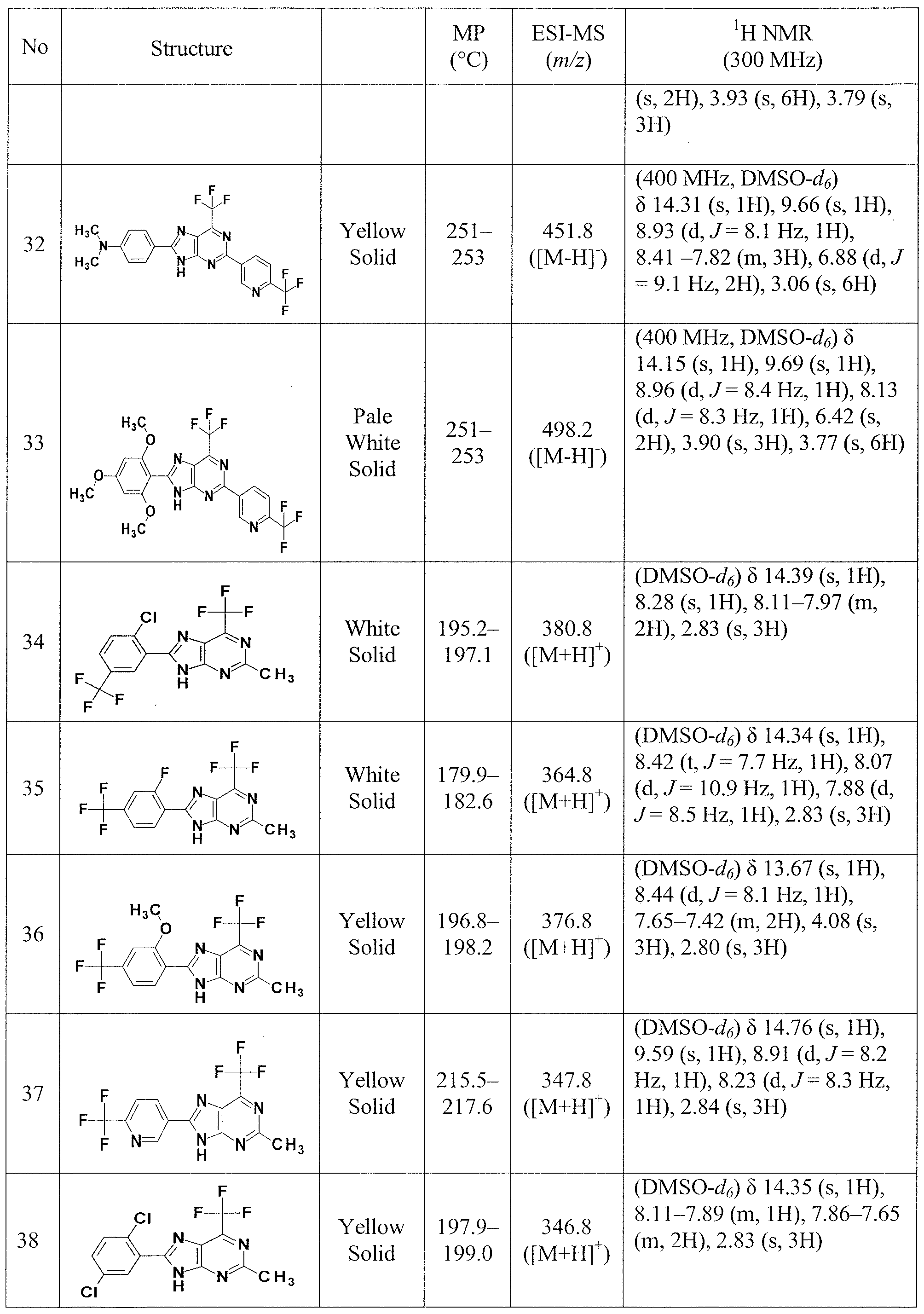


Claims
What is claimed is:
1. A purine compound of formula I or a salt thereof:

I
wherein
Ar is an aryl group, and
R2, R3, R4 and R each is independently selected from the group consisting of: (a) hydrogen, halogen, haloalkyl, alkoxy, haloalkoxy, alkylthio, haloalkylthio, halothio;
(b) C 1 -C8 alkyl, C2-C8 alkenyl or C2-C8 alkynyl;
(c) O-C 1 -C8 alkyl, 0-C2-C8 alkenyl or C2-C8 alkynyl;
(d) C1-C8 alkyl, C2-C8 alkenyl or C2-C8 alkynyl substituted with at least one heteroatom;
(e) alkyl amine, alkenyl amine, alkynyl amine, alkoxyamine, cyano amine;
(f) C(0)R', C(0)OR' or C(0)NR' where R' is selected from the group consisting of an alkyl moiety substituted with at least one heteroatom, aryl or heteroaryl with at least one substituent being any combination of hydrogen, halogen, alkyl, cycloalkyl, alkoxy, cycloalkoxy, haloalkyl, cyclohaloalkyl, haloalkoxy, cyclohaloalkoxy, alkenyl, cycloalkenyl, alkynyl, alkylthio, haloalkylthio, halothio, cyano, nitro, sulfone, sulfoxide, ester, acetate, amide or substituted amine group, unsubstituted aryloxy and substituted aryloxy;
(g) SOn (n = 0, 1, 2) substituted with C1-C8 alkyl group having at least one heteroatom, aryl or heteroaryl with at least one substituent being any combination of hydrogen, halogen, alkyl, cycloalkyl, alkoxy, cycloalkoxy, haloalkyl, cyclohaloalkyl, haloalkoxy, cyclohaloalkoxy, alkenyl, cycloalkenyl, alkynyl, alkylthio, haloalkylthio, halothio, cyano, nitro, sulfone, sulfoxide, ester, acetate, amide, amine, and aryloxy;
(h) aryl or heteroaryl substituted with any combination of hydrogen, halogen, alkyl, cycloalkyl, alkoxy, cycloalkoxy, haloalkyl, cyclohaloalkyl, haloalkoxy, cyclohaloalkoxy, alkenyl, cycloalkenyl, alkynyl, alkylthio, haloalkylthio, halothio, cyano, nitro, sulfone, sulfoxide, ester, acetate, amide, amine, and aryloxy, wherein the alkyl, alkenyl or alkynyl group is substituted with at least one heteroatom;
(i) an amino moiety substituted with hydrogen, C1-C8 alkyl, C2-C8 alkenyl or alkynyl moiety substituted with one or more heteroatoms at any position, halogen, alkoxy, haloalkyl, or haloalkoxy,C(0)R', C(0)OR' or C(0)NR' where R' is selected from the group consisting of an alkyl moiety substituted with at least one heteroatom at any position, halogen, alkoxy, haloalkyl, or haloalkoxy, an aryl or heteroaryl with at least one substituent being any combination of hydrogen, C1-C8 alkyl, C2-C8 alkenyl or alkynyl moiety substituted with one or more heteroatoms at any position, halogen, alkyl, cycloalkyl, alkoxy, cycloalkoxy, haloalkyl, cyclohaloalkyl, haloalkoxy, cyclohaloalkoxy, alkenyl, cycloalkenyl, alkynyl, alkylthio, haloalkylthio, halothio, cyano, nitro, sulfone, sulfoxide, ester, acetate, amide or substituted amine group, unsubstituted aryloxy and substituted aryloxy ;
j) an amino moiety substituted with any combination of hydrogen, alkyl, alkenyl, alkynyl moiety, wherein the alkyl, alkenyl, or alkynyl group is substituted with at least one of heteroatom, halogen, alkoxy, haloalkyl, and haloalkoxy. 2. The compound of cl im 1 , having formula II or a salt thereof.

II
3. The compound of claim 1 having formula III or a salt thereof.

III 4. The compound of claim 1, wherein the aryl group is selected from the group consisting of phenyl, pyridyl, pyrimidinyl, pyridazinyl, pyrazinyl, triazinyl, pyrazolo, imidazolo, thiophenyl and furyl, and wherein the aryl group is substituted at any open position with at least one of hydrogen, halogen, alkyl, cycloalkyl, alkenyl, cycloalkenyl, alkynyl, alkoxy, cycloalkoxy haloalkyl, cyclohaloalkyl, haloalkoxy, cyclohaloalkoxy, alkylthio, haloalkylthio, halothio, cyano, nitro, sulfone, sulfoxide, ester, acetate, amide, substituted amine, unsubstituted amines, aryloxy, and combinations thereof, wherein the alkyl, alkenyl or alkynyl group is unsubstituted or substituted with one or more heteroatoms at any position.
5. The compound of claim 1 , wherein:
R4 is selected from the group consisting of C1-C8 alkyl substituted with at least two halogen atoms, C3-C8 cycloalkyl substituted with at least two halogen atoms, 0-(Cl-C8) alkyl unsubstituted or substituted with two halogen atoms, 0-(C3-C8) cycloalkyl unsubstituted or substituted with at least one halogen atom, phenyl optionally substituted with at least one of halogen, haloalkyl and haloalkoxy, and heteroaryl optionally substituted with at least one of halogen, haloalkyl and haloalkoxy, and
Ri is selected from the group consisting of C1-C8 alkyl, C1-C8 alkyl substituted with at least two halogen atoms, C3-C8 cycloalkyl, C3-C8 cycloalkyl substituted with at least two halogen atoms, 0-(Cl-C8) alkyl , 0-(Cl-C8) alkyl unsubstituted or substituted with two halogen atoms, 0-(C3-C8) cycloalkyl, 0- C3-C8) cycloalkyl substituted with at least one halogen atom, phenyl optionally substituted with at least one of halogen, alkyl, haloalkyl, alkoxy and haloalkoxy, heteroaryl optionally substituted with at least one of halogen, alkyl, haloalkyl, alkoxy and haloalkoxy, O-phenyl optionally substituted with at least one of halogen, alkyl, haloalkyl, alkoxy and haloalkoxy, O-heteroaryl optionally substituted with at least one of halogen, alkyl, haloalkyl, alkoxy and haloalkoxy, S- (Cl-C8)alkyl, S-(C1-C8)alkyl optionally substituted with at least one halogen atom, S- phenyl optionally substituted with at least one of halogen, alkyl, haloalkyl, alkoxy and haloalkoxy, S-heteroaryl optionally substituted with at least one of halogen, alkyl, haloalkyl, alkoxy and haloalkoxy.
6. The compound of claim 1, having formula II-l or a salt thereof:

II I wherein,
Ar is the aryl or heteraryl group selected from the group consisting of phenyl, pyridyl, pyrimidinyl, pyridazinyl, pyrazinyl, triazinyl, pyrazolo, imidazolo, thiophenyl and furyl, and wherein the aryl group is substituted at any open position with at least one of hydrogen, halogen, alkyl, cycloalkyl, alkenyl, cycloalkenyl, alkynyl, alkoxy, cycloalkoxy haloalkyl, cyclohaloalkyl, haloalkoxy, cyclohaloalkoxy, alkylthio, haloalkylthio, halothio, cyano, nitro, sulfone, sulfoxide, ester, acetate, amide, substituted amine, unsubstituted amine, aryloxy, and combinations thereof, and wherein the alkyl, alkenyl, or alkynyl group is unsubstituted or substituted with one or more heteroatoms at any position,
R4 is selected from the group consisting of C1-C8 alkyl substituted with at least two halogen atoms, C3-C8 cycloalkyl substituted with at least two halogen atoms, 0-(Cl-C8) alkyl unsubstituted or substituted with two halogen atoms, 0-{C3-C8) cycloalkyl unsubstituted or substituted with at least one halogen atom, phenyl optionally substituted with at least one of halogen, haloalkyl and haloalkoxy, and heteroaryl optionally substituted with at least one of halogen, alkyl, haloalkyl, alkoxy and haloalkoxy, and Re is selected from the group consisting of C1-C8 alkyl, C1 -C8 alkyl substituted with at least two halogen atoms, C3-C8 cycloalkyl, C3-C8 cycloalkyl substituted with at least two halogen atoms, 0-(Cl-C8) alkyl , 0-(Cl-C8) alkyl unsubstituted or substituted with two halogen atoms, 0-(C3-C8) cycloalkyl, 0-(C3-C8) cycloalkyl unsubstituted or substituted with at least one halogen atom, phenyl optionally substituted with at least one of halogen, alkyl, haloalkyl, alkoxy and haloalkoxy, heteroaryl optionally substituted with at least one of halogen, alkyl, haloalkyl, alkoxy and haloalkoxy, O-phenyl optionally substituted with at least one of halogen, alkyl, haloalkyl, alkoxy and haloalkoxy, O-heteroaryl optionally substituted with at least one of halogen, alkyl, haloalkyl, alkoxy and haloalkoxy, S-(C1-C8)alkyl, S-<C1-C8)alkyl optionally substituted with at least one halogen atom, S-phenyl optionally substituted with at least one of halogen, alkyl, haloalkyl, alkoxy, and haloalkoxy, S-heteroaryl substituted with at least one of halogen, alkyl, haloalkyl, alkoxy and haloalkoxy.
7. The purine compound of claim 1, having formula II-2 or a salt thereof:

II-2
wherein
Ar is aryl or heteroaryl group selected from the group consisting of phenyl, pyridyl, pyrimidinyl, pyridazinyl, pyrazinyl, triazinyl, pyrazolo, imidazolo, thiophenyl and furyl, and wherein the aryl group is substituted at any open position with at least one of hydrogen, halogen, alkyl, cycloalkyl, alkenyl, cycloalkenyl,, alkynyl, alkoxy, cycloalkoxy haloalkyl, cyclohaloalkyl, haloalkoxy, cyclohaloalkoxy, alkylthio, haloalkylthio, halothio, cyano, nitro, sulfone, sulfoxide, ester, acetate, amide, substituted and unsubstituted amines, aryloxy, and combinations thereof, wherein the alkyl, alkenyl, or alkynyl group is unsubstituted or substituted with one or more heteroatoms at any position, and
¾ is selected from the group consisting of C1-C8 alkyl, C1-C8 alkyl substituted with at least two halogen atoms, C3-C8 cycloalkyl, C3-C8 cycloalkyl substituted with at least two halogen atoms, 0-(Cl-C8) alkyl , 0-(Cl-C8) alkyl unsubstituted or substituted with two halogen atoms, 0-(C3-C8) cycloalkyl, 0-(C3-C8) cycloalkyl unsubstituted or substituted with at least one halogen atom, phenyl optionally substituted with at least one of halogen, alkyl, haloalkyl, alkoxy and haloalkoxy, heteroaryl optionally substituted with at least one of halogen, alkyl, haloalkyl, alkoxy and haloalkoxy, O-phenyl optionally substituted with at least one of halogen, alkyl, haloalkyl, alkoxy and haloalkoxy, O-heteroaryl optionally substituted with at least one of halogen, alkyl, haloalkyl, alkoxy and haloalkoxy, S-(C1-C8)alkyl, S-(C1-C8)alkyl optionally substituted with at least one halogen atom, S-phenyl optionally substituted with at least one of halogen, alkyl, haloalkyl, alkoxy, and haloalkoxy, S-heteroaryl optionally substituted with at least one of halogen, alkyl, haloalkyl, alkoxy and haloalkoxy.
8. The purine co Π-3 or a salt thereof:

II-3
wherein
Ar and Ar' each is an aryl or heteroaryl group independently selected from the group consisting of phenyl, pyridyl, pyrimidinyl, pyridazinyl, pyrazinyl, triazinyl, pyrazolo, imidazolo, thiophenyl and furyl, and wherein the aryl group is substituted at any open position with at least one of hydrogen, halogen, alkyl, cycloalkyl, alkenyl, cycloalkenyl, alkynyl, alkoxy, cycloalkoxy haloalkyl, cyclohaloalkyl, haloalkoxy, cyclohaloalkoxy, alkylthio, haloalkylthio, halothio, cyano, nitro, sulfone, sulfoxide, ester, acetate, amide, substituted amine, unsubstituted amine, aryloxy, and combinations thereof, ansd wherein the alkyl, alkenyl, or alkynyl group is unsubstituted or substituted with one or more heteroatoms at any position, and
R2 and R4 each is independently selected from the group consisting of:
(a) hydrogen, halogen, haloalkyl, alkoxy, haloalkoxy, alkylthio, haloalkylthio, halothio;
(b) C 1 -C8 alkyl, C2-C8 alkeny or C2-C8alkynyl;
(c) O-C 1 -C8 alkyl, 0-C2-C8 alkenyl or C2-C8alkynyl;
(d) C1-C8 alkyl, C2-C8 alkenyl or C2-C8alkynyl optionally substituted with at least one heteroatom;
(e) amine, alkoxyamine, cyano amine;
(f) C(0)R', C(0)OR' or C(0)NR' where R' is selected from the group consisting of an alkyl moiety optionally substituted with at least one heteroatom, aryl or heteroaryl with at least one substituent being any combination of hydrogen, halogen, alkyl, cycloalkyl, alkoxy, cycloalkoxy, haloalkyl, cyclohaloalkyl, haloalkoxy, cyclohaloalkoxy, alkenyl, cycloalkenyl, alkynyl, alkylthio, haloalkylthio, halothio, cyano, nitro, sulfone, sulfoxide, ester, acetate, amide, amine, and aryloxy;
(g) SOn (n = 0, 1, 2) substituted with C1-C8 alkyl group optionally substituted with at least one heteroatom, aryl or heteroaryl with at least one substituent being any combination of hydrogen, halogen, alkyl, cycloalkyl, alkoxy, cycloalkoxy, haloalkyl, cyclohaloalkyl, haloalkoxy, cyclohaloalkoxy, alkenyl, cycloalkenyl, alkynyl, alkylthio, haloalkylthio, halothio, cyano, nitro, sulfone sulfoxide, ester, acetate, amide, amine, and aryloxy;
(h) aryl or heteroaryl substituted with any combination of hydrogen, halogen, alkyl, cycloalkyl, alkoxy, cycloalkoxy, haloalkyl, cyclohaloalkyl, haloalkoxy, cyclohaloalkoxy, alkenyl, cycloalkenyl, alkynyl, alkylthio, haloalkylthio, halothio, cyano, nitro, sulfone, sulfoxide, ester, acetate, amide, amine, and aryloxy, wherein the alkyl, alkenyl, or alkynyl group is optionally substituted with at least one heteroatom;
(i) an amino moiety substituted with hydrogen, C1-C8 alkyl, C2-C8 alkenyl or C2-C8alkynyl moiety unsubstituted or substituted with one or more heteroatoms at any position, halogen, alkoxy, haloalkyl, or haloalkoxy, C(0)R', C(0)OR' or C(0)NR' where R' is selected from the group consisting of an alkyl moiety unsubstituted or substituted with at least one heteroatom at any position, halogen, alkoxy, haloalkyl, haloalkoxy, an aryl or heteroaryl with at least one substituent being any combination of hydrogen, C1-C8 alkyl, C2-C8 alkenyl or C2-C8alkynyl moiety unsubstituted or substituted with one or more heteroatoms at any position, halogen, alkyl, cycloalkyl, alkoxy, cycloalkoxy, haloalkyl, cyclohaloalkyl, haloalkoxy, cyclohaloalkoxy, alkenyl, cycloalkenyl, alkynyl, alkylthio, haloalkylthio, halothio, cyano, nitro, sulfone, sulfoxide, ester, acetate, amide, substituted amine, unsubstituted aryloxy, substituted aryloxy; and
j) an amino moiety substituted with any combination of hydrogen, alkyl, alkenyl, alkynyl moiety, wherein the alkyl, alkenyl, or alkynyl group is substituted with at least one of heteroatom, halogen, alkoxy, haloalkyl, and haloalkoxy.
9. The purine compound of claim 1 selected from the group consisting of Compounds 1-106 as specified in Experimental section and TABLE 5.
10. A method of preparing a purine compound, comprising:
reacting 2-R -4-N'N'-R1,R2-amine-6-R4-pyrimidine-5-amine compound of formula XI with an aldehyde of formula IV:

XI IV II III wherein
Ar is an aryl or heteraryl group selected from the group consisting of phenyl, pyridyl, pyrimidinyl, pyridazinyl, pyrazinyl, triazinyl, pyrazolo, imidazolo, thiophenyl and furyl, and wherein the aryl group is substituted at any open position with at least one of hydrogen, halogen, alkyl, cycloalkyl, alkenyl, cycloalkenyl, alkynyl, alkoxy, cycloalkoxy haloalkyl, cyclohaloalkyl, haloalkoxy, cyclohaloalkoxy, alkylthio, haloalkylthio, halothio, cyano, nitro, sulfone, sulfoxide, ester, acetate, amide, substituted amine, unsubstituted amine, aryloxy, and combinations thereof, and wherein the alkyl, alkenyl, or alkynyl group is unsubstituted or substituted with one or more heteroatoms at any position, and
Ri, R2, R3, R4 and each is independently selected from the group consisting of:
(a) hydrogen, halogen, haloalkyl, alkoxy, haloalkoxy, alkylthio, haloalkylthio, halothio;
(b) C 1 -C8 alkyl, C2-C8 alkeny or C2-C8 alkynyl;
(c) O-C 1 -C8 alkyl, 0-C2-C8 alkenyl or C2-C8 alkynyl;
(d) C1-C8 alkyl, C2-C8 alkenyl or C2-C8 alkynyl substituted with at least one heteroatom;
(e) amine, alkoxyamine, cyano amine;
(f) C(0)R', C(0)OR' or C(0)NR' where R' is selected from the group consisting of an alkyl moiety optionally substituted with at least one heteroatom, aryl or heteroaryl with at least one substituent being any combination of hydrogen, halogen, alkyl, cycloalkyl, alkoxy, cycloalkoxy, haloalkyl, cyclohaloalkyl, haloalkoxy, cyclohaloalkoxy, alkenyl, cycloalkenyl, alkynyl, alkylthio, haloalkylthio, halothio, cyano, nitro, sulfone, sulfoxide, ester, acetate, amide, amine, and aryloxy;
(g) SO„ (n = 0, 1, 2) substituted with C1-C8 alkyl group optionally substituted wtih at least one heteroatom, aryl or heteroaryl with at least one substituent being any combination of hydrogen, halogen, alkyl, cycloalkyl, alkoxy, cycloalkoxy, haloalkyl, cyclohaloalkyl, haloalkoxy, cyclohaloalkoxy, alkenyl, cycloalkenyl, alkynyl, alkylthio, haloalkylthio, halothio, cyano, nitro, sulfone sulfoxide, ester, acetate, amide, amine, and aryloxy;
(h) aryl or heteroaryl substituted with any combination of hydrogen, halogen, alkyl, cycloalkyl, alkoxy, cycloalkoxy, haloalkyl, cyclohaloalkyl, haloalkoxy, cyclohaloalkoxy, alkenyl, cycloalkenyl, alkynyl, alkylthio, haloalkylthio, halothio, cyano, nitro, sulfone, sulfoxide, ester, acetate, amide, amine, and aryloxy, wherein the alkyl, alkenyl, or alkynyl group is optionally substituted with at least one heteroatom;
(i) an amino moiety substituted with hydrogen, C1-C8 alkyl, C2-C8 alkenyl or alkynyl moiety unsubstituted or substituted with one or more heteroatoms at any position, halogen, alkoxy, haloalkyl, or haloalkoxy, C(0)R', C(0)OR' or C(0)NR' where R' is selected from the group consisting of an alkyl moiety unsubstituted or substituted with at least one heteroatom at any position, halogen, alkoxy, haloalkyl, haloalkoxy, aryl or heteroaryl with at least one substituent being any combination of hydrogen, C1-C8 alkyl, C2-C8 alkenyl or alkynyl moiety unsubstituted or substituted with one or more heteroatoms at any position, halogen, alkyl, cycloalkyl, alkoxy, cycloalkoxy, haloalkyl, cyclohaloalkyl, haloalkoxy, cyclohaloalkoxy, alkenyl, cycloalkenyl, alkynyl, alkylthio, haloalkylthio, halothio, cyano, nitro, sulfone, sulfoxide, ester, acetate, amide, substituted amine, unsubstituted aryloxy and substituted aryloxy;
j) an amino moiety substituted with any combination of hydrogen, alkyl, alkenyl, alkynyl moiety, wherein the alkyl, alkenyl, or alkynyl group is substituted with at least one of heteroatom, halogen, alkoxy, haloalkyl, and haloalkoxy. 11. The method of claim 10, wherein:
R* is selected from the group consisting of C1-C8 alkyl substituted with at least two halogen atoms, C3-C8 cycloalkyl substituted with at least two halogen atoms, 0-(Cl-C8) alkyl unsubstituted or substituted with two halogen atoms, 0-(C3-C8) cycloalkyl unsubstituted or substituted with at least one halogen atom, phenyl optionally substituted with at least one of halogen, alkyl, haloalkyl, alkoxy and haloalkoxy, and heteroaryl optionally substituted with at least one of halogen, alkyl, haloalkyl, alkoxy and haloalkoxy, and
R is selected from the group consisting of C1-C8 alkyl, C1-C8 alkyl substituted with at least two halogen atoms, C3-C8 cycloalkyl, C3-C8 cycloalkyl substituted with at least two halogen atoms, 0-(Cl-C8) alkyl , 0-(Cl-C8) alkyl unsubstituted or substituted with two halogen atoms, 0-(C3-C8) cycloalkyl, 0-(C3-C8) cycloalkyl unsubstituted or substituted with at least one halogen atom, phenyl optionally substituted with at least one of halogen, alkyl, haloalkyl, alkoxy and haloalkoxy, heteroaryl optionally substituted with at least one of halogen, alkyl, haloalkyl, alkoxy and haloalkoxy, O-phenyl optionally substituted with at least one of halogen, alkyl, haloalkyl, alkoxy and haloalkoxy, O-heteroaryl optionally substituted with at least one of halogen, alkyl, haloalkyl, alkoxy and haloalkoxy, S-(C1-C8)alkyl, S-(C1-C8)alkyl substituted with at least one halogen atom, S-phenyl optionally substituted with at least one of halogen, alkyl, haloalkyl, alkoxy, and haloalkoxy, S-heteroaryl optionally substituted with at least one of halogen, alkyl, haloalkyl, alkoxy and haloalkoxy.
12. The method of claim 10, further comprising preparing the 2-R6-4-N'N-R1,R2-amine-6-R4-pyrimidine-5-amine compound of formula XI by a process comprising:

V VI vni

diazotizing ethyl R4-substituted-/?-diketoacetate compound of formula V with a phenyldiazonium salt in a basic solution to provide ethyl 4-R4-3-oxo-2-(phenyldiazenyl)butanoate of formula VI;
reacting the ethyl 4-R4-3-oxo-2-(phenyldiazenyl)butanoate of formula VI with R6-substituted imidamide compound of formula VTI in a presence of base, in a polar protic solvent to provide 2-R6-5-(phenyldiazenyl)-6-R4-pyrimidin-4-ol compound of formula VIII;
reacting the 2-R6-5-(phenyldiazenyl)-6-R4-pyrimidin-4-ol compound of formula VIII with phosphorus oxychloride in a presence of base to afford
2-R6-4-chloro-5-(phenyldiazenyl)-6-R4-pyrimidine compound of formula IX;
reacting the pyrimidine compound of formula IX with an amine compound having formula NHRiR2 to provide 2-R6-4-N' V'-Ri,R2-amine-5-(phenyldiazenyl)-6-R4-pyrimidine compound of formula X; and
hydrogenating the pyrimidine compound of formula X to provide the 2-R6-4-iV'N'-R1,R2-amine-6-R4-pyrimidine-5-amine compound of formula XI.
13. The method of claim 12, wherein reacting the pyrimidine compound of formula IX with an amine compound having formula NHRiR2 comprise:
reacting the pyrimidine compound of formula IX with ammonia in a polar protic solvent to provide 2-R6-4-N'iV-Ri,R2-amine-5-(phenyldiazenyl)-6-R4-pyrimidine compound of formula X, wherein Ri and R2 is hydrogen.
14. The method of claim 12, wherein reacting the pyrimidine compound of formula IX with an amine compound having formula NHR^ comprise:
reacting the pyrimidine compound of formula IX with the NHRjR2 amine in a polar aprotic solvent at an ambient temperature to provide
2-R6-4-N'N'-R1,R2-amine-5-(phenyldiazenyl)-6-R -pyrimidine compound of formula X, wherein Rj is hydrogen and R2 is selected from the group consisting of:
(a) hydrogen, haloalkyl, alkoxy, haloalkoxy, alkylthio, haloalkylthio, halothio;
(b) C 1 -C8 alkyl, C2-C8 alkeny or alkynyl;
(c) C1-C8 alkyl, C2-C8 alkenyl or alkynyl substituted with at least one heteroatom;
(d) amine, alkoxyamine, cyano amine;
(e) C(0)R', C(0)OR' or C(0)NR' where R' is selected from the group consisting of an alkyl moiety optionally substituted with at least one heteroatom, aryl or heteroaryl with at least one substituent being any combination of hydrogen, halogen, alkyl, cycloalkyl, alkoxy, cycloalkoxy, haloalkyl, cyclohaloalkyl, haloalkoxy, cyclohaloalkoxy, alkenyl, cycloalkenyl, alkynyl, alkylthio, haloalkylthio, halothio, cyano, nitro, sulfone, sulfoxide, ester, acetate, amide, amine, and aryloxy;
(f) SOn (n = 0, 1, 2) substituted with C1-C8 alkyl group optionally substituted with at least one heteroatom, aryl or heteroaryl with at least one substituent being any combination of hydrogen, halogen, alkyl, cycloalkyl, alkoxy, cycloalkoxy, haloalkyl, cyclohaloalkyl, haloalkoxy, cyclohaloalkoxy, alkenyl, cycloalkenyl, alkynyl, alkylthio, haloalkylthio, halothio, cyano, nitro, sulfone sulfoxide, ester, acetate, amide, amine, and aryloxy;
(g) aryl or heteroaryl substituted with any combination of hydrogen, halogen, alkyl, cycloalkyl, alkoxy, cycloalkoxy, haloalkyl, cyclohaloalkyl, haloalkoxy, cyclohaloalkoxy, alkenyl, cycloalkenyl, alkynyl, alkylthio, haloalkylthio, halothio, cyano, nitro, sulfone, sulfoxide, ester, acetate, amide, amine, and aryloxy, wherein the alkyl, alkenyl, or alkynyl group is optionally substituted with at least one heteroatom;
(h) an amino moiety substituted with any combination of hydrogen, alkyl, alkenyl, alkynyl, C(0)R', C(0)OR', C(0)NR' where R' is selected from the group consisting of an alkyl moiety optionally substituted with at least one heteroatom, aryl or heteroaryl with at least one substituent being any combination of hydrogen, halogen, alkyl, cycloalkyl, alkoxy, cycloalkoxy, haloalkyl, cyclohaloalkyl, haloalkoxy, cyclohaloalkoxy, alkenyl, cycloalkenyl, alkynyl, alkylthio, haloalkylthio, halothio, cyano, nitro, sulfone, sulfoxide, ester, acetate, amide, amine, and aryloxy; and
(i) an amino moiety substituted with any combination of hydrogen, alkyl, alkenyl, alkynyl moiety, wherein the alkyl, alkenyl, or alkynyl group is optionally substituted with at least one of heteroatom, halogen, alkoxy, haloalkyl, and haloalkoxy.
15. The method of claim 12, wherein hydrogenating the pyrimidine compound of formula X comprises:
hydrogenating the pyrimidine compound of formula X in a polar protic solvent under a hydrogen atmosphere at an ambient temperature to provide to provide the 2-R6-4-N'N'-R1,R2-amine-6-R4-pyrimidine-5 -amine compound of formula XI.
16. The method of claim further comprising preparing the 2-R6-4-N' N-R1,R2-amine-6-R4-pyrimidine-5- compound of formula XI by a process comprising:

XII XIII XI reacting 2-chloro-4-N'iVr-R1,R2-amine-5-nitro-6-R4-pyrimidine compound of formula XII with alcohol or thiol in a presence of base and a polar aprotic solvent to provide 2-R6-4-N'N'-R1,R2-amine-5-nitro-6-R4-pyrimidine compound of formula XIII; and reducing the 2-R -4-N'N'-Rl,R2-amine-5-ni1xo-6-R4-pyrimidine compound of formula XIII with sodium hyposulfite in a presence of base in a polar solvent to convert the nitro substituent group at 5 -position of the pyrimidine compound XIII to amine substituent group.
17. An pesticidal composition, comprising a purine compound of claim 1.
18. An pesticidal composition, comprising a purine compound of claim 2.
19. An pesticidal composition, comprising a purine compound of claim 3.
20. An pesticidal composition, comprising a purine compound of claim 9.
21. A method of controlling insect, comprising applying an pesticidal composition near a population of insects, wherein the pesticidal composition comprises a purine compound of claim 1.
22. A method of controlling insect, comprising applying an pesticidal composition near a population of insects, wherein the pesticidal composition comprises a purine compound of claim 2.
23. A method of controlling insect, comprising applying an pesticidal composition near a population of insects, wherein the pesticidal composition comprises a purine compound of claim 3.
24. A method of controlling insect, comprising applying an pesticidal composition of claim 9.
Applications Claiming Priority (2)
| Application Number | Priority Date | Filing Date | Title |
|---|---|---|---|
| US201361798680P | 2013-03-15 | 2013-03-15 | |
| US61/798,680 | 2013-03-15 |
Publications (1)
| Publication Number | Publication Date |
|---|---|
| WO2014149208A1 true WO2014149208A1 (en) | 2014-09-25 |
Family
ID=51580583
Family Applications (1)
| Application Number | Title | Priority Date | Filing Date |
|---|---|---|---|
| PCT/US2014/014719 Ceased WO2014149208A1 (en) | 2013-03-15 | 2014-02-04 | Purine-based pesticidal compositions and related methods |
Country Status (1)
| Country | Link |
|---|---|
| WO (1) | WO2014149208A1 (en) |
Cited By (7)
| Publication number | Priority date | Publication date | Assignee | Title |
|---|---|---|---|---|
| WO2017025419A3 (en) * | 2015-08-07 | 2017-04-06 | Bayer Cropscience Aktiengesellschaft | 2-(het)aryl-substituted condensed heterocyclic derivatives as pest control agents |
| JP2018509416A (en) * | 2015-03-12 | 2018-04-05 | イー・アイ・デュポン・ドウ・ヌムール・アンド・カンパニーE.I.Du Pont De Nemours And Company | Heterocyclic substituted bicyclic azole pesticides |
| WO2022023439A1 (en) * | 2020-07-29 | 2022-02-03 | King's College London | Radiolabeled compounds |
| CN114929809A (en) * | 2020-01-15 | 2022-08-19 | 亨斯迈先进材料(瑞士)有限公司 | Disperse azo dyes, process for their preparation and their use |
| CN115427411A (en) * | 2020-02-18 | 2022-12-02 | Pi工业有限公司 | 5- (3- (ethylsulfonyl) pyridin-2-yl) -pyrazolo [1,5-a ] pyrimidine derivatives and related compounds as pesticides for crop protection |
| WO2023058003A1 (en) * | 2021-10-07 | 2023-04-13 | Tme Therapeutics Llc | Novel inhibitors of pikfyve and methods using same |
| WO2024216229A1 (en) * | 2023-04-12 | 2024-10-17 | Tme Therapeutics Llc | Novel inhibitors of pikfyve and methods using same |
Citations (4)
| Publication number | Priority date | Publication date | Assignee | Title |
|---|---|---|---|---|
| WO2005084401A2 (en) * | 2004-03-02 | 2005-09-15 | Neurogen Corporation | Aryl substituted purine analogues |
| WO2005092892A1 (en) * | 2004-03-26 | 2005-10-06 | Dainippon Sumitomo Pharma Co., Ltd. | 8-oxoadenine compound |
| US7517888B2 (en) * | 2004-04-28 | 2009-04-14 | Cv Therapeutics, Inc. | A1 adenosine receptor antagonists |
| KR20120080508A (en) * | 2011-01-07 | 2012-07-17 | (주)씨에스엘쏠라 | Organic light compound and organic light device using the same |
-
2014
- 2014-02-04 WO PCT/US2014/014719 patent/WO2014149208A1/en not_active Ceased
Patent Citations (4)
| Publication number | Priority date | Publication date | Assignee | Title |
|---|---|---|---|---|
| WO2005084401A2 (en) * | 2004-03-02 | 2005-09-15 | Neurogen Corporation | Aryl substituted purine analogues |
| WO2005092892A1 (en) * | 2004-03-26 | 2005-10-06 | Dainippon Sumitomo Pharma Co., Ltd. | 8-oxoadenine compound |
| US7517888B2 (en) * | 2004-04-28 | 2009-04-14 | Cv Therapeutics, Inc. | A1 adenosine receptor antagonists |
| KR20120080508A (en) * | 2011-01-07 | 2012-07-17 | (주)씨에스엘쏠라 | Organic light compound and organic light device using the same |
Cited By (16)
| Publication number | Priority date | Publication date | Assignee | Title |
|---|---|---|---|---|
| JP2018509416A (en) * | 2015-03-12 | 2018-04-05 | イー・アイ・デュポン・ドウ・ヌムール・アンド・カンパニーE.I.Du Pont De Nemours And Company | Heterocyclic substituted bicyclic azole pesticides |
| WO2017025419A3 (en) * | 2015-08-07 | 2017-04-06 | Bayer Cropscience Aktiengesellschaft | 2-(het)aryl-substituted condensed heterocyclic derivatives as pest control agents |
| JP2018523664A (en) * | 2015-08-07 | 2018-08-23 | バイエル・クロップサイエンス・アクチェンゲゼルシャフト | 2- (Heta) aryl-substituted fused heterocyclic derivatives as pest control agents |
| US10667517B2 (en) | 2015-08-07 | 2020-06-02 | Bayer Cropscience Aktiengesellschaft | 2-(Het)aryl-substituted fused heterocycle derivatives as pesticides |
| AU2016307233B2 (en) * | 2015-08-07 | 2020-12-24 | Bayer Cropscience Aktiengesellschaft | 2-(het)aryl-substituted condensed heterocyclic derivatives as pest control agents |
| US10986840B2 (en) | 2015-08-07 | 2021-04-27 | Bayer Cropscience Aktiengesellschaft | 2-(het)aryl-substituted fused heterocycle derivatives as pesticides |
| CN114929809B (en) * | 2020-01-15 | 2023-12-15 | 亨斯迈纺织染化(瑞士)有限公司 | Dispersed azo dyes, their preparation methods and their uses |
| CN114929809A (en) * | 2020-01-15 | 2022-08-19 | 亨斯迈先进材料(瑞士)有限公司 | Disperse azo dyes, process for their preparation and their use |
| CN115427411A (en) * | 2020-02-18 | 2022-12-02 | Pi工业有限公司 | 5- (3- (ethylsulfonyl) pyridin-2-yl) -pyrazolo [1,5-a ] pyrimidine derivatives and related compounds as pesticides for crop protection |
| EP4107159B1 (en) | 2020-02-18 | 2024-04-17 | PI Industries Ltd. | 5-(3-(ethylsulfonyl)pyridin-2-yl)-pyrazolo[1,5-a]pyrimidine derivatives and related compounds as pesticide and insecticide agents for crop protection |
| CN115427411B (en) * | 2020-02-18 | 2025-09-02 | Pi工业有限公司 | Condensed heterocyclic compounds and their use as pest control agents |
| CN116322673A (en) * | 2020-07-29 | 2023-06-23 | 伦敦国王学院 | radiolabeled compound |
| WO2022023439A1 (en) * | 2020-07-29 | 2022-02-03 | King's College London | Radiolabeled compounds |
| CN116322673B (en) * | 2020-07-29 | 2025-06-10 | 伦敦国王学院 | Radiolabeled compounds |
| WO2023058003A1 (en) * | 2021-10-07 | 2023-04-13 | Tme Therapeutics Llc | Novel inhibitors of pikfyve and methods using same |
| WO2024216229A1 (en) * | 2023-04-12 | 2024-10-17 | Tme Therapeutics Llc | Novel inhibitors of pikfyve and methods using same |
Similar Documents
| Publication | Publication Date | Title |
|---|---|---|
| CN103772369B (en) | Homopiperony lamine compounds and application thereof | |
| JP6262860B2 (en) | Pyrazolyl pyrimidineamine compounds and applications thereof | |
| WO2014149207A2 (en) | Benzimidazole-based insecticidal compositions and related methods | |
| CA2927226A1 (en) | Synergistic pesticidal compositions and related methods | |
| CA2926431A1 (en) | Synergistic pesticidal compositions and related methods | |
| WO2014149208A1 (en) | Purine-based pesticidal compositions and related methods | |
| US9788545B2 (en) | Synergistic pesticidal compositions and related methods | |
| EP3760617B1 (en) | Substituted pyrimidine compound and uses thereof | |
| CN103772293B (en) | Fluorine-containing pyrimidines and purposes | |
| WO2015061140A1 (en) | Synergistic pesticidal compositions and related methods | |
| CN105828612A (en) | Synergistic Pesticidal Compositions And Related Methods | |
| CN106467538B (en) | A kind of substituted tetrahydro isoquinoline compound and purposes | |
| CN104292169B (en) | Substituted pyrimidinamine compound and application thereof | |
| CN107778298A (en) | Substituted azole compounds containing pyrimidine and application thereof | |
| CN103772357A (en) | Substituted pyrimidine compound and use thereof | |
| CN108017628A (en) | Substituted uracil compound and application thereof | |
| WO2015061141A1 (en) | Synergistic pesticidal compositions and related methods | |
| US20150111744A1 (en) | Synergistic pesticidal compositions and related methods | |
| CN104974136B (en) | Pyrazol acid amide compounds and application thereof | |
| CN103772294B (en) | Phenoxy pyrimidine aminated compounds and purposes | |
| WO2021175249A1 (en) | Quinoline derivative, preparation method therefor and use thereof | |
| CN105315296B (en) | Substitute fragrant oxy picolinate class compound and application thereof | |
| EP3060049A1 (en) | Synergistic pesticidal compositions and related methods | |
| CN103772356A (en) | Substituted aryloxy pyridine compound and use thereof | |
| CN116262743A (en) | A pyridazinone compound containing aromatic bicyclic ring substitution and its preparation method and application |
Legal Events
| Date | Code | Title | Description |
|---|---|---|---|
| 121 | Ep: the epo has been informed by wipo that ep was designated in this application |
Ref document number: 14767644 Country of ref document: EP Kind code of ref document: A1 |
|
| NENP | Non-entry into the national phase |
Ref country code: DE |
|
| 122 | Ep: pct application non-entry in european phase |
Ref document number: 14767644 Country of ref document: EP Kind code of ref document: A1 |