WO2014140241A1 - Pyridine derivatives as dgat-1 inhibitors - Google Patents
Pyridine derivatives as dgat-1 inhibitors Download PDFInfo
- Publication number
- WO2014140241A1 WO2014140241A1 PCT/EP2014/055056 EP2014055056W WO2014140241A1 WO 2014140241 A1 WO2014140241 A1 WO 2014140241A1 EP 2014055056 W EP2014055056 W EP 2014055056W WO 2014140241 A1 WO2014140241 A1 WO 2014140241A1
- Authority
- WO
- WIPO (PCT)
- Prior art keywords
- mmol
- compound
- mixture
- pharmaceutically acceptable
- ethyl
- Prior art date
- Legal status (The legal status is an assumption and is not a legal conclusion. Google has not performed a legal analysis and makes no representation as to the accuracy of the status listed.)
- Ceased
Links
- QTHGEEFLSWBPMF-BETUJISGSA-N Nc(ncnc1OCCN2c3cnc([C@H]4CC[C@@H](CC(O)=O)CC4)cc3)c1C2=O Chemical compound Nc(ncnc1OCCN2c3cnc([C@H]4CC[C@@H](CC(O)=O)CC4)cc3)c1C2=O QTHGEEFLSWBPMF-BETUJISGSA-N 0.000 description 1
- 0 OC(C[C@](CC1)CC[C@]1c(cc1)ncc1N(CCO1)C2=*c3c2c1nc(OCCCCC1CC1)n3)=O Chemical compound OC(C[C@](CC1)CC[C@]1c(cc1)ncc1N(CCO1)C2=*c3c2c1nc(OCCCCC1CC1)n3)=O 0.000 description 1
Classifications
-
- C—CHEMISTRY; METALLURGY
- C07—ORGANIC CHEMISTRY
- C07D—HETEROCYCLIC COMPOUNDS
- C07D498/00—Heterocyclic compounds containing in the condensed system at least one hetero ring having nitrogen and oxygen atoms as the only ring hetero atoms
- C07D498/02—Heterocyclic compounds containing in the condensed system at least one hetero ring having nitrogen and oxygen atoms as the only ring hetero atoms in which the condensed system contains two hetero rings
- C07D498/04—Ortho-condensed systems
-
- A—HUMAN NECESSITIES
- A61—MEDICAL OR VETERINARY SCIENCE; HYGIENE
- A61P—SPECIFIC THERAPEUTIC ACTIVITY OF CHEMICAL COMPOUNDS OR MEDICINAL PREPARATIONS
- A61P3/00—Drugs for disorders of the metabolism
- A61P3/08—Drugs for disorders of the metabolism for glucose homeostasis
- A61P3/10—Drugs for disorders of the metabolism for glucose homeostasis for hyperglycaemia, e.g. antidiabetics
Definitions
- the present invention is directed to pyridine derivative compounds.
- the compounds act as diacylglycerol O-acyltransferase type 1 inhibitors (hereinafter also referred to as "DGAT1”), and can be useful in preventing, treating or acting as a remedial agent for hyperlipidemia, diabetes mellitus and obesity.
- DGAT1 diacylglycerol O-acyltransferase type 1 inhibitors
- Diabetes refers to a disease process derived from multiple causative factors and characterized by elevated levels of plasma glucose or hyperglycemia in the fasting state or after meals. Persistent or uncontrolled hyperglycemia is associated with increased and premature morbidity and mortality. Often abnormal glucose homeostasis is associated both directly and indirectly with alterations of the lipid, lipoprotein and apolipoprotein metabolism and other metabolic and hemodynamic disease. Therefore patients with Type 2 diabetes mellitus are at especially increased risk of macrovascular and microvascular complications, including coronary heart disease, stroke, peripheral vascular disease, hypertension, nephropathy, neuropathy, and retinopathy. Therefore, therapeutical control of glucose homeostasis, lipid metabolism and hypertension are critically important in the clinical management and treatment of diabetes mellitus.
- Type 1 diabetes or insulin- dependent diabetes mellitus (IDDM)
- IDDM insulin- dependent diabetes mellitus
- NIDDM noninsulin dependent diabetes mellitus
- patients often have plasma insulin levels that are the same or even elevated compared to nondiabetic subjects; however, these patients have developed a resistance to the insulin stimulating effect on glucose and lipid metabolism in the main insulin-sensitive tissues, which are muscle, liver and adipose tissues, and the plasma insulin levels, while elevated, are insufficient to overcome the pronounced insulin resistance.
- Insulin resistance is not primarily due to a diminished number of insulin receptors but to a post-insulin receptor binding defect that is not yet understood. This resistance to insulin responsiveness results in insufficient insulin activation of glucose uptake, oxidation and storage in muscle and inadequate insulin repression of lipo lysis in adipose tissue and of glucose production and secretion in the liver.
- Type 2 diabetes which have not changed substantially in many years, have recognized limitations. While physical exercise and reductions in dietary intake of calories will dramatically improve the diabetic condition, compliance with this treatment is very poor because of well-entrenched sedentary lifestyles and excess food consumption, especially of foods containing high amounts of saturated fat which results in the accumulation of triacylglycerol (TG) in adipose tissue.
- TG triacylglycerol
- TG synthesis pathways In the body there are two TG synthesis pathways, a glycerol phosphate pathway, which is present in most organs and causes de novo TG synthesis, and a monoacylglycerol pathway, which is involved principally in absorption of aliphatic acid from the small intestine.
- DGATs Diacylglycerol acyltransferases
- EC 2.3.1.20 Diacylglycerol acyltransferases
- the final reaction consists of transferring an acyl group from acyl- coenzyme A to the 3-position of 1 ,2-diacylglycerol to generate TG (Prog. Lipid Res., 43, 134- 176, 2004 and Ann. Med., 36, 252-261 , 2004).
- DGAT-1 DGAT-1
- DGAT-2 There are two subtypes of DGATs.
- DGAT-1 is present in the small intestine, adipose tissue and liver and is believed to be involved in lipid absorption in the small intestine; lipid accumulation in the fat cell; and VLDL secretion and lipid accumulation in the liver (Ann. Med., 36, 252-261, 2004 and JBC, 280, 21506-21514, 2005).
- DGAT-1 -knockout mice deficient in DGAT-1 at the genetic level was produced and analyzed.
- DGAT1 KO mice show a lack of postprandial rise of plasma TG, suggesting an important role for DGAT1 in the regulation of fat absorption.
- DGAT1 -deficient mice are resistant to high fat diet-induced obesity and have increased sensitivity to insulin and leptin.
- the KO mice are protected against hepatic steatosis and were shown to have decreased levels of tissue TG.
- the DGATl KO mice have improved glucose metabolism, with lower plasma glucose levels after glucose load or insulin injection.
- DGAT-1 inhibitors are likely to be therapeutic drugs with efficacy for type 2 diabetes mellitus, obesity, lipidosis, hypertension, fatty liver, arteriosclerosis, cerebrovascular disorder, coronary artery disease and metabolic syndrome.
- DGAT-1 inhibitors which are useful in the treatment of type 2 diabetes mellitus, obesity, lipidosis, hypertension, fatty liver, arteriosclerosis, cerebrovascular disorder, coronary artery disease and metabolic syndrome, particularly, obesity and diabetes.
- R 1 is selected from the group consisting of: hydrogen, Ci-Cio alkyl S0 2 , Ci-Cio alkyl S, Ci-Cio alkyl, and Ci-Cio alkoxy; wherein in the Ci-Cio alkyl may be unsubstituted or substituted with Ci-Cio alkyl, halogen, -OH, or N(R 2 ) 2 ; wherein each R 2 is independently selected from hydrogen, Ci-Cio alkyl, Ci-Cio alkoxy, or C(O) Ci-Cio alkyl;
- R 3 is selected from the group consisting of: hydrogen and Ci-Cio alkyl; wherein in the Ci-Cio alkyl may be unsubstituted or substituted with Ci-Cio alkyl, halogen, -OH, or N(R 2 ) 2 ; wherein each R 2 is independently selected from hydrogen, Ci-Cio alkyl, Ci-Cio alkoxy, or C(O) Ci-Cio alkyl;
- A is N or C, and means a single or a double bond ;
- X is O or is not present.
- Examples of the compounds described herein include, but are not limited to:
- halogen includes “halogen”, fluorine, chlorine, bromine and iodine.
- Ci-C l oalkyl encompasses straight alkyl having a carbon number of 5 to 10 and branched alkyl having a carbon number of 1 to 10.
- Specific examples thereof include propyl, isopropyl, n-butyl, isobutyl, tert-butyl, n-pentyl, isopentyl, neopentyl, tert-pentyl, 1 ,2- dimethylpropyl, 1-ethylpropyl, n-hexyl, isohexyl, 1-methylpentyl, 2-methylpentyl, 3- methylpentyl, 1 , 1-dimethylbutyl, 1 ,2-dimethylbutyl, 2,2-dimethylbutyl, 1-ethylbutyl, 1,1 ,2- trimethylpropyl, 1,2,2-trimethylpropyl, l-ethyl-2-methylpropyl, 1 -ethyl- 1-methylpropyl, and the like.
- halogen-substitutedCi-Cio alkyl encompasses Ci-Ci 0 alkyl with the hydrogen atoms thereof being partially or completely substituted with halogen, examples thereof including fluoropentyl, difluoropentyl, trifluoropentyl, 6-fluorohexyl, 6,6-difluorohexyl, 6,5-difluorohexyl and the like.
- pharmaceutically acceptable salt refers to salts prepared from
- “pharmaceutically acceptable salt” refer to non-toxic salts of the compounds of this invention which are generally prepared by reacting the free base with a suitable organic or inorganic acid.
- Representative salts of basic compounds of the present invention include, but are not limited to, the following: acetate, benzenesulfonate, benzoate, bicarbonate, bisulfate, bitartrate, borate, bromide, camsylate, carbonate, chloride, clavulanate, citrate, dihydrochloride, edetate, edisylate, estolate, esylate, fumarate, gluceptate, gluconate, glutamate, glycollylarsanilate,
- hexylresorcinate hydrabamine, hydrobromide, hydrochloride, hydroxynaphthoate, iodide, isothionate, lactate, lactobionate, laurate, malate, maleate, mandelate, mesylate, methylbromide, methylnitrate, methylsulfate, mucate, napsylate, nitrate, N-methylglucamine ammonium salt, oleate, oxalate, pamoate (embonate), palmitate, pantothenate, phosphate/diphosphate, polygalacturonate, salicylate, stearate, sulfate, subacetate, succinate, tannate, tartrate, teoclate, tosylate, triethiodide and valerate.
- suitable pharmaceutically acceptable salts thereof include, but are not limited to, salts derived from inorganic bases including aluminum, ammonium, calcium, copper, ferric, ferrous, lithium, magnesium, manganic, mangamous, potassium, sodium, zinc, and the like. Particularly preferred are the ammonium, calcium, magnesium, potassium, and sodium salts.
- Salts derived from pharmaceutically acceptable organic non-toxic bases include salts of primary, secondary, and tertiary amines, cyclic amines, and basic ion-exchange resins, such as arginine, betaine, caffeine, choline, N,N-dibenzylethylenediamine, diethylamine, 2-diethylaminoethanol, 2- dimethylaminoethanol, ethanolamine, ethylenediamine, N-ethylmorpholine, N-ethylpiperidine, glucamine, glucosamine, histidine, hydrabamine, isopropylamine, lysine, methylglucamine, morpholine, piperazine, piperidine, polyamine resins, procaine, purines, theobromine, triethylamine, trimethylamine, tripropylamine, tromethamine, and the like.
- basic ion-exchange resins such as arginine, betaine, caffeine, choline
- the compounds of the present invention contain one or more asymmetric centers and can thus occur as racemates, racemic mixtures, single enantiomers, diastereomeric mixtures, and individual diastereomers.
- the present invention is meant to comprehend all such isomeric forms of these compounds.
- the coupling reaction is often the formation of salts using an enantiomerically pure acid or base.
- the diasteromeric derivatives may then be converted to the pure enantiomers by cleavage of the added chiral residue.
- the racemic mixture of the compounds can also be separated directly by chromatographic methods utilizing chiral stationary phases, which methods are well known in the art.
- any enantiomer of a compound may be obtained by stereoselective synthesis using optically pure starting materials or reagents of known configuration by methods well known in the art.
- references to the compounds of the structural formulas described herein are meant to also include the pharmaceutically acceptable salts, and also salts that are not pharmaceutically acceptable when they are used as precursors to the free compounds or their pharmaceutically acceptable salts or in other synthetic manipulations.
- Solvates, and in particular, the hydrates of the compounds of the structural formulas described herein are included in the present invention as well.
- Some of the compounds described herein may exist as tautomers, which have different points of attachment of hydrogen accompanied by one or more double bond shifts.
- a ketone and its enol form are keto-enol tautomers.
- the individual tautomers as well as mixtures thereof are encompassed with compounds of the present invention.
- the atoms may exhibit their natural isotopic abundances, or one or more of the atoms may be artificially enriched in a particular isotope having the same atomic number, but an atomic mass or mass number different from the atomic mass or mass number predominantly found in nature.
- the present invention is meant to include all suitable isotopic variations of the compounds of the formulas described herein.
- different isotopic forms of hydrogen (H) include protium (iH) and deuterium (3 ⁇ 4).
- Protium is the predominant hydrogen isotope found in nature. Enriching for deuterium may afford certain therapeutic advantages, such as increasing in vivo half-life or reducing dosage requirements, or may provide a compound useful as a standard for characterization of biological samples.
- DGAT1 -related diseases are also encompassed by the present invention.
- the compounds described herein are effective in preventing or treating various DGAT1 -related diseases, such as metabolic diseases such as obesity, diabetes, hormone secretion disorder, hyperlipemia, gout, fatty liver, and the like; circulatory diseases such as angina pectoris, acute/congestive cardiac insufficiency, myocardial infarction, coronary arteriosclerosis, hypertension, nephropathy, electrolyte abnormality, and the like; central and peripheral nervous system diseases such as bulimia, affective disorder, depression, anxiety, epilepsy, delirium, dementia, schizophrenia, attention deficit/hyperactivity disorder, dysmnesia, somnipathy, cognitive impairment, dyskinesia, dysesthesia, dysosmia, morphine resistance, drug dependence, alcohol dependence, and the like; reproductive system diseases such as infertility, premature delivery, sexual dysfunction, and the like; and other conditions including digestive diseases, respiratory diseases, cancer, and chromatos
- One aspect of the invention described herein provides a method for the treatment and control of obesity or metabolic syndrome, which comprises administering to a patient in need of such treatment a therapeutically effective amount of a compound having the formulas described herein or a pharmaceutically acceptable salt thereof.
- the compounds described herein are useful for treating or preventing obesity by administering to a subject in need thereof a composition comprising a compound of formula I.
- Methods of treating or preventing obesity and conditions associated with obesity refer to the administration of the pharmaceutical formulations described herein to reduce or maintain the body weight of an obese subject or to reduce or maintain the body weight of an individual at risk of becoming obese.
- One outcome of treatment may be reducing the body weight of an obese subject relative to that subject's body weight immediately before the administration of the compounds or combinations of the present invention.
- Another outcome of treatment may be preventing body weight, regain of body weight previously lost as a result of diet, exercise, or pharmacotherapy and preventing weight gain from cessation of smoking.
- Another outcome of treatment may be decreasing the occurrence of and/or the severity of obesity-related diseases.
- Yet another outcome of treatment may be decreasing the risk of developing diabetes in an overweight or obese subject.
- the treatment may suitably result in a reduction in food or calorie intake by the subject, including a reduction in total food intake, or a reduction of intake of specific components of the diet such as carbohydrates or fats; and/or the inhibition of nutrient absorption; and/or the inhibition of the reduction of metabolic rate; and in weight reduction in patients in need thereof.
- the treatment may also result in an alteration of metabolic rate, such as an increase in metabolic rate, rather than or in addition to an inhibition of the reduction of metabolic rate; and/or in minimization of the metabolic resistance that normally results from weight loss.
- Prevention of obesity and obesity-related disorders refers to the administration of the pharmaceutical formulations described herein to reduce or maintain the body weight of a subject at risk of obesity.
- One outcome of prevention may be reducing the body weight of a subject at risk of obesity relative to that subject's body weight immediately before the administration of the compounds or combinations of the present invention.
- Another outcome of prevention may be preventing body weight regain of body weight previously lost as a result of diet, exercise, or pharmacotherapy.
- Another outcome of prevention may be preventing obesity from occurring if the treatment is administered prior to the onset of obesity in a subject at risk of obesity.
- Another outcome of prevention may be decreasing the occurrence and/or severity of obesity- related disorders if the treatment is administered prior to the onset of obesity in a subject at risk of obesity. Moreover, if treatment is commenced in already obese subjects, such treatment may prevent the occurrence, progression or severity of obesity-related disorders, such as, but not limited to, arteriosclerosis, type 2 diabetes, polycystic ovary disease, cardiovascular diseases, osteoarthritis, dermatological disorders, hypertension, insulin resistance, hypercholesterolemia, hypertriglyceridemia, and cholelithiasis.
- arteriosclerosis such as, but not limited to, arteriosclerosis, type 2 diabetes, polycystic ovary disease, cardiovascular diseases, osteoarthritis, dermatological disorders, hypertension, insulin resistance, hypercholesterolemia, hypertriglyceridemia, and cholelithiasis.
- Another aspect of the invention that is of interest relates to a method of treating hyperglycemia, diabetes or insulin resistance in a mammalian patient in need of such treatment which comprises administering to said patient a compound in accordance with the formulas described herein or a pharmaceutically acceptable salt thereof in an amount that is effective to treat hyperglycemia, diabetes or insulin resistance.
- another aspect of the invention that is of interest relates to a method of treating type 2 diabetes in a mammalian patient in need of such treatment comprising administering to the patient a compound in accordance with the formulas described herein or a pharmaceutically acceptable salt thereof in an amount that is effective to treat type 2 diabetes.
- Yet another aspect of the invention that is of interest relates to a method of treating non- insulin dependent diabetes mellitus in a mammalian patient in need of such treatment comprising administering to the patient a compound in accordance with the formulas described herein or a pharmaceutically acceptable salt thereof in an amount that is effective to treat non-insulin dependent diabetes mellitus.
- the present invention is also directed to the use of a compound of structural formula I in the manufacture of a medicament for use in treating various DGAT1 -related diseases, such as metabolic diseases such as obesity, diabetes, hormone secretion disorder, hyperlipemia, gout, fatty liver, and the like; circulatory diseases such as angina pectoris, acute/congestive cardiac insufficiency, myocardial infarction, coronary arteriosclerosis, hypertension, nephropathy, electrolyte abnormality, and the like; central and peripheral nervous system diseases such as bulimia, affective disorder, depression, anxiety, epilepsy, delirium, dementia, schizophrenia, attention deficit/hyperactivity disorder, dysmnesia, somnipathy, cognitive impairment, dyskinesia, dysesthesia, dysosmia, morphine resistance, drug dependence, alcohol dependence, and the like; reproductive system diseases such as infertility, premature delivery, sexual dysfunction, and the like; and other conditions including digestive diseases, respiratory diseases, cancer, and chromatosis.
- the compounds described herein are especially useful as a preventive or a remedy for obesity, diabetes, fatty liver, bulimia, depression, or anxiety.
- the present invention is directed to the use of a compound of structural formula I in the manufacture of a medicament for use in treating obesity, diabetes, hormone secretion disorder, hyperlipemia, gout and fatty liver.
- the present invention is directed to the use of a compound of structural formula I in the manufacture of a medicament for use in treating diabetes.
- the individual in need of treatment is a mammal. In another embodiment the individual is a human. In another embodiment, the individual is a dog or a cat. In another embodiment, the individual is a horse.
- Compounds of the invention may be administered orally or parenterally.
- the compound of the invention can be used as a pharmaceutical composition for the prevention, treatment, or remedy of the above diseases.
- the compound of the invention In clinical use of the compound of the invention, usually, the compound is formulated into various preparations together with pharmaceutically acceptable additives according to the dosage form, and may then be administered.
- pharmaceutically acceptable it is meant the additive, carrier, diluent or excipient must be compatible with the other ingredients of the formulation and not deleterious to the recipient thereof.
- additives various additives ordinarily used in the field of pharmaceutical preparations are usable.
- gelatin lactose, sucrose, titanium oxide, starch, crystalline cellulose, hydroxypropyl methylcellulose, carboxymethylcellulose, corn starch, microcrystalline wax, white petrolatum, magnesium metasilicate aluminate, anhydrous calcium phosphate, citric acid, trisodium citrate, hydroxypropylcellulose, sorbitol, sorbitan fatty acid ester, polysorbate, sucrose fatty acid ester, polyoxyethylene, hardened castor oil, polyvinylpyrrolidone, magnesium stearate, light silicic acid anhydride, talc, vegetable oil, benzyl alcohol, gum arabic, propylene glycol, polyalkylene glycol, cyclodextrin, hydroxypropyl cyclodextrin, and the like.
- Preparations to be formed with those additives include, for example, solid preparations such as tablets, capsules, granules, powders, suppositories; and liquid preparations such as syrups, elixirs, injections. These may be formulated according to conventional methods known in the field of pharmaceutical preparations.
- the liquid preparations may also be in such a form that may be dissolved or suspended in water or in any other suitable medium in their use.
- the preparations may be dissolved or suspended in physiological saline or glucose liquid, and a buffer or a preservative may be optionally added thereto.
- the pharmaceutical compositions may contain the compound of the invention in an amount of from 1 to 99.9 % by weight, preferably from 1 to 60 % by weight of the
- compositions may further contain any other therapeutically-effective compounds.
- the dose and the dosing frequency may be varied, depending on the sex, the age, the body weight and the disease condition of the patient and on the type and the range of the intended remedial effect.
- the dose when orally administered, may be from 0.001 to 50 mg/kg of body weight/day, and it may be administered at a time or in several times.
- the dose is preferably from about 0.01 to about 25 mg/kg/day, more preferably from about 0.05 to about 10 mg/kg/day.
- compositions are preferably provided in the form of tablets or capsules containing from 0.01 mg to 1,000 mg, preferably 0.01 , 0.05, 0.1, 0.2, 0.5, 1.0, 2.5, 5, 10, 15, 20, 25, 30, 40, 50, 75, 100, 125, 150, 175, 200, 225, 250, 500, 750, 850 and 1,000 milligrams of a compound described herein.
- This dosage regimen may be adjusted to provide the optimal therapeutic response.
- the compounds of the present invention are further useful in methods for the prevention or treatment of the aforementioned diseases, disorders and conditions in combination with other therapeutic agents.
- the compounds of the present invention may be used in combination with one or more other drugs in the treatment, prevention, suppression or amelioration of diseases or conditions for which compounds of formula I or the other drugs may have utility, where the combination of the drugs together are safer or more effective than either drug alone.
- Such other drug(s) may be administered, by a route and in an amount commonly used therefore, contemporaneously or sequentially with a compound of formula I.
- a compound of formula I is used
- a pharmaceutical composition in unit dosage form containing such other drugs and the compound of formula I is preferred.
- the combination therapy may also include therapies in which the compound of formula I and one or more other drugs are administered on different overlapping schedules.
- the compounds of the present invention and the other active ingredients may be used in lower doses than when each is used singly.
- the pharmaceutical compositions of the present invention include those that contain one or more other active ingredients, in addition to a compound of formula I. Examples of other active ingredients that may be administered in combination with a compound of formula I and either administered separately or in the same pharmaceutical composition, include, but are not limited to:
- DPP-4 dipeptidyl peptidase-IV
- LDL cholesterol lowering agents such as (i) HMG-CoA reductase inhibitors, (ii) bile acid sequestering agents, (iii) inhibitors of cholesterol absorption, and (iv) acyl
- Co A cholesterol acyltransferase inhibitors, such as avasimibe
- antihypertensive agents such as ACE, A-II receptor blockers, renin inhibitors, beta blockers and calcium channel blockers;
- GKAs glucokinase activators
- inhibitors of acetyl CoA carboxylase- 1 or 2 (ACC1 or ACC2);
- AMPK AMP-activated Protein Kinase
- agonists of the TGR5 receptor also known as GPBAR1, BG37, GPCR19, GPR131, and M-BAR.
- a pharmaceutical composition which comprises the above combinations of agents and a pharmaceutically acceptable carrier.
- compositions of the present invention include those that also contain one or more other active ingredients, in addition to a compound of the present invention.
- the weight ratio of the compound of the present invention to the second active ingredient may be varied and will depend upon the effective dose of each ingredient.
- an effective dose of each will be used.
- the weight ratio of the compound of the present invention to the other agent will generally range from about 1000: 1 to about 1 : 1000, preferably about 200: 1 to about 1 :200.
- Combinations of a compound of the present invention and other active ingredients will generally also be within the aforementioned range, but in each case, an effective dose of each active ingredient should be used.
- the compound of the present invention and other active agents may be administered separately or in conjunction.
- the administration of one element may be prior to, concurrent to, or subsequent to the administration of other agent(s).
- RP-HPLC reverse phase high performance liquid chromatography
- RP-HPLC reverse phase high performance liquid chromatography
- RT stands for room temperature
- ACN is acetonitrile
- aq is aqueous
- Boc and BOC is tert-butoxycarbonyl
- CeliteTM is diatomaceous earth
- C0 2 is carbon dioxide
- DCM or CH 2 C1 2 is dichloromethane
- dppf is 1,1" - bis(diphenylphosphino)ferrocene
- DBU is 1,8- diazabicyclo[5.4.0]undec-7-ene
- DEA diethylamine
- DIPEA or DIEA is N,N- diisopropylethylamine
- DMAP is 4-N,N-dimethylaminopyridine
- DME is 1 ,2-dimethoxyethane
- DMF is N,N-dimethyl-formamide
- DMA is N,N-dimethylacetamide
- DMSO is dimethyl sulfoxide
- EDC is N-ethyl-N'-
- Step 1 Methyl 2-(4-(((trifluoromethyl)sulfonyl)oxy)cyclohex-3-en-l-yl)acetate (1.2)
- keto ester starting material methyl (4- oxocyclohexyl)acetate
- methyl (4- hydroxyphenyl)acetate was obtained from commercially available methyl (4- hydroxyphenyl)acetate using a two-step sequence of hydrogenation (Rh/Al 2 0 3 ) and oxidation (NaOCl).
- Step 2 Methyl 2-(4-(4,4,5,5-tetramethyl-l,3,2-dioxaborolan-2-yl)cyclohex-3-en-l-yl)acetate (L3>
- Method A Methyl 2-(4-(4,4,5,5-tetramethyl-l,3,2-dioxaborolan-2-yl)cyclohex-3-en-l- yl)acetate (1.0 g, 3.57 mmol) from Step 2 above and 2-bromo-5-nitropyridine (0.80 g, 3.93 mmol) were mixed in DME (10 ml), ethanol (7 ml), and 2.0 M aqueous solution of sodium carbonate (3.6 ml). The mixture was bubbled with nitrogen, followed by addition of tetrakis(triphenylphosphine)palladium (0.41 g, 0.36 mmol). After heating at 80°C in a sealed tube for 15 h, the mixture was concentrated.
- Step 5 Methyl 2-(4-(5-((2-((tert-butyldimethylsilyl)oxy)ethyl)amino)pyridin-2- yl)cyclohexyl)acetate (1)
- Methyl 2-(4-(5-aminopyridin-2-yl)cyclohexyl)acetate 9.3 g, 37.5 mmol
- (t- butyldimethylsilyloxy)acetaldehyde 7.43 g, 38.4 mmol
- the mixture was stirred at RT for 1 h, then cooled to 0°C and followed by addition of sodium triacetoxyborohydride (10.32 g, 48.7 mmol) in several portions.
- Step 2 Methyl 2-(4-(5-(N-(2-((tert-butyldimethylsilyl oxy ethyl -4,6-dichloro-2- (methylthio)pyrimidine-5 -carboxamido)pyridin-2-yl)cyclohexyl)acetate (2.3)
- Step 4 Methyl (4- ⁇ 5-[4-chloro-2-(methylthio)-5-oxo-7,8-dihydropyrimido[5,4- /][l ⁇ ]oxazepin-6(5H)-yl]pyridin-2-yl ⁇ cyclohexyl)acetate (2.5)
- Step 5 Methyl 2-(4-(5-(4-amino-2-(methylthio)-5-oxo-7,8-dihydropyrimido[5,4- f][l,4]oxazepin-6(5H)-yl)pyridin-2-yl)cyclohexyl)acetate (2.6)
- Step 6 2-(4-(5-(4-Amino-2-(methylthio)-5-oxo-7,8-dihydropyrimido[5 ⁇ -f][l,4]oxazepin- 6(5H)-yl)pyridin-2-yl)cyclohexyl)acetic acid (2)
- trans- and cis- mixture was then separated on SFC using a ChiralPak OJ column eluting with 40-60% MeOH in CO 2 containing 0.2% DEA to give trans-isomer and czs-isomer respectively as diethylamine salts.
- the trans-isomer DEA salt was then converted to free form 2a by stirring in acetonitrile at RT overnight while the czs-isomer salt was dissolved in a minimum amount of 1 ,4-dioxane and water mixture (1 :2) and acidified with 1 N HCl to pH 5 to precipitate neutral czs-isomer 2b.
- reaction mixture was stirred at 0°C for 30 minutes, then treated with a solution of 5-hexen-l-ol (20.5 mL, 171 mmol) in CH 2 CI 2 .
- the reaction mixture was allowed to warm up and stirred at RT and the progress of the reaction was monitored by NMR.
- the reaction was complete within 1.5 hr.
- the suspension turned clear and it was quenched with 6 N HC1.
- the mixture was extracted with MTBE and hexanes.
- the combined organic phase was washed with 2 N NaOH and brine, then dried over MgSC"4 and concentrated.
- Step 1 N-(2-((ter ⁇ butyldimethylsilyl)oxy)ethyl)-6-chloropyridin-3 -amine (6.3) 6-Chloropyridine-3 -amine (22.0 g, 171 mmol) and (2-bromoethoxy)(tert-butyl)dimethylsilane (49.1 g, 205 mmol) were dissolved in THF (500 ml), then treated with a suspension of NaH (8.21 g, 205 mmol, 60% oil dispersion) in hexanes. After stirring at 50 °C for 2 hours, the reaction mixture was quenched with water (100 ml) and extracted with MTBE (2x100 mL).
- Step 2 N-(2-((ter ⁇ butyldimethylsilyl)oxy)ethyl)-4,6-dichloro-N-(5-chloropyridin- (methylthio)pyrimidine-5 -carboxamide (6.4)
- Step 6 4-(Di-tert-butoxycarbonyl)amino-6-(6-chloropyridin-3-yl)-2-(methylthio)-7,8- dihydropyrimido[5,4-f][l,4]oxazepin-5(6H)-one (6.8)
- Step 7 Ethyl 2-(l-(5-(4-((tert-butoxycarbonyl)amino)-2-(methylthio)-5-oxo-7,8- dihydropyrimido[5 ⁇ -f][l ⁇ ]oxazepin-6(5H)-yl)pyridin-2-yl)piperi (6.10)
- a mixture of intermediate 6.8 (0.30 g, 0.56 mmol) and commercially available ethyl 2- (piperidin-4-yl)acetate (0.14 g, 0.84 mmol) in 1,4-dioxane (2.6 ml) was treated with 2- dicyclohexylphosphino-2',6'-di-isopropoxy-l, -biphenyl (0.013 g, 0.028 mmol) and RuPhos indoline precatalyst (0.020 g, 0.028 mmol, ⁇ 2-[2-(azanidyl-KN
- Step 8 Ethyl 2-(l-(5-(4-amino-2-(methylthio)-5-oxo-7,8-dihydropyrimido[5,4-f][l,4]oxazepin- 6(5H)-yl)pyridin-2-yl)piperidin-4-yl)acetate (6.11)
- Step 9 Ethyl 2-(l-(5-(4-amino-2-(methylsulfonyl)-5-oxo-7,8-dihydropyrimido[5,4- f] [ 1 ⁇ ]oxazepin-6(5H)-yl)pyridin-2-yl)piperidin-4-yl)acetate (6)
- Step 3 -A 2- ⁇ [ rert-butyKdimethyDsilyljoxylethyl trifluoromethanesulfonate
- Step 3-B N-(2- ⁇ [ter ⁇ butyl(dimethyl)silyl]oxy ⁇ ethyl)-4,6-dichloro-N-(6-iodopyridin-3- yl)pyrimidine-5 -carboxamide
- Step 7 Methyl ⁇ 4-[5-(4-amino-5-oxo-7,8-dihydropyrimido[5,4 ][l ,4]oxazepin-6(5H)- yl)pyridin-2-yl] cyclohex-3 -en- 1 -yl ⁇ acetate
- Example 1 Step 2 (36.8 mg, 0.131 mmol), and cesium carbonate (53.4 mg, 0.164 mmol) in 1.0 mL THF. Purge with nitrogen and add tetrakis(triphenylphosphine)palladium (12.6 mg, 0.011 mmol). Purge with nitrogen for 2 minutes. This mixture was heated in a capped vial at 80 C for 15 hr. Following aqueous work-up using EtOAc, the residue was purified on silica gel using 0-90% EtOAc gradient in hexanes to give the title compound. LC-MS: 1.90 min. (LC4, m/Z 610.3). Step 3.
- the title compound was isolated as the fast-eluting isomer from SCF separation of the cis- and trans- mixture from Example 3 on a ChiralPak AS column using 25% MeOH (0.2% triethylamine) in CO 2 .
- the triethylamine can be removed by re-purifying the separated isomer on RP-HPLC.
- LC-MS 0.25 min. (LC4, m/Z 398.1).
- the title compound was isolated as the slower-eluting isomer from SCF separation of the cis- and trans- mixture from Example 3 on a ChiralPak AS column using 25% MeOH (0.2% triethylamine) in CO 2 .
- the triethylamine can be removed by re-purifying the separated isomer on RP-HPLC.
- LC-MS 0.45 min. (LC4, m/Z 398.1).
- Example 18 was prepared according to the methods described in Examples 18 and 19, starting from the appropriate sulfone and alcohol, except Examples 20 and Example 29 were obtained according to the methods described in Example 11 starting from the appropriate sulfone and Grignard reagent.
- Example 24 was prepared as described for Example 18 starting from the cis- and trans-sulfone mixture derived from Compound 2 of Preparative Example 2.
- Step 1 Ethyl 2-(l-(5-(4-amino-2-(4-cyclopropylbutoxy)-5-oxo-7,8-dihydropyrimido[5,4- f] [ 1 ⁇ ]oxazepin-6(5H)-yl)pyridin-2-yl)piperidin-4-yl)acetate
- Step 2 2-(l-(5-(4-Amino-2-(4-cyclopropylbutoxy)-5-oxo-7,8-dihydropyrimido[5,4- f] [ 1 ⁇ ]oxazepin-6(5H)-yl)pyridin-2-yl)piperidin-4-yl)acetic acid
- the compounds exemplified herein are believed to have a lower Cmax to trough ratio as compared to the Reference Examples. High Cmax to trough ratio is not a desirable feature of a drug. A higher ratio may lead to low therapeutic index due to potential Cmax related adverse events. It is also believed that the compounds exemplified herein show moderate metabolism in vitro in hepatocyte incubations, which may impart multiple mechanism of excretion in vivo. Compounds found not to be metabolized by liver microsome or hepatocytes may indicate that they might be eliminated in vivo via excretion as intact drug, which may contribute to undesirably long pharmacodynamic half- life in vivo.
Landscapes
- Health & Medical Sciences (AREA)
- Chemical & Material Sciences (AREA)
- Organic Chemistry (AREA)
- Diabetes (AREA)
- Chemical Kinetics & Catalysis (AREA)
- Nuclear Medicine, Radiotherapy & Molecular Imaging (AREA)
- Engineering & Computer Science (AREA)
- Bioinformatics & Cheminformatics (AREA)
- Hematology (AREA)
- Obesity (AREA)
- Emergency Medicine (AREA)
- General Chemical & Material Sciences (AREA)
- Medicinal Chemistry (AREA)
- Endocrinology (AREA)
- Pharmacology & Pharmacy (AREA)
- Life Sciences & Earth Sciences (AREA)
- Animal Behavior & Ethology (AREA)
- General Health & Medical Sciences (AREA)
- Public Health (AREA)
- Veterinary Medicine (AREA)
- Pharmaceuticals Containing Other Organic And Inorganic Compounds (AREA)
Abstract
Described herein are compounds of formula (I): The compounds of formula (I) act as DGAT1 inhibitors and can be useful in preventing, treating or acting as a remedial agent for hyperlipidemia, diabetes mellitus and obesity.
Description
PYRIDINE DERIVATIVES AS DGAT-1 INHIBITORS
TECHNICAL FIELD
The present invention is directed to pyridine derivative compounds. Specifically, the compounds act as diacylglycerol O-acyltransferase type 1 inhibitors (hereinafter also referred to as "DGAT1"), and can be useful in preventing, treating or acting as a remedial agent for hyperlipidemia, diabetes mellitus and obesity.
BACKGROUND
Diabetes refers to a disease process derived from multiple causative factors and characterized by elevated levels of plasma glucose or hyperglycemia in the fasting state or after meals. Persistent or uncontrolled hyperglycemia is associated with increased and premature morbidity and mortality. Often abnormal glucose homeostasis is associated both directly and indirectly with alterations of the lipid, lipoprotein and apolipoprotein metabolism and other metabolic and hemodynamic disease. Therefore patients with Type 2 diabetes mellitus are at especially increased risk of macrovascular and microvascular complications, including coronary heart disease, stroke, peripheral vascular disease, hypertension, nephropathy, neuropathy, and retinopathy. Therefore, therapeutical control of glucose homeostasis, lipid metabolism and hypertension are critically important in the clinical management and treatment of diabetes mellitus.
There are two generally recognized forms of diabetes. In Type 1 diabetes, or insulin- dependent diabetes mellitus (IDDM), patients produce little or no insulin, the hormone which regulates glucose utilization. In Type 2 diabetes, or noninsulin dependent diabetes mellitus (NIDDM), patients often have plasma insulin levels that are the same or even elevated compared to nondiabetic subjects; however, these patients have developed a resistance to the insulin stimulating effect on glucose and lipid metabolism in the main insulin-sensitive tissues, which are muscle, liver and adipose tissues, and the plasma insulin levels, while elevated, are insufficient to overcome the pronounced insulin resistance.
Insulin resistance is not primarily due to a diminished number of insulin receptors but to a post-insulin receptor binding defect that is not yet understood. This resistance to insulin responsiveness results in insufficient insulin activation of glucose uptake, oxidation and storage in muscle and inadequate insulin repression of lipo lysis in adipose tissue and of glucose production and secretion in the liver.
The available treatments for Type 2 diabetes, which have not changed substantially in many years, have recognized limitations. While physical exercise and reductions in dietary intake of calories will dramatically improve the diabetic condition, compliance with this treatment is very poor because of well-entrenched sedentary lifestyles and excess food consumption, especially of foods containing high amounts of saturated fat which results in the accumulation of triacylglycerol (TG) in adipose tissue.
In the body there are two TG synthesis pathways, a glycerol phosphate pathway, which is present in most organs and causes de novo TG synthesis, and a monoacylglycerol pathway, which is involved principally in absorption of aliphatic acid from the small intestine.
Diacylglycerol acyltransferases (DGATs, EC 2.3.1.20), which are membrane-bound enzymes present in the endoplasmic reticulum, catalyze the final step of the TG synthesis common to the two TG synthesis pathways. The final reaction consists of transferring an acyl group from acyl- coenzyme A to the 3-position of 1 ,2-diacylglycerol to generate TG (Prog. Lipid Res., 43, 134- 176, 2004 and Ann. Med., 36, 252-261 , 2004). There are two subtypes of DGATs, DGAT-1 and DGAT-2. There is no significant homology at the generic or amino acid level between the DGAT-1 and DGAT-2, which are encoded by different genes (Proc. Natl. Acad. Sci. USA., 95, 13018-13023, 1998 and JBC, 276, 38870-38876, 2001). DGAT-1 is present in the small intestine, adipose tissue and liver and is believed to be involved in lipid absorption in the small intestine; lipid accumulation in the fat cell; and VLDL secretion and lipid accumulation in the liver (Ann. Med., 36, 252-261, 2004 and JBC, 280, 21506-21514, 2005).
In order to carry out in vivo examination of the physiological function(s) of DGAT-1 and inhibitory activity against DGAT-1, DGAT-1 -knockout (KO) mice deficient in DGAT-1 at the genetic level was produced and analyzed. DGAT1 KO mice show a lack of postprandial rise of plasma TG, suggesting an important role for DGAT1 in the regulation of fat absorption. DGAT1 -deficient mice are resistant to high fat diet-induced obesity and have increased
sensitivity to insulin and leptin. Moreover, the KO mice are protected against hepatic steatosis and were shown to have decreased levels of tissue TG. In addition, the DGATl KO mice have improved glucose metabolism, with lower plasma glucose levels after glucose load or insulin injection. Furthermore, in a hyperinsulinemic-euglycemic clamp study, the DGATl KO mice required higher glucose infusion rates relative to the WT controls to maintain euglycemia. (Nature Genetics, 25, 87-90, 2000 and JCI, 109, 1049-1055, 2002). Dgatl KO mice exhibit other post-prandial phenotypes including prolonged release of PYY and GLP-1 as well as delayed gastric emptying (Biochem Biophys Res Commun. 390(3):377-81, 2009). Currently, there is an incomplete understanding of the mechanism or the site of action by which DGATl inhibition leads to improvement in these metabolic parameters. Genetic data suggests that inhibition of the intestine DGATl is the prime driver for body weight loss (J Lipid Res.
51:1770-80, 2010). Other reports suggest adipose is the main site of action (J. Med Chem 52, 1558-1568, 2009. From the results, DGAT-1 inhibitors are likely to be therapeutic drugs with efficacy for type 2 diabetes mellitus, obesity, lipidosis, hypertension, fatty liver, arteriosclerosis, cerebrovascular disorder, coronary artery disease and metabolic syndrome.
SUMMARY OF THE INVENTION A compound of formula (I):

or pharmaceutically acceptable salts thereof, wherein R1 is further described below. The compounds described herein are DGAT-1 inhibitors, which are useful in the treatment of type 2 diabetes mellitus, obesity, lipidosis, hypertension, fatty liver, arteriosclerosis, cerebrovascular disorder, coronary artery disease and metabolic syndrome, particularly, obesity and diabetes.
DETAILED DESCRIPTION OF THE INVENTION
Compounds
Described herein are compounds of formula (I)

or pharmaceutically acceptable salts thereof, wherein
R1 is selected from the group consisting of: hydrogen, Ci-Cio alkyl S02 , Ci-Cio alkyl S, Ci-Cio alkyl, and Ci-Cio alkoxy; wherein in the Ci-Cio alkyl may be unsubstituted or substituted with Ci-Cio alkyl, halogen, -OH, or N(R2)2 ; wherein each R2 is independently selected from hydrogen, Ci-Cio alkyl, Ci-Cio alkoxy, or C(O) Ci-Cio alkyl;
R3 is selected from the group consisting of: hydrogen and Ci-Cio alkyl; wherein in the Ci-Cio alkyl may be unsubstituted or substituted with Ci-Cio alkyl, halogen, -OH, or N(R2)2 ; wherein each R2 is independently selected from hydrogen, Ci-Cio alkyl, Ci-Cio alkoxy, or C(O) Ci-Cio alkyl;
A is N or C, and means a single or a double bond ; and
X is O or is not present.
Examples of the compounds described herein include, but are not limited to:
Structure


Definitions
The term "halogen" includes "halogen", fluorine, chlorine, bromine and iodine. The term "Ci-C loalkyl" encompasses straight alkyl having a carbon number of 5 to 10 and branched alkyl having a carbon number of 1 to 10. Specific examples thereof include propyl, isopropyl, n-butyl, isobutyl, tert-butyl, n-pentyl, isopentyl, neopentyl, tert-pentyl, 1 ,2- dimethylpropyl, 1-ethylpropyl, n-hexyl, isohexyl, 1-methylpentyl, 2-methylpentyl, 3-
methylpentyl, 1 , 1-dimethylbutyl, 1 ,2-dimethylbutyl, 2,2-dimethylbutyl, 1-ethylbutyl, 1,1 ,2- trimethylpropyl, 1,2,2-trimethylpropyl, l-ethyl-2-methylpropyl, 1 -ethyl- 1-methylpropyl, and the like.
The term "halogen-substitutedCi-Cio alkyl" encompasses Ci-Ci0alkyl with the hydrogen atoms thereof being partially or completely substituted with halogen, examples thereof including fluoropentyl, difluoropentyl, trifluoropentyl, 6-fluorohexyl, 6,6-difluorohexyl, 6,5-difluorohexyl and the like.
The term "pharmaceutically acceptable salt" refers to salts prepared from
pharmaceutically acceptable non-toxic bases or acids including inorganic or organic bases and inorganic or organic acids. Salts of basic compounds encompassed within the term
"pharmaceutically acceptable salt" refer to non-toxic salts of the compounds of this invention which are generally prepared by reacting the free base with a suitable organic or inorganic acid. Representative salts of basic compounds of the present invention include, but are not limited to, the following: acetate, benzenesulfonate, benzoate, bicarbonate, bisulfate, bitartrate, borate, bromide, camsylate, carbonate, chloride, clavulanate, citrate, dihydrochloride, edetate, edisylate, estolate, esylate, fumarate, gluceptate, gluconate, glutamate, glycollylarsanilate,
hexylresorcinate, hydrabamine, hydrobromide, hydrochloride, hydroxynaphthoate, iodide, isothionate, lactate, lactobionate, laurate, malate, maleate, mandelate, mesylate, methylbromide, methylnitrate, methylsulfate, mucate, napsylate, nitrate, N-methylglucamine ammonium salt, oleate, oxalate, pamoate (embonate), palmitate, pantothenate, phosphate/diphosphate, polygalacturonate, salicylate, stearate, sulfate, subacetate, succinate, tannate, tartrate, teoclate, tosylate, triethiodide and valerate. Furthermore, where the compounds of the invention carry an acidic moiety, suitable pharmaceutically acceptable salts thereof include, but are not limited to, salts derived from inorganic bases including aluminum, ammonium, calcium, copper, ferric, ferrous, lithium, magnesium, manganic, mangamous, potassium, sodium, zinc, and the like. Particularly preferred are the ammonium, calcium, magnesium, potassium, and sodium salts. Salts derived from pharmaceutically acceptable organic non-toxic bases include salts of primary, secondary, and tertiary amines, cyclic amines, and basic ion-exchange resins, such as arginine, betaine, caffeine, choline, N,N-dibenzylethylenediamine, diethylamine, 2-diethylaminoethanol, 2- dimethylaminoethanol, ethanolamine, ethylenediamine, N-ethylmorpholine, N-ethylpiperidine, glucamine, glucosamine, histidine, hydrabamine, isopropylamine, lysine, methylglucamine,
morpholine, piperazine, piperidine, polyamine resins, procaine, purines, theobromine, triethylamine, trimethylamine, tripropylamine, tromethamine, and the like.
The compounds of the present invention contain one or more asymmetric centers and can thus occur as racemates, racemic mixtures, single enantiomers, diastereomeric mixtures, and individual diastereomers. The present invention is meant to comprehend all such isomeric forms of these compounds.
Some of the compounds described herein contain olefmic double bonds, and unless specified otherwise, are meant to include both E and Z geometric isomers.
The independent syntheses of these diastereomers or their chromatographic separations may be achieved as known in the art by appropriate modification of the methodology disclosed herein. Their absolute stereochemistry may be determined by the X-ray crystallography of crystalline products or crystalline Intermediates which are derivatized, if necessary, with a reagent containing an asymmetric center of known absolute configuration. If desired, racemic mixtures of the compounds may be separated so that the individual enantiomers are isolated. The separation can be carried out by methods well known in the art, such as the coupling of a racemic mixture of compounds to an enantiomerically pure compound to form a diastereomeric mixture, followed by separation of the individual diastereomers by standard methods, such as fractional crystallization or chromatography. The coupling reaction is often the formation of salts using an enantiomerically pure acid or base. The diasteromeric derivatives may then be converted to the pure enantiomers by cleavage of the added chiral residue. The racemic mixture of the compounds can also be separated directly by chromatographic methods utilizing chiral stationary phases, which methods are well known in the art.
Alternatively, any enantiomer of a compound may be obtained by stereoselective synthesis using optically pure starting materials or reagents of known configuration by methods well known in the art.
It will be understood that, as used herein, references to the compounds of the structural formulas described herein are meant to also include the pharmaceutically acceptable salts, and
also salts that are not pharmaceutically acceptable when they are used as precursors to the free compounds or their pharmaceutically acceptable salts or in other synthetic manipulations.
Solvates, and in particular, the hydrates of the compounds of the structural formulas described herein are included in the present invention as well. Some of the compounds described herein may exist as tautomers, which have different points of attachment of hydrogen accompanied by one or more double bond shifts. For example, a ketone and its enol form are keto-enol tautomers. The individual tautomers as well as mixtures thereof are encompassed with compounds of the present invention.
In the compounds of the formulas described herein, the atoms may exhibit their natural isotopic abundances, or one or more of the atoms may be artificially enriched in a particular isotope having the same atomic number, but an atomic mass or mass number different from the atomic mass or mass number predominantly found in nature. The present invention is meant to include all suitable isotopic variations of the compounds of the formulas described herein. For example, different isotopic forms of hydrogen (H) include protium (iH) and deuterium (¾). Protium is the predominant hydrogen isotope found in nature. Enriching for deuterium may afford certain therapeutic advantages, such as increasing in vivo half-life or reducing dosage requirements, or may provide a compound useful as a standard for characterization of biological samples. Isotopically-enriched compounds within generic formula can be prepared without undue experimentation by conventional techniques well known to those skilled in the art or by processes analogous to those described in the Schemes and Examples herein using appropriate isotopically-enriched reagents and/or Intermediates. Methods of Treatment
Also encompassed by the present invention are methods of treating DGAT1 -related diseases. The compounds described herein are effective in preventing or treating various DGAT1 -related diseases, such as metabolic diseases such as obesity, diabetes, hormone secretion disorder, hyperlipemia, gout, fatty liver, and the like; circulatory diseases such as angina pectoris, acute/congestive cardiac insufficiency, myocardial infarction, coronary arteriosclerosis, hypertension, nephropathy, electrolyte abnormality, and the like; central and peripheral nervous system diseases such as bulimia, affective disorder, depression, anxiety, epilepsy, delirium, dementia, schizophrenia, attention deficit/hyperactivity disorder, dysmnesia,
somnipathy, cognitive impairment, dyskinesia, dysesthesia, dysosmia, morphine resistance, drug dependence, alcohol dependence, and the like; reproductive system diseases such as infertility, premature delivery, sexual dysfunction, and the like; and other conditions including digestive diseases, respiratory diseases, cancer, and chromatosis. The compound of the invention is especially useful as a preventive or a remedy for obesity, diabetes, fatty liver, bulimia, depression, or anxiety.
One aspect of the invention described herein provides a method for the treatment and control of obesity or metabolic syndrome, which comprises administering to a patient in need of such treatment a therapeutically effective amount of a compound having the formulas described herein or a pharmaceutically acceptable salt thereof. For example, the compounds described herein are useful for treating or preventing obesity by administering to a subject in need thereof a composition comprising a compound of formula I. Methods of treating or preventing obesity and conditions associated with obesity refer to the administration of the pharmaceutical formulations described herein to reduce or maintain the body weight of an obese subject or to reduce or maintain the body weight of an individual at risk of becoming obese. One outcome of treatment may be reducing the body weight of an obese subject relative to that subject's body weight immediately before the administration of the compounds or combinations of the present invention. Another outcome of treatment may be preventing body weight, regain of body weight previously lost as a result of diet, exercise, or pharmacotherapy and preventing weight gain from cessation of smoking. Another outcome of treatment may be decreasing the occurrence of and/or the severity of obesity-related diseases. Yet another outcome of treatment may be decreasing the risk of developing diabetes in an overweight or obese subject. The treatment may suitably result in a reduction in food or calorie intake by the subject, including a reduction in total food intake, or a reduction of intake of specific components of the diet such as carbohydrates or fats; and/or the inhibition of nutrient absorption; and/or the inhibition of the reduction of metabolic rate; and in weight reduction in patients in need thereof. The treatment may also result in an alteration of metabolic rate, such as an increase in metabolic rate, rather than or in addition to an inhibition of the reduction of metabolic rate; and/or in minimization of the metabolic resistance that normally results from weight loss.
Prevention of obesity and obesity-related disorders refers to the administration of the pharmaceutical formulations described herein to reduce or maintain the body weight of a subject at risk of obesity. One outcome of prevention may be reducing the body weight of a subject at risk of obesity relative to that subject's body weight immediately before the administration of the compounds or combinations of the present invention. Another outcome of prevention may be preventing body weight regain of body weight previously lost as a result of diet, exercise, or pharmacotherapy. Another outcome of prevention may be preventing obesity from occurring if the treatment is administered prior to the onset of obesity in a subject at risk of obesity.
Another outcome of prevention may be decreasing the occurrence and/or severity of obesity- related disorders if the treatment is administered prior to the onset of obesity in a subject at risk of obesity. Moreover, if treatment is commenced in already obese subjects, such treatment may prevent the occurrence, progression or severity of obesity-related disorders, such as, but not limited to, arteriosclerosis, type 2 diabetes, polycystic ovary disease, cardiovascular diseases, osteoarthritis, dermatological disorders, hypertension, insulin resistance, hypercholesterolemia, hypertriglyceridemia, and cholelithiasis.
Another aspect of the invention that is of interest relates to a method of treating hyperglycemia, diabetes or insulin resistance in a mammalian patient in need of such treatment which comprises administering to said patient a compound in accordance with the formulas described herein or a pharmaceutically acceptable salt thereof in an amount that is effective to treat hyperglycemia, diabetes or insulin resistance.
More particularly, another aspect of the invention that is of interest relates to a method of treating type 2 diabetes in a mammalian patient in need of such treatment comprising administering to the patient a compound in accordance with the formulas described herein or a pharmaceutically acceptable salt thereof in an amount that is effective to treat type 2 diabetes.
Yet another aspect of the invention that is of interest relates to a method of treating non- insulin dependent diabetes mellitus in a mammalian patient in need of such treatment comprising administering to the patient a compound in accordance with the formulas described herein or a pharmaceutically acceptable salt thereof in an amount that is effective to treat non-insulin dependent diabetes mellitus.
The present invention is also directed to the use of a compound of structural formula I in the manufacture of a medicament for use in treating various DGAT1 -related diseases, such as metabolic diseases such as obesity, diabetes, hormone secretion disorder, hyperlipemia, gout, fatty liver, and the like; circulatory diseases such as angina pectoris, acute/congestive cardiac insufficiency, myocardial infarction, coronary arteriosclerosis, hypertension, nephropathy, electrolyte abnormality, and the like; central and peripheral nervous system diseases such as bulimia, affective disorder, depression, anxiety, epilepsy, delirium, dementia, schizophrenia, attention deficit/hyperactivity disorder, dysmnesia, somnipathy, cognitive impairment, dyskinesia, dysesthesia, dysosmia, morphine resistance, drug dependence, alcohol dependence, and the like; reproductive system diseases such as infertility, premature delivery, sexual dysfunction, and the like; and other conditions including digestive diseases, respiratory diseases, cancer, and chromatosis. The compounds described herein are especially useful as a preventive or a remedy for obesity, diabetes, fatty liver, bulimia, depression, or anxiety. For example, the present invention is directed to the use of a compound of structural formula I in the manufacture of a medicament for use in treating obesity, diabetes, hormone secretion disorder, hyperlipemia, gout and fatty liver.
Additionally, the present invention is directed to the use of a compound of structural formula I in the manufacture of a medicament for use in treating diabetes.
In an embodiment, the individual in need of treatment is a mammal. In another embodiment the individual is a human. In another embodiment, the individual is a dog or a cat. In another embodiment, the individual is a horse.
Pharmaceutical Compositions
Compounds of the invention may be administered orally or parenterally. As formulated into a dosage form suitable for the administration route, the compound of the invention can be used as a pharmaceutical composition for the prevention, treatment, or remedy of the above diseases.
In clinical use of the compound of the invention, usually, the compound is formulated into various preparations together with pharmaceutically acceptable additives according to the dosage form, and may then be administered. By "pharmaceutically acceptable" it is meant the additive, carrier, diluent or excipient must be compatible with the other ingredients of the formulation and not deleterious to the recipient thereof. As such additives, various additives ordinarily used in the field of pharmaceutical preparations are usable. Specific examples thereof include gelatin, lactose, sucrose, titanium oxide, starch, crystalline cellulose, hydroxypropyl methylcellulose, carboxymethylcellulose, corn starch, microcrystalline wax, white petrolatum, magnesium metasilicate aluminate, anhydrous calcium phosphate, citric acid, trisodium citrate, hydroxypropylcellulose, sorbitol, sorbitan fatty acid ester, polysorbate, sucrose fatty acid ester, polyoxyethylene, hardened castor oil, polyvinylpyrrolidone, magnesium stearate, light silicic acid anhydride, talc, vegetable oil, benzyl alcohol, gum arabic, propylene glycol, polyalkylene glycol, cyclodextrin, hydroxypropyl cyclodextrin, and the like.
Preparations to be formed with those additives include, for example, solid preparations such as tablets, capsules, granules, powders, suppositories; and liquid preparations such as syrups, elixirs, injections. These may be formulated according to conventional methods known in the field of pharmaceutical preparations. The liquid preparations may also be in such a form that may be dissolved or suspended in water or in any other suitable medium in their use.
Especially for injections, if desired, the preparations may be dissolved or suspended in physiological saline or glucose liquid, and a buffer or a preservative may be optionally added thereto.
The pharmaceutical compositions may contain the compound of the invention in an amount of from 1 to 99.9 % by weight, preferably from 1 to 60 % by weight of the
composition. The compositions may further contain any other therapeutically-effective compounds.
In case where the compounds of the invention are used for prevention or treatment for the above-mentioned diseases, the dose and the dosing frequency may be varied, depending on the sex, the age, the body weight and the disease condition of the patient and on the type and the range of the intended remedial effect. In general, when orally administered, the dose may be from 0.001 to 50 mg/kg of body weight/day, and it may be administered at a time or in several times. The dose is preferably from about 0.01 to about 25 mg/kg/day, more preferably from about 0.05 to about 10 mg/kg/day. For oral administration, the compositions are preferably provided in the form of tablets or capsules containing from 0.01 mg to 1,000 mg, preferably 0.01 , 0.05, 0.1, 0.2, 0.5, 1.0, 2.5, 5, 10, 15, 20, 25, 30, 40, 50, 75, 100, 125, 150, 175, 200, 225, 250, 500, 750, 850 and 1,000 milligrams of a compound described herein. This dosage regimen may be adjusted to provide the optimal therapeutic response.
Combination Therapy
The compounds of the present invention are further useful in methods for the prevention or treatment of the aforementioned diseases, disorders and conditions in combination with other therapeutic agents.
The compounds of the present invention may be used in combination with one or more other drugs in the treatment, prevention, suppression or amelioration of diseases or conditions for which compounds of formula I or the other drugs may have utility, where the combination of the drugs together are safer or more effective than either drug alone. Such other drug(s) may be administered, by a route and in an amount commonly used therefore, contemporaneously or sequentially with a compound of formula I. When a compound of formula I is used
contemporaneously with one or more other drugs, a pharmaceutical composition in unit dosage form containing such other drugs and the compound of formula I is preferred. However, the combination therapy may also include therapies in which the compound of formula I and one or more other drugs are administered on different overlapping schedules. It is also contemplated that when used in combination with one or more other active ingredients, the compounds of the
present invention and the other active ingredients may be used in lower doses than when each is used singly. Accordingly, the pharmaceutical compositions of the present invention include those that contain one or more other active ingredients, in addition to a compound of formula I. Examples of other active ingredients that may be administered in combination with a compound of formula I and either administered separately or in the same pharmaceutical composition, include, but are not limited to:
(1) dipeptidyl peptidase-IV (DPP-4) inhibitors;
(2) insulin sensitizers;
(3) insulin or insulin analogs;
(4) leptin and leptin derivatives and agonists;
(5) amylin and amylin analogs;
(6) sulfonylurea and non-sulfonylurea insulin secretagogues;
(7) a-glucosidase inhibitors;
(8) glucagon receptor antagonists;
(9) incretin mimetics;
(10) LDL cholesterol lowering agents such as (i) HMG-CoA reductase inhibitors, (ii) bile acid sequestering agents, (iii) inhibitors of cholesterol absorption, and (iv) acyl
Co A: cholesterol acyltransferase inhibitors, such as avasimibe;
(11) HDL-raising drugs;
(12) antiobesity compounds;
(13) agents intended for use in inflammatory conditions;
(14) antihypertensive agents, such as ACE, A-II receptor blockers, renin inhibitors, beta blockers and calcium channel blockers;
(15) glucokinase activators (GKAs);
(16) inhibitors of 11 β-hydroxysteroid dehydrogenase type 1;
(17) inhibitors of cholesteryl ester transfer protein (CETP);
(18) inhibitors of fructose 1,6-bisphosphatase;
(19) inhibitors of acetyl CoA carboxylase- 1 or 2 (ACC1 or ACC2);
(20) AMP-activated Protein Kinase (AMPK) activators;
(21) agonists of the G-protein-coupled receptors: GPR-109, GPR-119, and GPR-40;
(22) SSTR3 antagonists;
(23) neuromedin U receptor agonists;
(24) inhibitors of stearoyl-coenzyme A delta-9 desaturase (SCD);
(25) GPR-105 antagonists;
(26) inhibitors of glucose uptake;
(27) inhibitors of acyl coenzyme A:diacylglycerol acyltransferase 1 and 2 (DGAT-1 and DGAT-2);
(28) inhibitors of fatty acid synthase;
(29) inhibitors of acetyl-CoA carboxylase- 1 and 2 (ACC-1 and
ACC-2);
(30) inhibitors of acyl coenzyme A:monoacylglycerol acyltransferase 1 and 2 (MGAT-1 and MGAT-2);
(31) agonists of the TGR5 receptor (also known as GPBAR1, BG37, GPCR19, GPR131, and M-BAR); and
(32) bromocriptine mesylate and rapid-release formulations thereof.
In another aspect of the invention, a pharmaceutical composition is disclosed which comprises the above combinations of agents and a pharmaceutically acceptable carrier.
When a compound of the present invention is used contemporaneously with one or more other drugs, a pharmaceutical composition containing such other drugs in addition to the compound of the present invention is preferred. Accordingly, the pharmaceutical compositions of the present invention include those that also contain one or more other active ingredients, in addition to a compound of the present invention.
The weight ratio of the compound of the present invention to the second active ingredient may be varied and will depend upon the effective dose of each ingredient.
Generally, an effective dose of each will be used. Thus, for example, when a compound of the present invention is combined with another agent, the weight ratio of the compound of the present invention to the other agent will generally range from about 1000: 1 to about 1 : 1000, preferably about 200: 1 to about 1 :200. Combinations of a compound of the present invention and other active ingredients will generally also be within the aforementioned range, but in each case, an effective dose of each active ingredient should be used.
In such combinations the compound of the present invention and other active agents may be administered separately or in conjunction. In addition, the administration of one element may be prior to, concurrent to, or subsequent to the administration of other agent(s).
EXAMPLES
General Methods
Reactions sensitive to moisture or air were performed under nitrogen using anhydrous solvents and reagents. The progress of reactions was determined by either analytical thin layer chromatography (TLC) performed with E. Merck precoated TLC plates, silica gel 60F-254, layer thickness 0.25 mm or liquid chromatography-mass spectrum (LC-MS). Analytical HPLC/MS - Standard Method: Mass analysis was performed with electrospray ionization in positive ion detection mode. For HPLC/MS data, the three HPLC conditions used were as follows:
1) LC2 (Waters C18 XTerra™ 3.5 μιη 2.1x20 mm column with gradient 10:90-98:2 v/v CH3CN/H2O + v 0.05 % TFA over 1.25 min then hold at 98:2 v/v CH3CN/H20 + v 0.05 % TFA for 0.75 min; flow rate 1.5 mL/min, UV wavelength 254 nm); and 2) LC4 (Waters CI 8 XTerra 3.5 μιη 2.1x20 mm column with gradient 10:90-98:2 v/v CH3CN/H20 + v 0.05 % TFA over 3.25 min then hold at 98:2 v/v CH3CN/H20 + v 0.05 % TFA for 0.75 min; flow rate 1.5 mL/min, UV wavelength 254 nm); and 3) UPLC2 (Waters Acquity UPLC BEH 2.1X50mm, Solvent A: water with 0.1% NH4OH, B: Acetonitrile with 0.1% NH4OH. Gradient: B% = 5% to 95%), column temperature: 55°C, Flow 1 ml/min, 1 μΐ injection, MS detection: ESI+
(electrospray positive ion), 2 min run time).
Preparative reverse phase high performance liquid chromatography (RP-HPLC) used for the purification of samples was performed using a Gilson™ RP-HPLC system with an Akzo- Nobel Kromasil™ 100-5C18 column (21.2 mm x 10 cm), 25 mL/ min gradient elution 10:90 to 100:0 CH3CN/H2O + v 0.05 % TFA over 12 min unless indicated otherwise. Concentration of solutions was carried out on a rotary evaporator under reduced pressure or by lyophilization. Flash chromatography was performed on silica gel using a commercial MPLC system.
The examples were prepared according the sequence depicted in Schemes 1-4.

cheme 2

Example 4 Example 5
cheme 3

Example 6
cheme 4

Example 8 Example 9
General Methods: Reactions sensitive to moisture or air were performed under nitrogen using anhydrous solvents and reagents. The progress of reactions was determined by either analytical thin layer chromatography (TLC) performed with E. Merck precoated TLC plates, silica gel 60F-254, layer thickness 0.25 mm or liquid chromatography-mass spectrum (LC-MS).
Analytical HPLC conditions: Zorbax 3.5 Dm SB-C18 column (4.6x75 mm) on a Shimadzu system running a 20-100% MeCN gradient in water with 0.1% TFA over 5 minutes and held at 100% MeCN for 2 minutes at a flow rate of 2.0 mL/min. Where specified, the MeCN gradient can be 0-100%. Mass analysis was performed with electrospray ionization in positive ion detection mode. For LC-MS data, the two HPLC conditions used were as follows:
1) LC2 (Waters C18 XTerraD 3.5 Dm 2.1x20 mm column with gradient 10:90-98:2 v/v
CH3CN/H2O + v 0.05 % TFA over 1.25 min then hold at 98:2 v/v CH3CN/H20 + v 0.05 % TFA for 0.75 min; flow rate 1.5 mL/min, UV wavelength 254 nm); and 2) LC4 (Waters CI 8
XTerra 3.5 Dm 2.1x20 mm column with gradient 10:90-98:2 v/v CH3CN/H20 + v 0.05 % TFA over 3.25 min then hold at 98:2 v/v CH3CN/H20 + v 0.05 % TFA for 0.75 min; flow rate 1.5 mL/min, UV wavelength 254 nm). Preparative reverse phase high performance liquid chromatography (RP-HPLC) used for the purification of samples was performed using a GilsonD RP-HPLC system with an Akzo-Nobel KromasilD 100-5C18 column (21.2 mm x 10 cm), 25 mL/ min gradient elution 10:90 to 100:0 CH3CN/H20 + v 0.05 % TFA over 12 min unless indicated otherwise. Concentration of solutions was carried out on a rotary evaporator under reduced pressure or by lyophilization. Flash chromatography was performed on silica gel using a commercial MPLC system.
Abbreviations: RT stands for room temperature; ACN is acetonitrile; aq is aqueous; Boc and BOC is tert-butoxycarbonyl; Celite™ is diatomaceous earth; C02 is carbon dioxide; DCM or CH2C12 is dichloromethane; dppf is 1,1" - bis(diphenylphosphino)ferrocene; DBU is 1,8- diazabicyclo[5.4.0]undec-7-ene; DEA is diethylamine; DIPEA or DIEA is N,N- diisopropylethylamine; DMAP is 4-N,N-dimethylaminopyridine; DME is 1 ,2-dimethoxyethane; DMF is N,N-dimethyl-formamide; DMA is N,N-dimethylacetamide; DMSO is dimethyl sulfoxide; EDC is N-ethyl-N'-(3-dimethylaminopropyl)carbodiimide; EtOH is ethyl alcohol; EtOAc is ethyl acetate; equiv is equivalent(s); ESI is electrospray ionization; Et3N or TEA is triethylamine; g is grams; h or fir is hour(s); HC1 is hydrochloric acid; HPLC is high- performance liquid chromatography; HPLC/MS or LC/MS is high-performance liquid chromatography mass spectroscopy; L is liter(s); mg is milligrams; ml and mL is milliliter; M is molar; mmol is millimole(s); Me is methyl; MeCN or ACN is acetonitrile; MeOH is methanol; min is minute(s); ms or MS is mass spectrum; MTBE is methyl-tert-butyl ether; μg is microgram(s); is microliter(s); N is normal; NMP is N-methyl-2-pyrrolidinone; NMR is nuclear magnetic resonance spectroscopy; NOE is nuclear Overhauser effect; RP or rp is reverse phase; RP-HPLC is reverse phase high-performance liquid chromatography; Rt is retention time; sat., sat'd., and sat is saturated; SFC is supercritical fluid chromatography; TFA is trifluoroacetic acid; THF is tetrahydrofuran; TLC is thin layer chromatography; and v/v is volume per volume (ratio).
Preparative Example 1

Methyl 2-(4-(5-((2-((tert-butyldimethylsilyl)oxy)ethyl)amino)pyridin-2-yn

Step 1 : Methyl 2-(4-(((trifluoromethyl)sulfonyl)oxy)cyclohex-3-en-l-yl)acetate (1.2)
A mixture of commercially available methyl 2-(4-oxocyclohexyl)acetate (5.09 g, 29.9 mmol) and 2,6-di-tert-butyl-4-methylpyridine (7.06 g, 34.4 mmol) in CH2C12 (100 ml) in a 250 mL round-bottom single-neck flask was cooled to 0°C under nitrogen and treated with triflic anhydride (5.30 ml, 31.4 mmol). The mixture was stirred at 0°C for 30 min then at RT for 20 h. The mixture was diluted with MTBE (50 mL), filtered through a pad of Celite, concentrated and filtered again with MTBE. The filtrate was concentrated and the residue was purified on Silica gel (0 to 100% EtOAc in heptane) to afford title compound as an oil. LC/MS (m/z):
302.72 (M+H+), 2.07 min (LC4). Alternatively, the keto ester starting material, methyl (4- oxocyclohexyl)acetate, was obtained from commercially available methyl (4- hydroxyphenyl)acetate using a two-step sequence of hydrogenation (Rh/Al203) and oxidation (NaOCl).
Step 2: Methyl 2-(4-(4,4,5,5-tetramethyl-l,3,2-dioxaborolan-2-yl)cyclohex-3-en-l-yl)acetate (L3>
A mixture of methyl 2-(4-(((trifluoromethyl)sulfonyl)oxy)cyclohex-3-en-l-yl)acetate (11.00 g, 36.4 mmol) prepared as described in Step 1 above in DMSO (50 ml) was treated with potassium acetate (10.71 g, 109 mmol), PdCl2(dppf)-CH2Cl2 complex (0.892 g, 1.092 mmol) and bis(pinacolato)diboron (10.17 g, 40.0 mmol). The mixture was sub-surface sparged with N2 for 10 minutes, stirred at 60 °C (hot plate temp) for 6 h under N2, cooled to RT and quenched with water (100 mL). The mixture was extracted with MTBE and the combined organic layers were washed with brine, dried with anhydrous Na2SC"4, filtered through a pad of Celite/Florisil (1 :1 v/v) and the filtrate was concentrated. Purification on Silica gel (0 to 50% EtOAc in heptane; fractions containing the product were identified by TLC 40% EtOAc in heptane with CAM staining) afforded title compound as light yellow clear oil, which solidified on standing in a freezer. LC/MS (m/z): 280.81 (M+H+), 2.09 min (LC4). Step 3: Methyl 2-(4-(5-nitropyridin-2-yl)cyclohex-3-en-l-yl)acetate (1.4)
Method A: Methyl 2-(4-(4,4,5,5-tetramethyl-l,3,2-dioxaborolan-2-yl)cyclohex-3-en-l- yl)acetate (1.0 g, 3.57 mmol) from Step 2 above and 2-bromo-5-nitropyridine (0.80 g, 3.93 mmol) were mixed in DME (10 ml), ethanol (7 ml), and 2.0 M aqueous solution of sodium carbonate (3.6 ml). The mixture was bubbled with nitrogen, followed by addition of tetrakis(triphenylphosphine)palladium (0.41 g, 0.36 mmol). After heating at 80°C in a sealed tube for 15 h, the mixture was concentrated. The resulting residue was diluted with ethyl acetate, and washed with water and brine, then dried over Na2S04. The crude product was purified on a silica gel column using a gradient of 0-50% ethyl acetate in hexanes to give title compound as light brown solid. LC-MS (m/e): 277.18 (M + H+), 1.73 min (LC4).
Method B: To a solution of methyl 2-(4-(4,4,5,5-tetramethyl-l,3,2-dioxaborolan-2-yl)cyclohex- 3-en-l-yl)acetate (15.0 g, 53.5 mmol) and 2-bromo-5-nitropyridine (11.30 g, 55.7 mmol) in DMF (150 mL) was added a 2.0 M aqueous solution of sodium carbonate (53.5 ml, 107 mmol). The mixture was degassed and refilled with N2 twice, then added PdCl2(dppf)-CH2Cl2 adduct (2.19 g, 2.68 mmol), followed by degassing and refilling with N2 twice again. After stirring at 80°C for 12 hours, the reaction mixture was quenched with EtOAc and washed with water. The organic layer was separated, dried over MgS04, and concentrated under reduced pressure. The
resulting residue was purified by MPLC to give title compound. LC-MS (m/e): 277.13 (M + H+), 1.18 min (LC2).
Step 4: Methyl 2-(4-(5-aminopyridin-2-yl)cyclohexyl)acetate (1.5)
A solution of methyl 2-(4-(5-nitropyridin-2-yl)cyclohex-3-en-l-yl)acetate (1.30 g, 4.71 mmol) from Step 3 above in methanol (30 ml) was hydrogenated over platinum oxide (0.107 g, 0.471 mmol) under a hydrogen balloon for 19 h. Then the catalyst was removed by filtration, and the solvent was removed under reduced pressure to give title compound as a mixture of cis- and trans- isomers, which was used directly without further purification. LC-MS: 249.22 (M + H+), 0.46 and 0.60 min (LC4). It was discovered that using 9: 1 mixture of MeOH/water can reduce side-product and the reaction can also be carried out in a Parr shaker at 40 psi of hydrogen at RT.
Step 5: Methyl 2-(4-(5-((2-((tert-butyldimethylsilyl)oxy)ethyl)amino)pyridin-2- yl)cyclohexyl)acetate (1)
Methyl 2-(4-(5-aminopyridin-2-yl)cyclohexyl)acetate (9.3 g, 37.5 mmol) and (t- butyldimethylsilyloxy)acetaldehyde (7.43 g, 38.4 mmol) were mixed in 1 ,2-dichloroethane (200 ml) with 1.00 g of 4A molecular sieves at 0°C. The mixture was stirred at RT for 1 h, then cooled to 0°C and followed by addition of sodium triacetoxyborohydride (10.32 g, 48.7 mmol) in several portions. After stirring at RT overnight, the reaction mixture was quenched with a saturated solution of NaHCC>3 and stirred for another 0.5 h, followed by extraction with EtOAc (2x). The combined organic layer was washed with brine and then dried over MgS04. The crude product was purified on MPLC using a gradient of 0-50% ethyl acetate in hexanes to give the title compound as clear oil. LC-MS (m/z): 407.3 (M + H+), 1.93 min (LC4) and 1.14 min (LC2).
Preparative Example 2

2-(4-(5-(4-Amino-2-(methylth^
yl)pyridin-2-yl)cyclohexyl)acetic acid

Step 1 : 4,6-Dichloro-2-(methylthio)pyrimidine-5-carbonyl chloride hydrochloride (2.2)
To a suspension of 4,6-dichloro-2-(methylthio)pyrimidine-5-carboxylic acid (2.45 g, 10.25 mmol) in CH2C12 (50 ml) was added oxalyl chloride (2.60 g, 20.50 mmol) at 0°C, followed by the addition of 0.024 mL of DMF. After stirring at RT overnight, solvent was removed to dryness under reduced pressure to give title compound as a brown solid, which was kept in freezer and used directly without further purification.
Step 2: Methyl 2-(4-(5-(N-(2-((tert-butyldimethylsilyl oxy ethyl -4,6-dichloro-2- (methylthio)pyrimidine-5 -carboxamido)pyridin-2-yl)cyclohexyl)acetate (2.3)
To a suspension of 4,6-dichloro-2-(methylthio)pyrimidine-5-carbonyl chloride hydrochloride (0.564 g, 1.92 mmol) in THF (3.0 ml) at 0°C was added drop-wise a solution of methyl 2-(4-(5- ((2-((tert-butyldimethylsilyl)oxy)ethyl)amino)pyridin-2-yl)cyclohexyl)acetate from Preparative Example 1 (0.39 g, 0.96 mmol) and DIEA (0.503 mL, 2.88 mmol) in THF (2.5 ml). The cooling bath was removed after 5 minutes. After stirring at RT overnight, solvent was removed
to dryness under reduced pressure. The residue was purified on a silica gel column using a gradient of 60-100% ethyl acetate in hexanes to give title compound as yellow oil. LC-MS (m/z): 627.12/629.06/631 (M + H+), 2.51 min (LC4). Step 3: Methyl 2-(4-(5-(4,6-dichloro-N-(2-hydroxyethyl)-2-(methylthio)pyrimidine-5- carboxamido)pyridin-2-yl)cyclohexyl)acetate (2.4)
Methyl 2-(4-(5-(N-(2-((tert-butyldimethylsilyl)oxy)ethyl)-4,6-dichloro-2- (methylthio)pyrimidine-5-carboxamido)pyridin-2-yl)cyclohexyl)acetate from Step 2 above (14.13 g, 22.51 mmol) was dissolved in methanol (200 ml) and cooled in an ice-water bath, followed by drop-wise addition of concentrated aq. HCl (9.24 ml, 113 mmol). The mixture was stirred at RT for 2 firs and concentrated to dryness under reduced pressure. The residue was dissolved in EtOAc and washed with saturated solutions of NaHC03 and brine. The organic layer was separated, dried over MgS04, and concentrated to afford crude product as off-white foamy solid which was carried on to the next step without further purification. LC-MS (m z): 513.1/515/517.1 (M + H+), 1.12 min (LC2).
Step 4: Methyl (4-{5-[4-chloro-2-(methylthio)-5-oxo-7,8-dihydropyrimido[5,4- /][l^]oxazepin-6(5H)-yl]pyridin-2-yl}cyclohexyl)acetate (2.5)
A mixture of methyl 2-(4-(5-(4,6-dichloro-N-(2-hydroxyethyl)-2-(methylthio)pyrimidine-5- carboxamido)pyridin-2-yl)cyclohexyl)acetate (23.3 g, 45.5 mmol) prepared as described in Step 3 above and DIEA (31.7 mL, 182 mmol) in acetonitrile (300 ml) was heated at 80°C overnight. After cooling, the reaction mixture was concentrated under vacuum, dissolved in ethyl acetate, washed with water and brine, dried over MgS04, filtered, and concentrated to give a semi-solid. MeOH (50 ml) was added to this residue and the resulting mixture stirred at 50°C for 15 minutes and then at RT for 20 minutes. The solid was filtered, washed with MeOH, and dried under vacuum to give the title compound as white solid. The mother liquid was concentrated and purified on a silica gel column using a gradient of 0-95% ethyl acetate in hexanes to give a second crop of the title compound as light yellow solid. LC-MS (m/z): 476.91/478.86 (M + H+), 1.07 min (LC2).
Step 5: Methyl 2-(4-(5-(4-amino-2-(methylthio)-5-oxo-7,8-dihydropyrimido[5,4- f][l,4]oxazepin-6(5H)-yl)pyridin-2-yl)cyclohexyl)acetate (2.6)
Methyl (4-{5-[4-chloro-2-(methylthio)-5-oxo-7,8-dihydropyrimido[5,4- J[l,4]oxazepin-6(5H)- yl]pyridin-2-yl}cyclohexyl)acetate (0.37 g, 0.78 mmol) from Step 4 and 0.5 M ammonia in dioxane (8.0 ml) were mixed in a sealed tube and heated at 50°C until no starting chloride was observed in LC-MS. The mixture was concentrated under vacuum and dissolved in ethyl acetate, washed with water, and concentrated to dryness. The resulting crude product was re- dissolved into mixture of acetonitrile and water and dried in a lyophilizer to give the title compound as light yellow solid. LC-MS (m/z): 458.02 (M + H+), 1.31 min (LC4).
Step 6: 2-(4-(5-(4-Amino-2-(methylthio)-5-oxo-7,8-dihydropyrimido[5^-f][l,4]oxazepin- 6(5H)-yl)pyridin-2-yl)cyclohexyl)acetic acid (2)
The methyl 2-(4-(5-(4-amino-2-(methylthio)-5-oxo-7,8-dihydropyrimido[5,4-fJ[l,4]oxazepin- 6(5H)-yl)pyridin-2-yl)cyclohexyl)acetate (0.32 g, 0.69 mmol) from Step 5 above was dissolved in THF (4.0 ml) followed by addition of 0.5 M LiOH solution (4.2 ml). The mixture was stirred at 50°C for 2 hours; then concentrated to remove most solvent. The residue was dissolved in water (6 ml) and acidified with 1 N aq. HCl solution (2.0 ml) to give white precipitate. The solid was filtered, washed with water, and dried under vacuum to give Preparative Example 2 as a mixture of trans- and cis- isomers. LC-MS (m/z): 444.08 (M + H+), 1.10 min (LC4).
The trans- and cis- mixture was then separated on SFC using a ChiralPak OJ column eluting with 40-60% MeOH in CO2 containing 0.2% DEA to give trans-isomer and czs-isomer respectively as diethylamine salts. The trans-isomer DEA salt was then converted to free form 2a by stirring in acetonitrile at RT overnight while the czs-isomer salt was dissolved in a minimum amount of 1 ,4-dioxane and water mixture (1 :2) and acidified with 1 N HCl to pH 5 to precipitate neutral czs-isomer 2b. 2a: 1H NMR (CD3OD, 500 MHz)□ 8.48 (d, 2.3 Hz, 1H), 7.77 (dd, 8.5 & 2.3 Hz, 1H), 7.43 (d, 8.4 Hz, 1 H), 4.69 (t, 4.4 Hz, 2H), 4.08 (t, 4.5 Hz, 2H), 2.71-2.77 (m, 1H), 2.51 (s, 3H), 2.22 (d, 7.1 Hz, 2H), 1.98 (d, 12.1 Hz, 4H), 1.83-1.93 (m, 1H), 1.62-1.70 (m, 2H), 1.19-1.27 (m, 2H). 2b: 1H NMR (CD3OD, 500 MHz)□ 8.50 (d, 2.4 Hz, 1H), 7.78 (dd, 8.4 & 2.5 Hz, 1H), 7.46 (d, 8.5 Hz, 1H), 4.70 (t, 4.5 Hz, 2H), 4.08 (t, 4.6 Hz, 2H), 2.82-2.89 (m, 1H), 2.51 (s, 3H), 2.46 (d, 7.5 Hz, 2H), 2.25-2.31 (m, 1H), 1.86-1.95 (m, 2H), 1.68-1.80 (m, 6H).
Preparative Example 3

2-(rrafts-4-(5-(4-amino-2-(methylsulfony
6(5H)-yl)pyridin-2-yl)cyclohexyl)acetic acid
To a suspension of tran5-2-(4-(5-(4-amino-2-(methylthio)-5-oxo-7,8-dihydropyrimido[5,4- fJ[l,4]oxazepin-6(5H)-yl)pyridin-2-yl)cyclohexyl)acetic acid from Preparative Example 2a (1.52 g, 3.43 mmol) in 1,4-dioxane (30 ml) was added drop-wise a solution of 4 M HC1 in 1,4- dioxane (1.9 ml). The mixture was stirred for 15 minutes at RT and concentrated to dryness under vacuum. The resulting solid was treated with oxone (4.21 g, 6.85 mmol) and
tetrabutylammonium hydrogen sulfate (0.12 g, 0.34 mmol) in DMA (25 ml). The reaction mixture was vigorously stirred at RT for 4 fir, and quickly poured into cold water (150 ml) with stirring. The resulting solution formed precipitates on standing at 4°C overnight. The mixture was filtered and the solid was washed with water and dried under vacuum to give Preparative Example 3. LC-MS: 1.11 min. (LC4), m/Z 476.08 (M + H+). 1H NMR (DMSO-d6, 500 MHz) □ 12.0 (v br s, 1H), 8.54 (d, 2.4 Hz, 1H), 8.46 (br s, 1H), 8.06 (br s, 1H), 7.76 (dd, 8.4 & 2.3 Hz, 1H), 7.37 (d, 8.4 Hz, 1H), 4.74 (t, 4.3 Hz, 2H), 4.11 (t, 4.3 Hz, 2H), 3.27 (s, 3H), 2.63-2.70 (m, 1H), 2.16 (d, 7.1 Hz, 2H), 1.82-1.91 (m, 4H), 1.68-1.77 (m, 1H), 1.51-1.61 (m, 2H), 1.08-1.18 (m, 2H).
Preparative Example 4

2-(C -4-(5-(4-amino-2-(methylsulfonyl)-5-oxo-7,8-dihydropyrimido[5^-f][l^]oxazepin^ 6(5H)-yl)pyridin-2-yl)cyclohexyl)acetic acid
To a suspension of cz5-2-(4-(5-(4-amino-2-(methylthio)-5-oxo-7,8-dihydropyrimido[5,4- fJ[l,4]oxazepin-6(5H)-yl)pyridin-2-yl)cyclohexyl)acetic acid from Preparative Example 2b (1.18 g, 2.66 mmol) in 1 ,4-dioxane (20 ml) was added drop-wise a solution of 4 M HC1 in 1 ,4- dioxane (1.36 ml). The mixture was stirred for 15 minutes at RT and was then concentrated to dryness under vacuum. The resulting solid was dissolved in DMA (20 ml) followed by the addition of oxone (3.34 g, 5.44 mmol) and tetrabutylammonium hydrogen sulfate (0.045 g, 0.13 mmol). After vigorously stirring at RT for 5 hrs, the reaction mixture was poured into cold
water (20 ml) and precipitated immediately and the precipitate was removed by filtration. The filtrate was adjusted to pH 5 by the addition of 1 N Na2C03 solution. The resulting solution afforded a precipitate on standing at 4°C overnight. The mixture was filtered and the solid was washed with water and dried under vacuum to give Preparative Example 4. LC-MS: 1.04 min. (LC4), m/Z 476.07 (M + H+). 1H NMR (DMSO-d6, 500 MHz)□ 11.97 (v br s, 1H), 8.56 (s, 1H), 8.46 (br s, 1 H), 8.07 (br s, 1H), 7.79 (d, 7.8 Hz, 1H), 7.42 (d, 8.1 Hz, 1H), 4.75 (t, 4.4 Hz, 2H), 4.12 (t, 4.3 Hz, 2H), 3.28 (s, 3H), 2.75-2.83 (m, 1H), 2.32 (d, 7.5 Hz, 2H),
2.10-2.17 (m, 1H), 1.79-1.86 (m, 2H), 1.59-1.69 (m, 4H), 1.51-1.59 (m, 2H).
Preparative Example 5

4-Cyclopropylbutan- 1 -ol
In a 1-L 3-necked round bottom flask, diethylzinc (341 mL, 341 mmol) in heptane was added to CH2C12 (749 ml) at 0 to -10°C in an ice-acetone bath, followed by addition of TFA (25.0 ml, 324 mmol) while keeping internal temperature <10°C. The reaction was stirred at 0°C for 30 min to give a white cloudy suspension, then was treated with diiodomethane (27.5 mL, 341 mmol) slowly for 30 minutes while keeping internal temperature <10°C. After the addition of diiodomethane, the reaction mixture was stirred at 0°C for 30 minutes, then treated with a solution of 5-hexen-l-ol (20.5 mL, 171 mmol) in CH2CI2. The reaction mixture was allowed to warm up and stirred at RT and the progress of the reaction was monitored by NMR. The reaction was complete within 1.5 hr. The suspension turned clear and it was quenched with 6 N HC1. The mixture was extracted with MTBE and hexanes. The combined organic phase was washed with 2 N NaOH and brine, then dried over MgSC"4 and concentrated. The residue was purified on a silica gel column using a gradient of 0-40% EtOAc in hexanes to give title compound as clear oil. 1H NMR (CDC13, 400 MHz)□ 3.68 (t, 6.6 Hz, 2H), 1.60-1.68 (m, 2H),
1.44-1.52 (m, 2H), 1.23-1.28 (m, 2H), 0.63-0.73 (m, 1H), 0.39-0.48 (m, 2H), -0.07-0.09 (1 2H).
Preparative Example 6

Ethyl 2-(l-(5-(4-amino-2-(methylsulfonyl)-5-oxo-7,8-dihydropyrimid^ 6(5H)-yl)pyridin-2-yl)piperidin-4-yl)acetate

6.11 6
Step 1 : N-(2-((ter^butyldimethylsilyl)oxy)ethyl)-6-chloropyridin-3 -amine (6.3) 6-Chloropyridine-3 -amine (22.0 g, 171 mmol) and (2-bromoethoxy)(tert-butyl)dimethylsilane (49.1 g, 205 mmol) were dissolved in THF (500 ml), then treated with a suspension of NaH (8.21 g, 205 mmol, 60% oil dispersion) in hexanes. After stirring at 50 °C for 2 hours, the reaction mixture was quenched with water (100 ml) and extracted with MTBE (2x100 mL). The organic layer was separated, washed with water and brine, dried over Na2S04, and concentrated. The resulting crude product was purified on a silica gel column using a gradient of 0-20% EtOAc in hexanes to give the title compound. LC-MS (m/z): 287.16/289.14 (M + H+), 2.28 min (LC4).
Step 2: N-(2-((ter^butyldimethylsilyl)oxy)ethyl)-4,6-dichloro-N-(5-chloropyridin- (methylthio)pyrimidine-5 -carboxamide (6.4)
A solution of N-(2-((tert-butyldimethylsilyl)oxy)ethyl)-6-chloropyridin-3 -amine from Step 1 above (23.0 g, 80 mmol), DIEA (42 mL, 241 mmol) and catalytic amount of DMAP in CH2C12 (100 ml) was treated with a solution of 4,6-dichloro-2-(methylthio)pyrimidine-5-carbonyl chloride hydrochloride in CH2C12 (200 mL). This acid chloride was prepared using the procedure in Step 1 of Preparative Example 2 from 4,6-dichloro-2-(methylthio)pyrimidine-5- carboxylic acid (33.5 g, 140 mmol). After stirring at RT overnight, the reaction mixture was diluted with EtOAc (300 ml) and washed with saturated NaHCC"3 solution. The organic layer was separated, dried over Na2S04, and concentrated. The resulting crude product was purified on silica gel using a gradient of 0-20% EtOAc in hexanes to afford the title compound as white solid after precipitation from a mixture of MTBE and hexanes. LC-MS (m/z):
507.08/509.09/51 1.09/513 (M+H+), 2.64 min (LC4). Step 3 : 4,6-Dichloro-N-(5-chloropyridin-2-yl)-N-(2-hydroxyethyl)-2-(methylthio)pyri carboxamide (6.5)
A suspension of N-(2-((ter^butyldimethylsilyl)oxy)ethyl)-4,6-dichloro-N-(5-chloropyridin-2-yl)- 2-(methylthio)pyrimidine-5-carboxamide from Step 2 above (37.0 g, 70.3 mmol) in MeCN (200 ml) was stirred vigorously to obtain a clear solution, followed by addition of 5 N HC1 in isopropyl alcohol (42.2 ml, 21 1 mmol). After stirred at RT overnight, the solvent was removed under reduced pressure. The residue oil was dissolved in MeCN and concentrated to dryness three times to give title compound as yellowish foam. LC-MS (m/z):
393.01/395.00/396.99/399.0 (M + H+), 1.57 min (LC4).
Step 4: 4-Chloro-6-(6-chloropyridin-3-yl)-2-(methylthio)-7,8-dihydropyrim
f|[1.41oxazepin-5(6H -one (6.6)
To a suspension of the crude product from Step 3 in MeCN (200 ml) was added DIE A (36.8 mL, 211 mmol). After heating at 80°C overnight, the mixture was cooled to RT, concentrated to -80 mL under reduced pressure, filtered, and washed with MeCN to afford title compound as an off-white solid. LC-MS (m/z): 357.05/359/361.06 (M + H+), 1.42 min (LC4).
Step 5: 4-Amino-6-(6-chloropyridin-3-yl)-2^
fp,41oxazepin-5(6HVone (6.7)
To a solution of 4-chloro-6-(6-chloropyridin-3-yl)-2-(methylthio)-7,8-dihydropyrimido[5,4- fJ[l,4]oxazepin-5(6H)-one (15.7 g, 44.0 mmol) from Step 4 above in CH2C12 (100 ml) was charged ammonia (25.1 mL, 176 mmol). The reaction mixture was warmed to 40 °C for 1 hr; then stirred at RT for 24 hr. The solvent was removed under reduced pressure and the resulting mixture was suspended in a mixture of MTBE and CH2CI2 and filtered. The combined crude product was slurried with water, filtered, and dried in a vacuum oven to afford the title compound as white powder. LC-MS (m/z): 338.11/340.12 (M + H+), 1.16 min (LC4). 1H NMR (CD3OD, 500 MHz)□ 8.43 (d, 2.8 Hz, 1H), 7.86 (dd, 8.5 & 2.8 Hz, 1H), 7.54 (d, 8.5 Hz, 1H), 4.68 (t, 4.6 Hz, 2H), 4.58 (br s, 2H), 4.08 (t, 4.6 Hz, 2H), 2.50 (s, 3H).
Step 6: 4-(Di-tert-butoxycarbonyl)amino-6-(6-chloropyridin-3-yl)-2-(methylthio)-7,8- dihydropyrimido[5,4-f][l,4]oxazepin-5(6H)-one (6.8)
4-Armno-6-(6-chloropyridin-3-yl)-2-(m
5(6H)-one (0.700 g, 2.07 mmol) from Step 5 above and DMAP (0.063 g, 0.25 mmol) were mixed in DMF (10 ml), then treated with di-tert-butyl dicarbonate (1.36 g, 6.22 mmol). After stirring at RT overnight, the reaction mixture was diluted with EtOAc and washed with saturated solution ofNaHC03, water and brine. The organic layer was dried over Na2S04, and concentrated. The crude product was purified on silica gel using a gradient of 0-80% EtOAc in hexanes to afford the title compound as white solid. LC-MS (m/z): 538.06/540 (M + H+), 2.17 min (LC4)
Step 7: Ethyl 2-(l-(5-(4-((tert-butoxycarbonyl)amino)-2-(methylthio)-5-oxo-7,8- dihydropyrimido[5^-f][l^]oxazepin-6(5H)-yl)pyridin-2-yl)piperi (6.10)
A mixture of intermediate 6.8 (0.30 g, 0.56 mmol) and commercially available ethyl 2- (piperidin-4-yl)acetate (0.14 g, 0.84 mmol) in 1,4-dioxane (2.6 ml) was treated with 2- dicyclohexylphosphino-2',6'-di-isopropoxy-l, -biphenyl (0.013 g, 0.028 mmol) and RuPhos indoline precatalyst (0.020 g, 0.028 mmol, {2-[2-(azanidyl-KN)ethyl]phenyl-KC1} {[2',6'- bis(propan-2-yloxy)biphenyl-2-yl](dicyclohexyl)- 5-phosphanyl}chloropalladium). The mixture was degassed by purging with nitrogen, followed by addition of sodium tert-butoxide (0.058 g, 0.59 mmol). After purging with nitrogen again, this mixture was heated at 90°C in a sealed tube for 16 hr. It was then cooled to RT and quenched with water. The mixture was extract with ethyl acetate and the combined organic layers were washed with water and brine, and dried over Na2S04. The crude product was purified on silica gel using a gradient of 50-100% ethyl acetate in hexanes to give the title compound. LC-MS (m/e): 573.25 (M + H ), 1.75 min (LC4).
Step 8: Ethyl 2-(l-(5-(4-amino-2-(methylthio)-5-oxo-7,8-dihydropyrimido[5,4-f][l,4]oxazepin- 6(5H)-yl)pyridin-2-yl)piperidin-4-yl)acetate (6.11)
A solution of intermediate 6.10 (0.10 g, 0.18 mmol) and anisole (0.038 g, 0.35 mmol) in DCM (1.5 ml) was treated with TFA (0.15 ml, 1.95 mmol). After stirring at RT overnight, the volatiles were removed under vacuum to give the title compound as TFA salt, which was used directly in the subsequent step. LC-MS (m/e): 473.21 (M + H+), 1.32 min (LC4).
Step 9: Ethyl 2-(l-(5-(4-amino-2-(methylsulfonyl)-5-oxo-7,8-dihydropyrimido[5,4- f] [ 1 ^]oxazepin-6(5H)-yl)pyridin-2-yl)piperidin-4-yl)acetate (6)
The intermediate 6.11 (0.12 g, 0.17 mmol) was dissolved in DMA (1.5 ml) followed by the addition of oxone (0.27 g, 0.44 mmol) and tetrabutylammonium hydrogen sulfate (0.003 g, 0.008 mmol). After vigorously stirring at RT overnight, the reaction mixture was quenched with a mixture of DMSO and water; and directly purified by RP-HPLC and lyophilization to afford Preparative Example 6. LC-MS (m z): 505.3 (M + H+), 1.17 min (LC4). 1H NMR (CD3OD, 500 MHz)□ 8.08 (d, 2.5 Hz, 1H), 7.96 (d, 9.3 Hz, 1H), 7.35 (d, 9.5 Hz, 1H), 4.79-4.81 (m, 2H), 4.21-4.24 (m, 2H), 4.15 (q, 7.0 Hz, 2H), 4.08-4.10 (m, 2H), 3.28 (s, 3H), 3.24-3.29 (m, 2H), 2.35 (d, 6.9 Hz, 2H), 2.14-2.23 (m, 1H), 1.96 (d, 13.3 Hz, 2H), 1.37-1.45 (m, 2H), 1.26 (t, 7.1 Hz, 3H).
Example 1

Methyl {4-[5-(4-amino-5-oxo-7,8-dihydropyrim ^
yl] cyclohex-3 -en- 1 -yl} acetate
Step 1. 4,6-Dichloropyrimidine-5-carbonyl chloride hydrochloride
Add oxalyl chloride (2.68 mL, 30.6 mmol) to a suspension of 4,6-dichloropyrimidine-5- carboxylic acid (1.97 g, 10.21 mmol) in 20 mL DCM at 0 C followed by one drop of DMF. Let this mixture warm to RT and stir overnight. After removing volatiles, the crude product was used in Step 2 below directly.
Step 2. 4,6-Dichloro-N-(6-iodopyridin-3-yl)pyrimidine-5-carboxamide
Add a solution of 5-amino-2-iodopyridine (0.800 g, 3.45 mmol) and TEA (1.398 g, 1.93 mL, 13.82 mmol) in 5.0 mL THF drop-wise to a suspension of 4,6-dichloropyrimidine-5-carbonyl chloride hydrochloride (1.096 g, 4.42 mmol) from Step 1 above in 5.0 mL THF at 0 C. Stir at 0 C for 15 min and allow the reaction mixture to warm to RT over 2.5 hr. The residue after removal of volatiles was purified on silica gel column using 0-60% EtOAc gradient in hexanes to give the title compound. LC-MS: 1.73 min. (LC4, m/Z 395.0/396.9/398.9). HPLC 5.09 min. 1H NMR (CDC13, 500 MHz)□ 8.90 (s, 1H), 8.48 (d, 2.7 Hz, 1H), 8.01 (dd, 2.8 & 8.6 Hz, 1H), 7.80 (d, 8.6 Hz, 1H), 7.76 (br s, 1H).
Step 3. N-(2-{[ter^butyl(dimethyl)silyl]oxy}ethyl)-4,6-dichloro-N-(6-iodopyridin-3- yl)pyrimidine-5 -carboxamide
Step 3 -A. 2- {[ rert-butyKdimethyDsilyljoxylethyl trifluoromethanesulfonate
Added a solution of 2-{[tert-butyl(dimethyl)silyl]oxy}ethanol (134 mg, 0.760 mmol) and 2,6-di- tertbutylpyridine (152 mg, 0.795 mmol) in 0.5 mL DCM drop-wise to a solution of
trifluomethanesulfonic anhydride (0.134 mL, 0.795 mmol) in 1.0 mL DCM at -20°C. After stirring at -20 C for 15 min., the reaction mixture was diluted with 2.0 mL hexanes and stirred vigorously at -78 C for 10 min. to give a white suspension. This mixture was filtered through a pad of anhydrous Na2S04 into a pre-cooled (-70 C) flask and the solid was washed with 2 mL
hexanes. The combined filtrate and wash was transferred quickly into another flask via a cannula for use in Step 3-B directly.
Step 3-B. N-(2-{[ter^butyl(dimethyl)silyl]oxy}ethyl)-4,6-dichloro-N-(6-iodopyridin-3- yl)pyrimidine-5 -carboxamide
4,6-Dichloro-N-(6-iodopyridin-3-yl)pyrimidine-5-carboxamide (200 mg, 0.506 mmol) from Step 2 above was dissolved in 1.0 mL THF and cooled to -23°C. A solution of NaHMDS (0.59 M, 0.90 mL, 0.532 mmol) in THF was added. After stirring at -20 C for 45 minutes, 2-{[tert- butyl(dimethyl)silyl]oxy} ethyl trifluoromethanesulfonate from Step 3-A above was added. This reaction mixture was stirred at -20 C, 0 C and RT for 15, 30, and 90 min., respectively, before being quenched with saturated ammonium chloride solution. The resulting mixture was extracted with EtOAc. The combined EtOAc extract was washed with water and saturated brine, dried over anhydrous Na2S04, solvents removed, and the residue purified on silica gel using 0-60% EtOAc gradient in hexanes to give title compound followed by recovered starting material. LC-MS: 2.66 min. (LC4, m/Z 553.0/555/57.1). 1H NMR (CDC13, 500 MHz)□ 8.71 (s, 1H), 8.43 (d, 2.9 Hz, 1H), 7.67 (d, 8.2 Hz, 1H), 7.51 (dd, 2.8 & 8.3 Hz, 1H), 4.02-4.05 (m, 2H), 3.96-3.99 (m, 2H), 0.89 (s, 9H), 0.09 (s, 6H).
Step 3-alternative. N-(2-{[ter^butyl(dimethyl)silyl]oxy}ethyl)-4,6-dichloro-N-(6-iodopyridin-3- yl)pyrimidine-5 -carboxamideStep 3-A-alternative. J'ert-butyl(2-iodoethoxy)dimethylsilane
A solution of (2-bromoethoxy)(tert-butyl)dimethylsilane (500 mg, 0.45 mL, 2.09 mmol) and sodium iodide (470 mg, 3.14 mmol) in 5.0 mL acetone was heated at 70 C with stir overnight. After cooling, solids were removed by filtration and the solid was washed with EtOAc. The combine filtrate and wash was evaporated to give pure title compound. 1H NMR (CDC13, 500 MHz)□ 3.85 (t, 6.9 Hz, 2H), 3.22 (t, 7.0 Hz, 2H), 0.93 (s, 9H), 0.11 (s, 6H).
Step 3-B-alternative. N-(2- { [tert-butyl(dimethyl)silyl]oxy} ethyl)-4,6-dichloro-N-(6-iodopyridin- 3 -yl)pyrimidine-5 -carboxamide
Add NaH (76 mg, 60%> oil dispersion, 1.90 mmol) to a solution of 4,6-dichloro-N-(6- iodopyridin-3-yl)pyrimidine-5-carboxamide (200 mg, 1.266 mmol) from Step 2 above in 2.50 mL DMF at -20 C. This mixture was stirred for 30 min. A solution of tert-butyl(2- iodoethoxy)dimethylsilane from Step 3-A-alternative above (725 mg, 2.53 mmol) in 1.5 mL DMF was added at -20 C. This reaction mixture was stirred at -20 C to 0 C for 30 minutes and
then it was heated at 40 C for 22 hrs. This reaction mixture was allowed to age over a weekend at RT before being quenched with saturated ammonium chloride solution. The resulting mixture was extracted with EtOAc. The combined EtOAc extract was washed with water and saturated brine, dried over anhydrous Na2S04, solvents removed, and the residue purified on silica gel using 0-70% EtOAc gradient in hexanes to give title compound followed by some recovered starting material. The title compound showed the same LC-MS and NMR as the material from Step 3-A above.
Step 4. 4,6-Ddichloro-N-(2-hydroxyethyl)-N-(6-iodopyridin-3-yl)pyrimidine-5-carboxamide hydrochloride
To a solution ofN-(2-{[tert-butyl(dimethyl)silyl]oxy}ethyl)-4,6-dichloro-N-(6-iodopyridin-3- yl)pyrimidine-5-carboxamide (110 mg, 0.199 mmol) from Step 3 above in 2.5 mL MeOH was added 0.082 mL (0.994 mmol) of 37% HC1. After stirring at RT for 5 hrs, the solvent was removed on a rotary evaporator and the residue was lyophilized from MeCN/water to give the title compound. LC-MS: 1.43 min. (LC4, m/Z 438.9/440.9/443.0). 1H NMR (CDC13, 500 MHz) □ 8.71 (s, 1H), 8.47 (d, 2.8 Hz, 1H), 7.69 (d, 8.4 Hz, 1H), 7.51 (dd, 2.9 & 8.4 Hz, 1H), 4.09 (t, 5.2 Hz, 2H), 3.99 (t, 5.2 Hz, 2H).
Step 5. 4-Chloro-6-(6-iodopyridin-3-yl)-7,8-dih^
A mixture of 4,6-dichloro-N-(2-hydroxyethyl)-N-(6-iodopyridin-3-yl)pyrimidine-5-carboxamide hydrochloride from Step 4 above (90 mg, 0.189 mmol) and DIEA (0.132 mL, 0.757 mmol) in 2 mL of acetonitrile was heated at 80 C for 15 hr. After the removal of volatiles, the residue was purified on silica gel column using 30-100% EtOAc gradient in hexanes to give the title compound. LC-MS: 1.32 min. (LC4, m/Z 403.0/404.9). HPLC 4.58 min. 1H NMR (CDC13, 500 MHz)□ 8.80 (s, 1H), 8.43 (d, 2.7 Hz, 1H), 7.84 (d, 8.5 Hz, 1H), 7.50 (dd, 2.9 & 8.5 Hz, 1H), 4.77 (t, 4.9 Hz, 2H), 4.10 (t, 4.9 Hz, 2H).
Step 6. 4-Amino-6-(6-iodopyridin-3-yl)-7^
Add 3.25 mL 0.5 M ammonia in dioxane to 4-chloro-6-(6-iodopyridin-3-yl)-7,8- dihydropyrimido[5,4- ][l ,4]oxazepin-5(6H)-one from Step 5 above (131 mg, 0.325 mmol). This mixture was stirred at 50 C overnight. After removal of solvent, the crude product (containing ammonium chloride side-product) was used directly in the next step. LC-MS: 0.53 min. (LC4, m/Z 384.0). 1H NMR (DMSO-d6, 500 MHz)□ 8.47 (br s, 1H), 8.18 (br s, 1H), 7.92 (br d, 8.5 Hz, 1H), 7.61-7.67 (m, 3H), 4.62 (br, 2H), 4.03 (br, 2H).
Step 7. Methyl {4-[5-(4-amino-5-oxo-7,8-dihydropyrimido[5,4 ][l ,4]oxazepin-6(5H)- yl)pyridin-2-yl] cyclohex-3 -en- 1 -yl} acetate
Mix crude 4-amino-6-(6-iodopyridin-3-yl)-7,8-dihydropyrimido[5,4- J[l ,4]oxazepin-5(6H)-one from Step 6 above (50 mg, 0.1 15 mmol), methyl [4-(4,4,5,5-tetramethyl-l ,3,2-dioxaborolan-2- yl)cyclo hex-3 -en- 1-yl] acetate from Preparative Example 1 Step 2 (32.2 mg, 0.1 15 mmol), and cesium carbonate (56.2 mg, 0.173 mmol) in 0.8 mL THF. Purge with nitrogen and add tetrakis(triphenylphosphine)palladium (13.3 mg, 0.012 mmol). Purge with nitrogen for 2 minutes. This mixture was heated in a capped vial at 80 C for 17 hr. The solvent was removed and the residue was purified on RP-HPLC using 20-100% and 10-50% MeCN gradient in water containing 0.05% TFA to give title cpd. LC-MS: 1.32 min. (LC4, m/Z 410.3). HPLC 4.32 min. DGAT1 (human) IC50 544 nM.
Example 2

{4-[5-(4-Ammo-5-oxo-7,8-dihydropwmido
yl] cyclohex-3 -en- 1 -yl} acetic acid
Add LiOH (0.5 M, 0.104 mL, 0.052 mmol) to a solution of methyl {4-[5-(4-amino-5-oxo-7,8- dihydropyrimido[5,4- J[l ,4]oxazepin-6(5H)-yl)pyridin-2-yl]cyclohex-3-en-l-yl}acetate (9.1 mg, 0.017 mmol) from Step 7 Example 1 in 0.2 mL dioxane and heat the mixture at 50 C for 1 hr. This mixture was diluted with dioxane/water, acidified with TFA, and purified directly on RP- HPLC to give the title compound. LC-MS: 0.81 min. (LC4, m Z 396.1. DGAT1 (human) IC50 255 nM.
Example 3

Cis and trans- {4-[5-(4-Amino-5-oxo-7,8-dihydropyri^^
yl)pyridin-2-yl]cyclohexyl} acetic acidStep 1. Di-tert-butyl [6-(6-iodopyridin-3-yl)-5-oxo- 5 ,6,7,8-tetrahydropyrimido [5 A-f\ [ 1 ,4]oxazepin-4-yl]imidodicarbonate
Stir a mixture of 4-amino-6-(6-iodopyridin-3-yl)-7,8-dihydropyrimido[5,4: ][l,4]oxazepin- 5(6H)-one (50 mg, 0.13 mmol) from Step 6, Example 1, di-t-butyl dicarbonate (0.091 mL, 0.391 mmol), and DMAP (3.2 mg, 0.026 mmol) in 0.5 mL DMF at RT overnight. Dilute the reaction mixture with 100 mL EtOAc, wash with saturated NaHCC"3, water, and saturated brine, dry with anhydrous Na2S04 and concentrate by removal of solvents. The residue was purified on silica gel using 0-70% EtOAc gradient in hexanes to give the title compound. LC- MS: 1.92 min. (LC4, m/Z 584.1, 606.1). 1H NMR (CDC13, 500 MHz) δ 8.84 (s, IH), 8.43 (d, 2.3 Hz, IH), 7.79 (d, 8.5 Hz, IH), 7.48 (dd, 2.7 & 8.4 Hz, IH), 4.72 (t, 5.1 Hz, 2H), 4.1 1 (t, 5.0 Hz, 2H), 1.50 (s, 18H).
Step 2. Methyl [4-(5 - {4- [bis(tert-butoxycarbonyl)amino] -5 -oxo-7, 8-dihydropyrimido[5 ,4- f [1 ,4]oxazepin-6(5H)-yl}pyridin-2-yl)cyclohex-3-en- 1 -yljacetate
Mix di-tert-butyl [6-(6-iodopyridin-3-yl)-5-oxo-5,6,7,8-tetrahydropyrimido[5,4- ][l,4]oxazepin-4-yl]imidodicarbonate from Step 1 above (63.8 mg, 0.109 mmol), methyl [4- (4,4,5,5-tetramethyl-l,3,2-dioxaborolan-2-yl)cyclohex-3-en-l-yl]acetate from Preparative
Example 1 Step 2 (36.8 mg, 0.131 mmol), and cesium carbonate (53.4 mg, 0.164 mmol) in 1.0 mL THF. Purge with nitrogen and add tetrakis(triphenylphosphine)palladium (12.6 mg, 0.011 mmol). Purge with nitrogen for 2 minutes. This mixture was heated in a capped vial at 80 C for 15 hr. Following aqueous work-up using EtOAc, the residue was purified on silica gel using 0-90% EtOAc gradient in hexanes to give the title compound. LC-MS: 1.90 min. (LC4, m/Z 610.3).
Step 3. Cis- and trans-methyl [4-(5-{4-[bis(tert-butoxycarbonyl)amino]-5-oxo-7,8- dihydropyrimido [5 A-f\ [ 1 ^]oxazepin-6(5H)-yl}pyridin-2-yl)cyclohexyl]acetate
Dissolve methyl [4-(5- {4-[bis(tert-butoxycarbonyl)amino]-5-oxo-7,8-dihydropyrimido[5,4- J[l,4]oxazepin-6(5H)-yl}pyridin-2-yl)cyclohex-3-en-l-yl]acetate from Step 2 above (20 mg, 0.033 mmol) in 1.0 mL methanol, purge with nitrogen, add 0.7 mg platinum oxide and hydrogenate using a hydrogen balloon for 105 minutes. At that time, LC-MS showed no starting material and mainly the desired product: 1.84 min. (LC4, m/Z 612.2). Filter to remove the catalyst and concentrate to give the title compound. This material was used directly in the next step.
Step 4. Cis- and trans-methyl {4-[5-(4-amino-5-oxo-7,8-dihydropyrimido[5,4- ][l,4]oxazepin- 6(5H)-yl)pyridin-2-yl] cyclohexyl} acetate
Dissolve cis- and trans-methyl [4-(5-{4-[bis(tert-butoxycarbonyl)amino]-5-oxo-7,8- dihydropyrimido[5,4- J[l,4]oxazepin-6(5H)-yl}pyridin-2-yl)cyclohexyl]acetate from Step 3 above (23 mg, 0.038 mmol) and anisole (8.1 mg, 0.082 μ∑) in 0.5 mL DCM and add TFA (0.049 μί). Let the mixture stir at RT overnight. After removal of solvents, the residue was purified on RP-HPLC using 0-40% MeCN gradient in water containing 0.05% TFA to give the title compounds. HPLC 1.64 and 1.75 min. LC-MS: 1.03 min. (LC4, m/Z 412.1) and 1.08 min. (m/Z 412.1).
Step 5. Cis- and trans- {4-[5-(4-Amino-5-oxo-7,8-dihydropyrimido[5^ ][l^]oxazepin-6(5H)- yl)pyridin-2-yl] cyclohexyl} acetic acidDissolve cis- and trans-methyl {4-[5-(4-amino-5-oxo-7,8- dihydropyrimido[5,4- J[l,4]oxazepin-6(5H)-yl)pyridin-2-yl]cyclohexyl}acetate (10.7 mg, 0.020 mmol) in 0.25 mL dioxane and add a 0.5 M aqueous LiOH solution (0.244 mL, 0.122 mmol). After heating this mixture at 50 C for 3 hrs, this mixture was cooled, diluted with
dioxane/water, acidified with TFA, and purified on RP-HPLC using 0-50% MeCN gradient in water containing 0.05% TFA to give the title compounds. HPLC 3.33 min. LC-MS: 0.47 min. (LC4, m/Z 398.1) and 0.54 min. (m/Z 398.1). DGAT1 (human) IC50 157 nM.
Example 4

Trans- {4-[5-(4-Arnmo-5-oxo-7,8-dihydropwm
yljcyclohexyl} acetic acid
The title compound was isolated as the fast-eluting isomer from SCF separation of the cis- and trans- mixture from Example 3 on a ChiralPak AS column using 25% MeOH (0.2% triethylamine) in CO2. The triethylamine can be removed by re-purifying the separated isomer on RP-HPLC. LC-MS: 0.25 min. (LC4, m/Z 398.1). 1H NMR (CD3OD, 500 MHz) δ 8.48 (s, 1H), 8.18 (s, 1H), 7.79 (d, 8.8 Hz, 1H), 7.44 (d, 8.8 Hz, 1H), 4.73-4.75 (m, 2H), 4.08-4.10 (m, 2H), 2.72-2.76 (m, 1H), 2.16 (d, 6.7 Hz, 2H), 1.98 (d, 11.6 Hz, 4H), 1.83-1.92 (m, 1H), 1.62-1.69 (m, 2H), 1.17-1.24 (m, 2H). The stereochemistry was assigned based on comparison of its NMR with those of the two isomers from Preparative Example 2. DGAT1 (human) IC50 470 nM.
Example 5

Cis-{4-[5-(4-Ammo-5-oxo-7,8-dihydropwmido^
yljcyclohexyl} acetic acid
The title compound was isolated as the slower-eluting isomer from SCF separation of the cis- and trans- mixture from Example 3 on a ChiralPak AS column using 25% MeOH (0.2% triethylamine) in CO2. The triethylamine can be removed by re-purifying the separated isomer on RP-HPLC. LC-MS: 0.45 min. (LC4, m/Z 398.1). 1H NMR (CD3OD, 500 MHz) δ 8.51 (s, 1H), 8.18 (s, 1H), 7.79 (d, 8.6 Hz, 1H), 7.49 (d, 8.6 Hz, 1H), 4.74-4.76 (m, 2H), 4.10-4.12 (m, 2H), 2.82-2.89 (m, 1H), 2.39 (d, 7.6 Hz, 2H), 2.25-2.31 (m, 1H), 1.88-1.96 (m, 2H), 1.70-1.79 (m, 6H). The stereochemistry was assigned based on comparison of its NMR with those of the two isomers from Preparative Example 2. DGAT1 (human) IC50 288 nM.
Exampl

{ l-[5-(4-Amino-5-oxo-7,8-dihydropyri^^
yl]piperidin-4-yl} acetic acid
Step 1. Ethyl [ 1 -(5 -nitropyridin-2-yl)piperidin-4-yl] acetate
To a solution of 2-fluoro-5-nitropyridine (2.000 g, 14.08 mmol) and 2-(piperidine-4-yl)-acetic acid ethyl ester (2.410 g, 14.08 mmol) in 30 mL NMP was added sodium bicarbonate (3.5 g, 42.2 mmol). The reaction mixture was stirred at RT over night and was worked up using EtOAc extraction following addition of water. The crude product thus obtained was purified on silica gel using 0-50% gradient of EtOAc to give 3.98 g title compound as a bright yellow solid. LC-MS: 1.75 min. (LC4, m/Z 294.15). 1H NMR (CDC13, 500 MHz) δ 9.02 (d, 2.8 Hz, IH), 8.18 (dd, 9.5 & 2.8 Hz, IH), 6.56 (d, 9.6 Hz, IH), 4.53 (br d, 12.0 Hz, 2H), 4.15 (q, 7.1 Hz, 2H), 3.01-3.06 (m, 2H), 2.28 (d, 7.1 Hz, 2H), 2.1 1-2.21 (m, IH), 1.89 (d, 13.0 Hz, 2H), 1.27 (t, 7.1 Hz, 3H), 1.24-1.33 (m, 2H).
Step 2. Ethyl [ 1 -(5 -aminopyridin-2-yl)piperidin-4-yl] acetate
A mixture of ethyl [1 -(5 -nitropyridin-2-yl)piperidin-4-yl] acetate (2.00 g, 6.82 mmol) from Step 1 above and 0.363 g 10% Pd/C in 60 mL ethanol with 0.50 mL water was treated with hydrogen for 4 hrs. The mixture was filtered and concentrated to give the title compound as reddish oil. This crude product was used in the next step as is. LC-MS: 0.56 min. (LC4, m/Z
264.23). 1H NMR (CDC13, 500 MHz) δ 7.78 (d, 2.8 Hz, IH), 6.98 (dd, 8.9 & 2.9 Hz, IH), 6.59 (d, 8.8 Hz, IH), 4.14 (q, 7.1 Hz, 2H), 4.03 (br d, 12.7 Hz, 2H), 3.3 (v br s, 2H), 2.71-2.77 (m, 2H), 2.26 (d, 7.1 Hz, 2H), 1.95-2.05 (m, IH), 1.80 (d, 12.8 Hz, 2H), 1.31-1.39 (m, 2H), 1.26 (t, 7.1 Hz, 3H).
Step 3. Ethyl [ 1 -(5- {(2- {[tert-butyl(dimethyl)silyl]oxy} ethyl)[(4,6-dichloropyrimidin-5- yl)carbonyl]amino}pyridin-2-yl)piperidin-4-yl]acetate
Add crude ethyl [1 -(5 -aminopyridin-2-yl)piperidin-4-yl] acetate (1.59 g, 6.04 mmol) from Step 2 above and 100 mg 4A molecular sieve to a solution of (tert-butyldimethylsilyloxy)-acetaldehyde (1.406 g, 6.64 mmol) in 1 ,2-dichloroethane (30 ml). After stirring for 45 minutes at RT, sodium
triacetoxyborohydride (1.920 g, 9.06 mmol) was added and the mixture was stirred at RT overnight. The reaction was quenched by addition of 100 mL IN NaOH solution. After stirring for 1 hr at RT, the layers were separated and the organic layer was washed with IN NaOH, water, and brine, dried over anhydrous Na2S04, and concentrated. The resulting crude product was purified on silica gel using 0-50% gradient of EtOAc to give 1.35 g title compound as reddish oil. LC-MS: 1.92 min. (LC4, m/Z 422.23). 1H NMR (CDC13, 500 MHz) δ 7.74 (d, 3.0 Hz, IH), 6.95 (dd, 8.8 & 2.9 Hz, IH), 6.62 (d, 8.8 Hz, IH), 4.14 (q, 7.1 Hz, 2H), 4.02 (br d, 12.7 Hz, 2H), 3.79 (t, 5.3 Hz, 2H), 3.16 (t, 5.3 Hz, 2H), 2.71-2.77 (m, 2H), 2.26 (d, 7.1 Hz, 2H), 1.93-2.02 (m, IH), 1.81 (d, 12.8 Hz, 2H), 1.31-1.41 (m, 2H), 1.27 (t, 7.1 Hz, 3H), 0.90 (s, 9H), 0.06 (s, 6H).
Step 4. Ethyl [ 1 -(5- {(2- {[tert-butyl(dimethyl)silyl]oxy} ethyl)[(4,6-dichloropyrimidin-5- yl)carbonyl]amino}pyridin-2-yl)piperidin-4-yl]acetate
A suspension of 4,6-dichloropyrimidine-5-carbonyl chloride hydrochloride (0.802 g, 3.24 mmol; see Step 1 Example 1) in 3 mL THF was added to a solution of ethyl [l-(5- {(2- {[tert- butyl(dimethyl)silyl]oxy}ethyl)[(4,6-dichloropyrimidin-5-yl)carbonyl]amino}pyridin-2- yl)piperidin-4-yl] acetate (1.20 g, 2.85 mmol) from Step 3 above and TEA (1.983 mL, 14.23 mmol) in 3 mL THF at 0°C. After stirring for 5 minutes, the cooling bath was removed and the mixture was stirred at RT for 3.5 hr. After evaporating THF under reduced pressure, the reaction mixture was diluted with EtOAc and washed with 5% NaHCOs, water, and saturated brine; dried over anhydrous Na2S04, and the resulting crude product purified on silica gel using a gradient of 0-40% EtOAc in hexanes to give 1.41 g title compound as gray solid. LC-MS: 2.27 min. (LC4, m/Z 596.16/98.07/600). 1H NMR (CDC13, 500 MHz) δ 8.61 (s, IH), 8.13 (d, 2.8 Hz, IH), 7.49 (dd, 9.2 & 2.8 Hz, IH), 6.45 (d, 8.8 Hz, IH), 4.20 (br d, 13.2 Hz, 2H), 4.14 (q, 7.2 Hz, 2H), 3.93-3.95 (m, 2H), 3.87-3.89 (m, 2H), 2.78-2.84 (m, 2H), 2.25 (d, 7.0 Hz, 2H), 1.96-2.06 (m, IH), 1.79 (d, 1 1.6 Hz, 2H), 1.26 (t, 7.1 Hz, 3H), 1.19-1.27 (m, 2H), 0.88 (s, 9H), 0.07 (s, 6H).
Step 5. Ethyl [l-(5-{[(4,6-dichloropyrimidin-5-yl)carbonyl](2-hydroxyethyl)amino}py yl)piperidin-4-yl] acetate hydrochloride
Concentrated HC1 (0.537 mL, 6.54 mmol) was added to a solution of ethyl [l-(5-{(2-{[tert- butyl(dimethyl)silyl]oxy}ethyl)[(4,6-dichloropyrimidin-5-yl)carbonyl]amino}pyridin-2- yl)piperidin-4-yl] acetate (1.30 g, 2.18 mmol) from Step 4 above in 19 mL ethanol. The mixture was stirred at RT for 4 hr and the solvent was removed under reduced pressure. The residue was re-dissolved in a mixture of acetonitrile and water and lyophilized to give 1.11 g title compound as powders. LC-MS: 1.32 min. (LC4, m/Z 482.02/483.98/486). 1H NMR (CD3OD, 500 MHz) δ 8.75 (s, 1H), 8.15 (br s, 1H), 7.83 (d, 9.1 Hz, 1H), 6.95 (d, 9.3 Hz, 1H), 4.20 (br d, 13.1 Hz, 2H), 4.14 (q, 7.1 Hz, 2H), 3.97-4.99 (m, 2H), 3.82-3.85 (m, 2H), 2.97-3.04 (m, 2H), 2.29 (d, 7.1 Hz, 2H), 2.02-2.11 (m, 1H), 1.84 (d, 12.7 Hz, 2H), 1.24-1.32 (m, 2H), 1.26 (t, 7.1 Hz, 3H).
Step 6. Ethyl {l-[5-(4-chloro-5-oxo-7,8-dihydropwmido[5^
2-yl]piperidin-4-yl} acetate
To a solution of ethyl [l-(5-{[(4,6-dichloropyrimidin-5-yl)carbonyl](2- hydroxyethyl)amino}pyridin-2-yl)piperidin-4-yl]acetate hydrochloride (1.11 g, 2.14 mmol) from Step 5 above in acetonitrile (10 mL) was added DIEA (2.242 mL, 12.84 mmol) and the mixture was heated at 80°C overnight. Following removal of volatiles under reduced pressure and aqueous work-up using EtOAc extraction, the crude product was purified on silica gel using 50-100% EtOAc gradient to give 0.65 g title compound. LC-MS: 1.17 min. (LC4, m Z
446.05/448.00). Analytical HPLC: single peak 2.46 min. 1H NMR (CDC13, 500 MHz) δ 8.76 (s, 1H), 8.15 (d, 2.8 Hz, 1H), 7.49 (dd, 9.1 & 2.8 Hz, 1H), 6.70 (d, 9.1 Hz, 1H), 4.74 (t, 4.9 Hz, 2H), 4.32 (br d, 12.9 Hz, 2H), 4.15 (q, 7.1 Hz, 2H), 3.98 (t, 4.9 Hz, 2H), 2.88-2.94 (m, 2H), 2.27 (d, 7.1 Hz, 2H), 2.04-2.12 (m, 1H), 1.82 (d, 12.7 Hz, 2H), 1.26-1.34 (m, 2H), 1.27 (t, 7.1 Hz, 3H).
Step 7. Ethyl {1 5-(4-amino-5-oxo-7,8-dihydropyrim ^
2-yl]piperidin-4-yl} acetate
A solution of ammonia in dioxane (1.144 mL, 0.572 mmol) was added to ethyl {l-[5-(4-chloro- 5-0X0-7, 8-dihydropyrimido[5,4- J[l,4]oxazepin-6(5H)-yl)pyridin-2-yl]piperidin-4-yi
(51 mg, 0.11 mmol) from Step 6 above and the mixture was heated at 50°C overnight. The solvent was removed under reduced pressure; the resulting residue was washed with water, re-
dissolved in water/acetonitrile, and lyophilized to give 49.4 mg title compound as off-white solid. LC-MS: 0.94 min. (LC4, m/Z 427.10). Analytical HPLC: 3.56 min. (0-100% MeCN gradient not the usual 20-100%). Step 8. { l-[5-(4-Amino-5-oxo-7,8-dihydropyrimi
yl]piperidin-4-yl} acetic acid, TFA salt
Aqueous solution of LiOH (0.345 mL, 0.345 mmol) was added to a solution of ethyl { l-[5-(4- chloro-5-oxo-7,8-dihydropyrimido[5,4- ][l ,^
yl} acetate (49 mg, 0.1 15 mmol) from Step 7 above in 0.7 mL dioxane and the resulting mixture heated at 50°C 255 minutes. Another portion of 0.12 mL LiOH solution (0.12 mmol) was added and the mixture was heated at 35°C overnight. The reaction mixture was diluted with dioxane/water, acidified to pH -4 with TFA, and purified on RP-HPLC using 0-35 %> MeCN gradient in water containing 0.05% (v/v) TFA. After lyophilization, the title compound was obtained as 30.3 mg solid. LC-MS: 0.21 min. (LC4, m/Z 399.14). Analytical HPLC: 3.15 min. (0-100% MeCN gradient not the usual 20-100%). lH NMR (CD3OD, 500 MHz) δ 8.34 (s, 1H), 8.09 (d, 2.1 Hz, 1H), 8.01 (dd, 9.8 & 2.4 Hz, 1H), 7.43 (d, 9.8 Hz, 1H), 4.90 (t, 2H; overlapping with residual water peak), 4.24 (d, 13.5 Hz, 2H), 4.17 (t, 4.3 Hz, 2H), 3.30-3.35 (m, 2H), 2.34 (d, 6.9 Hz, 2H), 2.15-2.24 (m, 1H), 2.01-2.03 (m, 2H), 1.41-1.48 (m, 2H). DGAT1 (human) IC50 302 tiM.
Exam le 7

Ethyl cis- and trans-4- {[5-(4-ammo-5-oxo-7,8-dihydropyrimido[5^- ][l ^]oxazepin-6(5H)- yl)pyridin-2-yl]oxy}cyclohexanecarboxylate
Step 1. Cis- and trans-ethyl 4-({5-[(2- {[tert-butyl(dimethyl)silyl]oxy}ethyl)amino]pyridin-2- yl} oxy)cyclohexanecarboxylate
Add Pd2(dba)3 (0.070 g, 0.076 mmol) to a mixture of ethyl cz's-4-[(5-bromopyridin-2- yl)oxy]cyclohexanecarboxylate (0.25 g, 0.762 mmol), 2-(tert-butyldimethylsilyloxy)ethanamine (0.160 g, 0.914 mmol), 2-(di-tert-butylphosphino)biphenyl (0.023 g, 0.076 mmol), and sodium tert-butoxide in THF (0.381 mL, 0.762 mmol). Flush with nitrogen for 5 minutes and the mixture in a capped vial was heated at 120°C with magnetic stir overnight. Filter the reaction mixture through a pad of Celite with EtOAc. The filtrate was washed with water and saturated
brine, dried over anhydrous sodium sulfate, and evaporated to remove solvents. The resulting crude product was purified on silica gel using 0-30% EtOAc gradient in hexanes to give 136.3 mg title compound as cis and trans mixture. LC-MS: 2.03 and 2.06 min. (LC4, m/Z 423.18). Analytical HPLC: 4.70 min. 1H NMR (CDC13, 500 MHz) showed nearly 1 : 1 ratio of two isomers. A very similar mixture was obtained starting from trafts-4-[(5-bromopyridin-2- yl)oxy]cyclohexanecarboxylate. When cesium carbonate was used as the base, only the cis- product was obtained starting from cz5-4-[(5-bromopyridin-2-yl)oxy]cyclohexanecarboxylate, albeit in lower yield. Step 2. Ethyl cis- and trans-4-[(5-((2-([tert-butyl(dimethyl silylloxylethvn[(4,6- dichloropyrimidin-5-yl)carbonyl]amino}pyridin-2-yl)oxy]cyclohexanecarboxylate
Add a suspension of 4,6-dichloropyrimidine-5-carbonyl chloride hydrochloride (0.245 g, 0.988 mmol) prepared as described in Step 1 Example 1 in 2.0 mL THF to a solution of cis- and trans- ethyl 4-({5-[(2-{ [tert-butyl(dimethyl)silyl]oxy } ethyl)amino]pyridin-2- yl}oxy)cyclohexanecarboxylate (0.22 g, 0.521 mmol) from Step 1 above and triethylamine (0.363 mL, 2.60 mmol) in 2.0 mL THF at 0°C and stir for 5 minutes. The cooling bath is then removed and the reaction mixture stirred at RT overnight. Remove some of the THF under reduced pressure and dilute the residual with EtOAc. Wash the mixture with 5% NaHC03, water, and saturated brine. Dry over anhydrous sodium sulfate. The crude product was purified on silica gel using 0~40%> EtOAc gradient in hexanes to give 0.25 g title compound. LC-MS: 2.61 min. (LC4, m/Z 597.12/599/601). Analytical HPLC: 4.17 min. 1H NMR (CDC13, 500 MHz) showed nearly 1 : 1 ratio of two isomers.
Step 3. Ethyl cis- and trans-4-[(5-{[(4,6-dichloropyrimidin-5-yl)carbonyl](2- hydroxy ethyl)amino}pyridin-2-yl)oxy]cyclohexanecarboxylate
Concentrated hydrochloric acid (0.094 mL, 1.145 mmol) was added to a solution of ethyl cis- and trans-4-[(5-{(2-{[ter^butyl(dimethyl)silyl]oxy}ethyl)[(4,6-dichloropyrimidin-5- yl)carbonyl]amino}pyridin-2-yl)oxy]cyclohexanecarboxylate (228 mg, 0.382 mmol) from Step 2 above in 3.3 mL ethanol and the resulting mixture stirred at RT for 4 hrs. The solvent was removed and the residue was dried under vacuum to give the crude title compound, which was used in the next step without further purification. LC-MS: 1.75 min. (LC4, m/Z
483.00/485/487). Analytical HPLC: 4.02 min. 1H NMR (CD3OD, 500 MHz) showed nearly 1 :1 ratio of two isomers.
Step 4. Ethyl cis- and trans-4- {[5-(4-chloro-5-oxo-7,8-dihydropyrimido[5,4- ][l ,4]oxazepin- 6(5H -yl)pyridin-2-yl]oxy}cyclohexanecarboxylate
A solution of ethyl cis- and trans-4-[(5- {[(4,6-dichloropyrimidin-5-yl)carbonyl](2- hydroxyethyl)amino}pyridin-2-yl)oxy]cyclohexanecarboxylate obtained from Step 3 above and DIEA (0.399 mL, 2.285 mmol) in 2.5 mL MeCN was stirred at 80°C overnight. After removal of solvent under reduced pressure the residue as purified on silica gel using 0-100% EtOAc gradient in hexanes to give 101 mg title compound. LC-MS: 1.71 and 1.73 min. (LC4, m/Z 447.05/449). Analytical HPLC: 4.01 min. 1H NMR (CDC13, 500 MHz) showed nearly 1 : 1 ratio of two isomers.
Step 5. Cis- and trans-4- {[5-(4-amino-5-oxo-7,8-dihydropyrimido[5^ ][l ^]oxazepin-6(5H)- yl)pyridin-2-yl]oxy}cyclohexanecarboxylate
Dissolve ethyl cis- and trans-4- {[5-(4-chloro-5-oxo-7,8-dihydropyrimido[5,4: ][l ,4]oxazepin- 6(5H)-yl)pyridin-2-yl]oxy}cyclohexanecarboxylate (98 mg, 0.219 mmol) from Step 4 above in ammonia solution in dioxane (2.193 mL, 1.096 mmol) and stir at 50°C overnight. The solvent was removed under reduced pressure and the residue was washed with water and lyophilized from MeCN/water. LC-MS: 1.46 and 1.49 min. (LC4, m/Z 428.08). Analytical HPLC: 3.41 min. 1H NMR (CDCI3, 500 MHz) showed nearly 1 : 1 ratio of two isomers. This product can be further purified on RP-HPLC using 20-90% MeCN gradient in water containing 0.05% TFA to give the title compound as a TFA salt. DGAT1 (human) IC50 499 nM.
Exam le 8

Czs-4- {[5-(4-amino-5-oxo-7,8-dihydropyri^
yljoxy} cyclohexanecarboxylic acid
An aqueous solution of LiOH (0.842 mL, 0421 mmol) was added to a solution of cis- and trans- 4- {[5-(4-amino-5-oxo-7,8-dihydropyrimido[5,4- J[l ,4]oxazepin-6(5H)-yl)pyridin-2- yl]oxy}cyclohexanecarboxylate (60 mg, 0.14 mmol) from Example 7 in 0.8 mL THF followed by 0.2 mL methanol. The mixture was stirred at RT for 3 hrs. Remove solvents under reduced
pressure. The TFA salt of the title compound was isolated as the fast-eluting isomer on RP- HPLC using 0-50% MeCN gradient in water containing 0.05% TFA. LC-MS: 1.05 min. (LC4, m/Z 400.11). Analytical HPLC: 3.49 min. 1H NMR (DMSO-d6, 500 MHz) δ 12.2 (v br s, 1H), 8.21 (s, 1H), 8.15 (d, 2.8 Hz, 1H), 7.83 (br s, 2H), 7.72 (dd, 8.8 & 2.7 Hz, 1H), 6.85 (d, 8.8 Hz, 1H), 5.14 (br s, 1H), 4.64-4.66 (m, 2H), 3.97-3.99 (m, 2H), 2.35-2.41 (m, 1H), 1.64-1.87 (m, 8H). DGAT1 (human) IC50 549 nM.
Exam le 9

rrans-4-{[5-(4-ammo-5-oxo-7,8-dihydropwm
yljoxy} cyclohexanecarboxylic acid
The title compound was isolated as the slow-eluting isomer on RP-HPLC from the mixture in Example 8. LC-MS: 1.13 min. (LC4, m/Z 400.14). Analytical HPLC: 3.67 min. 1H NMR (DMSO-d6, 500 MHz)□ 12.05 (v br s, 1H), 8.17 (s, 1H), 8.13 (d, 2.7 Hz, 1H), 7.74 (br s, 2H), 7.68 (dd, 8.8 & 2.6 Hz, 1H), 6.60 (d, 8.7 Hz, 1H), 4.85-4.91 (m, 1H), 4.60-4.62 (m, 2H), 3.93-3.95 (m, 2H), 2.20-2.25 (m, 1H), 2.04-2.08 (m, 2H), 1.91-1.95 (m, 2H), 1.36-1.49 (m, 4H). DGAT1 (human) IC50 808 nM.
Example 10
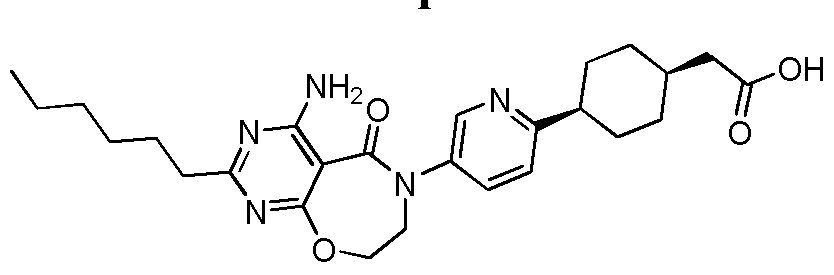
2-(C -4-(5-(4-amino-2-hexyl-5-oxo-7,8-dihydropyrimido[5,4-f][l,4]oxazepin-6(5H)- yl)pyridin-2-yl)cyclohexyl)acetic acid
A solution of 2-(cis-4-(5-(4-amino-2-(methylsulfonyl)-5-oxo-7,8-dihydropyrimido[5,4- fJ[l,4]oxazepin-6(5H)-yl)pyridin-2-yl)cyclohexyl)acetic acid from Preparative Example 4 (0.0137 g, 0.025 mmol) in THF (0.5 ml) was cooled to -78°C, followed by drop-wise addition of a 2.0 M solution of hexylmagnesium bromide solution in ether (0.125 ml, 0.25 mmol). After stirring at -78 °C for 1 hour, the mixture was concentrated to dryness and the resulting residue was then directly purified by RP-HPLC using 10-85% MeCN gradient to afford the title compound. LC-MS (m z): 482.11 (M + H+), 1.47 min (LC4). 1H NMR (CD3OD, 500 MHz) δ
8.63 (s, 1H), 7.96-8.00 (m, 1H), 7.63-7.65 (m, 1H), 4.93-4.95 (m, 2H), 4.24-4.26 (m, 2H), 2.89-2.96 (m, 1H), 2.71 (t, 7.6 Hz, 2H), 2.48 (d, 7.6 Hz, 2H), 2.27-2.34 (m, 1H), 1.86-1.96 (m, 2H), 1.69-1.84 (m, 8H), 1.35-1.46 (m, 6H), 0.94 (t, 7.0 Hz, 3H). DGAT1 (human) IC50 363 nM.
Example 11

2-(C -4-(5-(4-amino-2-(hexyloxy)-5-oxo-7,8-dihydropyrimido[5^-f][l,4]oxazepin-6(5H)- yl)pyridin-2-yl)cyclohexyl)acetic acid
The title compound was isolated as a minor side-product from the reaction affording Example 10 above (see M. T. Goebel and C. S. Marvel J. Amer. Chem. Soc. 1933, 55, 1693). LC-MS (m/z): 498.10 (M + H+), 1.63 min (LC4). 1H NMR (CD3OD, 500 MHz) δ 8.75 (d, 2.2 Hz, 1H), 8.19 (dd, 8.6 & 2.2 Hz, 1H), 7.80 (d, 8.6 Hz, 1H), 4.76-4.78 (m, 2H), 4.38 (t, 6.6 Hz, 2H), 4.17-4.19 (m, 2H), 2.96-3.03 (m, 1H), 2.49 (d, 7.7 Hz, 2H), 2.28-2.36 (m, 1H), 1.72- 1.96 (m, 10H), 1.44-1.51 (m, 2H), 1.35-1.40 (m, 4H), 0.94 (t, 7.0 Hz, 3H). DGAT1 (human) IC50 73 nM.
The compounds in Table 1 were prepared according to the procedure described in Example 10, starting from the appropriate sulfone and Grignard reagent.
Table 1
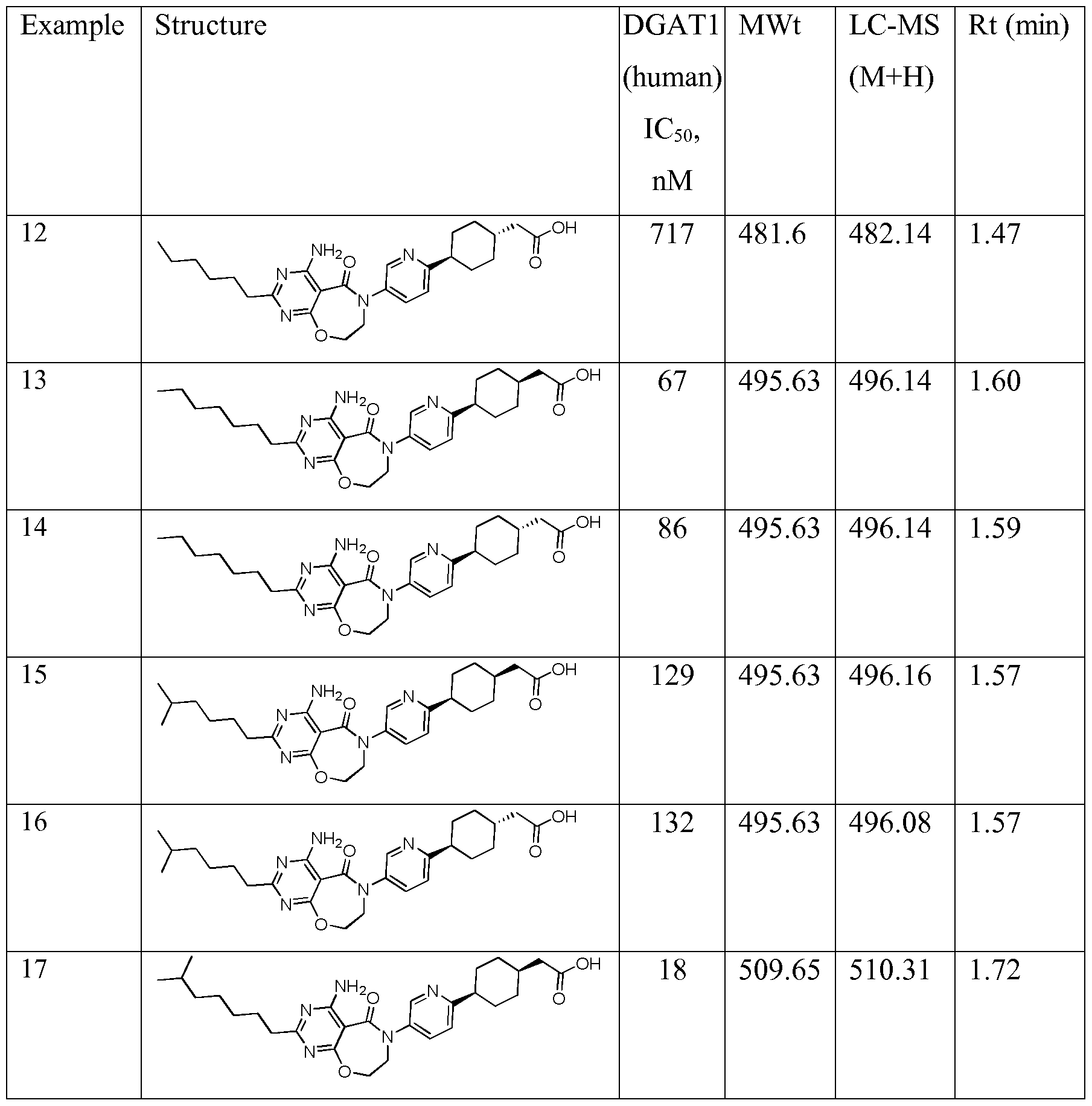
Example 18
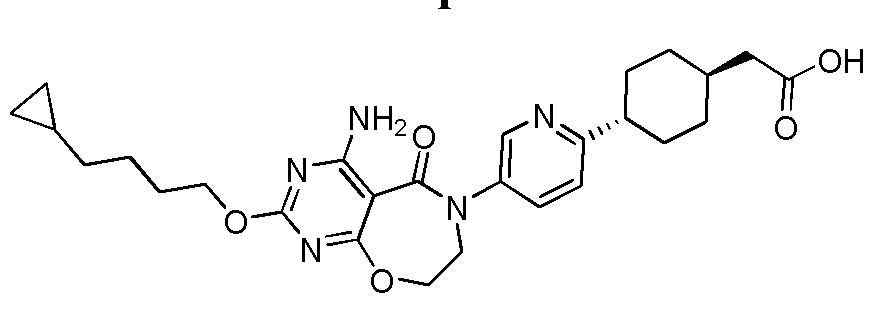
2-(rra -4-(5-(4-amino-2-(4-cyclopropylbutoxy)-5-oxo-7,8-dihydropyrimido[5,4- f] [ 1 ,4]oxazepin-6(5H)-yl)pyridin-2-yl)cyclohexyl)acetic acid
A mixture of 2-(trans-4-(5-(4-amino-2-(methylsulfonyl)-5-oxo-7,8-dihydropyrimido[5,4- fJ[l,4]oxazepin-6(5H)-yl)pyridin-2-yl)cyclohexyl)acetic acid from Preparative Example 3 (0.10 g, 0.18 mmol) and 4-cyclopropylbutan-l-ol from Preparative Example 5 (0.13 g, 1.09 mmol) in
CHCI3 (1.0 ml) was cooled to 0°C under nitrogen and treated with a solution of DBU (0.11 g, 0.73 mmol) in CHCI3 (0.5 ml) by a syringe pump over 3.5 hours. After stirring at RT overnight, the solvent was removed under reduced pressure. The resulting residue was then dissolved in a mixture of DMSO and water, and directly purified by RP-HPLC using 10-70% MeCN gradient to afford the title compound as mono TFA salt following lyophilization. LC-MS (m/z): 510.20 (M + H+), 1.70 min (LC4). 1H NMR (CD3OD, 500 MHz) δ 8.76 (d, 2.4 Hz, 1H), 8.23 (dd, 8.7 & 2.3 Hz, 1H), 7.80 (d, 8.7 Hz, 1H), 4.76-4.78 (m, 2H), 4.39 (t, 6.6 Hz, 2H), 4.17-4.19 (m, 2H), 2.89-2.95 (m, 1H), 2.28 (d, 7.0 Hz, 2H), 2.00-2.07 (m, 4H), 1.85-1.95 (m, 1H),
1.78-1.84 (m, 2H), 1.66-1.77 (m, 2H), 1.56-1.61 (m, 2H), 1.21-1.32 (m, 4H), 0.65-0.70 (m, 1H), 0.39-0.46 (m, 2H), 0.00-0.08 (m, 2H). DGAT1 (human) IC50 35 nM.
Example 19

2-(c -4-(5-(4-amino-2-(4-cyclopropylbutoxy)-5-oxo-7,8-dihydropyrimido[5^-f][l^]oxazepin- 6(5H)-yl)pyridin-2-yl)cyclohexyl)acetic acid
A mixture of 2-(cis-4-(5-(4-amino-2-(methylsulfonyl)-5-oxo-7,8-dihydropyrimido[5,4- fJ[l,4]oxazepin-6(5H)-yl)pyridin-2-yl)cyclohexyl)acetic acid from Preparative Example 4 (0.47 g, 0.75 mmol) and 4-cyclopropylbutan-l-ol from Preparative Example 5 (0.62 g, 5.41 mmol) in CH2C12 (3.5 ml) was cooled to 0°C under nitrogen and treated with a solution of DBU (0.47 g, 4.08 mmol) in CH2CI2 (1.0 ml) using a syringe pump over 3 fir. After stirring at RT overnight, the solvent was removed under reduced pressure. The resulting residue was then dissolved in a mixture of DMSO and water, and directly purified by RP-HPLC using 10-70% MeCN gradient to afford the title compound as mono TFA salt following lyophilization. LC-MS (m z): 510.18
(M + H+), 1.73 min (LC4). 1H NMR (CD3OD, 500 MHz) δ 8.76 (d, 2.4 Hz, 1H), 8.21 (dd, 8.7 & 2.5 Hz, 1H), 7.81 (d, 8.7 Hz, 1H), 4.76-4.78 (m, 2H), 4.39 (t, 6.6 Hz, 2H), 4.17-4.19 (m, 2H), 2.97-3.04 (m, 1H), 2.50 (d, 7.7 Hz, 2H), 2.28-2.36 (m, 1H), 1.72-1.96 (m, 10H), 1.52-1.62 (m, 2H), 1.27-1.32 (m, 2H), 0.68-0.74 (m, 1H), 0.38-0.48 (m, 2H), 0.00-0.08 (m, 2H). DGAT1 (human) IC50 27 nM.
The compounds in Table 2 were prepared according to the methods described in Examples 18 and 19, starting from the appropriate sulfone and alcohol, except Examples 20 and Example 29 were obtained according to the methods described in Example 11 starting from the appropriate sulfone and Grignard reagent. Example 24 was prepared as described for Example 18 starting from the cis- and trans-sulfone mixture derived from Compound 2 of Preparative Example 2.
Table 2


2-(l-(5-(4-Arnino-2-(4-cyclopropylbutoxy)-5-oxo-7,8-dihydropyrimido[5^
6(5H)-yl)pyridin-2-yl)piperidin-4-yl)acetic acid
Step 1 : Ethyl 2-(l-(5-(4-amino-2-(4-cyclopropylbutoxy)-5-oxo-7,8-dihydropyrimido[5,4- f] [ 1 ^]oxazepin-6(5H)-yl)pyridin-2-yl)piperidin-4-yl)acetate
A mixture of ethyl 2-(l-(5-(4-amino-2-(methylsulfonyl)-5-oxo-7,8-dihydropyrimido[5,4- f][l,4]oxazepin-6(5H)-yl)pyridin-2-yl)piperidin-4-yl)acetate from Preparative Example 6 (0.020 g, 0.027 mmol) and 4-cyclopropylbutan-l-ol from Preparative Example 5 (0.025 g, 0.22 mmol) in CHC13 (0.3 ml) was cooled to 0°C under nitrogen and treated with DBU (0.012 g, 0.081 mmol). After stirring at RT overnight, the solvent was removed under reduced pressure. The resulting residue was then dissolved in a mixture of 1 ,4-dioxane and water, and directly purified by RP-HPLC using 10-100% MeCN gradient to afford the title compound. LC-MS (m/z): 539.36 (M + H+), 1.75 min (LC4).
Step 2: 2-(l-(5-(4-Amino-2-(4-cyclopropylbutoxy)-5-oxo-7,8-dihydropyrimido[5,4- f] [ 1 ^]oxazepin-6(5H)-yl)pyridin-2-yl)piperidin-4-yl)acetic acid
The ethyl 2-(l-(5-(4-amino-2-(4-cyclopropylbutoxy)-5-oxo-7,8-dihydropyrimido[5,4- fJ[l,4]oxazepin-6(5H)-yl)pyridin-2-yl)piperidin-4-yl)acetate (0.010 g, 0.13 mmol) from Step 1 above was dissolved in THF (0.2 ml) and water (0.07 ml) followed by addition of 0.5 M LiOH solution (0.13 ml). After stirring at 40°C for 2 hours, the solvent was removed under reduced pressure. The resulting residue was then dissolved in a mixture of 1 ,4-dioxane and water, and directly purified by RP-HPLC using 10-80% MeCN gradient to afford the title compound. LC- MS (m/z): 511.32 (M + H+), 1.55 min (LC4). 1H NMR (CD3OD, 500 MHz) δ 8.03 (d, 2.5 Hz,
1H), 7.93 (dd, 9.7 & 2.4 Hz, 1H), 7.35 (d, 9.8 Hz, 1 H), 4.72-4.73 (m, 2H), 4.36 (t, 6.6 Hz, 2H), 4.22 (br d, 13.2 Hz, 2H), 4.04-4.06 (m, 2H), 3.24-3.29 (m, 2H), 2.32 (d, 7.1 Hz, 2H), 2.12-2.21 (m, 1H), 1.98 (d, 10.7 Hz, 2H), 1.77-1.83 (m, 2H), 1.53-1.59 (m, 2H), 1.37-1.45 (m. 2H), 1.26-1.30 (m, 2H), 0.66-0.72 (m, 1H), 0.41-0.44 (m, 2H), 0.00-0.04 (m, 2H). DGATl (human) IC50 20 nM.
The compounds in Table 3 were prepared according to the methods described in Example 30, starting from Preparative Example 6 and the appropriate alcohol.
Table 3

DGATl CPM Assay
20uL substrate mixture of 300uM diolein, 40uM oleoyl-CoA, 10% ethanol and luL of the compound with different concentrations were delivered to a 384 well assay plate (Corning 3573) using a Tecan with TeMO module. Later 19uL of enzyme mixture of 1.05ug/ml human DGATl in buffer (200mM Tris, pH7, 200mM sucrose, 200mM MgC12 + 20ug/ml NEM-treated BSA) was added via a Multidrop Combi using a microcassette. 20uL of 90uM CPM reagent in 90% ethanol was added after 1 hour incubation at room temperature. After 30 minutes at room temperature in dark, fluorescence measurement on Envision was carried out and IC50s were calculated.
The compounds exemplified herein are believed to have a lower Cmax to trough ratio as compared to the Reference Examples. High Cmax to trough ratio is not a desirable feature of a drug. A higher ratio may lead to low therapeutic index due to potential Cmax related adverse events. It is also believed that the compounds exemplified herein show moderate metabolism in
vitro in hepatocyte incubations, which may impart multiple mechanism of excretion in vivo. Compounds found not to be metabolized by liver microsome or hepatocytes may indicate that they might be eliminated in vivo via excretion as intact drug, which may contribute to undesirably long pharmacodynamic half- life in vivo.
Claims
1. A compound of formula (I):

or pharmaceutically acceptable salts thereof, wherein:
R1 is selected from the group consisting of: hydrogen, Ci-Cio alkyl S02 , Ci-Cio alkyl S, Ci-Cio alkyl, and Ci-Cio alkoxy; wherein in the Ci-Cio alkyl may be unsubstituted or substituted with Ci-Cio alkyl, halogen, -OH, or N(R2)2 ; wherein each R2 is independently selected from hydrogen, Ci-Cio alkyl, Ci-Cio alkoxy, or C(O) Ci-Cio alkyl;
R3 is selected from the group consisting of: hydrogen and Ci-Cio alkyl; wherein in the Ci-Cio alkyl may be unsubstituted or substituted with Ci-Cio alkyl, halogen, -OH, or N(R2)2 ; wherein each R2 is independently selected from hydrogen, Ci-Cio alkyl, Ci-Cio alkoxy, or C(O) Ci-Cio alkyl;
A is N or C, and means a single or a double bond ; and
X is O or is not present.
2. A compound of claim 1 or pharmaceutically acceptable salt thereof wherein R1 is hydrogen.
3. A compound of claim 1 or pharmaceutically acceptable salt thereof wherein R is CH3S.
4. A compound of claim 1 or pharmaceutically acceptable salt thereof wherein R is
CH3S02.
5. A compound of claim 1 or pharmaceutically acceptable salt thereof wherein R1 is Ci-Cio alkyl.
6. A compound of claim 5 or pharmaceutically acceptable salt thereof wherein R1 is Ci-Cio branched alkyl.
7. A compound of claim 5 or pharmaceutically acceptable salt thereof wherein R1 is Ci-Cio straight alkyl.
8. A compound of claim 1 or pharmaceutically acceptable salt thereof wherein R1 is Ci-Cio alkoxy.
9. A compound of claim 1 or pharmaceutically acceptable salt thereof wherein R3 is hydrogen.
10. A compound of claim 1 or pharmaceutically acceptable salt thereof wherein R3 is CH3.
1 1. A compound of claim 1 or pharmaceutically acceptable salt thereof wherein A is N.
12. A compound of claim 1 or pharmaceutically acceptable salt thereof wherein A is C.
13. A compound of claim 1 or pharmaceutically acceptable salt thereof wherein X is O.
14. A compound of claim 1 or pharmaceutically acceptable salt thereof wherein X is not present.
15. A compound or pharmaceutically acceptable salt thereof selected from the group consisting of:


16. A pharmaceutical composition comprising a compound of any one of claims 1-15? or a pharmaceutically acceptable salt thereof, and a pharmaceutically acceptable carrier.
17. Use of a compound of any one of claims 1-15, or a pharmaceutically acceptable salt thereof, in the manufacture of a medicament for use in treating a condition selected from the group consisting of obesity and diabetes.
18. A method for the treatment of a condition selected from the group consisting of obesity and diabetes comprising administering to an individual a pharmaceutical composition comprising the pharmaceutical composition of claim 16.
19. The method of claim 18, wherein the individual is an animal.
Applications Claiming Priority (2)
| Application Number | Priority Date | Filing Date | Title |
|---|---|---|---|
| US201361791528P | 2013-03-15 | 2013-03-15 | |
| US61/791,528 | 2013-03-15 |
Publications (1)
| Publication Number | Publication Date |
|---|---|
| WO2014140241A1 true WO2014140241A1 (en) | 2014-09-18 |
Family
ID=50288061
Family Applications (1)
| Application Number | Title | Priority Date | Filing Date |
|---|---|---|---|
| PCT/EP2014/055056 Ceased WO2014140241A1 (en) | 2013-03-15 | 2014-03-14 | Pyridine derivatives as dgat-1 inhibitors |
Country Status (1)
| Country | Link |
|---|---|
| WO (1) | WO2014140241A1 (en) |
Citations (5)
| Publication number | Priority date | Publication date | Assignee | Title |
|---|---|---|---|---|
| WO2009016462A2 (en) * | 2007-08-02 | 2009-02-05 | Pfizer Products Inc. | Substituted bicyclolactam compounds |
| WO2012009217A1 (en) * | 2010-07-13 | 2012-01-19 | Merck Sharp & Dohme Corp. | Spirocyclic compounds |
| WO2012015693A1 (en) * | 2010-07-28 | 2012-02-02 | Merck Sharp & Dohme Corp. | Imidazole derivatives |
| WO2012112364A1 (en) * | 2011-02-14 | 2012-08-23 | Merck Sharp & Dohme Corp. | Lactam derivatives as dgat-1 inhibitors |
| WO2012122075A1 (en) * | 2011-03-08 | 2012-09-13 | Merck Sharp & Dohme Corp. | Lactam derivatives as dgat-1 inhibitors |
-
2014
- 2014-03-14 WO PCT/EP2014/055056 patent/WO2014140241A1/en not_active Ceased
Patent Citations (5)
| Publication number | Priority date | Publication date | Assignee | Title |
|---|---|---|---|---|
| WO2009016462A2 (en) * | 2007-08-02 | 2009-02-05 | Pfizer Products Inc. | Substituted bicyclolactam compounds |
| WO2012009217A1 (en) * | 2010-07-13 | 2012-01-19 | Merck Sharp & Dohme Corp. | Spirocyclic compounds |
| WO2012015693A1 (en) * | 2010-07-28 | 2012-02-02 | Merck Sharp & Dohme Corp. | Imidazole derivatives |
| WO2012112364A1 (en) * | 2011-02-14 | 2012-08-23 | Merck Sharp & Dohme Corp. | Lactam derivatives as dgat-1 inhibitors |
| WO2012122075A1 (en) * | 2011-03-08 | 2012-09-13 | Merck Sharp & Dohme Corp. | Lactam derivatives as dgat-1 inhibitors |
Similar Documents
| Publication | Publication Date | Title |
|---|---|---|
| EP3653625B1 (en) | Fused ring derivative having mgat-2 inhibitory activity | |
| AU2011256444B2 (en) | Spiro isoxazoline compounds as SSTR5 antagonists | |
| US20050215582A1 (en) | Substituted pyrrolopyridines | |
| EP3177287A1 (en) | Antidiabetic bicyclic compounds | |
| JP7150032B2 (en) | Heterocyclyl-substituted oxadiazolopyridine derivatives for use as ghrelin O-acyltransferase (GOAT) inhibitors | |
| JP2014520879A (en) | GPR119 regulator | |
| EP2427465A1 (en) | Substituted spirocyclic amines useful as antidiabetic compounds | |
| EP3097101B1 (en) | Isoquinoline derivatives as mgat2 inhibitors | |
| WO2012024179A1 (en) | Substituted amide derivatives as dgat-1 inhibitors | |
| EP2523558A1 (en) | Oxadiazole beta carboline derivatives as antidiabetic compounds | |
| WO2017069224A1 (en) | Spiro heterocyclic derivative having mgat2-inhibiting activity | |
| CA2805078A1 (en) | Imidazole derivatives | |
| EP2931718B1 (en) | Novel 2-pyridinecarboxamide derivatives, compositions containing such compounds, and methods of treatment | |
| EP3383389A1 (en) | Aryl acylsulfonamides as blt1 antagonists | |
| WO2012064569A1 (en) | Imidazole derivatives | |
| JPWO2017110841A1 (en) | Non-aromatic heterocyclic derivatives having MGAT2 inhibitory activity | |
| WO2012112364A1 (en) | Lactam derivatives as dgat-1 inhibitors | |
| WO2014140241A1 (en) | Pyridine derivatives as dgat-1 inhibitors | |
| WO2023097189A1 (en) | Ampk activators | |
| WO2012122075A1 (en) | Lactam derivatives as dgat-1 inhibitors | |
| EP1513840B1 (en) | Compounds and compositions for the treatment of diabetes and diabetes-related disorders | |
| CN117327057B (en) | Triazine diketone compound as thyroid hormone receptor agonist and synthesis and application thereof | |
| US20250100981A1 (en) | Cis-substituted 5-(hydroxymethyl)morpholine-2-carboxamides as agonists of SSTR4 | |
| WO2026042018A1 (en) | 4-{4-[(1-{[4-(propan-2-yl)phenyl]carbamoyl)-d-prolyl)amino]cyclohexyl}benzoic acid derivatives as gipr antagonists for the treatment of diabetes | |
| US9580422B2 (en) | Isotopically labeled triazolopyridine 11-beta hydroxysteroid dehydrogenase type I inhibitors |
Legal Events
| Date | Code | Title | Description |
|---|---|---|---|
| 121 | Ep: the epo has been informed by wipo that ep was designated in this application |
Ref document number: 14710542 Country of ref document: EP Kind code of ref document: A1 |
|
| NENP | Non-entry into the national phase |
Ref country code: DE |
|
| 122 | Ep: pct application non-entry in european phase |
Ref document number: 14710542 Country of ref document: EP Kind code of ref document: A1 |