WO2014129001A1 - 通信情報計測装置及びプログラム - Google Patents
通信情報計測装置及びプログラム Download PDFInfo
- Publication number
- WO2014129001A1 WO2014129001A1 PCT/JP2013/073853 JP2013073853W WO2014129001A1 WO 2014129001 A1 WO2014129001 A1 WO 2014129001A1 JP 2013073853 W JP2013073853 W JP 2013073853W WO 2014129001 A1 WO2014129001 A1 WO 2014129001A1
- Authority
- WO
- WIPO (PCT)
- Prior art keywords
- packet
- packets
- packet loss
- transmitted
- communication
- Prior art date
- Legal status (The legal status is an assumption and is not a legal conclusion. Google has not performed a legal analysis and makes no representation as to the accuracy of the status listed.)
- Ceased
Links
Images



Classifications
-
- H—ELECTRICITY
- H04—ELECTRIC COMMUNICATION TECHNIQUE
- H04L—TRANSMISSION OF DIGITAL INFORMATION, e.g. TELEGRAPHIC COMMUNICATION
- H04L43/00—Arrangements for monitoring or testing data switching networks
- H04L43/08—Monitoring or testing based on specific metrics, e.g. QoS, energy consumption or environmental parameters
- H04L43/0823—Errors, e.g. transmission errors
- H04L43/0829—Packet loss
- H04L43/0841—Round trip packet loss
-
- H—ELECTRICITY
- H04—ELECTRIC COMMUNICATION TECHNIQUE
- H04L—TRANSMISSION OF DIGITAL INFORMATION, e.g. TELEGRAPHIC COMMUNICATION
- H04L43/00—Arrangements for monitoring or testing data switching networks
- H04L43/08—Monitoring or testing based on specific metrics, e.g. QoS, energy consumption or environmental parameters
- H04L43/0823—Errors, e.g. transmission errors
- H04L43/0829—Packet loss
- H04L43/0835—One way packet loss
-
- H—ELECTRICITY
- H04—ELECTRIC COMMUNICATION TECHNIQUE
- H04L—TRANSMISSION OF DIGITAL INFORMATION, e.g. TELEGRAPHIC COMMUNICATION
- H04L1/00—Arrangements for detecting or preventing errors in the information received
- H04L1/12—Arrangements for detecting or preventing errors in the information received by using return channel
- H04L1/16—Arrangements for detecting or preventing errors in the information received by using return channel in which the return channel carries supervisory signals, e.g. repetition request signals
- H04L1/1607—Details of the supervisory signal
- H04L1/1657—Implicit acknowledgement of correct or incorrect reception, e.g. with a moving window
-
- H—ELECTRICITY
- H04—ELECTRIC COMMUNICATION TECHNIQUE
- H04L—TRANSMISSION OF DIGITAL INFORMATION, e.g. TELEGRAPHIC COMMUNICATION
- H04L1/00—Arrangements for detecting or preventing errors in the information received
- H04L1/12—Arrangements for detecting or preventing errors in the information received by using return channel
- H04L1/16—Arrangements for detecting or preventing errors in the information received by using return channel in which the return channel carries supervisory signals, e.g. repetition request signals
- H04L1/18—Automatic repetition systems, e.g. Van Duuren systems
- H04L1/1829—Arrangements specially adapted for the receiver end
- H04L1/1832—Details of sliding window management
-
- H—ELECTRICITY
- H04—ELECTRIC COMMUNICATION TECHNIQUE
- H04L—TRANSMISSION OF DIGITAL INFORMATION, e.g. TELEGRAPHIC COMMUNICATION
- H04L1/00—Arrangements for detecting or preventing errors in the information received
- H04L1/20—Arrangements for detecting or preventing errors in the information received using signal quality detector
- H04L1/203—Details of error rate determination, e.g. BER, FER or WER
-
- H—ELECTRICITY
- H04—ELECTRIC COMMUNICATION TECHNIQUE
- H04L—TRANSMISSION OF DIGITAL INFORMATION, e.g. TELEGRAPHIC COMMUNICATION
- H04L1/00—Arrangements for detecting or preventing errors in the information received
- H04L1/20—Arrangements for detecting or preventing errors in the information received using signal quality detector
- H04L1/205—Arrangements for detecting or preventing errors in the information received using signal quality detector jitter monitoring
-
- H—ELECTRICITY
- H04—ELECTRIC COMMUNICATION TECHNIQUE
- H04L—TRANSMISSION OF DIGITAL INFORMATION, e.g. TELEGRAPHIC COMMUNICATION
- H04L43/00—Arrangements for monitoring or testing data switching networks
- H04L43/08—Monitoring or testing based on specific metrics, e.g. QoS, energy consumption or environmental parameters
- H04L43/0852—Delays
- H04L43/0864—Round trip delays
-
- H—ELECTRICITY
- H04—ELECTRIC COMMUNICATION TECHNIQUE
- H04L—TRANSMISSION OF DIGITAL INFORMATION, e.g. TELEGRAPHIC COMMUNICATION
- H04L69/00—Network arrangements, protocols or services independent of the application payload and not provided for in the other groups of this subclass
- H04L69/40—Network arrangements, protocols or services independent of the application payload and not provided for in the other groups of this subclass for recovering from a failure of a protocol instance or entity, e.g. service redundancy protocols, protocol state redundancy or protocol service redirection
-
- H—ELECTRICITY
- H04—ELECTRIC COMMUNICATION TECHNIQUE
- H04L—TRANSMISSION OF DIGITAL INFORMATION, e.g. TELEGRAPHIC COMMUNICATION
- H04L43/00—Arrangements for monitoring or testing data switching networks
- H04L43/10—Active monitoring, e.g. heartbeat, ping or trace-route
-
- H—ELECTRICITY
- H04—ELECTRIC COMMUNICATION TECHNIQUE
- H04W—WIRELESS COMMUNICATION NETWORKS
- H04W80/00—Wireless network protocols or protocol adaptations to wireless operation
Definitions
- the present invention relates to a communication information measuring device and a program.
- the bandwidth between communication devices may be measured (see, for example, Patent Document 1).
- packet loss is mainly caused by communication congestion.
- packet loss occurs due to radio noise in addition to communication congestion.
- the bandwidth is calculated by directly substituting the packet loss rate formed in wireless communication into the same calculation formula as in wired communication, the calculated bandwidth may be inaccurate.
- An object of the present invention is to provide a communication information measuring device and program capable of grasping the frequency of a specific type of packet loss in communication in which a plurality of types of packet loss having different causes occur.
- the invention according to claim 1 is directed to transmitting means for sequentially transmitting one or more packets to a communication destination device, and reception for receiving an acknowledgment of the transmitted packet from the communication destination device.
- a recording means for recording occurrence of a round trip time and a packet loss based on the transmitted packet and its confirmation response, and a packet loss by the recording means for the transmitted packet.
- the number of packet losses included in each of the continuous packet groups and the packets included in the continuous packet group The number of round trip time increases for each continuous packet that satisfies a predetermined condition.
- Communication information comprising: counting means for counting the number of groups; and calculating means for calculating a packet loss rate based on the number counted by the counting means and the number of transmitted packets It is a measuring device.
- the recording unit is configured to determine whether the packet transmitted by the transmitting unit is retransmitted, the response confirmation received by the receiving unit is retransmitted, or the response received by the receiving unit. 2.
- the communication information measuring apparatus according to claim 1, wherein occurrence of a packet loss is recorded when a predetermined type of response confirmation continues for a predetermined number of times.
- the number of packet losses included in each of the continuous packet groups is equal to or greater than a first threshold, and the round trip time of the packets included in the continuous packet group is sequentially increased.
- a selection is made to sequentially select a continuous packet group including a plurality of consecutive packets starting from the first packet in which packet loss is recorded by the recording means for the transmitted packet. 4.
- the communication information measuring apparatus according to claim 1, further comprising: a determining unit configured to sequentially determine whether the sequentially selected continuous packet group satisfies the condition. 5. It is.
- the invention according to claim 5 is a first packet in which packet loss is recorded by the recording means for the transmitted packet, and is a packet having two or more window sizes starting from the unprocessed packet sequentially. Further comprising selection means for sequentially selecting a group of consecutive packets including: the determination means determines whether or not the sequentially selected continuous packet group satisfies the condition, and the condition is satisfied by the determination means. 4. The window size number is increased when it is determined, and the window size number is decreased when the condition is not satisfied by the determination means.
- the communication information measuring device according to any one of the above.
- the invention according to claim 6 further comprises update means for updating the first threshold value to the larger one of the window size number and a predetermined minimum value when the window size number is changed. It is a communication information measuring device of Claim 5 characterized by the above-mentioned.
- the invention according to claim 7 is such that the packet loss rate calculated by the calculating means is p, the representative value of the round trip time recorded for the transmitted packet is RTT, the maximum segment size for the transmitted packet is MSS, With C and k being predetermined constants, the bandwidth of communication with the device with the communication destination is expressed by the following equation (1):
- the communication information measuring apparatus further comprising a bandwidth calculating unit that calculates based on the bandwidth.
- the calculating means calculates a packet loss rate based on a ratio between the number counted by the counting means and the number of transmitted packets.
- the calculating means is based on a ratio between the number of packets in which packet loss is recorded by the recording means for the transmitted packets and the number of transmitted packets.
- the communication information measuring device according to claim 1, wherein a packet loss rate is calculated.
- the invention according to claim 9 is a transmission means for sequentially transmitting one or more packets to a communication destination apparatus, a reception means for receiving an acknowledgment of the transmitted packet from the communication destination apparatus, Recording means for recording round trip time and occurrence of packet loss based on the transmitted packet and its confirmation response, and one or more packets in which packet loss is recorded by the recording means for the transmitted packet.
- Counting means for counting the number of consecutive packet groups each satisfying a predetermined condition , The number counted by the counting means, wherein based on the number of transmitted packets, a program for causing a computer to function as a calculating means for calculating a packet loss rate.
- the second aspect of the present invention it is possible to record the generated packet loss with higher accuracy than in the case where the present configuration is not provided.
- the present configuration compared to the case where the present configuration is not provided, it is possible to accurately count the packet loss that has occurred due to communication congestion.
- the fourth aspect of the present invention compared to the case where the present configuration is not provided, it is possible to accurately determine the packet loss that has occurred due to communication congestion.
- the number of steps of processing for determining the packet loss caused by communication congestion can be reduced compared to the case without this configuration.
- the sixth aspect of the present invention it is possible to accurately determine the packet loss caused by communication congestion even when the window size is changed as compared with the case without this configuration. it can.
- the standby width can be calculated based on the occurrence frequency of a specific type of packet loss.
- the same bandwidth calculation formula can be used in wireless communication and wired communication.
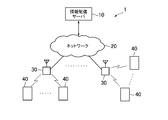
- FIG. 1 shows a system configuration diagram of an information distribution system 1 according to the present embodiment.
- the information distribution system 1 includes an information distribution server 10, one or more base station devices 30, and one or more information terminals 40.
- the information distribution server 10 and each base station device 30 communicate with each other via a network 20 such as an optical communication network.
- the base station device 30 and the information terminal 40 perform wireless communication such as mobile communication and wireless LAN communication. Communication between the information distribution server 10 and each information terminal 40 is also possible.
- the information terminal 40 communicates with the information distribution server 10 using wireless communication, but the information terminal 40 may communicate with the information distribution server 10 using wired communication.
- the information distribution server 10 is a computer that holds data such as web pages and moving images and provides data in response to a request from the information terminal 40.
- the information distribution server 10 sets the quality (resolution, size, etc.) of the data (moving image) related to the request from the information terminal 40 to the communication bandwidth (BW: bandwidth) between the information terminal 40 and the information distribution server 10. It is good also as providing based on the selection and data of the selected quality to the information terminal 40.
- the base station device 30 is a device that performs wired communication with the information distribution server 10 and performs wireless communication such as mobile communication with each information terminal 40. Wireless communication between the base station device 30 and the information terminal 40 may be performed by various communication methods such as 3G and 4G mobile communication.
- the information terminal 40 is a computer such as a mobile phone (including a multi-function mobile phone), a tablet terminal, or a personal computer operated by a user.
- the information terminal 40 wirelessly communicates with the base station device 30 and receives data from, for example, the information distribution server 10 by performing data communication with the information distribution server 10 via the base station device 30.
- the information terminal 40 measures the communication bandwidth (BW) with the information distribution server 10.
- the information terminal 40 transmits / receives a packet to / from the information distribution server 10, measures the round trip time (RTT) and the packet loss rate (p) of the transmitted / received packet, the measured value, and the following formula
- a communication bandwidth is calculated based on (1).
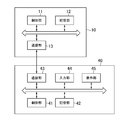
- the information distribution server 10 includes a control unit 11, a storage unit 12, and a communication unit 13.
- the control unit 11 includes a CPU (Central Processing Unit) and executes various arithmetic processes based on a program stored in the storage unit 12 and controls each unit of the information distribution server 10.
- CPU Central Processing Unit
- the storage unit 12 stores a control program such as an operating system of the information distribution server 10 and data, and is also used as a work memory of the control unit 11.
- the program may be supplied to the information distribution server 10 while being stored in an information storage medium such as an optical disk, a magnetic disk, a magnetic tape, a magneto-optical disk, or a flash memory, or information may be transmitted via a data communication means such as the Internet.
- the distribution server 10 may be supplied.
- the communication unit 13 is realized by a network interface card, and performs data communication with the base station device 30 and the like via the network, and also performs data communication with the information terminal 40 and the like via the base station device 30.
- the information terminal 40 includes a control unit 41, a storage unit 42, a communication unit 43, an input unit 44, and a display unit 45.
- the control unit 41 includes a CPU (Central Processing Unit) and executes various arithmetic processes and controls each unit of the information terminal 40 based on a program stored in the storage unit 42.
- CPU Central Processing Unit
- the storage unit 42 stores a control program and data such as an operating system of the information terminal 40, and is also used as a work memory of the control unit 41.
- the program may be supplied to the information terminal 40 in a state stored in an information storage medium such as an optical disk, a magnetic disk, a magnetic tape, a magneto-optical disk, a flash memory, or the information terminal via a data communication network such as the Internet. 40 may be supplied.
- the communication unit 43 includes a wireless communication antenna, for example, and communicates with the base station apparatus 30 via the wireless communication antenna.
- the communication unit 43 may include a network interface card for wired communication in addition to or instead of the wireless communication antenna, and communicate with the information distribution server 10 using the network interface card. It is good.
- the input unit 44 is realized by an input device such as a touch panel and a keyboard, and receives an operation input from the user.
- the display unit 45 is realized by a display device such as a liquid crystal display, and displays a result (screen) of information processing by the control unit 41.
- FIG. 3 shows a sequence diagram of the communication bandwidth measurement process.
- the information terminal 40 stands by when the communication bandwidth measurement timing has not arrived (S101: N), and when the communication bandwidth measurement timing has arrived (S101). : Y), the process proceeds to S102, and the communication bandwidth measurement process is started.
- the communication bandwidth measurement process may be performed at predetermined time intervals or may be performed at a predetermined process generation timing.
- the measurement condition includes information such as the setting of a device (in this case, the information distribution server 10) that is a communication partner in the communication path to be measured, the total number of packet transmissions (N) for measuring the communication bandwidth, and the like. Good.
- the variable i may be set to 1.
- the information terminal 40 requests the information distribution server 10 to establish a connection (S103).
- the information distribution server 10 transmits an acknowledgment (ACK) to the information terminal 40 (S104).
- ACK acknowledgment
- the information terminal 40 receives an acknowledgment (ACK) from the information distribution server 10
- the information terminals 40 mutually identify port information used for communication with the information distribution server 10 (S105).
- the information terminal 40 selects a transmission packet P i to be transmitted to the information distribution server 10 (S106). For example, the information terminal 40 transmits a SYN packet when mod (i, n) is 1 for a variable i, transmits a FIN packet when mod (i, n) is 0, and mod (i, n, If n) is other than 0 and 1, a DATA packet may be transmitted.
- the information terminal 40 transmits the transmission packet P i selected in S106 to the information distribution server 10 (S107). If retransmission is required thereafter (S108: Y), the information terminal 40 retransmits the transmission packet P i . For example, the information terminal 40, if it has not received within a predetermined time an acknowledgment previously for packets P i is good as to retransmit the packet P i.
- the information distribution server 10 When receiving the packet P i from the information terminal 40, the information distribution server 10 transmits an acknowledgment (P i -ACK) to the packet P i to the information terminal 40 (S109). Note that the information distribution server 10 may also retransmit P i -ACK when it is necessary to retransmit P i -ACK.
- the information terminal 40 When receiving the positive response (P i -ACK) to the packet P i , the information terminal 40 records the round trip time (RTT i ) for the packet P i in the storage unit 42 (S110). Round trip time RTT i from the transmission time of the packet P i, good as it is calculated as the elapsed time to reception time of an acknowledgment packet P i (P i -ACK).
- the information terminal 40 increments the variable i (adds 1 to i) (S116), and returns to S106. Further, when the variable i reaches N (S115: Y), the information terminal 40 calculates the packet loss rate based on the record of the packet loss event for the packets P 1 to P N (S117). Details of the packet loss rate calculation process will be described later.
- the information terminal 40 calculates the packet loss rate (p) calculated in S117, the maximum segment size (MSS) of the packet, and the recorded RTT (for example, an average value of RTT 1 to RTT N ) using the above-described formula (1
- the bandwidth (BW) for the communication path between the information terminal 40 and the information distribution server 10 is calculated (S118). After calculating the bandwidth (BW), the information terminal 40 returns to S101 and repeats the subsequent processing.
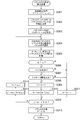
- the information terminal 40 first executes an initial setting process for calculating a packet loss rate (S201).
- the value of the window size w may be an arbitrary value greater than or equal to the minimum value w 0 of the window size
- the information terminal 40 refers to the storage unit 42 and acquires information on each RTT (RTT 1 to RTT N ) and packet loss event (E 1 to E N ) of the packets P 1 to P N. (S202). Then, the information terminal 40 calculates the jitter J i of the packet P i based on the RTT acquired for the packets P 1 to P N (S203).
- the information terminal 40 selects a first packet P j a packet loss event is recorded (S204). That is, the first E j having a value of 1 among E i to E N may be searched and P j corresponding thereto may be selected.
- the information terminal 40 counts the number S j of packet loss events in the packet P j ⁇ P j + w- 1 of consecutive w number from the packet P j (S205). For example, the information terminal 40 may calculate S j by the following equation (2).
- the information terminal 40 determines whether or not the value of RTT has increased in packets P j to P j + w ⁇ 1 ( S207). For example, in S207, the information terminal 40 may determine whether or not the RTT value for the packet in which the packet loss event is recorded in the packets P j to P j + w ⁇ 1 is sequentially increased.
- the information terminal 40 when the value of RTT packet P j ⁇ P j + w- 1 is determined to have increased (S207: Y), whether the jitter of the packet P j ⁇ P j + w- 1 is equal to or larger than the threshold It is determined whether or not (S208). For example, in S208, the information terminal 40 determines whether or not the jitter values of the packets in which the packet loss events are recorded in the packets P j to P j + w ⁇ 1 are all equal to or greater than the threshold (J0), that is, the RTT increment is It may be determined whether or not the threshold value is exceeded.
- the information terminal 40 When the information terminal 40 satisfies all the conditions of S206, S207, and S208 (S206: Y, S207: Y, S208: Y), the information terminal 40 increments the packet loss counter C (adds 1 to C) (S209).
- the information terminal 40 proceeds to S210 after S209 or when any of the conditions of S206, S207, and S208 is not satisfied (S206: N, S207: N, or S208: N).
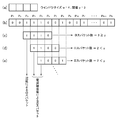
- FIG. 6 is a diagram illustrating a process for sorting the recorded packet loss events into those caused by congestion and those caused by radio noise, etc., performed in the first calculation process of the packet loss rate. It was.
- FIG. 6A shows an example of the window size.
- FIG. 6B shows packet loss event values E 1 to E N recorded for the packets P 1 to P N.
- “0” indicates that no packet loss event has been recorded
- “1” indicates that a packet loss event has been recorded.
- the information terminal 40 first moves the window to the first packet (here P 3 ) in which the packet loss event is recorded among the packets P 1 to P N , The number of packet loss events is counted.
- the packet loss count event is the threshold value y or more 3
- recorded packet loss events for P 3 is determined to be due to congestion.
- the information terminal 40 determines that the information packet 40 is the first packet (here, P 4 ) in which the packet loss event is recorded after the first packet (here, P 3 ) in the window.
- the window is moved to and the number of packet loss events in the window is counted.
- the recorded packet loss events for P 4 is determined to be caused by radio noise and the like.
- the information terminal 40 determines that the information packet 40 is the first packet (here P 5 ) in which the packet loss event is recorded after the first packet (here P 4 ) in the window.
- the window is moved to and the number of packet loss events in the window is counted.
- the recorded packet loss events for P 5 is determined to be caused by radio noise and the like.
- the information terminal 40 sequentially determines whether the packet loss events recorded for P 1 to P N are caused by congestion, radio noise, or the like.
- the information terminal 40 first executes an initial setting process for calculating the packet loss rate (S301).
- the initial value of the window size may be an arbitrary value greater than or equal to the minimum value w 0 of the window size
- the information terminal 40 refers to the storage unit 42 and acquires information on each RTT (RTT 1 to RTT N ) and packet loss event (E 1 to E N ) of the packets P 1 to P N. (S302). Then, the information terminal 40 calculates the jitter J i of the packet P i based on the RTT acquired for the packets P 1 to P N (S303).
- the information terminal 40 selects a first packet P j a packet loss event is recorded (S304). That is, the first E j having a value of 1 among E i to E N may be searched and P j corresponding thereto may be selected.
- the information terminal 40 counts the number S j of packet loss events in the packet P j ⁇ P j + w- 1 of consecutive w number from the packet P j (S305). For example, the information terminal 40 may calculate S j by the following equation (2).
- the information terminal 40 determines whether or not the RTT value has increased in packets P j to P j + w ⁇ 1 ( S307). For example, in S307, the information terminal 40 may determine whether or not the RTT value for the packet in which the packet loss event is recorded in the packets P j to P j + w ⁇ 1 is sequentially increased.
- the information terminal 40 when the value of RTT packet P j ⁇ P j + w- 1 is determined to have increased (S307: Y), whether the jitter of the packet P j ⁇ P j + w- 1 is equal to or larger than the threshold It is determined whether or not (S308). For example, in S308, the information terminal 40 determines whether or not the jitter values of the packets in which the packet loss events are recorded in the packets P j to P j + w ⁇ 1 are all equal to or greater than the threshold (J0), that is, the RTT increment is It may be determined whether or not the threshold value is exceeded.
- the information terminal 40 increments the packet loss counter C (adds 1 to C) (S309),
- the window size w is updated to the larger one of (w ⁇ 1) and the minimum value w0 of w (S310).
- the information terminal 40 adds 1 (or an integer larger than 1) to the window size w when any of the conditions of S306, S307, and S308 is not satisfied (S306: N, S307: N, or S308: N). Then, the window size is enlarged (S311).
- FIG. 7 is a diagram illustrating a process for sorting the recorded packet loss events into those caused by congestion and those caused by radio noise, etc., performed in the second calculation process of the packet loss rate. It was.
- FIG. 7A shows an example of the window size.
- the initial value of window size w 4
- the minimum value w 0 of w 3
- the minimum value of y 0 2.
- it is determined that the packet loss event is caused by congestion when the number of packet loss events included in the window is equal to or greater than the threshold value, and is otherwise caused by radio noise or the like. I decided to.
- FIG. 7B shows packet loss event values E 1 to E N recorded for the packets P 1 to P N.
- “0” indicates that no packet loss event has been recorded
- “1” indicates that a packet loss event has been recorded.
- the information terminal 40 first moves the window to the first packet (in this case, P 3 ) in which the packet loss event is recorded among the packets P 1 to P N , The number of packet loss events is counted.
- the packet loss count event is the threshold value y or more 3
- recorded packet loss events for P 3 is determined to be due to congestion.
- the information terminal 40 opens the window on the first packet (here P 8 ) in which the packet loss event is recorded among the packets not yet included in the window.
- the number of packet loss events in the window is counted.
- the information terminal 40 opens the window on the first packet (here P 11 ) in which the packet loss event is recorded among the packets not yet included in the window.
- the number of packet loss events in the window is counted. In this way, the information terminal 40 can count the number of packet loss events recorded for P 1 to P N due to congestion.
- the information terminal 40 calculates the packet loss rate according to the flow shown in FIGS. 4 and 5 when performing wireless communication, and records it at S114 in FIG. 3 when performing wired communication. It may be switched to calculate the packet loss rate using the total number of packet loss events as it is. That is, the information terminal 40 may calculate the packet loss rate by the following equation (3) when performing wired communication.
- the bandwidth is calculated based on the occurrence rate of lost packets caused by congestion.
- the bandwidth may be calculated using the following equation.
- the information distribution server 10 may measure the bandwidth.
- 1 information distribution system 10 information distribution server, 11 control unit, 12 storage unit, 13 communication unit, 20 network, 30 base station device, 40 information terminal, 41 control unit, 42 storage unit, 43 communication unit, 44 input unit, 45 Display section.
Landscapes
- Engineering & Computer Science (AREA)
- Computer Networks & Wireless Communication (AREA)
- Signal Processing (AREA)
- Environmental & Geological Engineering (AREA)
- Quality & Reliability (AREA)
- Computer Security & Cryptography (AREA)
- Data Exchanges In Wide-Area Networks (AREA)
- Communication Control (AREA)
- Maintenance And Management Of Digital Transmission (AREA)
Abstract
Description

図1には、本実施形態に係る情報配信システム1のシステム構成図を示した。図1に示されるように、情報配信システム1は、情報配信サーバ10、1以上の基地局装置30、1以上の情報端末40を含む。情報配信サーバ10と各基地局装置30は例えば光通信網等のネットワーク20を介して通信し、基地局装置30と情報端末40とは移動体通信、無線LAN通信等の無線通信を行うことで、情報配信サーバ10と各情報端末40との通信も可能となっている。なお、本実施形態では、情報端末40は無線通信を用いて情報配信サーバ10との通信を行うこととするが、情報端末40は有線通信を用いて情報配信サーバ10と通信してもよい。

次に、情報配信サーバ10、情報端末40にそれぞれ備えられたハードウェア構成について図2を参照しながら説明する。
まず、情報配信サーバ10のハードウェア構成例について説明する。図2に示されるように、情報配信サーバ10は、制御部11、記憶部12、通信部13を備える。
次に、情報端末40のハードウェア構成例について説明する。図2に示されるように、情報端末40は、制御部41、記憶部42、通信部43、入力部44、表示部45を備える。
次に、情報配信システム1において情報端末40が無線通信を利用している場合において実行される通信帯域幅の計測処理の詳細を、図3~5に示したシーケンス図及びフロー図を参照しながら説明する。
図3には、通信帯域幅の計測処理のシーケンス図を示した。
次に、図4に示されたフロー図を参照しながら、情報端末40において実行されるパケットロス率の第1の算出処理の詳細について説明する。

次に、図5に示されたフロー図を参照しながら、情報端末40において実行されるパケットロス率の第2の算出処理の詳細について説明する。パケットロス率の第2の算出処理は、ウインドウサイズを可変とし、処理速度を向上させた点で上述したパケットロス率の第1の算出処理と相違している。

本発明は、以上説明した実施形態に限定されるものではない。例えば、情報端末40は、無線通信を行っている場合には、図4,図5に示したフローによりパケットロス率を算出し、有線通信を行っている場合には、図3のS114で記録されたパケットロスイベントの総数をそのまま用いてパケットロス率を算出するように切り替えてもよい。すなわち、情報端末40は、有線通信を行っている場合には、以下の式(3)によりパケットロス率を算出するようにしてもよい。

Claims (9)
- 通信先の装置に1以上のパケットを順次送信する送信手段と、
前記通信先の装置から前記送信したパケットの確認応答を受信する受信手段と、
前記送信したパケットのそれぞれについて、該送信したパケットとその確認応答に基づいて、ラウンドトリップタイムとパケットロスの発生を記録する記録手段と、
前記送信したパケットについて前記記録手段によりパケットロスが記録された1以上のパケットをそれぞれ先頭とする複数の連続するパケットをそれぞれ含む1以上の連続パケット群のうち、該連続パケット群にそれぞれ含まれるパケットロス数と、該連続パケット群に含まれるパケットのラウンドトリップタイムの増加状態がそれぞれ予め定められた条件を満足する連続パケット群の数を計数する計数手段と、
前記計数手段により計数された数と、前記送信したパケットの数とに基づいて、パケット損失率を算出する算出手段と、を含む
ことを特徴とする通信情報計測装置。 - 前記記録手段は、前記送信手段により送信したパケットが再送されるか、前記受信手段により受信した応答確認が再送されたものであるか、前記受信手段により受信した応答確認のうち予め定められた種類の応答確認が予め定められた回数連続している場合に、パケットロスの発生を記録する
ことを特徴とする請求項1に記載の通信情報計測装置。 - 前記連続パケット群にそれぞれ含まれるパケットロス数が第1の閾値以上であり、該連続パケット群に含まれるパケットのラウンドトリップタイムが順次増加しており、該連続パケット群に含まれるパケットのラウンドトリップタイムの増分が第2の閾値以上であるという条件を満足するか否かを判断する判断手段をさらに含み、
前記計数手段は、前記1以上の連続パケット群のうち前記判断手段により前記条件が満足されると判断された連続パケット群の数を計数する
ことを特徴とする請求項1又は2に記載の通信情報計測装置。 - 前記送信したパケットについて前記記録手段によりパケットロスが記録された先頭のパケットから順次、該パケットを先頭とする複数の連続するパケットを含む連続パケット群を順次選択する選択手段をさらに含み、
前記判断手段は、前記順次選択した連続パケット群が前記条件を満足するか否かを順次判断する
ことを特徴とする請求項1乃至3のいずれかに記載の通信情報計測装置。 - 前記送信したパケットについて前記記録手段によりパケットロスが記録された先頭のパケットであって未処理のパケットから順次、該パケットを先頭とする2以上のウインドウサイズ数のパケットを含む連続パケット群を順次選択する選択手段をさらに含み、
前記判断手段は、前記順次選択した連続パケット群が前記条件を満足するか否かを判断し、
前記判断手段により前記条件が満足されると判断された場合には、前記ウインドウサイズ数を増加させ、前記判断手段により前記条件が満足されないと判断された場合には、前記ウインドウサイズ数を減少させる
ことを特徴とする請求項1乃至3のいずれかに記載の通信情報計測装置。 - 前記ウインドウサイズ数が変更された場合に、前記第1の閾値を、前記ウインドウサイズ数と、予め定められた最小値のいずれか大きい方に更新する更新手段をさらに含む
ことを特徴とする請求項5に記載の通信情報計測装置。 - 前記算出手段により算出されたパケット損失率をp、前記送信したパケットについて記録されたラウンドトリップタイムの代表値をRTT、前記送信したパケットについての最大セグメントサイズをMSS、C,kをそれぞれ予め定められた定数として、前記通信先との装置との通信の帯域幅を以下の式(1)

ことを特徴とする請求項1乃至6のいずれかに記載の通信情報計測装置。 - 無線通信を行っている場合には、前記算出手段は、前記計数手段により計数された数と、前記送信したパケットの数とに基づいて、パケット損失率を算出し、
有線通信を行っている場合には、前記算出手段は、前記送信したパケットについて前記記録手段によりパケットロスが記録されたパケットの数と、前記送信したパケットの数とに基づいて、パケット損失率を算出する
ことを特徴とする請求項1乃至7のいずれかに記載の通信情報計測装置。 - 通信先の装置に1以上のパケットを順次送信する送信手段と、
前記通信先の装置から前記送信したパケットの確認応答を受信する受信手段と、
前記送信したパケットのそれぞれについて、該送信したパケットとその確認応答に基づいて、ラウンドトリップタイムとパケットロスの発生を記録する記録手段と、
前記送信したパケットについて前記記録手段によりパケットロスが記録された1以上のパケットをそれぞれ先頭とする複数の連続するパケットをそれぞれ含む1以上の連続パケット群のうち、該連続パケット群にそれぞれ含まれるパケットロス数と、該連続パケット群に含まれるパケットのラウンドトリップタイムの増加状態がそれぞれ予め定められた条件を満足する連続パケット群の数を計数する計数手段と、
前記計数手段により計数された数と、前記送信したパケットの数とに基づいて、パケット損失率を算出する算出手段
としてコンピュータを機能させるためのプログラム。
Priority Applications (3)
| Application Number | Priority Date | Filing Date | Title |
|---|---|---|---|
| AU2013379048A AU2013379048B2 (en) | 2013-02-22 | 2013-09-04 | Communication-information measuring device and program |
| SG11201505549QA SG11201505549QA (en) | 2013-02-22 | 2013-09-04 | Communication-information measuring device and program |
| US14/737,018 US9729417B2 (en) | 2013-02-22 | 2015-06-11 | Communication-information measuring device and non-transitory computer readable medium |
Applications Claiming Priority (2)
| Application Number | Priority Date | Filing Date | Title |
|---|---|---|---|
| JP2013033237A JP5928370B2 (ja) | 2013-02-22 | 2013-02-22 | 通信情報計測装置及びプログラム |
| JP2013-033237 | 2013-02-22 |
Related Child Applications (1)
| Application Number | Title | Priority Date | Filing Date |
|---|---|---|---|
| US14/737,018 Continuation US9729417B2 (en) | 2013-02-22 | 2015-06-11 | Communication-information measuring device and non-transitory computer readable medium |
Publications (1)
| Publication Number | Publication Date |
|---|---|
| WO2014129001A1 true WO2014129001A1 (ja) | 2014-08-28 |
Family
ID=51390818
Family Applications (1)
| Application Number | Title | Priority Date | Filing Date |
|---|---|---|---|
| PCT/JP2013/073853 Ceased WO2014129001A1 (ja) | 2013-02-22 | 2013-09-04 | 通信情報計測装置及びプログラム |
Country Status (5)
| Country | Link |
|---|---|
| US (1) | US9729417B2 (ja) |
| JP (1) | JP5928370B2 (ja) |
| AU (1) | AU2013379048B2 (ja) |
| SG (1) | SG11201505549QA (ja) |
| WO (1) | WO2014129001A1 (ja) |
Families Citing this family (6)
| Publication number | Priority date | Publication date | Assignee | Title |
|---|---|---|---|---|
| JP6055858B2 (ja) * | 2015-03-06 | 2016-12-27 | 株式会社三菱東京Ufj銀行 | 切替システム |
| US10536387B2 (en) * | 2016-09-12 | 2020-01-14 | International Business Machines Corporation | Window management based on an indication of congestion in a stream computing environment |
| US10572276B2 (en) | 2016-09-12 | 2020-02-25 | International Business Machines Corporation | Window management based on a set of computing resources in a stream computing environment |
| EP4230192A4 (en) | 2020-12-15 | 2025-06-11 | Shiseido Company, Ltd. | AGENT PROMOTING THE PROLIFERATION OF EPIDERMAL STEM CELLS |
| US20250041189A1 (en) | 2021-12-03 | 2025-02-06 | Shiseido Company, Ltd. | Stem cell proliferation promoter |
| US20240422094A1 (en) * | 2023-06-15 | 2024-12-19 | Microsoft Technology Licensing, Llc | Reliable out-of-order transport protocol with fast retransmission of packets |
Family Cites Families (10)
| Publication number | Priority date | Publication date | Assignee | Title |
|---|---|---|---|---|
| US20020176361A1 (en) * | 2001-05-25 | 2002-11-28 | Yunnan Wu | End-to-end traffic management and adaptive multi-hop multimedia transmission |
| US20030023746A1 (en) * | 2001-07-26 | 2003-01-30 | Koninklijke Philips Electronics N.V. | Method for reliable and efficient support of congestion control in nack-based protocols |
| US7133368B2 (en) * | 2002-02-01 | 2006-11-07 | Microsoft Corporation | Peer-to-peer method of quality of service (QoS) probing and analysis and infrastructure employing same |
| ITBA20030039A1 (it) | 2003-08-29 | 2005-02-28 | Grieco Luigi Alfredo | Controllo di congestione rate-based del traffico entrante |
| US20060224763A1 (en) * | 2005-03-18 | 2006-10-05 | Sharp Laboratories Of America, Inc. | Switching and simultaneous usage of 802.11a and 802.11g technologies for video streaming |
| US7577097B2 (en) * | 2005-03-22 | 2009-08-18 | Microsoft Corporation | Compound transmission control protocol |
| EP1791285A1 (en) * | 2005-11-29 | 2007-05-30 | Alcatel Lucent | Hybrid ARQ apparatus and corresponding method, wherein the FEC redundancy is adapted based on the number of retransmissions of a packet |
| US8478890B2 (en) * | 2011-07-15 | 2013-07-02 | Damaka, Inc. | System and method for reliable virtual bi-directional data stream communications with single socket point-to-multipoint capability |
| JP5801175B2 (ja) * | 2011-12-16 | 2015-10-28 | 株式会社日立製作所 | パケット通信装置および方法 |
| US8832515B2 (en) * | 2012-02-29 | 2014-09-09 | Qualcomm Incorporated | Block acknowledgement mechanism including sequence number acknowledgement and retry bit |
-
2013
- 2013-02-22 JP JP2013033237A patent/JP5928370B2/ja not_active Expired - Fee Related
- 2013-09-04 WO PCT/JP2013/073853 patent/WO2014129001A1/ja not_active Ceased
- 2013-09-04 AU AU2013379048A patent/AU2013379048B2/en not_active Ceased
- 2013-09-04 SG SG11201505549QA patent/SG11201505549QA/en unknown
-
2015
- 2015-06-11 US US14/737,018 patent/US9729417B2/en not_active Expired - Fee Related
Non-Patent Citations (3)
| Title |
|---|
| GO HASEGAWA ET AL.: "Transport-layer optimization methods for wireless network environment", IEICE TECHNICAL REPORT, vol. 109, no. 121, 2 July 2009 (2009-07-02), pages 29 - 34 * |
| TAKAYUKI HAMA ET AL.: "Evaluation of an Improved Random-loss Tolerant Method for TCP using SACK Hole Active Retransmit", IEICE TECHNICAL REPORT, vol. 105, no. 628, 23 February 2006 (2006-02-23), pages 159 - 164 * |
| TAKESHI SAITO ET AL.: "Wireless Multicast Congestion Control with Network Support", IPSJ SIG NOTES, vol. 2004, no. 114, 12 November 2004 (2004-11-12), pages 163 - 170 * |
Also Published As
| Publication number | Publication date |
|---|---|
| AU2013379048B2 (en) | 2016-04-28 |
| AU2013379048A1 (en) | 2015-07-23 |
| SG11201505549QA (en) | 2015-09-29 |
| JP5928370B2 (ja) | 2016-06-01 |
| JP2014165586A (ja) | 2014-09-08 |
| US20150281026A1 (en) | 2015-10-01 |
| US9729417B2 (en) | 2017-08-08 |
Similar Documents
| Publication | Publication Date | Title |
|---|---|---|
| JP5928370B2 (ja) | 通信情報計測装置及びプログラム | |
| CN110875915B (zh) | 数据传输方法及装置 | |
| CN112217686A (zh) | 一种评估往返时延的系统、方法及装置 | |
| TWI466564B (zh) | 應用在通訊系統之傳輸功率調整方法及其裝置 | |
| JP2009089415A (ja) | ワイヤレスローカルエリアネットワークでの伝送スループットの測定 | |
| CN102468941A (zh) | 网络丢包处理方法及装置 | |
| US20190173763A1 (en) | Method and apparatus for measuring a data transmission speed, device and computer readable medium | |
| CN110072254B (zh) | 一种数据的传输方法及其相关设备 | |
| CN101515840B (zh) | 一种多路径并行传输发送的选路方法 | |
| JP4708978B2 (ja) | 高スループットを実現する通信システム、通信端末、セッション中継装置、及び通信プロトコル | |
| EP3905788B1 (en) | Link aggregation implementation method and related device | |
| JP6051939B2 (ja) | 帯域測定装置及びプログラム | |
| US20160127213A1 (en) | Information processing device and method | |
| CN106656642B (zh) | 一种往返时延的测量方法、装置及系统 | |
| KR101461345B1 (ko) | 액세스 포인트 선택 장치 및 방법 | |
| JP7003467B2 (ja) | パケット分類プログラム、パケット分類方法およびパケット分類装置 | |
| CN113950099A (zh) | 一种网络拥塞控制方法及设备 | |
| CN116962258A (zh) | 一种带宽探测方法、装置、系统、设备及存储介质 | |
| JP2015033095A (ja) | 情報処理システム、情報処理装置及びプログラム | |
| JP2004140596A (ja) | Tcp上のデータ転送における品質を推定する方法およびシステム | |
| JP3996077B2 (ja) | データ転送システムおよび無線基地局管理装置 | |
| JP2004260634A (ja) | データ送信装置、データ送信方法およびプログラム | |
| JP2016019198A (ja) | 通信装置、通信装置の制御方法、プログラム | |
| JP7687449B2 (ja) | 通信装置、通信システム、及び通信方法 | |
| CN115668882B (zh) | 用于测量传输信道的装置和方法 |
Legal Events
| Date | Code | Title | Description |
|---|---|---|---|
| 121 | Ep: the epo has been informed by wipo that ep was designated in this application |
Ref document number: 13875995 Country of ref document: EP Kind code of ref document: A1 |
|
| ENP | Entry into the national phase |
Ref document number: 2013379048 Country of ref document: AU Date of ref document: 20130904 Kind code of ref document: A |
|
| NENP | Non-entry into the national phase |
Ref country code: DE |
|
| 122 | Ep: pct application non-entry in european phase |
Ref document number: 13875995 Country of ref document: EP Kind code of ref document: A1 |