WO2014113407A2 - Use of small molecule inhibitors targeting eya tyrosine phosphatase - Google Patents
Use of small molecule inhibitors targeting eya tyrosine phosphatase Download PDFInfo
- Publication number
- WO2014113407A2 WO2014113407A2 PCT/US2014/011539 US2014011539W WO2014113407A2 WO 2014113407 A2 WO2014113407 A2 WO 2014113407A2 US 2014011539 W US2014011539 W US 2014011539W WO 2014113407 A2 WO2014113407 A2 WO 2014113407A2
- Authority
- WO
- WIPO (PCT)
- Prior art keywords
- compound
- tyrosine phosphatase
- alkyl
- eya
- hydroxy
- Prior art date
- Legal status (The legal status is an assumption and is not a legal conclusion. Google has not performed a legal analysis and makes no representation as to the accuracy of the status listed.)
- Ceased
Links
- 0 C=C1C2C3([C@@](C4)*C3)[C@@]4C2CC1 Chemical compound C=C1C2C3([C@@](C4)*C3)[C@@]4C2CC1 0.000 description 2
Classifications
-
- C—CHEMISTRY; METALLURGY
- C07—ORGANIC CHEMISTRY
- C07D—HETEROCYCLIC COMPOUNDS
- C07D307/00—Heterocyclic compounds containing five-membered rings having one oxygen atom as the only ring hetero atom
- C07D307/77—Heterocyclic compounds containing five-membered rings having one oxygen atom as the only ring hetero atom ortho- or peri-condensed with carbocyclic rings or ring systems
- C07D307/78—Benzo [b] furans; Hydrogenated benzo [b] furans
- C07D307/79—Benzo [b] furans; Hydrogenated benzo [b] furans with only hydrogen atoms, hydrocarbon or substituted hydrocarbon radicals, directly attached to carbon atoms of the hetero ring
- C07D307/80—Radicals substituted by oxygen atoms
-
- A—HUMAN NECESSITIES
- A61—MEDICAL OR VETERINARY SCIENCE; HYGIENE
- A61P—SPECIFIC THERAPEUTIC ACTIVITY OF CHEMICAL COMPOUNDS OR MEDICINAL PREPARATIONS
- A61P35/00—Antineoplastic agents
Definitions
- the subject matter provided herein relates to inhibition of EYA tyrosine phosphatase; in particular compounds, compositions and methods relating to inhibition of EYA tyrosine phosphatase.
- Protein tyrosine phosphatases are a group of enzymes that remove phosphate groups from phosphorylated tyrosine residues on proteins.
- Protein tyrosine (pTyr) phosphorylation is a post-txanslational modification that can create recognition motifs for protein interactions and cellular localization, affect protein stability, and regulate enzyme activity. Maintaining an appropriate level of protein tyrosine phosphorylation activity plays a role in many cellular functions. Development of inhibitors of protein tyrosine phosphatases may be a promising new a venue for new therapeutic compounds.
- the compounds, compositions and methods provided herein include a compound having the structure of Formula I:
- R is selected from the group consisting of C « alkyl, C 2- 6 alkenyl, C2-6 alkynyl, aryl, heteroaryl, heterocyciyl, arylalkyl, heteroarylaikyl, heterocyclylalkyl, cycioalkyi, cycloaikenyl, (cyclolaikyi)alkyl, and amino, said C1.6 alkyl, C 2-6 alkenyl, C -6 alkynyl, aryl, heteroaryl .
- heterocyciyl, arylalkyl, heteroarylaikyl, heterocyclylalkyl, cycioalkyi, cycloaikenyl, and (cyclolalkyl)alkyl are each optionally substituted with one or more ;
- each R 1A is independently selected from the group consisting of hydroxy, halo, cyano, nitro, C 1-6 alkyl optionally substituted with up to 5 fluoro, C e alkoxy optional ly substituted with up to 5 fluoro;
- R 2 is selected from the group consisting of H (hydrogen), halo, hydroxy, and Cw alkyl substituted with one or more hydroxy;
- R 3 is selected from the group consisting of halo, hydroxy, and C f _ 6 alkyl substituted with one or more hydroxy;
- R 4 is H (hydrogen) or halo
- R 5 and K 6 are each independently selected from the group consisting of H (hydrogen), halo, cyano, C-..6 alkyl, aryl, heteroaryl, heterocyciyl, and amino, said Ci-g alkyl, aryl, heteroaryl, and heterocyciyl each optionall substituted with one or more R 1A ;
- X 1 is [C(R 2A ) 2 ],,, O (oxygen), or NR 2A , or X 1 is absent;
- X 2 is [C(R 2A ) 2 ]», O (oxygen), or NR 2A , or X 2 is absent;
- each R 2A is independently selected from the group consisting of H (hydrogen), halo, hydroxy, O-carbamyl, N-carbamyl, C-amido, S-sulfonamido, N-sulfonamido, C-carboxy, amino, aryl, heteroaryl, heterocyciyl, arylalkyl, heteroarylaikyl, heterocyclylalkyl, cycioalkyi, cycloaikenyl, (cyclolalkyl)alkyl, alkyl substituted with one or more hydroxy!, and alkyl optionally substituted with up to 5 fluoro;
- each n is independently 1 or 2:
- Y 1 is O (oxygen), S (sulfur), or NR 2A ;
- each Z is independently selected from the group consisting CR 2A , and N (nitrogen), with the proviso that the compound is not:
- the compounds, compositions and methods provided include a compound having the stmcture of Formula IV:
- CM alkyi C 2-6 alkenyl, C 2-6 aikynyl, aryl, heteroaryl, heterocyclyl, aryiaikvi, heteroarylalkyl, heterocyclylalkyl, cycloalkyl, cycloalkenyl, (cyclolalkyl)alkyl, O-carbamyl, N-carbamyl, O-thiocarbamyi, N-thiocarbamyl, C-amido, N-amido, S-sulfonamido, N-suifonamido, C-carboxy, O-carboxy, isocyanalo, thiocyanalo, isothiocyanato, nitro, and amino, said CM alkyi, C 2 - alkenyl, C 2 -6 alkynyl, aryl, heteroaryi, heterocyciyl, arylalkyl, heteroaryialkyl
- each R 1A is independently selected from the group consisting of hydroxy, halo, cyano, nitro, d-6 alkyi optionally substituted with up to 5 fluoro, d-6 alkoxy optionally substituted with up to 5 fluoro, O-carbamyl, N-carbamyl, O-thiocarbarnyl, N-thioearbamyl, C-amido, N-amido, S-sulfonamido, N-sulfonamido, C-carboxy, O-carboxy, isocyanato, thiocyanato, isothiocyanato, nitro, and amino;
- R 2 is selected from the group consisting of H (hydrogen), halo, hydroxy, O-carbamyi, N-carbamyl, O-thiocarbamyl, N-tbiocarbamyl, C-amido, N-amido, S-sulfonamido, N-sulfoimrnido, C-carboxy, O-carboxy, and alkyi substituted with one or more hydroxy;
- R 3 is selected from the group consisting of halo, hydroxy, O-carbamyl, N-carbamyl, C-amido, S-sulfonamido, N-sulfonamido, C-carboxy, amino, and d-6 alkyi substituted with one or more hydroxy;
- R 4 is selected from the group consisting of H (hydrogen), halo, and d-6 alkyi optionally substituted with up to 5 fluoro and C 1-6 alkoxy optionally substituted with up to 5 fluoro;
- R S and R 6 are each independently selected from the group consisting of H (hydrogen), halo, cyano, C 1-6 alkyi, C 2-6 alkenyl, -6 alkynyl, aryl, heteroaryi, heterocyciyl, arylalkyl, heteroaryialkyl, heterocyclylalkyl, cycioalkyl, cycloalkenyl, (cyclolalkyl)alkyl, O-carbamyl, N-carbamyl, O-thiocarbamyl, N-thiocarbamyl, C-amido, N-amido, S-sulfonamido, N-sulfonamido, C-carboxy, O-carboxy, isocyanato, thiocyanato, isothiocyanato, nitro, and amino, said d-6 alkyi, C 2 -6 alkenyl, C 2 -6 alkynyl, aryl, hetero
- X 1 is [ R 2 ⁇ ]* O (oxygen), or NR 2 or X 1 is absent;
- X 2 is [C(R 2A ) 2 ],,, O (oxygen), or NR 2A , or X 2 is absent;
- each R 2A is independently selected from the group consisting of H (hydrogen), halo, hydroxy, O-carbamyl, N-carbamyl, C-amido, S-sulfonamido, N-sulfonamido, C-carboxy, amino, C 2 -6 alkenyl, C2-6 alkynyl, aryl, heteroaryi, heterocyciyl, arylalkyl, heteroaryialkyl, heterocyclylalkyl, cycioalkyl, cycloalkenyl, cyclolaikyi)aikyi, d-6 alkyi substituted with one or more hydroxyl, and Ci-6 alkyi optionally substituted with up to 5 fluoro;
- each rs is independently 1 or 2;
- Y 1 is O (oxygen), S (sulfur), or NR 2A ; and each Z is independently selected from the group consisting CR 2A , and N (nitrogen); with the proviso that the compound of Formula IV does not include a compound having the Formula IB:
- R is selected from the group consisting of Ci- 6 alkyl, C2- alkenyl, C2-0 alkynyl, aryl, heteroaryl, heterocyclyl, arylalkyl, heteroaryl alkyl, heterocyclyl alkyl, cycloalkyl, eyeloalkenyl, (cycloialky!)alkyl, O-carbamyl, N-carbamyl, O-thiocarbamyl, N-thiocarbamyl, C-amido, N-amido, S-sulfonamido, N-suifonamido, C-carboxy, O-carboxy, isocyanato, thiocyanato, isothiocyanato, nitro, and amino, said Cj .6 alkyl, C 2 ..6 alkenyl, C 2 .6 alkynyl, aryl, heteroaryl, heterocyclyl, arylalkyl, heteroarylalkyl,
- each R iC is independently selected from the group consisting of hydroxy, halo, cyano, nitro, C 1-6 alkyl optionally substituted with up to 5 fluoro, Ci_e alkoxy optionally substituted with up to 5 fluoro, O-carbamyl, N-carbamyl, O-thiocarbamyl, N-thiocarbamyl, C-amido, N-amido, S-sulfonamido, N-sulfonamido, C-carboxy, O-carboxy, isocyanato, thiocyanato, isothiocyanato, nitro, and amino;
- R 2B is selected from the group consisting of H (hydrogen), halo, hydroxy, O- carbamyl, N-carbamyl, O-thiocarbamyl, N-thiocarbamyl, C-amido, N-amido, S-sulfonamido, N-sulfonamido, C-carboxy, O-carboxy, and Cj-e alkyl substituted with one or more hydroxy;
- R 3B is selected from the group consisting of halo, hydroxy, O-carbamyl, N-carbamyl, C-amido, S-sulfonamido, N-sulfonamido, C-carboxy, amino, and C 1 -5 alkyl substituted with one or more hydroxy;
- R 4B is selected from the group consisting of H (hydrogen), halo, and C 1-6 alkyl optionally substituted with up to 5 fluoro and Ci-6 alkoxy optionally substituted with up to 5 fluoro;
- R 5B and R 6B are each independently selected from the group consisting of H (hydrogen), halo, cyano, Ci-6 alkyl, C 2 -6 alkenyl, C 2 -6 alkynyl, aryl, heteroaryl, heterocyclyl, arylalkyl, heteroarylalkyl, heterocyclylalkyl, cycloalkyl, cycloalkenyl, (cyclolalkyl)alkyl, O- carbamy!, N-earbamyi, O-thiocarbaniyl, ' N-thiocarbamyi, C-amido, N-amido, S-sulfonamido, N-sulfonarnido, C-carboxy, O-carboxy, isocyanato, thiocyanato, isothiocyanato, nitro, and amino, said Ci-6 alkyl, C 2- e alkenyl, C2-6 alkynyl, aryl
- X m is [C(R 2C ) 2 ]r, O (oxygen), or NR 2C , or X 1B is absent;
- X 2B is [C(R 2C j 2 ]r, O (oxygen), or NR 2C , or X 2B is absent;
- each R 2 is independently selected from the group consisting of H (hydrogen), C 2 . 6 alkenyl, C2-6 alkynyl, aryl, heteroaryl, heterocyclyl, arylalkyl, heteroarylalkyl, heterocyclylalkyl, cycloalkyl, cycloalkenyl, (cyclolalkyl)alkyl, and Cj shore6 alkyl optionally substituted with up to 5 fluoro;
- each r is independently 1 or 2;
- (kk) Y ,B is O (oxygen), S ( sulfur), or NR 2C ;
- each Z 1B is independently selected from the group consisting CW C , and N (nitrogen).
- a compound having the structure of Formula I for use in treating proliferative retinopathy, retinopathy of prematurity, diabetic retinopathy, age related macular degeneration, retinal vasculitis, exudative vitreoretinopathy, tumor angiogenesis, hemangiomas or tumor metastasis in an individual.
- Also presented herein is a compound having the structure of Formula I for use in treating proliferative retinopathy, retinopathy of prematurity, diabetic retinopathy, age related macular degeneration, retinal vasculitis, exudative vitreoretinopathy, tumor angiogenesis, hemangiomas, tumor metastasis, treating breast cancer, ductal carcinoma lobule carcinoma, breast epithelial cancer, ovarian cancer, including epithelial ovarian cancer, desmoid, tumor, malignant peripheral nerve sheath cancer, acute leukemia, rhabdomyosarcoma, Ewing's sarcoma, extra-skeletal myxoid chondrosarcoma, or endometrial cancer in an individual.
- composition comprising a pharmaceutically acceptable excipient, and a compound having the structure of Formulae ⁇ , I I. ill or IV.
- Also presented herein is a method for evaluating the inhibition of EYA tyrosine phosphatase comprising contacting a full-length EYA tyrosine phosphatase with a compound from a library of compounds and evaluating the results; wherein the compound has a user selected relative level of inhibitory acti vity compared to the inhibitory acti vity of the same compound when it contacts the catalytic domain (ED) of EYA tyrosine phosphatase.
- ED catalytic domain
- Also presented herein is a method for evaluating the inhibition of EYA. tyrosine phosphatase comprising; a) contacting the catalytic domain (ED) of EYA tyrosine phosphatase with a compound from a library of compounds and evaluating the results; and b) contacting a full-length EYA tyrosine phosphatase with the compound and evaluating the results.
- ED catalytic domain
- the method can further comprise: c) performing a) for each compound in the library of compounds; d) selecting one or more compounds from c) that inhibit the catalytic domain (ED) of EYA tyrosine phosphatase according to a user-selected level: e) performing b) for each compound selected in d); and f) selecting one or more compounds from e) that inhibit full-length EYA tyrosine phosphatase according to a user-selected level.
- ED catalytic domain
- Also presented herein is a method for identifying a compound that specifically inhibits EYA tyrosine phosphatase comprising: a) contacting EYA tyrosine phosphatase with a compound and evaluating the results; and b) contacting a cysteine catalysis- based protein tyrosine phosphatase or an FCP/SCP family protein tyrosine phosphatase with a compound have the structure of Formulae I, ⁇ , MI or TV and evaluating the results,
- Also presented herein is a method of evaluating a compound for inhibition of cell migration, proliferative retinopathy, retinopathy of prematurity, diabetic retinopathy, age related macular degeneration, retinal vasculitis, exudative vitreoretinopathy, tumor angiogenesis, hemangiomas or tumor metastasis, comprising contacting an EYA tyrosine phosphatase with a compound and evaluating the results.
- the compound comprises a compound having the structure of Formulae I, II, II I or IV.
- Also presented herein is a method of evaluating a compound for inhibition of cell migration, proliferative retinopathy, retinopathy of prematurity, diabetic retinopathy, age related macular degeneration, retinal vasculitis, exudative vitreoretinopathy, tumor angiogenesis, hemangiomas or tumor metastasis, comprising contacting an EYA tyrosine phosphatase with a compound and evaluating the results.
- the compound comprises a compound having the structure of Formulae I, II, III or IV.
- FIGS 1A-D describe characterization of compound 1.
- A shows the structure of EYA inhibitor NSC85433, compound 1.
- B Substrate titration shows that compound 1 is not a competitive inhibitor of EYA3. Increasing concentration of substrate does not overcome inhibition. Each point represents the mean and standard deviation of two independent readings.
- C Plots of Vmax and Km as a function of inhibitor concentration.
- D Compound 1 does not affect the interaction between EYA3 and SIX2. Recombinant purified EYA3 and His-SIX2 were mixed and treated with either the vehicle control (1 % DMSO) (lane 1) or 50 ⁇ compound 1 (lane 5) for 15 minutes at room temperature. The mixture was loaded on a Ni-NTA column. Beads were washed with 3 column volumes of load buffer (last washes, lanes 2 and 6). Proteins retained on the beads are shown in lanes 3 and 7. Lanes 4 and 8 are molecular weight markers.
- FIGS. 2A-F show that EYA2 overexpression in MCFIOA cells increases cell motility, which in turn is inhibited by EYA inhibitors
- A Trans-well migration of MCFI OA cells transfected with either pcDNA 3.2N5-DEST (V5 vector control), V5-EYA2, or the phosphatase dead mutant V5-EYA2(D250N).
- B MCF10A-EYA2 cells were treated with 7,5 ⁇ of compounds 1 , 1 a, 1 b, or 1 c. Percentage migration relative to ceils treated with the vehicle (0.1 % DMSO) is shown.
- Figures 3A-D show migration and tube formation in HUVEC cells treated with shEYA3.
- A Expression of Eya transcripts in HUVECs.
- B Change in cell density of HUVECs-scramble control and HUVEC-shEYA3 after 24 hours,
- C Transweil migration of HUVEC-scramble control and HUVEC-shEYA3 shows a significant reduction in motility when EYA3 levels are reduced.
- D Capillary morphogenesis on matrigel was assayed using HUVEC- scramble control and HUVEC-shE YA3. in each case the bars represent the mean and standard error of three experiments, ns is not significant, * p ⁇ 0.05, ** P ⁇ 0.01, *** P ⁇ 0.0Q1. In each case the p value shown is relative to the scramble-control.
- FIGS 4 A-D show that EYA inhibitors attenuate migration and tubulogenesis of HUVECs.
- A Percent mi gration of HUVECs in the presence of 5 ⁇ of each inhibitor relative to the vehicle control.
- B Change in cell density after 24 hours in the presence of either vehicle control (0.1% DMSO) or 5 ⁇ of each EYA inhibitor.
- C Quantitation of the number of tube-like structures formed by HUVECs in the presence of either the vehicle control (0.1 % DMSO) or the indicated concentrations of compounds 1 , 1 a and 1 b. The number of tubes was measured using Neural.
- Figures 5A-C show that EYA inhibitors attenuate sprouting angiogenesis.
- A Representative images of aortic rings treated with either the vector control (0.1 % DMSO) or 5 ⁇ of compounds 1, 1 a, or 1 b. Rings were stained with isolectin. 1 c is used as a negative control,
- B Quantitation of the number of sprouts per ring; ns is not significant, * p ⁇ 0,05, ** P ⁇ 0.01 , *** P O.001.
- C Compounds 1 , la, and lb in the indicated doses were used in aortic ring experiments. The number of sprouts per ring is plotted indicating that inhibition of aortic sprouting was dose-dependent.
- Figures 6A-C show dose-dependent effects of EYA inhibitors on the developing zebrafish vasculature.
- Figure 7 shows scoring of sprouting in aortic rings. Vessel branching was counted from the ring to the tip of each vessel, and each split (branching point) is counted as two additional branches as shown.
- Figures 8A-G show the effect of knockout of Eya3 on post-natal retinal angiogenesis
- A shows endpoint PCR assessment of expression of Eyal-4 in hyaloid vessels and MVECs
- B) - (E) show isolectin labeled retinal blood vessels at postnatal day 5 in control (B,D) and experimental (C,E) mice
- C,E experimental mice
- F and G show quantitative analysis of angiogenic extension and vessel density.
- Figure 9 is a bar graph showing the effect of injection of compound l a on post-natal retinal angiogenesis.
- FIG. 10 is a diagram showing sequence alignment of the ED domains of human EYA 1 (Accession No. Q99502; SEQ. ID 1), EYA2 (Accession No. CAA71310.1; SEQ. ID 2), EYA3 (Accession No. NP_001981.2; SEQ. ID 3), EY.A4 (Accession No. CAA76636.1 ; SEQ. ID 4).
- the gray shaded box indicates the cap domain.
- Outlined are motifs L II and II. Upper case, bold residues line the hydrophobic pocket for the dibromophenol group of compound 1. Asterisks indicate residues that form the phosphotyrosine binding site.
- Figures HA and B show the effect of administration of an EYA inbhitor on an animal model of proliferative retinopathy.
- A shows quantitative analysis of inhibition of neovascularization of an EYA inhibitor.
- B shows isolectin labeled retinal blood vessels at postnatal day 16 in control (vehicle treated) and experimental (100 pmoles EYA inhibitor) mice.
- Figure 12 shows the effect of administration of an EY A inbhitor on an animal model of Ewing sarcoma.
- the graph shows quantitative analysis of inhibition of tumor growth by an EYA inhibitor (BB ), compared to negative control (DM80) and positive control (SU5416).
- BB EYA inhibitor
- the compounds, compositions and methods provided herein include a compound having the structure of Formula ⁇ :
- R 1 is selected from the group consisting of Ci ⁇ alky , C2-6 alkenyl, C2-6 alkynyl, aryl, heteroaryl, heterocyclyl, arylalkyl, heteroarvlalkyl, heterocyclylalkyl, cycloalkyl, cvcloalkenyl, (cyclolalkyl)alkyl, and amino, said Ci_6 alkyl, C2-6 alkenyl, C -6 alkynyl, aryl, heteroaryl, heterocyclyl, arylalkyl, heteroarvlalkyl, heterocyclylalkyl, cycloalkyl, cycloalkenyl, and (cyclola!ky!)alkyl are each optionally substituted with one or more R 1A ; each R 1A is independently selected from the group consisting of hydroxy, halo, cyano, riitro, C 1-6 alkyl optionally substituted with up to 5 fluoro, C e al
- R is selected from the group consisting of H (hydrogen), halo, hydroxy, and alkyl substituted with one or more hydroxy;
- 3 is selected from the group consisting of halo, hydroxy, and C 1-6 alkyl substituted with one or more hydroxy;
- R 4 is H (hydrogen) or halo
- R 5 and R 6 are each independently selected from the group consisting of H (hydrogen), ha!o, cyano, C-.-e alkyl, aryl, heteroai !, heterocyclyi, and amino, said Cj-g alkyl, aryl, heteroaryl, and heterocyclyi each optionally substituted with one or more R 1A ;
- X 1 is [C(R 2A ) 2 ] n , O (oxygen), or NR 2A , or X s is absent;
- X 2 is [C(R 2A ) 2 ] flesh, O (oxygen), or NR 2A , or X 2 is absent;
- each R 2A is independently selected from the group consisting of H (hydrogen), halo, hydroxy, O-carbamyl, N-carbamyl, C-amido, S-sulfonamido, N-sulfonamido, C-carboxy, amino, aryl, heteroaryl, heterocyclyi, arylalkyl, heteroarylalkyl, heterocyclylalkyl, cycloalkyl, cycloalkenyl, (cyclolalkyl)alkyl, C] -6 alkyl substituted with one or more hydroxy!, and C e alkyl optionally substituted with up to 5 fluoro;
- each n is independently 1 or 2:
- Y is O (oxygen), S (sulfur), or NR ;
- each Z is independently selected from the group consisting CR 2A , and N (nitrogen), with the proviso that die compound is not:
- R* and R 6 are H (hydrogen), in some embodiments, R" 1 is iodo or bromo. In some embodiments, R 4 is iodo or bromo.
- the compound having the structure of Fommia I may have the structure of Formula la, or lb,
- R 1 is ( ⁇ .,. aikyi optionally substituted with one or more R 1A .
- X 1 is [C(R ⁇ )2] B or NR iA .
- 2 is [C(R 2A ) 2 ] n or R 2A .
- Y 1 is O (oxygen), or S (sulfur).
- each Z is CR iA , where each R 2A is independently selected from the group consisting of H (hydrogen) and hydroxy.
- X 1 or X 2 is R 2A . in some embodiments, X 2 is NR 2A ,
- each Z is CH.
- the compound having the structure of Formula I may have the structure of Formula O:
- X 1 is O (oxygen), or NR "A , or X 1 is absent:
- X 2 is O (oxygen), or R 2A . or X 2 is absent;
- each R is independently selected from the group consisting of H (hydrogen), halo, hydroxy, Cj_6 alkyl substituted with one or more hydroxy!, and Ci_g alkyi optionally substituted with up to 5 fluoro; and
- Y is O (oxygen), or S (sulfur).
- the compound having the structure of Formula II may have the structure of Formula Ila, or li ,
- each R 4 are each independently H (hydrogen) or halo; and each R 2A is independently hydrogen, halo or hydroxyl, wherein at least one R iA is hydroxyl.
- R 1 is ( * i ., alky! optionally substituted with one or more hydroxy.
- X is or NR" .
- A is or NR .
- the compound of Formula I may have the structure of Formula III:
- R 3 is halo or hydroxy
- R 2AA is H (hydrogen) or hydroxyl
- R 2AB is H (hydrogen) or hydroxyl; and Y 1 is O (oxygen), or S (sulfur).
- R 2AA is hydroxyl.
- R 2AB is hydroxyl.
- R 2AA is H (hydrogen).
- R AB is H (hydrogen).
- Y 1 is O (oxygen).
- R 1 is selected from the group consisting of C 1-6 aikyi, cycloalkyl, (cyclolalkyl)alkyl, each optionally substituted with one or more hydroxy.
- R 2 is selected from the group consisting of halo, hydroxy, O-carbamyl, N-carbamyl, C-amido, N-amido, S-sulfonamido, N-sulfonaraido, C-carboxy, O-carboxy, and C1.3 alkyl substituted with one or more hydroxy
- R 3 is selected from the group consisting of hydroxy and C1-3 alkyl substituted with one or more hydroxy.
- R 4 is compound from the group consisting of halo, C1..3 alkyl optionally substituted with up to 5 ffuoro, and Q.3 alkoxy optionally substituted with up to 5 fluoro.
- each R 2A is independently selected from the group consisting of H (hydrogen), and Ci-e aikyi optionally substituted with up to 5 fluoro.
- each R 2A is H (hydrogen)
- R 1 is selected from the group consisting of C1-3 aikyi, C-amido, and S-sulfonamido, said C1.3 alkyl optionally substituted with one or more hydroxy
- R 2 is selected from the group consisting of hydroxy, C-amido, -amido, S-suifonamido, and C1.3 alkyl substituted with hydroxy.
- 3 is selected from the group consisting of hydroxy, C-amido, and C ⁇ .
- alkyl substituted with hydroxy in some embodiments, R 4 is selected from the group consisting of fluoro, chloro, bromo, methyl, -CF 3 , -OCH 3 , and -OCF3.
- R 2 is selected from the group consisting of fluoro, chloro, bromo, and iodo.
- R '! is selected from the group consisting of fluoro, chloro, bromo, and iodo.
- R 1 is substituted Ci-g alkyl
- R lA is hydroxy.
- R 1 is Cj-g alkyl optionally substituted with one or more R 1A . In some embodiments, R 1 is ethyl. In some embodiments, R 2 is iodo or bromo. In some embodiments, 4 is iodo or bromo.
- the compounds, compositions and methods provided herein include a compound having the structure of Formula IV
- R 1 is selected from the group consisting of Ci-e alkyl, C2-6 alkenyl, C2-6 alkynyl, aryl, heteroaiyl, Iieterocyclvl, aryialkvi, heteroarylalkyl, heterocyclylalkyl, cycloalkvl, cycioalkenvl, (cyclolalkyl)alkyl, O-carbamyl, N-carbamyl, O-thiocarbamyi, N-thiocarbamyl, C-amido, N-amido, S-sulfonamido, N-sulfonamido, C-carboxy, O-carboxy, isocyanato, thiocyanato, isothiocvanato, nitro, and amino, said Ci-6 alkyl , C 2- 6 alkenyl, C 2- 6 alkynyl, aryl, heteroaiyl, heterocyeiyL ary
- each R ! ' is independently selected from the group consisting of hydroxy, halo, cyano, nitro, Ci-6 alkyl optionally substituted with up to 5 fluoro, Ci-g alkoxy optionally substituted with up to 5 fluoro, O-carbamyl, N-carbamyl, O-thiocarbamyi, N-thiocarbamyl, C-amido, N-amido, S-sulfonamido, N-sulfonamido, C-carboxy, O-carboxy, isocyanato, thiocyanato, isothiocvanato, nitro, and amino;
- R * is selected from the group consisting of H (hydrogen), halo, hydroxy, O-carbamyi, N-carbamyl, O-thiocarbamyl, N-thiocarbamyl, C-amido, N-amido, S-suifonamido, N-sulfonamid
- R" is selected from the group consisting of halo, hydroxy, O-carbamyl, N-carbamyl, C-amido, S-sulfonamido, N-sulfonamido, C-carboxy, amino, and Ci ⁇ alkyl substituted with one or more hydroxy;
- R 4 is selected from the group consisting of H (hydrogen), halo, and Ci_ alkyl optionally substituted with up to 5 fluoro and Ci -6 alkoxy optionally substituted with up to 5 fluoro;
- R 5 and R 6 are each independently selected from the group consisting of H (hydrogen), halo, cyano, Cj-6 alkyl, Q>-6 alkenyl, C2-6 alkynyl, aryl, heteroaryl, heterocyclyl, arylalkyl, heteroarylalkyl, heterocyclylalkyl, cycloalkyf, cycloalkenyl, (cyclolalkyl)alkyl, O-carbamyl, N-carbamyl, O-thiocarbamyl, N-thiocarbamyl, C-amido, N-amido, S-sulfonamido, N-sulfonamido, C-carboxy, O-carboxy, isocyanato, thiocyanato, isothiocyanato, nitro, and amino, said Ci-6 alkyl, C2-6 alkenyl, C2-6 alkynyl, aryl, heteroaryl, heterocyclyl,
- X 1 is [C(R 2A ) 2 ] flesh, O (oxygen), or NR 2A , or X 1 is absent;
- X 2 is [C(R 2A )2] flesh, O (oxygen), or NR 2A , or X 2 is absent;
- each R 2A is independently selected from the group consisting of H (hydrogen), halo, hydroxy, O-carbamyl, N-carbamyl, C-amido, S-sulfonamido, N-sulfonamido, C-carboxy, amino, C2-6 alkenyl, C2-6 alkynyl, aryl, heteroaryl, heterocyclyl, arylalkyl, heteroarylalkyl, heterocyclylalkyl, cycloalkyi, cycloalkenyl, (cycioialkyl)aikyl, Ci-6 alkyl substituted with one or more hydroxy!, and Cj..e alkyl optionally substituted with up to 5 fluoro;
- each ⁇ is independently 1 or 2;
- Y 1 is O (oxygen), S (sulfur), or NR 2A ; and each Z is independently selected from the group consisting CR 2A , and N (nitrogen).
- a compound, composition or method as disclosed herein is provided, wherein the compound having the structure of Formula ⁇ has the structure of Formula la. or lb,
- R 1 is selected from the group consisting of C-.-6 alkyl, C 2- 6 alkenyl, C 2- 6 alkynyl, aryl, arylalkyl, cycloalkvl, cycloaikenvl, (cyclolalkyl)aikyl, C-amido, N-amido, S-sulfonamido, and N-sulfonamido, said Ci-e alkyl, C 2-6 alkenyl, C 2 -6 alkynyl, aryl, heteroaryl, heterocyclyl, arylalkyl, heteroarylalkyl, heterocyclylalkyl, cycioaikyl, cycloaikenyl, and (cycioialkyl)alkyl are each optionally substituted with one or more ! ⁇
- X 1 is O (oxygen), or NR 2A , or X* is absent;
- X 2 is O (oxygen), or NR 2A , or X 2 is absent;
- each R 2A is independently selected from the group consisting of H (hydrogen), halo, hydroxy, O-carhamyl, N-carbamyl, C-amido, S-sulfonamido, N-sulfonamido, C-carboxy, amino, C 2- 6 alkenyl, C 2- 6 alkynyl, aryl, arylalkyl, cycioaikyl, cycloaikenyl, (cyclolalkyl)alkyl, Ci- alkyl substituted with one or more hydroxy!, and C e alkyl optionally substituted with up to 5 fluoro; and Y 1 is O (oxygen), or S (sulfur).
- a compound, composition or method as disclosed herein is provided, wherein the compound having the structure of Formula 0 has the structure of Formula Ha, or lib:
- a compound, composition or method as disclosed herein wherein the compound having the structure of Formula ⁇ has the structure of Formula III:
- R 1 is selected from the group consisting of Ci -6 alkyl, (. ' . complicat alkenyl, C -6 alkynyl, cycloalkyl, cycloalkenyi, (cyclolalkyl)alkyl, C-amido, N-amido, S-sulfonamido,, N-sulfonamido, said C] .6 alkyl, C 2 . 6 alkenyl, C 2- 6 alkynyl, cycloalkyl, cycloalkenyi, (cyclolalkyl)alkyl are each optionally substituted with one or more , A :
- each R 1A is independentl selected from the group consisting of hydroxy, halo, C3..5 alkyl substituted with up to 5 fluoro, and C] -6 aikoxy optionally substituted with up to 5 fluoro;
- each R 2A is independently selected from the group consisting of H (hydrogen), halo, hydroxy, O-earbamyL N-carbamyl, C-amido, S-sulfonamido, N-sulfonamido, C-carboxy, amino, C2- alkenyl, C 2- 6 alkynyl, aryl, arylalkyl, cycloalkyl, cycloalkenyi, (cyciolalkyl)alkyi, C « alkyl substituted with one or more hydroxy!, and Ci ⁇ aikyi optionally substituted with up to 5 fluoro; and Y 1 is O (oxygen), or S (sulfur).
- R 1 is selected from the group consisting of Ci-6 alkyl, C2-6 alkenyl, C2-6 alkynyl, aryl, heteroaiyl, heterocyclyl, arylalkyl, heteroarylaikyi, heterocyclylalkyl, cycloalkyl, cycloalkenyi, (cyciolalkyl)alkyl, O-carbamyl, N-carbamyi, O-thiocarbamyi, N-thiocarbamyl, C-amido, S-sulfonamido, and N-sulfonamido, said C1-6 alkyl, C2-6 alkenyl, C2-6 alkynyl, aryl, heteroaryl, heterocyclyl, arylalkyl, heteroarylaikyi, heterocyclylalkyl, cycloalkyl, cycloalkenyi,
- a compound, composition or method as disclosed herein wherein R 1 is C 1-6 alkyl. In certain embodiments, a compound, composition or method as disclosed herein is provided wherein R 1 is substituted Cw alkyl, and R 1A is hydroxy.
- a compound, composition or method as disclosed herein is provided wherein X 1 is [C(R 2A ) 2 ]n or NR 2A
- a compound, composition or method as disclosed herein is provided wherein X 2 is [C( ⁇ A )2] B or NR ⁇ A ,
- a compound, composition or method as disclosed herein is provided wherein Y 1 is O (oxygen), or S (sulfur).
- each Z is CR 2A , wherein each R 2A is independently selected from the group consisting of H (hydrogen), hydroxy, and Ci ⁇ alkyl optionally substituted with up to 5 fluoro,
- a compound, composition or method as disclosed herein wherein R 1 is selected from the group consisting of ( ' ; . . -. alkyl, C ⁇ amido, and S-sulfonamido, said C1.3 alkyl optionally substituted with one or more hydroxy.
- R 1 is Ci-6 alkyl.
- a compound, composition or method as disclosed herein is provided wherein 1 is substituted C , alkyl, and R iA is hydroxy.
- a compound, composition or method as disclosed herein wherein R 2 is selected from the group consisting of hydroxy, C-amido, N-arnido, S-sulfonamido, and C1..3 alkyl substituted with hydroxy.
- R 2 is selected from the group consisting of hydroxy, C-amido, N-arnido, S-sulfonamido, and C1..3 alkyl substituted with hydroxy.
- R is bromo.
- a compound, composition or method as disclosed herein wherein is iodo.
- R 3 is selected from the group consisting of hydroxy, C-amido, and C 1-3 alkyl substituted with hydroxy.
- each Z is CH.
- a compound, composition or method as disclosed herein wherein R 1 is selected from the group consisting of Ci.6 alkyl, C 2 .6 alkenyi, C2- alkynyi, aryl, heteroaryl, heterocyclyl, arylalkyl, heteroarylalkyl, heterocyclylalkyl, cycloalkyl, cycloalkenyi, (cyclolalkyl)alkyl, each optionally substituted with one or more R 1A .
- R 1 is Cj-e alkyl.
- a compound, composition or method as disclosed herein is provided wherein R 1 is substituted Ci_ alkyl, and R 1A is hydroxy.
- a compound, composition or method as disclosed herein is provided wherein X 1 is or NR 2A .
- a compound, composition or method as disclosed herein is provided wherein X 2 is or NR 2A .
- a compound, composition or method as disclosed herein is provided wherein Y 1 is O (oxygen).
- R 1 is selected from the group consisting of Ci_6 alkyl, cycloalkyl, (cyclolalkyl alkyl, each optionally substituted with one or more R 1A .
- a compound, composition or method as disclosed herein wherein R 2 is selected from the group consisting of halo, hydroxy, Q- carbamyi, N-carbamyl, C-amido, N-amido, S-sulfonamido, -sulfonamido, C-carboxy, O-carboxy, and Cj.3 aikyl substituted with one or more hydroxy.
- R " is bromo.
- a compound, composition or method as disclosed herein is provided wherein R 2 is iodo.
- R 3 is selected from the group consisting of hydroxy, C-amido, S- sulfonamido, N-sulfonamido, and C1-3 alkyl substituted with one or more hydroxy,
- a compound, composition or method as disclosed herein wherein R 4 is selected from the group consisting of halo, C1.3 aikyl optionally substituted with up to 5 fluoro, and C 1-3 alkoxy optionally substituted with up to 5 fluoro.
- R 4 is bronio.
- R 1 is iodo.
- eac R 2A is independently selected from the group consisting of H (hydrogen), hydroxy, and C 1-6 alky! optionally substituted with up to 5 fluoro.
- each R 2A is H (hydrogen).
- R 1 is selected from the group consisting of C 1-3 alkyl, C-amido, and S-sulfonamido, said C 1-3 alkyl optionally substituted with one or more hydroxy,
- R 2 is selected from the group consisting of hydroxy, C-amido, N-amido, S-suifonamido, and. C1.3 alkyl substituted with hydroxy.
- R 3 is selected from the group consisting of hydroxy, C-amido, and d-3 alkyl substituted with hydroxy.
- R 4 is selected from the group consisting of fluoro, chloro, bromo, methyl, -CF 3 , -OCH3, and -OCF3.
- a compound, composition or method as disclosed herein is provided wherei the compound is not:
- a compound, composition or method as disclosed herein is provided wherein the compound is not:
- a compound, composition or method as disclosed herein wherein the compound is: , or a pharmaceutically acceptable salt thereof.
- a compound, compositi In certain embodiments, a compound, compositi
- a compound, composition or method as disclosed herein wherein the compound is: [0075] in certain embodiments, a compound, composition or method as disclosed herein is provided wherein 1 is selected from the group consisting of C 1-6 a!kyi, ⁇ .
- R 1 is selected from the group consisting of Cj -f! alkyl, C 2- 6 alkenyl, CJ-6 alkynyi, aryl, heteroaryl, heterocyciyi, arylalkyl, heteroarylalkyl, heterocyclylalkyl, cycloalkyl, cycioalkenyl, (cyclolalkyl)alkyl, O-carbamyl, N-carbamy[, O-thiocarbamyl, N-thiocarbamyl, C-amido, S-sulfonamido, and N-sulfonamido, said alkyl, C 2- 6 alkenyl, C2-6 alkynyi, aryl, heteroaryl, heterocyciyi, arylalkyl, heteroarylalkyl, heterocyclylalkyl, cycloalkyl,
- a compound, composition or method as disclosed herein is provided wherein X 1 is [C(R 2A ) 2 ] tt or NR 2A .
- a compound, composition or method as disclosed herein is provided wherein X 2 is [C(R 2A ) 2 ] n or NR 2A .
- Y 1 is O (oxygen), or S (sulfur).
- each Z is CR 2A , wherein each R 2A is independently selected from the group consisting of H (hydrogen), hydroxy, and Ci.6 aikyi optionally substituted with up to 5 fluoro,
- a compound, composition or method as disclosed herein is provided wherein s is NR 2A .
- a compound, composition or method as disclosed herein is provided wherein X 2 is NR 2A .
- each Z is CH.
- a compound, composition or method as disclosed herein wherein X 1 is O (oxygen), or NR 2A , or X 1 is absent; X 2 is O (oxygen), or NR 2A , or X " is absent; each R 2A is independently selected from the group consisting of H (hydrogen), halo, hydroxy, 0-carbamyl, N-carbamyl, C-amido, S-sulfonamido, N-sulfonamido, C-carboxy, amino, C -6 aikenyi, C 2-6 alkynyl, aryl, aryiaikyi, cycioalkyl, cycloalkenyl, (cyclolaikyi)alkyl, Ci-e a kyl substituted with one or more hydroxyl, and Ci-e a kyl optionally substituted with up to 5 fluoro; and Y 1 is O (oxygen), or S
- R 1 is selected from the group consisting of Ci-g alkyl, C 2 -6 alkenyl, C')-6 alkynyl, aryl, heteroaiyl, heteroeyclyl, aryiaikyi, heteroaryialkyi, heterocyclylalkyl, cycioalkyl, cycloalkenyl, (cyclolalkyl)aikyl, each optionally substituted with one or more R 1A
- R 1 is selected from the group consisting of Ci-6 alkyl, C 2 -6 aikenyi, C 2- 6 alkynyl, cycioalkyl, cycloalkenyl, (cyclolalkyl)alkyl, C-amido, -amido, S-sulfonamido, N-sulfonamido. said alkyl, C->-(, alkenyl, C 2-6 alkynyl, cycioalkyl, cycloalkenyl,
- each R i is independently selected from the group consisting of hydroxy, halo, Ci -6 alkyl substituted with up to 5 fluoro, and C e alkoxy optionally substituted with up to 5 fluoro
- R 3 is selected from the group consisting of halo, hydroxy, O-carbamyl, N-carbamyl, C-amido, S-sulfonamido, N-sulfonaniido, C-carboxy, and Ci-g alkyl substituted with one or more hydroxy
- each R ' is independently selected from the group consisting of H (hydrogen), halo, hydroxy, O-carbamyl, N-carbamyl, C-amido, S-sulfonamido, N-sulfonamido, C-carboxy, amino, C 2- 6 alkenyl, C2-6 alkynyt, and, aryl
- R 5 is selected from the group consisting of Ci_6 alkyl, cycloalkyl, (cydolalkyi)alkyl, each optionally substituted with one or more R iA .
- a compound, composition or method as disclosed herein wherein R is selected from the group consisting of halo, hydroxy, O- carbamyl, N-carbamyl, C-amido, N-amido, S-sulfonamido, N-sulfonamido, C-carboxy, O-carboxy, and C1-3 alkyl substituted with one or more hydroxy,
- R 3 is selected from the group consisting of hydroxy, C-amido, 8- sulfonamido, N-sulfonamido, and C 1-3 alkyl substituted with one or more hydroxy.
- R 4 is compound from the group consisting of halo, C1..3 alkyl optionally substituted with up to 5 fluoro, and C 1-3 a!koxy optionally substituted with up to 5 fluoro,
- each R 2A is independently selected from the group consisting of H (hydrogen), hydroxy, and C 1-6 alkyl optionally substituted with up to 5 fluoro.
- each R 2A is H (hydrogen)
- R 1 is selected from the group consisting of ( ' ; ..-. alkyl, C-amido, and S-sulfonamido, said C 1-3 alkyl optionally substituted with one or more hydroxy.
- R 2 is selected from the group consisting of hydroxy, C-amido, N-amido, S-sulfonamido, and C 1 -3 alkyl substituted with hydroxy.
- a compound, composition or method as disclosed herein wherem R is selected from the group consisting of hydroxy, C-amido, and C 1-3 alkyl substituted with hydroxy.
- R is selected from the group consisting of hydroxy, C-amido, and C 1-3 alkyl substituted with hydroxy.
- 4 is selected from the group consisting of fluoro, chloro, bromo, methyl, -CF 3 , -OCH3, and -OCF 3 .
- W is bromo and R is bromo.
- a compound, composition or method as disclosed herein wherein R 2 is iodo and R 4 is iodo,
- compositions comprising a pharmaceutically acceptable excipient, and a compound of any of the embodiments as disclosed and described herein.
- the compound is:
- Some embodiments are directed to a method of treatment of an Eya-related disorder.
- One pathway implicated in proliferative disorders such as cancer is the evolutionally conserved gene network termed the retinal determination gene network, or "RDGN.”
- RDGN retinal determination gene network
- the Eya protein has been shown to be a protein tyrosine phosphatase (PTP). PTPs in general are emerging as important new targets for cancer therapy.
- Anti-vascular therapy has emerged as an extremely promising option for the treatment of several major diseases including solid tumors and hematological cancers, and the vision-compromising ailments, such as diabetic retinopathy, age-related macular degeneration (AMD) and retinopathy of prematurity (ROP).
- AMD age-related macular degeneration
- ROP retinopathy of prematurity
- Also presented herein is a a compound of any of the embodiments as disclosed and described herein for use in treating proliferative retinopathy, retinopathy of prematurity, diabetic retinopathy, age related macular degeneration, retinal vasculitis, exudative vitreoretinopathy, tumor angiogenesis, hemangiomas, tumor metastasis, treating breast cancer, ductal carcinoma lobule carcinoma, breast epithelial cancer, ovarian cancer, including epithelial ovarian cancer, desmoid tumor, malignant peripheral nerve sheath cancer, acute leukemia, rhabdomyosarcoma, Ewing's sarcoma, extra-skeletal myxoid chondrosarcoma, or endometrial cancer in an individual.
- the compound is:
- the compound is:
- the protein tyrosine phosphatases (P ' TPs) of the Eyes Absent family are highly likely to be useful drug targets in anti-vascular therapy, Eyes Absent phosphatases are expressed in vascular endothelial cells (VECs) and the phosphatase activity enhances ceil migration and the formation of vessel-like structures in culture.
- VECs vascular endothelial cells
- Agents that specifically target PTPs have enormous potential in the treatment of proliferative, invasive and/or metastatic, angiogenic and/or vascular disorders such as cancer, given the significant increase in PTP activity in many disease stales. Though approximately 30% of cellular proteins are phospho- proteins, tyrosine phosphorylation accounts for only about 0.01% to about 0.05% of all phospho-proteins.
- tyrosine phosphorylation is increased up to one to two hundred-fold to 1 to 2% of the total phospho- protein population.
- protein tyrosine phosphatases have been extensively linked with disease states including proliferative diseases such as cancer, effective tyrosine phosphatase inhibitors have traditionally been confounded by a lack of specificity, and there remains a significant need in identifying PTP specific inhibitors for the treatment of disorders involving PTP dysregulation.
- the inventors have characterized compounds that can inhibit the activity of the Eya protein, and, therefore, can have therapeutic effect. [0101] Accordingly, in some embodiments, methods are provided for the treatment of proliferati ve retinopathy, retinopathy of prematurity, diabetic retinopathy, age related macular degeneration, retina! vasculitis, or exudative vitreoretinopathy.
- methods are provided for the treatment of tumor angiogenesis, hemangiomas or tumor metastasis.
- breast cancer including ductal carcinoma lobule carcinoma and breast epithelial cancer
- ovarian cancer including epithelial ovarian cancer
- desmoid tumor malignant peripheral nerve sheath cancer
- acute leukemia rhabdomyosarcoma
- Ewing's sarcoma extra-skeletal myxoid chondrosarcoma
- endometrial cancer e.g., endometrial cancer
- methods are provided for the treatment of Wilms' tumor, esophageal adenocarcinoma, colon cancer, colorectal cancer, esophageal squamous cell carcinoma, lung adenocarcinoma, Epstein-Barr vims-negative gastric cancer, or pancreatic ductal adenocarcinoma.
- Some embodiments provide a method of evaluating the inhibition of EYA tyrosine phosphatase comprising contacting EYA tyrosme phosphatase with a compound of any of the embodiments as disclosed and described herein.
- Some embodiments provide a method for evaluating the inhibition of EYA tyrosine phosphatase comprising: a) contacting the catalytic domain (ED) of EYA tyrosine phosphatase with a compound from a library of compounds and evaluating the results; and b) contacting a full-length EYA tyrosine phosphatase with said compound and evaluating the results.
- ED catalytic domain
- the method further comprises: c) performing a) for each compound in said library of compounds; d) selecting one or more compounds from c) that inhibit the catalytic domain (ED) of EYA tyrosine phosphatase according to a user-selected level; e) performing b) for each compound selected in d); and f) selecting one or more compounds from e) that inhibit full-length EYA tyrosine phosphatase according to a user- selected level,
- ED catalytic domain
- Some embodiments provide a method for identifying a compound that specifically inhibits EYA tyrosine phosphatase comprising: a) contacting EYA tyrosine phosphatase with a compound and evaluating the results; and b) contacting a cysteine catalysis- based protein tyrosine phosphatase with said compound and evaluating the results.
- Some embodiments provide a method of evaluating a compound for inhibition of ceil migration, comprising contacting an EYA tyrosine phosphatase with a compound and evaluating the results. [0109] Some embodiments provide a method of evaluating a compound for inhibition of tumor angiogenesis, comprising contacting an EYA tyrosine phosphatase with a compound and evaluating the results,
- Some embodiments provide a method of evaluating a compound for inhibition of tumor metastasis, comprising contacting an EY A tyrosine phosphatase with a compound and evaluating the results.
- Some embodiments provide a method of evaluating a compound for inhibition of proliferative retinopathy, comprising contacting an EYA tyrosine phosphatase with a compound and evaluating the results.
- Some embodiments provide a method of evaluating a compound for inhibition of retinopathy of prematurity, comprising contacting an EY A tyrosine phosphatase wit a compound and evaluating the results,
- Some embodiments provide a method of evaluating a compound, for inhibition of diabetic retinopathy, comprising contacting an EYA tyrosine phosphatase with a compound and evaluating the results.
- Some embodiments provide a method of evaluating a compound for inhibition of age related macular degeneration, comprising contacting an EYA tyrosine phosphatase with a compound and evaluating the results,
- Some embodiments provide a method of evaluating a compound for inhibition of retinal vasculitis, comprising contacting an EYA tyrosine phosphatase with a compound and evaluating the results.
- Some embodiments provide a method of evaluating a compound for inhibition of exudative vitreoretinopathy, comprising contacting an EYA tyrosine phosphatase with a compound and evaluating the results.
- Some embodiments provide a method of evaluating a compound for inhibition of hemangiomas comprising contacting an EYA tyrosine phosphatase with a compound and evaluating the results.
- Some embodiments provide a method of evaluating a compound for inhibition of breast cancer (including ductal carcinoma lobule carcinoma and breast epithelial cancer) comprising contacting an EYA tyrosine phosphatase with a compound and evaluating the results.
- Some embodiments provide a method of evaluating a compound for inhibition of ovarian cancer (including epithelial ovarian cancer) comprising contacting an EYA tyrosine phosphatase with a compound and evaluating the results. [0120] Some embodiments provide a method of evaluating a compound for mhibition of desmoid tumor comprising contacting an EYA tyrosine phosphatase with a compound and evaluating the results,
- Some embodiments provide a method of evaluating a compound for inhibition of malignant peripheral nerve sheath cancer comprising contacting an EYA tyrosine phosphatase with a compound and evaluating the results.
- Some embodiments provide a method of evaluating a compound for inhibition of acute leukemia, rhabdomyosarcoma comprising contacting an EYA tyrosine phosphatase with a compound and evaluating the results.
- Some embodiments provide a method of evaluating a compound for mhibition of Ewing's sarcoma comprising contacting an EYA tyrosine phosphatase with a compound and evaluating the results,
- Some embodiments provide a method of evaluating a compound for inhibition of extra-skeletal myxoid chondrosarcoma comprising contacting an EY A tyrosine phosphatase with a compound and evaluating the results.
- Some embodiments provide a method of evaluating a compound for inhibition of endometrial cancer comprising contacting an EYA tyrosine phosphatase with a compound and evaluating the results.
- Some embodiments provide a method of evaluating a compound for mhibition of Wilms' tumor comprising contacting an EYA tyrosine phosphatase with a compound and evaluating the results.
- Some embodiments provide a method of evaluating a compound for inhibition of esophageal adenocarcinoma comprising contacting an EYA tyrosine phosphatase with a compound and evaluating the results.
- Some embodiments provide a method of evaluating a compound for inhibition of colon cancer comprising contacting an EYA tyrosine phosphatase with a compound and evaluating the results.
- Some embodiments provide a method of evaluating a compound for inhibition of colorectal cancer comprising contacting an EYA tyrosine phosphatase with a compound and evaluating the results.
- Some embodiments provide a method of evaluating a compound for inhibition of esophageal squamous cell carcinoma comprising contacting an EYA tyrosine phosphatase with a compound and evaluating the results. [0131] Some embodiments provide a method of evaluating a compound for inhibition of lung adenocarcinoma comprising contacting an EYA tyrosine phosphatase with a compound and evaluating the results,
- Some embodiments provide a method of evaluating a compound for inhibition of Epstein-Barr virus-negative gastric cancer comprising contacting an EYA tyrosine phosphatase with a compound and evaluating the results.
- Some embodiments provide a method of evaluating a compound for inhibition of pancreatic ductal adenocarcinoma comprising contacting an EYA tyrosine phosphatase with a compound and evaluating the results.
- the results are evaluated by determining the level of inhibition of an EYA. protein or truncated version thereof, relative to no inhibitor or relative to a control. In some embodiments, the results are evaluated by determining the level of inhibition of a full-length EYA protein or relative to a truncated EYA protein. In some embodiments, the results are evaluated by determining the level of reduction in pathological neovascularization relative to no inhibitor or relative to a control. In some embodiments, the results are evaluated by determining the level of reduction in angiogenesis relative to no inhibitor or relative to a control. In some embodiments, the results are evaluated by determining the level of reduction in metastasis to no inhibitor or relative to a control. In some embodiments, the results are evaluated by determining the level of reduction in tumor size relative to no inhibitor or relative to a control.
- any of the embodiments providing methods said compound comprises a compound of any of the embodiments as disclosed and described herein.
- evaluating comprises evaluating the level of inhibition of full-length EYA tyrosine phosphatase in comparison with the level of inhibition of a truncated EYA tyrosine phosphatase.
- said truncated EYA tyrosine phosphatase comprises the catalytic domain of EYA tyrosine phosphatase.
- said truncated EYA tyrosine phosphatase comprises the catalytic domain (ED) of Eya3.
- said truncated EYA tyrosine phosphatase comprises the catalytic domain (ED) of Eya2.
- evaluating comprises evaluating the level of inhibition of EYA tyrosine phosphatase in comparison with the level of inhibition of a cysteine catalysis-based protein tyrosine phosphatase.
- said EYA tyrosine phosphatase comprises full-length EYA tyrosine phosphatase.
- said EYA tyrosine phosphatase comprises a truncated EYA tyrosine phosphatase which comprises the catalytic domain (ED) of EY A tyrosine phosphatase.
- said truncated EYA tyrosine phosphatase comprises the catalytic domain (ED) of Eya3. In certain embodiments, said truncated EYA tyrosine phosphatase comprises the catalytic domain (ED) of Eya2, In certain embodiments, said cysteine catalysis-based protein tyrosine phosphatase comprises PTP1B. In certain embodiments, said cysteine catalysis-based protein tyrosine phosphatase comprises FCPI , in certain embodiments, said cysteine catalysis-based protein tyrosine phosphatase comprises SCP. In certain embodiments, said cysteine catalysis-based protein tyrosme phosphatase comprises SH-PTP2. In certain embodiments, said cysteine catalysis-based protein tyrosine phosphatase comprises SH-PTP1.
- alkyl refers to a branched or unbranched fully saturated acyclic aliphatic hydrocarbon group.
- An alky! ma be branched or straight chain.
- Alkyls may be substituted or unsubstituted.
- Alkyls include, but are not limited to, methyl, ethyl, propyl, isopropyl, butyl, isobutyl, tertiary butyl, pentyi, hexyl, and the like, each of which may be optionally substituted .
- an alkyl comprises 1 to 20 carbon atoms (whenever it appears herein, a numerical range such as “1 to 20” refers to each integer in the given range; e.g. , "1 to 20 carbon atoms” means that an alkyl group may comprise only 1 carbon atom, 2 carbon atoms, 3 carbon atoms, etc., up to and including 20 carbon atoms, although the term “alkyl” also includes instances where no numerical range of carbon atoms is designated).
- An alkyl may be designated as "Ci-Ce alkyl" or similar designations.
- Ci- C4 alkyl indicates an alkyl having one, two, three, or four carbon atoms, e.g., the alkyl is selected from methyl, ethyl, propyl, tso-propy!, butyl, fco-butyl, _? ⁇ ?e-butyl, and fert-butyl.
- alkenyl refers to a straight or branched chain aliphatic hydrocarbon of from two to twenty carbon atoms containing at least one carbon-carbon double bond including, but not limited to, 1-propenyi, 2-propenyl, 2-methyl-l-propenyl, 1 -butenyl, 2- butenyl, and the like, In certain embodiments, an alkenyl comprises 2 to 20 carbon atoms (whenever it appears herein, a numerical range such as “2 to 20" refers to each integer in the given range; e.g., "2 to 20 carbon atoms” means that an alkenyl group may comprise only 2 carbon atoms, 3 carbon atoms, etc., up to and including 20 carbon atoms, although the term “alkenyl” also includes instances where no numerical range of carbon atoms is designated).
- alkenyl may be designated as "Ca-Ce alkenyl” or similar designations.
- C2-C4 alkenyl indicates an alkenyl having two, three, or four carbon atoms, e.g., the alkenyl is selected from ethenyl, propenyl, and butenyl.
- cycloalkyl refers to saturated aliphatic ring system having three to twenty carbon atoms
- a cycloalkyl refers to monocyclic and polycyclic saturated aliphatic ring system including, but not limited to, cyclopropyl, cyclopentyl, cyclohexyl, cycloheptyl, bicyclo[4.4.0]decanyl, bicycio[2.2.1]heptanyi, adamantyl, norbornyi, and the like
- a cycloalkyl comprises 3 to 20 carbon atoms (whenever it appears herein, a numerical range such as "3 to 20" refers to each integer in the given range; e.g.
- cycloalkyl group may comprise only 3 carbon atoms, etc., up to and including 20 carbon atoms, although the term “cycloaikyi” also includes instances where no numerical range of carbon atoms is designated).
- a cycloalkyl may be designated as “C 3 -C7 cycloalkyl” or similar designations.
- C3-C6 cycloalkyl indicates a cycloalkyl having two, three, four, five or six carbon atoms, e.g., the cycloalkyl is selected from cyclopropyl, eyciobutyi, cyclopentyl, and cyclohexyl,
- cycloalkenyl refers to aliphatic ring system having three to twenty carbon atoms having at least one carbon-carbon double bond in the ring
- a cycloalkenyl refers to monocyclic and polycyclic unsaturated aliphatic ring system including, but are not limited to, cyclopropenyi, cyciopentenyl, cyciohexenyl, cycioheptenyi, hicyclo[3.1 ,0]hexyi, norbornylenyl, 1 ,1 ' -bicyclopentenyl, and the like.
- a cycloalkenyl comprises 3 to 20 carbon atoms (whenever it appears herein, a numerical range such as “3 to 20” refers to each integer in the given range; e.g. , "3 to 20 carbon atoms” means that a cycloalkenyl group may comprise only 3 carbon atoms, etc., up to and including 20 carbon atoms, although the term “cycloalkenyl” also includes instances where no numerical range of carbon atoms is designated).
- a cycloalkenyl may be designated as "C 3 -C7 cycloalkenyl" or similar designations.
- C 3 -C 6 cycloalkenyl indicates an alkenyl having two, three, four, five or six carbon atoms, e.g., the cycloalkyl is selected from cyclopropenyi, cyciobutenyi, cyciopentenyl. and cyciohexenyl.
- alkoxv refers to straight or branched chain alkyl covalently bonded to oxygen where the "alkoxy” is attached to the parent molecule through at least an oxygen linkage. Where an "alkoxy" substituent requires two points of attachment to the rest of the molecule the “alkoxy” is attached to the parent molecule through an oxygen linkage and a carbon linkage. Examples of alkoxy groups include, but are not limited to, methoxy, ethoxy, propoxy, isopropoxy, butoxy, n-butoxy, sec-butoxy, t-butoxy and the like, An alkoxy may be designated as "Ci-Cg alkoxy" or similar designations.
- C1-C4 alkoxy indicates an alkyl having one, two, three, or four carbon atoms, e.g., the alkoxy is selected from methoxy, ethoxy, propoxy, isopropoxy, butoxy, isobutoxy, .sec-butoxy, and tert- butoxy.
- heteroalkyl refers to a group comprising at least one alkyl or alkenyl, and one or two heteroatoms. Where a “heteroalkyl” substituent requires two points of attachment to the rest of the molecule the “heteroalkyl” is attached to the parent molecule through a heteroatom linkage and a carbon linkage, a first carbon linkage and a second carbon linkage, or a first heteroatom linkage and a second heteroatom linkage. Examples of heteroalkyls include, but are not limited to, -CI X ' i ⁇ S : -.
- heterocyclic refers to a cyclic ring system radical having at least one non-aromatic ring in which one or more ring atoms are not carbon, namely heteroatom
- Monocyclic "heterocyclic” or “heterocyclyl” moieties are non- aromatic.
- Bicyclic “heterocyclic” or “heterocyclyl” moieties include one non-aromatic ring wherein at least one heteroatom is present in a ring.
- Tricyclic "heterocyclic” or “heterocyclyl” moieties include at least one non-aromatic ring wherein at least one heteroatom is present in a ring.
- heterocyclic groups include, but are not limited to, piperidinyl, piperazinyi, morphoiinyl, tetrahydrofuranyi, dioxolanyi, tetrahydropyranyl, pyrrolidinyl, and the like.
- heteroatom refers to an atom other than carbon or hydrogen. Heteroatoms are typically independently selected from oxygen, sulfur, nitrogen, and phosphorus, but are not limited to those atoms, in embodiments in which two or more heteroatoms are present, the two or more heteroatoms may all be the same as one another, or some or ail of the two or more heteroatoms may each be different from the others.
- aryl refers to an aromatic group wherein each of the atoms forming the ring is a carbon atom.
- aryl groups include, but are not limited to phenyl, and naphthalenyl.
- a phenyl group is substituted at one or more positions.
- aryl groups comprising substitutions include, but are not limited to, 3- haiophenyi, 4-halophenyl, 3-hydroxyphenyl, 4-hydroxyphenyl, 3-aminophenyl, 4-aminophenyl, 3-methylphenyl, 4-methylphenyl, 3-methoxyphenyl, 4-methoxyphenyl, 4- trifluoromethoxyphenyl, 3-cyanophenyl, 4-cyanophenyl, dimethylphenyl, hydroxynaphthyl, hydroxymethylphenyl, (trifluoromethyl)phenyl, and 4-morpholin-4-ylphenyl.
- heteroaryl refers to an aromatic mono-, bi- or tricyclic ring system wherein at least one atom forming the aromatic ring system is a heteroatom. Heteroaryl rings may be formed by three, four, five, six, seven, eight, nine, or more than nine atoms. Heteroaryl groups may be optionally substituted.
- heteroaryl groups include, but are not limited to, aromatic C3-8 heterocyclic groups comprising one oxygen or sulfur atom or up to four nitrogen atoms, or a combination of one oxygen or sulfur atom and up to two nitrogen atoms, and their substituted as well as benzo- and pyrido-fused derivatives, for example, connected via one of the ring-forming carbon atoms, in certain embodiments, heteroaryl groups are optionally- substituted with one or more substituents, independently selected from halo, hydroxy, amino, cyano, nitro, alkyiamido, acyl, Cj-6-alkoxy, Cs-6-alkyL C j-6-hydroxyaikyi, Ci-e-aminoalkyL Cj-6- alkylamino, alkylsulfenyi, alkylsuifmyl, alkylsulfonyl, sulfamoyl, or trifluoromethyl.
- the substituents are halo, hydroxy, cyano, O-C ⁇ -alkyl, Ci-6-alkyl, hydroxy-C
- heteroaryl groups include, but are not limited to, unsubstitiited and mono- or di-substituted derivatives of furan, benzofuran, thiophene, benzothiophene, pyrrole, pyridine, indole, oxazole, benzoxazole, isoxazole, benzisoxazole, thiazole, benzothiazole, isothiazoie, imidazole, benzimidazole, pyrazole, indazole, tetrazoie, quinoline, isoquinoline, pyridazine, pyrimidine, purine and pyrazine, furazari, 1,2,3-oxadiazole, 1,2,3-thiadia
- arylalkyl refers to a group comprising an aryl group bound to an alkyl group.
- arylalkyl groups include, but are not limited to, benzyl, phenethyl, phenpropyl, phenbutyl, and the like.
- arylalkyls may be substituted or unsubstitiited, and can be substituted on either the aryl or alkyl portion or on both.
- an "arylalkyl” substituent requires two points of attachment to the rest of the molecule the "arylalkyl” can be attached to the parent molecule through a carbon linkage in the aryl group and a carbon linkage in the alkyl group.
- heteroaryialkyl refers to one or more heteroaryl groups appended to an alkyl radical.
- heteroaryialkyl include, but are not limited to, pyridylmethyl, furanylmethyi, thiopheneylethyl, and the like, in some embodiments, heteroarylalky s may be substituted or unsubstituted, and can be substituted on either the heteroaryl or alkyl portion or on both.
- heteroaryialkyl substituent requires two points of attachment to the rest of the molecule the “heteroaryialkyl” can be attached to the parent molecule through a carbon linkage in the heteroaryl group and a carbon linkage in the alkyl group.
- heterocyclyialkyi refers to one or more heterocyciyl groups appended to an alkyl radical .
- heterocyclyialkyi include, but are riot limited to, piperidinylmethyl, piperidinyiethyi, lnorpho!im In eihy!. morpholinylethyl, and the like.
- (cycloalkyl)alkyl refers to one or more cycloalkyl groups appended to an alkyl radical.
- Examples of (cycioalkyi)a!kyl include, but are not limited to, cyclohexylmethyi, cyciohexyiethyl, cyciopentylmethyL cyclopentylethyl, and the like.
- (cycloaikyi)alkyl may be substituted or unsubstituted.
- the term "optionally substituted,” refers to a group in which none, one, or more than one of the hydrogen atoms has been replaced with one or more group(s) individually and independently selected from: alkyl, alkenyl, cycloalkenyl, cycloalkyl, aryi, arylalkyi, heteroaryl, heterocyclyl, hydroxy, alkoxy, cyano, halo, oxo, thiocarbonyl, ester, O-carbamyl, N-carbamyl, O-thiocarbamyl, N-thiocarbarayl, C-araido, N-amido, S-sulfonamido, N-sulfonarnido, C-carboxy, O-carboxy, isocyanato, thiocyanato, isothiocyanato, nitro, and amino, including mono- and di -substituted amino groups, and the protected derivatives of
- an oxo as a substituent also includes oxides, for example pvridine-N-oxide, thiopyran sulfoxide and thiopyran-S,S-dioxide. in embodiments in which two or more hydrogen atoms have been substituted, the substituent groups may together form a ring.
- R appearing by itself and without a number designation refers to a substituent selected from H (hydrogen), alkyl, cycloalkyl, and, heteroaryl (bonded through a ring carbon) and heterocyclyl (bonded through a ring carbon).
- cyano refers to the group consisting of formula -C .
- S-sulfonamido refers to the group consisting of formula -Si O bX R.
- N-sulfonamido refers to the group consisting of formula
- N-carbamyl refers to the group consisting of formula
- -thiocarbamyl refers to the group consisting of formula
- amino refers to a chemical moiety with formula -NHR'R", where R' and R" are each independently selected from hydrogen, alkyl, cycloalkyl, aryl, heteroaryl (bonded through a ring carbon) and heteroalicyclic (bonded through a ring carbon).
- stereoisomers as used herein means isomers that possess identical constitution, but which differ in the arrangement of their atoms in space. Including, for example, all enantiomers, diastereomers, geometric isomers, and atropisomers.
- depicted as -AE- or 3 ⁇ 4 E ' includes the substituent being oriented such that the A is attached at the leftmost attachment point of the molecule as well as attached at the rightmost attachment point of the molecule.
- radical naming conventions can include either a mono-radical or a di-radical, depending on the context. For example, where a substituent requires two points of a ttachment to the rest of the molecule, it is understood that the substituent is a di-radical.
- a substituent identified as alkyl, that requires two points of attachment includes di-radicals such as -CH 2 -, - €3 ⁇ 4 €3 ⁇ 4- -C3 ⁇ 4CH(C3 ⁇ 4)CH 2 -, and the like; a substituent depicted as alkoxy that requires two points of attachment, includes di-radicals such as -OCH - -OCH CH - -OCH CH CH CH - and the like: and a substituent identified as
- a pharmaceutical agent refers to a chemical compound or composition capable of inducing a desired therapeutic effect in a patient
- a pharmaceutical agent comprises an active agent, which is the agent that induces the desired therapeutic effect.
- a pharmaceutical agent comprises a prodrug,
- a pharmaceutical agent comprises inactive ingredients such as carriers, excipients, and the like.
- terapéuticaally effective amount refers to an amount of a pharmaceutical agent sufficient to achieve a desired therapeutic effect.
- pharmaceutically acceptable refers to a formulation of a compound that does not significantly abrogate the biological activity, a pharmacological activity and/or other properties of the compound when the formulated compound is administered to a patient. In certain embodiments, a pharmaceutically acceptable formulation does not cause significant irritation to a patient.
- co-administer refers to administering more than one pharmaceutical agent to a patient.
- co-administered pharmaceutical agents are administered together in a single dosage unit.
- coadministered pharmaceutical agents are administered separately.
- coadministered pharmaceutical agents are administered at the same time.
- co-administered pharmaceutical agents are administered at different times.
- patient includes human and animal subjects.
- substantially pure means an object species (e.g., compound) is the predominant species present (i.e., on a molar basis it is more abundant than any other individual species in the composition).
- a substantially purified fraction is a. composition wherein the object species comprises at least about 50 percent (on a molar basis) of all species present.
- a substantially pure composition will comprise more than about 80%, 85%, 90%, 95%, or 99% of ail species present in the composition.
- the object species is purified to essential homogeneity (contaminant species cannot be detected in the composition by conventional detection methods) wherein the composition consists essentially of a single species.
- Certain compounds that modulate EYA tyrosine phosphatase and/or bind to EYA tyrosine phosphatase play a role in health.
- compounds are useful for treating diseases or conditions as provided elsewhere herein,
- a salt corresponding to a compound as disclosed and described herein is provided.
- a salt is obtained by reacting a compound with an acid, such as hydrochloric acid, hydrobromic acid, sulfuric acid, nitric acid, phosphoric acid, methanesulfonic acid, ethanesulfonic acid, p-toluenesulfonic acid, salicylic acid, and the like.
- a salt is obtained by reacting a compound with a base to form a salt such as an ammonium salt, an alkali metal salt, such as a sodium or a potassium salt, an alkaline earth metal salt, such as a calcium or a magnesium salt, a salt of organic bases such as choline, dicyclohexylamine, N-metbyl-D-glucamine, trisihydroxyn ethyljrnethylamine, 4-(2- hydroxyethylj-morpholine, l-(2-hydroxyethyi)-pyrrolidine, ethanolamine and salts with amino acids such as arginine, lysine, and the like.
- a salt is obtained by reacting a free acid form of a compound as disclosed and described herein with multiple molar equivalents of a base, such as bis-sodium, bis-ethanolamine, and the like.
- a salt corresponding to a compound of the present embodiments is selected from acetate, ammonium, benzenesuifonate, benzoate, bicarbonate, bisulfate, bitartrate, borate, bromide, calcium edetate, camsylate, carbonate, chloride, cholinate, clavulanate, citrate, dihydrochloride, diphosphate, edetate, edisylate, estolate, esylate, fumarate, gluceptate, gluconate, glutamate, glycollyiarsaniiate, hexylresorcinate, hydrabanine, hydrobromide, hydrochloride, hydroxynaphthoate, iodide, isethionate, lactate, lactobionate, laurate, magnesium, malate, maleate, mandelate, mucate, napsylate, nitrate, N-niethylgiucamine,
- the compound is a compound as disclosed herein,
- the EYA tyrosine phosphatase can be from any organism that expresses EYA tyrosine phosphatases, such as those that are known in the art.
- the EY A tyrosine phosphatase is from a mammalian organism, such as human, primate, bovine, equine, porcine, ovine, murine, canine or feline EYA tyrosine phosphatase.
- the EYA tyrosine phosphatase is from a non-rnamalian organism, such as avian or zebrafish EYA tyrosine phosphatase.
- the EYA tyrosine phosphatase is from human or primate EYA tyrosine phosphatase.
- the EYA tyrosine phosphatase is from a non-mammalian organism, such as zebrafish and the like. Cloning and expression of EYA tyrosine phosphatases from various organisms can be performed as described herein or as otherwise known in the art,
- the EYA. tyrosine phosphatase is a full-length EYA tyrosine phosphatase.
- full-length EYA tyrosine phosphatase can comprise a full-length isoforrn of EYA tyrosine phosphatase.
- the full-lengt EYA tyrosine phosphatase can be full-length Eyal, Eya2, Eya3, and Eya4, or an isoforrn thereof.
- a full-length EYA tyrosine phosphatase can comprise the entire encoded amino acid sequence, or can be a known isoforrn, such as isoforrn 2 of Eya 3, comprising residues 127-573 of Eya3, in Genbank accession number M 001990. Isoforms of Eyal , Eya2 and Eya4 ca be used in the methods provided herein.
- the method can comprise contacting an EYA tyrosine phosphatase with a compound, wherein the EYA tyrosine phosphatase consists of residues 127-573 of Genbank accession number NM_001990, and evaluating the level of EYA tyrosine phosphatase inhibition.
- the EYA tyrosine phosphatase is a truncated EYA tyrosine phosphatase.
- the truncated EYA tyrosine phosphatase comprises one or more of N-terminal, C-terminal, or internal deletions from a full-length isoforrn of EYA tyrosine phosphatase.
- the truncated EYA tyrosine phosphatase comprises a truncated Eyal , Eya2, Eya3, and Eya4, or an isoforrn thereof.
- the EYA tyrosine phosphatase comprises the catalytic domain (ED) of EYA tyrosine phosphatase
- the catalytic domain (ED) of EYA tyrosine phosphatase can be at least 80%, 85%, 90%, 91 %, 92%, 93%, 94%, 95%, 96%, 97%, 98%, 99%, or 100% identical to the ED of Eya3, as can be identified by those of skill in the art.
- the ED of Eya3 can be least 80%, 85%, 90%, 91 %, 92%, 93%, 94%, 95%, 96%, 97%, 98%, 99%, or 100% identical to residues 223-510 of mouse Eya3, or to an art-understood aligned corresponding ED for Eyal , Eya2, Eya3 or Eya4. It will be appreciated by those of skill in the art that corresponding ED sequences can be found using software known in the art, for example, CiustalW,
- the methods can comprise evaluating the level of EYA tyrosine phosphatase inhibition using a ceil-free assay as described herein or otherwise known in the art.
- the method comprises measuring inhibition of phosphatase activity using a p-nitrophenylphosphate (pNPP) assay as described herein or otherwise known in the art.
- the method comprises a peptide- based phosphatase assay as described herein or otherwise known in the art. Inhibition can be determined by whether tyrosine phosphatase activity is reduced according to a user-selected level, as described herein or otherwise known in the art.
- a user- selected level of inhibition can be, for example, at least 20%, 25%, 30%, 35%, 40%, 45%, 50%, 55%, 60%, 65%, 70%, 75%, 80%, 85%, 90%, 91%, 92%, 93%, 94%, 95%, 96%, 97%, 98%, 99%, or 100% inhibition of tyrosine phosphatase activity.
- a user- selected level of inhibition can be an IC 50 value that is, for example, less than 10 mM, 1 mM, 100 ⁇ , 90 ⁇ , 80 ⁇ , 70 ⁇ , 60 ⁇ , 50 ⁇ , 40 ⁇ , 30 ⁇ , 20 ⁇ , 10 ⁇ , 1 ⁇ , 0.1 ⁇ , 0.01 ⁇ , or less than 0,001 ⁇ , as described herein or otherwise known in the art.
- the results of the methods of evaluating the inhibitor ⁇ 7 properties of the compounds provided herein can be reported in terms understood in the art including, for example, IC50, EC50, 13 ⁇ 4, or other standard terms known in the art.
- the evaluation methods provided herein can include evaluating the results where evaluating the results includes determining the inhibitory properties of the compound(s) being tested, In some embodiments evaluating the results also includes comparing the inhibitory properties of a compound being tested to the inhibitory properties of one or more reference compounds.
- the methods can comprise an in vitro assay on whole cells as described herein or otherwise known in the art.
- the method comprises measuring inhibition of cell migration using a cell migration assay as described herein or otherwise known in the art.
- the method comprises measuring inhibition of tubulogenesis as described herein or otherwise known in the art.
- the method comprises measuring inhibition of angiogenesis as described herein or otherwise known in the art.
- the methods can comprise an in vivo assay as described herein or otherwise known in the art.
- the method comprises treating an animal with a compound provided herein, and evaluating the effects of treating the animal with the compound, in certain embodiments, the method comprises using an animal model for proliferative retinopathy, retinopathy of prematurity, diabetic retinopathy, age related macular degeneration, retinal vasculitis, exudative vitreoretinopathy, tumor angiogenesis, hemangiomas or tumor metastasis.
- the method comprises measuring inhibition of vasculature formation in vivo as described herein or otherwise known in the art.
- the method can comprise measurement of angiogenesis in zebrafish embryos as described herein or otherwise known in the art.
- the method can comprise measurement of angiogenesis in a retmai angiogenesis model in postnatal mice as described herein or otherwise known in the art.
- the method can comprise measurement of angiogenesis in a mouse model of oxygen-induced retinopathy as described herein or otherwise known in the art.
- the method can comprise measurement of tumor growth.
- the method can comprise measurement of tumor growth in a xenograft mouse model as described herein or otherwise known in the art.
- Also presented herein is a method for evaluating the inhibition of EYA tyrosine phosphatase comprising contacting a fuil-iength EYA tyrosine phosphatase with a compound from a library of compounds and evaluating the results; wherein the compound has a user selected relative level of inhibitory activity compared to the inhibitory activity of the same compound when it contacts the catalytic domain (ED) of EYA tyrosine phosphatase.
- ED catalytic domain
- the user-selected relative level of inhibition of full-length EYA tyrosine phosphatase at least 1 %, 5%, 10%, 15%, 20%, 25%, 30%, 35%, 40%, 45%», 50%, 55%, 60%, 65%, 70%, 75%, 80%, 85%, 90%, 91%, 92%, 93%, 94%, 95%, 96%», 97%, 98%, 99%, 100%, 110%, 115%, 120%, 125%, 130%, 135%, 140%, 145%, 150%, 155%, 160%, 165%, 370%, 175%, 180%, 185%, 190%, 200%, 300%, 400% or at least 500% as much inhibitory activity as the same compound when it contacts the catalytic domain (ED) of EY A tyrosine phosphatase.
- ED catalytic domain
- the full-length or ED form of EYA tyrosine phosphatase can be from any organism that expresses EYA tyrosine phosphatases, such as those that are known in the art.
- the EYA tyrosine phosphatase is from a mammalian organism, such as human, primate, bovine, equine, porcine, ovine, murine, canine or feline EYA tyrosine phosphatase.
- the EYA tyrosine phosphatase is from a non-mamalian organism, such as avian or zebrafish EYA tyrosine phosphatase, in typical embodiments, the EYA tyrosine phosphatase is from human or primate EYA tyrosine phosphatase. In some embodiments, the EYA tyrosine phosphatase is from a non-mammalian organism, such as zebrafish and the like. Cloning and expression of EYA tyrosine phosphatases from various organisms can be performed as described herein or as otherwise known in the art.
- the full-length EY ⁇ A tyrosine phosphatase can comprise a full-length isoform of EYA tyrosine phosphatase.
- the full-length EYA tyrosine phosphatase can be full-length Eyal, Eya2, Eya3, and Eya4, or an isoform thereof.
- a full-length EYA tyrosine phosphatase can comprise the entire encoded amino acid sequence, or can be a known isoform, such as isoform 2 of Eva 3, comprising residues 127-573 of Eya3, in Genbank accession number NM 001990.
- the method can comprise contacting an EYA tyrosine phosphatase with a compound, wherein the EYA tyrosine phosphatase consists of residues 127-573 of Genbank accession number NM_001990, and evaluating the level of EY A tyrosine phosphatase inhibition.
- the catalytic domain (ED) of EYA tyrosine phosphatase can be at least 80%, 85%, 90%, 91 %, 92%, 93%, 94%, 95%, 96%, 97%, 98%, 99%, or 100% identical to the ED of Eya3, as can be identified by those of skill in the art.
- the ED of Eya3 can be least 80%, 85%, 90%, 91%, 92%, 93%, 94%, 95%, 96%, 97%, 98%, 99%, or 100% identical to residues 223-510 of mouse Eya3, or to an art- understood aligned corresponding ED for Eyal , Eya2, Eya3 or Eya4. It will be appreciated by those of skill in the art that corresponding ED sequences can be found using software known in the art, for example, ChistalW.
- the methods can comprise evaluating the level of EYA tyrosine phosphatase inhibition using a cell-free assay as described herein or otherwise known in the art.
- the method comprises measuring inhibition of phosphatase activity using a p-nitrophenylphosphate (pNPP) assay as described herein or otherwise known in the art.
- pNPP p-nitrophenylphosphate
- the method comprises a peptide- based phosphatase assay as described herein or otherwise known in the art. Inhibition can be determined by whether tyrosine phosphatase activity is reduced according to a user-selected level, as described herein or otherwise known in the art.
- a user- selected level of inhibition can be, for example, at least 20%, 25%, 30%, 35%, 40%, 45%, 50%, 55%, 60%, 65%, 70%, 75%, 80%, 85%, 90%, 91 %, 92%, 93%, 94%, 95%, 96%, 97%, 98%, 99%, or 100% inhibition of tyrosine phosphatase activity.
- a user- selected level of inhibition can be an IC 5 o value that is, for example, less than 10 mM, 1 mM, 100 ⁇ , 90 ⁇ , 80 ⁇ , 70 ⁇ , 60 ⁇ , 50 ⁇ , 40 ⁇ , 30 ⁇ , 20 ⁇ , 10 ⁇ , 1 ⁇ , 0.1 ⁇ , 0.01 ⁇ . ⁇ , or less than 0.001 ⁇ , as described herein or otherwise known in the art.
- the results of the methods of evaluating the inhibitor ⁇ 7 properties of the compounds provided herein can be reported in terms understood in the art including, for example, IC50, EC50, i, or other standard terms known in the art.
- the evaluation methods provided herein can include evaluating the results where evaluating the results includes determining the inhibitory properties of the compound(s) being tested. In some embodiments evaluating the results also includes comparing the inhibitory properties of a compound being tested to the inhibitory properties of one or more reference compounds.
- Also presented herein is a method for evaluating the inhibition of EYA tyrosine phosphatase comprising: a) contacting the catalytic domain (ED) of EYA tyrosine phosphatase with a compound from a library of compounds and evaluating the results; and b) contacting a full-length EYA tyrosine phosphatase with the compound and evaluating the results.
- ED catalytic domain
- the method can further comprise: c) performing a) for each compound in the library of compounds; d) selecting one or more compounds from c) that inhibit the catalytic domain (ED) of EYA tyrosine phosphatase according to a user-selected level; e) performing b) for each compound selected in d); and f) selecting one or more compounds from e) that inhibit full-length EYA tyrosine phosphatase according to a user-selected level.
- ED catalytic domain
- the full-length or ED form of EYA tyrosine phosphatase can be from any organism that expresses EYA tyrosine phosphatases, such as those that are known in the art.
- the EYA tyrosine phosphatase is from a mammalian organism, such as human, primate, bovine, equine, porcine, ovine, murine, canine or feline EYA tyrosine phosphatase.
- the EYA tyrosine phosphatase is from a non-mamalian organism, such as avian or zebrafish EYA tyrosine phosphatase.
- the EYA tyrosine phosphatase is from human or primate EYA tyrosine phosphatase, In some embodiments, the EYA tyrosine phosphatase is from a non-mammalian organism, such as zebrafish and the like. Cloning and expression of EYA tyrosine phosphatases from various organisms can be performed as described herein or as otherwise known in the art.
- the full-length EYA tyrosine phosphatase can comprise a full-length isoform of EYA tyrosine phosphatase.
- the full-length EYA tyrosine phosphatase can be full-length Eyal, Eya2, Eya3, and Eya4, or an isoform thereof.
- a full-length EYA tyrosine phosphatase can comprise the entire encoded amino acid sequence, or can be a known isoform, such as isoform 2 of Eva 3, comprising residues 127-573 of Eya3, in Genbank accession number NM 001990, Isoforms of Eyal, Eya2 and Eya4 can be used in the methods provided herein.
- the method can comprise contacting an EYA tyrosine phosphatase with a compound, wherein the EYA tyrosine phosphatase consists of residues 127-573 of Genbank accession number NM 001990, and evaluating the level of EYA tyrosine phosphatase inhibition.
- the catalytic domain (ED) of EYA tyrosine phosphatase can be at least 80%, 85%, 90%, 91%, 92%, 93%, 94%, 95%, 96%, 97%, 98%, 99%, or 100% identical to the ED of Eya3, as can be identified by those of skill in the art.
- the ED of Eya3 can be least 80%, 85%, 90%, 91 %, 92%.
- the methods can comprise evaluating the level of EYA tyrosine phosphatase inhibition using a ceil-free assay as described herein or otherwise known in the art.
- the method comprises measuring inhibition of phosphatase activity using a p-nitrophenylphosphate (pNPP) assay as described herein or otherwise known in the art.
- the method comprises a peptide- based phosphatase assay as described herein or otherwise known in the art. Inhibition can be determined by whether tyrosine phosphatase activity is reduced according to a user-selected level, as described herein or otherwise known in the art.
- a user- selected level of inhibition can be, for example, at least 20%, 25%, 30%, 35%, 40%, 45%, 50%, 55%, 60%, 65%, 70%, 75%, 80%, 85%, 90%, 91%, 92%, 93%, 94%, 95%, 96%, 97%, 98%, 99%, or 100% inhibition of tyrosine phosphatase activity.
- a user- selected level of inhibition can be an IC50 value that is, for example, less than 10 mM, 1 mM, 100 ⁇ , 90 ⁇ , 80 ⁇ , 70 ⁇ , 60 ⁇ , 50 ⁇ , 40 ⁇ , 30 ⁇ , 20 ⁇ , 10 ⁇ , 1 ⁇ , 0.1 ⁇ , 0.01 ⁇ . ⁇ , or less than 0.001 ⁇ , as described herein or otherwise known in the art.
- results of the methods of evaluating the inhibitor ⁇ ' properties of the compounds provided herein can be reported in terms understood in the art including, for example, IC50, EC50, i, or other standard terms known in the art.
- the evaluation methods provided herein can include evaluating the results where evaluating the results includes determining the inhibitory properties of the compound(s) being tested. In some embodiments evaluating the results also includes comparing the inhibitory properties of a compound being tested to the inhibitory properties of one or more reference compounds.
- the inhibitory activity of a compound towards full-length EYA tyrosine phosphatase can be compared to the inhibitory activity of a compound towards the catalytic domain (ED) of EYA tyrosine phosphatase.
- the comparison can be based on any measure of inhibition as described herein or as otherwise known in the art.
- a comparison is made based on the inhibition of full-length EYA tyrosine phosphatase versus inhibition of a the catalytic domain (ED) of EYA tyrosine phosphatase at a given concentration of a compound.
- the comparision can be expressed in terms as described herein or otherwise known in the art, such as percent difference or fold difference.
- a compound at a given concentration may inhibit an full-length EYA tyrosine phosphatase with 1%, 5%, 10%, 15%, 20%, 25%, 30%, 35%, 40%, 45%, 50%, 55%, 60%, 65%, 70%, 75%, 80%, 85%, 90%, 91%, 92%, 93%, 94%, 95%, 96%, 97%, 98%, 99%, 100%, 110%, 1 15%, 120%, 125%, 130%, 135%, 140%, 145%, 150%, 155%, 160%, 165%, 170%, 175%, 180%, 185%, 190%, 200%, 300%, 400% or greater than 500% as much inhibitory activity as compared to its inhibition of catalytic domain (ED) of EYA tyrosine phosphatase at the same concentration of the compound.
- ED catalytic domain
- a compound at a given concentration may inhibit full-length EYA tyrosine phosphatase with 0.01 fold, 0.1 , 0.2, 0.3, 0.4, 0.5, 0.6, 0.7, 0.8, 0.9, 1 , 2, 3, 4, 5, 6, 7, 8, 9, 10, 11, 12, 13, 14, 15, 16, 17, 18, 19, 20, 25, 30, 35, 40, 45, 50, 55, 60, 65, 70, 75, 80, 85, 90, 95, 100, 1 0, 200, 250, 300, 350, 400, 450, 500, 550, 600, 650, 700, 750, 800, 850, 900, 950, or greather than 1000 fold as much inhibitory activity as compared to its inhibition of catalytic domain (ED) of EYA tyrosine phosphatase at the same concentration of the compound.
- ED catalytic domain
- the comparison may be made by comparing the IC50 of a compound towards full- length EYA tyrosine phosphatase with the IC50 of the same compound towards the catalytic domain (ED) of EY A tyrosine phosphatase.
- a compound may inhibit full-length EYA tyrosine phosphatase with the IC 50 that is 2 fold, 3, 4, 5, 6, 7, 8, 9, 10, 11, 12, 13, 14, 15, 16, 17, 18, 19, 20, 25, 30, 35, 40, 45, 50, 55, 60, 65, 70, 75, 80, 85, 90, 95, or greather than 100 fold of the ICso of the compound towards the cataiyiic domain (ED) of EYA tyrosine phosphatase.
- the method further comprises selecting a compound based on a comparison of on the inhibition of full-length EYA tyrosine phosphatase versus inhibition of the catalytic domain (ED) of EYA tyrosine phosphatase.
- the compound will be selected as a specific inhibitor of an EYA tyrosine phosphatase when it exhibits inhibition of full-length EYA tyrosine phosphatase that shows greater selectivity compared to the cataiyiic domain (ED) of EYA tyrosme phosphatase.
- a compound may be selected as an EYA tyrosine phosphatase inhibitor if the IC50 towards full-length EYA tyrosine phosphatase that is 2 fold, 3, 4, 5, 6, 7, 8, 9, 10, 11, 12, 13, 14, 15, 16, 17, 18, 19, 20, 25, 30, 35, 40, 45, 50, 55, 60, 65, 70, 75, 80, 85, 90, 95, or 100 fold lower than the IC50 of that compound to wards the catalytic domain (ED) of EYA tyrosine phosphatase.
- EYA tyrosine phosphatase inhibitor if the IC50 towards full-length EYA tyrosine phosphatase that is 2 fold, 3, 4, 5, 6, 7, 8, 9, 10, 11, 12, 13, 14, 15, 16, 17, 18, 19, 20, 25, 30, 35, 40, 45, 50, 55, 60, 65, 70, 75, 80, 85, 90, 95, or 100 fold lower than the IC50 of that compound to wards the catalytic domain (ED) of EYA tyrosine phosphat
- Also presented herein is a method for identifying a compound that specifically inhibits EYA tyrosine phosphatase comprising: a) contacting EYA tyrosine phosphatase with a compound and evaluating the results; and b) contacting a cysteine catalysis- based protein tyrosine phosphatase or an FCP/SCP family protein tyrosine phosphatase with the compound and evaluating the results.
- the results of contacting EYA tyrosine phosphatase are compared to the results of contacting a cysteine catalysis-based protein tyrosine phosphatase with a compound.
- Cysteine catalysis-based protein tyrosine phosphatases are a class of protein tyrosine phosphatases as described by Aionso et al. ((2004) Cell. 1 17:699-711 , hereby incorporated by reference in its entirety) or otherwise known in the art.
- EYA tyrosine phosphatase domain differs mechanistically from other protein tyrosine phosphatases such as cysteine catalysis-based protein tyrosine phosphatases, which utilize a cysteine residue in catalysis.
- EYAs employ an aspartate as a nucleophiie and another conserved aspartate two residues downstream as an acid catalyst.
- a comparison of EYA tyrosine phosphatase inhibition with the inhibition of a protein tyrosine phosphatase from another class can define specificity for the EYA tyrosine phosphatase active site, for example.
- the cysteine catalysis-based protein tyrosine phosphatase is FTP I B. In some embodiments, the cysteine catalysis-based protein tyrosine phosphatase is SH-PTP1. In some embodiments, the cysteine catalysis-based protein tyrosine phosphatase is SH-PTP2. In some embodiments, the cysteine catalysis-based protein tyrosine phosphatase is another cysteine catalysis-based protein tyrosine phosphatase, as are known in the art.
- the results of contacting EYA tyrosine phosphatase with a compound are compared to the results of contacting a FCP/SCP family protein tyrosine phosphatase with a compound. While not intending to be limited to the following, it is postulated that that FCP/SCP family protein tyrosine phosphatases are a family of aspartate- based protein tyrosine phophatases.
- a comparison of EYA tyrosine phosphatase inhibition with the inhibition of a protein tyrosine phosphatase from another protein tyrosine phosphatase family can define specificity for the EYA tyrosine phosphatase active site, for example.
- the FCP/SCP family protein tyrosine phosphatase is FCP1
- the FCP/SCP family protein tyrosine phosphatase is SCP.
- the results of contacting EYA tyrosine phosphatase are compared to the results of contacting a cysteine catalysis-based protein tyrosine phosphatase or a FCP/SCP family protem tyrosine phosphatase with a compound.
- the comparison can be based on any measure of inhibition as described herein or as otherwise known in the art.
- a comparison is made based on the inhibition of EYA tyrosine phosphatase versus inhibition of a cysteine catalysis-based protein tyrosine phosphatase or a FCP/SCP family protein tyrosine phosphatase at a given concentration of a compound.
- the comparision can be expressed in terms as described herein or otherwise known in the art, such as percent difference or fold difference.
- a compound at a given concentration may inhibit an EYA tyrosine phosphatase with 1%, 5%, 10%, 15%, 20%, 25%, 30%, 35%, 40%, 45%, 50%, 55%, 60%, 65%, 70%, 75%, 80%, 85%, 90%, 91%, 92%, 93%, 94%, 95%, 96%, 97%, 98%, 99%, 100%, 1 10%, 1 15%, 120%, 125%, 130%, 135%, 140%, 145%, 150%, 155%, 160%, 165%, 170%, 175%, 180%, 185%, 190%, 200%, 300%, 400% or greater than 500% as much inhibitor ⁇ ' activity as compared to its inhibition of a cysteine catalysis-based protein tyrosine phosphatase or a FCP/SCP family protein tyrosine phosphatase at the same concentration of the
- the comparison may be made by comparing the IC50 of a compound towards an EYA tyrosine phosphatase with the IC5.3 of the same compound towards a cysteine catalysis-based protem tyrosine phosphatase or a FCP/SCP family protein tyrosine phosphatase.
- a compound may inhibit an EYA tyrosine phosphatase with the iC 50 that is 2 fold, 3, 4, 5, 6, 7, 8, 9, 10, 1 1 , 12, 13, 14, 15, 16, 17, 18, 19, 20, 25, 30, 35, 40, 45, 50, 55, 60, 65, 70, 75, 80, 85, 90, 95, or greather than 100 fold of the IC50 of the compound towards a cysteine catalysis-based protein tyrosine phosphatase or a FC P/SCP family protein tyrosine phosphatase.
- the inhibition of EYA tyrosine phosphatase is tested first, followed by testing the inhibition of a cysteine catalysis-based protein tyrosine phosphatase or a FCP/SCP family protein tyrosine phosphatase.
- the method further comprises selecting a compound based on a comparison of on the inhibition of EYA tyrosine phosphatase versus inhibition of a cysteine catalysis-based protein tyrosine phosphatase or a FCP/SCP family protein tyrosine phosphatase.
- the compound will be selected as a specific inhibitor of an EYA tyrosine phosphatase when it exhibits inhibition of EYA tyrosine phosphatase that shows greater selectivity compared to another class or family of protein tyrosine phosphatases.
- a compound may be selected as an EYA tyrosine phosphatase inhibitor if the IC50 towards EYA tyrosine phosphatase that is 2 fold, 3, 4, 5, 6, 7, 8, 9, 10, 1 1 , 12, 13, 14, 15, 16, 17, 18, 19, 20, 25, 30, 35, 40, 45, 50, 55, 60, 65, 70, 75, 80, 85, 90, 95, or 100 fold lower than the IC 50 of that compound towards a cysteine catalysis-based protein tyrosine phosphatase or a FCP/SCP family protein tyrosine phosphatase.
- An example of such a comparison and selection is set forth in Table 1 in Examples below.
- Also presented herein is a method of evaluating a compound for inhibition of cell migration, proliferative retinopathy, retinopathy of prematurity, diabetic retinopathy, age related macular degeneration, retinal vasculitis, exudative vitreoretinopatliy, tumor aiigiogenesis, hemangiomas or tumor metastasis, comprising contacting an EYA tyrosine phosphatase with a compound and evaluating the results.
- the compound comprises a compound as disclosed herein.
- Also presented herein is a method of evaluating a compound for inhibition of breast cancer (including ductal carcinoma lobule carcinoma arid breast epithelial cancer), ovarian cancer (including epithelial ovarian cancer), desmoid tumor, malignant peripheral nerve sheath cancer, acute leukemia, rhabdomyosarcoma, Ewing's sarcoma, extra-skeletal myxoid chondrosarcoma, or endometrial cancer, comprising contacting an EYA tyrosine phosphatase with a compound and evaluating the results.
- the compound comprises a compound as disclosed herein.
- Also presented herein is a method of evaluating a compound for inhibition of Wilms' tumor, esophageal adenocarcinoma, colon cancer, colorectal cancer, esophageal squamous cell carcinoma, lung adenocarcinoma, Epstein-Barr virus-negative gastric cancer, or pancreatic ductal adenocarcinoma, comprising contacting an EYA tyrosine phosphatase with a compound and evaluating the results, in some embodiments, the compound comprises a compound as disclosed herein.
- the results are evaluated by determining the level of inhibition of an EYA protein or truncated version thereof, relative to 110 inhibitor or relative to a control. In some embodiments, the results are evaluated by determining the level of inhibition of a full-length EYA protein or relative to a truncated EYA protein, in some embodiments, the results are evaluated by determining the level of reduction in pathological neovascularization relative to no inhibitor or relative to a control, in some embodiments, the results are evaluated by determining the level of reduction in aiigiogenesis relative to no inhibitor or relative to a control, In some embodiments, the results are evaluated by determining the level of reduction in metastasis to no inhibitor or relative to a control, In some embodiments, the results are evaluated by determining the level of reduction in tumor size relative to no inhibitor or relative to a control.
- the method comprises evaluating the level of inhibition of full-length EYA tyrosine phosphatase in comparison with the level of inhibition of a truncated EYA tyrosine phosphatase.
- the full-length or truncated form of EYA tyrosine phosphatase can be from any organism that expresses EYA. tyrosine phosphatases, such as those that are known in the art.
- the EYA tyrosine phosphatase is from a mammalian organism, such as human, primate, bovine, equine, porcine, ovine, murine, canine or feline EYA tyrosine phosphatase.
- the EYA tyrosine phosphatase is from a non-mamalian organism, such as avian or zebraiisli EYA tyrosine phosphatase
- the EY A tyrosine phosphatase is from human or primate EYA tyrosine phosphatase.
- the EYA tyrosine phosphatase is from a non-mammalian organism, such as zebrafish and the like. Cloning and expression of EYA tyrosine phosphatases from various organisms can be performed as described herein or as otherwise known in the art.
- the full-length EYA tyrosine phosphatase can comprise a full-length isoform of EYA tyrosine phosphatase.
- the full-length EYA tyrosine phosphatase can be full-length Eyal, Eya2, Eya3, and Eya4, or an isoform thereof.
- a full-length EYA tyrosine phosphatase can comprise the entire encoded amino acid sequence, or can be a known isoform, such as isoform 2 of Eya 3, comprising residues 127-573 of Eya3, in Genbank accession number NM 001990, Isoforms of Eyal, Eya2 and Eya4 can be used in the methods provided herein.
- the method can comprise contacting an EYA tyrosine phosphatase with a compound, wherein the EYA tyrosine phosphatase consists of residues 127-573 of Genbank accession number NM_001990, and evaluating the level of EYA tyrosine phosphatase inhibition.
- the truncated EYA tyrosine phosphatase comprises one or more of N-terrninal, C-termiiial, or internal deletions from a full-length isoform of EYA tyrosine phosphatase.
- the truncated EYA tyrosine phosphatase comprises a truncated Eyal , Eya2, Eya3, and Eya4. or an isoform thereof.
- the EYA tyrosine phosphatase comprises the catalytic domain (ED) of EYA tyrosine phosphatase.
- the catalytic domain (ED) of EYA tyrosine phosphatase can be at least 80%, 85%, 90%, 91%, 92%, 93%, 94%, 95%, 96%, 97%, 98% s , 99%, or 100% identical to the ED of Eya3, as can be identified by those of skill in the art.
- the ED of Eya3 can be least 80%, 85%, 90%, 91 %, 92%:., 93%, 94%, 95%, 96%, 97%, 98%, 99%, or 100% identical to residues 223- 10 of mouse Eya3, or to an art-understood aligned corresponding ED for Eyal, Eya2, Eya3 or Eya4.
- corresponding ED sequences can be found using software known in the art, for example, CiustalW.
- the methods can comprise evaluating the level of EYA tyrosine phosphatase inhibition using a cell-free assay as described herein or otherwise known in the art.
- the method comprises measuring inhibition of phosphatase activity using a p-nitrophenylphosphate (pNPP) assay as described herein or otherwise known in the art.
- pNPP p-nitrophenylphosphate
- the method comprises a peptide- based phosphatase assay as described herein or otherwise known in the art. Inhibition can be determined by whether tyrosine phosphatase activity is reduced according to a user-selected level, as described herein or otherwise known in the art.
- a user- selected level of inhibition can be, for example, at least 20%, 25%, 30%, 35%, 40%», 45%, 50%, 55%, 60%, 65%, 70%, 75%, 80%, 85%, 90%, 91 %.., 92%, 93%, 94%.., 95%, 96%, 97% » 98%, 99%, or 100% inhibition of tyrosine phosphatase activity.
- a user- selected level of inhibition can be an IC5 0 value that is, for example, less than 10 mM, 1 liiM, 100 ⁇ . ⁇ , 90 ⁇ , 80 ⁇ , 70 ⁇ , 60 ⁇ , 50 ⁇ , 40 ⁇ , 30 ⁇ , 20 ⁇ , 10 ⁇ , 1 ⁇ , 0.1 ⁇ , 0.01 ⁇ , or less than 0.001 ⁇ , as described herein or otherwise known in the art.
- results of the methods of evaluating the inhibitory properties of the compounds provided herein can be reported in terms understood in the art including, for example, IC50, EC50, Kj, or other standard terms known in the art.
- the evaluation methods provided herein can include evaluating the results where evaluating the results includes determining the inhibitory properties of the compound(s) being tested.
- evaluating the results also includes comparing the inhibitory properties of a compound being tested to the inhibitory properties of one or more reference compounds.
- the method comprises evaluating the level of inhibition of EYA tyrosine phosphatase in comparison with the level of inhibition of a cysteine catalysis-based protein tyrosine phosphatase or an FCP/SCP family protein tyrosine phosphatase.
- the cysteine catalysis-based protein tyrosine phosphatase is PTP1B.
- the cysteine catalysis-based protein tyrosine phosphatase is SH- PTP1 .
- the cysteine catalysis-based protein tyrosine phosphatase is SH- PTP2.
- the cysteine catalysis-based protein tyrosine phosphatase is another cysteine catalysis-based protein tyrosine phosphatase, as are known in the art.
- the results of contacting EYA tyrosine phosphatase with a compound are compared to the results of contacting a FCP/SCP family protein tyrosine phosphatase with a compound.
- FCP/SCP family protein tyrosine phosphatases are a family of aspartate-based protein tyrosine phophatases.
- a comparison of EYA tyrosine phosphatase inhibition with the inhibition of a protein tyrosine phosphatase from anoth er protein tyrosine phosphatase family can define specificity for the EYA. tyrosine phosphatase active site, for example.
- the FCP/SCP family protein tyrosine phosphatase is FCP1.
- the FCP/SCP family protein tyrosine phosphatase is SCP.
- Techniques for formulation and administra tion of compounds of the present embodiments may be found for example, in "Remington's Pharmaceutical Sciences,” Mack Publishing Co., Easton, PA, 18th edition, 1990, which is incorporated herein by reference in its entirety.
- a pharmaceutical agent comprising one or more compounds of the present embodiments is prepared using known techniques, including, but not limited to mixing, dissolving, granulating, dragee-making, levigating, emulsifying, encapsulating, entrapping or tabletting processes.
- a pharmaceutical agent comprising one or more compounds of the present embodiments is a liquid (e.g., a suspension, elixir and/or solution).
- a liquid pharmaceutical agent comprising one or more compounds of the present embodiments is prepared using ingredients known in the art, including, but not limited to, water, glycols, oils, alcohols, flavoring agents, preservatives, and coloring agents.
- a pharmaceutical agent comprising one or more compounds of the present embodiments is a solid (e.g., a powder, tablet, and/or capsule).
- a solid pharmaceutical agent comprising one or more compounds of the present embodiments is prepared using ingredients known in the art, including, but not limited to. starches, sugars, diluents, granulating agents, lubricants, binders, and disintegrating agents.
- a pharmaceutical agent comprising one or more compounds of the present embodiments is formulated as a depot preparation.
- Certain such depot preparations are typically longer acting than non-depot preparations.
- such preparations are administered, by implantation (for example subcutaneous ly or intramuscularly) or by intramuscular injection, in certain embodiments, depot preparations are prepared using suitable polymeric or hydrophobic materials (for example an emulsion in an acceptable oil) or ion exchange resins, or as sparingly soluble derivatives, for example, as a sparingly soluble salt.
- a pharmaceutical agent comprising one or more compounds of the present embodiments comprises a delivery system.
- delivery systems include, but are not limited to, liposomes and emulsions. Certain delivery systems are useful for preparing certain pharmaceutical agents including those comprising hydrophobic compounds. In certain embodiments, certain organic solvents such as dimethylsuifoxide are used.
- a pharmaceutical agent comprising one or more compounds of the present embodiments comprises one or more tissue-specific delivery molecules designed to deliver the pharmaceutical agent to specific tissues or cell types.
- pharmaceutical agents include liposomes coated with a tissue-specific antibody.
- a pharmaceutical agent comprising one or more compounds of the present embodiments comprises a co-solvent system.
- co-solvent systems comprise, for example, benzyl alcohol, a nonpolar surfactant, a water-miscible organic polymer, and an aqueous phase.
- co-solvent systems are used for hydrophobic compounds.
- VPD co-solvent system is a solution of absolute ethanol comprising 3% w/v benzyl alcohol , 8% w/v of the nonpolar surfactant Polysorbate 80TM , and 65% w/v polyethylene glycol 300.
- co-solvent systems may be varied considerably without significantly altering their solubility and toxicity characteristics.
- identity of co-solvent components may be varied: for example, other surfactants may be used instead of Polysorbate 80TM: the fraction size of polyethylene glycol may be varied; other biocompatible polymers may replace polyethylene glycol, e.g., polyvinyl pyrrolidone; and other sugars or polysaccharides may substitute for dextrose.
- a pharmaceutical agent comprising one or more compounds of the present embodiments comprises a sustained-release system.
- a non-limiting exampl e of such a sustained-release system is a semi -permeable matrix of solid hydrophobic polymers.
- sustained-release systems may, depending on their chemical nature, release compounds o ver a period of hours, days, weeks or months.
- Certain compounds used in pharmaceutical agent of the present embodiments may be provided as pharmaceutically acceptable salts with pharmaceutically compatible counterions. Pharmaceutically compatible salts may be formed with many acids, including but not limited to hydrochloric, sulfuric, acetic, lactic, tartaric, malic, succinic, etc.
- a pharmaceutical agent comprising one or more compounds of the present embodiments comprises an active ingredient in a therapeutically effective amount.
- the therapeutically effective amount is sufficient to prevent, alleviate or ameliorate symptoms of a disease or to prolong the sui'vival of the subject being treated. Determination of a therapeutically effective amount is well within the capability of those skilled in the art.
- a pharmaceutical agent comprising one or more compounds of the present embodiments is useful for treating a conditions or disorder in a mammalian, and particularly in a human patient.
- Suitable administration routes include, but are not limited to, oral, rectal, transmucosal, intestinal, enteral, topical, suppository, through inhalation, intrathecal, intraventricular, intraperitoneal, intranasal, intraocular and parenteral (e.g., intravenous, intramuscular, intramedullary, and subcutaneous).
- pharmaceutical intrathecals are administered to achieve local rather than systemic exposures.
- pharmaceutical agents may be injected directly in the area of desired effect (e.g., in the renal or cardiac area).
- a pharmaceutical agent comprising one or more compounds of the present embodiments is administered in the form of a dosage unit (e.g., tablet, capsule, bolus, etc.).
- a dosage unit e.g., tablet, capsule, bolus, etc.
- such dosage units comprise a compound as disclosed and described herein in a dose from about I ⁇ tg/kg of body weight to about 50 mg/kg of body weight.
- such dosage units comprise a compound as disclosed and described herein in a dose from about 2 iig kg of body weight to about 25 mg/kg of body weight.
- such dosage units comprise a compound as disclosed and described herein in a dose from about 10 ⁇ &'3 ⁇ 4 of body weight to about 5 mg/kg of body weight.
- pharmaceutical agents are administered as needed, once per day, twice per day, three times per day, or four or more times per day. It is recognized by those skilled in the art that the particular dose, frequency, and duration of administration depends on a number of factors, including, without limitation, the biological activity desired, the condition of the patient, and tolerance for the pharmaceutical agent.
- a pharmaceutical agent comprising a compound of the present embodiments is prepared for oral administration.
- a pharmaceutical agent is formulated by combining one or more compounds of the present embodiments with one or more pharmaceutically acceptable carriers.
- pharmaceutically acceptable carriers enable compounds of the present embodiments to be formulated as tablets, pills, dragees, capsules, liquids, gels, syrups, slurries, suspensions and the like, for oral ingestion by a patient.
- pharmaceutical agents for oral use are obtained by mixing one or more compounds of the present embodiments and one or more solid excipient.
- Suitable excipients include, but are not limited to, fillers, such as sugars, including lactose, sucrose, mannitol, or sorbitol; cellulose preparations such as, for example, maize starch, wheat starch, rice starch, potato starch, gelatin, gum tragacanth, methyl cellulose, hydroxypropylmethyl-cellulose, sodium carboxymethylcellulose, and/or polyvinylpyrrolidone (PVP). in certain embodiments, such a mixture is optionally ground and auxiliaries are optionally added.
- pharmaceutical agents are formed to obtain tablets or dragee cores.
- disintegrating agents e.g. , cross-linked polyvinyl pyrrolidone, agar, or alginic acid or a salt thereof, such as sodium alginate are added.
- dragee cores are provided with coatings
- concentrated sugar solutions may be used, which may optionally contain gum arable, talc, polyvinyl pyrrolidone, carbopol gel, polyethylene glycol, and/or titanium dioxide, lacquer solutions, and suitable organic solvents or solvent mixtures.
- Dyestuffs or pigments may be added to tablets or dragee coatings,
- pharmaceutical agents for oral administration are push-fit capsules made of gelatin. Certain of such push-fit capsules comprise one or more compounds of the present embodiments in admixture with one or more filler such as lactose, binders such as starches, and/or lubricants such as talc or magnesium stearate and, optionally, stabilizers.
- pharmaceutical agents for oral administration are soft, sealed capsules made of gelatin and a plasticizer, such as glycerol or sorbitol.
- one or more compounds of the present embodiments are be dissol ved or suspended in suitable liquids, such as fatty oils, liquid paraffin, or liquid polyethylene glycols.
- stabilizers may be added.
- pharmaceutical agents are prepared for buccal administration. Certain of such pharmaceutical agents are tablets or lozenges formulated in conventional manner.
- a pharmaceutical agent is prepared for administration by injection (e.g., intravenous, subcutaneous, intramuscular, etc.).
- a pharmaceutical agent comprises a carrier and is formulated in aqueous solution, such as water or physiologically compatible buffers such as Hanks's solution, Ringer's solution, or physiological saline buffer.
- other ingredients are included (e.g. , ingredients that aid in solubility or serve as preservatives).
- injectable suspensions are prepared using appropriate liquid carriers, suspending agents and the like.
- Certain pharmaceutical agents for injection are suspensions, solutions or emulsions in oily or aqueous vehicles, and may contain formulatory agents such as suspending, stabilizing and/or dispersing agents.
- Certain solvents suitable for use in pharmaceutical agents for injection include, but are not limited to, lipophilic solvents and fatty oils, such as sesame oil, synthetic fatty acid esters, such as ethyl oleate or triglycerides, and liposomes.
- Aqueous injection suspensions may contain substances that increase the viscosity of the suspension, such as sodium carboxvmethyl cellulose, sorbitol, or dextran.
- such suspensions may also contain suitable stabilizers or agents that increase the solubility of the compounds to allow for the preparation of highly concentrated solutions.
- a pharmaceutical agent is prepared for transmucosal administration.
- penetrants appropriate to the barrier to be permeated are used in the formulation. Such penetrants are generally known in the art.
- a pharmaceutical agent is prepared for administration by inhalation.
- Certain of such pharmaceutical agents for inhalation are prepared in the form of an aerosol spray in a pressurized pack or a nebulizer.
- Certain of such pharmaceutical agents comprise a propellant, e.g., dichlorodifiuoromethane, trichlorofluoromethane, dichlorotetrailuoroetharie, carbon dioxide or other suitable gas.
- the dosage unit may be determined with a valve that delivers a metered amount.
- capsules and cartridges for use in an inhaler or insufflator may be formulated.
- Certain of such formulations comprise a powder mixture of a compound of the present embodiments and a suitable powder base such as lactose or starch.
- a pharmaceutical agent is prepared for rectal administration, such as a suppositories or retention enema.
- Certain of such pharmaceutical agents comprise known ingredients, such as cocoa butter and/or other glycerides.
- a pharmaceutical agent is prepared for topical administration.
- Certain of such pharmaceutical agents comprise bland moisturizing bases, such as ointments or creams.
- ointment bases include, but are not limited to, petrolatum, petrolatum plus volatile silicones, lanolin and water in oil emulsions such as EucerinTM, available from Beiersdorf (Cincinnati, Ohio).
- Exemplary suitable cream bases include, but are not limited to, NiveaTM Cream, available from Beiersdorf (Cincinnati, Ohio), cold cream (USP), Purpose CreamTM, available from Johnson & Johnson (New Brunswick, New Jersey), hydrophilic ointment (USP) and LubriderniTM, available from Pfizer (Morris Plains, New Jersey).
- the formulation, route of administration and dosage for a pharmaceutical agent of the present embodiments can be chosen in view of a particular patient's condition. (See e.g., Fingl et al. 1975, in "The Pharmacological Basis of Therapeutics", Ch. 1 p. 1, which is incorporated herein by reference in its entirety).
- a pharmaceutical agent is administered as a single dose.
- a pharmaceutical agent i s administered as a series of two or more doses administered over one or more days.
- a pharmaceutical agent of the present embodiments is administered to a patient between about 0.1% and 500%, 5% and 200%, 10% ⁇ and 100%, 15% and 85%, 25% and 75%, or 40% and 60% of an established human dosage.
- a suitable human dosage may be inferred from ED 5 o or ID 5 o values, or other appropriate values derived from in vitro or in vivo studies.
- a daily dosage regimen for a patient comprises an oral dose of between 0.1 mg and 2000 mg, 5 mg and 1500 mg, 10 mg and 1000 mg, 20 nig and 500 mg, 30 mg and 200 mg, or 40 mg and 100 mg of a compound of the present embodiments.
- a daily dosage regimen is administered as a single daily dose.
- a daily dosage regimen is administered as two, three, four, or more than four doses.
- a pharmaceutical agent of the present embodiments is administered by continuous intravenous infusion. In certain of such embodiments, from 0.1 mg to 500 mg of a composition of the present embodiments is administered per day.
- a pharmaceutical agent of the present embodiments is administered for a period of continuous therapy.
- a pharmaceutical agent of the present embodiments may be administered o ver a period of days, weeks, months, or years.
- Dosage amount, interval between doses, and duration of treatment may be adjusted to achieve a desired effect.
- dosage amount and interval between doses are adjusted to maintain a desired concentration on compound in a patient.
- dosage amount and interval between doses are adjusted to provide plasma concentration of a compound of the present embodiments at an amount sufficient to achieve a desired effect, In certain of such embodiments the plasma concentration is maintained above the minimal effective concentration (MEC).
- MEC minimal effective concentration
- pharmaceutical agents of the present embodiments are administered with a dosage regimen designed to maintain a concentration above the MEC for 10-90% of the time, between 30-90% of the time, or between 50-90% of the time.
- the dosage regimen is adjusted to achieve a desired local concentration of a compound of the present embodiments.
- a pharmaceutical agent may be presented in a pack or dispenser device which may contain one or more unit dosage forms containing the active ingredient.
- the pack may for example comprise metal or plastic foil, such as a blister pack.
- the pack or dispenser device may be accompanied by instructions for administration.
- the pack or dispenser may also be accompanied with a notice associated with the container in form prescribed by a governmental agency regulating the manufacture, use, or sale of pharmaceuticals, which notice is reflective of approval by the agency of the form of the drug for human or veterinary administration, Such notice, for example, may be the labeling approved by the U.S. Food and Drug Administration for prescription drugs, or the approved product insert.
- Compositions comprising a compound of the present embodiments formulated in a compatible pharmaceutical carrier may also be prepared, placed in an appropriate container, and labeled for treatment of an indicated condition.
- a pharmaceutical agent in powder form for constitution with a suitable vehicle, e.g., sterile pyrogen-free water, before use.
- a suitable vehicle e.g., sterile pyrogen-free water
- the compounds provided herein can be used in methods of treating or relieving the symptoms of disesases such as neutrophil infiltration, hemorrhagic shock, inflammatory bowel disease, or lung inflammation.
- the compounds as described herein can be administered for a period of about 1 day to about 7 days, or about 1 week to about 2 weeks, or about 2 weeks to about 3 weeks, or about 3 weeks to about 4 weeks, or about 1 month to about 2 months, or about 3 months to about 4 months, or about 4 months to about 6 months, or about 6 months to about 8 months, or about 8 months to about 12 months, or at least one year, and may be administered over longer periods of time.
- the EYA tyrosine phosphatase inhibitor compounds as described herein can be administered 5 times per day, 4 times per day, 3 times per day or 2 times per day. In other embodiments, the EYA tyrosine phosphatase inhibitor compound is administered as a continuous infusion.
- an compounds as described herein of the embodiments can be administered orally.
- a compound as described herein in connection with the above-described methods for the treatment of neutrophil infiltration, hemorrhagic shock, inflammatory bowel disease, or lung inflammation in a patient, a compound as described herein may be administered to the patient at a dosage from about 0.01 mg to about 100 mg/kg patient bodyweight per day, in 1 to 5 divided doses per day, in some embodiments, the compounds as described herein can be administered at a dosage of about 0.5 mg to about 75 mg/kg patient bodyweight per day, in 1 to 5 divided doses per day.
- the compounds provided herein can be used in methods of treating or relieving the symptoms of disesases such as proliferative retinopathy, retinopathy of prematurity, diabetic retinopathy, age related macular degeneration, retina! vasculitis, exudative vitreoretinopamy, tumor angiogenesis, hemangiomas or tumor metastasis.
- disesases such as proliferative retinopathy, retinopathy of prematurity, diabetic retinopathy, age related macular degeneration, retina! vasculitis, exudative vitreoretinopamy, tumor angiogenesis, hemangiomas or tumor metastasis.
- the compounds as described herein can be administered for a period of about 1 day to about 7 days, or about 1 week to about 2 weeks, or about 2 weeks to about 3 weeks, or about 3 weeks to about 4 weeks, or about 1 month to about 2 months, or about 3 months to about 4 months, or about 4 months to about 6 months, or about 6 months to about 8 months, or about 8 months to about 12 months, or at least one year, and may be administered over longer periods of time.
- the EYA tyrosine phosphatase inhibitor compounds as described herein can be administered 5 times per day, 4 times per day, 3 times per day or 2 times per day, In other embodiments, the EYA tyrosine phosphatase inhibitor compound is administered as a continuous infusion.
- an compounds as described herein of the embodiments can be administered orally.
- a compound as described herein may be administered to the patient at a dosage from about 0.01 mg to about 100 mg/kg patient bodyweight per day, in 1 to 5 divided doses per day.
- the compounds as described herein can be administered at a dosage of about 0.5 mg to about 75 mg/kg patient bodyweight per day, in 1 to 5 divided doses per day.
- the compounds provided herein can be used in methods of treating or relieving the symptoms of disesases such as breast cancer (including ductal carcinoma lobule carcinoma and breast epithelial cancer), ovarian cancer (including epithelial ovarian cancer), desmoid tumor, malignant peripheral nerve sheath cancer, acute leukemia, rhabdomyosarcoma, Ewing's sarcoma, extra-skeletal myxoid chondrosarcoma, or endometrial cancer.
- disesases such as breast cancer (including ductal carcinoma lobule carcinoma and breast epithelial cancer), ovarian cancer (including epithelial ovarian cancer), desmoid tumor, malignant peripheral nerve sheath cancer, acute leukemia, rhabdomyosarcoma, Ewing's sarcoma, extra-skeletal myxoid chondrosarcoma, or endometrial cancer.
- the compounds as described herein can be administered for a period of about 1 day to about 7 days, or about 1 week to about 2 weeks, or about 2 weeks to about 3 weeks, or about 3 weeks to about 4 weeks, or about 1 month to about 2 months, or about 3 months to about 4 months, or about 4 months to about 6 months, or about 6 months to about 8 months, or about 8 months to about 12 months, or at least one year, and may be administered over longer periods of time.
- the EYA tyrosine phosphatase inhibitor compounds as described herein can be administered 5 times per day, 4 times per day, 3 times per day or 2 times per day. in other embodiments, the EYA tyrosine phosphatase inhibitor compound is administered as a continuous infusion.
- an compounds as described herein of the embodiments can be administered orally.
- a compound as described herein may be administered to the patient at a dosage from about 0.01 mg to about 100 mg kg patient bodyweight per day, in 1 to 5 divided doses per day.
- the compounds as described herein can be administered at a dosage of about 0.5 mg to about 75 mg/kg patient bodyweight per day, in 1 to 5 divided doses per day.
- the compounds provided herein can be used in methods of treating or relieving the symptoms of disesases such as Wilms' tumor, esophageal adenocarcinoma, colon cancer, colorectal cancer, esophageal squamous cell carcinoma, lung adenocarcinoma, Epstein-Barr virus-negative gastric cancer, or pancreatic ductal adenocarcinoma.
- disesases such as Wilms' tumor, esophageal adenocarcinoma, colon cancer, colorectal cancer, esophageal squamous cell carcinoma, lung adenocarcinoma, Epstein-Barr virus-negative gastric cancer, or pancreatic ductal adenocarcinoma.
- the compounds as described herein can be administered for a period of about 1 day to about 7 days, or about 1 week to about 2 weeks, or about 2 weeks to about 3 weeks, or about 3 weeks to about 4 weeks, or about 1 month to about 2 months, or about 3 months to about 4 months, or about 4 months to about 6 months, or about 6 months to about 8 months, or about 8 months to about 12 months, or at least one year, and may be administered over longer periods of time.
- the EYA tyrosine phosphatase inhibitor compounds as described herein can be administered 5 times per day, 4 times per day, 3 times per day or 2 times per day. In other embodiments, the EYA tyrosine phosphatase inhibitor compound is administered as a continuous infusion.
- an compounds as described herein of the embodiments can be administered orally.
- a compound as described herein in connection with the above-described methods for the treatment of Wilms' tumor, esophageal adenocarcinoma, colon cancer, colorectal cancer, esophageal squamous ceil carcinoma, lung adenocarcinoma, Epstein-Barr vims-negative gastric cancer, or pancreatic ductal adenocarcinoma in a patient, a compound as described herein may be administered to the patient at a dosage from about 0.01 mg to about 100 mg/kg patient bodyweight per day, in 1 to 5 divided doses per day. In some embodiments, the compounds as described herein can be administered at a dosage of about 0.5 mg to about 75 mg/kg patient bodyweight per day, in 1 to 5 divided doses per day.
- the amount of active ingredient that ma be combined with carrier materials to produce a dosage form can vary depending on the host to be treated and the particular mode of administration.
- a typical pharmaceutical preparation can contain from about 5% to about 95% active ingredient (w/w). In other embodiments, the pharmaceutical preparation can contain from about 20% to about 80%> active ingredient.
- multiple doses of EYA tyrosine phosphatase inhibitor compound are administered.
- an EYA tyrosine phosphatase inhibitor compound is administered once per month, twice per month, three times per month, every other week (qow), once per week (qw), twice per week (biw), three times per week (tiw), four times per week, five times per week, six times per week, every other day (qod), daily (qd), twice a day (qid), or three times a day (tid), o ver a period of time ranging from about one day to about one week, from about two weeks to about four weeks, from about one month to about two months, from about two rnonths to about four months, from about four months to about six months, from about six months to about eight months, from about eight months to about 1 year, from about 1 year to about 2 years, or from about 2 years to about 4 years, or more.
- R ! R ' ⁇ and R 2A may be defined as disclosed for the compounds of Formulae ⁇ , II, ID and IV described herein with appropriate selection in view of the synthetic protocol.
- human Eya3 isoform 2 (representing the major species identified in human cell lines by mass spectrometry, expressed as residues 127 - 573 of NM_001990, isoform 1) was sub-cloned into pDEST565 to express a poly-histidine-Giutathione-S ⁇ transferase (His-GST) tagged fusion protein with a TVMV protease site.
- His-GST poly-histidine-Giutathione-S ⁇ transferase
- the protein was purified by glutathione-S- transferase affinity chromatography followed by TVMV cleavage, Ni-NTA chromatography, and finally size exclusion chromatography.
- the compounds of Table 1 were examined for their ability to inhibit the catalytic activity of Eya3(ED) and full-length EYA3.
- the compounds listed in Table 1 can be prepared according to methods know in the art. For example, the following compounds listed in Table 1 ca be prepared according to the method described in Hu et al, "A Convergent Synthetic Study of Biologically Active Benzofuran Derivatives," Arch Pharm Res, 2006, 29(6): 476-478 and McDonald et al, "Warfarin-Amiodarone Drug-Drug Interactions: Determination of [I] u /Ki.u for Amiodarone and Its Plasma Metabolites," Clin Pharmacol Ther, 2012, 91 (4): 709-717 modified using the appropriate chemical reagents to obtain the desired compounds.
- Compound l a was obtained from Sigma- Aldrich (cat. no. L129305) and compound lb from ChemDiv (cat. no. 3039-0682).
- Fig. l a Exemplary results are set forth in Fig. l a.
- the inhibitory effect was retained in the presence of 0.01 % Triton X-1Q0, a non-ionic detergent, indicating that compound 1 was not non-specifically self-aggregating and sequestering enzyme as has been observed with other known drugs.
- One function of the catalytic domain of the EYAs is to mediate its interaction with the SIX proteins. This complex then translocates to the nucleus where the SIX-EYA complex can activate transcription. To determine whether this series of compounds might disrupt a representative EYA-SIX interaction, tests were performed to determine the ability of His-tagged SIX2 to pull down EYA3 in the presence and absence of compound 1 , using Ni- NTA agarose. The interaction appeared to be unaffected by the presence of the EYA inhibitor (Fig, Id),
- Eya3 and Eya2 promotes single cell motility in breast cancer cells (Pandey, R. N. et ah Oncogene (2010) 29:3715-3722, incorporated by reference in its entirety).
- EYA 2 is over-expressed in breast cancers and is associated with increased metastasis and a poorer outcome (Farabaugh, et al. Oncogene (2011) 259).
- MCFIOA immortalized, non-transformed mammary epithelial cells
- RNAs as follows. Briefly, HUVECs were incubated overnight with shEYA3 or scramble control lentiviral suspension in the presence of ⁇ / ⁇ 1 polybrene. The next day, viral suspension was replaced by fresh medium. 24 hrs later, cells were selected with 2 ⁇ ⁇ 1 puromycin until control cells were all dead (after 72 hrs of selection). Quantitative real-time PGR (qRT-PCR) showed nearly 75% reduction relative to the scramble control ( Figure 3a).
- HUVECs human umbilical vein endothelial cells
- Lonza WalkerersviUe, MD
- MCF10A cells from ATCC were stably transfected with either pcDNA 3.2N5-DEST (vector control), V5-EYA2 or V5- EYA2(D250N).
- Transwell migration experiments were performed as previously described (Pandey, R. N. et al Oncogene 29, 3715- 3722, (2010)), These transwell migration assays demonstrated that a significant attenuation upon knockdown of EYA3 was detected, as shown in Figure 3c.
- a cell viability assay was conducted over 3 days of exposure to test compounds 1, la and Ig in order to assess both the possibility of immediate cellular toxicity as well as any effect on cell proliferation.
- HUVECs were seeded and equilibrated for 24 hours before addition of the test compounds.
- Cellular metabolic activity was measured at defined time- points using the tetrazoiium dye WST-8 to quantify AD(P)H-dependent cellular oxidoreductase enzyme activity.
- Compound lg showed over 50% reduction in cell proliferation. Treatment with compounds 1 and la also reduced cell viability,
- the EYA inhibitors were also tested in tubulogenesis assays.
- the tubulogenesis assays were performed in 15 -well micro-slide (ibidi LLC, Verona WT), using growth factor-reduced matrigel (BD Bioscience, Billerica, MA), The matrix was prepared by loading ⁇ ⁇ of matrigel in each micro-slide well and allowing it to solidify for 30 minutes at 37°C.
- HUVECs were trypsinized and resuspended at 100,000 cell/mi in EBM + 2.5% FBS.
- Endothelial cell migration can also be studied ex vivo using the aortic ring assay in which sprouting angiogenesis is monitored by the formation of vascular sprouts outside the wall of mouse aortic rings incubated in collagen matrix and stimulated by VEGF (Gerhardt, H., et al. EXS, 3-15 (2005), hereby incorporated by reference in its entirety). Briefly, mice were obtained from the Cincinnati Children's veterinary service and handled according to the institutional animal care and use protocol. The preparation of rat collagen and the aortic ring assay were carried out as previously described (Apiirt, A. C, et al., Methods Enzymo/ 443, 1 19- 136, (2008); Reed, M.
- mice were 4 to 6 weeks old female C57BL16, and aortic ring explants were cultured at 37°C in a humidified incubator under a 5% C0 2 atmosphere.
- Each inhibitor was serially diluted (between 0.25mM and 7.5mM) to stocks of lOOOx the working concentrations in sterile 100% DMSO in order to achieve an equal final concentration of DMSO (0.1 % v/v) in all culture conditions.
- the compounds were diluted in EBM containing 2.5% FBS, penicillin/streptomycin and 20ng/ml VEGF165 (R&D Systems, Minneapolis, MN). Each compound was applied from the first day of culture over a 10-day period with medium change every two days.
- the vehicle (DMSO, 0.1 %) was used as control.
- the sprouting density was derived from counting the number of branches per ring, and the extent of angiogenic sprouting was estimated by measuring the total surface area covered by the vessels as illustrated in Figure 7,
- Embryos (FLK1-GFP toxigenic) were maintained in fish water until the 50% epiboly stage (5.25 hpf) and were transferred into wells of 24- well plate containing the inhibitors in fish water. The analysis for vascular defects was performed after the 24 hpf stage, and embryos were imaged using a fluorescence microscope.
- Transgenic fish expressing EGFP in endothelial cells were used to facilitate visualization of the developing vasculature.
- embryos were treated with 0.1 % DM SO (vehicle).
- developing vessels nomially migrated from the lateral plate mesoderm to the midline and formed the vascular cord, subsequently forming the dorsal aorta and the posterior cardinal vein and followed by the formation of intersegmental vessels at designated branch points ( Figure 6b).
- Experimental embryos were exposed to varying doses of compounds 1 , la and lb ( Figure 6c).
- Retinal angiogenesis was used as a model to further characterize the role of Eya3 in angiogenesis.
- endpoint PGR was performed to assess the expression of Eyal-4 in hyaloid vessels and M VECs.
- the mouse model of oxygen-induced retinopathy mimics the retinopathy characteristic of proliferative retiopathy conditions such as retinopathy of prematurity and diabetic retinopathy.
- Experiments were performed by exposing of 7 day old pups to 75% O2 for 5 days or 85% 0 2 for 3 days, which resulted in obliteration of the developing retinal vascular network.
- EYA inhibitors The affect of EYA inhibitors on a mouse xenograft model of Ewings sarcoma was tested. 5 x 10° A673 (Ewings sarcoma) cells in 0.1 ml sterile matrigel were injected subcutaneously into the dorsal flank region of nude mice. Approximately 5 days after injection, the tumors were about 100 - 300 mm 3 . Either intra-peritoneai or intra-tumor injections of compounds 1 , la and lb (see Table 1), Vegf inhibitor SU5416 (positive control), and vehicle (negative control) were initiated using DMSO as the vehicle. The dose for intra-peritoneal injections was 25 mg kg/day. The tumor size was monitored every other day. Animals were sacrificed after 2 weeks, or when tumor volume approached 10% of animal weight. Figure 12 show's an example of the results where compound 1 (BBR) was able to reduce tumor growth.
- BBR compound 1
Landscapes
- Chemical & Material Sciences (AREA)
- Organic Chemistry (AREA)
- Health & Medical Sciences (AREA)
- Chemical Kinetics & Catalysis (AREA)
- General Chemical & Material Sciences (AREA)
- Medicinal Chemistry (AREA)
- Nuclear Medicine, Radiotherapy & Molecular Imaging (AREA)
- Pharmacology & Pharmacy (AREA)
- Life Sciences & Earth Sciences (AREA)
- Animal Behavior & Ethology (AREA)
- General Health & Medical Sciences (AREA)
- Public Health (AREA)
- Veterinary Medicine (AREA)
- Pharmaceuticals Containing Other Organic And Inorganic Compounds (AREA)
Abstract
Inhibitors of EYA tyrosine phosphatase are provided herein, as well as pharmaceutical compositions and methods relating thereto.
Description
USE OF SMALL MOLECULE INHI BITORS
TARGETING EYA TYROSINE PHOSPHATASE
STATEMENT REGARDING FEDERALLY SPONSORED R&D fOOOl] The invention was made with government support under EY014648 and EY019125 awarded by the National Institutes of Health. The government has certain rights in the in ention.
REFERENCE TO SEQUENCE LISTING
[0002J The present application is being filed along with a Sequence Listing in electronic format. The Sequence Listing is provided as a file entitled CHMC45-001WO2.txt created on January 13, 2014, which is 10 Kb in size. The information in the electronic format of the Sequence Listing is incorporated herein by reference in its entirety.
BACKGROUND
Field
[0003] The subject matter provided herein relates to inhibition of EYA tyrosine phosphatase; in particular compounds, compositions and methods relating to inhibition of EYA tyrosine phosphatase.
Description of the Related Technology
[00041 Protein tyrosine phosphatases (PTPs) are a group of enzymes that remove phosphate groups from phosphorylated tyrosine residues on proteins. Protein tyrosine (pTyr) phosphorylation is a post-txanslational modification that can create recognition motifs for protein interactions and cellular localization, affect protein stability, and regulate enzyme activity. Maintaining an appropriate level of protein tyrosine phosphorylation activity plays a role in many cellular functions. Development of inhibitors of protein tyrosine phosphatases may be a promising new a venue for new therapeutic compounds.
SUMMARY
[00051 Provided are compounds, compositions and methods relating to the inhibition of EYA tyrosine phosphatase. In some embodiments, the compounds, compositions and methods provided herein include a compound having the structure of Formula I:

l
or a pharmaceutically acceptable salt thereof,
wherein:
R is selected from the group consisting of C« alkyl, C2-6 alkenyl, C2-6 alkynyl, aryl, heteroaryl, heterocyciyl, arylalkyl, heteroarylaikyl, heterocyclylalkyl, cycioalkyi, cycloaikenyl, (cyclolaikyi)alkyl, and amino, said C1.6 alkyl, C2-6 alkenyl, C -6 alkynyl, aryl, heteroaryl . heterocyciyl, arylalkyl, heteroarylaikyl, heterocyclylalkyl, cycioalkyi, cycloaikenyl, and (cyclolalkyl)alkyl are each optionally substituted with one or more ;
each R1A is independently selected from the group consisting of hydroxy, halo, cyano, nitro, C1-6 alkyl optionally substituted with up to 5 fluoro, C e alkoxy optional ly substituted with up to 5 fluoro;
R2 is selected from the group consisting of H (hydrogen), halo, hydroxy, and Cw alkyl substituted with one or more hydroxy;
R3 is selected from the group consisting of halo, hydroxy, and Cf_6 alkyl substituted with one or more hydroxy;
R4 is H (hydrogen) or halo;
R5 and K6 are each independently selected from the group consisting of H (hydrogen), halo, cyano, C-..6 alkyl, aryl, heteroaryl, heterocyciyl, and amino, said Ci-g alkyl, aryl, heteroaryl, and heterocyciyl each optionall substituted with one or more R1A;
X1 is [C(R2A)2],,, O (oxygen), or NR2A, or X1 is absent;
X2 is [C(R2A)2]», O (oxygen), or NR2A, or X2 is absent;
each R2A is independently selected from the group consisting of H (hydrogen), halo, hydroxy, O-carbamyl, N-carbamyl, C-amido, S-sulfonamido, N-sulfonamido, C-carboxy, amino, aryl, heteroaryl, heterocyciyl, arylalkyl, heteroarylaikyl, heterocyclylalkyl, cycioalkyi, cycloaikenyl, (cyclolalkyl)alkyl,
 alkyl substituted with one or more hydroxy!, and alkyl optionally substituted with up to 5 fluoro;
each n is independently 1 or 2:
Y1 is O (oxygen), S (sulfur), or NR2A; and
_?_
each Z is independently selected from the group consisting CR2A, and N (nitrogen), with the proviso that the compound is not:

or a pharmaceutically acceptable salt thereof,
[0006] In some embodiments, the compounds, compositions and methods provided include a compound having the stmcture of Formula IV:

or a pharmaceutically acceptable salt thereof, wherein:
1 is selected from the group consisting of a!kyi, C2-6 alkenyl, C2-6 aikynyl, aryl, heteroaryl, heterocyclyl, aryiaikvi, heteroarylalkyl, heterocyclylalkyl, cycloalkyl, cycloalkenyl, (cyclolalkyl)alkyl, O-carbamyl, N-carbamyl, O-thiocarbamyi, N-thiocarbamyl, C-amido, N-amido, S-sulfonamido, N-suifonamido, C-carboxy, O-carboxy, isocyanalo, thiocyanalo,
isothiocyanato, nitro, and amino, said CM alkyi, C2- alkenyl, C2-6 alkynyl, aryl, heteroaryi, heterocyciyl, arylalkyl, heteroaryialkyl, heterocyclylalkyl, cycioalkyl, cycloalkenyl, and (cyclolalkyl)alkyl are each optionally substituted with one or more RlA;
each R1A is independently selected from the group consisting of hydroxy, halo, cyano, nitro, d-6 alkyi optionally substituted with up to 5 fluoro, d-6 alkoxy optionally substituted with up to 5 fluoro, O-carbamyl, N-carbamyl, O-thiocarbarnyl, N-thioearbamyl, C-amido, N-amido, S-sulfonamido, N-sulfonamido, C-carboxy, O-carboxy, isocyanato, thiocyanato, isothiocyanato, nitro, and amino;
R2 is selected from the group consisting of H (hydrogen), halo, hydroxy, O-carbamyi, N-carbamyl, O-thiocarbamyl, N-tbiocarbamyl, C-amido, N-amido, S-sulfonamido, N-sulfoimrnido, C-carboxy, O-carboxy, and alkyi substituted with one or more hydroxy;
R3 is selected from the group consisting of halo, hydroxy, O-carbamyl, N-carbamyl, C-amido, S-sulfonamido, N-sulfonamido, C-carboxy, amino, and d-6 alkyi substituted with one or more hydroxy;
R4 is selected from the group consisting of H (hydrogen), halo, and d-6 alkyi optionally substituted with up to 5 fluoro and C1-6 alkoxy optionally substituted with up to 5 fluoro;
RS and R6 are each independently selected from the group consisting of H (hydrogen), halo, cyano, C1-6 alkyi, C2-6 alkenyl, -6 alkynyl, aryl, heteroaryi, heterocyciyl, arylalkyl, heteroaryialkyl, heterocyclylalkyl, cycioalkyl, cycloalkenyl, (cyclolalkyl)alkyl, O-carbamyl, N-carbamyl, O-thiocarbamyl, N-thiocarbamyl, C-amido, N-amido, S-sulfonamido, N-sulfonamido, C-carboxy, O-carboxy, isocyanato, thiocyanato, isothiocyanato, nitro, and amino, said d-6 alkyi, C2-6 alkenyl, C2-6 alkynyl, aryl, heteroaryi, heterocyciyl, arylalkyl, heteroaryialkyl, heterocyclylalkyl, cycioalkyl, cycloalkenyl, and (cyciolalkyl)alkyi each optionally substituted with one or more R1A;
X1 is [ R2^]* O (oxygen), or NR2 or X1 is absent;
X2 is [C(R2A)2],,, O (oxygen), or NR2A, or X2 is absent;
each R2A is independently selected from the group consisting of H (hydrogen), halo, hydroxy, O-carbamyl, N-carbamyl, C-amido, S-sulfonamido, N-sulfonamido, C-carboxy, amino, C2-6 alkenyl, C2-6 alkynyl, aryl, heteroaryi, heterocyciyl, arylalkyl, heteroaryialkyl, heterocyclylalkyl, cycioalkyl, cycloalkenyl, cyclolaikyi)aikyi, d-6 alkyi substituted with one or more hydroxyl, and Ci-6 alkyi optionally substituted with up to 5 fluoro;
each rs is independently 1 or 2;
Y1 is O (oxygen), S (sulfur), or NR2A; and each Z is independently selected from the group consisting CR2A, and N (nitrogen);
with the proviso that the compound of Formula IV does not include a compound having the Formula IB:

IB
wherein:
(aa) R is selected from the group consisting of Ci-6 alkyl, C2- alkenyl, C2-0 alkynyl, aryl, heteroaryl, heterocyclyl, arylalkyl, heteroaryl alkyl, heterocyclyl alkyl, cycloalkyl, eyeloalkenyl, (cycloialky!)alkyl, O-carbamyl, N-carbamyl, O-thiocarbamyl, N-thiocarbamyl, C-amido, N-amido, S-sulfonamido, N-suifonamido, C-carboxy, O-carboxy, isocyanato, thiocyanato, isothiocyanato, nitro, and amino, said Cj .6 alkyl, C2..6 alkenyl, C2.6 alkynyl, aryl, heteroaryl, heterocyclyl, arylalkyl, heteroarylalkyl, heterocyclyialkyl, cycloalkyl, cycloalkenvl, and (cyclolaikyi)alkyl are each optionally substituted with one or more R1C;
(fob) each RiC is independently selected from the group consisting of hydroxy, halo, cyano, nitro, C1-6 alkyl optionally substituted with up to 5 fluoro, Ci_e alkoxy optionally substituted with up to 5 fluoro, O-carbamyl, N-carbamyl, O-thiocarbamyl, N-thiocarbamyl, C-amido, N-amido, S-sulfonamido, N-sulfonamido, C-carboxy, O-carboxy, isocyanato, thiocyanato, isothiocyanato, nitro, and amino;
(cc) R2B is selected from the group consisting of H (hydrogen), halo, hydroxy, O- carbamyl, N-carbamyl, O-thiocarbamyl, N-thiocarbamyl, C-amido, N-amido, S-sulfonamido, N-sulfonamido, C-carboxy, O-carboxy, and Cj-e alkyl substituted with one or more hydroxy;
(dd) R3B is selected from the group consisting of halo, hydroxy, O-carbamyl, N-carbamyl, C-amido, S-sulfonamido, N-sulfonamido, C-carboxy, amino, and C1-5 alkyl substituted with one or more hydroxy;
(ee) R4B is selected from the group consisting of H (hydrogen), halo, and C1-6 alkyl optionally substituted with up to 5 fluoro and Ci-6 alkoxy optionally substituted with up to 5 fluoro;
(ff) R5B and R6B are each independently selected from the group consisting of H (hydrogen), halo, cyano, Ci-6 alkyl, C2-6 alkenyl, C2-6 alkynyl, aryl, heteroaryl, heterocyclyl,
arylalkyl, heteroarylalkyl, heterocyclylalkyl, cycloalkyl, cycloalkenyl, (cyclolalkyl)alkyl, O- carbamy!, N-earbamyi, O-thiocarbaniyl, 'N-thiocarbamyi, C-amido, N-amido, S-sulfonamido, N-sulfonarnido, C-carboxy, O-carboxy, isocyanato, thiocyanato, isothiocyanato, nitro, and amino, said Ci-6 alkyl, C2-e alkenyl, C2-6 alkynyl, aryl, heteroaryl, heterocyclyl, arylalkyl, heteroarylalkyl, heterocyclylalkyl, cycloalkyl, cycloalkenyl, and (cyciolalkyl)alkyi each optionally substituted with one or more RiC ;
(gg) Xm is [C(R2C)2]r, O (oxygen), or NR2C, or X1B is absent;
(hh) X2B is [C(R2Cj2]r, O (oxygen), or NR2C, or X2B is absent;
(Si) each R2 is independently selected from the group consisting of H (hydrogen), C2.6 alkenyl, C2-6 alkynyl, aryl, heteroaryl, heterocyclyl, arylalkyl, heteroarylalkyl, heterocyclylalkyl, cycloalkyl, cycloalkenyl, (cyclolalkyl)alkyl, and Cj„6 alkyl optionally substituted with up to 5 fluoro;
(jj) each r is independently 1 or 2;
(kk) Y,B is O (oxygen), S ( sulfur), or NR2C; and
(II) each Z1B is independently selected from the group consisting CWC, and N (nitrogen).
[00071 Also presented herein is a compound having the structure of Formula I for use in treating proliferative retinopathy, retinopathy of prematurity, diabetic retinopathy, age related macular degeneration, retinal vasculitis, exudative vitreoretinopathy, tumor angiogenesis, hemangiomas or tumor metastasis in an individual. Also presented herein is a compound having the structure of Formula I for use in treating proliferative retinopathy, retinopathy of prematurity, diabetic retinopathy, age related macular degeneration, retinal vasculitis, exudative vitreoretinopathy, tumor angiogenesis, hemangiomas, tumor metastasis, treating breast cancer, ductal carcinoma lobule carcinoma, breast epithelial cancer, ovarian cancer, including epithelial ovarian cancer, desmoid, tumor, malignant peripheral nerve sheath cancer, acute leukemia, rhabdomyosarcoma, Ewing's sarcoma, extra-skeletal myxoid chondrosarcoma, or endometrial cancer in an individual.
[0008] Also presented herein is a composition comprising a pharmaceutically acceptable excipient, and a compound having the structure of Formulae Ϊ, I I. ill or IV.
[0009] Also presented herein is a method for evaluating the inhibition of EYA tyrosine phosphatase comprising contacting a full-length EYA tyrosine phosphatase with a compound from a library of compounds and evaluating the results; wherein the compound has a user selected relative level of inhibitory acti vity compared to the inhibitory acti vity of the same compound when it contacts the catalytic domain (ED) of EYA tyrosine phosphatase.
[0010] Also presented herein is a method for evaluating the inhibition of EYA. tyrosine phosphatase comprising; a) contacting the catalytic domain (ED) of EYA tyrosine
phosphatase with a compound from a library of compounds and evaluating the results; and b) contacting a full-length EYA tyrosine phosphatase with the compound and evaluating the results. The method can further comprise: c) performing a) for each compound in the library of compounds; d) selecting one or more compounds from c) that inhibit the catalytic domain (ED) of EYA tyrosine phosphatase according to a user-selected level: e) performing b) for each compound selected in d); and f) selecting one or more compounds from e) that inhibit full-length EYA tyrosine phosphatase according to a user-selected level.
[0011] Also presented herein is a method for identifying a compound that specifically inhibits EYA tyrosine phosphatase comprising: a) contacting EYA tyrosine phosphatase with a compound and evaluating the results; and b) contacting a cysteine catalysis- based protein tyrosine phosphatase or an FCP/SCP family protein tyrosine phosphatase with a compound have the structure of Formulae I, ΪΪ, MI or TV and evaluating the results,
[0012] Also presented herein is a method of evaluating a compound for inhibition of cell migration, proliferative retinopathy, retinopathy of prematurity, diabetic retinopathy, age related macular degeneration, retinal vasculitis, exudative vitreoretinopathy, tumor angiogenesis, hemangiomas or tumor metastasis, comprising contacting an EYA tyrosine phosphatase with a compound and evaluating the results. In some embodiments, the compound comprises a compound having the structure of Formulae I, II, II I or IV.
[0013] Also presented herein is a method of evaluating a compound for inhibition of cell migration, proliferative retinopathy, retinopathy of prematurity, diabetic retinopathy, age related macular degeneration, retinal vasculitis, exudative vitreoretinopathy, tumor angiogenesis, hemangiomas or tumor metastasis, comprising contacting an EYA tyrosine phosphatase with a compound and evaluating the results. In some embodiments, the compound comprises a compound having the structure of Formulae I, II, III or IV.
BRIEF DESCRIPTION OF THE DRAWINGS
[0014] Figures 1A-D describe characterization of compound 1. (A) shows the structure of EYA inhibitor NSC85433, compound 1. (B) Substrate titration shows that compound 1 is not a competitive inhibitor of EYA3. Increasing concentration of substrate does not overcome inhibition. Each point represents the mean and standard deviation of two independent readings. (C) Plots of Vmax and Km as a function of inhibitor concentration. (D) Compound 1 does not affect the interaction between EYA3 and SIX2. Recombinant purified EYA3 and His-SIX2 were mixed and treated with either the vehicle control (1 % DMSO) (lane 1) or 50 μΜ compound 1 (lane 5) for 15 minutes at room temperature. The mixture was loaded on a Ni-NTA column. Beads were washed with 3 column volumes of load buffer (last washes,
lanes 2 and 6). Proteins retained on the beads are shown in lanes 3 and 7. Lanes 4 and 8 are molecular weight markers.
[0015] Figures 2A-F show that EYA2 overexpression in MCFIOA cells increases cell motility, which in turn is inhibited by EYA inhibitors, (A) Trans-well migration of MCFI OA cells transfected with either pcDNA 3.2N5-DEST (V5 vector control), V5-EYA2, or the phosphatase dead mutant V5-EYA2(D250N). (B) MCF10A-EYA2 cells were treated with 7,5 μΜ of compounds 1 , 1 a, 1 b, or 1 c. Percentage migration relative to ceils treated with the vehicle (0.1 % DMSO) is shown. (C) Transweil migration of MCF1 ()A-EYA2(D250N) cells in the presence of 7.5 μΜ of compounds 1 , 1 a, 1 b, or 1 c, (D) Relative migration of MCFIOA- EYA2 ceil migration by compounds 1, la, and lb when treated with the doses indicated on the x-axis. (E) Change in cell density of MCF10A-V5 ctl, MCF10A-EYA2 and MCFIOA- EYA2(D250N) cells after 48 hours measured using the MTT assay. (F) Change in cell density of MCF10A-EYA2 cells after 48 hours in the presence of either vehicle control (0.1 % DMSO) or 10 μΜ compounds 1 , 1 a, and 1 b. For transweil migration experiments each bar represents the mean (and standard error) of five random fields per filter and two wells per experiment. For proliferation experiments each bar represents the mea (and standard error) of three experiments, ns is not significant, * p <0.05, ** P <0.01 , *** P <0.001. In each case the p value shown is relative to the V5- control or the vehicle-treated sample.
[0016] Figures 3A-D show migration and tube formation in HUVEC cells treated with shEYA3. (A) Expression of Eya transcripts in HUVECs. (B) Change in cell density of HUVECs-scramble control and HUVEC-shEYA3 after 24 hours, (C) Transweil migration of HUVEC-scramble control and HUVEC-shEYA3 shows a significant reduction in motility when EYA3 levels are reduced. (D) Capillary morphogenesis on matrigel was assayed using HUVEC- scramble control and HUVEC-shE YA3. in each case the bars represent the mean and standard error of three experiments, ns is not significant, * p <0.05, ** P <0.01, *** P <0.0Q1. In each case the p value shown is relative to the scramble-control.
[0017] Figures 4 A-D show that EYA inhibitors attenuate migration and tubulogenesis of HUVECs. (A) Percent mi gration of HUVECs in the presence of 5 μΜ of each inhibitor relative to the vehicle control. ( B) Change in cell density after 24 hours in the presence of either vehicle control (0.1% DMSO) or 5 μΜ of each EYA inhibitor. (C) Quantitation of the number of tube-like structures formed by HUVECs in the presence of either the vehicle control (0.1 % DMSO) or the indicated concentrations of compounds 1 , 1 a and 1 b. The number of tubes was measured using Neural. Data are mean and standard error of three independent experiments, p-values from a one-way ANOVA are shown; ns is not significant, * p <0,05, ** P
<0.01, *** P O.Q01. (D) Representative images of HUVECs on Matrigel in the presence of the indicated doses of 1 a,
[0018] Figures 5A-C show that EYA inhibitors attenuate sprouting angiogenesis.
(A) Representative images of aortic rings treated with either the vector control (0.1 % DMSO) or 5 μΜ of compounds 1, 1 a, or 1 b. Rings were stained with isolectin. 1 c is used as a negative control, (B) Quantitation of the number of sprouts per ring; ns is not significant, * p <0,05, ** P <0.01 , *** P O.001. (C) Compounds 1 , la, and lb in the indicated doses were used in aortic ring experiments. The number of sprouts per ring is plotted indicating that inhibition of aortic sprouting was dose-dependent.
[0019] Figures 6A-C show dose-dependent effects of EYA inhibitors on the developing zebrafish vasculature. (A) Titration of compounds 1, la, lb at the indicated doses.
(B) Images of representative control and vehicle (DMSO) treated embryos at 24 hpf, (C) Representative images of EYA inhibitor treated embryos at 24 hpf.
[0020] Figure 7 shows scoring of sprouting in aortic rings. Vessel branching was counted from the ring to the tip of each vessel, and each split (branching point) is counted as two additional branches as shown.
[0021] Figures 8A-G show the effect of knockout of Eya3 on post-natal retinal angiogenesis, (A) shows endpoint PCR assessment of expression of Eyal-4 in hyaloid vessels and MVECs, (B) - (E) show isolectin labeled retinal blood vessels at postnatal day 5 in control (B,D) and experimental (C,E) mice, (F) and (G) show quantitative analysis of angiogenic extension and vessel density.
[0022] Figure 9 is a bar graph showing the effect of injection of compound l a on post-natal retinal angiogenesis.
[00231 Figure 10 is a diagram showing sequence alignment of the ED domains of human EYA 1 (Accession No. Q99502; SEQ. ID 1), EYA2 (Accession No. CAA71310.1; SEQ. ID 2), EYA3 (Accession No. NP_001981.2; SEQ. ID 3), EY.A4 (Accession No. CAA76636.1 ; SEQ. ID 4). The gray shaded box indicates the cap domain. Outlined are motifs L II and II. Upper case, bold residues line the hydrophobic pocket for the dibromophenol group of compound 1. Asterisks indicate residues that form the phosphotyrosine binding site.
[0024] Figures HA and B show the effect of administration of an EYA inbhitor on an animal model of proliferative retinopathy. (A) shows quantitative analysis of inhibition of neovascularization of an EYA inhibitor. (B) shows isolectin labeled retinal blood vessels at postnatal day 16 in control (vehicle treated) and experimental (100 pmoles EYA inhibitor) mice.
[0025] Figure 12 shows the effect of administration of an EY A inbhitor on an animal model of Ewing sarcoma. The graph shows quantitative analysis of inhibition of tumor growth
by an EYA inhibitor (BB ), compared to negative control (DM80) and positive control (SU5416).
DETAILED DESCRIPTION
J 0261 It is to be understood that both the foregoing general description and the following detailed description are exemplary and explanatory onl and are not restrictive of the embodiments claimed. In this application, the use of the singular includes the plural unless specifically stated otherwise. In this application, the use of "or" means "and/or" unless stated otherwise. Furthermore, use of the term "including" as wel l as other forms, such as "includes," and "included," is not limiting.
[0027] The section headings used herein are for organizational purposes only and are not to be construed as limiting the subject matter described. All documents, or portions of documents, cited in the application including, but not limited to, patents, patent applications, articles, books, manuals, and treatises are hereby expressly incorporated by reference in their entirety for any purpose.
[00281 Provided are compounds, compositions and methods relating to the inhibition of EYA tyrosine phosphatase.
[0029] in some embodiments, the compounds, compositions and methods provided herein include a compound having the structure of Formula Ϊ:

Ϊ
or a pharmaceutically acceptable salt thereof, wherein:
R1 is selected from the group consisting of Ci^ alky , C2-6 alkenyl, C2-6 alkynyl, aryl, heteroaryl, heterocyclyl, arylalkyl, heteroarvlalkyl, heterocyclylalkyl, cycloalkyl, cvcloalkenyl, (cyclolalkyl)alkyl, and amino, said Ci_6 alkyl, C2-6 alkenyl, C -6 alkynyl, aryl, heteroaryl, heterocyclyl, arylalkyl, heteroarvlalkyl, heterocyclylalkyl, cycloalkyl, cycloalkenyl, and (cyclola!ky!)alkyl are each optionally substituted with one or more R1A;
each R1A is independently selected from the group consisting of hydroxy, halo, cyano, riitro, C1-6 alkyl optionally substituted with up to 5 fluoro, C e alkoxy optionally substituted with up to 5 fluoro;
R is selected from the group consisting of H (hydrogen), halo, hydroxy, and alkyl substituted with one or more hydroxy;
3 is selected from the group consisting of halo, hydroxy, and C1-6 alkyl substituted with one or more hydroxy;
R4 is H (hydrogen) or halo;
R5 and R6 are each independently selected from the group consisting of H (hydrogen), ha!o, cyano, C-.-e alkyl, aryl, heteroai !, heterocyclyi, and amino, said Cj-g alkyl, aryl, heteroaryl, and heterocyclyi each optionally substituted with one or more R1A;
X1 is [C(R2A)2]n, O (oxygen), or NR2A, or Xs is absent;
X2 is [C(R2A)2]„, O (oxygen), or NR2A, or X2 is absent;
each R2A is independently selected from the group consisting of H (hydrogen), halo, hydroxy, O-carbamyl, N-carbamyl, C-amido, S-sulfonamido, N-sulfonamido, C-carboxy, amino, aryl, heteroaryl, heterocyclyi, arylalkyl, heteroarylalkyl, heterocyclylalkyl, cycloalkyl, cycloalkenyl, (cyclolalkyl)alkyl, C]-6 alkyl substituted with one or more hydroxy!, and C e alkyl optionally substituted with up to 5 fluoro;
each n is independently 1 or 2:
Y is O (oxygen), S (sulfur), or NR ; and
each Z is independently selected from the group consisting CR2A, and N (nitrogen), with the proviso that die compound is not:

or a pharmaceutically acceptable salt thereof.
10030] in some embodiments, R* and R6 are H (hydrogen), in some embodiments, R"1 is iodo or bromo. In some embodiments, R4 is iodo or bromo.
[0031] In some embodiments, the compound having the structure of Fommia I may have the structure of Formula la, or lb,

(la) , or (Ib>
or a pharmaceutically acceptable salt thereof.
|0032] In some embodiments, R1 is (Ί .,. aikyi optionally substituted with one or more R1A. In some embodiments, X1 is [C(R^)2]B or NRiA. In some embodiments. 2 is [C(R2A)2]n or R2A. In some embodiments, Y1 is O (oxygen), or S (sulfur). In some
embodiments, each Z is CRiA, where each R2A is independently selected from the group consisting of H (hydrogen) and hydroxy. In some embodiments, X1 or X2 is R2A. in some embodiments, X2 is NR2A,
10033] In some embodiments, each Z is CH.
J 0341 In some embodiments, the compound having the structure of Formula I may have the structure of Formula O:

or a pharmaceutically acceptable salt thereof, wherein:
X1 is O (oxygen), or NR"A, or X1 is absent:
X2 is O (oxygen), or R2A. or X2 is absent;
each R is independently selected from the group consisting of H (hydrogen), halo, hydroxy, Cj_6 alkyl substituted with one or more hydroxy!, and Ci_g alkyi optionally substituted with up to 5 fluoro; and
Y is O (oxygen), or S (sulfur).
[0035] In some embodiments, the compound having the structure of Formula II may have the structure of Formula Ila, or li ,

10036] In some embodiments, R1 is ( *i ., alky! optionally substituted with one or more hydroxy. In some embodiments, X is or NR" . In some embodiments, A is or NR .
[0037] In some embodiments, the compound of Formula I may have the structure of Formula III:

or a pharmaceutically acceptable salt thereof, wherein:
R3 is halo or hydroxy;
R2AA is H (hydrogen) or hydroxyl;
R2AB is H (hydrogen) or hydroxyl; and Y1 is O (oxygen), or S (sulfur). In some embodiments, R2AA is hydroxyl. In some embodiments, R2AB is hydroxyl. ). In some embodiments, R2AA is H (hydrogen). In some embodiments, R AB is H (hydrogen).
|0038] In some embodiments, Y1 is O (oxygen). In some embodiments, R1 is selected from the group consisting of C1-6 aikyi, cycloalkyl, (cyclolalkyl)alkyl, each optionally substituted with one or more hydroxy. In some embodiments, R2 is selected from the group consisting of halo, hydroxy, O-carbamyl, N-carbamyl, C-amido, N-amido, S-sulfonamido, N-sulfonaraido, C-carboxy, O-carboxy, and C1.3 alkyl substituted with one or more hydroxy, In some embodiments, R3 is selected from the group consisting of hydroxy and C1-3 alkyl substituted with one or more hydroxy. In some embodiments, R4 is compound from the group consisting of halo, C1..3 alkyl optionally substituted with up to 5 ffuoro, and Q.3 alkoxy optionally substituted with up to 5 fluoro.
[0039] hi some embodiments, each R2A is independently selected from the group consisting of H (hydrogen), and Ci-e aikyi optionally substituted with up to 5 fluoro. In some embodiments, each R2A is H (hydrogen), In some embodiments, R1 is selected from the group consisting of C1-3 aikyi, C-amido, and S-sulfonamido, said C1.3 alkyl optionally substituted with
one or more hydroxy, In some embodiments, R2 is selected from the group consisting of hydroxy, C-amido, -amido, S-suifonamido, and C1.3 alkyl substituted with hydroxy. In some embodiments, 3 is selected from the group consisting of hydroxy, C-amido, and C\ . alkyl substituted with hydroxy, in some embodiments, R4 is selected from the group consisting of fluoro, chloro, bromo, methyl, -CF3, -OCH3, and -OCF3. In some embodiments, R2 is selected from the group consisting of fluoro, chloro, bromo, and iodo. In some embodiments, R'! is selected from the group consisting of fluoro, chloro, bromo, and iodo. In some embodiments, R1 is substituted Ci-g alkyl, and RlA is hydroxy. In some embodiments, R1 is Cj-g alkyl optionally substituted with one or more R1A. In some embodiments, R1 is ethyl. In some embodiments, R2 is iodo or bromo. In some embodiments, 4 is iodo or bromo.
[0040] In some embodiments, the compounds, compositions and methods provided herein include a compound having the structure of Formula IV

IV
or a pharmaceutically acceptable salt thereof, wherein:
R1 is selected from the group consisting of Ci-e alkyl, C2-6 alkenyl, C2-6 alkynyl, aryl, heteroaiyl, Iieterocyclvl, aryialkvi, heteroarylalkyl, heterocyclylalkyl, cycloalkvl, cycioalkenvl, (cyclolalkyl)alkyl, O-carbamyl, N-carbamyl, O-thiocarbamyi, N-thiocarbamyl, C-amido, N-amido, S-sulfonamido, N-sulfonamido, C-carboxy, O-carboxy, isocyanato, thiocyanato, isothiocvanato, nitro, and amino, said Ci-6 alkyl , C2-6 alkenyl, C2-6 alkynyl, aryl, heteroaiyl, heterocyeiyL aryialkvi, heteroaiyl alkyl, heterocyclylalkyl, cycloalkvl, cycloalkenyl, and (cyclolalkyl)alkyl are each optionally substituted with one or more R1A;
each R! ' is independently selected from the group consisting of hydroxy, halo, cyano, nitro, Ci-6 alkyl optionally substituted with up to 5 fluoro, Ci-g alkoxy optionally substituted with up to 5 fluoro, O-carbamyl, N-carbamyl, O-thiocarbamyi, N-thiocarbamyl, C-amido, N-amido, S-sulfonamido, N-sulfonamido, C-carboxy, O-carboxy, isocyanato, thiocyanato, isothiocvanato, nitro, and amino;
R* is selected from the group consisting of H (hydrogen), halo, hydroxy, O-carbamyi, N-carbamyl, O-thiocarbamyl, N-thiocarbamyl, C-amido, N-amido, S-suifonamido, N-sulfonamido, C-carboxy, O-carboxy, and Cj .6 aikyi substituted with one or more hydroxy;
R" is selected from the group consisting of halo, hydroxy, O-carbamyl, N-carbamyl, C-amido, S-sulfonamido, N-sulfonamido, C-carboxy, amino, and Ci^ alkyl substituted with one or more hydroxy;
R4 is selected from the group consisting of H (hydrogen), halo, and Ci_ alkyl optionally substituted with up to 5 fluoro and Ci-6 alkoxy optionally substituted with up to 5 fluoro;
R5 and R6 are each independently selected from the group consisting of H (hydrogen), halo, cyano, Cj-6 alkyl, Q>-6 alkenyl, C2-6 alkynyl, aryl, heteroaryl, heterocyclyl, arylalkyl, heteroarylalkyl, heterocyclylalkyl, cycloalkyf, cycloalkenyl, (cyclolalkyl)alkyl, O-carbamyl, N-carbamyl, O-thiocarbamyl, N-thiocarbamyl, C-amido, N-amido, S-sulfonamido, N-sulfonamido, C-carboxy, O-carboxy, isocyanato, thiocyanato, isothiocyanato, nitro, and amino, said Ci-6 alkyl, C2-6 alkenyl, C2-6 alkynyl, aryl, heteroaryl, heterocyclyl, arylalkyl, heteroarylalkyl, heterocyclyiaikyl, cycloalkyi, cycloalkenyl, and (cyciolalkyi)alkyl each optionally substituted with one or more R1A;
X1 is [C(R2A)2]„, O (oxygen), or NR2A, or X1 is absent;
X2 is [C(R2A)2]„, O (oxygen), or NR2A, or X2 is absent;
each R2A is independently selected from the group consisting of H (hydrogen), halo, hydroxy, O-carbamyl, N-carbamyl, C-amido, S-sulfonamido, N-sulfonamido, C-carboxy, amino, C2-6 alkenyl, C2-6 alkynyl, aryl, heteroaryl, heterocyclyl, arylalkyl, heteroarylalkyl, heterocyclylalkyl, cycloalkyi, cycloalkenyl, (cycioialkyl)aikyl, Ci-6 alkyl substituted with one or more hydroxy!, and Cj..e alkyl optionally substituted with up to 5 fluoro;
each π is independently 1 or 2;
Y1 is O (oxygen), S (sulfur), or NR2A; and each Z is independently selected from the group consisting CR2A, and N (nitrogen).
[0041 J in certain embodiments, a compound, composition or method as disclosed herein is provided, wherein the compound having the structure of Formula Ϊ has the structure of Formula la. or lb,

or a pharmaceutically acceptable salt thereof,
[0042] In certain embodiments, a compound, composition or method as disclosed herein is provided, wherein the compound having the structure of Formula I has the structure of Formula ]!:

11
or a pharmaceutically acceptable salt thereof, wherein:
R1 is selected from the group consisting of C-.-6 alkyl, C2-6 alkenyl, C2-6 alkynyl, aryl, arylalkyl, cycloalkvl, cycloaikenvl, (cyclolalkyl)aikyl, C-amido, N-amido, S-sulfonamido, and N-sulfonamido, said Ci-e alkyl, C2-6 alkenyl, C2-6 alkynyl, aryl, heteroaryl, heterocyclyl, arylalkyl, heteroarylalkyl, heterocyclylalkyl, cycioaikyl, cycloaikenyl, and (cycioialkyl)alkyl are each optionally substituted with one or more ! \
X1 is O (oxygen), or NR2A, or X* is absent;
X2 is O (oxygen), or NR2A, or X2 is absent;
each R2A is independently selected from the group consisting of H (hydrogen), halo, hydroxy, O-carhamyl, N-carbamyl, C-amido, S-sulfonamido, N-sulfonamido, C-carboxy, amino, C2-6 alkenyl, C2-6 alkynyl, aryl, arylalkyl, cycioaikyl, cycloaikenyl, (cyclolalkyl)alkyl, Ci- alkyl substituted with one or more hydroxy!, and C e alkyl optionally substituted with up to 5 fluoro; and Y1 is O (oxygen), or S (sulfur).
[0043] in certain embodiments, a compound, composition or method as disclosed herein is provided, wherein the compound having the structure of Formula 0 has the structure of Formula Ha, or lib:

(Ha) or
or a pharmaceutically acceptable salt thereof,
[0044] in certain embodiments, a compound, composition or method as disclosed herein is provided, wherein the compound having the structure of Formula Ϊ has the structure of Formula III:

or a pharmaceutically acceptable salt thereof, wherein:
R1 is selected from the group consisting of Ci-6 alkyl, (.' .„ alkenyl, C -6 alkynyl, cycloalkyl, cycloalkenyi, (cyclolalkyl)alkyl, C-amido, N-amido, S-sulfonamido,, N-sulfonamido, said C] .6 alkyl, C2.6 alkenyl, C2-6 alkynyl, cycloalkyl, cycloalkenyi, (cyclolalkyl)alkyl are each optionally substituted with one or more , A:
each R1A is independentl selected from the group consisting of hydroxy, halo, C3..5 alkyl substituted with up to 5 fluoro, and C]-6 aikoxy optionally substituted with up to 5 fluoro;
each R2A is independently selected from the group consisting of H (hydrogen), halo, hydroxy, O-earbamyL N-carbamyl, C-amido, S-sulfonamido, N-sulfonamido, C-carboxy, amino,
C2- alkenyl, C2-6 alkynyl, aryl, arylalkyl, cycloalkyl, cycloalkenyi, (cyciolalkyl)alkyi, C« alkyl substituted with one or more hydroxy!, and Ci^ aikyi optionally substituted with up to 5 fluoro; and Y1 is O (oxygen), or S (sulfur).
|0045] In certain embodiments, a compound, composition or method as disclosed herein is provided wherein and R" are H (hydrogen),
[0046] In certain embodiments, a compound, composition or method as disclosed herein is provided wherein R1 is selected from the group consisting of Ci-6 alkyl, C2-6 alkenyl, C2-6 alkynyl, aryl, heteroaiyl, heterocyclyl, arylalkyl, heteroarylaikyi, heterocyclylalkyl, cycloalkyl, cycloalkenyi, (cyciolalkyl)alkyl, O-carbamyl, N-carbamyi, O-thiocarbamyi, N-thiocarbamyl, C-amido, S-sulfonamido, and N-sulfonamido, said C1-6 alkyl, C2-6 alkenyl, C2-6 alkynyl, aryl, heteroaryl, heterocyclyl, arylalkyl, heteroarylaikyi, heterocyclylalkyl, cycloalkyl, cycloalkenyi, and (cyclolalkyl)alkyl are each optionally substituted with one or more R1A. In certain embodiments, a compound, composition or method as disclosed herein is provided wherein R1 is C1-6 alkyl. In certain embodiments, a compound, composition or method as disclosed herein is provided wherein R1 is substituted Cw alkyl, and R1A is hydroxy.
[00471 In certain embodiments, a compound, composition or method as disclosed herein is provided wherein X1 is [C(R2A)2]n or NR2A
[0048] in certain embodiments, a compound, composition or method as disclosed herein is provided wherein X2 is [C( ~A)2]B or NR~A,
[0049] In certain embodiments, a compound, composition or method as disclosed herein is provided wherein Y1 is O (oxygen), or S (sulfur).
[0050] In certain embodiments, a compound, composition or method as disclosed herein is provided wherein each Z is CR2A, where each R2A is independently selected from the group consisting of H (hydrogen), hydroxy, and Ci^ alkyl optionally substituted with up to 5 fluoro,
[0051] In certain embodiments, a compound, composition or method as disclosed herein is provided wherein R1 is selected from the group consisting of (' ; ..-. alkyl, C~amido, and S-sulfonamido, said C1.3 alkyl optionally substituted with one or more hydroxy. In certain embodiments, a compound, composition or method as disclosed herein is provided wherein R1 is Ci-6 alkyl. In certain embodiments, a compound, composition or method as disclosed herein is provided wherein 1 is substituted C , alkyl, and RiA is hydroxy.
j 00521 In certain embodiments, a compound, composition or method as disclosed herein is provided wherein R2 is selected from the group consisting of hydroxy, C-amido, N-arnido, S-sulfonamido, and C1..3 alkyl substituted with hydroxy. In certain embodiments, a compound, composition or method as disclosed herein is provided wherein R is bromo. In
certain embodiments, a compound, composition or method as disclosed herein is provided wherein is iodo.
[0053] In certain embodiments, a compound, composition or method as disclosed herein is provided wherein R3 is selected from the group consisting of hydroxy, C-amido, and C1-3 alkyl substituted with hydroxy.
[0054] In certain embodiments, a compound, composition or method as disclosed herein is provided wherein each Z is CH.
[0055] In certain embodiments, a compound, composition or method as disclosed herein is provided wherein R1 is selected from the group consisting of Ci.6 alkyl, C2.6 alkenyi, C2- alkynyi, aryl, heteroaryl, heterocyclyl, arylalkyl, heteroarylalkyl, heterocyclylalkyl, cycloalkyl, cycloalkenyi, (cyclolalkyl)alkyl, each optionally substituted with one or more R1A. In certain embodiments, a compound, composition or method as disclosed herein is provided wherein R1 is Cj-e alkyl. In certain embodiments, a compound, composition or method as disclosed herein is provided wherein R1 is substituted Ci_ alkyl, and R1A is hydroxy.
[0056] In certain embodiments, a compound, composition or method as disclosed herein is provided wherein X1 is or NR2A.
[0057] In certain embodiments, a compound, composition or method as disclosed herein is provided wherein X2 is or NR2A.
[0058] In certain embodiments, a compound, composition or method as disclosed herein is provided wherein Y1 is O (oxygen).
[0059] In certain embodiments, a compound, composition or method as disclosed herein is provided wherein R1 is selected from the group consisting of Ci_6 alkyl, cycloalkyl, (cyclolalkyl alkyl, each optionally substituted with one or more R1A.
[0060] In certain embodiments, a compound, composition or method as disclosed herein is provided wherein R2 is selected from the group consisting of halo, hydroxy, Q- carbamyi, N-carbamyl, C-amido, N-amido, S-sulfonamido, -sulfonamido, C-carboxy, O-carboxy, and Cj.3 aikyl substituted with one or more hydroxy. In certain embodiments, a compound, composition or method as disclosed herein is provided wherein R" is bromo. In certain embodiments, a compound, composition or method as disclosed herein is provided wherein R2 is iodo.
[0061] In certain embodiments, a compound, composition or method as disclosed herein is provided wherein R3 is selected from the group consisting of hydroxy, C-amido, S- sulfonamido, N-sulfonamido, and C1-3 alkyl substituted with one or more hydroxy,
[0062] In certain embodiments, a compound, composition or method as disclosed herein is provided wherein R4 is selected from the group consisting of halo, C1.3 aikyl optionally
substituted with up to 5 fluoro, and C1-3 alkoxy optionally substituted with up to 5 fluoro. In certain embodiments, a compound, composition or method as disclosed herein is provided wherein R4 is bronio. in certain embodiments, a compound, composition or method as disclosed herein is provided wherein R 1 is iodo.
[0063] in certain embodiments, a compound, composition or method as disclosed herein is provided wherein eac R2A is independently selected from the group consisting of H (hydrogen), hydroxy, and C1-6 alky! optionally substituted with up to 5 fluoro.
[0064] In certain embodiments, a compound, composition or method as disclosed herein is provided wherein each R2A is H (hydrogen).
[0065] In certain embodiments, a compound, composition or method as disclosed herein is provided wherein R1 is selected from the group consisting of C1-3 alkyl, C-amido, and S-sulfonamido, said C1-3 alkyl optionally substituted with one or more hydroxy,
[0066] In certain embodiments, a compound, composition or method as disclosed herein is provided wherein R2 is selected from the group consisting of hydroxy, C-amido, N-amido, S-suifonamido, and. C1.3 alkyl substituted with hydroxy.
[00671 In certain embodiments, a compound, composition or method as disclosed herein is provided wherein R3 is selected from the group consisting of hydroxy, C-amido, and d-3 alkyl substituted with hydroxy.
[0068] In certain embodiments, a compound, composition or method as disclosed herein is provided wherein R4 is selected from the group consisting of fluoro, chloro, bromo, methyl, -CF3, -OCH3, and -OCF3.
[0069] In certain embodiments, a compound, composition or method as disclosed herein is provided wherei the compound is not:

a pharmaceutically acceptable salt thereof.
0070 in certain embodiments a com ound com osition or method as disclosed


pharmaceutically acceptable salt thereof. In certain embodiments, a compound, composition or method as disclosed herein is provided wherein the compound is not:
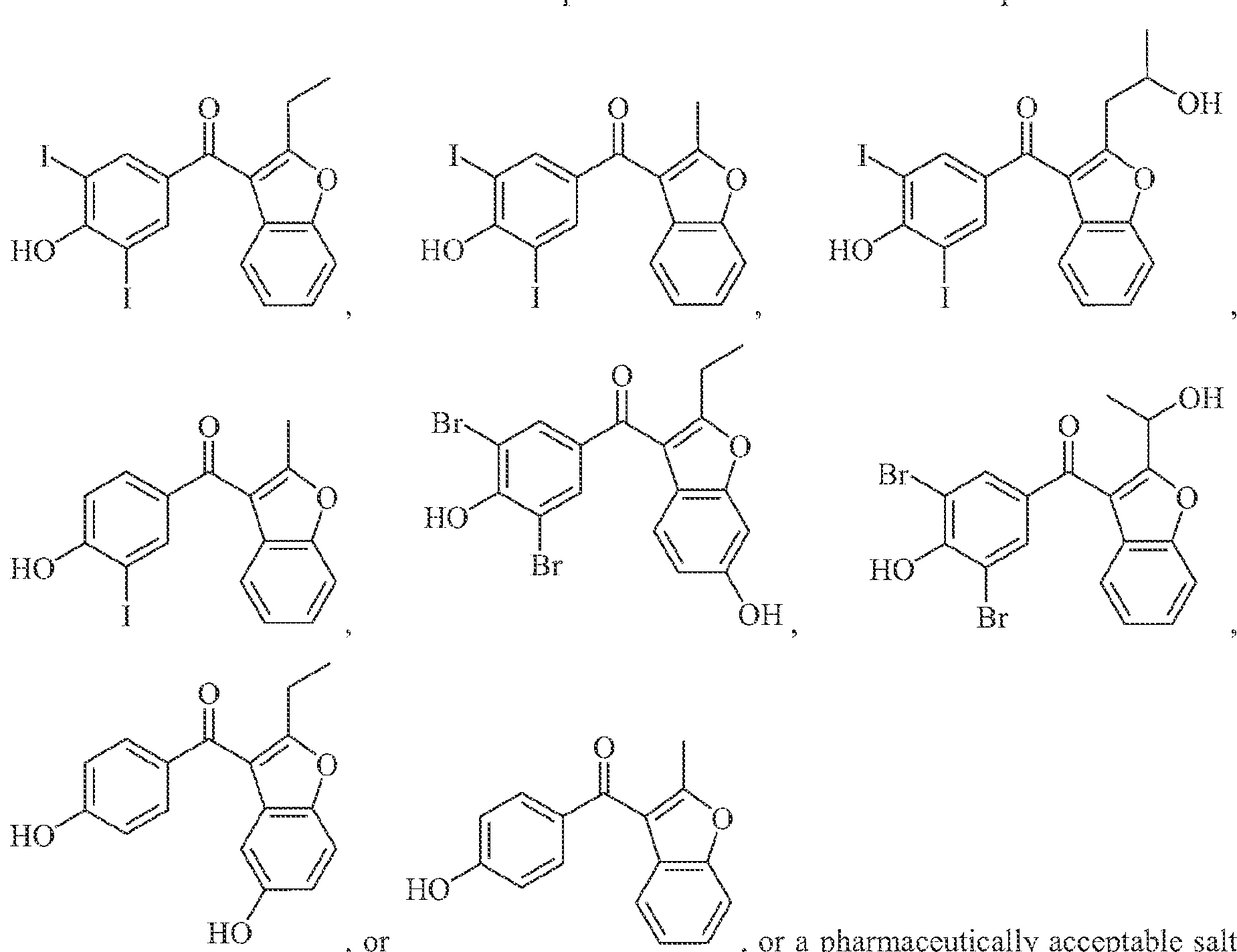
In certain embodiments, a compound, composition or method as disclosed herein is provided wherein the compound is:
 , or a pharmaceutically acceptable salt thereof.
In certain embodiments, a compound, compositi
herein is provided wherein the compound is:


certain embodiments, a compound, composition or method as disclosed herein is provided wherein the compound is:
 [0075] in certain embodiments, a compound, composition or method as disclosed herein is provided wherein 1 is selected from the group consisting of C1-6 a!kyi, ^. alkenyl, C2-6 alkynyl, aryl, heteroaiyl, heterocyciyl, arylalkyl, heteroarylalkyl, heterocyclylalkyl, cycloalkyl, cycloalkenyl, (cyclolalkyl)alkyl, O-carbamyl, N-carbamyl, O-thiocarbamyl, N-thiocarbamyl, C-amido, N-amido, S-sulfonamido, N -sulfonamide, C-carboxy, O-carboxy, isocyanato, thiocyanato, isothiocyanato, nitro, and amino, said Ci-e alk l, C2-5 alkenyl, C2-6 alkynyl, aryl, heteroaryl, heterocyciyl, arylalkyl, heteroarylalkyl, heterocyclylalkyl , cycloalkyl, cycloalkenyl, and (cycloialkyl)alkyl are each optionally substituted with one or more R1A; each R1A is independently selected from the group consisting of hydroxy, halo, cyano, nitro, C1.6 alkyl optionally substituted with up to 5 fluoro, C|- aikoxy optionally substituted with up to 5 fluoro, O-carbamyl, N-carbamyl, O-thiocarbamyl, N-thiocarbamyl, C-amido, N-amido, S- sulfonamido, N-sulfonamido, C-carboxy, O-carboxy, isocyanato, thiocyanato, isothiocyanato, nitro, and amino; R is selected from the group consisting of H (hydrogen), halo, hydroxy, O- carbamyl, N-carbamyl, O-thiocarbamyl, N-thiocarbamyl, C-amido, N-amido, S-sulfonamido, N-sulfonamido, C-carboxy, O-carboxy, and Ci-6 alkyl substituted with one or more hydroxy; R3 is selected from the group consisting of halo, hydroxy, O-carbamyl, N-carbamyl, C-amido, 8- sulfonamido, N-sulfonamido, C-carboxy, amino, and Ci-g alkyl substituted with one or more hydroxy; R4 is selected from the group consisting of H (hydrogen), halo, and Ci..e alkyl optionally substituted with up to 5 fluoro and C^e aikoxy optionally substituted with up to 5 fluoro; Rs and R6 are each independently selected from the group consisting of H (hydrogen), halo, cyano, C1-6 alkyl, C2-6 alkenyl, C2-6 alkynyl, aryl, heteroaryl, heterocyciyl, arylalkyl, heteroarylalkyl, heterocyclylalkyl, cycloalkyl, cycloalkenyl, (cyclolalkyi)alkyl, O-carbamyl, N-carbamyl, O-thiocarbamyl, N-thiocarbamyl, C-amido, N-amido, S-sulfonamido, N-sulfonamido, C-carboxy, O-carboxy, isocyanato, thiocyanato, isothiocyanato, nitro, and amino, said C ..6 alkyl, C2-6 alkenyl, C2-6 alkynyl, and, heteroaryl, heterocyciyl, arylalkyl, heteroarylalkyl, heterocyclylalkyl, cycloalkyl, cycloalkenyl, and (cyclolalkyl)alkyl each optionally substituted with one or more R1A; X1 is [C(R2A)2]n, (oxygen), or NR2A, or X1 is absent; X is [C(R" )2]n, O (oxygen), or NR" , or X" is absent; each R is independently selected from the group consisting of H (hydrogen), halo, hydroxy, O-carbamyl, N-carbamyl, C-amido, S-sulfonamido, N-sulfonamido, C-carboxy, amino, C2-0 alkenyl, C2-e alkynyl, aryl, heteroaryl, heterocyciyl, arylalkyl, heteroarylalkyl, heterocyclylalkyl, cycloalkyl, cycloalkenyl, (cyclolalkyl)alkyl, CM alkyl substituted with one or more hydroxy!, and C1..6 alkyl optionally substituted with up to 5 fluoro; each n is independently 1 or 2; Y1 is O (oxygen), S (sulfur), or NR2A; and each Z is independently selected from the group consisting CR2A, and N (nitrogen), with the proviso that the compound is not:

[0076] In certain embodiments, a compound, composition or method as disclosed herein is provided wherein R1 is selected from the group consisting of Cj -f! alkyl, C2-6 alkenyl, CJ-6 alkynyi, aryl, heteroaryl, heterocyciyi, arylalkyl, heteroarylalkyl, heterocyclylalkyl, cycloalkyl, cycioalkenyl, (cyclolalkyl)alkyl, O-carbamyl, N-carbamy[, O-thiocarbamyl, N-thiocarbamyl, C-amido, S-sulfonamido, and N-sulfonamido, said
 alkyl, C2-6 alkenyl, C2-6 alkynyi, aryl, heteroaryl, heterocyciyi, arylalkyl, heteroarylalkyl, heterocyclylalkyl, cycloalkyl, cycioalkenyl, and (cyclolalkyl)alkyl are each optionally substituted with one or more R1A.
2^
[0077] in certain embodiments, a compound, composition or method as disclosed herein is provided wherein X1 is [C(R2A)2]tt or NR2A.
[0078] In certain embodiments, a compound, composition or method as disclosed herein is provided wherein X2 is [C(R2A)2]n or NR2A.
[0079] In certain embodiments, a compound, composition or method as disclosed herein is provided wherein Y1 is O (oxygen), or S (sulfur).
[00801 In certain embodiments, a compound, composition or method as disclosed herein is provided wherein each Z is CR2A, where each R2A is independently selected from the group consisting of H (hydrogen), hydroxy, and Ci.6 aikyi optionally substituted with up to 5 fluoro,
[0081] In certain embodiments, a compound, composition or method as disclosed herein is provided wherein s is NR2A.
[0082] In certain embodiments, a compound, composition or method as disclosed herein is provided wherein X2 is NR2A.
[0083] In certain embodiments, a compound, composition or method as disclosed herein is provided wherein each Z is CH.
[0084] In certain embodiments, a compound, composition or method as disclosed herein is provided wherein X1 is O (oxygen), or NR2A, or X1 is absent; X2 is O (oxygen), or NR2A, or X" is absent; each R2A is independently selected from the group consisting of H (hydrogen), halo, hydroxy, 0-carbamyl, N-carbamyl, C-amido, S-sulfonamido, N-sulfonamido, C-carboxy, amino, C -6 aikenyi, C2-6 alkynyl, aryl, aryiaikyi, cycioalkyl, cycloalkenyl, (cyclolaikyi)alkyl, Ci-e a kyl substituted with one or more hydroxyl, and Ci-e a kyl optionally substituted with up to 5 fluoro; and Y1 is O (oxygen), or S (sulfur).
[0085] In certain embodiments, a compound, composition or method as disclosed herein is provided wherein R1 is selected from the group consisting of Ci-g alkyl, C2-6 alkenyl, C')-6 alkynyl, aryl, heteroaiyl, heteroeyclyl, aryiaikyi, heteroaryialkyi, heterocyclylalkyl, cycioalkyl, cycloalkenyl, (cyclolalkyl)aikyl, each optionally substituted with one or more R1A
[0086] In certain embodiments, a compound, composition or method as disclosed herein is provided wherein R1 is selected from the group consisting of Ci-6 alkyl, C2-6 aikenyi, C2-6 alkynyl, cycioalkyl, cycloalkenyl, (cyclolalkyl)alkyl, C-amido, -amido, S-sulfonamido, N-sulfonamido. said alkyl, C->-(, alkenyl, C2-6 alkynyl, cycioalkyl, cycloalkenyl,
(cyclolalkyl)alkyl are each optionally substituted with one or more R1A; each Ri is independently selected from the group consisting of hydroxy, halo, Ci-6 alkyl substituted with up to 5 fluoro, and C e alkoxy optionally substituted with up to 5 fluoro; R3 is selected from the group consisting of halo, hydroxy, O-carbamyl, N-carbamyl, C-amido, S-sulfonamido,
N-sulfonaniido, C-carboxy, and Ci-g alkyl substituted with one or more hydroxy; each R ' is independently selected from the group consisting of H (hydrogen), halo, hydroxy, O-carbamyl, N-carbamyl, C-amido, S-sulfonamido, N-sulfonamido, C-carboxy, amino, C2-6 alkenyl, C2-6 alkynyt, and, arylalkyl, cycloalkyl, cycloaikenyl, (cycloialkyl)alkyl, C1-6 alkyl substituted with one or more hydroxy!, and d_6 alkyl optionally substituted with up to 5 fluoro; and Y1 is O (oxygen), or S (sulfur),
[00871 In certain embodiments, a compound, composition or method as disclosed herein is provided wherein R5 is selected from the group consisting of Ci_6 alkyl, cycloalkyl, (cydolalkyi)alkyl, each optionally substituted with one or more RiA.
[0088] In certain embodiments, a compound, composition or method as disclosed herein is provided wherein R is selected from the group consisting of halo, hydroxy, O- carbamyl, N-carbamyl, C-amido, N-amido, S-sulfonamido, N-sulfonamido, C-carboxy, O-carboxy, and C1-3 alkyl substituted with one or more hydroxy,
[0089] In certain embodiments, a compound, composition or method as disclosed herein is provided wherein R3 is selected from the group consisting of hydroxy, C-amido, 8- sulfonamido, N-sulfonamido, and C1-3 alkyl substituted with one or more hydroxy.
[0090] In certain embodiments, a compound, composition or method as disclosed herein is provided wherein R4 is compound from the group consisting of halo, C1..3 alkyl optionally substituted with up to 5 fluoro, and C1-3 a!koxy optionally substituted with up to 5 fluoro,
[0091] In certain embodiments, a compound, composition or method as disclosed herein is provided wherein each R2A is independently selected from the group consisting of H (hydrogen), hydroxy, and C1-6 alkyl optionally substituted with up to 5 fluoro.
[0092] In certain embodiments, a compound, composition or method as disclosed herein is provided wherein each R2A is H (hydrogen),
[0093] In certain embodiments, a compound, composition or method as disclosed herein is provided wherein R1 is selected from the group consisting of (' ; ..-. alkyl, C-amido, and S-sulfonamido, said C1-3 alkyl optionally substituted with one or more hydroxy.
[0094] In certain embodiments, a compound, composition or method as disclosed herein is provided wherein R2 is selected from the group consisting of hydroxy, C-amido, N-amido, S-sulfonamido, and C1 -3 alkyl substituted with hydroxy.
j 00951 In certain embodiments, a compound, composition or method as disclosed herein is provided wherem R is selected from the group consisting of hydroxy, C-amido, and C1-3 alkyl substituted with hydroxy.
[0096] in certain embodiments, a compound, composition or method as disclosed herein is provided wherein 4 is selected from the group consisting of fluoro, chloro, bromo, methyl, -CF3, -OCH3, and -OCF3. I certain embodiments, a compound, composition or method as disclosed herein is provided wherein W is bromo and R is bromo. In certain embodiments, a compound, composition or method as disclosed herein is provided wherein R2 is iodo and R4 is iodo,
[00971 Some embodiments provide a composition comprising a pharmaceutically acceptable excipient, and a compound of any of the embodiments as disclosed and described herein. In certain embodiments, the compound is:

or a pharmaceutically acceptable salt thereof,
[0098] Some embodiments are directed to a method of treatment of an Eya-related disorder. One pathway implicated in proliferative disorders such as cancer is the evolutionally conserved gene network termed the retinal determination gene network, or "RDGN." Indeed,
the Six and Eva families of genes, members of the RDGN, are frequently found upregulated in cancers. The Eya protein has been shown to be a protein tyrosine phosphatase (PTP). PTPs in general are emerging as important new targets for cancer therapy. Anti-vascular therapy has emerged as an extremely promising option for the treatment of several major diseases including solid tumors and hematological cancers, and the vision-compromising ailments, such as diabetic retinopathy, age-related macular degeneration (AMD) and retinopathy of prematurity (ROP). Also presented herein is a a compound of any of the embodiments as disclosed and described herein for use in treating proliferative retinopathy, retinopathy of prematurity, diabetic retinopathy, age related macular degeneration, retinal vasculitis, exudative vitreoretinopathy, tumor angiogenesis, hemangiomas, tumor metastasis, treating breast cancer, ductal carcinoma lobule carcinoma, breast epithelial cancer, ovarian cancer, including epithelial ovarian cancer, desmoid tumor, malignant peripheral nerve sheath cancer, acute leukemia, rhabdomyosarcoma, Ewing's sarcoma, extra-skeletal myxoid chondrosarcoma, or endometrial cancer in an individual. Also presented herein is a a compound of any of the embodiments as disclosed and described herein for use in treating breast cancer, ductal carcinoma lobule carcinoma, breast epithelial cancer, ovarian cancer, including epithelial ovarian cancer, desmoid tumor, malignant peripheral nerve sheath cancer, acute leukemia, rhabdomyosarcoma, Ewing's sarcoma, extra-skeletal myxoid chondrosarcoma, or endometrial cancer in an individual. In certain embodiments, the compound is:
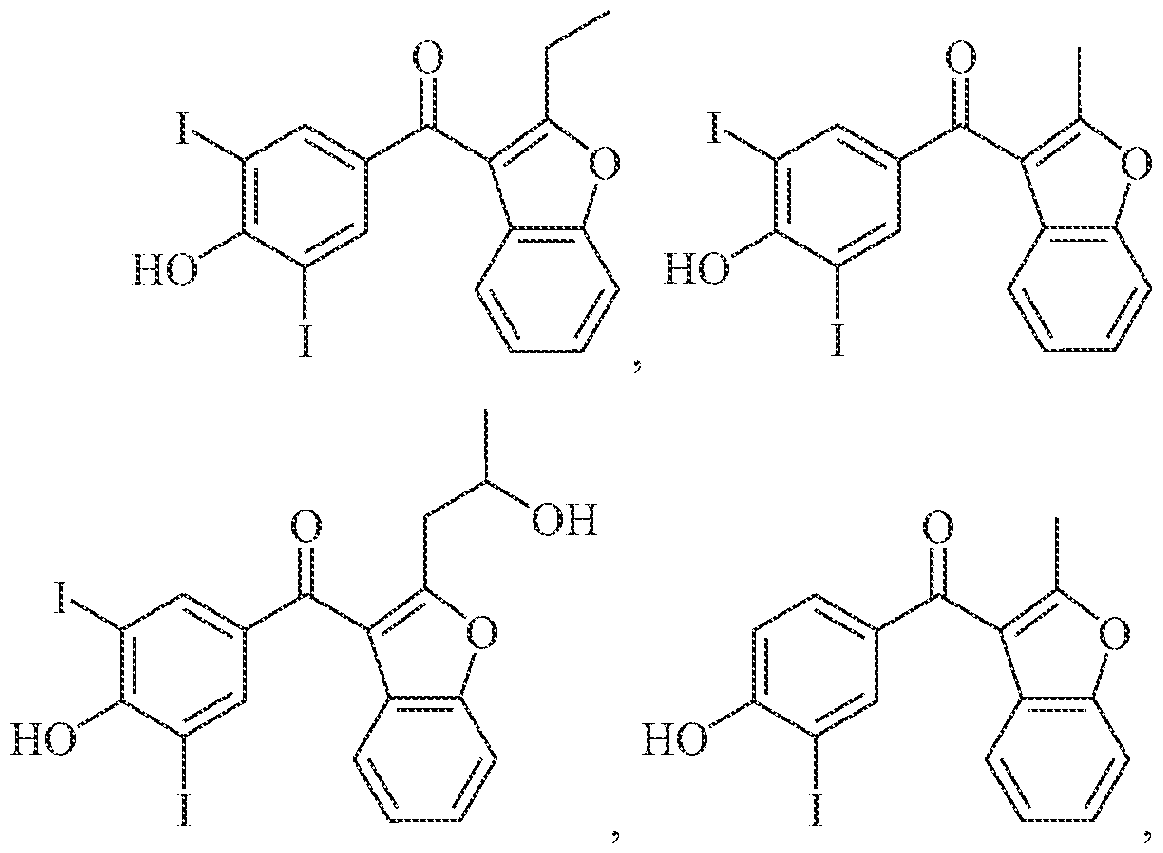

or a pharmaceutically acceptable salt thereof. In certain embodiments, the compound is:

[0099] The protein tyrosine phosphatases (P'TPs) of the Eyes Absent family are highly likely to be useful drug targets in anti-vascular therapy, Eyes Absent phosphatases are expressed in vascular endothelial cells (VECs) and the phosphatase activity enhances ceil migration and the formation of vessel-like structures in culture. Agents that specifically target PTPs have enormous potential in the treatment of proliferative, invasive and/or metastatic, angiogenic and/or vascular disorders such as cancer, given the significant increase in PTP activity in many disease stales. Though approximately 30% of cellular proteins are phospho- proteins, tyrosine phosphorylation accounts for only about 0.01% to about 0.05% of all phospho-proteins. In disease states such as oncogenic transformation, however, tyrosine phosphorylation is increased up to one to two hundred-fold to 1 to 2% of the total phospho- protein population. While protein tyrosine phosphatases have been extensively linked with disease states including proliferative diseases such as cancer, effective tyrosine phosphatase inhibitors have traditionally been confounded by a lack of specificity, and there remains a significant need in identifying PTP specific inhibitors for the treatment of disorders involving PTP dysregulation.
[0100] The inventors have characterized compounds that can inhibit the activity of the Eya protein, and, therefore, can have therapeutic effect.
[0101] Accordingly, in some embodiments, methods are provided for the treatment of proliferati ve retinopathy, retinopathy of prematurity, diabetic retinopathy, age related macular degeneration, retina! vasculitis, or exudative vitreoretinopathy.
[0102] In some embodiments, methods are provided for the treatment of tumor angiogenesis, hemangiomas or tumor metastasis.
[0103] In some embodiments, methods are provided for the treatment of breast cancer (including ductal carcinoma lobule carcinoma and breast epithelial cancer), ovarian cancer (including epithelial ovarian cancer), desmoid tumor, malignant peripheral nerve sheath cancer, acute leukemia, rhabdomyosarcoma, Ewing's sarcoma, extra-skeletal myxoid chondrosarcoma, or endometrial cancer.
[0104] In some embodiments, methods are provided for the treatment of Wilms' tumor, esophageal adenocarcinoma, colon cancer, colorectal cancer, esophageal squamous cell carcinoma, lung adenocarcinoma, Epstein-Barr vims-negative gastric cancer, or pancreatic ductal adenocarcinoma.
[0105] Some embodiments provide a method of evaluating the inhibition of EYA tyrosine phosphatase comprising contacting EYA tyrosme phosphatase with a compound of any of the embodiments as disclosed and described herein.
[0106] Some embodiments provide a method for evaluating the inhibition of EYA tyrosine phosphatase comprising: a) contacting the catalytic domain (ED) of EYA tyrosine phosphatase with a compound from a library of compounds and evaluating the results; and b) contacting a full-length EYA tyrosine phosphatase with said compound and evaluating the results. In certain embodiments, the method further comprises: c) performing a) for each compound in said library of compounds; d) selecting one or more compounds from c) that inhibit the catalytic domain (ED) of EYA tyrosine phosphatase according to a user-selected level; e) performing b) for each compound selected in d); and f) selecting one or more compounds from e) that inhibit full-length EYA tyrosine phosphatase according to a user- selected level,
[0107] Some embodiments provide a method for identifying a compound that specifically inhibits EYA tyrosine phosphatase comprising: a) contacting EYA tyrosine phosphatase with a compound and evaluating the results; and b) contacting a cysteine catalysis- based protein tyrosine phosphatase with said compound and evaluating the results.
|0108] Some embodiments provide a method of evaluating a compound for inhibition of ceil migration, comprising contacting an EYA tyrosine phosphatase with a compound and evaluating the results.
[0109] Some embodiments provide a method of evaluating a compound for inhibition of tumor angiogenesis, comprising contacting an EYA tyrosine phosphatase with a compound and evaluating the results,
[0110] Some embodiments provide a method of evaluating a compound for inhibition of tumor metastasis, comprising contacting an EY A tyrosine phosphatase with a compound and evaluating the results.
[01111 Some embodiments provide a method of evaluating a compound for inhibition of proliferative retinopathy, comprising contacting an EYA tyrosine phosphatase with a compound and evaluating the results.
[0112] Some embodiments provide a method of evaluating a compound for inhibition of retinopathy of prematurity, comprising contacting an EY A tyrosine phosphatase wit a compound and evaluating the results,
[0113] Some embodiments provide a method of evaluating a compound, for inhibition of diabetic retinopathy, comprising contacting an EYA tyrosine phosphatase with a compound and evaluating the results.
[0114| Some embodiments provide a method of evaluating a compound for inhibition of age related macular degeneration, comprising contacting an EYA tyrosine phosphatase with a compound and evaluating the results,
[0115] Some embodiments provide a method of evaluating a compound for inhibition of retinal vasculitis, comprising contacting an EYA tyrosine phosphatase with a compound and evaluating the results.
[0116] Some embodiments provide a method of evaluating a compound for inhibition of exudative vitreoretinopathy, comprising contacting an EYA tyrosine phosphatase with a compound and evaluating the results.
[0117] Some embodiments provide a method of evaluating a compound for inhibition of hemangiomas comprising contacting an EYA tyrosine phosphatase with a compound and evaluating the results.
[0118] Some embodiments provide a method of evaluating a compound for inhibition of breast cancer (including ductal carcinoma lobule carcinoma and breast epithelial cancer) comprising contacting an EYA tyrosine phosphatase with a compound and evaluating the results.
[0119] Some embodiments provide a method of evaluating a compound for inhibition of ovarian cancer (including epithelial ovarian cancer) comprising contacting an EYA tyrosine phosphatase with a compound and evaluating the results.
[0120] Some embodiments provide a method of evaluating a compound for mhibition of desmoid tumor comprising contacting an EYA tyrosine phosphatase with a compound and evaluating the results,
[0121] Some embodiments provide a method of evaluating a compound for inhibition of malignant peripheral nerve sheath cancer comprising contacting an EYA tyrosine phosphatase with a compound and evaluating the results.
[01221 Some embodiments provide a method of evaluating a compound for inhibition of acute leukemia, rhabdomyosarcoma comprising contacting an EYA tyrosine phosphatase with a compound and evaluating the results.
[0123] Some embodiments provide a method of evaluating a compound for mhibition of Ewing's sarcoma comprising contacting an EYA tyrosine phosphatase with a compound and evaluating the results,
[0124] Some embodiments provide a method of evaluating a compound for inhibition of extra-skeletal myxoid chondrosarcoma comprising contacting an EY A tyrosine phosphatase with a compound and evaluating the results.
[01251 Some embodiments provide a method of evaluating a compound for inhibition of endometrial cancer comprising contacting an EYA tyrosine phosphatase with a compound and evaluating the results.
[0126] Some embodiments provide a method of evaluating a compound for mhibition of Wilms' tumor comprising contacting an EYA tyrosine phosphatase with a compound and evaluating the results.
[0127] Some embodiments provide a method of evaluating a compound for inhibition of esophageal adenocarcinoma comprising contacting an EYA tyrosine phosphatase with a compound and evaluating the results.
[0128] Some embodiments provide a method of evaluating a compound for inhibition of colon cancer comprising contacting an EYA tyrosine phosphatase with a compound and evaluating the results.
[0129] Some embodiments provide a method of evaluating a compound for inhibition of colorectal cancer comprising contacting an EYA tyrosine phosphatase with a compound and evaluating the results.
[0130] Some embodiments provide a method of evaluating a compound for inhibition of esophageal squamous cell carcinoma comprising contacting an EYA tyrosine phosphatase with a compound and evaluating the results.
[0131] Some embodiments provide a method of evaluating a compound for inhibition of lung adenocarcinoma comprising contacting an EYA tyrosine phosphatase with a compound and evaluating the results,
[0132] Some embodiments provide a method of evaluating a compound for inhibition of Epstein-Barr virus-negative gastric cancer comprising contacting an EYA tyrosine phosphatase with a compound and evaluating the results.
[01331 Some embodiments provide a method of evaluating a compound for inhibition of pancreatic ductal adenocarcinoma comprising contacting an EYA tyrosine phosphatase with a compound and evaluating the results.
[0134] In some embodiments, the results are evaluated by determining the level of inhibition of an EYA. protein or truncated version thereof, relative to no inhibitor or relative to a control. In some embodiments, the results are evaluated by determining the level of inhibition of a full-length EYA protein or relative to a truncated EYA protein. In some embodiments, the results are evaluated by determining the level of reduction in pathological neovascularization relative to no inhibitor or relative to a control. In some embodiments, the results are evaluated by determining the level of reduction in angiogenesis relative to no inhibitor or relative to a control. In some embodiments, the results are evaluated by determining the level of reduction in metastasis to no inhibitor or relative to a control. In some embodiments, the results are evaluated by determining the level of reduction in tumor size relative to no inhibitor or relative to a control.
[0135] In certain aspects any of the embodiments providing methods said compound comprises a compound of any of the embodiments as disclosed and described herein.
[0136] In certain embodiments evaluating comprises evaluating the level of inhibition of full-length EYA tyrosine phosphatase in comparison with the level of inhibition of a truncated EYA tyrosine phosphatase. In certain embodiments, said truncated EYA tyrosine phosphatase comprises the catalytic domain of EYA tyrosine phosphatase. In certain embodiments, said truncated EYA tyrosine phosphatase comprises the catalytic domain (ED) of Eya3. In certain embodiments, said truncated EYA tyrosine phosphatase comprises the catalytic domain (ED) of Eya2.
[0137] In certain embodiments evaluating comprises evaluating the level of inhibition of EYA tyrosine phosphatase in comparison with the level of inhibition of a cysteine catalysis-based protein tyrosine phosphatase. In certain embodiments, said EYA tyrosine phosphatase comprises full-length EYA tyrosine phosphatase. In certain embodiments, said EYA tyrosine phosphatase comprises a truncated EYA tyrosine phosphatase which comprises the catalytic domain (ED) of EY A tyrosine phosphatase. In certain embodiments, said truncated
EYA tyrosine phosphatase comprises the catalytic domain (ED) of Eya3. In certain embodiments, said truncated EYA tyrosine phosphatase comprises the catalytic domain (ED) of Eya2, In certain embodiments, said cysteine catalysis-based protein tyrosine phosphatase comprises PTP1B. In certain embodiments, said cysteine catalysis-based protein tyrosine phosphatase comprises FCPI , in certain embodiments, said cysteine catalysis-based protein tyrosine phosphatase comprises SCP. In certain embodiments, said cysteine catalysis-based protein tyrosme phosphatase comprises SH-PTP2. In certain embodiments, said cysteine catalysis-based protein tyrosine phosphatase comprises SH-PTP1.
Definitions
[0138] Unless specific definitions are provided, the nomenclatures utilized in connection with, and the laboratory procedures and techniques of, analytical chemistry, synthetic organic chemistry, and medicinal and pharmaceutical chemistry described herein are those known in the art. Standard chemical symbols are used interchangeably with the full names represented by such symbols. Thus, for example, the terms "hydrogen" and "H" are understood to have identical meaning. Standard techniques may be used for chemical syntheses, chemical analyses, pharmaceutical preparation, formulation, and delivery, and treatment of patients.
10139] As used herein, the following terms are defined with the following meanings, unless expressly stated otherwise.
[0140] The term "alkyl" refers to a branched or unbranched fully saturated acyclic aliphatic hydrocarbon group. An alky! ma be branched or straight chain. Alkyls may be substituted or unsubstituted. Alkyls include, but are not limited to, methyl, ethyl, propyl, isopropyl, butyl, isobutyl, tertiary butyl, pentyi, hexyl, and the like, each of which may be optionally substituted .
[0141] In certain embodiments, an alkyl comprises 1 to 20 carbon atoms (whenever it appears herein, a numerical range such as "1 to 20" refers to each integer in the given range; e.g. , "1 to 20 carbon atoms" means that an alkyl group may comprise only 1 carbon atom, 2 carbon atoms, 3 carbon atoms, etc., up to and including 20 carbon atoms, although the term "alkyl" also includes instances where no numerical range of carbon atoms is designated). An alkyl may be designated as "Ci-Ce alkyl" or similar designations. By way of example only, "Ci- C4 alkyl" indicates an alkyl having one, two, three, or four carbon atoms, e.g., the alkyl is selected from methyl, ethyl, propyl, tso-propy!, butyl, fco-butyl, _?<?e-butyl, and fert-butyl.
[0142] The term "alkenyl" used herein refers to a straight or branched chain aliphatic hydrocarbon of from two to twenty carbon atoms containing at least one carbon-carbon double bond including, but not limited to, 1-propenyi, 2-propenyl, 2-methyl-l-propenyl, 1 -butenyl, 2-
butenyl, and the like, In certain embodiments, an alkenyl comprises 2 to 20 carbon atoms (whenever it appears herein, a numerical range such as "2 to 20" refers to each integer in the given range; e.g., "2 to 20 carbon atoms" means that an alkenyl group may comprise only 2 carbon atoms, 3 carbon atoms, etc., up to and including 20 carbon atoms, although the term "alkenyl" also includes instances where no numerical range of carbon atoms is designated). An alkenyl may be designated as "Ca-Ce alkenyl" or similar designations. By way of example only, "C2-C4 alkenyl" indicates an alkenyl having two, three, or four carbon atoms, e.g., the alkenyl is selected from ethenyl, propenyl, and butenyl.
|0143] The term "cycloalkyl" used herein refers to saturated aliphatic ring system having three to twenty carbon atoms, A cycloalkyl refers to monocyclic and polycyclic saturated aliphatic ring system including, but not limited to, cyclopropyl, cyclopentyl, cyclohexyl, cycloheptyl, bicyclo[4.4.0]decanyl, bicycio[2.2.1]heptanyi, adamantyl, norbornyi, and the like, in certain embodiments, a cycloalkyl comprises 3 to 20 carbon atoms (whenever it appears herein, a numerical range such as "3 to 20" refers to each integer in the given range; e.g. , "3 to 20 carbon atoms" means that a cycloalkyl group may comprise only 3 carbon atoms, etc., up to and including 20 carbon atoms, although the term "cycloaikyi" also includes instances where no numerical range of carbon atoms is designated). A cycloalkyl may be designated as "C3-C7 cycloalkyl" or similar designations. By way of example only, "C3-C6 cycloalkyl" indicates a cycloalkyl having two, three, four, five or six carbon atoms, e.g., the cycloalkyl is selected from cyclopropyl, eyciobutyi, cyclopentyl, and cyclohexyl,
[0144] The term "cycloalkenyl" used herein refers to aliphatic ring system having three to twenty carbon atoms having at least one carbon-carbon double bond in the ring, A cycloalkenyl refers to monocyclic and polycyclic unsaturated aliphatic ring system including, but are not limited to, cyclopropenyi, cyciopentenyl, cyciohexenyl, cycioheptenyi, hicyclo[3.1 ,0]hexyi, norbornylenyl, 1 ,1 ' -bicyclopentenyl, and the like. In certain embodiments, a cycloalkenyl comprises 3 to 20 carbon atoms (whenever it appears herein, a numerical range such as "3 to 20" refers to each integer in the given range; e.g. , "3 to 20 carbon atoms" means that a cycloalkenyl group may comprise only 3 carbon atoms, etc., up to and including 20 carbon atoms, although the term "cycloalkenyl" also includes instances where no numerical range of carbon atoms is designated). A cycloalkenyl may be designated as "C3-C7 cycloalkenyl" or similar designations. By way of example only, "C3-C6 cycloalkenyl" indicates an alkenyl having two, three, four, five or six carbon atoms, e.g., the cycloalkyl is selected from cyclopropenyi, cyciobutenyi, cyciopentenyl. and cyciohexenyl.
[0145] The term "alkoxv" used herein refers to straight or branched chain alkyl covalently bonded to oxygen where the "alkoxy" is attached to the parent molecule through at
least an oxygen linkage. Where an "alkoxy" substituent requires two points of attachment to the rest of the molecule the "alkoxy" is attached to the parent molecule through an oxygen linkage and a carbon linkage. Examples of alkoxy groups include, but are not limited to, methoxy, ethoxy, propoxy, isopropoxy, butoxy, n-butoxy, sec-butoxy, t-butoxy and the like, An alkoxy may be designated as "Ci-Cg alkoxy" or similar designations. By way of example only, "C1-C4 alkoxy" indicates an alkyl having one, two, three, or four carbon atoms, e.g., the alkoxy is selected from methoxy, ethoxy, propoxy, isopropoxy, butoxy, isobutoxy, .sec-butoxy, and tert- butoxy.
|0146] The term "heteroalkyl" refers to a group comprising at least one alkyl or alkenyl, and one or two heteroatoms. Where a "heteroalkyl" substituent requires two points of attachment to the rest of the molecule the "heteroalkyl" is attached to the parent molecule through a heteroatom linkage and a carbon linkage, a first carbon linkage and a second carbon linkage, or a first heteroatom linkage and a second heteroatom linkage. Examples of heteroalkyls include, but are not limited to, -CI X 'i ΚΊ S:-. -CH2OCH2-, -CH2CH2OCH2CH2-, - C l l -OCH CI 1 - . -CH=CHOCH=CH-, -OCH20-, -CH2 HCH2CH2-, -CH2 HCH2-, - CH2CH2NHCH2CH2-, - HCH=CH-, -NHCH2CH2~, -N=CHCH2-, -CH2NHCH=CH-, -CH=CHNHCH=CH-, -NHCH2NH-, and the like.
10147] The term "heterocyclic" or "heterocyclyl" used herein refers to a cyclic ring system radical having at least one non-aromatic ring in which one or more ring atoms are not carbon, namely heteroatom, Monocyclic "heterocyclic" or "heterocyclyl" moieties are non- aromatic. Bicyclic "heterocyclic" or "heterocyclyl" moieties include one non-aromatic ring wherein at least one heteroatom is present in a ring. Tricyclic "heterocyclic" or "heterocyclyl" moieties include at least one non-aromatic ring wherein at least one heteroatom is present in a ring. Examples of heterocyclic groups include, but are not limited to, piperidinyl, piperazinyi, morphoiinyl, tetrahydrofuranyi, dioxolanyi, tetrahydropyranyl, pyrrolidinyl, and the like.
[0148] The term "heteroatom" refers to an atom other than carbon or hydrogen. Heteroatoms are typically independently selected from oxygen, sulfur, nitrogen, and phosphorus, but are not limited to those atoms, in embodiments in which two or more heteroatoms are present, the two or more heteroatoms may all be the same as one another, or some or ail of the two or more heteroatoms may each be different from the others.
[0149] The term "aryl" refers to an aromatic group wherein each of the atoms forming the ring is a carbon atom. Examples of aryl groups include, but are not limited to phenyl, and naphthalenyl. In certain embodiments, a phenyl group is substituted at one or more positions. Examples of aryl groups comprising substitutions include, but are not limited to, 3- haiophenyi, 4-halophenyl, 3-hydroxyphenyl, 4-hydroxyphenyl, 3-aminophenyl, 4-aminophenyl,
3-methylphenyl, 4-methylphenyl, 3-methoxyphenyl, 4-methoxyphenyl, 4- trifluoromethoxyphenyl, 3-cyanophenyl, 4-cyanophenyl, dimethylphenyl, hydroxynaphthyl, hydroxymethylphenyl, (trifluoromethyl)phenyl, and 4-morpholin-4-ylphenyl.
[01 SO] The term "heteroaryl" refers to an aromatic mono-, bi- or tricyclic ring system wherein at least one atom forming the aromatic ring system is a heteroatom. Heteroaryl rings may be formed by three, four, five, six, seven, eight, nine, or more than nine atoms. Heteroaryl groups may be optionally substituted. Examples of heteroaryl groups include, but are not limited to, aromatic C3-8 heterocyclic groups comprising one oxygen or sulfur atom or up to four nitrogen atoms, or a combination of one oxygen or sulfur atom and up to two nitrogen atoms, and their substituted as well as benzo- and pyrido-fused derivatives, for example, connected via one of the ring-forming carbon atoms, in certain embodiments, heteroaryl groups are optionally- substituted with one or more substituents, independently selected from halo, hydroxy, amino, cyano, nitro, alkyiamido, acyl, Cj-6-alkoxy, Cs-6-alkyL C j-6-hydroxyaikyi, Ci-e-aminoalkyL Cj-6- alkylamino, alkylsulfenyi, alkylsuifmyl, alkylsulfonyl, sulfamoyl, or trifluoromethyl. In some embodiments, the substituents are halo, hydroxy, cyano, O-C^-alkyl, Ci-6-alkyl, hydroxy-C|.6- alkyl, and amino- -6-alkyl. Examples of heteroaryl groups include, but are not limited to, unsubstitiited and mono- or di-substituted derivatives of furan, benzofuran, thiophene, benzothiophene, pyrrole, pyridine, indole, oxazole, benzoxazole, isoxazole, benzisoxazole, thiazole, benzothiazole, isothiazoie, imidazole, benzimidazole, pyrazole, indazole, tetrazoie, quinoline, isoquinoline, pyridazine, pyrimidine, purine and pyrazine, furazari, 1,2,3-oxadiazole, 1,2,3-thiadiazole, 1 ,2,4-thiadiazole, triazole, benzotriazole, pteridine, phenoxazole, oxadiazole, benzopyrazoie, quinolizine, cinnoline, phthalazine, quinazoline, and quinoxaline.
fOl SlJ The term "arylalkyl" refers to a group comprising an aryl group bound to an alkyl group. Examples of arylalkyl groups include, but are not limited to, benzyl, phenethyl, phenpropyl, phenbutyl, and the like. In some embodiments, arylalkyls may be substituted or unsubstitiited, and can be substituted on either the aryl or alkyl portion or on both. Where an "arylalkyl" substituent requires two points of attachment to the rest of the molecule the "arylalkyl" can be attached to the parent molecule through a carbon linkage in the aryl group and a carbon linkage in the alkyl group.
[0152] The term "heteroaryialkyl" used herein refers to one or more heteroaryl groups appended to an alkyl radical. Examples of heteroaryialkyl include, but are not limited to, pyridylmethyl, furanylmethyi, thiopheneylethyl, and the like, in some embodiments, heteroarylalky s may be substituted or unsubstituted, and can be substituted on either the heteroaryl or alkyl portion or on both. Where an "heteroaryialkyl" substituent requires two points of attachment to the rest of the molecule the "heteroaryialkyl" can be attached to the
parent molecule through a carbon linkage in the heteroaryl group and a carbon linkage in the alkyl group.
[0153] The term "heterocyclyialkyi" used herein refers to one or more heterocyciyl groups appended to an alkyl radical . Examples of heterocyclyialkyi include, but are riot limited to, piperidinylmethyl, piperidinyiethyi, lnorpho!im In eihy!. morpholinylethyl, and the like.
[0154] The tern; "(cycloalkyl)alkyl" used herein refers to one or more cycloalkyl groups appended to an alkyl radical. Examples of (cycioalkyi)a!kyl include, but are not limited to, cyclohexylmethyi, cyciohexyiethyl, cyciopentylmethyL cyclopentylethyl, and the like. In some embodiments, (cycloaikyi)alkyl may be substituted or unsubstituted.
[0155] Unless otherwise indicated, the term "optionally substituted," refers to a group in which none, one, or more than one of the hydrogen atoms has been replaced with one or more group(s) individually and independently selected from: alkyl, alkenyl, cycloalkenyl, cycloalkyl, aryi, arylalkyi, heteroaryl, heterocyclyl, hydroxy, alkoxy, cyano, halo, oxo, thiocarbonyl, ester, O-carbamyl, N-carbamyl, O-thiocarbamyl, N-thiocarbarayl, C-araido, N-amido, S-sulfonamido, N-sulfonarnido, C-carboxy, O-carboxy, isocyanato, thiocyanato, isothiocyanato, nitro, and amino, including mono- and di -substituted amino groups, and the protected derivatives of amino groups. Such protective derivatives (and protecting groups that may form such protective derivatives) are known to those of skill in the art and may be found in references such as Greene and Wuts, above. When the group contains a nitrogen, or a sulfur, an oxo as a substituent also includes oxides, for example pvridine-N-oxide, thiopyran sulfoxide and thiopyran-S,S-dioxide. in embodiments in which two or more hydrogen atoms have been substituted, the substituent groups may together form a ring.
|0156] The substituent "R" appearing by itself and without a number designation refers to a substituent selected from H (hydrogen), alkyl, cycloalkyl, and, heteroaryl (bonded through a ring carbon) and heterocyclyl (bonded through a ring carbon).
[0157] The term "O-carboxy" refers to the group consisting of formula RC(=0)0-.
[0158] The term "C-carboxy" refers to the group consisting of formula -C(=:=Q)OR,
[0159] The term "cyano" refers to the group consisting of formula -C .
[0160] The term "isocyanato" refers to the group consisting of formula -N=C=G.
[0161] The term "thiocyanato" refers to the group consisting of formula -CNS.
[0162] The term "isothiocyanato" refers to the group consisting of formula -N=C=S.
[01 3] The term "sulfonyl" refers to the group consisting of formula -S(=0')-R.
[0164] The term "S-sulfonamido" refers to the group consisting of formula -Si O bX R.
The term "N-sulfonamido" refers to the group consisting of formula
RS( %NH-.
The term "O-carbamy " refers to the group consisting of formula
-OC(=OVNR.
The term "N-carbamyl" refers to the group consisting of formula
( ()}Ν Π- [0168 J The term "O-thiocarbamyl" refers to the group consisting of formula
( )(. ( S ) N !I .
The term " -thiocarbamyl" refers to the group consisting of formula
ROC(=S)NH-.
[0170] The term "C-amido" refers to the group consisting of formula -C(=0)-NR.2.
The term "N-amido" refers to the group consisting of formula RC(=0)NH-. The term "oxo" refers to the group consisting of formula =0.
[0173] The term "ester" refers to a chemical moiety with formula -(R)n-C(=0)OR', where R and. R' are independently selected from alkyl, cycloalkyl, aryl, heteroaryl (bonded through a ring carbon) and non-aromatic heterocycle (bonded through a ring carbon), where n is 0 or 1.
[0174] The term "amino" refers to a chemical moiety with formula -NHR'R", where R' and R" are each independently selected from hydrogen, alkyl, cycloalkyl, aryl, heteroaryl (bonded through a ring carbon) and heteroalicyclic (bonded through a ring carbon).
[0175] The term "stereoisomers" as used herein means isomers that possess identical constitution, but which differ in the arrangement of their atoms in space. Including, for example, all enantiomers, diastereomers, geometric isomers, and atropisomers.
[0176] Whereever a substituent as depicted as a di-radical (i.e., has two points of attachment to the rest of the molecule), it is to be understood that the substituent can be attached in any directional configuration unless otherwise indicated. Thus, for example, a substituent
. A.
depicted as -AE- or ¾ E ' includes the substituent being oriented such that the A is attached at the leftmost attachment point of the molecule as well as attached at the rightmost attachment point of the molecule.
[0177] It is to be understood that certain radical naming conventions can include either a mono-radical or a di-radical, depending on the context. For example, where a substituent requires two points of a ttachment to the rest of the molecule, it is understood that the substituent is a di-radical. A substituent identified as alkyl, that requires two points of attachment, includes di-radicals such as -CH2-, -€¾€¾- -C¾CH(C¾)CH2-, and the like; a
substituent depicted as alkoxy that requires two points of attachment, includes di-radicals such as -OCH - -OCH CH - -OCH CH CH CH - and the like: and a substituent identified as

, and the like.
017 '!8 Throughout the specification, groups and substituents thereof can be chosen by one skilled in the field to provide stable moieties and compounds,
|0179] The term "pharmaceutical agent" refers to a chemical compound or composition capable of inducing a desired therapeutic effect in a patient, In certain embodiments, a pharmaceutical agent comprises an active agent, which is the agent that induces the desired therapeutic effect. In certain embodiments, a pharmaceutical agent comprises a prodrug, In certain embodiments, a pharmaceutical agent comprises inactive ingredients such as carriers, excipients, and the like.
[0180] The term "therapeutically effective amount" refers to an amount of a pharmaceutical agent sufficient to achieve a desired therapeutic effect.
[0181] The term "pharmaceutically acceptable" refers to a formulation of a compound that does not significantly abrogate the biological activity, a pharmacological activity and/or other properties of the compound when the formulated compound is administered to a patient. In certain embodiments, a pharmaceutically acceptable formulation does not cause significant irritation to a patient.
[0182] The term "co-administer" refers to administering more than one pharmaceutical agent to a patient. In certain embodiments, co-administered pharmaceutical agents are administered together in a single dosage unit. In certain embodiments, coadministered pharmaceutical agents are administered separately. In certain embodiments, coadministered pharmaceutical agents are administered at the same time. In certain embodiments, co-administered pharmaceutical agents are administered at different times.
[0183] The term "patient" includes human and animal subjects.
[01841 The term "substantially pure" means an object species (e.g., compound) is the predominant species present (i.e., on a molar basis it is more abundant than any other individual species in the composition). In certain embodiments, a substantially purified fraction is a. composition wherein the object species comprises at least about 50 percent (on a molar basis) of all species present. In certain embodiments, a substantially pure composition will comprise more than about 80%, 85%, 90%, 95%, or 99% of ail species present in the composition. In
certain embodiments, the object species is purified to essential homogeneity (contaminant species cannot be detected in the composition by conventional detection methods) wherein the composition consists essentially of a single species.
Certain compounds
[0185] Certain compounds that modulate EYA tyrosine phosphatase and/or bind to EYA tyrosine phosphatase play a role in health. In certain embodiments, compounds are useful for treating diseases or conditions as provided elsewhere herein,
|0186] One of skill in the art will recognize that analogous synthesis schemes may be used to synthesize similar compounds. One of skill will recognize that compounds of the present embodiments may be synthesized using other synthesis schemes. In certain embodiments, a salt corresponding to any of the compounds provided herein is provided.
[0187] in certain embodiments, a salt corresponding to a compound as disclosed and described herein is provided. In certain embodiments, a salt is obtained by reacting a compound with an acid, such as hydrochloric acid, hydrobromic acid, sulfuric acid, nitric acid, phosphoric acid, methanesulfonic acid, ethanesulfonic acid, p-toluenesulfonic acid, salicylic acid, and the like. In certain embodiments, a salt is obtained by reacting a compound with a base to form a salt such as an ammonium salt, an alkali metal salt, such as a sodium or a potassium salt, an alkaline earth metal salt, such as a calcium or a magnesium salt, a salt of organic bases such as choline, dicyclohexylamine, N-metbyl-D-glucamine, trisihydroxyn ethyljrnethylamine, 4-(2- hydroxyethylj-morpholine, l-(2-hydroxyethyi)-pyrrolidine, ethanolamine and salts with amino acids such as arginine, lysine, and the like. In certain embodiments, a salt is obtained by reacting a free acid form of a compound as disclosed and described herein with multiple molar equivalents of a base, such as bis-sodium, bis-ethanolamine, and the like.
[0188] In certain embodiments, a salt corresponding to a compound of the present embodiments is selected from acetate, ammonium, benzenesuifonate, benzoate, bicarbonate, bisulfate, bitartrate, borate, bromide, calcium edetate, camsylate, carbonate, chloride, cholinate, clavulanate, citrate, dihydrochloride, diphosphate, edetate, edisylate, estolate, esylate, fumarate, gluceptate, gluconate, glutamate, glycollyiarsaniiate, hexylresorcinate, hydrabanine, hydrobromide, hydrochloride, hydroxynaphthoate, iodide, isethionate, lactate, lactobionate, laurate, magnesium, malate, maleate, mandelate, mucate, napsylate, nitrate, N-niethylgiucamine, oxalate, pamoate (embonate), palmitate, pantothenate, phosphate, polygalacturonate, potassium, salicylate, sodium, stearate, subaceatate, succinate, sulfate, tannate, tartrate, teoclate, tosylate, triethiodide, tromemamine, trimethylarnmonium, and valerate salts.
Methods of Screening for EYA Tyrosine Phosphatase Inhibition
[018 J Also provided herein are methods of screening compounds for EYA tyrosine phosphatase inhibition. These methods can include methods of ev aluating inhibitory properties of a compound, such as, but not limited to, a member of the set of compounds provided herein, in certain embodiments, the methods can comprise contacting EYA t rosine phosphatase with a compound, and evaluating the level of EYA tyrosine phosphatase inhibition. In certain embodiments, the compound is a compound as disclosed herein,
[01 0] The EYA tyrosine phosphatase can be from any organism that expresses EYA tyrosine phosphatases, such as those that are known in the art. In some embodiments, the EY A tyrosine phosphatase is from a mammalian organism, such as human, primate, bovine, equine, porcine, ovine, murine, canine or feline EYA tyrosine phosphatase. In some embodiments the EYA tyrosine phosphatase is from a non-rnamalian organism, such as avian or zebrafish EYA tyrosine phosphatase. In typical embodiments, the EYA tyrosine phosphatase is from human or primate EYA tyrosine phosphatase. In some embodiments, the EYA tyrosine phosphatase is from a non-mammalian organism, such as zebrafish and the like. Cloning and expression of EYA tyrosine phosphatases from various organisms can be performed as described herein or as otherwise known in the art,
[0191] in some embodiments, the EYA. tyrosine phosphatase is a full-length EYA tyrosine phosphatase. Thus, in some embodiments, full-length EYA tyrosine phosphatase can comprise a full-length isoforrn of EYA tyrosine phosphatase. The full-lengt EYA tyrosine phosphatase can be full-length Eyal, Eya2, Eya3, and Eya4, or an isoforrn thereof. As will be appreciated by those of skill in the art, a full-length EYA tyrosine phosphatase can comprise the entire encoded amino acid sequence, or can be a known isoforrn, such as isoforrn 2 of Eya 3, comprising residues 127-573 of Eya3, in Genbank accession number M 001990. Isoforms of Eyal , Eya2 and Eya4 ca be used in the methods provided herein. Thus, for example, in one embodiment, the method can comprise contacting an EYA tyrosine phosphatase with a compound, wherein the EYA tyrosine phosphatase consists of residues 127-573 of Genbank accession number NM_001990, and evaluating the level of EYA tyrosine phosphatase inhibition.
[0192] In some embodiments, the EYA tyrosine phosphatase is a truncated EYA tyrosine phosphatase. In some embodiments, the truncated EYA tyrosine phosphatase comprises one or more of N-terminal, C-terminal, or internal deletions from a full-length isoforrn of EYA tyrosine phosphatase. In some embodiments, the truncated EYA tyrosine phosphatase comprises a truncated Eyal , Eya2, Eya3, and Eya4, or an isoforrn thereof. For example, in certain embodiments, the EYA tyrosine phosphatase comprises the catalytic domain
(ED) of EYA tyrosine phosphatase, As will be understood by those of skill in the art, the catalytic domain (ED) of EYA tyrosine phosphatase can be at least 80%, 85%, 90%, 91 %, 92%, 93%, 94%, 95%, 96%, 97%, 98%, 99%, or 100% identical to the ED of Eya3, as can be identified by those of skill in the art. For example, the ED of Eya3 can be least 80%, 85%, 90%, 91 %, 92%, 93%, 94%, 95%, 96%, 97%, 98%, 99%, or 100% identical to residues 223-510 of mouse Eya3, or to an art-understood aligned corresponding ED for Eyal , Eya2, Eya3 or Eya4. It will be appreciated by those of skill in the art that corresponding ED sequences can be found using software known in the art, for example, CiustalW,
|0193] In certain embodiments, the methods can comprise evaluating the level of EYA tyrosine phosphatase inhibition using a ceil-free assay as described herein or otherwise known in the art. For example, in certain embodiments, the method comprises measuring inhibition of phosphatase activity using a p-nitrophenylphosphate (pNPP) assay as described herein or otherwise known in the art. In certain embodiments, the method comprises a peptide- based phosphatase assay as described herein or otherwise known in the art. Inhibition can be determined by whether tyrosine phosphatase activity is reduced according to a user-selected level, as described herein or otherwise known in the art. Thus, in some embodiment, a user- selected level of inhibition can be, for example, at least 20%, 25%, 30%, 35%, 40%, 45%, 50%, 55%, 60%, 65%, 70%, 75%, 80%, 85%, 90%, 91%, 92%, 93%, 94%, 95%, 96%, 97%, 98%, 99%, or 100% inhibition of tyrosine phosphatase activity. In some embodiments, a user- selected level of inhibition can be an IC50 value that is, for example, less than 10 mM, 1 mM, 100 μΜ, 90 μΜ, 80 μΜ, 70 μΜ, 60 μΜ, 50 μΜ, 40 μΜ, 30 μΜ, 20 μΜ, 10 μΜ, 1 μ , 0.1 μΜ, 0.01 μΜ, or less than 0,001 μΜ, as described herein or otherwise known in the art.
|01 4] The results of the methods of evaluating the inhibitor}7 properties of the compounds provided herein can be reported in terms understood in the art including, for example, IC50, EC50, 1¾, or other standard terms known in the art. Thus, the evaluation methods provided herein can include evaluating the results where evaluating the results includes determining the inhibitory properties of the compound(s) being tested, In some embodiments evaluating the results also includes comparing the inhibitory properties of a compound being tested to the inhibitory properties of one or more reference compounds.
[0195] In certain embodiments, the methods can comprise an in vitro assay on whole cells as described herein or otherwise known in the art. For example, in certain embodiments, the method comprises measuring inhibition of cell migration using a cell migration assay as described herein or otherwise known in the art. In some embodiments, the method comprises measuring inhibition of tubulogenesis as described herein or otherwise known in the art. In
some embodiments, the method comprises measuring inhibition of angiogenesis as described herein or otherwise known in the art.
[0196] In certain embodiments, the methods can comprise an in vivo assay as described herein or otherwise known in the art. For example, in certain embodiments, the method comprises treating an animal with a compound provided herein, and evaluating the effects of treating the animal with the compound, in certain embodiments, the method comprises using an animal model for proliferative retinopathy, retinopathy of prematurity, diabetic retinopathy, age related macular degeneration, retinal vasculitis, exudative vitreoretinopathy, tumor angiogenesis, hemangiomas or tumor metastasis. For example, in some embodiments, the method comprises measuring inhibition of vasculature formation in vivo as described herein or otherwise known in the art. For example, the method can comprise measurement of angiogenesis in zebrafish embryos as described herein or otherwise known in the art. In some embodiments, the method can comprise measurement of angiogenesis in a retmai angiogenesis model in postnatal mice as described herein or otherwise known in the art. For example, the method can comprise measurement of angiogenesis in a mouse model of oxygen-induced retinopathy as described herein or otherwise known in the art. In some embodiments, the method can comprise measurement of tumor growth. For example, the method can comprise measurement of tumor growth in a xenograft mouse model as described herein or otherwise known in the art.
Methods of comparing inhibition of fuil-iength EYA inhibition to ED inhibition
[0197] Also presented herein is a method for evaluating the inhibition of EYA tyrosine phosphatase comprising contacting a fuil-iength EYA tyrosine phosphatase with a compound from a library of compounds and evaluating the results; wherein the compound has a user selected relative level of inhibitory activity compared to the inhibitory activity of the same compound when it contacts the catalytic domain (ED) of EYA tyrosine phosphatase. In some embodiments, the user-selected relative level of inhibition of full-length EYA tyrosine phosphatase at least 1 %, 5%, 10%, 15%, 20%, 25%, 30%, 35%, 40%, 45%», 50%, 55%, 60%, 65%, 70%, 75%, 80%, 85%, 90%, 91%, 92%, 93%, 94%, 95%, 96%», 97%, 98%, 99%, 100%, 110%, 115%, 120%, 125%, 130%, 135%, 140%, 145%, 150%, 155%, 160%, 165%, 370%, 175%, 180%, 185%, 190%, 200%, 300%, 400% or at least 500% as much inhibitory activity as the same compound when it contacts the catalytic domain (ED) of EY A tyrosine phosphatase.
[0198] The full-length or ED form of EYA tyrosine phosphatase can be from any organism that expresses EYA tyrosine phosphatases, such as those that are known in the art. In some embodiments, the EYA tyrosine phosphatase is from a mammalian organism, such as
human, primate, bovine, equine, porcine, ovine, murine, canine or feline EYA tyrosine phosphatase. In some embodiments the EYA tyrosine phosphatase is from a non-mamalian organism, such as avian or zebrafish EYA tyrosine phosphatase, in typical embodiments, the EYA tyrosine phosphatase is from human or primate EYA tyrosine phosphatase. In some embodiments, the EYA tyrosine phosphatase is from a non-mammalian organism, such as zebrafish and the like. Cloning and expression of EYA tyrosine phosphatases from various organisms can be performed as described herein or as otherwise known in the art.
[0199] The full-length EY~A tyrosine phosphatase can comprise a full-length isoform of EYA tyrosine phosphatase. The full-length EYA tyrosine phosphatase can be full-length Eyal, Eya2, Eya3, and Eya4, or an isoform thereof. As will be appreciated by those of skill in the art, a full-length EYA tyrosine phosphatase can comprise the entire encoded amino acid sequence, or can be a known isoform, such as isoform 2 of Eva 3, comprising residues 127-573 of Eya3, in Genbank accession number NM 001990. Isoforms of Eyal, Eya2 and Eya4 can be used in the methods provided herein. Thus, for example, in one embodiment, the method can comprise contacting an EYA tyrosine phosphatase with a compound, wherein the EYA tyrosine phosphatase consists of residues 127-573 of Genbank accession number NM_001990, and evaluating the level of EY A tyrosine phosphatase inhibition.
10200] As will be understood by those of skill in the art, the catalytic domain (ED) of EYA tyrosine phosphatase can be at least 80%, 85%, 90%, 91 %, 92%, 93%, 94%, 95%, 96%, 97%, 98%, 99%, or 100% identical to the ED of Eya3, as can be identified by those of skill in the art. For example, the ED of Eya3 can be least 80%, 85%, 90%, 91%, 92%, 93%, 94%, 95%, 96%, 97%, 98%, 99%, or 100% identical to residues 223-510 of mouse Eya3, or to an art- understood aligned corresponding ED for Eyal , Eya2, Eya3 or Eya4. it will be appreciated by those of skill in the art that corresponding ED sequences can be found using software known in the art, for example, ChistalW.
[0201] In certain embodiments, the methods can comprise evaluating the level of EYA tyrosine phosphatase inhibition using a cell-free assay as described herein or otherwise known in the art. For example, in certain embodiments, the method comprises measuring inhibition of phosphatase activity using a p-nitrophenylphosphate (pNPP) assay as described herein or otherwise known in the art. In certain embodiments, the method comprises a peptide- based phosphatase assay as described herein or otherwise known in the art. Inhibition can be determined by whether tyrosine phosphatase activity is reduced according to a user-selected level, as described herein or otherwise known in the art. Thus, in some embodiment, a user- selected level of inhibition can be, for example, at least 20%, 25%, 30%, 35%, 40%, 45%, 50%, 55%, 60%, 65%, 70%, 75%, 80%, 85%, 90%, 91 %, 92%, 93%, 94%, 95%, 96%, 97%, 98%,
99%, or 100% inhibition of tyrosine phosphatase activity. In some embodiments, a user- selected level of inhibition can be an IC5o value that is, for example, less than 10 mM, 1 mM, 100 μΜ, 90 μΜ, 80 μΜ, 70 μΜ, 60 μΜ, 50 μΜ, 40 μΜ, 30 μΜ, 20 μΜ, 10 μΜ, 1 μΜ, 0.1 μΜ, 0.01 μ.Μ, or less than 0.001 μΜ, as described herein or otherwise known in the art.
J 202 j The results of the methods of evaluating the inhibitor}7 properties of the compounds provided herein can be reported in terms understood in the art including, for example, IC50, EC50, i, or other standard terms known in the art. Thus, the evaluation methods provided herein can include evaluating the results where evaluating the results includes determining the inhibitory properties of the compound(s) being tested. In some embodiments evaluating the results also includes comparing the inhibitory properties of a compound being tested to the inhibitory properties of one or more reference compounds.
[0203] Also presented herein is a method for evaluating the inhibition of EYA tyrosine phosphatase comprising: a) contacting the catalytic domain (ED) of EYA tyrosine phosphatase with a compound from a library of compounds and evaluating the results; and b) contacting a full-length EYA tyrosine phosphatase with the compound and evaluating the results. The method can further comprise: c) performing a) for each compound in the library of compounds; d) selecting one or more compounds from c) that inhibit the catalytic domain (ED) of EYA tyrosine phosphatase according to a user-selected level; e) performing b) for each compound selected in d); and f) selecting one or more compounds from e) that inhibit full-length EYA tyrosine phosphatase according to a user-selected level.
[0204] The full-length or ED form of EYA tyrosine phosphatase can be from any organism that expresses EYA tyrosine phosphatases, such as those that are known in the art. In some embodiments, the EYA tyrosine phosphatase is from a mammalian organism, such as human, primate, bovine, equine, porcine, ovine, murine, canine or feline EYA tyrosine phosphatase. In some embodiments the EYA tyrosine phosphatase is from a non-mamalian organism, such as avian or zebrafish EYA tyrosine phosphatase. In typical embodiments, the EYA tyrosine phosphatase is from human or primate EYA tyrosine phosphatase, In some embodiments, the EYA tyrosine phosphatase is from a non-mammalian organism, such as zebrafish and the like. Cloning and expression of EYA tyrosine phosphatases from various organisms can be performed as described herein or as otherwise known in the art.
[0205] The full-length EYA tyrosine phosphatase can comprise a full-length isoform of EYA tyrosine phosphatase. The full-length EYA tyrosine phosphatase can be full-length Eyal, Eya2, Eya3, and Eya4, or an isoform thereof. As will be appreciated by those of skill in the art, a full-length EYA tyrosine phosphatase can comprise the entire encoded amino acid sequence, or can be a known isoform, such as isoform 2 of Eva 3, comprising residues 127-573
of Eya3, in Genbank accession number NM 001990, Isoforms of Eyal, Eya2 and Eya4 can be used in the methods provided herein. Thus, for example, in one embodiment, the method can comprise contacting an EYA tyrosine phosphatase with a compound, wherein the EYA tyrosine phosphatase consists of residues 127-573 of Genbank accession number NM 001990, and evaluating the level of EYA tyrosine phosphatase inhibition.
[0206] As will be understood by those of skill in the art, the catalytic domain (ED) of EYA tyrosine phosphatase can be at least 80%, 85%, 90%, 91%, 92%, 93%, 94%, 95%, 96%, 97%, 98%, 99%, or 100% identical to the ED of Eya3, as can be identified by those of skill in the art. For example, the ED of Eya3 can be least 80%, 85%, 90%, 91 %, 92%. 93%, 94%, 95%, 96%, 97%, 98%, 99%, or 100% identical to residues 223-510 of mouse Eya3, or to an art- understood aligned corresponding ED for Eyal, Eya2, Eya3 or Eya4. It will be appreciated by those of skill in the art that corresponding ED sequences can be found using software known in the art, for example, ClustalW,
|0207] In certain embodiments, the methods can comprise evaluating the level of EYA tyrosine phosphatase inhibition using a ceil-free assay as described herein or otherwise known in the art. For example, in certain embodiments, the method comprises measuring inhibition of phosphatase activity using a p-nitrophenylphosphate (pNPP) assay as described herein or otherwise known in the art. In certain embodiments, the method comprises a peptide- based phosphatase assay as described herein or otherwise known in the art. Inhibition can be determined by whether tyrosine phosphatase activity is reduced according to a user-selected level, as described herein or otherwise known in the art. Thus, in some embodiment, a user- selected level of inhibition can be, for example, at least 20%, 25%, 30%, 35%, 40%, 45%, 50%, 55%, 60%, 65%, 70%, 75%, 80%, 85%, 90%, 91%, 92%, 93%, 94%, 95%, 96%, 97%, 98%, 99%, or 100% inhibition of tyrosine phosphatase activity. In some embodiments, a user- selected level of inhibition can be an IC50 value that is, for example, less than 10 mM, 1 mM, 100 μΜ, 90 μΜ, 80 μΜ, 70 μΜ, 60 μΜ, 50 μΜ, 40 μΜ, 30 μΜ, 20 μΜ, 10 μΜ, 1 μΜ, 0.1 μΜ, 0.01 μ.Μ, or less than 0.001 μΜ, as described herein or otherwise known in the art.
[0208] The results of the methods of evaluating the inhibitor}' properties of the compounds provided herein can be reported in terms understood in the art including, for example, IC50, EC50, i, or other standard terms known in the art. Thus, the evaluation methods provided herein can include evaluating the results where evaluating the results includes determining the inhibitory properties of the compound(s) being tested. In some embodiments evaluating the results also includes comparing the inhibitory properties of a compound being tested to the inhibitory properties of one or more reference compounds.
[0209] in any of the above methods, the inhibitory activity of a compound towards full-length EYA tyrosine phosphatase can be compared to the inhibitory activity of a compound towards the catalytic domain (ED) of EYA tyrosine phosphatase. The comparison can be based on any measure of inhibition as described herein or as otherwise known in the art. For example, in some embodiments, a comparison is made based on the inhibition of full-length EYA tyrosine phosphatase versus inhibition of a the catalytic domain (ED) of EYA tyrosine phosphatase at a given concentration of a compound. The comparision can be expressed in terms as described herein or otherwise known in the art, such as percent difference or fold difference. For example, a compound at a given concentration may inhibit an full-length EYA tyrosine phosphatase with 1%, 5%, 10%, 15%, 20%, 25%, 30%, 35%, 40%, 45%, 50%, 55%, 60%, 65%, 70%, 75%, 80%, 85%, 90%, 91%, 92%, 93%, 94%, 95%, 96%, 97%, 98%, 99%, 100%, 110%, 1 15%, 120%, 125%, 130%, 135%, 140%, 145%, 150%, 155%, 160%, 165%, 170%, 175%, 180%, 185%, 190%, 200%, 300%, 400% or greater than 500% as much inhibitory activity as compared to its inhibition of catalytic domain (ED) of EYA tyrosine phosphatase at the same concentration of the compound. Likewise, a compound at a given concentration may inhibit full-length EYA tyrosine phosphatase with 0.01 fold, 0.1 , 0.2, 0.3, 0.4, 0.5, 0.6, 0.7, 0.8, 0.9, 1 , 2, 3, 4, 5, 6, 7, 8, 9, 10, 11, 12, 13, 14, 15, 16, 17, 18, 19, 20, 25, 30, 35, 40, 45, 50, 55, 60, 65, 70, 75, 80, 85, 90, 95, 100, 1 0, 200, 250, 300, 350, 400, 450, 500, 550, 600, 650, 700, 750, 800, 850, 900, 950, or greather than 1000 fold as much inhibitory activity as compared to its inhibition of catalytic domain (ED) of EYA tyrosine phosphatase at the same concentration of the compound. Similarly, the comparison may be made by comparing the IC50 of a compound towards full- length EYA tyrosine phosphatase with the IC50 of the same compound towards the catalytic domain (ED) of EY A tyrosine phosphatase. For example, a compound may inhibit full-length EYA tyrosine phosphatase with the IC50 that is 2 fold, 3, 4, 5, 6, 7, 8, 9, 10, 11, 12, 13, 14, 15, 16, 17, 18, 19, 20, 25, 30, 35, 40, 45, 50, 55, 60, 65, 70, 75, 80, 85, 90, 95, or greather than 100 fold of the ICso of the compound towards the cataiyiic domain (ED) of EYA tyrosine phosphatase.
[0210] in some embodiments, the method further comprises selecting a compound based on a comparison of on the inhibition of full-length EYA tyrosine phosphatase versus inhibition of the catalytic domain (ED) of EYA tyrosine phosphatase. Typically, the compound will be selected as a specific inhibitor of an EYA tyrosine phosphatase when it exhibits inhibition of full-length EYA tyrosine phosphatase that shows greater selectivity compared to the cataiyiic domain (ED) of EYA tyrosme phosphatase. Thus, for example, in some embodiments, a compound may be selected as an EYA tyrosine phosphatase inhibitor if the IC50 towards full-length EYA tyrosine phosphatase that is 2 fold, 3, 4, 5, 6, 7, 8, 9, 10, 11, 12, 13, 14,
15, 16, 17, 18, 19, 20, 25, 30, 35, 40, 45, 50, 55, 60, 65, 70, 75, 80, 85, 90, 95, or 100 fold lower than the IC50 of that compound to wards the catalytic domain (ED) of EYA tyrosine phosphatase.
Methods of comparing EYA tyrosine phosphatase inhibition with inM^
tyrosine phosphatases.
[0211] Also presented herein is a method for identifying a compound that specifically inhibits EYA tyrosine phosphatase comprising: a) contacting EYA tyrosine phosphatase with a compound and evaluating the results; and b) contacting a cysteine catalysis- based protein tyrosine phosphatase or an FCP/SCP family protein tyrosine phosphatase with the compound and evaluating the results.
[0212] In some embodiments, the results of contacting EYA tyrosine phosphatase are compared to the results of contacting a cysteine catalysis-based protein tyrosine phosphatase with a compound. Cysteine catalysis-based protein tyrosine phosphatases are a class of protein tyrosine phosphatases as described by Aionso et al. ((2004) Cell. 1 17:699-711 , hereby incorporated by reference in its entirety) or otherwise known in the art. While not intending to be limited to the following, it is postulated that that the EYA tyrosine phosphatase domain differs mechanistically from other protein tyrosine phosphatases such as cysteine catalysis-based protein tyrosine phosphatases, which utilize a cysteine residue in catalysis. Instead, it is postulated that the EYAs employ an aspartate as a nucleophiie and another conserved aspartate two residues downstream as an acid catalyst. Thus, a comparison of EYA tyrosine phosphatase inhibition with the inhibition of a protein tyrosine phosphatase from another class can define specificity for the EYA tyrosine phosphatase active site, for example. In some embodiments, the cysteine catalysis-based protein tyrosine phosphatase is FTP I B. In some embodiments, the cysteine catalysis-based protein tyrosine phosphatase is SH-PTP1. In some embodiments, the cysteine catalysis-based protein tyrosine phosphatase is SH-PTP2. In some embodiments, the cysteine catalysis-based protein tyrosine phosphatase is another cysteine catalysis-based protein tyrosine phosphatase, as are known in the art.
[0213] In some embodiments, the results of contacting EYA tyrosine phosphatase with a compound are compared to the results of contacting a FCP/SCP family protein tyrosine phosphatase with a compound. While not intending to be limited to the following, it is postulated that that FCP/SCP family protein tyrosine phosphatases are a family of aspartate- based protein tyrosine phophatases. Thus, a comparison of EYA tyrosine phosphatase inhibition with the inhibition of a protein tyrosine phosphatase from another protein tyrosine phosphatase family can define specificity for the EYA tyrosine phosphatase active site, for example. In some
embodiments, the FCP/SCP family protein tyrosine phosphatase is FCP1 , in some embodiments, the FCP/SCP family protein tyrosine phosphatase is SCP.
[0214] In some embodiments, the results of contacting EYA tyrosine phosphatase are compared to the results of contacting a cysteine catalysis-based protein tyrosine phosphatase or a FCP/SCP family protem tyrosine phosphatase with a compound. The comparison can be based on any measure of inhibition as described herein or as otherwise known in the art. For example, in some embodiments, a comparison is made based on the inhibition of EYA tyrosine phosphatase versus inhibition of a cysteine catalysis-based protein tyrosine phosphatase or a FCP/SCP family protein tyrosine phosphatase at a given concentration of a compound. The comparision can be expressed in terms as described herein or otherwise known in the art, such as percent difference or fold difference. For example, a compound at a given concentration may inhibit an EYA tyrosine phosphatase with 1%, 5%, 10%, 15%, 20%, 25%, 30%, 35%, 40%, 45%, 50%, 55%, 60%, 65%, 70%, 75%, 80%, 85%, 90%, 91%, 92%, 93%, 94%, 95%, 96%, 97%, 98%, 99%, 100%, 1 10%, 1 15%, 120%, 125%, 130%, 135%, 140%, 145%, 150%, 155%, 160%, 165%, 170%, 175%, 180%, 185%, 190%, 200%, 300%, 400% or greater than 500% as much inhibitor}' activity as compared to its inhibition of a cysteine catalysis-based protein tyrosine phosphatase or a FCP/SCP family protein tyrosine phosphatase at the same concentration of the compound, Likewise, a compound at a given concentration may inhibit an EYA tyrosine phosphatase with 0.01 fold, 0.1, 0.2, 0.3, 0.4, 0.5, 0.6, 0.7, 0.8, 0.9, 1 , 2, 3, 4, 5, 6, 7, 8, 9, 10, 1 1 , 12, 13, 14, 15, 16, 17, 18, 19, 20, 25, 30, 35, 40, 45, 50, 55, 60, 65, 70, 75, 80, 85, 90, 95, 100, 150, 200, 250, 300, 350, 400, 450, 500, 550, 600, 650, 700, 750, 800, 850, 900, 950, or greather than 1000 fold as much inhibitory activity as compared to its inhibition of a cysteine catalysis-based protem tyrosine phosphatase or a FCP/SCP family protein tyrosine phosphatase at the same concentration of the compound. Similarly, the comparison may be made by comparing the IC50 of a compound towards an EYA tyrosine phosphatase with the IC5.3 of the same compound towards a cysteine catalysis-based protem tyrosine phosphatase or a FCP/SCP family protein tyrosine phosphatase. For example, a compound may inhibit an EYA tyrosine phosphatase with the iC50 that is 2 fold, 3, 4, 5, 6, 7, 8, 9, 10, 1 1 , 12, 13, 14, 15, 16, 17, 18, 19, 20, 25, 30, 35, 40, 45, 50, 55, 60, 65, 70, 75, 80, 85, 90, 95, or greather than 100 fold of the IC50 of the compound towards a cysteine catalysis-based protein tyrosine phosphatase or a FC P/SCP family protein tyrosine phosphatase. In some embodiments, the inhibition of EYA tyrosine phosphatase is tested first, followed by testing the inhibition of a cysteine catalysis-based protein tyrosine phosphatase or a FCP/SCP family protein tyrosine phosphatase.
[0215] In some embodiments, the method further comprises selecting a compound based on a comparison of on the inhibition of EYA tyrosine phosphatase versus inhibition of a
cysteine catalysis-based protein tyrosine phosphatase or a FCP/SCP family protein tyrosine phosphatase. Typically, the compound will be selected as a specific inhibitor of an EYA tyrosine phosphatase when it exhibits inhibition of EYA tyrosine phosphatase that shows greater selectivity compared to another class or family of protein tyrosine phosphatases. Thus, for example, in some embodiments, a compound may be selected as an EYA tyrosine phosphatase inhibitor if the IC50 towards EYA tyrosine phosphatase that is 2 fold, 3, 4, 5, 6, 7, 8, 9, 10, 1 1 , 12, 13, 14, 15, 16, 17, 18, 19, 20, 25, 30, 35, 40, 45, 50, 55, 60, 65, 70, 75, 80, 85, 90, 95, or 100 fold lower than the IC50 of that compound towards a cysteine catalysis-based protein tyrosine phosphatase or a FCP/SCP family protein tyrosine phosphatase. An example of such a comparison and selection is set forth in Table 1 in Examples below.
Methods of screening for inhibition of disease states.
[0216] Also presented herein is a method of evaluating a compound for inhibition of cell migration, proliferative retinopathy, retinopathy of prematurity, diabetic retinopathy, age related macular degeneration, retinal vasculitis, exudative vitreoretinopatliy, tumor aiigiogenesis, hemangiomas or tumor metastasis, comprising contacting an EYA tyrosine phosphatase with a compound and evaluating the results. In some embodiments, the compound comprises a compound as disclosed herein.
[0217] Also presented herein is a method of evaluating a compound for inhibition of breast cancer (including ductal carcinoma lobule carcinoma arid breast epithelial cancer), ovarian cancer (including epithelial ovarian cancer), desmoid tumor, malignant peripheral nerve sheath cancer, acute leukemia, rhabdomyosarcoma, Ewing's sarcoma, extra-skeletal myxoid chondrosarcoma, or endometrial cancer, comprising contacting an EYA tyrosine phosphatase with a compound and evaluating the results. In some embodiments, the compound comprises a compound as disclosed herein.
[0218] Also presented herein is a method of evaluating a compound for inhibition of Wilms' tumor, esophageal adenocarcinoma, colon cancer, colorectal cancer, esophageal squamous cell carcinoma, lung adenocarcinoma, Epstein-Barr virus-negative gastric cancer, or pancreatic ductal adenocarcinoma, comprising contacting an EYA tyrosine phosphatase with a compound and evaluating the results, in some embodiments, the compound comprises a compound as disclosed herein.
[0219] In some embodiments, the results are evaluated by determining the level of inhibition of an EYA protein or truncated version thereof, relative to 110 inhibitor or relative to a control. In some embodiments, the results are evaluated by determining the level of inhibition of a full-length EYA protein or relative to a truncated EYA protein, in some embodiments, the
results are evaluated by determining the level of reduction in pathological neovascularization relative to no inhibitor or relative to a control, in some embodiments, the results are evaluated by determining the level of reduction in aiigiogenesis relative to no inhibitor or relative to a control, In some embodiments, the results are evaluated by determining the level of reduction in metastasis to no inhibitor or relative to a control, In some embodiments, the results are evaluated by determining the level of reduction in tumor size relative to no inhibitor or relative to a control.
[0220] In some embodiments, the method comprises evaluating the level of inhibition of full-length EYA tyrosine phosphatase in comparison with the level of inhibition of a truncated EYA tyrosine phosphatase. The full-length or truncated form of EYA tyrosine phosphatase can be from any organism that expresses EYA. tyrosine phosphatases, such as those that are known in the art. In some embodiments, the EYA tyrosine phosphatase is from a mammalian organism, such as human, primate, bovine, equine, porcine, ovine, murine, canine or feline EYA tyrosine phosphatase. In some embodiments the EYA tyrosine phosphatase is from a non-mamalian organism, such as avian or zebraiisli EYA tyrosine phosphatase, In typical embodiments, the EY A tyrosine phosphatase is from human or primate EYA tyrosine phosphatase. In some embodiments, the EYA tyrosine phosphatase is from a non-mammalian organism, such as zebrafish and the like. Cloning and expression of EYA tyrosine phosphatases from various organisms can be performed as described herein or as otherwise known in the art.
[0221] The full-length EYA tyrosine phosphatase can comprise a full-length isoform of EYA tyrosine phosphatase. The full-length EYA tyrosine phosphatase can be full-length Eyal, Eya2, Eya3, and Eya4, or an isoform thereof. As will be appreciated by those of skill in the art, a full-length EYA tyrosine phosphatase can comprise the entire encoded amino acid sequence, or can be a known isoform, such as isoform 2 of Eya 3, comprising residues 127-573 of Eya3, in Genbank accession number NM 001990, Isoforms of Eyal, Eya2 and Eya4 can be used in the methods provided herein. Thus, for example, in one embodiment, the method can comprise contacting an EYA tyrosine phosphatase with a compound, wherein the EYA tyrosine phosphatase consists of residues 127-573 of Genbank accession number NM_001990, and evaluating the level of EYA tyrosine phosphatase inhibition.
[0222] In some embodiments, the truncated EYA tyrosine phosphatase comprises one or more of N-terrninal, C-termiiial, or internal deletions from a full-length isoform of EYA tyrosine phosphatase. In some embodiments, the truncated EYA tyrosine phosphatase comprises a truncated Eyal , Eya2, Eya3, and Eya4. or an isoform thereof. For example, in certain embodiments, the EYA tyrosine phosphatase comprises the catalytic domain (ED) of EYA tyrosine phosphatase. As will be understood by those of skill in the art, the catalytic
domain (ED) of EYA tyrosine phosphatase can be at least 80%, 85%, 90%, 91%, 92%, 93%, 94%, 95%, 96%, 97%, 98%s, 99%, or 100% identical to the ED of Eya3, as can be identified by those of skill in the art. For example, the ED of Eya3 can be least 80%, 85%, 90%, 91 %, 92%:., 93%, 94%, 95%, 96%, 97%, 98%, 99%, or 100% identical to residues 223- 10 of mouse Eya3, or to an art-understood aligned corresponding ED for Eyal, Eya2, Eya3 or Eya4. it will be appreciated by those of skill in the art that corresponding ED sequences can be found using software known in the art, for example, CiustalW.
[0223] In certain embodiments, the methods can comprise evaluating the level of EYA tyrosine phosphatase inhibition using a cell-free assay as described herein or otherwise known in the art. For example, in certain embodiments, the method comprises measuring inhibition of phosphatase activity using a p-nitrophenylphosphate (pNPP) assay as described herein or otherwise known in the art. In certain embodiments, the method comprises a peptide- based phosphatase assay as described herein or otherwise known in the art. Inhibition can be determined by whether tyrosine phosphatase activity is reduced according to a user-selected level, as described herein or otherwise known in the art. Thus, in some embodiment, a user- selected level of inhibition can be, for example, at least 20%, 25%, 30%, 35%, 40%», 45%, 50%, 55%, 60%, 65%, 70%, 75%, 80%, 85%, 90%, 91 %.., 92%, 93%, 94%.., 95%, 96%, 97%», 98%, 99%, or 100% inhibition of tyrosine phosphatase activity. In some embodiments, a user- selected level of inhibition can be an IC50 value that is, for example, less than 10 mM, 1 liiM, 100 μ.Μ, 90 μΜ, 80 μΜ, 70 μΜ, 60 μΜ, 50 μΜ, 40 μΜ, 30 μΜ, 20 μΜ, 10 μΜ, 1 μΜ, 0.1 μΜ, 0.01 μΜ, or less than 0.001 μΜ, as described herein or otherwise known in the art.
[0224] The results of the methods of evaluating the inhibitory properties of the compounds provided herein can be reported in terms understood in the art including, for example, IC50, EC50, Kj, or other standard terms known in the art. Thus, the evaluation methods provided herein can include evaluating the results where evaluating the results includes determining the inhibitory properties of the compound(s) being tested. In some embodiments evaluating the results also includes comparing the inhibitory properties of a compound being tested to the inhibitory properties of one or more reference compounds.
[0225] In some embodiments, the method comprises evaluating the level of inhibition of EYA tyrosine phosphatase in comparison with the level of inhibition of a cysteine catalysis-based protein tyrosine phosphatase or an FCP/SCP family protein tyrosine phosphatase. In some embodiments, the cysteine catalysis-based protein tyrosine phosphatase is PTP1B. In some embodiments, the cysteine catalysis-based protein tyrosine phosphatase is SH- PTP1 . in some embodiments, the cysteine catalysis-based protein tyrosine phosphatase is SH- PTP2. In some embodiments, the cysteine catalysis-based protein tyrosine phosphatase is
another cysteine catalysis-based protein tyrosine phosphatase, as are known in the art. In some embodiments, the results of contacting EYA tyrosine phosphatase with a compound are compared to the results of contacting a FCP/SCP family protein tyrosine phosphatase with a compound. As is known in the art, FCP/SCP family protein tyrosine phosphatases are a family of aspartate-based protein tyrosine phophatases. Thus, a comparison of EYA tyrosine phosphatase inhibition with the inhibition of a protein tyrosine phosphatase from anoth er protein tyrosine phosphatase family can define specificity for the EYA. tyrosine phosphatase active site, for example. In some embodiments, the FCP/SCP family protein tyrosine phosphatase is FCP1. In some embodiments, the FCP/SCP family protein tyrosine phosphatase is SCP.
Certain Pharmaceutical Agents
[0226] In certain embodiments, at least one compound as disclosed and described herein, or pharmaceutically acceptable salt, ester, amide, and/or prodrug thereof, either alone or combined with one or more pharmaceutically acceptable carriers, forms a pharmaceutical agent. Techniques for formulation and administra tion of compounds of the present embodiments may be found for example, in "Remington's Pharmaceutical Sciences," Mack Publishing Co., Easton, PA, 18th edition, 1990, which is incorporated herein by reference in its entirety.
10227] In certain embodiments, a pharmaceutical agent comprising one or more compounds of the present embodiments is prepared using known techniques, including, but not limited to mixing, dissolving, granulating, dragee-making, levigating, emulsifying, encapsulating, entrapping or tabletting processes.
[0228] In certain embodiments, a pharmaceutical agent comprising one or more compounds of the present embodiments is a liquid (e.g., a suspension, elixir and/or solution). In certain of such embodiments, a liquid pharmaceutical agent comprising one or more compounds of the present embodiments is prepared using ingredients known in the art, including, but not limited to, water, glycols, oils, alcohols, flavoring agents, preservatives, and coloring agents.
[0229] In certain embodiments, a pharmaceutical agent comprising one or more compounds of the present embodiments is a solid (e.g., a powder, tablet, and/or capsule). In certain of such embodiments, a solid pharmaceutical agent comprising one or more compounds of the present embodiments is prepared using ingredients known in the art, including, but not limited to. starches, sugars, diluents, granulating agents, lubricants, binders, and disintegrating agents.
[0230] in certain embodiments, a pharmaceutical agent comprising one or more compounds of the present embodiments is formulated as a depot preparation. Certain such depot preparations are typically longer acting than non-depot preparations. In certain embodiments,
such preparations are administered, by implantation (for example subcutaneous ly or intramuscularly) or by intramuscular injection, in certain embodiments, depot preparations are prepared using suitable polymeric or hydrophobic materials (for example an emulsion in an acceptable oil) or ion exchange resins, or as sparingly soluble derivatives, for example, as a sparingly soluble salt.
[0231] In certain embodiments, a pharmaceutical agent comprising one or more compounds of the present embodiments comprises a delivery system. Examples of delivery systems include, but are not limited to, liposomes and emulsions. Certain delivery systems are useful for preparing certain pharmaceutical agents including those comprising hydrophobic compounds. In certain embodiments, certain organic solvents such as dimethylsuifoxide are used.
[0232] In certain embodiments, a pharmaceutical agent comprising one or more compounds of the present embodiments comprises one or more tissue-specific delivery molecules designed to deliver the pharmaceutical agent to specific tissues or cell types. For example, in certain embodiments, pharmaceutical agents include liposomes coated with a tissue- specific antibody.
[0233] In certain embodiments, a pharmaceutical agent comprising one or more compounds of the present embodiments comprises a co-solvent system. Certain of such co- solvent systems comprise, for example, benzyl alcohol, a nonpolar surfactant, a water-miscible organic polymer, and an aqueous phase. In certain embodiments, such co-solvent systems are used for hydrophobic compounds. A non-limiting example of such a co-solvent system is the VPD co-solvent system, which is a solution of absolute ethanol comprising 3% w/v benzyl alcohol , 8% w/v of the nonpolar surfactant Polysorbate 80™ , and 65% w/v polyethylene glycol 300. The proportions of such co-solvent systems may be varied considerably without significantly altering their solubility and toxicity characteristics. Furthermore, the identity of co-solvent components may be varied: for example, other surfactants may be used instead of Polysorbate 80™: the fraction size of polyethylene glycol may be varied; other biocompatible polymers may replace polyethylene glycol, e.g., polyvinyl pyrrolidone; and other sugars or polysaccharides may substitute for dextrose.
[0234] In certain embodiments, a pharmaceutical agent comprising one or more compounds of the present embodiments comprises a sustained-release system. A non-limiting exampl e of such a sustained-release system is a semi -permeable matrix of solid hydrophobic polymers. In certain embodiments, sustained-release systems may, depending on their chemical nature, release compounds o ver a period of hours, days, weeks or months.
[0235] Certain compounds used in pharmaceutical agent of the present embodiments may be provided as pharmaceutically acceptable salts with pharmaceutically compatible counterions. Pharmaceutically compatible salts may be formed with many acids, including but not limited to hydrochloric, sulfuric, acetic, lactic, tartaric, malic, succinic, etc.
J 2361 In certain embodiments, a pharmaceutical agent comprising one or more compounds of the present embodiments comprises an active ingredient in a therapeutically effective amount. In certain embodiments, the therapeutically effective amount is sufficient to prevent, alleviate or ameliorate symptoms of a disease or to prolong the sui'vival of the subject being treated. Determination of a therapeutically effective amount is well within the capability of those skilled in the art.
[0237] In certain embodiments, a pharmaceutical agent comprising one or more compounds of the present embodiments is useful for treating a conditions or disorder in a mammalian, and particularly in a human patient. Suitable administration routes include, but are not limited to, oral, rectal, transmucosal, intestinal, enteral, topical, suppository, through inhalation, intrathecal, intraventricular, intraperitoneal, intranasal, intraocular and parenteral (e.g., intravenous, intramuscular, intramedullary, and subcutaneous). In certain embodiments, pharmaceutical intrathecals are administered to achieve local rather than systemic exposures. For example, pharmaceutical agents may be injected directly in the area of desired effect (e.g., in the renal or cardiac area).
[0238] In certain embodiments, a pharmaceutical agent comprising one or more compounds of the present embodiments is administered in the form of a dosage unit (e.g., tablet, capsule, bolus, etc.). In certain embodiments, such dosage units comprise a compound as disclosed and described herein in a dose from about I ^tg/kg of body weight to about 50 mg/kg of body weight. In certain embodiments, such dosage units comprise a compound as disclosed and described herein in a dose from about 2 iig kg of body weight to about 25 mg/kg of body weight. In certain embodiments, such dosage units comprise a compound as disclosed and described herein in a dose from about 10 μ&'¾ of body weight to about 5 mg/kg of body weight. In certain embodiments, pharmaceutical agents are administered as needed, once per day, twice per day, three times per day, or four or more times per day. It is recognized by those skilled in the art that the particular dose, frequency, and duration of administration depends on a number of factors, including, without limitation, the biological activity desired, the condition of the patient, and tolerance for the pharmaceutical agent.
[0239] In certain embodiments, a pharmaceutical agent comprising a compound of the present embodiments is prepared for oral administration. In certain of such embodiments, a pharmaceutical agent is formulated by combining one or more compounds of the present
embodiments with one or more pharmaceutically acceptable carriers. Certain of such carriers enable compounds of the present embodiments to be formulated as tablets, pills, dragees, capsules, liquids, gels, syrups, slurries, suspensions and the like, for oral ingestion by a patient. In certain embodiments, pharmaceutical agents for oral use are obtained by mixing one or more compounds of the present embodiments and one or more solid excipient. Suitable excipients include, but are not limited to, fillers, such as sugars, including lactose, sucrose, mannitol, or sorbitol; cellulose preparations such as, for example, maize starch, wheat starch, rice starch, potato starch, gelatin, gum tragacanth, methyl cellulose, hydroxypropylmethyl-cellulose, sodium carboxymethylcellulose, and/or polyvinylpyrrolidone (PVP). in certain embodiments, such a mixture is optionally ground and auxiliaries are optionally added. In certain embodiments, pharmaceutical agents are formed to obtain tablets or dragee cores. In certain embodiments, disintegrating agents (e.g. , cross-linked polyvinyl pyrrolidone, agar, or alginic acid or a salt thereof, such as sodium alginate) are added.
|0240] In certain embodiments, dragee cores are provided with coatings, in certain of such embodiments, concentrated sugar solutions may be used, which may optionally contain gum arable, talc, polyvinyl pyrrolidone, carbopol gel, polyethylene glycol, and/or titanium dioxide, lacquer solutions, and suitable organic solvents or solvent mixtures. Dyestuffs or pigments may be added to tablets or dragee coatings,
[0241] In certain embodiments, pharmaceutical agents for oral administration are push-fit capsules made of gelatin. Certain of such push-fit capsules comprise one or more compounds of the present embodiments in admixture with one or more filler such as lactose, binders such as starches, and/or lubricants such as talc or magnesium stearate and, optionally, stabilizers. In certain embodiments, pharmaceutical agents for oral administration are soft, sealed capsules made of gelatin and a plasticizer, such as glycerol or sorbitol. In certain soft capsules, one or more compounds of the present embodiments are be dissol ved or suspended in suitable liquids, such as fatty oils, liquid paraffin, or liquid polyethylene glycols. In addition, stabilizers may be added.
[0242] In certain embodiments, pharmaceutical agents are prepared for buccal administration. Certain of such pharmaceutical agents are tablets or lozenges formulated in conventional manner.
[0243] In certain embodiments, a pharmaceutical agent is prepared for administration by injection (e.g., intravenous, subcutaneous, intramuscular, etc.). In certain of such embodiments, a pharmaceutical agent comprises a carrier and is formulated in aqueous solution, such as water or physiologically compatible buffers such as Hanks's solution, Ringer's solution, or physiological saline buffer. In certain embodiments, other ingredients are included (e.g. ,
ingredients that aid in solubility or serve as preservatives). In certain embodiments, injectable suspensions are prepared using appropriate liquid carriers, suspending agents and the like. Certain pharmaceutical agents for injection are presented in unit dosage form, e.g. , in ampoules or in multi-dose containers, Certain pharmaceutical agents for injection are suspensions, solutions or emulsions in oily or aqueous vehicles, and may contain formulatory agents such as suspending, stabilizing and/or dispersing agents. Certain solvents suitable for use in pharmaceutical agents for injection include, but are not limited to, lipophilic solvents and fatty oils, such as sesame oil, synthetic fatty acid esters, such as ethyl oleate or triglycerides, and liposomes. Aqueous injection suspensions may contain substances that increase the viscosity of the suspension, such as sodium carboxvmethyl cellulose, sorbitol, or dextran. Optionally, such suspensions may also contain suitable stabilizers or agents that increase the solubility of the compounds to allow for the preparation of highly concentrated solutions.
[0244] in certain embodiments, a pharmaceutical agent is prepared for transmucosal administration. In certain of such embodiments penetrants appropriate to the barrier to be permeated are used in the formulation. Such penetrants are generally known in the art.
[02451 In certain embodiments, a pharmaceutical agent is prepared for administration by inhalation. Certain of such pharmaceutical agents for inhalation are prepared in the form of an aerosol spray in a pressurized pack or a nebulizer. Certain of such pharmaceutical agents comprise a propellant, e.g., dichlorodifiuoromethane, trichlorofluoromethane, dichlorotetrailuoroetharie, carbon dioxide or other suitable gas. In certain embodiments using a pressurized aerosol, the dosage unit may be determined with a valve that delivers a metered amount. In certain embodiments, capsules and cartridges for use in an inhaler or insufflator may be formulated. Certain of such formulations comprise a powder mixture of a compound of the present embodiments and a suitable powder base such as lactose or starch.
[0246] In certain embodiments, a pharmaceutical agent is prepared for rectal administration, such as a suppositories or retention enema. Certain of such pharmaceutical agents comprise known ingredients, such as cocoa butter and/or other glycerides.
[0247] in certain embodiments, a pharmaceutical agent is prepared for topical administration. Certain of such pharmaceutical agents comprise bland moisturizing bases, such as ointments or creams. Exemplary suitable ointment bases include, but are not limited to, petrolatum, petrolatum plus volatile silicones, lanolin and water in oil emulsions such as Eucerin™, available from Beiersdorf (Cincinnati, Ohio). Exemplary suitable cream bases include, but are not limited to, Nivea™ Cream, available from Beiersdorf (Cincinnati, Ohio), cold cream (USP), Purpose Cream™, available from Johnson & Johnson (New Brunswick, New
Jersey), hydrophilic ointment (USP) and Lubriderni™, available from Pfizer (Morris Plains, New Jersey).
j 02481 In certain embodiments, the formulation, route of administration and dosage for a pharmaceutical agent of the present embodiments can be chosen in view of a particular patient's condition. (See e.g., Fingl et al. 1975, in "The Pharmacological Basis of Therapeutics", Ch. 1 p. 1, which is incorporated herein by reference in its entirety). In certain embodiments, a pharmaceutical agent is administered as a single dose. In certain embodiments, a pharmaceutical agent i s administered as a series of two or more doses administered over one or more days.
[0249] In certain embodiments, a pharmaceutical agent of the present embodiments is administered to a patient between about 0.1% and 500%, 5% and 200%, 10%· and 100%, 15% and 85%, 25% and 75%, or 40% and 60% of an established human dosage. Where no human dosage is established, a suitable human dosage may be inferred from ED5o or ID5o values, or other appropriate values derived from in vitro or in vivo studies.
[0250 j in certain embodiments, a daily dosage regimen for a patient comprises an oral dose of between 0.1 mg and 2000 mg, 5 mg and 1500 mg, 10 mg and 1000 mg, 20 nig and 500 mg, 30 mg and 200 mg, or 40 mg and 100 mg of a compound of the present embodiments. In certain embodiments, a daily dosage regimen is administered as a single daily dose. In certain embodiments, a daily dosage regimen is administered as two, three, four, or more than four doses.
[0251] in certain embodiments, a pharmaceutical agent of the present embodiments is administered by continuous intravenous infusion. In certain of such embodiments, from 0.1 mg to 500 mg of a composition of the present embodiments is administered per day.
[0252 j In certain embodiments, a pharmaceutical agent of the present embodiments is administered for a period of continuous therapy. For example, a pharmaceutical agent of the present embodiments may be administered o ver a period of days, weeks, months, or years.
[0253] Dosage amount, interval between doses, and duration of treatment may be adjusted to achieve a desired effect. In certain embodiments, dosage amount and interval between doses are adjusted to maintain a desired concentration on compound in a patient. For example, in certain embodiments, dosage amount and interval between doses are adjusted to provide plasma concentration of a compound of the present embodiments at an amount sufficient to achieve a desired effect, In certain of such embodiments the plasma concentration is maintained above the minimal effective concentration (MEC). In certain embodiments, pharmaceutical agents of the present embodiments are administered with a dosage regimen
designed to maintain a concentration above the MEC for 10-90% of the time, between 30-90% of the time, or between 50-90% of the time.
[0254] In certain embodiments in which a pharmaceutical agent is administered locally, the dosage regimen is adjusted to achieve a desired local concentration of a compound of the present embodiments.
[0255] In certain embodiments, a pharmaceutical agent may be presented in a pack or dispenser device which may contain one or more unit dosage forms containing the active ingredient. The pack may for example comprise metal or plastic foil, such as a blister pack. The pack or dispenser device may be accompanied by instructions for administration. The pack or dispenser may also be accompanied with a notice associated with the container in form prescribed by a governmental agency regulating the manufacture, use, or sale of pharmaceuticals, which notice is reflective of approval by the agency of the form of the drug for human or veterinary administration, Such notice, for example, may be the labeling approved by the U.S. Food and Drug Administration for prescription drugs, or the approved product insert. Compositions comprising a compound of the present embodiments formulated in a compatible pharmaceutical carrier may also be prepared, placed in an appropriate container, and labeled for treatment of an indicated condition.
[0256] in certain embodiments, a pharmaceutical agent is in powder form for constitution with a suitable vehicle, e.g., sterile pyrogen-free water, before use.
Methods of Treatment
[0257] Based on the teachings provided herein, the compounds provided herein can be used in methods of treating or relieving the symptoms of disesases such as neutrophil infiltration, hemorrhagic shock, inflammatory bowel disease, or lung inflammation. In many embodiments, the compounds as described herein can be administered for a period of about 1 day to about 7 days, or about 1 week to about 2 weeks, or about 2 weeks to about 3 weeks, or about 3 weeks to about 4 weeks, or about 1 month to about 2 months, or about 3 months to about 4 months, or about 4 months to about 6 months, or about 6 months to about 8 months, or about 8 months to about 12 months, or at least one year, and may be administered over longer periods of time. The EYA tyrosine phosphatase inhibitor compounds as described herein can be administered 5 times per day, 4 times per day, 3 times per day or 2 times per day. In other embodiments, the EYA tyrosine phosphatase inhibitor compound is administered as a continuous infusion.
[0258] In many embodiments, an compounds as described herein of the embodiments can be administered orally.
[0259] in connection with the above-described methods for the treatment of neutrophil infiltration, hemorrhagic shock, inflammatory bowel disease, or lung inflammation in a patient, a compound as described herein may be administered to the patient at a dosage from about 0.01 mg to about 100 mg/kg patient bodyweight per day, in 1 to 5 divided doses per day, in some embodiments, the compounds as described herein can be administered at a dosage of about 0.5 mg to about 75 mg/kg patient bodyweight per day, in 1 to 5 divided doses per day.
[02601 In some embodiments, based on the teachings provided herein, the compounds provided herein can be used in methods of treating or relieving the symptoms of disesases such as proliferative retinopathy, retinopathy of prematurity, diabetic retinopathy, age related macular degeneration, retina! vasculitis, exudative vitreoretinopamy, tumor angiogenesis, hemangiomas or tumor metastasis. In many embodiments, the compounds as described herein can be administered for a period of about 1 day to about 7 days, or about 1 week to about 2 weeks, or about 2 weeks to about 3 weeks, or about 3 weeks to about 4 weeks, or about 1 month to about 2 months, or about 3 months to about 4 months, or about 4 months to about 6 months, or about 6 months to about 8 months, or about 8 months to about 12 months, or at least one year, and may be administered over longer periods of time. The EYA tyrosine phosphatase inhibitor compounds as described herein can be administered 5 times per day, 4 times per day, 3 times per day or 2 times per day, In other embodiments, the EYA tyrosine phosphatase inhibitor compound is administered as a continuous infusion.
[026Ϊ] In many embodiments, an compounds as described herein of the embodiments can be administered orally.
[0262] In connection with the above-described methods for the treatment of proliferative retinopathy, retinopathy of prematurity, diabetic retinopathy, age related macular degeneration, retinal vasculitis, exudative vitreoretinopamy, tumor angiogenesis, hemangiomas or tumor metastasis in a patient, a compound as described herein may be administered to the patient at a dosage from about 0.01 mg to about 100 mg/kg patient bodyweight per day, in 1 to 5 divided doses per day. In some embodiments, the compounds as described herein can be administered at a dosage of about 0.5 mg to about 75 mg/kg patient bodyweight per day, in 1 to 5 divided doses per day.
[0263] In some embodiments, based on the teachings provided herein, the compounds provided herein can be used in methods of treating or relieving the symptoms of disesases such as breast cancer (including ductal carcinoma lobule carcinoma and breast epithelial cancer), ovarian cancer (including epithelial ovarian cancer), desmoid tumor, malignant peripheral nerve sheath cancer, acute leukemia, rhabdomyosarcoma, Ewing's sarcoma, extra-skeletal myxoid chondrosarcoma, or endometrial cancer. In many embodiments,
the compounds as described herein can be administered for a period of about 1 day to about 7 days, or about 1 week to about 2 weeks, or about 2 weeks to about 3 weeks, or about 3 weeks to about 4 weeks, or about 1 month to about 2 months, or about 3 months to about 4 months, or about 4 months to about 6 months, or about 6 months to about 8 months, or about 8 months to about 12 months, or at least one year, and may be administered over longer periods of time. The EYA tyrosine phosphatase inhibitor compounds as described herein can be administered 5 times per day, 4 times per day, 3 times per day or 2 times per day. in other embodiments, the EYA tyrosine phosphatase inhibitor compound is administered as a continuous infusion.
|0264] In many embodiments, an compounds as described herein of the embodiments can be administered orally.
[0265] In connection with the above-described methods for the treatment of breast cancer (including ductal carcinoma lobule carcinoma and breast epithelial cancer), ovarian cancer (including epithelial ovarian cancer), desmoid tumor, malignant peripheral nerve sheath cancer, acute leukemia, rhabdomyosarcoma, Ewing's sarcoma, extra-skeietai myxoid chondrosarcoma, or endometrial cancer in a patient, a compound as described herein may be administered to the patient at a dosage from about 0.01 mg to about 100 mg kg patient bodyweight per day, in 1 to 5 divided doses per day. In some embodiments, the compounds as described herein can be administered at a dosage of about 0.5 mg to about 75 mg/kg patient bodyweight per day, in 1 to 5 divided doses per day.
[0266] In some embodiments, based on the teachings provided herein, the compounds provided herein can be used in methods of treating or relieving the symptoms of disesases such as Wilms' tumor, esophageal adenocarcinoma, colon cancer, colorectal cancer, esophageal squamous cell carcinoma, lung adenocarcinoma, Epstein-Barr virus-negative gastric cancer, or pancreatic ductal adenocarcinoma. In many embodiments, the compounds as described herein can be administered for a period of about 1 day to about 7 days, or about 1 week to about 2 weeks, or about 2 weeks to about 3 weeks, or about 3 weeks to about 4 weeks, or about 1 month to about 2 months, or about 3 months to about 4 months, or about 4 months to about 6 months, or about 6 months to about 8 months, or about 8 months to about 12 months, or at least one year, and may be administered over longer periods of time. The EYA tyrosine phosphatase inhibitor compounds as described herein can be administered 5 times per day, 4 times per day, 3 times per day or 2 times per day. In other embodiments, the EYA tyrosine phosphatase inhibitor compound is administered as a continuous infusion.
[0267] in many embodiments, an compounds as described herein of the embodiments can be administered orally.
[0268] in connection with the above-described methods for the treatment of Wilms' tumor, esophageal adenocarcinoma, colon cancer, colorectal cancer, esophageal squamous ceil carcinoma, lung adenocarcinoma, Epstein-Barr vims-negative gastric cancer, or pancreatic ductal adenocarcinoma in a patient, a compound as described herein may be administered to the patient at a dosage from about 0.01 mg to about 100 mg/kg patient bodyweight per day, in 1 to 5 divided doses per day. In some embodiments, the compounds as described herein can be administered at a dosage of about 0.5 mg to about 75 mg/kg patient bodyweight per day, in 1 to 5 divided doses per day.
|0269] The amount of active ingredient that ma be combined with carrier materials to produce a dosage form can vary depending on the host to be treated and the particular mode of administration. A typical pharmaceutical preparation can contain from about 5% to about 95% active ingredient (w/w). In other embodiments, the pharmaceutical preparation can contain from about 20% to about 80%> active ingredient.
|0270] Those of ski ll wil l readily appreciate that dose levels can vary as a function of the specific compound, the severity of the symptoms and the susceptibility of the subject to side effects. Preferred dosages for a given compound as described herein can be readily determinable by those of skill in the art by a variety of means.
10271] in certain embodiments, multiple doses of EYA tyrosine phosphatase inhibitor compound are administered. For example, an EYA tyrosine phosphatase inhibitor compound is administered once per month, twice per month, three times per month, every other week (qow), once per week (qw), twice per week (biw), three times per week (tiw), four times per week, five times per week, six times per week, every other day (qod), daily (qd), twice a day (qid), or three times a day (tid), o ver a period of time ranging from about one day to about one week, from about two weeks to about four weeks, from about one month to about two months, from about two rnonths to about four months, from about four months to about six months, from about six months to about eight months, from about eight months to about 1 year, from about 1 year to about 2 years, or from about 2 years to about 4 years, or more.
Examples
[0272 J The following examples are set forth merely to assist in understanding the embodiments and should not be construed as limiting the embodiments described and claimed herein in any way. Variations of the invention, including the substitution of all equivalents now known or later developed, which would be within the purview of those skilled in the art, and changes in formulation or minor changes in experimental design, are to be considered to fail within the scope of the embodiments incorporated herein.
[0273] The compounds of Formulae I, II, III and IV can be prepared according to methods known in the art. For example, the compounds of Formulae Ϊ, I I, III and IV can be prepared according to the general method shown in Scheme 1 using the appropriate chemical reagents to obtain the desired compounds.

[0274] R! R'\ and R2A may be defined as disclosed for the compounds of Formulae Ϊ, II, ID and IV described herein with appropriate selection in view of the synthetic protocol.
[0275] Examples of reaction conditions and specific synthetic procedures for the preparation of compounds of Formulae I, II, III and IV can be found in the methods described in Hu et al.> "A Convergent Synthetic Study of Biologically Active Benzofuran Derivatives," Arch Pharm Res, 2006, 29(6): 476-478 and McDonald et al., "Warfarin-Amiodarone Drug- Drag Interactions: Determination of [I]u/ .ljLl for Araiodarone and Its Plasma Metabolites," Clin Pharmacol Ther, 2012. 91(4): 709-717 modified using the appropriate chemical reagents to obtain the desired compounds.
EXAMPLE 1
INHIBITION OF EYA 3 CATALYTIC ACTIVITY
[0276] The following experiments were performed to evaluate the inhibition of Eya3 catalytic activity.
[0277] Purification of recombinant proteins. The catalytic domain of mouse Eya3 ("ED", comprising residues 223-510 of Eya3) was purified as described by Rayapureddi, J. P. et al. {FEES Lett 580, 3853-3859 (2006), incorporated by reference in its entirety). For full-length Eya3 ("hEY A3"), human Eya3 isoform 2 (representing the major species identified in human cell lines by mass spectrometry, expressed as residues 127 - 573 of NM_001990, isoform 1) was sub-cloned into pDEST565 to express a poly-histidine-Giutathione-S~transferase (His-GST) tagged fusion protein with a TVMV protease site. The protein was purified by glutathione-S-
transferase affinity chromatography followed by TVMV cleavage, Ni-NTA chromatography, and finally size exclusion chromatography.
[0278] The catalytic domain of human Eya2 ("liEYA2(ED)") was similarly sub- cloned as a polyhistidine fusion construct in the vector pDEST-527, Fusion protein was purified by NiNTA chromatography and followed by size-exclusion chromatography over a Superdex-75 column. The relative purity of protein samples was determined using SDS-PAGE, PTP1 B was purified as described previousl ( ayapureddi, J. P. et al. Nature 426, 295-298 (2003), incorporated by reference in its entirety).
j 0279 j Screenin g Methods . An inhibitory assay was conducted using the previously described p-nitrophenylphosphate assay (Rayapureddi, J. P. et al. Nature 426, 295-298 (2003)), Briefly, ED was incubated in a reaction mixture containing 20mM MES pH 6, 2mM MgCl2, 125μΜ inhibitor, 3.4mM para-nitrophenol phosphate (pNPP) and 0.01 ,ug iL enzyme. The amount of 4-nitrophenol (pNP) produced was monitored at 405 nM on a BioTek EL808 plate reader. A similar protocol was used to screen for inhibitor activity using hEYA3 and hEYA2(ED).
[0280 j The compounds were then tested using full-length human recombinant, purified EYA3 and pNPP as a substrate. Compounds were dissolved in DM SO and diluted as needed. IC50 values were determined by adding varying amounts of inhibitor (0-400μΜ) to reaction mixtures containing 20mM MES pH 6, 2mM MgCl2, 2% DM SO. 3.4mM pNPP, and 0.01 ug iL enzyme. Reactions were incubated at 30°C for 30 minutes and quenched with lOOmM EDTA pH 10. IC50 values were then calculated directly from regression curves using PRISM software. All reported values are the mean of two independent experiments.
[0281J These results were mirrored when an alternate substrate, a 10 amino acid phosphopeptide representing the C-termmus of the known EYA substrate γ-Η2ΑΧ (Cook, P. J. et al. Nature 458, 591-596, (2009); Krishnan, N, et al, J. Biol. Chem. (2009), the contents of which are incorporated by reference in their entireties). The phospho-peptide KKATQASQEpY (SEQ. ID 5) was obtained from Genscript. Peptide assays were conducted in 20mM MES pH 6, 2mM MgCl2, and a range of peptide concentrations from 0 to 300uM as previously described in the incorporated materials of Rayapureddi, J. P. (2003). IC50 values were then calculated using PRISM software,
[0282] The compounds of Table 1 were examined for their ability to inhibit the catalytic activity of Eya3(ED) and full-length EYA3. The compounds listed in Table 1 can be prepared according to methods know in the art. For example, the following compounds listed in Table 1 ca be prepared according to the method described in Hu et al, "A Convergent Synthetic Study of Biologically Active Benzofuran Derivatives," Arch Pharm Res, 2006, 29(6):
476-478 and McDonald et al, "Warfarin-Amiodarone Drug-Drug Interactions: Determination of [I]u/Ki.u for Amiodarone and Its Plasma Metabolites," Clin Pharmacol Ther, 2012, 91 (4): 709-717 modified using the appropriate chemical reagents to obtain the desired compounds. Compound l a was obtained from Sigma- Aldrich (cat. no. L129305) and compound lb from ChemDiv (cat. no. 3039-0682).
[0283] Compounds l a and lb, which retain the basic scaffold of a. phenol and a benzofuran linked by a carbonyl group, had IC50 values comparable to those of compound 1. Deletion of the two bromine atoms or increasing the length of the aliphatic substituent on the benzofuran did not significantly affect the inhibition.
[0284] Exemplary results are set forth in Fig. l a. The inhibitory effect was retained in the presence of 0.01 % Triton X-1Q0, a non-ionic detergent, indicating that compound 1 was not non-specifically self-aggregating and sequestering enzyme as has been observed with other known drugs.
|0285] As shown in Fig. lb, substrate titration shows that compound 1 is not a competitive inhibitor of EYA3. Increasing concentration of substrate does not overcome inhibition. Each point represents the mean and standard deviation of two independent readings. As shown in Figure lc, plots of Vmax and Km as a function of inhibitor concentration show that both values decrease with increased inhibitor concentration. Values for Vmax and Km were derived from nonlinear regression analyses of curves in Figure lb using PRISM (GraphPad Software).
[0286] One function of the catalytic domain of the EYAs is to mediate its interaction with the SIX proteins. This complex then translocates to the nucleus where the SIX-EYA complex can activate transcription. To determine whether this series of compounds might disrupt a representative EYA-SIX interaction, tests were performed to determine the ability of His-tagged SIX2 to pull down EYA3 in the presence and absence of compound 1 , using Ni- NTA agarose. The interaction appeared to be unaffected by the presence of the EYA inhibitor (Fig, Id),
[0287] These results demonstrate that compound 1 specifically inhibits the phosphatase activity of Eya3.
[0288] A summary of the results is sho wn in Table 1.

-70-


[0289] Compounds 1, la and lb were assayed for their effect on PTP I B-catalyzed pNPP hydrolysis, PTP IB is a classical Cys-based tyrosine phosphatase. Compounds 1 and lb showed 4,7 - 6.5 fold greater activity towards EYA3 than PTP IB, while compound la was over 100-fold more specific to wards EYA3.
EXAMPLE 2
EYA INHIBITORS ATTENUATE CELL MIGRATION BUT NOT CELL PROLIFERATION.
10290] The tyrosine phosphatase activity of Eya3 and Eya2 promotes single cell motility in breast cancer cells (Pandey, R. N. et ah Oncogene (2010) 29:3715-3722, incorporated by reference in its entirety). EYA 2 is over-expressed in breast cancers and is associated with increased metastasis and a poorer outcome (Farabaugh, et al. Oncogene (2011) 259). The migration of immortalized, non-transformed mammary epithelial cells (MCFIOA) stably transfected with EYA2 or EYA2(D250N) (in which the nucleophilic Asp is replaced by an Asn rendering the enzyme inactive) was measured using transwell inserts. Qverexpresslon of EYA2, but not the tyrosine-phosphatase dead mutant, promoted cell motility (Fig. 2a). ext, the migration of MCF10A(EYA2) cells in the presence of 7.5 μΜ of compounds 1, la and lb was measured (Figure 2b). Each of the three compounds significantly inhibited cell migration. This effect was dose-dependent (Figure 2d) and compound (la) was able to reduce cell motility by over 50% at the lowest concentration (1 μΜ) tested. Furthermore, the EYA inhibitors reduced the motility of cells over-expressing the phosphatase-dead mutant EYA2(D250N) by less than 10%, comparable to that observed with control MCFIOA cells (Figure 2c).
|0291] To assess the cellular toxicity of the compounds and their effect on cell proliferation die colorimetric tetrazoliimi salt MTT assay, which monitors die metabolic activity of cultured cells, was used. Over-expression of EYA2 or the mutant EYA2(D250N) had insignificant effect on MCFI OA cell proliferation (Fig, 2e), and none of the EYA inhibitors led to any significant change in proliferation of MCFl 0A-EYA2 cells (Figure 2f), Together, these
data demonstrate that the EYA tyrosine phosphatase inhibitors in Table 1 inhibit the motility of mammary epithelial cells over-expressing EYA2 at concentrations that are not cytotoxic.
EXAMPLE 3
EYA3 PROMOTES ENDOTHELIAL CELL MIGRATION AND CAPILLARY TUBULE
FORMATION,
[02921 The following experiments were conducted to determine whether EYA3 has a role in endothelial cell migration and in tubule formation. First, using RT-PCR, mRNA for EYA1 and EYA3 were strongly detected in human umbilical vein endothelial cells (HUVECs) (Figure 3a). Thus, to determine whether EYA3 played a role in endothelial cell migration, EYA3 was knocked down using short hairpin. RNAs (shRNA) as follows. Briefly, HUVECs were incubated overnight with shEYA3 or scramble control lentiviral suspension in the presence of δμ§/ηι1 polybrene. The next day, viral suspension was replaced by fresh medium. 24 hrs later, cells were selected with 2μ§ πι1 puromycin until control cells were all dead (after 72 hrs of selection). Quantitative real-time PGR (qRT-PCR) showed nearly 75% reduction relative to the scramble control (Figure 3a).
[0293] Next, cell proliferation was measured in cells with EYA3 knock down. Briefly, HUVEC cells were plated at 2,000 cells/1 ΟΟμΙ/well in a collagen I coated 96 -well plate and cultured at 37°C in a humidified incubator in the presence of 5% C02. For each condition and time point, the culture was set up in triplicate. After the desired incubation time, the number of viable ceils was estimated using the cell counting kit-8 (Oojindo Molecular Technologies, Rockviile, MD), The ceil density was expressed as the mean absorbance at 450 nm. Ceil proliferation was unaltered in these cells, as shown in Figure 3b.
[0294] In order to determine whether EYA3 knock down would affect ceil migration, a modified Boyden chamber assay was used to measure HUVEC" migration. Briefly, human umbilical vein endothelial cells (HUVECs) were purchased from Lonza (WalkersviUe, MD) and maintained in the endothelial cell growth medium (PromoCell, Heidelberg, Germany), under a 5% C02 atmosphere. MCF10A cells from ATCC were stably transfected with either pcDNA 3.2N5-DEST (vector control), V5-EYA2 or V5- EYA2(D250N). Transwell migration experiments were performed as previously described (Pandey, R. N. et al Oncogene 29, 3715- 3722, (2010)), These transwell migration assays demonstrated that a significant attenuation upon knockdown of EYA3 was detected, as shown in Figure 3c.
[0295] Additionally, a cell viability assay was conducted over 3 days of exposure to test compounds 1, la and Ig in order to assess both the possibility of immediate cellular toxicity as well as any effect on cell proliferation. HUVECs were seeded and equilibrated for 24 hours
before addition of the test compounds. Cellular metabolic activity was measured at defined time- points using the tetrazoiium dye WST-8 to quantify AD(P)H-dependent cellular oxidoreductase enzyme activity. Compound lg showed over 50% reduction in cell proliferation. Treatment with compounds 1 and la also reduced cell viability,
[Θ296] Because cell migration plays a key role in angiogenesis, an in vitro angiogenesis assay was next conducted. Knockdown of EYA3 significantly reduced ie ability of HUVECs to form capillar}' tubes on Matrigel, as shown in Figure 3d. Together these data indicate that EYA3 plays a role in endothelial ceil remodeling, most likely by promoting cell migration.
[0297] Additionally, the effect of compounds 1, 1¾, lb, Id, If, lh, lg, 2 and 2a on cell migration was assessed using a scratch wound healing assay and HUVEC cells, Cells were plated and grown to confluency. Scratch wounds were made using a sterile pipette tip, the medium changed to remove any cellular debris, and fresh medium with either vehicle or test compound was introduced. The number of cells that migrated into the cleared space was counted 22 hours later. Compound lg was the most effective inhibitor reducing ceil migration by nearly 80%.
[0298] Primary endothelial ceils (ECs) on basement membrane rapidly attach, align themselves and form capillary-like tubules with lumens and tight cell-cell contacts, HUVECs seeded on Matrigel form relatively short tubes (no more than 2 - 3 ECs) and it has been suggested that these tubes represent the meeting of ECs that are pushing out or migrating from aggregates of ECs observed after a few hours of plating on Matrigel. Compound 1 and l a inhibit EYA3 protein in ceil migration and tubulogenesis. However, compound lg has a much stronger inhibitory effect than compound la. Compounds Id, If, l h, 2 and 2a did not show significant attenuation of tube formation. Compound lg treated cells formed EC aggregates that did not migrate out and form tubes. To better understand the stage in matrigel tube-formation affected by compound lg cells plated on growth-factor reduced matrigel and treated with either vehicle or compound lg were followed. Differences become apparent within the first two hours and were clearly visible at the 6-hour time-point. The ECs are much less organized in the presence of compound lg, By 20 hours they form cellular aggregates but there are no tubules interconnecting the aggregates to form the characteristic microvascular network, supporting the suggestion that the inhibitor affects EC migration. The effect of compound lg on tube formation was attenuated in the presence of high concentrations of fetal bovine serum (FBS), likely reflecting non-specific protein binding.
[0299] Additionally, the effect of compounds Id, If, lh, If, l g, 2 and 2a on cell proliferation, migration, tube formation, micro-vessel branching, and perivascular recruitment
using an aortic ring sprouting assay. When slices of mouse aorta are cultured in collagen gels there is typically a lag phase for the first 4 days followed by linear sprouting of endothelial ceils. By day 6, branching is observed. All the test compounds were initially assayed at 7.5 μΜ and the number of branch-points counted. When there was a severe effect (no visible sprouting), or when there was no apparent effect, other doses were tested to establish a dose-dependence. All of the compounds assayed were able to attenuate aortic ring sprouting. There was a strong reduction in initial sprouting and some attenuation of branching. With the exception of 2a, in all cases where there was sprouting, the length of sprouts was shorter than in the controls. These observations suggest that the effect of the compounds on angiogenesis was likely due to inhibition of endothelial ceil migration. As in the previous assays compound Ig was the most potent inhibitor.
EXAMPLE 4
EYA INHIBITORS HAVE A TI-ANGIOGENIC ACTIVITY
[0300] To specifically query the role of the EYA tyrosine phosphatase activity in endothelial ceil migration and angiogenesis, the EYA inhibitors 1 , 1 a and l b were used. As in the case of MCF1 OA-EYA2 cells, all of these compounds attenuated HUVEC cell motility, as shown in Figure 4a. In parallel experiments using MTT, no ffect on cell proliferation was measured, as shown in Figure 4b,
[0301] The EYA inhibitors were also tested in tubulogenesis assays. The tubulogenesis assays were performed in 15 -well micro-slide (ibidi LLC, Verona WT), using growth factor-reduced matrigel (BD Bioscience, Billerica, MA), The matrix was prepared by loading Ι ΟμΙ of matrigel in each micro-slide well and allowing it to solidify for 30 minutes at 37°C. HUVECs were trypsinized and resuspended at 100,000 cell/mi in EBM + 2.5% FBS. 50μ1 (5,000 cell) were loaded on top of the sol idified matrigel and the preparation was incubated for 20 hours at 37°C in a humidified incubator in a 5% C02 atmosphere. Bright field images were taken using an inverted microscope at 2.5 magnification, which allowed imaging of the whole well in two pictures that were later merged in Photoshop. Tubular structures were traced and counted using NeuroJ (NIH, USA). In experiments with inhibitor, the inhibitor was added to the eel! suspension before loading. Each sample was loaded in triplicate, and each treatment was repeated for reproducibility. As shown in Figure 4c, compound la potently inhibited tubulogenesis in a dose-dependent fashion, showing nearly 50% reduction in tube formation at 2,5 μΜ, Compounds 1 and lb were effective at the highest concentrations tested (7,5 μΜ).
[0302] Endothelial cell migration can also be studied ex vivo using the aortic ring assay in which sprouting angiogenesis is monitored by the formation of vascular sprouts outside
the wall of mouse aortic rings incubated in collagen matrix and stimulated by VEGF (Gerhardt, H., et al. EXS, 3-15 (2005), hereby incorporated by reference in its entirety). Briefly, mice were obtained from the Cincinnati Children's veterinary service and handled according to the institutional animal care and use protocol. The preparation of rat collagen and the aortic ring assay were carried out as previously described (Apiirt, A. C, et al., Methods Enzymo/ 443, 1 19- 136, (2008); Reed, M. J., Damodarasamy, M. & Vernon, R. B. The open circulation & vascular journal 4, 12-17 (201 1), each of which is hereby incorporated by reference in its entirety ). Mice were 4 to 6 weeks old female C57BL16, and aortic ring explants were cultured at 37°C in a humidified incubator under a 5% C02 atmosphere.
[0303] Each inhibitor was serially diluted (between 0.25mM and 7.5mM) to stocks of lOOOx the working concentrations in sterile 100% DMSO in order to achieve an equal final concentration of DMSO (0.1 % v/v) in all culture conditions. For the experiments, the compounds were diluted in EBM containing 2.5% FBS, penicillin/streptomycin and 20ng/ml VEGF165 (R&D Systems, Minneapolis, MN). Each compound was applied from the first day of culture over a 10-day period with medium change every two days. In ail experiments, the vehicle (DMSO, 0.1 %) was used as control. The sprouting density was derived from counting the number of branches per ring, and the extent of angiogenic sprouting was estimated by measuring the total surface area covered by the vessels as illustrated in Figure 7,
[0304] As shown in Figure 5a, vehicle-treatment (0.1% DMSO) of mouse aortic rings resulted in an extensive microvascular network with an average maximal sprout length of 900 μΜ after 10 days. In contrast, aortic rings treated with 5 μΜ of compounds 1, l a, and lb exhibited shorter sprouts and significantly lower microvascular density (Figure 5 a). This inhibition wras dose-dependent ( Figure 5c). The observations described here thus support a role for the EYA tyrosine phosphatase activity in endothelial cell motility and angiogenesis, but not cell proliferation.
EXAMPLE 5
EYA TYROSINE PHOSPHATASE INHIBITION HAS AN ANTI- ANGIOGENIC EFFECT IN
A ZEBRAFISH MODEL
10305] In order to test the possibility that the EYAs are angiogenic in the more complex, context-driven environment encountered by blood vessels in vivo we used the well- characterized zebrafish model of angiogenesis (See, e.g., Langheinrich, U, BioEssays news and reviews in molecular, cellular and developmental biology 25, 904-912, (2003); Staton, C. A., et al.. Internationa] journal of experimental pathology 90, 195-221, (2009), each of which is hereby incorporated by reference in its entirety).
[0306] Embryos (FLK1-GFP toxigenic) were maintained in fish water until the 50% epiboly stage (5.25 hpf) and were transferred into wells of 24- well plate containing the inhibitors in fish water. The analysis for vascular defects was performed after the 24 hpf stage, and embryos were imaged using a fluorescence microscope.
|0307] Transgenic fish expressing EGFP in endothelial cells (Tgfflkl : EGFP)) were used to facilitate visualization of the developing vasculature. In control experiments embryos were treated with 0.1 % DM SO (vehicle). At the time of analyses (24 hpf) developing vessels nomially migrated from the lateral plate mesoderm to the midline and formed the vascular cord, subsequently forming the dorsal aorta and the posterior cardinal vein and followed by the formation of intersegmental vessels at designated branch points (Figure 6b). Experimental embryos were exposed to varying doses of compounds 1 , la and lb (Figure 6c). Dose- dependent defects in the developing vasculature were observed in all cases (Figure 6a), ranging from a reduction in intersegmental vessel number and extension at lower doses to changes in the dorsal aorta and cardinal vein at higher doses. Representative images are shown in Figure 6c. Compound 1 (Benzbromarone) was the most potent showing significant reduction of intersegmental vessels even at the lowest dose tested (0.25 μΜ). Compounds l a and l b also reduced the number of intersegmental vessels, but were less potent.
10308] When embryos were exposed to the compounds starting at a later stage (20 hpf) no defects in the vasculature or general morphology were observed.
[0309] This analysis confirms that Eya has an important role in promoting developmental angiogenesis and that the Eya inhibitors are effective in an in vivo experimental system.
EXAMPLE 6
EYA3 IS REQUIRED FOR NORMAL RETINAL ANGIOGENESIS
[0310] Retinal angiogenesis was used as a model to further characterize the role of Eya3 in angiogenesis. First, endpoint PGR was performed to assess the expression of Eyal-4 in hyaloid vessels and M VECs. The results, shown in Figure 8a, confirmed expression of Eyal and Eya3 in hyaloid vessels and MVECs,
[0311 J Next, retinal blood vessel density and angiogenic extension were studied using induced deletion of Eya3 in mice by PDGFB-icreERT2 starting at the day of birth. Isolectin labeled retinal blood vessels at postnatal day 5 in control Eya3fi/f! (Figures 8b and 8d) and experimental Eya3fi/fl; PDGFB~icreERT2 (Figures 8c and 8c) mice. Figures 8d and 8e are magnified images of the regions indicated in 8b and 8c, respectively. These results show that induced deletion of Eya3 in mice by PDGFB-icreERT2 starting at the day of birth results in quantifiable defects in angiogenic extension (Figure 8f and vessel density (Figure 8g).
[0312] Next, treatment with an inhibitor of Eya3 was performed to test the effect on post-natal retinal angiogenesis. Briefly, 100 μΜ of compound la was injected into the eyes of post-natal mice, at P0.5 and P3. P5 retinas were then analyzed for effects on the retinal vasculature. The results are set forth in Figure 9, which shows a quantifiable decrease in branch points in the treated mice.
|0313] Using the VEC-specific Eya3 knockout model discussed above, injection of compound la resulted in an additional significant reduction in retinal angiogenesis under normal oxygen conditions.
[0314] While the present embodiments have been described in connection with what is presently considered to be practical exemplary embodiments, it is to be understood that the invention is not limited to the disclosed embodiments and is intended to cover various modifications and equivalent arrangements included within the spirit and scope of the appended claims.
EXAMPLE 7
EYA INHIBITORS INH I BI PROLIFERATIVE RETINOPATHY IN ANIMA L MODEL
[0315] The mouse model of oxygen-induced retinopathy mimics the retinopathy characteristic of proliferative retiopathy conditions such as retinopathy of prematurity and diabetic retinopathy. Experiments were performed by exposing of 7 day old pups to 75% O2 for 5 days or 85% 02 for 3 days, which resulted in obliteration of the developing retinal vascular network. The resulting retinal hypoxia after day 12, when pups were brought back to 20% 02, induced excessive hypoxia-driven angiogenesis, A characteristic large avascular area at the center of the retina and excessive regrowth of superficial vessels (pre-retinai neovascuiar tufts)
in the mid-peripheral region was observed, As an initial assessment of the effect of EYA inhibition either 100 or 50 pmoles of compound 1, la, lb (see Table 1 ), and blank negative control was injected at PI 2 in mice subject to the 3-day hyperoxia protocol, and retinal vasculature analyzed at PI 6 (at least 4 mice were used in each group, three independent experiments). Significant reduction in the formation of neovascular tufts and revascularization into the vaso-obl iterated area were similar to the untreated eye (see Figures 11a and l ib). In contrast, inhibition of either Vegf or Vegfr2 in OIR experiments suppresses both neovascular tuft formation and revascularization. These experiments demonstrate that EYA inhibitors reduced pathological neovascularization in an in vivo model for proliferative retinopathy.
EXAMPLE 8
EYA INHIBITORS INHIBIT TUMORS IN ANIMAL MODEL
[0316] The affect of EYA inhibitors on a mouse xenograft model of Ewings sarcoma was tested. 5 x 10° A673 (Ewings sarcoma) cells in 0.1 ml sterile matrigel were injected subcutaneously into the dorsal flank region of nude mice. Approximately 5 days after injection, the tumors were about 100 - 300 mm3. Either intra-peritoneai or intra-tumor injections of compounds 1 , la and lb (see Table 1), Vegf inhibitor SU5416 (positive control), and vehicle (negative control) were initiated using DMSO as the vehicle. The dose for intra-peritoneal injections was 25 mg kg/day. The tumor size was monitored every other day. Animals were sacrificed after 2 weeks, or when tumor volume approached 10% of animal weight. Figure 12 show's an example of the results where compound 1 (BBR) was able to reduce tumor growth.
EXAMPLE 9
INH IBITION OF EYA 3 CATALYTIC ACTIVITY
[0317] Compounds 2 and 2a were assayed as described in Example 1. These results demonstrate that compound 2 and 2a inhibit the phosphatase activity of Eya3.
[0318] A summary of the results is shown in Table 2.
TABLE
Compound
Eya3(ED)
Claims
WHAT IS CLAIMED IS:
A compound having the structure of Formula Ϊ :

or a pharmaceutically acceptable salt thereof,
wherein:
5 is selected from the group consisting of Ci^ alkyl , C2-6 alkenyl, C2-6 aikynyl, aryl, heleroaryi, heterocyciyl, arylalkvl, heteroanialkyl, heterocyclylalkyl, cycloalkyl, cycloaikenyl, (cyclolalkyl)alkyi, and amino, said C1-6 alkyl, C2-e alkenyl, C \.<, aikynyl, aryl, heteroaryl, heterocyciyl, arylalkyi, heteroarylalkyl, heterocyclylalkyl, cycloalkyl, cycloaikenyl, and (cyclolalkyl)alkyl are each optionall substituted with one or more R1A;
each R1A is independently selected from the group consisting of hydroxy, halo, cyano, nitro, C1-6 alkyl optionally substituted with up to 5 fluoro, Ci-6 alkoxy optionally substituted with up to 5 fluoro;
R2 is selected from the group consisting of H (hydrogen), halo, hydroxy, and€i„6 alkyl substituted with one or more hydroxy:
R3 is selected from the group consisting of halo, hydroxy, and C3.6 alkyl substituted with one or more hydroxy;
R4 is H (hydrogen) or halo;
Rs and R" are each independently selected from the group consisting of H (hydrogen), halo, cyano, Cj„6 alkyl, aryl , heteroaryl, heterocyciyl, and amino, said Cj -6 alkyl, and, heteroaryl, and heterocyciyl each optionally substituted with one or more RIA;
X1 is [C(R2A)2]I1, O (oxygen), or NR2A, or X1 is absent;
X~ is [C(R2A)2]!1, O (oxygen), or NR~A, or X2 is absent;
2 A.
each R is independently selected from the group consisting of H (hydrogen), halo, hydroxy, O-carbamyl, N-carbamyl, C-amido, S-suifonamido, N-sulfonamido, C-carboxy, amino, and, heteroaryl, heterocyciyl, arylalkyi, heteroarylalkyl,
lieterocyclvlalkyi, cvcloalkyl, cycloaikeiivl, (cyclolalkyl)aikyi, Ci-g alkyl substituted with one or more hydroxyl, and C].6 alky! optionally substituted with up to 5 fluoro; each si is independently 1 or 2;
Y I is O (oxygen), S (sulfur), or N 2 4. ; and
each Z is independently selected from the group consisting CR2A, and N (nitrogen), with the proviso that the compound is not:

The compound of claim 1, wherein the compound of Formula I has the structure of Formula II:

or a pharmaceutically acceptable salt thereof,
wherein:
X5 is O (oxygen), or NRiA, or X1 is absent;
X" is O (oxygen), or NR." , or X is absent;
each R2A is independently selected from the group consisting of H (hydrogen), halo, hydroxy, C}-6 alkyl substituted with one or more hydroxy!, and. Ci-e alky optionally substituted with up to 5 fluoro; and
Y1 is O (oxygen), or S (sulfur).
4. The compound of claim 3, wherem the compound having the structure of Formula II has the structure of Formula Ha, or Ob,

, or
or a pharmaceutically acceptable salt thereof, wherem R and R' are each independently H (hydrogen) or halo: and each R is independently hydrogen, halo or
>2A ·
hydroxy!, wherem at least one is hydroxy!.
5. The compound of any one of claims 1-4, wherein the compound of Formula I has the structure of Formula III:

or a pharmaceuticall acceptable salt thereof,
wherein:
R3 is halo or hydroxy;
R2AA is H (hydrogen) or hydroxyl;
R2AB is H (hydrogen) or hydroxyl; and
YJ is O (oxygen), or S (sulfur).
The compound of claim 5, wherein R2AA is hydroxyl .
The compound of any one of claims 5-6, wherein R2AB is H (hydrogen).
The compound of any one of claims 1-7, wherein R1 is Ci-e alkyl optionally substituted with one or more
9. The compound of any one of claims 1-8, wherem R1 is ethyl.
10. The compound of an one of claims 1 -9, wherein R2 is iodo or bromo.
1 1. The compound of of any one of claims 1-10, wherein R4 is iodo or bromo.
12. A composition comprising a pharmaceutically acceptable excipienl, and a compound of any one of Claims 1-11.
13. The composition of Claim 12, wherein the compound is:

or a pharmaceutically acceptable salt thereof,
14. A compound of any one of claims 1 -1 1 or composition of any one of Claim 12 or 13 for use in treating proliferative retinopathy, retinopathy of prematurity, diabetic retinopathy, age related macular degeneration, retinal vasculitis, exudative vitreoretmopathy, tumor angiogenesis, hemangiomas, tumor metastasis, treating breast cancer, ductal carcinoma lobule carcinoma, breast epithelial cancer, ovarian cancer, including epithelial ovarian cancer, desmoid tumor, malignant peripheral nerve sheath cancer, acute leukemia, rhabdomyosarcoma, Ewing's sarcoma, extra-skeletal myxoid chondrosarcoma, or endometrial cancer,
15. The compound of claim 14, wherein the compound is:

or a phannaceuiically acceptable salt thereof.
Priority Applications (2)
| Application Number | Priority Date | Filing Date | Title |
|---|---|---|---|
| US14/761,264 US9725430B2 (en) | 2013-01-16 | 2014-01-14 | Use of small molecule inhibitors targeting EYA tyrosine phosphatase |
| US15/648,349 US10221151B2 (en) | 2013-01-16 | 2017-07-12 | Use of small molecule inhibitors targeting EYA tyrosine phosphatase |
Applications Claiming Priority (2)
| Application Number | Priority Date | Filing Date | Title |
|---|---|---|---|
| US201361753345P | 2013-01-16 | 2013-01-16 | |
| US61/753,345 | 2013-01-16 |
Related Child Applications (2)
| Application Number | Title | Priority Date | Filing Date |
|---|---|---|---|
| US14/761,264 A-371-Of-International US9725430B2 (en) | 2013-01-16 | 2014-01-14 | Use of small molecule inhibitors targeting EYA tyrosine phosphatase |
| US15/648,349 Division US10221151B2 (en) | 2013-01-16 | 2017-07-12 | Use of small molecule inhibitors targeting EYA tyrosine phosphatase |
Publications (2)
| Publication Number | Publication Date |
|---|---|
| WO2014113407A2 true WO2014113407A2 (en) | 2014-07-24 |
| WO2014113407A3 WO2014113407A3 (en) | 2014-09-12 |
Family
ID=50069306
Family Applications (1)
| Application Number | Title | Priority Date | Filing Date |
|---|---|---|---|
| PCT/US2014/011539 Ceased WO2014113407A2 (en) | 2013-01-16 | 2014-01-14 | Use of small molecule inhibitors targeting eya tyrosine phosphatase |
Country Status (2)
| Country | Link |
|---|---|
| US (2) | US9725430B2 (en) |
| WO (1) | WO2014113407A2 (en) |
Cited By (3)
| Publication number | Priority date | Publication date | Assignee | Title |
|---|---|---|---|---|
| WO2019195118A1 (en) * | 2018-04-03 | 2019-10-10 | Children's Hospital Medical Center | Inhibitors of eya3-protein tyrosine phosphatase in dna damage repair signaling of pulmonary arterial hypertension |
| JP2020143044A (en) * | 2016-07-18 | 2020-09-10 | アースローシ セラピューティクス,インク. | Compounds, compositions, and methods for treating or preventing symptoms associated with gout or hyperuricemia. |
| US11168093B2 (en) | 2018-12-21 | 2021-11-09 | Celgene Corporation | Thienopyridine inhibitors of RIPK2 |
Families Citing this family (6)
| Publication number | Priority date | Publication date | Assignee | Title |
|---|---|---|---|---|
| WO2014113407A2 (en) | 2013-01-16 | 2014-07-24 | Children's Hospital Medical Center | Use of small molecule inhibitors targeting eya tyrosine phosphatase |
| CA3121624A1 (en) * | 2018-12-06 | 2020-06-11 | Arthrosi Therapeutics, Inc. | Methods for treating or preventing gout or hyperuricemia |
| US12145917B2 (en) | 2018-12-06 | 2024-11-19 | Arthrosi Therapeutics, Inc. | Crystalline forms of a compound for treating or preventing gout or hyperuricemia |
| US11331333B2 (en) | 2019-11-08 | 2022-05-17 | Georg-August-Universität Göttingen Stiftung Öffentichen Rechts, Universitätsmadizin | Treatment of aberrant fibroblast proliferation |
| CN114369637B (en) * | 2021-12-17 | 2023-09-12 | 赣南医学院 | Research methods and applications of benzbromarone in the treatment of acute myeloid leukemia |
| CN119318708B (en) * | 2024-10-15 | 2025-10-10 | 中国科学技术大学 | Application of EYA3 as a target in the treatment of cervical cancer |
Family Cites Families (13)
| Publication number | Priority date | Publication date | Assignee | Title |
|---|---|---|---|---|
| GB836272A (en) | 1956-12-21 | 1960-06-01 | Laboratoires Labaz Soc D | Improvements in or relating to substituted coumarones |
| FR1260578A (en) | 1956-12-21 | 1961-04-04 | Soc. Des Laboratoires Labaz | PROCESS FOR PREPARING SUBSTITUTED COUMARONES |
| US3012042A (en) | 1956-12-21 | 1961-12-05 | Belge Produits Chimiques Sa | Benzofurans |
| CA2206752A1 (en) * | 1996-07-02 | 1998-01-02 | George Joseph Cullinan | Benzothiophene compounds, intermediates, processes, and methods of use |
| US6166069A (en) * | 1998-05-12 | 2000-12-26 | American Home Products Corporation | Phenyl oxo-acetic acids useful in the treatment of insulin resistance and hyperglycemia |
| US6784205B2 (en) | 2002-03-01 | 2004-08-31 | Sunesis Pharmaceuticals, Inc. | Compounds that modulate the activity of PTP-1B and TC-PTP |
| US7795444B2 (en) | 2006-06-27 | 2010-09-14 | Warner Chilcott Company | Human protein tyrosine phosphatase inhibitors and methods of use |
| WO2008061308A1 (en) | 2006-11-22 | 2008-05-29 | Biodiem Ltd | Protein tyrosine phosphatase modulators |
| JP2013100235A (en) | 2010-03-08 | 2013-05-23 | Dainippon Sumitomo Pharma Co Ltd | Novel indole derivative |
| US10005750B2 (en) * | 2010-10-06 | 2018-06-26 | J-Pharma Co., Ltd. | Developing potent urate transporter inhibitors: compounds designed for their uricosuric action |
| NZ610230A (en) | 2010-10-07 | 2015-07-31 | Aerpio Therapeutics Inc | Compositions and methods for treating ocular edema, neovascularization and related diseases |
| US9962362B2 (en) | 2012-03-29 | 2018-05-08 | Children's Hospital Medical Center | Use of small molecule inhibitors targeting EYA tyrosine phosphatase |
| WO2014113407A2 (en) | 2013-01-16 | 2014-07-24 | Children's Hospital Medical Center | Use of small molecule inhibitors targeting eya tyrosine phosphatase |
-
2014
- 2014-01-14 WO PCT/US2014/011539 patent/WO2014113407A2/en not_active Ceased
- 2014-01-14 US US14/761,264 patent/US9725430B2/en not_active Expired - Fee Related
-
2017
- 2017-07-12 US US15/648,349 patent/US10221151B2/en active Active
Non-Patent Citations (18)
| Title |
|---|
| "Remington's Pharmaceutical Sciences", 1990, MACK PUBLISHING CO. |
| ALONSO ET AL., CELL, vol. 117, 2004, pages 699 - 711 |
| APLIN, A. C. ET AL., METHODS ENZYMO, vol. 443, 2008, pages 119 - 136 |
| COOK, P. J. ET AL., NATURE, vol. 458, 2009, pages 591 - 596 |
| FARABAUGH ET AL., ONCOGENE, 2011, pages 259 |
| GERHARDT, H. ET AL., EXS, 2005, pages 3 - 15 |
| HU ET AL.: "A Convergent Synthetic Study of Biologically Active Benzofuran Derivatives", ARCH PHARM RES, vol. 29, no. 6, 2006, pages 476 - 478 |
| HU ET AL.: "A. Convergent Synthetic Study of Biologically Active Benzofuran Derivatives", ARCH PHARM RES, vol. 29, no. 6, 2006, pages 476 - 478 |
| KRISHMAN, N. ET AL., J. BIOL. CHEM., 2009 |
| LANGHEINRICH, U., BIOESSAYS: NEWS AND REVIEW'S IN MOLECULAR. CELLULAR AND DEVELOPMENTAL BIOLOGY, vol. 25, 2003, pages 904 - 912 |
| MCDONALD ET AL.: "Warfarin--Amiodarone Drug-Drug Interactions: Determination of [I]u/KI,u for Amiodarone and Its Plasma Metabolites", CLIN PHARMACOL THER, vol. 91, no. 4, 2012, pages 709 - 717 |
| MCDONALD ET AL.: "Warfarin-Amiodarone Drug-Drug Interactions: Determination of [I]u/KI,u for Amiodarone and Its Plasma Metabolites", CLIN PHARMACOL THER, vol. 91, no. 4, 2012, pages 709 - 717 |
| PANDEY, R. N. ET AL., ONCOGENE, vol. 29, 2010, pages 3715 - 3722 |
| RAYAPUREDDI, J. P ET AL., FEBS LETT, vol. 580, 2006, pages 3853 - 3859 |
| RAYAPUREDDI, J. P ET AL., NATURE, vol. 426, 2003, pages 295 - 298 |
| RAYAPUREDDI, J. P. ET AL., NATURE, vol. 426, 2003, pages 295 - 298 |
| REED, M. J.; DAMODARASAMY, M.; VERNON, R. B., THE OPEN CIRCULATION & VASCULAR JOURNAL, vol. 4, 2011, pages 12 - 17 |
| STATON, C. A. ET AL., INTERNATIONAL JOURNAL OF EXPERIMENTAL PATHOLOGY, vol. 90, 2009, pages 195 - 221 |
Cited By (5)
| Publication number | Priority date | Publication date | Assignee | Title |
|---|---|---|---|---|
| JP2020143044A (en) * | 2016-07-18 | 2020-09-10 | アースローシ セラピューティクス,インク. | Compounds, compositions, and methods for treating or preventing symptoms associated with gout or hyperuricemia. |
| JP2022188052A (en) * | 2016-07-18 | 2022-12-20 | アースローシ セラピューティクス,インク. | Compounds, compositions and methods for treating or preventing symptoms associated with gout or hyperuricemia |
| JP7418227B2 (en) | 2016-07-18 | 2024-01-19 | アースローシ セラピューティクス,インク. | Compounds, compositions, and methods for treating or preventing symptoms associated with gout or hyperuricemia |
| WO2019195118A1 (en) * | 2018-04-03 | 2019-10-10 | Children's Hospital Medical Center | Inhibitors of eya3-protein tyrosine phosphatase in dna damage repair signaling of pulmonary arterial hypertension |
| US11168093B2 (en) | 2018-12-21 | 2021-11-09 | Celgene Corporation | Thienopyridine inhibitors of RIPK2 |
Also Published As
| Publication number | Publication date |
|---|---|
| US9725430B2 (en) | 2017-08-08 |
| WO2014113407A3 (en) | 2014-09-12 |
| US20160052904A1 (en) | 2016-02-25 |
| US20170349562A1 (en) | 2017-12-07 |
| US10221151B2 (en) | 2019-03-05 |
Similar Documents
| Publication | Publication Date | Title |
|---|---|---|
| US9962362B2 (en) | Use of small molecule inhibitors targeting EYA tyrosine phosphatase | |
| US10221151B2 (en) | Use of small molecule inhibitors targeting EYA tyrosine phosphatase | |
| Li et al. | PCC0208017, a novel small-molecule inhibitor of MARK3/MARK4, suppresses glioma progression in vitro and in vivo | |
| Tanjoni et al. | PND-1186 FAK inhibitor selectively promotes tumor cell apoptosis in three-dimensional environments | |
| JP6887996B2 (en) | TEAD transcription factor autopalmitoylation inhibitor | |
| TWI532480B (en) | Method for screening drugs with zebrafish module and screening for drugs | |
| Ebrahimi et al. | SP/NK1R system regulates carcinogenesis in prostate cancer: Shedding light on the antitumoral function of aprepitant | |
| CA2723233A1 (en) | Specific inhibitors for vascular endothelial growth factor receptors | |
| WO2019195118A1 (en) | Inhibitors of eya3-protein tyrosine phosphatase in dna damage repair signaling of pulmonary arterial hypertension | |
| US20120196858A1 (en) | Method of promoting apoptosis and inhibiting metastasis | |
| JP2007084494A (en) | Pim-1 activity inhibitor | |
| US20240132486A1 (en) | Rnf4 targeting compounds and uses thereof | |
| US11389411B2 (en) | Pharmaceutical composition, containing NM23 activator, for inhibiting cancer metastasis | |
| JPWO2013165008A1 (en) | Small compounds targeting TACC3 | |
| US20230144901A1 (en) | Sortilin antagonists for use in the treatment of diabetic retinopathy | |
| CN107141287B (en) | 2-imine-5-keto-2, 5-dihydro-1-H-dipyridopyrimidine compounds | |
| NZ542212A (en) | Pharmaceutical use of 1-azabicyclo[2.2.2]octanes and a method of testing compounds for the ability of activating inactive WT P53 | |
| Jeon et al. | Cannabigerol attenuates liver fibrosis via AMPK activation: Regulation of lipid metabolism, inflammation, and hepatic stellate cell activation | |
| JP2018024645A (en) | Protein phosphatase inhibitor | |
| WO2019222134A1 (en) | Coup-tfii receptor inhibitors and methods using same | |
| CN115403583A (en) | Compound for targeted degradation of FAK protein and application thereof | |
| CN111247148B (en) | Wnt pathway modulator | |
| KR102663365B1 (en) | Composition for preventing or treating cancer comprising novel trifluoromethylphenylpyrazol derivative | |
| KR100635347B1 (en) | 6- (1-oxobutyl) -5,8-dimethoxy-1,4-naphthoquinone compounds that inhibit angiogenesis induced by hypoxia caused by malignant tumors and pharmaceutical compositions containing the same | |
| Lopes-Rodrigues et al. | Impaired migration and metastatic spread of human melanoma by a novel small molecule targeting the transmembrane domain of death receptor p75NTR |
Legal Events
| Date | Code | Title | Description |
|---|---|---|---|
| 121 | Ep: the epo has been informed by wipo that ep was designated in this application |
Ref document number: 14703204 Country of ref document: EP Kind code of ref document: A2 |
|
| WWE | Wipo information: entry into national phase |
Ref document number: 14761264 Country of ref document: US |
|
| 122 | Ep: pct application non-entry in european phase |
Ref document number: 14703204 Country of ref document: EP Kind code of ref document: A2 |