WO2014097600A1 - 診断支援システム、診断支援方法、及び記録媒体 - Google Patents
診断支援システム、診断支援方法、及び記録媒体 Download PDFInfo
- Publication number
- WO2014097600A1 WO2014097600A1 PCT/JP2013/007374 JP2013007374W WO2014097600A1 WO 2014097600 A1 WO2014097600 A1 WO 2014097600A1 JP 2013007374 W JP2013007374 W JP 2013007374W WO 2014097600 A1 WO2014097600 A1 WO 2014097600A1
- Authority
- WO
- WIPO (PCT)
- Prior art keywords
- value
- diagnostician
- malignancy
- diagnosis
- skill level
- Prior art date
- Legal status (The legal status is an assumption and is not a legal conclusion. Google has not performed a legal analysis and makes no representation as to the accuracy of the status listed.)
- Ceased
Links
Images


Classifications
-
- G—PHYSICS
- G06—COMPUTING OR CALCULATING; COUNTING
- G06Q—INFORMATION AND COMMUNICATION TECHNOLOGY [ICT] SPECIALLY ADAPTED FOR ADMINISTRATIVE, COMMERCIAL, FINANCIAL, MANAGERIAL OR SUPERVISORY PURPOSES; SYSTEMS OR METHODS SPECIALLY ADAPTED FOR ADMINISTRATIVE, COMMERCIAL, FINANCIAL, MANAGERIAL OR SUPERVISORY PURPOSES, NOT OTHERWISE PROVIDED FOR
- G06Q10/00—Administration; Management
- G06Q10/06—Resources, workflows, human or project management; Enterprise or organisation planning; Enterprise or organisation modelling
- G06Q10/063—Operations research, analysis or management
- G06Q10/0631—Resource planning, allocation, distributing or scheduling for enterprises or organisations
- G06Q10/06311—Scheduling, planning or task assignment for a person or group
- G06Q10/063112—Skill-based matching of a person or a group to a task
-
- G—PHYSICS
- G06—COMPUTING OR CALCULATING; COUNTING
- G06Q—INFORMATION AND COMMUNICATION TECHNOLOGY [ICT] SPECIALLY ADAPTED FOR ADMINISTRATIVE, COMMERCIAL, FINANCIAL, MANAGERIAL OR SUPERVISORY PURPOSES; SYSTEMS OR METHODS SPECIALLY ADAPTED FOR ADMINISTRATIVE, COMMERCIAL, FINANCIAL, MANAGERIAL OR SUPERVISORY PURPOSES, NOT OTHERWISE PROVIDED FOR
- G06Q10/00—Administration; Management
- G06Q10/06—Resources, workflows, human or project management; Enterprise or organisation planning; Enterprise or organisation modelling
-
- G—PHYSICS
- G16—INFORMATION AND COMMUNICATION TECHNOLOGY [ICT] SPECIALLY ADAPTED FOR SPECIFIC APPLICATION FIELDS
- G16H—HEALTHCARE INFORMATICS, i.e. INFORMATION AND COMMUNICATION TECHNOLOGY [ICT] SPECIALLY ADAPTED FOR THE HANDLING OR PROCESSING OF MEDICAL OR HEALTHCARE DATA
- G16H50/00—ICT specially adapted for medical diagnosis, medical simulation or medical data mining; ICT specially adapted for detecting, monitoring or modelling epidemics or pandemics
- G16H50/20—ICT specially adapted for medical diagnosis, medical simulation or medical data mining; ICT specially adapted for detecting, monitoring or modelling epidemics or pandemics for computer-aided diagnosis, e.g. based on medical expert systems
Definitions
- the present invention relates to a diagnosis support system, a diagnosis support method, and a recording medium that support a task of distributing a large amount of pathological tissue specimens to a plurality of pathologists.
- pathologists perform pathological diagnosis on a large number of pathological tissue specimens.
- a pathological specimen is prepared by a laboratory technician and the pathologist in charge of the diagnosis is determined, the pathologist observes with a microscope or the like to make a diagnosis of cancer (malignant) or not (benign) used.
- the laboratory technician determines which pathologist is to diagnose each pathological tissue specimen with reference to pathologist information such as the working day, skills, specialized organs, and processing time of the pathologist. At this time, it is necessary to distribute the pathological tissue specimen to an appropriate pathologist, but since this distribution is performed based on the empirical rule of the individual of the laboratory technician, it is not always appropriate.
- the “difficulty in diagnosis” of tissue samples was subject to subjective judgments based on empirical rules by engineers, and accuracy and consistency were poor.
- Patent Document 1 discloses a technique related to a pathological diagnosis system that searches for a pathologist (requested pathologist) who wants to obtain an opinion on a case in a second opinion.
- the requested pathologist's search method is based on the pathologist's search items (organ type, target tissue area, cancer possibility, schedule, diagnosis performance (number of times)), and diagnoses for samples with high cancer possibility It is described that a pathologist who has a large track record (number of diagnoses) is preferentially selected.
- the technique of the above patent document has the following problems. That is, the laboratory technician cannot assign a tissue sample in the boundary region where it is difficult to determine whether or not it is malignant to a pathologist who has a high skill level, and as a result, there is a risk of misdiagnosis.
- An object of the present invention is to provide a diagnosis support system, a diagnosis support method, and a recording medium for recording a diagnosis support program that solve the above problems.
- a diagnosis support system includes an input unit that inputs a malignancy level of a tissue sample, a storage unit that stores a diagnosis person and the skill level in association with each other, and the malignancy level. Control means for determining the diagnostician whose skill level is equal to or higher than a reference value with reference to the storage means.
- diagnosis support method inputs a malignancy of a tissue sample, stores a diagnosis person and the skill level in association with each other, and the skill level is an intermediate value when the malignancy is an intermediate value. Is determined to be greater than or equal to a reference value.
- the diagnosis support program includes an input step for inputting the malignancy of the tissue specimen, and a storage step for storing the diagnoser and the skill level in association with each other.
- a diagnosis that causes a computer to execute a control step of determining the diagnostician whose skill level is equal to or higher than a reference value with reference to the skill level stored in the storage step when the malignancy is an intermediate value Record the support program.
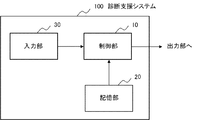
- FIG. 1 is a diagram illustrating a configuration of a diagnosis support system 100 according to the present embodiment.
- the diagnosis support system 100 in this embodiment includes a control unit 10, a storage unit 20, an input unit 30, and an output unit 40.
- each part which comprises the data management apparatus of each embodiment is comprised by hardware, such as a logic circuit.
- Each unit includes a computer control circuit, a storage device, a program loaded in the storage device, a storage unit such as a hard disk for storing the program, and the like, and may be realized by any combination of hardware and software. As long as there is no notice, the realization method and apparatus are not limited.
- the control unit 10 refers to the storage unit 20 and determines a diagnostician having a skill level equal to or higher than a reference value as a diagnostic sample of the tissue sample.
- the intermediate value is a value indicating a boundary region in which it is difficult to determine whether the tissue sample is malignant or benign. For example, when the output value of the tissue specimen malignancy determination system (when the malignancy is output at 0 to 1.0) takes a value between 0.25 and 0.75, these are the intermediate malignancy. Value.
- the storage unit 20 stores a diagnosis person who diagnoses a tissue specimen and its skill level in association with each other.
- the skill level indicates a higher value as, for example, the number of tissue samples diagnosed by the diagnostician or the years of diagnostic work experience of the diagnostician increases.
- the input unit 30 acquires the malignancy of the tissue specimen to be diagnosed from a user terminal connected to the diagnosis support system 100.
- the output unit 40 outputs the tissue specimen diagnoser determined by the control unit 10 to a user terminal or the like.
- the skill level of the pathologist is represented by, for example, the years of diagnosis experience of the pathologist.
- FIG. 3 is a diagram showing an operation procedure until the diagnosis support system 100 distributes the tissue specimen to a pathologist having a high skill level.
- the control unit 10 determines whether or not the value indicates an intermediate value (S1).
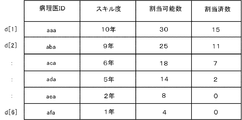
- the control unit 10 determines that the malignancy value is an intermediate value, the control unit 10 reads the table in FIG. 2 from the storage unit 20 and searches for a pathologist to which a tissue specimen is assigned. The control unit 10 sets the subscript i to 1 (S2). Referring to FIG. 2, since the number of pathologists d [i] to be candidates for distribution is 6, the condition of subscript i ⁇ the number of pathologists is satisfied (Yes in S3). Further, the control unit 10 determines whether or not the skill level of each pathologist is equal to or greater than a predetermined reference value (S4).
- the predetermined reference value is, for example, a diagnosis experience of 5 years or more.
- the control unit 10 first determines whether or not the skill level of the pathologist aaa of d [1] is greater than or equal to a predetermined reference value. Since the skill level (year of diagnosis experience) of the pathologist aaa of d [1] is 10 years, the control unit 10 determines that the skill level is equal to or higher than a predetermined reference value (Yes in S4). At this time, if the skill level of the pathologist aaa of d [1] is less than or equal to a predetermined reference value, the control unit 10 subsequently determines that the skill level of the pathologist aba of d [2] is a predetermined level. It is determined whether or not the reference value is exceeded (No in S4, S8, S3, S4).
- control unit 10 repeats this operation until a pathologist with a high skill level is found (S3, S4, S8 loop).
- the control unit 10 determines whether or not the assigned number + 1 of the pathologist with high skill level, for example, the pathologist aaa of d [1], exceeds the assignable number (S5).
- the control unit 10 determines that the pathologist aaa can be assigned (S5). No), the tissue specimen is assigned to the pathologist aaa, and the ID of this pathologist is output (S6). Finally, 1 is added to the allocated number of pathologists aaa to update the allocated number (S7).
- the control unit 10 then continues to the pathologist with the next highest skill level, for example, d [2 ], It is determined whether or not the allocated number +1 of the pathologist aba exceeds the allocatable number (Yes in S5, S8, S3, S4, S5).
- control unit 10 repeats this operation until an assigned pathologist for the tissue specimen is found.
- the control unit 10 assigns the assigned number in order from the pathologist with the lowest skill degree. A pathologist who has not reached the possible number is searched, and tissue samples are sorted (S9 to S13).
- the malignancy value is extremely high, for example, the malignancy value is 1.0, and when the malignancy value is extremely low, for example, the malignancy value is 0. This is the case. Since the specific flow up to the search is the same as the above example, it is omitted here.
- the diagnosis support apparatus 100 in the present embodiment can reduce the risk of misdiagnosis during diagnosis of a tissue specimen. This is because, when the control unit 10 determines that the malignancy value of the tissue sample is an intermediate value, the diagnosis of the tissue sample is assigned to a pathologist with a high skill level with reference to the storage unit 20. is there.
- FIG. 4 is a diagram showing a configuration of a diagnosis support system 100 according to the second embodiment of the present invention.
- the diagnosis support system 100 includes a control unit 10, a storage unit 20, and an input unit 30.
- the control unit 10 refers to the storage unit 20 and determines the diagnostician having a skill level equal to or higher than a reference value.
- the storage unit 20 stores the diagnoser and the skill level in association with each other.
- the input unit 30 inputs the malignancy of the tissue sample.
- the diagnosis support system 100 can reduce the risk of misdiagnosis during diagnosis of a tissue specimen. This is because, when the control unit 10 determines that the malignancy value of the tissue sample is an intermediate value, the diagnosis of the tissue sample is assigned to a pathologist with a high skill level with reference to the storage unit 20. is there.
Landscapes
- Business, Economics & Management (AREA)
- Human Resources & Organizations (AREA)
- Engineering & Computer Science (AREA)
- Strategic Management (AREA)
- Economics (AREA)
- Entrepreneurship & Innovation (AREA)
- Educational Administration (AREA)
- General Business, Economics & Management (AREA)
- Game Theory and Decision Science (AREA)
- Marketing (AREA)
- Operations Research (AREA)
- Quality & Reliability (AREA)
- Tourism & Hospitality (AREA)
- Physics & Mathematics (AREA)
- Development Economics (AREA)
- General Physics & Mathematics (AREA)
- Theoretical Computer Science (AREA)
- Health & Medical Sciences (AREA)
- Biomedical Technology (AREA)
- Medical Informatics (AREA)
- Public Health (AREA)
- Data Mining & Analysis (AREA)
- Databases & Information Systems (AREA)
- Pathology (AREA)
- Epidemiology (AREA)
- General Health & Medical Sciences (AREA)
- Primary Health Care (AREA)
- Investigating Or Analysing Biological Materials (AREA)
- Management, Administration, Business Operations System, And Electronic Commerce (AREA)
- Medical Treatment And Welfare Office Work (AREA)
- Investigating Or Analysing Materials By Optical Means (AREA)
Abstract
Description
以下、図面を参照して本発明による診断支援システム100の実施形態を説明する。ただし、以下の実施形態に記載されている構成要素はあくまでも例示であり、本発明の技術的範囲をそれらのみに限定する趣旨のものではない。
制御部10で、悪性度の値が中間値であると判断した場合、制御部10は、記憶部20から図2の表を読み出し、組織標本を割当てる病理医を検索する。制御部10は、添え字iを1とする(S2)。図2を参照すると、振分けの候補となる病理医数d[i]は6名であるため、添え字i≦病理医数の条件を満たす(S3のYes)。さらに、制御部10は、各々の病理医のスキル度が所定の基準値以上か否かを判断する(S4)。所定の基準値とは、例えば、診断経験年数が5年以上である。制御部10は、図2を参照し、まず最初にd[1]の病理医aaaのスキル度が所定の基準値以上か否かを判断する。d[1]の病理医aaaのスキル度(診断経験年数)は、10年であるため、制御部10は、スキル度が、所定の基準値以上であると判断する(S4のYes)。このとき、d[1]の病理医aaaのスキル度が、所定の基準値以下であった場合には、続いて、制御部10は、d[2]の病理医abaのスキル度が所定の基準値以上であるか否かを判断する(S4のNo、S8、S3、S4)。
組織標本の悪性度が中間値でなく、例えば、悪性度の値が極端に高い、若しくは極端に低いなどといった場合、制御部10は、スキル度の1番低い病理医から順に割当済数が割当可能数に到達していない病理医を検索し、組織標本の振分けを行う(S9~S13)。ここで、悪性度の値が極端に高い場合とは、例えば、悪性度の値が1.0の場合であり、悪性度の値が極端に低い場合とは、例えば、悪性度の値が0の場合である。検索までの具体的な流れは、前記例と同様のため、ここでは省略する。
図4は、本発明の第2の実施形態に係る診断支援システム100の構成を示す図である。本実施形態に係る診断支援システム100は、制御部10、記憶部20、及び入力部30を包含する。制御部10は、組織標本の悪性度が中間値である場合に、記憶部20を参照して、スキル度が基準値以上の前記診断者を決定する。記憶部20は、診断者とそのスキル度を対応付けて記憶する。入力部30は、組織標本の悪性度を入力する。
20 記憶部
30 入力部
40 出力部
100 診断支援システム
Claims (9)
- 組織標本の悪性度を入力する入力手段と、
診断者とそのスキル度を対応付けて記憶する記憶手段と、
前記悪性度が中間値である場合に、前記記憶手段を参照して、前記スキル度が基準値以上の前記診断者を決定する制御手段と、を備える診断支援システム。 - 前記中間値が、所定の最小境界値と所定の最大境界値の間の値である、請求項1に記載の診断支援システム。
- 前記記憶手段は、さらに、前記診断者への前記組織標本の割当て可能数及び割当て済数を前記診断者と対応付けて記憶し、前記制御手段は、前記割当て済数が、前記割当て可能数未満である前記診断者を決定する請求項1または2に記載の診断支援システム。
- 組織標本の悪性度を入力し、
診断者とそのスキル度を対応付けて記憶し、
前記悪性度が中間値である場合に、前記スキル度が基準値以上の前記診断者を決定する、診断支援方法。 - 前記中間値が、所定の最小境界値と所定の最大境界値の間の値である、請求項4に記載の診断支援方法。
- 前記診断者への前記組織標本の割当て可能数及び割当て済数を前記診断者と対応付けて記憶し、前記割当て済数が、前記割当て可能数未満である前記診断者を決定する請求項4または5に記載の診断支援方法。
- 組織標本の悪性度を入力する入力ステップと、
診断者とそのスキル度を対応付けて記憶する記憶ステップと、
前記悪性度が中間値である場合に、前記記憶ステップで記憶した前記スキル度を参照して、前記スキル度が基準値以上の前記診断者を決定する制御ステップと、をコンピュータに実行させる診断支援プログラムを記録するコンピュータで読み取り可能な記録媒体。 - 前記中間値が、所定の最小境界値と所定の最大境界値の間の値である、請求項7に記載の記録媒体。
- 前記記憶ステップは、さらに、前記診断者への前記組織標本の割当て可能数及び割当て済数を前記診断者と対応付けて記憶し、前記制御ステップは、前記割当て済数が、前記割当て可能数未満である前記診断者を決定する請求項7または8に記載の記録媒体。
Priority Applications (2)
| Application Number | Priority Date | Filing Date | Title |
|---|---|---|---|
| JP2014552927A JPWO2014097600A1 (ja) | 2012-12-18 | 2013-12-16 | 診断支援システム、診断支援方法、及び診断支援プログラム |
| US14/652,455 US20150310376A1 (en) | 2012-12-18 | 2013-12-16 | Diagnostic assistance system, diagnostic assistance method, and recording medium |
Applications Claiming Priority (2)
| Application Number | Priority Date | Filing Date | Title |
|---|---|---|---|
| JP2012-275849 | 2012-12-18 | ||
| JP2012275849 | 2012-12-18 |
Publications (1)
| Publication Number | Publication Date |
|---|---|
| WO2014097600A1 true WO2014097600A1 (ja) | 2014-06-26 |
Family
ID=50977962
Family Applications (1)
| Application Number | Title | Priority Date | Filing Date |
|---|---|---|---|
| PCT/JP2013/007374 Ceased WO2014097600A1 (ja) | 2012-12-18 | 2013-12-16 | 診断支援システム、診断支援方法、及び記録媒体 |
Country Status (3)
| Country | Link |
|---|---|
| US (1) | US20150310376A1 (ja) |
| JP (1) | JPWO2014097600A1 (ja) |
| WO (1) | WO2014097600A1 (ja) |
Cited By (1)
| Publication number | Priority date | Publication date | Assignee | Title |
|---|---|---|---|---|
| WO2022201417A1 (ja) * | 2021-03-25 | 2022-09-29 | 日本電気株式会社 | 検査支援装置、検査支援方法、および記録媒体 |
Citations (2)
| Publication number | Priority date | Publication date | Assignee | Title |
|---|---|---|---|---|
| WO2011108551A1 (ja) * | 2010-03-03 | 2011-09-09 | オリンパス株式会社 | 診断情報配信装置および病理診断システム |
| JP2012063919A (ja) * | 2010-09-15 | 2012-03-29 | Fujifilm Corp | 医用レポート評価装置、医用レポート評価方法、医用レポート評価プログラム、並びに医用ネットワークシステム |
Family Cites Families (2)
| Publication number | Priority date | Publication date | Assignee | Title |
|---|---|---|---|---|
| JP3742549B2 (ja) * | 2000-08-29 | 2006-02-08 | オリンパス株式会社 | 医療用画像ファイリングシステム |
| JP2005165648A (ja) * | 2003-12-02 | 2005-06-23 | Canon Inc | 連携診断装置 |
-
2013
- 2013-12-16 JP JP2014552927A patent/JPWO2014097600A1/ja active Pending
- 2013-12-16 WO PCT/JP2013/007374 patent/WO2014097600A1/ja not_active Ceased
- 2013-12-16 US US14/652,455 patent/US20150310376A1/en not_active Abandoned
Patent Citations (2)
| Publication number | Priority date | Publication date | Assignee | Title |
|---|---|---|---|---|
| WO2011108551A1 (ja) * | 2010-03-03 | 2011-09-09 | オリンパス株式会社 | 診断情報配信装置および病理診断システム |
| JP2012063919A (ja) * | 2010-09-15 | 2012-03-29 | Fujifilm Corp | 医用レポート評価装置、医用レポート評価方法、医用レポート評価プログラム、並びに医用ネットワークシステム |
Cited By (1)
| Publication number | Priority date | Publication date | Assignee | Title |
|---|---|---|---|---|
| WO2022201417A1 (ja) * | 2021-03-25 | 2022-09-29 | 日本電気株式会社 | 検査支援装置、検査支援方法、および記録媒体 |
Also Published As
| Publication number | Publication date |
|---|---|
| JPWO2014097600A1 (ja) | 2017-01-12 |
| US20150310376A1 (en) | 2015-10-29 |
Similar Documents
| Publication | Publication Date | Title |
|---|---|---|
| Hernandez-Suarez et al. | Machine learning prediction models for in-hospital mortality after transcatheter aortic valve replacement | |
| US20240185130A1 (en) | Normalizing text attributes for machine learning models | |
| JP5462414B2 (ja) | 類似症例検索装置および関連度データベース作成装置並びに類似症例検索方法および関連度データベース作成方法 | |
| JP6006081B2 (ja) | 疾患診断のための最適の診断要素セット決定装置及び方法 | |
| CN113099047B (zh) | 用于案例分配的技术 | |
| JP6187989B2 (ja) | 生物組織に共局在するバイオマーカーを解析するためのシステム及び方法 | |
| CN109299190A (zh) | 分布式存储系统中处理对象的元数据的方法及装置 | |
| RU2010137352A (ru) | Способ, компьютерный программный продукт и система обеспечения поддержки принятия клинического решения | |
| JP5304950B2 (ja) | データベース管理方法、データベース管理装置及びデータベース管理プログラム | |
| CN117859123A (zh) | 全载玻片图像搜索 | |
| JP2021504797A (ja) | 病理学ワークフローを最適化するためのデバイス、システム及び方法 | |
| Riegman et al. | TuBaFrost 1: uniting local frozen tumour banks into a European network: an overview | |
| Maaskant et al. | Stage migration due to introduction of the sentinel node procedure: a population-based study | |
| JP7786497B2 (ja) | 画像解析装置 | |
| JP5773493B2 (ja) | 情報処理装置 | |
| Atallah-Yunes et al. | Challenges identifying DLBCL patients with poor outcomes to upfront chemoimmunotherapy and its impact on frontline clinical trials | |
| WO2014097600A1 (ja) | 診断支援システム、診断支援方法、及び記録媒体 | |
| Levi et al. | Implementation of FocalPoint GS location‐guided imaging system: experience in a clinical setting | |
| Májek et al. | Performance indicators in a newly established organized cervical screening programme: registry-based analysis in the Czech Republic | |
| Cao et al. | Optimizing thyroid AUS nodules malignancy prediction: a comprehensive study of logistic regression and machine learning models | |
| US20140355866A1 (en) | Method and apparatus for identifying root cause of defect using composite defect map | |
| Nakas et al. | Surgical assessment of malignant pleural mesothelioma: have we reached a critical stage? | |
| CN109976905A (zh) | 内存管理方法、装置和电子设备 | |
| Ozkan et al. | Role of anterior prostatic fat pad dissection for extended lymphadenectomy in prostate cancer: a non-randomized study of 100 patients | |
| COSMIC–COVID-19 Lung Single Cell Mass Cytometry Imaging Consortium STUDY et al. | Unbiased single cell spatial analysis localises inflammatory clusters of immature neutrophils-CD8 T cells to alveolar progenitor cells in fatal COVID-19 lungs |
Legal Events
| Date | Code | Title | Description |
|---|---|---|---|
| 121 | Ep: the epo has been informed by wipo that ep was designated in this application |
Ref document number: 13865008 Country of ref document: EP Kind code of ref document: A1 |
|
| ENP | Entry into the national phase |
Ref document number: 2014552927 Country of ref document: JP Kind code of ref document: A |
|
| WWE | Wipo information: entry into national phase |
Ref document number: 14652455 Country of ref document: US |
|
| NENP | Non-entry into the national phase |
Ref country code: DE |
|
| 122 | Ep: pct application non-entry in european phase |
Ref document number: 13865008 Country of ref document: EP Kind code of ref document: A1 |