WO2014095846A1 - Automotive compounds featuring low surface tack - Google Patents
Automotive compounds featuring low surface tack Download PDFInfo
- Publication number
- WO2014095846A1 WO2014095846A1 PCT/EP2013/076879 EP2013076879W WO2014095846A1 WO 2014095846 A1 WO2014095846 A1 WO 2014095846A1 EP 2013076879 W EP2013076879 W EP 2013076879W WO 2014095846 A1 WO2014095846 A1 WO 2014095846A1
- Authority
- WO
- WIPO (PCT)
- Prior art keywords
- polymer composition
- formula
- propylene copolymer
- heco
- range
- Prior art date
- Legal status (The legal status is an assumption and is not a legal conclusion. Google has not performed a legal analysis and makes no representation as to the accuracy of the status listed.)
- Ceased
Links
- 0 *OC(c1ccccc1C(O*)=O)=O Chemical compound *OC(c1ccccc1C(O*)=O)=O 0.000 description 1
- DBSNNWSZRKJGJL-UHFFFAOYSA-N CC(C)(C1)N(C)C(C)(C)CC1OC(I)=O Chemical compound CC(C)(C1)N(C)C(C)(C)CC1OC(I)=O DBSNNWSZRKJGJL-UHFFFAOYSA-N 0.000 description 1
Classifications
-
- C—CHEMISTRY; METALLURGY
- C08—ORGANIC MACROMOLECULAR COMPOUNDS; THEIR PREPARATION OR CHEMICAL WORKING-UP; COMPOSITIONS BASED THEREON
- C08L—COMPOSITIONS OF MACROMOLECULAR COMPOUNDS
- C08L23/00—Compositions of homopolymers or copolymers of unsaturated aliphatic hydrocarbons having only one carbon-to-carbon double bond; Compositions of derivatives of such polymers
- C08L23/02—Compositions of homopolymers or copolymers of unsaturated aliphatic hydrocarbons having only one carbon-to-carbon double bond; Compositions of derivatives of such polymers not modified by chemical after-treatment
- C08L23/10—Homopolymers or copolymers of propene
-
- C—CHEMISTRY; METALLURGY
- C08—ORGANIC MACROMOLECULAR COMPOUNDS; THEIR PREPARATION OR CHEMICAL WORKING-UP; COMPOSITIONS BASED THEREON
- C08L—COMPOSITIONS OF MACROMOLECULAR COMPOUNDS
- C08L23/00—Compositions of homopolymers or copolymers of unsaturated aliphatic hydrocarbons having only one carbon-to-carbon double bond; Compositions of derivatives of such polymers
- C08L23/02—Compositions of homopolymers or copolymers of unsaturated aliphatic hydrocarbons having only one carbon-to-carbon double bond; Compositions of derivatives of such polymers not modified by chemical after-treatment
- C08L23/10—Homopolymers or copolymers of propene
- C08L23/14—Copolymers of propene
-
- C—CHEMISTRY; METALLURGY
- C08—ORGANIC MACROMOLECULAR COMPOUNDS; THEIR PREPARATION OR CHEMICAL WORKING-UP; COMPOSITIONS BASED THEREON
- C08L—COMPOSITIONS OF MACROMOLECULAR COMPOUNDS
- C08L23/00—Compositions of homopolymers or copolymers of unsaturated aliphatic hydrocarbons having only one carbon-to-carbon double bond; Compositions of derivatives of such polymers
- C08L23/02—Compositions of homopolymers or copolymers of unsaturated aliphatic hydrocarbons having only one carbon-to-carbon double bond; Compositions of derivatives of such polymers not modified by chemical after-treatment
- C08L23/04—Homopolymers or copolymers of ethene
- C08L23/06—Polyethylene
-
- C—CHEMISTRY; METALLURGY
- C08—ORGANIC MACROMOLECULAR COMPOUNDS; THEIR PREPARATION OR CHEMICAL WORKING-UP; COMPOSITIONS BASED THEREON
- C08K—Use of inorganic or non-macromolecular organic substances as compounding ingredients
- C08K3/00—Use of inorganic substances as compounding ingredients
- C08K3/34—Silicon-containing compounds
-
- C—CHEMISTRY; METALLURGY
- C08—ORGANIC MACROMOLECULAR COMPOUNDS; THEIR PREPARATION OR CHEMICAL WORKING-UP; COMPOSITIONS BASED THEREON
- C08K—Use of inorganic or non-macromolecular organic substances as compounding ingredients
- C08K5/00—Use of organic ingredients
- C08K5/04—Oxygen-containing compounds
- C08K5/13—Phenols; Phenolates
- C08K5/134—Phenols containing ester groups
- C08K5/1345—Carboxylic esters of phenolcarboxylic acids
-
- C—CHEMISTRY; METALLURGY
- C08—ORGANIC MACROMOLECULAR COMPOUNDS; THEIR PREPARATION OR CHEMICAL WORKING-UP; COMPOSITIONS BASED THEREON
- C08K—Use of inorganic or non-macromolecular organic substances as compounding ingredients
- C08K5/00—Use of organic ingredients
- C08K5/16—Nitrogen-containing compounds
- C08K5/34—Heterocyclic compounds having nitrogen in the ring
- C08K5/3412—Heterocyclic compounds having nitrogen in the ring having one nitrogen atom in the ring
- C08K5/3432—Six-membered rings
- C08K5/3435—Piperidines
-
- C—CHEMISTRY; METALLURGY
- C08—ORGANIC MACROMOLECULAR COMPOUNDS; THEIR PREPARATION OR CHEMICAL WORKING-UP; COMPOSITIONS BASED THEREON
- C08K—Use of inorganic or non-macromolecular organic substances as compounding ingredients
- C08K5/00—Use of organic ingredients
- C08K5/16—Nitrogen-containing compounds
- C08K5/34—Heterocyclic compounds having nitrogen in the ring
- C08K5/3467—Heterocyclic compounds having nitrogen in the ring having more than two nitrogen atoms in the ring
- C08K5/3477—Six-membered rings
- C08K5/3492—Triazines
- C08K5/34926—Triazines also containing heterocyclic groups other than triazine groups
-
- C—CHEMISTRY; METALLURGY
- C08—ORGANIC MACROMOLECULAR COMPOUNDS; THEIR PREPARATION OR CHEMICAL WORKING-UP; COMPOSITIONS BASED THEREON
- C08L—COMPOSITIONS OF MACROMOLECULAR COMPOUNDS
- C08L2201/00—Properties
- C08L2201/08—Stabilised against heat, light or radiation or oxydation
-
- C—CHEMISTRY; METALLURGY
- C08—ORGANIC MACROMOLECULAR COMPOUNDS; THEIR PREPARATION OR CHEMICAL WORKING-UP; COMPOSITIONS BASED THEREON
- C08L—COMPOSITIONS OF MACROMOLECULAR COMPOUNDS
- C08L2205/00—Polymer mixtures characterised by other features
- C08L2205/02—Polymer mixtures characterised by other features containing two or more polymers of the same C08L -group
-
- C—CHEMISTRY; METALLURGY
- C08—ORGANIC MACROMOLECULAR COMPOUNDS; THEIR PREPARATION OR CHEMICAL WORKING-UP; COMPOSITIONS BASED THEREON
- C08L—COMPOSITIONS OF MACROMOLECULAR COMPOUNDS
- C08L2205/00—Polymer mixtures characterised by other features
- C08L2205/03—Polymer mixtures characterised by other features containing three or more polymers in a blend
-
- C—CHEMISTRY; METALLURGY
- C08—ORGANIC MACROMOLECULAR COMPOUNDS; THEIR PREPARATION OR CHEMICAL WORKING-UP; COMPOSITIONS BASED THEREON
- C08L—COMPOSITIONS OF MACROMOLECULAR COMPOUNDS
- C08L2205/00—Polymer mixtures characterised by other features
- C08L2205/03—Polymer mixtures characterised by other features containing three or more polymers in a blend
- C08L2205/035—Polymer mixtures characterised by other features containing three or more polymers in a blend containing four or more polymers in a blend
-
- C—CHEMISTRY; METALLURGY
- C08—ORGANIC MACROMOLECULAR COMPOUNDS; THEIR PREPARATION OR CHEMICAL WORKING-UP; COMPOSITIONS BASED THEREON
- C08L—COMPOSITIONS OF MACROMOLECULAR COMPOUNDS
- C08L2207/00—Properties characterising the ingredient of the composition
- C08L2207/02—Heterophasic composition
-
- C—CHEMISTRY; METALLURGY
- C08—ORGANIC MACROMOLECULAR COMPOUNDS; THEIR PREPARATION OR CHEMICAL WORKING-UP; COMPOSITIONS BASED THEREON
- C08L—COMPOSITIONS OF MACROMOLECULAR COMPOUNDS
- C08L2207/00—Properties characterising the ingredient of the composition
- C08L2207/06—Properties of polyethylene
- C08L2207/062—HDPE
-
- C—CHEMISTRY; METALLURGY
- C08—ORGANIC MACROMOLECULAR COMPOUNDS; THEIR PREPARATION OR CHEMICAL WORKING-UP; COMPOSITIONS BASED THEREON
- C08L—COMPOSITIONS OF MACROMOLECULAR COMPOUNDS
- C08L23/00—Compositions of homopolymers or copolymers of unsaturated aliphatic hydrocarbons having only one carbon-to-carbon double bond; Compositions of derivatives of such polymers
- C08L23/02—Compositions of homopolymers or copolymers of unsaturated aliphatic hydrocarbons having only one carbon-to-carbon double bond; Compositions of derivatives of such polymers not modified by chemical after-treatment
- C08L23/16—Ethylene-propylene or ethylene-propylene-diene copolymers
Definitions
- the present invention is related to a polymer composition comprising a heterophasic propylene copolymer (HECO) and a specific combination of UV-absorbers. Furthermore the present invention relates to the use of a composition as well as a combination of UV- absorbers in a polymer composition to improve surface tack of the same.
- HECO heterophasic propylene copolymer
- Automotive interior parts like dashboards, door claddings, trims etc. are commonly made from polymers. For such parts it is often tried to mimic a leather- or fabric-like surface and touch in order to give occupants a high-quality impression of the car. As a result, haptic and surface characteristics are important properties regarding automotive interior parts.
- One factor in this respect is the surface tack of a part.
- the UV-absorber it was unfortunately found that the application of the frequently used combinations of hindered amine light stabilizers (HALS) "Tinuvin770/Chimasorbl 19" or “Chimasorbl 19/Chimasorb944" which are known to the skilled person in fact lead to a tacky feel of the surface. Therefore, the objection of the present invention is the finding of polymer composition comprising a new UV-absorber system which leads to an improved surface tack behavior.
- HALS hindered amine light stabilizers
- the present invention is related to a polymer composition (C), comprising (a) a heterophasic propylene copolymer (HECO),
- the molecular weight is below 1000 g/mol and R is a linear or branched C 5 to C25 alkyl residue, and
- R 2 is a linear or branched C 5 to C25 alkyl residue
- R 3 and R 4 are independently from each other methyl, ethyl, linear and/or branched C3 to C12 alkyl residues.
- the present invention also relates to an automotive article comprising the above polymer composition (C).
- the present invention also relates to the use of a combination of
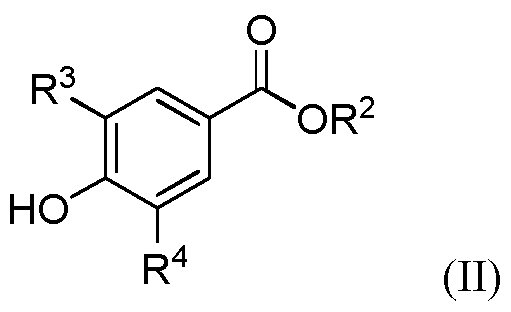
- R 1 is a linear or branched C 5 to C25 alkyl residue, and a benzoate derivative of formula (II)
- R 2 is a linear or branched C 5 to C25 alkyl residue
- R 3 and R 4 are independently from each other methyl, ethyl, linear and/or branched C3 to C12 alkyl residues, in a polymer composition (C) comprising further a heterophasic propylene copolymer (HECO) and a mineral filler (F)
- the present invention further relates to a process for the preparation of the above polymer composition (C) by extruding the heterophasic propylene copolymer (HECO), the mineral filler (F), the l,2,2,6,6-pentamethyl-4-piperidylester derivative of formula (I) and the benzoate derivative of formula (II) in an extruder.
- HECO heterophasic propylene copolymer
- F mineral filler
- II benzoate derivative of formula (II)
- a further aspect of the present invention is the use of the above polymer composition (C) an automotive application.
- the polymer composition (C) of the present invention comprises in a preferred embodiment
- heterophasic propylene copolymer HECO in an amount of 30 to 80 wt.-%, more preferably 40 to 75 wt.-%, still more preferably 50 to 70 wt.-%,
- the polymer composition further comprises a polypropylene (PP). In another preferred embodiment, the polymer composition further comprises a high density polyethylene (HDPE).
- PP polypropylene
- HDPE high density polyethylene
- the polymer composition (C) of the present invention comprises in a preferred embodiment
- heterophasic propylene copolymer HECO in an amount of 30 to 80 wt.-%, more preferably 40 to 75 wt.-%, still more preferably 50 to 70 wt.-%,
- HDPE high density polyethylene
- heterophenasic indicates that an elastomeric copolymer is (finely) dispersed in a matrix.
- the elastomeric copolymer forms inclusions in the matrix.
- the matrix contains (finely) dispersed inclusions being not part of the matrix and said inclusions contain the elastomeric copolymer.
- inclusion shall preferably indicate that the matrix and the inclusion form different phases within the heterophasic propylene copolymer, said inclusions are for instance visible by high resolution microscopy, like electron microscopy or scanning force microscopy.
- the composition comprises the polypropylene (PP) and/or the high density polyethylene (HDPE)
- the final composition is probably of a complex structure.
- Probably the matrix of the heterophasic propylene copolymer (HECO) forms a continuous phase with the polypropylene (PP), and optionally the high density polyethylene (HDPE) forms individually inclusions dispersed therein.
- inclusions of the final composition may also contain the mineral filler (F); however preferably the mineral filler (F) forms separate inclusions within the matrix.
- the reduction of stickiness is preferably accomplished in case the stickiness index, especially in terms of the surface tack (QT) as determined in the example section, is below a value of 0.75, preferably below a value of 0.72, still more preferably below a value of 0.70, like in the range of 0.50 to 0.72 or in the range of 0.50 to 0.70.
- the stickiness index especially in terms of the surface tack (QT) as determined in the example section, is below a value of 0.75, preferably below a value of 0.72, still more preferably below a value of 0.70, like in the range of 0.50 to 0.72 or in the range of 0.50 to 0.70.
- the polymer composition according to the present invention may be prepared by compounding the components within suitable melt mixing devices for preparing polymeric compounds, including in particular extruders, like single screw extruders as well as twin screw extruders.
- suitable melt mixing devices include planet extruders and single screw co-kneaders.
- twin screw extruders including high intensity mixing and kneading sections.
- Suitable melt temperatures for preparing the compositions are in the range from 170 to 300 °C, preferably in the range from 200 to 260 °C. In the following the individual components are defined in more detail.
- HECO Heterophasic propylene copolymer
- heterophasic propylene copolymer As already defined above, a heterophasic system comprises a polypropylene matrix and an amorphous elastomer, i.e. the elastomeric propylene copolymer (E), dispersed therein. Such polymer compositions are well known in the art and commercially available. This applies especially for the heterophasic propylene copolymer (HECO) as defined in the instant invention.
- the polypropylene matrix (M) of the heterophasic propylene copolymer (HECO) can be a propylene homopolymer or a propylene copolymer with comonomers selected from ethylene and/or C4 to C12 a-olefins.
- the polypropylene matrix (M) of the heterophasic propylene copolymer (HECO) is a propylene homopolymer.
- the xylene cold insoluble (XCI) fraction of the heterophasic propylene copolymer (HECO) is dominated by the polypropylene matrix (M), whereas the main component of the xylene cold soluble fraction is the elastomeric propylene copolymer (E). Accordingly on the one hand the properties of the xylene cold insoluble (XCI) fraction and the polypropylene matrix (M) and on the other hand the properties of the xylene cold soluble (XCS) fraction and the elastomeric propylene copolymer (E) are essentially the same.
- propylene homopolymer used in the instant invention relates to a polypropylene that consists substantially, i.e. of more than 99.7 wt.-%, still more preferably of at least 99.8 wt.-%, of propylene units. In a preferred embodiment only propylene units in the propylene homopolymer are detectable.
- the comonomer content of the polypropylene matrix (M) and/or of the xylene cold insoluble (XCI) fraction is preferably equal or below 1.0 wt.-%, more preferably not more than 0.8 wt.-%, still more preferably not more than 0.5 wt.-%, like not more than 0.2 wt.-%, e.g. not detectable.
- the polypropylene matrix (M) and/or of the xylene cold insoluble (XCI) fraction of the heterophasic propylene copolymer (HECO) has a melt flow rate MFR 2 (230 °C) in the range of 30 to 90 g/10 min, more preferably in the range of 40 to 70 g/10 min, still more preferably in the range of 45 to 60 g/10 min.
- the heterophasic propylene copolymer (HECO) comprises an elastomeric propylene copolymer (E) which is dispersed within said polypropylene matrix (M).
- the elastomeric propylene copolymer (E) comprises monomers copolymerizable with propylene, for example, comonomers such as ethylene and/or C4 to C12 a-olefins, e.g. 1-butene and/or 1-hexene.
- the elastomeric propylene copolymer (E) comprises, especially consists of, monomers copolymerizable with propylene selected from the group consisting of ethylene, 1 -butene and 1 -hexene. More specifically the elastomeric propylene copolymer (E) comprises - apart from propylene - units derivable from ethylene and/or 1-butene.
- the elastomeric propylene copolymer (E) phase comprises units derivable from ethylene and propylene only.
- the polypropylene matrix (M) of the heterophasic propylene copolymer (HECO) is a propylene copolymer
- the comonomer(s) of the propylene copolymer and the elastomeric propylene copolymer (E) are the same.
- the elastomeric propylene copolymer (E) and/or the xylene cold soluble (XCS) fraction of the heterophasic propylene copolymer (HECO) has a comonomer content in the range of 10 to 50 wt.-%, more preferably 20 to 45 wt.-%, still more preferably 30 to 42 w -%.
- the elastomeric propylene copolymer (E) and/or the xylene cold soluble (XCS) fraction of the heterophasic propylene copolymer (HECO) has an intrinsic viscosity (IV) in the range of 1.0 to 8.0 dl/g, more preferably in the range of 1.5 to 6.0 dl/g, still more preferably in the range of 2.0 to 3.5 dl/g.
- the amount of the elastomeric propylene copolymer (E) and/or of the xylene cold soluble (XCS) fraction of the heterophasic propylene copolymer (HECO) is in the range of 10 to 50 wt.-%, more preferably 15 to 40 wt.-%, still more preferably 20 to 35 wt.-%, based on the total amount of the heterophasic propylene copolymer (HECO).
- the comonomer content of the heterophasic propylene copolymer (HECO) is preferably in the range of 3.0 to 25 wt.-%, more preferably in the range of 5.0 to 20 wt.-%, still more preferably in the range of 10 to 18 wt.-%, based on the total amount of the heterophasic propylene copolymer (HECO).
- the heterophasic propylene copolymer (HECO) has a melt flow rate MFR 2 (230 °C) in the range of 1.0 to 50 g/10 min, more preferably 2.0 to 30 g/10 min, still more preferably 5.0 to 20 g/10 min.
- the heterophasic propylene copolymer (HECO) has a flexural modulus in the range of 600 to 950 MPa, more preferably 650 to 900 MPa, still more preferably 700 to 850 MPa, even more preferably in the range of 700 to 800 MPa.
- heterophasic propylene copolymer is the commercial product of the EF-series of Borealis AG.
- the polymer composition (C) according to the present invention optionally comprises a polypropylene (PP).
- PP polypropylene
- the polypropylene (PP) can be a propylene homopolymer or a propylene copolymer with comonomers selected from ethylene and/or C4 to C12 a-olefins.
- the polypropylene (PP) is a propylene homopolymer according to the definition described above.
- the polypropylene (PP) preferably has a melt flow rate MFR 2 (230 °C) in the range of 3 to 50 g/10 min, preferably in the range of 5 to 35 g/10 min, still more preferably in the range of 10 to 25 g/10 min.
- MFR 2 melt flow rate
- the polypropylene (PP) has a density of at least 890 kg/m 3 , more preferably at least 900 kg/m 3 , still more preferably in the range of 900 to 912 kg/m 3 .
- the polypropylene (PP) is the commercial product HF955MO of Borealis AG.
- High density polyethylene (HDPE) High density polyethylene
- the polymer composition (C) according to the present invention optionally comprises a high density polyethylene (HDPE).
- the high density polyethylene (HDPE) preferably has a melt flow rate MFR 2 (190 °C) in the range of 2 to 30 g/10 min, more preferably in the range of 3 to 20 g/10 min, still more preferably in the range of 5 to 15 g/10 min.
- the high density polyethylene has a density of at least 930 kg/m 3 , more preferably in the range of 930 to 980 kg/m 3 , still more preferably in the range of 940 to 970 kg/m 3 .
- the high density polyethylene is the commercial product MG9641 of Borealis AG.
- the polymer composition (C) according to the present invention comprises a mineral filler, preferably in amounts of up to 40 wt.-%, preferably up to 30 wt.-%, more preferably up to 20 wt.-%, yet more preferably in the range of 5.0 to 40 wt.-%, still more preferably in the range of 5.0 to 30 wt.-%, like in the range of 10.0 to 20 w -%.
- the mineral filler (F) is a phyllosilicate, mica or wollastonite. Even more preferably the mineral filler (F) is selected from the group of mica, wollastonite, kaolinite, smectite, montmorillonite and talc. The most preferred mineral filler (F) is talc.
- the mineral filler (F) preferably has a specific surface area (BET) in the range of 5 to
- the instant polymer composition must comprise two specifically selected light stabilizers,
- Light stabilizers are chemical compounds capable of interfering with the physical and chemical processes of light- induced degradation.
- the polymer composition (C) must comprise two different light stabilizers, one belonging to the class of UV-absorbers, like 4- hydroxybenzoates, and one belonging to the class of free radical scavengers, like hindered amine light stabilizers (HALS).
- UV-absorbers like 4- hydroxybenzoates
- free radical scavengers like hindered amine light stabilizers (HALS).
- Hindered amine light stabilizers are a class of free radical scavengers known to the skilled person.
- a hindered amine light stabilizer (HALS) contains one or more sterically hindered amine functionalities.
- 2,2,6,6-tetramethyl piperidine derivatives are frequently applied as hindered amine light stabilizers (HALS).
- R 1 is a linear or branched C 5 to C25 alkyl residue
- R is a linear or branched C 5 to C25 alkyl residue and R and R are independently from each other Methyl, Ethyl, linear and/or branched C3 to C12 alkyl residues.
- R and R are independently from each other Methyl, Ethyl, linear and/or branched C3 to C12 alkyl residues.
- the combination of the l,2,2,6,6-pentamethyl-4-piperidylester derivative of formula (I) and the benzoate derivative of formula (II) is the only light stabilizer
- one component of the light stabilizer is a 1,2,2,6,6- pentamethyl-4-piperidylester of a fatty acid according to formula (I), whereupon R 1 is a linear or branched C 5 to C25 alkyl residue, more preferably Cn to Cig. In a preferred embodiment, R 1 is a linear Ci6 to Cig alkyl residue.
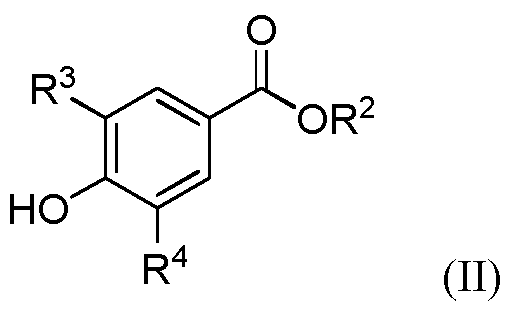
- the other component of the light stabilizers according to the present invention is the benzoate derivative of formula (II), whereupon R 2 is a linear or branched C 5 to C25 alkyl residue, like a linear C 5 to C25 alkyl residue, preferably C10 to C20 alkyl residue, like a linear Cio to C20 alkyl residue, more preferably C12 to Cig alkyl residue, like a linear C12 to Cig alkyl residue.
- R 2 is a linear Ci 6 alkyl residue.
- R 3 and R 4 of the benzoate derivative of formula (II) are independently from each other methyl, ethyl, linear and/or branched C3 to C12 alkyl residues.
- R 3 and R 4 contain no more than 4 carbon atoms, respectively.
- R 3 and R 4 are independently selected from the group consisting of methyl, ethyl, « -propyl, z ' o-propyl, « -butyl, sec. -butyl and/or tert. -butyl. More preferably, R 3 and R 4 are tert. -butyl residues.
- the benzoate derivative of formula (II) is «-hexadecyl-3,5-di-fert.- butyl-4-hydroxybenzoate.
- the weight ratio between the UV-absorber, like the 4-hydroxybenzoate, e.g. the benzoate derivative of formula (II), and the free radical scavenger, like hindered amine light stabilizer (HALS), e.g. the l,2,2,6,6-pentamethyl-4-piperidylester derivative of formula (I), is in the range of 70:30 to 30:70, more preferably in the range of 60:40 to 40:60, still more preferably in the range of 55:45 to 45:55, like 50:50.
- HALS hindered amine light stabilizer
- the amount of the two light stabilizers together in the polymer composition (C) e.g.
- the total amount of the l,2,2,6,6-pentamethyl-4-piperidylester derivative of formula (I) and the benzoate derivative of formula (II) together in the polymer composition (C), is in the range of 0.01 to 5.0 wt.-%, more preferably 0.05 to 3.0 wt.-%, still more preferably 0.1 to 1.0 wt.-%, based on the total amount of the polymer composition (C).
- the instant polymer composition (C) may comprise additional typical additives different to those mentioned above, i.e. different to the light stabilizers and the mineral filler (F).
- Such typical additives are antioxidants and slip agents and pigments.
- the amount of additives excluding the mineral filler (F) and the light stabilizers shall not exceed 8 wt.-%, more preferably 5 wt. -%, still more preferably 3 wt.-% within on the total composition.
- the polymerization system can comprise one or more conventional stirred slurry reactors and/or one or more gas phase reactors.
- the reactors used are selected from the group of loop and gas phase reactors and, in particular, the process employs at least one loop reactor and at least one gas phase reactor. It is also possible to use several reactors of each type, e.g. one loop and two or three gas phase reactors, or two loops and one or two gas phase reactors, in series.
- the process comprises also a prepolymerisation with the chosen catalyst system, as described for instance in detail below comprising (i) a Ziegler-Natta procatalyst, (ii) a cocatalyst and (iii) an external donor.
- the prepolymerisation is conducted as bulk slurry polymerization in liquid propylene, i.e. the liquid phase mainly comprises propylene, with minor amount of other reactants and optionally inert components dissolved therein.
- the prepolymerisation reaction is typically conducted at a temperature of 0 to 50 °C, preferably from 10 to 45 °C, and more preferably from 15 to 40 °C.
- the pressure in the prepolymerisation reactor is not critical but must be sufficiently high to maintain the reaction mixture in liquid phase.
- the pressure may be from 20 to 100 bar, for example 30 to 70 bar.
- the catalyst components are preferably all introduced to the prepolymerisation step.
- hydrogen may be added into the prepolymerization stage to control the molecular weight of the prepolymer as is known in the art.
- antistatic additive may be used to prevent the particles from adhering to each other or to the walls of the reactor.
- a slurry reactor designates any reactor, such as a continuous or simple batch stirred tank reactor or loop reactor, operating in bulk or slurry and in which the polymer forms in particulate form.
- Bok means a polymerization in reaction medium that comprises at least 60 wt.-% monomer.
- the slurry reactor comprises a bulk loop reactor.
- Gas phase reactor means any mechanically mixed or fluid bed reactor.
- the gas phase reactor comprises a mechanically agitated fluid bed reactor with gas velocities of at least 0.2 m/sec.
- the particularly preferred embodiment for the preparation of the heterophasic propylene copolymer (HECO) of the invention comprises carrying out the polymerization in a process comprising either a combination of one loop and one or two gas phase reactors or a combination of two loops and one or two gas phase reactors.
- a preferred multistage process is a slurry-gas phase process, such as developed by Borealis and known as the Borstar ® technology.
- Borealis a slurry-gas phase process
- Borstar ® technology a slurry-gas phase process
- a further suitable slurry-gas phase process is the Spheripol ® process of Basell.
- heterophasic propylene copolymer is produced by using a special Ziegler-Natta procatalyst in combination with a special external donor, as described below in detail, preferably in the Spheripol ® or in the Borstar ® -PP process.
- One preferred multistage process may therefore comprise the steps of:
- Temperature is preferably from 40 to 110 °C, preferably between 50 and 100 °C, in particular between 60 and 90 °C, with a pressure in the range of from 20 to 80 bar, preferably 30 to 60 bar, with the option of adding hydrogen in order to control the molecular weight in a manner known per se.
- the reaction product of the slurry polymerization which preferably is carried out in a loop reactor, is then transferred to the subsequent gas phase reactor(s), wherein the temperature preferably is within the range of from 50 to 130 °C, more preferably 60 to 100 °C, at a pressure in the range of from 5 to 50 bar, preferably 8 to 35 bar, again with the option of adding hydrogen in order to control the molecular weight in a manner known per se.
- the average residence time can vary in the reactor zones identified above.
- the average residence time in the slurry reactor for example a loop reactor, is in the range of from 0.5 to 5 hours, for example 0.5 to 2 hours, while the average residence time in the gas phase reactor generally will be from 1 to 8 hours.
- the polymerization may be effected in a known manner under supercritical conditions in the slurry, preferably loop reactor, and/or as a condensed mode in the gas phase reactor.
- the heterophasic propylene copolymer (HECO) is preferably obtained by a multistage polymerization process, as described above, in the presence of a catalyst system comprising as component (i) a Ziegler-Natta procatalyst which contains a trans-esterification product of a lower alcohol and a phthalic ester.
- the procatalyst used according to the invention is prepared by
- R 1 and R 2 are independently at least a C 5 alkyl
- step d) optionally reacting the product of step c) with additional T1CI4.
- the procatalyst is produced as defined for example in the patent applications WO 87/07620, WO 92/19653, WO 92/19658 and EP 0 491 566. The content of these documents is herein included by reference.
- the adduct which is first melted and then spray crystallized or emulsion solidified, is used as catalyst carrier. In the next step the spray crystallized or emulsion solidified adduct of the formula
- MgCl 2 *nROH wherein R is methyl or ethyl, preferably ethyl and n is 1 to 6, is contacting with T1CI 4 to form a titanised carrier, followed by the steps of
- dialkylphthalate of formula (III) selected from the group consisting of propylhexylphthalate (PrHP), dioctylphthalate (DOP), di-iso- decylphthalate (DIDP), and ditridecylphthalate (DTDP), yet more preferably the dialkylphthalate of formula (I) is a dioctylphthalate (DOP), like di-iso-octylphthalate or diethylhexylphthalate, in particular diethylhexylphthalate,
- DOP dioctylphthalate
- R 1 and R 2 being methyl or ethyl, preferably ethyl
- dialkylphthalat of formula (IV) being the internal donor and • recovering said transesterification product as the procatalyst composition
- the adduct of the formula MgCl 2 *nROH, wherein R is methyl or ethyl and n is 1 to 6, is in a preferred embodiment melted and then the melt is preferably injected by a gas into a cooled solvent or a cooled gas, whereby the adduct is crystallized into a morphologically advantageous form, as for example described in WO 87/07620.
- This crystallized adduct is preferably used as the catalyst carrier and reacted to the procatalyst useful in the present invention as described in WO 92/19658 and WO 92/19653.
- the procatalyst used according to the invention contains 2.5 wt.-% of titanium at the most, preferably 2.2% wt.-% at the most and more preferably 2.0 wt.-% at the most.
- Its donor content is preferably between 4 to 12 wt.-% and more preferably between 6 and 10 w -%.
- the procatalyst used according to the invention has been produced by using ethanol as the alcohol and dioctylphthalate (DOP) as dialkylphthalate of formula (III), yielding diethyl phthalate (DEP) as the internal donor compound.
- the catalyst used according to the invention is the catalyst as described in the example section; especially with the use of dioctylphthalate as dialkylphthalate of formula (III).
- the Ziegler-Natta procatalyst can be modified by polymerising a vinyl compound in the presence of the catalyst system, comprising the special Ziegler-Natta procatalyst, an external donor and a cocatalyst, which vinyl compound has the formula:
- the modified catalyst is used for the preparation of the heterophasic propylene copolymer (HECO).
- the polymerized vinyl compound can act as an a-nucleating agent.
- This modification is in particular used for the preparation of the heterophasic propylene copolymer (HECO).
- Concerning the modification of catalyst reference is made to the international applications WO 99/24478, WO 99/24479 and particularly WO 00/68315, incorporated herein by reference with respect to the reaction conditions concerning the modification of the catalyst as well as with respect to the polymerization reaction.
- the catalyst system used preferably comprises in addition to the special Ziegler-Natta procatalyst an organometallic cocatalyst as component (ii).
- the cocatalyst from the group consisting of trialkylaluminium, like triethylaluminium (TEA), dialkyl aluminium chloride and alkyl aluminium sesquichloride.
- TAA triethylaluminium
- dialkyl aluminium chloride dialkyl aluminium chloride
- alkyl aluminium sesquichloride alkyl aluminium sesquichloride
- Component (iii) of the catalysts system used is an external donor represented by formula (Va) or (Vb).
- Formula (Va) is defined by
- R 5 represents a branched-alkyl group having 3 to 12 carbon atoms, preferably a branched-alkyl group having 3 to 6 carbon atoms, or a cyclo-alkyl having 4 to 12 carbon atoms, preferably a cyclo-alkyl having 5 to 8 carbon atoms. It is in particular preferred that R 5 is selected from the group consisting of iso-propyl, iso- butyl, iso-pentyl, tert. -butyl, tert.-amyl, neopentyl, cyclopentyl, cyclohexyl,
- Formula (Vb) is defined by
- R x and R y can be the same or different a represent a hydrocarbon group having 1 to 12 carbon atoms.
- R x and R y are independently selected from the group consisting of linear aliphatic hydrocarbon group having 1 to 12 carbon atoms, branched aliphatic hydrocarbon group having 1 to 12 carbon atoms and cyclic aliphatic hydrocarbon group having 1 to 12 carbon atoms. It is in particular preferred that R x and R y are independently selected from the group consisting of methyl, ethyl, n-propyl, n-butyl, octyl, decanyl, iso-propyl, iso-butyl, iso- pentyl, tert. -butyl, tert.-amyl, neopentyl, cyclopentyl, cyclohexyl, methylcyclopentyl and cycloheptyl.
- both R x and R y are the same, yet more preferably both R x and R y are an ethyl group. More preferably the external donor of formula (Vb) is diethylaminotriethoxysilane .
- the external donor is of formula (Va), like dicyclopentyl dimethoxy silane [Si(OCH 3 ) 2 (cyclo-pentyl) 2 ] or diisopropyl dimethoxy silane [Si(OCH 3 )2(CH(CH 3 )2)2] .
- a conventional compounding or blending apparatus e.g. a Banbury mixer, a 2-roll rubber mill, Buss-co- kneader or a twin screw extruder may be used.
- the polymer materials recovered from the extruder are usually in the form of pellets. These pellets are then preferably further processed, e.g. by injection moulding to generate articles and products of the inventive composition.
- the present invention is also directed to a process for the preparation of the instant composition (C) comprising the steps of adding the polymer components, i.e. the heterophasic propylene copolymer (HECO) and optionally the high density polyethylene (HDPE) and/or the polypropylene (PP), the mineral filler (F) and the composition of the l,2,2,6,6-pentamethyl-4-piperidylester derivative of formula (I) and the benzoate derivative of formula (II) to an extruder (as mentioned above) and extruding the same obtaining thereby said polypropylene composition (C).
- HECO heterophasic propylene copolymer
- HDPE high density polyethylene
- PP polypropylene
- F mineral filler
- the composition of the l,2,2,6,6-pentamethyl-4-piperidylester derivative of formula (I) and the benzoate derivative of formula (II) to an extruder (as mentioned above) and extruding the same
- the polypropylene composition according to the invention may be pelletized and compounded using any of the variety of compounding and blending methods well known and commonly used in the resin compounding art.
- Articles made from the polymer composition (C) The current invention also provides (automotive) articles, like injection molded articles, comprising at least to 60 wt.-%, more preferably at least 80 wt.-%, yet more preferably at least 95 wt.-%, like consisting, of the inventive polymer composition (C).
- the present invention is especially directed to automotive articles, especially to car interiors and exteriors, like bumpers, side trims, step assists, body panels, spoilers, dashboards, interior trims and the like, comprising at least to 60 wt.-%, more preferably at least 80 wt.-%, yet more preferably at least 95 wt.-%, like consisting, of the inventive polymer composition (C).
- the polymer composition (C) of the present invention is preferably used for automotive articles, like moulded automotive articles, preferably automotive injection moulded articles. Even more preferred is the use of the polymer composition (C) for car interiors and exteriors, like bumpers, side trims, step assists, body panels, spoilers, dashboards, interior trims and the like.
- the present invention is especially directed to the use of a l,2,2,6,6-pentamethyl-4- piperidylester derivative of formula (I) and a benzoate derivative of formula (II) in a polymer composition (C), like in an extruded polymer composition (C), comprising a heterophasic propylene copolymer (HECO) and a mineral filler (F) to reduce the effect of stickiness.
- the present invention is especially directed to the use of a combination of
- the molecular weight is below 1000 g/mol and R 1 is a linear or branched C 5 to C25 alkyl residue, and
- R 2 is a linear or branched C 5 to C25 alkyl residue
- R 3 and R 4 are independently from each other methyl, ethyl, linear and/or branched C3 to C 12 alkyl residues,
- a polymer composition comprising further a heterophasic propylene copolymer (HECO) and a mineral filler (F)
- the of the reduction of stickiness is accomplished in case the stickiness index, especially in terms of surface tack (QT) as determined in the example section, is below a value of 0.75, preferably below a value of 0.72, still more preferably below a value of 0.70, like in the range of 0.50 to 0.72 or 0.50 to 0.70.
- the stickiness index especially in terms of surface tack (QT) as determined in the example section, is below a value of 0.75, preferably below a value of 0.72, still more preferably below a value of 0.70, like in the range of 0.50 to 0.72 or 0.50 to 0.70.
- a l,2,2,6,6-pentamethyl-4-piperidylester derivative of formula (I) and a benzoate derivative of formula (II) in a polymer composition (C) comprising (a) the heterophasic propylene copolymer (HECO) in an amount of 30 to 80 wt.-%, more preferably 40 to 75 wt.-%, still more preferably 50 to 70 wt.-%,
- HECO heterophasic propylene copolymer
- Density is measured according to ISO 1183-1 - method A (2004). Sample preparation is done by compression moulding in accordance with ISO 1872-2:2007.
- MFR 2 (230 °C) is measured according to ISO 1133 (230 °C, 2.16 kg load).
- MFR 2 (190 °C) is measured according to ISO 1133 (190 °C, 2.16 kg load).
- the xylene solubles (XCS, wt.-%): Content of xylene cold solubles (XCS) is determined at 25 °C according ISO 16152; first edition; 2005-07-01. . The part which remains insoluble is the xylene cold insoluble (XCI) fraction.
- Intrinsic viscosity is measured according to DIN ISO 1628/1, October 1999 (in Decalin at 135 °C).
- the comonomer content is determined by quantitative Fourier transform infrared spectroscopy (FTIR) after basic assignment calibrated via quantitative 13 C nuclear magnetic resonance (NMR) spectroscopy in a manner well known in the art. Thin films are pressed to a thickness of between 100-500 ⁇ and spectra recorded in transmission mode.
- FTIR quantitative Fourier transform infrared spectroscopy
- NMR quantitative 13 C nuclear magnetic resonance
- the ethylene content of a polypropylene-co-ethylene copolymer is determined using the baseline corrected peak area of the quantitative bands found at 720-722 and 730- 733 cm “1 .
- the butene or hexene content of a polyethylene copolymer is determined using the baseline corrected peak area of the quantitative bands found at 1377- 1379 cm “1 .
- Quantitative results are obtained based upon reference to the film thickness.
- Flexural Modulus The flexural modulus was determined in 3 -point-bending at 23 °C according to ISO 178 on 80x10x4 mm 3 test bars injection moulded in line with EN ISO 1873-2
- Specific surface area is determined as the BET surface according to DIN 66131/2 (N 2 ).
- the surface tack measurement was performed on injection moulded multigrain plaques with a film gate using the grain K29.
- the K29 surface is defined as a grain with a grain depth of 0.01 mm, and a minimum draft angle of 1° for ejection from the injection moulding tool.
- the section with this grain was cut out from the plaque with a bench shear.
- the sample size was 60x60 mm.
- test method for quantifying surface tack can also be found in the paper "A novel test method for quantifying surface tack of polypropylene compound surfaces" by Cakmak et al., which will be published in eXPRESS Polymer Letters in 2011. 2. Examples
- additives like antioxidants and pigments
- Talc is the commercial talc Jetfine 3CA of Imerys Talc Austria GmbH, having a specific surface area (BET) of 14.5 m 2 /g.
- UVla is the commercial product CYASORB UV-2908 of Cytec.
- UVb is the commercial product CYASORB UV-3853 of Cytec.
- UV2 is the commercial product TINUVIN770 of BASF.
- UV3 is the commercial product CHIMASORB 944 of BASF.
- UV4 is the commercial product CHIMASORB 1 19FL of BASF.
- HDPE' is the commercial product MG9641 of Borealis AG having a MFR 2 (190 °C) of 8 g/10 min and a density of 964 kg/m 3 .
Landscapes
- Chemical & Material Sciences (AREA)
- Health & Medical Sciences (AREA)
- Chemical Kinetics & Catalysis (AREA)
- Medicinal Chemistry (AREA)
- Polymers & Plastics (AREA)
- Organic Chemistry (AREA)
- Compositions Of Macromolecular Compounds (AREA)
- Body Structure For Vehicles (AREA)
- Processes Of Treating Macromolecular Substances (AREA)
Abstract
Description






Claims


Priority Applications (7)
| Application Number | Priority Date | Filing Date | Title |
|---|---|---|---|
| CA2893090A CA2893090A1 (en) | 2012-12-19 | 2013-12-17 | Automotive compounds featuring low surface tack |
| EA201500601A EA201500601A1 (en) | 2012-12-19 | 2013-12-17 | COMPOUNDS FOR THE AUTOMOTIVE INDUSTRY, CHARACTERIZED BY LOW SURFACE |
| JP2015548444A JP2016506436A (en) | 2012-12-19 | 2013-12-17 | Automotive compounds characterized by low surface tack |
| MX2015007404A MX2015007404A (en) | 2012-12-19 | 2013-12-17 | Automotive compounds featuring low surface tack. |
| US14/651,096 US20160200905A1 (en) | 2012-12-19 | 2013-12-17 | Automotive compounds featuring low surface tack |
| CN201380064354.6A CN104837916A (en) | 2012-12-19 | 2013-12-17 | Automotive compound with low surface tack |
| ZA2015/04797A ZA201504797B (en) | 2012-12-19 | 2015-07-03 | Automotive compounds featuring low surface tack |
Applications Claiming Priority (2)
| Application Number | Priority Date | Filing Date | Title |
|---|---|---|---|
| EP12197976.9 | 2012-12-19 | ||
| EP12197976.9A EP2746335A1 (en) | 2012-12-19 | 2012-12-19 | Automotive compounds featuring low surface tack |
Publications (1)
| Publication Number | Publication Date |
|---|---|
| WO2014095846A1 true WO2014095846A1 (en) | 2014-06-26 |
Family
ID=47602077
Family Applications (1)
| Application Number | Title | Priority Date | Filing Date |
|---|---|---|---|
| PCT/EP2013/076879 Ceased WO2014095846A1 (en) | 2012-12-19 | 2013-12-17 | Automotive compounds featuring low surface tack |
Country Status (9)
| Country | Link |
|---|---|
| US (1) | US20160200905A1 (en) |
| EP (1) | EP2746335A1 (en) |
| JP (1) | JP2016506436A (en) |
| CN (1) | CN104837916A (en) |
| CA (1) | CA2893090A1 (en) |
| EA (1) | EA201500601A1 (en) |
| MX (1) | MX2015007404A (en) |
| WO (1) | WO2014095846A1 (en) |
| ZA (1) | ZA201504797B (en) |
Cited By (2)
| Publication number | Priority date | Publication date | Assignee | Title |
|---|---|---|---|---|
| JP2016506437A (en) * | 2012-12-19 | 2016-03-03 | ボレアリス・アクチェンゲゼルシャフトBorealis Ag | Automotive compounds with improved odor |
| EP4372047B1 (en) | 2022-11-16 | 2024-12-04 | Hanwha TotalEnergies Petrochemical Co., Ltd. | Polypropylene resin composition with excellent low-temperature impact resistance and article molded therefrom |
Families Citing this family (3)
| Publication number | Priority date | Publication date | Assignee | Title |
|---|---|---|---|---|
| US11249073B2 (en) | 2012-10-08 | 2022-02-15 | University Of Washington | Metal-containing semiconducting polymer dots and methods of making and using the same |
| CN108546363B (en) * | 2018-03-19 | 2021-01-12 | 金发科技股份有限公司 | Chemical-resistant low-odor polypropylene composite material and preparation method thereof |
| CN110438814A (en) * | 2019-07-26 | 2019-11-12 | 温多利遮阳材料(德州)股份有限公司 | It is a kind of for improving the Textilene fabric coating of weatherability |
Citations (6)
| Publication number | Priority date | Publication date | Assignee | Title |
|---|---|---|---|---|
| WO2003060001A2 (en) * | 2001-12-27 | 2003-07-24 | Cytec Technology Corp. | Uv stabilized thermoplastic olefins |
| WO2006105178A1 (en) * | 2005-03-29 | 2006-10-05 | Honda Motor Co., Ltd. | High chroma hals stabilzed polymer composition |
| US20090170984A1 (en) * | 2006-03-31 | 2009-07-02 | Basf Se | Composition containing polymers, colouring agents and stabilisers |
| WO2010057915A1 (en) * | 2008-11-21 | 2010-05-27 | Borealis Ag | Method for improving flowability of heterophasic polypropylene powder |
| EP2386602A1 (en) * | 2010-04-20 | 2011-11-16 | Borealis AG | Automotive interior compound |
| EP2410007A1 (en) * | 2010-07-22 | 2012-01-25 | Borealis AG | Polypropylene/talc composition with improved impact behavior |
Family Cites Families (13)
| Publication number | Priority date | Publication date | Assignee | Title |
|---|---|---|---|---|
| FI80055C (en) | 1986-06-09 | 1990-04-10 | Neste Oy | Process for preparing catalytic components for polymerization of olefins |
| FI86866C (en) | 1990-12-19 | 1992-10-26 | Neste Oy | FOERFARANDE FOER MODIFIERING AV CATALYSTATOR AVSEDDA FOER POLYMERISATION AV OLEFINER |
| FI86867C (en) | 1990-12-28 | 1992-10-26 | Neste Oy | FLERSTEGSPROCESS FOR FRAMSTAELLNING AV POLYETEN |
| FI88047C (en) | 1991-05-09 | 1993-03-25 | Neste Oy | Catalyst-based catalyst for polymerization of olivines |
| FI88048C (en) | 1991-05-09 | 1993-03-25 | Neste Oy | Coarse-grained polyolefin, its method of preparation and a catalyst used in the method |
| FI111848B (en) | 1997-06-24 | 2003-09-30 | Borealis Tech Oy | Process and equipment for the preparation of homopolymers and copolymers of propylene |
| FI980342A0 (en) | 1997-11-07 | 1998-02-13 | Borealis As | Polymerroer och -roerkopplingar |
| FI974175L (en) | 1997-11-07 | 1999-05-08 | Borealis As | Method for producing polypropylene |
| FI991057A0 (en) | 1999-05-07 | 1999-05-07 | Borealis As | High stiffness propylene polymers and process for their preparation |
| US20060052541A1 (en) | 2002-06-25 | 2006-03-09 | Erling Hagen | Polyolefin with improved scratch resistance and process for producing the same |
| EP1484343A1 (en) | 2003-06-06 | 2004-12-08 | Universiteit Twente | Process for the catalytic polymerization of olefins, a reactor system and its use in the same process |
| EP2386682B1 (en) * | 2010-04-27 | 2014-03-19 | Omya International AG | Process for the manufacture of structured materials using nano-fibrillar cellulose gels |
| EP2746325A1 (en) * | 2012-12-19 | 2014-06-25 | Borealis AG | Automotive compounds with improved odor |
-
2012
- 2012-12-19 EP EP12197976.9A patent/EP2746335A1/en not_active Withdrawn
-
2013
- 2013-12-17 JP JP2015548444A patent/JP2016506436A/en active Pending
- 2013-12-17 EA EA201500601A patent/EA201500601A1/en unknown
- 2013-12-17 MX MX2015007404A patent/MX2015007404A/en unknown
- 2013-12-17 US US14/651,096 patent/US20160200905A1/en not_active Abandoned
- 2013-12-17 CN CN201380064354.6A patent/CN104837916A/en active Pending
- 2013-12-17 WO PCT/EP2013/076879 patent/WO2014095846A1/en not_active Ceased
- 2013-12-17 CA CA2893090A patent/CA2893090A1/en not_active Abandoned
-
2015
- 2015-07-03 ZA ZA2015/04797A patent/ZA201504797B/en unknown
Patent Citations (6)
| Publication number | Priority date | Publication date | Assignee | Title |
|---|---|---|---|---|
| WO2003060001A2 (en) * | 2001-12-27 | 2003-07-24 | Cytec Technology Corp. | Uv stabilized thermoplastic olefins |
| WO2006105178A1 (en) * | 2005-03-29 | 2006-10-05 | Honda Motor Co., Ltd. | High chroma hals stabilzed polymer composition |
| US20090170984A1 (en) * | 2006-03-31 | 2009-07-02 | Basf Se | Composition containing polymers, colouring agents and stabilisers |
| WO2010057915A1 (en) * | 2008-11-21 | 2010-05-27 | Borealis Ag | Method for improving flowability of heterophasic polypropylene powder |
| EP2386602A1 (en) * | 2010-04-20 | 2011-11-16 | Borealis AG | Automotive interior compound |
| EP2410007A1 (en) * | 2010-07-22 | 2012-01-25 | Borealis AG | Polypropylene/talc composition with improved impact behavior |
Cited By (2)
| Publication number | Priority date | Publication date | Assignee | Title |
|---|---|---|---|---|
| JP2016506437A (en) * | 2012-12-19 | 2016-03-03 | ボレアリス・アクチェンゲゼルシャフトBorealis Ag | Automotive compounds with improved odor |
| EP4372047B1 (en) | 2022-11-16 | 2024-12-04 | Hanwha TotalEnergies Petrochemical Co., Ltd. | Polypropylene resin composition with excellent low-temperature impact resistance and article molded therefrom |
Also Published As
| Publication number | Publication date |
|---|---|
| EP2746335A1 (en) | 2014-06-25 |
| US20160200905A1 (en) | 2016-07-14 |
| JP2016506436A (en) | 2016-03-03 |
| EA201500601A1 (en) | 2015-11-30 |
| ZA201504797B (en) | 2016-01-27 |
| MX2015007404A (en) | 2015-09-16 |
| CA2893090A1 (en) | 2014-06-26 |
| CN104837916A (en) | 2015-08-12 |
Similar Documents
| Publication | Publication Date | Title |
|---|---|---|
| EP2294129B1 (en) | Thermoplastic polyolefins with high flowability and excellent surface quality produced by a multistage process | |
| EP2275485B1 (en) | Heterophasic polypropylene copolymer composition | |
| EP2915846B1 (en) | High flow polyolefin composition with low shrinkage and clte | |
| CN108559179B (en) | tiger stripe modifier | |
| EP2638108B1 (en) | Soft heterophasic propylene copolymers | |
| JP6143876B2 (en) | PP compound with excellent mechanical properties, improved or non-occurring tiger stripes | |
| EP3004240B1 (en) | Stiff polypropylene composition suitable for primerless painting | |
| KR101573188B1 (en) | Automotive compounds with improved odor | |
| EP2744858A1 (en) | Heterophasic system with improved surface properties | |
| WO2013150057A1 (en) | High flow thermoplastic polyolefin with balanced mechanical performance and low shrinkage and clte | |
| WO2014095846A1 (en) | Automotive compounds featuring low surface tack | |
| GB2568909A (en) | Polypropylene composition with high scratch resistance | |
| EP3408300B1 (en) | Heterophasic propylene copolymer with low clte | |
| EP3645626B1 (en) | Polypropylene composition with excellent surface appearance | |
| EP2557096B1 (en) | Soft propylene copolymer | |
| EP2746326B1 (en) | Automotive compound with reduced tigerskin | |
| EP2666817A1 (en) | Soft heterophasic polyolefin composition having low C6 extractables |
Legal Events
| Date | Code | Title | Description |
|---|---|---|---|
| 121 | Ep: the epo has been informed by wipo that ep was designated in this application |
Ref document number: 13805907 Country of ref document: EP Kind code of ref document: A1 |
|
| ENP | Entry into the national phase |
Ref document number: 2893090 Country of ref document: CA |
|
| ENP | Entry into the national phase |
Ref document number: 2015548444 Country of ref document: JP Kind code of ref document: A |
|
| WWE | Wipo information: entry into national phase |
Ref document number: 14651096 Country of ref document: US Ref document number: MX/A/2015/007404 Country of ref document: MX |
|
| NENP | Non-entry into the national phase |
Ref country code: DE |
|
| WWE | Wipo information: entry into national phase |
Ref document number: 201500601 Country of ref document: EA |
|
| 122 | Ep: pct application non-entry in european phase |
Ref document number: 13805907 Country of ref document: EP Kind code of ref document: A1 |