WO2014064897A1 - 情報処理装置、情報処理方法および情報処理プログラム - Google Patents
情報処理装置、情報処理方法および情報処理プログラム Download PDFInfo
- Publication number
- WO2014064897A1 WO2014064897A1 PCT/JP2013/006039 JP2013006039W WO2014064897A1 WO 2014064897 A1 WO2014064897 A1 WO 2014064897A1 JP 2013006039 W JP2013006039 W JP 2013006039W WO 2014064897 A1 WO2014064897 A1 WO 2014064897A1
- Authority
- WO
- WIPO (PCT)
- Prior art keywords
- image data
- input
- image
- input image
- information processing
- Prior art date
- Legal status (The legal status is an assumption and is not a legal conclusion. Google has not performed a legal analysis and makes no representation as to the accuracy of the status listed.)
- Ceased
Links
Images


Classifications
-
- G—PHYSICS
- G06—COMPUTING OR CALCULATING; COUNTING
- G06F—ELECTRIC DIGITAL DATA PROCESSING
- G06F16/00—Information retrieval; Database structures therefor; File system structures therefor
- G06F16/50—Information retrieval; Database structures therefor; File system structures therefor of still image data
- G06F16/58—Retrieval characterised by using metadata, e.g. metadata not derived from the content or metadata generated manually
- G06F16/583—Retrieval characterised by using metadata, e.g. metadata not derived from the content or metadata generated manually using metadata automatically derived from the content
- G06F16/5854—Retrieval characterised by using metadata, e.g. metadata not derived from the content or metadata generated manually using metadata automatically derived from the content using shape and object relationship
-
- G—PHYSICS
- G06—COMPUTING OR CALCULATING; COUNTING
- G06F—ELECTRIC DIGITAL DATA PROCESSING
- G06F16/00—Information retrieval; Database structures therefor; File system structures therefor
-
- G—PHYSICS
- G06—COMPUTING OR CALCULATING; COUNTING
- G06F—ELECTRIC DIGITAL DATA PROCESSING
- G06F3/00—Input arrangements for transferring data to be processed into a form capable of being handled by the computer; Output arrangements for transferring data from processing unit to output unit, e.g. interface arrangements
- G06F3/002—Specific input/output arrangements not covered by G06F3/01 - G06F3/16
-
- G—PHYSICS
- G06—COMPUTING OR CALCULATING; COUNTING
- G06F—ELECTRIC DIGITAL DATA PROCESSING
- G06F3/00—Input arrangements for transferring data to be processed into a form capable of being handled by the computer; Output arrangements for transferring data from processing unit to output unit, e.g. interface arrangements
- G06F3/01—Input arrangements or combined input and output arrangements for interaction between user and computer
- G06F3/03—Arrangements for converting the position or the displacement of a member into a coded form
- G06F3/0304—Detection arrangements using opto-electronic means
-
- G—PHYSICS
- G06—COMPUTING OR CALCULATING; COUNTING
- G06V—IMAGE OR VIDEO RECOGNITION OR UNDERSTANDING
- G06V10/00—Arrangements for image or video recognition or understanding
- G06V10/40—Extraction of image or video features
- G06V10/46—Descriptors for shape, contour or point-related descriptors, e.g. scale invariant feature transform [SIFT] or bags of words [BoW]; Salient regional features
- G06V10/462—Salient features, e.g. scale invariant feature transforms [SIFT]
-
- G—PHYSICS
- G06—COMPUTING OR CALCULATING; COUNTING
- G06V—IMAGE OR VIDEO RECOGNITION OR UNDERSTANDING
- G06V10/00—Arrangements for image or video recognition or understanding
- G06V10/70—Arrangements for image or video recognition or understanding using pattern recognition or machine learning
- G06V10/74—Image or video pattern matching; Proximity measures in feature spaces
- G06V10/75—Organisation of the matching processes, e.g. simultaneous or sequential comparisons of image or video features; Coarse-fine approaches, e.g. multi-scale approaches; using context analysis; Selection of dictionaries
- G06V10/758—Involving statistics of pixels or of feature values, e.g. histogram matching
-
- G—PHYSICS
- G06—COMPUTING OR CALCULATING; COUNTING
- G06V—IMAGE OR VIDEO RECOGNITION OR UNDERSTANDING
- G06V10/00—Arrangements for image or video recognition or understanding
- G06V10/98—Detection or correction of errors, e.g. by rescanning the pattern or by human intervention; Evaluation of the quality of the acquired patterns
- G06V10/993—Evaluation of the quality of the acquired pattern
-
- H—ELECTRICITY
- H04—ELECTRIC COMMUNICATION TECHNIQUE
- H04N—PICTORIAL COMMUNICATION, e.g. TELEVISION
- H04N7/00—Television systems
- H04N7/18—Closed-circuit television [CCTV] systems, i.e. systems in which the video signal is not broadcast
Definitions
- the present invention relates to an information processing apparatus, an information processing method, and an information processing program for executing information processing using an image photographed using a camera.
- NFC Near Field Communication
- an application is started by bringing a wireless communication terminal using NFC close to a predetermined object, or information related to a place where the terminal is close is displayed.
- Patent Document 1 describes a portable information terminal that simplifies Internet connection processing and Web page search processing.
- the portable information terminal described in Patent Document 1 includes detection means for detecting a logo mark that includes either a graphic or a character, and registration data in which a web page address corresponding to the logo mark is registered. keeping.
- the portable information terminal described in Patent Literature 1 accesses a pre-registered Web page address when detecting a logo mark in which an image input from a camera is registered.
- Patent Document 2 describes an image display device that improves visibility even under a situation in which vibration occurs in the device.
- the vibration applied to the image display device is detected, and the display position of the image displayed on the display unit is moved in the direction opposite to the movement of the vibration.
- Patent Document 3 describes a mobile phone device that reduces current consumption during a voice call. In the device described in Patent Document 3, it is detected that the mobile phone device is arranged in the vicinity of the user's ear based on the brightness and contour of the image data acquired by the camera unit.
- Patent Document 4 describes a camera-equipped mobile terminal device that calls a function using an image generated by a camera.
- the camera-equipped mobile terminal device described in Patent Literature 4 detects a feature that is processed by an application from a preview image acquired by the camera. Then, a state for accepting a selection operation is set for each of the applications having the detected feature as a processing target, and information indicating the function and the method of the selection operation is displayed on the display unit for each application.
- Patent Document 5 describes a mobile phone that can be easily found when receiving a call when placed on a desk or floor.
- the mobile phone described in Patent Document 5 detects a state where the terminal is placed on a floor or a desk with a rear camera, and changes the notification method at the time of incoming call by the detection.
- the apparatus described in Patent Document 1 has a problem in that when a pre-registered image is detected, the detected image transitions to a registered Web page regardless of the user's intention. .
- the present invention provides an information processing apparatus, an information processing method, and an information processing program capable of performing an execution instruction more reflecting a user's intention when performing an information processing execution instruction using an image.
- the purpose is to do.
- An information processing apparatus includes camera image input means for inputting captured image data, and input image data input by the camera image input means matches image data registered in advance or a feature amount of the image data.
- Image collating means for storing in memory at least one of the input image data determined to match or information representing the input image data, complexity calculating means for calculating the complexity of the image data, Based on the calculated complexity of the image data, an image flatness determining unit that determines whether the image data is data indicating a flat image, and data in which new input image data indicates a flat image by the image flatness determining unit, When it is determined, when the input image data or information representing the input image data is stored in the memory, the data is stored in the memory. Characterized by comprising an information processing execution means for executing information processing specified by the input image data or information indicating the input image data.
- the information processing method determines whether the input image data from the camera image input means for inputting the captured image data matches with the pre-registered image data or the feature amount of the image data. Then, at least one of the determined input image data or information representing the input image data is stored in a memory, the complexity of the image data is calculated, and the image data is flattened based on the calculated complexity of the image data.
- the input image data or information representing the input image data is stored in the memory. The information processing specified by the input image data stored in or information representing the input image data is executed.
- An information processing program determines whether input image data from camera image input means for inputting captured image data to a computer matches image data registered in advance or a feature amount of the image data.
- Image matching processing for storing in memory at least one of the input image data determined to match or information representing the input image data, complexity calculation processing for calculating the complexity of the image data, and complexity of the calculated image data
- the image flatness determination process for determining whether or not the image data is data indicating a flat image based on the degree, and if the new input image data is determined to be data indicating a flat image in the image flatness determination process, the memory
- an execution instruction more reflecting the user's intention can be performed.
- the user of the information processing apparatus starts photographing an object associated with an application to be activated or an object for which additional information is to be obtained.
- the user moves the information processing apparatus toward the object. Since the content of the captured image changes due to the movement, when the change is detected, the application is started and additional information on the object is presented.
- These operations execute information processing using images, and can be said to be operations that further reflect the user's intention.
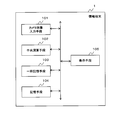
- FIG. FIG. 1 is a block diagram showing a configuration example of a first embodiment of an information processing apparatus according to the present invention.
- the information processing apparatus of the present embodiment is referred to as an information terminal.
- the information terminal 1 of this embodiment includes a camera image input unit 101, a central processing unit 102, a temporary storage unit 103, a storage unit 104, and a display unit 105.
- the information terminal 1 is a device that provides various applications and additional information to the user.
- the camera image input means 101 inputs an image to the information terminal 1.
- the camera image input unit 101 is realized by an imaging device such as a camera, for example, and inputs an image captured by the imaging device to the information terminal.
- an image input by the camera image input unit 101 may be referred to as a camera image or an input image.
- data indicating an input image may be referred to as input image data or camera image data depending on the input format.
- the central processing means 102 performs various information processing. Specifically, the central processing unit 102 performs image processing of an input camera image, operation processing based on an application, processing for presenting additional information, and the like. The processing performed by the central processing means 102 will be described later.
- Temporary storage unit 103 temporarily stores the calculation result by central calculation unit 102 and the input image.
- the storage unit 104 stores pre-registered image features, application execution files, and the like.
- the temporary storage unit 103 and the storage unit 104 are realized by, for example, a memory or a magnetic disk device. In the present embodiment, the temporary storage unit 103 and the storage unit 104 are realized by separate devices, but the temporary storage unit 103 and the storage unit 104 may be realized by a single device. Further, the storage areas stored in the temporary storage unit 103 and the storage unit 104 may be divided into a plurality of pieces of information, and information having different contents may be stored for each divided storage area.
- Display unit 105 displays input images, calculation results, application execution results, and additional information to be presented.
- the display unit 105 is realized by, for example, a touch panel device or a display device.
- the central processing unit 102 determines whether or not the input image data input by the camera image input unit 101 matches the image data registered in advance or the feature amount of the image data.
- the central processing means 102 stores in the temporary storage means 103 at least one of the input image data determined to match or information representing the input image data.
- this process may be referred to as an image collation process P101.
- the name of an application related to the input image may be used, or the name of an object (object) specified by the input image may be used.
- the central processing unit 102 calculates the feature amount of the image data input from the camera image input unit 101. Then, the central processing means 102 compares the calculated feature quantity with a pre-registered feature quantity, detects an image with the matching feature quantity from the storage means 104, and stores the detection result in the temporary storage means 103. To do.
- the feature amount to be compared with the feature amount of the input image is stored in the storage unit 104, for example.
- the central processing means 102 determines not only the input image determined to match, but also the determination result (hereinafter referred to as the image matching result) that the feature amount of the input image data and the feature amount of the image registered in advance match. May be stored in the temporary storage means 103. Further, the image collation result may include information on the link destination of the registered image or information instructing other image information. The image collation result may include information representing input image data.
- the central processing means 102 can calculate the feature amount of the image data by any method such as SIFT (Scale-Invariant Feature Transform) feature, HOG (Histograms of Oriented Gradients) feature, SURF (Speed-Up Robust Features) feature, etc.
- SIFT Scale-Invariant Feature Transform
- HOG Hemograms of Oriented Gradients
- SURF Speed-Up Robust Features
- the central processing means 102 may determine that the feature amounts match when the feature amounts of the two image data completely match, and when the difference between the feature amounts of the two image data is within a predetermined range. Also, it may be determined that the feature amounts match.
- the central processing unit 102 calculates the complexity of the image data, and determines whether the image data is data indicating a flat image based on the calculated complexity of the image data.
- the complexity of the image data is a degree indicating the complexity of the picture pattern of the image, and is sometimes referred to as an activity. For example, the complexity of an image taken in an out-of-focus state or an image taken in a blacked-out state is small.
- the central processing unit 102 calculates the activity of the input image data and presets the calculated activity in order to detect a flat image. Compare the threshold value.
- this processing may be referred to as image processing P102.
- the activity can be expressed by the root mean square of the difference between pixel values (luminance values) for adjacent pixels. Therefore, the central processing means 102 may calculate the mean square of the difference between pixel values between pixels as an activity.
- this calculation method is an example of a method for calculating an activity, and the activity may be calculated using another method.
- the threshold value may be set to about 1/20 (specifically, 13 or less) of the entire scale value.
- the central processing means 102 determines whether or not the input image data has become a flat image. Hereinafter, this process may be referred to as an image flatness determination process P103.
- the central processing means 102 may determine that the target image has become flat when the above-mentioned mean square is equal to or less than a predetermined threshold.
- the central processing means 102 determines whether or not the image matching result is stored in the temporary storage means 103. That is, the fact that the image comparison result is stored in the temporary storage means 103 indicates that an input image that matches the registered image has been input to the information terminal.
- this process may be referred to as a collation result confirmation process P104.
- the central processing means 102 is a case where the new input image data is determined to be data indicating a flat image, and the temporary storage means 103 stores the input image data or information representing the input image data. Sometimes, information processing specified by the input image data stored in the temporary storage means 103 or information representing the input image data is executed.
- the central processing unit 102 determines that the input image data has become a flat image, and if the image matching result already exists in the temporary storage unit 103, the input image corresponding to the latest image matching result is displayed.
- An application related to data may be activated.
- the central processing means 102 may present additional information of the input image data.
- this process may be referred to as a related application activation process P105.
- the central processing means 102 is realized by a CPU of a computer that operates according to a program (information processing program).
- the program may be stored in a storage unit (not shown) of the information terminal 1, and the CPU may read the program and operate as the central processing unit 102 according to the program.
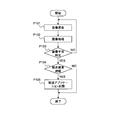
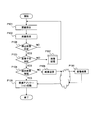
- FIG. 2 is a flowchart illustrating an operation example of the information processing apparatus of the present embodiment.
- the central processing unit 102 determines whether or not the input image data matches pre-registered image data or feature amounts, and the input image determined to match.
- Image collation processing for storing data, image collation information, and the like in the temporary storage means 103 is performed (step P101).
- the central processing means 102 performs image processing for calculating the complexity of the input image data (step P102).
- the central processing means 102 performs image flatness determination processing for determining whether the image data is data indicating a flat image based on the calculated complexity of the image data (step P103).
- step P103 If it is determined that the new input image is not a flat image (NO in step P103), the processing after step P101 is repeated. On the other hand, when it is determined that the input image is a flat image (YES in step P103), the central processing unit 102 performs a matching result confirmation process for confirming whether image matching information is stored in the temporary storage unit 103 (step S103). P104).
- step P104 If the image collation information is not stored in the temporary storage unit 103 (NO in step P104), the central processing unit 102 ends the process. On the other hand, when the image collation information is stored in the temporary storage unit 103 (YES in step P104), the central processing unit 102 performs the information processing specified by the image collation information stored in the temporary storage unit 103. Application activation processing is performed (step P105).
- the central processing unit 102 displays the image data in which the input image data is registered in advance (or the feature amount of the image data). ) And the image collation information representing the contents of the input image data determined to match is stored in the temporary storage means 103.
- the central processing unit 102 calculates the complexity of the image data, and determines whether the image data is data indicating a flat image based on the calculated complexity of the image data. As a result, when it is determined that the new input image data is data indicating a flat image, and the image collation information is stored in the temporary storage unit 103, the central processing unit 102 is stored in the temporary storage unit 103. Information processing specified by image collation information indicating the contents of the stored input image data is executed.
- an execution instruction for information processing is performed using an image
- an execution instruction more reflecting the user's intention can be performed. According to the present embodiment, it is possible to recognize a series of operations of photographing an object and bringing the information terminal 1 close to the object as operations for executing an application.
- the operator refers to the page and photographs a place where an icon and an operation description of an application associated with the icon are described with a camera.
- the information terminal calculates an image feature from the image data of the taken place and collates it with the image feature stored in the information terminal.
- the information terminal determines that there is an image having similar image characteristics, the information terminal temporarily stores image collation information indicating an application name or the like as a collation result.
- the operator performs an operation to bring the information terminal closer to the page.
- the activity of the input image decreases (that is, the activity of the input image falls below a predetermined threshold). Therefore, when the activity of the input image falls below the threshold value, the information terminal determines that the information terminal has been placed on or close to the paper surface, and is specified by the temporarily stored image verification information. Start the application.
- the operator can start an application preinstalled in the information terminal by placing the information terminal close to or on the paper surface on which the image of the application that the user wants to operate is drawn. Can do. Therefore, it is not necessary to find a desired application from a very large number of application groups, and an operation for starting an application of an information terminal can be easily performed.
- the registered image data plays a role of an icon for starting the application. It is also possible for the user to define an arbitrary mark as an image that serves as the icon.
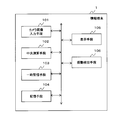
- FIG. FIG. 3 is a block diagram showing a configuration example of the second embodiment of the information processing apparatus according to the present invention.
- symbol same as FIG. 1 is attached
- subjected and description is abbreviate
- the information processing apparatus of this embodiment is also referred to as an information terminal.
- the information terminal 1 of this embodiment includes a camera image input unit 101, a central processing unit 102, a temporary storage unit 103, a storage unit 104, a display unit 105, and a vibration detection unit 106. That is, the information terminal according to the present embodiment is different from the information terminal according to the first embodiment in that the information terminal further includes a vibration detection unit 106.
- the vibration detection means 106 detects the movement of the information terminal 1.
- the vibration detection unit 106 inputs, for example, a signal (vibration signal) indicating the detected vibration to the central processing unit 102.
- the vibration detection means 106 is realized by, for example, an acceleration sensor.
- the mode of the vibration detection unit 106 is not limited to the acceleration sensor. Since a method for detecting vibration is widely known, detailed description thereof is omitted here.
- the central processing means 102 of this embodiment determines whether or not the information terminal 1 (specifically, the camera image input means 101) is in a stationary state. For example, the central processing unit 102 may determine that the information terminal 1 is in a stationary state based on a vibration signal input from the vibration detection unit 106. Note that the central processing means 102 is not only when the information terminal 1 is completely stationary, but also when the vibration is within a predetermined range (that is, when the information terminal 1 is substantially stationary). You may determine with being in a state. Hereinafter, this process may be referred to as a terminal stationary state determination process P106.
- the central processing unit 102 temporarily stores data when it is determined that the new input image data is data indicating a flat image, and when the camera image input unit 101 is determined to be stationary. Information processing specified by the input image data stored in the means 103 or information representing the input image data is executed.
- the central processing means 102 executes this process in the related application activation process P105 shown in the first embodiment. That is, the central processing unit 102 determines that the input image data has become a flat image, determines that the information terminal 1 is in a stationary state, and if the image collation result exists in the temporary storage unit 103, the central processing unit 102 An application related to input image data corresponding to the image collation result may be activated. In this case, the central processing means 102 may present additional information of the input image data.
- the vibration detection means 106 detects vibration. Therefore, when the information terminal is moving greatly, it can be controlled not to start the application related to the collation result image, so that an erroneous operation of the information terminal can be prevented.
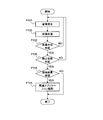
- FIG. 4 is a flowchart illustrating an operation example of the information processing apparatus according to the present embodiment. Note that the image collating process and the process from calculating the complexity to determining whether the image is flat are the same as the processes from step P101 to step P103 illustrated in FIG.
- the central processing means 102 determines whether or not the information terminal 1 is in a stationary state (step P106). When it is determined that the information terminal 1 is not in a stationary state (NO in step P106), the processes after step P101 are repeated. On the other hand, when it is determined that the information terminal 1 is in a stationary state (YES in step P106), a collation result confirmation process and a related application activation process shown in steps P104 and S105 are performed.
- the terminal stationary state determination process P106 for determining whether or not the information terminal 1 is in the stationary state is performed.
- the image flatness determination process P103 may be performed after the terminal stationary state determination process P106. That is, the image flatness determination process P103 may be performed when the central processing unit 102 determines that the terminal is in the stationary state in the terminal stationary state determination process P106.
- the central processing means 102 determines whether or not the information terminal 1 is in a stationary state based on the vibration detected by the vibration detecting means 106. Then, when the central processing unit 102 determines that the new input image data is data indicating a flat image and the information terminal 1 is determined to be in a stationary state, the central processing unit 102 stores it in the temporary storage unit 103. Information processing specified by the image collation information indicating the contents of the input image data is executed.
- FIG. FIG. 3 is a block diagram showing a configuration example of the third embodiment of the information processing apparatus according to the present invention.
- symbol same as FIG. 3 is attached
- subjected and description is abbreviate
- the information processing apparatus of this embodiment is also referred to as an information terminal.
- the information terminal 1 of the present embodiment includes a camera image input unit 101, a central processing unit 102, a temporary storage unit 103, a storage unit 104, a display unit 105, a vibration detection unit 106, and a communication unit 107. ing. That is, the information terminal according to the present embodiment is different from the information terminal according to the second embodiment in that the communication terminal 107 is further provided.
- the communication means 107 connects the information terminal 1 to the server 2 via a communication network.
- the server 2 is a device that can search various information required when the information terminal 1 executes information processing based on an input image. Since the server 2 is an apparatus capable of performing a larger-scale search than the information terminal 1, it can search related information from images that are not registered in the information terminal 1. That is, the server 2 performs a large-scale search for related applications or related information.
- the central processing unit 102 stores the pre-registered image data or input image data that matches the feature amount of the image data in the temporary storage unit 103.
- the central processing unit 102 temporarily stores the input image data even if the input image data is not determined to match if the information terminal 1 is determined to be in a stationary state. save.
- this input image data may be referred to as temporarily stored data.
- this process may be referred to as an image storage process P107.
- the central processing unit 102 may store temporarily stored data in the temporary storage unit 103, for example.
- the central processing means 102 may store the input image data determined to match and the temporarily stored data in separate areas.
- the central processing means 102 is a case where the new input image data is determined to be data indicating a flat image, and the temporary storage means 103 stores the input image data or information representing the input image data (that is, the image data).
- the temporarily stored input image data (temporarily stored data) is transmitted to the server 2.
- this process may be referred to as an image transmission process P108.
- the server 2 notifies the information terminal 1 of information necessary for the information terminal 1 to execute information processing based on the notified temporarily stored data.
- Examples of information necessary for executing information processing include an application name to be executed by the information terminal 1 and information for explaining the contents of the notified temporarily stored data.
- this process may be referred to as an image search process P110.
- the central processing means 102 executes information processing specified by the information notified from the server 2. For example, when the application name is notified from the server 2, the central processing means 102 may activate the application. Further, for example, when information describing the contents of the temporarily stored data is notified from the server 2, the central processing means 102 may display the information.
- the central processing unit 102 performs the image processing P102 again. The process itself may be terminated.
- the central processing unit 102 may calculate the feature amount of the input image data and temporarily store the feature amount. In this case, the central processing means 102 may transmit the feature amount to the server 2 to obtain necessary information.
- FIG. 6 is a flowchart illustrating an operation example of the information processing apparatus according to the present embodiment. Note that the image collation processing and the processing until the complexity is calculated are the same as the processing from step P101 to step P102 illustrated in FIG.
- the central processing means 102 performs terminal stationary state determination processing for determining whether or not the information terminal 1 is in a stationary state (step P106).
- the central processing unit 102 determines whether the image data represents a flat image based on the calculated complexity of the image data. Image flatness determination processing is performed to determine whether or not (step P103).
- the central processing means 102 temporarily stores the input image (step P107) and repeats the processing from step P101 onward.
- the input image temporarily stored here can be said to be an image taken by the information terminal 1 in a stationary state (that is, an image without motion blur). If there is an image temporarily stored, the central processing unit 102 replaces the stored image with a new input image to make the latest image.
- the central processing unit 102 performs a verification result confirmation process for confirming whether the image verification information is stored in the temporary storage unit 103. (Step P104).
- the central processing unit 102 transmits the temporarily stored image (temporarily stored data) to the server 2 via the communication network.
- the server 2 to which the temporarily stored data is transmitted performs an information search process and notifies the information terminal 1 of information indicating the search result (step P110).
- step P104 When image collation information is stored in temporary storage unit 103 (YES in step P104), or when information is received from server 2, central processing unit 102 uses the image collation information stored in temporary storage unit 103.
- the specified information processing or the information processing specified by the information notified by the server 2 is executed (step P105).
- the central processing unit 102 determines that the image data matches the pre-registered image data or the feature amount of the image data.
- the missing input image data (or the feature amount of the input image data) is temporarily stored.
- the central processing unit 102 determines that the new input image data is determined to be data indicating a flat image, and the input image data or information representing the input image data is not stored in the temporary storage unit 103.
- the temporarily stored input image data is transmitted to the server 2, and information processing specified by the information notified by the server 2 is executed.
- the information processing apparatus described below is an example using the information processing apparatus of the third embodiment. It is assumed that an application installed in the information terminal 1a owned by the user A is used in the information terminal 1b owned by another user B. At this time, it is assumed that the user A activates an application installed in the information terminal 1a based on a notation on a certain page. At this time, when the user B holds the information terminal 1b over the paper used at that time and brings the information terminal 1b close to the paper, an inquiry is made to the server 2 via the communication network. Based on the information notified from the server 2, the information terminal 1b displays an inquiry screen indicating whether or not to install an application. When the user B installs the application, the user B can easily own the same application by proceeding according to the instructions on the screen.
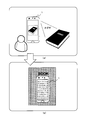
- FIG. 7 is an explanatory diagram illustrating an example of a situation in which the information processing apparatus of this specific example is used.
- a display device is provided on a surface referred to by a user, and a camera (not shown) is provided on the back surface of the display device.
- the user activates the program of the present invention on the information terminal 1 in a bookstore or library. Then, as shown in FIG. 7A, the user takes an image of the cover by holding the information terminal 1 over the cover of the book or magazine that is of interest, and temporarily stores the taken image on the information terminal.
- the information terminal 1 determines that a flat image is input by inputting a completely dark image. Therefore, the information terminal 1 transmits the image of the cover that is held up to a server provided in the bookstore or library.
- the server performs image collation between the transmitted cover image and the registered image, and returns the electronic book data of the matched book or magazine to the information terminal 1.
- the information terminal 1 activates an electronic book reader application based on the returned data, and displays the electronic book data. Therefore, the user can browse the contents of the book or magazine by simply placing the information terminal 1 on the cover of the book or magazine.
- the information terminal 1 may be limited so that the electronic book data can be browsed only when the information terminal 1 exists within a predetermined range. For example, when the user completes the purchase procedure at the bookstore or completes the loan procedure at the library, the information terminal 1 can continue to view the electronic book data even if it is taken out of the area. You may control. In addition, when the user has not completed each procedure, the information terminal 1 may be controlled so that the electronic book data cannot be browsed outside the area when it is taken out of the area.
- FIG. 8 is a block diagram showing an outline of the information processing apparatus according to the present invention.
- the information processing apparatus according to the present invention includes a camera image input unit 81 (for example, a camera image input unit 101) for inputting captured image data, and an image in which input image data input by the camera image input unit 81 is registered in advance. It is determined whether or not the data or the feature amount of the image data matches, and at least one of the input image data determined to match or information representing the input image data (for example, image collation information) is stored in memory.
- a camera image input unit 81 for example, a camera image input unit 101
- an image in which input image data input by the camera image input unit 81 is registered in advance. It is determined whether or not the data or the feature amount of the image data matches, and at least one of the input image data determined to match or information representing the input image data (for example, image collation information) is stored in memory.
- An image collating unit 82 (for example, central processing unit 102) stored in (for example, temporary storage unit 103) and a complexity calculating unit 83 (for example, central processing unit 102) for calculating the complexity (for example, activity) of image data. ) And the calculated complexity of the image data, it is determined whether or not the image data is data indicating a flat image.
- the image flatness determining means 84 (for example, the central processing means 102) and the image flatness determining means 84 determine that the new input image data is data indicating a flat image
- the input image data or the input image data is stored in the memory.
- Information stored in the memory or information processing specified by the information representing the input image data for example, application execution processing, additional information presentation processing
- Information processing execution means 85 (for example, central processing means 102).
- the information terminal has a large storage capacity, and many applications can be installed. However, when many applications are installed, it tends to be difficult to find an application that you want to use. For this reason, the operation summary manual is not read, and applications that are not used at all are often held in the information terminal.
- the application when the user reads the manual and finds a favorite application, the application can be started by placing or moving the information terminal on the page. Furthermore, in this case, an effect that the operation of the application can be easily learned by operating according to the description of the manual as it is can be obtained. Therefore, an application that occupies a storage unit in the information terminal even though it is not used can be effectively used.
- the camera image input means 81 may be provided with a stationary state determination means (for example, vibration detection means 106) for determining whether or not the camera image input means 81 is in a stationary state. Then, the information processing execution means 85 is stored in the memory when it is determined that the new input image data is data indicating a flat image and the camera image input means 81 is in a stationary state. Information processing specified by the input image data or information representing the input image data may be executed.
- a stationary state determination means for example, vibration detection means 106
- the information processing execution means 85 is stored in the memory when it is determined that the new input image data is data indicating a flat image and the camera image input means 81 is in a stationary state.
- Information processing specified by the input image data or information representing the input image data may be executed.
- the image matching unit 82 temporarily stores the input image data that has not been determined to match or the feature amount of the input image data (for example, Temporary storage data may be stored).
- the information processing execution means 85 is a case where the new input image data is determined to be data indicating a flat image, and when the input image data or information representing the input image data is not stored in the memory, Various information (for example, information required for the information processing apparatus (for example, the information terminal 1) to execute information processing on the input image data temporarily stored based on the input image or the feature amount of the image) , An application name or information to be presented) may be transmitted to a searchable server (for example, server 2), and information processing specified by information notified by the server may be executed.
- a searchable server for example, server 2
- the image collating unit 82 may calculate the feature amount of the input image data input by the camera image input unit 81 and determine whether or not it matches the feature amount of the image data registered in advance.
- the image flatness determining unit 84 may determine that the image data is data indicating a flat image when the calculated complexity of the image data is equal to or less than a predetermined threshold.
- the information processing execution means 85 performs processing for starting an application related to the latest input image data stored in the memory as information processing to be executed, or processing for displaying additional information related to the input image data. May be.
- the present invention is suitably applied to a user interface that operates an application associated with an object such as a poster or a magazine by bringing the information terminal close to an object such as a poster or magazine on an information terminal equipped with a camera.
Landscapes
- Engineering & Computer Science (AREA)
- Theoretical Computer Science (AREA)
- Physics & Mathematics (AREA)
- General Physics & Mathematics (AREA)
- General Engineering & Computer Science (AREA)
- Multimedia (AREA)
- Computer Vision & Pattern Recognition (AREA)
- Databases & Information Systems (AREA)
- Human Computer Interaction (AREA)
- Library & Information Science (AREA)
- Quality & Reliability (AREA)
- Data Mining & Analysis (AREA)
- Evolutionary Computation (AREA)
- Medical Informatics (AREA)
- Software Systems (AREA)
- General Health & Medical Sciences (AREA)
- Artificial Intelligence (AREA)
- Health & Medical Sciences (AREA)
- Computing Systems (AREA)
- Signal Processing (AREA)
- User Interface Of Digital Computer (AREA)
- Image Analysis (AREA)
Abstract
Description
図1は、本発明による情報処理装置の第1の実施形態の構成例を示すブロック図である。以下、本実施形態の情報処理装置を情報端末と記す。本実施形態の情報端末1は、カメラ画像入力手段101と、中央演算手段102と、一時記憶手段103と、記憶手段104と、表示手段105とを備えている。情報端末1は、使用者に様々なアプリケーションや付加情報を提供する装置である。
図3は、本発明による情報処理装置の第2の実施形態の構成例を示すブロック図である。なお、第1の実施形態と同様の構成については、図1と同一の符号を付し、説明を省略する。以下、本実施形態の情報処理装置も情報端末と記す。本実施形態の情報端末1は、カメラ画像入力手段101と、中央演算手段102と、一時記憶手段103と、記憶手段104と、表示手段105と、振動検出手段106を備えている。すなわち、本実施形態の情報端末は、振動検出手段106をさらに備えている点において第1の実施形態の情報端末と異なる。
図3は、本発明による情報処理装置の第3の実施形態の構成例を示すブロック図である。なお、第2の実施形態と同様の構成については、図3と同一の符号を付し、説明を省略する。以下、本実施形態の情報処理装置も情報端末と記す。本実施形態の情報端末1は、カメラ画像入力手段101と、中央演算手段102と、一時記憶手段103と、記憶手段104と、表示手段105と、振動検出手段106と、通信手段107とを備えている。すなわち、本実施形態の情報端末は、通信手段107をさらに備えている点において第2の実施形態の情報端末と異なる。
2 サーバ
101 カメラ画像入力手段
102 中央演算手段
103 一時記憶手段
104 記憶手段
105 表示手段
106 振動検出手段
107 通信手段
Claims (10)
- 撮像された画像データを入力するカメラ画像入力手段と、
前記カメラ画像入力手段により入力される入力画像データが予め登録された画像データまたは当該画像データの特徴量と一致するか否かを判定し、一致すると判定された入力画像データまたは当該入力画像データを表わす情報の少なくとも一方をメモリに記憶する画像照合手段と、
画像データの複雑度を算出する複雑度算出手段と、
算出された画像データの複雑度に基づいて、当該画像データが平坦画像を示すデータか否かを判定する画像平坦判定手段と、
前記画像平坦判定手段によって新たな入力画像データが平坦画像を示すデータと判定された場合、前記メモリに入力画像データまたは当該入力画像データを表わす情報が記憶されているときに、当該メモリに記憶された入力画像データまたは当該入力画像データを表わす情報により特定される情報処理を実行する情報処理実行手段とを備えた
ことを特徴とする情報処理装置。 - カメラ画像入力手段が静止状態にあるか否かを判定する静止状態判定手段を備え、
情報処理実行手段は、新たな入力画像データが平坦画像を示すデータと判定された場合であって、カメラ画像入力手段が静止状態にあると判定された場合に、メモリに記憶された入力画像データまたは当該入力画像データを表わす情報により特定される情報処理を実行する
請求項1記載の情報処理装置。 - 画像照合手段は、カメラ画像入力手段が静止状態にあると判定された場合に、一致すると判定されなかった入力画像データまたは当該入力画像データの特徴量を一時的に保存し、
情報処理実行手段は、新たな入力画像データが平坦画像を示すデータと判定された場合であって、メモリに入力画像データまたは当該入力画像データを表わす情報が記憶されていないときに、一時的に保存した入力画像データを、入力される画像または当該画像の特徴量に基づいて自情報処理装置が情報処理を実行する際に必要とされる各種情報を検索可能なサーバに送信し、当該サーバにより通知される情報により特定される情報処理を実行する
請求項2記載の情報処理装置。 - 画像照合手段は、カメラ画像入力手段により入力される入力画像データの特徴量を算出し、予め登録された画像データの特徴量と一致するか否かを判定する
請求項1から請求項3のうちのいずれか1項に記載の情報処理装置。 - 画像平坦判定手段は、算出された画像データの複雑度が予め定めた閾値以下である場合、画像データが平坦画像を示すデータであると判定する
請求項1から請求項4のうちのいずれか1項に記載の情報処理装置。 - 情報処理実行手段は、実行する情報処理としてメモリに記憶された最新の入力画像データに関連したアプリケーションを起動する処理、または、当該入力画像データに関連した付加情報を表示する処理を行う
請求項1から請求項5のうちのいずれか1項に記載の情報処理装置。 - 撮像された画像データを入力するカメラ画像入力手段からの入力画像データが予め登録された画像データまたは当該画像データの特徴量と一致するか否かを判定し、
一致すると判定された入力画像データまたは当該入力画像データを表わす情報の少なくとも一方をメモリに記憶し、
画像データの複雑度を算出し、
算出された画像データの複雑度に基づいて、当該画像データが平坦画像を示すデータか否かを判定し、
新たな入力画像データが平坦画像を示すデータと判定された場合、前記メモリに入力画像データまたは当該入力画像データを表わす情報が記憶されているときに、当該メモリに記憶された入力画像データまたは当該入力画像データを表わす情報により特定される情報処理を実行する
ことを特徴とする情報処理方法。 - カメラ画像入力手段が静止状態にあるか否かを判定し、
新たな入力画像データが平坦画像を示すデータと判定された場合であって、カメラ画像入力手段が静止状態にあると判定された場合に、メモリに記憶された入力画像データまたは当該入力画像データを表わす情報により特定される情報処理を実行する
請求項7記載の情報処理方法。 - コンピュータに、
撮像された画像データを入力するカメラ画像入力手段からの入力画像データが予め登録された画像データまたは当該画像データの特徴量と一致するか否かを判定し、一致すると判定された入力画像データまたは当該入力画像データを表わす情報の少なくとも一方をメモリに記憶する画像照合処理、
画像データの複雑度を算出する複雑度算出処理、
算出された画像データの複雑度に基づいて、当該画像データが平坦画像を示すデータか否かを判定する画像平坦判定処理、および、
前記画像平坦判定処理で新たな入力画像データが平坦画像を示すデータと判定された場合、前記メモリに入力画像データまたは当該入力画像データを表わす情報が記憶されているときに、当該メモリに記憶された入力画像データまたは当該入力画像データを表わす情報により特定される情報処理を実行する情報処理実行処理
を実行させるための情報処理プログラム。 - コンピュータに、
カメラ画像入力手段が静止状態にあるか否かを判定する静止状態判定処理を実行させ、
情報処理実行処理で、新たな入力画像データが平坦画像を示すデータと判定された場合であって、カメラ画像入力手段が静止状態にあると判定された場合に、メモリに記憶された入力画像データまたは当該入力画像データを表わす情報により特定される情報処理を実行させる
請求項9記載の情報処理プログラム。
Priority Applications (2)
| Application Number | Priority Date | Filing Date | Title |
|---|---|---|---|
| US14/437,888 US9460119B2 (en) | 2012-10-25 | 2013-10-10 | Information processing device, information processing method, and recording medium |
| JP2014543136A JPWO2014064897A1 (ja) | 2012-10-25 | 2013-10-10 | 情報処理装置、情報処理方法および情報処理プログラム |
Applications Claiming Priority (2)
| Application Number | Priority Date | Filing Date | Title |
|---|---|---|---|
| JP2012-235336 | 2012-10-25 | ||
| JP2012235336 | 2012-10-25 |
Publications (1)
| Publication Number | Publication Date |
|---|---|
| WO2014064897A1 true WO2014064897A1 (ja) | 2014-05-01 |
Family
ID=50544283
Family Applications (1)
| Application Number | Title | Priority Date | Filing Date |
|---|---|---|---|
| PCT/JP2013/006039 Ceased WO2014064897A1 (ja) | 2012-10-25 | 2013-10-10 | 情報処理装置、情報処理方法および情報処理プログラム |
Country Status (3)
| Country | Link |
|---|---|
| US (1) | US9460119B2 (ja) |
| JP (1) | JPWO2014064897A1 (ja) |
| WO (1) | WO2014064897A1 (ja) |
Families Citing this family (1)
| Publication number | Priority date | Publication date | Assignee | Title |
|---|---|---|---|---|
| JP7238964B2 (ja) * | 2019-03-19 | 2023-03-14 | 日本電気株式会社 | 検品装置、検品方法、及びプログラム |
Citations (3)
| Publication number | Priority date | Publication date | Assignee | Title |
|---|---|---|---|---|
| JP2003036212A (ja) * | 2001-07-23 | 2003-02-07 | Funai Electric Co Ltd | カメラ機能付き携帯情報端末 |
| JP2005031827A (ja) * | 2003-07-09 | 2005-02-03 | Hitachi Ltd | 情報処理装置、情報処理方法及びソフトウェア |
| JP2012059263A (ja) * | 2010-09-09 | 2012-03-22 | Pantech Co Ltd | オブジェクト間の関連性を利用した拡張現実提供装置及び方法 |
Family Cites Families (8)
| Publication number | Priority date | Publication date | Assignee | Title |
|---|---|---|---|---|
| US6556783B1 (en) * | 1997-01-16 | 2003-04-29 | Janet L. Gelphman | Method and apparatus for three dimensional modeling of an object |
| JP2006145616A (ja) | 2004-11-16 | 2006-06-08 | Konica Minolta Photo Imaging Inc | 画像表示装置、電子機器、画像表示方法 |
| US8363717B2 (en) * | 2005-05-17 | 2013-01-29 | Canon Kabushiki Kaisha | Image processing apparatus |
| JP2007259134A (ja) | 2006-03-23 | 2007-10-04 | Nec Saitama Ltd | 携帯電話装置及び該携帯電話装置における消費電力低減方法 |
| US8330801B2 (en) * | 2006-12-22 | 2012-12-11 | Qualcomm Incorporated | Complexity-adaptive 2D-to-3D video sequence conversion |
| JP4783830B2 (ja) * | 2007-01-11 | 2011-09-28 | 富士通株式会社 | 画像補正プログラム、画像補正方法、画像補正装置 |
| JP2010217962A (ja) | 2009-03-13 | 2010-09-30 | Omron Corp | カメラ付き携帯端末装置用のプログラムおよびカメラ付き携帯端末装置 |
| JP5253560B2 (ja) | 2011-12-07 | 2013-07-31 | 京セラ株式会社 | 携帯電話機 |
-
2013
- 2013-10-10 US US14/437,888 patent/US9460119B2/en active Active
- 2013-10-10 JP JP2014543136A patent/JPWO2014064897A1/ja active Pending
- 2013-10-10 WO PCT/JP2013/006039 patent/WO2014064897A1/ja not_active Ceased
Patent Citations (3)
| Publication number | Priority date | Publication date | Assignee | Title |
|---|---|---|---|---|
| JP2003036212A (ja) * | 2001-07-23 | 2003-02-07 | Funai Electric Co Ltd | カメラ機能付き携帯情報端末 |
| JP2005031827A (ja) * | 2003-07-09 | 2005-02-03 | Hitachi Ltd | 情報処理装置、情報処理方法及びソフトウェア |
| JP2012059263A (ja) * | 2010-09-09 | 2012-03-22 | Pantech Co Ltd | オブジェクト間の関連性を利用した拡張現実提供装置及び方法 |
Also Published As
| Publication number | Publication date |
|---|---|
| US9460119B2 (en) | 2016-10-04 |
| JPWO2014064897A1 (ja) | 2016-09-08 |
| US20150278250A1 (en) | 2015-10-01 |
Similar Documents
| Publication | Publication Date | Title |
|---|---|---|
| US9998651B2 (en) | Image processing apparatus and image processing method | |
| US9172879B2 (en) | Image display control apparatus, image display apparatus, non-transitory computer readable medium, and image display control method | |
| US10706214B2 (en) | Computer readable recording medium, information processing terminal device, and control method of information processing terminal device | |
| US20150324082A1 (en) | Image display control apparatus, image display apparatus, non-transitory computer readable medium, and image display control method | |
| US9030577B2 (en) | Image processing methods and systems for handheld devices | |
| CN104050226A (zh) | 移动终端的应用信息处理方法和装置 | |
| US20130120289A1 (en) | Information processing apparatus and method of controlling same | |
| US20170322680A1 (en) | Method and apparatus for setting background of ui control, and terminal | |
| US20160196284A1 (en) | Mobile terminal and method for searching for image | |
| CN1842127B (zh) | 图像处理装置 | |
| CN113190143A (zh) | 界面显示方法、装置、电子设备及介质 | |
| CN105074725B (zh) | 移动终端及其控制方法 | |
| US20120002094A1 (en) | Image pickup apparatus for providing reference image and method for providing reference image thereof | |
| JP6269006B2 (ja) | 情報処理装置、情報処理方法、及び情報処理プログラム | |
| CN110851202A (zh) | 移动终端功能页面启动方法、装置、移动终端及存储介质 | |
| WO2014096518A1 (en) | Apparatus and method for using interaction history to manipulate content | |
| CN112383708B (zh) | 拍摄方法、装置、电子设备及可读存储介质 | |
| JP6010303B2 (ja) | 画像再生装置 | |
| CN102402570B (zh) | 数据管理设备和记录介质 | |
| JP5632733B2 (ja) | 表示装置、画面画像転送方法、及びプログラム | |
| WO2014064897A1 (ja) | 情報処理装置、情報処理方法および情報処理プログラム | |
| CN118869857A (zh) | 导览图提供方法和支持其的电子设备 | |
| US9396405B2 (en) | Image processing apparatus, image processing method, and image processing program | |
| CN111796733B (zh) | 图像显示方法、图像显示装置和电子设备 | |
| CN108108098A (zh) | 一种图像选取方法及移动终端 |
Legal Events
| Date | Code | Title | Description |
|---|---|---|---|
| 121 | Ep: the epo has been informed by wipo that ep was designated in this application |
Ref document number: 13848567 Country of ref document: EP Kind code of ref document: A1 |
|
| ENP | Entry into the national phase |
Ref document number: 2014543136 Country of ref document: JP Kind code of ref document: A |
|
| WWE | Wipo information: entry into national phase |
Ref document number: 14437888 Country of ref document: US |
|
| NENP | Non-entry into the national phase |
Ref country code: DE |
|
| 122 | Ep: pct application non-entry in european phase |
Ref document number: 13848567 Country of ref document: EP Kind code of ref document: A1 |