WO2014038618A1 - 電子機器およびプログラム - Google Patents
電子機器およびプログラム Download PDFInfo
- Publication number
- WO2014038618A1 WO2014038618A1 PCT/JP2013/073908 JP2013073908W WO2014038618A1 WO 2014038618 A1 WO2014038618 A1 WO 2014038618A1 JP 2013073908 W JP2013073908 W JP 2013073908W WO 2014038618 A1 WO2014038618 A1 WO 2014038618A1
- Authority
- WO
- WIPO (PCT)
- Prior art keywords
- contact position
- contact
- finger
- previous
- selection unit
- Prior art date
- Legal status (The legal status is an assumption and is not a legal conclusion. Google has not performed a legal analysis and makes no representation as to the accuracy of the status listed.)
- Ceased
Links
Images




Classifications
-
- G—PHYSICS
- G06—COMPUTING OR CALCULATING; COUNTING
- G06F—ELECTRIC DIGITAL DATA PROCESSING
- G06F3/00—Input arrangements for transferring data to be processed into a form capable of being handled by the computer; Output arrangements for transferring data from processing unit to output unit, e.g. interface arrangements
- G06F3/01—Input arrangements or combined input and output arrangements for interaction between user and computer
- G06F3/03—Arrangements for converting the position or the displacement of a member into a coded form
- G06F3/041—Digitisers, e.g. for touch screens or touch pads, characterised by the transducing means
- G06F3/0416—Control or interface arrangements specially adapted for digitisers
-
- G—PHYSICS
- G06—COMPUTING OR CALCULATING; COUNTING
- G06F—ELECTRIC DIGITAL DATA PROCESSING
- G06F2203/00—Indexing scheme relating to G06F3/00 - G06F3/048
- G06F2203/041—Indexing scheme relating to G06F3/041 - G06F3/045
- G06F2203/04104—Multi-touch detection in digitiser, i.e. details about the simultaneous detection of a plurality of touching locations, e.g. multiple fingers or pen and finger
Definitions
- the present invention relates to an electronic device and a program.
- This application claims priority based on Japanese Patent Application No. 2012-195036 filed on September 5, 2012, the contents of which are incorporated herein by reference.
- An object of an aspect of the present invention is to provide a technique for accurately recognizing actual finger movements.
- An electronic device includes a detection unit that detects a contact position of a finger on a contact detection surface, a contact position storage unit that stores a contact position detected by the detection unit, and a contact position storage unit. Based on a prediction range calculation unit that calculates a prediction range of a finger contact position based on a stored contact position, and whether or not a current contact position exists in the prediction range calculated by the prediction range calculation unit
- An identical finger determination unit that determines the identity of the finger that is in contact with the current contact position and the finger that has been in contact with the previous contact position, and the same finger determination unit includes: When the position exists in the predicted range, it is determined that the finger that is in contact with the current contact position is the same as the finger that is in contact with the previous contact position.
- the actual finger movement can be recognized with high accuracy.
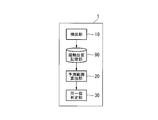
- FIG. 1 is a functional configuration diagram illustrating an example of a functional configuration of an electronic device 1 according to an embodiment of the present invention.
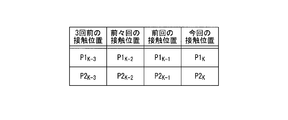
- FIG. 2 is an example of information stored in the contact position storage unit 90.
- the electronic apparatus 1 is an electronic apparatus having a display device that functions as a display device for a user and an input device from the user. As shown in FIG. 1, the electronic device 1 includes a detection unit 10, a prediction range calculation unit 20, an identical finger determination unit 30, and a contact position storage unit 90.
- the detection unit 10 periodically detects the contact position (detection position) of the finger on the display screen of the touch display that is the contact detection surface. Therefore, for example, when a finger is moved on the contact detection surface, the detection unit 10 periodically detects the contact position of the finger.
- the contact position storage unit 90 stores the contact position detected by the detection unit 10. Specifically, the detection unit 10 stores the history of each contact position detected periodically in the contact position storage unit 90. Moreover, the detection part 10 memorize
- Two contact positions (P1 K-1 , P2 K-1 ) are stored as the contact positions detected at the timing of the previous detection), and the contact detected at the timing when the detection unit 10 has detected this time
- Two contact positions (P1 K , P2 K ) are stored as positions. That is, at any time (that is, when a new contact position is detected), detection is performed at a detection timing before the detection timing at which the detection unit 10 has detected three times before with the new contact position as a reference. The contact position that is the contact position is deleted.
- the contact position storage unit 90 is configured to detect the contact position at the detection timing at which the detection unit 10 has detected three times before, the contact position at the detection timing at which the detection is performed two times before (two times before), and The contact position at the detection timing when detection was performed last time (one time before) is stored.
- the contact position at the detection timing at which the detection was performed (one time before) is stored.
- the timing at which the contact position is stored among the detection timings performed by the detection unit 10 can be appropriately changed according to the design. For example, you may memorize
- the contact position at the detection timing detected two times before (without the contact position at the detection timing when the detection unit 10 detected three times before) is stored. May be stored.
- the example of FIG. 2 represents the case where there are two contact positions detected by the detection unit 10, but there may be one or more contact positions detected by the detection unit 10. It is the same.
- the prediction range calculation unit 20 calculates the prediction range of the finger contact position based on the contact position in each detection until the previous time detected by the detection unit 10.
- the prediction range calculation unit 20 is an area that is spread within a predetermined angle from the previous contact position as a base point and is divided by a straight line that passes through the previous contact position and the previous contact position. Calculate as the prediction range. Details will be described later.
- the same finger determination unit 30 contacts the finger that is in contact with the current contact position and the previous contact position based on whether or not the current contact position exists in the prediction range calculated by the prediction range calculation unit 20. Determine the identity of the finger that was on. Specifically, when the current contact position is within the prediction range, the same finger determination unit 30 determines that the finger that is in contact with the current contact position is the same as the finger that has been in contact with the previous contact position. judge.
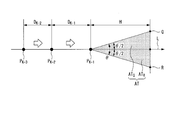
- FIG. 3 is an explanatory diagram for explaining an example of the operation of the prediction range calculation unit 20.
- P K-1 is a previous (one time before) contact position
- P K-2 is a previous (second) previous contact position
- P K-3 is a third previous contact position.
- the contact position P K-3 three times before, the contact position P K-2 two times before, and the previous contact position P K-1 exist on the straight line L. The same applies to FIG. 4 (described later).
- the prediction range calculation unit 20 determines that the contact positions P K-3 three times before, the contact positions P K-2 two times before, and the previous contact positions P K-1 are substantially linear. Is a region extending within a predetermined angle ⁇ from the previous contact position P K-1 as a base point, and is a straight line L passing through the previous contact position P K-2 and the previous contact position P K-1. A region (a region of isosceles triangles indicated by dots) AT divided into two by is calculated as a prediction range.
- the expected range calculation unit 20 is bisected into a region AT Q and the area AT R by the above straight line L, the previous contact position P K-1 and a vertex (vertex angle theta) 2
- An equilateral triangular area AT is calculated as a prediction range.
- the height H of the isosceles triangle may be defined by the distance D K ⁇ 1 , for example.
- a value obtained by multiplying the distance D K ⁇ 1 by a predetermined coefficient b H may be used as the height H.
- the prediction range calculation unit 20 may calculate the height H of the isosceles triangle based on the previous contact position P K-1 and the previous contact position P K-2 . The same applies to FIG. 5 (described later).
- the height H of the isosceles triangle may be defined by the distance D K-2 and the distance D K-1 .
- the coefficient b H may be a value corresponding to the ratio of the distance D K ⁇ 2 and the distance D K ⁇ 1 .
- the coefficient b H when the distance D K-1 is larger than the distance D K-2 (the movement speed of the finger when the contact position P K-2 and the contact position P K-1 are regarded as the same finger contact)
- the coefficient b H when the distance D K-1 is smaller than the distance D K- 2 (the contact position P K-2 is gradually increased between the contact position P K-2 and the contact position P K-1 ).
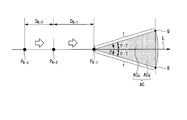
- FIG. 4 is an explanatory diagram for explaining an example of another operation of the prediction range calculation unit 20.
- Expected range calculation unit 20 the third previous contact position P K-3, the contact position P K-2 before last, when the contact position of the previous contact position P K-1 is present on a substantially straight line
- Fig. instead of the 3 as shown in FIG. 4, previous contact position P K-1 contact a region extending within a predetermined angle ⁇ to the reference point before the previous position P K-2 and the previous contact position P K-1
- a region divided into two equal parts by a straight line L passing through (fan-shaped region indicated by dots; a line segment connecting the previous contact position P K-1 and the point Q in FIG.
- the line segment connecting -1 and the point R may be two radii r, and the figure surrounded by the arcs between the two radii r and the points Q and R) AC may be calculated as the prediction range.
- the expected range calculation unit 20 the fan-shaped to be halved in the region AC Q and the area AC R by the above straight line L, the previous contact position P K-1 and a vertex (vertex angle theta)
- the area AC may be calculated as the prediction range.
- the sector radius r may be defined by a distance D K ⁇ 1 , for example.
- a value obtained by multiplying the distance D K ⁇ 1 by the coefficient b r may be used as the radius r.
- the prediction range calculation unit 20 may calculate the sector radius r based on the previous contact position P K-1 and the previous contact position P K-2 . The same applies to FIG. 6 (described later).
- the sector radius r may be defined by a distance D K-2 and a distance D K-1 .
- the coefficient b r may be a value corresponding to the ratio between the distance D K ⁇ 2 and the distance D K ⁇ 1 .
- the coefficient b r when the distance D K-1 is larger than the distance D K-2 (the movement speed of the finger when the contact position P K-2 and the contact position P K-1 are regarded as the same finger contact)
- the coefficient b r when the distance D K-1 is smaller than the distance D K- 2 (the contact position P K-2 is gradually increased between the contact position P K-2 and the contact position P K-1 ).
- FIGS. 5 and 6 are explanatory diagrams for explaining an example of another operation of the prediction range calculation unit 20.
- P K-1 is the previous (one time before) contact position
- P K-2 is the previous (second) previous contact position
- P K-3 is the third previous contact position. It expresses.
- the three contact positions of the previous contact position P K-3 , the previous contact position P K-2 , and the previous contact position P K-1 do not exist on the same straight line. .
- a straight line L1 passing through the contact position P K-3 three times before and the previous contact position P K-2 , the previous contact position P K-2, and the previous contact position P K-1
- An angle ⁇ is formed with the straight line L2 passing through.
- the range calculation unit 20 divides the straight line L2 by the angle ⁇ corresponding to the angle ⁇ , with the previous contact position P K-1 as a base point, the side of the previous contact position P K-3 (divided by the straight line L2). A region that is bisected by a straight line L2 ′ rotated to the side where the previous contact position P K-3 is present) is set as a predicted range. It may be calculated.
- the prediction range calculation unit 20 uses the prediction range (isosceles triangle area AT) in FIG.
- the value of the angle ⁇ may be the same as the value of the angle ⁇ . Further, the value of the angle ⁇ may be a value corresponding to the angle ⁇ , the distance D K ⁇ 1, and the distance D K ⁇ 2 .
- the angle beta angle alpha + angle gamma
- the distance D if the distance D K-1 compared to the K-2 is large the contact position P K-2 and the contact position P K-1 when viewed as the contact of the same finger
- the angle ⁇ is smaller than the distance D K- 2.
- the angle ⁇ may be a positive value (that is, angle ⁇ > angle ⁇ ) or a negative value (that is, angle ⁇ ⁇ angle ⁇ ). The same applies to FIG. 6 (described later).
- the prediction range calculation unit 20 As shown in FIG. 6, the predicted range (sector-shaped area AC) of FIG. 4 is rotated by an angle ⁇ around the previous contact position P K-1 and toward the previous contact position P K-3. prediction range ( 'is bisected in the R, sector AC' Q and the area AC 'region AC by' line L2 described above) may be calculated.
- FIG. 7 is a flowchart showing an example of the operation of the electronic device 1.
- the flowchart of FIG. 7 starts for each detection cycle by the detection unit 10.
- the detection unit 10 detects the current contact position and stores it in the contact position storage unit 90 (step S10).
- the predicted range calculation unit 20 calculates the predicted range of the finger contact position based on the contact position in each detection until the previous time stored in the contact position storage unit 90 (step S12). For example, the prediction range calculation unit 20 calculates an area AT as shown in FIG. 3 as the prediction range.
- the same finger determination unit 30 determines whether the current contact position detected and stored in step S10 is within the predicted range calculated in step S12, and the finger that is in contact with the current contact position. The identity with the finger that was in contact with the previous contact position is determined. Specifically, when the current contact position is within the prediction range, the same finger determination unit 30 determines that the finger that is in contact with the current contact position is the same as the finger that has been in contact with the previous contact position. If it is determined and the current contact position does not exist in the prediction range, it is determined that the finger in contact with the current contact position is not the same as the finger in contact with the previous contact position (step S14). Then, the flowchart of FIG. 7 ends. In addition, when it is determined that the finger in contact with the current contact position is the same as the finger in contact with the previous contact position, the electronic device 1 recognizes that it is a finger movement operation (slide operation). be able to.
- the electronic device 1 it is possible to accurately recognize the actual finger movement. Specifically, according to the electronic device 1, the predicted range of the contact position is set based on the past contact position, and the identity of the finger is determined based on whether or not the current contact position is within the predicted range. Therefore, it is possible to accurately recognize the actual finger movement.
- the predicted range when the contact positions P K-3 three times before, the contact position P K-2 two times before, and the previous contact position P K-1 exist on a substantially straight line (the region in FIG. 3).
- the calculation of the AT, the area AC in FIG. 4 and the calculation of the prediction range (area AT ′ in FIG. 5 and area AC ′ in FIG. 6) when they do not exist on a substantially straight line have been described.
- the prediction range may be simply calculated without using the contact position P K-3 three times before (in other words, regardless of whether or not the contact position P K-3 exists on the above-described substantially straight line).
- the area AC (FIG. 4) defined by K-1 may be calculated.
- the operation of the identity determination unit 30 when the detection unit 10 detects the contact positions of a plurality of fingers simultaneously will be described.
- the identity determination unit 30 in the case where there are a plurality of current contact positions in the overlap region of the respective prediction ranges based on the respective previous contact positions calculated by the prediction range calculation unit 20. The operation (determination) will be described.
- the prediction range calculation unit 20 can calculate various prediction ranges for each previous contact position detected at the same time as shown in FIGS. 3 to 6. However, in the following explanation, for the convenience of explanation, it is assumed that a prediction range (area AT) as shown in FIG. 3 is calculated for any of the previous contact positions detected at the same time.
- FIG. 8A is an explanatory diagram for explaining an example of the operation of the same finger determination unit 30.
- the same finger determination unit 30 determines each previous contact position that is a base point of each of the plurality of prediction ranges and the overlap region.
- ATd overlapping area
- the respective previous contact positions (P1 K ⁇ 1 , P2 K ⁇ 1 ) serving as the respective base points of the plurality of prediction ranges (AT1, AT2, AT3), P3 K-1) and, this contact position of each present in the overlapping region (ATd) (PX K, PY K, based on the positional relationship between the PZ K), the plurality of current contact position (PX K , PY K , PZ K ) and any of the fingers that have been in contact with the respective previous contact positions (P1 K-1 , P2 K-1 , P3 K-1 ) Determine identity with finger It may be so that. That is, for example, as shown in FIG. 8B, the same finger determination unit 30 moves the right finger when the index finger, middle finger, and ring finger are in contact with the contact detection surface and simultaneously moved from the right thumb to the little finger. Before and after, it is determined which is the same finger contact position.
- FIG. 9 is a functional configuration example of the same finger determination unit 30.
- the same finger determination unit 30 includes, for example, a first selection unit 32, a second selection unit 34, and the same finger determination unit 36 as illustrated in FIG.
- the first selection unit 32 may sequentially select the current contact positions one by one from among the plurality of current contact positions existing in the overlapping region.
- the second selection unit 34 may sequentially select the previous contact positions one by one from among the plurality of previous contact positions that are the base points of the plurality of prediction ranges.
- the finger that is in contact with the one current contact position selected by the first selection unit 32 contacts the one previous contact position selected by the second selection unit 34. It may be determined that the finger is the same as the finger.
- the first selection unit 32 selects from any of the unselected previous contact positions that are the base points of the plurality of prediction ranges from among the plurality of unselected current contact positions that exist in the overlapping region of the prediction ranges.
- the closest current contact position is sequentially selected one by one until the unselected current contact position is the last one.
- the second selection unit 34 selects from the plurality of unselected previous contact positions that are the base points of the plurality of prediction ranges.
- the first selection unit 32 selects one previous contact position farthest from the current contact position selected this time.
- the finger that is in contact with the one current contact position selected by the first selection unit 32 contacts the one previous contact position selected by the second selection unit 34. It is determined that the finger is identical.
- FIG. 10 is a flowchart illustrating an example of another operation of the electronic device 1.
- the first selection unit 32 selects a plurality of prediction ranges (AT 1, AT 2) from a plurality of unselected current contact positions (PX K , PY K , PZ K ) existing in the overlapping region (ATd).
- the present contact position (PX K ) that is closest to any of the unselected previous contact positions (P1 K ⁇ 1 , P2 K ⁇ 1 , P3 K ⁇ 1 ) that are the respective base points of AT2, AT3) Select step S20).
- the second selection unit 34 selects a plurality of unselected previous contact positions (P1 K ⁇ 1 , P2 K ⁇ 1 , P3) that are base points of the plurality of prediction ranges (AT1, AT2, AT3). K-1 ) are excluded one by one until the last contact position (PX K ) selected this time is the last one (exclude P3 K-1 first, then P2 K -1 is excluded), and the previous contact position (P1 K-1 ) which is the last one is selected (step S22).
- the identity determination unit 36 determines that the finger touching the current contact position (PX K ) selected this time in step S20 is the previous contact position (P1 K-1 ) selected this time in step S22. It is determined that the finger is the same as the finger touching (step S24).
- the first selection unit 32 determines whether or not there is one unselected current contact position existing in the overlapping area (ATd) (step S26).
- the first selection unit 32 returns to step S20 because there are two unselected current contact positions (PY K , PZ K ) in the overlapping area (ATd) (step S26: No).
- the first selection unit 32 selects a plurality of prediction ranges (AT1, AT2, AT3) from a plurality of unselected current contact positions (PY K , PZ K ) existing in the overlapping region (ATd).
- the present contact position (PY K ) closest to any of the unselected previous contact positions (P2 K ⁇ 1 , P3 K ⁇ 1 ) serving as the respective base points is selected (step S20).
- the second selection unit 34 selects a plurality of unselected previous contact positions (P2 K ⁇ 1 , P3 K ⁇ 1 ) that are the base points of the plurality of prediction ranges (AT1, AT2, AT3). Among them, it is excluded one by one until it becomes the last one in the order close to the current contact position (PY K ) selected this time (P3 K-1 is excluded), and the previous contact position (last P3 K-1 ) ( P2 K-1 ) is selected (step S22).
- the identity determination unit 36 determines that the finger touching the current contact position (PY K ) selected this time in the previous step S20 is the previous contact position (P2) selected this time in the previous step S22. It is determined that the finger is in contact with ( K-1 ) (step S24).
- step S28 the first selection unit 32 proceeds to step S28 because there is one unselected current contact position (PZ K ) existing in the overlapping region (ATd) (step S26: Yes).
- the identity determination unit 36 determines that the finger that is in contact with the unselected current contact position (PZ K ) is the same as the finger that is in contact with the previous unselected contact position (P3 K-1 ). (Step S28). And this flowchart is complete
- the identity determination unit 30 (identity determination unit 32) is in contact with the finger that is in contact with the current contact position (PX K ) and the previous contact position (P1 K-1 ).
- the finger that is in contact with the current contact position (PY K ) is the same as the finger that is in contact with the previous contact position (P2 K-1 ) and the current contact position (PZ K ). It is determined (determined) that the finger in contact is the same as the finger in contact with the previous contact position (P3 K-1 ).
- the first selection unit 32 is farthest from any of the unselected previous contact positions serving as the base points of the plurality of prediction ranges, from among the plurality of unselected current contact positions existing in the overlapping region.
- the current contact positions are sequentially selected one by one until the unselected current contact position is the last one.
- the second selection unit 34 selects from the plurality of unselected previous contact positions that are the base points of the plurality of prediction ranges. The first selection unit 32 selects one previous contact position closest to the current contact position selected this time.
- the finger that is in contact with the one current contact position selected by the first selection unit 32 contacts the one previous contact position selected by the second selection unit 34. It is determined that the finger is identical.
- the first selection unit 32 selects a plurality of prediction ranges (AT 1, AT 2) from a plurality of unselected current contact positions (PX K , PY K , PZ K ) existing in the overlapping region (ATd).
- the present contact position (PZ K ) that is farthest from any of the unselected previous contact positions (P1 K ⁇ 1 , P2 K ⁇ 1 , P3 K ⁇ 1 ) that are the respective base points of AT2, AT3) select.
- the second selection unit 34 selects a plurality of unselected previous contact positions (P1 K ⁇ 1 , P2 K ⁇ 1 , P3) that are base points of the plurality of prediction ranges (AT1, AT2, AT3).
- K-1 are excluded one by one until the last contact position (PZ K ) selected this time is the last one (P1 K-1 is excluded first , and then P2 K is selected). -1 is excluded), and the last contact position (P3 K-1 ) which is the last one is selected.
- the identity determination unit 36 determines that the finger in contact with the current contact position (PZ K ) selected this time is the finger in contact with the previous contact position (P3 K ⁇ 1 ) selected this time. To be the same.
- the first selection unit 32 selects the unselected unselected base points of the plurality of prediction ranges (AT1, AT2, AT3) from the unselected current contact positions (PX K , PY K ).
- the present contact position (PY K ) farthest from any of the previous contact positions (P1 K ⁇ 1 , P2 K ⁇ 1 ) is selected.
- the second selection unit 34 selects a plurality of unselected previous contact positions (P1 K ⁇ 1 , P2 K ⁇ 1 ) that are the base points of the plurality of prediction ranges (AT1, AT2, AT3). Among them, the contact position of this time (PY K ) selected this time is excluded one by one until it becomes the last one in order from the farthest (P1 K-1 is excluded), and the last contact position that became the last one (excluding P1 K-1 ) P2K -1 ) is selected.
- the identity determination unit 36 determines that the finger in contact with the current contact position (PY K ) selected this time is the finger in contact with the previous contact position (P2 K ⁇ 1 ) selected this time. To be the same. In addition, the identity determination unit 36 determines that the finger that is in contact with the unselected current contact position (PX K ) is the same as the finger that is in contact with the unselected previous contact position (P1 K-1 ). Determine that there is.
- the identity determination unit 30 contacts the finger that is in contact with the current contact position (PZ K ) and the previous contact position (P3 K-1 ).
- the finger that is in contact with the current contact position (PY K ) is the same as the finger that is in contact with the previous contact position (P2 K-1 ), and the current contact position (PX K ) And the finger in contact with the previous contact position (P1 K-1 ) are determined (determined). That is, the same determination result as the determination method 1 is obtained.
- the second selection unit 34 selects the previous contact position farthest from any of the unselected current contact positions existing in the overlapping region from among the unselected previous contact positions that are the base points of the plurality of prediction ranges.
- the contact positions are sequentially selected one by one until the unselected previous contact position becomes the last one.
- the first selection unit 32 selects the current selection position from the plurality of unselected current contact positions existing in the overlapping area. The current contact position that is closest to the selected previous contact position is selected.
- the finger that is in contact with the one current contact position selected by the first selection unit 32 contacts the one previous contact position selected by the second selection unit 34. It is determined that the finger is identical.
- the second selection unit 34 selects a plurality of unselected previous contact positions (P1 K ⁇ 1 , P2 K ⁇ 1 ) that are the respective base points of the plurality of prediction ranges (AT1, AT2, AT3). , P3 K-1 ), the present contact position (P1 K ) farthest from any of a plurality of unselected present contact positions (PX K , PY K , PZ K ) existing in the overlapping region (ATd). -1 ) is selected.
- the first selection unit 32 selects the previous contact position (currently selected from the plurality of unselected current contact positions (PX K , PY K , PZ K ) existing in the overlapping region (ATd) ( P1 K-1 ) are removed one by one until the last one (in the order far away from P1 K-1 ) (excluding PZ K first, then excluding PY K ), and the last contact position (PX K ) is selected.
- the identity determination unit 36 determines that the finger in contact with the current contact position (PX K ) selected this time is the finger in contact with the previous contact position (P1 K-1 ) selected this time. To be the same.
- the second selection unit 34 selects a plurality of unselected previous contact positions (P2 K ⁇ 1 , P3 K ⁇ 1 ) that are the base points of the plurality of prediction ranges (AT1, AT2, AT3). Among them, the present contact position (P2 K-1 ) farthest from any of the plurality of unselected present contact positions (PY K , PZ K ) existing in the overlapping region (ATd) is selected.
- the first selection unit 32 selects the previous contact position (P2 K ⁇ ) selected this time from the plurality of unselected current contact positions (PY K , PZ K ) existing in the overlapping region (ATd). 1) excludes one until the last one in the farthest to exclude (PZ K), selecting the last one became previous contact position (PY K).
- the identity determination unit 36 determines that the finger in contact with the current contact position (PY K ) selected this time is the finger in contact with the previous contact position (P2 K ⁇ 1 ) selected this time. To be the same. In addition, the identity determination unit 36 determines that the finger that is in contact with the unselected current contact position (PZ K ) is the same as the finger that is in contact with the unselected previous contact position (P3 K-1 ). Determine that there is.
- the identity determining unit 30 contacts the finger that is in contact with the current contact position (PX K ) and the previous contact position (P1 K-1 ).
- the finger that is in contact with the current contact position (PY K ) is the same as the finger that is in contact with the previous contact position (P2 K-1 ), and the current contact position (PZ K) ) And the finger in contact with the previous contact position (P3 K-1 ) are determined (determined). That is, the same determination result as the determination method 1 is obtained.
- the second selection unit 34 selects the previous contact position closest to any of the unselected current contact positions existing in the overlapping region from among the unselected previous contact positions that are the base points of the plurality of prediction ranges.
- the contact positions are sequentially selected one by one until the unselected previous contact position becomes the last one.
- the first selection unit 32 selects the current selection position from the plurality of unselected current contact positions existing in the overlapping area.
- the present contact position farthest from the selected previous contact position is selected.
- the finger that is in contact with the one current contact position selected by the first selection unit 32 contacts the one previous contact position selected by the second selection unit 34. It is determined that the finger is identical.
- the second selection unit 34 selects a plurality of unselected previous contact positions (P1 K ⁇ 1 , P2 K ⁇ 1 ) that are the respective base points of the plurality of prediction ranges (AT1, AT2, AT3). , P3 K-1 ), the current contact position (P3 K ) closest to any of the plurality of unselected current contact positions (PX K , PY K , PZ K ) existing in the overlapping region (ATd). -1 ) is selected.
- the first selection unit 32 selects the previous contact position (currently selected from the plurality of unselected current contact positions (PX K , PY K , PZ K ) existing in the overlapping region (ATd) ( P3 K-1 ) are removed one by one until the last one (in the order close to P3 K-1 ) (exclude PX K first, then exclude PY K ), and the last contact position (PZ K ) is selected.
- the identity determination unit 36 determines that the finger in contact with the current contact position (PZ K ) selected this time is the finger in contact with the previous contact position (P3 K ⁇ 1 ) selected this time. To be the same.
- the second selection unit 34 selects a plurality of unselected previous contact positions (P1 K ⁇ 1 , P2 K ⁇ 1 ) that are the base points of the plurality of prediction ranges (AT1, AT2, AT3). Among them, the present contact position (P2 K-1 ) farthest from any of the plurality of unselected present contact positions (PX K , PY K ) existing in the overlapping region (ATd) is selected.
- the first selection unit 32 selects the previous contact position (P2 K ⁇ ) selected this time from the plurality of unselected current contact positions (PX K , PY K ) existing in the overlapping region (ATd). 1) sequentially excluding one until the last one near exclude (PX K), selecting the last one became previous contact position (PY K).
- the identity determination unit 36 determines that the finger in contact with the current contact position (PY K ) selected this time is the finger in contact with the previous contact position (P2 K ⁇ 1 ) selected this time. To be the same. In addition, the identity determination unit 36 determines that the finger that is in contact with the unselected current contact position (PX K ) is the same as the finger that is in contact with the unselected previous contact position (P1 K-1 ). Determine that there is.
- the identity determination unit 30 contacts the finger that is in contact with the current contact position (PZ K ) and the previous contact position (P3 K-1 ).
- the finger that is in contact with the current contact position (PY K ) is the same as the finger that is in contact with the previous contact position (P2 K-1 ), and the current contact position (PX K ) And the finger in contact with the previous contact position (P1 K-1 ) are determined (determined). That is, the same determination result as the determination method 1 is obtained.
- the electronic device 1 even when there are a plurality of current contact positions in an overlapping region of a plurality of prediction ranges, it is possible to accurately recognize actual finger movements. For example, as shown in FIG. 8B, when a plurality of fingers are moved in the horizontal direction (the direction from the thumb side of the right hand toward the little finger side), there are a plurality of current contact positions in the overlapping regions of the plurality of prediction ranges. there's a possibility that. In this case, it is possible to determine which is the same finger contact position before and after the movement of the finger by using any of the determination methods 1 to 4 described above. Therefore, the actual movement of each finger can be accurately recognized.
- FIG. 8A and 8B show a plurality of prediction ranges (regions AT) when the prediction range of the shape of FIG. 3 (region AT) is calculated for any of the previous contact positions detected simultaneously.
- the operation (determination) of the identity determination unit 30 when a plurality of current contact positions exist in the overlapping range has been described.
- a plurality of current ranges are included in the overlapping range of the plurality of prediction ranges (areas AC). The same applies to the operation (determination) of the identity determination unit 30 when a contact position exists.
- the identity determination unit 30 when there are a plurality of current contact positions in the overlapping range of the plurality of prediction ranges when the prediction range of the same shape is not calculated. The same applies to the operation (determination).
- the detection unit 10 periodically detects the contact position on the touch display.
- the detection part 10 may detect the contact position of the finger in other places (including other than the display).
- the detection unit 10 may detect a contact position of a finger on the side surface (grip portion) of the housing.
- the prediction range is calculated based on the contact position of each time until the previous time. For this reason, the predicted range cannot be calculated when the finger first contacts the touch display or when the finger that has been stationary on the touch display starts to move. In this case, it is only necessary to determine the finger identity based only on the distance between the current contact position and the previous contact position without calculating the prediction range. That is, the finger identity may be determined in the same manner as any of the determination methods 1 to 4 without calculating the prediction range. Then, the prediction range may be calculated when the information on the contact position before the previous contact position is obtained.
- a program for executing each process of the electronic apparatus 1 according to the embodiment of the present invention is recorded on a computer-readable recording medium, and the program recorded on the recording medium is read into a computer system and executed. Accordingly, the above-described various processes related to each process of the electronic apparatus 1 according to the embodiment of the present invention may be performed.
- the “computer system” may include an OS and hardware such as peripheral devices. Further, the “computer system” includes a homepage providing environment (or display environment) if a WWW system is used.
- the “computer-readable recording medium” refers to a floppy (registered trademark) disk, a magneto-optical disk, an SD card, a writable nonvolatile memory such as a flash memory, a portable medium such as a CD-ROM, and a computer system.
- a built-in storage device such as a hard disk.
- the “computer-readable recording medium” means a volatile memory (for example, DRAM (Dynamic DRAM) in a computer system that becomes a server or a client when a program is transmitted through a network such as the Internet or a communication line such as a telephone line. Random Access Memory)), etc., which hold programs for a certain period of time.
- the program may be transmitted from a computer system storing the program in a storage device or the like to another computer system via a transmission medium or by a transmission wave in the transmission medium.
- the “transmission medium” for transmitting the program refers to a medium having a function of transmitting information, such as a network (communication network) such as the Internet or a communication line (communication line) such as a telephone line.
- the program may be for realizing a part of the functions described above. Furthermore, what can implement
Landscapes
- Engineering & Computer Science (AREA)
- General Engineering & Computer Science (AREA)
- Theoretical Computer Science (AREA)
- Human Computer Interaction (AREA)
- Physics & Mathematics (AREA)
- General Physics & Mathematics (AREA)
- User Interface Of Digital Computer (AREA)
Abstract
電子機器(1)は、指の接触位置を検出する検出部(10)と、検出された接触位置を記憶する接触位置記憶部(90)と、接触位置記憶部(90)内の接触位置に基づいて指の接触位置の予測範囲を算出する予測範囲算出部(20)と、予測範囲に今回の接触位置が存在するか否かに基づいて今回の接触位置に接触している指と前回の接触位置に接触していた指との同一性を判定する同一指判定部(30)とを備え、同一指判定部(30)は今回の接触位置が予測範囲に存在する場合、今回の接触位置に接触している指は前回の接触位置に接触していた指と同一であると判定する。
Description
本発明は、電子機器およびプログラムに関する。
本願は、2012年9月5日に出願された日本国特願2012-195036号に基づき優先権を主張し、その内容をここに援用する。
本願は、2012年9月5日に出願された日本国特願2012-195036号に基づき優先権を主張し、その内容をここに援用する。
従来、タッチセンサに指を接触させた状態で指をスライドさせた移動距離を検出する装置が知られている(例えば特許文献1参照)。
しかしながら、従来の技術では、指の接触位置が経時的に変化した場合、経時的に変化した接触位置が同一指に係る接触位置であるか否かを判定していない。また、従来の技術では、接触位置が経時的に変化した場合、経時的に変化した接触位置が同一指に係る接触位置であるか否かを判定したとしても、精度よく判定していない。そのため、実際の指の動きを誤認識してしまう恐れがあるという問題がある。
本発明の態様の目的は、実際の指の動きを精度よく認識する技術を提供することにある。
本発明の一態様である電子機器は、接触検出面における指の接触位置を検出する検出部と、前記検出部によって検出された接触位置を記憶する接触位置記憶部と、前記接触位置記憶部に記憶されている接触位置に基づいて指の接触位置の予測範囲を算出する予測範囲算出部と、前記予測範囲算出部によって算出された前記予測範囲に今回の接触位置が存在するか否かに基づいて、前記今回の接触位置に接触している指と前回の接触位置に接触していた指との同一性を判定する同一指判定部とを備え、前記同一指判定部は、前記今回の接触位置が前記予測範囲に存在する場合、前記今回の接触位置に接触している指は前記前回の接触位置に接触していた指と同一であると判定することを特徴とする。
この発明の態様によれば、実際の指の動きを精度よく認識することができる。
以下、本発明の一実施形態を、図面を参照して説明する。図1は、本発明の一実施形態による電子機器1の機能構成の一例を示した機能構成図である。図2は、接触位置記憶部90に記憶される情報の一例である。
本発明の一実施形態による電子機器1は、ユーザに対する表示デバイス、及び、ユーザからの入力デバイスとして機能するタッチディスプレイを有する電子機器である。電子機器1は、図1に示すように、検出部10、予測範囲算出部20、同一指判定部30及び接触位置記憶部90を備える。
検出部10は、接触検出面であるタッチディスプレイの表示画面において、指の接触位置(検出位置)を周期的に検出する。従って、例えば、ある指を接触検出面において移動させた場合、検出部10は、前記指の接触位置を周期的に検出する。
接触位置記憶部90は、検出部10によって検出された接触位置を記憶する。具体的には、検出部10は、周期的に検出した各回の接触位置の履歴を接触位置記憶部90に記憶する。また、検出部10は、同一回において複数の接触位置を検出した場合には、それぞれの接触位置を接触位置記憶部90に記憶する。従って、接触位置記憶部90には、図2に示すように、接触位置が記憶される。図2の例では、接触位置記憶部90には、検出部10が3回前に検出をおこなったタイミングで検出された接触位置として2つの接触位置(P1K-3、P2K-3)が記憶され、検出部10が前々回(2回前)検出をおこなったタイミングで検出された接触位置として2つの接触位置(P1K-2、P2K-2)が記憶され、検出部10が前回(1回前)検出をおこなったタイミングで検出された接触位置として2つの接触位置(P1K-1、P2K-1)が記憶され、検出部10が今回検出をおこなったタイミングで検出された接触位置として2つの接触位置(P1K、P2K)が記憶されている。つまり、随時(即ち、新たな接触位置が検出されたときに)、前記新たな接触位置を基準として検出部10が3回前に検出をおこなった検出のタイミングよりも前の検出のタイミングで検出された接触位置となる接触位置については、消去する。これにより、接触位置記憶部90は、検出部10が3回前に検出をおこなった検出のタイミングでの接触位置、前々回(2回前)に検出をおこなった検出のタイミングでの接触位置、及び、前回(1回前)に検出をおこなった検出のタイミングでの接触位置を記憶するようにしている。
なお、図2の例は、検出部10が3回前に検出をおこなった検出のタイミングでの接触位置、前々回(2回前)に検出をおこなった検出のタイミングでの接触位置、及び、前回(1回前)に検出をおこなった検出のタイミングでの接触位置を記憶している。しかし、検出部10がおこなった検出のタイミングのうち、どのタイミングでの接触位置までを記憶するかは設計に応じて適宜変更することができる。例えば、検出部10が3回前に検出をおこなった検出のタイミングよりも前の検出部10による検出のタイミングの接触位置まで記憶してもよい。また、必要に応じて、検出部10が3回前に検出をおこなった検出のタイミングでの接触位置を記憶せずに、前々回(2回前)に検出をおこなった検出のタイミングでの接触位置まで記憶するようにしてもよい。また、図2の例は、検出部10によって検出された各回の接触位置が2つの場合を表しているが、検出部10によって検出される各回の接触位置が1つ又は3つ以上の場合も同様である。
予測範囲算出部20は、検出部10によって検出された前回迄の各回の検出における接触位置に基づいて、指の接触位置の予測範囲を算出する。具体的には、予測範囲算出部20は、前回の接触位置を基点に所定の角度内に広がる領域であって前々回の接触位置と前回の接触位置とを通過する直線によって分割される領域を、予測範囲として算出する。なお、詳細は後述する。
同一指判定部30は、予測範囲算出部20によって算出された予測範囲に今回の接触位置が存在するか否かに基づいて、今回の接触位置に接触している指と前回の接触位置に接触していた指との同一性を判定する。具体的には、同一指判定部30は、今回の接触位置が予測範囲に存在する場合、今回の接触位置に接触している指は前回の接触位置に接触していた指と同一であると判定する。
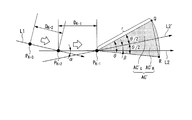
図3は、予測範囲算出部20の動作の一例を説明するための説明図である。図3において、PK-1は前回(1回前)の接触位置、PK-2は前々回(2回前)の接触位置、PK-3は3回前の接触位置を模式的に表している。図3の例では、3回前の接触位置PK-3、前々回の接触位置PK-2、前回の接触位置PK-1は、直線L上に存在する。図4(後述)においても同様である。
予測範囲算出部20は、図3に示すように、3回前の接触位置PK-3、前々回の接触位置PK-2、前回の接触位置PK-1の各接触位置が略直線上に存在する場合、前回の接触位置PK-1を基点に所定の角度θ内に広がる領域であって前々回の接触位置PK-2と前回の接触位置PK-1とを通過する直線Lによって2等分される領域(ドット表示した2等辺3角形の領域)ATを予測範囲として算出する。換言すれば、予測範囲算出部20は、上述の直線Lによって領域ATQと領域ATRとに2等分される、前回の接触位置PK-1を頂点(頂点の角度θ)とする2等辺3角形の領域ATを予測範囲として算出する。
図3において、2等辺3角形の高さHは、例えば、距離DK-1によって規定されるものであってもよい。例えば、距離DK-1に所定の係数bHを乗じた値を高さHとして用いてもよい。換言すれば、予測範囲算出部20は、前回の接触位置PK-1及び前々回の接触位置PK-2に基づいて、2等辺3角形の高さHを算出してもよい。図5(後述)についても同様である。
また、図3において、2等辺3角形の高さHは、距離DK-2及び距離DK-1によって規定されるものであってもよい。例えば、上記係数bHは、距離DK-2と距離DK-1の比率に応じた値であってもよい。具体的には、例えば、距離DK-2に比べ距離DK-1が大きい場合(接触位置PK-2と接触位置PK-1において同一指の接触として捉えたときに指の移動速度が接触位置PK-2と接触位置PK-1との間で段々と速くなっている場合)の係数bHは、距離DK-2に比べ距離DK-1が小さい場合(接触位置PK-2と接触位置PK-1において同一指の接触として捉えたときに指の移動速度が接触位置PK-2と接触位置PK-1との間で段々と遅くなっている場合)の係数bHよりも大きくなるようにしてもよい。図5(後述)についても同様である。
図4は、予測範囲算出部20の他の動作の一例を説明するための説明図である。予測範囲算出部20は、3回前の接触位置PK-3、前々回の接触位置PK-2、前回の接触位置PK-1の各接触位置が略直線上に存在する場合に、図3に代えて図4に示すように、前回の接触位置PK-1を基点に所定の角度θ内に広がる領域であって前々回の接触位置PK-2と前回の接触位置PK-1とを通過する直線Lによって2等分される領域(ドット表示した扇形の領域;図3における、前回の接触位置PK-1と点Qとを結ぶ線分、及び、前回の接触位置PK-1と点Rとを結ぶ線分を2本の半径rとし、前記2本の半径rと、点Q、Rの間の円弧によって囲まれた図形)ACを予測範囲として算出してもよい。
換言すれば、予測範囲算出部20は、上述の直線Lによって領域ACQと領域ACRとに2等分される、前回の接触位置PK-1を頂点(頂点の角度θ)とする扇形の領域ACを予測範囲として算出してもよい。
換言すれば、予測範囲算出部20は、上述の直線Lによって領域ACQと領域ACRとに2等分される、前回の接触位置PK-1を頂点(頂点の角度θ)とする扇形の領域ACを予測範囲として算出してもよい。
図4において、扇形の半径rは、例えば、距離DK-1によって規定されるものであってもよい。例えば、距離DK-1に係数brを乗じた値を半径rとして用いてもよい。換言すれば、予測範囲算出部20は、前回の接触位置PK-1及び前々回の接触位置PK-2に基づいて、扇形の半径rを算出してもよい。図6(後述)についても同様である。
また、図4において、扇形の半径rは、距離DK-2及び距離DK-1によって規定されるものであってもよい。例えば、上記係数brは、距離DK-2と距離DK-1の比率に応じた値であってもよい。具体的には、例えば、距離DK-2に比べ距離DK-1が大きい場合(接触位置PK-2と接触位置PK-1において同一指の接触として捉えたときに指の移動速度が接触位置PK-2と接触位置PK-1との間で段々と速くなっている場合)の係数brは、距離DK-2に比べ距離DK-1が小さい場合(接触位置PK-2と接触位置PK-1において同一指の接触として捉えたときに指の移動速度が接触位置PK-2と接触位置PK-1との間で段々と遅くなっている場合)の上記所定の係数brよりも大きくなるようにしてもよい。図6(後述)についても同様である。
図5及び図6は、予測範囲算出部20の他の動作の一例を説明するための説明図である。図5及び図6において、PK-1は前回(1回前)の接触位置、PK-2は前々回(2回前)の接触位置、PK-3は3回前の接触位置を模式的に表している。図5及び図6の例では、3回前の接触位置PK-3、前々回の接触位置PK-2、前回の接触位置PK-1の3つの接触位置は、同一直線上に存在しない。具体的には、3回前の接触位置PK-3と前々回の接触位置PK-2とを通過する直線L1と、前々回の接触位置PK-2と前回の接触位置PK-1とを通過する直線L2とは角度αを為している。
図5に示すように、3回前の接触位置PK-3、前々回の接触位置PK-2、前回の接触位置PK-1の3つの接触位置が同一直線上に存在しない場合、予測範囲算出部20は、上記角度αに応じた角度β分、前回の接触位置PK-1を基点に、上記直線L2を3回前の接触位置PK-3の側(直線L2によって分割される領域のうち3回前の接触位置PK-3が存在する側)に回転させた直線L2’によって2等分される領域(ドット表示した2等辺3角形の領域)AT’を予測範囲として算出してもよい。換言すれば、予測範囲算出部20は、図5に示すように、図3の予測範囲(2等辺3角形の領域AT)を、前回の接触位置PK-1を中心に3回前の接触位置PK-3の側に角度β回転させた予測範囲(上述の直線L2’によって領域AT’Qと領域AT’Rとに2等分される、2等辺3角形の領域AT’)を算出してもよい。
図5において、角度βの値は、角度αの値と同一であってもよい。また、角度βの値は、角度αと距離DK-1と距離DK-2とに応じた値であってもよい。例えば、角度β=角度α+角度γとし、距離DK-2に比べ距離DK-1が大きい場合(接触位置PK-2と接触位置PK-1において同一指の接触として捉えたときに指の移動速度が接触位置PK-2と接触位置PK-1との間で段々と速くなっている場合)の角度γは、距離DK-2に比べ距離DK-1が小さい場合(接触位置PK-2と接触位置PK-1において同一指の接触として捉えたときに指の移動速度が接触位置PK-2と接触位置PK-1との間で段々と遅くなっている場合)の角度γよりも小さくなるようにしてもよい。なお、角度γは、プラスの値(即ち、角度β>角度α)であってもよいし、マイナスの値(即ち、角度β<角度α)であってもよい。図6(後述)の場合も同様である。
また、3回前の接触位置PK-3、前々回の接触位置PK-2、前回の接触位置PK-1の3つの接触位置が同一直線上に存在しない場合に、予測範囲算出部20は、図6に示すように、図4の予測範囲(扇形の領域AC)を、前回の接触位置PK-1を中心に3回前の接触位置PK-3の側に角度β回転させた予測範囲(上述の直線L2’によって領域AC’Qと領域AC’Rとに2等分される、扇形AC’)を算出してもよい。
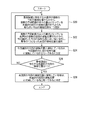
図7は、電子機器1の動作の一例を示すフローチャートである。図7のフローチャートは、検出部10による検出の周期毎に開始する。図7において、検出部10は、今回の接触位置を検出し、接触位置記憶部90に記憶する(ステップS10)。
予測範囲算出部20は、接触位置記憶部90に記憶されている前回迄の各回の検出における接触位置に基づいて、指の接触位置の予測範囲を算出する(ステップS12)。例えば、予測範囲算出部20は、図3に示すような領域ATを予測範囲として算出する。
同一指判定部30は、ステップS10において検出及び記憶された今回の接触位置が、ステップS12において算出された予測範囲に存在するか否かに基づいて、今回の接触位置に接触している指と前回の接触位置に接触していた指との同一性を判定する。具体的には、同一指判定部30は、今回の接触位置が予測範囲に存在する場合、今回の接触位置に接触している指は前回の接触位置に接触していた指と同一であると判定し、今回の接触位置が予測範囲に存在しない場合、今回の接触位置に接触している指は前回の接触位置に接触していた指と同一ではないと判定する(ステップS14)。そして、図7のフローチャートは終了する。なお、今回の接触位置に接触している指は前回の接触位置に接触した指と同一であると判定された場合には、指の移動操作(スライド操作)であると電子機器1は認識することができる。
以上、電子機器1によれば、実際の指の動きを精度よく認識することができる。具体的には、電子機器1によれば、過去の接触位置に基づいて接触位置の予測範囲を設定し、今回の接触位置が、予測範囲内に存在するか否かに基づいて指の同一性を判断するので、実際の指の動きを精度よく認識することができる。
なお、3回前の接触位置PK-3、前々回の接触位置PK-2、前回の接触位置PK-1の各接触位置が略直線上に存在する場合の予測範囲(図3の領域AT、図4の領域AC)の算出と、略直線上に存在しない場合の予測範囲(図5の領域AT’、図6の領域AC’)の算出とについて説明した。しかし、3回前の接触位置PK-3を用いることなく(換言すれば、上述の略直線上に存在するか否かには関係なく)、簡便に予測範囲を算出してもよい。例えば、前々回の接触位置PK-2と前回の接触位置PK-1とに基づいて、高さHを距離DK-1によって規定した領域AT(図3)、又は、半径rを距離DK-1によって規定した領域AC(図4)を算出してもよい。
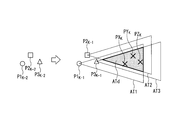
以下、検出部10が、同時(同一タイミング)に複数の指の接触位置を検出した場合における、同一性判定部30の動作について説明する。具体的には、予測範囲算出部20によって算出されたそれぞれの前回の接触位置を基点とするそれぞれの予測範囲の重複領域に複数の今回の接触位置が存在する場合における、同一性判定部30の動作(判定)について説明する。
なお、予測範囲算出部20は、同時に検出されたそれぞれの前回の接触位置に対し、図3から図6に示したように、種々の予測範囲を算出可能である。しかし、以下の説明においては説明の便宜上、同時に検出された前回の接触位置の何れに対しても、図3に示すような予測範囲(領域AT)を算出するものとする。
図8Aは、同一指判定部30の動作の一例を説明するための説明図である。同一指判定部30は、複数の予測範囲の重複領域に複数の今回の接触位置が存在する場合、前記複数の予測範囲のそれぞれの基点となっているそれぞれの前回の接触位置と、前記重複領域に存在するそれぞれの今回の接触位置との位置関係に基づいて、前記複数の今回の接触位置のそれぞれに接触しているそれぞれの指と、前記それぞれの前回の接触位置に接触していた何れかの指との同一性を判定するようにしてもよい。即ち、図8Aにおいて、同一指判定部30は、予測範囲(AT1)、予測範囲(AT2)及び予測範囲(AT3)の重複領域(ATd)に、今回の接触位置PXK、今回の接触位置PYK、今回の接触位置PZKが存在する場合、前記複数の予測範囲(AT1、AT2、AT3)のそれぞれの基点となっているそれぞれの前回の接触位置(P1K-1、P2K-1、P3K-1)と、前記重複領域(ATd)に存在するそれぞれの今回の接触位置(PXK、PYK、PZK)との位置関係に基づいて、前記複数の今回の接触位置(PXK、PYK、PZK)のそれぞれに接触しているそれぞれの指と、前記それぞれの前回の接触位置(P1K-1、P2K-1、P3K-1)に接触していた何れかの指との同一性を判定するようにしてもよい。つまり、同一指判定部30は、例えば、図8Bに示すように、右手の人指し指、中指、薬指を接触検出面に接触させたまま同時に右手の親指側から小指側に移動させた場合、前記移動前後において、どれとどれが同じ指の接触位置であるかを判定する。
図9は、同一指判定部30の機能構成例である。具体的には、同一指判定部30は、例えば、図9に示すように、第1選択部32、第2選択部34及び同一指決定部36を有する。
第1選択部32は、重複領域に存在する複数の今回の接触位置のなかから今回の接触位置を1つずつ順次選択するようにしてもよい。
第2選択部34は、複数の予測範囲のそれぞれの基点となっている複数の前回の接触位置のなかから前回の接触位置を1つずつ順次選択するようにしてもよい。
同一性決定部36は、第1選択部32によって今回選択された1つの今回の接触位置に接触している指は、第2選択部34によって今回選択された1つの前回の接触位置に接触している指と同一であると決定するようにしてもよい。
以下、具体的な手法として、判定手法1~4のそれぞれについて説明する。
(判定手法1)
第1選択部32は、予測範囲の重複領域に存在する未選択の複数の今回の接触位置のなかから、複数の予測範囲のそれぞれの基点となっている未選択の前回の接触位置の何れからも最も近い今回の接触位置を、未選択の今回の接触位置が最後の1個になる迄、1つずつ順次選択する。
第1選択部32は、予測範囲の重複領域に存在する未選択の複数の今回の接触位置のなかから、複数の予測範囲のそれぞれの基点となっている未選択の前回の接触位置の何れからも最も近い今回の接触位置を、未選択の今回の接触位置が最後の1個になる迄、1つずつ順次選択する。
第2選択部34は、第1選択部32が今回の接触位置を1つ選択する度に、複数の予測範囲のそれぞれの基点となっている未選択の複数の前回の接触位置のなかから、第1選択部32が今回選択した今回の接触位置から最も遠い前回の接触位置を1つ選択する。
同一性決定部36は、第1選択部32によって今回選択された1つの今回の接触位置に接触している指は、第2選択部34によって今回選択された1つの前回の接触位置に接触している指と同一であると決定する。
以下、図8Aと図10を用いて具体的に説明する。図10は、電子機器1の他の動作の一例を示すフローチャートである。
第1選択部32は、図8Aの場合、重複領域(ATd)に存在する未選択の複数の今回の接触位置(PXK、PYK、PZK)のなかから、複数の予測範囲(AT1、AT2、AT3)のそれぞれの基点となっている未選択の前回の接触位置(P1K-1、P2K-1、P3K-1)の何れからも最も近い今回の接触位置(PXK)を選択する(ステップS20)。
続いて、第2選択部34は、複数の予測範囲(AT1、AT2、AT3)のそれぞれの基点となっている未選択の複数の前回の接触位置(P1K-1、P2K-1、P3K-1)のなかから、今回選択された今回の接触位置(PXK)に近い順に最後の1個になる迄1つずつ除外し(最初にP3K-1を除外し、続いてP2K-1を除外し)、最後の1つとなった前回の接触位置(P1K-1)を選択する(ステップS22)。
続いて、同一性決定部36は、ステップS20において今回選択された今回の接触位置(PXK)に接触している指は、ステップS22において今回選択された前回の接触位置(P1K-1)に接触している指と同一であると決定する(ステップS24)。
続いて、第1選択部32は、重複領域(ATd)に存在する未選択の今回の接触位置は1つであるか否かを判断する(ステップS26)。第1選択部32は、重複領域(ATd)には2つの未選択の今回の接触位置(PYK、PZK)があるためステップS20に戻る(ステップS26:No)。
続いて、第1選択部32は、重複領域(ATd)に存在する未選択の複数の今回の接触位置(PYK、PZK)のなかから、複数の予測範囲(AT1、AT2、AT3)のそれぞれの基点となっている未選択の前回の接触位置(P2K-1、P3K-1)の何れからも最も近い今回の接触位置(PYK)を選択する(ステップS20)。
続いて、第2選択部34は、複数の予測範囲(AT1、AT2、AT3)のそれぞれの基点となっている未選択の複数の前回の接触位置(P2K-1、P3K-1)のなかから、今回選択された今回の接触位置(PYK)に近い順に最後の1個になる迄1つずつ除外し(P3K-1を除外)、最後の1つとなった前回の接触位置(P2K-1)を選択する(ステップS22)。
続いて、同一性決定部36は、直前のステップS20において今回選択された今回の接触位置(PYK)に接触している指は、直前のステップS22において今回選択された前回の接触位置(P2K-1)に接触している指と同一であると決定する(ステップS24)。
続いて、第1選択部32は、重複領域(ATd)に存在する未選択の今回の接触位置(PZK)は1つであるためステップS28に進む(ステップS26:Yes)。
続いて、同一性決定部36は、未選択の今回の接触位置(PZK)に接触している指は、未選択の前回の接触位置(P3K-1)に接触している指と同一であると決定する(ステップS28)。そして本フローチャートは終了する。
判定手法1によれば、同一性判定部30(同一性決定部32)は、今回の接触位置(PXK)に接触している指と前回の接触位置(P1K-1)に接触している指とが同一、今回の接触位置(PYK)に接触している指と前回の接触位置(P2K-1)に接触している指とが同一、今回の接触位置(PZK)に接触している指と前回の接触位置(P3K-1)に接触している指とが同一であると判定(決定)する。
(判定手法2)
第1選択部32は、重複領域に存在する未選択の複数の今回の接触位置のなかから、複数の予測範囲のそれぞれの基点となっている未選択の前回の接触位置の何れからも最も遠い今回の接触位置を、未選択の今回の接触位置が最後の1個になる迄、1つずつ順次選択する。
第1選択部32は、重複領域に存在する未選択の複数の今回の接触位置のなかから、複数の予測範囲のそれぞれの基点となっている未選択の前回の接触位置の何れからも最も遠い今回の接触位置を、未選択の今回の接触位置が最後の1個になる迄、1つずつ順次選択する。
第2選択部34は、第1選択部32が今回の接触位置を1つ選択する度に、複数の予測範囲のそれぞれの基点となっている未選択の複数の前回の接触位置のなかから、第1選択部32が今回選択した今回の接触位置から最も近い前回の接触位置を1つ選択する。
同一性決定部36は、第1選択部32によって今回選択された1つの今回の接触位置に接触している指は、第2選択部34によって今回選択された1つの前回の接触位置に接触している指と同一であると決定する。
以下、図8Aを用いて具体的に説明する。第1選択部32は、図8Aの場合、重複領域(ATd)に存在する未選択の複数の今回の接触位置(PXK、PYK、PZK)のなかから、複数の予測範囲(AT1、AT2、AT3)のそれぞれの基点となっている未選択の前回の接触位置(P1K-1、P2K-1、P3K-1)の何れからも最も遠い今回の接触位置(PZK)を選択する。
続いて、第2選択部34は、複数の予測範囲(AT1、AT2、AT3)のそれぞれの基点となっている未選択の複数の前回の接触位置(P1K-1、P2K-1、P3K-1)のなかから、今回選択された今回の接触位置(PZK)に遠い順に最後の1個になる迄1つずつ除外し(最初にP1K-1を除外し、続いてP2K-1を除外し)、最後の1つとなった前回の接触位置(P3K-1)を選択する。
続いて、同一性決定部36は、今回選択された今回の接触位置(PZK)に接触している指は、今回選択された前回の接触位置(P3K-1)に接触している指と同一であると決定する。
続いて、第1選択部32は、未選択の今回の接触位置(PXK、PYK)のなかから、複数の予測範囲(AT1、AT2、AT3)のそれぞれの基点となっている未選択の前回の接触位置(P1K-1、P2K-1)の何れからも最も遠い今回の接触位置(PYK)を選択する。
続いて、第2選択部34は、複数の予測範囲(AT1、AT2、AT3)のそれぞれの基点となっている未選択の複数の前回の接触位置(P1K-1、P2K-1)のなかから、今回選択された今回の接触位置(PYK)に遠い順に最後の1個になる迄1つずつ除外し(P1K-1を除外)、最後の1つとなった前回の接触位置(P2K-1)を選択する。
続いて、同一性決定部36は、今回選択された今回の接触位置(PYK)に接触している指は、今回選択された前回の接触位置(P2K-1)に接触している指と同一であると決定する。また、同一性決定部36は、未選択の今回の接触位置(PXK)に接触している指は、未選択の前回の接触位置(P1K-1)に接触している指と同一であると決定する。
以上、判定手法2によれば、同一性判定部30(同一性決定部32)は、今回の接触位置(PZK)に接触している指と前回の接触位置(P3K-1)に接触している指とが同一、今回の接触位置(PYK)に接触している指と前回の接触位置(P2K-1)に接触している指とが同一、今回の接触位置(PXK)に接触している指と前回の接触位置(P1K-1)に接触している指とが同一であると判定(決定)する。即ち、判定手法1と同一の判定結果を得る。
(判定手法3)
第2選択部34は、複数の予測範囲のそれぞれの基点となっている未選択の前回の接触位置のなかから、重複領域に存在する未選択の今回の接触位置の何れからも最も遠い前回の接触位置を、未選択の前回の接触位置が最後の1個になる迄、1つずつ順次選択する。
第2選択部34は、複数の予測範囲のそれぞれの基点となっている未選択の前回の接触位置のなかから、重複領域に存在する未選択の今回の接触位置の何れからも最も遠い前回の接触位置を、未選択の前回の接触位置が最後の1個になる迄、1つずつ順次選択する。
第1選択部32は、第2選択部34が前回の接触位置を1つ選択する度に、重複領域に存在する未選択の複数の今回の接触位置のなかから、第2選択部34が今回選択した前回の接触位置から最も近い今回の接触位置を選択する。
同一性決定部36は、第1選択部32によって今回選択された1つの今回の接触位置に接触している指は、第2選択部34によって今回選択された1つの前回の接触位置に接触している指と同一であると決定する。
以下、図8Aを用いて具体的に説明する。第2選択部34は、図8Aの場合、複数の予測範囲(AT1、AT2、AT3)のそれぞれの基点となっている未選択の複数の前回の接触位置(P1K-1、P2K-1、P3K-1)のなかから、重複領域(ATd)に存在する未選択の複数の今回の接触位置(PXK、PYK、PZK)の何れからも最も遠い今回の接触位置(P1K-1)を選択する。
続いて、第1選択部32は、重複領域(ATd)に存在する未選択の複数の今回の接触位置(PXK、PYK、PZK)のなかから、今回選択された前回の接触位置(P1K-1)に遠い順に最後の1個になる迄1つずつ除外し(最初にPZKを除外し、続いてPYKを除外し)、最後の1つとなった前回の接触位置(PXK)を選択する。
続いて、同一性決定部36は、今回選択された今回の接触位置(PXK)に接触している指は、今回選択された前回の接触位置(P1K-1)に接触している指と同一であると決定する。
続いて、第2選択部34は、複数の予測範囲(AT1、AT2、AT3)のそれぞれの基点となっている未選択の複数の前回の接触位置(P2K-1、P3K-1)のなかから、重複領域(ATd)に存在する未選択の複数の今回の接触位置(PYK、PZK)の何れからも最も遠い今回の接触位置(P2K-1)を選択する。
続いて、第1選択部32は、重複領域(ATd)に存在する未選択の複数の今回の接触位置(PYK、PZK)のなかから、今回選択された前回の接触位置(P2K-1)に遠い順に最後の1個になる迄1つずつ除外し(PZKを除外し)、最後の1つとなった前回の接触位置(PYK)を選択する。
続いて、同一性決定部36は、今回選択された今回の接触位置(PYK)に接触している指は、今回選択された前回の接触位置(P2K-1)に接触している指と同一であると決定する。また、同一性決定部36は、未選択の今回の接触位置(PZK)に接触している指は、未選択の前回の接触位置(P3K-1)に接触している指と同一であると決定する。
以上、判定手法3によれば、同一性判定部30(同一性決定部32)は、今回の接触位置(PXK)に接触している指と前回の接触位置(P1K-1)に接触している指とが同一、今回の接触位置(PYK)に接触している指と前回の接触位置(P2K-1)に接触している指とが同一、今回の接触位置(PZK)に接触している指と前回の接触位置(P3K-1)に接触している指とが同一であると判定(決定)する。即ち、判定手法1と同一の判定結果を得る。
(判定手法4)
第2選択部34は、複数の予測範囲のそれぞれの基点となっている未選択の前回の接触位置のなかから、重複領域に存在する未選択の今回の接触位置の何れからも最も近い前回の接触位置を、未選択の前回の接触位置が最後の1個になる迄、1つずつ順次選択する。
第2選択部34は、複数の予測範囲のそれぞれの基点となっている未選択の前回の接触位置のなかから、重複領域に存在する未選択の今回の接触位置の何れからも最も近い前回の接触位置を、未選択の前回の接触位置が最後の1個になる迄、1つずつ順次選択する。
第1選択部32は、第2選択部34が前回の接触位置を1つ選択する度に、重複領域に存在する未選択の複数の今回の接触位置のなかから、第2選択部34が今回選択した前回の接触位置から最も遠い今回の接触位置を選択する。
同一性決定部36は、第1選択部32によって今回選択された1つの今回の接触位置に接触している指は、第2選択部34によって今回選択された1つの前回の接触位置に接触している指と同一であると決定する。
以下、図8Aを用いて具体的に説明する。第2選択部34は、図8Aの場合、複数の予測範囲(AT1、AT2、AT3)のそれぞれの基点となっている未選択の複数の前回の接触位置(P1K-1、P2K-1、P3K-1)のなかから、重複領域(ATd)に存在する未選択の複数の今回の接触位置(PXK、PYK、PZK)の何れからも最も近い今回の接触位置(P3K-1)を選択する。
続いて、第1選択部32は、重複領域(ATd)に存在する未選択の複数の今回の接触位置(PXK、PYK、PZK)のなかから、今回選択された前回の接触位置(P3K-1)に近い順に最後の1個になる迄1つずつ除外し(最初にPXKを除外し、続いてPYKを除外し)、最後の1つとなった前回の接触位置(PZK)を選択する。
続いて、同一性決定部36は、今回選択された今回の接触位置(PZK)に接触している指は、今回選択された前回の接触位置(P3K-1)に接触している指と同一であると決定する。
続いて、第2選択部34は、複数の予測範囲(AT1、AT2、AT3)のそれぞれの基点となっている未選択の複数の前回の接触位置(P1K-1、P2K-1)のなかから、重複領域(ATd)に存在する未選択の複数の今回の接触位置(PXK、PYK)の何れからも最も遠い今回の接触位置(P2K-1)を選択する。
続いて、第1選択部32は、重複領域(ATd)に存在する未選択の複数の今回の接触位置(PXK、PYK)のなかから、今回選択された前回の接触位置(P2K-1)に近い順に最後の1個になる迄1つずつ除外し(PXKを除外し)、最後の1つとなった前回の接触位置(PYK)を選択する。
続いて、同一性決定部36は、今回選択された今回の接触位置(PYK)に接触している指は、今回選択された前回の接触位置(P2K-1)に接触している指と同一であると決定する。また、同一性決定部36は、未選択の今回の接触位置(PXK)に接触している指は、未選択の前回の接触位置(P1K-1)に接触している指と同一であると決定する。
以上、判定手法4によれば、同一性判定部30(同一性決定部32)は、今回の接触位置(PZK)に接触している指と前回の接触位置(P3K-1)に接触している指とが同一、今回の接触位置(PYK)に接触している指と前回の接触位置(P2K-1)に接触している指とが同一、今回の接触位置(PXK)に接触している指と前回の接触位置(P1K-1)に接触している指とが同一であると判定(決定)する。即ち、判定手法1と同一の判定結果を得る。
以上、電子機器1によれば、複数の予測範囲の重複領域に複数の今回の接触位置が存在する場合であっても、実際の指の動きを精度よく認識することができる。例えば、図8Bに示すように、複数指を横方向(右手の親指側から小指側へ向かう方向)に移動させた場合には、複数の予測範囲の重複領域に複数の今回の接触位置が存在する可能性がある。この場合に、上述した判定手法1~4の何れかを用いて、指の移動前後において、どれとどれが同じ指の接触位置であるかを判定することができる。従って、各指の実際の動きを精度よく認識することができる。
なお、図8A及び図8Bは、同時に検出された前回の接触位置の何れに対しても図3(領域AT)の形状の予測範囲を算出した場合において、複数の予測範囲(領域AT同士)の重複範囲に複数の今回の接触位置が存在するときの同一性判定部30の動作(判定)について説明した。
しかし、同時に検出された前回の接触位置の何れに対しても図4(領域AC)の形状の予測範囲を算出した場合において、複数の予測範囲(領域AC同士)の重複範囲に複数の今回の接触位置が存在するときの同一性判定部30の動作(判定)についても同様である。
また、同時に検出された前回の接触位置の何れに対しても図5(領域AT’)の形状の予測範囲を算出した場合において、複数の予測範囲(領域AT’同士)の重複範囲に複数の今回の接触位置が存在するときの同一性判定部30の動作(判定)についても同様である。
また、同時に検出された前回の接触位置の何れに対しても図6(領域AC’)の形状の予測範囲を算出した場合において、複数の予測範囲(領域AC’同士)の重複範囲に複数の今回の接触位置が存在するときの同一性判定部30の動作(判定)についても同様である。
また、同時に検出された前回の接触位置のそれぞれに対し、同じ形状の予測範囲を算出しない場合の複数の予測範囲の重複範囲に複数の今回の接触位置が存在するときの同一性判定部30の動作(判定)についても同様である。
なお、上記実施形態では、検出部10は、タッチディスプレイ上の接触位置を周期的に検出すると説明した。しかし、検出部10は、他の場所(ディスプレイ以外を含む)での指の接触位置を検出するものであってもよい。例えば、検出部10は、筐体側面(把持部分)上の指の接触位置を検出するものであってもよい。
なお、上記実施形態では、前回迄の各回の接触位置に基づいて予測範囲を算出している。そのため、指がタッチディスプレイ上に最初に接触した際、あるいはタッチディスプレイ上で静止していた指が動き始める際に、予測範囲を算出することができない。この場合は、予測範囲を算出せずに、今回の接触位置と前回の接触位置との距離のみに基づいて指同一性を判断すればよい。つまり、予測範囲を算出せずに判定手法1~4のいずれかの手法と同様にして指同一性を判断すればよい。そして、前々回の接触位置以前の接触位置の情報が得られたところで予測範囲を算出するようにすればよい。
なお、本発明の実施形態による電子機器1の各処理を実行するためのプログラムをコンピュータ読み取り可能な記録媒体に記録して、前記記録媒体に記録されたプログラムをコンピュータシステムに読み込ませ、実行することにより、本発明の実施形態による電子機器1の各処理に係る上述した種々の処理を行ってもよい。なお、ここでいう「コンピュータシステム」とは、OSや周辺機器等のハードウェアを含むものであってもよい。また、「コンピュータシステム」は、WWWシステムを利用している場合であれば、ホームページ提供環境(あるいは表示環境)も含むものとする。また、「コンピュータ読み取り可能な記録媒体」とは、フロッピー(登録商標)ディスク、光磁気ディスク、SDカード、フラッシュメモリ等の書き込み可能な不揮発性メモリ、CD-ROM等の可搬媒体、コンピュータシステムに内蔵されるハードディスク等の記憶装置のことをいう。
さらに「コンピュータ読み取り可能な記録媒体」とは、インターネット等のネットワークや電話回線等の通信回線を介してプログラムが送信された場合のサーバやクライアントとなるコンピュータシステム内部の揮発性メモリ(例えばDRAM(Dynamic Random Access Memory))のように、一定時間プログラムを保持しているものも含むものとする。また、上記プログラムは、このプログラムを記憶装置等に格納したコンピュータシステムから、伝送媒体を介して、あるいは、伝送媒体中の伝送波により他のコンピュータシステムに伝送されてもよい。ここで、プログラムを伝送する「伝送媒体」は、インターネット等のネットワーク(通信網)や電話回線等の通信回線(通信線)のように情報を伝送する機能を有する媒体のことをいう。また、上記プログラムは、前述した機能の一部を実現するためのものであっても良い。さらに、前述した機能をコンピュータシステムにすでに記録されているプログラムとの組み合わせで実現できるもの、いわゆる差分ファイル(差分プログラム)であっても良い。
以上、この発明の実施形態について図面を参照して詳述してきたが、具体的な構成はこの実施形態に限られるものではなく、この発明の要旨を逸脱しない範囲の設計等も含まれる。
1:電子機器 10:検出部 20:予測範囲算出部 30:同一指判定部 32:第1選択部 34:第2選択部 36:同一指決定部 90:接触位置記憶部
Claims (10)
- 接触検出面における指の接触位置を検出する検出部と、
前記検出部によって検出された前記接触位置を記憶する接触位置記憶部と、
前記接触位置記憶部に記憶されている接触位置に基づいて指の接触位置の予測範囲を算出する予測範囲算出部と、
前記予測範囲算出部によって算出された前記予測範囲に今回の接触位置が存在するか否かに基づいて、前記今回の接触位置に接触している指と前回の接触位置に接触していた指との同一性を判定する同一指判定部と
を備え、
前記同一指判定部は、
前記今回の接触位置が前記予測範囲に存在する場合、前記今回の接触位置に接触している指は前記前回の接触位置に接触していた指と同一であると判定する
ことを特徴とする電子機器。 - 請求項1に記載の電子機器において、
前記予測範囲算出部は、
前記前回の接触位置を基点に所定の角度内に広がる領域であって前々回の接触位置と前記前回の接触位置とを通過する直線によって分割される領域を前記予測範囲として算出する
ことを特徴とする電子機器。 - 請求項1又は請求項2に記載の電子機器において、
前記接触位置記憶部は、
所定のタイミング以前に検出された接触位置を消去する
ことを特徴とする電子機器。 - 請求項1から請求項3に記載の電子機器において、
前記予測範囲算出部は、
3回前、前々回、前回の各接触位置が略直線上に存在する場合、前記前回の接触位置を基点に所定の角度内に広がる領域であって前記前々回の接触位置と前記前回の接触位置とを通過する直線によって2等分される領域を前記予測範囲として算出する
ことを特徴とする電子機器。 - 請求項1から請求項4に記載の電子機器において、
前記検出部は、
同時に複数の指の接触位置を検出し、
前記予測範囲算出部は、
前記検出部によって同時に検出されたそれぞれの前回の接触位置を基点とする複数の前記予測範囲を算出し、
前記同一指判定部は、
複数の前記予測範囲の重複領域に複数の前記今回の接触位置が存在する場合、前記複数の前記予測範囲のそれぞれの基点となっているそれぞれの前記前回の接触位置と、前記重複領域に存在するそれぞれの前記今回の接触位置との位置関係に基づいて、前記複数の今回の接触位置のそれぞれに接触しているそれぞれの指と、前記それぞれの前回の接触位置に接触していた何れかの指との同一性を判定する
ことを特徴とする電子機器。 - 請求項5に記載の電子機器において、
前記同一指判定部は、
前記重複領域に存在する未選択の複数の今回の接触位置のなかから、前記複数の前記予測範囲のそれぞれの基点となっている未選択の前回の接触位置の何れからも最も近い今回の接触位置を、前記未選択の今回の接触位置が最後の1個になる迄、1つずつ順次選択する第1選択部と、
前記第1選択部が前記今回の接触位置を1つ選択する度に、前記複数の前記予測範囲のそれぞれの基点となっている前記未選択の複数の前回の接触位置のなかから、前記第1選択部が今回選択した前記今回の接触位置から最も遠い前回の接触位置を1つ選択それぞれする第2選択部と、
前記第1選択部によって今回選択された1つの前記今回の接触位置に接触している指は、前記第2選択部によって今回選択された1つの前記前回の接触位置に接触している指と同一であると決定する同一性決定部とを有する
ことを特徴とする電子機器。 - 請求項5に記載の電子機器において、
前記同一指判定部は、
前記重複領域に存在する未選択の複数の今回の接触位置のなかから、前記複数の前記予測範囲のそれぞれの基点となっている未選択の前回の接触位置の何れからも最も遠い今回の接触位置を、前記未選択の今回の接触位置が最後の1個になる迄、1つずつ順次選択する第1選択部と、
前記第1選択部が前記今回の接触位置を1つ選択する度に、前記複数の前記予測範囲のそれぞれの基点となっている前記未選択の複数の前回の接触位置のなかから、前記第1選択部が今回選択した前記今回の接触位置から最も近い前回の接触位置を1つ選択する第2選択部と、
前記第1選択部によって今回選択された1つの前記今回の接触位置に接触している指は、前記第2選択部によって今回選択された1つの前記前回の接触位置に接触している指と同一であると決定する同一性決定部とを有する
ことを特徴とする電子機器。 - 請求項5に記載の電子機器において、
前記同一指判定部は、
前記複数の前記予測範囲のそれぞれの基点となっている未選択の前回の接触位置のなかから、前記重複領域に存在する未選択の今回の接触位置の何れからも最も遠い前記前回の接触位置を、前記未選択の前回の接触位置が最後の1個になる迄、1つずつ順次選択する第2選択部と、
前記第2選択部が前記前回の接触位置を1つ選択する度に、前記重複領域に存在する前記未選択の複数の今回の接触位置のなかから、前記第2選択部が前記今回選択した前回の接触位置から最も近い今回の接触位置を選択する第1選択部と、
前記第1選択部によって今回選択された1つの前記今回の接触位置に接触している指は、前記第2選択部によって今回選択された1つの前記前回の接触位置に接触している指と同一であると決定する同一性決定部とを有する
ことを特徴とする電子機器。 - 請求項5に記載の電子機器において、
前記同一指判定部は、
前記複数の前記予測範囲のそれぞれの基点となっている未選択の前回の接触位置のなかから、前記重複領域に存在する未選択の今回の接触位置の何れからも最も近い前記前回の接触位置を、前記未選択の前回の接触位置が最後の1個になる迄、1つずつ順次選択する第2選択部と、
前記第2選択部が前記前回の接触位置を1つ選択する度に、前記重複領域に存在する前記未選択の複数の今回の接触位置のなかから、前記第2選択部が前記今回選択した前回の接触位置から最も遠い今回の接触位置を選択する第1選択部と、
前記第1選択部によって今回選択された1つの前記今回の接触位置に接触している指は、前記第2選択部によって今回選択された1つの前記前回の接触位置に接触している指と同一であると決定する同一性決定部とを有する
ことを特徴とする電子機器。 - 接触検出面を有する電子機器のコンピュータに、
前記接触検出面における指の接触位置を検出する検出ステップと、
前記検出ステップによって検出された前記接触位置に基づいて、指の接触位置の予測範囲を算出する予測範囲算出ステップと、
前記予測範囲算出ステップによって算出された前記予測範囲に今回の接触位置が存在するか否かに基づいて、前記今回の接触位置に接触している指と前回の接触位置に接触していた指との同一性を判定する同一指判定ステップとを備え実行させるプログラムであって、
前記予測範囲算出ステップは、
前記前回の接触位置を基点に所定の角度内に広がる領域であって前々回の接触位置と前記前回の接触位置とを通過する直線によって分割される領域を前記予測範囲として算出し、
前記同一指判定ステップは、
前記今回の接触位置が前記予測範囲に存在する場合、前記今回の接触位置に接触している指は前記前回の接触位置に接触していた指と同一であると判定する
ことを特徴とするプログラム。
Applications Claiming Priority (2)
| Application Number | Priority Date | Filing Date | Title |
|---|---|---|---|
| JP2012195036 | 2012-09-05 | ||
| JP2012-195036 | 2012-09-05 |
Publications (1)
| Publication Number | Publication Date |
|---|---|
| WO2014038618A1 true WO2014038618A1 (ja) | 2014-03-13 |
Family
ID=50237224
Family Applications (1)
| Application Number | Title | Priority Date | Filing Date |
|---|---|---|---|
| PCT/JP2013/073908 Ceased WO2014038618A1 (ja) | 2012-09-05 | 2013-09-05 | 電子機器およびプログラム |
Country Status (1)
| Country | Link |
|---|---|
| WO (1) | WO2014038618A1 (ja) |
Citations (2)
| Publication number | Priority date | Publication date | Assignee | Title |
|---|---|---|---|---|
| JPH1011208A (ja) * | 1996-06-24 | 1998-01-16 | Sharp Corp | 座標入力装置 |
| JP2012033118A (ja) * | 2010-08-03 | 2012-02-16 | Fujitsu Ltd | 表示装置、表示方法、および、表示プログラム |
-
2013
- 2013-09-05 WO PCT/JP2013/073908 patent/WO2014038618A1/ja not_active Ceased
Patent Citations (2)
| Publication number | Priority date | Publication date | Assignee | Title |
|---|---|---|---|---|
| JPH1011208A (ja) * | 1996-06-24 | 1998-01-16 | Sharp Corp | 座標入力装置 |
| JP2012033118A (ja) * | 2010-08-03 | 2012-02-16 | Fujitsu Ltd | 表示装置、表示方法、および、表示プログラム |
Similar Documents
| Publication | Publication Date | Title |
|---|---|---|
| US10275113B2 (en) | 3D visualization | |
| US9747018B2 (en) | Apparatus and method for controlling object | |
| US10592049B2 (en) | Systems and methods for using hover information to predict touch locations and reduce or eliminate touchdown latency | |
| KR101710042B1 (ko) | 사용자 인터페이스를 제공하기 위한 방법, 디바이스, 시스템 및 비일시성의 컴퓨터 판독 가능한 기록 매체 | |
| US9274619B2 (en) | Input apparatus, input method, and input program | |
| US9678606B2 (en) | Method and device for determining a touch gesture | |
| TWI569171B (zh) | 手勢辨識 | |
| JP5448370B2 (ja) | 情報処理装置及びその制御方法、プログラム、記憶媒体 | |
| US8614663B2 (en) | Selective motor control classification | |
| EP2662756A1 (en) | Touch screen palm input rejection | |
| JP2014038527A (ja) | 入力装置、入力方法、及びプログラム | |
| US10509563B2 (en) | Dynamic modification of displayed elements of obstructed region | |
| CA2884884A1 (en) | Touchless input | |
| US9501098B2 (en) | Interface controlling apparatus and method using force | |
| US10126856B2 (en) | Information processing apparatus, control method for information processing apparatus, and storage medium | |
| KR102487643B1 (ko) | 전자펜, 전자펜과 연동되는 전자기기, 전자기기의 제어방법 및 전자기기의 제어방법을 실행하는 프로그램을 기록한 기록매체 | |
| JP6418585B2 (ja) | ウェアラブルデバイス、及びウェアラブルデバイスの動作方法 | |
| US20160018945A1 (en) | Heuristic palm detection | |
| US20150293690A1 (en) | Method for user interface display and electronic device using the same | |
| US9256360B2 (en) | Single touch process to achieve dual touch user interface | |
| KR20230010796A (ko) | 전자펜, 전자펜과 연동되는 전자기기, 전자기기의 제어방법 및 전자기기의 제어방법을 실행하는 프로그램을 기록한 기록매체 | |
| US10019141B2 (en) | Information processing apparatus, information display program, and information display method for controlling a cursor position in a text region and a display region | |
| US10809794B2 (en) | 3D navigation mode | |
| CN105242840A (zh) | 一种信息处理方法及一种电子设备 | |
| EP2672374A1 (en) | Detection of circular motion in a two-dimensional space |
Legal Events
| Date | Code | Title | Description |
|---|---|---|---|
| 121 | Ep: the epo has been informed by wipo that ep was designated in this application |
Ref document number: 13835014 Country of ref document: EP Kind code of ref document: A1 |
|
| NENP | Non-entry into the national phase |
Ref country code: DE |
|
| 122 | Ep: pct application non-entry in european phase |
Ref document number: 13835014 Country of ref document: EP Kind code of ref document: A1 |
|
| NENP | Non-entry into the national phase |
Ref country code: JP |