WO2014034405A1 - 通信システム、端末装置、通信方法、プログラムおよび記憶媒体 - Google Patents
通信システム、端末装置、通信方法、プログラムおよび記憶媒体 Download PDFInfo
- Publication number
- WO2014034405A1 WO2014034405A1 PCT/JP2013/071534 JP2013071534W WO2014034405A1 WO 2014034405 A1 WO2014034405 A1 WO 2014034405A1 JP 2013071534 W JP2013071534 W JP 2013071534W WO 2014034405 A1 WO2014034405 A1 WO 2014034405A1
- Authority
- WO
- WIPO (PCT)
- Prior art keywords
- information
- base station
- transmission data
- communication
- traffic
- Prior art date
- Legal status (The legal status is an assumption and is not a legal conclusion. Google has not performed a legal analysis and makes no representation as to the accuracy of the status listed.)
- Ceased
Links
Images





Classifications
-
- H—ELECTRICITY
- H04—ELECTRIC COMMUNICATION TECHNIQUE
- H04W—WIRELESS COMMUNICATION NETWORKS
- H04W28/00—Network traffic management; Network resource management
- H04W28/02—Traffic management, e.g. flow control or congestion control
- H04W28/0205—Traffic management, e.g. flow control or congestion control at the air interface
-
- H—ELECTRICITY
- H04—ELECTRIC COMMUNICATION TECHNIQUE
- H04W—WIRELESS COMMUNICATION NETWORKS
- H04W48/00—Access restriction; Network selection; Access point selection
- H04W48/18—Selecting a network or a communication service
-
- H—ELECTRICITY
- H04—ELECTRIC COMMUNICATION TECHNIQUE
- H04W—WIRELESS COMMUNICATION NETWORKS
- H04W74/00—Wireless channel access
Definitions
- the present invention relates to a communication system, a terminal device, a communication method, a program, and a storage medium.
- An object of the present invention is to provide a communication system, a terminal device, a communication method, a program, and a storage medium that can suppress the total amount of traffic.
- An aspect of the present invention is a communication system including a base station device and a terminal device, wherein the base station device receives free capacity information indicating a free capacity of communication traffic in the own device as the terminal.
- the terminal device refers to information on the transmission data and the free capacity information received from the base station device to determine whether to immediately transmit or hold transmission data for the base station device.
- a communication control unit to be determined.
- the other aspect of this invention is a communication system as described in (1), Comprising:
- the information regarding the said transmission data may include the kind of the said transmission data.
- the other aspect of this invention is a communication system as described in (1) or (2), Comprising:
- the information regarding the said transmission data may include the magnitude
- the communication control unit is configured such that the free space indicated by the free space information is greater than a preset threshold value.
- the threshold may be relatively increased as the size of the transmission data is relatively large.
- the information regarding the said transmission data may include the transmission period of the said transmission data.
- the communication control unit is configured such that the free space indicated by the free space information is larger than a preset threshold value.
- the threshold may be relatively increased as the transmission period is relatively large.
- the other aspect of this invention is a terminal device which communicates with the base station apparatus which notifies the free capacity information which shows the free capacity of communication traffic in a self-apparatus to a terminal device,
- the said base station apparatus A communication control unit that determines whether to immediately transmit or hold the transmission data with respect to the transmission data with reference to the information related to the transmission data and the free capacity information received from the base station apparatus.
- the other aspect of this invention is the communication method in the communication system which consists of a base station apparatus and a terminal device, Comprising:
- the said base station apparatus is an empty which shows the free capacity of communication traffic in an own apparatus.
- the capacity information is notified to the terminal device, and whether the terminal device immediately transmits or holds transmission data for the base station device is received from the base station device and information related to the transmission data. And determining with reference to the free space information.
- a step of receiving free capacity information transmitted from a base station apparatus, the free capacity information indicating a free capacity of communication traffic in the own apparatus, and the base station apparatus Is a program for causing a computer to execute a step of determining whether to immediately transmit or hold transmission data with respect to the transmission data with reference to information on the transmission data and the free space information.
- a process of receiving free capacity information transmitted from a base station apparatus, the free capacity information indicating a free capacity of communication traffic in the own apparatus, and the base station apparatus Is a storage medium storing a program for executing a step of determining whether to immediately transmit or hold transmission data with reference to information related to the transmission data and the free space information.
- the total amount of traffic can be suppressed.
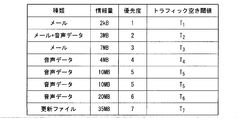
- FIG. 1 is a schematic block diagram showing a configuration of a wireless communication system 10 according to an embodiment of the present invention. It is a schematic block diagram which shows the structure of the base station apparatus 100 in the embodiment. It is a schematic block diagram which shows the structure of the mobile station apparatus 200 in the embodiment. It is a figure which shows the example of the threshold value information which the priority management part 203 in the embodiment memorize
- FIG. 1 is a schematic block diagram showing a configuration of a wireless communication system 10 according to an embodiment of the present invention.
- the radio communication system 10 includes a base station device 100 and a plurality of mobile station devices 200 that communicate with the base station device 100 by radio.
- only one base station apparatus 100 is provided, but a plurality of base station apparatuses 100 may be provided.
- FIG. 2 is a schematic block diagram showing the configuration of the base station apparatus 100.
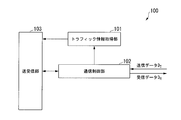
- the base station apparatus 100 includes a traffic information acquisition unit 101, a communication control unit 102, and a transmission / reception unit 103.
- the traffic information acquisition unit 101 acquires from the communication control unit 102 the free capacity of the communication traffic of the own device.
- the traffic information acquisition unit 101 notifies the mobile station apparatus 200 of traffic information (free capacity information) indicating the acquired free capacity via the transmission / reception unit 103.
- traffic information free capacity information
- the free capacity of communication traffic the unused rate of radio resources (subcarriers), the number of mobile station devices 200 that can be accommodated minus the number of accommodated devices, the current maximum cell throughput from the preset maximum cell throughput Any of those obtained by subtracting the cell throughput may be used.
- the free capacity of communication traffic may relate to the uplink, may relate to the downlink, or may relate to both the uplink and the downlink.
- the communication control unit 102 controls the transmission / reception unit 103 so as to transmit the input transmission data DT to the destination mobile station apparatus 200.
- the communication control unit 102 the data transmitted from the mobile station apparatus 200 to the base station apparatus 100 controls so that transmission and reception unit 103 receives and outputs the received data as received data D R.
- the transmission / reception unit 103 includes an antenna for communicating with the mobile station apparatus 200.
- the transmission / reception unit 103 performs error correction coding, modulation, D / A (Digital / Analogue) conversion, up-conversion to a radio frequency, and the like, and transmits the data to the mobile station apparatus 200 via an antenna.
- the transmission / reception unit 103 performs down-conversion, A / D (Analogue / Digital) conversion, demodulation, error correction decoding, and the like on the signal from each mobile station apparatus 200 received by the antenna, and detects received data.
- a / D Analogue / Digital
- FIG. 3 is a schematic block diagram showing the configuration of the mobile station apparatus 200.
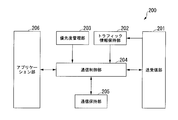
- the mobile station apparatus 200 includes a transmission / reception unit 201, a traffic information holding unit 202, a priority management unit 203, a communication control unit 204, a communication holding unit 205, and an application unit 206.
- the transmission / reception unit 201 includes an antenna for communicating with the base station apparatus 100.
- the transmission / reception unit 201 performs error correction coding, modulation, D / A (Digital / Analogue) conversion, up-conversion to a radio frequency, and the like to transmit to the base station apparatus 100 via an antenna.
- D / A Digital / Analogue
- the transmission / reception unit 201 performs down-conversion, A / D (Analogue / Digital) conversion, demodulation, error correction decoding, and the like on the signal from the base station apparatus 100 received by the antenna, and detects received data.
- a / D Analogue / Digital
- the traffic information holding unit 202 holds the traffic information received from the base station apparatus 100 by the transmission / reception unit 201.
- the priority management unit 203 stores in advance threshold information indicating the correspondence between the type of transmission data, the priority, and the threshold for the free space.
- the communication control unit 204 stores the free capacity information held in the traffic information holding unit 202 and the priority management unit 203 as to whether the transmission data generated by the application unit 206 is immediately transmitted to the base station device 100 or held.
- the threshold information is determined with reference to the threshold information.
- the communication control unit 204 determines to transmit immediately, the communication control unit 204 controls the transmission / reception unit 201 to transmit the transmission data to the base station apparatus 100. Further, when the communication control unit 204 determines to hold, the communication control unit 204 stores the transmission data in the communication holding unit 205.
- the communication control unit 204 performs the same determination on the transmission data held by the communication holding unit 205 even when the traffic information held by the traffic information holding unit 202 is updated.
- the communication control unit 204 controls the transmission / reception unit 201 to receive data transmitted from the base station device 100 to the own device, and inputs the received data to the application unit 206.
- the communication holding unit 205 holds the transmission data input from the communication control unit 204 until the transmission data is transmitted to the base station apparatus 100.
- the application unit 206 executes an OS (Operating System) and various applications, and generates various types of transmission data.
- OS Operating System
- FIG. 4 is a diagram illustrating an example of threshold information stored in the priority management unit 203.
- the threshold information stores the type of transmission data, the priority, and the threshold of the traffic free capacity in association with each other.
- the type “communication control information”, the priority “1”, and the threshold “T 1 ” are associated with each other.
- the type “security information”, the priority “2”, and the threshold “T 2 ” are associated with each other.
- the type “mail”, the priority “3”, and the threshold “T 3 ” are associated with each other.
- the type “text data”, the priority “4”, and the threshold “T 4 ” are associated with each other.
- the type “sound data”, the priority “5”, and the threshold “T 5 ” are associated with each other.
- the type “video data”, the priority “6”, and the threshold “T 6 ” are associated with each other.
- the type “update file”, the priority “7”, and the threshold “T 7 ” are associated with each other.
- the priority of FIG. 4 represents that a priority is so high that a value is small.
- a traffic vacancy threshold at which communication is permitted is also set according to the priority.
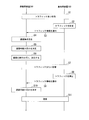
- FIG. 5 is a sequence diagram illustrating an operation example of the wireless communication system 10.
- the traffic information acquisition unit 101 of the base station device 100 measures the traffic information of the own device (S2).
- the traffic information acquisition unit 101 controls the transmission / reception unit 103 so as to notify the mobile station device 200 of the traffic information.
- the transmission / reception unit 201 of the mobile station apparatus 200 receives the traffic information transmitted by the base station apparatus 100 (S3).
- the traffic information holding unit 202 holds the received traffic information.
- the application unit 206 generates transmission data and communication is necessary (S4).
- the communication control unit 204 of the mobile station device 200 determines whether to immediately execute or hold communication of transmission data input from the application unit 206 (S5). In this case, since the traffic is congested, the communication control unit 204 holds the communication without executing the communication (S6).
- the traffic information acquisition unit 101 of the base station device 100 measures the traffic information of the own device (S8).
- the traffic information acquisition unit 101 controls the transmission / reception unit 103 so as to notify the mobile station device 200 of the traffic information.
- the transmission / reception unit 201 of the mobile station apparatus 200 receives the traffic information transmitted by the base station apparatus 100 (S9).
- the traffic information holding unit 202 updates the held traffic information with the received traffic information.
- the communication control unit 204 of the mobile station device 200 determines whether to immediately execute or hold the communication of the transmission data held in the communication holding unit 205 (S10). In this case, since the traffic is small, the communication control unit 204 determines that the communication is to be executed immediately and causes the transmission / reception unit 201 to execute the communication (S11).
- FIG. 6 is a flowchart for explaining the operation of base station apparatus 100. Note that the flowchart shown in FIG. 6 shows processing related to reception of communication from mobile station apparatus 200.
- the base station apparatus 100 acquires the traffic information of the own apparatus (Sa1). Specifically, the traffic information acquisition unit 101 measures the traffic of its own device, acquires traffic information S 1 indicating the free capacity of the traffic from the measurement result, and holds it.
- the base station apparatus 100 notifies the traffic information to all the mobile station apparatuses 200 (Sa2). Specifically, the traffic information acquisition unit 101 notifies all the mobile station devices 200 of the acquired traffic information S 1 via the transmission / reception unit 103. As a method of notifying all mobile station devices 200, there is a method of including them in broadcast information that is information addressed to all mobile station devices 200.
- the communication control unit 102 determines whether or not it is necessary to perform communication with the mobile station device 200 (Sa3). When it is determined that communication is necessary (Sa3-Yes), communication is performed (Sa4). ), Returning to step Sa1, and repeating the process. If the communication control unit 102 determines that it is not necessary in step Sa3 (Sa3-No), the communication control unit 102 returns to step Sa1 and repeats the process.
- FIG. 7 is a flowchart for explaining the operation of mobile station apparatus 200. Note that the flowchart shown in FIG. 7 shows processing related to transmission to base station apparatus 100.
- the mobile station apparatus 200 receives traffic information from the base station apparatus 100 (Sb1). Specifically, first, the transmission / reception unit 201 receives traffic information S 1 transmitted from the base station apparatus 100. Then, the traffic information holding unit 202 holds the traffic information S 1 received.
- the mobile station device 200 determines whether or not communication is necessary (Sb2). Specifically, the communication control unit 204 determines whether there is a communication (transmission data transmission) request from the application unit 206. If it is determined that there is no request (Sb2-No), the process returns to step Sb1 to receive traffic information. If it is determined in step Sb2 that there is a request (Sb2-Yes), the communication control unit 204 acquires a communication priority and a threshold (Sb3). Specifically, first, the communication control unit 204 acquires the type of transmission data to be transmitted from the application unit 206. Here, the type is a type related to the content of transmission data, such as communication control information, security information, and mail. The communication control unit 204 refers to the threshold information stored in the priority management unit 203 and reads the priority stored in association with the acquired type and the traffic free threshold T.
- the mobile station device 200 determines whether or not the communication can be immediately executed (Sb4). Specifically, the communication control unit 204 compares the threshold value T read in step Sb3, the traffic information S 1 to the traffic information holding unit 202 holds. The communication control unit 204 determines to immediately execute the communication when the threshold value T ⁇ traffic information S 1, that is, when the traffic of the base station apparatus 100 has more vacancy than the communication traffic vacancy threshold T (Sb4 ⁇ Yes), the transmission / reception unit 201 is controlled to execute transmission of transmission data to the base station apparatus 100 (Sb7). After execution of transmission, the process returns to step Sb1 to repeat the process.
- the threshold T > When a traffic information S 1, that is free of the base station apparatus 100 from the traffic free threshold T of communication traffic When there is little (Sb4-No), it is determined to hold the communication without immediately executing it. Then, the communication control unit 204 holds the transmission data in the communication holding unit 205 and suspends the communication (Sb6). When time elapses, the transmission / reception unit 201 receives traffic information (Sb7), and when the traffic information held by the traffic information holding unit 202 is updated, the process returns to step Sb4 to repeat the processing.
- the communication is held until the threshold T ⁇ traffic information S 1 , that is, until the traffic of the base station apparatus 100 has more vacancy than the communication traffic vacancy threshold T. Traffic information is updated, when a threshold value T ⁇ traffic information S 1 executes held to have the communication, the flow returns to step Sb1, the process is repeated.
- the mobile station apparatus 200 controls the execution of communication according to the traffic state (congestion state) of the base station apparatus 100 and the communication priority, the traffic (load) is leveled in the time domain. Thus, the total amount of traffic at a certain time can be suppressed. That is, even in a wireless communication system having a plurality of base station apparatuses 100, it is possible to reduce the load not only on the individual base station apparatuses 100 but also on the entire wireless communication system. Moreover, since the traffic control for each mobile station apparatus 200 can be performed according to the priority of the transmission data, the convenience for the user is not impaired.
- the information associating the type of transmission data, the priority, and the threshold of the free capacity is exemplified as the threshold information.
- the threshold information may be information associating other information related to transmission data, a priority, and a threshold of free space. Examples of threshold information using other information as information related to transmission data are given below.
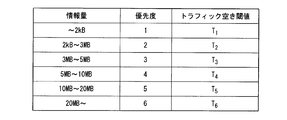
- FIG. 8 is a diagram illustrating a first example of threshold information using other information as information regarding transmission data.
- the amount of information is used as information about transmission data.
- the threshold information stores the information amount of transmission data, the priority, and the threshold of the free capacity of traffic in association with each other.
- the information amount “ ⁇ 2 kB”, the priority “1”, and the threshold “T 1 ” are associated.
- the information amount “2 kB to 3 MB”, the priority “2”, and the threshold “T 2 ” are associated with each other.
- the information amount “3 MB to 5 MB”, the priority “3”, and the threshold “T 3 ” are associated with each other.
- the information amount “5 MB to 10 MB”, the priority “4”, and the threshold “T 4 ” are associated with each other. Further, the information amount “10 MB to 20 MB”, the priority “5”, and the threshold “T 5 ” are associated with each other. Further, the information amount “20 MB ⁇ ”, the priority “6”, and the threshold “T 6 ” are associated with each other.
- the priority of FIG. 8 also indicates that the lower the value, the higher the priority. Furthermore, a traffic vacancy threshold at which communication is permitted is also set according to the priority.
- the communication control unit 204 acquires the information amount of transmission data to be transmitted from the application unit 206, and prioritizes the threshold value associated with the information amount. Read from the degree management unit 203.
- FIG. 9 is a diagram illustrating a second example of threshold information using other information.
- a transmission cycle is used as information related to transmission data.
- the threshold information stores a transmission cycle of transmission data, a priority, and a threshold of traffic free capacity in association with each other.
- the cycle “ ⁇ 30 minutes”, the priority “1”, and the threshold “T 1 ” are associated with each other.
- the cycle “30 minutes to 2 hours”, the priority “2”, and the threshold “T 2 ” are associated with each other.
- the period “2 to 12 hours”, the priority “3”, and the threshold “T 3 ” are associated with each other.
- the period “12 to 24 hours”, the priority “4”, and the threshold “T 4 ” are associated with each other.
- the period “24 hours to”, the priority “5”, and the threshold “T 5 ” are associated with each other.
- the priority in FIG. 9 also indicates that the lower the value, the higher the priority. Furthermore, a traffic vacancy threshold at which communication is permitted is also set according to the priority.
- the communication control unit 204 acquires the transmission cycle of transmission data from the application unit 206, and sets the threshold associated with the cycle to the priority management unit. Read from 203.
- FIG. 10 is a diagram illustrating a third example of threshold information using other information.
- the type and amount of information are used as information about transmission data.
- the threshold information stores the type of transmission data, the amount of information, the priority, and the threshold of traffic free capacity in association with each other.
- the type “mail”, the information amount “ ⁇ 2 kB”, the priority “1”, and the threshold “T 1 ” are associated with each other.
- the type “mail + voice data”, information amount “ ⁇ 3 MB”, priority “2”, and threshold “T 2 ” are associated with each other.
- the type “mail”, the information amount “2 kB to 7 MB”, the priority “3”, and the threshold “T 3 ” are associated with each other.
- the type “voice data”, the information amount “4 MB”, the priority “4”, and the threshold “T 4 ” are associated with each other.
- the type “voice data”, the information amount “4 MB to 10 MB”, the priority “5”, and the threshold “T 5 ” are associated with each other.
- the type “voice data”, the information amount “10 MB to 20 MB”, the priority “6”, and the threshold “T 6 ” are associated with each other.
- the type “update file”, the information amount “ ⁇ 35 MB to 20 MB”, the priority “7”, and the threshold “T 7 ” are associated with each other.
- the priority of FIG. 10 also represents that a priority is so high that a value is small.
- a traffic vacancy threshold at which communication is permitted is also set according to the priority.
- the priority is set higher as the real-time property is higher and the information amount is smaller.
- the lower the priority of communication the higher the available traffic.
- the priority and the threshold are different for every combination, but there may be a plurality of combinations with the same priority and threshold.
- the communication control unit 204 acquires the type and information amount of transmission data from the application unit 206 and associates them with the combination of the type and information amount. Is read out from the priority management unit 203.
- FIG. 10 shows an example in which the type in FIG. 3 and the information amount in FIG. 8 are combined, but other combinations may be used. Or you may make it hold
- the threshold information of FIGS. 3 and 8 may be held, and the smaller one of the threshold associated with the type of transmission data and the threshold associated with the information amount of the transmission data may be used. .
- the contents of the threshold information are only examples, and can be set to predetermined contents by the mobile station device development manufacturer, the communication company, the chip vendor, the OS, and the user. . It can also be changed by user operation or software update.
- a program for realizing a part or all of the functions of mobile station apparatus 200 and base station apparatus 100 in the above-described embodiment is recorded on a computer-readable recording medium, and the program recorded on the recording medium
- Each apparatus may be realized by reading the program into a computer system and executing it.
- the “computer system” includes an OS and hardware such as peripheral devices.
- the “computer-readable recording medium” means a storage device such as a flexible disk, a magneto-optical disk, a portable medium such as a ROM and a CD-ROM, and a hard disk incorporated in a computer system. Furthermore, the “computer-readable recording medium” dynamically holds a program for a short time like a communication line when transmitting a program via a network such as the Internet or a communication line such as a telephone line. In this case, a volatile memory in a computer system serving as a server or a client in that case, and a program that holds a program for a certain period of time are also included.
- the program may be a program for realizing a part of the functions described above, and may be a program capable of realizing the functions described above in combination with a program already recorded in a computer system.
- part or all of the mobile station device 200 and the base station device 100 in the above-described embodiment may be typically realized as an LSI that is an integrated circuit.
- Each functional block of the terminal device 200 and the base station device 100 may be individually chipped, or part or all of them may be integrated into a chip.
- the method of circuit integration is not limited to LSI, and may be realized with a dedicated circuit or a general-purpose processor.
- the integrated circuit may be either hybrid or monolithic.
- a part of the functions performed by the above program may be realized by hardware and partly by software.
- the present invention can be applied to mobile communication services for mobile phones, tablet personal computers, and the like.
Landscapes
- Engineering & Computer Science (AREA)
- Computer Networks & Wireless Communication (AREA)
- Signal Processing (AREA)
- Mobile Radio Communication Systems (AREA)
Abstract
基地局装置と、端末装置とからなる通信システムであって、基地局装置は、自装置における、通信トラフィックの空き容量を示す空き容量情報を、端末装置に通知し、端末装置は、基地局装置に対する送信データを即時に送信するか保持するかを、該送信データに関する情報と、基地局装置から受信した空き容量情報とを参照して決定する通信制御部を具備する。
Description
本発明は、通信システム、端末装置、通信方法、プログラムおよび記憶媒体に関する。
本願は、2012年8月29日に、日本に出願された特願2012-189260号に基づき優先権を主張し、その内容をここに援用する。
本願は、2012年8月29日に、日本に出願された特願2012-189260号に基づき優先権を主張し、その内容をここに援用する。
移動体通信サービスでは、通信端末の数の増加と、個々の通信端末で使用されるアプリケーションの高機能化に伴い、通信量は増加の一途を辿っている。このため、基地局にトラフィックが飽和して、機能障害が生じる等の問題が発生している。この問題に対する対策として、基地局からトラフィックの状態情報を報知して、これを基に情報端末が接続先の基地局を分散させ、特定の基地局にトラフィックが集中しないようにすることが提案されている(特許文献1参照)。
しかしながら、特許文献1のように、基地局から報知されたトラフィックの状態情報を基に接続先の基地局を決定する通信システムにおいては、トラフィックを複数の基地局に分散できるものの、ある時刻におけるトラフィックの総量が、基地局の処理量の合計を超えると過負荷となってしまう。
本発明の一目的は、トラフィックの総量を抑制することができる通信システム、端末装置、通信方法、プログラムおよび記憶媒体を提供することにある。
(1)本発明の一態様は、基地局装置と、端末装置とからなる通信システムであって、前記基地局装置は、自装置における、通信トラフィックの空き容量を示す空き容量情報を、前記端末装置に通知し、前記端末装置は、前記基地局装置に対する送信データを即時に送信するか保持するかを、該送信データに関する情報と、前記基地局装置から受信した前記空き容量情報とを参照して決定する通信制御部を具備する。
(2)また、本発明の他の態様は、(1)に記載の通信システムであって、前記送信データに関する情報は、前記送信データの種類を含んでいてもよい。
(3)また、本発明の他の態様は、(1)または(2)に記載の通信システムであって、前記送信データに関する情報は、前記送信データの大きさを含んでいてもよい。
(4)また、本発明の他の態様は、(3)に記載の通信システムであって、前記通信制御部は、前記空き容量情報が示す空き容量が、予め設定された閾値よりも大きいときに、即時に送信すると判断するように構成されていてもよく、前記送信データの大きさが相対的に大きいほど、前記閾値も相対的に大きくなる構成でもよい。
(5)また、本発明の他の態様は、(1)に記載の通信システムであって、前記送信データに関する情報は、前記送信データの送信周期を含んでいてもよい。
(6)また、本発明の他の態様は、(5)に記載の通信システムであって、前記通信制御部は、前記空き容量情報が示す空き容量が、予め設定された閾値よりも大きいときに、即時に送信すると判断するように構成されていてもよく、前記送信周期の大きさが相対的に大きいほど、前記閾値が相対的に大きくなる構成でもよい。
(7)また、本発明の他の態様は、自装置における、通信トラフィックの空き容量を示す空き容量情報を、端末装置に通知する基地局装置と通信する端末装置であって、前記基地局装置に対する送信データを即時に送信するか保持するかを、該送信データに関する情報と、前記基地局装置から受信した前記空き容量情報とを参照して決定する通信制御部を具備する。
(8)また、本発明の他の態様は、基地局装置と、端末装置とからなる通信システムにおける通信方法であって、前記基地局装置が、自装置における、通信トラフィックの空き容量を示す空き容量情報を、前記端末装置に通知する工程と、前記端末装置が、前記基地局装置に対する送信データを即時に送信するか保持するかを、該送信データに関する情報と、前記基地局装置から受信した前記空き容量情報とを参照して決定する工程とを有することを特徴とする。
(9)また、本発明の他の態様は、基地局装置が送信した空き容量情報であって、自装置における、通信トラフィックの空き容量を示す空き容量情報を受信する工程と、前記基地局装置に対する送信データを即時に送信するか保持するかを、該送信データに関する情報と、前記空き容量情報とを参照して決定する工程とをコンピュータに実行させるためのプログラムである。
(10)また、本発明の他の態様は、基地局装置が送信した空き容量情報であって、自装置における、通信トラフィックの空き容量を示す空き容量情報を受信する工程と、前記基地局装置に対する送信データを即時に送信するか保持するかを、該送信データに関する情報と、前記空き容量情報とを参照して決定する工程とを実行させるためのプログラムを記憶した記憶媒体である。
この発明の態様によれば、トラフィックの総量を抑制することができる。
以下、図面を参照して、本発明の実施の形態について説明する。図1は、この発明の一実施形態による無線通信システム10の構成を示す概略ブロック図である。無線通信システム10は、基地局装置100と、基地局装置100と無線通信する複数の移動局装置200とを含んで構成される。なお、図1では、基地局装置100は、一つのみであるが、複数であってもよい。
図2は、基地局装置100の構成を示す概略ブロック図である。基地局装置100は、トラフィック情報取得部101、通信制御部102、送受信部103を含んで構成される。トラフィック情報取得部101は、自装置の通信トラフィックの空き容量を、通信制御部102から取得する。トラフィック情報取得部101は、取得した空き容量を示すトラフィック情報(空き容量情報)を、送受信部103を介して、移動局装置200に通知する。通信トラフィックの空き容量としては、無線リソース(サブキャリア)の未使用率、収容可能な移動局装置200の装置数から収容中の装置数を引いたもの、予め設定された最大セルスループットから現在のセルスループットを引いたものなど、いずれであってもよい。また、通信トラフィックの空き容量は、上りリンクに関するものであってもよいし、下りリンクに関するものであってもよいし、上りリンクと下りリンクの双方に関するものであってもよい。
通信制御部102は、入力された送信データDTを、宛先の移動局装置200に送信するように送受信部103を制御する。また、通信制御部102は、各移動局装置200から基地局装置100に送信されたデータを送受信部103が受信するように制御し、受信したデータを受信データDRとして出力する。送受信部103は、移動局装置200と通信するためのアンテナを備えている。送受信部103は、送信するデータの誤り訂正符号化、変調、D/A(Digital/Analogue)変換、無線周波数へのアップコンバートなどを行い、アンテナを介して移動局装置200に送信する。また、送受信部103は、アンテナが受信した各移動局装置200からの信号を、ダウンコンバート、A/D(Analogue/Digital)変換、復調、誤り訂正復号などを行い、受信データを検出する。
図3は、移動局装置200の構成を示す概略ブロック図である。移動局装置200は、送受信部201、トラフィック情報保持部202、優先度管理部203、通信制御部204、通信保持部205、アプリケーション部206を含んで構成される。送受信部201は、基地局装置100と通信するためのアンテナを備えている。送受信部201は、送信するデータの誤り訂正符号化、変調、D/A(Digital/Analogue)変換、無線周波数へのアップコンバートなどを行い、アンテナを介して基地局装置100に送信する。また、送受信部201は、アンテナが受信した基地局装置100からの信号を、ダウンコンバート、A/D(Analogue/Digital)変換、復調、誤り訂正復号などを行い、受信データを検出する。
トラフィック情報保持部202は、送受信部201が基地局装置100から受信したトラフィック情報を保持する。優先度管理部203は、送信データの種類と、優先度と、空き容量の閾値との対応付けを示す閾値情報を、予め記憶している。通信制御部204は、アプリケーション部206が生成した送信データを、基地局装置100に即時に送信するか保持するかを、トラフィック情報保持部202が保持する空き容量情報と優先度管理部203が記憶する閾値情報とを参照して判定する。通信制御部204は、即時に送信すると判定したときは、基地局装置100に該送信データを送信するように送受信部201を制御する。また、通信制御部204は、保持すると判定したときは、該送信データを通信保持部205に格納させる。
なお、通信制御部204は、トラフィック情報保持部202が保持するトラフィック情報が更新されたときも、通信保持部205が保持する送信データについて同様の判定を行う。また、通信制御部204は、基地局装置100から自装置に送信されたデータを送受信部201が受信するように制御し、受信データをアプリケーション部206に入力する。通信保持部205は、通信制御部204から入力された送信データを、該送信データを基地局装置100に送信するまで保持する。アプリケーション部206は、OS(Operating System)や各種アプリケーションを実行し、各種の送信データを生成する。
図4は、優先度管理部203が記憶する閾値情報の例を示す図である。閾値情報は、図4のデータテーブルに示すように、送信データの種類、優先度、トラフィックの空き容量の閾値を対応付けて記憶している。図4の例では、種類「通信制御情報」、優先度「1」、閾値「T1」を対応付けている。同様に種類「セキュリティ情報」、優先度「2」、閾値「T2」を対応付けている。また、種類「メール」、優先度「3」、閾値「T3」を対応付けている。また、種類「テキストデータ」、優先度「4」、閾値「T4」を対応付けている。また、種類「音声データ」、優先度「5」、閾値「T5」を対応付けている。また、種類「映像データ」、優先度「6」、閾値「T6」を対応付けている。また、種類「更新ファイル」、優先度「7」、閾値「T7」を対応付けている。
なお、図4の優先度は、値が小さい程、優先度が高いことを表す。リアルタイム性が高い種類ほど、優先度が高くなっている。さらに、その優先度に応じて、通信が許可されるトラフィック空き閾値も設定する。ここで、(T1≦T2≦T3≦T4≦T5≦T6≦T7)の関係である。つまり、優先度が低い通信程、より高いトラフィックの空きを必要とする。
図5は、無線通信システム10の動作例を示すシーケンス図である。はじめの状態として、他の移動局装置200との通信により、基地局装置100のトラフィックが混雑していたとする(S1)。基地局装置100のトラフィック情報取得部101は、自装置のトラフィック情報を測定する(S2)。トラフィック情報取得部101は、そのトラフィック情報を移動局装置200に通知するように、送受信部103を制御する。移動局装置200の送受信部201は、基地局装置100が送信したトラフィック情報を受信する(S3)。トラフィック情報保持部202は、受信したトラフィック情報を保持する。
ここで、移動局装置200において、アプリケーション部206が送信データを生成し、通信の必要が生じたとする(S4)。移動局装置200の通信制御部204は、アプリケーション部206から入力された送信データの通信を即時に実行するか保持するかを判定する(S5)。この場合は、トラフィックが混雑している状態のため、通信制御部204は、前記通信を実行しないで、保持する(S6)。
ここで、時間が経過し、基地局装置100におけるトラフィックが少量の状態になったとする(S7)。基地局装置100のトラフィック情報取得部101は、自装置のトラフィック情報を測定する(S8)。トラフィック情報取得部101は、そのトラフィック情報を移動局装置200に通知するように、送受信部103を制御する。移動局装置200の送受信部201は、基地局装置100が送信したトラフィック情報を受信する(S9)。
トラフィック情報保持部202は、受信したトラフィック情報で、保持していたトラフィック情報を更新する。トラフィック情報が更新されると、移動局装置200の通信制御部204は、通信保持部205に保持している送信データの通信を、即時に実行するか保持するかを判定する(S10)。この場合は、トラフィックが少量のため、通信制御部204は、通信を即時に実行すると判定し、送受信部201に実行させる(S11)。
図6は、基地局装置100の動作を説明するフローチャートである。なお、図6に示すフローチャートは、移動局装置200からの通信の受信に関する処理を示すものである。まず、基地局装置100は、自装置のトラフィック情報を取得する(Sa1)。具体的には、トラフィック情報取得部101が、自装置のトラフィックを測定し、該測定の結果からトラフィックの空き容量を示すトラフィック情報S1を取得し、保持する。
基地局装置100は、トラフィック情報を、全移動局装置200に通知する(Sa2)。具体的には、トラフィック情報取得部101は、取得したトラフィック情報S1を、送受信部103を介して、全移動局装置200に通知する。全移動局装置200に通知する方法としては、全移動局装置200宛ての情報である報知情報に含ませる方法がある。次に、通信制御部102は、移動局装置200と通信を行う必要があるか否かを判定し(Sa3)、必要があると判定したときは(Sa3-Yes)、通信を実行し(Sa4)、ステップSa1に戻り、処理を繰り返す。また、通信制御部102は、ステップSa3にて必要がないと判定したときは(Sa3-No)、そのままステップSa1に戻り、処理を繰り返す。
図7は、移動局装置200の動作を説明するフローチャートである。なお、図7に示すフローチャートは、基地局装置100への送信に関する処理を示すものである。まず、移動局装置200は、基地局装置100からのトラフィック情報を受信する(Sb1)。具体的には、まず、送受信部201が、基地局装置100から送信されるトラフィック情報S1を受信する。そして、トラフィック情報保持部202が、受信したトラフィック情報S1を保持する。
移動局装置200は、通信の必要があるかないかを判断する(Sb2)。具体的には、通信制御部204が、アプリケーション部206から通信(送信データの送信)の要求があるかないかを判断する。要求がないと判断としたときは(Sb2-No)、ステップSb1に戻り、トラフィック情報の受信を行う。また、ステップSb2にて、要求があると判断したときは(Sb2-Yes)、通信制御部204は、通信の優先度と、閾値とを取得する(Sb3)。具体的には、まず、通信制御部204は、送信する送信データの種類を、アプリケーション部206から取得する。ここで、種類とは、例えば、通信制御情報、セキュリティ情報、メールなど、送信データの内容に関する種類である。通信制御部204は、優先度管理部203が記憶する閾値情報を参照し、取得した種類と対応付けて記憶している優先度と、トラフィック空き閾値Tを読み出す。
次に、移動局装置200は、前記通信を即時に実行可能か否かを判断する(Sb4)。具体的には、通信制御部204は、ステップSb3で読み出した閾値Tと、トラフィック情報保持部202が保持しているトラフィック情報S1とを比較する。通信制御部204は、閾値T<トラフィック情報S1であるとき、つまり前記通信のトラフィック空き閾値Tより基地局装置100のトラフィックに空きが多いときには、前記通信を即時に実行すると決定し(Sb4-Yes)、送信データの基地局装置100への送信を実行するように、送受信部201を制御する(Sb7)。送信の実行後、ステップSb1に戻り、処理を繰り返す。
これとは逆に、ステップSb4で閾値Tとトラフィック情報S1とを比較した結果、閾値T>トラフィック情報S1であるとき、つまり前記通信のトラフィック空き閾値Tより基地局装置100のトラフィックの空きが少ないときには(Sb4-No)、前記通信を即時に実行せずに保持すると決定する。そして、通信制御部204は、送信データを通信保持部205に保持させて、前記通信を保留する(Sb6)。時間が経過して、送受信部201がトラフィック情報を受信し(Sb7)、トラフィック情報保持部202が保持するトラフィック情報が更新されると、ステップSb4に戻って、処理を繰り返す。
すなわち、閾値T<トラフィック情報S1となるまで、つまり前記通信のトラフィック空き閾値Tより基地局装置100のトラフィックに空きが多くなるまで、前記通信を保持する。トラフィック情報が更新され、閾値T<トラフィック情報S1となった場合には、保持していた前記通信を実行し、ステップSb1に戻り、処理を繰り返す。
このように、移動局装置200は、基地局装置100のトラフィックの状態(混雑の状態)と通信の優先度に応じて、通信の実行を制御するので、トラフィック(負荷)が時間領域で平準化され、ある時刻におけるトラフィックの総量を抑制することができる。すなわち、複数の基地局装置100を有する無線通信システムであっても、個々の基地局装置100だけでなく無線通信システム全体としての負荷を軽減することができる。また、送信データの優先度に応じて移動局装置200ごとのトラフィック制御ができるため、ユーザーの利便性を損なわない。
なお、上述の実施形態では、閾値情報として、送信データの種類と、優先度と、空き容量の閾値とを対応付ける情報を例に挙げた。しかし、閾値情報は、送信データに関する他の情報と、優先度と、空き容量の閾値とを対応付ける情報であってもよい。送信データに関する情報として、他の情報を用いる閾値情報の例を以下に挙げる。
図8は、送信データに関する情報として他の情報を用いる閾値情報の第1の例を示す図である。第1の例では、送信データに関する情報として、情報量を用いている。閾値情報は、図8のデータテーブルに示すように、送信データの情報量、優先度、トラフィックの空き容量の閾値を対応付けて記憶している。図8の例では、情報量「~2kB」、優先度「1」、閾値「T1」を対応付けている。同様に情報量「2kB~3MB」、優先度「2」、閾値「T2」を対応付けている。また、情報量「3MB~5MB」、優先度「3」、閾値「T3」を対応付けている。また、情報量「5MB~10MB」、優先度「4」、閾値「T4」を対応付けている。また、情報量「10MB~20MB」、優先度「5」、閾値「T5」を対応付けている。また、情報量「20MB~」、優先度「6」、閾値「T6」を対応付けている。
なお、図8の優先度も、値が小さい程、優先度が高いことを表す。さらに、その優先度に応じて、通信が許可されるトラフィック空き閾値も設定する。ここで、(T1≦T2≦T3≦T4≦T5≦T6≦T7)の関係である。つまり、情報量(送信データの大きさ)が相対的に大きいほど、優先度が低く、閾値も相対的に大きくなっている。さらに、優先度が低い通信程、より高いトラフィックの空きを必要とする。また、閾値情報として、図8の例を用いる場合は、通信制御部204は、送信する送信データの情報量を、アプリケーション部206から取得し、該情報量に対応付けられている閾値を、優先度管理部203から読み出す。
図9は、他の情報を用いる閾値情報の第2の例を示す図である。第2の例では、送信データに関する情報として、送信周期を用いている。閾値情報は、図9のデータテーブルに示すように、送信データの送信周期、優先度、トラフィックの空き容量の閾値を対応付けて記憶している。図9の例では、周期「~30分」、優先度「1」、閾値「T1」を対応付けている。同様に周期「30分~2時間」、優先度「2」、閾値「T2」を対応付けている。また、周期「2時間~12時間」、優先度「3」、閾値「T3」を対応付けている。また、周期「12時間~24時間」、優先度「4」、閾値「T4」を対応付けている。また、周期「24時間~」、優先度「5」、閾値「T5」を対応付けている。
なお、図9の優先度も、値が小さい程、優先度が高いことを表す。さらに、その優先度に応じて、通信が許可されるトラフィック空き閾値も設定する。ここで、(T1≦T2≦T3≦T4≦T5≦T6≦T7)の関係である。つまり、周期(送信周期の大きさ)が相対的に大きいほど、リアルタイム性が低い通信であるとみなし、優先度が低く、閾値も相対的に大きくなっている。優先度が低い通信程、より高いトラフィックの空きを必要とする。また、閾値情報として、図9の例を用いる場合は、通信制御部204は、送信データの送信周期を、アプリケーション部206から取得し、該周期に対応付けられている閾値を、優先度管理部203から読み出す。
図10は、他の情報を用いる閾値情報の第3の例を示す図である。第3の例では、送信データに関する情報として、種類と情報量を用いている。閾値情報は、図10のデータテーブルに示すように、送信データの種類と情報量、優先度、トラフィックの空き容量の閾値を対応付けて記憶している。図10の例では、種類「メール」、情報量「~2kB」、優先度「1」、閾値「T1」を対応付けている。
同様に種類「メール+音声データ」、情報量「~3MB」、優先度「2」、閾値「T2」を対応付けている。また、種類「メール」、情報量「2kB~7MB」、優先度「3」、閾値「T3」を対応付けている。また、種類「音声データ」、情報量「4MB」、優先度「4」、閾値「T4」を対応付けている。また、種類「音声データ」、情報量「4MB~10MB」、優先度「5」、閾値「T5」を対応付けている。また、種類「音声データ」、情報量「10MB~20MB」、優先度「6」、閾値「T6」を対応付けている。また、種類「更新ファイル」、情報量「~35MB~20MB」、優先度「7」、閾値「T7」を対応付けている。
なお、図10の優先度も、値が小さい程、優先度が高いことを表す。さらに、その優先度に応じて、通信が許可されるトラフィック空き閾値も設定する。ここで、(T1≦T2≦T3≦T4≦T5≦T6≦T7)の関係である。つまり、種類と情報量とを組み合わせて、リアルタイム性が高く情報量が小さいものほど優先度を高く設定している。そして、優先度が低い通信程、より高いトラフィックの空きを必要とする。なお、ここでは、全ての組み合わせ毎に、優先度および閾値が異なっているが、優先度および閾値が一致する組み合わせが複数あってもよい。また、閾値情報として、図10の例を用いる場合は、通信制御部204は、送信データの種類と情報量とを、アプリケーション部206から取得し、該種類と情報量との組み合わせに対応付けられている閾値を、優先度管理部203から読み出す。
なお、図10は、図3の種類と、図8の情報量とを組み合わせた例であるが、その他の組み合わせを用いるようにしてもよい。あるいは、複数の閾値情報を保持し、これらの閾値情報から取得した閾値Tのうち、優先度の高いものを用いるようにしてもよい。例えば、図3と図8の閾値情報を保持し、送信データの種類に対応付けられた閾値と、送信データの情報量に対応付けられた閾値とのうち、小さい方を用いるようにしてもよい。
また、閾値情報の内容(通信の種類、優先度、トラフィック空き閾値)は一例であり、移動局装置の開発メーカー、通信事業社、チップベンダー、OS、ユーザーにより、所定の内容に設定可能である。また、ユーザー操作や、ソフトウェアアップデートにより、変更することも可能である。
また、上述した実施形態における移動局装置200および基地局装置100の一部、または全部の機能を実現するためのプログラムをコンピュータ読み取り可能な記録媒体に記録して、この記録媒体に記録されたプログラムをコンピュータシステムに読み込ませ、実行することにより、各装置を実現するようにしてもよい。なお、ここでいう「コンピュータシステム」とは、OSや周辺機器等のハードウェアを含むものとする。
また、「コンピュータ読み取り可能な記録媒体」とは、フレキシブルディスク、光磁気ディスク、ROM、CD-ROM等の可搬媒体、コンピュータシステムに内蔵されるハードディスク等の記憶装置のことをいう。さらに「コンピュータ読み取り可能な記録媒体」とは、インターネット等のネットワークや電話回線等の通信回線を介してプログラムを送信する場合の通信線のように、短時間の間、動的にプログラムを保持するもの、その場合のサーバやクライアントとなるコンピュータシステム内部の揮発性メモリのように、一定時間プログラムを保持しているものも含むものとする。また上記プログラムは、前述した機能の一部を実現するためのものであっても良く、さらに前述した機能をコンピュータシステムにすでに記録されているプログラムとの組み合わせで実現できるものであっても良い。
また、上述した実施形態における移動局装置200および基地局装置100の一部、または全部を、典型的には、集積回路であるLSIとして実現してもよい。端末装置200および基地局装置100の各機能ブロックは個別にチップ化してもよいし、一部、または全部を集積してチップ化してもよい。また、集積回路化の手法はLSIに限らず、専用回路、または汎用プロセッサで実現してもよい。集積回路は、ハイブリッド、モノリシックのいずれのものでも良い。また、上記のプログラムの営む機能は、一部は、ハードウェアにより、一部はソフトウェアにより実現させても良い。
以上、この発明の実施形態を図面を参照して詳述してきたが、具体的な構成はこの実施形態に限られるものではなく、この発明の要旨を逸脱しない範囲の設計変更等も含まれる。
本発明は、携帯電話やタブレット型パーソナルコンピュータ等のための移動体通信サービス等に適用できる。
10 無線通信システム
100 基地局装置
101 トラフィック情報取得部
102 通信制御部
103 送受信部
200 移動局装置
201 送受信部
202 トラフィック情報保持部
203 優先度管理部
204 通信制御部
205 通信保持部
206 アプリケーション部
100 基地局装置
101 トラフィック情報取得部
102 通信制御部
103 送受信部
200 移動局装置
201 送受信部
202 トラフィック情報保持部
203 優先度管理部
204 通信制御部
205 通信保持部
206 アプリケーション部
Claims (10)
- 基地局装置と、端末装置とからなる通信システムであって、
前記基地局装置は、自装置における、通信トラフィックの空き容量を示す空き容量情報を、前記端末装置に通知し、
前記端末装置は、
前記基地局装置に対する送信データを即時に送信するか保持するかを、該送信データに関する情報と、前記基地局装置から受信した前記空き容量情報とを参照して決定する通信制御部
を具備する通信システム。 - 前記送信データに関する情報は、前記送信データの種類を含む請求項1に記載の通信システム。
- 前記送信データに関する情報は、前記送信データの大きさを含む請求項1または請求項2に記載の通信システム。
- 前記通信制御部は、前記空き容量情報が示す空き容量が、予め設定された閾値よりも大きいときに、即時に送信すると判断し、
前記送信データの大きさが相対的に大きいほど、前記閾値も相対的に大きい請求項3に記載の通信システム。 - 前記送信データに関する情報は、前記送信データの送信周期を含む請求項1に記載の通信システム。
- 前記通信制御部は、前記空き容量情報が示す空き容量が、予め設定された閾値よりも大きいときに、即時に送信すると判断し、
前記送信周期の大きさが相対的に大きいほど、前記閾値が相対的に大きい請求項5に記載の通信システム。 - 自装置における、通信トラフィックの空き容量を示す空き容量情報を、端末装置に通知する基地局装置と通信する端末装置であって、
前記基地局装置に対する送信データを即時に送信するか保持するかを、該送信データに関する情報と、前記基地局装置から受信した前記空き容量情報とを参照して決定する通信制御部
を具備する端末装置。 - 基地局装置と、端末装置とからなる通信システムにおける通信方法であって、
前記基地局装置が、自装置における、通信トラフィックの空き容量を示す空き容量情報を、前記端末装置に通知する工程と、
前記端末装置が、前記基地局装置に対する送信データを即時に送信するか保持するかを、該送信データに関する情報と、前記基地局装置から受信した前記空き容量情報とを参照して決定する工程と
を有する通信方法。 - 基地局装置が送信した空き容量情報であって、自装置における、通信トラフィックの空き容量を示す空き容量情報を受信する工程と、
前記基地局装置に対する送信データを即時に送信するか保持するかを、該送信データに関する情報と、前記空き容量情報とを参照して決定する工程と
を端末装置のコンピュータに実行させるためのプログラム。 - 基地局装置が送信した空き容量情報であって、自装置における、通信トラフィックの空き容量を示す空き容量情報を受信する工程と、
前記基地局装置に対する送信データを即時に送信するか保持するかを、該送信データに関する情報と、前記空き容量情報とを参照して決定する工程と
を端末装置のコンピュータに実行させるためのプログラムを記憶した記憶媒体。
Applications Claiming Priority (2)
| Application Number | Priority Date | Filing Date | Title |
|---|---|---|---|
| JP2012189260A JP2014049828A (ja) | 2012-08-29 | 2012-08-29 | 通信システム、端末装置、通信方法、プログラムおよび記憶媒体 |
| JP2012-189260 | 2012-08-29 |
Publications (1)
| Publication Number | Publication Date |
|---|---|
| WO2014034405A1 true WO2014034405A1 (ja) | 2014-03-06 |
Family
ID=50183221
Family Applications (1)
| Application Number | Title | Priority Date | Filing Date |
|---|---|---|---|
| PCT/JP2013/071534 Ceased WO2014034405A1 (ja) | 2012-08-29 | 2013-08-08 | 通信システム、端末装置、通信方法、プログラムおよび記憶媒体 |
Country Status (2)
| Country | Link |
|---|---|
| JP (1) | JP2014049828A (ja) |
| WO (1) | WO2014034405A1 (ja) |
Families Citing this family (1)
| Publication number | Priority date | Publication date | Assignee | Title |
|---|---|---|---|---|
| JP2019161573A (ja) * | 2018-03-16 | 2019-09-19 | 株式会社Nttドコモ | 通信装置及びプログラム |
Citations (3)
| Publication number | Priority date | Publication date | Assignee | Title |
|---|---|---|---|---|
| JP2001078260A (ja) * | 1999-09-06 | 2001-03-23 | Yrp Kokino Idotai Tsushin Kenkyusho:Kk | 移動通信システムにおける輻輳制御方法、移動端末および基地局 |
| JP2002281047A (ja) * | 2001-01-10 | 2002-09-27 | Ntt Docomo Inc | パケット通信制御装置及び方法、データ通信中継装置及び方法、並びにネットワークシステム |
| WO2010067672A1 (ja) * | 2008-12-10 | 2010-06-17 | 日本電気株式会社 | データ通信システム、無線基地局、データ通信方法 |
-
2012
- 2012-08-29 JP JP2012189260A patent/JP2014049828A/ja active Pending
-
2013
- 2013-08-08 WO PCT/JP2013/071534 patent/WO2014034405A1/ja not_active Ceased
Patent Citations (3)
| Publication number | Priority date | Publication date | Assignee | Title |
|---|---|---|---|---|
| JP2001078260A (ja) * | 1999-09-06 | 2001-03-23 | Yrp Kokino Idotai Tsushin Kenkyusho:Kk | 移動通信システムにおける輻輳制御方法、移動端末および基地局 |
| JP2002281047A (ja) * | 2001-01-10 | 2002-09-27 | Ntt Docomo Inc | パケット通信制御装置及び方法、データ通信中継装置及び方法、並びにネットワークシステム |
| WO2010067672A1 (ja) * | 2008-12-10 | 2010-06-17 | 日本電気株式会社 | データ通信システム、無線基地局、データ通信方法 |
Also Published As
| Publication number | Publication date |
|---|---|
| JP2014049828A (ja) | 2014-03-17 |
Similar Documents
| Publication | Publication Date | Title |
|---|---|---|
| AU2018401518C1 (en) | Transmission configuration method and related product | |
| CN102714890B (zh) | 用于在无线网络中提供机器对机器通信的方法和装置 | |
| JP2019537379A (ja) | 符号化方式判定方法および装置 | |
| CN109121166A (zh) | 一种数据传输方法、基站和用户终端 | |
| US11895684B2 (en) | Data transmission method, terminal device, and network device | |
| US11356232B2 (en) | BWP deactivation method, device, and system | |
| JP2011515948A (ja) | アップリンクにおける半永続的配分の動的スケジューリングの上書き | |
| US20150163042A1 (en) | Communication control apparatus, communication control method, and program | |
| US11147049B2 (en) | Uplink control channel resource determining method, terminal, and network side device | |
| JP2021503827A (ja) | リソース割り当て指示、受信方法および装置 | |
| CN115915428A (zh) | Sps pdsch的确定方法、终端、电子设备及存储介质 | |
| CN109803408A (zh) | 信道状态信息报告的传输方法及通信设备 | |
| WO2016161584A1 (zh) | 一种数据重传方法、设备及系统 | |
| WO2013020279A1 (en) | Method and apparatus for triggering a ranked transmission | |
| CN112399595A (zh) | 一种通信方法及装置 | |
| CN113541877B (zh) | 一种资源指示方法及相关设备 | |
| CN114760006A (zh) | 数据传输方法、装置、通信设备及存储介质 | |
| WO2014034405A1 (ja) | 通信システム、端末装置、通信方法、プログラムおよび記憶媒体 | |
| CN109391438B (zh) | 资源映射方法及设备 | |
| JP2017147570A (ja) | ユーザ装置、基地局、能力情報通知方法、及び能力判定方法 | |
| CN114026810B (zh) | 一种混合自动重传请求进程号的确定方法及其装置 | |
| WO2016101637A1 (zh) | 一种跨制式动态功率资源分享的方法及装置 | |
| EP3691147B1 (en) | Method for determining bundling size, user terminal, and network side device | |
| US10244046B2 (en) | Managing traffic at a node within a wireless communication network upon the node entering service | |
| EP3721669A1 (en) | Downlink scheduling of terminal devices |
Legal Events
| Date | Code | Title | Description |
|---|---|---|---|
| 121 | Ep: the epo has been informed by wipo that ep was designated in this application |
Ref document number: 13832348 Country of ref document: EP Kind code of ref document: A1 |
|
| NENP | Non-entry into the national phase |
Ref country code: DE |
|
| 122 | Ep: pct application non-entry in european phase |
Ref document number: 13832348 Country of ref document: EP Kind code of ref document: A1 |