WO2014028338A1 - Liquid compression molding encapsulants - Google Patents

Liquid compression molding encapsulants Download PDF

Info

Publication number
WO2014028338A1
WO2014028338A1 PCT/US2013/054396 US2013054396W WO2014028338A1 WO 2014028338 A1 WO2014028338 A1 WO 2014028338A1 US 2013054396 W US2013054396 W US 2013054396W WO 2014028338 A1 WO2014028338 A1 WO 2014028338A1
Authority
WO
WIPO (PCT)
Prior art keywords
composition
component
wafer
thermosetting resin
epoxy
Prior art date
Legal status (The legal status is an assumption and is not a legal conclusion. Google has not performed a legal analysis and makes no representation as to the accuracy of the status listed.)
Ceased
Application number
PCT/US2013/054396
Other languages
French (fr)
Inventor
Jie Bai
Current Assignee (The listed assignees may be inaccurate. Google has not performed a legal analysis and makes no representation or warranty as to the accuracy of the list.)
Henkel Corp
Original Assignee
Henkel Corp
Priority date (The priority date is an assumption and is not a legal conclusion. Google has not performed a legal analysis and makes no representation as to the accuracy of the date listed.)
Filing date
Publication date
Application filed by Henkel Corp filed Critical Henkel Corp
Priority to KR1020157005405A priority Critical patent/KR102173954B1/en
Priority to JP2015527503A priority patent/JP6338157B2/en
Publication of WO2014028338A1 publication Critical patent/WO2014028338A1/en
Priority to US14/615,570 priority patent/US20150152260A1/en
Anticipated expiration legal-status Critical
Priority to US17/306,869 priority patent/US11578202B2/en
Ceased legal-status Critical Current

Links

Classifications

    • CCHEMISTRY; METALLURGY
    • C08ORGANIC MACROMOLECULAR COMPOUNDS; THEIR PREPARATION OR CHEMICAL WORKING-UP; COMPOSITIONS BASED THEREON
    • C08LCOMPOSITIONS OF MACROMOLECULAR COMPOUNDS
    • C08L63/00Compositions of epoxy resins; Compositions of derivatives of epoxy resins
    • CCHEMISTRY; METALLURGY
    • C08ORGANIC MACROMOLECULAR COMPOUNDS; THEIR PREPARATION OR CHEMICAL WORKING-UP; COMPOSITIONS BASED THEREON
    • C08LCOMPOSITIONS OF MACROMOLECULAR COMPOUNDS
    • C08L101/00Compositions of unspecified macromolecular compounds
    • C08L101/12Compositions of unspecified macromolecular compounds characterised by physical features, e.g. anisotropy, viscosity or electrical conductivity
    • CCHEMISTRY; METALLURGY
    • C08ORGANIC MACROMOLECULAR COMPOUNDS; THEIR PREPARATION OR CHEMICAL WORKING-UP; COMPOSITIONS BASED THEREON
    • C08KUse of inorganic or non-macromolecular organic substances as compounding ingredients
    • C08K3/00Use of inorganic substances as compounding ingredients
    • C08K3/34Silicon-containing compounds
    • C08K3/36Silica
    • CCHEMISTRY; METALLURGY
    • C08ORGANIC MACROMOLECULAR COMPOUNDS; THEIR PREPARATION OR CHEMICAL WORKING-UP; COMPOSITIONS BASED THEREON
    • C08LCOMPOSITIONS OF MACROMOLECULAR COMPOUNDS
    • C08L53/00Compositions of block copolymers containing at least one sequence of a polymer obtained by reactions only involving carbon-to-carbon unsaturated bonds; Compositions of derivatives of such polymers
    • CCHEMISTRY; METALLURGY
    • C08ORGANIC MACROMOLECULAR COMPOUNDS; THEIR PREPARATION OR CHEMICAL WORKING-UP; COMPOSITIONS BASED THEREON
    • C08LCOMPOSITIONS OF MACROMOLECULAR COMPOUNDS
    • C08L71/00Compositions of polyethers obtained by reactions forming an ether link in the main chain; Compositions of derivatives of such polymers
    • C08L71/02Polyalkylene oxides
    • CCHEMISTRY; METALLURGY
    • C08ORGANIC MACROMOLECULAR COMPOUNDS; THEIR PREPARATION OR CHEMICAL WORKING-UP; COMPOSITIONS BASED THEREON
    • C08LCOMPOSITIONS OF MACROMOLECULAR COMPOUNDS
    • C08L79/00Compositions of macromolecular compounds obtained by reactions forming in the main chain of the macromolecule a linkage containing nitrogen with or without oxygen or carbon only, not provided for in groups C08L61/00 - C08L77/00
    • C08L79/02Polyamines
    • CCHEMISTRY; METALLURGY
    • C08ORGANIC MACROMOLECULAR COMPOUNDS; THEIR PREPARATION OR CHEMICAL WORKING-UP; COMPOSITIONS BASED THEREON
    • C08LCOMPOSITIONS OF MACROMOLECULAR COMPOUNDS
    • C08L79/00Compositions of macromolecular compounds obtained by reactions forming in the main chain of the macromolecule a linkage containing nitrogen with or without oxygen or carbon only, not provided for in groups C08L61/00 - C08L77/00
    • C08L79/04Polycondensates having nitrogen-containing heterocyclic rings in the main chain; Polyhydrazides; Polyamide acids or similar polyimide precursors
    • HELECTRICITY
    • H10SEMICONDUCTOR DEVICES; ELECTRIC SOLID-STATE DEVICES NOT OTHERWISE PROVIDED FOR
    • H10DINORGANIC ELECTRIC SEMICONDUCTOR DEVICES
    • H10D84/00Integrated devices formed in or on semiconductor substrates that comprise only semiconducting layers, e.g. on Si wafers or on GaAs-on-Si wafers
    • H10D84/01Manufacture or treatment
    • HELECTRICITY
    • H10SEMICONDUCTOR DEVICES; ELECTRIC SOLID-STATE DEVICES NOT OTHERWISE PROVIDED FOR
    • H10WGENERIC PACKAGES, INTERCONNECTIONS, CONNECTORS OR OTHER CONSTRUCTIONAL DETAILS OF DEVICES COVERED BY CLASS H10
    • H10W70/00Package substrates; Interposers; Redistribution layers [RDL]
    • H10W70/01Manufacture or treatment
    • H10W70/05Manufacture or treatment of insulating or insulated package substrates, or of interposers, or of redistribution layers
    • H10W70/08Manufacture or treatment of insulating or insulated package substrates, or of interposers, or of redistribution layers by depositing layers on the chip or wafer, e.g. "chip-first" RDLs
    • H10W70/09Manufacture or treatment of insulating or insulated package substrates, or of interposers, or of redistribution layers by depositing layers on the chip or wafer, e.g. "chip-first" RDLs extending onto an encapsulation that laterally surrounds the chip or wafer, e.g. fan-out wafer level package [FOWLP] RDLs
    • HELECTRICITY
    • H10SEMICONDUCTOR DEVICES; ELECTRIC SOLID-STATE DEVICES NOT OTHERWISE PROVIDED FOR
    • H10WGENERIC PACKAGES, INTERCONNECTIONS, CONNECTORS OR OTHER CONSTRUCTIONAL DETAILS OF DEVICES COVERED BY CLASS H10
    • H10W72/00Interconnections or connectors in packages
    • H10W72/01Manufacture or treatment
    • H10W72/0198Manufacture or treatment batch processes
    • HELECTRICITY
    • H10SEMICONDUCTOR DEVICES; ELECTRIC SOLID-STATE DEVICES NOT OTHERWISE PROVIDED FOR
    • H10WGENERIC PACKAGES, INTERCONNECTIONS, CONNECTORS OR OTHER CONSTRUCTIONAL DETAILS OF DEVICES COVERED BY CLASS H10
    • H10W74/00Encapsulations, e.g. protective coatings
    • H10W74/01Manufacture or treatment
    • H10W74/014Manufacture or treatment using batch processing
    • HELECTRICITY
    • H10SEMICONDUCTOR DEVICES; ELECTRIC SOLID-STATE DEVICES NOT OTHERWISE PROVIDED FOR
    • H10WGENERIC PACKAGES, INTERCONNECTIONS, CONNECTORS OR OTHER CONSTRUCTIONAL DETAILS OF DEVICES COVERED BY CLASS H10
    • H10W74/00Encapsulations, e.g. protective coatings
    • H10W74/01Manufacture or treatment
    • H10W74/016Manufacture or treatment using moulds
    • HELECTRICITY
    • H10SEMICONDUCTOR DEVICES; ELECTRIC SOLID-STATE DEVICES NOT OTHERWISE PROVIDED FOR
    • H10WGENERIC PACKAGES, INTERCONNECTIONS, CONNECTORS OR OTHER CONSTRUCTIONAL DETAILS OF DEVICES COVERED BY CLASS H10
    • H10W74/00Encapsulations, e.g. protective coatings
    • H10W74/01Manufacture or treatment
    • H10W74/016Manufacture or treatment using moulds
    • H10W74/017Auxiliary layers for moulds, e.g. release layers or layers preventing residue
    • HELECTRICITY
    • H10SEMICONDUCTOR DEVICES; ELECTRIC SOLID-STATE DEVICES NOT OTHERWISE PROVIDED FOR
    • H10WGENERIC PACKAGES, INTERCONNECTIONS, CONNECTORS OR OTHER CONSTRUCTIONAL DETAILS OF DEVICES COVERED BY CLASS H10
    • H10W74/00Encapsulations, e.g. protective coatings
    • H10W74/01Manufacture or treatment
    • H10W74/019Manufacture or treatment using temporary auxiliary substrates
    • HELECTRICITY
    • H10SEMICONDUCTOR DEVICES; ELECTRIC SOLID-STATE DEVICES NOT OTHERWISE PROVIDED FOR
    • H10WGENERIC PACKAGES, INTERCONNECTIONS, CONNECTORS OR OTHER CONSTRUCTIONAL DETAILS OF DEVICES COVERED BY CLASS H10
    • H10W74/00Encapsulations, e.g. protective coatings
    • H10W74/10Encapsulations, e.g. protective coatings characterised by their shape or disposition
    • H10W74/111Encapsulations, e.g. protective coatings characterised by their shape or disposition the semiconductor body being completely enclosed
    • CCHEMISTRY; METALLURGY
    • C08ORGANIC MACROMOLECULAR COMPOUNDS; THEIR PREPARATION OR CHEMICAL WORKING-UP; COMPOSITIONS BASED THEREON
    • C08GMACROMOLECULAR COMPOUNDS OBTAINED OTHERWISE THAN BY REACTIONS ONLY INVOLVING UNSATURATED CARBON-TO-CARBON BONDS
    • C08G73/00Macromolecular compounds obtained by reactions forming a linkage containing nitrogen with or without oxygen or carbon in the main chain of the macromolecule, not provided for in groups C08G12/00 - C08G71/00
    • C08G73/02Polyamines
    • C08G73/0233Polyamines derived from (poly)oxazolines, (poly)oxazines or having pendant acyl groups
    • CCHEMISTRY; METALLURGY
    • C08ORGANIC MACROMOLECULAR COMPOUNDS; THEIR PREPARATION OR CHEMICAL WORKING-UP; COMPOSITIONS BASED THEREON
    • C08GMACROMOLECULAR COMPOUNDS OBTAINED OTHERWISE THAN BY REACTIONS ONLY INVOLVING UNSATURATED CARBON-TO-CARBON BONDS
    • C08G73/00Macromolecular compounds obtained by reactions forming a linkage containing nitrogen with or without oxygen or carbon in the main chain of the macromolecule, not provided for in groups C08G12/00 - C08G71/00
    • C08G73/06Polycondensates having nitrogen-containing heterocyclic rings in the main chain of the macromolecule
    • C08G73/0622Polycondensates containing six-membered rings, not condensed with other rings, with nitrogen atoms as the only ring hetero atoms
    • C08G73/0638Polycondensates containing six-membered rings, not condensed with other rings, with nitrogen atoms as the only ring hetero atoms with at least three nitrogen atoms in the ring
    • C08G73/065Preparatory processes
    • C08G73/0655Preparatory processes from polycyanurates
    • CCHEMISTRY; METALLURGY
    • C08ORGANIC MACROMOLECULAR COMPOUNDS; THEIR PREPARATION OR CHEMICAL WORKING-UP; COMPOSITIONS BASED THEREON
    • C08LCOMPOSITIONS OF MACROMOLECULAR COMPOUNDS
    • C08L61/00Compositions of condensation polymers of aldehydes or ketones; Compositions of derivatives of such polymers
    • C08L61/04Condensation polymers of aldehydes or ketones with phenols only
    • C08L61/06Condensation polymers of aldehydes or ketones with phenols only of aldehydes with phenols
    • CCHEMISTRY; METALLURGY
    • C08ORGANIC MACROMOLECULAR COMPOUNDS; THEIR PREPARATION OR CHEMICAL WORKING-UP; COMPOSITIONS BASED THEREON
    • C08LCOMPOSITIONS OF MACROMOLECULAR COMPOUNDS
    • C08L79/00Compositions of macromolecular compounds obtained by reactions forming in the main chain of the macromolecule a linkage containing nitrogen with or without oxygen or carbon only, not provided for in groups C08L61/00 - C08L77/00
    • C08L79/04Polycondensates having nitrogen-containing heterocyclic rings in the main chain; Polyhydrazides; Polyamide acids or similar polyimide precursors
    • C08L79/08Polyimides; Polyester-imides; Polyamide-imides; Polyamide acids or similar polyimide precursors
    • C08L79/085Unsaturated polyimide precursors
    • HELECTRICITY
    • H10SEMICONDUCTOR DEVICES; ELECTRIC SOLID-STATE DEVICES NOT OTHERWISE PROVIDED FOR
    • H10WGENERIC PACKAGES, INTERCONNECTIONS, CONNECTORS OR OTHER CONSTRUCTIONAL DETAILS OF DEVICES COVERED BY CLASS H10
    • H10W72/00Interconnections or connectors in packages
    • H10W72/20Bump connectors, e.g. solder bumps or copper pillars; Dummy bumps; Thermal bumps
    • H10W72/241Dispositions, e.g. layouts
    • HELECTRICITY
    • H10SEMICONDUCTOR DEVICES; ELECTRIC SOLID-STATE DEVICES NOT OTHERWISE PROVIDED FOR
    • H10WGENERIC PACKAGES, INTERCONNECTIONS, CONNECTORS OR OTHER CONSTRUCTIONAL DETAILS OF DEVICES COVERED BY CLASS H10
    • H10W74/00Encapsulations, e.g. protective coatings

Definitions

  • Thermosetting resin compositions useful for liquid compression molding encapsulation for fan-out wafer level packaging application are provided.
  • the so-encapsulated wafer of casting compound with embedded silicon chips offers improved resistance to warpage, compared to encapsulation with known materials.
  • Liquid compression molding for fan-out wafer level packaging applications in the semiconductor packaging industry involves the coating of a protective material on a carrier on which is disposed one or more diced silicon dies picked and then placed there. The gaps and edges around the silicon dies are filled with the protective material to form a molded wafer.
  • thermosetting resin compositions capable of providing improved resistance to wafer warpage.
  • thermosetting resin compositions that are capable of reducing, after cure, molded wafer warpage are provided. More specifically, thermosetting resin compositions useful as liquid compression molding encapsulants having low warpage after compression molding and oven cure, while maintaining the
  • compositions exhibit low modulus at room temperature (such as about 22 GPa or less, desirably within the range of about 5 to about 9 Gpa, at room
  • T g1 about -70°C to -30°C (such as -48°C)
  • T g2 about 100°C to 150°C (such as 140°C)
  • thermosetting resin composition which when cured forms a network of reacted
  • thermosetting resin matrix such as an epoxy resin component
  • block copolymer such as polystyrene
  • filler such as polystyrene
  • cure component comprising the combination of an anhydride or a phenolic resin and an imidizole
  • a method of improving warpage resistance to a molded wafer steps of which include:
  • thermosetting resin composition as so described in contact with the carrier; and exposing the silicon chips and the thermosetting resin composition to conditions favorable to allow the thermosetting resin composition to flow about the wafer and cure to a reaction product of the thermosetting resin composition.
  • the cured reaction product is capable of improving warpage resistance of the molded wafer by about 65%, desirably at least about 50%, and even more desirably at least about 80%, as compared with a molded wafer with a material other than that which is disclosed herein.
  • FIG. 1 depicts a process flow diagram of a liquid compression molding encapsulation process for fan-out wafer level packaging application.
  • FIG. 2 depicts in the first part the effect of the addition of the block copolymer on the modulus, and in the second part the effect of the CTE on the warpage of the
  • thermosetting resin compositions as noted above, include among other constituents a thermosetting resin matrix (such as an epoxy resin component) .
  • Examples of the epoxy resin component include epoxies made from bisphenol A, bisphenol F, bisphenol S, bisphenol E, biphenyl or combinations thereof.
  • epoxies made from bisphenol A, bisphenol F, bisphenol S, bisphenol E, biphenyl or combinations thereof.
  • two or more different bisphenol epoxies (or hydrogenated versus thereof) within the same type of resin such as A, F, S or E may be used.
  • bisphenol epoxies desirable for use herein include bisphenol-F epoxies [such as RE-404-S from Nippon Kayaku, Japan, and EPICLON 830 (RE1801), 830S (RE1815), 830A (RE1826) and 830W from Dai Nippon Ink & Chemicals, Inc., and RSL 1738 and YL-983U from Resolution] and bisphenol-A epoxies (such as YL-979 and 980 from
  • epichlorohydrin-bisphenol F epoxies having lower viscosities than conventional epoxies based on bisphenol A epoxies and have physical properties similar to liquid bisphenol A epoxies.
  • Bisphenol F epoxy has a lower viscosity than bisphenol A epoxy, all else being the same between the two types of epoxies, which affords a lower viscosity and thus a fast flow underfill sealant material.
  • the EEW of these four bisphenol F epoxies is between 165 and 180.
  • the viscosity at 25°C is between 3,000 and 4,500 cps (except for RE1801 whose upper viscosity limit is 4,000 cps) .
  • the bisphenol A epoxies have a EEW (g/eq) of between 180 and 195 and a viscosity at 25°C of between 100 and 250 cps.
  • the total chloride content for the RSL-1738 bisphenol A epoxy is reported as between 500 and 700 ppm, and that for YL-983U as between 150 and 350 ppm.
  • epoxies suitable for use herein also include polyglycidyl derivatives of phenolic compounds, such as those available commercially under the tradename ⁇ , such as EPON 828, EPON 1001, EPON 1009, and EPON 1031 from Resolution; DER 331, DER 332, DER 334, and DER 542 from Dow Chemical Co.; and BREN-S from Nippon Kayaku.
  • Other suitable epoxies include polyepoxides prepared from polyols and the like and polyglycidyl derivatives of phenol-formaldehyde novolacs, the latter of such as DEN 431, DEN 438, and DEN 439 from Dow Chemical.
  • Cresol analogs are also available commercially under the tradename ARALDITE, such as ARALDITE ECN 1235, ARALDITE ECN 1273, and ARALDITE ECN 1299 from Ciba Specialty Chemicals Corporation.
  • SU-8 is a bisphenol-A-type epoxy novolac available from
  • epoxy component In addition to the bisphenol epoxies, other epoxy compounds may be included within the epoxy component. For instance, cycloaliphatic epoxies, such as 3,4- epoxycyclohexylmethyl-3, 4-epoxycyclohexylcarbonate, or
  • monofunctional, difunctional or multifunctional reactive diluents to adjust the viscosity and/or lower the Tg are also used, such as butyl glycidyl ether, cresyl glycidyl ether, polyethylene glycol glycidyl ether or polypropylene glycol glycidyl ether.
  • Appropriate monofunctional epoxy coreactant diluents for use herein include those that have a viscosity which is lower than that of the epoxy component, ordinarily, less than about 250 cps.
  • the monofunctional epoxy coreactant diluents should have an epoxy group with an alkyl group of about 6 to about 28 carbon atoms, examples of which include C 6-28 alkyl glycidyl ethers, C 6-28 fatty acid glycidyl esters and C 10-28 alkylphenol glycidyl ethers.
  • such coreactant diluent should be employed in an amount of up to about 5 percent by weight to about 15 percent by weight, such as about 8 percent by weight to about 12 percent by weight, based on the total weight of the composition.
  • the epoxy resin component should be present in the composition in an amount which the range of about 10 percent by weight to about 95 percent by weight, desirably about 20 percent by weight to about 80 percent by weight, such as about 60 percent by weight.
  • epoxy resin component In addition to the epoxy resin component, other reactive components may be included such as an episulfide resin component, an oxazine component, an oxazoline component, a cyanate ester component, and/or a maleimide-, . a nadimide- or an itaconimide-containing component.
  • an episulfide resin component an oxazine component, an oxazoline component, a cyanate ester component, and/or a maleimide-, . a nadimide- or an itaconimide-containing component.
  • any of the aforementioned epoxies may be used where the oxirane oxygen atom has been replaced by a sulfur atom.
  • Oxazines may be embraced by the structure
  • X is a linkage selected broadly from alkylene
  • n are each individually 1 or 2
  • k 0 to 6.
  • the oxazine resin component should be present in the composition in an amount which the range of about 10 percent by weight to about 95 percent by weight, desirably about 20 percent by weight to about 80 percent by weight, such as about 60 percent by weight.
  • oxazine resin component is a benzoxazine resin, examples of which may be embraced by
  • R 1 is alkyl, such as methyl, ethyl, propyls or butyls, or
  • R 4 is selected from hydrogen, halogen, alkyl or alkenyl.
  • X and Y in the benzoxazine structures above may independently be selected from a monovalent or polyvalent radical that include
  • hydrocarbyl or substituted hydrocarbyl species typically having in the range of about 6 up to about 500 carbon atoms, where the hydrocarbyl species is selected from alkyl, alkenyl, alkynyl, cycloalkyl, cycloalkenyl, aryl, alkylaryl, arylalkyl, aryalkenyl, alkenylaryl, arylalkynyl or alkynylaryl, provided, however, that X can be aryl only when X comprises a combination of two or more different species;
  • hydrocarbylene or substituted hydrocarbylene species typically having in the range of about 6 up to about 500 carbon atoms, where the hydrocarbylene species are selected from alkylene, alkenylene, alkynylene, cycloalkylene, cycloalkenylene, arylene, alkylarylene, arylalkylene, arylalkenylene, alkenylarylene, arylalkynylene or alkynylarylene,
  • heterocyclic or substituted heterocyclic species typically having in the range of about 6 up to. about 500 carbon atoms
  • - polysiloxane-polyurethane block copolymers and combinations of one or more of the above with a linker selected f om covalent bond, -0-, -S-, -NR-, -NR-C(O)-, -NR-C (O)-0-, -NR-C (O) -NR-, -S-C (O) -, -S-C (O) -0-, -S-C (O)-NR-, -0-S(O) 2 -, -O- S (O)2-0-, -0-S ⁇ 0) 2 -NR-, -O-S(O)-, -0-S(O)-0-, -O-S (O)-NR-,
  • thioalkynyl aminoalkynyl, carboxyalkynyl, oxycycloalkyl, thiocycloalkyl, aminocycloalkyl, carboxycycloalkyl,
  • thioheterocyclic aminoheterocyclic, carboxyheterocyclic, oxyaryl, thioaryl, aminoaryl, carboxyaryl, heteroaryl,
  • thioalkylene aminoalkylene, carboxyalkylene, oxyalkenylene, thioalkenylene, aminoalkenylene, carboxyalkenylene,
  • aminocycloalkylene carboxycycloalkylene, oxycycloalkenylene, thiocycloalkenylene, aminocycloalkenylene,
  • aminoalkylarylene carboxyalkylarylene, oxyarylalkylene, thioarylalkylene, aminoarylalkylene, carboxyarylalkylene, oxyarylalkenylene, thioarylalkenylene, aminoarylalkenylene, carboxyarylalkenylene, oxyalkenylarylene, thioalkenylarylene, aminoalkenylarylene, carboxyalkenylarylene, oxyarylalkynylene, thioarylalkynylene, aminoarylalkynylene, carboxy arylalkynylene, oxyalkynylarylene, thioalkynylarylene, aminoalkynylene, carboxy arylalkynylene, oxyalkynylarylene, thioalkynylarylene, aminoalkynylarylene, carboxyalkynylarylene, heteroarylene, oxyheteroarylene,
  • oxyheteroatom-containing di- or polyvalent cyclic moiety thioheteroatom-containing di- or polyvalent cyclic moiety, aminoheteroatom-containing di- or polyvalent cyclic moiety, carboxyheteroatom-containing di- or polyvalent cyclic moiety, and the like.
  • the benzoxazine resin component should be present in the composition in an amount which the range of about 10 percent by weight to about 95 percent by weight, desirably about 20 percent by weight to about 80 percent by weight, such as about 60 percent by weight.
  • R 1 is an aromatic nucleus- containing residue.
  • R 1 should contain at least 6 carbon atoms and may be derived, for example, from aromatic hydrocarbons, such as benzene, biphenyl, naphthalene, anthracene, pyrene or the like.
  • the aromatic residue may be also be derived from a polynuclear aromatic hydrocarbon in which at least two aromatic rings are attached to each other through a bridging group, such as where the bridging member has the formula
  • R a and R b are the same or different and each represents a hydrogen atom or an alkyl group containing 1 to 4 carbon atoms.
  • R 1 also includes residues derived from novolac-type phenolic resins — i.e. cyanate esters of these phenolic resins.
  • R 1 may also contain further ring attached, non-reactive substituents .
  • Examples of useful cyanate esters include, for instance, 1, 3-dicyanatobenzene; 1, 4-dicyanatobenzene; 1,3,5- tricyanatobenzene; 1,3-, 1,4-, 1,6-, 1,8-, 2,6- or 2,7- dicyanatonaphthalene; 1, 3, 6-tricyanatonaphthalene 4,4'- dicyanato-biphenyl; bis (4-cyanatophenyl)methane and 3, 3 ' , 5, 5 ' - tetramethyl, bis (4-cyanatophenyl) methane; 2,2-bis (3,5-dichloro- 4-cyanatophenyl) ropane; 2, 2-bis (3, 5-dibromo-4- dicyanatophenyl) propane; bis ⁇ -cyanatophenyl) ether; bis (4- cyanatophenyl) sulfide; 2, 2-bis (4-cyanatophenyl)propane; tris(4- cyana
  • cyanate esters include cyanates disclosed in U.S. Patent Nos. 4,477,629 and 4,528,366, the disclosure of each of which is hereby expressly incorporated herein by reference; the cyanate esters disclosed in U.K. Patent No. 1,305,702, and the cyanate esters disclosed in International Patent Publication No. WO 85/02184, the disclosure of each of which is hereby expressly incorporated herein by reference.
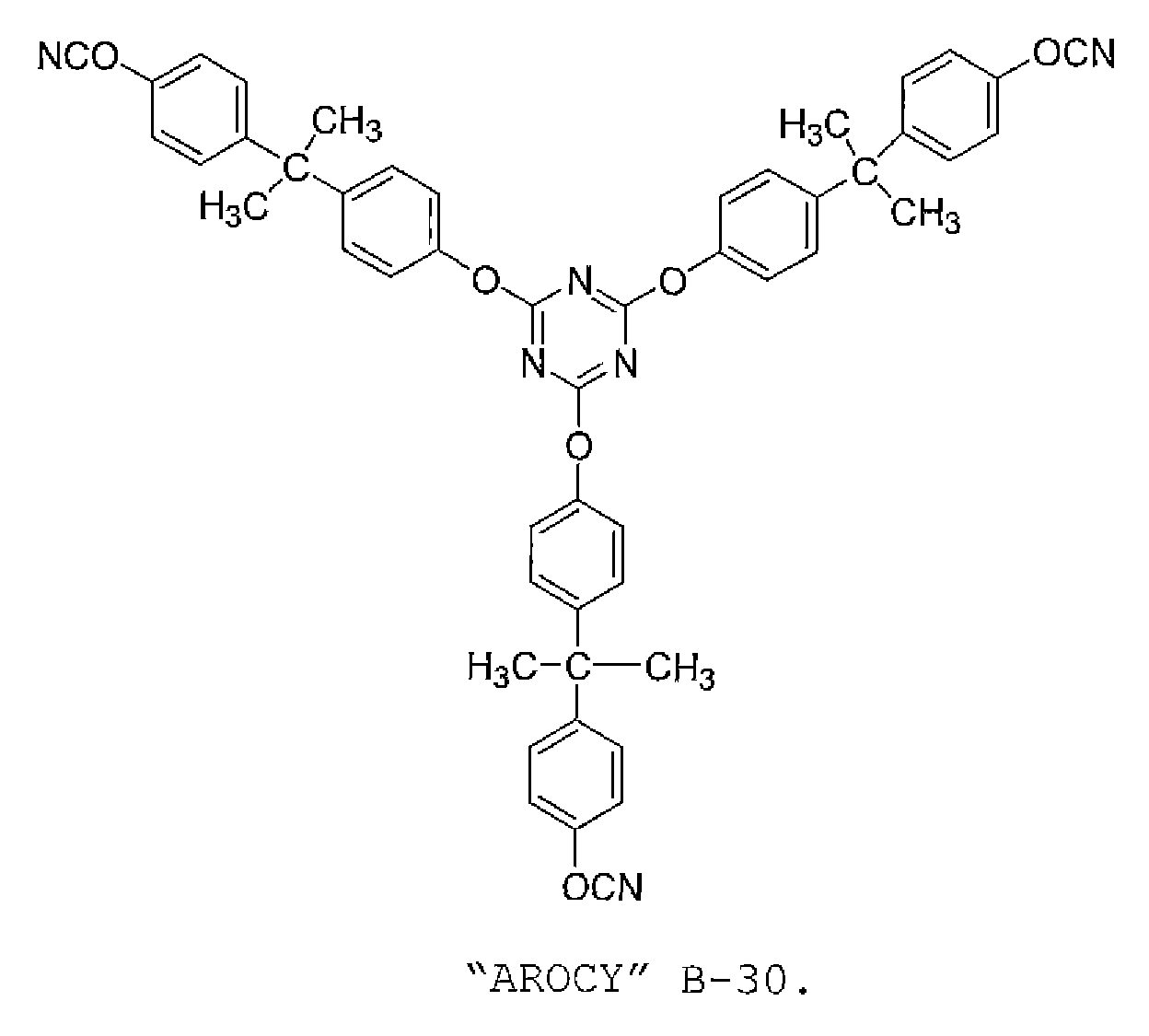
  • Particularly desirable cyanate esters for use herein are available commercially from Hunstman Advanced Materials, Tarrytown, New York under the tradename "AROCY” [l,l-di(4- cyanatophenylethane) ] .
  • the structures of four desirable "AROCY” cyanate esters are
  • the cyanate ester resin component should be present in the composition in an amount which the range of about 10 percent by weight to about 95 percent by weight, desirably about 20 percent by weight to about 80 percent by weight, such as about 60 percent by weight.
  • nadimide As a maleimide, nadimide or itaconimide, compounds having the general respective structural formulae below may be used:
  • each R 2 is independently selected from hydrogen or lower alkyl (such as C 1-5 ) , and J monovalent or a polyvalent radical comprising organic or organosiloxane radicals, and combinations of two or more thereof, such as are defined as " ⁇ " and "Y” with respect to the benzoxazine structure above.
  • Monovalent or polyvalent radicals include hydrocarbyl or substituted hydrocarbyl species typically having a range of about 6 up to about 500 carbon atoms.
  • the hydrocarbyl species may be alkyl, alkenyl, alkynyl, cycloalkyl, cycloalkenyl, aryl, alkylaryl, arylalkyl, aryalkenyl, alkenylaryl, arylalkynyl and alkynylaryl.
  • X may be a hydrocarbylene or substituted hydrocarbylene species typically having in the range of about 6 up to about 500 carbon atoms.
  • hydrocarbylene species include but are not limited to alkylene, alkenylene, alkynylene, cycloalkylene, cycloalkenylene, arylene,
  • alkylarylene arylalkylene, arylalkenylene, alkenylarylene, arylalkynylene and alkynylarylene.
  • the maleimide, itaconamide or nadimide may be in liquid or solid form.
  • the maleimide, itaconamide or nadimide functional groups are separated by a polyvalent radical having sufficient length and branching to render the maleimide containing compound a liquid.
  • the maleimide, itaconamide or nadimide compound may contain a spacer between maleimide functional groups comprising a branched chain alkylene between maleimide, itaconamide or nadimide functional groups.
  • the maleimide compound desirably is a stearyl maleimide, oleyl maleimide, a biphenyl maleimide or a 1, 20-bismaleimido-10,ll- dioctyl-eixosane or combinations of the above.
  • the maleimide compound may be prepared by reaction of maleic anhydride with dimer amides or prepared from aminopropyl- terminated polydimethyl siloxanes, polyoxypropylene amines. polytetramethyleneoxide-di-p-aminobenzoates, or combinations thereof.
  • Particularly desirable maleimides and nadimides include
  • R 5 and R 6 are each selected from alkyl, aryl, aralkyl or alkaryl groups, having from about 6 to about 100 carbon atoms, with or without substitution or interruption by a member selected from silane, silicon, oxygen, halogen, carbonyl, hydroxyl, ester, carboxylic acid, urea, urethane, carbamate, sulfur, sulfonate and sulfone.
  • the maleimides, nadimides or itaconimides should be present in the composition in an amount which the range of about 10 percent by weight to about 95 percent by weight, desirably about 20 percent by weight to about 80 percent by weight, such as about 60 percent by weight.
  • the block copolymer may be any block copolymer capable of contributing to the physical properties desired for the disclosed composition.
  • the effect of the block copolymer on the modulus may be seen with reference to FIG. 2.
  • Amphophilic block copolymers are particularly desirable.
  • Arkema offers for sale commercially an amphiphilic block copolymer under the trademark Nanostrength.
  • Such block copolymers are currently available in two versions: SBM and MAM.
  • the SBM copolymer is reportedly made of polystyrene, 1, 4-polybutadiene and syndiotactic
  • poly (methyl methacrylate) poly (methyl methacrylate) .
  • a polymer material constructed from polymethyl methacrylate (“PMMA”) and polybutyl acrylate (“PB”) may be used too.
  • Polymer materials within this class are referred to as polymethylmethacrylate-block-polybutylacrylate- block polymethylmethacrylate copolymers (“MAM”) .
  • MAM is a triblock copolymer, consisting of about 70% PMMA and 30% PB.
  • MAM is constructed from distinct segments, which provides for the ability to self- assemble at the molecular scale. That is, M confers hardness to the polymer and A confers elastomeric properties to the polymer. A hard polymer segment tends to be soluble in cyanoacrylates, whereas the elastomeric segments provides toughness to the polymeric cyanoacrylate which forms upon cure. MAM also
  • MAM is commercially available under the tradename Nanostrength, at present under several different grades — i.e., E-21 [intermediate low molecular weight, medium butadiene content best toughening for PMMA friendly cross- linking agents (JEFFAMINE, MDEA) ] , E-41 [low molecular weight, low butadiene content, low viscosity, for use with PMMA friendly cross-linking agents (JEFFAMINE, MDEA)], M-22, M-22N, M-42, M-51 (low molecular weight, medium butyl acrylate content, low viscosity), and M-52N.
  • E-21 intermediate low molecular weight, medium butadiene content best toughening for PMMA friendly cross- linking agents (JEFFAMINE, MDEA)
  • E-41 low molecular weight, low butadiene content, low viscosity, for use with PMMA friendly cross-linking agents (JEFFAMINE, MDEA)
  • Arkema promotes the Nanostrength product line as an acrylic block copolymer that is miscible with many polymers, most of which according to the manufacturer are major industrial epoxy resins. See also U.S. Patent No. 6,894,113, where in its abstract the 113 patent speaks to a thermoset material with improved impact resistance.
  • the impact resistance is derived from 1 to 80% of an impact modifier comprising at least one copolymer comprising S-B-M, B-M and M-B-M blocks, where each block is connected to the other by a covalent bond or of an intermediary connected to one of the blocks by a covalent bond and to the other block by another covalent bond, M is a PM A homopolymer or a copolymer comprising at least 50% by weight of methyl methacrylate, B is incompatible with the thermoset resin and with the M block and its glass transition temperature Tg is less than the operating temperature of the thermoset material, and S is incompatible with the thermoset resin, the B block and the M block and its Tg or its melting temperature is greater than the Tg of B.
  • amphophilic block copolymer is a polyether block copolymer known to the trade as FORTEGRA 100, from Dow Chemical Co. Dow describes FORTEGRA 100 as a low viscosity toughening agent designed for use as a high efficiency second phase, in amine cured epoxy systems. FORTEGRA 100 is reported to provide improved toughness without significantly affecting the
  • FORTEGRA 100 is also reported to be useful for formulation into standard bisphenol A and bisphenol F epoxy systems as it does not participate in the epoxy cure reaction.
  • FORTEGRA 100 is promoted as being effective when formulated at a specific volume fraction of the finish film or part, typically 3% to 8% by dry volume is said to achieve the toughening effect.
  • Additional block copolymers include those which comprise both hydrophobic and hydrophilic segments or portions, of the general formula:
  • R 1 is independently a hydrophobic olefin, such as ethylene, propylene, 1-butene, 1-hexene, 3-methyl-1-pentene, or 4-methyl-1-pentene or a polymerizable hydrophobic aromatic hydrocarbon such as styrene; each R 2 is a hydrophilic acid anhydride, such as maleic anhydride; v is from 1 to 12; w is from 1 to 6; and n is from 1 to 50.
  • R 1 is independently a hydrophobic olefin, such as ethylene, propylene, 1-butene, 1-hexene, 3-methyl-1-pentene, or 4-methyl-1-pentene or a polymerizable hydrophobic aromatic hydrocarbon such as styrene
  • each R 2 is a hydrophilic acid anhydride, such as maleic anhydride
  • v is from 1 to 12
  • w is from 1 to 6
  • n is from 1 to 50.
  • Still other block copolymers may be a styrene maleic anhydride copolymer, represented by the formula:
  • Styrene maleic anhydride copolymers are well known and some of which are available commercially from Sartomer Company, Inc., Exton, PA under the trade name SMA EF80, for example.
  • Styrene maleic anhydride copolymers represent the
  • copolymer!zation product of styrene and maleic anhydride are characterized by alternating blocks of styrene and maleic anhydride moieties.
  • hydrophilic segments in the styrene maleic anhydride block copolymer may be at least 2:1, such as between 3:1 and 12:1.
  • the hydrophilic segments in the block coplymer should comprise an anhydride, such as maleic anhydride.
  • the hydrophobic segments in the block coplymer should comprise at least one of ethylene, propylene, 1-butene, 1-hexene, 3-methyl-1-pentene, 4- methyl-1-pentene, or styrene.
  • the block copolymer should be prepared with the hydrophilic segments comprising maleic anhydride and the hydrophobic segments comprising styrene.
  • 7,745,535 is directed to and claims an amphiphilic multiblock copolymer where at least one block is a profiled block
  • hydrophilic middle block made from one or more monomeric units selected from acrylic acid, methacrylic acid, and the salts, esters, anhydrides and amides of acrylic acid and methacrylic acid; dicarboxylic acid anhydrides;
  • U.S. Patent No. 7,820,760 is directed to and claims a curable adhesive epoxy resin composition including (a) an epoxy resin; (b) an amphiphilic block copolymer containing at least one epoxy resin miscible block segments and at least one epoxy resin immiscible block segments (where the immiscible block segment comprises at least one polyether structure provided that the polyether structure of the immiscible block segment contains at least one or more alkylene oxide monomer units having at least four carbon atoms); and (c) at least one curing agent.
  • the amphiphilic block copolymer in the '760 patent is an all polyether block copolymer such as a PEO-PBO diblock copolymer or a PEO-PBO-PEO triblock copolymer.
  • the amphiphilic block copolymer is present in an amount such that when in the '760 patent the epoxy resin composition is cured, the bond strength of the resulting cured epoxy adhesive resin composition
  • U.S. Patent No. 7,670,649 is directed to and claims a curable ambient cure high-solids coating composition including (a) an epoxy resin; (b) an amphiphilic block copolymer
  • the immiscible block segment comprises at least one polyether structure provided that the polyether structure of the immiscible block segment contains at least one or more alkylene oxide monomer units
  • at least one epoxy resin immiscible block segment and at least one epoxy resin immiscible block segment; and (c) a sufficient amount of a nitrogen- containing curing agent to cure the coating composition at ambient temperature of less than about 60°C.
  • the epoxy resin composition is cured, the toughness of the resulting cured epoxy resin composition is increased.
  • U.S. Patent No. 6,887,574 is directed to and claims a curable flame retardant epoxy resin composition including (a) at least one flame retardant epoxy resin; (b) at least one
  • amphiphilic block copolymer (c) amphiphilic block copolymer; and (c) a curing agent.
  • a curing agent Such components are present in the curable composition in the
  • U.S. Patent Application Publication No. 2008/0287595 is directed to a composition comprising (1) a thermosettable resin selected from an epoxy resin, an epoxy vinyl ester resin, an unsaturated polyester resin or a mixture thereof, and (2) an amphiphilic mock copolymer dispersed in the thermosettable resin.
  • a thermosettable resin selected from an epoxy resin, an epoxy vinyl ester resin, an unsaturated polyester resin or a mixture thereof
  • FRP fiber-reinforced plastics
  • coatings and composites prepared from the composition are provided as well.
  • International Patent Publication No. WO 2010/008931 is directed to a structural composite that uses a block copolymer toughening agent to increase the fracture resistance (toughness) of the structural composite.
  • the structural composite comprises (i) a carbon fiber reinforcing material and (ii) a
  • thermosettable resin composition wherein the thermosettable resin composition comprises (a) a thermosettable resin and (b) at least one block copolymer toughening agent.
  • silane modified epoxy resin which is made from:
  • component ( ⁇ ) an epoxy component embraced by the following structure:
  • component (B) a polymeric form of an epoxy- functionalized alkoxy silane embraced by the following
  • R 1 is an oxirane-containing moiety and R 2 is an alkyl or alkoxy-substituted alkyl, aryl, or aralkyl group having from one to ten carbon atoms; and as component (C) reaction products of components and (B) .
  • silane-modified epoxy is formed as the reaction product of an aromatic epoxy, such as a
  • epoxy silane where the epoxy silane is embraced by the following structure:
  • R is an oxirane-containing moiety, examples of which include 2- (ethoxymethyl) oxirane, 2- (propoxymethyl) oxirane, 2- (methoxymethyl) oxirane, and 2- (3-methoxypropyl) oxirane and R 2 is an alkyl or alkoxy-substituted alkyl, aryl, or aralkyl group having from one to ten carbon atoms.
  • R 1 is 2- (ethoxymethyl) oxirane and R 2 is methyl.
  • the polymeric form of such epoxy silane may be seen with reference to FIG. 1.
  • the silane modified epoxy is thus in one aspect a combination of the aromatic epoxy, a polymeric form of the epoxy silane, and reaction products of the aromatic epoxy and the epoxy silane.
  • the reaction products may be prepared from the aromatic epoxy and epoxy silane in a by weight ratio of 1:100 to 100:1, such as a by weight ratio of 1:10 to 10:1.
  • the block copolymer may be used herein in an amount up to about 50 percent by weight, desirably from 5 to 40 percent by weight based on the total weight of the adhesive composition.
  • the Tg of a polymer is the temperature at which the polymer becomes brittle on cooling or soft on heating. More specifically, Tg defines a pseudo second order phase transition in which a polymer yields, on cooling, a glassy structure with properties similar to those of a crystalline material. Above Tg, the polymer becomes soft and capable of plastic deformation without fracture. While the Tg is occasionally described as the softening temperature" of a polymer, it is not uncommon for the polymer to begin softening at a temperature below the Tg. This is because, due to the nature of many non-crystalline polymers, the softening of the polymer may occur over a temperature range rather than abruptly at a single temperature value. Tg
  • the Tg of a polymer refers to the value as determined by ASTM E-1356.
  • a polymer In addition to becoming brittle at temperatures below Tg, a polymer also generally becomes drier and less tacky than when that same polymer is heated to a temperature above its Tg.
  • Another block copolymer is the chain extended reaction product of diglycidyl ethers and bisphenol A together with the diglycidyl ether of bisphenol A. More specifically, depending on the molecular weight of the diglycidyl ether (for instance, polypropylene glycol diglycidyl ether) on higher or lower viscosity block copolymer can be obtained.
  • diglycidyl ether for instance, polypropylene glycol diglycidyl ether
  • filler component many materials are potentially useful. For instance, inorganic fillers may be useful,
  • the filler influences the CTE and thus can be used to reduce thermal expansion of the cured material, thereby reducing warpage.
  • the effect of CTE on the warpage may be seen with reference to FIG. 3.
  • the filler component may often include reinforcing silicas, such as fused spherical silicas, and may be untreated or treated so as to alter the chemical nature of their surface.
  • nano-size silica powder such as those sold under the tradename NAOPOX by Nanoresins, Germany.
  • NANOFOX fillers are
  • NANOPOX fillers ordinarily are believed to have a particle size of about 5 nm to about 80 nm.
  • Nanoresins also produces materials under the NANOPOX E trade designations. For instance, Nanoresins reports NANOPOX E- brand products enable the complete impregnation of electronic components which are difficult to seal otherwise and provide a large spectrum of mechanical and thermal properties such as reduced shrinkage and thermal expansion, fracture toughness and modulus. In the table below, Nanoresins-provided information on the four noted NANOPOX E products is set forth:
  • Nanoresins reports that important properties can be significantly improved in epoxy formulations by using NANOPOX E- brand products. For instance:
  • the dispersed phase consists according to the manufacturer of surface-modified, spherically shaped SiO 2 nanoparticles with diameters below 50 nm and an extremely narrow particle size distribution. These spheres, only a few nanometers in size, are distributed agglomerate-free in the resin matrix.
  • component include those constructed of or containing aluminum oxide, silicon nitride, aluminum nitride, silica-coated aluminum nitride, boron nitride and combinations thereof.
  • the filler component when used, should be used in an amount of about 50 to about 90 percent by weight of the filler component
  • composition such as about 60 to about 90 percent by weight, desirably within the range of about 70 to about 90 percent by weight.
  • the cure component many different materials can be used depending upon the temperature at which cure is desired to occur. For instance to achieve cure at a temperature in the about 110°C to about 180°C range, a variety of materials may be used, such as anhydrides and imidazoles, particularly
  • anhydrides examples include methylhexahydrophthalic anhydride ("MHHPA”) (>95%) from Dixie Chemical Company Inc. and ECA 300D also from Dixie Chemical Company Inc. as a mixture of MHHPA (>87%) and
  • methyltetrahydrophthalic anhydride >7%
  • examples of the imidazoles include imidazole from Sigma-Aldrich Corporation, 3
  • Curezol 1B2MZ (benzyl-2-methylimidazole) and Curezol 2P4MZ (2- phenyl-4-methylimidazole) from Air Products and Chemicals Inc.
  • the cure component should be present in an amount within the range of about 0.05 percent by weight to about 1 percent by weight, desirably about 0.1 percent by weight to about 0.5 percent by weight, of the total composition.
  • the anhydrides or phenolic resins and imidazoles should be present in an amount within the range of about 10 to 50% of the thermosetting resin composition.
  • thermosetting resin composition used to encapsulate the wafer may be dispensed by air pressure or by piston dispense on or about a central portion of the wafer.
  • Exposure to liquid compression molding conditions such as at a temperature of about 100°C to 120°C for a period of time of about 300 to 400 seconds, follows. See e.g. FIG 1.
  • the compression molded wafer may be placed into a conventional oven for a post mold cure at a temperature about 120°C to 150°C for a period of time of about 15 minutes to 1 hour.
  • a 8", 970 urn thick molded wafer should demonstrate warpage about less than 1 mm bow across of the wafer.
  • a control sample (Sample No. 1) prepared from
  • compositions including a thermosetting resin matrix such as an epoxy resin component
  • copolymer, a filler, and a cure component showed reduced viscosity while maintaining a comparable CTE and Tg.
  • compositions were each prepared by mixing together the noted constituents with a mechanical mixer until dissolution to a homogeneous solution was observed.
  • the silica filler was then added with continued mixing for a period of time of about 30-60 minutes at room temperature until a viscous paste with a substantially uniform consistency was achieved.
  • the remaining constituents were then mixed into the various samples, to form pastes, which were then transferred into containers until ready for use.
  • thermosetting resin compositions are dispensed onto and about the center of a reconfigured wafer as a carrier with silicon dies. After compression molding at a temperature of 100"C to 120°C for a period of time of 300 seconds to 400 seconds, the composition was observed to be about 60 to 80% cured, though with a tack free surface. Then, the so-molded wafer was placed into a conventional oven for post mold cure at a temperature of 120°C to 150°C for a period of time of 15 minutes to 1 hour.
  • the inventive composition may be dispensed onto the active side of a reconfigured wafer and molded under increased pressure (about 98 KN) and at an elevated temperature of about 120°C for a period of time of about 400 seconds.
  • the molded wafer assembly was then exposed to an elevated temperature of about 150°C for a period of time of 1 hour.
  • the mold wafer was then debonded, coated with a redistribution layer, aolder bumps applied and thereafter diced into single semiconductor packages.
  • composition should be equal to or higher than the temperature used to cure the composition; the Tg should be higher than 90°C, desirably above 125°C. If the composition cures slowly or at a higher temperature, the stress free point between the die and substrate set is high. Warpage at room temperature results from cooling the compression molded semiconductor package to room temperature from the cure temperature.
  • the liquid compression molding material should have Tg by TMA after reflow at 260°C above 90°C and desirably above 125°C, a DSC peak below 140°C, a delta
  • sealants for use as encapsulants for microelectronic devices, particularly as a liquid

Landscapes

  • Chemical & Material Sciences (AREA)
  • Health & Medical Sciences (AREA)
  • Chemical Kinetics & Catalysis (AREA)
  • Medicinal Chemistry (AREA)
  • Polymers & Plastics (AREA)
  • Organic Chemistry (AREA)
  • Compositions Of Macromolecular Compounds (AREA)
  • Engineering & Computer Science (AREA)
  • Manufacturing & Machinery (AREA)
  • Epoxy Resins (AREA)

Abstract

Thermosetting resin compositions useful for liquid compression molding encapsulation of a reconfigured wafer are provided. The so-encapsulated molded wafer offers improved resistance to warpage, compared to reconfigured wafers encapsulated with known encapsulation materials.

Description

LIQUID COMPRESSION MOLDING ENCAPSULANTS BACKGROUND
Field
[0001] Thermosetting resin compositions useful for liquid compression molding encapsulation for fan-out wafer level packaging application are provided. The so-encapsulated wafer of casting compound with embedded silicon chips offers improved resistance to warpage, compared to encapsulation with known materials.
Brief Description of Related Technology
[0002] Liquid compression molding for fan-out wafer level packaging applications in the semiconductor packaging industry involves the coating of a protective material on a carrier on which is disposed one or more diced silicon dies picked and then placed there. The gaps and edges around the silicon dies are filled with the protective material to form a molded wafer.
[0003] Conventional materials used to form the molded wafer have either not possessed the desired physical properties to offer improved resistance to wafer warpage, or have not lent themselves to application by liquid compression molding
techniques.
[0004] It would be desirable therefore to provide
encapsulation by liquid compression molding to silicon wafers materials suitable for application, which are thermosetting resin compositions capable of providing improved resistance to wafer warpage. SUMMARY
[0005] Thermosetting resin compositions that are capable of reducing, after cure, molded wafer warpage are provided. More specifically, thermosetting resin compositions useful as liquid compression molding encapsulants having low warpage after compression molding and oven cure, while maintaining the
physical properties of a molding compound, in the invention composition are provided. The compositions exhibit low modulus at room temperature (such as about 22 GPa or less, desirably within the range of about 5 to about 9 Gpa, at room
temperature), low coefficients of thermal expansion ("CTEs") (oil < 10 ppm) , and multiple glass transition temperatures ("Tgs") [Tg1 about -70°C to -30°C (such as -48°C) , and Tg2 about 100°C to 150°C (such as 140°C) . This physical property combination shows promise in overcoming some of the significant technical hurdles facing the semiconductor packaging industry at present,
particularly with respect to wafer warpage.
[0006] Thus provided in one aspect is a thermosetting resin composition, which when cured forms a network of reacted
products showing two or more Tg's by Differential Scale
Calorimetry ("DSC") . The components of these compositions include a thermosetting resin matrix (such as an epoxy resin component), a block copolymer, a filler, and a cure component comprising the combination of an anhydride or a phenolic resin and an imidizole.
[0007] In another aspect, provided is a method of improving warpage resistance to a molded wafer, steps of which include:
providing a carrier on which is disposed one or more silicon chips;
providing a thermosetting resin composition as so described in contact with the carrier; and exposing the silicon chips and the thermosetting resin composition to conditions favorable to allow the thermosetting resin composition to flow about the wafer and cure to a reaction product of the thermosetting resin composition. The cured reaction product is capable of improving warpage resistance of the molded wafer by about 65%, desirably at least about 50%, and even more desirably at least about 80%, as compared with a molded wafer with a material other than that which is disclosed herein.
BRIEF DESCRIPTION OF THE FIGURES
[0008] FIG. 1 depicts a process flow diagram of a liquid compression molding encapsulation process for fan-out wafer level packaging application.
[0009] FIG. 2 depicts in the first part the effect of the addition of the block copolymer on the modulus, and in the second part the effect of the CTE on the warpage of the
compression molded silicon wafer.
DETAILED DESCRIPTION
[0010] The thermosetting resin compositions as noted above, include among other constituents a thermosetting resin matrix (such as an epoxy resin component) .
[0011] Examples of the epoxy resin component include epoxies made from bisphenol A, bisphenol F, bisphenol S, bisphenol E, biphenyl or combinations thereof. In addition, two or more different bisphenol epoxies (or hydrogenated versus thereof) within the same type of resin (such as A, F, S or E) may be used.
[0012] Commercially available examples of the bisphenol epoxies desirable for use herein include bisphenol-F epoxies [such as RE-404-S from Nippon Kayaku, Japan, and EPICLON 830 (RE1801), 830S (RE1815), 830A (RE1826) and 830W from Dai Nippon Ink & Chemicals, Inc., and RSL 1738 and YL-983U from Resolution] and bisphenol-A epoxies (such as YL-979 and 980 from
Resolution) .
[0013] The bisphenol epoxies available commercially from Dai Nippon and noted above are promoted as liquid undiluted
epichlorohydrin-bisphenol F epoxies having lower viscosities than conventional epoxies based on bisphenol A epoxies and have physical properties similar to liquid bisphenol A epoxies.
Bisphenol F epoxy has a lower viscosity than bisphenol A epoxy, all else being the same between the two types of epoxies, which affords a lower viscosity and thus a fast flow underfill sealant material. The EEW of these four bisphenol F epoxies is between 165 and 180. The viscosity at 25°C is between 3,000 and 4,500 cps (except for RE1801 whose upper viscosity limit is 4,000 cps) . The bisphenol A epoxies have a EEW (g/eq) of between 180 and 195 and a viscosity at 25°C of between 100 and 250 cps.
[0014] The bisphenol epoxies available commercially from Resolution and noted above are promoted as low chloride
containing liquid epoxies. The total chloride content for the RSL-1738 bisphenol A epoxy is reported as between 500 and 700 ppm, and that for YL-983U as between 150 and 350 ppm.
[0015] Among the epoxies suitable for use herein also include polyglycidyl derivatives of phenolic compounds, such as those available commercially under the tradename ΞΡΟΝ, such as EPON 828, EPON 1001, EPON 1009, and EPON 1031 from Resolution; DER 331, DER 332, DER 334, and DER 542 from Dow Chemical Co.; and BREN-S from Nippon Kayaku. Other suitable epoxies include polyepoxides prepared from polyols and the like and polyglycidyl derivatives of phenol-formaldehyde novolacs, the latter of such as DEN 431, DEN 438, and DEN 439 from Dow Chemical. Cresol analogs are also available commercially under the tradename ARALDITE, such as ARALDITE ECN 1235, ARALDITE ECN 1273, and ARALDITE ECN 1299 from Ciba Specialty Chemicals Corporation. SU-8 is a bisphenol-A-type epoxy novolac available from
Resolution. Polyglycidyl adducts of amines, aminoalcohols and polycarboxylic acids are also useful in this invention,
commercially available resins of which include GLYAMINE 135, GLYAMINE 125, and GLYAMINE 115 from F.I.C. Corporation; ARALDITE MY-720, ARALDITE 0500, and ARALDITE 0510 from Ciba Specialty Chemicals and PGA-X and PGA-C from the Sherwin-Williams Co.
[0016] In addition to the bisphenol epoxies, other epoxy compounds may be included within the epoxy component. For instance, cycloaliphatic epoxies, such as 3,4- epoxycyclohexylmethyl-3, 4-epoxycyclohexylcarbonate, or
hydrogenated versions of the bisphenol or biphenyl epoxies may be used.
[0017] Also monofunctional, difunctional or multifunctional reactive diluents to adjust the viscosity and/or lower the Tg are also used, such as butyl glycidyl ether, cresyl glycidyl ether, polyethylene glycol glycidyl ether or polypropylene glycol glycidyl ether. Appropriate monofunctional epoxy coreactant diluents for use herein include those that have a viscosity which is lower than that of the epoxy component, ordinarily, less than about 250 cps.
[0018] The monofunctional epoxy coreactant diluents should have an epoxy group with an alkyl group of about 6 to about 28 carbon atoms, examples of which include C6-28 alkyl glycidyl ethers, C6-28 fatty acid glycidyl esters and C10-28 alkylphenol glycidyl ethers.
[0019] In the event such a monofunctional epoxy coreactant diluent is included, such coreactant diluent should be employed in an amount of up to about 5 percent by weight to about 15 percent by weight, such as about 8 percent by weight to about 12 percent by weight, based on the total weight of the composition.
[0020] The epoxy resin component should be present in the composition in an amount which the range of about 10 percent by weight to about 95 percent by weight, desirably about 20 percent by weight to about 80 percent by weight, such as about 60 percent by weight.
[0021] In addition to the epoxy resin component, other reactive components may be included such as an episulfide resin component, an oxazine component, an oxazoline component, a cyanate ester component, and/or a maleimide-, . a nadimide- or an itaconimide-containing component.
[0022] As an episulfide resin, any of the aforementioned epoxies may be used where the oxirane oxygen atom has been replaced by a sulfur atom.
[0023] Oxazines may be embraced by the structure
Figure imgf000008_0001
where here R1-R8 are each individually members selected from hydrogen, C1-40 alkyl, C2-40 alkenyl, the latter two of which being optionally interrupted by one or more of O, N, S, C=O, COO, or NHC=O or substituted by one or more of OH, OR, NRR, SH, SR, COOH, COOR, NHCOOH or NHCOOR, where R is selected from C1-40 alkyl, C2-40 alkenyl, or C6-20 aryl,
X is a linkage selected broadly from alkylene,
alkenylene, or arylene, optionally interrupted by one or more of O, NR, S, C=O, COO, or NHC=O or substituted by one or more of OH, OR, NRR, SH, SR, COOH, COOR, NHCOOH or NHCOOR, where R is selected from C1-40 alkyl, C2-40 alkenyl, or C6-20 aryl,
m and n are each individually 1 or 2, and
k is 0 to 6.
[0024] The oxazine resin component should be present in the composition in an amount which the range of about 10 percent by weight to about 95 percent by weight, desirably about 20 percent by weight to about 80 percent by weight, such as about 60 percent by weight.
[0025] Ά more specific example of the oxazine resin component is a benzoxazine resin, examples of which may be embraced by
Figure imgf000009_0001
where o is 1-4, X is defined below, and R1 is alkyl, such as methyl, ethyl, propyls or butyls, or
Figure imgf000009_0002
where p is 1-4, Y is defined below, and R4 is selected from hydrogen, halogen, alkyl or alkenyl.
[0026] X and Y in the benzoxazine structures above may independently be selected from a monovalent or polyvalent radical that include
- hydrocarbyl or substituted hydrocarbyl species typically having in the range of about 6 up to about 500 carbon atoms, where the hydrocarbyl species is selected from alkyl, alkenyl, alkynyl, cycloalkyl, cycloalkenyl, aryl, alkylaryl, arylalkyl, aryalkenyl, alkenylaryl, arylalkynyl or alkynylaryl, provided, however, that X can be aryl only when X comprises a combination of two or more different species;
- hydrocarbylene or substituted hydrocarbylene species typically having in the range of about 6 up to about 500 carbon atoms, where the hydrocarbylene species are selected from alkylene, alkenylene, alkynylene, cycloalkylene, cycloalkenylene, arylene, alkylarylene, arylalkylene, arylalkenylene, alkenylarylene, arylalkynylene or alkynylarylene,
- heterocyclic or substituted heterocyclic species typically having in the range of about 6 up to. about 500 carbon atoms,
- polysiloxane, and
- polysiloxane-polyurethane block copolymers, and combinations of one or more of the above with a linker selected f om covalent bond, -0-, -S-, -NR-, -NR-C(O)-, -NR-C (O)-0-, -NR-C (O) -NR-, -S-C (O) -, -S-C (O) -0-, -S-C (O)-NR-, -0-S(O)2-, -O- S (O)2-0-, -0-S{0)2-NR-, -O-S(O)-, -0-S(O)-0-, -O-S (O)-NR-,
-O-NR-C (O) -, -0-NR-C (O) -0-, -0-NR-C (O)-NR-, -NR-O-C(O)-,
-NR-0-C (O) -0-, -NR-O-C(O) -NR-, -O-NR-C (S) -, -0-NR-C (S) -0-,
-O-NR-C (S)-NR-, -NR-O-C(S)-, -NR-O-C (S) -0-, -NR-O-C (S) -NR-, -0- C (S) -, -0-C (S) -0-, -0-C (S) -NR-, -NR-C (S) -, -NR-C (S) -O-,
-NR-C(S) -NR-, -S-S(O)2-, -S-S (O)2-0-, -S-S (O)2-NR-, -NR-O-S(O)-, -NR-O-S (O) -0-, -NR-O-S (O) -NR-, -NR-O-S (O)2-, -NR-O-S (O)2-0-, -NR- O-S (O)2-NR-, -O-NR-S(O)-, -0-NR-S (O) -0-, -0-NR-S (O) -NR-, -0-NR-
S (O)2-0-, -0-NR-S (O)2-NR-, -0-NR-S (O) 2-, -0-P(O)R2-, -S-P(0)R2-, or -NR-P(0)R2-; where each R is independently hydrogen, alkyl or substituted alkyl.
[0027] When one or more of the above described "X" or "Y" linkages cooperate to form the appendage of a benzoxazine group, as readily recognized by those of skill in the art, a wide variety of organic chains can be produced, such as, for example, oxyalkyl, thioalkyl, aminoalkyl, carboxylalkyl, oxyalkenyl, thioalkenyl, aminoalkenyl, carboxyalkenyl, oxyalkynyl,
thioalkynyl, aminoalkynyl, carboxyalkynyl, oxycycloalkyl, thiocycloalkyl, aminocycloalkyl, carboxycycloalkyl,
oxycloalkenyl, thiocycloalkenyl, aminocycloalkenyl,
carboxycycloalkenyl, heterocyclic, oxyheterocyclic,
thioheterocyclic, aminoheterocyclic, carboxyheterocyclic, oxyaryl, thioaryl, aminoaryl, carboxyaryl, heteroaryl,
oxyheteroaryl, thioheteroaryl, aminoheteroaryl,
carboxyheteroaryl, oxyalkylaryl, thioalkylaryl, aminoalkylaryl, carboxyalkylaryl, oxyarylalkyl, thioarylalkyl, aminoarylalkyl, carboxyarylalkyl, oxyarylalkenyl, thioarylalkenyl,
aminoarylalkenyl, carboxyarylalkenyl, oxyalkenylaryl,
thioalkenylaryl, aminoalkenylaryl, carboxyalkenylaryl,
oxyarylalkynyl, thioarylalkynyl, aminoarylalkynyl,
carboxyarylalkynyl, oxyalkynylaryl, thioalkynylaryl,
aminoalkynylaryl or carboxyalkynylaryl. oxyalkylene,
thioalkylene, aminoalkylene, carboxyalkylene, oxyalkenylene, thioalkenylene, aminoalkenylene, carboxyalkenylene,
oxyalkynylene, thioalkynylene, aminoalkynylene,
carboxyalkynylene, oxycycloalkylene, thiocycloalkylene,
aminocycloalkylene, carboxycycloalkylene, oxycycloalkenylene, thiocycloalkenylene, aminocycloalkenylene,
carboxycycloalkenylene, oxyarylene, thioarylene, aminoarylene, carboxyarylene, oxyalkylarylene, thioalkylarylene,
aminoalkylarylene, carboxyalkylarylene, oxyarylalkylene, thioarylalkylene, aminoarylalkylene, carboxyarylalkylene, oxyarylalkenylene, thioarylalkenylene, aminoarylalkenylene, carboxyarylalkenylene, oxyalkenylarylene, thioalkenylarylene, aminoalkenylarylene, carboxyalkenylarylene, oxyarylalkynylene, thioarylalkynylene, aminoarylalkynylene, carboxy arylalkynylene, oxyalkynylarylene, thioalkynylarylene, aminoalkynylarylene, carboxyalkynylarylene, heteroarylene, oxyheteroarylene,
thioheteroarylene, aminoheteroarylene, carboxyheteroarylene,heteroatom-containing di- or polyvalent cyclic moiety,
oxyheteroatom-containing di- or polyvalent cyclic moiety, thioheteroatom-containing di- or polyvalent cyclic moiety, aminoheteroatom-containing di- or polyvalent cyclic moiety, carboxyheteroatom-containing di- or polyvalent cyclic moiety, and the like.
[0028] The benzoxazine resin component should be present in the composition in an amount which the range of about 10 percent by weight to about 95 percent by weight, desirably about 20 percent by weight to about 80 percent by weight, such as about 60 percent by weight.
[0029] As a cyanate ester component, compounds having the general structural formula below may be used:
Figure imgf000012_0001
where here m is from 2 to 5 and R1 is an aromatic nucleus- containing residue. R1 should contain at least 6 carbon atoms and may be derived, for example, from aromatic hydrocarbons, such as benzene, biphenyl, naphthalene, anthracene, pyrene or the like. The aromatic residue may be also be derived from a polynuclear aromatic hydrocarbon in which at least two aromatic rings are attached to each other through a bridging group, such as where the bridging member has the formula
Figure imgf000013_0001
where Ra and Rb are the same or different and each represents a hydrogen atom or an alkyl group containing 1 to 4 carbon atoms. R1 also includes residues derived from novolac-type phenolic resins — i.e. cyanate esters of these phenolic resins. R1 may also contain further ring attached, non-reactive substituents .
[0030] Examples of useful cyanate esters include, for instance, 1, 3-dicyanatobenzene; 1, 4-dicyanatobenzene; 1,3,5- tricyanatobenzene; 1,3-, 1,4-, 1,6-, 1,8-, 2,6- or 2,7- dicyanatonaphthalene; 1, 3, 6-tricyanatonaphthalene 4,4'- dicyanato-biphenyl; bis (4-cyanatophenyl)methane and 3, 3 ' , 5, 5 ' - tetramethyl, bis (4-cyanatophenyl) methane; 2,2-bis (3,5-dichloro- 4-cyanatophenyl) ropane; 2, 2-bis (3, 5-dibromo-4- dicyanatophenyl) propane; bis { -cyanatophenyl) ether; bis (4- cyanatophenyl) sulfide; 2, 2-bis (4-cyanatophenyl)propane; tris(4- cyanatophenyl) -phosphite; tris {4-cyanatophenyl) phosphate; bis (3- chloro-4-cyanatophenyl)methane; cyanated novolac; 1,3-bis[4- cyanatophenyl-1- (methylethylidene) ]benzene and cyanated, bisphenol-terminated polycarbonate or other thermoplastic oligomer.
[0031] Other cyanate esters include cyanates disclosed in U.S. Patent Nos. 4,477,629 and 4,528,366, the disclosure of each of which is hereby expressly incorporated herein by reference; the cyanate esters disclosed in U.K. Patent No. 1,305,702, and the cyanate esters disclosed in International Patent Publication No. WO 85/02184, the disclosure of each of which is hereby expressly incorporated herein by reference.
[0032] Particularly desirable cyanate esters for use herein are available commercially from Hunstman Advanced Materials, Tarrytown, New York under the tradename "AROCY" [l,l-di(4- cyanatophenylethane) ] . The structures of four desirable "AROCY" cyanate esters are
Figure imgf000014_0001
Figure imgf000015_0002
[0033] The cyanate ester resin component should be present in the composition in an amount which the range of about 10 percent by weight to about 95 percent by weight, desirably about 20 percent by weight to about 80 percent by weight, such as about 60 percent by weight.
[0034] As a maleimide, nadimide or itaconimide, compounds having the general respective structural formulae below may be used:
Figure imgf000015_0001
where here m is 1-15, p is 0-15, each R2 is independently selected from hydrogen or lower alkyl (such as C1-5) , and J monovalent or a polyvalent radical comprising organic or organosiloxane radicals, and combinations of two or more thereof, such as are defined as "Χ" and "Y" with respect to the benzoxazine structure above.
[0035] Monovalent or polyvalent radicals include hydrocarbyl or substituted hydrocarbyl species typically having a range of about 6 up to about 500 carbon atoms. The hydrocarbyl species may be alkyl, alkenyl, alkynyl, cycloalkyl, cycloalkenyl, aryl, alkylaryl, arylalkyl, aryalkenyl, alkenylaryl, arylalkynyl and alkynylaryl.
[0036] Additionally, X may be a hydrocarbylene or substituted hydrocarbylene species typically having in the range of about 6 up to about 500 carbon atoms. Examples of hydrocarbylene species include but are not limited to alkylene, alkenylene, alkynylene, cycloalkylene, cycloalkenylene, arylene,
alkylarylene, arylalkylene, arylalkenylene, alkenylarylene, arylalkynylene and alkynylarylene.
[0037] The maleimide, itaconamide or nadimide may be in liquid or solid form.
[0038] In a desired embodiment, the maleimide, itaconamide or nadimide functional groups are separated by a polyvalent radical having sufficient length and branching to render the maleimide containing compound a liquid. The maleimide, itaconamide or nadimide compound may contain a spacer between maleimide functional groups comprising a branched chain alkylene between maleimide, itaconamide or nadimide functional groups.
[0039] In the case of maleimide-containing compounds, the maleimide compound desirably is a stearyl maleimide, oleyl maleimide, a biphenyl maleimide or a 1, 20-bismaleimido-10,ll- dioctyl-eixosane or combinations of the above.
[0040] Again in the case of maleimide-containing compounds, the maleimide compound may be prepared by reaction of maleic anhydride with dimer amides or prepared from aminopropyl- terminated polydimethyl siloxanes, polyoxypropylene amines. polytetramethyleneoxide-di-p-aminobenzoates, or combinations thereof.
[0041] Particularly desirable maleimides and nadimides include
Figure imgf000017_0001
where R5 and R6 are each selected from alkyl, aryl, aralkyl or alkaryl groups, having from about 6 to about 100 carbon atoms, with or without substitution or interruption by a member selected from silane, silicon, oxygen, halogen, carbonyl, hydroxyl, ester, carboxylic acid, urea, urethane, carbamate, sulfur, sulfonate and sulfone.
[0042] Other desirable maleimides, nadimides, and
itaconimides include
Figure imgf000017_0002
Figure imgf000018_0001
Figure imgf000019_0001
Figure imgf000020_0001
Figure imgf000021_0001
Figure imgf000022_0001
[0043] The maleimides, nadimides or itaconimides should be present in the composition in an amount which the range of about 10 percent by weight to about 95 percent by weight, desirably about 20 percent by weight to about 80 percent by weight, such as about 60 percent by weight.
[0044] The block copolymer may be any block copolymer capable of contributing to the physical properties desired for the disclosed composition. The effect of the block copolymer on the modulus may be seen with reference to FIG. 2. Amphophilic block copolymers are particularly desirable. Arkema offers for sale commercially an amphiphilic block copolymer under the trademark Nanostrength. Such block copolymers are currently available in two versions: SBM and MAM. The SBM copolymer is reportedly made of polystyrene, 1, 4-polybutadiene and syndiotactic
poly (methyl methacrylate) . [0045] In addition, a polymer material constructed from polymethyl methacrylate ("PMMA") and polybutyl acrylate ("PB") may be used too. Polymer materials within this class are referred to as polymethylmethacrylate-block-polybutylacrylate- block polymethylmethacrylate copolymers ("MAM") .
[0046] As reported by Arkema, MAM is a triblock copolymer, consisting of about 70% PMMA and 30% PB. MAM is constructed from distinct segments, which provides for the ability to self- assemble at the molecular scale. That is, M confers hardness to the polymer and A confers elastomeric properties to the polymer. A hard polymer segment tends to be soluble in cyanoacrylates, whereas the elastomeric segments provides toughness to the polymeric cyanoacrylate which forms upon cure. MAM also
reinforces mechanical properties, without compromising inherent physical properties. MAM is commercially available under the tradename Nanostrength, at present under several different grades — i.e., E-21 [intermediate low molecular weight, medium butadiene content best toughening for PMMA friendly cross- linking agents (JEFFAMINE, MDEA) ] , E-41 [low molecular weight, low butadiene content, low viscosity, for use with PMMA friendly cross-linking agents (JEFFAMINE, MDEA)], M-22, M-22N, M-42, M-51 (low molecular weight, medium butyl acrylate content, low viscosity), and M-52N.
[0047] Arkema promotes the Nanostrength product line as an acrylic block copolymer that is miscible with many polymers, most of which according to the manufacturer are major industrial epoxy resins. See also U.S. Patent No. 6,894,113, where in its abstract the 113 patent speaks to a thermoset material with improved impact resistance. The impact resistance is derived from 1 to 80% of an impact modifier comprising at least one copolymer comprising S-B-M, B-M and M-B-M blocks, where each block is connected to the other by a covalent bond or of an intermediary connected to one of the blocks by a covalent bond and to the other block by another covalent bond, M is a PM A homopolymer or a copolymer comprising at least 50% by weight of methyl methacrylate, B is incompatible with the thermoset resin and with the M block and its glass transition temperature Tg is less than the operating temperature of the thermoset material, and S is incompatible with the thermoset resin, the B block and the M block and its Tg or its melting temperature is greater than the Tg of B.
[0048] Another commercially available example of an
amphophilic block copolymer is a polyether block copolymer known to the trade as FORTEGRA 100, from Dow Chemical Co. Dow describes FORTEGRA 100 as a low viscosity toughening agent designed for use as a high efficiency second phase, in amine cured epoxy systems. FORTEGRA 100 is reported to provide improved toughness without significantly affecting the
viscosity, glass transition temperature, corrosion resistance, cure rate or chemical resistance of the final coating or composition. FORTEGRA 100 is also reported to be useful for formulation into standard bisphenol A and bisphenol F epoxy systems as it does not participate in the epoxy cure reaction. As a second phase toughening agent, FORTEGRA 100 is promoted as being effective when formulated at a specific volume fraction of the finish film or part, typically 3% to 8% by dry volume is said to achieve the toughening effect.
[0049] Additional block copolymers include those which comprise both hydrophobic and hydrophilic segments or portions, of the general formula:
Figure imgf000024_0001
where here R1 is independently a hydrophobic olefin, such as ethylene, propylene, 1-butene, 1-hexene, 3-methyl-1-pentene, or 4-methyl-1-pentene or a polymerizable hydrophobic aromatic hydrocarbon such as styrene; each R2 is a hydrophilic acid anhydride, such as maleic anhydride; v is from 1 to 12; w is from 1 to 6; and n is from 1 to 50.
[0050] Still other block copolymers may be a styrene maleic anhydride copolymer, represented by the formula:
Λ
Figure imgf000025_0001
where v is from 1 to 12; w is from 1 to 6; and n is from 1 to 50.
[0051] Styrene maleic anhydride copolymers are well known and some of which are available commercially from Sartomer Company, Inc., Exton, PA under the trade name SMA EF80, for example.
Styrene maleic anhydride copolymers represent the
copolymer!zation product of styrene and maleic anhydride and are characterized by alternating blocks of styrene and maleic anhydride moieties.
[0052] The ratio of the hydrophobic segments to the
hydrophilic segments in the styrene maleic anhydride block copolymer may be at least 2:1, such as between 3:1 and 12:1. The hydrophilic segments in the block coplymer should comprise an anhydride, such as maleic anhydride. The hydrophobic segments in the block coplymer should comprise at least one of ethylene, propylene, 1-butene, 1-hexene, 3-methyl-1-pentene, 4- methyl-1-pentene, or styrene. Desirably, the block copolymer should be prepared with the hydrophilic segments comprising maleic anhydride and the hydrophobic segments comprising styrene.
[0053] Reference to the following U.S. patent documents shows amphiphilic block copolymers suitable for use herein, and as such are incorporated herein by reference. U.S. Patent No.
7,745,535 is directed to and claims an amphiphilic multiblock copolymer where at least one block is a profiled block
consisting of a) a hydrophilic middle block made from one or more monomeric units selected from acrylic acid, methacrylic acid, and the salts, esters, anhydrides and amides of acrylic acid and methacrylic acid; dicarboxylic acid anhydrides;
carboxyethyl acrylate; and acrylamides; and b) hydrophobic end blocks where the multiblock copolymer is water insoluble, water indisperible, and not soluble or dispersible in C1-3 alcohols.
[0054] U.S. Patent No. 7,820,760 is directed to and claims a curable adhesive epoxy resin composition including (a) an epoxy resin; (b) an amphiphilic block copolymer containing at least one epoxy resin miscible block segments and at least one epoxy resin immiscible block segments (where the immiscible block segment comprises at least one polyether structure provided that the polyether structure of the immiscible block segment contains at least one or more alkylene oxide monomer units having at least four carbon atoms); and (c) at least one curing agent. The amphiphilic block copolymer in the '760 patent is an all polyether block copolymer such as a PEO-PBO diblock copolymer or a PEO-PBO-PEO triblock copolymer. The amphiphilic block copolymer is present in an amount such that when in the '760 patent the epoxy resin composition is cured, the bond strength of the resulting cured epoxy adhesive resin composition
increases compared to an epoxy resin composition without the amphiphilic polyether block copolymer. [0055] U.S. Patent No. 7,670,649 is directed to and claims a curable ambient cure high-solids coating composition including (a) an epoxy resin; (b) an amphiphilic block copolymer
containing at least one epoxy resin miscible block segment
(where the immiscible block segment comprises at least one polyether structure provided that the polyether structure of the immiscible block segment contains at least one or more alkylene oxide monomer units) and at least one epoxy resin immiscible block segment; and (c) a sufficient amount of a nitrogen- containing curing agent to cure the coating composition at ambient temperature of less than about 60°C. When the epoxy resin composition is cured, the toughness of the resulting cured epoxy resin composition is increased.
[0056] U.S. Patent No. 6,887,574 is directed to and claims a curable flame retardant epoxy resin composition including (a) at least one flame retardant epoxy resin; (b) at least one
amphiphilic block copolymer; and (c) a curing agent. Such components are present in the curable composition in the
appropriate amounts and ratios such that, upon curing, the block copolymer self-assembles into a nano structure morphology, such as a worm-like micelle morphology. The resulting cured product is reported to have a remarkably increased high fracture
resistance; and allows the use of flame retardant epoxies in applications where fracture resistance is an issue.
[0057] U.S. Patent Application Publication No. 2008/0287595 is directed to a composition comprising (1) a thermosettable resin selected from an epoxy resin, an epoxy vinyl ester resin, an unsaturated polyester resin or a mixture thereof, and (2) an amphiphilic mock copolymer dispersed in the thermosettable resin. In addition, fiber-reinforced plastics (FRP) , coatings and composites prepared from the composition are provided as well. [0058] International Patent Publication No. WO 2010/008931 is directed to a structural composite that uses a block copolymer toughening agent to increase the fracture resistance (toughness) of the structural composite. The structural composite comprises (i) a carbon fiber reinforcing material and (ii) a
thermosettable resin composition; wherein the thermosettable resin composition comprises (a) a thermosettable resin and (b) at least one block copolymer toughening agent.
[0059] International Patent Publication No. WO 2009/018193 is directed to curable compositions, cured compositions, and methods of forming the same, including an epoxy resin, a curing agent, an amphiphilic toughening agent, and an inorganic nanofiller, where the toughening agent forms a second phase having at least one dimension being on the nanometer scale.
[0060] Another example of a block polymer that may be used herein is a silane modified epoxy resin, which is made from:
as component (Ά) an epoxy component embraced by the following structure:
Figure imgf000028_0001
where Y may or may not be present and when Y present is a direct bond, CH2, CH(CH3)2, C=O, or S, Ri here is alkyl, alkenyl, hydroxy, carboxy and halogen, and x here is 1-4;
as component (B) a polymeric form of an epoxy- functionalized alkoxy silane embraced by the following
structure:
Figure imgf000028_0002
where R1 is an oxirane-containing moiety and R2 is an alkyl or alkoxy-substituted alkyl, aryl, or aralkyl group having from one to ten carbon atoms; and as component (C) reaction products of components and (B) .
[0061] An example of one such silane-modified epoxy is formed as the reaction product of an aromatic epoxy, such as a
bisphenol A, Ef F or S epoxy or biphenyl epoxy, and epoxy silane where the epoxy silane is embraced by the following structure:
Figure imgf000029_0002
where R is an oxirane-containing moiety, examples of which include 2- (ethoxymethyl) oxirane, 2- (propoxymethyl) oxirane, 2- (methoxymethyl) oxirane, and 2- (3-methoxypropyl) oxirane and R2 is an alkyl or alkoxy-substituted alkyl, aryl, or aralkyl group having from one to ten carbon atoms. In one embodiment, R1 is 2- (ethoxymethyl) oxirane and R2 is methyl. The polymeric form of such epoxy silane may be seen with reference to FIG. 1.
[0062] Idealized structures of the aromatic epoxy used to prepare the silane modified epoxy composition of matter include in one aspect is thus
Figure imgf000029_0001
where Y may or may not be present and when Y present is a direct bond, CH2, CH{CH3)2, C=O, or S, R1 here is alkyl, alkenyl, hydroxy, carboxy and halogen, and x here is 1-4. Of course, when x is 2-4, chain extended versions of the aromatic epoxy are also contemplated as being embraced by this structure.
[0063] For instance, a chain extended version of the aromatic epoxy may be embraced by the structure below
Figure imgf000029_0003
[0064] The silane modified epoxy is thus in one aspect a combination of the aromatic epoxy, a polymeric form of the epoxy silane, and reaction products of the aromatic epoxy and the epoxy silane. The reaction products may be prepared from the aromatic epoxy and epoxy silane in a by weight ratio of 1:100 to 100:1, such as a by weight ratio of 1:10 to 10:1.
[0065] The block copolymer may be used herein in an amount up to about 50 percent by weight, desirably from 5 to 40 percent by weight based on the total weight of the adhesive composition.
[0066] The Tg of a polymer is the temperature at which the polymer becomes brittle on cooling or soft on heating. More specifically, Tg defines a pseudo second order phase transition in which a polymer yields, on cooling, a glassy structure with properties similar to those of a crystalline material. Above Tg, the polymer becomes soft and capable of plastic deformation without fracture. While the Tg is occasionally described as the softening temperature" of a polymer, it is not uncommon for the polymer to begin softening at a temperature below the Tg. This is because, due to the nature of many non-crystalline polymers, the softening of the polymer may occur over a temperature range rather than abruptly at a single temperature value. Tg
generally refers to the middle point of this range even though the polymer may begin to soften at a different temperature. For purposes of this application, the Tg of a polymer refers to the value as determined by ASTM E-1356.
[0067] In addition to becoming brittle at temperatures below Tg, a polymer also generally becomes drier and less tacky than when that same polymer is heated to a temperature above its Tg.
[0068] Another block copolymer is the chain extended reaction product of diglycidyl ethers and bisphenol A together with the diglycidyl ether of bisphenol A. More specifically, depending on the molecular weight of the diglycidyl ether (for instance, polypropylene glycol diglycidyl ether) on higher or lower viscosity block copolymer can be obtained.
[0069] As a filler component, many materials are potentially useful. For instance, inorganic fillers may be useful,
particularly where coefficients of thermal expansion ("CTE") between the semiconductor chip and the substrate to be mated and sealed are to be more closely matched. The filler influences the CTE and thus can be used to reduce thermal expansion of the cured material, thereby reducing warpage. The effect of CTE on the warpage may be seen with reference to FIG. 3. The filler component may often include reinforcing silicas, such as fused spherical silicas, and may be untreated or treated so as to alter the chemical nature of their surface. The filler
component however should include particles having a mean
particle size distribution in the 0.1 to 50 micron range. A commercially available example of such particles is sold by Tatsumori or Denka in Japan. In addition, nano-size silica powder might be added, such as those sold under the tradename NAOPOX by Nanoresins, Germany. NANOFOX fillers are
monodisperse silica filler dispersions in epoxy resins, at a level of up to about 50 percent by weight, available from
Nanoresins, Germany. NANOPOX fillers ordinarily are believed to have a particle size of about 5 nm to about 80 nm.
[0070] Nanoresins also produces materials under the NANOPOX E trade designations. For instance, Nanoresins reports NANOPOX E- brand products enable the complete impregnation of electronic components which are difficult to seal otherwise and provide a large spectrum of mechanical and thermal properties such as reduced shrinkage and thermal expansion, fracture toughness and modulus. In the table below, Nanoresins-provided information on the four noted NANOPOX E products is set forth:
Figure imgf000032_0001
[0071] Nanoresins reports that important properties can be significantly improved in epoxy formulations by using NANOPOX E- brand products. For instance:
• lower viscosity of the formulation in comparison to conventional reinforced fillers
• no sedimentation
• increase in the fracture toughness, impact resistance and modulus
• improved scratch and abrasion resistance
• reduction of shrinkage and thermal expansion
• improvement, or at least no negative effect, in numerous desired properties, such as thermal stability, chemical resistance, glass transition temperature, weathering resistance, and dielectric properties.
[0072] The processability is essentially unchanged in
comparison to the respective base resin.
[0073] According to the manufacturer, NANOPOX E-brand
products are a colloidal silica sol in an epoxy resin matrix. The dispersed phase consists according to the manufacturer of surface-modified, spherically shaped SiO2 nanoparticles with diameters below 50 nm and an extremely narrow particle size distribution. These spheres, only a few nanometers in size, are distributed agglomerate-free in the resin matrix. This
according to the manufacturer produces a very low viscosity of the dispersion with SiO2 content of up to 40 percent by weight. As reported by the manufacturer, the nanoparticles are
chemically synthesized from aqueous sodium silicate solution. In this process the binding agent is not damaged, in contrast to processes in which powdered fillers are dispersed with
dissolvers or other equipment using high shear energy.
[0074] Other desirable materials for use as a filler
component include those constructed of or containing aluminum oxide, silicon nitride, aluminum nitride, silica-coated aluminum nitride, boron nitride and combinations thereof.
[0075] The filler component, when used, should be used in an amount of about 50 to about 90 percent by weight of the
composition, such as about 60 to about 90 percent by weight, desirably within the range of about 70 to about 90 percent by weight.
[0076] As the cure component, many different materials can be used depending upon the temperature at which cure is desired to occur. For instance to achieve cure at a temperature in the about 110°C to about 180°C range, a variety of materials may be used, such as anhydrides and imidazoles, particularly
combinations thereof. Examples of the anhydrides include methylhexahydrophthalic anhydride ("MHHPA") (>95%) from Dixie Chemical Company Inc. and ECA 300D also from Dixie Chemical Company Inc. as a mixture of MHHPA (>87%) and
methyltetrahydrophthalic anhydride (>7%); examples of the imidazoles include imidazole from Sigma-Aldrich Corporation, 3
Curezol 1B2MZ (benzyl-2-methylimidazole) and Curezol 2P4MZ (2- phenyl-4-methylimidazole) from Air Products and Chemicals Inc.
[0077] The cure component should be present in an amount within the range of about 0.05 percent by weight to about 1 percent by weight, desirably about 0.1 percent by weight to about 0.5 percent by weight, of the total composition.
[0078] The anhydrides or phenolic resins and imidazoles should be present in an amount within the range of about 10 to 50% of the thermosetting resin composition.
[0079] The following examples are provided for illustrative purposes.
EXAMPLES
[0080] A reconfigured wafer is ordinarily constructed today to have an 8" or 12" diameter. In use, the thermosetting resin composition used to encapsulate the wafer may be dispensed by air pressure or by piston dispense on or about a central portion of the wafer.
[0081] Exposure to liquid compression molding conditions, such as at a temperature of about 100°C to 120°C for a period of time of about 300 to 400 seconds, follows. See e.g. FIG 1.
After such exposure, the compression molded wafer may be placed into a conventional oven for a post mold cure at a temperature about 120°C to 150°C for a period of time of about 15 minutes to 1 hour. Desirably, a 8", 970 urn thick molded wafer should demonstrate warpage about less than 1 mm bow across of the wafer.
[0082] A control sample (Sample No. 1) prepared from
bisphenol-A epoxy, cycloaliphatic epoxy and anhydride, without a block copolymer, was applied to a carrier on which is disposed silicon chips and molded as described above. Warpage of the molded wafer was observed to be modest using a Shadow Moire in the X- and Y- directions, which uses non-contact and nondestructive methods to measure a whole-field surface topography of the molded wafers.
[0083] Using this technique, the warpage of the debonded wafer was measured. Then the wafer was annealed using a different temperature ramping process and the warpage was measured again.
[0084] As silica filler loading increases, viscosity increases tend to result and reduced flow and challenging dispensability is ordinarily observed.
[0085] In contrast, compositions including a thermosetting resin matrix (such as an epoxy resin component), block
copolymer, a filler, and a cure component, showed reduced viscosity while maintaining a comparable CTE and Tg.
[0086] More specifically, reference to Table 1 shows two compositions formulated with the noted components in the stated amounts.
Figure imgf000036_0001
[0087] The compositions were each prepared by mixing together the noted constituents with a mechanical mixer until dissolution to a homogeneous solution was observed. The silica filler was then added with continued mixing for a period of time of about 30-60 minutes at room temperature until a viscous paste with a substantially uniform consistency was achieved. The remaining constituents were then mixed into the various samples, to form pastes, which were then transferred into containers until ready for use.
[0088] Reference to Table 2 below shows certain physical properties observed after cure. And specifically, mechanical properties of the noted samples such as modulus, CTEs, α1 and α2, and Tg] were measured after the samples were cured for a period of time of 15 minutes to 1 hour at a temperature of 120°C to 150°C in an oven.
Figure imgf000037_0001
[0089] And warpage results are shown in Table 3 below for Sample No. 1 and Sample Nos. 2, 3 and 6, which are otherwise comparable to Sample No. 1 but contain a certain percentage by weight of FORTEGRA-100 (with the remaining constituents reduced in amounts proportionately) .
Figure imgf000038_0001
[0090] The thermosetting resin compositions are dispensed onto and about the center of a reconfigured wafer as a carrier with silicon dies. After compression molding at a temperature of 100"C to 120°C for a period of time of 300 seconds to 400 seconds, the composition was observed to be about 60 to 80% cured, though with a tack free surface. Then, the so-molded wafer was placed into a conventional oven for post mold cure at a temperature of 120°C to 150°C for a period of time of 15 minutes to 1 hour.
[0091] The inventive composition may be dispensed onto the active side of a reconfigured wafer and molded under increased pressure (about 98 KN) and at an elevated temperature of about 120°C for a period of time of about 400 seconds. The molded wafer assembly was then exposed to an elevated temperature of about 150°C for a period of time of 1 hour. The mold wafer was then debonded, coated with a redistribution layer, aolder bumps applied and thereafter diced into single semiconductor packages.
[0092] To achieve high Tg and low warpage on flip chip
semiconductor packaging, low temperature curing conditions
(below 120°C) , with compositions that exhibit fast gellation after exposure to such low temperature curing conditions have been shown to influence warpage. The Tg of the cured
composition should be equal to or higher than the temperature used to cure the composition; the Tg should be higher than 90°C, desirably above 125°C. If the composition cures slowly or at a higher temperature, the stress free point between the die and substrate set is high. Warpage at room temperature results from cooling the compression molded semiconductor package to room temperature from the cure temperature.
[0093] To achieve high reliability for thermal cycle
performance between -55°C to 125°C of such compression molded semiconductor packages, the liquid compression molding material should have Tg by TMA after reflow at 260°C above 90°C and desirably above 125°C, a DSC peak below 140°C, a delta
temperature between the onset and the peak on DSC below 20°C.
[0094] The physical properties [such as modulus, CTE, α1 and α2, and Tg] of the control composition — Sample No. 1 — were compared against the compositions of this invention — Sample Nos. 2, 3 and 6. The relationship between modulus and CTE α1 is illustrated graphically in FIG. 2. In general, one can see the modulus ranges of Sample Nos. 2, 3 and 6 are lower than that compared to the modulus range of Sample No. 1, while the CTE α1 values (and Tg, for that matter) remain in the same range. This combination of low modulus and low CTE oti {and relatively high Tg) is a significant physical property combination for
electronic materials, such as sealants, for use as encapsulants for microelectronic devices, particularly as a liquid
compression molding material.
[0095] And the viscosity of the inventive composition
actually decreases with the addition of the block copolymers, while allowing a reduction in the amount of silica filler in order to achieve CTE values within the same vicinity (within about 10%) .

Claims

WHAT IS CLAIMED IS:
1. A thermosetting resin composition, comprising a thermosetting resin matrix, a block copolymer, a silica filler and a cure component comprising the combination of an anhydride or a phenolic resin and an imidizole.
2. The composition of Claim 1, wherein when cured the composition exhibits a modulus in the range of about 22 GPas or less at room temperature, a CTE α1 of less than or equal to 10 ppm, and multiple Tgs.
3. The composition of Claim 2, wherein the multiple Tgs include a Tg1 of about -70°C to -30°C and a Tg2 of about 100°C to 150°C.
4. A method of improving warpage resistance of a mold wafer encapsulated by a composition according to Claim 1, steps of which comprise:
providing a reconfigured wafer;
providing a thermosetting resin composition according to Claim 1 in contact with the wafer; and
exposing the wafer and the thermosetting resin
composition to conditions favorable to allow the thermosetting resin composition to flow about the wafer and cure to reaction product of the thermosetting resin composition which is capable of improving warpage resistance by about 20% to 65%.
5. A product formed from the method of Claim 4.
6. The composition of Claim 1 wherein the thermosetting resin component comprises an epoxy resin
component, an episulfide resin component, an oxazine component, an oxazoline component, a cyanate ester component, and/or a maleimide-, a nadimide- or an itaconimide-containing component.
7. The composition of Claim 1, wherein the block copolymer is amphiphilic.
PCT/US2013/054396 2012-08-13 2013-08-09 Liquid compression molding encapsulants Ceased WO2014028338A1 (en)

Priority Applications (4)

Application Number Priority Date Filing Date Title
KR1020157005405A KR102173954B1 (en) 2012-08-13 2013-08-09 Liquid compression molding encapsulants
JP2015527503A JP6338157B2 (en) 2012-08-13 2013-08-09 Liquid compression molding sealing material
US14/615,570 US20150152260A1 (en) 2012-08-13 2015-02-06 Liquid compression modling encapsulants
US17/306,869 US11578202B2 (en) 2012-08-13 2021-05-03 Liquid compression molding encapsulants

Applications Claiming Priority (2)

Application Number Priority Date Filing Date Title
US201261682417P 2012-08-13 2012-08-13
US61/682,417 2012-08-13

Related Child Applications (1)

Application Number Title Priority Date Filing Date
US14/615,570 Continuation US20150152260A1 (en) 2012-08-13 2015-02-06 Liquid compression modling encapsulants

Publications (1)

Publication Number Publication Date
WO2014028338A1 true WO2014028338A1 (en) 2014-02-20

Family

ID=50101424

Family Applications (1)

Application Number Title Priority Date Filing Date
PCT/US2013/054396 Ceased WO2014028338A1 (en) 2012-08-13 2013-08-09 Liquid compression molding encapsulants

Country Status (4)

Country Link
US (2) US20150152260A1 (en)
JP (1) JP6338157B2 (en)
KR (1) KR102173954B1 (en)
WO (1) WO2014028338A1 (en)

Cited By (2)

* Cited by examiner, † Cited by third party
Publication number Priority date Publication date Assignee Title
JP2016180088A (en) * 2014-07-24 2016-10-13 三菱化学株式会社 Thermosetting resin composition and molded body thereof
CN108690459A (en) * 2017-03-29 2018-10-23 味之素株式会社 Resin combination

Families Citing this family (4)

* Cited by examiner, † Cited by third party
Publication number Priority date Publication date Assignee Title
DE102017215797B4 (en) * 2017-09-07 2023-09-21 Infineon Technologies Ag Method for producing packaged semiconductor devices
DE102022114911A1 (en) 2022-06-14 2023-12-14 Delo Industrie Klebstoffe Gmbh & Co. Kgaa Method for manufacturing electronic assemblies and wafer-level electronic assembly
WO2025203722A1 (en) * 2024-03-26 2025-10-02 ナミックス株式会社 Liquid compression molding material, electronic component, semiconductor device, and method for manufacturing electronic component
JP7606797B1 (en) * 2024-03-26 2024-12-26 ナミックス株式会社 Liquid compression molding material, electronic component, semiconductor device, and method for manufacturing electronic component

Citations (7)

* Cited by examiner, † Cited by third party
Publication number Priority date Publication date Assignee Title
US20030207117A1 (en) * 2000-05-23 2003-11-06 Hirotaka Ueda Sheet resin composition and process for manufacturing semiconductor device therewith
US20050154089A1 (en) * 2002-12-04 2005-07-14 Denovus Llc Metallic acrylate curing agents and usage thereof in intermediate compositions
US6933179B1 (en) * 2000-01-19 2005-08-23 Oki Electric Industry Co., Ltd. Method of packaging semiconductor device
KR20060028399A (en) * 2003-06-06 2006-03-29 다우 글로벌 테크놀로지스 인크. Curable Flame Retardant Epoxy Resin Composition
US20080188626A1 (en) * 2004-11-10 2008-08-07 Verghese Kandathil E Amphiphilic Block Copolymer-Toughened Epoxy Resins and Powder Coatings Made Therefrom
US20080269430A1 (en) * 2005-03-10 2008-10-30 Jeno Muthiah Low temperature curing coating powder
US20110114257A1 (en) * 2008-07-18 2011-05-19 Sika Technology Ag Reaction products based on amphiphilic block copolymers and their use as impact modifier

Family Cites Families (20)

* Cited by examiner, † Cited by third party
Publication number Priority date Publication date Assignee Title
GB1305702A (en) 1969-02-20 1973-02-07
US4528366A (en) 1982-09-28 1985-07-09 The Dow Chemical Company Production of polytriazines from aromatic polycyanates with cobalt salt of a carboxylic acid as catalyst
US4477629A (en) 1983-07-27 1984-10-16 The Dow Chemical Company Cyanate-containing polymers
US4751323A (en) 1983-11-16 1988-06-14 The Dow Chemical Company Novel polyaromatic cyanates
FR2809741B1 (en) 2000-05-31 2002-08-16 Atofina IMPROVED SHOCK RESISTANT MATERIALS
WO2003048251A1 (en) * 2001-12-05 2003-06-12 Isola Laminate Systems Corp. Prepreg and composition of epoxy resin(s), sma copolymers(s) and bis-maleimide triazine resin(s)
KR101129115B1 (en) 2004-04-02 2012-03-23 리전츠 오브 더 유니버시티 오브 미네소타 Amphiphilic block copolymer-toughened thermoset resins
EP1812512B1 (en) * 2004-11-10 2010-01-06 Dow Global Technologies Inc. Amphiphilic block copolymer-modified epoxy resins and adhesives made therefrom
ES2339370T3 (en) 2004-11-10 2010-05-19 Dow Global Technologies Inc. EPOXIDIC RESINS STRENGTHENED WITH COPOLIMEROS OF AMPHIFILIC BLOCKS AND COATINGS WITH HIGH CONTENT IN SOLID CURED TO ENVIRONMENTAL TEMPERATURE OBTAINED FROM THEM.
US7745535B2 (en) 2006-07-21 2010-06-29 Arkema Inc. Amphiphilic block copolymers
JP5336485B2 (en) * 2007-08-02 2013-11-06 ダウ グローバル テクノロジーズ エルエルシー Amphiphilic block copolymers and inorganic nanofillers for improving the performance of thermosetting polymers
JP4568337B2 (en) * 2008-02-22 2010-10-27 株式会社東芝 Integrated semiconductor device
CN102099402B (en) 2008-07-17 2014-06-25 陶氏环球技术公司 Structural composites with improved toughness
BRPI0924000B1 (en) * 2009-03-09 2019-08-06 Dow Global Technologies Llc THERMOSTABLE COMPOSITION, THERMOSTABLE PRODUCT AND PROCESS TO PREPARE A THERMOSTABLE COMPOSITION
JP5703489B2 (en) * 2009-10-07 2015-04-22 日立化成株式会社 Manufacturing method and adjustment method of liquid resin composition for sealing, and semiconductor device and semiconductor element sealing method using the same
TW201136973A (en) * 2009-11-23 2011-11-01 Dow Global Technologies Llc Toughened epoxy resin formulations
US8698320B2 (en) * 2009-12-07 2014-04-15 Henkel IP & Holding GmbH Curable resin compositions useful as underfill sealants for use with low-k dielectric-containing semiconductor devices
BR112012024852A2 (en) * 2010-03-31 2016-06-14 Dow Global Technologies Llc curable composition and process for preparing a curable composition
KR20140034740A (en) * 2010-12-22 2014-03-20 쓰리엠 이노베이티브 프로퍼티즈 컴파니 Epoxy-based coating compositions
MX365593B (en) * 2011-12-20 2019-06-07 Dow Global Technologies Llc Process for preparing cured epoxy composites.

Patent Citations (7)

* Cited by examiner, † Cited by third party
Publication number Priority date Publication date Assignee Title
US6933179B1 (en) * 2000-01-19 2005-08-23 Oki Electric Industry Co., Ltd. Method of packaging semiconductor device
US20030207117A1 (en) * 2000-05-23 2003-11-06 Hirotaka Ueda Sheet resin composition and process for manufacturing semiconductor device therewith
US20050154089A1 (en) * 2002-12-04 2005-07-14 Denovus Llc Metallic acrylate curing agents and usage thereof in intermediate compositions
KR20060028399A (en) * 2003-06-06 2006-03-29 다우 글로벌 테크놀로지스 인크. Curable Flame Retardant Epoxy Resin Composition
US20080188626A1 (en) * 2004-11-10 2008-08-07 Verghese Kandathil E Amphiphilic Block Copolymer-Toughened Epoxy Resins and Powder Coatings Made Therefrom
US20080269430A1 (en) * 2005-03-10 2008-10-30 Jeno Muthiah Low temperature curing coating powder
US20110114257A1 (en) * 2008-07-18 2011-05-19 Sika Technology Ag Reaction products based on amphiphilic block copolymers and their use as impact modifier

Cited By (2)

* Cited by examiner, † Cited by third party
Publication number Priority date Publication date Assignee Title
JP2016180088A (en) * 2014-07-24 2016-10-13 三菱化学株式会社 Thermosetting resin composition and molded body thereof
CN108690459A (en) * 2017-03-29 2018-10-23 味之素株式会社 Resin combination

Also Published As

Publication number Publication date
KR102173954B1 (en) 2020-11-04
KR20150043358A (en) 2015-04-22
US20210253844A1 (en) 2021-08-19
JP2015526559A (en) 2015-09-10
US11578202B2 (en) 2023-02-14
JP6338157B2 (en) 2018-06-06
US20150152260A1 (en) 2015-06-04

Similar Documents

Publication Publication Date Title
US9263360B2 (en) Liquid compression molding encapsulants
US11578202B2 (en) Liquid compression molding encapsulants
US9865551B2 (en) Methods to control wafer warpage upon compression molding thereof and articles useful therefor
US10472548B2 (en) Diene/dienophile couples and thermosetting resin compositions having reworkability
JP2025060995A (en) Liquid compression molding or encapsulation composition
US8847415B1 (en) Liquid compression molding encapsulants
TWI777922B (en) Barrier film-containing format and the use thereof for pre-applied underfill film for 3d tsv packages
US20240301129A1 (en) Liquid mold compounds, reaction products of which become platable upon exposure to laser energy

Legal Events

Date Code Title Description
121 Ep: the epo has been informed by wipo that ep was designated in this application

Ref document number: 13829570

Country of ref document: EP

Kind code of ref document: A1

ENP Entry into the national phase

Ref document number: 2015527503

Country of ref document: JP

Kind code of ref document: A

NENP Non-entry into the national phase

Ref country code: DE

ENP Entry into the national phase

Ref document number: 20157005405

Country of ref document: KR

Kind code of ref document: A

122 Ep: pct application non-entry in european phase

Ref document number: 13829570

Country of ref document: EP

Kind code of ref document: A1