WO2014023063A1 - 一种高效端粒酶抑制剂及其在抗肿瘤药物中的应用 - Google Patents
一种高效端粒酶抑制剂及其在抗肿瘤药物中的应用 Download PDFInfo
- Publication number
- WO2014023063A1 WO2014023063A1 PCT/CN2012/083799 CN2012083799W WO2014023063A1 WO 2014023063 A1 WO2014023063 A1 WO 2014023063A1 CN 2012083799 W CN2012083799 W CN 2012083799W WO 2014023063 A1 WO2014023063 A1 WO 2014023063A1
- Authority
- WO
- WIPO (PCT)
- Prior art keywords
- platinum complex
- trinuclear
- ligand
- reaction
- trinuclear platinum
- Prior art date
- Legal status (The legal status is an assumption and is not a legal conclusion. Google has not performed a legal analysis and makes no representation as to the accuracy of the status listed.)
- Ceased
Links
- CBMYFVSIIYILRH-UHFFFAOYSA-N c1cnccc1-c1nc(-c2ccncc2)nc(-c2ccncc2)n1 Chemical compound c1cnccc1-c1nc(-c2ccncc2)nc(-c2ccncc2)n1 CBMYFVSIIYILRH-UHFFFAOYSA-N 0.000 description 1
Classifications
-
- C—CHEMISTRY; METALLURGY
- C07—ORGANIC CHEMISTRY
- C07F—ACYCLIC, CARBOCYCLIC OR HETEROCYCLIC COMPOUNDS CONTAINING ELEMENTS OTHER THAN CARBON, HYDROGEN, HALOGEN, OXYGEN, NITROGEN, SULFUR, SELENIUM OR TELLURIUM
- C07F15/00—Compounds containing elements of Groups 8, 9, 10 or 18 of the Periodic Table
- C07F15/0006—Compounds containing elements of Groups 8, 9, 10 or 18 of the Periodic Table compounds of the platinum group
- C07F15/0086—Platinum compounds
- C07F15/0093—Platinum compounds without a metal-carbon linkage
-
- A—HUMAN NECESSITIES
- A61—MEDICAL OR VETERINARY SCIENCE; HYGIENE
- A61P—SPECIFIC THERAPEUTIC ACTIVITY OF CHEMICAL COMPOUNDS OR MEDICINAL PREPARATIONS
- A61P35/00—Antineoplastic agents
Definitions
- the invention relates to a trinuclear platinum complex capable of inhibiting telomerase activity efficiently
- ZD028 and its preparation methods and teachings are applications for antitumor drugs. Specifically, it relates to a method for preparing a trinuclear platinum complex (ZD028) capable of efficiently inhibiting telomerase activity and its use as an antitumor drug. Book
- Nucleic acid-targeted anticancer drugs should be the most promising anticancer drugs because they can fundamentally inhibit the production, development and appreciation of cancer cells.
- G-quadruplex DNA is a special secondary structure with important biological functions.
- the design of anticancer drugs targeting it is reasonable and superior, mainly due to the following characteristics of the structure: 1), structure Specificity: Different from the ubiquitous double-stranded DNA, special structure can provide a design platform for selective small molecule compounds; , the specificity of the function: special biological function, small molecule compound through stability, disassembly or By changing its secondary structure, it can achieve the purpose of specifically inhibiting cancer cells; 3) It exists in important gene regions in the body.
- the complex induces the formation of a G-quadruplex structure and effectively stabilizes the structure, thereby inhibiting the activity of telomerase, destroying the telomere maintenance mechanism of cancer cells, accelerating the senescence of cancer cells, thereby leading to the death of cancer cells, and at the same time due to telomeres.
- the enzyme is inactive in normal cells and has high activity only in cancer cells, so this helps to find significant selectivity against cancer cell proliferation with strong inhibition due to metal complexes with many organic small Molecularly incomparable advantages, such as rich and diverse coordination structures and electronic properties, more importantly, they often have some interesting characteristics, such as optical, magnetic, catalytic functions, etc. These are excellent G-four chains for design. Body stabilizers bring great potential and possibilities. There are more and more kinds of metal ions in the metal complexes of the stabilized G-quadruplex which have been reported so far, and the complexes which have been constructed centering on the noble metal platinum to stabilize the G-quadruplex are not many.
- Platinum complexes as antitumor drugs began in the 1960s, and several platinum complexes (cisplatin, carboplatin, oxaliplatin, nedaplatin, and leplatin, etc.) currently used in clinical drugs.
- Etc.: are mainly nucleic acids targeting a double-stranded structure.
- the metal platinum (II) complex constructed by platinum ion coordination has its unique advantages.
- the bridging ligand is a series of nitrogen-containing heterocycles, which makes the complex easier to ⁇ - ⁇ stack with the G-quadruplex, thereby efficiently stabilizing the structure and thereby improving the inhibition of telomerase activity.
- the present invention simplifies the synthesis, reduces the production cost, and has a high G-quadruplex targeting, high end by introducing specific organic functional groups by supramolecular self-assembly of organic hybrid trinuclear platinum complexes. Granzyme activity inhibition ability and anticancer activity.
- the object of the present invention is to design a trinuclear platinum complex (ZD028) which is highly effective in inhibiting telomerase activity, a preparation method thereof and an application as an antitumor drug.
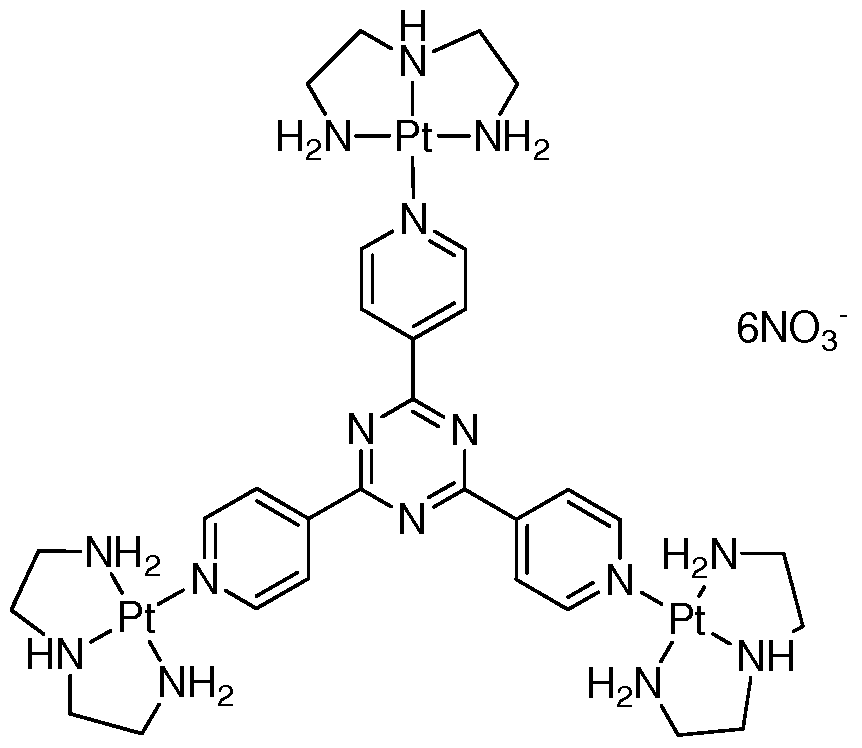
- the anticancer drug provided by the invention is an organic hybrid trinuclear platinum complex which is self-assembled by supramolecular, and has the following structural formula:
- the invention discloses a method for synthesizing a trinuclear platinum complex having excellent telomerase activity inhibiting ability, which utilizes supramolecular self-assembly and a planar square coordination configuration of Pt(II) and a unique geometric configuration of the intermediate bridging ligand. Made. Furthermore, the supramolecular ligand and the bridging ligand are assembled into a trinuclear structure by supramolecular self-assembly, which has high G-quadruplex targeting, high telomerase activity inhibition ability and anticancer activity. Trinuclear platinum complex.
- the trinuclear platinum complex (referred to as ZD028 in this patent) capable of efficiently inhibiting telomerase activity according to the present invention, and further, the synthesis thereof is a lateral arm monodentate platinum ligand in which chloride ions are replaced by nitrate. [Pt(dien)(N0 3 )](N0 3 ) is self-assembled with the corresponding bridging ligand, so that the complex has high telomerase inhibition ability and anticancer activity.
- (1) is a structural formula of a side-arm monodentate platinum ligand bridging ligand [Pt(dien)(N0 3 )](N0 3 ) in which chloride ions are replaced by nitrate, and (2) is a bridged ligand.
- the structural formula of the bulk, (3) is the structural formula of the final product trinuclear platinum complex (ZD028).
- the method for synthesizing a trinuclear platinum complex (ZD028) having high G-quadruplex targeting, high telomerase inhibition ability and anticancer activity includes, for example, Next steps:
- Monodentate platinum ligand dechlorination The monodentate platinum ligand is dissolved in water, silver nitrate is added, and the reaction is protected from light under the protection of an inert gas, and the night is left after centrifugation.
- Trinuclear platinum complex The bridged ligand is added to the night after dechlorination, and is protected from light under the protection of inert gas. After the reaction is completed, it is washed with absolute ethanol and centrifuged to obtain a solid substance, that is, a target. Trinuclear platinum complex.
- inert gas protection and protection from light are all key steps in the reaction.
- the role of inert gas protection is to isolate air or other oxidizing gases. It is to be understood that any means for achieving the above objects may be used as an alternative to the invention, and such substitutions do not depart from the scope of the invention.
- the inert gas is nitrogen;
- the light-protecting reaction condition of the monodentate platinum ligand dechlorination step is: 45 degree reaction for 36 hours; and the light-protecting reaction condition of the trinuclear platinum complex synthesis step is : 95 degrees in the dark for 3 days.
- the trinuclear platinum complex (ZD028) can be synthesized by the following procedure.
- Dechlorination of monodentate platinum ligand [Pt(dien)Cl]Cl_HCl Dissolve monodentate platinum ligand in an appropriate amount of water and add 3 times the molar amount of silver nitrate, and protect it from light at 45 °C for 36 hours under nitrogen protection. , centrifuge with a low temperature centrifuge, discard the precipitate, and keep it clear.
- Trinuclear platinum complex (ZD028): A bridged ligand having a molar ratio of 0.3:1 was added to the night after dechlorination. The whole reaction was protected by nitrogen at a temperature of 90 ° for 3 days. After the reaction was completed, an appropriate amount of absolute ethanol was added, and the solvent was washed three times, and centrifuged to obtain a solid substance, that is, a trinuclear platinum complex (ZD028). .
- the monodentate platinum ligand of the present invention is a chloride ion substituted with a nitrate ion.
- the present inventors have found that the trinuclear platinum complex has an outstanding effect in inhibiting telomerase and can be used as a telomerase inhibitor. Further, the trinuclear platinum complex of the present invention can be used for the preparation of an antitumor drug.
- the complex when the trinuclear platinum complex (ZD028) is used as a telomerase inhibitor to achieve an antitumor effect, the complex is found to be a series of tumor cells with high expression of telomerase [eg, A549 (human lung cancer cell). ), HepG2 (human liver cancer cells), HeLa (human cervical cancer cells), CNE-2 (human nasopharyngeal carcinoma cells:), MCF-7 (human breast cancer cells: etc.) have excellent telomerase inhibition ability
- telomerase eg, A549 (human lung cancer cell).
- HepG2 human liver cancer cells
- HeLa human cervical cancer cells
- CNE-2 human nasopharyngeal carcinoma cells:
- MCF-7 human breast cancer cells: etc.
- the complex of the present invention can only act on the listed tumor cells, and those skilled in the art should be able to understand that the listed tumor cells are not limited as the scope of protection of the present invention.
- the invention synthesizes and characterizes a high G-quadruplex targeting by a supramolecular self-assembly method by using a simple and easy monodentate platinum ligand as a prosthetic ligand and a corresponding bridging ligand.
- High telomerase inhibitory ability and anti-cancer activity of the trinuclear platinum complex ZD028,.
- the compound has excellent telomerase activity inhibition and anticancer activity by fluorescence energy resonance transfer (FRET) assay, telomerase inhibition (TRAP) assay, long-term cell proliferation assay and ⁇ -galactosidase staining assay.
- FRET fluorescence energy resonance transfer
- TRAP telomerase inhibition
- long-term cell proliferation assay and ⁇ -galactosidase staining assay.
- Figure 1 is a schematic view showing the structure of a trinuclear platinum complex (ZD028);
- Figure 2 shows the ability of the trinuclear platinum complex (ZD028) to inhibit telomerase activity;
- Figure 3 shows the effect of trinuclear platinum complex (ZD028) on long-term proliferation of HeLa cells.
- Figure 4 shows the senescence-associated ⁇ -galactosidase staining assay in HeLa cells.
- the concentration of trinuclear platinum complex (ZD028) is 15 ⁇ .
- ⁇ is the control group and B is the medicated group.
- FRET Fluorescence Energy Resonance Transfer
- 10 ⁇ human telomeric DNA (F21T), promoter DNA (c-kit) or double-stranded DNA (dsDNA) was mixed with 10 different concentrations of complex (ZD028) solution.
- the resulting 20 ⁇ sample solution was added to a LightCycler capillary and inserted into a Roche LightCycler 2 type PCR instrument.
- Fixed excitation wavelength is corrected page (Article 91)
- the emission fluorescence intensity at 530 nm was monitored.
- the temperature range is 37 -99 Q C
- the temperature rise interval is 1 Q C
- the sample is balanced after 30 s
- the m value is calculated using Origin.
- the data results are shown in Table 1.
- the experimental results show that the trinuclear platinum compound can specifically and efficiently stabilize human telomere G-quadruplex DNA.
- ⁇ -galactosidase staining experiment The cells after termination of the culture were fixed, stained, and observed under a 40x microscope. The data results are shown in Figure 4. Since ⁇ -galactosidase is an important feature of cell senescence, it can be seen from Fig. 4 that the complex can effectively accelerate the senescence of cells, thereby achieving an anti-tumor effect.
- the above comprehensive bioassay results show that the trinuclear platinum complex (ZD028) inhibits telomerase activity by acting on telomere G-quadruplex DNA, and interferes with the telomere mechanism of cancer cells, thereby accelerating cancer cells. The shortening of telomere length, which in turn accelerates cell decay, ultimately leads to cancer cell death and is very toxic to normal cells, so the nuclear platinum complex (ZD028) can be used as a potential antitumor drug.
Landscapes
- Chemical & Material Sciences (AREA)
- Organic Chemistry (AREA)
- Health & Medical Sciences (AREA)
- General Chemical & Material Sciences (AREA)
- Medicinal Chemistry (AREA)
- Nuclear Medicine, Radiotherapy & Molecular Imaging (AREA)
- Chemical Kinetics & Catalysis (AREA)
- Pharmacology & Pharmacy (AREA)
- Life Sciences & Earth Sciences (AREA)
- Animal Behavior & Ethology (AREA)
- General Health & Medical Sciences (AREA)
- Public Health (AREA)
- Veterinary Medicine (AREA)
- Pharmaceuticals Containing Other Organic And Inorganic Compounds (AREA)
- Acyclic And Carbocyclic Compounds In Medicinal Compositions (AREA)
Description
一种高效端粒酶抑制剂及其在抗肿瘤药物中的应用 技术领域
本发明涉及一种能高效抑制端粒酶活性的三核铂配合物
(ZD028), 及其制备方法和作说为抗肿瘤药物方面的应用。 具体涉及能 高效抑制端粒酶活性的三核铂配合物 (ZD028)的制备方法及其可作为 抗肿瘤药物的应用。 书
背景技术
目前, 恶性肿瘤是危害人类健康和生命的重大疾病, 但抗肿瘤新 药研发是不断更新, 有中药, 也有西药。 长期大量的临床证明, 抗肿 瘤药物均存在毒副作用较大的通病。外科手术适用于某些局部性肿瘤 早期和中期的治疗,但多数病人靠手术治疗是不能防止肿瘤的复发和 远处转移的。放、 化疗虽然有相当高的治愈率, 但是常引起如骨髓抑 制、 免疫低下等毒副反应, 使患者难以坚持治疗。化疗药物在治疗过 程中出现的耐药性, 已成为目前临床治疗中的难题之一。正是由于这 些原因, 我们正要寻找抗肿瘤新药。
以核酸为靶点的抗癌药物应该是最具发展前景的抗癌药物,因为 此类药物可以从根本上抑制癌细胞的产生、 发展和增值。 G-四链体 DNA作为有重要生物功能的特殊二级结构, 以其为靶点的抗癌药物 的设计具有合理性与优越性, 主要由于此结构有以下特征: 1), 结构
的特殊性: 区别于普遍存在的双链 DNA, 特殊的结构才能为有选择 性的小分子化合物提供设计平台; , 作用的特殊性: 有特殊的生物 学功能, 小分子化合物通过稳定、 拆散或改变它的这种二级结构, 可 以达到特异性抑制癌细胞的目的; 3), 存在于体内重要基因区域。 随 着分子生物学和结构生物学的发展, G-四链体的结构多样性和生物功 能性得到不断阐明。 因此, 以各种类型的 G-四链体为作用靶点的药 物研宄引起了人们广泛的兴趣和重视。 配合物诱导形成 G-四链体结 构并有效稳定该结构, 进而抑制端粒酶的活性, 破坏癌细胞的端粒维 持机制, 加速癌细胞的衰老, 进而导致癌细胞的死亡, 同时由于端粒 酶在正常细胞中是没有活性的, 只有在癌细胞中才具有高的活性, 因 此这有助于找到显著的选择性对癌细胞增殖具有强的抑制作用的抗 由于金属配合物具有很多有机小分子难以比拟的优点,如丰富多 样的配位结构及电子性能, 更重要的是它们往往具有一些有趣的特 性, 例如光学、 磁学、 催化功能等等, 这些为设计成为优秀的 G-四 链体稳定剂带来很大的潜力与可能性。 目前报道的稳定 G-四链体的 金属配合物中金属离子的种类已越来越多,到现在为止以贵金属铂为 中心构建的配合物来稳定 G-四链体还不是很多。 铂类配合物作为抗 肿瘤药物的研宄开始于二十世纪六十年代, 目前使用于临床药物的几 种铂配合物 (顺铂、 卡铂、 奥沙利铂、 奈达铂以及乐铂等等:)都是以靶 向双链结构的核酸为主。 尽管以 G-四链体为靶的选择性抗癌药物的 研宄也只有 10多年, 但已陆续开始有新的小分子化合物进入临床实
验, 不过这些化合物中还没有金属配合物。
考虑到 G-四链体的芳香平面结构特点, 比较而言由铂离子配位 构建的金属铂 (II)配合物具有其独特的优越性。 例如本专利所涉及的 三核铂配合物 (ZD028)。
桥联配体是一系列含氮的杂环, 使配合物更容易和 G-四链体发 生 π-π堆积作用, 进而能高效的稳定此结构, 进而提高端粒酶活性的 抑制能力。
本发明通过超分子自组装有机杂化三核铂配合物, 简化其合成, 降低生产成本, 并通过引入特定的有机功能基团使其具有高的 G-四 链体靶向性、 高的端粒酶活性抑制能力以及抗癌活性。
发明内容
本发明目的是设计出一种涉及能高效抑制端粒酶活性的三核铂 配合物 (ZD028), 及其制备方法和作为抗肿瘤药物方面的应用。
本发明提供的抗癌药物,是利用超分子自组装而成的有机杂化三 核铂配合物, 结构式如下:
本发明具有优异端粒酶活性抑制能力的三核铂配合物的合成方 法, 利用超分子自组装和 Pt(II)的平面正方形的配位构型以及中间桥 联配体独特的几何构型而制得的。进一步说, 是利用超分子自组装将 辅基配体与桥联配体组装成三核结构, 得到具有高的 G-四链体靶向 性、 高的端粒酶活性抑制能力以及抗癌活性的三核铂配合物。
本发明所述的能高效抑制端粒酶活性的三核铂配合物 (在本专 利中命名为 ZD028), 更进一步说, 其合成是将氯离子被硝酸根取代 的侧臂单齿铂配体 [Pt(dien)(N03)](N03)与相应的桥联配体通过自组 装而成, 使得该配合物具有高的端粒酶抑制能力以及抗癌活性。
该三核铂配合物 (ZD028)的合成方法, 反应式如下:

反应式中, (1)是氯离子被硝酸根取代的侧臂单齿铂配体桥联配 体 [Pt(dien)(N03)](N03)的结构式,(2)是桥联配体的结构式,(3)是最终 产物三核铂配合物 (ZD028)的结构式。
具体来说, 本发明提供的具有高的 G-四链体靶向性、高的端粒酶 抑制能力以及抗癌活性的三核铂配合物 (ZD028)的合成方法, 包括如
下步骤:
单齿铂配体脱氯:将所述的单齿铂配体溶于水中,再加入硝酸银, 在惰性气体保护下避光反应, 离心后保留清夜。
三核铂配合物合成: 往上述脱氯后的清夜中加入所述的桥联配 体, 在惰性气体保护下避光反应, 反应完毕后, 加入无水乙醇洗涤, 离心得到固体物质, 即目标三核铂配合物。
上述的惰性气体保护及避光均为反应的关键步骤。其中惰性气体 保护的作用,是在于隔绝空气或其他具有氧化性的气体。应当理解为, 任何一种可以实现上述目的的手段, 都可以作为替换手段用于本发 明, 并且这种替换并不脱离本发明的保护范围。
作为优选的方案, 所述的惰性气体为氮气; 单齿铂配体脱氯步骤 的避光反应条件为: 45度反应 36小时; 所述的三核铂配合物合成步骤 的避光反应条件为: 95度避光反应 3天。
可以采用以下步骤来合成所述三核铂配合物 (ZD028)。
单齿铂配体 [Pt(dien)Cl]Cl_HCl脱氯: 将单齿铂配体溶于适量的水 中再加入其 3倍摩尔量的硝酸银, 于 45度在氮气保护下避光反应 36小 时, 用低温离心机离心, 弃去沉淀, 保留清夜。
三核铂配合物 (ZD028) : 往上述脱氯后的清夜中加入摩尔比为 0.3:1的桥联配体。 整个反应在氮气的保护下, 于 90度避光反应 3天, 反应完毕后, 加入适量的无水乙醇, 再用该溶剂洗涤 3次, 离心得到 固体物质, 即三核铂配合物 (ZD028)。
本发明所述的单齿铂配体为氯离子被硝酸根离子取代的。
本发明发现,所述的三核铂配合物在抑制端粒酶方面具有突出的 效果, 可以作为端粒酶抑制剂。进一步地说, 本发明的三核铂配合物 可以被用于制备抗肿瘤药物。
本发明在研宄三核铂配合物 (ZD028)作为端粒酶抑制剂来达到抗 肿瘤效果时, 发现该配合物对一系列端粒酶呈高表达的肿瘤细胞 [例 如: A549(人肺癌细胞), HepG2(人肝癌细胞), HeLa(人宫颈癌细胞), CNE-2(人鼻咽癌细胞:), MCF-7(人乳腺癌细胞:)等]均具有优异的端粒 酶抑制能力, 但是由于宫颈癌居妇女癌症发病率之首且 HeLa细胞中 端粒酶的活性是非常的高并数量也非常的多,所以以下我们的实施例 主要是以 HeLa细胞为试验对象。 但这并不意味着本发明所述配合物 仅能作用于所列举的肿瘤细胞, 本领域技术人员应当能够理解, 所列 举的肿瘤细胞不能作为本发明保护范围的限制。
本发明具有以下的技术效果:
本发明以简单易合的单齿铂配体为辅基配体与相应的桥联配体, 通过超分子自组装的方法合成和表征了一种具有高的 G-四链体靶向 性、 高的端粒酶抑制能力以及抗癌活性的三核铂配合物 (ZD028)。 通 过荧光能量共振转移 (FRET)实验、 端粒酶抑制 (TRAP)实验、 长期细 胞增殖实验和 β-半乳糖苷酶染色实验证明了该化合物具有优异的端 粒酶活性抑制能力以及抗癌活性。
附图说明
图 1为三核铂配合物 (ZD028)的结构示意图;
图 2显示了三核铂配合物 (ZD028)对端粒酶活性的抑制能力;
图 3显示了三核铂配合物 (ZD028)对 HeLa细胞长期增殖的影响 图 4为 HeLa细胞中衰老相关的 β -半乳糖苷酶染色实验, 三核铂配 合物 (ZD028)浓度为 15 μΜ, Α为对照组, B为加药组。
具体实施方式
以下结合实施例对本发明进行详细的描述。
实施例一
有机杂化三核铂配合物的合成 (ZD028): 将 0.5毫摩尔量的单齿铂 配体 [Pt(dien)Cl]Cl*HCl溶于 6毫升水中, 在氮气保护下于暗处加入 1.5 毫摩尔量的硝酸银, 45度搅拌 36小时, 反应完毕后, 离心弃去沉淀, 保留清夜; 往上述的清液中加入 0.15毫摩尔的桥联配体, 整个反应在 氮气保护下于 90度避光反应 3天, 反应结束后, 往反应液中加入适量 的无水乙醇, 析出浅黄色固体, 离心得浅黄色固体, 产物真空干燥。 产率: 83%。 元素分析(%),
理论值: C30H51N21O18Pt3 6H2O: C, 21.36; H, 3.76; N, 17.43. 实验值: C, 21.20; H, 3.76; N, 17.52. 195Pt NMR (D20, δ/ppm): -1222.20, and
K2PtCl4被用作内标物 (δ=0).
该化合物的结构式如图 1所示。
实施例二
荧光能量共振转移 (FRET)实验: 将 10 μΜ人类端粒 DNA (F21T)、 启动子 DNA (c-kit)或双链 DNA (dsDNA)与 10 不同浓度的配合物 (ZD028)溶液混合。将所得的 20μί样品溶液加入 LightCycler 毛细管中 并插入 Roche LightCycler 2型荧光定量 PCR仪。 固定激发波长为 更正页 (细则第 91条)
470nm, 监测 530nm的发射荧光强度。 温度变化范围为 37 -99 QC,升温 间隔为 1 QC, 平衡 30 s 后采样, m值计算用 Origin拟合。 数据结果见 表 1。实验结果表明该三核铂化合物能特异性的高效的稳定人体端粒 G-四链体 DNA。
核铂配合物 (ZD028)对不同 DNA热稳定能力 (Arm)。
 实施例三
实施例三
端粒酶抑制 CTRAP)实验:收集 HeLa细胞的裂解液, 加入到含有相 应浓度配合物的 TRAP反应液中, 进行 PCR扩增, 用 0.8%的聚丙烯酰 胺凝胶分析其扩增产物。 数据结果见图 2。 实验结果表明, 该配合物 是一个优异的端粒酶抑制剂 (Td/C5。=30 nM)。
实施例四
长期细胞增殖实验: 将 HeLa细胞接种于 T25组织培养瓶中, 每四 天加入含有相应浓度配合物的培养基或含 0.1%DMSO的培养基。数据 结果见图 3。细胞长期增值实验表明, 该配合物能够降低细胞的生存 率, 进而达到抗肿瘤的效果。
实施例五
β-半乳糖苷酶染色实验: 对培养终止后的细胞进行固定、 染色, 置于 40x显微镜下观察、 照相。 数据结果见图 4。 因为 β-半乳糖苷酶 是细胞衰老的一个重要特征, 通过图 4可知, 该配合物能有效的加速 细胞的衰老, 进而达到抗肿瘤的效果。
以上综合的生测实验结果表明, 三核铂配合物 (ZD028)通过作用 端粒 G-四链体 DNA抑制了端粒酶的活性, 干扰了癌细胞端粒的维 机制, 从而加速了癌细胞端粒长度的縮短, 并进而加速了细胞的衰 , 最终导致了癌细胞的死亡, 并对正常细胞的毒性非常低, 因此该 核铂配合物 (ZD028)可作为一种潜在的抗肿瘤药物。
Claims
1、 一种三核铂配合物, 其特征在于结构式如下:

2、根据权利要求 1所述的三核铂配合物的制备方法, 其特征在于 反应式如下:

反应式中,(1)是氯离子被硝酸根取代的单齿铂配体的结构式, (2) 是桥联配体的结构式, (3)是最终产物三核铂配合物的结构式。
3、根据权利要求 2所述的该三核铂配合物的制备方法, 其特征在 于反应步骤如下:
单齿铂配体脱氯:将所述的单齿铂配体溶于水中,再加入硝酸银,
在惰性气体保护下避光反应, 离心后保留清夜;
三核铂配合物合成: 往上述脱氯后的清夜中加入所述的桥联配 体, 在惰性气体保护下避光反应, 反应完毕后, 加入无水乙醇洗涤, 离心得到固体物质, 即目标三核铂配合物。
4、根据权利要求 3所述的三核铂配合物的合成方法, 其特征在于 所述的惰性气体为氮气。
5、根据权利要求 3所述的三核铂配合物的合成方法, 其特征在于 所述的单齿铂配体脱氯步骤的避光反应条件为: 45度反应 36小时。
6、根据权利要求 3所述的三核铂配合物的合成方法, 其特征在于 所述的三核铂配合物合成步骤的避光反应条件为: 95度避光反应 3天。
7、根据权利要求 3所述的三核铂配合物的合成方法, 其特征在于 反应步骤如下:
单齿铂配体脱氯: 将所述单齿铂配体溶于适量的水中再加入 3倍 摩尔量的硝酸银,在氮气保护下避光反应 36小时,用低温离心机离心, 弃去沉淀, 保留清夜;
三核铂配合物合成: 往上述脱氯后的清夜中加入摩尔比为 0.3:1 的所述的桥联配体, 氮气的保护下, 于 95度避光反应 3天, 反应完毕 后, 加入无水乙醇, 离心得到固体物质, 即目标三核铂配合物。
8、根据权利要求 1所述的三核铂配合物在作为端粒酶抑制剂方面 的应用。
9、根据权利要求 1所述的三核铂配合物在制备抗肿瘤药物中的应 用。
10、 根据权利要求 1所述的三核铂配合物作为高效的端粒酶抑审 L 剂在抗肿瘤治疗联合用药方面的应用
Applications Claiming Priority (2)
| Application Number | Priority Date | Filing Date | Title |
|---|---|---|---|
| CN201210282037.9A CN102898478B (zh) | 2012-08-09 | 2012-08-09 | 一种高效端粒酶抑制剂及其在抗肿瘤药物中的应用 |
| CN201210282037.9 | 2012-08-09 |
Publications (1)
| Publication Number | Publication Date |
|---|---|
| WO2014023063A1 true WO2014023063A1 (zh) | 2014-02-13 |
Family
ID=47570994
Family Applications (1)
| Application Number | Title | Priority Date | Filing Date |
|---|---|---|---|
| PCT/CN2012/083799 Ceased WO2014023063A1 (zh) | 2012-08-09 | 2012-10-31 | 一种高效端粒酶抑制剂及其在抗肿瘤药物中的应用 |
Country Status (2)
| Country | Link |
|---|---|
| CN (1) | CN102898478B (zh) |
| WO (1) | WO2014023063A1 (zh) |
Cited By (1)
| Publication number | Priority date | Publication date | Assignee | Title |
|---|---|---|---|---|
| US20210188889A1 (en) * | 2017-11-06 | 2021-06-24 | Queen's University At Kingston | Platinum compounds for binding guanine quadruplexes |
Families Citing this family (4)
| Publication number | Priority date | Publication date | Assignee | Title |
|---|---|---|---|---|
| CN107417734B (zh) * | 2017-07-19 | 2019-08-20 | 中山大学 | 一种具有双光子吸收特性的铂配合物及其制备方法和应用 |
| CN111635438B (zh) * | 2020-06-24 | 2023-01-24 | 江苏第二师范学院(江苏省教育科学研究院) | 多芳烃基修饰的双核铂(ii)配合物的制备方法和应用 |
| CN113307829B (zh) * | 2021-05-08 | 2022-05-24 | 苏州科技大学 | 一种以异羟肟酸衍生物为配体的铂(ii)配合物及其制备方法和应用 |
| CN113336798B (zh) * | 2021-05-20 | 2023-03-14 | 江汉大学 | 一种基于三均嗪的三核铂配合物及其制备方法和应用 |
Citations (4)
| Publication number | Priority date | Publication date | Assignee | Title |
|---|---|---|---|---|
| WO2006091790A1 (en) * | 2005-02-23 | 2006-08-31 | Xenoport, Inc. | Platinum-containing compounds exhibiting cytostatic activity, synthesis and methods of use |
| CN102250150A (zh) * | 2011-05-17 | 2011-11-23 | 中山大学 | 有机杂化四核铂配合物及其制备方法和在制备抗肿瘤药物中的应用技术领域 |
| CN102408452A (zh) * | 2011-12-13 | 2012-04-11 | 中山大学 | 四吡啶基卟啉桥联十字形四核铂配合物及其制备方法和抗肿瘤活性 |
| CN102516315A (zh) * | 2011-12-12 | 2012-06-27 | 中山大学 | 一种具有y型结构的三核铂配合物及其对人胃腺癌细胞的靶向性 |
-
2012
- 2012-08-09 CN CN201210282037.9A patent/CN102898478B/zh not_active Expired - Fee Related
- 2012-10-31 WO PCT/CN2012/083799 patent/WO2014023063A1/zh not_active Ceased
Patent Citations (4)
| Publication number | Priority date | Publication date | Assignee | Title |
|---|---|---|---|---|
| WO2006091790A1 (en) * | 2005-02-23 | 2006-08-31 | Xenoport, Inc. | Platinum-containing compounds exhibiting cytostatic activity, synthesis and methods of use |
| CN102250150A (zh) * | 2011-05-17 | 2011-11-23 | 中山大学 | 有机杂化四核铂配合物及其制备方法和在制备抗肿瘤药物中的应用技术领域 |
| CN102516315A (zh) * | 2011-12-12 | 2012-06-27 | 中山大学 | 一种具有y型结构的三核铂配合物及其对人胃腺癌细胞的靶向性 |
| CN102408452A (zh) * | 2011-12-13 | 2012-04-11 | 中山大学 | 四吡啶基卟啉桥联十字形四核铂配合物及其制备方法和抗肿瘤活性 |
Cited By (2)
| Publication number | Priority date | Publication date | Assignee | Title |
|---|---|---|---|---|
| US20210188889A1 (en) * | 2017-11-06 | 2021-06-24 | Queen's University At Kingston | Platinum compounds for binding guanine quadruplexes |
| US11492366B2 (en) * | 2017-11-06 | 2022-11-08 | Queen's University At Kingston | Platinum compounds for binding guanine quadruplexes |
Also Published As
| Publication number | Publication date |
|---|---|
| CN102898478B (zh) | 2017-10-10 |
| CN102898478A (zh) | 2013-01-30 |
Similar Documents
| Publication | Publication Date | Title |
|---|---|---|
| Zehra et al. | Enantiomeric amino acid schiff base copper (II) complexes as a new class of RNA-targeted metallo-intercalators: Single X-ray crystal structural details, comparative in vitro DNA/RNA binding profile, cleavage, and cytotoxicity | |
| Suntharalingam et al. | A platinum complex that binds non-covalently to DNA and induces cell death via a different mechanism than cisplatin | |
| Cui et al. | Progress in understanding mitochondrial calcium uniporter complex‐mediated calcium signalling: A potential target for cancer treatment | |
| Seng et al. | Biological and cytoselective anticancer properties of copper (II)-polypyridyl complexes modulated by auxiliary methylated glycine ligand | |
| CN105669763B (zh) | 9‑氨基氧化异阿朴啡‑铂(ii)配合物及其合成方法和应用 | |
| Ali et al. | Novel oligopyrrole carboxamide based Nickel (II) and Palladium (II) Salens, their targeting of human G‐quadruplex DNA, and selective cancer cell toxicity | |
| Wang et al. | Two copper (II) complexes of curcumin derivatives: synthesis, crystal structure and in vitro antitumor activity | |
| WO2014023063A1 (zh) | 一种高效端粒酶抑制剂及其在抗肿瘤药物中的应用 | |
| Arjmand et al. | Copper (II)-based halogen-substituted chromone antitumor drug entities: Studying biomolecular interactions with ct-DNA mediated by sigma hole formation and cytotoxicity activity | |
| Milenković et al. | Synthesis, characterisation and biological activity of Co (III) complex with the condensation product of 2-(diphenylphosphino) benzaldehyde and ethyl carbazate | |
| Grau et al. | Evaluation of the metal-dependent cytotoxic behaviour of coordination compounds | |
| Chen et al. | High cytotoxicity of dihalo-substituted 8-quinolinolato-lanthanides | |
| Rauf et al. | Antileishmanial, DNA Interaction, and Docking Studies of Some Ferrocene‐Based Heteroleptic Pentavalent Antimonials | |
| Steiner et al. | Discovery of ‘click’1, 2, 3-triazolium salts as potential anticancer drugs | |
| D'Anna et al. | DNA binding activity of functionalized Schiff Base metal complexes | |
| Ma et al. | N‐trans‐Feruloyloctopamine Wakes Up BBC3, DDIT3, CDKN1A, and NOXA Signals to Accelerate HCC Cell Apoptosis | |
| Roy et al. | New xanthone derivatives as potent G-quadruplex binders for developing anti-cancer therapeutics | |
| Zahan et al. | Design, synthesis and X‐ray structural studies of novel [acetonitrile‐benzyl‐3‐N‐(2, 4 dihydroxyphenylmethylene) hydrazinecarbodithioato‐κ3‐N′, S, O] nickel (ll) complex that potently inhibit cell proliferation through regulation of apoptosis related genes | |
| Zhao et al. | Synthesis of Hemiprotonic Phenanthroline–Phenanthroline+ Compounds with both Antitumor and Antimicrobial Activity | |
| WO2012155559A1 (zh) | 有机杂化四核铂配合物及其制备方法和在制备抗肿瘤药物中的应用 | |
| Maliszewska et al. | Precious metal complexes of bis (pyridyl) allenes: synthesis and catalytic and medicinal applications | |
| Abramov et al. | Synthesis of derivatives of 6-aryl-2, 2′-bipyridine complexes with PtII as potential antitumor agents | |
| CN102584768B (zh) | 3-硝基-8-乙氧基-2h-苯并吡喃类化合物及其制备方法与应用 | |
| Akhtar et al. | Newly synthesized metal complexes of sulfonamides: DNA cleavage, BRCA1 gene interaction, expression analysis, antioxidant and antiglycation studies | |
| CN101747353A (zh) | N′-(3-硝基苯甲酰基)-n-水杨酰肼合铜配合物及其制法与用途 |
Legal Events
| Date | Code | Title | Description |
|---|---|---|---|
| 121 | Ep: the epo has been informed by wipo that ep was designated in this application |
Ref document number: 12882716 Country of ref document: EP Kind code of ref document: A1 |
|
| NENP | Non-entry into the national phase |
Ref country code: DE |
|
| 122 | Ep: pct application non-entry in european phase |
Ref document number: 12882716 Country of ref document: EP Kind code of ref document: A1 |