WO2014010336A1 - 二酸化炭素分離用複合体の製造方法、二酸化炭素分離用複合体及び二酸化炭素分離用モジュール - Google Patents
二酸化炭素分離用複合体の製造方法、二酸化炭素分離用複合体及び二酸化炭素分離用モジュール Download PDFInfo
- Publication number
- WO2014010336A1 WO2014010336A1 PCT/JP2013/065490 JP2013065490W WO2014010336A1 WO 2014010336 A1 WO2014010336 A1 WO 2014010336A1 JP 2013065490 W JP2013065490 W JP 2013065490W WO 2014010336 A1 WO2014010336 A1 WO 2014010336A1
- Authority
- WO
- WIPO (PCT)
- Prior art keywords
- carbon dioxide
- dioxide separation
- mass
- separation layer
- composite
- Prior art date
- Legal status (The legal status is an assumption and is not a legal conclusion. Google has not performed a legal analysis and makes no representation as to the accuracy of the status listed.)
- Ceased
Links
Images

Classifications
-
- B—PERFORMING OPERATIONS; TRANSPORTING
- B01—PHYSICAL OR CHEMICAL PROCESSES OR APPARATUS IN GENERAL
- B01J—CHEMICAL OR PHYSICAL PROCESSES, e.g. CATALYSIS OR COLLOID CHEMISTRY; THEIR RELEVANT APPARATUS
- B01J20/00—Solid sorbent compositions or filter aid compositions; Sorbents for chromatography; Processes for preparing, regenerating or reactivating thereof
- B01J20/30—Processes for preparing, regenerating, or reactivating
- B01J20/32—Impregnating or coating ; Solid sorbent compositions obtained from processes involving impregnating or coating
- B01J20/3231—Impregnating or coating ; Solid sorbent compositions obtained from processes involving impregnating or coating characterised by the coating or impregnating layer
- B01J20/3242—Layers with a functional group, e.g. an affinity material, a ligand, a reactant or a complexing group
- B01J20/3268—Macromolecular compounds
- B01J20/3276—Copolymers
-
- B—PERFORMING OPERATIONS; TRANSPORTING
- B01—PHYSICAL OR CHEMICAL PROCESSES OR APPARATUS IN GENERAL
- B01D—SEPARATION
- B01D53/00—Separation of gases or vapours; Recovering vapours of volatile solvents from gases; Chemical or biological purification of waste gases, e.g. engine exhaust gases, smoke, fumes, flue gases, aerosols
- B01D53/22—Separation of gases or vapours; Recovering vapours of volatile solvents from gases; Chemical or biological purification of waste gases, e.g. engine exhaust gases, smoke, fumes, flue gases, aerosols by diffusion
- B01D53/228—Separation of gases or vapours; Recovering vapours of volatile solvents from gases; Chemical or biological purification of waste gases, e.g. engine exhaust gases, smoke, fumes, flue gases, aerosols by diffusion characterised by specific membranes
-
- B—PERFORMING OPERATIONS; TRANSPORTING
- B01—PHYSICAL OR CHEMICAL PROCESSES OR APPARATUS IN GENERAL
- B01D—SEPARATION
- B01D69/00—Semi-permeable membranes for separation processes or apparatus characterised by their form, structure or properties; Manufacturing processes specially adapted therefor
- B01D69/14—Dynamic membranes
- B01D69/141—Heterogeneous membranes, e.g. containing dispersed material; Mixed matrix membranes
- B01D69/148—Organic/inorganic mixed matrix membranes
-
- B—PERFORMING OPERATIONS; TRANSPORTING
- B01—PHYSICAL OR CHEMICAL PROCESSES OR APPARATUS IN GENERAL
- B01J—CHEMICAL OR PHYSICAL PROCESSES, e.g. CATALYSIS OR COLLOID CHEMISTRY; THEIR RELEVANT APPARATUS
- B01J20/00—Solid sorbent compositions or filter aid compositions; Sorbents for chromatography; Processes for preparing, regenerating or reactivating thereof
- B01J20/02—Solid sorbent compositions or filter aid compositions; Sorbents for chromatography; Processes for preparing, regenerating or reactivating thereof comprising inorganic material
- B01J20/0203—Solid sorbent compositions or filter aid compositions; Sorbents for chromatography; Processes for preparing, regenerating or reactivating thereof comprising inorganic material comprising compounds of metals not provided for in B01J20/04
- B01J20/0248—Compounds of B, Al, Ga, In, Tl
-
- B—PERFORMING OPERATIONS; TRANSPORTING
- B01—PHYSICAL OR CHEMICAL PROCESSES OR APPARATUS IN GENERAL
- B01J—CHEMICAL OR PHYSICAL PROCESSES, e.g. CATALYSIS OR COLLOID CHEMISTRY; THEIR RELEVANT APPARATUS
- B01J20/00—Solid sorbent compositions or filter aid compositions; Sorbents for chromatography; Processes for preparing, regenerating or reactivating thereof
- B01J20/02—Solid sorbent compositions or filter aid compositions; Sorbents for chromatography; Processes for preparing, regenerating or reactivating thereof comprising inorganic material
- B01J20/04—Solid sorbent compositions or filter aid compositions; Sorbents for chromatography; Processes for preparing, regenerating or reactivating thereof comprising inorganic material comprising compounds of alkali metals, alkaline earth metals or magnesium
- B01J20/041—Oxides or hydroxides
-
- B—PERFORMING OPERATIONS; TRANSPORTING
- B01—PHYSICAL OR CHEMICAL PROCESSES OR APPARATUS IN GENERAL
- B01J—CHEMICAL OR PHYSICAL PROCESSES, e.g. CATALYSIS OR COLLOID CHEMISTRY; THEIR RELEVANT APPARATUS
- B01J20/00—Solid sorbent compositions or filter aid compositions; Sorbents for chromatography; Processes for preparing, regenerating or reactivating thereof
- B01J20/02—Solid sorbent compositions or filter aid compositions; Sorbents for chromatography; Processes for preparing, regenerating or reactivating thereof comprising inorganic material
- B01J20/04—Solid sorbent compositions or filter aid compositions; Sorbents for chromatography; Processes for preparing, regenerating or reactivating thereof comprising inorganic material comprising compounds of alkali metals, alkaline earth metals or magnesium
- B01J20/043—Carbonates or bicarbonates, e.g. limestone, dolomite, aragonite
-
- B—PERFORMING OPERATIONS; TRANSPORTING
- B01—PHYSICAL OR CHEMICAL PROCESSES OR APPARATUS IN GENERAL
- B01J—CHEMICAL OR PHYSICAL PROCESSES, e.g. CATALYSIS OR COLLOID CHEMISTRY; THEIR RELEVANT APPARATUS
- B01J20/00—Solid sorbent compositions or filter aid compositions; Sorbents for chromatography; Processes for preparing, regenerating or reactivating thereof
- B01J20/02—Solid sorbent compositions or filter aid compositions; Sorbents for chromatography; Processes for preparing, regenerating or reactivating thereof comprising inorganic material
- B01J20/06—Solid sorbent compositions or filter aid compositions; Sorbents for chromatography; Processes for preparing, regenerating or reactivating thereof comprising inorganic material comprising oxides or hydroxides of metals not provided for in group B01J20/04
-
- B—PERFORMING OPERATIONS; TRANSPORTING
- B01—PHYSICAL OR CHEMICAL PROCESSES OR APPARATUS IN GENERAL
- B01J—CHEMICAL OR PHYSICAL PROCESSES, e.g. CATALYSIS OR COLLOID CHEMISTRY; THEIR RELEVANT APPARATUS
- B01J20/00—Solid sorbent compositions or filter aid compositions; Sorbents for chromatography; Processes for preparing, regenerating or reactivating thereof
- B01J20/02—Solid sorbent compositions or filter aid compositions; Sorbents for chromatography; Processes for preparing, regenerating or reactivating thereof comprising inorganic material
- B01J20/06—Solid sorbent compositions or filter aid compositions; Sorbents for chromatography; Processes for preparing, regenerating or reactivating thereof comprising inorganic material comprising oxides or hydroxides of metals not provided for in group B01J20/04
- B01J20/08—Solid sorbent compositions or filter aid compositions; Sorbents for chromatography; Processes for preparing, regenerating or reactivating thereof comprising inorganic material comprising oxides or hydroxides of metals not provided for in group B01J20/04 comprising aluminium oxide or hydroxide; comprising bauxite
-
- B—PERFORMING OPERATIONS; TRANSPORTING
- B01—PHYSICAL OR CHEMICAL PROCESSES OR APPARATUS IN GENERAL
- B01J—CHEMICAL OR PHYSICAL PROCESSES, e.g. CATALYSIS OR COLLOID CHEMISTRY; THEIR RELEVANT APPARATUS
- B01J20/00—Solid sorbent compositions or filter aid compositions; Sorbents for chromatography; Processes for preparing, regenerating or reactivating thereof
- B01J20/02—Solid sorbent compositions or filter aid compositions; Sorbents for chromatography; Processes for preparing, regenerating or reactivating thereof comprising inorganic material
- B01J20/10—Solid sorbent compositions or filter aid compositions; Sorbents for chromatography; Processes for preparing, regenerating or reactivating thereof comprising inorganic material comprising silica or silicate
- B01J20/103—Solid sorbent compositions or filter aid compositions; Sorbents for chromatography; Processes for preparing, regenerating or reactivating thereof comprising inorganic material comprising silica or silicate comprising silica
-
- B—PERFORMING OPERATIONS; TRANSPORTING
- B01—PHYSICAL OR CHEMICAL PROCESSES OR APPARATUS IN GENERAL
- B01J—CHEMICAL OR PHYSICAL PROCESSES, e.g. CATALYSIS OR COLLOID CHEMISTRY; THEIR RELEVANT APPARATUS
- B01J20/00—Solid sorbent compositions or filter aid compositions; Sorbents for chromatography; Processes for preparing, regenerating or reactivating thereof
- B01J20/02—Solid sorbent compositions or filter aid compositions; Sorbents for chromatography; Processes for preparing, regenerating or reactivating thereof comprising inorganic material
- B01J20/10—Solid sorbent compositions or filter aid compositions; Sorbents for chromatography; Processes for preparing, regenerating or reactivating thereof comprising inorganic material comprising silica or silicate
- B01J20/12—Naturally occurring clays or bleaching earth
-
- B—PERFORMING OPERATIONS; TRANSPORTING
- B01—PHYSICAL OR CHEMICAL PROCESSES OR APPARATUS IN GENERAL
- B01J—CHEMICAL OR PHYSICAL PROCESSES, e.g. CATALYSIS OR COLLOID CHEMISTRY; THEIR RELEVANT APPARATUS
- B01J20/00—Solid sorbent compositions or filter aid compositions; Sorbents for chromatography; Processes for preparing, regenerating or reactivating thereof
- B01J20/28—Solid sorbent compositions or filter aid compositions; Sorbents for chromatography; Processes for preparing, regenerating or reactivating thereof characterised by their form or physical properties
- B01J20/28014—Solid sorbent compositions or filter aid compositions; Sorbents for chromatography; Processes for preparing, regenerating or reactivating thereof characterised by their form or physical properties characterised by their form
- B01J20/28033—Membrane, sheet, cloth, pad, lamellar or mat
-
- B—PERFORMING OPERATIONS; TRANSPORTING
- B01—PHYSICAL OR CHEMICAL PROCESSES OR APPARATUS IN GENERAL
- B01J—CHEMICAL OR PHYSICAL PROCESSES, e.g. CATALYSIS OR COLLOID CHEMISTRY; THEIR RELEVANT APPARATUS
- B01J20/00—Solid sorbent compositions or filter aid compositions; Sorbents for chromatography; Processes for preparing, regenerating or reactivating thereof
- B01J20/30—Processes for preparing, regenerating, or reactivating
- B01J20/3078—Thermal treatment, e.g. calcining or pyrolizing
-
- B—PERFORMING OPERATIONS; TRANSPORTING
- B01—PHYSICAL OR CHEMICAL PROCESSES OR APPARATUS IN GENERAL
- B01J—CHEMICAL OR PHYSICAL PROCESSES, e.g. CATALYSIS OR COLLOID CHEMISTRY; THEIR RELEVANT APPARATUS
- B01J20/00—Solid sorbent compositions or filter aid compositions; Sorbents for chromatography; Processes for preparing, regenerating or reactivating thereof
- B01J20/30—Processes for preparing, regenerating, or reactivating
- B01J20/32—Impregnating or coating ; Solid sorbent compositions obtained from processes involving impregnating or coating
- B01J20/3202—Impregnating or coating ; Solid sorbent compositions obtained from processes involving impregnating or coating characterised by the carrier, support or substrate used for impregnation or coating
- B01J20/3204—Inorganic carriers, supports or substrates
-
- B—PERFORMING OPERATIONS; TRANSPORTING
- B01—PHYSICAL OR CHEMICAL PROCESSES OR APPARATUS IN GENERAL
- B01J—CHEMICAL OR PHYSICAL PROCESSES, e.g. CATALYSIS OR COLLOID CHEMISTRY; THEIR RELEVANT APPARATUS
- B01J20/00—Solid sorbent compositions or filter aid compositions; Sorbents for chromatography; Processes for preparing, regenerating or reactivating thereof
- B01J20/30—Processes for preparing, regenerating, or reactivating
- B01J20/32—Impregnating or coating ; Solid sorbent compositions obtained from processes involving impregnating or coating
- B01J20/3202—Impregnating or coating ; Solid sorbent compositions obtained from processes involving impregnating or coating characterised by the carrier, support or substrate used for impregnation or coating
- B01J20/3206—Organic carriers, supports or substrates
- B01J20/3208—Polymeric carriers, supports or substrates
- B01J20/321—Polymeric carriers, supports or substrates consisting of a polymer obtained by reactions involving only carbon to carbon unsaturated bonds
-
- B—PERFORMING OPERATIONS; TRANSPORTING
- B01—PHYSICAL OR CHEMICAL PROCESSES OR APPARATUS IN GENERAL
- B01J—CHEMICAL OR PHYSICAL PROCESSES, e.g. CATALYSIS OR COLLOID CHEMISTRY; THEIR RELEVANT APPARATUS
- B01J20/00—Solid sorbent compositions or filter aid compositions; Sorbents for chromatography; Processes for preparing, regenerating or reactivating thereof
- B01J20/30—Processes for preparing, regenerating, or reactivating
- B01J20/32—Impregnating or coating ; Solid sorbent compositions obtained from processes involving impregnating or coating
- B01J20/3202—Impregnating or coating ; Solid sorbent compositions obtained from processes involving impregnating or coating characterised by the carrier, support or substrate used for impregnation or coating
- B01J20/3206—Organic carriers, supports or substrates
- B01J20/3208—Polymeric carriers, supports or substrates
- B01J20/3212—Polymeric carriers, supports or substrates consisting of a polymer obtained by reactions otherwise than involving only carbon to carbon unsaturated bonds
-
- B—PERFORMING OPERATIONS; TRANSPORTING
- B01—PHYSICAL OR CHEMICAL PROCESSES OR APPARATUS IN GENERAL
- B01J—CHEMICAL OR PHYSICAL PROCESSES, e.g. CATALYSIS OR COLLOID CHEMISTRY; THEIR RELEVANT APPARATUS
- B01J20/00—Solid sorbent compositions or filter aid compositions; Sorbents for chromatography; Processes for preparing, regenerating or reactivating thereof
- B01J20/30—Processes for preparing, regenerating, or reactivating
- B01J20/32—Impregnating or coating ; Solid sorbent compositions obtained from processes involving impregnating or coating
- B01J20/3231—Impregnating or coating ; Solid sorbent compositions obtained from processes involving impregnating or coating characterised by the coating or impregnating layer
- B01J20/3234—Inorganic material layers
- B01J20/3236—Inorganic material layers containing metal, other than zeolites, e.g. oxides, hydroxides, sulphides or salts
-
- B—PERFORMING OPERATIONS; TRANSPORTING
- B01—PHYSICAL OR CHEMICAL PROCESSES OR APPARATUS IN GENERAL
- B01J—CHEMICAL OR PHYSICAL PROCESSES, e.g. CATALYSIS OR COLLOID CHEMISTRY; THEIR RELEVANT APPARATUS
- B01J20/00—Solid sorbent compositions or filter aid compositions; Sorbents for chromatography; Processes for preparing, regenerating or reactivating thereof
- B01J20/30—Processes for preparing, regenerating, or reactivating
- B01J20/32—Impregnating or coating ; Solid sorbent compositions obtained from processes involving impregnating or coating
- B01J20/3231—Impregnating or coating ; Solid sorbent compositions obtained from processes involving impregnating or coating characterised by the coating or impregnating layer
- B01J20/3242—Layers with a functional group, e.g. an affinity material, a ligand, a reactant or a complexing group
-
- B—PERFORMING OPERATIONS; TRANSPORTING
- B01—PHYSICAL OR CHEMICAL PROCESSES OR APPARATUS IN GENERAL
- B01J—CHEMICAL OR PHYSICAL PROCESSES, e.g. CATALYSIS OR COLLOID CHEMISTRY; THEIR RELEVANT APPARATUS
- B01J20/00—Solid sorbent compositions or filter aid compositions; Sorbents for chromatography; Processes for preparing, regenerating or reactivating thereof
- B01J20/30—Processes for preparing, regenerating, or reactivating
- B01J20/32—Impregnating or coating ; Solid sorbent compositions obtained from processes involving impregnating or coating
- B01J20/3231—Impregnating or coating ; Solid sorbent compositions obtained from processes involving impregnating or coating characterised by the coating or impregnating layer
- B01J20/3242—Layers with a functional group, e.g. an affinity material, a ligand, a reactant or a complexing group
- B01J20/3268—Macromolecular compounds
- B01J20/327—Polymers obtained by reactions involving only carbon to carbon unsaturated bonds
-
- B—PERFORMING OPERATIONS; TRANSPORTING
- B01—PHYSICAL OR CHEMICAL PROCESSES OR APPARATUS IN GENERAL
- B01J—CHEMICAL OR PHYSICAL PROCESSES, e.g. CATALYSIS OR COLLOID CHEMISTRY; THEIR RELEVANT APPARATUS
- B01J20/00—Solid sorbent compositions or filter aid compositions; Sorbents for chromatography; Processes for preparing, regenerating or reactivating thereof
- B01J20/30—Processes for preparing, regenerating, or reactivating
- B01J20/32—Impregnating or coating ; Solid sorbent compositions obtained from processes involving impregnating or coating
- B01J20/3231—Impregnating or coating ; Solid sorbent compositions obtained from processes involving impregnating or coating characterised by the coating or impregnating layer
- B01J20/3242—Layers with a functional group, e.g. an affinity material, a ligand, a reactant or a complexing group
- B01J20/3268—Macromolecular compounds
- B01J20/3272—Polymers obtained by reactions otherwise than involving only carbon to carbon unsaturated bonds
-
- B—PERFORMING OPERATIONS; TRANSPORTING
- B01—PHYSICAL OR CHEMICAL PROCESSES OR APPARATUS IN GENERAL
- B01J—CHEMICAL OR PHYSICAL PROCESSES, e.g. CATALYSIS OR COLLOID CHEMISTRY; THEIR RELEVANT APPARATUS
- B01J20/00—Solid sorbent compositions or filter aid compositions; Sorbents for chromatography; Processes for preparing, regenerating or reactivating thereof
- B01J20/30—Processes for preparing, regenerating, or reactivating
- B01J20/32—Impregnating or coating ; Solid sorbent compositions obtained from processes involving impregnating or coating
- B01J20/3231—Impregnating or coating ; Solid sorbent compositions obtained from processes involving impregnating or coating characterised by the coating or impregnating layer
- B01J20/3242—Layers with a functional group, e.g. an affinity material, a ligand, a reactant or a complexing group
- B01J20/3268—Macromolecular compounds
- B01J20/328—Polymers on the carrier being further modified
- B01J20/3282—Crosslinked polymers
-
- B—PERFORMING OPERATIONS; TRANSPORTING
- B01—PHYSICAL OR CHEMICAL PROCESSES OR APPARATUS IN GENERAL
- B01J—CHEMICAL OR PHYSICAL PROCESSES, e.g. CATALYSIS OR COLLOID CHEMISTRY; THEIR RELEVANT APPARATUS
- B01J20/00—Solid sorbent compositions or filter aid compositions; Sorbents for chromatography; Processes for preparing, regenerating or reactivating thereof
- B01J20/30—Processes for preparing, regenerating, or reactivating
- B01J20/32—Impregnating or coating ; Solid sorbent compositions obtained from processes involving impregnating or coating
- B01J20/3231—Impregnating or coating ; Solid sorbent compositions obtained from processes involving impregnating or coating characterised by the coating or impregnating layer
- B01J20/3289—Coatings involving more than one layer of same or different nature
-
- C—CHEMISTRY; METALLURGY
- C01—INORGANIC CHEMISTRY
- C01B—NON-METALLIC ELEMENTS; COMPOUNDS THEREOF; METALLOIDS OR COMPOUNDS THEREOF NOT COVERED BY SUBCLASS C01C
- C01B32/00—Carbon; Compounds thereof
- C01B32/50—Carbon dioxide
-
- Y—GENERAL TAGGING OF NEW TECHNOLOGICAL DEVELOPMENTS; GENERAL TAGGING OF CROSS-SECTIONAL TECHNOLOGIES SPANNING OVER SEVERAL SECTIONS OF THE IPC; TECHNICAL SUBJECTS COVERED BY FORMER USPC CROSS-REFERENCE ART COLLECTIONS [XRACs] AND DIGESTS
- Y02—TECHNOLOGIES OR APPLICATIONS FOR MITIGATION OR ADAPTATION AGAINST CLIMATE CHANGE
- Y02P—CLIMATE CHANGE MITIGATION TECHNOLOGIES IN THE PRODUCTION OR PROCESSING OF GOODS
- Y02P20/00—Technologies relating to chemical industry
- Y02P20/151—Reduction of greenhouse gas [GHG] emissions, e.g. CO2
-
- Y—GENERAL TAGGING OF NEW TECHNOLOGICAL DEVELOPMENTS; GENERAL TAGGING OF CROSS-SECTIONAL TECHNOLOGIES SPANNING OVER SEVERAL SECTIONS OF THE IPC; TECHNICAL SUBJECTS COVERED BY FORMER USPC CROSS-REFERENCE ART COLLECTIONS [XRACs] AND DIGESTS
- Y10—TECHNICAL SUBJECTS COVERED BY FORMER USPC
- Y10T—TECHNICAL SUBJECTS COVERED BY FORMER US CLASSIFICATION
- Y10T428/00—Stock material or miscellaneous articles
- Y10T428/31504—Composite [nonstructural laminate]
- Y10T428/31855—Of addition polymer from unsaturated monomers
Definitions
- the present invention relates to a method for producing a composite for carbon dioxide separation, a composite for carbon dioxide separation, and a module for carbon dioxide separation.
- Carbon dioxide separation membranes can be broadly divided into so-called facilitated transport membranes that contain carbon dioxide carriers in the membrane and transport carbon dioxide to the opposite side of the membrane, and the dissolution of carbon dioxide and substances to be separated into the membrane.
- so-called dissolution diffusion membranes that perform separation utilizing the difference in diffusivity and diffusivity in the membrane.
- the dissolution diffusion membrane performs separation based on the solubility and diffusion rate of carbon dioxide and the substance to be separated in the membrane, so if the material and physical properties of the membrane are determined, the degree of separation is uniquely determined and the film thickness is thin. Since the permeation speed increases, the film is generally manufactured as a thin film having a thickness of 1 ⁇ m or less by using a layer separation method, an interfacial polymerization method or the like.
- the facilitated transport membrane increases the solubility of carbon dioxide by adding carbon dioxide carrier into the membrane and transports it in a high concentration environment. Has a high degree of separation and a high permeation rate of carbon dioxide. Further, since the concentration of carbon dioxide in the membrane is high, it is rare that the diffusion of carbon dioxide in the membrane becomes rate limiting. Rather, it is a thick membrane of 10 ⁇ m or more from the viewpoint of increasing the degree of separation from the substance to be separated. Is more preferable.
- a gel layer in which an additive composed of cesium carbonate, cesium bicarbonate or cesium hydroxide is added to a vinyl alcohol-acrylic acid copolymer gel film is supported on a hydrophilic porous film.
- the carbon dioxide promoted transport film is formed, and a raw material gas containing at least carbon dioxide and water vapor in a predetermined main component gas is supplied to the raw material side surface of the carbon dioxide promoted transport film at a supply temperature of 100 ° C. or more to promote carbon dioxide.
- a carbon dioxide separator that takes out carbon dioxide that has permeated through a transport membrane from a permeation side surface has been proposed.
- the carbon dioxide separation membrane provided with a gel membrane is not sufficient in the strength of the gel membrane, so that the gel membrane is applied on a support, and the formed laminate is wound up for the next process for the purpose of improving productivity. It was difficult to continuously produce so-called roll-to-roll (RtoR).
- the carbon dioxide separation membrane described in JP-A-2009-195900 described above has a low membrane strength because it contains a large amount of cesium carbonate as a carbon dioxide carrier in the gel membrane. It has become clear that defects are likely to occur in the manufacturing process such as when the film is wound. Under such circumstances, there has been a long-awaited development of a method for producing a composite for carbon dioxide separation that exhibits high gas separation characteristics of carbon dioxide, has high membrane strength, and can be continuously produced.
- the present invention relates to a production method capable of producing a composite for carbon dioxide separation having high membrane strength and capable of continuous production, a composite for carbon dioxide separation having high membrane strength, and a carbon dioxide separation comprising the composite for carbon dioxide separation. It is an object to provide a module for use.
- ⁇ 2> 60% by mass or more of the total mass of the filler exists at a position from the surface opposite to the surface in contact with the support to a depth of 50% with respect to the film thickness direction of the carbon dioxide separation layer.
- ⁇ 4> The method for producing a composite for carbon dioxide separation according to any one of ⁇ 1> to ⁇ 3>, wherein the filler is at least one selected from the group consisting of an inorganic filler and an organic filler.
- the water-absorbing polymer is at least one polymer selected from the group consisting of a polymer containing a repeating unit derived from vinyl alcohol, a polymer containing a repeating unit derived from ethyleneimine, and a polymer containing a repeating unit derived from acrylic acid.
- the method for producing a composite for carbon dioxide separation according to any one of ⁇ 1> to ⁇ 5>, wherein ⁇ 7> The method for producing a composite for carbon dioxide separation according to any one of ⁇ 1> to ⁇ 6>, wherein the water-absorbing polymer is a polymer containing a repeating unit derived from vinyl alcohol.
- the water-absorbing polymer is a vinyl alcohol-acrylic acid copolymer.
- ⁇ 9> The dioxide dioxide according to any one of ⁇ 1> to ⁇ 8>, wherein the coating liquid for forming a carbon dioxide separation layer further contains a polysaccharide having a content of 0.1% by mass to 8% by mass.
- a method for producing a composite for carbon separation. ⁇ 10> The method for producing a complex for carbon dioxide separation according to ⁇ 9>, wherein the polysaccharide is agar.
- the coating solution for forming a carbon dioxide separation layer further includes a crosslinking agent having a content in the range of 0.001% by mass to 1% by mass.
- the applying step is a step of applying a carbon dioxide separation layer forming coating solution as a single layer on the support, or a coating solution containing a water-absorbing polymer and an alkali metal salt on the support. And the carbon dioxide separation layer forming coating solution according to any one of ⁇ 1> to ⁇ 12>, wherein the carbon dioxide separation layer forming coating solution is a multilayer coating step in this order.
- Before the drying step further includes a cooling step of cooling the carbon dioxide separation layer forming coating solution obtained on the support in the application step to a range of 1 ° C.
- a carbon dioxide separation module comprising a composite for carbon dioxide separation containing a filler.
- the manufacturing method which can manufacture the composite_body
- a numerical range indicated by using “to” indicates a range including the numerical values described before and after “to” as the minimum value and the maximum value, respectively.
- the term “process” is not limited to an independent process, and is included in this term if the intended action of this process is achieved even when it cannot be clearly distinguished from other processes.
- the amount of each component of the composition is such that when there are a plurality of substances corresponding to the respective components in the composition, the plurality of substances present in the composition unless otherwise specified. Means the total amount.
- a carbon dioxide separation layer means what was obtained by drying the coating liquid for carbon dioxide separation layer formation mentioned below.
- the composite for carbon dioxide separation means one having a support and a carbon dioxide separation layer.
- the composite for carbon dioxide separation according to the present invention has a density lower than that of the alkali metal salt, a hardness of 2 or more in the new Mohs hardness, and a volume average particle diameter of 30% or less of the thickness of the carbon dioxide separation layer.
- a filler hereinafter sometimes abbreviated as “specific filler”.
- specific filler a filler
- the density of the carbon dioxide separation composite becomes sparse, so that the carbon dioxide separation composite becomes brittle. Therefore, the composite for carbon dioxide separation containing a filler is liable to generate defects such as cracks in the manufacturing process such as winding and unwinding.
- the specific filler since the specific filler is contained, the specific filler is unevenly distributed on the surface of the carbon dioxide separation layer, and the membrane strength of the composite for carbon dioxide separation can be increased. Presumed.
- the specific filler since the specific filler is unevenly distributed on the surface of the carbon dioxide separation layer, the lower layer portion is ensured to be dense and can maintain high gas separation characteristics of carbon dioxide. It is estimated to be.
- the method for producing a composite for carbon dioxide separation of the present invention comprises a water-absorbing polymer, an alkali metal salt, and an alkali metal salt having a density on a support.
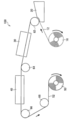
- FIG. 1 schematically shows an example of an apparatus configuration used in the manufacturing method of the present invention.
- This apparatus 100 gels the feeding roll 10 that feeds the belt-shaped support 12, the coater 20 that applies a coating solution for forming a carbon dioxide separation layer on the support 12, and the applied coating solution for forming a carbon dioxide separation layer.
- conveyance rolls 62, 64, 66, and 68 for conveying the support 12 are disposed in the respective parts 20, 30, 40, and 50.
- “gelation” means an increase in viscosity, and does not necessarily represent a state of losing fluidity at all.
- a support 12 is delivered from a roll-to-roll (sometimes abbreviated as “RtoR”), that is, a delivery roll 10, and the support is supported.
- the carbon dioxide separation composite 52 can be wound around the take-up roll 50 in order by carrying out the applying step, the cooling step, and the drying step while conveying the gas 12, and the gas excellent due to the further cross-linking step.
- the carbon dioxide separation complex 52 having separation characteristics can be produced continuously and efficiently.
- crosslinking process may be performed before winding up the film
- FIG. 2 schematically shows an example of the configuration of a carbon dioxide separation composite 202 provided with a carbon dioxide separation layer 200 and a support 201 manufactured using the coating liquid for forming a carbon dioxide separation layer in the present invention.
- a carbon dioxide separation layer 200 is formed on a support 201 that transmits carbon dioxide.
- a mixed gas containing carbon dioxide is supplied to the carbon dioxide separation layer side of the carbon dioxide separation composite 202, and the pressure on the side where the mixed gas is supplied is increased. By providing the pressure difference so as to be smaller than the pressure on the permeate side, the carbon dioxide in the mixed gas can pass through the carbon dioxide separation layer 200 and the support 201 and be separated.
- the water-absorbing polymer, the alkali metal salt, the density is lower than the density of the alkali metal salt, the hardness is a new Mohs hardness of 2 or more, and the volume average particle diameter is a carbon dioxide separation layer on the support.
- a coating solution for forming a carbon dioxide separation layer (hereinafter, referred to as “coating solution” as appropriate) containing a filler that is 30% or less of the thickness is applied.
- the applying step is a step of applying a coating solution for forming a carbon dioxide separation layer on a support as a single layer, or a coating solution containing a water-absorbing polymer and an alkali metal salt on a support, and carbon dioxide. What is necessary is just the process of carrying out multilayer application
- the belt-shaped support 12 is fed from the feed roll 10 and conveyed to the coating unit 20 to apply the coating liquid onto the support 12. .
- the temperature of the coating solution until it is subjected to the application step is too low, the water-absorbing polymer will precipitate (salt out) and it will be difficult to apply to the support, or if the coating solution contains polysaccharides There is a possibility that the viscosity of the coating solution increases due to the coagulation effect of the polysaccharide and the variation in film thickness increases. Therefore, after preparing the coating solution, it is preferable to keep the coating solution warm so that salting out does not occur until the coating solution is applied to the support.
- the temperature of the coating solution in the application step may be determined so that salting out or the like does not occur depending on the composition and concentration, but if the temperature is too high, a large amount of water evaporates from the coating solution and the composition concentration of the coating solution is May change.
- salting-out may proceed locally. Therefore, the coating solution is preferably kept at a temperature of about 40 to 95 ° C., more preferably kept at 45 to 90 ° C., and further preferably kept at 50 to 85 ° C.
- the support 12 supports the carbon dioxide separation composite, has carbon dioxide permeability, and applies the carbon dioxide separation layer forming coating liquid (coating liquid) in the present invention to form a carbon dioxide separation composite.
- coating liquid coating liquid
- it will not specifically limit if it can form a body and can support this membrane, it is preferably a porous material having good carbon dioxide permeability.
- the porous support is preferably one that can form a carbon dioxide separation layer in a desired form by applying a coating solution.
- paper, fine paper, coated paper, cast coated paper, synthetic paper, and further, cellulose, polyester, polyolefin, polyamide, polyimide, polysulfone aramid, polycarbonate, metal, glass, ceramics and the like are preferable.
- resin materials such as polypropylene, polyethylene, polystyrene, polyphenyl sulfide, polyether imide, polyether ether ketone, polysulfone, polyether sulfone, polyethylene terephthalate, polytetrafluoroethylene, and polyvinylidene fluoride are preferable.
- polyolefins and fluorides thereof can be particularly preferably used from the viewpoint of stability over time.
- a woven fabric, a non-woven fabric, a porous membrane or the like can be adopted.
- a support having a high self-supporting property and a high porosity can be suitably used.
- Polysulfone, cellulose membrane filter membrane, polyamide, polyimide interfacially polymerized thin film, polytetrafluoroethylene, high-molecular-weight polyethylene stretched porous membrane has high porosity, low carbon dioxide diffusion inhibition, strength, manufacturing suitability, etc.
- a stretched film of polytetrafluoroethylene (PTFE) is particularly preferable.
- an inorganic material or an organic-inorganic hybrid material may be used.
- the inorganic support include a porous substrate mainly composed of ceramics. By using ceramics as a main component, it is excellent in heat resistance, corrosion resistance, etc., and mechanical strength can be increased.
- the type of ceramic is not particularly limited, and any commonly used ceramic can be employed. Examples thereof include alumina, silica, silica-alumina, mullite, cordierite, zirconia and the like. Moreover, you may adjust by compounding 2 or more types of ceramics, or ceramics and a metal, or compounding ceramics and an organic compound.
- the thickness of the support is preferably 30 ⁇ m to 500 ⁇ m, more preferably 50 ⁇ m to 400 ⁇ m, and even more preferably 50 ⁇ m to 350 ⁇ m.
- the tensile strength of the porous support should be 10 N / 10 mm or more (tensile speed 10 mm / min) so that the support is not distorted or broken. preferable.
- the conveyance speed of the support 12 depends on the type of the support 12 and the viscosity of the coating liquid (coating liquid) for forming a carbon dioxide separation layer, but if the conveyance speed of the support is too high, the coating film in the application step Thickness uniformity may be reduced, and if it is too slow, productivity may be reduced, and the viscosity of the coating solution for forming a carbon dioxide separation layer may increase before the cooling step, which may reduce the uniformity of the coating film. .
- the conveyance speed of the support 12 may be determined according to the type of the support 12 and the viscosity of the coating solution for forming a carbon dioxide separation layer in consideration of the above points, but is preferably 1 m / min or more, and more preferably 2 m. / M to 200 m / min is more preferable, and 3 m / min to 200 m / min is particularly preferable.
- a conventionally known method can be employed as a method for applying the coating liquid for forming a carbon dioxide separation layer.
- Examples include curtain flow coaters, extrusion die coaters, air doctor coaters, blade coaters, rod coaters, knife coaters, squeeze coaters, reverse roll coaters, and bar coaters.
- an extrusion die coater is preferable from the viewpoint of film thickness uniformity, coating amount, and the like.
- the coating amount of the coating solution for forming the carbon dioxide separation layer depends on the composition and concentration of the coating solution, but if the coating amount per unit area is too small, when the volume of the coating is reduced in the drying step described later, There is a risk of holes being formed. If pores are formed in the membrane, it cannot be used as a composite for carbon dioxide separation and becomes a defective product. Moreover, when there is too little coating amount per unit area, there exists a possibility that the intensity
- the thickness of the carbon dioxide separation layer obtained in the drying step described later is 1 ⁇ m to 1000 ⁇ m, more preferably 2 ⁇ m to 1000 ⁇ m, and particularly preferably 3 ⁇ m to 1000 ⁇ m. It is preferable to adjust the coating amount so as to be m.
- the water-absorbing polymer contained in the coating solution for forming a carbon dioxide separation layer in the present invention functions as a binder, and when used as a composite for carbon dioxide separation, retains moisture and separates carbon dioxide with an alkali metal salt. In addition to exerting its function, it prevents the permeation of gases other than carbon dioxide, thus ensuring the denseness of the film. Therefore, in the present application, a water-absorbing polymer that can be uniformly dissolved or dispersed in water and that can form a dense film after coating and drying can be suitably used.
- the water-absorbing polymer is preferably one having high water absorption from the viewpoint that the composite for carbon dioxide separation has high water absorption (moisture retention), and the water absorption of the physiological saline is 0.5 g / g or more.
- Particularly preferred, and most preferred is a water absorption of 20 g / g or more.
- hydrophilic polymers As the water-absorbing polymer contained in the coating solution for forming a carbon dioxide separation layer in the present invention, conventionally known hydrophilic polymers can be used. From the viewpoint of water absorption, film-forming property, strength, etc., for example, polyvinyl Alcohols, polyacrylic acids, polyethylene oxides, water-soluble celluloses, starches, alginic acids, chitins, polysulfonic acids, polyhydroxymethacrylates, polyvinylpyrrolidones, polyNvinylacetamides, polyacrylamides, polyethyleneimines , Polyallylamines, polyvinylamines and the like are preferable, and copolymers of these can also be preferably used.
- the water-absorbing polymer is preferably a polymer containing a repeating unit derived from vinyl alcohol, a polymer containing a repeating unit derived from ethyleneimine, or a polymer containing a repeating unit derived from acrylic acid.
- the repeating unit derived from vinyl alcohol More preferred are polymers comprising
- the water-absorbing polymer is preferably a vinyl alcohol-acrylate copolymer.
- the vinyl alcohol-acrylate copolymer has a high water absorption capacity, and also has a high strength of a gel film that absorbs water and retains moisture even at high water absorption.
- the content of polyacrylate in the vinyl alcohol-acrylate copolymer is, for example, 1 mol% to 95 mol%, preferably 2 mol% to 70 mol%, more preferably 3 mol% to 60 mol%, especially Preferably, it is 5 mol% to 50 mol%.
- polyacrylic acid salts include alkali metal salts such as sodium salt and potassium salt, as well as ammonium salts and organic ammonium salts.
- any one of the water-absorbing polymers may be used alone, or two or more thereof may be used in combination.
- the content of the water-absorbing polymer in the coating solution for forming a carbon dioxide separation layer depends on the type, but from the viewpoint of forming a film as a binder and allowing the composite for carbon dioxide separation to sufficiently retain moisture.
- the total mass of the coating liquid for forming a carbon dioxide separation layer it is preferably 0.5% by mass to 50% by mass, more preferably 1% by mass to 30% by mass, and 2% by mass to 15% by mass. It is particularly preferred that
- the alkali metal salt contained in the coating solution for forming a carbon dioxide separation layer in the present invention may be any alkali metal salt that has an affinity for carbon dioxide and exhibits water solubility, and known ones can be used.
- the alkali metal salt include an alkali metal carbonate, an alkali metal bicarbonate, an alkali metal hydroxide, an alkali metal carbonate and / or an aqueous solution containing an alkali metal bicarbonate and / or an alkali metal hydroxide.
- An aqueous solution to which a multidentate ligand that forms a complex with a metal ion is added.
- Examples of the alkali metal carbonate include lithium carbonate, sodium carbonate, potassium carbonate, rubidium carbonate, and cesium carbonate.
- Examples of the alkali metal bicarbonate include lithium hydrogen carbonate, sodium hydrogen carbonate, potassium hydrogen carbonate, rubidium hydrogen carbonate, and cesium hydrogen carbonate.
- Examples of the alkali metal hydroxide include lithium hydroxide, sodium hydroxide, potassium hydroxide, cesium hydroxide, and rubidium hydroxide. Among these, alkali metal carbonates are preferable, and compounds containing cesium, rubidium, and potassium having high solubility are preferable.
- polydentate ligand that forms a complex with an alkali metal ion conventionally known ones such as: 12-crown-4, 15-crown-5, 18-crown-6, benzo-12-crown-4, benzo -15-crown-5, benzo-18-crown-6, dibenzo-12-crown-4, dibenzo-15-crown-5, dibenzo-18-crown-6, dicyclohexyl-12-crown-4, dicyclohexyl-15 -Cyclic polyethers such as crown-5, dicyclohexyl-18-crown-6, n-octyl-12-crown-4, n-octyl-15-crown-5, n-octyl-18-crown-6; 2.1], cyclic polyetheramines such as cryptand [2.2]; cryptand [2.2.1], cryptand [2.2] .2.2], other bicyclic polyether amines etc. can be used porphy
- any one alkali metal salt may be used alone, or two or more kinds may be used in combination.
- the content of the alkali metal salt in the coating solution for forming the carbon dioxide separation layer is dependent on the type, but in order to prevent salting out before coating and to ensure the carbon dioxide separation function, the carbon dioxide separation is performed.
- the total mass of the layer-forming coating solution is preferably 0.3% by mass to 30% by mass, more preferably 0.5% by mass to 25% by mass, and 1% by mass to 20% by mass. It is particularly preferred.
- the coating liquid for forming a carbon dioxide separation layer in the present invention has a density lower than the density of the alkali metal salt, a hardness of 2 or more, and a volume average particle diameter of 30% or less of the thickness of the carbon dioxide separation layer.
- a filler hereinafter also referred to as “specific filler”. Since the specific filler contained in the coating solution for forming a carbon dioxide separation layer has a lower density than the density of the alkali metal salt, it is estimated that the specific filler is unevenly distributed on the surface when the carbon dioxide separation layer is formed. Moreover, since the specific filler has high hardness, it is estimated that sufficient film strength can be achieved and the scratch resistance of the composite for carbon dioxide separation can be improved. Furthermore, since the volume average particle diameter is 30% or less of the thickness of the carbon dioxide separation layer, the denseness can be maintained in the lower layer of the carbon dioxide separation layer, and the high gas separation characteristics of carbon dioxide can be maintained. It is estimated that
- the density of the specific filler should be lower than the density of the alkali metal salt.
- the specific gravity of the specific filler is preferably 4.1 or less, and preferably 3.8 or less, based on water at 4 ° C. More preferred is 3.5 or less.
- the hardness of the specific filler is a new Mohs hardness of 2 or more.
- the new Mohs hardness of the filler is less than 2, the composite for carbon dioxide separation cannot obtain sufficient strength even if the filler is blended.
- the hardness of the specific filler is preferably 2.5 or more, and more preferably 3.0 or more, as a new Mohs hardness.
- the volume average particle diameter of the specific filler is 30% or less of the thickness of the carbon dioxide separation layer.
- the volume average particle diameter of the specific filler is preferably 20% or less of the thickness of the carbon dioxide separation layer, and preferably 10% or less.
- the film thickness of the carbon dioxide separation layer is obtained by measuring the thickness of the entire carbon dioxide complex and the thickness of the support using a micrometer manufactured by Mitutoyo Corporation, and calculating the difference as the film thickness of the carbon dioxide separation layer.
- the volume average particle diameter of the specific filler varies depending on the thickness of the carbon dioxide separation layer, but from the viewpoint of maintaining the denseness of the carbon dioxide separation layer, the value of the volume average particle diameter D50 is 0.005 ⁇ m to 50 ⁇ m. It is preferably from 0.005 ⁇ m to 20 ⁇ m, more preferably from 0.005 ⁇ m to 10 ⁇ m.
- the volume average particle diameter of the specific filler is measured by preparing a sample for measurement in which a filler is added to an aqueous solvent and then sufficiently ultrasonically stirred to uniformly disperse it to a concentration of about 100 ppm. It is measured with a particle size distribution measuring device (Beckman Coulter, Inc.).
- the density, hardness, and volume average particle diameter may be within the above-described ranges, and any of inorganic fillers and organic fillers may be used.
- an inorganic filler and an organic filler may be mixed and used.
- a well-known thing can be used as an inorganic filler.
- a metal and a metal compound oxide, composite oxide, hydroxide, carbonate, sulfate, silicate, phosphate, nitride, carbide, and a composite of at least two of these
- the inorganic filler include silica, clay, kaolin, mica, smectite, zinc oxide, alumina, potassium titanate, aluminum borate, magnesium oxide, aluminum hydroxide, magnesium hydroxide, basic magnesium sulfate, calcium carbonate, silica Calcium acid, aluminum nitride, boron nitride, and a composite compound of at least two of these can be used.
- silica, alumina, aluminum hydroxide, magnesium oxide, magnesium hydroxide, calcium carbonate, boron nitride, clay, kaolin, and mica are preferable, and silica, alumina, magnesium oxide, and the like are more preferable.
- Table 1 below shows the new Mohs hardness and particle specific gravity of typical inorganic fillers that can be used in the composite for carbon dioxide separation according to the present invention.
- the inorganic filler can also use the inorganic filler which processed the filler surface with the surface modifier containing an organic segment for the purpose of improving the affinity with the water absorbing polymer contained in a carbon dioxide separation layer.
- the surface modifier containing an organic segment a known one can be used. Examples thereof include alkoxysilanes such as tetraethylorthosilicate.
- organic filler known materials such as synthetic polymer resins and natural polymer resins can be used.
- organic filler acrylic resin, polytetrafluoroethylene, polyvinylidene fluoride, polyethylene, polypropylene, polyethylene oxide, polypropylene oxide, polyethyleneimine, polystyrene, polysiloxane, polycellulose acetate, polycarbonate, carboxymethylcellulose, chitin, The particle
- acrylic resin and polystyrene (PS) are particularly preferable from the viewpoints of density and hardness.
- organic filler it is preferable that it is an internal crosslinked body from a viewpoint of hardness and durability.
- Table 2 below shows the new Mohs hardness and particle specific gravity of typical organic fillers that can be used in the composite for carbon dioxide separation according to the present invention.
- any one of the specific fillers may be used alone, or two or more may be used in combination.
- the content of the specific filler in the coating solution for forming a carbon dioxide separation layer depends on the type, but from the viewpoint of film strength, 0.1% by mass to 10% in the total mass of the coating solution for forming a carbon dioxide separation layer.
- the mass is preferably 0.3% by mass, more preferably 0.3% by mass to 8% by mass, and particularly preferably 0.5% by mass to 5% by mass.
- the content of the specific filler is preferably 1% by mass to 350% by mass, more preferably 5% by mass to 200% by mass, based on the mass of the solid content of the water-absorbing polymer.
- the content is particularly preferably 10% by mass to 100% by mass.
- the coating liquid for forming a carbon dioxide separation layer in the present invention includes one or more other components other than the water-absorbing polymer, the alkali metal salt, and the specific filler as long as the film strength of the carbon dioxide separation layer is not affected. be able to.
- other components include surfactants, catalysts, moisturizing (water absorbing) agents, auxiliary solvents, film strength modifiers, and defect detection agents. Can be mentioned.
- the coating solution for forming a carbon dioxide separation layer in the present invention may further contain a polysaccharide.
- a polysaccharide a gel film (set film) with high film thickness uniformity can be formed by cooling a coating film formed by coating a coating solution for forming a carbon dioxide separation layer on a support. If it is, it can be used without limitation.
- examples of polysaccharides include starches, celluloses, agarose, xanthan gum, guar gum, glucomannan, curdlan, carrageenan, xanthan gum, gellan gum, dextran, locust bean gum, alginic acids, hyaluronic acids, and the like.
- Agar is preferred from the standpoints of film formability, availability, cost, and film strength.
- Commercially available products include Inagar Agar UP-37, UM-11S, SY-8, ZY-4, ZY-6 (above, manufactured by Ina Food Industry Co., Ltd.), Agarose H, Agarose S (above, manufactured by Nippon Gene Co., Ltd.), etc. Can be mentioned.
- polysaccharides may be used alone or in combination. Some of these polysaccharides are known to increase their gelling ability when mixed, and as a gelling agent, they should be mixed and used to adjust the gelation speed, gelling ability, and gelation temperature. I can do it.
- the polysaccharide that can be used in the present invention can also serve as a water-absorbing polymer.
- the amount used in this case conforms to the amount and content of the water-absorbing polymer. Any of the polysaccharides may be used alone or in combination of two or more.
- the content of the polysaccharide in the coating solution for forming a carbon dioxide separation layer depends on the type, but if the content of the polysaccharide is too large, the coating solution becomes highly viscous in a short time and difficult to apply. There is a possibility that a coating defect may occur. Further, from the viewpoint of suppressing a decrease in film thickness uniformity, the polysaccharide content is preferably 10% by mass or less, and preferably 0.1% by mass to 8% by mass in the total mass of the coating solution for forming a carbon dioxide separation layer. More preferably, it is 0.3 mass% to 5 mass%.
- Crosslinking of the water-absorbing polymer can be carried out by a conventionally known method such as thermal crosslinking, ultraviolet crosslinking, electron beam crosslinking, or radiation crosslinking.
- the coating solution for forming a carbon dioxide separation layer in the present invention preferably contains a crosslinking agent.
- it preferably contains a cross-linking agent having two or more functional groups capable of reacting with the vinyl alcohol-acrylate copolymer and thermally cross-linking.
- Preferred cross-linking agents include polyvalent glycidyl ether, polyhydric alcohol, polyvalent isocyanate, polyvalent aziridine, haloepoxy compound, polyvalent aldehyde, polyvalent amine and the like.
- polyvalent glycidyl ether for example, ethylene glycol diglycidyl ether, polyethylene glycol diglycidyl ether, glycerol polyglycidyl ether, diglycerol polyglycidyl ether, polyglycerol polyglycidyl ether, sorbitol polyglycidyl ether, pentaerythritol poly Examples thereof include glycidyl ether, propylene glycol glycidyl ether, and polypropylene glycol diglycidyl ether.
- polyhydric alcohol examples include ethylene glycol, diethylene glycol, triethylene glycol, tetraethylene glycol, polyethylene glycol, glycerin, polyglycerin, propylene glycol, diethanolamine, triethanolamine, polyoxypropyl, and oxyethyleneoxypropylene.
- examples include block copolymers, pentaerythritol, and sobitol.
- examples of the polyvalent isocyanate include 2,4-toluylene diisocyanate and hexamethylene diisocyanate.
- Examples of the polyvalent aziridine include 2,2-bishydroxymethylbutanol-tris [3- (1-acylidinyl) propionate], 1,6-hexamethylenediethyleneurea, diphenylmethane-bis-4,4′- N, N′-diethylene urea and the like can be mentioned.
- Examples of the haloepoxy compound include epichlorohydrin and ⁇ -methylchlorohydrin.
- Examples of the polyvalent aldehyde include glutaraldehyde and glyoxal.
- Examples of the polyvalent amine include ethylenediamine, diethylenetriamine, triethylenetetramine, tetraethylenepentamine, pentaethylenehexamine, and polyethyleneimine.
- glutaraldehyde is particularly preferred as the thermal crosslinking agent for the vinyl alcohol-acrylate copolymer.
- crosslinking agents may be used alone or in combination of two or more.
- the content of the crosslinking agent depends on the type, but from the viewpoint of membrane strength, durability, and separation performance of the carbon dioxide separation layer, 0.0001% by mass in the total mass of the coating solution for forming the carbon dioxide separation layer It is preferably ⁇ 5% by mass, more preferably 0.001% by mass to 1% by mass, and further preferably 0.002% by mass to 0.5% by mass.
- the coating solution for forming a carbon dioxide separation layer in the present invention may contain a known carbon dioxide carrier in addition to the alkali metal salt described above.
- Other carbon dioxide carriers may be various water-soluble inorganic and organic substances that are components other than the aforementioned alkali metal salts, have affinity with carbon dioxide, and exhibit basicity.
- Other carbon dioxide carriers include ammonia, ammonium salts, linear amines, cyclic amines, amine salts, alkanolamines, ammonium salts and the like. These water-soluble derivatives can also be preferably used.
- amine-containing compounds that are difficult to evaporate, such as amino acids and betaines are particularly preferred from the viewpoint that they can be retained in the complex for carbon dioxide separation for a long time.
- alkanolamine examples include various water-soluble substances such as monoethanolamine, diethanolamine, triethanolamine, monopropanolamine, dipropanolamine, and tripropanolamine.
- amino acids glycine, alanine, serine, proline, histidine, cysteine, taurine, diaminopropionic acid, phosphoserine, sarcosine, dimethylglycine, ⁇ -alanine, 2-aminoisobutyric acid, and the like can be used.
- a peptide in which such amino acids are linked may be used.
- hydrophobic amino acids phase separation with a hydrophilic gel membrane occurs, and the permeability of gases other than carbon dioxide increases, but hydrophilic amino acids have a high solubility, and have a high solubility between the water-absorbing polymer and polysaccharide. It is particularly preferred because of its high affinity.
- the LogP value (P: octanol-water partition coefficient), which is an index indicating the hydrophilicity / hydrophobicity of amino acids, is preferably ⁇ 1.5 or less, more preferably ⁇ 2.0 or less, ⁇ 2.5 or less is particularly preferable.
- amino acids having a LogP value of ⁇ 2.5 or less include arginine, lysine, aspartic acid, glutamic acid, glutamine, histidine, proline, serine, threonine, glycine, alanine, diaminopropionic acid, taurine and the like.
- the LogP value of an amino acid is estimated by a computational chemical method or an empirical method.
- Crippen's fragmentation method J. Chem. Inf. Comput. Sci., 27, 21 (1987)
- Viswanadhan's fragmentation method J. Chem. Inf. Comput. Sci., 29,). 163 (1989).
- Broto's fragmentation method Eur. J. Med. Chem.-Chim. Theor., 19, 71 (1984).
- Etc Etc.
- determination is made by the Crippen's fragmentation method.
- amino acids are arginine, lysine, aspartic acid, glutamic acid, glutamine, histidine, proline, serine, threonine, glycine, alanine, diaminopropionic acid, taurine, more preferably glycine, serine, alanine, diaminopropionic acid.
- Taurine particularly preferably glycine and serine.
- an embodiment in which an alkali metal carbonate and an amino acid are used in combination is preferable from the viewpoint of improving the carbon dioxide permeation rate and the separation factor.
- a hydrophilic amino acid to at least one of cesium carbonate, rubidium carbonate, and potassium carbonate.
- cesium carbonate, rubidium carbonate, and potassium carbonate are preferably used.
- glycine and / or serine are preferably used.
- Betaine includes carnitine and trimethylglycine, with trimethylglycine being particularly preferred.
- carbon dioxide carriers may be used alone or in combination of two or more.
- the content of other carbon dioxide carriers in the coating solution for forming a carbon dioxide separation layer depends on the type of the carbon dioxide carrier, but in order to prevent salting out before coating and to ensure the function of separating carbon dioxide,
- the total amount of the coating liquid for forming a carbon separation layer is preferably 0.001% by mass to 10% by mass, more preferably 0.01% by mass to 8% by mass, and more preferably 0.1% by mass to 5% by mass. It is particularly preferable that the content is% by mass.
- the coating solution for forming a carbon dioxide separation layer is composed of the above-mentioned water-absorbing polymer, alkali metal salt, specific filler, and other components as needed, each in an appropriate amount of water (normal temperature water, warm water and heat of 85 ° C. or higher). It is preferable to prepare it by adding the aqueous solution) and stirring sufficiently, and by promoting the dispersion by heating with stirring as necessary. In addition, you may add a water absorbing polymer, an alkali metal salt, and a specific filler separately to water, and you may add what was mixed beforehand.
- a specific filler is gradually added to this and stirred, whereby precipitation of the water-absorbing polymer can be effectively prevented.
- hot water 85 degreeC or more from a viewpoint of preventing precipitation of polysaccharide.
- the carbon dioxide separation layer forming coating solution applied on the support is dried to obtain a carbon dioxide separation layer.
- the gel film on the support 12 conveyed to the heating unit 40 is dried by applying hot air.
- the wind speed is preferably such that the gel film can be dried quickly and the gel film does not collapse, for example, 1 m / min to 80 m / min, more preferably 2 m / min to 70 m / min, and further 3 m / min. ⁇ 60 m / min is particularly preferred.
- the temperature of the wind is preferably 1 ° C. to 80 ° C., more preferably 2 ° C. to allow the coating solution for forming a carbon dioxide separation layer to be quickly dried without causing deformation of the support. 70 ° C. is more preferable, and 3 ° C. to 60 ° C. is particularly preferable.
- the method for producing a composite for carbon dioxide separation in the present invention may include other steps as necessary in addition to the applying step and the drying step.
- (Cooling process) When a polysaccharide is contained in the coating solution, it is preferable to include a cooling step before the drying step from the viewpoint of adjusting the viscosity of the coating solution to a more suitable range. Moreover, since the film
- the coating liquid for forming a carbon dioxide separation layer obtained on the support 12 in the applying step is cooled to obtain a gel film.
- the support to which the coating liquid is applied is transported to the cooling unit 30 and immediately cooled, so that the coating liquid is gelled (fixed) by the coagulation action of the polysaccharide contained in the coating liquid, and a stable gel film (Set film) is obtained.
- the cooling temperature in the cooling step is too high, immobilization may take time and the film thickness uniformity may decrease, and if it is too low, the gel film may freeze and the film quality may change. What is necessary is just to determine according to a coating liquid component and a density
- the wet bulb temperature is 35 ° C. or less, preferably 1 ° C. to 35 ° C., more preferably 2 ° C. to 20 ° C., and even more preferably 5 ° C. to 15 ° C. is particularly preferred.
- the passage time in the cooling step is preferably from 1 second to 200 seconds, more preferably from 20 seconds to 150 seconds, and even more preferably from 30 seconds to 100 seconds from the viewpoint of improving productivity.
- the coating liquid for forming a carbon dioxide separation layer in the present invention since the coating liquid for forming a carbon dioxide separation layer in the present invention is applied to the support, it can be rapidly gelled to form a gel film, so that the film thickness of the carbon dioxide separation layer can be accurately controlled. Can do. Therefore, a composite for carbon dioxide separation having a large film thickness and a uniform thickness can be formed, and a composite for carbon dioxide separation having high gas separation characteristics can be produced with high productivity.
- the crosslinking step may be performed simultaneously with the drying step, may be performed separately, or may be performed at the time of preparing the coating solution for forming a carbon dioxide separation layer before the applying step.
- a well-known crosslinking method can be used for the crosslinking method.
- After drying by applying warm air to the gel film it may be crosslinked by heating means such as an infrared heater, or may be crosslinked together with drying by warm air.
- Thermal crosslinking can be performed by heating to about 100 to 150 ° C., for example.
- the gel film may be subjected to UV or electron beam crosslinking and then dried.
- the composite for carbon dioxide separation which concerns on this invention is obtained through the said process.
- the carbon dioxide separation layer in the composite for carbon dioxide separation contains a water-absorbing polymer, an alkali metal salt, and a specific filler.
- the composite for carbon dioxide separation is such that all of the specific filler is located at a position from the surface opposite to the surface in contact with the support to a depth of 50% with respect to the film thickness direction of the carbon dioxide separation layer. It is preferable that 60 mass% or more of mass exists. Moreover, it is more preferable that 65 mass% or more of the total mass of a specific filler exists, and it is still more preferable that 70 mass% or more exists.
- the specific filler is unevenly distributed in the vicinity of the surface due to the specific gravity relationship between the alkali metal salt and the specific filler when the coating liquid for forming the carbon dioxide separation layer is applied and dried. To do.
- a coating liquid containing a water-absorbing polymer and an alkali metal salt that does not contain the specific filler is coated on the support, and then a carbon dioxide separation layer forming coating liquid is applied.
- coating a multilayer is mentioned.
- the coating solution containing the water-absorbing polymer and the alkali metal salt and the coating solution for forming the carbon dioxide separation layer they may be applied sequentially or simultaneously. Since the specific filler having a low specific gravity does not settle in the lower layer by applying the multilayer coating in this way, both the coating liquid containing the water-absorbing polymer and the alkali metal salt and the coating liquid for forming the carbon dioxide separation layer are coated.
- the degree of uneven distribution of the specific filler near the surface of the carbon dioxide separation layer can be easily controlled by the amount and the content of the specific filler blended in the coating solution for forming the carbon dioxide separation layer.
- localization of the specific filler in the carbon dioxide separation layer is carried out by coating the prepared carbon dioxide separation layer coating solution on a PTFE porous support (GE Energy QL217EXPG, 100 ⁇ m thickness). Apply using an applicator and dry to make a sample for measurement, cut out a cross section perpendicular to the coated surface, and cross-section the scanning electron microscope (SEM-EDX) manufactured by JEOL Ltd. Confirm by observing. Specifically, energy dispersive X-ray analysis (EDX mapping) is performed from the SEM image of the cross section, and within the range of the carbon dioxide separation layer from the surface opposite to the surface in contact with the support to a depth of 50%. Calculate the cross-sectional area occupied by the filler and confirm from the ratio.
- a PTFE porous support GE Energy QL217EXPG, 100 ⁇ m thickness
- the starting load with a film surface damage by a sapphire needle having a diameter of 0.5 mm on the surface of the carbon dioxide separation layer of the present invention is 20 g or more.
- the starting load with film surface damage is more preferably 25 g or more, and further preferably 30 g or more.
- the starting load with film surface damage is such that the prepared carbon dioxide separation layer coating solution is applied to a PTFE porous support (GE Energy QL217EXPG, 100 ⁇ m thickness) with a coating thickness of 1 mm.
- a sample for measurement is prepared by applying and drying, and measured by a method according to JIS K5600-5-5.
- a sapphire needle having a diameter of 0.5 mm was used. The film surface is scratched and the presence or absence of scratches on the film surface when the weight is changed is visually observed.
- the composition ratio of each component in the carbon dioxide separation layer reflects the blending ratio of the coating liquid.
- the content of each component in the composite for carbon dioxide separation in the dry state is preferably in the following range.
- the water-absorbing polymer is preferably 5% by mass to 90% by mass, more preferably 10% by mass to 85% by mass, and further preferably 15% by mass to 80% by mass.
- the alkali metal salt is preferably 5% by mass to 90% by mass, more preferably 10% by mass to 85% by mass, and further preferably 20% by mass to 80% by mass.
- the specific filler is preferably 1% by mass to 50% by mass, more preferably 3% by mass to 45% by mass, and further preferably 5% by mass to 35% by mass.
- the content of the compound containing cesium in the composite for carbon dioxide separation in a dry state is 30% by mass or more from the viewpoint of improving the separation characteristics of carbon dioxide. Preferably, it is more preferably 35% by mass or more, and particularly preferably 40% by mass or more.
- the content of the compound containing potassium in the carbon dioxide separation complex in a dry state is preferably 2% by mass or more, and 3% by mass. It is more preferable to use it above, and it is especially preferable that it is 5 mass% or more.
- the amino acid is preferably 2% by mass or more with respect to the carbon dioxide separation layer in a dry state, and 3% by mass or more. More preferably, it is more preferably 5% by mass or more.
- a carrier elution preventing layer may be provided on the composite for carbon dioxide separation in order to prevent elution of alkali metal salts and other carbon dioxide carriers, if necessary.
- the carrier elution prevention layer preferably has a property of allowing gas such as carbon dioxide and water vapor to pass therethrough but not passing water or the like, and is preferably a hydrophobic porous film. A film having such properties may be applied on the film surface, or a film prepared separately may be laminated.
- the composite for carbon dioxide separation of the present invention has a water-absorbing polymer, an alkali metal salt, a density lower than the density of the alkali metal salt, a hardness of 2 or more, and a volume average particle size of carbon dioxide separation. And a filler that is 30% or less of the thickness of the layer.
- the aforementioned matters can be applied to the water-absorbing polymer, the alkali metal salt, and the specific filler.
- the module for carbon dioxide separation of the present invention is a module comprising a composite for carbon dioxide separation.
- the carbon dioxide separation module of the present invention can be used by installing the composite for carbon dioxide separation as a flat membrane, or by processing it into a spiral type or pleated type known as a reverse osmosis membrane module.
- Example 1 Agar (Ina Food Industry Co., Ltd., Ina Agar UP-37) 0.5% by mass, vinyl alcohol-acrylate copolymer (sodium salt, Kuraray Co., Ltd., Clastomer AP20) 2.5% by mass, cesium carbonate (rare A hot aqueous solution (temperature: 85 ° C. or higher) containing 6.0% by mass and 0.2% by mass of glutaraldehyde was prepared, and 1.25% by mass of silica (Nissan Chemical Co., Ltd., ST-30) was prepared. % Was added to prepare a separation layer forming coating solution.
- the prepared separation layer forming coating solution is applied to a porous PTFE support (QL217EXPG manufactured by GE Energy, 100 ⁇ m thick) by the Roll-to-Roll method, cooled to a film surface temperature of 35 ° C. or lower, and then dried. To form a film. This was wound up to obtain a composite for carbon dioxide separation.
- a porous PTFE support QL217EXPG manufactured by GE Energy, 100 ⁇ m thick
- Example 2 Agar (Ina Food Industry Co., Ltd., Ina Agar UP-37) 0.5% by mass, vinyl alcohol-acrylate copolymer (sodium salt, Kuraray Co., Ltd., Clastomer AP20) 2.5% by mass, cesium carbonate (rare A hot aqueous solution (temperature: 85 ° C. or higher) containing 6.0% by mass and 0.2% by mass of glutaraldehyde was prepared, and 2.0 mass of silica (Nissan Chemical Co., Ltd., ST-30) was prepared. % Was added to prepare a separation layer forming coating solution.
- the prepared separation layer forming coating solution is applied to a porous PTFE support (QL217EXPG manufactured by GE Energy, 100 ⁇ m thick) by the Roll-to-Roll method, cooled to a film surface temperature of 35 ° C. or lower, and then dried. To form a film. This was wound up to obtain a composite for carbon dioxide separation.
- a porous PTFE support QL217EXPG manufactured by GE Energy, 100 ⁇ m thick
- Example 3 Agar (Ina Food Industry Co., Ltd., Ina Agar UP-37) 0.5% by mass, vinyl alcohol-acrylate copolymer (sodium salt, Kuraray Co., Ltd., Clastomer AP20) 2.5% by mass, cesium carbonate (rare A hot aqueous solution (temperature: 85 ° C. or higher) containing 6.0% by mass and 0.2% by mass of glutaraldehyde was prepared, and 1.25% by mass of silica (Nissan Chemical Co., Ltd., ST-ZL) was prepared. % Was added to prepare a separation layer forming coating solution.
- the prepared separation layer forming coating solution is applied to a porous PTFE support (QL217EXPG manufactured by GE Energy, 100 ⁇ m thick) by the Roll-to-Roll method, cooled to a film surface temperature of 35 ° C. or lower, and then dried. To form a film. This was wound up to obtain a composite for carbon dioxide separation.
- a porous PTFE support QL217EXPG manufactured by GE Energy, 100 ⁇ m thick
- Example 4 Agar (Ina Food Industry Co., Ltd., Ina Agar UP-37) 0.5% by mass, vinyl alcohol-acrylate copolymer (sodium salt, Kuraray Co., Ltd., Clastomer AP20) 2.5% by mass, cesium carbonate (rare A hot aqueous solution (temperature: 85 ° C. or higher) containing 6.0% by mass and 0.2% by mass of glutaraldehyde was prepared, and 1.25% of silica (manufactured by Nissan Chemical Co., MP-4540M) was prepared. % Was added to prepare a separation layer forming coating solution.
- the prepared separation layer forming coating solution is applied to a porous PTFE support (QL217EXPG manufactured by GE Energy, 100 ⁇ m thick) by the Roll-to-Roll method, cooled to a film surface temperature of 35 ° C. or lower, and then dried. To form a film. This was wound up to obtain a composite for carbon dioxide separation.
- a porous PTFE support QL217EXPG manufactured by GE Energy, 100 ⁇ m thick
- Example 5 Agar (Ina Food Industry Co., Ltd., Ina Agar UP-37) 0.5% by mass, vinyl alcohol-acrylate copolymer (sodium salt, Kuraray Co., Ltd., Clastomer AP20) 2.5% by mass, cesium carbonate (rare A hot aqueous solution (temperature: 85 ° C. or higher) containing 6.0% by mass and 0.2% by mass of glutaraldehyde was prepared, and further 0.75% by mass of silica (manufactured by Nippon Shokubai Co., Ltd., KE-P100). % Was added to prepare a separation layer forming coating solution.
- the prepared separation layer forming coating solution is applied to a porous PTFE support (QL217EXPG manufactured by GE Energy, 100 ⁇ m thick) by the Roll-to-Roll method, cooled to a film surface temperature of 35 ° C. or lower, and then dried. To form a film. This was wound up to obtain a composite for carbon dioxide separation.
- a porous PTFE support QL217EXPG manufactured by GE Energy, 100 ⁇ m thick
- Example 6 Agar (Ina Food Industry Co., Ltd., Ina Agar UP-37) 0.5% by mass, vinyl alcohol-acrylate copolymer (sodium salt, Kuraray Co., Ltd., Clastomer AP20) 2.5% by mass, cesium carbonate (rare A hot aqueous solution (temperature: 85 ° C. or higher) containing 6.0% by mass and 0.2% by mass of glutaraldehyde was prepared, and 1.25% by mass of silica (manufactured by Nippon Shokubai Co., Ltd., KE-P100). % was added to prepare a separation layer forming coating solution.
- the prepared separation layer forming coating solution is applied to a porous PTFE support (QL217EXPG manufactured by GE Energy, 100 ⁇ m thick) by the Roll-to-Roll method, cooled to a film surface temperature of 35 ° C. or lower, and then dried. To form a film. This was wound up to obtain a composite for carbon dioxide separation.
- a porous PTFE support QL217EXPG manufactured by GE Energy, 100 ⁇ m thick
- Example 7 Agar (Ina Food Industry Co., Ltd., Ina Agar UP-37) 0.5% by mass, vinyl alcohol-acrylate copolymer (sodium salt, Kuraray Co., Ltd., Clastomer AP20) 2.5% by mass, cesium carbonate (rare A hot aqueous solution (temperature: 85 ° C. or higher) containing 6.0% by mass and 0.2% by mass of glutaraldehyde was prepared, and further 0.75% by mass of silica (manufactured by Nippon Shokubai Co., Ltd., KE-S250). % Was added to prepare a separation layer forming coating solution.
- the prepared separation layer forming coating solution is applied to a porous PTFE support (QL217EXPG manufactured by GE Energy, 100 ⁇ m thick) by the Roll-to-Roll method, cooled to a film surface temperature of 35 ° C. or lower, and then dried. To form a film. This was wound up to obtain a composite for carbon dioxide separation.
- a porous PTFE support QL217EXPG manufactured by GE Energy, 100 ⁇ m thick
- Example 8 Agar (Ina Food Industry Co., Ltd., Ina Agar UP-37) 0.5% by mass, vinyl alcohol-acrylate copolymer (sodium salt, Kuraray Co., Ltd., Clastomer AP20) 2.5% by mass, cesium carbonate (rare A hot aqueous solution (temperature: 85 ° C. or higher) containing 6.0% by mass and 0.2% by mass of glutaraldehyde was prepared, and 0.5 mass of alumina (manufactured by Nippon Light Metal Co., Ltd., LS-242C) was prepared. % Was added to prepare a separation layer forming coating solution.
- the prepared separation layer forming coating solution is applied to a porous PTFE support (QL217EXPG manufactured by GE Energy, 100 ⁇ m thick) by the Roll-to-Roll method, cooled to a film surface temperature of 35 ° C. or lower, and then dried. To form a film. This was wound up to obtain a composite for carbon dioxide separation.
- a porous PTFE support QL217EXPG manufactured by GE Energy, 100 ⁇ m thick
- Example 9 Agar (Ina Food Industry Co., Ltd., Ina Agar UP-37) 0.5% by mass, vinyl alcohol-acrylate copolymer (sodium salt, Kuraray Co., Ltd., Clastomer AP20) 2.5% by mass, cesium carbonate (rare A hot aqueous solution (temperature: 85 ° C. or higher) containing 6.0% by mass and 0.2% by mass glutaraldehyde was prepared, and further 1.25% alumina (manufactured by Nippon Light Metal Co., Ltd., LS-242C) was prepared. % Was added to prepare a separation layer forming coating solution.
- the prepared separation layer forming coating solution is applied to a porous PTFE support (QL217EXPG manufactured by GE Energy, 100 ⁇ m thick) by the Roll-to-Roll method, cooled to a film surface temperature of 35 ° C. or lower, and then dried. To form a film. This was wound up to obtain a composite for carbon dioxide separation.
- a porous PTFE support QL217EXPG manufactured by GE Energy, 100 ⁇ m thick
- Example 10 Agar (Ina Food Industry Co., Ltd., Ina Agar UP-37) 0.5% by mass, vinyl alcohol-acrylate copolymer (sodium salt, Kuraray Co., Ltd., Clastomer AP20) 2.5% by mass, cesium carbonate (rare A hot aqueous solution (temperature: 85 ° C. or higher) containing 6.0% by mass and 0.2% by mass glutaraldehyde was prepared, and 2% by mass of alumina (manufactured by Nippon Light Metal Co., Ltd., LS-242C) was added. Then, a separation layer forming coating solution was prepared.
- alumina manufactured by Nippon Light Metal Co., Ltd., LS-242C
- the prepared separation layer forming coating solution is applied to a porous PTFE support (QL217EXPG manufactured by GE Energy, 100 ⁇ m thick) by the Roll-to-Roll method, cooled to a film surface temperature of 35 ° C. or lower, and then dried. To form a film. This was wound up to obtain a composite for carbon dioxide separation.
- a porous PTFE support QL217EXPG manufactured by GE Energy, 100 ⁇ m thick
- Example 11 Agar (Ina Food Industry Co., Ltd., Ina Agar UP-37) 0.5% by mass, vinyl alcohol-acrylate copolymer (sodium salt, Kuraray Co., Ltd., Clastomer AP20) 2.5% by mass, cesium carbonate (rare A hot aqueous solution (temperature: 85 ° C. or higher) containing 6.0% by mass and 0.2% by mass of glutaraldehyde was prepared, and aluminum hydroxide (manufactured by Nippon Light Metal Co., Ltd., BF-103) 5% by mass was added to prepare a coating solution for forming a separation layer.
- vinyl alcohol-acrylate copolymer sodium salt, Kuraray Co., Ltd., Clastomer AP20
- cesium carbonate IR A hot aqueous solution (temperature: 85 ° C. or higher) containing 6.0% by mass and 0.2% by mass of glutaraldehyde was prepared, and aluminum hydroxide (manufactured by Nippon
- the prepared separation layer forming coating solution is applied to a porous PTFE support (QL217EXPG manufactured by GE Energy, 100 ⁇ m thick) by the Roll-to-Roll method, cooled to a film surface temperature of 35 ° C. or lower, and then dried. To form a film. This was wound up to obtain a composite for carbon dioxide separation.
- a porous PTFE support QL217EXPG manufactured by GE Energy, 100 ⁇ m thick
- Example 12 Agar (Ina Food Industry Co., Ltd., Ina Agar UP-37) 0.5% by mass, vinyl alcohol-acrylate copolymer (sodium salt, Kuraray Co., Ltd., Clastomer AP20) 2.5% by mass, cesium carbonate (rare A hot aqueous solution (temperature: 85 ° C. or higher) containing 6.0% by mass and 0.2% by mass of glutaraldehyde was prepared, and aluminum hydroxide (manufactured by Nippon Light Metal Co., Ltd., BF-103) was added. A separation layer forming coating solution was prepared by adding 25% by mass.
- the prepared separation layer forming coating solution is applied to a porous PTFE support (QL217EXPG manufactured by GE Energy, 100 ⁇ m thick) by the Roll-to-Roll method, cooled to a film surface temperature of 35 ° C. or lower, and then dried. To form a film. This was wound up to obtain a composite for carbon dioxide separation.
- a porous PTFE support QL217EXPG manufactured by GE Energy, 100 ⁇ m thick
- Example 13 Agar (Ina Food Industry Co., Ltd., Ina Agar UP-37) 0.5% by mass, vinyl alcohol-acrylate copolymer (sodium salt, Kuraray Co., Ltd., Clastomer AP20) 2.5% by mass, cesium carbonate (rare A hot aqueous solution (temperature: 85 ° C. or higher) containing 6.0% by mass and 0.2% by mass of glutaraldehyde was prepared, and aluminum hydroxide (Nippon Light Metal Co., Ltd., B-703) A coating solution for forming a separation layer was prepared by adding 0% by mass.
- the prepared separation layer forming coating solution is applied to a porous PTFE support (QL217EXPG manufactured by GE Energy, 100 ⁇ m thick) by the Roll-to-Roll method, cooled to a film surface temperature of 35 ° C. or lower, and then dried. To form a film. This was wound up to obtain a composite for carbon dioxide separation.
- a porous PTFE support QL217EXPG manufactured by GE Energy, 100 ⁇ m thick
- Example 14 Agar (Ina Food Industry Co., Ltd., Ina Agar UP-37) 0.5% by mass, vinyl alcohol-acrylate copolymer (sodium salt, Kuraray Co., Ltd., Clastomer AP20) 2.5% by mass, cesium carbonate (rare A hot aqueous solution (temperature: 85 ° C. or higher) containing 6.0% by mass and 0.2% by mass of glutaraldehyde is prepared, and further magnesium oxide (manufactured by Sakai Chemical Industry Co., Ltd., SMO) is 0.75% by mass. % Was added to prepare a separation layer forming coating solution.
- the prepared separation layer forming coating solution is applied to a porous PTFE support (QL217EXPG manufactured by GE Energy, 100 ⁇ m thick) by the Roll-to-Roll method, cooled to a film surface temperature of 35 ° C. or lower, and then dried. To form a film. This was wound up to obtain a composite for carbon dioxide separation.
- a porous PTFE support QL217EXPG manufactured by GE Energy, 100 ⁇ m thick
- Example 15 Agar (Ina Food Industry Co., Ltd., Ina Agar UP-37) 0.5% by mass, vinyl alcohol-acrylate copolymer (sodium salt, Kuraray Co., Ltd., Clastomer AP20) 2.5% by mass, cesium carbonate (rare A hot aqueous solution (temperature: 85 ° C. or higher) containing 6.0% by mass and 0.2% by mass of glutaraldehyde is prepared, and further magnesium oxide (manufactured by Sakai Chemical Industry Co., Ltd., SMO) is 1.25% by mass. % Was added to prepare a separation layer forming coating solution.
- the prepared separation layer forming coating solution is applied to a porous PTFE support (QL217EXPG manufactured by GE Energy, 100 ⁇ m thick) by the Roll-to-Roll method, cooled to a film surface temperature of 35 ° C. or lower, and then dried. To form a film. This was wound up to obtain a composite for carbon dioxide separation.
- a porous PTFE support QL217EXPG manufactured by GE Energy, 100 ⁇ m thick
- Example 16 Agar (Ina Food Industry Co., Ltd., Ina Agar UP-37) 0.5% by mass, vinyl alcohol-acrylate copolymer (sodium salt, Kuraray Co., Ltd., Clastomer AP20) 2.5% by mass, cesium carbonate (rare A hot aqueous solution (temperature: 85 ° C. or higher) containing 6.0% by mass and 0.2% by mass of glutaraldehyde is prepared, and further magnesium oxide (manufactured by Sakai Chemical Industry Co., Ltd., SMO) is 0.75% by mass. % Was added to prepare a separation layer forming coating solution.
- the prepared separation layer forming coating solution is applied to a porous PTFE support (QL217EXPG manufactured by GE Energy, 100 ⁇ m thick) by the Roll-to-Roll method, cooled to a film surface temperature of 35 ° C. or lower, and then dried. To form a film. This was wound up to obtain a composite for carbon dioxide separation.
- a porous PTFE support QL217EXPG manufactured by GE Energy, 100 ⁇ m thick
- Example 17 Agar (Ina Food Industry Co., Ltd., Ina Agar UP-37) 0.5% by mass, vinyl alcohol-acrylate copolymer (sodium salt, Kuraray Co., Ltd., Clastomer AP20) 2.5% by mass, cesium carbonate (rare A hot aqueous solution (temperature: 85 ° C. or more) containing 6.0% by mass and 0.2% by mass of glutaraldehyde was prepared, and magnesium hydroxide (Tateho Chemical Industries, PZ-1) was added to 0 A coating solution for forming a separation layer was prepared by adding 5% by mass.
- the prepared separation layer forming coating solution is applied to a porous PTFE support (QL217EXPG manufactured by GE Energy, 100 ⁇ m thick) by the Roll-to-Roll method, cooled to a film surface temperature of 35 ° C. or lower, and then dried. To form a film. This was wound up to obtain a composite for carbon dioxide separation.
- a porous PTFE support QL217EXPG manufactured by GE Energy, 100 ⁇ m thick
- Example 18 Agar (Ina Food Industry Co., Ltd., Ina Agar UP-37) 0.5% by mass, vinyl alcohol-acrylate copolymer (sodium salt, Kuraray Co., Ltd., Clastomer AP20) 2.5% by mass, cesium carbonate (rare A hot aqueous solution (temperature: 85 ° C. or higher) containing 6.0% by mass and 0.2% by mass of glutaraldehyde was prepared, and magnesium hydroxide (manufactured by Tateho Chemical Industry Co., Ltd., PZ-1) was 1 A coating solution for forming a separation layer was prepared by adding .25% by mass.
- the prepared separation layer forming coating solution is applied to a porous PTFE support (QL217EXPG manufactured by GE Energy, 100 ⁇ m thick) by the Roll-to-Roll method, cooled to a film surface temperature of 35 ° C. or lower, and then dried. To form a film. This was wound up to obtain a composite for carbon dioxide separation.
- a porous PTFE support QL217EXPG manufactured by GE Energy, 100 ⁇ m thick
- Example 19 Agar (Ina Food Industry Co., Ltd., Ina Agar UP-37) 0.5% by mass, vinyl alcohol-acrylate copolymer (sodium salt, Kuraray Co., Ltd., Clastomer AP20) 2.5% by mass, cesium carbonate (rare A hot aqueous solution (temperature: 85 ° C. or more) containing 6.0% by mass and 0.2% by mass of glutaraldehyde was prepared, and calcium carbonate (Viscoexcel-30, manufactured by Shiraishi Calcium Co., Ltd.) was 1.25 A coating solution for forming a separation layer was prepared by adding mass%.
- the prepared separation layer forming coating solution is applied to a porous PTFE support (QL217EXPG manufactured by GE Energy, 100 ⁇ m thick) by the Roll-to-Roll method, cooled to a film surface temperature of 35 ° C. or lower, and then dried. To form a film. This was wound up to obtain a composite for carbon dioxide separation.
- a porous PTFE support QL217EXPG manufactured by GE Energy, 100 ⁇ m thick
- Example 20 Agar (Ina Food Industry Co., Ltd., Ina Agar UP-37) 0.5% by mass, vinyl alcohol-acrylate copolymer (sodium salt, Kuraray Co., Ltd., Clastomer AP20) 2.5% by mass, cesium carbonate (rare A hot aqueous solution (temperature: 85 ° C. or higher) containing 6.0% by mass and 0.2% by mass of glutaraldehyde was prepared, and calcium carbonate (Viscoexcel-30, manufactured by Shiraishi Calcium Co., Ltd.) was added to 2.0%. A coating solution for forming a separation layer was prepared by adding mass%.
- the prepared separation layer forming coating solution is applied to a porous PTFE support (QL217EXPG manufactured by GE Energy, 100 ⁇ m thick) by the Roll-to-Roll method, cooled to a film surface temperature of 35 ° C. or lower, and then dried. To form a film. This was wound up to obtain a composite for carbon dioxide separation.
- a porous PTFE support QL217EXPG manufactured by GE Energy, 100 ⁇ m thick
- Example 21 Agar (Ina Food Industry Co., Ltd., Ina Agar UP-37) 0.5% by mass, vinyl alcohol-acrylate copolymer (sodium salt, Kuraray Co., Ltd., Clastomer AP20) 2.5% by mass, cesium carbonate (rare A hot aqueous solution (temperature: 85 ° C. or higher) containing 6.0% by mass and 0.2% by mass of glutaraldehyde was prepared, and 1.25 mass of calcium carbonate (Shiroishi Calcium, Vigot 10) was prepared. % Was added to prepare a separation layer forming coating solution.
- the prepared separation layer forming coating solution is applied to a porous PTFE support (QL217EXPG manufactured by GE Energy, 100 ⁇ m thick) by the Roll-to-Roll method, cooled to a film surface temperature of 35 ° C. or lower, and then dried. To form a film. This was wound up to obtain a composite for carbon dioxide separation.
- a porous PTFE support QL217EXPG manufactured by GE Energy, 100 ⁇ m thick
- Example 22 Agar (Ina Food Industry Co., Ltd., Ina Agar UP-37) 0.5% by mass, vinyl alcohol-acrylate copolymer (sodium salt, Kuraray Co., Ltd., Clastomer AP20) 2.5% by mass, cesium carbonate (rare A hot aqueous solution (temperature: 85 ° C. or higher) containing 6.0% by mass and 0.2% by mass of glutaraldehyde was prepared, and boron nitride (UHP-1 manufactured by Showa Denko KK) was added to 0.5%. A coating solution for forming a separation layer was prepared by adding mass%.
- the prepared separation layer forming coating solution is applied to a porous PTFE support (QL217EXPG manufactured by GE Energy, 100 ⁇ m thick) by the Roll-to-Roll method, cooled to a film surface temperature of 35 ° C. or lower, and then dried. To form a film. This was wound up to obtain a composite for carbon dioxide separation.
- a porous PTFE support QL217EXPG manufactured by GE Energy, 100 ⁇ m thick
- Example 23 Agar (Ina Food Industry Co., Ltd., Ina Agar UP-37) 0.5% by mass, vinyl alcohol-acrylate copolymer (sodium salt, Kuraray Co., Ltd., Clastomer AP20) 2.5% by mass, cesium carbonate (rare A hot aqueous solution (temperature: 85 ° C. or more) containing 6.0% by mass and 0.2% by mass of glutaraldehyde was prepared, and further clay (Shiraishi Calcium Co., Ltd., ST-301) was 0.75% by mass. % Was added to prepare a separation layer forming coating solution.
- the prepared separation layer forming coating solution is applied to a porous PTFE support (QL217EXPG manufactured by GE Energy, 100 ⁇ m thick) by the Roll-to-Roll method, cooled to a film surface temperature of 35 ° C. or lower, and then dried. To form a film. This was wound up to obtain a composite for carbon dioxide separation.
- a porous PTFE support QL217EXPG manufactured by GE Energy, 100 ⁇ m thick
- Example 24 Agar (Ina Food Industry Co., Ltd., Ina Agar UP-37) 0.5% by mass, vinyl alcohol-acrylate copolymer (sodium salt, Kuraray Co., Ltd., Clastomer AP20) 2.5% by mass, cesium carbonate (rare A hot aqueous solution (temperature: 85 ° C. or higher) containing 6.0% by mass and 0.2% by mass of glutaraldehyde was prepared, and 1.25% of clay (manufactured by Shiraishi Calcium Co., Ltd., ST-301) was prepared. % Was added to prepare a separation layer forming coating solution.
- the prepared separation layer forming coating solution is applied to a porous PTFE support (QL217EXPG manufactured by GE Energy, 100 ⁇ m thick) by the Roll-to-Roll method, cooled to a film surface temperature of 35 ° C. or lower, and then dried. To form a film. This was wound up to obtain a composite for carbon dioxide separation.
- a porous PTFE support QL217EXPG manufactured by GE Energy, 100 ⁇ m thick
- Example 25 Agar (Ina Food Industry Co., Ltd., Ina Agar UP-37) 0.5% by mass, vinyl alcohol-acrylate copolymer (sodium salt, Kuraray Co., Ltd., Clastomer AP20) 2.5% by mass, cesium carbonate (rare A hot aqueous solution (temperature: 85 ° C. or higher) containing 6.0% by mass and 0.2% by mass glutaraldehyde was prepared, and 0.5% by mass of clay (manufactured by Shiraishi Calcium Co., Ltd., ST-100) was prepared. % Was added to prepare a separation layer forming coating solution.
- the prepared separation layer forming coating solution is applied to a porous PTFE support (QL217EXPG manufactured by GE Energy, 100 ⁇ m thick) by the Roll-to-Roll method, cooled to a film surface temperature of 35 ° C. or lower, and then dried. To form a film. This was wound up to obtain a composite for carbon dioxide separation.
- a porous PTFE support QL217EXPG manufactured by GE Energy, 100 ⁇ m thick
- Example 26 Agar (Ina Food Industry Co., Ltd., Ina Agar UP-37) 0.5% by mass, vinyl alcohol-acrylate copolymer (sodium salt, Kuraray Co., Ltd., Clastomer AP20) 2.5% by mass, cesium carbonate (rare A hot aqueous solution (temperature: 85 ° C. or more) containing 6.0% by mass and 0.2% by mass of glutaraldehyde was prepared, and 0.5% by mass of mica (manufactured by Coop Chemical Co., Ltd., MK-100). % Was added to prepare a separation layer forming coating solution.
- the prepared separation layer forming coating solution is applied to a porous PTFE support (QL217EXPG manufactured by GE Energy, 100 ⁇ m thick) by the Roll-to-Roll method, cooled to a film surface temperature of 35 ° C. or lower, and then dried. To form a film. This was wound up to obtain a composite for carbon dioxide separation.
- a porous PTFE support QL217EXPG manufactured by GE Energy, 100 ⁇ m thick
- Example 27 Agar (Ina Food Industry Co., Ltd., Ina Agar UP-37) 0.5% by mass, vinyl alcohol-acrylate copolymer (sodium salt, Kuraray Co., Ltd., Clastomer AP20) 2.5% by mass, cesium carbonate (rare A hot aqueous solution (temperature: 85 ° C. or higher) containing 6.0% by mass and 0.2% by mass of glutaraldehyde was prepared, and further mica (manufactured by Coop Chemical Co., MK-100) was 1.25% by mass. % Was added to prepare a separation layer forming coating solution.
- the prepared separation layer forming coating solution is applied to a porous PTFE support (QL217EXPG manufactured by GE Energy, 100 ⁇ m thick) by the Roll-to-Roll method, cooled to a film surface temperature of 35 ° C. or lower, and then dried. To form a film. This was wound up to obtain a composite for carbon dioxide separation.
- a porous PTFE support QL217EXPG manufactured by GE Energy, 100 ⁇ m thick
- Example 28 Agar (Ina Food Industry Co., Ltd., Ina Agar UP-37) 0.5% by mass, vinyl alcohol-acrylate copolymer (sodium salt, Kuraray Co., Ltd., Clastomer AP20) 2.5% by mass, cesium carbonate (rare A hot aqueous solution (temperature: 85 ° C. or higher) containing 6.0% by mass and 0.2% by mass of glutaraldehyde was prepared, and acrylic resin (PMMA, manufactured by Soken Chemical Co., Ltd., MP-2200) was 0 .75% by mass was added to prepare a coating solution for forming a separation layer.
- PMMA manufactured by Soken Chemical Co., Ltd., MP-2200
- the prepared separation layer forming coating solution is applied to a porous PTFE support (QL217EXPG manufactured by GE Energy, 100 ⁇ m thick) by the Roll-to-Roll method, cooled to a film surface temperature of 35 ° C. or lower, and then dried. To form a film. This was wound up to obtain a composite for carbon dioxide separation.
- a porous PTFE support QL217EXPG manufactured by GE Energy, 100 ⁇ m thick
- Example 29 Agar (Ina Food Industry Co., Ltd., Ina Agar UP-37) 0.5% by mass, vinyl alcohol-acrylate copolymer (sodium salt, Kuraray Co., Ltd., Clastomer AP20) 2.5% by mass, cesium carbonate (rare A hot aqueous solution (temperature: 85 ° C. or higher) containing 6.0% by mass and 0.2% by mass of glutaraldehyde is prepared, and acrylic resin (PMMA, manufactured by Soken Chemical Co., Ltd., MP-2200) is 1 A coating solution for forming a separation layer was prepared by adding .25% by mass.
- the prepared separation layer forming coating solution is applied to a porous PTFE support (QL217EXPG manufactured by GE Energy, 100 ⁇ m thick) by the Roll-to-Roll method, cooled to a film surface temperature of 35 ° C. or lower, and then dried. To form a film. This was wound up to obtain a composite for carbon dioxide separation.
- a porous PTFE support QL217EXPG manufactured by GE Energy, 100 ⁇ m thick
- Example 30 Agar (Ina Food Industry Co., Ltd., Ina Agar UP-37) 0.5% by mass, vinyl alcohol-acrylate copolymer (sodium salt, Kuraray Co., Ltd., Clastomer AP20) 2.5% by mass, cesium carbonate (rare A hot aqueous solution (temperature: 85 ° C. or higher) containing 6.0% by mass and 0.2% by mass of glutaraldehyde was prepared, and 2 acrylic resins (PMMA, manufactured by Soken Chemical Co., Ltd., MP-2200) were prepared. 0.0% by mass was added to prepare a separation layer forming coating solution.
- vinyl alcohol-acrylate copolymer sodium salt, Kuraray Co., Ltd., Clastomer AP20
- cesium carbonate IR A hot aqueous solution (temperature: 85 ° C. or higher) containing 6.0% by mass and 0.2% by mass of glutaraldehyde was prepared, and 2 acrylic resins (PMMA, manufactured by Soken Chemical Co., Ltd
- the prepared separation layer forming coating solution is applied to a porous PTFE support (QL217EXPG manufactured by GE Energy, 100 ⁇ m thick) by the Roll-to-Roll method, cooled to a film surface temperature of 35 ° C. or lower, and then dried. To form a film. This was wound up to obtain a composite for carbon dioxide separation.
- a porous PTFE support QL217EXPG manufactured by GE Energy, 100 ⁇ m thick
- Example 31 Agar (Ina Food Industry Co., Ltd., Ina Agar UP-37) 0.5% by mass, vinyl alcohol-acrylate copolymer (sodium salt, Kuraray Co., Ltd., Clastomer AP20) 2.5% by mass, cesium carbonate (rare A hot aqueous solution (temperature: 85 ° C. or higher) containing 6.0% by mass and 0.2% by mass of glutaraldehyde was prepared, and 0.5 mass of polystyrene (PS, manufactured by Soken Chemical Co., Ltd., SX350H) was prepared. % Was added to prepare a separation layer forming coating solution.
- PS Polystyrene
- the prepared separation layer forming coating solution is applied to a porous PTFE support (QL217EXPG manufactured by GE Energy, 100 ⁇ m thick) by the Roll-to-Roll method, cooled to a film surface temperature of 35 ° C. or lower, and then dried. To form a film. This was wound up to obtain a composite for carbon dioxide separation.
- a porous PTFE support QL217EXPG manufactured by GE Energy, 100 ⁇ m thick
- Example 32 Agar (Ina Food Industry Co., Ltd., Ina Agar UP-37) 0.5% by mass, vinyl alcohol-acrylate copolymer (sodium salt, Kuraray Co., Ltd., Clastomer AP20) 2.5% by mass, cesium carbonate (rare A hot aqueous solution (temperature: 85 ° C. or higher) containing 6.0% by mass and 0.2% by mass of glutaraldehyde was prepared, and polystyrene (PS, manufactured by Soken Chemical Co., Ltd., SX350H) was 1.25% by mass. % Was added to prepare a separation layer forming coating solution.
- the prepared separation layer forming coating solution is applied to a porous PTFE support (QL217EXPG manufactured by GE Energy, 100 ⁇ m thick) by the Roll-to-Roll method, cooled to a film surface temperature of 35 ° C. or lower, and then dried. To form a film. This was wound up to obtain a composite for carbon dioxide separation.
- a porous PTFE support QL217EXPG manufactured by GE Energy, 100 ⁇ m thick
- Example 33 Agar (Ina Food Industry Co., Ltd., Ina Agar UP-37) 0.5 mass%, Polyvinyl alcohol (Kuraray Co., Ltd., PVA-117) 2.5 mass%, Cesium carbonate (rare metal company) 6.0 mass And 0.2% by mass of glutaraldehyde was prepared (temperature: 85 ° C. or higher), and 1.25% by mass of silica (Nissan Chemical Co., Ltd. ST-30) was added to form a separation layer. A coating solution was prepared.
- the prepared separation layer forming coating solution is applied to a porous PTFE support (QL217EXPG manufactured by GE Energy, 100 ⁇ m thick) by the Roll-to-Roll method, cooled to a film surface temperature of 35 ° C. or lower, and then dried. To form a film. This was wound up to obtain a composite for carbon dioxide separation.
- a porous PTFE support QL217EXPG manufactured by GE Energy, 100 ⁇ m thick
- Example 34 Agar (Ina Food Industry Co., Ltd., Ina Agar UP-37) 0.5 mass%, Polyvinyl alcohol (Kuraray Co., Ltd., PVA-117) 2.5 mass%, Cesium carbonate (rare metal company) 6.0 mass %, And 0.2% by mass of glutaraldehyde was prepared (temperature: 85 ° C. or higher), and 2.0% by mass of silica (Nissan Chemical Co., Ltd., ST-30) was added to form a separation layer. A coating solution was prepared.
- the prepared separation layer forming coating solution is applied to a porous PTFE support (QL217EXPG manufactured by GE Energy, 100 ⁇ m thick) by the Roll-to-Roll method, cooled to a film surface temperature of 35 ° C. or lower, and then dried. To form a film. This was wound up to obtain a composite for carbon dioxide separation.
- a porous PTFE support QL217EXPG manufactured by GE Energy, 100 ⁇ m thick
- Example 35 Agar (Ina Food Industry Co., Ltd., Ina Agar UP-37) 0.5 mass%, Polyvinyl alcohol (Kuraray Co., Ltd., PVA-117) 2.5 mass%, Cesium carbonate (rare metal company) 6.0 mass And 0.2% by mass of glutaraldehyde was prepared (temperature: 85 ° C. or higher), and 1.25% by mass of silica (Nissan Chemical Co., Ltd., ST-ZL) was added to form a separation layer. A coating solution was prepared.
- the prepared separation layer forming coating solution is applied to a porous PTFE support (QL217EXPG manufactured by GE Energy, 100 ⁇ m thick) by the Roll-to-Roll method, cooled to a film surface temperature of 35 ° C. or lower, and then dried. To form a film. This was wound up to obtain a composite for carbon dioxide separation.
- a porous PTFE support QL217EXPG manufactured by GE Energy, 100 ⁇ m thick
- Example 36 Agar (Ina Food Industry Co., Ltd., Ina Agar UP-37) 0.5 mass%, Polyvinyl alcohol (Kuraray Co., Ltd., PVA-117) 2.5 mass%, Cesium carbonate (rare metal company) 6.0 mass %, And 0.2% by mass of glutaraldehyde was prepared (temperature: 85 ° C. or higher), and 1.25% by mass of magnesium oxide (manufactured by Sakai Chemical Industry Co., Ltd., SMO) was added to form a separation layer. A coating solution was prepared.
- the prepared separation layer forming coating solution is applied to a porous PTFE support (QL217EXPG manufactured by GE Energy, 100 ⁇ m thick) by the Roll-to-Roll method, cooled to a film surface temperature of 35 ° C. or lower, and then dried. To form a film. This was wound up to obtain a composite for carbon dioxide separation.
- a porous PTFE support QL217EXPG manufactured by GE Energy, 100 ⁇ m thick
- Example 37 Agar (Ina Food Industry Co., Ltd., Ina Agar UP-37) 0.5 mass%, Polyvinyl alcohol (Kuraray Co., Ltd., PVA-117) 2.5 mass%, Cesium carbonate (rare metal company) 6.0 mass %, And 0.2% by mass of glutaraldehyde was prepared (temperature: 85 ° C. or higher), and 1.25% by mass of calcium carbonate (Viscoexcel-30, manufactured by Shiraishi Calcium Co., Ltd.) was added to form a separation layer. A coating solution was prepared.
- the prepared separation layer forming coating solution is applied to a porous PTFE support (QL217EXPG manufactured by GE Energy, 100 ⁇ m thick) by the Roll-to-Roll method, cooled to a film surface temperature of 35 ° C. or lower, and then dried. To form a film. This was wound up to obtain a composite for carbon dioxide separation.
- a porous PTFE support QL217EXPG manufactured by GE Energy, 100 ⁇ m thick
- Example 38 Agar (Ina Food Industry Co., Ltd., Ina Agar UP-37) 0.5 mass%, Polyvinyl alcohol (Kuraray Co., Ltd., PVA-117) 2.5 mass%, Cesium carbonate (rare metal company) 6.0 mass And 0.2% by mass of glutaraldehyde was prepared (temperature: 85 ° C. or higher), and 0.75% by mass of acrylic resin (PMMA, manufactured by Soken Chemical Co., Ltd., MP-2200) was added for separation. A layer forming coating solution was prepared.
- PMMA manufactured by Soken Chemical Co., Ltd., MP-2200
- the prepared separation layer forming coating solution is applied to a porous PTFE support (QL217EXPG manufactured by GE Energy, 100 ⁇ m thick) by the Roll-to-Roll method, cooled to a film surface temperature of 35 ° C. or lower, and then dried. To form a film. This was wound up to obtain a composite for carbon dioxide separation.
- a porous PTFE support QL217EXPG manufactured by GE Energy, 100 ⁇ m thick
- Example 39 Agar (Ina Food Industry Co., Ltd., Ina Agar UP-37) 0.5% by mass, Polyethyleneimine (Nippon Shokubai Co., Epomin P-1000) 2.5% by mass, Cesium carbonate (Rare Metal Company) A hot aqueous solution (temperature: 85 ° C. or higher) containing 0% by mass and 0.2% by mass of glutaraldehyde was prepared, and further 1.25% by mass of silica (Nissan Chemical Co., Ltd., ST-30) was added to the separation layer. A forming coating solution was prepared.
- the prepared separation layer forming coating solution is applied to a porous PTFE support (QL217EXPG manufactured by GE Energy, 100 ⁇ m thick) by the Roll-to-Roll method, cooled to a film surface temperature of 35 ° C. or lower, and then dried. To form a film. This was wound up to obtain a composite for carbon dioxide separation.
- a porous PTFE support QL217EXPG manufactured by GE Energy, 100 ⁇ m thick
- Example 40 Agar (Ina Food Industry Co., Ltd., Ina Agar UP-37) 0.5% by mass, Polyethyleneimine (Nippon Shokubai Co., Epomin P-1000) 2.5% by mass, Cesium carbonate (Rare Metal Company) A hot aqueous solution (temperature: 85 ° C. or higher) containing 0% by mass and 0.2% by mass of glutaraldehyde was prepared, and further 2.0% by mass of silica (Nissan Chemical Co., Ltd., ST-30) was added to the separation layer. A forming coating solution was prepared.
- the prepared separation layer forming coating solution is applied to a porous PTFE support (QL217EXPG manufactured by GE Energy, 100 ⁇ m thick) by the Roll-to-Roll method, cooled to a film surface temperature of 35 ° C. or lower, and then dried. To form a film. This was wound up to obtain a composite for carbon dioxide separation.
- a porous PTFE support QL217EXPG manufactured by GE Energy, 100 ⁇ m thick
- Example 41 Agar (Ina Food Industry Co., Ltd., Ina Agar UP-37) 0.5% by mass, Polyethyleneimine (Nippon Shokubai Co., Epomin P-1000) 2.5% by mass, Cesium carbonate (Rare Metal Company) A hot aqueous solution (temperature: 85 ° C. or higher) containing 0% by mass and 0.2% by mass of glutaraldehyde was prepared, and further 1.25% by mass of silica (Nissan Chemical Co., Ltd., ST-ZL) was added to the separation layer. A forming coating solution was prepared.
- the prepared separation layer forming coating solution is applied to a porous PTFE support (QL217EXPG manufactured by GE Energy, 100 ⁇ m thick) by the Roll-to-Roll method, cooled to a film surface temperature of 35 ° C. or lower, and then dried. To form a film. This was wound up to obtain a composite for carbon dioxide separation.
- a porous PTFE support QL217EXPG manufactured by GE Energy, 100 ⁇ m thick
- Example 42 Agar (Ina Food Industry Co., Ltd., Ina Agar UP-37) 0.5% by mass, Polyethyleneimine (Nippon Shokubai Co., Epomin P-1000) 2.5% by mass, Cesium carbonate (Rare Metal Company) Prepare a hot aqueous solution (temperature: 85 ° C. or higher) containing 0% by mass and 0.2% by mass of glutaraldehyde, and further add 1.25% by mass of magnesium oxide (SMO, manufactured by Sakai Chemical Industry Co., Ltd.) A forming coating solution was prepared.
- SMO magnesium oxide
- the prepared separation layer forming coating solution is applied to a porous PTFE support (QL217EXPG manufactured by GE Energy, 100 ⁇ m thick) by the Roll-to-Roll method, cooled to a film surface temperature of 35 ° C. or lower, and then dried. To form a film. This was wound up to obtain a composite for carbon dioxide separation.
- a porous PTFE support QL217EXPG manufactured by GE Energy, 100 ⁇ m thick
- Example 43 Agar (Ina Food Industry Co., Ltd., Ina Agar UP-37) 0.5% by mass, Polyethyleneimine (Nippon Shokubai Co., Epomin P-1000) 2.5% by mass, Cesium carbonate (Rare Metal Company) Prepare a hot aqueous solution (temperature: 85 ° C. or higher) containing 0% by mass and 0.2% by mass glutaraldehyde, and add 1.25% by mass of calcium carbonate (Viscoexcel-30, manufactured by Shiraishi Calcium Co., Ltd.) for separation. A layer forming coating solution was prepared.
- the prepared separation layer forming coating solution is applied to a porous PTFE support (QL217EXPG manufactured by GE Energy, 100 ⁇ m thick) by the Roll-to-Roll method, cooled to a film surface temperature of 35 ° C. or lower, and then dried. To form a film. This was wound up to obtain a composite for carbon dioxide separation.
- a porous PTFE support QL217EXPG manufactured by GE Energy, 100 ⁇ m thick
- Example 44 Agar (Ina Food Industry Co., Ltd., Ina Agar UP-37) 0.5% by mass, Polyethyleneimine (Nippon Shokubai Co., Epomin P-1000) 2.5% by mass, Cesium carbonate (Rare Metal Company) A hot aqueous solution (temperature: 85 ° C. or higher) containing 0% by mass and 0.2% by mass of glutaraldehyde was prepared, and 0.75% by mass of acrylic resin (PMMA, manufactured by Soken Chemical Co., Ltd., MP-2200) was added. A separation layer forming coating solution was prepared.
- PMMA manufactured by Soken Chemical Co., Ltd., MP-2200
- the prepared separation layer forming coating solution is applied to a porous PTFE support (QL217EXPG manufactured by GE Energy, 100 ⁇ m thick) by the Roll-to-Roll method, cooled to a film surface temperature of 35 ° C. or lower, and then dried. To form a film. This was wound up to obtain a composite for carbon dioxide separation.
- a porous PTFE support QL217EXPG manufactured by GE Energy, 100 ⁇ m thick
- the prepared separation layer forming coating solution is applied to a porous PTFE support (QL217EXPG manufactured by GE Energy, 100 ⁇ m thick) by the Roll-to-Roll method, cooled to a film surface temperature of 35 ° C. or lower, and then dried. To form a film. This was wound up to obtain a composite for carbon dioxide separation.
- a porous PTFE support QL217EXPG manufactured by GE Energy, 100 ⁇ m thick
- the prepared separation layer forming coating solution is applied to a porous PTFE support (QL217EXPG manufactured by GE Energy, 100 ⁇ m thick) by the Roll-to-Roll method, cooled to a film surface temperature of 35 ° C. or lower, and then dried. To form a film. This was wound up to obtain a composite for carbon dioxide separation.
- a porous PTFE support QL217EXPG manufactured by GE Energy, 100 ⁇ m thick
- the prepared separation layer forming coating solution is applied to a porous PTFE support (QL217EXPG manufactured by GE Energy, 100 ⁇ m thick) by the Roll-to-Roll method, cooled to a film surface temperature of 35 ° C. or lower, and then dried. To form a film. This was wound up to obtain a composite for carbon dioxide separation.
- a porous PTFE support QL217EXPG manufactured by GE Energy, 100 ⁇ m thick
- Tables 3 and 4 Properties and the like of each component in the composites for carbon dioxide separation according to Examples 1 to 44 and Comparative Examples 1 to 3 produced as described above are summarized in Tables 3 and 4 below.
- the addition amount (wt%) indicates the addition amount of the specific filler with respect to the solid content of the water-absorbing polymer.
- the surface layer content (%) is a specific filler present at a position from the surface opposite to the surface in contact with the support to a depth of 50% with respect to the film thickness direction of the carbon dioxide separation layer. Indicates the percentage.
- the entire support was cut to a diameter of 47 mm and sandwiched between PTFE membrane filters to prepare a transmission test sample.
- a mixed gas of CO 2 / H 2 : 10/90 (volume ratio) was used as a test gas at a relative humidity of 70%, a flow rate of 500 ml / min, a temperature of 130 ° C., and a total pressure of 301.3 kPa. 40 cm 2 ) and Ar gas (flow rate 90 ml / min) was allowed to flow on the permeate side.
- the permeated gas was analyzed with a gas chromatograph, and the CO 2 permeation rate (Q (CO 2 )) and selectivity ⁇ were calculated and evaluated according to the following criteria.
- the surface of the composite for carbon dioxide separation was scratched with a sapphire needle having a diameter of 0.5 mm and visually observed. Specifically, using a continuous load-type scratch strength tester manufactured by HEIDON, a sapphire needle having a diameter of 0.5 mm was used. The film surface was scratched and the presence or absence of scratches on the film surface when the weight was changed was visually observed.
- Example 45 [modularization] Using the carbon dioxide separation composite prepared in Example 1, a spiral-type module was prepared with reference to JP-A-5-168869. It was confirmed that the produced carbon dioxide separation module was excellent in carbon dioxide separation performance, as the performance of the carbon dioxide separation composite to be mounted.
Landscapes
- Chemical & Material Sciences (AREA)
- Chemical Kinetics & Catalysis (AREA)
- Organic Chemistry (AREA)
- Analytical Chemistry (AREA)
- Inorganic Chemistry (AREA)
- Dispersion Chemistry (AREA)
- Thermal Sciences (AREA)
- Life Sciences & Earth Sciences (AREA)
- Physics & Mathematics (AREA)
- Geochemistry & Mineralogy (AREA)
- Engineering & Computer Science (AREA)
- General Chemical & Material Sciences (AREA)
- Oil, Petroleum & Natural Gas (AREA)
- Separation Using Semi-Permeable Membranes (AREA)
- Carbon And Carbon Compounds (AREA)
Description
本発明は、二酸化炭素分離用複合体の製造方法、二酸化炭素分離用複合体及び二酸化炭素分離用モジュールに関する。
近年、混合ガス中の二酸化炭素を選択的に分離する技術の開発が進んでいる。例えば、地球温暖化対策として排ガス中の二酸化炭素を回収して濃縮する技術や、水蒸気改質により炭化水素を水素と一酸化炭素(CO)に改質し、さらに一酸化炭素と水蒸気を反応させて二酸化炭素と水素を生成させ、二酸化炭素を選択的に透過する膜によって二酸化炭素を排除することで水素を主成分とする燃料電池用等のガスを得る技術が開発されている。
一方、二酸化炭素の分離はアミン類による吸着および放散を繰り返すアミン吸収法が一般的で広く用いられてきている。しかしながらこの方法は広大な設備設置面積を必要とする上に吸着/放散時に昇圧/降圧、および降温/昇温を繰り返す必要があり、多大なエネルギーを必要とする欠点を有している。またシステムの能力は設計時に決定してしまい、一旦作られたシステムの能力の拡縮は容易でない。これに対して、膜分離法は分離膜で区画された2つの領域の二酸化炭素分圧により自然に分離を行うものでエネルギー消費が少なく、かつ設置面積がコンパクトな利点を有する。またシステムの能力の拡縮もフィルターユニットの増減で対応出来るためにスケーラビリティーに優れたシステムが可能であり、近年注目を浴びている。
二酸化炭素分離膜は大別すると、膜中に二酸化炭素キャリアを含有し、このキャリアによって二酸化炭素が膜の反対側に輸送される、いわゆる促進輸送膜と、膜に対する二酸化炭素と分離対象物質の溶解性、および膜中の拡散性の差を利用して分離を行ういわゆる溶解拡散膜に大別される。
溶解拡散膜は、膜への二酸化炭素および分離対象物質の溶解度と拡散速度に基づいて分離を行う為、膜の材質および物性が決まればその分離度合いは一義的に決定され、また膜厚が薄いほど透過速度が大きくなるため、一般的に層分離法、界面重合法などを用いて1μm以下の薄膜として製造される。
これに対して促進輸送膜は二酸化炭素キャリアを膜中に添加することで二酸化炭素の溶解度を飛躍的に増大し高濃度環境で輸送を行うため、一般的に溶解拡散膜に比べ分離対象物質との分離度が高く、また二酸化炭素の透過速度が速い特徴を有する。また膜中の二酸化炭素濃度が高濃度であることから、膜中の二酸化炭素の拡散が律速になることは希であり、むしろ分離対象物質との分離度合いを上げる意味からは10μm以上の厚膜とする方が好ましい。
溶解拡散膜は、膜への二酸化炭素および分離対象物質の溶解度と拡散速度に基づいて分離を行う為、膜の材質および物性が決まればその分離度合いは一義的に決定され、また膜厚が薄いほど透過速度が大きくなるため、一般的に層分離法、界面重合法などを用いて1μm以下の薄膜として製造される。
これに対して促進輸送膜は二酸化炭素キャリアを膜中に添加することで二酸化炭素の溶解度を飛躍的に増大し高濃度環境で輸送を行うため、一般的に溶解拡散膜に比べ分離対象物質との分離度が高く、また二酸化炭素の透過速度が速い特徴を有する。また膜中の二酸化炭素濃度が高濃度であることから、膜中の二酸化炭素の拡散が律速になることは希であり、むしろ分離対象物質との分離度合いを上げる意味からは10μm以上の厚膜とする方が好ましい。
例えば、特開2009-195900号公報では、ビニルアルコール-アクリル酸共重合体ゲル膜に炭酸セシウム若しくは重炭酸セシウム若しくは水酸化セシウムからなる添加剤を添加したゲル層を親水性の多孔膜に担持させて二酸化炭素促進輸送膜を形成し、所定の主成分ガスに少なくとも二酸化炭素と水蒸気が含まれる原料ガスを二酸化炭素促進輸送膜の原料側面に100℃以上の供給温度で供給して、二酸化炭素促進輸送膜を透過した二酸化炭素を透過側面から取り出す二酸化炭素分離装置が提案されている。
ゲル膜を備える二酸化炭素分離膜は、ゲル膜の強度が十分ではないために、生産性向上を目的とし、支持体上にゲル膜を塗布し、形成された積層体を巻き取って次工程に供するいわゆるロールトゥロール(RtoR)の連続生産が困難であった。
本発明者らの検討によれば、既述の特開2009-195900号公報に記載の二酸化炭素分離膜は、二酸化炭素キャリアである炭酸セシウムをゲル膜中に多量に含むため、膜強度が弱く、膜の巻き取り時等の製造工程において欠陥を生じやすいことが明らかになった。
このような状況において、二酸化炭素の高いガス分離特性を示しつつ、膜強度が高く、且つ連続製造が可能な二酸化炭素分離用複合体の製造方法の開発が待ち望まれていた。
このような状況において、二酸化炭素の高いガス分離特性を示しつつ、膜強度が高く、且つ連続製造が可能な二酸化炭素分離用複合体の製造方法の開発が待ち望まれていた。
本発明は、膜強度が高く、連続製造が可能な二酸化炭素分離用複合体を製造できる製造方法、膜強度の高い二酸化炭素分離用複合体、及び該二酸化炭素分離用複合体を備える二酸化炭素分離用モジュールを提供することを課題とする。
前記の課題を解決するための具体的手段は以下の通りである。
<1> 支持体上に、吸水性ポリマーと、アルカリ金属塩と、密度がアルカリ金属塩の密度より低く、硬度が新モース硬度2以上であり、且つ体積平均粒子径が二酸化炭素分離層の厚さの30%以下であるフィラーと、を含む二酸化炭素分離層形成用塗布液を付与する付与工程と、
付与された二酸化炭素分離層形成用塗布液を乾燥して二酸化炭素分離層を得る乾燥工程と、
を含む、支持体上に二酸化炭素分離層を有する二酸化炭素分離用複合体を製造する二酸化炭素分離用複合体の製造方法。
<2> 二酸化炭素分離層の膜厚方向に対して、支持体に接する面とは反対の面から深さ50%までの位置に、フィラーの全質量の60質量%以上が存在する<1>に記載の二酸化炭素分離用複合体の製造方法。
<3> 二酸化炭素分離層の表面における、直径0.5mmのサファイア針による膜面傷つき開始荷重が、20g以上である<1>又は<2>に記載の二酸化炭素分離用複合体の製造方法。
<4> フィラーが、無機フィラー及び有機フィラーからなる群より選ばれる少なくとも1種である<1>~<3>のいずれか1つに記載の二酸化炭素分離用複合体の製造方法。
<5> フィラーが、シリカ、アルミナ、水酸化アルミニウム、酸化マグネシウム、水酸化マグネシウム、炭酸カルシウム、窒化ホウ素、クレー、カオリン、及び雲母を含む無機フィラーと、アクリル樹脂粒子、及びポリスチレン粒子を含む有機フィラーとからなる群より選ばれる少なくとも1種である<1>~<4>のいずれか1つに記載の二酸化炭素分離用複合体の製造方法。
<6> 前記吸水性ポリマーが、ビニルアルコール由来の繰り返し単位を含むポリマー、エチレンイミン由来の繰り返し単位を含むポリマー、及びアクリル酸由来の繰り返し単位を含むポリマーから成る群から選ばれる少なくとも1種のポリマーである<1>~<5>のいずれか1つに記載の二酸化炭素分離用複合体の製造方法。
<7> 吸水性ポリマーが、ビニルアルコール由来の繰り返し単位を含むポリマーである<1>~<6>のいずれか1つに記載の二酸化炭素分離用複合体の製造方法。
<8> 吸水性ポリマーが、ビニルアルコール-アクリル酸共重合体である<1>~<7>のいずれか1つに記載の二酸化炭素分離用複合体の製造方法。
<9> 前記二酸化炭素分離層形成用塗布液が、含有量0.1質量%~8質量%の範囲の多糖類を更に含む、<1>~<8>のいずれか1つに記載の二酸化炭素分離用複合体の製造方法。
<10> 前記多糖類が寒天である、<9>に記載の二酸化炭素分離用複合体の製造方法。
<11> 前記二酸化炭素分離層形成用塗布液が、含有量0.001質量%~1質量%の範囲の架橋剤を更に含む、<1>~<10>のいずれか1つに記載の二酸化炭素分離用複合体の製造方法。
<12> 前記架橋剤がグルタルアルデヒドである、<11>に記載の二酸化炭素分離用複合体の製造方法。
<13> 付与工程が、支持体上に、二酸化炭素分離層形成用塗布液を、単層で塗布する工程であるか、又は、支持体上に、吸水性ポリマー及びアルカリ金属塩を含む塗布液と、二酸化炭素分離層形成用塗布液とをこの順で重層塗布する工程である<1>~<12>のいずれか1つに記載の二酸化炭素分離用複合体の製造方法。
<14> 前記乾燥工程の前に、前記付与工程において支持体上に得られた前記二酸化炭素分離層形成用塗布液を1℃~35℃の範囲に冷却する、冷却工程を更に含む、<1>~<13>のいずれか1つに記載の二酸化炭素分離用複合体の製造方法。
<15> <1>~<14>のいずれか1つに記載の製造方法によって得られた二酸化炭素分離用複合体。
<16> 吸水性ポリマーと、アルカリ金属塩と、密度がアルカリ金属塩の密度より低く、硬度が新モース硬度2以上であり、且つ体積平均粒子径が二酸化炭素分離層の厚さの30%以下であるフィラーと、を含む二酸化炭素分離用複合体。
<17> 二酸化炭素分離層の膜厚方向に対して、支持体に接する面とは反対の面から深さ50%までの位置に、前記フィラーの全質量の60質量%以上が存在する<16>に記載の二酸化炭素分離用複合体。
<18> 吸水性ポリマーと、アルカリ金属塩と、密度がアルカリ金属塩より低く、硬度が新モース硬度2以上であり、且つ体積平均粒子径が二酸化炭素分離層の厚さの30%以下であるフィラーと、を含む二酸化炭素分離用複合体を備えた二酸化炭素分離用モジュール。
<1> 支持体上に、吸水性ポリマーと、アルカリ金属塩と、密度がアルカリ金属塩の密度より低く、硬度が新モース硬度2以上であり、且つ体積平均粒子径が二酸化炭素分離層の厚さの30%以下であるフィラーと、を含む二酸化炭素分離層形成用塗布液を付与する付与工程と、
付与された二酸化炭素分離層形成用塗布液を乾燥して二酸化炭素分離層を得る乾燥工程と、
を含む、支持体上に二酸化炭素分離層を有する二酸化炭素分離用複合体を製造する二酸化炭素分離用複合体の製造方法。
<2> 二酸化炭素分離層の膜厚方向に対して、支持体に接する面とは反対の面から深さ50%までの位置に、フィラーの全質量の60質量%以上が存在する<1>に記載の二酸化炭素分離用複合体の製造方法。
<3> 二酸化炭素分離層の表面における、直径0.5mmのサファイア針による膜面傷つき開始荷重が、20g以上である<1>又は<2>に記載の二酸化炭素分離用複合体の製造方法。
<4> フィラーが、無機フィラー及び有機フィラーからなる群より選ばれる少なくとも1種である<1>~<3>のいずれか1つに記載の二酸化炭素分離用複合体の製造方法。
<5> フィラーが、シリカ、アルミナ、水酸化アルミニウム、酸化マグネシウム、水酸化マグネシウム、炭酸カルシウム、窒化ホウ素、クレー、カオリン、及び雲母を含む無機フィラーと、アクリル樹脂粒子、及びポリスチレン粒子を含む有機フィラーとからなる群より選ばれる少なくとも1種である<1>~<4>のいずれか1つに記載の二酸化炭素分離用複合体の製造方法。
<6> 前記吸水性ポリマーが、ビニルアルコール由来の繰り返し単位を含むポリマー、エチレンイミン由来の繰り返し単位を含むポリマー、及びアクリル酸由来の繰り返し単位を含むポリマーから成る群から選ばれる少なくとも1種のポリマーである<1>~<5>のいずれか1つに記載の二酸化炭素分離用複合体の製造方法。
<7> 吸水性ポリマーが、ビニルアルコール由来の繰り返し単位を含むポリマーである<1>~<6>のいずれか1つに記載の二酸化炭素分離用複合体の製造方法。
<8> 吸水性ポリマーが、ビニルアルコール-アクリル酸共重合体である<1>~<7>のいずれか1つに記載の二酸化炭素分離用複合体の製造方法。
<9> 前記二酸化炭素分離層形成用塗布液が、含有量0.1質量%~8質量%の範囲の多糖類を更に含む、<1>~<8>のいずれか1つに記載の二酸化炭素分離用複合体の製造方法。
<10> 前記多糖類が寒天である、<9>に記載の二酸化炭素分離用複合体の製造方法。
<11> 前記二酸化炭素分離層形成用塗布液が、含有量0.001質量%~1質量%の範囲の架橋剤を更に含む、<1>~<10>のいずれか1つに記載の二酸化炭素分離用複合体の製造方法。
<12> 前記架橋剤がグルタルアルデヒドである、<11>に記載の二酸化炭素分離用複合体の製造方法。
<13> 付与工程が、支持体上に、二酸化炭素分離層形成用塗布液を、単層で塗布する工程であるか、又は、支持体上に、吸水性ポリマー及びアルカリ金属塩を含む塗布液と、二酸化炭素分離層形成用塗布液とをこの順で重層塗布する工程である<1>~<12>のいずれか1つに記載の二酸化炭素分離用複合体の製造方法。
<14> 前記乾燥工程の前に、前記付与工程において支持体上に得られた前記二酸化炭素分離層形成用塗布液を1℃~35℃の範囲に冷却する、冷却工程を更に含む、<1>~<13>のいずれか1つに記載の二酸化炭素分離用複合体の製造方法。
<15> <1>~<14>のいずれか1つに記載の製造方法によって得られた二酸化炭素分離用複合体。
<16> 吸水性ポリマーと、アルカリ金属塩と、密度がアルカリ金属塩の密度より低く、硬度が新モース硬度2以上であり、且つ体積平均粒子径が二酸化炭素分離層の厚さの30%以下であるフィラーと、を含む二酸化炭素分離用複合体。
<17> 二酸化炭素分離層の膜厚方向に対して、支持体に接する面とは反対の面から深さ50%までの位置に、前記フィラーの全質量の60質量%以上が存在する<16>に記載の二酸化炭素分離用複合体。
<18> 吸水性ポリマーと、アルカリ金属塩と、密度がアルカリ金属塩より低く、硬度が新モース硬度2以上であり、且つ体積平均粒子径が二酸化炭素分離層の厚さの30%以下であるフィラーと、を含む二酸化炭素分離用複合体を備えた二酸化炭素分離用モジュール。
本発明によれば、膜強度が高く、連続製造が可能な二酸化炭素分離用複合体を製造できる製造方法、膜強度の高い二酸化炭素分離用複合体、及び該二酸化炭素分離用複合体を備える二酸化炭素分離用モジュールを提供できる。
以下、本発明について詳細に説明する。
なお、本明細書において「~」を用いて示された数値範囲は、「~」の前後に記載される数値をそれぞれ最小値及び最大値として含む範囲を示す。
本明細書において「工程」との語は、独立した工程だけでなく、他の工程と明確に区別できない場合であっても本工程の所期の作用が達成されれば、本用語に含まれる。
本明細書において、組成物のそれぞれの成分の量は、前記それぞれの成分に該当する物質が組成物中に複数存在する場合には、特に断らない限り、組成物中に存在する当該複数の物質の合計量を意味する。
本明細書において、二酸化炭素分離層とは、後述する二酸化炭素分離層形成用塗布液を乾燥して得られたものを意味する。
本明細書において、二酸化炭素分離用複合体とは、支持体と二酸化炭素分離層とを有するものを意味する。
なお、本明細書において「~」を用いて示された数値範囲は、「~」の前後に記載される数値をそれぞれ最小値及び最大値として含む範囲を示す。
本明細書において「工程」との語は、独立した工程だけでなく、他の工程と明確に区別できない場合であっても本工程の所期の作用が達成されれば、本用語に含まれる。
本明細書において、組成物のそれぞれの成分の量は、前記それぞれの成分に該当する物質が組成物中に複数存在する場合には、特に断らない限り、組成物中に存在する当該複数の物質の合計量を意味する。
本明細書において、二酸化炭素分離層とは、後述する二酸化炭素分離層形成用塗布液を乾燥して得られたものを意味する。
本明細書において、二酸化炭素分離用複合体とは、支持体と二酸化炭素分離層とを有するものを意味する。
本発明における二酸化炭素分離用複合体は、密度がアルカリ金属塩の密度より低く、硬度が新モース硬度2以上であり、且つ体積平均粒子径が二酸化炭素分離層の厚さの30%以下であるフィラー(以下、「特定フィラー」と略記する場合がある。)を含有する。
通常、フィラーを二酸化炭素分離用複合体に配合すると、二酸化炭素分離用複合体の密度が疎となるため、二酸化炭素分離用複合体は脆くなる。そのため、フィラーを配合した二酸化炭素分離用複合体は、巻き取り、巻きほぐし時などの製造工程において、ひび割れなどの欠陥を発生しやすくなる。
一方、本発明における二酸化炭素分離用複合体においては、特定フィラーを含有するため、特定フィラーが二酸化炭素分離層の表面に偏在し、二酸化炭素分離用複合体の膜強度を高めることができるものと推定される。
また、本発明における二酸化炭素分離用複合体においては、特定フィラーが二酸化炭素分離層の表面に偏在するため、下層部は緻密性が担保され、二酸化炭素の高いガス分離特性も維持することができると推定される。
通常、フィラーを二酸化炭素分離用複合体に配合すると、二酸化炭素分離用複合体の密度が疎となるため、二酸化炭素分離用複合体は脆くなる。そのため、フィラーを配合した二酸化炭素分離用複合体は、巻き取り、巻きほぐし時などの製造工程において、ひび割れなどの欠陥を発生しやすくなる。
一方、本発明における二酸化炭素分離用複合体においては、特定フィラーを含有するため、特定フィラーが二酸化炭素分離層の表面に偏在し、二酸化炭素分離用複合体の膜強度を高めることができるものと推定される。
また、本発明における二酸化炭素分離用複合体においては、特定フィラーが二酸化炭素分離層の表面に偏在するため、下層部は緻密性が担保され、二酸化炭素の高いガス分離特性も維持することができると推定される。
<二酸化炭素分離用複合体の製造方法>
本発明の二酸化炭素分離用複合体の製造方法(以下、適宜「本発明の製造方法」と称する。)は、支持体上に、吸水性ポリマーと、アルカリ金属塩と、密度がアルカリ金属塩の密度より低く、硬度が新モース硬度2以上であり、且つ体積平均粒子径が二酸化炭素分離層の厚さの30%以下であるフィラーと、を含む二酸化炭素分離層形成用塗布液を付与する付与工程と、付与された二酸化炭素分離層形成用塗布液を乾燥して二酸化炭素分離層を得る乾燥工程と、を含む。
本発明の二酸化炭素分離用複合体の製造方法(以下、適宜「本発明の製造方法」と称する。)は、支持体上に、吸水性ポリマーと、アルカリ金属塩と、密度がアルカリ金属塩の密度より低く、硬度が新モース硬度2以上であり、且つ体積平均粒子径が二酸化炭素分離層の厚さの30%以下であるフィラーと、を含む二酸化炭素分離層形成用塗布液を付与する付与工程と、付与された二酸化炭素分離層形成用塗布液を乾燥して二酸化炭素分離層を得る乾燥工程と、を含む。
以下、本発明の製造方法について、図面を適宜参照しがら具体的に説明する。
(製造装置例の全体構成)
(製造装置例の全体構成)
図1は、本発明の製造方法に用いる装置構成の一例を概略的に示している。この装置100は、帯状の支持体12を送り出す送り出しロール10と、支持体12上に二酸化炭素分離層形成用塗布液を塗布するコーター20と、塗布した二酸化炭素分離層形成用塗布液をゲル化させる冷却部30と、ゲル膜を乾燥させて二酸化炭素分離層を得る乾燥部40、二酸化炭素分離層を積層された二酸化炭素分離用複合体52を巻き取る巻取りロール50と、を備えている。また、各部20,30,40,50に支持体12を搬送するための搬送ロール62,64,66,68が配置されている。
本明細書において「ゲル化」とは、高粘度化を意味しており、必ずしも流動性を全く失う状態を表現するものではない。
本明細書において「ゲル化」とは、高粘度化を意味しており、必ずしも流動性を全く失う状態を表現するものではない。
このような構成を有する装置100を用いることで、ロールトゥロール(Roll-to-Roll、「RtoR」と略記する場合がある。)、すなわち、送り出しロール10から支持体12を送り出し、該支持体12を搬送しながら付与工程、冷却工程、乾燥工程、を順次行い、得られた二酸化炭素分離用複合体52を巻取りロール50に巻き取ることができ、さらに架橋工程を行うことで優れたガス分離特性を有する二酸化炭素分離用複合体52を連続的に効率良く製造することができる。なお、架橋工程は、乾燥工程後に得られた膜を巻取りロール50に巻き取る前に行ってもよいし、巻き取った後に行ってもよいし、付与工程前の二酸化炭素分離層形成用塗布液の調製時に行ってもよい。
図2は、本発明における二酸化炭素分離層形成用塗布液を用いて製造される二酸化炭素分離層200と支持体201とを備えた二酸化炭素分離用複合体202の構成の一例を概略的に示している。この二酸化炭素分離用複合体202では、二酸化炭素を透過する支持体201上に二酸化炭素分離層200が形成されている。このような二酸化炭素分離用複合体202を備えた装置において、二酸化炭素を含む混合ガスを二酸化炭素分離用複合体202の二酸化炭素分離層側に供給するとともに、混合ガスを供給する側の圧力が透過側の圧力よりも小さくなるように圧力差を設けることで、混合ガス中の二酸化炭素が、二酸化炭素分離層200と支持体201を通過してガス分離することができる。
以下、二酸化炭素分離用複合体の製造工程について具体的に説明する。
[付与工程]
付与工程においては、支持体上に、吸水性ポリマーと、アルカリ金属塩と、密度がアルカリ金属塩の密度より低く、硬度が新モース硬度2以上であり、且つ体積平均粒子径が二酸化炭素分離層の厚さの30%以下であるフィラーと、を含む二酸化炭素分離層形成用塗布液(以下、適宜「塗布液」と称する。)を付与する。
付与工程においては、支持体上に、吸水性ポリマーと、アルカリ金属塩と、密度がアルカリ金属塩の密度より低く、硬度が新モース硬度2以上であり、且つ体積平均粒子径が二酸化炭素分離層の厚さの30%以下であるフィラーと、を含む二酸化炭素分離層形成用塗布液(以下、適宜「塗布液」と称する。)を付与する。
付与工程は、支持体上に、二酸化炭素分離層形成用塗布液を、単層で塗布する工程であるか、又は、支持体上に、吸水性ポリマー及びアルカリ金属塩を含む塗布液と、二酸化炭素分離層形成用塗布液とをこの順で重層塗布する工程であればよい。
また、付与工程は、仮支持体上に、二酸化炭素分離層形成用塗布液を塗布して、その後、二酸化炭素分離層形成用塗布液を支持体上に転写する工程であってもよい。
重層で塗布する工程においては、支持体上に、吸水性ポリマー及びアルカリ金属塩を含む塗布液を塗布した後に、二酸化炭素分離層形成用塗布液を塗布してもよく、吸水性ポリマー及びアルカリ金属塩を含む塗布液と、二酸化炭素分離層形成用塗布液とを同時に塗布してもよい。
また、付与工程は、仮支持体上に、二酸化炭素分離層形成用塗布液を塗布して、その後、二酸化炭素分離層形成用塗布液を支持体上に転写する工程であってもよい。
重層で塗布する工程においては、支持体上に、吸水性ポリマー及びアルカリ金属塩を含む塗布液を塗布した後に、二酸化炭素分離層形成用塗布液を塗布してもよく、吸水性ポリマー及びアルカリ金属塩を含む塗布液と、二酸化炭素分離層形成用塗布液とを同時に塗布してもよい。
付与工程においては、後述する二酸化炭素分離層形成用塗布液を準備した後、送り出しロール10から帯状の支持体12を送り出して、塗布部20に搬送し、塗布液を支持体12上に付与する。
付与工程に供されるまでの塗布液の温度が低すぎると、吸水性ポリマーが析出(塩析)して支持体への付与が困難となったり、塗布液に多糖類が含まれる場合には多糖類による凝固作用によって塗布液の粘度が上昇したりして、膜厚のバラツキが大きくなったりするおそれがある。
そのため、塗布液を調製した後、塗布液を支持体に付与するまでの間は塩析等が生じないように塗布液を保温することが好ましい。付与工程における塗布液の温度は、組成や濃度に応じて塩析等が生じないように決定すればよいが、温度が高すぎると塗布液から水が多量に蒸発して塗布液の組成濃度が変化することがある。また、局所的に塩析等が進行する恐れもある。そのため、塗布液は、40~95℃程度に保温することが好ましく、45~90℃に保温することがより好ましく、50~85℃に保温することがさらに好ましい。
そのため、塗布液を調製した後、塗布液を支持体に付与するまでの間は塩析等が生じないように塗布液を保温することが好ましい。付与工程における塗布液の温度は、組成や濃度に応じて塩析等が生じないように決定すればよいが、温度が高すぎると塗布液から水が多量に蒸発して塗布液の組成濃度が変化することがある。また、局所的に塩析等が進行する恐れもある。そのため、塗布液は、40~95℃程度に保温することが好ましく、45~90℃に保温することがより好ましく、50~85℃に保温することがさらに好ましい。
支持体12は、二酸化炭素分離用複合体を支持するものであり、二酸化炭素透過性を有し、本発明における二酸化炭素分離層形成用塗布液(塗布液)を塗布して二酸化炭素分離用複合体を形成することができ、さらにこの膜を支持することができるものであれば特に限定されないが、良好な二酸化炭素透過性を有する多孔質であるものが好ましい。多孔質支持体には、塗布液の塗布により二酸化炭素分離層を所望の形態で形成し得るものが好ましい。
支持体12の材質としては、紙、上質紙、コート紙、キャストコート紙、合成紙、さらに、セルロース、ポリエステル、ポリオレフィン、ポリアミド、ポリイミド、ポリスルフォンアラミド、ポリカーボネート、金属、ガラス、セラミックスなどが好適に使用できる。より具体的にはポリプロピレン、ポリエチレン、ポリスチレン、ポリフェニルサルファイド、ポリエーテルイミド、ポリエーテルエーテルケトン、ポリスルフォン、ポリエーテルサルフォン、ポリエチレンテレフタレート、ポリテトラフルオロエチレン、ポリフッ化ビニリデンなどの樹脂材料が好適に使用できる。これらの中でもポリオレフィンおよびそのフッ化物が、経時安定性の観点から特に好ましく使用できる。
支持体12の形態としては織布、不織布、多孔質膜等を採用することができる。一般的には自己支持性が高く、空隙率が高い支持体が好適に使用できる。ポリスルフォン、セルロースのメンブレンフィルター膜、ポリアミド、ポリイミドの界面重合薄膜、ポリテトラフルオロエチレン、高分子量ポリエチレンの延伸多孔膜は空隙率が高く、二酸化炭素の拡散阻害が小さく、強度、製造適性などの観点から好ましい。この中でも特にポリテトラフルオロエチレン(PTFE)の延伸膜が好ましい。
これらの支持体を単独に用いる事も出来るが、補強用の支持体と一体化した複合膜も好適に使用できる。
これらの支持体を単独に用いる事も出来るが、補強用の支持体と一体化した複合膜も好適に使用できる。
支持体としては、上述した有機系の材料以外にも、無機系の材料あるいは有機-無機ハイブリッド材料を用いてもよい。無機系の支持体としては、セラミックスを主成分とする多孔質基体が挙げられる。セラミックスを主成分とすることにより、耐熱性、耐食性等に優れ、機械的強度を高めることができる。セラミックスの種類としては特に限定されるものではなく、一般的に使用されるセラミックスのいずれも採用することができる。例えば、アルミナ、シリカ、シリカ-アルミナ、ムライト、コージェライト、ジルコニア等が挙げられる。また、2種類以上のセラミックス、又はセラミックスと金属とを複合化する、あるいはセラミックスと有機化合物とを複合化することによって調整してもよい。
支持体12は厚すぎるとガス透過性が低下し、薄すぎると強度に難がある。そこで支持体の厚さは30μm~500μmが好ましく、さらには50μm~400μmがより好ましく、さらには50μm~350μmが特に好ましい。Roll-to-Roll法での製造において、支持体の歪みや断裂が発生することのないよう、例えば多孔質支持体の引張強度は、10N/10mm以上(引張速度10mm/min)であることが好ましい。
支持体12の搬送速度は、支持体12の種類や二酸化炭素分離層形成用塗布液(塗布液)の粘度などにもよるが、支持体の搬送速度が高すぎると付与工程における塗布膜の膜厚均一性が低下するおそれがあり、遅過ぎると生産性が低下するほか、冷却工程の前に二酸化炭素分離層形成用塗布液の粘度が上昇して塗布膜の均一性が低下するおそれもある。支持体12の搬送速度は、上記の点も考慮して支持体12の種類や二酸化炭素分離層形成用塗布液の粘度などに応じて決めればよいが、1m/分以上が好ましく、さらには2m/分~200m/分がより好ましく、さらには3m/分~200m/分が特に好ましい。
二酸化炭素分離層形成用塗布液の塗布方法としては、従来公知の方法を採用することができる。例えば、カーテンフローコーター、エクストルージョンダイコーター、エアードクターコーター、ブレードコーター、ロッドコーター、ナイフコーター、スクイズコーター、リバースロールコーター、バーコーター等が挙げられる。特に、膜厚均一性、塗布量などの観点から、エクストルージョンダイコーターが好ましい。
二酸化炭素分離層形成用塗布液の塗布量は、塗布液の組成および濃度などにもよるが、単位面積あたりの塗布量が少な過ぎると後述の乾燥工程で膜が減容した場合に、膜に孔が形成されるおそれがある。膜に孔が形成されると二酸化炭素分離用複合体としては使用できず欠陥品となる。また、単位面積あたりの塗布量が少な過ぎると二酸化炭素分離用複合体としての強度が不十分となるおそれもある。一方、塗布量が多過ぎると、膜厚のバラツキが大きくなったり、得られる二酸化炭素分離層の膜厚が大きくなり過ぎて二酸化炭素の透過性が低下したりするおそれがある。
これらの観点から、後述の乾燥工程で得られる二酸化炭素分離層の厚さが1μm~1000μm、より好ましくは2μm~1000μm、特に好ましくは3μm~1000μ
mになるように塗布量を調整することが好ましい。
これらの観点から、後述の乾燥工程で得られる二酸化炭素分離層の厚さが1μm~1000μm、より好ましくは2μm~1000μm、特に好ましくは3μm~1000μ
mになるように塗布量を調整することが好ましい。
以下、二酸化炭素分離層形成用塗布液に含有される各成分について説明する。
(吸水性ポリマー)
本発明における二酸化炭素分離層形成用塗布液に含まれる吸水性ポリマーはバインダーとして機能するものであり、二酸化炭素分離用複合体として使用するときに水分を保持してアルカリ金属塩による二酸化炭素の分離機能を発揮させるとともに、二酸化炭素以外のガスの透過を妨げるために、膜の緻密性を担保する。したがって、本願では吸水性ポリマーとしては、水に均一に溶解、あるいは分散し、かつ塗布・乾燥後は緻密な膜を形成できるものを好適に使用することができる。
また、吸水性ポリマーは、二酸化炭素分離用複合体が高い吸水性(保湿性)を有する観点から、吸水性が高いものが好ましく、生理食塩液の吸水量が0.5g/g以上の吸水性を有することが好ましく、さらには1g/g以上の吸水性を有することがより好ましく、さらには5g/g以上の吸水性を有することが好ましく、さらには10g/g以上の吸水性を有することが特に好ましく、さらには20g/g以上の吸水性を有することが最も好ましい。
(吸水性ポリマー)
本発明における二酸化炭素分離層形成用塗布液に含まれる吸水性ポリマーはバインダーとして機能するものであり、二酸化炭素分離用複合体として使用するときに水分を保持してアルカリ金属塩による二酸化炭素の分離機能を発揮させるとともに、二酸化炭素以外のガスの透過を妨げるために、膜の緻密性を担保する。したがって、本願では吸水性ポリマーとしては、水に均一に溶解、あるいは分散し、かつ塗布・乾燥後は緻密な膜を形成できるものを好適に使用することができる。
また、吸水性ポリマーは、二酸化炭素分離用複合体が高い吸水性(保湿性)を有する観点から、吸水性が高いものが好ましく、生理食塩液の吸水量が0.5g/g以上の吸水性を有することが好ましく、さらには1g/g以上の吸水性を有することがより好ましく、さらには5g/g以上の吸水性を有することが好ましく、さらには10g/g以上の吸水性を有することが特に好ましく、さらには20g/g以上の吸水性を有することが最も好ましい。
本発明における二酸化炭素分離層形成用塗布液に含まれる吸水性ポリマーとしては、従来公知の親水性高分子を用いることができるが、吸水性、製膜性、強度などの観点から、例えば、ポリビニルアルコール類、ポリアクリル酸類、ポリエチレンオキサイド類、水溶性セルロース類、デンプン類、アルギン酸類、キチン類、ポリスルホン酸類、ポリヒドロキシメタクリレート類、ポリビニルピロリドン類、ポリNビニルアセトアミド類、ポリアクリルアミド類、ポリエチレンイミン類、ポリアリルアミン類、ポリビニルアミン類などが好ましく、またこれらの共重合体も好ましく用いることができる。
吸水性ポリマーとしては、ビニルアルコール由来の繰り返し単位を含むポリマー、エチレンイミン由来の繰り返し単位を含むポリマー、アクリル酸由来の繰り返し単位を含むポリマーが好ましく、膜強度の観点から、ビニルアルコール由来の繰り返し単位を含むポリマーがより好ましい。
吸水性ポリマーとしては、ビニルアルコール由来の繰り返し単位を含むポリマー、エチレンイミン由来の繰り返し単位を含むポリマー、アクリル酸由来の繰り返し単位を含むポリマーが好ましく、膜強度の観点から、ビニルアルコール由来の繰り返し単位を含むポリマーがより好ましい。
特に吸水性ポリマーとしては、ビニルアルコール-アクリル酸塩共重合体が好ましい。ビニルアルコール-アクリル酸塩共重合体は、吸水能が高い上に、高吸水時においても吸水して水分を保持したゲル膜の強度が大きい。ビニルアルコール-アクリル酸塩共重合体におけるポリアクリル酸塩の含有率は、例えば1モル%~95モル%、好ましくは2モル%~70モル%、より好ましくは3モル%~60モル%、特に好ましくは5モル%~50モル%である。ポリアクリル酸塩としては、ナトリウム塩、カリウム塩等のアルカリ金属塩の他、アンモニウム塩や有機アンモニウム塩等が挙げられる。
市販されているビニルアルコール-アクリル酸塩共重合体(ナトリウム塩)として、例えば、クラストマーAP20(クラレ社製)が挙げられる。
本発明における二酸化炭素分離層形成用塗布液において、吸水性ポリマーは、いずれかを1種単独で使用してもよく、2種以上を併用してもよい。
市販されているビニルアルコール-アクリル酸塩共重合体(ナトリウム塩)として、例えば、クラストマーAP20(クラレ社製)が挙げられる。
本発明における二酸化炭素分離層形成用塗布液において、吸水性ポリマーは、いずれかを1種単独で使用してもよく、2種以上を併用してもよい。
二酸化炭素分離層形成用塗布液中の吸水性ポリマーの含有量としては、その種類にもよるが、バインダーとして膜を形成し、二酸化炭素分離用複合体が水分を十分保持できるようにする観点から、二酸化炭素分離層形成用塗布液の全質量中、0.5質量%~50質量%であることが好ましく、1質量%~30質量%であることがより好ましく、2質量%~15質量%であることが特に好ましい。
(アルカリ金属塩)
本発明における二酸化炭素分離層形成用塗布液に含まれるアルカリ金属塩は、二酸化炭素と親和性を有し、かつ水溶性を示すものであればよく、公知のものを用いることができる。
アルカリ金属塩としては、例えば、アルカリ金属炭酸塩、アルカリ金属重炭酸塩、アルカリ金属水酸化物、アルカリ金属炭酸塩及び/又はアルカリ金属重炭酸塩及び/又はアルカリ金属水酸化物を含む水溶液にアルカリ金属イオンと錯体を形成する多座配位子を添加した水溶液等が挙げられる。
本発明における二酸化炭素分離層形成用塗布液に含まれるアルカリ金属塩は、二酸化炭素と親和性を有し、かつ水溶性を示すものであればよく、公知のものを用いることができる。
アルカリ金属塩としては、例えば、アルカリ金属炭酸塩、アルカリ金属重炭酸塩、アルカリ金属水酸化物、アルカリ金属炭酸塩及び/又はアルカリ金属重炭酸塩及び/又はアルカリ金属水酸化物を含む水溶液にアルカリ金属イオンと錯体を形成する多座配位子を添加した水溶液等が挙げられる。
アルカリ金属炭酸塩としては、例えば、炭酸リチウム、炭酸ナトリウム、炭酸カリウム、炭酸ルビジウム、炭酸セシウムを挙げられる。
アルカリ金属重炭酸塩としては、例えば、炭酸水素リチウム、炭酸水素ナトリウム、炭酸水素カリウム、炭酸水素ルビジウム、炭酸水素セシウムを挙げられる。
アルカリ金属水酸化物としては、例えば、水酸化リチウム、水酸化ナトリウム、水酸化カリウム、水酸化セシウム、水酸化ルビジウムなどが挙げられる。
これらの中でもアルカリ金属炭酸塩が好ましく、溶解度の高いセシウム、ルビジウム、カリウムを含む化合物が好ましい。
アルカリ金属重炭酸塩としては、例えば、炭酸水素リチウム、炭酸水素ナトリウム、炭酸水素カリウム、炭酸水素ルビジウム、炭酸水素セシウムを挙げられる。
アルカリ金属水酸化物としては、例えば、水酸化リチウム、水酸化ナトリウム、水酸化カリウム、水酸化セシウム、水酸化ルビジウムなどが挙げられる。
これらの中でもアルカリ金属炭酸塩が好ましく、溶解度の高いセシウム、ルビジウム、カリウムを含む化合物が好ましい。
アルカリ金属イオンと錯体を形成する多座配位子としては、従来公知のもの、例えば:12-クラウン-4、15-クラウン-5、18-クラウン-6、ベンゾ-12-クラウン-4、ベンゾ-15-クラウン-5、ベンゾ-18-クラウン-6、ジベンゾ-12-クラウン-4、ジベンゾ-15-クラウン-5、ジベンゾ-18-クラウン-6、ジシクロヘキシル-12-クラウン-4、ジシクロヘキシル-15-クラウン-5、ジシクロヘキシル-18-クラウン-6、n-オクチル-12-クラウン-4、n-オクチル-15-クラウン-5、n-オクチル-18-クラウン-6等の環状ポリエーテル;クリプタンド〔2.1〕、クリプタンド〔2.2〕等の環状ポリエーテルアミン;クリプタンド〔2.2.1〕、クリプタンド〔2.2.2〕、等の双環式ポリエーテルアミンの他、ポルフィリン、フタロシアニン、ポリエチレングリコール、エチレンジアミン四酢酸等を用いることができる。
本発明における二酸化炭素分離層形成用塗布液において、アルカリ金属塩は、いずれかを1種単独で使用してもよく、2種以上を併用してもよい。
二酸化炭素分離層形成用塗布液中のアルカリ金属塩の含有量としては、その種類にもよるが、塗布前の塩析を防ぐとともに、二酸化炭素の分離機能を確実に発揮させるため、二酸化炭素分離層形成用塗布液の全質量中、0.3質量%~30質量%であることが好ましく、0.5質量%~25質量%であることがより好ましく、1質量%~20質量%であることが特に好ましい。
(特定フィラー)
本発明における二酸化炭素分離層形成用塗布液は、密度がアルカリ金属塩の密度より低く、硬度が新モース硬度2以上であり、且つ体積平均粒子径が二酸化炭素分離層の厚さの30%以下であるフィラー(以下、「特定フィラー」とも称する。)を含有する。
二酸化炭素分離層形成用塗布液に含まれる特定フィラーは、アルカリ金属塩の密度に比べて、密度が低いため、二酸化炭素分離層の形成時に表面に偏在すると推定される。また、特定フィラーは、硬度が高いため、十分な膜強度を達成することができ、二酸化炭素分離用複合体の耐傷性を向上させることができると推定される。さらに、体積平均粒子径が二酸化炭素分離層の厚さの30%以下であるため、二酸化炭素分離層の下層では、緻密性を維持することができ、二酸化炭素の高いガス分離特性も維持することができると推定される。
本発明における二酸化炭素分離層形成用塗布液は、密度がアルカリ金属塩の密度より低く、硬度が新モース硬度2以上であり、且つ体積平均粒子径が二酸化炭素分離層の厚さの30%以下であるフィラー(以下、「特定フィラー」とも称する。)を含有する。
二酸化炭素分離層形成用塗布液に含まれる特定フィラーは、アルカリ金属塩の密度に比べて、密度が低いため、二酸化炭素分離層の形成時に表面に偏在すると推定される。また、特定フィラーは、硬度が高いため、十分な膜強度を達成することができ、二酸化炭素分離用複合体の耐傷性を向上させることができると推定される。さらに、体積平均粒子径が二酸化炭素分離層の厚さの30%以下であるため、二酸化炭素分離層の下層では、緻密性を維持することができ、二酸化炭素の高いガス分離特性も維持することができると推定される。
特定フィラーの密度は、アルカリ金属塩の密度より低ければよい。具体的には、二酸化炭素分離層の表面への偏在化の観点から、4℃の水を基準とした場合、特定フィラーの比重が4.1以下のものが好ましく、3.8以下のものがより好ましく、3.5以下のものがさらに好ましい。
特定フィラーの硬度は、新モース硬度2以上である。フィラーの新モース硬度が2より小さい場合には、フィラーを配合したとしても、二酸化炭素分離用複合体は、十分な強度を得ることができない。
また、膜強度の観点から、特定フィラーの硬度は、新モース硬度2.5以上が好ましく、3.0以上がより好ましい。
また、膜強度の観点から、特定フィラーの硬度は、新モース硬度2.5以上が好ましく、3.0以上がより好ましい。
特定フィラーの体積平均粒子径は、二酸化炭素分離層の厚さの30%以下である。フィラーの体積平均粒子径が、30%より大きい場合には、フィラーは二酸化炭素分離層の表面へは偏在し難く、また二酸化炭素分離層とフィラー粒子との間に起因する空隙が形成されやすくなり、二酸化炭素分離層に気体の通過を可能とするような欠陥が生じやすくなるため好ましくない。特定フィラーの体積平均粒子径は、二酸化炭素分離層の厚さの20%以下であることが好ましく、10%以下であることが好ましい。
二酸化炭素分離層の膜厚は、ミツトヨ社製マイクロメーターを用いて、二酸化炭素複合体全体の厚さおよび支持体の厚さを計測し、その差を二酸化炭素分離層の膜厚として算出する。
また、特定フィラーの体積平均粒子径は、二酸化炭素分離層の厚さによっても異なるが、二酸化炭素分離層の緻密性保持の観点から、体積平均粒子径D50の値が、0.005μm~50μmであることが好ましく、0.005μm~20μmであることがより好ましく、0.005μm~10μmであることがさらに好ましい。
本発明において、特定フィラーの体積平均粒子径は、水溶媒にフィラーを添加後、十分に超音波攪拌し、濃度約100ppmに均一分散させた測定用のサンプルを作成し、それをレーザー散乱回折法粒度分布測定装置(ベックマンコールター社製)により測定する。
二酸化炭素分離層の膜厚は、ミツトヨ社製マイクロメーターを用いて、二酸化炭素複合体全体の厚さおよび支持体の厚さを計測し、その差を二酸化炭素分離層の膜厚として算出する。
また、特定フィラーの体積平均粒子径は、二酸化炭素分離層の厚さによっても異なるが、二酸化炭素分離層の緻密性保持の観点から、体積平均粒子径D50の値が、0.005μm~50μmであることが好ましく、0.005μm~20μmであることがより好ましく、0.005μm~10μmであることがさらに好ましい。
本発明において、特定フィラーの体積平均粒子径は、水溶媒にフィラーを添加後、十分に超音波攪拌し、濃度約100ppmに均一分散させた測定用のサンプルを作成し、それをレーザー散乱回折法粒度分布測定装置(ベックマンコールター社製)により測定する。
特定フィラーとしては、密度、硬度及び体積平均粒子径が、上述の範囲内であればよく、無機フィラー及び有機フィラーのいずれを用いてもよい。また、無機フィラーと、有機フィラーとを混合して用いてもよい。
無機フィラーとしては、公知のものを使用することができる。具体的には、金属と、金属化合物(酸化物、複合酸化物、水酸化物、炭酸塩、硫酸塩、ケイ酸塩、リン酸塩、窒化物、炭化物及びこれらの少なくとも2種以上の複合化物)とが挙げられる。
また、無機フィラーとしては、シリカ、クレー、カオリン、雲母、スメクタイト、酸化亜鉛、アルミナ、チタン酸カリウム、ホウ酸アルミニウム、酸化マグネシウム、水酸化アルミニウム、水酸化マグネシウム、塩基性硫酸マグネシウム、炭酸カルシウム、ケイ酸カルシウム、窒化アルミニウム、窒化ホウ素及びこれらの少なくとも2種以上の複合化合物を用いることができる。
密度及び硬度の観点より、中でも、シリカ、アルミナ、水酸化アルミニウム、酸化マグネシウム、水酸化マグネシウム、炭酸カルシウム、窒化ホウ素、クレー、カオリン、雲母が好ましく、シリカ、アルミナ、酸化マグネシウム等がより好ましい。なお、本発明における二酸化炭素分離用複合体において使用しうる代表的な無機フィラーの新モース硬度及び粒子比重を下記表1に記した。
また、無機フィラーとしては、シリカ、クレー、カオリン、雲母、スメクタイト、酸化亜鉛、アルミナ、チタン酸カリウム、ホウ酸アルミニウム、酸化マグネシウム、水酸化アルミニウム、水酸化マグネシウム、塩基性硫酸マグネシウム、炭酸カルシウム、ケイ酸カルシウム、窒化アルミニウム、窒化ホウ素及びこれらの少なくとも2種以上の複合化合物を用いることができる。
密度及び硬度の観点より、中でも、シリカ、アルミナ、水酸化アルミニウム、酸化マグネシウム、水酸化マグネシウム、炭酸カルシウム、窒化ホウ素、クレー、カオリン、雲母が好ましく、シリカ、アルミナ、酸化マグネシウム等がより好ましい。なお、本発明における二酸化炭素分離用複合体において使用しうる代表的な無機フィラーの新モース硬度及び粒子比重を下記表1に記した。

なお、無機フィラーは二酸化炭素分離層に含まれる吸水性ポリマーとの親和性を改善する目的で、フィラー表面を、有機セグメントを含む表面修飾剤で処理した無機フィラーを使用することもできる。
有機セグメントを含む表面修飾剤としては、公知のものを用いることができる。例えば、テトラエチルオルトシリケートなどのアルコキシシラン類などが挙げられる。
有機セグメントを含む表面修飾剤としては、公知のものを用いることができる。例えば、テトラエチルオルトシリケートなどのアルコキシシラン類などが挙げられる。
有機フィラーとしては、合成高分子樹脂、天然高分子樹脂等公知のものを使用することができる。
具体的には、有機フィラーとして、アクリル樹脂、ポリテトラフルオロエチレン、ポリフッ化ビニリデン、ポリエチレン、ポリプロピレン、ポリエチレンオキシド、ポリプロピレンオキシド、ポリエチレンイミン、ポリスチレン、ポリシロキサン、ポリセルロースアセテート、ポリカーボネート、カルボキシルメチルセルロース、キチン、キトサン等からなる粒子が挙げられる。
これらの有機フィラーのうち、密度および硬度の観点から、アクリル樹脂、ポリスチレン(PS)が特に好ましい。
また、有機フィラーとしては、硬度および耐久性の観点から、内部架橋体であることが好ましい。なお、本発明における二酸化炭素分離用複合体において使用しうる代表的な有機フィラーの新モース硬度及び粒子比重を下記表2に記した。
具体的には、有機フィラーとして、アクリル樹脂、ポリテトラフルオロエチレン、ポリフッ化ビニリデン、ポリエチレン、ポリプロピレン、ポリエチレンオキシド、ポリプロピレンオキシド、ポリエチレンイミン、ポリスチレン、ポリシロキサン、ポリセルロースアセテート、ポリカーボネート、カルボキシルメチルセルロース、キチン、キトサン等からなる粒子が挙げられる。
これらの有機フィラーのうち、密度および硬度の観点から、アクリル樹脂、ポリスチレン(PS)が特に好ましい。
また、有機フィラーとしては、硬度および耐久性の観点から、内部架橋体であることが好ましい。なお、本発明における二酸化炭素分離用複合体において使用しうる代表的な有機フィラーの新モース硬度及び粒子比重を下記表2に記した。
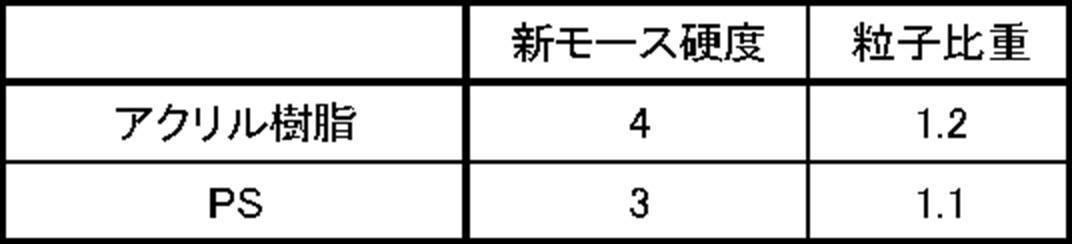
本発明における二酸化炭素分離層形成用塗布液において、特定フィラーは、いずれかを1種単独で使用してもよく、2種以上を併用してもよい。
二酸化炭素分離層形成用塗布液中の特定フィラーの含有量は、その種類にもよるが、膜強度の観点から、二酸化炭素分離層形成用塗布液の全質量中、0.1質量%~10質量%であることが好ましく、0.3質量%~8質量%であることがより好ましく、0.5質量%~5質量%であることが特に好ましい。
また、特定フィラーの含有量は、前述の吸水性ポリマーの固形分に対して質量基準で、1質量%~350質量%であることが好ましく、5質量%~200質量%であることがより好ましく、10質量%~100質量%であることが特に好ましい。
また、特定フィラーの含有量は、前述の吸水性ポリマーの固形分に対して質量基準で、1質量%~350質量%であることが好ましく、5質量%~200質量%であることがより好ましく、10質量%~100質量%であることが特に好ましい。
(その他の成分)
本発明における二酸化炭素分離層形成用塗布液は、二酸化炭素分離層の膜強度等に影響を与えない範囲で、吸水性ポリマー、アルカリ金属塩及び特定フィラー以外の、1以上のその他の成分を含むことができる。
その他の成分としては、多糖類、架橋剤、アルカリ金属塩以外の二酸化炭素キャリア等の他にも、界面活性剤、触媒、保湿(吸水)剤、補助溶剤、膜強度調整剤、欠陥検出剤が挙げられる。
本発明における二酸化炭素分離層形成用塗布液は、二酸化炭素分離層の膜強度等に影響を与えない範囲で、吸水性ポリマー、アルカリ金属塩及び特定フィラー以外の、1以上のその他の成分を含むことができる。
その他の成分としては、多糖類、架橋剤、アルカリ金属塩以外の二酸化炭素キャリア等の他にも、界面活性剤、触媒、保湿(吸水)剤、補助溶剤、膜強度調整剤、欠陥検出剤が挙げられる。
(多糖類)
本発明における二酸化炭素分離層形成用塗布液は、さらに多糖類を含んでいてもよい。
多糖類としては、二酸化炭素分離層形成用塗布液を支持体上に塗布して形成した塗布膜を冷却することにより、膜厚均一性が高いゲル膜(セット膜)を形成することができるものであれば、制限なく用いることができる。
多糖類としては、例えば、デンプン類、セルロース類、アガロース、キサンタンガム、グアーガム、グルコマンナン、カードラン、カラギーナン、キサンタンガム、ジェランガム、デキストラン、ローカストビーンガム、アルギン酸類、ヒアルロン酸類などを用いることができるが、製膜性、入手容易性、コスト、膜強度などの点から寒天が好ましい。
市販品としては、伊那寒天UP-37、UM-11S、SY-8、ZY-4、ZY-6(以上、伊那食品工業社製)、Agarose H、Agarose S(以上、ニッポンジーン社製)などが挙げられる。
本発明における二酸化炭素分離層形成用塗布液において、多糖類は単独で用いても複数を混合して用いても良い。これらの多糖類の中には混合することでゲル化能の上がるものが知られており、ゲル化剤として、ゲル化速度やゲル化能力、ゲル化温度の調整のために混合して用いることが出来る。
また本発明で用いることができる多糖類は、吸水性ポリマーを兼ねることも出来る。この場合の使用量は吸水性ポリマーの使用量や含率に準ずる。
多糖類は、いずれかを1種単独で使用してもよく、2種以上を併用してもよい。
本発明における二酸化炭素分離層形成用塗布液は、さらに多糖類を含んでいてもよい。
多糖類としては、二酸化炭素分離層形成用塗布液を支持体上に塗布して形成した塗布膜を冷却することにより、膜厚均一性が高いゲル膜(セット膜)を形成することができるものであれば、制限なく用いることができる。
多糖類としては、例えば、デンプン類、セルロース類、アガロース、キサンタンガム、グアーガム、グルコマンナン、カードラン、カラギーナン、キサンタンガム、ジェランガム、デキストラン、ローカストビーンガム、アルギン酸類、ヒアルロン酸類などを用いることができるが、製膜性、入手容易性、コスト、膜強度などの点から寒天が好ましい。
市販品としては、伊那寒天UP-37、UM-11S、SY-8、ZY-4、ZY-6(以上、伊那食品工業社製)、Agarose H、Agarose S(以上、ニッポンジーン社製)などが挙げられる。
本発明における二酸化炭素分離層形成用塗布液において、多糖類は単独で用いても複数を混合して用いても良い。これらの多糖類の中には混合することでゲル化能の上がるものが知られており、ゲル化剤として、ゲル化速度やゲル化能力、ゲル化温度の調整のために混合して用いることが出来る。
また本発明で用いることができる多糖類は、吸水性ポリマーを兼ねることも出来る。この場合の使用量は吸水性ポリマーの使用量や含率に準ずる。
多糖類は、いずれかを1種単独で使用してもよく、2種以上を併用してもよい。
二酸化炭素分離層形成用塗布液中の多糖類の含有量としては、その種類にもよるが、多糖類の含有量が多過ぎると塗布液が短時間で高粘度となって塗布し難くなる場合があり、塗布欠陥が発生する可能性がある。また、膜厚均一性の低下を抑制する観点から、多糖類の含有量は、二酸化炭素分離層形成用塗布液の全質量中、10質量%以下が好ましく、0.1質量%~8質量%であることがより好ましく、0.3質量%~5質量%であることがより好ましい。
(架橋剤)
吸水性ポリマーの架橋は熱架橋、紫外線架橋、電子線架橋、放射線架橋など従来公知の手法が実施することができる。本発明における二酸化炭素分離層形成用塗布液は、架橋剤を含むことが好ましい。特に、ビニルアルコール-アクリル酸塩共重合体と反応し熱架橋し得る官能基を2以上有する架橋剤を含むことが好ましい。好ましい架橋剤としては、多価グリシジルエーテル、多価アルコール、多価イソシアネート、多価アジリジン、ハロエポキシ化合物、多価アルデヒド、多価アミン等が挙げられる。
ここで、上記多価グリシジルエーテルとしては、例えば、エチレングリコールジグリシジルエーテル、ポリエチレングリコールジグリシジルエーテル、グリセロールポリグリシジルエーテル、ジグリセロールポリグリシジルエーテル、ポリグリセロールポリグリシジルエーテル、ソルビトールポリグリシジルエーテル、ペンタエリスリトールポリグリシジルエーテル、プロピレングリコールグリシジルエーテル、ポリプロピレングリコールジグリシジルエーテル等が挙げられる。
また、上記多価アルコールとしては、例えば、エチレングリコール、ジエチレングリコール、トリエチレングリコール、テトラエチレングリコール、ポリエチレングリコール、グリセリン、ポリグリセリン、プロピレングリコール、ジエタノールアミン、トリエタノールアミン、ポリオキシプロピル、オキシエチエンオキシプロピレンブロック共重合体、ペンタエリスリトール、ソビトール等が挙げられる。
また、上記多価イソシアネートとしては、例えば、2,4-トルイレンジイソシアネート、ヘキサメチレンジイソシアネート等が挙げられる。また、上記多価アジリジンとしては、例えば、2,2-ビスヒドロキシメチルブタノール-トリス〔3-(1-アシリジニル)プロピオネート〕、1,6-ヘキサメチレンジエチレンウレア、ジフェニルメタン-ビス-4,4’-N,N’-ジエチレンウレア等が挙げられる。
また、上記ハロエポキシ化合物としては、例えば、エピクロルヒドリン、α-メチルクロルヒドリン等が挙げられる。
また、上記多価アルデヒドとしては、例えば、グルタルアルデヒド、グリオキサール等が挙げられる。
また、上記多価アミンとしては、例えば、エチレンジアミン、ジエチレントリアミン、トリエチレンテトラミン、テトラエチレンペンタミン、ペンタエチレンヘキサミン、ポリエチレンイミン等が挙げられる。
上記架橋剤のうち、ビニルアルコール-アクリル酸塩共重合体の熱架橋剤としてはグルタルアルデヒドが特に好ましい。
吸水性ポリマーの架橋は熱架橋、紫外線架橋、電子線架橋、放射線架橋など従来公知の手法が実施することができる。本発明における二酸化炭素分離層形成用塗布液は、架橋剤を含むことが好ましい。特に、ビニルアルコール-アクリル酸塩共重合体と反応し熱架橋し得る官能基を2以上有する架橋剤を含むことが好ましい。好ましい架橋剤としては、多価グリシジルエーテル、多価アルコール、多価イソシアネート、多価アジリジン、ハロエポキシ化合物、多価アルデヒド、多価アミン等が挙げられる。
ここで、上記多価グリシジルエーテルとしては、例えば、エチレングリコールジグリシジルエーテル、ポリエチレングリコールジグリシジルエーテル、グリセロールポリグリシジルエーテル、ジグリセロールポリグリシジルエーテル、ポリグリセロールポリグリシジルエーテル、ソルビトールポリグリシジルエーテル、ペンタエリスリトールポリグリシジルエーテル、プロピレングリコールグリシジルエーテル、ポリプロピレングリコールジグリシジルエーテル等が挙げられる。
また、上記多価アルコールとしては、例えば、エチレングリコール、ジエチレングリコール、トリエチレングリコール、テトラエチレングリコール、ポリエチレングリコール、グリセリン、ポリグリセリン、プロピレングリコール、ジエタノールアミン、トリエタノールアミン、ポリオキシプロピル、オキシエチエンオキシプロピレンブロック共重合体、ペンタエリスリトール、ソビトール等が挙げられる。
また、上記多価イソシアネートとしては、例えば、2,4-トルイレンジイソシアネート、ヘキサメチレンジイソシアネート等が挙げられる。また、上記多価アジリジンとしては、例えば、2,2-ビスヒドロキシメチルブタノール-トリス〔3-(1-アシリジニル)プロピオネート〕、1,6-ヘキサメチレンジエチレンウレア、ジフェニルメタン-ビス-4,4’-N,N’-ジエチレンウレア等が挙げられる。
また、上記ハロエポキシ化合物としては、例えば、エピクロルヒドリン、α-メチルクロルヒドリン等が挙げられる。
また、上記多価アルデヒドとしては、例えば、グルタルアルデヒド、グリオキサール等が挙げられる。
また、上記多価アミンとしては、例えば、エチレンジアミン、ジエチレントリアミン、トリエチレンテトラミン、テトラエチレンペンタミン、ペンタエチレンヘキサミン、ポリエチレンイミン等が挙げられる。
上記架橋剤のうち、ビニルアルコール-アクリル酸塩共重合体の熱架橋剤としてはグルタルアルデヒドが特に好ましい。
架橋剤は、いずれかを1種単独で使用してもよく、2種以上を併用してもよい。
架橋剤の含有量としては、その種類にもよるが、二酸化炭素分離層の膜強度、耐久性、分離性能の観点から、二酸化炭素分離層形成用塗布液の全質量中、0.0001質量%~5質量%であることが好ましく、0.001質量%~1質量%であることがより好ましく、0.002質量%~0.5質量%であることがさらに好ましい。
(他の二酸化炭素キャリア)
本発明における二酸化炭素分離層形成用塗布液は、前述したアルカリ金属塩の他にも、公知の二酸化炭素キャリアを含有していてもよい。
他の二酸化炭素キャリアとしては、前述のアルカリ金属塩以外の成分であり、二酸化炭素との親和性を有し、且つ塩基性を示す各種の水溶性の無機及び有機物質であればよい。
他の二酸化炭素キャリアとしては、アンモニア、アンモニウム塩、直鎖状アミン、環状アミン、アミン塩、アルカノールアミン、アンモニウム塩等が挙げられる。またこれらの水溶性誘導体も好ましく用いることが出来る。
また、二酸化炭素分離用複合体中に長期間保持できるという観点から、アミノ酸やベタインなどの蒸発しづらいアミン含有化合物が特に好ましい。
本発明における二酸化炭素分離層形成用塗布液は、前述したアルカリ金属塩の他にも、公知の二酸化炭素キャリアを含有していてもよい。
他の二酸化炭素キャリアとしては、前述のアルカリ金属塩以外の成分であり、二酸化炭素との親和性を有し、且つ塩基性を示す各種の水溶性の無機及び有機物質であればよい。
他の二酸化炭素キャリアとしては、アンモニア、アンモニウム塩、直鎖状アミン、環状アミン、アミン塩、アルカノールアミン、アンモニウム塩等が挙げられる。またこれらの水溶性誘導体も好ましく用いることが出来る。
また、二酸化炭素分離用複合体中に長期間保持できるという観点から、アミノ酸やベタインなどの蒸発しづらいアミン含有化合物が特に好ましい。
アルカノールアミンとしては、モノエタノールアミン、ジエタノールアミン、トリエタノールアミン、モノプロパノールアミン、ジプロパノールアミン、トリプロパノールアミン等の水溶性を有する各種のものを挙げることができる。
アミノ酸としてはグリシン、アラニン、セリン、プロリン、ヒスチジン、システイン、タウリン、ジアミノプロピオン酸、ホスホセリン、サルコシン、ジメチルグリシン、βアラニン、2-アミノイソ酪酸など天然、非天然に限らず用いることができ、またいくつかのアミノ酸が連なったペプチドでもよい。なお、疎水性のアミノ酸の場合、親水性のゲル膜と相分離を起こして二酸化炭素以外のガスの透過度も上昇するが、親水性のアミノ酸は溶解度が高く、吸水性ポリマー及び多糖類との親和性も高いので特に好ましい。具体的には、アミノ酸の親疎水性を示す指標であるLogP値(P:オクタノール-水系への分配係数)が、-1.5以下であることが好ましく、-2.0以下がより好ましく、-2.5以下が特に好ましい。LogP値が-2.5以下のアミノ酸としては、アルギニン、リシン、アスパラギン酸、グルタミン酸、グルタミン、ヒスチジン、プロリン、セリン、トレオニン、グリシン、アラニン、ジアミノプロピオン酸、タウリン等が挙げられる。
なお、アミノ酸のLogP値は、計算化学的手法あるいは経験的方法により見積もられる。計算方法としては、Crippen’s fragmentation法(J.Chem.Inf.Comput.Sci.,27,21(1987).)、Viswanadhan’s fragmentation法(J.Chem.Inf.Comput.Sci.,29,163(1989).)、Broto’s fragmentation法(Eur.J.Med.Chem.- Chim.Theor.,19,71(1984).)などがあるが、ある化合物のlogPの値が測定方法あるいは計算方法により異なる場合には、本発明では、Crippen’s fragmentation法により判断する。
なお、アミノ酸のLogP値は、計算化学的手法あるいは経験的方法により見積もられる。計算方法としては、Crippen’s fragmentation法(J.Chem.Inf.Comput.Sci.,27,21(1987).)、Viswanadhan’s fragmentation法(J.Chem.Inf.Comput.Sci.,29,163(1989).)、Broto’s fragmentation法(Eur.J.Med.Chem.- Chim.Theor.,19,71(1984).)などがあるが、ある化合物のlogPの値が測定方法あるいは計算方法により異なる場合には、本発明では、Crippen’s fragmentation法により判断する。
具体的に好ましいアミノ酸は、アルギニン、リシン、アスパラギン酸、グルタミン酸、グルタミン、ヒスチジン、プロリン、セリン、トレオニン、グリシン、アラニン、ジアミノプロピオン酸、タウリンであり、より好ましくはグリシン、セリン、アラニン、ジアミノプロピオン酸、タウリンであり、特に好ましくはグリシン、セリンである。
アルカリ金属塩のうち、アルカリ金属炭酸塩及びアミノ酸を併用した態様は、二酸化炭素透過速度、分離係数の向上の点から好ましい。特に炭酸セシウム、炭酸ルビジウム、及び炭酸カリウムの1種以上に、親水性のアミノ酸を添加することが好ましい。中でもグリシン及び/又はセリンを用いることが好ましい。アルカリ金属炭酸塩のほかにアミノ酸が添加されることで、アミノ酸による二酸化炭素の吸収、放散の経路も形成され、二酸化炭素の透過が促進されると考えられる。
ベタインとしては、カルニチン、トリメチルグリシンが挙げられ、特にトリメチルグリシンが好ましい。
他の二酸化炭素キャリアはいずれかを1種単独で使用してもよく、2種以上を混合して使用してもよい。
二酸化炭素分離層形成用塗布液中の他の二酸化炭素キャリアの含有量としては、その種類にもよるが、塗布前の塩析を防ぐとともに、二酸化炭素の分離機能を確実に発揮させるため、二酸化炭素分離層形成用塗布液の全質量中、0.001質量%~10質量%であることが好ましく、0.01質量%~8質量%であることがより好ましく、0.1質量%~5質量%であることが特に好ましい。
(二酸化炭素分離層形成用塗布液の調製方法)
二酸化炭素分離層形成用塗布液は、上述の吸水性ポリマー、アルカリ金属塩、及び特定フィラー、さらに必要に応じてその他の成分を、それぞれ適量で水(常温水、加温水及び85℃以上の熱水溶液)に添加して十分攪拌して行い、必要に応じて攪拌しながら加熱することで分散を促進させることで調製することが好ましい。
なお、吸水性ポリマー、アルカリ金属塩、及び特定フィラーを別々に水に添加してもよいし、予め混ぜ合わせたものを添加してもよい。
例えば、吸水性ポリマー及びアルカリ金属塩を水に加えて分散させた後、これに特定フィラーを徐々に加えて攪拌することで、吸水性ポリマーの析出を効果的に防ぐことができる。
また、他の成分として多糖類を添加する場合には、多糖類の析出を防ぐ観点から、85℃以上の熱水を使用することが好ましい。
二酸化炭素分離層形成用塗布液は、上述の吸水性ポリマー、アルカリ金属塩、及び特定フィラー、さらに必要に応じてその他の成分を、それぞれ適量で水(常温水、加温水及び85℃以上の熱水溶液)に添加して十分攪拌して行い、必要に応じて攪拌しながら加熱することで分散を促進させることで調製することが好ましい。
なお、吸水性ポリマー、アルカリ金属塩、及び特定フィラーを別々に水に添加してもよいし、予め混ぜ合わせたものを添加してもよい。
例えば、吸水性ポリマー及びアルカリ金属塩を水に加えて分散させた後、これに特定フィラーを徐々に加えて攪拌することで、吸水性ポリマーの析出を効果的に防ぐことができる。
また、他の成分として多糖類を添加する場合には、多糖類の析出を防ぐ観点から、85℃以上の熱水を使用することが好ましい。
[乾燥工程]
乾燥工程においては、支持体上に付与した二酸化炭素分離層形成用塗布液を乾燥して二酸化炭素分離層を得る。
加熱部40に搬送された支持体12上のゲル膜に温風を当てて乾燥させる。
風速は、ゲル膜を迅速に乾燥させることができるともにゲル膜が崩れない速度、例えば1m/分~80m/分が好ましく、さらには2m/分~70m/分がより好ましく、さらには3m/分~60m/分が特に好ましい。
風の温度は、支持体の変形などが生じず、かつ、二酸化炭素分離層形成用塗布液を迅速に乾燥させることができるように膜面温度1℃~80℃が好ましく、さらには2℃~70℃がより好ましく、さらには3℃~60℃が特に好ましい。
乾燥工程においては、支持体上に付与した二酸化炭素分離層形成用塗布液を乾燥して二酸化炭素分離層を得る。
加熱部40に搬送された支持体12上のゲル膜に温風を当てて乾燥させる。
風速は、ゲル膜を迅速に乾燥させることができるともにゲル膜が崩れない速度、例えば1m/分~80m/分が好ましく、さらには2m/分~70m/分がより好ましく、さらには3m/分~60m/分が特に好ましい。
風の温度は、支持体の変形などが生じず、かつ、二酸化炭素分離層形成用塗布液を迅速に乾燥させることができるように膜面温度1℃~80℃が好ましく、さらには2℃~70℃がより好ましく、さらには3℃~60℃が特に好ましい。
[その他の工程]
本発明における二酸化炭素分離用複合体の製造方法は、付与工程及び乾燥工程の他に、必要に応じて他の工程を含んでもよい。
(冷却工程)
塗布液に多糖類が含まれる場合等には、塗布液の粘度をより好適な範囲に調整するといった観点から、乾燥工程の前に、冷却工程を含むことが好ましい。また、冷却工程後の膜はゲル状に固定化されているため、乾燥用の風が当たっても崩れずに乾燥する点からも、冷却工程の後に、乾燥工程を行うことが好ましい。なお、付与に適する粘度を有する塗布液を用いる場合には、冷却工程は必ずしも必要ではない。
本発明における二酸化炭素分離用複合体の製造方法は、付与工程及び乾燥工程の他に、必要に応じて他の工程を含んでもよい。
(冷却工程)
塗布液に多糖類が含まれる場合等には、塗布液の粘度をより好適な範囲に調整するといった観点から、乾燥工程の前に、冷却工程を含むことが好ましい。また、冷却工程後の膜はゲル状に固定化されているため、乾燥用の風が当たっても崩れずに乾燥する点からも、冷却工程の後に、乾燥工程を行うことが好ましい。なお、付与に適する粘度を有する塗布液を用いる場合には、冷却工程は必ずしも必要ではない。
冷却工程は、付与工程において支持体12上に得られた二酸化炭素分離層形成用塗布液を冷却してゲル膜を得る。
塗布液が付与された支持体が冷却部30に搬送されて直ちに冷却されることで、塗布液中に含まれる多糖類の凝固作用によって塗布液がゲル化(固定化)し、安定したゲル膜(セット膜)が得られる。
塗布液が付与された支持体が冷却部30に搬送されて直ちに冷却されることで、塗布液中に含まれる多糖類の凝固作用によって塗布液がゲル化(固定化)し、安定したゲル膜(セット膜)が得られる。
冷却工程における冷却温度は、高過ぎると固定化に時間がかかって膜厚均一性が低下するおそれがあり、低すぎるとゲル膜が凍結し膜質が変化してしまうおそれがある。付与した塗布液の厚みをほぼ保ったゲル膜が得られるように、塗布液成分、濃度(特に多糖類の種類及び濃度)に応じて決めればよいが、冷却工程における冷却温度は、支持体12上の塗布液を迅速にゲル化してゲル膜を形成する観点から湿球温度で35℃以下、特に1℃~35℃が好ましく、さらには2℃~20℃がより好ましく、さらには5℃~15℃が特に好ましい。
また冷却工程における通過時間は生産性の向上などの観点から、1秒~200秒が好ましく、さらには20秒~150秒がより好ましく、さらには30秒~100秒が特に好ましい。
また冷却工程における通過時間は生産性の向上などの観点から、1秒~200秒が好ましく、さらには20秒~150秒がより好ましく、さらには30秒~100秒が特に好ましい。
このように、本発明における二酸化炭素分離層形成用塗布液を支持体に付与した後、迅速にゲル化してゲル膜とすることができるため、二酸化炭素分離層の膜厚を精度良く制御することができる。従って、膜厚が大きく、厚さが均一な二酸化炭素分離用複合体を形成することができ、高いガス分離特性を有する二酸化炭素分離用複合体を高い生産性で製造することができる。
(架橋工程)
架橋工程は乾燥工程と同時に行ってもよいし、別々に行ってもよく、あるいは付与工程前の二酸化炭素分離層形成用塗布液の調製時に行ってもよい。また、架橋手法は公知の架橋手法を用いることができる。例えば、ゲル膜に温風を当てて乾燥させた後、赤外線ヒータなどの加熱手段によって架橋させてもよいし、温風によって乾燥とともに架橋させてもよい。熱架橋は例えば100~150℃程度に加熱することによって行うことができる。塗布後ゲル膜にUVあるいは電子線架橋を施し、その後乾燥させてもかまわない。なお、乾燥工程により得られた乾燥膜を巻取りロール50に巻き取った後、架橋させて二酸化炭素分離用複合体を得てもよい。
架橋工程は乾燥工程と同時に行ってもよいし、別々に行ってもよく、あるいは付与工程前の二酸化炭素分離層形成用塗布液の調製時に行ってもよい。また、架橋手法は公知の架橋手法を用いることができる。例えば、ゲル膜に温風を当てて乾燥させた後、赤外線ヒータなどの加熱手段によって架橋させてもよいし、温風によって乾燥とともに架橋させてもよい。熱架橋は例えば100~150℃程度に加熱することによって行うことができる。塗布後ゲル膜にUVあるいは電子線架橋を施し、その後乾燥させてもかまわない。なお、乾燥工程により得られた乾燥膜を巻取りロール50に巻き取った後、架橋させて二酸化炭素分離用複合体を得てもよい。
(二酸化炭素分離用複合体)
上記工程を経て本発明に係る二酸化炭素分離用複合体が得られる。二酸化炭素分離用複合体における二酸化炭素分離層は、吸水性ポリマーと、アルカリ金属塩と、特定フィラーとを含む。
上記工程を経て本発明に係る二酸化炭素分離用複合体が得られる。二酸化炭素分離用複合体における二酸化炭素分離層は、吸水性ポリマーと、アルカリ金属塩と、特定フィラーとを含む。
二酸化炭素分離用複合体は、膜強度の観点から、二酸化炭素分離層の膜厚方向に対して、支持体に接する面とは反対の面から深さ50%までの位置に、特定フィラーの全質量の60質量%以上が存在することが好ましい。また、特定フィラーの全質量の65質量%以上が存在することがより好ましく、70質量%以上が存在することがさらに好ましい。
本発明における二酸化炭素分離層では、既述のように、二酸化炭素分離層形成用塗布液の付与、乾燥時に、アルカリ金属塩と、特定フィラーとの比重の関係で、特定フィラーが表面近傍に偏在する。
より確実に特定フィラーを表面近傍に偏在させる方法として、特定フィラーを含まない、吸水ポリマー及びアルカリ金属塩を含む塗布液を、支持体上に塗布し、その後、二酸化炭素分離層形成用塗布液を重層塗布する方法が挙げられる。吸水ポリマー及びアルカリ金属塩を含む塗布液と、二酸化炭素分離層形成用塗布液とを塗布する際には、逐次でも同時でもよい。このように重層塗布することにより、比重の軽い特定フィラーは、下層に沈降することがないため、吸水ポリマー及びアルカリ金属塩を含む塗布液と、二酸化炭素分離層形成用塗布液との両者の塗布量や、二酸化炭素分離層形成用塗布液に配合する特定フィラーの含有量により、特定フィラーの二酸化炭素分離層表面近傍への偏在の程度を容易に制御することができる。
本発明における二酸化炭素分離層では、既述のように、二酸化炭素分離層形成用塗布液の付与、乾燥時に、アルカリ金属塩と、特定フィラーとの比重の関係で、特定フィラーが表面近傍に偏在する。
より確実に特定フィラーを表面近傍に偏在させる方法として、特定フィラーを含まない、吸水ポリマー及びアルカリ金属塩を含む塗布液を、支持体上に塗布し、その後、二酸化炭素分離層形成用塗布液を重層塗布する方法が挙げられる。吸水ポリマー及びアルカリ金属塩を含む塗布液と、二酸化炭素分離層形成用塗布液とを塗布する際には、逐次でも同時でもよい。このように重層塗布することにより、比重の軽い特定フィラーは、下層に沈降することがないため、吸水ポリマー及びアルカリ金属塩を含む塗布液と、二酸化炭素分離層形成用塗布液との両者の塗布量や、二酸化炭素分離層形成用塗布液に配合する特定フィラーの含有量により、特定フィラーの二酸化炭素分離層表面近傍への偏在の程度を容易に制御することができる。
本発明において、二酸化炭素分離層中における特定フィラーの局在化は、調製した二酸化炭素分離層塗布液を、PTFE製多孔質支持体(GEエナジー社製QL217EXPG、100μm厚)上に塗布膜厚1mmになるようにアプリケータを用いて塗布し、乾燥させ測定用のサンプルを作成し、塗布面に対して垂直に断面を切り出し、断面を日本電子株式会社製の走査型電子顕微鏡(SEM-EDX)で観察することにより確認する。具体的には、断面のSEM像からエネルギー分散型X線分析(EDXのマッピング)を行い、二酸化炭素分離層のうち、支持体に接する面とは反対の面から深さ50%までの範囲でフィラーが占有する断面積を算出し、その割合から確認する。
本発明の二酸化炭素分離層の表面における、直径0.5mmのサファイア針による膜面傷つき開始荷重は、20g以上であることが好ましい。また、膜面傷つき開始荷重は、25g以上であることがより好ましく、30g以上であることがさらに好ましい。
本発明において、膜面傷つき開始荷重は、調製した二酸化炭素分離層塗布液を、PTFE製多孔質支持体(GEエナジー社製QL217EXPG、100μm厚)上に塗布膜厚1mmになるようにアプリケータを用いて塗布し、乾燥させ測定用のサンプルを作成し、JIS K5600-5-5に準じた方法により測定する。具体的には、HEIDON社製連続荷重式引掻強度試験機にて、直径0.5mmのサファイア針を用いて10mm/sec.の速度で引掻き、重りを変えたときの膜表面の傷つきの有無を目視により観察する。
本発明において、膜面傷つき開始荷重は、調製した二酸化炭素分離層塗布液を、PTFE製多孔質支持体(GEエナジー社製QL217EXPG、100μm厚)上に塗布膜厚1mmになるようにアプリケータを用いて塗布し、乾燥させ測定用のサンプルを作成し、JIS K5600-5-5に準じた方法により測定する。具体的には、HEIDON社製連続荷重式引掻強度試験機にて、直径0.5mmのサファイア針を用いて10mm/sec.の速度で引掻き、重りを変えたときの膜表面の傷つきの有無を目視により観察する。
二酸化炭素分離層における各成分の組成比は、塗布液の配合比が反映される。
乾燥状態での二酸化炭素分離用複合体中の各成分の含有量は以下の範囲であることが好ましい。吸水性ポリマーは、5質量%~90質量%が好ましく、10質量%~85質量%がより好ましく、15質量%~80質量%がさらに好ましい。
アルカリ金属塩は、5質量%~90質量%が好ましく、10質量%~85質量%がより好ましく、20質量%~80質量%がさらに好ましい。
特定フィラーは、1質量%~50質量%が好ましく、3質量%~45質量%がより好ましく、5質量%~35質量%がさらに好ましい。
乾燥状態での二酸化炭素分離用複合体中の各成分の含有量は以下の範囲であることが好ましい。吸水性ポリマーは、5質量%~90質量%が好ましく、10質量%~85質量%がより好ましく、15質量%~80質量%がさらに好ましい。
アルカリ金属塩は、5質量%~90質量%が好ましく、10質量%~85質量%がより好ましく、20質量%~80質量%がさらに好ましい。
特定フィラーは、1質量%~50質量%が好ましく、3質量%~45質量%がより好ましく、5質量%~35質量%がさらに好ましい。
例えばアルカリ金属塩としてセシウムを含む化合物を用いる場合は、二酸化炭素の分離特性を向上させる観点から、乾燥状態での二酸化炭素分離用複合体中のセシウムを含む化合物の含有量は30質量%以上であることが好ましく、35質量%以上であることがより好ましく、40質量%以上であることが特に好ましい。
また、アルカリ金属塩として、例えばカリウムを含む化合物を用いる場合は、乾燥状態での二酸化炭素分離用複合体中のカリウムを含む化合物の含有量は2質量%以上であることが好ましく、3質量%以上で用いることがより好ましく、5質量%以上であることが特に好ましい。
また、アルカリ金属塩として、例えばセシウム又はカリウムを含む化合物とアミノ酸とを用いる場合は、アミノ酸は、乾燥状態での二酸化炭素分離層に対して2質量%以上であることが好ましく、3質量%以上で用いることがより好ましく、5質量%以上であることが特に好ましい。
また、アルカリ金属塩として、例えばカリウムを含む化合物を用いる場合は、乾燥状態での二酸化炭素分離用複合体中のカリウムを含む化合物の含有量は2質量%以上であることが好ましく、3質量%以上で用いることがより好ましく、5質量%以上であることが特に好ましい。
また、アルカリ金属塩として、例えばセシウム又はカリウムを含む化合物とアミノ酸とを用いる場合は、アミノ酸は、乾燥状態での二酸化炭素分離層に対して2質量%以上であることが好ましく、3質量%以上で用いることがより好ましく、5質量%以上であることが特に好ましい。
なお、二酸化炭素分離用複合体を形成した後、必要に応じて、アルカリ金属塩や他の二酸化炭素キャリアの溶出を防ぐために二酸化炭素分離用複合体上にキャリア溶出防止層を設けてもよい。キャリア溶出防止層は二酸化炭素、水蒸気などの気体は透過するが水などは透過しない性質を持つことが好ましく、疎水性の多孔質膜であることが好ましい。この様な性質の膜を膜面上に塗布しても良いし、別に作成した膜をラミネートしても良い。
<二酸化炭素分離用複合体>
本発明の二酸化炭素分離用複合体は、吸水性ポリマーと、アルカリ金属塩と、密度がアルカリ金属塩の密度より低く、硬度が新モース硬度2以上であり、且つ体積平均粒子径が二酸化炭素分離層の厚さの30%以下であるフィラーと、を含む。
吸水性ポリマー及びアルカリ金属塩及び特定フィラーについては、前述の事項が適用できる。
本発明の二酸化炭素分離用複合体は、吸水性ポリマーと、アルカリ金属塩と、密度がアルカリ金属塩の密度より低く、硬度が新モース硬度2以上であり、且つ体積平均粒子径が二酸化炭素分離層の厚さの30%以下であるフィラーと、を含む。
吸水性ポリマー及びアルカリ金属塩及び特定フィラーについては、前述の事項が適用できる。
<二酸化炭素分離用モジュール>
本発明の二酸化炭素分離用モジュールは、二酸化炭素分離用複合体を備えるモジュールである。二酸化炭素分離用複合体については、前述の<二酸化炭素分離用複合体>の項で述べた事項をそのまま適用する。
本発明の二酸化炭素分離用モジュールは、二酸化炭素分離用複合体を平膜として設置してもよいし、逆浸透膜モジュールとして知られるスパイラル型やプリーツ型などに加工して利用することもできる。
本発明の二酸化炭素分離用モジュールは、二酸化炭素分離用複合体を備えるモジュールである。二酸化炭素分離用複合体については、前述の<二酸化炭素分離用複合体>の項で述べた事項をそのまま適用する。
本発明の二酸化炭素分離用モジュールは、二酸化炭素分離用複合体を平膜として設置してもよいし、逆浸透膜モジュールとして知られるスパイラル型やプリーツ型などに加工して利用することもできる。
以下、本発明を実施例により更に具体的に説明するが、本発明はその主旨を越えない限り、以下の実施例に限定されるものではない。
(実施例1)
寒天(伊那食品工業社製、伊那寒天UP-37)0.5質量%、ビニルアルコール-アクリル酸塩共重合体(ナトリウム塩、クラレ社製、クラストマーAP20)2.5質量%、炭酸セシウム(稀産金属社製)6.0質量%、グルタルアルデヒド0.2質量%を含む熱水溶液(温度:85℃以上)を調製し、さらにシリカ(日産化学社製、ST-30)を1.25質量%添加して、分離層形成用塗布液を調製した。
調製した分離層形成用塗布液を、PTFE製多孔質支持体(GEエナジー社製QL217EXPG、100μm厚)に、Roll-to-Roll方式で塗布し、膜面温度35℃以下に冷却し、その後乾燥させて製膜した。これを巻取り、二酸化炭素分離用複合体を得た。
寒天(伊那食品工業社製、伊那寒天UP-37)0.5質量%、ビニルアルコール-アクリル酸塩共重合体(ナトリウム塩、クラレ社製、クラストマーAP20)2.5質量%、炭酸セシウム(稀産金属社製)6.0質量%、グルタルアルデヒド0.2質量%を含む熱水溶液(温度:85℃以上)を調製し、さらにシリカ(日産化学社製、ST-30)を1.25質量%添加して、分離層形成用塗布液を調製した。
調製した分離層形成用塗布液を、PTFE製多孔質支持体(GEエナジー社製QL217EXPG、100μm厚)に、Roll-to-Roll方式で塗布し、膜面温度35℃以下に冷却し、その後乾燥させて製膜した。これを巻取り、二酸化炭素分離用複合体を得た。
(実施例2)
寒天(伊那食品工業社製、伊那寒天UP-37)0.5質量%、ビニルアルコール-アクリル酸塩共重合体(ナトリウム塩、クラレ社製、クラストマーAP20)2.5質量%、炭酸セシウム(稀産金属社製)6.0質量%、グルタルアルデヒド0.2質量%を含む熱水溶液(温度:85℃以上)を調製し、さらにシリカ(日産化学社製、ST-30)を2.0質量%添加して、分離層形成用塗布液を調製した。
調製した分離層形成用塗布液を、PTFE製多孔質支持体(GEエナジー社製QL217EXPG、100μm厚)に、Roll-to-Roll方式で塗布し、膜面温度35℃以下に冷却し、その後乾燥させて製膜した。これを巻取り、二酸化炭素分離用複合体を得た。
寒天(伊那食品工業社製、伊那寒天UP-37)0.5質量%、ビニルアルコール-アクリル酸塩共重合体(ナトリウム塩、クラレ社製、クラストマーAP20)2.5質量%、炭酸セシウム(稀産金属社製)6.0質量%、グルタルアルデヒド0.2質量%を含む熱水溶液(温度:85℃以上)を調製し、さらにシリカ(日産化学社製、ST-30)を2.0質量%添加して、分離層形成用塗布液を調製した。
調製した分離層形成用塗布液を、PTFE製多孔質支持体(GEエナジー社製QL217EXPG、100μm厚)に、Roll-to-Roll方式で塗布し、膜面温度35℃以下に冷却し、その後乾燥させて製膜した。これを巻取り、二酸化炭素分離用複合体を得た。
(実施例3)
寒天(伊那食品工業社製、伊那寒天UP-37)0.5質量%、ビニルアルコール-アクリル酸塩共重合体(ナトリウム塩、クラレ社製、クラストマーAP20)2.5質量%、炭酸セシウム(稀産金属社製)6.0質量%、グルタルアルデヒド0.2質量%を含む熱水溶液(温度:85℃以上)を調製し、さらにシリカ(日産化学社製、ST-ZL)を1.25質量%添加して、分離層形成用塗布液を調製した。
調製した分離層形成用塗布液を、PTFE製多孔質支持体(GEエナジー社製QL217EXPG、100μm厚)に、Roll-to-Roll方式で塗布し、膜面温度35℃以下に冷却し、その後乾燥させて製膜した。これを巻取り、二酸化炭素分離用複合体を得た。
寒天(伊那食品工業社製、伊那寒天UP-37)0.5質量%、ビニルアルコール-アクリル酸塩共重合体(ナトリウム塩、クラレ社製、クラストマーAP20)2.5質量%、炭酸セシウム(稀産金属社製)6.0質量%、グルタルアルデヒド0.2質量%を含む熱水溶液(温度:85℃以上)を調製し、さらにシリカ(日産化学社製、ST-ZL)を1.25質量%添加して、分離層形成用塗布液を調製した。
調製した分離層形成用塗布液を、PTFE製多孔質支持体(GEエナジー社製QL217EXPG、100μm厚)に、Roll-to-Roll方式で塗布し、膜面温度35℃以下に冷却し、その後乾燥させて製膜した。これを巻取り、二酸化炭素分離用複合体を得た。
(実施例4)
寒天(伊那食品工業社製、伊那寒天UP-37)0.5質量%、ビニルアルコール-アクリル酸塩共重合体(ナトリウム塩、クラレ社製、クラストマーAP20)2.5質量%、炭酸セシウム(稀産金属社製)6.0質量%、グルタルアルデヒド0.2質量%を含む熱水溶液(温度:85℃以上)を調製し、さらにシリカ(日産化学社製、MP-4540M)を1.25質量%添加して、分離層形成用塗布液を調製した。
調製した分離層形成用塗布液を、PTFE製多孔質支持体(GEエナジー社製QL217EXPG、100μm厚)に、Roll-to-Roll方式で塗布し、膜面温度35℃以下に冷却し、その後乾燥させて製膜した。これを巻取り、二酸化炭素分離用複合体を得た。
寒天(伊那食品工業社製、伊那寒天UP-37)0.5質量%、ビニルアルコール-アクリル酸塩共重合体(ナトリウム塩、クラレ社製、クラストマーAP20)2.5質量%、炭酸セシウム(稀産金属社製)6.0質量%、グルタルアルデヒド0.2質量%を含む熱水溶液(温度:85℃以上)を調製し、さらにシリカ(日産化学社製、MP-4540M)を1.25質量%添加して、分離層形成用塗布液を調製した。
調製した分離層形成用塗布液を、PTFE製多孔質支持体(GEエナジー社製QL217EXPG、100μm厚)に、Roll-to-Roll方式で塗布し、膜面温度35℃以下に冷却し、その後乾燥させて製膜した。これを巻取り、二酸化炭素分離用複合体を得た。
(実施例5)
寒天(伊那食品工業社製、伊那寒天UP-37)0.5質量%、ビニルアルコール-アクリル酸塩共重合体(ナトリウム塩、クラレ社製、クラストマーAP20)2.5質量%、炭酸セシウム(稀産金属社製)6.0質量%、グルタルアルデヒド0.2質量%を含む熱水溶液(温度:85℃以上)を調製し、さらにシリカ(日本触媒社製、KE-P100)を0.75質量%添加して、分離層形成用塗布液を調製した。
調製した分離層形成用塗布液を、PTFE製多孔質支持体(GEエナジー社製QL217EXPG、100μm厚)に、Roll-to-Roll方式で塗布し、膜面温度35℃以下に冷却し、その後乾燥させて製膜した。これを巻取り、二酸化炭素分離用複合体を得た。
寒天(伊那食品工業社製、伊那寒天UP-37)0.5質量%、ビニルアルコール-アクリル酸塩共重合体(ナトリウム塩、クラレ社製、クラストマーAP20)2.5質量%、炭酸セシウム(稀産金属社製)6.0質量%、グルタルアルデヒド0.2質量%を含む熱水溶液(温度:85℃以上)を調製し、さらにシリカ(日本触媒社製、KE-P100)を0.75質量%添加して、分離層形成用塗布液を調製した。
調製した分離層形成用塗布液を、PTFE製多孔質支持体(GEエナジー社製QL217EXPG、100μm厚)に、Roll-to-Roll方式で塗布し、膜面温度35℃以下に冷却し、その後乾燥させて製膜した。これを巻取り、二酸化炭素分離用複合体を得た。
(実施例6)
寒天(伊那食品工業社製、伊那寒天UP-37)0.5質量%、ビニルアルコール-アクリル酸塩共重合体(ナトリウム塩、クラレ社製、クラストマーAP20)2.5質量%、炭酸セシウム(稀産金属社製)6.0質量%、グルタルアルデヒド0.2質量%を含む熱水溶液(温度:85℃以上)を調製し、さらにシリカ(日本触媒社製、KE-P100)を1.25質量%添加して、分離層形成用塗布液を調製した。
調製した分離層形成用塗布液を、PTFE製多孔質支持体(GEエナジー社製QL217EXPG、100μm厚)に、Roll-to-Roll方式で塗布し、膜面温度35℃以下に冷却し、その後乾燥させて製膜した。これを巻取り、二酸化炭素分離用複合体を得た。
寒天(伊那食品工業社製、伊那寒天UP-37)0.5質量%、ビニルアルコール-アクリル酸塩共重合体(ナトリウム塩、クラレ社製、クラストマーAP20)2.5質量%、炭酸セシウム(稀産金属社製)6.0質量%、グルタルアルデヒド0.2質量%を含む熱水溶液(温度:85℃以上)を調製し、さらにシリカ(日本触媒社製、KE-P100)を1.25質量%添加して、分離層形成用塗布液を調製した。
調製した分離層形成用塗布液を、PTFE製多孔質支持体(GEエナジー社製QL217EXPG、100μm厚)に、Roll-to-Roll方式で塗布し、膜面温度35℃以下に冷却し、その後乾燥させて製膜した。これを巻取り、二酸化炭素分離用複合体を得た。
(実施例7)
寒天(伊那食品工業社製、伊那寒天UP-37)0.5質量%、ビニルアルコール-アクリル酸塩共重合体(ナトリウム塩、クラレ社製、クラストマーAP20)2.5質量%、炭酸セシウム(稀産金属社製)6.0質量%、グルタルアルデヒド0.2質量%を含む熱水溶液(温度:85℃以上)を調製し、さらにシリカ(日本触媒社製、KE-S250)を0.75質量%添加して、分離層形成用塗布液を調製した。
調製した分離層形成用塗布液を、PTFE製多孔質支持体(GEエナジー社製QL217EXPG、100μm厚)に、Roll-to-Roll方式で塗布し、膜面温度35℃以下に冷却し、その後乾燥させて製膜した。これを巻取り、二酸化炭素分離用複合体を得た。
寒天(伊那食品工業社製、伊那寒天UP-37)0.5質量%、ビニルアルコール-アクリル酸塩共重合体(ナトリウム塩、クラレ社製、クラストマーAP20)2.5質量%、炭酸セシウム(稀産金属社製)6.0質量%、グルタルアルデヒド0.2質量%を含む熱水溶液(温度:85℃以上)を調製し、さらにシリカ(日本触媒社製、KE-S250)を0.75質量%添加して、分離層形成用塗布液を調製した。
調製した分離層形成用塗布液を、PTFE製多孔質支持体(GEエナジー社製QL217EXPG、100μm厚)に、Roll-to-Roll方式で塗布し、膜面温度35℃以下に冷却し、その後乾燥させて製膜した。これを巻取り、二酸化炭素分離用複合体を得た。
(実施例8)
寒天(伊那食品工業社製、伊那寒天UP-37)0.5質量%、ビニルアルコール-アクリル酸塩共重合体(ナトリウム塩、クラレ社製、クラストマーAP20)2.5質量%、炭酸セシウム(稀産金属社製)6.0質量%、グルタルアルデヒド0.2質量%を含む熱水溶液(温度:85℃以上)を調製し、さらにアルミナ(日本軽金属社製、LS-242C)を0.5質量%添加して、分離層形成用塗布液を調製した。
調製した分離層形成用塗布液を、PTFE製多孔質支持体(GEエナジー社製QL217EXPG、100μm厚)に、Roll-to-Roll方式で塗布し、膜面温度35℃以下に冷却し、その後乾燥させて製膜した。これを巻取り、二酸化炭素分離用複合体を得た。
寒天(伊那食品工業社製、伊那寒天UP-37)0.5質量%、ビニルアルコール-アクリル酸塩共重合体(ナトリウム塩、クラレ社製、クラストマーAP20)2.5質量%、炭酸セシウム(稀産金属社製)6.0質量%、グルタルアルデヒド0.2質量%を含む熱水溶液(温度:85℃以上)を調製し、さらにアルミナ(日本軽金属社製、LS-242C)を0.5質量%添加して、分離層形成用塗布液を調製した。
調製した分離層形成用塗布液を、PTFE製多孔質支持体(GEエナジー社製QL217EXPG、100μm厚)に、Roll-to-Roll方式で塗布し、膜面温度35℃以下に冷却し、その後乾燥させて製膜した。これを巻取り、二酸化炭素分離用複合体を得た。
(実施例9)
寒天(伊那食品工業社製、伊那寒天UP-37)0.5質量%、ビニルアルコール-アクリル酸塩共重合体(ナトリウム塩、クラレ社製、クラストマーAP20)2.5質量%、炭酸セシウム(稀産金属社製)6.0質量%、グルタルアルデヒド0.2質量%を含む熱水溶液(温度:85℃以上)を調製し、さらにアルミナ(日本軽金属社製、LS-242C)を1.25質量%添加して、分離層形成用塗布液を調製した。
調製した分離層形成用塗布液を、PTFE製多孔質支持体(GEエナジー社製QL217EXPG、100μm厚)に、Roll-to-Roll方式で塗布し、膜面温度35℃以下に冷却し、その後乾燥させて製膜した。これを巻取り、二酸化炭素分離用複合体を得た。
寒天(伊那食品工業社製、伊那寒天UP-37)0.5質量%、ビニルアルコール-アクリル酸塩共重合体(ナトリウム塩、クラレ社製、クラストマーAP20)2.5質量%、炭酸セシウム(稀産金属社製)6.0質量%、グルタルアルデヒド0.2質量%を含む熱水溶液(温度:85℃以上)を調製し、さらにアルミナ(日本軽金属社製、LS-242C)を1.25質量%添加して、分離層形成用塗布液を調製した。
調製した分離層形成用塗布液を、PTFE製多孔質支持体(GEエナジー社製QL217EXPG、100μm厚)に、Roll-to-Roll方式で塗布し、膜面温度35℃以下に冷却し、その後乾燥させて製膜した。これを巻取り、二酸化炭素分離用複合体を得た。
(実施例10)
寒天(伊那食品工業社製、伊那寒天UP-37)0.5質量%、ビニルアルコール-アクリル酸塩共重合体(ナトリウム塩、クラレ社製、クラストマーAP20)2.5質量%、炭酸セシウム(稀産金属社製)6.0質量%、グルタルアルデヒド0.2質量%を含む熱水溶液(温度:85℃以上)を調製し、さらにアルミナ(日本軽金属社製、LS-242C)を2質量%添加して、分離層形成用塗布液を調製した。
調製した分離層形成用塗布液を、PTFE製多孔質支持体(GEエナジー社製QL217EXPG、100μm厚)に、Roll-to-Roll方式で塗布し、膜面温度35℃以下に冷却し、その後乾燥させて製膜した。これを巻取り、二酸化炭素分離用複合体を得た。
寒天(伊那食品工業社製、伊那寒天UP-37)0.5質量%、ビニルアルコール-アクリル酸塩共重合体(ナトリウム塩、クラレ社製、クラストマーAP20)2.5質量%、炭酸セシウム(稀産金属社製)6.0質量%、グルタルアルデヒド0.2質量%を含む熱水溶液(温度:85℃以上)を調製し、さらにアルミナ(日本軽金属社製、LS-242C)を2質量%添加して、分離層形成用塗布液を調製した。
調製した分離層形成用塗布液を、PTFE製多孔質支持体(GEエナジー社製QL217EXPG、100μm厚)に、Roll-to-Roll方式で塗布し、膜面温度35℃以下に冷却し、その後乾燥させて製膜した。これを巻取り、二酸化炭素分離用複合体を得た。
(実施例11)
寒天(伊那食品工業社製、伊那寒天UP-37)0.5質量%、ビニルアルコール-アクリル酸塩共重合体(ナトリウム塩、クラレ社製、クラストマーAP20)2.5質量%、炭酸セシウム(稀産金属社製)6.0質量%、グルタルアルデヒド0.2質量%を含む熱水溶液(温度:85℃以上)を調製し、さらに水酸化アルミニウム(日本軽金属社製、BF-103)を0.5質量%添加して、分離層形成用塗布液を調製した。
調製した分離層形成用塗布液を、PTFE製多孔質支持体(GEエナジー社製QL217EXPG、100μm厚)に、Roll-to-Roll方式で塗布し、膜面温度35℃以下に冷却し、その後乾燥させて製膜した。これを巻取り、二酸化炭素分離用複合体を得た。
寒天(伊那食品工業社製、伊那寒天UP-37)0.5質量%、ビニルアルコール-アクリル酸塩共重合体(ナトリウム塩、クラレ社製、クラストマーAP20)2.5質量%、炭酸セシウム(稀産金属社製)6.0質量%、グルタルアルデヒド0.2質量%を含む熱水溶液(温度:85℃以上)を調製し、さらに水酸化アルミニウム(日本軽金属社製、BF-103)を0.5質量%添加して、分離層形成用塗布液を調製した。
調製した分離層形成用塗布液を、PTFE製多孔質支持体(GEエナジー社製QL217EXPG、100μm厚)に、Roll-to-Roll方式で塗布し、膜面温度35℃以下に冷却し、その後乾燥させて製膜した。これを巻取り、二酸化炭素分離用複合体を得た。
(実施例12)
寒天(伊那食品工業社製、伊那寒天UP-37)0.5質量%、ビニルアルコール-アクリル酸塩共重合体(ナトリウム塩、クラレ社製、クラストマーAP20)2.5質量%、炭酸セシウム(稀産金属社製)6.0質量%、グルタルアルデヒド0.2質量%を含む熱水溶液(温度:85℃以上)を調製し、さらに水酸化アルミニウム(日本軽金属社製、BF-103)を1.25質量%添加して、分離層形成用塗布液を調製した。
調製した分離層形成用塗布液を、PTFE製多孔質支持体(GEエナジー社製QL217EXPG、100μm厚)に、Roll-to-Roll方式で塗布し、膜面温度35℃以下に冷却し、その後乾燥させて製膜した。これを巻取り、二酸化炭素分離用複合体を得た。
寒天(伊那食品工業社製、伊那寒天UP-37)0.5質量%、ビニルアルコール-アクリル酸塩共重合体(ナトリウム塩、クラレ社製、クラストマーAP20)2.5質量%、炭酸セシウム(稀産金属社製)6.0質量%、グルタルアルデヒド0.2質量%を含む熱水溶液(温度:85℃以上)を調製し、さらに水酸化アルミニウム(日本軽金属社製、BF-103)を1.25質量%添加して、分離層形成用塗布液を調製した。
調製した分離層形成用塗布液を、PTFE製多孔質支持体(GEエナジー社製QL217EXPG、100μm厚)に、Roll-to-Roll方式で塗布し、膜面温度35℃以下に冷却し、その後乾燥させて製膜した。これを巻取り、二酸化炭素分離用複合体を得た。
(実施例13)
寒天(伊那食品工業社製、伊那寒天UP-37)0.5質量%、ビニルアルコール-アクリル酸塩共重合体(ナトリウム塩、クラレ社製、クラストマーAP20)2.5質量%、炭酸セシウム(稀産金属社製)6.0質量%、グルタルアルデヒド0.2質量%を含む熱水溶液(温度:85℃以上)を調製し、さらに水酸化アルミニウム(日本軽金属社製、B-703)を2.0質量%添加して、分離層形成用塗布液を調製した。
調製した分離層形成用塗布液を、PTFE製多孔質支持体(GEエナジー社製QL217EXPG、100μm厚)に、Roll-to-Roll方式で塗布し、膜面温度35℃以下に冷却し、その後乾燥させて製膜した。これを巻取り、二酸化炭素分離用複合体を得た。
寒天(伊那食品工業社製、伊那寒天UP-37)0.5質量%、ビニルアルコール-アクリル酸塩共重合体(ナトリウム塩、クラレ社製、クラストマーAP20)2.5質量%、炭酸セシウム(稀産金属社製)6.0質量%、グルタルアルデヒド0.2質量%を含む熱水溶液(温度:85℃以上)を調製し、さらに水酸化アルミニウム(日本軽金属社製、B-703)を2.0質量%添加して、分離層形成用塗布液を調製した。
調製した分離層形成用塗布液を、PTFE製多孔質支持体(GEエナジー社製QL217EXPG、100μm厚)に、Roll-to-Roll方式で塗布し、膜面温度35℃以下に冷却し、その後乾燥させて製膜した。これを巻取り、二酸化炭素分離用複合体を得た。
(実施例14)
寒天(伊那食品工業社製、伊那寒天UP-37)0.5質量%、ビニルアルコール-アクリル酸塩共重合体(ナトリウム塩、クラレ社製、クラストマーAP20)2.5質量%、炭酸セシウム(稀産金属社製)6.0質量%、グルタルアルデヒド0.2質量%を含む熱水溶液(温度:85℃以上)を調製し、さらに酸化マグネシウム(堺化学工業社製、SMO)を0.75質量%添加して、分離層形成用塗布液を調製した。
調製した分離層形成用塗布液を、PTFE製多孔質支持体(GEエナジー社製QL217EXPG、100μm厚)に、Roll-to-Roll方式で塗布し、膜面温度35℃以下に冷却し、その後乾燥させて製膜した。これを巻取り、二酸化炭素分離用複合体を得た。
寒天(伊那食品工業社製、伊那寒天UP-37)0.5質量%、ビニルアルコール-アクリル酸塩共重合体(ナトリウム塩、クラレ社製、クラストマーAP20)2.5質量%、炭酸セシウム(稀産金属社製)6.0質量%、グルタルアルデヒド0.2質量%を含む熱水溶液(温度:85℃以上)を調製し、さらに酸化マグネシウム(堺化学工業社製、SMO)を0.75質量%添加して、分離層形成用塗布液を調製した。
調製した分離層形成用塗布液を、PTFE製多孔質支持体(GEエナジー社製QL217EXPG、100μm厚)に、Roll-to-Roll方式で塗布し、膜面温度35℃以下に冷却し、その後乾燥させて製膜した。これを巻取り、二酸化炭素分離用複合体を得た。
(実施例15)
寒天(伊那食品工業社製、伊那寒天UP-37)0.5質量%、ビニルアルコール-アクリル酸塩共重合体(ナトリウム塩、クラレ社製、クラストマーAP20)2.5質量%、炭酸セシウム(稀産金属社製)6.0質量%、グルタルアルデヒド0.2質量%を含む熱水溶液(温度:85℃以上)を調製し、さらに酸化マグネシウム(堺化学工業社製、SMO)を1.25質量%添加して、分離層形成用塗布液を調製した。
調製した分離層形成用塗布液を、PTFE製多孔質支持体(GEエナジー社製QL217EXPG、100μm厚)に、Roll-to-Roll方式で塗布し、膜面温度35℃以下に冷却し、その後乾燥させて製膜した。これを巻取り、二酸化炭素分離用複合体を得た。
寒天(伊那食品工業社製、伊那寒天UP-37)0.5質量%、ビニルアルコール-アクリル酸塩共重合体(ナトリウム塩、クラレ社製、クラストマーAP20)2.5質量%、炭酸セシウム(稀産金属社製)6.0質量%、グルタルアルデヒド0.2質量%を含む熱水溶液(温度:85℃以上)を調製し、さらに酸化マグネシウム(堺化学工業社製、SMO)を1.25質量%添加して、分離層形成用塗布液を調製した。
調製した分離層形成用塗布液を、PTFE製多孔質支持体(GEエナジー社製QL217EXPG、100μm厚)に、Roll-to-Roll方式で塗布し、膜面温度35℃以下に冷却し、その後乾燥させて製膜した。これを巻取り、二酸化炭素分離用複合体を得た。
(実施例16)
寒天(伊那食品工業社製、伊那寒天UP-37)0.5質量%、ビニルアルコール-アクリル酸塩共重合体(ナトリウム塩、クラレ社製、クラストマーAP20)2.5質量%、炭酸セシウム(稀産金属社製)6.0質量%、グルタルアルデヒド0.2質量%を含む熱水溶液(温度:85℃以上)を調製し、さらに酸化マグネシウム(堺化学工業社製、SMO)を0.75質量%添加して、分離層形成用塗布液を調製した。
調製した分離層形成用塗布液を、PTFE製多孔質支持体(GEエナジー社製QL217EXPG、100μm厚)に、Roll-to-Roll方式で塗布し、膜面温度35℃以下に冷却し、その後乾燥させて製膜した。これを巻取り、二酸化炭素分離用複合体を得た。
寒天(伊那食品工業社製、伊那寒天UP-37)0.5質量%、ビニルアルコール-アクリル酸塩共重合体(ナトリウム塩、クラレ社製、クラストマーAP20)2.5質量%、炭酸セシウム(稀産金属社製)6.0質量%、グルタルアルデヒド0.2質量%を含む熱水溶液(温度:85℃以上)を調製し、さらに酸化マグネシウム(堺化学工業社製、SMO)を0.75質量%添加して、分離層形成用塗布液を調製した。
調製した分離層形成用塗布液を、PTFE製多孔質支持体(GEエナジー社製QL217EXPG、100μm厚)に、Roll-to-Roll方式で塗布し、膜面温度35℃以下に冷却し、その後乾燥させて製膜した。これを巻取り、二酸化炭素分離用複合体を得た。
(実施例17)
寒天(伊那食品工業社製、伊那寒天UP-37)0.5質量%、ビニルアルコール-アクリル酸塩共重合体(ナトリウム塩、クラレ社製、クラストマーAP20)2.5質量%、炭酸セシウム(稀産金属社製)6.0質量%、グルタルアルデヒド0.2質量%を含む熱水溶液(温度:85℃以上)を調製し、さらに水酸化マグネシウム(タテホ化学工業社製、PZ-1)を0.5質量%添加して、分離層形成用塗布液を調製した。
調製した分離層形成用塗布液を、PTFE製多孔質支持体(GEエナジー社製QL217EXPG、100μm厚)に、Roll-to-Roll方式で塗布し、膜面温度35℃以下に冷却し、その後乾燥させて製膜した。これを巻取り、二酸化炭素分離用複合体を得た。
寒天(伊那食品工業社製、伊那寒天UP-37)0.5質量%、ビニルアルコール-アクリル酸塩共重合体(ナトリウム塩、クラレ社製、クラストマーAP20)2.5質量%、炭酸セシウム(稀産金属社製)6.0質量%、グルタルアルデヒド0.2質量%を含む熱水溶液(温度:85℃以上)を調製し、さらに水酸化マグネシウム(タテホ化学工業社製、PZ-1)を0.5質量%添加して、分離層形成用塗布液を調製した。
調製した分離層形成用塗布液を、PTFE製多孔質支持体(GEエナジー社製QL217EXPG、100μm厚)に、Roll-to-Roll方式で塗布し、膜面温度35℃以下に冷却し、その後乾燥させて製膜した。これを巻取り、二酸化炭素分離用複合体を得た。
(実施例18)
寒天(伊那食品工業社製、伊那寒天UP-37)0.5質量%、ビニルアルコール-アクリル酸塩共重合体(ナトリウム塩、クラレ社製、クラストマーAP20)2.5質量%、炭酸セシウム(稀産金属社製)6.0質量%、グルタルアルデヒド0.2質量%を含む熱水溶液(温度:85℃以上)を調製し、さらに水酸化マグネシウム(タテホ化学工業社製、PZ-1)を1.25質量%添加して、分離層形成用塗布液を調製した。
調製した分離層形成用塗布液を、PTFE製多孔質支持体(GEエナジー社製QL217EXPG、100μm厚)に、Roll-to-Roll方式で塗布し、膜面温度35℃以下に冷却し、その後乾燥させて製膜した。これを巻取り、二酸化炭素分離用複合体を得た。
寒天(伊那食品工業社製、伊那寒天UP-37)0.5質量%、ビニルアルコール-アクリル酸塩共重合体(ナトリウム塩、クラレ社製、クラストマーAP20)2.5質量%、炭酸セシウム(稀産金属社製)6.0質量%、グルタルアルデヒド0.2質量%を含む熱水溶液(温度:85℃以上)を調製し、さらに水酸化マグネシウム(タテホ化学工業社製、PZ-1)を1.25質量%添加して、分離層形成用塗布液を調製した。
調製した分離層形成用塗布液を、PTFE製多孔質支持体(GEエナジー社製QL217EXPG、100μm厚)に、Roll-to-Roll方式で塗布し、膜面温度35℃以下に冷却し、その後乾燥させて製膜した。これを巻取り、二酸化炭素分離用複合体を得た。
(実施例19)
寒天(伊那食品工業社製、伊那寒天UP-37)0.5質量%、ビニルアルコール-アクリル酸塩共重合体(ナトリウム塩、クラレ社製、クラストマーAP20)2.5質量%、炭酸セシウム(稀産金属社製)6.0質量%、グルタルアルデヒド0.2質量%を含む熱水溶液(温度:85℃以上)を調製し、さらに炭酸カルシウム(白石カルシウム社製、Viscoexcel-30)を1.25質量%添加して、分離層形成用塗布液を調製した。
調製した分離層形成用塗布液を、PTFE製多孔質支持体(GEエナジー社製QL217EXPG、100μm厚)に、Roll-to-Roll方式で塗布し、膜面温度35℃以下に冷却し、その後乾燥させて製膜した。これを巻取り、二酸化炭素分離用複合体を得た。
寒天(伊那食品工業社製、伊那寒天UP-37)0.5質量%、ビニルアルコール-アクリル酸塩共重合体(ナトリウム塩、クラレ社製、クラストマーAP20)2.5質量%、炭酸セシウム(稀産金属社製)6.0質量%、グルタルアルデヒド0.2質量%を含む熱水溶液(温度:85℃以上)を調製し、さらに炭酸カルシウム(白石カルシウム社製、Viscoexcel-30)を1.25質量%添加して、分離層形成用塗布液を調製した。
調製した分離層形成用塗布液を、PTFE製多孔質支持体(GEエナジー社製QL217EXPG、100μm厚)に、Roll-to-Roll方式で塗布し、膜面温度35℃以下に冷却し、その後乾燥させて製膜した。これを巻取り、二酸化炭素分離用複合体を得た。
(実施例20)
寒天(伊那食品工業社製、伊那寒天UP-37)0.5質量%、ビニルアルコール-アクリル酸塩共重合体(ナトリウム塩、クラレ社製、クラストマーAP20)2.5質量%、炭酸セシウム(稀産金属社製)6.0質量%、グルタルアルデヒド0.2質量%を含む熱水溶液(温度:85℃以上)を調製し、さらに炭酸カルシウム(白石カルシウム社製、Viscoexcel-30)を2.0質量%添加して、分離層形成用塗布液を調製した。
調製した分離層形成用塗布液を、PTFE製多孔質支持体(GEエナジー社製QL217EXPG、100μm厚)に、Roll-to-Roll方式で塗布し、膜面温度35℃以下に冷却し、その後乾燥させて製膜した。これを巻取り、二酸化炭素分離用複合体を得た。
寒天(伊那食品工業社製、伊那寒天UP-37)0.5質量%、ビニルアルコール-アクリル酸塩共重合体(ナトリウム塩、クラレ社製、クラストマーAP20)2.5質量%、炭酸セシウム(稀産金属社製)6.0質量%、グルタルアルデヒド0.2質量%を含む熱水溶液(温度:85℃以上)を調製し、さらに炭酸カルシウム(白石カルシウム社製、Viscoexcel-30)を2.0質量%添加して、分離層形成用塗布液を調製した。
調製した分離層形成用塗布液を、PTFE製多孔質支持体(GEエナジー社製QL217EXPG、100μm厚)に、Roll-to-Roll方式で塗布し、膜面温度35℃以下に冷却し、その後乾燥させて製膜した。これを巻取り、二酸化炭素分離用複合体を得た。
(実施例21)
寒天(伊那食品工業社製、伊那寒天UP-37)0.5質量%、ビニルアルコール-アクリル酸塩共重合体(ナトリウム塩、クラレ社製、クラストマーAP20)2.5質量%、炭酸セシウム(稀産金属社製)6.0質量%、グルタルアルデヒド0.2質量%を含む熱水溶液(温度:85℃以上)を調製し、さらに炭酸カルシウム(白石カルシウム社製、Vigot 10)を1.25質量%添加して、分離層形成用塗布液を調製した。
調製した分離層形成用塗布液を、PTFE製多孔質支持体(GEエナジー社製QL217EXPG、100μm厚)に、Roll-to-Roll方式で塗布し、膜面温度35℃以下に冷却し、その後乾燥させて製膜した。これを巻取り、二酸化炭素分離用複合体を得た。
寒天(伊那食品工業社製、伊那寒天UP-37)0.5質量%、ビニルアルコール-アクリル酸塩共重合体(ナトリウム塩、クラレ社製、クラストマーAP20)2.5質量%、炭酸セシウム(稀産金属社製)6.0質量%、グルタルアルデヒド0.2質量%を含む熱水溶液(温度:85℃以上)を調製し、さらに炭酸カルシウム(白石カルシウム社製、Vigot 10)を1.25質量%添加して、分離層形成用塗布液を調製した。
調製した分離層形成用塗布液を、PTFE製多孔質支持体(GEエナジー社製QL217EXPG、100μm厚)に、Roll-to-Roll方式で塗布し、膜面温度35℃以下に冷却し、その後乾燥させて製膜した。これを巻取り、二酸化炭素分離用複合体を得た。
(実施例22)
寒天(伊那食品工業社製、伊那寒天UP-37)0.5質量%、ビニルアルコール-アクリル酸塩共重合体(ナトリウム塩、クラレ社製、クラストマーAP20)2.5質量%、炭酸セシウム(稀産金属社製)6.0質量%、グルタルアルデヒド0.2質量%を含む熱水溶液(温度:85℃以上)を調製し、さらに窒化ホウ素(昭和電工社製、UHP-1)を0.5質量%添加して、分離層形成用塗布液を調製した。
調製した分離層形成用塗布液を、PTFE製多孔質支持体(GEエナジー社製QL217EXPG、100μm厚)に、Roll-to-Roll方式で塗布し、膜面温度35℃以下に冷却し、その後乾燥させて製膜した。これを巻取り、二酸化炭素分離用複合体を得た。
寒天(伊那食品工業社製、伊那寒天UP-37)0.5質量%、ビニルアルコール-アクリル酸塩共重合体(ナトリウム塩、クラレ社製、クラストマーAP20)2.5質量%、炭酸セシウム(稀産金属社製)6.0質量%、グルタルアルデヒド0.2質量%を含む熱水溶液(温度:85℃以上)を調製し、さらに窒化ホウ素(昭和電工社製、UHP-1)を0.5質量%添加して、分離層形成用塗布液を調製した。
調製した分離層形成用塗布液を、PTFE製多孔質支持体(GEエナジー社製QL217EXPG、100μm厚)に、Roll-to-Roll方式で塗布し、膜面温度35℃以下に冷却し、その後乾燥させて製膜した。これを巻取り、二酸化炭素分離用複合体を得た。
(実施例23)
寒天(伊那食品工業社製、伊那寒天UP-37)0.5質量%、ビニルアルコール-アクリル酸塩共重合体(ナトリウム塩、クラレ社製、クラストマーAP20)2.5質量%、炭酸セシウム(稀産金属社製)6.0質量%、グルタルアルデヒド0.2質量%を含む熱水溶液(温度:85℃以上)を調製し、さらにクレー(白石カルシウム社製、ST-301)を0.75質量%添加して、分離層形成用塗布液を調製した。
調製した分離層形成用塗布液を、PTFE製多孔質支持体(GEエナジー社製QL217EXPG、100μm厚)に、Roll-to-Roll方式で塗布し、膜面温度35℃以下に冷却し、その後乾燥させて製膜した。これを巻取り、二酸化炭素分離用複合体を得た。
寒天(伊那食品工業社製、伊那寒天UP-37)0.5質量%、ビニルアルコール-アクリル酸塩共重合体(ナトリウム塩、クラレ社製、クラストマーAP20)2.5質量%、炭酸セシウム(稀産金属社製)6.0質量%、グルタルアルデヒド0.2質量%を含む熱水溶液(温度:85℃以上)を調製し、さらにクレー(白石カルシウム社製、ST-301)を0.75質量%添加して、分離層形成用塗布液を調製した。
調製した分離層形成用塗布液を、PTFE製多孔質支持体(GEエナジー社製QL217EXPG、100μm厚)に、Roll-to-Roll方式で塗布し、膜面温度35℃以下に冷却し、その後乾燥させて製膜した。これを巻取り、二酸化炭素分離用複合体を得た。
(実施例24)
寒天(伊那食品工業社製、伊那寒天UP-37)0.5質量%、ビニルアルコール-アクリル酸塩共重合体(ナトリウム塩、クラレ社製、クラストマーAP20)2.5質量%、炭酸セシウム(稀産金属社製)6.0質量%、グルタルアルデヒド0.2質量%を含む熱水溶液(温度:85℃以上)を調製し、さらにクレー(白石カルシウム社製、ST-301)を1.25質量%添加して、分離層形成用塗布液を調製した。
調製した分離層形成用塗布液を、PTFE製多孔質支持体(GEエナジー社製QL217EXPG、100μm厚)に、Roll-to-Roll方式で塗布し、膜面温度35℃以下に冷却し、その後乾燥させて製膜した。これを巻取り、二酸化炭素分離用複合体を得た。
寒天(伊那食品工業社製、伊那寒天UP-37)0.5質量%、ビニルアルコール-アクリル酸塩共重合体(ナトリウム塩、クラレ社製、クラストマーAP20)2.5質量%、炭酸セシウム(稀産金属社製)6.0質量%、グルタルアルデヒド0.2質量%を含む熱水溶液(温度:85℃以上)を調製し、さらにクレー(白石カルシウム社製、ST-301)を1.25質量%添加して、分離層形成用塗布液を調製した。
調製した分離層形成用塗布液を、PTFE製多孔質支持体(GEエナジー社製QL217EXPG、100μm厚)に、Roll-to-Roll方式で塗布し、膜面温度35℃以下に冷却し、その後乾燥させて製膜した。これを巻取り、二酸化炭素分離用複合体を得た。
(実施例25)
寒天(伊那食品工業社製、伊那寒天UP-37)0.5質量%、ビニルアルコール-アクリル酸塩共重合体(ナトリウム塩、クラレ社製、クラストマーAP20)2.5質量%、炭酸セシウム(稀産金属社製)6.0質量%、グルタルアルデヒド0.2質量%を含む熱水溶液(温度:85℃以上)を調製し、さらにクレー(白石カルシウム社製、ST-100)を0.5質量%添加して、分離層形成用塗布液を調製した。
調製した分離層形成用塗布液を、PTFE製多孔質支持体(GEエナジー社製QL217EXPG、100μm厚)に、Roll-to-Roll方式で塗布し、膜面温度35℃以下に冷却し、その後乾燥させて製膜した。これを巻取り、二酸化炭素分離用複合体を得た。
寒天(伊那食品工業社製、伊那寒天UP-37)0.5質量%、ビニルアルコール-アクリル酸塩共重合体(ナトリウム塩、クラレ社製、クラストマーAP20)2.5質量%、炭酸セシウム(稀産金属社製)6.0質量%、グルタルアルデヒド0.2質量%を含む熱水溶液(温度:85℃以上)を調製し、さらにクレー(白石カルシウム社製、ST-100)を0.5質量%添加して、分離層形成用塗布液を調製した。
調製した分離層形成用塗布液を、PTFE製多孔質支持体(GEエナジー社製QL217EXPG、100μm厚)に、Roll-to-Roll方式で塗布し、膜面温度35℃以下に冷却し、その後乾燥させて製膜した。これを巻取り、二酸化炭素分離用複合体を得た。
(実施例26)
寒天(伊那食品工業社製、伊那寒天UP-37)0.5質量%、ビニルアルコール-アクリル酸塩共重合体(ナトリウム塩、クラレ社製、クラストマーAP20)2.5質量%、炭酸セシウム(稀産金属社製)6.0質量%、グルタルアルデヒド0.2質量%を含む熱水溶液(温度:85℃以上)を調製し、さらに雲母(コープケミカル社製、MK-100)を0.5質量%添加して、分離層形成用塗布液を調製した。
調製した分離層形成用塗布液を、PTFE製多孔質支持体(GEエナジー社製QL217EXPG、100μm厚)に、Roll-to-Roll方式で塗布し、膜面温度35℃以下に冷却し、その後乾燥させて製膜した。これを巻取り、二酸化炭素分離用複合体を得た。
寒天(伊那食品工業社製、伊那寒天UP-37)0.5質量%、ビニルアルコール-アクリル酸塩共重合体(ナトリウム塩、クラレ社製、クラストマーAP20)2.5質量%、炭酸セシウム(稀産金属社製)6.0質量%、グルタルアルデヒド0.2質量%を含む熱水溶液(温度:85℃以上)を調製し、さらに雲母(コープケミカル社製、MK-100)を0.5質量%添加して、分離層形成用塗布液を調製した。
調製した分離層形成用塗布液を、PTFE製多孔質支持体(GEエナジー社製QL217EXPG、100μm厚)に、Roll-to-Roll方式で塗布し、膜面温度35℃以下に冷却し、その後乾燥させて製膜した。これを巻取り、二酸化炭素分離用複合体を得た。
(実施例27)
寒天(伊那食品工業社製、伊那寒天UP-37)0.5質量%、ビニルアルコール-アクリル酸塩共重合体(ナトリウム塩、クラレ社製、クラストマーAP20)2.5質量%、炭酸セシウム(稀産金属社製)6.0質量%、グルタルアルデヒド0.2質量%を含む熱水溶液(温度:85℃以上)を調製し、さらに雲母(コープケミカル社製、MK-100)を1.25質量%添加して、分離層形成用塗布液を調製した。
調製した分離層形成用塗布液を、PTFE製多孔質支持体(GEエナジー社製QL217EXPG、100μm厚)に、Roll-to-Roll方式で塗布し、膜面温度35℃以下に冷却し、その後乾燥させて製膜した。これを巻取り、二酸化炭素分離用複合体を得た。
寒天(伊那食品工業社製、伊那寒天UP-37)0.5質量%、ビニルアルコール-アクリル酸塩共重合体(ナトリウム塩、クラレ社製、クラストマーAP20)2.5質量%、炭酸セシウム(稀産金属社製)6.0質量%、グルタルアルデヒド0.2質量%を含む熱水溶液(温度:85℃以上)を調製し、さらに雲母(コープケミカル社製、MK-100)を1.25質量%添加して、分離層形成用塗布液を調製した。
調製した分離層形成用塗布液を、PTFE製多孔質支持体(GEエナジー社製QL217EXPG、100μm厚)に、Roll-to-Roll方式で塗布し、膜面温度35℃以下に冷却し、その後乾燥させて製膜した。これを巻取り、二酸化炭素分離用複合体を得た。
(実施例28)
寒天(伊那食品工業社製、伊那寒天UP-37)0.5質量%、ビニルアルコール-アクリル酸塩共重合体(ナトリウム塩、クラレ社製、クラストマーAP20)2.5質量%、炭酸セシウム(稀産金属社製)6.0質量%、グルタルアルデヒド0.2質量%を含む熱水溶液(温度:85℃以上)を調製し、さらにアクリル樹脂(PMMA、綜研化学社製、MP-2200)を0.75質量%添加して、分離層形成用塗布液を調製した。
調製した分離層形成用塗布液を、PTFE製多孔質支持体(GEエナジー社製QL217EXPG、100μm厚)に、Roll-to-Roll方式で塗布し、膜面温度35℃以下に冷却し、その後乾燥させて製膜した。これを巻取り、二酸化炭素分離用複合体を得た。
寒天(伊那食品工業社製、伊那寒天UP-37)0.5質量%、ビニルアルコール-アクリル酸塩共重合体(ナトリウム塩、クラレ社製、クラストマーAP20)2.5質量%、炭酸セシウム(稀産金属社製)6.0質量%、グルタルアルデヒド0.2質量%を含む熱水溶液(温度:85℃以上)を調製し、さらにアクリル樹脂(PMMA、綜研化学社製、MP-2200)を0.75質量%添加して、分離層形成用塗布液を調製した。
調製した分離層形成用塗布液を、PTFE製多孔質支持体(GEエナジー社製QL217EXPG、100μm厚)に、Roll-to-Roll方式で塗布し、膜面温度35℃以下に冷却し、その後乾燥させて製膜した。これを巻取り、二酸化炭素分離用複合体を得た。
(実施例29)
寒天(伊那食品工業社製、伊那寒天UP-37)0.5質量%、ビニルアルコール-アクリル酸塩共重合体(ナトリウム塩、クラレ社製、クラストマーAP20)2.5質量%、炭酸セシウム(稀産金属社製)6.0質量%、グルタルアルデヒド0.2質量%を含む熱水溶液(温度:85℃以上)を調製し、さらにアクリル樹脂(PMMA、綜研化学社製、MP-2200)を1.25質量%添加して、分離層形成用塗布液を調製した。
調製した分離層形成用塗布液を、PTFE製多孔質支持体(GEエナジー社製QL217EXPG、100μm厚)に、Roll-to-Roll方式で塗布し、膜面温度35℃以下に冷却し、その後乾燥させて製膜した。これを巻取り、二酸化炭素分離用複合体を得た。
寒天(伊那食品工業社製、伊那寒天UP-37)0.5質量%、ビニルアルコール-アクリル酸塩共重合体(ナトリウム塩、クラレ社製、クラストマーAP20)2.5質量%、炭酸セシウム(稀産金属社製)6.0質量%、グルタルアルデヒド0.2質量%を含む熱水溶液(温度:85℃以上)を調製し、さらにアクリル樹脂(PMMA、綜研化学社製、MP-2200)を1.25質量%添加して、分離層形成用塗布液を調製した。
調製した分離層形成用塗布液を、PTFE製多孔質支持体(GEエナジー社製QL217EXPG、100μm厚)に、Roll-to-Roll方式で塗布し、膜面温度35℃以下に冷却し、その後乾燥させて製膜した。これを巻取り、二酸化炭素分離用複合体を得た。
(実施例30)
寒天(伊那食品工業社製、伊那寒天UP-37)0.5質量%、ビニルアルコール-アクリル酸塩共重合体(ナトリウム塩、クラレ社製、クラストマーAP20)2.5質量%、炭酸セシウム(稀産金属社製)6.0質量%、グルタルアルデヒド0.2質量%を含む熱水溶液(温度:85℃以上)を調製し、さらにアクリル樹脂(PMMA、綜研化学社製、MP-2200)を2.0質量%添加して、分離層形成用塗布液を調製した。
調製した分離層形成用塗布液を、PTFE製多孔質支持体(GEエナジー社製QL217EXPG、100μm厚)に、Roll-to-Roll方式で塗布し、膜面温度35℃以下に冷却し、その後乾燥させて製膜した。これを巻取り、二酸化炭素分離用複合体を得た。
寒天(伊那食品工業社製、伊那寒天UP-37)0.5質量%、ビニルアルコール-アクリル酸塩共重合体(ナトリウム塩、クラレ社製、クラストマーAP20)2.5質量%、炭酸セシウム(稀産金属社製)6.0質量%、グルタルアルデヒド0.2質量%を含む熱水溶液(温度:85℃以上)を調製し、さらにアクリル樹脂(PMMA、綜研化学社製、MP-2200)を2.0質量%添加して、分離層形成用塗布液を調製した。
調製した分離層形成用塗布液を、PTFE製多孔質支持体(GEエナジー社製QL217EXPG、100μm厚)に、Roll-to-Roll方式で塗布し、膜面温度35℃以下に冷却し、その後乾燥させて製膜した。これを巻取り、二酸化炭素分離用複合体を得た。
(実施例31)
寒天(伊那食品工業社製、伊那寒天UP-37)0.5質量%、ビニルアルコール-アクリル酸塩共重合体(ナトリウム塩、クラレ社製、クラストマーAP20)2.5質量%、炭酸セシウム(稀産金属社製)6.0質量%、グルタルアルデヒド0.2質量%を含む熱水溶液(温度:85℃以上)を調製し、さらにポリスチレン(PS、綜研化学社製、SX350H)を0.5質量%添加して、分離層形成用塗布液を調製した。
調製した分離層形成用塗布液を、PTFE製多孔質支持体(GEエナジー社製QL217EXPG、100μm厚)に、Roll-to-Roll方式で塗布し、膜面温度35℃以下に冷却し、その後乾燥させて製膜した。これを巻取り、二酸化炭素分離用複合体を得た。
寒天(伊那食品工業社製、伊那寒天UP-37)0.5質量%、ビニルアルコール-アクリル酸塩共重合体(ナトリウム塩、クラレ社製、クラストマーAP20)2.5質量%、炭酸セシウム(稀産金属社製)6.0質量%、グルタルアルデヒド0.2質量%を含む熱水溶液(温度:85℃以上)を調製し、さらにポリスチレン(PS、綜研化学社製、SX350H)を0.5質量%添加して、分離層形成用塗布液を調製した。
調製した分離層形成用塗布液を、PTFE製多孔質支持体(GEエナジー社製QL217EXPG、100μm厚)に、Roll-to-Roll方式で塗布し、膜面温度35℃以下に冷却し、その後乾燥させて製膜した。これを巻取り、二酸化炭素分離用複合体を得た。
(実施例32)
寒天(伊那食品工業社製、伊那寒天UP-37)0.5質量%、ビニルアルコール-アクリル酸塩共重合体(ナトリウム塩、クラレ社製、クラストマーAP20)2.5質量%、炭酸セシウム(稀産金属社製)6.0質量%、グルタルアルデヒド0.2質量%を含む熱水溶液(温度:85℃以上)を調製し、さらにポリスチレン(PS、綜研化学社製、SX350H)を1.25質量%添加して、分離層形成用塗布液を調製した。
調製した分離層形成用塗布液を、PTFE製多孔質支持体(GEエナジー社製QL217EXPG、100μm厚)に、Roll-to-Roll方式で塗布し、膜面温度35℃以下に冷却し、その後乾燥させて製膜した。これを巻取り、二酸化炭素分離用複合体を得た。
寒天(伊那食品工業社製、伊那寒天UP-37)0.5質量%、ビニルアルコール-アクリル酸塩共重合体(ナトリウム塩、クラレ社製、クラストマーAP20)2.5質量%、炭酸セシウム(稀産金属社製)6.0質量%、グルタルアルデヒド0.2質量%を含む熱水溶液(温度:85℃以上)を調製し、さらにポリスチレン(PS、綜研化学社製、SX350H)を1.25質量%添加して、分離層形成用塗布液を調製した。
調製した分離層形成用塗布液を、PTFE製多孔質支持体(GEエナジー社製QL217EXPG、100μm厚)に、Roll-to-Roll方式で塗布し、膜面温度35℃以下に冷却し、その後乾燥させて製膜した。これを巻取り、二酸化炭素分離用複合体を得た。
(実施例33)
寒天(伊那食品工業社製、伊那寒天UP-37)0.5質量%、ポリビニルアルコール(クラレ社製、PVA-117)2.5質量%、炭酸セシウム(稀産金属社製)6.0質量%、グルタルアルデヒド0.2質量%を含む熱水溶液(温度:85℃以上)を調製し、さらにシリカ(日産化学社製、ST-30)を1.25質量%添加して、分離層形成用塗布液を調製した。
調製した分離層形成用塗布液を、PTFE製多孔質支持体(GEエナジー社製QL217EXPG、100μm厚)に、Roll-to-Roll方式で塗布し、膜面温度35℃以下に冷却し、その後乾燥させて製膜した。これを巻取り、二酸化炭素分離用複合体を得た。
寒天(伊那食品工業社製、伊那寒天UP-37)0.5質量%、ポリビニルアルコール(クラレ社製、PVA-117)2.5質量%、炭酸セシウム(稀産金属社製)6.0質量%、グルタルアルデヒド0.2質量%を含む熱水溶液(温度:85℃以上)を調製し、さらにシリカ(日産化学社製、ST-30)を1.25質量%添加して、分離層形成用塗布液を調製した。
調製した分離層形成用塗布液を、PTFE製多孔質支持体(GEエナジー社製QL217EXPG、100μm厚)に、Roll-to-Roll方式で塗布し、膜面温度35℃以下に冷却し、その後乾燥させて製膜した。これを巻取り、二酸化炭素分離用複合体を得た。
(実施例34)
寒天(伊那食品工業社製、伊那寒天UP-37)0.5質量%、ポリビニルアルコール(クラレ社製、PVA-117)2.5質量%、炭酸セシウム(稀産金属社製)6.0質量%、グルタルアルデヒド0.2質量%を含む熱水溶液(温度:85℃以上)を調製し、さらにシリカ(日産化学社製、ST-30)を2.0質量%添加して、分離層形成用塗布液を調製した。
調製した分離層形成用塗布液を、PTFE製多孔質支持体(GEエナジー社製QL217EXPG、100μm厚)に、Roll-to-Roll方式で塗布し、膜面温度35℃以下に冷却し、その後乾燥させて製膜した。これを巻取り、二酸化炭素分離用複合体を得た。
寒天(伊那食品工業社製、伊那寒天UP-37)0.5質量%、ポリビニルアルコール(クラレ社製、PVA-117)2.5質量%、炭酸セシウム(稀産金属社製)6.0質量%、グルタルアルデヒド0.2質量%を含む熱水溶液(温度:85℃以上)を調製し、さらにシリカ(日産化学社製、ST-30)を2.0質量%添加して、分離層形成用塗布液を調製した。
調製した分離層形成用塗布液を、PTFE製多孔質支持体(GEエナジー社製QL217EXPG、100μm厚)に、Roll-to-Roll方式で塗布し、膜面温度35℃以下に冷却し、その後乾燥させて製膜した。これを巻取り、二酸化炭素分離用複合体を得た。
(実施例35)
寒天(伊那食品工業社製、伊那寒天UP-37)0.5質量%、ポリビニルアルコール(クラレ社製、PVA-117)2.5質量%、炭酸セシウム(稀産金属社製)6.0質量%、グルタルアルデヒド0.2質量%を含む熱水溶液(温度:85℃以上)を調製し、さらにシリカ(日産化学社製、ST-ZL)を1.25質量%添加して、分離層形成用塗布液を調製した。
調製した分離層形成用塗布液を、PTFE製多孔質支持体(GEエナジー社製QL217EXPG、100μm厚)に、Roll-to-Roll方式で塗布し、膜面温度35℃以下に冷却し、その後乾燥させて製膜した。これを巻取り、二酸化炭素分離用複合体を得た。
寒天(伊那食品工業社製、伊那寒天UP-37)0.5質量%、ポリビニルアルコール(クラレ社製、PVA-117)2.5質量%、炭酸セシウム(稀産金属社製)6.0質量%、グルタルアルデヒド0.2質量%を含む熱水溶液(温度:85℃以上)を調製し、さらにシリカ(日産化学社製、ST-ZL)を1.25質量%添加して、分離層形成用塗布液を調製した。
調製した分離層形成用塗布液を、PTFE製多孔質支持体(GEエナジー社製QL217EXPG、100μm厚)に、Roll-to-Roll方式で塗布し、膜面温度35℃以下に冷却し、その後乾燥させて製膜した。これを巻取り、二酸化炭素分離用複合体を得た。
(実施例36)
寒天(伊那食品工業社製、伊那寒天UP-37)0.5質量%、ポリビニルアルコール(クラレ社製、PVA-117)2.5質量%、炭酸セシウム(稀産金属社製)6.0質量%、グルタルアルデヒド0.2質量%を含む熱水溶液(温度:85℃以上)を調製し、さらに酸化マグネシウム(堺化学工業社製、SMO)を1.25質量%添加して、分離層形成用塗布液を調製した。
調製した分離層形成用塗布液を、PTFE製多孔質支持体(GEエナジー社製QL217EXPG、100μm厚)に、Roll-to-Roll方式で塗布し、膜面温度35℃以下に冷却し、その後乾燥させて製膜した。これを巻取り、二酸化炭素分離用複合体を得た。
寒天(伊那食品工業社製、伊那寒天UP-37)0.5質量%、ポリビニルアルコール(クラレ社製、PVA-117)2.5質量%、炭酸セシウム(稀産金属社製)6.0質量%、グルタルアルデヒド0.2質量%を含む熱水溶液(温度:85℃以上)を調製し、さらに酸化マグネシウム(堺化学工業社製、SMO)を1.25質量%添加して、分離層形成用塗布液を調製した。
調製した分離層形成用塗布液を、PTFE製多孔質支持体(GEエナジー社製QL217EXPG、100μm厚)に、Roll-to-Roll方式で塗布し、膜面温度35℃以下に冷却し、その後乾燥させて製膜した。これを巻取り、二酸化炭素分離用複合体を得た。
(実施例37)
寒天(伊那食品工業社製、伊那寒天UP-37)0.5質量%、ポリビニルアルコール(クラレ社製、PVA-117)2.5質量%、炭酸セシウム(稀産金属社製)6.0質量%、グルタルアルデヒド0.2質量%を含む熱水溶液(温度:85℃以上)を調製し、さらに炭酸カルシウム(白石カルシウム社製、Viscoexcel-30)を1.25質量%添加して、分離層形成用塗布液を調製した。
調製した分離層形成用塗布液を、PTFE製多孔質支持体(GEエナジー社製QL217EXPG、100μm厚)に、Roll-to-Roll方式で塗布し、膜面温度35℃以下に冷却し、その後乾燥させて製膜した。これを巻取り、二酸化炭素分離用複合体を得た。
寒天(伊那食品工業社製、伊那寒天UP-37)0.5質量%、ポリビニルアルコール(クラレ社製、PVA-117)2.5質量%、炭酸セシウム(稀産金属社製)6.0質量%、グルタルアルデヒド0.2質量%を含む熱水溶液(温度:85℃以上)を調製し、さらに炭酸カルシウム(白石カルシウム社製、Viscoexcel-30)を1.25質量%添加して、分離層形成用塗布液を調製した。
調製した分離層形成用塗布液を、PTFE製多孔質支持体(GEエナジー社製QL217EXPG、100μm厚)に、Roll-to-Roll方式で塗布し、膜面温度35℃以下に冷却し、その後乾燥させて製膜した。これを巻取り、二酸化炭素分離用複合体を得た。
(実施例38)
寒天(伊那食品工業社製、伊那寒天UP-37)0.5質量%、ポリビニルアルコール(クラレ社製、PVA-117)2.5質量%、炭酸セシウム(稀産金属社製)6.0質量%、グルタルアルデヒド0.2質量%を含む熱水溶液(温度:85℃以上)を調製し、さらにアクリル樹脂(PMMA、綜研化学社製、MP-2200)を0.75質量%添加して、分離層形成用塗布液を調製した。
調製した分離層形成用塗布液を、PTFE製多孔質支持体(GEエナジー社製QL217EXPG、100μm厚)に、Roll-to-Roll方式で塗布し、膜面温度35℃以下に冷却し、その後乾燥させて製膜した。これを巻取り、二酸化炭素分離用複合体を得た。
寒天(伊那食品工業社製、伊那寒天UP-37)0.5質量%、ポリビニルアルコール(クラレ社製、PVA-117)2.5質量%、炭酸セシウム(稀産金属社製)6.0質量%、グルタルアルデヒド0.2質量%を含む熱水溶液(温度:85℃以上)を調製し、さらにアクリル樹脂(PMMA、綜研化学社製、MP-2200)を0.75質量%添加して、分離層形成用塗布液を調製した。
調製した分離層形成用塗布液を、PTFE製多孔質支持体(GEエナジー社製QL217EXPG、100μm厚)に、Roll-to-Roll方式で塗布し、膜面温度35℃以下に冷却し、その後乾燥させて製膜した。これを巻取り、二酸化炭素分離用複合体を得た。
(実施例39)
寒天(伊那食品工業社製、伊那寒天UP-37)0.5質量%、ポリエチレンイミン(日本触媒社製、エポミンP-1000)2.5質量%、炭酸セシウム(稀産金属社製)6.0質量%、グルタルアルデヒド0.2質量%を含む熱水溶液(温度:85℃以上)を調製し、さらにシリカ(日産化学社製、ST-30)を1.25質量%添加して、分離層形成用塗布液を調製した。
調製した分離層形成用塗布液を、PTFE製多孔質支持体(GEエナジー社製QL217EXPG、100μm厚)に、Roll-to-Roll方式で塗布し、膜面温度35℃以下に冷却し、その後乾燥させて製膜した。これを巻取り、二酸化炭素分離用複合体を得た。
寒天(伊那食品工業社製、伊那寒天UP-37)0.5質量%、ポリエチレンイミン(日本触媒社製、エポミンP-1000)2.5質量%、炭酸セシウム(稀産金属社製)6.0質量%、グルタルアルデヒド0.2質量%を含む熱水溶液(温度:85℃以上)を調製し、さらにシリカ(日産化学社製、ST-30)を1.25質量%添加して、分離層形成用塗布液を調製した。
調製した分離層形成用塗布液を、PTFE製多孔質支持体(GEエナジー社製QL217EXPG、100μm厚)に、Roll-to-Roll方式で塗布し、膜面温度35℃以下に冷却し、その後乾燥させて製膜した。これを巻取り、二酸化炭素分離用複合体を得た。
(実施例40)
寒天(伊那食品工業社製、伊那寒天UP-37)0.5質量%、ポリエチレンイミン(日本触媒社製、エポミンP-1000)2.5質量%、炭酸セシウム(稀産金属社製)6.0質量%、グルタルアルデヒド0.2質量%を含む熱水溶液(温度:85℃以上)を調製し、さらにシリカ(日産化学社製、ST-30)を2.0質量%添加して、分離層形成用塗布液を調製した。
調製した分離層形成用塗布液を、PTFE製多孔質支持体(GEエナジー社製QL217EXPG、100μm厚)に、Roll-to-Roll方式で塗布し、膜面温度35℃以下に冷却し、その後乾燥させて製膜した。これを巻取り、二酸化炭素分離用複合体を得た。
寒天(伊那食品工業社製、伊那寒天UP-37)0.5質量%、ポリエチレンイミン(日本触媒社製、エポミンP-1000)2.5質量%、炭酸セシウム(稀産金属社製)6.0質量%、グルタルアルデヒド0.2質量%を含む熱水溶液(温度:85℃以上)を調製し、さらにシリカ(日産化学社製、ST-30)を2.0質量%添加して、分離層形成用塗布液を調製した。
調製した分離層形成用塗布液を、PTFE製多孔質支持体(GEエナジー社製QL217EXPG、100μm厚)に、Roll-to-Roll方式で塗布し、膜面温度35℃以下に冷却し、その後乾燥させて製膜した。これを巻取り、二酸化炭素分離用複合体を得た。
(実施例41)
寒天(伊那食品工業社製、伊那寒天UP-37)0.5質量%、ポリエチレンイミン(日本触媒社製、エポミンP-1000)2.5質量%、炭酸セシウム(稀産金属社製)6.0質量%、グルタルアルデヒド0.2質量%を含む熱水溶液(温度:85℃以上)を調製し、さらにシリカ(日産化学社製、ST-ZL)を1.25質量%添加して、分離層形成用塗布液を調製した。
調製した分離層形成用塗布液を、PTFE製多孔質支持体(GEエナジー社製QL217EXPG、100μm厚)に、Roll-to-Roll方式で塗布し、膜面温度35℃以下に冷却し、その後乾燥させて製膜した。これを巻取り、二酸化炭素分離用複合体を得た。
寒天(伊那食品工業社製、伊那寒天UP-37)0.5質量%、ポリエチレンイミン(日本触媒社製、エポミンP-1000)2.5質量%、炭酸セシウム(稀産金属社製)6.0質量%、グルタルアルデヒド0.2質量%を含む熱水溶液(温度:85℃以上)を調製し、さらにシリカ(日産化学社製、ST-ZL)を1.25質量%添加して、分離層形成用塗布液を調製した。
調製した分離層形成用塗布液を、PTFE製多孔質支持体(GEエナジー社製QL217EXPG、100μm厚)に、Roll-to-Roll方式で塗布し、膜面温度35℃以下に冷却し、その後乾燥させて製膜した。これを巻取り、二酸化炭素分離用複合体を得た。
(実施例42)
寒天(伊那食品工業社製、伊那寒天UP-37)0.5質量%、ポリエチレンイミン(日本触媒社製、エポミンP-1000)2.5質量%、炭酸セシウム(稀産金属社製)6.0質量%、グルタルアルデヒド0.2質量%を含む熱水溶液(温度:85℃以上)を調製し、さらに酸化マグネシウム(堺化学工業社製、SMO)を1.25質量%添加して、分離層形成用塗布液を調製した。
調製した分離層形成用塗布液を、PTFE製多孔質支持体(GEエナジー社製QL217EXPG、100μm厚)に、Roll-to-Roll方式で塗布し、膜面温度35℃以下に冷却し、その後乾燥させて製膜した。これを巻取り、二酸化炭素分離用複合体を得た。
寒天(伊那食品工業社製、伊那寒天UP-37)0.5質量%、ポリエチレンイミン(日本触媒社製、エポミンP-1000)2.5質量%、炭酸セシウム(稀産金属社製)6.0質量%、グルタルアルデヒド0.2質量%を含む熱水溶液(温度:85℃以上)を調製し、さらに酸化マグネシウム(堺化学工業社製、SMO)を1.25質量%添加して、分離層形成用塗布液を調製した。
調製した分離層形成用塗布液を、PTFE製多孔質支持体(GEエナジー社製QL217EXPG、100μm厚)に、Roll-to-Roll方式で塗布し、膜面温度35℃以下に冷却し、その後乾燥させて製膜した。これを巻取り、二酸化炭素分離用複合体を得た。
(実施例43)
寒天(伊那食品工業社製、伊那寒天UP-37)0.5質量%、ポリエチレンイミン(日本触媒社製、エポミンP-1000)2.5質量%、炭酸セシウム(稀産金属社製)6.0質量%、グルタルアルデヒド0.2質量%を含む熱水溶液(温度:85℃以上)を調製し、さらに炭酸カルシウム(白石カルシウム社製、Viscoexcel-30)を1.25質量%添加して、分離層形成用塗布液を調製した。
調製した分離層形成用塗布液を、PTFE製多孔質支持体(GEエナジー社製QL217EXPG、100μm厚)に、Roll-to-Roll方式で塗布し、膜面温度35℃以下に冷却し、その後乾燥させて製膜した。これを巻取り、二酸化炭素分離用複合体を得た。
寒天(伊那食品工業社製、伊那寒天UP-37)0.5質量%、ポリエチレンイミン(日本触媒社製、エポミンP-1000)2.5質量%、炭酸セシウム(稀産金属社製)6.0質量%、グルタルアルデヒド0.2質量%を含む熱水溶液(温度:85℃以上)を調製し、さらに炭酸カルシウム(白石カルシウム社製、Viscoexcel-30)を1.25質量%添加して、分離層形成用塗布液を調製した。
調製した分離層形成用塗布液を、PTFE製多孔質支持体(GEエナジー社製QL217EXPG、100μm厚)に、Roll-to-Roll方式で塗布し、膜面温度35℃以下に冷却し、その後乾燥させて製膜した。これを巻取り、二酸化炭素分離用複合体を得た。
(実施例44)
寒天(伊那食品工業社製、伊那寒天UP-37)0.5質量%、ポリエチレンイミン(日本触媒社製、エポミンP-1000)2.5質量%、炭酸セシウム(稀産金属社製)6.0質量%、グルタルアルデヒド0.2質量%を含む熱水溶液(温度:85℃以上)を調製し、さらにアクリル樹脂(PMMA、綜研化学社製、MP-2200)を0.75質量%添加して、分離層形成用塗布液を調製した。
調製した分離層形成用塗布液を、PTFE製多孔質支持体(GEエナジー社製QL217EXPG、100μm厚)に、Roll-to-Roll方式で塗布し、膜面温度35℃以下に冷却し、その後乾燥させて製膜した。これを巻取り、二酸化炭素分離用複合体を得た。
寒天(伊那食品工業社製、伊那寒天UP-37)0.5質量%、ポリエチレンイミン(日本触媒社製、エポミンP-1000)2.5質量%、炭酸セシウム(稀産金属社製)6.0質量%、グルタルアルデヒド0.2質量%を含む熱水溶液(温度:85℃以上)を調製し、さらにアクリル樹脂(PMMA、綜研化学社製、MP-2200)を0.75質量%添加して、分離層形成用塗布液を調製した。
調製した分離層形成用塗布液を、PTFE製多孔質支持体(GEエナジー社製QL217EXPG、100μm厚)に、Roll-to-Roll方式で塗布し、膜面温度35℃以下に冷却し、その後乾燥させて製膜した。これを巻取り、二酸化炭素分離用複合体を得た。
(比較例1)
寒天(伊那食品工業社製、伊那寒天UP-37)0.5質量%、ビニルアルコール-アクリル酸塩共重合体(ナトリウム塩、クラレ社製、商品名:クラストマーAP20)2.5質量%、炭酸セシウム(稀産金属社製)6.0質量%、グルタルアルデヒド0.2質量%を含む熱水溶液(温度:85℃以上)を調製して、分離層形成用塗布液を調製した。
調製した分離層形成用塗布液を、PTFE製多孔質支持体(GEエナジー社製QL217EXPG、100μm厚)に、Roll-to-Roll方式で塗布し、膜面温度35℃以下に冷却し、その後乾燥させて製膜した。これを巻取り、二酸化炭素分離用複合体を得た。
寒天(伊那食品工業社製、伊那寒天UP-37)0.5質量%、ビニルアルコール-アクリル酸塩共重合体(ナトリウム塩、クラレ社製、商品名:クラストマーAP20)2.5質量%、炭酸セシウム(稀産金属社製)6.0質量%、グルタルアルデヒド0.2質量%を含む熱水溶液(温度:85℃以上)を調製して、分離層形成用塗布液を調製した。
調製した分離層形成用塗布液を、PTFE製多孔質支持体(GEエナジー社製QL217EXPG、100μm厚)に、Roll-to-Roll方式で塗布し、膜面温度35℃以下に冷却し、その後乾燥させて製膜した。これを巻取り、二酸化炭素分離用複合体を得た。
(比較例2)
寒天(伊那食品工業社製、伊那寒天UP-37)0.5質量%、ビニルアルコール-アクリル酸塩共重合体(ナトリウム塩、クラレ社製、商品名:クラストマーAP20)2.5質量%、炭酸セシウム(稀産金属社製)6.0質量%、グルタルアルデヒド0.2質量%を含む熱水溶液(温度:85℃以上)を調製し、さらに酸化ジルコニウム(和光純薬製)を1.25質量%添加して、分離層形成用塗布液を調製した。
調製した分離層形成用塗布液を、PTFE製多孔質支持体(GEエナジー社製QL217EXPG、100μm厚)に、Roll-to-Roll方式で塗布し、膜面温度35℃以下に冷却し、その後乾燥させて製膜した。これを巻取り、二酸化炭素分離用複合体を得た。
寒天(伊那食品工業社製、伊那寒天UP-37)0.5質量%、ビニルアルコール-アクリル酸塩共重合体(ナトリウム塩、クラレ社製、商品名:クラストマーAP20)2.5質量%、炭酸セシウム(稀産金属社製)6.0質量%、グルタルアルデヒド0.2質量%を含む熱水溶液(温度:85℃以上)を調製し、さらに酸化ジルコニウム(和光純薬製)を1.25質量%添加して、分離層形成用塗布液を調製した。
調製した分離層形成用塗布液を、PTFE製多孔質支持体(GEエナジー社製QL217EXPG、100μm厚)に、Roll-to-Roll方式で塗布し、膜面温度35℃以下に冷却し、その後乾燥させて製膜した。これを巻取り、二酸化炭素分離用複合体を得た。
(比較例3)
寒天(伊那食品工業社製、伊那寒天UP-37)0.5質量%、ビニルアルコール-アクリル酸塩共重合体(ナトリウム塩、クラレ社製、商品名:クラストマーAP20)2.5質量%、炭酸セシウム(稀産金属社製)6.0質量%、グルタルアルデヒド0.2質量%を含む熱水溶液(温度:85℃以上)を調製し、さらにタルク(日本タルク社製、K-1)を1.25質量%添加して、分離層形成用塗布液を調製した。
調製した分離層形成用塗布液を、PTFE製多孔質支持体(GEエナジー社製QL217EXPG、100μm厚)に、Roll-to-Roll方式で塗布し、膜面温度35℃以下に冷却し、その後乾燥させて製膜した。これを巻取り、二酸化炭素分離用複合体を得た。
寒天(伊那食品工業社製、伊那寒天UP-37)0.5質量%、ビニルアルコール-アクリル酸塩共重合体(ナトリウム塩、クラレ社製、商品名:クラストマーAP20)2.5質量%、炭酸セシウム(稀産金属社製)6.0質量%、グルタルアルデヒド0.2質量%を含む熱水溶液(温度:85℃以上)を調製し、さらにタルク(日本タルク社製、K-1)を1.25質量%添加して、分離層形成用塗布液を調製した。
調製した分離層形成用塗布液を、PTFE製多孔質支持体(GEエナジー社製QL217EXPG、100μm厚)に、Roll-to-Roll方式で塗布し、膜面温度35℃以下に冷却し、その後乾燥させて製膜した。これを巻取り、二酸化炭素分離用複合体を得た。
以上により作製された実施例1~44及び比較例1~3にかかる二酸化炭素分離用複合体における各成分の性状等を下記表3及び表4にまとめて示す。
表3及び表4中、添加量(wt%)は、吸水性ポリマーの固形分に対する特定フィラーの添加量を示す。
表3及び表4中、表層含有率(%)は、二酸化炭素分離層の膜厚方向に対して、支持体に接する面とは反対の面から深さ50%までの位置に存在する特定フィラーの割合を示す。
表3及び表4中、添加量(wt%)は、吸水性ポリマーの固形分に対する特定フィラーの添加量を示す。
表3及び表4中、表層含有率(%)は、二酸化炭素分離層の膜厚方向に対して、支持体に接する面とは反対の面から深さ50%までの位置に存在する特定フィラーの割合を示す。
[膜厚測定方法]
実施例1~44及び比較例1~3で製膜した二酸化炭素分離層の膜厚は、ミツトヨ社製マイクロメーターを用いて、二酸化炭素複合体全体の厚さおよび支持体の厚さを計測し、その差を二酸化炭素分離層の膜厚として算出した。
実施例1~44及び比較例1~3で製膜した二酸化炭素分離層の膜厚は、ミツトヨ社製マイクロメーターを用いて、二酸化炭素複合体全体の厚さおよび支持体の厚さを計測し、その差を二酸化炭素分離層の膜厚として算出した。
[評価]
-ガス分離評価-
実施例1~44、比較例1~3で製膜した二酸化炭素分離用複合体を用いて、各複合体における二酸化炭素ガスの分離性能について、以下のように評価した。結果を表3及び表4に示す。
-ガス分離評価-
実施例1~44、比較例1~3で製膜した二酸化炭素分離用複合体を用いて、各複合体における二酸化炭素ガスの分離性能について、以下のように評価した。結果を表3及び表4に示す。
支持体ごと直径47mmに切り取り、PTFEメンブレンフィルターで挟んで透過試験サンプルを作製した。
テストガスとしてCO2/H2:10/90(容積比)の混合ガスを相対湿度70%、流量500ml/分、温度130℃、全圧301.3kPaで、前記の各サンプル(有効面積2.40cm2)に供給し、透過側にArガス(流量90ml/分)をフローさせた。透過してきたガスをガスクロマトグラフで分析し、CO2透過速度(Q(CO2))と選択性αを算出して、以下の基準に従い評価した。
CO2透過速度(Q(CO2))は、1GPU=1×10⁻⁵mol/m2/s/kPaに基づき算出した。
選択性αは、選択性α=Q(CO2)/Q(H2)に基づき算出した。
テストガスとしてCO2/H2:10/90(容積比)の混合ガスを相対湿度70%、流量500ml/分、温度130℃、全圧301.3kPaで、前記の各サンプル(有効面積2.40cm2)に供給し、透過側にArガス(流量90ml/分)をフローさせた。透過してきたガスをガスクロマトグラフで分析し、CO2透過速度(Q(CO2))と選択性αを算出して、以下の基準に従い評価した。
CO2透過速度(Q(CO2))は、1GPU=1×10⁻⁵mol/m2/s/kPaに基づき算出した。
選択性αは、選択性α=Q(CO2)/Q(H2)に基づき算出した。
~CO2透過速度(Q(CO2))の評価基準~
A:Q(CO2)が130GPU以上
B:Q(CO2)が60GPU以上130GPU未満
C:Q(CO2)が60GPU未満
~選択性αの評価基準~
A:300以上
B:300未満
A:Q(CO2)が130GPU以上
B:Q(CO2)が60GPU以上130GPU未満
C:Q(CO2)が60GPU未満
~選択性αの評価基準~
A:300以上
B:300未満
-膜強度評価-
実施例1~44、比較例1~3で製膜した二酸化炭素分離用複合体を用いて、各複合体における膜強度(ひっかき強度)について、以下のように評価した。結果を表3及び表4に示す。
実施例1~44、比較例1~3で製膜した二酸化炭素分離用複合体を用いて、各複合体における膜強度(ひっかき強度)について、以下のように評価した。結果を表3及び表4に示す。
二酸化炭素分離用複合体の表面における、直径0.5mmのサファイア針による引っかき試験を行い、目視観察を行った。
具体的には、HEIDON社製連続荷重式引掻強度試験機にて、直径0.5mmのサファイア針を用いて10mm/sec.の速度で引掻き、重りを変えたときの膜表面の傷つきの有無を目視により観察した。
具体的には、HEIDON社製連続荷重式引掻強度試験機にて、直径0.5mmのサファイア針を用いて10mm/sec.の速度で引掻き、重りを変えたときの膜表面の傷つきの有無を目視により観察した。
~評価基準~
A:膜面傷つき開始荷重が、50g以上
B:膜面傷つき開始荷重が、20g以上50g未満
C:膜面傷つき開始荷重が、20g未満
A:膜面傷つき開始荷重が、50g以上
B:膜面傷つき開始荷重が、20g以上50g未満
C:膜面傷つき開始荷重が、20g未満
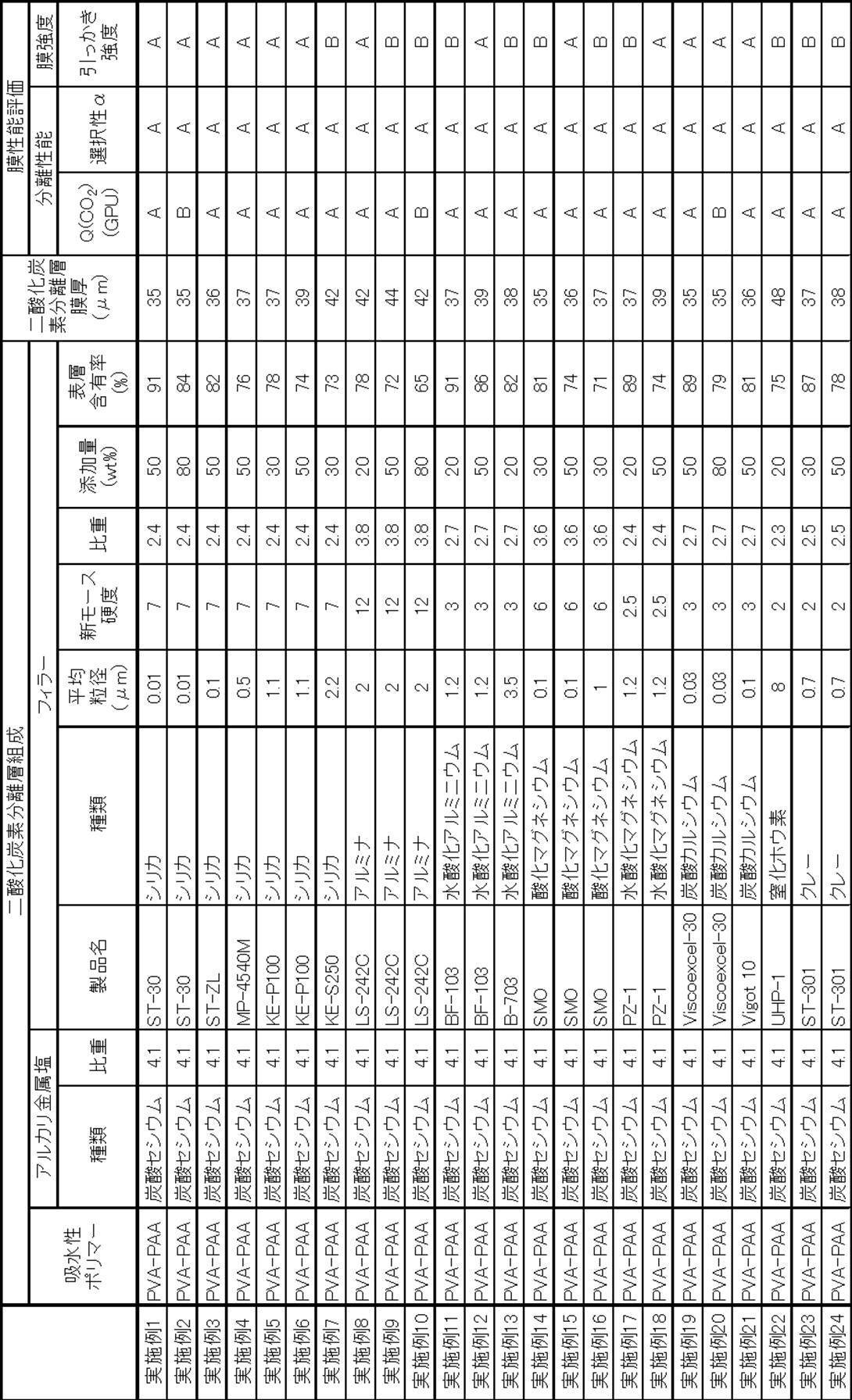
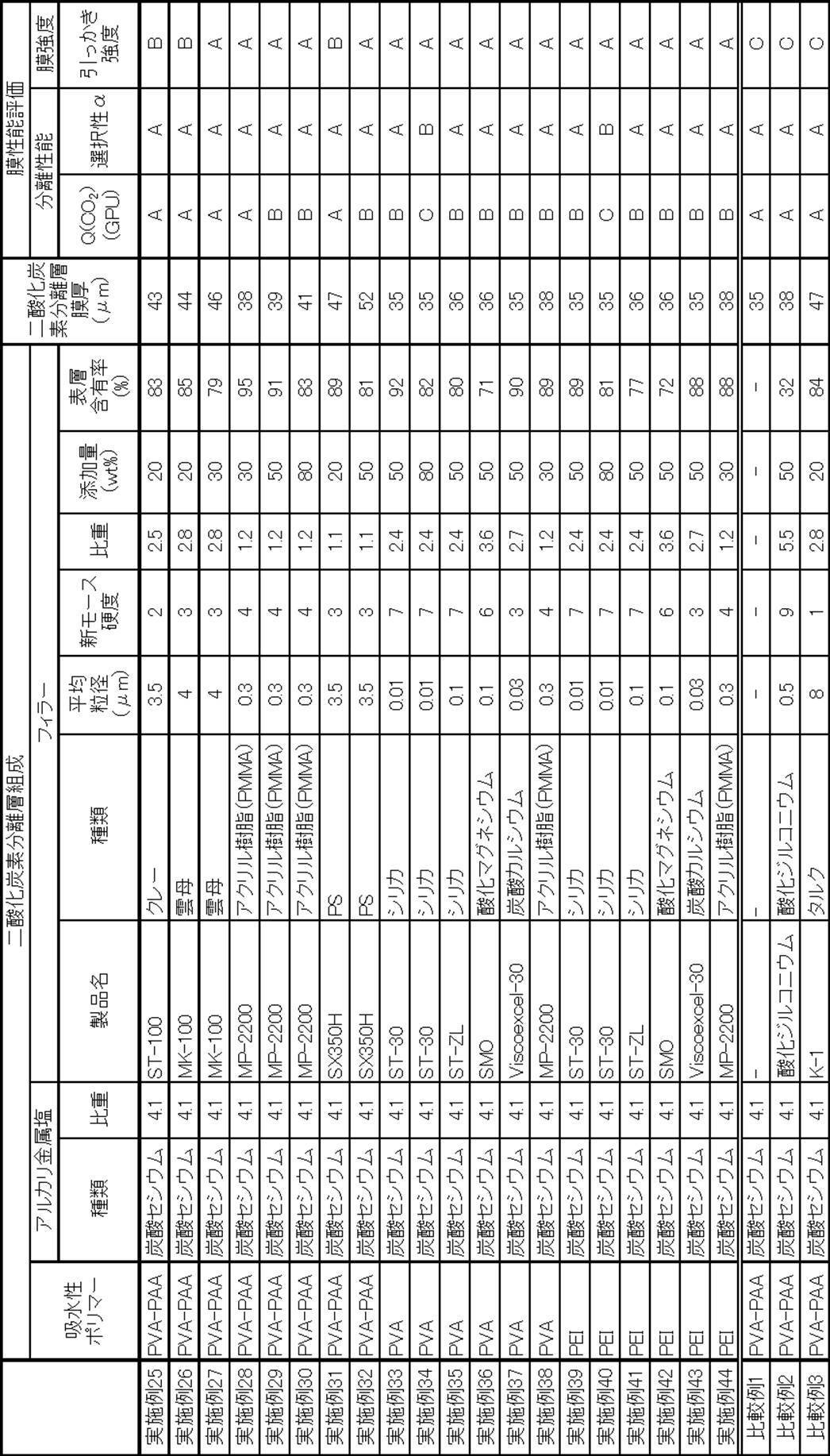
表3及び表4の結果より、実施例の各二酸化炭素分離用複合体は、膜強度に優れることが明らかになった。
(実施例45)
[モジュール化]
実施例1で作製した二酸化炭素分離用複合体を用いて、特開平5-168869号公報を参考に、スパイラル型モジュールを作製した。作製した二酸化炭素分離用モジュールが、搭載する二酸化炭素分離複合体の性能のとおり、二酸化炭素の分離性能に優れていることを確認した。
[モジュール化]
実施例1で作製した二酸化炭素分離用複合体を用いて、特開平5-168869号公報を参考に、スパイラル型モジュールを作製した。作製した二酸化炭素分離用モジュールが、搭載する二酸化炭素分離複合体の性能のとおり、二酸化炭素の分離性能に優れていることを確認した。
本発明の具体的態様の前記記述は、記述と説明の目的で提供するものである。開示された、まさにその形態に本発明を限定することを企図するものでもなく、或いは網羅的なものを企図するものでもない。該態様は、本発明の概念やその実際の応用を最もよく説明するために選定されたものであって、それによって、当業者の他者が企図する特定の用途に適合させるべく種々の態様や種々の変形をなすことができるように、当業者の他者に本発明を理解せしめるためのものである。
2012年7月11日出願の日本特許出願第2012-155924号公報は、その開示全体がここに参照文献として組み込まれるものである。
本明細書に記述された全ての刊行物や特許出願、並びに技術標準は、それら個々の刊行物や特許出願、並びに技術標準が引用文献として特別に、そして個々に組み込むことが指定されている場合には、該引用文献と同じ限定範囲においてここに組み込まれるものである。上記本発明の好ましい実施態様の詳細は、当業者がその適用を企図する態様により様々な応用形態に自在に変更できることは言うまでも無いことである。本発明の範囲は下記特許請求の範囲及びその等価物に拠って決定されることを企図するものである。
本明細書に記述された全ての刊行物や特許出願、並びに技術標準は、それら個々の刊行物や特許出願、並びに技術標準が引用文献として特別に、そして個々に組み込むことが指定されている場合には、該引用文献と同じ限定範囲においてここに組み込まれるものである。上記本発明の好ましい実施態様の詳細は、当業者がその適用を企図する態様により様々な応用形態に自在に変更できることは言うまでも無いことである。本発明の範囲は下記特許請求の範囲及びその等価物に拠って決定されることを企図するものである。
Claims (18)
- 支持体上に、吸水性ポリマーと、アルカリ金属塩と、密度がアルカリ金属塩の密度より低く、硬度が新モース硬度2以上であり、且つ体積平均粒子径が二酸化炭素分離層の厚さの30%以下であるフィラーと、を含む二酸化炭素分離層形成用塗布液を付与する付与工程と、
付与された前記二酸化炭素分離層形成用塗布液を乾燥して二酸化炭素分離層を得る乾燥工程と、
を含む、支持体上に二酸化炭素分離層を有する二酸化炭素分離用複合体を製造する二酸化炭素分離用複合体の製造方法。 - 前記二酸化炭素分離層の膜厚方向に対して、支持体に接する面とは反対の面から深さ50%までの位置に、前記フィラーの全質量の60質量%以上が存在する請求項1に記載の二酸化炭素分離用複合体の製造方法。
- 前記二酸化炭素分離層の表面における、直径0.5mmのサファイア針による膜面傷つき開始荷重が、20g以上である請求項1又は請求項2に記載の二酸化炭素分離用複合体の製造方法。
- 前記フィラーが、無機フィラー及び有機フィラーからなる群より選ばれる少なくとも1種である請求項1~請求項3のいずれか1項に記載の二酸化炭素分離用複合体の製造方法。
- 前記フィラーが、シリカ、アルミナ、水酸化アルミニウム、酸化マグネシウム、水酸化マグネシウム、炭酸カルシウム、窒化ホウ素、クレー、カオリン、及び雲母を含む無機フィラーと、アクリル樹脂粒子、及びポリスチレン粒子を含む有機フィラーとからなる群より選ばれる少なくとも1種である請求項1~請求項4のいずれか1項に記載の二酸化炭素分離用複合体の製造方法。
- 前記吸水性ポリマーが、ビニルアルコール由来の繰り返し単位を含むポリマー、エチレンイミン由来の繰り返し単位を含むポリマー、及びアクリル酸由来の繰り返し単位を含むポリマーから成る群から選ばれる少なくとも1種のポリマーである請求項1~請求項5のいずれか1項に記載の二酸化炭素分離用複合体の製造方法。
- 前記吸水性ポリマーが、ビニルアルコール由来の繰り返し単位を含むポリマーである請求項1~請求項6のいずれか1項に記載の二酸化炭素分離用複合体の製造方法。
- 前記吸水性ポリマーが、ビニルアルコール-アクリル酸共重合体である請求項1~請求項7のいずれか1項に記載の二酸化炭素分離用複合体の製造方法。
- 前記二酸化炭素分離層形成用塗布液が、含有量0.1質量%~8質量%の範囲の多糖類を更に含む、請求項1~請求項8のいずれか1項に記載の二酸化炭素分離用複合体の製造方法。
- 前記多糖類が寒天である、請求項9に記載の二酸化炭素分離用複合体の製造方法。
- 前記二酸化炭素分離層形成用塗布液が、含有量0.001質量%~1質量%の範囲の架橋剤を更に含む、請求項1~請求項10のいずれか1項に記載の二酸化炭素分離用複合体の製造方法。
- 前記架橋剤がグルタルアルデヒドである、請求項11に記載の二酸化炭素分離用複合体の製造方法。
- 前記付与工程が、前記支持体上に、前記二酸化炭素分離層形成用塗布液を、単層で塗布する工程であるか、又は、前記支持体上に、吸水性ポリマー及びアルカリ金属塩を含む塗布液と、前記二酸化炭素分離層形成用塗布液とをこの順で重層塗布する工程である請求項1~請求項12のいずれか1項に記載の二酸化炭素分離用複合体の製造方法。
- 前記乾燥工程の前に、前記付与工程において支持体上に得られた前記二酸化炭素分離層形成用塗布液を1℃~35℃の範囲に冷却する、冷却工程を更に含む、請求項1~請求項13のいずれか1項に記載の二酸化炭素分離用複合体の製造方法。
- 請求項1~請求項14のいずれか1項に記載の製造方法によって得られた二酸化炭素分離用複合体。
- 吸水性ポリマーと、アルカリ金属塩と、密度がアルカリ金属塩の密度より低く、硬度が新モース硬度2以上であり、且つ体積平均粒子径が二酸化炭素分離層の厚さの30%以下であるフィラーと、を含む二酸化炭素分離用複合体。
- 前記二酸化炭素分離層の膜厚方向に対して、支持体に接する面とは反対の面から深さ50%までの位置に、前記フィラーの全質量の60質量%以上が存在する請求項16に記載の二酸化炭素分離用複合体。
- 吸水性ポリマーと、アルカリ金属塩と、密度がアルカリ金属塩より低く、硬度が新モース硬度2以上であり、且つ体積平均粒子径が二酸化炭素分離層の厚さの30%以下であるフィラーと、を含む二酸化炭素分離用複合体を備えた二酸化炭素分離用モジュール。
Priority Applications (1)
| Application Number | Priority Date | Filing Date | Title |
|---|---|---|---|
| US14/558,723 US20150086801A1 (en) | 2012-07-11 | 2014-12-03 | Method for manufacturing complex for carbon dioxide separation, complex for carbon dioxide separation, and module for carbon dioxide separation |
Applications Claiming Priority (2)
| Application Number | Priority Date | Filing Date | Title |
|---|---|---|---|
| JP2012155924A JP5865201B2 (ja) | 2012-07-11 | 2012-07-11 | 二酸化炭素分離用複合体の製造方法、二酸化炭素分離用複合体及び二酸化炭素分離用モジュール |
| JP2012-155924 | 2012-07-11 |
Related Child Applications (1)
| Application Number | Title | Priority Date | Filing Date |
|---|---|---|---|
| US14/558,723 Continuation US20150086801A1 (en) | 2012-07-11 | 2014-12-03 | Method for manufacturing complex for carbon dioxide separation, complex for carbon dioxide separation, and module for carbon dioxide separation |
Publications (1)
| Publication Number | Publication Date |
|---|---|
| WO2014010336A1 true WO2014010336A1 (ja) | 2014-01-16 |
Family
ID=49915809
Family Applications (1)
| Application Number | Title | Priority Date | Filing Date |
|---|---|---|---|
| PCT/JP2013/065490 Ceased WO2014010336A1 (ja) | 2012-07-11 | 2013-06-04 | 二酸化炭素分離用複合体の製造方法、二酸化炭素分離用複合体及び二酸化炭素分離用モジュール |
Country Status (3)
| Country | Link |
|---|---|
| US (1) | US20150086801A1 (ja) |
| JP (1) | JP5865201B2 (ja) |
| WO (1) | WO2014010336A1 (ja) |
Cited By (2)
| Publication number | Priority date | Publication date | Assignee | Title |
|---|---|---|---|---|
| CN107983311A (zh) * | 2017-07-20 | 2018-05-04 | 浙江省海洋水产研究所 | 一种海产品脱镉吸附剂及其制备方法 |
| US10765993B2 (en) | 2017-03-31 | 2020-09-08 | Sumitomo Chemical Company, Limited | Gel including condensation product of organic silicon compound |
Families Citing this family (12)
| Publication number | Priority date | Publication date | Assignee | Title |
|---|---|---|---|---|
| JP2013049042A (ja) * | 2011-01-12 | 2013-03-14 | Fujifilm Corp | 二酸化炭素分離膜形成用組成物、二酸化炭素分離膜及びその製造方法、並びに二酸化炭素分離装置 |
| JP5689765B2 (ja) * | 2011-07-29 | 2015-03-25 | 富士フイルム株式会社 | 二酸化炭素分離部材、その製造方法及び二酸化炭素分離モジュール |
| JP2013111507A (ja) * | 2011-11-25 | 2013-06-10 | Fujifilm Corp | ガス分離膜、その製造方法、それを用いたガス分離膜モジュール |
| JP6071004B2 (ja) * | 2013-03-29 | 2017-02-01 | 富士フイルム株式会社 | 酸性ガス分離複合膜の製造方法及び酸性ガス分離膜モジュール |
| WO2016014491A1 (en) * | 2014-07-21 | 2016-01-28 | Ohio State Innovation Foundation | Composite membranes for separation of gases |
| US9731985B2 (en) * | 2015-06-03 | 2017-08-15 | Lg Nanoh2O, Inc. | Chemical additives for enhancement of water flux of a membrane |
| JP2019093309A (ja) * | 2016-04-05 | 2019-06-20 | 富士フイルム株式会社 | ガス分離膜、ガス分離モジュール、ガス分離装置及びガス分離方法 |
| WO2019221200A1 (ja) * | 2018-05-16 | 2019-11-21 | 日産化学株式会社 | 気体分離膜の製造方法 |
| EP3848063A4 (en) * | 2018-09-03 | 2021-10-27 | FUJIFILM Corporation | GEL FORMATION KIT, GEL AND METHOD FOR MANUFACTURING GEL |
| US12350624B2 (en) * | 2020-07-06 | 2025-07-08 | Renaissance Energy Research Corporation | Gas separation method and apparatus |
| AU2022231170B2 (en) * | 2021-03-05 | 2025-07-31 | W. L. Gore & Associates, Inc. | Flexible sorbent polymer composite article having adsorptive and desorptive configurations |
| WO2024155658A2 (en) * | 2023-01-17 | 2024-07-25 | Sustaera Inc. | Solid sorbent for removal of carbon dioxide from a co2-containing gas |
Citations (4)
| Publication number | Priority date | Publication date | Assignee | Title |
|---|---|---|---|---|
| US20050043167A1 (en) * | 2003-08-18 | 2005-02-24 | Chevron U.S.A. Inc. | Mixed matrix membrane with super water washed silica containing molecular sieves and methods for making and using the same |
| JP2009195900A (ja) * | 2008-01-24 | 2009-09-03 | Renaissance Energy Research:Kk | 二酸化炭素分離装置 |
| JP2011012114A (ja) * | 2009-06-30 | 2011-01-20 | Shin Etsu Polymer Co Ltd | 空調システム |
| JP2012020231A (ja) * | 2010-07-14 | 2012-02-02 | Unitika Ltd | 高透過性ポリアミド中空糸膜及びその製造方法 |
Family Cites Families (1)
| Publication number | Priority date | Publication date | Assignee | Title |
|---|---|---|---|---|
| JP2013049042A (ja) * | 2011-01-12 | 2013-03-14 | Fujifilm Corp | 二酸化炭素分離膜形成用組成物、二酸化炭素分離膜及びその製造方法、並びに二酸化炭素分離装置 |
-
2012
- 2012-07-11 JP JP2012155924A patent/JP5865201B2/ja not_active Expired - Fee Related
-
2013
- 2013-06-04 WO PCT/JP2013/065490 patent/WO2014010336A1/ja not_active Ceased
-
2014
- 2014-12-03 US US14/558,723 patent/US20150086801A1/en not_active Abandoned
Patent Citations (4)
| Publication number | Priority date | Publication date | Assignee | Title |
|---|---|---|---|---|
| US20050043167A1 (en) * | 2003-08-18 | 2005-02-24 | Chevron U.S.A. Inc. | Mixed matrix membrane with super water washed silica containing molecular sieves and methods for making and using the same |
| JP2009195900A (ja) * | 2008-01-24 | 2009-09-03 | Renaissance Energy Research:Kk | 二酸化炭素分離装置 |
| JP2011012114A (ja) * | 2009-06-30 | 2011-01-20 | Shin Etsu Polymer Co Ltd | 空調システム |
| JP2012020231A (ja) * | 2010-07-14 | 2012-02-02 | Unitika Ltd | 高透過性ポリアミド中空糸膜及びその製造方法 |
Non-Patent Citations (1)
| Title |
|---|
| AHN,J. ET AL.: "Polysulfone/silica nanoparticle mixed-matrix membranes for gas separation", JOURNAL OF MEMBRANE SCIENCE, vol. 314, no. 1+2, 30 April 2008 (2008-04-30), pages 123 - 133 * |
Cited By (2)
| Publication number | Priority date | Publication date | Assignee | Title |
|---|---|---|---|---|
| US10765993B2 (en) | 2017-03-31 | 2020-09-08 | Sumitomo Chemical Company, Limited | Gel including condensation product of organic silicon compound |
| CN107983311A (zh) * | 2017-07-20 | 2018-05-04 | 浙江省海洋水产研究所 | 一种海产品脱镉吸附剂及其制备方法 |
Also Published As
| Publication number | Publication date |
|---|---|
| JP2014014807A (ja) | 2014-01-30 |
| US20150086801A1 (en) | 2015-03-26 |
| JP5865201B2 (ja) | 2016-02-17 |
Similar Documents
| Publication | Publication Date | Title |
|---|---|---|
| JP5865201B2 (ja) | 二酸化炭素分離用複合体の製造方法、二酸化炭素分離用複合体及び二酸化炭素分離用モジュール | |
| WO2012096055A1 (ja) | 二酸化炭素分離膜形成用組成物、二酸化炭素分離膜及びその製造方法、並びに二酸化炭素分離装置 | |
| JP5840574B2 (ja) | 二酸化炭素分離用複合体の製造方法、二酸化炭素分離用複合体、及び二酸化炭素分離用モジュール | |
| JP5738710B2 (ja) | 二酸化炭素分離膜の製造方法及び二酸化炭素分離モジュール | |
| JP6046537B2 (ja) | 酸性ガス分離用複合体の製造方法および製造装置 | |
| JP6156837B2 (ja) | 酸性ガス分離用複合体の製造方法 | |
| JP6156838B2 (ja) | 酸性ガス分離用複合体の製造方法 | |
| CN105102107B (zh) | 酸性气体分离复合膜的制造方法和酸性气体分离膜组件 | |
| CN103702747A (zh) | 二氧化碳分离部件、其制造方法以及二氧化碳分离组件 | |
| US9440191B2 (en) | Acidic gas separation module, and method for manufacturing acidic gas separation module | |
| JP2014014806A (ja) | 酸性ガス分離用複合体及びその製造方法並びに酸性ガス分離モジュール | |
| WO2014010377A1 (ja) | 二酸化炭素分離用複合体の製造方法、二酸化炭素分離用複合体、二酸化炭素分離モジュール、二酸化炭素分離装置、及び二酸化炭素分離方法 | |
| WO2015029884A1 (ja) | 酸性ガス分離膜の製造方法 | |
| JP6013127B2 (ja) | ガス分離複合膜、これを用いた分離膜モジュールおよびガス分離システム | |
| JP5975951B2 (ja) | 促進輸送型分離膜の製造方法 |
Legal Events
| Date | Code | Title | Description |
|---|---|---|---|
| 121 | Ep: the epo has been informed by wipo that ep was designated in this application |
Ref document number: 13816260 Country of ref document: EP Kind code of ref document: A1 |
|
| NENP | Non-entry into the national phase |
Ref country code: DE |
|
| 122 | Ep: pct application non-entry in european phase |
Ref document number: 13816260 Country of ref document: EP Kind code of ref document: A1 |