WO2014008223A2 - Fatty acid synthase inhibitors - Google Patents
Fatty acid synthase inhibitors Download PDFInfo
- Publication number
- WO2014008223A2 WO2014008223A2 PCT/US2013/049010 US2013049010W WO2014008223A2 WO 2014008223 A2 WO2014008223 A2 WO 2014008223A2 US 2013049010 W US2013049010 W US 2013049010W WO 2014008223 A2 WO2014008223 A2 WO 2014008223A2
- Authority
- WO
- WIPO (PCT)
- Prior art keywords
- alkyl
- diazaspiro
- oxa
- undecan
- cyclopropyl
- Prior art date
- Legal status (The legal status is an assumption and is not a legal conclusion. Google has not performed a legal analysis and makes no representation as to the accuracy of the status listed.)
- Ceased
Links
- 0 C*(CCN(*)C(CCCC1)=O)CN1C(C)(C[C@@]1*=C1)C1=CC(*(C)(C)*)=C(*)**1 Chemical compound C*(CCN(*)C(CCCC1)=O)CN1C(C)(C[C@@]1*=C1)C1=CC(*(C)(C)*)=C(*)**1 0.000 description 3
- IQAGOTAMSDIAGM-UHFFFAOYSA-N CC1(CC1)N(CC1(CCN(Cc(ccc(-c2cc([nH]cc3)c3cc2)c2)c2F)CC1)OC1)C1=O Chemical compound CC1(CC1)N(CC1(CCN(Cc(ccc(-c2cc([nH]cc3)c3cc2)c2)c2F)CC1)OC1)C1=O IQAGOTAMSDIAGM-UHFFFAOYSA-N 0.000 description 1
- RGFIWJWXOZBAON-UHFFFAOYSA-N CCOc1nc(cc(cc2)-c3cc(F)c(CN(CC4)CCC4(CN4C5CC5)OCC4=O)c(F)c3)c2cn1 Chemical compound CCOc1nc(cc(cc2)-c3cc(F)c(CN(CC4)CCC4(CN4C5CC5)OCC4=O)c(F)c3)c2cn1 RGFIWJWXOZBAON-UHFFFAOYSA-N 0.000 description 1
- MDVAGFQDEYQORF-UHFFFAOYSA-N COc(c(nccc1)c1cc1)c1-c1cc(F)c(CN(CC2)CCC2(CN2C3CC3)OCC2=O)cc1 Chemical compound COc(c(nccc1)c1cc1)c1-c1cc(F)c(CN(CC2)CCC2(CN2C3CC3)OCC2=O)cc1 MDVAGFQDEYQORF-UHFFFAOYSA-N 0.000 description 1
- DBDWJTHJUCKNTD-UHFFFAOYSA-N COc1cnc(cc(cc2)-c3cc(F)c(CN(CC4)CCC4(CN4C5CC5)OCC4=O)nc3)c2c1 Chemical compound COc1cnc(cc(cc2)-c3cc(F)c(CN(CC4)CCC4(CN4C5CC5)OCC4=O)nc3)c2c1 DBDWJTHJUCKNTD-UHFFFAOYSA-N 0.000 description 1
- BCFGMOOMADDAQU-UHFFFAOYSA-N CS(CCNCc1ccc(-c(cc23)ccc2ncnc3Nc(cc2Cl)ccc2OCc2cccc(F)c2)[o]1)(=O)=O Chemical compound CS(CCNCc1ccc(-c(cc23)ccc2ncnc3Nc(cc2Cl)ccc2OCc2cccc(F)c2)[o]1)(=O)=O BCFGMOOMADDAQU-UHFFFAOYSA-N 0.000 description 1
- FJESTTSQADFJLN-UHFFFAOYSA-N Cc(cnc1c2)cc1ccc2-c1cc(F)c(CN(CC2)CCC2(CN2C3CC3)OCC2=O)nc1 Chemical compound Cc(cnc1c2)cc1ccc2-c1cc(F)c(CN(CC2)CCC2(CN2C3CC3)OCC2=O)nc1 FJESTTSQADFJLN-UHFFFAOYSA-N 0.000 description 1
Classifications
-
- C—CHEMISTRY; METALLURGY
- C07—ORGANIC CHEMISTRY
- C07B—GENERAL METHODS OF ORGANIC CHEMISTRY; APPARATUS THEREFOR
- C07B59/00—Introduction of isotopes of elements into organic compounds ; Labelled organic compounds per se
- C07B59/002—Heterocyclic compounds
-
- C—CHEMISTRY; METALLURGY
- C07—ORGANIC CHEMISTRY
- C07D—HETEROCYCLIC COMPOUNDS
- C07D471/00—Heterocyclic compounds containing nitrogen atoms as the only ring hetero atoms in the condensed system, at least one ring being a six-membered ring with one nitrogen atom, not provided for by groups C07D451/00 - C07D463/00
- C07D471/02—Heterocyclic compounds containing nitrogen atoms as the only ring hetero atoms in the condensed system, at least one ring being a six-membered ring with one nitrogen atom, not provided for by groups C07D451/00 - C07D463/00 in which the condensed system contains two hetero rings
- C07D471/10—Spiro-condensed systems
-
- C—CHEMISTRY; METALLURGY
- C07—ORGANIC CHEMISTRY
- C07D—HETEROCYCLIC COMPOUNDS
- C07D491/00—Heterocyclic compounds containing in the condensed ring system both one or more rings having oxygen atoms as the only ring hetero atoms and one or more rings having nitrogen atoms as the only ring hetero atoms, not provided for by groups C07D451/00 - C07D459/00, C07D463/00, C07D477/00 or C07D489/00
- C07D491/02—Heterocyclic compounds containing in the condensed ring system both one or more rings having oxygen atoms as the only ring hetero atoms and one or more rings having nitrogen atoms as the only ring hetero atoms, not provided for by groups C07D451/00 - C07D459/00, C07D463/00, C07D477/00 or C07D489/00 in which the condensed system contains two hetero rings
- C07D491/10—Spiro-condensed systems
Definitions
- This invention relates to novel spirocyclic piperidines which are inhibitors of fatty acid synthase (FAS), to pharmaceutical compositions containing them, to processes for their preparation, and to their use in therapy for the treatment of cancers.
- FOS fatty acid synthase
- Fatty acids have an essential role in a variety of cellular processes including building blocks for membranes, anchors for targeting membrane proteins, precursors in the synthesis of lipid second messengers and as a medium to store energy (Menendez JS and Lupu R, Fatty acid synthase and the lipogenic phenotype in cancer pathogenesis, Nature Reviews Cancer, 7: 763-777 (2007)).
- Fatty acids can either be obtained from the diet or can be synthesized de novo from carbohydrate precursors. The biosynthesis of the latter is catalyzed by the muliti- functional homodimeric FAS.
- FAS synthesizes long chain fatty acids by using acetyl-CoA as a primer and Malonyl Co-A as a two carbon donor, and NADPH as reducing equivalents
- acetyl-CoA as a primer
- Malonyl Co-A as a two carbon donor
- NADPH as reducing equivalents
- De novo fatty acid synthesis is active during embryogenesis and in fetal lungs where fatty acids are used for the production of lung surfactant. In adults, most normal human tissues preferentially acquire fatty acids from the diet. Therefore, the level of de novo lipogensis and expression of liopogenic enzymes is low (Weiss L, et al, Fatty-acid biosynthesis in man, a pathway of minor importance. Purification, optimal assay conditions, and organ distribution of fatty-acid synthase. Biological Chemistry Hoppe-Seyler 367(9): 905- 912 (1986)). In contrast, many tumors have high rates of de novo fatty acid synthesis (Medes G, et al, Metabolism of Neoplastic Tissue. IV.
- This invention relates to compounds of the Formula (I), as shown below: A compound according to Formula (I)
- X is CH 2 , NR 6 or O, wherein R 6 is H, Ci-C 4 alkyl, C 3 -C 7 cycloalkyl, or -Ci-C 3 alkylC 3 -C 7 cycloalkyl;
- Y is C or N
- R 5 is selected from the group consisting of hydrogen, Ci-C 4 alkyl, C 3 -C 7 cycloalkyl, -Ci-C 3 alkylC 3 -C 7 cycloalkyl, phenyl, and Ci-C 3 alkylphenyl;
- R 6 is H, Ci-C 4 alkyl, C 3 -C 7 cycloalkyl, or -Ci-C 3 alkylC 3 -C 7 cycloalkyl; or R 5 and R 6 taken together with the nitrogen to which they are attached represent a 4- to 7-membered saturated or unsaturated ring optionally containing one other heteroatom which is oxygen, nitrogen, or sulfur, wherein said ring is optionally substituted by 1 to 3 substituents independently selected from oxo, hydoxyl, Ci-C 3 alkyl, and hydroxyCi-C 4 alkyl-;
- R 9 is a 5- or 6-membered heteroaryl ring containing 1 to 4 heteroatoms selected from oxygen, nitrogen, and sulfur, which is optionally substituted with 1 or 2 substituents independently selected from halogen, Ci-C 4 alkyl, -CF 3 , Ci-C 4 alkoxy, and -NR 5 R 6 ;
- each R 2 is independently selected from the group consisting of Ci-C 6 alkyl, cyano, Ci- C 4 alkoxy, hydroxyl, and halogen;
- This invention relates to compounds of Formula (I), and pharmaceutically acceptable salts thereof.
- This invention also relates to compounds exemplified in the Experimental section.
- the salts of the present invention are pharmaceutically acceptable salts.
- Salts encompassed within the term “pharmaceutically acceptable salts” refer to non-toxic salts of the compounds of this invention.
- Salts of the disclosed compounds containing a basic amine or other basic functional group may be prepared by any suitable method known in the art, including treatment of the free base with an inorganic acid, such as hydrochloric acid, hydrobromic acid, sulfuric acid, nitric acid, phosphoric acid, and the like, or with an organic acid, such as acetic acid, trifluoroacetic acid, maleic acid, succinic acid, mandelic acid, fumaric acid, malonic acid, pyruvic acid, oxalic acid, glycolic acid, salicylic acid, pyranosidyl acid, such as glucuronic acid or galacturonic acid, alpha-hydroxy acid, such as citric acid or tartaric acid, amino acid, such as aspartic acid or glutamic acid, aromatic acid, such as benzoic acid or cinnamic acid, sulfonic acid, such as p-toluenesulfonic acid, methanesulfonic acid, ethanesulf
- Examples of pharmaceutically acceptable salts include sulfates, pyrosulfates, bisulfates, sulfites, bisulfites, phosphates, chlorides, bromides, iodides, acetates, propionates, decanoates, caprylates, acrylates, formates, isobutyrates, caproates, heptanoates, propiolates, oxalates, malonates succinates, suberates, sebacates, fumarates, maleates, butyne-l,4-dioates, hexyne-l,6-dioates, benzoates, chlorobenzoates, methylbenzoates, dinitrobenzoates, hydroxybenzoates, methoxybenzoates, phthalates, phenylacetates, phenylpropionates, phenylbutrates, citrates, lactates, ⁇ - hydroxybutyrates, glycolates, tartrates mandelate
- Salts of the disclosed compounds containing a carboxylic acid or other acidic functional group can be prepared by reacting with a suitable base.
- a suitable base which affords a pharmaceutically acceptable cation, which includes alkali metal salts (especially sodium and potassium), alkaline earth metal salts (especially calcium and magnesium), aluminum salts and ammonium salts, as well as salts made from physiologically acceptable organic bases such as trimethylamine, triethylamine, morpholine, pyridine, piperidine, picoline, dicyclohexylamine, ⁇ , ⁇ '- dibenzylethylenediamine, 2-hydroxyethylamine, 3 ⁇ 4zs-(2-hydroxyethyl)amine, tri-(2- hydroxyethyl)amine, procaine, dibenzylpiperidine, dehydroabietylamine, ⁇ , ⁇ - ⁇ dehydroabietylamine, glucamine, N-methylglucamine, collidine, quinine,
- the compound of Formula (I) or a salt thereof may exist in stereoisomeric forms (e.g., it contains one or more asymmetric carbon atoms).
- the individual stereoisomers may exist in stereoisomeric forms (e.g., it contains one or more asymmetric carbon atoms).
- the invention also includes various deuterated forms of the compounds of Formula (I). Each available hydrogen atom attached to a carbon atom may be independently replaced with a deuterium atom. A person of ordinary skill in the art will know how to synthesize deuterated forms of the compounds of Formula (I). Commercially available deuterated starting materials may be employed in the preparation of deuterated forms of the compounds of Formula (I), or they may be synthesized using conventional techniques employing deuterated reagents (e.g. lithium aluminum deuteride).
- deuterated reagents e.g. lithium aluminum deuteride
- a process for the preparation of a pharmaceutical composition comprising mixing (or admixing) a compound of Formula (I) or salt thereof with at least one excipient.
- One particular embodiment of the invention is a compound of Formula (II),
- R 5 is selected from the group consisting of hydrogen, Ci-C 4 alkyl, C 3 -C 7 cycloalkyl, -Ci-C 3 alkylC 3 -C 7 cycloalkyl, phenyl, and Ci-C 3 alkylphenyl;
- R 6 is H, Ci-C 4 alkyl, C 3 -C 7 cycloalkyl, or -Ci-C 3 alkylC 3 -C 7 cycloalkyl; or R 5 and R 6 taken together with the nitrogen to which they are attached represent a 4- to 7-membered saturated or unsaturated ring optionally containing one other heteroatom which is oxygen, nitrogen, or sulfur, wherein said ring is optionally substituted by 1 to 3 substituents independently selected from oxo, hydoxyl, Ci-C 3 alkyl, and hydroxyCi-C 4 alkyl-;
- R 9 is a 5- or 6-membered heteroaryl ring containing 1 to 4 heteroatoms selected from oxygen, nitrogen, and sulfur, which is optionally substituted with 1 or 2 substituents independently selected from halogen, Ci-C 4 alkyl, -CF 3 , Ci-C 4 alkoxy, and -NR 5 R 6 ;
- each R 2 is independently selected from the group consisting of Ci-C 6 alkyl, cyano, Ci- C 4 alkoxy, hydroxyl, and halogen;
- R 8 is hydrogen or deuterium
- R 8a is hydrogen or deuterium; or a pharmaceutically acceptable salt thereof.
- Another particular embodiment of the invention is a compound of Formula (III),
- R 6 is H, Ci-C 4 alkyl, C 3 -C 7 cycloalkyl, or -Ci-C 3 alkylC 3 -C 7 cycloalkyl; or R 5 and R 6 taken together with the nitrogen to which they are attached represent a 4- to 7-membered saturated or unsaturated ring optionally containing one other heteroatom which is oxygen, nitrogen, or sulfur, wherein said ring is optionally substituted by 1 to 3 substituents independently selected from oxo, hydoxyl, Ci-C 3 alkyl, and hydroxyCi-C 4 alkyl-;
- R 9 is a 5- or 6-membered heteroaryl ring containing 1 to 4 heteroatoms selected from oxygen, nitrogen, and sulfur, which is optionally substituted with 1 or 2 substituents independently selected from halogen, Ci-C 4 alkyl, -CF 3 , Ci-C 4 alkoxy, and -NR 5 R 6 ;
- each R 2 is independently selected from the group consisting of Ci-C 6 alkyl, cyano, Ci-
- R 8 is hydrogen or deuterium
- R 8a is hydrogen or deuterium; or a pharmaceutically acceptable salt thereof.
- Another particular embodiment of the invention is a compound of Formula (IV),
- X is CH 2 , NR 6 or O, wherein R 6 is H, Ci-C 4 alkyl, C 3 -C 7 cycloalkyl, or -Ci-C 3 alkylC 3 -C 7 cycloalkyl; n is 0, 1, 2, 3 or 4; m is 0, 1, 2, or 3;
- R 5 is selected from the group consisting of hydrogen, Ci-C 4 alkyl, C 3 -C 7 cycloalkyl, -Ci-C alkylC -C 7 cycloalkyl, phenyl, and Ci-C alkylphenyl;
- R 6 is H, Ci-C 4 alkyl, C 3 -C 7 cycloalkyl, or -Ci-C 3 alkylC 3 -C 7 cycloalkyl; or R 5 and R 6 taken together with the nitrogen to which they are attached represent a 4- to 7-membered saturated or unsaturated ring optionally containing one other heteroatom which is oxygen, nitrogen, or sulfur, wherein said ring is optionally substituted by 1 to 3 substituents independently selected from oxo, hydoxyl, Ci-C 3 alkyl, and hydroxyCi-C 4 alkyl-;
- R 9 is a 5- or 6-membered heteroaryl ring containing 1 to 4 heteroatoms selected from oxygen, nitrogen, and sulfur, which is optionally substituted with 1 or 2 substituents independently selected from halogen, Ci-C 4 alkyl, -CF 3 , Ci-C 4 alkoxy, and -NR 5 R 6 ;
- each R 2 is independently selected from the group consisting of Ci-C 6 alkyl, cyano, Ci- C 4 alkoxy, hydroxyl, and halogen;
- R 3 is selected from the group consisting of Ci-C 6 alkyl, C 3 -C 7 cycloalkyl, or C 4 -
- R 8 is hydrogen or deuterium
- R 8a is hydrogen or deuterium; or a pharmaceutically acceptable salt thereof.
- Another particular embodiment of the invention is a compound of Formula (V),
- Y is C or N
- Z is C or N; n is 0, 1, 2, 3 or 4; m is 0, 1, 2, or 3;
- R 5 is selected from the group consisting of hydrogen, Ci-C 4 alkyl, C 3 -C 7 cycloalkyl, -Ci-C 3 alkylC 3 -C 7 cycloalkyl, phenyl, and Ci-C 3 alkylphenyl;
- R 6 is H, Ci-C 4 alkyl, C 3 -C 7 cycloalkyl, or -Ci-C 3 alkylC 3 -C 7 cycloalkyl; or R 5 and R 6 taken together with the nitrogen to which they are attached represent a 4- to 7-membered saturated or unsaturated ring optionally containing one other heteroatom which is oxygen, nitrogen, or sulfur, wherein said ring is optionally substituted by 1 to 3 substituents independently selected from oxo, hydoxyl, Ci-C 3 alkyl, and hydroxyCi-C 4 alkyl-;
- R 9 is a 5- or 6-membered heteroaryl ring containing 1 to 4 heteroatoms selected from oxygen, nitrogen, and sulfur, which is optionally substituted with 1 or 2 substituents independently selected from halogen, Ci-C 4 alkyl, -CF 3 , Ci-C 4 alkoxy, and -NR 5 R 6 ;
- each R 2 is independently selected from the group consisting of Ci-C 6 alkyl, cyano, Ci- C 4 alkoxy, hydroxyl, and halogen;
- R 8 is hydrogen or deuterium; R 8a is hydrogen or deuterium; or a pharmaceutically acceptable salt thereof.
- Another particular embodiment of the invention is a compound of Formula (VI),
- Y is C or N
- Z is C or N; n is 0, 1, 2, 3 or 4; m is 0, 1, 2, or 3;
- R 5 is selected from the group consisting of hydrogen, Ci-C 4 alkyl, C 3 -C 7 cycloalkyl, -Ci-C 3 alkylC 3 -C 7 cycloalkyl, phenyl, and Ci-C 3 alkylphenyl;
- R 6 is H, Ci-C 4 alkyl, C 3 -C 7 cycloalkyl, or -Ci-C 3 alkylC 3 -C 7 cycloalkyl; or R 5 and R 6 taken together with the nitrogen to which they are attached represent a 4- to 7-membered saturated or unsaturated ring optionally containing one other heteroatom which is oxygen, nitrogen, or sulfur, wherein said ring is optionally substituted by 1 to 3 substituents independently selected from oxo, hydoxyl, Ci-C 3 alkyl, and hydroxyCi-C 4 alkyl-;
- R 9 is a 5- or 6-membered heteroaryl ring containing 1 to 4 heteroatoms selected from oxygen, nitrogen, and sulfur, which is optionally substituted with 1 or 2 substituents independently selected from halogen, Ci-C 4 alkyl, -CF 3 , Ci-C 4 alkoxy, and -NR 5 R 6 ;
- each R 2 is independently selected from the group consisting of Ci-C 6 alkyl, cyano, Ci- C 4 alkoxy, hydroxyl, and halogen;
- R 8 is hydrogen or deuterium
- R 8a is hydrogen or deuterium; or a pharmaceutically acceptable salt thereof.
- R 1 is selected from the group consisting of is benzofuranyl, isobenzofuryl, 2,3-dihydrobenzofuryl, 1,3-benzodioxolyl, dihydrobenzodioxinyl,
- R 5 is selected from the group consisting of hydrogen, Ci-C 4 alkyl, phenyl, and Ci-C 3 alkylphenyl; R 6 is hydrogen or Ci-C 4 alkyl, or a pharmaceutically accepted salt thereof.
- Another particular embodiment of the invention is a compound of Formula (I), (II), (III), (IV), (V), or (VI), wherein R 3 is selected from the group consisting of Ci-C 6 alkyl and C 3 -C 7 cycloalkyl, wherein said Ci-C 6 alkyl or C 3 -C 7 cycloalkyl group is optionally substituted with one, two or three substituents independently selected from the group consisting of Ci- C 4 alkyl, hydroxyl, hydroxyCi-C 4 alkyl and Ci-C 4 alkoxyCi-C 4 alkyl-, or a pharmaceutically acceptable salt thereof.
- alkyl refers to a straight or branched chain hydrocarbon radical, preferably having from one to twelve carbon atoms, which may be unsubstituted or substituted, saturated or unsaturated with multiple degrees of substitution included within the present invention.
- the alkyl group is unsubstituted or substituted with suitable substituents selected from the group consisting of halogen, amino, substituted amino, cyano, hydroxyl, alkoxy, alkylthio, alkylsulfonyl, aminosulfonyl, carboxylic acid, carboxylic ester, carboxamide, aminocarbonyl, and heterocyclyl.
- alkyl as used herein include, but are not limited to, methyl, ethyl, propyl, isopropyl, isobutyl, n-butyl, t-butyl, isopentyl, n-pentyl, and the like, as well as substituted versions thereof.
- cycloalkyl refers to an unsubstituted or substituted mono- or polycyclic non-aromatic saturated ring.
- exemplary “cycloalkyl” groups include, but are not limited to, cyclopropyl, cyclobutyl, cyclopentyl, cyclohexyl, cycloheptyl, and the like, as well as unsubstituted and substituted versions thereof.
- alkoxy refers to the group -OR a , where R a is Ci-C 4 alkyl or C3-Cycycloalkyl as defined above.
- Ci-C 4 alkoxy refers to a straight- or
- branched-chain hydrocarbon radical having at least 1 and up to 4 carbon atoms attached through an oxygen linking atom.
- exemplary "(Ci-C 4 )alkoxy" groups useful in the present invention include, but are not limited to, methoxy, ethoxy, n-propoxy, isopropoxy, n-butoxy, 5-butoxy, and t-butoxy.
- Heterocycloalkyl represents a group or moiety comprising a non-aromatic, monovalent monocyclic or bicyclic radical, which is saturated or partially unsaturated, containing 3 to 10 ring atoms, which includes 1 to 3 heteroatoms independently selected from nitrogen, oxygen and sulfur.
- heterocycloalkyls useful in the present invention include, but are not limited to, azetidinyl, pyrrolidinyl, pyrazolidinyl, pyrazolinyl, imidazolidinyl, imidazolinyl, oxazolinyl, thiazolinyl, tetrahydrofuranyl, dihydrofuranyl, 1,3-dioxolanyl, piperidinyl, piperazinyl, morpholinyl, thiomorpholinyl, tetrahydropyranyl, dihydropyranyl, 1,3-dioxanyl, 1 ,4-dioxanyl, 1,3-oxathiolanyl, 1,3-oxathianyl, 1,3-dithianyl, hexahydro-lH-l,4-diazepinyl, azabicylo[3.2.1]octyl,
- heterocyclyl refers to an unsubstituted or substituted mono- or poly cyclic ring system containing one or more heteroatoms.
- Preferred heteroatoms include nitrogen, oxygen, and sulfur, including N-oxides, sulfur oxides, and dioxides.
- a heterocyclic ring may be, but is not limited to, three to eight-membered and is either fully saturated or has one or more degrees of unsaturation. Multiple degrees of substitution are included within the present definition.
- heterocyclic groups include, but are not limited to tetrahydrofuranyl, pyranyl, 1 ,4-dioxanyl, 1,3-dioxanyl, piperidinyl, pyrrolidinyl, morpholinyl, azetidinyl, piperazinyl, pyrrolidinonyl, piperazinonyl, pyrazolidinyl, and their various tautomers, as well as unsubstituted and substituted versions thereof.
- 9- or 10-membered heterocyclyl represents a fully unsaturated or partially unsaturated, bicyclic group, containing 9 or 10 ring atoms, including 1 to 5 heteroatoms independently selected from nitrogen, oxygen and sulfur, which group may be unsubstituted or substituted by one or more of the substituents defined herein.
- Selected 9- or 10-membered heterocycyl groups contain one nitrogen, oxygen or sulfur ring heteroatom, and optionally contain 1, 2, 3, or 4 additional nitrogen ring atoms and/or 1 additional oxygen or sulfur atom.
- 9- or 10-membered heterocyclyl groups include, but are not limited to, benzofuranyl, isobenzofuryl, 2,3-dihydrobenzofuryl, 1,3-benzodioxolyl, dihydrobenzodioxinyl, benzothienyl, indolizinyl, indolyl, isoindolyl, indolinyl, isoindolinyl, benzimidazolyl, dihydrobenzimidazolyl, benzoxazolyl, dihydrobenzoxazolyl, benzthiazolyl, benzoisothiazolyl, dihydrobenzoisothiazolyl, indazolyl, pyrrolopyridinyl, pyrrolopyrimidinyl, imidazopyridinyl, imidazopyrimidinyl, pyrazolopyridinyl, pyrazolopyrimidinyl, benzoxadiazolyl, benzthiadiazol
- aryl refers to a carbocyclic aromatic moiety (such as phenyl or naphthyl) containing the specified number of carbon atoms, particularly from 6-10 carbon atoms.
- aryl radicals include, but are not limited to, phenyl, naphthyl, indenyl, azulenyl, fluorenyl, anthracenyl, phenanthrenyl, tetrahydronaphthyl, indanyl, phenanthridinyl and the like.
- aryl also includes each possible positional isomer of an aromatic hydrocarbon radical, such as in 1 -naphthyl, 2-naphthyl, 5- tetrahydronaphthyl, 6-tetrahydronaphthyl, 1 -phenanthridinyl, 2-phenanthridinyl, 3- phenanthridinyl, 4-phenanthridinyl, 7-phenanthridinyl, 8-phenanthridinyl, 9-phenanthridinyl and 10-phenanthridinyl.
- heteroaryl an aromatic ring system containing carbon(s) and at least one heteroatom.
- Heteroaryl may be monocyclic or polycyclic, substituted or unsubstituted.
- a monocyclic heteroaryl group may have 1 to 4 heteroatoms in the ring, while a polycyclic heteroaryl may contain 1 to 8 hetero atoms.
- a polycyclic heteroaryl ring may contain fused, spiro or bridged ring junctions, for example, bicyclic heteroaryl is a polycyclic heteroaryl.
- Bicyclic heteroaryl rings may contain from 8 to 12 member atoms.
- Monocyclic heteroaryl rings may contain from 5 to 8 member atoms (carbons and heteroatoms).
- Exemplary 5- to 6- memebered heteroaryls include, but are not limited to, furanyl, thiophenyl, thienyl, pyrrolyl, imidazolyl, pyrazolyl, triazolyl, tetrazolyl, thiazolyl, isothiazolyl, 1, 2, 3-triazolyl, 1, 2, 4-traizolyl, oxazolyl, isoxazolyl, 1, 2, 3- oxadiazolyl, 1, 2, 5-oxadiazolyl, thiadiazolyl, isothiazolyl, tetrazolyl, pyridinyl, pyridazinyl, pyrazinyl, pyrimidinyl, and triazinyl.
- heteroaryl groups include, but are not limited to benzofuranyl, isobenzofuryl, 2,3-dihydrobenzofuryl, 1,3-benzodioxolyl, dihydrobenzodioxinyl, benzothienyl, indolizinyl, indolyl, isoindolyl, indolinyl, isoindolinyl, benzimidazolyl, dihydrobenzimidazolyl, benzoxazolyl, dihydrobenzoxazolyl, benzthiazolyl, benzoisothiazolyl, dihydrobenzoisothiazolyl, indazolyl, pyrrolopyridinyl, pyrrolopyrimidinyl, imidazopyridinyl, imidazopyrimidinyl, pyrazolopyridinyl, pyrazolopyrimidinyl, benzoxadiazolyl, benzthiadiazolyl, benzotriazoly
- heterocyclic As used herein "heterocyclic,” “heterocycle,” “heterocycl” groups or grammatical variations thereof include “heteroaryl” and “heterocycloalkyl” groups.
- cyano refers to the group -CN.
- the term "optionally” means that the subsequently described event(s) may or may not occur, and includes both event(s) that occur and event(s) that do not occur.
- Exemplary optional substituent groups include acyl, alkyl, alkylsulfonyl, alkoxy, alkoxycarbonyl, cyano, halogen, haloalkyl, hydroxyl, oxo, amide, sulfamide, urea, amino, substituted amino, acylamino, phenylcarbonyl, dialkylaminosulfonamide, morpholino, sulfonamide, thiourea, nitro, pyrrolidinyl, pyrazolyl, pyrrolyl, phenyl, and tetrazolyl, wherein pyrrolidinyl, pyrazolyl and tetrazolyl can be further substituted with one to three Ci-C3alkyl.
- Enantiomerically enriched refers to products whose enantiomeric excess is greater than zero.
- enantiomerically enriched refers to products whose enantiomeric excess is greater than about 50% ee, greater than about 75% ee, and greater than about 90%> ee.
- Enantiomeric excess or "ee” is the excess of one enantiomer over the other expressed as a percentage. As a result, since both enantiomers are present in equal amounts in a racemic mixture, the enantiomeric excess is zero (0% ee). However, if one enantiomer was enriched such that it constitutes 95% of the product, then the enantiomeric excess would be 90% ee (the amount of the enriched enantiomer, 95%, minus the amount of the other enantiomer, 5%). "Enantiomerically pure” refers to products whose enantiomeric excess is 100% ee.
- Diastereomer refers to a compound having at least two chiral centers.
- Diastereomer excess or "de” is the excess of one diasteriomer over the others expressed as a percentage.
- “Diasteriomerically pure” refers to products whose diasteriomeric excess is 100% de.
- Half-life refers to the time required for half of a quantity of a substance to be converted to another chemically distinct specie in vitro or in vivo.
- Halo or halogen refers to fluoro, chloro, bromo, or iodo.
- Heteroatom refers to a nitrogen, sulphur, or oxygen atom.
- Member atoms refers to the atom or atoms that form a chain or ring. Where more than one member atom is present in a chain and within a ring, each member atom is covalently bound to an adjacent member atom in the chain or ring. Atoms that make up a substituent group on a chain or ring are not member atoms in the chain or ring.
- physiologically functional derivative refers to any pharmaceutically acceptable derivative of a compound of the present invention, for example, an ester or an amide, which upon administration to a mammal is capable of providing (directly or indirectly) a compound of the present invention or an active metabolite thereof.
- Such derivatives are clear to those skilled in the art, without undue experimentation, and with reference to the teaching of Burger's Medicinal Chemistry And Drug Discovery, 5th Edition, Vol 1 : Principles and Practice, which is incorporated herein by reference to the extent that it teaches physiologically functional derivatives.
- “Pharmaceutically acceptable” refers to those compounds, materials, compositions, and dosage forms which are, within the scope of sound medical judgment, suitable for use in contact with the tissues of human beings and animals without excessive toxicity, irritation, or other problem or complication, commensurate with a reasonable benefit/risk ratio.
- “Pharmaceutically acceptable salts” refers to salts that retain the desired biological activity of the subject compound and exhibit minimal undesired toxico logical effects. These pharmaceutically acceptable salts may be prepared in situ during the final isolation and purification of the compound, or by separately reacting the purified compound in its free acid or free base form with a suitable base or acid, respectively.
- compositions may be in unit dose form containing a predetermined amount of active ingredient per unit dose.
- a unit may contain a therapeutically effective dose of the compound of Formula (I) or salt thereof or a fraction of a therapeutically effective dose such that multiple unit dosage forms might be administered at a given time to achieve the desired therapeutically effective dose.
- Preferred unit dosage formulations are those containing a daily dose or sub-dose, as herein above recited, or an appropriate fraction thereof, of an active ingredient.
- such pharmaceutical compositions may be prepared by any of the methods well-known in the pharmacy art.
- compositions may be adapted for administration by any appropriate route, for example, by oral (including buccal or sublingual), rectal, nasal, topical (including buccal, sublingual, or transdermal), vaginal, or parenteral (including subcutaneous, intramuscular, intravenous, or intradermal) routes.
- oral including buccal or sublingual
- rectal nasal
- topical including buccal, sublingual, or transdermal
- vaginal or parenteral (including subcutaneous, intramuscular, intravenous, or intradermal) routes.
- parenteral including subcutaneous, intramuscular, intravenous, or intradermal
- compositions When adapted for oral administration, pharmaceutical compositions may be in discrete units such as tablets or capsules; powders or granules; solutions or suspensions in aqueous or non-aqueous liquids; edible foams or whips; oil-in-water liquid emulsions or water-in-oil liquid emulsions.
- the compound or salt thereof of the invention or the pharmaceutical composition of the invention may also be incorporated into a candy, a wafer, and/or tongue tape formulation for administration as a "quick-dissolve" medicine.
- the active drug component can be combined with an oral, non-toxic pharmaceutically acceptable inert carrier such as ethanol, glycerol, water, and the like.
- Powders or granules are prepared by comminuting the compound to a suitable fine size and mixing with a similarly comminuted pharmaceutical carrier such as an edible carbohydrate, as, for example, starch or mannitol. Flavoring, preservative, dispersing, and coloring agents can also be present.
- Capsules are made by preparing a powder mixture, as described above, and filling formed gelatin or non-gelatinous sheaths.
- Glidants and lubricants such as colloidal silica, talc, magnesium stearate, calcium stearate, solid polyethylene glycol can be added to the powder mixture before the filling operation.
- a disintegrating or solubilizing agent such as agar-agar, calcium carbonate, or sodium carbonate can also be added to improve the availability of the medicine when the capsule is ingested.
- suitable binders include starch, gelatin, natural sugars, such as glucose or beta-lactose, corn sweeteners, natural and synthetic gums such as acacia, tragacanth, sodium alginate,
- Lubricants used in these dosage forms include sodium oleate, sodium stearate, magnesium stearate, sodium benzoate, sodium acetate, sodium chloride, and the like.
- Disintegrators include, without limitation, starch, methylcellulose, agar, bentonite, xanthan gum, and the like.
- Tablets are formulated, for example, by preparing a powder mixture, granulating or slugging, adding a lubricant and disintegrant, and pressing into tablets.
- a powder mixture is prepared by mixing the compound, suitably comminuted, with a diluent or base as described above, and optionally, with a binder such as carboxymethylcellulose, and aliginate, gelatin, or polyvinyl pyrrolidone, a solution retardant such as paraffin, a resorption accelerator such as a quaternary salt, and/or an absorption agent such as bentonite, kaolin, or dicalcium phosphate.
- a binder such as carboxymethylcellulose, and aliginate, gelatin, or polyvinyl pyrrolidone
- a solution retardant such as paraffin
- a resorption accelerator such as a quaternary salt
- an absorption agent such as bentonite, kaolin, or dicalcium phosphate.
- the powder mixture can be granulated by wetting a binder such as syrup, starch paste, acadia mucilage, or solutions of cellulosic or polymeric materials and forcing through a screen.
- a binder such as syrup, starch paste, acadia mucilage, or solutions of cellulosic or polymeric materials
- the powder mixture can be run through the tablet machine and the result is imperfectly formed slugs broken into granules.
- the granules can be lubricated to prevent sticking to the tablet forming dies by means of the addition of stearic acid, a stearate salt, talc, or mineral oil. The lubricated mixture is then compressed into tablets.
- the compound or salt of the present invention can also be combined with a free-flowing inert carrier and compressed into tablets directly without going through the granulating or slugging steps.
- a clear opaque protective coating consisting of a sealing coat of shellac, a coating of sugar, or polymeric material, and a polish coating of wax can be provided.
- Dyestuffs can be added to these coatings to distinguish different dosages.
- Oral fluids such as solutions, syrups, and elixirs can be prepared in dosage unit form so that a given quantity contains a predetermined amount of active ingredient.
- Syrups can be prepared by dissolving the compound or salt thereof of the invention in a suitably flavoured aqueous solution, while elixirs are prepared through the use of a non-toxic alcoholic vehicle.
- Suspensions can be formulated by dispersing the compound or salt of the invention in a non- toxic vehicle.
- Solubilizers and emulsifiers such as ethoxylated isostearyl alcohols and polyoxyethylene sorbitol ethers, preservatives, flavor additives such as peppermint oil, natural sweeteners, saccharin, or other artificial sweeteners, and the like, can also be added.
- dosage unit formulations for oral administration can be microencapsulated.
- the formulation can also be prepared to prolong or sustain the release as, for example, by coating or embedding particulate material in polymers, wax, or the like.
- tablets and capsules are preferred for delivery of the pharmaceutical composition.
- treatment includes prophylaxis and refers to alleviating the specified condition, eliminating or reducing one or more symptoms of the condition, slowing or eliminating the progression of the condition, and preventing or delaying the reoccurrence of the condition in a previously afflicted or diagnosed patient or subject.
- Prophylaxis or prevention or delay of disease onset is typically accomplished by administering a drug in the same or similar manner as one would to a patient with the developed disease or condition.
- the present invention provides a method of treatment in a mammal, especially a human, with at least one disease or condition targeted by the present compounds.
- Such treatment comprises the step of administering a therapeutically effective amount of a compound of Formula (I) or salt thereof to said mammal, particularly a human.
- Treatment can also comprise the step of administering a therapeutically effective amount of a pharmaceutical composition containing a compound of Formula (I) or salt thereof to said mammal, particularly a human.
- methods are provided for treating cancer comprising
- the cancer is selected from the group consisting of gastric, brain (gliomas), glioblastomas, leukemias, Bannayan-Zonana syndrome, Cowden disease, Lhermitte-Duclos disease, breast, inflammatory breast cancer, Wilm's tumor, Ewing's sarcoma, Rhabdomyosarcoma, ependymoma, meduUoblastoma, colon, head and neck, kidney, lung, liver, melanoma, renal, ovarian, pancreatic, prostate, sarcoma, osteosarcoma, bladder, stomach, and giant cell tumor of bone and thyroid.
- the therapy is the treatment of cancer.
- the present invention provides uses of compounds of Formula I or pharmaceutically acceptable salts thereof for the manufacture of a medicament for the treatment of cancer.
- Suitable the present invention provides uses of Formula I or pharmaceutically acceptable salts thereof in treating cancer selected from the group consisting of gastric, brain (gliomas), glioblastomas, leukemias, Bannayan-Zonana syndrome, Cowden disease, Lhermitte-Duclos disease, breast, inflammatory breast cancer, Wilm's tumor, Ewing's sarcoma, Rhabdomyosarcoma, ependymoma, meduUoblastoma, colon, head and neck, kidney, lung, liver, melanoma, renal, ovarian, pancreatic, prostate, sarcoma, osteosarcoma, bladder, stomach, and giant cell tumor of bone and thyroid.
- the term "effective amount” means that amount of a drug or pharmaceutical agent that will elicit the biological or medical response of a tissue, system, animal, or human that is being sought, for instance, by a researcher or clinician.
- terapéuticaally effective amount means any amount which, as compared to a corresponding subject who has not received such amount, results in improved treatment, healing, prevention, or amelioration of a disease, disorder, or side effect, or a decrease in the rate of advancement of a disease or disorder.
- the term also includes within its scope amounts effective to enhance normal physiological function. For use in therapy,
- therapeutically effective amounts of a compound of Formula (I), as well as salts thereof may be administered as the raw chemical. Additionally, the active ingredient may be presented as a pharmaceutical composition. While it is possible that, for use in therapy, a therapeutically effective amount of a compound of Formula (I) or salt thereof may be administered as the raw chemical, it is typically presented as the active ingredient of a pharmaceutical composition or formulation.
- the precise therapeutically effective amount of a compound or salt thereof of the invention will depend on a number of factors, including, but not limited to, the age and weight of the subject (patient) being treated, the precise disorder requiring treatment and its severity, the nature of the pharmaceutical formulation/composition, and route of
- a compound of Formula (I) or salt thereof will be given for the treatment in the range of about 0.1 to 100 mg/kg body weight of recipient (patient, mammal) per day and more usually in the range of 0.1 to 10 mg/kg body weight per day.
- Acceptable daily dosages may be from about 1 to about 1000 mg/day, and preferably from about 1 to about 100 mg/day. This amount may be given in a single dose per day or in a number (such as two, three, four, five, or more) of sub-doses per day such that the total daily dose is the same.
- An effective amount of a salt thereof may be determined as a proportion of the effective amount of the compound of Formula (I) per se. Similar dosages should be appropriate for treatment (including prophylaxis) of the other conditions referred herein for treatment. In general, determination of appropriate dosing can be readily arrived at by one skilled in medicine or the pharmacy art.
- a compound of Formula (I) When a compound of Formula (I) is administered for the treatment of cancer, the term “co-administering" and derivatives thereof as used herein is meant either simultaneous administration or any manner of separate sequential administration of a FAS inhibiting compound, as described herein, and a further active ingredient or ingredients, known to be useful in the treatment of cancer, including chemotherapy and radiation treatment.
- the term further active ingredient or ingredients, as used herein includes any compound or therapeutic agent known to or that demonstrates advantageous properties when administered to a patient in need of treatment for cancer.
- the compounds are administered in a close time proximity to each other.
- the compounds are administered in the same dosage form, e.g. one compound may be administered topically and another compound may be administered orally.
- any anti-neoplastic agent that has activity versus a susceptible tumor being treated may be co-administered in the treatment of cancer in the present invention.
- anti-neoplastic agent that has activity versus a susceptible tumor being treated
- examples of such agents can be found in Cancer Principles and Practice f Oncology by V.T. Devita and S. Hellman (editors), 6 th edition (February 15, 2001), Lippincott Williams & Wilkins
- anti-neoplastic agents useful in the present invention include, but are not limited to, anti-microtubule agents such as diterpenoids and vinca alkaloids; platinum coordination complexes; alkylating agents such as nitrogen mustards, oxazaphosphorines, alkylsulfonates, nitrosoureas, and triazenes; antibiotic agents such as anthracyclins, actinomycins and bleomycins; topoisomerase II inhibitors such as epipodophyllotoxins;
- antimetabolites such as purine and pyrimidine analogues and anti- folate compounds
- topoisomerase I inhibitors such as camptothecins; hormones and hormonal analogues; signal transduction pathway inhibitors; non-receptor tyrosine kinase angiogenesis inhibitors;
- Examples of a further active ingredient or ingredients for use in combination or coadministered with the present FAS inhibiting compounds are chemotherapeutic agents.
- Anti-microtubule or anti-mitotic agents are phase specific agents active against the microtubules of tumor cells during M or the mitosis phase of the cell cycle.
- anti-microtubule agents include, but are not limited to, diterpenoids and vinca alkaloids.
- Diterpenoids which are derived from natural sources, are phase specific anti -cancer agents that operate at the G 2 /M phases of the cell cycle. It is believed that the diterpenoids stabilize the ⁇ -tubulin subunit of the microtubules, by binding with this protein. Disassembly of the protein appears then to be inhibited with mitosis being arrested and cell death following. Examples of diterpenoids include, but are not limited to, paclitaxel and its analog docetaxel.
- Paclitaxel, 5P,20-epoxy-l,2a,4,7P,10p,13a-hexa-hydroxytax-l l-en-9-one 4,10- diacetate 2-benzoate 13-ester with (2R,3S)-N-benzoyl-3-phenylisoserine; is a natural diterpene product isolated from the Pacific yew tree Taxus brevifolia and is commercially available as an injectable solution TAXOL®. It is a member of the taxane family of terpenes. It was first isolated in 1971 by Wani et al. J. Am. Chem, Soc, 93:2325. 1971), who characterized its structure by chemical and X-ray crystallographic methods.
- Paclitaxel has been approved for clinical use in the treatment of refractory ovarian cancer in the United States (Markman et al., Yale Journal of Biology and Medicine, 64:583, 1991; McGuire et al., Ann. Intern, Med., I l l :273,1989) and for the treatment of breast cancer (Holmes et al. , J. Nat. Cancer Inst. , 83: 1797, 1991.) It is a potential candidate for treatment of neoplasms in the skin (Einzig et. al., Proc. Am. Soc. Clin. Oncol., 20:46) and head and neck carcinomas (Forastire et. al, Sem. Oncol, 20:56, 1990).
- the compound also shows potential for the treatment of polycystic kidney disease (Woo et. al, Nature, 368:750. 1994, lung cancer and malaria.
- Treatment of patients with paclitaxel results in bone marrow suppression (multiple cell lineages, Ignoff, R.J. et. al, Cancer Chemotherapy Pocket Guidei 1998) related to the duration of dosing above a threshold concentration (50nM) (Kearns, CM. et. al., Seminars in Oncology, 3(6) p.16-23, 1995).
- Docetaxel (2R,3S)- N-carboxy-3-phenylisoserine,N-tert-butyl ester, 13-ester with 5 ⁇ - 20-epoxy-l,2a,4,7 ,10 ,13a-hexahydroxytax-l l-en-9-one 4-acetate 2-benzoate, trihydrate; is commercially available as an injectable solution as TAXOTERE®.
- Docetaxel is indicated for the treatment of breast cancer.
- Docetaxel is a semisynthetic derivative of paclitaxel q.v., prepared using a natural precursor, 10-deacetyl-baccatin III, extracted from the needle of the European Yew tree. The dose limiting toxicity of docetaxel is neutropenia.
- Vinca alkaloids are phase specific anti-neoplastic agents derived from the periwinkle plant. Vinca alkaloids act at the M phase (mitosis) of the cell cycle by binding specifically to tubulin. Consequently, the bound tubulin molecule is unable to polymerize into
- microtubules Mitosis is believed to be arrested in metaphase with cell death following.
- vinca alkaloids include, but are not limited to, vinblastine, vincristine, and vinorelbine.
- Vinblastine, vincaleukoblastine sulfate, is commercially available as VELBAN® as an injectable solution.
- VELBAN® an injectable solution.
- Myelosuppression is the dose limiting side effect of vinblastine.
- Vincristine, vincaleukoblastine, 22-oxo-, sulfate, is commercially available as
- ONCOVIN® as an injectable solution.
- Vincristine is indicated for the treatment of acute leukemias and has also found use in treatment regimens for Hodgkin's and non-Hodgkin's malignant lymphomas.
- Alopecia and neurologic effects are the most common side effect of vincristine and to a lesser extent myelosupression and gastrointestinal mucositis effects occur.
- Vinorelbine 3',4'-didehydro -4'-deoxy-C'-norvincaleukoblastine [R-(R*,R*)-2,3- dihydroxybutanedioate (l :2)(salt)], commercially available as an injectable solution of vinorelbine tartrate (NAVELBINE®), is a semisynthetic vinca alkaloid.
- Vinorelbine is indicated as a single agent or in combination with other chemotherapeutic agents, such as cisplatin, in the treatment of various solid tumors, particularly non-small cell lung, advanced breast, and hormone refractory prostate cancers. Myelosuppression is the most common dose limiting side effect of vinorelbine.
- Platinum coordination complexes are non-phase specific anti-cancer agents, which are interactive with DNA.
- the platinum complexes enter tumor cells, undergo, aquation and form intra- and interstrand crosslinks with DNA causing adverse biological effects to the tumor.
- Examples of platinum coordination complexes include, but are not limited to, cisplatin and carboplatin.
- Cisplatin cis-diamminedichloroplatinum
- PLATINOL® an injectable solution.
- Cisplatin is primarily indicated in the treatment of metastatic testicular and ovarian cancer and advanced bladder cancer.
- the primary dose limiting side effects of cisplatin are nephrotoxicity, which may be controlled by hydration and diuresis, and ototoxicity.
- Carboplatin platinum, diammine [l,l-cyclobutane-dicarboxylate(2-)-0,0'], is commercially available as PARAPLATIN® as an injectable solution.
- Carboplatin is primarily indicated in the first and second line treatment of advanced ovarian carcinoma. Bone marrow suppression is the dose limiting toxicity of carboplatin.
- Alkylating agents are non-phase anti-cancer specific agents and strong electrophiles. Typically, alkylating agents form covalent linkages, by alkylation, to DNA through nucleophilic moieties of the DNA molecule such as phosphate, amino, sulfhydryl, hydroxyl, carboxyl, and imidazole groups. Such alkylation disrupts nucleic acid function leading to cell death.
- alkylating agents include, but are not limited to, nitrogen mustards such as cyclophosphamide, melphalan, and chlorambucil; alkyl sulfonates such as busulfan;
- nitrosoureas such as carmustine
- triazenes such as dacarbazine
- Cyclophosphamide 2-[bis(2-chloroethyl)amino]tetrahydro-2H-l,3,2- oxazaphosphorine 2-oxide monohydrate, is commercially available as an injectable solution or tablets as CYTOXAN®. Cyclophosphamide is indicated as a single agent or in combination with other chemotherapeutic agents, in the treatment of malignant lymphomas, multiple myeloma, and leukemias. Alopecia, nausea, vomiting and leukopenia are the most common dose limiting side effects of cyclophosphamide.
- Melphalan 4-[bis(2-chloroethyl)amino]-L-phenylalanine, is commercially available as an injectable solution or tablets as ALKERAN®. Melphalan is indicated for the palliative treatment of multiple myeloma and non-resectable epithelial carcinoma of the ovary. Bone marrow suppression is the most common dose limiting side effect of melphalan.
- Chlorambucil 4-[bis(2-chloroethyl)amino]benzenebutanoic acid, is commercially available as LEUKERAN® tablets. Chlorambucil is indicated for the palliative treatment of chronic lymphatic leukemia, and malignant lymphomas such as lymphosarcoma, giant follicular lymphoma, and Hodgkin's disease. Bone marrow suppression is the most common dose limiting side effect of chlorambucil.
- Busulfan 1 ,4-butanediol dimethanesulfonate, is commercially available as
- Busulfan is indicated for the palliative treatment of chronic myelogenous leukemia. Bone marrow suppression is the most common dose limiting side effects of busulfan.
- Carmustine, l,3-[bis(2-chloroethyl)-l -nitrosourea, is commercially available as single vials of lyophilized material as BiCNU®.
- Carmustine is indicated for the palliative treatment as a single agent or in combination with other agents for brain tumors, multiple myeloma, Hodgkin's disease, and non-Hodgkin's lymphomas. Delayed myelosuppression is the most common dose limiting side effects of carmustine.
- dacarbazine 5-(3,3-dimethyl-l-triazeno)-imidazole-4-carboxamide, is commercially available as single vials of material as DTIC-Dome®.
- dacarbazine is indicated for the treatment of metastatic malignant melanoma and in combination with other agents for the second line treatment of Hodgkin's Disease. Nausea, vomiting, and anorexia are the most common dose limiting side effects of dacarbazine.
- Antibiotic anti-neoplastics are non-phase specific agents, which bind or intercalate with DNA. Typically, such action results in stable DNA complexes or strand breakage, which disrupts ordinary function of the nucleic acids leading to cell death.
- antibiotic anti-neoplastic agents include, but are not limited to, actinomycins such as dactinomycin, anthrocyclins such as daunorubicin and doxorubicin; and bleomycins.
- Dactinomycin also know as Actinomycin D, is commercially available in injectable form as COSMEGEN®. Dactinomycin is indicated for the treatment of Wilm's tumor and rhabdomyosarcoma. Nausea, vomiting, and anorexia are the most common dose limiting side effects of dactinomycin.
- Daunorubicin (8S-cis-)-8-acetyl-10-[(3-amino-2,3,6-trideoxy-a-L-lyxo- hexopyranosyl)oxy]-7,8,9, 10-tetrahydro-6,8, 11 -trihydroxy- 1 -methoxy-5, 12
- naphthacenedione hydrochloride is commercially available as a liposomal injectable form as DAUNOXOME® or as an injectable as CERUBIDINE®.
- Daunorubicin is indicated for remission induction in the treatment of acute nonlymphocytic leukemia and advanced HIV associated Kaposi's sarcoma. Myelosuppression is the most common dose limiting side effect of daunorubicin.
- ADRIAMYCIN RDF® ADRIAMYCIN RDF®.
- Doxorubicin is primarily indicated for the treatment of acute lymphoblastic leukemia and acute myeloblastic leukemia, but is also a useful component in the treatment of some solid tumors and lymphomas. Myelosuppression is the most common dose limiting side effect of doxorubicin.
- Bleomycin a mixture of cytotoxic glycopeptide antibiotics isolated from a strain of Streptomyces verticillus, is commercially available as BLENOXANE®. Bleomycin is indicated as a palliative treatment, as a single agent or in combination with other agents, of squamous cell carcinoma, lymphomas, and testicular carcinomas. Pulmonary and cutaneous toxicities are the most common dose limiting side effects of bleomycin. Topoisomerase II inhibitors include, but are not limited to, epipodophyllotoxins.
- Epipodophyllotoxins are phase specific anti-neoplastic agents derived from the mandrake plant. Epipodophyllotoxins typically affect cells in the S and G 2 phases of the cell cycle by forming a ternary complex with topoisomerase II and DNA causing DNA strand breaks. The strand breaks accumulate and cell death follows. Examples of
- epipodophyllotoxins include, but are not limited to, etoposide and teniposide.
- Etoposide, 4'-demethyl-epipodophyllotoxin 9[4,6-0-(R )-ethylidene- -D- glucopyranoside] is commercially available as an injectable solution or capsules as
- VePESID® and is commonly known as VP- 16.
- Etoposide is indicated as a single agent or in combination with other chemotherapy agents in the treatment of testicular and non-small cell lung cancers. Myelosuppression is the most common side effect of etoposide. The incidence of leucopenia tends to be more severe than thrombocytopenia.
- Teniposide 4'-demethyl-epipodophyllotoxin 9[4,6-0-(R )-thenylidene- -D- glucopyranoside], is commercially available as an injectable solution as VUMON® and is commonly known as VM-26. Teniposide is indicated as a single agent or in combination with other chemotherapy agents in the treatment of acute leukemia in children.
- Teniposide can induce both leucopenia and thrombocytopenia.
- Antimetabolite neoplastic agents are phase specific anti-neoplastic agents that act at S phase (DNA synthesis) of the cell cycle by inhibiting DNA synthesis or by inhibiting purine or pyrimidine base synthesis and thereby limiting DNA synthesis. Consequently, S phase does not proceed and cell death follows.
- antimetabolite anti-neoplastic agents include, but are not limited to, fluorouracil, methotrexate, cytarabine, mecaptopurine, thioguanine, and gemcitabine. 5 -fluorouracil, 5-fluoro-2,4- (1H,3H) pyrimidinedione, is commercially available as fluorouracil.
- 5- fluorouracil is indicated as a single agent or in combination with other chemotherapy agents in the treatment of carcinomas of the breast, colon, rectum, stomach and pancreas.
- cytarabine 4-amino-l-P-D-arabinofuranosyl-2 (lH)-pyrimidinone, is commercially available as CYTOSAR-U® and is commonly known as Ara-C. It is believed that cytarabine exhibits cell phase specificity at S-phase by inhibiting DNA chain elongation by terminal incorporation of cytarabine into the growing DNA chain.
- Cytarabine is indicated as a single agent or in combination with other chemotherapy agents in the treatment of acute leukemia.
- Other cytidine analogs include 5-azacytidine and 2',2'-difluorodeoxycytidine (gemcitabine). Cytarabine induces leucopenia, thrombocytopenia, and mucositis.
- Mercaptopurine l,7-dihydro-6H-purine-6-thione monohydrate
- PURINETHOL® is commercially available as PURINETHOL®.
- Mercaptopurine exhibits cell phase specificity at S-phase by inhibiting DNA synthesis by an as of yet unspecified mechanism.
- Mercaptopurine is indicated as a single agent or in combination with other chemotherapy agents in the treatment of acute leukemia. Myelosuppression and gastrointestinal mucositis are expected side effects of mercaptopurine at high doses.
- a useful mercaptopurine analog is azathioprine.
- Thioguanine 2-amino-l,7-dihydro-6H-purine-6-thione, is commercially available as TABLOID®.
- Thioguanine exhibits cell phase specificity at S-phase by inhibiting DNA synthesis by an as of yet unspecified mechanism.
- Thioguanine is indicated as a single agent or in combination with other chemotherapy agents in the treatment of acute leukemia.
- Myelosuppression including leucopenia, thrombocytopenia, and anemia, is the most common dose limiting side effect of thioguanine administration. However, gastrointestinal side effects occur and can be dose limiting.
- Other purine analogs include pentostatin, erythrohydroxynonyladenine, fludarabine phosphate, and cladribine.
- Gemcitabine 2'-deoxy-2', 2'-difluorocytidine monohydrochloride ( ⁇ -isomer), is commercially available as GEMZAR®. Gemcitabine exhibits cell phase specificity at S- phase and by blocking progression of cells through the Gl/S boundary. Gemcitabine is indicated in combination with cisplatin in the treatment of locally advanced non-small cell lung cancer and alone in the treatment of locally advanced pancreatic cancer.
- Myelosuppression including leucopenia, thrombocytopenia, and anemia, is the most common dose limiting side effect of gemcitabine administration.
- Methotrexate N-[4[[(2,4-diamino-6-pteridinyl) methyljmethylamino] benzoyl]-L- glutamic acid, is commercially available as methotrexate sodium. Methotrexate exhibits cell phase effects specifically at S-phase by inhibiting DNA synthesis, repair and/or replication through the inhibition of dyhydrofolic acid reductase which is required for synthesis of purine nucleotides and thymidylate.
- Methotrexate is indicated as a single agent or in combination with other chemotherapy agents in the treatment of choriocarcinoma, meningeal leukemia, non-Hodgkin's lymphoma, and carcinomas of the breast, head, neck, ovary and bladder.
- Myelosuppression (leucopenia, thrombocytopenia, and anemia) and mucositis are expected side effect of methotrexate administration.
- Camptothecins including, camptothecin and camptothecin derivatives are available or under development as Topoisomerase I inhibitors. Camptothecins cytotoxic activity is believed to be related to its Topoisomerase I inhibitory activity. Examples of camptothecins include, but are not limited to irinotecan, topotecan, and the various optical forms of 7-(4- methylpiperazino-methylene)- 10,11 -ethylenedioxy-20-camptothecin described below.
- Irinotecan is a derivative of camptothecin which binds, along with its active metabolite SN-38, to the topoisomerase I - DNA complex. It is believed that cytotoxicity occurs as a result of irreparable double strand breaks caused by interaction of the
- topoisomerase I DNA : irintecan or SN-38 ternary complex with replication enzymes.
- Irinotecan is indicated for treatment of metastatic cancer of the colon or rectum.
- the dose limiting side effects of irinotecan HC1 are myelosuppression, including neutropenia, and GI effects, including diarrhea.
- Topotecan HC1 (S)- 10-[(dimethylamino)methyl]-4-ethyl-4,9-dihydroxy- 1 H- pyrano[3 ' ,4 ' ,6,7]indolizino[ 1 ,2-b]quinoline-3 , 14-(4H, 12H)-dione mono hydrochloride, is commercially available as the injectable solution HYCAMTIN®.
- Topotecan is a derivative of camptothecin which binds to the topoisomerase I - DNA complex and prevents religation of singles strand breaks caused by Topoisomerase I in response to torsional strain of the DNA molecule.
- Topotecan is indicated for second line treatment of metastatic carcinoma of the ovary and small cell lung cancer.
- the dose limiting side effect of topotecan HC1 is myelosuppression, primarily neutropenia.
- Rituximab is a chimeric monoclonal antibody which is sold as RITUXAN® and MABTHERA®.
- Rituximab binds to CD20 on B cells and causes cell apoptosis.
- Rituximab is administered intravenously and is approved for treatment of rheumatoid arthritis and B-cell non-Hodgkin's lymphoma.
- Ofatumumab is a fully human monoclonal antibody which is sold as ARZERRA®.
- Ofatumumab binds to CD20 on B cells and is used to treat chronic lymphocytic leukemia CLL; a type of cancer of the white blood cells) in adults who are refractory to treatment with fludarabine (Fludara) and alemtuzumab Campath).
- Trastuzumab (HEREPTIN®) is a humanized monoclonal antibody that binds to the
- HER2 receptor It original indication is HER2 positive breast cancer.
- Cetuximab (ERBITUX®) is a chimeric mouse human antibody that inhibits epidermal growth factor receptor (EGFR).
- mTOR inhibitors include but are not limited to rapamycin (FK506) and rapalogs, RAD001 or everolimus (Afmitor), CCI-779 or temsirolimus, AP23573, AZD8055, WYE- 354, WYE-600, WYE-687 and Ppl21.
- Bexarotene is sold as Targretin® and is a member of a subclass of retinoids that selectively activate retinoid X receptors (RXRs). These retinoid receptors have biologic activity distinct from that of retinoic acid receptors (RARs).
- RXRs retinoid X receptors
- RARs retinoic acid receptors
- the chemical name is 4-[l- (5,6,7,8-tetrahydro-3,5,5,8,8-pentamethyl-2-naphthalenyl) ethenyl] benzoic acid.
- Bexarotene is used to treat cutaneous T-cell lymphoma CTCL, a type of skin cancer) in people whose disease could not be treated successfully with at least one other medication.
- Sorafenib marketed as Nexavar® is in a class of medications called multikinase inhibitors. Its chemical name is 4-[4-[[4-chloro-3-(trifluoromethyl)phenyl]carbamoylamino] phenoxy]-N-methyl-pyridine-2-carboxamide. Sorafenib is used to treat advanced renal cell carcinoma (a type of cancer that begins in the kidneys). Sorafenib is also used to treat unresectable hepatocellular carcinoma (a type of liver cancer that cannot be treated with surgery).
- erbB inhibitors examples include lapatinib, erlotinib, and gefitinib.
- the free base, HC1 salts, and ditosylate salts of the compound of formula (II) may be prepared according to the procedures disclosed in WO 99/35146, published July 15, 1999; and WO 02/02552 published January 10, 2002.
- the free base and HC1 salt of erlotinib may be prepared, for example, according to
- Gefitinib which is commercially available under the trade name IRESSA® (Astra-Zenenca) is an erbB-1 inhibitor that is indicated as monotherapy for the treatment of patients with locally advanced or metastatic non- small-cell lung cancer after failure of both platinum-based and docetaxel chemotherapies.
- the free base, HC1 salts, and diHCl salts of gefitinib may be prepared according to the procedures of International Patent Application No.
- Hormones and hormonal analogues are useful compounds for treating cancers in which there is a relationship between the hormone(s) and growth and/or lack of growth of the cancer.
- hormones and hormonal analogues useful in cancer treatment include, but are not limited to, adrenocorticosteroids such as prednisone and prednisolone which are useful in the treatment of malignant lymphoma and acute leukemia in children ;
- aminoglutethimide and other aromatase inhibitors such as anastrozole, letrazole, vorazole, and exemestane useful in the treatment of adrenocortical carcinoma and hormone dependent breast carcinoma containing estrogen receptors
- progestrins such as megestrol acetate useful in the treatment of hormone dependent breast cancer and endometrial carcinoma
- estrogens, androgens, and anti-androgens such as flutamide, nilutamide, bicalutamide, cyproterone acetate and 5a-reductases such as finasteride and dutasteride, useful in the treatment of prostatic carcinoma and benign prostatic hypertrophy
- anti-estrogens such as tamoxifen, toremifene, raloxifene, droloxifene, iodoxyfene, as well as selective estrogen receptor modulators (SERMS) such those described in U.S.
- SERMS selective estrogen receptor modulators
- Signal transduction pathway inhibitors are those inhibitors, which block or inhibit a chemical process which evokes an intracellular change. As used herein this change is cell proliferation or differentiation.
- Signal tranduction inhibitors useful in the present invention include inhibitors of receptor tyrosine kinases, non-receptor tyrosine kinases,
- SH2/SH3domain blockers serine/threonine kinases, phosphotidyl inositol-3 kinases, myo- inositol signaling, and Ras oncogenes.
- protein tyrosine kinases catalyse the phosphorylation of specific tyrosyl residues in various proteins involved in the regulation of cell growth.
- protein tyrosine kinases can be broadly classified as receptor or non-receptor kinases.
- Receptor tyrosine kinases are transmembrane proteins having an extracellular ligand binding domain, a transmembrane domain, and a tyrosine kinase domain. Receptor tyrosine kinases are involved in the regulation of cell growth and are generally termed growth factor receptors. Inappropriate or uncontrolled activation of many of these kinases, i.e. aberrant kinase growth factor receptor activity, for example by over-expression or mutation, has been shown to result in uncontrolled cell growth. Accordingly, the aberrant activity of such kinases has been linked to malignant tissue growth. Consequently, inhibitors of such kinases could provide cancer treatment methods.
- Growth factor receptors include, for example, epidermal growth factor receptor (EGFr), platelet derived growth factor receptor (PDGFr), erbB2, erbB4, vascular endothelial growth factor receptor (VEGFr), tyrosine kinase with immunoglobulin-like and epidermal growth factor homology domains (TIE-2), insulin growth factor -I (IGFI) receptor, macrophage colony stimulating factor Cfms), BTK, ckit, cmet, fibroblast growth factor (FGF) receptors, Trk receptors (TrkA, TrkB, and TrkC), ephrin (eph) receptors, and the RET protooncogene.
- EGFr epidermal growth factor receptor
- PDGFr platelet derived growth factor receptor
- erbB2 erbB4
- VEGFr vascular endothelial growth factor receptor
- TIE-2 vascular endothelial growth factor receptor
- TIE-2 insulin growth factor
- inhibitors of growth receptors include ligand antagonists, antibodies, tyrosine kinase inhibitors and anti-sense oligonucleotides.
- Growth factor receptors and agents that inhibit growth factor receptor function are described, for instance, in Kath, John C, Exp. Opin. Ther. Patents (2000) 10(6):803-818; Shawver et al DDT Vol 2, No. 2 February 1997; and Lofts, F. J. et al, "Growth factor receptors as targets", New Molecular Targets for Cancer Chemotherapy, ed. Workman, Paul and Kerr, David, CRC press 1994, London.
- Non-receptor tyrosine kinases which are not growth factor receptor kinases are termed nonreceptor tyrosine kinases.
- Non-receptor tyrosine kinases useful in the present invention include cSrc, Lck, Fyn, Yes, Jak, cAbl, FAK (Focal adhesion kinase), Brutons tyrosine kinase, and Bcr-Abl.
- Such non- receptor kinases and agents which inhibit non-receptor tyrosine kinase function are described in Sinh, S.
- SH2/SH3 domain blockers are agents that disrupt SH2 or SH3 domain binding in a variety of enzymes or adaptor proteins including, PI3-K p85 subunit, Src family kinases, adaptor molecules (She, Crk, Nek, Grb2) and Ras-GAP.
- SH2/SH3 domains as targets for anti-cancer drugs are discussed in Smithgall, T.E. (1995), Journal of Pharmacological and Toxicological Methods. 34(3) 125-32.
- Inhibitors of Serine/Threonine Kinases including MAP kinase cascade blockers which include blockers of Raf kinases (rafk), Mitogen or Extracellular Regulated Kinase (MEKs), and Extracellular Regulated Kinases (ERKs); and Protein kinase C family member blockers including blockers of PKCs (alpha, beta, gamma, epsilon, mu, lambda, iota, zeta).
- IkB kinase family IKKa, IKKb
- PKB family kinases AKT kinase family members
- TGF beta receptor kinases TGF beta receptor kinases.
- Serine/Threonine kinases and inhibitors thereof are described in Yamamoto, T., Taya, S., Kaibuchi, K., (1999), Journal of Biochemistry. 126 (5) 799-803; Brodt, P, Samani, A., and Navab, R. (2000), Biochemical Pharmacology, 60. 1101-1107; Massague, J., Weis-Garcia, F. (1996) Cancer Surveys. 27:41-64; Philip, P.A., and Harris, A.L. (1995), Cancer Treatment and Research. 78: 3-27, Lackey, K. et al Bioorganic and Medicinal Chemistry Letters, (10), 2000, 223-226; U.S. Patent No.
- PI3-kinase, ATM, DNA-PK, and Ku are also useful in the present invention.
- Such kinases are discussed in Abraham, R.T. (1996), Current Opinion in Immunology. 8 (3) 412-8; Canman, C.E., Lim, D.S. (1998), Oncogene 17 (25) 3301-3308; Jackson, S.P. (1997), International Journal of Biochemistry and Cell Biology. 29 (7):935-8; and Zhong, H. et al, Cancer res, (2000) 60(6), 1541-1545.
- Myo-inositol signaling inhibitors such as phospholipase C blockers and Myoinositol analogues.
- signal inhibitors are described in Powis, G., and Kozikowski A., (1994 New Molecular Targets for Cancer Chemotherapy ed., Paul Workman and David Kerr, CRC press 1994, London.
- Ras Oncogene inhibitors include inhibitors of farnesyltransferase, geranyl-geranyl transferase, and CAAX proteases as well as anti-sense oligonucleotides, ribozymes and immunotherapy. Such inhibitors have been shown to block ras activation in cells containing wild type mutant ras, thereby acting as antiproliferation agents.
- Ras oncogene inhibition is discussed in Scharovsky, O.G., Rozados, V.R., Gervasoni, S.I. Matar, P. (2000), Journal of Biomedical Science. 7(4 292-8; Ashby, M.N. (1998), Current Opinion in Lipidology. 9 (2) 99 - 102; and Bennett, C.F. and Cowsert, L.M. BioChim. Biophys. Acta, (1999) 1489(1): 19-30.
- antibody antagonists to receptor kinase ligand binding may also serve as signal transduction inhibitors.
- This group of signal transduction pathway inhibitors includes the use of humanized antibodies to the extracellular ligand binding domain of receptor tyrosine kinases.
- Imclone C225 EGFR specific antibody see Green, M.C. et al, Monoclonal Antibody Therapy for Solid Tumors, Cancer Treat.
- Herceptin ® erbB2 antibody see Tyrosine Kinase Signalling in Breast cancenerbB Family Receptor Tyrosine Kniases, Breast cancer Res., 2000, 2(3), 176-183
- 2CB VEGFR2 specific antibody see Brekken, R.A. et al, Selective Inhibition of VEGFR2 Activity by a monoclonal Anti-VEGF antibody blocks tumor growth in mice, Cancer Res. (2000) 60, 5117-5124.
- Non-receptor kinase angiogenesis inhibitors may also find use in the present invention.
- Inhibitors of angiogenesis related VEGFR and TIE2 are discussed above in regard to signal transduction inhibitors (both receptors are receptor tyrosine kinases).
- Angiogenesis in general is linked to erbB2/EGFR signaling since inhibitors of erbB2 and EGFR have been shown to inhibit angiogenesis, primarily VEGF expression.
- an erbB2/EGFR inhibitor with an inhibitor of angiogenesis makes sense.
- nonreceptor tyrosine kinase inhibitors may be used in combination with the EGFR/erbB2 inhibitors of the present invention.
- anti-VEGF antibodies which do not recognize VEGFR (the receptor tyrosine kinase), but bind to the ligand; small molecule inhibitors of integrin (alpha v beta 3 ) that will inhibit angiogenesis; endostatin and angiostatin (non-RTK) may also prove useful in combination with the disclosed erb family inhibitors.
- VEGFR the receptor tyrosine kinase
- small molecule inhibitors of integrin alpha v beta 3
- endostatin and angiostatin non-RTK
- Agents used in immunotherapeutic regimens may also be useful in combination with the compounds of formula (I).
- immunologic strategies to generate an immune response against erbB2 or EGFR. These strategies are generally in the realm of tumor vaccinations.
- the efficacy of immunologic approaches may be greatly enhanced through combined inhibition of erbB2/EGFR signaling pathways using a small molecule inhibitor. Discussion of the immunologic/tumor vaccine approach against erbB2/EGFR are found in ReiUy RT et al. (2000), Cancer Res. 60: 3569-3576; and Chen Y, Hu D, Eling DJ, Robbins J, and Kipps TJ. (1998), Cancer Res. 58: 1965-1971.
- Agents used in proapoptotic regimens may also be used in the combination of the present invention.
- Members of the Bcl-2 family of proteins block apoptosis. Upregulation of bcl-2 has therefore been linked to chemoresistance.
- EGF epidermal growth factor
- cyclin dependent kinases including CDK2, CDK4, and CDK6 and inhibitors for the same are described in, for instance, Rosania et al, Exp. Opin. Ther. Patents (2000) 10(2):215-230.
- methods are provided for treating cancer in a mammal in need thereof, which comprises: administering to such mammal a therapeutically effective amount of: a compound of Formula (I), or a pharmaceutically acceptable salt thereof, and b) at least one anti-neoplastic agent.
- the cancer treatment method of the claimed invention includes the co-administration a compound of Formula (I) and/or a pharmaceutically acceptable salt, hydrate, solvate or pro-drug thereof and at least one anti-neoplastic agent, such as one selected from the group consisting of anti-microtubule agents, platinum coordination complexes, alkylating agents, antibiotic agents, topoisomerase II inhibitors, antimetabolites, topoisomerase I inhibitors, hormones and hormonal analogues, signal transduction pathway inhibitors, non-receptor tyrosine kinase angiogenesis inhibitors, immunotherapeutic agents, proapoptotic agents, and cell cycle signaling inhibitors.
- anti-neoplastic agent such as one selected from the group consisting of anti-microtubule agents, platinum coordination complexes, alkylating agents, antibiotic agents, topoisomerase II inhibitors, antimetabolites, topoisomerase I inhibitors, hormones and hormonal analogues, signal transduction pathway inhibitors, non-receptor t
- the compounds of Formula (I) may be obtained by using synthetic procedures illustrated in the Schemes below or by drawing on the knowledge of a skilled organic chemist.
- the reaction sequences provided in these Schemes are applicable for producing compounds of the invention.
- a substituent described herein is not compatible with the synthetic methods described herein, the substituent may be protected with a suitable protecting group that is stable to the reaction conditions.
- the protecting group may be removed at a suitable point in the reaction sequence to provide a desired intermediate or target compound.
- suitable protecting groups and the methods for protecting and de- protecting different substituents using such suitable protecting groups are well known to those skilled in the art; examples of which may be found in T. Greene and P. Wuts,
- a substituent may be specifically selected to be reactive under the reaction conditions used. Under these circumstances, the reaction conditions convert the selected substituent into another substituent that is either useful as an intermediate compound or is a desired substituent in a target compound.
- a protected piperidone can be converted to a spirocyclic piperidine via the sequence outlined in Scheme I.
- An epoxide can be prepared from a protected piperidone and then be opened with various amines to give an amino alcohol intermediate.
- Cyclization to the spirocyclic lactam can be accomplished in two steps with a reagent such as chloroacetyl chloride. After removal of the protecting group with an acid such as hydrogen chloride, the resulting spirocyclic piperidine intermediate can be alkylated with functionalized benzyl bromides and then elaborated to final products by Suzuki cross-coupling with various boronates or boronic acids.
- the spirocyclic piperidine intermediate can be elaborated to a spirocyclic aryl bromide intermediate through condensation with a functionalized aldehyde (Scheme II). Suzuki cross-coupling with various boronates or boronic acids then affords the final products.
- an alkyl bromide or aldehyde intermediate suitable for coupling with the spirocyclic piperidine can be prepared by bromination or oxidation of a functionalized alcohol (Scheme III).
- a functionalized carboxylic acid can be converted to an ester under acidic conditions, which can then be reduced to a functionalized alcohol.
- a functionalized alcohol can be activated as a mesylate, for example, which can be coupled with the spirocyclic piperidine via alkylation to provide the spirocyclic aryl bromide intermediate.
- the spirocyclic aryl bromide can also be converted to the intermediate boronate and then coupled with various aryl or heteroaryl halides to prepare the target compounds (Scheme IV).
- Analogs containing substitution on the piperidine can be made from commercially available piperidinones or by enolate chemistry via a metal enolate or by reaction of a silyl enol ether with a suitable electrophile (Scheme V).
- the functionalized piperidinones can then be elaborated to the spirocyclic products using methodology described above.
- the aqueous layer was drained and the organic layer diluted with t-butyl methyl ether (1.5 L) and washed with a mixture of brine and saturated aq ammonium chloride (250 mL).
- the organic layer was dried (Na 2 S0 4 ) and evaporated to afford the crude title product as a gel.
- the orange solution was diluted with ethyl acetate (30 mL) and water (20 mL). The layers were separated and the aqueous layer was extracted with ethyl acetate (50 mL). The organic layers were combined, dried over magnesium sulfate, and concentrated in vacuo to give the title compound (3.2 g, 90%>) as a pale orange solid.
- Each tube was diluted with 5N sodium hydroxide solution (2 mL) and ethyl acetate (2 mL). The contents of each tube were combined and the layers were separated. The organic layer was dried over magnesium sulfate and concentrated in vacuo to afford the title compound as a white solid (52 mg, 51%).
- the residue was purified by reverse phase HPLC (10-90% acetonitrile /water + 0.1% ⁇ 4 ⁇ ). An additional purification by reverse phase HPLC (10-90% acetonitrile + 0.1% TF A/water + 0.1% TFA) was required and performed.
- the desired tubes were concentrated in vacuo. To each tube was added IN sodium hydroxide solution ( ⁇ 1 mL) followed by ethyl acetate (1 mL) and then all the contents of each tube were combined in a separatory funnel. The layers were separated and the aqueous layer was extracted with ethyl acetate (2 x 30 mL).
- dichloromethane complex (19 mg, 0.023 mmol) in 1,4-dioxane (4 mL) was stirred at 100 °C. The reaction was not complete after 2 h so it was stirred for 65 h (over the weekend). The reaction was cooled to room temperature to provide the intermediate 4-cyclopropyl-9-(2,6- difluoro-4-(4,4,5,5-tetramethyl-l,3,2-dioxaborolan-2-yl)benzyl)-l-oxa-4,9- diazaspiro[5.5]undecan-3-one.
- the mixture was diluted with dichloromethane (-1200 mL), saturated brine solution (500 mL), saturated aqueous ammonium chloride (500 mL), and then extracted. The organic layer was isolated, dried over sodium sulfate, and concentrated to a residue. The residue was taken up in dichloromethane ( ⁇ 50 mL) and purified by silica gel chromatography (5-75% of 10% methanol in
- the solution was then treated with 5-bromo-2-(bromomethyl)-l,3- difluorobenzene- ⁇ i2 (1.75 g, 6.08 mmol) and the resulting reaction mixture was subjected to microwave irradiation on the very high absorption setting (Biotage Initiator 60) at 130 °C for 25 minutes.
- the reaction mixture was diluted with water (10 mL), transferred to a separatory funnel, and extracted with dichloromethane (2 x 20 mL). The organic layers were pooled, dried over sodium sulfate, filtered, and concentrated to ⁇ 5 mL total volume.
- the solids were taken up in 1,4-dioxane (7.68 mL) and the suspension was treated with a 2M aqueous solution of potassium carbonate (1.20 mL, 2.40 mmol).
- the microwave vial was sealed and the reaction mixture subjected to microwave irradiation on the very high absorption setting (Biotage Initiator 60) at 120 °C for 20 minutes.
- the reaction mixture was cooled to room temperature, filtered through a pad of Celite, and the pad was washed with dichloromethane (10 mL).
- the solution was partitioned between water (15 mL) and an additional 15 mL of dichloromethane and the desired materials extracted into the organic layer.
- the resulting reaction mixture was subjected to microwave irradiation on the very high absorption setting (Biotage Initiator 60) at 120 °C for 20 minutes.
- the reaction mixture was diluted with dichloromethane (20 mL) and water (10 mL) and then extracted. The organic layer was dried over sodium sulfate, filtered, and concentrated to a residue. The material was split evenly into 6 portions and only one portion was purified by preparative reverse phase HPLC
- the reaction mixture was filtered through a pad of Celite and the pad was washed with ethyl acetate (20 mL). The filtrate was diluted with water ( ⁇ 10 mL) and extracted. The organic layer was isolated and the aqueous layer was extracted with ethyl acetate (15 mL). The organic layers were combined, dried over sodium sulfate, filtered, and concentrated to a residue. The residue was purified by preparative reverse phase HPLC (acetonitrile/water; 0.1% TFA). Fractions containing the desired material were pooled, neutralized with saturated aqueous sodium bicarbonate solution, and extracted into dichloromethane. The organic layer was dried over sodium sulfate and concentrated to afford the purified material.
- the mixture was stirred at room temperature for 30 minutes and then treated with 4-bromo-2,3,6-trifluorobenzaldehyde (0.993 g, 4.15 mmol), acetic acid (0.928 mL, 16.21 mmol), and sodium triacetoxyborohydride (1.031 g, 4.86 mmol) in succession.
- the round bottom flask was capped with a needle- vented septum and the mixture stirred at room temperature for 2 h.
- the reaction mixture was carefully quenched by the addition of IN aqueous sodium hydroxide solution (3 mL) and the entire reaction mixture was transferred to a separatory funnel.
- the mixture was diluted with water (30 mL) and dichloromethane (100 mL) and extracted.
- dichloromethane complex (0.071 g, 0.087 mmol), and benzene- 1 ,4-diyldiboronic acid (1.435 g, 8.66 mmol).
- the solids were taken up in 1,4-dioxane (6.92 mL) and the resulting suspension was treated with a 2M aqueous solution of potassium carbonate (1.731 mL, 3.46 mmol).
- the reaction mixture was subjected to microwave irradiation at 130 °C for 25 minutes on the very high absorption setting.
- the reaction mixture was diluted with dichloromethane (20 mL) and methanol (2 mL) and the suspension was filtered through a pad of Celite.
- the filtrate was diluted with water (10 mL) and extracted.
- the organic phase was isolated and the aqueous layer was extracted with dichloromethane (10 mL).
- the organic layers were pooled, dried over sodium sulfate, and concentrated to a residue.
- the residue was taken up in dichloromethane ( ⁇ 4 mL) and purified by silica gel chromatography (2-95% 10% methanol in dichloromethane/dichloromethane). Fractions containing the desired material were pooled and concentrated to afford a residue.
- the residue was taken up in ethyl acetate ( ⁇ 10 mL) and treated with dichloromethane (-500 ⁇ ) to afford a fine suspension.
- 4-cyclopropyl-l-oxa-4,9-diazaspiro[5.5]undecan-3-one hydrochloride 500 mg, 2.026 mmol was placed in a 100 mL round bottom flask. Added to the flask was dichloromethane (20 mL) and triethylamine (290 ⁇ , 2.081 mmol). The solution was stirred at room temperature for 10 minutes. To the solution was added, in succession, 3-methyl-4- bromobenzaldehyde (410 mg, 2.060 mmol), acetic acid (290 ⁇ , 5.07 mmol), and sodium triacetoxyborohydride (515 mg, 2.432 mmol).
- LCMS analysis displayed starting aldehyde and secondary amine, as well as desired product (2: 1 starting material : desired product).
- the reaction solution was heated to 70 °C for 4 h. No change in the ratio of starting material to desired product was observed in the LCMS.
- the solution was cooled to room temperature and was diluted with dichloromethane (50 mL).
- the contents of the flask were transferred to a separatory funnel and brine was added.
- the organic layer was separated, dried over sodium sulfate, filtered, and concentrated in vacuo.
- the vial was capped and the contents were purged with nitrogen.
- the reaction mixture was stirred at 80 °C for 3 h. After cooling to room temperature, the reaction mixture was concentrated in vacuo, taken up in ethyl acetate (50 mL), and washed with a 1 : 1 solution of watenbrine. The organic layer was separated, dried over sodium sulfate, filtered, and concentrated in vacuo. Purification by silica gel chromatography (0-20% ethyl acetate/hexanes) afforded the title compound (0.5 g, 92%).
- the vial was capped, purged with nitrogen, and stirred at 100 °C for 1 h.
- the solution was set aside to cool to room temperature and to allow the phases to separate.
- the dioxane layer was removed and passed through a plug of Celite and sodium sulfate. The plug was washed with dioxane (2 mL).
- the filtrate was concentrated in vacuo. This was purified by reverse phase HPLC (30-90% acetonitrile /water w/ 0.1% NH 4 OH) then by reverse phase HPLC (25-55% acetonitrile w/ 0.1% TF A/water w/ 0.1% TFA). The desired fractions were combined and concentrated in vacuo.
- a microwave vial was charged, in succession, with (5 -bromo-3 -fluoropyridin-2- yl)methanol (100 mg, 0.485 mmol), 7-(4,4,5,5-tetramethyl-l,3,2-dioxaborolan-2-yl)quinoline (124 mg, 0.485 mmol), 1 , -bis(diphenylphosphino)ferrocene-palladium(II)dichloride dichloromethane complex (35 mg, 0.043 mmol), 1,4-dioxane (3 mL), and 2M aq. potassium carbonate (1.5 mL).
- the vial was capped, purged with nitrogen, and stirred at 100 °C.
- the vial was capped, purged with nitrogen, and stirred at 100 °C for 1 h.
- the reaction was cooled and 7-bromo-3- methylquinoline (50 mg, 0.225 mmol) and 2M aq. potassium carbonate (1 mL) were added.
- the vial was capped, purged with nitrogen, and returned to stirring at 100 °C.
- the solution was cooled to room temperature.
- the dioxane layer was decanted and filtered through a plug of Celite and sodium sulfate, with a small amount of Si-Thiol resin. The plug was washed with dioxane (4 mL).
- the organic filtrates were combined and concentrated in vacuo. Purification by reverse phase HPLC (10-70% acetonitrile /water w/ 0.1% NH 4 OH) afforded the title compound (18 mg, 19%).
- the vial was capped, purged with nitrogen, and stirred at 100 °C. After 1 h, the reaction mixture was cooled to room temperature, and 7-bromo-3- methoxyquinoline (80 mg, 0.336 mmol) and 2M aq. potassium carbonate (1 mL) were added to the vial. The vial was capped, purged with nitrogen, and allowed to stir overnight at 100 °C. The reaction mixture was cooled to room temperature. The ethanol layer was decanted and passed through a plug of Celite and sodium sulfate (with a small amount of Si-Thiol resin). The plug was washed with ethanol (4 mL). The combined ethanol filtrate was concentrated in vacuo. Purification by flash chromatography (0-10%
- Phenylmethyl tra/?5-4-cyclopropyl-7-fluoro-3-oxo- 1 -oxa-4,9- diazaspiro[5.5]undecane-9-carboxylate (3.1 g, 8.55 mmol) was taken up in ethanol (50 mL) and placed in a Parr shaker vessel. The vessel was placed under nitrogen and 10%> Pd/C (100 mg) was added. The vessel was placed on a Parr shaker and the mixture was shaken under 30 psi hydrogen for 2 h. The vessel was removed from the shaker and the solution was filtered under a stream of nitrogen through a pad of Celite, which was washed further with ethanol (100 mL).
- a microwave vial was charged in succession with trans-9-(4-bromo-2-fluorobenzyl)- 4-cyclopropyl-7-fluoro-l-oxa-4,9-diazaspiro[5.5]undecan-3-one (606 mg, 1.459 mmol), 7- (4,4,5,5-tetramethyl-l,3,2-dioxaborolan-2-yl)quinoline (380 mg, 1.489 mmol), potassium carbonate (810 mg, 5.86 mmol), and 1 , l'-bis(diphenylphosphino)ferrocene- palladium(II)dichloride dichloromethane complex (50 mg, 0.061 mmol).
- a 10 mL microwave vial was charged, in succession, with trans -4-cyclopropyl-7- fluoro-l-oxa-4,9-diazaspiro[5.5]undecan-3-one (520 mg, 2.278 mmol), 5-bromo-2- (bromomethyl)-l ,3-difluorobenzene (651 mg, 2.278 mmol), acetonitrile (6 mL), and N,N- diisopropylethylamine (1.2 ml, 6.87 mmol).
- the vial was capped, purged with nitrogen, and irradiated in a microwave at 120 °C for 30 minutes.
- the reaction was performed in two 10 mL microwave vials. Into each vial was placed tra/75-9-(4-bromo-2,6-difluorobenzyl)-4-cyclopropyl-7-fluoro-l-oxa-4,9- diazaspiro[5.5]undecan-3-one (350 mg, 0.808 mmol), 7-(4,4,5,5-tetramethyl-l ,3,2- dioxaborolan-2-yl)quinoline (225 mg, 0.882 mmol), potassium carbonate (450 mg, 3.255 mmol), 1 , 1 '-bis(diphenylphosphino)ferrocene-palladium(II)dichloride dichloromethane complex (35 mg, 0.043 mmol), and a premixed and degassed 3 : 1 ethanokwater solution (8 mL total).
- the vial was sealed, purged with nitrogen, and stirred at 80 °C. After 30 minutes, the solution was cooled to room temperature and poured into a separatory funnel containing dichloromethane (40 mL) and water (10 mL). The organic layer was separated and the aqueous layer was extracted with dichloromethane (20 mL). The combined organic layers were dried over sodium sulfate (with 5 mg of Si-thiol resin). After 10 minutes of drying, the mixture was filtered and concentrated in vacuo. Purification via flash chromatography (0- 10% methanol: ethyl acetate) afforded product as the trans racemate.
- dichloromethane complex (20 mg, 0.024 mmol), and 1,4-dioxane (2 mL).
- the vial was capped, purged with nitrogen, and stirred at 80 °C.
- the reaction mixture was cooled and 7-bromo-3-methoxyquinoline (60 mg, 0.252 mmol) and 2M aqueous potassium carbonate solution (1.000 mL) were added to the mixture.
- the vial was capped, purged with nitrogen, and returned to stirring at 80 °C. After 1 h, the reaction mixture was cooled to room temperature and two layers formed. The dioxane layer was decanted.
- the resulting reaction mixture was allowed to stir at room temperature for 18 h.
- the reaction was quenched by slow addition of saturated aqueous sodium bicarbonate solution (10 mL) and was stirred for ⁇ 30 minutes.
- the mixture was then filtered through a pad of Celite wet with ethyl acetate, and the pad was washed with ethyl acetate (2 x 20 mL).
- the organic and aqueous phases of the filtrate were then separated and the aqueous phase was extracted with ethyl acetate.
- the combined organic phases were then washed with brine, dried over sodium sulfate, filtered and concentrated to dryness in vacuo.
- the reaction vessel was purged with nitrogen gas and irradiated at 120 °C for 15 minutes in a Biotage Initiator microwave.
- the resulting mixture was diluted with water (50 mL) and extracted with dichloromethane.
- the aqueous phase was diluted with brine (20 mL) and extracted with tetrahydrofuran.
- the combined organic phase was treated with SiliaBond® thiol (Si-thiol) (20 mg) for 30 minutes, dried over sodium sulfate, filtered and concentrated to dryness in vacuo.
- the extracts were dried (sodium sulfate) and evaporated to a crude orange-brown oil. This was taken into anhydrous tetrahydrofuran (25 mL), treated with 60% sodium hydride in mineral oil (17.73 mmol) then heated at reflux. After 24 h, the reaction was cooled, quenched with water and extracted with ethyl acetate. The dried extracted (sodium sulfate) were treated with silica powder and evaporated to dryness. This was purified by silica gel chromatography (20-80% ethyl acetate in hexanes).
- a microwave vial was charged with a suspension of 4-[l- (hydroxymethyl)cyclopropyl]-l-oxa-4,9-diazaspiro[5.5]undecan-3-one (0.300 mmol), 5- bromo-2-(bromomethyl)-l,3-difluorobenzene (0.300 mmol) and potassium carbonate (1.498 mmol) in anhydrous ⁇ , ⁇ -dimethylformamide (DMF) (3.0 ml) then sealed with a standard aluminum crimp cap. The vessel was heated on an aluminum block at 80 °C for 2 h to form the intermediate aryl bromide.
- DMF ⁇ , ⁇ -dimethylformamide
- the suspension was cooled, treated with 7-(4,4,5,5- tetramethyl-l,3,2-dioxaborolan-2-yl)quinoline (0.449 mmol), PdCL ⁇ dppfJ-CFLCb adduct (0.015 mmol), and water (500 ⁇ ) then resealed and heated at 100 °C. After 1 h the reaction was cooled, filtered through a teflon syringe adaptor and purified directly by reverse phase HPLC (10-35% acetonitrile w/ 0.1% TF A/water w/ 0.1% TFA). The combined fractions were treated with saturated aqueous sodium bicarbonate then concentrated under reduced pressure to remove the volatiles.
Landscapes
- Chemical & Material Sciences (AREA)
- Organic Chemistry (AREA)
- Pharmaceuticals Containing Other Organic And Inorganic Compounds (AREA)
Description
FATTY ACID SYNTHASE INHIBITORS
FIELD OF INVENTION
This invention relates to novel spirocyclic piperidines which are inhibitors of fatty acid synthase (FAS), to pharmaceutical compositions containing them, to processes for their preparation, and to their use in therapy for the treatment of cancers.
BACKGROUND
Fatty acids have an essential role in a variety of cellular processes including building blocks for membranes, anchors for targeting membrane proteins, precursors in the synthesis of lipid second messengers and as a medium to store energy (Menendez JS and Lupu R, Fatty acid synthase and the lipogenic phenotype in cancer pathogenesis, Nature Reviews Cancer, 7: 763-777 (2007)). Fatty acids can either be obtained from the diet or can be synthesized de novo from carbohydrate precursors. The biosynthesis of the latter is catalyzed by the muliti- functional homodimeric FAS. FAS synthesizes long chain fatty acids by using acetyl-CoA as a primer and Malonyl Co-A as a two carbon donor, and NADPH as reducing equivalents (Wakil SJ, Structure and function of animal fatty acid synthase, Lipids, , 39: 1045-1053 (2004), Asturias FJ et al., Structure and molecular organization of mammalian fatty acid synthase, Nature Struct. Mol. Biol. 12:225-232 (2005), Maier T, et al, Architecture of Mammalian Fatty Acid Synthase at 4.5 A Resolution, Science 311 : 1258-1262 (2006)).
De novo fatty acid synthesis is active during embryogenesis and in fetal lungs where fatty acids are used for the production of lung surfactant. In adults, most normal human tissues preferentially acquire fatty acids from the diet. Therefore, the level of de novo lipogensis and expression of liopogenic enzymes is low (Weiss L, et al, Fatty-acid biosynthesis in man, a pathway of minor importance. Purification, optimal assay conditions, and organ distribution of fatty-acid synthase. Biological Chemistry Hoppe-Seyler 367(9): 905- 912 (1986)). In contrast, many tumors have high rates of de novo fatty acid synthesis (Medes G, et al, Metabolism of Neoplastic Tissue. IV. A Study of Lipid Synthesis in Neoplastic Tissue Slices in Vitro, Can Res, 13:27-29, (1953)). FAS has now been shown to be overexpressed in numerous cancer types including prostate, ovary, colon, endometrium lung, bladder, stomach and kidney (Kuhajda FP, Fatty-acid synthase and human cancer: new perspectives on its role in tumor biology, Nutrition; 16:202-208 (2000)). This differential
expression and function of FAS in tumors and normal cells provide an approach for cancer therapy with the potential of a substantial therapeutic window.
Pharmacological and small interference RNA mediated inhibition of FAS has demonstrated a preferential inhibition of cancer cell proliferation. Additionally these inhibitors induce apoptosis in cancers cells in vitro and retard growth in human tumors in murine xenograft models in vivo (Menendez JS and Lupu R, Nature Reviews Cancer, 7: 763- 777 (2007)). Based upon these findings, FAS is considered a major potential target of antineoplastic intervention. Thus, there is a need for inhibitors of FAS.
SUMMARY OF THE INVENTION
This invention relates to compounds of the Formula (I), as shown below: A compound according to Formula (I)

I wherein
X is CH2, NR6 or O, wherein R6 is H, Ci-C4alkyl, C3-C7cycloalkyl, or -Ci-C3alkylC3-C7cycloalkyl;
Y is C or N;
Z is C or N; n is 0, 1 , 2, 3 or 4; m is 0, 1 , 2, or 3;
R1 is phenyl, 5 to 10-membered heteroaryl, naphthyl, or 9- or 10-membered heterocyclyl, wherein said phenyl, 5 to 10-membered heteroaryl, naphthyl, or 9- or 10- membered heterocyclyl is optionally substituted with from 1 to 4 substituents independently selected from the group consisting of Ci-C6alkyl, -CF3, C3-C7cycloalkyl, -C(=0)Ci-C4alkyl, Ci-C6alkylC3-C7cycloalkyl, -C(=0)C3-C7cycloalkyl, -C(=0)phenyl, -C(=0)OCi-C4alkyl, - Ci-C4alkyl(=0)OH, -C(=0)NR5R6, -OC2-C4alkylNR5R6, phenyl, -S02Ci-C4alkyl, -S02NR5R6, cyano, oxo, hydroxyl, halogen, Ci-C4alkoxy, C3-C7cycloalkoxy, Ci-C4hydroxylalkyl, C C4alkoxyCi-C4alkyl-, -OCF3, -NR5R6, R5R6NC C4alkyl-, -NR6C(=0)Ci-C4alkyl, -NR6CONR5R6, -NR6S02Ci-C4alkyl, -NR6S02NR5R6, R9, and - B(OH)2;
R5 is selected from the group consisting of hydrogen, Ci-C4alkyl, C3-C7cycloalkyl, -Ci-C3alkylC3-C7cycloalkyl, phenyl, and Ci-C3alkylphenyl;
R6 is H, Ci-C4alkyl, C3-C7cycloalkyl, or -Ci-C3alkylC3-C7cycloalkyl; or R5 and R6 taken together with the nitrogen to which they are attached represent a 4- to 7-membered saturated or unsaturated ring optionally containing one other heteroatom which is oxygen, nitrogen, or sulfur, wherein said ring is optionally substituted by 1 to 3 substituents independently selected from oxo, hydoxyl, Ci-C3alkyl, and hydroxyCi-C4alkyl-;
R9 is a 5- or 6-membered heteroaryl ring containing 1 to 4 heteroatoms selected from oxygen, nitrogen, and sulfur, which is optionally substituted with 1 or 2 substituents independently selected from halogen, Ci-C4alkyl, -CF3, Ci-C4alkoxy, and -NR5R6;
each R2 is independently selected from the group consisting of Ci-C6alkyl, cyano, Ci- C4alkoxy, hydroxyl, and halogen;
R3 is selected from the group consisting of Ci-C6alkyl, C3-C7cycloalkyl, or C4- Ceheterocycloalkyl, wherein said Ci-C6alkyl, C3-C7cycloalkyl, or C4-C6heterocycloalkyl is optionally substituted with from 1 to 6 substituents selected from the group consisting of halogen, Ci-C6alkyl, -CF3, C3-C7cycloalkyl, -C(=0)Ci-C4alkyl, Ci-C6alkylC3-C7cycloalkyl, - C(=0)C3-C7cycloalkyl, -C(=0)phenyl, -C C4alkyl(=0)OH, -C(=0)OC C4alkyl, - C(=0)NR5R6, phenyl, -S02Ci-C4alkyl, -S02NR5R6, cyano, oxo, hydroxyl, Ci-C4alkoxy, C3- C7cycloalkoxy, hydroxyCi-C4alkyl, Ci-C4alkoxyCi-C4alkyl-, -OCF3, -NR5R6, R5R6NCi-C4alkyl-, -NR6C(=0)Ci-C4alkyl, -NR6CONR5R6, -NR6S02Ci-C4alkyl, -NR6S02NR5R6, and R9;
each R4 is independently selected from the group consisting of hydroxyl, halogen, Ci-C6alkoxy, and Ci-C6alkyl; hydrogen or deuterium; hydrogen or deuterium; or a pharmaceutically acceptable salt thereof.
DETAILED DESCRIPTION OF THE INVENTION
This invention relates to compounds of Formula (I), and pharmaceutically acceptable salts thereof.

I
This invention also relates to compounds exemplified in the Experimental section. Typically, but not absolutely, the salts of the present invention are pharmaceutically acceptable salts. Salts encompassed within the term "pharmaceutically acceptable salts" refer to non-toxic salts of the compounds of this invention. Salts of the disclosed compounds containing a basic amine or other basic functional group may be prepared by any suitable method known in the art, including treatment of the free base with an inorganic acid, such as hydrochloric acid, hydrobromic acid, sulfuric acid, nitric acid, phosphoric acid, and the like, or with an organic acid, such as acetic acid, trifluoroacetic acid, maleic acid, succinic acid, mandelic acid, fumaric acid, malonic acid, pyruvic acid, oxalic acid, glycolic acid, salicylic acid, pyranosidyl acid, such as glucuronic acid or galacturonic acid, alpha-hydroxy acid, such as citric acid or tartaric acid, amino acid, such as aspartic acid or glutamic acid, aromatic acid, such as benzoic acid or cinnamic acid, sulfonic acid, such as p-toluenesulfonic acid,
methanesulfonic acid, ethanesulfonic acid or the like. Examples of pharmaceutically acceptable salts include sulfates, pyrosulfates, bisulfates, sulfites, bisulfites, phosphates, chlorides, bromides, iodides, acetates, propionates, decanoates, caprylates, acrylates, formates, isobutyrates, caproates, heptanoates, propiolates, oxalates, malonates succinates, suberates, sebacates, fumarates, maleates, butyne-l,4-dioates, hexyne-l,6-dioates, benzoates, chlorobenzoates, methylbenzoates, dinitrobenzoates, hydroxybenzoates, methoxybenzoates, phthalates, phenylacetates, phenylpropionates, phenylbutrates, citrates, lactates, γ- hydroxybutyrates, glycolates, tartrates mandelates, and sulfonates, such as xylenesulfonates, methanesulfonates, propanesulfonates, naphthalene- 1 -sulfonates and
naphthalene -2-sulfonates.
Salts of the disclosed compounds containing a carboxylic acid or other acidic functional group can be prepared by reacting with a suitable base. Such a pharmaceutically acceptable salt may be made with a base which affords a pharmaceutically acceptable cation, which includes alkali metal salts (especially sodium and potassium), alkaline earth metal salts (especially calcium and magnesium), aluminum salts and ammonium salts, as well as salts made from physiologically acceptable organic bases such as trimethylamine, triethylamine, morpholine, pyridine, piperidine, picoline, dicyclohexylamine, Ν,Ν'- dibenzylethylenediamine, 2-hydroxyethylamine, ¾zs-(2-hydroxyethyl)amine, tri-(2- hydroxyethyl)amine, procaine, dibenzylpiperidine, dehydroabietylamine, Ν,Ι - ^^dehydroabietylamine, glucamine, N-methylglucamine, collidine, quinine, quinoline, and basic amino acid such as lysine and arginine.
Other salts, which are not pharmaceutically acceptable, may be useful in the preparation of compounds of this invention and these should be considered to form a further aspect of the invention. These salts, such as oxalic or trifluoroacetate, while not in
themselves pharmaceutically acceptable, may be useful in the preparation of salts useful as intermediates in obtaining the compounds of the invention and their pharmaceutically acceptable salts.
The compound of Formula (I) or a salt thereof may exist in stereoisomeric forms (e.g., it contains one or more asymmetric carbon atoms). The individual stereoisomers
(enantiomers and diastereomers) and mixtures of these are included within the scope of the present invention. Likewise, a compound or salt of Formula (I) may exist in tautomeric forms other than that shown in the formula and these are also included within the scope of the
present invention. It is to be understood that the present invention includes all combinations and subsets of the particular groups defined hereinafter.
The invention also includes various deuterated forms of the compounds of Formula (I). Each available hydrogen atom attached to a carbon atom may be independently replaced with a deuterium atom. A person of ordinary skill in the art will know how to synthesize deuterated forms of the compounds of Formula (I). Commercially available deuterated starting materials may be employed in the preparation of deuterated forms of the compounds of Formula (I), or they may be synthesized using conventional techniques employing deuterated reagents (e.g. lithium aluminum deuteride).
Compounds within the invention may occur in two or more tautometric forms; all such tautomeric forms are included within the scope of the invention.
In accordance with another aspect of the invention there is provided a process for the preparation of a pharmaceutical composition comprising mixing (or admixing) a compound of Formula (I) or salt thereof with at least one excipient.
One particular embodiment of the invention is a compound of Formula (II),

II wherein
X is CH2, NR6 or O, wherein R6 is H, Ci-C4alkyl, C3-C7cycloalkyl, -Ci-C3alkylC3-C7cycloalkyl; n is 0, 1 , 2, 3 or 4; m is 0, 1 , 2, or 3;
R1 is phenyl, 5 to 10-membered heteroaryl, naphthyl, or 9- or 10-membered heterocyclyl, wherein said phenyl, 5 to 10-membered heteroaryl, naphthyl, or 9- or 10- membered heterocyclyl is optionally substituted with from 1 to 4 substituents independently selected from the group consisting of Ci-C6alkyl, -CF3, C3-C7cycloalkyl, -C(=0)Ci-C4alkyl, Ci-C6alkylC3-C7cycloalkyl, -C(=0)C3-C7cycloalkyl, -C(=0)phenyl, -C(=0)OCi-C4alkyl, - Ci-C4alkyl(=0)OH, -C(=0)NR5R6, -OC2-C4alkylNR5R6, phenyl, -S02Ci-C4alkyl, -S02NR5R6, cyano, oxo, hydroxyl, halogen, Ci-C4alkoxy, C3-C7cycloalkoxy, Ci-C4hydroxylalkyl, C C4alkoxyCi-C4alkyl-, -OCF3, -NR5R6, R5R6NC C4alkyl-, -NR6C(=0)Ci-C4alkyl, -NR6CONR5R6, -NR6S02Ci-C4alkyl, -NR6S02NR5R6, R9, and - B(OH)2;
R5 is selected from the group consisting of hydrogen, Ci-C4alkyl, C3-C7cycloalkyl, -Ci-C3alkylC3-C7cycloalkyl, phenyl, and Ci-C3alkylphenyl;
R6 is H, Ci-C4alkyl, C3-C7cycloalkyl, or -Ci-C3alkylC3-C7cycloalkyl; or R5 and R6 taken together with the nitrogen to which they are attached represent a 4- to 7-membered saturated or unsaturated ring optionally containing one other heteroatom which is oxygen, nitrogen, or sulfur, wherein said ring is optionally substituted by 1 to 3 substituents independently selected from oxo, hydoxyl, Ci-C3alkyl, and hydroxyCi-C4alkyl-;
R9 is a 5- or 6-membered heteroaryl ring containing 1 to 4 heteroatoms selected from oxygen, nitrogen, and sulfur, which is optionally substituted with 1 or 2 substituents independently selected from halogen, Ci-C4alkyl, -CF3, Ci-C4alkoxy, and -NR5R6;
each R2 is independently selected from the group consisting of Ci-C6alkyl, cyano, Ci- C4alkoxy, hydroxyl, and halogen;
R3 is selected from the group consisting of Ci-C6alkyl, C3-C7cycloalkyl, or C4- Ceheterocycloalkyl, wherein said Ci-C6alkyl, C3-C7cycloalkyl, or C4-C6heterocycloalkyl is optionally substituted with from 1 to 6 substituents selected from the group consisting of halogen, Ci-C6alkyl, -CF3, C3-C7cycloalkyl, -C(=0)Ci-C4alkyl, Ci-C6alkylC3-C7cycloalkyl, - C(=0)C3-C7cycloalkyl, -C(=0)phenyl, -C C4alkyl(=0)OH, -C(=0)OC C4alkyl, - C(=0)NR5R6, phenyl, -S02Ci-C4alkyl, -S02NR5R6, cyano, oxo, hydroxyl, Ci-C4alkoxy, C3- C7cycloalkoxy, hydroxyCi-C4alkyl, Ci-C4alkoxyCi-C4alkyl-, -OCF3, -NR5R6, R5R6NCi-C4alkyl-, -NR6C(=0)Ci-C4alkyl, -NR6CONR5R6, -NR6S02Ci-C4alkyl, -NR6S02NR5R6, and R9;
each R4 is independently selected from the group consisting of hydroxyl, halogen, Ci-C6alkoxy, and Ci-C6alkyl;
R8 is hydrogen or deuterium;
R8a is hydrogen or deuterium; or a pharmaceutically acceptable salt thereof.
Another particular embodiment of the invention is a compound of Formula (III),

III wherein
X is CH2, NR6 or O, wherein R6 is H, Ci-C4alkyl, C3-C7cycloalkyl, or -Ci-C3alkylC3-C7cycloalkyl; n is 0, 1, 2, 3 or 4; m is 0, 1, 2, or 3; R1 is phenyl, 5 to 10-membered heteroaryl, naphthyl, or 9- or 10-membered heterocyclyl, wherein said phenyl, 5 to 10-membered heteroaryl, naphthyl, or 9- or 10- membered heterocyclyl is optionally substituted with from 1 to 4 substituents independently selected from the group consisting of Ci-C6alkyl, -CF3, C3-C7cycloalkyl, -C(=0)Ci-C4alkyl, Ci-C6alkylC3-C7cycloalkyl, -C(=0)C3-C7cycloalkyl, -C(=0)phenyl, -C(=0)OCi-C4alkyl, - Ci-C4alkyl(=0)OH, -C(=0)NR5R6, -OC2-C4alkylNR5R6, phenyl, -S02Ci-C4alkyl,
-S02NR5R6, cyano, oxo, hydroxyl, halogen, Ci-C4alkoxy, C3-Cycycloalkoxy, Ci-C4hydroxylalkyl, Ci-C4alkoxyCi-C4alkyl-, -OCF3, -NR5R6, R5R6NCi-C4alkyl-, -NR6C(=0)Ci-C4alkyl, -NR6CONR5R6, -NR6S02Ci-C4alkyl, -NR6S02NR5R6, R9, and - B(OH)2; R5 is selected from the group consisting of hydrogen, Ci-C4alkyl, C3-C7cycloalkyl,
-Ci-C3alkylC3-C7cycloalkyl, phenyl, and Ci-C3alkylphenyl;
R6 is H, Ci-C4alkyl, C3-C7cycloalkyl, or -Ci-C3alkylC3-C7cycloalkyl; or R5 and R6 taken together with the nitrogen to which they are attached represent a 4- to 7-membered saturated or unsaturated ring optionally containing one other heteroatom which is oxygen, nitrogen, or sulfur, wherein said ring is optionally substituted by 1 to 3 substituents independently selected from oxo, hydoxyl, Ci-C3alkyl, and hydroxyCi-C4alkyl-;
R9 is a 5- or 6-membered heteroaryl ring containing 1 to 4 heteroatoms selected from oxygen, nitrogen, and sulfur, which is optionally substituted with 1 or 2 substituents independently selected from halogen, Ci-C4alkyl, -CF3, Ci-C4alkoxy, and -NR5R6;
each R2 is independently selected from the group consisting of Ci-C6alkyl, cyano, Ci-
C4alkoxy, hydroxyl, and halogen;
R3 is selected from the group consisting of Ci-C6alkyl, C3-C7cycloalkyl, or C4- Ceheterocycloalkyl, wherein said Ci-C6alkyl, C3-C7cycloalkyl, or C4-C6heterocycloalkyl is optionally substituted with from 1 to 6 substituents selected from the group consisting of halogen, Ci-C6alkyl, -CF3, C3-C7cycloalkyl, -C(=0)Ci-C4alkyl, Ci-C6alkylC3-C7cycloalkyl, - C(=0)C3-C7cycloalkyl, -C(=0)phenyl, -Ci-C4alkyl(=0)OH, -C(=0)OCi-C4alkyl, - C(=0)NR5R6, phenyl, -S02Ci-C4alkyl, -S02NR5R6, cyano, oxo, hydroxyl, Ci-C4alkoxy, C3- C7cycloalkoxy, hydroxyC C4alkyl, Ci-C4alkoxyC C4alkyl-, -OCF3, -NR5R6, R5R6NCi-C4alkyl-, -NR6C(=0)Ci-C4alkyl, -NR6CONR5R6, -NR6S02Ci-C4alkyl, -NR6S02NR5R6, and R9; each R4 is independently selected from the group consisting of hydroxyl, halogen, Ci-C6alkoxy, and Ci-C6alkyl;
R8 is hydrogen or deuterium;
R8a is hydrogen or deuterium; or a pharmaceutically acceptable salt thereof.
Another particular embodiment of the invention is a compound of Formula (IV),

IV wherein
X is CH2, NR6 or O, wherein R6 is H, Ci-C4alkyl, C3-C7cycloalkyl, or -Ci-C3alkylC3-C7cycloalkyl; n is 0, 1, 2, 3 or 4; m is 0, 1, 2, or 3;
R1 is phenyl, 5 to 10-membered heteroaryl, naphthyl, or 9- or 10-membered heterocyclyl, wherein said phenyl, 5 to 10-membered heteroaryl, naphthyl, or 9- or 10- membered heterocyclyl is optionally substituted with from 1 to 4 substituents independently selected from the group consisting of Ci-C6alkyl, -CF , C3-C7cycloalkyl, -C(=0)Ci-C4alkyl, Ci-C6alkylC3-C7cycloalkyl, -C(=0)C3-C7cycloalkyl, -C(=0)phenyl, -C(=0)OCi-C4alkyl, - Ci-C4alkyl(=0)OH, -C(=0)NR5R6, -OC2-C4alkylNR5R6, phenyl, -S02Ci-C4alkyl, -S02NR5R6, cyano, oxo, hydroxyl, halogen, Ci-C4alkoxy, C -C7cycloalkoxy, Ci-C4hydroxylalkyl, Ci-C4alkoxyCi-C4alkyl-, -OCF3, -NR5R6, R5R6NCi-C4alkyl-, -NR6C(=0)Ci-C4alkyl, -NR6CONR5R6, -NR6S02Ci-C4alkyl, -NR6S02NR5R6, R9, and - B(OH)2;
R5 is selected from the group consisting of hydrogen, Ci-C4alkyl, C3-C7cycloalkyl, -Ci-C alkylC -C7cycloalkyl, phenyl, and Ci-C alkylphenyl;
R6 is H, Ci-C4alkyl, C3-C7cycloalkyl, or -Ci-C3alkylC3-C7cycloalkyl;
or R5 and R6 taken together with the nitrogen to which they are attached represent a 4- to 7-membered saturated or unsaturated ring optionally containing one other heteroatom which is oxygen, nitrogen, or sulfur, wherein said ring is optionally substituted by 1 to 3 substituents independently selected from oxo, hydoxyl, Ci-C3alkyl, and hydroxyCi-C4alkyl-;
R9 is a 5- or 6-membered heteroaryl ring containing 1 to 4 heteroatoms selected from oxygen, nitrogen, and sulfur, which is optionally substituted with 1 or 2 substituents independently selected from halogen, Ci-C4alkyl, -CF3, Ci-C4alkoxy, and -NR5R6;
each R2 is independently selected from the group consisting of Ci-C6alkyl, cyano, Ci- C4alkoxy, hydroxyl, and halogen; R3 is selected from the group consisting of Ci-C6alkyl, C3-C7cycloalkyl, or C4-
Ceheterocycloalkyl, wherein said Ci-C6alkyl, C3-C7cycloalkyl, or C4-C6heterocycloalkyl is optionally substituted with from 1 to 6 substituents selected from the group consisting of halogen, Ci-C6alkyl, -CF3, C3-C7cycloalkyl, -C(=0)Ci-C4alkyl, Ci-C6alkylC3-C7cycloalkyl, - C(=0)C3-C7cycloalkyl, -C(=0)phenyl, -C C4alkyl(=0)OH, -C(=0)OC C4alkyl, - C(=0)NR5R6, phenyl, -S02Ci-C4alkyl, -S02NR5R6, cyano, oxo, hydroxyl, Ci-C4alkoxy, C3- C7cycloalkoxy, hydroxyCi-C4alkyl, Ci-C4alkoxyCi-C4alkyl-, -OCF3, -NR5R6, R5R6NCi-C4alkyl-, -NR6C(=0)Ci-C4alkyl, -NR6CONR5R6, -NR6S02Ci-C4alkyl, -NR6S02NR5R6, and R9; each R4 is independently selected from the group consisting of hydroxyl, halogen, Ci-C6alkoxy, and Ci-C6alkyl;
R8 is hydrogen or deuterium;
R8a is hydrogen or deuterium; or a pharmaceutically acceptable salt thereof.
Another particular embodiment of the invention is a compound of Formula (V),

v
wherein
Y is C or N;
Z is C or N; n is 0, 1, 2, 3 or 4; m is 0, 1, 2, or 3;
R1 is phenyl, 5 to 10-membered heteroaryl, naphthyl, or 9- or 10-membered heterocyclyl, wherein said phenyl, 5 to 10-membered heteroaryl, naphthyl, or 9- or 10- membered heterocyclyl is optionally substituted with from 1 to 4 substituents independently selected from the group consisting of Ci-C6alkyl, -CF3, C3-Cycycloalkyl, -C(=0)Ci-C4alkyl, Ci-C6alkylC3-C7cycloalkyl, -C(=0)C3-C7cycloalkyl, -C(=0)phenyl, -C(=0)OCi-C4alkyl, - Ci-C4alkyl(=0)OH, -C(=0)NR5R6, -OC2-C4alkylNR5R6, phenyl, -S02Ci-C4alkyl, -S02NR5R6, cyano, oxo, hydroxyl, halogen, Ci-C4alkoxy, C3-C7cycloalkoxy, Ci-C4hydroxylalkyl, Ci-C4alkoxyCi-C4alkyl-, -OCF3, -NR5R6, R5R6NCi-C4alkyl-, -NR6C(=0)Ci-C4alkyl, -NR6CONR5R6, -NR6S02C C4alkyl, -NR6S02NR5R6, R9, and - B(OH)2;
R5 is selected from the group consisting of hydrogen, Ci-C4alkyl, C3-C7cycloalkyl, -Ci-C3alkylC3-C7cycloalkyl, phenyl, and Ci-C3alkylphenyl; R6 is H, Ci-C4alkyl, C3-C7cycloalkyl, or -Ci-C3alkylC3-C7cycloalkyl; or R5 and R6 taken together with the nitrogen to which they are attached represent a 4- to 7-membered saturated or unsaturated ring optionally containing one other heteroatom
which is oxygen, nitrogen, or sulfur, wherein said ring is optionally substituted by 1 to 3 substituents independently selected from oxo, hydoxyl, Ci-C3alkyl, and hydroxyCi-C4alkyl-;
R9 is a 5- or 6-membered heteroaryl ring containing 1 to 4 heteroatoms selected from oxygen, nitrogen, and sulfur, which is optionally substituted with 1 or 2 substituents independently selected from halogen, Ci-C4alkyl, -CF3, Ci-C4alkoxy, and -NR5R6;
each R2 is independently selected from the group consisting of Ci-C6alkyl, cyano, Ci- C4alkoxy, hydroxyl, and halogen;
R3 is selected from the group consisting of Ci-C6alkyl, C3-Cvcycloalkyl, or C4- Ceheterocycloalkyl, wherein said Ci-C6alkyl, C3-Cycycloalkyl, or C4-C6heterocycloalkyl is optionally substituted with from 1 to 6 substituents selected from the group consisting of halogen, Ci-C6alkyl, -CF3, C3-C7cycloalkyl, -C(=0)Ci-C4alkyl, Ci-C6alkylC3-C7cycloalkyl, - C(=0)C3-C7cycloalkyl, -C(=0)phenyl, -Ci-C4alkyl(=0)OH, -C(=0)OCi-C4alkyl, - C(=0)NR5R6, phenyl, -S02Ci-C4alkyl, -S02NR5R6, cyano, oxo, hydroxyl, Ci-C4alkoxy, C3- C7cycloalkoxy, hydroxyCi-C4alkyl, Ci-C4alkoxyCi-C4alkyl-, -OCF3, -NR5R6, R5R6NCi-C4alkyl-, -NR6C(=0)Ci-C4alkyl, -NR6CONR5R6, -NR6S02Ci-C4alkyl, -NR6S02NR5R6, and R9; each R4 is independently selected from the group consisting of hydroxyl, halogen, Ci-C6alkoxy, and Ci-C6alkyl;
R8 is hydrogen or deuterium; R8a is hydrogen or deuterium; or a pharmaceutically acceptable salt thereof.
Another particular embodiment of the invention is a compound of Formula (VI),

Y is C or N;
Z is C or N; n is 0, 1, 2, 3 or 4; m is 0, 1, 2, or 3;
R1 is phenyl, 5 to 10-membered heteroaryl, naphthyl, or 9- or 10-membered heterocyclyl, wherein said phenyl, 5 to 10-membered heteroaryl, naphthyl, or 9- or 10- membered heterocyclyl is optionally substituted with from 1 to 4 substituents independently selected from the group consisting of Ci-C6alkyl, -CF3, C3-Cycycloalkyl, -C(=0)Ci-C4alkyl, Ci-C6alkylC3-C7cycloalkyl, -C(=0)C3-C7cycloalkyl, -C(=0)phenyl, -C(=0)OCi-C4alkyl, - Ci-C4alkyl(=0)OH, -C(=0)NR5R6, -OC2-C4alkylNR5R6, phenyl, -S02Ci-C4alkyl, -S02NR5R6, cyano, oxo, hydroxyl, halogen, Ci-C4alkoxy, C3-C7cycloalkoxy, Ci-C4hydroxylalkyl, Ci-C4alkoxyCi-C4alkyl-, -OCF3, -NR5R6, R5R6NCi-C4alkyl-,
 -NR6CONR5R6, -NR6S02C C4alkyl, -NR6S02NR5R6, R9, and - B(OH)2;
R5 is selected from the group consisting of hydrogen, Ci-C4alkyl, C3-C7cycloalkyl, -Ci-C3alkylC3-C7cycloalkyl, phenyl, and Ci-C3alkylphenyl;
R6 is H, Ci-C4alkyl, C3-C7cycloalkyl, or -Ci-C3alkylC3-C7cycloalkyl; or R5 and R6 taken together with the nitrogen to which they are attached represent a 4- to 7-membered saturated or unsaturated ring optionally containing one other heteroatom which is oxygen, nitrogen, or sulfur, wherein said ring is optionally substituted by 1 to 3 substituents independently selected from oxo, hydoxyl, Ci-C3alkyl, and hydroxyCi-C4alkyl-;
R9 is a 5- or 6-membered heteroaryl ring containing 1 to 4 heteroatoms selected from oxygen, nitrogen, and sulfur, which is optionally substituted with 1 or 2 substituents independently selected from halogen, Ci-C4alkyl, -CF3, Ci-C4alkoxy, and -NR5R6;
each R2 is independently selected from the group consisting of Ci-C6alkyl, cyano, Ci- C4alkoxy, hydroxyl, and halogen;
R3 is selected from the group consisting of Ci-C6alkyl, C3-Cycycloalkyl, or C4- Ceheterocycloalkyl, wherein said Ci-C6alkyl, C3-Cycycloalkyl, or C4-C6heterocycloalkyl is optionally substituted with from 1 to 6 substituents selected from the group consisting of halogen, Ci-C6alkyl, -CF3, C3-C7cycloalkyl, -C(=0)C C4alkyl, Ci-C6alkylC3-C7cycloalkyl, - C(=0)C3-C7cycloalkyl, -C(=0)phenyl, -Ci-C4alkyl(=0)OH, -C(=0)OCi-C4alkyl, - C(=0)NR5R6, phenyl, -S02Ci-C4alkyl, -S02NR5R6, cyano, oxo, hydroxyl, Ci-C4alkoxy, C3- C7cycloalkoxy, hydroxyCi-C4alkyl, Ci-C4alkoxyCi-C4alkyl-, -OCF3, -NR5R6, R5R6NCi-C4alkyl-, -NR6C(=0)C C4alkyl, -NR6CONR5R6, -NR6S02Ci-C4alkyl, -NR6S02NR5R6, and R9; each R4 is independently selected from the group consisting of hydroxyl, halogen, Ci-C6alkoxy, and Ci-C6alkyl;
R8 is hydrogen or deuterium;
R8a is hydrogen or deuterium; or a pharmaceutically acceptable salt thereof.
Another particular embodiment of the invention is a compound of Formula (I), (II), (III), (IV), (V), or (VI), wherein R1 is selected from the group consisting of is benzofuranyl, isobenzofuryl, 2,3-dihydrobenzofuryl, 1,3-benzodioxolyl, dihydrobenzodioxinyl,
benzothienyl, indolizinyl, indolyl, isoindolyl, indolinyl, isoindolinyl, 1-H-indazolyl, benzimidazolyl, dihydrobenzimidazolyl, benzoxazolyl, dihydrobenzoxazolyl, benzthiazolyl, benzoisothiazolyl, dihydrobenzoisothiazolyl, indazolyl, pyrrolopyridinyl, pyrrolopyrimidinyl, imidazopyridinyl, imidazopyrimidinyl, pyrazolopyridinyl, pyrazolopyrimidinyl,
benzoxadiazolyl, benzthiadiazolyl, benzotriazolyl, triazolopyridinyl, purinyl, quinolinyl, tetrahydroquinolinyl, isoquinolinyl, tetrahydroisoquinolinyl, quinoxalinyl, cinnolinyl, phthalazinyl, quinazolinyl, 1,5-naphthyridinyl, 1 ,6-naphthyridinyl, 1,7-naphthyridinyl, 1,8- naphthyridinyl, phenyl, naphthyl, or pteridinyl, wherein said benzofuranyl, isobenzofuryl, 2,3-dihydrobenzofuryl, 1,3-benzodioxolyl, dihydrobenzodioxinyl, benzothienyl, indolizinyl, indolyl, isoindolyl, indolinyl, isoindolinyl, 1-H-indazolyl, benzimidazolyl,
dihydrobenzimidazolyl, benzoxazolyl, dihydrobenzoxazolyl, benzthiazolyl,
benzoisothiazolyl, dihydrobenzoisothiazolyl, indazolyl, pyrrolopyridinyl, pyrrolopyrimidinyl, imidazopyridinyl, imidazopyrimidinyl, pyrazolopyridinyl, pyrazolopyrimidinyl,
benzoxadiazolyl, benzthiadiazolyl, benzotriazolyl, triazolopyridinyl, purinyl, quinolinyl,
tetrahydroquinolinyl, isoquinolinyl, tetrahydroisoquinolinyl, quinoxalinyl, cinnolinyl, phthalazinyl, quinazolinyl, 1,5-naphthyridinyl, 1 ,6-naphthyridinyl, 1,7-naphthyridinyl, 1,8- naphthyridinyl, phenyl, naphthyl, and pteridinyl, all of which are optionally substituted 1 to 3 times with halogen, Ci-C4alkyl, -CF3, C3-C7cycloalkyl, -C(=0)C C4alkyl, -C(=0)C3- C7cycloalkyl, -C(=0)phenyl, -C(=0)OCi-C4alkyl, phenyl, -C(=0)NR5R6, -Ci- C4alkyl(=0)OH, -S02Ci-C4alkyl, -S02NR5R6, cyano, oxo, hydroxyl, (Ci-C4)alkoxy, C3- C7cycloalkoxy, hydroxyCi-C4alkyl-, Ci-C4alkoxyCi-C4alkyl-, -OCF3, -NR5R6,
R5R6NCi-C4alkyl-, -NHC(=0) C C4alkyl, -NHCONR5R6, -NHS02C C4alkyl, and
-NHS02NR5R6, wherein R5 is selected from the group consisting of hydrogen, Ci-C4alkyl, phenyl, and Ci-C3alkylphenyl; R6 is hydrogen or Ci-C4alkyl, or a pharmaceutically accepted salt thereof.
Another particular embodiment of the invention is a compound of Formula (I), (II), (III), (IV), (V), or (VI), wherein R3 is selected from the group consisting of Ci-C6alkyl and C3-C7cycloalkyl, wherein said Ci-C6alkyl or C3-C7cycloalkyl group is optionally substituted with one, two or three substituents independently selected from the group consisting of Ci- C4alkyl, hydroxyl, hydroxyCi-C4alkyl and Ci-C4alkoxyCi-C4alkyl-, or a pharmaceutically acceptable salt thereof.
Specific compounds of this invention include:
4-cyclopropyl-9-[(2-fluoro-4-imidazo[ 1 ,2-a]pyridin-7-ylphenyl)methyl]- 1 -oxa-4,9- diazaspiro[5.5]undecan-3-one;
4-cyclopropyl-9-[(3-fluoro-3'-hydroxy-4-biphenylyl)methyl]-l-oxa-4,9- diazaspiro[5.5]undecan-3-one;
4-cyclopropyl-9- { [2-fluoro-4-(6-quinolinyl)phenyl]methyl} - 1 -oxa-4,9- diazaspiro[5.5]undecan-3-one;
4-cyclopropyl-9- { [2-fluoro-4-(6-quinoxalinyl)phenyl]methyl} - 1 -oxa-4,9- diazaspiro[5.5]undecan-3-one;
4-cyclopropyl-9- { [2-fluoro-4-(5-quinolinyl)phenyl]methyl} - 1 -oxa-4,9- diazaspiro[5.5]undecan-3-one;
4-cyclopropyl-9- { [2-fluoro-4-(7-quinazolinyl)phenyl]methyl} - 1 -oxa-4,9- diazaspiro[5.5]undecan-3-one;
4-cyclopropyl-9- { [4-(2,3-dihydro- 1 H-indol-5-yl)-2-fluorophenyl]methyl} - 1 -oxa-4,9- diazaspiro[5.5]undecan-3-one;
4-cyclopropyl-9- { [2-fluoro-4-(6-quinazolinyl)phenyl]methyl} - 1 -oxa-4,9- diazaspiro[5.5]undecan-3-one;
4-cyclopropyl-9-{[4-(2,3-dihydro-lH-indol-6-yl)-2-fluorophenyl]methyl}-l-oxa-4,9- diazaspiro[5.5]undecan-3-one;
4-cyclopropyl-9- { [2-fluoro-4-(6-isoquinolinyl)phenyl]methyl} - 1 -oxa-4,9- diazaspiro[5.5]undecan-3-one;
4-cyclopropyl-9- { [2-fluoro-4-(7-isoquinolinyl)phenyl]methyl} - 1 -oxa-4,9- diazaspiro[5.5]undecan-3-one;
4-cyclopropyl-9-(2-fluoro-4-(8-methoxyquinolin-7-yl)benzyl)-l-oxa-4,9- diazaspiro[5.5]undecan-3-one;
4-cyclopropyl-9-(2,6-difluoro-4-(3-hydroxyquinolin-7-yl)benzyl)-l-oxa-4,9- diazaspiro[5.5]undecan-3-one;
4-cyclopropyl-9-(2,6-difluoro-4-(3-methoxyquinolin-7-yl)benzyl)-l-oxa-4,9- diazaspiro[5.5]undecan-3-one;
4-cyclopropyl-9-(2,6-difluoro-4-(8-methoxyquinolin-7-yl)benzyl)-l-oxa-4,9- diazaspiro[5.5]undecan-3-one;
4-cyclopropyl-9-(4-(2-ethoxyquinazolin-7-yl)-2,6-difluorobenzyl)-l-oxa-4,9- diazaspiro [5.5 ]undecan-3 -one;
4-cyclopropyl-9-((3-fluoro-5-(8-methoxyquinolin-7-yl)pyridin-2-yl)methyl)-l-oxa- 4,9-diazaspiro [5.5 ]undecan-3 -one;
N-(7-(4-((4-cyclopropyl-3 -oxo- 1 -oxa-4,9-diazaspiro [5.5 ]undecan-9-yl)methyl)-3 - fluorophenyl)quinolin-3-yl)acetamide;
7-(4-((4-cyclopropyl-3-oxo- 1 -oxa-4,9-diazaspiro[5.5]undecan-9-yl)methyl)-3- fluorophenyl)quinoline-3-carbonitrile;
4-cyclopropyl-9-(2-fluoro-4-(3-hydroxyquinolin-7-yl)benzyl)-l-oxa-4,9- diazaspiro[5.5]undecan-3-one;
4-cyclopropyl-9-(2-fluoro-4-(3-methoxyquinolin-7-yl)benzyl)-l-oxa-4,9- diazaspiro[5.5]undecan-3-one;
N-(7-(4-((4-cyclopropyl-3 -oxo- 1 -oxa-4,9-diazaspiro [5.5 ]undecan-9-yl)methyl)-3 - fluorophenyl)quinolin-3-yl)methanesulfonamide;
4-cyclopropyl-9-(2-fluoro-4-(3-methylquinolin-7-yl)benzyl)-l-oxa-4,9- diazaspiro[5.5]undecan-3-one;
4-cyclopropyl-9-(4-(3-ethylquinolin-7-yl)-2-fluorobenzyl)-l-oxa-4,9- diazaspiro[5.5]undecan-3-one;
4-cyclopropyl-9-(2-fluoro-4-(3-fluoroquinolin-7-yl)benzyl)-l-oxa-4,9- diazaspiro[5.5]undecan-3-one;
9-(4-(3-chloroquinolin-7-yl)-2-fluorobenzyl)-4-cyclopropyl-l-oxa-4,9- diazaspiro [5.5 ]undecan-3 -one;
4-cyclopropyl-9- { [2-fluoro-4-(7-quinolinyl)phenyl]methyl} - 1 -oxa-4,9- diazaspiro[5.5]undecan-3-one;
4-cyclopropyl-9-{[2,6-difluoro-4-(7-quinolinyl)phenyl]methyl}-l-oxa-4,9- diazaspiro[5.5]undecan-3-one;
4-cyclopropyl-9-{[2,6-difluoro-4-(7-quinolinyl)phenyl]methyl}-l-oxa-4,9- diazaspiro [5.5 ]undecan-3 -οηε-ύ?2 ;
4-cyclopropyl-9-{[2,6-difluoro-4-(lH-indol-6-yl)phenyl]methyl}-l-oxa-4,9- diazaspiro [5.5 ]undecan-3 -οηε-ύ?2 ;
9-{[2-chloro-4-(lH-indol-6-yl)phenyl]methyl}-4-cyclopropyl-l-oxa-4,9- diazaspiro[5.5]undecan-3-one;
{4'-[(4-cyclopropyl-3-oxo-l-oxa-4,9-diazaspiro[5.5]undec-9-yl)methyl]-2',3',5'- trifluoro-4-biphenylyl}boronic acid;
9- { [2-fluoro-4-(7-quinolinyl)phenyl]methyl} -4-( 1 -methylcyclopropyl)- 1 -oxa-4,9- diazaspiro[5.5]undecan-3-one;
9- { [2-fluoro-4-( lH-indol-6-yl)phenyl]methyl} -4-(l -methylcyclopropyl)- 1 -oxa-4,9- diazaspiro[5.5]undecan-3-one;
4-cyclopropyl-9- { [3-methyl-4-(7-quinolinyl)phenyl]methyl} - 1 -oxa-4,9- diazaspiro[5.5]undecan-3-one;
4-cyclopropyl-9- { [3-fluoro-4-(7-quinolinyl)phenyl]methyl} - 1 -oxa-4,9- diazaspiro[5.5]undecan-3-one;
9- { [3-chloro-4-(7-quinolinyl)phenyl]methyl} -4-cyclopropyl- 1 -oxa-4,9- diazaspiro[5.5]undecan-3-one;
4-cyclopropyl-9-(2-fluoro-4-(8-fluoronaphthalen-2-yl)benzyl)-l-oxa-4,9- diazaspiro[5.5]undecan-3-one;
4-cyclopropyl-9-(2,6-difluoro-4-(8-fluoronaphthalen-2-yl)benzyl)-l-oxa-4,9- diazaspiro[5.5]undecan-3-one;
4-cyclopropyl-9-(2,6-difluoro-4-(6-fluoronaphthalen-2-yl)benzyl)-l-oxa-4,9- diazaspiro[5.5]undecan-3-one;
4-cyclopropyl-9-(2-fluoro-4-(6-fluoronaphthalen-2-yl)benzyl)-l-oxa-4,9- diazaspiro[5.5]undecan-3-one;
4-cyclopropyl-9-((3-fluoro-5-(quinolin-7-yl)pyridin-2-yl)methyl)-l-oxa-4,9- diazaspiro[5.5]undecan-3-one;
4-cyclopropyl-9-((5-(quinolin-7-yl)pyridin-2-yl)methyl)-l-oxa-4,9- diazaspiro[5.5]undecan-3-one;
4-cyclopropyl-9-((6-(quinolin-7-yl)pyridin-3-yl)methyl)-l-oxa-4,9- diazaspiro[5.5]undecan-3-one;
4-cyclopropyl-9-((3-fluoro-5-(3-methylquinolin-7-yl)pyridin-2-yl)methyl)-l-oxa-4,9- diazaspiro[5.5]undecan-3-one;
9-((5-(3-chloroquinolin-7-yl)-3-fluoropyridin-2-yl)methyl)-4-cyclopropyl-l-oxa-4,9- diazaspiro[5.5]undecan-3-one;
7-(6-((4-cyclopropyl-3-oxo-l-oxa-4,9-diazaspiro[5.5]undecan-9-yl)methyl)-5- fiuoropyridin-3 -yl)quinoline-3 -carbonitrile;
4-cyclopropyl-9-((3 -fiuoro-5 -(3 -methoxyquinolin-7-yl)pyridin-2-yl)methyl)- 1-oxa- 4,9-diazaspiro [5.5 ]undecan-3 -one;
(-)-tra/75-4-cyclopropyl-7-fiuoro-9-(2-fluoro-4-(quinolin-7-yl)benzyl)-l-oxa-4,9- diazaspiro[5.5]undecan-3-one;
(+)-tra/75-4-cyclopropyl-7-fluoro-9-(2-fiuoro-4-(quinolin-7-yl)benzyl)-l-oxa-4,9- diazaspiro[5.5]undecan-3-one;
(-)-tra/75-4-cyclopropyl-9-(2,6-difluoro-4-(quinolin-7-yl)benzyl)-7-fluoro-l-oxa-4,9- diazaspiro[5.5]undecan-3-one;
(+)-tra/75-4-cyclopropyl-9-(2,6-difiuoro-4-(quinolin-7-yl)benzyl)-7-fiuoro-l-oxa-4,9- diazaspiro[5.5]undecan-3-one;
(+)-tra/75-4-cyclopropyl-7-fluoro-9-(2,3 ,6-trifluoro-4-(quinolin-7-yl)benzyl)- 1 -oxa- 4,9-diazaspiro [5.5 ]undecan-3 -one;
(-)-tran5-4-cyclopropyl-7-fluoro-9-(2,3,6-trifiuoro-4-(quinolin-7-yl)benzyl)-l-oxa- 4,9-diazaspiro [5.5 ]undecan-3 -one;
trans-4-cyclopropyl-7-fluoro-9-((3 -fiuoro-5 -(quinolin-7-yl)pyridin-2-yl)methyl)- 1- oxa-4,9-diazaspiro [5.5 ]undecan-3-one;
tran5-(4-cyclopropyl-7-fluoro-9-((3-fluoro-5-(3-methoxyquinolin-7-yl)pyridin-2- yl)methyl)-l-oxa-4,9-diazaspiro[5.5]undecan-3-one;
tra/75-7-(6-((-4-cyclopropyl-7-fiuoro-3-oxo-l-oxa-4,9-diazaspiro[5.5]undecan-9- yl)methyl)-5 -fiuoropyridin-3 -yl)quinoline-3 -carbonitrile;
tra/75-9-((5-(3-chloroquinolin-7-yl)-3-fiuoropyridin-2-yl)methyl)-4-cyclopropyl-7- fiuoro- 1 -oxa-4,9-diazaspiro[5.5]undecan-3-one;
(+)-cz's-4-cyclopropyl-9- { [2,6-difluoro-4-(7-quinolinyl)phenyl]methyl} -7-fluoro- 1 - oxa-4,9-diazaspiro [5.5 ]undecan-3-one;
(-)-cz5-4-cyclopropyl-9- { [2,6-difluoro-4-(7-quinolinyl)phenyl]methyl} -7-fluoro- 1 - oxa-4,9-diazaspiro [5.5 ]undecan-3-one;
(+)-cz5-4-cyclopropyl-7-fluoro-9- { [2-fluoro-4-(7-quinolinyl)phenyl]methyl} - 1 -oxa- 4,9-diazaspiro [5.5 ]undecan-3 -one;
(-)-cz5-4-cyclopropyl-7-fluoro-9- { [2-fluoro-4-(7-quinolinyl)phenyl]methyl} - 1 -oxa- 4,9-diazaspiro [5.5 ]undecan-3 -one;
(-)-4-cyclopropyl-9- { [2,6-difluoro-4-(7-quinolinyl)phenyl]methyl} -7,7-difluoro- 1 - oxa-4,9-diazaspiro [5.5 ]undecan-3-one;
(+)-4-cyclopropyl-9- { [2,6-difluoro-4-(7-quinolinyl)phenyl]methyl} -7,7-difluoro- 1 - oxa-4,9-diazaspiro [5.5 ]undecan-3-one;
9-{[2,6-dif uoro-4-(7-quinolinyl)phenyl]methyl}-4-[l-(hydroxymethyl)cyclopropyl]- 1 -oxa-4,9-diazaspiro [5.5 ]undecan-3 -one;
9-{[3-f uoro-5-(7-quinolinyl)-2-pyridinyl]methyl}-4-[l- (hydroxymethyl)cyclopropyl]- 1 -oxa-4,9-diazaspiro[5.5]undecan-3-one;
9- {[2-f uoro-4-(7-quinolinyl)phenyl]methyl} -4- { 1 -[(methyloxy)methyl]cyclopropyl} - 1 -oxa-4,9-diazaspiro[5.5]undecan-3-one dihydrochloride;
4-cyclopropyl-9- { [2-f uoro-4-(7-quinolinyl)phenyl]methyl} -7-methyl- 1 -oxa-4,9- diazaspiro[5.5]undecan-3-one;
2-cyclopropyl-9- { [2-f uoro-4-(7-quinolinyl)phenyl]methyl} -2,9- diazaspiro[5.5]undecan-3-one;
4-cyclopropyl-9- {[4-(7-quinolinyl)phenyl]methyl} - 1 -oxa-4,9-diazaspiro[5.5]undecan- 3 -one trifluoroacetate salt;
4-cyclopropyl-9- { [4-( 1 H-indol-6-yl)phenyl]methyl} - 1 -oxa-4,9- diazaspiro[5.5]undecan-3-one trifluoroacetate salt;
4'-[(4-cyclopropyl-3-oxo-l-oxa-4,9-diazaspiro[5.5]undec-9-yl)methyl]-4- biphenylcarbonitrile;
4-cyclopropyl-9- { [4-( 1 H-indol-6-yl)phenyl]di-deuteromethyl} - 1 -oxa-4,9- diazaspiro[5.5]undecan-3-one;
4-cyclopropyl-9- { [4-(7-quinolinyl)phenyl]di-deuteromethyl} - 1 -oxa-4,9- diazaspiro[5.5]undecan-3-one;
4-cyclopropyl-9-{[3-fiuoro-4'-(methyloxy)-4-biphenylyl]methyl}-l-oxa-4,9- diazaspiro[5.5]undecan-3-one;
4'-[(4-cyclopropyl-3 -oxo- 1 -oxa-4,9-diazaspiro [5.5 ]undec-9-yl)methyl] -3 '-fiuoro-4- biphenylcarbonitrile;
4-cyclopropyl-9-{[2-fluoro-4-(lH-indol-6-yl)phenyl]methyl}-l-oxa-4,9- diazaspiro[5.5]undecan-3-one;
9-{[4-(l,3-benzothiazol-5-yl)-2-fluorophenyl]methyl}-4-cyclopropyl-l-oxa-4,9- diazaspiro[5.5]undecan-3-one trifluoroacetate salt;
9- { [4-( 1 -benzothien-2-yl)-2-fluorophenyl]methyl} -4-cyclopropyl- 1 -oxa-4,9- diazaspiro[5.5]undecan-3-one trifluoroacetate salt;
4-cyclopropyl-9- { [2-fiuoro-4-(2-naphthalenyl)phenyl]methyl} - 1 -oxa-4,9- diazaspiro[5.5]undecan-3-one trifluoroacetate salt;
9- {[4-(l,3-benzothiazol-6-yl)-2-fluorophenyl]methyl} -4-cyclopropyl- l-oxa-4,9- diazaspiro[5.5]undecan-3-one trifluoroacetate salt;
4-cyclopropyl-9-{[2-fluoro-4-(lH-indol-6-yl)phenyl] di-deuteromethyl}-l-oxa-4,9- diazaspiro[5.5]undecan-3-one trifluoroacetate salt;
4-cyclopropyl-9- { [2-fluoro-4-(7-quinolinyl)phenyl] di-deuteromethyl} - 1 -oxa-4,9- diazaspiro[5.5]undecan-3-one trifluoroacetate salt;
4-cyclopropyl-9-{[2,6-difluoro-4-(lH-indol-6-yl)phenyl]methyl}-l-oxa-4,9- diazaspiro[5.5]undecan-3-one;
4-cyclopropyl-9- { [3 ,5-difluoro-4'-(methyloxy)-4-biphenylyl]methyl} - 1 -oxa-4,9- diazaspiro[5.5]undecan-3-one;
9-{[4-(l,3-benzothiazol-5-yl)-2,6-difluorophenyl]methyl}-4-cyclopropyl-l-oxa-4,9- diazaspiro[5.5]undecan3-one trifluoroacetate salt;
4-cyclopropyl-9- { [2,6-difluoro-4-(6-hydroxy-2-naphthalenyl)phenyl]methyl} - 1 -oxa- 4,9-diazaspiro[5.5]undecan-3-one trifluoroacetate salt;
4-cyclopropyl-9-[(2',3,4',5-tetrafluoro-4-biphenylyl)methyl]-l-oxa-4,9- diazaspiro[5.5]undecan-3-one trifluoroacetate salt;
4-cyclopropyl-9-[(3,4',5-trifluoro-3'-methyl-4-biphenylyl)methyl]-l -oxa-4,9- diazaspiro[5.5]undecan-3-one trifluoroacetate salt;
4-cyclopropyl-9-[(3,4',5-trifluoro-4-biphenylyl)methyl]-l-oxa-4,9- diazaspiro[5.5]undecan-3-one trifluoroacetate salt;
4-cyclopropyl-9-[(2',3,5-trifluoro-4-biphenylyl)methyl]-l-oxa-4,9- diazaspiro[5.5]undecan-3-one trifluoroacetate salt;
4-cyclopropyl-9-[(3,5-difluoro-3'-hydroxy-4-biphenylyl)methyl]-l-oxa-4,9- diazaspiro[5.5]undecan-3-one trifluoroacetate salt;
4-cyclopropyl-9-{[3'-(dimethylamino)-3,5-difluoro-4-biphenylyl]methyl}-l-oxa-4,9- diazaspiro[5.5]undecan-3-one trifluoroacetate salt;
4'-[(4-cyclopropyl-3 -oxo- 1 -oxa-4,9-diazaspiro [5.5 ]undec-9-yl)methyl] -3 ',5 '-difluoro- 3-biphenylcarbonitrile trifluoroacetate salt;
9-{[4-(l,3-benzothiazol-6-yl)-2,6-difluorophenyl]methyl}-4-cyclopropyl-l-oxa-4,9- diazaspiro[5.5] trifluoroacetate salt;
4-cyclopropyl-9- { [4-( 1 H-indol-6-yl)-2-methylphenyl]methyl} - 1 -oxa-4,9- diazaspiro[5.5]undecan-3-one;
4-cyclopropyl-9-{[2,3-difluoro-4-(7-quinolinyl)phenyl]methyl}-l-oxa-4,9- diazaspiro[5.5]undecan-3-one trifluoroacetate salt;
4-cyclopropyl-9-{[2,3-difluoro-4-(lH-indol-6-yl)phenyl]methyl}-l-oxa-4,9- diazaspiro[5.5]undecan-3-one trifluoroacetate salt;
4-cyclopropyl-9- { [2-hydroxy-4-(7-quinolinyl)phenyl]methyl} - 1 -oxa-4,9- diazaspiro[5.5]undecan-3-one trifluoroacetate salt;
4-cyclopropyl-9- { [2,3 ,6-trifluoro-4-(7-quinolinyl)phenyl]methyl} - 1 -oxa-4,9- diazaspiro[5.5]undecan-3-one trifluoroacetate salt;
4-cyclopropyl-9-{[2,3,6-trifluoro-4-(lH-indol-6-yl)phenyl]methyl}-l-oxa-4,9- diazaspiro[5.5]undecan-3-one trifluoroacetate salt;
9-{[5-chloro-2-hydroxy-4-(7-quinolinyl)phenyl]methyl}-4-cyclopropyl-l-oxa-4,9- diazaspiro[5.5]undecan-3-one trifluoroacetate salt;
9- { [5 -chloro-2-hydroxy-4-( 1 H-indol-6-yl)phenyl]methyl} -4-cyclopropyl- 1 -oxa-4,9- diazaspiro[5.5]undecan-3-one trifluoroacetate salt;
4-ethyl-9- { [2-fluoro-4-(7-quinolinyl)phenyl]methyl} - 1 -oxa-4,9- diazaspiro[5.5]undecan-3-one trifluoroacetate salt;
4-ethyl-9- { [2-fluoro-4-( 1 H-indol-6-yl)phenyl]methyl} - 1 -oxa-4,9- diazaspiro[5.5]undecan-3-one trifluoroacetate salt;
9-{[4-(l,3-benzothiazol-5-yl)-2-fluorophenyl]methyl}-4-ethyl-l-oxa-4,9- diazaspiro[5.5]undecan-3-one trifluoroacetate salt;
4-cyclopropyl-9- { [2-fluoro-4-(5 -fluoro- 1 H-indol-6-yl)phenyl]methyl} - 1 -oxa-4,9- diazaspiro[5.5]undecan-3-one trifluoroacetate salt;
4-cyclopropyl-9-((6-fluoro-5-(quinolin-7-yl)pyridin-2-yl)methyl)-l-oxa-4,9- diazaspiro[5.5]undecan-3-one;
(+)-cz'5-4-cyclopropyl-7-fluoro-9-((3-fluoro-5-(quinolin-7-yl)pyridin-2-yl)methyl)-l- oxa-4,9-diazaspiro [5.5 ]undecan-3-one;
(-)-cz'5-4-cyclopropyl-7-fluoro-9-((3-fluoro-5-(quinolin-7-yl)pyridin-2-yl)methyl)-l- oxa-4,9-diazaspiro [5.5 ]undecan-3-one;
(-)-tran5-4-cyclopropyl-7-fluoro-9-((3-fluoro-5-(quinolin-7-yl)pyridin-2-yl)methyl)-l- oxa-4,9-diazaspiro [5.5 ]undecan-3-one;
(+)-tran5-4-cyclopropyl-7-fluoro-9-((3-fluoro-5-(quinolin-7-yl)pyridin-2-yl)methyl)- 1 -oxa-4,9-diazaspiro [5.5 ]undecan-3 -one;
4-ethyl-9-((3-fluoro-5-(quinolin-7-yl)pyridin-2-yl)methyl)-l-oxa-4,9- diazaspiro[5.5]undecan-3-one;
9-((3-fluoro-5-(quinolin-7-yl)pyridin-2-yl)methyl)-4-isopropyl-l-oxa-4,9- diazaspiro[5.5]undecan-3-one;
4-ethyl-9-((3-fluoro-5-(3-fluoroquinolin-7-yl)pyridin-2-yl)methyl)-l-oxa-4,9- diazaspiro[5.5]undecan-3-one;
or pharmaceutically acceptable salt thereof.
DEFINITIONS
Terms are used within their accepted meanings. The following definitions are meant to clarify, but not limit, the terms defined.
As used herein, the term "alkyl" refers to a straight or branched chain hydrocarbon radical, preferably having from one to twelve carbon atoms, which may be unsubstituted or substituted, saturated or unsaturated with multiple degrees of substitution included within the present invention. When optionally substituted, the alkyl group is unsubstituted or substituted with suitable substituents selected from the group consisting of halogen, amino, substituted amino, cyano, hydroxyl, alkoxy, alkylthio, alkylsulfonyl, aminosulfonyl, carboxylic acid, carboxylic ester, carboxamide, aminocarbonyl, and heterocyclyl. Examples of "alkyl" as used herein include, but are not limited to, methyl, ethyl, propyl, isopropyl, isobutyl, n-butyl, t-butyl, isopentyl, n-pentyl, and the like, as well as substituted versions thereof.
As used herein, the term "cycloalkyl" refers to an unsubstituted or substituted mono- or polycyclic non-aromatic saturated ring. Exemplary "cycloalkyl" groups include, but are not limited to, cyclopropyl, cyclobutyl, cyclopentyl, cyclohexyl, cycloheptyl, and the like, as well as unsubstituted and substituted versions thereof.
As used herein, the term "alkoxy" refers to the group -ORa, where Ra is Ci-C4alkyl or C3-Cycycloalkyl as defined above. The term "Ci-C4alkoxy" refers to a straight- or
branched-chain hydrocarbon radical having at least 1 and up to 4 carbon atoms attached through an oxygen linking atom. Exemplary "(Ci-C4)alkoxy" groups useful in the present invention include, but are not limited to, methoxy, ethoxy, n-propoxy, isopropoxy, n-butoxy, 5-butoxy, and t-butoxy.
"Heterocycloalkyl" represents a group or moiety comprising a non-aromatic, monovalent monocyclic or bicyclic radical, which is saturated or partially unsaturated, containing 3 to 10 ring atoms, which includes 1 to 3 heteroatoms independently selected from nitrogen, oxygen and sulfur. Illustrative examples of heterocycloalkyls useful in the present invention include, but are not limited to, azetidinyl, pyrrolidinyl, pyrazolidinyl, pyrazolinyl, imidazolidinyl, imidazolinyl, oxazolinyl, thiazolinyl, tetrahydrofuranyl, dihydrofuranyl, 1,3-dioxolanyl, piperidinyl, piperazinyl, morpholinyl, thiomorpholinyl, tetrahydropyranyl, dihydropyranyl, 1,3-dioxanyl, 1 ,4-dioxanyl, 1,3-oxathiolanyl, 1,3-oxathianyl, 1,3-dithianyl, hexahydro-lH-l,4-diazepinyl, azabicylo[3.2.1]octyl, azabicylo[3.3.1]nonyl,
azabicylo[4.3.0]nonyl, oxabicylo[2.2.1]heptyl and 1,5,9-triazacyclododecyl.
As used herein, the term "heterocyclyl" refers to an unsubstituted or substituted mono- or poly cyclic ring system containing one or more heteroatoms. Preferred heteroatoms include nitrogen, oxygen, and sulfur, including N-oxides, sulfur oxides, and dioxides. A heterocyclic ring may be, but is not limited to, three to eight-membered and is either fully saturated or has one or more degrees of unsaturation. Multiple degrees of substitution are included within the present definition. Examples of "heterocyclic" groups include, but are not limited to tetrahydrofuranyl, pyranyl, 1 ,4-dioxanyl, 1,3-dioxanyl, piperidinyl, pyrrolidinyl, morpholinyl, azetidinyl, piperazinyl, pyrrolidinonyl, piperazinonyl, pyrazolidinyl, and their various tautomers, as well as unsubstituted and substituted versions thereof. The term "9- or 10-membered heterocyclyl" represents a fully unsaturated or partially unsaturated, bicyclic group, containing 9 or 10 ring atoms, including 1 to 5 heteroatoms independently selected from nitrogen, oxygen and sulfur, which group may be unsubstituted or substituted by one or more of the substituents defined herein. Selected 9- or 10-membered heterocycyl groups contain one nitrogen, oxygen or sulfur ring heteroatom, and optionally contain 1, 2, 3, or 4 additional nitrogen ring atoms and/or 1 additional oxygen or sulfur atom. Examples of 9- or 10-membered heterocyclyl groups include, but are not limited to, benzofuranyl, isobenzofuryl, 2,3-dihydrobenzofuryl, 1,3-benzodioxolyl, dihydrobenzodioxinyl, benzothienyl, indolizinyl, indolyl, isoindolyl, indolinyl, isoindolinyl,
benzimidazolyl, dihydrobenzimidazolyl, benzoxazolyl, dihydrobenzoxazolyl, benzthiazolyl, benzoisothiazolyl, dihydrobenzoisothiazolyl, indazolyl, pyrrolopyridinyl, pyrrolopyrimidinyl, imidazopyridinyl, imidazopyrimidinyl, pyrazolopyridinyl, pyrazolopyrimidinyl, benzoxadiazolyl, benzthiadiazolyl, benzotriazolyl, triazolopyridinyl, purinyl, quinolinyl, tetrahydroquinolinyl, isoquinolinyl, tetrahydroisoquinolinyl, quinoxalinyl, cinnolinyl, phthalazinyl, quinazolinyl, 1,5-naphthyridinyl, 1,6-naphthyridinyl, 1,7-naphthyridinyl, 1,8- naphthyridinyl, and pteridinyl.
The term "aryl" refers to a carbocyclic aromatic moiety (such as phenyl or naphthyl) containing the specified number of carbon atoms, particularly from 6-10 carbon atoms.
Examples of aryl radicals include, but are not limited to, phenyl, naphthyl, indenyl, azulenyl, fluorenyl, anthracenyl, phenanthrenyl, tetrahydronaphthyl, indanyl, phenanthridinyl and the like. Unless otherwise indicated, the term "aryl" also includes each possible positional isomer of an aromatic hydrocarbon radical, such as in 1 -naphthyl, 2-naphthyl, 5- tetrahydronaphthyl, 6-tetrahydronaphthyl, 1 -phenanthridinyl, 2-phenanthridinyl, 3- phenanthridinyl, 4-phenanthridinyl, 7-phenanthridinyl, 8-phenanthridinyl, 9-phenanthridinyl and 10-phenanthridinyl.
As used herein, the term "heteroaryl", unless otherwise defined, is meant an aromatic ring system containing carbon(s) and at least one heteroatom. Heteroaryl may be monocyclic or polycyclic, substituted or unsubstituted. A monocyclic heteroaryl group may have 1 to 4 heteroatoms in the ring, while a polycyclic heteroaryl may contain 1 to 8 hetero atoms. A polycyclic heteroaryl ring may contain fused, spiro or bridged ring junctions, for example, bicyclic heteroaryl is a polycyclic heteroaryl. Bicyclic heteroaryl rings may contain from 8 to 12 member atoms. Monocyclic heteroaryl rings may contain from 5 to 8 member atoms (carbons and heteroatoms). Exemplary 5- to 6- memebered heteroaryls include, but are not limited to, furanyl, thiophenyl, thienyl, pyrrolyl, imidazolyl, pyrazolyl, triazolyl, tetrazolyl, thiazolyl, isothiazolyl, 1, 2, 3-triazolyl, 1, 2, 4-traizolyl, oxazolyl, isoxazolyl, 1, 2, 3- oxadiazolyl, 1, 2, 5-oxadiazolyl, thiadiazolyl, isothiazolyl, tetrazolyl, pyridinyl, pyridazinyl, pyrazinyl, pyrimidinyl, and triazinyl. Other exemplary heteroaryl groups include, but are not limited to benzofuranyl, isobenzofuryl, 2,3-dihydrobenzofuryl, 1,3-benzodioxolyl, dihydrobenzodioxinyl, benzothienyl, indolizinyl, indolyl, isoindolyl, indolinyl, isoindolinyl, benzimidazolyl, dihydrobenzimidazolyl, benzoxazolyl, dihydrobenzoxazolyl, benzthiazolyl, benzoisothiazolyl, dihydrobenzoisothiazolyl, indazolyl, pyrrolopyridinyl, pyrrolopyrimidinyl, imidazopyridinyl, imidazopyrimidinyl, pyrazolopyridinyl, pyrazolopyrimidinyl,
benzoxadiazolyl, benzthiadiazolyl, benzotriazolyl, triazolopyridinyl, purinyl, quinolinyl, tetrahydroquinolinyl, isoquinolinyl, tetrahydroisoquinolinyl, quinoxalinyl, cinnolinyl, phthalazinyl, quinazolinyl, 1,5-naphthyridinyl, 1 ,6-naphthyridinyl, 1,7-naphthyridinyl, 1,8- naphthyridinyl, and pteridinyl. Suitable substituents for heteroaryl are described in the definition of "optionally substituted."
As used herein "heterocyclic," "heterocycle," "heterocycl" groups or grammatical variations thereof include "heteroaryl" and "heterocycloalkyl" groups.
As used herein, the term "cyano" refers to the group -CN.
As used herein, the term "optionally" means that the subsequently described event(s) may or may not occur, and includes both event(s) that occur and event(s) that do not occur.
As used herein, unless otherwise defined, the phrase "optionally substituted" or grammatical variations thereof denote an optional substitution, including multiple degrees of substitution, with one or more substitutent group. The phrase should not be interpreted as duplicative of the substitutions herein described and depicted. Exemplary optional substituent groups include acyl, alkyl, alkylsulfonyl, alkoxy, alkoxycarbonyl, cyano, halogen, haloalkyl, hydroxyl, oxo, amide, sulfamide, urea, amino, substituted amino, acylamino, phenylcarbonyl, dialkylaminosulfonamide, morpholino, sulfonamide, thiourea, nitro, pyrrolidinyl, pyrazolyl, pyrrolyl, phenyl, and tetrazolyl, wherein pyrrolidinyl, pyrazolyl and tetrazolyl can be further substituted with one to three Ci-C3alkyl. "Enantiomerically enriched" refers to products whose enantiomeric excess is greater than zero. For example, enantiomerically enriched refers to products whose enantiomeric excess is greater than about 50% ee, greater than about 75% ee, and greater than about 90%> ee.
"Enantiomeric excess" or "ee" is the excess of one enantiomer over the other expressed as a percentage. As a result, since both enantiomers are present in equal amounts in a racemic mixture, the enantiomeric excess is zero (0% ee). However, if one enantiomer was enriched such that it constitutes 95% of the product, then the enantiomeric excess would be 90% ee (the amount of the enriched enantiomer, 95%, minus the amount of the other enantiomer, 5%).
"Enantiomerically pure" refers to products whose enantiomeric excess is 100% ee.
"Diastereomer" refers to a compound having at least two chiral centers.
"Diastereomer excess" or "de" is the excess of one diasteriomer over the others expressed as a percentage. "Diasteriomerically pure" refers to products whose diasteriomeric excess is 100% de.
"Half-life" (or "half-lives") refers to the time required for half of a quantity of a substance to be converted to another chemically distinct specie in vitro or in vivo.
"Halo" or "halogen" refers to fluoro, chloro, bromo, or iodo.
"Heteroatom" refers to a nitrogen, sulphur, or oxygen atom. "Member atoms" refers to the atom or atoms that form a chain or ring. Where more than one member atom is present in a chain and within a ring, each member atom is covalently bound to an adjacent member atom in the chain or ring. Atoms that make up a substituent group on a chain or ring are not member atoms in the chain or ring.
"Oxo" refers to the substituent group =0. As used herein, the term "physiologically functional derivative" refers to any pharmaceutically acceptable derivative of a compound of the present invention, for example, an ester or an amide, which upon administration to a mammal is capable of providing (directly or indirectly) a compound of the present invention or an active metabolite thereof. Such derivatives are clear to those skilled in the art, without undue experimentation, and with reference to the teaching of Burger's Medicinal Chemistry And Drug Discovery, 5th Edition, Vol 1 : Principles and Practice, which is incorporated herein by reference to the extent that it teaches physiologically functional derivatives.
"Pharmaceutically acceptable" refers to those compounds, materials, compositions, and dosage forms which are, within the scope of sound medical judgment, suitable for use in contact with the tissues of human beings and animals without excessive toxicity, irritation, or other problem or complication, commensurate with a reasonable benefit/risk ratio.
"Pharmaceutically acceptable salts" refers to salts that retain the desired biological activity of the subject compound and exhibit minimal undesired toxico logical effects. These pharmaceutically acceptable salts may be prepared in situ during the final isolation and
purification of the compound, or by separately reacting the purified compound in its free acid or free base form with a suitable base or acid, respectively.
The term "independently" means that where more than one substituent is selected from a number of possible substituents, those substituents may be the same or different. The alternative definitions for the various groups and substituent groups of Formula (I) provided throughout the specification are intended to particularly describe each compound species disclosed herein, individually, as well as groups of one or more compound species. The scope of this invention includes any combination of these group and substituent group definitions.
PHARMACEUTICAL COMPOSITIONS
Pharmaceutical compositions may be in unit dose form containing a predetermined amount of active ingredient per unit dose. Such a unit may contain a therapeutically effective dose of the compound of Formula (I) or salt thereof or a fraction of a therapeutically effective dose such that multiple unit dosage forms might be administered at a given time to achieve the desired therapeutically effective dose. Preferred unit dosage formulations are those containing a daily dose or sub-dose, as herein above recited, or an appropriate fraction thereof, of an active ingredient. Furthermore, such pharmaceutical compositions may be prepared by any of the methods well-known in the pharmacy art. Pharmaceutical compositions may be adapted for administration by any appropriate route, for example, by oral (including buccal or sublingual), rectal, nasal, topical (including buccal, sublingual, or transdermal), vaginal, or parenteral (including subcutaneous, intramuscular, intravenous, or intradermal) routes. Such compositions may be prepared by any method known in the art of pharmacy, for example, by bringing into association the active ingredient with the excipient(s).
When adapted for oral administration, pharmaceutical compositions may be in discrete units such as tablets or capsules; powders or granules; solutions or suspensions in aqueous or non-aqueous liquids; edible foams or whips; oil-in-water liquid emulsions or water-in-oil liquid emulsions. The compound or salt thereof of the invention or the pharmaceutical composition of the invention may also be incorporated into a candy, a wafer, and/or tongue tape formulation for administration as a "quick-dissolve" medicine.
For instance, for oral administration in the form of a tablet or capsule, the active drug component can be combined with an oral, non-toxic pharmaceutically acceptable inert carrier such as ethanol, glycerol, water, and the like. Powders or granules are prepared by comminuting the compound to a suitable fine size and mixing with a similarly comminuted pharmaceutical carrier such as an edible carbohydrate, as, for example, starch or mannitol. Flavoring, preservative, dispersing, and coloring agents can also be present.
Capsules are made by preparing a powder mixture, as described above, and filling formed gelatin or non-gelatinous sheaths. Glidants and lubricants such as colloidal silica, talc, magnesium stearate, calcium stearate, solid polyethylene glycol can be added to the powder mixture before the filling operation. A disintegrating or solubilizing agent such as agar-agar, calcium carbonate, or sodium carbonate can also be added to improve the availability of the medicine when the capsule is ingested.
Moreover, when desired or necessary, suitable binders, lubricants, disintegrating agents, and coloring agents can also be incorporated into the mixture. Suitable binders include starch, gelatin, natural sugars, such as glucose or beta-lactose, corn sweeteners, natural and synthetic gums such as acacia, tragacanth, sodium alginate,
carboxymethylcellulose, polyethylene glycol, waxes, and the like. Lubricants used in these dosage forms include sodium oleate, sodium stearate, magnesium stearate, sodium benzoate, sodium acetate, sodium chloride, and the like. Disintegrators include, without limitation, starch, methylcellulose, agar, bentonite, xanthan gum, and the like.
Tablets are formulated, for example, by preparing a powder mixture, granulating or slugging, adding a lubricant and disintegrant, and pressing into tablets. A powder mixture is prepared by mixing the compound, suitably comminuted, with a diluent or base as described above, and optionally, with a binder such as carboxymethylcellulose, and aliginate, gelatin, or polyvinyl pyrrolidone, a solution retardant such as paraffin, a resorption accelerator such as a quaternary salt, and/or an absorption agent such as bentonite, kaolin, or dicalcium phosphate. The powder mixture can be granulated by wetting a binder such as syrup, starch paste, acadia mucilage, or solutions of cellulosic or polymeric materials and forcing through a screen. As an alternative to granulating, the powder mixture can be run through the tablet machine and the result is imperfectly formed slugs broken into granules. The granules can be lubricated to prevent sticking to the tablet forming dies by means of the addition of stearic acid, a stearate salt, talc, or mineral oil. The lubricated mixture is then compressed into tablets. The compound or salt of the present invention can also be combined with a free-flowing inert
carrier and compressed into tablets directly without going through the granulating or slugging steps. A clear opaque protective coating consisting of a sealing coat of shellac, a coating of sugar, or polymeric material, and a polish coating of wax can be provided. Dyestuffs can be added to these coatings to distinguish different dosages. Oral fluids such as solutions, syrups, and elixirs can be prepared in dosage unit form so that a given quantity contains a predetermined amount of active ingredient. Syrups can be prepared by dissolving the compound or salt thereof of the invention in a suitably flavoured aqueous solution, while elixirs are prepared through the use of a non-toxic alcoholic vehicle. Suspensions can be formulated by dispersing the compound or salt of the invention in a non- toxic vehicle. Solubilizers and emulsifiers, such as ethoxylated isostearyl alcohols and polyoxyethylene sorbitol ethers, preservatives, flavor additives such as peppermint oil, natural sweeteners, saccharin, or other artificial sweeteners, and the like, can also be added.
Where appropriate, dosage unit formulations for oral administration can be microencapsulated. The formulation can also be prepared to prolong or sustain the release as, for example, by coating or embedding particulate material in polymers, wax, or the like.
In the present invention, tablets and capsules are preferred for delivery of the pharmaceutical composition.
As used herein, the term "treatment" includes prophylaxis and refers to alleviating the specified condition, eliminating or reducing one or more symptoms of the condition, slowing or eliminating the progression of the condition, and preventing or delaying the reoccurrence of the condition in a previously afflicted or diagnosed patient or subject. Prophylaxis (or prevention or delay of disease onset) is typically accomplished by administering a drug in the same or similar manner as one would to a patient with the developed disease or condition.
The present invention provides a method of treatment in a mammal, especially a human, with at least one disease or condition targeted by the present compounds. Such treatment comprises the step of administering a therapeutically effective amount of a compound of Formula (I) or salt thereof to said mammal, particularly a human. Treatment can also comprise the step of administering a therapeutically effective amount of a pharmaceutical composition containing a compound of Formula (I) or salt thereof to said mammal, particularly a human.
In one embodiment, methods are provided for treating cancer comprising
administering to a human in need thereof an effective amount of the compound according to
Formula I or a pharmaceutically acceptable salt thereof. In one embodiment, the cancer is selected from the group consisting of gastric, brain (gliomas), glioblastomas, leukemias, Bannayan-Zonana syndrome, Cowden disease, Lhermitte-Duclos disease, breast, inflammatory breast cancer, Wilm's tumor, Ewing's sarcoma, Rhabdomyosarcoma, ependymoma, meduUoblastoma, colon, head and neck, kidney, lung, liver, melanoma, renal, ovarian, pancreatic, prostate, sarcoma, osteosarcoma, bladder, stomach, and giant cell tumor of bone and thyroid.
Also provided herein are uses of compounds of Formula I or pharmaceutically acceptable salts thereof in therapy. In one aspect, the therapy is the treatment of cancer. In one embodiment, the present invention provides uses of compounds of Formula I or pharmaceutically acceptable salts thereof for the manufacture of a medicament for the treatment of cancer.
Suitable the present invention provides uses of Formula I or pharmaceutically acceptable salts thereof in treating cancer selected from the group consisting of gastric, brain (gliomas), glioblastomas, leukemias, Bannayan-Zonana syndrome, Cowden disease, Lhermitte-Duclos disease, breast, inflammatory breast cancer, Wilm's tumor, Ewing's sarcoma, Rhabdomyosarcoma, ependymoma, meduUoblastoma, colon, head and neck, kidney, lung, liver, melanoma, renal, ovarian, pancreatic, prostate, sarcoma, osteosarcoma, bladder, stomach, and giant cell tumor of bone and thyroid. As used herein, the term "effective amount" means that amount of a drug or pharmaceutical agent that will elicit the biological or medical response of a tissue, system, animal, or human that is being sought, for instance, by a researcher or clinician.
The term "therapeutically effective amount" means any amount which, as compared to a corresponding subject who has not received such amount, results in improved treatment, healing, prevention, or amelioration of a disease, disorder, or side effect, or a decrease in the rate of advancement of a disease or disorder. The term also includes within its scope amounts effective to enhance normal physiological function. For use in therapy,
therapeutically effective amounts of a compound of Formula (I), as well as salts thereof, may be administered as the raw chemical. Additionally, the active ingredient may be presented as a pharmaceutical composition.
While it is possible that, for use in therapy, a therapeutically effective amount of a compound of Formula (I) or salt thereof may be administered as the raw chemical, it is typically presented as the active ingredient of a pharmaceutical composition or formulation.
The precise therapeutically effective amount of a compound or salt thereof of the invention will depend on a number of factors, including, but not limited to, the age and weight of the subject (patient) being treated, the precise disorder requiring treatment and its severity, the nature of the pharmaceutical formulation/composition, and route of
administration, and will ultimately be at the discretion of the attending physician or veterinarian. Typically, a compound of Formula (I) or salt thereof will be given for the treatment in the range of about 0.1 to 100 mg/kg body weight of recipient (patient, mammal) per day and more usually in the range of 0.1 to 10 mg/kg body weight per day. Acceptable daily dosages may be from about 1 to about 1000 mg/day, and preferably from about 1 to about 100 mg/day. This amount may be given in a single dose per day or in a number (such as two, three, four, five, or more) of sub-doses per day such that the total daily dose is the same. An effective amount of a salt thereof may be determined as a proportion of the effective amount of the compound of Formula (I) per se. Similar dosages should be appropriate for treatment (including prophylaxis) of the other conditions referred herein for treatment. In general, determination of appropriate dosing can be readily arrived at by one skilled in medicine or the pharmacy art.
COMBINATIONS
When a compound of Formula (I) is administered for the treatment of cancer, the term "co-administering" and derivatives thereof as used herein is meant either simultaneous administration or any manner of separate sequential administration of a FAS inhibiting compound, as described herein, and a further active ingredient or ingredients, known to be useful in the treatment of cancer, including chemotherapy and radiation treatment. The term further active ingredient or ingredients, as used herein, includes any compound or therapeutic agent known to or that demonstrates advantageous properties when administered to a patient in need of treatment for cancer. Preferably, if the administration is not simultaneous, the compounds are administered in a close time proximity to each other. Furthermore, it does not matter if the compounds are administered in the same dosage form, e.g. one compound may be administered topically and another compound may be administered orally.
Typically, any anti-neoplastic agent that has activity versus a susceptible tumor being treated may be co-administered in the treatment of cancer in the present invention. Examples of such agents can be found in Cancer Principles and Practice f Oncology by V.T. Devita and S. Hellman (editors), 6th edition (February 15, 2001), Lippincott Williams & Wilkins
Publishers. A person of ordinary skill in the art would be able to discern which combinations of agents would be useful based on the particular characteristics of the drugs and the cancer involved. Typical anti-neoplastic agents useful in the present invention include, but are not limited to, anti-microtubule agents such as diterpenoids and vinca alkaloids; platinum coordination complexes; alkylating agents such as nitrogen mustards, oxazaphosphorines, alkylsulfonates, nitrosoureas, and triazenes; antibiotic agents such as anthracyclins, actinomycins and bleomycins; topoisomerase II inhibitors such as epipodophyllotoxins;
antimetabolites such as purine and pyrimidine analogues and anti- folate compounds;
topoisomerase I inhibitors such as camptothecins; hormones and hormonal analogues; signal transduction pathway inhibitors; non-receptor tyrosine kinase angiogenesis inhibitors;
immunotherapeutic agents; proapoptotic agents; and cell cycle signaling inhibitors.
Examples of a further active ingredient or ingredients for use in combination or coadministered with the present FAS inhibiting compounds are chemotherapeutic agents.
Anti-microtubule or anti-mitotic agents are phase specific agents active against the microtubules of tumor cells during M or the mitosis phase of the cell cycle. Examples of anti-microtubule agents include, but are not limited to, diterpenoids and vinca alkaloids.
Diterpenoids, which are derived from natural sources, are phase specific anti -cancer agents that operate at the G2/M phases of the cell cycle. It is believed that the diterpenoids stabilize the β-tubulin subunit of the microtubules, by binding with this protein. Disassembly of the protein appears then to be inhibited with mitosis being arrested and cell death following. Examples of diterpenoids include, but are not limited to, paclitaxel and its analog docetaxel.
Paclitaxel, 5P,20-epoxy-l,2a,4,7P,10p,13a-hexa-hydroxytax-l l-en-9-one 4,10- diacetate 2-benzoate 13-ester with (2R,3S)-N-benzoyl-3-phenylisoserine; is a natural diterpene product isolated from the Pacific yew tree Taxus brevifolia and is commercially available as an injectable solution TAXOL®. It is a member of the taxane family of terpenes. It was first isolated in 1971 by Wani et al. J. Am. Chem, Soc, 93:2325. 1971), who characterized its structure by chemical and X-ray crystallographic methods. One mechanism
for its activity relates to paclitaxel's capacity to bind tubulin, thereby inhibiting cancer cell growth. Schiff et al, Proc. Natl, Acad, Sci. USA, 77: 1561-1565 (1980); Schiff et al, Nature, 277:665-667 (1979); Kumar, J. Biol, Chem, 256: 10435-10441 (1981). For a review of synthesis and anticancer activity of some paclitaxel derivatives see: D. G. I. Kingston et al., Studies in Organic Chemistry vol. 26, entitled "New trends in Natural Products Chemistry 1986", Attaur-Rahman, P.W. Le Quesne, Eds. (Elsevier, Amsterdam, 1986) pp 219-235.
Paclitaxel has been approved for clinical use in the treatment of refractory ovarian cancer in the United States (Markman et al., Yale Journal of Biology and Medicine, 64:583, 1991; McGuire et al., Ann. Intern, Med., I l l :273,1989) and for the treatment of breast cancer (Holmes et al. , J. Nat. Cancer Inst. , 83: 1797, 1991.) It is a potential candidate for treatment of neoplasms in the skin (Einzig et. al., Proc. Am. Soc. Clin. Oncol., 20:46) and head and neck carcinomas (Forastire et. al, Sem. Oncol, 20:56, 1990). The compound also shows potential for the treatment of polycystic kidney disease (Woo et. al, Nature, 368:750. 1994, lung cancer and malaria. Treatment of patients with paclitaxel results in bone marrow suppression (multiple cell lineages, Ignoff, R.J. et. al, Cancer Chemotherapy Pocket Guidei 1998) related to the duration of dosing above a threshold concentration (50nM) (Kearns, CM. et. al., Seminars in Oncology, 3(6) p.16-23, 1995).
Docetaxel, (2R,3S)- N-carboxy-3-phenylisoserine,N-tert-butyl ester, 13-ester with 5β- 20-epoxy-l,2a,4,7 ,10 ,13a-hexahydroxytax-l l-en-9-one 4-acetate 2-benzoate, trihydrate; is commercially available as an injectable solution as TAXOTERE®. Docetaxel is indicated for the treatment of breast cancer. Docetaxel is a semisynthetic derivative of paclitaxel q.v., prepared using a natural precursor, 10-deacetyl-baccatin III, extracted from the needle of the European Yew tree. The dose limiting toxicity of docetaxel is neutropenia.
Vinca alkaloids are phase specific anti-neoplastic agents derived from the periwinkle plant. Vinca alkaloids act at the M phase (mitosis) of the cell cycle by binding specifically to tubulin. Consequently, the bound tubulin molecule is unable to polymerize into
microtubules. Mitosis is believed to be arrested in metaphase with cell death following. Examples of vinca alkaloids include, but are not limited to, vinblastine, vincristine, and vinorelbine. Vinblastine, vincaleukoblastine sulfate, is commercially available as VELBAN® as an injectable solution. Although, it has possible indication as a second line therapy of various solid tumors, it is primarily indicated in the treatment of testicular cancer and various
lymphomas including Hodgkin's Disease; and lymphocytic and histiocytic lymphomas.
Myelosuppression is the dose limiting side effect of vinblastine.
Vincristine, vincaleukoblastine, 22-oxo-, sulfate, is commercially available as
ONCOVIN® as an injectable solution. Vincristine is indicated for the treatment of acute leukemias and has also found use in treatment regimens for Hodgkin's and non-Hodgkin's malignant lymphomas. Alopecia and neurologic effects are the most common side effect of vincristine and to a lesser extent myelosupression and gastrointestinal mucositis effects occur.
Vinorelbine, 3',4'-didehydro -4'-deoxy-C'-norvincaleukoblastine [R-(R*,R*)-2,3- dihydroxybutanedioate (l :2)(salt)], commercially available as an injectable solution of vinorelbine tartrate (NAVELBINE®), is a semisynthetic vinca alkaloid. Vinorelbine is indicated as a single agent or in combination with other chemotherapeutic agents, such as cisplatin, in the treatment of various solid tumors, particularly non-small cell lung, advanced breast, and hormone refractory prostate cancers. Myelosuppression is the most common dose limiting side effect of vinorelbine.
Platinum coordination complexes are non-phase specific anti-cancer agents, which are interactive with DNA. The platinum complexes enter tumor cells, undergo, aquation and form intra- and interstrand crosslinks with DNA causing adverse biological effects to the tumor. Examples of platinum coordination complexes include, but are not limited to, cisplatin and carboplatin.
Cisplatin, cis-diamminedichloroplatinum, is commercially available as PLATINOL® as an injectable solution. Cisplatin is primarily indicated in the treatment of metastatic testicular and ovarian cancer and advanced bladder cancer. The primary dose limiting side effects of cisplatin are nephrotoxicity, which may be controlled by hydration and diuresis, and ototoxicity.
Carboplatin, platinum, diammine [l,l-cyclobutane-dicarboxylate(2-)-0,0'], is commercially available as PARAPLATIN® as an injectable solution. Carboplatin is primarily indicated in the first and second line treatment of advanced ovarian carcinoma. Bone marrow suppression is the dose limiting toxicity of carboplatin.
Alkylating agents are non-phase anti-cancer specific agents and strong electrophiles. Typically, alkylating agents form covalent linkages, by alkylation, to DNA through nucleophilic moieties of the DNA molecule such as phosphate, amino, sulfhydryl, hydroxyl, carboxyl, and imidazole groups. Such alkylation disrupts nucleic acid function leading to cell
death. Examples of alkylating agents include, but are not limited to, nitrogen mustards such as cyclophosphamide, melphalan, and chlorambucil; alkyl sulfonates such as busulfan;
nitrosoureas such as carmustine; and triazenes such as dacarbazine.
Cyclophosphamide, 2-[bis(2-chloroethyl)amino]tetrahydro-2H-l,3,2- oxazaphosphorine 2-oxide monohydrate, is commercially available as an injectable solution or tablets as CYTOXAN®. Cyclophosphamide is indicated as a single agent or in combination with other chemotherapeutic agents, in the treatment of malignant lymphomas, multiple myeloma, and leukemias. Alopecia, nausea, vomiting and leukopenia are the most common dose limiting side effects of cyclophosphamide. Melphalan, 4-[bis(2-chloroethyl)amino]-L-phenylalanine, is commercially available as an injectable solution or tablets as ALKERAN®. Melphalan is indicated for the palliative treatment of multiple myeloma and non-resectable epithelial carcinoma of the ovary. Bone marrow suppression is the most common dose limiting side effect of melphalan.
Chlorambucil, 4-[bis(2-chloroethyl)amino]benzenebutanoic acid, is commercially available as LEUKERAN® tablets. Chlorambucil is indicated for the palliative treatment of chronic lymphatic leukemia, and malignant lymphomas such as lymphosarcoma, giant follicular lymphoma, and Hodgkin's disease. Bone marrow suppression is the most common dose limiting side effect of chlorambucil.
Busulfan, 1 ,4-butanediol dimethanesulfonate, is commercially available as
MYLERAN® TABLETS. Busulfan is indicated for the palliative treatment of chronic myelogenous leukemia. Bone marrow suppression is the most common dose limiting side effects of busulfan.
Carmustine, l,3-[bis(2-chloroethyl)-l -nitrosourea, is commercially available as single vials of lyophilized material as BiCNU®. Carmustine is indicated for the palliative treatment as a single agent or in combination with other agents for brain tumors, multiple myeloma, Hodgkin's disease, and non-Hodgkin's lymphomas. Delayed myelosuppression is the most common dose limiting side effects of carmustine.
Dacarbazine, 5-(3,3-dimethyl-l-triazeno)-imidazole-4-carboxamide, is commercially available as single vials of material as DTIC-Dome®. Dacarbazine is indicated for the treatment of metastatic malignant melanoma and in combination with other agents for the
second line treatment of Hodgkin's Disease. Nausea, vomiting, and anorexia are the most common dose limiting side effects of dacarbazine.
Antibiotic anti-neoplastics are non-phase specific agents, which bind or intercalate with DNA. Typically, such action results in stable DNA complexes or strand breakage, which disrupts ordinary function of the nucleic acids leading to cell death. Examples of antibiotic anti-neoplastic agents include, but are not limited to, actinomycins such as dactinomycin, anthrocyclins such as daunorubicin and doxorubicin; and bleomycins.
Dactinomycin, also know as Actinomycin D, is commercially available in injectable form as COSMEGEN®. Dactinomycin is indicated for the treatment of Wilm's tumor and rhabdomyosarcoma. Nausea, vomiting, and anorexia are the most common dose limiting side effects of dactinomycin.
Daunorubicin, (8S-cis-)-8-acetyl-10-[(3-amino-2,3,6-trideoxy-a-L-lyxo- hexopyranosyl)oxy]-7,8,9, 10-tetrahydro-6,8, 11 -trihydroxy- 1 -methoxy-5, 12
naphthacenedione hydrochloride, is commercially available as a liposomal injectable form as DAUNOXOME® or as an injectable as CERUBIDINE®. Daunorubicin is indicated for remission induction in the treatment of acute nonlymphocytic leukemia and advanced HIV associated Kaposi's sarcoma. Myelosuppression is the most common dose limiting side effect of daunorubicin.
Doxorubicin, (8S, 10S)-10-[(3-amino-2,3,6-trideoxy-a-L-lyxo-hexopyranosyl)oxy]-8- glycoloyl, 7,8,9, lO-tetrahydro-6, 8,11-trihydroxy-l -methoxy-5, 12 naphthacenedione hydrochloride, is commercially available as an injectable form as RUBEX® or
ADRIAMYCIN RDF®. Doxorubicin is primarily indicated for the treatment of acute lymphoblastic leukemia and acute myeloblastic leukemia, but is also a useful component in the treatment of some solid tumors and lymphomas. Myelosuppression is the most common dose limiting side effect of doxorubicin.
Bleomycin, a mixture of cytotoxic glycopeptide antibiotics isolated from a strain of Streptomyces verticillus, is commercially available as BLENOXANE®. Bleomycin is indicated as a palliative treatment, as a single agent or in combination with other agents, of squamous cell carcinoma, lymphomas, and testicular carcinomas. Pulmonary and cutaneous toxicities are the most common dose limiting side effects of bleomycin.
Topoisomerase II inhibitors include, but are not limited to, epipodophyllotoxins.
Epipodophyllotoxins are phase specific anti-neoplastic agents derived from the mandrake plant. Epipodophyllotoxins typically affect cells in the S and G2 phases of the cell cycle by forming a ternary complex with topoisomerase II and DNA causing DNA strand breaks. The strand breaks accumulate and cell death follows. Examples of
epipodophyllotoxins include, but are not limited to, etoposide and teniposide.
Etoposide, 4'-demethyl-epipodophyllotoxin 9[4,6-0-(R )-ethylidene- -D- glucopyranoside], is commercially available as an injectable solution or capsules as
VePESID® and is commonly known as VP- 16. Etoposide is indicated as a single agent or in combination with other chemotherapy agents in the treatment of testicular and non-small cell lung cancers. Myelosuppression is the most common side effect of etoposide. The incidence of leucopenia tends to be more severe than thrombocytopenia.
Teniposide, 4'-demethyl-epipodophyllotoxin 9[4,6-0-(R )-thenylidene- -D- glucopyranoside], is commercially available as an injectable solution as VUMON® and is commonly known as VM-26. Teniposide is indicated as a single agent or in combination with other chemotherapy agents in the treatment of acute leukemia in children.
Myelosuppression is the most common dose limiting side effect of teniposide. Teniposide can induce both leucopenia and thrombocytopenia.
Antimetabolite neoplastic agents are phase specific anti-neoplastic agents that act at S phase (DNA synthesis) of the cell cycle by inhibiting DNA synthesis or by inhibiting purine or pyrimidine base synthesis and thereby limiting DNA synthesis. Consequently, S phase does not proceed and cell death follows. Examples of antimetabolite anti-neoplastic agents include, but are not limited to, fluorouracil, methotrexate, cytarabine, mecaptopurine, thioguanine, and gemcitabine. 5 -fluorouracil, 5-fluoro-2,4- (1H,3H) pyrimidinedione, is commercially available as fluorouracil. Administration of 5 -fluorouracil leads to inhibition of thymidylate synthesis and is also incorporated into both RNA and DNA. The result typically is cell death. 5- fluorouracil is indicated as a single agent or in combination with other chemotherapy agents in the treatment of carcinomas of the breast, colon, rectum, stomach and pancreas.
Myelosuppression and mucositis are dose limiting side effects of 5 -fluorouracil. Other fluoropyrimidine analogs include 5-fluoro deoxyuridine (floxuridine) and 5- fluorodeoxyuridine monophosphate.
Cytarabine, 4-amino-l-P-D-arabinofuranosyl-2 (lH)-pyrimidinone, is commercially available as CYTOSAR-U® and is commonly known as Ara-C. It is believed that cytarabine exhibits cell phase specificity at S-phase by inhibiting DNA chain elongation by terminal incorporation of cytarabine into the growing DNA chain. Cytarabine is indicated as a single agent or in combination with other chemotherapy agents in the treatment of acute leukemia. Other cytidine analogs include 5-azacytidine and 2',2'-difluorodeoxycytidine (gemcitabine). Cytarabine induces leucopenia, thrombocytopenia, and mucositis.
Mercaptopurine, l,7-dihydro-6H-purine-6-thione monohydrate, is commercially available as PURINETHOL®. Mercaptopurine exhibits cell phase specificity at S-phase by inhibiting DNA synthesis by an as of yet unspecified mechanism. Mercaptopurine is indicated as a single agent or in combination with other chemotherapy agents in the treatment of acute leukemia. Myelosuppression and gastrointestinal mucositis are expected side effects of mercaptopurine at high doses. A useful mercaptopurine analog is azathioprine.
Thioguanine, 2-amino-l,7-dihydro-6H-purine-6-thione, is commercially available as TABLOID®. Thioguanine exhibits cell phase specificity at S-phase by inhibiting DNA synthesis by an as of yet unspecified mechanism. Thioguanine is indicated as a single agent or in combination with other chemotherapy agents in the treatment of acute leukemia.
Myelosuppression, including leucopenia, thrombocytopenia, and anemia, is the most common dose limiting side effect of thioguanine administration. However, gastrointestinal side effects occur and can be dose limiting. Other purine analogs include pentostatin, erythrohydroxynonyladenine, fludarabine phosphate, and cladribine.
Gemcitabine, 2'-deoxy-2', 2'-difluorocytidine monohydrochloride (β-isomer), is commercially available as GEMZAR®. Gemcitabine exhibits cell phase specificity at S- phase and by blocking progression of cells through the Gl/S boundary. Gemcitabine is indicated in combination with cisplatin in the treatment of locally advanced non-small cell lung cancer and alone in the treatment of locally advanced pancreatic cancer.
Myelosuppression, including leucopenia, thrombocytopenia, and anemia, is the most common dose limiting side effect of gemcitabine administration.
Methotrexate, N-[4[[(2,4-diamino-6-pteridinyl) methyljmethylamino] benzoyl]-L- glutamic acid, is commercially available as methotrexate sodium. Methotrexate exhibits cell phase effects specifically at S-phase by inhibiting DNA synthesis, repair and/or replication through the inhibition of dyhydrofolic acid reductase which is required for synthesis of purine
nucleotides and thymidylate. Methotrexate is indicated as a single agent or in combination with other chemotherapy agents in the treatment of choriocarcinoma, meningeal leukemia, non-Hodgkin's lymphoma, and carcinomas of the breast, head, neck, ovary and bladder. Myelosuppression (leucopenia, thrombocytopenia, and anemia) and mucositis are expected side effect of methotrexate administration.
Camptothecins, including, camptothecin and camptothecin derivatives are available or under development as Topoisomerase I inhibitors. Camptothecins cytotoxic activity is believed to be related to its Topoisomerase I inhibitory activity. Examples of camptothecins include, but are not limited to irinotecan, topotecan, and the various optical forms of 7-(4- methylpiperazino-methylene)- 10,11 -ethylenedioxy-20-camptothecin described below.
Irinotecan HC1, (4S)-4,1 l-diethyl-4-hydroxy-9-[(4-piperidinopiperidino)
carbonyloxy]-lH-pyrano[3 ',4',6,7]indolizino[l ,2-b]quinoline-3, 14(4H, 12H)-dione hydrochloride, is commercially available as the injectable solution CAMPTOSAR®.
Irinotecan is a derivative of camptothecin which binds, along with its active metabolite SN-38, to the topoisomerase I - DNA complex. It is believed that cytotoxicity occurs as a result of irreparable double strand breaks caused by interaction of the
topoisomerase I : DNA : irintecan or SN-38 ternary complex with replication enzymes.
Irinotecan is indicated for treatment of metastatic cancer of the colon or rectum. The dose limiting side effects of irinotecan HC1 are myelosuppression, including neutropenia, and GI effects, including diarrhea.
Topotecan HC1, (S)- 10-[(dimethylamino)methyl]-4-ethyl-4,9-dihydroxy- 1 H- pyrano[3 ' ,4 ' ,6,7]indolizino[ 1 ,2-b]quinoline-3 , 14-(4H, 12H)-dione mono hydrochloride, is commercially available as the injectable solution HYCAMTIN®. Topotecan is a derivative of camptothecin which binds to the topoisomerase I - DNA complex and prevents religation of singles strand breaks caused by Topoisomerase I in response to torsional strain of the DNA molecule. Topotecan is indicated for second line treatment of metastatic carcinoma of the ovary and small cell lung cancer. The dose limiting side effect of topotecan HC1 is myelosuppression, primarily neutropenia.
Rituximab is a chimeric monoclonal antibody which is sold as RITUXAN® and MABTHERA®. Rituximab binds to CD20 on B cells and causes cell apoptosis. Rituximab is administered intravenously and is approved for treatment of rheumatoid arthritis and B-cell non-Hodgkin's lymphoma.
Ofatumumab is a fully human monoclonal antibody which is sold as ARZERRA®. Ofatumumab binds to CD20 on B cells and is used to treat chronic lymphocytic leukemia CLL; a type of cancer of the white blood cells) in adults who are refractory to treatment with fludarabine (Fludara) and alemtuzumab Campath). Trastuzumab (HEREPTIN®) is a humanized monoclonal antibody that binds to the
HER2 receptor. It original indication is HER2 positive breast cancer.
Cetuximab (ERBITUX®) is a chimeric mouse human antibody that inhibits epidermal growth factor receptor (EGFR). mTOR inhibitors include but are not limited to rapamycin (FK506) and rapalogs, RAD001 or everolimus (Afmitor), CCI-779 or temsirolimus, AP23573, AZD8055, WYE- 354, WYE-600, WYE-687 and Ppl21.
Bexarotene is sold as Targretin® and is a member of a subclass of retinoids that selectively activate retinoid X receptors (RXRs). These retinoid receptors have biologic activity distinct from that of retinoic acid receptors (RARs). The chemical name is 4-[l- (5,6,7,8-tetrahydro-3,5,5,8,8-pentamethyl-2-naphthalenyl) ethenyl] benzoic acid. Bexarotene is used to treat cutaneous T-cell lymphoma CTCL, a type of skin cancer) in people whose disease could not be treated successfully with at least one other medication.
Sorafenib marketed as Nexavar® is in a class of medications called multikinase inhibitors. Its chemical name is 4-[4-[[4-chloro-3-(trifluoromethyl)phenyl]carbamoylamino] phenoxy]-N-methyl-pyridine-2-carboxamide. Sorafenib is used to treat advanced renal cell carcinoma (a type of cancer that begins in the kidneys). Sorafenib is also used to treat unresectable hepatocellular carcinoma (a type of liver cancer that cannot be treated with surgery).
Examples of erbB inhibitors include lapatinib, erlotinib, and gefitinib. Lapatinib, N- (3-chloro-4-{[(3-fluorophenyl)methyl]oxy}phenyl)-6-[5-({[2-
(methylsulfonyl)ethyl]amino}methyl)-2-furanyl]-4-quinazolinamine (represented by formula II, as illustrated), is a potent, oral, small-molecule, dual inhibitor of erbB-1 and erbB-2 (EGFR and HER2) tyrosine kinases that is approved in combination with capecitabine for the treatment of HER2 -positive metastatic breast cancer.

II
The free base, HC1 salts, and ditosylate salts of the compound of formula (II) may be prepared according to the procedures disclosed in WO 99/35146, published July 15, 1999; and WO 02/02552 published January 10, 2002.
Erlotinib, N-(3-ethynylphenyl)-6,7-bis{[2-(methyloxy)ethyl]oxy}-4-quinazolinamine Commercially available under the tradename Tarceva) is represented by formula III, as illustrated:

The free base and HC1 salt of erlotinib may be prepared, for example, according to
U.S. 5,747,498, Example 20.
Gefitinib, 4-quinazolinamine,N-(3-chloro-4-fluorophenyl)-7-methoxy-6-[3-4- morpholin)propoxy] is represented by formula IV, as illustrated:

IV
Gefitinib, which is commercially available under the trade name IRESSA® (Astra-Zenenca) is an erbB-1 inhibitor that is indicated as monotherapy for the treatment of patients with
locally advanced or metastatic non- small-cell lung cancer after failure of both platinum-based and docetaxel chemotherapies. The free base, HC1 salts, and diHCl salts of gefitinib may be prepared according to the procedures of International Patent Application No.
PCT/GB96/00961, filed April 23, 1996, and published as WO 96/33980 on October 31, 1996. Also of interest, is the camptothecin derivative of formula A following, currently under development, including the racemic mixture (R,S) form as well as the R and S enantiomers:

known by the chemical name "7-(4-methylpiperazino-methylene)- 10,11 -ethylenedioxy- 20(R,S)-camptothecin (racemic mixture) or "7-(4-methylpiperazino-methylene)-10,l l- ethylenedioxy-20(R)-camptothecin (R enantiomer) or "7-(4-methylpiperazino-methylene)- 10,1 l-ethylenedioxy-20(S)-camptothecin (S enantiomer). Such compound as well as related compounds are described, including methods of making, in U.S. Patent Nos. 6,063,923;
5,342,947; 5,559,235; 5,491,237 and pending U.S. patent Application No. 08/977,217 filed November 24, 1997.
Hormones and hormonal analogues are useful compounds for treating cancers in which there is a relationship between the hormone(s) and growth and/or lack of growth of the cancer. Examples of hormones and hormonal analogues useful in cancer treatment include, but are not limited to, adrenocorticosteroids such as prednisone and prednisolone which are useful in the treatment of malignant lymphoma and acute leukemia in children ;
aminoglutethimide and other aromatase inhibitors such as anastrozole, letrazole, vorazole, and exemestane useful in the treatment of adrenocortical carcinoma and hormone dependent breast carcinoma containing estrogen receptors; progestrins such as megestrol acetate useful in the treatment of hormone dependent breast cancer and endometrial carcinoma; estrogens, androgens, and anti-androgens such as flutamide, nilutamide, bicalutamide, cyproterone
acetate and 5a-reductases such as finasteride and dutasteride, useful in the treatment of prostatic carcinoma and benign prostatic hypertrophy; anti-estrogens such as tamoxifen, toremifene, raloxifene, droloxifene, iodoxyfene, as well as selective estrogen receptor modulators (SERMS) such those described in U.S. Patent Nos. 5,681,835, 5,877,219, and 6,207,716, useful in the treatment of hormone dependent breast carcinoma and other susceptible cancers; and gonadotropin-releasing hormone (GnRH) and analogues thereof which stimulate the release of leutinizing hormone (LH) and/or follicle stimulating hormone (FSH) for the treatment prostatic carcinoma, for instance, LHRH agonists and antagagonists such as goserelin acetate and luprolide. Signal transduction pathway inhibitors are those inhibitors, which block or inhibit a chemical process which evokes an intracellular change. As used herein this change is cell proliferation or differentiation. Signal tranduction inhibitors useful in the present invention include inhibitors of receptor tyrosine kinases, non-receptor tyrosine kinases,
SH2/SH3domain blockers, serine/threonine kinases, phosphotidyl inositol-3 kinases, myo- inositol signaling, and Ras oncogenes.
Several protein tyrosine kinases catalyse the phosphorylation of specific tyrosyl residues in various proteins involved in the regulation of cell growth. Such protein tyrosine kinases can be broadly classified as receptor or non-receptor kinases.
Receptor tyrosine kinases are transmembrane proteins having an extracellular ligand binding domain, a transmembrane domain, and a tyrosine kinase domain. Receptor tyrosine kinases are involved in the regulation of cell growth and are generally termed growth factor receptors. Inappropriate or uncontrolled activation of many of these kinases, i.e. aberrant kinase growth factor receptor activity, for example by over-expression or mutation, has been shown to result in uncontrolled cell growth. Accordingly, the aberrant activity of such kinases has been linked to malignant tissue growth. Consequently, inhibitors of such kinases could provide cancer treatment methods. Growth factor receptors include, for example, epidermal growth factor receptor (EGFr), platelet derived growth factor receptor (PDGFr), erbB2, erbB4, vascular endothelial growth factor receptor (VEGFr), tyrosine kinase with immunoglobulin-like and epidermal growth factor homology domains (TIE-2), insulin growth factor -I (IGFI) receptor, macrophage colony stimulating factor Cfms), BTK, ckit, cmet, fibroblast growth factor (FGF) receptors, Trk receptors (TrkA, TrkB, and TrkC), ephrin (eph) receptors, and the RET protooncogene. Several inhibitors of growth receptors are under development and include ligand antagonists, antibodies, tyrosine kinase inhibitors and
anti-sense oligonucleotides. Growth factor receptors and agents that inhibit growth factor receptor function are described, for instance, in Kath, John C, Exp. Opin. Ther. Patents (2000) 10(6):803-818; Shawver et al DDT Vol 2, No. 2 February 1997; and Lofts, F. J. et al, "Growth factor receptors as targets", New Molecular Targets for Cancer Chemotherapy, ed. Workman, Paul and Kerr, David, CRC press 1994, London.
Tyrosine kinases, which are not growth factor receptor kinases are termed nonreceptor tyrosine kinases. Non-receptor tyrosine kinases useful in the present invention, which are targets or potential targets of anti-cancer drugs, include cSrc, Lck, Fyn, Yes, Jak, cAbl, FAK (Focal adhesion kinase), Brutons tyrosine kinase, and Bcr-Abl. Such non- receptor kinases and agents which inhibit non-receptor tyrosine kinase function are described in Sinh, S. and Corey, S.J., (1999) Journal of Hematotherapy and Stem Cell Research 8 (5): 465 - 80; and Bolen, J.B., Brugge, J.S., (1997) Annual review of Immunology. 15: 371-404.
SH2/SH3 domain blockers are agents that disrupt SH2 or SH3 domain binding in a variety of enzymes or adaptor proteins including, PI3-K p85 subunit, Src family kinases, adaptor molecules (She, Crk, Nek, Grb2) and Ras-GAP. SH2/SH3 domains as targets for anti-cancer drugs are discussed in Smithgall, T.E. (1995), Journal of Pharmacological and Toxicological Methods. 34(3) 125-32.
Inhibitors of Serine/Threonine Kinases including MAP kinase cascade blockers which include blockers of Raf kinases (rafk), Mitogen or Extracellular Regulated Kinase (MEKs), and Extracellular Regulated Kinases (ERKs); and Protein kinase C family member blockers including blockers of PKCs (alpha, beta, gamma, epsilon, mu, lambda, iota, zeta). IkB kinase family (IKKa, IKKb), PKB family kinases, AKT kinase family members, and TGF beta receptor kinases. Such Serine/Threonine kinases and inhibitors thereof are described in Yamamoto, T., Taya, S., Kaibuchi, K., (1999), Journal of Biochemistry. 126 (5) 799-803; Brodt, P, Samani, A., and Navab, R. (2000), Biochemical Pharmacology, 60. 1101-1107; Massague, J., Weis-Garcia, F. (1996) Cancer Surveys. 27:41-64; Philip, P.A., and Harris, A.L. (1995), Cancer Treatment and Research. 78: 3-27, Lackey, K. et al Bioorganic and Medicinal Chemistry Letters, (10), 2000, 223-226; U.S. Patent No. 6,268,391; and Martinez- Iacaci, L., et al, Int. J. Cancer (2000), 88(1), 44-52. Inhibitors of Phosphotidyl inositol-3 Kinase family members including blockers of
PI3-kinase, ATM, DNA-PK, and Ku are also useful in the present invention. Such kinases are discussed in Abraham, R.T. (1996), Current Opinion in Immunology. 8 (3) 412-8; Canman,
C.E., Lim, D.S. (1998), Oncogene 17 (25) 3301-3308; Jackson, S.P. (1997), International Journal of Biochemistry and Cell Biology. 29 (7):935-8; and Zhong, H. et al, Cancer res, (2000) 60(6), 1541-1545.
Also useful in the present invention are Myo-inositol signaling inhibitors such as phospholipase C blockers and Myoinositol analogues. Such signal inhibitors are described in Powis, G., and Kozikowski A., (1994 New Molecular Targets for Cancer Chemotherapy ed., Paul Workman and David Kerr, CRC press 1994, London.
Another group of signal transduction pathway inhibitors are inhibitors of Ras Oncogene. Such inhibitors include inhibitors of farnesyltransferase, geranyl-geranyl transferase, and CAAX proteases as well as anti-sense oligonucleotides, ribozymes and immunotherapy. Such inhibitors have been shown to block ras activation in cells containing wild type mutant ras, thereby acting as antiproliferation agents. Ras oncogene inhibition is discussed in Scharovsky, O.G., Rozados, V.R., Gervasoni, S.I. Matar, P. (2000), Journal of Biomedical Science. 7(4 292-8; Ashby, M.N. (1998), Current Opinion in Lipidology. 9 (2) 99 - 102; and Bennett, C.F. and Cowsert, L.M. BioChim. Biophys. Acta, (1999) 1489(1): 19-30.
As mentioned above, antibody antagonists to receptor kinase ligand binding may also serve as signal transduction inhibitors. This group of signal transduction pathway inhibitors includes the use of humanized antibodies to the extracellular ligand binding domain of receptor tyrosine kinases. For example Imclone C225 EGFR specific antibody (see Green, M.C. et al, Monoclonal Antibody Therapy for Solid Tumors, Cancer Treat. Rev., (2000), 26(4, 269-286); Herceptin® erbB2 antibody (see Tyrosine Kinase Signalling in Breast cancenerbB Family Receptor Tyrosine Kniases, Breast cancer Res., 2000, 2(3), 176-183); and 2CB VEGFR2 specific antibody (see Brekken, R.A. et al, Selective Inhibition of VEGFR2 Activity by a monoclonal Anti-VEGF antibody blocks tumor growth in mice, Cancer Res. (2000) 60, 5117-5124.
Non-receptor kinase angiogenesis inhibitors may also find use in the present invention. Inhibitors of angiogenesis related VEGFR and TIE2 are discussed above in regard to signal transduction inhibitors (both receptors are receptor tyrosine kinases). Angiogenesis in general is linked to erbB2/EGFR signaling since inhibitors of erbB2 and EGFR have been shown to inhibit angiogenesis, primarily VEGF expression. Thus, the combination of an erbB2/EGFR inhibitor with an inhibitor of angiogenesis makes sense. Accordingly, nonreceptor tyrosine kinase inhibitors may be used in combination with the EGFR/erbB2
inhibitors of the present invention. For example, anti-VEGF antibodies, which do not recognize VEGFR (the receptor tyrosine kinase), but bind to the ligand; small molecule inhibitors of integrin (alphav beta3) that will inhibit angiogenesis; endostatin and angiostatin (non-RTK) may also prove useful in combination with the disclosed erb family inhibitors. (See Bruns CJ et al (2000), Cancer Res., 60: 2926-2935; Schreiber AB, Winkler ME, and Derynck R. (1986), Science, 232: 1250-1253; Yen L et al. (2000), Oncogene 19: 3460- 3469).
Agents used in immunotherapeutic regimens may also be useful in combination with the compounds of formula (I). There are a number of immunologic strategies to generate an immune response against erbB2 or EGFR. These strategies are generally in the realm of tumor vaccinations. The efficacy of immunologic approaches may be greatly enhanced through combined inhibition of erbB2/EGFR signaling pathways using a small molecule inhibitor. Discussion of the immunologic/tumor vaccine approach against erbB2/EGFR are found in ReiUy RT et al. (2000), Cancer Res. 60: 3569-3576; and Chen Y, Hu D, Eling DJ, Robbins J, and Kipps TJ. (1998), Cancer Res. 58: 1965-1971.
Agents used in proapoptotic regimens (e.g., bcl-2 antisense oligonucleotides) may also be used in the combination of the present invention. Members of the Bcl-2 family of proteins block apoptosis. Upregulation of bcl-2 has therefore been linked to chemoresistance. Studies have shown that the epidermal growth factor (EGF) stimulates anti-apoptotic members of the bcl-2 family (i.e., mcl-1). Therefore, strategies designed to downregulate the expression of bcl-2 in tumors have demonstrated clinical benefit and are now in Phase II/III trials, namely Genta's G3139 bcl-2 antisense oligonucleotide. Such proapoptotic strategies using the antisense oligonucleotide strategy for bcl-2 are discussed in Water JS et al. (2000), J. Clin. Oncol. 18: 1812-1823; and Kitada S et al. (1994, Antisense Res. Dev. 4: 71-79. Cell cycle signalling inhibitors inhibit molecules involved in the control of the cell cycle. A family of protein kinases called cyclin dependent kinases CDKs) and their interaction with a family of proteins termed cyclins controls progression through the eukaryotic cell cycle. The coordinate activation and inactivation of different cyclin/CDK complexes is necessary for normal progression through the cell cycle. Several inhibitors of cell cycle signalling are under development. For instance, examples of cyclin dependent kinases, including CDK2, CDK4, and CDK6 and inhibitors for the same are described in, for instance, Rosania et al, Exp. Opin. Ther. Patents (2000) 10(2):215-230.
In one embodiment methods are provided for treating cancer in a mammal in need thereof, which comprises: administering to such mammal a therapeutically effective amount of: a compound of Formula (I), or a pharmaceutically acceptable salt thereof, and b) at least one anti-neoplastic agent.
In one embodiment, the cancer treatment method of the claimed invention includes the co-administration a compound of Formula (I) and/or a pharmaceutically acceptable salt, hydrate, solvate or pro-drug thereof and at least one anti-neoplastic agent, such as one selected from the group consisting of anti-microtubule agents, platinum coordination complexes, alkylating agents, antibiotic agents, topoisomerase II inhibitors, antimetabolites, topoisomerase I inhibitors, hormones and hormonal analogues, signal transduction pathway inhibitors, non-receptor tyrosine kinase angiogenesis inhibitors, immunotherapeutic agents, proapoptotic agents, and cell cycle signaling inhibitors.
COMPOUND PREPARATION
Abbreviations
AcOH acetic acid
AIBN azobisisobutyronitrile
AlCls aluminum trichloride
aq. aqueous
Ar argon gas
Br2 bromine
CBr4 carbon tetrabromide
CC14 carbon tetrachloride
CH2C12 dichloromethane
CH3CN acetonitrile
CH3I methyl iodide
(CH20)n paraformaldehyde
CH3SO3H methanesulfonic acid
cone. Concentrated
Cs2C03 cesium carboni
CuBr copper(I) bromide
CuCN copper(I) cyanide
Cul copper(I) iodide
(COCl)2 oxalyl chloride
DIPEA N,N-diisopropylethylamine
DMAP 4-(dimethylamino)pyridine
DME 1 ,2-dimethoxyethane
DMF N,N-dimethylformamide
DMSO dimethylsulfoxide
EtOAc ethyl acetate
EDC N-(3 -dimethylaminopropyl)-N'-ethylcarbodiimide hydrochloride Et3N triethylamine
Et20 diethyl ether
EtOH ethanol
FeS04 iron(II) sulfate
h hour(s)
H2 hydrogen gas
HATU 0-(7-azabenzotriazol- 1 -yl)-N,N,N',N'-tetramethyluronium hexafluorophosphate
HBr hydrobromic acid
HC1 hydrochloric acid
H20 water
FiN03 nitric acid
HOBt hydroxybenzotriazole
HPLC high-performance liquid chromatography
H2S04 sulfuric acid
I2 iodine
z'-PrMgCl isopropylmagnesium chloride
K2C03 potassium carbonate
K3Fe(CN)6 potassium ferricyanide
KOt-Bu potassium tert-butoxide
K3P04 potassium phosphate tribasic
LCMS liquid chromatography mass spectrometry
LiAlH4 lithium aluminum hydride
LiOH lithium hydroxide
m-CPBA meto-chloroperbenzoic acid
MeMgBr methyl magnesium bromide
MeOH methanol
Mg magnesium
MgCl2 magnesium chloride
min minute(s)
Mn02 manganese dioxide
N2 nitrogen gas
NaBH4 sodium borohydride
NaCN sodium cyanide
Na2C03 sodium carbonate
NaH sodium hydride
NaHC03 sodium bicarbonate
NaHS03 sodium bisulfite
NaN3 sodium azide
NaOH sodium hydroxide
Na2S04 sodium sulfate
NBS N-Bromosuccinimide
ft-BuLi n-butyllithium
NH4C1 ammonium chloride
NMM N-methylmorpholine
PCC pyridinium chlorochromate
Pd/C palladium on carbon
Pd(dppf)Cl2 [1 ,1 '-bis(diphenylphosphino)ferrocene]dichloropalladium(II)
Pd(PPh3)4 tetrakis(triphenylphosphine)palladium(0)
PhN02 nitrobenzene
POCl3 phosphoryl chloride
PPh3 triphenylphosphine
/?-TsOH /?ara-toluene sulfonic acid
Rf retention factor
rt room temperature
Rt retention time
SOCl2 thionyl chloride
TFA trifluoroacetic acid
THF tetrahydrofuran
TLC thin layer chromatography
®T3P 2,4,6-tripropyl-l ,3,5,2,4,6-trioxatriphosphorinane 2,4,6-trioxide
Zn zinc powder
Compound Preparation
The compounds of Formula (I) may be obtained by using synthetic procedures illustrated in the Schemes below or by drawing on the knowledge of a skilled organic chemist. The reaction sequences provided in these Schemes are applicable for producing compounds of the invention.
The skilled artisan will appreciate that if a substituent described herein is not compatible with the synthetic methods described herein, the substituent may be protected with a suitable protecting group that is stable to the reaction conditions. The protecting group may be removed at a suitable point in the reaction sequence to provide a desired intermediate or target compound. Suitable protecting groups and the methods for protecting and de- protecting different substituents using such suitable protecting groups are well known to those skilled in the art; examples of which may be found in T. Greene and P. Wuts,
Protecting Groups in Chemical Synthesis (3rd ed.), John Wiley & Sons, NY (1999). In some instances, a substituent may be specifically selected to be reactive under the reaction conditions used. Under these circumstances, the reaction conditions convert the selected substituent into another substituent that is either useful as an intermediate compound or is a desired substituent in a target compound.
Schemes/Experimentals
A protected piperidone can be converted to a spirocyclic piperidine via the sequence outlined in Scheme I. An epoxide can be prepared from a protected piperidone and then be opened with various amines to give an amino alcohol intermediate. Cyclization to the spirocyclic lactam can be accomplished in two steps with a reagent such as chloroacetyl chloride. After removal of the protecting group with an acid such as hydrogen chloride, the resulting spirocyclic piperidine intermediate can be alkylated with functionalized benzyl bromides and then elaborated to final products by Suzuki cross-coupling with various boronates or boronic acids.
Sche

Conditions: a) trimethylsulfoxonium iodide, NaH, DMSO; b) R3-NH2, MeOH or EtOH, 75- 85 °C or R3-NH2'HC1, aq. NaOH, H20, 65 °C; c) chloroacetyl chloride, NaHC03, THF or Et3N/DIPEA, CH2C12; d) K2C03, (rc-Bu)4N(HS04), aq NaOH, THF; or NaH, THF, reflux; e) HC1, EtOH or CH2C12, dioxane; f) DIPEA, MeCN or K2C03, DMF, 23-130 °C; g) R1- B(OR)2, PdCl2(dppf)-CH2Cl2 (cat.), aq. K2C03, dioxane, EtOH or DMF, 80-130 °C.
Alternatively, the spirocyclic piperidine intermediate can be elaborated to a spirocyclic aryl bromide intermediate through condensation with a functionalized aldehyde (Scheme II). Suzuki cross-coupling with various boronates or boronic acids then affords the final products.
Scheme I

Conditions: a) NaBH(OAc)3, Et3N, AcOH, CH2C12; b) R1-B(OR)2, PdCl2(dppf)-CH2Cl2 (cat.), aq. K2C03, dioxane or EtOH, 80-130 °C.
When not commercially available, an alkyl bromide or aldehyde intermediate suitable for coupling with the spirocyclic piperidine can be prepared by bromination or oxidation of a functionalized alcohol (Scheme III). A functionalized carboxylic acid can be converted to an ester under acidic conditions, which can then be reduced to a functionalized alcohol.
Additionally, a functionalized alcohol can be activated as a mesylate, for example, which can be coupled with the spirocyclic piperidine via alkylation to provide the spirocyclic aryl bromide intermediate.
Scheme III:

Conditions: a) BH3 »THF, THF, 0 °C to rt; b) H2S04, MeOH, 70-80 °C; c) LAH, THF, 0 °C; or NaBH4, EtOH, reflux; d) PBr3, CH2C12; e) PCC, CH2C12; f) MsCl, Et3N, CH2C12; g) K2C03, DMF, 80 °C.
To allow for greater flexibility in the Suzuki cross-coupling reaction, the spirocyclic aryl bromide can also be converted to the intermediate boronate and then coupled with various aryl or heteroaryl halides to prepare the target compounds (Scheme IV).
Scheme IV:

Analogs containing substitution on the piperidine can be made from commercially available piperidinones or by enolate chemistry via a metal enolate or by reaction of a silyl enol ether with a suitable electrophile (Scheme V). The functionalized piperidinones can then be elaborated to the spirocyclic products using methodology described above.
Additional examples are described in the experimental section.
Scheme V:

Conditions: a) i. TMSC1, LiHMDS, THF, -78 °C; ii. Selectfiuor®, DMF, 0 °C to rt; b) trimethylsulfoxonium iodide, NaH, DMSO; c) R3-NH2, EtOH; d) chloroacetyl chloride, Et3N, CH2C12; e) NaH, THF; f) 10% Pd/C, H2, EtOH; g) DIPEA, MeCN, μwave, 120 °C or K2C03, DMF; h) R1-B(OR)2, PdCl2(dppf)-CH2Cl2 (cat.), K2C03, H20, EtOH or dioxane, 80-130 °C.
Modifications to the morpholinone can be made from functionalized piperidines that are protected (Scheme VI). A lactam can be formed by utilizing standard manipulations followed by palladium-catalyzed hydrogenation to close the ring. The resulting spirocycle can be elaborated using the methodology described above to yield the target analogs.
Scheme VI:

Conditions: a) i. LDA, THF, -78 °C; ii. Br(CH2)3OTBS, -78 °C; b) LiBH4, THF, 40 °C; c) S03-pyridine, DMSO, DIPEA, CH2C12; d) i. R3-NH2, KOAc, DIPEA, THF; ii. NaBH4; e) TBAF, THF, 40 °C; f) i. CBzCl, DIPEA, CH2C12, -78 °C; ii. Jones reagent, acetone; g) 10% Pd/C, H2, EtOH; h) i. HC1, dioxane; ii. Cs2C03, DMF; i) R^OR^, PdCl2(dppf)-CH2Cl2 (cat.), Cs2C03, H20, dioxane, 100 °C.
Examples
The following examples illustrate the invention. These examples are not intended to limit the scope of the present invention, but rather to provide guidance to the skilled artisan to prepare and use the compounds, compositions, and methods of the present invention. While particular embodiments of the present invention are described, the skilled artisan will appreciate that various changes and modifications can be made without departing from the spirit and scope of the invention.
Compounds names were generated using the software program ChemBioDraw Ultra V12.0 available from CambridgeSoft Corporation, 100 CambridgePark Drive, Cambridge, MA 02140 USA (http:// www.cambridgesoft.com).
Example 1
4-cyclopropyl-9-[(2-fluoro-4-imidazo[ 1 ,2-a]pyridin-7-ylphenyl)methyl]- 1 -oxa-4,9- diazaspiro[5.5]undecan-3-one

a) 1,1-dimethylethyl l-oxa-6-azaspiro[2.5]octane-6-carboxylate
A mixture of trimethylsulfoxonium iodide (50.2 mmol) and anhydrous dimethyl sulfoxide (DMSO) (50 mL) was stirred at room temperature for 1 h. The reaction was then cooled to 0 °C and 60% sodium hydride in mineral oil (60.2 mmol) was added in small portions over several minutes. The reaction was allowed to warm to room temperature and stirred for 2 h. The resulting white slurry was cooled to 0 °C then treated with solid 1,1- dimethylethyl 4-oxo-l-piperidinecarboxylate (50.2 mmol) in one portion. The ice bath was removed and stirring continued at room temperature for 18 h. Ice cold water (150 mL) was added and the mixture was extracted into diethyl ether (3x). The extracts were washed with brine, dried (sodium sulfate) then evaporated under reduced pressure to a yellow oil. The oil was dissolved in ethyl acetate, treated with silica powder (-20 g), and evaporated to dryness. This was placed on a short pad of silica in a sintered glass funnel and washed with hexanes (500 mL; the filtrate was discarded). The silica pad was then washed with 2: 1 hexanes/ethyl acetate. The filtrate was evaporated in vacuo to give the title product (6.40 g, 57%) as a pale yellow oil that solidified upon standing. MS(ES)+ m/e 214.1 [M+H]+. 1H NMR (400 MHz, CDCls) δ ppm 1.47 (s, 11 H) 1.72 - 1.87 (m, 2 H) 2.69 (s, 2 H) 3.36 - 3.50 (m, 2 H) 3.63 - 3.83 (m, 2 H). b) 1,1-dimethylethyl 4-[(cyclopropylamino)methyl]-4-hydroxy-l-piperidinecarboxylate A sealable reaction vessel was charged with 1,1-dimethylethyl l-oxa-6- azaspiro[2.5]octane-6-carboxylate (14.07 mmol), ethanol (70 mL) and cyclopropylamine (42.2 mmol). The vessel was purged with nitrogen, sealed and placed in a 75 °C oil bath for 20 h. The reaction mixture was cooled to room temperature and concentrated under reduced pressure. The resulting oil was purified by silica gel chromatography (5% methanol in ethyl acetate). The appropriate fractions were concentrated under reduced pressure and dried to afford the title product (3.56 g, 94%>) as a viscous colorless oil. MS (ES)+ m/e 271.4
[M+H]+. 1H NMR (400MHz, DMSO-d6) δ ppm 4.20 (s, 1 H), 3.59 (d, J= 12.6 Hz, 2 H),
3.05 (br. s., 2 H), 2.16 - 2.00 (m, 2 H), 1.49 - 1.31 (m, 14 H), 0.42 - 0.29 (m, 2 H), 0.24 - 0.13 (m, 2 H). c) 1,1 -dimethylethyl 4- { [(chloroacetyl)(cyclopropyl)amino]methyl} -4-hydroxy- 1 - piperidinecarboxylate
A solution of 1,1 -dimethylethyl 4- [(cyclopropylamino)methyl] -4-hydroxy- 1- piperidinecarboxylate (329 mmol) in tetrahydrofuran (500 mL) was added to a vigorously stirred suspension of sodium hydrogen carbonate (3193 mmol) in tetrahydrofuran (500 mL) at 0 °C. Chloroacetyl chloride (332 mmol) was added drop wise over 10 min, maintaining the temperature at 0 °C. The ice bath was removed and the mixture was stirred for 2 h, at which point a further aliquot of chloroacetyl chloride (41.1 mmol) was added. The mixture was stirred for 72 h then was filtered to remove the sodium hydrogen carbonate and the filter bed was washed with tetrahydrofuran (300 mL) to afford the crude title product. MS(ES)+ m/e 347.1 [M+H]+. d) 1,1 -dimethylethyl 4-cyclopropyl-3-oxo-l -oxa-4,9-diazaspiro[5.5]undecane-9-carboxylate
The solution of 1,1 -dimethylethyl 4-{[(chloroacetyl)(cyclopropyl)amino]methyl}-4- hydroxy-1 -piperidinecarboxylate from Example lc in tetrahydrofuran (1300 mL) was treated with potassium carbonate (28.8 mmol) and tetrabutylammonium hydrogensulfate (11.72 mmol), and a 15% w/w solution of sodium hydroxide (1195 mmol) was added over 4 h. The mixture was stirred overnight and transferred to a separating flask. The aqueous layer was drained and the organic layer diluted with t-butyl methyl ether (1.5 L) and washed with a mixture of brine and saturated aq ammonium chloride (250 mL). The organic layer was dried (Na2S04) and evaporated to afford the crude title product as a gel. MS(ES)+ m/e 311.3 [M+H]+; 1H NMR (400MHz, CDC13) δ ppm 4.14 (s, 2 H), 3.86 (br s, 2 H), 3.26 - 3.01 (m, 4 H), 2.84 - 2.70 (m, 1 H), 1.83 (d, J= 12.1 Hz, 2 H), 1.58 - 1.42 (m, 11 H), 0.92 - 0.80 (m, 2 H), 0.74 - 0.58 (m, 2 H). e) 4-cyclopropyl- 1 -oxa-4,9-diazaspiro[5.5]undecan-3-one hydrochloride
The 1 , 1 -dimethylethyl 4-cyclopropyl-3-oxo- 1 -oxa-4,9-diazaspiro[5.5]undecane-9- carboxylate from Example Id was dissolved in ethanol (300 mL) and cooled over an ice bath. A 4M solution of hydrogen chloride in dioxane (300 mL) was added, such that the temperature remained low. The ice bath was removed and the mixture was stirred at ambient temperature overnight. The solid was collected, washed with a little ethanol and diethyl ether
to give the title product (47.1 g, 58%). The mother liquors were treated with diethyl ether (1.2 L), stirred for 30 min, and the solid was collected and dried to give a total combined yield of 78% of the title product (63.69 g) over the three steps. MS(ES)+ m/e 211.0 [M+H]+; 1H NMR (400MHz, DMSO-d6) δ ppm 9.17 - 8.64 (m, 2 H), 4.04 (s, 2 H), 3.14 (d, J= 13.1 Hz, 2 H), 3.01 - 2.85 (m, 2 H), 2.83 - 2.71 (m, 1 H), 1.96 - 1.83 (m, 2 H), 1.83 - 1.68 (m, 2 H), 0.76 - 0.67 (m, 2 H), 0.64 - 0.55 (m, 2 H). f) 9-[(4-bromo-2-fluorophenyl)methyl]-4-cyclopropyl- 1 -oxa-4,9-diazaspiro[5.5]undecan-3- one
To a 20 mL microwave reaction vial equipped with stir bar was added 4-cyclopropyl- l-oxa-4,9-diazaspiro[5.5]undecan-3-one hydrochloride (2.08 g, 8.43 mmol), 4-bromo-2- fluorobenzyl bromide (2.259 g, 8.43 mmol), and acetonitrile (12 mL) followed byN,N- diisopropylethylamine (4.42 ml, 25.3 mmol). The reaction mixture was stirred for 1 minute and then irradiated in a Biotage Initiator microwave at 125 °C for 25 minutes (fixed hold time, very high absorption). The orange solution was diluted with ethyl acetate (30 mL) and water (20 mL). The layers were separated and the aqueous layer was extracted with ethyl acetate (50 mL). The organic layers were combined, dried over magnesium sulfate, and concentrated in vacuo to give the title compound (3.2 g, 90%>) as a pale orange solid.
MS(ES)+ m/e 396.9, 399.0 [M+H]+. g) 4-cyclopropyl-9-[(2-fluoro-4-imidazo[ 1 ,2-a]pyridin-7-ylphenyl)methyl]- 1 -oxa-4,9- diazaspiro[5.5]undecan-3-one
In a sealed microwave vial purged with nitrogen, a mixture of 7-bromoimidazo[l,2- ajpyridine (50 mg, 0.254 mmol), bis(pinacolato)diboron (66 mg, 0.260 mmol), potassium acetate (70 mg, 0.713 mmol), and l,l'-bis(diphenylphosphino)ferrocene- palladium(II)dichloride dichloromethane complex (10 mg, 0.012 mmol) in 1,4-dioxane (2 mL) was stirred at 90 °C for 18 h to give the boronic ester intermediate, 7-(4 ,4,5,5- tetramethyl-l,3,2-dioxaborolan-2-yl)imidazo[l,2-a]pyridine. The reaction mixture was cooled to room temperature. 9-[(4-bromo-2-fluorophenyl)methyl]-4-cyclopropyl-l-oxa-4,9- diazaspiro[5.5]undecan-3-one (100 mg, 0.237 mmol), l,l'-bis(diphenylphosphino)ferrocene- palladium(II)dichloride dichloromethane complex (10 mg, 0.012 mmol) and 2M aqueous potassium carbonate solution (1 mL, 2 mmol) were added to the reaction mixture and the resulting mixture was stirred at 100 °C for 1 h. The reaction was cooled to room temperature, diluted with ethyl acetate (20 mL) and water (5 mL), and the layers were separated. The
aqueous layer was extracted with ethyl acetate (20 mL). The organic layers were combined, dried over MgSC^, and concentrated in vacuo. Purifications by silica gel chromatography (0- 10% methanol/ethyl acetate) followed by reverse phase HPLC (10-70% acetonitrile /water + 0.1% NH4OH) provided the title compound as a beige solid (16 mg, 16%). MS(ES)+ m/e 435.1 [M+H]+.
Example 2
4-cyclopropyl-9-[(3-fluoro-3'-hydroxy-4-biphenylyl)methyl]-l-oxa-4,9- diazaspiro [5.5 ]undecan-3 -one

Example 3
4-cyclopropyl-9- { [2-fluoro-4-(6-quinolinyl)phenyl]methyl} - 1 - diazaspiro[5.5]undecan-3-one

Example 4
4-cyclopropyl-9- { [2-fluoro-4-(6-quinoxalinyl)phenyl]methyl} - 1 - diazaspiro[5.5]undecan-3-one

Example 5
4-cyclopropyl-9- { [2-fluoro-4-(5 -quinolinyl)phenyl]methyl} - 1 - diazaspiro[5.5]undecan-3-one

a) Following the procedure described in Example 2a using 5-quinoline boronic acid (1.05 eq) afforded the title compound as a light brown solid (82 mg, 78%). MS(ES)+ m/e 446.2
[M+H]+.
Example 6
4-cyclopropyl-9- { [2-fluoro-4-(7-quinazolinyl)phenyl]methyl} - 1 - diazaspiro[5.5]undecan-3-one

In a sealed pressure vessel under nitrogen, a mixture of 9-[(4-bromo-2- fluorophenyl)methyl]-4-cyclopropyl-l-oxa-4,9-diazaspiro[5.5]undecan-3-one (949 mg, 2.245 mmol), bis(pinacolato)diboron (627 mg, 2.470 mmol), potassium acetate (661 mg, 6.74 mmol) and l, -bis(diphenylphosphino)ferrocene-palladium(II)dichloride dichloromethane
complex (92 mg, 0.112 mmol) in 1,4-dioxane (20 mL) was stirred at 90 °C for 3 h. The reaction was cooled to room temperature and filtered through Celite, and then the filtrate was concentrated in vacuo. Purification by silica gel chromatography (0-5% methanol/ethyl acetate) followed by drying under high vacuum for 1 h afforded the title compound as a light brown solid (710 mg, 71 %) .
MS(ES)+ m/e 445.3 [M+H]+. b) 4-cyclopropyl-9-{[2-fluoro-4-(7-quinazolinyl)phenyl]methyl}-l-oxa-4,9- diazaspiro[5.5]undecan-3-one
In a sealed microwave vial under nitrogen, a mixture of 4-cyclopropyl-9-{[2-fluoro-4- (4,4,5,5-tetramethyl-l,3,2-dioxaborolan-2-yl)phenyl]methyl}-l-oxa-4,9- diazaspiro[5.5]undecan-3-one (100 mg, 0.225 mmol), 7-bromoquinazoline (47.0 mg, 0.225 mmol), 1 , 1 '-bis(diphenylphosphino)ferrocene-palladium(II)dichloride dichloromethane complex (10 mg, 0.012 mmol) and 2M aq. potassium carbonate solution (1 mL, 2 mmol) in 1,4-dioxane (2 mL) was stirred at 100 °C for 1 h. The reaction was cooled to room temperature, diluted with ethyl acetate (10 mL), and the layers were separated. The aqueous layer was treated with 5N sodium hydroxide solution (3 mL) to ensure pH > 12, then back- extracted with ethyl acetate (20 mL). The organic layers were combined, dried over magnesium sulfate, and concentrated in vacuo to give a brown residue. The residue was purified by reverse phase HPLC (10-90% acetonitrile + 0.1% TFA/water + 0.1% TFA). The desired tubes were concentrated in vacuo. Each tube was diluted with 5N sodium hydroxide solution (2 mL) and ethyl acetate (2 mL). The contents of each tube were combined and the layers were separated. The organic layer was dried over magnesium sulfate and concentrated in vacuo to afford the title compound as a white solid (52 mg, 51%). MS(ES)+ m/e 447.2 [M+H]+; 1H NMR (400 MHz, DMSO-d6) δ ppm 9.65 (s, 1 H), 9.34 (s, 1 H), 8.34 (s, 1 H), 8.27 (d, J=8.59 Hz, 1 H), 8.17 (dd, J=8.46, 1.64 Hz, 1 H), 7.73 - 7.87 (m, 2 H), 7.51 - 7.66 (m, 1 H), 3.97 (s, 2 H), 3.61 (s, 2 H), 3.12 (s, 2 H), 2.69 - 2.83 (m, 1 H), 2.53 - 2.63 (m, 2 H), 2.23 - 2.44 (m, 2 H), 1.67 - 1.80 (m, 2 H), 1.52 - 1.67 (m, 2 H), 0.64 - 0.77 (m, 2 H), 0.53 - 0.64 (m, 2 H).
Example 7
4-cyclopropyl-9- { [4-(2,3-dihydro- 1 H-indol-5-yl)-2-fluorophenyl]methyl} - 1 - diazaspiro[5.5]undecan-3-one

Example 8
4-cyclopropyl-9- { [2-fluoro-4-(6-quinazolinyl)phenyl]methyl} - 1 -oxa-4,9- diazaspiro[5.5]undecan-3-one

Example 9
4-cyclopropyl-9- { [4-(2,3 -dihydro- 1 H-indol-6-yl)-2-fluorophenyl]methyl} - 1 - diazaspiro[5.5]undecan-3-one

Example 10
4-cyclopropyl-9- { [2-fluoro-4-(6-isoquinolinyl)phenyl]methyl} - 1 - diazaspiro[5.5]undecan-3-one

Example 11
4-cyclopropyl-9-{[2-fluoro-4-(7-isoquinolinyl)phenyl]methyl}-l-oxa-4,9- diazaspiro[5.5]undecan-3-one

Example 12
4-cyclopropyl-9-(2-fluoro-4-(8-methoxyquinolin-7-yl)benzyl)- 1 -oxa-4,9- diazaspiro[5.5]undecan-3-one

In an oven dried round bottom flask under nitrogen, a solution of 7-bromoquinolin-8- ol (1 g, 4.46 mmol) in N,N-dimethylformamide (20 mL) at room temperature was treated with sodium hydride (60% dispersion in mineral oil, 0.268 g, 6.69 mmol) to give a bright yellow mixture and was stirred for 3 minutes. lodomethane (0.307 mL, 4.91 mmol) was then added by syringe and the reaction was stirred for 30 minutes. The reaction was quenched carefully with water (50 mL) and diluted with ethyl acetate (100 mL). The layers were separated and the organic layer was dried over magnesium sulfate and concentrated in vacuo to give a liquid, which solidified to a white solid (1.06 g, quantitative yield) on standing overnight. MS(ES)+ m/e 237.8, 239.7 [M+H]+. b) 4-cyclopropyl-9-(2-fluoro-4-(8-methoxyquinolin-7-yl)benzyl)- 1 -oxa-4,9- diazaspiro[5.5]undecan-3-one
Following the procedure described in Example 6b using 7-bromo-8-methoxyquinoline provided the title compound as an off-white solid (86 mg, 71 >). Silica gel chromatography (0-10% methanol/ethyl acetate) followed by reverse phase HPLC (10-90% acetonitrile /water + 0.1% NH4OH) were utilized to purify this compound. MS(ES)+ m/e 476.2 [M+H]+.
Example 13
4-cyclopropyl-9-(2,6-difluoro-4-(3-hydroxyquinolin-7-yl)benzyl)- 1 -oxa-4,9- diazaspiro[5.5]undecan-3-one

Example 14
4-cyclopropyl-9-(2,6-difluoro-4-(3-methoxyquinolin-7-yl)benzyl)-l-oxa-4,9- diazaspiro[5.5]undecan-3-one

Example 15
4-cyclopropyl-9-(2,6-difluoro-4-(8-methoxyquinolin-7-yl)benzyl)-l-oxa-4,9- diazaspiro[5.5]undecan-3-one

Following the procedure described in Example 6a using 9-[(4-bromo-2,6- difluorophenyl)methyl]-4-cyclopropyl- 1 -oxa-4,9-diazaspiro[5.5]undecan-3-one and a reaction time of 18 h provided the title compound (152 mg, 57%). MS(ES)+ m/e 463.2
[M+H]+. b) 4-cyclopropyl-9-(2,6-difluoro-4-(8-methoxyquinolin-7-yl)benzyl)- 1 -oxa-4,9- diazaspiro[5.5]undecan-3-one
In a sealed microwave vial, a mixture of 4-cyclopropyl-9-(2,6-difluoro-4-(4,4,5,5- tetramethyl-l,3,2-dioxaborolan-2-yl)benzyl)-l-oxa-4,9-diazaspiro[5.5]undecan-3-one (152 mg, 0.329 mmol), 7-bromo-8-methoxyquinoline (78 mg, 0.329 mmol), Ι,Γ- bis(diphenylphosphino)ferrocene-palladium(II)dichloride dichloromethane complex (13.42 mg, 0.016 mmol) and 2M aqueous potassium carbonate solution (1 mL, 2 mmol) in 1,4- dioxane (3 mL) was stirred at 100 °C for 1 h. The reaction was cooled to room temperature to form two layers and was diluted with ethyl acetate (5 mL). The organic layer was removed by pipette and placed in a flask, dried over magnesium sulfate, and concentrated in vacuo to give a yellow residue. Purification by silica gel chromatography (0-5% methanol/ethyl acetate) provided the title product as a solid (101 mg, 62%). MS(ES)+ m/e 494.2 [M+H]+.
Example 16
4-cyclopropyl-9-(4-(2-ethoxyquinazolin-7-yl)-2,6-difluorobenzyl)-l- diazaspiro[5.5]undecan-3-one

In a sealed microwave vial under nitrogen, a mixture of 7-bromo-2-chloroquinazoline (166 mg, 0.682 mmol) and sodium methoxide (25 wt % solution in methanol) (1 mL, 4.37 mmol) in methanol (2 mL) was stirred at 70 °C for 45 min. The reaction was cooled to room temperature, diluted with ethyl acetate (10 mL), and concentrated in vacuo to give a solid. Trituration in methanol provided the title compound (126 mg, 73%) as a pale yellow solid. This compound, which contains 7-bromo-2-methoxyquinazoline (12%) as an impurity, was used as is in the next reaction. MS(ES)+ m/e 252.9, 255.0 [M+H]+. b) 4-cyclopropyl-9-(4-(2-ethoxyquinazolin-7-yl)-2,6-difluorobenzyl)-l-oxa-4,9- diazaspiro[5.5]undecan-3-one
In a sealed microwave vial purged with nitrogen, a mixture of 9-[(4-bromo-2,6- difluorophenyl)methyl]-4-cyclopropyl- 1 -oxa-4,9-diazaspiro[5.5]undecan-3-one (205 mg, 0.474 mmol), bis(pinacolato)diboron (126 mg, 0.498 mmol), potassium acetate (140 mg, 1.422 mmol) and 1 , -bis(diphenylphosphino)ferrocene-palladium(II)dichloride
dichloromethane complex (19 mg, 0.023 mmol) in 1,4-dioxane (4 mL) was stirred at 100 °C. The reaction was not complete after 2 h so it was stirred for 65 h (over the weekend). The reaction was cooled to room temperature to provide the intermediate 4-cyclopropyl-9-(2,6- difluoro-4-(4,4,5,5-tetramethyl-l,3,2-dioxaborolan-2-yl)benzyl)-l-oxa-4,9- diazaspiro[5.5]undecan-3-one. To the reaction mixture was added 7-bromo-2- ethoxyquinazoline (120 mg, 0.474 mmol) and 2M aqueous potassium carbonate solution (2 mL, 4 mmol). The reaction was stirred at 100 °C for 2 h and then cooled to room
temperature. The reaction mixture was diluted with ethyl acetate (40 mL) and water (5 mL),
and the layers were separated. The organic layer was dried over magnesium sulfate and concentrated in vacuo. Purification by silica gel chromatography (0-5% methanol/ethyl acetate) provided the desired product as a brown residue, which also contained the reacted methoxy impurity (12%) which was carried over from the starting material. Dimethyl sulfoxide (3 mL) was added to the solid and a precipitate formed, which was collected by filtration, washed with minimal DMSO, and dried by vacuum filtration for 4 days to afford crop 1 of the title compound as a white solid (45 mg, 90%> pure, 17% yield). The filtrate was purified by reverse phase HPLC (20-35% acetonitrile + 0.1% TFA/water + 0.1% TFA) and the desired product tubes were combined and and concentrated in vacuo. The residue was basified to pH ~12 using IN sodium hydroxide solution and extracted with ethyl acetate (2 x 50 mL). The organic layers were combined, dried over magnesium sulfate, concentrated in vacuo, and chased with ether to afford the title compound as a white solid (19 mg, 8%). MS(ES)+ m/e 509.1 [M+H]+. Example 17
4-cyclopropyl-9-((3-fluoro-5-(8-methoxyquinolin-7-yl)pyridin-2-yl)methyl)-l-oxa-4,9- diazaspiro[5.5]undecan-3-one

Example 18
N-(7-(4-((4-cyclopropyl-3 -oxo- 1 -oxa-4,9-diazaspiro [5.5 ]undecan-9-yl)methyl)-3 - fluorophenyl)quinolin-3-yl)acetamide

a) 2-(7-bromoquinolin-3-yl)isoindoline-l,3-dione
A mixture of 2-(2,2-diethoxyethyl)isoindoline-l,3-dione (3.16 g, 12.00 mmol), 2- amino-4-bromobenzaldehyde (2 g, 10.00 mmol) and p-toluenesulfonic acid monohydrate (1.902 g, 10.00 mmol) in toluene (60 mL) was heated under reflux using Dean-Stark apparatus overnight. A very dark/black solid precipitated overnight and was collected, washed with toluene and hexanes, then dissolved in chloroform fortified with DMF. The mixture was washed with aq. NaHC03 solution (x2), ensuring any precipitate was dissolved in additional chloroform during separation. The organic layer was dried (sodium sulfate) and evaporated onto silica gel. Purification by flash chromatography (0-2% methanol in dichloromethane) afforded the title compound (1.6 g, 45%). 1H NMR (400MHz, DMSO-d6) δ ppm 9.05 (d, 1 H), 8.57 (d, J= 2.3 Hz, 1 H), 8.35 (d, J= 1.8 Hz, 1 H), 8.11 (d, J= 8.6 Hz, 1 H), 8.09 - 8.02 (m, 2 H), 8.02 - 7.93 (m, 2 H), 7.87 (dd, J= 1.9, 8.7 Hz, 1 H). b) 7-bromoquinolin-3-amine
A suspension of 2-(7-bromoquinolin-3-yl)isoindoline-l,3-dione (10 g, 28.3 mmol) in ethanol (200 mL) was treated with hydrazine (1.777 mL, 56.6 mmol) then heated under reflux for 1 h. The mixture was allowed to cool, the precipitate was collected and washed with a little ethanol, and the filtrate was evaporated to a grey solid. The isolated solid was
dissolved in warm ethanol and adsorbed onto silica gel. Purification by silica gel chromatography (50-100% ethyl acetate/hexanes) afforded the title compound (3.5 g, 56%>). 1H NMR (400 MHz, DMSO-d6) δ ppm 5.83 (s, 2 H) 7.14 (d, J=2.53 Hz, 1 H) 7.49 (dd, J=8.84, 2.02 Hz, 1 H) 7.54 - 7.65 (m, 1 H) 7.94 (d, J=1.77 Hz, 1 H) 8.46 (d, J=2.78 Hz, 1 H). c) N-(7-bromoquinolin-3-yl)acetamide
A solution of 7-bromoquinolin-3 -amine (300 mg, 1.345 mmol) and N-ethyl-N- isopropylpropan-2-amine (0.351 mL, 2.017 mmol) in dichloromethane (10 mL) was cooled in an ice bath and treated with acetyl chloride (0.105 mL, 1.479 mmol). The reaction was stirred at ambient temperature for 2 h. Some starting amine remained, though the reaction had stopped progressing. The mixture was washed with aq. sodium bicarbonate solution and applied to a silica gel header column (20 g). Purification by silica gel chromatography (100% dichloromethane then 5% methanol/dichloromethane) afforded the title compound (215 mg, 60%) as a white solid. 1H NMR (400 MHz, DMSO-d6) δ ppm 2.15 (s, 3 H) 7.70 (dd, J=8.59, 2.02 Hz, 1 H) 7.93 (d, J=8.84 Hz, 1 H) 8.15 (d, J=2.02 Hz, 1 H) 8.74 (d, J=2.27 Hz, 1 H) 8.90 (d, J=2.53 Hz, 1 H) 10.50 (s, 1 H). d) N-(7-(4-((4-cyclopropyl-3-oxo-l-oxa-4,9-diazaspiro[5.5]undecan-9-yl)methyl)-3- fluorophenyl)quinolin-3-yl)acetamide
A mixture of 4-cyclopropyl-9-{[2-fluoro-4-(4,4,5,5-tetramethyl-l,3,2-dioxaborolan-2- yl)phenyl]methyl}-l-oxa-4,9-diazaspiro[5.5]undecan-3-one (225 mg, 0.507 mmol), N-(7- bromoquinolin-3-yl)acetamide (112 mg, 0.422 mmol), potassium carbonate (70.1 mg, 0.507 mmol) and tetrakis(triphenylphosphine)palladium(0) (24.41 mg, 0.021 mmol) in 1,4-dioxane (6 mL) and water (2 mL) was heated at 95 °C for 2 h. The mixture was cooled to room temperature, applied to a silica pre-column (20 g) and purified by flash chromatography ( 2- 10% methanol in dichloromethane) to give a tan oil. The oil afforded a crystalline solid on precipitation in ethyl acetate to provide the title compound (93 mg, 44%) as a tan solid. 1H NMR (400 MHz, DMSO- 6) δ ppm 0.51 - 0.64 (m, 2 H) 0.64 - 0.75 (m, 2 H) 1.50 - 1.66 (m, 2 H) 1.66 - 1.80 (m, 2 H) 2.16 (s, 3 H) 2.23 - 2.38 (m, 2 H) 2.58 (d, J=11.37 Hz, 2 H) 2.75 (tt, J=7.39, 3.85 Hz, 1 H) 3.12 (s, 2 H) 3.59 (s, 2 H) 3.97 (s, 2 H) 7.53 (t, J=7.71 Hz, 1 H) 7.68 (d, J=9.60 Hz, 2 H) 7.94 (dd, J=8.59, 1.77 Hz, 1 H) 8.00 - 8.09 (m, 1 H) 8.25 (s, 1 H) 8.74 (d, J=2.27 Hz, 1 H) 8.92 (d, J=2.27 Hz, 1 H) 10.49 (s, 1 H).
Example 19
7-(4-((4-cyclopropyl-3-oxo-l-oxa-4,9-diazaspiro[5.5]undecan-9-yl)methyl)-3- fluorophenyl)quinoline-3-carbonitrile

A mixture of 3,3-diethoxypropanenitrile (1.80 mL, 12.00 mmol), 2-amino-4- bromobenzaldehyde (2 g, 10.00 mmol) and p-toluenesulfonic acid monohydrate (0.380 g, 2.000 mmol) in toluene (30 mL) was heated under reflux using Dean-Stark apparatus for 3 h. The reaction was cooled, evaporated under reduced pressure, and the residue was dissolved in a small amount of DMF, diluted with chloroform, and washed with aq. sodium bicarbonate solution. The aqueous layer was extracted with chloroform, and the combined extracts were washed with brine, dried (Na2S04), and concentrated in vacuo. Purification by flash chromatography (0-3% methanol in dichloromethane) followed by trituration in diethyl ether provided the title compound (1.75 g, 75%). 1H NMR (400 MHz, DMSO-d6) δ ppm 7.95 (dd, J=8.72, 1.89 Hz, 1 H) 8.08 (d, J=8.84 Hz, 1 H) 8.38 (d, J=2.02 Hz, 1 H) 9.13 (d, J=1.52 Hz, 1 H) 9.21 (d, 1 H). b) 7-(4-((4-cyclopropyl-3 -oxo- 1 -oxa-4,9-diazaspiro [5.5 ]undecan-9-yl)methyl)-3 - fluorophenyl)quinoline-3-carbonitrile
A mixture of 4-cyclopropyl-9-{[2-fluoro-4-(4,4,5,5-tetramethyl-l,3,2-dioxaborolan-2- yl)phenyl]methyl}-l-oxa-4,9-diazaspiro[5.5]undecan-3-one (256 mg, 0.577 mmol), 7- bromoquinoline-3-carbonitrile (112 mg, 0.481 mmol), potassium carbonate (80 mg, 0.577 mmol) and tetrakis(triphenylphosphine)palladium(0) (27.8 mg, 0.024 mmol) in 1,4-dioxane (6 mL) and water (2 mL) was sealed in a microwave vial and heated at 130 °C for 30 minutes in a microwave reactor. The crude mixture was then treated with SiliaBond® thiol (Si-thiol) and stirred at 60 °C for 3 h. The mixture was cooled and applied to a silica gel header column (20 g) and purified by flash chromatography (2-5% methanol in dichloromethane to
give an oil that crystallized from ethyl acetate to afford the title compound (112 mg, 50%). 1H NMR (400 MHz, DMSO- 6) δ ppm 0.53 - 0.64 (m, 2 H) 0.64 - 0.75 (m, 2 H) 1.48 - 1.67 (m, 2 H) 1.67 - 1.80 (m, 2 H) 2.31 (t, J=9.73 Hz, 2 H) 2.58 (d, J=l 1.37 Hz, 2 H) 2.75 (tt, J=7.39, 3.85 Hz, 1 H) 3.12 (s, 2 H) 3.60 (s, 2 H) 3.97 (s, 2 H) 7.48 - 7.63 (m, 1 H) 7.73 - 7.86 (m, 2 H) 8.14 - 8.26 (m, 2 H) 8.45 (s, 1 H) 9.12 (d, J=1.52 Hz, 1 H) 9.22 (d, 1 H).
Example 20
4-cyclopropyl-9-(2-fiuoro-4-(3-hydroxyquinolin-7-yl)benzyl)-l-oxa-4,9- diazaspiro[5.5]undecan-3-one

a) 7-bromo-3-methoxyquinoline
Following the procedure in Example 19a using 1,1,2-trimethoxyethane provided the title compound (61%). 1H NMR (400 MHz, DMSO-d6) δ ppm 3.94 (s, 3 H) 7.72 (dd, J=8.84, 2.02 Hz, 1 H) 7.83 (d, J=3.03 Hz, 1 H) 7.89 (d, J=8.84 Hz, 1 H) 8.17 (d, =1.77 Hz, 1 H) 8.68 (d, J=3.03 Hz, 1 H). b) 7-bromoquinolin-3-ol
A solution of 7-bromo-3-methoxyquinoline (1.1 g, 4.62 mmol) in acetic acid (20 mL) was treated with 48% hydrobromic acid (5.0 mL, 92 mmol) and heated under reflux at 120 °C for 4 days. LCMS then showed the reaction had progressed about 50%>. The mixture was poured onto ice and basified with ammonium hydroxide solution. The aqueous mixture was extracted with diethyl ether (x3) and the combined extracts were evaporated under reduced pressure. Purification by flash chromatography (10-50% ethyl acetate in hexanes) provided the title compound (500 mg, 48 %) as a tan solid. 1H NMR (400 MHz, DMSO- 6) δ ppm 7.55 (d, J=2.53 Hz, 1 H) 7.63 (dd, J=8.59, 2.02 Hz, 1 H) 7.80 (d, J=8.84 Hz, 1 H) 8.10 (d, J=1.77 Hz, 1 H) 8.60 (d, J=2.78 Hz, 1 H) 10.51 (s, 1 H).
c) 4-cyclopropyl-9-(2-fluoro-4-(3-hydroxyquinolin-7-yl)benzyl)- 1 -oxa-4,9- diazaspiro[5.5]undecan-3-one
Following the procedure described in Example 19b using 7-bromoquinolin-3-ol provided the title compound (40%). 1H NMR (400 MHz, DMSO- 6) 5ppm 0.54 - 0.64 (m, 2 H) 0.64 - 0.75 (m, 2 H) 1.50 - 1.66 (m, 2 H) 1.66 - 1.77 (m, 2 H) 2.30 (t, J=10.74 Hz, 2 H) 2.58 (d, J=11.37 Hz, 2 H) 2.75 (tt, 1 H) 3.12 (s, 2 H) 3.58 (s, 2 H) 3.97 (s, 2 H) 7.44 - 7.59 (m, 2 H) 7.59 - 7.70 (m, 2 H) 7.82 - 7.94 (m, 2 H) 8.21 (s, 1 H) 8.62 (d, J=2.78 Hz, 1 H) 10.41 (s, 1 H). Example 21
4-cyclopropyl-9-(2-fluoro-4-(3-methoxyquinolin-7-yl)benzyl)-l-oxa-4,9- diazaspiro[5.5]undecan-3-one

a) Following the procedure described in Example 19b using 7-bromo-3-methoxyquinoline provided the title compound (34%). 1H NMR (400 MHz, DMSO- 6) 5ppm 0.55 - 0.64 (m, 2 H) 0.64 - 0.73 (m, 2 H) 1.51 - 1.67 (m, 2 H) 1.66 - 1.80 (m, 2 H) 2.24 - 2.39 (m, 2 H) 2.58 (d, J=11.12 Hz, 2 H) 2.75 (tt, J=7.39, 3.85 Hz, 1 H) 3.12 (s, 2 H) 3.59 (s, 2 H) 3.91 - 4.02 (m, 5 H) 7.52 (t, J=7.96 Hz, 1 H) 7.62 - 7.73 (m, 2 H) 7.82 (d, J=2.78 Hz, 1 H) 7.90 - 7.97 (m, 1 H) 7.97 - 8.04 (m, 1 H) 8.27 (d, J=1.52 Hz, 1 H) 8.69 (d, J=2.78 Hz, 1 H).
Example 22
N-(7-(4-((4-cyclopropyl-3 -oxo- 1 -oxa-4,9-diazaspiro [5.5 ]undecan-9-yl)methyl)-3 - fluorophenyl)quinolin-3-yl)methanesulfonamide

a) N-(7-bromoquinolin-3-yl)methanesulfonamide
A solution of 7-bromoquinolin-3 -amine (300 mg, 1.345 mmol) and pyridine (0.109 mL, 1.345 mmol) in acetonitrile (20 mL) was treated with methanesulfonyl chloride (0.104 mL, 1.345 mmol) and stirred at ambient temperature for 1 h. The reaction was proceeding slowly, therefore, it was heated to 40 °C and stirred for 20 h. LCMS showed 50-60% conversion so the temperature was raised to 50 °C and the mixture was stirred for a further 24 h. The reaction was evaporated under reduced pressure. Purification by flash
chromatography (0- 5% methanol in dichloromethane) afforded the title compound (186 mg, 46%). 1H NMR (400 MHz, DMSO- 6) 5ppm 3.16 (s, 3 H) 7.74 (dd, J=8.84, 2.02 Hz, 1 H) 7.96 (d, J=8.84 Hz, 1 H) 8.13 (d, J=2.78 Hz, 1 H) 8.19 (d, J=2.02 Hz, 1 H) 8.76 (d, J=2.78 Hz, 1 H) 10.40 (s, 1 H). b) N-(7-(4-((4-cyclopropyl-3-oxo-l-oxa-4,9-diazaspiro[5.5]undecan-9-yl)methyl)-3- fluorophenyl)quinolin-3-yl)methanesulfonamide
Following the procedure described in Example 19b using N-(7-bromoquinolin-3- yl)methanesulfonamide provided the title compound (32%). 1H NMR (400 MHz, DMSO- 6) 5ppm 0.55 - 0.64 (m, 2 H) 0.64 - 0.75 (m, 2 H) 1.53 - 1.66 (m, 2 H) 1.66 - 1.79 (m, 2 H) 2.24 - 2.39 (m, 2 H) 2.59 (d, J=l 1.87 Hz, 2 H) 2.75 (tt, J=7.39, 3.85 Hz, 1 H) 3.12 (s, 2 H) 3.16 (s, 3 H) 3.59 (s, 2 H) 3.97 (s, 2 H) 7.53 (t, J=7.83 Hz, 1 H) 7.70 (d, J=9.60 Hz, 2 H) 7.98 (dd, J=8.59, 1.77 Hz, 1 H) 8.03 - 8.09 (m, 1 H) 8.13 (d, J=2.53 Hz, 1 H) 8.29 (s, 1 H) 8.78 (d, J=2.78 Hz, 1 H) 10.35 (s, 1 H).
Example 23
4-cyclopropyl-9-(2-fluoro-4-(3-methylquinolin-7-yl)benzyl)-l-oxa-4,9- diazaspiro[5.5]undecan-3-one

a) 7-bromo-3-methylquinoline
Following the procedure in Example 19a using 1-ethoxyprop-l-ene provided the title compound (15%). 1H NMR (400 MHz, DMSO- 6) δ ppm 2.48 (s, 3 H) 7.73 (dd, J=8.84, 2.02 Hz, 1 H) 7.89 (d, J=8.84 Hz, 1 H) 8.16 - 8.22 (m, 2 H) 8.81 (d, J=2.02 Hz, 1 H). b) 4-cyclopropyl-9-(2-fluoro-4-(3-methylquinolin-7-yl)benzyl)- 1 -oxa-4,9- diazaspiro[5.5]undecan-3-one
Following the procedure described in Example 19b using 7-bromo-3-methylquinoline provided the title compound (42%). 1H NMR (400 MHz, ACETONITRILE- 3) 5ppm 0.56 - 0.68 (m, 2 H) 0.67 - 0.79 (m, 2 H) 1.59 - 1.74 (m, 2 H) 1.74 - 1.90 (m, 2 H) 2.40 - 2.51 (m, 2 H) 2.54 (s, 3 H) 2.61 - 2.82 (m, 3 H) 3.16 (s, 2 H) 3.69 (s, 2 H) 4.00 (s, 2 H) 7.52 - 7.63 (m, 2 H) 7.63 - 7.72 (m, 1 H) 7.83 - 7.91 (m, 1 H) 7.91 - 8.00 (m, 1 H) 8.08 (s, 1 H) 8.29 (s, 1 H) 8.83 (d, J=2.02 Hz, 1 H).
Example 24
4-cyclopropyl-9-(4-(3-ethylquinolin-7-yl)-2-fluorobenzyl)- 1 -oxa-4,9-diazaspiro[5.5]undecan- 3 -one

a) 7-bromo-3-ethylquinoline
Following the procedure in Example 19a using (E)-l-ethoxybut-l-ene provided the title compound (44%). 1H NMR (400 MHz, DMSO-d6) δ ppm 1.30 (t, J=7.45 Hz, 3 H) 2.82 (q, J=7.58 Hz, 2 H) 7.73 (dd, J=8.59, 2.02 Hz, 1 H) 7.92 (d, J=8.84 Hz, 1 H) 8.20 (d, J=2.02 Hz, 2 H) 8.85 (d, J=2.27 Hz, 1 H). b) 4-cyclopropyl-9-(4-(3-ethylquinolin-7-yl)-2-fiuorobenzyl)- 1 -oxa-4,9- diazaspiro[5.5]undecan-3-one
Following the procedure described in Example 19b using 7-bromo-3-ethylquinoline provided the title compound (53%). 1H NMR (400 MHz, DMSO-d6) 5ppm 0.55 - 0.63 (m, 2 H) 0.63 - 0.74 (m, 2 H) 1.32 (t, J=7.58 Hz, 3 H) 1.52 - 1.66 (m, 2 H) 1.66 - 1.80 (m, 2 H) 2.31 (t, J=10.36 Hz, 2 H) 2.54 - 2.64 (m, 2 H) 2.75 (tt, 1 H) 2.84 (q, J=7.58 Hz, 2 H) 3.12 (s, 2 H) 3.59 (s, 2 H) 3.97 (s, 2 H) 7.53 (t, J=7.83 Hz, 1 H) 7.63 - 7.75 (m, 2 H) 7.92 - 7.99 (m, 1 H) 7.99 - 8.06 (m, 1 H) 8.19 (d, J=1.26 Hz, 1 H) 8.30 (d, J=1.52 Hz, 1 H) 8.86 (d, J=2.27 Hz, 1 H).
Example 25
4-cyclopropyl-9-(2-fluoro-4-(3-fluoroquinolin-7-yl)benzyl)-l-oxa-4,9- diazaspiro[5.5]undecan-3-one

a) 7-bromo-3-fluoroquinoline
A solution of 7-bromoquinolin-3-amine (1.0 g, 4.48 mmol) in chlorobenzene (10 mL) was added dropwise over 10 minutes onto boron trifluoride dihydrate (0.429 mL, 6.72 mmol). The mixture was heated to 50 °C and t-butyl nitrite (0.773 mL, 4.48 mmol) was added at this temperature over 20 minutes. The temperature was then raised to 100 °C and the mixture was stirred for 30 minutes. The reaction mixture was cooled and poured onto ice/aqueous sodium bicarbonate solution. The resulting solid was suspended in ethanol, diluted with additional aqueous sodium bicarbonate solution, and extracted with chloroform (x3). The combined extracts were washed with dilute brine, dried (anhyd. sodium sulfate)
and evaporated under reduced pressure. Purification by silica gel chromatography (100% dichloromethane) afforded the title compound (350 mg, 35%). 1H NMR (400 MHz, DMSO- d6) 5ppm 7.84 (dd, J=8.72, 1.39 Hz, 1 H) 8.00 (d, J=8.84 Hz, 1 H) 8.31 (d, J=2.02 Hz, 1 H) 8.34 (dd, J=9.47, 2.91 Hz, H) 9.00 (d, 1 H). b) 4-cyclopropyl-9-(2-fluoro-4-(3-fiuoroquinolin-7-yl)benzyl)- 1 -oxa-4,9- diazaspiro[5.5]undecan-3-one
Following the procedure described in Example 19b using 7-bromo-3-fluoroquinoline provided the title compound (49%). 1H NMR (400 MHz, DMSO- 6) δ ppm 0.54 - 0.64 (m, 2 H) 0.64 - 0.74 (m, 2 H) 1.51 - 1.66 (m, 2 H) 1.66 - 1.79 (m, 2 H) 2.20 - 2.38 (m, 2 H) 2.54 - 2.64 (m, 2 H) 2.75 (tt, 1 H) 3.12 (s, 2 H) 3.59 (s, 2 H) 3.97 (s, 2 H) 7.46 - 7.60 (m, 1 H) 7.63 - 7.78 (m, 2 H) 8.02 - 8.08 (m, 1 H) 8.08 - 8.14 (m, 1 H) 8.31 (dd, J=9.35, 2.78 Hz, 1 H) 8.38 (s, 1 H) 9.00 (d, J=2.78 Hz, 1 H).
Example 26
9-(4-(3-chloroquinolin-7-yl)-2-fiuorobenzyl)-4-cyclopropyl- 1 - diazaspiro[5.5]undecan-3-one

a) 7-bromo-3-chloroquinoline
Following the procedure in Example 19a using 2-chloro- 1 , 1 -diethoxyethane provided the title compound as a yellow solid (54%). 1H NMR (400 MHz, DMSO- 6) δ ppm 7.85 (dd, J=8.84, 2.02 Hz, 1 H) 7.98 (d, J=8.59 Hz, 1 H) 8.29 (d, J=1.77 Hz, 1 H) 8.65 (d, J=2.02 Hz, 1 H) 8.94 (d, J=2.53 Hz, 1 H). b) 9-(4-(3-chloroquinolin-7-yl)-2-fluorobenzyl)-4-cyclopropyl-l-oxa-4,9- diazaspiro[5.5]undecan-3-one
Following the procedure described in Example 19b using 7-bromo-3-chloroquinoline provided the title compound (40%). 1H NMR (400 MHz, DMSO- 6) δ ppm 0.53 - 0.64 (m, 2
H) 0.64 - 0.74 (m, 2 H) 1.51 - 1.67 (m, 2 H) 1.67 - 1.79 (m, 2 H) 2.22 - 2.40 (m, 2 H) 2.58 (d, J=11.62 Hz, 2 H) 2.75 (tt, J=7.36, 3.88 Hz, 1 H) 3.12 (s, 2 H) 3.59 (s, 2 H) 3.97 (s, 2 H) 7.49 - 7.60 (m, 1 H) 7.68 - 7.82 (m, 2 H) 8.05 - 8.17 (m, 2 H) 8.37 (s, 1 H) 8.63 (d, J=2.02 Hz, 1 H) 8.94 (d, J=2.53 Hz, 1 H).
Example 27
4-cyclopropyl-9- { [2-fluoro-4-(7-quinolinyl)phenyl]methyl} - 1 -oxa-4,9- diazaspiro[5.5]undecan-3-one

a) 7-quinolinyl trifluoromethanesulfonate
To an ice-bath cooled suspension of 7-quinolinol (9.44 mmol) and pyridine (12.27 mmol) in anhydrous dichloromethane (DCM) (25.0 mL) was slowly added triflic anhydride (10.38 mmol) and the resulting dark solution was stirred at room temperature overnight. The mixture was washed with water, brine, and saturated aqueous sodium bicarbonate, and then dried over sodium sulfate, filtered, and evaporated to give a tan solid. Purification by flash chromatography (50% hexanes in ethyl acetate) gave the title product (2.43 g, 92% yield) as a white solid. MS(ES)+ m/e 277.9 [M+H]+. 1H NMR (400 MHz, DMSO- 6) δ ppm 7.68 (dd, J=8.34, 4.29 Hz, 1 H) 7.76 (dd, J=8.97, 2.65 Hz, 1 H) 8.14 (d, J=2.78 Hz, 1 H) 8.24 (d, J=9.09 Hz, 1 H) 8.49 - 8.55 (m, 1 H) 9.04 (dd, J=4.30, 1.77 Hz, 1 H). b) 7-(4,4,5,5-tetramethyl-l,3,2-dioxaborolan-2-yl)quinoline
A flask was charged with a suspension of 7-quinolinyl trifluoromethanesulfonate (8.66 mmol), bis(pinacolato)diboron (10.39 mmol), l,l'-bis(diphenylphosphino)ferrocene- palladium(II)dichloride dichloromethane complex (0.432 mmol), Ι,Γ- bis(diphenylphosphino)ferrocene (0.433 mmol) and potassium acetate (26.0 mmol) in 1,4- dioxane (40 mL) and heated at 100 °C for 2 h. The resulting dark suspension was cooled to room temperature, taken up into ethyl acetate, washed with water (2x) and brine, dried (sodium sulfate), and evaporated to an oil (2.25 g). The oil was purified by flash
chromatography (10-60% ethyl acetate in hexanes). The desired fractions were combined and evaporated to an oil that was taken up in dichloromethane and evaporated again in vacuo to afford the title product (1.72 g, 74%) as a pale yellow oil that solidified upon standing. MS(ES)+ m/e 256.2 [M+H]+ . 1H NMR (400 MHz, DMSO- 6) δ ppm 1.34 (s, 12 H) 7.58 (dd, J=8.34, 4.04 Hz, 1 H) 7.80 (dd, J=8.08, 1.01 Hz, 1 H) 7.93 - 8.00 (m, 1 H) 8.34 (s, 1H) 8.36 - 8.41 (m, 1 H) 8.95 (dd, J=4.29, 1.77 Hz, 1 H). c) 4-cyclopropyl-9-{[2-fluoro-4-(7-quinolinyl)phenyl]methyl}-l-oxa-4,9- diazaspiro[5.5]undecan-3-one
A 250 mL round bottom flask equipped with a stir bar was charged with 9-[(4- bromo-2-fluorophenyl)methyl]-4-cyclopropyl- 1 -oxa-4,9-diazaspiro[5.5]undecan-3-one (6 g, 15.10 mmol), 7-(4,4,5,5-tetramethyl-l,3,2-dioxaborolan-2-yl)quinoline (4.25 g, 16.66 mmol), and l, -bis(diphenylphosphino)ferrocene-palladium(II)dichloride dichloromethane complex (0.493 g, 0.604 mmol). The solids were taken up in 1,4-dioxane (97 mL) and the suspension treated with a 2M aqueous solution of potassium carbonate (15.10 mL, 30.2 mmol). The flask was fitted with a septum stopper and venting needle and the resulting suspension was heated to 90 °C with stirring for 4 h. The reaction mixture was cooled to room temperature and filtered through a pad of Celite and the pad washed with 10% methanol in
dichloromethane (100 mL). The reaction mixture was then partitioned between water (200 mL) and an additional 100 mL of dichloromethane and the desired material extracted into the organic layer. The aqueous layer was extracted with dichloromethane (200 mL) and the organic layers were pooled. The organic solution was then dried over sodium sulfate and concentrated to a residue. The residue was purified by preparative chiral HPLC (Chiralpak AS-H, 95:5 acetonitrile:methanol) to afford the title compound as an off- white solid (3.81 g, 55%). MS(ES)+ m/e 446.2 [M+H]+. 1H NMR (400 MHz, DMSO-d6) δ ppm 0.56 - 0.71 (m, 4 H) 1.53 - 1.64 (m, 2 H) 1.66 - 1.76 (m, 2 H) 2.30 (t, J=11.12 Hz, 2 H) 2.52 - 2.62 (m, 2 H)
2.70 - 2.78 (m, 1 H) 3.11 (s, 2 H) 3.59 (s, 2 H) 3.96 (s, 2 H) 7.50 - 7.58 (m, 2 H) 7.70 (s, 1 H)
7.71 - 7.74 (m, 1 H) 7.99 (dd, J=8.59, 1.77 Hz, 1 H) 8.09 (d, J=8.59 Hz, 1 H) 8.31 - 8.34 (m, 1 H) 8.40 (dd, J=8.34, 1.52 Hz, 1 H) 8.95 (dd, J=4.29, 1.77 Hz, 1 H).
Example 28
4-cyclopropyl-9- { [2,6-difluoro-4-(7-quinolinyl)phenyl]methyl} - 1 - diazaspiro[5.5]undecan-3-one

a) 9-[(4-bromo-2,6-difluorophenyl)methyl]-4-cyclopropyl- 1 -oxa-4,9- diazaspiro [5.5 ]undecan-3 -one
A 500 mL round bottom flask equipped with a magnetic stir bar and reflux condenser was charged with 4-cyclopropyl-l-oxa-4,9-diazaspiro[5.5]undecan-3-one hydrochloride (16.6 g, 67.3 mmol). The solid material was taken up in acetonitrile (251 mL) and treated with N,N-diisopropylethylamine (35.3 mL, 202 mmol). The mixture was stirred for 5 minutes at room temperature and then treated with a solution of 5-bromo-2-(bromomethyl)-l,3- difluorobenzene (21.16 g, 74.0 mmol) in acetonitrile (50.2 mL). The resulting reaction mixture was then heated thermally to 80 °C with stirring for 1 h. The reaction mixture was cooled to room temperature and concentrated in vacuo to a residue. The residue was diluted with dichloromethane (250 mL) and saturated aqueous sodium bicarbonate solution (250 mL) and the layers were separated. The organic layer was isolated and the aqueous layer was extracted with dichloromethane (250 mL). The organics were combined, dried over sodium sulfate, and concentrated to a semi-solid residue. The residue was dissolved in ethanol and precipitated from diethyl ether to afford the title compound as a white solid (20.04 g, 72 %). MS(ES)+ m/e 415.1 [M+H]+. b) 4-cyclopropyl-9- { [2,6-difluoro-4-(7-quinolinyl)phenyl]methyl} - 1 -oxa-4,9- diazaspiro[5.5]undecan-3-one
A I L round bottom flask equipped with a stir bar and condenser was charged with 9- [(4-bromo-2,6-difluorophenyl)methyl]-4-cyclopropyl- 1 -oxa-4,9-diazaspiro[5.5]undecan-3- one (20.04 g, 48.3 mmol), 7-quinolinylboronic acid (8.76 g, 50.7 mmol), and Ι,Γ- bis(diphenylphosphino)ferrocene-palladium(II)dichloride dichloromethane complex (1.970 g, 2.413 mmol). The solids were taken up in 1,4-dioxane (298 mL), treated with a 2M aqueous
solution of potassium carbonate (24.13 mL, 48.3 mmol), and the resulting reaction mixture was heated to 90 °C with vigorous stirring for 3 h. The reaction mixture was cooled to room temperature, transferred to a 2 L conical flask, and diluted with water (1 L) and methanol (200 mL) to afford a dark solution with a black precipitate. The solution was filtered and the filtrate transferred to a 5 L separatory funnel. The mixture was diluted with dichloromethane (-1200 mL), saturated brine solution (500 mL), saturated aqueous ammonium chloride (500 mL), and then extracted. The organic layer was isolated, dried over sodium sulfate, and concentrated to a residue. The residue was taken up in dichloromethane (~50 mL) and purified by silica gel chromatography (5-75% of 10% methanol in
dichloromethane/dichloromethane) to give an orange oil which was recrystallized twice from ethyl acetate to afford the title compound as a tan solid (6.405 g, 29%). MS(ES)+ m/e 464.2 [M+H]+. 1H NMR (400 MHz, DMSO-d6) δ ppm 0.51 - 0.74 (m, 4 H) 1.49 - 1.62 (m, 2 H) 1.64 - 1.77 (m, 2 H) 2.31 (t, J=10.99 Hz, 2 H) 2.58 (d, J=l 1.12 Hz, 2 H) 2.73 (m, J=7.39, 7.39, 4.04, 3.66 Hz, 1 H) 3.09 (s, 2 H) 3.62 (s, 2 H) 3.94 (s, 2 H) 7.57 (dd, J=8.34, 4.29 Hz, 1 H) 7.63 - 7.73 (m, 2 H) 8.02 (dd, J=8.59, 1.77 Hz, 1 H) 8.10 (d, J=8.59 Hz, 1 H) 8.39 (d, J=1.77 Hz, 1 H) 8.42 (dd, J=8.34, 1.77 Hz, 1 H) 8.96 (dd, J=4.04, 1.77 Hz, 1 H).
Example 29
4-cyclopropyl-9-{[2,6-difluoro-4-(7-quinolinyl)phenyl]methyl}-l-oxa-4,9- diazaspiro [5.5 ]undecan-3 -one-<i2

a) (4-bromo-2,6-difluorophenyl)methanol-(i2
A 500 mL round bottom flask was charged with lithium aluminum deuteride (3.86 g, 92 mmol) under nitrogen atmosphere. The solid material was taken up in anhydrous tetrahydrofuran (86 mL) at room temperature and then cooled to 0 °C via ice bath. An addition funnel was then charged with a solution of methyl 4-bromo-2,6-difluorobenzoate (10 g, 39.8 mmol) in anhydrous tetrahydrofuran (34.5 mL). The substrate solution was added to
the lithium aluminum deuteride solution over the course of -5 minutes with vigorous stirring. After addition was complete, the addition funnel was washed with anhydrous tetrahydrofuran (10 mL) and the funnel removed. The reaction was stirred at 0 °C for 1 h and then worked up by the sequential drop-wise addition of water (3.306 mL), 15 wt % sodium hydroxide (aq.) solution (3.306 mL), and water (9.917 mL). The mixture was allowed to stir, warming naturally to room temperature overnight. The white precipitate was removed from the mixture by suction filtration and the filtrate concentrated to a residue. The residue was redissolved in dichloromethane (-30 mL) and gravity filtration through a pad of sodium sulfate was utilized to remove any remaining water. The solution was concentrated to constant weight to afford the title compound as a transparent oil (6.17 g, 69%), which was suitable for use in the next step. MS(ES)+ m/e 206.1, 207.0 [M-OH]+ (bromine pattern). b) 5-bromo-2-(bromomethyl)- 1 ,3-difluorobenzene-<i2
A 250 mL round bottom flask was charged with a solution of (4-bromo-2,6- difluorophenyl)-methanol-(i2 from Example 29a (6.17 g, 27.4 mmol) in anhydrous dichloromethane (82 mL). The solution was cooled to 0 °C and treated with a drop-wise addition of a solution of phosphorus tribromide (1.04 mL, 11.0 mmol) in dichloromethane (27.2 mL). The reaction was allowed to warm naturally to room temperature with stirring overnight (-18 h). The reaction was slowly quenched by addition of saturated aqueous sodium bicarbonate solution. The mixture was transferred to a separatory funnel for extraction. The organic layer was isolated and the aqueous layer was extracted with dichloromethane (-100 mL). The organics were pooled, dried over sodium sulfate, filtered, and concentrated to constant weight to afford the title compound as a transparent oil (6.32 g), which was used in the next step without purification or characterization. c) 9-[(4-bromo-2,6-difluorophenyl)methyl]-4-cyclopropyl- 1 -oxa-4,9- diazaspiro [5.5 ]undecan-3 -one-<i2
A 20 mL microwave vial was charged with 4-cyclopropyl-l-oxa-4,9- diazaspiro[5.5]undecan-3-one hydrochloride (1.5 g, 6.08 mmol). The solid material was taken up in acetonitrile (8.97 mL) and N,N-diisopropylethylamine (3.19 mL, 18.2 mmol) and stirred briefly. The solution was then treated with 5-bromo-2-(bromomethyl)-l,3- difluorobenzene-<i2 (1.75 g, 6.08 mmol) and the resulting reaction mixture was subjected to microwave irradiation on the very high absorption setting (Biotage Initiator 60) at 130 °C for 25 minutes. The reaction mixture was diluted with water (10 mL), transferred to a separatory
funnel, and extracted with dichloromethane (2 x 20 mL). The organic layers were pooled, dried over sodium sulfate, filtered, and concentrated to ~5 mL total volume. The solution was then diluted up to 40 mL total volume with diethyl ether, affording a precipitate, which was removed from the solution by suction filtration. The filtrate was concentrated to a thick residue under a nitrogen stream at 65 °C, diluted with 2: 1 methanol: dimethyl sulfoxide solution (6 mL), and purified by preparative reverse phase HPLC (2-40% acetonitrile/water; 0.1%TFA as the modifier). Fractions containing the desired material were pooled, basified to pH ~8 with saturated aqueous sodium bicarbonate solution, and extracted into
dichloromethane (2 x 500 mL). The organics were pooled, dried over sodium sulfate, filtered, and concentrated to afford the title compound as a light yellow oil (1.113 g, 34%). MS(ES)+ m/e 417.2 [M+H]+. d) 4-cyclopropyl-9- { [2,6-difluoro-4-(7-quinolinyl)phenyl]methyl} - 1 -oxa-4,9- diazaspiro [5.5 ]undecan-3 -one-<i2
A 20 mL microwave vial equipped with a stir bar was charged with 9-[(4-bromo-2,6- difluorophenyl)methyl]-4-cyclopropyl- 1 -oxa-4,9-diazaspiro[5.5]undecan-3-one-<i2 (0.5 g, 1.20 mmol), 1 , -bis(diphenylphosphino)ferrocene-palladium(II)dichloride dichloromethane complex (0.0489 g, 0.060 mmol), and 7-(4,4,5,5-tetramethyl-l,3,2-dioxaborolan-2- yl)quinoline (0.367 g, 1.44 mmol). The solids were taken up in 1,4-dioxane (7.68 mL) and the suspension was treated with a 2M aqueous solution of potassium carbonate (1.20 mL, 2.40 mmol). The microwave vial was sealed and the reaction mixture subjected to microwave irradiation on the very high absorption setting (Biotage Initiator 60) at 120 °C for 20 minutes. The reaction mixture was cooled to room temperature, filtered through a pad of Celite, and the pad was washed with dichloromethane (10 mL). The solution was partitioned between water (15 mL) and an additional 15 mL of dichloromethane and the desired materials extracted into the organic layer. The organic layer was isolated and the aqueous layer was extracted with dichloromethane (20 mL). The organics were then pooled, dried over sodium sulfate, filtered, and concentrated to afford the crude product. The crude material was taken up in a minimal amount of methanol and diluted with water until a black material oiled/precipitated out. The black material was removed from the solution by filtration through a pad of Celite, and the dichloromethane/water workup was repeated on the filtrate. The resultant residue was purified by preparative chiral HPLC (Chiralpak AS-H, 95:5 acetonitrile:methanol). Fractions containing the desired material were pooled and concentrated to afford the title compound as an off white solid (140 mg, 25%). MS(ES)+ m/e
466.0 [M+H]+. 1H NMR (400 MHz, DMSO-d6) δ ppm 0.50 - 0.74 (m, 4 H) 1.48 - 1.63 (m, 2 H) 1.63 - 1.77 (m, 2 H) 2.31 (t, J=10.74 Hz, 2 H) 2.59 (d, J=11.37 Hz, 2 H) 2.73 (m, J=7.39, 7.39, 4.04, 3.66 Hz, 1 H) 3.09 (s, 2 H) 3.95 (s, 2 H) 7.57 (dd, J=8.21, 4.17 Hz, 1 H) 7.62 - 7.73 (m, 2 H) 8.02 (dd, J=8.59, 1.77 Hz, 1 H) 8.10 (d, J=8.59 Hz, 1 H) 8.40 (br. s., 1 H) 8.42 (dd, J=8.84, 1.26 Hz, 1 H) 8.97 (dd, J=4.17, 1.64 Hz, 1 H).
Example 30
4-cyclopropyl-9-{[2,6-difluoro-4-(lH-indol-6-yl)phenyl]methyl}-l-oxa-4,9- diazaspiro [5.5 ]undecan-3 -one-<i2

a) Following the procedure described in Example 29d with lH-indol-6-ylboronic acid afforded the title product (6%). MS(ES)+ m/e 454.2 [M+H]+. 1H NMR (400 MHz, DMSO- d6) δ ppm 0.53 - 0.72 (m, 4 H) 1.50 - 1.62 (m, 2 H) 1.64 - 1.75 (m, 2 H) 2.30 (t, J=10.74 Hz, 2 H) 2.53 - 2.62 (m, 2 H) 2.70 - 2.78 (m, 1 H) 3.09 (s, 2 H) 3.95 (s, 2 H) 6.47 (br. s., 1 H) 7.37 (dd, J=8.34, 1.52 Hz, 1 H) 7.39 - 7.47 (m, 3 H) 7.63 (d, J=8.34 Hz, 1 H) 7.72 (s, 1 H) 11.28 (s, 1 H).
Example 31
9-{[2-chloro-4-(lH-indol-6-yl)phenyl]methyl}-4-cyclopropyl-l-oxa-4,9- diazaspiro[5.5]undecan-3-one

A 250 mL round bottom flask equipped with a stir bar and condenser was charged with 4-bromo-2-chlorobenzoic acid (14 g, 59.5 mmol). The solid material was taken up in methanol (82 ml) and the suspension was treated with sulfuric acid (3.17 ml, 59.5 mmol). The mixture was heated to 70 °C with stirring overnight (~18 hours) and then cooled to room temperature and fitted with an ice bath. The solution was neutralized with IN aqueous sodium hydroxide solution and the mixture was transferred to a separatory funnel and extracted with diethyl ether (2 x 300 mL). The organics were dried over sodium sulfate, filtered, and concentrated to a residue in vacuo, to afford the title product as a light orange solid (13.86 g, 93%). MS(ES)+ m/e 249.1 [M+H]+. 1H NMR (400 MHz, DMSO-<¾) δ ppm 3.86 (s, 3 H) 7.69 (dd, J=8.46, 1.89 Hz, 1 H) 7.76 (d, J=8.34 Hz, 1 H) 7.89 (d, J=2.02 Hz, 1 H). b) (4-bromo-2-chlorophenyl)methanol
A 500 mL round bottom flask equipped with a stir bar and pressure equalizing addition funnel was charged with 95% lithium aluminum hydride (4.85 g, 121 mmol) dry powder. The solid material was taken up in anhydrous tetrahydrofuran (119 mL) and the resulting suspension cooled to 0 °C with an ice bath. The addition funnel was charged with a solution of methyl 4-bromo-2-chlorobenzoate (13.77 g, 55.2 mmol) in anhydrous
tetrahydrofuran (THF) (47.8 mL) and was slowly added to the lithium aluminum hydride suspension over the course of 10 minutes, maintaining the bath at 0 °C. Once the addition was complete, the addition funnel was washed with an additional 20 mL of anhydrous THF and then the funnel removed. The resulting reaction mixture was stirred overnight, allowing the system to warm naturally to room temperature. The mixture was cooled to 0 °C with vigorous stirring and treated, sequentially and carefully, with the following: 1) 4.85 mL DI water 2) 4.85 mL freshly made (last 24 hours) 15 wt% sodium hydroxide in water (728 mg NaOH in 4.122 mL water) 3) 14.55 mL DI water. A precipitate of aluminum salts that generated over the course of 1 h of stirring was removed from the mixture by suction filtration through a pad of sodium sulfate into a 1 L round bottom flask. The filter pad was washed with tetrahydrofuran (100 mL) and the resulting organic solution was concentrated in vacuo to a residue. The material was transferred by dissolution in dichloromethane (~25 mL) to a 100 mL round bottom flask. The dichloromethane solution was concentrated in vacuo to
a residue to afford that title compound as a honey-colored solid upon standing. The solid was carried through to the next step "as-is." MS(ES)+ m/e 203.0 [M-OH]+. c) 4-bromo- 1 -(bromomethyl)-2-chlorobenzene
A 500 mL round bottom flask equipped with a stir bar and pressure equalizing addition funnel was charged with a solution of (4-bromo-2-chlorophenyl)methanol (9.165 g, 41.4 mmol) in dichloromethane (123 mL). The flask was then fitted with an ice bath (0 °C) and the addition funnel charged with a solution of phosphorus tribromide (1.951 mL, 20.69 mmol) in dichloromethane (40.9 mL), which was then added to the substrate solution over the course of ~10 minutes with vigorous stirring. After the addition was complete, the addition funnel was removed and the reaction mixture was allowed to warm to room temperature overnight. After—18 h, the flask was re-fitted with an ice bath, and the reaction mixture was quenched by slow addition of saturated sodium bicarbonate solution. The quenched solution was transferred to a 1 L separatory funnel and extracted. The organic layer was isolated, dried over sodium sulfate, filtered, and concentrated to a residue to afford the title compound, which was used without purification in the next step. d) 9-[(4-bromo-2-chlorophenyl)methyl]-4-cyclopropyl-l-oxa-4,9-diazaspiro[5.5]undecan-3- one
A 20 mL microwave vial equipped with a stir bar was charged with 4-cyclopropyl-l- oxa-4,9-diazaspiro[5.5]undecan-3-one hydrochloride (2.60 g, 10.55 mmol). The solid material was dissolved in acetonitrile (7.88 mL) and N,N-diisopropylethylamine (4.61 mL, 26.4 mmol). The solution was then treated with a solution of 4-bromo- l-(bromomethyl)-2- chlorobenzene from Example 31c (3 g, 10.55 mmol) in acetonitrile (1.577 mL). The resulting reaction mixture was subjected to microwave irradiation on the very high absorption setting (Biotage Initiator 60) at 120 °C for 20 minutes. The reaction mixture was diluted with dichloromethane (20 mL) and water (10 mL) and then extracted. The organic layer was dried over sodium sulfate, filtered, and concentrated to a residue. The material was split evenly into 6 portions and only one portion was purified by preparative reverse phase HPLC
(acetonitrile/water; 0.1% TFA). Fractions containing the desired material were pooled, neutralized with saturated aqueous sodium bicarbonate solution, and extracted into dichloromethane. The organic layer was dried over sodium sulfate and concentrated to afford the title compound as a clear oil (one portion yield: 327 mg, 44%). MS(ES)+ m/e 413.1
[M+H]+. 1H NMR (400 MHz, OMSO-d6) δ ppm 0.56 - 0.62 (m, 2 H) 0.66 - 0.73 (m, 2 H) 1.52 - 1.63 (m, 2 H) 1.65 - 1.74 (m, 2 H) 2.26 - 2.36 (m, 2 H) 2.52 - 2.57 (m, 2 H) 2.70 - 2.79 (m, 1 H) 3.12 (s, 2 H) 3.52 (s, 2 H) 3.97 (s, 2 H) 7.43 (d, J=8.08 Hz, 1 H) 7.55 (dd, J=8.08, 2.02 Hz, 1 H) 7.70 (d, J=2.02 Hz, 1 H). e) 9-{[2-chloro-4-(lH-indol-6-yl)phenyl]methyl}-4-cyclopropyl-l-oxa-4,9- diazaspiro[5.5]undecan-3-one
A 20 mL microwave vial equipped with a stir bar was charged with Ι,Γ- bis(diphenylphosphino)ferrocene-palladium(II)dichloride dichloromethane complex (29.6 mg, 0.036 mmol) and lH-indol-6-ylboronic acid (0.181 g, 1.12 mmol). The solids were then taken up in a solution of 9-[(4-bromo-2-chlorophenyl)methyl]-4-cyclopropyl-l-oxa-4,9- diazaspiro[5.5]undecan-3-one (0.300 g, 0.725 mmol) in 1,4-dioxane (4.04 mL) and the resulting mixture was treated with a 2M aqueous solution of potassium carbonate (0.798 ml, 1.56 mmol). The vial was then flushed with nitrogen, sealed, and subjected to microwave irradiation on the very high absorption setting (Biotage Initiator 60) at 130 °C for 20 minutes. The reaction mixture was filtered through a pad of Celite and the pad was washed with ethyl acetate (20 mL). The filtrate was diluted with water (~10 mL) and extracted. The organic layer was isolated and the aqueous layer was extracted with ethyl acetate (15 mL). The organic layers were combined, dried over sodium sulfate, filtered, and concentrated to a residue. The residue was purified by preparative reverse phase HPLC (acetonitrile/water; 0.1% TFA). Fractions containing the desired material were pooled, neutralized with saturated aqueous sodium bicarbonate solution, and extracted into dichloromethane. The organic layer was dried over sodium sulfate and concentrated to afford the purified material. The residue was then transferred to a 20 mL vial using 10% methanol in dichloromethane and concentrated. The clear residue was placed under high vacuum to afford the title compound as a white solid (223 mg, 68%). MS(ES)+ m/e 450.1 [M+H]+. 1H NMR (400 MHz, DMSO- d6) δ ppm 0.55 - 0.75 (m, 4 H) 1.54 - 1.66 (m, 2 H) 1.72 (d, J=13.39 Hz, 2 H) 2.34 (t, J=10.11 Hz, 2 H) 2.59 (d, J=11.62 Hz, 2 H) 2.75 (m, J=7.39, 7.39, 4.04, 3.66 Hz, 1 H) 3.13 (s, 2 H) 3.60 (s, 2 H) 3.99 (s, 2 H) 6.46 (ddd, J=2.91, 1.89, 0.76 Hz, 1 H) 7.32 (dd, J=8.34, 1.77 Hz, 1 H) 7.38 - 7.43 (m, 1 H) 7.53 (d, J=8.08 Hz, 1 H) 7.59 - 7.65 (m, 2 H) 7.66 (s, 1 H) 7.69 (d, J=1.77 Hz, 1 H) 11.21 (s, 1 H).
Example 32
{4'-[(4-cyclopropyl-3-oxo-l-oxa-4,9-diazaspiro[5.5]undec-9-yl)methyl]-2',3',5'-trifluoro-4- biphenylyl}boronic acid

a) 9-[(4-bromo-2,3,6-trifluorophenyl)methyl]-4-cyclopropyl-l-oxa-4,9- diazaspiro[5.5]undecan-3-one
A 250 mL round bottom flask equipped with a stirbar was charged with 4- cyclopropyl-l-oxa-4,9-diazaspiro[5.5]undecan-3-one hydrochloride (1 g, 4.05 mmol). The solid material was taken up in dichloromethane (80 mL) and the resulting suspension was treated with triethylamine (0.565 mL, 4.05 mmol). The mixture was stirred at room temperature for 30 minutes and then treated with 4-bromo-2,3,6-trifluorobenzaldehyde (0.993 g, 4.15 mmol), acetic acid (0.928 mL, 16.21 mmol), and sodium triacetoxyborohydride (1.031 g, 4.86 mmol) in succession. The round bottom flask was capped with a needle- vented septum and the mixture stirred at room temperature for 2 h. The reaction mixture was carefully quenched by the addition of IN aqueous sodium hydroxide solution (3 mL) and the entire reaction mixture was transferred to a separatory funnel. The mixture was diluted with water (30 mL) and dichloromethane (100 mL) and extracted. The organic layer was isolated and the aqueous layer was extracted with dichloromethane (150 mL). The organic layers were pooled, dried over sodium sulfate, and concentrated to a residue, which was suitable for use in the next step (1.5 g, 2.43 mmol, 60% yield). MS(ES)+ m/e 433.1 [M+H]+. b) {4'-[(4-cyclopropyl-3-oxo-l-oxa-4,9-diazaspiro[5.5]undec-9-yl)methyl]-2',3',5'-trifluoro- 4-biphenylyl}boronic acid
A 20 mL microwave vial equipped with a stir bar was charged with 9-[(4-bromo- 2,3,6-trifluorophenyl)methyl]-4-cyclopropyl-l-oxa-4,9-diazaspiro[5.5]undecan-3-one (0.750 g, 1.731 mmol), l, -bis(diphenylphosphino)ferrocene-palladium(II)dichloride
dichloromethane complex (0.071 g, 0.087 mmol), and benzene- 1 ,4-diyldiboronic acid (1.435
g, 8.66 mmol). The solids were taken up in 1,4-dioxane (6.92 mL) and the resulting suspension was treated with a 2M aqueous solution of potassium carbonate (1.731 mL, 3.46 mmol). The reaction mixture was subjected to microwave irradiation at 130 °C for 25 minutes on the very high absorption setting. The reaction mixture was diluted with dichloromethane (20 mL) and methanol (2 mL) and the suspension was filtered through a pad of Celite. The filtrate was diluted with water (10 mL) and extracted. The organic phase was isolated and the aqueous layer was extracted with dichloromethane (10 mL). The organic layers were pooled, dried over sodium sulfate, and concentrated to a residue. The residue was taken up in dichloromethane (~4 mL) and purified by silica gel chromatography (2-95% 10% methanol in dichloromethane/dichloromethane). Fractions containing the desired material were pooled and concentrated to afford a residue. The residue was taken up in ethyl acetate (~10 mL) and treated with dichloromethane (-500 μί) to afford a fine suspension. The precipitate was collected by suction filtration to afford the title compound as a yellow solid (65 mg, 7.5%). MS(ES)+ m/e 475.0 [M+H]+. 1H NMR (400 MHz, DMSO-d6) δ ppm 0.49 - 0.76 (m, 4 H) 1.47 - 1.62 (m, 2 H) 1.64 - 1.78 (m, 2 H) 2.31 (t, J=9.09 Hz, 2 H) 2.55 - 2.65 (m, 2 H)2.70 - 2.78 (m, 1 H) 3.10 (s, 2 H) 3.64 (br. s., 1 H) 3.95 (s, 2 H) 7.22 - 8.32 (m, 7 H).
Example 33
9- { [2-fluoro-4-(7-quinolinyl)phenyl]methyl} -4-(l -methylcyclopropyl)- 1 -oxa-4,9- diazaspiro[5.5]undecan-3-one

a) 1 , 1 -dimethylethyl 4-hydroxy-4- { [( 1 -methylcyclopropyl)amino]methyl} - 1 - piperidinecarboxylate
In a sealed reaction vessel purged with nitrogen, a mixture of 1 , 1 -dimethylethyl 1 - oxa-6-azaspiro[2.5]octane-6-carboxylate (1.05 g, 4.92 mmol), ethanol (8 mL) andl- methylcyclopropanamine hydrochloride (0.7 g, 9.84 mmol) was heated at 85 °C affording a clear yellow solution. After 20 h, the reaction mixture was cooled to room temperature and
concentrated to dryness under reduced pressure to afford the title compound (1.7 g, 61%), which was used in next step without further purification. MS(ES)+ m/e 285 [M+H]+. b) 1,1-dimethylethyl 4-(l-methylcyclopropyl)-3-oxo-l-oxa-4,9-diazaspiro[5.5]undecane-9- carboxylate
To a solution of 1,1-dimethylethyl 4-hydroxy-4-{[(l- methylcyclopropyl)amino]methyl}-l-piperidinecarboxylate (1.7 g, 4.27 mmol) and triethylamine (2.38 mL, 17.07 mmol) in anhydrous dichloromethane (10 mL) cooled to 0 °C was added neat chloroacetyl chloride (0.513 mL, 6.40 mmol). The reaction was stirred at 0 °C for 30 minutes then at room temperature for 2 h. The resulting blue/grey solution was diluted with dichloromethane and then washed with water and brine. The organic phase was collected, dried over sodium sulfate, and evaporated under reduced pressure to afford the chloroacetamide intermediate. To a solution of the intermediate in anhydrous tetrahydrofuran (THF) (10 mL) was added 60% sodium hydride in mineral oil (0.768 g, 19.20 mmol) in one portion. The reaction was heated at reflux for 18 h after which time LCMS showed only partial reaction. The reaction was cooled to room temperature then treated with anhydrous dimethyl sulfoxide (3 mL) and stirred at room temperature over the weekend (4 days total). The resulting brown solution was quenched with water and then extracted with ethyl acetate. The extracts were washed with brine, dried over sodium sulfate, treated with silica powder (~2 g), and then evaporated under reduced pressure to dryness. This was purified by silica gel chromatography (40% hexanes in ethyl acetate) to afford the title compound (0.98 g, 71%) as a white solid. MS(ES)+ m/e 325.2 [M+H]+. c) 4-(l -methylcyclopropyl)- 1 -oxa-4,9-diazaspiro[5.5]undecan-3-one hydrochloride
A mixture of 1,1-dimethylethyl 4-(l-methylcyclopropyl)-3-oxo-l-oxa-4,9- diazaspiro[5.5]undecane-9-carboxylate (0.98 g, 3.02 mmol) in a 4M solution of HC1 in dioxane (5 mL) was stirred at room temperature for 3 h. The reaction mixture was concentrated under reduced pressure and dried to constant weight under high vacuum to afford the crude title compound (0.50 g, 63%>), which was carried on for use in the next step. d) 9-[(4-bromo-2-fluorophenyl)methyl]-4-( 1 -methylcyclopropyl)- 1 -oxa-4,9- diazaspiro[5.5]undecan-3-one
4-( 1 -methylcyclopropyl)- 1 -oxa-4,9-diazaspiro [5.5 ]undecan-3 -one hydrochloride (500 mg, 1.917 mmol), 4-bromo-2-fluorobenzyl bromide (597 mg, 2.229 mmol) and anhydrous potassium carbonate (616 mg, 4.46 mmol) were combined in N,N-dimethylformamide (10 mL) and stirred at ambient temperature for 5 h. The reaction mixture was diluted with ethyl acetate, washed with water and then brine, dried over sodium sulfate, and evaporated in vacuo to give the crude title compound (930 mg), which was carried on as the crude product. MS(ES)+ m/e 411.1 [M+H]+. e) 9- { [2-fluoro-4-(7-quinolinyl)phenyl]methyl} -4-( 1 -methylcyclopropyl)- 1 -oxa-4,9- diazaspiro[5.5]undecan-3-one
7-(4,4,5,5-tetramethyl-l,3,2-dioxaborolan-2-yl)quinoline (176 mg, 0.692 mmol) and 1 , 1 '-bis(diphenylphosphino)ferrocene-palladium(II)dichloride dichloromethane complex (26.9 mg, 0.033 mmol) were added to a 5 mL microwave reaction tube. To this was added 9- [(4-bromo-2-fluorophenyl)methyl]-4-(l -methylcyclopropyl)- 1 -oxa-4,9- diazaspiro[5.5]undecan-3-one (271 mg, 0.659 mmol) inl,4-dioxane (3 mL) followed by 2M aqueous potassium carbonate solution (0.725 mL, 1.450 mmol). The reaction tube was purged with nitrogen, sealed, and irradiated in a microwave reactor at 130 °C for 20 minutes. The reaction mixture was diluted with water (5 mL) and dichloromethane (30 mL). The organic layer was separated, washed with 5% aqueous sodium bicarbonate solution (10 mL) and brine (10 mL), dried over sodium sulfate and evaporated to dryness to afford the crude product. Purification by reverse phase HPLC (70:30 300 mM aqueous ammonium formate (pH 4) : acetonitrile) afforded the title compound (101 mg, 33%). MS(ES)+ m/e 460.3
[M+H]+; 1H NMR (400 MHz, DMSO-d6) δ ppm 0.56 - 0.66 (m, 2 H) 0.70 - 0.79 (m, 2 H) 1.22 (s, 3 H) 1.62 (br. s., 1 H) 1.65 (d, J=3.79 Hz, 1 H) 1.70 (br. s., 2 H) 2.32 (br. s., 2 H) 2.61 (s, 1 H) 2.58 (s, 1 H) 3.21 (s, 2 H) 3.60 (s, 2 H) 3.93 (s, 2 H) 7.51 - 7.61 (m, 2 H) 7.72 (d, J=9.60 Hz, 2 H) 8.00 (dd, J=8.59, 2.02 Hz, 1 H) 8.10 (d, J=8.59 Hz, 1 H) 8.33 (s, 1 H) 8.42 (d, J=8.34 Hz, 1 H) 8.95 (dd, J=4.17, 1.64 Hz, 1 H).
Example 34
9- { [2-fluoro-4-( lH-indol-6-yl)phenyl]methyl} -4-(l -methylcyclopropyl)- 1 - diazaspiro[5.5]undecan-3-one

a) Following the procedure described in Example 33e with lH-indol-6-ylboronic acid provided the title product (58%). MS(ES)+ m/e 448.1 [M+H]+; 1H NMR (400 MHz, DMSO-d6) δ ppm 0.55 - 0.66 (m, 2 H) 0.70 - 0.78 (m, 2 H) 1.22 (s, 3 H) 1.63 (dd, J=10.61, 3.79 Hz, 2 H) 1.66 - 1.78 (m, 2 H) 2.08 (s, 1 H) 2.25 - 2.36 (m, 2 H) 2.53 - 2.60 (m, 1 H) 2.60 (br. s., 1 H) 3.21 (s, 2 H) 3.93 (s, 2 H) 6.46 (t, J=2.02 Hz, 1 H) 7.33 (dd, J=8.34, 1.77 Hz, 1 H) 7.37 - 7.42 (m, 1 H) 7.42 - 7.54 (m, 3 H) 7.62 (d, J=8.34 Hz, 1 H) 7.67 (s, 1 H) 8.20 (s, 1 H) 11.22 (s, 1 H).
Example 35
4-cyclopropyl-9- { [3-methyl-4-(7-quinolinyl)phenyl]methyl} - 1 -oxa-4,9- diazaspiro[5.5]undecan-3-one

a) 9-[(4-bromo-3-methylphenyl)methyl]-4-cyclopropyl-l-oxa-4,9-diazaspiro[5.5]undecan-3- one
4-cyclopropyl-l-oxa-4,9-diazaspiro[5.5]undecan-3-one hydrochloride (500 mg, 2.026 mmol) was placed in a 100 mL round bottom flask. Added to the flask was dichloromethane (20 mL) and triethylamine (290 μΐ, 2.081 mmol). The solution was stirred at room temperature for 10 minutes. To the solution was added, in succession, 3-methyl-4-
bromobenzaldehyde (410 mg, 2.060 mmol), acetic acid (290 μΐ, 5.07 mmol), and sodium triacetoxyborohydride (515 mg, 2.432 mmol). The flask was placed under a nitrogen bubbler and stirred at room temperature. After 1 h, the reaction was diluted with dichloromethane (50 mL) and brought to pH = 8 with the addition of IN aqueous sodium hydroxide solution (until the solution was clear). The entire contents of the flask were transferred to a separatory funnel and brine was added. The organic layer was separated, dried over sodium sulfate, filtered, and concentrated in vacuo. Purification by flash chromatography (0-10%
methanol/dichloromethane) afforded the title compound (0.35 g, 44%>). MS(ES)+ m/e 393.2, 395.1 [M+H]+. b) 4-cyclopropyl-9- { [3-methyl-4-(7-quinolinyl)phenyl]methyl} - 1 -oxa-4,9- diazaspiro[5.5]undecan-3-one
9-[(4-bromo-3-methylphenyl)methyl]-4-cyclopropyl-l-oxa-4,9- diazaspiro[5.5]undecan-3-one (200 mg, 0.508 mmol) was placed in a 10 mL microwave vial followed by 7-quinolinylboronic acid (90 mg, 0.520 mmol), Ι,Γ- bis(diphenylphosphino)ferrocene-palladium(II)dichloride dichloromethane complex (40 mg, 0.049 mmol), 1,4-dioxane (4 mL), and 2M aqueous potassium carbonate solution (2 mL). The vial was capped, purged with nitrogen, and stirred at 90 °C for 1 h. The solution was cooled to room temperature to form two layers upon standing. The dioxane layer was removed and passed through a plug of Celite and sodium sulfate. The plug was washed with dioxane (20 mL) and the dioxane filtrate was concentrated in vacuo. This was purified by reverse phase HPLC (2-30% acetonitrile w/ 0.1% TF A/water w/ 0.1% TFA). The desired fractions were combined and neutralized with drop-wise addition of saturated aqueous sodium bicarbonate solution. The desired product was extracted from the aqueous solution with dichloromethane (3x). The dichloromethane extractions were combined, dried over sodium sulfate, filtered, and concentrated in vacuo to afford the title compound (110 mg, 49%). MS (ES)+ m/e 442.4 [M+H]+.
Example 36
4-cyclopropyl-9- { [3 -fluoro-4-(7-quinolinyl)phenyl]methyl} - 1 - diazaspiro[5.5]undecan-3-one

a) 9-[(4-bromo-3-fluorophenyl)methyl]-4-cyclopropyl- 1 -oxa-4,9-diazaspiro[5.5]undecan-3- one
Following the procedure described for Example 35a with 3-fluoro-4- bromobenzaldehyde afforded the title compound (720 mg, 38%). MS(ES)+ m/e 396.9, 399.1 [M+H]+. b) 4-cyclopropyl-9- { [3-fluoro-4-(7-quinolinyl)phenyl]methyl} - 1 -oxa-4,9- diazaspiro[5.5]undecan-3-one
In a 10 mL microwave vial was added, in succession, 9-[(4-bromo-3- fluorophenyl)methyl]-4-cyclopropyl-l-oxa-4,9-diazaspiro[5.5]undecan-3-one (200 mg, 0.503 mmol), 7-quinolinylboronic acid (90 mg, 0.520 mmol), Ι,Γ- bis(diphenylphosphino)ferrocene-palladium(II)dichloride dichloromethane complex (40 mg, 0.049 mmol), 1,4-dioxane (4 mL), and 2M aqueous potassium carbonate solution (2 mL). The vial was capped and purged with nitrogen. The solution was stirred at 90 °C for 2 h and then cooled to room temperature and allowed to stand until two distinct layers formed. The dioxane layer was removed via a pipette and diluted with ethyl acetate (50 mL). The organic solution was washed with brine, dried over sodium sulfate, filtered, and concentrated in vacuo. This was purified by reverse phase HPLC (2-35% acetonitrile w/ 0.1 %> TFA/water w/ 0.1%) TFA). The desired fractions were combined and neutralized by drop-wise addition of saturated aqueous sodium bicarbonate solution. The desired product was extracted from the aqueous solution with dichloromethane (3x). The dichloromethane extractions were combined, dried over sodium sulfate, filtered, and concentrated in vacuo to afford the title compound (131 mg, 58%). MS (ES)+ m/e 446.4 [M+H]+.
Example 37
9- { [3-chloro-4-(7-quinolinyl)phenyl]methyl} -4-cyclopropyl- 1 -oxa-4,9- diazaspiro[5.5]undecan-3-one

a) (4-bromo-3-chlorophenyl)methanol
Under nitrogen, 4-bromo-3-chlorobenzoic acid (1.5 g, 6.37 mmol) was placed in a 250 mL round bottom flask and taken up in tetrahydrofuran (THF) (15 mL), and then cooled to 0 °C in an ice bath. Added dropwise via an addition funnel was borane-tetrahydrofuran complex (1M solution, 15 mL, 15 mmol). The solution was stirred for 2 h, slowly allowing the ice bath to warm to room temperature. Added to the flask was 4 mL of 1 : 1 THF:H20 followed by water (2 mL). The entire solution was concentrated in vacuo. The residue was taken up in ethyl acetate (50 mL) and water (50 mL) and the layers were separated. The aqueous layer was extracted with ethyl acetate (3 x 20 mL). The organic layers were combined, washed with brine, dried over sodium sulfate, filtered, and concentrated in vacuo to afford the title compound (1.4 g, 99%). 1H NMR (400 MHz, CHLOROFORM-d) d ppm 4.67 (s, 2 H) 7.14 (d, J=2.27 Hz, 1 H) 7.40 - 7.53 (m, 1 H) 7.61 (d, J=8.08 Hz, 1 H). b) 4-bromo-3-chlorobenzaldehyde
To a solution of (4-bromo-3-chlorophenyl)methanol (1.4 g, 6.32 mmol) in dichloromethane (15 mL) cooled to 0 °C in an ice bath was added pyridinium
chlorochromate (2 g, 9.28 mmol) slowly and portion wise. The flask was placed under a nitrogen bubbler and stirred, allowing the ice bath to slowly warm to room temperature. After 2 h, 1H NMR analysis of an aliquot showed complete loss of methylene protons and the presence of the aldehyde proton. The reaction solution was filtered through Celite, the Celite plug was washed with dichloromethane (100 mL), and the filtrate was concentrated in vacuo. Purification via flash chromatography (0-30% ethyl acetate/hex anes) afforded the title compound (0.52 g, 38%). 1H NMR (400 MHz, CHLOROFORM- ) d ppm 7.65 (dd, J=8.21, 1.89 Hz, 1 H) 7.84 (d, J=8.08 Hz, 1 H) 7.97 (d, J=1.77 Hz, 1 H) 9.97 (s, 1 H).
c) 9-[(4-bromo-3-chlorophenyl)methyl]-4-cyclopropyl- 1 -oxa-4,9-diazaspiro[5.5]undecan-3- one
A solution of 4-cyclopropyl-l-oxa-4,9-diazaspiro[5.5]undecan-3-one hydrochloride (200 mg, 0.811 mmol) and triethylamine (120 μΐ, 0.861 mmol) in dichloromethane (10 mL) was stirred at room temperature for 10 minutes. 4-Bromo-3-chlorobenzaldehyde (180 mg, 0.820 mmol), acetic acid (120 μΐ, 2.096 mmol), and sodium triacetoxyborohydride (210 mg, 0.991 mmol) were then added in succession. The reaction mixture was placed under nitrogen and stirred at room temperature overnight. LCMS analysis displayed starting aldehyde and secondary amine, as well as desired product (2: 1 starting material : desired product). The reaction solution was heated to 70 °C for 4 h. No change in the ratio of starting material to desired product was observed in the LCMS. The solution was cooled to room temperature and was diluted with dichloromethane (50 mL). The solution was brought to pH = 8 with the addition of IN aqueous sodium hydroxide solution (until the solution was clear). The contents of the flask were transferred to a separatory funnel and brine was added. The organic layer was separated, dried over sodium sulfate, filtered, and concentrated in vacuo. Purification via flash chromatography (0-10% methanol/dichloromethane) afforded the title compound (130 mg, 37%). MS(ES)+ m/e 413.0, 415.0 [M+H]+. d) 9- { [3-chloro-4-(7-quinolinyl)phenyl]methyl} -4-cyclopropyl- 1 -oxa-4,9- diazaspiro [5.5 ]undecan-3 -one
A 5 mL microwave vial was charged with 9-[(4-bromo-3-chlorophenyl)methyl]-4- cyclopropyl-l-oxa-4,9-diazaspiro[5.5]undecan-3-one (125 mg, 0.302 mmol), 7- quinolinylboronic acid (55 mg, 0.318 mmol), l,l'-bis(diphenylphosphino)ferrocene- palladium(II)dichloride dichloromethane complex (20 mg, 0.024 mmol), 1,4-dioxane (2 mL), and 2M aq. potassium carbonate solution (1 mL). The vial was capped and purged with nitrogen. The reaction mixture was stirred at 80 °C for 1 h and then cooled to room temperature. The mixture was filtered through a plug of Celite, and the plug was washed with dioxane (4 mL). The combined filtrate was concentrated in vacuo. Purification by reverse phase HPLC (20-70% acetonitrile /water w/ 0.1 % NH4OH) afforded the title compound (81 mg, 58%). MS (ES)+ m/e 462.3 [M+H]+.
Example 38
4-cyclopropyl-9-(2-fluoro-4-(8-fluoronaphthalen-2-yl)benzyl)-l-oxa-4,9- diazaspiro[5.5]undecan-3-one

a) 8-fluoronaphthalen-2-yl trifluoromethanesulfonate
In a 50 mL round bottom flask under nitrogen, a solution of 8-fluoronaphthalen-2-ol (0.5 g, 3.08 mmol) in toluene (5 mL) was treated with a solution of potassium phosphate tribasic (2 g, 9.42 mmol) in water (4.6 mL). After cooling to 0 °C for 5 minutes, triflic anhydride (0.625 mL, 3.70 mmol) was added dropwise by syringe. The solution was stirred for 1 h, allowing the ice bath to warm to room temperature. Stirring was ceased and the phases were allowed to separate. The aqueous layer was removed and the organic layer was washed with water (5 mL). The organic layer was dried over sodium sulfate, filtered, and concentrated in vacuo. Purification via flash chromatography (0-10% ethyl acetate/hexanes) afforded the title compound (0.78 g, 86%). 1H NMR (400 MHz, CHLOROFORM-d) δ ppm 7.25 - 7.36 (m, 1 H) 7.46 (dd, J=9.09, 2.53 Hz, 1 H) 7.53 (td, J=7.96, 5.31 Hz, 1H) 7.72 (d, J=8.34 Hz, 1 H) 7.99 (dd, J=9.09, 1.77 Hz, 1 H) 8.02 (d, J=2.53 Hz, 1 H). b) 2-(8-fluoronaphthalen-2-yl)-4,4,5 ,5-tetramethyl- 1 ,3 ,2-dioxaborolane
A 10 mL microwave vial was charged, in succession, with 8-fluoronaphthalen-2-yl trifluoromethanesulfonate (0.68 g, 2.311 mmol), bis(pinacolato)diboron (0.704 g, 2.77 mmol), potassium acetate (0.680 g, 6.93 mmol), l,l'-bis(diphenylphosphino)ferrocene- palladium(II)dichloride dichloromethane complex (57 mg, 0.070 mmol), Ι,Γ- bis(diphenylphosphino)ferrocene (38 mg, 0.069 mmol), and 1,4-dioxane (8 mL). The vial was capped and the contents were purged with nitrogen. The reaction mixture was stirred at 80 °C for 3 h. After cooling to room temperature, the reaction mixture was concentrated in vacuo, taken up in ethyl acetate (50 mL), and washed with a 1 : 1 solution of watenbrine. The organic layer was separated, dried over sodium sulfate, filtered, and concentrated in vacuo.
Purification by silica gel chromatography (0-20% ethyl acetate/hexanes) afforded the title compound (0.5 g, 92%). 1H NMR (400 MHz, CHLOROFORM-;/) ppm 1.42 (s, 12 H) 7.15 (dd, J=11.12, 7.07 Hz, 1 H) 7.45 (td, J=7.96, 5.31 Hz, 1 H) 7.64 (d, J=8.34 Hz, 1 H) 7.84 - 7.96 (m, 2 H) 8.66 (s, 1 H). c) 4-cyclopropyl-9-(2-fluoro-4-(8-fluoronaphthalen-2-yl)benzyl)- 1 -oxa-4,9- diazaspiro[5.5]undecan-3-one
In a 5 mL microwave vial charged with 9-[(4-bromo-2-fluorophenyl)methyl]-4- cyclopropyl-l-oxa-4,9-diazaspiro[5.5]undecan-3-one (120 mg, 0.302 mmol) and Ι,Γ- bis(diphenylphosphino)ferrocene-palladium(II)dichloride dichloromethane complex
(20 mg, 0.024 mmol) was added a solution of 2-(8-fluoronaphthalen-2-yl)-4,4,5,5- tetramethyl-l,3,2-dioxaborolane (99 mg, 0.362 mmol) in 1,4-dioxane (2 mL) followed by 2M aq. potassium carbonate (1 mL). The reaction vial was capped, the contents were purged with nitrogen, and the mixture was stirred at 100 °C. After 1 h, the reaction was cooled to room temperature and set aside to allow the phases to separate. The organic layer was removed and passed through a plug of Celite and sodium sulfate. The plug was washed with dioxane (2 mL). The filtrate was concentrated in vacuo. Purification by reverse phase HPLC (30-90% acetonitrile /water w/ 0.1% NH4OH) afforded the title compound (42 mg, 30%). MS (ES)+ m/e 463.3 [M+H]+. Example 39
4-cyclopropyl-9-(2,6-difluoro-4-(8-fluoronaphthalen-2-yl)benzyl)-l-oxa-4,9- diazaspiro[5.5]undecan-3-one

a) Following the procedure described in Example 38c with 9-[(4-bromo-2,6- difluorophenyl)methyl]-4-cyclopropyl- 1 -oxa-4,9-diazaspiro[5.5]undecan-3-one afforded the title compound (40 mg, 38%). MS(ES)+ m/e 481.1 [M+H]+.
Example 40
4-cyclopropyl-9-(2,6-difluoro-4-(6-fluoronaphthalen-2-yl)benzyl)-l-oxa-4,9- diazaspiro[5.5]undecan-3-one

a) A 5 mL microwave vial was charged with 9-[(4-bromo-2,6-difluorophenyl)methyl]-4- cyclopropyl-l-oxa-4,9-diazaspiro[5.5]undecan-3-one (90 mg, 0.217 mmol),
bis(pinacolato)diboron (60 mg, 0.236 mmol), potassium acetate (85 mg, 0.867 mmol), Ι,Γ- bis(diphenylphosphino)ferrocene-palladium(II)dichloride dichloromethane complex (20 mg, 0.024 mmol), and 1,4-dioxane (2 mL). The vial was capped, the contents were purged with nitrogen, and the solution was stirred at 100 °C for 2 h. The reaction was cooled to room temperature and 2-bromo-6-fluoronaphthalene (50 mg, 0.222 mmol) was added followed by 2M aq. potassium carbonate (1 mL). The vial was capped, purged with nitrogen, and stirred at 100 °C for 1 h. The solution was set aside to cool to room temperature and to allow the phases to separate. The dioxane layer was removed and passed through a plug of Celite and sodium sulfate. The plug was washed with dioxane (2 mL). The filtrate was concentrated in vacuo. This was purified by reverse phase HPLC (30-90% acetonitrile /water w/ 0.1% NH4OH) then by reverse phase HPLC (25-55% acetonitrile w/ 0.1% TF A/water w/ 0.1% TFA). The desired fractions were combined and concentrated in vacuo. The recovered material was taken up in 1 : 1 dichloromethane: acetonitrile (2 mL) and passed through a macroporous solid phase extraction plug (PL-HCO3, 100 mg, 0.18 mmol) to neutralize the TFA salt. The column was washed with a fresh solution of 1 : 1 dichloromethane: acetonitrile (2 mL). All of the organic filtrate was concentrated to dryness to afford the title compound (57 mg, 54%). MS (ES)+ m/e 481.1 [M+H]+.
Example 41
4-cyclopropyl-9-(2-fluoro-4-(6-fluoronaphthalen-2-yl)benzyl)-l-oxa-4,9- diazaspiro[5.5]undecan-3-one

a) Following the procedure described for Example 40a with 9-[(4-bromo-2,6- difluorophenyl)methyl]-4-cyclopropyl- 1 -oxa-4,9-diazaspiro[5.5]undecan-3-one
title compound (44 mg, 30%). MS(ES)+ m/e 463.3 [M+H]+.
Example 42
4-cyclopropyl-9-((3-fluoro-5-(quinolin-7-yl)pyridin-2-yl)methyl)-l-oxa-4,9- diazaspiro[5.5]undecan-3-one

a) methyl 5-bromo-3-fluoropicolinate
To a stirring solution of 5-bromo-3-fluoropicolinic acid (2 g, 9.09 mmol) in methanol (30 mL) was added sulfuric acid (0.485 mL, 9.09 mmol). A condenser with a nitrogen bubbler was attached to the top of the flask. The reaction mixture was stirred for 18 h at 80 °C and then cooled to room temperature and evaporated in vacuo. The white solid was taken up in ethyl acetate (30 mL) and saturated aq. sodium bicarbonate (20 mL). The mixture was transferred to a separatory funnel and the aqueous layer was removed. The organic layer was washed with saturated aq. sodium bicarbonate and brine, dried over sodium sulfate, filtered, and concentrated in vacuo to afford the title compound (2.0 g, 94%) with no further purification performed. MS (ES)+ m/e 233.8, 235.7 [M+H]+.
b) (5 -bromo-3 -fluoropyridin-2-yl)methanol
In a 100 mL round bottom flask, a solution of methyl 5 -bromo-3 -fluoropicolinate (1 g, 4.27 mmol) in ethanol (25 mL) was cooled to 0 °C in an ice bath and treated with sodium borohydride (0.808 g, 21.37 mmol) portion wise. The mixture was allowed to warm to room temperature and then stirred overnight at reflux (95 °C), keeping the reaction under a nitrogen bubbler. LCMS analysis displayed the reaction had progressed 80%. The reaction mixture was cooled to -50 °C and additional sodium borohydride (140 mg) was added portion wise. Then, the reaction mixture was stirred at reflux for 4 h. The reduction reaction did not progress further. The reaction mixture was cooled and concentrated in vacuo. The crude solid was taken up in ethyl acetate (40 mL) and water (20 mL). The layers were separated and the aqueous layer was extracted with ethyl acetate (20 mL). The combined organic layers were dried over sodium sulfate, filtered, and concentrated in vacuo. Purification via flash chromatography (0-5% methanol/dichloromethane) afforded the title compound (0.8 g, 70%). MS(ES)+ m/e 206.8, 207.8 [M+H]+. c) (3 -fiuoro-5 -(quinolin-7-yl)pyridin-2-yl)methanol
A microwave vial was charged, in succession, with (5 -bromo-3 -fluoropyridin-2- yl)methanol (100 mg, 0.485 mmol), 7-(4,4,5,5-tetramethyl-l,3,2-dioxaborolan-2-yl)quinoline (124 mg, 0.485 mmol), 1 , -bis(diphenylphosphino)ferrocene-palladium(II)dichloride dichloromethane complex (35 mg, 0.043 mmol), 1,4-dioxane (3 mL), and 2M aq. potassium carbonate (1.5 mL). The vial was capped, purged with nitrogen, and stirred at 100 °C. After 30 minutes, the reaction mixture was cooled to room temperature, allowing the organic phase to separate from the aqueous. The organic layer was removed and filtered through a plug of Celite and sodium sulfate. The plug was washed with dioxane (10 mL). The organic filtrate was concentrated in vacuo. Purification via flash chromatography (0-10%
methanol/dichloromethane) afforded the title compound (150 mg, 103%). Although the recovered weight exceeded the theoretical yield, the compound was used without further purification. MS(ES)+ m/e 255.2 [M+H]+. d) 7-(6-(bromomethyl)-5 -fluoropyridin-3 -yl)quinoline
In a 50 mL round bottom flask, to a solution of (3 -fiuoro-5 -(quinolin-7-yl)pyridin-2- yl)methanol (150 mg, 0.590 mmol) in dichloromethane (3 mL) stirred and cooled to 0 °C in
an ice bath was added a solution of phosphorus tribromide (60 μΐ, 0.636 mmol) in dichloromethane (2 mL) dropwise by pipette. The reaction mixture was placed under nitrogen and stirred overnight, slowly allowing the ice bath to warm to room temperature. The solution was diluted with dichloromethane (30 mL) and washed with saturated aq.
sodium bicarbonate solution. The organic layer was separated, dried over sodium sulfate, filtered, and concentrated in vacuo. Purification by flash chromatography (0-7%
methanol/dichloromethane) afforded the title compound (50 mg, 27%). MS(ES)+ m/e 316.8, 318.8 [M+H]+. e) 4-cyclopropyl-9-((3-fluoro-5-(quinolin-7-yl)pyridin-2-yl)methyl)- 1 -oxa-4,9- diazaspiro[5.5]undecan-3-one
In a 5 mL microwave vial was placed 4-cyclopropyl-l-oxa-4,9- diazaspiro[5.5]undecan-3-one hydrochloride (38.9 mg, 0.158 mmol), 7-(6-(bromomethyl)-5- fluoropyridin-3-yl)quinoline (50 mg, 0.158 mmol), acetonitrile (2 mL), and N,N- diisopropylethylamine (85 μΐ, 0.487 mmol). The vial was capped and irradiated in a microwave at 120 °C for 20 minutes. The reaction was diluted with dichloromethane and water. The organic layer was separated, dried over sodium sulfate, filtered, and concentrated in vacuo. The solid was triturated in ethanol and hexanes, and the remaining solid was taken up in acetonitrile (3 mL) and methanol (1 mL). Activating charcoal (50 mg) and Si-thiol resin (20 mg) were added to the solution and the solution was allowed to sit for 30 minutes with occasional light agitation. The mixture was then filtered through Celite and the Celite pad was washed with methanol (1 mL) and acetonitrile (1 mL). The filtrate was concentrated in vacuo to afford the title compound (45 mg, 63%). MS(ES)+ m/e 447.2 [M+H]+. Example 43
4-cyclopropyl-9-((5-(quinolin-7-yl)pyridin-2-yl)methyl)- 1 -oxa-4,9-diazaspiro[5.5]undecan-3- one

Following the procedure described in Example 42d with (5-bromopyridin-2- yl)methanol afforded the title compound (97 mg, 14%). MS(ES)+ m/e 251.8 [M+H]+. b) 9-((5-bromopyridin-2-yl)methyl)-4-cyclopropyl-l-oxa-4,9-diazaspiro[5.5]undecan-3-one In a 5 mL microwave vial was placed 5-bromo-2-(bromomethyl)pyridine (95 mg, 0.379 mmol), 4-cyclopropyl-l-oxa-4,9-diazaspiro[5.5]undecan-3-one hydrochloride (93 mg, 0.379 mmol), acetonitrile (3 mL), and N,N-diisopropylethylamine (200 μΐ, 1.145 mmol). The vial was capped, purged with nitrogen, and irradiated in a microwave at 120 °C for 20 minutes. The solution was diluted with dichloromethane (50 mL) and washed with water. The aqueous layer was extracted with dichloromethane. The combined organic layers were washed with brine, dried over sodium sulfate, filtered, and concentrated in vacuo to afford the title product (100 mg, 70%). MS(ES)+ m/e 380.3, 382.1 [M+H]+. c) 4-cyclopropyl-9-((5-(quinolin-7-yl)pyridin-2-yl)methyl)-l-oxa-4,9- diazaspiro[5.5]undecan-3-one
In a 5 mL microwave vial was placed 9-((5-bromopyridin-2-yl)methyl)-4- cyclopropyl-l-oxa-4,9-diazaspiro[5.5]undecan-3-one (100 mg, 0.263 mmol), 7-(4,4,5,5- tetramethyl-l,3,2-dioxaborolan-2-yl)quinoline (67.1 mg, 0.263 mmol), potassium carbonate (145 mg, 1.052 mmol), and l, -bis(diphenylphosphino)ferrocene-palladium(II)dichloride dichloromethane complex (20 mg, 0.024 mmol). A premade degassed solution of 3 : 1 ethanol: water (2.67 mL total) was added to the vial. The vial was capped and the contents were purged with nitrogen. The reaction was stirred at 80 °C for 1 h. After cooling to room temperature, the solution was diluted with dichloromethane (30 mL) and washed with water (20 mL). The aqueous layer was extracted with dichloromethane (20 mL). The combined organic layers were dried over sodium sulfate (with a small amount of Si-thiol resin), filtered, and concentrated in vacuo. This was purified via flash chromatography (0-10%
MeOH/CH2Cl2) to afford the title compound (69 mg, 61%). MS(ES)+ m/e 429.0 [M+H]+.
Example 44
4-cyclopropyl-9-((6-(quinolin-7-yl)pyridin-3-yl)methyl)- 1 -oxa-4,9-diazaspiro[5.5]undecan-3- one

a) 2-bromo-5 -(bromomethyl)pyridine
Following the procedure described in Example 42d with (6-bromopyridin-3- yl)methanol afforded the title compound (535 mg, 76%). MS(ES)+ m/e 251.8 [M+H]+. b) 9-((6-bromopyridin-3-yl)methyl)-4-cyclopropyl-l-oxa-4,9-diazaspiro[5.5]undecan-3-one
Following the procedure described in Example 43b with 2-bromo-5- (bromomethyl)pyridine afforded the title compound (710 mg, 88%). MS(ES)+ m/e 380.2, 382.1 [M+H]+. c) 4-cyclopropyl-9-((6-(quinolin-7-yl)pyridin-3-yl)methyl)-l-oxa-4,9- diazaspiro[5.5]undecan-3-one
Following the procedure described in Example 43 c with 9-((6-bromopyridin-3- yl)methyl)-4-cyclopropyl-l-oxa-4,9-diazaspiro[5.5]undecan-3-one afforded the title compound (76 mg, 44.5%). MS(ES)+ m/e 429.0 [M+H]+.
Example 45
4-cyclopropyl-9-((3 -fluoro-5 -(3 -methylquinolin-7-yl)pyridin-2-yl)methyl)- 1 - diazaspiro[5.5]undecan-3-one

a) 5 -bromo-2-(bromomethyl)-3 -fluoropyridine
Following the procedure described in Example 42d with (5-bromo-3-fluoropyridin-2- yl)methanol afforded the title compound (460 mg, 58%). MS(ES)+ m/e 270.1 [M+H]+. b) 9-((5-bromo-3-fluoropyridin-2-yl)methyl)-4-cyclopropyl- 1 -oxa-4,9- diazaspiro[5.5]undecan-3-one
In a microwave vial, a mixture of 5 -bromo-2-(bromomethyl)-3 -fluoropyridine (222 mg, 0.826 mmol), 4-cyclopropyl-l-oxa-4,9-diazaspiro[5.5]undecan-3-one hydrochloride (204 mg, 0.826 mmol) and N,N-diisopropylethylamine (0.433 mL, 2.477 mmol) in acetonitrile (3 mL) was irradiated in a Biotage Initiator microwave at 125 °C for 25 minutes (high absorbancy setting and 10 sec pre-stir). The reaction mixture was concentrated in vacuo. Purification by silica gel chromatography (40-100% ethyl acetate/hexanes) provided the title compound as a cream-coloured solid (251 mg, 76%). MS(ES)+ m/e 397.9, 400.1 [M+H]+. c) 4-cyclopropyl-9-((3 -fluoro-5 -(3 -methylquinolin-7-yl)pyridin-2-yl)methyl)- 1 -oxa-4,9- diazaspiro[5.5]undecan-3-one
A 5 mL microwave vial was charged, in succession, with 9-((5-bromo-3- fluoropyridin-2-yl)methyl)-4-cyclopropyl- 1 -oxa-4,9-diazaspiro[5.5]undecan-3-one (80 mg, 0.201 mmol), bis(pinacolato)diboron (55 mg, 0.217 mmol), potassium acetate (80 mg, 0.815 mmol), 1 , 1 '-bis(diphenylphosphino)ferrocene-palladium(II)dichloride dichloromethane complex (20 mg, 0.024 mmol), and 1,4-dioxane (2 mL). The vial was capped, purged with nitrogen, and stirred at 100 °C for 1 h. The reaction was cooled and 7-bromo-3- methylquinoline (50 mg, 0.225 mmol) and 2M aq. potassium carbonate (1 mL) were added. The vial was capped, purged with nitrogen, and returned to stirring at 100 °C. After 1 h, the
solution was cooled to room temperature. The dioxane layer was decanted and filtered through a plug of Celite and sodium sulfate, with a small amount of Si-Thiol resin. The plug was washed with dioxane (4 mL). The organic filtrates were combined and concentrated in vacuo. Purification by reverse phase HPLC (10-70% acetonitrile /water w/ 0.1% NH4OH) afforded the title compound (18 mg, 19%). MS (ES)+ m/e 461.3 [M+H]+.
Example 46
9-((5-(3-chloroquinolin-7-yl)-3-fluoropyridin-2-yl)methyl)-4-cyclopropyl-l-oxa-4,9- diazaspiro[5.5]undecan-3-one

a) Following the procedure described in Example 45 c with 7-bromo-3-chloroquinoline afforded the title compound (48 mg, 49%). MS(ES)+ m/e 481.1 [M+H]+.
Example 47
7-(6-((4-cyclopropyl-3-oxo- 1 -oxa-4,9-diazaspiro[5.5]undecan-9-yl)methyl)-5-fluoropyridin- 3 -yl)quinoline-3 -carbonitrile

a) Following the procedure described in Example 45 c with 7-bromoquinoline-3 -carbonitrile afforded the title compound (31 mg, 32%). MS(ES)+ m/e 472.3 [M+H]+.
Example 48
4-cyclopropyl-9-((3 -fluoro-5 -(3 -methoxyquinolin-7-yl)pyridin-2-yl)methyl)- 1 - diazaspiro[5.5]undecan-3-one

a) A microwave vial was charged in succession with 9-((5-bromo-3-fluoropyridin-2- yl)methyl)-4-cyclopropyl-l-oxa-4,9-diazaspiro[5.5]undecan-3-one (122 mg, 0.306 mmol), bis(pinacolato)diboron (85 mg, 0.335 mmol), potassium acetate (120 mg, 1.223 mmol), Ι, - bis(diphenylphosphino)ferrocene-palladium(II)dichloride dichloromethane complex (20 mg, 0.024 mmol), and ethanol (2 mL). The vial was capped, purged with nitrogen, and stirred at 100 °C. After 1 h, the reaction mixture was cooled to room temperature, and 7-bromo-3- methoxyquinoline (80 mg, 0.336 mmol) and 2M aq. potassium carbonate (1 mL) were added to the vial. The vial was capped, purged with nitrogen, and allowed to stir overnight at 100 °C. The reaction mixture was cooled to room temperature. The ethanol layer was decanted and passed through a plug of Celite and sodium sulfate (with a small amount of Si-Thiol resin). The plug was washed with ethanol (4 mL). The combined ethanol filtrate was concentrated in vacuo. Purification by flash chromatography (0-10%
methanol/dichloromethane) then reverse phase HPLC (10-70% acetonitrile /water w/ 0.1% NH4OH) afforded the title compound (14 mg, 9%). MS(ES)+ m/e 477.1 [M+H]+.
Example 49
(-)-tra/75-4-cyclopropyl-7-fluoro-9-(2-fluoro-4-(quinolin-7-yl)benzyl)-l-oxa-4,9- diazaspiro[5.5]undecan-3-one

a) phenylmethyl 4- [(trimethylsilyl)oxy] -3 ,6-dihydro- 1 (2H)-pyridinecarboxylate
A solution of lithium bis(trimethylsilyl)amide (4.72 mmol) in tetrahydrofuran (25 mL) that was cooled to -78 °C under nitrogen was treated with phenylmethyl 4-oxo-l- piperidinecarboxylate (4.29 mmol) in tetrahydrofuran (2 mL) in drop-wise fashion over the course of 30 minutes. The reaction was then stirred for 30 minutes, at which point trimethylsilyl chloride (4.72 mmol) was added. The solution was stirred at -78 °C for an additional 10 minutes before it was allowed to warm to room temperature. The reaction solution was concentrated to dryness in vacuo. Purification by silica gel chromatography (0- 50% ethyl acetate/hexanes) afforded the title compound (69%). MS(ES)+ m/e 306.1
[M+H]+. b) phenylmethyl 3-fluoro-4-oxo-l-piperidinecarboxylate
A solution of Selectfluor® (3.56 mmol) in N,N-dimethylformamide (5 mL) that was cooled to 0 °C in an ice water bath was treated with a solution of phenylmethyl 4- [(trimethylsilyl)oxy] -3 ,6-dihydro- 1 (2H)-pyridinecarboxylate (2.97 mmol) in N,N- dimethylformamide (6 mL) in drop-wise fashion over the course of 30 minutes. Upon addition the reaction was allowed to warm to room temperature. The solution was quenched with water (30 mL) and extracted with ethyl acetate. The organic phase was washed with brine, dried over sodium sulfate, filtered and concentrated to dryness in vacuo. Purification by silica gel chromatography (0-100% ethyl acetate/hexanes) afforded the title compound (79%). MS(ES)+ m/e 252.0 [M+H]+.
c) phenylmethyl trans-4-fluoro-l-oxa-6-azaspiro[2.5]octane-6-carboxylate
A solution of trimethylsulfoxonium iodide (7.88 mmol) in dimethyl sulfoxide (5 mL) was submerged briefly in an ice water bath (2 minutes) and was then treated with sodium hydride (8.60 mmol) in one portion. The white slurry was allowed to warm to room temperature over the course of 1 h. At this point, the solution was again submerged in an ice water bath (2 minutes) and was treated with phenylmethyl 3-fluoro-4-oxo-l- piperidinecarboxylate (7.16 mmol) dissolved in dimethyl sulfoxide (5 mL) in one portion. The reaction was allowed to warm to room temperature and was stirred for 1 h. The reaction was quenched with water and extracted with ethyl acetate. The organic phase was washed with brine, dried over sodium sulfate, filtered and concentrated to dryness in vacuo.
Purification by silica gel chromatography (0-100% ethyl acetate/hexanes) afforded the title compound as the trans racemate (33%). 1H NMR (400 MHz, DMSO-d6) δ ppm 7.32 - 7.39 (m, 5 H) 5.11 (s, 2 H) 4.19 - 4.32 (m, 1 H) 4.12 - 4.18 (m, 1 H) 3.94 (br. s., 1 H) 3.35 - 3.54 (m, 1 H) 3.11 - 3.18 (m, 1 H) 2.92 (d, J=4.55 Hz, 1 H) 2.82 (dd, J=4.55, 1.01 Hz, 1 H) 2.05 - 2.12 (m, 1 H) 1.31 (d, J=14.15 Hz, 1 H).
The other diastereomer, phenylmethyl cz's -4-fluoro-l-oxa-6-azaspiro [2.5 ]octane-6- carboxylate, was also isolated from this purification as the cis racemate (7%). 1H NMR (400 MHz, DMSO- g) δ ppm 7.32 - 7.40 (m, 5 H) 5.11 (s, 2 H) 4.41 (br. s., 1 H) 4.23 - 4.28 (m, 1 H) 4.09 (br. s., 1 H) 3.24 - 3.31 (m, 1 H) 3.02 - 3.09 (m, 1 H) 2.78 - 2.85 (m, 2 H) 2.04 - 2.08 (m, 1 H) 1.29 (ddd, J=13.14, 2.53, 2.27 Hz, 1 H). d) phenylmethyl trans -4- [(eye lopropylamino)methyl] -3 -fluoro-4-hydroxy- 1 - piperidinecarboxylate
A solution of phenylmethyl trans -4-fluoro-l-oxa-6-azaspiro [2.5 ]octane-6-carboxylate
(7.09 mmol) in ethanol (20 mL) was treated with cyclopropylamine (36.1 mmol) in drop-wise fashion. The reaction was allowed to stir under a nitrogen atmosphere for 18 h. The solution was concentrated to dryness in vacuo and was dried under high vacuum for 3 days to afford the title compound (quantitative). MS(ES)+ m/e 322.8 [M+H]+. e) phenylmethyl tra/?5-4-{[(chloroacetyl)(cyclopropyl)amino]methyl}-3-fluoro-4-hydroxy-l- piperidinecarboxylate
A solution of phenylmethyl tra/75-4-[(cyclopropylamino)methyl]-3-fluoro-4-hydroxy- 1-piperidinecarboxylate (6.82 mmol) and dichloromethane (20 mL) was cooled to 0 °C in an ice bath was treated with triethylamine (14.35 mmol) and stirred for 2 minutes. This solution was treated with a solution of chloroacetyl chloride (10.24 mmol) in dichloromethane (10 mL) in drop-wise fashion. The reaction was allowed to stir for 2 h as it warmed to room temperature, at which point it was diluted with dichloromethane (100 mL). The organic phase was washed with water, dried over sodium sulfate, filtered and concentrated to dryness in vacuo to afford the title compound (quantitative). MS(ES)+ m/e 398.8 [M+H]+. f) phenylmethyl tra/?5-4-cyclopropyl-7-fluoro-3-oxo-l-oxa-4,9-diazaspiro[5.5]undecane-9- carboxylate
A solution of phenylmethyl tra/?5-4-{[(chloroacetyl)(cyclopropyl)amino]methyl}-3- fluoro-4-hydroxy-l-piperidinecarboxylate (6.82 mmol) in tetrahydrofuran (30 mL) was treated with sodium hydride (35 mmol) in several portions at room temperature. The reaction was allowed to stir for 2 hours. The solution was slowly treated with saturated aqueous sodium bicarbonate (50 mL) and extracted with ethyl acetate. The organic phase was washed with brine, dried over sodium sulfate, filtered and concentrated in to dryness in vacuo.
Purification by silica gel chromatography (10-100% ethyl acetate in hexanes) afforded the title compound (95%). MS(ES)+ m/e 363.1 [M+H]+. g) trans -4-cyclopropyl-7-fluoro- 1 -oxa-4,9-diazaspiro[5.5]undecan-3-one
Phenylmethyl tra/?5-4-cyclopropyl-7-fluoro-3-oxo- 1 -oxa-4,9- diazaspiro[5.5]undecane-9-carboxylate (3.1 g, 8.55 mmol) was taken up in ethanol (50 mL) and placed in a Parr shaker vessel. The vessel was placed under nitrogen and 10%> Pd/C (100 mg) was added. The vessel was placed on a Parr shaker and the mixture was shaken under 30 psi hydrogen for 2 h. The vessel was removed from the shaker and the solution was filtered under a stream of nitrogen through a pad of Celite, which was washed further with ethanol (100 mL). The ethanol filtrate was concentrated in vacuo to afford the title compound (1.98 g, 100 %). MS(ES)+ m/e 229.2 [M+H]+. h) tra/75-9-(4-bromo-2-fluorobenzyl)-4-cyclopropyl-7-fluoro- 1 -oxa-4,9- diazaspiro[5.5]undecan-3-one
In a sealed microwave vial purged with nitrogen, a mixture of tra/?s-4-cyclopropyl-7- fluoro-l-oxa-4,9-diazaspiro[5.5]undecan-3-one (0.4 g, 1.752 mmol), 4-bromo-l-
(bromomethyl)-2-fluorobenzene (0.469 g, 1.752 mmol), and N,N-diisopropylethylamine (1 mL, 5.73 mmol) in acetonitrile (8 mL) was irradiated in a microwave at 120 °C for 20 minutes. The solution was diluted with dichloromethane (50 mL) and washed with water. The aqueous layer was extracted with dichloromethane. The organic layers were combined, washed with brine, dried over sodium sulfate, filtered, and concentrated in vacuo.
Purification by flash chromatography (0-10% methanol/dichloromethane) afforded the title compound (0.61 g, 81%). MS(ES)+ m/e 415.0, 417.2 [M+H]+. i) (-)-tra/75-4-cyclopropyl-7-fluoro-9-(2-fluoro-4-(quinolin-7-yl)benzyl)- 1 -oxa-4,9- diazaspiro[5.5]undecan-3-one
A microwave vial was charged in succession with trans-9-(4-bromo-2-fluorobenzyl)- 4-cyclopropyl-7-fluoro-l-oxa-4,9-diazaspiro[5.5]undecan-3-one (606 mg, 1.459 mmol), 7- (4,4,5,5-tetramethyl-l,3,2-dioxaborolan-2-yl)quinoline (380 mg, 1.489 mmol), potassium carbonate (810 mg, 5.86 mmol), and 1 , l'-bis(diphenylphosphino)ferrocene- palladium(II)dichloride dichloromethane complex (50 mg, 0.061 mmol). Then, a premade degassed solution of 3 : 1 ethanol: water (12 mL) was added. The vial was capped, purged with nitrogen, and stirred at 80 °C. After 1 h, the mixture was cooled to room temperature. The reaction mixture was diluted with dichloromethane (100 mL), transferred to a separatory funnel, and the layers were separated. The organic layer was washed with water (100 mL) and the aqueous layer was back-extracted with dichloromethane (50 mL). The combined organic layers were dried over sodium sulfate (with a small amount of Si-Thiol resin), filtered, and concentrated in vacuo. This was purified via flash chromatography (0-10% methanol/dichloromethane). The recovered material (715 mg), which is a mixture of trans diastereomers, was delivered for chiral separation. Chiral resolution by preparative HPLC (Chiralpak AS-H, 95% acetonitrile : 5% methanol) afforded the title compound (222 mg) as a single unknown enantiomer with known relative stereochemistry. MS (ES)+ m/e 464.4
[M+H]+; aD = -29° (c = 0.05, CH3CN:CH3OH- 95:5).
Example 50
(+)-tra/75-4-cyclopropyl-7-fluoro-9-(2-fluoro-4-(quinolin-7-yl)benzyl)-l-oxa-4,9- diazaspiro[5.5]undecan-3-one

a) Following the procedure described in Example 49i, the opposite enantiomer was also isolated from the chiral HPLC purification (Chiralpak AS-H, 95% acetonitrile : 5% methanol) to afford the title compound (185 mg). MS (ES)+ m/e 464.3 [M+H]+; aD = +29° (c = 0.05, CH3CN:CH3OH- 95 :5). Example 51
(-)-tra/75-4-cyclopropyl-9-(2,6-difluoro-4-(quinolin-7-yl)benzyl)-7-fluoro-l-oxa-4,9- diazaspiro[5.5]undecan-3-one

a) tra/75-9-(4-bromo-2,6-difluorobenzyl)-4-cyclopropyl-7-fluoro- 1 -oxa-4,9- diazaspiro[5.5]undecan-3-one
A 10 mL microwave vial was charged, in succession, with trans -4-cyclopropyl-7- fluoro-l-oxa-4,9-diazaspiro[5.5]undecan-3-one (520 mg, 2.278 mmol), 5-bromo-2- (bromomethyl)-l ,3-difluorobenzene (651 mg, 2.278 mmol), acetonitrile (6 mL), and N,N- diisopropylethylamine (1.2 ml, 6.87 mmol). The vial was capped, purged with nitrogen, and irradiated in a microwave at 120 °C for 30 minutes. The majority of the acetonitrile from the reaction mixture was removed in vacuo. The residue was taken up in dichloromethane (50 mL), washed water and brine, dried over sodium sulfate, filtered, and concentrated to
dryness. This was purified via flash chromatography (0-100% ethyl
acetate/dichloromethane) to afford the title compound (0.7 g, 71%). MS(ES)+ m/e 433.1 , 435.1 [M+H]+. b) (-)-tra/75-4-cyclopropyl-9-(2,6-difluoro-4-(quinolin-7-yl)benzyl)-7-fluoro- 1 -oxa-4,9- diazaspiro[5.5]undecan-3-one
The reaction was performed in two 10 mL microwave vials. Into each vial was placed tra/75-9-(4-bromo-2,6-difluorobenzyl)-4-cyclopropyl-7-fluoro-l-oxa-4,9- diazaspiro[5.5]undecan-3-one (350 mg, 0.808 mmol), 7-(4,4,5,5-tetramethyl-l ,3,2- dioxaborolan-2-yl)quinoline (225 mg, 0.882 mmol), potassium carbonate (450 mg, 3.255 mmol), 1 , 1 '-bis(diphenylphosphino)ferrocene-palladium(II)dichloride dichloromethane complex (35 mg, 0.043 mmol), and a premixed and degassed 3 : 1 ethanokwater solution (8 mL total). Each vial was sealed, purged with nitrogen, and stirred at 80 °C. After 1 h, the solutions were cooled to room temperature and poured into a separatory funnel containing dichloromethane (100 mL) and water (50 mL). The organic layer was separated and the aqueous layer was washed with dichloromethane (30 mL). The combined organic layers were dried over sodium sulfate (with 50 mg of Si-thiol resin). After 10 minutes of drying, the solution was filtered and concentrated in vacuo. The crude material was purified via flash chromatography (0-10% methanokethyl acetate). The recovered racemic material (700 mg) was resolved by chiral preparative HPLC (Chiralpak AS-H, 95% acetonitrile : 5% methanol) to afford the title compound (269 mg) as a single unknown enantiomer with known relative stereochemistry. MS(ES)+ m/e 482.0 [M+H]+. aD = -24° (c = 0.1 , MeOH).
Example 52
(+)-tra/75-4-cyclopropyl-9-(2,6-difluoro-4-(quinolin-7-yl)benzyl)-7-fluoro- 1 -oxa-4,9- diazaspiro[5.5]undecan-3-one

Example 53
(+)-tran5-4-cyclopropyl-7-fluoro-9-(2,3,6-trifluoro-4-(quinolin-7-yl)benzyl)-l-oxa-4,9- diazaspiro[5.5]undecan-3-one

a) tra/75-9-(4-bromo-2,3,6-trifluorobenzyl)-4-cyclopropyl-7-fluoro-l-oxa-4,9- diazaspiro[5.5]undecan-3-one
In a 100 mL round bottom flask, a stirring solution of trans-4-cyclopropyl-7-fiuoro-l- oxa-4,9-diazaspiro[5.5]undecan-3-one (0.525 g, 2.300 mmol) and acetic acid (0.2 mL) in tetrahydrofuran (THF) (20 mL) was treated with 4-bromo-2,3,6-trifluorobenzaldehyde (0.6 g, 2.51 mmol) portionwise. The reaction mixture was placed under nitrogen and stirred at room temperature for 15 minutes. Sodium triacetoxyborohydride (0.6 g, 2.83 mmol) was then added. The reaction mixture was stirred for 72 h. The reaction mixture was diluted with dichloromethane (50 mL) and brought to pH = 8 with the addition of IN aq. sodium hydroxide (until the solution was clear). The entire flask contents were transferred to a separatory funnel, and brine was added. The organic layer was separated, dried over sodium sulfate, filtered, and concentrated to dryness. Purification via flash chromatography (0-10% methanol/dichloromethane) afforded the title compound (335 mg, 23%). MS(ES)+ m/e 450.9, 453.0 [M+H]+. b) (+)-tran5-4-cyclopropyl-7-fiuoro-9-(2,3,6-trifluoro-4-(quinolin-7-yl)benzyl)-l-oxa-4,9- diazaspiro[5.5]undecan-3-one
A 5 mL microwave vial was charged, in succession, with tra/?s-9-(4-bromo-2,3,6- trifluorobenzyl)-4-cyclopropyl-7-fluoro- 1 -oxa-4,9-diazaspiro[5.5]undecan-3-one (335 mg,
0.742 mmol), 7-(4,4,5,5-tetramethyl-l,3,2-dioxaborolan-2-yl)quinoline (200 mg, 0.784 mmol), potassium carbonate (410 mg, 2.97 mmol), and Ι,Γ- bis(diphenylphosphino)ferrocene-palladium(II)dichloride dichloromethane complex (30 mg, 0.037 mmol) followed by a premade degassed solution of 3 : 1 ethanokwater (4 mL total). The vial was sealed, purged with nitrogen, and stirred at 80 °C. After 30 minutes, the solution was cooled to room temperature and poured into a separatory funnel containing dichloromethane (40 mL) and water (10 mL). The organic layer was separated and the aqueous layer was extracted with dichloromethane (20 mL). The combined organic layers were dried over sodium sulfate (with 5 mg of Si-thiol resin). After 10 minutes of drying, the mixture was filtered and concentrated in vacuo. Purification via flash chromatography (0- 10% methanol: ethyl acetate) afforded product as the trans racemate. Resolution by chiral preparative HPLC (Chiralpak AS-H, 95% acetonitrile:5% methanol) to afforded the title compound (65 mg) as a single unknown enantiomer with known relative stereochemistry. MS(ES)+ m/e 500.2 [M+H]+. aD = +35° (c = 0.05, CH3CN:CH3OH- 98:2).
Example 54
(-)-tran5-4-cyclopropyl-7-fluoro-9-(2,3,6-trifluoro-4-(quinolin-7-yl)benzyl)-l-oxa-4,9- diazaspiro[5.5]undecan-3-one

a) Following the procedure described in Example 53b, the opposite enantiomer was also isolated from the chiral HPLC purification (Chiralpak AS-H, 95% acetonitrile : 5% methanol) to afford the title compound (31 mg). MS(ES)+ m/e 500.2 [M+H]+. aD = - 35° (c = 0.05, CH3CN:CH3OH- 98:2).
Example 55
tran5-4-cyclopropyl-7-fluoro-9-((3-fluoro-5-(quinolin-7-yl)pyridin-2-yl)methyl)-l- diazaspiro [5.5 ]undecan-3 -one

a) tra/75-9-((5-bromo-3-fluoropyridin-2-yl)methyl)-4-cyclopropyl-7-fluoro- 1 -oxa-4,9- diazaspiro[5.5]undecan-3-one
Following the procedure described in Example 49h with 5-bromo-2-(bromomethyl)-3- fluoropyridine afforded the title compound (197 mg, 70%). MS(ES)+ m/e 416.2, 418.2
[M+H]+. c) trans -4-cyclopropyl-7-fluoro-9-((3-fluoro-5-(quinolin-7-yl)pyridin-2-yl)methyl)- 1 -oxa- 4,9-diazaspiro [5.5 ]undecan-3 -one
A 5 mL microwave vial was charged in succession with tra/?s-9-((5-bromo-3- fluoropyridin-2-yl)methyl)-4-cyclopropyl-7-fluoro-l-oxa-4,9-diazaspiro[5.5]undecan-3-one (197 mg, 0.473 mmol), 7-(4,4,5,5-tetramethyl-l,3,2-dioxaborolan-2-yl)quinoline (140 mg, 0.549 mmol), potassium carbonate (262 mg, 1.893 mmol), Ι,Γ- bis(diphenylphosphino)ferrocene-palladium(II)dichloride dichloromethane complex (30 mg, 0.037 mmol), and a premade degassed solution of 3 : 1 ethanol: water (4 mL total). The vial was capped, purged with nitrogen, and stirred at 80 °C. After 1 h, the solution was cooled to room temperature and brought to pH = 7 with a few drops of IN aq. HC1. The mixture was poured into a separatory funnel containing ethyl acetate (30 mL) and water (20 mL). The organic layer was removed and the aqueous layer was extracted with ethyl acetate (10 mL). The combined organic layers were washed with brine (20 mL), dried over sodium sulfate (with a small amount of Si-Thiol resin), filtered, and concentrated in vacuo. Purification via flash chromatography (0-10% methanohethyl acetate) then reverse phase HPLC (10-70% acetonitrile /water w/ 0.1% ΝΗ4ΟΗ) afforded the title compound as the trans racemate (56 mg, 26%). MS (ES)+ m/e 465.4 [M+H]+.
Example 56
trafts-(4-cyclopropyl-7-fluoro-9-((3-fluoro-5- l-oxa-4,9-diazaspiro[5.5]undeca -3-one

dichloromethane complex (20 mg, 0.024 mmol), and 1,4-dioxane (2 mL). The vial was capped, purged with nitrogen, and stirred at 80 °C. After 1 h, the reaction mixture was cooled and 7-bromo-3-methoxyquinoline (60 mg, 0.252 mmol) and 2M aqueous potassium carbonate solution (1.000 mL) were added to the mixture. The vial was capped, purged with nitrogen, and returned to stirring at 80 °C. After 1 h, the reaction mixture was cooled to room temperature and two layers formed. The dioxane layer was decanted. This was purified via direct injection onto flash chromatography (0-10% methanol/dichloromethane) followed by reverse phase HPLC (10-70% acetonitrile /water w/ 0.1% NH4OH) to afford the title compound as the trans racemate (22 mg, 18%). MS(ES)+ m e 495.4 [M+H]+.
Example 57
tra/75-7-(6-((-4-cyclopropyl-7-fluoro-3-oxo-l-oxa-4,9-diazaspiro[5.5]undecan-9-yl)methyl)- 5 -fluoropyridin-3 -yl)quinoline-3 -carbonitrile

a) Following the procedure described in Example 56 with 7-bromoquinoline-3 -carbonitrile afforded the title compound (37 mg, 30%). MS(ES)+ m/e 490.3 [M+H]+.
Example 58
tra/75-9-((5-(3-chloroquinolin-7-yl)-3-fluoropyridin-2-yl)methyl)-4-cyclopropyl-7-fluoro-l- oxa-4,9-diazaspiro [5.5 ]undecan-3 -one

a) Following the procedure described in Example 56 with 7-bromo-3-chloroquinoline afforded the title compound (38 mg, 31%). MS(ES)+ m/e 499.3 [M+H]+.
Example 59
(+)-cz's-4-cyclopropyl-9- { [2,6-difluoro-4-(7-quinolinyl)phenyl]methyl} -7-fluoro- 1 -oxa-4,9- diazaspiro[5.5]undecan-3-one

a) phenylmethyl c 5-4-[(cyclopropylamino)methyl]-3-fluoro-4-hydroxy-l- piperidinecarboxylate
A solution of phenylmethyl czs -4-fluoro-l-oxa-6-azaspiro [2.5 ]octane-6-carboxylate (2.56 mmol) (see Example 49c) in ethanol (10 mL) was treated with cyclopropanamine (12.82 mmol) in one portion at room temperature. The reaction was allowed to stir for 16 h, at which point the solution was concentrated to dryness in vacuo to yield the title compound as a yellow oil (quantitative). MS(ES)+ m/e 323.1 [M+H]+. b) phenylmethyl cz5-4-{[(chloroacetyl)(cyclopropyl)amino]methyl}-3-fluoro-4-hydroxy-l- piperidinecarboxylate
A solution of phenylmethyl cz5-4-[(cyclopropylamino)methyl]-3-fluoro-4-hydroxy-l- piperidinecarboxylate (4.03 mmol) in dichloromethane (15 mL) was cooled to 0 °C in an ice bath and was treated with triethylamine (8.07 mmol). The solution was allowed to stir for 5 minutes, at which point it was treated in drop-wise fashion with a solution of chloroacetyl chloride (6.05 mmol) in dichloromethane (5 mL). The reaction was allowed to warm to room temperature and was stirred for 1 h. The reaction mixture was diluted with dichloromethane (100 mL) and was washed with water and brine. The organic phase was dried over sodium sulfate, filtered and concentrated to dryness in vacuo to afford the title compound as a brown oily solid (quantitative). MS(ES)+ m/e 399.0/400.9 [M+H]+ (chloride isotope pattern). c) phenylmethyl cz5-4-cyclopropyl-7-fluoro-3-oxo-l-oxa-4,9-diazaspiro[5.5]undecane-9- carboxylate
A solution of phenylmethyl cz5-4-{[(chloroacetyl)(cyclopropyl)amino]methyl}-3- fluoro-4-hydroxy-l-piperidinecarboxylate (4.01 mmol) in tetrahydrofuran (20 mL) was
treated with sodium hydride (20.06 mmol) in several portions at room temperature. Each portion resulted in the effervescence of gas. The reaction was allowed to stir for 30 minutes at which point the reaction mixture was cooled to 0 °C in an ice-water bath and was slowly quenched with water (10 mL). After it was allowed to warm to room temperature, the mixture was further diluted with water (100 mL) and was then extracted with ethyl acetate. The organic phase was washed with brine, dried over sodium sulfate, filtered and concentrated to dryness in vacuo. Purification by silica gel chromatography (0-10%
methanol/dichloromethane) afforded the title compound as a yellow oil (76%). MS(ES)+ m/e 363.2 [M+H]+. d) cz5-9-[(4-bromo-2,6-difluorophenyl)methyl]-4-cyclopropyl-7-fluoro- 1 -oxa-4,9- diazaspiro[5.5]undecan-3-one
A solution of phenylmethyl czs-4-cyclopropyl-7-fluoro-3-oxo-l-oxa-4,9- diazaspiro[5.5]undecane-9-carboxylate (0.809 mmol) in a 1 : 1 mixture of ethanol and ethyl acetate (6 mL) was treated with palladium on carbon (86 mg) and was stirred under an atmosphere of hydrogen gas for 4 h. The hydrogen gas was evacuated and the reaction mixture was filtered through a pad of Celite wet with ethyl acetate. The pad was washed twice with ethyl acetate (50 mL) and the filtrate was concentrated to dryness in vacuo. The resulting clear oil was dissolved in N,N-dimethylformamide (5 mL) and was treated with potassium carbonate (1.617 mmol). This mixture was stirred for 5 minutes at which point it was treated with 5-bromo-2-(bromomethyl)-l,3-difluorobenzene (0.889 mmol) in one portion. The mixture was stirred for 60 h at room temperature, at which point it was diluted with water (100 mL). The mixture was extracted with ethyl acetate. The organic phase was washed with water and brine, dried over sodium sulfate, and concentrated to dryness in vacuo. Purification by silica gel chromatography (0-5% methanol in dichloromethane) afforded the title compound as a white solid (81%). MS(ES)+ m/e 433.1/434.9 [M+H]+ (bromide isotope pattern). e) (+)-c 5-4-cyclopropyl-9- { [2,6-difluoro-4-(7-quinolinyl)phenyl]methyl} -7-fluoro- 1 -oxa- 4,9-diazaspiro [5.5 ]undecan-3 -one
A solution of c 5-9-[(4-bromo-2,6-difluorophenyl)methyl]-4-cyclopropyl-7-fluoro-l- oxa-4,9-diazaspiro[5.5]undecan-3-one (0.549 mmol) in 1,4-dioxane (4 mL) was treated with 7-(4,4,5,5-tetramethyl-l,3,2-dioxaborolan-2-yl)quinoline (0.604 mmol), Ι,Γ-
bis(diphenylphosphino)ferrocene-palladium(II)dichloride dichloromethane complex (0.027 mmol) and 2M aqueous potassium carbonate (0.824 mL). The reaction vessel was purged with nitrogen gas and irradiated at 130 °C for 20 minutes in a Biotage Initiator microwave. The resulting mixture was diluted with water (100 mL) and extracted with dichloromethane. The organic phase was treated with SiliaBond® thiol (Si-thiol) (100 mg) for 30 minutes, dried over sodium sulfate, filtered and concentrated to dryness in vacuo. Purification by chiral HPLC (Chiralpak AS-H, 5% methanol in acetonitrile) afforded the title compound (22%) as a single unknown enantiomer with known relative stereochemistry as an off- white solid. MS(ES)+ m/e 481.9 [M+H]+. aD = +2° (c = 0.1, CH3CN:CH3OH- 95:5).
Example 60
(-)-cz5-4-cyclopropyl-9- { [2,6-difluoro-4-(7-quinolinyl)phenyl]methyl} -7-fluoro- 1 -oxa-4,9- diazaspiro[5.5]undecan-3-one

a) Following the procedure described in Example 59e, the opposite enantiomer was also isolated from the chiral HPLC purification (Chiralpak AS-H, 5% methanol in acetonitrile) to afford the title compound (22%) as an off-white solid. MS(ES)+ m/e 481.9 [M+H]+. aD = - 2° (c = 0.05, CH3CN:CH3OH- 95:5).
Example 61
(+)-cz's-4-cyclopropyl-7-fluoro-9- { [2-fluoro-4-(7-quinolinyl)phenyl]methyl} - 1 - diazaspiro[5.5]undecan-3-one

a) cz5-9-[(4-bromo-2-fluorophenyl)methyl]-4-cyclopropyl-7-fluoro- 1 -oxa-4,9- diazaspiro[5.5]undecan-3-one
A solution of phenylmethyl czs-4-cyclopropyl-7-fluoro-3-oxo-l-oxa-4,9- diazaspiro[5.5]undecane-9-carboxylate (0.795 mmol) in a 1 : 1 mixture of ethanol and ethyl acetate (6 mL) was treated with palladium on carbon (85 mg) and was stirred under an atmosphere of hydrogen gas for 3 h. The hydrogen gas was evacuated and the reaction mixture was filtered through a pad of Celite wet with ethyl acetate. The pad was washed twice with ethyl acetate (50 mL) and the filtrate was concentrated to dryness in vacuo. The resulting clear oil was dissolved in N,N-dimethylformamide (5 mL) and was treated with potassium carbonate (1.589 mmol). This mixture was stirred for 5 minutes at which point it was treated with 4-bromo-l-(bromomethyl)-2-fluorobenzene (0.874 mmol) in one portion. The mixture was stirred for 16 h at room temperature, at which point it was diluted with water (100 mL). The mixture was extracted with ethyl acetate. The organic phase was washed with water and brine, dried over sodium sulfate, and concentrated to dryness in vacuo.
Purification by silica gel chromatography (0-9% methanol in dichloromethane) afforded the title compound as a white solid (39%). MS(ES)+ m/e 415.0/417.1 [M+H]+ (bromide isotope pattern). b) (+)-cz5-4-cyclopropyl-7-fluoro-9- { [2-fluoro-4-(7-quinolinyl)phenyl]methyl} - 1 -oxa-4,9- diazaspiro[5.5]undecan-3-one
A solution of cz5-9-[(4-bromo-2-fluorophenyl)methyl]-4-cyclopropyl-7-fluoro-l-oxa-
4,9-diazaspiro[5.5]undecan-3-one (0.313 mmol) in 1,4-dioxane (2 mL) was treated with 7- (4,4,5,5-tetramethyl-l,3,2-dioxaborolan-2-yl)quinoline (0.344 mmol), Ι,Γ- bis(diphenylphosphino)ferrocene-palladium(II)dichloride dichloromethane complex (0.016
mmol) and potassium carbonate (2M, aqueous) (0.470 mL). The reaction vessel was purged with nitrogen gas and irradiated at 130 °C for 20 minutes in a Biotage Initiator microwave. The resulting mixture was diluted with water (100 mL) and extracted with dichloromethane. The organic phase was treated with SiliaBond® thiol (Si-thiol) (lOOmg) for 30 minutes, dried over sodium sulfate, filtered and concentrated to dryness in vacuo. Purification by chiral
HPLC (Chiralpak AS-H, 5% methanol in acetonitrile) afforded the title compound (29%) as a single unknown enantiomer with known relative stereochemistry as an off-white solid.
MS(ES)+ m/e 464.3 [M+H]+. aD = +9° deg (c = 0.02, CH3CN:CH3OH - 95:5).
Example 62
(-)-cz5-4-cyclopropyl-7-fluoro-9- { [2-fluoro-4-(7-quinolinyl)phenyl]methyl} - 1 - diazaspiro[5.5]undecan-3-one

a) Following the procedure described in Example 61b, the opposite enantiomer was also isolated from the chiral HPLC purification (Chiralpak AS-H, 5% methanol in acetonitrile) to afford the title compound (29%) as an off-white solid. MS(ES)+ m/e 464.3 [M+H]+. aD = -9° (c = 0.01, CH3CN:CH3OH - 95:5).
Example 63
(-)-4-cyclopropyl-9-{[2,6-difluoro-4-(7-quinolinyl)phenyl]methyl}-7,7-difluoro-l-oxa-4,9- diazaspiro[5.5]undecan-3-one

A solution of lH-benzo[d][l,2,3]triazole (9.65 mmol) in methanol (7 mL) was treated with ethyl 3-(benzylamino)propanoate (9.65 mmol) followed by formaldehyde (37% aqueous) (0.862 mL, 11.58 mmol). The reaction was stirred at room temperature 16 h, at which point the reaction solution was concentrated to dryness in vacuo. The crude residue was taken up in dichloromethane (20 mL) and was concentrated to dryness again. Purification by elution through a silica gel plug (25% ethyl acetate in hexanes, 5 column volumes) afforded the title compound (60%). 1H NMR (400 MHz, DMSO-d6) d ppm 8.08 (d, J=8.08 Hz, 1 H) 7.83 (d, J=8.08 Hz, 1 H) 7.56 (t, J=7.45 Hz, 1 H) 7.42 (t, J=7.33 Hz, 1 H) 7.28 - 7.36 (m, 5 H) 5.63 (s, 2 H) 3.98 (q, J=6.99 Hz, 2 H) 3.75 (s, 2 H) 2.81 (t, J=6.44 Hz, 2 H) 2.57 (t, J=6.69 Hz, 2 H) 1.12 (t, J=6.95 Hz, 3 H). b) ethyl N-[3-(ethyloxy)-2,2-difluoro-3-oxopropyl]-N-(phenylmethyl)-beta-alaninate
A suspension of zinc powder (14.54 mmol) in tetrahydrofuran (25 mL) was treated with trimethylsilyl chloride (8.00 mmol) and was stirred for 10 minutes at room temperature. To this mixture was added ethyl 2-bromo-2,2-difluoroacetate (7.27 mmol) in drop-wise fashion, which was allowed to stir for an additional 10 minutes. To this mixture was added a solution of ethyl N-(lH-l,2,3-benzotriazol-l-ylmethyl)-N-(phenylmethyl)-beta-alaninate (7.27 mmol) in tetrahydrofuran (10 mL). The resulting reaction mixture was allowed to stir at room temperature for 18 h. The reaction was quenched by slow addition of saturated aqueous sodium bicarbonate solution (10 mL) and was stirred for ~30 minutes. The mixture was then filtered through a pad of Celite wet with ethyl acetate, and the pad was washed with ethyl acetate (2 x 20 mL). The organic and aqueous phases of the filtrate were then separated and the aqueous phase was extracted with ethyl acetate. The combined organic phases were then washed with brine, dried over sodium sulfate, filtered and concentrated to dryness in vacuo. Purification by silica gel chromatography (0-100% ethyl acetate in hexanes) afforded the title compound as a yellow oil (65%). MS(ES)+ m/e 343.9 [M+H]+. c) ethyl 5,5-difluoro-4-hydroxy-l-(phenylmethyl)-l,2,5,6-tetrahydro-3-pyridinecarboxylate Tetrahydrofuran (30 mL) was dispensed to a 250 mL round bottom flask (equipped with dry molecular sieves) and the solvent was cooled to -78 °C in a dry ice-acetone bath. To this solvent was added lithium diisopropylamide (3.39 mmol) in one portion. The solution was allowed to stir for ~10 minutes after which time a solution of ethyl N-[3-(ethyloxy)-2,2- difluoro-3-oxopropyl]-N-(phenylmethyl)-beta-alaninate (1.613 mmol) in tetrahydrofuran (30
mL) was added slowly. The resulting solution was allowed to stir at -78 °C for 10 minutes, at which point the cold bath was removed and the reaction vessel was allowed to warm to room temperature over the course of 1 h. The reaction mixture was slowly diluted with water (50 mL), and the resulting mixture was extracted with hexanes. The remaining aqueous layer was diluted with brine (100 mL) and extracted with ethyl acetate. The combined organic phases were washed with brine, dried over sodium sulfate, filtered and concentrated to dryness in vacuo. Purification by silica gel chromatography (0-40% ethyl acetate in hexanes) afforded the title compound as a pale yellow solid (28%). MS(ES)+ m/e 298.1 [M+H]+. d) 3,3-difluoro-l-(phenylmethyl)-4,4-piperidinediol
A mixture of ethyl 5,5-difluoro-4-hydroxy-l-(phenylmethyl)-l,2,5,6-tetrahydro-3- pyridinecarboxylate (0.498 mmol) in water (lmL) was treated with 6N HC1 (aq) (1 mL). The suspension was stirred at reflux for 2 h, at which point the solution was allowed to cool to room temperature. The reaction was quenched by the portion-wise addition of solid sodium bicarbonate until the pH was ~7. The mixture was diluted with water (20 mL) and the pH was adjusted to -10 using IN NaOH (aq). The aqueous mixture was extracted with ethyl acetate. The organic phase was washed with brine, dried over sodium sulfate, filtered, and
concentrated to dryness in vacuo to afford the title compound as a beige solid (62%>).
MS(ES)+ m/e 244.2 [M+H]+. e) 4,4-difluoro-6-(phenylmethyl)- 1 -oxa-6-azaspiro[2.5]octane
A solution of sodium hydride (0.338 mmol) in dimethyl sulfoxide (1 mL) that was cooled in an ice water bath for 1 minute was treated with trimethylsulfoxonium iodide (0.338 mmol) in one portion. The mixture was allowed to warm to room temperature for ~30 minutes, at which point the solution was again cooled in an ice-water bath for 1 minute. A solution of 3,3-difluoro-l-(phenylmethyl)-4,4-piperidinediol (0.307 mmol) in dimethyl sulfoxide (1 mL) was added in drop-wise fashion. The reaction was stirred for an additional 5 minutes at room temperature, at which point it was slowly diluted with water (30 mL). The aqueous suspension was extracted with ethyl acetate. The resulting organic phase was washed with brine, dried over sodium sulfate, filtered and concentrated to dryness in vacuo to afford the title compound (72%). MS(ES)+ m/e 239.9 [M+H]+.
f) 4-[(cyclopropylamino)methyl]-3,3-difluoro-l-(phenylmethyl)-4-piperidinol
4,4-difluoro-6-(phenylmethyl)-l-oxa-6-azaspiro[2.5]octane (0.219 mmol) was treated with cyclopropanamine (7.22 mmol, neat) and stirred at room temperature for 16 h. The solution was diluted with dichloromethane (5 mL) and concentrated to dryness in vacuo. This was repeated three additional times to afford the title compound as a brown oil (quantitative). MS(ES)+ m/e 297.2 [M+H]+. g) 2-chloro-N-cyclopropyl-N- { [3 ,3 -difluoro-4-hydroxy- 1 -(phenylmethyl)-4- piperidinyljmethyl} acetamide
A solution of 4-[(cyclopropylamino)methyl]-3,3-difluoro-l-(phenylmethyl)-4- piperidinol in dichloromethane (1 mL) was treated with N,N-diisopropylethylamine (0.715 mmol) at room temperature. The solution was allowed to stir for 10 minutes, at which point a solution of 2-chloroacetyl chloride (0.537 mmol) in dichloromethane (1 mL) was added in drop-wise fashion. Evolution of a white gas was observed. The reaction mixture was allowed to stir for 30 minutes and was then diluted with dichloromethane (50 mL). The solution was washed with water, brine, dried over dried over sodium sulfate, filtered and concentrated to dryness in vacuo to afford the title compound (97%). MS(ES)+ m/e 373.1/375.0 [M+H]+ (chloride isotope pattern). h) 4-cyclopropyl-7,7-difluoro-9-(phenylmethyl)-l-oxa-4,9-diazaspiro[5.5]undecan-3-one
A solution of 2-chloro-N-cyclopropyl-N-{[3,3-difluoro-4-hydroxy-l-(phenylmethyl)- 4-piperidinyl]methyl} acetamide (0.349 mmol) in tetrahydrofuran (4 mL) was treated with sodium hydride (1.046 mmol) in several portions over the course of 5 minutes at room temperature. The reaction was allowed to stir for 30 minutes, at which point it was slowly quenched by the addition of water (1 mL). The reaction was further diluted with water (50 mL) and was subsequently extracted using ethyl acetate. The aqueous layer was diluted with brine (20 mL) and was then extracted with tetrahydrofuran. The combined organic layers were dried over sodium sulfate, filtered and concentrated to dryness in vacuo. Purification by silica gel chromatography (0-70% ethyl acetate in hexanes) afforded the title compound (46%). MS(ES)+ m/e 337.2 [M+H]+. i) 4-cyclopropyl-7,7-difluoro- 1 -oxa-4,9-diazaspiro[5.5]undecan-3-one
A suspension of palladium on carbon (18 mg) in ethyl acetate (0.5 mL) was treated with a solution of 4-cyclopropyl-7,7-difluoro-9-(phenylmethyl)-l-oxa-4,9-
diazaspiro[5.5]undecan-3-one (0.169 mmol) in ethanol (0.5 mL) via syringe under an atmosphere of nitrogen gas at room temperature. The nitrogen atmosphere was properly evacuated and replaced with an atmosphere of hydrogen gas. The solution was allowed to stir for 2.5 h after which time the reaction contents were filtered through a pad of Celite wet with ethyl acetate. The pad was flushed with ethyl acetate (10 mL) and the resulting filtrate was concentrated to dryness in vacuo to afford the title compound as a white solid (quantitative). This crude material was used as is in the next reaction. j) 9-[(4-bromo-2,6-difluorophenyl)methyl]-4-cyclopropyl-7,7-difluoro- 1 -oxa-4,9- diazaspiro[5.5]undecan-3-one
A solution of 4-cyclopropyl-7,7-difluoro-l-oxa-4,9-diazaspiro[5.5]undecan-3-one (0.169 mmol) in N,N-dimethylformamide (0.5 mL) was treated with potassium carbonate (0.507 mmol) and 5-bromo-2-(bromomethyl)-l,3-dif uorobenzene (0.220 mmol) in one portion. The reaction was allowed to stir at room temperature for 16 h, at which point it was diluted with water (20 mL) and was extracted with ethyl acetate. The organic phase was washed with water, brine, dried over sodium sulfate, filtered and concentrated to dryness in vacuo. The resulting residue was dried overnight in a vacuum oven set at 50 °C to afford the title compound as a brown solid (87%). MS(ES)+ m/e 450.9/453.1 [M+H]+ (bromide isotope pattern). k) (-)-4-cyclopropyl-9-{[2,6-difluoro-4-(7-quinolinyl)phenyl]methyl}-7,7-difluoro-l-oxa-4,9- diazaspiro [5.5 ]undecan-3 -one
A solution of 9-[(4-bromo-2,6-difluorophenyl)methyl]-4-cyclopropyl-7,7-difluoro-l- oxa-4,9-diazaspiro[5.5]undecan-3-one (0.146 mmol) in 1,4-dioxane (1.5 mL) was treated with 7-(4,4,5,5-tetramethyl-l,3,2-dioxaborolan-2-yl)quinoline (0.161 mmol), potassium carbonate (2M, aqueous) (0.219 mL) and 1 , l'-bis(diphenylphosphino)ferrocene- palladium(II)dichloride dichloromethane complex (6 mg). The reaction vessel was purged with nitrogen gas and irradiated at 120 °C for 15 minutes in a Biotage Initiator microwave. The resulting mixture was diluted with water (50 mL) and extracted with dichloromethane. The aqueous phase was diluted with brine (20 mL) and extracted with tetrahydrofuran. The combined organic phase was treated with SiliaBond® thiol (Si-thiol) (20 mg) for 30 minutes, dried over sodium sulfate, filtered and concentrated to dryness in vacuo. Purification by chiral HPLC (Chiralpak AS-H, 2% ethanol in heptane) and then trituration of the first eluting
enantiomer with hexanes afforded the title compound (12%) as an off-white solid. MS(ES)+ m/e 500.2 [M+H]+. aD = -24° (c = 0.05, EtOH:heptane - 2:98).
Example 64
(+)-4-cyclopropyl-9-{[2,6-difluoro-4-(7-quinolinyl)phenyl]methyl}-7,7-difluoro-l-oxa-4,9- diazaspiro[5.5]undecan-3-one

a) Following the procedure described in Example 63k, the other enantiomer was also isolated from the chiral HPLC purification (Chiralpak AS-H, 2% ethanol in heptane) to afford the title compound (26%) as an off-white solid. MS(ES)+ m/e 500.2 [M+H]+. aD = +25° (c = 0.02, EtOH:heptane - 2:98).
Example 65
9- { [2,6-difluoro-4-(7-quinolinyl)phenyl]methyl} -4-[ 1 -(hydroxymethyl)cyclopropyl]- 1 - 4,9-diazaspiro [5.5 ]undecan-3 -one

To a stirring solution of (l-aminocyclopropyl)methanol (9.69 mmol), DMAP (0.484 mmol) and triethylamine (21.32 mmol) in anhydrous dichloromethane (25 mL) was added tert-butylchlorodimethylsilane (10.66 mmol) in one portion. The reaction stirred at room temperature for 20 h then was quenched with aqueous ammonium chloride, extracted with dichloromethane and then the extracts were dried over MgSC^. Evaporation under reduced
pressure afforded the title compund (1.70 g, 78%) as a colorless liquid. MS(ES)+ m/e 202.2 [M+H]+. b) tert-butyl 4-((( 1 -(((tert-butyldimethylsilyl)oxy)methyl)cyclopropyl)amino)methyl)-4- hydroxypiperidine- 1 -carboxylate
A microwave vial was charged with a solution of 1,1-dimethylethyl l-oxa-6- azaspiro[2.5]octane-6-carboxylate (4.45 mmol) and l-(((tert- butyldimethylsilyl)oxy)methyl)cyclopropanamine (5.35 mmol) in absolute ethanol (5 mL) then sealed with a standard aluminum crimp cap and heated on an aluminum block at 80 °C for 18 h. The resulting yellow solution was cooled, treated with silica powder then evaporated under reduced pressure to dryness. This was purified by silica gel
chromatography (20-80% ethyl acetate in hexanes). All fractions were examined on silica tic plate (1 : 1 ethyl acetate in hexanes) and visualized with eerie ammonium molybdate (CAM) stain. The desired fractions were combined and evaporated to afford the title compound (1.48 g, 76%) as colorless oil. MS(ES)+ m/e 415.5 [M+H]+. c) tert-butyl 4-(l-(((tert-butyldimethylsilyl)oxy)methyl)cyclopropyl)-3-oxo-l-oxa-4,9- diazaspiro[5.5]undecane-9-carboxylate
To a stirring solution of tert-butyl 4-(((l-(((tert- butyldimethylsilyl)oxy)methyl)cyclopropyl)amino)methyl)-4-hydroxypiperidine- 1 - carboxylate (3.55 mmol) and N,N-diisopropylethylamine (8.86 mmol) in anhydrous dichloromethane (25 ml) cooled to 0 °C was added 2-chloroacetyl chloride (5.32 mmol). After 30 minutes, the reaction was quenched with saturated aqueous sodium bicarbonate then extracted with dichloromethane. The extracts were dried (sodium sulfate) and evaporated to a crude orange-brown oil. This was taken into anhydrous tetrahydrofuran (25 mL), treated with 60% sodium hydride in mineral oil (17.73 mmol) then heated at reflux. After 24 h, the reaction was cooled, quenched with water and extracted with ethyl acetate. The dried extracted (sodium sulfate) were treated with silica powder and evaporated to dryness. This was purified by silica gel chromatography (20-80% ethyl acetate in hexanes). All fractions were collected and spotted onto silica TLC (1 : 1 ethyl acetate/hexanes) and visuallized with CAM stain. The desired fractions were combined and evaporated to afford the title compound (777 mg, 48%) as a light yellow oil. MS(ES)+ m/e 455.2 [M+H]+. 1H NMR (400 MHz, CHLOROFORM- ) δ ppm 0.03 (s, 6 H) 0.81 - 0.85 (m, 2 H) 0.85 - 0.90 (m, 11 H)
1.46 (s, 9 H) 1.47 - 1.52 (m, 2 H) 1.75 - 1.85 (m, 2 H) 2.99 - 3.16 (m, 2 H) 3.34 (s, 2 H) 3.68 (br. s., 2 H) 3.85 (br. s., 2 H) 4.11 (s, 2 H). d) 4-(l -(hydroxymethyl)cyclopropyl)- 1 -oxa-4,9-diazaspiro[5.5]undecan-3-one
To a stirring solution of tert-butyl 4-(l-(((tert- butyldimethylsilyl)oxy)methyl)cyclopropyl)-3-oxo- 1 -oxa-4,9-diazaspiro[5.5]undecane-9- carboxylate (1.694 mmol) in anhydrous acetonitrile (10 mL) was added a 9/1 mixture of trifluoroacetic acid (11.68 mmol) and water (5.55 mmol). The reaction stirred at room temperature for 2 h. The reaction was evaporated, taken into ethyl acetate and washed with saturated aqueous sodium bicarbonate. The extracts were treated with decolorizing charcoal (-100 mg) and magnesium sulfate then filtered through a short pad of Celite. The filtrate was evaporated to give the intermediate as a clear, colorless residue. To a solution of the intermediate in anhydrous dichloromethane (10 mL) was added 4N HC1 in 1,4-dioxane (3 mL, 12 mmol). The mixture was evaporated, taken into ethyl acetate and washed with saturated aqueous sodium bicarbonate then dried (magnesium sulfate) and evaporated under reduced pressure to afford the title compound (387 mg, 74%) as a white solid. MS(ES)+ m/e 241.2 [M+H]+. e) 9- { [2,6-difluoro-4-(7-quinolinyl)phenyl]methyl} -4-[ 1 -(hydroxymethyl)cyclopropyl]- 1 - oxa-4,9-diazaspiro[5.5]undecan-3-one
A microwave vial was charged with a suspension of 4-[l- (hydroxymethyl)cyclopropyl]-l-oxa-4,9-diazaspiro[5.5]undecan-3-one (0.300 mmol), 5- bromo-2-(bromomethyl)-l,3-difluorobenzene (0.300 mmol) and potassium carbonate (1.498 mmol) in anhydrous Ν,Ν-dimethylformamide (DMF) (3.0 ml) then sealed with a standard aluminum crimp cap. The vessel was heated on an aluminum block at 80 °C for 2 h to form the intermediate aryl bromide. The suspension was cooled, treated with 7-(4,4,5,5- tetramethyl-l,3,2-dioxaborolan-2-yl)quinoline (0.449 mmol), PdCL^dppfJ-CFLCb adduct (0.015 mmol), and water (500 μΐ) then resealed and heated at 100 °C. After 1 h the reaction was cooled, filtered through a teflon syringe adaptor and purified directly by reverse phase HPLC (10-35% acetonitrile w/ 0.1% TF A/water w/ 0.1% TFA). The combined fractions were treated with saturated aqueous sodium bicarbonate then concentrated under reduced pressure to remove the volatiles. The precipitated solids were collected by filtration, rinsed well with water then suction and vacuum dried to afford the title compound (59 mg, 40%>) as a white solid. MS(ES)+ m/e 494.2 [M+H]+. 1H NMR (400 MHz, DMSO- 6) δ ppm 0.62 -
0.86 (m, 4 H) 1.45 - 1.63 (m, 2 H) 1.64 - 1.76 (m, 2 H) 2.25 - 2.41 (m, 2 H) 2.53 - 2.62 (m, 2 H) 3.28 (s, 2 H) 3.44 (d, J=5.56 Hz, 2 H) 3.62 (s, 2 H) 3.93 (s, 2 H) 4.71 (t, J=5.68 Hz, 1 H) 7.57 (dd, J=8.21, 4.17 Hz, 1 H) 7.68 (d, J=8.34 Hz, 2 H) 7.99 - 8.06 (m, 1 H) 8.06 - 8.14 (m, 1 H) 8.36 - 8.47 (m, 2 H) 8.96 (dd, J=4.17, 1.39 Hz, 1 H).
Example 66
9- { [3 -fluoro-5 -(7-quinolinyl)-2-pyridinyl]methyl} -4- [ 1 -(hydroxymethyl)cyclopropyl] - 1 -oxa- 4,9-diazaspiro [5.5 ]undecan-3 -one

a) methyl 5-bromo-3-fluoro-2-pyridinecarboxylate
To a solution of 5-bromo-3-fluoro-2-pyridinecarboxylic acid (13.73 mmol) in methanol (30.0 ml) was added concentrated sulfuric acid (9.38 mmol). The mixture was heated at 80 °C for 4 h then cooled and evaporated under reduced pressure to a crude white solid that was taken into ethyl acetate and washed with saturated aqueous sodium bicarbonate and brine. The solution was dried (sodium sulfate) and evaporated under reduced pressure then vacuum dried to afford the title compound (3.10 g, 95%) as a white solid. MS(ES)+ m/e 233.9, 235.8 [M+H]+. 1H NMR (400 MHz, DMSO- 6) δ ppm 3.89 (s, 3 H) 8.43 (dd, J=10.11, 1.77 Hz, 1 H) 8.69 - 8.73 (m, 1 H). b) (5-bromo-3-fluoro-2-pyridinyl)methanol
To a solution of methyl 5-bromo-3-fluoro-2-pyridinecarboxylate (12.82 mmol) in absolute ethanol (50.0 ml) was added sodium borohydride (64.1 mmol). The suspension was heated at reflux for 4 h then cooled and evaporated under reduced pressure. The resulting residue was taken into a mixture of saturated aqueous sodium bicarbonate and brine then extracted with ethyl acetate. The extracts were dried (sodium sulfate) then treated with silica powder (~3g) and evaporated to dryness. Purification by silica gel chromatography (10% hexanes in ethyl acetate) afforded the title compound (2.27 g, 82%) as a white solid.
MS(ES)+ m/e 205.9, 207.7 [M+H]+. 1H NMR (400 MHz, DMSO- 6) δ ppm 4.55 (dd,
J=6.06, 2.27 Hz, 2 H) 5.40 (t, J=6.06 Hz, 1 H) 8.15 (dd, J=9.35, 1.77 Hz, 1 H) 8.52 - 8.57 (m, 1 H). c) (5-bromo-3-fluoro-2-pyridinyl)methyl methanesulfonate
To a solution of (5-bromo-3-fluoro-2-pyridinyl)methanol (2.427 mmol) and triethylamine (6.07 mmol) in dichloromethane (20 ml) cooled to 0 °C was added neat methanesulfonyl chloride (3.64 mmol). The reaction stirred for 30 minutes then was treated with silica powder (~2g) and evaporated under reduced pressure to dryness. Purification by silica gel chromatography (40% ethyl acetate in hexanes) afforded the title compound (527 mg, 73%) as a pink oil that solidified on standing. MS(ES)+ m/e 284.1 , 286.1 [M+H]+. 1H NMR (400 MHz, DMSO- 6) δ ppm 3.27 (s, 3 H) 5.35 (d, J=2.02 Hz, 2 H) 8.33 (dd, J=9.35, 1.77 Hz, 1 H) 8.66 (s, 1 H). d) 9- {[3-fluoro-5-(7-quinolinyl)-2-pyridinyl]methyl} -4-[ 1 -(hydroxymethyl)cyclopropyl]-l - oxa-4,9-diazaspiro [5.5 ]undecan-3 -one
Following the procedure described in Example 65 e with (5-bromo-3-fluoro-2- pyridinyl)methyl methanesulfonate afforded the title compound (40 mg, 33%) as a white solid. MS(ES)+ m/e 477.2 [M+H]+. 1H NMR (400 MHz, DMSO- 6) δ ppm 0.64 - 0.82 (m, 4 H) 1.47 - 1.64 (m, 2 H) 1.63 - 1.75 (m, 2 H) 2.31 - 2.48 (m, 2 H) 2.53 - 2.67 (m, 2 H) 3.29 (s, 2 H) 3.44 (d, J=5.81 Hz, 2 H) 3.72 (br. s., 2 H) 3.95 (s, 2 H) 4.72 (t, J=5.81 Hz, 1 H) 7.58 (dd, J=8.34, 4.29 Hz, 1 H) 8.05 (dd, J=8.59, 1.77 Hz, 1 H) 8.10 - 8.15 (m, 1 H) 8.25 (dd, J=11.12, 1.77 Hz, 1 H) 8.40 - 8.47 (m, 2 H) 8.91 - 8.95 (m, 1 H) 8.97 (dd, J=4.29, 1.77 Hz, 1 H). Example 67
9- {[2-fluoro-4-(7-quinolinyl)phenyl]methyl} -4- { 1 -[(methyloxy)methyl]cyclopropyl} - 1 -oxa- 4,9-diazaspiro[5.5]undecan-3-one dihydrochloride

A microwave reaction vial was charged with l-(methoxymethyl)cyclopropanamine hydrochloride (6.15 mmol) and ethanol (5.0 ml) then treated with 6N aqueous sodium hydroxide (11.96 mmol). To the suspension was added water (2.0 ml) dropwise until a clear solution resulted then 1,1-dimethylethyl l-oxa-6-azaspiro[2.5]octane-6-carboxylate (4.10 mmol) was added in one portion. The vessel was sealed with a standard aluminum crimp cap then heated on an aluminum block at 65 °C overnight. The yellow solution was cooled to room temperature, treated with silica powder then evaporated under reduced pressure to dryness. Purification by silica gel chromatography (30-100% ethyl acetate in hexanes; TLC plate: ethyl acetate; visualization with eerie ammonium molybdate stain) afforded the title compound (238 mg, 18%) as a colorless oil. MS(ES)+ m/e 315.0 [M+H]+. 1H NMR (400 MHz, CHLOROFORM- ) δ ppm 0.45 - 0.57 (m, 2 H) 0.62 - 0.70 (m, 2 H) 1.34 - 1.46 (m, 4 H) 1.47 (s, 9 H) 2.62 (s, 2 H) 3.03 - 3.28 (m, 3 H) 3.30 (s, 2 H) 3.40 (s, 3 H) 3.76 - 3.96 (m, 2 H). b) tert-butyl 4-(l -(methoxymethyl)cyclopropyl)-3-oxo- 1 -oxa-4,9-diazaspiro[5.5]undecane-9- carboxylate
To a stirring solution of tert-butyl 4-hydroxy-4-(((l- (methoxymethyl)cyclopropyl)amino)methyl)piperidine-l-carboxylate (0.732 mmol) and N,N- diisopropylethylamine (1.829 mmol) in anhydrous dichloromethane (10 ml) cooled to 0 °C was added 2-chloroacetyl chloride (1.099 mmol). The reaction stirred at 0 °C for 30 minutes then was diluted with dichloromethane, washed with saturated aqueous sodium bicarbonate, dried (sodium sulfate) and evaporated under reduced pressure to a residue. This was taken into tetrahydrofuran (10 ml), treated with 60% sodium hydride in mineral oil (3.66 mmol) then heated at 75 °C for 3 days. The resulting dark solution was cooled to room temperature, quenched slowly with water then treated with silica powder and evaporated under reduced pressure to dryness. Purification by silica gel chromatography (30-100% ethyl acetate in hexanes; visualization on TLC using KMn04 stain) afforded the title compound (195 mg, 74%) as a clear, colorless residue. MS(ES)+ m/e 355.4 [M+H]+. 1H NMR (400 MHz,
DMSO- 6) δ ppm 0.64 - 0.89 (m, 4 H) 1.39 (s, 9 H) 1.45 - 1.53 (m, 2 H) 1.61 - 1.70 (m, 2 H) 3.01 (br. s., 2 H) 3.24 (s, 3 H) 3.29 (s, 2 H) 3.38 (s, 2 H) 3.55 - 3.68 (m, 2 H) 3.99 (s, 2 H).
c) 4-(l -(methoxymethyl)cyclopropyl)- 1 -oxa-4,9-diazaspiro[5.5]undecan-3-one hydrochloride
A stirring solution of tert-butyl 4-(l-(methoxymethyl)cyclopropyl)-3-oxo-l-oxa-4,9- diazaspiro[5.5]undecane-9-carboxylate (0.536 mmol) in anhydrous dichloromethane (8.0 ml) was treated with 4N HCl in 1,4-dioxane (8.00 mmol). After 1 h, the resulting suspension was evaporated under reduced pressure to afford the title compound (159 mg, 0.536 mmol, 100%) as a white solid. MS(ES)+ m/e 255.2 [M+H]+. d) 9- { [2-fluoro-4-(7-quinolinyl)phenyl]methyl} -4- { 1 -[(methyloxy)methyl]cyclopropyl} - 1 - oxa-4,9-diazaspiro[5.5]undecan-3-one dihydrochloride
A stirring suspension of 4-{l-[(methyloxy)methyl]cyclopropyl}-l-oxa-4,9- diazaspiro[5.5]undecan-3-one hydrochloride (0.272 mmol), 4-bromo-l-(bromomethyl)-2- fluorobenzene (0.285 mmol) and potassium carbonate (1.087 mmol) in anhydrous N,N- dimethylformamide (DMF) (3.0 ml) was heated at 100 °C for 2 h. The intermediate was cooled to room temperature then treated with 7-(4,4,5,5-tetramethyl-l ,3,2-dioxaborolan-2- yl)quinoline (0.408 mmol), PdCl2(dppf)-CH2Cl2 adduct (8.15 μιηοΐ) and water (500 μΐ). The vessel was resealed and heated at 100 °C for 1.5 h. The resulting dark suspension was cooled and filtered through a teflon syringe adapter then the filtrate was purified by reverse phase HPLC (10-30% acetonitrile w/ 0.1% TF A/water w/ 0.1% TFA). The combined fractions were treated with saturated aqueous sodium bicarbonate, extracted with dichloromethane then dried (sodium sulfate) and evaporated in vacuo to afford the free base as a colorless glass. Treatment with 4N HCl in 1,4-dioxane (0.680 mmol) followed by vacuum drying afforded the title compound (79 mg, 50%) as a cream-colored solid. MS(ES)+ m/e 490.5 [M+H]+. Example 68
4-cyclopropyl-9- { [2-fluoro-4-(7-quinolinyl)phenyl]methyl} -7-methyl- 1 -oxa-4,9- diazaspiro [5.5 ]undecan-3 -one

In a round-bottom flask, trimethylsulfoxonium iodide (3.10 g, 14.07 mmol) was dissolved in dimethyl sulfoxide (20 mL) and cooled to 0 °C. Sodium hydride (0.675 g, 16.88 mmol; 60% dispersion in mineral oil) was added to the frozen mixture and the mixture was allowed to warm to room temperature and stirred for 2 h. This mixture was then re-cooled to 0 °C and 1,1 -dimethylethyl 3-methyl-4-oxo-l-piperidinecarboxylate (3.0 g, 14.07 mmol) in dimethyl sulfoxide (2 ml) was added to the frozen mixture and then allowed to warm to room temperature. The reaction mixture was stirred for 2 h. Water was slowly added to the reaction mixture, which was then transferred to a separatory funnel containing
dichloromethane. The layers were separated. The aqueous phase was extracted with dichloromethane (3x), and the combined organics were washed with brine (2x), dried over Na2S04, filtered, and concentrated to a yellow oil. Purification by silica gel chromatography (10-80% ethyl acetate/hexanes) afforded the title compound (2.4 g, 75%>) as a yellow oil. MS(ES)+ m/e 228.1 [M+H]+. b) 1,1 -dimethylethyl 4- [(cyclopropylamino)methyl] -4-hydroxy-3 -methyl- 1 - piperidinecarboxylate
In a round bottom flask, a solution of 1,1 -dimethylethyl 6-methyl-l-oxa-6- azaspiro[2.5]octane-6-carboxylate (2.4 g, 10.56 mmol) in ethanol (40 ml) was treated with cyclopropylamine (3.02 ml, 42.9 mmol) and the reaction mixture was heated at 75 °C for 2 h. The solution was concentrated in vacuo to afford the crude title product as a dark tan/brown oil. This material was carried forward without further purification. MS(ES)+ m/e 285.0
[M+H]+. c) 1,1 -dimethylethyl 4- {[(chloroacetyl)(cyclopropyl)amino]methyl}-4-hydroxy-3 -methyl- 1- piperidinecarboxylate
In a round bottom flask, 1,1 -dimethylethyl 4-[(cyclopropylamino)methyl]-4-hydroxy- 2 -methyl- 1 -piperidinecarboxylate (3.0 g, 10.55 mmol) was dissolved in dichloromethane (40 mL), and cooled to -78 °C. Chloroacetyl chloride (0.90 ml, 11.32 mmol) and N,N- diisopropylethylamine (4.61 ml, 26.4 mmol) were added to the cooled solution and immediately allowed to warm to room temperature. After 30 minutes, the solution was poured into a separatory funnel containing water, and the pH of the aqueous layer was adjusted to 5 using IN HC1 (aq.). The layers were separated and the aqueous layer was extracted with dichloromethane (2x) and ethyl acetate (2x). The organic layers were
combined, dried over Na2S04, filtered, and concentrated to afford the crude title product as a black sludge. MS(ES)+ m/e 361.7 [M+H]+. d) 1,1 -dimethylethyl 4-cyclopropyl-7-methyl-3-oxo- 1 -oxa-4,9-diazaspiro[5.5]undecane-9- carboxylate
In a round-bottom flask, a solution of 1,1 -dimethylethyl 4- { [(chloroacetyl)(cyclopropyl)amino]methy 1} -4-hydroxy-3 -methyl- 1 -piperidinecarboxylate (2.5 g, 6.93 mmol) in THF (50 ml) was treated with sodium hydride (1.9 g, 47.5 mmol) in 4 portions over 2 minutes. The mixture was stirred at room temperature for 30 minutes. Water was slowly added to the stirred solution until the bubbling disappeared. The mixture was partitioned between ethyl acetate (20 mL) and saturated aqueous sodium bicarbonate. The aqueous layer was extracted with EtOAc (3x), and the combined organic layer was washed with brine, dried over sodium sulfate, and concentrated to a dark residue. Purification by silica gel chromatography (10-100% EtOAc/hexanes) afforded the title compound (2.73 g, 120%, appears to be excess amount of water by 1H NMR) as a yellow oil. MS(ES)+ m/e 325.6 [M+H]+. e) 9-[(4-bromo-2-fluorophenyl)methyl]-4-cyclopropyl-7-methyl- 1 -oxa-4,9- diazaspiro[5.5]undecan-3-one
In a round-bottom flask, to a suspension of 1,1 -dimethylethyl 4-cyclopropyl-7- methyl-3-oxo-l-oxa-4,9-diazaspiro[5.5]undecane-9-carboxylate (550 mg, 1.695 mmol) in ethyl acetate (5 mL) was added 4M HC1 in 1,4-dioxane (10 mL, 40.00 mmol) and the reaction mixture was stirred at room temperature for 5 h. The mixture was then concentrated in vacuo. This residue was dissolved in DMF (10 mL) and cesium carbonate (1381 mg, 4.24 mmol) and 4-bromo-l-(bromomethyl)-2-fluorobenzene (590 mg, 2.204 mmol) were added. The reaction mixture was stirred at room temperature for 3 h. The mixture was partitioned between EtOAc (-30 mL) and saturated aqueous sodium bicarbonate. The aqueous layer was extracted with EtOAc (3x), and the combined organic layer was washed with brine, dried over sodium sulfate, and concentrated to a residue. Purification by silica gel chromatography (0-15%) isopropanol/EtOAc) afforded the title compound as an off-white solid (575 mg, 82%). MS(ES)+ m/e 411.0, 412.9 [M+H]+. f) 4-cyclopropyl-9- { [2-fluoro-4-(7-quinolinyl)phenyl]methyl} -7-methyl- 1 -oxa-4,9- diazaspiro[5.5]undecan-3-one
A microwave vial was charged with 9-[(4-bromo-2-fluorophenyl)methyl]-4- cyclopropyl-7-methyl-l-oxa-4,9-diazaspiro[5.5]undecan-3-one (210 mg, 0.511 mmol), 7- (4,4,5,5-tetramethyl-l,3,2-dioxaborolan-2-yl)quinoline (175 mg, 0.686 mmol), cesium carbonate (499 mg, 1.532 mmol), and dichloro[l,l '- bis(diphenylphosphino)ferrocene]palladium(II)-dichloromethane adduct (21 mg, 0.026 mmol). The vial was purged with nitrogen and then 1,4-dioxane (1.5 mL) and water (1.5 mL) were added. The reaction mixture was heated for 6 h on a hot plate at 100 °C. The mixture was filtered through a syringe filter and purified by reverse phase HPLC (10-90%
acetonitrile/water + 0.1% TFA). The desired fractions were collected and added to a separatory funnel containing dichloromethane and saturated aqueous sodium bicarbonate.
The aqueous phase was extracted with dichloromethane (3x) and the combined organics were washed with brine, dried over Na2S04, and concentrated in vacuo to afford the title compound (170 mg, 72%) as a white foam. MS(ES)+ m/e 460.3 [M+H]+. Example 69
2-cyclopropyl-9-{[2-fluoro-4-(7-quinolinyl)phenyl]methyl}-2,9-diazaspiro[5.5]undecan-3- one

a) l-(l,l-dimethylethyl) 4-ethyl 4-(3-{[(l,l-dimethylethyl)(dimethyl)silyl]oxy}propyl)-l,4- piperidinedicarboxylate
A solution of diisopropylamine (4.02 ml, 28.2 mmol) in THF (60 mL) and cooled to - 78 °C. n-Butyllithium (16.03 ml, 25.6 mmol, 1.6M in hexanes) was added to the cooled solution and the resulting solution was allowed to stir for 1 h to form lithium
diisopropylamide (LDA) in situ. In a separate flask, l-(l,l-dimethylethyl) 4-ethyl 1,4- piperidinedicarboxylate (5.74 ml, 23.32 mmol) was dissolved in THF (40 ml) and cooled to - 78 °C. To this cooled solution was added the freshly prepared LDA solution via syringe. After stirring for 1 h at -78 °C, [(3-bromopropyl)oxy](l,l-dimethylethyl)dimethylsilane (6.21 ml, 26.8 mmol) was added and the solution was stirred at -78 °C for 1 h, and then allowed to
gradually warm to room temperature overnight. After 16 h, saturated aqueous ammonium chloride was slowly and carefully added to the reaction flask, which was then transferred to a separatory funnel containing ether. The organic layer was extracted with ether (3x) and the combined organic layers were washed with brine, dried over Na2S04, and concentrated to afford the crude title compound as an oil. MS(ES)+ m/e 430.1 [M+H]+. b) 1,1 -dimethylethyl 4-(3- {[(1 , 1 -dimethylethyl)(dimethyl)silyl]oxy}propyl)-4- (hydroxymethyl)- 1 -piperidinecarboxylate
In a round bottom flask, to a solution of lithium borohydride (2.028 g, 93 mmol) in THF (100 mL) at -78 °C was added a solution of l-( 1,1 -dimethylethyl) 4-ethyl 4-(3-{[(l,l- dimethylethyl)(dimethyl)silyl]oxy} propyl)- 1 ,4-piperidinedicarboxylate in THF (16 mL) via syringe. The reaction mixture was allowed to warm to room temperature and stirred for 18 h. The mixture was then heated to 40 °C for 6 h, at which time LCMS indicated conversion to desired product. The reaction mixture was cooled to 0 °C and water was slowly and carefully added until evolution of gas subsided. The mixture was poured into a separatory funnel containing ethyl acetate and saturated aqueous sodium bicarbonate. The layers were separated. The aqueous layer was extracted with ethyl acetate (3x) and the combined organic layers were washed with brine, dried over Na2S04, and concentrated to an oil. Purification by silica gel chromatography (10-100% EtOAc/hexanes) afforded the title compound (4.2 g, 46% over 2 steps) as an oil. MS(ES)+ m/e 388.1 [M+H]+. c) 1,1 -dimethylethyl 4-(3-{[(l,l -dimethylethyl)(dimethyl)silyl]oxy } propyl)-4-formyl- 1 - piperidinecarboxylate
To a solution of 1,1 -dimethylethyl 4-(3-{[(l,l- dimethylethyl)(dimethyl)silyl]oxy } propyl)-4-(hydroxymethyl)- 1 -piperidinecarboxylate (600 mg, 1.548 mmol) and N,N-diisopropylethylamine (1.08 mL, 6.19 mmol) in dichloromethane (3.5 mL) was added a solution of sulfur trioxide pyridine complex (985 mg, 6.19 mmol) in dimethyl sulfoxide (DMSO) (3.5 mL) via syringe. The reaction was stirred at room temperature for 30 minutes and was then cooled to 0 °C and quenched with water, slowly and carefully, until the evolution of gas subsided. This mixture was poured into a separatory funnel containing dichloromethane and saturated aqueous sodium bicarbonate, and the layers were separated. The organic layer was extracted with dichloromethane (3x) and the combined organic layers were washed with brine, dried over Na2S04, and concentrated to afford the crude title product as an oil. MS(ES)+ m/e 386.3 [M+H]+.
d) 1,1 -dimethylethyl 4- [(cyclopropylamino)methyl] -4-(3 - { [( 1 , 1 - dimethylethyl)(dimethyl)silyl]oxy } propyl)- 1 -piperidinecarboxylate
To a mixture of 1,1 -dimethylethyl 4-(3-{[(l,l- dimethylethyl)(dimethyl)silyl]oxy}propyl)-4-formyl-l -piperidinecarboxylate (530 mg, 1.374 mmol) and potassium acetate (540 mg, 5.50 mmol) in THF (20 mL) was added
cyclopropylamine (1.94 mL, 27.5 mmol) and N,N-diisopropylethylamine (2.4 mL, 13.74 mmol). The reaction mixture was stirred at room temperature for 25 h, after which time LCMS analysis indicated conversion to the desired imine intermediate. Sodium borohydride (520 mg, 13.74 mmol) was added and the mixture was stirred at room temperature for 30 minutes. This mixture was poured into a separatory funnel containing ethyl acetate and saturated aqueous sodium bicarbonate. The layers were separated and the aqueous layer was extracted with ethyl acetate (3x). The combined organic layers were washed with brine, dried over Na2S04, and concentrated to afford the crude title product as an oil. MS(ES)+ m/e 427.0 [M+H]+. e) 1,1 -dimethylethyl 4- [(cyclopropylamino)methyl] -4-(3 -hydroxypropyl)- 1 - piperidinecarboxylate
In a round-bottom flask, to a solution of 1,1 -dimethylethyl 4- [(cyclopropylamino)methyl]-4-(3- {[(1 , 1 -dimethylethyl)(dimethyl)silyl]oxy}propyl)- 1 - piperidinecarboxylate in THF (15 mL) was added TBAF (5 ml, 5.00 mmol; 1M in THF) and the reaction mixture was heated to 40 °C for 1 h. This mixture was cooled to ambient temperature and poured into a separatory funnel containing ethyl acetate and saturated aqueous NH4C1. The layers were separated. The aqueous layer was extracted with ethyl acetate (3x) and the combined organic layers were washed with brine, dried over Na2S04, and concentrated to afford the crude title product as an oil, which was carried forward without further purification. MS(ES)+ m/e 313.1 [M+H]+. f) 3 -(4-[(cyclopropyl { [(phenylmethyl)oxy] carbonyl} amino)methyl] -1-{[(1,1- dimethylethyl)oxy]carbonyl}-4-piperidinyl)propanoic acid
To a solution of 1,1 -dimethylethyl 4- [(cyclopropyl { [(phenylmethyl)oxy] carbonyl} amino)methyl] -4-(3 -hydroxypropyl)- 1 - piperidinecarboxylate (720 mg, 2.304 mmol) in dichloromethane (21.400 mL) at -78 °C was added benzyl chloroformate (0.230 mL, 1.613 mmol) and N,N-diisopropylethylamine (1.41
mL, 8.07 mmol). The reaction mixture was allowed to warm to room temperature and stirred for 1.5 h. The reaction was concentrated in vacuo, redissolved in acetone (20 mL) and cooled to 0 °C. Jones reagent (5 mL) was added to the solution and the reaction was stirred at that temperature for 5 minutes. Isopropanol was added to the cooled solution slowly to gradually quench the reaction (color change to quench excess jones reagent). A solid began to form, which was filtered off and washed with acetone. The filtrate was concentrated, redissolved in EtOAc and added to a separatory funnel containing water. The layers were separated, the aqueous layer was extracted with ethyl acetate (3x), and the combined organic layers were washed with brine, dried over Na2S04, and concentrated to a residue. Purification by silica gel chromatography (0-25% isopropanol/ethyl acetate) afforded the title product (275 mg, 38% over 4 steps) as a tan solid. MS(ES)+ m/e 461.5 [M+H]+. g) 1,1 -dimethylethyl 2-cyclopropyl-3-oxo-2,9-diazaspiro[5.5]undecane-9-carboxylate
In a round-bottom flask, 3-(4- [(cyclopropyl { [(phenylmethyl)oxy] carbonyl} amino)methyl] -1-{[(1,1- dimethylethyl)oxy]carbonyl}-4-piperidinyl)propanoic acid (270 mg, 0.586 mmol) was dissolved in ethanol (6 mL) and then 10% palladium on carbon (62 mg) was added. The reaction was stirred under hydrogen atmosphere via balloon at room temperature for 1 h. The mixture was filtered (syringe filter) and the filtrate was concentrated in vacuo to afford the crude title product as a dark residue. MS(ES)+ m/e 309.3 [M+H]+. h) 9-[(4-bromo-2-fluorophenyl)methyl]-2-cyclopropyl-2,9-diazaspiro[5.5]undecan-3-one
In a round-bottom flask, a mixture of 1,1 -dimethylethyl 2-cyclopropyl-3-oxo-2,9- diazaspiro[5.5]undecane-9-carboxylate (75 mg, 0.243 mmol) in 4M HC1 in 1,4-dioxane (1 mL, 4 mmol) was stirred at room temperature for 30 minutes. The reaction mixture was concentrated in vacuo and suspended in DMF (1 mL). 4-bromo-l-(bromomethyl)-2- fluorobenzene (81 mg, 0.304 mmol) and Cs2C03 (238 mg, 0.730 mmol) were added and the mixture was stirred at room temperature for 16 h. This mixture was poured into a separatory funnel containing ethyl acetate and saturated aqueous sodium bicarbonate. The layers were separated, the aqueous layer was extracted with ethyl acetate (3x), and the combined organic layers were washed with brine, dried over Na2S04, and concentrated to a residue.
Purification by silica gel chromatography (0-20% isopropanol/EtOAc) afforded the title product as an off-white solid (65 mg, 28% over 2 steps). MS(ES)+ m/e 439.2, 441.0 [M+H]+.
i) 2-cyclopropyl-9-{[2-fluoro-4-(7-quinolinyl)phenyl]methyl}-2,9-diazaspiro[5.5]undecan-3- one
A microwave vial was charged with 9-[(4-bromo-2-fluorophenyl)methyl]-2- cyclopropyl-2,9-diazaspiro[5.5]undecan-3-one (60 mg, 0.152 mmol), 7-(4,4,5,5-tetramethyl- l,3,2-dioxaborolan-2-yl)quinoline (39 mg, 0.16 mmol), CS2CO3 (148 mg, 0.455 mmol), and dichloro[l,l '-bis(diphenylphosphino)ferrocene]palladium(II)-dichloromethane adduct (10 mg, 0.012 mmol) and purged with nitrogen. 1,4-Dioxane (1.0 ml) and water (1.0 ml) were added to the mixture and the reaction was stirred for 4 h on a hot plate at 100 °C. The mixture was cooled to room temperature, filtered through a syringe filter and purified by reverse phase HPLC (10-90% acetonitrile/water + 0.1% TFA). The desired fractions were collected and added to a separatory funnel containing dichloromethane and saturated aqueous sodium bicarbonate. The layers were separated, the aqueous phase was extracted with
dichloromethane (3x), and the combined organic layers were washed with brine, dried over Na2S04, and concentrated to afford the title product as an oil (46 mg, 68%>). MS(ES)+ m/e 444.4 [M+H]+.
Example 70
4-cyclopropyl-9- {[4-(7-quinolinyl)phenyl]methyl} - 1 -oxa-4,9-diazaspiro[5.5]undecan-3-one trifluoroacetate salt

a) 9-[(4-bromophenyl)methyl]-4-cyclopropyl- 1 -oxa-4,9-diazaspiro[5.5]undecan-3-one
To a solution of 4-cyclopropyl-l-oxa-4,9-diazaspiro[5.5]undecan-3-one hydrochloride (250 mg) in DMF (5 mL) was added l-bromo-4-(bromomethyl)benzene (594 mg, 2.38 mmol) and anhydrous potassium carbonate (329 mg, 2.38 mmol). The reaction flask was capped with needle septum ventilation and stirred at ambient temperature for 5 h. The reaction mixture was diluted with ethyl acetate and washed with water and brine. The extracts were dried over sodium sulfate and evaporated under reduced pressure to afford the crude title
compound (580 mg), which was carried on without further purification. MS(ES)+ m/e 379.1, 380.8 [M+H]+. b) 4-cyclopropyl-9-{[4-(7-quinolinyl)phenyl]methyl}-l-oxa-4,9-diazaspiro[5.5]undecan-3- one trifluoroacetate salt
A 5 mL microwave reaction vial was charged with 7-(4,4,5,5-tetramethyl-l,3,2- dioxaborolan-2-yl)quinoline (135 mg), PdCl2(dppf)-CH2Cl2 adduct (22 mg), crude 9-[(4- bromophenyl)methyl]-4-cyclopropyl-l-oxa-4,9-diazaspiro[5.5]undecan-3-one (200 mg) in 1,4-dioxane (2.5 mL) and then 2M aqueous potassium carbonate (0.58 mL). The vessel was flushed with nitrogen, sealed and then irradiated in a microwave reactor at 130 °C for 20 min. The reaction mixture was filtered, diluted with water and extracted with ethyl acetate. The combined organic extracts were washed with IN aqueous sodium bicarbonate solution and brine, dried over sodium sulfate, and evaporated to dryness. The crude product was dissolved in dimethyl sulfoxide, filtered and purified by reverse phase HPLC (0-30% acetonitrile w/ 0.1% TF A/water w/ 0.1% TFA). The appropriate fractions were combined and lyophilized to afford the title compound (29.4 mg, 10%). MS(ES)+ m/e 428.0 [M+H]+.
Example 71
4-cyclopropyl-9-{[4-(lH-indol-6-yl)phenyl]methyl}-l-oxa-4,9-diazaspiro[5.5]undecan-3- trifluoroacetate salt

a) Following the procedure described in Example 70b with 6-(4,4,5,5-tetramethyl-l,3,2- dioxaborolan-2-yl)-lH-indole provided the title compound (14%). MS(ES)+ m/e 416.3
[M+H]+.
Example 72
4'-[(4-cyclopropyl-3-oxo-l-oxa-4,9-diazas iro[5.5]undec-9-yl)methyl]-4-biphenylcarbonitrile

a) A 5 mL microwave reaction vial was charged with 4-cyanophenylboronic acid (59 mg, 0.395 mmol), PdCl2(dppf)-CH2Cl2 adduct (16.15 mg, 0.02 mmol), crude 9-[(4- bromophenyl)methyl]-4-cyclopropyl-l-oxa-4,9-diazaspiro[5.5]undecan-3-one (150 mg, 0.395 mmol) in 1,4-dioxane (2.5 mL) and 2M aq. potassium carbonate solution (0.435 mL, 0.870 mmol). The vessel was flushed with nitrogen, sealed and then irradiated in a microwave reactor at 130 °C for 20 min. The reaction mixture was filtered, diluted with water and extracted with ethyl acetate. The combined organic extracts were washed with IN aq. sodium bicarbonate and brine, dried over sodium sulfate, and evaporated to dryness. The crude product was dissolved in DMSO, filtered and purified by preparative reverse phase HPLC (5- 35% acetonitrile w/ 0.1% TF A/water w/ 0.1% TFA). The appropriate fractions were combined and the pH was adjusted to 5 with saturated aqueous sodium bicarbonate. The acetonitrile was removed under reduced pressure and the remaining liquid was extracted with dichloromethane (3 x 25 mL). The organic layers were combined, dried over magnesium sulfate, filtered and concentrated to dryness under reduced pressure to afford the title compound (8.4 mg, 5%). MS(ES)+ m/e 402.0 [M+H]+.
Example 73
4-cyclopropyl-9- { [4-( 1 H-indol-6-yl)pheny 1] di-deuteromethyl} - 1 - diazaspiro[5.5]undecan-3-one

a) 9-[(4-bromophenyl)di-deuteromethyl]-4-cyclopropyl-l-oxa-4,9-diazaspiro[5.5]undecan-3- one
To a solution of 4-cyclopropyl-l-oxa-4,9-diazaspiro[5.5]undecan-3-one hydrochloride (0.5 g) in DMF (5 mL) was added l-bromo-4-(bromo di-deuteromethyl)benzene (0.599 g, 2.38 mmol) and anhydrous potassium carbonate (0.657 g, 4.76 mmol). The reaction flask was capped with needle septa ventilation and stirred at ambient temperature for 5 h. The reaction mixture was diluted with ethyl acetate and washed with water and brine. The organic layer was dried over sodium sulfate and evaporated under reduced pressure to afford the crude title compound (420 mg), which was used without further purification. MS(ES)+ m/e 381.3, 383.3 [M+H]+. b) 4-cyclopropyl-9-{[4-(lH-indol-6-yl)phenyl]di-deuteromethyl}-l-oxa-4,9- diazaspiro[5.5]undecan-3-one
Following the procedure described in Example 72a using 6-(4,4,5,5-tetramethyl-l,3,2- dioxaborolan-2-yl)-lH-indole and crude 9-[(4-bromophenyl)di-deuteromethyl]-4- cyclopropyl-l-oxa-4,9-diazaspiro[5.5]undecan-3-one afforded the title compound (25%). MS(ES)+ m/e 418.3 [M+H]+.
Example 74
4-cyclopropyl-9- { [4-(7-quinolinyl)phenyl]di-deuteromethyl} - 1 - diazaspiro[5.5]undecan-3-one

a) Following the procedure described in Example 72a using 7-(4,4,5,5-tetramethyl-l,3,2- dioxaborolan-2-yl)quinoline and 9-[(4-bromophenyl)di-deuteromethyl]-4-cyclopropyl- 1 -oxa- 4,9-diazaspiro[5.5]undecan-3-one afforded the title compound (21.7 mg, 10%). MS(ES)+ m/e 430.3 [M+H]+.
Example 75
4-cyclopropyl-9- { [3-fluoro-4'-(methyloxy)-4-biphenylyl]methyl} - 1 - diazaspiro[5.5]undecan-3-one

a) A 5 mL microwave reaction vial was charged with 4-methoxyphenyl boronic acid (57.4 mg), PdCl2(dppf)-CH2Cl2 adduct (15.42 mg), 9-[(4-bromo-2-fluorophenyl)methyl]-4- cyclopropyl-l-oxa-4,9-diazaspiro[5.5]undecan-3-one (150 mg) in 1,4-dioxane (2.5 mL) and 2M aq. potassium carbonate (0.415 mL). The vessel was flushed with nitrogen, sealed and irradiated in a microwave reactor at 130 °C for 20 min. The reaction mixture was filtered, diluted with water and extracted with ethyl acetate. The combined organic extracts were washed with IN aq. sodium bicarbonate and brine, dried over sodium sulfate, and evaporated to dryness. The crude product was dissolved in dimethyl sulfoxide, filtered, and purified by preparative reverse phase HPLC (10-40% acetonitrile w/ 0.1% TF A/water w/ 0.1% TFA).
The appropriate fractions were combined and the pH was adjusted to 5 with saturated aqueous sodium bicarbonate. The acetonitrile was removed under reduced pressure and the remaining liquid was extracted with dichloromethane (3 x 25 mL), dried over MgSC^, filtered and concentrated to dryness under reduced pressure to afford the title compound (49.9 mg, 31%). MS(ES)+ m/e 425.0 [M+H]+.
Example 76
4'-[(4-cyclopropyl-3 -oxo- 1 -oxa-4,9-diazaspiro [5.5 ]undec-9-yl)methyl] -3 '-fluoro-4- biphenylcarbonitrile

a) Following the procedure described in Example 75 a using 4-cyanophenylboronic acid afforded the title compound (90.3 mg, 57%). MS(ES)+ m/e 420.3 [M+H]+.
Example 77
4-cyclopropyl-9- { [2-fluoro-4-( 1 H-indol-6-yl)phenyl]methyl} - 1 - diazaspiro[5.5]undecan-3-one

a) Following the procedure described in Example 75 a using (lH-indol-6-yl)boronic acid afforded the title compound (96.3 mg, 59%> ,). MS(ES)+ m/e 434.5 [M+H]+.
Example 78
9-{[4-(l,3-benzothiazol-5-yl)-2-fluorophenyl]methyl}-4-cyclopropyl-l-oxa-4,9- diazaspiro[5.5]undecan-3-one trifluoroacetate salt

a) Following the procedure described in Example 75a using l,3-benzothiazol-5-ylboronic acid and purification by reverse phase HPLC (12-42% acetonitrile w/ 0.1% TFA/water w/ 0.1% TFA) afforded the title compound (58.7 mg, 26%). MS(ES)+ m/e 452.0 [M+H]+.
Example 79
9- { [4-( 1 -benzothien-2-yl)-2-fluorophenyl]methyl} -4-cyclopropyl- 1 -oxa-4,9- diazaspiro[5.5]undecan-3-one trifluoroacetate salt

a) Following the procedure described in Example 75a using l-benzothien-2-ylboronic acid and purification by reverse phase HPLC (22-55% acetonitrile w/ 0.1% TFA/water w/ 0.1% TFA) afforded the title compound (104 mg, 46%). MS(ES)+ m/e 450.9 [M+H]+.
Example 80
4-cyclopropyl-9- { [2-fluoro-4-(2-naphthalenyl)phenyl]methyl} - 1 - diazaspiro[5.5]undecan-3-one trifluoroacetate salt

a) Following the procedure described in Example 75 a using 2-naphthalenylboronic acid and purification by reverse phase HPLC (25-55% acetonitrile w/ 0.1% TF A/water w/ 0.1% TFA) afforded the title compound (145 mg, 65%). MS(ES)+ m/e 445.2 [M+H]+.
Example 81
9-{[4-(l,3-benzothiazol-6-yl)-2-fluorophenyl]methyl}-4-cyclopropyl-l-oxa-4,9- diazaspiro[5.5]undecan-3-one trifluoroacetate salt

a) Following the procedure described in Example 75a using 6-(4,4,5,5-tetramethyl-l,3,2- dioxaborolan-2-yl)-l,3-benzothiazole and purification by reverse phase HPLC (12-42% acetonitrile w/ 0.1 % TFA/water w/ 0.1 % TFA) afforded the title compound (47.2 mg, 37%). MS(ES)+ m/e 452.2 [M+H]+.
Example 82
4-cyclopropyl-9- { [2-fiuoro-4-( 1 H-indol-6-yl)phenyl] di-deuteromethyl} - 1 - diazaspiro[5.5]undecan-3-one trifiuoroacetate salt
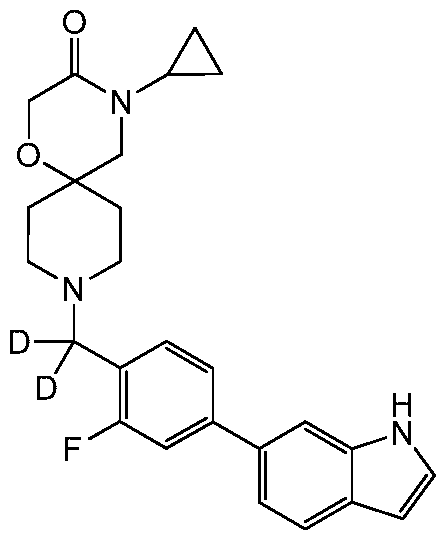
a) 9-[(4-bromo-2-fiuorophenyl) di-deuteromethyl]-4-cyclopropyl-l-oxa-4,9- diazaspiro[5.5]undecan-3-one
To a solution of 4-cyclopropyl-l-oxa-4,9-diazaspiro[5.5]undecan-3-one hydrochloride (0.5 g) in DMF (5 mL) was added 4-bromo-l-(bromo di-deuteromethyl)-2-fluorobenzene (0.642 g) and anhydrous potassium carbonate (0.657 g). The reaction flask was capped with needle septa ventilation and stirred at ambient temperature for 16 h. The reaction mixture was diluted with ethyl acetate, washed with water, brine, dried over sodium sulfate, and evaporated in vacuo to afford the crude title product (958 mg), which was used without further purification. MS(ES)+ m/e 400.7 [M+H]+. b) 4-cyclopropyl-9-{[2-fluoro-4-(lH-indol-6-yl)phenyl] di-deuteromethyl} -l-oxa-4, 9- diazaspiro[5.5]undecan-3-one trifiuoroacetate salt
A 5 mL microwave reaction vial was charged with (lH-indol-6-yl)boronic acid (81 mg), PdCl2(dppf)-CH2Cl2 adduct (20.45 mg), crude 9-[(4-bromo-2-fluorophenyl) di- deuteromethyl]-4-cyclopropyl-l-oxa-4,9-diazaspiro[5.5]undecan-3-one (200 mg) in 1,4- dioxane (2.5 mL) and 2M aq. potassium carbonate (0.551 mL). The vessel was flushed with nitrogen, sealed then irradiated in a microwave reactor at 130 °C for 20 min. The reaction mixture was filtered, diluted with water, and extracted with ethyl acetate. The combined organic extracts were washed with IN aq. sodium bicarbonate and brine, dried over sodium sulfate, and evaporated to dryness. The crude product was dissolved in DMSO, filtered and purified by reverse phase HPLC (5-35 % acetonitrile w/ 0.1 % TF A/water w/ 0.1 % TFA) . The appropriate fractions were combined and lyophilized to afford the title compound (81.7 mg, 30%). MS(ES)+ m/e 436.2 [M+H]+.
Example 83
4-cyclopropyl-9- { [2-fluoro-4-(7-quinolinyl)phenyl] di-deuteromethyl} - 1 - diazaspiro[5.5]undecan-3-one triflu roacetate salt

a) Following the procedure described in Example 82b using 7-(4,4,5,5-tetramethyl-l,3,2- dioxaborolan-2-yl)quinoline afforded the title compound (20 mg, 7%). MS(ES)+ m/e 448.1 [M+H]+.
Example 84
4-cyclopropyl-9-{[2,6-difluoro-4-(lH-indol-6-yl)phenyl]methyl}-l-oxa-4,9- diazaspiro[5.5]undecan-3-one

a) Following the procedure described in Example 75a with 6-(4,4,5,5-tetramethyl-l,3,2- dioxaborolan-2-yl)- lH-indole and 9-[(4-bromo-2,6-difluorophenyl)methyl]-4-cyclopropyl- 1 - oxa-4,9-diazaspiro[5.5]undecan-3-one provided the title compound (57.7 mg, 27%).
MS(ES)+ m/e 452.0 [M+H]+.
Example 85
4-cyclopropyl-9- { [3 ,5 -difluoro-4'-(methyloxy)-4-biphenylyl]methyl} - 1 - diazaspiro[5.5]undecan-3-one

a) Following the procedure described in Example 75a with 4,4,5,5-tetramethyl-2-[4- (methyloxy)phenyl]-l ,3,2-dioxaborolane and 9-[(4-bromo-2,6-difiuorophenyl)methyl]-4- cyclopropyl-l-oxa-4,9-diazaspiro[5.5]undecan-3-one provided the title compound (73.4 m 34%). MS(ES)+ m/e 443.1 [M+H]+.
Example 86
9-{[4-(l,3-benzothiazol-5-yl)-2,6-difluorophenyl]methyl}-4-cyclopropyl-l-oxa-4,9- diazaspiro[5.5]undecan3-one trifiuoroacetate salt

a) A 5 mL microwave reaction vial was charged with (l,3-benzothiazol-5-ylboronic acid (50 mg, 0.28 mmol), PdCl2(dppf)-CH2Cl2 adduct (11.41 mg), 9-[(4-bromo-2,6- difiuorophenyl)methyl]-4-cyclopropyl-l-oxa-4,9-diazaspiro[5.5]undecan-3-one (116 mg, 0.28 mmol) in 1,4-dioxane (2.5 mL) and 2M aq. potassium carbonate (0.28 mL, 0.56 mmol). The vessel was flushed with nitrogen, sealed then irradiated in a microwave reactor at 130 °C for 20 min. The reaction mixture was filtered, diluted with water and extracted with ethyl acetate. The combined organic extracts were washed with IN aq. sodium bicarbonate and brine, dried over sodium sulfate, and evaporated to dryness. The crude product was dissolved in DMSO, filtered and purified by reverse phase HPLC (12-42% acetonitrile w/ 0.1%
TFA/water w/ 0.1% TFA). The appropriate fractions were combined and lyophilized to afford the title compound (61.4 mg, 38%). MS(ES)+ m/e 470.3 [M+H]+.
Example 87
4-cyclopropyl-9- { [2,6-difluoro-4-(6-hydroxy-2-naphthalenyl)phenyl]methyl} - 1 -oxa-4,9- diazaspiro[5.5]undecan-3-one trifluoroacetate salt

a) Following the procedure described in Example 86a with (6-hydroxy-2- naphthalenyl)boronic acid afforded the title compound (46.5 mg, 16%). MS(ES)+ m/e 479.1 [M+H]+.
Example 88
4-cyclopropyl-9-[(2',3,4',5-tetrafluoro-4-biphenylyl)methyl]-l- diazaspiro[5.5]undecan-3-one trifluor acetate salt

a) Following the procedure described in Example 86a with 2,4-difluorophenylboronic acid afforded the title compound (31.1 mg, 15%). MS(ES)+ m/e 449.1 [M+H]+.
Example 89
4-cyclopropyl-9-[(3,4',5-trifluoro-3'-methyl-4-biphenylyl)methyl]-l- diazaspiro[5.5]undecan-3-one trifluoroacetate salt

a) Following the procedure described in Example 86a with 4-fluoro-3-methylphenylboronic acid afforded the title compound (12.8 mg, 6%). MS(ES)+ m/e 445.3 [M+H]+.
Example 90
4-cyclopropyl-9-[(3,4',5-trifluoro-4-biphenylyl)methyl]-l-oxa-4,9-diazaspiro[5.5]undecan-3- one trifluoroacetate salt

a) Following the procedure described in Example 86a with 4-fluorobenzeneboronic acid afforded the title compound (50.6 mg, 26%). MS(ES)+ m/e 431.2 [M+H]+.
Example 91
4-cyclopropyl-9-[(2',3,5-trifluoro-4-biphenylyl)methyl]-l-oxa-4,9-diazaspiro[5.5]undecan-3- one trifluoroacetate salt

a) Following the procedure described in Example 86a with 2-fluorophenylboronic acid afforded the title compound (60.5 mg, 31%). MS(ES)+ m/e 431.2 [M+H]+.
Example 92
4-cyclopropyl-9-[(3,5-difluoro-3'-hydroxy-4-biphenylyl)methyl]-l- diazaspiro[5.5]undecan-3-one trifluoroacetate salt

a) Following the procedure described in Example 86a with (3-hydroxyphenyl)boronic acid afforded the title compound (69.4 mg, 35%). MS(ES)+ m/e 429.0 [M+H]+.
Example 93
4-cyclopropyl-9-{[3'-(dimethylamino)-3,5-difluoro-4-biphenylyl]methyl}-l- diazaspiro[5.5]undecan-3-one trifluoroacetate salt

a) Following the procedure described in Example 86a with (3-
(dimethylamino)phenyl)boronic acid afforded the title compound (87.7 mg, 43%). MS(ES)+ m/e 456.2 [M+H]+.
Example 94
4'-[(4-cyclopropyl-3 -oxo- 1 -oxa-4,9-diazaspiro [5.5 ]undec-9-yl)methyl] -3 ',5 '-difluoro-3 - biphenylcarbonitrile trifluoroacetate salt

a) Following the procedure described in Example 86a with (3-cyanophenyl)boronic acid afforded the title compound (59.6 mg, 30%). MS(ES)+ m/e 438.3 [M+H]+.
Example 95
9-{[4-(l,3-benzothiazol-6-yl)-2,6-difluorophenyl]methyl}-4-cyclopropyl-l-oxa-4,9- diazaspiro[5.5] trifluoroacetate salt

a) Following the procedure described in Example 86a with 6-(4,4,5,5-tetramethyl-l,3,2- dioxaborolan-2-yl)-l,3-benzothiazole afforded the title compound (62.3 mg, 47%). MS(ES)+ m/e 470.3 [M+H]+.
Example 96
4-cyclopropyl-9- { [4-( 1 H-indol-6-yl)-2-methylphenyl]methyl} - 1 -oxa-4,9- diazaspiro[5.5]undecan-3-one

a) 9-[(4-bromo-2-methylphenyl)methyl]-4-cyclopropyl-l-oxa-4,9-diazaspiro[5.5]undecan-3- one
To a solution of 4-cyclopropyl-l-oxa-4,9-diazaspiro[5.5]undecan-3-one hydrochloride (0.398 g) in DMF (5 mL) was added 4-bromo-l-(bromomethyl)-2-methylbenzene (0.5 g) and anhydrous potassium carbonate (0.524 g). The reaction flask was capped with needle septa ventilation and stirred at ambient temperature for 16 h. The reaction mixture was diluted with ethyl acetate, washed with water and brine, dried over sodium sulfate, and evaporated under reduced pressure to afford the crude title product (463 mg), which was used without further purification. MS(ES)+ m/e 394.7 [M+H]+.
b) 4-cyclopropyl-9- { [4-(l H-indol-6-yl)-2-methylphenyl]methyl} - 1 -oxa-4,9- diazaspiro[5.5]undecan-3-one
Following the procedure described in Example 75a with 6-(4,4,5,5-tetramethyl-l,3,2- dioxaborolan-2-yl)- lH-indole and 9-[(4-bromo-2-methylphenyl)methyl]-4-cyclopropyl- 1 - oxa-4,9-diazaspiro[5.5]undecan-3-one provided the title compound (53.9 mg, 33%).
MS(ES)+ m/e 430.1 [M+H]+.
Example 97
4-cyclopropyl-9- { [2,3-difluoro-4-(7-quinolinyl)phenyl]methyl} - 1 - diazaspiro[5.5]undecan-3-one triflu roacetate salt

a) 9-[(4-bromo-2,3-difluorophenyl)methyl]-4-cyclopropyl- 1 -oxa-4,9- diazaspiro[5.5]undecan-3-one
A solution of 4-cyclopropyl-l-oxa-4,9-diazaspiro[5.5]undecan-3-one hydrochloride (300 mg) was dissolved in dichloromethane (DCM) (25 mL) was treated with triethylamine (0.185 mL) and stirred for 10 minutes. In succession, bromo-2,3-di-fluorobenzaldehyde (308 mg), acetic acid (0.190 mL), and sodium triacetoxyborohydride (338 mg) were then added. The reaction mixture was stirred at room temperature under nitrogen for 2 h. The solution was diluted with dichloromethane (50 mL) and the pH was adjusted to 10 with IN aq. sodium hydroxide. The organic layer was separated, washed with brine (3 x 25 mL), dried over sodium sulfate, filtered, and evaporated to dryness. Purification by silica gel chromatography (0-10% methanol/dichloromethane) afforded the title compound (218 mg). MS(ES)+ m/e 417.1 [M+H]+. b) 4-cyclopropyl-9-{[2,3-difluoro-4-(7-quinolinyl)phenyl]methyl}-l-oxa-4,9- diazaspiro[5.5]undecan-3-one trifluoroacetate salt
Following the procedure described in Example 86a with 7-quinolinylboronic acid and 9-[(4-bromo-2,3-difluorophenyl)methyl]-4-cyclopropyl-l-oxa-4,9-diazaspiro[5.5]undecan-3- one afforded the title compound (85 mg, 61%). MS(ES)+ m/e 464.4 [M+H]+.
Example 98
4-cyclopropyl-9-{[2,3-difluoro-4-(lH-indol-6-yl)phenyl]methyl}-l-oxa-4,9- diazaspiro[5.5]undecan-3-one triflu roacetate salt
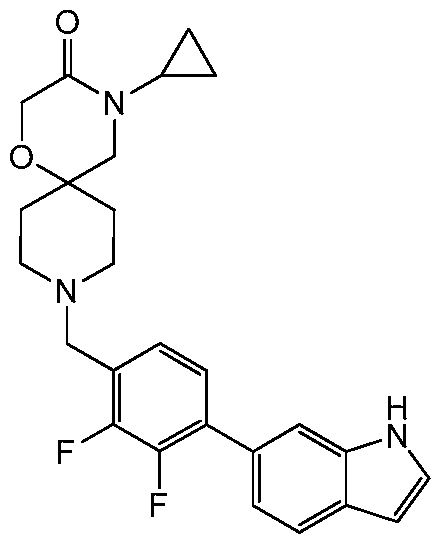
a) Following the procedure described in Example 86a with lH-indol-6-ylboronic acid and 9- [(4-bromo-2,3-difluorophenyl)methyl]-4-cyclopropyl- 1 -oxa-4,9-diazaspiro[5.5]undecan-3- one afforded the title compound (23.3 mg, 17%). MS(ES)+ m/e 452.3 [M+H]+.
Example 99
4-cyclopropyl-9- { [2-hydroxy-4-(7-quinolinyl)phenyl]methyl} - 1 -oxa-4,9- diazaspiro[5.5]undecan-3-one triflu roacetate salt
a) 9-[(4-bromo-2-hydroxyphenyl)methyl]-4-cyclopropyl-l-oxa-4,9-diazaspiro[5.5]undecan- 3 -one
Following the procedure described in Example 97a with 4-bromo-2- hydroxybenzaldehyde afforded the title compound (212 mg, 44%>). MS(ES)+ m/e 396.6 [M+H]+.
b) 4-cyclopropyl-9- { [2-hydroxy-4-(7-quinolinyl)phenyl]methyl} - 1 -oxa-4,9- diazaspiro[5.5]undecan-3-one trifluoroacetate salt
Following the procedure described in Example 86a with 7-quinolinylboronic acid and 9-[(4-bromo-2-hydroxyphenyl)methyl]-4-cyclopropyl-l-oxa-4,9-diazaspiro[5.5]undecan-3- one afforded the title compound (107.9 mg, 38%). MS(ES)+ m/e 444.3 [M+H]+.
Example 100
4-cyclopropyl-9- { [2,3 ,6-trifluoro-4-(7-quinolinyl)phenyl]methyl} - 1 -oxa-4,9- diazaspiro[5.5]undecan-3-one triflu roacetate salt

a) 4-cyclopropyl-9-{[2,3,6-trifluoro-4-(7-quinolinyl)phenyl]methyl}-l-oxa-4,9- diazaspiro[5.5]undecan-3-one trifluoroacetate salt
Following the procedure described in Example 86a with 7-quinolinylboronic acid and 9-[(4-bromo-2,3,6-trifluorophenyl)methyl]-4-cyclopropyl-l-oxa-4,9-diazaspiro[5.5]undecan-
3- one afforded the title compound (57.3 mg, 39%). MS(ES)+ m/e 482.1 [M+H]+.
Example 101
4- cyclopropyl-9-{[2,3,6-trifluoro-4-(lH-indol-6-yl)phenyl]methyl}-l-oxa-4,9- diazaspiro[5.5]undecan-3-one triflu roacetate salt

9-{[5-chloro-2-hydroxy-4-(7-quinolinyl)phenyl]methyl}-4-cyclopropyl-l-oxa-4,9- diazaspiro[5.5]undecan-3-one triflu roacetate salt

a) 9-[(4-bromo-5-chloro-2-hydroxyphenyl)methyl]-4-cyclopropyl- 1 -oxa-4,9- diazaspiro[5.5]undecan-3-one
Following the procedure described in Example 97a with 4-bromo-5-chloro-2- hydroxybenzaldehyde (353 mg) afforded the title compound. MS(ES)+ m/e 431.0 [M+H]+. b) 9- { [5-chloro-2-hydroxy-4-(7-quinolinyl)phenyl]methyl} -4-cyclopropyl- 1 -oxa-4,9- diazaspiro[5.5]undecan-3-one trifluoroacetate salt
Following the procedure described in Example 86a with 7-quinolinylboronic acid and 9-[(4-bromo-5-chloro-2-hydroxyphenyl)methyl]-4-cyclopropyl-l-oxa-4,9- diazaspiro[5.5]undecan-3-one afforded the title compound (53.3 mg, 28%). MS(ES)+ m e 477.9 [M+H]+.
Example 103
9- { [5 -chloro-2-hydroxy-4-( 1 H-indol-6-yl)phenyl]methyl} -4-cyclopropyl- 1 -oxa-4,9- diazaspiro[5.5]undecan-3-one triflu roacetate salt

a) Following the procedure described in Example 86a with (lH-indol-6-yl)boronic acid and 9-[(4-bromo-5-chloro-2-hydroxyphenyl)methyl]-4-cyclopropyl-l-oxa-4,9- diazaspiro[5.5]undecan-3-one afforded the title compound (49.5 mg, 28%). MS(ES)+ m/e 466.1 [M+H]+.
Example 104
4-ethyl-9-{[2-fluoro-4-(7-quinolinyl)phenyl]methyl}-l-oxa-4,9-diazaspiro[5.5]undecan-3- one trifluoroacetate salt

a) 1,1 -dimethylethyl 4- [(ethylamino)methyl] -4-hydroxy- 1 -piperidinecarboxylate
A reaction vessel was charged with 1,1 -dimethylethyl l-oxa-6-azaspiro[2.5]octane-6- carboxylate (1 g) and 2M ethylamine in MeOH (15.47 mL) . The vessel was flushed with nitrogen, sealed and heated at 75 °C. After 20 h, the reaction mixture was cooled and the solution was evaporated under reduced pressure to afford the crude title compound (1.5 g), which was used without further purification. MS(ES)+ m/e 259.1 [M+H]+. b) 1 , 1 -dimethylethyl 4-ethyl-3-oxo- 1 -oxa-4,9-diazaspiro[5.5]undecane-9-carboxylate
A solution of crude 1,1-dimethylethyl 4-[(ethylamino)methyl]-4-hydroxy-l- piperidinecarboxylate (0.825 g) and triethylamine (3.24 mL) in anhydrous dichloromethane (DCM) (10 mL) was cooled to 0 °C and chloroacetyl chloride (0.698 ml) was added. The reaction was allowed to stir at 0 °C for 30 minutes then allowed to warm to room temperature and stirred for 2 h. The resulting brown solution was diluted with dichloromethane, washed with water and brine, dried over sodium sulfate, and evaporated under reduced pressure to afford the chloroacetamide intermediate.
To a solution of the chloracetamide intermediate in anhydrous tetrahydrofuran (THF) (10 mL) was added 60% sodium hydride in mineral oil (1.045 g) in one portion. The reaction was stirred at reflux for 18 h. The resulting brown mixture was cooled and quenched slowly with water then extracted with ethyl acetate. The combined organic layers were washed with brine, dried over sodium sulfate, and evaporated under reduced pressure to dryness to afford the crude title compound as a white solid, which was used without further purification.
MS(ES)+ m/e 299.3 [M+H]+. c) 4-ethyl-l-oxa-4,9-diazaspiro[5.5]undecan-3-one hydrochloride
A solution of crude 1,1-dimethylethyl 4-ethyl-3-oxo-l-oxa-4,9- diazaspiro[5.5]undecane-9-carboxylate (1.45 g) in 4M HCl in dioxane (1.345 g) was stirred at ambient temperature for 3 h. The reaction mixture was evaporated under reduced pressure to afford the crude title compound (0.98 g), which was used without further purification or characterization. d) 9-[(4-bromo-2-fluorophenyl)methyl]-4-ethyl- 1 -oxa-4,9-diazaspiro[5.5]undecan-3-one
To a solution of crude 4-ethyl-l-oxa-4,9-diazaspiro[5.5]undecan-3-one hydrochloride (0.98 g) in DMF (10 mL) was added 4-bromo-l-(bromomethyl)-2-fluorobenzene (1.324 g) and anhydrous potassium carbonate (1.366 g). The reaction flask was capped with needle septa ventilation and stirred at ambient temperature for 3 h. The reaction mixture was diluted with ethyl acetate, washed with water and brine, dried over sodium sulfate, and evaporated in vacuo to afford the crude title compound (1.4 g), which was used without further purification. MS(ES)+ m/e 384.9, 386.8 [M+H]+. e) 4-ethyl-9- {[2-fluoro-4-(7-quinolinyl)phenyl]methyl} - 1 -oxa-4,9-diazaspiro[5.5]undecan- 3 -one trifluoroacetate salt
A 5 mL microwave reaction vial was charged with 7-(4,4,5,5-tetramethyl-l,3,2- dioxaborolan-2-yl)quinoline (132 mg), crude 9-[(4-bromo-2-fiuorophenyl)methyl]-4-ethyl-l- oxa-4,9-diazaspiro[5.5]undecan-3-one (200 mg) in 1,4-dioxane (2.5 mL) and 2M aq.
potassium carbonate (0.571 mL). The vessel was flushed with nitrogen, sealed then irradiated in a microwave reactor at 130 °C for 20 min. The reaction mixture was filtered, diluted with water and extracted with ethyl acetate. The combined organic extracts were washed with IN aq. sodium bicarbonate and brine, dried over sodium sulfate, and evaporated to dryness. The crude product was dissolved in DMSO, filtered and purified by reverse phase HPLC (2-32% acetonitrile w/ 0.1% TF A/water w/ 0.1% TFA) to afford the title compound (18.1 mg, 6%). MS(ES)+ m/e 434.2 [M+H]+.
Example 105
4-ethyl-9-{[2-fluoro-4-(lH-indol-6-yl)phenyl]methyl}-l-oxa-4,9-diazaspiro[5.5]undecan-3- one trifluoroacetate salt

a) Following the procedure described in Example 104e with (lH-indol-6-yl)boronic acid afforded the title compound (16.9 mg, 6%). MS(ES)+ m/e 421.9 [M+H]+.
Example 106
9-{[4-(l,3-benzothiazol-5-yl)-2-fluorophenyl]methyl}-4-ethyl-l-oxa-4,9- diazaspiro[5.5]undecan-3-one trifluoroacetate salt

Example 107
4-cyclopropyl-9- { [2-fluoro-4-(5 -fluoro- 1 H-indol-6-yl)phenyl]methyl} - 1 -oxa-4,9- diazaspiro[5.5]undecan-3-one trifluoroacetate salt

a) A microwave vial was charged with 6-bromo-5 -fluoro- lH-indole (0.338 mmol) and PdCl2(dppf)-CH2Cl2 adduct (13.78 mg, 0.017 mmol). To this was added 4-cyclopropyl-9-{[2- fluoro-4-(4,4,5 ,5-tetramethyl- 1 ,3 ,2-dioxaborolan-2-yl)phenyl]methyl} - 1 -oxa-4,9- diazaspiro[5.5]undecan-3-one (0.130 mmol) in 1,4-dioxane (2.5 mL) followed by 2M aq. potassium carbonate (0.130 mL). The vessel was flushed with nitrogen, sealed then irradiated in a microwave reactor at 130 °C for 20 min. The reaction mixture was filtered, diluted with water and extracted with ethyl acetate. The combined organic extracts were washed with IN aq. sodium bicarbonate and brine, dried over sodium sulfate, and evaporated to dryness. The residue was dissolved in DMSO, filtered and purified by reverse phase HPLC (12-42% acetonitrile w/ 0.1% TF A/water w/ 0.1% TFA). The appropriate fractions were combined and lyophilized to afford the title compound (52 mg, 89%). MS(ES)+ m/e 452.0 [M+H]+.
Example 108
4-cyclopropyl-9-((6-fluoro-5-(quinolin-7-yl)pyridin-2-yl)methyl)-l- diazaspiro[5.5]undecan-3-one

a) 9-((5-bromo-6-fluoropyridin-2-yl)methyl)-4-cyclopropyl- 1 -oxa-4,9- diazaspiro[5.5]undecan-3-one
In a 5 mL microwave vial was placed in succession 4-cyclopropyl-l-oxa-4,9- diazaspiro[5.5]undecan-3-one hydrochloride (200 mg, 0.811 mmol), acetonitrile (3 mL), 3- bromo-6-(bromomethyl)-2-fluoropyridine (262 mg, 0.973 mmol), and N,N- diisopropylethylamine (400 L, 2.29 mmol). The vial was capped, purged with nitrogen and then irradiated in a microwave at 120 °C for 30 min. Analysis by LCMS indicated formation of the desired product and the presence of a small amount of the starting amine. The solution was diluted with dichloromethane (50 mL) and the organic layer was washed with brine (3 x 30 mL). The organic layer was dried over sodium sulfate, filtered, and concentrated in vacuo to afford the crude title compound (316 mg), which was used without further purification. MS(ES)+ m/e 397.9, 399.8 [M+H]+. b) 4-cyclopropyl-9-((6-fluoro-5-(quinolin-7-yl)pyridin-2-yl)methyl)- 1 -oxa-4,9- diazaspiro[5.5]undecan-3-one
Following the procedure described in Example 43 c with 9-((5-bromo-6-fluoropyridin-
2-yl)methyl)-4-cyclopropyl-l-oxa-4,9-diazaspiro[5.5]undecan-3-one and purification via reverse phase HPLC (10-70% acetonitrile/water w/ 0.1% NH4OH) afforded the title compound (91 mg, 55%). MS(ES)+ m/e 447.3 [M+H]+.
Example 109
(+)-cz's-4-cyclopropyl-7-fluoro-9-((3-fluoro
diazaspiro[5.5]undecan-3-one

a) cz5-4-cyclopropyl-7-fluoro-l-oxa-4,9-diazaspiro[5.5]undecan-3-one
Following the procedure described in Example 49g with cz's-benzyl 4-cyclopropyl-7- fluoro-3-oxo-l-oxa-4,9-diazaspiro[5.5]undecane-9-carboxylate afforded the title compound (210 mg, 100%). MS(ES)+ m/e 229.2 [M+H]+. b) cz5-9-((5-bromo-3-fluoropyridin-2-yl)methyl)-4-cyclopropyl-7-fluoro-l-oxa-4,9- diazaspiro[5.5]undecan-3-one
Following the procedure described in Example 108a with cz's-4-cyclopropyl-7-fluoro- 1 -oxa-4,9-diazaspiro[5.5]undecan-3-one and 5-bromo-2-(bromomethyl)-3-fluoropyridine afforded the crude title compound, which was carried forward without further purification. MS(ES)+ m/e 416.1, 418.2 [M+H]+. c) (+)-cz'5-4-cyclopropyl-7-fluoro-9-((3-fluoro-5-(quinolin-7-yl)pyridin-2-yl)methyl)- 1 -oxa- 4,9-diazaspiro [5.5 ]undecan-3 -one
Following the procedure described in Example 53b with cz's-9-((5-bromo-3- fluoropyridin-2-yl)methyl)-4-cyclopropyl-7-fluoro-l-oxa-4,9-diazaspiro[5.5]undecan-3-one and purification of the crude product by reverse phase HPLC (10-70%) acetonitrile/water w/ 0.1% NH4OH) afforded the product as a racemate with known cis relative stereochemistry. Resolution of the racemate by chiral preparative HPLC (Chiralpak AS-H, 95%
acetonitrile:5% methanol) afforded the title compound (27 mg) as a single unknown enantiomer with known relative stereochemistry. MS(ES)+ m/e 465.4 [M+H] . do = +4° (c = 0.05, 95:5 CH3CN:CH3OH).
Example 110
(-)-cz'5-4-cyclopropyl-7-nuoro-9-((3-nuoro-5-(quinolin-7-yl)pyridin-2-yl)methyl)-l- diazaspiro[5.5]undecan-3-one

a) Following the procedure described in Example 109c, the opposite enantiomer was also isolated from the chiral HPLC purification (Chiralpak AS-H, 95% acetonitrile:5% methanol) to afford the title compound (29 mg) as a single unknown enantiomer with known relative stereochemistry. MS(ES)+ m/e 465.3 [M+H]+. aD = -4° (c = 0.05, 95:5 CH3CN:CH3OH).
Example 111
(-)-tran5-4-cyclopropyl-7-fluoro-9-((3-fluoro-5-(quinolin-7-yl)pyridin-2-yl)methyl)-l-oxa- 4,9-diazaspiro [5.5 ]undecan-3 -one

a) tra/75-9-((5-bromo-3-fluoropyridin-2-yl)methyl)-4-cyclopropyl-7-fluoro- 1 -oxa-4,9- diazaspiro[5.5]undecan-3-one
Following the procedure described in Example 108a with trans -4-cyclopropyl-7- fluoro- 1 -oxa-4,9-diazaspiro[5.5]undecan-3-one and 5-bromo-2-(bromomethyl)-3- fluoropyridine afforded the crude title compound, which was carried forward without further purification. MS(ES)+ m/e 416.2, 418.2 [M+H]+.
b) (-)-tran5-4-cyclopropyl-7-fluoro-9-((3-fluoro-5-(quinolin-7-yl)pyridin-2-yl)methyl)-l -oxa- 4,9-diazaspiro [5.5 ]undecan-3 -one
Following the procedure described in Example 53b with tra/?s-9-((5-bromo-3- fluoropyridin-2-yl)methyl)-4-cyclopropyl-7-fluoro-l-oxa-4,9-diazaspiro[5.5]undecan-3-one and purification of the crude product by flash chromatography (0-10% methanokethyl acetate) and reverse phase HPLC (10-70% acetonitrile/water w/ 0.1% ΝΗ4ΟΗ) afforded the product as a racemate with known trans relative stereochemistry. Resolution of the racemate by chiral preparative HPLC (Chiralpak AS-H, 95% acetonitrile:5% methanol) afforded the title compound (17 mg) as a single unknown enantiomer with known relative
stereochemistry. MS(ES)+ m/e 465.5 [M+H]+. aD = -27° (c = 0.04, 95 :5 CH3CN:CH3OH).
Example 112
(+)-tran5-4-cyclopropyl-7-fiuoro-9-((3-fluoro-5-(quinolin-7-yl)pyridin-2-yl)methyl)-l-oxa- 4,9-diazaspiro [5.5 ]undecan-3 -one

a) Following the procedure described in Example 1 1 lb, the opposite enantiomer was also isolated from the chiral HPLC purification (Chiralpak AS-H, 95% acetonitrile:5% methanol) to afford the title compound (18 mg) as a single unknown enantiomer with known relative stereochemistry. MS(ES)+ m/e 465.4 [M+H]+. aD = +27° (c = 0.03, 95 :5 CH3CN:CH3OH).
Example 113
4-ethyl-9-((3-fluoro-5-(quinolin-7-yl)pyridin-2-yl)methyl)- 1 -oxa-4,9-diazaspiro[5.5]undecan- 3 -one

a) 9-((5-bromo-3-fluoropyridin-2-yl)methyl)-4-ethyl-l-oxa-4,9-diazaspiro[5.5]undecan-3- one
In a 10 mL microwave vial was placed 1,1-dimethylethyl 4-ethyl-3-oxo-l-oxa-4,9- diazaspiro[5.5]undecane-9-carboxylate (310 mg, 1.039 mmol) and 4N HC1 in dioxane (5 mL, 20.00 mmol). The vial was capped and the contents were stirred at room temperature for 2 h. Analysis of an aliquot by LCMS indicated the deprotection had gone to completion. The reaction was concentrated to dryness in the microwave vial. Added to the vial were 5-bromo- 2-(bromomethyl)-3-fluoropyridine (280 mg, 1.041 mmol), acetonitrile (5 mL), and N,N- diisopropylethylamine (550 μΐ, 3.15 mmol). The vial was capped, purged with nitrogen, and then irradiated in a microwave at 120 °C for 30 min. The reaction mixture was concentrated and the residue was dissolved in dichloromethane (50 ml) and washed with water (1 x 30 mL) and brine (1 x 30 mL). The organic layer was separated, dried over sodium sulfate, and concentrated in vacuo to afford the crude title compound (323 mg), which was used without further purification. MS(ES)+ m/e 386.0, 388.3 [M+H]+. b) 4-ethyl-9-((3-fluoro-5-(quinolin-7-yl)pyridin-2-yl)methyl)-l-oxa-4,9- diazaspiro[5.5]undecan-3-one
Following the procedure described in Example 108b with 9-((5-bromo-3- fluoropyridin-2-yl)methyl)-4-ethyl-l-oxa-4,9-diazaspiro[5.5]undecan-3-one afforded the title compound (51 mg, 55%). MS(ES)+ m/e 435.5 [M+H]+.
Example 114
9-((3-fluoro-5-(quinolin-7-yl)pyridin-2-yl)methyl)-4-isopropyl-l- diazaspiro[5.5]undecan-3-one

a) 1,1 -dimethylethyl 4-hydroxy-4- { [( 1 -methylethyl)amino]methyl} - 1 -piperidinecarboxylate
Following the procedure described in Example lb with isopropylamine afforded the title compound (3.97 grams) which was carried forward without purification. MS(ES)+ m/e 273.3 [M+H]+. b) 1 , 1 -dimethylethyl 4- { [(chloroacetyl)( 1 -methylethyl)amino]methyl} -4-hydroxy- 1 - piperidinecarboxylate
Following the procedure described in Example 49e with 1,1-dimethylethyl 4-hydroxy- 4- {[(l-methylethyl)amino]methyl}-l -piperidinecarboxylate afforded the title compound (5.63g) which was carried forward without purification. MS(ES)+ m/e 349.1 [M+H]+. c) 1 , 1 -dimethylethyl 4-(l -methylethyl)-3-oxo- 1 -oxa-4,9-diazaspiro[5.5]undecane-9- carboxylate
Following the procedure described in Example 49f with 1 ,1-dimethylethyl 4- { [(chloroacetyl)( 1 -methylethyl)amino]methyl} -4-hydroxy- 1 -piperidinecarboxylate afforded the title compound (3.81 g, 87%). MS(ES)+ m e 313.2 [M+H]+. d) 9-((5-bromo-3-fluoropyridin-2-yl)methyl)-4-isopropyl-l-oxa-4,9-diazaspiro[5.5]undecan- 3 -one
Following the procedure described in Example 113a with 1,1-dimethylethyl 4-(l- methylethyl)-3-oxo-l-oxa-4,9-diazaspiro[5.5]undecane-9-carboxylate afforded the crude title compound, which was carried forward without further purification. MS(ES)+ m/e 400.1, 402.2 [M+H]+.
e) 9-((3-fluoro-5-(quinolin-7-yl)pyridin-2-yl)methyl)-4-isopropyl-l-oxa-4,9- diazaspiro[5.5]undecan-3-one
Following the procedure described in Example 108b with 9-((5-bromo-3- fluoropyridin-2-yl)methyl)-4-isopropyl-l-oxa-4,9-diazaspiro[5.5]undecan-3-one
title compound (39 mg, 43%). MS(ES)+ m/e 449.2 [M+H]+.
Example 115
4-ethyl-9-((3 -fluoro-5 -(3 -fluoroquinolin-7-yl)pyridin-2-yl)methyl)- 1 - diazaspiro[5.5]undecan-3-one

a) Following the procedure described in Example 56a with 9-((5-bromo-3-fluoropyridin-2- yl)methyl)-4-ethyl- 1 -oxa-4,9-diazaspiro[5.5]undecan-3-one and 7-bromo-3-fluoroquinoline and purification of the crude product by flash chromatography (0-10%
methanol :dichloromethane), reverse phase HPLC (10-80% acetonitrile/water w/ 0.1% NH4OH), and reverse phase HPLC (25-55% acetonitrile w/ 0.1 % TFA/water w/ 0.1 % TFA) afforded the title compound as a salt. The recovered material was taken up in acetonitrile (1 mL) and passed through a macroporous solid phase extraction plug (PL-HCO3, 100 mg, 0.18 mmol) to neutralize the TFA salt. The plug was washed with acetonitrile (3 mL). The filtrate was concentrated in vacuo to afford the title compound (39 mg, 38%>). MS (ES)+ m/e 453.2 [M+H]+.
BIOLOGICAL ASSAYS AND DATA
FAS assay
FAS activity was measured through one of the two following assays. Assay #1 :
Inhibition of FAS activity can be measured based on the detection of residual NADPH substrate after the FAS assay is quenched. This assay is run as a 10 endpoint assay in 384-well format, where the reaction contains 20 μΜ malonyl-CoA, 2 μΜ acetyl- CoA, 30 μΜ NADPH and 40 nM FAS in 50 mM sodium phosphate, pH 7.0. The assay is run by sequentially dispensing 5 μΐ of a malonyl-CoA solution, then enzyme solution Containing the acetyl-CoA, and NADPH) into a black, low volume assay plate (Greiner 784076) pre- dispensed with 100 nL compound solutions in DMSO. The reaction is incubated at ambient temperature for 60 minutes, then quenched with 5 μί of a developing solution composed of 90 μΜ resazurin, 0.3 IU/ml diaphorase in 50 mM sodium phosphate, pH 7.0. The developed reaction is read on a Molecular Devices Analyst or Acquest (or equivalent) plate reader using a 530 nm excitation wavelength filter, a 580 nm emission filter, and 561 nm dichroic filter. The test compounds are prepared in neat DMSO at a concentration of 10 mM. For inhibition curves, compounds are diluted using a three fold serial dilution and tested at 11
concentrations (e.g. 25 μΜ-0.42 nM). Curves are analysed using ActivityBase and XLfit, and results are expressed as pIC50 values.
Assay #2:
Inhibition of FAS can also be quantified based on the detection of the CoA products with a thio-reactive coumarin dye. This assay is run as a 10 μί endpoint assay in 384-well format, where the reaction contains 20 μΜ malonyl-CoA, 20 μΜ acetyl-CoA, 40 μΜ
NADPH and 2 nM FAS in 50 mM sodium phosphate, pH 7.0, and 0.04% Tween-20. The assay is run by adding 5 μΙ_, enzyme solution to a black, low volume assay plate (Greiner 784076) pre-dispensed with 100 nl compound solutions in DMSO. After 30 minutes, 5 μΙ_, substrate is added, and the reaction incubated at ambient temperature for an additional 60 minutes. The reaction is then quenched with 10 μί of 6M guanidine-HCl containing 50 μΜ CPM (7-diethylamino-3-(4'-maleimidylphenyl)-4-methylcoumarin CPM; thio-reactive dye),
and incubated for 30 minutes. The plate is read on an Envision (PerkinElmer) or equivalent plate reader using a 380 nm excitation wavelength filter, and a 486 nm emission filter. Data fitting and compound preparations are done as described above.
Lipogenesis assay
Cultured primary human pre-adipocytes (Zen-Bio, Cat# ASC062801) are plated at confluence (3x10⁴ cells/well) in 96-well plates Costar, Cat# 3598) coated with 0.2% gelatin (Sigma, Cat# G-6650) in DMEM/F12 medium (InvitroGen Cat# 11330-032) supplemented with 10% heat inactivated fetal bovine serum (InvitroGen, Cat# 16000-044. The following day (day 1) the cell differentiation is induced by replacing the seeding medium with the differentiation medium composed of DMEM/F12 medium supplemented with 10% heat inactivated fetal bovine serum, 200 μΜ 3-isobutyl-l-methylxanthine (Sigma, Cat# 1-5879), 20 nM dexamethasone (Sigma, Cat# D-8893), 20 nM GW1929 (Sigma, Cat# G5668) and 20 nM insulin (InvitroGen, Cat# 03-0110SA). On day 7, differentiation medium is replaced by the re-feed medium made of DMEM/F12 supplemented with 10% heat inactivated serum and 20 nM insulin. The appropriate concentration of tested compounds and controls are added into this medium at that time. On day 12, the relative amount of cellular triglyceride is estimated by using a Trinder kit (Sigma, Cat# TR0100). Re-feed medium is aspirated and cells are washed with PBS (InvitroGen, Cat# 14190-144 and the assay is performed according the kit manufacturer protocol. Briefly, reconstituted solutions A and B are mixed with 0,01 ) digitonin (Sigma, Cat# D-5628) prior to performing the assay and added onto the cells; plates are incubated at 37 °C for one hour. The absorbance is read at 540 nm. The data is first normalized using the following equation: 100* ((UNK - Control 1) / Control 2 - Control 1)) where Control 1 is the Robust Mean of the 0% response control and Control 2 is the Robust Mean of the 100% response control. When multiple dilutions of compounds are tested, pXC50 are calculated from curves using the 4-parameter curve fitting with the following equation: y=(a-d)/(l+(s/c)Ab)+d and with IRLS (Iterative Re-weighted Least Squares) algorithms to weight outliers (Mosteller, F. & Tukey J.W. (1977 Data Analysis and Regression, pp 353-365, Addison- Wesley).
Biological data
Exemplified compounds of the present invention (Examples 1 - 115) were tested according to the above assays and were found to be inhibitors of FAS. The IC50 values ranged from about 1 to about 2,500 nM; the IC50 values of the certain compounds ranged from about 1 to about 100 nM. The compounds described below were tested generally according to the assays described herein. The IC50 for each compound was either reported in at least one experiment or the average of multiple experiments.
Example 10 is 6 nM
Example 22 is 158 nM
Example 32 is 501 nM
Example 38 is 16 nM
Example 43 is 398 nM
Example 84 is 10 nM
Example 92 is 32 nM
Example 100 is 5 nM
Example 107 is 13 nM
Claims
1. A compound according to Formula (I)

-Ci-C3alkylC3-C7cycloalkyl;
Y is C or N;
Z is C or N; n is 0, 1, 2, 3 or 4; m is 0, 1, 2, or 3;
R1 is phenyl, 5 to 10-membered heteroaryl, naphthyl, or 9- or 10-membered heterocyclyl, wherein said phenyl, 5 to 10-membered heteroaryl, naphthyl, or 9- or 10- membered heterocyclyl is optionally substituted with from 1 to 4 substituents independently selected from the group consisting of Ci-C6alkyl, -CF3, C -C7cycloalkyl, -C(=0)Ci-C4alkyl, Ci-C6alkylC3-C7cycloalkyl, -C(=0)C3-C7cycloalkyl, -C(=0)phenyl, -C(=0)OCi-C4alkyl, - Ci-C4alkyl(=0)OH, -C(=0)NR5R6, -OC2-C4alkylNR5R6, phenyl, -S02Ci-C4alkyl, -S02NR5R6, cyano, oxo, hydroxyl, halogen, Ci-C4alkoxy, C3-C7cycloalkoxy, Ci-C4hydroxylalkyl, Ci-C4alkoxyCi-C4alkyl-, -OCF3, -NR5R6, R5R6NCi-C4alkyl-, -NR6C(=0)Ci-C4alkyl, -NR6CONR5R6, -NR6S02C C4alkyl, -NR6S02NR5R6, R9, and - B(OH)2;
R5 is selected from the group consisting of hydrogen, Ci-C4alkyl, C3-C7cycloalkyl, -Ci-C3alkylC3-C7cycloalkyl, phenyl, and Ci-C3alkylphenyl;
R6 is H, Ci-C4alkyl, C3-C7cycloalkyl, or -Ci-C3alkylC3-C7cycloalkyl; or R5 and R6 taken together with the nitrogen to which they are attached represent a 4- to 7-membered saturated or unsaturated ring optionally containing one other heteroatom which is oxygen, nitrogen, or sulfur, wherein said ring is optionally substituted by 1 to 3 substituents independently selected from oxo, hydoxyl, Ci-C3alkyl, and hydroxyCi-C4alkyl-;
R9 is a 5- or 6-membered heteroaryl ring containing 1 to 4 heteroatoms selected from oxygen, nitrogen, and sulfur, which is optionally substituted with 1 or 2 substituents independently selected from halogen, Ci-C4alkyl, -CF3, Ci-C4alkoxy, and -NR5R6;
each R2 is independently selected from the group consisting of Ci-C6alkyl, cyano, Ci- C4alkoxy, hydroxyl, and halogen;
R3 is selected from the group consisting of Ci-C6alkyl, C3-C7cycloalkyl, or C4- Ceheterocycloalkyl, wherein said Ci-C6alkyl, C3-C7cycloalkyl, or C4-C6heterocycloalkyl is optionally substituted with from 1 to 6 substituents selected from the group consisting of halogen, Ci-C6alkyl, -CF3, C3-C7cycloalkyl, -C(=0)C C4alkyl, Ci-C6alkylC3-C7cycloalkyl, - C(=0)C3-C7cycloalkyl, -C(=0)phenyl, -Ci-C4alkyl(=0)OH, -C(=0)OCi-C4alkyl, - C(=0)NR5R6, phenyl, -S02Ci-C4alkyl, -S02NR5R6, cyano, oxo, hydroxyl, Ci-C4alkoxy, C3- C7cycloalkoxy, hydroxyCi-C4alkyl, Ci-C4alkoxyCi-C4alkyl-, -OCF3, -NR5R6, R5R6NCi-C4alkyl-, -NR6C(=0)C C4alkyl, -NR6CONR5R6, -NR6S02Ci-C4alkyl, -NR6S02NR5R6, and R9; each R4 is independently selected from the group consisting of hydroxyl, halogen,
Ci-C6alkoxy, and Ci-C6alkyl;
R8 is hydrogen or deuterium;
R8a is hydrogen or deuterium; or a pharmaceutically acceptable salt thereof.
2. A compound according to claim 1, represented by Formula (II),

II wherein
X is CH2, NR6 or O, wherein R6 is H, Ci-C4alkyl, C3-C7cycloalkyl, or -Ci-C3alkylC3-C7cycloalkyl; n is 0, 1, 2, 3 or 4; m is 0, 1, 2, or 3;
R1 is phenyl, 5 to 10-membered heteroaryl, naphthyl, or 9- or 10-membered heterocyclyl, wherein said phenyl, 5 to 10-membered heteroaryl, naphthyl, or 9- or 10- membered heterocyclyl is optionally substituted with from 1 to 4 substituents independently selected from the group consisting of Ci-C6alkyl, -CF , C3-C7cycloalkyl, -C(=0)Ci-C4alkyl, Ci-C6alkylC3-C7cycloalkyl, -C(=0)C3-C7cycloalkyl, -C(=0)phenyl, -C(=0)OCrC4alkyl, - Ci-C4alkyl(=0)OH, -C(=0)NR5R6, -OC2-C4alkylNR5R6, phenyl, -S02Ci-C4alkyl, -S02NR5R6, cyano, oxo, hydroxyl, halogen, Ci-C4alkoxy, C3-C7cycloalkoxy, Ci-C4hydroxylalkyl, Ci-C4alkoxyCi-C4alkyl-, -OCF3, -NR5R6, R5R6NCi-C4alkyl-, -NR6C(=0)Ci-C4alkyl, -NR6CONR5R6, -NR6S02C C4alkyl, -NR6S02NR5R6, R9, and - B(OH)2;
R5 is selected from the group consisting of hydrogen, Ci-C4alkyl, C3-C7cycloalkyl, -Ci-C3alkylC3-C7cycloalkyl, phenyl, and Ci-C3alkylphenyl; R6 is H, Ci-C4alkyl, C3-C7cycloalkyl, or -Ci-C3alkylC3-C7cycloalkyl; or R5 and R6 taken together with the nitrogen to which they are attached represent a 4- to 7-membered saturated or unsaturated ring optionally containing one other heteroatom
which is oxygen, nitrogen, or sulfur, wherein said ring is optionally substituted by 1 to 3 substituents independently selected from oxo, hydoxyl, Ci-C3alkyl, and hydroxyCi-C4alkyl-;
R9 is a 5- or 6-membered heteroaryl ring containing 1 to 4 heteroatoms selected from oxygen, nitrogen, and sulfur, which is optionally substituted with 1 or 2 substituents independently selected from halogen, Ci-C4alkyl, -CF3, Ci-C4alkoxy, and -NR5R6;
each R2 is independently selected from the group consisting of Ci-C6alkyl, cyano, Ci- C4alkoxy, hydroxyl, and halogen;
R3 is selected from the group consisting of Ci-C6alkyl, C3-Cvcycloalkyl, or C4- Ceheterocycloalkyl, wherein said Ci-C6alkyl, C3-Cycycloalkyl, or C4-C6heterocycloalkyl is optionally substituted with from 1 to 6 substituents selected from the group consisting of halogen, Ci-C6alkyl, -CF3, C3-C7cycloalkyl, -C(=0)Ci-C4alkyl, Ci-C6alkylC3-C7cycloalkyl, - C(=0)C3-C7cycloalkyl, -C(=0)phenyl, -Ci-C4alkyl(=0)OH, -C(=0)OCi-C4alkyl, - C(=0)NR5R6, phenyl, -S02Ci-C4alkyl, -S02NR5R6, cyano, oxo, hydroxyl, Ci-C4alkoxy, C3- C7cycloalkoxy, hydroxyCi-C4alkyl, Ci-C4alkoxyCi-C4alkyl-, -OCF3, -NR5R6, R5R6NCi-C4alkyl-, -NR6C(=0)Ci-C4alkyl, -NR6CONR5R6, -NR6S02Ci-C4alkyl, -NR6S02NR5R6, and R9; each R4 is independently selected from the group consisting of hydroxyl, halogen, Ci-C6alkoxy, and Ci-C6alkyl;
R8 is hydrogen or deuterium; R8a is hydrogen or deuterium; or a pharmaceutically acceptable salt thereof.
3. A compound according to claim 1, represented by Formula (III),

III wherein
X is CH2, NR6 or O, wherein R6 is H, Ci-C4alkyl, C3-C7cycloalkyl, or -Ci-C3alkylC3-C7cycloalkyl; n is 0, 1, 2, 3 or 4; m is 0, 1, 2, or 3;
R1 is phenyl, 5 to 10-membered heteroaryl, naphthyl, or 9- or 10-membered heterocyclyl, wherein said phenyl, 5 to 10-membered heteroaryl, naphthyl, or 9- or 10- membered heterocyclyl is optionally substituted with from 1 to 4 substituents independently selected from the group consisting of Ci-C6alkyl, -CF , C3-C7cycloalkyl, -C(=0)Ci-C4alkyl, Ci-C6alkylC3-C7cycloalkyl, -C(=0)C3-C7cycloalkyl, -C(=0)phenyl, -C(=0)OCi-C4alkyl, - Ci-C4alkyl(=0)OH, -C(=0)NR5R6, -OC2-C4alkylNR5R6, phenyl, -S02Ci-C4alkyl, -S02NR5R6, cyano, oxo, hydroxyl, halogen, Ci-C4alkoxy, C3-C7cycloalkoxy, Ci-C4hydroxylalkyl, Ci-C4alkoxyCi-C4alkyl-, -OCF3, -NR5R6, R5R6NCi-C4alkyl-, -NR6C(=0)Ci-C4alkyl, -NR6CONR5R6, -NR6S02Ci-C4alkyl, -NR6S02NR5R6, R9, and - B(OH)2;
R5 is selected from the group consisting of hydrogen, Ci-C4alkyl, C -C7cycloalkyl, -Ci-C3alkylC3-C7cycloalkyl, phenyl, and Ci-C3alkylphenyl; R6 is H, Ci-C4alkyl, C3-C7cycloalkyl, or -Ci-C3alkylC3-C7cycloalkyl; or R5 and R6 taken together with the nitrogen to which they are attached represent a 4- to 7-membered saturated or unsaturated ring optionally containing one other heteroatom
which is oxygen, nitrogen, or sulfur, wherein said ring is optionally substituted by 1 to 3 substituents independently selected from oxo, hydoxyl, Ci-C3alkyl, and hydroxyCi-C4alkyl-;
R9 is a 5- or 6-membered heteroaryl ring containing 1 to 4 heteroatoms selected from oxygen, nitrogen, and sulfur, which is optionally substituted with 1 or 2 substituents independently selected from halogen, Ci-C4alkyl, -CF3, Ci-C4alkoxy, and -NR5R6;
each R2 is independently selected from the group consisting of Ci-C6alkyl, cyano, Ci- C4alkoxy, hydroxyl, and halogen;
R3 is selected from the group consisting of Ci-C6alkyl, C3-Cvcycloalkyl, or C4- Ceheterocycloalkyl, wherein said Ci-C6alkyl, C3-Cycycloalkyl, or C4-C6heterocycloalkyl is optionally substituted with from 1 to 6 substituents selected from the group consisting of halogen, Ci-C6alkyl, -CF3, C3-C7cycloalkyl, -C(=0)Ci-C4alkyl, Ci-C6alkylC3-C7cycloalkyl, - C(=0)C3-C7cycloalkyl, -C(=0)phenyl, -Ci-C4alkyl(=0)OH, -C(=0)OCi-C4alkyl, - C(=0)NR5R6, phenyl, -S02Ci-C4alkyl, -S02NR5R6, cyano, oxo, hydroxyl, Ci-C4alkoxy, C3- C7cycloalkoxy, hydroxyCi-C4alkyl, Ci-C4alkoxyCi-C4alkyl-, -OCF3, -NR5R6, R5R6NCi-C4alkyl-, -NR6C(=0)Ci-C4alkyl, -NR6CONR5R6, -NR6S02Ci-C4alkyl, -NR6S02NR5R6, and R9; each R4 is independently selected from the group consisting of hydroxyl, halogen, Ci-C6alkoxy, and Ci-C6alkyl;
R8 is hydrogen or deuterium; R8a is hydrogen or deuterium; or a pharmaceutically acceptable salt thereof.
4. A compound according to claim 1 , represented by Formula (IV),

X is CH2, NR6 or O, wherein R6 is H, Ci-C4alkyl, C3-C7cycloalkyl, or -Ci-C3alkylC3-C7cycloalkyl; n is 0, 1, 2, 3 or 4; m is 0, 1, 2, or 3;
R1 is phenyl, 5 to 10-membered heteroaryl, naphthyl, or 9- or 10-membered heterocyclyl, wherein said phenyl, 5 to 10-membered heteroaryl, naphthyl, or 9- or 10- membered heterocyclyl is optionally substituted with from 1 to 4 substituents independently selected from the group consisting of Ci-C6alkyl, -CF , C3-C7cycloalkyl, -C(=0)Ci-C4alkyl, Ci-C6alkylC3-C7cycloalkyl, -C(=0)C3-C7cycloalkyl, -C(=0)phenyl, -C(=0)OCrC4alkyl, - Ci-C4alkyl(=0)OH, -C(=0)NR5R6, -OC2-C4alkylNR5R6, phenyl, -S02Ci-C4alkyl, -S02NR5R6, cyano, oxo, hydroxyl, halogen, Ci-C4alkoxy, C3-C7cycloalkoxy, Ci-C4hydroxylalkyl, Ci-C4alkoxyCi-C4alkyl-, -OCF3, -NR5R6, R5R6NCi-C4alkyl-, -NR6C(=0)Ci-C4alkyl, -NR6CONR5R6, -NR6S02C C4alkyl, -NR6S02NR5R6, R9, and - B(OH)2;
R5 is selected from the group consisting of hydrogen, Ci-C4alkyl, C3-C7cycloalkyl, -Ci-C3alkylC3-C7cycloalkyl, phenyl, and Ci-C3alkylphenyl; R6 is H, Ci-C4alkyl, C3-C7cycloalkyl, or -Ci-C3alkylC3-C7cycloalkyl; or R5 and R6 taken together with the nitrogen to which they are attached represent a 4- to 7-membered saturated or unsaturated ring optionally containing one other heteroatom
which is oxygen, nitrogen, or sulfur, wherein said ring is optionally substituted by 1 to 3 substituents independently selected from oxo, hydoxyl, Ci-C3alkyl, and hydroxyCi-C4alkyl-;
R9 is a 5- or 6-membered heteroaryl ring containing 1 to 4 heteroatoms selected from oxygen, nitrogen, and sulfur, which is optionally substituted with 1 or 2 substituents independently selected from halogen, Ci-C4alkyl, -CF3, Ci-C4alkoxy, and -NR5R6;
each R2 is independently selected from the group consisting of Ci-C6alkyl, cyano, Ci- C4alkoxy, hydroxyl, and halogen;
R3 is selected from the group consisting of Ci-C6alkyl, C3-Cvcycloalkyl, or C4- Ceheterocycloalkyl, wherein said Ci-C6alkyl, C3-Cycycloalkyl, or C4-C6heterocycloalkyl is optionally substituted with from 1 to 6 substituents selected from the group consisting of halogen, Ci-C6alkyl, -CF3, C3-C7cycloalkyl, -C(=0)Ci-C4alkyl, Ci-C6alkylC3-C7cycloalkyl, - C(=0)C3-C7cycloalkyl, -C(=0)phenyl, -Ci-C4alkyl(=0)OH, -C(=0)OCi-C4alkyl, - C(=0)NR5R6, phenyl, -S02Ci-C4alkyl, -S02NR5R6, cyano, oxo, hydroxyl, Ci-C4alkoxy, C3- C7cycloalkoxy, hydroxyCi-C4alkyl, Ci-C4alkoxyCi-C4alkyl-, -OCF3, -NR5R6, R5R6NCi-C4alkyl-, -NR6C(=0)Ci-C4alkyl, -NR6CONR5R6, -NR6S02Ci-C4alkyl, -NR6S02NR5R6, and R9; each R4 is independently selected from the group consisting of hydroxyl, halogen, Ci-C6alkoxy, and Ci-C6alkyl;
R8 is hydrogen or deuterium; R8a is hydrogen or deuterium; or a pharmaceutically acceptable salt thereof.
5. A compound according to claim 1, represented by Formula (V).

Y is C or N; Z is C or N; n is 0, 1, 2, 3 or 4; m is 0, 1, 2, or 3;
R1 is phenyl, 5 to 10-membered heteroaryl, naphthyl, or 9- or 10-membered heterocyclyl, wherein said phenyl, 5 to 10-membered heteroaryl, naphthyl, or 9- or 10- membered heterocyclyl is optionally substituted with from 1 to 4 substituents independently selected from the group consisting of Ci-C6alkyl, -CF3, C3-Cycycloalkyl, -C(=0)Ci-C4alkyl, Ci-C6alkylC3-C7cycloalkyl, -C(=0)C3-C7cycloalkyl, -C(=0)phenyl, -C(=0)OCi-C4alkyl, - Ci-C4alkyl(=0)OH, -C(=0)NR5R6, -OC2-C4alkylNR5R6, phenyl, -S02Ci-C4alkyl, -S02NR5R6, cyano, oxo, hydroxyl, halogen, Ci-C4alkoxy, C3-C7cycloalkoxy, Ci-C4hydroxylalkyl, Ci-C4alkoxyCi-C4alkyl-, -OCF3, -NR5R6, R5R6NCi-C4alkyl-, -NR6C(=0)Ci-C4alkyl, -NR6CONR5R6, -NR6S02C C4alkyl, -NR6S02NR5R6, R9, and - B(OH)2;
R5 is selected from the group consisting of hydrogen, Ci-C4alkyl, C3-C7cycloalkyl, -Ci-C3alkylC3-C7cycloalkyl, phenyl, and Ci-C3alkylphenyl;
R6 is H, Ci-C4alkyl, C3-C7cycloalkyl, or -Ci-C3alkylC3-C7cycloalkyl; or R5 and R6 taken together with the nitrogen to which they are attached represent a 4- to 7-membered saturated or unsaturated ring optionally containing one other heteroatom which is oxygen, nitrogen, or sulfur, wherein said ring is optionally substituted by 1 to 3 substituents independently selected from oxo, hydoxyl, Ci-C3alkyl, and hydroxyCi-C4alkyl-;
R9 is a 5- or 6-membered heteroaryl ring containing 1 to 4 heteroatoms selected from oxygen, nitrogen, and sulfur, which is optionally substituted with 1 or 2 substituents independently selected from halogen, Ci-C4alkyl, -CF3, Ci-C4alkoxy, and -NR5R6;
each R2 is independently selected from the group consisting of Ci-C6alkyl, cyano, Ci- C4alkoxy, hydroxyl, and halogen;
R3 is selected from the group consisting of Ci-C6alkyl, C3-C7cycloalkyl, or C4- Ceheterocycloalkyl, wherein said Ci-C6alkyl, C3-C7cycloalkyl, or C4-C6heterocycloalkyl is optionally substituted with from 1 to 6 substituents selected from the group consisting of halogen, Ci-C6alkyl, -CF3, C3-C7cycloalkyl, -C(=0)C C4alkyl, Ci-C6alkylC3-C7cycloalkyl, - C(=0)C3-C7cycloalkyl, -C(=0)phenyl, -Ci-C4alkyl(=0)OH, -C(=0)OCi-C4alkyl, - C(=0)NR5R6, phenyl, -S02Ci-C4alkyl, -S02NR5R6, cyano, oxo, hydroxyl, Ci-C4alkoxy, C3- C7cycloalkoxy, hydroxyCi-C4alkyl, Ci-C4alkoxyCi-C4alkyl-, -OCF3, -NR5R6, R5R6NCi-C4alkyl-, -NR6C(=0)C C4alkyl, -NR6CONR5R6, -NR6S02Ci-C4alkyl, -NR6S02NR5R6, and R9; each R4 is independently selected from the group consisting of hydroxyl, halogen, Ci-C6alkoxy, and Ci-C6alkyl;
R8 is hydrogen or deuterium;
R8a is hydrogen or deuterium; or a pharmaceutically acceptable salt thereof.
6. A compound according to claim 1, represented by Formula (VI).

(VI) wherein
Y is C or N;
Z is C or N; n is 0, 1, 2, 3 or 4;
m is 0, 1, 2, or 3;
R1 is phenyl, 5 to 10-membered heteroaryl, naphthyl, or 9- or 10-membered heterocyclyl, wherein said phenyl, 5 to 10-membered heteroaryl, naphthyl, or 9- or 10- membered heterocyclyl is optionally substituted with from 1 to 4 substituents independently selected from the group consisting of Ci-C6alkyl, -CF3, C3-C7cycloalkyl, -C(=0)Ci-C4alkyl, Ci-C6alkylC3-C7cycloalkyl, -C(=0)C3-C7cycloalkyl, -C(=0)phenyl, -C(=0)OCi-C4alkyl, - Ci-C4alkyl(=0)OH, -C(=0)NR5R6, -OC2-C4alkylNR5R6, phenyl, -S02Ci-C4alkyl, -S02NR5R6, cyano, oxo, hydroxyl, halogen, Ci-C4alkoxy, C3-C7cycloalkoxy, Ci-C4hydroxylalkyl, Ci-C4alkoxyCi-C4alkyl-, -OCF3, -NR5R6, R5R6NCi-C4alkyl-,
 -NR6CONR5R6, -NR6S02C C4alkyl, -NR6S02NR5R6, R9, and - B(OH)2;
R5 is selected from the group consisting of hydrogen, Ci-C4alkyl, C3-C7cycloalkyl, -Ci-C3alkylC3-C7cycloalkyl, phenyl, and Ci-C3alkylphenyl;
R6 is H, Ci-C4alkyl, C3-C7cycloalkyl, or -Ci-C3alkylC3-C7cycloalkyl; or R5 and R6 taken together with the nitrogen to which they are attached represent a 4- to 7-membered saturated or unsaturated ring optionally containing one other heteroatom which is oxygen, nitrogen, or sulfur, wherein said ring is optionally substituted by 1 to 3 substituents independently selected from oxo, hydoxyl, Ci-C3alkyl, and hydroxyCi-C4alkyl-;
R9 is a 5- or 6-membered heteroaryl ring containing 1 to 4 heteroatoms selected from oxygen, nitrogen, and sulfur, which is optionally substituted with 1 or 2 substituents independently selected from halogen, Ci-C4alkyl, -CF3, Ci-C4alkoxy, and -NR5R6;
each R2 is independently selected from the group consisting of Ci-C6alkyl, cyano, Ci- C4alkoxy, hydroxyl, and halogen;
R3 is selected from the group consisting of Ci-C6alkyl, C3-C7cycloalkyl, or C4- C6heterocycloalkyl, wherein said Ci-C6alkyl, C3-C7cycloalkyl, or C4-C6heterocycloalkyl is optionally substituted with from 1 to 6 substituents selected from the group consisting of halogen, Ci-C6alkyl, -CF3, C3-C7cycloalkyl, -C(=0)Ci-C4alkyl, Ci-C6alkylC3-C7cycloalkyl, - C(=0)C3-C7cycloalkyl, -C(=0)phenyl, -Ci-C4alkyl(=0)OH, -C(=0)OCi-C4alkyl, - C(=0)NR5R6, phenyl, -S02Ci-C4alkyl, -S02NR5R6, cyano, oxo, hydroxyl, C C4alkoxy, C3- C7cycloalkoxy, hydroxyCi-C4alkyl, Ci-C4alkoxyCi-C4alkyl-, -OCF3, -NR5R6, R5R6NCi-C4alkyl-, -NR6C(=0)Ci-C4alkyl, -NR6CONR5R6, -NR6S02Ci-C4alkyl, -NR6S02NR5R6, and R9;
each R4 is independently selected from the group consisting of hydroxyl, halogen, Ci-C6alkoxy, and Ci-C6alkyl;
R8 is hydrogen or deuterium;
R8a is hydrogen or deuterium; or a pharmaceutically acceptable salt thereof.
7. A compound or pharmaceutically acceptable salt thereof according to any one claims 1 to 6 wherein R1 is selected from the group consisting of is benzofuranyl,
isobenzofuryl, 2,3-dihydrobenzofuryl, 1,3-benzodioxolyl, dihydrobenzodioxinyl,
benzothienyl, indolizinyl, indolyl, isoindolyl, indolinyl, isoindolinyl, 1-H-indazolyl, benzimidazolyl, dihydrobenzimidazolyl, benzoxazolyl, dihydrobenzoxazolyl, benzthiazolyl, benzoisothiazolyl, dihydrobenzoisothiazolyl, indazolyl, pyrrolopyridinyl, pyrrolopyrimidinyl, imidazopyridinyl, imidazopyrimidinyl, pyrazolopyridinyl, pyrazolopyrimidinyl,
benzoxadiazolyl, benzthiadiazolyl, benzotriazolyl, triazolopyridinyl, purinyl, quinolinyl, tetrahydroquinolinyl, isoquinolinyl, tetrahydroisoquinolinyl, quinoxalinyl, cinnolinyl, phthalazinyl, quinazolinyl, 1,5-naphthyridinyl, 1 ,6-naphthyridinyl, 1,7-naphthyridinyl, 1,8- naphthyridinyl, or pteridinyl, wherein said benzofuranyl, isobenzofuryl, 2,3- dihydrobenzofuryl, 1,3-benzodioxolyl, dihydrobenzodioxinyl, benzothienyl, indolizinyl, indolyl, isoindolyl, indolinyl, isoindolinyl, 1-H-indazolyl, benzimidazolyl,
dihydrobenzimidazolyl, benzoxazolyl, dihydrobenzoxazolyl, benzthiazolyl,
benzoisothiazolyl, dihydrobenzoisothiazolyl, indazolyl, pyrrolopyridinyl, pyrrolopyrimidinyl, imidazopyridinyl, imidazopyrimidinyl, pyrazolopyridinyl, pyrazolopyrimidinyl,
benzoxadiazolyl, benzthiadiazolyl, benzotriazolyl, triazolopyridinyl, purinyl, quinolinyl, tetrahydroquinolinyl, isoquinolinyl, tetrahydroisoquinolinyl, quinoxalinyl, cinnolinyl, phthalazinyl, quinazolinyl, 1,5-naphthyridinyl, 1 ,6-naphthyridinyl, 1,7-naphthyridinyl, 1,8- naphthyridinyl, and pteridinyl, all of which are optionally substituted 1 to 3 times with halogen, Ci-C4alkyl, -CF3, C3-C7cycloalkyl, -C(=0)Ci-C4alkyl, -C(=0)C3-C7cycloalkyl, - C(=0)phenyl, -C(=0)OCi-C4alkyl, phenyl, -C(=0)NR5R6, -Ci-C4alkyl(=0)OH, -S02Ci- C4alkyl, -S02NR5R6, cyano, oxo, hydroxyl, (Ci-C4)alkoxy, C3-C7cycloalkoxy,
hydroxyCi-C4alkyl-, C C4alkoxyCi-C4alkyl-, -OCF3, -NR5R6, R5R6NC C4alkyl-,
-NHC(=0) Ci-C4alkyl, -NHCONR5R6, -NHS02Ci-C4alkyl, and -NHS02NR5R6, wherein R5 is selected from the group consisting of hydrogen, Ci-C4alkyl, phenyl, and Ci-C3alkylphenyl; R6 is hydrogen or Ci-C4alkyl.
8. A compound or pharmaceutically acceptable salt thereof according to any one of claims 1 to 7, wherein R3 is selected from the group consisting of Ci-C6alkyl and C3- C7cycloalkyl, wherein said C3-C7cycloalkyl group is optionally substituted with one, two or three substituents independently selected from the group consisting of Ci-C4alkyl, hydroxyl, Ci-C4hydroxyalkyl and Ci-C4alkoxyCi-C4alkyl-.
9. A compound selected from the group consisting of:
4-cyclopropyl-9-[(2-fluoro-4-imidazo[ 1 ,2-a]pyridin-7-ylphenyl)methyl]- 1 -oxa-4,9- diazaspiro[5.5]undecan-3-one;
4-cyclopropyl-9-[(3-fluoro-3'-hydroxy-4-biphenylyl)methyl]-l-oxa-4,9- diazaspiro[5.5]undecan-3-one;
4-cyclopropyl-9- { [2-fluoro-4-(6-quinolinyl)phenyl]methyl} - 1 -oxa-4,9- diazaspiro[5.5]undecan-3-one;
4-cyclopropyl-9- { [2-fluoro-4-(6-quinoxalinyl)phenyl]methyl} - 1 -oxa-4,9- diazaspiro[5.5]undecan-3-one;
4-cyclopropyl-9- { [2-fluoro-4-(5-quinolinyl)phenyl]methyl} - 1 -oxa-4,9- diazaspiro[5.5]undecan-3-one;
4-cyclopropyl-9- { [2-fluoro-4-(7-quinazolinyl)phenyl]methyl} - 1 -oxa-4,9- diazaspiro[5.5]undecan-3-one;
4-cyclopropyl-9- { [4-(2,3-dihydro- 1 H-indol-5-yl)-2-fluorophenyl]methyl} - 1 -oxa-4,9- diazaspiro[5.5]undecan-3-one;
4-cyclopropyl-9- { [2-fluoro-4-(6-quinazolinyl)phenyl]methyl} - 1 -oxa-4,9- diazaspiro[5.5]undecan-3-one;
4-cyclopropyl-9-{[4-(2,3-dihydro-lH-indol-6-yl)-2-fluorophenyl]methyl}-l-oxa-4,9- diazaspiro[5.5]undecan-3-one;
4-cyclopropyl-9-{[2-fluoro-4-(6-isoquinolinyl)phenyl]methyl}-l-oxa-4,9- diazaspiro[5.5]undecan-3-one;
4-cyclopropyl-9-{[2-fluoro-4-(7-isoquinolinyl)phenyl]methyl}-l-oxa-4,9- diazaspiro[5.5]undecan-3-one;
4-cyclopropyl-9-(2-fluoro-4-(8-methoxyquinolin-7-yl)benzyl)-l-oxa-4,9- diazaspiro[5.5]undecan-3-one;
4-cyclopropyl-9-(2,6-difluoro-4-(3-hydroxyquinolin-7-yl)benzyl)-l-oxa-4,9- diazaspiro[5.5]undecan-3-one;
4-cyclopropyl-9-(2,6-difluoro-4-(3-methoxyquinolin-7-yl)benzyl)-l-oxa-4,9- diazaspiro[5.5]undecan-3-one;
4-cyclopropyl-9-(2,6-difluoro-4-(8-methoxyquinolin-7-yl)benzyl)-l-oxa-4,9- diazaspiro[5.5]undecan-3-one;
4-cyclopropyl-9-(4-(2-ethoxyquinazolin-7-yl)-2,6-difluorobenzyl)-l-oxa-4,9- diazaspiro [5.5 ]undecan-3 -one;
4-cyclopropyl-9-((3-fluoro-5-(8-methoxyquinolin-7-yl)pyridin-2-yl)methyl)-l-oxa- 4,9-diazaspiro [5.5 ]undecan-3 -one;
N-(7-(4-((4-cyclopropyl-3 -oxo- 1 -oxa-4,9-diazaspiro [5.5 ]undecan-9-yl)methyl)-3 - fluorophenyl)quinolin-3-yl)acetamide;
7-(4-((4-cyclopropyl-3-oxo- 1 -oxa-4,9-diazaspiro[5.5]undecan-9-yl)methyl)-3- fluorophenyl)quinoline-3-carbonitrile;
4-cyclopropyl-9-(2-fluoro-4-(3-hydroxyquinolin-7-yl)benzyl)-l-oxa-4,9- diazaspiro[5.5]undecan-3-one;
4-cyclopropyl-9-(2-fluoro-4-(3-methoxyquinolin-7-yl)benzyl)-l-oxa-4,9- diazaspiro[5.5]undecan-3-one;
N-(7-(4-((4-cyclopropyl-3 -oxo- 1 -oxa-4,9-diazaspiro [5.5 ]undecan-9-yl)methyl)-3 - fluorophenyl)quinolin-3-yl)methanesulfonamide;
4-cyclopropyl-9-(2-fluoro-4-(3-methylquinolin-7-yl)benzyl)-l-oxa-4,9- diazaspiro[5.5]undecan-3-one;
4-cyclopropyl-9-(4-(3-ethylquinolin-7-yl)-2-fluorobenzyl)-l-oxa-4,9- diazaspiro[5.5]undecan-3-one;
4-cyclopropyl-9-(2-fluoro-4-(3-fluoroquinolin-7-yl)benzyl)-l-oxa-4,9- diazaspiro[5.5]undecan-3-one;
9-(4-(3-chloroquinolin-7-yl)-2-fluorobenzyl)-4-cyclopropyl-l-oxa-4,9- diazaspiro [5.5 ]undecan-3 -one;
4-cyclopropyl-9- { [2-fluoro-4-(7-quinolinyl)phenyl]methyl} - 1 -oxa-4,9- diazaspiro[5.5]undecan-3-one;
4-cyclopropyl-9-{[2,6-difluoro-4-(7-quinolinyl)phenyl]methyl}-l-oxa-4,9- diazaspiro[5.5]undecan-3-one;
4-cyclopropyl-9-{[2,6-difluoro-4-(7-quinolinyl)phenyl]methyl}-l-oxa-4,9- diazaspiro [5.5 ]undecan-3 -one-( 2 ;
4-cyclopropyl-9-{[2,6-difluoro-4-(lH-indol-6-yl)phenyl]methyl}-l-oxa-4,9- diazaspiro [5.5 ]undecan-3 -one-<i2 ;
9-{[2-chloro-4-(lH-indol-6-yl)phenyl]methyl}-4-cyclopropyl-l-oxa-4,9- diazaspiro[5.5]undecan-3-one;
{4'-[(4-cyclopropyl-3-oxo-l-oxa-4,9-diazaspiro[5.5]undec-9-yl)methyl]-2',3',5'- trifluoro-4-biphenylyl}boronic acid;
9- { [2-fluoro-4-(7-quinolinyl)phenyl]methyl} -4-( 1 -methylcyclopropyl)- 1 -oxa-4,9- diazaspiro[5.5]undecan-3-one;
9- { [2-fluoro-4-( lH-indol-6-yl)phenyl]methyl} -4-(l -methylcyclopropyl)- 1 -oxa-4,9- diazaspiro[5.5]undecan-3-one;
4-cyclopropyl-9- { [3-methyl-4-(7-quinolinyl)phenyl]methyl} - 1 -oxa-4,9- diazaspiro[5.5]undecan-3-one;
4-cyclopropyl-9- { [3-fluoro-4-(7-quinolinyl)phenyl]methyl} - 1 -oxa-4,9- diazaspiro[5.5]undecan-3-one;
9- { [3-chloro-4-(7-quinolinyl)phenyl]methyl} -4-cyclopropyl- 1 -oxa-4,9- diazaspiro[5.5]undecan-3-one;
4-cyclopropyl-9-(2-fluoro-4-(8-fluoronaphthalen-2-yl)benzyl)-l-oxa-4,9- diazaspiro[5.5]undecan-3-one;
4-cyclopropyl-9-(2,6-difluoro-4-(8-fluoronaphthalen-2-yl)benzyl)-l-oxa-4,9- diazaspiro[5.5]undecan-3-one;
4-cyclopropyl-9-(2,6-difluoro-4-(6-fluoronaphthalen-2-yl)benzyl)-l-oxa-4,9- diazaspiro[5.5]undecan-3-one;
4-cyclopropyl-9-(2-fluoro-4-(6-fluoronaphthalen-2-yl)benzyl)-l-oxa-4,9- diazaspiro[5.5]undecan-3-one;
4-cyclopropyl-9-((3-fluoro-5-(quinolin-7-yl)pyridin-2-yl)methyl)-l-oxa-4,9- diazaspiro[5.5]undecan-3-one;
4-cyclopropyl-9-((5-(quinolin-7-yl)pyridin-2-yl)methyl)-l-oxa-4,9- diazaspiro[5.5]undecan-3-one;
4-cyclopropyl-9-((6-(quinolin-7-yl)pyridin-3-yl)methyl)-l-oxa-4,9- diazaspiro[5.5]undecan-3-one;
4-cyclopropyl-9-((3-fluoro-5-(3-methylquinolin-7-yl)pyridin-2-yl)methyl)-l-oxa-4,9- diazaspiro[5.5]undecan-3-one;
9-((5-(3-chloroquinolin-7-yl)-3-fluoropyridin-2-yl)methyl)-4-cyclopropyl-l-oxa-4,9- diazaspiro[5.5]undecan-3-one;
7-(6-((4-cyclopropyl-3-oxo-l-oxa-4,9-diazaspiro[5.5]undecan-9-yl)methyl)-5- fluoropyridin-3 -yl)quinoline-3 -carbonitrile;
4-cyclopropyl-9-((3-fluoro-5-(3-methoxyquinolin-7-yl)pyridin-2-yl)methyl)-l-oxa- 4,9-diazaspiro [5.5 ]undecan-3 -one;
(-)-tra/75-4-cyclopropyl-7-fluoro-9-(2-fluoro-4-(quinolin-7-yl)benzyl)-l-oxa-4,9- diazaspiro[5.5]undecan-3-one;
(+)-tra/75-4-cyclopropyl-7-fluoro-9-(2-fluoro-4-(quinolin-7-yl)benzyl)-l-oxa-4,9- diazaspiro[5.5]undecan-3-one;
(-)-tra/75-4-cyclopropyl-9-(2,6-difluoro-4-(quinolin-7-yl)benzyl)-7-fluoro-l-oxa-4,9- diazaspiro[5.5]undecan-3-one;
(+)-tra/75-4-cyclopropyl-9-(2,6-difluoro-4-(quinolin-7-yl)benzyl)-7-fluoro-l-oxa-4,9- diazaspiro[5.5]undecan-3-one;
(+)-tra/75-4-cyclopropyl-7-fluoro-9-(2,3 ,6-trifluoro-4-(quinolin-7-yl)benzyl)- 1 -oxa- 4,9-diazaspiro [5.5 ]undecan-3 -one;
(-)-tran5-4-cyclopropyl-7-fluoro-9-(2,3,6-trifluoro-4-(quinolin-7-yl)benzyl)-l-oxa- 4,9-diazaspiro [5.5 ]undecan-3 -one;
tran5-4-cyclopropyl-7-fluoro-9-((3-fluoro-5-(quinolin-7-yl)pyridin-2-yl)methyl)-l- oxa-4,9-diazaspiro [5.5 ]undecan-3-one;
tran5-(4-cyclopropyl-7-fluoro-9-((3-fluoro-5-(3-methoxyquinolin-7-yl)pyridin-2- yl)methyl)-l-oxa-4,9-diazaspiro[5.5]undecan-3-one;
tra/75-7-(6-((-4-cyclopropyl-7-fluoro-3-oxo-l-oxa-4,9-diazaspiro[5.5]undecan-9- yl)methyl)-5 -fluoropyridin-3 -yl)quinoline-3 -carbonitrile;
tra/75-9-((5-(3-chloroquinolin-7-yl)-3-fluoropyridin-2-yl)methyl)-4-cyclopropyl-7- fluoro- 1 -oxa-4,9-diazaspiro[5.5]undecan-3-one;
(+)-cz5-4-cyclopropyl-9- { [2,6-difluoro-4-(7-quinolinyl)phenyl]methyl} -7-fluoro- 1 - oxa-4,9-diazaspiro [5.5 ]undecan-3-one;
(-)-cz5-4-cyclopropyl-9- { [2,6-difluoro-4-(7-quinolinyl)phenyl]methyl} -7-fluoro- 1 - oxa-4,9-diazaspiro [5.5 ]undecan-3-one;
(+)-cz5-4-cyclopropyl-7-fluoro-9- { [2-fluoro-4-(7-quinolinyl)phenyl]methyl} - 1 -oxa- 4,9-diazaspiro [5.5 ]undecan-3 -one;
(-)-cz5-4-cyclopropyl-7-fluoro-9- { [2-fluoro-4-(7-quinolinyl)phenyl]methyl} - 1 -oxa- 4,9-diazaspiro [5.5 ]undecan-3 -one;
(-)-4-cyclopropyl-9- { [2,6-difluoro-4-(7-quinolinyl)phenyl]methyl} -7,7-difluoro- 1 - oxa-4,9-diazaspiro [5.5 ]undecan-3-one;
(+)-4-cyclopropyl-9- { [2,6-difluoro-4-(7-quinolinyl)phenyl]methyl} -7,7-difluoro- 1 - oxa-4,9-diazaspiro [5.5 ]undecan-3-one;
9-{[2,6-difluoro-4-(7-quinolinyl)phenyl]methyl}-4-[l-(hydroxymethyl)cyclopropyl]- 1 -oxa-4,9-diazaspiro [5.5 ]undecan-3 -one;
9- { [3 -fluoro-5 -(7-quinolinyl)-2-pyridinyl]methyl} -4- [ 1 - (hydroxymethyl)cyclopropyl]- 1 -oxa-4,9-diazaspiro[5.5]undecan-3-one;
9- {[2-fluoro-4-(7-quinolinyl)phenyl]methyl} -4- { 1 -[(methyloxy)methyl]cyclopropyl} - 1 -oxa-4,9-diazaspiro[5.5]undecan-3-one dihydrochloride;
4-cyclopropyl-9- { [2-fluoro-4-(7-quinolinyl)phenyl]methyl} -7-methyl- 1 -oxa-4,9- diazaspiro[5.5]undecan-3-one;
2-cyclopropyl-9- { [2-fluoro-4-(7-quinolinyl)phenyl]methyl} -2,9- diazaspiro[5.5]undecan-3-one;
4-cyclopropyl-9- {[4-(7-quinolinyl)phenyl]methyl} - 1 -oxa-4,9-diazaspiro[5.5]undecan- 3 -one trifluoroacetate salt;
4-cyclopropyl-9- { [4-( 1 H-indol-6-yl)phenyl]methyl} - 1 -oxa-4,9- diazaspiro[5.5]undecan-3-one trifluoroacetate salt;
4'-[(4-cyclopropyl-3-oxo-l-oxa-4,9-diazaspiro[5.5]undec-9-yl)methyl]-4- biphenylcarbonitrile;
4-cyclopropyl-9- { [4-( 1 H-indol-6-yl)phenyl]di-deuteromethyl} - 1 -oxa-4,9- diazaspiro[5.5]undecan-3-one;
4-cyclopropyl-9- { [4-(7-quinolinyl)phenyl]di-deuteromethyl} - 1 -oxa-4,9- diazaspiro[5.5]undecan-3-one;
4-cyclopropyl-9-{[3-fiuoro-4'-(methyloxy)-4-biphenylyl]methyl}-l-oxa-4,9- diazaspiro[5.5]undecan-3-one;
4'-[(4-cyclopropyl-3 -oxo- 1 -oxa-4,9-diazaspiro [5.5 ]undec-9-yl)methyl] -3 '-fiuoro-4- biphenylcarbonitrile;
4-cyclopropyl-9-{[2-fiuoro-4-(lH-indol-6-yl)phenyl]methyl}-l-oxa-4,9- diazaspiro[5.5]undecan-3-one;
9-{[4-(l,3-benzothiazol-5-yl)-2-fluorophenyl]methyl}-4-cyclopropyl-l-oxa-4,9- diazaspiro[5.5]undecan-3-one trifluoroacetate salt;
9- { [4-( 1 -benzothien-2-yl)-2-fluorophenyl]methyl} -4-cyclopropyl- 1 -oxa-4,9- diazaspiro[5.5]undecan-3-one trifluoroacetate salt;
4-cyclopropyl-9- { [2-fluoro-4-(2-naphthalenyl)phenyl]methyl} - 1 -oxa-4,9- diazaspiro[5.5]undecan-3-one trifluoroacetate salt;
9- {[4-(l,3-benzothiazol-6-yl)-2-fluorophenyl]methyl} -4-cyclopropyl- l-oxa-4,9- diazaspiro[5.5]undecan-3-one trifluoroacetate salt;
4-cyclopropyl-9-{[2-fluoro-4-(lH-indol-6-yl)phenyl] di-deuteromethyl}-l-oxa-4,9- diazaspiro[5.5]undecan-3-one trifluoroacetate salt;
4-cyclopropyl-9- { [2-fluoro-4-(7-quinolinyl)phenyl] di-deuteromethyl} - 1 -oxa-4,9- diazaspiro[5.5]undecan-3-one trifluoroacetate salt;
4-cyclopropyl-9-{[2,6-difluoro-4-(lH-indol-6-yl)phenyl]methyl}-l-oxa-4,9- diazaspiro[5.5]undecan-3-one;
4-cyclopropyl-9- { [3 ,5-difluoro-4'-(methyloxy)-4-biphenylyl]methyl} - 1 -oxa-4,9- diazaspiro[5.5]undecan-3-one;
9-{[4-(l,3-benzothiazol-5-yl)-2,6-difluorophenyl]methyl}-4-cyclopropyl-l-oxa-4,9- diazaspiro[5.5]undecan3-one trifluoroacetate salt;
4-cyclopropyl-9- { [2,6-difluoro-4-(6-hydroxy-2-naphthalenyl)phenyl]methyl} - 1 -oxa- 4,9-diazaspiro[5.5]undecan-3-one trifluoroacetate salt;
4-cyclopropyl-9-[(2',3,4',5-tetrafluoro-4-biphenylyl)methyl]-l-oxa-4,9- diazaspiro[5.5]undecan-3-one trifluoroacetate salt;
4-cyclopropyl-9-[(3,4',5-trifluoro-3'-methyl-4-biphenylyl)methyl]-l -oxa-4,9- diazaspiro[5.5]undecan-3-one trifluoroacetate salt;
4-cyclopropyl-9-[(3,4',5-trifiuoro-4-biphenylyl)methyl]-l-oxa-4,9- diazaspiro[5.5]undecan-3-one trifluoroacetate salt;
4-cyclopropyl-9-[(2',3,5-trifiuoro-4-biphenylyl)methyl]-l-oxa-4,9- diazaspiro[5.5]undecan-3-one trifluoroacetate salt;
4-cyclopropyl-9-[(3,5-difiuoro-3'-hydroxy-4-biphenylyl)methyl]-l-oxa-4,9- diazaspiro[5.5]undecan-3-one trifluoroacetate salt;
4-cyclopropyl-9-{[3'-(dimethylamino)-3,5-difiuoro-4-biphenylyl]methyl}-l-oxa-4,9- diazaspiro[5.5]undecan-3-one trifluoroacetate salt;
4'-[(4-cyclopropyl-3 -oxo- 1 -oxa-4,9-diazaspiro [5.5 ]undec-9-yl)methyl] -3 ',5 '-difiuoro- 3-biphenylcarbonitrile trifluoroacetate salt;
9-{[4-(l,3-benzothiazol-6-yl)-2,6-difluorophenyl]methyl}-4-cyclopropyl-l-oxa-4,9- diazaspiro[5.5] trifluoroacetate salt;
4-cyclopropyl-9- { [4-( 1 H-indol-6-yl)-2-methylphenyl]methyl} - 1 -oxa-4,9- diazaspiro[5.5]undecan-3-one;
4-cyclopropyl-9-{[2,3-difiuoro-4-(7-quinolinyl)phenyl]methyl}-l-oxa-4,9- diazaspiro[5.5]undecan-3-one trifluoroacetate salt;
4-cyclopropyl-9-{[2,3-difluoro-4-(lH-indol-6-yl)phenyl]methyl}-l-oxa-4,9- diazaspiro[5.5]undecan-3-one trifluoroacetate salt;
4-cyclopropyl-9- { [2-hydroxy-4-(7-quinolinyl)phenyl]methyl} - 1 -oxa-4,9- diazaspiro[5.5]undecan-3-one trifluoroacetate salt;
4-cyclopropyl-9- { [2,3 ,6-trifluoro-4-(7-quinolinyl)phenyl]methyl} - 1 -oxa-4,9- diazaspiro[5.5]undecan-3-one trifluoroacetate salt;
4-cyclopropyl-9-{[2,3,6-trifiuoro-4-(lH-indol-6-yl)phenyl]methyl}-l-oxa-4,9- diazaspiro[5.5]undecan-3-one trifluoroacetate salt;
9-{[5-chloro-2-hydroxy-4-(7-quinolinyl)phenyl]methyl}-4-cyclopropyl-l-oxa-4,9- diazaspiro[5.5]undecan-3-one trifluoroacetate salt;
9- { [5 -chloro-2-hydroxy-4-( 1 H-indol-6-yl)phenyl]methyl} -4-cyclopropyl- 1 -oxa-4,9- diazaspiro[5.5]undecan-3-one trifluoroacetate salt;
4-ethyl-9- { [2-fluoro-4-(7-quinolinyl)phenyl]methyl} - 1 -oxa-4,9- diazaspiro[5.5]undecan-3-one trifluoroacetate salt;
4-ethyl-9- { [2-fluoro-4-( 1 H-indol-6-yl)phenyl]methyl} - 1 -oxa-4,9- diazaspiro[5.5]undecan-3-one trifluoroacetate salt;
9-{[4-(l,3-benzothiazol-5-yl)-2-fluorophenyl]methyl}-4-ethyl-l-oxa-4,9- diazaspiro[5.5]undecan-3-one trifluoroacetate salt;
4-cyclopropyl-9- { [2-fluoro-4-(5 -fluoro- 1 H-indol-6-yl)phenyl]methyl} - 1 -oxa-4,9- diazaspiro[5.5]undecan-3-one trifluoroacetate salt;
4-cyclopropyl-9-((6-fluoro-5-(quinolin-7-yl)pyridin-2-yl)methyl)-l-oxa-4,9- diazaspiro[5.5]undecan-3-one;
(+)-cz'5-4-cyclopropyl-7-fluoro-9-((3-fluoro-5-(quinolin-7-yl)pyridin-2-yl)methyl)-l- oxa-4,9-diazaspiro [5.5 ]undecan-3-one;
(-)-cz'5-4-cyclopropyl-7-fluoro-9-((3-fluoro-5-(quinolin-7-yl)pyridin-2-yl)methyl)-l- oxa-4,9-diazaspiro [5.5 ]undecan-3-one;
(-)-tra«5-4-cyclopropyl-7-fluoro-9-((3-fluoro-5-(quinolin-7-yl)pyridin-2-yl)rnethyl)-l- oxa-4,9-diazaspiro [5.5 ]undecan-3-one;
(+)-tra«5-4-cyclopropyl-7-fluoro-9-((3-fluoro-5-(quinolin-7-yl)pyridin-2-yl)rnethyl)- 1 -oxa-4,9-diazaspiro [5.5 ]undecan-3 -one;
4-ethyl-9-((3-fluoro-5-(quinolin-7-yl)pyridin-2-yl)methyl)-l-oxa-4,9- diazaspiro[5.5]undecan-3-one;
9-((3-fluoro-5-(quinolin-7-yl)pyridin-2-yl)methyl)-4-isopropyl-l-oxa-4,9- diazaspiro[5.5]undecan-3-one;
4-ethyl-9-((3-fluoro-5-(3-fluoroquinolin-7-yl)pyridin-2-yl)methyl)-l-oxa-4,9- diazaspiro[5.5]undecan-3-one;
or pharmaceutically acceptable salt thereof.
10. A compound according to any one of claims 1 to 9 wherein there is an excess of one enantiomer over the other.
11. A pharmaceutical composition comprising the compound or salt according to any one of claims 1 to 10 and a pharmaceutically acceptable carrier.
12. A method of treating cancer comprising administering to a human in need thereof an effective amount of the compound according to any one of claims 1 to 10.
13. The method of claim 12 wherein the cancer is selected from the group consisting of gastric, brain (gliomas), glioblastomas, leukemias, Bannayan-Zonana syndrome, Cowden disease, Lhermitte-Duclos disease, breast, inflammatory breast cancer, Wilm's tumor, Ewing's sarcoma, Rhabdomyosarcoma, ependymoma, meduUoblastoma, colon, head and neck, kidney, lung, liver, melanoma, renal, ovarian, pancreatic, prostate, sarcoma, osteosarcoma, bladder, stomach, and giant cell tumor of bone and thyroid.
14. A method of treating cancer in a mammal in need thereof, which comprises: administering to such mammal a therapeutically effective amount of a) a compound of Formula (I), as described in claim 1 or a pharmaceutically acceptable salt thereof, and b) at least one anti-neoplastic agent.
Applications Claiming Priority (2)
| Application Number | Priority Date | Filing Date | Title |
|---|---|---|---|
| US201261667609P | 2012-07-03 | 2012-07-03 | |
| US61/667,609 | 2012-07-03 |
Publications (2)
| Publication Number | Publication Date |
|---|---|
| WO2014008223A2 true WO2014008223A2 (en) | 2014-01-09 |
| WO2014008223A3 WO2014008223A3 (en) | 2014-02-27 |
Family
ID=49882587
Family Applications (1)
| Application Number | Title | Priority Date | Filing Date |
|---|---|---|---|
| PCT/US2013/049010 Ceased WO2014008223A2 (en) | 2012-07-03 | 2013-07-02 | Fatty acid synthase inhibitors |
Country Status (1)
| Country | Link |
|---|---|
| WO (1) | WO2014008223A2 (en) |
Cited By (2)
| Publication number | Priority date | Publication date | Assignee | Title |
|---|---|---|---|---|
| WO2020048826A1 (en) * | 2018-09-03 | 2020-03-12 | Bayer Aktiengesellschaft | 5-substituted 1-oxa-3,9-diazaspiro[5.5]undecan-2-one compounds |
| US11459330B2 (en) | 2017-12-13 | 2022-10-04 | Lupin Limited | Substituted bicyclic heterocyclic compounds as PRMT5 inhibitors |
Family Cites Families (3)
| Publication number | Priority date | Publication date | Assignee | Title |
|---|---|---|---|---|
| US4353900A (en) * | 1981-10-19 | 1982-10-12 | Syntex (U.S.A.) Inc. | 9-(Arylalkyl or aroylalkyl)-1-oxa-4,9-diazaspiro(5.5)undecan-3-ones |
| WO1997011940A1 (en) * | 1995-09-29 | 1997-04-03 | Eli Lilly And Company | Spiro compounds as inhibitors of fibrinogen-dependent platelet aggregation |
| KR100974901B1 (en) * | 2001-12-28 | 2010-08-10 | 아카디아 파마슈티칼스 인코포레이티드 | Spiroazacyclic Compounds as Monoamine Receptor Modulators |
-
2013
- 2013-07-02 WO PCT/US2013/049010 patent/WO2014008223A2/en not_active Ceased
Cited By (3)
| Publication number | Priority date | Publication date | Assignee | Title |
|---|---|---|---|---|
| US11459330B2 (en) | 2017-12-13 | 2022-10-04 | Lupin Limited | Substituted bicyclic heterocyclic compounds as PRMT5 inhibitors |
| US11952380B2 (en) | 2017-12-13 | 2024-04-09 | Lupin Limited | Substituted bicyclic heterocyclic compounds as PRMT5 inhibitors |
| WO2020048826A1 (en) * | 2018-09-03 | 2020-03-12 | Bayer Aktiengesellschaft | 5-substituted 1-oxa-3,9-diazaspiro[5.5]undecan-2-one compounds |
Also Published As
| Publication number | Publication date |
|---|---|
| WO2014008223A3 (en) | 2014-02-27 |
Similar Documents
| Publication | Publication Date | Title |
|---|---|---|
| EP2744333B1 (en) | Fatty acid synthase inhibitors | |
| EP3052494B1 (en) | Azaindazole compounds as inhibitors of t790m containing egfr mutants | |
| EP2970191B1 (en) | Pyridine derivatives as rearranged during transfection (ret) kinase inhibitors | |
| AU2010306653B2 (en) | Combination | |
| EP2637660A1 (en) | Fatty acid synthase inhibitors | |
| WO2008157191A2 (en) | Quinazoline derivatives as pi3 kinase inhibitors | |
| WO2013028445A1 (en) | Fatty acid synthase inhibitors | |
| JP2012509335A (en) | Compound | |
| WO2012005805A1 (en) | Azaindazoles | |
| EP2663311A2 (en) | Pyrimidinone derivatives as fatty acid synthase inhibitors | |
| WO2012037299A2 (en) | Fatty acid synthase inhibitors | |
| WO2011056635A1 (en) | Benzimidazoles as fatty acid synthase inhibitors | |
| WO2015132765A1 (en) | Enhancer of zeste homolog 2 inhibitors | |
| EP2911673A2 (en) | Combination | |
| WO2013052716A1 (en) | Fatty acid synthase inhibitors | |
| US9725437B2 (en) | Fatty acid synthase inhibitors | |
| WO2013177253A2 (en) | Fatty acid synthase inhibitors | |
| HK1181657A (en) | Quinoline derivatives as pi3 kinase inhibitors |
Legal Events
| Date | Code | Title | Description |
|---|---|---|---|
| 121 | Ep: the epo has been informed by wipo that ep was designated in this application |
Ref document number: 13813730 Country of ref document: EP Kind code of ref document: A2 |
|
| NENP | Non-entry into the national phase |
Ref country code: DE |
|
| 122 | Ep: pct application non-entry in european phase |
Ref document number: 13813730 Country of ref document: EP Kind code of ref document: A2 |