WO2013175656A1 - 新規核酸誘導体、及び当該核酸誘導体とアミン化合物のコンジュゲート - Google Patents
新規核酸誘導体、及び当該核酸誘導体とアミン化合物のコンジュゲート Download PDFInfo
- Publication number
- WO2013175656A1 WO2013175656A1 PCT/JP2012/079458 JP2012079458W WO2013175656A1 WO 2013175656 A1 WO2013175656 A1 WO 2013175656A1 JP 2012079458 W JP2012079458 W JP 2012079458W WO 2013175656 A1 WO2013175656 A1 WO 2013175656A1
- Authority
- WO
- WIPO (PCT)
- Prior art keywords
- compound
- group
- hydrogen atom
- substituent
- nucleic acid
- Prior art date
- Legal status (The legal status is an assumption and is not a legal conclusion. Google has not performed a legal analysis and makes no representation as to the accuracy of the status listed.)
- Ceased
Links
- 0 C*[C@@](C1(*)**)O[C@@](CO*)C1O* Chemical compound C*[C@@](C1(*)**)O[C@@](CO*)C1O* 0.000 description 11
- GRVRWPGKAOQBNC-UHFFFAOYSA-N CC1(CC2)C2CCCC1 Chemical compound CC1(CC2)C2CCCC1 GRVRWPGKAOQBNC-UHFFFAOYSA-N 0.000 description 1
Images



Classifications
-
- C—CHEMISTRY; METALLURGY
- C07—ORGANIC CHEMISTRY
- C07H—SUGARS; DERIVATIVES THEREOF; NUCLEOSIDES; NUCLEOTIDES; NUCLEIC ACIDS
- C07H21/00—Compounds containing two or more mononucleotide units having separate phosphate or polyphosphate groups linked by saccharide radicals of nucleoside groups, e.g. nucleic acids
- C07H21/04—Compounds containing two or more mononucleotide units having separate phosphate or polyphosphate groups linked by saccharide radicals of nucleoside groups, e.g. nucleic acids with deoxyribosyl as saccharide radical
-
- C—CHEMISTRY; METALLURGY
- C07—ORGANIC CHEMISTRY
- C07H—SUGARS; DERIVATIVES THEREOF; NUCLEOSIDES; NUCLEOTIDES; NUCLEIC ACIDS
- C07H15/00—Compounds containing hydrocarbon or substituted hydrocarbon radicals directly attached to hetero atoms of saccharide radicals
- C07H15/18—Acyclic radicals, substituted by carbocyclic rings
Definitions
- the present invention relates to a nucleic acid derivative that forms a stable conjugate with an amine compound having a primary amino group.
- the present invention also relates to an amine compound having a primary amino group, particularly a peptide or protein having a primary amino group, or a method of forming a conjugate with a nucleic acid using the nucleic acid derivative, and a conjugate thereof.
- the conjugate targeted by the present invention means a nucleic acid derivative covalently bonded to an amine compound (covalently bonded nucleic acid derivative and amine compound).
- nucleic acid medicines are expected as new medicines used for treating diseases by controlling the functions of genes and proteins related to the diseases.
- a method of conjugating a nucleic acid molecule for example, an aptamer that controls the function of a gene or protein in the body with a molecule having functions such as cell transferability and nuclear transferability has been studied.
- McGen registered trademark: Pfizer Inc.
- Pfizer Inc. a therapeutic drug for age-related macular degeneration currently on the market, specifically binds to VEGF 165 , which is highly proinflammatory and deeply involved in pathological angiogenesis in the eye.
- This is a conjugate of a nucleic acid molecule and PEG, which is obtained by binding polyethylene glycol (PEG) to a synthetic oligonucleotide (aptamer) that inhibits its function.
- PEG has the effect of increasing the retention in the eyeball of nucleic acid molecules that are aptamers.
- a conjugate in which a functional molecule having a tissue retention property or other cell migration property or nuclear migration property as described above is bound to a nucleic acid molecule having a function such as an aptamer or the like It is expected to exert a high targeting effect on target cells and tissues by imparting transferability, nuclear transferability, and the like.
- conjugate formation consists of two steps, a step of introducing a reactive functional group such as thiol or amine into a nucleic acid molecule or a functional molecule, and a conjugate formation step utilizing functional group selective reaction.
- a functional molecule amine compound
- a functional molecule having an amino group such as a peptide or protein having a lysine residue is reacted with a nucleic acid molecule having a carbonyl group introduced under reducing conditions.
- a method of forming a carbon-amine bond is a method of forming a carbon-amine bond.
- Non-patent Document 1 when a nucleic acid molecule having an abasic site is used as the nucleic acid molecule having a carbonyl group, there is a problem that the abasic site is gradually decomposed and a stable conjugate cannot be obtained (Non-patent Document 1). .
- the present invention provides a method for more stably producing a conjugate of a nucleic acid molecule and an amine compound (functional molecule) having a function such as tissue retention, cell migration or nuclear migration.
- an object of the present invention is to provide a method for stably and efficiently producing a conjugate of a nucleic acid molecule and the functional molecule, and a method for producing a conjugate that can be performed in vivo.
- an object of the present invention is to provide a novel nucleic acid derivative useful for the production of such a conjugate.
- the inventors of the present invention have made extensive studies in order to solve the above-mentioned problems.
- a nucleic acid molecule the compound represented by the following formula (I) is used, whereby a peptide, protein, nucleic acid, or the like having a primary amino group is used. It was found that a conjugate can be stably formed with the amine compound.
- compounds (I) a compound in which two halogen atoms are directly bonded to the C2 ′ position, and a compound represented by the general formula (Ib) can be efficiently conjugated with the amine compound under non-reducing conditions. Since it can be formed, it was confirmed that it is useful as a material for forming a conjugate in vivo.
- the present invention has been completed based on these findings and has the following embodiments.
- R 1 is a halogen atom, an alkyl group which may have a substituent, or a hydrogen atom
- R 2 represents a halogen atom, an alkyl group which may have a substituent, or a hydrogen atom
- A is a nucleobase sequence-containing oligomer or polymer having a backbone formed from nucleotides or analogs thereof, or a hydrogen atom
- B means a nucleobase sequence-containing oligomer or polymer having a backbone formed from nucleotides or analogs thereof, or a hydrogen atom.
- R 1 and R 2 are mutually the same or different halogen atoms, or the same or different alkyl groups which may have a substituent (in this case) , R 1 and R 2 may be linked to each other to form a cycloalkyl group);
- R 1 is an alkyl group or a hydrogen atom which may have a substituent
- R 2 is a hydrogen atom or an alkyl group which may have a substituent.
- a and B are not hydrogen atoms at the same time.
- R 1 of the nucleic acid derivative (I) is preferably a halogen atom and an alkyl group which may have a substituent.
- R 1 is preferably an alkyl group which may have a substituent
- R 2 is preferably a hydrogen atom.
- the nucleic acid derivative (I) is any compound selected from the group consisting of the following general formulas (Ia-1), (Ia) and (Ib), according to (I-1): Manufacturing method to: (1) Compound represented by general formula (Ia-1):
- R 1a-1 and R 2a-1 are the same or different halogen atoms;
- A is a nucleobase sequence-containing oligomer or polymer having a backbone formed from nucleotides or analogs thereof, or a hydrogen atom;
- B means a nucleobase sequence-containing oligomer or polymer having a backbone formed from nucleotides or analogs thereof, or a hydrogen atom.
- a and B are not hydrogen atoms at the same time);
- R 1a and R 2a are mutually the same or different halogen atoms, or the same or different alkyl groups which may have a substituent.
- R 1a and R 2a are alkyl groups which may have a substituent, they may be linked to each other to form a cycloalkyl group which may have a substituent.
- A represents a nucleobase sequence-containing oligomer or polymer having a backbone formed from nucleotides or analogs thereof, or a hydrogen atom
- B means a nucleobase sequence-containing oligomer or polymer having a backbone formed from nucleotides or analogs thereof, or a hydrogen atom.
- a and B are not hydrogen atoms at the same time.
- R 1b is an alkyl group which may have a substituent
- R 2b is a hydrogen atom or an alkyl group which may have a substituent.
- A represents a nucleobase sequence-containing oligomer or polymer having a backbone formed from nucleotides or analogs thereof, or a hydrogen atom
- B means a nucleobase sequence-containing oligomer or polymer having a backbone formed from nucleotides or analogs thereof, or a hydrogen atom.
- a and B are not hydrogen atoms at the same time. ).
- R 2b of the nucleic acid derivative (Ib) is preferably a hydrogen atom.
- nucleic acid derivative (I) is any compound selected from the group consisting of (1) to (3): (1) In the general formula (Ia-1), R 1a-1 and R 2a-1 are the same or different halogen atoms; A compound in which A and B are nucleobase sequence-containing oligomers or polymers having the same or different skeleton formed from nucleotides; (2) In the general formula (Ia), R 1a and R 2a are the same or different and have an alkyl group having a substituent; A compound in which A and B are nucleobase sequence-containing oligomers or polymers having the same or different skeleton formed from nucleotides; (3) In the general formula (Ib), R 2a is an alkyl group which may have a substituent, and R 2b is a hydrogen atom; A compound in which A and B are nucleobase sequence-containing oligomers or polymers having the same or different skeleton formed from nucleotides.
- R 1a-1 and R 2a-1 are the same or different halogen atoms;
- A is a nucleobase sequence-containing oligomer or polymer having a backbone formed from nucleotides or analogs thereof, or a hydrogen atom;
- B means a nucleobase sequence-containing oligomer or polymer having a backbone formed from nucleotides or analogs thereof, or a hydrogen atom.
- a and B are not hydrogen atoms at the same time).
- a nucleic acid derivative (Ia-1) represented by the formula (Ib):
- R 1b is an alkyl group which may have a substituent
- R 2b is a hydrogen atom or an alkyl group which may have a substituent.
- A represents a nucleobase sequence-containing oligomer or polymer having a backbone formed from nucleotides or analogs thereof, or a hydrogen atom
- B means a nucleobase sequence-containing oligomer or polymer having a backbone formed from nucleotides or analogs thereof, or a hydrogen atom.
- a and B are not hydrogen atoms at the same time.
- nucleic acid derivative (Ia-1) is a compound shown in the following (1): (1) In the general formula (Ia-1), R 1a-1 and R 2a-1 are the same or different halogen atoms; A compound in which A and B are nucleobase sequence-containing oligomers or polymers having the same or different skeleton formed from nucleotides.
- (I-6) The production method according to any one of (I-1) to (I-5), wherein the amine compound (II) is a peptide, protein, or nucleic acid having a primary amino group.
- the amine compound (II) is any one selected from the group consisting of cell migration property, nuclear migration property, target affinity, retention property, nuclease resistance (resistance to degradation enzyme), and labeling property
- X is a direct bond; R 1 and R 2 are the same or different halogen atoms, or the same or different, optionally substituted alkyl.
- a group (R 1 and R 2 may be linked to each other to form a cycloalkyl group), (I-1), (I-6) or (I-7) Manufacturing method.
- a and B are the same or different and are nucleobase sequence-containing oligomers or polymers having a skeleton formed from nucleotides or analogs thereof, as described in (I-8) Production method.
- X is an oxygen atom
- R 1 is an optionally substituted alkyl group
- R 2 is a hydrogen atom (I-1), (I-6) or The production method according to any one of (I-7).
- a and B are the same or different and are nucleobase sequence-containing oligomers or polymers having a skeleton formed from nucleotides or analogs thereof, as described in (I-10) Production method.
- the oligomers or polymers represented by A and B are the same or different and are oligomers or polymers containing ribonucleotides or deoxyribonucleotides (I-1), (I-6) Or the production method according to any one of (I-7) to (I-11).
- the alkyl group which may have a substituent represented by R 1 and R 2 is an alkyl group having 1 to 4 carbon atoms which may or may not have a substituent. (I-1) , (I-6) or (I-7) to (I-12).
- the substituent of the alkyl group which may have a substituent represented by R 1 and R 2 is selected from a hydroxyl group, an alkoxy group, an amino group, an amide group (carbamoyl group), and an alkylcarbamoyl group
- Z is a site excluding the primary amino group of amino compound (II);
- X is a direct bond or an oxygen atom;
- R 1 is a halogen atom, an alkyl group which may have a substituent, or a hydrogen atom;
- R 2 represents a halogen atom, an alkyl group which may have a substituent, or a hydrogen atom;
- A is a nucleobase sequence-containing oligomer or polymer having a backbone formed from nucleotides or analogs thereof, or a hydrogen atom;
- B means a nucleobase sequence-containing oligomer or polymer having a backbone formed from nucleotides or analogs thereof, or a hydrogen atom.
- R 1 and R 2 are mutually the same or different halogen atoms, or the same or different alkyl groups which may have a substituent (in this case) , R 1 and R 2 may be linked to each other to form a cycloalkyl group);
- R 1 is an alkyl group or a hydrogen atom which may have a substituent
- R 2 is a hydrogen atom or an alkyl group which may have a substituent.
- a and B are not simultaneously hydrogen atoms.
- Z is a site excluding the primary amino group of amino compound (II);
- X is a direct bond or an oxygen atom;
- R 1 is a halogen atom, an alkyl group which may have a substituent, or a hydrogen atom;
- R 2 represents a halogen atom, an alkyl group which may have a substituent, or a hydrogen atom;
- A is a nucleobase sequence-containing oligomer or polymer having a backbone formed from nucleotides or analogs thereof, or a hydrogen atom;
- B means a nucleobase sequence-containing oligomer or polymer having a backbone formed from nucleotides or analogs thereof, or a hydrogen atom.
- R 1 and R 2 are mutually the same or different halogen atoms, or the same or different alkyl groups which may have a substituent (in this case) , R 1 and R 2 may be linked to each other to form a cycloalkyl group);
- R 1 is an alkyl group or a hydrogen atom which may have a substituent
- R 2 is a hydrogen atom or an alkyl group which may have a substituent.
- a and B are not simultaneously hydrogen atoms. ).
- R 1a-1 or R 2a-1 are the same or different halogen atoms, and A and B are the same or different, and a nucleobase sequence having a skeleton formed from nucleotides or analogs thereof
- the halogen atoms represented by R 1a-1 and R 2a-1 are the same or different and are fluorine atoms or chlorine atoms, and are described in (II-1) Nucleic acid derivatives.
- the oligomers or polymers represented by A and B are the same or different and are oligomers or polymers containing ribonucleotides or deoxyribonucleotides (II-1) or (II -2) The nucleic acid derivative described in
- the reducing agent In the presence, an efficient and stable conjugate can be formed with the amine compound (II).
- the reaction proceeds in one step in an aqueous solution near neutrality. Since the reaction can be performed in an organic solvent in which a reducing agent can be used, the substrate can be used in a wide range and can be applied not only to DNA but also to conjugate formation with RNA that has been difficult to synthesize.
- the compound represented by the formula (Ia) (wherein R 1a and R 2a are the same or different halogen atoms), or the compound represented by the formula (Ib) is an amine compound (II). It is possible to react efficiently not only under reducing conditions but also under non-reducing conditions to stably produce a conjugate of the nucleic acid derivative (Ia or Ib) and the amine compound (II).
- a lysine residue originally present in the protein or peptide is used in the conjugate formation of the amine compound (II) and the nucleic acid derivative (I) or (Ia).
- An amino residue having a primary amino group can be used.
- Example 2 the electrophoresis image of the reaction liquid which reacted the complementary strand oligonucleotide (amine compound; compound 2) which has a difluoro body (nucleic acid derivative) and an alkylamino group under non-reducing conditions of pH 7 or 8 is shown. . Formation of two conjugates (compounds 6 and 7) was observed.
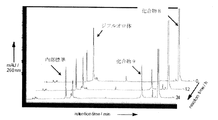
- Example 2 the chromatogram which used the reaction liquid which reacted the complementary strand oligonucleotide (amine compound; compound 2) which has a difluoro body (nucleic acid derivative) and the alkylamino group under non-reducing conditions of pH8 for HPLC was shown. Shown (reaction times: 0h, 12h, 24h).
- Example 3 a chromatogram obtained by subjecting a reaction solution obtained by reacting a difluoro compound (nucleic acid derivative) and a dansylsulfonamide derivative (amine compound; compound 8) having an alkylamino group to pH 8 under non-reducing conditions at pH 8 was subjected to HPLC. Shown (reaction times: 0h, 12h, 24h). As the reaction time elapses, the nucleic acid derivative and the amine compound decreased, and an increased amount of conjugate (compound 9) was observed.
- the present invention relates to a method for producing a conjugate of nucleic acid derivative (I) and amine compound (II) represented by the following general formula.
- R 1 and R 2 R 1 means a halogen atom, an alkyl group which may have a substituent, or a hydrogen atom.
- a halogen atom or an alkyl group which may have a substituent is preferable.
- R 2 represents a halogen atom, an alkyl group which may have a substituent, or a hydrogen atom.
- R 1 and R 2 may be the same or different halogen atoms at the same time, or may be the same or different alkyl groups that may have a substituent at the same time. Incidentally, in the case of the latter, if the alkyl group of R 1 and R 2 has a substituent group, to the substituent of R 1 and R 2 may be the same or may be different.
- R 1 and R 2 are alkyl groups that may have a substituent at the same time, they may be linked to each other to form a cycloalkyl group.
- alkyl group which may have a substituent includes an alkyl group having a substituent and an alkyl group having no substituent.
- alkyl group a linear or branched alkyl group usually having 1 to 4 carbon atoms, preferably 1 to 3 carbon atoms, more preferably 1 to 2 carbon atoms can be mentioned.
- alkyl groups include methyl group, ethyl group, propyl group, isopropyl group, butyl group, isobutyl group, s-butyl group, t-butyl group and the like.
- they are a methyl group, an ethyl group, and a propyl group, More preferably, they are a methyl group and an ethyl group. Particularly preferred is a methyl group.
- substituent of the alkyl group examples include, for example, a hydroxyl group, an alkoxy group, an amino group, an amide group (with the limit that the final compound (nucleic acid derivative (I), (Ia)) is acceptable as a compound, that is, can be produced as a compound) And a functional group such as an alkylcarbamoyl group.
- substituents listed above examples include a group in which one or more hydrogen atoms of the alkyl group are substituted with at least one functional group selected from the group of substituents listed above.
- examples of the “alkoxy group” include a hydroxyl group in which a hydrogen atom is substituted with an alkyl group having 1 to 4 carbon atoms, preferably 1 to 3 carbon atoms, more preferably 1 to 2 carbon atoms.
- alkoxy groups include methoxy group, ethoxy group, 1-propoxy group, 2-propoxy group, 1-butoxy group, 2-butoxy group, 2-methyl-1-propoxy group, 2-methyl-2-propoxy group Etc. are included.
- a methoxy group, an ethoxy group, a 1-propoxy group, and a 2-propoxy group are preferable, a methoxy group or an ethoxy group is more preferable, and a methoxy group is further preferable.
- examples of the “alkyl group” in the “alkylcarbamoyl group” include a linear or branched alkyl group usually having 1 to 4 carbon atoms.
- An alkyl group having 1 to 3 carbon atoms, more preferably 1 to 2 carbon atoms is preferable.
- a methyl group, an ethyl group, a propyl group, an isopropyl group, a butyl group, an isobutyl group, and the like are included.
- the “alkyl group having a hydroxyl group” specifically includes a hydroxymethyl group, a 1-hydroxyethyl group, a 2-hydroxyethyl group, a 1-hydroxypropyl group, and a 2-hydroxypropyl group. Examples thereof include a group and a 3-hydroxypropyl group. Preferred are a hydroxymethyl group, a 2-hydroxyethyl group, and a 3-hydroxypropyl group, more preferred are a 2-hydroxyethyl group and a 3-hydroxypropyl group, and particularly preferred is a 2-hydroxyethyl group.
- examples of the “alkyl group having an alkoxy group” include a C1-4-alkoxy-C1-4-alkyl group. Specific examples include a methoxymethyl group, a 1-methoxyethyl group, 2 -Methoxyethyl group, 1-methoxypropyl group, 2-methoxypropyl group, 3-methoxypropyl group, ethoxymethyl group, 1-ethoxyethyl group, 2-ethoxyethyl group, 1-ethoxypropyl group, 2-ethoxypropyl group And 3-ethoxypropyl group.
- alkyl group having an amino group is preferably an alkyl group having a primary amino group.
- Specific examples include amino-C1-4-alkyl groups as described above, and specific examples include aminomethyl group, 1-aminoethyl group, 2-aminoethyl group, 1-aminopropyl group. , 2-aminopropyl group, 3-aminopropyl group and the like.
- Preferred are an aminomethyl group, a 2-aminoethyl group, and a 3-aminopropyl group, more preferred are a 2-aminoethyl group and a 3-aminopropyl group, and particularly preferred is a 2-aminoethyl group.
- alkyl group having an amide group examples include an amide-C1-4-alkyl group as described above, and specific examples include an amide methyl group and a 1-amidoethyl group. 2-amidoethyl group, 1-amidopropyl group, 2-amidopropyl group, 3-amidopropyl group and the like. Preferred are amidomethyl group, 2-amidoethyl group, and 3-amidopropyl group, more preferred are amidomethyl group and 2-amidoethyl group, and particularly preferred is amidomethyl group.
- alkyl group having an alkylcarbamoyl group examples include a C1-4-alkylcarbamoyl-C1-4-alkyl group as described above, and specific examples thereof include a methylcarbamoylmethyl group and a 1-methylcarbamoyl group.
- Ethyl group 2-methylcarbamoylethyl group, 1-methylcarbamoylpropyl group, 2-methylcarbamoylpropyl group, 3-methylcarbamoylpropyl group, ethylcarbamoylmethyl group, 1-ethylcarbamoylethyl group, 2-ethylcarbamoylethyl group, Examples include 1-ethylcarbamoylpropyl group, 2-ethylcarbamoylpropyl group, 3-ethylcarbamoylpropyl group, and the like.
- methylcarbamoylmethyl group 2-methylcarbamoylethyl group, and 3-methylcarbamoylpropyl group
- more preferred are methylcarbamoylmethyl group and 2-methylcarbamoylethyl group, and particularly preferred is methylcarbamoylmethyl group. is there.
- halogen atom is preferably a fluorine atom and a chlorine atom, and more preferably a fluorine atom.
- cycloalkyl group is preferably a cycloalkyl group having 1 to 6 carbon atoms such as cyclopropyl group, cyclobutyl group, cyclopentyl group, cyclohexyl group and the like. More preferably, it is a cyclopropyl group.
- R 1 and R 2 may be the same or different halogen atoms, or the same or different alkyl groups that may have a substituent. preferable. More preferably, they are the same or different halogen atoms.
- a and B A and B are each a nucleobase sequence-containing oligomer or polymer having a backbone formed from nucleotides or analogs thereof, or a hydrogen atom. However, A and B do not become hydrogen atoms at the same time.
- the nucleotide or its analog may be derived from nature or may be artificially synthesized.
- the nucleotide includes ribonucleotide or deoxyribonucleotide.
- Preferred oligomers or polymers are RNA consisting of ribonucleotides and DNA consisting of deoxyribonucleotides.
- RNA is classified into mRNA, tRNA, rRNA, ncRNA, siRNA, dsRNA, shRNA, and the like based on the structure and its action, but is not particularly limited to these types.
- DNA is also classified into cDNA, single-stranded DNA (including sense and anti-sense DNA strands), double-stranded DNA, etc., depending on its structure and action, but is not limited to these types. Absent.
- LNA LockedleNucleic Acid
- N- instead of sugar PNA (Peptide Nucleic Acid) in which 2-aminoethyl) glycine is bonded via an amide bond to the main chain, and a purine ring or pyrimidine ring corresponding to a nucleobase is bonded to the main chain via a methylene group and a carbonyl group
- PNA Peptide Nucleic Acid
- 2-aminoethyl Peptide Nucleic Acid
- 2-aminoethyl 2-aminoethyl
- a purine ring or pyrimidine ring corresponding to a nucleobase is bonded to the main chain via a methylene group and a carbonyl group
- Other examples include ribonucleotides in which an optional substituent such as a hydroxyl group, an alkyl group, an amide group, or an alkylcarbamoyl group is bonded to the oxygen atom at the 2-position
- the nucleobase sequence-containing oligomer or polymer targeted by the present invention may be a chimera or hybrid of the above nucleotides and analogs thereof.
- the chimera include DNA / RNA chimera molecules, DNA / PNA chimera molecules, Examples thereof include DNA / LNA chimeric molecules and PNA / LNA chimeric molecules.
- the hybrid include a double-stranded DNA / RNA hybrid molecule, a double-stranded DNA / PNA hybrid molecule, a double-stranded DNA / LNA hybrid molecule, and a double-stranded PNA / LNA hybrid molecule.
- oligomer means a nucleic acid in which the above nucleotides are usually formed in a continuous sequence of about 2 to 10
- polymer means a nucleic acid in which a larger number of nucleotides are formed in a continuous manner.
- a and B may be the same type of oligomer or polymer as each other, or may be different types of oligomers or polymers from each other.
- the bonding mode between A and B and the oxygen atom of the compound represented by formula (I) varies depending on the types of A and B, but when A and B are phosphate-containing nucleotides or analogs thereof, Usually, a phosphoric acid diester bond can be mentioned.
- X means a direct bond or an oxygen atom.
- nucleic acid derivative (I) targeted by the present invention is preferably a compound represented by the following formula (Ia).
- a and B are each a nucleobase sequence-containing oligomer or polymer having a skeleton formed from nucleotides or analogs thereof, or a hydrogen atom. However, A and B do not become hydrogen atoms at the same time. Details thereof are as described above in the section of “R 1 and R 2” , and the above description can be incorporated herein as it is.
- R 1a and R 2a are the same or different halogen atoms at the same time, or the same or different, optionally substituted alkyl groups.
- R 1a and R 2a may be the same halogen atom or alkyl group (including both those having a substituent and those not having a substituent), but are not necessarily the same alkyl group (substituent). It is not necessary to be a halogen atom or both having and not having).
- R 1a and R 2a are alkyl groups which may have a substituent at the same time, R 1a and R 2a are linked to each other to form an optionally substituted cycloalkyl group. It may be.
- the alkyl group, the cycloalkyl group, the substituent, and the halogen atom are as described above in the section of “R 1 and R 2” , and the above description can be used as it is.
- the alkyl group is preferably a methyl group, an ethyl group, a propyl group, an isopropyl group, a butyl group, and an isobutyl group; more preferably a methyl group, an ethyl group, a propyl group; still more preferably a methyl group and an ethyl group; It is a group.
- the alkyl group may have no substituent, but when it has a substituent, preferably a hydroxyl group, an alkoxy group, an amino group, an amide group (carbamoyl group), and an alkylcarbamoyl group can be exemplified.
- the halogen atom is preferably a fluorine atom and a chlorine atom; more preferably a fluorine atom.
- the cycloalkyl group is preferably a cyclopropyl group.
- the nucleic acid derivative (I) targeted by the present invention is preferably a compound represented by the following formula (Ib).
- a and B are each a nucleobase sequence-containing oligomer or polymer having a skeleton formed from nucleotides or analogs thereof, or a hydrogen atom. However, A and B do not become hydrogen atoms at the same time. Details thereof are as described above in the section of “R 1 and R 2” , and the above description can be incorporated herein as it is.
- R 1b is an alkyl group which may have a substituent
- R 2b is a hydrogen atom or an alkyl group which may have a substituent.
- R 1b is an alkyl group which may have a substituent
- R 2b is a hydrogen atom or an alkyl group which may have a substituent.
- it is a hydrogen atom.
- the alkyl group and the substituent are as described above in the section of “R 1 and R 2” , and the above description can be incorporated herein as it is.
- the alkyl group is preferably a methyl group, an ethyl group, a propyl group, an isopropyl group, a butyl group, and an isobutyl group; more preferably a methyl group, an ethyl group, a propyl group; still more preferably a methyl group and an ethyl group; It is a group.
- the alkyl group may have no substituent, but when it has a substituent, preferably a hydroxyl group, an alkoxy group, an amino group, an amide group (carbamoyl group), and an alkylcarbamoyl group can be exemplified.
- nucleic acid derivatives (I) A and B are deoxyribonucleotide oligomers, X is a direct bond, and R 1 and R 2 are fluorine atoms. Details of the method for producing the nucleic acid derivative (I) will be described later. This is described in Production Example 1 (see Formula A). Details of the method for producing nucleic acid derivative (I) (corresponding to nucleic acid derivative (Ia) at the same time) in which A and B are deoxyribonucleotide oligomers, X is a direct bond, and R 1 and R 2 are methyl groups It describes in the manufacture example 2 mentioned later (refer Formula B).
- a and B are deoxyribonucleotide oligomers
- X is an oxygen atom
- R 1 is a methyl group
- R 2 is a hydrogen atom
- the nucleic acid derivative (I) (corresponding to the nucleic acid derivative (Ib) at the same time) Details of the production method will be described in Production Example 3 described later (see Formula C).
- X is directly produced using 2,2-dichloro-2-deoxy-3,5-bis-O- [benzoyl] -D-erythro-pentose represented by the following formula.
- the nucleic acid derivative (I) in which the bond, R 1 and R 2 are all chlorine atoms can be produced.
- X is a direct bond
- any of R 1 and R 2 A nucleic acid derivative (I) in which one is a fluorine atom and the other is a chlorine atom can be produced.
- nucleic acid derivative (I) wherein X is a direct bond, and R 1 and R 2 are the same or different alkyl groups other than a methyl group. (Corresponding to the nucleic acid derivative (Ia) at the same time); or X is a direct bond, R 1 and R 2 are the same or different, a substituent (for example, hydroxyl group, alkoxy group, amino group, amide group (carbamoyl group) And at least one selected from the group consisting of alkylcarbamoyl groups) can be produced nucleic acid derivative (I) which is an alkyl group (corresponding to nucleic acid derivative (Ia) at the same time).
- nucleic acid derivative (I) (corresponding to the nucleic acid derivative (Ib) at the same time); or X is an oxygen atom, R 1 is a substituent (for example, a hydroxyl group, an alkoxy group, an amino group, an amide group (carbamoyl group), and an alkylcarbamoyl group)
- R 1 is a substituent (for example, a hydroxyl group, an alkoxy group, an amino group, an amide group (carbamoyl group), and an alkylcarbamoyl group)
- a nucleic acid derivative (I) having an alkyl group having at least one substituent selected from the group consisting of a group and R 2 is a hydrogen atom (corresponding to the nucleic acid derivative (Ib) at the same time) can be produced.
- R 1a is a production example (a) of a compound in which the alkyl group has a hydroxyl group
- R 1a is a production example (b) of a compound in which the alkyl group has an alkoxy group
- R 1a is A production example (c) of a compound which is an alkyl group having an alkylcarbamoyl group is shown below.
- a 2′-O-alkoxyethyl compound (Compound B) can be obtained by alkylating the 2′-O-hydroxyethyl compound.
- a 2′-O-alkamoylmethyl compound (compound C) can be obtained by reacting a 2′-O-alkoxycarbonylmethyl compound with ammonia, a primary amine, or a secondary amine. it can.
- the amine compound (II) targeted by the present invention may be a compound having a primary amino group, preferably a peptide having a primary amino group, a protein having a primary amino group, a nucleic acid having a primary amino group, etc. be able to. More preferred are peptides having a primary amino group and nucleic acids having a primary amino group, and particularly preferred are nucleic acids having a primary amino group.
- Preferred examples of the peptide having a primary amino group include a peptide having a lysine having a primary amine in the side chain as a constituent amino acid residue, and a peptide having an artificially introduced lysine or primary amino group.
- a protein having a primary amino group is preferably a protein having a lysine having a primary amine in the side chain as a constituent amino acid residue, or a protein having an artificially introduced lysine or primary amino group.
- the nucleic acid having a primary amino group is preferably a nucleic acid into which lysine or a primary amino group has been artificially introduced.
- Such an amine compound (II) is preferably a functional molecule.
- Such functions include, but are not limited to, cell transferability (cell permeability), nuclear transferability, target affinity, retention, nuclease resistance (resistance to degrading enzymes), labeling (function that can be a detectable label), etc. Can be mentioned.
- Non-patent Document 2 Biological Activity of Oligonucleotide-Poly (L-lysine) Conjugates: Mechanism of Cell Uptake, Bioconjugate Chem., 1990, 1, 149-153).
- a nuclear translocation peptide a peptide derived from SV 40T antigen, nuclear localization signal peptide (PKKKRKV (SEQ ID NO: 1); P is proline, K is lysine, R is arginine, and V is valine
- Patent document 3 Gene delivery: A single nuclear localization signal peptide is sufficient to carry DNA to the cell nucleus, Proc. Natl.
- Non-patent document 4 Controlled intracellular localization and enhanced antisense effect of oligonucleotides by chemical conjugation, Org. Biomol. Chem., 2005, 3, 3257-3259.”
- the nuclear export signal (NES) sequence of HIV-1 rev protein and the nuclear localization signal (NLS) sequence of HIV-1 tat protein are described in “Non-patent Document 5: C Dingwell and RA Laskey, Annu. Rev. Cell.
- Non-Patent Document 6 DS Goldfarb, J. Gariepy, G. Schoolnik, RD Kornberg, Nature, 1986, 322, 641-642.
- Non-patent Document 7 DD Newmeyer, JM Lucocq, TR Burglin, EM ”. De Robertis, EMBO J., 1986, 5, 501-510.
- Nucleic acid derivative (I) described above the nucleic acid derivative includes the nucleic acid derivatives (Ia) and (Ib) described above) II
- Nucleic acid derivative (I) II the nucleic acid derivative includes the nucleic acid derivatives (Ia) and (Ib) described above) II
- efficiently react under reducing conditions to stably produce a conjugate of the nucleic acid derivative (I) and the amine compound (II) (reductive amination of the nucleic acid derivative (I)).
- Z—NH 2 means an amine compound (II) having a primary amino group (—NH 2 ).
- X is a direct bond or an oxygen atom
- R 1 is a halogen atom or an alkyl group which may have a substituent
- R 2 may be a halogen atom or a substituent.
- a and B mean the same or different nucleobase sequence-containing oligomer or polymer having a backbone formed from nucleotides or analogs thereof, or a hydrogen atom. However, A and B are not hydrogen atoms at the same time.
- R 1 and R 2 are the same or different halogen atoms, or are alkyl groups that may have the same or different substituents (in this case, R 1 1 and R 2 may be linked to each other to form a cycloalkyl group); when X is an oxygen atom, R 1 is an optionally substituted alkyl group, R 2 is hydrogen Is an atom.
- conjugate 1 a compound in which both A and B are nucleobase sequence-containing oligomers or polymers having a skeleton formed from nucleotides or analogs thereof
- conjugate 2 A compound in which A is a hydrogen atom and B is a nucleobase sequence-containing oligomer or polymer having a backbone formed from nucleotides or analogs thereof
- Conjugate 3 A compound in which A is a nucleotide or Included are compounds that are nucleobase sequence-containing oligomers or polymers having a backbone formed from the analog.
- Conjugate 3 a compound in which both A and B are nucleobase sequence-containing oligomers or polymers having a skeleton formed from nucleotides or analogs thereof
- the reaction between the nucleic acid derivative (I) and the amine compound (II) under reducing conditions is a method in which both compounds are dissolved in a solvent and reacted in the presence of a reducing agent under conditions of room temperature to 50 ° C. and pH of 5 to 8. Can be mentioned.
- the temperature condition is preferably 30 to 50 ° C, more preferably 40 to 50 ° C.
- the pH condition is preferably pH 6 to 8, more preferably pH 7 to 8.
- the solvent for dissolving the nucleic acid derivative (I) and the amine compound (II) may be any solvent that can dissolve both compounds, but is preferably an aqueous solution. More preferably, it is an aqueous solution containing a buffer having a buffering ability in the above pH range, particularly preferably a physiologically acceptable aqueous solution, and specifically, a phosphate buffer solution of about 1 to 200 mM or about 10 to 50 mM is exemplified. (In the examples described below, a 10 mM phosphate buffer containing 100 mM sodium chloride is used).
- Examples of the concentration of the nucleic acid derivative (I) in the reaction solution are usually 10 to 100 ⁇ M, preferably 20 to 100 ⁇ M, more preferably 50 to 100 ⁇ M.
- Examples of the concentration of the amine compound (II) in the reaction solution are usually 10 ⁇ M to 10 mM, preferably 100 ⁇ M to 10 mM, more preferably 1 to 10 mM.
- sodium cyanoborohydride can be usually used, but a reducing agent equivalent to the above, such as sodium borohydride or dimethylamine borane, may be used.
- concentration of the reducing agent in the reaction system is usually 1 to 30 mM, preferably 2 to 20 mM, more preferably 5 to 15 mM.
- the proportion of the nucleic acid derivative (I) and the amine compound (II) in the reaction system can be 1 to 100 parts by mole of the amine compound (II) with respect to 1 part by mole of the nucleic acid derivative (I).
- the amount is preferably 10 to 100 parts by mole, more preferably 50 to 100 parts by mole, based on 1 part by mole of the nucleic acid derivative (I).
- a conjugate of the nucleic acid derivative (I) and the amine compound (II) can be stably obtained in a high yield. be able to.
- nucleic acid derivatives (I) described above the compounds represented by the following formulas (Ia) and (Ib) are not limited to the above-described amine compound (II), and are effective not only under reducing conditions but also under non-reducing conditions. By reacting, a conjugate of the nucleic acid derivative (Ia or Ib) and the amine compound (II) is stably produced (reaction under non-reducing conditions of the nucleic acid derivative).
- the reaction conditions (temperature, pH, ratio of nucleic acid derivative and amine compound, time, etc.) under non-reducing conditions are the same as the reaction conditions under reducing conditions described above except that no reducing agent is used. be able to. Therefore, the reaction conditions described above can be directly incorporated herein. Also in the production method in this case, in the same manner as in the production method under the above-mentioned reducing conditions, not only one of conjugates 1 to 3, particularly only conjugate 1 is produced, but also the conjugate 1 and conjugate described above. The case where the gate 2 or 3 is simultaneously generated is also included.
- the conjugate thus produced can be isolated and purified from the reaction solution using a conventional isolation and purification method such as an extraction method, a dialysis method, column chromatography, or electrophoresis.
- nucleic acid derivatives (I) described above a nucleic acid derivative represented by the following general formula (Ia-1) is a novel compound.
- a and B are as described above, and mean the same or different nucleobase sequence-containing oligomer or polymer having a skeleton formed from nucleotides or analogs thereof.
- R 1a-1 and R 2a-1 are the same or different from each other and are simultaneously halogen atoms.
- the halogen atom is as described above, preferably a fluorine atom and a chlorine atom, more preferably a fluorine atom.
- nucleic acid derivative (Ia-1) in which R 1a-1 and R 2a-1 are chlorine atoms can be produced by producing according to the method described in Production Example 1.
- R 1a-1 and R can be obtained by using 2-chloro-2-deoxy-2-fluoro-3,5-bis-O- [benzoyl] -D-erythro-pentose instead of compound 1-1.
- a nucleic acid derivative (Ia-1) in which any one of 2a-1 is a fluorine atom and the other is a chlorine atom can be produced.
- Such a compound (Ia-1) is a kind of the nucleic acid derivative (I) described above, and reacts with an amine compound (II) having a primary amino group under a reducing condition or a non-reducing condition to obtain a nucleic acid derivative (Ia-1). -1) and a conjugate of amine compound (II) can be stably produced.
- the compound is a nucleobase having a skeleton formed from nucleotides, wherein X is a direct bond, R 1 and R 2 are the same halogen atom, and A and B are different from the compounds represented by the general formula (I) It corresponds to a compound that is a sequence-containing oligomer.
- R 1a and R 2a are the same halogen atoms, and A and B are different nucleobase sequence-containing oligomers having different skeletons formed from nucleotides. Equivalent to.
- R 1a-1 and R 2a-1 are the same halogen atoms, and A and B are different from each other, and each has a skeleton formed from nucleotides. It corresponds to the compound which is a contained oligomer.
- Triethylamine (7.2 ml, 0.052 mol) was added dropwise, and the mixture was stirred for 3 hours while returning from 0 ° C. to room temperature.
- the solvent was evaporated under reduced pressure, a saturated aqueous sodium hydrogen carbonate solution was added to the residue, and the mixture was extracted with ether. The organic layer was washed with saturated brine, dried, and the solvent was evaporated.
- the compound is formed of a nucleotide represented by the general formula (I) wherein X is directly bonded; R 1 and R 2 are the same alkyl group having no substituent; and A and B are different from each other. It corresponds to a compound that is a nucleobase sequence-containing oligomer having a skeleton.
- R 1a and R 2a have the same alkyl group having no substituent; A and B are different from each other, and have a nucleobase sequence having a skeleton formed from nucleotides It corresponds to a compound that is an oligomer.
- R 1a-1 and R 2a-1 are the same alkyl groups having no substituent; A and B are different skeletons formed from nucleotides, respectively. It corresponds to a compound which is a nucleobase sequence-containing oligomer having
- the 5-iodo compound (2.34 g, 5.72 mmol) was dissolved in dry DMF (50 ml), DBU (2.35 ml, 2.39 g, 15.73 mmol) was added, and the mixture was reacted at 60 ° C. for 3 hours.
- Phosphonamidic chloride (0.11 ml, 0.48 mmol, 3equiv) and N-methylimidazole (0.01 ml, 0.013 mmol) were added, and the mixture was stirred at 0 ° C. for 30 minutes and at room temperature for 1 hour.
- Isopropylethylamine (0.11 ml, 0.64 mmol) and N, N-diisopropylamino cyanoethyl phosphonamidic chloride (0.22 ml, 0.96 mmol) were added and reacted for 2 hours. After confirming disappearance of the raw materials, a cooled 5% aqueous sodium hydrogen carbonate solution was added, extracted with CH 2 Cl 2 and dried over Na 2 SO 4 .
- the compound is formed of a nucleotide represented by the general formula (I), wherein X is an oxygen atom; R 1 is an alkyl group having no substituent; R 2 is a hydrogen atom; and A and B are different from each other. It corresponds to a compound which is a nucleobase sequence-containing oligomer having a skeleton.
- Example 1 Conjugate Formation with Amine Compound (Part 1)
- the amine compound a compound having a primary amino group having a complementary strand oligonucleotide corresponding to the oligonucleotide of the difluoro form, dimethyl form and methoxy form was used.
- the following formula shows the methoxy compound of the present invention produced in Production Example 3 as a nucleic acid derivative (I) (compound 1 in the following formula) and a complementary-strand oligonucleotide having an alkylamino group as the amine compound (following formula
- a method for producing a conjugate (compound 3) of a nucleic acid derivative (compound 1) and an amine compound (compound 2) by reacting with compound 2) is shown.
- an oligodeoxynucleotide (5′-CC) of a methoxy compound (compound 1) corresponding to the substituent A of the nucleic acid derivative (I), and the nucleic acid derivative (I) Primary amino groups having complementary oligodeoxynucleotides (GG-3 ′ and CACCTATTGT-5 ′) corresponding to each of the oligodeoxynucleotides (GTGGATAACA-3 ′) of the methoxy compound (compound 1) corresponding to the substituent B of A nucleic acid having
- each of the difluoro form, dimethyl form and methoxy form of the present invention and the amine compound (compound 2) represented by the above formula are dissolved in a 10 mM phosphate buffer (pH 7) containing 100 mM sodium chloride. Then, a solution containing each at a concentration of 10 ⁇ M was prepared. An excess amount (1000 equivalents) of sodium cyanoborohydride (NaCNBH 3 ) was added thereto and incubated at 37 ° C. According to the reaction analysis by HPLC, the reaction for 24 hours produced about 40% conjugate in the difluoro form, about 50% conjugate in the dimethyl form, and about 75% conjugate in the methoxy form. It was confirmed.
- Example 2 Conjugate formation with amine compound (Part 2)
- the difluoro compound of the present invention produced in Production Example 1 was reacted with an amine compound under non-reducing conditions to produce a conjugate.
- As the amine compound a complementary strand oligonucleotide (compound 2) having an alkylamino group was used as in Example 1.
- the difluoro compound of the present invention and the amine compound (compound 2) are dissolved in a 50 mM phosphate buffer solution (pH 7 or pH 8) containing 100 mM sodium chloride, and the difluoro compound of the present invention is dissolved.
- a solution containing 20 ⁇ M and an amine compound at a concentration of 10 ⁇ M was prepared. This solution was incubated at 37 ° C. for 24 hours.
- the results obtained by subjecting the obtained reaction solution to HPLC and electrophoresis are shown in FIGS. 1 and 2, respectively.
- the HPLC conditions are as follows.
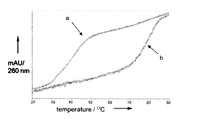
- a double-stranded oligodeoxynucleotide composed of a difluoro derivative (nucleic acid derivative) and compound 2 (amine compound), and a conjugate (compound 6) are each added in 2.5 ⁇ m of 10 ⁇ m phosphate buffer containing 100 ⁇ mM sodium chloride, pH 7 Adjusted to ⁇ M.
- the change in absorbance at 260 nm was measured when the temperature was changed from 20 ° C. to 90 ° C. at a rate of 0.5 ° C. per minute.
- FIG. 5 shows a temperature-dependent UV change (arrow a) of a double-stranded oligodeoxynucleotide composed of a difluoro derivative (nucleic acid derivative) and compound 2 (amine compound), and a temperature-dependent UV change (conjugate 6).
- Arrow b) is shown.
- double-stranded oligodeoxynucleotides consisting of a nucleic acid derivative and an amine compound (compound 2) dissociate 50% of the double strand at 42 ° C.
- compound 6 in the double-stranded structure of the conjugate
- Example 3 Conjugate Formation with Amine Compound (Part 3)
- the difluoro compound of the present invention produced in Production Example 1 was reacted with an amine compound under non-reducing conditions to produce a conjugate.
- an amine compound As the amine compound, a dansylamide derivative (compound 8) having an alkylamino group represented by the following formula was used.
- the difluoro compound of the present invention and the above amine compound (compound 8) are dissolved in a 50 ⁇ mM phosphate buffer solution (pH 8) containing 100 ⁇ mM sodium chloride, and the difluoro compound of the present invention is dissolved in 20 ⁇ M amine.
- a solution containing the compound at a concentration of 2 mM was prepared. This solution was incubated at 37 ° C. for 24 hours.
- nucleic acid conjugates can be widely applied both as pharmaceuticals and as molecular biological research tools, and there is a need for synthetic techniques that serve as a basis for their supply. This technology is valuable at the laboratory level and at the company level as a technology for producing nucleic acid conjugates that can be used as the tool.
- SEQ ID NO: 1 is the amino acid sequence of the nuclear localization signal peptide
- SEQ ID NO: 2 is the base sequence of the compound (1-11) described in Formula A of Preparation Example 1
- SEQ ID NO: 3 is described in Formula A of Preparation Example 1.
- the base sequence of the difluoro compound of the present invention SEQ ID NO: 4 is the base sequence of the compound (2-12) described in Formula B of Preparation Example 2
- SEQ ID NO: 5 is the dimethyl compound of the present invention described in Formula B of Preparation Example 2
- SEQ ID NO: 6 is the base sequence of the compound (3-9) described in Formula C of Preparation Example 3
- SEQ ID NO: 7 is the base sequence of the methoxy compound of the present invention described in Formula C of Preparation Example 3, Each is shown.
Landscapes
- Chemical & Material Sciences (AREA)
- Organic Chemistry (AREA)
- Health & Medical Sciences (AREA)
- Life Sciences & Earth Sciences (AREA)
- Biochemistry (AREA)
- Molecular Biology (AREA)
- Engineering & Computer Science (AREA)
- Biotechnology (AREA)
- General Health & Medical Sciences (AREA)
- Genetics & Genomics (AREA)
- Saccharide Compounds (AREA)
- Medicines That Contain Protein Lipid Enzymes And Other Medicines (AREA)
Abstract
下記一般式(I):(式中、R1、R2、X、A及びBは、本願請求項1に記載のとおり。)で示される核酸誘導体(I)とアミン化合物(II)を、還元剤の存在下で反応させる工程を有する、上記核酸誘導体(I)とアミン化合物(II)とのコンジュゲートを製造する方法。
Description
本発明は、一級アミノ基を有するアミン化合物と安定なコンジュゲートを形成する核酸誘導体に関する。また本発明は、当該核酸誘導体を用いて、一級アミノ基を有するアミン化合物、特に一級アミノ基を有する、ペプチド若しくは蛋白質、または核酸とコンジュゲートを形成する方法、及びそのコンジュゲートに関する。なお、本発明が対象とするコンジュゲートとは、核酸誘導体にアミン化合物が共有結合したもの(核酸誘導体とアミン化合物の共有結合物)を意味する。
従来より、核酸医薬は、疾患に関連する遺伝子や蛋白質の機能を制御することで当該疾患を治療するために用いられる新しい医薬品として期待されている。しかしながら、細胞移行性や核移行性などを改善することで、より一層、機能性、有効性及び安全性を高める必要性が求められている。
この解決法のひとつとして、体内の遺伝子や蛋白質の機能を制御する核酸分子(例えば、アプタマー)を、細胞移行性や核移行性などの機能を有する分子とコンジュゲートする方法が研究されている。例えば、現在上市されている加齢黄斑変性症治療薬マクジェン(登録商標:ファイザー株式会社)は、炎症誘発性が高く眼内における病的血管新生に深く関するVEGF165に対して特異的に結合し、その機能を阻害する合成オリゴヌクレオチド(アプタマー)にポリエチレングリコール(PEG)が結合してなる、核酸分子とPEGとのコンジュゲートである。ここでPEGは、アプタマーである核酸分子の眼球内滞留性を上げる作用を有している。
このように、アプタマー等の機能を有する核酸分子に、上記の如く組織滞留性や、その他、細胞移行性若しくは核移行性等を備えた機能性分子を結合させたコンジュゲートは、核酸分子に細胞移行性や核移行性等を付与することにより、標的細胞や組織に対して高いターゲティング効果を発揮することが期待されている。
このような背景から、核酸分子と機能性分子とのコンジュゲート形成は、核酸医薬の開発やその機能性向上において、重要なターゲットである。
ところで、コンジュゲート形成の多くは、核酸分子や機能性分子にチオールやアミンなどの反応性官能基を導入する工程、及び官能基選択的な反応を利用したコンジュゲート形成工程の二段階からなる。ここで、後者のコンジュゲート形成工程としては、カルボニル基を導入した核酸分子に、例えばリジン残基を有するペプチドやタンパク質等のアミノ基を有する機能性分子(アミン化合物)を還元条件下で反応させて炭素-アミン結合を形成する方法が挙げられる。しかしながら、カルボニル基を持つ核酸分子として、脱塩基部位を持つ核酸分子を使用すると、脱塩基部位が徐々に分解し、安定したコンジュゲートを取得することができないといった問題がある(非特許文献1)。
Synthesis, thermal stability and reactivity towards 9-aminoellipticine of double-stranded oligonucleotides containing a true abasic site、Nucleic Acids Research, 1989, 17, 10307-10319
Biological Activity of Oligonucleotide-Poly(L-lysine) Conjugates: Mechanism of Cell Uptake、Bioconjugate Chem., 1990, 1, 149-153
Gene delivery: A single nuclear localization signal peptide is sufficient to carry DNA to the cell nucleus, Proc. Natl. Acad. Sci. USA, 1999, 96, 91-96
Controlled intracellular localization and enhanced antisense effect of oligonucleotides by chemical conjugation, Org. Biomol. Chem., 2005, 3, 3257-3259
C. Dingwell and R. A. Laskey, Annu. Rev. Cell. Biol., 1986, 2, 367-390
D. S. Goldfarb, J. Gariepy, G. Schoolnik, R. D. Kornberg, Nature, 1986, 322, 641-642
D.D. Newmeyer, J. M. Lucocq, T. R. Burglin, E. M. De Robertis, EMBO J., 1986, 5, 501-510
Chou, T.S. et. al., Synthesis., 1992, 565
Chaudhuri, N. C.; Moussa, A.; Stewart, A.; Wang, J.; Storer, R., Organic Process Research & Development, 2005, 9, 457-465
本発明は、核酸分子と、組織滞留性、細胞移行性または核移行性等の機能を備えたアミン化合物(機能性分子)とのコンジュゲートをより安定に製造するための方法を提供することを目的とする。特に本発明は、核酸分子と上記機能性分子とのコンジュゲートを安定且つ効率的に製造する方法、また生体内でも実施可能なコンジュゲートの製造方法を提供することを目的とする。
さらに本発明は、かかるコンジュゲートの製造に有用な新規核酸誘導体を提供することを目的とする。
本発明者らは、上記課題を解決すべく鋭意研究を重ねていたところ、核酸分子として、下式(I)で示される化合物を用いることで、一級アミノ基を有する、ペプチド、蛋白質または核酸などのアミン化合物と安定してコンジュゲートを形成することができることを見出した。特に化合物(I)のうち、C2’位に2つのハロゲン原子が直接結合してなる化合物、並びに一般式(Ib)で示される化合物は、非還元条件で効率的に当該アミン化合物とコンジュゲートを形成することができるため、生体内でコンジュゲートを形成するための材料として有用であることを確認した。
本発明はこれらの知見に基づいて完成したものであり、下記の実施形態を有している。
(I)核酸分子とアミン化合物とのコンジュゲートを製造する方法
(I-1)下記一般式(I):
(I-1)下記一般式(I):
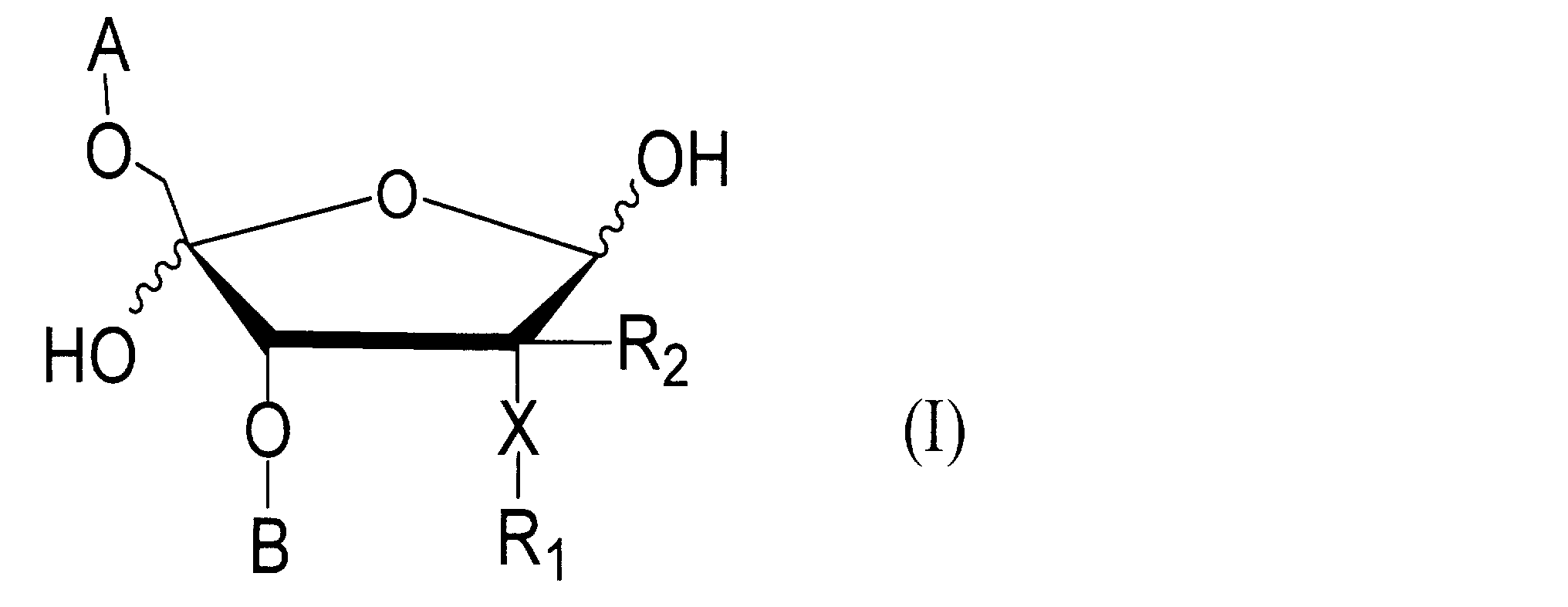
(式中、
Xは、直接結合または酸素原子;
R1は、ハロゲン原子、置換基を有していてもよいアルキル基、または水素原子;
R2は、ハロゲン原子、置換基を有していてもよいアルキル基、または水素原子;
Aは、ヌクレオチドまたはそのアナログから形成される骨格を有する核酸塩基配列含有オリゴマー若しくはポリマー、または水素原子;
Bは、ヌクレオチドまたはそのアナログから形成される骨格を有する核酸塩基配列含有オリゴマー若しくはポリマー、または水素原子を意味する。
但し、Xが直接結合であるとき、R1及びR2は、お互いに、同一又は異なるハロゲン原子であるか、または同一又は異なる、置換基を有していてもよいアルキル基であり(この場合、R1とR2は、お互いに連結してシクロアルキル基を形成していてもよい);
Xが酸素原子であるとき、R1は置換基を有していてもよいアルキル基または水素原子、R2は水素原子または置換基を有していてもよいアルキル基である。
また、Xが直接結合及び酸素原子のいずれの場合も、AとBは同時に水素原子ではない。)
で示される核酸誘導体(I)とアミン化合物(II)を、還元剤の存在下で反応させる工程を有する、
上記核酸誘導体(I)とアミン化合物(II)とのコンジュゲートを製造する方法。
Xは、直接結合または酸素原子;
R1は、ハロゲン原子、置換基を有していてもよいアルキル基、または水素原子;
R2は、ハロゲン原子、置換基を有していてもよいアルキル基、または水素原子;
Aは、ヌクレオチドまたはそのアナログから形成される骨格を有する核酸塩基配列含有オリゴマー若しくはポリマー、または水素原子;
Bは、ヌクレオチドまたはそのアナログから形成される骨格を有する核酸塩基配列含有オリゴマー若しくはポリマー、または水素原子を意味する。
但し、Xが直接結合であるとき、R1及びR2は、お互いに、同一又は異なるハロゲン原子であるか、または同一又は異なる、置換基を有していてもよいアルキル基であり(この場合、R1とR2は、お互いに連結してシクロアルキル基を形成していてもよい);
Xが酸素原子であるとき、R1は置換基を有していてもよいアルキル基または水素原子、R2は水素原子または置換基を有していてもよいアルキル基である。
また、Xが直接結合及び酸素原子のいずれの場合も、AとBは同時に水素原子ではない。)
で示される核酸誘導体(I)とアミン化合物(II)を、還元剤の存在下で反応させる工程を有する、
上記核酸誘導体(I)とアミン化合物(II)とのコンジュゲートを製造する方法。
なお、上記核酸誘導体(I)のR1は、好ましくはハロゲン原子、及び置換基を有していてもよいアルキル基である。また、Xが酸素原子であるとき、R1は置換基を有していてもよいアルキル基であり、R2は水素原子であるのが好ましい。
(I-2)上記核酸誘導体(I)が、下記一般式(Ia-1)、(Ia)及び(Ib)からなる群から選択されるいずれかの化合物である、(I-1)に記載する製造方法:
(1)一般式(Ia-1)で示される化合物:
(1)一般式(Ia-1)で示される化合物:
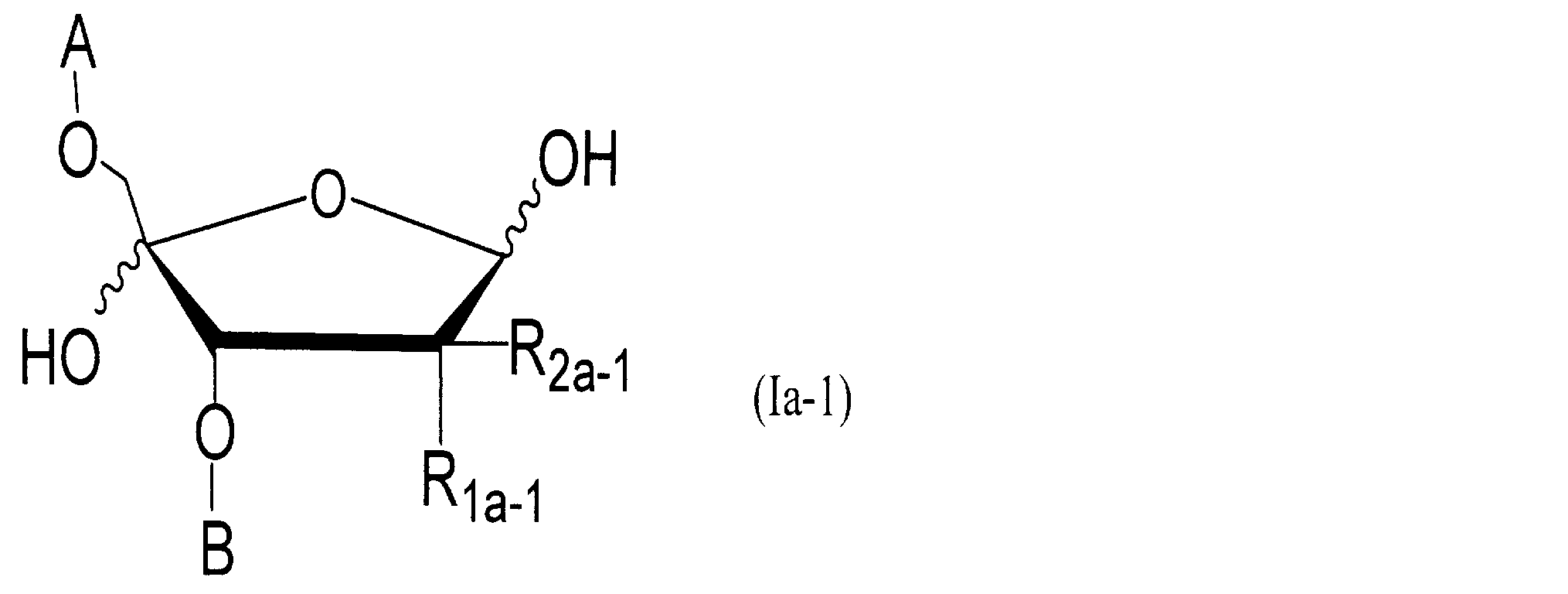
(式中、
R1a-1及びR2a-1は、同一または異なるハロゲン原子;
Aは、ヌクレオチドまたはそのアナログから形成される骨格を有する核酸塩基配列含有オリゴマー若しくはポリマー、または水素原子;
Bは、ヌクレオチドまたはそのアナログから形成される骨格を有する核酸塩基配列含有オリゴマー若しくはポリマー、または水素原子を意味する。
但し、A及びBは同時に水素原子ではない);
(2)一般式(Ia)で示される化合物:
R1a-1及びR2a-1は、同一または異なるハロゲン原子;
Aは、ヌクレオチドまたはそのアナログから形成される骨格を有する核酸塩基配列含有オリゴマー若しくはポリマー、または水素原子;
Bは、ヌクレオチドまたはそのアナログから形成される骨格を有する核酸塩基配列含有オリゴマー若しくはポリマー、または水素原子を意味する。
但し、A及びBは同時に水素原子ではない);
(2)一般式(Ia)で示される化合物:

(式中、
R1a及びR2aは、お互いに、同一又は異なるハロゲン原子であるか、または同一又は異なる、置換基を有していてもよいアルキル基である。R1a及びR2aが置換基を有していてもよいアルキル基である場合、お互いに連結して置換基を有していてもよいシクロアルキル基を形成していてもよい。
Aは、ヌクレオチドまたはそのアナログから形成される骨格を有する核酸塩基配列含有オリゴマー若しくはポリマー、または水素原子を;
Bは、ヌクレオチドまたはそのアナログから形成される骨格を有する核酸塩基配列含有オリゴマー若しくはポリマー、または水素原子を意味する。但し、A及びBは同時に水素原子ではない。);
(3)一般式(Ib)で示される化合物:
R1a及びR2aは、お互いに、同一又は異なるハロゲン原子であるか、または同一又は異なる、置換基を有していてもよいアルキル基である。R1a及びR2aが置換基を有していてもよいアルキル基である場合、お互いに連結して置換基を有していてもよいシクロアルキル基を形成していてもよい。
Aは、ヌクレオチドまたはそのアナログから形成される骨格を有する核酸塩基配列含有オリゴマー若しくはポリマー、または水素原子を;
Bは、ヌクレオチドまたはそのアナログから形成される骨格を有する核酸塩基配列含有オリゴマー若しくはポリマー、または水素原子を意味する。但し、A及びBは同時に水素原子ではない。);
(3)一般式(Ib)で示される化合物:
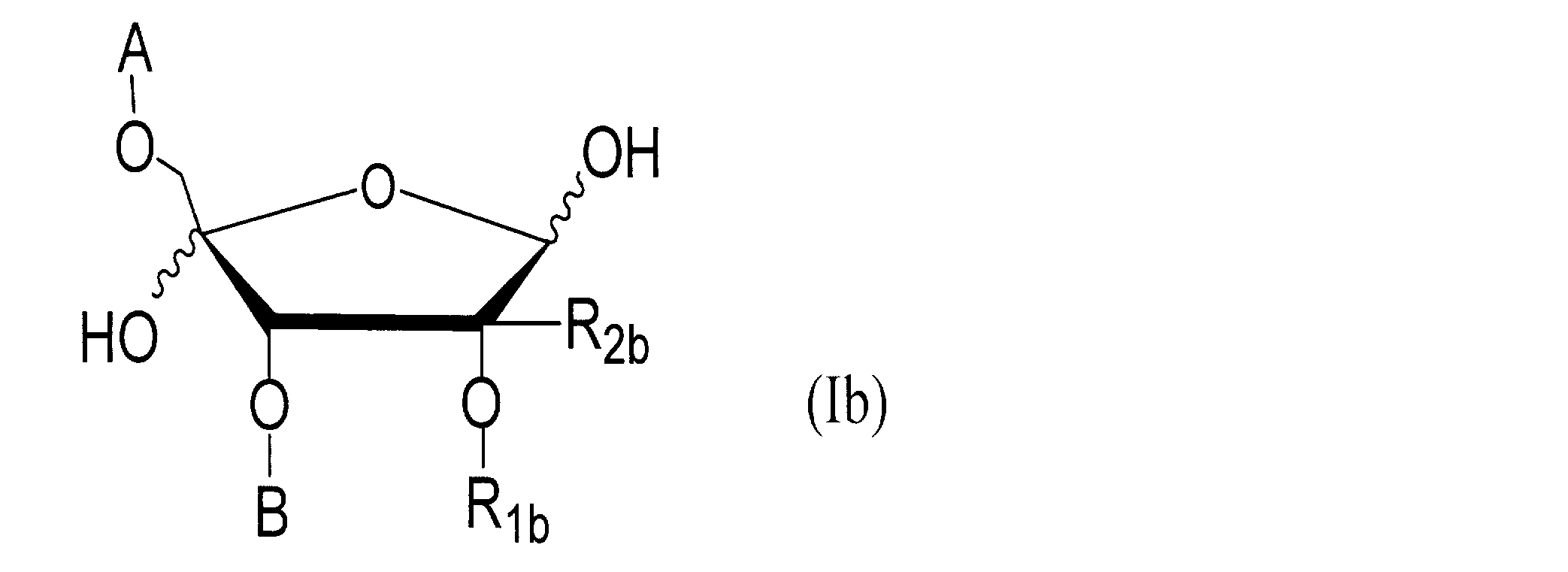
(式中、
R1bは置換基を有していてもよいアルキル基であり、R2bは水素原子または置換基を有していてもよいアルキル基である。
Aは、ヌクレオチドまたはそのアナログから形成される骨格を有する核酸塩基配列含有オリゴマー若しくはポリマー、または水素原子を;
Bは、ヌクレオチドまたはそのアナログから形成される骨格を有する核酸塩基配列含有オリゴマー若しくはポリマー、または水素原子を意味する。但し、A及びBは同時に水素原子ではない。)。
R1bは置換基を有していてもよいアルキル基であり、R2bは水素原子または置換基を有していてもよいアルキル基である。
Aは、ヌクレオチドまたはそのアナログから形成される骨格を有する核酸塩基配列含有オリゴマー若しくはポリマー、または水素原子を;
Bは、ヌクレオチドまたはそのアナログから形成される骨格を有する核酸塩基配列含有オリゴマー若しくはポリマー、または水素原子を意味する。但し、A及びBは同時に水素原子ではない。)。
なお、上記核酸誘導体(Ib)のR2bは、好ましくは水素原子である。
(I-3)上記核酸誘導体(I)が、(1)~(3) からなる群から選択されるいずれかの化合物である、(I-2)に記載する製造方法:
(1)一般式(Ia-1)において、R1a-1及びR2a-1が、同一または異なるハロゲン原子;
A及びBが、同一または異なる、ヌクレオチドから形成される骨格を有する核酸塩基配列含有オリゴマーまたはポリマーである化合物;
(2)一般式(Ia)において、R1a及びR2aが、同一または異なる、置換基を有するアルキル基;
A及びBが、同一または異なる、ヌクレオチドから形成される骨格を有する核酸塩基配列含有オリゴマーまたはポリマーである化合物;
(3)一般式(Ib)において、R2aは置換基を有していてもよいアルキル基であり、R2bは水素原子;
A及びBが、同一または異なる、ヌクレオチドから形成される骨格を有する核酸塩基配列含有オリゴマーまたはポリマーである化合物。
(1)一般式(Ia-1)において、R1a-1及びR2a-1が、同一または異なるハロゲン原子;
A及びBが、同一または異なる、ヌクレオチドから形成される骨格を有する核酸塩基配列含有オリゴマーまたはポリマーである化合物;
(2)一般式(Ia)において、R1a及びR2aが、同一または異なる、置換基を有するアルキル基;
A及びBが、同一または異なる、ヌクレオチドから形成される骨格を有する核酸塩基配列含有オリゴマーまたはポリマーである化合物;
(3)一般式(Ib)において、R2aは置換基を有していてもよいアルキル基であり、R2bは水素原子;
A及びBが、同一または異なる、ヌクレオチドから形成される骨格を有する核酸塩基配列含有オリゴマーまたはポリマーである化合物。
(I-4)一般式(Ia-1):
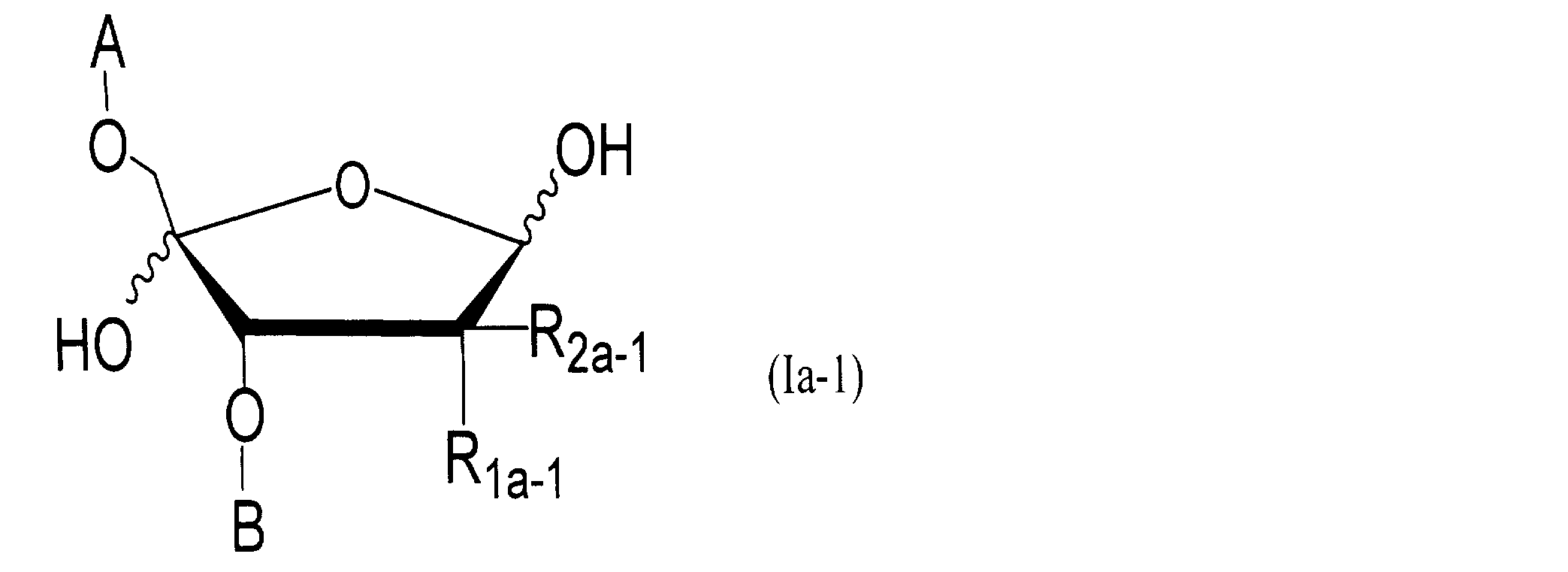
(式中、
R1a-1及びR2a-1は、同一または異なるハロゲン原子;
Aは、ヌクレオチドまたはそのアナログから形成される骨格を有する核酸塩基配列含有オリゴマー若しくはポリマー、または水素原子;
Bは、ヌクレオチドまたはそのアナログから形成される骨格を有する核酸塩基配列含有オリゴマー若しくはポリマー、または水素原子を意味する。
但し、A及びBは同時に水素原子ではない)。
で示される核酸誘導体(Ia-1)、または
一般式(Ib):
R1a-1及びR2a-1は、同一または異なるハロゲン原子;
Aは、ヌクレオチドまたはそのアナログから形成される骨格を有する核酸塩基配列含有オリゴマー若しくはポリマー、または水素原子;
Bは、ヌクレオチドまたはそのアナログから形成される骨格を有する核酸塩基配列含有オリゴマー若しくはポリマー、または水素原子を意味する。
但し、A及びBは同時に水素原子ではない)。
で示される核酸誘導体(Ia-1)、または
一般式(Ib):
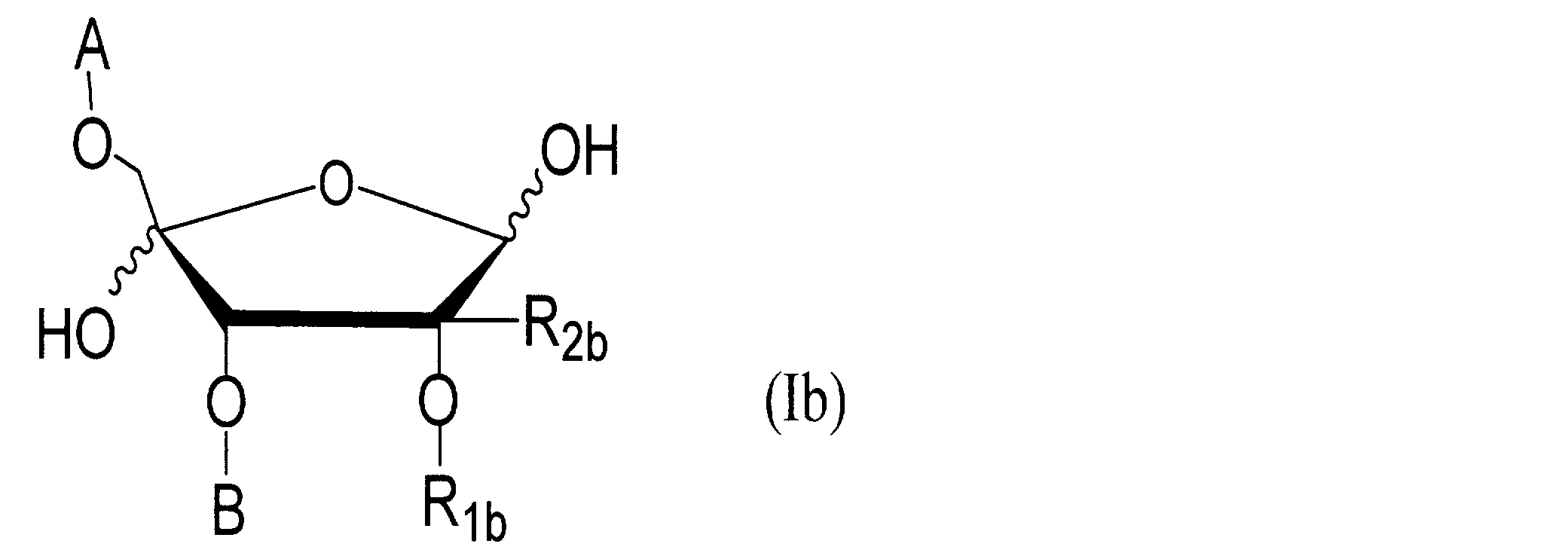
(式中、
R1bは置換基を有していてもよいアルキル基であり、R2bは水素原子または置換基を有していてもよいアルキル基である。
Aは、ヌクレオチドまたはそのアナログから形成される骨格を有する核酸塩基配列含有オリゴマー若しくはポリマー、または水素原子を;
Bは、ヌクレオチドまたはそのアナログから形成される骨格を有する核酸塩基配列含有オリゴマー若しくはポリマー、または水素原子を意味する。但し、A及びBは同時に水素原子ではない。)
で示される核酸誘導体(Ib)と
アミン化合物(II)とを、還元剤の非存在下で反応させる工程を有する、
核酸誘導体とアミン化合物(II)とのコンジュゲートを製造する方法。
R1bは置換基を有していてもよいアルキル基であり、R2bは水素原子または置換基を有していてもよいアルキル基である。
Aは、ヌクレオチドまたはそのアナログから形成される骨格を有する核酸塩基配列含有オリゴマー若しくはポリマー、または水素原子を;
Bは、ヌクレオチドまたはそのアナログから形成される骨格を有する核酸塩基配列含有オリゴマー若しくはポリマー、または水素原子を意味する。但し、A及びBは同時に水素原子ではない。)
で示される核酸誘導体(Ib)と
アミン化合物(II)とを、還元剤の非存在下で反応させる工程を有する、
核酸誘導体とアミン化合物(II)とのコンジュゲートを製造する方法。
(I-5)上記核酸誘導体(Ia-1)が、下記(1)に示す化合物である、(I-4)に記載する製造方法:
(1)一般式(Ia-1)において、R1a-1及びR2a-1が、同一または異なるハロゲン原子;
A及びBが、同一または異なる、ヌクレオチドから形成される骨格を有する核酸塩基配列含有オリゴマーまたはポリマーである化合物。
(1)一般式(Ia-1)において、R1a-1及びR2a-1が、同一または異なるハロゲン原子;
A及びBが、同一または異なる、ヌクレオチドから形成される骨格を有する核酸塩基配列含有オリゴマーまたはポリマーである化合物。
(I-6)上記アミン化合物(II)が、一級アミノ基を有する、ペプチド、蛋白質または核酸である(I-1)~(I-5)のいずれかに記載する製造方法。
(I-7)上記アミン化合物(II)が、細胞移行性、核移行性、標的親和性、滞留性、ヌクレアーゼ耐性(分解酵素に対する抵抗性)、及び標識性からなる群から選択されるいずれか少なくとも1つの特性を有する機能性分子である、(I-1)乃至(I-6)のいずれかに記載する製造方法。
(I-8)式(I)中、Xは直接結合;R1及びR2は、お互いに、同一又は異なるハロゲン原子であるか、または同一又は異なる、置換基を有していてもよいアルキル基である(R1とR2は、お互いに連結してシクロアルキル基を形成していてもよい)、(I-1)、(I-6)または(I-7)のいずれかに記載する製造方法。
(I-9)式(I)中、A及びBは、同一または異なって、ヌクレオチドまたはそのアナログから形成される骨格を有する核酸塩基配列含有オリゴマー若しくはポリマーである、(I-8)に記載する製造方法。
(I-10)式(I)中、Xは酸素原子;R1は置換基を有していてもよいアルキル基、R2は水素原子である(I-1)、(I-6)または(I-7)のいずれかに記載する製造方法。
(I-11)式(I)中、A及びBは、同一または異なって、ヌクレオチドまたはそのアナログから形成される骨格を有する核酸塩基配列含有オリゴマー若しくはポリマーである、(I-10)に記載する製造方法。
(I-12)式(I)中、A及びBで示されるオリゴマーまたはポリマーが、同一または異なって、リボヌクレオチドまたはデオキシリボヌクレオチドを含むオリゴマーまたはポリマーである(I-1)、(I-6)または(I-7)~(I-11)のいずれかに記載する製造方法。
(I-13)R1及びR2で示される置換基を有していてもよいアルキル基が、置換基を有するかまたは有しない炭素数1~4のアルキル基である、(I-1)、(I-6)または(I-7)~(I-12)のいずれかに記載する製造方法。
(I-14)R1及びR2で示される置換基を有していてもよいアルキル基の置換基が、水酸基、アルコキシ基、アミノ基、アミド基(カルバモイル基)、及びアルキルカルバモイル基から選択される少なくとも1つである、(I-1)、(I-6)または(I-7)~(I-13)のいずれかに記載する製造方法。
(I-15)R1またはR2で示されるハロゲン原子が、フッ素原子または塩素原子である(I-1)、(I-6)または(I-7)~(I-14)のいずれかに記載する製造方法。
(I-16)生成するコンジュゲートが下記式で示される化合物である、(I-1)乃至(I-15)のいずれかに記載する製造方法:
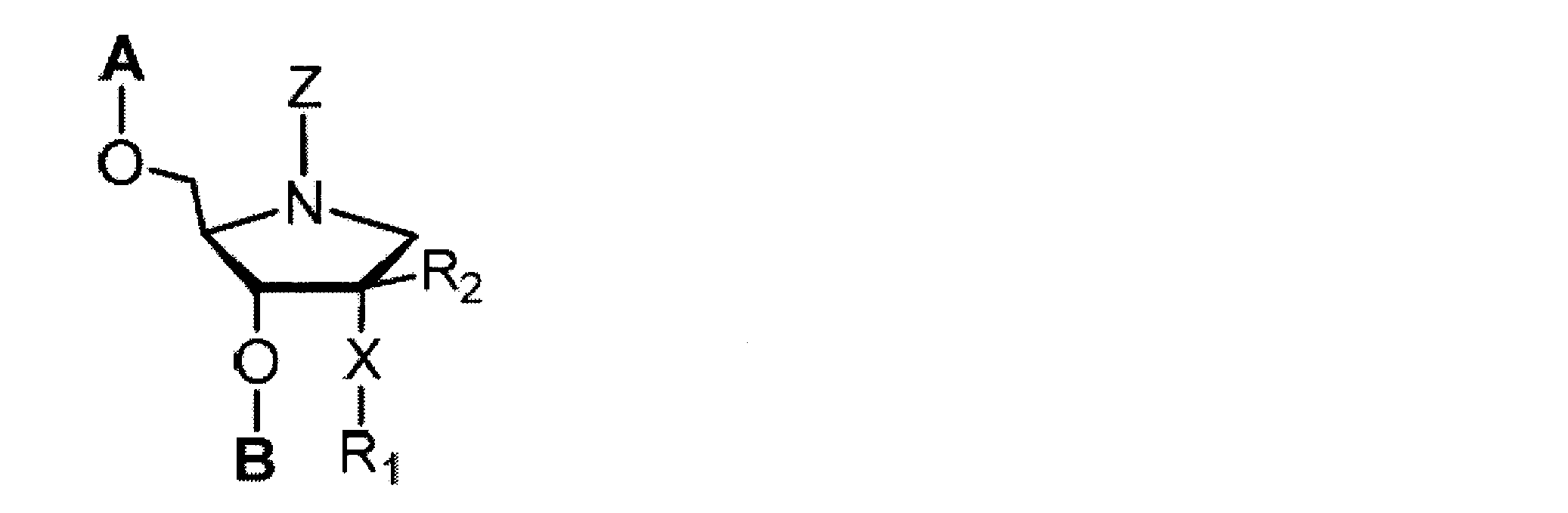
(式中、
Zは、アミノ化合物(II)の一級アミノ基を除いた部位;
Xは、直接結合または酸素原子;
R1は、ハロゲン原子、置換基を有していてもよいアルキル基、または水素原子;
R2は、ハロゲン原子、置換基を有していてもよいアルキル基、または水素原子;
Aは、ヌクレオチドまたはそのアナログから形成される骨格を有する核酸塩基配列含有オリゴマー若しくはポリマー、または水素原子;
Bは、ヌクレオチドまたはそのアナログから形成される骨格を有する核酸塩基配列含有オリゴマー若しくはポリマー、または水素原子;を意味する。
但し、Xが直接結合であるとき、R1及びR2は、お互いに、同一又は異なるハロゲン原子であるか、または同一又は異なる、置換基を有していてもよいアルキル基であり(この場合、R1とR2は、お互いに連結してシクロアルキル基を形成していてもよい);
Xが酸素原子であるとき、R1は置換基を有していてもよいアルキル基または水素原子、R2は水素原子または置換基を有していてもよいアルキル基である。
また、Xが直接結合及び酸素原子のいずれの場合も、A及びBは同時に水素原子ではない。)
(I-17)(I-1)乃至(I-16)のいずれかに記載する方法で製造される、核酸誘導体(I)とアミン化合物(II)とのコンジュゲート。
Zは、アミノ化合物(II)の一級アミノ基を除いた部位;
Xは、直接結合または酸素原子;
R1は、ハロゲン原子、置換基を有していてもよいアルキル基、または水素原子;
R2は、ハロゲン原子、置換基を有していてもよいアルキル基、または水素原子;
Aは、ヌクレオチドまたはそのアナログから形成される骨格を有する核酸塩基配列含有オリゴマー若しくはポリマー、または水素原子;
Bは、ヌクレオチドまたはそのアナログから形成される骨格を有する核酸塩基配列含有オリゴマー若しくはポリマー、または水素原子;を意味する。
但し、Xが直接結合であるとき、R1及びR2は、お互いに、同一又は異なるハロゲン原子であるか、または同一又は異なる、置換基を有していてもよいアルキル基であり(この場合、R1とR2は、お互いに連結してシクロアルキル基を形成していてもよい);
Xが酸素原子であるとき、R1は置換基を有していてもよいアルキル基または水素原子、R2は水素原子または置換基を有していてもよいアルキル基である。
また、Xが直接結合及び酸素原子のいずれの場合も、A及びBは同時に水素原子ではない。)
(I-17)(I-1)乃至(I-16)のいずれかに記載する方法で製造される、核酸誘導体(I)とアミン化合物(II)とのコンジュゲート。
(I-18)下記式で示される化合物である、(I-17)に記載するコンジュゲート:
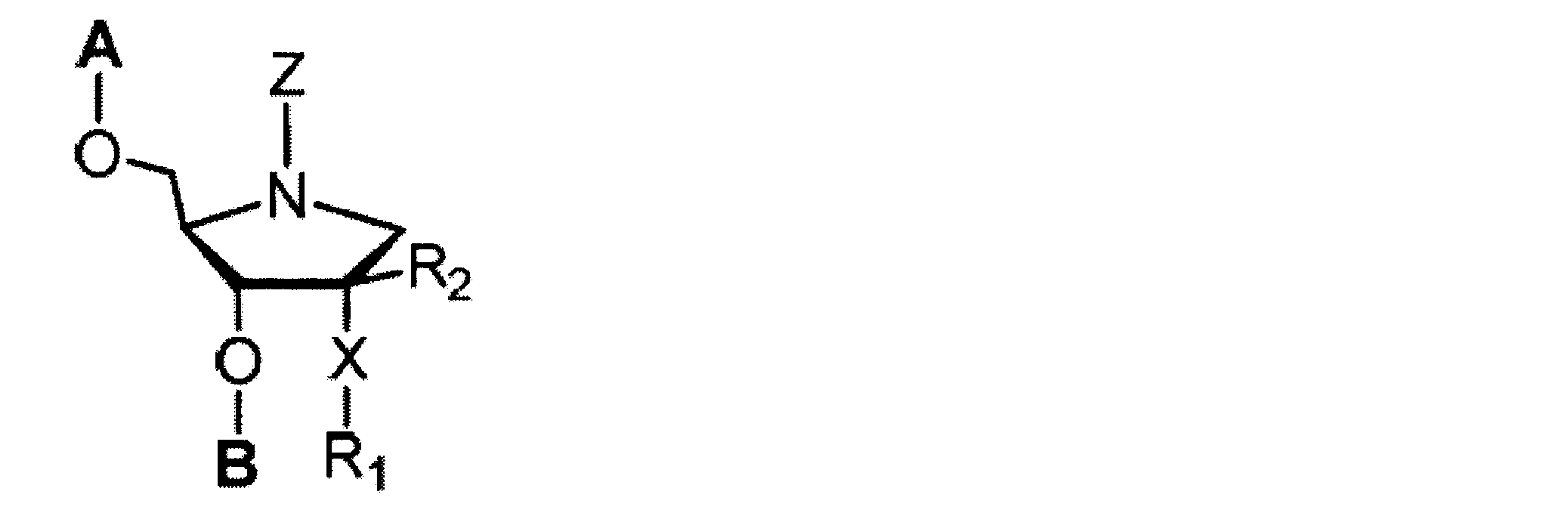
(式中、
Zは、アミノ化合物(II)の一級アミノ基を除いた部位;
Xは、直接結合または酸素原子;
R1は、ハロゲン原子、置換基を有していてもよいアルキル基、または水素原子;
R2は、ハロゲン原子、置換基を有していてもよいアルキル基、または水素原子;
Aは、ヌクレオチドまたはそのアナログから形成される骨格を有する核酸塩基配列含有オリゴマー若しくはポリマー、または水素原子;
Bは、ヌクレオチドまたはそのアナログから形成される骨格を有する核酸塩基配列含有オリゴマー若しくはポリマー、または水素原子;を意味する。
但し、Xが直接結合であるとき、R1及びR2は、お互いに、同一又は異なるハロゲン原子であるか、または同一又は異なる、置換基を有していてもよいアルキル基であり(この場合、R1とR2は、お互いに連結してシクロアルキル基を形成していてもよい);
Xが酸素原子であるとき、R1は置換基を有していてもよいアルキル基または水素原子、R2は水素原子または置換基を有していてもよいアルキル基である。
また、Xが直接結合及び酸素原子のいずれの場合も、A及びBは同時に水素原子ではない。)。
Zは、アミノ化合物(II)の一級アミノ基を除いた部位;
Xは、直接結合または酸素原子;
R1は、ハロゲン原子、置換基を有していてもよいアルキル基、または水素原子;
R2は、ハロゲン原子、置換基を有していてもよいアルキル基、または水素原子;
Aは、ヌクレオチドまたはそのアナログから形成される骨格を有する核酸塩基配列含有オリゴマー若しくはポリマー、または水素原子;
Bは、ヌクレオチドまたはそのアナログから形成される骨格を有する核酸塩基配列含有オリゴマー若しくはポリマー、または水素原子;を意味する。
但し、Xが直接結合であるとき、R1及びR2は、お互いに、同一又は異なるハロゲン原子であるか、または同一又は異なる、置換基を有していてもよいアルキル基であり(この場合、R1とR2は、お互いに連結してシクロアルキル基を形成していてもよい);
Xが酸素原子であるとき、R1は置換基を有していてもよいアルキル基または水素原子、R2は水素原子または置換基を有していてもよいアルキル基である。
また、Xが直接結合及び酸素原子のいずれの場合も、A及びBは同時に水素原子ではない。)。
(II)新規核酸誘導体
(II-1)下記一般式(Ia-1)で示される核酸誘導体:
(II-1)下記一般式(Ia-1)で示される核酸誘導体:

(式中、R1a-1またはR2a-1は、お互いに、同一または異なるハロゲン原子であり、並びにA及びBは、同一または異なる、ヌクレオチドまたはそのアナログから形成される骨格を有する核酸塩基配列含有オリゴマー若しくはポリマー、または水素原子を意味する。但し、AとBは同時に水素原子ではない)。
(II-2)式(Ia-1)中、R1a-1及びR2a-1で示されるハロゲン原子が、同一又は異なって、フッ素原子または塩素原子である、(II-1)に記載する核酸誘導体。
(II-3)式(Ia-1)中、A及びBで示されるオリゴマーまたはポリマーが、同一または異って、リボヌクレオチドまたはデオキシリボヌクレオチドを含むオリゴマーまたはポリマーである(II-1)または(II-2)に記載する核酸誘導体。
(II-3)式(Ia-1)中、A及びBで示されるオリゴマーまたはポリマーが、同一または異って、リボヌクレオチドまたはデオキシリボヌクレオチドを含むオリゴマーまたはポリマーである(II-1)または(II-2)に記載する核酸誘導体。
本発明のコンジュゲートの製造方法によれば、上記で説明する核酸誘導体(I)が有する1,4-アルデヒド ケト構造がアミン化合物(II)の一級アミノ基と高い反応性を示すため、還元剤存在下でアミン化合物(II)と効率的かつ安定したコンジュゲートを形成することができる。当該反応は、中性付近の水溶液中で、一段階で進行する。還元剤を使用できる有機溶媒中での反応が可能であるため、基質適応範囲が広く、DNAだけでなく従来合成が難しかったRNAとのコンジュゲート形成にも応用することができる。
また核酸誘導体(I)のうち、式(Ia)(但し、R1a及びR2aはいずれも同一または異なるハロゲン原子である)、または式(Ib)で示される化合物は、アミン化合物(II)と、還元条件下のみならず、非還元条件下でも効率よく反応し、上記核酸誘導体(IaまたはIb)とアミン化合物(II)とのコンジュゲートを安定に生成することができる。
また、アミン化合物(II)としてタンパク質やペプチドを用いる場合、当該アミン化合物(II)と核酸誘導体(I)または(Ia)とのコンジュゲート形成においては、タンパク質やペプチドにもともと存在するリジン残基など、一級アミノ基を有するアミノ残基を利用することができる。
(I)核酸分子とアミン化合物とのコンジュゲート及びその製造方法
本発明は、下記の一般式で示される核酸誘導体(I)とアミン化合物(II)とのコンジュゲートを製造する方法に関する。
本発明は、下記の一般式で示される核酸誘導体(I)とアミン化合物(II)とのコンジュゲートを製造する方法に関する。
核酸誘導体(I)

以下、式(I)における各置換基について説明する。
R
1
及びR
2
R1は、ハロゲン原子、置換基を有していてもよいアルキル基、または水素原子を意味する。好ましくはハロゲン原子、または置換基を有していてもよいアルキル基である。またR2は、ハロゲン原子、置換基を有していてもよいアルキル基、または水素原子を意味する。なお、R1とR2は、お互いに、同時に、同一または異なるハロゲン原子であってもよいし、また同時に、同一または異なる、置換基を有していてもよいアルキル基であってもよい。なお、後者の場合であって、R1とR2のアルキル基が置換基を有する場合、R1とR2の置換基は同一でもよいし、また異なっていてもよい。またR1とR2が、お互いに同時に置換基を有していてもよいアルキル基である場合、互いに連結してシクロアルキル基を形成していてもよい。
R1は、ハロゲン原子、置換基を有していてもよいアルキル基、または水素原子を意味する。好ましくはハロゲン原子、または置換基を有していてもよいアルキル基である。またR2は、ハロゲン原子、置換基を有していてもよいアルキル基、または水素原子を意味する。なお、R1とR2は、お互いに、同時に、同一または異なるハロゲン原子であってもよいし、また同時に、同一または異なる、置換基を有していてもよいアルキル基であってもよい。なお、後者の場合であって、R1とR2のアルキル基が置換基を有する場合、R1とR2の置換基は同一でもよいし、また異なっていてもよい。またR1とR2が、お互いに同時に置換基を有していてもよいアルキル基である場合、互いに連結してシクロアルキル基を形成していてもよい。
ここで「置換基を有していてもよいアルキル基」には、置換基を有するアルキル基と置換基を有しないアルキル基が含まれる。
「アルキル基」としては、通常炭素数1~4、好ましくは1~3、より好ましくは1~2の直鎖または分枝鎖状のアルキル基を挙げることができる。これらのアルキル基には、メチル基、エチル基、プロピル基、イソプロピル基、ブチル基、イソブチル基、s-ブチル基、t-ブチル基などが含まれる。好ましくはメチル基、エチル基、プロピル基であり、より好ましくはメチル基及びエチル基である。特に好ましくはメチル基である。
かかるアルキル基の置換基としては、最終化合物(核酸誘導体(I)、(Ia))が化合物として許容できること、つまり化合物として製造できることを限度として、例えば、水酸基、アルコキシ基、アミノ基、アミド基(カルバモイル基)、及びアルキルカルバモイル基等の官能基を挙げることができる。つまり、置換基を有するアルキル基としては、アルキル基の1または複数の水素原子が上記に掲げる置換基の群から選択される少なくとも1つの官能基で置換されてなる基を挙げることができる。
ここで「アルコキシ基」としては、炭素数1~4、好ましくは炭素数1~3、より好ましくは炭素数1~2のアルキル基で水素原子が置換された水酸基を挙げることができる。これらのアルコキシ基には、メトキシ基、エトキシ基、1-プロポキシ基、2-プロポキシ基、1-ブトキシ基、2-ブトキシ基、2-メチル-1-プロポキシ基、2-メチル-2-プロポキシ基などが含まれる。好ましくはメトキシ基、エトキシ基、1-プロポキシ基、および2-プロポキシ基であり、より好ましくはメトキシ基またはエトキシ基、さらに好ましくはメトキシ基である。
また「アルキルカルバモイル基」でいう「アルキル基」としては、通常炭素数1~4の直鎖または分枝鎖状のアルキル基を挙げることができる。好ましくは炭素数1~3、さらに好ましくは炭素数1~2のアルキル基を挙げることができる。具体的には、メチル基、エチル基、プロピル基、イソプロピル基、ブチル基、及びイソブチル基などが含まれる。好ましくはメチル基、エチル基、プロピル基などの炭素数1~4の低級アルキル基であり、より好ましくはメチル基およびエチル基、特に好ましくはメチル基である。
置換基を有するアルキル基のなかで、「水酸基を有するアルキル基」としては、具体的にはヒドロキシメチル基,1-ヒドロキシエチル基,2-ヒドロキシエチル基,1-ヒドロキシプロピル基,2-ヒドロキシプロピル基,3-ヒドロキシプロピル基などを例示することができる。好ましくはヒドロキシメチル基,2-ヒドロキシエチル基,及び3-ヒドロキシプロピル基であり、より好ましくは2-ヒドロキシエチル基,及び3-ヒドロキシプロピル基であり、特に好ましくは2-ヒドロキシエチル基である。
「アルコキシ基を有するアルキル基」としては、前述するように、C1-4-アルコキシ-C1-4-アルキル基を挙げることができるが、具体的にはメトキシメチル基、1-メトキシエチル基、2-メトキシエチル基、1-メトキシプロピル基,2-メトキシプロピル基,3-メトキシプロピル基、エトキシメチル基、1-エトキシエチル基、2-エトキシエチル基、1-エトキシプロピル基,2-エトキシプロピル基,3-エトキシプロピル基などを例示することができる。好ましくはメトキシメチル基,2-メトキシエチル基,及び3-メトキシプロピル基であり、より好ましくは2-メトキシエチル基,及び3-メトキシプロピル基であり、特に好ましくは2-メトキシエチル基である。
「アミノ基を有するアルキル基」としては、好ましくは一級アミノ基を有するアルキル基を挙げることができる。具体的には、前述するように、アミノ-C1-4-アルキル基を挙げることができるが、具体的にはアミノメチル基、1-アミノエチル基、2-アミノエチル基、1-アミノプロピル基,2-アミノプロピル基,3-アミノプロピル基などを例示することができる。好ましくはアミノメチル基,2-アミノエチル基,及び3-アミノプロピル基であり、より好ましくは2-アミノエチル基,及び3-アミノプロピル基であり、特に好ましくは2-アミノエチル基である。
「アミド基を有するアルキル基(カルバモイル基を有するアルキル基)」としては、前述するように、アミド-C1-4-アルキル基を挙げることができるが、具体的にはアミドメチル基、1-アミドエチル基、2-アミドエチル基、1-アミドプロピル基,2-アミドプロピル基,3-アミドプロピル基などを例示することができる。好ましくはアミドメチル基,2-アミドエチル基,及び3-アミドプロピル基であり、より好ましくはアミドメチル基,及び2-アミドエチル基であり、特に好ましくはアミドメチル基である。
「アルキルカルバモイル基を有するアルキル基」としては、前述するように、C1-4-アルキルカルバモイル-C1-4-アルキル基を挙げることができるが、具体的にはメチルカルバモイルメチル基、1-メチルカルバモイルエチル基、2-メチルカルバモイルエチル基、1-メチルカルバモイルプロピル基,2-メチルカルバモイルプロピル基,3-メチルカルバモイルプロピル基、エチルカルバモイルメチル基、1-エチルカルバモイルエチル基、2-エチルカルバモイルエチル基、1-エチルカルバモイルプロピル基,2-エチルカルバモイルプロピル基,3-エチルカルバモイルプロピル基などを例示することができる。好ましくはメチルカルバモイルメチル基,2-メチルカルバモイルエチル基,及び3-メチルカルバモイルプロピル基であり、より好ましくはメチルカルバモイルメチル基,及び2-メチルカルバモイルエチル基であり、特に好ましくはメチルカルバモイルメチル基である。
「ハロゲン原子」としては、好ましくはフッ素原子、及び塩素原子であり、より好ましくはフッ素原子である。
なお、Xが直接結合であり、R1とR2がお互いに置換基を有していてもよいアルキル基である場合、R1とR2はお互いに連結して置換基を有していてもよいシクルアルキル基を形成していてもよい。ここで「シクロアルキル基」としては、好ましくはシクロプロピル基、シクロブチル基、シクロペンチル基、シクロヘキシル基等の炭素数1~6のシクロアルキル基を挙げることができる。より好ましくは、シクロプロピル基である。
なお、Xが直接結合である場合、R1とR2は、お互いに、同一または異なるハロゲン原子であるか、または、同一または異なる、置換基を有していてもよいアルキル基であるのが好ましい。より好ましくは、同一または異なるハロゲン原子である。
A及びB
A及びBは、それぞれ、ヌクレオチドまたはそのアナログから形成される骨格を有する核酸塩基配列含有オリゴマーまたはポリマー、または水素原子である。但し、AとBは、同時に水素原子になることはない。
A及びBは、それぞれ、ヌクレオチドまたはそのアナログから形成される骨格を有する核酸塩基配列含有オリゴマーまたはポリマー、または水素原子である。但し、AとBは、同時に水素原子になることはない。
ヌクレオチドまたはそのアナログは自然界に由来するものであっても、また人工的に合成されたものであってもよい。ここでヌクレオチドには、リボヌクレオチドまたはデオキシリボヌクレオチドが含まれる。好ましいオリゴマーまたはポリマーは、リボヌクレオチドからなるRNA、及びデオキシリボヌクレオチドからなるDNAである。なお、RNAは、構造やその作用から、mRNA、tRNA、rRNA、ncRNA、siRNA、dsRNA、及びshRNAなどに分類されるが、これらの種類に特に制限されるものではない。またDNAも、構造やその作用から、cDNA、一本鎖DNA(センスDNA鎖、アンチセンスDNA鎖を含む)、二本鎖DNAなどに分類されるが、これらの種類に特に制限されるものではない。
またヌクレオチドのアナログとしては、リボ核酸の2’位の酸素原子と4’位の炭素原子がメチレンを介して架橋した2つの環状構造を有するLNA(Locked Nucleic Acid);糖の代わりにN-(2-アミノエチル)グリシンがアミド結合で結合したものを主鎖とし、当該主鎖に核酸塩基に相当するプリン環やピリミジン環がメチレン基とカルボニル基を介して結合してなるPNA(Peptide Nucleic Acid);その他、2位の酸素原子に、水酸基、アルキル基、アミド基、アルキルカルバモイル基などの任意の置換基が結合してなるリボヌクレオチドを例示することができる。これらはそれぞれがハイブリダイズして二本鎖を形成していてもよく、具体的には二本鎖LNA分子、二本鎖PNA分子を挙げることができる。
本発明が対象とする核酸塩基配列含有オリゴマーまたはポリマーは、上記ヌクレオチド及びそのアナログのキメラ体またはハイブリッド体であってもよく、例えば、キメラ体としてはDNA/RNAキメラ分子、DNA/PNAキメラ分子、DNA/LNAキメラ分子、PNA/LNAキメラ分子を挙げることができる。またハイブリッド体としては、二本鎖DNA/RNAハイブリッド分子、二本鎖DNA/PNAハイブリッド分子、二本鎖DNA/LNAハイブリッド分子、二本鎖PNA/LNAハイブリッド分子を挙げることができる。
本発明においてオリゴマーとは、上記ヌクレオチドが、通常2~10程度の数で連なって形成される核酸を意味し、またポリマーとはそれ以上の数のヌクレオチドが連なって形成される核酸を意味する。
なお、AとBは、お互いに同種のオリゴマーまたはポリマーであってもよいし、またお互いに異種のオリゴマーまたはポリマーであってもよい。
また、A及びBと式(I)で示される化合物の酸素原子との結合様式は、A及びBの種類によっても相違するが、A及びBがリン酸を有するヌクレオチドまたはそのアナログである場合、通常、リン酸ジエステル結合を挙げることができる。
X
上記式(I)中、Xは、直接結合または酸素原子を意味する。
上記式(I)中、Xは、直接結合または酸素原子を意味する。
Xが直接結合であるとき、本発明が対象とする核酸誘導体(I)は、下式(Ia)で示される化合物であることが好ましい。
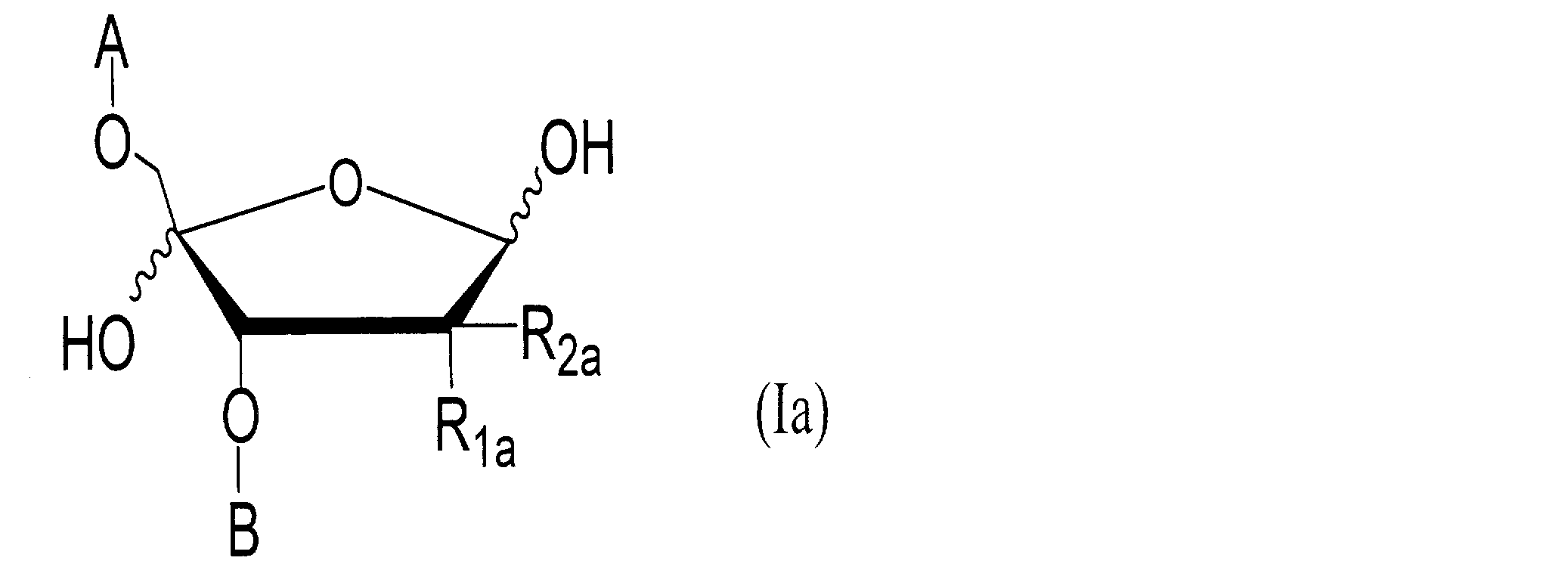
ここで、A及びBは前述の通り、それぞれ、ヌクレオチドまたはそのアナログから形成される骨格を有する核酸塩基配列含有オリゴマーまたはポリマー、または水素原子である。但し、AとBは、同時に水素原子になることはない。その詳細は、上記「R1及びR2」の項で前述した通りであり、上記記載をそのままここに援用することができる。
R1a及びR2aは、同時に同一または異なるハロゲン原子であるか、または同時に、同一または異なる、置換基を有していてもよいアルキル基である。なお、R1a及びR2aとは、同時に同一のハロゲン原子またはアルキル基(置換基を有するもの及び有さないものの両方が含まれる)であってもよいが、必ずしも同一のアルキル基(置換基を有するもの及び有さないものの両方が含まれる)またはハロゲン原子である必要はない。また、R1a及びR2aが同時に置換基を有していてもよいアルキル基である場合、R1a及びR2aはお互いに連結して置換基を有していてもよいシクロアルキル基を形成していてもよい。
アルキル基、シクロアルキル基、置換基、ハロゲン原子は、上記「R1及びR2」の項で前述した通りであり、上記記載をそのままここに援用することができる。アルキル基として好ましくは、メチル基、エチル基、プロピル基、イソプロピル基、ブチル基、及びイソブチル基;より好ましくはメチル基、エチル基、プロピル基;さらに好ましくはメチル基およびエチル基;特に好ましくはメチル基である。当該アルキル基は置換基を有しないものであってもよいが、置換基を有する場合、好ましくは水酸基、アルコキシ基、アミノ基、アミド基(カルバモイル基)、アルキルカルバモイル基を例示することができる。ハロゲン原子として、好ましくはフッ素原子及び塩素原子;より好ましくはフッ素原子である。また、シクロアルキル基として、好ましくはシクロプロピル基である。
Xが酸素原子であるとき、本発明が対象とする核酸誘導体(I)は、下式(Ib)で示される化合物であることが好ましい。

ここで、A及びBは前述の通り、それぞれ、ヌクレオチドまたはそのアナログから形成される骨格を有する核酸塩基配列含有オリゴマーまたはポリマー、または水素原子である。但し、AとBは、同時に水素原子になることはない。その詳細は、上記「R1及びR2」の項で前述した通りであり、上記記載をそのままここに援用することができる。
R1bは置換基を有していてもよいアルキル基であり、R2bは水素原子または置換基を有していてもよいアルキル基である。好ましくは水素原子である。アルキル基及び置換基は、上記「R1及びR2」の項で前述した通りであり、上記記載をそのままここに援用することができる。アルキル基として好ましくは、メチル基、エチル基、プロピル基、イソプロピル基、ブチル基、及びイソブチル基;より好ましくはメチル基、エチル基、プロピル基;さらに好ましくはメチル基およびエチル基;特に好ましくはメチル基である。当該アルキル基は置換基を有しないものであってもよいが、置換基を有する場合、好ましくは水酸基、アルコキシ基、アミノ基、アミド基(カルバモイル基)、アルキルカルバモイル基を例示することができる。
これらの核酸誘導体(I)のうち、A及びBがデオキシリボヌクレオチドのオリゴマーであり、Xが直接結合、R1及びR2がフッ素原子である場合の核酸誘導体(I)の製造方法の詳細を後述する製造例1に記載する(式A参照)。A及びBがデオキシリボヌクレオチドのオリゴマーであり、Xが直接結合、R1及びR2がメチル基である場合の核酸誘導体(I)(同時に核酸誘導体(Ia)に相当する)の製造方法の詳細を後述する製造例2に記載する(式B参照)。また、A及びBがデオキシリボヌクレオチドのオリゴマーであり、Xが酸素原子、R1がメチル基、R2が水素原子である場合の核酸誘導体(I)(同時に核酸誘導体(Ib)に相当する)の製造方法の詳細を後述する製造例3に記載する(式C参照)。
なお、製造例1(式A)において、出発原料として、化合物1-1に代えて、下式:

で示される2,2-dichloro-2-deoxy-3,5-bis-O-[benzoyl]-D-erythro-pentoseを使用して、製造例1記載の方法に従って製造することで、Xが直接結合、R1及びR2がいずれも塩素原子である核酸誘導体(I)を製造することができる。
また、下式:
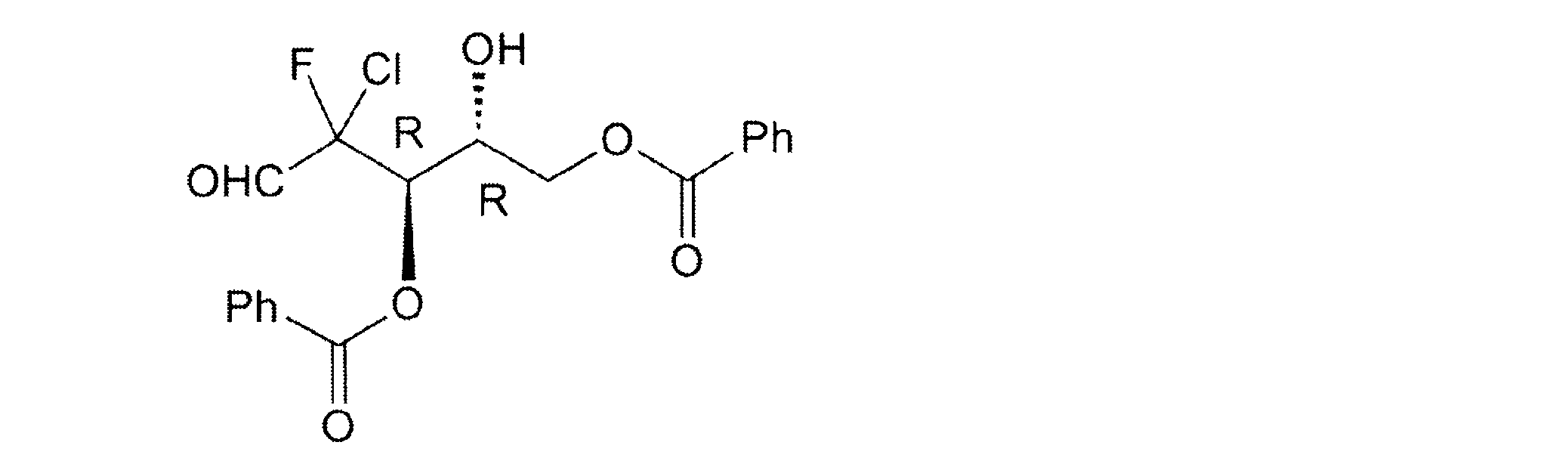
で示される2-chloro-2-deoxy-2-fluoro-3,5-bis-O-[benzoyl]-D-erythro-pentoseを使用することで、Xが直接結合、R1及びR2のいずれか一方がフッ素原子で他方が塩素原子である核酸誘導体(I)を製造することができる。
また製造例2(式B)において、出発原料として、化合物2-1に代えて、下式:
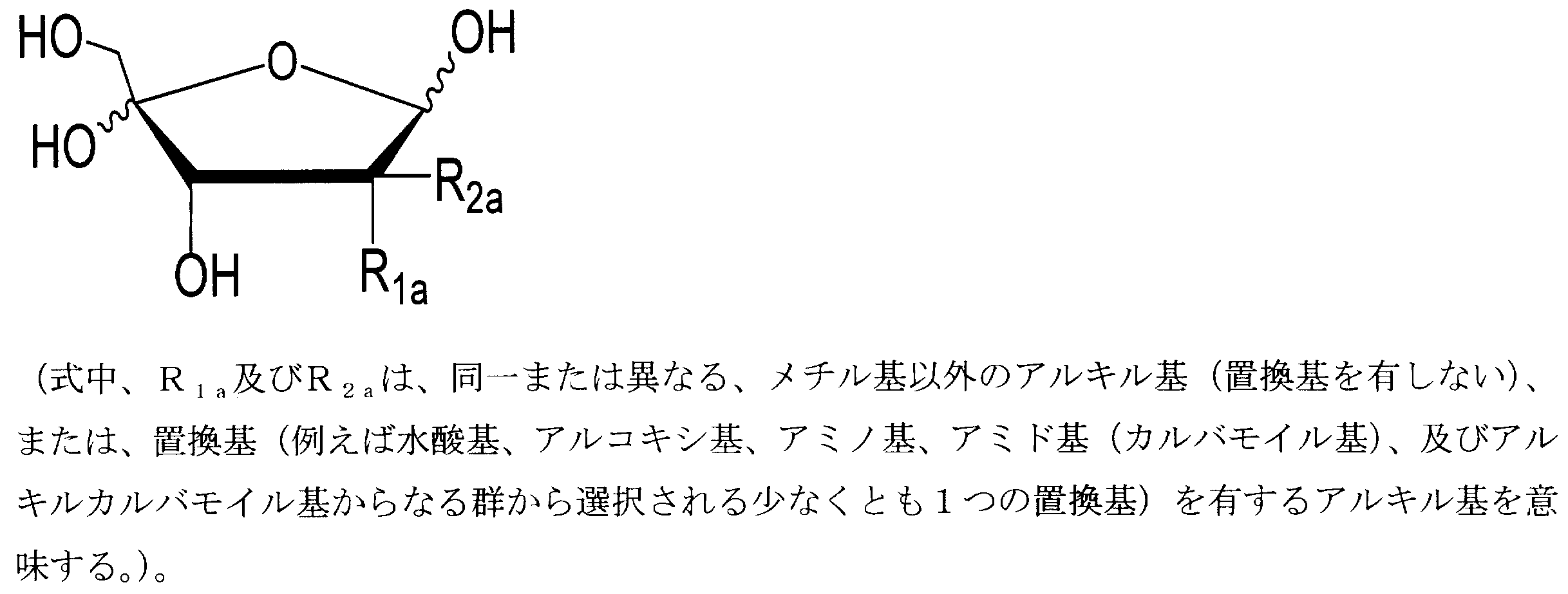
で示される化合物を使用して、製造例2記載の方法に従って製造することで、Xが直接結合、R1及びR2が、同一または異なる、メチル基以外のアルキル基である核酸誘導体(I)(同時に核酸誘導体(Ia)に相当する);または、Xが直接結合、R1及びR2が、同一または異なる、置換基(例えば、水酸基、アルコキシ基、アミノ基、アミド基(カルバモイル基)、及びアルキルカルバモイル基からなる群から選択される少なくとも1つ)を有するアルキル基である核酸誘導体(I)(同時に核酸誘導体(Ia)に相当する)を製造することができる。
製造例3(式C)において、化合物3-3に代えて、下式:
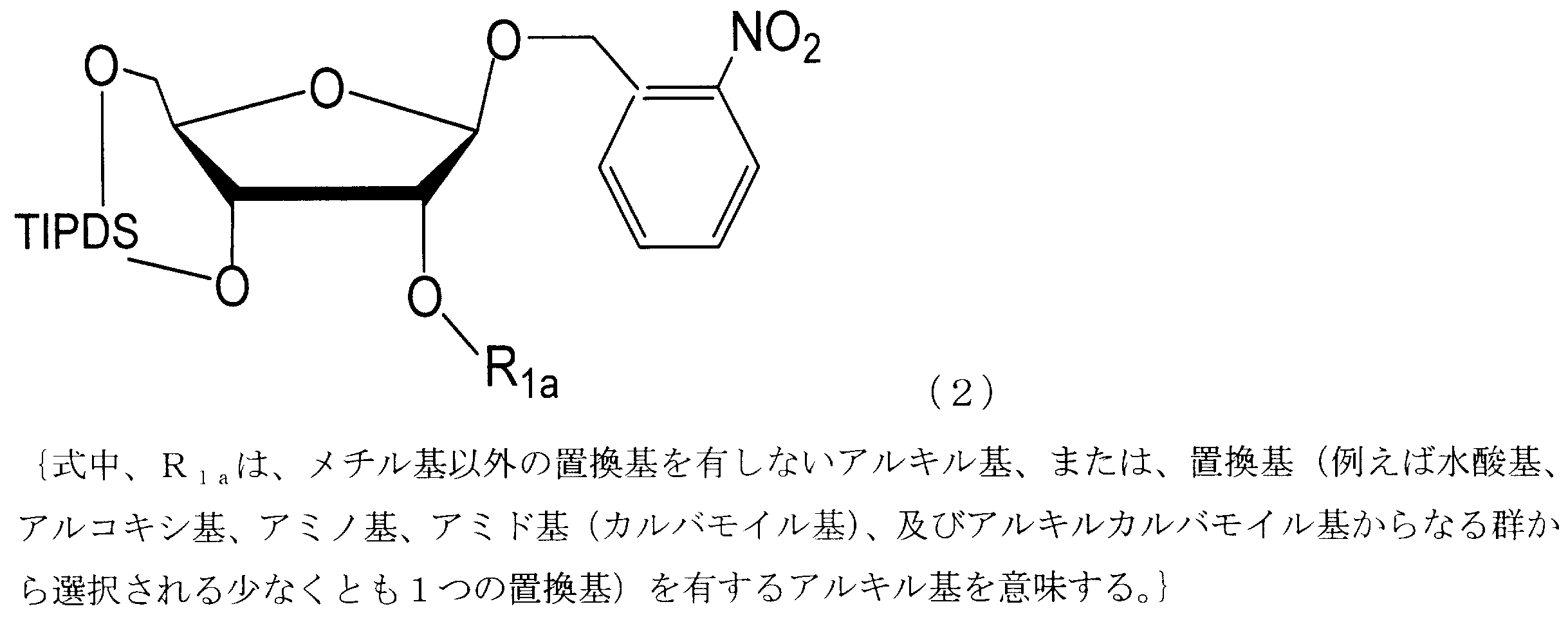
で示される化合物(2)を使用して、製造例3記載の方法に従って製造することで、Xが酸素原子、R1がメチル基以外の置換基を有しないアルキル基、R2が水素原子である核酸誘導体(I)(同時に核酸誘導体(Ib)に相当する);または、Xが酸素原子、R1が置換基(例えば水酸基、アルコキシ基、アミノ基、アミド基(カルバモイル基)、及びアルキルカルバモイル基からなる群から選択される少なくとも1つの置換基)を有するアルキル基、R2が水素原子である核酸誘導体(I)(同時に核酸誘導体(Ib)に相当する)を製造することができる。
なお、上記式(2)中、R1aが水酸基を有するアルキル基である化合物の製造例(a)、R1aがアルコキシ基を有するアルキル基である化合物の製造例(b)、及びR1aがアルキルカルバモイル基を有するアルキル基である化合物の製造例(c)を、下記に示す。

上記製造例(a)によれば、上記式の左端に記載する化合物をブロモ酢酸エステルと反応させ得られる2'-O-アルコキシカルボニルメチル体を水素化リチウムアルミニウムで還元することによって、2'-O-ヒドロキシエチル体(化合物A)を得ることができる。
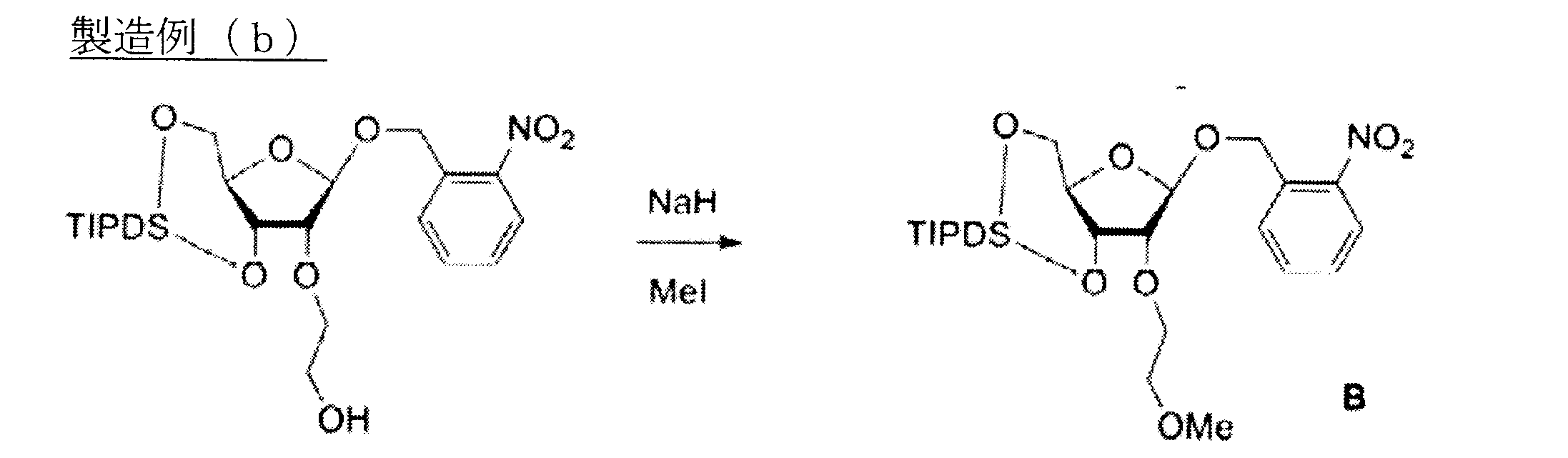
上記製造例(b)によれば、2'-O-ヒドロキシエチル体をアルキル化することにより、2'-O-アルコキシエチル体(化合物B)を得ることができる。

上記製造例(c)によれば、2'-O-アルコキシカルボニルメチル体をアンモニア又は一級アミン、二級アミンと反応させることで、2'-O-カルバモイルメチル体(化合物C)を得ることができる。
アミン化合物(II)
本発明が対象とするアミン化合物(II)は、一級アミノ基を有する化合物であればよく、好ましくは一級アミノ基を有するペプチド、一級アミノ基を有する蛋白質、一級アミノ基を有する核酸などを例示することができる。より好ましくは一級アミノ基を有するペプチド、及び一級アミノ基を有する核酸であり、特に好ましくは一級アミノ基を有する核酸である。
本発明が対象とするアミン化合物(II)は、一級アミノ基を有する化合物であればよく、好ましくは一級アミノ基を有するペプチド、一級アミノ基を有する蛋白質、一級アミノ基を有する核酸などを例示することができる。より好ましくは一級アミノ基を有するペプチド、及び一級アミノ基を有する核酸であり、特に好ましくは一級アミノ基を有する核酸である。
一級アミノ基を有するペプチドとして、好ましくは、側鎖に一級アミンを有するリジンを構成アミノ酸残基として有するペプチド、人工的にリジンまたは一級アミノ基が導入されたペプチドを挙げることができる。同様に、一級アミノ基を有する蛋白質として、好ましくは、側鎖に一級アミンを有するリジンを構成アミノ酸残基として有する蛋白質、人工的にリジンまたは一級アミノ基が導入された蛋白質を挙げることができる。また、一級アミノ基を有する核酸として、好ましくは、人工的にリジンまたは一級アミノ基が導入された核酸を挙げることができる。
かかるアミン化合物(II)は、機能性分子であることが好ましい。かかる機能としては、細胞移行性(細胞透過性)、核移行性、標的親和性、滞留性、ヌクレアーゼ耐性(分解酵素に対する抵抗性)、標識性(検出可能な標識となりえる機能)などを制限なく挙げることができる。
例えば、細胞透過性を改善するペプチドとしては、例えばポリ-L-リジン(非特許文献2:Biological Activity of Oligonucleotide-Poly(L-lysine) Conjugates: Mechanism of Cell Uptake、Bioconjugate Chem., 1990, 1, 149-153)を挙げることができる。また、核移行性ペプチドとしては、SV 40T 抗原、核局在化シグナルペプチド(PKKKRKV(配列番号1);Pはプロリン、Kはリジン、Rはアルギニン、Vはバリン)から誘導されるペプチド(非特許文献3:Gene delivery: A single nuclear localization signal peptide is sufficient to carry DNA to the cell nucleus, Proc. Natl. Acad. Sci. USA, 1999, 96, 91-96。)を例示することができる。
核局在化シグナルぺプチドや核排出シグナルぺプチドについては「非特許文献4:Controlled intracellular localization and enhanced antisense effect of oligonucleotides by chemical conjugation,Org. Biomol. Chem., 2005, 3, 3257-3259.」;HIV-1 rev タンパク質の核排出シグナル(nuclear export signal (NES))配列、及びHIV-1 tat タンパク質の核局在化シグナル(nuclear localization signal (NLS))配列については「非特許文献5:C. Dingwell and R. A. Laskey, Annu. Rev. Cell. Biol., 1986, 2, 367-390」;SV40 T-抗原の核局在化シグナル配列については「非特許文献6:D. S. Goldfarb, J. Gariepy, G. Schoolnik, R. D. Kornberg, Nature, 1986, 322, 641-642.」;インフルエンザ各蛋白質の核局在化シグナル配列については「非特許文献7:D.D. Newmeyer, J. M. Lucocq, T. R. Burglin, E. M. De Robertis, EMBO J., 1986, 5, 501-510.」にそれぞれ説明されている。
核局在化シグナルぺプチドや核排出シグナルぺプチドについては「非特許文献4:Controlled intracellular localization and enhanced antisense effect of oligonucleotides by chemical conjugation,Org. Biomol. Chem., 2005, 3, 3257-3259.」;HIV-1 rev タンパク質の核排出シグナル(nuclear export signal (NES))配列、及びHIV-1 tat タンパク質の核局在化シグナル(nuclear localization signal (NLS))配列については「非特許文献5:C. Dingwell and R. A. Laskey, Annu. Rev. Cell. Biol., 1986, 2, 367-390」;SV40 T-抗原の核局在化シグナル配列については「非特許文献6:D. S. Goldfarb, J. Gariepy, G. Schoolnik, R. D. Kornberg, Nature, 1986, 322, 641-642.」;インフルエンザ各蛋白質の核局在化シグナル配列については「非特許文献7:D.D. Newmeyer, J. M. Lucocq, T. R. Burglin, E. M. De Robertis, EMBO J., 1986, 5, 501-510.」にそれぞれ説明されている。
核酸誘導体(I)とアミン化合物(II)との反応
前述する核酸誘導体(I)(当該核酸誘導体には、前述する核酸誘導体(Ia)及び(Ib)が含まれる)は、前述するアミン化合物(II)と、還元条件下で効率よく反応し、核酸誘導体(I)とアミン化合物(II)とのコンジュゲートを安定に生成する(核酸誘導体(I)の還元的アミノ化)。
前述する核酸誘導体(I)(当該核酸誘導体には、前述する核酸誘導体(Ia)及び(Ib)が含まれる)は、前述するアミン化合物(II)と、還元条件下で効率よく反応し、核酸誘導体(I)とアミン化合物(II)とのコンジュゲートを安定に生成する(核酸誘導体(I)の還元的アミノ化)。
かかる反応様式を下記に示す。

式中、「Z-NH2」は、一級アミノ基(-NH2)を有するアミン化合物(II)を意味する。
また、上記式中、Xは、直接結合または酸素原子;R1は、ハロゲン原子、または置換基を有していてもよいアルキル基;R2は、ハロゲン原子、置換基を有していてもよいアルキル基、または水素原子;A及びBは、同一または異なる、ヌクレオチドまたはそのアナログから形成される骨格を有する核酸塩基配列含有オリゴマーまたはポリマー、または水素原子を意味する。但し、AとBが同時に水素原子となることはない。また、Xが直接結合であるとき、R1及びR2は、お互いに、同一又は異なるハロゲン原子であるか、同一又は異なる置換基を有していてもよいアルキル基であり(この場合、R1とR2は、お互いに連結してシクロアルキル基を形成していてもよい);Xが酸素原子であるとき、R1は置換基を有していてもよいアルキル基、R2は水素原子である。
なお、上記式で示されるコンジュゲートには、AとBがいずれも、ヌクレオチドまたはそのアナログから形成される骨格を有する核酸塩基配列含有オリゴマーまたはポリマーである化合物(「コンジュゲート1」と称する)、Aが水素原子で、Bがヌクレオチドまたはそのアナログから形成される骨格を有する核酸塩基配列含有オリゴマーまたはポリマーである化合物(「コンジュゲート2」と称する)、及びBが水素原子で、Aがヌクレオチドまたはそのアナログから形成される骨格を有する核酸塩基配列含有オリゴマーまたはポリマーである化合物(「コンジュゲート3」と称する)が含まれる。本発明の製造方法には、上記反応により、一方のみ、例えばコンジュゲート1だけが生成する場合のみならず、上記のコンジュゲート1とコンジュゲート2若しくは3とが同時に生成する場合も包含される。
還元条件下における核酸誘導体(I)とアミン化合物(II)との反応は、両化合物を溶媒に溶解し、還元剤の存在下、室温~50℃程度、pH5~8程度の条件で反応させる方法を挙げることができる。温度条件として好ましくは30~50℃、より好ましくは40~50℃である。pH条件として好ましくはpH6~8、より好ましくはpH7~8である。
ここで核酸誘導体(I)とアミン化合物(II)を溶解する溶媒は、両化合物が溶解するものであればよいが、好ましくは水溶液である。より好ましくは上記pH範囲に緩衝能を有する緩衝剤を含む水溶液、特に好ましくは生理学的に許容される水溶液であり、具体的は1~200mM程度、または10~50mM程度のリン酸緩衝液を例示することができる(後述する実施例では100mMの塩化ナトリウムを含む10mMのリン酸緩衝液を使用)。
反応液中の核酸誘導体(I)の濃度として、通常10~100μM、好ましくは20~100μM、より好ましくは50~100μMを例示することができる。また反応液中のアミン化合物(II)の濃度として、通常10μM~10mM、好ましくは100μM~10mM、より好ましくは1~10mMを例示することができる。
還元剤としては、通常シアノ水素化ホウ素ナトリウムを用いることができるが、水素化ホウ素ナトリウムやジメチルアミンボランなどの上記と同等の還元剤を用いてもよい。なお、反応系における還元剤の濃度としては、通常1~30mM、好ましくは2~20mM、より好ましくは5~15mMを挙げることができる。
反応系における上記核酸誘導体(I)とアミン化合物(II)との割合は、核酸誘導体(I)1モル部に対してアミン化合物(II)1~100モル部を挙げることができる。好ましくは核酸誘導体(I)1モル部に対してアミン化合物(II)10~100モル部であり、より好ましくは50~100モル部である。
かかる条件での反応を、通常6~24時間程度、好ましくは12~24時間程度行うことで、核酸誘導体(I)とアミン化合物(II)とのコンジュゲートを、高い収率で安定して得ることができる。
また前述する核酸誘導体(I)のうち、下式(Ia)及び(Ib)で示される化合物は、それぞれ前述するアミン化合物(II)と、還元条件下のみならず、非還元条件下でも効率よく反応し、上記核酸誘導体(IaまたはIb)とアミン化合物(II)とのコンジュゲートを安定に生成する(核酸誘導体の非還元条件の反応)。
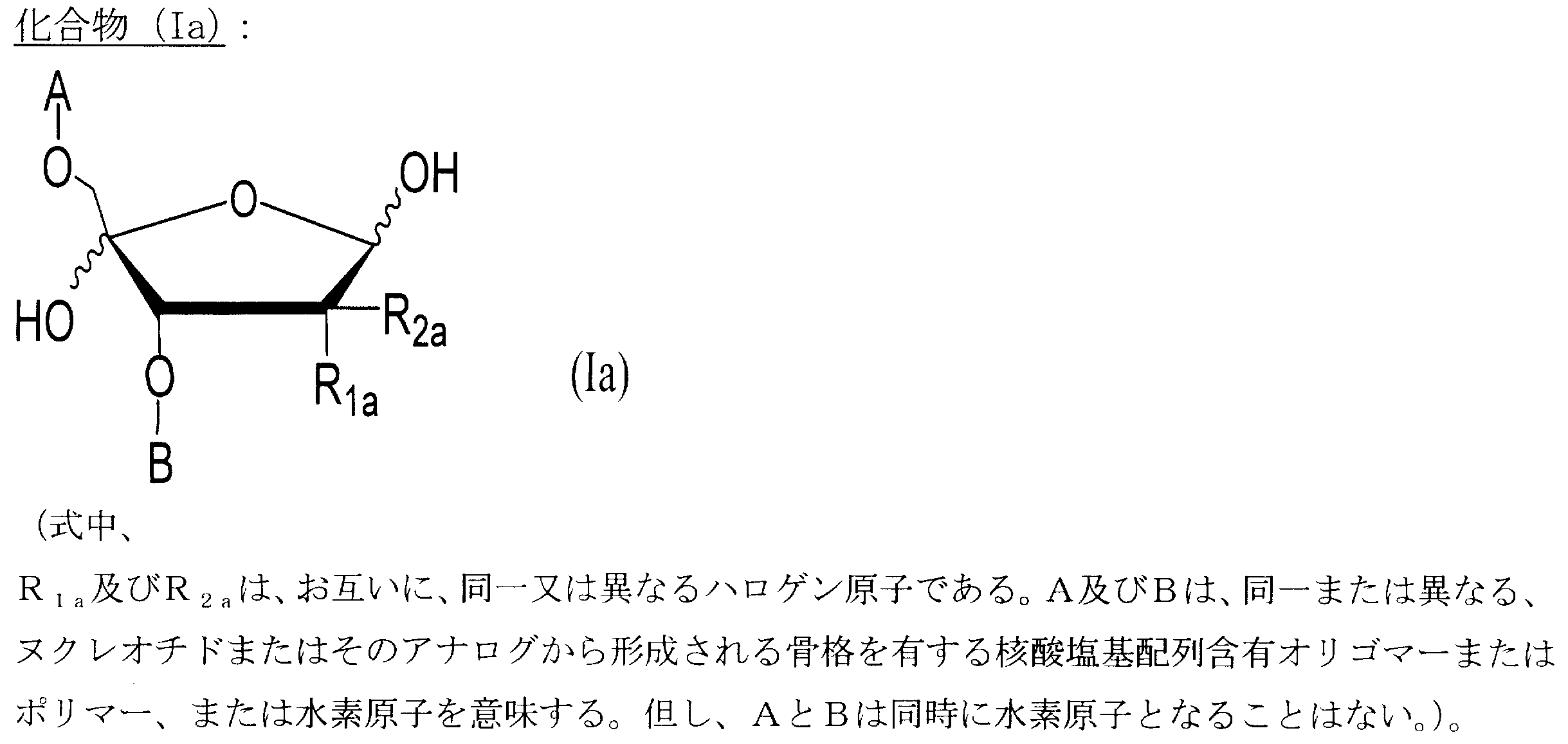

非還元条件下における反応条件(温度、pH、核酸誘導体とアミン化合物の割合、時間など)としては、還元剤を使用しないことを除けば、前述した還元条件下での反応条件と同じ条件を用いることができる。従って、上記の反応条件をここにそのまま援用することができる。またこの場合の製造方法にも、上記還元条件下での製造方法と同様に、コンジュゲート1~3の一方のみ、特にコンジュゲート1だけが生成する場合のみならず、上記のコンジュゲート1とコンジュゲート2若しくは3とが同時に生成する場合も包含される。 斯くして生成されるコンジュゲートは、抽出方法、透析方法、カラムクロマトグラフィー、電気泳動などの慣用の単離及び精製方法を用いて、上記反応液から単離精製することができる。
(II)新規核酸誘導体
前述する核酸誘導体(I)のなかでも、下記一般式(Ia-1)で示される核酸誘導体は新規な化合物である。
前述する核酸誘導体(I)のなかでも、下記一般式(Ia-1)で示される核酸誘導体は新規な化合物である。
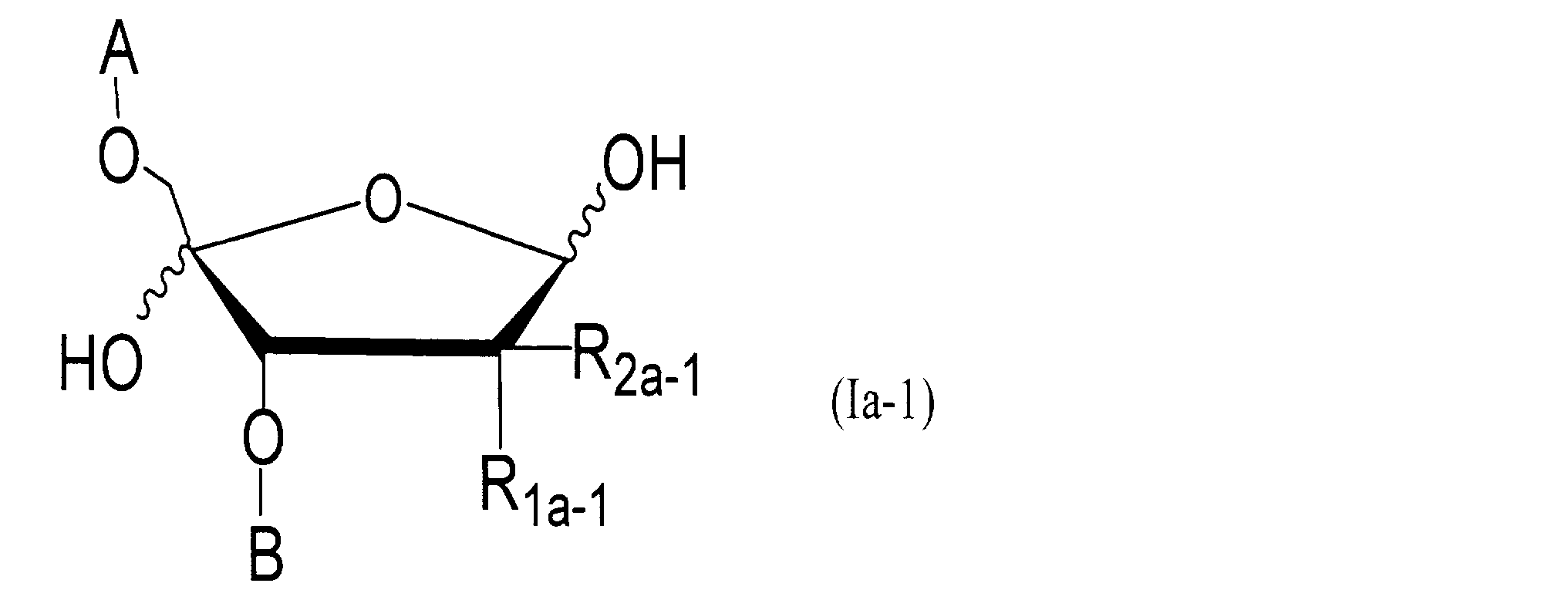
上記式(Ia-1)中、A及びBは、前述の通りであり、同一または異なる、ヌクレオチドまたはそのアナログから形成される骨格を有する核酸塩基配列含有オリゴマーまたはポリマーを意味する。
また、R1a-1及びR2a-1は、お互いに、同一または異なって、同時にハロゲン原子である。ハロゲン原子は、前述した通りであり、好ましくはフッ素原子及び塩素原子、より好ましくはフッ素原子である。
一例として、A及びBがデオキシリボヌクレオチドのオリゴマーであり、R1a-1及びR2a-1がフッ素原子である場合の核酸誘導体(Ia-1)の製造方法の詳細を後述する製造例1に記載する(式A参照)。まず、Chou, T.S.らの方法(非特許文献8:Chou, T.S. et. al., Synthesis., 1992, 565.)でD-マンニトールから得られる化合物1-1を出発原料とし、ジアザビシクロウンデセン(DBU:1,8-diazabicyclo[5.4.0]undec-7-ene)の存在下で、臭化o-ニトロベンジルと反応させた後、ベンゾイル基を除去し、化合物1-3(2’-Deoxy-1’-O-(2-nitrobenzyl)-2’,2’-difluoro-α-D-ribofuranose)を取得する。これから、5’位ヨウ素体(化合物1-4及び化合物1-5)を経由して合成したオレフィン体(化合物1-7)をメタノール中で、メタクロロ過安息香酸(m-CPBA :m-chloroperbenzoic acid)と反応させる。得られた反応物(化合物1-8)をホスホロアミダイト体(化合物1-10)に変換した後、DNA合成装置を用いて、βシアノエチルホスホロアミダイド法により、5’位及び3’位のデオキシリボヌクレオチドのオリゴマー(DNA鎖)を有する核酸誘導体を調製し、次いでリン酸緩衝液中で、室温で365nmの光を照射することで、2’位にジフルオロ基を有するC4’酸化型核酸を含むオリゴデオキシヌクレオチドを得ることができる。
なお、前述するように、出発原料として、化合物1-1に代えて、2,2-dichloro-2-deoxy-3,5-bis-O-[benzoyl]-D-erythro-pentoseを使用して、製造例1記載の方法に従って製造することで、R1a-1及びR2a-1が塩素原子である核酸誘導体(Ia-1)を製造することができる。また、化合物1-1に代えて、2-chloro-2-deoxy-2-fluoro-3,5-bis-O-[benzoyl]-D-erythro-pentoseを使用することでR1a-1及びR2a-1のいずれか一方がフッ素原子で他方が塩素原子である核酸誘導体(Ia-1)を製造することができる。
かかる化合物(Ia-1)は、いずれも前述する核酸誘導体(I)の一種として、一級アミノ基を有するアミン化合物(II)と、還元条件下または非還元条件下で反応し、核酸誘導体(Ia-1)とアミン化合物(II)とのコンジュゲートを安定に生成することができる。
以下、本発明の構成及び効果をより明らかに示すために、製造例及び実施例を用いて本発明を説明する。しかしこれらの製造例及び実施例は、本発明の一例であり、本発明はこれらの製造例及び実施例によって制限されるものではない。
製造例1 ジフルオロ体の製造方法
下式に示す方法により、本発明の化合物(I)のうち、2’位にジフルオロ基を有するC4’酸化型核酸を有するオリゴデオキシヌクレオチド(本発明のジフルオロ体)(Ia)を製造した。
下式に示す方法により、本発明の化合物(I)のうち、2’位にジフルオロ基を有するC4’酸化型核酸を有するオリゴデオキシヌクレオチド(本発明のジフルオロ体)(Ia)を製造した。
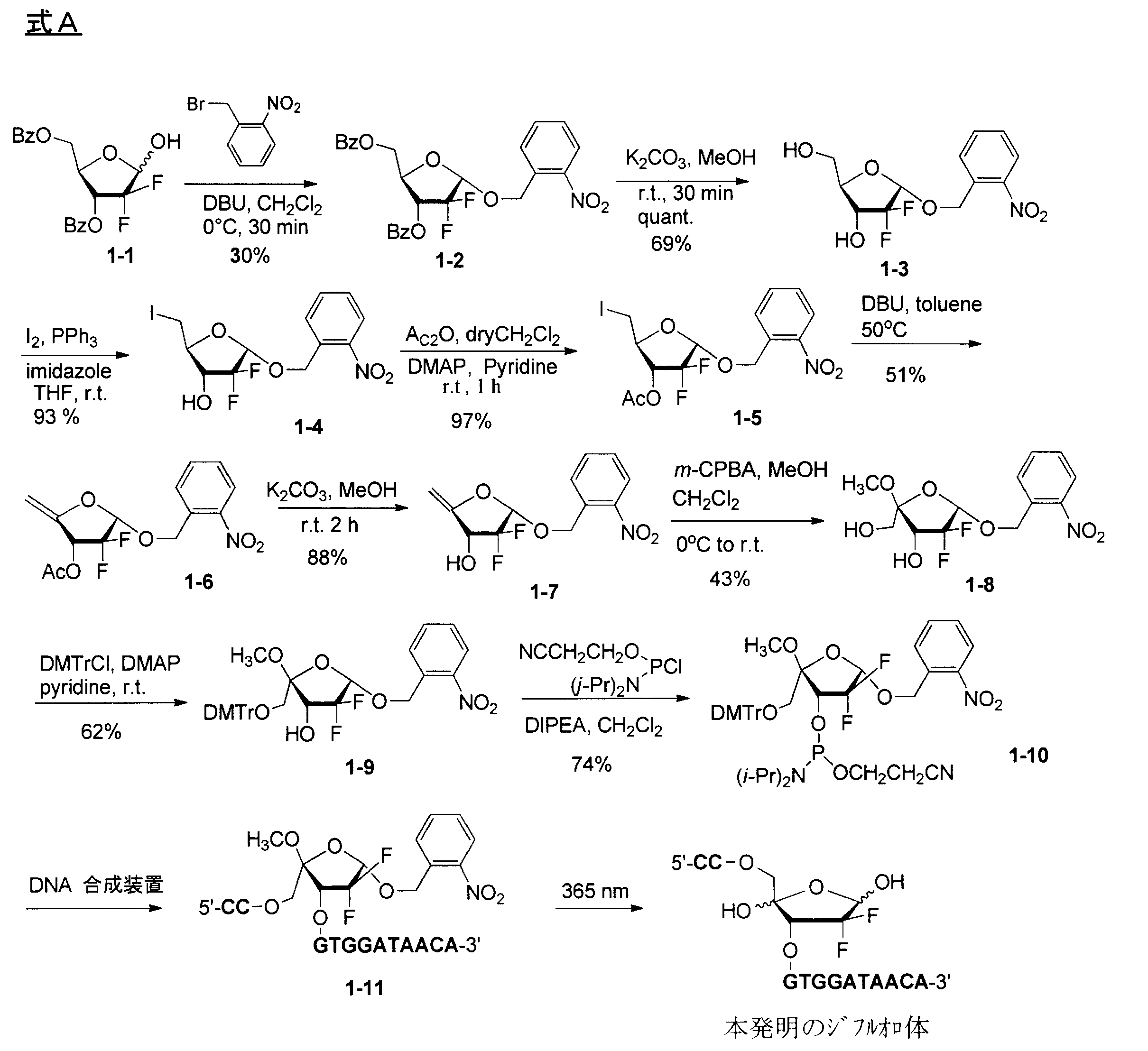
(1)2’-Deoxy-2’,2’-difluoro-1’-O-(2-nitrobenzyl)-3’,5’-O-benzoyl-α-D-ribofuranose (化合物1-2)の製造
化合物1-1(非特許文献8:Chou, T.S. et. al., Synthesis., 1992, 565.)(1.05 g, 2.77 mmol) と2-Nitrobenzyl Bromide(1.80 g, 8.31 mmol)をアルゴン気流下、dry CH2Cl2 (40 ml) に溶解し、これに0℃でDBU (1.26 ml, 8.31 mmol) を滴下した。室温で5時間を撹拌した後、水30 mLを加え、10%の塩酸で溶液を中性に調整した。反応液をCH2Cl2で抽出した後、有機層を精製水、飽和食塩水で洗浄し、無水Na2SO4で乾燥した後、減圧下溶媒を留去した。残渣をシリカゲルカラムクロマトグラフィー (Hexane : AcOEt = 11 : 1) にて精製し、化合物1-2 (0.43 g,30%)を得た。
1H-NMR(400 MHz, CDCl3): δ 8.09 (m, 3H), 7.93-7.96 (m, 2H), 7.74 (dd, J = 0.9, 7.9 Hz, 1H), 7.56-7.65 (m, 2H), 7.42-7.50 (m, 4H), 7.21-7.25 (m, 2H), 5.95 (m, 1H), 5.22 (d, J = 15.0 Hz, 1H), 5.20 (d, J = 6.2 Hz, 1H), 5.04 (d, J = 15.0 Hz, 1H), 4.73 (dd, J = 3.2, 12.0 Hz, 1), 4.56 (m, 1H), 4.49 (dd, J = 5.0, 12.0 Hz, 1H).
HRMS-ESI (m/z) : calcd for C26H21 F2NO8Na (M++ Na) 536.1127, found 536.1098。
化合物1-1(非特許文献8:Chou, T.S. et. al., Synthesis., 1992, 565.)(1.05 g, 2.77 mmol) と2-Nitrobenzyl Bromide(1.80 g, 8.31 mmol)をアルゴン気流下、dry CH2Cl2 (40 ml) に溶解し、これに0℃でDBU (1.26 ml, 8.31 mmol) を滴下した。室温で5時間を撹拌した後、水30 mLを加え、10%の塩酸で溶液を中性に調整した。反応液をCH2Cl2で抽出した後、有機層を精製水、飽和食塩水で洗浄し、無水Na2SO4で乾燥した後、減圧下溶媒を留去した。残渣をシリカゲルカラムクロマトグラフィー (Hexane : AcOEt = 11 : 1) にて精製し、化合物1-2 (0.43 g,30%)を得た。
1H-NMR(400 MHz, CDCl3): δ 8.09 (m, 3H), 7.93-7.96 (m, 2H), 7.74 (dd, J = 0.9, 7.9 Hz, 1H), 7.56-7.65 (m, 2H), 7.42-7.50 (m, 4H), 7.21-7.25 (m, 2H), 5.95 (m, 1H), 5.22 (d, J = 15.0 Hz, 1H), 5.20 (d, J = 6.2 Hz, 1H), 5.04 (d, J = 15.0 Hz, 1H), 4.73 (dd, J = 3.2, 12.0 Hz, 1), 4.56 (m, 1H), 4.49 (dd, J = 5.0, 12.0 Hz, 1H).
HRMS-ESI (m/z) : calcd for C26H21 F2NO8Na (M++ Na) 536.1127, found 536.1098。
(2)2’-Deoxy-1’-O-(2-nitrobenzyl)-2’,2’-difluoro-α-D-ribofuranose (化合物1-3)の製造
化合物1-2 (1.43 g, 2.79 mmol) をMeOH (26 ml) に溶解し、炭酸カリウム (1.15 g, 8.37 mmol) を加え、室温で1時間撹拌した。炭酸カリウムを濾過し、ろ液を10%希塩酸で中和し、酢酸エチルで抽出した。有機層を精製水、飽和食塩水で洗浄し、無水Na2SO4で乾燥した後、減圧下溶媒を留去した。残渣をシリカゲルカラムクロマトグラフィー (CHCl3 : MeOH = 15 : 1)にて精製し、化合物1-3 (0.589 g,69%)を得た。
1H-NMR(400 MHz, CDCl3): δ 8.11 (dd, J = 1.3, 8.1 Hz, 1H), 7.76 (d, J = 6.9 Hz, 1H), 7.68 (m, 1H), 7.49 (m, 1H), 5.26 (d, J = 14.7 Hz, 1H), 5.08 (dd, J = 4.5 Hz, 1H), 5.04 (d, J = 14.7 Hz, 1H), 4.52 (m, 1H), 4.00 (dt, J = 3.7, 7.7 Hz, 1H), 3.89 (d, J = 12.5 Hz, 1H), 3.73 (m, 1H), 2.26 (d, J = 6.0 Hz, 1H), 1.92 (bs, 1H).
HRMS-ESI (m/z) : calcd for C12H13F2NO6Na (M++ Na) 328.0603, found 328.0617。
化合物1-2 (1.43 g, 2.79 mmol) をMeOH (26 ml) に溶解し、炭酸カリウム (1.15 g, 8.37 mmol) を加え、室温で1時間撹拌した。炭酸カリウムを濾過し、ろ液を10%希塩酸で中和し、酢酸エチルで抽出した。有機層を精製水、飽和食塩水で洗浄し、無水Na2SO4で乾燥した後、減圧下溶媒を留去した。残渣をシリカゲルカラムクロマトグラフィー (CHCl3 : MeOH = 15 : 1)にて精製し、化合物1-3 (0.589 g,69%)を得た。
1H-NMR(400 MHz, CDCl3): δ 8.11 (dd, J = 1.3, 8.1 Hz, 1H), 7.76 (d, J = 6.9 Hz, 1H), 7.68 (m, 1H), 7.49 (m, 1H), 5.26 (d, J = 14.7 Hz, 1H), 5.08 (dd, J = 4.5 Hz, 1H), 5.04 (d, J = 14.7 Hz, 1H), 4.52 (m, 1H), 4.00 (dt, J = 3.7, 7.7 Hz, 1H), 3.89 (d, J = 12.5 Hz, 1H), 3.73 (m, 1H), 2.26 (d, J = 6.0 Hz, 1H), 1.92 (bs, 1H).
HRMS-ESI (m/z) : calcd for C12H13F2NO6Na (M++ Na) 328.0603, found 328.0617。
(3)2’,5’-Dideoxy-2’,2’-difluoro-5’-iodo-1’-O-(2-nitrobenzyl)-α-D-ribofuranose (化合物1-4)の製造
化合物1-3 (500 mg, 1.64 mmol)、トリフェニルホスフィン(645 mg, 2.46 mmol)、Imidazole (223 mg, 3.28 mmol) を、アルゴン気流下、dry THF (10 ml) に溶解し、これにI2 (624 mg, 2.46 mmol) を滴下した。40℃で2時間攪拌した後、飽和チオ硫酸ナトリウム水溶液を加え溶媒を留去した。酢酸エチルで抽出した後、有機層を精製水、食塩水で洗浄し、無水Na2SO4で乾燥した後、減圧下溶媒を留去した。残渣をシリカゲルカラムクロマトグラフィー (Hexane : AcOEt = 3 : 1) にて精製し、化合物1-4 (635 mg, 93%)を得た。
1H-NMR(400 MHz, CDCl3): δ8.11 (d, J = 8.1 Hz, 1H), 7.77 (d, J = 7.9 Hz, 1H), 7.68 (m, 1H), 7.49 (m, 1H), 5.28 (d, J = 14.8 Hz, 1H), 5.09 (d, J = 7.3 Hz, 1H), 5.03 (d, J = 14.8 Hz, 1H), 4.33 (m, 1H), 3.98 (dd, J = 6.0, 12.5 Hz, 1H), 3.38 (d, J = 6.0 Hz, 1H), 2.27 (d, J = 7.5 Hz, 1H).
HRMS-ESI (m/z) : calcd for C12H12F2INO5Na (M++ Na) 437.9620 found 437.9576。
化合物1-3 (500 mg, 1.64 mmol)、トリフェニルホスフィン(645 mg, 2.46 mmol)、Imidazole (223 mg, 3.28 mmol) を、アルゴン気流下、dry THF (10 ml) に溶解し、これにI2 (624 mg, 2.46 mmol) を滴下した。40℃で2時間攪拌した後、飽和チオ硫酸ナトリウム水溶液を加え溶媒を留去した。酢酸エチルで抽出した後、有機層を精製水、食塩水で洗浄し、無水Na2SO4で乾燥した後、減圧下溶媒を留去した。残渣をシリカゲルカラムクロマトグラフィー (Hexane : AcOEt = 3 : 1) にて精製し、化合物1-4 (635 mg, 93%)を得た。
1H-NMR(400 MHz, CDCl3): δ8.11 (d, J = 8.1 Hz, 1H), 7.77 (d, J = 7.9 Hz, 1H), 7.68 (m, 1H), 7.49 (m, 1H), 5.28 (d, J = 14.8 Hz, 1H), 5.09 (d, J = 7.3 Hz, 1H), 5.03 (d, J = 14.8 Hz, 1H), 4.33 (m, 1H), 3.98 (dd, J = 6.0, 12.5 Hz, 1H), 3.38 (d, J = 6.0 Hz, 1H), 2.27 (d, J = 7.5 Hz, 1H).
HRMS-ESI (m/z) : calcd for C12H12F2INO5Na (M++ Na) 437.9620 found 437.9576。
(4)2’,5’-Dideoxy-3’-O-acetyl-2’,2’-difluoro-5’-iodo-1’-O-(2-nitrobenzyl)-α-D-ribo- furanose (化合物1-5)の製造
化合物1-4 (630 mg, 1.52mmol)をアルゴン気流下dry CH2Cl2 (15 ml) に溶解し、Pyridine (0.25 ml、3.04 mmol)、DMAP (19 mg, 0.15 mmol)、無水酢酸 (0.31 ml, 3.04 mmol) を加え、室温で1時間攪拌した。精製水を加え酢酸エチルで抽出した後、有機層を飽和炭酸水素ナトリウム水溶液、精製水、飽和食塩水で洗浄し、無水Na2SO4で乾燥した後、減圧下溶媒を留去した。残渣をシリカゲルカラムクロマトグラフィー (Hexane : AcOEt = 4 : 1) にて精製し、化合物1-5 (670 mg, 97%)を得た。
1H-NMR(400 MHz, CDCl3): δ8.13 (d, J = 8.1 Hz, 1H), 7.80 (d, J = 7.7 Hz, 1H), 7.70 (m, 1H), 7.50 (m, 1H), 5.43 (m, 1H), 5.30 (d, J = 14.8 Hz, 1H), 5.13 (d, J = 6.9 Hz, 1H), 5.06 (d, J = 14.8 Hz, 1H), 4.22 (m, 1H), 3.39 (dd, J = 6.7, 10.5 Hz, 1H), 3.34 (dd, J = 6.4, 10.5 Hz, 1H), 2.20 (s, 1H).
HRMS-ESI (m/z) : calcd for C14H14F2INO6Na (M++ Na) 479.9726 found 479.9735。
化合物1-4 (630 mg, 1.52mmol)をアルゴン気流下dry CH2Cl2 (15 ml) に溶解し、Pyridine (0.25 ml、3.04 mmol)、DMAP (19 mg, 0.15 mmol)、無水酢酸 (0.31 ml, 3.04 mmol) を加え、室温で1時間攪拌した。精製水を加え酢酸エチルで抽出した後、有機層を飽和炭酸水素ナトリウム水溶液、精製水、飽和食塩水で洗浄し、無水Na2SO4で乾燥した後、減圧下溶媒を留去した。残渣をシリカゲルカラムクロマトグラフィー (Hexane : AcOEt = 4 : 1) にて精製し、化合物1-5 (670 mg, 97%)を得た。
1H-NMR(400 MHz, CDCl3): δ8.13 (d, J = 8.1 Hz, 1H), 7.80 (d, J = 7.7 Hz, 1H), 7.70 (m, 1H), 7.50 (m, 1H), 5.43 (m, 1H), 5.30 (d, J = 14.8 Hz, 1H), 5.13 (d, J = 6.9 Hz, 1H), 5.06 (d, J = 14.8 Hz, 1H), 4.22 (m, 1H), 3.39 (dd, J = 6.7, 10.5 Hz, 1H), 3.34 (dd, J = 6.4, 10.5 Hz, 1H), 2.20 (s, 1H).
HRMS-ESI (m/z) : calcd for C14H14F2INO6Na (M++ Na) 479.9726 found 479.9735。
(5)2’,5’-Dideoxy-3’-O-acetyl-2’,2’-difluoro-4’,5’-methylene-1’-O-(2-nitrobenzyl)-α-D-ribofuranose (化合物1-6)の製造
化合物1-5 (270 mg, 0.59 mmol) をアルゴン気流下、dry Toluene (6 ml) に溶解し、DBU (0.35 ml, 2.36 mmol) を加え、50℃で2時間攪拌した。精製水を加え酢酸エチルで抽出した後、有機層を飽和炭酸水素ナトリウム水溶液、精製水、飽和食塩水で洗浄し、無水Na2SO4で乾燥した後、減圧下溶媒を留去した。残渣をシリカゲルカラムクロマトグラフィー (Hexane : AcOEt = 8 : 1) にて精製し、化合物1-6(100 mg, 51%)を得た。
1H-NMR(400 MHz, CDCl3): δ8.14 (dd, J = 1.3, 7.3 Hz, 1H), 7.78 (m, 1H), 7.69 (m, 1H), 7.49 (m, 1H), 6.00 (m, 1H), 5.29 (d, J = 6.9 Hz, 1H), 5.27 (d, J= 14.2 Hz, 1H), 5.13 (d, J = 14.2 Hz, 1H), 4.67 (m, 1H), 4.30 (m,1H), 2.24 (s, 1H).
HRMS-ESI (m/z) : calcd for C14H13F2NO6Na (M++ Na) 352.0603 found 352.0618。
化合物1-5 (270 mg, 0.59 mmol) をアルゴン気流下、dry Toluene (6 ml) に溶解し、DBU (0.35 ml, 2.36 mmol) を加え、50℃で2時間攪拌した。精製水を加え酢酸エチルで抽出した後、有機層を飽和炭酸水素ナトリウム水溶液、精製水、飽和食塩水で洗浄し、無水Na2SO4で乾燥した後、減圧下溶媒を留去した。残渣をシリカゲルカラムクロマトグラフィー (Hexane : AcOEt = 8 : 1) にて精製し、化合物1-6(100 mg, 51%)を得た。
1H-NMR(400 MHz, CDCl3): δ8.14 (dd, J = 1.3, 7.3 Hz, 1H), 7.78 (m, 1H), 7.69 (m, 1H), 7.49 (m, 1H), 6.00 (m, 1H), 5.29 (d, J = 6.9 Hz, 1H), 5.27 (d, J= 14.2 Hz, 1H), 5.13 (d, J = 14.2 Hz, 1H), 4.67 (m, 1H), 4.30 (m,1H), 2.24 (s, 1H).
HRMS-ESI (m/z) : calcd for C14H13F2NO6Na (M++ Na) 352.0603 found 352.0618。
(6)2’,5’-Dideoxy-2’,2’-difluoro-4’,5’-methylene-1’-O-(2-nitrobenzyl)-α-D-ribo- furanose (化合物1-7)の製造
化合物1-6 (190 mg, 0.577 mmol) をMeOH (10ml) に溶解し、炭酸カリウム(120 mg, 0.87 mmol) を加え室温で攪拌した。1時間後、飽和塩化アンモニウム水溶液を加え、酢酸エチルで抽出した後、有機層を飽和炭酸水素ナトリウム水溶液、精製水、飽和食塩水で洗浄し、無水Na2SO4で乾燥した後、減圧下溶媒を留去した。残渣をシリカゲルカラムクロマトグラフィー (Hexane : AcOEt = 3 : 1) にて精製し、化合物1-7(145 mg, 88%) を得た。
1H-NMR(400 MHz, CDCl3): δ8.13 (dd, J = 1.2, 8.1 Hz, 1H), 7.74 (d, J = 7.9 Hz, 1H), 7.68 (m, 1H), 7.49 (m, 1H), 5.26 (d, J = 14.9 Hz, 1H), 5.23 (dd, J = 1.0, 7.2 Hz, 1H), 5.11 (d, J = 14.9 Hz, 1H), 4.85 (m, 1H), 1H), 4.64 (dd, J = 2.4, 5.3 Hz, 1H), 4.48 (t, J = 2.4 Hz, 1H), 2.12 (dd, J = 1.7, 10.9 Hz, 1H).
HRMS-ESI (m/z) : calcd for C12H11F2NO5Na (M+ + Na) 310.0497 found 310.0520。
化合物1-6 (190 mg, 0.577 mmol) をMeOH (10ml) に溶解し、炭酸カリウム(120 mg, 0.87 mmol) を加え室温で攪拌した。1時間後、飽和塩化アンモニウム水溶液を加え、酢酸エチルで抽出した後、有機層を飽和炭酸水素ナトリウム水溶液、精製水、飽和食塩水で洗浄し、無水Na2SO4で乾燥した後、減圧下溶媒を留去した。残渣をシリカゲルカラムクロマトグラフィー (Hexane : AcOEt = 3 : 1) にて精製し、化合物1-7(145 mg, 88%) を得た。
1H-NMR(400 MHz, CDCl3): δ8.13 (dd, J = 1.2, 8.1 Hz, 1H), 7.74 (d, J = 7.9 Hz, 1H), 7.68 (m, 1H), 7.49 (m, 1H), 5.26 (d, J = 14.9 Hz, 1H), 5.23 (dd, J = 1.0, 7.2 Hz, 1H), 5.11 (d, J = 14.9 Hz, 1H), 4.85 (m, 1H), 1H), 4.64 (dd, J = 2.4, 5.3 Hz, 1H), 4.48 (t, J = 2.4 Hz, 1H), 2.12 (dd, J = 1.7, 10.9 Hz, 1H).
HRMS-ESI (m/z) : calcd for C12H11F2NO5Na (M+ + Na) 310.0497 found 310.0520。
(7)2’-Deoxy-2’,2’-dimethyl-4’-methoxy-1’-O-(2-nitrobenzyl)-α- L-lyxofuranose (化合物1-8)の製造
アルゴン気流下、化合物7 (140 mg, 0.49 mmol)をdry MeOH (4ml) に溶解し、無水MgSO4で乾燥した77% m-CPBA(418 mg, 1.87 mmol) のdry CH2Cl2 (4.8 ml) 溶液を滴下して室温で攪拌した。4時間後、飽和炭酸水素ナトリウム水溶液を加え、酢酸エチルで抽出した後、有機層を精製水、飽和食塩水で洗浄し、無水Na2SO4で乾燥した後、減圧下溶媒を留去した。残渣をシリカゲルカラムクロマトグラフィー(Hexane:AcOEt = 3:1)にて精製し、化合物1-8 (71 mg,43%)を得た。
1H-NMR(400 MHz, CDCl3): δ8.13 (dd, J = 1.1, 8.2 Hz, 1H), 7.83 (dd, J = 0.9, 7.9 Hz, 1H), 7.76 (m, 1H), 7.49 (m, 1H), 5.26 (d, J = 15.3 Hz, 1H), 5.18 (d, J = 7.9 Hz, 1H), 5.10 (d, J = 15.3 Hz, 1H), 4.54 (dt, J = 8.6, 13.4 Hz, 1H), 3.90 (d, J = 12.2 Hz, 1H), 3.82 (dd, J = 6.6, 12.2 Hz, 1H), 3.21 (d, J = 7.7 Hz, 1H), 3.45 (s, 3H), 2.10 (bs, 1H)
13C-NMR (125 MHz, CDCl3):δ146.9, 134.0, 133.3, 128.5, 128.4, 124.9, 120.0, 106.7, 100.3, 77.5, 66.9, 61.4, 50.2
HRMS-ESI (m/z) : calcd for C13H15F2NO7Na (M++ Na) 358.0709, found 358.0735。
アルゴン気流下、化合物7 (140 mg, 0.49 mmol)をdry MeOH (4ml) に溶解し、無水MgSO4で乾燥した77% m-CPBA(418 mg, 1.87 mmol) のdry CH2Cl2 (4.8 ml) 溶液を滴下して室温で攪拌した。4時間後、飽和炭酸水素ナトリウム水溶液を加え、酢酸エチルで抽出した後、有機層を精製水、飽和食塩水で洗浄し、無水Na2SO4で乾燥した後、減圧下溶媒を留去した。残渣をシリカゲルカラムクロマトグラフィー(Hexane:AcOEt = 3:1)にて精製し、化合物1-8 (71 mg,43%)を得た。
1H-NMR(400 MHz, CDCl3): δ8.13 (dd, J = 1.1, 8.2 Hz, 1H), 7.83 (dd, J = 0.9, 7.9 Hz, 1H), 7.76 (m, 1H), 7.49 (m, 1H), 5.26 (d, J = 15.3 Hz, 1H), 5.18 (d, J = 7.9 Hz, 1H), 5.10 (d, J = 15.3 Hz, 1H), 4.54 (dt, J = 8.6, 13.4 Hz, 1H), 3.90 (d, J = 12.2 Hz, 1H), 3.82 (dd, J = 6.6, 12.2 Hz, 1H), 3.21 (d, J = 7.7 Hz, 1H), 3.45 (s, 3H), 2.10 (bs, 1H)
13C-NMR (125 MHz, CDCl3):δ146.9, 134.0, 133.3, 128.5, 128.4, 124.9, 120.0, 106.7, 100.3, 77.5, 66.9, 61.4, 50.2
HRMS-ESI (m/z) : calcd for C13H15F2NO7Na (M++ Na) 358.0709, found 358.0735。
(8)2’-Deoxy-2’,2’-difluoro-5’-O-(4,4’-dimethoxytrityl)-4’-methoxy-1’-O- (2-nitrobenzyl)-α-L-lyxofuranose (化合物1-9)の製造
化合物1-8 (71 mg, 0.21 mmol) をdry Pyridineと共沸し、終夜で真空乾燥した後、アルゴン気流下dry Pyridine (5 ml) に溶解し、N,N-dimethyl-4-aminopyridine (7.7 mg, 0.06 mmol) を加えた。さらにDMTrCl (284 mg, 0.84 mmol) を加え、終夜で攪拌した。MeOHを加え溶媒を留去し、残渣に精製水を加えて酢酸エチルで抽出した。有機層を精製水、飽和食塩水で洗浄し、無水Na2SO4で乾燥した後、減圧下溶媒を留去した。残渣をシリカゲルカラムクロマトグラフィー (Hexane : AcOEt = 4 : 1 → 2 : 1) にて精製し、化合物1-9 (83mg, 62%)を得た。
1H-NMR(400 MHz, CDCl3): δ8.13 (dd, J = 1.1, 8.2 Hz, 1H), 7.87 (d, 7.9 Hz, 1H), 7.70 (m, 1H), 7.52-7.44(m, 3H), 7.37-7.20 (m, 9H), 6.99-6.83 (m, 4H), 5.31 (d, J = 7.5 Hz, 1H), 5.28 (d, J = 15.3 Hz, 1H), 5.14 (d, J = 15.3 Hz, 1H), 4.44 (m, 1H), 3.80 (d, J = 1.5 Hz, 6H), 3.66 (d, J = 9.8 Hz, 1H), 3.58 (d, J = 9.8 Hz, 1H), 3.15 (d, J = 10.1 Hz, 1H), 3.14 (s, 3H).
HRMS-ESI (m/z) : calcd for C34H33F2NO9Na (M++ Na) 660.2016, found 660.2008。
化合物1-8 (71 mg, 0.21 mmol) をdry Pyridineと共沸し、終夜で真空乾燥した後、アルゴン気流下dry Pyridine (5 ml) に溶解し、N,N-dimethyl-4-aminopyridine (7.7 mg, 0.06 mmol) を加えた。さらにDMTrCl (284 mg, 0.84 mmol) を加え、終夜で攪拌した。MeOHを加え溶媒を留去し、残渣に精製水を加えて酢酸エチルで抽出した。有機層を精製水、飽和食塩水で洗浄し、無水Na2SO4で乾燥した後、減圧下溶媒を留去した。残渣をシリカゲルカラムクロマトグラフィー (Hexane : AcOEt = 4 : 1 → 2 : 1) にて精製し、化合物1-9 (83mg, 62%)を得た。
1H-NMR(400 MHz, CDCl3): δ8.13 (dd, J = 1.1, 8.2 Hz, 1H), 7.87 (d, 7.9 Hz, 1H), 7.70 (m, 1H), 7.52-7.44(m, 3H), 7.37-7.20 (m, 9H), 6.99-6.83 (m, 4H), 5.31 (d, J = 7.5 Hz, 1H), 5.28 (d, J = 15.3 Hz, 1H), 5.14 (d, J = 15.3 Hz, 1H), 4.44 (m, 1H), 3.80 (d, J = 1.5 Hz, 6H), 3.66 (d, J = 9.8 Hz, 1H), 3.58 (d, J = 9.8 Hz, 1H), 3.15 (d, J = 10.1 Hz, 1H), 3.14 (s, 3H).
HRMS-ESI (m/z) : calcd for C34H33F2NO9Na (M++ Na) 660.2016, found 660.2008。
(9)2’-Deoxy-2’,2’-difluoro-5’-O-(4,4’-dimethoxy-trityl)-4’-methoxy-1’-O- (2-nitrobenzyl)-α-L-lyxose cyanoethyl N,N-diisopropylphosphoramidite (化合物1-10)の製造
化合物1-9 (83 mg, 0.13 mmol) をdry Pyridine、dry CH2Cl2で共沸し、アルゴン気流下dry CH2Cl2 (2ml) に溶解し、0℃でdiisopropylethylamine (0.115 ml, 0.66 mmol)、N,N-diisopropylamino cyanoethyl phosphonamidic chloride (0.115 ml, 0.66 mmol) を加え30分攪拌した後、室温で1時間半攪拌した。飽和炭酸水素ナトリウム水溶液を加え、酢酸エチルで抽出した。有機層を無水Na2SO4で乾燥した後、溶媒を留去し、シリカゲルカラムクロマトグラフィー (m, 4H), Hexane : Et2O = 3 : 1) にて精製し、化合物1-10 (62 mg, 74%) を得た。
1-H NMR (400 MHz, CDCl3): δ8.13 (m, 1H), 7.87 (m, 1H), 7.69 (m, 1H), 7.47-7.51 (m, 3H), 7.20-7.40 (m, 7H), 6.81-6.84 (m, 4H), 5.08-8.34 (m, 3H), 4.52-4.82 (m, 1H), 3.81 (m, 1H), 3.79 (s, 6H), 3.53-3.64 (m, 2H), 3.31 and 3.20 (each s, 3H), 3.26-3.50 (m, 2H), 1.13-1.21 (m, 12H).
HRMS-ESI (m/z) : calcd for C43H50F2N3O10P Na (M+ + Na) 860.3094, found 860.3074。
化合物1-9 (83 mg, 0.13 mmol) をdry Pyridine、dry CH2Cl2で共沸し、アルゴン気流下dry CH2Cl2 (2ml) に溶解し、0℃でdiisopropylethylamine (0.115 ml, 0.66 mmol)、N,N-diisopropylamino cyanoethyl phosphonamidic chloride (0.115 ml, 0.66 mmol) を加え30分攪拌した後、室温で1時間半攪拌した。飽和炭酸水素ナトリウム水溶液を加え、酢酸エチルで抽出した。有機層を無水Na2SO4で乾燥した後、溶媒を留去し、シリカゲルカラムクロマトグラフィー (m, 4H), Hexane : Et2O = 3 : 1) にて精製し、化合物1-10 (62 mg, 74%) を得た。
1-H NMR (400 MHz, CDCl3): δ8.13 (m, 1H), 7.87 (m, 1H), 7.69 (m, 1H), 7.47-7.51 (m, 3H), 7.20-7.40 (m, 7H), 6.81-6.84 (m, 4H), 5.08-8.34 (m, 3H), 4.52-4.82 (m, 1H), 3.81 (m, 1H), 3.79 (s, 6H), 3.53-3.64 (m, 2H), 3.31 and 3.20 (each s, 3H), 3.26-3.50 (m, 2H), 1.13-1.21 (m, 12H).
HRMS-ESI (m/z) : calcd for C43H50F2N3O10P Na (M+ + Na) 860.3094, found 860.3074。
(10) DNA合成、及び本発明のジフルオロ体の製造
DNA自動合成装置を用いて、標準的なβシアノエチルホスホロアミダイト法により行い、上記化合物1-10を組み込んだ13merのオリゴデオキシヌクレオチド(1-11)(配列番号2)を合成した(分子量4052、MALDI TOF MASSデータ4054)。これに、リン酸緩衝液中、室温で365 nmの光を照射し、2’位にジフルオロ基を有するC4’酸化型核酸を含むオリゴデオキシヌクレオチド(本発明のジフルオロ体)(配列番号3)を得た(分子量3902、MALDI TOF MASSデータ3904)。
DNA自動合成装置を用いて、標準的なβシアノエチルホスホロアミダイト法により行い、上記化合物1-10を組み込んだ13merのオリゴデオキシヌクレオチド(1-11)(配列番号2)を合成した(分子量4052、MALDI TOF MASSデータ4054)。これに、リン酸緩衝液中、室温で365 nmの光を照射し、2’位にジフルオロ基を有するC4’酸化型核酸を含むオリゴデオキシヌクレオチド(本発明のジフルオロ体)(配列番号3)を得た(分子量3902、MALDI TOF MASSデータ3904)。
当該化合物は、一般式(I)で示される化合物のうち、Xが直接結合、R1及びR2が同一のハロゲン原子、A及びBが、それぞれ異なる、ヌクレオチドから形成される骨格を有する核酸塩基配列含有オリゴマーである化合物に相当する。また、一般式(Ia)で示される化合物のうち、R1a及びR2aが同一のハロゲン原子、A及びBが、それぞれ異なる、ヌクレオチドから形成される骨格を有する核酸塩基配列含有オリゴマーである化合物に相当する。さらに、一般式(Ia-1)で示される化合物のうち、R1a-1及びR2a-1が同一のハロゲン原子、A及びBが、それぞれ異なる、ヌクレオチドから形成される骨格を有する核酸塩基配列含有オリゴマーである化合物に相当する。
製造例2 ジメチル体の製造方法
下式に示す方法により、本発明の化合物(I)のうち、2’位にジメチル基を有するC4’酸化型核酸を含むオリゴデオキシヌクレオチド(本発明のジメチル体)(Ib)を製造した。
下式に示す方法により、本発明の化合物(I)のうち、2’位にジメチル基を有するC4’酸化型核酸を含むオリゴデオキシヌクレオチド(本発明のジメチル体)(Ib)を製造した。
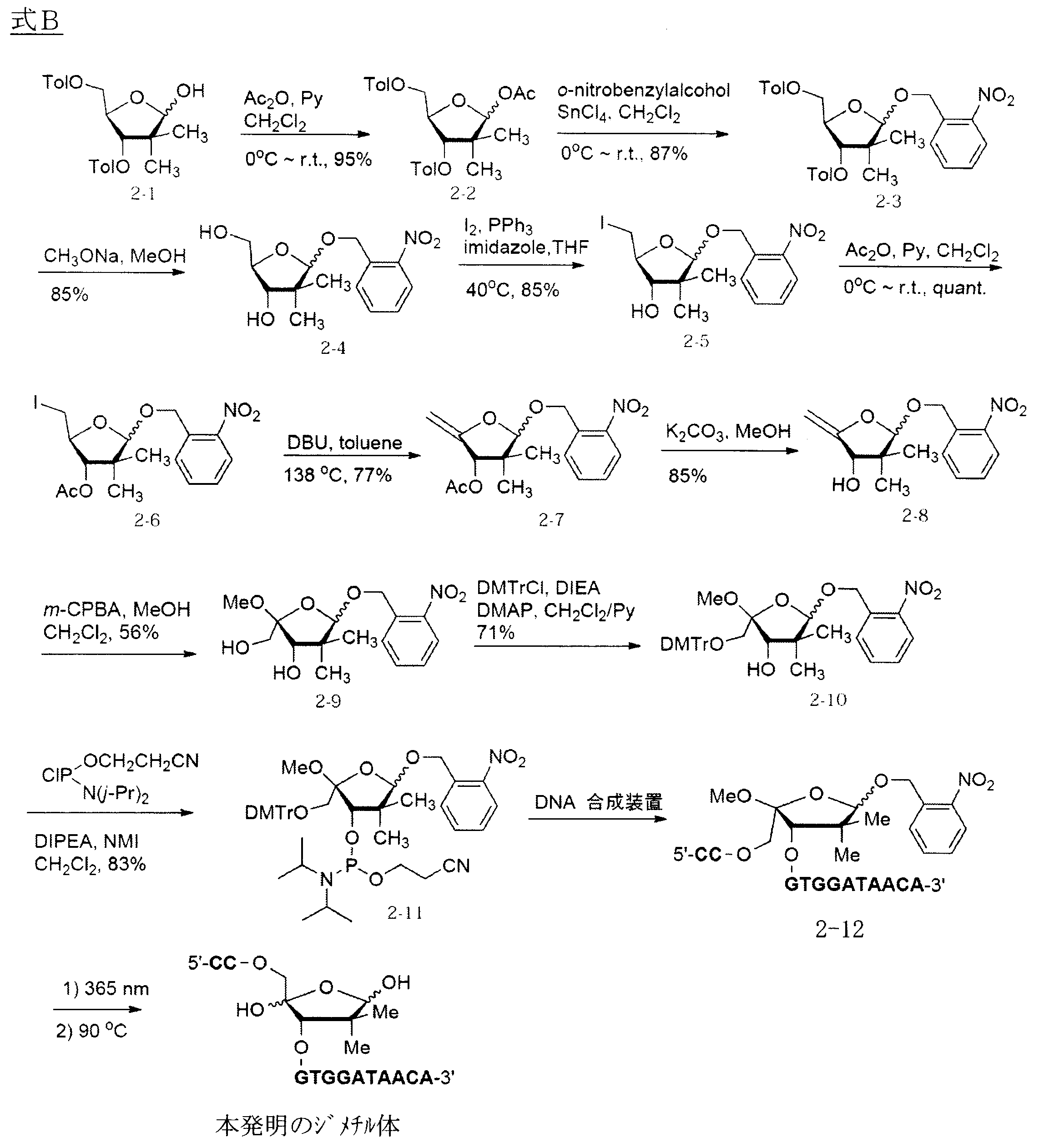
(1)1’-O-acetyl -2’-deoxy-2’,2’-dimethyl -3’,5’-O -toluoyl- D-ribofuranose (化合物2-2)の製造
化合物2-1(非特許文献9:Chaudhuri, N. C.; Moussa, A.; Stewart, A.; Wang, J.; Storer, R., Organic Process Research & Development, 2005, 9, 457-465)(4 g, 0.01 mol)をdry CH2Cl2 (40 ml)に溶解し、0℃で無水酢酸 (3.8 ml, 0.04 mol)を5分かけて滴下した。トリエチルアミン(7.2 ml, 0.052 mol)を滴下し0℃から室温に戻しながら3時間攪拌した。減圧下溶媒を留去し、残渣に飽和炭酸水素ナトリウム水溶液を加えエーテルで抽出し、飽和食塩水で有機層を洗い、乾燥後、溶媒を留去した。残渣をシリカゲルカラムクロマトグラフィー(Hexane : AcOEt = 5 : 1) にて精製し1位ジアステレオ混合物2-2 (4.1 g, 95 %)を得た。
1H-NMR (400 MHz, CDCl3): majorδ7.96-7.89 (m, 8H), 7.28-7.13 (m, 8H), 6.01 (s, 1H), 5.53 (d, J = 6.8 Hz, 1H), 4.71-4.55 (m, 4H), 4.49-4.43 (m, 2H), 2.43 (s, 3H), 2.37 (s, 3H), 2.01(s, 3H), 1.29 (s,3H), 1.16 (s, 3H).
minor δ7.96-7.89 (m, 8H), 7.28-7.13 (m, 8H), 6.06 (s, 1H), 5.12 (d, J = 3.6 Hz, 1H), 4.71-4.55 (m, 4H), 4.49-4.43 (m, 2H), 2.43 (s, 3H), 2.39 (s, 3H), 2.15 (s, 3H), 1.31 (s, 3H), 1.13 (s, 3H).
HRMS-ESI (m/z) : calcd for C25H28O7Na (M+ + Na) 463.1727, found 463.1736。
化合物2-1(非特許文献9:Chaudhuri, N. C.; Moussa, A.; Stewart, A.; Wang, J.; Storer, R., Organic Process Research & Development, 2005, 9, 457-465)(4 g, 0.01 mol)をdry CH2Cl2 (40 ml)に溶解し、0℃で無水酢酸 (3.8 ml, 0.04 mol)を5分かけて滴下した。トリエチルアミン(7.2 ml, 0.052 mol)を滴下し0℃から室温に戻しながら3時間攪拌した。減圧下溶媒を留去し、残渣に飽和炭酸水素ナトリウム水溶液を加えエーテルで抽出し、飽和食塩水で有機層を洗い、乾燥後、溶媒を留去した。残渣をシリカゲルカラムクロマトグラフィー(Hexane : AcOEt = 5 : 1) にて精製し1位ジアステレオ混合物2-2 (4.1 g, 95 %)を得た。
1H-NMR (400 MHz, CDCl3): majorδ7.96-7.89 (m, 8H), 7.28-7.13 (m, 8H), 6.01 (s, 1H), 5.53 (d, J = 6.8 Hz, 1H), 4.71-4.55 (m, 4H), 4.49-4.43 (m, 2H), 2.43 (s, 3H), 2.37 (s, 3H), 2.01(s, 3H), 1.29 (s,3H), 1.16 (s, 3H).
minor δ7.96-7.89 (m, 8H), 7.28-7.13 (m, 8H), 6.06 (s, 1H), 5.12 (d, J = 3.6 Hz, 1H), 4.71-4.55 (m, 4H), 4.49-4.43 (m, 2H), 2.43 (s, 3H), 2.39 (s, 3H), 2.15 (s, 3H), 1.31 (s, 3H), 1.13 (s, 3H).
HRMS-ESI (m/z) : calcd for C25H28O7Na (M+ + Na) 463.1727, found 463.1736。
(2)2’-Deoxy-2’,2’-dimethyl-1’-O-(2-nitrobenzyl)-3’,5’-O-toluoyl-D-ribofuranose (化合物2-3)の製造
化合物2-2 (4.1 g, 9.3 mmol) に2-Nitrobenzylalcohol (1.92 g, 12.6 mmol) を加えdry CH2Cl2 (126 ml) に溶解し、0℃でSnCl4 (1.58 ml, 1.58 mmol) を滴下し2時間反応させた後、室温に戻し終夜で攪拌した。飽和炭酸水素ナトリウム水溶液を加えCH2Cl2で抽出し、精製水、飽和食塩水で有機層を洗い乾燥後、溶媒を留去した。残渣をシリカゲルカラムクロマトグラフィー (Hexane : AcOEt = 10 : 1 → 8 : 1) にて精製し1位ジアステレオ混合物2-3 (4.3 g, 87 %)を得た。
1H-NMR (400 MHz, CDCl3):δ8.08 (d, J = 8.4 Hz, 1H), 8.02 (d, J = 8.4 Hz, 1H), 7.96 (d, J = 8.0 Hz, 2H), 7.92 (d, J = 8.4 Hz, 4H), 7.87 (d, J = 8.0 Hz, 1H), 7.83 (d, J = 8.0 Hz, 2H) , 7.66 (d, J = 7.6 Hz, 1H), 7.60-7.54 (m, 2H), 7.46-7.41 (m, 2H), 7.25(d, J = 8.0 Hz, 4H), 7.21 (d, J= 8.0 Hz, 2H), 7.02 (d, J = 8.0 Hz, 2H), 5.58 (d, J = 6.4 Hz, 1H), 5.22 (d, J = 15.2 Hz, 1H), 5.11 (d, J = 14.8 Hz, 1H), 5.10 (d, J = 4.4 Hz, 1H), 4.95 (d, J = 15.2 Hz, 1H), 4.87 (d, J = 14.8 Hz, 1H), 4.89 (s, 1H), 4.82 (s, 1H), 4.71 (dd, J = 3.6, 12.2 Hz, 1H), 4.63-4.56 (m, 2H), 4.43-4.40 (m, 3H), 2.43 (s, 6H), 2.40 (s, 3H), 2.33 (s, 3H), 1.27 (s, 6H), 1.24 (s, 3H), 1.22 (s, 3H).
HRMS-ESI (m/z) : calcd for C30H31NO8Na (M+ + Na) 556.1942, found 556.1933。
化合物2-2 (4.1 g, 9.3 mmol) に2-Nitrobenzylalcohol (1.92 g, 12.6 mmol) を加えdry CH2Cl2 (126 ml) に溶解し、0℃でSnCl4 (1.58 ml, 1.58 mmol) を滴下し2時間反応させた後、室温に戻し終夜で攪拌した。飽和炭酸水素ナトリウム水溶液を加えCH2Cl2で抽出し、精製水、飽和食塩水で有機層を洗い乾燥後、溶媒を留去した。残渣をシリカゲルカラムクロマトグラフィー (Hexane : AcOEt = 10 : 1 → 8 : 1) にて精製し1位ジアステレオ混合物2-3 (4.3 g, 87 %)を得た。
1H-NMR (400 MHz, CDCl3):δ8.08 (d, J = 8.4 Hz, 1H), 8.02 (d, J = 8.4 Hz, 1H), 7.96 (d, J = 8.0 Hz, 2H), 7.92 (d, J = 8.4 Hz, 4H), 7.87 (d, J = 8.0 Hz, 1H), 7.83 (d, J = 8.0 Hz, 2H) , 7.66 (d, J = 7.6 Hz, 1H), 7.60-7.54 (m, 2H), 7.46-7.41 (m, 2H), 7.25(d, J = 8.0 Hz, 4H), 7.21 (d, J= 8.0 Hz, 2H), 7.02 (d, J = 8.0 Hz, 2H), 5.58 (d, J = 6.4 Hz, 1H), 5.22 (d, J = 15.2 Hz, 1H), 5.11 (d, J = 14.8 Hz, 1H), 5.10 (d, J = 4.4 Hz, 1H), 4.95 (d, J = 15.2 Hz, 1H), 4.87 (d, J = 14.8 Hz, 1H), 4.89 (s, 1H), 4.82 (s, 1H), 4.71 (dd, J = 3.6, 12.2 Hz, 1H), 4.63-4.56 (m, 2H), 4.43-4.40 (m, 3H), 2.43 (s, 6H), 2.40 (s, 3H), 2.33 (s, 3H), 1.27 (s, 6H), 1.24 (s, 3H), 1.22 (s, 3H).
HRMS-ESI (m/z) : calcd for C30H31NO8Na (M+ + Na) 556.1942, found 556.1933。
(3)2’-Deoxy-2’,2’-dimethyl-1’-O-(2-nitrobenzyl)- D-ribofuranose (化合物2-4)の製造
化合物2-3 (1.29 g, 2.4 mmol)をdry MeOH (10.4 ml) に溶解し、0.5 M NaOCH3水溶液(6.42 ml, 4.7 mmol) を滴下し終夜で攪拌して、HCl (1 N in ether, 4.73 ml) を加えた。溶媒を留去し、精製水を加えて酢酸エチルで抽出し有機層を乾燥した後、溶媒を留去した。残渣をシリカゲルカラムクロマトグラフィー(CHCl3 : MeOH = 50 : 1) にて精製し1位ジアステレオ混合物2-4 (615 mg, 85%)を得た。
化合物2-3 (1.29 g, 2.4 mmol)をdry MeOH (10.4 ml) に溶解し、0.5 M NaOCH3水溶液(6.42 ml, 4.7 mmol) を滴下し終夜で攪拌して、HCl (1 N in ether, 4.73 ml) を加えた。溶媒を留去し、精製水を加えて酢酸エチルで抽出し有機層を乾燥した後、溶媒を留去した。残渣をシリカゲルカラムクロマトグラフィー(CHCl3 : MeOH = 50 : 1) にて精製し1位ジアステレオ混合物2-4 (615 mg, 85%)を得た。
1H-NMR (400 MHz, CDCl3): majorδ8.06-8.02 (m, 1H), 7.70-7.62 (m, 2H), 7.48-7.44 (m, 1H), 5.11 (d, J = 14.6 Hz, 1H), 4.87 (d, J = 14.6 Hz, 1H), 4.71 (s, 1H), 4.02-3.58 (m, 4H), 1.14 (s, 3H), 1.08 (s, 3H).
minorδ8.06-8.02 (m, 1H), 7.70-7.62 (m, 2H), 7.48-7.44 (m, 1H), 5.11 (d, J = 14.6 Hz, 1H), 4.87 (d, J = 14.6 Hz, 1H), 4.76 (s, 1H), 4.02-3.58 (m, 4H), 1.15 (s, 3H), 1.06 (s, 3H).
HRMS-ESI (m/z) : calcd for C14H19NO6Na (M+ + Na) 320.1105, found 320.1117。
minorδ8.06-8.02 (m, 1H), 7.70-7.62 (m, 2H), 7.48-7.44 (m, 1H), 5.11 (d, J = 14.6 Hz, 1H), 4.87 (d, J = 14.6 Hz, 1H), 4.76 (s, 1H), 4.02-3.58 (m, 4H), 1.15 (s, 3H), 1.06 (s, 3H).
HRMS-ESI (m/z) : calcd for C14H19NO6Na (M+ + Na) 320.1105, found 320.1117。
(4)2’,5’-Dideoxy-2’,2’-dimethyl-1’-O-(2-nitrobenzyl)- 5’-iodo- D-ribofuranose (化合物2-5)の製造
化合物2-4 (2 g, 6.73 mmol) にトリフェニルホスフィン(2.63 g, 10 mmol) とImidazole (0.916 g, 13.5 mmol) を加えdry THF (6.7 ml)に溶解し、dry THF (18.2 ml) に溶解させたI2 (2.54 g, 10 mmol) を滴下した。40℃で1時間攪拌した後、飽和チオ硫酸ナトリウム水溶液を加え溶媒を留去した。精製水を加え酢酸エチルで抽出し有機層を乾燥した後、溶媒を留去し、残渣をシリカゲルカラムクロマトグラフィー (Hexane : AcOEt = 4 : 1) にて精製し、1位ジアステレオ混合物2-5 (2.34 g, 85 %) を得た。
化合物2-4 (2 g, 6.73 mmol) にトリフェニルホスフィン(2.63 g, 10 mmol) とImidazole (0.916 g, 13.5 mmol) を加えdry THF (6.7 ml)に溶解し、dry THF (18.2 ml) に溶解させたI2 (2.54 g, 10 mmol) を滴下した。40℃で1時間攪拌した後、飽和チオ硫酸ナトリウム水溶液を加え溶媒を留去した。精製水を加え酢酸エチルで抽出し有機層を乾燥した後、溶媒を留去し、残渣をシリカゲルカラムクロマトグラフィー (Hexane : AcOEt = 4 : 1) にて精製し、1位ジアステレオ混合物2-5 (2.34 g, 85 %) を得た。
1H-NMR (400 MHz, CDCl3):δ8.03 (d, J = 8.0 Hz, 2H), 7.69-7.61 (m, 4H), 7.46 (t, J = 8.0 Hz, 2H), 7.45 (t, J = 7.6 Hz, 2H), 5.11(d, J = 14.7 Hz, 1H), 5.10 (d, J= 14.5 Hz, 1H), 4.88 (d, J = 14.5 Hz, 1H), 4.88 (d, J = 14.7 Hz,1H), 4.82 (s, 1H), 4.68 (s, 1H), 4.10-4.05 (m, 1H), 3.99-3.93 (m, 2H), 3.56 (bs, 1H), 3.36-3.22 (m, 4H), 2.11(m, 1H), 1.15 (s, 3H), 1.14 (s, 3H), 1.10 (s, 3H), 1.07 (s, 3H).
HRMS-ESI (m/z) : calcd for C14H18INO5Na (M+ + Na) 430.0122, found 430.0128。
HRMS-ESI (m/z) : calcd for C14H18INO5Na (M+ + Na) 430.0122, found 430.0128。
(5)3’-O-Acetyl-2’,5’-dideoxy-2’,2’-dimethyl-5’-iodo-1’-O-(2-nitrobenzyl)-D-ribo- furanose (化合物2-6)の製造
化合物2-5 (2.3 g, 5.65 mmol)をdry CH2Cl2 (15.7 ml) に溶解し、Pyridine (0.69 ml、8.48 mmol)、DMAP (69 mg, 0.565 mmol)、無水酢酸 (0.86 ml, 8.48 mmol)を加え、室温で1時間攪拌した。精製水を加え酢酸エチルで抽出した後、飽和炭酸水素ナトリウム水溶液で有機層を洗い、乾燥後、溶媒を留去した。残渣をシリカゲルカラムクロマトグラフィー(Hexane : AcOEt = 5 : 1) にて精製し1位ジアステレオ混合物2-6 (2.49 g, quant.)を得た。
1H-NMR(400 MHz, CDCl3):δ8.07-8.04 (m, 2H), 7.75-7.62 (m, 4H), 7.49-7.44 (m, 2H), 5.15 (d, J = 14.6 Hz, 1H), 5.13 (d, J= 14.6 Hz, 1H), 4.89 (d, J = 14.5 Hz, 1H), 4.88 (d, J = 14.6 Hz, 1H), 5.16 (d, J = 6.4 Hz, 1H) 4.81 (s, 1H), 4.74 (s, 1H), 4.66 (d, J = 4.4 Hz, 1H), 4.15-4.06 (m, 2H), 3.48-3.44 (m, 1H), 3.83-3.32 (m, 2H), 3.26-3.22 (m, 1H), 2.12(s, 6H), 1.20 (s, 3H), 1.14 (s, 3H), 1.10 (s, 3H), 1.05 (s, 3H).
HRMS-ESI (m/z) : calcd for C16H20INO6Na (M+ + Na) 472.0228, found 472.0255。
化合物2-5 (2.3 g, 5.65 mmol)をdry CH2Cl2 (15.7 ml) に溶解し、Pyridine (0.69 ml、8.48 mmol)、DMAP (69 mg, 0.565 mmol)、無水酢酸 (0.86 ml, 8.48 mmol)を加え、室温で1時間攪拌した。精製水を加え酢酸エチルで抽出した後、飽和炭酸水素ナトリウム水溶液で有機層を洗い、乾燥後、溶媒を留去した。残渣をシリカゲルカラムクロマトグラフィー(Hexane : AcOEt = 5 : 1) にて精製し1位ジアステレオ混合物2-6 (2.49 g, quant.)を得た。
1H-NMR(400 MHz, CDCl3):δ8.07-8.04 (m, 2H), 7.75-7.62 (m, 4H), 7.49-7.44 (m, 2H), 5.15 (d, J = 14.6 Hz, 1H), 5.13 (d, J= 14.6 Hz, 1H), 4.89 (d, J = 14.5 Hz, 1H), 4.88 (d, J = 14.6 Hz, 1H), 5.16 (d, J = 6.4 Hz, 1H) 4.81 (s, 1H), 4.74 (s, 1H), 4.66 (d, J = 4.4 Hz, 1H), 4.15-4.06 (m, 2H), 3.48-3.44 (m, 1H), 3.83-3.32 (m, 2H), 3.26-3.22 (m, 1H), 2.12(s, 6H), 1.20 (s, 3H), 1.14 (s, 3H), 1.10 (s, 3H), 1.05 (s, 3H).
HRMS-ESI (m/z) : calcd for C16H20INO6Na (M+ + Na) 472.0228, found 472.0255。
(6)3-O’-acetyl-2’,5’-dideoxy-2’,2’-dimethyl-4’,5’-methylene-1’-O-(2-nitrobenzyl) -D-ribofuranose (化合物2-7)の製造
化合物2-6 (2.5 g, 6.1 mmol)をdry Toluene (87 ml)に溶解し、DBU (6.5 ml, 43 mmol)を加え、138℃で8時間攪拌した。飽和塩化アンモニウム水溶液を加え酢酸エチルで抽出した後、抽出液を乾燥し、減圧下溶媒を留去した。残渣をシリカゲルカラムクロマトグラフィー(Hexane : AcOEt = 5 : 1) にて精製し1位ジアステレオ混合物2-7 (1.3 g, 77%)を得た。
化合物2-6 (2.5 g, 6.1 mmol)をdry Toluene (87 ml)に溶解し、DBU (6.5 ml, 43 mmol)を加え、138℃で8時間攪拌した。飽和塩化アンモニウム水溶液を加え酢酸エチルで抽出した後、抽出液を乾燥し、減圧下溶媒を留去した。残渣をシリカゲルカラムクロマトグラフィー(Hexane : AcOEt = 5 : 1) にて精製し1位ジアステレオ混合物2-7 (1.3 g, 77%)を得た。
1H-NMR(400 MHz, CDCl3):δ8.09-8.06 (m, 2H), 7.83-7.63 (m, 4H), 7.48-7.26 (m, 2H), 5.61 (s, 1H), 5.30 (s, 1H), 5.19 (d, 1H, J = 14.8 Hz), 5.15 (d, 1H, J = 12.6 Hz), 5.01 (d, J = 14.8 Hz, 2H), 4.98 (s, 1H), 4.94 (s, 1H), 4.50 (d, J = 1.2 Hz, 1H), 4.44-4.43 (m, 1H), 4.30 (d, J = 2.0 Hz, 1H), 4.07-4.06 (m, 1H), 2.15 (s, 3H), 1.54 (s, 3H), 1.15 (s, 3H), 1.12 (s, 3H), 1.11 (s, 3H), 1.10 (s, 3H).
HRMS-ESI (m/z) : calcd for C16H19NO6Na (M+ + Na) 344.1105, found 344.1104。
HRMS-ESI (m/z) : calcd for C16H19NO6Na (M+ + Na) 344.1105, found 344.1104。
(7)2’-Deoxy-2’,2’-dimethyl-4’-methoxy-1’-O-(2-nitrobenzyl) - L-lyxofuranose (化合物2-8)の製造
化合物2-7 (492 mg, 1.53 mmol) をMeOH (15.3 ml) に溶解し、炭酸カリウム(317 mg, 2.3 mmol) を加え攪拌した。1時間後、飽和塩化アンモニウム水溶液を加え酢酸エチルで抽出した後、有機層を乾燥し溶媒を留去した。残渣を終夜で真空乾燥させた後、dry MeOH (12.7 ml) に溶解させ、77% m-CPBA (418 mg, 1.87 mmol) のdry CH2Cl2 (4.8 ml) 溶液を滴下して攪拌し、23時間後飽和炭酸水素ナトリウム水溶液を加えた。酢酸エチルで抽出し、有機層を乾燥した後、溶媒を減圧下留去した。残渣をシリカゲルカラムクロマトグラフィー (Hexane : AcOEt = 3 : 1 → 2 : 1) にて精製し、化合物2-8とその4位エピマーが混合物として得られた(335.5 mg, 67%)。化合物2-8は一部単離生成した。
化合物2-7 (492 mg, 1.53 mmol) をMeOH (15.3 ml) に溶解し、炭酸カリウム(317 mg, 2.3 mmol) を加え攪拌した。1時間後、飽和塩化アンモニウム水溶液を加え酢酸エチルで抽出した後、有機層を乾燥し溶媒を留去した。残渣を終夜で真空乾燥させた後、dry MeOH (12.7 ml) に溶解させ、77% m-CPBA (418 mg, 1.87 mmol) のdry CH2Cl2 (4.8 ml) 溶液を滴下して攪拌し、23時間後飽和炭酸水素ナトリウム水溶液を加えた。酢酸エチルで抽出し、有機層を乾燥した後、溶媒を減圧下留去した。残渣をシリカゲルカラムクロマトグラフィー (Hexane : AcOEt = 3 : 1 → 2 : 1) にて精製し、化合物2-8とその4位エピマーが混合物として得られた(335.5 mg, 67%)。化合物2-8は一部単離生成した。
1H-NMR(400 MHz, CDCl3):δ8.07 (d, J = 4.0 Hz, 1H), 8.05 (d, J = 4.4 Hz, 1H), 7.79 (d, J = 8.0 Hz, 1H), 7.68-7.63 (m, 3H), 7.47-7.45 (m, 2H), 5.12 (d, J = 15.2 Hz, 1H), 5.09 (d, J = 14.7 Hz, 1H), 4.94 (d, J = 15.2 Hz, 1H), 4.88 (d, J = 14.7 Hz, 1H),4.83 (s, 1H), 4.82 (s, 1H), 4.17 (s, 1H), 3.88-3.67 (m, 5H), 3.36 (s, 3H), 3.30 (s, 3H), 1.22 (s, 3H), 1.21 (s, 3H), 1.16 (s, 3H), 1.10 (s, 3H).
HRMS-ESI (m/z) : calcd for C15H21NO7Na (M+ + Na) 350.1210, found 350.1221。
HRMS-ESI (m/z) : calcd for C15H21NO7Na (M+ + Na) 350.1210, found 350.1221。
(8)2’-Deoxy-2’,2’-dimethyl-5’-O-(4,4’-dimethoxytrityl)-4’-methoxy-1’-O-(2-nitro- benzyl)- L-lyxofuranose (化合物2-9)の製造
化合物2-8 (140 mg, 0.47 mmol)をdry Pyridineで共沸し、終夜で真空乾燥させた。dry CH2Cl2 : dry Pyridine / 1 : 1の混合液(1.3 ml) に溶解し、DIPEA (0.082 ml, 0.47 mmol) を加えた。さらにDMTrCl (367 mg, 1.11 mmol) のdry CH2Cl2 : dry Pyridine/1 : 1の混合液 (3.5 ml) を滴下し、終夜で攪拌した。MeOHを加え溶媒を留去し、残渣に精製水を加えて酢酸エチルで抽出した。有機層を乾燥させ、溶媒を留去し、シリカゲルカラムクロマトグラフィー (Hexane : AcOEt = 10 : 1 → 3 : 1) にて精製し、化合物2-9 (208 mg, 71%) を得た。
1H-NMR(400 MHz, CDCl3):δ8.06(d, J = 8.4 Hz, 1H), 7.82 (s, J = 7.6 Hz, 1H), 7.64 (t, J = 7.6 Hz, 1H), 7.46-7.41 (m, 4H), 7.36-7.20 (m, 6H), 6.84 (d, J = 8.8 Hz, 4H), 5.12 (d, J = 15.4 Hz, 1H), 4.91 (d, J = 15.4 Hz, 1H), 4.88 (s, 1H), 4.14 (s, 1H), 3.80 (s, 6H), 3.09 (s, 3H), 3.47 (d, J= 3.2 Hz, 1H), 3.17 (d, J = 10.0 Hz, 1H), 1.26 (s, 3H), 1.07 (s, 3H).
HRMS-ESI (m/z) : calcd for C15H21NO7Na (M+ - DMTr + H+) 350.1210, found 350.1217。
化合物2-8 (140 mg, 0.47 mmol)をdry Pyridineで共沸し、終夜で真空乾燥させた。dry CH2Cl2 : dry Pyridine / 1 : 1の混合液(1.3 ml) に溶解し、DIPEA (0.082 ml, 0.47 mmol) を加えた。さらにDMTrCl (367 mg, 1.11 mmol) のdry CH2Cl2 : dry Pyridine/1 : 1の混合液 (3.5 ml) を滴下し、終夜で攪拌した。MeOHを加え溶媒を留去し、残渣に精製水を加えて酢酸エチルで抽出した。有機層を乾燥させ、溶媒を留去し、シリカゲルカラムクロマトグラフィー (Hexane : AcOEt = 10 : 1 → 3 : 1) にて精製し、化合物2-9 (208 mg, 71%) を得た。
1H-NMR(400 MHz, CDCl3):δ8.06(d, J = 8.4 Hz, 1H), 7.82 (s, J = 7.6 Hz, 1H), 7.64 (t, J = 7.6 Hz, 1H), 7.46-7.41 (m, 4H), 7.36-7.20 (m, 6H), 6.84 (d, J = 8.8 Hz, 4H), 5.12 (d, J = 15.4 Hz, 1H), 4.91 (d, J = 15.4 Hz, 1H), 4.88 (s, 1H), 4.14 (s, 1H), 3.80 (s, 6H), 3.09 (s, 3H), 3.47 (d, J= 3.2 Hz, 1H), 3.17 (d, J = 10.0 Hz, 1H), 1.26 (s, 3H), 1.07 (s, 3H).
HRMS-ESI (m/z) : calcd for C15H21NO7Na (M+ - DMTr + H+) 350.1210, found 350.1217。
(9)2’-Deoxy-2’,2’-dimethyl-5’-O-(4,4’-dimethoxytrityl)-4’-methoxy-1’-O-(2-nitro- benzyl)-α-L-lyxofuranose(化合物2-10)の製造
化合物2-9 (140 mg, 0.47 mmol)をdry Pyridineで共沸し、終夜で真空乾燥させた。dry CH2Cl2 : dry Pyridine = 1 : 1の混合液(1.3 ml)に溶解し、diisopropylethylamine (0.082 ml, 0.47 mmol )を加えた。さらにDMTrCl (367 mg, 1.11 mmol)のdry CH2Cl2: dry Pyridine = 1 : 1の混合液 (3.5 ml)を滴下し、終夜で攪拌した。MeOHを加え溶媒を留去し、残渣に精製水を加えて酢酸エチルで抽出した。有機層を乾燥させ、溶媒を留去し、シリカゲルカラムクロマトグラフィー(Hexane : AcOEt = 10:1 → 3:1) にて精製し、1位ジアステレオ混合物2-10 (208 mg, 71%)を得た。
ジアステレオマーの内、一部単離できた1R 体のデータ
1H-NMR(400 MHz, CDCl3):δ 8.06(d, 1H, J = 8.4 Hz), 7.82(s, 1H, J = 7.6 Hz), 7.64(t, 1H, J = 7.6 Hz), 7.46-7.41(m, 4H), 7.36-7.20(m, 6H), 6.84 (d, 4H, J = 8.79 Hz), 5.12(d, 1H, J = 15.4 Hz), 4.91(d, 1H, J = 15.4 Hz), 4.88(s, 1H), 4.14(s, 1H), 3.80(s, 6H), 3.09(s, 3H), 3.47(d, 1H, J = 3.2 Hz), 3.17(d, 1H, J= 10.0 Hz), 1.26(s, 3H), 1.07(s, 3H) ; FABMS m/z 630 (M++H) HRMS-ESI (m/z) : calcd for C15H21NO7Na (M+ - DMTr + H+) 350.1210, found 350.1217。
化合物2-9 (140 mg, 0.47 mmol)をdry Pyridineで共沸し、終夜で真空乾燥させた。dry CH2Cl2 : dry Pyridine = 1 : 1の混合液(1.3 ml)に溶解し、diisopropylethylamine (0.082 ml, 0.47 mmol )を加えた。さらにDMTrCl (367 mg, 1.11 mmol)のdry CH2Cl2: dry Pyridine = 1 : 1の混合液 (3.5 ml)を滴下し、終夜で攪拌した。MeOHを加え溶媒を留去し、残渣に精製水を加えて酢酸エチルで抽出した。有機層を乾燥させ、溶媒を留去し、シリカゲルカラムクロマトグラフィー(Hexane : AcOEt = 10:1 → 3:1) にて精製し、1位ジアステレオ混合物2-10 (208 mg, 71%)を得た。
ジアステレオマーの内、一部単離できた1R 体のデータ
1H-NMR(400 MHz, CDCl3):δ 8.06(d, 1H, J = 8.4 Hz), 7.82(s, 1H, J = 7.6 Hz), 7.64(t, 1H, J = 7.6 Hz), 7.46-7.41(m, 4H), 7.36-7.20(m, 6H), 6.84 (d, 4H, J = 8.79 Hz), 5.12(d, 1H, J = 15.4 Hz), 4.91(d, 1H, J = 15.4 Hz), 4.88(s, 1H), 4.14(s, 1H), 3.80(s, 6H), 3.09(s, 3H), 3.47(d, 1H, J = 3.2 Hz), 3.17(d, 1H, J= 10.0 Hz), 1.26(s, 3H), 1.07(s, 3H) ; FABMS m/z 630 (M++H) HRMS-ESI (m/z) : calcd for C15H21NO7Na (M+ - DMTr + H+) 350.1210, found 350.1217。
(10)2’-Deoxy-2’,2’-dimethyl-5’-O-(4,4’-dimethoxytrityl)- 4’-methoxy-1’--O(2-nitrobenzyl)-L-lyxofuranose cyanoethyl N,N-diisopropylphosphoramidite (化合物2-11)の製造
化合物2-10 (128 mg, 0.203 mmol) をdry Pyridine、dry CH2Cl2で共沸し、dry CH2Cl2 (10.7 ml)に溶解させ0℃でdiisopropylethylamine (0.095 ml, 0.545 mmol)、 N,N-diisopropylamino cyanoethyl phosphonamidic chloride (0.18 ml, 0.812 mmol)、N-methylimidazole (8.6 μl, 0.108 mmol) を加え0℃で30分攪拌させた後、室温で1時間半攪拌した。MeOHでクエンチし濃縮したのち、酢酸エチルを加え15%炭酸水素ナトリウム水溶液で抽出した。有機層を乾燥させ、溶媒を留去し、シリカゲルカラムクロマトグラフィー(Hexane : Et2O = 3 : 1 → 1 : 2)にて生成し、1位ジアステレオ混合物(化合物2-11:140 mg, 83%) を得た。
化合物2-10 (128 mg, 0.203 mmol) をdry Pyridine、dry CH2Cl2で共沸し、dry CH2Cl2 (10.7 ml)に溶解させ0℃でdiisopropylethylamine (0.095 ml, 0.545 mmol)、 N,N-diisopropylamino cyanoethyl phosphonamidic chloride (0.18 ml, 0.812 mmol)、N-methylimidazole (8.6 μl, 0.108 mmol) を加え0℃で30分攪拌させた後、室温で1時間半攪拌した。MeOHでクエンチし濃縮したのち、酢酸エチルを加え15%炭酸水素ナトリウム水溶液で抽出した。有機層を乾燥させ、溶媒を留去し、シリカゲルカラムクロマトグラフィー(Hexane : Et2O = 3 : 1 → 1 : 2)にて生成し、1位ジアステレオ混合物(化合物2-11:140 mg, 83%) を得た。
1H-NMR (400 MHz, CDCl3):partialδ8.08-8.05 (m, 2H), 7.86-7.97 (m, 2H), 7.67 (m, 2H), 7.53-7.12 (m, 20H), 6.84-6.80 (m, 8H), 5.24 (d, J = 15.4 Hz, 2H), 5.03 (d, J = 15.2 Hz, 1H), 5.02 (d, J = 15.2 Hz, 1H), 4.87 (s, 1H), 4.84 (s, 1H), 4.24 (d, J = 4.2 Hz, 1H), 4.22 (d, J = 1.8 Hz, 1H), 4.03-3.96 (m, 4H), 3.79 (s, 6H), 3.77 (s, 6H), 3.45 (s, 3H), 3.44 (s, 3H), 2.65-2.51 (m, 4H), 1.29-0.90 (m, 38H)。
(11)DNA合成、及び本発明のジメチル体の製造
DNA自動合成装置を用いて、標準的なβシアノエチルホスホロアミダイト法により行い、上記で得られた化合物2-11を組み込んだ13merのオリゴデオキシヌクレオチド(化合物2-12)(配列番号4)を合成した(分子量4044、MALDI TOFMASSデータ4044)。得られたオリゴデオキシヌクレオチドに、リン酸緩衝液中、室温で365 nmの光を照射した後、90℃で20分加熱して、2’位にメチル基を2つ有するC4’酸化型核酸を含む、オリゴデオキシヌクレオチド(本発明のジメチル体)(配列番号5)を得た(分子量3894、MALDI TOFMASSデータ3895)。
DNA自動合成装置を用いて、標準的なβシアノエチルホスホロアミダイト法により行い、上記で得られた化合物2-11を組み込んだ13merのオリゴデオキシヌクレオチド(化合物2-12)(配列番号4)を合成した(分子量4044、MALDI TOFMASSデータ4044)。得られたオリゴデオキシヌクレオチドに、リン酸緩衝液中、室温で365 nmの光を照射した後、90℃で20分加熱して、2’位にメチル基を2つ有するC4’酸化型核酸を含む、オリゴデオキシヌクレオチド(本発明のジメチル体)(配列番号5)を得た(分子量3894、MALDI TOFMASSデータ3895)。
当該化合物は、一般式(I)で示される化合物のうち、Xが直接結合;R1及びR2が置換基を有しない同一のアルキル基;A及びBが、それぞれ異なる、ヌクレオチドから形成される骨格を有する核酸塩基配列含有オリゴマーである化合物に相当する。また、一般式(Ia)で示される化合物のうち、R1a及びR2aが置換基を有しない同一のアルキル基;A及びBが、それぞれ異なる、ヌクレオチドから形成される骨格を有する核酸塩基配列含有オリゴマーである化合物に相当する。さらに、一般式(Ia-1)で示される化合物のうち、R1a-1及びR2a-1が置換基を有しない同一のアルキル基;A及びBが、それぞれ異なる、ヌクレオチドから形成される骨格を有する核酸塩基配列含有オリゴマーである化合物に相当する。
製造例3 メトキシ体の製造方法
下式に示す方法により、本発明の化合物(I)のうち、2’位にメトキシ基を有するC4’酸化型核酸を含む、オリゴデオキシヌクレオチド(本発明のメトキシ体)(Ic)を製造した。
下式に示す方法により、本発明の化合物(I)のうち、2’位にメトキシ基を有するC4’酸化型核酸を含む、オリゴデオキシヌクレオチド(本発明のメトキシ体)(Ic)を製造した。
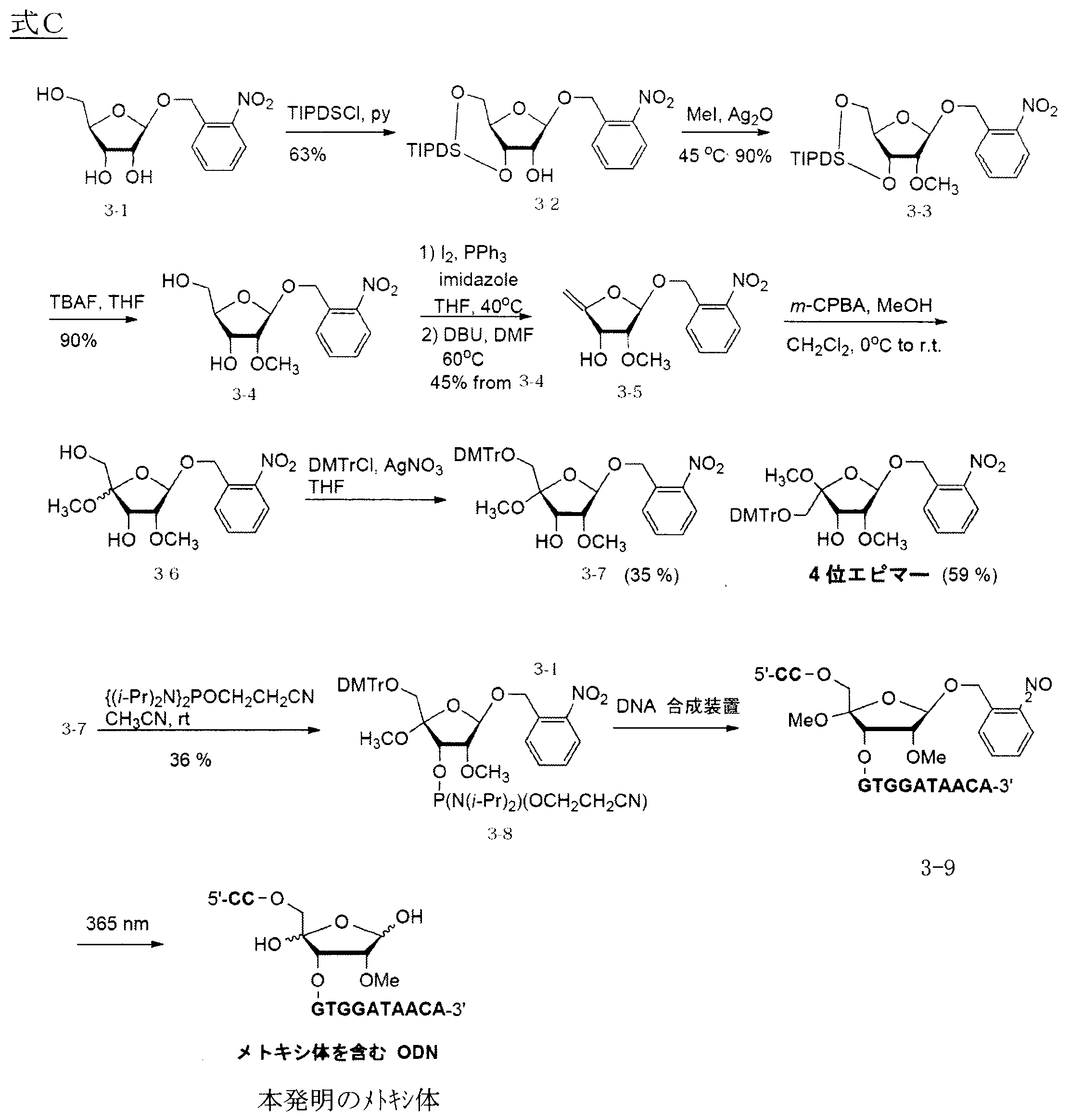
(1)1’-O-(2-Nitrobenzyl)-3’,5’-O-TIPDS-β-D-ribofuranose(化合物3-2)
化合物3-1(Trzupek, J. D. and Sheppard, T. L., Org. Lett., 2005, 7, 1493-1496)(1.2 g, 4.21 mmol)をdry Pyridine (35 ml) に溶かし、0℃でTIPDSCl2 (1.6 ml, 5.05 mmol) とdry Pyridine (10 ml) の混合溶液を10分かけて滴下し、30分間反応させた後、室温で1時間反応させた。溶媒を留去し、精製水を加えて酢酸エチルで抽出した。有機層をNa2SO4で乾燥後、溶媒を留去して残渣をシリカゲルクロマトグラフィー (Hexane → Hexane : AcOEt = 4 : 1) にて精製し、化合物3-2 (1.4 g, 63%)を得た。
1H-NMR (400 MHz, CDCl3) : δ 8.05 (d, J = 8.2 Hz, 1H), 7.67 (d, J = 7.7 Hz, 1H), 7.62 (m, 1H), 7.45 (m, 1H), 5.053 (d, J = 14.8 Hz, 1H), 5.052 (s, 1H), 4.88 (d, J = 14.8 Hz, 1H), 4.56 (t, J = 5.2 Hz, 1H), 4.13 (d, J = 4.8 Hz, 1H), 4.05 (m, 2H), 3.75 (m, 1H), 1.09-1.00 (m, 28H).
HRMS-ESI (m/z) : calcd for C24H41NO8Si2Na (M++ Na) 550.2263, found 550.2229。
化合物3-1(Trzupek, J. D. and Sheppard, T. L., Org. Lett., 2005, 7, 1493-1496)(1.2 g, 4.21 mmol)をdry Pyridine (35 ml) に溶かし、0℃でTIPDSCl2 (1.6 ml, 5.05 mmol) とdry Pyridine (10 ml) の混合溶液を10分かけて滴下し、30分間反応させた後、室温で1時間反応させた。溶媒を留去し、精製水を加えて酢酸エチルで抽出した。有機層をNa2SO4で乾燥後、溶媒を留去して残渣をシリカゲルクロマトグラフィー (Hexane → Hexane : AcOEt = 4 : 1) にて精製し、化合物3-2 (1.4 g, 63%)を得た。
1H-NMR (400 MHz, CDCl3) : δ 8.05 (d, J = 8.2 Hz, 1H), 7.67 (d, J = 7.7 Hz, 1H), 7.62 (m, 1H), 7.45 (m, 1H), 5.053 (d, J = 14.8 Hz, 1H), 5.052 (s, 1H), 4.88 (d, J = 14.8 Hz, 1H), 4.56 (t, J = 5.2 Hz, 1H), 4.13 (d, J = 4.8 Hz, 1H), 4.05 (m, 2H), 3.75 (m, 1H), 1.09-1.00 (m, 28H).
HRMS-ESI (m/z) : calcd for C24H41NO8Si2Na (M++ Na) 550.2263, found 550.2229。
(2)2’-methoxy-1’-O-(2-nitrobenzyl)-3’,5’-O-TIPDS-β-D-ribofuranose (化合物3-3)
化合物3-2 (6.71 g, 12.73 mmol)、Ag2O (20.7 g)を、CH3I (8 ml)に溶解し45℃で3.5時間反応させた。その後CH3I (10 ml)をさらに追加して3.5時間攪拌し、反応をとめた。これをセライトろ過してAcOEtで洗い、溶媒を留去して残渣をシリカゲルクロマトグラフィー(Hexane : AcOEt = 20:1 → 2:1)で精製して化合物3-3 (4.87 g, 9.00 mmol, 71%)を得た。
1H-NMR (400 MHz, CDCl3) : δ 8.04 (dd, J = 1.2, 8.4 Hz, 1 H), 7.69 (d, J = 7.2 Hz, 1H), 7.60 (m, 1H), 7.44 (m, 1H), 5.07 (d, J = 14.6 Hz, 1H), 4.99 (s, 1H), 4.90 (d, J =14.6 Hz, 1H), 4.56 (dd, J = 4.4, 8.1 Hz, 1H), 4.04 (ddd, J = 3.0, 5.1, 8.1 Hz, 1 H), 3.97 (dd, J = 3.0, 12.3 Hz, 1H), 3.89 (dd, J = 5.1, 12.3 Hz, 1H), 3.70 (d, J = 4.4 Hz, 1H), 3.59 (s, 3H), 1.54-0.99 (m, 28H).
HRMS-ESI (m/z) : calcd for C25H43NO8Si2Na (M++ Na) 564.2419, found 564.2408。
化合物3-2 (6.71 g, 12.73 mmol)、Ag2O (20.7 g)を、CH3I (8 ml)に溶解し45℃で3.5時間反応させた。その後CH3I (10 ml)をさらに追加して3.5時間攪拌し、反応をとめた。これをセライトろ過してAcOEtで洗い、溶媒を留去して残渣をシリカゲルクロマトグラフィー(Hexane : AcOEt = 20:1 → 2:1)で精製して化合物3-3 (4.87 g, 9.00 mmol, 71%)を得た。
1H-NMR (400 MHz, CDCl3) : δ 8.04 (dd, J = 1.2, 8.4 Hz, 1 H), 7.69 (d, J = 7.2 Hz, 1H), 7.60 (m, 1H), 7.44 (m, 1H), 5.07 (d, J = 14.6 Hz, 1H), 4.99 (s, 1H), 4.90 (d, J =14.6 Hz, 1H), 4.56 (dd, J = 4.4, 8.1 Hz, 1H), 4.04 (ddd, J = 3.0, 5.1, 8.1 Hz, 1 H), 3.97 (dd, J = 3.0, 12.3 Hz, 1H), 3.89 (dd, J = 5.1, 12.3 Hz, 1H), 3.70 (d, J = 4.4 Hz, 1H), 3.59 (s, 3H), 1.54-0.99 (m, 28H).
HRMS-ESI (m/z) : calcd for C25H43NO8Si2Na (M++ Na) 564.2419, found 564.2408。
(3)2’-methoxy-1’-O-(2-nitrobenzyl)-β-D-ribofuranose (化合物3-4)の製造
化合物3-3(4.87 g, 9.00 mmol)をdry THF (150 ml)に溶解し、0℃でTBAF (14 ml, 14 mmol)を加えて1時間反応させた。精製水を加えて酢酸エチルで分液し、有機層をNa2SO4で乾燥後、溶媒を留去し、残渣をシリカゲルクロマトグラフィー (CHCl3 : MeOH =14:1)にて精製し、化合物3-4 (2.43 g, 8.13 mmol, 90 %) を得た。
1H-NMR (400 MHz, CDCl3) : ・ 8.05 (d, J = 8.0 Hz, 1H), 7.68-7.63 (m, 2H), 7.50-7.46 (m, 1H), 5.17-5.13 (m, 2H), 4.95 (d, J = 14.4 Hz, 1H), 4.35-4.30 (m, 1H), 4.07-4.04 (m, 1H), 3.82 (dd, J = 3.0, 12.2 Hz, 1H), 3.78 (dd, J = 1.1, 5.2 Hz, 1H), 3.65 (dd, J = 4.3, 12.2 Hz, 1H), 3.53 (s, 3H).
HRMS-ESI (m/z) : calcd for C13H17NO7Na (M+ + Na) 322.0897, found 322.0933。
化合物3-3(4.87 g, 9.00 mmol)をdry THF (150 ml)に溶解し、0℃でTBAF (14 ml, 14 mmol)を加えて1時間反応させた。精製水を加えて酢酸エチルで分液し、有機層をNa2SO4で乾燥後、溶媒を留去し、残渣をシリカゲルクロマトグラフィー (CHCl3 : MeOH =14:1)にて精製し、化合物3-4 (2.43 g, 8.13 mmol, 90 %) を得た。
1H-NMR (400 MHz, CDCl3) : ・ 8.05 (d, J = 8.0 Hz, 1H), 7.68-7.63 (m, 2H), 7.50-7.46 (m, 1H), 5.17-5.13 (m, 2H), 4.95 (d, J = 14.4 Hz, 1H), 4.35-4.30 (m, 1H), 4.07-4.04 (m, 1H), 3.82 (dd, J = 3.0, 12.2 Hz, 1H), 3.78 (dd, J = 1.1, 5.2 Hz, 1H), 3.65 (dd, J = 4.3, 12.2 Hz, 1H), 3.53 (s, 3H).
HRMS-ESI (m/z) : calcd for C13H17NO7Na (M+ + Na) 322.0897, found 322.0933。
(4)2’-methoxy-4’,5’-methylene-1’-O-(2-nitrobenzyl)-β-D-ribofuranose (化合物3-5)の製造
化合物3-4 (2.37 g, 7.92 mmol)、トリフェニルホスフィン (4.16 g, 15.8 mmol)、イミダゾール(1.62 g, 23.8 mmol) を1時間真空乾燥させ、dry THFに溶解させた。その後、ヨウ素(4.02 g, 15.8 mmol) のdry THF溶液 (22 ml) を10分かけて滴下し、40℃で2時間反応させた。これを飽和チオ硫酸ナトリウム溶液でクエンチし、酢酸エチルで抽出した後、Na2SO4で有機層を乾燥させ、溶媒を留去した。残渣をシリカゲルクロマトグラフィー (Hexane : AcOEt=5 : 1→1 : 1)で精製し、5-ヨード体 (2.34 g, 5.72 mmol, 66%)を得た。1H-NMR (400 MHz, CDCl3) : δ 8.04 (d, J = 8.0 Hz, 1H), 7.67 (m, 1H), 7.48 (m, 2H), 5.17 (d, J = 14.0 Hz, 1H), 5.15 (s, 1H), 4.93 (d, J = 14.0 Hz, 1H), 4.21-4.16 (m, 1H), 3.94 (dd, J= 6.0, 11.8 Hz, 1H), 3.77 (d, J = 5.1 Hz, 1H), 3.53 (s, 3H), 3.38 (dd, J = 5.4, 10.5 Hz, 1H), 3.29 (dd, J = 6.0, 10.5 Hz, 1H), 2.61 (d, J = 9.4 Hz, 1H). ESI-MS (m/z) : 431.98 ([M+Na]+)。
化合物3-4 (2.37 g, 7.92 mmol)、トリフェニルホスフィン (4.16 g, 15.8 mmol)、イミダゾール(1.62 g, 23.8 mmol) を1時間真空乾燥させ、dry THFに溶解させた。その後、ヨウ素(4.02 g, 15.8 mmol) のdry THF溶液 (22 ml) を10分かけて滴下し、40℃で2時間反応させた。これを飽和チオ硫酸ナトリウム溶液でクエンチし、酢酸エチルで抽出した後、Na2SO4で有機層を乾燥させ、溶媒を留去した。残渣をシリカゲルクロマトグラフィー (Hexane : AcOEt=5 : 1→1 : 1)で精製し、5-ヨード体 (2.34 g, 5.72 mmol, 66%)を得た。1H-NMR (400 MHz, CDCl3) : δ 8.04 (d, J = 8.0 Hz, 1H), 7.67 (m, 1H), 7.48 (m, 2H), 5.17 (d, J = 14.0 Hz, 1H), 5.15 (s, 1H), 4.93 (d, J = 14.0 Hz, 1H), 4.21-4.16 (m, 1H), 3.94 (dd, J= 6.0, 11.8 Hz, 1H), 3.77 (d, J = 5.1 Hz, 1H), 3.53 (s, 3H), 3.38 (dd, J = 5.4, 10.5 Hz, 1H), 3.29 (dd, J = 6.0, 10.5 Hz, 1H), 2.61 (d, J = 9.4 Hz, 1H). ESI-MS (m/z) : 431.98 ([M+Na]+)。
5-ヨード体 (2.34 g, 5.72 mmol) をdry DMF (50 ml) に溶解し、DBU (2.35 ml, 2.39 g, 15.73 mmol) を加えて60℃で3時間反応させた。溶媒を留去してCH2Cl2に溶かした後、飽和塩化アンモニウム水でクエンチし、CH2Cl2で抽出した。有機層をNa2SO4で乾燥後、溶媒を留去し、残渣をシリカゲルクロマトグラフィー (Hexane : AcOEt=2:1)で精製し、化合物3-5 (1.10 g, 3.92 mmol, 69%) を得た。
1H-NMR (400 MHz, CDCl3) : δ 8.06 (d, J = 8.0 Hz, 1H), 7.64 (m, 2H), 7.49-7.45 (m, 1H), 5.27 (s, 1H), 5.13 (d, J= 14.2 Hz, 1H), 5.02 (d, J = 14.2 Hz, 1H), 4.75-4.72 (m, 1H), 4.48 (s, 1H), 4.30 (s, 1H), 3.70 (d, J = 5.2 Hz, 1H), 3.54 (s, 3H), 2.45 (d, J = 11.1 Hz, 1H).
HRMS-ESI (m/z) : calcd for C13H15NO6Na (M+ + Na) 304.0792, found 304.0810。
1H-NMR (400 MHz, CDCl3) : δ 8.06 (d, J = 8.0 Hz, 1H), 7.64 (m, 2H), 7.49-7.45 (m, 1H), 5.27 (s, 1H), 5.13 (d, J= 14.2 Hz, 1H), 5.02 (d, J = 14.2 Hz, 1H), 4.75-4.72 (m, 1H), 4.48 (s, 1H), 4.30 (s, 1H), 3.70 (d, J = 5.2 Hz, 1H), 3.54 (s, 3H), 2.45 (d, J = 11.1 Hz, 1H).
HRMS-ESI (m/z) : calcd for C13H15NO6Na (M+ + Na) 304.0792, found 304.0810。
(5)2’-methoxy-4’-methoxy-1’-O-(2-nitrobenzyl)-β-D-ribofuranose (化合物3-6)の製造
化合物3-5 (1.10 g, 3.92 mmol) をdry MeOHに溶かし、80%m-CPBA (2.54 g, 11.8 mmol) のdry CH2Cl2 (28 ml) 溶液を滴下し、途中でdry MeOHを15 ml追加して室温で3.5時間反応させた。溶媒を留去し、残渣を酢酸エチルで溶かし、飽和炭酸水素ナトリウム溶液を加えて抽出した後、有機層をNa2SO4で乾燥させた。溶媒を留去し、残渣をシリカゲルクロマトグラフィー (Hexane : AcOEt = 20 : 1→1 : 1)で精製して化合物3-6 とその4位エピマーを約1:2の混合物として得た(0.532 g, 1.62 mmol, 41%)。
化合物3-6;1H-NMR (400 MHz, CDCl3) :δ8.08-8.05 (m, 2H), 7.78 (d, J = 7.7 Hz, 1H), 7.70-7.64 (m, 3H), 7.49-7.45 (m, 2H), 5.26-5.12 (m, 2H), 4.96 (d, J = 14.2 Hz, 1H), 4.41 (d, J = 5.8 Hz, 1H), 3.70 (d, J = 11.6 Hz, 1H), 3.69 (m, 1H), 3.61 (d, J = 11.8 Hz, 1H), 3.52 (s, 3H), 3.40 (s, 3H).
4位エピマー;1H-NMR (400 MHz, CDCl3) : δ 8.08-8.05 (m, 2H), 7.78 (d, J= 7.7 Hz, 1H), 7.70-7.64 (m, 3H), 7.49-7.45 (m, 2H), 5.26-5.12 (m, 4H), 5.02 (d, J = 14.8 Hz, 1H), 4.28 (d, J = 5.1 Hz, 1H), 4.06 (dd, J = 3.2, 8.2 Hz, 1H), 3.84 (d, J = 12.2 Hz, 1H), 3.80 (d, J = 12.2 Hz, 1H), 3.51 (s, 3H), 3.28 (s,3H).
HRMS-ESI (m/z) : calcd for C14H19NO8Na (M+ + Na) 352.1003, found 352.1027。
化合物3-5 (1.10 g, 3.92 mmol) をdry MeOHに溶かし、80%m-CPBA (2.54 g, 11.8 mmol) のdry CH2Cl2 (28 ml) 溶液を滴下し、途中でdry MeOHを15 ml追加して室温で3.5時間反応させた。溶媒を留去し、残渣を酢酸エチルで溶かし、飽和炭酸水素ナトリウム溶液を加えて抽出した後、有機層をNa2SO4で乾燥させた。溶媒を留去し、残渣をシリカゲルクロマトグラフィー (Hexane : AcOEt = 20 : 1→1 : 1)で精製して化合物3-6 とその4位エピマーを約1:2の混合物として得た(0.532 g, 1.62 mmol, 41%)。
化合物3-6;1H-NMR (400 MHz, CDCl3) :δ8.08-8.05 (m, 2H), 7.78 (d, J = 7.7 Hz, 1H), 7.70-7.64 (m, 3H), 7.49-7.45 (m, 2H), 5.26-5.12 (m, 2H), 4.96 (d, J = 14.2 Hz, 1H), 4.41 (d, J = 5.8 Hz, 1H), 3.70 (d, J = 11.6 Hz, 1H), 3.69 (m, 1H), 3.61 (d, J = 11.8 Hz, 1H), 3.52 (s, 3H), 3.40 (s, 3H).
4位エピマー;1H-NMR (400 MHz, CDCl3) : δ 8.08-8.05 (m, 2H), 7.78 (d, J= 7.7 Hz, 1H), 7.70-7.64 (m, 3H), 7.49-7.45 (m, 2H), 5.26-5.12 (m, 4H), 5.02 (d, J = 14.8 Hz, 1H), 4.28 (d, J = 5.1 Hz, 1H), 4.06 (dd, J = 3.2, 8.2 Hz, 1H), 3.84 (d, J = 12.2 Hz, 1H), 3.80 (d, J = 12.2 Hz, 1H), 3.51 (s, 3H), 3.28 (s,3H).
HRMS-ESI (m/z) : calcd for C14H19NO8Na (M+ + Na) 352.1003, found 352.1027。
(6)5’-O-(4,4’-dimethoxytrityl)-2’-methoxy-4’-methoxy-1’-O-(2-nitrobenzyl)-β-D-ribofuranoside (化合物3-7)の製造
化合物3-6 と4位エピマーの混合物を(0.461 g, 1.40 mol) とAgNO3 (0.489 g, 2.87 mmol)、DMTrCl (0.95 g, 2.80 mmol) をdry THF (28 ml) に溶かし、dry Pyridine (1 ml) を加え、室温で2時間反応させた。反応を止めセライトろ過して酢酸エチルで洗い銀塩を取り除いた後、飽和炭酸水素ナトリウム水溶液を加えて酢酸エチルで抽出した。有機層を乾燥させた後、溶媒を留去し、残渣をシリカゲルクロマトグラフィー (Hexane : AcOEt = 20 : 1→1 : 1)で精製して化合物3-7(312 mg, 35%)、4位エピマー(519 mg, 59%) を得た。
化合物3-6 と4位エピマーの混合物を(0.461 g, 1.40 mol) とAgNO3 (0.489 g, 2.87 mmol)、DMTrCl (0.95 g, 2.80 mmol) をdry THF (28 ml) に溶かし、dry Pyridine (1 ml) を加え、室温で2時間反応させた。反応を止めセライトろ過して酢酸エチルで洗い銀塩を取り除いた後、飽和炭酸水素ナトリウム水溶液を加えて酢酸エチルで抽出した。有機層を乾燥させた後、溶媒を留去し、残渣をシリカゲルクロマトグラフィー (Hexane : AcOEt = 20 : 1→1 : 1)で精製して化合物3-7(312 mg, 35%)、4位エピマー(519 mg, 59%) を得た。
4位エピマー:1H-NMR (400 MHz, CDCl3) : δ 8.05 (dd, J = 1.2, 7.0 Hz, 1H), 7.78 (d, J = 7.1 Hz, 1H), 7.63 (t, J = 7.7 Hz, 1H), 7.52-7.50 (m, 2H), 7.45-7.36 (m, 5H), 7.30-7.18 (m, 3H), 6.83 (m, 4H,), 5.19 (d, J = 15.2 Hz, 1H), 4.94 (d, J = 15.2 Hz, 1H), 4.41-4.39 (m, 1H), 4.18 (t, J = 4.4 Hz, 1H), 3.78 (s, 6H), 3.51 (s, 3H), 3.01 (s, 3H)
ESI-MS (m/z) : 654.22 ([M+Na]+)
HRMS-ESI (m/z) : calcd for C35H37NO10Na (M+ + Na) 654.2310, found 654.2360。
ESI-MS (m/z) : 654.22 ([M+Na]+)
HRMS-ESI (m/z) : calcd for C35H37NO10Na (M+ + Na) 654.2310, found 654.2360。
化合物3-7:1H-NMR (400 MHz, CDCl3) : δ 8.03 (d, J = 8.0 Hz, 1H), 7.63 (d, J = 7.6 Hz, 1H), 7.54 (t, J = 7.6 Hz, 1H), 7.43-7.41 (m, 3H), 7.32-7.28 (m, 4H), 7.22-7.15 (m, 3H), 6.75 (m, 4H), 5.23 (s, 1H) 5.13 (d, J = 14.6 Hz, 1H), 4.96 (d, J = 14.6 Hz, 1H), 4.58 (dd, J = 6.0, 10.8 Hz, 1H), 3.78-3.73 (m, 7H), 3.54 (s, 3H), 3.26-3.25 (m, 4H), 3.14 (d, J = 9.6 Hz, 1H), 2.86 (d, J= 10.4 Hz, 1H).
HRMS-ESI (m/z) : calcd for C35H37NO10Na (M+ + Na) 654.2310, found 654.2314。
HRMS-ESI (m/z) : calcd for C35H37NO10Na (M+ + Na) 654.2310, found 654.2314。
(7)2-Nitrobenzyl-2’-methoxy-3’-O-(2-cyanoethyl-N,N-diisopropylphosphoramidityl)-4’-methoxy-5’-O-(4,4’-dimethoxytrityl)-β-D-ribofuranoside (化合物3-8)の製造
化合物3-7 (100 mg, 0.16 mmol)を dry CH2Cl2に溶かし、0℃でジイソプロピルエチルアミン (0.11 ml, 0.64 mmol)、N,N-diisopropylamino cyanoethyl phosphonamidic chloride (0.11 ml, 0.48mmol, 3equiv)、N-メチルイミダゾール(0.01 ml, 0.013 mmol)を加えて0℃で30分、室温で1時間攪拌した。イソプロピルエチルアミンを(0.11 ml, 0.64 mmol)、N,N-diisopropylamino cyanoethyl phosphonamidic chloride (0.22 ml, 0.96mmol)、追加して2時間反応させた。原料の消失を確認した後、冷やした5%炭酸水素ナトリウム水溶液を加え、CH2Cl2で抽出、Na2SO4で乾燥させた。3% トリエチルアミンを含むエーテルを溶離液として、ショートカラムで精製し、化合物3-8 (48 mg, 0.058 mmol, 36.1%)を得た。
1H-NMR (400 MHz, CDCl3) : δ 8.01 (d, J = 8.2 Hz, 2H), 7.64 (d, J = 8.2 Hz, 1H), 7.61 (d, J = 7.9 Hz, 1H), 7.52-7.16 (m, 22H), 6.74-6.72 (m, 8H), 5.32-5.30 (m, 2H), 5.22-5.18 (m, 2H), 5.05-5.01 (m, 2H), 4.91 (m, 1H), 4.41-4.39 (m, 2H), 4.12 (t, J= 4.1 Hz, 1H), 4.06 (t, J = 4.1 Hz, 1H), 3.74-3.83 (m, 12H), 3.61-3.35 (m, 17H), 3.14 (s, 3H), 2.93 (s, 3H), 2.67- 2.57 (m, 4H), 1.26-0.99 (m, 24H).
ESI-MS (m/z) : 854.33 ([M+Na]+)。
化合物3-7 (100 mg, 0.16 mmol)を dry CH2Cl2に溶かし、0℃でジイソプロピルエチルアミン (0.11 ml, 0.64 mmol)、N,N-diisopropylamino cyanoethyl phosphonamidic chloride (0.11 ml, 0.48mmol, 3equiv)、N-メチルイミダゾール(0.01 ml, 0.013 mmol)を加えて0℃で30分、室温で1時間攪拌した。イソプロピルエチルアミンを(0.11 ml, 0.64 mmol)、N,N-diisopropylamino cyanoethyl phosphonamidic chloride (0.22 ml, 0.96mmol)、追加して2時間反応させた。原料の消失を確認した後、冷やした5%炭酸水素ナトリウム水溶液を加え、CH2Cl2で抽出、Na2SO4で乾燥させた。3% トリエチルアミンを含むエーテルを溶離液として、ショートカラムで精製し、化合物3-8 (48 mg, 0.058 mmol, 36.1%)を得た。
1H-NMR (400 MHz, CDCl3) : δ 8.01 (d, J = 8.2 Hz, 2H), 7.64 (d, J = 8.2 Hz, 1H), 7.61 (d, J = 7.9 Hz, 1H), 7.52-7.16 (m, 22H), 6.74-6.72 (m, 8H), 5.32-5.30 (m, 2H), 5.22-5.18 (m, 2H), 5.05-5.01 (m, 2H), 4.91 (m, 1H), 4.41-4.39 (m, 2H), 4.12 (t, J= 4.1 Hz, 1H), 4.06 (t, J = 4.1 Hz, 1H), 3.74-3.83 (m, 12H), 3.61-3.35 (m, 17H), 3.14 (s, 3H), 2.93 (s, 3H), 2.67- 2.57 (m, 4H), 1.26-0.99 (m, 24H).
ESI-MS (m/z) : 854.33 ([M+Na]+)。
(8)DNA合成、及び本発明のメトキシ体の製造
DNA自動合成装置を用いて、標準的なβシアノエチルホスホロアミダイト法により行い、上記で得られた化合物3-8を組み込んだ13merのオリゴデオキシヌクレオチド(化合物3-9)(配列番号6)を合成した(分子量4045、MALDI TOF MASS 実測値4044)。これに、リン酸緩衝液中、室温で365 nmの光を照射して、2’位にメトキシ基を有するC4’酸化型核酸を含む、オリゴデオキシヌクレオチド(本発明のメトキシ体)(配列番号7)を得た(分子量3898、MALDI TOF MASS 実測値3898)。
DNA自動合成装置を用いて、標準的なβシアノエチルホスホロアミダイト法により行い、上記で得られた化合物3-8を組み込んだ13merのオリゴデオキシヌクレオチド(化合物3-9)(配列番号6)を合成した(分子量4045、MALDI TOF MASS 実測値4044)。これに、リン酸緩衝液中、室温で365 nmの光を照射して、2’位にメトキシ基を有するC4’酸化型核酸を含む、オリゴデオキシヌクレオチド(本発明のメトキシ体)(配列番号7)を得た(分子量3898、MALDI TOF MASS 実測値3898)。
当該化合物は、一般式(I)で示される化合物のうち、Xが酸素原子;R1は置換基を有しないアルキル基;R2が水素原子;A及びBが、それぞれ異なる、ヌクレオチドから形成される骨格を有する核酸塩基配列含有オリゴマーである化合物に相当する。
実施例1 アミン化合物とのコンジュゲート形成(その1)
製造例1~3で製造した本発明のジフルオロ体、ジメチル体及びメトキシ体のそれぞれを、還元条件下でアミン化合物と反応させてコンジュゲートを作製した。なお、ここではアミン化合物として、ジフルオロ体、ジメチル体及びメトキシ体が有するオリゴヌクレオチドに対応する相補鎖オリゴヌクレオチドを有する、一級アミノ基を有する化合物を用いた。
製造例1~3で製造した本発明のジフルオロ体、ジメチル体及びメトキシ体のそれぞれを、還元条件下でアミン化合物と反応させてコンジュゲートを作製した。なお、ここではアミン化合物として、ジフルオロ体、ジメチル体及びメトキシ体が有するオリゴヌクレオチドに対応する相補鎖オリゴヌクレオチドを有する、一級アミノ基を有する化合物を用いた。
下式は、一例として、核酸誘導体(I)として上記製造例3で製造した本発明のメトキシ体(下式中、化合物1)と、アミン化合物としてアルキルアミノ基を有する相補鎖オリゴヌクレオチド(下式中、化合物2)とを反応させて、核酸誘導体(化合物1)とアミン化合物(化合物2)とのコンジュゲート(化合物3)を製造する方法を示したものである。具体的には、ここでアミン化合物(化合物2)として、核酸誘導体(I)の置換基Aに相当するメトキシ体(化合物1)のオリゴデオキシヌクレオチド(5’-CC)と、核酸誘導体(I)の置換基Bに相当するメトキシ体(化合物1)のオリゴデオキシヌクレオチド(GTGGATAACA-3’)のそれぞれに対応する相補鎖オリゴデオキシヌクレオチド(GG-3’及びCACCTATTGT-5’)を有する、一級アミノ基を有する核酸を使用した。
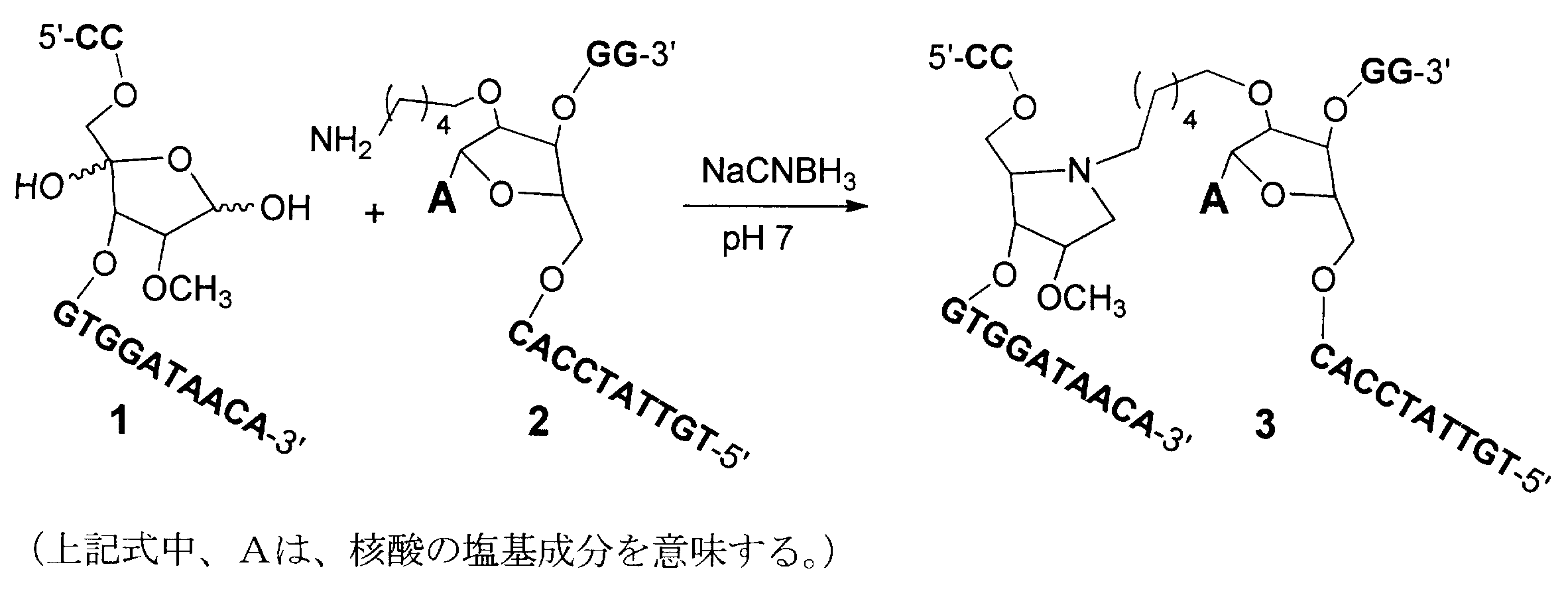
具体的には、本発明のジフルオロ体、ジメチル体及びメトキシ体のそれぞれと、上記式に示すアミン化合物(化合物2)を、100 mM 塩化ナトリウムを含む10 mMリン酸緩衝液(pH 7)に溶解し、それぞれを10μMの濃度で含む溶液を調製した。これに過剰量(1000当量)のシアノ水素化ホウ素ナトリウム(NaCNBH3)を加え37℃でインキュベートした。HPLCでの反応解析により、24時間の反応により、ジフルオロ体では約40%のコンジュゲートが、ジメチル体では約50%のコンジュゲートが、またメトキシ体では約75%のコンジュゲートが、それぞれ生成したことが確認された。生成したコンジュゲートは、いずれも単離後、MALDI-TOF-MASSにより理論値の誤差範囲内の値を示すピークを示した。また、ジフルオロ体、ジメチル体及びメトキシ体から生成したコンジュゲートは、いずれもポリアクリルアミド電気泳動において同じ位置に観測された。
なお、比較実験として、核酸誘導体として下式に示す脱塩基部位を含む化合物4を用いて同様の反応を行ったところ、核酸誘導体(化合物4)とアミン化合物(化合物2)のコンジュゲート(化合物5)の収率は40%を満たなかった。また核酸誘導体として化合物4を用いた反応では、核酸誘導体として上記ジフルオロ体、ジメチル体及びメトキシ体を用いた本発明の方法では見られなかったβ脱離による分解が一部認められた。
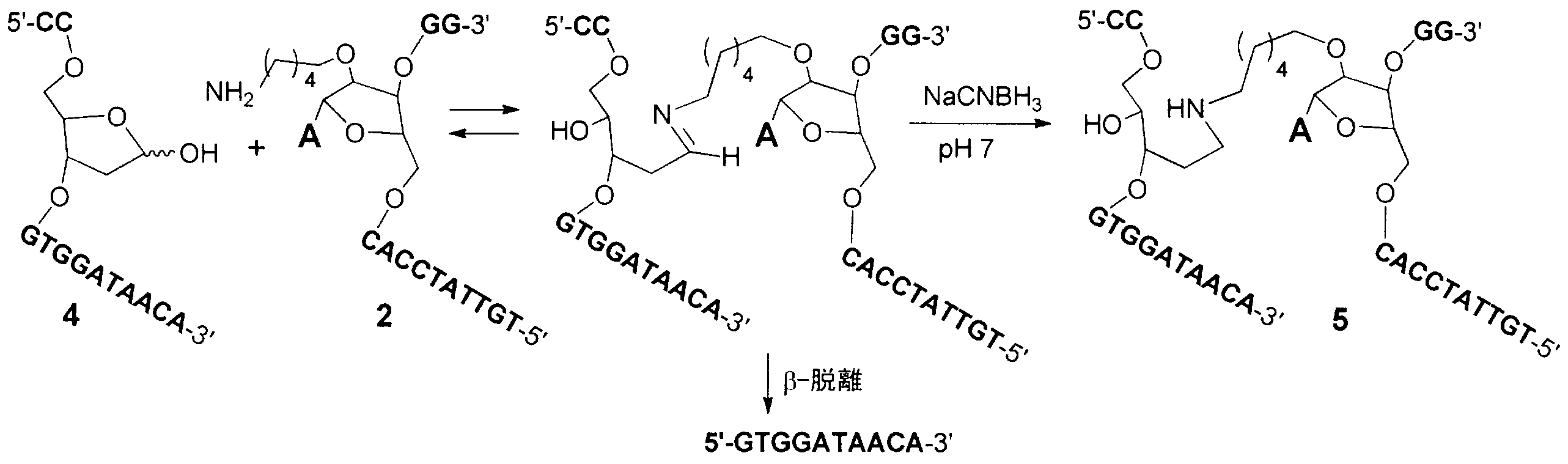
実施例2 アミン化合物とのコンジュゲート形成(その2)
製造例1で製造した本発明のジフルオロ体を、非還元条件下でアミン化合物と反応させてコンジュゲートを作製した。なお、アミン化合物として、上記実施例1と同じくアルキルアミノ基をもつ相補鎖オリゴヌクレオチド(化合物2)を用いた。
製造例1で製造した本発明のジフルオロ体を、非還元条件下でアミン化合物と反応させてコンジュゲートを作製した。なお、アミン化合物として、上記実施例1と同じくアルキルアミノ基をもつ相補鎖オリゴヌクレオチド(化合物2)を用いた。
具体的には、本発明のジフルオロ体と、上記アミン化合物(化合物2)を、100 mM 塩化ナトリウムを含む50 mMリン酸緩衝液(pH 7またはpH 8)に溶解し、本発明のジフルオロ体を20μM、アミン化合物を10μMの濃度で含む溶液を調製した。この溶液を37℃で24時間インキュベートした。
得られた反応液をHPLC及び電気泳動に供した結果をそれぞれ図1及び図2に示す。HPLC条件は下記の通りである。
<HPLC条件>
カラム:X-Bridge C18 column (Waters, 4.6 mmI.D. × 150 mm)
移動相:溶媒 A: CH3CN; 溶媒 B: 100 mM triethylammonium acetate (pH 7)
グラジエント:0分:5 % 溶媒A+95 % 溶媒B → 40分:20 % 溶媒A+80 % 溶媒B
検出:260 nm.
内部標準:5’-d(ATAC)-3’
カラム:X-Bridge C18 column (Waters, 4.6 mmI.D. × 150 mm)
移動相:溶媒 A: CH3CN; 溶媒 B: 100 mM triethylammonium acetate (pH 7)
グラジエント:0分:5 % 溶媒A+95 % 溶媒B → 40分:20 % 溶媒A+80 % 溶媒B
検出:260 nm.
内部標準:5’-d(ATAC)-3’

この結果からわかるように、上記の24時間の反応で、化合物6及び化合物7の二種のコンジュゲートがそれぞれ55%及び43%の収率で生成したことが、確認された。化合物6はMALDI-TOF マススペクトル(図3)から上記式に示す構造と推定された(m/z; 7910、化合物6の分子量の計算値7911)。また化合物7はMALDI-TOF マススペクトル(図4)から上記式に示す構造と推定された(m/z; 7331、化合物7の分子量の計算値7333)。
ジフルオロ体(核酸誘導体)と化合物2(アミン化合物)からなる二重鎖オリゴデオキシヌクレオチド、及びコンジュゲート(化合物6)をそれぞれ100 mM塩化ナトリウムを含むpH 7の10 mMリン酸緩衝液中で、2.5 μMに調整した。1分に0.5℃の割合で、温度を20℃から90℃まで変化させた時の260 nm での吸光度の変化を測定した。図5に、ジフルオロ体(核酸誘導体)と化合物2(アミン化合物)からなる二重鎖オリゴデオキシヌクレオチドの温度依存的UV変化(矢印a)と、コンジュゲート(化合物6)の温度依存的UV変化(矢印b)を示す。これから、核酸誘導体とアミン化合物(化合物2)からなる二重鎖オリゴデオキシヌクレオチドは42℃で50%の二本鎖が解離するのに対して、コンジュゲート(化合物6)の二本鎖構造中の水素結合は80℃で50%が解離し、二本鎖構造が安定していることがわかる。
実施例3 アミン化合物とのコンジュゲート形成(その3)
製造例1で製造した本発明のジフルオロ体を、非還元条件下でアミン化合物と反応させてコンジュゲートを作製した。なお、アミン化合物としては、下式に示すアルキルアミノ基をもつダンシルアミド誘導体(化合物8)を用いた。
製造例1で製造した本発明のジフルオロ体を、非還元条件下でアミン化合物と反応させてコンジュゲートを作製した。なお、アミン化合物としては、下式に示すアルキルアミノ基をもつダンシルアミド誘導体(化合物8)を用いた。
具体的には、本発明のジフルオロ体と、上記アミン化合物(化合物8)を、100 mM 塩化ナトリウムを含む50 mMリン酸緩衝液(pH 8)に溶解し、本発明のジフルオロ体を20μM、アミン化合物を2 mMの濃度で含む溶液を調製した。この溶液を37℃で24時間インキュベートした。
HPLCによる解析(実施例2に記載する条件と同じ)により、24時間の反応で66%の収率で一種のコンジュゲート(化合物9)が生成したことが確認された(図6参照)。化合物9の構造はMALDI-TOF マススペクトル(図7)から下式に示す構造と推定した(m/z; 4182、コンジュゲートの分子量の計算値4182)。

本発明の実用的価値
1)医薬、分子生物学的な応用
新薬として従来の低分子医薬の探索には限界がある中、バイオ医薬への期待は非常に高い。その一つとして核酸医薬の分野ではDNAやRNAと機能性分子のコンジュゲートを作成して、様々な機能の向上を目指す研究が活発化している。現在、ファイザー社から上市されている加齢黄斑変性症治療薬マクジェンも化学修飾RNAとPEGとのコンジュゲートであり、ペプチドとのコンジュゲートでデリバリーやターゲティング効果が期待できる。また、分子生物学的にもノンコーディングRNAの解析やその病態への関与が次々と明らかになっており、その研究には核酸分子をツールとした遺伝子サイレンシング技術が不可欠となっている。したがって、核酸コンジュゲートは医薬としても分子生物学的な研究ツールとしても広い応用が考えられ、その供給の基盤となる合成技術が求められている。本技術はそのツールとなる核酸コンジュゲートを製造する技術として実験室レベルでも企業レベルでも価値があると考える。
1)医薬、分子生物学的な応用
新薬として従来の低分子医薬の探索には限界がある中、バイオ医薬への期待は非常に高い。その一つとして核酸医薬の分野ではDNAやRNAと機能性分子のコンジュゲートを作成して、様々な機能の向上を目指す研究が活発化している。現在、ファイザー社から上市されている加齢黄斑変性症治療薬マクジェンも化学修飾RNAとPEGとのコンジュゲートであり、ペプチドとのコンジュゲートでデリバリーやターゲティング効果が期待できる。また、分子生物学的にもノンコーディングRNAの解析やその病態への関与が次々と明らかになっており、その研究には核酸分子をツールとした遺伝子サイレンシング技術が不可欠となっている。したがって、核酸コンジュゲートは医薬としても分子生物学的な研究ツールとしても広い応用が考えられ、その供給の基盤となる合成技術が求められている。本技術はそのツールとなる核酸コンジュゲートを製造する技術として実験室レベルでも企業レベルでも価値があると考える。
配列番号1は核局在化シグナルペプチドのアミノ酸配列、配列番号2は製造例1の式Aに記載する化合物(1-11)の塩基配列、配列番号3は製造例1の式Aに記載する本発明のジフルオロ体の塩基配列、配列番号4は製造例2の式Bに記載する化合物(2-12)の塩基配列、配列番号5は製造例2の式Bに記載する本発明のジメチル体の塩基配列、配列番号6は製造例3の式Cに記載する化合物(3-9)の塩基配列、配列番号7は製造例3の式Cに記載する本発明のメトキシ体の塩基配列を、それぞれ示す。
Claims (12)
- 下記一般式(I):

Xは、直接結合または酸素原子;
R1は、ハロゲン原子、置換基を有していてもよいアルキル基、または水素原子;
R2は、ハロゲン原子、置換基を有していてもよいアルキル基、または水素原子;
Aは、ヌクレオチドまたはそのアナログから形成される骨格を有する核酸塩基配列含有オリゴマー若しくはポリマー、または水素原子;
Bは、ヌクレオチドまたはそのアナログから形成される骨格を有する核酸塩基配列含有オリゴマー若しくはポリマー、または水素原子;を意味する。
但し、Xが直接結合であるとき、R1及びR2は、お互いに、同一又は異なるハロゲン原子であるか、または同一又は異なる、置換基を有していてもよいアルキル基であり(この場合、R1とR2は、お互いに連結してシクロアルキル基を形成していてもよい);
Xが酸素原子であるとき、R1は置換基を有していてもよいアルキル基または水素原子、R2は水素原子または置換基を有していてもよいアルキル基である。また、Xが直接結合及び酸素原子のいずれの場合も、A及びBは同時に水素原子ではない。)
で示される核酸誘導体(I)とアミン化合物(II)を、還元剤の存在下で反応させる工程を有する、
上記核酸誘導体(I)とアミン化合物(II)とのコンジュゲートを製造する方法。 - 上記核酸誘導体(I)が、下記一般式(Ia-1)、(Ia)及び(Ib)からなる群から選択されるいずれかの化合物である、請求項1に記載する製造方法:
(1)一般式(Ia-1)で示される化合物:

R1a-1及びR2a-1は、同一または異なるハロゲン原子;
Aは、ヌクレオチドまたはそのアナログから形成される骨格を有する核酸塩基配列含有オリゴマー若しくはポリマー、または水素原子;
Bは、ヌクレオチドまたはそのアナログから形成される骨格を有する核酸塩基配列含有オリゴマー若しくはポリマー、または水素原子を意味する。
但し、A及びBは同時に水素原子ではない);
(2)一般式(Ia)で示される化合物:
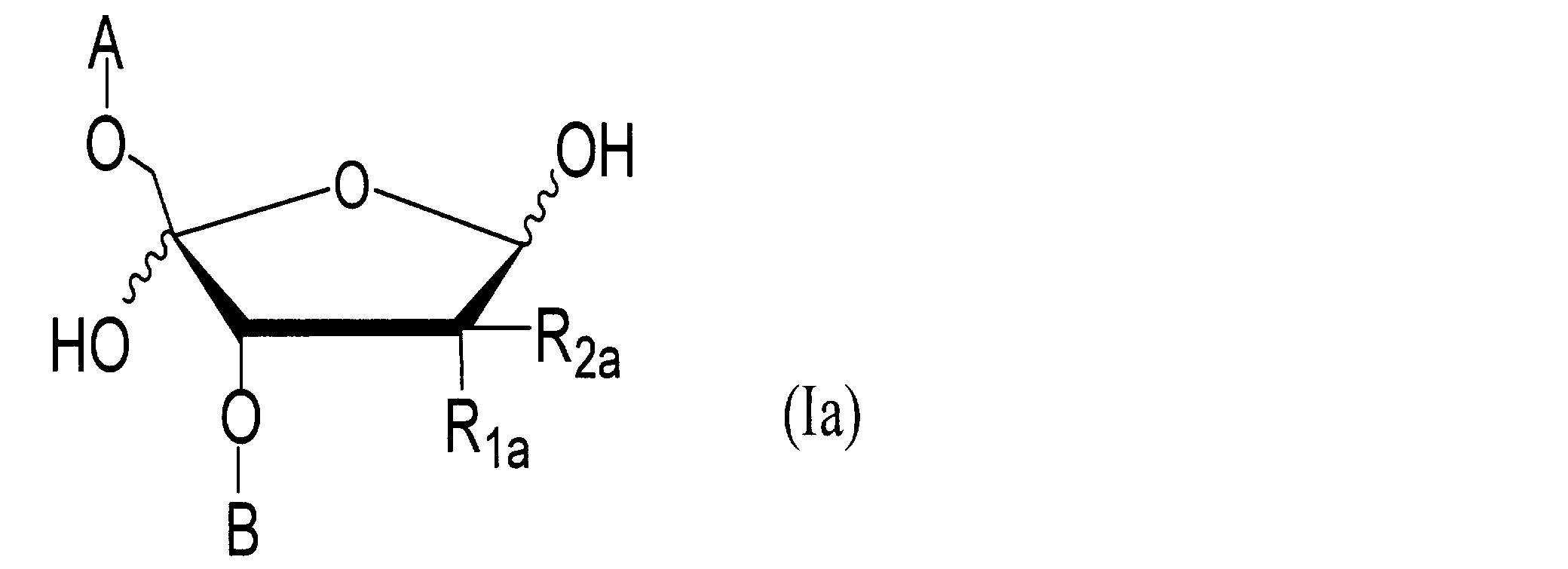
R1a及びR2aは、お互いに、同一又は異なるハロゲン原子であるか、または同一又は異なる、置換基を有していてもよいアルキル基である。R1a及びR2aが置換基を有していてもよいアルキル基である場合、お互いに連結して置換基を有していてもよいシクロアルキル基を形成していてもよい。
Aは、ヌクレオチドまたはそのアナログから形成される骨格を有する核酸塩基配列含有オリゴマー若しくはポリマー、または水素原子を;
Bは、ヌクレオチドまたはそのアナログから形成される骨格を有する核酸塩基配列含有オリゴマー若しくはポリマー、または水素原子を意味する。但し、A及びBは同時に水素原子ではない。);
(3)一般式(Ib)で示される化合物:

R1bは置換基を有していてもよいアルキル基であり、R2bは水素原子または置換基を有していてもよいアルキル基である。
Aは、ヌクレオチドまたはそのアナログから形成される骨格を有する核酸塩基配列含有オリゴマー若しくはポリマー、または水素原子を;
Bは、ヌクレオチドまたはそのアナログから形成される骨格を有する核酸塩基配列含有オリゴマー若しくはポリマー、または水素原子を意味する。但し、A及びBは同時に水素原子ではない。)。 - 上記核酸誘導体(I)が、(1)~(3) からなる群から選択されるいずれかの化合物である、請求項2に記載する製造方法:
(1)一般式(Ia-1)において、R1a-1及びR2a-1が、同一または異なるハロゲン原子;
A及びBが、同一または異なる、ヌクレオチドから形成される骨格を有する核酸塩基配列含有オリゴマーまたはポリマーである化合物;
(2)一般式(Ia)において、R1a及びR2aが、同一または異なる、置換基を有するアルキル基;
A及びBが、同一または異なる、ヌクレオチドから形成される骨格を有する核酸塩基配列含有オリゴマーまたはポリマーである化合物;
(3)一般式(Ib)において、R1bは置換基を有していてもよいアルキル基であり、R2bは水素原子;
A及びBが、同一または異なる、ヌクレオチドから形成される骨格を有する核酸塩基配列含有オリゴマーまたはポリマーである化合物。 - 一般式(Ia-1):
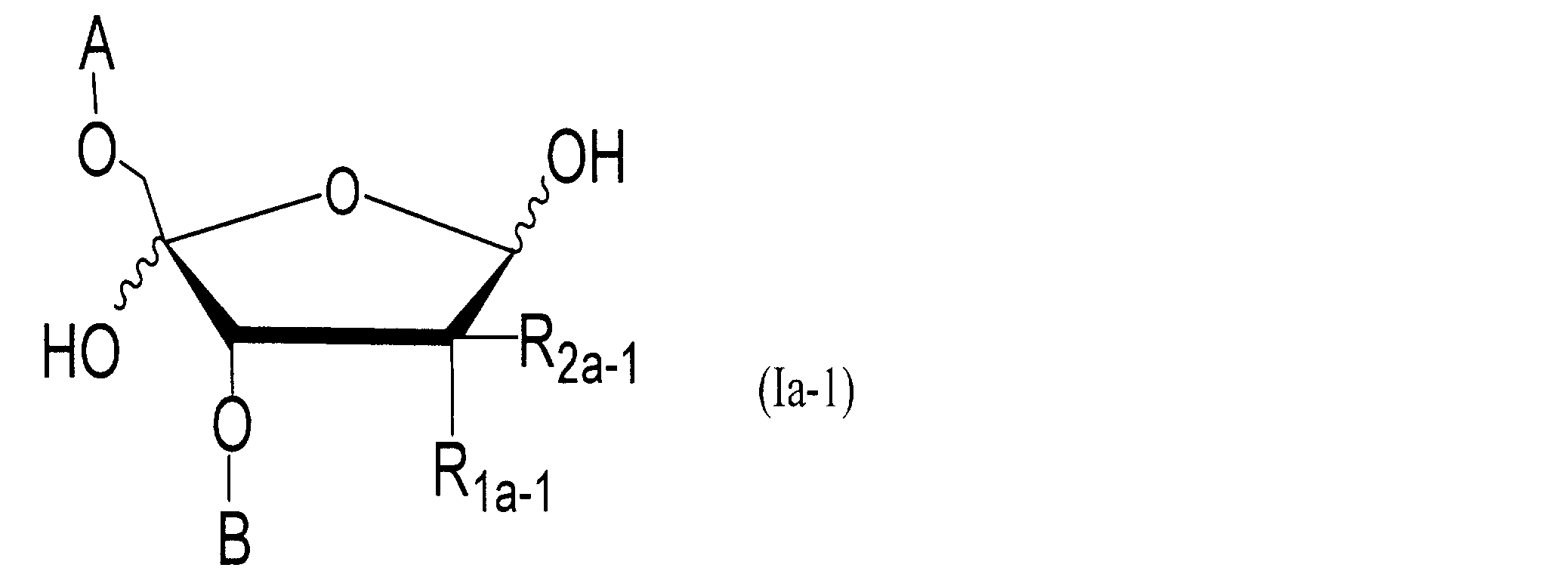
R1a-1及びR2a-1は、同一または異なるハロゲン原子;
Aは、ヌクレオチドまたはそのアナログから形成される骨格を有する核酸塩基配列含有オリゴマー若しくはポリマー、または水素原子;
Bは、ヌクレオチドまたはそのアナログから形成される骨格を有する核酸塩基配列含有オリゴマー若しくはポリマー、または水素原子を意味する。
但し、A及びBは同時に水素原子ではない)。
で示される核酸誘導体、または
一般式(Ib):

R1bは置換基を有していてもよいアルキル基であり、R2bは水素原子または置換基を有していてもよいアルキル基である。
Aは、ヌクレオチドまたはそのアナログから形成される骨格を有する核酸塩基配列含有オリゴマー若しくはポリマー、または水素原子を;
Bは、ヌクレオチドまたはそのアナログから形成される骨格を有する核酸塩基配列含有オリゴマー若しくはポリマー、または水素原子を意味する。但し、A及びBは同時に水素原子ではない。)
で示される核酸誘導体と
アミン化合物(II)とを、還元剤の非存在下で反応させる工程を有する、
上記核酸誘導体とアミン化合物(II)とのコンジュゲートを製造する方法。 - 上記核酸誘導体(Ia-1)が、下記(1)に示す化合物である、請求項4に記載する製造方法:
(1)一般式(Ia-1)において、R1a-1及びR2a-1が、同一または異なるハロゲン原子;
A及びBが、同一または異なる、ヌクレオチドから形成される骨格を有する核酸塩基配列含有オリゴマーまたはポリマーである化合物。 - 上記アミン化合物(II)が、一級アミノ基を有する、ペプチド、蛋白質、または核酸である請求項1乃至5のいずれかに記載する製造方法。
- 生成するコンジュゲートが下記式で示される化合物である、請求項1乃至6のいずれかに記載する製造方法:
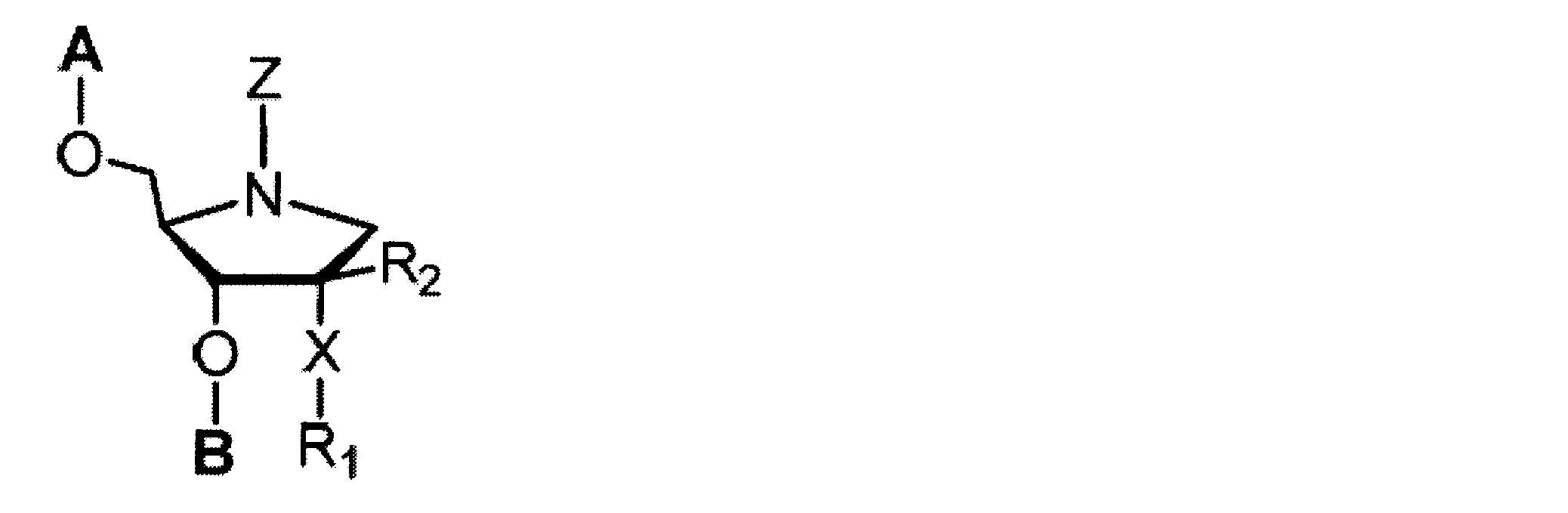
Zは、アミノ化合物(II)の一級アミノ基を除いた部位;
Xは、直接結合または酸素原子;
R1は、ハロゲン原子、置換基を有していてもよいアルキル基、または水素原子;
R2は、ハロゲン原子、置換基を有していてもよいアルキル基、または水素原子;
Aは、ヌクレオチドまたはそのアナログから形成される骨格を有する核酸塩基配列含有オリゴマー若しくはポリマー、または水素原子;
Bは、ヌクレオチドまたはそのアナログから形成される骨格を有する核酸塩基配列含有オリゴマー若しくはポリマー、または水素原子;を意味する。
但し、Xが直接結合であるとき、R1及びR2は、お互いに、同一又は異なるハロゲン原子であるか、または同一又は異なる、置換基を有していてもよいアルキル基であり(この場合、R1とR2は、お互いに連結してシクロアルキル基を形成していてもよい);
Xが酸素原子であるとき、R1は置換基を有していてもよいアルキル基または水素原子、R2は水素原子または置換基を有していてもよいアルキル基である。
また、Xが直接結合及び酸素原子のいずれの場合も、A及びBは同時に水素原子ではない。)。 - 請求項1乃至7のいずれかに記載する方法で製造される、核酸誘導体(I)若しくは核酸誘導体(Ia)とアミン化合物(II)とのコンジュゲート。
- 下記式で示される化合物である、請求項8に記載するコンジュゲート:

Zは、アミノ化合物(II)の一級アミノ基を除いた部位;
Xは、直接結合または酸素原子;
R1は、ハロゲン原子、置換基を有していてもよいアルキル基、または水素原子;
R2は、ハロゲン原子、置換基を有していてもよいアルキル基、または水素原子;
Aは、ヌクレオチドまたはそのアナログから形成される骨格を有する核酸塩基配列含有オリゴマー若しくはポリマー、または水素原子;
Bは、ヌクレオチドまたはそのアナログから形成される骨格を有する核酸塩基配列含有オリゴマー若しくはポリマー、または水素原子;を意味する。
但し、Xが直接結合であるとき、R1及びR2は、お互いに、同一又は異なるハロゲン原子であるか、または同一又は異なる、置換基を有していてもよいアルキル基であり(この場合、R1とR2は、お互いに連結してシクロアルキル基を形成していてもよい);
Xが酸素原子であるとき、R1は置換基を有していてもよいアルキル基または水素原子、R2は水素原子または置換基を有していてもよいアルキル基である。
また、Xが直接結合及び酸素原子のいずれの場合も、A及びBは同時に水素原子ではない。)。 - 下記一般式(Ia-1)で示される核酸誘導体:

R1a-1及びR2a-1は、同一または異なるハロゲン原子;
Aは、ヌクレオチドまたはそのアナログから形成される骨格を有する核酸塩基配列含有オリゴマー若しくはポリマー、または水素原子;
Bは、ヌクレオチドまたはそのアナログから形成される骨格を有する核酸塩基配列含有オリゴマー若しくはポリマー、または水素原子を意味する。
但し、A及びBは同時に水素原子ではない)。 - 一般式(Ia-1)中、R1a-1及びR2a-1で示されるハロゲン原子が、同一又は異なって、フッ素原子または塩素原子である、請求項10に記載する核酸誘導体。
- 一般式(Ia-1)中、A及びBで示されるオリゴマーまたはポリマーが、同一または異って、リボヌクレオチドまたはデオキシリボヌクレオチドを含むオリゴマーまたはポリマーである、請求項10または11に記載する核酸誘導体。
Priority Applications (1)
| Application Number | Priority Date | Filing Date | Title |
|---|---|---|---|
| JP2014516623A JPWO2013175656A1 (ja) | 2012-05-25 | 2012-11-14 | 新規核酸誘導体、及び当該核酸誘導体とアミン化合物のコンジュゲート |
Applications Claiming Priority (2)
| Application Number | Priority Date | Filing Date | Title |
|---|---|---|---|
| JP2012-120321 | 2012-05-25 | ||
| JP2012120321 | 2012-05-25 |
Publications (1)
| Publication Number | Publication Date |
|---|---|
| WO2013175656A1 true WO2013175656A1 (ja) | 2013-11-28 |
Family
ID=49623375
Family Applications (1)
| Application Number | Title | Priority Date | Filing Date |
|---|---|---|---|
| PCT/JP2012/079458 Ceased WO2013175656A1 (ja) | 2012-05-25 | 2012-11-14 | 新規核酸誘導体、及び当該核酸誘導体とアミン化合物のコンジュゲート |
Country Status (2)
| Country | Link |
|---|---|
| JP (1) | JPWO2013175656A1 (ja) |
| WO (1) | WO2013175656A1 (ja) |
-
2012
- 2012-11-14 JP JP2014516623A patent/JPWO2013175656A1/ja active Pending
- 2012-11-14 WO PCT/JP2012/079458 patent/WO2013175656A1/ja not_active Ceased
Non-Patent Citations (8)
| Title |
|---|
| SATOSHI INOUE ET AL.: "2-i ni Chikanki o Motsu C4'-i Sankagata Datsu Enki Bui Yudotai no Gosei to Amine Bunshi tono Hannosei Kenkyu", ABSTRACTS OF ANNUAL MEETING OF PHARMACEUTICAL SOCIETY OF JAPAN, vol. 130, no. 2, 2010, pages 159 * |
| SATOSHI INOUE ET AL.: "C4'-i Sankagata RNA Oyobi DNA no Amine Bunshi tono Hannosei Kenkyu", ABSTRACTS OF ANNUAL MEETING OF PHARMACEUTICAL SOCIETY OF JAPAN, vol. 129, 2009, pages 193 * |
| SATOSHI INOUE ET AL.: "Caged Zenkutai o Mochiite Seisei shita C4' Sankagata DNA Oyobi RNA no Hannosei", THE PHARMACEUTICAL SOCIETY OF JAPAN KYUSHU SHIBU TAIKAI KOEN YOSHISHU, vol. 25, 2008, pages 68 * |
| SATOSHI INOUE ET AL.: "Hikari Hanno o Mochiita 2-i Chikan C4' Sankagata DNA Yudotai no Seisei to Hannosei Kenkyu", ABSTRACTS SYMPOSIUM ON PROGRESS IN ORGANIC REACTIONS AND SYNTHESES, vol. 36, 2010, pages 312 - 313 * |
| SHOKO JINNOUCHI ET AL.: "2'-i Chikan C4' Sankagata DNA Yudotai no Gosei to Amine Hannosei Kenkyu", THE PHARMACEUTICAL SOCIETY OF JAPAN KYUSHU SHIBU TAIKAI KOEN YOSHISHU, vol. 28, 2011, pages 157 * |
| TOMI ERIKO ET AL.: "Photochemical generation and reaction of 2'-substituted analogs of C4'-oxidized abasic lesion", NUCLEIC ACIDS SYMPOSIUM SERIES, vol. 53, no. 1, 2009, pages 185 - 186 * |
| YANG BO ET AL.: "2'-i ni Difluoro-ki o Donyu shita C' Sankagata Kakusan Yudotai no Gosei to sono Hannosei", THE PHARMACEUTICAL SOCIETY OF JAPAN KYUSHU SHIBU TAIKAI KOEN YOSHISHU, vol. 28, 2011, pages 159 * |
| YANG BO ET AL.: "Tobu 2'-i ni Chikanki o Yusuru C4' Sankagata DNA no Gosei to sono Amine Hannosei", ABSTRACTS OF ANNUAL MEETING OF PHARMACEUTICAL SOCIETY OF JAPAN, vol. 132, no. 2, March 2012 (2012-03-01), pages 229 * |
Also Published As
| Publication number | Publication date |
|---|---|
| JPWO2013175656A1 (ja) | 2016-01-12 |
Similar Documents
| Publication | Publication Date | Title |
|---|---|---|
| US10329318B2 (en) | Method for the synthesis of phosphorus atom modified nucleic acids | |
| JP3535519B2 (ja) | N−2置換プリン類 | |
| AU2020363391A1 (en) | Oligonucleotide compositions and methods of use thereof | |
| US20030134808A1 (en) | Oligonucleotide analogues | |
| CA2936712A1 (en) | Chiral design | |
| JP7263236B2 (ja) | 新規二環式ヌクレオシドおよびそれから調製されたオリゴマー | |
| WO2001002423A9 (en) | 2'-guanidinyl-substituted oligonucleotides and gene expression modulation therewith | |
| KR20150036642A (ko) | 키랄 제어 | |
| IL135000A (en) | Locked nucleoside analogues contain nucleic acid compounds that contain them | |
| FR2607507A1 (fr) | Nouveaux derives a-d-oligonucleotides, leur preparation et leur emploi | |
| TW202444908A (zh) | 5'-膦酸酯修飾的核苷類似物及其製備的寡核苷酸 | |
| WO2021153762A1 (ja) | 一本鎖ポリヌクレオチド | |
| US8039611B2 (en) | 2′-hydroxyl group-modified ribonucleoside derivatives | |
| US20160311845A1 (en) | Nucleotide derivative or salt thereof, nucleotide-derived 5'-phosphate ester or salt thereof, nucleotide-derived 3'-phosphoramidite compound or salt thereof, and polynucleotide | |
| CN119285688A (zh) | 修饰的核苷酸单体及其用途 | |
| WO2013175656A1 (ja) | 新規核酸誘導体、及び当該核酸誘導体とアミン化合物のコンジュゲート | |
| CN118813612A (zh) | 一种化合物在RNAi药物中的应用 | |
| JP6429264B2 (ja) | ボラノホスフェート化合物、及び核酸オリゴマー | |
| Takegawa-Araki et al. | 2′-N-Alkylaminocarbonyl-2′-amino-LNA: Synthesis, duplex stability, nuclease resistance, and in vitro anti-microRNA activity | |
| Carnero et al. | The impact of an extended nucleobase-2′-deoxyribose linker in the biophysical and biological properties of oligonucleotides | |
| WO2026086824A1 (zh) | 双链寡核苷酸、缀合物和组合物以及它们的用途 | |
| WO2004048376A1 (ja) | 二環性ナフチリジンヌクレオシド | |
| CN120398985A (zh) | 一种核糖偶联脂肪链核苷酸单体的制备和应用 | |
| TW202604553A (zh) | 5’-修飾的核苷衍生物及包含其的寡核苷酸 | |
| US20260071220A1 (en) | Conjugate of nucleotide analog-containing double-stranded rnai analog |
Legal Events
| Date | Code | Title | Description |
|---|---|---|---|
| 121 | Ep: the epo has been informed by wipo that ep was designated in this application |
Ref document number: 12877141 Country of ref document: EP Kind code of ref document: A1 |
|
| ENP | Entry into the national phase |
Ref document number: 2014516623 Country of ref document: JP Kind code of ref document: A |
|
| NENP | Non-entry into the national phase |
Ref country code: DE |
|
| 122 | Ep: pct application non-entry in european phase |
Ref document number: 12877141 Country of ref document: EP Kind code of ref document: A1 |