WO2013073684A1 - 哺乳動物個体における前肢帯筋異常症を診断するためのマーカーおよびそれを用いた検出方法 - Google Patents
哺乳動物個体における前肢帯筋異常症を診断するためのマーカーおよびそれを用いた検出方法 Download PDFInfo
- Publication number
- WO2013073684A1 WO2013073684A1 PCT/JP2012/079843 JP2012079843W WO2013073684A1 WO 2013073684 A1 WO2013073684 A1 WO 2013073684A1 JP 2012079843 W JP2012079843 W JP 2012079843W WO 2013073684 A1 WO2013073684 A1 WO 2013073684A1
- Authority
- WO
- WIPO (PCT)
- Prior art keywords
- forelimb
- individual
- myopathy
- gfra1
- gene
- Prior art date
- Legal status (The legal status is an assumption and is not a legal conclusion. Google has not performed a legal analysis and makes no representation as to the accuracy of the status listed.)
- Ceased
Links
Images


Classifications
-
- C—CHEMISTRY; METALLURGY
- C12—BIOCHEMISTRY; BEER; SPIRITS; WINE; VINEGAR; MICROBIOLOGY; ENZYMOLOGY; MUTATION OR GENETIC ENGINEERING
- C12Q—MEASURING OR TESTING PROCESSES INVOLVING ENZYMES, NUCLEIC ACIDS OR MICROORGANISMS; COMPOSITIONS OR TEST PAPERS THEREFOR; PROCESSES OF PREPARING SUCH COMPOSITIONS; CONDITION-RESPONSIVE CONTROL IN MICROBIOLOGICAL OR ENZYMOLOGICAL PROCESSES
- C12Q1/00—Measuring or testing processes involving enzymes, nucleic acids or microorganisms; Compositions therefor; Processes of preparing such compositions
- C12Q1/68—Measuring or testing processes involving enzymes, nucleic acids or microorganisms; Compositions therefor; Processes of preparing such compositions involving nucleic acids
- C12Q1/6876—Nucleic acid products used in the analysis of nucleic acids, e.g. primers or probes
- C12Q1/6883—Nucleic acid products used in the analysis of nucleic acids, e.g. primers or probes for diseases caused by alterations of genetic material
-
- G—PHYSICS
- G01—MEASURING; TESTING
- G01N—INVESTIGATING OR ANALYSING MATERIALS BY DETERMINING THEIR CHEMICAL OR PHYSICAL PROPERTIES
- G01N33/00—Investigating or analysing materials by specific methods not covered by groups G01N1/00 - G01N31/00
- G01N33/48—Biological material, e.g. blood, urine; Haemocytometers
- G01N33/50—Chemical analysis of biological material, e.g. blood, urine; Testing involving biospecific ligand binding methods; Immunological testing
- G01N33/68—Chemical analysis of biological material, e.g. blood, urine; Testing involving biospecific ligand binding methods; Immunological testing involving proteins, peptides or amino acids
- G01N33/6893—Chemical analysis of biological material, e.g. blood, urine; Testing involving biospecific ligand binding methods; Immunological testing involving proteins, peptides or amino acids related to diseases not provided for elsewhere
-
- C—CHEMISTRY; METALLURGY
- C12—BIOCHEMISTRY; BEER; SPIRITS; WINE; VINEGAR; MICROBIOLOGY; ENZYMOLOGY; MUTATION OR GENETIC ENGINEERING
- C12Q—MEASURING OR TESTING PROCESSES INVOLVING ENZYMES, NUCLEIC ACIDS OR MICROORGANISMS; COMPOSITIONS OR TEST PAPERS THEREFOR; PROCESSES OF PREPARING SUCH COMPOSITIONS; CONDITION-RESPONSIVE CONTROL IN MICROBIOLOGICAL OR ENZYMOLOGICAL PROCESSES
- C12Q2600/00—Oligonucleotides characterized by their use
- C12Q2600/156—Polymorphic or mutational markers
-
- G—PHYSICS
- G01—MEASURING; TESTING
- G01N—INVESTIGATING OR ANALYSING MATERIALS BY DETERMINING THEIR CHEMICAL OR PHYSICAL PROPERTIES
- G01N2800/00—Detection or diagnosis of diseases
- G01N2800/10—Musculoskeletal or connective tissue disorders
Definitions
- the present invention relates to a marker for diagnosing forelimb girdle dysplasia in a mammal individual and a method for diagnosing forelimb girdle dysplasia in a mammal individual using the same.
- Forelimb-girdle muscular anomaly also known as the three shoulders in livestock, is known to be a genetic disorder whose main symptoms are tremor and difficulty in standing up due to low formation of the forelimb girdle muscle. (Masoudi et al., Animal Science Journal 78 (6), 672-675, 2007). In cattle, individuals with forelimb band myopathy are often abandoned, and the onset of this disease causes significant economic losses to producers. Although this genetic disease is known to be due to a recessive mutation, the causative gene is unknown and the carrier individual cannot be identified, and thus the occurrence of the disease could not be prevented.
- An object of the present invention is to provide a marker for diagnosing a forelimb band myogenesis abnormality in a mammal individual and a method for diagnosing a forelimb band myogenesis abnormality in a mammal individual using the marker.
- the inventors have suffered from forelimb band myopathy, although the base on the bovine genome corresponding to the 1060th base of the cDNA of the GFRA1 gene (GenBank accession number: NM_001105411.1) is C in healthy individuals. It was found that bovine individuals and bovine individuals who are carriers of forelimb band myopathy have a nonsense mutation in which this base is mutated to T, and lack the function of the GFRA1 gene. It came.
- the mammal may be a human or non-human, and may be a laboratory animal such as a mouse, rat, rabbit or monkey, a pet such as a dog or cat, or a domestic animal such as a cow, horse, sheep or pig. .
- cow refers to an animal belonging to the genus Bos, and includes, for example, livestock cattle of the Bos taurus species, Banten (wild cattle) of the Bos javanicus species, and Bob indicus species of cows.
- the base position is indicated by the base of the sense strand in the DNA duplex.
- the base position is, for example, the 1060th base sequence of GDNF (glial cell line-derived neurotrophic factor) family receptor alpha 1 (GFRA1) gene cDNA (NM_001105411.1, SEQ ID NO: 1).
- the base sequence is specified by counting from the 5 ′ side to the 3 ′ side of the base sequence.
- the base is the base specified in the base sequence. If there is a deletion or insertion of a base on the genomic DNA containing the base, it is not always necessary to match the number representing the base position.
- the marker according to the present invention is a marker for diagnosing a mammal individual suffering from forelimb band myopathy, or a carrier of forelimb band myopathy, and is one of the GFRA1 genes. It consists of an isolated polynucleotide having part or all, wherein the polynucleotide contains a loss-of-function mutation of the gene.
- the mammal individual is preferably a bovine individual.
- the loss-of-function mutation is more preferably a mutation at the 1060th base of the cDNA of the GFRA1 gene having SEQ ID NO: 1.
- the marker according to the present invention is a marker for diagnosing that a mammal individual suffers from forelimb band myopathy, or is a carrier of forelimb band myopathy, and lacks a function. It is characterized in that it is mRNA encoding the GFRA1 protein or GFRA1 protein lacking the function.
- the kit according to the present invention is a kit for diagnosing a mammal individual suffering from forelimb band myopathy, or being a carrier for forelimb band myopathy, and one of the GFRA1 genes.
- An isolated polynucleotide having a part or all of the polynucleotide comprises a primer pair for amplifying a base having a loss-of-function mutation of the gene.
- the mammal individual is preferably a bovine individual.
- the loss-of-function mutation is more preferably a mutation at the 1060th base of the cDNA of the GFRA1 gene having SEQ ID NO: 1.
- the kit according to the present invention further comprises a restriction enzyme, which is amplified by the primer pair depending on whether the base amplified by the primer pair has a loss-of-function mutation of the gene. It is further preferred that the cleavage pattern of the polypeptide containing the generated base is different. More preferably, the restriction enzyme is MwoI.
- a diagnostic method is a diagnostic method for diagnosing that a mammal individual other than a human suffers from forelimb band myopathy, or is a carrier for forelimb band myopathy. And a step of examining whether the GFRA1 gene is a wild type or has a loss-of-function mutation in genomic DNA or mRNA isolated from the mammal individual.
- this diagnosis method when the wild-type GFRA1 gene is not present in the genomic DNA or when the mRNA transcribed from the wild-type GFRA1 gene is not present in the mRNA, the individual mammal is treated with a forelimb band myopathy.
- the mammal individual is a carrier individual of forelimb band myopathy.
- the mammal individual when both alleles of the GFRA1 locus have a loss-of-function mutation, the mammal individual is diagnosed as an affected individual with a forelimb band myopathy, and the GFRA1 gene It is more preferable that the method further comprises a step of diagnosing that the mammal individual is a carrier individual of forelimb band myopathy when one of the alleles has a loss-of-function mutation. More preferably, the mammalian individual is a bovine individual.
- the loss-of-function mutation is a nonsense mutation at the 1060th base in the cDNA of the GFRA1 gene having SEQ ID NO: 1. More preferably, the nonsense mutation is a C to T mutation.
- the diagnostic method according to the present invention is a diagnostic method for diagnosing the presence of a forelimb girdle myopathy in a non-human mammal individual, which encodes a wild-type GFRA1 protein in the mammalian individual.
- the expression level cannot be detected, it is preferable to diagnose that the individual mammal is suffering from forelimb band myopathy.
- the identification method according to the present invention is a method for identifying a non-human mammal individual who is a carrier of forelimb band myopathy, isolated from a non-human mammal individual who does not develop forelimb band myopathy.
- a step of examining whether or not the GFRA1 gene has a loss-of-function mutation in the genomic DNA or mRNA, and a non-human mammal having a wild-type GFRA1 gene and a GFRA1 gene having a loss-of-function mutation in the genomic DNA Identifying an animal individual or a non-human mammal individual in which mRNA transcribed from the wild-type GFRA1 gene and mRNA transcribed from a GFRA1 gene having a loss-of-function mutation are present in the mRNA.
- the mammal individual is a bovine individual.
- the loss-of-function mutation is more preferably a nonsense mutation from C to T in the 1060th base of the cDNA of the GFRA1 gene having SEQ ID NO: 1.
- the method for determining whether the GFRA1 gene is a cause of the forelimb girdle myopathy in a mammal individual suffering from forelimb girdle myopathy is a mammal individual suffering from forelimb girdle myopathy.
- a step of determining a part or all of the base sequence of the GFRA1 gene in a mammal individual who is a carrier of forelimb band myopathy, the determined base sequence, and the base sequence of the wild-type GFRA1 gene is a step of comparing, and a step of determining whether or not there is a loss-of-function mutation in the determined base sequence.
- the marker according to the present invention is a marker for diagnosing that a bovine individual suffers from forelimb band myopathy, or is a carrier for forelimb band myopathy, and includes MOK2630, MOK2637, SNP. B, and an isolated polynucleotide having one or more bases or base sequences selected from the group consisting of SNP D.
- the kit according to the present invention is a kit for diagnosing that a bovine individual suffers from forelimb band myopathy, or is a carrier of forelimb band myopathy, and includes MOK2630, MOK2637, SNP. B and one or more primer pairs for amplifying one or more selected from the group consisting of SNP D.
- the diagnostic method according to the present invention is a diagnostic method for diagnosing that a bovine individual suffers from forelimb band myopathy, or is a carrier for forelimb band myopathy, comprising the bovine individual And examining whether one or more genotypes selected from the group consisting of MOK2630, MOK2637, SNP B, and SNP D are healthy or diseased.
- the diagnostic method according to the present invention further comprises a step of examining whether the genotype of MOK2630 is a healthy type or a disease type in genomic DNA isolated from a bovine individual, wherein the MOK2630 genotype is a disease type.
- the bovine individual is diagnosed as an affected individual of a forelimb girdle myopathy, and when the genotype of the MOK2630 is a heterozygous of a normal type and a disease type, the bovine individual is a forelimb It is preferable to diagnose that the bovine individual is a healthy individual when diagnosing as a carrier individual for dystrophy of the band and when the genotype of the MOK2630 is a healthy homozygote.
- the diagnostic method according to the present invention further comprises a step of examining whether the genotype of MOK2637 is a healthy type or a disease type in genomic DNA isolated from a bovine individual, wherein the MOK2637 genotype is a disease type.
- the bovine individual is diagnosed as an affected individual of a forelimb girdle myopathy, and when the genotype of the MOK2637 is a heterozygous of a healthy type and a disease type, the bovine individual is a forelimb It is preferable to diagnose that the bovine individual is a healthy individual when diagnosing as a carrier individual for dystrophy of the girdle and when the genotype of the MOK2637 is a healthy homozygote.
- the diagnostic method according to the present invention further comprises a step of examining whether the SNP B genotype is a healthy type or a disease type in genomic DNA isolated from a bovine individual, wherein the SNP B genotype is When the diseased type is homozygous, it is diagnosed that the bovine individual is affected by a forelimb girdle myopathy, and when the SNP-B genotype is a heterozygous between a healthy type and a diseased type, the bovine individual It is preferable to diagnose that the bovine individual is a healthy individual when the individual is diagnosed as a carrier individual for forelimb band myopathy and the genotype of the SNP B is a healthy homozygote.
- the diagnostic method according to the present invention further comprises a step of examining whether the SNP D genotype is a healthy type or a disease type in genomic DNA isolated from a bovine individual, wherein the SNP D genotype is When the diseased type is homozygous, the bovine individual is diagnosed as having a forelimb girdle myopathy, and the SNP D genotype is a healthy type and a diseased type heterozygote. It is preferable to diagnose that the bovine individual is a healthy individual when the individual is diagnosed as a carrier individual with forelimb band myopathy and the genotype of the SNP D is a healthy homozygote.
- the identification method according to the present invention is an identification method of bovine individuals that are carriers of forelimb band myopathy, and in genomic DNA isolated from bovine individuals that do not develop forelimb band myopathy, MOK2630, MOK2637 , SNP B, and SNP D, a step of examining whether one or more genotypes selected from the group consisting of normal type and disease type, and the examined genotype is a heterozygote of normal type and disease type
- the method includes the step of identifying a bovine individual.
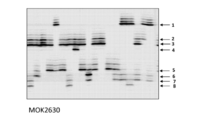
- FIG. 7 is an electrophoretogram of healthy type (1-7) and disease type (8) of MOK2630, which is an embodiment of the present invention. It is an electrophoretogram of healthy type (1, 2, 4) and disease type (No. 3) of MOK2637, which is an embodiment of the present invention. It is a figure which shows the nonsense variation
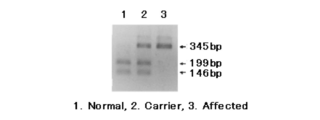
- healthy Japanese black hair (lane 1, Normal), forelimb girdle muscular dysfunction carrier black hair Japanese (lane 2, Carrier), forelimb girdle muscular abnormality affected black hair (lane 3, Affected) It is a figure which shows the pattern of the DNA fragment obtained by digesting the PCR product which used the genomic DNA of (2) with MwoI.
- Forelimb girdle myopathy is a disease caused by a recessive mutation that deletes the function of the GFRA1 gene (deficient mutation). That is, when the wild type GFRA1 gene is not present on the genomic DNA, the individual (also referred to as an affected individual in this specification) suffers from forelimb band myopathy. In this case, all GFRA1 genes possessed by the individual are also mutant GFRA1 genes having a loss-of-function mutation. Moreover, if the individual has at least one wild-type GFRA1 gene, the phenotype of the individual is normal and no forelimb band myopathy is developed.
- the individual does not develop forelimb band myopathy It ’s not a career.
- This healthy individual is an individual in which all copies of the GFRA1 gene are wild-type GFRA1 gene, and even if the phenotype is normal, the affected individual does not develop a carrier individual or a forelimb band myopathy Is not included.
- the individual has two copies of the GFRA1 gene allele, one at the GFRA1 locus on the genome, ie, no extra gene copies other than the normal GFRA1 gene, If the allele has a loss-of-function mutation, it becomes an individual affected with a forelimb band dysfunction, and if only one allele has a loss-of-function mutation, it becomes a carrier for forelimb band dysfunction. If wild type, it becomes a healthy individual.
- forelimb girdle myopathy refers to a disease known as “forelimb girdle myopathy” or “three shoulders” in cattle and bovine “forelimb girdle muscle” in mammals other than cattle. It refers to a disease corresponding to “abnormality” or a disease that shows poor formation of forelimb or upper limb girdle muscle, and may be a disease that is not known by the name of the “forelimb band muscle abnormality” in the mammal. .
- a mammal individual “has developed forelimb girdle myopathy” means that the individual suffers from forelimb girdle myopathy, resulting in poor formation of forelimb or upper limb girdle muscles. It means that is recognized.
- limb mammals in addition to morphological features such as scapular protrusion due to poorly formed forelimb girdle muscles and drooping of the auricles, it is not seen in healthy individuals such as difficulty standing up and decreased motor function such as tremor Abnormalities may also be present.
- these physical abnormalities and motor function abnormalities are not limited by the degree.
- An individual “being suffered from forelimb band myopathy” may or may not have developed forelimb band myopathy. This refers to the case where the type GFRA1 gene is not present.
- forelimb band myopathy is also related to mRNA transcribed from the GFRA1 gene.
- mRNA transcribed from the wild type GFRA1 gene in mRNA transcribed from the GFRA1 gene. Does not exist.
- mRNA transcribed from a wild-type GFRA1 gene and mRNA transcribed from a GFRA1 gene having a loss-of-function mutation exist in healthy individuals. In healthy individuals, only mRNA transcribed from the wild-type GFRA1 gene is present, and mRNA transcribed from the GFRA1 gene having a loss-of-function mutation is absent.
- an isolated polynucleotide having a part or all of the GFRA1 gene and containing a mutation that deletes the function of the GFRA1 gene the individual suffers from forelimb muscular abnormalities Or, it can be used as a marker for diagnosing a carrier of forelimb band myopathy.
- the polynucleotide may be DNA or RNA such as mRNA.
- the wild-type GFRA1 gene refers to base substitution, insertion, deletion, etc. in the GFRA1 gene that does not have a loss-of-function mutation and the GFRA1 gene that does not have a loss-of-function mutation. It refers to a gene that is occurring and causes forelimb muscular abnormalities when its expression is lost in the individual.
- the animal from which the wild-type GFRA1 gene is derived may be appropriately selected from mammals depending on the diagnosis target.
- the wild-type GFRA1 gene is a gene in which base substitution, insertion, deletion, etc.
- GFRA1 gene of SEQ ID NO: 2 (Gene ID: 534801) and the GFRA1 gene of SEQ ID NO: 2. It refers to the gene that causes forelimb girdle myopathy when its expression is lost in an individual.
- the mutation when an individual having only the GFRA1 gene having a mutation develops forelimb band myopathy, the mutation is referred to as a loss-of-function mutation.
- the GFRA1 gene is referred to as a mutant GFRA1 gene having a loss-of-function mutation.
- the mutation is not included in the loss-of-function mutation.
- the loss-of-function mutation in the GFRA1 gene is not limited by the position on the gene and the type of base as long as it causes forelimb girdle myopathy, for example, point mutation, deletion Any of mutation, insertion mutation and the like may be used. Moreover, if the forelimb girdle myopathy is developed due to the loss-of-function mutation, the mutant GFRA1 protein may or may not be expressed.
- the mutation occurs if the mutation is a mutation that deletes the function of the wild-type GFRA1 gene
- the position of the base on the gene is not limited.
- the loss-of-function mutation is a nonsense mutation from C to T in the base corresponding to the 1060th base of the cDNA of the GFRA1 gene (NM_001105411.1, SEQ ID NO: 1), and 5 It may be a nonsense mutation in the 'base.
- a nonsense mutation at the base corresponding to the 1060th base of the above-mentioned bovine GFRA1 gene cDNA or a nonsense mutation at the base 5 ′ side thereof may be.
- a mutant GFRA1 mRNA is generated by transcription of a mutant GFRA1 gene having a loss-of-function mutation in an individual suffering from forelimb band myopathy, or an individual who is a carrier for forelimb band myopathy, and a mutant GFRA1 protein is generated.
- wild-type GFRA1 protein is reduced or disappeared to the extent of developing forelimb band myopathy, compared to healthy individuals. Therefore, the expression levels of wild-type GFRA1 protein and mRNA encoding wild-type GFRA1 protein can also be used as markers for diagnosing that an individual suffers from forelimb band myopathy.
- the wild-type GFRA1 protein is a protein encoded by the wild-type GFRA1 gene and a protein in which amino acid substitution, insertion, deletion or the like occurs in the protein encoded by the wild-type GFRA1 gene, A protein that causes forelimb girdle myopathy when its expression is lost in an individual.
- the animal from which the wild-type GFRA1 protein is derived may be appropriately selected from mammals according to the diagnostic object.
- the wild-type GFRA1 protein includes amino acid substitutions, insertions in the GFRA1 protein of SEQ ID NO: 3 (GenBank accession number: NP_0010988881.1) and homologs thereof, and the GFRA1 protein of SEQ ID NO: 3 or homologs thereof. It refers to a protein in which a deletion or the like has occurred and causes forelimb band muscle abnormalities when its expression is lost in bovine individuals.
- a mammalian individual suffers from forelimb band myopathy, or is a carrier for forelimb band myopathy, first isolate genomic DNA from the mammal individual, On the other hand, it can be diagnosed by examining whether the GFRA1 gene has a loss-of-function mutation.
- the individual can be diagnosed as suffering from forelimb band myopathy, and (2) function In the case of having a GFRA1 gene having a deletion mutation and a wild-type GFRA1 gene, the individual can be diagnosed as a carrier of forelimb band myopathy, (3) having a wild-type GFRA1 gene, and having a loss-of-function mutation When it does not have the GFRA1 gene, it can be diagnosed as a healthy individual.
- the method for examining whether or not the GFRA1 gene has a loss-of-function mutation is not particularly limited.
- the base sequence of the GFRA1 gene may be determined, or a known specific base substitution is detected. If so, RFLP may be used.
- the loss-of-function mutation is a mutation from C to T at the 1060th base of the cDNA of the GFRA1 gene (SEQ ID NO: 1)
- a genomic DNA fragment containing the base is amplified using PCR
- the resulting DNA fragment may be reacted with MwoI to determine whether the PCR product is cleaved.
- the base is mutated from C to T
- the PCR product is not cleaved by MwoI, but if not mutated, it is cleaved by MwoI. Can be easily determined.
- the individual when PCR products after cleavage with an enzyme are separated by electrophoresis and only PCR products cleaved with MwoI are detected, the individual is a healthy individual who is not a carrier of forelimb band myopathy and is not affected.
- a PCR product that is not cleaved with MwoI and a PCR product that is cleaved with MwoI are detected, it is a carrier individual of forelimb band myopathy, and only a PCR product that is not cleaved with MwoI is detected. It can be diagnosed that the affected individual suffers from myopathy.
- a mammal individual suffers from forelimb band myopathy by examining the expression of wild-type GFRA1 protein or mRNA encoding wild-type GFRA1 protein in the tissue of the individual. Good. Examples of the tissue include blood, semen, muscle, nerve, bone, kidney, liver, thymus, skin, and fertilized egg.
- wild-type GFRA1 protein or mRNA encoding wild-type GFRA1 protein is expressed. It is not limited to the extent that the organization is doing.
- the individual can be diagnosed as suffering from forelimb band muscular abnormalities.
- a mammal individual is a carrier of forelimb girdle muscular abnormality indicates that wild-type GFRA1 protein and mutant GFRA1 protein, or wild-type GFRA1 protein and mutant GFRA1 protein in the forelimb girdle muscle tissue of the individual. Diagnosis may be made by examining the expression of the encoded mRNA. As a result, when wild-type GFRA1 protein and mutant-type GFRA1 protein, or mRNA encoding mutant-type GFRA1 protein and mRNA encoding wild-type GFRA1 protein are both detected, the individual has abnormalities in forelimb muscles. It can be diagnosed as a carrier individual with the disease.
- the individual When the expression of mRNA encoding the wild type GFRA1 protein or the wild type GFRA1 protein is detected and the expression of the mRNA encoding the mutant GFRA1 protein or the mutant GFRA1 protein is not detected, the individual is It can be diagnosed as a carrier individual with forelimb band myopathy or a healthy individual.
- the method for detecting the expression of the protein or mRNA encoding the protein may be any method that can specifically detect wild-type or mutant GFRA1 protein or mRNA encoding wild-type or mutant GFRA1 protein. It may be a method for detecting the full length of protein or mRNA, or a method for detecting a part thereof. As a detection method, a method well known to those skilled in the art may be used as appropriate. Examples thereof include Northern blotting and reverse transcription PCR for mRNA, and Western blotting and ELISA using a specific antibody for protein.
- the forelimb band It can be determined that myopathy is caused by a mutation in the GFRA1 gene.
- MOK2630 a microsatellite marker on bovine chromosome 26, MOK2637, SNP B, and SNPD (Table 1), which are microsatellite markers on bovine chromosome 26
- MOK2637 a microsatellite marker on bovine chromosome 26
- SNP B a microsatellite marker on bovine chromosome 26
- SNPD SNPD
- one or more isolated polynucleotides including one or more selected from the group consisting of MOK2630, MOK2637, SNP B, and SNP D, can cause bovine individuals to suffer from forelimb band myopathy. It can be used as a marker for diagnosing being a carrier of a forelimb band myopathy.
- MOK2630, MOK2637, SNP B, and SNP D are in linkage disequilibrium, and the genotypes of MOK2630, MOK2637, SNP B, and SNP D have a strong correlation with each other, so MOK2630, MOK2637, SNP If any one of B and SNP D is determined, any other genotype can be estimated. For example, if any one of MOK2630, MOK2637, SNP B, and SNP D is a healthy type, the other three genotypes are also healthy, and MOK2630, MOK2637, SNP B, and If any one genotype of SNP D is a disease type, it is estimated that the other three genotypes are also a disease type.
- MOK2630 is a DNA having a repetitive sequence starting from the 36222000th position of the bovine genome of the bovine genome assembly (Btau4.0), and the MOK2637 is 369777078 of the bovine genome of the bovine genome bovine genome assembly (Btau4.0).
- DNA having a repetitive sequence starting from the second position SNP B is the 373373727th base of cattle chromosome 26 of bovine genome assembly (Btau4.0), and SNP D is bovine 26 of bovine genome assembly (Btau4.0) It is the 37013762 base of the chromosome (Table 1).
- SNPs There are two types of SNPs, T and G, in SNP B, where T is a normal type and G is a disease type. There are two types of SNPs, A and G, in SNP D, where A is a healthy type and G is a disease type (Table 1).
- the allele of MOK2630 is specified by the number of GT repetitions included in the base sequence.
- the allele of MOK2637 is specified by the number of AT repeats contained in the base sequence.
- the alleles of MOK2630 and MOK2637 were examined in each of one or more healthy individuals and affected individuals, and each of MOK2630 and MOK2637 was hardly detected in healthy individuals. What is necessary is just to determine the allele detected in an affected individual at a significantly high frequency. Further, in order to identify healthy alleles of MOK2630 and MOK2637, it is only necessary to determine alleles that are hardly detected in affected individuals but significantly detected in healthy individuals in each of MOK2630 and MOK2637.
- MOK2630 contains 8 types of alleles with different numbers of GT repeats. Existed. Numbers 1 to 7 from the smallest number of repetitions are healthy, and number 8 from the largest number of repetitions is the disease type (FIG. 1, numbers 1 to 8 from the top). In addition, in MOK2637, there were four types of alleles with different numbers of AC repetitions. Counting from the least number of repetitions, No. 1, No. 2, and No. 4 are healthy types, and No. 3 is a disease type (FIG. 2, No. 1 to No. 4 from the top).
- the number of bases constituting the polynucleotide used as the marker is not particularly limited.
- the polynucleotide used as the marker may have at least one of the bases in MOK2630, MOK2637, SNP B, and SNP D, and in the case of having a plurality, It does not matter.
- the genotypes of MOK2630, MOK2637, SNP B, and SNP D may be determined, for example, by directly determining their base sequences or by using PCR or RFLP, and the determination method is not particularly limited. These may be determined using methods well known to those skilled in the art. When determining the base sequence by PCR, for example, primer pairs shown in Table 1 may be used. When the base sequence is directly determined, all bases in the polynucleotide constituting the marker may be determined, but the base sequence of MOK2630, the base sequence of MOK2637, SNPSNB included in the polynucleotide constituting the marker It is sufficient to be able to determine one or more selected from the group consisting of bases in and bases in SNPSND.
- MOK2630 and MOK2637 have a certain number of repetitions of GT and AC in the case of healthy allele and disease allele, respectively, in order to determine the genotype of MOK2630 or MOK2637 in the bovine individual to be diagnosed Examines the base sequence, or examines the base length by electrophoresis or the like, and detects whether the allyl is a disease type or a healthy type.
- the base length of MOK2630 or MOK2637 obtained from the individual to be diagnosed is changed to the known disease type allele of MOK2630 and MOK2637, or healthy. Compared to the base length of the type allele, it may be determined whether the genotype of MOK2630 or MOK2637 in the individual to be diagnosed is a healthy type or a disease type.
- the type and amount of tissue for isolating genomic DNA are not particularly limited as long as the amount of DNA necessary for determining the base sequence of microsatellite and the base of SNP can be obtained.
- MOK2630, MOK2637, SNP B, and SNP D are in linkage disequilibrium, if at least one of the genotypes is determined, the mammal individual will develop forelimb girdle myopathy. It can be diagnosed that it is affected or a carrier of forelimb band myopathy, but if any 2 or more, more preferably 3 or more, most preferably 4 genotypes are determined, more Diagnosis can be made accurately.
- the combination when determining genotypes in two or three of MOK2630, MOK2637, SNP B, and SNP D, the combination is not particularly limited.
- the combinations include MOK2630 and MOK2637; MOK2630 and SNP B; MOK2630 and SNP D; MOK2630, MOK2637 and SNP B; MOK2630, MOK2637 and SNP D; And SNP D; MOK2637 and SNP B; MOK2637 and SNP D; MOK2637, SNP B, and SNP D; SNP B and SNP D.
- the genotypes of MOK2630, MOK2637, SNP B, and SNP D are homozygous haplotypes consisting of disease-type allele and disease-type SNP, respectively.
- a haplotype composed of a disease-type allele and a disease-type SNP respectively
- a haplotype composed of a normal-type allele and a healthy-type SNP respectively.
- Example 3 in healthy individuals, there is no bovine individual having a haplotype consisting of a disease-type allele and a disease-type SNP.
- any one or more genotypes of MOK2630, MOK2637, SNP B, and SNP D are examined. If you are suffering from an abnormality and are heterozygous for each of the healthy and diseased types, the individual is a carrier for forelimb band myopathy, and if each is a healthy homozygous, the individual is a healthy individual. Can be diagnosed.
- the genotypes of a plurality of markers are examined, if different results are obtained, the result of the marker having a high linkage rate with the GFRA1 gene may be preferentially judged. You may judge.
- Example 1 the presence or absence of a loss-of-function mutation in the bovine GFRA1 gene is detected by the RFLP method, and it is diagnosed that it is suffering from forelimb band myopathy and its carrier. Show what you can do.
- a 345 bp region containing exon 4 of the GFRA1 gene was amplified by PCR using the following primer pair.
- GFRA1-F2 ATGCTCCTCACGGTACCTCTGTCCTAAA (SEQ ID NO: 12)
- GFRA1-R3 GTTCCCTTCCAGAGCTCAAGC (SEQ ID NO: 13)
- mutation occurs in both alleles in affected individuals and in one allele in carrier individuals.
- This mutation is a nonsense mutation from C to T in the 1060th base of the coding region of the GFRA1 gene, and is a mutation that loses the function of the GFRA1 gene.
- An amplified fragment amplified by PCR is not cleaved with MwoI when it has this mutation, but is cleaved with MwoI when it does not have this mutation.
- 199 bp and 146 bp bands were detected in healthy individuals (lane 1), 345 bp, 199 bp and 146 bp bands were detected in carrier individuals (lane 2), and affected individuals (lane 3). A 345 bp band was detected.
- the individual suffers from forelimb band myopathy, or the forelimb band myopathy Can be diagnosed.
- Example 2 the presence or absence of a loss-of-function mutation in the GFRA1 gene indicates that the patient is diagnosed as having a forelimb band myopathy and being a carrier.
- a 345 bp region containing exon 4 of the bovine GFRA1 gene was amplified by PCR using the primer pair of Example 1 (SEQ ID NOs: 12 and 13). The carrier individual was determined based on the fact that its offspring was an onset individual.
- the 1060th base of the bovine GFRA1 gene cDNA (SEQ ID NO: 1) is homozygous for T, and in all 6 carrier individuals, the 1060th of the bovine GFRA1 gene cDNA The bases of C and T were heterozygous, and in all 37 healthy individuals, the 1060th base of the bovine GFRA1 gene cDNA was C homozygous.
- the bovine suffers from forelimb band myopathy, and is a carrier for forelimb band myopathy This can be diagnosed with a probability of 100%.
- the 1060th mutation of the cDNA of the GFRA1 gene is a loss-of-function mutation of the GFRA1 gene, this result depends on whether the GFRA1 gene has a loss-of-function mutation or not. Showing that it can be diagnosed as having a disorder or being a carrier of a forelimb girdle myopathy, and in a mammal other than a bovine, suffering from a disease exhibiting forelimb or upper limb girdle malformation, It shows that the carrier can be diagnosed.
- genotypes of MOK2630, MOK2637, SNP B, and SNP D indicates that the patient has a forelimb girdle muscular abnormality and can be diagnosed as a carrier. .
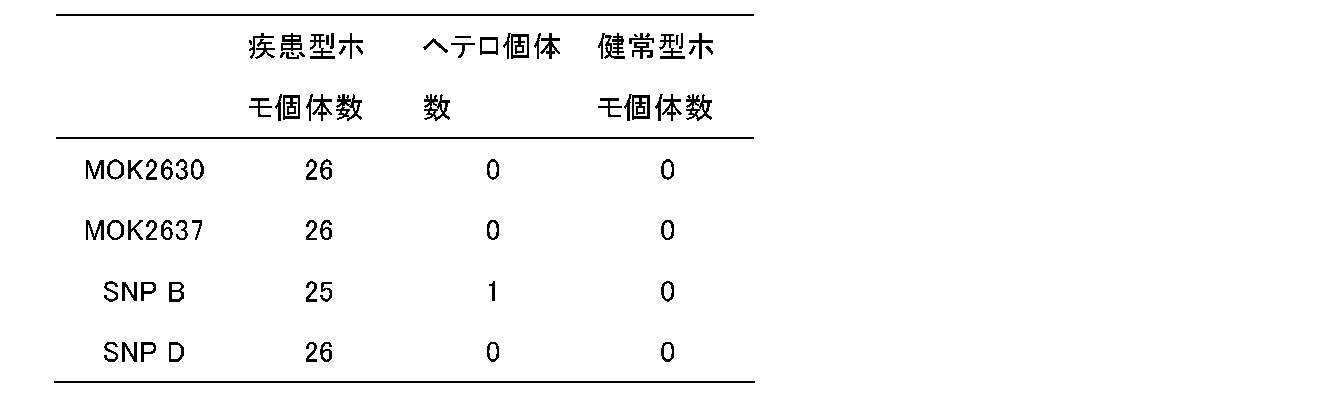
- DNA was isolated by the phenol / chloroform method from the semen, blood, or muscle tissue of 26 Japanese black cats with forelimb band myopathy. This DNA was subjected to PCR using each detection primer pair described in Table 1 to amplify a DNA fragment containing MOK2630, MOK2637, SNP B, and SNP D. For detection of the genotypes of SNP B and SNP D, cleavage with MseI (SNP B) and BamAI (SNP D) was further performed.
- the MOK2630, MOK2637, and SNP D genotypes were all diseased, ie homozygous for Nos. 8, 3, G (Table 1) in 26 individuals.
- the genotype of SNP B was a disease type, that is, a homozygote of G (Table 1) in 25 individuals, but only one individual was a heterozygote of disease type (G) and healthy type (T) (Table 2). ).
- MOK2630 61 individuals
- MOK2637 119 individuals
- SNP B 118 individuals
- SNP D 117 individuals
- MOK2630 was 11 individuals
- MOK2637 was 18 individuals
- SNP B was 8 individuals
- SNP D was 28 individuals
- MOK2630 was 50 individuals
- MOK2637 was 100 individuals
- SNP B was 110 individuals
- SNP D was 89 individuals
- the present invention it is possible to provide a marker for diagnosing forelimb band myopathy in a mammal individual and a method for diagnosing forelimb band myopathy in a mammal individual using the marker.
Landscapes
- Life Sciences & Earth Sciences (AREA)
- Chemical & Material Sciences (AREA)
- Health & Medical Sciences (AREA)
- Engineering & Computer Science (AREA)
- Proteomics, Peptides & Aminoacids (AREA)
- Organic Chemistry (AREA)
- Analytical Chemistry (AREA)
- Molecular Biology (AREA)
- Immunology (AREA)
- Genetics & Genomics (AREA)
- Zoology (AREA)
- Wood Science & Technology (AREA)
- Physics & Mathematics (AREA)
- General Health & Medical Sciences (AREA)
- Biotechnology (AREA)
- Microbiology (AREA)
- Pathology (AREA)
- Biochemistry (AREA)
- Biomedical Technology (AREA)
- Hematology (AREA)
- Urology & Nephrology (AREA)
- General Engineering & Computer Science (AREA)
- Bioinformatics & Cheminformatics (AREA)
- Biophysics (AREA)
- Cell Biology (AREA)
- Food Science & Technology (AREA)
- Medicinal Chemistry (AREA)
- General Physics & Mathematics (AREA)
- Measuring Or Testing Involving Enzymes Or Micro-Organisms (AREA)
- Investigating Or Analysing Biological Materials (AREA)
- Peptides Or Proteins (AREA)
Abstract
Description
本出願は、2011年11月18日付で出願した日本国特許出願2011-253314に基づく優先権を主張するものであり、当該基礎出願を引用することにより、本明細書に含めるものとする。
前肢帯筋異常症は、GFRA1遺伝子の機能を欠失させる劣性の変異(機能欠失型変異)に起因する疾患である。すなわち、ゲノムDNA上に野生型GFRA1遺伝子が存在しない場合、その個体(本明細書では、罹患個体とも呼ぶ)は前肢帯筋異常症に罹患している。なお、その場合には、個体の有する全てのGFRA1遺伝子が、機能欠失型変異を有する変異型GFRA1遺伝子である場合も含まれる。また、その個体が、少なくとも一つの野生型GFRA1遺伝子を有すれば、その個体の表現型は正常であり、前肢帯筋異常症を発症しない。ただし、その個体が野生型GFRA1遺伝子を有する場合であっても、少なくとも一つの機能欠失型変異を有する変異型GFRA1遺伝子を有すれば、その個体(本明細書では、キャリア個体とも呼ぶ)は前肢帯筋異常症のキャリアとなり、機能欠失型変異を有する変異型GFRA1遺伝子を有さなければ、その個体(本明細書では、健常個体とも呼ぶ)は、前肢帯筋異常症を発症せず、キャリアにもならない。なお、この健常個体は、そのGFRA1遺伝子の全てのコピーが野生型GFRA1遺伝子である個体であって、表現型が正常であっても、キャリア個体や前肢帯筋異常症を発症していない罹患個体は含まない。
これらのマーカーを用いて、以下のように、哺乳動物個体が前肢帯筋異常症に罹患していること、または、前肢帯筋異常症のキャリアであることを診断することができる。
前肢帯筋異常症に罹患した哺乳動物個体は、野生型GFRA1遺伝子を有しておらず、従って、野生型GFRA1遺伝子を遺伝子導入したトランスジェニック個体を作出することによって、治療可能である。
前肢帯筋異常症に罹患した哺乳動物個体、または、前肢帯筋異常症のキャリアである個体において、GFRA1遺伝子の塩基配列の一部、または、全部を決定し、得られた塩基配列を、野生型GFRA1遺伝子の塩基配列と比較し、GFRA1遺伝子に機能欠失型変異が存在するか否かを決定することにより、前肢帯筋異常症の原因がGFRA1遺伝子にあるかどうか、また、前肢帯筋異常症の原因がGFRA1遺伝子にある場合、どのような変異が原因になっているのかを調べることができる。
実施例2に示すように、GFRA1遺伝子の機能欠失変異をホモ接合で有する哺乳動物個体は前肢帯筋異常症を発症し、ヘテロ接合で有する哺乳動物個体は前肢帯筋異常症のキャリアである。ウシ第26番染色体上のマイクロサテライトマーカーであるMOK2630、ウシ第26番染色体上のマイクロサテライトマーカーであるMOK2637、SNP B、および、SNP D(表1)のジェノタイプは、ウシ個体が前肢帯筋異常症に罹患していること、または、前肢帯筋異常症のキャリアであることと強い相関があり、それによって、ウシGFRA1遺伝子の機能欠失型変異とも強い相関を有する。従って、MOK2630、MOK2637、SNP B、および、SNP Dから成る群より選択される1つ以上を含む、1本以上の単離されたポリヌクレオチドは、ウシ個体が前肢帯筋異常症に罹患していること、または、前肢帯筋異常症のキャリアであることを診断するためのマーカーとして使用することができる。

MOK2630、MOK2637、SNP B、および、SNP Dを用いて、ウシ個体が前肢帯筋異常症に罹患している、または、前肢帯筋異常症のキャリアであることを診断するためには、その個体から単離されたゲノムDNAにおいて、MOK2630、マイMOK2637、SNP B、および、SNP Dのうち少なくとも1個以上のジェノタイプを決定する。
GFRA1-F2:ATGCTCCTCACGGTACCTCTGTCCTAAA(配列番号12)
GFRA1-R3:GTTCCCTTCCAGAGCTCAAGC(配列番号13)

Claims (18)
- 哺乳動物個体において、前肢帯筋異常症に罹患していること、または、前肢帯筋異常症のキャリアであることを診断するためのマーカーであって、
GFRA1遺伝子ゲノムDNAの一部又は全部、当該遺伝子cDNAの一部または全部、または当該遺伝子mRNAの一部または全部である、単離されたポリヌクレオチドからなり、
前記ポリヌクレオチドは、配列番号1を有するGFRA1遺伝子cDNAの1060番目の塩基における変異を含むことを特徴とするマーカー。 - 前記哺乳動物個体がウシ個体であることを特徴とする、請求項1に記載のマーカー。
- 前記変異を起こした塩基がTであることを特徴とする、請求項1または2に記載のマーカー。
- 哺乳動物個体において、前肢帯筋異常症に罹患していること、または、前肢帯筋異常症のキャリアであることを診断するためのキットであって、
GFRA1遺伝子の一部または全部を有する単離されたDNAにおいて、配列番号1を有するGFRA1遺伝子のcDNAの1060番目の塩基における変異を増幅するためのプライマーペアを含むことを特徴とするキット。 - 前記哺乳動物個体がウシ個体であることを特徴とする、請求項4に記載のキット。
- 前記変異を起こした塩基がTであることを特徴とする、請求項4または5に記載のキット。
- 請求項4~6のいずれか1項に記載のキットであって、
さらに制限酵素を含み、
前記制限酵素は、前記プライマーペアによって増幅された塩基が前記変異を有するか否かに依存して、前記プライマーペアによって増幅された塩基を含むポリペプチドの切断様式が異なることを特徴とするキット。 - 請求項7のキットであって、
前記制限酵素がMwoIであることを特徴とするキット。 - ヒト以外の哺乳動物個体において、前肢帯筋異常症に罹患していること、または、前肢帯筋異常症のキャリアであることを診断するための診断方法であって、
前記哺乳動物個体から単離されたゲノムDNAまたはmRNAにおいて、配列番号1を有するGFRA1遺伝子cDNAの1060番目の塩基における変異を有するか否か、を調べる工程を含む診断方法。 - 請求項9に記載の診断方法であって、
GFRA1遺伝子座の両方のアリルで前記変異を有している場合に、前記哺乳動物個体が前肢帯筋異常症の罹患個体であると診断し、
GFRA1遺伝子の一方のアリルで前記変異を有している場合に、
前記哺乳動物個体が前肢帯筋異常症のキャリア個体であると診断する工程とを含む診断方法。 - 前記哺乳動物個体がウシ個体であることを特徴とする、請求項9または10に記載の診断方法。
- 前記変異を起こした塩基がTであることを特徴とする、請求項9~11のいずれか1項に記載の診断方法。
- 前肢帯筋異常症のキャリアであるヒト以外の哺乳動物個体の同定方法であって、
前肢帯筋異常症を発症していないヒト以外の哺乳動物個体から単離されたゲノムDNAまたはmRNAにおいて、GFRA1遺伝子の配列番号1を有する前記GFRA1遺伝子のcDNAの1060番目の塩基における変異を有するか否かを調べる工程と、前記ゲノムDNAに野生型GFRA1遺伝子と前記変異を有するGFRA1遺伝子が存在するヒト以外の哺乳動物個体、または、前記mRNAに野生型GFRA1遺伝子から転写されたmRNAと前記変異を有するGFRA1遺伝子から転写されたmRNAが存在するヒト以外の哺乳動物個体を同定する工程とを含むことを特徴とする同定方法。 - 前記哺乳動物個体がウシ個体であることを特徴とする、請求項13に記載の同定方法。
- 前記変異を起こした塩基がTであることを特徴とする、請求項13または14に記載の同定方法。
- 前肢帯筋異常症に罹患した哺乳動物個体において、GFRA1遺伝子が、前記前肢帯筋異常症の原因であるかどうかを決定する方法であって、
前肢帯筋異常症に罹患した哺乳動物個体、または、前肢帯筋異常症のキャリアである哺乳動物個体において、GFRA1遺伝子の塩基配列の一部または全部を決定する工程と、
決定された前記塩基配列と、野生型GFRA1遺伝子の塩基配列とを比較する工程と、
決定された前記塩基配列に配列番号1を有する前記GFRA1遺伝子のcDNAの1060番目の塩基における変異が存在するか否かを決定する工程と、
を含むことを特徴とする方法。 - 前記哺乳動物個体がウシ個体であることを特徴とする、請求項16に記載の方法。
- 前記変異を起こした塩基がTであることを特徴とする、請求項16または17に記載の方法。
Priority Applications (3)
| Application Number | Priority Date | Filing Date | Title |
|---|---|---|---|
| AU2012337708A AU2012337708B2 (en) | 2011-11-18 | 2012-11-16 | Marker for diagnosing forelimb-girdle muscular anomaly in mammal individual, and detection method using same |
| US14/358,487 US20150037794A1 (en) | 2011-11-18 | 2012-11-16 | Marker for diagnosing forelimb-girdle muscular anomaly in mammal individual, and detection method using same |
| CA2866785A CA2866785C (en) | 2011-11-18 | 2012-11-16 | Marker for diagnosing forelimb-girdle muscular anomaly in mammal, and detection method using the same |
Applications Claiming Priority (2)
| Application Number | Priority Date | Filing Date | Title |
|---|---|---|---|
| JP2011-253314 | 2011-11-18 | ||
| JP2011253314A JP5127004B1 (ja) | 2011-11-18 | 2011-11-18 | 哺乳動物個体における前肢帯筋異常症を診断するためのマーカーおよびそれを用いた検出方法 |
Publications (1)
| Publication Number | Publication Date |
|---|---|
| WO2013073684A1 true WO2013073684A1 (ja) | 2013-05-23 |
Family
ID=47692941
Family Applications (1)
| Application Number | Title | Priority Date | Filing Date |
|---|---|---|---|
| PCT/JP2012/079843 Ceased WO2013073684A1 (ja) | 2011-11-18 | 2012-11-16 | 哺乳動物個体における前肢帯筋異常症を診断するためのマーカーおよびそれを用いた検出方法 |
Country Status (5)
| Country | Link |
|---|---|
| US (1) | US20150037794A1 (ja) |
| JP (1) | JP5127004B1 (ja) |
| AU (1) | AU2012337708B2 (ja) |
| CA (1) | CA2866785C (ja) |
| WO (1) | WO2013073684A1 (ja) |
Families Citing this family (3)
| Publication number | Priority date | Publication date | Assignee | Title |
|---|---|---|---|---|
| WO2016201217A2 (en) * | 2015-06-10 | 2016-12-15 | Dae Joon Kim | GFR α 1 AS A BIOMARKER FOR CISPLATIN-INDUCED CHEMORESISTANCE AND METASTASIS |
| US10401392B2 (en) * | 2016-12-21 | 2019-09-03 | Itron, Inc. | Shunt thermocouple |
| JP7104563B2 (ja) * | 2018-06-08 | 2022-07-21 | シャープ株式会社 | 動物識別装置、動物識別装置の制御方法およびプログラム |
-
2011
- 2011-11-18 JP JP2011253314A patent/JP5127004B1/ja active Active
-
2012
- 2012-11-16 CA CA2866785A patent/CA2866785C/en not_active Expired - Fee Related
- 2012-11-16 AU AU2012337708A patent/AU2012337708B2/en not_active Ceased
- 2012-11-16 WO PCT/JP2012/079843 patent/WO2013073684A1/ja not_active Ceased
- 2012-11-16 US US14/358,487 patent/US20150037794A1/en not_active Abandoned
Non-Patent Citations (5)
| Title |
|---|
| A. A. MASOUDI ET AL.: "Linkage mapping of the locus responsible for forelimb-girdle muscular anomaly of Japanese black cattle on bovine chromosome 26.", ANIMAL GENETICS, vol. 39, 2008, pages 46 - 50 * |
| ALI AKBAR MASOUDI ET AL.: "Marker-assisted selection for forelimb-girdle muscular anomaly of Japanese Black cattle.", ANIMAL SCIENCE JOURNAL, vol. 78, 2007, pages 672 - 675 * |
| KOYO AKIYAMA ET AL.: "Kuroge Washugyu ni Hassei suru Zenshitaikin Ijosho no Gen'in Idenshi no Dotei to Idenshi Shindanho no Kakuritsu", DOBUTSU IDEN IKUSHU KENKYU, vol. 39, no. 2, December 2011 (2011-12-01), pages I-11 * |
| MISHA ANGRIST ET AL.: "Human GFRA1: cloning, mapping genomic structure, and evaluation as a candidate gene for hirschsprung disease susceptibility.", GENOMICS, vol. 48, 1998, pages 354 - 362, XP004449213, DOI: doi:10.1006/geno.1997.5191 * |
| TAKASHI HIRANO: "Jisedai Sequencer o Mochiita Kuroge Washu no Genome Resequencing", DOBUTSU IDEN IKUSHU SYMPOSIUM PROCEEDINGS, vol. 16, 2010, pages 1 - 10 * |
Also Published As
| Publication number | Publication date |
|---|---|
| CA2866785C (en) | 2020-03-10 |
| AU2012337708A1 (en) | 2014-07-10 |
| JP2013106553A (ja) | 2013-06-06 |
| AU2012337708B2 (en) | 2018-02-01 |
| CA2866785A1 (en) | 2013-05-23 |
| US20150037794A1 (en) | 2015-02-05 |
| JP5127004B1 (ja) | 2013-01-23 |
Similar Documents
| Publication | Publication Date | Title |
|---|---|---|
| CN108531608B (zh) | Bmp6基因作为黑山羊产羔数性状的分子标记 | |
| Albuquerque et al. | Current review of genetics of human obesity: from molecular mechanisms to an evolutionary perspective | |
| Venhoranta et al. | In frame exon skipping in UBE3B is associated with developmental disorders and increased mortality in cattle | |
| Ahonen et al. | A CNGB1 frameshift mutation in Papillon and Phalene dogs with progressive retinal atrophy | |
| Goldstein et al. | IQCB1 and PDE6B mutations cause similar early onset retinal degenerations in two closely related terrier dog breeds | |
| Bongiorni et al. | Transcriptomic investigation of meat tenderness in two Italian cattle breeds | |
| Jung et al. | A nonsense mutation in PLD4 is associated with a zinc deficiency-like syndrome in Fleckvieh cattle | |
| McClure et al. | Fine mapping for Weaver syndrome in Brown Swiss cattle and the identification of 41 concordant mutations across NRCAM, PNPLA8 and CTTNBP2 | |
| Seroussi et al. | Unveiling genomic regions that underlie differences between Afec-Assaf sheep and its parental Awassi breed | |
| Caduff et al. | OCA2 splice site variant in German Spitz dogs with oculocutaneous albinism | |
| CN117844944A (zh) | 与猪脂肪沉积性状相关的snp标记及应用 | |
| Chen et al. | Whole-genome resequencing reveals diversity and selective signals in Longlin goat | |
| Knutsen et al. | Genetic variants associated with two major bovine milk fatty acids offer opportunities to breed for altered milk fat composition | |
| JP5127004B1 (ja) | 哺乳動物個体における前肢帯筋異常症を診断するためのマーカーおよびそれを用いた検出方法 | |
| JP4696195B2 (ja) | ウシ個体における枝肉重量を評価する遺伝子マーカー及びそれを用いた枝肉重量評価方法 | |
| US20120122089A1 (en) | Gene Marker For Evaluating Genetic Potential For Marbling In Bovine Individual And Method For Evaluating Genetic Potential For Marbling Using The Same | |
| US9157114B2 (en) | Method of determining the genotype relating to hereditary nasal parakeratosis (HNPK) and nucleic acids usable in said method | |
| EP3321374B1 (en) | Shar-pei auto inflammatory disease in shar-pei dogs | |
| JP7850951B2 (ja) | イヌの遅発性運動失調症の発症リスクの診断方法 | |
| JP5736562B2 (ja) | ウシ個体における子牛虚弱症候群を診断するためのマーカー及びそれを用いた検出方法 | |
| Ohnishi et al. | Ablation of Mrds1/Ofcc1 induces hyper-γ-glutamyl transpeptidasemia without abnormal head development and schizophrenia-relevant behaviors in mice | |
| US7166462B2 (en) | Methods and systems for facilitating the diagnosis and treatment of schizophrenia | |
| Georges et al. | Cis-and trans-effects underlying polar overdominance at the callipyge locus | |
| US20070072233A1 (en) | Methods and systems for facilitating the diagnosis and treatment of schizophrenia | |
| EP2175039B1 (en) | Analysis for the genetic disposition for left-sided abomasal displacement in cattle |
Legal Events
| Date | Code | Title | Description |
|---|---|---|---|
| 121 | Ep: the epo has been informed by wipo that ep was designated in this application |
Ref document number: 12849010 Country of ref document: EP Kind code of ref document: A1 |
|
| NENP | Non-entry into the national phase |
Ref country code: DE |
|
| ENP | Entry into the national phase |
Ref document number: 2012337708 Country of ref document: AU Date of ref document: 20121116 Kind code of ref document: A |
|
| ENP | Entry into the national phase |
Ref document number: 2866785 Country of ref document: CA |
|
| WWE | Wipo information: entry into national phase |
Ref document number: 14358487 Country of ref document: US |
|
| 122 | Ep: pct application non-entry in european phase |
Ref document number: 12849010 Country of ref document: EP Kind code of ref document: A1 |