WO2013000970A1 - Bis tridentate w3o2 clusters for x-ray imaging - Google Patents
Bis tridentate w3o2 clusters for x-ray imaging Download PDFInfo
- Publication number
- WO2013000970A1 WO2013000970A1 PCT/EP2012/062505 EP2012062505W WO2013000970A1 WO 2013000970 A1 WO2013000970 A1 WO 2013000970A1 EP 2012062505 W EP2012062505 W EP 2012062505W WO 2013000970 A1 WO2013000970 A1 WO 2013000970A1
- Authority
- WO
- WIPO (PCT)
- Prior art keywords
- carboxyethoxy
- tritungsten
- oxido
- tripropanoato
- dihydroxido
- Prior art date
- Legal status (The legal status is an assumption and is not a legal conclusion. Google has not performed a legal analysis and makes no representation as to the accuracy of the status listed.)
- Ceased
Links
- 0 CCC(C(CC1CC(CCC*(C2)CC2C(C)C)C1)C(C)C)C1CCCCC1 Chemical compound CCC(C(CC1CC(CCC*(C2)CC2C(C)C)C1)C(C)C)C1CCCCC1 0.000 description 4
- XAAMLYCBTNJVLE-UHFFFAOYSA-N CC(CCOCC(COCCC(O)=O)(COCCC(O)=O)NCC(CO)O)=O Chemical compound CC(CCOCC(COCCC(O)=O)(COCCC(O)=O)NCC(CO)O)=O XAAMLYCBTNJVLE-UHFFFAOYSA-N 0.000 description 1
- RVADCXWHVZDMMD-UHFFFAOYSA-N CN(CC(CO)O)C(COCCC(O)=O)(COCCC(O)=O)COCCC(O)=O Chemical compound CN(CC(CO)O)C(COCCC(O)=O)(COCCC(O)=O)COCCC(O)=O RVADCXWHVZDMMD-UHFFFAOYSA-N 0.000 description 1
- UAMBBMOHMFFHQW-UHFFFAOYSA-N COC(CCOCC(COCCC(O)=O)(COCCC(O)=O)NCC(C[N+]([O-])=O)O)O Chemical compound COC(CCOCC(COCCC(O)=O)(COCCC(O)=O)NCC(C[N+]([O-])=O)O)O UAMBBMOHMFFHQW-UHFFFAOYSA-N 0.000 description 1
- ZCQVVSMJNBNDAQ-UHFFFAOYSA-N NCCOCCC(O)=O Chemical compound NCCOCCC(O)=O ZCQVVSMJNBNDAQ-UHFFFAOYSA-N 0.000 description 1
- HOFDYJXBRRVZSA-UHFFFAOYSA-N OCC(C(C(CNC(COCCC(O)=O)(COCCC(O)=O)COCCC(O)=O)O)O)O Chemical compound OCC(C(C(CNC(COCCC(O)=O)(COCCC(O)=O)COCCC(O)=O)O)O)O HOFDYJXBRRVZSA-UHFFFAOYSA-N 0.000 description 1
- SQXGJRBLRFWCJQ-UHFFFAOYSA-N OCCNC(COCCC(O)=O)(COCCC(O)=O)COCCC(O)=O Chemical compound OCCNC(COCCC(O)=O)(COCCC(O)=O)COCCC(O)=O SQXGJRBLRFWCJQ-UHFFFAOYSA-N 0.000 description 1
- UIHCCVVDVOTMOS-UHFFFAOYSA-N [O-][N+](CC(CNC(COCCC(O)=O)(COCCC(O)=O)COCCC(O)=O)O)=O Chemical compound [O-][N+](CC(CNC(COCCC(O)=O)(COCCC(O)=O)COCCC(O)=O)O)=O UIHCCVVDVOTMOS-UHFFFAOYSA-N 0.000 description 1
Classifications
-
- A—HUMAN NECESSITIES
- A61—MEDICAL OR VETERINARY SCIENCE; HYGIENE
- A61K—PREPARATIONS FOR MEDICAL, DENTAL OR TOILETRY PURPOSES
- A61K49/00—Preparations for testing in vivo
- A61K49/04—X-ray contrast preparations
-
- C—CHEMISTRY; METALLURGY
- C07—ORGANIC CHEMISTRY
- C07F—ACYCLIC, CARBOCYCLIC OR HETEROCYCLIC COMPOUNDS CONTAINING ELEMENTS OTHER THAN CARBON, HYDROGEN, HALOGEN, OXYGEN, NITROGEN, SULFUR, SELENIUM OR TELLURIUM
- C07F11/00—Compounds containing elements of Groups 6 or 16 of the Periodic Table
- C07F11/005—Compounds containing elements of Groups 6 or 16 of the Periodic Table compounds without a metal-carbon linkage
Definitions
- the present invention describes a new class of trinuclear W3O2 tungsten clusters comprising tridentate tri- or tetracarboxylic acid ligands, a method for their preparation, their use as X-ray contrast agents and the intermediates, tri- or tetracarboxylic acids, as desired tridentate ligand resource.
- Contrast media solutions are injected intravenously or intraarterially as a rapid bolus (usually in computed tomography (CT) via power injector) with the injection rate depending on the clinical indication or the examination protocol and area of interest.
- CT computed tomography
- Tungsten is characterized by a higher absorption coefficient for X-rays than iodine, especially in the range of tube voltages normally used in modern CT.
- a modern CT X-ray- tube requires a minimum voltage of about 70 kV and reaches maximum voltage of 160 kV.
- iodine generally does not provide ideal attenuation features for this technology.
- the attenuation optimum (k-edge) of tungsten corresponds better to the ranges of voltages used in CT. Therefore the new tungsten clusters require a similar or lower contrast media dosage than conventional triiodinated contrast agents.
- tungsten based contrast agents will allow more flexibility for CT scanning protocols and lead to scan protocols that provide equivalent diagnostic value at lower radiation doses. Especially this feature is of high importance for CT.
- ALARA-rule radiation exposure has to be reduced to levels: As Low As Reasonably Achievable
- the new tungsten based contrast agents will contribute to high-quality diagnostic imaging at reduced radiation exposure.
- the aim of the present invention was to provide sufficiently stable, water soluble and well tolerated tungsten clusters for use as X-ray contrast agent in diagnostic imaging, especially in modern computed tomography. This aim was achieved by the provision of the compounds of the present invention. Surprisingly, it was observed that monodentate ligands claimed in WO 97/03993 and WO 97/03994 can be replaced by tridentate ligands and that the clusters described in this patent application show a highly increased stability under heat sterilization conditions of the aqueous solution, and have an excellent tolerability in experimental animals as well as a high in vivo stability.
- the compounds of the present invention are excreted fast and quantitatively via the kidneys, comparable to the well established triiodinated X-ray contrast agents.
- the invention of suitable new tridentate ligands for the W3O2 core and the synthesis of new stable bis tridentate W3O2 clusters enabled for the first time the practical use of this compound class as X-ray contrast agents in diagnostic imaging.
- tungsten based contrast agents By enabling tungsten based contrast agents the option to reduce radiation dose is a clear advantage of W3O2 clusters of the present invention over existing iodine based contrast agents due to the higher absorption coefficient of tungsten for X-rays compared to iodine.
- the present invention describes a new class of highly stable W3O2 clusters, a method for their preparation, their use as X-ray contrast agents and the intermediates tri- or tetra carboxylic acids as desired tridentate ligand resources.
- the present invention is directed to trinuclear tungsten clusters comprising tridentate carboxylic acid ligands, especially comprising at least three 3- propionic acid structure elements in each ligand.
- the trinuclear tungsten cluster comprises a W3O2 core.
- the trinuclear tungsten cluster comprises two tri- or tetra carboxylic acid ligands.
- the present invention is directed to compounds of the general formula
- R 1 is H, CH 3 , CH 2 OH. CH 2 OCH3, CH 2 0(CH 2 ) 2 COOH, NH 2 , NH(CH 2 ) 2 OH,
- R 2 is H, CH 3 , CHzOH, CH 2 OCH 3 , CH 2 0(CH 2 ) 2 COOH, NH 2 , NH(CH 2 ) 2 OH,
- X is O or NR 3 ; wherein R 3 is H, (CH 2 ) 2 OH, CH 2 CH(OH)CH 2 OH, CH(CH 2 OH) 2 , CH 2 (CH(OH)) 2 CH 2 OH or CH 2 (CH(OH)) 3 CH 2 OH; Z is O or NR 4 ; wherein R 4 is H, (CH 2 ) 2 OH, CH 2 CH(OH)CH 2 OH, CH(CH 2 OH) 2 , CH 2 (CH(OH)) 2 CH 2 OH or CH 2 (CH(OH)) 3 CH 2 OH; m is 2, 3; n is 2, 3; p is O. 1 ; q is 0. 1 ; r is O. 1 , 2, 3; and s is 0.
- the central tris aqua W 3 0 2 cluster ion acts as a polyprotic acid in aqueous solution.
- the invention is directed to compounds of the general formula II,
- R 5 is H or OH
- n 1 , 2;
- r 0, 1 , 2, 3;
- s 0, 1 , 2, 3;
- Trinuclear tungsten clusters of the general formulae I or II which are charged at physiological pH, can be neutralized by addition of suitable, physiologically biocompatible counter ions, e.g. sodium ions or suitable cations of organic bases including, among others, those of primary, secondary or tertiary amines, for example /V-methylglucamine.
- suitable, physiologically biocompatible counter ions e.g. sodium ions or suitable cations of organic bases including, among others, those of primary, secondary or tertiary amines, for example /V-methylglucamine.
- Lysine, arginine or ornithine are suitable cations of amino acids, as generally are those of other basic naturally occurring amino acids.
- Suitable anions are the anions of acids, inorganic acids, such as, for example, hydrochloric acid, phosphoric acid and sulfuric acid, as well as the anions of organic acids such as, for example, acetic acid, citric acid, aspartic acid, glutamic acid, among others can be used.
- a preferred compound of the general formula I is: onoaqua-KO-bis ⁇ p3-3,3',3"-[methylidynetris(methyleneoxy)]tripropanoato- l 0 3 )dihydroxi W- W)(IV) 1e
- Another preferred compound of the general formula I is:
- Another preferred compound of the general formula I is:
- Another preferred compound of the general formula I is:
- Another preferred compound of the general formula I is:
- Another preferred compound of the general formula I is:
- Another preferred compound of the general formula I is:
- Another preferred compound of the general formula I is: onoaqua-KO-dihydroxido-K 2 0-(p3-3.3',3"- ⁇ [(2,3-dihydroxypropyl)amino]methylidynetris- (methyleneoxy) ⁇ tripropanoato-lK 2 0 ⁇ 0 2 :2K 2 O v ,0 3 :3K 2 0 2 .
- Q3 di-p3-oxido-1:2:3K 6 ⁇ p3-
- Another preferred compound of the general formula I is:
- Another preferred compound of the general formula I is:
- Another preferred compound of the general formula I is: onoaqua-KO-dihydroxido-K 2 0-bis(p3-3,3',3"-[hydroxymethylidyne tris(methyleneoxy)tri- propanoato-l 2 0 ⁇ 0 2 :2 2 O i o 3 3 2 0 2 o 3 ]-di- 3-oxido-1:2:3 6 0-fr/angi/o-tritungsten(3 W- W)(N) 13e
- Another preferred compound of the general formula I is:
- Another preferred compound of the general formula I is:
- Another preferred compound of the general formula I is: onoaqua-KO-dihydroxido-K 2 0-(p3-3 ! 3' ! 3"- ⁇ [(2,3-dihydroxypropyl)amino]methylidynetris-
- Another preferred compound of the general formula I is:
- Another preferred compound of the general formula I is:
- Another preferred compound of the general formula I is:
- Another preferred compound of the general formula I is: onoaqua-KOdihydroxido-K 2 0-bis- ⁇ p3-propane[1 ,3-diyl(oxy)]dipropanoato- lK 2 0 0 2 :2KO v :3K0 2 ][yl(imino)propanoato-2KO:3KO] ⁇ di-p 3 -oxido-1:2:3K 6 0-triangulo- tritungsten(3 W-W)( ⁇ V) 26d
- Another preferred compound of the general formula I is:
- a preferred compound of the general formula II is: onoaqua-KO-bis ⁇ p3-3,3',3"-[( ia,3 «,5 «)-cyclohexane-1 ,3,5-triyltris(oxy)]tripropanoato- l 0 3 )dihydroxido- 2 0-di-M3-oxido-1 :2:3 6 0-fr/angt /o- tritungsten(3 W-W) ⁇ l) 10c
- the invention is directed to the use of compounds of the general formulae III or IV or mixtures as intermediates thereof for the preparation of trinuclear tungsten clusters comprising tridentate carboxylic acid ligands, (CH 2 ) p -X - (CH 2 ) m — COOH HOOC -(CH 2 ) n - Z -(CH 2 ) q
- R 1 is H, CH 3 , CHzOH, CH2OCH3, CH 2 0(CH 2 )2COOH, NH 2> NH(CH 2 ) 2 OH,
- R 2 is H, CH 3 , CH 2 OH, CH 2 OCH3, CH 2 0(CH 2 ) 2 COOH, NH 2 , NH(CH 2 ) 2 OH,
- X is O or NR 3 ; wherein R 3 is H, (CH 2 ) 2 OH, CH 2 CH(OH)CH 2 OH, CH(CH 2 OH) 2> CH 2 (CH(OH)) 2 CH 2 OH or CH 2 (CH(OH)) 3 CH 2 OH;
- Z is O or NR 4 ; wherein R 4 is selected from the group comprising H, (CH 2 ) 2 0H,
- the invention is directed to the use of compounds of the general formulae III or IV or mixtures thereof for the manufacture of the compounds of the general formula I.
- T e Process for the preparation of trinuclear tungsten clusters comprising two tridentate carboxylic acid ligands of general formula I contains the reaction of one equivalent of monoaqua-KO-hexakis(p-acetato-K 2 0)-dihydroxido-K 2 0-di- 3-oxido-1 ;2:3K 6 0-triangulo- tritungsten(3 W-W)( ⁇ J) or a salt of this cluster or sodium hexakis(p-acetato-K 2 0)- :2:3 6 0-fr angt//o-tritungsten(3 W-W)(N) in aqueous solution with two equivalents or slight excess of the desired tridentate ligand or a mixture of tridentate ligands (compounds of the general formulae III or IV), heating the components to temperatures in the range from 80° to 150°C in combination with the optional use of a pressure vessel, if necessary microwave irradiation, applying heating
- the invention is directed to the use of compounds of the general formula V as intermediates for the preparation of trinuclear tungsten clusters comprising tridentate carboxylic acid ligands,
- the Process for the preparation trinuclear tungsten clusters comprising two tridentate carboxylic acid ligands of general formula I I , contains the reaction of one equivalent of monoaqua-KO-hexakis( -acetato-K 2 0)-dihydroxido-K 2 0-di- 3-oxido-1 :2:3K 6 0-triangulo- tritungsten(3 W-W)( ⁇ V) or a salt of this cluster or sodium hexakis(p-acetato-K 2 0)- tris(acetato-KO)-di-p3-oxido-1 :2:3K 6 0-fnangi//o-tritungsten(3 W-W)( ⁇ l) in aqueous solution in the presence of two equivalents or slight excess of the desired tridentate ligand, (compound of general formula V), heating the components to temperatures in the range from 80° to 150°C in combination with the optional use of a pressure vessel, if necessary microwave
- the invention is directed to the new trinuclear tungsten clusters comprising two tridentate carboxylic acid ligands of general formulae I or I I , obtainable by ligand exchange reaction of one equivalent of monoaqua-KO-hexakis(p-acetato-K 2 0)- dihydroxido-K 2 0-di- 3-oxido-1 :2:3K 6 0-fr angu/o-tritungsten(3 W-W)( ⁇ /) or a salt of this cluster or sodium hexakis(p-acetato-K 2 0)-tris(acetato-KO)-di- 3-oxido-1 :2:3K 6 0-triangulo- tritungsten(3 W-W)(l ⁇ /) in aqueous solution in the presence of two equivalents or slight excess of the desired tridentate ligand or a mixture of tridentate ligands, (compounds of the general formulae I I I or IV or
- a preferred compound of the general formula I I I and IV is:
- Another preferred compound of the general formula III and IV is:
- Another preferred compound of the general formula III and IV is: 3- ⁇ 2-Amino-3-(2-carboxyethoxy)-2-[(2-carboxyethoxy)methyl]propoxy ⁇ propanoic acid 3b
- Another preferred compound of the general formula III and IV is:
- Another preferred compound of the general formula III and IV is:
- Another preferred compound of the general formula III and IV is:
- Another preferred compound of the general formula III and IV is: 3,3',3"-[Propane-1 ,2,3-triyltris(oxy)]tripropanoic acid 7b
- Another preferred compound of the general formula III and IV is:
- Another preferred compound of the general formula III and IV is:
- Another preferred compound of the general formula III and IV is: 3- ⁇ 3-(2-Carboxyethoxy)-2-[(2-carboxyethoxy)methyl]-2-hydroxypropoxy ⁇ propanoic acid 13d
- Another preferred compound of the general formula III and IV is: 3- ⁇ 3-(2-Carboxyethoxy)-2-[(2-carboxyethoxy)methyl]-2-[(2-hydroxyethyl)amino]propoxy ⁇ - propanoic acid 15b
- Another preferred compound of the general formula III and IV is: 3- ⁇ 3-(2-Carboxyethoxy)-2-[(2-carboxyethoxy)methyl]-2-[(methoxyacetyl)amino]propoxy ⁇ - propanoic acid 17b
- Another preferred compound of the general formula III and IV is: 1 -( ⁇ 1 ,3-Bis(2-carboxyethoxy)-2-[(2-carboxyethoxy)methyl]propan-2-yl ⁇ ;
- Another preferred compound of the general formula III and IV is:
- Another preferred compound of the general formula III and IV is:
- a preferred compound of the general formula V is:
- the invention is directed to the process for the preparation of the compounds of the general formulae I and II.
- the invention is directed to compounds of general formulae I or I I or mixtures thereof for the manufacture of diagnostic agents, especially of X-ray diagnostic agents for administration to humans or animals.
- the contrast media of the invention may conveniently contain pharmaceutical formulation aids, for example stabilizers, antioxidants, pH adjusting agents, flavors, and the like. They may be formulated for parenteral or enteral administration or for direct administration into body cavities.
- parenteral formulations contain a sterile solution or suspension in a concentration range from 150 to 600 mg W/mL, especially 200 to 450 mgW/mL of the new bistridentate W3O2 clusters according to this invention.
- the media of the invention may be in conventional pharmaceutical formulations such as solutions, suspensions, dispersions, syrups, etc. in physiologically acceptable carrier media, preferably in water for injections.
- the contrast medium is formulated for parenteral administration, it will be preferably isotonic or hypertonic and close to pH 7.4.
- Pharmaceutically acceptable salts of the compounds according to the invention also include salts of customary bases, such as, by way of example and by way of preference, alkali metal salts (for example sodium salts), alkaline earth metal salts (for example calcium salts) and ammonium salts, derived from ammonia or organic amines having 1 to 16 carbon atoms, such as, by way of example and by way of preference, /V-methylglucamine.
- customary bases such as, by way of example and by way of preference, alkali metal salts (for example sodium salts), alkaline earth metal salts (for example calcium salts) and ammonium salts, derived from ammonia or organic amines having 1 to 16 carbon atoms, such as, by way of example and by way of preference, /V-methylglucamine.
- the media of the invention should generally have a sufficiently high percentage of tungsten, in particular a contrast medium with a high content of tungsten per molecule (minimum 35 % or higher).
- Tridentate carboxylic acids were synthesized (scheme 1 ) in analogy to published procedures (Eur. J. Inorg. Chem. 2001 , 1789-1795).
- alkyl acrylates were added to trioles by base catalyzed Michael addition.
- Potential bases for this step are 5 aqueous sodium hydroxide in DMSO, potassium fert-butylate or sodium hydroxide in the presence of quaternary alkyl ammonium salts.
- Saponification of alkyl ester was established by the use of strong acids like hydrochloric acid or trifluoromethane sulphonic acid, trifluoro acetic acid and formic acid. Basic saponification is also possible. Chemical transformations like reductive aminations, or amid formation at R1 are possible at the I t) ester form , the free carboxylic acid form or the complexated form of the ligand.
- New W3O2 clusters were synthesized by ligand exchange reaction (WO 97/03994) of known tri-tungsten clusters like the hexa acetate or the nona acetate in aqueous solution
- Heating temperatures generally range from 80° to 150°C in combination with the optional use of a pressure vessels.
- Microwave irradiation is a possible alternative to conventional heating sources. Heating times range from 10 minutes up to 3 days. Isolation and purification of the desired 0 cluster is obtained by conventional chromatographic methods like preparative HPLC or ion exchange chromatography.
- chiral centers or other forms of isomeric centers are not otherwise defined in a compound according to the present invention, all forms of such stereoisomers, including enantiomers and diastereoisomers, are intended to be covered herein.
- Compounds containing chiral centers may be used as racemic mixture or as an enantiomerically enriched mixture or as a diastereomeric mixture or as a diastereomerically enriched mixture, or these isomeric mixtures may be separated using well-known techniques, and an individual stereoisomer maybe used alone.
- Pharmaceutically acceptable salts of the compounds according to the invention include salts of mineral acids, carboxylic acids and sulfonic acids, for example salts of hydrochloric acid, sulfuric acid, phosphoric acid, methane sulfonic acid, ethane sulfonic acid, toluene sulfonic acid, benzene sulfonic acid, acetic acid, propionic acid, lactic acid, tartaric acid, malic acid, citric acid, fumaric acid, maleic acid and benzoic acid.
- Description of the Figures Figure 1 Crystal structure of 3d.
- FIG. 2 Preclinical CT-angiography in a rat: The CT-images shown in sagital (A) and coronary (B) view, visualized in maximum intensity projection.
- the heart, the main arterial and venous blood vessels and the kidneys show a high image contrast after administration of the tungsten based contrast agent.
- Figure 3 Preclinical CT-angiography in a rat: The image shows the thoracal region zoomed from the whole body image stack. The heart chambers and the aortic arch with the branches of the brachiocephalic, left common carotid and left subclavian arteries show a high image contrast after administration of the tungsten based contrast agent.
- Figure 4 Preclinical x-ray CT-angiography in a rat: CT-signals after administration of a tungsten based contrast agent determined at representative anatomical positions: Aorta ascendens, Aorta descendens, Aorta abdominalis, Ateria carotis.
- the brackets represent the standard deviation from image analysis in three different image slices.
- NMR nuclear magnetic resonance spectroscopy chemical shifts ( ⁇ ) are given in ppm.
- a suspension of sodium tungstate (26.4 g, 89.8 mmol) and tungsten hexacarbonyl (Aid rich, 97% purity, 130.4 g, 359.4 mmol) in acetic anhydride (2173 mL, 23.0 mol) was heated to 80°C. Air (approx. 5 L per minute) was bubbled through the mixture for 15 minutes, then the air stream was stopped and the bath temperature was raised to 145°C. After 18 hours, the mixture was cooled to rt.
- the ion exchange resin was washed with water followed by 20% aqueous acetic acid.
- the washing solutions were fractionated and fractions where no chloride was detected were concentrated under vacuum to yield 1 .0 g 3- ⁇ 2-amino-3-(2-carboxyethoxy)-2-[(2-carboxyethoxy)methyl]propoxy ⁇ propanoic acid as free base.
- Example 3d 0 Triaqua- 3 ( bis ⁇ 3-3,3 ⁇ 3''-[aminomethylidynetris(methyleneoxy)]tripropanoato- 1 2 0 ,0 2 :2 2 O r ,0 3 :3 2 0 2 ,0 3 ⁇ di-M3-oxido-1 :2:3K 6 0-fr/angty/o-tritungsten(3 W-W)( ⁇ V) dichloride
- Hydrogen coordinates ( x 10 * ⁇ ) and isotropic displacement parameters (A 2 x for 3d.
- FIG. 1 shows the crystal structure of 3d.
- Example 4
- Example 15a 0 Tert-butyl 3- ⁇ 3- ⁇ 3-ferf-butoxy-3-oxopropoxy)-2-[(3-ferf-butoxy-3-oxopropoxy)methyl]- 2-[(2-hydroxyethyl)amino]propoxy ⁇ propanoate
- reaction mixture was filtered through cellites, concentrated and purified via chromatography on silica gel (methanol in dichloromethane 0 to 20%) to yield 460 mg of iert-butyl 3- ⁇ 3-(3-iert-butoxy-3-oxopropoxy)-2-[(3-fert-butoxy-3- oxopropoxy)methyl]-2-[(2-hydroxyethyl)amino]propoxy ⁇ propanoate.
- Example 17c onoaqua-KO-bis ⁇ 3-3,3 3''-[(methoxyacetyl)aminomethylidynetris(methyleneoxy)] tripropanoato-l K 2 O ⁇ O 2 :2i 2 O 1' ,O 3 :3K 2 0 2' ,O 3' ⁇ dihydroxido-K 2 O--di-M3-oxido-1 :2:3 ⁇ 6 O- fr/angt//o-tritungsten(3 W-W)( ⁇ V)
- Example 18 onoaqua- O-dihydroxido-K 2 0-(M3-3,3',3"- ⁇ [(2,3-dihydroxypropyl)amino]- mei ylidynetris(met ySeneoxy) ⁇ tripropanoato-lK 2 0 1 ,0 2 :2 2 0 1 ',0 3 :3i 2 0 2 ',0 3 ') ⁇ 3- 3,3',3"-[2-hydroxyethyl-1 ,1 ,1 -idynetris(methyleneoxy)-tripropanoato-1 ⁇ 2 0 &:
- Example 22 Monoaqua- O-dihydroxido-K 2 0-(M3-3,3',3"- ⁇ [(1 -deoxyerythritol-1 -yl)amino]- met ylidynetris(met yleneoxy) ⁇ tripropanoato-l K 2 O 1 ,C? 2 :2K 2 O 1 ' ,O 3 :3K 2 O 2' ,0 3 ') ⁇ 3-
- Example 23b Monoaqua- O-hexakis( -methoxyacetato-K 2 0)-dihydroxido-K 2 0-di-M3-oxido- 1 :2:3 6 0-fr/angt//o-tritungsten(3 W-W)( ⁇ V)
- sodium hexakis(p-methoxyacetato-K 2 0)-tris(acetato-KO)-di- :r oxido-1 :2:3K 6 0-fr angt//o-tritungsten(3 W-W)( ⁇ l) was transformed into monoaqua- ⁇ - hexakis( -acetato-K 2 0)-dihydroxido-K 2 0-di- 3-oxido-1 :2:3K 6 0-inangt//o-tritungsten(3 W- M )(IV) as a reference compound.
- the stability of W3O2 clusters was determined in aqueous, buffered solution at pH 7.4.
- Absolute stability was calculated as the ratio of the peak area of the compound after and before the heat treatment multiplied with the ratio of the tungsten concentration of the solution after and before heat treatment.
- the relative stability was calculated with respect to example compound 23b (WaO ⁇ hexa-methoxy acetate) which was set to 1 .
- Solvent A2 5 mM Na-heptanesulfonate + 5 mM acetate pH 4.5
- Solvent A3 5 mM NH4-acetate pH 6
- solvent A1 to A4 depends on the structure of the compound (see table).
- Solvent B methanol, HPLC grade
- Detector D2 element specific detection by ICP-MS running at m/z 184 for 184 W, the most abundant isotope of tungsten.
- Detector D3 element specific detection by ICP-OES running at 239.7 nm, the most intense emission wavelength of tungsten.
- Detector D1 was always used and detector D2 or D3, respectively, were coupled to the outlet of D1. Refer to the table for the detectors used .
- CT computed tomography
- the tungsten based contrast agent (Example 1 ) at a concentration of 66 mg W/mL was administered intravenously via the tail vein by the help of a dedicated injection pump (flow rate 0.8 ml/s). A dosage of 400 mg W/kg body weight was used.
- An x-ray projection image was acquired to adjust the measurement range to the size of the animal.
- the delay between the administration of the x-ray diagnostic agent and the start of the measurement was 2s.
- the images showed a high CT signal for the heart, the major blood vessels and the kidneys. It also contains the intrinsic high CT signal of the skeleton and a low signal for tissue. All images showed a high contrast between enhanced blood vessels and surrounding tissue.
- the axial CT images were reformatted to sagital (Fig.2A) and coronar (Fig.2B) views by the software of the CT unit.
- the resulting images were displayed in maximum intensity projection (MIP) with a thickness of 7 mm.
- MIP maximum intensity projection
- the high contrast for the blood vessels is clearly demonstrated in the zoomed area of the thorax, showing the heartchambers and the aortic arch with the branches of the brachiocephalic, left common carotid and left subclavian arteries (Fig.3).
- the images were analyzed quantitatively by drawing a region of interest at representative anatomical positions; the aorta ascendens, the aorta descendens, the aorta abdominals and the ateria carotis.
- a high CT-signal, demonstrating the highly effective x-ray attenuation of the tungsten based contrast agent was detected at all anatomical positions (Fig.4).
- Example 26 onoaqua- O-dihydroxido- 2 0-bis- ⁇ 3-propane[1 ,3-diyl(oxy)]dipropanoato- l K 2 0 ⁇ 0 2 :2K0 1' :3KOH[yf(imino)propanoato-2icO:3icO] ⁇ di- 3-oxido-1 :2:3i 6 0-triangyIo- tritungsten(3 W-W)( ⁇ V)
Landscapes
- Health & Medical Sciences (AREA)
- Chemical & Material Sciences (AREA)
- Organic Chemistry (AREA)
- Epidemiology (AREA)
- Life Sciences & Earth Sciences (AREA)
- Animal Behavior & Ethology (AREA)
- General Health & Medical Sciences (AREA)
- Public Health (AREA)
- Veterinary Medicine (AREA)
- Organic Low-Molecular-Weight Compounds And Preparation Thereof (AREA)
- Acyclic And Carbocyclic Compounds In Medicinal Compositions (AREA)
Abstract
The present invention describes a new class of highly stable W3O2 Clusters, a method for their preparation, their use as X-ray contrast agents and the intermediates tri- or tetracarboxylic acids as desired tridentate ligand resources.
Description
Bis Tridentate W3O2 Clusters for X-Ray imaging
The present invention describes a new class of trinuclear W3O2 tungsten clusters comprising tridentate tri- or tetracarboxylic acid ligands, a method for their preparation, their use as X-ray contrast agents and the intermediates, tri- or tetracarboxylic acids, as desired tridentate ligand resource.
Background of the invention
Synthesis and characterization of bi-oxo capped trinuclear tungsten clusters have been described by de novo synthesis starting from Na2WC (Powell, G.; Richens, D.T. inorg. Chem. 1993, 32, 4021 -4029 or W(CO)6 (Bino, A.; Cotton, F. A.; Dori, Z.; Koch, S.;
Kueppers, H.; Millar, M.; Sekutowski, J. C. Inorg. Chem. 1978, 17, 3245-3253, Bino, A.;
Hesse; K. F.; Kueppers, H. Acta Crystallogr. 1980, B36, 723-725, Cotton, F.A.; Dori, Z.;
Marler, D.O.; Schwotzer, W. Inorg. Chem 1984, 23, 4033-4038 and Cotton, F.A.; Dori, Z.; Marler, D.O.; Schwotzer, W. Inorg. Chem 1984, 23, 4738-4742) or by ligand exchange synthesis (WO 97/03993 and WO 97/03994) starting from preformed clusters. These tungsten clusters are part of the larger class of trinuclear bicapped clusters. The existence of this class is known for more than 3 decades and continuous research on their synthetic accessibility or behaviour and their general properties has been performed since then. Their general geometry was described by Powell, G.; Richens, D.T. Inorg. Chem. 1993,
32, 4021 -4029.
The water solubility and ability to absorb X-rays of these tungsten clusters and their potential use in diagnostic X-ray imaging has been described in WO 91/14460, WO 92/00698, WO 97/03993 and WO 97/03994. Further investigations of these known tungsten clusters disclosed their chemical and physiological instability. Tungsten clusters with insufficient stability in aqueous solution or in the physiological environment of a patient would lead to a release of the ligand in the form of its free acid and the bare tungstate core. This would cause inacceptable toxic side effects in a patient, especially with respect to the expected high dose which will be necessary for a single diagnostic procedure. It is known from the well established triiodinated X-ray contrast agents that the dose for a single diagnostic procedure is in the range of 100-1500 mg iodine / kg body weight, equivalent to about 15-225 g of contrast agent for a 75 kg patient. Contrast media solutions are injected intravenously or
intraarterially as a rapid bolus (usually in computed tomography (CT) via power injector) with the injection rate depending on the clinical indication or the examination protocol and area of interest.
Tungsten is characterized by a higher absorption coefficient for X-rays than iodine, especially in the range of tube voltages normally used in modern CT. A modern CT X-ray- tube, however, requires a minimum voltage of about 70 kV and reaches maximum voltage of 160 kV. As future technical developments in CT will not substantially change these parameters, iodine generally does not provide ideal attenuation features for this technology. In comparison to iodine the attenuation optimum (k-edge) of tungsten corresponds better to the ranges of voltages used in CT. Therefore the new tungsten clusters require a similar or lower contrast media dosage than conventional triiodinated contrast agents.
The use of tungsten based contrast agents will allow more flexibility for CT scanning protocols and lead to scan protocols that provide equivalent diagnostic value at lower radiation doses. Especially this feature is of high importance for CT. As technical development goals in terms of spatial and temporal resolution have approached the limit of clinical significance, reduction of the radiation burden of CT scanning has today become a central aspect of the development of new CT scanners and x-ray machines. Following the widely accepted ALARA-rule (radiation exposure has to be reduced to levels: As Low As Reasonably Achievable), the new tungsten based contrast agents will contribute to high-quality diagnostic imaging at reduced radiation exposure.
The aim of the present invention was to provide sufficiently stable, water soluble and well tolerated tungsten clusters for use as X-ray contrast agent in diagnostic imaging, especially in modern computed tomography. This aim was achieved by the provision of the compounds of the present invention. Surprisingly, it was observed that monodentate ligands claimed in WO 97/03993 and WO 97/03994 can be replaced by tridentate ligands and that the clusters described in this patent application show a highly increased stability under heat sterilization conditions of the aqueous solution, and have an excellent tolerability in experimental animals as well as a high in vivo stability.
After intravenous injection the compounds of the present invention are excreted fast and quantitatively via the kidneys, comparable to the well established triiodinated X-ray contrast agents.
The invention of suitable new tridentate ligands for the W3O2 core and the synthesis of new stable bis tridentate W3O2 clusters enabled for the first time the practical use of this compound class as X-ray contrast agents in diagnostic imaging. By enabling tungsten based contrast agents the option to reduce radiation dose is a clear advantage of W3O2 clusters of the present invention over existing iodine based contrast agents due to the higher absorption coefficient of tungsten for X-rays compared to iodine.
Summary of the invention
The present invention describes a new class of highly stable W3O2 clusters, a method for their preparation, their use as X-ray contrast agents and the intermediates tri- or tetra carboxylic acids as desired tridentate ligand resources.
Detailed Description of the invention
In a first aspect, the present invention is directed to trinuclear tungsten clusters comprising tridentate carboxylic acid ligands, especially comprising at least three 3- propionic acid structure elements in each ligand.
In a preferred embodiment the trinuclear tungsten cluster comprises a W3O2 core.
In another preferred embodiment the trinuclear tungsten cluster comprises two tri- or tetra carboxylic acid ligands.
In a second aspect, the present invention is directed to compounds of the general formula
(CH2)p-X— (CH2)n— COO " OOC-(CH2)n- Z-(CH2)q
(8-s)+
W302
R1- CH2— O— (CH2)2—COO" OOC— (CH2)2-0— CH2-j— R2
(H20)r(OH);
CH2—0— (CH2)2— COO" " OOC— (CH2)2-0— CH2
wherein
R1 is H, CH3, CH2OH. CH2OCH3, CH20(CH2)2COOH, NH2, NH(CH2)2OH,
NHCH2CH(OH)CH2OH, NHCH(CH2OH)2, NHCH2(CH(OH))2CH2OH,
NHCH2(CH(OH))3CH2OH. NH(CO)CH2OCH3 or OH;
R2 is H, CH3, CHzOH, CH2OCH3, CH20(CH2)2COOH, NH2, NH(CH2)2OH,
NHCH2CH(OH)CH2OH, NHCH(CH2OH)2, NHCH2(CH(OH))2CH2OH,
NHCH2(CH(OH))3CH2OH, NH(CO)CH2OCH3 or OH;
X is O or NR3; wherein R3 is H, (CH2)2OH, CH2CH(OH)CH2OH, CH(CH2OH)2, CH2(CH(OH))2CH2OH or CH2(CH(OH))3CH2OH; Z is O or NR4; wherein R4 is H, (CH2)2OH, CH2CH(OH)CH2OH, CH(CH2OH)2, CH2(CH(OH))2CH2OH or CH2(CH(OH))3CH2OH; m is 2, 3; n is 2, 3; p is O. 1 ; q is 0. 1 ; r is O. 1 , 2, 3; and s is 0. 1 , 2, 3; with the proviso that r + s is 3; if necessary including any protonated species and any deprotonated species of said compounds, including all isomeric forms of said compounds, including but not limited to enantiomers, diastereomers, regioisomers and mixtures thereof, and any pharmaceutically acceptable salt of such compounds. As known to the person skilled in the art, the central tris aqua W302 cluster ion acts as a polyprotic acid in aqueous solution. Dependent on the pH of the solution different protonation species [W302(H20)3f , [W302(H20)2(OH)]7+, [W302(H20)(OH)2]6+ and
[W302(OH):s]5' are present (Bino, A.; Gibson, D. Inorganica Chimica Acta, Volume 1985, 104, 155-160). Additional counter ions may be present.
In a third aspect, the invention is directed to compounds of the general formula II,

wherein
the substituents HOOC-(CH2)n-0 exhibit all-c/s configuration;
R5 is H or OH;
m is 1 , 2:
n is 1 , 2;
r is 0, 1 , 2, 3;
and
s is 0, 1 , 2, 3;
with the proviso that r + s is 3;
including any protonated species and any deprotonated species of said compounds, including all isomeric forms of said compounds, including but not limited to enantiomers, diastereomers, regioisomers and mixtures thereof, and any pharmaceutically acceptable salt of such compounds. Trinuclear tungsten clusters of the general formulae I or II, which are charged at physiological pH, can be neutralized by addition of suitable, physiologically biocompatible counter ions, e.g. sodium ions or suitable cations of organic bases including, among others, those of primary, secondary or tertiary amines, for example /V-methylglucamine. Lysine, arginine or ornithine are suitable cations of amino acids, as generally are those of other basic naturally occurring amino acids.
Suitable anions are the anions of acids, inorganic acids, such as, for example, hydrochloric acid, phosphoric acid and sulfuric acid, as well as the anions of organic acids such as, for example, acetic acid, citric acid, aspartic acid, glutamic acid, among others can be used. A preferred compound of the general formula I is: onoaqua-KO-bis{p3-3,3',3"-[methylidynetris(methyleneoxy)]tripropanoato- l
 03)dihydroxi W- W)(IV) 1e
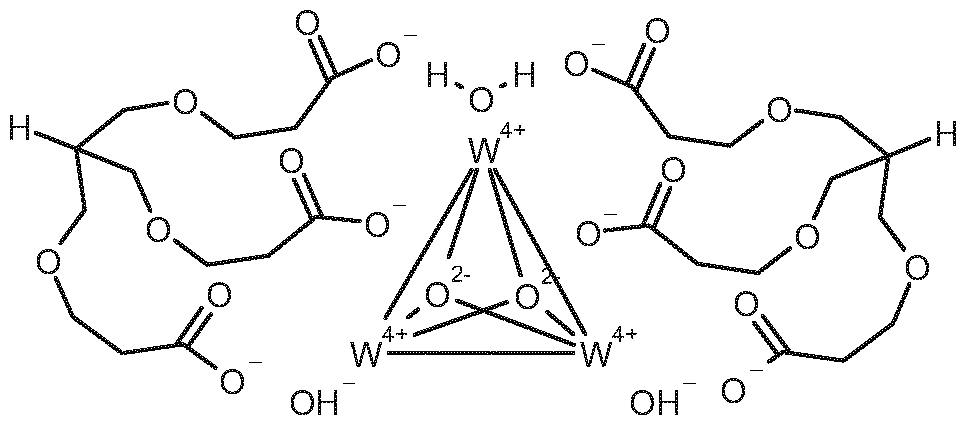
Another preferred compound of the general formula I is:
Monoaqua-KO-bis{p:r3,3',3"-[ethyl-1 , 1 , 1 -idynetris(methyleneoxy)]tripropanoato- l
 03}dihydroxi W- lA (IV) 2c

Another preferred compound of the general formula I is:
Monoaqua-KO-bis{p:r3,3'!3"-[aminomethylidynetris(methyleneoxy)]tripropanoato-
5 1 K201,02:2 2Or,03:3 202',03}dihydroxido- 20-di-M3-oxido-1 :2:3K60-irangt//o-tritungsten(3 W- W)(\V) 3c

Another preferred compound of the general formula I is:
It) Monoaqua-KObis{p:r3.3',3"-[2(2-carboxyethoxy)ethyl-1.1 1-idyne
propanoato-lK20\02:2K2Or.ai:3K202 3Hihydroxido-K20-di-p3-oxido-1:2:3K6 fr^
tritungsten(3 W-W)(N) 4b
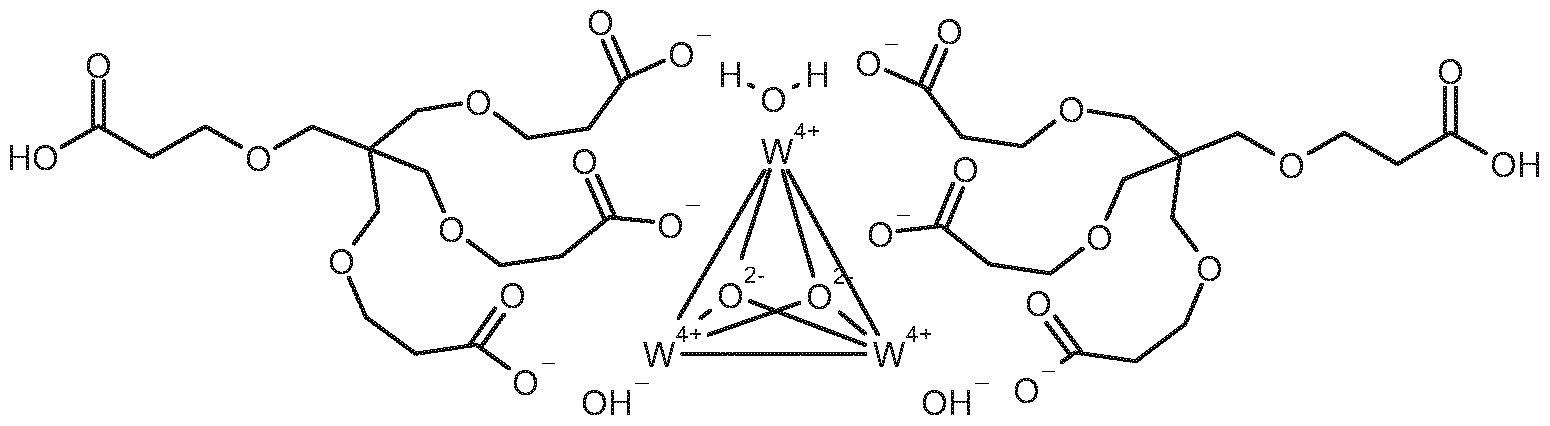
15
Anot er preferred compound of the general formula I is:
Monoaqua-KO-bis(p:r3.3',3"-{[(2,3-dihydroxypropyl)amino]m
propanoato-l 20\02:2 20^03:3 202',03^
tungsten(3 W-W)(\V) 5c

Another preferred compound of the general formula I is:
Monoaqua- O-bis( 3-3,3',3"-{[(1-deoxyxylit-1-yl)amino]methylidynetris(methyleneoxy)}- tripropanoato-l 20\02:2 2O ,03:3 202,03)-dihydroxido- 20-di^3-oxido-1:2:3 60-fr/- angt//o-tritungsten(3 W-W)(\V) 6c

Another preferred compound of the general formula I is:
( 3-3,3',3"-{Aminomethylidynetris(methyleneoxy)}tripropanoato-l 201,02:2 2O ,03:
3K202.03)monoaqua-KO-dihydroxido-K20-di-p3-oxido-1 :2:3K60-{p3-3,3',3"-[propane-1 ,2,3- triyltris(oxy)]tripropanoato-lK20 02:2K2O ,03:3K202,03}frangu/c tritungsten(3 W-W)(N) 7c

Another preferred compound of the general formula I is:
{p3-3,3',3"-[Aminomethylidynetris(methyleneoxy)]tripropanoato-lK201,02:2K2O ,03:
5 3 202',03)monoaqua- O-dihydroxido- 20-{ 3-3,3'!3"-[methylidynetris(methylene- oxy)]tripropanoato-lK20\02:2K2Or.03:3K202,Oi}di-p3-oxido-1:2:3K60-fnangu/o- tritungsten(3 W-W)(\V) 8

It) Another preferred compound of the general formula I is: onoaqua-KO-dihydroxido-K20-(p3-3.3',3"-{[(2,3-dihydroxypropyl)amino]methylidynetris- (methyleneoxy)}tripropanoato-lK20\02:2K2Ov,03:3K202.Q3)di-p3-oxido-1:2:3K6 {p3-
3,3',3"-[propane-1,2,3-triyltris(oxy)]tripropanoato-l 201,02:2 2O ,03: 3 202' ,03'}trianguIo- tritungsten(3 W-W){\V) 9

Monoaqua-KObis{p:r3.3',3"-[2-hydroxyethyl-1 ,1,1 -idynetris(methyleneoxy)-tripropanoato- l 20 02:2 2Oi 03:3 202 03}dihydroxido- 20-di- 3-oxido-1:2:3 60-fr/angL/o- tritungsten(3 W-W)(\V) 11c

Another preferred compound of the general formula I is:
Monoaqua-KO-bis(p3-3,3'.3"-[2-methoxyethyl-1 ,1,1 -idynetris(methyleneoxy)-tripropanoato- lK20 02:2K20\O 3K202,03]-dihydroxido-K20-di-p3-oxido-1:2:3K6 fr/angt//o- tritungsten(3 W-W)(\V) 12c

Another preferred compound of the general formula I is: onoaqua-KO-dihydroxido-K20-bis(p3-3,3',3"-[hydroxymethylidyne tris(methyleneoxy)tri- propanoato-l 20\02:2 2Oi o33 202o3]-di- 3-oxido-1:2:3 60-fr/angi/o-tritungsten(3 W- W)(N) 13e

Another preferred compound of the general formula I is:
Monoaqua-KO-dihydroxido-K20-(p3-3,3'.3"-{[(2,3-dihydroxypropyl)amino]methylidynetris-
5 (methyleneoxy)}tripropanoato-l 20 ,02:2 2O ,03:3 202',03')(M3-3,3',3"-[hydroxy- methylidynetris(methyleneoxy)tripropanoato-lK201.0 :2K201 ,O3:3K202, 03]-di- 3-oxido- 1 :2:3K60-frangu/o-tritungsten(3 W-W)(\V) 14

It) Another preferred compound of the general formula I is:
Monoaqua-KO-dihydroxido-K20-bis(p3-3,3',3"-{[(2-hydroxyethyl)amino]methylidyne- tris-
(methyleneoxy)}tripropanoato-lK20\02:2K20^05:3K^
tritungsten(3 W-W)(N) 15c

15
Anot er preferred compound of the general formula I is:
Monoaqua-KO-dihydroxido-K20-(p3-3.3',3"-{[(2-hydroxyethy)amino]methylidynetris- (methyleneoxy)}tripropanoato-lK201,02:2K201 ,Q3:3K202 !Q3)(p3-3,3'.3"-[riydroxy- methylidyneiris(meihyleneoxy)iripropanoato-l 201,02:2 2O ,03:3 202',03']-di- 3-oxido- 1 :2:3K60-fr/angt//o-tritungsten(3 W-W)(N) 16

Another preferred compound of the general formula I is:
Monoaqua-KO-bis{p3-3,3',3"-[(methoxyacetyl)aminomethylidynetris(methyleneoxy)] - tripropanoato-l 201,02:2 2O ,03:3 202',03}dihydroxido- 20-di- 3-oxido-1:2:3 60- ir/angu/o-tritungsten(3 W-W)(\V) 17c

Another preferred compound of the general formula I is: onoaqua-KO-dihydroxido-K20-(p3-3!3'!3"-{[(2,3-dihydroxypropyl)amino]methylidynetris-
(methyleneoxy)}tripropanoato-l 201,02:2 2O ,03:3 202',03,){M3-3,3',3"-[2-hydroxyethyl- 1,1,1 -idynetris(methyleneoxy)-tripropanoato-1 κ20': , O2: 2 2O ,03:3 202,03}di- 3-oxido- 1:2:3K60-frangt//o-tritungsten(3 W-W){\\l) 18

Another preferred compound of the general formula I is:
{p3-3,3',3"-[aminomethylidynetris(methyleneoxy)}]tripropanoato-lK201,02:2K2O ,03 5 :3K202.03}monoaqua-KO-dihydroxido-K20-{p3-3,3',3"-[(methoxyacetyl)- aminomethylidyneiris(methyleneoxy)]tripropanoato-l 20 ,02:2 2O ,03:3 202',03'}di- 3- oxido-1:2:3K60-irangt//o-tritungsten(3 W-W)(N) 19

It) Another preferred compound of the general formula I is:
Monoaqua-KO-dihydroxido-K20-(p3-3,3',3"-{[(1-deoxyerythritol-1-yl)amino]methylidynetris-
(methyleneoxy)}tripropanoato-l 201,02:2 2O ,03:3 202,,03')di- 3-oxido-{ 3-3,3',3"- [propane-1,2,3-triyltris(oxy)]tripropanoato-l 201,02:2 2O ,03: 3 202',03 1 :2:3 60- irangt//o-tritungsten(3 W-W)(N) 20c

Monoaqua-KO-dihydroxido-K20-(p3-3.3',3"-{[(2,3-dihydroxypropan-1-yl)amino]- methylidynetris(methyleneoxy)}tripropanoato-lK20\02:2K201.Qi:3K202.03KM3-3,3,,3"-
[(methoxyacetyl)aminomethylidynetris(methyleneoxy)]tripropanoato-

Another preferred compound of the general formula I is:
Monoaqua-KO-dihydroxido-K20-(p3-3.3',3"-{[(1-deoxyerythritol-1-yl)amino]- methylidynetris(methyleneoxy)}tripropanoato-l 201,02:2 2O ,03:3 202',03,){ 3-3,3',3"- [(methoxyacetyl)aminomethylidynetris(methyleneoxy)]tripropanoato-

Another preferred compound of the general formula I is: onoaqua-KOdihydroxido-K20-bis-{p3-propane[1 ,3-diyl(oxy)]dipropanoato- lK20 02:2KOv:3K02][yl(imino)propanoato-2KO:3KO]}di-p3-oxido-1:2:3K60-triangulo- tritungsten(3 W-W)(\V) 26d

Another preferred compound of the general formula I is:
Monoaqua-KO-dihydroxido-K20-bis{p:rhydroxymethylidyne[bis(methyleneoxy)di- propanoato-l K201.02:2KOr3K02][(methyleneimino)propanoato-2KO:3KO]}-di-p3-oxido- 1 :2:3K60-fr angt//o-tritungsten(3 W-W)(\V) 27d

A preferred compound of the general formula II is: onoaqua-KO-bis{p3-3,3',3"-[( ia,3«,5«)-cyclohexane-1 ,3,5-triyltris(oxy)]tripropanoato- l
 03)dihydroxido- 20-di-M3-oxido-1 :2:3 60-fr/angt /o- tritungsten(3 W-W){\\l) 10c

In a fourth aspect, the invention is directed to the use of compounds of the general formulae III or IV or mixtures as intermediates thereof for the preparation of trinuclear tungsten clusters comprising tridentate carboxylic acid ligands,
(CH2)p -X - (CH2)m— COOH HOOC -(CH2)n - Z -(CH2)q
CH2— O -(CH2)2—COOH HOOC -(CH2)2 -0— CH2
CH2 -O™ (CH2)2— COOH HOOC -(CH2)2 -0 -CH2
III IV wherein
R1 is H, CH3, CHzOH, CH2OCH3, CH20(CH2)2COOH, NH2> NH(CH2)2OH,
NHCH2CH(OH)CH2OH, NHCH(CH2OH)2, NHCH2(CH(OH))2CH2OH,
NHCH2(CH(OH))3CH2OH, NH(CO)CH2OCH3 or OH;
R2 is H, CH3, CH2OH, CH2OCH3, CH20(CH2)2COOH, NH2, NH(CH2)2OH,
NHCH2CH(OH)CH2OH, NHCH(CH2OH)2, NHCH2(CH(OH))2CH2OH,
NHCH2(CH(OH))3CH2OH, NH(CO)CH2OCH3 or OH;
X is O or NR3; wherein R3 is H, (CH2)2OH, CH2CH(OH)CH2OH, CH(CH2OH)2> CH2(CH(OH))2CH2OH or CH2(CH(OH))3CH2OH;
Z is O or NR4; wherein R4 is selected from the group comprising H, (CH2)20H,
CH2CH(OH)CH2OH, CH(CH2OH)2, CH2(CH(OH))2CH2OH,
CH2(CH(OH))3CH2OH; m is 2, 3; n is 2, 3; p is 0, 1 ; q is 0. 1 ; In a preferred embodiment the invention is directed to the use of compounds of the general formulae III or IV or mixtures thereof for the manufacture of the compounds of the general formula I.
T e Process for the preparation of trinuclear tungsten clusters comprising two tridentate carboxylic acid ligands of general formula I contains the reaction of one equivalent of monoaqua-KO-hexakis(p-acetato-K20)-dihydroxido-K20-di- 3-oxido-1 ;2:3K60-triangulo- tritungsten(3 W-W)(\\J) or a salt of this cluster or sodium hexakis(p-acetato-K20)-
 :2:3 60-fr angt//o-tritungsten(3 W-W)(N) in aqueous solution with two equivalents or slight excess of the desired tridentate ligand or a mixture of tridentate ligands (compounds of the general formulae III or IV), heating the components to temperatures in the range from 80° to 150°C in combination with the optional use of a pressure vessel, if necessary microwave irradiation, applying heating times from 10 minutes up to 3 days, isolation and purification of the resulting clusters by reversed phase and/or ion exchange chromatography.
In a fifth aspect, the invention is directed to the use of compounds of the general formula V as intermediates for the preparation of trinuclear tungsten clusters comprising tridentate carboxylic acid ligands,

V wherein the substituents HOOC-(CH2)2-0 exhibit all-c/s configuration; 5 is selected from the group comprising H or OH; m is 1 . 2 and n is 1 , 2. including isomeric forms of said compound, such as enantiomers and diastereomers and mixtures thereof.
ln a preferred embodiment the invention is directed to the use of compounds of the general formula V for the preparation/ manufacture of the compounds of the general formula I I .
The Process for the preparation trinuclear tungsten clusters comprising two tridentate carboxylic acid ligands of general formula I I , contains the reaction of one equivalent of monoaqua-KO-hexakis( -acetato-K20)-dihydroxido-K20-di- 3-oxido-1 :2:3K60-triangulo- tritungsten(3 W-W)(\V) or a salt of this cluster or sodium hexakis(p-acetato-K20)- tris(acetato-KO)-di-p3-oxido-1 :2:3K60-fnangi//o-tritungsten(3 W-W)(\\l) in aqueous solution in the presence of two equivalents or slight excess of the desired tridentate ligand, (compound of general formula V), heating the components to temperatures in the range from 80° to 150°C in combination with the optional use of a pressure vessel, if necessary microwave irradiation, applying heating times range from 10 minutes up to 3 days, isolation and purification of the resulting clusters by reversed phase and/or ion exchange chromatography.
In a sixth aspect, the invention is directed to the new trinuclear tungsten clusters comprising two tridentate carboxylic acid ligands of general formulae I or I I , obtainable by ligand exchange reaction of one equivalent of monoaqua-KO-hexakis(p-acetato-K20)- dihydroxido-K20-di- 3-oxido-1 :2:3K60-fr angu/o-tritungsten(3 W-W)(\\/) or a salt of this cluster or sodium hexakis(p-acetato-K20)-tris(acetato-KO)-di- 3-oxido-1 :2:3K60-triangulo- tritungsten(3 W-W)(l\/) in aqueous solution in the presence of two equivalents or slight excess of the desired tridentate ligand or a mixture of tridentate ligands, (compounds of the general formulae I I I or IV or V), heating the components to temperatures in the range from 80° to 150°C in combination with the optional use of a pressure vessel, if necessary microwave irradiation, applying heating times from 10 minutes up to 3 days, isolation and purification of the resulting clusters by reversed phase and/or ion exchange chromatography.
A preferred compound of the general formula I I I and IV is:
3-{3-(2-Carboxyethoxy)-2-[(2-carboxyethoxy)methyl]propoxy}propanoic acid 1 b

Another preferred compound of the general formula III and IV is:
3-{3-(2-Carboxyethoxy)-2-[(2-carboxyethoxy)methyl]-2-methylpropoxy}propanoic acid 2b

Another preferred compound of the general formula III and IV is: 3-{2-Amino-3-(2-carboxyethoxy)-2-[(2-carboxyethoxy)methyl]propoxy}propanoic acid 3b

Another preferred compound of the general formula III and IV is:
3-{3-(2-Carboxyethoxy)-2,2-bis[(2-carboxyethoxy)methyl]propoxy}propanoic acid
4a

Another preferred compound of the general formula III and IV is:
3-{3-(2-Carboxyethoxy)-2-[(2-carboxyethoxy)methyl]-2-[(2,3-dihydroxypropyl)aminoj- propoxy}propanoic acid 5b

Another preferred compound of the general formula III and IV is:
,3-Bis(2-carboxyethoxy)-2-[(2-carboxyethoxy)methyl]propan-2-yl};
deoxyxylitol 6b

Another preferred compound of the general formula III and IV is: 3,3',3"-[Propane-1 ,2,3-triyltris(oxy)]tripropanoic acid 7b

Another preferred compound of the general formula III and IV is:
3-[3-(2-Carboxyethoxy)-2-[(2-carboxyethoxy)methyl]-2-(hydroxymethyl)propoxy]propanoic acid 11 b

Another preferred compound of the general formula III and IV is:
3-[3-(2-Carboxyethoxy)-2-[(2-carboxyethoxy)methyl]-2-(methoxymethyl)propoxy]propanoic acid 12b

Another preferred compound of the general formula III and IV is:
3-{3-(2-Carboxyethoxy)-2-[(2-carboxyethoxy)methyl]-2-hydroxypropoxy}propanoic acid 13d

Another preferred compound of the general formula III and IV is: 3-{3-(2-Carboxyethoxy)-2-[(2-carboxyethoxy)methyl]-2-[(2-hydroxyethyl)amino]propoxy}- propanoic acid 15b

Another preferred compound of the general formula III and IV is: 3-{3-(2-Carboxyethoxy)-2-[(2-carboxyethoxy)methyl]-2-[(methoxyacetyl)amino]propoxy}- propanoic acid 17b

Another preferred compound of the general formula III and IV is:
1 -({1 ,3-Bis(2-carboxyethoxy)-2-[(2-carboxyethoxy)methyl]propan-2-yl};
deoxyerythrol 20b

Another preferred compound of the general formula III and IV is:
/V-[1 ,3-bis(2-carboxyethoxy)propan-2-yl]-|Valanine 26c

Another preferred compound of the general formula III and IV is:
A/-{3-(2-carboxyethoxy)-2-[(2-carboxyethoxy)methyl]-2-hydroxypropyl}-p-alanine 27c

A preferred compound of the general formula V is:
3,3'.3"-[(all-cis)-Cyclohexane-1 ,3,5-triyltris(oxy)]tripropanoic acid 10a

In an seventh aspect, the invention is directed to the process for the preparation of the compounds of the general formulae I and II. In an eighth aspect, the invention is directed to compounds of general formulae I or I I or mixtures thereof for the manufacture of diagnostic agents, especially of X-ray diagnostic agents for administration to humans or animals.
For the manufacture of diagnostic agents, for example the administration to human or animal subjects, the compounds of general formulae I or II or mixtures will conveniently be formulated together with pharmaceutical carriers or excipient. The contrast media of the invention may conveniently contain pharmaceutical formulation aids, for example stabilizers, antioxidants, pH adjusting agents, flavors, and the like. They may be formulated for parenteral or enteral administration or for direct administration into body cavities. For example, parenteral formulations contain a sterile solution or suspension in a concentration range from 150 to 600 mg W/mL, especially 200 to 450 mgW/mL of the new bistridentate W3O2 clusters according to this invention. Thus the media of the invention may be in conventional pharmaceutical formulations such as solutions, suspensions, dispersions, syrups, etc. in physiologically acceptable carrier media, preferably in water for injections. When the contrast medium is formulated for parenteral administration, it will be preferably isotonic or hypertonic and close to pH 7.4.
Pharmaceutically acceptable salts of the compounds according to the invention also include salts of customary bases, such as, by way of example and by way of preference, alkali metal salts (for example sodium salts), alkaline earth metal salts (for example calcium salts) and ammonium salts, derived from ammonia or organic amines having 1 to 16 carbon atoms, such as, by way of example and by way of preference, /V-methylglucamine.
For use as X-ray contrast agent, the media of the invention should generally have a sufficiently high percentage of tungsten, in particular a contrast medium with a high content of tungsten per molecule (minimum 35 % or higher).
General synthesis of compounds of the invention
Tridentate carboxylic acids were synthesized (scheme 1 ) in analogy to published procedures (Eur. J. Inorg. Chem. 2001 , 1789-1795). In the first step alkyl acrylates were added to trioles by base catalyzed Michael addition. Potential bases for this step are 5 aqueous sodium hydroxide in DMSO, potassium fert-butylate or sodium hydroxide in the presence of quaternary alkyl ammonium salts. Saponification of alkyl ester was established by the use of strong acids like hydrochloric acid or trifluoromethane sulphonic acid, trifluoro acetic acid and formic acid. Basic saponification is also possible. Chemical transformations like reductive aminations, or amid formation at R1 are possible at the I t) ester form , the free carboxylic acid form or the complexated form of the ligand.
Scheme 1

New W3O2 clusters were synthesized by ligand exchange reaction (WO 97/03994) of known tri-tungsten clusters like the hexa acetate or the nona acetate in aqueous solution
15 in the presence of two equivalents or slight excess of the desired tridentate ligand or a mixture of tridentate ligands to obtain a new mixed W3O2 cluster. Heating temperatures generally range from 80° to 150°C in combination with the optional use of a pressure vessels. Microwave irradiation is a possible alternative to conventional heating sources. Heating times range from 10 minutes up to 3 days. Isolation and purification of the desired 0 cluster is obtained by conventional chromatographic methods like preparative HPLC or ion exchange chromatography.
Scheme 2

Definitions
If chiral centers or other forms of isomeric centers are not otherwise defined in a compound according to the present invention, all forms of such stereoisomers, including enantiomers and diastereoisomers, are intended to be covered herein. Compounds containing chiral centers may be used as racemic mixture or as an enantiomerically enriched mixture or as a diastereomeric mixture or as a diastereomerically enriched mixture, or these isomeric mixtures may be separated using well-known techniques, and an individual stereoisomer maybe used alone.
Pharmaceutically acceptable salts of the compounds according to the invention include salts of mineral acids, carboxylic acids and sulfonic acids, for example salts of hydrochloric acid, sulfuric acid, phosphoric acid, methane sulfonic acid, ethane sulfonic acid, toluene sulfonic acid, benzene sulfonic acid, acetic acid, propionic acid, lactic acid, tartaric acid, malic acid, citric acid, fumaric acid, maleic acid and benzoic acid.
Description of the Figures Figure 1 : Crystal structure of 3d.
Figure 2: Preclinical CT-angiography in a rat: The CT-images shown in sagital (A) and coronary (B) view, visualized in maximum intensity projection. The heart, the main arterial and venous blood vessels and the kidneys show a high image contrast after administration of the tungsten based contrast agent.
Figure 3: Preclinical CT-angiography in a rat: The image shows the thoracal region zoomed from the whole body image stack. The heart chambers and the aortic arch with the branches of the brachiocephalic, left common carotid and left subclavian arteries show a high image contrast after administration of the tungsten based contrast agent.
Figure 4: Preclinical x-ray CT-angiography in a rat: CT-signals after administration of a tungsten based contrast agent determined at representative anatomical positions: Aorta ascendens, Aorta descendens, Aorta abdominalis, Ateria carotis. The brackets represent the standard deviation from image analysis in three different image slices.
Experimental Part
Abbreviations
Boc ferf-butoxycarbonyl
Br broad signal (in NMR data)
CI chemical ionisation
D doublet
DAD diode array detector
dd doublet of doublet
ddd doublet of doublet of doublet
dt doublet of triplet
DMF A/./V-dimethylformamide
DMSO dimethylsulfoxide
El electron ionisation
ELSD evaporative light scattering detector
ESI electrospray ionisation
EtOAc ethyl acetate
Fmoc fluorenylmethyloxycarbonyl
HPLC high performance liquid chromatography
ICP-OES Inductively coupled plasma - optical emission spectrometry
ICP-MS Inductively coupled plasma - mass spectrometry
K2CO3 potassium carbonate
MeCN acetonitrile
MS mass spectrometry
MTB methyl fert-butyl ether
m multiplet
mc centered multiplet
NH4CI ammonium chloride
NMR nuclear magnetic resonance spectroscopy: chemical shifts (δ) are given in ppm.
q quadruplett (quartet)
PMB para-methoxybenzyl
rt room temperature
s singlet
t triplet
TBAF tetrabutylammonium fluoride
TBS fert-butyldimethyl silyl
THF tetrahydrofuran
THP tetrahydropyran
UPLC ultra performance liquid chromatography
Examples
Example 1
Monoaqua-KO-bis{ 3-3,3',3"-[methylidynetris(methyleneoxy)]tripropanoato- 1 K201,02:2 201 ,03:3K202 ,03 }dihydroxido- 2 di- 3-oxido-1 :2:ZK60-triangulo- tritungsten(3 W-W)(\V)

Example ia 3-{3-(3-rerf-butoxy-3-oxopropoxy)-2-[(3-ferf-butoxy-3-oxopropoxy)methyl]propoxy}- propanoate

2-(Hydroxymethyl)propane-1 ,3-diol (2.0 g, 18.8 mmol) and fert-butyl prop-2-enoate are stirred in DMSO (3.3 mL) and 5 M aqueous sodium hydroxide solution (0.37 mL) at 20°C for 48 hours. The mixture was concentrated and the residue was purified by chromatography on silica gel (ethyl acetate in hexane, 20 to 100%) to yield 0.29 g of tert- butyl 3-{3-(3-fert-butoxy-3-oxopropoxy)-2-[(3-iert-butoxy-3-oxopropoxy)methyl]propoxy}- propanoate and 2.7 g of the di- or mono ether which were reacted under the same conditions to yield additional 4.0 g of the desired triether compound.
1H-NMR (400 MHz, CDC ): δ = 1 .47 (s, 27 H), 2.08 - 2.21 (m, 1 H), 2.46 (t, 6 H), 3.44 (d, 6 H), 3.63 (t, 6 H).
Example 1 b 3-{3-<2-Carboxyethoxy)-2-[(2-carboxyethoxy)methyl]propoxy}propanoic acid

To a solution of ferf- butyl 3-{3-(3-fert-butoxy-3-oxopropoxy)-2-[(3-iert-butoxy-3- oxopropoxy)methyl]propoxy}propanoate (4.0 g, mmol) in dioxane (20 mL) was added 6 M aqueous hydrochloric acid (6.5 mL, 39 mmol) and a 4 M solution of hydrochloric acid in dioxane (16.3 mL, 65.2 mmol). After stirring for 120 hours the solvent was removed under vacuum to yield 2.66 g 3-{3-(2-carboxyethoxy)-2-[(2-carboxyethoxy)methyl]propoxy}- propanoic acid as a yellow oil.
1H-NMR (400 MHz, deuterium oxide) δ = 2.1 1 (m, 1 H), 2.58 (t, 6 H), 3.46 (d, 6 H), 3.69 (t, 6 H).
LC/ S ES+ m/z 323.44 (M+1 ).
Example 1c
Sodium hexakis( -acetato-K20)-tris(acetato-KO)-di-U3-oxido-1 :2:3K60-fr/angt /o- tritungsten(3 W-W)(\V)

A suspension of sodium tungstate (26.4 g, 89.8 mmol) and tungsten hexacarbonyl (Aid rich, 97% purity, 130.4 g, 359.4 mmol) in acetic anhydride (2173 mL, 23.0 mol) was heated to 80°C. Air (approx. 5 L per minute) was bubbled through the mixture for 15 minutes, then the air stream was stopped and the bath temperature was raised to 145°C. After 18 hours, the mixture was cooled to rt. The yellow-brownish precipitate was filtered, washed with acetic anhydride (100 mL), THF (200 mL) and fert-butylmethyl ether (200 mL) and dried (50°C, 50 mbar) to give sodium hexakis( -acetato-K20)-tris(acetato-KO)-di- 3-oxido-1 :2:3K60-ir/angt//o-tritungsten(3 W- lA (IV) (127.8g, 1 12.3 mmol, 93,7% based on tungsten hexacarbonyl). 1H-NMR (300 MHz, deuterium oxide) δ = 2.08 (s, 9 H), 2.28 (s, 18 H).
LC/MS ES- m/z 1 1 15.03 (M-23).
Example 1d onoaqua- O-hexakis( -acetato- 20)-dihydroxido-K20-di- 3-oxido-1 :2:3K60- fr/angi//o-tritungsten(3 W-W)(\V)
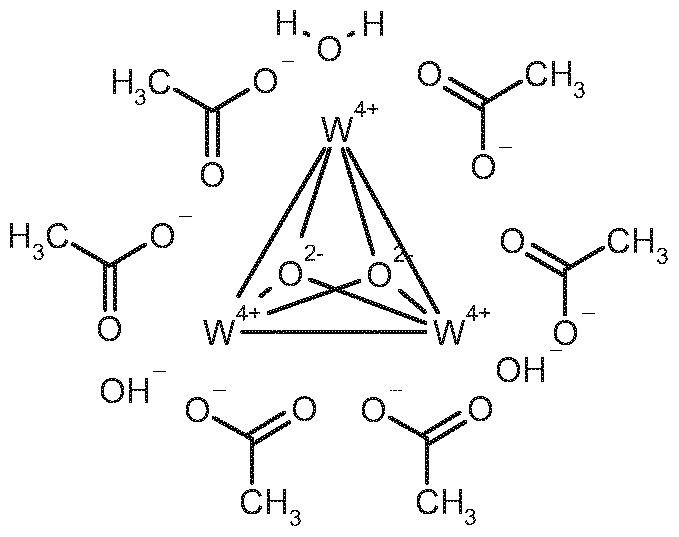
LC/MS ES- m/z 989.3 (M-1).
Example 1e
It) Monoaqua-KO-bis{M3-3,3',3"-[methylidynetris(methyleneoxy)]tripropanoato- lK20\02:2i<20^03:3K20^( }dihydroxid©^
tritungsten(3 W-W)(\V)

A suspension of 3-{3-(2-carboxyethoxy)-2-[(2-carboxyethoxy)methyl]propoxy}propanoic 15 acid (2.6 g, 8.06 mmol) and monoaqua-KO-hexakis( -acetato-K20)- dihydroxido- 0-di- 3- oxido-1:2:3K60-frangt//o-tritungsten(3 W-W)(N) (4.0 g, 4.03 mmol) in acetic acid (462 μΙ_, 8.06 mmol) and water (300 mL) was separated into 10 pressure vessels which were irradiated in a microwave reactor for 15 minutes at 140°C. The reaction mixtures were filtrated and the combined filtrates were concentrated in vacuum. Separation on a 0 preparative HPLC (acetonitrile water + acetic acid) yielded 0.56 g of monoaqua-KO-bis{p3- 3,3',3"-[methylidynetris(methyleneoxy)]tripropanoato-l 20 ,02:2 2O ,03:3 202',03
dihydroxido- 20-di- 3-oxido-1:2:3 60-fr/angt/o-tritungsten(3 W-W)(\\J) after lyophilization.
1H-NMR (400 MHz, deuterium oxide) δ = 1.71 - 1.82 (m, 2 H), 2.77 (br. t, 12 H), 3.43 (d, 12 H), 3.86 (br. t, 12 H). 5 LC/MS ES- m/z 1273.06 (M-1).
Example 2
Monoaqua-KO-bis{p3-3,3',3"-[ethyl-1 ,1 ,1 -idynetris(methyleneoxy)]tripropanoato-

tritungsten(3 W-W)(\V)

Example 2a
Di-fert-butyl 3,3'-{[2-(hydroxymethyl)-2-methylpropane-1 ,3-diyl]bis(oxy)}dipropanoate

1 , 1 , 1 -tris(hydroxymethyl)ethane (3.0 g, 24.9 mmol) and ferf-butyl prop-2-enoate (14 g, 1 10 mmol) are stirred in DMSO (6 mL) and 5 molar aqueous sodium hydroxide solution (0.37 mL) at 20°C for 24 hours and additional 7 hours at 70°C. The mixture was concentrated and the residue was purified by chromatography on silica gel (ethyl acetate in hexane, 20 to 100%) to yield 0.89 g of di-fert-butyl 3,3'-{[2-(hydroxymethyl)-2-methylpropane-1 ,3-diyl]- bis(oxy)}dipropanoate.
1H-NMR (400 MHz, CDCI3): δ = 0.89 (s, 3 H), 1 .46 (s, 27 H), 2.45 (t, 6 H), 3.26 (s, 6 H), 3.62 (t, 6 H).
Example 2b
3-{3-{2-Carboxyethoxy)-2-[(2-carboxyethoxy)methyl]-2-methylpropoxy}propanoic acid

Example 2c onoaqua- O-bis{ 3-3,3',3"-[ethyl-1 ,1 ,1 -idynetris(methyleneoxy)]tripropanoato-

tritungsten(3 W-W)(\V)

A suspension of 3-{3-(2-carboxyethoxy)-2-[(2-carboxyethoxy)methyl]-2-methylpropoxy}- propanoic acid (272 mg, 808 pmol) and monoaqua-KO-hexakis(p-acetato-K20)- dihydroxido-K20-di-p3-oxido-1 :2:3K60-fnangt;/o-tritungsten(3 W-W)(\V) (400 mg, 404 μιηοΙ) in acetic acid (46 pL, 0.8 mmol) and water (30 mL) was irradiated in a microwave reactor for 15 minutes at 140°C. The reaction mixtures were filtrated and the filtrate was
concentrated in vacuum. Separation on a preparative HPLC (acetonitrile water + acetic acid) yielded 2.3 mg monoaqua-KO-bis{p3-3,3',3"-[ethyl-1 , 1 , 1 -idynetris(methyieneoxy)]-

angt//o-tritungsten(3 W-W)(N). 1 H-NMR (300 MHz, DMSO-cfe) δ = 0.68 (s, 6 H), 2.72 (br. t, 12 H), 3.1 1 (s, 12 H), 3.72 (br. t, 12 H).
LC/ S ES- m/z 1300.75 (M-1 ).
Example 3 Monoaqua- O-bis{p3-3,3',3"-[aminomethylidynetris(methyleneoxy)]tripropanoato-

tritungsten(3 W-W)(\V)

Example 3a
Tert-butyl 3-{2-amino-3-(3-fert-butoxy-3-oxopropoxy)-2-[(3-fert-butoxy-3-oxo- propoxy)methyl]propoxy}propanoate

Example 3b
3-{2-Amino-3-{2-carboxyethoxy)-2-[(2-carboxyethoxy)methyl]propoxy}propanoic acid

To a solution of fert-butyl 3-{2-amino-3-(3-fert-butoxy-3-oxopropoxy)-2-[(3-iert-butoxy-3- oxopropoxy)methyl]propoxy}propanoate (9.3 g, 18.9 mmol) in dioxane (16.4mL) was added 6 molar aqueous hydrochloric acid (2.6 mL, 15.5 mmol) and a 4 molar solution of hydrochloric acid in dioxane (6.5 mL, 25.9 mmol). After stirring for 96 hours the solvent was removed under vacuum to yield the hydro chloride salt, which was treated with ion exchange resin IRA 67 for three days. The ion exchange resin was washed with water followed by 20% aqueous acetic acid. The washing solutions were fractionated and fractions where no chloride was detected were concentrated under vacuum to yield 1 .0 g 3-{2-amino-3-(2-carboxyethoxy)-2-[(2-carboxyethoxy)methyl]propoxy}propanoic acid as free base.
1H-NMR (300 MHz, deuterium oxide) δ
Exampfe 3c
Monoaqua-KO-bis{ 3-3,3',3''-[aminomethylidynetris(methyleneoxy)]tripropanoato-

tritungsten(3 W-W)(\V)

A suspension of 3-{2-amino-3-(2-carboxyethoxy)-2-[(2-carboxyethoxy)methyl]propoxy}- propanoic acid (2.94 g, 8.73 mmol) and monoaqua-KO-hexakis( -acetato-K20)- dihydroxido-K20-di- 3-oxido-1 :2:3K60-fnangi//o-tritungsten(3 W-W){\V) (4.32 g, 4.36 mmol) in acetic acid (500 μΙ_, 8.73 mmol) and water ( 136 mL) was separated into 10
I t) pressure vessels which were irradiated in a microwave reactor for 15 minutes at 140°C.
The reaction mixtures were filtrated and the combined filtrates were concentrated in vacuum. Separation on a preparative HPLC (acetonitrile / water + acetic acid) yielded monoaqua-KO-bis{ 3-3,3'.3"-[aminomethylidynetris(methyleneoxy)]tripropanoato-

1 5 (3 W-W)(\V).
1 H-NMR (300 MHz, deuterium oxide) δ = 2.83 (t, 12 H), 3.55 (s, 12 H), 3.93 (t, 12 H). LC/ S ESI- m/z 1303 (M-1 ).
Example 3d 0 Triaqua- 3( bis{ 3-3,3\3''-[aminomethylidynetris(methyleneoxy)]tripropanoato- 1 20 ,02:2 2Or,03:3 202 ,03 }di-M3-oxido-1 :2:3K60-fr/angty/o-tritungsten(3 W-W)(\V) dichloride
For the generation of crystalline triaqua-K30-bis{ ;r3,3',3"-[aminomethylidyne- tris(methyleneoxy)]tripropanoato-l 201 , 02:2 2O , 03:3 202,, 03'}di- 3-oxido-1 :2:3 60- 5 fr angt//o-tritungsten(3 W-W)(l\/) dichloride the tungsten complex was prepared in analogy to 3c starting from 3-{2-amino-3-(2-carboxyethoxy)-2-[(2-carboxyethoxy)methyl]propoxy}-
propanoic acid in form of its hydrochloride prepared in analogy to 3b without ion exchange treatment. Final crystallization was done from a water acetonitrile mixture.
Crystal data and structure refinement: .
Empirical formula C26H40CI2 2O28W3
Formula weight 1451 .05
Temperature 100(2) K
Wavelength 1 .54178 A
Crystal system Orthorhombic
Space group Pnna
Unit cell dimensions a = 8.73990(10) A u= 90°.
b = 27.9831 (3) A β= 90°.
c = 19.0848(2) A γ = 90°.
Volume 4667.56(9) A3
Z 4
Density (calculated) 2.065 Mg/m3
Absorption coefficient 15.220 mm 1
F(000) 2760
Crystal size 0.20 x 0.03x 0.02 mm3
Theta range for data collection 3.16 to 65.70°.
Index ranges -8<=h<=10; -32<=k<=31 , -13<=l<
Reflections collected 27656
Independent reflections 4022 [R(int) = 0.0571 ]
Completeness to theta = 65.70° 99.3 %
Absorption correction None
Refinement method Full-matrix least-squares on F2
Data / restraints / parameters 4022 / 0 / 278
Goodness-of-fit on F2 1 .089
Final R indices [l>2sigma(l)] R1 = 0.051 1 . wR2 = 0.1364
R indices (all data) R1 = 0.0585, wR2 = 0.1423
Largest d iff. peak and hole 4.513 and -0.928 e.A 3
Atomic coordinates ( x 104) and equivalent isotropic displacement parameters (A2x 103)
for 3d U(eq) is defined as one third of the trace of the orthogonalized U'J tensor.
X y z U(eq)
W(1) -1257(1) -2500 2500 29(1)
W(2) 1519(1) -2773(1) 1901(1) 30(1)
Cl(1) 2500 0 2362(2) 46(1)
Cl(2) -2500 0 286(2) 31(1)
0(1) -1824(7) -1782(2) 2748(3) 33(1)
0(2) 415(7) -1566(2) 3213(3) 34(1)
0(3) -1201(7) -643(2) 2082(4) 40(2)
0(4) -57(6) -1554(2) 305(3) 32(1)
0(5) -1802(7) -2362(2) 1444(3) 36(1)
0(6) 407(7) -2594(2) 957(3) 32(1)
0(7) 2938(6) -972(2) 1172(3) 33(1)
0(8) 3246(7) -1848(2) 2557(3) 33(1)
0(9) 3226(7) -2282(2) 1588(3) 33(1)
0(10) -3512(9) -2500 2500 35(2)
0(11) 599(6) -2137(2) 2145(3) 28(1)
0(12) 2733(7) -3126(2) 1144(3) 39(2)
N(1) 545(8) -346(3) 1050(4) 31(2)
C(1) -964(11) -1477(3) 3043(4) 35(2)
C(2) -1573(12) -994(4) 3213(5) 43(2)
C(3) -2304(10) -744(4) 2617(5) 35(2)
C(4) -1279(10) -940(3) 1484(5) 33(2)
C(5) 226(9) -871(3) 1082(4) 32(2)
C(6) 84(10) -1054(3) 334(5) 34(2)
C(7) -1582(9) -1728(3) 186(5) 32(2)
C(8) -1496(10) -2265(3) 220(5) 32(2)
C(9) -931(10) -2419(3) 912(5) 32(2)
C(10) 1528(9) -1112(3) 1479(5) 31(2)
C(11) 4231(9) -1066(3) 1607(5) 32(2)
C(12) 4759(10) -1581(3) 1603(5) 32(2)
C(13) 3655(9) -1932(3) 1935(4) 29(2)
0(1W) -1420(40) 1434(14) 5000(20) 147(15)
0(1W) -2637(18) 1511(5) 4753(8) 47(6)
0(2W) -549(15) 1993(6) 3860(9) 128(5)
0(3W) -2500 0 4273(1 1 ) 202(16)
Hydrogen coordinates ( x 10*·) and isotropic displacement parameters (A2x for 3d.
x y z U(eq)
H(1A) 1403 -227 1244 37
H(1 B) -1 18 -150 832 37
H(2A) -2332 -1026 3595 52
H(2B) -723 -794 3390 52
H(3A) -3131 -946 2422 42
H(3B) -2767 -442 2783 42
H(4A) -2161 -849 1 187 39
H(4B) -1400 -1279 1625 39
H(6A) -824 -906 1 1 1 40
H(6B) 998 -955 64 40
H(7A) -1956 -1625 -280 39
H(7B) -2288 -1605 548 39
H(8A) -2524 -2402 136 38
H(8B) -801 -2384 -150 38
H(10A) 1504 -1017 1978 38
H(10B) 1416 -1464 1453 38
H(1 1A) 3974 -975 2094 39
H(1 1 B) 5090 -861 1452 39
H(12A) 5749 -1601 1853 39
H(12B) 4939 -1679 1 1 1 1 39
Figure 1 shows the crystal structure of 3d.
Example 4
Monoaqua- O-bis{p3-3,3',3"-[2(2-carboxyethoxy)ethyl-1 ,1 ,1 -idynetris(methylene- oxy)]tripropanoato-l

1 :2:3K60-fr/"angu/o-tritungsten(3 W-W)(\V)

Example 4a
3-{3-{2-Carboxyethoxy)-2,2-bis[(2-carboxyethoxy)methyl]propoxy}propanoic acid

I t) 3-{3-(2-Carboxyethoxy)-2,2-bis[(2-carboxyethoxy)methyl]propoxy}propanoic acid was synthesized analogous to Weizman et al. J. Am. Chem. Soc. 1996, 118 12368-12375.
1H-NMR (400 MHz, deuterium oxide) δ = 2.58 (t, 8 H), 3.34 (s, 8 H), 3.67 (t, 8 H).
Example 4b
15 onoaqua- O-bis{p3-3,3',3"-[2(2-carboxyethoxy)ethyl-1 ,1 ,1 -idynetris(methylene- oxy)]tripropanoato-l

1 :2:3 60-fr/"angu/o-tritungsten(3 W-W)(\V)

A suspension of 3-{3-(2-carboxyethoxy)-2,2-bis[(2-carboxyethoxy)methyl]propoxy}- propanoic acid (0.34 g, 808 pmol) and monoaqua-KO-hexakis(p-acetato-K20)-dihydroxido- K20-di-p3-oxido-1 :2:3K60-frangt//o-tritungsten(3 W~W)(\\I) (400 mg, 404 pmol) in acetic acid (93 μΙ_, 1.6 mmol) and water (30 ml.) was irradiated in a microwave reactor for 15 minutes at 140°C. The reaction mixtures were filtrated and the filtrates was concentrated in vacuum. Separation on a preparative HPLC (acetonitrile water + acetic acid ) yielded 55.1 mg monoaqua- O-bis{ 3-3,3',3"-[2(2-carboxyethoxy)ethyl-1 ,1 ,1- idynetris(methyleneoxy)]tripropanoato-l 201,02:2 2O ,03:3 202,,03}-dihydroxido- 20-di- p3-oxido-1:2:3K60-fnangu/o-tritungsten(3 W-W)(N).
1H-N R (400 MHz, deuterium oxide) δ = 2.52 (t, 4 H), 2.72 (br. t, 12 H), 3.28 (s, 4 H), 3.32 (s, 12 H), 3.63 (t, 4 H), 3.78 (br. t, 12 H).
LC/ S ES- m/z 1477 (M-1).
Example 5
Mon©aqua-K0 jis( 3-3,3\3"-{[(2,3-di ydroxypr©p^
oxy)}tripropanoato-l
 :2:3K60- fr/angi//o-tritungsten(3 W-W)(\V)

Example 5a
3-{3-{2-carboxyethoxy)-2-[{2-carboxyethoxy)methyl]-2-[(2,3-dihydroxypropyl)amino]- propoxy}propanoic acid

Tert-butyl 3-{2-amino-3-(3-feni-butoxy-3-oxopropoxy)-2-[(3-fert-butoxy-3-oxopropoxy)- methyl]propoxy}propanoate (25 g, 49.4 mmol) and rac-2,3-dihydroxypropanal were shaken under an hydrogen atmosphere in methanol in presence of 10% palladium on charcoal (263 mg) for 18 hours at room temperature. The mixture was filtered through cellites and concentrated in vacuum. The residue was purified by chromatography on silica gel (ethyl acetate in hexane. 20 to 100%) to yield 12.47 g of ferf-butyl 3-{3-(3-fert- butoxy-3-oxopropoxy)-2-[(3-fert-butoxy-3-oxopropoxy)methyl]-2-[(2,3-dihydroxypropyl)- amino]propoxy}propanoate as light yellow oil. H-NMR (400 MHz, CDCI3): δ = 1 .46 (s, 27 H), 2.47 (t, 6 H), 2.76 (dd, 1 H), 2.87 (dd, 1 H), 3.37 (s, 6 H), 3.54 - 3.79 (m, 3 H), 3.64 (t, 6H).
Example 5b
3-{3-{2-Carboxyethoxy)-2-[(2-carboxyethoxy)methyl]-2-[(2,3-dihydroxypropyl)- amino]propoxy}propanoic acid

To a solution of fert-butyl 3-{3-(3-fert-butoxy-3-oxopropoxy)-2-[(3-fert-butoxy-3-oxo- propoxy)methyl]-2-[(2!3-dihydroxypropyl)amino]propoxy}propanoate (4.8 g. 8.3 mmol) in
dioxane (48 mL) was added 6 molar aqueous hydrochloric acid (6.6 mL, 39.6 mmol) and a 4 molar solution of hydrochloric acid in dioxane (16.6 mL, 66 mmol). After stirring for 40 hours the solvent was removed under vacuum to yield the hydro chloride salt, which was treated with ion exchange resin IR 67 (200mL) in water for two hours. The ion exchange resin was washed with water followed by 15 % aqueous acetic acid. The washing solutions were fractionated and fractions with a negative chloride detection were combined and concentrated under vacuum to yield 3.18 g 3-{3-(2-carboxyethoxy)-2-[(2- carboxyethoxy)methyl]-2-[(2,3-dihydroxypropyl)amino]propoxy}propanoic acid as free base. 1H-NMR (300 MHz, deuterium oxide) δ = 2.54 (t, 6 H), 3.05 (dd, 1 H), 3.23 (dd, 1 H), 3.54- 3.58 (m, 2 H), 3.65 (s, 6H), 3.71 (t, 6 H), 3.83 - 3.95 (m, 1 H).
Example 5c
Monoaqua- O-bis(p3-3,3\3''^[(2,3 Jihydroxypropyl)amino]methylidynetris(methylene- oxy)}tripropanoato-1 201 ,02:2K2Or,03:3K202 ,03 )-dihydroxido- 20-di-p3- xido-1 :2:3 60- fr/angt//o-tritungsten(3 W-W)(\V)

A suspension of 3-{3-(2-carboxyethoxy)-2-[(2-carboxyethoxy)methyl]-2-[(2,3-dihydroxy- propyl)amino]propoxy}propanoic acid (1 .58 g, 3.84 mmol) and monoaqua-KO-hexakis(p- acetato-K20)-dihydroxido-K20-di-p3-oxido-1 :2:3K60-fr angt//o-tritungsten(3 W-W)(N) (1 .9 g, 1.92 mmol) in acetic acid (220 pL, 3.84 mmol) and water (136 mL) was separated into 5 pressure vessels which were irradiated in a microwave reactor for 15 minutes at 140°C. The reaction mixtures were filtrated and the combined filtrates were concentrated in vacuum. Separation on a preparative HPLC (acetonitrile water + acetic acid) yielded 0.24 g monoaqua-KO-bis(p3-3,3',3"-{[(2,3-dihydroxypropyl)amino]methylidynetris(methylene-

fr angt//o-tritungsten(3 W-W)(N).
1H-NMR (300 MHz, deuterium oxide) δ = 2.80 (t, 12 H), 2.99 - 3.10 (m, 2 H), 3.14 - 3.25 (m, 2 H), 3.48 - 3.66 (m, 16 H). 3.89 (t, 14 H). LC/MS ES- m/z 1451 .1 (M-1 ).
Example 6
Monoaqua- O-bis( 3-3,3',3"-{[(1 -deoxyxylit-1 -y!)amino]met yfidynetris(met ySene- oxy)}tripropanoato-l K2O\O2:2K2Oi;o3:3K202 o3 di ydroxido-ic2O-di-M3-oxido- 1 :2:3K60-fr/angty/o-tritungsten(3 W-W {W)

Example 6a
1 -({9-[(3-fert-butoxy-3-oxopropoxy)methyl]-2,2,16,16-tetramethyl-4,14-dioxo- 3,7,11 ,15-tetraoxaheptadecan-9-yl}amino)-1 -deoxyxylitol

Tert-butyl 3-{2-amino-3-(3-fert-butoxy-3-oxopropoxy)-2-[(3-ferf-butoxy-3-oxopropoxy)- methyl]propoxy}propanoate (0.5 g, 0.99 mmoi) and D/L-xylose (0.3 g, were stirred in methanol for 0.5 hours at room temperature. Sodium cyano borohydride (81 mg, 1 .29
mmol) was added and stirring was continued for 22 hours at room temperature and 5 days at 60°C (additional addition of 0.3 g xylose after day 4). The pH of the solution was adjusted to 4 with 2 M hydrochloric acid and the solution was concentrated under reduced pressure. The residue was purified by chromatography on silica gel (methanol in dichloromethane, 0 to 20%) to yield 310 mg of 1 -({9-[(3-fert-butoxy-3-oxopropoxy)methyl]- 2,2, 16.16-tetramethyl-4, 14-dioxo-3,7, 1 1 , 15-tetraoxaheptadecan-9-yl}amino)-1 -deoxy- xylitol.
1H-N R (400 MHz, CDCI3): δ = 1 .40 (s, 27 H), 2.40 (t, 6 H), 2.68 (br, 1 H), 3.17 (d, 2 H), 3.22 - 3.58 (m, 5 H), 3.55 (t, 6 H), 4.43 (br, 1 H).
Example 6b
1 -({1 ,3-Bis(2-carboxyethoxy)-2-[(2-carboxyethoxy)methyl]propan-2-yl}amino)-1 - deoxyxylitoi

Monoaqua-KO-bis(M3-3,3',3"-{[(1-deoxyxylit-1 -yl)amino]methylidynetris(methyleneoxy)}- tripropanoato-l

angt/o-tritungsten(3 W-W)(\V)

A suspension of 1-({1 ,3-bis(2-carboxyet oxy)-2-[(2-carboxyethoxy)met yl]propan-2- yl}amino)-1-deoxyxylitol (120 mg, 255 pmol) and monoaqua-KO-hexakis(p-acetato-K20) dihydroxido- 20-di-p3-oxido-1:2:3K60-frangu/o-tritungsten(3 W-W)(\V) (125 mg, 127 pmol) in acetic acid (15 μΙ_, 25 pmol) and water (9 mL) was irradiated in a microwave reactor for 15 minutes at 140°C. The reaction mixture was filtrated and the filtrate concentrated in vacuum. Separation on a preparative HPLC (acetonitrile water + acetic acid) yielded 19 mg of monoaqua-KO-bis(p3-3.3',3"-{[(1-deoxyxylit-1-yl)amino]- methylidynetris(methyleneoxy)}tripropanoato-l 20 ,02:2 2Or,03:3 202',03')-dihydroxido- K 0-di-p3-oxido-1 :2:3K60-frangt//o-tritungsten(3 W-W){\\J) in form of its acetate salt. 1H-NMR (300 MHz, deuterium oxide) δ = 2.71 (br. t, 12 H), 3.15 (br., 4 H), 3.56 (s, 12 H), 3.58 - 3.68 (m, 6 H), 3.74 (m, 2 H), 3.86 (br. t, 12 H), 3.88 - 3.95 (m, 2 H) ppm.
LC/ S ESI- m/z 1571 (M-1).
Example 7
(p3-3,3',3"-{Aminomethylidynetris(methyleneoxy)}tripropanoato-1 κ201,02:2κ201',03: 3K 202,( 5)monoaqua-KO-dihydroxido- 20-di-p3-oxido-1:2:3K60-{p3-3,3',3''-[propane-
1 ,2,3-triyltris(oxy)]tripropanoato-1

(3 W-W)(\V)

Example 7a
Tert-butyl 3-[2,3-bis(3-fert-butoxy-3-oxopropoxy)propoxy]propanoate

To propan-1 ,2,3-triol ( 105 g, 1 .14 mol) and ferf-butyl prop-2-enoate (835 mL, 5.7 mol) in DMSO (248 mL) was added a 5 molar aqueous sodium hydroxide solution (22.8 mL, 1 14 mmol) at 5°C. The mixture is quenched with aqueous NKiCI solution and extracted with ethyl acetate. The mixture was concentrated and the residue was purified by chromatography on silica gel (ethyl acetate in hexane, 20 to 100%) to yield 12.3 g of tert- butyl 3-[2,3-bis(3-fert-butoxy-3-oxopropoxy)propoxy]propanoate.
1 H-N R (400 MHz, CDCI3): δ = 1 .45 (s, 27 H), 2.48 (t, 6 H), 3.43 - 3.54 (m, 4 H), 3.58 (m, 1 H), 3.68 (t, 4 H), 3.81 (t, 2 H).
Example 7b
3,3',3"-[Propane-1 ,2,3-triyltris(oxy)]tripropanoic acid

To a solution of iert-butyl 3-[2,3-bis(3-fert-butoxy-3-oxopropoxy)propoxy]propanoate (12.3 g, 23.2 mmol) in dioxane (99 ml_) was added 6 molar aqueous hydrochloric acid (18.6 ml_, 1 1 1 mmol) and a 4 molar solution of hydrochloric acid in dioxane (46.5ml_. 186mmol). After stirring for 24 hours additional 6 molar aqueous hydrochloric acid (1.86 ml_, 1 1.1 mmol) and a 4 molar solution of hydrochloric acid in dioxane (4.65ml_, 18.6mmol) was added and the solution was stirred for 2 hours at 40°C. The organic solvent was removed under vacuum, water was added to the residue and a final Iyophiiization yielded 8.0 g of 3,3',3"-[propane-1 ,2,3-triyltris(oxy)]tripropanoic acid. 1H-NMR (400 MHz, deuterium oxide) δ = 2.59 (t, 2 H), 2.60 (t, 4 H), 3.50 (dd, 2 H), 3.58 (dd, 2 H), 3.67 - 3.70 (m, 1 H), 3.69 - 3.77 (m, 4 H), 3.81 (t, 2 H).
Example 7c
( 3-3,3',3"-{Aminomethylidynetris(methyleneoxy)}tripropanoato-1 201,02:2 20 ,03:

1 ,2,3-triyltris(oxy)]tripropanoato-1 κ20 &:2κ20^ ', &:3κ2& , 03'}triangulo-tritu ngsien (3 W-W)(\V)

A suspension of 3,3',3"-[propane-1 ,2.3-triyltris(oxy)]tripropanoic acid (623 mg, 2.02 mmol), 3-{2-amino-3-(2-carboxyethoxy)-2-[(2-carboxyethoxy)methyl]propoxy}propanoic acid (682 mg, 2.02 mmol) and monoaqua-KO-hexakis(p-acetato-K20)- dihydroxido-K20-di-p3-oxido- 1 :2:3K60-frangu/o-tritungsten(3 W-W)(\V) (2.0 g, 2.02 mmol) in acetic acid (47 pL, 0.81
mmol) and water (30 mL) was separated into 5 pressure vessels which were irradiated in a microwave reactor for 15 minutes at 140°C. The reaction mixtures were combined, filtrated and the filtrate was concentrated in vacuum. Separation on a preparative HPLC (acetonitrile water + acetic acid) yielded 93 mg of monoaqua- O-dihydroxido- 20-( 3- 3,3',3"-{aminomethylidynetris(methyleneoxy)}tripropanoato-l 201,02:2 2O ,03,3 202',03)- di-p3-oxido-1 :2:3K60-{p3-3,3',3"-[propane-1 ,2,3-triyltris(oxy)]tripropanoato- lK20 ,02:2 2O ,03,3 202,,03' riangi/o-tritungsten(3 W-W)(N).
1H-NMR (300 MHz, deuterium oxide) δ = 2.58 - 2.80 (m, 12 H), 3.24 (br., 2 H), 3.34 (m, 3 H), 3.47 (s, 6 H), 3.72 (m, 1 H), 3.78 - 3.94 (m, 6 H), 3.85 (t, 5 H) ppm.
LC/ S ES- m/z 1274 (M-1)
Example 8

3κ2G2',03}monoaqua-κO-di ydroxido-κ20-{μ3-3,3 3"-[met ylidynetπs(met ylene- oxy)]tripropanoato-1 ic201,02:2K201',03:3i202',03'}di-M3-oxido-1 :2:3K60-triangulo- tritungsten(3 W-W)(\V)

A suspension of 3-{3-(2-carboxyethoxy)-2-[(2-carboxyethoxy)methyl]propoxy}propanoic acid (260 mg, 808 μιτιοΙ), 3-{2-amino-3-(2-carboxyethoxy)-2-[(2-carboxyethoxy)methyl]- propoxyjpropanoic acid (273 mg, 808 μιτιοΙ) and monoaqua-KO-hexakis( -acetato-K20)- dihydroxido-K20-di- 3-oxido-1:2:3K60-frangt//o-tritungsten(3 W-W)(\V) (800 mg, 808 pmol) in acetic acid (93 μΙ_, 1.62 mmol) and water (60 mL) was separated into two portions, which were irradiated in a microwave reactor for 15 minutes at 140°C. The reaction mixtures were filtrated and the filtrate was concentrated in vacuum. Separation on a preparative HPLC (acetonitrile water + acetic acid) yielded 87 mg of {p:s-3,3',3"- [Aminomethylidynetris(methyleneoxy)]tripropanoato-lK201.02:2K 01.03:3K202,03}mono-
aqua- O-dihydroxido- 20-{ 3-3,3 3"-[meihylidyneiris(meihylene-oxy)]tripropanoato- 1 20 02:2 2O ,03:3 202,,03'}di-μ3-oxido-1 :2:3 60-ίΓ/angu/o ritungsίen(3 W-W)(N).
1H-NMR (300 MHz, deuterium oxide) δ = 1 .71 (m, 1 H), 2.71 (br. t, 6 H), 2.73 (br. t, 6 H), 3.38 (d, 6 H), 3.49 (s, 6 H), 3.82 (t , 6 H), 3.87 (t, 6 H) ppm. LC/MS ES- m/z 1287.93 (M-1 )
Example 9
Monoaqya- O-di ydroxido-K20-(M3-3,3',3"-{[(2,3-di ydroxypropyS)amino]- methylidynetris(methyleneoxy)}tripropanoato-1 κ201,02:2 201 ',03:3κ202 ,03" oxido-1 :2:3K60-{M3-3,3',3"-[propane-1 ,2,3-triyltris(oxy)]tripropanoato- 1 201,02:2 201 ,03: ZK202' ,&'}triangulo-if\iunqsi n(Z W-W)(\V)

A suspension of 3,3',3"-[propane-1 ,2.3-triyltris(oxy)]tripropanoic acid (98 mg, 316 pmol), 3-{3-(2-carboxyethoxy)-2-[(2-carboxyethoxy)methyi]-2-[(2,3-dihydroxypropyl)amino]- propoxy}propanoic acid (174 mg, 422 pmol) and sodium hexakis(p-acetato-K20)- tris(acetato-KO)-di-p3-oxido-1 :2:3K60-irangt//o-tritungsten(3 W-W){\V) (400 mg, 0.37 mmoi) in water (60 mL) was irradiated in a microwave reactor for 15 minutes at 140°C. The reaction mixture was filtrated and the filtrate was concentrated in vacuum. Separation on a preparative HPLC (acetonitrile water + acetic acid) yielded mg rac-monoaqua- θ- dihydroxido-K 0-(p3-3!3',3"-{[(2,3-dihydroxypropyl)amino]methylidynetris(methyleneoxy)} tripropanoato-l

(oxy)]tripropanoato-l K20" .02:2K201 ,03:3K 02.03 }-1 :2:3K60-irangt//o-tritungsten(3 W-
W)(N).
1H-NMR (400 MHz, deuterium oxide) δ = 2.64 - 2.78 (m, 12 H), 3.00 (dd, 1 H), 3.15 (dd, 1 H), 3.19 - 3.28 (m, 2 H), 3.31 - 3.41 (m, 3 H), 3.46 - 3.62 (m, 2 H), 3.56 (s, 6H), 3.73 (m, 1 H), 3.79 - 3.93 (m, 6 H), 3.86 (t, 6 H) ppm.
LC/MS ES- m/z 1347.66 (M-1 ).
Example 10
Monoaqua-KO-bis{M3-3,3',3"-[( iii,3£¾5a)-cyclohexane-1 ,3,5-triyltris(oxy)]tri- propanoato-1 K201,02:2K201',03:3ic202',03'}di ydroxido-ic20-di-M3-oxido-1 :2:3 60- fr/angt//o-tritungsten(3 W-W)(\V)
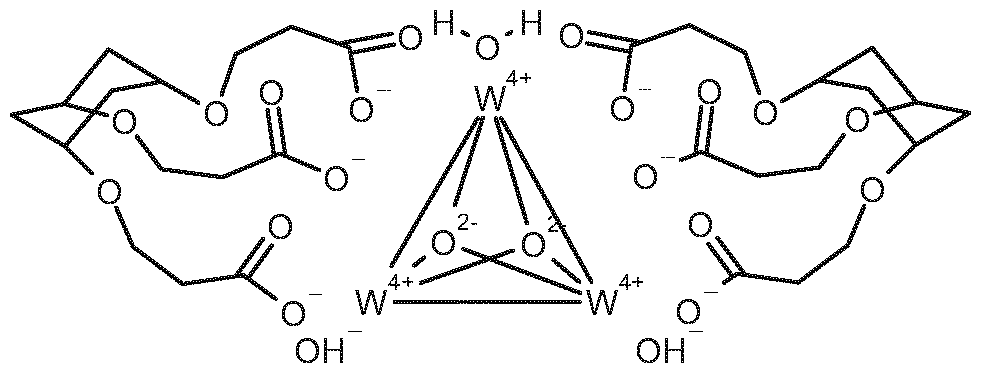
Example 10a Tri-tert-butyl 3,3',3"-[(all-cis)-cyclohexane-1 ,3,5-triyltris(oxy)]tripropanoate
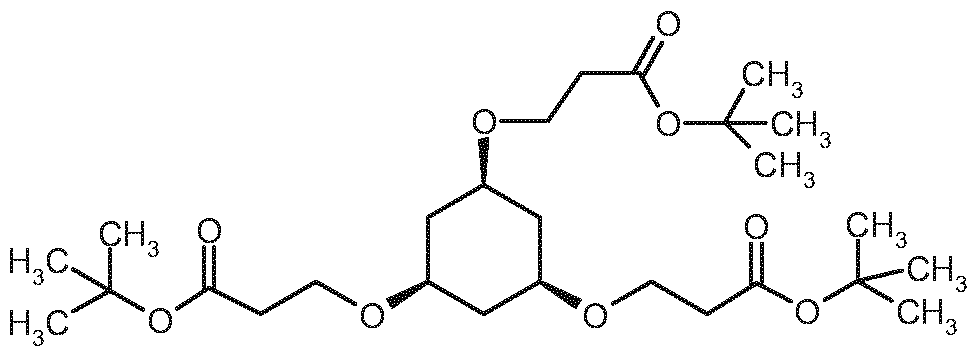
To a suspension of cis,cis-1 .3,5-cyclohexanetriol-dihydrate (2.5g, 14.9 mmo!) and tert- butyl prop-2-enoate ( 10.9 mL, 74.3 mmol) in DMSO (4.2 mL) at 15°C was added a 5 molar aqueous sodium hydroxide solution (0.3 mL). Stirring was continued at room temperature for 36 hours. The mixture was directly purified by chromatography on silica gel (ethyl acetate in hexane, 20 to 80%) to yield 2.46 g of tri-tert-butyl 3,3',3"-[(all-cis)- cyclohexane-1 ,3,5-triyltris(oxy)]tripropanoate. H-N R (400 MHz, CDCI3): δ = 1 .16 (q, 3 H), 1 .46 (s, 27 H), 2.27 - 2.42 (m, 3 H), 2.47 (t, 6 H), 3.23 (tt, 3 H), 3.61 - 3.77 (m, 6 H) ppm.
Example 10b
3,3',3"-[(all-cis)-cyclohexane-1 ,3,5-triyltris(oxy)]tripropanoic acid

To a solution of tri-iert-butyl 3,3',3"-[cyclohexane-1 .3.5-triyltris(oxy)]tripropanoate (2.46 g, 4.76 mmol) in dioxane (24.6 mL) was added 6 molar aqueous hydrochloric acid (3.8 mL, 22.8 mmol) and a 4 molar solution of hydrochloric acid in dioxane (9.5 mL, 38 mmol). After stirring for 17 hours the solvent was removed under vacuum to yield 2.0 g of 3,3',3"-[(all- cis)-cyclohexane-1 ,3,5-triyltris(oxy)]tripropanoic acid as a light yellow oil.
1H-N R (400 MHz, deuterium oxide) δ = 1 .06 (ddd, 3 H), 2.39 (m, 3 H), 2.59 (t, 6 H), 3.33 - 3.67 (m, 3 H), 3.78 (t, 6 H).
Example 10c
Monoaqua-i O-bis{M3-3,3',3"-[(fa,3¾5a)-cyclo exane-1 ,3,5-tnyltris(oxy)]tri- propanoato-l

fr/angt//o-tritungsten(3 IV-W)(IV)

A suspension of 3,3',3"-[(all-cis)-cyclohexane-1 .3,5-triyltris(oxy)]tripropanoic acid (1 .58 g, 3.84 mmol) and monoaqua-KO-hexakis( -acetato-K20)-dihydroxido-K20-di-p3-oxido- 1 :2:3K60-fr angu/o-tritungsten(3 W-W)(IV) (2.0 g, 2.02 mmol) in acetic acid (232 μί, 4.05 mmol) and water (150 mL) was separated into 5 pressure vessels which were irradiated in a microwave reactor for 15 minutes at 140°C. The reaction mixtures were filtrated and the combined filtrates were concentrated in vacuum. Separation on a preparative HPLC (acetonitrile water + acetic acid) yielded 1 mg monoaqua- O-dihydroxido-di- s-oxido-
bis{ :r3,3',3"-[( ία, 3α, 5a)-cyclohexane-1 ,3.5-triyltris(oxy)]tripropanoato- l 20 !02:2 2O !03:3 202,,03}-1:2:3 60-fr/angL/o-triiungsien(3 W-W)(N).
1H-NMR (400 MHz, deuterium oxide) δ = 1.06 - 1.21 (m, 6 H), 2.11 - 2.26 (m, 6 H), 2.51 - 2.63 (m, 6 H), 2.68 - 2.84 (br., 12 H), 3.97 (br. , 12 H). LC/MS ES- m/z 1325.18 (M-1).
Example 11
Monoaqua-KO-bis{p3-3,3',3"-[2-hydroxyethyl-1,1,1-idynetris(methyleneoxy)- tripropanoato-1 κ201,02:2κ20 ,03:3κ202.^dihydroxido-^O-di-ps-oxido-l :2:3κ60- ir;angu/o-tritungsten(3 W-W)(\V)

Example 11a Tert-butyl 3-[3-(3-fert-butoxy-3-oxopropoxy)-2-[(3-fert-butoxy-3-oxopropoxy)methyl]- 2-(hydroxymethyl)propoxy]propanoate
To pentaerythritol (5.5 g, 40.4 mmol) in ferf-butanol (30 mL) was added potassium tert- butoxide (1 .36 g, 12.1 mmol) and fert-butyl acrylate (19.5 mL. 133.3 mmol). The suspension was stirred for 30 min at 100°C and overnight at room temperature. After removal of the solvent in vacuo, the residue was taken up in ethyl acetate and water, the organic phase was washed two times with water and dried over sodium sulfate. The mixture was concentrated in vacuo and the residue was purified by chromatography on silica gel (dichloromethane/methanol gradient, 0 to 100%) to yield 3.67 g (16.75 %) of tert- butyl 3-[3-(3-feit-butoxy-3-oxopropoxy)-2-[(3-fert-butoxy-3-oxopropoxy)methyl]-2-(hydroxy- methyl)propoxy]propanoate. 1H-N R (500 MHz, DMSO- 6): δ = 1 .40 (s, 27 H), 2.38 (t, 6 H), 3.26 - 3.31 (m, 8 H), 3.51 (t, 6 H), 4.1 1 (m, 1 H).
ESI+ m/z 521 (M+1 ).
Example 11 b 3-[3-{2-Carboxyethoxy)-2-[(2-carboxyethoxy)methyl]-2-(hydroxymethyl)propoxy]- propanoic acid

To a solution of fert-butyl 3-[3-(3-ferf-butoxy-3-oxopropoxy)-2-[(3-fert-butoxy-3-oxoprop- oxy)methyl]-2-(hydroxymethyl)propoxy]propanoate (34.7 g, 66.7 mmoL) in dioxane (400 mL) was added 2 molar aqueous hydrochloric acid (200 mL, 400 mmol). The mixture was refluxed for 6h and stirred at room temperature overnight. After removal of the solvent in vacuo, the residue was chromatographed with acetonitrile / water on C18-silica gel, the resulting fractions were combined and finally lyophilized to yield 9.07 g (38.6 %) of 3-[3-(2- carboxyethoxy)-2-[(2-carboxyethoxy)methyl]-2-(hydroxymethyl)propoxy]propanoic acid. 1H-NMR (400 MHz, CDC ) δ = 2.60 (t, 6H), 3.46 (s, 6H), 3.65 (s, 2H), 3.70 (t, 6H).
ESI+ m/z 353 (M+1 ).
Exampfe 11c onoaqua- O-bis{ 3-3,3',3"-[2-hydroxyethyl-1 ,1 ,1-idynetris(methyleneoxy)- tripropanoato-l

fr/angu/o-tritungsten(3 W-W){\V)

3.52 g (10 mmol) of 3-[3-(2-carboxyethoxy)-2-[(2-carboxyethoxy)methyl]-2-(hydroxy- methyl)propoxy]propanoic acid and 2.28 g, (2 mmoi) of sodium hexakis( -acetato-K20)- tris(acetato-KO)-di- :s-oxido-1 :2:3K60-fr/angt//o-tritungsten(3 W-W){\\J) in 40 ml_ water were irradiated in a micowave reactor for 8h at 125°C. The reaction mixture was filtrated and the solution was concentrated in vacuo and the resulting crude product was chromatographed with acetonitrile / water on C18-si!ica gel and the resulting fractions were combined and finally lyophilized. onoaqua-KO-bis{ 3-3,3',3"-[2-hydroxyethyl-1 .1 , 1 - idynetris(methyleneoxy)-tripropanoato-l 20 !02:2 2O ,03:3 202 ,03}dihydroxido- 20-di- 3-oxido-1 :2:3K60-fnangu/o-tritungsten(3 W-W)(\V) was obtained (80 mg, 3 %) as a curry- colored amorphous powder. H-NMR (400 MHz, deuterium oxide) δ = 2.75 (t, 12H). 3.39 (s, 12H), 3.46 (s, 4H), 3.85 (t, 12H).
LC/ S ES- m/z 1333 (M-1 ).
Example 12
Monoaqua- O-bis( 3-3,3',3"-[2-methoxyethyl-1 ,1 ,1 -idynetris(methyleneoxy)- tripropanoato-l
 :2:3 60- fr/"angiy/o-tritungsten(3 W-W)(\V)

Example 12a
Terf-butyl 3-[3-(3-ferf-butoxy-3-oxopropoxy)-2-[(3-ierf-butoxy-3-oxopropoxy)methyl]- 2-(methoxymethyl)propoxy]propanoate

To 2-(hydroxymethyl)-2-(methoxymethyl)propane-1 .3-diol (Journal of the American Chemical Society (1955), 77, 6382-3), (2.8 g, 20.2 mmol) in fert-butanol (15 mL) were added potassium fert-butoxide (0.68 g, 6 mmol) and ferf-buty acrylate (9.8 mL, 66.6 mmol). The suspension was stirred for 30 min at 100°C and overnight at room temperature. After removal of the solvent in vacuo, the residue was taken up in ethyl acetate and water, the organic phase was washed two times with water, dried over sodium sulfate. The mixture was concentrated in vacuo and the residue was purified by chromatography on silica gel (dichloromethane/methanol gradient, 0 to 100%) to yield 2.0 g (18.4 %) of fert-butyl 3-[3-(3-?ert-butoxy-3-oxopropoxy)-2-[(3-?ert-butoxy-3-oxopropoxy)- methyl]-2-(methoxymethyl)propoxy]propanoate. H-NMR (400 MHz, CDCI3): δ = 1 .45 (s, 27H), 2.44 (t, 6H), 3.27 (s, 3H), 3.31 (s, 2H), 3.37 (s, 6H), 3.61 (t, 6H).
ESI+ m/z 535 (M+1 ).
Example 12b
3-[3-{2-Carboxyethoxy)-2-[(2-carboxyethoxy)methyl]-2-(methoxymethyl)propoxy]- propanoic acid

To a solution of fert-butyl 3-[3-(3-fert-butoxy-3-oxopropoxy)-2-[(3-ierf-butoxy-3-oxoprop- oxy)methyl]-2-(methoxymethyl)propoxy]propanoate (1 .34 g, 2.5 mmoL) in dioxane (20 mL) was added 2 molar aqueous hydrochloric acid (10 mL, 20 mmol). The mixture was refluxed for 6h and stirred at room temperature overnight. After removal of the solvent in vacuo, the residue was chromatographed with acetonitrile / water on C18-silica gel, the resulting fractions were combined and finally lyophilized to yield 0.9 g (98.2 %) of 3-[3-(2- carboxyethoxy)-2-[(2-carboxyethoxy)methyl]-2-(methoxymethyl)propoxy]propanoic acid.
1H-N R (400 MHz, deuterium oxide) δ = 2.50 (t, 6H), 3.64 (s, 6H), 4.65 (m, 1 1 H).
ESI+ m/z 367 (M+1 ).
Example 12c
Monoaqua-KO-bis(M3-3,3',3"-[2-methoxyethyl-1 ,1 ,1 -idynetris(methyleneoxy)- tripropanoato-l

fr/angt//o-tritungsten(3 W-W)(\V)

0.92 g (2.5 mmol) of 3-[3-(2-carboxyethoxy)-2-[(2-carboxyethoxy)methyl]-2-(methoxy- methyl)propoxy]propanoic acid and 0.57 g, (0.5 mmol) of sodium hexakis( -acetato-K20)- tris(acetato-KO)-di- 3-oxido-1 :2:3K60-fr angt//o-tritungsten(3 W-W)(\V) in 40 ml_ water were irradiated in a micowave reactor for 8h at 125°C. The reaction mixture was filtrated and the solution was concentrated in vacuo and the resulting crude product was chromatographed with acetonitrile / water on C18-siiica gel and the resulting fractions were combined and finally lyophilized. Monoaqua-KO-bis^3-3.3',3"-[2-methoxyethyl-1 , 1 , 1 - idyne tris(methyleneoxy)tripropanoato-l K20\ 02:2 201 , 0:I:3K202 ,03]dihydroxido-K20-di- 3- oxido-1 :2:3K60-fnangu/o-tritungsten(3 W-W)(W) was obtained (78 mg, 1 1 .5 %) as a curry- colored amorphous powder.
1H-NMR (600MHz, deuterium oxide) δ = 2.73-2.77 (m, 12H), 3.28 (s, 6H), 3.30 (s, 4H), 3.38 (s, 12H), 3.81 -3.87 (m, 12H).
LC/ S ES- m/z 1361 (M-1 ).
Example 13
Monoaqua-KO-dihydroxido-K20-bis(p3-3,3',3"-[hydroxymethylidyne tris(methylene- oxy)tripropanoato-1 201,02:2κ201',03,3κ202 .C^ J-di- a-oxido-l :2:3K60-triangulo- tritungsten(3 W-W)(\V)

Examle 13a Tert-butyl 3-{{2-[(3-tert-butoxy-3-oxopropoxy)methyl]prop-2-en-1-yl}oxy)propanoate

2-Methy!idenepropane-1 ,3-diol (5.0 g, 56.7 mmol) and tert-butyl prop-2-enoate (36.4 g, 284 mmol) are stirred in DMSO (1 1 .4 mL) and 5 molar aqueous sodium hydroxide solution (1 .14 mL) at 20°C for 72 hours. The mixture was concentrated and the residue was purified by chromatography on silica gel (ethyl acetate in hexane, 0 to 40%) to yield 9.03 g of tert-butyl 3- ({2-[(3-tert-butoxy-3-oxopropoxy)methyl]prop-2-en-1 -yl}oxy)propanoate.
1H-NMR (300 MHz, CDCI3): δ = 1 .46 (s, 18 H), 2.50 (t, 4 H), 3.66 (t, 4 H), 3.98 (s, 4 H), 5.18 (s, 2 H).
Examle 13b
Di-fert-butyl 3,3'-{[2-hydroxy-2-(hydroxymethyl)propane-1 ,3-diyl]bis(oxy)}clipropanoate

To a solution of tert-butyl 3-({2-[(3-tert-butoxy-3-oxopropoxy)methyl]prop-2-en-1 -yl}oxy)- propanoate (4.74 g, 13.8 mmol) in acetone (70 mL) and water (7 mL) was added 4- methylmorpholine 4-oxide (3.22 g, 27.5 mmol) and 2.5% solution of tetraoxoosmium in tert.- butanol (5.2 mL) at 0°C. The mixture was warmed to room temperature, stirred for 48 hours and quenched with an aqueous sodium disulfite solution. After vigorous stirring the mixture was extracted with ethyl acetate and the combined organic phases were washed with 1 M hydrochloric acid, aqueous sodium hydrogen carbonate solution and brine. The solution was dried over sodium sulfate and concentrated to yield 4.3g of di-tert-butyl 3,3'-{[2-hydroxy-2- (hydroxymethyl)propane-l ,3-diyl]bis(oxy)}dipropanoate. H-N R (400 MHz, CDCI3): δ = 1 .46 (m, 18 H), 2.49 (t, 4 H), 2.59 (t, 1 H), 3.20 (s, 1 H), 3.50 (s, 4 H), 3.59 (d, 2 H), 3.71 (t, 4 H).
Example 13c 3-{3-{2-Carboxyethoxy)-2-[(2-carboxyethoxy)methyl]-2-hydroxypropoxy}propanoic acid

To di-ferf-butyl 3,3'-{[2-hydroxy-2-(hydroxymethyl)propane-1 .3-diyl]bis(oxy)}dipropanoate (1 g, 2.64 mmol) and terf-butyl prop-2-enoate (1 .42 mL, 9.72 mmol) in tert-butanol (1 .9 mL) were added four times potassium fert.-butanolate (4 x 22 mg, all 15 minutes at room temperature. 30 minutes after the last addition the mixture was quenched with saturated aqueous NH.1CI solution and extracted with ethyl acetate. The combined organic phases were dried over sodium sulfate
and concentrated. The residue was purified by chromatography on silica gel (ethyl acetate in hexane, 0 to 40%) to yield 0.77 g of 3-{3-(2-Carboxyethoxy)-2-[(2-carboxyethoxy)methyl]-2- hydroxypropoxy}propanoic acid as a colorless oil.
1H-NMR (300 MHz, CDC ): δ = 1 .45 (s, 27 H), 2.49 (t, 6 H), 3.05 (s, 1 H), 3.44 (s, 6 H), 3.70 (m,
5 6 H).
Example 13d
3-{3-{2-Carboxyethoxy)-2-[(2-carboxyethoxy)methyl]-2-hydroxypropoxy}propanoic acid

I t) To a solution of fert-butyl 3-{3-(3-fert-butoxy-3-oxopropoxy)-2-[(3-fert-butoxy-3-oxopropoxy)- methyl]-2-hydroxypropoxy}propanoate (1 .64 g. 3.24 mmol) in dioxane (16.4ml_) was added 6 molar aqueous hydrochloric acid (2.6 mL, 15.5 mmol) and a 4 molar solution of hydrochloric acid in dioxane (6.5 mL, 25.9 mmol). After stirring for 96 hours the solvent was removed under vacuum to yield 1 .22 g of 3-{3-(2-carboxyethoxy)-2-[(2-carboxyethoxy)methyl]-2-hydroxy-
15 propoxy}propanoic acid.
1H-NMR (400 MHz, deuterium oxide) δ = 2.59 (t, 6 H), 3.42 (s, 6 H), 3.71 (t, 6 H).
LC/MS ES+ m/z 339.17 (M+1 ).
0
Example 13e
onoaqua- O-dihydroxido- 20-bis( 3-3,3',3"-[hydroxymethylidyne tris(methylene- oxy)tripropanoato-l

tungsten(3 W-W)(IV)

1H-N R (400 MHz. deuterium oxide) δ = 2.70 (br. t, 12 H). 3.31 (s, 12 H), 3.81 (br. t, 12 H).
MS ESI- m/z 1305 (M-1 ).
Example 14
Monoaqua-KO-dihydroxido-K20-(M3-3,3',3"-{[(2,3-dihydroxypropyl)amino]- met ylidynetns(met ySeneoxy)}triproparioato-l K201,02:2K201',03:3K202',03')(M3- 3,3',3"-[hydroxymethylidynetris(methyleneoxy)tripropanoato- 1 κ 0 0 :2κ2Ον,03:Ζκ 0 ', C^'J-di-Ms-oxido-l :2:3K60-fr/angt /o-tritungsten(3 W-W)(\V)

A suspension of 3-{3-(2-carboxyethoxy)-2-[(2-carboxyethoxy)methyl]-2-hydroxypropoxy}- propanoic acid (121 mg, 0.37 mmol), 3-{3-(2-carboxyethoxy)-2-[(2-carboxyethoxy)methyl]- 2-[(2.3-dihydroxypropyl)amino]propoxy}propanoic acid (147 mg, 0.37 mmol) and sodium
hexakis( -acetato-K20)-tris(acetato-KO)-di- 3-oxido-1 :2:3K60-inangt//o-tritungsten(3 W-
M)(IV) (400 mg, 0.37 mmol) in water (30 mL) was irradiated in a microwave reactor for 15 minutes at 140°C. The reaction mixture was filtrated and the filtrate was concentrated in vacuum. Separation on a preparative HPLC (acetonitrile water + acetic acid) yielded 57 5 mg monoaqua-KO-dihydroxido-K20-(p3-3!3',3"-{[(2.3-dihydroxypropyl)amino]methylidyne- tris(methyleneoxy)}tripropanoato-l 201,02:2 2Or,03,3 202',03')(M3-3,3',3"-[hydroxyl- methylidynetris(methyleneoxy)tripropanoato-l 20 ,02:2 2O ,03,3 202',03]-di- 3-oxido- 1 :2:3K60-frangu/o-tritungsten(3 W-W)(N).
1H-N R (300 MHz, deuterium oxide) δ = 2.72 (br. t, 6 H), 2.74 (br. t, 6 H), 3.02 (dd, 1 H), It) 3.17 (dd, 1 H), 3.33 (s, 6 H), 3.47 - 3.61 (m, 2 H), 3.57 (s, 6 H), 3.76 - 3.94 (m, 13 H).
LC/ S ES- m/z 1378 (m-1)
Example 15 onoaqua-KO-dihydroxido- 20-bis(p3-3,3',3''-{[(2-hydroxyethyl)amino]methylidyne- 15 tris(methyleneoxy)}tripropanoato-1 201,02:2κ201',03:3κ202.C^J-di-pa-oxido-l :2:3 60- frang-//o-tritungsten(3 W-W)(\V)

Example 15a 0 Tert-butyl 3-{3-{3-ferf-butoxy-3-oxopropoxy)-2-[(3-ferf-butoxy-3-oxopropoxy)methyl]- 2-[(2-hydroxyethyl)amino]propoxy}propanoate

Tert-butyl 3-{2-amino-3-(3-fert-butoxy-3-oxopropoxy)-2-[(3-fert-butoxy-3-oxopropoxy)- methyl]propoxy}propanoate (530 mg, 1.05 mmol), palladium on charcoal 10% (6 mg) and 1 ,4-dioxane-2,5-diol (94.4 mg, 1.57 mmol) was stirred under an hydrogen atmosphere of 50 bar in methanol for for 20 hours. Additional 1 ,4-dioxane-2,5-diol (94.4 mg, 1.57 mmol) was added two times and stirring under 50 bar hydrogen pressure was continued for 7 hours after each addition. The reaction mixture was filtered through cellites, concentrated and purified via chromatography on silica gel (methanol in dichloromethane 0 to 20%) to yield 460 mg of iert-butyl 3-{3-(3-iert-butoxy-3-oxopropoxy)-2-[(3-fert-butoxy-3- oxopropoxy)methyl]-2-[(2-hydroxyethyl)amino]propoxy}propanoate.
1H-NMR (300 MHz, CDCI3): δ = 1.46 (s, 27 H), 2.47 (t, 6 H), 2.81 (t, 2 H), 3.39 (s, 6 H), 3.53 (t, 2 H), 3.64 (t, 6 H).
Example 15b
3- 3-{2-Carboxyethoxy)-2-[(2-carboxyethoxy)methyl]-2-[(2-hydroxyethyl)
propoxy}propanoic acid

To 3-{3-(3-iert-butoxy-3-oxopropoxy)-2-[(3-fert-butoxy-3-oxopropoxy)methyl]-2-[(2- hydroxyethyl)amino]propoxy}propanoate (4.13 g, 7.51 mmol) in dioxane was added 6 M aqueous hydrochoric acid (6 mL, 36 mmol) and a 4 M solution of hydrochloric acid in dioxane (15 mL, 60 mmol). After stirring for 15 hours the solvent was removed under
vacuum and the residue was solved in water (300 mL) and a volume of 200 mL of weakly basic anionic exchanger Amberlite IRA 67 in its OH -form was added. The suspension was stirred for 2 hours and the exchange resin was filtered and washed with water (1000 mL). The free base of the product was eluted from the resin by fractionated washing with 15% aqueous acetic acid to yield 2.29 g of 3-{3-(2-carboxyethoxy)-2-[(2- carboxyethoxy)methyl]-2-[(2-hydroxyethyl)amino]propoxy}propanoic acid after lyophilization. H-N R (400 MHz, deuterium oxide) δ = 2.54 (t, 6 H), 3.20 (t, 2 H), 3.65 (s, 6 H), 3.71 (t, 6 H), 3.76 (t, 2 H).
Example 15c
Monoaqua-κO-dihydroxido-κ20-bis(μ3-3,3 3''-{[(2-hydroxyethyl)amino]mβthylidyne- tris(methyleneoxy)}tripropanoato-l

fr/angty/o-tritungsten(3 W-W)(\V)

A suspension of 3-{3-(2-carboxyethoxy)-2-[(2-carboxyethoxy)methyl]-2-[(2-hydroxyethyl)- amino]propoxy}propanoic acid (80 mg, 210 pmol) and hexakis( -acetato-K20)-monoaqua- KO-dihydroxido-K20-di- 3-oxido-1 :2:3K60-fnangt//o-tritungsten(3 W-W)(\V) ( 103 mg, 105 μιτιοΙ) in acetic acid ( 12 μί, 0.81 mmol) and water (8 mL) was irradiated in a microwave reactor for 1 5 minutes at 140°C. The reaction mixtures were filtrated and the filtrate was concentrated in vacuum. Separation on a preparative HPLC (acetonitrile water + acetic acid ) yielded 9.4 mg of monoaqua-KO-bis( 3-3,3'.3"-{[(2-hydroxyethyl)amino]- methylidynetris(methyleneoxy)}tripropanoato-l K2O 02:2K2Ov.03:3K202 , 03 )dihydroxido- K20-di-p3-oxido-1 :2:3K6Oinangu/o-tritungsten(3 W-W)(\\/) after ultrafiltration through a YC05 NMWL 500 membrane and final lyophilization.
1 H-NMR (300 MHz, deuterium oxide) δ = 2.70 (t, 12 H), 3.03 (br. , 4 H), 3.51 (s, 12 H), 3.68 (br. t, 4 H), 3.84 (br. t, 12 H).
LC/MS ESI- m/z 1391 (M-1 ).
Example 16
Monoaqua- O-dihydroxido- 20-(M3-3,3\3''-{[(2-hydroxyethy)amino]methylidynetris- (methyleneoxy)}tripropanoato-l

methylidynetris(methyleneoxy)tripropanoato-1 201,02:2K2Or,03:3K202',03']-di-+j3- oxido-1 :2:3K60-fr/angt//o-tritungsten(3 W-W)(\V)

A suspension of 3-{3-(2-carboxyethoxy)-2-[(2-carboxyethoxy)methyl]-2-hydroxypropoxy}- propanoic acid (137 mg, 404 μιτιοΙ) 3-{3-(2-carboxyethoxy)-2-[(2-carboxyethoxy)methyl]-2- [(2-hydroxyethyi)amino]propoxy}propanoic acid (155 mg, 404 μιτιοΙ) and hexakis( - acetato-K20)-monoaqua-KO-dihydroxido-K20-di- 3-oxido-1 :2:3K60-triangulo- tritungsten(3 W-W)(l\/) (400 mg, 404 μιτιοΙ) in acetic acid (47 μΙ_, 0.81 mmol) and water (30 mL) was irradiated in a microwave reactor for 15 minutes at 140°C. The reaction mixtures were filtrated and the filtrate was concentrated in vacuum. Separation on a preparative HPLC (acetonitrile, water + acetic acid) yielded 5.0 mg of monoaqua-κθ- dihydroxido- 20-( 3-3,3',3"-{[(2-hydroxyethy)amino]methylidynetris(methyleneoxy)}- tripropanoato-l 201 , 02:2 2O , 03, 3κ202 ! 03 )(μ3-3,3·,3"-[hydroxymethylidynetris- (methyleneoxy)tripropanoato-l 201 , 02:2 2O , 03,3 202',
 :2:3 60- fr/angu/o-tritungsten(3 W-W)(\V).
1 H-N R (400 MHz, deuterium oxide) δ = 2.68 - 2.80 (m, 12 H), 3.14 (br. t, 2 H), 3.32 (s, 6 H), 3.56 (s, 6 H), 3.71 (t, 2 H), 3.82 (br. t, 6 H), 3.86 (br. t, 6 H) ppm.
LC/MS ESI- m/z 1348 (M-1 ).
Exampfe 17
Monoaqua- O-bis{ 3-3,3\3''-[(methoxyacetyl)aminomethylidynetris(methyleneoxy)] tripropanoato-l
 :2:3K60- fr;'ang-//o-tritungsten(3 W-W)(\V)

Example 17a
Tert-butyl 3-{3-{3-tert-butoxy-3-oxopropoxy)-2-[(3-tert-butoxy-3-oxopropoxy)methyl]- 2-[(methoxyacetyl)amino]propoxy}propanoate

To ferf-butyl 3-{2-amino-3-(3-fert-butoxy-3-oxopropoxy)-2-[(3-fert-butoxy-3-oxopropoxy)- methyl]propoxy}propanoate (10 g, 19.8 mmol) in dichloromethane (50 mL) and triethylamine (8.3 ML, 59.3 mmol) was added methoxyacetyl chloride (2.15g, 19.8 mmol). While addition the temperature of the reaction was allowed to warm to 35"C and stirring at room temperature was continued for 30 minutes. The reaction mixture was concentrated and purified via chromatography on silica gel (ethyl acetate in hexane 10 to 100%) to yield 9.2 g of tert-butyl 3-{3-(3-tert-butoxy-3-oxopropoxy)-2-[(3-tert-butoxy-3- oxopropoxy)methyl]-2-[(methoxyacetyl)amino]propoxy}propanoate as a colorless oil. H-NMR (400 MHz, CDCI3) δ = 1 .45 (s, 27 H). 2.46 (t, 6H), 3.39 (s. 3 H), 3.66 (t, 6 H), 3.73 (s, 6 H), 3.79 (s, 2 H), 6.71 (s, 1 H) ppm.
Exampfe 17b
3-{3-{2-Carboxyethoxy)-2-[(2-carboxyethoxy)methyl]-2-[{methoxyacetyl)amino]- propoxy}propanoic acid

To a solution of iert-butyl 3-{3-(3-tert-butoxy-3-oxopropoxy)-2-[(3-tert-butoxy-3-oxo- propoxy)methyl]-2-[(methoxyacetyl)amino]propoxy}propanoate (10.2 g, 17.6 mmol) in dioxane (75 mL) was added a 4 molar solution of hydrochloric acid in dioxane (26.5 mL, 106 mmol) and 6 M aqueous hydrochloric acid (17.6 mL, 105 mmol). After stirring for 15 hours at 40°C the solvent was removed under vacuum an d the residue was two times codestillated with toluene to yield 8.24 g of 3-{3-(2-carboxyethoxy)-2-[(2-carboxy- ethoxy)methyl]-2-[(methoxyacetyl)amino]propoxy}propanoic acid.
1H-N R (300 MHz, deuterium oxide) δ = 2.58 (t, 6 H), 3.34 (s, 3 H), 3.67 (s, 6 H), 3.70 (t, 6 H), 3.85 (s, 2 H) ppm.
Example 17c onoaqua-KO-bis{ 3-3,3 3''-[(methoxyacetyl)aminomethylidynetris(methyleneoxy)] tripropanoato-l K2O\O2:2i 2O1',O3:3K202',O3'}dihydroxido-K2O--di-M3-oxido-1 :2:3κ6 O- fr/angt//o-tritungsten(3 W-W)(\V)

[(methoxyacetyl)aminomethylidynetris(methyleneoxy)]tripropanoato- l
 was isolated as a byproduct of example 22 after HPLC separation. 1H-NMR (400 MHz, deuterium oxide) δ = 2.75 (br. t, 12 H), 3.35 (s, 6 H), 3.59 (s, 12 H), 3.83-3.92 (m, 16 H) ppm.
LC/MS ESI- m/z 1447 (M-1).
Example 18 onoaqua- O-dihydroxido-K20-(M3-3,3',3"-{[(2,3-dihydroxypropyl)amino]- mei ylidynetris(met ySeneoxy)}tripropanoato-lK201,02:2 201',03:3i202',03'){ 3- 3,3',3"-[2-hydroxyethyl-1 ,1 ,1 -idynetris(methyleneoxy)-tripropanoato-1 κ20 &:


2 2O ,03:3 202',03)di- 3-oxido-1 :2:3K60-frangt//o-tritungsten(3 W-W)(\V).
1H-NMR (300 MHz, deuterium oxide) δ = 2.62 - 2.74 (m, 12 H), 2.98 (dd, 1 H), 3.13 (m, 1 H), 3.32 (s, 6 H), 3.39 (s, 2 H), 3.45 - 3.61 (m, 2 H), 3.55 (s, 6 H), 3.78 (t, 6H), 3.84 (m, 7
H)
LC/ S ESI- m/z 1392 (m-1)
Example 19
{ 3-3,3',3"-[aminomethylidynetris(methyleneoxy)}]tripropanoato-1 K201,02:2K201', :3K202,03}monoaqua- O-dihydroxido- 20-{M3-3,3',3''-[(methoxyacetyl)-amino- methylidynetris(methyleneoxy)]tripropanoato-1 201,02:2 201',03:3K202',03}di-M3- oxido-1 :2:3K60-fr/angt/o-tritungsten(3 W-W)(\V)

To a solution off monoaqua- O-bis{ 3-3,3',3"-[aminomethylidynetris(methyleneoxy)j- tripropanoato-l

angu/o-tritungsten(3 W-W)(N) (400 mg, 290 pmol) in triethylamine (162 pL, 1.16 mmol) and water (30 mL) was added 1-[(methoxyacetyl)oxy]pyrrolidine-2,5-dione (163 mg, 0.87 mmol, J. Org. Chem. 199560, 331 - 336) After stirring for 3 days at room temperature additional 1-[(methoxyacetyl)oxy]pyrrolidine-2,5-dione (163 mg, 0.87 mmol) was added and stirring was continued for one day at room temperature and four hours at 50°C. Concentration in vacuum and subsequent separation on a preparative HPLC (acetonitrile water + acetic acid) yielded 15 mg {p3-3,3'.3"-[aminomethylidynetris(methyleneoxy)}]tri- propanoato-l 201 !02:2 2O ,03 !3 202',03}monoaqua- O-dihydroxido- 20-{M3-3,3',3"- [(methoxyacetyl)aminomethylidynetris(methyleneoxy)]tripropanoato-l 201,02:2 2O ,03: 3K202,03}di-p3-oxido-1:2:3K60-frangu/o-tritungsten(3 W-W)(\V).
1H-NMR (400 MHz, deuterium oxide) δ = 2.76 (m, 12 H), 3.35 (s, 3 H), 3.50 (s, 6 H), 3.59 (s, 6 H), 3.81 - 3.95 (m, 14 H).
LC/MS ESI- m/z 1375 (M-1 ).
Example 2Θ
Monoaqua-KO-dihydroxido- 20-(M3-3,3',3''-{[(1 -deoxyerythritol-1 -yl)amino]- met ylidynetris(met yleneoxy)}tripropanoato-l

oxido-{p3-3,3',3"-[propane-1 ,2,3-triyltris(oxy)]tripropanoato-1 κ 0 02:
2κ201',03:3κ202',03'}-1 :2:3 60-fr/angt /o-tritungsten(3 W-W)(\V)

Example 20a
1 -({9-[(3-7"ert-butoxy-3-oxopropoxy)methyl]-2,2,16,16-tetramethyl-4,14-dioxo- 3,7,11 ,15-tetraoxaheptadecan-9-yl}amino)-1 -deoxerythrol

Terf-butyl 3-{2-amino-3-(3-fert-butoxy-3-oxopropoxy)-2-[(3-ferf-butoxy-3-oxopropoxy)- methyl]propoxy}propanoate (0.99 g, 1 .95 mmol), D(-)-erythrose (0.23 g, 1 .95 mmol) and 2-methylpyridine borane complex (0.21 g, 1 .95 mmol) in methanol (25 mL) and acetic acid (2.5 mL) were irradiated in a microwave reactor for 5 minutes at 100°C. Additional D(-)- erythrose (0.23 g, 1 .95 mmol) and 2-methylpyridine borane complex (0.21 g, 1 .95 mmol) were added and irradiation in a microwave reactor at 100"C was repeated for for 5 minutes. The solution was concentrated under reduced pressure and residue was purified by chromatography on silica gel (methanol in ethyl acetate, 0 to 20%) to yield 0.92 g of 1 -
({9-[(3-tert-butoxy-3-oxopropoxy)methyl]-2,2, 16, 16-tetramethyl-4.14-dioxo-3,7, 1 1 .15- tetraoxaheptadecan-9-yl}amino)-1 -deoxyerythrol.
1H-NMR (400 MHz, CDCI3): δ = 1 .46 (s, 27 H), 2.47 (t, 6 H), 2.86 - 2.95 (m, 2 H), 2.98 (br., 6 H), 3.41 (s, 6 H), 3.60 - 3.80 (m, 4 H), 3.64 (t, 6 H) ppm.
Example 20b
1 -({1 ,3-Bis(2-carboxyethoxy)-2-[(2-carboxyethoxy)methyl]propan-2-yl}amino)-1 - deoxyerythrol

I t) To a solution of iert-butyl 1 -({9-[(3-tert-butoxy-3-oxopropoxy )methyl]-2.2, 16.16- tetramethyl-4, 14-dioxo-3,7, 1 1 , 15-tetraoxaheptadecan-9-yl}amino)-1 -deoxyerythol (920 mg, 1 .51 mmol) in dioxane (10 mL) was added 6 molar aqueous hydrochloric acid (1 .2 mL. 7.2 mmol) and a 4 molar solution of hydrochloric acid in dioxane (3 mL, 12 mmol). After stirring for 3 hours the solvent was removed under vacuum to yield the hydro
15 chloride salt, which was treated with ion exchange resin IR 67 (40 mL) in water for 14 hours. The ion exchange resin was washed with water followed by 15 % aqueous acetic acid. The washing solutions were fractionated and fractions with a negative chloride detection were combined and concentrated under vacuum to yield 690 mg 1 -({1 ,3-bis(2- carboxyethoxy)-2-[(2-carboxyethoxy)methyl]propan-2-yl}amino)-1 -deoxyerythrol as free 0 base.
1H-NMR (400 MHz, deuterium oxide) δ = 2.55 (t, 6 H), 3.12 (dd, 1 H), 3.37 (dd 2 H), 3.58 - 3.84 (m, 4 H), 3.67 (s, 6 H), 3.72 (t, 6 H).
5 Example 20c
onoaqua- O-dihydroxido- 20-(M3-3,3',3"-{[(1-deoxyerythritol-1-yl)amino]- methylidynetris(methyleneoxy)}tripropanoato-1 κ201,02:2κ20 ',03:3 202',03) ΐ-μ3- oxido-{p3-3,3',3"-[propane-1,2,3-triyltris(oxy)]tripropanoato-lK201 >02:2 201 ,03:
Ζκ2( ',03'}-ί :2:3K60-fr/angi//o-tritungsten(3 W-W)(IV)

A suspension of 3,3',3"-[propane-1 ,2,3-triyltris(oxy)]tripropanoic acid (114 mg, 0.37 mmol), 1 -({1 ,3-bis(2-carboxyethoxy)-2-[(2-carboxyeihoxy)methyl]propan-2-yl}amino)-1 - deoxyerythroi (164 mg, 0.37 mmol) and sodium hexakis( -acetato- 20)-tris(acetato- O)- di- 3-oxido-1:2:3K60-inangt//o-tritungsten(3 W-W)(N) (400 mg, 0.37 mmol) in water (30
It) mL) was irradiated in a microwave reactor for 15 minutes at 140°C. The reaction mixture was filtrated and the filtrate was concentrated in vacuum. Separation on a preparative HPLC (acetonitrile water + acetic acid) yielded 35 mg monoaqua-KO-dihydroxido-K20-( :r 3,3',3"-{[(1-deoxyerythritol-1-yl)amino]methylidynetris(methyleneoxy)}tripropanoato- 1 20\02:2 20^03:3 202 03^ί-μ3-οχ^
15 propanoato-l
 :2:3 60-fr/angt/o-tritungsten(3 W-W)(N).
1H-N R (300 MHz, deuterium oxide) δ = 2.72 (m, 12 H), 3.04 (dd, 1 H), 3.15 (m, 1 H), 3.20 - 3.27 (m, 2 H), 3.35 (m, 3 H), 3.53 - 3.61 (m, 2 H), 3.56 (s, 6H), 3.67 -3.83 (m, 5 H), 3.86 (t, 6 H), 3.89-3.97 (m, 3 H).
LC/MS ESI- m/z 1378 (M-1) 0
Example 21
Monoaqua- O-dihydroxido- 20-(M3-3,3',3"-{[(2,3-dihydroxypropan-1-yl)amino]- methylidynetris(met yleneoxy)}triproparioato-1ic201,02:2K201',03:3i202',03'){M3- 3,3',3"-[(methoxyacetyl)aminomethylidynetris(methyleneoxy)]tripropanoato- 5 1 201,02:2 20 ,03:3K202 ,03}-di-M3-oxido-1 :2:3 60-fr/angt/o-tritungsten(3 W-W)(W)

A mixture off 3-{3-(2-carboxyethoxy)-2-[(2-carboxyethoxy)methyl]-2-[(2,3-dihydroxypropyl)- amino]propoxy}propanoic acid (1 .47 g. 3.59 mmol). 3-{3-(2-carboxyethoxy)-2-[(2- carboxyethoxy)methyl]-2-[(methoxyacetyl)amino]propoxy}propanoic acid (1 .47 g, 3.59 mmol) and sodium hexakis( -acetato- 20)-tris(acetato- O)-di- 3-oxido-1 :2:3KeO-triangulo- tritungsten(3 W-W)(\\/) (4.0 g, 3.59 mmol) in water (300 mL) was separated into 10 pressure vessels which were irradiated in a microwave reactor for 15 minutes at 140°C. The reaction mixtures were filtrated and the combined filtrates were concentrated in vacuum. Separation on a preparative HPLC (acetonitrile water + acetic acid) yielded 0.56g of monoaqua-KO-dihydroxido-K20-( 3-3,3'.3"-{[(2,3-dihydroxypropan-1 -yl)amino]- methylidynetris(methyleneoxy)}tripropanoato-l 20 ,02:2 2O ,03:3 202',03){ 3-3!3',3"- [(methoxyacetyl)aminomethylidynetris(methyleneoxy)]tripropanoato-l K201 , 02:2K20 , 03: 3K 02 !03}-di- 3-oxido-1 :2:3K60-fr angu/o-tritungsten(3 W-W)(\V). 1H-N R (400 MHz, deuterium oxide) δ = 2.76 (br, 12 H), 3.03 (dd. 1 H), 3.17 (dd, 1 H), 3.35 (s, 3 H), 3.50 - 3.60 (m, 2 H). 3.58 (s, 12H), 3.82 - 3.92 (m, 15 H).
LC/MS ESI- m/z 1449 (M-1 ).
Example 22 Monoaqua- O-dihydroxido-K20-(M3-3,3',3"-{[(1 -deoxyerythritol-1 -yl)amino]- met ylidynetris(met yleneoxy)}tripropanoato-l K2O1,C?2:2K2O1 ',O3:3K2O2',03'){ 3-
3,3',3''-[(methoxyacetyl)aminomethylidynetris(methyleneoxy)]tripropanoato-
1 K201,02:2 201 ,03:3K202 ,03 }-di-M3-oxido-1 :2:3K60-fr/angty/o-tritungsten(3 W-W)(\V)

A mixture off 1-({1 ,3-bis(2-carboxyet oxy)-2-[(2-carboxyet oxy)methyl]propan-2-yl}amino)- 1-deoxyerythrol (164 mg, 0.37 mmol), 3-{3-(2-carboxyethoxy)-2-[(2-carboxy- ethoxy)methyl]-2-[(met oxyacetyl)amino]propoxy}propanoic acid (151 mg, 0.37 mmol) and sodium

tungsten(3 W-W)(l\/) (400 mg, 0.37 mmol) in water (30 mL) was irradiated in a microwave reactor for 15 minutes at 140°C (300W). The reaction mixture was filtrated and the filtrate concentrated in vacuum. Separation on a preparative HPLC (acetonitrile, water + acetic acid) yielded 32 mg monoaqua-KO-dihydroxido-K20-( 3-3,3'.3"-{[(1-deoxyerythritol-1- yl)amino]methylidynetris(methyleneoxy)}tripropanoato-l 20 ,02:2 2O ,03,3 202',03'){ 3- 3,3',3"-[(methoxyacetyl)aminomethylidynetris(methyleneoxy)]tripropanoato- l 20 02:2 2O ,03:3 202,,03}-di-M3-oxido-1:2:3 60-ir/angL//o ritungsten(3 W-W)(N).
1H-N R (300 MHz, deuterium oxide) δ = 2.70 (br., 12 H), 3.04 (dd, 1 H), 3.27 (dd, 1 H), 3.32 (s, 3 H), 3.47-3.69 (m, 2 H), 3.55 (s.12 H), 3.73 - 3.90 (m, 15 H).
LC/ S ESI- m/z 1479 (M-1).
Example 23a
Sodium hexakis( -methoxyacetato-K20)-tris(methoxyacetato- O)-di- 3-oxido- 1:2:3K60-fr/angu/o-tritungsten(3 W-W)(\V)

Acording to WO 97/03993 and WO 97/03994 the literature example 6 sodium hexakis( - methoxyacetato-K20)-tris(methoxyacetato-KO)-di- 3-oxido-1 :2:3K60-triangulo-\r - tungsten(3 W-W)(l\/) was synthesized as reference compound. 1 H-NMR (300 MHz, deuterium oxide) δ = 3.36 (s, 18 H), 3.39 (s, 9 H), 4.12 (s, 6 H), 4.38
(m, 12 H).
LC/MS ES- m/z 1385.66 (M-23).
Example 23b Monoaqua- O-hexakis( -methoxyacetato-K20)-dihydroxido-K20-di-M3-oxido- 1 :2:3 60-fr/angt//o-tritungsten(3 W-W)(\V)

In analogy to Example 1 d sodium hexakis(p-methoxyacetato-K20)-tris(acetato-KO)-di- :r oxido-1 :2:3K60-fr angt//o-tritungsten(3 W-W)(\\l) was transformed into monoaqua-κθ-
hexakis( -acetato-K20)-dihydroxido-K20-di- 3-oxido-1 :2:3K60-inangt//o-tritungsten(3 W- M )(IV) as a reference compound.
1H-NMR (300 MHz, deuterium oxide) δ = 3.36 (s, 18 H), 4.33 (s, 12 H). LC/MS ESI- m/z 1 168 (M-1 ).
5
Example 24
Stability of W302 Clusters
The stability of W3O2 clusters was determined in aqueous, buffered solution at pH 7.4. The solution containing 5 mmol/L of the compound in a tightly sealed vessel in which the
I t) air had been replaced by an argon atmosphere was heated to 121 °C for 45 min in a steam autoclave. Only in cases of the reference example compounds 1 c, 1 d, 23a and 23b it was necessary to remove precipitated material by centrifugation. The tungsten concentration of the solution was determined by ICP-OES before and after heat treatment. The integrity of the compound was determined by HPLC analysis before and after heat
15 treatment. Absolute stability was calculated as the ratio of the peak area of the compound after and before the heat treatment multiplied with the ratio of the tungsten concentration of the solution after and before heat treatment. The relative stability was calculated with respect to example compound 23b (WaO^hexa-methoxy acetate) which was set to 1 .
HPLC system: 0 Column: Symmetry C18, 4.6 x 75 mm (Waters). Solvent A1 : 0.1 mM Na-citrate, pH 6
Solvent A2: 5 mM Na-heptanesulfonate + 5 mM acetate pH 4.5 Solvent A3: 5 mM NH4-acetate pH 6
The use of solvent A1 to A4 depends on the structure of the compound (see table). 5 Solvent B: methanol, HPLC grade
Gradient: linear gradients starting from 100 % A and 0% B were used. Details are given in the table.
Flow: 1 mL/min
Detector D1 : DAD: UV-vis, 200-600 nm, at 254 nm and specific absorption of W302- clusters at 460 nm.
Detector D2: element specific detection by ICP-MS running at m/z 184 for 184W, the most abundant isotope of tungsten. Detector D3: element specific detection by ICP-OES running at 239.7 nm, the most intense emission wavelength of tungsten.
Detector D1 was always used and detector D2 or D3, respectively, were coupled to the outlet of D1. Refer to the table for the detectors used .
Stability Chromatographic conditions
Example
absolute relative Solvent A Gradient Detector No
1 104% 7.4 A2 0-95% B in 10 min D1. D2
2 88% 6.3 A1 0-95% B in 10 min D1, D2
3 102% 7.3 A2 0-95% B in 10 min D1, D2
4 107% 7.6 A2 0-95% B in 10 min D1, D2
5 103% 7.4 A2 0-95% B in 10 min D1, D2
6 98% 7.0 A2 0-95% B in 10 min D1, D2
7 102% 7.3 A1 0-95% B in 10 min D1, D2
8 101% 7.2 A2 0-95% B in 10 min D1. D2
9 102% 7.3 A2 0-95% B in 10 min D1, D2
11 101% 7.2 A1 0-95% B in 10 min D1, D2
12 101% 7.2 A1 0-95% B in 10 min D1, D2
14 101% 7.2 A1 0-95% B in 10 min D1, D2
15 104% 7.4 A1 0-95% B in 10 min D1, D2
16 99% 7.1 A1 0-95% B in 10 min D1, D2
17 102% 7.3 A1 0-95% B in 10 min D1, D2
18 105% 7.4 A1 0-95% B in 10 min D1, D2
19 99% 7.1 A1 0-95% B in 10 min D1, D2
20 99% 7.1 A1 0-95% B in 10 min D1, D2
21 102% 7.3 A1 0-95% B in 10 min D1, D2
1d 0% 0 A3 0-50% B in 10 min D1, D3
1c 55% 3.9 A3 0-50% B in 10 min D1, D3
23a 0% 0 A3 0-50% B in 10 min D1, D3
23b 14% 1 A3 0-50% B in 10 min D1, D3
Example 25
Preclinical x-ray imaging
To demonstrate the efficacy of the x-ray diagnostic agent a preclinical animal investigation was performed using x-ray computed tomography (CT). The study was performed on a clinical CT unit (Sensation 64, Siemens Medical Solutions, Erlangen, Germany) with an anaesthetized rat. The compound described in example 1 was used as tungsten based contrast agents. The aim was to visualize the vascular system of the rat by using contrast enhanced CT-angiography.
The study was performed on healthy Han-Wistar rats. Initial anaesthesia was induced by inhalation of 4% Isoflurane (Baxter Deutschland GmbH, UnterschleiBheim, Germany) and maintained by 1 .5% Isoflurane. The tungsten based contrast agent (Example 1 ) at a concentration of 66 mg W/mL was administered intravenously via the tail vein by the help of a dedicated injection pump (flow rate = 0.8 ml/s). A dosage of 400 mg W/kg body weight was used. An x-ray projection image was acquired to adjust the measurement range to the size of the animal. The subsequent contrast enhanced angiographic measurement was done with following CT parameter settings: Spiral mode (pitch = 1 .4), x-ray tube voltage = 120 kV, effective mAs-product = 80 mAs, tube rotation time = 0.37s, slice thickness = 1 .5 mm. The delay between the administration of the x-ray diagnostic agent and the start of the measurement was 2s.
The images showed a high CT signal for the heart, the major blood vessels and the kidneys. It also contains the intrinsic high CT signal of the skeleton and a low signal for tissue. All images showed a high contrast between enhanced blood vessels and surrounding tissue. The axial CT images were reformatted to sagital (Fig.2A) and coronar (Fig.2B) views by the software of the CT unit. The resulting images were displayed in maximum intensity projection (MIP) with a thickness of 7 mm. The high contrast for the blood vessels is clearly demonstrated in the zoomed area of the thorax, showing the heartchambers and the aortic arch with the branches of the brachiocephalic, left common carotid and left subclavian arteries (Fig.3). The images were analyzed quantitatively by drawing a region of interest at representative anatomical positions; the aorta ascendens, the aorta descendens, the aorta abdominals and the ateria carotis. A high CT-signal, demonstrating the highly effective x-ray attenuation of the tungsten based contrast agent was detected at all anatomical positions (Fig.4).
Example 26
onoaqua- O-dihydroxido- 20-bis-{ 3-propane[1 ,3-diyl(oxy)]dipropanoato- l K20\02:2K01':3KOH[yf(imino)propanoato-2icO:3icO]}di- 3-oxido-1 :2:3i 60-triangyIo- tritungsten(3 W-W)(\V)

Ozone was passed through a solution of fert-butyl 3-({2-[(3-fert-butoxy-3- oxopropoxy)methyl]prop-2-en-1 -yl}oxy)propanoate (6.0 g. 17.4 mmol, 13a) in
I t) dichloromethane (180 mL) at -78°C until a blue color of the solution was visible. After stirring for additional 15 minutes dimethyl sulfide (6.4 mL, 87 mmol) was added and the reaction mixture was slowly warmed to room temperature. Water was added and the mixture was extracted with dichloromethane. The combined organic phases were washed with brine, dried over sodium sulfate and concentrated to yield 6.06 g of fert-butyl 3-[2,3-
15 bis(3-fert-butoxy-3-oxopropoxy)propoxy]propanoate.
1H-NMR (400 MHz, CDCI3): δ = 1 .47 (s, 18H), 2.54 (t, 4H), 3.75 (t, 4H), 4.25 (s, 4H) ppm. Example 26b
Tert-butyl N-{2,2,16,16-tetramethyl-4,14-diox©-3,7,11 ,15-tetraoxaheptadecan-9-yl)-p- alaninate

To a solution of ferf-butyl 3- [2. 3-bis(3-fert-butoxy-3-oxopropoxy)propoxy]propanoate (2.24 g, 6.46 mmol) and iert-butyl β-alaninate (1 .22 g, 8.4 mmol) in methanol (67 mL) and acetic acid (17.5 mL) was added 5-ethyl-2-methylpyridine borane (0.39 mL, 2.6 mmol) complex 5 at 0°C. The mixture was concentrated in vacuum after two hours at 0°C and the residue was purified by chromatography on silica gel (dichloromethane / ethanol gradient, 0 to 20%) to yield 1 .83 g of ferf-butyl A/-(2,2, 16, 16-tetramethyl-4, 14-dioxo-3,7, 1 1 , 15- tetraoxaheptadecan-9-yl)-p-alaninate. H-NMR (400 MHz, CDCI3): δ = 1 .46 (s, 27H), 2.40 (t, 2H), 2.48 (t, 4H), 2.88 (m, 1 H), 2.89 I t) (t, 2H), 3.37 - 3.49 (m, 4H), 3.67 (t, 4H) ppm.
Example 26c
W-[1 ,3-bis(2-carboxyethoxy)propan-2-yl]-p-alanine
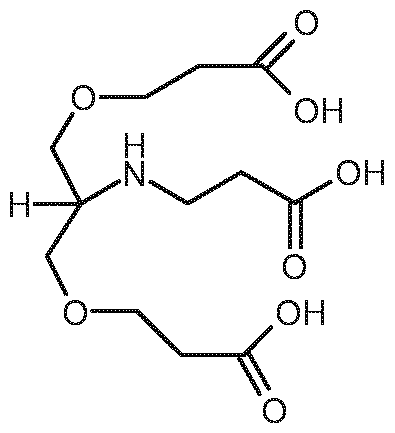
A solution of fert-butyl N-[2,2.16.16-tetramethyl-4, 14-dioxo-3,7, 1 1 , 15-tetraoxa heptadecan-9-yl]-|Valaninate (1 .23 g, 2.59 mmol) in acetic acid (20 mL) and water (20mL) was irradiated in a microwave reactor for 45 minutes at 120°C (300W). The mixture was concentrated, resolved in water and lyophilized to yield 790 mg of W-[1 ,3-bis(2- carboxyethoxy)propan-2-yl]-p-alanine.
H-N R (300 MHz, deuterium oxide): δ = 2.57 (t, 4H), 2.62 (t, 2H), 3.28 (t, 2H), 3.62 (m, 1 H), 3.65 - 3.80 (m. 8H) ppm.
Example 26d onoaqua-KO-dihydroxido-K20-bis-{ 3-propane[1 ,3-diyl(oxy)]dipropanoato- l K20\02:2K01':3K02][yf(imino)propanoato-2KO:3icO']}di- 3-oxido-1 :2:3i 60-trianguIo- tritungsten(3 W-W)(\V)

A suspension of /V-[1 ,3-bis(2-carboxyethoxy)propan-2-yl]-f alanine (420 mg, 1 .03 mmol) and sodium hexakis(p-acetato-K20)-tris(acetato-KO)-di-p3-oxido-1 :2:3KeO-triangulo- tritungsten(3 W-W)(\\/) (457 mg, 0.41 mmol) in water (35 mL) was irradiated in a microwave reactor for 15 minutes at 140°C. The reaction mixture was filtrated and the filtrate was concentrated in vacuum. Separation on a preparative HPLC (acetonitrile, water + acetic acid) yielded 37 mg of monoaqua-KO-dihydroxido-K20-bis-{p3-propane[1 ,3- diyl(oxy)]dipropanoato-l 201 ,02:2 O :3 02][yl(imino)propanoato-2 O:3 O]}di- 3-oxido- 1 :2:3K60-triangulo-tritungsten(3 W-W)(\V)
1H-NMR (300 MHz, deuterium oxide) δ = 2.74 - 2.92 (m, 8H), 3.05 (br., 4H), 3.36 - 3.45 (m, 4H), 3.56 (br., 2H), 3.71 - 3.94 (m, 18H).
MS ESI- m/z 1245.3 (M-1 ).
Example 27
Monoaqua-KO-dihydroxido-K2Obis{p3-hydroxymethylidyne[bis(methyleneoxy)di- propanoaio-1 i 201,02:2KO 3i 02][(metliyleneimino)propanoaio-2icO:3i O]}-di-M3- oxido-1 :2:3K60-ir/angty/o-tritungsten(3 W-W)(\V)

Example 27a
Di-fert-butyl 3,3'-[(2-formyl-2-hydroxypropane-1 ,3-diyl)bis(oxy)]dipropanoate

1H-NMR (400 MHz, CDCI3): δ = 1 .45 (s, 18H), 2.46 (t, 4H), 3.54 (d, 2H), 3.70 (t, 4H), 3.78 (d, 2H), 3.89 (s, 1 H), 9.70 (s, 1 H) ppm.
Example 27b
Tert-butyl N-{3-<3-fert-butoxy-3-oxopropoxy)-2-[(3-fert-butoxy-3- oxopropoxy)methyl]-2-hydroxypropyl}-p-alaninate

To a solution of di-fert-butyl 3,3'-[(2-formyl-2-hydroxypropane-1 ,3-diyl)bis(oxy)]dipropanoate (1 .5 g, 4.0 mmol) and fert-butyl β-alaninate (752 mg, 5.18 mmol) in methanol (45 mL) and acetic acid (1 1.7 mL) was added 5-ethyl-2-methylpyridine borane complex (237 μί, 1 .6 mmol) at 0°C. The 5 mixture was concentrated in vacuo after two hours at 0°C and the residue was purified by chromatography on silica gel (dichloromethane / ethanol gradient, 0 to 20%) to yield 1 .78 g of fert-butyl /V-{3-(3-ferf-butoxy-3-oxopropoxy)-2-[(3-ferf-butoxy-3-oxopropoxy)methyl]-2-hydroxy propyl}-p-alaninate.
1H-NMR (400 MHz, CDC ): δ = 1 .46 (s, 27H), 2.50 (q, 4H), 2.64 (t, 2H), 2.96 (s, 2H), 2.99 (t, I t) 2H), 3.45 (d, 2H), 3.52 (d, 2H), 3.63 - 3.78 (m, 5H).
Example 27c
W-{3-(2-carboxyethoxy)-2-[(2-carboxyethoxy)methyl]-2-hydroxypropyl}-p-alanine

A solution of V-{3-(3-terf-butoxy-3-oxopropoxy)-2-[(3-ferf-butoxy-3-oxopropoxy)methyl]-2- hydroxypropyl}-j3-alaninate (500 mg, 0.99 mmol) in acetic acid (10 mL) and water (10 mL) was irradiated in a microwave reactor for 27 minutes at 120°C (300W). The mixture was concentrated, while residing acetic acid was codistilled with toluene and dried in vacuum to yield 413 mg of A -{3-(2-carboxyethoxy)-2-[(2-carboxyethoxy)methy!]-2-hydroxypropyl}- β-alanine.
1H-NMR (400 MHz, deuterium oxide): δ = 2.59 (t, 4H).2.67 (t, 2H).3.21 (s.2H).3.22 (t, 2H), 3.52 (dd, 4H), 3.72 (t, 4H).
Example 27d
onoaqua- O iihydroxido- 20-bis{p3-hydroxymethylidyne[bis(methyleneoxy)di- propanoato-lK201,02:2K01'3ic02'3i(met yIeneimino)propanoaio-2i O:3i O']}-di-M3- oxido-1 :2:3 60-fr/angi//o-tritungsten(3 W-W)(\V)

A suspension of /V-{3-(2-carboxyethoxy)-2-[(2-carboxyethoxy)methyl]-2-hydroxypropyl}-|}- alanine (410 mg, 0.97 mmol) and sodium hexakis^-acetato- 20)-tris(acetato- O)-di- 3- oxido-1 :2:3K60-fr/angu/o-tritungsten(3 W-W)(\V) (542 mg, 0.49 mmol) in water (41 mL) was irradiated in a microwave reactor for 15 minutes at 140°C. The reaction mixture was filtrated and the filtrate was concentrated in vacuum. Separation on a preparative HPLC (acetonitrile, water + acetic acid) yielded 124 mg monoaqua- O-dihydroxido- 20-bis{ 3- hydroxymethylidyne[bis(methyleneoxy)dipropanoato-l 201,02:2 O 3 02]
[(methyleneimino)propanoato-2KO:3KO]}-di- 3-oxido-1 :2:3K60-frangt//o-tritungsten(3 W- W)(IV) H-NMR (300 MHz, deuterium oxide) δ = 2.78 (br., 8H), 2.92 (s, 4H), 3.04 - 3.14 (m, 4H), 3.29 (d, 4H), 3.39 (br., 1H), 3.53 (d, 4H), 3.58- 3.64 (m, 3H), 3.69 - 3.80 (m, 5H), 3.83 - 4.01 (m, 5H). MS ESI- m/z 1303.4 (M-1).
Claims
1. Trinuclear tungsten clusters comprising tridentate tri- or tetracarboxylic acid ligands.
2. Trinuclear tungsten cluster comprising two tridentate carboxylic acid ligands of the general formula I,
(CH2)p-X— (CH2)R— COO" OOC-(CH2)n- Z-(CH2)q
(8-s)+
W302
R1- CH2— O— (CH2)2—COO" OOC— (CH2)2-0— CH2-†- R2
(H20)r(OH)s
CH2— O— (CH2)2— COO" " OOC— (CH2)2-0— CH2
wherein
R1 is H, CH3, CH2OH, CH2OCH3, CH20(CH2)2COOH, NH2, NH(CH2)2OH,
NHCH2CH(OH)CH2OH, NHCH(CH2OH)2. NHCH2(CH(OH))2CH2OH,
NHCH2(CH(OH))3CH2OH, NH(CO)CH2OCH3 or OH;
R2 is H, CH3, CH2OH, CH2OCH3, CH20(CH2)2COOH, NH2, NH(CH2)2OH,
NHCH2CH(OH)CH2OH, NHCH(CH2OH)2, NHCH2(CH(OH))2CH2OH,
NHCH2(CH(OH))3CH2OH; NH(CO)CH2OCH3 or OH;
X is O or NR3; wherein R3 is H, (CH2)2OH, CH2CH(OH)CH2OH, CH(CH2OH)2, CH2(CH(OH))2CH2OH or CH2(CH(OH))3CH2OH;
Z is O or NR4; wherein R4 is selected from the group comprising H, (CH2)2OH,
CH2CH(OH)CH2OH, CH(CH2OH)2, CH2(CH(OH))2CH2OH or CH2(CH(OH))3CH2OH; m is 2, 3; n is 2, 3; p is 0. 1 q is 0, 1 ; r is O. 1 , 2, 3; and
5 s is 0, 1 , 2, 3; with the proviso that r + s is 3; if necessary any protonated species and any deprotonated species of said compounds, including all isomeric forms of said compounds, including but not limited to enantiomers, diastereomers, regioisomers and mixtures thereof, and any pharmaceutically acceptable I t) salt of such compounds.
3. Trinuclear tungsten cluster comprising two tridentate tricarboxylic acid ligands compounds of the general formula II,

15 the substituents HOOC-(CH2)n-0 exhibit all-c s configuration;
R5 is H or OH; m is 1.2; n is 1, 2; ris O. 1.2, 3; and s is O, 1, 2, 3; with the proviso that r + s is 3; if necessary any protonated species and any deprotonated species of said compounds, including all isomeric forms of said compounds, including but not limited to enantiomers, diastereomers, regioisomers and mixtures thereof, and any pharmaceutically acceptable salt of such compounds.
4. Trinuclear tungsten cluster of the general formulae I or II:
Monoaqua- O-bis{ 3-3,3'!3"-[methylidynetris(methyleneoxy)]tripropanoato- l 20 02:2 2O ,03:3 202,,03}dihydroxido- 20-di^3-oxido-1:2:3 60-fr/angu/o- tritungsten(3 W-W)(l\/)
Monoaqua-KO-bis{p:r3,3'.3"-[ethyl-1 ,1,1 -idynetris(methyleneoxy)]tripropanoato- l 20 02:2 2O ,03:3 202',03}dihydroxido- 20-di-M3-oxido-1:2:3 60-fr/angi//o- tritungsten(3 W-W)(\V)
Monoaqua-KO-bis{p3-3,3',3"-[aminomethylidynetris(methyleneoxy)]tripropanoato- l 20 02:2 2O ,03:3 202',03}dihydroxido- 20-di^3-oxido-1:2:3 60-ir/angL//o- tritungsten(3 W-W)(\V)
Monoaqua-KO-bis{p:r3,3',3"-[2(2-carboxyethoxy)ethyl-1 ,1,1 -idynetris(methylene-oxy)]tri- propanoato-l 20\02:2 2O ,03:3 202',03 dihydroxido- 20-di^3-oxido-1:2:3 60-fr/ang^ tritungsten(3 W-W)(\V) Monoaqua- O-bis( 3-3,3 3"-{[(2,3-dihydroxypropyl)amino3meihylidynetris(meihyleneoxy)}- tripropanoato-l 20 ,02:2 2O ,03:3 202,,03')-dihydroxido- 20-di- 3-oxido-1:2:3 60- fr/angu/o-tritungsten(3 W-W)(N) onoaqua-KO-bis(p3-3,3\3"-{[(1-deoxyxylit-1-yl)amino]methylidynetris(methyleneoxy)}- tripropanoato-l 20 02:2 2Oi o3:3 202 o3)-dihydroxido- 20-di-M3-oxido-1:2:3 60-fr/- angt//o-tritungsten(3 W-W)(N)
(p:r3,3 3"-{Aminomethylidynetris(methyleneoxy)}tripropanoato-lK201,02:2K2O ,03:
3202,03)monoaqua- O-dihydroxido- 20-dh^
triy!tris(oxy)]tripropanoato-l ^^ W-W)(\V) {p:r3.3 3"-[Aminomethylidynetris(methyleneoxy)]tripropanoato-lK 01.0 :2K 01.03:
3K 02,03}monoaqua-KO-dihydroxido-K20-{p3-3!3',3''-[methylidynetris(methylene- oxy)]tripropanoato-lK 0\02:2K O 03:3K202.^}di-p3-oxido-1:2:3K60-frangt//o- tritungsten(3 W-W){\V) onoaqua-KO-dihydroxido-K20-(p3-3,3'.3"-{[(2,3-dihydroxypropyl)amino]methylidynetris- (methyleneoxy)}iripropanoaio-l 201,02:2 2O ,03:3 202,,03')di-M3-oxido-1:2:3 60-{M3-
3,3',3"-[propane-1,2,3-triyltris(oxy)]iripropanoato-l 201,02:2 2O ,03: 3κ20? ^triangulo- tritungsten(3 W-W)(\V)
Monoaqua- O-bis{ 3-3,3',3"-[( 1 a, 3 a, 5 )-cyclohexane-1 ,3,5-triyltris(oxy)]iripropanoato- l 20 02:2 2O ,03:3 202',03,}dihydroxido-K20-di-M3-oxido-1:2:3 60-inangu/o- tritungsten(3 W-W)(W)
Monoaqua-KO-bis{p3-3,3',3"-[2-hydroxyethyl-1 ,1,1 -idynetris(methyleneoxy)-tripropanoaio- l 201,02:2 2O ,03:3 202,,03}dihydroxido- 20-di- 3-oxido-1:2:3 60-fr/angi//o- tritungsten(3 W-W)(\V)
Monoaqua-KO-bis(p3-3,3',3"-[2-methoxyethyl-1 ,1,1 -idynetris(methyleneoxy)-tripropanoato- l 20 02:2 2O ,03,3 202',03]-dihydroxido- 20-di-M3-oxido-1:2:3 60-fr/angu/o- tritungsten(3 W-W)(\V)
Monoaqua-KO-dihydroxido-K20-bis(p3-3,3',3"-[hydroxymethylidyne tris(methyleneoxy)iri- propanoaio-lK20 02:2 2O ,033 202',03]-di- 3-oxido-1:2:3 60-ir/angi/o-tritungsten(3 W- W)(IV) Monoaqua-KO-dihydroxido-K20-(p3-3,3\3"-{[(2,3-dihydroxypropyl)amino]methylidynetris- (methyleneoxy)}tripropanoato-lK 0 ,02:2K2Or, i:3K 02,03)(p3-3,3,,3"-[hydroxy- meihylidynetris(methyieneoxy)tripropanoato-l 201,02:2 2O ,03:3 202', 03]-di-p3-oxido- 1 :2:3K60-irangt//o-tritungsten(3 W-W){\\l)
Monoaqua-KO-di ydroxido-K20-bis(p3-3,3',3"-{[(2- ydroxyet yl)amino]methylidyne- tris-
(methyleneoxy)}tripropanoato-l 20\02¾^
tritungsten(3 W-W)(N)
Monoaqua-KO-dihydroxido-K20-(p3-3,3'.3"-{[(2- ydroxyethy)amino]methylidynetris-
(methyleneoxy)}tripropanoato-lK20 ,02:2 2O ,03:3 202,03)(M3-3!3',3"-[hydroxy- methylidynetris(methyleneoxy)tripropanoato-l 20.0 :2K2Or.Q3:3K202,03]-di-p3-oxido- 1 :2:3K60-frangu/o-tritungsten(3 W-W)(\V) onoaqua-KO-bis{p3-3,3\3"-[(methoxyacetyl)aminomethylidynetris(met yleneoxy)] - tripropanoato-l 20\02:2 20^03:3 202^^^
tritungsten(3 W-W)(N)
Monoaqua- O-dihydroxido-K20-(p3-3,3\3"-{[(2,3-dihydroxypropyl)amino]methylidynetris-
(meihyieneoxy)}tripropanoato-l 20 ,02:2 2O ,03:3 202,,03){M3-3!3',3''-[2-hydroxyeihyl- 1 ,1 ,1-idynetris(methyleneoxy)-tripropanoaio-l 201,02: 2 2O ,03:3 202',03}di- 3-oxido- 1 :2:3 60-ir/angt/o-tritungsten(3 W-W)(\V)
{p3-3,3\3"-[aminomethylidynetris(methyleneoxy)}]tripropanoato-1 ^O^C^^^O1^3
:3 202',03}monoaqua- O-dihydroxido- 20-{p3-3!3 3"-[(methoxyaceiyl)-aminomethy!idyne- tris(meihyleneoxy)]iripropanoato-lK201,02:2 2O ,03:3 202',03}di-p3-oxido-1:2:3 60- fr/angt//o-tritungsten(3 W-W)(\V)
Monoaqua- O-dihydroxido- 20-( 3-3,3 3"-{[(1-deoxyerythritol-1-yl)amino]meihylidynetris- (methyleneoxy)}tripropanoato-l 201,02:2 2O ,03:3 202',03')di-p3-oxido-{p3-3,3',3"- [propane-1,2,3-triyltris(oxy)]tripropanoato-l 20 ,02:2 2O ,03: 3κ202',03)-1 :2:3 60- frangt//o-tritungsten(3 W-W)(N) Monoaqua- O-dihydroxido- 20-( 3-3,3',3"-{[(2,3-dihydroxypropan-1-yl)aminoj- methylidynetris(methyleneoxy)}tripropanoato-l 201,02:2 2O ,03:3 202,,03'){M3-3,3',3"- [(methoxyacetyl)aminomeihylidynetris(meihyleneoxy)]tripropanoaio- l 20 02:2 2O ,03:3 202,03}-di^3-oxido-1:2:3 60-fr/angi//o-triiungsten(3 W-W)(\V) onoaqua- O-dihydroxido- 20-(p3-3,3',3"-{[(1-deoxyerythriiol-1-yl)aminoj- meihylidynetris(methyleneoxy)}iripropanoaio-l 20 ,02:2 2O ,03:3 202',03){ 3-3,3',3"- [(methoxyacetyl)aminomethylidynetris(methyleneoxy)]tripropanoato- l 20 02:2 2O ,03:3 202',03}-di^3-oxido-1:2:3 60-fr/angi/o-triiungsten(3 W-W)(N) Monoaqua- O-cSihydroxido- 20-bis-{M3-propane[1 ,3-diyl(oxy)jdipropanoato- l 20 , 02:2 O :3 02][yl(imino)propanoato-2 O:3 O]}di- 3-oxido-1 :2:3 60-iriangulo- tritungsten(3 W-W){\V)
Monoaqua-KO-dihydroxido-K20-bis{p:rhydroxymethylidyne[bis(methyleneoxy)di- propanoato-l 201 , 02:2 O 3 02][(rnethyleneimino)propanoato-2 O:3 O]}-di- 3-oxido- 1 :2:3K60-fr angt//o-tritungsten(3 W-W)(\V) and if necessary proton a ted species and deprotonated species of said compounds suitable salts thereof.
5. Trinuclear tungsten clusters comprising two tridentate carboxylic acid ligands of general formulae I or I I of claims 2 and 3, obtainable by ligand exchange reaction of one equivalent of monoaqua-KO-hexakis(p-acetato-K20)-dihydroxido-K20-di-p3-oxido-1 :2:3κ60- fr angt//o-tritungsten(3 W-W)(\V) or a salt of this cluster or sodium hexakis( -acetato-K20)-  :2:3K60-ir angt//o-tritungsten(3 W-W)(\V) in aqueous solution in the presence of two equivalents or slight excess of the desired tridentate ligand or a mixture of tridentate ligands, heating the components to temperatures in the range from 80° to 150°C in combination with the optional use of a pressure vessel, if necessary microwave irradiation, applying heating times range from 10 minutes up to 3 days, isolation and purification with chromatography or ion exchange chromatography.
6. Process for the preparation trinuclear tungsten clusters comprising two tridentate carboxylic acid ligands of general formula I or I I of claims 2 and 3, by reaction of one equivalent of monoaqua-KO-hexakis( -acetato-K20)-dihydroxido-K20-di- :s-oxido- 1 :2:3K60-ir angt;/o-tritungsten(3 W-W){\V) or a salt of this cluster or sodium hexakis( - acetato- 20)-tris(aceiato- O)-di- 3-oxido-1 :2:3 60-fr/angt /o-tritungsten(3 W-W)(\\l) in aqueous solution in the presence of two equivalents or slight excess of the desired tridentate ligand or a mixture of tridentate ligands, heating by temperatures in the range from 80° to 150°C in combination with the optional use of a pressure vessel, if necessary microwave irradiation, isolation and purification with chromatography or ion exchange chromatography.
7. Use of the compounds of general formulae I or II or mixtures thereof for the manufacture of diagnostic agents, especially X-ray diagnostic agents.
8. Tridentate tri- or tetracarboxylic acids as desired tridentate ligand resources as intermediates:
3-{3-(2-Carboxyethoxy)-2-[(2-carboxyethoxy)methyl]propoxy}propanoic acid
3-{3-(2-Carboxyethoxy)-2-[(2-carboxyethoxy)methyl]-2-methylpropoxy}propanoic acid
3-{2-Amino-3-(2-carboxyethoxy)-2-[(2-carboxyethoxy)methyl]propoxy}propanoic acid
3-{3-(2-Carboxyethoxy)-2,2-bis[(2-carboxyethoxy)methyl]propoxy}propanoic acid 3-{3-(2-Carboxyethoxy)-2-[(2-carboxyethoxy)methyl]-2-[(2,3-dihydroxypropyl)aminoj- propoxy}propanoic acid
1 -({1 ,3-Bis(2-carboxyethoxy)-2-[(2-carboxyethoxy)methyl]propan-2-yl}amino)-1 -deoxy- xylitol
3,3'.3"-[Propane-1 ,2,3-triyltris(oxy)]tripropanoic acid 3-[3-(2-Carboxyethoxy)-2-[(2-carboxyethoxy)methyl]-2-(hydroxymethyl)propoxy]propanoic acid
3-[3-(2-Carboxyethoxy)-2-[(2-carboxyethoxy)methyl]-2-(methoxymethyl)propoxy]propanoic acid
3-{3-(2-Carboxyethoxy)-2-[(2-carboxyethoxy)methyl]-2-hydroxypropoxy}propanoic acid 3-{3-(2-Carboxyethoxy)-2-[(2-carboxyethoxy)methyl]-2-[(2-hydroxyethyl)amino]propoxy}- propanoic acid
3-{3-(2-Carboxyethoxy)-2-[(2-carboxyethoxy)methyl]-2-[(methoxyacetyl)amino]propoxy}- propanoic acid
1 -({1 ,3-Bis(2-carboxyethoxy)-2-[(2-carboxyethoxy)methyl]propan-2-yi}amino)-1 -deoxy- erythrol
Λ/-[1 ,3-Bis(2-carboxyethoxy)propan-2-yl]-| -alanine A/-{3-(2-Carboxyeihoxy)-2-[(2-carboxyethoxy)methyl]-2-hydroxypropyl}-p-alanine 3,3',3"-[(all-cis)-Cyclohexane-1 ,3,5-iriyltris(oxy)]tripropanoic acid
Applications Claiming Priority (2)
| Application Number | Priority Date | Filing Date | Title |
|---|---|---|---|
| EP11172066A EP2540321A1 (en) | 2011-06-30 | 2011-06-30 | Bis Tridentate W3O2 Clusters for X-Ray imaging |
| EP11172066.0 | 2011-06-30 |
Publications (1)
| Publication Number | Publication Date |
|---|---|
| WO2013000970A1 true WO2013000970A1 (en) | 2013-01-03 |
Family
ID=46466468
Family Applications (1)
| Application Number | Title | Priority Date | Filing Date |
|---|---|---|---|
| PCT/EP2012/062505 Ceased WO2013000970A1 (en) | 2011-06-30 | 2012-06-27 | Bis tridentate w3o2 clusters for x-ray imaging |
Country Status (2)
| Country | Link |
|---|---|
| EP (1) | EP2540321A1 (en) |
| WO (1) | WO2013000970A1 (en) |
Cited By (4)
| Publication number | Priority date | Publication date | Assignee | Title |
|---|---|---|---|---|
| EP2796152A1 (en) | 2013-04-25 | 2014-10-29 | Bayer Pharma Aktiengesellschaft | Unsymmetrical Bis Azainositol Hafnium Complexes for X-Ray Imaging |
| WO2015069926A1 (en) | 2013-11-06 | 2015-05-14 | The University Of Chicago | Nanoscale carriers for the delivery or co-delivery of chemotherapeutics, nucleic acids and photosensitizers |
| WO2023060628A1 (en) * | 2020-10-16 | 2023-04-20 | 浙江大学 | Composite oxide containing tungstate nanoclusters, preparation method therefor and use thereof |
| CN118084733A (en) * | 2024-03-08 | 2024-05-28 | 重庆皓元生物制药有限公司 | A method for preparing a key intermediate for synthesizing tubulin inhibitors |
Families Citing this family (1)
| Publication number | Priority date | Publication date | Assignee | Title |
|---|---|---|---|---|
| EP2733148A1 (en) * | 2012-11-15 | 2014-05-21 | Bayer Pharma Aktiengesellschaft | Tungsten complexes with di-dentate ligands |
Citations (4)
| Publication number | Priority date | Publication date | Assignee | Title |
|---|---|---|---|---|
| WO1991014460A1 (en) | 1990-03-28 | 1991-10-03 | Cockbain, Julian, Roderick, Michaelson | Contrast media |
| WO1992000698A1 (en) | 1990-07-13 | 1992-01-23 | Montaldi David H | One-piece disposable speculum |
| WO1997003993A1 (en) | 1995-07-20 | 1997-02-06 | Mallinckrodt Medical, Inc. | Process for producing tungsten clusters |
| WO1997003994A1 (en) | 1995-07-20 | 1997-02-06 | Mallinckrodt Medical, Inc. | Tungsten clusters |
-
2011
- 2011-06-30 EP EP11172066A patent/EP2540321A1/en not_active Withdrawn
-
2012
- 2012-06-27 WO PCT/EP2012/062505 patent/WO2013000970A1/en not_active Ceased
Patent Citations (4)
| Publication number | Priority date | Publication date | Assignee | Title |
|---|---|---|---|---|
| WO1991014460A1 (en) | 1990-03-28 | 1991-10-03 | Cockbain, Julian, Roderick, Michaelson | Contrast media |
| WO1992000698A1 (en) | 1990-07-13 | 1992-01-23 | Montaldi David H | One-piece disposable speculum |
| WO1997003993A1 (en) | 1995-07-20 | 1997-02-06 | Mallinckrodt Medical, Inc. | Process for producing tungsten clusters |
| WO1997003994A1 (en) | 1995-07-20 | 1997-02-06 | Mallinckrodt Medical, Inc. | Tungsten clusters |
Non-Patent Citations (11)
| Title |
|---|
| BINO, A.; COTTON, F. A.; DORI, Z.; KOCH, S.; KUEPPERS, H.; MILLAR, M.; SEKUTOWSKI, J. C., INORG. CHEM., vol. 17, 1978, pages 3245 - 3253 |
| BINO, A.; GIBSON, D., INORGANICA CHIMICA ACTA, vol. 1985, no. 104, pages 155 - 160 |
| BINO, A.; HESSE; K. F.; KUEPPERS, H., ACTA CRYSTALLOGR., vol. B36, 1980, pages 723 - 725 |
| CARDONA, C.M.; GAWLEY, R.E., J. ORG. CHEM., vol. 67, 2002, pages 1411 - 1413 |
| COTTON, F.A.; DORI, Z.; MARLER, D.O.; SCHWOTZER, W., INORG.CHEM, vol. 23, 1984, pages 4033 - 4038 |
| COTTON, F.A.; DORI, Z.; MARLER, D.O.; SCHWOTZER, W., INORG.CHEM, vol. 23, 1984, pages 4738 - 4742 |
| EUR. J. INORG. CHEM., 2001, pages 1789 - 1795 |
| J. ORG. CHEM., vol. 60, 1995, pages 331 - 336 |
| JOURNAL OF THE AMERICAN CHEMICAL SOCIETY, vol. 77, 1955, pages 6382 - 3 |
| POWELL, G.; RICHENS, D.T., INORG.CHEM., vol. 32, 1993, pages 4021 - 4029 |
| WEIZMAN ET AL., J. AM. CHEM. SOC., vol. 118, 1996, pages 12368 - 12375 |
Cited By (5)
| Publication number | Priority date | Publication date | Assignee | Title |
|---|---|---|---|---|
| EP2796152A1 (en) | 2013-04-25 | 2014-10-29 | Bayer Pharma Aktiengesellschaft | Unsymmetrical Bis Azainositol Hafnium Complexes for X-Ray Imaging |
| WO2014173857A1 (en) | 2013-04-25 | 2014-10-30 | Bayer Pharma Aktiengesellschaft | Bis azainositol hafnium complexes for x-ray imaging |
| WO2015069926A1 (en) | 2013-11-06 | 2015-05-14 | The University Of Chicago | Nanoscale carriers for the delivery or co-delivery of chemotherapeutics, nucleic acids and photosensitizers |
| WO2023060628A1 (en) * | 2020-10-16 | 2023-04-20 | 浙江大学 | Composite oxide containing tungstate nanoclusters, preparation method therefor and use thereof |
| CN118084733A (en) * | 2024-03-08 | 2024-05-28 | 重庆皓元生物制药有限公司 | A method for preparing a key intermediate for synthesizing tubulin inhibitors |
Also Published As
| Publication number | Publication date |
|---|---|
| EP2540321A1 (en) | 2013-01-02 |
Similar Documents
| Publication | Publication Date | Title |
|---|---|---|
| ES3034297T3 (en) | New contrast agent for use in magnetic resonance imaging | |
| WO2013000970A1 (en) | Bis tridentate w3o2 clusters for x-ray imaging | |
| SG175045A1 (en) | Novel compounds of reverse-turn mimetics, method for manufacturing the same and use thereof | |
| JPH02202896A (en) | Phospholipid nucleoside | |
| KR20090042757A (en) | New Crystallization of 5-aminolevulinic Acid Phosphate and Its Preparation Method | |
| JP4435861B2 (en) | Novel sulfonated sugar derivatives and their use as pharmaceuticals | |
| JP7777542B2 (en) | Inositol derivatives and uses thereof | |
| JP7375755B2 (en) | Fatty acid derivatives labeled with positron-emitting nuclides | |
| EP2733148A1 (en) | Tungsten complexes with di-dentate ligands | |
| CN114945557B (en) | Fatty acid derivatives labeled with positron radionuclides | |
| CN120957982A (en) | Ligands targeting fibroblast activation proteins | |
| EP4584251A1 (en) | New contrast agents for use in diagnostic imaging | |
| EP2900276A1 (en) | Bifunctional chelating agents | |
| CN116410248A (en) | A labeled glucose amide derivative, its preparation method, its precursor and its application | |
| JP2015517507A (en) | Bisazainositol heavy metal complexes for X-ray imaging | |
| JPH0797361A (en) | New chelate-forming compounds and their uses | |
| HK40083691A (en) | Inositol derivative and use thereof | |
| CA2910226A1 (en) | Bis azainositol hafnium complexes for x-ray imaging | |
| CA3289920A1 (en) | Ligand targeting fibroblast activation protein | |
| CN117794905A (en) | Benzocyclic derivatives and their preparation methods and applications | |
| EP2873670A1 (en) | Bis azainositol zirconium complexes for X-ray imaging | |
| CN1478786A (en) | Platinum (II) compound using chiral diamine as ligand | |
| HK40046932A (en) | Gadolinium bearing pcta-based contrast agents | |
| JP2019085344A (en) | Radioactive fluorine-labeled compound | |
| CN106565796A (en) | Crystal of cyclic adenosine monophosphate sodium salt solvate and preparation method thereof |
Legal Events
| Date | Code | Title | Description |
|---|---|---|---|
| 121 | Ep: the epo has been informed by wipo that ep was designated in this application |
Ref document number: 12733041 Country of ref document: EP Kind code of ref document: A1 |
|
| NENP | Non-entry into the national phase |
Ref country code: DE |
|
| 122 | Ep: pct application non-entry in european phase |
Ref document number: 12733041 Country of ref document: EP Kind code of ref document: A1 |