WO2012173572A1 - Stereoselective synthesis of highly substituted enamides - Google Patents
Stereoselective synthesis of highly substituted enamides Download PDFInfo
- Publication number
- WO2012173572A1 WO2012173572A1 PCT/SG2012/000209 SG2012000209W WO2012173572A1 WO 2012173572 A1 WO2012173572 A1 WO 2012173572A1 SG 2012000209 W SG2012000209 W SG 2012000209W WO 2012173572 A1 WO2012173572 A1 WO 2012173572A1
- Authority
- WO
- WIPO (PCT)
- Prior art keywords
- substituted
- unsubstituted
- alkyl
- compound
- bis
- Prior art date
- Legal status (The legal status is an assumption and is not a legal conclusion. Google has not performed a legal analysis and makes no representation as to the accuracy of the status listed.)
- Ceased
Links
- 0 *C=C(N(*)C(*)=O)[Al] Chemical compound *C=C(N(*)C(*)=O)[Al] 0.000 description 7
- HHQJJJVOOUPHEH-WQLSENKSSA-N CC(N/C(/c(cc1)ccc1OC)=C\C(OC)=O)=O Chemical compound CC(N/C(/c(cc1)ccc1OC)=C\C(OC)=O)=O HHQJJJVOOUPHEH-WQLSENKSSA-N 0.000 description 1
- MHZDCUVUBSLVDC-FLIBITNWSA-N CC(N/C(/c1ccccc1)=C\C(OC)=O)=O Chemical compound CC(N/C(/c1ccccc1)=C\C(OC)=O)=O MHZDCUVUBSLVDC-FLIBITNWSA-N 0.000 description 1
- ZNUHWIMTDZJMJP-SSZFMOIBSA-N CN(/C(/c1ccccc1)=C\C(OC)=O)C(c1ccccc1)=O Chemical compound CN(/C(/c1ccccc1)=C\C(OC)=O)C(c1ccccc1)=O ZNUHWIMTDZJMJP-SSZFMOIBSA-N 0.000 description 1
- CCEGIUZKKUJOBQ-CMDGGOBGSA-N CN(/C=C/C(OC)=O)C(c1ccccc1)=O Chemical compound CN(/C=C/C(OC)=O)C(c1ccccc1)=O CCEGIUZKKUJOBQ-CMDGGOBGSA-N 0.000 description 1
- UGGUAHHFJVRPDV-XFXZXTDPSA-N COC(/C=C(/c(cc1)ccc1Cl)\N(CCC1)C1=O)=O Chemical compound COC(/C=C(/c(cc1)ccc1Cl)\N(CCC1)C1=O)=O UGGUAHHFJVRPDV-XFXZXTDPSA-N 0.000 description 1
- QWFHHPJVRQSWTG-RAXLEYEMSA-N COC(/C=C(/c1cc(OC)ccc1)\N(CCC1)C1=O)=O Chemical compound COC(/C=C(/c1cc(OC)ccc1)\N(CCC1)C1=O)=O QWFHHPJVRQSWTG-RAXLEYEMSA-N 0.000 description 1
- MEYLMKTVIUUVHP-OWBHPGMISA-N COC(/C=C(/c1ccccc1)\N(CCCCC1)C1=O)=O Chemical compound COC(/C=C(/c1ccccc1)\N(CCCCC1)C1=O)=O MEYLMKTVIUUVHP-OWBHPGMISA-N 0.000 description 1
- IHZMHVDRJTXUIN-QINSGFPZSA-N COC(/C=C(/c1ccccc1)\NC(C1CCCCC1)=O)=O Chemical compound COC(/C=C(/c1ccccc1)\NC(C1CCCCC1)=O)=O IHZMHVDRJTXUIN-QINSGFPZSA-N 0.000 description 1
- PEIWOPAUBHGZOC-RAXLEYEMSA-N Cc1cccc(/C(/N(CCC2)C2=O)=C/C(OC)=O)c1 Chemical compound Cc1cccc(/C(/N(CCC2)C2=O)=C/C(OC)=O)c1 PEIWOPAUBHGZOC-RAXLEYEMSA-N 0.000 description 1
Classifications
-
- C—CHEMISTRY; METALLURGY
- C07—ORGANIC CHEMISTRY
- C07C—ACYCLIC OR CARBOCYCLIC COMPOUNDS
- C07C231/00—Preparation of carboxylic acid amides
- C07C231/12—Preparation of carboxylic acid amides by reactions not involving the formation of carboxamide groups
-
- C—CHEMISTRY; METALLURGY
- C07—ORGANIC CHEMISTRY
- C07C—ACYCLIC OR CARBOCYCLIC COMPOUNDS
- C07C233/00—Carboxylic acid amides
- C07C233/01—Carboxylic acid amides having carbon atoms of carboxamide groups bound to hydrogen atoms or to acyclic carbon atoms
- C07C233/45—Carboxylic acid amides having carbon atoms of carboxamide groups bound to hydrogen atoms or to acyclic carbon atoms having the nitrogen atom of at least one of the carboxamide groups bound to a carbon atom of a hydrocarbon radical substituted by carboxyl groups
- C07C233/46—Carboxylic acid amides having carbon atoms of carboxamide groups bound to hydrogen atoms or to acyclic carbon atoms having the nitrogen atom of at least one of the carboxamide groups bound to a carbon atom of a hydrocarbon radical substituted by carboxyl groups with the substituted hydrocarbon radical bound to the nitrogen atom of the carboxamide group by an acyclic carbon atom
- C07C233/47—Carboxylic acid amides having carbon atoms of carboxamide groups bound to hydrogen atoms or to acyclic carbon atoms having the nitrogen atom of at least one of the carboxamide groups bound to a carbon atom of a hydrocarbon radical substituted by carboxyl groups with the substituted hydrocarbon radical bound to the nitrogen atom of the carboxamide group by an acyclic carbon atom having the carbon atom of the carboxamide group bound to a hydrogen atom or to a carbon atom of an acyclic saturated carbon skeleton
-
- C—CHEMISTRY; METALLURGY
- C07—ORGANIC CHEMISTRY
- C07C—ACYCLIC OR CARBOCYCLIC COMPOUNDS
- C07C233/00—Carboxylic acid amides
- C07C233/57—Carboxylic acid amides having carbon atoms of carboxamide groups bound to carbon atoms of rings other than six-membered aromatic rings
- C07C233/63—Carboxylic acid amides having carbon atoms of carboxamide groups bound to carbon atoms of rings other than six-membered aromatic rings having the nitrogen atom of at least one of the carboxamide groups bound to a carbon atom of a hydrocarbon radical substituted by carboxyl groups
-
- C—CHEMISTRY; METALLURGY
- C07—ORGANIC CHEMISTRY
- C07C—ACYCLIC OR CARBOCYCLIC COMPOUNDS
- C07C233/00—Carboxylic acid amides
- C07C233/64—Carboxylic acid amides having carbon atoms of carboxamide groups bound to carbon atoms of six-membered aromatic rings
- C07C233/81—Carboxylic acid amides having carbon atoms of carboxamide groups bound to carbon atoms of six-membered aromatic rings having the nitrogen atom of at least one of the carboxamide groups bound to a carbon atom of a hydrocarbon radical substituted by carboxyl groups
- C07C233/82—Carboxylic acid amides having carbon atoms of carboxamide groups bound to carbon atoms of six-membered aromatic rings having the nitrogen atom of at least one of the carboxamide groups bound to a carbon atom of a hydrocarbon radical substituted by carboxyl groups with the substituted hydrocarbon radical bound to the nitrogen atom of the carboxamide group by an acyclic carbon atom
- C07C233/87—Carboxylic acid amides having carbon atoms of carboxamide groups bound to carbon atoms of six-membered aromatic rings having the nitrogen atom of at least one of the carboxamide groups bound to a carbon atom of a hydrocarbon radical substituted by carboxyl groups with the substituted hydrocarbon radical bound to the nitrogen atom of the carboxamide group by an acyclic carbon atom of a carbon skeleton containing six-membered aromatic rings
-
- C—CHEMISTRY; METALLURGY
- C07—ORGANIC CHEMISTRY
- C07D—HETEROCYCLIC COMPOUNDS
- C07D207/00—Heterocyclic compounds containing five-membered rings not condensed with other rings, with one nitrogen atom as the only ring hetero atom
- C07D207/02—Heterocyclic compounds containing five-membered rings not condensed with other rings, with one nitrogen atom as the only ring hetero atom with only hydrogen or carbon atoms directly attached to the ring nitrogen atom
- C07D207/18—Heterocyclic compounds containing five-membered rings not condensed with other rings, with one nitrogen atom as the only ring hetero atom with only hydrogen or carbon atoms directly attached to the ring nitrogen atom having one double bond between ring members or between a ring member and a non-ring member
- C07D207/22—Heterocyclic compounds containing five-membered rings not condensed with other rings, with one nitrogen atom as the only ring hetero atom with only hydrogen or carbon atoms directly attached to the ring nitrogen atom having one double bond between ring members or between a ring member and a non-ring member with hetero atoms or with carbon atoms having three bonds to hetero atoms with at the most one bond to halogen, e.g. ester or nitrile radicals, directly attached to ring carbon atoms
- C07D207/24—Oxygen or sulfur atoms
- C07D207/26—2-Pyrrolidones
- C07D207/263—2-Pyrrolidones with only hydrogen atoms or radicals containing only hydrogen and carbon atoms directly attached to other ring carbon atoms
- C07D207/27—2-Pyrrolidones with only hydrogen atoms or radicals containing only hydrogen and carbon atoms directly attached to other ring carbon atoms with substituted hydrocarbon radicals directly attached to the ring nitrogen atom
-
- C—CHEMISTRY; METALLURGY
- C07—ORGANIC CHEMISTRY
- C07D—HETEROCYCLIC COMPOUNDS
- C07D207/00—Heterocyclic compounds containing five-membered rings not condensed with other rings, with one nitrogen atom as the only ring hetero atom
- C07D207/02—Heterocyclic compounds containing five-membered rings not condensed with other rings, with one nitrogen atom as the only ring hetero atom with only hydrogen or carbon atoms directly attached to the ring nitrogen atom
- C07D207/30—Heterocyclic compounds containing five-membered rings not condensed with other rings, with one nitrogen atom as the only ring hetero atom with only hydrogen or carbon atoms directly attached to the ring nitrogen atom having two double bonds between ring members or between ring members and non-ring members
- C07D207/34—Heterocyclic compounds containing five-membered rings not condensed with other rings, with one nitrogen atom as the only ring hetero atom with only hydrogen or carbon atoms directly attached to the ring nitrogen atom having two double bonds between ring members or between ring members and non-ring members with hetero atoms or with carbon atoms having three bonds to hetero atoms with at the most one bond to halogen, e.g. ester or nitrile radicals, directly attached to ring carbon atoms
- C07D207/36—Oxygen or sulfur atoms
- C07D207/40—2,5-Pyrrolidine-diones
- C07D207/404—2,5-Pyrrolidine-diones with only hydrogen atoms or radicals containing only hydrogen and carbon atoms directly attached to other ring carbon atoms, e.g. succinimide
-
- C—CHEMISTRY; METALLURGY
- C07—ORGANIC CHEMISTRY
- C07D—HETEROCYCLIC COMPOUNDS
- C07D223/00—Heterocyclic compounds containing seven-membered rings having one nitrogen atom as the only ring hetero atom
- C07D223/02—Heterocyclic compounds containing seven-membered rings having one nitrogen atom as the only ring hetero atom not condensed with other rings
- C07D223/06—Heterocyclic compounds containing seven-membered rings having one nitrogen atom as the only ring hetero atom not condensed with other rings with hetero atoms or with carbon atoms having three bonds to hetero atoms with at the most one bond to halogen, e.g. ester or nitrile radicals, directly attached to ring carbon atoms
- C07D223/08—Oxygen atoms
- C07D223/10—Oxygen atoms attached in position 2
-
- C—CHEMISTRY; METALLURGY
- C07—ORGANIC CHEMISTRY
- C07D—HETEROCYCLIC COMPOUNDS
- C07D263/00—Heterocyclic compounds containing 1,3-oxazole or hydrogenated 1,3-oxazole rings
- C07D263/02—Heterocyclic compounds containing 1,3-oxazole or hydrogenated 1,3-oxazole rings not condensed with other rings
- C07D263/08—Heterocyclic compounds containing 1,3-oxazole or hydrogenated 1,3-oxazole rings not condensed with other rings having one double bond between ring members or between a ring member and a non-ring member
- C07D263/16—Heterocyclic compounds containing 1,3-oxazole or hydrogenated 1,3-oxazole rings not condensed with other rings having one double bond between ring members or between a ring member and a non-ring member with hetero atoms or with carbon atoms having three bonds to hetero atoms with at the most one bond to halogen, e.g. ester or nitrile radicals, directly attached to ring carbon atoms
- C07D263/18—Oxygen atoms
- C07D263/20—Oxygen atoms attached in position 2
- C07D263/22—Oxygen atoms attached in position 2 with only hydrogen atoms or radicals containing only hydrogen and carbon atoms, directly attached to other ring carbon atoms
Definitions
- the present invention is in the field of synthetic organic chemistry and more particularly, in the field of oxidative Heck cross-coupling reactions with electron-rich alkenes, such as substituted ⁇ -amidoacrylate and other related substituted enamides.
- the Heck arylation has proven to be among the most versatile reactions for C-C bond formation owing to its excellent chemoselectivity, wide functional group tolerability, and simplicity.
- This palladium (O)-mediated catalytic process allows for facile cross-coupling of alkenes with various aryl and heteroaryl halides/pseudohalides.
- the oxidative Heck reaction has drawn significant attention where arylpalladium (II) species are generated by transmetallation with organometallic counterparts followed by undergoing insertion with alkenes.
- organometallic coupling partners organoboronic acids have been extensively explored in various transition-metal-mediated reactions owing to their stability, wide availability, and low toxicity.
- ⁇ -Amidoacrylate is an important enamide moiety that has been widely utilized as a synthetic intermediate in the total synthesis of natural products as well as in the preparation of heterocycles and ⁇ -amino acids through asymmetric hydrogenation. These compounds are typically prepared by condensation of ⁇ -ketoesters with arriides, acylation of ⁇ -aminoacrylates, oxidative amidation of acrylates and addition of amides to terminal alkynes, which typically provide disubstituted enamides.
- the present invention addresses these needs by providing new and improved methods for the synthesis of sterically hindered enamides including the ⁇ -amidoacrylate moiety, which can be utilized as a synthetic intermediate in the total synthesis of natural products as well as in the preparation of heterocycles and ⁇ -amino acids through asymmetric hydrogenation.
- the disclosure provides methods for preparing a compound of Formula I:
- R 3 is selected from C0 2 R 4 , CONR 5 R 6 and substituted or unsubstituted aryl;
- R 4 is selected H, substituted or unsubstituted (Ci-C 6 )alkyl, substituted or unsubstituted (C 3 -C 7 )cycloalkyl, and substituted or unsubstituted aryl;
- R 5 and R 6 are each independently selected from H, substituted or unsubstituted (C
- Ar is substituted or unsubstituted aryl
- Ar-M is an arylboron derivative selected from phenyl potassium trifluoroborate, substituted or unsubstituted phenylboronic acid, and substituted or unsubstituted pinacol phenylboronate;
- a ligand selected from 2,9-dimethyl-l ,10- phenanthroline (DMPHEN), 2-(dicyclohexylphosphino)-biphenyl (bpPCy 2 ), 2,2'- bis(diphenylphosphino)- 1 , 1 ' -binaphthyl (BIN AP), 1,1 ' -bis(diphenylphosphino)ferrocene (DPPF), ⁇ , ⁇ , ⁇ ', ⁇ '- tetramethylethylenediamine (TMEDA), 2,6-lutidine, 2,2'-bipyridyl (Bipy), 1,10-phenanthroline (phen), triphenylphosphine (Ph 3 P), o-tol 3 P, (p-CF 3 C 6 H 4 ) 3 P, (p-CH 3 C 6 H 4 ) 3 P, phenylphosphite ((PHEN), 2-(dicyclohexylphosphin
- an additive fluoride source selected from silver fluoride (AgF), copper fluoride (CuF 2 ), cesium fluoride (CsF), and potassium bifluoride (KHF 2 );
- oxidant selected from copper(II) acetate (Cu(OAc) 2 ), silver oxide (Ag 2 0), silver fluoride (AgF), benzoquinone (BQ), potassium persulfate (K 2 S 2 0 8 ), potassium ferricyanide (K. 3 Fe(CN) 6 ) and combinations thereof, either in the presence of absence of from about 1 atm oxygen to about 10 atm oxygen;
- a base selected from sodium carbonate (Na 2 C0 3 ), potassium carbonate (K 2 C0 3 ), potassium phosphate (K3PO 4 ), cesium carbonate (Cs 2 C0 3 ), and combinations thereof; and
- a solvent selected from acetic acid (AcOH), acetonitrile (CH 3 CN), N,N-dimethyl formamide (DMF), tert-butyl alcohol (tert-BuOH), 1 ,4-dioxane, and combinations thereof, to provide the compound of Formula I.
- the disclosure provides methods for preparing a compound of Formula IV, by asymmetrically hydrogenating the compound of Formula I to produce a ⁇ -amino acid derivative compound of Formula
- R 3 is selected from C0 2 R 4 , CONR 5 R 6 and substituted or unsubstituted aryl;
- R 4 is selected H, substituted or unsubstituted (Ci-C )alkyl, substituted or unsubstituted (C 3 -C )cycloalkyl, and substituted or unsubstituted aryl;
- R 5 and R 6 are each independently selected from H, substituted or unsubstituted (Ci- C )alkyl, substituted or unsubstituted (C3-C 7 )cycloalkyl, and substituted or unsubstituted aryl, or R 5 and R 6 together from a substituted or unsubstituted 5-, 6- or 7-membered heterocyclic ring, or R 5 and R 6 together form a substituted or unsubstituted 5-membered heteroaryl ring; and
- Ar is substituted or unsubstituted aryl.
- alkyl by itself or as part of another substituent, means, unless otherwise stated, a straight (i.e. unbranched) or branched chain, or cyclic hydrocarbon radical, or combination thereof, which may be fully saturated, mono- or polyunsaturated and can include di- and multivalent radicals, having the number of carbon atoms designated (i.e. Q-Cio means one to ten carbons).
- saturated hydrocarbon radicals include, but are not limited to, groups such as methyl, ethyl, n-propyl, isopropyl, n-butyl, t-butyl, isobutyl, sec-butyl, cyclohexyl, (cyclohexyl)methyl, cyclopropylmethyl, homologs and isomers of, for example, n- pentyl, n-hexyl, n-heptyl, n-octyl, and the like.
- An unsaturated alkyl group is one having one or more double bonds or triple bonds.
- unsaturated alkyl groups include, but are not limited to, vinyl, 2-propenyl, crotyl, 2-isopentenyl 2-(butadienyl), 2,4-pentadienyl, 3-(l,4- pentadienyl), ethynyl, 1 - and 3-propynyl, 3-butynyl, and the higher homologs and isomers.
- Alkyl groups which are limited to hydrocarbon groups are termed "homoalkyl.”
- alkyl can be methyl, ethyl, propyl, isopropyl, butyl isobutyl, sec-butyl, pentyl, 3-pentyl, or hexyl;
- cycloalkyl can be cyclopropyl, cyclobutyl, cyclopentyl, or cyclohexyl;
- -0(Ci-C 6 )alkyl (alkoxy) can be methoxy, ethoxy, propoxy, isopropoxy, butoxy, iso-butoxy, sec-butoxy, pentoxy, 3-pentoxy, or hexyloxy.
- an alkyl (or alkylene) group will have from 1 to 24 carbon atoms, which includes those groups having 10 or fewer carbon atoms.
- a “lower alkyl” or “lower alkylene” is a shorter chain alkyl or alkylene group, generally having eight or fewer carbon atoms.
- alkyl, alkoxy, alkenyl, alkynyl denote both straight and branched groups; but reference to an individual group such as “propyl” embraces the straight chain group, a branched chain isomer such as “isopropyl” being specifically referred to.
- heteroalkyl by itself or in combination with another term, means, unless otherwise stated, a stable straight or branched chain, or cyclic hydrocarbon radical, or combinations thereof, consisting of at least one carbon atoms and at least one heteroatom selected from the group consisting of O, N, P, Si and S, and wherein the nitrogen, phosphorus, and sulfur atoms may optionally be oxidized and the nitrogen heteroatom may optionally be quaternized.
- the heteroatom(s) O, N, P and S and Si may be placed at any interior position of the heteroalkyl group or at the position at which alkyl group is attached to the remainder of the molecule.
- heteroalkylene by itself 3r as part of another substituent means a divalent radical derived from heteroalkyl, as exemplified, but not limited by, -CH 2 -CH 2 -S-CH 2 -CH 2 - and -CH 2 -S-CH 2 -CH 2 -NH-CH 2 -.
- heteroatoms can also occupy either or both of the chain termini (e.g., alkyleneoxo, alkylenedioxo, alkyleneamino, alkylenediamino, and the like). Still further, for alkylene and heteroalkylene linking groups, no orientation of the linking group is implied by the direction in which the formula of the linking group is written. For example, the formula - C(0)OR'- includes both -C(0)OR'- and -R'OC(O)-.
- heteroalkyl groups include those groups that are attached to the remainder of the molecule through a heteroatom, such as -C(0)R', -C(0)NR', -NR'R ⁇ -OR', -SR ⁇ and/or -S0 2 R'.
- heteroalkyl is recited, followed by recitations of specific heteroalkyl groups, such as -NR'R” or the like, it will be understood that the terms heteroalkyl and -NR'R" are not redundant or mutually exclusive. Rather, the specific heteroalkyl groups are recited to add clarity. Thus, the term “heteroalkyl” should not be interpreted herein as excluding specific heteroalkyl groups, such as -NR'R” or the like.
- cycloalkyl and “heterocycloalkyl”, by themselves or in combination with other terms, re, unless otherwise stated, cyclic versions of “alkyl” and “heteroalkyl”, respectively. Additionally, for heterocycloalkyl, a heteroatom can occupy the position at which the heterocycle is attached to the remainder of the molecule. Examples of cycloalkyl include, but are not limited to, cyclopentyl, cyclohexyl, 1 -cyclohexenyl,
- heterocycloalkyl examples include, but are not limited to, l-(l,2,5,6-tetrahydropyridyl), 1-piperidinyl, 2-piperidinyl, 3-piperidinyl,
- cycloalkylene and “heterocycloalkylene” refer to the divalent derivatives of cycloalkyl and heterocycloalkyl, respectively.
- alkyl refers to a branched or unbranched saturated hydrocarbon group of 1 to 6 carbon atoms, such as methyl, ethyl, n-propyl, isopropyl, n-butyl, isobutyl, t-butyl, pentyl, and the like. Alkyl groups herein contain 1 to 6 carbon atoms, such as, for example, methyl, ethyl, and the like. As used herein the term “alkyl” also includes the term “cycloalkyl,” which refers to a cyclic alkyl group of three to eight, including three, five or six, carbon atoms.
- cycloalkylene refers to a divalent cyclic alkylene group, typically a 3-, 5-, 6-, or 8-membered ring.
- alkoxy refers to an alkyl group bound through a single, terminal ether linkage, i.e., an "alkoxy” group may be defined as -OR, where R is alkyl as defined herein.
- a "lower alkoxy” group refers to an alkoxy group containing 1 to 6, carbon atoms.
- aryl means, unless otherwise stated, a polyunsaturated, aromatic, hydrocarbon substituent which can be a single ring or multiple rings (from 1 to 3 rings) which are fused together or linked covalently.
- heteroaryl refers to aryl groups (or rings) that contain from one to four heteroatoms (in each separate ring in the case of multiple rings) selected from N, O, and S, wherein the nitrogen and sulfur atoms are optionally oxidized, and the nitrogen atom(s) are optionally quaternized.
- a heteroaryl group can be attached to the remainder of the molecule through a carbon or heteroatom.
- Non-limiting examples of aryl and heteroaryl groups include phenyl, 1-naphthyl, 2-naphthyl, 4-biphenyl, 1 -pynolyl, 2-pyrrolyl, 3-pyrrolyl, 3-pyrazolyl, 2-imidazolyl, 4-imidazolyl, pyrazinyl, 2-oxazolyl, 4-oxazolyl, 2-phenyl-4-oxazolyl, 5-oxazolyl, 3-isoxazolyl, 4-isoxazolyl, 5-isoxazolyl, 2-thiazolyl, 4-thiazolyl, 5-thiazolyl, 2-furyl, 3-furyl, 2-thienyl, 3-thienyl, 2-pyridyl, 3-pyridyl, 4-pyridyl, 4-pyrimidyl, 5-benzothiazolyl, purinyl, 2-benzimidazolyl, 5-indolyl, 1-isoquinolyl, 5-
- arylene and “heteroarylene” refer to the divalent radicals of aryl and heteroaryl, respectively.
- aryl when used in combination with other terms (e.g., aryloxo, arylthioxo, arylalkyl) includes both aryl and heteroaryl rings as defined above.
- arylalkyl is meant to include those radicals in which an aryl group is attached to an alkyl group (e.g., benzyl, phenethyl, pyridylmethyl and the like) including those alkyl groups in which a carbon atom (e.g., a methylene group) has been replaced by, for example, an oxygen atom (e.g., phenoxymethyl, 2-pyridyloxymethyl, 3-(l-naphthyloxy)propyl, and the like).
- haloaryl as used herein is meant to cover aryls substituted with one or more halogens.
- aryl refers to an aromatic carbocyclic ring, typically
- aryl denotes a phenyl group or an ortho-fused bicyclic carbocyclic group having about nine to ten ring atoms in which at least one ring is aromatic.
- Heteroaryl encompasses a group attached via a ring carbon of a monocyclic aromatic ring containing five or six ring atoms consisting of carbon and one to four heteroatoms each independently may be non-peroxide oxygen, sulfur, and N(X), where X is absent or is H, 0, (Ci-C4)alkyl, phenyl or benzyl, as well as a group of an ortho-fused bicyclic-heterocycle of about eight to ten ring atoms derived therefrom, particularly a benz-derivative or one derived by fusing a propylene, trimethylene, or tetramethylene digroup thereto.
- heteroalkyl refers to a specific number of members (e.g. "3 to 7 membered")
- member referrers to a carbon or heteroatom.
- halo or halogen
- haloalkyl by themselves or as part of another substituent, mean, unless otherwise stated, a fluorine, chlorine, bromine, or iodine atom.
- terms such as “haloalkyl,” are meant to include monohaloalkyl and polyhaloalkyl.
- halo(Ci-C 4 )alkyl is mean to include, but not be limited to, trifluoromethyl, 2,2,2-trifluoroethyl, 4-chlorobutyl, 3-bromopropyl, and the like.
- halo also refers to fluoro, chloro, bromo, or iodo.
- oxo as used herein means an oxygen that is double bonded to a carbon atom.
- R', R", R'" and R" each independently refer to hydrogen, substituted or unsubstituted heteroalkyl, substituted or unsubstituted cycloalkyl, substituted or unsubstituted heterocycloalkyl, substituted or unsubstituted aryl (e.g., aryl substituted with 1-3 halogens), substituted or unsubstituted alkyl, alkoxy or thioalkoxy groups, or arylalkyl groups.
- each of the R groups is independently selected as are each R', R", R'" and R"" groups when more than one of these groups is.
- R' and R'" are attached to the same nitrogen atom, they can be combined with the nitrogen atom to form a 4-, 5-, 6-, or 7-membered ring.
- -NR'R is meant to include, but not be limited to, 1-pyrrolidinyl and 4-morpholinyl.
- alkyl is meant to include groups including carbon atoms bound to groups other than hydrogen groups, such as haloalkyl (e.g., -CF 3 and -CH 2 CF 3 ) and acyl (e.g., -C(0)CH-, -C(0)CF 3 , -C(0)CH 2 OCH 3 , and the like).
- Two of the substituents on adjacent atoms of aryl or heteroaryl ring may optionally form a ring of the formula -T-C(0)-(CRR') q -U-, wherein T and U are independently -NR-, -0-, -CRR'- or a single bond, and q is an integer of from 0 to 3.
- two of the substituents on adjacent atoms of aryl or heteroaryl ring may optionally be replaced with a substituent of the formula -A-(CH 2 ), -B-, wherein A and B are independently - CRR'-, -0-, -NR-, -S-, -S(O)-, -S(0) 2 -, -S(0) 2 NR'- or a single bond, and r is an integer of from 1 to 4.
- One of the single bonds of the new ring so formed may optionally be replaced with a double bond.
- two of the substituents on adjacent atoms of aryl or heteroaryl ring may optionally be replaced with a substituent of the formula -(CRR') 5 -X'-(C"R"') d -, where s and d are independently integers of from 0 to 3, and X' is -0-, -NR.'-, -S-, -S(O)-, -S(0) 2 -, or - S(0)2NR'-.
- R, R', R" and R' are independently selected from hydrogen, substituted or unsubstituted alkyl, substituted or unsubstituted cycloalkyl, substituted or unsubstituted heterocycloalkyl, substituted or unsubstituted aryl, and substituted or unsubstituted heteroaryl.
- heteroatom or "ring heteroatom” is meant to include oxygen (O), nitrogen (N), sulfur (S), phosphorus (P), and silicon (Si).
- aminoalkyl refers to an amino group covalently bound to an alkylene linker.
- the amino group is -NR'R", wherein R' and R" are typically selected from hydrogen, substituted or unsubstituted alkyl, substituted or unsubstituted heteroalkyl, substituted or unsubstituted cycloalkyl, substituted or unsubstituted heterocycloalkyl, substituted or unsubstituted aryl, or substituted or unsubstituted heteroaryl.
- a "substituent group,” as used herein, means a group selected from the following moieties:
- alkyl, heteroalkyl, cycloalkyl, heterocycloalkyl, aryl, and heteroaryl substituted with at least one substituent selected from: (a) oxo, -OH, -NH 2 , -SH, -CN, - CF 3 , -N0 2 , halogen, unsubstituted alkyl, unsubstituted heteroalkyl, unsubstituted cycloalkyl, unsubstituted heterocycloalkyl, unsubstituted aryl, unsubstituted heteroaryl, and
- a “size-limited substituent” or “size-limited substituent group,” as used herein means a group selected from all of the substituents described above for a “substituent group,” wherein each substituted or unsubstituted alkyl is a substituted or unsubstituted Ci-C 20 alkyl, each substituted or unsubstituted heteroalkyl is a substituted or unsubstituted 2 to 20 membered heteroalkyl, each substituted or unsubstituted cycloalkyl is a substituted or unsubstituted C 4 -C 8 cycloalkyl, and each substituted or unsubstituted heterocycloalkyl is a substituted or unsubstituted 4 to 8 membered heterocycloalkyl.
- a “lower substituent” or “lower substituent group,” as used herein means a group selected from all of the substituents described above for a “substituent group,” wherein each substituted or unsubstituted alkyl is a substituted or unsubstituted Ci-C 8 alkyl, each substituted or unsubstituted heteroalkyl is a substituted or unsubstituted 2 to 8 membered heteroalkyl, each substituted or unsubstituted cycloalkyl is a substituted or unsubstituted C5-C7 cycloalkyl, and each substituted or unsubstituted heterocycloalkyl is a substituted or unsubstituted 5 to 7 membered heterocycloalkyl.
- the compounds of the disclosure may exist as salts.
- the disclosure includes such salts.
- Examples of applicable salt forms include hydrochlorides, hydrobromides, sulfates, methanesulfonates, nitrates, maleates, acetates, citrates, fumarates, tartrates (eg (+)-tartrates, (-)-tartrates or mixtures thereof including racemic mixtures, succinates, benzoates and salts with amino acids such as glutamic acid.
- These salts may be prepared by methods known to those skilled in art.
- base addition salts such as sodium, potassium, calcium, ammonium, organic amino, or magnesium salt, or a similar salt.
- acid addition salts can be obtained by contacting the neutral form of such compounds with a sufficient amount of the desired acid, either neat or in a suitable inert solvent.
- acceptable acid addition salts include those derived from inorganic acids like hydrochloric, hydrobromic, nitric, carbonic, monohydrogen- carbonic, phosphoric, monohydrogenphosphoric, dihydrogenphosphoric, sulfuric, mono- hydrogensulfuric, hydriodic, or phosphorous acids and the like, as well as the salts derived organic acids like acetic, propionic, isobutyric, maleic, malonic, benzoic, succinic, suberic, fumaric, lactic, mandelic, phthalic, benzenesulfonic, p-tolylsulfonic, citric, tartaric, methane- sulfonic, and the like.
- salts of amino acids such as arginate and the like, and salts of organic acids like glucuronic or galactunoric acids and the like.
- Certain specific compounds of the disclosure contain both basic and acidic functionalities that allow the compounds to be converted into either base or acid addition salts.
- the neutral forms of the compounds are regenerated by contacting the salt with a base or acid and isolating the parent compound in the conventional manner.
- the parent form of the compound differs from the various salt forms in certain physical properties, such as solubility in polar solvents.
- Certain compounds of the disclosure can exist in unsolvated forms as well as solvated forms, including hydrated forms. In general, the solvated forms are equivalent to unsolvated forms and are encompassed within the scope of the disclosure. Certain compounds of the disclosure may exist in multiple crystalline or amorphous forms. In general, all physical forms are equivalent for the uses contemplated by the disclosure and are intended to be within the scope of the disclosure.
- Certain compounds of the disclosure possess asymmetric carbon atoms (optical or chiral centers) or double bonds; the enantiomers, racemates, diastereomers, tautomers, geometric isomers, stereoisometric forms that may be defined, in terms of absolute stereochemistry, as (R)- or (S)- or, as (D)- or (L)- for amino acids, and individual isomers are encompassed within the scope of the disclosure.
- the compounds of the disclosure do not include those which are known in art to be too unstable to synthesize and/or isolate.
- the disclosure is meant to include compounds in racemic and optically pure forms.
- Optically active (R)- and (S)-, or (D)- and (L)-somers may be prepared using chiral synthons or chiral reagents, or resolved using conventional techniques.
- the compounds described herein contain olefinic bonds or other centers of geometric asymmetry, and unless specified otherwise, it is intended that the compounds include both E and Z geometric isomers.
- tautomer refers to one of two or more structural isomers which exist in equilibrium and which are readily converted from one isomeric form to another.
- structures depicted herein are also meant to include all stereochemical forms of the structure; i.e., the R and S configurations for each asymmetric center. Therefore, single stereochemical isomers as well as enantiomeric and diastereomeric mixtures of the compounds are within the scope of the disclosure.
- structures depicted herein are also meant to include compounds which differ in the presence of one or more isotopically enriched atoms.
- compounds having the structures except for the replacement of a hydrogen by a deuterium or tritium, or the replacement of a carbon by 13 C- or 14 C-enriched carbon are within the scope of this disclosure.
- the compounds of the disclosure may also contain unnatural proportions of atomic isotopes at one or more of atoms that constitute such compounds.
- the compounds may be radiolabeled with radioactive isotopes, such as for example tritium (3H), iodine- 125 ( l25 I) or carbon- 14 ( l4 C). All isotopic variations of the compounds of the disclosure, whether radioactive or not, are encompassed within the scope of the disclosure.
- a certain value means that a range of value ⁇ 25%, and preferably a range of value ⁇ 10%, and more preferably a range of value ⁇ 5%, is contemplated.
- about 20 mol % of a certain reagent includes the reagent being present between 15% and 25%, preferably between 18% and 22%, and more preferably between 19% and 73.5%.
- a when used in reference to a group of substituents herein, mean at least one.
- a compound when used in reference to a group of substituents herein, mean at least one.
- the compound when used in reference to a group of substituents herein, mean at least one.
- the compound when used in reference to a group of substituents herein, mean at least one.
- the compound when used in reference to a group of substituents herein, mean at least one.
- the compound is substituted with “an” alkyl or aryl, the compound is optionally substituted with at least one alkyl and/or at least one aryl.
- R substituent where a moiety is substituted with an R substituent, the group may be referred to as "R-substituted.” Where a moiety is R-substituted, the moiety is substituted with at least one R substituent and each R substituent is optionally different.
- compositions comprising the racemic mixture of the two enantiomers, as well as compositions comprising each enantiomer individually, substantially free of the other enantiomer.
- contemplated herein is a composition comprising the S enantiomer substantially free of the R enantiomer, or a composition comprising the R enantiomer substantially free of the S enantiomer.
- compositions comprising less than 10%, or less than 8%, or less than 5%, or less than 3%, or less than 1 % of the minor enantiomer. If the named compound comprises more than one chiral center, the scope of the disclosure also includes compositions comprising a mixture of the various diastereomers, as well as compositions comprising each diastereomer substantially free of the other diastereomers.
- optically active forms for example, by resolution of the racemic form by recrystallization techniques, by synthesis from optically active starting materials, by chiral synthesis, or by chromatographic separation using a chiral stationary phase
- optically active forms for example, by resolution of the racemic form by recrystallization techniques, by synthesis from optically active starting materials, by chiral synthesis, or by chromatographic separation using a chiral stationary phase
- substantially pure means an object species is the predominant species (i.e., on a molar basis it is more abundant than any other individual species in the composition), and a substantially purified fraction is a composition wherein the object species comprises at least about 50 percent (on a molar basis) of all macromolecular species. Generally, a substantially pure composition will comprise more than about 80 percent of all macromolecular species in the composition, for example, more than about 85%, 90%, 95%, and 99%.
- the object species may be also purified to essential homogeneity (contaminant species cannot be detected in the composition by conventional detection methods), wherein the composition consists essentially of a single species.
- the present invention provides methods for the synthesis of sterically hindered enamides including the ⁇ -amidoacrylate moiety, which can be utilized as a synthetic intermediate in the total synthesis of natural products as well as in the preparation of heterocycles and ⁇ -amino acids through asymmetric hydrogenation.
- the disclosure provides methods for preparing a compound of Formula I:
- R 3 is selected from C0 2 R 4 , CONR 5 R 6 and substituted or unsubstituted aryl;
- R 4 is selected H, substituted or unsubstituted (Ci-C 6 )alkyl, substituted or unsubstituted (C 3 -C 7 )cycIoalkyl, and substituted or unsubstituted aryl;
- R 5 and R 6 are each independently selected from H, substituted or unsubstituted (Ci- C 6 )alkyl, substituted or unsubstituted (C 3 -C 7 )cycloalkyl, and substituted or unsubstituted aryl, or R 5 and R 6 together from a substituted or unsubstituted 5-, 6- or 7-membered heterocyclic ring, or R 5 and R 6 together form a substituted or unsubstituted 5-membered heteroaryl ring;
- Ar is substituted or unsubstituted aryl
- Ar-M is an arylboron derivative selected from phenyl potassium trifluoroborate, substituted or unsubstituted phenylboronic acid, and substituted or unsubstituted pinacol phenylboronate;
- a ligand selected from 2,9-dimethyl-l ,10- phenanthroline (DMPHEN), 2-(dicyclohexylphosphino)-biphenyl (bpPCy 2 ), 2,2'- bis(diphenylphosphino)- 1 , 1 '-binaphthyl (BINAP), 1 , 1 '-bis(diphenylphosphino)ferrocene (DPPF), ⁇ , ⁇ , ⁇ ', ⁇ '- tetramethylethylenediamme (TMEDA), 2,6-lutidine, 2,2'-bipyridyl (Bipy), 1,10-phenanthroline (phen), triphenylphosphine (Ph 3 P), o-tol 3 P, (p-CF 3 C 6 H 4 ) 3 P, (p-CH 3 C 6 H4) 3 P, phenylphosphite ((PhO), 2,9-dimethyl-l ,10-
- an additive fluoride source selected from silver fluoride (AgF), copper fluoride (CuF 2 ), cesium fluoride (CsF), and potassium bifluoride (KHF 2 );
- oxidant selected from copper(II) acetate (Cu(OAc) 2 ), silver oxide (Ag 2 0), silver fluoride (AgF), benzoquinone (BQ), potassium persulfate (K 2 S 2 0 8 ), potassium ferricyanide (K 3 Fe(CN) 6 ) and combinations thereof, either in the presence of absence of from about 1 atm oxygen to about 10 atm oxygen;
- a base selected from sodium carbonate (Na 2 C0 3 ), potassium carbonate (K 2 C0 3 ), potassium phosphate (K 3 P0 ), cesium carbonate (Cs 2 C0 3 ), and combinations thereof; and a solvent selected from acetic acid (AcOH), acetonitrile (CH 3 CN), N,N-dimethyl formamide (DMF), tert-butyl alcohol (tert-BuOH), 1 ,4-dioxane, and combinations thereof,
- a base selected from sodium carbonate (Na 2 C0 3 ), potassium carbonate (K 2 C0 3 ), potassium phosphate (K 3 P0 ), cesium carbonate (Cs 2 C0 3 ), and combinations thereof
- a solvent selected from acetic acid (AcOH), acetonitrile (CH 3 CN), N,N-dimethyl formamide (DMF), tert-butyl alcohol (tert-BuOH), 1 ,4-dioxane, and combinations
- R 1 and R 2 are each optionally independently substituted with halogen, (Cj-C )alkyl, or (Cj-C 6 )alkoxy;
- R 3 is optionally substituted with halogen, (Ci-C 6 )alkyl, or (Ci-C 6 )alkoxy;
- R 4 is optionally substituted with halogen, (Ci-C 6 )alkyl, or (Ci-C 6 )alkoxy;
- R 5 and R 6 or the 5-, 6- or 7-membered heterocyclic ring, or the 5-membered heteroaryl ring they form, are each optionally independently substituted with halogen, (Ci-C 6 )alkyl, or (Cp C 6 )alkoxy; and
- Ar is optionally substituted with halogen, (Ci-C 6 )alkyl, (C i -C 6 )alkoxy or C0 2 (C[- C 6 )alkyl.
- the disclosure provides methods for preparing a compound of Formula I, wherein the reaction occurs in the presence of:
- Ar-M is selected from phenyl potassium trifluoroborate, phenylboronic acid, ortho-, meta- or para-methyl phenylboronic acid, ortho-, meta- or para-methoxy phenylboronic acid, pinacol phenylboronate, pinacol ortho-, meta- or para-methyl phenylboronate, and pinacol phenylboronate ortho-, meta- or para-methoxy phenylboronate;
- a ligand selected from 2,9-dimethyl-l ,10- phenanthroline (DMPHEN), 2-(dicyclohexylphosphino)-biphenyl (bpPCy 2 ), 2,2'- bis(diphenylphosphino)-l , l '-binaphthyl (BINAP), and l,l '-bis(diphenylphosphino)-ferrocene (DPPF);
- DMPHEN 2,9-dimethyl-l ,10- phenanthroline
- bpPCy 2 2-(dicyclohexylphosphino)-biphenyl
- BINAP 2,2'- bis(diphenylphosphino)-l , l '-binaphthyl
- DPPF 2,9-dimethyl-l ,10- phenanthroline
- bpPCy 2 2-(dicyclohexylphosphino)-bi
- the disclosure provides methods for preparing a compound of Formula I, further comprising the step of asymmetrically hydrogenating the compound of Formula I to produce a ⁇ -amino acid derivative compound of Formula IV:
- the method comprising the step exposing the compound of Formula I to asymmetric hydrogenation conditions employing the catalyst generated from bis(cycloocta-l,5- diene)rhodium(I) tetrafluoroborate ([Rh(cod) 2 ]BF 4 ) and (R,R)-l,2-Bis[(R)-4,5-dihydro-3H- binaphtho(l ,2-c:2',l '-e)phosphepino]-benzene ((R)-BINAPHANE) in the presence of hydrogen to produce the compound of Formula IV.
- the catalyst generated from bis(cycloocta-l,5- diene)rhodium(I) tetrafluoroborate ([Rh(cod) 2 ]BF 4 ) and (R,R)-l,2-Bis[(R)-4,5-dihydro-3H- binaphtho(l ,2-c:2',l '
- R is selected H, substituted or unsubstituted (Ci-C 6 )alkyl, substituted or unsubstituted (C 3 -C )cycloalkyl, and substituted or unsubstituted aryl;
- R 5 and R 6 are each independently selected from H, substituted or unsubstituted (Ci- C 6 )alkyl, substituted or unsubstituted (C 3 -C 7 )cycloalkyl, and substituted or unsubstituted aryl, or
- R 5 and R 6 together from a substituted or unsubstituted 5-, 6- or 7-membered heterocyclic ring, or R 5 and R 6 together form a substituted or unsubstituted 5-membered heteroaryl ring;
- Ar is substituted or unsubstituted aryl.
- R and R are each optionally independently substituted with halogen, (Ci-C 6 )alkyl, or (Ci-C 6 )alkoxy;
- R 3 is optionally substituted with halogen, (Ci-C 6 )alkyl, or (Ci-C 6 )alkoxy
- R 4 is optionally substituted with halogen, (Cj-C )alkyl, or (Ci-C 6 )alkoxy;
- R 5 and R 6 or the 5-, 6- or 7-membered heterocyclic ring, or the 5-membered heteroaryl ring they form, are each optionally independently substituted with halogen, (Ci-C 6 )alkyl, or (Q- C 6 )alkoxy; and
- Ar is optionally substituted with halogen, (Ci-C 6 )alkyl, (Ci-C 6 )alkoxy or C0 2 (Ci- C 6 )alkyl.
- reaction occurs in the presence of: about 1 mol % to about 20 mol % Pd(OAc) 2 ,
- Ar-M is an arylboron derivative selected from phenyl potassium trifluoroborate, substituted or unsubstituted phenylboronic acid, and substituted or unsubstituted pinacol phenylboronate;
- a ligand selected from 2, 9-dimethyl- 1 ,10- phenanthroline (DMPHEN), 2-(dicyclohexylphosphino)-biphenyl (bpPCy 2 ), 2,2'- bis(diphenylphosphino)- 1 , 1 '-binaphthyl (BINAP), 1 , 1 '-bis(diphenylphosphino)ferrocene (DPPF), ⁇ , ⁇ , ⁇ ', ⁇ '- tetramethylethylenediamine (TMEDA), 2,6-lutidine, 2,2'-bipyridyl (Bipy), 1 ,10-phenanthroline (phen), triphenylphosphine (Ph 3 P), o-tol 3 P, (p-CF 3 C 6 H 4 ) 3 P, (p-CH 3 C 6 H 4 ) 3 P, phenylphosphite ((DMPHEN), 2-(dicyclohexylpho
- an additive fluoride source selected from silver fluoride (AgF), copper fluoride (CuF 2 ), cesium fluoride (CsF), and potassium bifluoride (KHF 2 );
- oxidant selected from copper(II) acetate (Cu(OAc) 2 ), silver oxide (Ag 2 0), silver fluoride (AgF), benzoquinone (BQ), potassium persulfate (K 2 S 2 0g), potassium ferricyanide (K 3 Fe(CN) 6 ) and combinations thereof, either in the presence of absence of from about 1 atm oxygen to about 10 atm oxygen;
- a base selected from sodium carbonate (Na 2 C0 3 ), potassium carbonate (K 2 C0 3 ), potassium phosphate (K 3 P0 4 ), cesium carbonate (Cs 2 C0 3 ), and combinations thereof; and
- a solvent selected from acetic acid (AcOH), acetonitrile (CH 3 CN), N,N-dimethyl formamide (DMF), tert-butyl alcohol (tert-BuOH), 1 ,4-dioxane, and combinations thereof,
- DPPF 1 , 1 '-bis(diphenylphosphanyl)ferrocene
- BINAP rac-2,2'- bis(diphenylphosphino)- 1 , 1 '-binaphthyl
- bpPCy2 2-(dicyclohexylphosphino)biphenyl
- Suitable boron derivatives for use in the oxidative Heck reaction include but are not limited to potassium trifluoroborate (BF 3 K) and substituted or unsubstituted boronic acid derivatives (RB(OH) 2 ) including phenylboronic acid, 2-thienylboronic acid, methylboronic acid, propenylboronic acid and the like.
- Other suitable boron derivatives include substituted or unsubstituted boronate esters such as substituted or unsubstituted pinacol phenylboronate and the like.
- the arylboron derivatives may be substituted in the ortho, meta or para positions, with 1-3 functional groups selected from halogen, (Ci-C 6 )alkyl, (Ci-C 6 )alkoxy, and C0 2 (Ci-C 6 )alkyl.
- 1-3 functional groups selected from halogen, (Ci-C 6 )alkyl, (Ci-C 6 )alkoxy, and C0 2 (Ci-C 6 )alkyl.
- Suitable ligands for use in this reaction include but are not limited to 2,9-dimethyl-l ,10-phenanthroline (DMPHEN), 2-(dicyclohexylphosphino)-biphenyl (bpPCy 2 ), 2,2'-bis(diphenylphosphino)-l ,l '- binaphthyl (BINAP), l ,l '-bis(diphenylphosphino)ferrocene (DPPF), ⁇ , ⁇ , ⁇ ', ⁇ '- tetramethylethylenediamine (TMEDA), 2,6-lutidine, 2,2'-bipyridyl (Bipy), 1 , 10-phenanthroline (phen), triphenylphosphine (Ph 3 P), o-tol 3 P, (p-CF 3 C 6 H 4 ) 3 P, (p-CH 3 C6H
- DMPHEN 2,9-dimethyl-l ,10-phenanthroline
- Suitable fluoride sources for use in the oxidative Heck reaction include but is not limited to silver fluoride (AgF), copper fluoride (CuF 2 ), cesium fluoride (CsF), potassium bifluoride (KHF 2 ) and the like (Table 2, entries 19-22). Although use of the boronic acid derivatives alone afforded the desired product in 23% yield (Table 2, entry 12), the addition of KHF 2 improved the coupling yield to 52 % (Table 2, entry 13).
- Suitable oxidants for use in the oxidative Heck reaction include but are not limited to copper(II) acetate (Cu(OAc) 2 ), silver oxide (Ag 2 0), silver fluoride (AgF), benzoquinone (BQ), potassium persulfate (K 2 S 2 0 8 ), potassium ierricyanide (K 3 Fe(CN) 6 ) and combinations thereof, either in the presence of absence of oxygen.
- Suitable bases for use in the oxidative Heck reaction include but are not limited to sodium carbonate (Na 2 C0 3 ), potassium carbonate (K2CO3), potassium phosphate (K 3 P0 4 ), cesium carbonate (Cs 2 C0 3 ), and combinations thereof (Table 2, entry 1, entry 3 and 5- 24, entry 2, and entry 4, respectively).
- the disclosure provides an efficient oxidative Heck cross- coupling reaction using conditions that allow for the synthesis of highly substituted enamides, which are important synthetic intermediates with a broad utility in various applications. It is noted that modulation of the stability and reactivity of the arylboron species in this reaction was found to be the key for the reaction such that the increased life span of arylboron species leads to a decreased background reaction and yet sufficiently reactive to participate in the catalytic cycle upon activation.
- Flash column chromatography was performed with silica gel 60 (230-400 mesh) or aluminium oxide (type CG-20, Sigma-Aldrich). Chromatograms were visualized by fluorescence quenching with UV light at 254 nm or by staining using base solution of potassium permanganate and molybdate.
- tert-BuOH/AcOH (4: 1 , 2.5 mL) were added to a flask that was subsequently evacuated and back-filled with 0 three times before being heated to 90 °C under 0 2 (1 atm). The progress of the reaction was monitored by TLC and GC analysis. Upon completion, the reaction mixture was cooled to room temperature, diluted with ethyl acetate, and filtered through a small pad of CELITE ® .
- Example 3 The ⁇ -amidoacrylates le was synthesis according to the Marquez's method.
- Example 4 The ⁇ -amidoacrylates lh was synthesis according to the Ramazani's method.
- a heterogeneous mixture of succinimide (1 mmol), methyl propiolate (1 mmol), and powdered dipotassium hydrogen phosphate (0.8 g amount of the catalyst) was heated (without stirring) in an oven at 95 °C for 45 min and then placed over a column of silica gel. The column was washed using ethyl acetate/hexane as the eluent. The solvent was removed under reduced pressure, and the product was obtained as a mixture of E and Z isomer.
- a flask equipped with a magnetic stir was charged with 1 (0.25 mmol), 2 (0.50 mmol), Pd(OAc) 2 (10 mol%), Cu(OAc) 2 (5 mol%), 2-(dicyclohexylphosphino)biphenyl (30 mol%), K 2 C0 3 (2 equiv), and 4 equiv KHF 2 .
- t-BuOH/AcOH (4: 1 , 2.5 mL) was added subsequently.
- the flask was evacuated and backfilled with 0 2 (3 times, balloon), and was heated to 90°C with vigorous stirring. The progress was monitored by TLC and GC analysis.
Landscapes
- Chemical & Material Sciences (AREA)
- Organic Chemistry (AREA)
- Chemical Kinetics & Catalysis (AREA)
- Organic Low-Molecular-Weight Compounds And Preparation Thereof (AREA)
- Low-Molecular Organic Synthesis Reactions Using Catalysts (AREA)
Abstract
The disclosure provides new methods for the oxidative Heck cross-coupling reaction with electron-rich alkenes such as substituted β-amidoacrylate and other related substituted enamides. Previously, functionalization of enamides under Heck conditions has been limited to those with unsubstituted vinyl groups. By tuning the reaction parameters that allow for the balance between stability and reactivity of the reactants, the oxidative Heck cross-coupling reaction now provides highly substituted enamides in good to excellent yields. (II) (III) (I)·
Description
STEREOSELECTIVE SYNTHESIS OF HIGHLY SUBSTITUTED EN AMIDES
CROSS REFERENCE TO RELATED APPLICATIONS
[001] This application claims the benefit of priority under 35 U.S.C. §119(e) to United States Provisional Application No. 61/495,446, titled "STEREOSELECTIVE SYNTHESIS OF HIGHLY SUBSTITUTED EN AMIDES," filed on June 10, 2011, which is hereby incorporated by reference in its entirety for all purposes.
FIELD OF THE INVENTION
[002] The present invention is in the field of synthetic organic chemistry and more particularly, in the field of oxidative Heck cross-coupling reactions with electron-rich alkenes, such as substituted β-amidoacrylate and other related substituted enamides.
BACKGROUND OF THE DISCLOSURE
[003] The Heck arylation has proven to be among the most versatile reactions for C-C bond formation owing to its excellent chemoselectivity, wide functional group tolerability, and simplicity. This palladium (O)-mediated catalytic process allows for facile cross-coupling of alkenes with various aryl and heteroaryl halides/pseudohalides. The oxidative Heck reaction has drawn significant attention where arylpalladium (II) species are generated by transmetallation with organometallic counterparts followed by undergoing insertion with alkenes. Among the organometallic coupling partners, organoboronic acids have been extensively explored in various transition-metal-mediated reactions owing to their stability, wide availability, and low toxicity. Significant progress has been made since the first demonstration of the catalytic, oxidative Heck cross-coupling using arylboronic acids by Uemura and coworkers. Despite the recent advances in the field, the limited substrate scope including necessitating steric and/or electronic bias prompt further improvements. For example, a literature survey shows that examples of Heck cross- coupling with electron-rich alkenes such as enamides are limited to those with simple unsubstituted vinyl groups.
[004] β-Amidoacrylate is an important enamide moiety that has been widely utilized as a synthetic intermediate in the total synthesis of natural products as well as in the preparation of heterocycles and β-amino acids through asymmetric hydrogenation. These compounds are
typically prepared by condensation of β-ketoesters with arriides, acylation of β-aminoacrylates, oxidative amidation of acrylates and addition of amides to terminal alkynes, which typically provide disubstituted enamides. While these methods offer various synthetic means for obtaining the β-amidoacrylate moiety, the limitations of these reactions include multiple synthetic steps, harsh reaction conditions, and narrow substrate scope including an intolerance for sterically demanding substrates, which leads to a lack of rapid access to structurally diverse compounds. Thus, there remains a need in the art for new and improved methods for the efficient synthesis of sterically hindered enamides, e.g. the β-amidoacrylate moiety.
SUMMARY OF THE INVENTION
[005] The present invention addresses these needs by providing new and improved methods for the synthesis of sterically hindered enamides including the β-amidoacrylate moiety, which can be utilized as a synthetic intermediate in the total synthesis of natural products as well as in the preparation of heterocycles and β-amino acids through asymmetric hydrogenation.
[006] Thus, in one embodiment the disclosure provides methods for preparing a compound of Formula I:

wherein R and R are each independently selected from H, substituted or unsubstituted (Ci-C6)alkyl, substituted or unsubstituted (C3-C7)cycloalkyl, and substituted or unsubstituted aryl, or R1 and R2 are each independently selected from CH2, C=0 and O, and together form a substituted or unsubstituted 5-, 6- or 7-membered ring;
R3 is selected from C02R4, CONR5R6 and substituted or unsubstituted aryl;
R4 is selected H, substituted or unsubstituted (Ci-C6)alkyl, substituted or unsubstituted (C3-C7)cycloalkyl, and substituted or unsubstituted aryl;
R5 and R6 are each independently selected from H, substituted or unsubstituted (C|- C )alkyl, substituted or unsubstituted (C3-C7)cycloalkyl, and substituted or unsubstituted aryl, or
R and R6 together from a substituted or unsubstituted 5-, 6- or 7-membered heterocyclic ring, or R5 and R6 together form a substituted or unsubstituted 5-membered heteroaryl ring;
Ar is substituted or unsubstituted aryl,
the method comprising the steps of reacting a compound of Formula II with a compound of Formula III:

(Π) (HI) (I),
wherein the reaction occurs in the presence of:
about 1 mol % to about 20 mol % Pd(OAc)2;
about 1 equivalent to about 3 equivalents of Ar-M, wherein Ar-M is an arylboron derivative selected from phenyl potassium trifluoroborate, substituted or unsubstituted phenylboronic acid, and substituted or unsubstituted pinacol phenylboronate;
optionally, about 5 mol% to about 30 mol% of a ligand selected from 2,9-dimethyl-l ,10- phenanthroline (DMPHEN), 2-(dicyclohexylphosphino)-biphenyl (bpPCy2), 2,2'- bis(diphenylphosphino)- 1 , 1 ' -binaphthyl (BIN AP), 1,1 ' -bis(diphenylphosphino)ferrocene (DPPF), Ν,Ν,Ν',Ν'- tetramethylethylenediamine (TMEDA), 2,6-lutidine, 2,2'-bipyridyl (Bipy), 1,10-phenanthroline (phen), triphenylphosphine (Ph3P), o-tol3P, (p-CF3C6H4)3P, (p-CH3C6H4)3P, phenylphosphite ((PhO)3P), bis(diphenylphosphino)methane (DPPM), bis(diphenylphosphino)ethane (DPPE), bis(diphenylphosphino)propane (DPPP), 2,2'-bis(di-p- tolylphosphino)-l , l ' -binaphthyl (tol-BINAP), 2-dicyclohexylphosphino-2',4',6'- triisopropylbiphenyl (Xphos);
optionally, about 1 equivalent to about 10 equivalents of an additive fluoride source selected from silver fluoride (AgF), copper fluoride (CuF2), cesium fluoride (CsF), and potassium bifluoride (KHF2);
about 0.1 equivalent to about 10 equivalents of an oxidant selected from copper(II) acetate (Cu(OAc)2), silver oxide (Ag20), silver fluoride (AgF), benzoquinone (BQ), potassium
persulfate (K2S208), potassium ferricyanide (K.3Fe(CN)6) and combinations thereof, either in the presence of absence of from about 1 atm oxygen to about 10 atm oxygen;
about 1 equivalent to about 10 equivalents of a base selected from sodium carbonate (Na2C03), potassium carbonate (K2C03), potassium phosphate (K3PO4), cesium carbonate (Cs2C03), and combinations thereof; and
a solvent selected from acetic acid (AcOH), acetonitrile (CH3CN), N,N-dimethyl formamide (DMF), tert-butyl alcohol (tert-BuOH), 1 ,4-dioxane, and combinations thereof, to provide the compound of Formula I.
[007] In other embodiments the disclosure provides methods for preparing a compound of Formula IV, by asymmetrically hydrogenating the compound of Formula I to produce a β-amino acid derivative compound of Formula

(I) (IV),
by exposing the compound of Formula I to asymmetric hydrogenation conditions employing the catalyst generated from bis(cycloocta-l,5-diene)rhodium(I) tetrafluoroborate ([Rh(cod)2]BF4) and (R,R)-1 ,2-Bis[(R)-4,5-dihydro-3H-binaphtho(l,2-c:2',l '-e)phosphepino]- benzene ((R)-BINAPHANE) in the presence of hydrogen to produce the compound of Formula IV.
[008] In other embodiments the disclosure provides a compound of Formula I:

or a pharmaceutically acceptable salt thereof, wherein:
R and R are each independently selected from H, substituted or unsubstituted (Ci- C )alkyl, substituted or unsubstituted (C3-C7)cycloalkyl, and substituted or unsubstituted aryl, or
R1 and R2 are each independently selected from CH2, C=0 and O, and together form a substituted or unsubstituted 5-, 6- or 7-membered ring;
R3 is selected from C02R4, CONR5R6 and substituted or unsubstituted aryl;
R4 is selected H, substituted or unsubstituted (Ci-C )alkyl, substituted or unsubstituted (C3-C )cycloalkyl, and substituted or unsubstituted aryl;
R5 and R6 are each independently selected from H, substituted or unsubstituted (Ci- C )alkyl, substituted or unsubstituted (C3-C7)cycloalkyl, and substituted or unsubstituted aryl, or R5 and R6 together from a substituted or unsubstituted 5-, 6- or 7-membered heterocyclic ring, or R5 and R6 together form a substituted or unsubstituted 5-membered heteroaryl ring; and
Ar is substituted or unsubstituted aryl.
DETAILED DESCRIPTION OF THE EMBODIMENTS
Definitions
[009] Unless otherwise defined, scientific and technical terms used in connection with the disclosure shall have the meanings that are commonly understood by those of ordinary skill in the art. Further, unless otherwise required by context, singular terms shall include pluralities and plural terms shall include the singular. The nomenclatures utilized in connection with, and the laboratory procedures and techniques of, analytical chemistry, synthetic organic chemistry, and medicinal and pharmaceutical chemistry described herein are those well known and commonly used in the art. Standard techniques are used for chemical syntheses, chemical analyses, pharmaceutical preparation, formulation, and delivery, and treatment of patients.
[0010] The following terms, definitions and abbreviations further apply:
[0011] The term "alkyl," by itself or as part of another substituent, means, unless otherwise stated, a straight (i.e. unbranched) or branched chain, or cyclic hydrocarbon radical, or combination thereof, which may be fully saturated, mono- or polyunsaturated and can include di- and multivalent radicals, having the number of carbon atoms designated (i.e. Q-Cio means one to ten carbons). Examples of saturated hydrocarbon radicals include, but are not limited to, groups such as methyl, ethyl, n-propyl, isopropyl, n-butyl, t-butyl, isobutyl, sec-butyl, cyclohexyl, (cyclohexyl)methyl, cyclopropylmethyl, homologs and isomers of, for example, n- pentyl, n-hexyl, n-heptyl, n-octyl, and the like. An unsaturated alkyl group is one having one or more double bonds or triple bonds. Examples of unsaturated alkyl groups include, but are not
limited to, vinyl, 2-propenyl, crotyl, 2-isopentenyl 2-(butadienyl), 2,4-pentadienyl, 3-(l,4- pentadienyl), ethynyl, 1 - and 3-propynyl, 3-butynyl, and the higher homologs and isomers. Alkyl groups which are limited to hydrocarbon groups are termed "homoalkyl."
[0012] Specific values listed herein for groups, substituents, and ranges, are for illustration; they do not exclude other defined values or other values within defined ranges for the groups and substituents. For example, "alkyl" can be methyl, ethyl, propyl, isopropyl, butyl isobutyl, sec-butyl, pentyl, 3-pentyl, or hexyl; cycloalkyl can be cyclopropyl, cyclobutyl, cyclopentyl, or cyclohexyl; "-0(Ci-C6)alkyl (alkoxy)" can be methoxy, ethoxy, propoxy, isopropoxy, butoxy, iso-butoxy, sec-butoxy, pentoxy, 3-pentoxy, or hexyloxy.
[0013] The term "alkylene" by itself or as part of another substituent means a divalent radical derived from an alkyl, as exemplified, but not limited, by -CH2CH2CH2CH2- , -CH2CH=CHCH2-, -CH2CH=CCH2-, -CH2CH2CH(CH2CH2CH3)CH2-. Typically, an alkyl (or alkylene) group will have from 1 to 24 carbon atoms, which includes those groups having 10 or fewer carbon atoms. A "lower alkyl" or "lower alkylene" is a shorter chain alkyl or alkylene group, generally having eight or fewer carbon atoms.
[0014] The terms "alkyl, alkoxy, alkenyl, alkynyl," etc. denote both straight and branched groups; but reference to an individual group such as "propyl" embraces the straight chain group, a branched chain isomer such as "isopropyl" being specifically referred to.
[0015] The term "heteroalkyl," by itself or in combination with another term, means, unless otherwise stated, a stable straight or branched chain, or cyclic hydrocarbon radical, or combinations thereof, consisting of at least one carbon atoms and at least one heteroatom selected from the group consisting of O, N, P, Si and S, and wherein the nitrogen, phosphorus, and sulfur atoms may optionally be oxidized and the nitrogen heteroatom may optionally be quaternized. The heteroatom(s) O, N, P and S and Si may be placed at any interior position of the heteroalkyl group or at the position at which alkyl group is attached to the remainder of the molecule. Examples include, but are not limited to, -CH2-CH2-0-CH3, -CH2-CH2-NH- CH3, -CH2-CH2-N(CH3)-CH3, -CH2-S-CH2-CH3, -CH2-CH2, -S(0)-CH3, -CH2-CH2-S(0)2- CH3, -CH=CH-0-CH3, -Si(CH3)3, -CH2-CH=N-OCH3, -CH=CH-N(CH3)-CH3, 0-CH3, -0-CH2- CH3, and -CN. Up to two or three heteroatoms may be consecutive, such as, for example, -CH2-NH-OCH3 and -CH2-0-Si(CH3)3. Similarly, the term "heteroalkylene" by itself 3r as part of another substituent means a divalent radical derived from heteroalkyl, as
exemplified, but not limited by, -CH2-CH2-S-CH2-CH2- and -CH2-S-CH2-CH2-NH-CH2-. For heteroalkylene groups, heteroatoms can also occupy either or both of the chain termini (e.g., alkyleneoxo, alkylenedioxo, alkyleneamino, alkylenediamino, and the like). Still further, for alkylene and heteroalkylene linking groups, no orientation of the linking group is implied by the direction in which the formula of the linking group is written. For example, the formula - C(0)OR'- includes both -C(0)OR'- and -R'OC(O)-. As described above, heteroalkyl groups, as used herein, include those groups that are attached to the remainder of the molecule through a heteroatom, such as -C(0)R', -C(0)NR', -NR'R\ -OR', -SR\ and/or -S02R'. Where "heteroalkyl" is recited, followed by recitations of specific heteroalkyl groups, such as -NR'R" or the like, it will be understood that the terms heteroalkyl and -NR'R" are not redundant or mutually exclusive. Rather, the specific heteroalkyl groups are recited to add clarity. Thus, the term "heteroalkyl" should not be interpreted herein as excluding specific heteroalkyl groups, such as -NR'R" or the like.
[0016] The terms "cycloalkyl" and "heterocycloalkyl", by themselves or in combination with other terms, re, unless otherwise stated, cyclic versions of "alkyl" and "heteroalkyl", respectively. Additionally, for heterocycloalkyl, a heteroatom can occupy the position at which the heterocycle is attached to the remainder of the molecule. Examples of cycloalkyl include, but are not limited to, cyclopentyl, cyclohexyl, 1 -cyclohexenyl,
3- cyclohexenyl, cycloheptyl, and the like. Examples of heterocycloalkyl include, but are not limited to, l-(l,2,5,6-tetrahydropyridyl), 1-piperidinyl, 2-piperidinyl, 3-piperidinyl,
4- morpholinyl, 3-morpholinyl, tetrahydrofuran-2-yl, tetrahydrofuran-3-yl, tetrahydrothien-2-yl, tetrahydrothien-3-yl, 1 -piperazinyl, 2-piperazinyl, and the like. The terms "cycloalkylene" and "heterocycloalkylene" refer to the divalent derivatives of cycloalkyl and heterocycloalkyl, respectively.
[0017] More specifically, the term "alkyl" refers to a branched or unbranched saturated hydrocarbon group of 1 to 6 carbon atoms, such as methyl, ethyl, n-propyl, isopropyl, n-butyl, isobutyl, t-butyl, pentyl, and the like. Alkyl groups herein contain 1 to 6 carbon atoms, such as, for example, methyl, ethyl, and the like. As used herein the term "alkyl" also includes the term "cycloalkyl," which refers to a cyclic alkyl group of three to eight, including three, five or six, carbon atoms. The term "cycloalkylene" as used herein refers to a divalent cyclic alkylene group, typically a 3-, 5-, 6-, or 8-membered ring.
[0018] The term "alkoxy" as used herein refers to an alkyl group bound through a single, terminal ether linkage, i.e., an "alkoxy" group may be defined as -OR, where R is alkyl as defined herein. A "lower alkoxy" group refers to an alkoxy group containing 1 to 6, carbon atoms.
[0019] The term "aryl" means, unless otherwise stated, a polyunsaturated, aromatic, hydrocarbon substituent which can be a single ring or multiple rings (from 1 to 3 rings) which are fused together or linked covalently. The term "heteroaryl" refers to aryl groups (or rings) that contain from one to four heteroatoms (in each separate ring in the case of multiple rings) selected from N, O, and S, wherein the nitrogen and sulfur atoms are optionally oxidized, and the nitrogen atom(s) are optionally quaternized. A heteroaryl group can be attached to the remainder of the molecule through a carbon or heteroatom. Non-limiting examples of aryl and heteroaryl groups include phenyl, 1-naphthyl, 2-naphthyl, 4-biphenyl, 1 -pynolyl, 2-pyrrolyl, 3-pyrrolyl, 3-pyrazolyl, 2-imidazolyl, 4-imidazolyl, pyrazinyl, 2-oxazolyl, 4-oxazolyl, 2-phenyl-4-oxazolyl, 5-oxazolyl, 3-isoxazolyl, 4-isoxazolyl, 5-isoxazolyl, 2-thiazolyl, 4-thiazolyl, 5-thiazolyl, 2-furyl, 3-furyl, 2-thienyl, 3-thienyl, 2-pyridyl, 3-pyridyl, 4-pyridyl, 4-pyrimidyl, 5-benzothiazolyl, purinyl, 2-benzimidazolyl, 5-indolyl, 1-isoquinolyl, 5-isoquinolyl, 2-quinoxalinyl,
5- quinoxalinyl, 3-quinolyl, and 6-quinolyl. Substituents for each of above noted aryl and heteroaryl ring systems are selected from the group of acceptable substituents described below. The terms "arylene" and "heteroarylene" refer to the divalent radicals of aryl and heteroaryl, respectively.
[0020] For brevity, the term "aryl" when used in combination with other terms (e.g., aryloxo, arylthioxo, arylalkyl) includes both aryl and heteroaryl rings as defined above. Thus, the term "arylalkyl" is meant to include those radicals in which an aryl group is attached to an alkyl group (e.g., benzyl, phenethyl, pyridylmethyl and the like) including those alkyl groups in which a carbon atom (e.g., a methylene group) has been replaced by, for example, an oxygen atom (e.g., phenoxymethyl, 2-pyridyloxymethyl, 3-(l-naphthyloxy)propyl, and the like). However, the term "haloaryl," as used herein is meant to cover aryls substituted with one or more halogens.
[0021] The term "aryl" as used herein refers to an aromatic carbocyclic ring, typically
6- or 10-membered, wherein at least one ring is aromatic. For example, "aryl" denotes a phenyl group or an ortho-fused bicyclic carbocyclic group having about nine to ten ring atoms in which at least one ring is aromatic.
[0022] "Heteroaryl" encompasses a group attached via a ring carbon of a monocyclic aromatic ring containing five or six ring atoms consisting of carbon and one to four heteroatoms each independently may be non-peroxide oxygen, sulfur, and N(X), where X is absent or is H, 0, (Ci-C4)alkyl, phenyl or benzyl, as well as a group of an ortho-fused bicyclic-heterocycle of about eight to ten ring atoms derived therefrom, particularly a benz-derivative or one derived by fusing a propylene, trimethylene, or tetramethylene digroup thereto.
[0023] Where a heteroalkyl, heterocycloalkyl, or heteroaryl includes a specific number of members (e.g. "3 to 7 membered"), the term "member" referrers to a carbon or heteroatom.
[0024] The terms "halo" or "halogen," by themselves or as part of another substituent, mean, unless otherwise stated, a fluorine, chlorine, bromine, or iodine atom. Additionally, terms such as "haloalkyl," are meant to include monohaloalkyl and polyhaloalkyl. For example, the term "halo(Ci-C4)alkyl" is mean to include, but not be limited to, trifluoromethyl, 2,2,2-trifluoroethyl, 4-chlorobutyl, 3-bromopropyl, and the like. The term "halo" also refers to fluoro, chloro, bromo, or iodo.
[0025] The term "oxo" as used herein means an oxygen that is double bonded to a carbon atom.
[0026] Each of above terms (e.g., "alkyl," "heteroalkyl," "cycloalkyl, and "heterocycloalkyl", "aryl," "heteroaryl" as well as their divalent radical derivatives) are meant to include both substituted and unsubstituted forms of the indicated radical. Substituents for each type of radical are provided below.
[0027] Substituents for alkyl, heteroalkyl, cycloalkyl, heterocycloalkyl monovalent and divalent derivative radicals (including those groups often referred to as alkylene, alkenyl, heteroalkylene, heteroalkenyl, alkynyl, cycloalkyl, heterocycloalkyl, cycloalkenyl, and heterocycloalkenyl) can be one or more of a variety of groups selected from, but not limited to: -OR', =0, =NR', =N-OR\ -NR'R", -SR\ -halogen, -SiR'R"R"', -OC(0)R', -C(0)R', - C02R', -C(0)NR'R", -OC(0)NR'R", -NR"C(0)R', -NR'-C(0)NR"R"\ NR"C(0)OR', -NR-C(NR'R")=NR"', -S(0)R', -S(0)2R\ -S(0)2NR'R", -NRS02R', -CN and - N02 in a number ranging from zero to (2 m'+l), where m' is the total number of carbon atoms in such radical. R', R", R'" and R"" each independently refer to hydrogen, substituted or unsubstituted heteroalkyl, substituted or unsubstituted cycloalkyl, substituted or unsubstituted
heterocycloalkyl, substituted or unsubstituted aryl (e.g., aryl substituted with 1-3 halogens), substituted or unsubstituted alkyl, alkoxy or thioalkoxy groups, or arylalkyl groups. When a compound of the disclosure includes more than one R group, for example, each of the R groups is independently selected as are each R', R", R'" and R"" groups when more than one of these groups is. When R' and R'" are attached to the same nitrogen atom, they can be combined with the nitrogen atom to form a 4-, 5-, 6-, or 7-membered ring. For example, -NR'R" is meant to include, but not be limited to, 1-pyrrolidinyl and 4-morpholinyl. From the above discussion of substituents, one of skill in the art will understand that the term "alkyl" is meant to include groups including carbon atoms bound to groups other than hydrogen groups, such as haloalkyl (e.g., -CF3 and -CH2CF3) and acyl (e.g., -C(0)CH-, -C(0)CF3, -C(0)CH2OCH3, and the like).
[0028] Similar to the substituents described for alkyl radicals above, exemplary substituents for aryl and heteroaryl groups (as well as their divalent derivatives) are varied and are selected from, for example: halogen, -OR', -NR'R", -SR\ -halogen, -SiR'R"R"', -OC(0)R', -C(0)R\ -C02R\ -C(0)NR'R", -OC(0)NR'R", -NR"C(0)R\ -NR'- C(0)NR"R"\ -NR"C(0)OR\ -NR-C(NR'R"R'")=NR"", -NR-C(NR'R") =NR"', -S(0)R', - S(0)2R', -S(0)2NR'R", -NRS02R', -CN and -N02, -R', -N3, -CH(Ph)2, fluoro(C,-C4)alkoxy, and fluoro(Ci-C4)alkyl, in a number ranging from zero to the total number of open valences on aromatic ring system; and where R', R", R'" and R"" are independently selected from hydrogen, substituted or unsubstituted alkyl, substituted or unsubstituted heteroalkyl, substituted or unsubstituted cycloalkyl, substituted or unsubstituted heterocycloalkyl, substituted or unsubstituted aryl and substituted or unsubstituted heteroaryl. When a compound of the disclosure includes more than one R' group, for example, each of the R groups is independently selected as are each R', R", R'" and R"" groups when more than one of these groups is.
[0029] Two of the substituents on adjacent atoms of aryl or heteroaryl ring may optionally form a ring of the formula -T-C(0)-(CRR')q-U-, wherein T and U are independently -NR-, -0-, -CRR'- or a single bond, and q is an integer of from 0 to 3. Alternatively, two of the substituents on adjacent atoms of aryl or heteroaryl ring may optionally be replaced with a substituent of the formula -A-(CH2), -B-, wherein A and B are independently - CRR'-, -0-, -NR-, -S-, -S(O)-, -S(0)2-, -S(0)2NR'- or a single bond, and r is an integer of from 1 to 4. One of the single bonds of the new ring so formed may optionally be replaced with a double bond. Alternatively, two of the substituents on adjacent atoms of aryl or heteroaryl ring may
optionally be replaced with a substituent of the formula -(CRR')5-X'-(C"R"')d-, where s and d are independently integers of from 0 to 3, and X' is -0-, -NR.'-, -S-, -S(O)-, -S(0)2-, or - S(0)2NR'-. The substituents R, R', R" and R'" are independently selected from hydrogen, substituted or unsubstituted alkyl, substituted or unsubstituted cycloalkyl, substituted or unsubstituted heterocycloalkyl, substituted or unsubstituted aryl, and substituted or unsubstituted heteroaryl.
[0030] As used herein, the term "heteroatom" or "ring heteroatom" is meant to include oxygen (O), nitrogen (N), sulfur (S), phosphorus (P), and silicon (Si).
[0031] An "aminoalkyl" as used herein refers to an amino group covalently bound to an alkylene linker. The amino group is -NR'R", wherein R' and R" are typically selected from hydrogen, substituted or unsubstituted alkyl, substituted or unsubstituted heteroalkyl, substituted or unsubstituted cycloalkyl, substituted or unsubstituted heterocycloalkyl, substituted or unsubstituted aryl, or substituted or unsubstituted heteroaryl.
[0032] A "substituent group," as used herein, means a group selected from the following moieties:
[0033] (A) -OH, -NH2, -SH, -CN, -CF3, -N02, oxo, halogen, unsubstituted alkyl, unsubstituted heteroalkyl, unsubstituted cycloalkyl, unsubstituted heterocycloalkyl, unsubstituted aryl, unsubstituted heteroaryl, and
[0034] (B) alkyl, heteroalkyl, cycloalkyl, heterocycloalkyl, aryl, and heteroaryl, substituted with at least one substituent selected from:
[0035] (i) oxo, -OH, -NH2, -SH, -CN, -CF3, -N02, halogen, unsubstituted alkyl, unsubstituted heteroalkyl, unsubstituted cycloalkyl, unsubstituted heterocycloalkyl, unsubstituted aryl, unsubstituted heteroaryl, and
[0036] (ii) alkyl, heteroalkyl, cycloalkyl, heterocycloalkyl, aryl, and heteroaryl, substituted with at least one substituent selected from: (a) oxo, -OH, -NH2, -SH, -CN, - CF3, -N02, halogen, unsubstituted alkyl, unsubstituted heteroalkyl, unsubstituted cycloalkyl, unsubstituted heterocycloalkyl, unsubstituted aryl, unsubstituted heteroaryl, and
[0037] (b) alkyl, heteroalkyl, cycloalkyl, heterocycloalkyl, aryl, or heteroaryl, substituted with at least one substituent selected from oxo, -OH, -NH2, -SH, -CN, -CF3, -N02, halogen, unsubstituted alkyl, unsubstituted heteroalkyl, unsubstituted cycloalkyl, unsubstituted heterocycloalkyl, unsubstituted aryl, and unsubstituted heteroaryl.
[0038] A "size-limited substituent" or "size-limited substituent group," as used herein means a group selected from all of the substituents described above for a "substituent group," wherein each substituted or unsubstituted alkyl is a substituted or unsubstituted Ci-C20 alkyl, each substituted or unsubstituted heteroalkyl is a substituted or unsubstituted 2 to 20 membered heteroalkyl, each substituted or unsubstituted cycloalkyl is a substituted or unsubstituted C4-C8 cycloalkyl, and each substituted or unsubstituted heterocycloalkyl is a substituted or unsubstituted 4 to 8 membered heterocycloalkyl.
[0039] A "lower substituent" or "lower substituent group," as used herein means a group selected from all of the substituents described above for a "substituent group," wherein each substituted or unsubstituted alkyl is a substituted or unsubstituted Ci-C8 alkyl, each substituted or unsubstituted heteroalkyl is a substituted or unsubstituted 2 to 8 membered heteroalkyl, each substituted or unsubstituted cycloalkyl is a substituted or unsubstituted C5-C7 cycloalkyl, and each substituted or unsubstituted heterocycloalkyl is a substituted or unsubstituted 5 to 7 membered heterocycloalkyl.
[0040] The compounds of the disclosure may exist as salts. The disclosure includes such salts. Examples of applicable salt forms include hydrochlorides, hydrobromides, sulfates, methanesulfonates, nitrates, maleates, acetates, citrates, fumarates, tartrates (eg (+)-tartrates, (-)-tartrates or mixtures thereof including racemic mixtures, succinates, benzoates and salts with amino acids such as glutamic acid. These salts may be prepared by methods known to those skilled in art. Also included are base addition salts such as sodium, potassium, calcium, ammonium, organic amino, or magnesium salt, or a similar salt. When compounds of the disclosure contain relatively basic functionalities, acid addition salts can be obtained by contacting the neutral form of such compounds with a sufficient amount of the desired acid, either neat or in a suitable inert solvent. Examples of acceptable acid addition salts include those derived from inorganic acids like hydrochloric, hydrobromic, nitric, carbonic, monohydrogen- carbonic, phosphoric, monohydrogenphosphoric, dihydrogenphosphoric, sulfuric, mono- hydrogensulfuric, hydriodic, or phosphorous acids and the like, as well as the salts derived organic acids like acetic, propionic, isobutyric, maleic, malonic, benzoic, succinic, suberic, fumaric, lactic, mandelic, phthalic, benzenesulfonic, p-tolylsulfonic, citric, tartaric, methane- sulfonic, and the like. Also included are salts of amino acids such as arginate and the like, and salts of organic acids like glucuronic or galactunoric acids and the like. Certain specific
compounds of the disclosure contain both basic and acidic functionalities that allow the compounds to be converted into either base or acid addition salts.
[0041] The neutral forms of the compounds are regenerated by contacting the salt with a base or acid and isolating the parent compound in the conventional manner. The parent form of the compound differs from the various salt forms in certain physical properties, such as solubility in polar solvents.
[0042] Certain compounds of the disclosure can exist in unsolvated forms as well as solvated forms, including hydrated forms. In general, the solvated forms are equivalent to unsolvated forms and are encompassed within the scope of the disclosure. Certain compounds of the disclosure may exist in multiple crystalline or amorphous forms. In general, all physical forms are equivalent for the uses contemplated by the disclosure and are intended to be within the scope of the disclosure.
[0043] Certain compounds of the disclosure possess asymmetric carbon atoms (optical or chiral centers) or double bonds; the enantiomers, racemates, diastereomers, tautomers, geometric isomers, stereoisometric forms that may be defined, in terms of absolute stereochemistry, as (R)- or (S)- or, as (D)- or (L)- for amino acids, and individual isomers are encompassed within the scope of the disclosure. The compounds of the disclosure do not include those which are known in art to be too unstable to synthesize and/or isolate. The disclosure is meant to include compounds in racemic and optically pure forms. Optically active (R)- and (S)-, or (D)- and (L)-somers may be prepared using chiral synthons or chiral reagents, or resolved using conventional techniques. When the compounds described herein contain olefinic bonds or other centers of geometric asymmetry, and unless specified otherwise, it is intended that the compounds include both E and Z geometric isomers.
[0044] The term "tautomer," as used herein, refers to one of two or more structural isomers which exist in equilibrium and which are readily converted from one isomeric form to another.
[0045] It will be apparent to one skilled in the art that certain compounds of this disclosure may exist in tautomeric forms, all such tautomeric forms of the compounds being within the scope of the disclosure.
[0046] Unless otherwise stated, structures depicted herein are also meant to include all stereochemical forms of the structure; i.e., the R and S configurations for each asymmetric
center. Therefore, single stereochemical isomers as well as enantiomeric and diastereomeric mixtures of the compounds are within the scope of the disclosure.
[0047] Unless otherwise stated, structures depicted herein are also meant to include compounds which differ in the presence of one or more isotopically enriched atoms. For example, compounds having the structures except for the replacement of a hydrogen by a deuterium or tritium, or the replacement of a carbon by 13C- or 14C-enriched carbon are within the scope of this disclosure.
[0048] The compounds of the disclosure may also contain unnatural proportions of atomic isotopes at one or more of atoms that constitute such compounds. For example, the compounds may be radiolabeled with radioactive isotopes, such as for example tritium (3H), iodine- 125 (l25I) or carbon- 14 (l4C). All isotopic variations of the compounds of the disclosure, whether radioactive or not, are encompassed within the scope of the disclosure.
[0049] Throughout the present disclosure the term "about" a certain value means that a range of value±25%, and preferably a range of value±10%, and more preferably a range of value±5%, is contemplated. Thus, for example, about 20 mol % of a certain reagent includes the reagent being present between 15% and 25%, preferably between 18% and 22%, and more preferably between 19% and 73.5%.
[0050] The terms "a," "an," or "a(n)", when used in reference to a group of substituents herein, mean at least one. For example, where a compound is substituted with "an" alkyl or aryl, the compound is optionally substituted with at least one alkyl and/or at least one aryl. Moreover, where a moiety is substituted with an R substituent, the group may be referred to as "R-substituted." Where a moiety is R-substituted, the moiety is substituted with at least one R substituent and each R substituent is optionally different.
[0051] Description of compounds of the disclosure are limited by principles of chemical bonding known to those skilled in the art. Accordingly, where a group may be substituted by one or more of a number of substituents, such substitutions are selected so as to comply with principles of chemical bonding and to give compounds which are not inherently unstable and/or would be known to one of ordinary skill in the art as likely to be unstable under ambient conditions, such as aqueous, neutral, and several known physiological conditions. For example, a heterocycloalkyl or heteroaryl is attached to the remainder of the molecule via a ring
heteroatom in compliance with principles of chemical bonding known to those skilled in the art thereby avoiding inherently unstable compounds.
[0052] It will be appreciated by those skilled in the art that compounds of the disclosure having a chiral center may exist in and be isolated in optically active and racemic forms. Some compounds may exhibit polymorphism. It is to be understood that the disclosure encompasses any racemic, optically active, polymorphic, or stereoisomeric form, or mixtures thereof, of a compound of the disclosure, which possesses the useful properties described herein. Also, if the named compound comprises a chiral center, the scope of the disclosure also includes compositions comprising the racemic mixture of the two enantiomers, as well as compositions comprising each enantiomer individually, substantially free of the other enantiomer. Thus, for example, contemplated herein is a composition comprising the S enantiomer substantially free of the R enantiomer, or a composition comprising the R enantiomer substantially free of the S enantiomer.
[0053] By "substantially free" it is meant that the composition comprises less than 10%, or less than 8%, or less than 5%, or less than 3%, or less than 1 % of the minor enantiomer. If the named compound comprises more than one chiral center, the scope of the disclosure also includes compositions comprising a mixture of the various diastereomers, as well as compositions comprising each diastereomer substantially free of the other diastereomers.
[0054] It is well known in the art how to prepare optically active forms (for example, by resolution of the racemic form by recrystallization techniques, by synthesis from optically active starting materials, by chiral synthesis, or by chromatographic separation using a chiral stationary phase) and how to determine the anti cancer activity using the standard tests described herein, or using other similar tests which are well known in the art.
[0055] As used herein, "substantially pure" means an object species is the predominant species (i.e., on a molar basis it is more abundant than any other individual species in the composition), and a substantially purified fraction is a composition wherein the object species comprises at least about 50 percent (on a molar basis) of all macromolecular species. Generally, a substantially pure composition will comprise more than about 80 percent of all macromolecular species in the composition, for example, more than about 85%, 90%, 95%, and 99%. The object species may be also purified to essential homogeneity (contaminant species
cannot be detected in the composition by conventional detection methods), wherein the composition consists essentially of a single species.
Oxidative Heck Reaction
[0056] The present invention provides methods for the synthesis of sterically hindered enamides including the β-amidoacrylate moiety, which can be utilized as a synthetic intermediate in the total synthesis of natural products as well as in the preparation of heterocycles and β-amino acids through asymmetric hydrogenation.
[0057] Thus, in one embodiment the disclosure provides methods for preparing a compound of Formula I:

wherein R and R are each independently selected from H, substituted or unsubstituted (Ci-C6)alkyl, substituted or unsubstituted (C3-C7)cycloalkyl, and substituted or unsubstituted aryl, or R and R are each independently selected from C¾, C=0 and O, and together form a substituted or unsubstituted 5-, 6- or 7-membered ring;
R3 is selected from C02R4, CONR5R6 and substituted or unsubstituted aryl;
R4 is selected H, substituted or unsubstituted (Ci-C6)alkyl, substituted or unsubstituted (C3-C7)cycIoalkyl, and substituted or unsubstituted aryl;
R5 and R6 are each independently selected from H, substituted or unsubstituted (Ci- C6)alkyl, substituted or unsubstituted (C3-C7)cycloalkyl, and substituted or unsubstituted aryl, or R5 and R6 together from a substituted or unsubstituted 5-, 6- or 7-membered heterocyclic ring, or R5 and R6 together form a substituted or unsubstituted 5-membered heteroaryl ring;
Ar is substituted or unsubstituted aryl,
the method comprising the steps of reacting a compound of Formula II with a compound of Formula III:

(Π) (III) (I),
wherein the reaction occurs in the presence of:
about 1 mol % to about 20 mol % Pd(OAc)2;
about 1 equivalent to about 3 equivalents of Ar-M, wherein Ar-M is an arylboron derivative selected from phenyl potassium trifluoroborate, substituted or unsubstituted phenylboronic acid, and substituted or unsubstituted pinacol phenylboronate;
optionally, about 5 mol% to about 30 mol% of a ligand selected from 2,9-dimethyl-l ,10- phenanthroline (DMPHEN), 2-(dicyclohexylphosphino)-biphenyl (bpPCy2), 2,2'- bis(diphenylphosphino)- 1 , 1 '-binaphthyl (BINAP), 1 , 1 '-bis(diphenylphosphino)ferrocene (DPPF), Ν,Ν,Ν',Ν'- tetramethylethylenediamme (TMEDA), 2,6-lutidine, 2,2'-bipyridyl (Bipy), 1,10-phenanthroline (phen), triphenylphosphine (Ph3P), o-tol3P, (p-CF3C6H4)3P, (p-CH3C6H4)3P, phenylphosphite ((PhO)3P), bis(diphenylphosphino)methane (DPPM), bis(diphenylphosphino)ethane (DPPE), bis(diphenylphosphino)propane (DPPP), 2,2'-bis(di-p- tolylphosphino)- 1,1 '-binaphthyl (tol-BINAP), 2-dicyclohexylphosphino-2',4',6'- triisopropylbiphenyl (Xphos);
optionally, about 1 equivalent to about 10 equivalents of an additive fluoride source selected from silver fluoride (AgF), copper fluoride (CuF2), cesium fluoride (CsF), and potassium bifluoride (KHF2);
about 0.1 equivalent to about 10 equivalents of an oxidant selected from copper(II) acetate (Cu(OAc)2), silver oxide (Ag20), silver fluoride (AgF), benzoquinone (BQ), potassium persulfate (K2S208), potassium ferricyanide (K3Fe(CN)6) and combinations thereof, either in the presence of absence of from about 1 atm oxygen to about 10 atm oxygen;
about 1 equivalent to about 10 equivalents of a base selected from sodium carbonate (Na2C03), potassium carbonate (K2C03), potassium phosphate (K3P0 ), cesium carbonate (Cs2C03), and combinations thereof; and
a solvent selected from acetic acid (AcOH), acetonitrile (CH3CN), N,N-dimethyl formamide (DMF), tert-butyl alcohol (tert-BuOH), 1 ,4-dioxane, and combinations thereof,
to provide the compound of Formula I.
[0058] In other embodiments the disclosure provides methods for preparing a compound of Formula I, wherein:
R1 and R2, or the 5-, 6- or 7-membered ring they form, are each optionally independently substituted with halogen, (Cj-C )alkyl, or (Cj-C6)alkoxy;
R3 is optionally substituted with halogen, (Ci-C6)alkyl, or (Ci-C6)alkoxy;
R4 is optionally substituted with halogen, (Ci-C6)alkyl, or (Ci-C6)alkoxy;
R5 and R6, or the 5-, 6- or 7-membered heterocyclic ring, or the 5-membered heteroaryl ring they form, are each optionally independently substituted with halogen, (Ci-C6)alkyl, or (Cp C6)alkoxy; and
Ar is optionally substituted with halogen, (Ci-C6)alkyl, (C i -C6)alkoxy or C02(C[- C6)alkyl.
[0059] In other embodiments the disclosure provides methods for preparing a compound of Formula I, wherein the reaction occurs in the presence of:
about 10 mol % Pd(OAc)2;
about 3 equivalents of Ar-M, wherein Ar-M is selected from phenyl potassium trifluoroborate, phenylboronic acid, ortho-, meta- or para-methyl phenylboronic acid, ortho-, meta- or para-methoxy phenylboronic acid, pinacol phenylboronate, pinacol ortho-, meta- or para-methyl phenylboronate, and pinacol phenylboronate ortho-, meta- or para-methoxy phenylboronate;
optionally, about 15 mol% to about 30 mol% of a ligand selected from 2,9-dimethyl-l ,10- phenanthroline (DMPHEN), 2-(dicyclohexylphosphino)-biphenyl (bpPCy2), 2,2'- bis(diphenylphosphino)-l , l '-binaphthyl (BINAP), and l,l '-bis(diphenylphosphino)-ferrocene (DPPF);
optionally, about 5 equivalent of an additive fluoride source of potassium bifluoride (KHF2);
about 20 mol % of an oxidant selected from copper (II) acetate (Cu(OAc)2) in conjunction with about 1 atm of oxygen;
about 5 equivalents of a base selected potassium carbonate (K2C03), potassium phosphate (K3P04), and cesium carbonate (Cs2C03); and
a solvent of about 20 % acetic acid (AcOH) in tert-butyl alcohol (tert-BuOH).
[0060] In other embodiments the disclosure provides methods for preparing a compound of Formula I, further comprising the step of asymmetrically hydrogenating the compound of Formula I to produce a β-amino acid derivative compound of Formula IV:

(I) (IV),
the method comprising the step exposing the compound of Formula I to asymmetric hydrogenation conditions employing the catalyst generated from bis(cycloocta-l,5- diene)rhodium(I) tetrafluoroborate ([Rh(cod)2]BF4) and (R,R)-l,2-Bis[(R)-4,5-dihydro-3H- binaphtho(l ,2-c:2',l '-e)phosphepino]-benzene ((R)-BINAPHANE) in the presence of hydrogen to produce the compound of Formula IV.
[0061] In other embodiments the disclosure provides a compound of Formula I:

or a pharmaceutically acceptable salt thereof, wherein:
R' and R are each independently selected from H, substituted or unsubstituted (Ci- C6)alkyl, substituted or unsubstituted (C3-C7)cycloalkyl, and substituted or unsubstituted aryl, or R and R' are each independently selected from CH2, C=0 and O, and together form a substituted or unsubstituted 5-, 6- or 7-membered ring;
selected from C02R4, CONR5R6 and substituted or unsubstituted aryl;
R is selected H, substituted or unsubstituted (Ci-C6)alkyl, substituted or unsubstituted (C3-C )cycloalkyl, and substituted or unsubstituted aryl;
R5 and R6 are each independently selected from H, substituted or unsubstituted (Ci- C6)alkyl, substituted or unsubstituted (C3-C7)cycloalkyl, and substituted or unsubstituted aryl, or
R5 and R6 together from a substituted or unsubstituted 5-, 6- or 7-membered heterocyclic ring, or R5 and R6 together form a substituted or unsubstituted 5-membered heteroaryl ring; and
Ar is substituted or unsubstituted aryl.
[0062] In other embodiments the disclosure provides a compound of Formula I, wherein:
1 2
R and R , or the 5-, 6- or 7-membered ring they form, are each optionally independently substituted with halogen, (Ci-C6)alkyl, or (Ci-C6)alkoxy;
R3 is optionally substituted with halogen, (Ci-C6)alkyl, or (Ci-C6)alkoxy
R4 is optionally substituted with halogen, (Cj-C )alkyl, or (Ci-C6)alkoxy;
R5 and R6, or the 5-, 6- or 7-membered heterocyclic ring, or the 5-membered heteroaryl ring they form, are each optionally independently substituted with halogen, (Ci-C6)alkyl, or (Q- C6)alkoxy; and
Ar is optionally substituted with halogen, (Ci-C6)alkyl, (Ci-C6)alkoxy or C02(Ci- C6)alkyl.
[0063] In other embodiments the disclosure rovides a compound of Formula I:

prepared by the method comprising the steps of reacting a compound of Formula II with a compound of Formula III:

(II) (III) (I),
wherein the reaction occurs in the presence of:
about 1 mol % to about 20 mol % Pd(OAc)2,
about 1 equivalent to about 3 equivalents of Ar-M, wherein Ar-M is an arylboron derivative selected from phenyl potassium trifluoroborate, substituted or unsubstituted phenylboronic acid, and substituted or unsubstituted pinacol phenylboronate;
optionally, about 5 mol% to about 30 mol% of a ligand selected from 2, 9-dimethyl- 1 ,10- phenanthroline (DMPHEN), 2-(dicyclohexylphosphino)-biphenyl (bpPCy2), 2,2'- bis(diphenylphosphino)- 1 , 1 '-binaphthyl (BINAP), 1 , 1 '-bis(diphenylphosphino)ferrocene (DPPF), Ν,Ν,Ν',Ν'- tetramethylethylenediamine (TMEDA), 2,6-lutidine, 2,2'-bipyridyl (Bipy), 1 ,10-phenanthroline (phen), triphenylphosphine (Ph3P), o-tol3P, (p-CF3C6H4)3P, (p-CH3C6H4)3P, phenylphosphite ((PhO)3P), bis(diphenylphosphino)methane (DPPM), bis(diphenylphosphino)ethane (DPPE), bis(diphenylphosphino)propane (DPPP), 2,2'-bis(di-p- tolylphosphino)-l , 1 '-binaphthyl (tol-BINAP), 2-dicyclohexylphosphino-2',4',6'- triisopropylbiphenyl (Xphos);
optionally, about 1 equivalent to about 10 equivalents of an additive fluoride source selected from silver fluoride (AgF), copper fluoride (CuF2), cesium fluoride (CsF), and potassium bifluoride (KHF2);
about 0.1 equivalent to about 10 equivalents of an oxidant selected from copper(II) acetate (Cu(OAc)2), silver oxide (Ag20), silver fluoride (AgF), benzoquinone (BQ), potassium persulfate (K2S20g), potassium ferricyanide (K3Fe(CN)6) and combinations thereof, either in the presence of absence of from about 1 atm oxygen to about 10 atm oxygen;
about 1 equivalent to about 10 equivalents of a base selected from sodium carbonate (Na2C03), potassium carbonate (K2C03), potassium phosphate (K3P04), cesium carbonate (Cs2C03), and combinations thereof; and
a solvent selected from acetic acid (AcOH), acetonitrile (CH3CN), N,N-dimethyl formamide (DMF), tert-butyl alcohol (tert-BuOH), 1 ,4-dioxane, and combinations thereof,
to provide the compound of Formula I.
[0064] In other embodiments the disclosure provides a compound of Formula IV:

prepared by the method of exposing the compound of Formula I to asymmetric hydrogenation conditions employing the catalyst generated from bis(cycloocta-l ,5- diene)rhodium(I) tetrafluoroborate ([Rh(cod)2]BF4) and (R,R)- l ,2-Bis[(R)-4,5-dihydro-3H- binaphtho(l ,2-c:2', l '-e)phosphepino]-benzene ((R)-BINAPHANE) in the presence of hydrogen to produce the compound of Formula IV:

(I) (IV).
[0065] In order to develop a synthetic route for the synthesis of structurally diverse β- amino acids, it was envisioned that Heck cross-coupling of β-amidoacrylates would provide β- aryl β-amidoacrylates, which could be subsequently converted into the corresponding β-amino acid derivatives b as mmetric hydrogenation [Eq. (1 )].

R = C02R, CONRR', Ar
[0066] As shown below in Table 1, a survey of the various Heck conditions reported in the literature was undertaken, in which compound la was employed compound la a substrate. Surprisingly, none of the attempted reaction conditions afforded the Heck products possibly due to steric and/or electronic deactivation
Table 1 : Comparison to Reported Pd (II) Oxidative Heck Couplings

Reaction Conditions %Yield Reference
PhBr 0 Liu, Z.; Xu, D.; Tang, W.; Xu, L.; Xiao, J. Tetrahedron Lett.
3% Pd(OAc)2 2008, 49, 2756.
6% DPPP
2 eq. Et N
10 eq. [iPr2NH2][BF4]
Isopropanol, 90 °C
PhB(OH)2 0 Andappan, N.M.S.; Nilsson, p.; von Schench, H.; Larhed, 2% Pd(OAc)2 M. J. Org. Chem. 2004, 69, 5212.
2 eq. NMM
2.4% DMPHEN
Dioxane, 50 °C
PhB(OH)2 0 Su, Y; Jiao, N. Org. Lett. 2009, 11 , 2980.
5% Pd(OAc)2
2 eq. AgOAc
1 eq. CuF2
2 eq. KHF2
Acetone, 85 °C
[0067] The failures of the above attempted reactions demonstrate the need for new reaction parameters for the oxidative Heck reaction of substituted enamides, e.g. the β- amidoacrylate moiety. These conditions should allow for the stereoselective synthesis of β- substituted β-amidoacrylates and their derivatives in high yields. Among the key factors in most catalytic cycles is the ability to tune the balance between the reactivity and stability of the reactants. Accordingly, the aryl metal species should possess sufficient stability under the given reaction conditions, yet have sufficient activation to provide the reactivity to participate in the catalytic cycle. Various reaction conditions, including the use of different boron derivatives, ligands, oxidants, bases, solvents, and temperature may influence the outcome of the oxidative Heck reaction. A survey of the various reaction conditions that were examined is provided in Table 2 below. 0
Table 2. Oxidative Heck Cross-Coupling Reactionta_d]

 23 H B(Pin) Cu(OAc)2/02 K2C03 - KHF2 42
24 OCH3 B(Pin) Cu(OAc)2/02 2C03 bpPCy2 HF2 75"J
[a] ArBF3K and ArB(Pin); 2 equiv used, and ArB(OH)2; 1.5 equiv used.
[b] entries 1-9; 3 equiv of oxidant, 80 °C.
[c] entries 10-18; 20 mol % of Cu(OAc)2, 1 atm of 02, 80 °C.
[d] entries 19-24; 5 mol % of Cu(OAc)2, 1 atm of 02, 90 °C, 24 h.
[e] Yield determined by GC methods.
[f] 30 mol % of ligand.
[g] 15 mol % of ligand.
[h] 3 equiv of additive.
[i] 8 equiv of additive.
jj] Yield determined by 1H NMR spectroscopy. Pin=pinacolate, DMPHEN =
2,9-dimethylphenanthroline, DPPF = 1 , 1 '-bis(diphenylphosphanyl)ferrocene, BINAP = rac-2,2'- bis(diphenylphosphino)- 1 , 1 '-binaphthyl, bpPCy2=2-(dicyclohexylphosphino)biphenyl,
BQ=benzoquinone.
[0068] Suitable boron derivatives for use in the oxidative Heck reaction include but are not limited to potassium trifluoroborate (BF3K) and substituted or unsubstituted boronic acid derivatives (RB(OH)2) including phenylboronic acid, 2-thienylboronic acid, methylboronic acid, propenylboronic acid and the like. Other suitable boron derivatives include substituted or unsubstituted boronate esters such as substituted or unsubstituted pinacol phenylboronate and the like. The arylboron derivatives may be substituted in the ortho, meta or para positions, with 1-3 functional groups selected from halogen, (Ci-C6)alkyl, (Ci-C6)alkoxy, and C02(Ci-C6)alkyl. The use of arylboronic acids and arylboronates were examined because the different forms of these arylboron derivatives may lead to an improvement in the reaction by altering such factors as the stability of these compounds and the rate of the reaction of the transient intermediates in the catalytic cycle.
[0069] The use of ligands in the oxidative Heck reaction was also screened. Suitable ligands for use in this reaction include but are not limited to 2,9-dimethyl-l ,10-phenanthroline (DMPHEN), 2-(dicyclohexylphosphino)-biphenyl (bpPCy2), 2,2'-bis(diphenylphosphino)-l ,l '- binaphthyl (BINAP), l ,l '-bis(diphenylphosphino)ferrocene (DPPF), Ν,Ν,Ν',Ν'- tetramethylethylenediamine (TMEDA), 2,6-lutidine, 2,2'-bipyridyl (Bipy), 1 , 10-phenanthroline (phen), triphenylphosphine (Ph3P), o-tol3P, (p-CF3C6H4)3P, (p-CH3C6H4)3P, phenylphosphite ((PhO)3P), bis(diphenylphosphino)methane (DPPM), bis(diphenylphosphino)ethane (DPPE), bis(diphenylphosphino)propane (DPPP), 2,2'-bis(di-p-tolylphosphino)- 1, 1 '-binaphthyl (tol- BINAP), 2=dicyclohexylphosphino-2',4',6'-triisopropylbiphenyl (Xphos) and the like. The use
of nitrogen-based ligands such as DMPHEN afforded the product in 26 % yield (Table 2, entry 14). Among the phosphine-based ligands screened, bpPCy2 afforded the Heck product in 64 % yield (Table 2, entry 17). The corresponding phosphine oxide bpP(0)Cy2, however, failed to give any product.
[0070] The electron-rich aryl trifluoroborate salts (e.g. ArBF3K) and arylboronic acid (ArB(OH)2) rapidly undergo protodeborylation under the oxidative Heck reaction conditions. To improve the lifespan of the arylboron species, the use of arylboronates were pursued in this reaction. For example, pinacol 4-methoxyphenylboronate (B(Pin)) improved the yield of the coupling product to 75% (Table 2, entry 24) in contrast to the corresponding trifluoroborate and boronic acids, which provided the coupled product in 38% and 31% (Table 2, entry 11 and 18 respectively). The use of pinacol 4-methoxyphenylboronate resulted in an improved 74% yield (Table 2, entry 22), whereas the use of pinacol phenylboronate resulted in a 42% yield (Table 2, entry 23).
[0071] Suitable fluoride sources for use in the oxidative Heck reaction include but is not limited to silver fluoride (AgF), copper fluoride (CuF2), cesium fluoride (CsF), potassium bifluoride (KHF2) and the like (Table 2, entries 19-22). Although use of the boronic acid derivatives alone afforded the desired product in 23% yield (Table 2, entry 12), the addition of KHF2 improved the coupling yield to 52 % (Table 2, entry 13).
[0072] Suitable oxidants for use in the oxidative Heck reaction include but are not limited to copper(II) acetate (Cu(OAc)2), silver oxide (Ag20), silver fluoride (AgF), benzoquinone (BQ), potassium persulfate (K2S208), potassium ierricyanide (K3Fe(CN)6) and combinations thereof, either in the presence of absence of oxygen. Although common oxidants such as Ag20 and AgF showed comparable results to Cu(OAc)2 (Table 2, entries 5, 6 and 3, respectively), the use of a catalytic amount of Cu(OAc)2 (20 mol %) in conjunction with oxygen (1 atm) as a terminal oxidant improved the product yield to 68 % (Table 2, entry 10). Careful analysis of the two reactions employing stoichiometric and catalytic amounts of Cu(OAc)2 revealed that a large amount of Cu(OAc)2 turns out to be detrimental, and promoted rapid protodeborylation (Table 2, entry 3). However, the reaction conditions employing a catalytic amount of Cu(OAc)2 provided the desired product in 30% yield when the electron-rich 4- methoxyphenyltrifluoroborate was used as a coupling partner producing a large amount of the protodeborylation product (Table 2, entry 11).
[0073] Suitable bases for use in the oxidative Heck reaction include but are not limited to sodium carbonate (Na2C03), potassium carbonate (K2CO3), potassium phosphate (K3P04), cesium carbonate (Cs2C03), and combinations thereof (Table 2, entry 1, entry 3 and 5- 24, entry 2, and entry 4, respectively).
[0074] A brief screening of solvents employing compound 1 a and potassium phenyltrifluoroborate as the coupling partner in the presence of Pd(OAc)2 (10 mol %), Cu(OAc)2 (3 equiv), and K2C03 (2 equiv) identified suitable solvents for this reaction, including but not limited to acetic acid (AcOH), acetonitrile (CH3CN), Ν,Ν-dimethyl formamide (DMF), tert-butyl alcohol (tert-BuOH), 1,4-dioxane, and combinations thereof. One useful combination includes, for example, about 20 % AcOH in tert-BuOH. Interestingly, it was found that the use of either 1 ,4-dioxane or tert-BuOH afforded moderate yields of the desired product, i.e. 50 % and 54 %, respectively, when a stoichiometric amount of Cu(OAc)2 was employed. For reactions when a catalytic amount of Cu(OAc)2 under 1 atm oxygen was used, however, the use of these solvents provided decreased yields of product (18 % 1,4-dioxane and 0 % tert-BuOH). Pure AcOH as a solvent also resulted in a 23% yield of the coupled product.
[0075] A survey of the scope of the substrates that may be used in the oxidative Heck reaction was also examined. Substrates used in these reactions were the E alkene isomers except for compound 1 d. Regardless of the geometry of the alkenes in the substrates, the coupling reactions resulted in Z isomers. Examination of the electronic influence of different aryl groups revealed that those with both electron-donating and electron-withdrawing groups are well- tolerated and gave the coupled products in good to excellent yields (Table 3, entry 3 ab-ae).
Table 3. Scope of the Oxidative Heck Cross-coupling

d] Z isomer used as the substrate, [e] % of β,β-diphenyl pro uct a' was also isolated.
[0076] The reactions of arylboronates with ortho-substituents were sluggish. To gain access to more structurally diverse enamides, substitution of pyrrolidinone with a variety of amide groups including secondary, tertiary, cyclic, acyclic, and aromatic amides was examined.
[0077] As shown in Table 3, this method allows for the synthesis of diverse enamides in high yields. In addition, those containing oxazolidinones in place of amides also afforded products in high yields (Table 3, 3 fa, 3 ga, 3 ia, 3 ja). Moreover, despite the steric hindrance, the reaction of substrate 1 g with the Evans chiral oxazolidinone gave the product in 59 % yield. This outcome shows potential in an application of asymmetric reduction based on a chiral auxiliary. The reaction with highly deactivated alkene 1 h also proceeded smoothly to give product 3 ha in 59% yield.
[0078] The functional group tolerability of substrates with li bearing an amide group in place of ester groups was also examined. The reaction also proceeded smoothly and afforded compound 3ia in an excellent yield. Likewise, compound lj with an aryl group gave the coupling product in a high yield. This result indicates that an electron-withdrawing group is not a requisite, although the regioselectivity of α/β decreases for those lacking an electron- withdrawing group (6.8: 1 favoring a substitution in this case).
[0079] To probe if the amide carbonyl groups serve as directing groups in the reaction, a reaction by employing a substrate lacking a carbonyl group was attempted. The instability of the substrate in the acidic medium however, led to hydrolysis of the substrate. While directing groups are routinely employed to facilitate C-H bond activation, their presence is not required in the Heck reaction.
[0080] The transformation of enamides into β-amino acid derivatives proceeded smoothly. Enamide 3aa was exposed to asymmetric hydrogenation conditions employing the catalyst generated from bis(cycloocta-l,5-diene)rhodium(I) tetrafluoroborate ([Rh(cod)2]BF4) and (R,R)-l,2-Bis[(R)-4,5-dihydro-3H-binaphtho(l ,2-c:2',l '-e)phosphepino]-benzene ((R)-
BINAPHANE) smoothly produced compound 4 in 99 % yield and 93 % ee.

3aa 4 (99%, 93% ee)
[0081] Other asymmetric hydrogenation conditions that are applicable here are well known to those of skill in the art.
[0082] In summary, the disclosure provides an efficient oxidative Heck cross- coupling reaction using conditions that allow for the synthesis of highly substituted enamides,
which are important synthetic intermediates with a broad utility in various applications. It is noted that modulation of the stability and reactivity of the arylboron species in this reaction was found to be the key for the reaction such that the increased life span of arylboron species leads to a decreased background reaction and yet sufficiently reactive to participate in the catalytic cycle upon activation.
EXAMPLES
[0083] The following examples are provided in order to demonstrate and further illustrate certain preferred embodiments and aspects of the present invention and are not to be construed as limiting the scope thereof.
General Information
[0084] 1H NMR (400MHz) spectra were recorded at room temperature on a Bruker AV 300MHz, Bruker AVIII 400MHz or a JEOL ECA 400NMR spectrometer in CDC13 [using (CH3)4Si (for Ή, 6 = 0.00) as internal standard]. 13C NMR (100 MHz) spectra on a Bruker AVIII 400MHz spectrometers in CDC13 [using CDC13 (for 13C, δ = 77.00) as internal standard]. The following abbreviations were used to explain the multiplicities: s = singlet, d = doublet, t = triplet, dd = doublet of doublet, m = multiplet, bd = broad of doublet, bs = broad of singlet. HRMS (ESI) spectra were recorded on a Waters Q-Tof premier™ mass spectrometer. X-ray crystallographic data were collected by using a Bruker X8Apex diffractometer with Mo Κ/α radiation (graphite monochromator).
[0085] Flash column chromatography was performed with silica gel 60 (230-400 mesh) or aluminium oxide (type CG-20, Sigma-Aldrich). Chromatograms were visualized by fluorescence quenching with UV light at 254 nm or by staining using base solution of potassium permanganate and molybdate.
Materials
[0086] Unless otherwise noted, commercial reagents were purchased from Aldrich, Alfa Aesar, and other commercial suppliers and were used as received. ter/-Butanol and acetic acid were purchased from Merck and used without further purification. Pd(OAc)2 (98%) was purchased from Sigma-Aldrich, all the phosphine ligands were purchased from Strem, KHF2 (97%) was purchased from Alfa Aesar, anhydrous Cu(OAc)2 (98%) was purchased from Sigma-
Aldrich, K2C03 was ground to fine power which was dried under vacuum at 100 °C for 4 h. Arylboronic acids were purchased from Sigma-Aldrich and used without further purification. The corresponding pinacol boronates were prepared according to the literature procedure, and their spectroscopic data were confirmed by comparison with those reported previously.
Substrate Structures:
[0087] β-Amidoacrylates
 la lb lc Id le

Product Structures
[0089] β-Substituted β-Amidoacrylates

3aa 3ab 3ac 3ad 3ae 3af

3ag 3ah 3ba 3ca 3cb 3da

3ea 3fa 3ga 3ha 3ia 3ja
Example 1 : General Procedure for the Preparation of Compound 3ab
[0090] Compound la (42 mg, 0.25 mmol), 4-methoxyphenylboronic acid pinacol ester 2 b (117 mg, 0.50 mmol), Pd(OAc)2 (5.6 mg, 10 mol %), Cu(OAc)2 (2.3 mg, 5 mol %), 2- (dicyclohexylphosphino)-biphenyl (26 mg, 30 mol %), K2C03 (69 mg, 2 equiv), and KHF2 (78 mg, 4 equiv). tert-BuOH/AcOH (4: 1 , 2.5 mL) were added to a flask that was subsequently evacuated and back-filled with 0 three times before being heated to 90 °C under 02 (1 atm). The progress of the reaction was monitored by TLC and GC analysis. Upon completion, the reaction mixture was cooled to room temperature, diluted with ethyl acetate, and filtered through a small pad of CELITE®. The filtrate was concentrated in vacuo, and the crude material was purified by flash chromatography on silica gel (eluent: 40 % hexanes/ethyl acetate) to afford the product 3 ab (50 mg, 72 %, white solid, mp 88-89 °C). Ή NMR (400 MHz, CDC13): δ = 7.41 (d, J=8.8 Hz, 2 H), 6.91 (d, J=8.8 Hz, 2 H), 6.21 (s, 1 H), 3.84 (s, 3 H), 3.74 (s, 3 H), 3.56 (t, J=7.0 Hz, 2 H), 2.60 (t, J=8.0 Hz, 2 H), 2.23-2.15 ppm (m, 2 H); 13C NMR (100 MHz, CDC13): 6=175.44,
165.13, 161.68, 148.32, 128.56, 126.94, 1 14.38, 112.38, 55.42, 51.46, 49.26, 31.72, 19.21 ; HRMS (ESI): m/z calcd for C] 5Hi8N04 [M+H]+: 276.1236; found: 276.1239.
Example 2: General Procedures for the Synthesis of β-Amidoacrylates
[0091] The β-amidoacrylates la, lb, lc, Id, If, lg, li, lj were synthesized according to the Murahashi's method:

[0092] All the reactions were performed in 2 mmol scale. In a dried 10 mL Schlenk tube were placed PdCl2(CH3CN)2 (5 mol%), CuCl (5 mol%), dry DME (1M), and amide under 02 (balloon) at 60 °C. At this temperature, the olefin (3 equiv) was added slowly. Upon completion of the reaction (24 h), the reaction mixture was cooled to room temperature, diluted with ethyl acetate, and filtered through a small pad of CELITE®. The filtrate was concentrated in vacuo. The crude residue was purified by flash chromatography on a short silica gel (ethyl acetate/hexanes) to afford the product (both E and Z isomers, only one isomer was used in the subsequent oxidative Heck reaction).
Example 3: The β-amidoacrylates le was synthesis according to the Marquez's method.
HC02CH3 (3 eq.)

[0093] TiCl4 (2 mmol) and triethylamine (2.4 mmol) were successively added dropwise to a stirring solution of N-methylbenzamide (1 mmol) and HC02CH3 (3 mmol) in methylene chloride (2 mL) at 0-5 °C under a N2 atmosphere. The mixture was stirred at the same temperature for 1 h and at 20-25 °C for 1 h. Water was added to the mixture, which was extracted twice with ethyl acetate. The combined organic phase was washed with brine, dried (Na2S04), and concentrated. The obtained crude material was used directly for the next step.
[0094] A solution of the crude N-formyl-N-methylbenzamide (1.0 mmol) in benzene (10 mL) was treated with methyl 2-(triphenylphosphoranylidene)acetate (3.0 mmol) and the resulting homogeneous mixture heated to 80 °C for 18 hours. Once the reaction was complete by TLC analysis, the solvent was then removed in vacuo to generate a semi-solid crude residue. Purification of the crude product by flash column chromatography (silica gel, 30% EtOAc/Hexane) proceeded to generate the desired le (E-isomer) in 60% overall yield.
Example 4: The β-amidoacrylates lh was synthesis according to the Ramazani's method.

[0095] A heterogeneous mixture of succinimide (1 mmol), methyl propiolate (1 mmol), and powdered dipotassium hydrogen phosphate (0.8 g amount of the catalyst) was heated (without stirring) in an oven at 95 °C for 45 min and then placed over a column of silica gel. The column was washed using ethyl acetate/hexane as the eluent. The solvent was removed under reduced pressure, and the product was obtained as a mixture of E and Z isomer.
(E)-methyl 3-(2-oxopyrrolidin-l-vOacrylate (la)

[0096] Ή NMR (400 MHz, CDC13) δ 8.1 1 (d, J= 14.4 Hz, 1H), 5.21 (d, J = 14.4 Hz, 1H), 3.74 (s, 3H), 3.57 (t, J = 7.2 Hz, 2H), 2.56 (t, J = 8.2 Hz, 2H), 2.23-2.15 (m, 2H); 13C NMR (100 MHz, CDC13) 6 174.25, 167.61, 137.44, 100.20, 51.40, 44.92, 30.91 , 17.39; HRMS (ESI) m/z [M+H]+: Calcd for C8HI2N03: 170.0817 Found: 170.0823
(E)-methyl 3-f2-oxoazepan-l-yl)acrylate (lb)
 [0097] Ή NMR (400 MHz, CDC13) δ 8.36 (d, J = 14.4 Hz, IH), 5.24 (dd, J = 14.4 Hz, IH), 3.66 (m, 3H), 3.57 (m, 2H), 2.64 (m, 2H), 1.7-1.64 (m, 6H); 13C NMR (100 MHz, CDC13) δ 174.91, 168.22, 140.91, 98.33, 51.29, 45.43, 36.94, 29.08, 27.14, 23.38; HRMS (ESI) m/z [M+H]+: Calcd for C10Hi6NO3: 198.1 130 Found: 198.1 134.
(£Vmethyl 3-acetamidoacrylate (lc)

[0098] Ή NMR (400 MHz, CDC13) δ 8.50 (bs, IH), 8.06-7.99 (m, IH), 5.46(d, J = 14.0 Hz, IH), 3.73 (s, 3H), 2.15 (s, 3H); 13C NMR (100 MHz, CDC13) δ 168.54, 168.10, 137.93, 100.87, 51.50, 23.36; HRMS (ESI) m/z [M+H]+: Calcd for C6H10NO3: 144.0661 Found: 144.0655.
(Z)-methyl 3-(cyclohexanecarboxamido acrylate (Id)

[0099] Ή NMR (400 MHz, CDC13) δ 10.54 (bd, J = 8.0 Hz, IH), 7.56-7.50 (m, I H), 5.14 (d, J = 8.8 Hz, IH), 3.74 (s, 3H), 2.31 -2.23 (m, IH), 1.97-1.94 (m, 2H), 1.84-1.81 (m, 2H), 1.71-1.69 (m, IH), 1.53-1.43 (m, 2H), 1.36-1.18 (m, 3H); 13C NMR (100 MHz, CDC13) δ 174.21 ,
169.78, 138.62, 95.64, 51.23, 45.34, 29.15, 25.58, 25.50; HRMS (ESI) m/z [M+H]+: Calcd for CnHi8N03: 212.1287 Found: 212.1290.
(EVmethyl 3-(N-methylbenzamido)acrylate (le)

[00100] Ή NMR (400 MHz, CDC13) δ 8.06 (d, J = 14.2 Hz, IH), 7.55-7.45 (m, 5H), 5.35 (d, J = 13.8 Hz, IH), 3.68 (s, 3H), 3.28 (s, 3H); l3C NMR (100 MHz, CDC13) δ 171.57,
167.79, 144.82, 133.67, 131.61 , 128.94, 128.56, 99.06, 51.60, 31.55; HRMS (ESI) m/z [M+H]+: Calcd for C12H,4N03: 220.0974 Found: 220.0978.
(EVmethyl 3-(2-oxooxazolidin-3-vOacrylate (If)

[00101] Ή NMR (400 MHz, CDC13) δ 7.96 (d, J= 14.0 Hz, 1H), 5.16 (d, J = 14.0 Hz, 1 H), 4.56-4.52 (m, 2H), 3.79 (t, J = 8.0 Hz, 2H), 3.75 (s, 3H); 13C NMR (100 MHz, CDCI3) δ 166.92, 154.52, 138.32, 100.06, 62.43, 51.50, 42.07; HRMS (ESI) m/z [M+H]+: Calcd for C7HioN04: 172.0610 Found: 172.0612.
(S)-(£)-methyl 3-(4-benzyl-2-oxooxazolidin-3-yl)acrylate (Ig)

[00102] Ή NMR (400 MHz, CDC13) δ 7.93 (d, J = 14.4 Hz, 1H), 7.37-7.27 (m, 3H), 7.17 (d, J = 7.2 Hz, 2H), 5.44 (d, J= 14.4 Hz, 1H), 4.32-4.25 (m, 3H), 3.77 (s, 3H), 3.20 (d, J = 13.6 Hz, 1H), 2.86-2.81 (m, 1H); l 3C NMR (100 MHz, CDCI3) δ 167.12, 154.34, 137.67, 134.26, 129.32, 129.15, 127.69, 100.14, 66.81 , 54.78, 51.58, 36.03; HRMS (ESI) m/z [M+H]+: Calcd for Ci4Hi6N04: 262.1079 Found: 262.1079.
(ip-methyl 3-(2,5-dioxopyrrolidin-l -yl)acrylate (IK)

[00103] Ή NMR (400 MHz, CDCI3) δ 7.76 (d, J= 14.8 Hz, 1 H), 7.00 (d, J= 14.8 Hz, 1 H), 3.78 (s, 3H), 2.83 (s, 4H); 13C NMR (100 MHz, CDC13) δ 174.37, 167.21 , 131.04, 1 10.44, 51.85, 27.77; HRMS (ESI) m/z [M+H]+: Calcd for C8Hi0NO4: 184.0610 Found: 184.0608.
(E)-NN-dimethyl-3-(2-oxooxazolidin-3-yl)acrylamide (7/)

[00104] Ή NMR (400 MHz, CDC13) δ 7.94 (d, J = 13.2 Hz, 1H), 5.60 (d, J = 13.2 Hz, 1 H), 4.53-4.49 (m, 2H), 3.82-3.78 (m, 2H), 3.05 (bs, 6H); 13C NMR (100 MHz, CDC13) δ 166.12, 154.75, 136.72, 99.78, 62.19, 42.66, 37.42, 35.77; HRMS (ESI) m/z [M+H]+: Calcd for C8Hi3N203: 185.0926 Found: 185.0929.
(E)-3-styryloxazolidin-2-one (If)

[00105] Ή NMR (400 MHz, CDC13) δ 7.35 (d, J = 9.2 Hz, 1H), 7.34-7.26 (m, 4H), 7.21 -7.16 (m, 1 H), 5.76 (d, J = 14.8 Hz, 1H), 4.51 -4.46 (m, 2H), 3.85-3.81 (m, 2H); 13C NMR (100 MHz, CDC13) 6 155.44, 135.86, 128.77, 126.70, 125.52, 123.99, 1 1 1.07, 62.30, 42.53; HRMS (ESI) m/z [M+H]+: Calcd for C1 1 H12NO2: 190.0868 Found: 190.0872.
General Procedures for the Oxidative Heck Reaction
10 mol% Pd(OAc)2

90 °C, 1 atm 02
[00106] A flask equipped with a magnetic stir was charged with 1 (0.25 mmol), 2 (0.50 mmol), Pd(OAc)2 (10 mol%), Cu(OAc)2 (5 mol%), 2-(dicyclohexylphosphino)biphenyl (30 mol%), K2C03 (2 equiv), and 4 equiv KHF2. t-BuOH/AcOH (4: 1 , 2.5 mL) was added subsequently. The flask was evacuated and backfilled with 02 (3 times, balloon), and was heated to 90°C with vigorous stirring. The progress was monitored by TLC and GC analysis. Upon completion, the reaction mixture was cooled to room temperature, diluted with ethyl acetate, and filtered through a small pad of CELITE®. The filtrate was concentrated in vacuo. The NMR yield of a desired product was determined using an internal standard (1 , 1 ,2,2-tetrachIoroethane). The
crude material was purified by flash chromatography on a short column of silica gel (hexane/ethyl acetate) to afford the product.
(Z)-methyl 3-(2-oxopyrrolidin-l-vO-3-phenylacrylate (3a )

[00107] Ή NMR (400 MHz, CDC13) δ 7.47-7.38 (m, 5H), 6.27 (s, 1H), 3.75 (s, 3H), 3.55 (t, J = 7.0 Hz, 2H), 2.60 (t, J = 8.0 Hz, 2H), 2.22-2.15 (m, 2H); 13C NMR (100 MHz, CDC13) δ 175.35, 165.02, 148.23, 134.75, 130.60, 128.95, 127.06, 1 14.46, 51.59, 49.12, 31.68, 19.18; HRMS (ESI) m/z [M+H]+: Calcd for Ci4H,6N03: 246.1 130 Found: 246.1 139.
(ZVmethyl 3-(4-methoxyphenyl)-3- -oxopyrrolidin-l -yPacrylate (3 b)

[00108] Ή NMR (400 MHz, CDC13) δ 7.41 (d, J = 8.8 Hz, 2H), 6.91 (d, J = 8.8 Hz, 2H), 6.21 (s, 1H), 3.84 (s, 3H), 3.74 (s, 3H), 3.56 (t, J = 7.0 Hz, 2H), 2.60 (t, J = 8.0 Hz, 2H), 2.23-2.15 (m, 2H); ,3C NMR (100 MHz, CDC13) δ 175.44, 165.13, 161.68, 148.32, 128.56, 126.94, 1 14.38, 1 12.38, 55.42, 51.46, 49.26, 31.72, 19.21 ; HRMS (ESI) m/z [M+H]+: Calcd for Ci5H,8N04: 276.1236 Found: 276.1239.
(Z)-methyl 3-(3-methoxyphenyl)-3-(2-oxopyrrolidin- 1 -yPacrylate (3 c)

[00109] Ή NMR (400 MHz, CDC13) δ 7.34-7.29 (m, 1H), 7.05-7.03 (m, 1H), 6.98- 6.96 (m, 2H), 6.26 (s, 1H), 3.82 (s, 3H), 3.75 (s, 3H), 3.55 (t, J = 7.0 Hz, 2H), 2.59 (t, J= 8.0 Hz, 2H), 2.21-2.14 (m, 2H); 13C NMR (100 MHz, CDC13) δ 175.24, 165.00, 159.99, 148.03, 136.29, 129.98, 1 19.51 , 1 16.01 , 1 14.55, 1 12.64, 55.38, 51.59, 49.1 1 , 31.69, 19.19; HRMS (ESI) m/z [M+H]+: Calcd for C,5Hi8N04: 276.1236 Found: 276.1248.
(ZVethyl 4-(3 -methoxy-3 -oxo- 1 -(2-oxopyrrolidin- 1 -vDprop- 1 -en- 1 -yPbenzoate (3 ad)

[00110] Ή NMR (400 MHz, CDC13) δ 8.07 (d, J = 8.4 Hz, 2H), 7.52 (d, J = 8.4 Hz, 2H), 6.32 (s, 1H), 4.42-4.37 (m, 2H), 3.76 (s, 3H), 3.55 (t, J = 6.8 Hz, 2H), 2.61 (t, J = 8.0 Hz, 2H), 2.24-2.17 (m, 2H), 1.41 (t, J= 7.2 Hz, 2H); 13C NMR (100 MHz, CDC13) δ 175.47, 165.81 , 164.72, 147.08, 139.03, 132.23, 130.12, 127.00, 1 16.12, 61.30, 51.74, 49.08, 31.58, 19.18, 14.29; HRMS (ESI) m/z [M+H]+: Calcd for C,7H20NO5: 318.1341 Found: 318.1347.
(Z -ethyl 3 -(3 -methoxy-3 -oxo- 1 -(2-oxopyrrolidin- 1 -vDprop- 1 -en- 1 -y Dbenzoate (3ae)

[00111] Ή NMR (400 MHz, CDC13) δ 8.13-8.10 (m, 2H), 7.64-7.62 (m, 1H), 7.54- 7.48 (m, 1H), 6.32 (s, 1H), 4.43-4.31 (m, 2H), 3.76 (s, 3H), 3.56 (t, J = 7.0 Hz, 2H), 2.62 (t, J = 8.0 Hz, 2H), 2.25-2.17 (m, 2H), 1.43-1.35 (m, 3H); 13C NMR (100 MHz, CDC13) δ 175.53, 165.83, 164.80, 147.24, 135.25, 131.45, 131.40, 131.14, 129.10, 128.14, 1 15.35, 61.37, 51.69, 49.1 1, 31.64, 19.20, 14.31 ; HRMS (ESI) m/z [M+H]+: Calcd for C17H20NO5: 318.1341 Found: 318.1350.
(ZVmethyl 3-(2-oxopyrrolidin-l-yl)- -(p-tolyl)acrylate (3af)

[00112] Ή NMR (400 MHz, CDC13) δ 7.35 (d, J = 8.0 Hz, 2H), 7.20 (d, J = 8.0 Hz, 2H), 6.24 (s, 1H), 3.74 (s, 3H), 3.55 (t, J = 7.0 Hz, 2H), 2.59 (t, J = 8.0 Hz, 2H), 2.38 (s, 3H), 2.22-2.14 (m, 2H); l3C NMR (100 MHz, CDC13) δ 175.31 , 165.09, 148.42, 141.03, 131.86,
129.68, 126.99, 1 13.47, 51.51 , 49.18, 31.72, 21.37, 19.19; HRMS (ESI) m/z [M+H]+: Calcd for C,5H,8N03: 260.1287 Found: 260.1289.
(Z)-methyl 3-(2-oxopyrrolidin-l-yl)-3-( -tolyl)acrylate (3ag)

[00113] Ή NMR (400 MHz, CDC13) δ 7.31-7.23 (m, 4H), 6.25 (s, 1H), 3.75 (s, 3H), 3.55 (t, J- 6.8 Hz, 2H), 2.60 (t, J = 8.0 Hz, 2H), 2.37 (s, 3H), 2.22-2.14 (m, 2H); 13C NMR (100 MHz, CDC13) 5 175.27, 165.05, 148.49, 138.69, 134.79, 131.41, 128.82, 127.65, 124.25, 1 14.26, 51.54, 49.14, 31.71 , 21.43, 19.18; HRMS (ESI) m/z [M+H]+: Calcd for Ci5H,8N03: 260.1287 Found: 260.1293.
(Z)-methyl 3-(4-chlorophenyl)-3-(2-oxopyrrolidin-l-yl)acrylate (3ah)

[00114] Ή NMR (400 MHz, CDC13) δ 7.41-7.36 (m, 4H), 6.24 (s, 1H), 3.75 (s, 3H), 3.54 (t, J = 7.0 Hz, 2H), 2.59 (t, J = 8.0 Hz, 2H), 2.23-2.15 (m, 2H); I3C NMR (100 MHz, CDC13) 5 175.38, 164.79, 147.21 , 136.71 , 133.36, 129.26, 128.33, 1 14.81, 51.67, 49.08, 31.61, 19.20; HRMS (ESI) m/z [M+H]+: Calcd for C14Hi5N03Cl: 280.0740 Found: 280.0748.
(Z)-methyl 3-(2-oxoazepan-l-yl)-3-phenylacrylate (3ba)

[00115] Ή NMR (400 MHz, CDC13) δ 7.51-7.48 (m, 2H), 7.43-7.35 (m, 3H), 6.24 (s, 1H), 3.74 (s, 3H), 3.46 (bs, 2H), 2.76-2.73 (m, 2H), 1.92 (bs, 2H), 1.80 (bs, 4H); 13C NMR (100 MHz, CDC13) δ 175.96, 164.74, 153.38, 135.88, 130.35, 128.83, 127.36, 1 14.19, 51.44, 51.42,
38.04, 30.30, 28.31 , 22.65; HRMS (ESI) m/z [M+H]+: Calcd for C6H2oN03: 274.1443 Found: 274.1449.
(Z)-methyl 3-acetamido-3-phenylacrylate (3ca)

[00116] Ή NMR (400 MHz, CDC13) δ 10.61 (bs, IH), 7.42-7.33 (m, 5Η), 5.29 (s, I H), 3.77 (s, 3H), 2.17 (s, 3H); 13C NMR (100 MHz, CDC13) δ 169.02, 168.45, 154.74. 135.85, 129.64, 128.08, 127.08, 100.59, 51.43, 24.80; HRMS (ESI) m/z [M+H]+: Calcd for C12Hi4N03: 220.0974 Found: 220.0981.
(Z)-methyl 3-acetamido-3-(4-methoxyphenyl)acryIate (3cb)

[00117] 1H NMR (400 MHz, CDC13) δ 10.56 (s, IH), 7.33 (d, J= 8.8 Hz, 2H), 6.88 (d, J = 8.8 Hz, 2H), 5.27 (s, IH), 3.82 (s, 3H), 3.76 (s, 3H), 2.17 (s, 3H); 13C NMR (100 MHz, CDC13) δ 169.13, 168.67, 160.95, 154.40, 128.68, 127.92, 1 13.54, 99.52, 55.31, 51.34, 24.92; HRMS (ESI) m/z [M+H]+: Calcd for C13H16N04: 250.1079 Found: 250.1072.
(Z)-methyl 3-(cyclohexanecarboxamido -3-phenylacrylate (3 da)

[00118] Ή NMR (400 MHz, CDC13) δ 10.67 (s, IH), 7.40-7.30 (m, 5H), 5.28 (s, IH), 3.76 (s, 3H), 2.35-2.27 (m, IH), 2.01-1.94 (m, 2H), 1.84-1.79 (m, 2H), 1.70-1.66 (m, IH), 1.54- 1.40 (m, 2H), 1.37-1.16 (m, 3H); 13C NMR (100 MHz, CDC13) δ 174.46, 169.18, 155.21 , 136.12, 129.51 , 128.04, 126.91 , 100.38, 51.41 , 46.41 , 29.33, 25.69, 25.61 ; HRMS (ESI) m/z [M+H]+: Calcd for C17H22N03: 288.1600 Found: 288.1590.
(ZVmethyl 3-(N-methylbenzamidoV3-phenylacrylate (3ea)

[00119] Ή NMR (400 MHz, CDC13) δ 7.56-7.53 (m, 2H), 7.47-7.41 (m, 5H), 7.39- 7.25 (m, 1 H), 7.21 -7.16 (m, 2H), 5.95 (bs, 1 H), 3.67 (s, 3H), 3.25 (s, 3H); 13C NMR (100 MHz, CDCI3) δ 171.56, 164.76, 154.82, 135.93, 135.47, 130.88, 130.26, 129.18, 128.07, 127.68, 127.47, 1 13.40, 51.55, 36.49; HRMS (ESI) m/z [M+H]+: Calcd for C,8Hi8N03: 296.1287 Found: 296.1296.
(Z)-methyl 3-(2-oxooxazolidin-3-yl)-3-phenylacrylate (3 fa)

[00120] Ή NMR (400 MHz, CDCI3) δ 7.49-7.41 (m, 5H), 6.21 (s, 1 H), 4.54-4.50 (m, 2H), 3.81 -3.77 (m, 5H); l 3C NMR (100 MHz, CDCI3) δ 165.05, 156.24, 147.82, 134.47, 130.95, 129.08, 127.3 1 , 1 14.04, 62.66, 51.76, 46.37; HRMS (ESI) m/z [M+HJ+: Calcd for C,3Hi4N04: 248.0923 Found: 248.0916.
(S)-(Z)-methyl 3-(4-benzyl-2-oxooxazolidin-3-yl)-3-phenylacrylate (3ga)

[00121] Ή NMR (400 MHz, CDC13) δ 7.50-7.40 (m, 5H), 7.22-7.16 (m, 3H), 6.92- 6.88 (m, 2H), 6.18 (s, 1H), 4.39-4,20 (m, 3H), 3.81 (s, 3H), 2.97-2.78 (m, 2H); l 3C NMR (100 MHz, CDC13) 0 165.04, 155.44, 146.30, 135.46, 134.62, 130.85, 129.05, 128.89, 128.75, 127.50, 127.06, 1 15.54, 67.83, 57.85, 51.73, 39.36; HRMS (ESI) m/z [M+HJ+: Calcd for C20H20NO4: 338.1392 Found: 338.1394.
(Z -methyl 3-(2,5-dioxopyrrolidin-l -yl)- -phenylacrylate (3ha)

[00122] Ή NMR (400 MHz, CDC13) δ 7.48-7.38 (m, 5H), 6.61 (s, 1 H), 3.73 (s, 3H), 2.95 (d, J = 6.4 Hz, 4H); I 3C NMR ( 100 MHz, CDC13) δ 175.88, 164.21 , 144.53, 133.75, 131.16, 129.08, 126.21 , 1 16.69, 51.86, 29.14, 24.85; HRMS (ESI) m/z [M+H]+: Calcd for C] 4H14N04: 260.0923 Found: 260.0923.
(Z)- N-dimethyl-3-(2-oxooxazolidin- -vn-3-phenylacrylamide (3ia)

[00123] Ή NMR (400 MHz, CDC13) δ 7.49-7.46 (m, 2H), 7.44-7.38 (m, 3H), 6.39 (s, 1H), 4.48-4.44 (m, 2H), 3.78-3.74 (m, 2H), 3.09 (s, 3H), 2.99 (s, 3H); 13C NMR (100 MHz, CDC13) δ 166.47, 156.64, 142.25, 134.91 , 129.95, 128.95, 126.99, 1 18.52, 62.43, 46.40, 37.82, 34.98; HRMS (ESI) m/z [M+H]+: Calcd for Ci4Hi7N203: 261.1239 Found: 261. 1245.
(Z)-3-(l ,2-diphenylvinyl)oxazolidin-2-on

[00124] Ή NMR (400 MHz, CDC13) δ 7.48-7.28 (m, 10H), 6.87 (s, 1H), 4.44 (t, J = 6.4 Hz, 2H), 3.68 (t, J = 6.4 Hz, 2H); 13C NMR (100 MHz, CDC13) δ 156.40, 136.38, 135.27, 134.56, 128.88, 128.81 , 128.34, 128.19, 126.99, 125.92, 62.60, 45.42; HRMS (ESI) m/z [M+H]+: Calcd for Cl 7Hi6N02: 266.1 181 Found: 266. 1 185.
3-(2,2-diphenylvinvDoxazolidin-2-one (3ja ')

[00125] Ή NMR (400 MHz, CDC13) δ 7.41-7.33 (m, 3H), 7.29-7.22 (m, 5H), 7.21- 7.16 (m, 2H), 7.15 (s, 1H), 4.20 (t, J = 8.2 Hz, 2H), 3.14 (t, J = 8.0 Hz, 2H); 13C NMR (100 MHz, CDC13) 6 157.27, 140.87, 138.06, 130.90, 128.27, 128.24, 127.85, 127.07, 126.14, 122.46, 62.63, 44.91 ; HRMS (ESI) m/z [M+H]+: Calcd for C17H16N02: 266.1 181 Found: 266.1 190.
[00126] Although the disclosure has been described with reference to the above examples, it will be understood that modifications and variations are encompassed within the spirit and scope of the disclosure. Accordingly, the disclosure is limited only by the following claims.
Claims
WHAT IS CLAIMED IS:
1. A method for preparing a compound of Formula I:

wherein:
R1 and R2 are each independently selected from hydrogen, substituted or unsubstituted (Ci-C6)alkyl, substituted or unsubstituted (C3-C7)cycloalkyl, and substituted or unsubstituted aryl, or
R1 and R2 are each independently selected from CH2, C=0 and oxygen, and together form a substituted or unsubstituted 5-, 6- or 7-membered ring;
R3 is selected from C02R4, CONR5R6 and substituted or unsubstituted aryl;
R4 is selected H, substituted or unsubstituted (Ci-C6)alkyl, substituted or unsubstituted (C3-C7)cycloalkyl, and substituted or unsubstituted aryl;
R and R° are each independently selected from H, substituted or unsubstituted (C)-C6)alkyl, substituted or unsubstituted (C3-C7)cycloalkyl, and substituted or unsubstituted aryl, or
R5 and R6 together from a substituted or unsubstituted 5-, 6- or 7-membered heterocyclic ring, or R5 and R6 together form a substituted or unsubstituted 5-membered heteroaryl ring;
Ar is substituted or unsubstituted aryl,
the method comprising the steps of reacting a compound of Formula II with a compound of Formula III:

(Π) (III) (I),
wherein the reaction occurs in the presence of:
about 1 mol % to about 20 mol % Pd(OAc)2;
about 1 equivalent to about 3 equivalents of Ar-M, wherein Ar-M is an arylboron derivative selected from phenyl potassium trifluoroborate, substituted or unsubstituted phenylboronic acid, and substituted or unsubstituted pinacol phenylboronate;
optionally, about 5 mol% to about 30 mol% of a ligand selected from 2,9- dimethyl-l,10-phenanthroline (DMPHEN), 2-(dicyclohexylphosphino)-biphenyl (bpPCy2), 2,2'-bis(diphenylphosphino)-l,r-binaphthyl (BINAP), 1 ,1 '- bis(diphenylphosphino)ferrocene (DPPF), Ν,Ν,Ν',Ν'- tetramethylethylenediamine (TMEDA), 2,6-lutidine, 2,2'-bipyridyl (Bipy), 1 , 10-phenanthroline (phen), triphenylphosphine (Ph3P), o-tol3P, (p-CF3C6H4)3P, (p-CH3C6H4)3P, phenylphosphite ((PhO)3P), bis(diphenylphosphino)methane (DPPM), bis(diphenylphosphino)ethane (DPPE), bis(diphenylphosphino)propane (DPPP), 2,2'-bis(di-p-tolylphosphino)-l , l '- binaphthyl (tol-BINAP), 2-dicyclohexylphosphino-2',4',6'-triisopropylbiphenyl (Xphos); optionally, about 1 equivalent to about 10 equivalents of an additive fluoride source selected from silver fluoride (AgF), copper fluoride (CuF2), cesium fluoride (CsF), and potassium bifluoride (KHF2);
about 0.1 equivalent to about 10 equivalents of an oxidant selected from copper(II) acetate (Cu(OAc)2), silver oxide (Ag20), silver fluoride (AgF), benzoquinone (BQ), potassium persulfate (K2S208), potassium ferricyanide (K3Fe(CN)6) and combinations thereof, either in the presence of absence of from about 1 atm oxygen to about 10 atm oxygen;
about 1 equivalent to about 10 equivalents of a base selected from sodium carbonate (Na2C03), potassium carbonate (K2C03), potassium phosphate (K3P04), cesium carbonate (Cs2C03), and combinations thereof; and
a solvent selected from acetic acid (AcOH), acetonitrile (CH3CN), N,N-dimethyl formamide (DMF), tert-butyl alcohol (tert-BuOH), 1 ,4-dioxane, and combinations thereof,
to provide the compound of Formula I.
2. The method of claim 1 , wherein:
R1 and R2, or the 5-, 6- or 7-membered ring they form, are each optionally independently substituted with halogen, (Ci-C6)alkyl, or (Ci-C6)alkoxy;
R3 is optionally substituted with halogen, (Ci-C6)alkyl, or (Cj-C6)alkoxy
R4 is optionally substituted with halogen, (Ci-C6)alkyl, or (Ci-C6)alkoxy;
R5 and R6, or the 5-, 6- or 7-membered heterocyclic ring, or the 5-membered heteroaryl ring they form, are each optionally independently substituted with halogen, (C|-C6)alkyl, or (Ci-C6)alkoxy; and
Ar is optionally substituted with halogen, (Ci-C6)alkyl, (Ci-C6)alkoxy or C02(Ci- C6)alkyl.
3. The method of claim 1 , wherein the reaction occurs in the presence of:
about 10 mol % Pd(OAc)2;
about 3 equivalents of Ar-M, wherein Ar-M is selected from phenyl potassium trifluoroborate, phenylboronic acid, ortho-, meta- or para-methyl phenylboronic acid, ortho-, meta- or para-methoxy phenylboronic acid, pinacol phenylboronate, pinacol ortho-, meta- or para-methyl phenylboronate, and pinacol phenylboronate ortho-, meta- or para-methoxy phenylboronate;
optionally, about 15 mol% to about 30 mol% of a ligand selected from 2,9- dimethyl-1 ,10-phenanthroline (DMPHEN), 2-(dicyclohexylphosphino)-biphenyl (bpPCy2), 2,2'-bis(diphenylphosphino)-l ,l '-binaphthyl (BINAP), and 1,1 '- bis(diphenylphosphino)-ferrocene (DPPF);
optionally, about 5 equivalent of an additive fluoride source of potassium bifluoride (KHF2);
about 20 mol % of an oxidant selected from copper (II) acetate (Cu(OAc)2) in conjunction with about 1 atm of oxygen;
about 5 equivalents of a base selected potassium carbonate (K2C03), potassium phosphate (K3PO4), and cesium carbonate (Cs2C03); and
a solvent of about 20 % acetic acid (AcOH) in tert-butyl alcohol (tert-BuOH).
4. The method of claim 1 , wherein the compound of Formula II is a β-amidoacrylate selected from the group consisting of


If l g lh li lj
5. The method of claim 1, wherein Ar-M is an aryl pinacol boronic ester selected from the group consisting of

2a 2b 2c 2d

2e 2f 2g 2h
6. The method of claim 1 , wherein the compound of Formula I is selected from the group consisting of

3aa 3ab 3ac 3ad 3ae 3af

3ag 3ah 3ba 3ca 3cb 3da

3ea 3fa 3ga 3ha 3ia 3ja
7. The method of claim 1, further comprising the step of asymmetrically hydrogenating the compound of Formula I to produce a β-amino acid derivative compound of Formula IV:

(I) (IV),
the method comprising the step exposing the compound of Formula I to asymmetric hydrogenation conditions employing the catalyst generated from bis(cycloocta-l ,5-diene)rhodium(I) tetrafluoroborate ([Rh(cod)2]BF4) and (R,R)-1 ,2- Bis [(R)-4,5 -dihydro-3 H-binaphtho( 1 ,2-c :2 ', 1 '-e)phosphepino] -benzene ((R)- ΒΓΝΑΡΗΑΝΕ) in the presence of hydrogen to produce the compound of Formula IV. 8. A compound of Formula
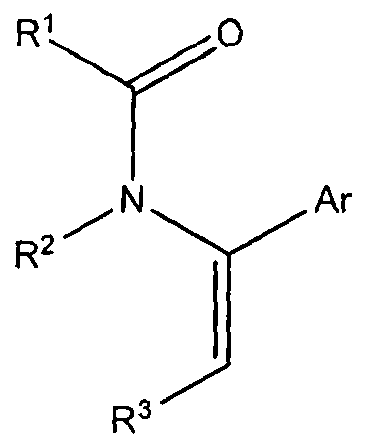
R1 and R2 are each independently selected from hydrogen, substituted or unsubstituted (Ci-C6)alkyl, substituted or unsubstituted (C3-C7)cycloalkyl, and substituted or unsubstituted ary , or
R1 and R2 are each independently selected from CH2, C=0 and oxygen, and together form a substituted or unsubstituted 5-, 6- or 7-membered ring;
R3 is selected from C02R4, CONR5R6 and substituted or unsubstituted aryl;
R4 is selected H, substituted or unsubstituted (Cj-C )alkyl, substituted or unsubstituted (C3-C7)cycloalkyl, and substituted or unsubstituted aryl;
R5 and R6 are each independently selected from H, substituted or unsubstituted (Ci-C6)alkyl, substituted or unsubstituted (C3-C7)cycloalkyl, and substituted or unsubstituted aryl, or
R5 and R6 together from a substituted or unsubstituted 5-, 6- or 7-membered heterocyclic ring, or R5 and R6 together form a substituted or unsubstituted 5-membered heteroaryl ring; and
Ar is substituted or unsubstituted aryl.
9. The compound of claim 8, wherein:
1 2
R and R , or the 5-, 6- or 7-membered ring they form, are each optionally independently substituted with halogen, (C]-C6)alkyl, or (Ci-C6)alkoxy;
R3 is optionally substituted with halogen, (Ci-C )alkyl, or (Ci-C6)alkoxy
R4 is optionally substituted with halogen, (Ci-C6)alkyl, or (Ci-C6)alkoxy;
R5 and R6, or the 5-, 6- or 7-membered heterocyclic ring, or the 5-membered heteroaryl ring they form, are each optionally independently substituted with halogen, (Ci-C6)alkyl, or (C]-C6)alkoxy; and
Ar is optionally substituted with halogen, (Ci-C6)alkyl, (Ci-C )alkoxy or C02(C|- C6)alkyl.
10. The compound of claim 8, wherein the compound of Formula I is selected from the group consisting of
 aa 3ab 3ac 3ad 3ae 3af


ea 3fa 3ga 3ha 3ia 3ja
A compound of Formula

wherein:
R and R" are each independently selected from hydrogen, substituted or unsubstituted (C)-C6)alkyl, substituted or unsubstituted (C3-C7)cycloalkyl, and substituted or unsubstituted aryl, or
R and R are each independently selected from CH2, C=0 and oxygen, and together form a substituted or unsubstituted 5-, 6- or 7-membered ring;
R3 is selected from C02R4, CONR5R6 and substituted or unsubstituted aryl;
R4 is selected H, substituted or unsubstituted (Ci-C6)alkyl, substituted or unsubstituted (C3-C7)cycloalkyl, and substituted or unsubstituted aryl;
R5 and R6 are each independently selected from H, substituted or unsubstituted (Ci-C6)alkyl, substituted or unsubstituted (C3-C7)cycloalkyl, and substituted or unsubstituted aryl, or
R5 and R6 together from a substituted or unsubstituted 5-, 6- or 7-membered heterocyclic ring, or R5 and R6 together form a substituted or unsubstituted 5-membered heteroaryl ring;
Ar is substituted or unsubstituted aryl,
wherein the compound of Formula I is prepared by a method comprising the steps of reacting a compound of Formula II with a com ound of Formula III:
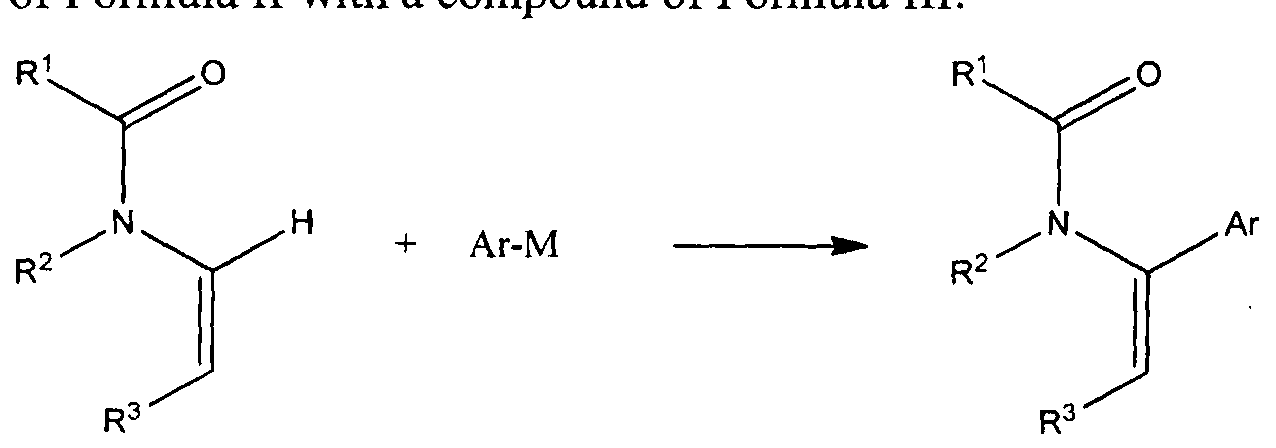
(Π) (HI) (I),
wherein the reaction occurs in the presence of:
about 1 mol % to about 20 mol % Pd(OAc)2;
about 1 equivalent to about 3 equivalents of Ar-M, wherein Ar-M is an arylboron derivative selected from phenyl potassium trifluoroborate, substituted or unsubstituted phenylboronic acid, and substituted or unsubstituted pinacol phenylboronate;
optionally, about 5 mol% to about 30 mol% of a ligand selected from 2,9- dimethyl- 1 , 10-phenanthroline (DMPHEN) , 2-(dicyclohexy lphosphino)-biphenyl (bpPCy2), 2,2'-bis(diphenylphosphino)-l ,l '-binaphthyl (BINAP), Ι,Γ- bis(diphenylphosphino)ferrocene (DPPF), Ν,Ν,Ν',Ν'- tetramethylethylenediamine (TMEDA), 2,6-lutidine, 2,2'-bipyridyl (Bipy), 1 ,10-phenanthroline (phen), triphenylphosphine (Ph3P), o-tol3P, (p-CF3C6H4)3P, (p-CH3C6H4)3P, phenylphosphite ((PhO)3P), bis(diphenylphosphino)methane (DPPM), bis(diphenylphosphino)ethane (DPPE), bis(diphenylphosphino)propane (DPPP), 2,2'-bis(di-p-tolylphosphino)-l,l '- binaphthyl (tol-BINAP), 2-dicyclohexylphosphino-2',4',6'-triisopropylbiphenyl (Xphos);
optionally, about 1 equivalent to about 10 equivalents of an additive fluoride source selected from silver fluoride (AgF), copper fluoride (CuF2), cesium fluoride (CsF), and potassium bifiuoride (KHF2);
about 0.1 equivalent to about 10 equivalents of an oxidant selected from copper(Il) acetate (Cu(OAc)2), silver oxide (Ag20), silver fluoride (AgF), benzoquinone (BQ), potassium persulfate (K2S20g), potassium ferricyanide (K3Fe(CN)6) and combinations thereof, either in the presence of absence of from about 1 atm oxygen to about 10 atm oxygen;
about 1 equivalent to about 10 equivalents of a base selected from sodium carbonate (Na2C03), potassium carbonate (K2C03), potassium phosphate (K3P04), cesium carbonate (Cs2C03), and combinations thereof; and
a solvent selected from acetic acid (AcOH), acetonitrile (CH3CN), N,N-dimethyl formamide (DMF), tert-butyl alcohol (tert-BuOH), 1 ,4-dioxane, and combinations thereof,
to provide the compound of Formula I.
12. The compound of claim 11, wherein:
1 2.
R and R , or the 5-, 6- or 7-membered ring they form, are each optionally independently substituted with halogen, (Ci-C )alkyl, or (Ci-C6)alkoxy;
R3 is optionally substituted with halogen, (Ci-C6)alkyl, or (Ci-C6)alkoxy
R4 is optionally substituted with halogen, (Ci-C6)alkyl, or (Ci-C6)alkoxy;
R5 and R6, or the 5-, 6- or 7-membered heterocyclic ring, or the 5-membered heteroaryl ring they form, are each optionally independently substituted with halogen, (C|-C6)alkyl, or (Ci-C6)alkoxy; and
Ar is optionally substituted with halogen, (Ci-C6)alkyl, (Ci-C6)alkoxy or C02(Ci- C6)alkyl.
13. The compound of claim 1 1, wherein the reaction occurs in the presence of:
about 10 mol % Pd(OAc)2;
about 3 equivalents of Ar-M, wherein Ar-M is selected from phenyl potassium trifluoroborate, phenylboronic acid, ortho-, meta- or para-methyl phenylboronic acid, ortho-, meta- or para-methoxy phenylboronic acid, pinacol phenylboronate, pinacol
ortho-, meta- or para-methyl phenylboronate, and pinacol phenylboronate ortho-, meta- or para-methoxy phenylboronate;
optionally, about 15 mol% to about 30 mol% of a ligand selected from 2,9- dimethyl- 1 , 10-phenanthroline (DMPHEN), 2-(dicyclohexylphosphino)-biphenyl (bpPCy2), 2,2'-bis(diphenylphosphino)-l ,l '-binaphthyl (BINAP), and 1 ,1 '- bis(diphenylphosphino)-ferrocene (DPPF);
optionally, about 5 equivalent of an additive fluoride source of potassium bifluoride ( HF2);
about 20 mol % of an oxidant selected from copper (II) acetate (Cu(OAc)2) in conjunction with about 1 atm of oxygen;
about 5 equivalents of a base selected potassium carbonate (K2CO3), potassium phosphate (K3P04), and cesium carbonate (Cs2C03); and
a solvent of about 20 % acetic acid (AcOH) in tert-butyl alcohol (tert-BuOH). 14. The compound of claim 11, wherein the compound of Formula II is a -amidoacrylate selected from the group consisting of

If l g lh l i lj
15. The compound of claim 11 , wherein Ar-M is an aryl pinacol boronic ester selected f
 H3ccr ^ i)CH3 C2H502C
2a 2b 2c 2d

2e 2f 2g 2h
16. The compound of claim 11, wherein the compound of Formula I is selected from the group consisting of

3aa 3ab 3ac 3ad 3ae 3af

3ag 3ah 3ba 3ca 3cb 3da

ea 3fa 3ga 3ha 3ia 3ja
17. A compound of Formul

wherein:
R and R are each independently selected from hydrogen, substituted or unsubstituted (Ci-C6)alkyl, substituted or unsubstituted (C3-C7)cycloalkyl, and substituted or unsubstituted aryl, or
R and R are each independently selected from CH2, C=0 and oxygen, and together form a substituted or unsubstituted 5-, 6- or 7-membered ring;
R3 is selected from C02R4, CONR5R6 and substituted or unsubstituted aryl;
R4 is selected H, substituted or unsubstituted (Ci-C6)alkyl, substituted or unsubstituted (C3-C7)cycloalkyl, and substituted or unsubstituted aryl;
R5 and R6 are each independently selected from H, substituted or unsubstituted (Ci-C6)alkyl, substituted or unsubstituted (C3-C7)cycloalkyl, and substituted or unsubstituted aryl, or
R5 and R6 together from a substituted or unsubstituted 5-, 6- or 7-membered heterocyclic ring, or R5 and R6 together form a substituted or unsubstituted 5-membered heteroaryl ring;
Ar is substituted or unsubstituted aryl,
wherein the compound of Formula IV is prepared by a method comprising the steps of i) reactin a com ound of Formula II with a com ound of Formula III:

(Π) (HI) (I), wherein the reaction occurs in the presence of:
about 1 mol % to about 20 mol % Pd(OAc)2;
about 1 equivalent to about 3 equivalents of Ar-M, wherein Ar-M is an arylboron derivative selected from phenyl potassium trifluoroborate, substituted or unsubstituted phenylboronic acid, and substituted or unsubstituted pinacol phenylboronate;
optionally, about 5 mol% to about 30 mol% of a ligand selected from 2,9- dimethyl- 1 , 10-phenanthroline (DMPHEN), 2-(dicyclohexylphosphino)-biphenyl (bpPCy2), 2,2'-bis(diphenylphosphino)-l,l '-binaphthyl (BINAP), Ι, Γ-
bis(diphenylphosphino)ferrocene (DPPF), Ν,Ν,Ν',Ν'- tetramethylethylenediamine (TMEDA), 2,6-lutidine, 2,2'-bipyridyl (Bipy), 1 , 10-phenanthroline (phen), triphenylphosphine (Ph3P), o-tol3P, (p-CF3C H4)3P, (p-CH3C6H4)3P, phenylphosphite ((PhO)3P), bis(diphenylphosphino)methane (DPPM), bis(diphenylphosphino)ethane (DPPE), bis(diphenylphosphino)propane (DPPP), 2,2'-bis(di-p-tolylphosphino)-l ,l '- binaphthyl (tol-BINAP), 2-dicyclohexylphosphino-2,,4',6'-triisopropylbiphenyl (Xphos); optionally, about 1 equivalent to about 10 equivalents of an additive fluoride source selected from silver fluoride (AgF), copper fluoride (CuF2), cesium fluoride (CsF), and potassium bifluoride (KHF2);
about 0.1 equivalent to about 10 equivalents of an oxidant selected from copper(II) acetate (Cu(OAc)2), silver oxide (Ag20), silver fluoride (AgF), benzoquinone (BQ), potassium persulfate (K2S208), potassium ferricyanide (K3Fe(CN)6) and combinations thereof, either in the presence of absence of from about 1 atm oxygen to about 10 atm oxygen;
about 1 equivalent to about 10 equivalents of a base selected from sodium carbonate (Na2C03), potassium carbonate (K2C03), potassium phosphate (K3P04), cesium carbonate (Cs2C03), and combinations thereof; and
a solvent selected from acetic acid (AcOH), acetonitrile (CH3CN), N,N-dimethyl formamide (DMF), tert-butyl alcohol (tert-BuOH), 1 ,4-dioxane, and combinations thereof, and
ii) asymmetrically hydrogenating the compound of Formula I to produce a β-amino acid derivative compound of Formula IV:

(I) (IV),
by a method comprising the step of exposing the compound of Formula I to asymmetric hydrogenation conditions employing the catalyst generated from bis(cycloocta-l ,5-diene)rhodium(I) tetrafluoroborate ([Rh(cod)2]BF4) and (R,R)-1,2-
Bis[(R)-4,5-dihydro-3H-binaphtho(l,2-c:2',l '-e)phosphepino]-benzene ((R)- BINAPHANE) in the presence of hydrogen to produce the compound of Formula IV. 10. The compound of claim 9, wherein:
1 2
R and R , or the 5-, 6- or 7-membered ring they form, are each optionally independently substituted with halogen, (C]-C6)alkyl, or (Ci-C6)alkoxy;
R3 is optionally substituted with halogen, (Ci-C )alkyl, or (Ci-C6)alkoxy
R4 is optionally substituted with halogen, (Ci-C6)alkyl, or (Ci-C6)alkoxy;
R5 and R6, or the 5-, 6- or 7-membered heterocyclic ring, or the 5-membered heteroaryl ring they form, are each optionally independently substituted with halogen, (Ci-C6)alkyl, or (Ci-C6)alkoxy; and
Ar is optionally substituted with halogen, (Ci-C6)alkyl, (Ci-C6)alkoxy or C02(Ci- C6)alkyl.
18. The compound of claim 17, wherein the reaction in step i) occurs in the presence about 10 mol % Pd(OAc)2;
about 3 equivalents of Ar-M, wherein Ar-M is selected from phenyl potassium trifluoroborate, phenylboronic acid, ortho-, meta- or para-methyl phenylboronic acid, ortho-, meta- or para-methoxy phenylboronic acid, pinacol phenylboronate, pinacol ortho-, meta- or para-methyl phenylboronate, and pinacol phenylboronate ortho-, meta- or para-methoxy phenylboronate;
optionally, about 15 mol% to about 30 mol% of a ligand selected from 2,9- dimethyl- 1 , 10-phenanthroline (DMPHEN), 2-(dicyclohexylphosphino)-biphenyl (bpPCy2), 2,2'-bis(diphenylphosphino)-l,l '-binaphthyl (BINAP), and 1, 1 '- bis(diphenylphosphino)-ferrocene (DPPF);
optionally, about 5 equivalent of an additive fluoride source of potassium bifluoride ( HF2);
about 20 mol % of an oxidant selected from copper (II) acetate (Cu(OAc)2) in conjunction with about 1 atm of oxygen;
about 5 equivalents of a base selected potassium carbonate (K2C03), potassium phosphate (K3P04), and cesium carbonate (Cs2C03); and
a solvent of about 20 % acetic acid (AcOH) in tert-butyl alcohol (tert-BuOH).
19. The compound of claim 17, wherein the compound of Formula II is a β-amidoacrylate selected from the group consisting of


If l g lh li lj
20. The compound of claim 17, wherein Ar-M is an aryl pinacol boronic ester selected from the group consisting of

2a 2b 2c 2d

2e 2f 2g 2h
Applications Claiming Priority (2)
| Application Number | Priority Date | Filing Date | Title |
|---|---|---|---|
| US201161495446P | 2011-06-10 | 2011-06-10 | |
| US61/495,446 | 2011-06-10 |
Publications (1)
| Publication Number | Publication Date |
|---|---|
| WO2012173572A1 true WO2012173572A1 (en) | 2012-12-20 |
Family
ID=47357350
Family Applications (1)
| Application Number | Title | Priority Date | Filing Date |
|---|---|---|---|
| PCT/SG2012/000209 Ceased WO2012173572A1 (en) | 2011-06-10 | 2012-06-11 | Stereoselective synthesis of highly substituted enamides |
Country Status (1)
| Country | Link |
|---|---|
| WO (1) | WO2012173572A1 (en) |
Cited By (4)
| Publication number | Priority date | Publication date | Assignee | Title |
|---|---|---|---|---|
| CN107312164A (en) * | 2017-06-09 | 2017-11-03 | 浙江工业大学义乌科学技术研究院有限公司 | Conjugated polymer and its polymerization and application based on ferrocene and phenanthroline derivative |
| CN107619468A (en) * | 2017-09-18 | 2018-01-23 | 浙江工业大学义乌科学技术研究院有限公司 | The conjugated polymer and its polymerization of ferrocene and phenanthroline derivative and application |
| CN116410158A (en) * | 2023-04-08 | 2023-07-11 | 青岛科技大学 | A kind of N-methyl tertiary amine selective C(sp3)-H functionalization method for preparing tetrasubstituted allene compounds |
| CN117531994A (en) * | 2023-11-09 | 2024-02-09 | 福建师范大学 | Binuclear silver nanocluster with accurate atoms and preparation method thereof |
Citations (3)
| Publication number | Priority date | Publication date | Assignee | Title |
|---|---|---|---|---|
| WO2002040491A1 (en) * | 2000-11-17 | 2002-05-23 | The Penn State Research Foundation | Ortho substituted chiral phosphines and phosphinites and their use in asymmetric catayltic reactions |
| WO2004011414A1 (en) * | 2002-07-26 | 2004-02-05 | Dsm Ip Assets B.V. | E-ISOMERIC β-AROMATIC OR HETEROAROMATIC SUBSTITUTED β-ACYLAMINO-ACRYLATES AND METHODS OF PREPARING THE SAME |
| US20040229846A1 (en) * | 2001-11-09 | 2004-11-18 | The Penn State Research Foundation | P-chiral phospholanes and phosphocyclic compounds and their use in asymmetric catalytic reactions |
-
2012
- 2012-06-11 WO PCT/SG2012/000209 patent/WO2012173572A1/en not_active Ceased
Patent Citations (3)
| Publication number | Priority date | Publication date | Assignee | Title |
|---|---|---|---|---|
| WO2002040491A1 (en) * | 2000-11-17 | 2002-05-23 | The Penn State Research Foundation | Ortho substituted chiral phosphines and phosphinites and their use in asymmetric catayltic reactions |
| US20040229846A1 (en) * | 2001-11-09 | 2004-11-18 | The Penn State Research Foundation | P-chiral phospholanes and phosphocyclic compounds and their use in asymmetric catalytic reactions |
| WO2004011414A1 (en) * | 2002-07-26 | 2004-02-05 | Dsm Ip Assets B.V. | E-ISOMERIC β-AROMATIC OR HETEROAROMATIC SUBSTITUTED β-ACYLAMINO-ACRYLATES AND METHODS OF PREPARING THE SAME |
Non-Patent Citations (10)
| Title |
|---|
| DATABASE CAS 22 October 1988 (1988-10-22), accession no. 17020-31-2 * |
| DATABASE REGISTRY 11 June 1999 (1999-06-11), accession no. 24635-09-0 * |
| DATABASE REGISTRY 5 December 2000 (2000-12-05), accession no. 06767-88-4 * |
| ENTHALER ET AL.: "Iridium-catalyzed hydrogenation of (3-dehydroamino acid derivatives using monodentate phosphoramidites", EUROPEAN JOURNAL OF ORGANIC CHEMISTRY, no. 19, 2008, pages 3352 - 3362 * |
| HU ET AL.: "Practical Rh(I)-catalyzed asymmetric hydrogenation of Beta-(acylamino)acrylates using a new unsymmetrical hybrid ferrocenylphosphine-phosphoramidite ligand: Crucial influence of an N-H proton in the ligand", ORGANIC LETTERS, vol. 7, no. 3, 2005, pages 419 - 422 * |
| LIU ET AL.: "Stereoselective Synthesis of Highly Substituted Enamides by an Oxidative Heck Reaction", ANGEWANDTE CHEMIE INTERNATIONAL EDITION, vol. 50, no. 32, 28 June 2011 (2011-06-28), pages 7333 - 7336 * |
| LUBELL ET AL.: "Enantioselective synthesis of B-amino acids based on B1NAP- ruthenium(II) catalyzed hydrogenation", TETRAHEDRON: ASYMMETRY, vol. 2, no. 7, 1991, pages 543 - 554 * |
| WERNER ET AL.: "A highly selective and general palladium catalyst for the oxidative heck reaction of electronically nonbiased olefins", J. AM. CHEM. SOC., vol. 132, 2010, pages 13981 - 13983 * |
| YOU ET AL.: "Preparation and asymmetric hydrogenation of Beta-aryl-substituted Beta-acylaminoacrylates", ANGEWANDTE CHEMIE, vol. 42, no. 8, 2003, pages 913 - 916 * |
| ZHOU ET AL.: "Direct arylation of cyclic enamides via Pd(II)-catalyzed C-H activation", CHEMICAL COMMUNICATIONS, 2009, pages 3472 - 3474 * |
Cited By (4)
| Publication number | Priority date | Publication date | Assignee | Title |
|---|---|---|---|---|
| CN107312164A (en) * | 2017-06-09 | 2017-11-03 | 浙江工业大学义乌科学技术研究院有限公司 | Conjugated polymer and its polymerization and application based on ferrocene and phenanthroline derivative |
| CN107619468A (en) * | 2017-09-18 | 2018-01-23 | 浙江工业大学义乌科学技术研究院有限公司 | The conjugated polymer and its polymerization of ferrocene and phenanthroline derivative and application |
| CN116410158A (en) * | 2023-04-08 | 2023-07-11 | 青岛科技大学 | A kind of N-methyl tertiary amine selective C(sp3)-H functionalization method for preparing tetrasubstituted allene compounds |
| CN117531994A (en) * | 2023-11-09 | 2024-02-09 | 福建师范大学 | Binuclear silver nanocluster with accurate atoms and preparation method thereof |
Similar Documents
| Publication | Publication Date | Title |
|---|---|---|
| Pearson et al. | Studies on selective nucleophilic substitution reactions of [(cyclopentadienyl)(1, 3-dichlorobenzene) M]+ PF6-complexes (M= iron, ruthenium) | |
| Chen et al. | [2.2] Paracyclophane-based N-heterocyclic carbene as efficient catalyst or as ligand for copper catalyst for asymmetric α-silylation of N-tosylaldimines | |
| Arupula et al. | Chemoselective cyclization of N-sulfonyl ketimines with ethenesulfonyl fluorides: access to trans-cyclopropanes and fused-dihydropyrroles | |
| Huo et al. | Friedel–Crafts alkylation between chalcone epoxides and heteroarenes induced by triarylaminium salt | |
| JP2016503401A (en) | Methods and reagents for producing diaryliodonium salts | |
| EP3063154B1 (en) | Cross-coupling of unactivated secondary boronic acids | |
| Kaur et al. | Pd (II)-Catalyzed Directing-Group-Aided C–H Arylation, Alkylation, Benzylation, and Methoxylation of Carbazole-3-carboxamides toward C2, C3, C4-Functionalized Carbazoles | |
| WO2015115519A1 (en) | Bipyridyl compound | |
| CN115151553B (en) | Boronic acid derivatives | |
| WO2013028132A1 (en) | Chiral phosphines for palladium-catalyzed asymmetric alpha-arylation of ester enolates to produce tertiary stereocenters in high enantioselectivity | |
| Yao et al. | 1, 1′-Methylene-bis (1, 1′, 2, 2′, 3, 3′, 4, 4′-octahydroisoquinoline): synthesis, reaction, resolution, and application in catalytic enantioselective transformations | |
| BR112015015880B1 (en) | PRODUCTION PROCESSES OF A COMPOUND AND COMPOUNDS | |
| JP4167848B2 (en) | Process for producing biaryl compounds | |
| Philipova et al. | Camphane-based aminophosphine ligands for Pd-catalyzed asymmetric allylic alkylation | |
| Wu et al. | ‘N‐Stereogenic Quaternary Ammonium Salts’ from l‐Amino Acids: Synthesis, Separation, and Absolute Configuration | |
| Wang et al. | The synthesis of aryl-heteroaryl derivatives via the RhIII-catalyzed heteroarylation of arenes and heteroaromatic boronates | |
| CN115710210B (en) | Iron-catalyzed C-H bond amination process | |
| CN118834113B (en) | A Z-formyl enamide derivative and preparation method thereof | |
| Roediger et al. | Olefination of Activated Alkyl Halides with Phosphonium Salts | |
| WO2024242204A1 (en) | Novel compound or salt thereof, catalyst, method of preparing novel compound or salt thereof and method of preparing mannich product | |
| KR102757745B1 (en) | Method for preparing asymmetric ring-opening reaction product of cyclic anhydride using chiral organic catalyst compounds | |
| Zhang | Development of Methods for the Synthesis of Boron-Containing Cyclic Structures | |
| JP2012240959A (en) | METHOD FOR SYNTHESIZING OPTICALLY ACTIVE β-AMINOTHIOL, OR OPTICALLY ACTIVE β-AMINOSULFONIC ACID DERIVATIVE | |
| CN118388352A (en) | Preparation method of N-trifluoromethyl amine compound | |
| Sengupta et al. | An intramolecular Michael reaction strategy for the synthesis of 2, 6-disubstituted-3-piperidinols |
Legal Events
| Date | Code | Title | Description |
|---|---|---|---|
| 121 | Ep: the epo has been informed by wipo that ep was designated in this application |
Ref document number: 12800125 Country of ref document: EP Kind code of ref document: A1 |
|
| NENP | Non-entry into the national phase |
Ref country code: DE |
|
| 122 | Ep: pct application non-entry in european phase |
Ref document number: 12800125 Country of ref document: EP Kind code of ref document: A1 |