WO2012160572A2 - Glass composition and glass substrate for display devices - Google Patents
Glass composition and glass substrate for display devices Download PDFInfo
- Publication number
- WO2012160572A2 WO2012160572A2 PCT/IN2012/000342 IN2012000342W WO2012160572A2 WO 2012160572 A2 WO2012160572 A2 WO 2012160572A2 IN 2012000342 W IN2012000342 W IN 2012000342W WO 2012160572 A2 WO2012160572 A2 WO 2012160572A2
- Authority
- WO
- WIPO (PCT)
- Prior art keywords
- glass
- mole
- substrate
- glass composition
- composition
- Prior art date
- Legal status (The legal status is an assumption and is not a legal conclusion. Google has not performed a legal analysis and makes no representation as to the accuracy of the status listed.)
- Ceased
Links
Classifications
-
- C—CHEMISTRY; METALLURGY
- C03—GLASS; MINERAL OR SLAG WOOL
- C03C—CHEMICAL COMPOSITION OF GLASSES, GLAZES OR VITREOUS ENAMELS; SURFACE TREATMENT OF GLASS; SURFACE TREATMENT OF FIBRES OR FILAMENTS MADE FROM GLASS, MINERALS OR SLAGS; JOINING GLASS TO GLASS OR OTHER MATERIALS
- C03C3/00—Glass compositions
- C03C3/04—Glass compositions containing silica
- C03C3/076—Glass compositions containing silica with 40% to 90% silica, by weight
- C03C3/089—Glass compositions containing silica with 40% to 90% silica, by weight containing boron
- C03C3/091—Glass compositions containing silica with 40% to 90% silica, by weight containing boron containing aluminium
-
- C—CHEMISTRY; METALLURGY
- C03—GLASS; MINERAL OR SLAG WOOL
- C03C—CHEMICAL COMPOSITION OF GLASSES, GLAZES OR VITREOUS ENAMELS; SURFACE TREATMENT OF GLASS; SURFACE TREATMENT OF FIBRES OR FILAMENTS MADE FROM GLASS, MINERALS OR SLAGS; JOINING GLASS TO GLASS OR OTHER MATERIALS
- C03C3/00—Glass compositions
- C03C3/04—Glass compositions containing silica
- C03C3/076—Glass compositions containing silica with 40% to 90% silica, by weight
- C03C3/11—Glass compositions containing silica with 40% to 90% silica, by weight containing halogen or nitrogen
- C03C3/111—Glass compositions containing silica with 40% to 90% silica, by weight containing halogen or nitrogen containing nitrogen
Definitions
- Embodiments in general relate to a glass composition and a glass substrate for use in display and in particular to a glass composition and a glass substrate for use in liquid crystal display [LCD], an electroluminescence display [ELD], a field emission display [FED], plasma display [PD], organic light emitting diode [OLED] display etc.
- LCD liquid crystal display
- ELD electroluminescence display
- FED field emission display
- PD plasma display
- OLED organic light emitting diode
- AMLCDs active matrix liquid crystal displays
- a typical AMLCD comprises, inter alia, two sheets of glass, the first one is vapor-deposited with silicon that forms the basis for the thin-film transistor (TFT) array and whereas the second for the color filter (CF) materials that enables RGB displays.
- TFT thin-film transistor
- CF color filter
- a gap between the two sheets of glass holds a very thin layer of liquid crystal, wherein the gap between the two sheets has to be maintained within tight specifications.
- the glass also referred to as "glass substrate" used for depositing the silicon for the thin-film transistor array has a unique material composition, which is specifically designed for the application.
- One method of producing these substrate glasses is the down draw-fusion process [also known as the down-draw process] and is capable of producing a precision fire-polished surface that requires no additional modification such as grinding or polishing prior to use.
- the US patent numbers 3,338,696 and 3,682,609 disclose fusion downdraw processes which include allowing flow of molten glass over the edges or weirs of a forming wedge, referred to as isopipe. The molten glass flows over converging forming surfaces of the isopipe and the separate flows reunite at the apex or root where the two converging forming surfaces meet to form a glass sheet.
- the glass which has been in contact with the forming surfaces is located in the inner portion of the glass sheet and the exterior surfaces of the glass sheet are contact free.
- Pulling rolls positioned downstream of isopipe root capture edge portions of the glass sheet so formed to control the rate at which the glass sheet leaves the isopipe and thus aids in controlling the thickness of the finished sheet.
- the glass sheet descends from the root of the isopipe past the pulling rolls, it cools to form a solid elastic glass sheet, which may be processed further.
- various material properties of the glass in the molten stage must be controlled within specified limits during the downdraw process.
- One such material property is the viscosity of the glass. It is desired to maintain the viscosity of the glass at the location where it leaves the isopipe at a ' value greater than about 10 5 poise, which if not maintained the glass sheet flatness and thickness across its width becomes difficult to control, which may result in a glass sheet not suitable for display applications.
- liquidus temperature the maximum temperature where these crystal phases disappear. It is desired that the liquidus temperature of the glass to be less than 1200 °C and preferably less than 1150 °C.
- liquidus viscosity of the glass substrate Another significant factor is liquidus viscosity of the glass substrate. It is desired to have lower liquidus temperatures and hence higher liquidus viscosities for the downdraw process. The lower liquidus temperature and higher liquidus viscosity results in the glass being resistant to crystallization during the forming process. Since the forming is done at glass viscosities of greater than 10 5 poise, it is desired that the glass exhibits a liquidus viscosity of greater than about 10 s poise. Additionally, the glass substrate when formed should qualify certain requirements.
- a-Si amorphous silicon
- poly-Si polycrystalline-silicon
- the efficient poly-Si processing methods requires temperatures of at least 600° C or more, such processes enable formation of poly-Si films.
- the glass substrate on which the poly-Si is to be deposited must have strain points exceeding 600° C. Therefore it is desired to have strain point glass, which makes the glass substrate resistant to heat resulting in low thermal deformation and thermal compaction when subjected to high temperatures during various thermal processing steps during panel fabrication. Further, the substrate glass is desired to exhibit high durability to chemical treatments during the TFT manufacturing and long term exposure to environmental conditions in service.
- the substrate glass should not interact chemically and/or electronically with the TFT's during the course of operation. It is known that alkalis such as lithium and sodium are mobilized at elevated temperatures and may interfere with the TFT performance, if the alkali metals are added to glass composition. Thus, inclusion of alkali metal oxides hinders the electrical properties of the display panel. The known prior art claims that the glass composition should be alkali free due to above mentioned reasons.
- the melting temperature of the glass without alkali metals is known to be greater than 1600 °C.
- the refining temperature has to be greater than 1650 °C in glasses without alkali metals.
- the substrate glass is to be used in portable devices such as laptops, clocks, mobiles, which are light-weight devices. This implies that the substrate glass which forms an important part should also have low weight, which in-turn implies that the substrate glass itself should be light weight. It is desired that the thickness of the glass is less than about 1.1 mm, preferably less than about 0.7 mm and most preferably less than about 0.5 mm.
- the substrate glass should exhibit a low coefficient of thermal expansion (CTE). This is necessary in order to match the CTE of silicon metal.
- the TFT material is CTE of poly-silicon whose CTE is in the range from about 30 x 10 "7 /°C to about 32 x 10 "7 /°C
- the CTE of the glass must match that of poly-silicon, thereby the CTE of the glass substrate must be in the range of from about 28 x 10 "7 /°C to about 40 x 10 "7 /°C.
- An object is to provide a substrate glass and a glass composition.
- Another object is to provide a substrate glass and a glass composition for display devices.
- Still another object is to provide a substrate glass and a glass composition compatible with the down draw process.
- Yet another object is to provide a substrate glass and a glass composition having higher viscosity at the root of the isopipe.
- Another object is to provide a glass composition with low melting and refining temperatures.
- Another object is to provide a glass composition wherein the electrical properties of the TFT are not hindered or compromised in addition to having low melting and refining temperatures.
- Another object is to provide a substrate glass and a glass composition having high-strain point.
- Another object is to provide a substrate glass and a glass composition which does not chemically interact with the TFTs.
- Another object is to provide a substrate glass which is light-weight.
- Another object is to provide a substrate glass with low coefficient of thermal expansion in the range from about 28 x 10 "7 /°C to about 40 x 10 "7 /°C.
- Another object is have a substrate glass composition for use in liquid crystal display [LCD], an electroluminescence display [ELD], a field emission display [FED], plasma display [PD], organic light emitting diode [OLED] etc.
- LCD liquid crystal display
- ELD electroluminescence display
- FED field emission display
- PD plasma display
- OLED organic light emitting diode
- a glass composition comprising S1O2 from about 63.3 to about 71.3 mole %, A1 2 0 3 from about 8.1 to about 12.1 mole %, B 2 0 3 from about 6.7 to about 12.7 mole %, CaO from about 8 to 8.6 mole %, MgO from about 3 to 3.5 mole% and Cs 2 0 from about 0.001 to about 0.9 mole %, wherein said Cs 2 0 decreases the melting point of the glass composition and cesium does not diffuse out and interfere with the TFT operation, owning to high ionic radii and large atomic mass, hence electrical resistivity is not affected or reduced.
- the glass composition further comprises of at least one refining agent selected from the group consisting of As 2 03 in the range from about 0 to 0.8 mole %, Sb 2 03 in the range from 0 to 0.1 mole % and N Os in the range from 0 to 0.2 mole % or a combination thereof.
- at least one refining agent selected from the group consisting of As 2 03 in the range from about 0 to 0.8 mole %, Sb 2 03 in the range from 0 to 0.1 mole % and N Os in the range from 0 to 0.2 mole % or a combination thereof.
- the glass has a density of less than about 2.5 g/cm 3 , a coefficient of thermal expansion less than 40 x 10 '7 /°C, a logarithm of liquidus viscosity of greater than 5, a strain point of greater than about 630 °C, annealing temperature of greater than 650 °C and a liquidus temperature of less than 1270 °C. Further, in accordance with the present invention the glass has a resistivity comparable or greater than commercially available LCD substrate glass.
- the glass is down- drawable or slot drawn or press-formable in a mold or drawable through roller press or drawable through float process.
- the present invention is concerned with enhanced glasses for use as substrates in displays.
- the glasses meet the various property requirements of such substrates.
- the glass substrate composition comprises of the major components of the glass, for use in glass substrates, namely, Silica (Si0 2 ), Alumina (AI2O3), Boron Oxide (B2O3), and alkaline earth oxides (AEO) such as MgO and CaO.
- silica behaves as the basic glass former, wherein the former (silica in this case) forms the basic skeleton or network.
- Formers alone may form glass however the melting point in some cases (particularly when the former is silica) will be so high so as to make it impractical to commercially melt the glasses.
- B2O3 or P2O5 is utilized as former the chemical durability will be so poor that it is impractical to use it in any application in its hundred percent forms.
- modifiers such as alkali oxides (AO) and Alkaline earth oxides (AEO) are utilized to modify the network structure formed by the glass formers so as to reduce the melting temperature and thereby improve other glass forming processes e.g., refining.
- AO alkali oxides
- AEO Alkaline earth oxides
- CS2O trace amount of CS2O is utilized as the modifier for reasons discussed herein below.
- alkaline earth oxides such as CaO and MgO is added as modifiers.
- intermediates such as alumina is added to the glass composition.
- the substrate glass composition comprises Si0 2 from about 63.3 to about 71.3 mole %; AI2O3 from about 8.1 to about 12.1 mole %; B 2 0 3 from about 6.7 to about 12.7 mole %; CaO from about 8 to 8.6 mole %; MgO from about 3 to 3.5 mole % and Cs 2 0 from about 0.001 to about 0.9 mole %; wherein inclusion of the alkali metal Cs 2 0 decreases the melting point of the substrate glass composition and at the same time as the cesium has a high radii as compared with other alkali metals, has very low mobility and thereby does not diffuse out and interfere with the TFT operation.
- the substrate glass composition may contain As 2 0 3 in the range from about 0 to about 0.3 mole %, wherein As 2 0 3 is acts as a fining agent and aids in removal of bubbles or gaseous inclusions from the molten glass.
- the substrate glass composition may contain Sb 2 0 3 in the range from about 0 to about 0.1 mole %, wherein Sb 2 0 3 also acts as a fining agent and aids in removal of bubbles or gaseous inclusions from the molten glass.
- the substrate glass composition may contain N2O5 in the range from about 0 to 0.2 mole %, wherein addition of N2O5 enhances the refining agents refining capacity of AS2O3 and Sb 2 C>3.
- the non-green components such as BaO and SrO are eliminated completely so as to produce an environmentally friendly "green” product, and in particular lessening or getting rid of barium is preferred since barium is one of the listed metals in the Resources Conservation and Recovery Act (RCRA) and is therefore classified by the US EPA as hazardous.
- RCRA Resources Conservation and Recovery Act
- the substrate glass composition comprises Si0 2 from about 63.3 to about 71.3 mole %; AI2O3 from about 8.1 to about 12.1 mole %; B 2 0 3 from about 6.7 to about 12.7 mole %; CaO from about 8 to 8.6 mole %; MgO from about 3 to 3.5 mole % and Cs 2 0 from about 0.001 to about 0.9 mole %; wherein inclusion of the trace amount of alkali metal CS2O decreases the melting point of the substrate glass composition and at the same time as the cesium has a high radii and large atomic mass as compared with other alkali metals, has very low mobility and thereby does not diffuse out and interfere with the TFT operation.
- an advantage of the glass substrate made from the glass composition is that it exhibit higher viscosity, typically of the order of 10 5 poise or greater.
- the glass substrate made from the glass composition exhibit a high-strain point greater than about 630 °C.
- the glass substrate made from the glass composition has lower liquidus temperature of less than about 1270 °C.
- the glass substrate made from the glass composition exhibits a high liquidus viscosity of about 10 5 or greater.
- the glass substrate made from the glass composition does not chemically interact with the TFTs due to presence to Cs 2 0 and hence also have a reduced melting point.
- the substrate glass has light-weight owing to the low density of less than about 2.5 g/cm 3 .
- the substrate glass has lower coefficient of thermal expansion of less than about 40 x 10 "7 /°C
- the present invention provides a substrate glass composition for display devices compatible with the down draw fusion process.
- the substrate glass composition may be used in liquid crystal display [LCD], an electroluminescence display [ELD], a field emission display [FED], plasma display [PD], organic light emitting diode [OLED] display etc.
- LCD liquid crystal display
- ELD electroluminescence display
- FED field emission display
- PD plasma display
- OLED organic light emitting diode
- compositions of the glass of the present disclosure are listed in Table 1.
- examples I to XIX are glass compositions in accordance with the embodiments of the present invention, whereas C-I is a comparative example of glass composition in accordance with known prior art. It is observed that owing to presence of Cs20 in the composition, the resistivity of the glass made from the composition is comparable with that of the commercially available LCD substrate glass or even better.
Landscapes
- Chemical & Material Sciences (AREA)
- Life Sciences & Earth Sciences (AREA)
- Engineering & Computer Science (AREA)
- Chemical Kinetics & Catalysis (AREA)
- General Chemical & Material Sciences (AREA)
- Geochemistry & Mineralogy (AREA)
- Materials Engineering (AREA)
- Organic Chemistry (AREA)
- Glass Compositions (AREA)
Abstract
The present invention discloses a substrate glass and a glass composition, wherein said glass composition comprises: Si02 from about 63.3 to about 71.3 mole %; Al203 from about 8.1 to about 12.1 mole %; B203 from about 6.7 to about 12.7 mole %; CaO from about 8 to 8.6 mole %; MgO from about 3 to 3.5 mole % and Cs20 from about 0.001 to about 0.9 mole %; wherein inclusion of the alkali metal Cs20 decreases the melting point of the substrate glass composition and at the same time as the cesium has a high radii as compared with other alkali metals, has very low mobility and thereby does not diffuse out and interfere with the TFT operation.
Description
GLASS COMPOSITION AND GLASS SUBSTRATE FOR DISPLAY
DEVICES
FIELD OF THE INVENTION
Embodiments in general relate to a glass composition and a glass substrate for use in display and in particular to a glass composition and a glass substrate for use in liquid crystal display [LCD], an electroluminescence display [ELD], a field emission display [FED], plasma display [PD], organic light emitting diode [OLED] display etc.
BACKGROUND OF THE INVENTION
Over the years active matrix liquid crystal displays (AMLCDs) have become ubiquitous features of our life, wherein they are used in cellular phones, mobiles, desktops, laptops computer screens and in large screen televisions.
One aspect of all the electronic devices that has turned out to be noteworthy over the years is energy utilization by the device and is obviously desired to be as low as possible. It is quite clear that CRT are replaced by flat panel display and in particular by AMLCD and organic light-emitting diode (OLED)-based devices.
A typical AMLCD comprises, inter alia, two sheets of glass, the first one is vapor-deposited with silicon that forms the basis for the thin-film transistor (TFT) array and whereas the second for the color filter (CF) materials that
enables RGB displays. A gap between the two sheets of glass holds a very thin layer of liquid crystal, wherein the gap between the two sheets has to be maintained within tight specifications. The glass (also referred to as "glass substrate") used for depositing the silicon for the thin-film transistor array has a unique material composition, which is specifically designed for the application.
One method of producing these substrate glasses is the down draw-fusion process [also known as the down-draw process] and is capable of producing a precision fire-polished surface that requires no additional modification such as grinding or polishing prior to use. The US patent numbers 3,338,696 and 3,682,609 disclose fusion downdraw processes which include allowing flow of molten glass over the edges or weirs of a forming wedge, referred to as isopipe. The molten glass flows over converging forming surfaces of the isopipe and the separate flows reunite at the apex or root where the two converging forming surfaces meet to form a glass sheet. Thus, in the fusion process the glass which has been in contact with the forming surfaces is located in the inner portion of the glass sheet and the exterior surfaces of the glass sheet are contact free. Pulling rolls positioned downstream of isopipe root capture edge portions of the glass sheet so formed to control the rate at which the glass sheet leaves the isopipe and thus aids in controlling the thickness of the finished sheet. As the glass sheet descends from the root of the isopipe past the pulling rolls, it cools to form a solid elastic glass sheet, which may be processed further.
In order to achieve a good quality substrate glass using the fusion technique, various material properties of the glass in the molten stage must be controlled within specified limits during the downdraw process.
One such material property is the viscosity of the glass. It is desired to maintain the viscosity of the glass at the location where it leaves the isopipe at a' value greater than about 105 poise, which if not maintained the glass sheet flatness and thickness across its width becomes difficult to control, which may result in a glass sheet not suitable for display applications.
Further, when the glass in molten stage is exposed to low temperatures for significant time period, crystal phase development is initiated. The maximum temperature where these crystal phases disappear is termed as liquidus temperature. It is desired that the liquidus temperature of the glass to be less than 1200 °C and preferably less than 1150 °C.
Another significant factor is liquidus viscosity of the glass substrate. It is desired to have lower liquidus temperatures and hence higher liquidus viscosities for the downdraw process. The lower liquidus temperature and higher liquidus viscosity results in the glass being resistant to crystallization during the forming process. Since the forming is done at glass viscosities of greater than 105 poise, it is desired that the glass exhibits a liquidus viscosity of greater than about 10s poise.
Additionally, the glass substrate when formed should qualify certain requirements.
Numerous processes in the fabrication of liquid crystal displays include steps that are performed at high temperatures. For example, active matrix of the LCD employs an active device such as a diode or thin film transistor at each pixel thereby enabling high contrast and high response speed. It is known that display devices at present make use of amorphous silicon (a-Si), the processing of which may be done at temperatures of about 450° C or less. It is preferred to have polycrystalline-silicon (poly-Si) processing as poly-Si has much higher drive current and electron mobility thereby increasing the response time of the pixels and that it is possible, to build the display drive circuitry directly on the glass substrate by use of poly-Si processing. However, the efficient poly-Si processing methods requires temperatures of at least 600° C or more, such processes enable formation of poly-Si films. Thus, the glass substrate on which the poly-Si is to be deposited must have strain points exceeding 600° C. Therefore it is desired to have strain point glass, which makes the glass substrate resistant to heat resulting in low thermal deformation and thermal compaction when subjected to high temperatures during various thermal processing steps during panel fabrication.
Further, the substrate glass is desired to exhibit high durability to chemical treatments during the TFT manufacturing and long term exposure to environmental conditions in service.
It is also desired that the substrate glass should not interact chemically and/or electronically with the TFT's during the course of operation. It is known that alkalis such as lithium and sodium are mobilized at elevated temperatures and may interfere with the TFT performance, if the alkali metals are added to glass composition. Thus, inclusion of alkali metal oxides hinders the electrical properties of the display panel. The known prior art claims that the glass composition should be alkali free due to above mentioned reasons.
However, if no alkali metals are added to the glass composition, the melting of the glass composition becomes difficult as the melting viscosity becomes very high. Typically, the melting temperature of the glass without alkali metals is known to be greater than 1600 °C.
Another problem that occurs if no alkali metals are added is during the step of refining. Refining is step of removal of bubbles or gas inclusion in the molten glass, which may, if not removed make the glass substrate made useless for the display application. It is observed that the refining temperature has to be greater than 1650 °C in glasses without alkali metals.
Further, as the substrate glass is to be used in portable devices such as laptops, clocks, mobiles, which are light-weight devices. This implies that the substrate glass which forms an important part should also have low weight, which in-turn implies that the substrate glass itself should be light weight. It is desired that the thickness of the glass is less than about 1.1 mm, preferably less than about 0.7 mm and most preferably less than about 0.5 mm.
Additionally, it is desired that the substrate glass should exhibit a low coefficient of thermal expansion (CTE). This is necessary in order to match the CTE of silicon metal. As the TFT material is CTE of poly-silicon whose CTE is in the range from about 30 x 10"7/°C to about 32 x 10"7/°C, the CTE of the glass must match that of poly-silicon, thereby the CTE of the glass substrate must be in the range of from about 28 x 10"7/°C to about 40 x 10"7/°C.
The above described attributes or properties are impacted by the substrate glass composition. Therefore, there is a need to have a substrate glass composition which meets almost all the above described attributes.
OBJECTS OF THE PRESENT INVENTION
Some of the objects of the present disclosure are described herein below: An object is to provide a substrate glass and a glass composition.
Another object is to provide a substrate glass and a glass composition for display devices.
Still another object is to provide a substrate glass and a glass composition compatible with the down draw process.
Yet another object is to provide a substrate glass and a glass composition having higher viscosity at the root of the isopipe.
Another object is to provide a glass composition with low melting and refining temperatures.
Another object is to provide a glass composition wherein the electrical properties of the TFT are not hindered or compromised in addition to having low melting and refining temperatures.
Another object is to provide a substrate glass and a glass composition having high-strain point.
Another object is to provide a substrate glass and a glass composition having lower liquidus temperature.
Another object is to provide a substrate glass and a glass composition, wherein the liquidus viscosity of the glass is higher.
Another object is to provide a substrate glass and a glass composition which does not chemically interact with the TFTs.
Another object is to provide a substrate glass which is light-weight.
Another object is to provide a substrate glass with low coefficient of thermal expansion in the range from about 28 x 10"7/°C to about 40 x 10"7/°C.
Another object is have a substrate glass composition for use in liquid crystal display [LCD], an electroluminescence display [ELD], a field emission display [FED], plasma display [PD], organic light emitting diode [OLED] etc.
Other objects and advantages of the present invention will be more apparent from the following description when read in conjunction with the accompanying figures, which are not intended to limit the scope of the present invention.
SUMMARY OF THE INVENTION
These and other objects of the present disclosure are to a great extent dealt within the disclosure.
In accordance with the embodiments of the present invention a glass composition is disclosed, said glass composition comprising S1O2 from about 63.3 to about 71.3 mole %, A1203 from about 8.1 to about 12.1 mole %, B203 from about 6.7 to about 12.7 mole %, CaO from about 8 to 8.6 mole %, MgO from about 3 to 3.5 mole% and Cs20 from about 0.001 to about 0.9 mole %, wherein said Cs20 decreases the melting point of the glass composition and cesium does not diffuse out and interfere with the TFT operation, owning to high ionic radii and large atomic mass, hence electrical resistivity is not affected or reduced.
In accordance with the present invention the glass composition further comprises of at least one refining agent selected from the group consisting of As203 in the range from about 0 to 0.8 mole %, Sb203 in the range from 0 to 0.1 mole % and N Os in the range from 0 to 0.2 mole % or a combination thereof.
In accordance with the present invention the glass has a density of less than about 2.5 g/cm3, a coefficient of thermal expansion less than 40 x 10'7/°C, a logarithm of liquidus viscosity of greater than 5, a strain point of greater than about 630 °C, annealing temperature of greater than 650 °C and a liquidus temperature of less than 1270 °C.
Further, in accordance with the present invention the glass has a resistivity comparable or greater than commercially available LCD substrate glass.
In accordance with one embodiment of the present invention the glass is down- drawable or slot drawn or press-formable in a mold or drawable through roller press or drawable through float process.
DETAILED DESCRIPTION OF THE INVENTION
The embodiments herein and the various features and advantageous details thereof are explained with reference to the non-limiting embodiments in the following description. Descriptions of well-known components and processing techniques are omitted so as to not unnecessarily obscure the embodiments herein. The examples used herein are intended merely to facilitate an understanding of ways in which the embodiments herein may be practiced and to further enable those of skill in the art to practice the embodiments herein. Accordingly, the examples should not be construed as limiting the scope of the embodiments herein
The present invention is concerned with enhanced glasses for use as substrates in displays. In particular, the glasses meet the various property requirements of such substrates.
In accordance with the present invention, the glass substrate composition comprises of the major components of the glass, for use in glass substrates, namely, Silica (Si02), Alumina (AI2O3), Boron Oxide (B2O3), and alkaline earth oxides (AEO) such as MgO and CaO.
In accordance with the present invention silica (Si02) behaves as the basic glass former, wherein the former (silica in this case) forms the basic skeleton or network. Formers alone may form glass however the melting point in some cases (particularly when the former is silica) will be so high so as to make it impractical to commercially melt the glasses. In other cases wherein B2O3 or P2O5 is utilized as former the chemical durability will be so poor that it is impractical to use it in any application in its hundred percent forms.
In accordance with the present invention modifiers such as alkali oxides (AO) and Alkaline earth oxides (AEO) are utilized to modify the network structure formed by the glass formers so as to reduce the melting temperature and thereby improve other glass forming processes e.g., refining. In accordance with the present invention a trace amount of CS2O is utilized as the modifier for reasons discussed herein below.
In accordance with one embodiment of the present invention alkaline earth oxides such as CaO and MgO is added as modifiers.
Further, in accordance with the present invention intermediates such as alumina is added to the glass composition.
In accordance with one embodiment the present invention, the substrate glass composition, comprises Si02 from about 63.3 to about 71.3 mole %; AI2O3 from about 8.1 to about 12.1 mole %; B203 from about 6.7 to about 12.7 mole %; CaO from about 8 to 8.6 mole %; MgO from about 3 to 3.5 mole % and Cs20 from about 0.001 to about 0.9 mole %; wherein inclusion of the alkali metal Cs20 decreases the melting point of the substrate glass composition and at the same time as the cesium has a high radii as compared with other alkali metals, has very low mobility and thereby does not diffuse out and interfere with the TFT operation.
In accordance with one embodiment the substrate glass composition may contain As203 in the range from about 0 to about 0.3 mole %, wherein As203 is acts as a fining agent and aids in removal of bubbles or gaseous inclusions from the molten glass.
In accordance with one embodiment the substrate glass composition may contain Sb203 in the range from about 0 to about 0.1 mole %, wherein Sb203 also acts as a fining agent and aids in removal of bubbles or gaseous inclusions from the molten glass.
In accordance with one embodiment the substrate glass composition may contain N2O5 in the range from about 0 to 0.2 mole %, wherein addition of N2O5 enhances the refining agents refining capacity of AS2O3 and Sb2C>3.
In accordance with the present invention the non-green components such as BaO and SrO are eliminated completely so as to produce an environmentally friendly "green" product, and in particular lessening or getting rid of barium is preferred since barium is one of the listed metals in the Resources Conservation and Recovery Act (RCRA) and is therefore classified by the US EPA as hazardous.
In accordance with this embodiment of the present invention, the substrate glass composition, comprises Si02 from about 63.3 to about 71.3 mole %; AI2O3 from about 8.1 to about 12.1 mole %; B203 from about 6.7 to about 12.7 mole %; CaO from about 8 to 8.6 mole %; MgO from about 3 to 3.5 mole % and Cs20 from about 0.001 to about 0.9 mole %; wherein inclusion of the trace amount of alkali metal CS2O decreases the melting point of the substrate glass composition and at the same time as the cesium has a high radii and large atomic mass as compared with other alkali metals, has very low mobility and thereby does not diffuse out and interfere with the TFT operation.
In accordance with the present invention an advantage of the glass substrate made from the glass composition is that it exhibit higher viscosity, typically of the order of 105 poise or greater.
In accordance with the present invention the glass substrate made from the glass composition exhibit a high-strain point greater than about 630 °C.
In accordance with the present invention the glass substrate made from the glass composition has lower liquidus temperature of less than about 1270 °C.
In accordance with the present invention the glass substrate made from the glass composition exhibits a high liquidus viscosity of about 105 or greater.
In accordance with the present invention the glass substrate made from the glass composition does not chemically interact with the TFTs due to presence to Cs20 and hence also have a reduced melting point.
In accordance with the present invention, the substrate glass has light-weight owing to the low density of less than about 2.5 g/cm3.
In accordance with the present invention, the substrate glass has lower coefficient of thermal expansion of less than about 40 x 10"7/°C
Thus, the present invention provides a substrate glass composition for display devices compatible with the down draw fusion process.
In accordance with the present invention the substrate glass composition may be used in liquid crystal display [LCD], an electroluminescence display [ELD], a field emission display [FED], plasma display [PD], organic light emitting diode [OLED] display etc.
Exemplary compositions of the glass of the present disclosure are listed in Table 1.
Table 1

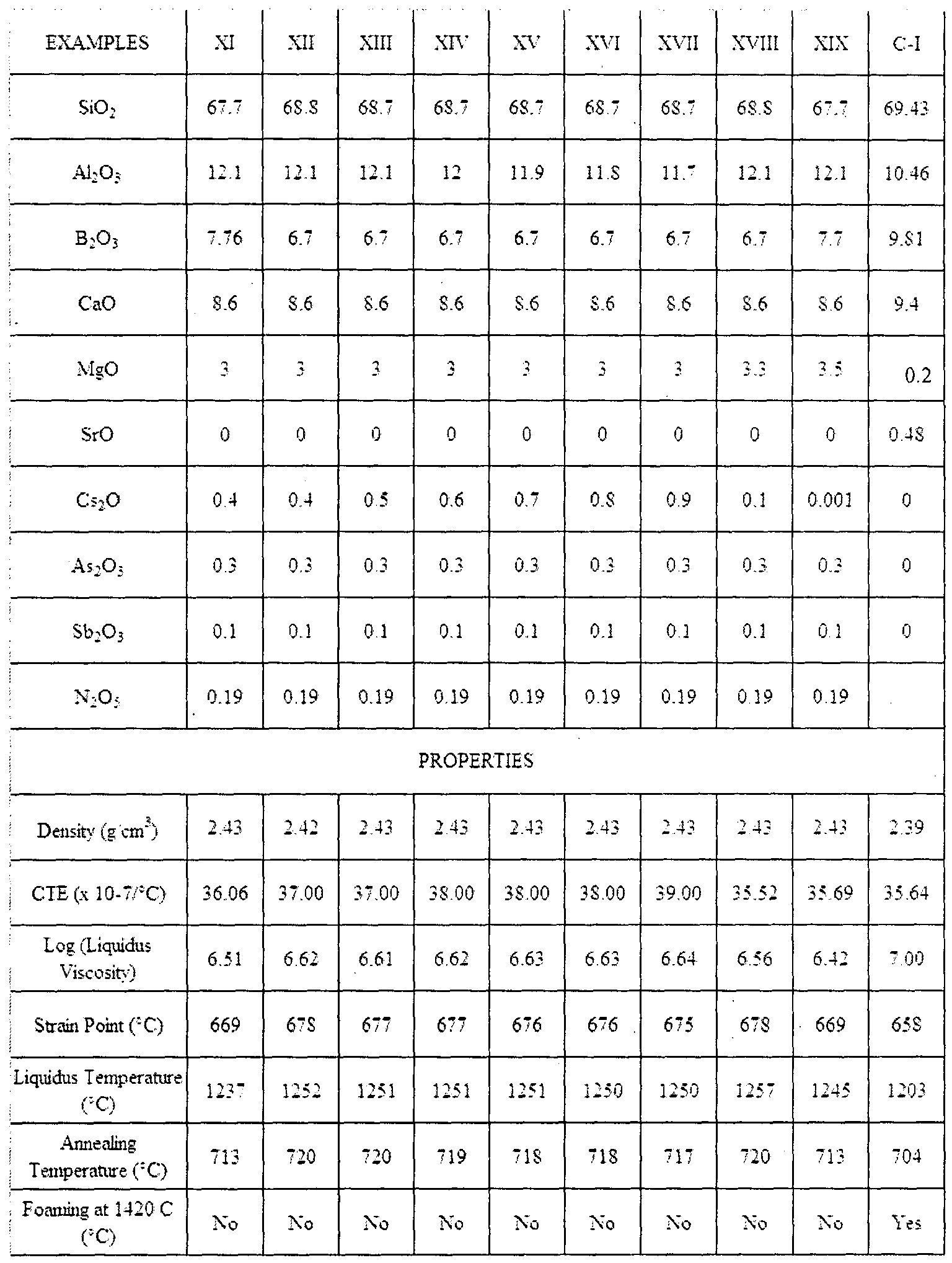
In the Table I provided herein above, examples I to XIX are glass compositions in accordance with the embodiments of the present invention, whereas C-I is a
comparative example of glass composition in accordance with known prior art. It is observed that owing to presence of Cs20 in the composition, the resistivity of the glass made from the composition is comparable with that of the commercially available LCD substrate glass or even better.
The foregoing description of the specific embodiments will so fully reveal the general nature of the embodiments herein that others can, by applying current knowledge, readily modify and/or adapt for various applications such specific embodiments without departing from the generic concept, and, therefore, such adaptations and modifications should and are intended to be comprehended within the meaning and range of equivalents of the disclosed embodiments. It is to be understood that the phraseology or terminology employed herein is for the purpose of description and not of limitation. Therefore, while the embodiments herein have been described in terms of preferred embodiments, those skilled in the art will recognize that the embodiments herein can be practiced with modification within the spirit and scope of the embodiments as described herein.
Dated this 09th Day of May 2012
Claims
1. A glass composition comprising:
Si02 from 63.3 to 71.3 mole %;
A1203 from 8.1 to 12.1 mole %;
B203 from 6.7 to 12.7 mole %;
CaO from 8 to 8.6 mole %;
MgO from 3 to 3.5 mole%; and
Cs20 from about 0.001 to about 0.9 mole %.
2. The glass as claimed in claim 1 , wherein the glass further comprises of refining agents selected from a group consisting of Sb203 in the range from 0 to 0.8 mole % and As203 in the range from 0 to 0.8 mole % in conjunction with N2Os.
3. The glass as claimed in claim 1, wherein said Cs20 decreases the melting point of the glass composition and cesium does not diffuse out and interfere with the TFT operation, owning to high ionic radii and higher atomic mass.
4. The glass as claimed in claim 1, wherein said glass has a density of less than about 2.5 g/cm3.
5. The glass as claimed in claim 1, wherein said glass has a coefficient of thermal expansion less than 40 x 10"7/°C.
6. The glass as claimed in claim 1, wherein said glass has a logarithm of liquidus viscosity of greater than 5.
7. The glass as claimed in claim 1, wherein said glass has a strain point greater than 630 °C.
8. The glass as claimed in claim 1, wherein said glass has a liquidus temperature of less than 1270 °C.
9. The glass as claimed in claim 1, wherein said glass is down-drawable or slot drawn or press-formable in a mold or drawable through roller press or drawable through float process.
10. A glass sheet prepared from the glass as claimed in claim 1.
1 1. An electronic device, the electronic device comprising a glass substrate, the glass substrate comprising the glass composition as claimed in claim 1.
Applications Claiming Priority (2)
| Application Number | Priority Date | Filing Date | Title |
|---|---|---|---|
| IN1445MU2011 | 2011-05-11 | ||
| IN1445/MUM/2011 | 2011-05-11 |
Publications (3)
| Publication Number | Publication Date |
|---|---|
| WO2012160572A2 true WO2012160572A2 (en) | 2012-11-29 |
| WO2012160572A3 WO2012160572A3 (en) | 2013-03-21 |
| WO2012160572A4 WO2012160572A4 (en) | 2013-05-10 |
Family
ID=47217831
Family Applications (1)
| Application Number | Title | Priority Date | Filing Date |
|---|---|---|---|
| PCT/IN2012/000342 Ceased WO2012160572A2 (en) | 2011-05-11 | 2012-05-11 | Glass composition and glass substrate for display devices |
Country Status (1)
| Country | Link |
|---|---|
| WO (1) | WO2012160572A2 (en) |
Cited By (2)
| Publication number | Priority date | Publication date | Assignee | Title |
|---|---|---|---|---|
| CN111541880A (en) * | 2020-05-21 | 2020-08-14 | 北京航空航天大学 | 2D/3D compatible visual camouflage system |
| CN117360016A (en) * | 2018-08-30 | 2024-01-09 | 康宁股份有限公司 | Glass compositions for coformed laminates |
Family Cites Families (2)
| Publication number | Priority date | Publication date | Assignee | Title |
|---|---|---|---|---|
| US6716779B2 (en) * | 2001-08-14 | 2004-04-06 | Optoelectronics International, Inc. | Substrate glass for optical interference filters with minimal wave length shift |
| US8445394B2 (en) * | 2008-10-06 | 2013-05-21 | Corning Incorporated | Intermediate thermal expansion coefficient glass |
-
2012
- 2012-05-11 WO PCT/IN2012/000342 patent/WO2012160572A2/en not_active Ceased
Cited By (2)
| Publication number | Priority date | Publication date | Assignee | Title |
|---|---|---|---|---|
| CN117360016A (en) * | 2018-08-30 | 2024-01-09 | 康宁股份有限公司 | Glass compositions for coformed laminates |
| CN111541880A (en) * | 2020-05-21 | 2020-08-14 | 北京航空航天大学 | 2D/3D compatible visual camouflage system |
Also Published As
| Publication number | Publication date |
|---|---|
| WO2012160572A3 (en) | 2013-03-21 |
| WO2012160572A4 (en) | 2013-05-10 |
Similar Documents
| Publication | Publication Date | Title |
|---|---|---|
| JP6365826B2 (en) | Glass | |
| JP6801651B2 (en) | Glass | |
| US9586854B2 (en) | Alkali-free glass | |
| TWI567041B (en) | Method for producing chemically tempered glass | |
| CN104619663B (en) | Glass and glass substrate | |
| US8785336B2 (en) | Alkali-free glass | |
| JP6417531B2 (en) | Glass with intermediate thermal expansion coefficient | |
| KR20140057474A (en) | Glass composition for strengthened cover glass | |
| WO2016143665A1 (en) | Glass substrate | |
| WO2015127583A1 (en) | Chemically toughened glass article with low coefficient of thermal expansion | |
| JP6532218B2 (en) | Glass | |
| WO2014087971A1 (en) | Non-alkali glass substrate | |
| JP7474697B2 (en) | Dimensionally stable, fast etching glass | |
| JP2016188148A (en) | Alkali-free glass and method for producing the same | |
| CN109020195B (en) | Aluminosilicate glass and preparation method and application thereof | |
| WO2012156991A2 (en) | Glass composition and glass substrate for display devices | |
| JP2005172881A (en) | Substrate for liquid crystal display | |
| US20200131075A1 (en) | Glass substrate | |
| WO2014208524A1 (en) | Alkali-free glass | |
| CN102584008A (en) | Formula for light environment-friendly alkali-free boron-alumina silicate glass used in liquid crystal display (LCD) | |
| WO2020189337A1 (en) | Glass substrate | |
| JP6354943B2 (en) | Glass | |
| CN103781735B (en) | Non-alkali glass and preparation method thereof | |
| CN113727952B (en) | Method for manufacturing glass substrate | |
| JP6631942B2 (en) | Alkali-free glass plate |
Legal Events
| Date | Code | Title | Description |
|---|---|---|---|
| NENP | Non-entry into the national phase |
Ref country code: DE |
|
| 122 | Ep: pct application non-entry in european phase |
Ref document number: 12789125 Country of ref document: EP Kind code of ref document: A2 |