WO2012153826A1 - Dispersion composition, curable composition, composition, transparent film, microlens, solid-state image sensing device, method for manufacturing transparent film, method for manufacturing microlens and method for manufacturing solid-state image sensing device - Google Patents
Dispersion composition, curable composition, composition, transparent film, microlens, solid-state image sensing device, method for manufacturing transparent film, method for manufacturing microlens and method for manufacturing solid-state image sensing device Download PDFInfo
- Publication number
- WO2012153826A1 WO2012153826A1 PCT/JP2012/062079 JP2012062079W WO2012153826A1 WO 2012153826 A1 WO2012153826 A1 WO 2012153826A1 JP 2012062079 W JP2012062079 W JP 2012062079W WO 2012153826 A1 WO2012153826 A1 WO 2012153826A1
- Authority
- WO
- WIPO (PCT)
- Prior art keywords
- group
- mass
- composition
- oxide particles
- acid
- Prior art date
- Legal status (The legal status is an assumption and is not a legal conclusion. Google has not performed a legal analysis and makes no representation as to the accuracy of the status listed.)
- Ceased
Links
- 0 CCCC(C)(*)C(OCCNC(OC(C)(*)CC)=O)=O Chemical compound CCCC(C)(*)C(OCCNC(OC(C)(*)CC)=O)=O 0.000 description 6
Classifications
-
- C—CHEMISTRY; METALLURGY
- C08—ORGANIC MACROMOLECULAR COMPOUNDS; THEIR PREPARATION OR CHEMICAL WORKING-UP; COMPOSITIONS BASED THEREON
- C08F—MACROMOLECULAR COMPOUNDS OBTAINED BY REACTIONS ONLY INVOLVING CARBON-TO-CARBON UNSATURATED BONDS
- C08F2/00—Processes of polymerisation
- C08F2/44—Polymerisation in the presence of compounding ingredients, e.g. plasticisers, dyestuffs, fillers
-
- C—CHEMISTRY; METALLURGY
- C08—ORGANIC MACROMOLECULAR COMPOUNDS; THEIR PREPARATION OR CHEMICAL WORKING-UP; COMPOSITIONS BASED THEREON
- C08F—MACROMOLECULAR COMPOUNDS OBTAINED BY REACTIONS ONLY INVOLVING CARBON-TO-CARBON UNSATURATED BONDS
- C08F2/00—Processes of polymerisation
- C08F2/46—Polymerisation initiated by wave energy or particle radiation
- C08F2/48—Polymerisation initiated by wave energy or particle radiation by ultraviolet or visible light
-
- C—CHEMISTRY; METALLURGY
- C08—ORGANIC MACROMOLECULAR COMPOUNDS; THEIR PREPARATION OR CHEMICAL WORKING-UP; COMPOSITIONS BASED THEREON
- C08F—MACROMOLECULAR COMPOUNDS OBTAINED BY REACTIONS ONLY INVOLVING CARBON-TO-CARBON UNSATURATED BONDS
- C08F292/00—Macromolecular compounds obtained by polymerising monomers on to inorganic materials
-
- G—PHYSICS
- G02—OPTICS
- G02B—OPTICAL ELEMENTS, SYSTEMS OR APPARATUS
- G02B1/00—Optical elements characterised by the material of which they are made; Optical coatings for optical elements
- G02B1/04—Optical elements characterised by the material of which they are made; Optical coatings for optical elements made of organic materials, e.g. plastics
-
- G—PHYSICS
- G02—OPTICS
- G02B—OPTICAL ELEMENTS, SYSTEMS OR APPARATUS
- G02B1/00—Optical elements characterised by the material of which they are made; Optical coatings for optical elements
- G02B1/04—Optical elements characterised by the material of which they are made; Optical coatings for optical elements made of organic materials, e.g. plastics
- G02B1/041—Lenses
-
- G—PHYSICS
- G02—OPTICS
- G02B—OPTICAL ELEMENTS, SYSTEMS OR APPARATUS
- G02B3/00—Simple or compound lenses
Definitions
- the present invention relates to a dispersion composition, a curable composition, a composition, a transparent film, a microlens, a solid-state image sensing device, a method for manufacturing a transparent film, a method for manufacturing a microlens and a method for manufacturing a solid-state image sensing device.
- a composition for forming a transparent member which has a high refractive index, and which is able to form a micro transparent film, a transparent interconnection and the like.
- a microlens used in a solid-state image sensing device is required to be more miniaturized as the miniaturization of the solid-state image sensing device progresses, and to have a high refractive index in order to achieve more effective light focusing.
- a photopolymerizable composition capable of forming a high refractive index pattern, using silica-coated titanium oxide particles is disclosed (see, for example, Japanese Patent Application Laid-Open No. 2009-179678).
- a composition for a solid-state image sensing device using a metal oxide which has 20% or more of silicon atoms on the particle surface is disclosed, and thus, it is described that the high refractive index and excellent pattern forming property are obtained (see, for example, Japanese Patent Application Laid-Open No. 2008-185683).
- a resolution becomes higher, the size of a pixel is correspondingly reduced, and thus, it is essential to collect light more efficiently. Accordingly, a microlens having a higher refractive index is required.
- the size of a wafer used is increasing.
- composition for forming a transparent high refractive index coating using titanium oxide particles a composition containing titanium oxide, a surfactant and a binder polymer is disclosed in Example 3 of Japanese Patent Application Laid-Open No. H8-1 10401.
- a film formed in order to obtain a microlens has a problem in that a variation of performances may occur in a plurality of solid-state image sensing device chips obtained by being cut from the wafer since the difference in film thickness between the center portion and the peripheral portion of the wafer increases.
- the present invention has been made in consideration of the above-described situations, and the first object of the present invention is to provide a dispersion composition having excellent dispersion stability and also having very high refractive index when prepared as a curable composition, which is able to form a film having a small difference in film thickness between the center portion and the peripheral portion thereof even when the composition is applied on a large size wafer, and a curable composition, a transparent film, a microlens and a solid-state image sensing device using the same.
- a composition for forming a high refractive index material described in the above-described Patent Documents undergoes a significant change in shape of the coating face over time after the application of the composition, and thus, has a problem that for example, non-uniform portions are generated on the film surface when the film is left to stand at room temperature for 24 hr after the application.
- the generation of non-uniform portions on this film surface is presumed to be due to generation of aggregates caused by poor compatibility of metal oxide with a binder polymer.
- the present invention has also been made in consideration of the above-described situations, and the second object of the present invention is to provide a composition having a high refractive index and also having a property of a small change in shape of the coating face over time after the application of the composition, which is able to form a film having a small drop in refractive index after a development treatment, and a transparent film, a microlens, a solid-state image sensing device, a method for manufacturing a transparent film, a method for manufacturing a microlens and a method for manufacturing a solid-state image sensing device, using the same.
- a dispersion composition comprising:
- metal oxide particles (A-l) having a primary particle diamter of 1 nm to 100 nm;
- a content of the metal oxide particles (A-l) is from 50 mass% to 90 mass% based on a total solid content of the dispersion composition
- the graft copolymer (B-l) has a structural unit having an acid group in an amount of from 25 mass% to 90 mass% based on a total mass of the graft copolymer (B-l).
- graft copolymer (B-l) has an acid value of from 70 mgKOH/g to 350 mgKOH/g.
- graft chain in the graft copolymer (B-l) is at least one structure selected from the group consisting of a polyester structure, a polyether structure and a poly(meth)acrylic structure.
- graft copolymer (B-l) is a graft copolymer containing a structural unit represented by at least one of the following Formulas (1) to (4):
- each of X 1 , X 2 , X 3 , X 4 and X 5 independently represents a hydrogen atom or a monovalent organic group
- each of W 1 , W 2 , W 3 and W 4 independently represents an oxygen atom or NH;
- R represents a hydrogen atom or a monovalent organic group, and R's having different structures in the copolymer may be present;
- R' represents a branched- or straight-chained alkylene group, and R's having different structures in the copolymer may be present;
- each of Y 1 , Y 2 , Y 3 and Y 4 independently represents a divalent linking group
- each of Z 2 , Z 3 and Z 4 independently represents a hydrogen atom or a monovalent substituent group
- each of j and k independently represents an integer of from 2 to 8.
- each of n, m, p and q represents an integer of from 1 to 500.
- graft copolymer (B-l) is a graft copolymer containing a structural unit having the graft chain in a range of from 10% to 75% by mass based on the total mass of the graft copolymer (B-l).
- ⁇ 6> The dispersion composition as described in any one of ⁇ 1> to ⁇ 5> above, wherein the acid group in the structural unit having an acid group is at least one group selected from the group consisting of a carboxylic acid group, a sufonic acid group and a phosphoric acid group.
- a curable composition comprising:
- the dispersion composition further contains a polymerizable compound (D-l ) and a polymerization initiator (E-l).
- polymerization initiator (E-l) is an oxime-based polymerization initiator.
- ⁇ 1 1> The curable composition as described in any one of ⁇ 7> to ⁇ 9> above, which is used for forming an undercoat film of a color filter.
- ⁇ 12> A transparent film, which is formed by using the curable composition as described in any one of ⁇ 7> to ⁇ 11> above.
- a microlens which is formed by using a transparent film obtained by the curable composition as described in ⁇ 10> above.
- a solid-state image sensing device comprising:
- a composition comprising:
- titanium oxide particles or zirconium oxide particles as metal oxide particles (A-2); a binder polymer (F-2) containing a repeating unit derived from benzyl(meth)acrylate; and
- a content of the surfactant (G-2) is from 0.0010 mass% to 3.0 mass% based on a total solid content of the composition.
- the surfactant (G-2) is a fluorine-based surfactant or a non-ionic surfactant.
- a content of the surfactant (G-2) is from 0.50 mass% to 3.0 mass% based on the total solid content of the composition.
- binder polymer (F-2) further contains a repeating unit derived from (meth)acrylate.
- binder polymer (F-2) has an ethylene oxide group.
- binder polymer (F-2) further contains both a repeating unit derived from alkyl(meth)acrylate having an ethylene oxide group and a repeating unit derived from isobutyl(meth)acrylate.
- a transparent film which is formed by using the composition according to any one of [1] to [8] above.
- a microlens which is formed by using the transparent film as described in [9] above.
- a solid-state image sensing device comprising:
- a method for manufacturing a transparent film comprising:
- a method for manufacturing a microlens comprising:
- a method for manufacturing a solid-state image sensing device comprising: a process of forming red pixels, blue pixels and green pixels on a substrate for a solid-state image sensing device having at least a photodiode, a light-shielding film and a device protective film; a process of applying the composition as described in any one of [1] to [8] above and performing heating;
- the dispersion composition in the present invention (hereinafter, referred to as a first invention in some cases) in order to solve the first problem of the present invention contains a graft copolymer (B-1) having a graft chain in which the number of atoms thereof except hydrogen atoms is in the range of from 40 to 10,000 as a dispersing agent. Therefore, for example, the graft chain may serve as a sterically repulsive group to exhibit excellent dispersibility, thereby uniformly dispersing metal oxide particles as high refractive index particles. Even when the dispersion composition is stored at room temperature and the like for a long period, the graft chain may interact with a solvent to suppress metal oxide particles from precipitating for a long period of time.
- the graft chain may serve as a sterically repulsive group to prevent metal oxide particles from aggregating, and thus, the dispersion stability is not easily impaired even though the content of metal oxide particles is increased. That is, the dispersion composition of the present invention may be used to achieve excellent dispersion stability and obtain a film having a very high refractive index.
- a graft copolymer (B-1) (in particular, a graft copolymer including a structural unit represented by any one of Formulas (1) to (5) which are preferred aspects) is used to constitute a dispersion composition, and the dispersion composition is used to constitute a curable composition
- the uniformity of the film thickness in a coating film obtained by the curable composition is excellent, and as a result, even when applied on a large size wafer, a film having a small difference in film thickness between the center portion and the peripheral portion of the wafer (for example, an undercoat film of a color filter, or a film for forming a microlens, and the like) may be obtained. It is presumed that this is because the graft chain of the graft copolymer (B-1) of the present invention and the solvent exhibit excellent interaction with each other, for example, in the coating film.
- a specific amount of a surfactant is not present in the composition of the present invention (hereinafter, referred to as a second invention in some cases) in order to solve the second problem of the present invention
- the solvent is removed by drying after the application, and thus, the compatibility of metal oxide particles which are in close contact with a binder polymer is destabilized to cause aggregation with metal oxide particles, and the like, with lapse of time, thereby leading to deterioration in the surface shape thereof.
- a specific amount of a surfactant is incorporated between the metal oxide particles and the binder polymer to improve the compatibility, and as a result, it is estimated that the change in shape of the coating face over time after the application of the composition may be decreased.
- a microlens is manufactured by etching using the composition of the present invention, even in the case where a surface on which a resist is removed by a developing solution (that is, a surface on which a high refractive index material of the lower layer is exposed) is in contact with the developing solution by applying the resist on the high refractive index material formed from the composition of the present invention, and then, pattern exposing and developing the resist, non-uniform portions are generated on the surfaces only of the metal oxide particles and the binder polymer as described above, and thus, the developing solution enters a gap therebetween, thereby sometimes causing a reduction in refractive index if a specific amount of a surfactant is not present in the composition in the present invention.
- the composition of the present invention may be used to obtain a film which has a high refractive index, a small change in shape of the coating face over time after the application of the composition, and a small drop in refractive index after the development treatment.
- any expression which does not describe substitution and unsubstitution includes one having substituent groups as well as one having no substituent groups.
- an alkyl group includes an alkyl group having no substituent groups (unsubstituted alkyl group) as well as an alkyl group having substituent groups (substituted alkyl group).
- (meth)acrylate represents acrylate and methacrylate
- (meth)acryl represents acryl and methacryl
- “meth(acryloyl)” represents acryloyl and methacryloyl.
- monomeric body and “monomer” are the same as each other.
- monomer is differentiated from oligomer and polymer, and the monomer refers to a compound having a mass average molecular weight of 2,000 or less.
- a polymerizable compound refers to a compound having a polymerizable group(s), and may be a monomer or a polymer.
- the polymerizable group refers to a group which is involved in a polymerization reaction.
- refractive index refers to a refractive index with respect to light having a wavelength of 500 nm.
- the first invention of the present invention will be first described.
- a dispersion composition according to the first invention of the present invention is a dispersion composition containing metal oxide particles (A-l) having a primary particle diameter of from 1 nm to 100 nm, a graft copolymer (B-l) having a graft chain in which the number of atoms thereof except hydrogen atoms is in the range of from 40 to 10,000, and a solvent (C-l), wherein a content of the metal oxide particles (A-l) is from 50 mass% to 90 mass% based on the total solid content of the dispersion composition.
- mass ratio is equal to weight ratio.
- the metal oxide particles are inorganic particles having a high refractive index
- examples of the metal oxide particles include titanium dioxide (Ti0 2 ) particles, zirconium dioxide (Zr0 2 ) particles and silicon dioxide (Si0 2 ) particles, but among them, titanium dioxide particles (hereinafter, simply referred to as "titanium dioxide” in some cases) is preferred.
- the metal oxide particles are not particularly limited as long as the particles have a primary particle diameter of from 1 nm to 100 nm, and for example, may be appropriately selected from commercially available metal oxide particles.
- the metal oxide particles have a primary particle diameter of from 1 nm to 100 nm, preferably from 1 nm to 80 nm, and particularly preferably from 1 nm to 50 nm. If the primary particle diameter of the metal oxide particles exceeds 100 nm, there are some cases where refractive index and transmittance may be reduced. When the diameter is less than 1 nm, there are some cases where dispersibility or dispersion stability may be reduced by aggregation.
- the primary particle diameter of the metal oxide particles is obtained as an average particle diameter of metal oxide particles.
- the average particle diameter of metal oxide particles refers to a value obtained by performing measurement on a diluted solution obtained by diluting a mixed solution or a dispersion liquid including metal oxide particles to 80 times with propylene glycol monomethyl ether acetate using a dynamic light scattering method.
- This measurement is calculated as a number average particle diameter obtained by performing measurement using MICROTRAC UPA-EX150 manufactured by NIKKISO Co., Ltd.
- the refractive index of metal oxide particles is not particularly limited, but is preferably from 1.75 to 2.70 from the viewpoint of obtaining a high refractive index and more preferably 1.90 to 2.70.
- the metal oxide particles have a specific surface area of preferably from 10 m 2 /g to 400 m 2 /g, more preferably from 20 m 2 /g to 200 m 2 /g, and most preferably from 30 m 2 /g to 150 m 2 /g.
- the shape of metal oxide particles may be a rice-grain shape, a spherical shape, a cubic shape, a spindle shape or an indefinite shape.
- the metal oxide particles may be subjected to surface treatment with an organic compound(s).
- organic compound used in the surface treatment include polyol, alkanolamine, stearic acid, a silane coupling agent and a titanate coupling agent.
- the silane coupling agent is preferred.
- the surface treatment may be performed either with one kind surface treatment agent alone or in combination of two or more surface treatment agents.
- the surface of the metal oxide particles is covered with oxides such as aluminum, silicon and zirconia. Thereby, the weather resistance is more enhanced.
- metal oxide particles in the present invention those commercially available products may be preferably used.
- Examples of the commercially available products of the titanium dioxide particles include TTO series (TTO-51(A), TTO-51(C) and the like), TTO-S and V series (TTO-S-1, TTO-S-2, TTO-V-3 and the like) manufactured by ISHIHARA SANGYO KAISHA, LTD., MT series (MT-01 , MT-05 and the like) manufactured by TAYCA CORP., and the like.
- Examples of the commercially available products of the zirconium dioxide particles include UEP (manufactured by Daiichi Kigenso Kagaku Kogyo Ltd.), PCS (NIPPON DENKO CO., LTD.), JS-01, JS-03 and JS-04 (NIPPON DENKO CO., LTD.), UEP-100 (manufactured by Daiichi Kigenso Kagaku Kogyo Ltd.), and the like.
- Examples of the commercially available products of the silicon dioxide particles include OG502-31 manufactured by Clariant Co., and the like.
- the metal oxide particles may be used either alone or in combination of two or more thereof.
- a content of the metal oxide particles in the composition is from 50 mass% to 90 mass%, more preferably 52 mass% to 85 mass%, and most preferably 55 mass% and 80 mass%, based on the total solid content of the dispersion composition (or the curable composition to be described below).
- the dispersibility and dispersion stability are easily impaired because it is difficult to allow a sufficient amount of the graft copolymer (B-l) to be present, and the like.
- the dispersion composition curable composition
- the dispersion composition of the present invention includes a graft copolymer (hereinafter, referred to as a "specific resin” in some cases).
- the graft copolymer of the present invention has a graft chain in which the number of atoms thereof except hydrogen atoms is in the range of from 40 to 10,000.
- the graft chain represents a chain from the source of a main chain of a copolymer (an atom bound to the main chain in a group branched from the main chain) to the terminal of a group branched from the main chain.
- the specific resin is a dispersion resin which imparts dispersibility to the metal oxide particles and is excellent in dispersibility of the metal oxide particles and dispersion stability after the passage of time because of having affinity to a solvent due to the graft chain.
- the specific resin is made into a dispersion composition, the graft chain exhibits excellent interaction with the solvent. Thus, it is thought that the uniformity of film thickness in a coating film is inhibited from being deteriorated.
- the graft copolymer (B-l) used in the present invention has the number of atoms except hydrogen atoms of from 40 to 10,000 per graft chain, the number of atoms except hydrogen atoms of more preferably from 100 to 500 per graft chain, and the number of atoms except hydrogen atoms of even more preferably from 150 to 260 per graft chain.
- the number of atoms except hydrogen atoms per graft chain is less than 40, since the graft chain is short, the sterically repulsive effect is decreased, and thus, the dispersibility or dispersion stability may be deteriorated.
- the dispersion composition curable composition
- the number of atoms except hydrogen atom per graft chain is more than 10,000, the graft chain is long, and thus, adsorptive force to the metal oxide particles may decrease, resulting in reduced dispersibility or dispersion stability.
- the number of atoms except hydrogen atoms per graft chain refers to the number of atoms except hydrogen atoms included in a chain from an atom of the source bound to a polymer chain constituting the main chain to the terminal of a branched polymer branched from the main chain.
- the number of atoms of at least one graft chain except hydrogen atoms it is sufficient for the number of atoms of at least one graft chain except hydrogen atoms to satisfy the requirements.
- the polymer structure of the graft chain a poly(meth)acrylic structure, a polyester structure, a polyurethane structure, a polyurea structure, a polyamide sturcture, a polyether structure and the like may be used.
- a graft chain including a poly(meth)acrylic structure, a polyester structure or a polyether structure is preferred, and a graft chain including a polyester structure or a polyether structure is more preferred.
- the graft copolymer has a structural unit (repeating unit) having the graft chain
- the graft copolymer may be obtained, for example, by polymerizing a macro monomer having a polymer structure as the graft chain based on a typical method.
- the structure of a macro monomer is not particularly limited as long as the macro monomer has a substituent group capable of reacting with the polymer main chain moiety, and also has a graft chain satisfying the requirements of the present invention.
- macro monomers having a reactive double bond group may be suitably used.
- the structural unit having the graft chain may be a structural unit which does not correspond to a structural unit having an acid group to be described below and a structural unit which corresponds to a structural unit having the acid group.
- Examples of commercially available macro monomers that are suitably used for the synthesis of the specific resin include AA-6 (manufactured by TOAGOSEI Co., Ltd.), AA-10 (manufactured by TOAGOSEI Co., Ltd.), AB-6 (manufactured by TOAGOSEI Co., Ltd.), AS-6 (manufactured by TOAGOSEI Co., Ltd.), AN-6 (manufactured by TOAGOSEI Co., Ltd.), AW-6 (manufactured by TOAGOSEI Co., Ltd.), AA-714 (manufactured by TOAGOSEI Co., Ltd.), AY-707 (manufactured by TOAGOSEI Co., Ltd.), AY-714 (manufactured by TOAGOSEI Co., Ltd.), AK-5 (manufactured by TOAGOSEI Co., Ltd.), AK-30 (manufactured by TOAGOSEI Co., Ltd.), AK-32 (manufactured
- AA-6 (manufactured by TOAGOSEI Co., Ltd.), AA-10 (manufactured by TOAGOSEI Co., Ltd.), AB-6 (manufactured by TOAGOSEI Co., Ltd.), AS-6 (manufactured by TOAGOSEl Co., Ltd.), AN-6 (manufactured by TOAGOSEl Co., Ltd.), BLEMMER PME-4000 (manufactured by NOF Corporation), BLEMMER PME-400 (manufactured by NOF Corporation), BLEMMER PME-100 (manufactured by NOF Corporation), BLEMMER PME-200 (manufactured by NOF Corporation), BLEMMER PME-1000 (manufactured NOF Corporation), and the like are preferred.
- the specific resin to be used in the present invention preferably includes, as a structural unit having the graft chain, at least one structural unit represented by any one of the following Formulas (1) to (4), and more preferably includes at least one structural unit represented by any one of the following Formula (1A), the following Formula (2 A), the following Formula (3) and the following Formula (4).
- each of X 1 , X 2 , X 3 , X 4 and X 5 independently represents a hydrogen atom or a monovalent organic group. From the viewpoint of the restrictions on synthesis, a hydrogen atom or an alkyl group having from 1 to 12 carbon atoms is preferred, a hydrogen atom or a methyl group is more preferred, and a methyl group is particularly preferred.
- each of W 1 , W 2 , W 3 and W 4 independently represents an oxygen atom or NH, and particularly preferably an oxygen atom.
- R' represents a branched- or straight-chain alkylene group (preferably from 1 to 10 carbon atoms and more preferably 2 or 3 carbon atoms), and from the viewpoint of the dispersion stability, a group represented by -CH 2 -CH(CH 3 )- or a group represented by -CH(CH 3 )-CH 2 - is preferred.
- R' in Formula (3) two or more kinds of R's having different structures from one another in the specific resin may be mixed and used.
- each of Y 1 , Y 2 , Y 3 and Y 4 independently represents a divalent linking group, and is not particularly limited in structure. Specifically, examples thereof include linking groups from the following (Y-1) to (Y-21), and the like.
- each of A and B represents a bond to the left terminal group and a bond to the right terminal group in Formulas (1) to (4), respectively.
- (Y-2) and (Y-13) are more preferably used due to the simplicity of synthesis.
- each of Z 1 , Z z , Z J and Z 4 independently represents a hydrogen atom or a monovalent substituent group.
- the structure of the substituent group is not particularly limited, but specific examples thereof include an alkyl group, a hydroxyl group, an alkoxy group, an aryloxy group or a heteroaryloxy group, an alkyl thioether group, an aryl thioether group or a heteroaryl thioether group, an amino group and the like.
- the group preferably has a sterically repulsive effect, and as a monovalent substituent group represented by Z 1 to Z 3 , it is preferred that each of the groups is independently an alkyl group having from 5 to 24 carbon atoms or an alkoxy group having from 5 to 24 carbon atoms, and among them, it is particularly preferred that each of the groups is independently an alkoxy group having a branched alkyl group having from 5 to 24 carbon atoms or an alkoxy group having a cyclic alkyl group having from 5 to 24 carbon atoms.
- a monovalent substituent group represented by Z 4 is an alkyl group having from 5 to 24 carbon atoms, and among them, it is preferred that each of the groups is independently a branched alkyl group having from 5 to 24 carbon atoms or a cyclic alkyl group having from 5 to 24 carbon atoms.
- each of n, m, p and q is an integer of from 1 to 500.
- each of j and k is independently an integer of from 2 to 8.
- j and k are preferably an integer of from 4 to 6 and most preferably 5.
- R represents a hydrogen atom or a monovalent organic group, and the structure thereof is not particularly limited, but examples thereof include preferably a hydrogen atom, an alkyl group, an aryl group and a heteroaryl group, and more preferably a hydrogen atom and an alkyl group.
- the alkyl group is preferably a straight-chain alkyl group having from 1 to 20 carbon atoms, a branched alkyl group having from 3 to 20 carbon atoms, or a cyclic alkyl group having from 5 to 20 carbon atoms, more preferably a straight-chain alkyl group having from 1 to 20 carbon atoms, and particularly preferably a straight-chain alkyl group having from 1 to 6 carbon atoms.
- R in Formula (4) two or more kinds of R's having different structures from one another in the specific resin may be mixed and used.
- Formula (1) As a structural unit represented by Formula (1), from the viewpoint of dispersion stability, a structural unit represented by the following Formula (1 A) or Formula (2A) is more preferred.
- X 1 , Y 1 , Z 1 and n are the same as X 1 , Y ! , Z 1 and n in Formula (1), and the preferred ranges thereof are also the same as each other.
- X 2 , Y 2 , Z 2 and m are the same as X 2 , Y 2 , Z 2 and m in Formula (2), and also the same as each other even in the preferred range.
- the specific resin more preferably has a structural unit represented by Formula (1A).
- the specific resin may have one kind of a structural unit having the graft chain or a plurality of kinds of the structural units.
- a structural unit (repeating unit) having the graft chain is included preferably in a range of from 10% to 75% by mass, more preferably in a range of from 12% to 50% by mass, and particularly preferably in a range of from 15% to 40% by mass, based on the total mass of the specific resin.
- the content of the structural unit is within these ranges, the dispersibility or dispersion stability of the metal oxide particles is high, and thus the uniformity of film thickness in a coating film formed by using the dispersion composition is more excellent.
- the specific resin used in the invention may be a combination of two or more kinds of graft copolymers whose structures are different from one another.
- the specific resin in the present invention is a polymer having a structural unit (repeating unit) having an acid group in an amount of from 25 mass% to 90 mass% based on the total mass of the specific resin.
- the content of the structural unit having the acid group is more preferably from 50 mass% to 80 mass% and most preferably from 60 mass% and 75 mass%, based on the total mass of the specific resin.
- the adsorptivity of the specific resin of the present invention to the metal oxide particles becomes insufficient, resulting in deteriorated dispersion stability.
- the dispersion composition curable composition
- the content of the structural unit having the acid group is more than 90 mass% based on the total mass of the specific resin, the amount of introducing the graft chain into the specific resin is insufficient, resulting in deteriorated dispersion stability. Likewise, it is difficult to form a film having a small difference in film thickness between the center portion and the peripheral portion of the wafer.
- the acid value of the specific resin may be suitably controlled within the following preferred range.
- the acid group may serve as a functional group capable of forming an interaction with the metal oxide particles other than the graft chain.
- the acid group examples include a carboxylic acid group, a sulfonic acid group, a phosphoric acid group, a phenolic hydroxyl group and the like, and from the viewpoint of adsorptive force to the metal oxide particles, dispersibility and dispersion stability, at least one selected from a carboxylic acid group, a sulfonic acid group and a phosphoric acid group is preferred, and a carboxylic acid group is particularly preferred.
- the acid group structure is preferably a structure in which the acid group is spaced apart from the main chain of the resin structure by 5 atoms or more.
- the acid group carboxyl acid which is bound to an aromatic ring is most preferred.
- the acid groups may be used either alone or in combination of two or more thereof.
- the acid value of the specific resin is preferably in the range of from 70 mgKOH/g to 350 mgKOH/g, more preferably in the range of from 80 mgKOH/g to 300 mgKOH/g, and even more preferably in the range of from 100 mgKOH/g to 250 mgKOH/g. Even when the dispersion composition is applied on a large size (for example, 12 inches) wafer, a film having a small difference in film thickness between the center portion and the peripheral portion of the wafer may be more certainly obtained by adjusting the acid value to the above-described ranges.
- the acid value of the specific resin may be calculated, for example, from the average content of acid groups in the specific resin.
- a resin having a desired acid value may be obtained by changing the content of a monomer unit containing an acid group, which constitutes the specific resin.
- the specific resin may further have a structural unit (repeating unit) having a functional group capable of forming an interaction with the metal oxide particles in addition to the graft chain and the acid groups.
- the structural unit having a functional group capable of forming an interaction with other metal oxide particles is not particularly limited in structure, but examples thereof include a structural unit having a basic group, a structural unit having a coordinating group, a structural unit having a group having reactivity, and the like.
- Examples of the basic group include a primary amino group, a secondary amino group, a tertiary amino group, a heterocyclic ring containing an N atom, an amide group, and the like.
- a tertiary amino group that has good adsorptive force to the metal oxide particles and has high dispersibility and dispersion stability is particularly preferred.
- the basic groups may be used either alone or in combination of two or more thereof.
- the specific resin of the present invention may or may not contain a structural unit (repeating unit) having a basic group, but when the specific resin contains the structural unit having a basic group, the content of the structural unit having the basic group is from 0.1 mass% to 50 mass% and particularly preferably from 0.1 mass% to 30 mass%, based on the total mass of the specific resin.
- Examples of the coordinating group or the group having reactivity include an acetyl acetoxy group, a trialkoxysilyl group, an isocyanate group, an acid anhydride residue, an acid chloride residue, and the like.
- An acetyl acetoxy group having good adsorptive force to the metal oxide particles and high dispersibility and dispersion stability is particularly preferred.
- the coordinating groups or the groups having reactivity may be used either alone or in combination of two or more thereof.
- the specific resin of the present invention may or may not contain a structural unit (repeating unit) having a coordinating group or a group having reactivity, but when the specific resin contains the structural unit having a coordinating group or a group having reactivity, the content of the structural unit having the coordinating group or the group having reactivity is from 0.1 mass% to 50 mass% and particularly preferably from 0.1 mass% to 30 mass%, based on the total mass of the specific resin.
- the specific resin in the present invention may have at least one of the repeating units to be obtained from monomers represented by any one of the following general formulas (i) to (iii), as a structural unit having a functional group capable of forming an interaction with the metal oxide particles, which is different from a structural unit having the graft chain and a structural unit having the acid group.
- each of R 1 , R 2 and R 3 independently represents a hydrogen atom, a halogen atom (for example, fluorine, chlorine, bromine and the like), or an alkyl group (for example, a methyl group, an ethyl group, a propyl group and the like) having from 1 to 6 carbon atoms.
- a halogen atom for example, fluorine, chlorine, bromine and the like
- an alkyl group for example, a methyl group, an ethyl group, a propyl group and the like having from 1 to 6 carbon atoms.
- R 1 , R 2 and R 3 are more preferably a hydrogen atom or an alkyl group having from 1 to
- R and R are particularly preferably a hydrogen atom.
- X represents an oxygen atom (-0-) or an imino group (-NH-), and preferably an oxygen atom.
- L is a single bond or a divalent linking group.
- the divalent linking group include a divalent aliphatic group (for example, an alkylene group, a substituted alkylene group, an alkenylene group, a substituted alkenylene group, an alkynylene group and a substituted alkynylene group), a divalent aromatic group (for example, an arylene group and a substituted arylene group), a divalent heterocyclic group, and the combinations of these groups with an oxygen atom (-0-), a sulfur atom (-S-), an imino group (-NH-), a substituted imino group (-NR 31 -, wherein R 31 is an aliphatic group, an aromatic group, or a heterocyclic group) or a carbonyl group (-CO-).
- a divalent aliphatic group for example, an alkylene group, a substituted alkylene group, an alkenylene group, a substituted alkenylene group, an al
- the divalent aliphatic group may have a cyclic structure or a branched structure.
- the aliphatic group has preferably from 1 to 20 carbon atoms, more preferably from 1 to 15 carbon atoms, and even more preferably from 1 to 10 carbon atoms.
- the aliphatic group is preferably a saturated aliphatic group rather than an unsaturated aliphatic group.
- the aliphatic group may have a substituent group. Examples of the substituent group include a halogen atom, a hydroxyl group, an aromatic group and a heterocyclic group.
- the divalent aromatic group has preferably 6 to 20 carbon atoms, more preferably 6 to 15 carbon atoms, and most preferably 6 to 10 carbon atoms.
- the aromatic group may have a substituent group. Examples of the substituent group include a halogen atom, a hydroxyl group, an aliphatic group, an aromatic group and a heterocyclic group.
- the divalent heterocyclic group has preferably a 5-membered ring or a 6-membered ring as a heterocycle thereof.
- the heterocycle may be condensed with another heterocycle, an aliphatic ring or an aromatic ring.
- R 32 is an aliphatic group, an aromatic group or a heterocyclic group), an aliphatic group, an aromatic group and a heterocyclic group.
- L is preferably a single bond, an alkylene group or a divalent linking group including an oxyalkylene structure.
- the oxyalkylene structure is more preferably an oxyethylene structure or an oxypropylene structure.
- L may include a polyoxyalkylene structure in which two or more oxyalkylene structures are repeated.
- a polyoxyethylene structure or a polyoxypropylene structure is preferred.
- the polyoxyethylene structure is represented by -(OCH 2 CH2) n -, wherein n is preferably an integer of 2 or more, and more preferably an integer of from 2 to 10.
- Z represents a functional group capable of forming an interaction with the metal oxide particles, preferably the above-described acid group, the basic group or the group having reactivity, more preferably a carboxylic acid group or a tertiary amino group, and even more preferably a carboxylic acid group.
- Y represents a methine group or a nitrogen atom.
- each of R 4 , R 5 and R 6 independently represents a hydrogen atom, a halogen atom (for example, fluorine, chlorine, bromine and the like), or an alkyl group (for example, a methyl group, an ethyl group, a propyl group and the like) having from 1 to 6 carbon atoms, Z, or -L-Z.
- L and Z are the same as described above.
- Each of R 4 , R 5 and R 6 is preferably a hydrogen atom or an alkyl group having from 1 to 3 carbon atoms, and more preferably a hydrogen atom.
- the monomer represented by the general formula (i) is a compound in which each of R 1 , R 2 and R 3 is a hydrogen atom or a methyl group, L is an alkylene group or a divalent linking group including an oxyalkylene structure, X is an oxygen atom or an imino group, and Z is a carboxylic acid group.
- the monomer represented by the general formula (ii) is a compound in which R 1 is a hydrogen atom or a methyl group, L is an alkylene group, Z is a carboxylic acid group, and Y is a methine group. It is preferred that the monomer represented by the general formula (iii) is a compound in which each of R 4 , R 5 and R 6 is a hydrogen atom or a methyl group, and Z is a carboxylic acid group.
- Examples of the representative compounds represented by Formulas (i) to (iii) include methacrylic acid, crotonic acid, isocrotonic acid; a reaction product of a compound having an addition-polymerizable double bond and a hydroxyl group in a molecule thereof (for example, 2-hydroxyethyl methacrylate) and succinic anhydride, a reaction product of a compound having an addition-polymerizable double bond and a hydroxyl group in a molecule thereof and phthalic anhydride, a reaction product of a compound having an addition-polymerizable double bond and a hydroxyl group in a molecule thereof and tetrahydroxyphthalic anhydride, a reaction product of a compound having an addition-polymerizable double bond and a hydroxyl group in a molecule thereof and trimellitic anhydride, a reaction product of a compound having an addition-polymerizable double bond and a hydroxyl group in a molecule thereof and trimellitic an
- the specific resin included in the dispersion composition of the metal oxide particles of the present invention may include, as a structural unit derived from copolymerization components, other structural units having further various functions, for example, a structural unit having a functional group having an affinity to a dispersion medium used in a dispersion, and the like, in addition to a structural unit having the graft chain, a structural unit having the acid group, and a structural unit having the functional group capable of forming an interaction with the metal oxide particles, which is different from these structural units, for the purpose of improving various performances such as image strength as long as the effect of the present invention is not impaired.
- examples thereof include acrylic acid esters such as alkyl acrylate (the alkyl group preferably has from 1 to 20 carbon atoms) (specifically, for example, benzyl acrylate, 4-biphenyl acrylate, butyl acrylate, sec-butyl acrylate, t-butyl acrylate, 4-t-butylphenyl acrylate, 4-chlorophenyl acrylate, pentachlorophenyl acrylate, 4-cyanobenzyl acrylate, cyanomethyl acrylate, cyclohexyl acrylate, 2-ethoxyethyl acrylate, ethyl acrylate, 2-ethylhexyl acrylate, heptyl acrylate, hexyl acrylate, isobornyl acrylate, isopropyl acrylate, methylacrylate, 3,5-dimethyl adamantyl acrylate, 2-naphthyl acrylate,
- methacrylic acid esters such as alkyl methacrylate (the alkyl group preferably has from 1 to 20 carbon atoms) (for example, benzyl methacrylate, 4-biphenyl methacrylate, butyl methacrylate, sec-butyl methacrylate, t-butyl methacrylate, 4-t-butylphenyl methacrylate, 4-chlorophenyl methacrylate, pentachlorophenyl methacrylate, 4-cyanophenyl methacrylate, cyanomethyl methacrylate, cyclohexyl methacrylate, 2-ethoxy ethyl methacrylate, ethyl methacrylate, 2-ethylhexyl methacrylate, heptyl methacrylate, hexyl methacrylate, isobornyl methacrylate, isopropyl methacrylate, methyl methacrylate, 3,5-dimethyl adamantyl
- styrenes such as styrene and alkyl styrene (for example, methyl styrene, dimethyl styrene, trimethyl styrene, ethyl styrene, diethyl styrene, isopropyl styrene, butyl styrene, hexyl styrene, cyclohexyl styrene, decyl styrene, benzyl styrene, chloromethyl styrene, trifluoromethyl styrene, ethoxymethyl styrene, acetoxymethyl styrene and the like), alkoxy styrene (for example, methoxy styrene, 4-methoxy-3 -methyl styrene, dimethoxy styrene and the like), halogenated
- methacrylic acid esters, acrylamides, methacrylamides and styrenes are suitably used.
- examples of particularly suitably used compounds include benzyl methacrylate, t-butyl methacrylate, 4-t-buthyphenyl methacrylate, pentachlorophenyl methacrylate, 4-cyanophenyl methacrylate, cyclohexyl methacrylate, ethyl methacrylate, 2-ethylhexyl methacrylate, isobornyl methacrylate, isopropyl methacrylate, methyl methacrylate, 3,5-dimethyladamantyl methacrylate, 2-naphthyl methacrylate, neopentyl methacrylate, phenylmethacrylate, tetrahydrofurfuryl methacrylate, 2-hydroxyethyl methacrylate, 3-hydroxypropyl methacrylate, 2-hydroxypropyl methacrylate
- acrylamide N-methyl acrylamide, N-isopropyl acrylamide, morpholylacrylamide, piperidyl acrylamide, N-t-butyl acrylamide, N-cyclohexyl acrylamide, N-phenyl acrylamide, N-naphthyl acrylamide, N-hydroxymethyl acrylamide, N-hydroxyethyl acrylamide, N-allylacrylamide, 4-hydroxyphenyl acrylamide, 2-hydroxyphenyl acrylamide, N,N-dimethyl acrylamide, ⁇ , ⁇ -diisopropyl acrylamide, N,N-di-t-butyl acrylamide, N,N-dicyclohexyl acrylamide, ⁇ , ⁇ -phenyl acrylamide, ⁇ , ⁇ -dihydroxyethyl acrylamide, ⁇ , ⁇ -diallyl acrylamide, methacrylamide, N-methyl methacrylamide, N-isopropyl methacrylamide, morpholyl
- styrene methyl styrene, dimethyl styrene, trimethyl styrene, isopropyl styrene, butyl styrene, cyclohexyl styrene, chloromethyl styrene, trifluoromethyl styrene, ethoxymethyl styrene, acetoxymethyl styrene, methoxy styrene, 4-methoxy-3 -methyl styrene, chlorostyrene, dichlorostyrene, trichlorostyrene, tetrachlorostyrene, pentachlorostyrene, bromostyrene, dibromostyrene, iodostyrene, fluorostyrene, trifluoro styrene, 2-bromo-4-trifluoromethyl styrene and 4-fluoro-3 -trifluoromethyl s
- the radical polymerizable compounds may be used either alone or in combination of two or more thereof.
- the specific resin may or may not contain the above-described radical polymerizable compound.
- the content of a structural unit corresponding to the radical polymerizable compound is from 0.1 mass% to 50 mass% and particularly preferably from 0.1 mass% to 30 mass%, based on the total mass of the specific resin.
- the specific resin in the present invention may be synthesized by a method well known in the related art.
- solvents used in the synthesis include ethylene dichloride, cyclohexanone, methyl ethyl ketone, acetone, methanol, ethanol, propanol, butanol, ethylene glycol monomethyl ether, ethylene glycol monoethyl ether, 2-methoxyethyl acetate, 1 -methoxy-2-propanol, l-methoxy-2-propyl acetate, ⁇ , ⁇ -dimethyl formamide, N,N-dimethyl acetamide, dimethyl sulfoxide, toluene, ethyl acetate, methyl lactate, ethyl lactate and the like. These solvents may be mixed either alone or two or more thereof.
- the specific resin in the present invention include the following Exemplary Compounds 1 to 34, but the present invention is not limited thereto.
- the numerical value (numerical value added with the main chain repeating unit) added with each structural unit represents a content of the structural unit [mass%: described as (wt%)].
- the numerical value added with the repeating site of the side chain represents the repeat number of the repeating site.
- the weight average molecular weight of the specific resin in the present invention is preferably from 5,000 to 300,000, more preferably from 7,000 to 100,000, and particularly preferably from 10,000 to 50,000.
- the specific resin may be used either alone or in combination of two or more thereof.
- the content of the specific resin is preferably in the range of from 10 mass% to 50 mass%, more preferably in the range of from 1 1 mass% to 40 mass%, and even more preferably in the range of from 12 mass% to 30 mass%, based on the total solid content of the dispersion composition (or the curable composition to be described below) of the present invention.
- the dispersion composition of the present invention may contain a dispersion resin (hereinafter, referred to as "other dispersion resins" in some cases) other than the specific resin, for the purpose of controlling the dispersibility of the metal oxide particles, and the like.
- a dispersion resin hereinafter, referred to as "other dispersion resins” in some cases
- Examples of other dispersion resins that may be used in the present invention include a polymer dispersing agent [for example, polyamideamine and salts thereof, polycarboxylic acid and salts thereof, a high molecular weight unsaturated acid ester, modified polyurethane, modified polyester, modified poly(meth)acrylate, a (meth)acrylate copolymer and a naphthalenesulfonic acid-formalin condensate], polyoxy ethylene alkyl phosphoric ester, polyoxyethylene alkylamine, alkanol amine, a pigment derivative, and the like.
- a polymer dispersing agent for example, polyamideamine and salts thereof, polycarboxylic acid and salts thereof, a high molecular weight unsaturated acid ester, modified polyurethane, modified polyester, modified poly(meth)acrylate, a (meth)acrylate copolymer and a naphthalenesulfonic acid-formalin condensate
- the other dispersion resins may also be classified into a straight-chain polymer, a terminal end-modified polymer, a graft-type polymer and a block-type polymer, according to the structure thereof.
- the other dispersion resins adhere to the metal oxide particles and, as needed, the surface of a pigment used in combination with the specific resin, and function to prevent re-aggregation.
- examples of preferred structures of the resin include a terminal end-modified polymer, a graft-type polymer and a block-type polymer, each of which has an anchor moiety to the surface of the metal oxide particles.
- the other dispersion resins have an effect of modifying the surface of the metal oxide particles, thereby promoting adsorption of the dispersion resin.
- dispersion resins include "Disperbyk-101 (polyamideamine phosphate), 107 (carboxylic acid ester), 110 (a copolymer containing an acid group), 130 (polyamide), 161 , 162, 163, 164, 165, 166 and 170 (a polymeric copolymer)", “BYK-P104 and PI 05 (a high molecular weight unsaturated polycarboxylic acid)” which are manufactured by BYK Chemie GmbH, "EFKA 4047, 4050, 4010, 4165 (polyurethane-based), EFKA 4330, 4340 (block copolymer), 4400, 4402 (modified polyacrylate), 5010 (polyester amide), 5765 (a high molecular weight polycarboxylic acid salt), 6220 (fatty acid polyester), 6745 (phthalocyanine derivative), 6750 (azo pigment derivative)” which are manufactured by EFKA; "AJISPER PB821 , PB822” manufactured by A
- These other dispersion resins may be used either alone or in combination of two or more thereof.
- the dispersion composition (or the curable composition to be described below) of the present invention may or may not contain other dispersion resins, but when the composition contains other dispersion resins, the content of the other dispersion resins is preferably in the range of from 1 mass% to 20 mass% and more preferably in the range of from 1 mass% to 10 mass%, based on the total solid content of the dispersion composition (or the curable composition to be described below) of the present invention.
- the dispersion composition of the present invention includes a solvent, and the solvent may be configured by using various organic solvents.
- organic solvents examples include acetone, methyl ethyl ketone, cyclohexane, ethyl acetate, ethylene dichloride, tetrahydrofuran, toluene, ethylene glycol monomethyl ether, ethylene glycol monoethyl ether, ethylene glycol dimethyl ether, propylene glycol monomethyl ether, propylene glycol monoethyl ether, acetylacetone, cyclohexanone, diacetone alcohol, ethylene glycol monomethyl ether acetate, ethylene glycol ethyl ether acetate, ethylene glycol monoisopropyl ether, ethylene glycol monobutyl ether acetate, 3-methoxypropanol, methoxymethoxyethanol, diethylene glycol monomethyl ether, diethylene glycol monoethyl ether, diethylene glycol dimethyl ether, diethylene glycol diethyl ether, propylene glycol monomethyl ether,
- the concentration of the solid content in the dispersion composition of the present invention is preferably from 2 to 60 mass%.
- a method for preparing the dispersion composition of the present invention is not particularly limited, and a method for preparing a dispersion composition that is typically used may be applied.
- preparation may be performed by mixing metal oxide particles, a graft copolymer and a solvent, and subjecting the mixture to dispersion treatment using a circulation-type dispersion device (bead mill), and the like.
- a dispersible composition of the present invention is preferably a curable composition which is constituted such that the dispersion composition of the present invention includes a polymerizable compound (D-1) and a polymerization initiator (E-1), and if necessary, other components.
- the "curable composition” in the present invention is a type of the "dispersion composition", and thus, as described above, the content of the metal oxide particles is from 50 mass% to 90 mass%, more preferably from 52 mass% to 85 mass%, and most preferably 55 mass% to 80 mass%, based on the total solid content of the curable composition.
- the dispersion composition may be made into a curable composition to form a film (representatively, a transparent film) having excellent dispersibility and dispersion stability, a very high refractive index, and a small difference in film thickness between the central portion and the peripheral portion even when the curable composition is applied on a large size wafer.
- a film representedatively, a transparent film having excellent dispersibility and dispersion stability, a very high refractive index, and a small difference in film thickness between the central portion and the peripheral portion even when the curable composition is applied on a large size wafer.
- the present invention also relates to a transparent film formed by using the curable composition of the present invention.
- a cured film to be obtained from the curable composition (a film that is formed by the curable composition and subsequently subjected to a curing reaction) has preferably a refractive index of from 1.72 to 2.60 and more preferably from 1.80 to 2.60.
- the physical properties that the cured film has a refractive index of from 1.72 to 2.60 may be achieved by any means as long as the curable composition contains the dispersion composition of the present invention, a polymerizable compound (D-l) and a polymerization initiator (E-l), but the physical properties are suitably achieved, for example, by controlling the kind and content of the polymerizable composition (D-l) or a binder polymer (F-l) which may be further added, or containing the metal oxide particles (A-1) in the curable composition and simultaneously controlling the kind and content of the metal oxide particles.
- D-l polymerizable compound
- E-l polymerization initiator
- the above-described physical properties may be more readily achieved by using the metal oxide particles as the above-described preferred example.
- the composition of the present invention is preferably a transparent composition, and more specifically, when a cured film having a film thickness of 1.0 ⁇ is formed by the composition, the composition is a composition in which a light transmittance with respect to the thickness direction of the cured film is 90% or more over the entire wavelength region of from 400 nm to 700 ran.
- the transparent film of the present invention refers to a film in which a light transmittance with respect to the thickness direction of the film is 90% or more over the entire wavelength region of from 400 nm to 700 nm in a film thickness of 1.0 ⁇ .
- the physical properties of this light transmittance may be achieved by any means as long as the curable composition contains the dispersion composition of the present invention, a polymerizable compound (D-l) and a polymerization initiator (E-l), and are suitably achieved by controlling the kind and content of a polymerizable compound (D-l) or a binder polymer (F-l) which may be further added.
- the physical properties of the light transmittance may be suitably achieved even by controlling the particle diameter of the metal oxide particles (A-1) or the kind and addition amount of the graft copolymer (B-l).
- the fact that the light transmittance is 90% or more over the entire wavelength region of from 400 nm to 700 nm is an important factor in order to exhibit the characteristics which are required for, in particular, an undercoat film of a microlens or a color filter is an important factor.
- the light transmittance is preferably 95% or more over the entire wavelength region of from 400 nm to 700 nm, more preferably 99% or more, and most preferably 100%.
- the curable composition of the present invention does not substantially contain a colorant (the content of the colorant is preferably 0 mass% based on the total solid content of the composition).
- the polymerizable compound (D-l) in the present invention is an addition-polymerizable compound that has at least one ethylenically unsaturated double bond, and is selected from the compounds having at least one and preferably two or more terminal end ethylenic unsaturated bonds.
- Such compounds are widely known in the technical field, and these compounds may be used in the present invention without any particular limitation.
- These compounds have chemical forms such as, for example, a monomer, a prepolymer, that is, a dimer, a trimer and an oligomer or mixtures thereof, and copolymers thereof.
- the monomers and copolymers thereof include an unsaturated carboxylic acid (for example, acrylic acid, methacrylic acid, itaconic acid, crotonic acid, isocrotonic acid, maleic acid and the like), and esters and amides thereof, and esters of an unsaturated carboxylic acid and an aliphatic polyhydric alcohol compound and amides of an unsaturated carboxylic acid and an aliphatic polyvalent amine compound are preferably used.
- the group of compounds obtained by replacing the unsaturated carboxylic acid with an unsaturated phosphonic acid, styrene, vinyl ether and the like may also be used.
- esters of an aliphatic polyhydric alcohol compound and an unsaturated carboxylic acid include acrylic acid esters, for example, ethylene glycol diacrylate, triethylene glycol diacrylate, 1 ,3-butanediol diacrylate, tetramethylene glycol diacrylate, propylene glycol diacrylate, neopentyl glycol diacrylate, trimethylolpropane triacrylate, trimethylolpropane tris(acryloyloxypropyl) ether, trimethylolethane triacrylate, hexanediol diacrylate, 1 ,4-cyclohexanediol diacrylate, tetraethylene glycol diacrylate, pentaerythritol diacrylate, pentaerythritol triacrylate, pentaerythritol tetraacrylate, dipentaerythritol diacrylate, dipentaerythritol diacrylate, dipenta
- methacrylic acid esters examples include tetramethylene glycol dimethacrylate, triethylene glycol dimethacrylate, neopentylglycol dimethacrylate, trimethylol propane trimethacrylate, triethylolethane trimethacrylate, ethylene glycol dimethacrylate, 1,3-butanediol dimethacrylate, hexanediol dimethacrylate, pentaerythritol dimethacrylate, pentaerythritol trimethacrylate, pentaerythritol tetramethacrylate, dipentaerythritol dimethacrylate, dipentaerythritol hexamethacrylate, sorbitol trimethacrylate, sorbitol tetramethacrylate, bis[p-(3-methacryloxy-2-hydroxypropoxy)phenyl]dimethyl methane, bis-[
- Examples of the itaconic acid esters include ethylene glycol diitaconate, propylene glycol diitaconate, 1,3-butanediol diitaconate, 1 ,4-butanediol diitaconate, tetramethylene glycol diitaconate, pentaerythritol diitaconate, sorbitol tetraitaconate and the like.
- crotonic acid esters examples include ethylene glycol dicrotonate, tetramethylene glycol dicrotonate, pentaerythritol dicrotonate, sorbitol tetracrotonate, and the like.
- isocrotonic acid esters examples include ethylene glycol diisocrotonate, pentaerythritol diisocrotonate, sorbitol tetraisocrotonate and the like.
- maleic acid esters examples include ethylene glycol dimaleate, triethylene glycol dimaleate, pentaerythritol dimaleate, sorbitol tetramaleate and the like.
- esters described in Japanese Patent Publication No. S51-47334 and Japanese Patent Application Laid-Open No. S57- 196231 esters having an aromatic skeleton described in Japanese Patent Application Laid-Open Nos. S59-5240, S59-5241 , and H2-226149, and esters containing an amino group described in Japanese Patent Application Laid-Open No. Hl-165613, and the like, are also suitably used as examples of other esters.
- the above-described ester monomers may be used as a mixture.
- the monomers of amides of an aliphatic polyvalent amine compound and an unsaturated carboxylic acid include methylene bis-acrylamide, methylene bis-methacrylamide, 1 ,6-hexamethylene bis-acrylamide, 1 ,6-hexamethylene bis-methacrylamide, diethylenetriamine trisacrylamide, xylylene bisacrylamide, xylylene bismethacrylamide and the like.
- Examples of other preferred amide-based monomers include a monomer having a cyclohexylene structure that is described in Japanese Patent Publication No. S54-21726.
- Urethane-based addition polymerizable compounds prepared by using the addition reaction of isocyanate and a hydroxyl group are also suitable, and specific examples thereof include vinyl urethane compounds containing two or more polymerizable vinyl groups in a molecule thereof, which are obtained by adding vinyl monomers containing a hydroxyl group, which are represented by the following Formula (V) to a polyisocyanate compound having two or more isocyanate groups in a molecule as described in Japanese Patent Publication No. S48-41708.
- each of R 7 and R 8 independently represents a hydrogen atom or a methyl group.
- H ⁇ C(l srQCH 2 C ⁇ iJi 3H (V )
- Urethane acrylates described in Japanese Patent Application Laid-Open No. S51-37193, Japanese Patent Publication Nos. H2-32293, and H2-16765, or urethane compounds having an ethylene oxide-based skeleton, described in Japanese Patent Publication Nos. S58-49860, S56-17654, S62-39417 and S62-39418 are also suitable.
- a curable composition having an excellent photosensitive speed may be obtained by using polymerizable compounds having an amino structure or a sulfide structure in a molecule, described in Japanese Patent Application Laid-Open Nos. S63-277653, S63-260909 and Hl-105238.
- polyfunctional acrylates or methacrylates such as polyester acrylates as described in Japanese Patent Application Laid-Open No. S48-64183, and Japanese Patent Publication Nos. S49-43191 and S52-30490, and epoxyacrylates obtained by reacting an epoxy resin with (meth)acrylic acid.
- examples thereof also include specific unsaturated compounds described in Japanese Patent Publication Nos. S46-43946, Hl-40337, and HI -40336, vinyl phosphonic acid compounds described in Japanese Patent Application Laid-Open No. H2-25493, and the like.
- a structure containing a perfluoroalkyl group described in Japanese Patent Application Laid-Open No. S61-22048 is suitably used.
- Photocurable monomers or oligomers described in the Journal of the Adhesion Society of Japan Vol. 20, No. 7, pp. 300 to 308 (1984) may be used.
- the method of use such as the structure of the compounds, single use or use of a combination and the amount to be added, may optionally be determined in accordance with the final performance design of the curable compounds.
- the method is selected from the following viewpoint.
- a structure having a high content of unsaturated groups per one molecule is preferred, and in many cases, bifunctionality or higher functionality is preferred.
- trifunctionality or higher functionality is desirable. It is effective to use a method of controlling both the sensitivity and the strength by using compounds having different functionalities and/or different polymerizable groups (for example, acrylic acid ester, methacrylic acid ester, styrene-based compound and vinyl ether-based compound) in combination.
- the selection and the method of use of the polymerizable compounds are also important factors for the compatibility with other components (for example, a polymerization initiator, metal oxide particles and the like) contained in the curable composition and for the dispersibility.
- the compatibility may be increased by the use of a compound with low purity, or by the use of a combination of two or more kinds of other components.
- a specific structure may be selected for the purpose of improving the adhesion to a hard surface such as a substrate.
- the content of (D-l) the polymerizable compound is preferably in the range of from 1 mass% to 50 mass%, more preferably in the range of from 3 mass% to 40 mass%, and even more preferably in the range of from 5 mass% to 30 mass%, based on the total solid content of the curable composition.
- the content within the range is preferred, because the curability is excellent without deteriorating the refractive index.
- the polymerization initiator (E-l) used in the present invention is a compound that initiates and promotes the polymerization of (D-l) the polymerizable compound, and it is preferred that the polymerization initiator (E-l) is stable up to 45°C, but an ability to initiate polymerization during heating at a high temperature is excellent.
- the polymerization initiator may be used either alone or in combination of two or more thereof.
- Examples of (E-l) the polymerization initiator include an organic halide compound, an oxydiazole compound, a carbonyl compound, a ketal compound, a benzoin compound, an acridine compound, an organic peroxide compound, an azo compound, a coumarin compound, an azide compound, a metallocene compound, a hexaaryl biimidazole compound, an organic boric acid compound, a disulfonic acid compound, an oxime compound, an onium salt compound and an acyl phosphine(oxide) compound.
- organic halide compound examples include compounds described in "Bull Chem. Soc Japan", 42, 2924 (1969), Wakabayashi et al., U.S. Pat. No. 3,905,815, Japanese Patent Publication No. S46-4605, Japanese Patent Application Laid-Open Nos. S48-36281, S55-32070, S60-239736, S61-169835, S61 -169837, S62-58241, S62-212401 , S63-70243, and S63-298339, and "Journal of Heterocyclic Chemistry, 1 (No 3), (1970)", M. P. Hutt, and particularly, include an oxazole compound and an s-triazine compound, which are substituted with a trihalomethyl group.
- an s-triazine derivative in which at least one mono-, di- or tri-halogen substituted methyl group is coupled with the s-triazine ring is more suitable, and specific examples of the s-triazine compound include 2,4,6-tris(monochloromethyl)-s-triazine, 2,4,6-tris(dichloromethyl)-s-triazine, 2,4,6-tris(trichloromethyl)-s-triazine, 2-methyl-4,6-bis(trichloromethyl)-s-triazine, 2-n-propyl-4,6-bis(trichloromethyl)-s-triazine, 2-(a,a ⁇ -trichloroethyl)-4,6-bis(trichloromethyl)-s-triazine,
- Examples of the oxydiazole compound include
- Examples of the carbonyl compound include benzophenone, benzophenone derivatives such as Michler's ketone, 2-methylbenzophenone, 3-methylbenzophenone, 4-methylbenzophenone, 2-chlorobenzophenone and 4-bromobenzophenone, 2-carboxybenzophenone, acetophenone derivatives such as 2,2-dimethoxy-2-phenyl acetophenone, 2,2-diethoxy acetophenone, 1-hydroxycyclohexyl phenyl ketone, a-hydroxy-2-methylphenyl propanone, 1 -hydroxy- 1 -methylethyl-(p-isopropylphenyl)ketone, 1 -hydroxy- 1 -(p-dodecylphenyl)ketone,
- thioxanthone derivatives such as thio
- ketal compound examples include benzyl methyl ketal, benzyl- -methoxyethyl ethyl acetal and the like.
- benzoin compound examples include m-benzoin isopropyl ether, benzoin isobutyl ether, benzoin methyl ether, methyl-o-benzoyl benzoate and the like.
- Examples of the acridine compound include 9-phenylacridine, l,7-bis(9-acrydinyl)heptane and the like.
- organic peroxide compound examples include trimethyl cyclohexanone peroxide, acetylacetone peroxide, l,l-bis(tert-butylperoxy)-3,3,5-trimethylcyclohexane, 1 , 1 -bis(tert-butylperoxy)cyclohexane, 2,2-bis(tert-butylperoxy) butane, tert-butylhydroperoxide, cumene hydroperoxide, diisopropyl benzene hydroperoxide, 2,5 -dimethy lhexane-2 , 5 -dihydroperoxide, 1,1 ,3,3 -tetra-methy Ibutyl hydroperoxide, tert-butylcumyl peroxide, dicumyl peroxide, 2,5-dimethyl-2,5-di(tert-butylperoxy)hexane, 2.5- oxanoyl peroxide, succin
- Examples of the azo compound include the azo compounds described in Japanese Patent Application Laid-Open No. H8- 108621.
- Examples of the coumarin compound include
- azide compound examples include organic azide compounds described in U.S. Pat. Nos. 2,848,328, 2,852,379, and 2,940,853,
- metallocene compound examples include various titanocene compounds described in Japanese Patent Application Laid-Open Nos. S59-152396, S61-151197, S63-41484, H2-249, H2-4705, and H5-83588, and specific examples thereof include dicyclopentadienyl-Ti-bis-phenyl, dicyclopentadienyl-Ti-bis-2,6-difluorophenyl- 1 -yl, dicyclopentadienyl-Ti-bis-2,4-difluorophenyl- 1 -yl,
- biimidazole compound for example, a hexaaryl biimidazole compound (lophine dimer compound) and the like are preferred.
- hexaaryl biimidazole compound examples include lophine dimers described in Japanese Patent Publication Nos. S45-37377 and S44-86516, and various compounds described in Japanese Patent Publication No. H6-29285, U.S. Pat. Nos. 3,479,185, 4,311,783, and 4,622,286 and the like, and specific examples thereof include 2,2'-bis(o-chlorophenyl)-4,4',5,5'-tetraphenylbiimidazole,
- organic borate compound examples include organic borates described in Japanese Patent Application Laid-Open Nos. S62-143044, S62-150242, H9-188685, H9-188686, H9-188710, 2000-131837, and 2002-107916, Japanese Patent No. 2764769, and Japanese Patent Application Laid-Open No. 2001-16539, and "Rad Tech '98. Proceeding, in Chicago Apr. 19-22, 1998", Kunz, Martin, organic boron sulfonium complexes or organic boron oxosulfonium complexes described in Japanese Patent Application Laid-Open Nos.
- H6-157623, H6-175564, and H6-175561 organic boron iodonium complexes described in Japanese Patent Application Laid-Open Nos. H6-175554, and H6-175553, organic boron phosphonium complexes described in Japanese Patent Application Laid-Open No. H9-188710, organic boron transition-metal coordination complexes described in Japanese Patent Application Laid-Open Nos. H6-348011, H7-128785, H7-140589, H7-306527, H7-292014, and the like.
- disulfone compound examples include the compound described in Japanese Patent Application Laid-Open Nos. S61 -166544 and 2002-328465, and the like.
- oxime compounds are preferred as (E-l) the polymerization initiator used in the present invention.
- Examples of the oxime compounds include compounds described in J. C. S. Perkin II (1979) 1653-1660, J. C. S. Perkin II (1979) 156-162, Journal of Photopolymer Science and Technology (1995) 202-232, and Japanese Patent Application Laid-Open No. 2000-66385, compounds described in Japanese Patent Application Laid-Open No. 2000-80068, and Japanese Patent Application National Publication No. 2004-534797, and the like.
- the compound represented by the following general formula (a) is more preferred as the oxime compound to be used in the present invention.
- each of R and X independently represents a monovalent substituent, A represents a divalent organic group, and Ar represents an aryl group, n is an integer of from 0 to 5. When plural X's are present, each X may be the same as or different from every other X.
- Examples of the monovalent substituent group represented by R in Formula (a) preferably include monovalent non-metal atomic groups as shown below.
- Examples of the monovalent non-metal atomic groups represented by R in Formula (a) include an alkyl group which may have a substituent group, an aryl group which may have a substituent group, an alkenyl group which may have a substituent group, an alkynyl group which may have a substituent group, an alkylsulfinyl group which may have a substituent group, an arylsulfmyl group which may have a substituent group, an alkylsulfonyl group which may have a substituent group, an arylsulfonyl group which may have a substituent group, an acyl group which may have a substituent group, an alkoxycarbonyl group which may have a substituent group, an aryloxycarbonyl group which may have a substituent group, a phosphinoyl group which may have a substituent group, a heterocyclic group, an alkylthiocarbonyl group which may have
- an alkyl group having from 1 to 30 carbon atoms is preferred, and examples thereof include a methyl group, an ethyl group, a propyl group, a butyl group, a hexyl group, an octyl group, a decyl group, a dodecyl group, an octadecyl group, an isopropyl group, an isobutyl group, a sec-butyl group, a t-butyl group, a 1 - ethylpentyl group, a cyclopentyl group, a cyclohexyl group, a trifluoromethyl group, a
- 2- ethylhexyl group a phenacyl group, a 1 -naphthoylmethyl group, a 2-naphthoylmethyl group, a 4-methylsulfanylphenacyl group, a 4-phenylsulfanylphenacyl group, a 4-dimethylaminophenacyl group, a 4-cyanophenacyl group, a 4-methylphenacyl group, a
- an aryl group having from 6 to 30 carbon atoms is preferred, and examples thereof include a phenyl group, a biphenyl group, a 1-naphthyl group, a 2-naphthyl group, a 9-anthryl group, a 9-phenanthryl group, a 1-pyrenyl group, a 5-naphthacenyl group, a 1-indenyl group, a 2-azulenyl group, a 9-fluorenyl group, a terphenyl group, a quarter phenyl group, an o-, m- and p-tolyl group, a xylyl group, an o-, m- and p-cumenyl group, a mesityl group, a pentalenyl group, a binaphthalenyl group, a ternaphthalenyl group, a quarter na
- alkenyl group which may have a substituent group
- an alkenyl group having from 2 to 10 carbon atoms is preferred, and examples thereof include a vinyl group, an allyl group, a styryl group and the like.
- alkynyl group which may have a substituent group
- an alkynyl group having from 2 to 10 carbon atoms is preferred, and examples thereof include an ethynyl group, a propynyl group, a propargyl group and the like.
- an alkylsulfinyl group having from 1 to 20 carbon atoms is preferred, and examples thereof include a methylsulfinyl group, an ethylsulfinyl group, a propylsulfinyl group, an isopropylsulfinyl group, a butylsulfinyl group, a hexylsulfinyl group, a cyclohexylsulfinyl group, an octylsulfinyl group, a 2-ethylhexylsulfinyl group, a decanoylsulfinyl group, a dodecanolylsulfinyl group, an octadecanolylsulfinyl group, a cyanomethylsulfinyl group, a methoxymethylsulfmyl
- an arylsulfinyl group having from 6 to 30 carbon atoms is preferred, and examples thereof include a phenylsulfinyl group, a 1 -naphthylsulfinyl group, a 2-naphthylsulfinyl group, a 2-chlorophenylsulfinyl group, a 2-methylphenylsulfinyl group, a 2-methoxyphenylsulfinyl group, a 2-butoxyphenylsulfinyl group, a 3-chlorophenylsulfinyl group, a 3-trifluoromethylphenylsulfinyl group, a
- 4- cyanophenylsulfinyl group 4-methoxyphenylsulfinyl group, a 4-methylsulfanylphenylsulfinyl group, a 4-phenylsulfanylphenylsulfinyl group, a 4-dimethylaminophenylsulfinyl group and the like.
- an alkylsulfonyl group having from 1 to 20 carbon atoms is preferred, and examples thereof include a methylsulfonyl group, an ethylsulfonyl group, a propylsulfonyl group, an isopropylsulfonyl group, a butylsulfonyl group, a hexylsulfonyl group, a cyclohexylsulfonyl group, an octylsulfonyl group, a 2-ethylhexylsulfonyl group, a decanolylsulfonyl group, a dodecanolylsulfonyl group, an octadecanoylsulfonyl group, a cyanomethylsulfonyl group, a methoxymethylsulfony
- an arylsulfonyl group having from 6 to 30 carbon atoms is preferred, and examples thereof include a phenylsulfonyl group, a 1 -naphthylsulfonyl group, a 2-naphthylsulfonyl group, a 2-chlorophenylsulfonyl group, a 2-methylphenylsulfonyl group, a 2-methoxyphenylsulfonyl group, a
- an acyl group having from 2 to 20 carbon atoms is preferred, and examples thereof include an acetyl group, a propanoyl group, a butanoyl group, a trifluoromethylcarbonyl group, a pentanoyl group, a benzoyl group, a
- an alkoxycarbonyl group having from 2 to 20 carbon atoms is preferred, and examples thereof include a methoxycarbonyl group, an ethoxycarbonyl group, a propoxycarbonyl group, a butoxycarbonyl group, a hexyloxycarbonyl group, an octyloxycarbonyl group, a decyloxycarbonyl group, an octadecyloxycarbonyl group, a trifluoromethyloxycarbonyl group and the like.
- a phosphinoyl group having from 2 to 50 total carbon atoms is preferred, and examples thereof include a dimethyl phosphinoyl group, a diethylphosphinoyl group, a dipropylphosphinoyl group, a diphenylphosphinoyl group, a dimethoxyphosphinoyl group, a diethoxyphosphinoyl group, a dibenzoylphosphinoyl group, a bis(2,4,6-trimethylphenyl)phosphinoyl group and the like.
- an aromatic or aliphatic heterocycle containing a nitrogen atom, an oxygen atom, a sulfur atom, and a phosphorus atom is preferred.
- examples thereof include a thienyl group, a benzo[b] thienyl group, a naphtho[2,3-b]thienyl group, a thianthrenyl group, a furyl group, a pyranyl group, an isobenzofuranyl group, a chromenyl group, a xanthenyl group, a phenoxathiinyl group, a 2H-pyrrolyl group, a pyrrolyl group, an imidazolyl group, a pyrazolyl group, a pyridyl group, a pyrazinyl group, a pyrimidinyl group, a pyridazinyl group, an indolizinyl group, an isoin
- alkylthiocarbonyl group which may have a substituent group include a methylthiocarbonyl group, a propylthiocarbonyl group, a butylthiocarbonyl group, a hexylthiocarbonyl group, an octylthiocarbonyl group, a decylthiocarbonyl group, an octadecylthiocarbonyl group, a trifluoromethyl thiocarbonyl group and the like.
- arylthiocarbonyl group which may have a substituent group
- substituent group examples include a
- dialkylaminocarbonyl group which may have a substituent group include a dimethylaminocarbonyl group, a diethylaminocarbonyl group, a dipropylaminocarbonyl group, a dibutylaminocarbonyl group and the like.
- dialkylaminofhiocarbonyl group which may have a substituent group include a dimethylaminothiocarbonyl group, a dipropylaminothiocarbonyl group, a dibutylaminothiocarbonyl group and the like.
- R in Formula (a) is more preferably an acyl group, and specifically, an acetyl group, an ethyloyl group, a propioyl group, a benzoyl group and a tolyl group are preferred.
- Examples of the divalent organic group represented by A in Formula (a) include alkylene having from 1 to 12 carbon atoms, which may have a substituent group, cyclohexylene which may have a substituent group, and alkynylene which may have a substituent group.
- substituents that may be introduced into these groups include a halogen group such as a fluorine atom, a chlorine atom, a bromine atom and an iodine atom, an alkoxy group such as a methoxy group, an ethoxy group and a tert-butoxy group, an aryloxy group such as a phenoxy group and a p-tolyloxy group, an alkoxycarbonyl group such as a methoxycarbonyl group, a butoxycarbonyl group and a phenoxycarbonyl group, an acyloxy group such as an acetoxy group, a propionyloxy group and a benzoyloxy group, an acyl group such as an acetyl group, a benzoyl group, an isobutylyl group, an acryloyl group, a methacryloyl group and a methoxalyl group, an alkylsulfanyl group such as a
- a in Formula (a) is preferably an unsubstituted alkylene group, an alkylene group substituted with an alkyl group (for example, a methyl group, an ethyl group, a tert-butyl group and a dodecyl group), an alkylene group substituted with an alkenyl group (for example, a vinyl group and an allyl group), and an alkylene group substituted with an aryl group (for example, a phenyl group, a p-tolyl group, a xylyl group, a cumenyl group, a naphthyl group, an anthryl group, a phenanthryl group and a styryl group).
- an alkyl group for example, a methyl group, an ethyl group, a tert-butyl group and a dodecyl group
- an alkylene group substituted with an alkenyl group for example, a vinyl group and
- the aryl group represented by Ar in Formula (a) is preferably an aryl group having from 6 to 30 carbon atoms, and may have a substituent group.
- a phenyl group examples thereof include a phenyl group, a biphenyl group, a 1 -naphthyl group, a 2-naphthyl group, a 9-anfhryl group, a 9-phenanthryl group, a 1-pyrenyl group, a 5-naphthacenyl group, a 1-indenyl group, a 2-azulenyl group, a 9-fluorenyl group, a terphenyl group, a quarter phenyl group, an o-, m-, and p-tolyl group, a xylyl group, an o-, m-, and p-cumenyl group, a mesityl group, a pentalenyl group, a binaphthalenyl group, ternaphthalenyl group, a quarter naththalenyl group, a heptalenyl group, a biphen
- examples of the substituent group include a halogen group such as a fluorine atom, a chlorine atom, a bromine atom and an iodine atom, an alkoxy group such as a methoxy group, an ethoxy group and a tert-butoxy group, an aryloxy group such as a phenoxy group and a p-tolyloxy group, an alkylthio group such as a methylthio group, an ethylthio group and a tert-butylthio group, an arylthio group such as a phenylthio group and a p-tolylthio group, an alkoxycarbonyl group such as a methoxycarbonyl group, a butoxycarbonyl group and a phenoxycarbonyl group, an acyloxy group such as an acetoxy group, a propionyloxy group and a benzoy
- a halogen group such as a flu
- Examples of the monovalent substituent group represented by X in Formula (a) include an alkyl group which may have a substituent group, an aryl group which may have a substituent group, an alkenyl group which may have a substituent group, an alkynyl group which may have a substituent group, an alkoxy group which may have a substituent group, an aryloxy group which may have a substituent group, an alkylthio group which may have a substituent group, an arylthio group which may have a substituent group, an acyloxy group which may have a substituent group, an alkylsulfanyl group which may have a substituent group, an arylsulfanyl group which may have a substituent group, an alkylsulfinyl group which may have a substituent group, an arylsulfinyl group which may have a substituent group, an alkylsulfonyl group which may have a substituent group, an ary
- an alkyl group having from 1 to 30 carbon atoms is preferred, and examples thereof include a methyl group, an ethyl group, a propyl group, a butyl group, a hexyl group, an octyl group, a decyl group, a dodecyl group, an octadecyl group, an isopropyl group, an isobutyl group, a sec-butyl group, a tert-butyl group, a 1 -ethylpentyl group, a cyclopentyl group, a cyclohexyl group, a trifluoromethyl group, a 2-ethylhexyl group, a phenacyl group, a 1-naphthoylmethyl group, a 2-naphthoylmethyl group, a 4-methylsulfanylphenacyl group,
- an aryl group having from 6 to 30 carbon atoms is preferred, and examples thereof include a phenyl group, a biphenyl group, a 1-naphthyl group, a 2-naphthyl group, a 9-anthryl group, a 9-phenanthryl group, a 1-pyrenyl group, a 5-naphthacenyl group, a 1-indenyl group, a 2-azulenyl group, a 9-fluorenyl group, a terphenyl group, a quarter phenyl group, an o-, m-, and p-tolyl group, a xylyl group, an o-, m-, and p-cumenyl group, a mesityl group, a pentalenyl group, a binaphthalenyl group, a ternaphthalenyl group, a quarter
- alkenyl group which may have a substituent group
- an alkenyl group having from 2 to 10 carbon atoms is preferred, and examples thereof include a vinyl group, an allyl group, a styryl group and the like.
- alkynyl group which may have a substituent group
- an alkynyl group having from 2 to 10 carbon atoms is preferred, and examples thereof include an ethynyl group, a propynyl group, a propargyl group and the like.
- an alkoxy group having from 1 to 30 carbon atoms is preferred, and examples thereof include a methoxy group, an ethoxy group, a propyloxy group, an isopropyloxy group, a butoxy group, an isobutoxy group, a sec-butoxy group, a tert-butoxy group, a pentyloxy group, an isopentyloxy group, a hexyloxy group, a heptyloxy group, an octyloxy group, a 2-ethylhexyloxy group, a decyloxy group, a dodecyloxy group, an octadecyloxy group, an ethoxycarbonylmethyl group, a 2-ethylhexyloxycarbonyl methyloxy group, an aminocarbonylmethyloxy group, an ⁇ , ⁇ -dibutylaminocarbonylmethyloxy group, an N-
- aryloxy group which may have a substituent group
- an aryloxy group having from 6 to 30 carbon atoms is preferred, and examples thereof include a phenyloxy group, a
- a thioalkoxy group having from 1 to 30 carbon atoms is preferred, and examples thereof include a methylthio group, an ethylthio group, a propylthio group, an isopropylthio group, a butylthio group, an isobutylthio group, a sec-butylthio group, a tert-butylthio group, a pentylthio group, an isopentylthio group, a hexylthio group, a heptylthio group, an octylthio group, a 2-ethylhexylthio group, a decylthio group, a dodecylthio group, an octadecylthio group, a benzylthio group and the like.
- arylthio group which may have a substituent group
- an arylthio group having from 6 to 30 carbon atoms is preferred, and examples thereof include a phenylthio group, a
- an acyloxy group having from 2 to 20 carbon atoms is preferred, and examples thereof include an acetyloxy group, a propanoyloxy group, a butanoyloxy group, a pentanoyloxy group, a trifluoromethylcarbonyloxy group, a benzoyloxy group, a 1-naphthylcarbonyloxy group, a 2-naphthylcarbonyloxy group and the like.
- an alkylsulfanyl group having from 1 to 20 carbon atoms is preferred, and examples thereof include a methylsulfanyl group, an ethylsulfanyl group, a propylsulfanyl group, an isopropylsulfanyl group, a butylsulfanyl group, a hexylsulfanyl group, a cyclohexylsulfanyl group, an octylsulfanyl group, a 2-ethylhexylsulfanyl group, a decanoylsulfanyl group, a dodecanoylsulfanyl group, an octadecanoylsulfanyl group, a cyanomethylsulfanyl group, a methoxymethylsulfanyl group and the like.
- arylsulfanyl group which may have a substituent group
- an arylsulfanyl group having from 6 to 30 carbon atoms is preferred, and examples thereof include a phenylsulfanyl group, a 1-naphthylsulfanyl group, a 2-naphthylsulfanyl group, a 2-chlorophenylsulfanyl group, a 2-methylphenylsulfanyl group, a 2-methoxyphenylsulfanyl group, a
- an alkylsulfinyl group having from 1 to 20 carbon atoms is preferred, and examples thereof include a methylsulfinyl group, an ethylsulfinyl group, a propyl sulfinyl group, an isopropylsulfinyl group, a butylsulfinyl group, a hexylsulfmyl group, a cyclohexylsulfinyl group, an octylsulfinyl group, a 2-ethylhexylsulfinyl group, a decanoylsulfinyl group, a dodecanolylsulfinyl group, an octadecanolylsulfmyl group, a cyanomethylsulfmyl group, a methoxymethylsulfmyl group and
- an arylsulfinyl group having from 6 to 30 carbon atoms is preferred, and examples thereof include a phenylsulfmyl group, a 1 -naphthylsulfmyl group, a 2-naphthylsulfinyl group, a 2-chlorophenylsulfinyl group, a 2-methylphenylsulfinyl group, a 2-methoxyphenylsulfinyl group, a 2-butoxyphenylsulfinyl group, a 3-chlorophenylsulfinyl group, a 3-trifluoromethylphenylsulfmyl group, a
- 4- cyanophenylsulfinyl group 4-methoxyphenylsulfinyl group, a 4-methylsulfanylphenylsulfinyl group, a 4-phenylsulfanylphenylsulfinyl group, a 4-dimethylaminophenylsulfinyl group and the like.
- an alkylsulfonyl group having from 1 to 20 carbon atoms is preferred, and examples thereof include a methylsulfonyl group, an ethylsulfonyl group, a propylsulfonyl group, an isopropylsulfonyl group, a butylsulfonyl group, a hexylsulfonyl group, a cyclohexylsulfonyl group, an octylsulfonyl group, a 2-ethylhexylsulfonyl group, a decanolylsulfonyl group, a dodecanolylsulfonyl group, an octadecanoylsulfonyl group, a cyanomethylsulfonyl group, a methoxymethylsulfony
- an arylsulfonyl group having from 6 to 30 carbon atoms is preferred, and examples thereof include a phenylsulfonyl group, a 1 -naphthylsulfonyl group, a 2-naphthylsulfonyl group, a 2-chlorophenylsulfonyl group, a 2-methylphenylsulfonyl group, a 2-methoxyphenylsulfonyl group, a
- an acyl group having from 2 to 20 carbon atoms is preferred, and examples thereof include an acetyl group, a propanoyl group, a butanoyl group, a trifluoromethylcarbonyl group, a pentanoyl group, a benzoyl group, a
- alkoxycarbonyl group which may have a substituent group
- an alkoxycarbonyl group having from 2 to 20 carbon atoms is preferred, and examples thereof include a methoxycarbonyl group, an ethoxycarbonyl group, a propoxycarbonyl group, a butoxycarbonyl group, a hexyloxycarbonyl group, an octyloxycarbonyl group, a decyloxycarbonyl group, an octadecyloxycarbonyl group, a phenoxycarbonyl group, a trifluoromethyloxycarbonyl group, a 1-naphthyloxycarbonyl group, a 2-naphthyloxycarbonyl group, a 4-methylsulfanyl
- a carbamoyl group having from 1 to 30 total carbon atoms is preferred, and examples thereof include an N-methylcarbamoyl group, an N-ethylcarbamoyl group, an N-propylcarbamoyl group, an N-butylcarbamoyl group, an N-hexylcarbamoyl group, an N-cyclohexylcarbamoyl group, an N-octylcarbamoyl group, an N-decylcarbamoyl group, an N-octadecylcarbamoyl group, an N-phenylcarbamoyl group, an N-2-methylphenylcarbamoyl group, an N-2-chlorophenylcarbamoyl group, an N-2-isopropoxyphenylcarbamoyl group, an N-2-(2-ethy
- a sulfamoyl group having from 0 to 30 total carbon atoms is preferred, and examples thereof include a sulfamoyl group, an N-alkylsulfamoyl group, an N-arylsulfamoyl group, an ⁇ , ⁇ -dialkylsulfamoyl group, an ⁇ , ⁇ -diarylsulfamoyl group, an N-alkyl-N-arylsulfamoyl group, and the like.
- More specific examples thereof include an N-methylsulfamoyl group, an N-ethylsulfamoyl group, an N-propylsulfamoyl group, an N-butylsulfamoyl group, an N-hexylsulfamoyl group, an N-cyclohexylsulfamoyl group, an N-octylsulfamoyl group, an N-2-ethylhexylsulfamoyl group, an N-decylsulfamoyl group, an N-octadecylsulfamoyl group, an N-phenylsulfamoyl group, an N-2-methylphenylsulfamoyl group, an N-2-chlorophenylsulfamoyl group, an N-2-methoxyphenylsulfamoyl group, an N-2-isopropoxyphenyls
- an amino group having from 0 to 50 total carbon atoms is preferred, and examples thereof include -NH 2 , an N-alkylamino group, an N-arylamino group, an N-acylamino group, an N-sulfonylamino group, an ⁇ , ⁇ -dialkylamino group, an ⁇ , ⁇ -diarylamino group, an N-alkyl-N-arylamino group, an ⁇ , ⁇ -disulfonylamino group, and the like.
- More specific examples thereof include an N-methylamino group, an N-ethylamino group, an N-propylamino group, an N-isopropylamino group, an N-butylamino group, an N-tert-butylamino group, an N-hexylamino group, an N-cyclohexylamino group, an N-octylamino group, an N-2-ethylhexylamino group, an N-decylamino group, an N-octadecylamino group, an N-benzylamino group, an N-phenylamino group, an N-2-methylphenylamino group, an N-2-chlorophenylamino group, an N-2-methoxyphenylamino group, an N-2-isopropoxyphenylamino group, an N-2-(2-ethylhexyl)phenylamino group, an N-3-chloropheny
- a phosphinoyl group having from 2 to 50 total carbon atoms is preferred, and examples thereof include a dimethyl phosphinoyl group, a diethylphosphinoyl group, a dipropylphosphinoyl group, a diphenylphosphinoyl group, a dimethoxyphosphinoyl group, a diethoxyphosphinoyl group, a dibenzoylphosphinoyl group, a bis(2,4,6-trimethylphenyl)phosphinoyl group and the like.
- an aromatic or aliphatic heterocycle containing a nitrogen atom, an oxygen atom, a sulfur atom, and a phosphorus atom is preferred.
- examples thereof include a thienyl group, a benzo[b] thienyl group, a naphtho[2,3-b]thienyl group, a thianthrenyl group, a furyl group, a pyranyl group, an isobenzofuranyl group, a chromenyl group, a xanthenyl group, a phenoxathiinyl group, a 2H-pyrrolyl group, a pyrrolyl group, an imidazolyl group, a pyrazolyl group, a pyridyl group, a pyrazinyl group, a pyrimidinyl group, a pyridazinyl group, an indolizinyl group, an isoin
- phenanthrolinyl group a phenazinyl group, a phenarsazinyl group, an isothiazolyl group, a phenothiazinyl group, an isoxazolyl group, a furazanyl group, a phenoxazinyl group, an isochromanyl group, a chromanyl group, a pyrrolidinyl group, a pyrrolinyl group, an imidazolidinyl group, an imidazolinyl group, a pyrazolidinyl group, a pyrazolinyl group, a piperidyl group, a piperazinyl group, an indolinyl group, an isoindolinyl group, a quinuclidinyl group, a morpholinyl group, a thioxantholyl group and the like.
- halogen groups include a fluorine atom, a chlorine atom, a bromine atom, an iodine atom, and the like.
- substituent groups include a halogen group such as a fluorine atom, a chlorine atom, a bromine atom and an iodine atom, an alkoxy group such as a methoxy group, an ethoxy group and a tert-butoxy group, an aryloxy group such as a phenoxy group and a p-tolyloxy group, an alkoxycarbonyl group such as a methoxycarbonyl group, a butoxycarbonyl group and a phenoxycarbonyl group, an acyloxy group such as an acetoxy group, a propionyloxy group and a benzoyloxy group, an acyl group such as an acetyl group, a benzoyl group, an isobutylyl group, an acryloyl group, a methacryloyl group and a methoxalyl group, an alkylsulfanyl group such as a methylsulfanyl group
- X in Formula (a) is preferably an alkyl group which may have a substituent group, an aryl group which may have a substituent group, an alkenyl group which may have a substituent group, an alkynyl group which may have a substituent group, an alkoxy group which may have a substituent group, an aryloxy group which may have a substituent group, an alkylthio group which may have a substituent group, an arylthio group which may have a substituent group, and an amino group which may have a substituent group.
- n represents an integer of from 0 to 5, and preferably an integer of from
- Oxime compounds decompose by heat and function as a thermal polymerization initiator that initiates and promotes the polymerization.
- the oxime compound represented by Formula (a) is low in coloration at the time of post-heating and has excellent curability.
- commercially available products such as IRGACURE OXE01 and IRGACURE OXE02 (all manufactured by BASF Corporation), may be suitably used.
- onium salt compound examples include diazonium salts described in S. I. Schlesinger, Photogr. Sci. Eng., 18, 387 (1974), and T. S. Bal et al., Polymer, 21, 423 (1980), ammonium salts described in U.S. Pat. No. 4,069,055, Japanese Patent Application Laid-Open No. H4-365049, and the like, phosphonium salts described in U.S. Pat. Nos. 4,069,055 and 4,069,056, iodonium salts described in European Patent No. 104,143, Japanese Patent Application Laid-Open Nos. H2-150848 and H2-296514, and the like.
- the iodonium salt that may be suitably used in the present invention is a diaryl iodonium salt, and from the viewpoint of stability, it is preferred that the iodonium salt is substituted with two or more electron donating groups such as an alkyl group, an alkoxy group and an aryloxy group.
- Examples of the sulfonium salt that is suitably used in the present invention include sulfonium salts described in European Patent Nos. 370,693, 390,214, 233,567, 297,443 and 297,442, U.S. Pat. Nos. 4,933,377, 4,760,013, 4,734,444 and 2,833,827, and German Patent Nos. 2,904,626, 3,604,580 and 3,604,581, and the sulfonium salts are preferably substituted with an electron-withdrawing group from the viewpoint of stability and sensitivity.
- the Hammett value of the electron- withdrawing group is preferably larger than zero.
- Preferred examples of the electron-withdrawing group include a halogen atom, a carboxylic acid group and the like.
- the sulfonium salt include a sulfonium salt in which one of the substituent groups of a triaryl sulfonium salt has a coumarin structure or an anthraquinone structure, the sulfonium salt having absorption at 300 nm or more. Still other preferred examples of the sulfonium salt include a sulfonium salt, in which a triaryl sulfonium salt has an allyloxy group or an arylthio group in a substituent group, the sulfonium salt having absorption at 300 nm or more.
- onium salts such as a selenonium salt described in J. V. Crivello et al., Macromolecules, 10(6), 1307 (1977) and J. V. Crivello et al., J. Polymer Sci., Polymer Chem. Ed., 17, 1047 (1979), and an arsonium salt described in C. S. Wen et al., Teh, Proc. Conf. Rad. Curing ASIA, p. 478, Tokyo, October (1988).
- onium salts such as a selenonium salt described in J. V. Crivello et al., Macromolecules, 10(6), 1307 (1977) and J. V. Crivello et al., J. Polymer Sci., Polymer Chem. Ed., 17, 1047 (1979)
- arsonium salt described in C. S. Wen et al., Teh, Proc. Conf. Rad. Curing ASIA, p. 478, Tokyo, October (1988).
- acyl phosphine (oxide) compound examples include IRGACURE 819, DAROCURE 4265, DAROCURE TPO, and the like, which are manufactured by BASF Corporation.
- the polymerization initiator used in the curable composition of the present invention is preferably a compound selected from the group consisting of a trihalomethyl triazine compound, a benzyl dimethyl ketal compound, an -hydroxyketone compound, an a-aminoketone compound, an acyl phosphine compound, a phosphine oxide compound, a metallocene compound, an oxime compound, a triallylimidazole dimer, an onium compound, a benzothiazole compound, a benzophenone compound, an acetophenone compound and the derivatives thereof, a cyclopentadiene-benzene-iron complex and the salts thereof, a halomethyl oxadiazole compound and a 3-aryl-substituted coumarin compound.
- a trihalomethyl triazine compound, an a-aminoketone compound, an acyl phosphine compound, a phosphine oxide compound, an oxime compound, a triallyl imidazole dimer, an onium compound, a benzophenone compound and an acetophenone compound are more preferred, and at least one compound selected from the group consisting of a trihalomethyl triazine compound, an ⁇ -aminoketone compound, an oxime compound, a triallyl imidazole dimer, and a benzophenone compound is most preferred.
- the curable composition of the present invention when the curable composition of the present invention is formed on a color filter of a solid-state image sensing device to be manufactured into a microlens, in particular, the composition is low in coloration at the time of post-heating and also has excellent curability, and thus, it is most preferred that an oxime compound is used as (E-l) the polymerization initiator.
- the content of (E-l) the polymerization initiator contained in the curable composition of the present invention is preferably from 0.1 mass% to 10 mass%, more preferably from 0.3 mass% to 8 mass%, and even more preferably from 0.5 mass% to 5 mass%, based on the total solid content of the curable composition. Within these ranges, good curability may be obtained.
- the curable composition of the invention may further contain an arbitrary component as described in detail below, if needed.
- an arbitrary component which the curable composition may contain will be described.
- a polymerization inhibitor in order to prevent unnecessary polymerization of a compound having a polymerizable ethylenically unsaturated double bond during the preparation or the storage of the curable composition, it is preferable to add a polymerization inhibitor.
- polymerization inhibitor examples include a phenolic hydroxyl group-containing compound, N-oxide compounds, piperidine-l-oxyl free radical compounds, pyrrolidine- 1-oxyl free radical compounds, N-nitrosophenyl hydroxylamines, diazonium compounds, cationic dyes, sulfide group-containing compounds, nitro group-containing compounds, transition metal compounds such as FeCl 3 or CuCl 2 .
- the phenolic hydroxyl group-containing compound is preferably a compound selected from the group consisting of hydroquinone, p-methoxyphenol, di-t-butyl-p-cresol, pyrogallol, t-butyl catechol, benzoquinone, 4,4-thiobis(3-methyl-6-t-butylphenol),
- the N-oxide compounds are preferably a compound selected from the group consisting of 5,5-dimethyl-l -pyrroline N-oxide, 4-methylmorpholine N-oxide, pyridine N-oxide, 4-nitropyridine N-oxide, 3-hydroxypyridine N-oxide, picolinic acid N-oxide, nicotinic acid N-oxide and isonicotinic acid N-oxide.
- the piperidine-l-oxyl free radical compounds are preferably a compound selected from the group consisting of piperidine-l-oxyl free radical, 2,2,6,6-tetramefhyl piperidine-l-oxyl free radical, 4-oxo-2,2,6,6-tetramethyl piperidine-l-oxyl free radical, 4-hydroxy-2,2,6,6-tetramethyl piperidine-l-oxyl free radical, 4-acetamide-2,2,6,6-tetramethyl piperidine-l-oxyl free radical, 4-maleimide-2,2,6,6-tetramethyl piperidine-l-oxyl free radical and 4-phosphonoxy-2,2,6,6-tetramethyl piperidine-l-oxyl free radical.
- the pyrrolidine- 1-oxyl free radical compounds are preferably 3-carboxyproxyl free radical (3-carboxy-2,2,5,5-tetramethylpyrrolidine-l-oxyl free radical).
- the N-nitrosophenylhydroxylamines are preferably a compound selected from the group consisting of N-nitrosophenylhydroxylamine cerium (I) salt and N-nitrosophenylhydroxylamine aluminum salt.
- the diazonium compounds are preferably a compound selected from the group consisting of 4-diazophenyldimethylamine hydrogensulfate, 4-diazodiphenylamine tetrafluoroborate and 3-methoxy-4-diazodiphenylamine hexafluorophosphate.
- phenol polymerization inhibitors include the following exmplary compounds (P-l) to (P-24). 73
- Amine polymerization inhibitors include the following exemplary compounds (N-1) to
- Sulfur-based polymerization inhibitors include the following exemplary compounds (S-l) to (S-5).
- Phosphite-based polymerization inhibitors include the following exemplary
- Each of the following compounds may also be used as a suitable polymerization inhibitor.
- a phenolic hydroxyl group-containing compound such as hydroquinone, p-methoxyphenol, di-t-butyl-p-cresol, pyrogallol, t-butyl catechol, benzoquinone, 4,4-thiobis(3-methyl-6-t-butylphenol) and 2,2'-methylene-bis(4-methyl-6-t-butylphenol), piperidine- 1-oxyl free radical compounds, or a piperidine- 1-oxyl free radical compound such as 2,2,6,6-tetramethylpiperidine- 1-oxyl free radical, 4-oxo-2,2,6,6-tetramethyl piperidine- 1-oxyl free radical, 4-hydroxy-2,2,6,6-tetramethylpiperidine- 1-oxyl free radical, 4-acetamide-2,2,6,6-tetramethylpiperidine- 1-oxyl free radical,
- a phenolic hydroxyl group-containing compound such as hydroquinone, p-methoxyphenol, di-t-butyl
- 4-phosphonoxy-2,2,6,6-tetramethylpiperidine- 1-oxyl free radical or an N-nitrosophenylhydroxylamine compound such as N-nitrosophenylhydroxylamine cerium (I) salt and N-nitrosophenylhydroxylamine aluminum salt
- N-nitrosophenylhydroxylamine compound such as N-nitrosophenylhydroxylamine cerium (I) salt and N-nitrosophenylhydroxylamine aluminum salt
- piperidine- 1-oxyl free radical compound such as 2,2,6,6-tetramethylpiperidine- 1-oxyl free radical
- 4-oxo-2,2,6,6-tetramethyl piperidine- 1-oxyl free radical 4-oxo-2,2,6,6-tetramethyl piperidine- 1-oxyl free radical
- N-nitrosophenylhydroxylamine compounds such as N-nitrosophenylhydroxylamine cerium (I) salt and N-nitrosophenylhydroxylamine aluminum salt
- N-nitrosophenylhydroxylamine compound such as N-nitrosophenylhydroxylamine cerium (I) salt and N-nitrosophenylhydroxylamine aluminum salt
- the amount of the polymerization inhibitor to be added is preferably from 0.01 part by mass to 10 parts by mass, more preferably from 0.01 part by mass to 8 parts by mass, and most preferably from 0.05 part by mass to 5 parts by mass, based on 100 parts by mass of (E-l) the polymerization initiator.
- the amount By setting the amount to be within the above-described ranges, the suppression of curing reaction in a non-image area, and the promotion of curing reaction in an image area may be sufficiently achieved, and thus, the image formability and the sensitivity become good.
- the curable composition of the present invention further contains a binder polymer (F-l) from the viewpoint of improving coating film properties, and the like.
- the binder polymer (F-l) it is preferred to use a linear organic polymer.
- the linear organic polymer any known polymer may be arbitrarily used. In order to enable water development or weak alkaline-water development, a linear organic polymer that is soluble or swellable in water or weak alkaline water is preferably selected.
- the linear organic polymer is selectively used in accordance with the use not only as a film-forming agent but as water, weak alkaline water or an organic solvent developer. For example, when a water-soluble organic polymer is used, water development becomes possible.
- Examples of such linear organic polymers include a radical polymer having a carboxyl acid group in the side chain thereof, for example, polymers described in Japanese Patent Application Laid-Open No.
- Examples of the monomer having a carboxyl group include acrylic acid, methacrylic acid, itaconic acid, crotonic acid, maleic acid, fumaric acid, 4-carboxyl styrene and the like, and examples of the monomer having an acid anhydride include anhydrous maleic acid and the like.
- An acidic cellulose derivative having a carboxylic acid group similarly in the side chain thereof is included.
- a polymer formed by adding a cyclic acid anhydride to a polymer having a hydroxyl group and the like are also useful.
- acrylic acid esters and methacrylic acid esters having an aliphatic hydroxyl group such as 2-hydroxyethyl aery late, 2-hydroxypropyl acrylate, 3-hydroxypropyl aery late, 4-hydroxybutyl acrylate, 2-hydroxyethyl methacrylate, 2-hydroxypropyl methacrylate, 3-hydroxypropyl methacrylate and 4-hydroxybutyl methacrylate.
- alkyl acrylate such as methyl acrylate, ethyl acrylate, propyl acrylate, butyl acrylate, isobutyl acrylate, amyl acrylate, hexyl acrylate, 2-ethylhexyl acrylate, octyl acrylate, benzyl acrylate, 2-chloroethyl acrylate, glycidyl acrylate, 3,4-epoxycyclohexyl me hylacrylate, vinyl acrylate, 2-phenylvinyl acrylate, 1-propenyl acrylate, allyl acrylate, 2-allyloxyethyl acrylate and propargyl acrylate.
- alkyl acrylate such as methyl acrylate, ethyl acrylate, propyl acrylate, butyl acrylate, isobutyl acrylate, amyl acrylate, hexyl acrylate, 2-eth
- alkyl methacrylate such as methyl methacrylate, ethyl methacrylate, propyl methacrylate, butyl methacrylate, isobutyl methacrylate, amyl methacrylate, hexyl methacrylate, 2-ethylhexyl methacrylate, cyclohexyl methacrylate, benzyl methacrylate, 2-chloroethyl methacrylate, glycidyl methacrylate, 3,4-epoxycyclohexyl methylmethacrylate, vinyl methacrylate, 2-phenylvinyl methacrylate, 1-propenyl methacrylate, allyl methacrylate, 2-allyloxyethyl methacrylate and propargyl methacrylate.
- alkyl methacrylate such as methyl methacrylate, ethyl methacrylate, propyl methacrylate, butyl methacrylate, isobuty
- acrylamides or methacrylamides such as acrylamide, methacrylamide, N-mefhylol acrylamide, N-ethyl acrylamide, N-hexyl methacrylamide, N-cyclohexyl acrylamide, N-hydroxyethyl acrylamide, N-phenyl acrylamide, N-nitrophenyl acrylamide, N-ethyl-N-phenyl acrylamide, vinyl acrylamide, vinyl methacrylamide, N,N-diallyl acrylamide, ⁇ , ⁇ -diallyl methacrylamide, allylacrylamide and allylmefhacryl amide.
- vinyl ethers such as ethyl vinyl ether, 2-chloroethyl vinyl ether, hydroxyethyl vinyl ether, propyl vinyl ether, butyl vinyl ether, octyl vinyl ether and phenyl vinyl ether.
- vinyl esters such as vinyl acetate, vinyl chloroacetate, vinyl butyrate and vinyl benzoate.
- styrenes such as styrene, a-methylstyrene, methylstyrene, chloromethylstyrene, p-acetoxystyrene, and the like.
- vinyl ketones such as methyl vinyl ketone, ethyl vinyl ketone, propyl vinyl ketone and phenyl vinyl ketone.
- olefins such as ethylene, propylene, isobutylene, butadiene and isoprene.
- unsaturated imide such as maleimide, N-acryloyl acrylamide, N-acetyl methacrylamide, N-propionyl methacrylamide and N-(p-chlorobenzoyl)methacrylamide.
- a methacrylic acid monomer in which a heteroatom is bonded to the a-position thereof For example, compounds described in Japanese Patent Application Laid-Open Nos. 2002-309057 and No. 2003-31 1569, and the like, may be included.
- binder polymer (F-l) it is also preferred to include a repeating unit formed by polymerizing a compound represented by the following general formula (ED) (hereinafter, referred to as "ether dimer” in some cases).
- ED general formula
- each of Ri and R 2 independently represents a hydrogen atom or a hydrocarbon group having from 1 to 25 carbon atoms, which may have a substituent group
- the curable composition of the present invention may form a cured coating film which has very excellent heat resistance as well as very excellent transparency.
- the hydrocarbon group having from 1 to 25 carbon atoms, which may have a substituent group represented by Ri and R 2 is not particularly limited, but examples thereof include a straight-chained or branched alkyl group, such as methyl, ethyl, n-propyl, isopropyl, n-butyl, isobutyl, t-butyl, t-amyl, stearyl, lauryl and 2-ethylhexyl; an aryl group such as phenyl; a cycloaliphatic group such as cyclohexyl, t-butyl cyclohexyl, dicyclopentadienyl, tricyclodecanyl, isobornyl, adamantyl and 2-methyl-2-adamantyl;
- ether dimer examples include dimethyl-2,2'-[oxybis(methylene)]bis-2-propenoate,
- di(2-methyl-2-adamantyl)-2,2'-[oxybis(methylene)]bis-2-propenoate and the like.
- dimethyl-2,2'-[oxybis(methylene)bis-2-propenoate, diethyl-2,2'-[oxybis(methylene)]bis-2-propenoate dimethyl-2,2'-[oxybis(methylene)bis-2-propenoate, diethyl-2,2'-[oxybis(methylene)]bis-2-propenoate
- ether dimers may be used either alone or in combination of two or more thereof.
- a structure derived from the compound represented by the above general formula (ED) may be copolymerized with other monomers.
- a (meth)acrylic resin having an allyl group or a vinyl ester group and a carboxyl group in the side chain thereof, an alkali-soluble resin having a double bond in the side chain thereof, described in Japanese Patent Application Laid-Open Nos. 2000-187322 and 2002-62698, or an alkali-soluble resin having an amide group in the side chain thereof, described in Japanese Patent Application Laid-Open No. 2001-242612 is suitable due to excellent balance of the film strength, the sensitivity and the developability.
- Urethane-based binder polymers having an acid group described in Japanese Patent Publication Nos. H7-12004, H7-120041, H7-120042, H8-12424 and S63-287944, Japanese Patent Application Laid-Open Nos. S63-287947, S63-287947 and Hl-271741 , and the like, or urethane-based binder polymers having an acid group and a double bond in the side chain thereof, described in Japanese Patent Application Laid-Open No. 2002-107918 has extremely excellent strength, and therefore, is advantageous from the viewpoint of the film strength.
- Acetal-modified polyvinyl alcohol-based binder polymers having an acid group described in European Patent No. 993966, European Patent No. 1204000, Japanese Patent Application Laid-Open No. 2001-318463 and the like have excellent film strength, and therefore, are suitable.
- Polyvinyl pyrrolidone, polyethylene oxide and the like are useful as a water-soluble linear organic polymer.
- 2,2-bis(4-hydroxyphenyl)-propane with epichlorohydrin, and the like are also useful so as to increase the strength of the cured film.
- the weight average molecular weight of the binder polymer (F-l) that may be used in the curable composition of the present invention is preferably 5,000 or more and more preferably in the range of from 10,000 to 300,000, and the number average molecular weight thereof is preferably 1 ,000 or more and more preferably in the range of from 2,000 to 250,000.
- the polydispersity (weight average molecular weight/number average molecular weight) thereof is preferably 1 or more and more preferably in the range of from 1.1 to 10.
- the binder polymer may be any one of a random polymer, a block polymer, a graft polymer and the like.
- the binder polymer (F-l) that may be used in the present invention may be synthesized by a method known in the related art.
- solvents used in the synthesis include tetrahydrofuran, ethylene dichloride, cyclohexanone, methyl ethyl ketone, acetone, methanol, ethanol, ethylene glycol monomethyl ether, ethylene glycol monoethyl ether, 2-methoxyethyl acetate, diethylene glycol dimethyl ether, l-methoxy-2-propanol, l-methoxy-2-propylacetate, ⁇ , ⁇ -dimethyl formamide, ⁇ , ⁇ -dimethyl acetamide, toluene, ethyl acetate, methyl lactate, ethyl lactate, dimethyl sulfoxide, water and the like.
- These adhesives may be used either alone or in combination of two or more thereof.
- the binder polymer (F-l) may be used either alone or in combination of two or more thereof.
- the curable composition of the present invention may or may not contain the binder polymer (F-l), but when the composition contains the binder polymer (F-l), the content of the binder polymer (F-l) is preferably from 1 mass% to 40 mass%, more preferably from 3 mass% to 30 mass%, and even more preferably from 4 mass% to 20 mass%, based on the total solid content of the curable composition.
- Various surfactants (G-l) may be added to the curable composition of the present invention from the viewpoint of improving the coatability thereof.
- Various surfactants such as fluorine-based surfactants, nonionic surfactants, cationic surfactants, anionic surfactants and silicon-based surfactants may be used as the surfactant (G-l).
- liquid characteristics in particular, fluidity
- uniformity of a coating thickness or liquid saving may be further improved.
- the content by percent of fluorine in the fluorine-based surfactant is suitably from 3 mass% to 40 mass%, more preferably from 5 mass% to 30 mass%, and particularly preferably from 7 mass% to 25 mass%.
- the fluorine-based surfactant having a fluorine content by percent, which falls within the above-described range, is effective from the viewpoint of the thickness uniformity of the coating film and the liquid saving, and also exhibits good solubility in the curable composition.
- fluorine-based surfactant examples include MEGAFAC F171, MEGAFAC F172, MEGAFAC F173, MEGAFAC F176, MEGAFAC F177, MEGAFAC F141, MEGAFAC F142, MEGAFAC F143, MEGAFAC F144, MEGAFAC R30, MEGAFAC F437, MEGAFAC F475, MEGAFAC F479, MEGAFAC F482, MEGAFAC F554, MEGAFAC F780, and MEGAFAC F781 (all manufactured by DIC corporation), Fluorad FC430, Fluorad FC431 , and Fluorad FC171 (all manufactured by Sumitomo 3M Limited), Surflon S-382, Surflon SC-101 , Surflon SC-103, Surflon SC-104, Surflon SC-105, Surflon SC-1068, Surflon SC-381, Surflon SC-383, Surflon SC393, and Surflon KH-40 (all manufactured by ASAHI G
- nonionic surfactant examples include glycerol, trimethylolpropane, trimethylolethane and ethoxylate thereof, propoxylate (for example, glycerol propoxylate, glycerin ethoxylate and the like), polyoxyethylene laurylether, polyoxyethylene stearyl ether, polyoxyethylene oleyl ether, polyoxyethylene octylphenyl ether, polyoxyethylene nonylphenyl ether, polyethylene glycol dilaurate, polyethylene glycol distearate, sorbitan fatty acid ester (Pluronic L10, L31 , L61 , L62, 10R5, 17R2, 25R2, and Tetronic 304, 701, 704, 901, 904, 150R1, which are manufactured by BASF Corporation, SOLSPERSE 20000 (manufactured by The Lubrizol Corporation), and Surfynol 465 (manufactured by Nissin Chemical Industry Co., Ltd.)), and the
- cationic surfactant examples include phthalocyanine derivatives (product name: EFKA-745, manufactured by Morishita & Co., Ltd.), organosiloxane polymer KP341 (manufactured by Shin-Etsu Chemical Co., Ltd.), (meth)acrylic acid-based copolymer Polyflow No. 75, No. 90, and No. 95 (manufactured by KYOEISHA CHEMICAL Co., Ltd.), WOOl (manufactured by YUSHO CO., LTD.), and the like.
- phthalocyanine derivatives product name: EFKA-745, manufactured by Morishita & Co., Ltd.
- organosiloxane polymer KP341 manufactured by Shin-Etsu Chemical Co., Ltd.
- (meth)acrylic acid-based copolymer Polyflow No. 75, No. 90, and No. 95 manufactured by KYOEISHA CHEMICAL Co., Ltd.
- WOOl manufactured
- anionic surfactant examples include W004, W005, W017 (manufactured by YUSHO CO., LTD.), and the like.
- silicon-based surfactant examples include “Toray silicone DC3PA”, “Toray silicone SH7PA”, “Toray silicone DC 11 PA”, “Toray silicone SH21PA”, “Toray silicone SH28PA”, “Toray silicone SH29PA”, “Toray silicone SH30PA”, and “Toray silicone SH8400", which are manufactured by Dow Corning Toray Co., Ltd., "TSF-4440", “TSF-4300”, “TSF-4445”, “TSF-4460” and “TSF-4452", which are manufactured by Momentive Performance Materials Inc., "KP341", “KF6001” and “KF6002", which are manufactured by Shin-Etsu Silicone Co., Ltd., “BYK307”, “BYK323” and “BYK330”, which are manufactured by BYK Chemie GmbH, and the like.
- the surfactants (G-l) may be used either alone or in combination of two or more thereof.
- the curable composition may or may not contain the surfactant (G-l), but when the composition contains the surfactant, the amount of the surfactant added is preferably from 0.001 mass% to 2.0 mass% and more preferably from 0.005 mass% to 1.0 mass%, based on the total mass of the curable composition.
- the curable composition of the present invention may contain an UV absorber.
- an UV absorber a compound represented by the following general formula (I), which is a conjugated diene compound, is particularly preferred.
- each of R 1 and R 2 independently represents a hydrogen atom, an alkyl group having from 1 to 20 carbon atoms, or an aryl group having from 6 to 20 carbon atoms, and R and R may be the same as or different from each other, but represents a hydrogen atom at the same timein no case.
- Examples of the alkyl group having from 1 to 20 carbon atoms, represented by R 1 and R include a methyl group, an ethyl group, a propyl group, an n-butyl group, an- n-hexyl group, a cyclohexyl group, an n-decyl group, an n-dodecyl group, an n-octadecyl group, an eicosyl group, a methoxyethyl group, an ethoxypropyl group, a 2-ethylhexyl group, a hydroxyethyl group, a chloropropyl group, an ⁇ , ⁇ -diethylaminopropyl group, a cyanoethyl group, a phenethyl group, a benzyl group, a p-t-butylphenethyl group, a p-t-octylphenoxyethyl
- the alkyl group represented by R 1 and R 2 may have a substituent group, and examples of the substituent group of the alkyl group having a substituent group include an alkyl group, an aryl group, an alkoxy group, an aryloxy group, an acyloxy group, a halogen atom, an acylamino group, an acyl group, an alkylthio group, an arylthio group, a hydroxyl group, a cyano group, an alkyloxycarbonyl group, an aryloxycarbonyl group, a substituted carbamoyl group, a substituted sulfamoyl group, a nitro group, a substituted amino group, an alkylsulfonyl group, an arylsulfonyl group and the like.
- the aryl group having from 6 to 20 carbon atoms which is represented by R and R , may be a monocyclic or condensed cyclic ring, and may be any of a substituted aryl group having a substituent group, and an unsubstituted aryl group. Examples thereof include a phenyl group, a 1 -naphthyl group, a 2-naphthyl group, an anthryl group, a phenanthryl group, an indenyl group, an acenabutenyl group, a fluorenyl group and the like.
- Examples of the substituent group of the substituted aryl group having a substituent group include an alkyl group, an aryl group, an alkoxy group, an aryloxy group, an acyloxy group, a halogen atom, an acylamino group, an acyl group, an alkylthio group, an arylthio group, a hydroxyl group, a cyano group, an alkyloxycarbonyl group, an aryloxycarbonyl group, a substituted carbamoyl group, a substituted sulfamoyl group, a nitro group, a substituted amino group, an alkylsulfonyl group, an arylsulfonyl group and the like.
- a substituted or unsubstituted phenyl group, a 1-napthyl group and a 2-naphthyl group are preferred.
- R and R may form a cyclic amino group with a nitrogen atom to which R and R are bonded.
- the cyclic amino group include a piperidino group, a morpholino group, a pyrrolidino group, a hexahydroazepino group, a piperazino group and the like.
- each of R and R is preferably a lower alkyl group having from 1 to 8 carbon atoms (for example, methyl, ethyl, isopropyl, butyl, sec -butyl, tert-butyl, pentyl, tert-pentyl, hexyl, octyl, 2-ethylhexyl, tert-octyl and the like), or a substituted or unsubstituted phenyl group (for example, a tolyl group, a phenyl group, an anisyl group, a mesityl group, a chlorophenyl group, a 2,4-di-t-amylphenyl group and the like).
- a substituted or unsubstituted phenyl group for example, a tolyl group, a phenyl group, an anisyl group, a mesityl group, a chlorophenyl group,
- R 1 and R 2 are bonded to each other to form a ring containing the nitrogen atom represented by N in the formula (for example, a piperidine ring, a pyrrolidine ring, a morpholine ring and the like).
- each of R 3 and R 4 represents an electron-attractive group.
- the electron-attractive group is an electron-withdrawing group having a Hammett's substituent constant, ⁇ ⁇ value (hereinafter, simply referred to as " ⁇ ⁇ value") of from 0.20 to 1.0.
- the electron attractive group is preferably an electron-withdrawing group having a ⁇ ⁇ value of from 0.30 to 0.8.
- Hammett's rule is an empirical rule proposed by L. P. Hammett in 1935 in order to quantitatively discuss the influence of substituent groups exerted on the reaction or equilibrium of a benzene derivative, and the validity of this rule is widely recognized today.
- the substituent constant determined by Hammett's rule includes the ⁇ ⁇ value and the o m value, and these values are disclosed in many general textbooks, the details of which are described in, for example, J. A. Dean, Ed., "Lange's Handbook of Chemistry", 12th Edition, 1979 (McGraw-Hill) or "Realms of Chemistry", No. 122, pp. 96 to 103, 1979 (Nankodo Co., Ltd.), and Chemical Reviews, Vol. 91, pp.
- the electron-withdrawing group having a ⁇ ⁇ value of from 0.20 to 1.0 include an acyl group, an acyloxy group, a carbamoyl group, an alkyloxycarbonyl group, an aryloxycarbonyl group, a cyano group, a nitro group, a dialkylphosphono group, a diarylphosphono group, a diarylphosphino group, an alkylsulfinyl group, an arylsulfinyl group, an alkylsulfonyl group, an arylsulfonyl group, a sulfonyloxy group, an acylthio group, a sulfamoyl group, a thiocyanate group, a thiocarbonyl group, an alkyl group substituted with at least two or more halogen atoms, an alkoxy group substituted with at least two or more halogen atoms, an aryloxy group
- each of R 3 and R 4 is preferably an acyl group, a carbamoyl group, an alkyloxycarbonyl group, an aryloxycarbonyl group, a cyano group, a nitro group, an alkylsulfonyl group, an arylsulfonyl group, a sulfonyloxy group and a sulfamoyl group, and particularly preferably an acyl group, a carbamoyl group, an alkyloxycarbonyl group, an aryloxycarbonyl group, a cyano group, an alkylsulfonyl group, an arylsulfonyl group, a sulfonyloxy group and a sulfamoyl group.
- R 3 is preferably a group selected from a cyano group, -COOR 5 , -CONHR 5 , -COR 5 and -S0 2 R 5
- R 4 is preferably a group selected from a cyano group, -COOR 6 , -CONHR 6 , -COR 6 and -S0 2 R 6
- Each of R 5 and R 6 independently represents an alkyl group having from 1 to 20 carbon atoms, or an aryl group having from 6 to 20 carbon atoms.
- the alkyl group having from 1 to 20 carbon atoms and the aryl group having from 6 to 20 carbon atoms, which are represented by R 5 and R 6 have the same meaning as in R and R , respectively, and have the same preferred aspects.
- R 3 and R 4 may be bonded to each other to form a ring.
- At least one of R 1 , R 2 , R 3 and R 4 may be in the form of a polymer derived from a monomer which is bonded to a vinyl group via a linking group.
- a copolymer with other monomers may be used.
- examples of the other monomer include acrylic acid, a-chloroacrylic acid, a-aracrylic acid (for example, an ester derived from acrylic acids such as methacrylic acid, preferably a lower alkyl ester and amide, for example, acrylamide, methacrylamide, t-butylacrylamide, methyl acrylate, methyl methacrylate, ethyl acrylate, ethyl methacrylate, n-propylacrylate, n-butylacrylate, 2-ethylhexylacrylate, n-hexylacrylate, octyl methacrylate and lauryl methacrylate, methylenebisacrylamide and the like
- an acrylic acid ester, a methacrylic acid ester and an aromatic vinyl compound are particularly preferred.
- Two or more kinds of the other monomer compounds may be used in combination.
- n-butyl acrylate and divinylbenzene, styrene and methyl methacrylate, methyl acrylate and methacrylate acid, and the like may be used in combination.
- the UV absorber represented by the general formula (I) may be synthesized by the methods described in Japanese Patent Publication No. S44-29620, Japanese Patent Application Laid-Open Nos. S53-128333, S61-169831, S63-53543, S63-53544 and S63-56651, and the like, and a pamphlet of WO2009/123109.
- the exemplary compound (1) may be synthesized by a method described in paragraph number 0040 of a pamphlet of WO2009/123109.
- the curable composition of the present invention may or may not contain an UV absorber, but when the composition contains an UV absorber, the content of the UV absorber is preferably from 0.1 mass% to 10 mass%, more preferably from 0.1 mass% to 5 mass%, and particularly preferably from 0.1 mass% to 3 mass%, based on the total solid content of the composition.
- known additives such as a plasticizer and a sensitization agent may be added to the curable composition.
- plasticizer examples include dioctyl phthalate, didodecyl phthalate, triethylene glycol dicaprylate, dimethylglycol phthalate, tricresyl phosphate, dioctyl adipate, dibutyl sebacate, triacetyl glycerin and the like, and when a binder polymer is used, the plasticizer in an amount of 10 mass% or less may be added based on the total mass of the polymerizable compound and the binder polymer.
- the curable composition of the present invention may form a transparent film which has high refractive index and high transmittance, and thus, may be very suitably used for forming, for example, a microlens and a microlens array.
- the curable composition of the present invention is preferably for forming a microlens.
- the present invention also relates to a microlens formed by using a transparent film formed by using the curable composition of the present invention.
- a method for forming a microlens using the curable composition of the present invention is not particularly limited and typically used methods may be applied. Among them, a formation method including at least the following processes is preferred.
- VI- 1 A process of modifying the resist into a lens-type by means of post-heating (VII- 1) A process of removing the resist pattern and some portions of the above-described high refractive index film by means of dry etching to shape the high refractive index film into a lens-type
- the curable composition of the present invention is coated on a substrate such as a color filter to form a coating film.
- the coating method is not particularly limited, and an appropriate method such as, for example, a spray method, a roll coating method, a spin coating method and a bar-coating method may be employed.
- a preferred embodiment of heating the coating film may include a two-step heating treatment of pre-bake and post-bake.
- the pre-bake condition may vary according to the kind or use amount of each component used and the like, but is usually at from 60°C to 120°C for from 30 sec to 15 min.
- the film thickness of the coating film to be formed is a value after the pre-bake, and is preferably from 0.5 ⁇ to 20 ⁇ .
- the pre-bake process may be omitted in some cases.
- the coating film is cured by heating (post-bake) the coating film using a heating apparatus such as a hot plate and an oven.
- the post-bake condition is usually at from 120°C to 300°C for from 30 sec to 60 min. Meanwhile, the curing may be promoted by performing exposure prior to the post-bake process.
- ultraviolet rays such as, for example, g-ray and i-ray, far ultraviolet rays such as KrF excimer laser and ArF excimer laser, X-ray such as synchrotron radiation, charged particle radiations such as electron radiation may be used, but among them, ultraviolet rays are preferred.
- the exposure amount may be suitably selected according to the constitution of a photosensitive resin composition and the like, but is preferably from 50 mJ/cm to 2,000 mJ/cm 2 .
- a resist coating film is formed on a high refractive index film.
- the resist generally commercially available resists which is able to form a pattern by ultraviolet exposure may be used.
- the pre-bake is performed likewise in the (1-1) process.
- the coating film is exposed into a pattern type using a mask.
- ultraviolet rays such as g-ray and i-ray
- far ultraviolet rays such as KrF excimer laser and ArF excimer laser
- X-ray such as synchrotron radiation
- charged particle radiations such as electron radiation
- the resist coating film after the exposure is developed by a developing solution, preferably an alkaline developing solution and a pattern of a predetermined shape is formed by removing unirradiated portions or irradiated portions, of radiation.
- a developing solution preferably an alkaline developing solution and a pattern of a predetermined shape is formed by removing unirradiated portions or irradiated portions, of radiation.
- alkaline developing solution examples include an aqueous solution of sodium hydroxide, potassium hydroxide, sodium carbonate, sodium silicate, sodium metasilicate, ammonia, ethylamine, n-propylamine, diethylamine, diethylamino ethanol, di-n-propylamine, triethyl amine, methyldiethyl amine, dimethyl ethanolamine, triethanol amine, tetramethyl ammonium hydroxide, tetraethyl ammonium hydroxide, pyrrole, piperidine, l,8-diazabicyclo[5,4,0]-7-undecene, l ,5-diazabicyclo[4.3.0]-5-nonene and the like.
- a water-soluble organic solvent such as methanol and ethanol, a surfactant, or various organic solvents may be added to the alkaline developing solution and used.
- an appropriate method such as an adhesion method, a dipping method, a rocking immersion method and a showering method may be employed. Meanwhile, after being developed by the alkaline developing solution, the coating film is generally washed by, for example, running water.
- Development time varies according to the composition of the photosensitive resin composition and the composition of the developing solution, but is usually from 30 to 120 sec at room temperature.
- a post-heating is performed by a heating apparatus such as a hot plate and an oven, thereby modifying the resist into a lens type after the pattern is formed.
- the post-bake condition is usually at from 120°C to 300°C for from 30 sec to 60 min.
- a step bake method including carrying out a heat treatment two or more times may be employed.
- Dry etching may be performed by a known method (for example, Japanese Patent Application Laid-Open No. 2010-204154).
- a high-definition microlens and microlens array having excellent properties may be simply formed with a high product yield.
- the curable composition of the present invention may be used as an undercoat film of a color filter.
- the curable composition of the present invention may form a transparent and even coating film, and thus, the film may be suitably used as an undercoat film.
- the curable composition of the present invention is preferably for an undercoat of a color filter.
- the undercoat film is preferably an undercoat film of a color filter to be formed in the following process.
- the formation of the coating film and the transparent film may be performed in accordance with the method described in the ⁇ Microlens>.
- the microlens and the undercoat film of the color filter in the present invention are formed from the curable composition of the present invention and has excellent balance in properties, and thus, may be very suitably used in a liquid crystal display device for various OA equipment, liquid crystal televisions, portable telephones, projectors, and the like, the imaging optics of a on-chip color filter such as a facsimile, an electronic copy machine and a solid-state image sensing device, an optical fiber connector, and the like.
- the solid-state image sensing device of the present invention includes at least one of the transparent film and the microlens formed by using the above-described curable composition of the present invention.
- the solid-state image sensing device of the present invention includes at least one of a transparent film which has high refractive index and high transmittance and a microlens, and thus, noise may be reduced, and excellent color reproducibility is shown.
- the solid-state image sensing device of the present invention is not particularly limited as long as the device has a constitution including at least one of the transparent film and the microlens formed by using the curable composition of the present invention and a constitution functioning as a solid-state sensing device, and examples thereof include a constitution in which a light-receiving element consisting of a plurality of photodiodes, polysilicons and the like which constitute a light-receiving area of a solid-state image sensing device (CCD image sensor, CMOS image sensor and the like) is provided on a substrate and the undercoat film is disposed under a color filter, a constitution in which the microlens is provided on a color filter and the like.
- a light-receiving element consisting of a plurality of photodiodes, polysilicons and the like which constitute a light-receiving area of a solid-state image sensing device (CCD image sensor, CMOS image sensor and the like) is provided on a substrate and
- the composition according to the second invention of the present invention is a composition containing titanium oxide particles or zirconium oxide particles as metal oxide particles (A-2), a binder polymer (F-2) containing a repeating unit derived from benzyl(meth)acrylate and a surfactant (G-2), wherein a content of the surfactant (G-2) is from 0.0010 mass% to 3.0 mass% based on the total solid content of the composition.
- titanium oxide particles or zirconium oxide particles as the metal oxide particles (A-2) are preferably dispersed in the composition, and are more preferably contained as a dispersion composition to be described below in the composition and dispersed therein.
- a dispersion composition to be preferably contained in the composition according to the second invention of the present invention is a dispersion composition containing titanium oxide particles or zirconium oxide particles as metal oxide particles (A-2), a dispersion resin (B-2) and a solvent (C-2).
- TiOxde particles titanium dioxde particles
- zirconium oxide zirconium dioxide particles
- the composition of the present invention preferably contains at least titanium oxide particles as metal oxide particles (A-2) because a higher refractive index may be obtained, and more preferably contains titanium dioxide particles (hereinafter, simply referred to as "titanium dioxide” in some cases) among them.
- the titanium oxide particles and zirconium oxide particles in the present invention preferably have a primary particle diameter of from 1 nm to 100 nm, and for example, may be appropriately selected from commercially available titanium oxide particles and zirconium oxide particles and used.
- the titanium oxide particles and zirconium oxide particles preferably have a primary particle diameter of from 1 nm to 100 nm, but more preferably from 1 nm to 80 nm, and particularly preferably from 1 nm to 50 nm. It is preferred that the titanium oxide particles and zirconium oxide particles have a primary particle diameter of 100 nm or less, because the drop in refractive index and transmittance is inhibited. It is preferred that the primary particle diameter is 1 nm or more, because the deterioration in dispersibility or dispersion stability by aggregation is inhibited.
- the primary particle diameter of the titanium oxide particles and zirconium oxide particles is obtained as an average particle diameter of the titanium oxide particles and zirconium oxide particles.
- the average particle diameter of titanium oxide particles and zirconium oxide particles refers to a value obtained by performing measurement on a diluted solution obtained by diluting a mixed solution or a dispersion liquid including titanium oxide particles and/or zirconium oxide particles to 80 times with propylene glycol monomethyl ether acetate using a dynamic light scattering method.
- This measurement is calculated as a number average particle diameter obtained by performing measurement using MICROTRAC UPA-EX150 manufactured by NIKKISO Co., Ltd.
- the refractive index of titanium oxide particles and zirconium oxide particles is not particularly limited, but the range which is described above on the refractive index of metal oxide particles (A-1) is preferred in the same manner.
- the shape of titanium oxide particles and zirconium oxide particles is not particulary limited.
- the shape may be the shape which is described above on the shape of metal oxide particles (A-l).
- the titanium oxide particles and zirconium oxide particles may be particles subjected to surface treatment with an organic compound(s), which are described above on the metal oxide particles (A-l). Preferred aspects on the surface treatment are also the same as what is described above on the metal oxide particles (A-l).
- titanium oxide particles and zirconium oxide particles in the present invention those commercially available may be preferably used.
- examples of the commercially available products include each of the same as what is exemplified in the metal oxide particles (A-l).
- the metal oxide particles (A-2) in the present invention may use metal oxide particles either alone or in combination of two or more thereof, but at least one kind thereof is the above-described titanium oxide particles or zirconium oxide particles.
- metal oxide particles which may be used in combination with the above-described titanium oxide particles or zirconium oxide particles are not particularly limited as long as the effect of the present invention is not impaired, but inorganic particles having a high refractive index are preferred.
- examples thereof include silicon oxide particles, and examples of the silicon oxide particles include silicon oxide (Si0 2 ) particles.
- Aspects of the primary particle diameter, refractive index, specific surface area, shape and surface treatment in the silicon oxide particles are in the same manner as aspects in the ranges which are described above on the titanium oxide particles and zirconium oxide particles.
- silicon oxide particles may be preferably used, and examples of the commercially available products of silicon dioxide particles include OG502-31 manufactured by Clariant Co., and the like.
- the titanium oxide particles or zirconium oxide particles are preferably from 30 mass% to 100 mass%, more preferably from 60 mass% to 100 mass%, even more preferably 80 mass% to 100 mass%, and most preferably 100 mass% (that is, the metal oxide particles (A-2) consists only of titanium oxide particles or zirconium oxide particles), based on the total mass of the metal oxide particles (A-2).
- the content of the metal oxide particles (A-2) in the composition is preferably from 10 mass% to 90 mass%, more preferably 10 mass% to 50 mass%, even more preferably from 12 mass% to 40 mass%, and particularly preferably 15 mass% to 35 mass%, based on the total solid content of the dispersio composition or the composition of the present invention.
- the content of the metal oxide particles in the composition is preferably from 50 mass% to 90 mass%, more preferably 52 mass% to 85 mass%, and most preferably 55 mass% to 80 mass%, based on the total solid content of the dispersion composition or the composition of the present invention.
- the dispersion composition to be preferably contained in the composition of the present invention includes a dispersion resin.
- the dispersion resin is not particularly limited as long as the dispersion resin disperses the metal oxide particles (A-2), but is preferably a copolymer having a graft chain, and more preferably a graft copolymer (hereinafter, referred to as "specific resin 1" in some cases) to be described below.
- the graft copolymer has a graft chain in which the number of atoms thereof except hydrogen atoms is from 40 to 10,000. In this case, the graft chain is the same as the above-described graft chain in the graft copolymer (B-l), and is preferably used for the same reason.
- the graft copolymer as the dispersion resin (B-2) preferably used in the present invention has the number of atoms except hydrogen atoms of from 40 to 10,000 per graft chain, the number of atoms except hydrogen atoms of more preferably from 100 to 500 per graft chain, and even more preferably the number of atoms except hydrogen atoms of even more preferably from 150 to 260 per graft chain.
- the number of atoms except hydrogen atoms per graft chain is 40 or more, which means that the graft chain is long, the sterically repulsive effect is increased, and thus, the dispersibility or dispersion stability is improved, which is preferred. Meanwhile, since the number of atoms except hydrogen atoms per graft chain is 10,000 or less, the graft chain does not become too long, and decrease in adsorptive force to the metal oxide particles is inhibited, thereby inhibiting the reduction in dispersibility or dispersion stability, which is preferred.
- the structure which is the same as the structure which is described above in the graft copolymer (B-l) may be used and the preferred ranges thereof are also the same.
- the graft copolymer has a structural unit (repeating unit) having the graft chain, and may be obtained, for example, by polymerizing a macro monomer having a polymer structure as the graft chain based on a typical method.
- the structure of the macro monomer is not particularly limited, as long as the macro monomer has a substituent group capable of reacting with the polymer main chain moiety, and also has a graft chain satisfying the requirements of the present invention.
- macro monomers having a reactive double bond group may be suitably used.
- Examples of the commercially available macro monomer that is suitably used in the synthesis of the specific resin 1 include the commercially available macro monomer which is described above in the graft copolymer (B-l).
- the specific resin 1 preferably includes, as a structure having the graft chain, at least one structural unit represented by any one of Formulas (1) to (4) in the graft copolymer (B-l), and more preferably includes at least one structural unit represented by any one of the Formula (1A), the Formula (2A), the Formula (3) and the Formula (4).
- a structural unit (repeating unit) having the graft chain is included preferably in a range of from 10% to 80% by mass, more preferably in a range of from 20% to 65% by mass, and particularly preferably in a range of from 35% to 60% by mass, based on the total mass of the specific resin 1.
- the content of the structural unit is within these ranges, the dispersibility or dispersion stability of the metal oxide particles is high, and thus the uniformity of film thickness in a coating film formed by using a composition containing the dispersion composition is further improved.
- the specific resin 1 used in the invention may be a combination of two or more kinds of graft copolymers whose structures are different from one another.
- the specific resin 1 preferably used in the present invention is preferably a polymer having a structural unit (repeating unit) having an acid group in an amount of from 20 mass% to 90 mass% based on the total mass of the specific resin 1.
- the content of the structural unit having the acid group is more preferably from 50 mass% to 80 mass% and most preferably from 60 mass% and 75 mass%, based on the total mass of the specific resin 1.
- the content of the structural unit having the acid group is 20 mass% or more, the adsorptivity of the specific resin 1 to the metal oxide particles becomes sufficient, and thus, the dispersion stability is improved.
- the composition of the present invention is applied on a large size (for example, 12 inches) wafer, it is easy to form a film having a small difference in film thickness between the center portion and the peripheral portion of the wafer.
- the content of the structural unit having the acid group is 90 mass% or less based on the total mass of the specific resin 1, the amount of introducing the graft chain into the specific resin 1 becomes sufficient, and thus, the dispersion stability is improved.
- the composition of the present invention is applied on a large size (for example, 12 inches) wafer, it is easy to form a film having a small difference in film thickness between the central portion and the peripheral portion of the wafer.
- the content of the structural unit having the acid group is within the ranges, and thus, the acid value of the specific resin 1 may be suitably controlled within the following preferred range.
- the acid group may serve as a functional group capable of forming an interaction with the metal oxide particles other than the graft chain.
- the acid group and acid group structure are the same as the acid group and acid group structure which are described above in the graft copolymer (B-l), and the preferred ranges thereof are also the same.
- the acid groups may be used either alone or in combination of two or more thereof.
- the acid value of the specific resin 1 is preferably in the range of from 70 mgKOH/g to 350 mgKOH/g, more preferably in the range of from 80 mgKOH/g to 300 mgKOH/g, and even more preferably in the range of from 80 mgKOH/g to 150 mgKOH/g. Even when the composition is applied on a large size (for example, 12 inches) wafer, a film having a small difference in film thickness between the center portion and the peripheral portion of the wafer may be certainly obtained by controlling the acid value to the above-described ranges.
- the specific resin 1 may further have a structural unit (repeating unit) having a functional group capable of forming an interaction with the metal oxide particles in addition to the graft chain and the acid groups.
- the structural unit having a functional group capable of forming an interaction with the other metal oxide particles is not particularly limited in structure, but examples thereof include the structure which is the same as the structure described above in the graft copolymer (B-l), and the preferred ranges thereof are also the same.
- the specific resin 1 preferably included in the dispersion composition of the metal oxide particles may include, as a structural unit derived from copolymerization components, other structural units having further various functions, for example, a structural unit having a functional group having an affinity to a dispersion medium used in a dispersion and the like, in addition to a structural unit having the graft chain, a structural unit having the acid group, and a structural unit having the functional group capable of forming an interaction with the metal oxide particles, which is different from these structural units, for the purpose of improving various performances such as image strength as long as the effect of the present invention is not impaired.
- copolymerization component which is copolymerizable examples include the polymerization components which are described above in the graft copolymer (B-l), and the preferred ranges thereof are also the same.
- the radical polymerizable compounds may be used either alone or in combination of two or more thereof.
- the specific resin 1 may or may not contain the above-described radical polymerizable compound. However, when the resin contains the compound, the content of a structural unit corresponding to the radical polymerizable compound is from 0.1 mass% to 50 mass% and particularly preferably from 0.1 mass% to 30 mass%, based on the total mass of the specific resin 1.
- the weight average molecular weight of the specific resin 1 (a polystyrene converted value measured by a GPC method) is preferably from 5,000 to 300,000, more preferably from 7,000 to 100,000, and particularly preferably from 10,000 to 50,000.
- a resin to be described below (hereinafter, suitably referred to as "specific resin 2") may be used.
- the specific resin 2 has a repeating unit which has a group X having a functional group with a pKa of 14 or less and an oligomer chain or polymer chain Y having the number of atoms of from 40 to 10,000 in the side chain thereof, and also contains a basic nitrogen atom.
- the dispersion composition in the present invention interacts with the metal oxide particles (A-2) in both the nitrogen atom and the functional group with a pKa of 14 or less which the group X has in the specific resin 2 and also the specific resin 2 has an oligomer chain or polymer chain Y having the number of atoms of from 40 to 10,000, for example, the oligomer chain or polymer chain Y may serve as a sterically repulsive group to exhibit excellent dispersibility, thereby uniformly dispersing metal oxide particles as high refractive index particles.
- the oligomer chain or polymer chain Y may interact with a solvent to inhibit metal oxide particles from precipitating for a long period.
- the oligomer chain or polymer chain Y may serve as a sterically repulsive group to prevent metal oxide particles from aggregating, and thus, the dispersibility or the dispersion stability is not easily impaired as described above even though the content of metal oxide particles is increased. That is, the dispersion composition of the present invention may be used to achieve excellent dispersibility and dispersion stability and obtain a film having a very high refractive index.
- the basic nitrogen atom is not particularly limited as long as the basic nitrogen atom is a nitrogen atom showing basicity, but the specific resin 2 preferably contains a structure having a nitrogen atom with a pKb of 14 or less and more preferably contains a structure having a nitrogen atom with a pKb of 10 or less.
- the basic strength pK b in the present invention refers to a pK b at a water temperature of 25°C, is one of indices to quantitatively represent the intensity of a base, and is the same as the basicity constant.
- the group X having a functional group with a pK a of 14 or less is the same as the group X to be described below on the the specific resin 2-1.
- the oligomer chain or polymer chain Y having the number of atoms of from 40 to 10,000, which the specific resin 2 has in the side chain thereof is the same as the oligomer chain or polymer chain Y having the number of atoms of from 40 to 10,000 to be described below on the specific resin 2-1.
- Examples of the specific resin 2 include a resin containing a repeating unit which has a group X having a functional group with a pKa of 14 or less represented by the following formula, a repeating unit having the basic nitrogen atom represented by the following formula, and a repeating unit which has an oligomer chain or polymer chain Y having the number of atoms of from 40 to 10,000, represented by the following formula (corresponding in sequence from the left side of a structure of the followin re eatin unit .
- each of x, y and z represents a polymerization molar ratio of the repeating unit, and it is preferred that x is from 5 to 50, y is from 5 to 60, and z is from 10 to 90.
- 1 represents a connectivity number of a polyester chain, is an integer that may form an oligomer chain or polymer chain having the number of atoms of from 40 to 10,000, and is preferably from 70 to 2,000.
- the specific resin 2 is preferably a resin having a repeating unit which contains a nitrogen atom bonded to the group X having a functional group with a pKa of 14 or less and an oligomer chain or polymer chain Y which has the number of atoms of from 40 to 10,000 in the side chain thereof.
- the specific resin 2 is particularly preferably a resin 2-1 (hereinafter, suitably referred to "specific 2-1") having (i) at least one repeating unit containing a nitrogen atom, selected from a poly(lower alkyleneimine)-based repeating unit, a polyallylamine-based repeating unit, a polydiallylamine-based repeating unit, a metaxylenediamine-epichlorohydrin polycondensate-based repeating unit and a polyvinylamine-based repeating unit, in which a group X that contains a functional group with a pK a of 14 or less is bonded to above nitrogen atom, and (ii) an oligomer chain or polygomer chain Y having the number of atoms of from 40 to 10,000 in the side chain thereof.
- a resin 2-1 (hereinafter, suitably referred to "specific 2-1") having (i) at least one repeating unit containing a nitrogen atom, selected from a poly(lower alkylenei
- At least one repeating unit containing a nitrogen atom selected from a poly(lower alkyleneimine)-based repeating unit, a polyallylamine-based repeating unit, a polydiallylamine-based repeating unit, a metaxylenediamine-epichlorohydrin polycondensate-based repeaing unit and a polyvinylamine-based repeating unit
- the specific resin 2-1 of the present invention has (i) at least one repeating unit containing a nitrogen atom, selected from a poly(lower alkyleneimine)-based repeating unit, a polyallylamine-based repeating unit, a polydiallylamine-based repeating unit, a metaxylenediamine-epichlorohydrin polycondensate-based repeaing unit and a polyvinylamine-based repeating unit. Accordingly, the absorptive force to the surface of the metal oxide particles (A-2) is improved and the interaction beween the metal oxide particles may be reduced.
- the poly(lower alkyleneime) may be in a chain-shape or a mesh form.
- the number average molecular weight of the main chain moiety may be determined from a proportion of the hydrogen atom integral value of the terminal group and of the main chain moiety measured by nuclear magnetic resonance spectroscopy or may be determined by the measurement of the molecular weight of the oligomer or polymer containing an amino group as a raw material.
- the repeating unit (i) containing a nitrogen atom is particularly preferably a poly(lower aikyleneimine)-based repeating unit or a polyallylamine-based repeating unit.
- the expression "lower” used in the poly(lower alkyleneimine) indicates that the number of carbon atoms is 1 to 5, and the lower-alkyleneimine represents an alkyleneimine having from 1 to 5 carbon atoms.
- the specific resin 2-1 of the present invention includes a structure having a repeating unit represented by the general formula (1-1) and a repeating unit represented by the general formula (1-2) or a structure having a repeating unit represented by the general formula (II- 1) and a repeating unit represented by the general formula (II-2).
- a repeating unit represented by the general formula (1-1) and a repeating unit represented by the general formula (1-2) as preferred constituting components of the specific resin 2-1 of the present invention will be described in detail.
- each of R 1 and R 2 independently represents a hydrogen atom, a halogen atom or an alkyl group.
- Each of a's independently represents an integer of from 1 to 5.
- * represents a linking portion between the repeating units.
- X represents a group containing a functional group having a pKa of 14 or less.
- Y represents an oligomer chain or polymer chain having the number of atoms of from 40 to 10,000.
- the specific resin 2-1 of the present invention also has a repeating unit represented by the general formula (1-3) in addition to a repeating unit represented by the general formula (1-1) or the general formula (1-2), as a copolymerization component.
- the resin is used as a dispersing agent of the metal oxide particles (A-2), the dispersion performance is further improved by using these repeating units in combination.
- Y' represents an oligomer chain or polymer chain having an anion group, which has the number of atoms of from 40 to 10,000.
- repeating unit represented by the general formula (1-3) by performing a reaction by adding an oligomer or polymer having a group which reacts with an amine to form a salt to a resin having a primary or secondary amino group in the main chain moiety thereof.
- R 1 and R 2 are particularly preferably a hydrogen atom, a is preferably 2 from the viewpoint of raw material availability.
- the specific resin 2-1 of the present invention may include a lower alkyleneimine as a repeating unit, in addition to the repeating units represented by the general formula (1-1), the general formula (1-2) and the general formula (1-3).
- the lower alkyleneimine represents an alkyleneimine having from 1 to 5 carbon atoms.
- the specific resin 2-1 may or may not contain such a lower alkyleneimine repeating unit, but when the specific resin 2-1 contains a lower alkyleneimine repeating unit, the lower alkyleneimine repeating unit is contained preferably in an amount of from 1 mol% to 70 mol% and most preferably in an amount of from 3 mol% to 50 mol%, based on the total repeating units included in the specific resin 2-1.
- the group represented by X, Y, or Y' may also be bonded.
- a resin which includes both the repeating unit having a group represented by X bonded thereto and the repeating unit having Y bonded thereto in the main chain structure is also encompassed in the specific resin 2-1 of the present invention.
- the repeating unit represented by the general formula (1-1) is a repeating unit containing a nitrogen atom to which a group X containing a functional group having a pKa of 14 or less is bonded, and the repeating unit containing a nitrogen atom is contained preferably in an amount of from 1 mol% to 80 mol% and most preferably in an amount of from 3 mol% to 50 mol%, based on the total repeating units included in the specific resin 2-1 , from the viewpoint of storage stability and developability.
- the repeating unit represented by the general formula (1-2) is a repeating unit which has an oligomer chain or polymer chain having the number of atoms of from 40 to 10,000, and the repeating unit is contained preferably in an amount of from 10 mol% to 90 mol%, and most preferably in an amount of from 30 mol% to 70 mol%, based on the total repeating units of the specific resin 2-1 of the present invention, from the viewpoint of storage stability.
- the molar ratio of the repeating units (I-l):(I-2) is preferably in the range of from 10: 1 to 1 : 100, and more preferably in the range of from 1 :1 to 1 : 10, from the viewpoint of dispersion stability and balance of hydrophilicity and hydrophobicity.
- the repeating unit represented by the general formula (1-3), which is used in combination, as desired, is one in which a partial structure including an oligomer chain or polymer chain having the number of atoms of from 40 to 10,000 is ionically bonded to a nitrogen atom of the main chain, and is contained preferably in an amount of from 0.5 mol% to 20 mol% and most preferably in an amount of from 1 mol% to 10 mol%, based on the total repeating units of the specific resin 2-1, from the viewpoint of the effect.
- the ionic bond of the polymer chain Y can be confirmed by infrared spectroscopy or base titration.
- each of R 3 , R 4 , R 3 and R 6 independently represents a hydrogen atom, a halogen atom or an alkyl group.
- *, X and Y are the same as *, X and Y in the general formula (1-1) and the general formula (1-2).
- the specific resin 2-1 includes a repeating unit represented by general formula ( ⁇ -3) in addition to the repeating unit represented by the general formula (II- 1) and the repeating unit represented by the general formula (II-2), as a copolymerization component.
- the resin is used as a dispersing agent of the metal oxide particles (A-2), the dispersion performance is further improved by using these repeating units in combination.
- R 3 , R 4 , R 5 and R 6 are preferably a hydrogen atom from the viewpoint of raw material availability.
- the general formula (II- 1) is a repeating unit containing a nitrogen atom to which a group X containing a functional group having a pKa of 14 or less is bonded, and the repeating unit containing such a nitrogen atom is contained preferably in an amount of from 1 mol% to 80 mol% and most preferably in an amount of from 3 mol% to 50 mol%, based on the total repeating units included in the specific resin 2-1 , from the viewpoint of storage stability and developability.
- the general formula (II-2) is a repeating unit which has an oligomer chain or polymer chain Y having the number of atoms of from 40 to 10,000, and the repeating unit is contained preferably in an amount of from 10 mol% to 90 mol% and most preferably in an amount of from 30 mol% to 70 mol%, based on the total repeating units of the specific resin 2-1 of the present invention, from the viewpoint of storage stability.
- the molar ratio of the repeating units (II-l):(II-2) is preferably in the range of from 10:1 to 1 : 100, and more preferably in the range of from 1 : 1 to 1 : 10, from the viewpoint of dispersion stability and balance of hydrophilicity and hydrophobicity.
- the repeating unit represented by the general formula (II-3), which is used in combination, as desired, is contained preferably in an amount of from 0.5 mol% to 20 mol% and most preferably in an amount of from 1 mol% to 10 mol%, based on the total repeating units of the specific resin 2-1.
- X has a functional group having a pKa of 14 or less at a water temperature of 25°C.
- the "pKa” as mentioned herein is as defined in Chemical Handbook (II) (4 th Revised Edition, 1993, edited by The Chemical Society of Japan, Maruzen Co., Ltd.).
- the "functional group having a pKa of 14 or less” is not particularly limited in structure and the like as long as the physical properties thereof satisfy this condition, and examples thereof include known functional groups having a pKa in the above-described range, and a functional group having a pKa of 12 or less is particularly preferred and a group having a pKa of 11 or less is most preferred.
- examples thereof include carboxylic acid (pKa is approximately from 3 to 5), sulfonic acid (pKa is approximately from -3 to -2), -COCH 2 CO- (pKa is approximately from 8 to 10), -COCH 2 CN (pKa is approximately from 8 to 11), -CONHCO-, a phenolic hydroxyl group, -R F CH 2 OH or -(R F ) 2 CHOH (R F represents a perfluoroalkyl group.
- pKa is approximately from 9 to 1 1), a sulfonamide group (pKa is approximately from 9 to 1 1) and the like, and particularly preferably carboxylic acid (pKa is approximately from 3 to 5), sulfonic acid (pKa is approximately from -3 to -2), and -COCH 2 CO- (pKa is approximately from 8 to 10).
- a pKa of the functional group which the group X has is 14 or less, and thus, an interaction with the metal oxide particles (A-2) may be achieved.
- the group X containing a functional group having a pKa of 14 or less is directly bonded to a nitrogen atom in the repeating unit containing the nitrogen atom, but the nitrogen atom of the repeating group containing the nitrogen atom and the group X may be linked through covalent bonding or through ionic bonding to form a salt.
- the group X containing a functional group having a pKa of 14 or less in the present invention particularly preferably has a structure represented by the general formula (V-1), the general formula (V-2) or the general formula (V-3).
- U represents a single bond or a divalent linking group.
- Each of d and e independently represents 0 or 1.
- Q represents an acyl group or an alkoxycarbonyl group.
- Examples of the divalent linking group represented by U include alkylene (more specifically, for example, -CH 2 -, -CH 2 CH 2 -, -CH 2 CHMe-, -(CH 2 ) 5 -, -CH 2 CH(n-Ci 0 H 21 )- and the like), an oxygen-containing alkylene (more specifically, for example, -CH 2 OCH 2 -, -CH 2 CH 2 OCH 2 CH 2 - and the like), an arylene group (for example, phenylene, tolylene, biphenylene, naphthylene, furanylene, pyrrolylene and the like), alkyleneoxy (for example, ethyleneoxy, propyleneoxy, phenyleneoxy and the like), an alkenylene group (for example, a vinylene group) and the like, but particularly preferably an alkylene group having from 1 to 30 carbon atoms, an alkenylene group having from 2 to 30 carbon atoms, or an arylene group having from 6 to 20
- Q represents an acyl group or an alkoxycarbonyl group.
- the acyl group in Q an acyl group having from 1 to 30 carbon atoms (for example, formyl, acetyl, n-propanoyl, benzoyl and the like) is preferred, and acetyl is particularly preferred.
- the alkoxycarbonyl group in Q an alkoxycarbonyl group having from 2 to 30 carbon atoms (for example, a methoxycarbonyl group, an ethoxycarbonyl group, n-propoxycarbonyl group and the like) are preferred.
- an acyl group is particularly preferred, and an acetyl group is prefered from the viewpoint of easy production and raw material availability (precursor X' of X).
- the group X in the present invention is preferably bonded to a nitrogen atom of the repeating unit that contains the nitrogen atom. Accordingly, the dispersibility and dispersion stability of the metal oxide particles (A-2) is dramatically improved.
- the group X includes a functional group having a pKa of 14 or less as a partial structure thereto and thus functions as an alkaline soluble group. Accordingly, it is thought that when the resin is used in a curable composition or the like so as to impart an energy on a coating film and partially cure the coating film, and dissolve an unexposed part to remove the part and form a pattern, the developability into an alkaline developing solution in the uncured region is improved, and dispersibility, dispersion stability and developability may be estabilished.
- the content of the functional group having a pKa of 14 or less in X is not particularly limited, but it is preferably from 0.01 mmol to 5 mmol, and most preferably from 0.05 mmol to 1 mmol, based on 1 g of the specific resin 2 of the present invention. Within this range, the dispersibility and dispersion stability of the metal oxide particles (A-2) is improved, and when the resin is used in a curable composition, the developability in the uncured part becomes excellent.
- the functional group is preferably contained in an amount such that the acid value of the specific resin 2 is from 5 mg KOH/g to 50 mg KOH/g from the viewpoint of developability when the specific resin 2 of the present invention is used in the curable composition having a pattern forming property.
- Examples of Y include known polymer chains such as polyester, polyamide, polyimide and poly(meth)acrylic acid ester, which may be linked to the main chain moiety of the specific resin 2.
- the linking portion of Y to the specific resin 2 is preferably a terminal end of the oligomer chain or polymer chain Y.
- Y is preferably bonded to a nitrogen atom of at least one repeating unit containing the nitrogen atom, selected from a poly(lower alkyleneimine)-based repeating unit, a polyallylamine-based repeating unit, a polydiallylamine-based repeating unit, a metaxylenediamine-epichlorohydrin polycondensate-based repeaing unit and a polyvinylamine-based repeating unit.
- a poly(lower alkyleneimine)-based repeating unit selected from a poly(lower alkyleneimine)-based repeating unit, a polyallylamine-based repeating unit, a polydiallylamine-based repeating unit, a metaxylenediamine-epichlorohydrin polycondensate-based repeaing unit and a polyvinylamine-based repeating unit.
- the bonding mode between Y and the main chain moiety such as at least one repeating unit containing a nitrogen atom, selected from a poly(lower alkyleneimine)-based repeating unit, a polyallylamine-based repeating unit, a polydiallylamine-based repeating unit, a metaxylenediamine-epichlorohydrin polycondensate-based repeaing unit and a polyvinylamine-based repeating unit, is covalent bonding, ionic bonding, or a combination of covalent bonding and ionic bonding.
- ionic bonding from 100:0 to 0: 100, preferably from 95:5 to 5:95, and most preferably from 90: 10 to 10:90.
- Y is preferably amide-bonded or ionically bonded as carboxylate.
- the number of atoms of the oligomer chain or polymer chain Y is preferably from 50 to 5,000 and more preferably from 60 to 3,000, from the viewpoint of dispersibility, dispersion stability and developability.
- the graft chain is short, and thus, the sterically repulsive effect is decreased, resulting in deteriotating the dispersibility.
- the number of atoms per the oligomer chain or polymer chain Y is more than 10,000, the oligomer chain or polymer chain Y is too long, and thus, adsorptive force to the metal oxide particles may decrease, resulting in reducing dispersibility.
- the number average molecular weight of Y may be measured by a polystyrene converted value by a GPC method.
- the number average molecular weight of Y is particularly preferably from 1,000 to 50,000, and most preferably from 1,000 to 30,000 from the standpoint of dispersibility, dispersion stability and developability.
- Y preferably has a structure represented by the general formula ( ⁇ -1).
- Z is a polymer or oligomer having a polyester chain as a partial structure, and represents a residue except the carboxyl group from a polyester having a free carboxyl acid represented by the following general formula (IV).
- Z is the same as Z in the general formula (III- 1).
- Y' is preferably represented by the general formula (III-2).
- Z is the same as Z in the general formula (III-l).
- a polyester having a carboxyl group at one end may be obtained by polycondensation (IV- 1) of carboxylic acid and lactone, polycondensation (IV-2) of a hydroxy group-containing carboxylic acid, polycondensation (IV-3) of a dihydric alcohol and a divalent carboxylic acid (or a cyclic acid anhydride), and the like.
- the carboxylic acid used in the polycondensation reaction (IV- 1) of carboxylic acid and lactone may be an aliphatic carboxylic acid (preferably straight-chained or branched carboxylic acid having from 1 to 30 carbon atoms, for example, formic acid, acetic acid, propionic acid, butyric acid, valeric acid, n-hexanoic acid, n-octanoic acid, n-decanoic acid, n-dodecanoic acid, palmitic acid, 2-ethylhexanoic acid, cyclohexanoic acid and the like), a hydroxy group-containing carboxylic acid (preferably a straight-chained or branched hydroxy group-containing carboxylic acid having from 1 to 30 carbon atoms, for example, glycolic acid, lactic acid, 3-hydroxypropionic acid, 4-hydroxydodecanoic acid, 5-hydroxydodecanoic acid, ricinoleic acid, 12-hydroxydode
- carboxylic acids may be used in a mixture.
- a known lactone may be used, and examples thereof include ⁇ -propiolactone, ⁇ -butyrolactone, ⁇ -butyrolactone, ⁇ -hexanolactone, ⁇ -octanolactone, ⁇ -valerolactone, ⁇ -hexanolactone, ⁇ -octanolactone, ⁇ -caprolactone, ⁇ -dodecanolactone, a-methyl-y-butyrolactone and the like, and particularly preferably ⁇ -caprolactone from the viewpoint of reactivity and availability.
- lactones may be used in combination of plural kinds thereof.
- the hydroxy group-containing carboxylic acid in the polycondensation (IV-2) of the hydroxy group-containing carboxylic acid is the same as the hydroxy group-containing carboxylic acid in (IV- 1), and the preferred ranges thereof are also the same.
- the dihydric alcohol of the polycondensation reaction (IV-3) of the dihydric alcohol and divalent carboxylic acid (or cyclic acid anhydride) may be a straight-chained or branched aliphatic diol (preferably a diol having from 2 to 30 carbon atoms, for example, ethylene glycol, diethylene glycol, triethylene glycol, dipropylene glycol, 1 ,2-propanediol, 1,3-propanediol, 1 ,5-pentanediol, 1 ,6-hexanediol, 1,8-octanediol and the like), and particularly preferably an aliphatic diol having from 2 to 20 carbon atoms.
- aliphatic diol preferably a diol having from 2 to 30 carbon atoms, for example, ethylene glycol, diethylene glycol, triethylene glycol, dipropylene glycol, 1 ,2-propanediol,
- divalent carboxylic acid examples include a straight-chained or branched divalent aliphatic carboxylic acid (preferably a divalent aliphatic carboxylic acid having from 1 to 30 carbon atoms, for example, succinic acid, maleic acid, adipic acid, sebacic acid, dodecanoic diacid, glutaric acid, suberic acid, tartaric acid, oxalic acid, malonic acid and the like), and particularly preferably a divalent carboxylic acid having from 3 to 20 carbon atoms.
- Acid anhydride for example, anhydrous succinic acid, anhydrous glutaric acid and the like
- these divalent carboxylic acids may also be used.
- the divalent carboxylic acid and the dihydric alcohol are preferably fed at a molar ratio of 1 : 1. Accordingly, it is possible to introduce carboxylic acid into a terminal end.
- the polycondensation at a time of preparation of polyester is preferably carried out with the addition of a catalyst.
- the catalyst is preferably a catalyst which functions as a Lewis acid, and examples thereof include a Ti compound (for example, Ti(OBu) 4 , Ti(0-Pr) 4 and the like), an Sn compound (for example, tin octylate, dibutyltin oxide, dibutyltin laurate, monobutyltin hydroxybutyl oxide, stannic chloride and the like), protonic acid (for example, sulfuric acid, paratoluenesulfonic acid and the like), and the like.
- a Ti compound for example, Ti(OBu) 4 , Ti(0-Pr) 4 and the like
- Sn compound for example, tin octylate, dibutyltin oxide, dibutyltin laurate, monobutyltin hydroxybutyl oxide, stannic chloride and the like
- protonic acid for
- the amount of the catalyst is preferably from 0.01 mol% to 10 mol%, and most preferably from 0.1 mol% to 5 mol%, based on number of moles of the total monomers.
- the reaction temperature is preferably from 80°C to 250°C, and most preferably from 100°C to 180°C.
- the reaction time varies depending on the reaction condition, but is usually from 1 hour to 24 hours.
- the number average molecular weight of the polyester may be measured by a polystyrene converted value by a GPC method.
- the number average molecular weight of the polyester is from 1 ,000 to 1,000,000, preferably from 2,000 to 100,000, and most preferably from 3,000 to 50,000. The molecular weight within this range may achieve both dispersibility and developability.
- the polyester partial structure forming a polymer chain in Y is preferably a polyester, obtained by particularly the polycondensation (IV- 1) of carboxylic acid and lactone, and the polycondensation (IV-2) of a hydroxy group-containing carboxylic acid, from the viewpoint of easy production.
- p and q represent a connectivity number of a polyester chain, and each of them independently represent from 5 to 100,000.
- R' represents a hydrogen atom or an alkylcarbonyl group.
- the specific resin may be prepared by (1) a method for reacting a resin having a primary or secondary amino group, a precursor x of X, and a precursor y of Y, (2) a method for polymerizing a monomer containing X and a macromonomer containing Y, or the like and the specific resin is preferably prepared by first synthesizing a resin having a primary or secondary amino group in the main chain, and then allowing the resin to undergo a reaction with the precursor x of X and the precursor y of Y to introduce the reaction products to a nitrogen atom present in the main chain by a polymer reaction.
- the resin having a primary or secondary amino group examples include an oligomer or polymer containing a primary or secondary amino group, which constitutes the main chain moiety containing a nitrogen atom, and for example, poly(lower alkyleneimine), polyallylamine, polydiallylamine, a metaxylenediamine-epichlorohydrin polycondensate, polyvinylamine and the like.
- poly(lower alkyleneimine) polyallylamine
- polydiallylamine a metaxylenediamine-epichlorohydrin polycondensate
- polyvinylamine and the like.
- an oligomer or polymer consisting of poly(lower alkyleneimine) or polyallylamine is preferred.
- the precursor x of the group X having a functional group having a pKa of 14 or less represents a compound which may react with the resin having a primary or secondary amino group to introduce X into the main chain.
- Examples of the x include a cyclic carboxylic acid anhydride (a cyclic carboxylic acid anhydride having form 4 to 30 carbon atoms is preferred, and for example, succinic acid anhydride, glutaric acid anhydride, itaconic acid anhydride, maleic acid anhydride, allyl succinic acid anhydride, butyl succinic acid anhydride, n-octyl succinic acid anhydride, n-decyl succinic acid anhydride, n-dodecyl succinic acid anhydride, n-tetradecyl succinic acid anhydride, n-dococenyl succinic acid anhydride, (2-hexen- 1 -yl)succinic anhydride, (2-methylpropen-l-yl)succinic anhydride, (2-dodecen-l-yl)succinic anhydride, n-octenyl succinic an
- the precursor y of the oligomer chain or polymer chain Y having the number of atoms of from 40 to 10,000 represents a compound which may react with the resin having a primary or secondary amino group to introduce the oligomer chain or polymer chain Y.
- the y is preferably an oligomer or polymer having the number of atoms of from 40 to 10,000, which has a group that may be covalently or ionically bonded to a nitrogen atom of the specific resin 2 at a terminal end, and particularly, an oligomer or polymer having the number of atoms of from 40 to 10,000 which has a free carboxyl group at one end is most preferred.
- Examples of the y include a polyester represented by the general formula (IV), which has a free carboxyl acid at one end, a polyamide which has a free carboxyl acid at one end, a poly(mefh)acrylic acid-based resin which has a free carboxyl acid at one end, and the like, but particularly a polyester represented by the general formula (IV), which contains a free carboxyl acid at one end, is most preferred.
- the y may be synthesized by a known method, and for example, a method for preparing a polyester containing a free carboxyl acid at one end, which is represented by general formula (IV) by the polycondensation (IV- 1) of carboxylic acid and lactone, the polycondensation (IV-2) of a hydroxy group-containing carboxylic acid or the polycondensation (IV-3) of a dihydric alcohol and a divalent carboxylic acid (or a cyclic acid anhydride) as described above can be exemplified.
- a method for preparing a polyester containing a free carboxyl acid at one end which is represented by general formula (IV) by the polycondensation (IV- 1) of carboxylic acid and lactone, the polycondensation (IV-2) of a hydroxy group-containing carboxylic acid or the polycondensation (IV-3) of a dihydric alcohol and a divalent carboxylic acid (or a cyclic acid anhydride)
- the polyamide containing a free carboxyl acid at one end may be prepared by self-condensation of an amino group-containing carboxylic acid (for example, glycine, alanine, ⁇ -alanine, 2-amino butyric acid and the like), and the like.
- the poly(meth)acrylic acid ester containing a free carboxyl acid at one end may be prepared by radical polymerization of (meth)acrylic acid-based monomers in the presence of a carboxyl group-containing chain transfer agent (for example, 3-mercaptopropionic acid and the like).
- the specific resin 2 of the present invention may be prepared by (a) a method in which a resin having a primary or secondary amino group are reacted with x and y simultaneously, (b) a method in which a resin having a primary or secondary amino group is first reacted with x, and then reacted with y, or (c) a method in which a resin having a primary or secondary amino group is first reacted with y, and then reacted with x. In particular, (c) a method in which a resin having a primary or secondary amino group is first reacted with y, and then reacted with x is preferred.
- the reaction temperature may be suitably selected according to the conditions, but it is preferably from 20°C to 200°C and most preferably from 40°C to 150°C.
- the reaction time is preferably from 1 hour to 48 hours, and more preferably from 1 hour to 24 hours from the viewpoint of productivity.
- the reaction may be carried out in the presence of a solvent.
- a solvent include water, a sulfoxide compound (for example, dimethylsulfoxide and the like), a ketone compound (for example, acetone, methyl ethyl ketone, cyclohexanone and the like), an ester compound (for example, ethyl acetate, butyl acetate, ethyl propionate, propylene glycol 1-monomethyl ether 2-acetate and the like), an ether compound (for example, diethyl ether, dibutyl ether, tetrahydrofuran and the like), an aliphatic hydrocarbon compound (for example, pentane, hexane and the like), an aromatic hydrocarbon compound (for example, toluene, xylene, mesitylene and the like), a ditolyl compound (for example, acetonitrile, propionitrile and the like), an amide compound (for example,
- the solvent is preferably used at from 0.1 times by mass to 100 times by mass, and most preferably from 0.5 times by mass to 10 times by mass, based on a substrate.
- the specific resin 2 of the present invention may be purified by a reprecipitation method.
- the specific resin 2 obtained by removing low molecular weight components by the reprecipitation method is used as a dispersing agent, the dispersion performance is improved.
- a hydrocarbon-based solvent such as hexane and an alcohol-based solvent such as methanol are preferably used.
- the specific resin 2 in the present invention preferably has a weight average molecular weight of from 3,000 to 100,000, and more preferably from 5,000 to 55,000, as measured by a GPC method.
- the molecular weight in the above-described range is advantageous in that high developability and high storage stability can be achieved.
- the presence of a nitrogen atom in (i) the repeating unit containing the nitrogen atom in the specific resin 2 of the present invention may be confirmed by a method such as an acid titration, and the presence of (ii) the functional group having a pKa of 14 or less and the bonding of the functional group to the nitrogen atom of the repeating unit may be confirmed by a method such as base titration, nuclear magnetic resonance spectroscopy and infrared spectroscopy. It may be confirmed by a method such as a nuclear magnetic resonance spectroscopy and a GPC method that (ii) the oligomer chain or polymer chain Y having the number of atoms of from 40 to 10,000 is contained in the side chain.
- R' represents an alkyl group.
- each of the specific resins 1 and 2 may be used either alone or in combination of two or more thereof.
- the content of the dispersion resin (B-2) is preferably in the range of from 10 mass% to 50 mass%, more preferably in the range of from 1 1 mass% to 40 mass%, and even more preferably in the range of from 12 mass% to 30 mass%, based on the total solid content of the dispersion composition preferably contained in the composition of the present invention or the composition of the present invention.
- the dispersion composition preferably contained in the composition of the present invention may contain a dispersion resin (hereinafter, referred to as "other dispersion resins" in some cases) other than the specific resins, for the purpose of controlling the dispersibility of the metal oxide particles and the like.
- a dispersion resin hereinafter, referred to as "other dispersion resins” in some cases
- the other dispersion resins other than the specific resins include the dispersion resin as described above in the graft copolymer (B-l), and the preferred ranges thereof are also the same.
- the dispersion composition preferably contained in the composition of the present invention or the composition of the present invention may or may not contain the other dispersion resins, but when the composition contains the other dispersion resins, the content of the other dispersion resins is preferably in the range of from 1 mass% to 20 mass% and more preferably in the range of from 1 mass% to 10 mass%, based on the total solid content of the dispersion composition or the composition of the present invention.
- the dispersion composition preferably contained in the composition of the present invention includes a solvent, and the solvent may consists of various organic solvents.
- organic solvents which may be used herein are the same as the above-described solvents (C-l).
- the concentration of the solid content in the dispersion composition preferably contained in the composition of the present invention is preferably from 2 mass% to 60 mass%.
- a method for preparing the dispersion composition preferably contained in the composition of the present invention is not particularly limited, and a method for preparing a dispersion composition that is typically used may be applied.
- preparation may be performed by mixing metal oxide particles (A-2), a dispersion resin (B-2) and a solvent (C-2), and subjecting the mixture to dispersion treatment using a circulation-type dispersion device (bead mill).
- the composition of the present invention is a composition containing a binder polymer (F-2) containing a repeating unit derived from benzyl(meth)acrylate, and a surfactant (G-2) in addition to titanium oxide particles or zirconium oxide particles as the above-described metal oxide particles (A-2), and a content of the surfactant (G-2) is from 0.0010 mass% to 3.0 mass% based on the total solid content of the composition.
- the composition of the present invention is preferably a curable composition.
- the composition of the present invention is preferably a curable composition which is constituted such that the composition of the present invention further includes a polymerizable compound (D-2) and a polymerization initiator (E-2), and if necessary, includes other components.
- the “curable composition” in the present invention is a type of the “composition”, as described above, the content of the metal oxide particles based on the total solid content of the curable composition is the same as the range of the content of the meal oxide particles in the above-described composition or dispersion composition.
- a film having a high refractive index, a small change in shape of the coating face over time after the application of the composition, and a low drop in refractive index after a development treatment may be more successfully formed by preparing the composition of the present invention into the curable composition.
- the present invention also relates to a transparent film formed by using the composition or the curable composition of the present invention.
- a film or a cured film obtained from the composition or the curable composition of the present invention (a film that is formed by the curable composition and subsequently subjected to a curing reaction) has preferably a refractive index of from 1.72 to 2.60 and more preferably from 1.80 to 2.60.
- the physical properties that the film or the cured film has a refractive index of from 1.72 to 2.60 may be achieved by any means as long as the composition of the present invention contains the metal oxide particles (A-2), the binder polymer (F-2) containing a repeating unit derived from benzyl(meth)acrylate, and the surfactant (G-2) (also the polymerizable composition (D-2) and the polymerization initiator (E-2) in the curable composition of the present invention).
- the physical properties are suitably achieved, for example, by controlling the kind and content of the polymerizable composition (D-2) or a binder polymer which may be further added, or containing the metal oxide particles (A-2) in the composition and simultaneously controlling the kind and content of the metal oxide particles.
- the above-described physical properties may be more readily achieved by using the metal oxide particles as the above-described preferred example.
- the composition of the present invention is preferably a transparent composition, and more specifically, when a film or a cured film having a film thickness of 1.0 ⁇ is formed by the composition, the composition is a composition in which light transmittance with respect to the thickness direction of the film or the cured film is 90% or more throughout the wavelength region of from 400 nm to 700 nm.
- the transparent film of the present invention refers to a film in which a light transmittance with respect to the thickness direction of the film is 90% or more throughout the wavelength region of from 400 nm to 700 nm in a film thickness of 1.0 ⁇ .
- the physical properties of this light transmittance may be achieved by any means as long as the composition of the present invention contains the metal oxid particles (A-2), the binder polymer (F-2) containing a repeating unit derived from benzyl(meth)acrylate, and the surfactant (G-2) (also the polymerizable compound (D-2) and the polymerization initiator (E-2) in the curable composition of the present invention), but are suitably achieved, for example, by controlling the kind and content of the polymerizable compound (D-2) or a binder polymer which may be further added.
- the physical properties of the light transmittance may also be suitably achieved by controlling the particle diameter of the metal oxide particles (A-2) or the kind and addition amount of the dispersion resin (B-2).
- the fact that the light transmittance is 90% or more over the entire wavelength region of from 400 nm to 700 nm is an important factor in order to exhibit the characteristics which are required for, in particular, a microlens.
- the light transmittance is preferably 95% or more, more preferably 99% or more, and most preferably 100%, over the entire wavelength region of from 400 nm to 700 nm.
- the composition of the present invention does not substantially contain a colorant (the content of the colorant is preferably 0 mass% based on the total solid content of the composition).
- the composition of the present invention contains a binder polymer (F-2) containing a repeating unit derived from benzyl(meth)acrylate. It is presumed that the binder polymer contains a repeating unit derived from benzyl(meth)acrylate to stabilize the dispersion state of the metal oxide particles in the composition, thereby contributing to exhibiting the effect of the present invention.
- the binder polymer (F-2) of the present invention further contains a repeating unit (hereinafter, described as “MAA” or “repeating unit MAA” in some cases) derived from (meth)acrylate in addition to a repeating unt (hereinafter, described as “BzMA” or “repeating unit BzMA” in some cases) derived from benzyl(meth)acrylate, and it is more preferred that the binder polymer also contains a repeating unit derived from alkyl(meth)acrylate in addition to the repeating units above. The effect of the present invention is more successfully exhibited by the binder polymer (F-2) containing these repeating units.
- MAA repeating unit
- BzMA repeating unt
- BzMA repeating unit BzMA
- the repeating unit (“repeating unit MAA") derived from (meth)acrylate is typically a repeating unit derived from (meth)acrylic acid.
- the alkyl group of the side chain in the repeating unit derived from alkyl(meth)acrylate has preferably from 1 to 30 carbon atoms and more preferably from 1 to 20 carbon atoms.
- repeating unit derived from alkyl(meth)acrylate examples include a repeating unit (hereinafter, described as “iBuMA” or “repeating unit iBuMA” in some cases) derived from isobutyl(meth)acrylate, a repeating unit (hereinafter, described as “HEMA” or “repeating unit HEMA” in some cases) derived from hydroxyethyl(meth)acrylate, a repeating unit (hereinafter, described as "EOA” or “repeating unit EOA” in some cases) derived from alkyl(meth)acrylate containing an ethylene oxide group and the like, and at least one repeating unit of them is preferably contained and at least two repeating units are more preferably contained.
- iBuMA repeating unit derived from isobutyl(meth)acrylate
- HEMA repeating unit
- EOA repeating unit
- EOA repeating unit EOA
- the repeating unit derived from alkyl(meth)acrylate containing an ethylene oxide group means a repeating unit having a structure in which some or all of the alkylene chain in the alkyl group of side chain in the repeating unti derived from alkyl(meth)acrylate is substituted with an ethylene oxide group.
- the ethylene oxide group is preferably represented by -(C 2 H 4 0) nest-.
- n represents an integer, preferably an integer of from 2 to 90, more preferably an integer of from 4 to 23, and particularly preferably an integer of from 6 to 15.
- the binder polymer (F-2) preferably has an ethylene oxide group, more preferably contains the repeating unit EOA, and even more preferably contains both the repeating unit EOA and the repeating unit iBuMA.
- the binder polymer (F-2) of the present invention particularly preferably contains all of the repeating unit BzMA, the repeating unit MAA, the repeating unit EOA and the repeating unit iBuMA, and most preferably is a binder polymer consisting only of these four repeating units.
- both the repeating unit iBuMA and the repeating unit EOA are included as the repeating unit of the binder polymer (F-2) in addition to the repeating unit BzMA, but it is presumed that the uniformity in the state of a solution and the uniformity of a film when the film is manufactured as a coating film may be more enhanced by balancing the solubility of the binder polymer (F-2) in the composition and the compatibility with metal oxide particles.
- the content of the repeating unit BzMA is preferably in the range of from 10 mol% to 65 mol%, more preferably in the range of from 10 mol% to 50 mol%, and even more preferably in the range of from 20 mol% to 40 mol%, based on the total repeating units of the binder polymer (F-2).
- the binder polymer (F-2) of the present invention may or may not contain the repeating unit MAA, but when the binder polymer contains the repeating unit, the content of the repeating unit MAA is preferably in the range of from 1 mol% to 50 mol%, more preferably in the range of 5 mol% to 40 mol%, and even more preferably in the range of 10 mol% to 35 mol%, based on the total repeating units of the binder polymer (F-2).
- the binder polymer (F-2) of the present invention may or may not contain the repeating unit iBuMA, but when the binder polymer contains the repeating unit, the content of the repeating unit iBuMA is preferably in the range of from 1 mol% to 50 mol%, more preferably in the range of 10 mol% to 50 mol%, and even more preferably in the range of 20 mol% to 45 mol%, based on the total repeating units of the binder polymer (F-2).
- the binder polymer (F-2) of the present invention may or may not contain the repeating unit HEMA, but when the binder polymer contains the repeating unit, the content of the repeating unit HEMA is preferably in the range of from 1 mol% to 40 mol%, more preferably in the range of 3 mol% to 30 mol%, and even more preferably in the range of 5 mol% to 25 mol%, based on the total repeating units of the binder polymer (F-2).
- the binder polymer (F-2) of the present invention may or may not contain the repeating unit EOA, but when the binder polymer contains the repeating unit, the content of the repeating unit EOA is preferably in the range of from 0.5 mol% to 40 mol%, more preferably in the range of 1 mol% to 25 mol%, and even more preferably in the range of 2 mol% to 15 mol%, based on the total repeating units of the binder polymer (F-2).
- the weight average molecular weight (a polystyrene converted valued meaused by a GPC method) of the binder polymer (F-2) of the present invention is preferably 1 ,000 or more, more preferably from 5,000 to 100,000, and even more preferably from 5,000 to 50,000.
- the polydispersity (weight average molecular weight/number average molecular weight) thereof is preferably 1 or more, and more preferably in the range of from 1.1 to 10.
- the binder polymer (F-2) may be any one of a random polymer, a block polymer, a graft polymer and the like.
- the binder polymer (F-2) of the present invention may be synthesized by a method known in the related art.
- solvents used in the synthesis include tetrahydrofuran, ethylene chloride, cyclohexanone, methyl ethyl ketone, acetone, methanol, ethanol, ethylene glycol monomethyl ether, ethylene glycol monoethyl ether, 2-methoxyethyl acetate, diethylene glycol dimethyl ether, l-methoxy-2-propanol, l-methoxy-2-propylacetate, N,N-dimethyl formamide, ⁇ , ⁇ -dimethyl acetamide, toluene, ethyl acetate, methyl lactate, ethyl lactate, dimethyl sulfoxide, water and the like.
- These solovents may be used either alone or in combination of two or more thereof.
- radical polymerization initiator used in the synthesis of the binder polymer (F-2) that is used in the composition of the present invention include compounds known in the related art, such as an azo initiator and a peroxide initiator.
- binder polymer (F-2) Specific examples of the binder polymer (F-2) are shown below along with the weight average molecular weight (Mw) thereof and the copolymerization ratio (molar ratio), but the present invention is not limited thereto.
- Weight average molecular weight (Mw) 10000
- Weight average molecular weight (Mw) 10000
- Weight average molecular weight (Mw) 9000
- Weight average molecular weight(Mw) 14000
- the binder polymer (F-2) may be used either alone or in combination of two or more thereof.
- the content of the binder polymer (F-2) is preferably from 1 mass% to 40 mass%, more preferably from 3 mass% to 30 mass%, and even more preferably from 4 mass% to 20 mass%, based on the total solid content of the composition.
- the composition of the present invention may contain a binder polymer other than the binder polymer (F-2).
- a binder polymer other than the binder polyer (F-2) it is preferred that the binder polymer which is described above in the the binder polymer (F-1) (however, except the binder polymer (F-2)) is used.
- the binder polymer other than binder polymer (F-2) may be used either alone or in combination of two or more thereof.
- the composition of the present invention may or may not contain the binder polymer other than the binder polymer (F-2), but when the composition contains the binder polymer, the content of the binder polymer other than the binder polymer (F-2) is preferably from 1 mass% to 40 mass%, more preferably from 3 mass% to 30 mass%, and even more preferably from 4 mass% to 20 mass%, based on the total solid content of the composition.
- the composition of the present invention can contain various surfactants in the range of from 0.0010 mass% to 3.0 mass%, based on the total solid content of the composition.
- a coating film is formed by containing the surfactant in an amount of 0.0010 mass% or more, the surfactant is uniformly present between metal oxide particles and the binder polymer, and as a result, deterioration in shape of the coating face over time, or drop in refractive index after the etching development, which are the problems of the present invention, may be prevented.
- the surfactant is added in an amount of over 3.0 mass%, the shape of the coating face is rather deteriorated by repellency of the surfactant itself.
- surfactants such as fluorine-based surfactants, nonionic surfactants, cationic surfactants, anionic surfactants and silicon-based surfactants may be used as the surfactant.
- the fluorine-based surfactants or the nonionic surfactants are preferably used and the fluorine-based surfactantants are most preferably used.
- the composition of the present invention contains a fluorine-based surfactant, and therefore, when the composition is prepared into a coating solution, liquid characteristics (in particular, fluidity) may be further improved, thus resulting in further improvements in uniformity of a coating thickness or liquid saving.
- the content by percent of fluorine in the fluorine-based surfactant is suitably from 3 mass% to 40 mass%, more preferably from 5 mass% to 30 mass%, and particularly preferably from 7 mass% to 25 mass%.
- the fluorine-based surfactant having a fluorine content by percent, which falls within the above-described range, is effective from the viewpoint of the thickness uniformity of the coating film and the liquid saving, and also exhibits good solubility in the composition.
- fluorine-based surfactants examples include each of the fluorine-based surfactants, nonionic surfactants, cationic surfactants, anionic surfactants, silicon-based surfactants and the like, as described above in the surfactant (G-l).
- the surfactants may be used either alone or in combination of two or more thereof.
- the content of the surfactant is preferably from 0.010 mass% to 3.0 mass%, more preferably from 0.10 mass% to 3.0 mass%, even more preferably from 0.50 mass% to 3.0 mass%, and particularly preferably from 1.0 mass% to 3.0 mass%, based on the total solid content of the composition.
- the composition of the present invention is a composition which contains titanium oxide particles as the metal oxide particles (A-2), the binder polymer J-l as the binder polymer (F-2) and a fluorine-based surfactant as the surfactant (G-2), and the content of the fluorine-based surfactant is from 0.50 mass% to 3.0 mass% based on the total solid content of the composition, because a film having a small change in shape of the coating face over time after the application, and a lower drop in refractive index after a development treatment may be formed.
- the polymerizable composition (D-2) is preferably an addition polymerizable compound having at least one ethylenically unsaturated double bond, and is selected from compounds having more preferably at least one terminal ethylenically unsaturated bond and even more preferably two or more terminal ethylenically unsaturated bonds.
- Such compounds are widely known in the technical field, and any of these compounds may be used in the present invention without any particular limitation.
- the above-described polymerizable compound (D-l) may be used.
- Urethane-based addition polymerizable compounds prepared by using the addition reaction of isocyanate and a hydroxyl group are also suitable, and specific examples thereof include vinyl urethane compounds containing two or more polymerizable vinyl groups in a molecule thereof, which are obtained by adding vinyl monomers containing a hydroxyl group, which are represented by the following Formula (V) to a polyisocyanate compound having two or more isocyanate groups in a molecule as described in Japanese Patent Publication No. S48-41708.
- each of R 7 and R 8 independently represents a hydrogen atom or a methyl group.
- Urethane acrylates described in Japanese Patent Application Laid-Open Publication No. S51-37193, Japanese Patent Publication Nos. H2-32293 and H2-16765, or urethane compounds having an ethylene oxide skeleton, described in Japanese Patent Publication Nos. S58-49860, S56-17654, S62-39417 and S62-39418 are also suitable.
- a curable composition having excellent photosensitive speed may be obtained by using polymerizable compounds having an amino structure or a sulfide structure in a molecule, described in Japanese Patent Application Laid-Open Publication Nos. S63-277653, S63-260909 and Hl-105238.
- polyfunctional acrylates or methacrylates such as polyester acrylates as described in Japanese Patent Application Laid-Open No. S48-64183, and Japanese Patent Publication Nos. S49-43191 and S52-30490, epoxyacrylates obtained by allowing an epoxy resin to react with (meth)acrylic acid and the like.
- examples thereof also include specific unsaturated compounds described in Japanese Patent Publication Nos. S46-43946, Hl-40337, and Hl-40336, vinyl phosphonic acid compounds described in Japanese Patent Application Laid-Open No. H2-25493 and the like.
- a structure containing a perfluoroalkyl group described in Japanese Patent Applcation Laid-Open No. S61-22048 is suitably used.
- Photocurable monomers or oligomers described in Journal of Japan Adhesion Society, Vol. 20, No. 7, pages 300 to 308 (1984) may also be used.
- a compound having an ethylenically unsaturated group with a boiling point of 100°C or more under normal pressure, which has at least one addition polymerizable ethylene group is also preferred.
- examples thereof include monofunctional acrylates or methacrylates such as polyethylene glycol mono(meth)acrylate, polypropylene glycol mono(meth)acrylate and phenoxyethyl(meth)acrylate; those having ethylene oxide or propylene oxide added to polyhydric alcohols such as polyethylene glycol di(meth)acrylate, trimethylolethane tri(meth)acrylate, neopentyl glycol di(meth)acrylate, pentaerythritol tri(meth)acrylate, pentaerytritol tetra(meth)acrylate, dipentaerythritol penta(meth)acrylate, dipentaerythritol hexa(meth)acrylate, hexanedi
- polyester acrylates as described in Japanese Patent Application Laid-Open No. S48-64183, Japanese Examined Patent Publication Nos. S49-43191 and S52-30490; polyfunctional acrylates or methacrylates such as epoxy acrylates as a reaction product, obtained by reacting epoxy resins with (meth)acrylic acid, and mixtures thereof.
- Examples thereof include polyfunctional (meth)acrylates obtained by reacting a cyclic ether group such as glycidyl (meth)acrylate with a compound having an ethylenically unsaturated group in a polyfunctional carboxylic acid.
- a compound having a fluorene ring and having an ethylenic polymerizable group at two or more functionalities described in Japanese Patent Application Laid-Open Nos. 2010-160418 and 2010-129825 and Japanese Patent No. 4364216 C and cardo resins may also be used.
- radical polymerizable monomers represented by the following general formulas (MO-1) to (MO-5) may also be suitably used.
- T is an oxyalkylene group
- R is bonded to the terminal end of the carbon atom side thereof.
- n is from 0 to 14 and m is from 1 to 8.
- n is from 0 to 14 and m is from 1 to 8.
- Each of a plurality of R and T that are present in a molecule may be the same as or different from every other R and T.
- radical polymerizable monomers represented by the general formulas (MO-1) to (MO-5) include compounds described in paragraph Nos. [0248] to [0251] of Japanese Patent Application Laid-Open No. 2007-269779, which may be suitably used in the present invention.
- a compound which is described as a compound of the general formula (1) and (2), together with specific examples thereof, in Japanese Patent Application Laid-Open No. HI 0-62986 and which is otained by adding ethylene oxide or propylene oxide to the polyhydric alcohol followed by (meth)acrylation may be also used as the polymerizable compound.
- dipentaerythritol triacrylate (as a commercially available product thereof, KAYARAD D-330; manufactured by NIPPON KAYAKU Co., Ltd.), dipentaerythritol tetraacrylate (as a commercially available product thereof, KAYARAD D-320; manufactured by NIPPON KAYAKU Co., Ltd.), dipentaerythritol penta(meth)acrylate (as a commercially available product thereof, KAYARAD D-310; manufactured by NIPPON KAYAKU Co., Ltd.), dipentaerythritol hexa(meth)acrylate (as a commercially available product thereof, KAYARAD DPHA; manufactured by NIPPON KAYAKU Co., Ltd.), and a structure in which the (meth)acryloyl group has an ethylene glycol or propylene glycol reside therethrough are preferably used.
- the (meth)acryloyl group has an
- the polymerizable compound is a compound having a polyfunctional monomer, and may have an acid group such as a carboxyl group, a sulfonic acid group and a phosphoric acid group. Accordingly, the ethylenic compound may be used as it is as long as the compound has an unreacted carboxyl group when the compound is a mixture as described above, but if necessary, an acid group may be introduced by reacting a non-aromatic carboxylic acid anhydride with a hydroxyl group of the above-described ethylenic compound.
- non-aromatic carboxylic acid anhydride examples include anhydrous tetrahydrophthalic acid, alkylated anhydrous tetrahydrophthalic acid, anhydrous hexahydrophthalic acid, alkylated anhydrous hexahydrophthalic acid, anhydrous succinic acid and anhydrous maleic acid.
- a monomer having an acid value is an ester of an aliphatic polyhydroxy compound with an unsaturated carboxylic acid and is preferably a polyfunctional monomer which is allowed to have an acid group by reacting a non-aromatic carboxylic acid anhydride with an unreacted hydroxyl group of an aliphatic polyhydroxy compound and the aliphatic polyhydroxy compound is particularly preferably pentaerythritol and/or dipentaerythritol in the ester.
- Examples of the commericially available products include polybasic acid modified-acrylic oligomers manufactured by TOAGOSEI CO., LTD., such as M-5120 and M-520.
- These monomers may be used alone, but may be used in combination of two or more thereof, because it is difficult to use a single compound in the manufacture. If necessary, a polyfunctional monomer which does not have an acid group as a monomer may be used in combination with a polyfunctional monomer which has an acid group.
- the polyfunctional monomer which has an acid group preferably has an acid value of from 0.1 mg-KOH/g to 40 mg-KOH/g, and more preferably from 5 mg-KOH/g to 30 mg-KOH/g.
- the acid value of the polyfunctional monomer is too low, the development dissolution characteristics are deteriorated.
- the acid value is too high, it becomes difficult to prepare or handle the monomer and the photopolymerization performance is deteriorated, thereby deteriorating the curability such as the surface smoothness of a pixel.
- the polyfunctinal monomers having another acid group are used in combination of two or more thereof, or the polyfunctional monomers which do not have an acid group are used in combination, it is essential to control the acid group as the total polyfunctional monomer within the above-described range.
- a polyfuntional monomer having a caprolactone structure is contained as a polymerizable monomer.
- the polyfunctional monomer having a caprolactone structure is not particularly limited as long as the monomer has a caprolactone structure in a molecule thereof, but examples thereof include ⁇ -caprolactone modified polyfunctional (meth)acrylates which are obtained by esterification of a polyhydric alcohol such as polyhydric alcohols, such as trimethylolethane, ditrimefhylolethane, trimethylolpropane, ditrimethylolpropane, pentaerythritol, dipentaerythritol, tripentaerythritol, glycerine, diglycerol and trimethylolmelamine, (meth)acrylic acid and ⁇ -caprolactone.
- a polyfunctional monomer having a caprolactone structure represented by the following Formula (1) is preferred.
- R 1 represents a hydrogen atom or a methyl group
- m represents a number of 1 or 2
- "*" represents a bonding hand.
- R 1 represents a hydrogen atom or a methyl group, and "*" represents a bonding hand.
- a polyfunctional monomer having a caprolactone structure may be used either alone or in combination of two or more thereof.
- each of E's independently represents -((CH 2 ) y CH 2 0)- or -((CH 2 ) y CH(CH 3 )0)-, each of y's independently represents an integer of from 0 to 10, each of X's independently represents an acryloyl group, a methacryloyl group, a hydrogen atom or a carboxyl group.
- the sum of an acryloyl group and a methacryloyl group is 3 or 4, each of m's indenpendently represents an integer of from 0 to 10, and the sum of each m is an integer of from 0 to 40. However, when the sum of each m is 0, any one of X's is a carboxyl group.
- the sum of an acryloyl group and a methacryloyl group is 5 or 6
- each of n indenpendently represents an integer of from 0 to 10
- the sum of each n is an integer of from 0 to 60.
- any one of X is a carboxyl group.
- m is preferably an integer of from 0 to 6, and more preferably an integer of from 0 to 4.
- the sum of each m is preferably an integer of from 2 to 40, more preferably an integer of from 2 to 16, and particularly preferably an integer of from 4 to 8.
- n is preferably an integer of from 0 to 6, and more preferably an integer of from 0 to 4.
- the sum of each n is preferably an integer of from 3 to 60, more preferably an integer of from 3 to 24, and particularly preferably an integer of from 6 to 12.
- the compound represented by the general formula (i) or general formula (II) may be used either alone or in combination of two or more thereof.
- a form n which all of six X's are an acrylolyl group is preferred.
- the total content of the compound represented by the general formula (i) or general formula (ii) in the specific monomer is preferably 20 mass% or more and more preferably 50 mass% or more.
- the compound represented by the general formula (i) or general formula (ii) may be synthesized from a process of bonding a ring-opening skeleton of ethylene oxide or propylene oxide to pentaerythritol or dipentaerythritol by means of a ring-opening addition reaction and a process of reacting, for example, (meth)acryloylchloride with a terminal hydroxyl group of the ring-opening skeleton to introduce a (meth)acryloyl group, which are processes known in the related art. Each process is well known process, and the compound represented by the general formula (i) or general formula (ii) may be readily synthesized by those skilled in the art.
- compositions represented by the general formula (i) and general formula (ii) pentaerythrol deritives and/or dipentaerythritol derivatives are more preferred.
- exemplary compounds (a) to (f) include compounds represented by the following formulas (a) to (f) (hereinafter, referred to as "exemplary compounds (a) to (f)") and among them, the exemplary compounds (a), (b), (e) and (f) are preferred.
- Examples of the commercially available products of the specific monomer represented by the general formula (i) and general formula (ii) include SR-494, which is a 4-functional acrylate having four ethyleneoxy chains, manufactured by Sartomer Company Inc., DPCA-60, which is a 6-functional acrylate having six pentyleneoxy chains, manufacutured by NIPPON KAYAKU Co., Ltd., TPA-330, which is a 3-functional acrylate having three isobutyleneoxy chains, and the like.
- urethane acrylates as described in Japanese Patent Publication Nos. S48-41708, S51-37193, H2-32293 and H2-16765, or urethane compounds having an ethyleneoxide-based skeleton, described in Japanese Patent Publication Nos. S58-49860, S56-17654, S62-39417 and S62-39418 are also suitable.
- a curable composition having excellent photosensitive speed may be obtained by using addition polymerizable compounds having an amino structure or a sulfide structure in a molecule, described in Japanese Patent Application Laid-Open Publication Nos. S63-277653, S63-260909 and Hl-105238.
- Examples of the commercially available product of the polymerizable compound include urethane oligomers UAS-10 and UAB-140 (manufacuted by Sanyo-Kokusaku Pulp Co., Ltd.), UA-7200 (manufactured by SHIN-NAKAMURA CHMICAL CO., LTD.) DPHA-40H (manufactured by NIPPON KAYAKU Co., Ltd.), UA-306H, UA-306T, UA-306I, AH-600, T-600 and AI-600 (manufactured by KYOEISHA CHEMICAL CO., LTD.).
- ethylenically unsaturated compounds having an acid group are suitable.
- the ethylenically unsaturated compounds having an acid group are obtained by a method for subjecting some hydroxyl groups of the polyfunctional alcohol to (meth)acrylation and addition-reacting an acid anhydride to the residual hydroxyl groups to obtain a carboxyl group and the like.
- Examples of the commericially available product include polybasic acid modified-acrylic oligomers manufactured by TOAGOSEI CO., LTD., such as M-5120 and M-520.
Landscapes
- Chemical & Material Sciences (AREA)
- Physics & Mathematics (AREA)
- Medicinal Chemistry (AREA)
- Health & Medical Sciences (AREA)
- Chemical Kinetics & Catalysis (AREA)
- Polymers & Plastics (AREA)
- Organic Chemistry (AREA)
- General Physics & Mathematics (AREA)
- Optics & Photonics (AREA)
- Materials Engineering (AREA)
- Inorganic Chemistry (AREA)
- Engineering & Computer Science (AREA)
- Solid State Image Pick-Up Elements (AREA)
- Polymerisation Methods In General (AREA)
Abstract
A dispersion composition includes: metal oxide particles (A-1) having a primary particle diamter of 1 nm to 100 nm; a graft copolymer (B-1) having a graft chain in which the number of atoms in the graft chain except hydrogen atoms is from 40 to 10,000; and a solvent (C-1), wherein a content of the metal oxide particles (A-1) is from 50 mass% to 90 mass% based on a total solid content of the dispersion composition, and the graft copolymer (B-1) has a structural unit having an acid group in an amount of from 25 mass% to 90 mass% based on a total mass of the graft copolymer (B-1).
Description
DESCRIPTION
Title of Invention
DISPERSION COMPOSITION, CURABLE COMPOSITION, COMPOSITION, TRANSPARENT FILM, MICROLENS, SOLID-STATE IMAGE SENSING DEVICE, METHOD FOR MANUFACTURING TRANSPARENT FILM, METHOD FOR MANUFACTURING MICROLENS AND METHOD FOR MANUFACTURING SOLID-STATE IMAGE SENSING DEVICE
Technical Field
The present invention relates to a dispersion composition, a curable composition, a composition, a transparent film, a microlens, a solid-state image sensing device, a method for manufacturing a transparent film, a method for manufacturing a microlens and a method for manufacturing a solid-state image sensing device.
Background Art
As a use of optical interconnection which replaces a microlens or copper interconnection used in the imaging optics of a on-chip color filter such as an electronic copy machine and a solid-state image sensing device, a composition for forming a transparent member is required, which has a high refractive index, and which is able to form a micro transparent film, a transparent interconnection and the like.
In particular, a microlens used in a solid-state image sensing device is required to be more miniaturized as the miniaturization of the solid-state image sensing device progresses, and to have a high refractive index in order to achieve more effective light focusing. For example, a photopolymerizable composition capable of forming a high refractive index pattern, using silica-coated titanium oxide particles, is disclosed (see, for example, Japanese Patent Application Laid-Open No. 2009-179678). A composition for a solid-state image sensing device using a metal oxide which has 20% or more of silicon atoms on the particle surface is disclosed, and thus, it is described that the high refractive index and excellent pattern forming property are obtained (see, for example, Japanese Patent Application Laid-Open No. 2008-185683). In particular, recently, as a resolution becomes higher, the size of a pixel is correspondingly reduced, and thus, it is essential to collect light more efficiently. Accordingly, a microlens having a higher refractive index is required. In order to create
more devices in one manufacturing process, the size of a wafer used is increasing.
As a composition for forming a transparent high refractive index coating using titanium oxide particles, a composition containing titanium oxide, a surfactant and a binder polymer is disclosed in Example 3 of Japanese Patent Application Laid-Open No. H8-1 10401.
Summary of Invention
However, if the wafer size increases, a film formed in order to obtain a microlens has a problem in that a variation of performances may occur in a plurality of solid-state image sensing device chips obtained by being cut from the wafer since the difference in film thickness between the center portion and the peripheral portion of the wafer increases.
The present invention has been made in consideration of the above-described situations, and the first object of the present invention is to provide a dispersion composition having excellent dispersion stability and also having very high refractive index when prepared as a curable composition, which is able to form a film having a small difference in film thickness between the center portion and the peripheral portion thereof even when the composition is applied on a large size wafer, and a curable composition, a transparent film, a microlens and a solid-state image sensing device using the same.
A composition for forming a high refractive index material described in the above-described Patent Documents undergoes a significant change in shape of the coating face over time after the application of the composition, and thus, has a problem that for example, non-uniform portions are generated on the film surface when the film is left to stand at room temperature for 24 hr after the application. The generation of non-uniform portions on this film surface is presumed to be due to generation of aggregates caused by poor compatibility of metal oxide with a binder polymer.
When a microlens is to be manufactured by etching using a composition for forming a high refractive index material described in the above-described Patent Documents, the following problems have been found out by studies of the present inventors. That is, in order to form a microlens, when a resist is applied on a high refractive index material formed by the above-described composition and then pattern-exposed and developed, a surface on which the resist is removed by a developing solution (that is, a surface on which a high refractive index material of the lower layer is exposed) is in contact with and affected by the developing solution and the refractive index of the high refractive index material is reduced, thereby leading to a problem that a microlens having a high refractive index, which is a required
performance, may not be obtained.
The present invention has also been made in consideration of the above-described situations, and the second object of the present invention is to provide a composition having a high refractive index and also having a property of a small change in shape of the coating face over time after the application of the composition, which is able to form a film having a small drop in refractive index after a development treatment, and a transparent film, a microlens, a solid-state image sensing device, a method for manufacturing a transparent film, a method for manufacturing a microlens and a method for manufacturing a solid-state image sensing device, using the same.
Specific means in order to solve the first problem of the present invention are as follows.
<1> A dispersion composition, comprising:
metal oxide particles (A-l) having a primary particle diamter of 1 nm to 100 nm;
a graft copolymer (B-l) having a graft chain in which the number of atoms in the graft chain except hydrogen atoms is from 40 to 10,000; and
a solvent (C-l),
wherein a content of the metal oxide particles (A-l) is from 50 mass% to 90 mass% based on a total solid content of the dispersion composition, and
the graft copolymer (B-l) has a structural unit having an acid group in an amount of from 25 mass% to 90 mass% based on a total mass of the graft copolymer (B-l).
<2> The dispersion composition as described in <1> above,
wherein the graft copolymer (B-l) has an acid value of from 70 mgKOH/g to 350 mgKOH/g.
<3> The dispersion composition as described in <1> or <2> above,
wherein the graft chain in the graft copolymer (B-l) is at least one structure selected from the group consisting of a polyester structure, a polyether structure and a poly(meth)acrylic structure.
<4> The dispersion composition as described in any one of <1> to <3> above, wherein the graft copolymer (B-l) is a graft copolymer containing a structural unit represented by at least one of the following Formulas (1) to (4):

in Formulas (1) to (4), each of X1, X2, X3, X4 and X5 independently represents a hydrogen atom or a monovalent organic group;
each of W1, W2, W3 and W4 independently represents an oxygen atom or NH;
R represents a hydrogen atom or a monovalent organic group, and R's having different structures in the copolymer may be present;
R' represents a branched- or straight-chained alkylene group, and R's having different structures in the copolymer may be present;
each of Y1 , Y2, Y3 and Y4 independently represents a divalent linking group;
each of
 Z2, Z3 and Z4 independently represents a hydrogen atom or a monovalent substituent group;
each of j and k independently represents an integer of from 2 to 8; and
each of n, m, p and q represents an integer of from 1 to 500.
<5> The dispersion composition as described in any one of <1> to <4> above, wherein the graft copolymer (B-l) is a graft copolymer containing a structural unit having the graft chain in a range of from 10% to 75% by mass based on the total mass of the graft copolymer (B-l).
<6> The dispersion composition as described in any one of <1> to <5> above, wherein the acid group in the structural unit having an acid group is at least one group selected from the group consisting of a carboxylic acid group, a sufonic acid group and a phosphoric acid group.
<7> A curable composition, comprising:
the dispersion composition as described in any one of <1> to <6> above,
wherein the dispersion composition further contains a polymerizable compound (D-l )
and a polymerization initiator (E-l).
<8> The curable composition as described in <7> above, further comprising:
a binder polymer (F- 1 ).
<9> The curable composition as described in <7> or <8> above,
wherein the polymerization initiator (E-l) is an oxime-based polymerization initiator.
<10> The curable composition as described in any one of <7> to <9> above, which is used for forming a microlens.
<1 1> The curable composition as described in any one of <7> to <9> above, which is used for forming an undercoat film of a color filter.
<12> A transparent film, which is formed by using the curable composition as described in any one of <7> to <11> above.
<13> A microlens, which is formed by using a transparent film obtained by the curable composition as described in <10> above.
<14> The microlens as described in <13> above, which is formed by dry etching the transparent film.
<15> A solid-state image sensing device, comprising:
at least one of the transparent film as described in <12> above and the microlens as described in <13> or <14> above.
Specific means in order to solve the second problem of the present invention are as follows.
[1] A composition, comprising:
titanium oxide particles or zirconium oxide particles as metal oxide particles (A-2); a binder polymer (F-2) containing a repeating unit derived from benzyl(meth)acrylate; and
a surfactant (G-2),
wherein a content of the surfactant (G-2) is from 0.0010 mass% to 3.0 mass% based on a total solid content of the composition.
[2] The composition as described in [1] above,
wherein the surfactant (G-2) is a fluorine-based surfactant or a non-ionic surfactant.
[3] The composition as described in [1] or [2] above,
wherein a content of the surfactant (G-2) is from 0.50 mass% to 3.0 mass% based on the total solid content of the composition.
[4] The composition as described in any one of [1] to [3] above, comprising:
titanium oxide particles as the metal oxide particles (A-2).
[5] The composition as described in any one of [1] to [4] above,
wherein the binder polymer (F-2) further contains a repeating unit derived from (meth)acrylate.
[6] The composition as described in any one of [1] to [5] above,
wherein the binder polymer (F-2) has an ethylene oxide group.
[7] The composition as described in any one of [1] to [6] above,
wherein the binder polymer (F-2) further contains both a repeating unit derived from alkyl(meth)acrylate having an ethylene oxide group and a repeating unit derived from isobutyl(meth)acrylate.
[8] The composition as described in any one of [1] to [7] above, which is used for forming a microlens.
[9] A transparent film, which is formed by using the composition according to any one of [1] to [8] above.
[10] A microlens, which is formed by using the transparent film as described in [9] above.
[1 1] The microlens as described in [10] above, which is formed by dry etching the transparent film.
[12] A solid-state image sensing device, comprising:
the microlens as described in [10] or [1 1] above.
[13] A method for manufacturing a transparent film, comprising:
applying the composition as described in any one of [1] to [8] on a wafer;
a subsequent first heating process of heating the composition; and
a subsequent second heating process of heating the composition at a temperature higher than a heating temperature in the first heating process.
[14] A method for manufacturing a microlens, comprising:
a process of subjecting the transparent film as described in [9] above to a post bake treatment to shape the transparent film; and
a process of dry etching the transparent film.
[15] A method for manufacturing a solid-state image sensing device, comprising: a process of forming red pixels, blue pixels and green pixels on a substrate for a solid-state image sensing device having at least a photodiode, a light-shielding film and a device protective film;
a process of applying the composition as described in any one of [1] to [8] above and performing heating;
a process of forming a resist pattern;
a process of shaping the formed resist pattern into a lens-type shape by performing post-bake treatment; and
a process of performing dry etching.
The dispersion composition in the present invention (hereinafter, referred to as a first invention in some cases) in order to solve the first problem of the present invention contains a graft copolymer (B-1) having a graft chain in which the number of atoms thereof except hydrogen atoms is in the range of from 40 to 10,000 as a dispersing agent. Therefore, for example, the graft chain may serve as a sterically repulsive group to exhibit excellent dispersibility, thereby uniformly dispersing metal oxide particles as high refractive index particles. Even when the dispersion composition is stored at room temperature and the like for a long period, the graft chain may interact with a solvent to suppress metal oxide particles from precipitating for a long period of time. When a coating film is formed by the dispersion composition (more specifically, for example a curable composition), the graft chain may serve as a sterically repulsive group to prevent metal oxide particles from aggregating, and thus, the dispersion stability is not easily impaired even though the content of metal oxide particles is increased. That is, the dispersion composition of the present invention may be used to achieve excellent dispersion stability and obtain a film having a very high refractive index.
When a graft copolymer (B-1) (in particular, a graft copolymer including a structural unit represented by any one of Formulas (1) to (5) which are preferred aspects) is used to constitute a dispersion composition, and the dispersion composition is used to constitute a curable composition, the uniformity of the film thickness in a coating film obtained by the curable composition is excellent, and as a result, even when applied on a large size wafer, a film having a small difference in film thickness between the center portion and the peripheral portion of the wafer (for example, an undercoat film of a color filter, or a film for forming a microlens, and the like) may be obtained. It is presumed that this is because the graft chain of the graft copolymer (B-1) of the present invention and the solvent exhibit excellent interaction with each other, for example, in the coating film.
When a specific amount of a surfactant is not present in the composition of the present invention (hereinafter, referred to as a second invention in some cases) in order to solve the second problem of the present invention, the solvent is removed by drying after the application,
and thus, the compatibility of metal oxide particles which are in close contact with a binder polymer is destabilized to cause aggregation with metal oxide particles, and the like, with lapse of time, thereby leading to deterioration in the surface shape thereof. However, a specific amount of a surfactant is incorporated between the metal oxide particles and the binder polymer to improve the compatibility, and as a result, it is estimated that the change in shape of the coating face over time after the application of the composition may be decreased.
When a microlens is manufactured by etching using the composition of the present invention, even in the case where a surface on which a resist is removed by a developing solution (that is, a surface on which a high refractive index material of the lower layer is exposed) is in contact with the developing solution by applying the resist on the high refractive index material formed from the composition of the present invention, and then, pattern exposing and developing the resist, non-uniform portions are generated on the surfaces only of the metal oxide particles and the binder polymer as described above, and thus, the developing solution enters a gap therebetween, thereby sometimes causing a reduction in refractive index if a specific amount of a surfactant is not present in the composition in the present invention. However, if a specific amount of a surfactant is present, it is estimated that the surfactant enters the gap to prevent the non-uniformity of the surface which has been potentially present and to prevent the developing solution from entering the gap, thereby providing a film which has a small drop in refractive index.
That is, the composition of the present invention may be used to obtain a film which has a high refractive index, a small change in shape of the coating face over time after the application of the composition, and a small drop in refractive index after the development treatment.
Description of Embodiments
Hereinafter, the dispersion composition according to the first invention of the present invention and the composition according to the second invention will be described in detail.
Meanwhile, in representation of a group (atomic group) in the present specification, any expression which does not describe substitution and unsubstitution includes one having substituent groups as well as one having no substituent groups. For example, "an alkyl group" includes an alkyl group having no substituent groups (unsubstituted alkyl group) as well as an alkyl group having substituent groups (substituted alkyl group).
The explanation of constituent elements described hereinafter may be made based on
the representative exemplary embodiment of the present invention, but the present invention is not limited to such an exemplary embodiment. Herein, in the present specification, a numerical range represented by using "to" denotes a range including numerical values described before and after "to" as a lower limit and an upper limit.
• Herein, in the present specification, "(meth)acrylate" represents acrylate and methacrylate, "(meth)acryl" represents acryl and methacryl, and "meth(acryloyl)" represents acryloyl and methacryloyl. In the present specification, "monomeric body" and "monomer" are the same as each other. In the present invention, monomer is differentiated from oligomer and polymer, and the monomer refers to a compound having a mass average molecular weight of 2,000 or less. In the present specification, a polymerizable compound refers to a compound having a polymerizable group(s), and may be a monomer or a polymer. The polymerizable group refers to a group which is involved in a polymerization reaction.
In the present invention, "refractive index", unless otherwise specified, refers to a refractive index with respect to light having a wavelength of 500 nm.
The first invention of the present invention will be first described.
<Dispersion Composition>
A dispersion composition according to the first invention of the present invention is a dispersion composition containing metal oxide particles (A-l) having a primary particle diameter of from 1 nm to 100 nm, a graft copolymer (B-l) having a graft chain in which the number of atoms thereof except hydrogen atoms is in the range of from 40 to 10,000, and a solvent (C-l), wherein a content of the metal oxide particles (A-l) is from 50 mass% to 90 mass% based on the total solid content of the dispersion composition. (In this specification, mass ratio is equal to weight ratio.)
Due to having the configuration, it is possible to provide a dispersion composition having excellent dispersion stability and also having very high refractive index when prepared as a curable composition as described below, which is able to form a film having a small difference in film thickness between the center portion and the peripheral portion thereof (representatively a transparent film) even when the composition is applied on a large size wafer.
(A-l) Metal Oxide Particles
In the present invention, the metal oxide particles are inorganic particles having a high refractive index, and examples of the metal oxide particles include titanium dioxide (Ti02) particles, zirconium dioxide (Zr02) particles and silicon dioxide (Si02) particles, but among
them, titanium dioxide particles (hereinafter, simply referred to as "titanium dioxide" in some cases) is preferred.
In the present invention, the metal oxide particles are not particularly limited as long as the particles have a primary particle diameter of from 1 nm to 100 nm, and for example, may be appropriately selected from commercially available metal oxide particles.
The metal oxide particles have a primary particle diameter of from 1 nm to 100 nm, preferably from 1 nm to 80 nm, and particularly preferably from 1 nm to 50 nm. If the primary particle diameter of the metal oxide particles exceeds 100 nm, there are some cases where refractive index and transmittance may be reduced. When the diameter is less than 1 nm, there are some cases where dispersibility or dispersion stability may be reduced by aggregation.
In the present invention, the primary particle diameter of the metal oxide particles is obtained as an average particle diameter of metal oxide particles. In the present invention, the average particle diameter of metal oxide particles refers to a value obtained by performing measurement on a diluted solution obtained by diluting a mixed solution or a dispersion liquid including metal oxide particles to 80 times with propylene glycol monomethyl ether acetate using a dynamic light scattering method.
This measurement is calculated as a number average particle diameter obtained by performing measurement using MICROTRAC UPA-EX150 manufactured by NIKKISO Co., Ltd.
In the present invention, the refractive index of metal oxide particles is not particularly limited, but is preferably from 1.75 to 2.70 from the viewpoint of obtaining a high refractive index and more preferably 1.90 to 2.70.
The metal oxide particles have a specific surface area of preferably from 10 m2/g to 400 m2/g, more preferably from 20 m2/g to 200 m2/g, and most preferably from 30 m2/g to 150 m2/g.
There is no particular limitation on the shape of metal oxide particles. For example, the shape may be a rice-grain shape, a spherical shape, a cubic shape, a spindle shape or an indefinite shape.
In the present invention, the metal oxide particles may be subjected to surface treatment with an organic compound(s). Examples of the organic compound used in the surface treatment include polyol, alkanolamine, stearic acid, a silane coupling agent and a titanate coupling agent. Among them, the silane coupling agent is preferred.
The surface treatment may be performed either with one kind surface treatment agent alone or in combination of two or more surface treatment agents.
It is also preferred that the surface of the metal oxide particles is covered with oxides such as aluminum, silicon and zirconia. Thereby, the weather resistance is more enhanced.
As the metal oxide particles in the present invention, those commercially available products may be preferably used.
Examples of the commercially available products of the titanium dioxide particles include TTO series (TTO-51(A), TTO-51(C) and the like), TTO-S and V series (TTO-S-1, TTO-S-2, TTO-V-3 and the like) manufactured by ISHIHARA SANGYO KAISHA, LTD., MT series (MT-01 , MT-05 and the like) manufactured by TAYCA CORP., and the like.
Examples of the commercially available products of the zirconium dioxide particles include UEP (manufactured by Daiichi Kigenso Kagaku Kogyo Ltd.), PCS (NIPPON DENKO CO., LTD.), JS-01, JS-03 and JS-04 (NIPPON DENKO CO., LTD.), UEP-100 (manufactured by Daiichi Kigenso Kagaku Kogyo Ltd.), and the like.
Examples of the commercially available products of the silicon dioxide particles include OG502-31 manufactured by Clariant Co., and the like.
In the present invention, the metal oxide particles may be used either alone or in combination of two or more thereof.
When constituting the dispersion composition of the present invention (or a curable composition to be described below) in order to obtain a very high refractive index, a content of the metal oxide particles in the composition is from 50 mass% to 90 mass%, more preferably 52 mass% to 85 mass%, and most preferably 55 mass% and 80 mass%, based on the total solid content of the dispersion composition (or the curable composition to be described below).
As described above, recently, as a resolution becomes higher, the size of a pixel is very small, and a microlens having a much higher refractive index is required in order to collect light more efficiently. When a content of the metal oxide particles is less than 50 mass% based on the total solid content of the dispersion composition, it is difficult to obtain such a microlens.
When a content of the metal oxide particles is more than 90 mass% based on the total solid content of the dispersion composition (or the curable composition to be described below), the dispersibility and dispersion stability are easily impaired because it is difficult to allow a sufficient amount of the graft copolymer (B-l) to be present, and the like. When the dispersion composition (curable composition) is applied on a large size (for example, 12
inches) wafer, it is difficult to form a film having a small difference in film thickness between the center portion and the peripheral portion of the wafer.
(B-l) Graft copolymer
The dispersion composition of the present invention includes a graft copolymer (hereinafter, referred to as a "specific resin" in some cases). The graft copolymer of the present invention has a graft chain in which the number of atoms thereof except hydrogen atoms is in the range of from 40 to 10,000. In this case, the graft chain represents a chain from the source of a main chain of a copolymer (an atom bound to the main chain in a group branched from the main chain) to the terminal of a group branched from the main chain. In the dispersion composition, the specific resin is a dispersion resin which imparts dispersibility to the metal oxide particles and is excellent in dispersibility of the metal oxide particles and dispersion stability after the passage of time because of having affinity to a solvent due to the graft chain. When the specific resin is made into a dispersion composition, the graft chain exhibits excellent interaction with the solvent. Thus, it is thought that the uniformity of film thickness in a coating film is inhibited from being deteriorated.
The graft copolymer (B-l) used in the present invention has the number of atoms except hydrogen atoms of from 40 to 10,000 per graft chain, the number of atoms except hydrogen atoms of more preferably from 100 to 500 per graft chain, and the number of atoms except hydrogen atoms of even more preferably from 150 to 260 per graft chain.
When the number of atoms except hydrogen atoms per graft chain is less than 40, since the graft chain is short, the sterically repulsive effect is decreased, and thus, the dispersibility or dispersion stability may be deteriorated. When the dispersion composition (curable composition) is applied on a large size (for example, 12 inches) wafer, it is difficult to form a film having a small difference in film thickness between the center portion and the peripheral portion of the wafer. Meanwhile, when the number of atoms except hydrogen atom per graft chain is more than 10,000, the graft chain is long, and thus, adsorptive force to the metal oxide particles may decrease, resulting in reduced dispersibility or dispersion stability.
Meanwhile, the number of atoms except hydrogen atoms per graft chain refers to the number of atoms except hydrogen atoms included in a chain from an atom of the source bound to a polymer chain constituting the main chain to the terminal of a branched polymer branched from the main chain. When two or more kinds of graft chains are included in the graft copolymer, it is sufficient for the number of atoms of at least one graft chain except hydrogen atoms to satisfy the requirements.
As the polymer structure of the graft chain, a poly(meth)acrylic structure, a polyester structure, a polyurethane structure, a polyurea structure, a polyamide sturcture, a polyether structure and the like may be used. However, in order to improve the interactivity of the graft chain with a solvent and accordingly enhance the dispersibility or dispersion stability, a graft chain including a poly(meth)acrylic structure, a polyester structure or a polyether structure is preferred, and a graft chain including a polyester structure or a polyether structure is more preferred.
It is preferred that the graft copolymer has a structural unit (repeating unit) having the graft chain, and the graft copolymer may be obtained, for example, by polymerizing a macro monomer having a polymer structure as the graft chain based on a typical method. The structure of a macro monomer is not particularly limited as long as the macro monomer has a substituent group capable of reacting with the polymer main chain moiety, and also has a graft chain satisfying the requirements of the present invention. However, preferably, macro monomers having a reactive double bond group may be suitably used.
Meanwhile, the structural unit having the graft chain may be a structural unit which does not correspond to a structural unit having an acid group to be described below and a structural unit which corresponds to a structural unit having the acid group.
Examples of commercially available macro monomers that are suitably used for the synthesis of the specific resin include AA-6 (manufactured by TOAGOSEI Co., Ltd.), AA-10 (manufactured by TOAGOSEI Co., Ltd.), AB-6 (manufactured by TOAGOSEI Co., Ltd.), AS-6 (manufactured by TOAGOSEI Co., Ltd.), AN-6 (manufactured by TOAGOSEI Co., Ltd.), AW-6 (manufactured by TOAGOSEI Co., Ltd.), AA-714 (manufactured by TOAGOSEI Co., Ltd.), AY-707 (manufactured by TOAGOSEI Co., Ltd.), AY-714 (manufactured by TOAGOSEI Co., Ltd.), AK-5 (manufactured by TOAGOSEI Co., Ltd.), AK-30 (manufactured by TOAGOSEI Co., Ltd.), AK-32 (manufactured by TOAGOSEI Co., Ltd.), BLEMMER PP-100 (manufactured by NOF Corporation), BLEMMER PP-500 (manufactured by NOF Corporation), BLEMMER PP-800 (manufactured by NOF Corporation), BLEMMER PP-1000 (manufactured by NOF Corporation), BLEMMER 55-PET-800 (manufactured by NOF Corporation), BLEMMER PME-4000 (manufactured by NOF Corporation), BLEMMER PSE-400 (manufactured by NOF Corporation), BLEMMER PSE-1300 (manufactured by NOF Corporation), BLEMMER 43PAPE-600B (manufactured by NOF Corporation), and the like. Among them, AA-6 (manufactured by TOAGOSEI Co., Ltd.), AA-10 (manufactured by TOAGOSEI Co., Ltd.), AB-6 (manufactured by TOAGOSEI
Co., Ltd.), AS-6 (manufactured by TOAGOSEl Co., Ltd.), AN-6 (manufactured by TOAGOSEl Co., Ltd.), BLEMMER PME-4000 (manufactured by NOF Corporation), BLEMMER PME-400 (manufactured by NOF Corporation), BLEMMER PME-100 (manufactured by NOF Corporation), BLEMMER PME-200 (manufactured by NOF Corporation), BLEMMER PME-1000 (manufactured NOF Corporation), and the like are preferred.
The specific resin to be used in the present invention preferably includes, as a structural unit having the graft chain, at least one structural unit represented by any one of the following Formulas (1) to (4), and more preferably includes at least one structural unit represented by any one of the following Formula (1A), the following Formula (2 A), the following Formula (3) and the following Formula (4).

In Formulas (1) to (4), each of X1, X2, X3, X4 and X5 independently represents a hydrogen atom or a monovalent organic group. From the viewpoint of the restrictions on synthesis, a hydrogen atom or an alkyl group having from 1 to 12 carbon atoms is preferred, a hydrogen atom or a methyl group is more preferred, and a methyl group is particularly preferred.
In Formulas (1) to (4), each of W1, W2, W3 and W4 independently represents an oxygen atom or NH, and particularly preferably an oxygen atom.
In Formula (3), R' represents a branched- or straight-chain alkylene group (preferably from 1 to 10 carbon atoms and more preferably 2 or 3 carbon atoms), and from the viewpoint of the dispersion stability, a group represented by -CH2-CH(CH3)- or a group represented by -CH(CH3)-CH2- is preferred.
As R' in Formula (3), two or more kinds of R's having different structures from one
another in the specific resin may be mixed and used.
In Formulas (1) to (4), each of Y1, Y2, Y3 and Y4 independently represents a divalent linking group, and is not particularly limited in structure. Specifically, examples thereof include linking groups from the following (Y-1) to (Y-21), and the like. In the following structures, each of A and B represents a bond to the left terminal group and a bond to the right terminal group in Formulas (1) to (4), respectively. Among the following structures, (Y-2) and (Y-13) are more preferably used due to the simplicity of synthesis.

In Formulas (1) to (4), each of Z1, Zz, ZJ and Z4 independently represents a hydrogen
atom or a monovalent substituent group. The structure of the substituent group is not particularly limited, but specific examples thereof include an alkyl group, a hydroxyl group, an alkoxy group, an aryloxy group or a heteroaryloxy group, an alkyl thioether group, an aryl thioether group or a heteroaryl thioether group, an amino group and the like. Among them, particularly from the viewpoint of improving dispersibility, the group preferably has a sterically repulsive effect, and as a monovalent substituent group represented by Z1 to Z3, it is preferred that each of the groups is independently an alkyl group having from 5 to 24 carbon atoms or an alkoxy group having from 5 to 24 carbon atoms, and among them, it is particularly preferred that each of the groups is independently an alkoxy group having a branched alkyl group having from 5 to 24 carbon atoms or an alkoxy group having a cyclic alkyl group having from 5 to 24 carbon atoms. It is preferred that a monovalent substituent group represented by Z4 is an alkyl group having from 5 to 24 carbon atoms, and among them, it is preferred that each of the groups is independently a branched alkyl group having from 5 to 24 carbon atoms or a cyclic alkyl group having from 5 to 24 carbon atoms.
In Formulas (1) to (4), each of n, m, p and q is an integer of from 1 to 500.
In Formulas (1) and (2), each of j and k is independently an integer of from 2 to 8. In Formulas (1) and (2), from the viewpoint of dispersion stability, j and k are preferably an integer of from 4 to 6 and most preferably 5.
In Formula (4), R represents a hydrogen atom or a monovalent organic group, and the structure thereof is not particularly limited, but examples thereof include preferably a hydrogen atom, an alkyl group, an aryl group and a heteroaryl group, and more preferably a hydrogen atom and an alkyl group. When R is an alkyl group, the alkyl group is preferably a straight-chain alkyl group having from 1 to 20 carbon atoms, a branched alkyl group having from 3 to 20 carbon atoms, or a cyclic alkyl group having from 5 to 20 carbon atoms, more preferably a straight-chain alkyl group having from 1 to 20 carbon atoms, and particularly preferably a straight-chain alkyl group having from 1 to 6 carbon atoms.
As R in Formula (4), two or more kinds of R's having different structures from one another in the specific resin may be mixed and used.
As a structural unit represented by Formula (1), from the viewpoint of dispersion stability, a structural unit represented by the following Formula (1 A) or Formula (2A) is more preferred.

In Formula (1A), X1, Y1, Z1 and n are the same as X1, Y!, Z1 and n in Formula (1), and the preferred ranges thereof are also the same as each other.
In Formula (2A), X2, Y2, Z2 and m are the same as X2, Y2, Z2 and m in Formula (2), and also the same as each other even in the preferred range.
The specific resin more preferably has a structural unit represented by Formula (1A).
The specific resin may have one kind of a structural unit having the graft chain or a plurality of kinds of the structural units.
In the specific resin used in the present invention, a structural unit (repeating unit) having the graft chain is included preferably in a range of from 10% to 75% by mass, more preferably in a range of from 12% to 50% by mass, and particularly preferably in a range of from 15% to 40% by mass, based on the total mass of the specific resin. When the content of the structural unit is within these ranges, the dispersibility or dispersion stability of the metal oxide particles is high, and thus the uniformity of film thickness in a coating film formed by using the dispersion composition is more excellent. The specific resin used in the invention may be a combination of two or more kinds of graft copolymers whose structures are different from one another.
The specific resin in the present invention is a polymer having a structural unit (repeating unit) having an acid group in an amount of from 25 mass% to 90 mass% based on the total mass of the specific resin. The content of the structural unit having the acid group is more preferably from 50 mass% to 80 mass% and most preferably from 60 mass% and 75 mass%, based on the total mass of the specific resin.
When the content of the structural unit having the acid group is less than 25 mass% based on the total mass of the specific resin, the adsorptivity of the specific resin of the present invention to the metal oxide particles becomes insufficient, resulting in deteriorated dispersion stability. When the dispersion composition (curable composition) is applied on a large size (for example, 12 inches) wafer, it is difficult to form a film having a small difference in film thickness between the center portion and the peripheral portion of the wafer.
When the content of the structural unit having the acid group is more than 90 mass%
based on the total mass of the specific resin, the amount of introducing the graft chain into the specific resin is insufficient, resulting in deteriorated dispersion stability. Likewise, it is difficult to form a film having a small difference in film thickness between the center portion and the peripheral portion of the wafer.
Since the content of the structural unit having the acid group is within the ranges, the acid value of the specific resin may be suitably controlled within the following preferred range.
The acid group may serve as a functional group capable of forming an interaction with the metal oxide particles other than the graft chain.
Examples of the acid group include a carboxylic acid group, a sulfonic acid group, a phosphoric acid group, a phenolic hydroxyl group and the like, and from the viewpoint of adsorptive force to the metal oxide particles, dispersibility and dispersion stability, at least one selected from a carboxylic acid group, a sulfonic acid group and a phosphoric acid group is preferred, and a carboxylic acid group is particularly preferred.
The acid group structure is preferably a structure in which the acid group is spaced apart from the main chain of the resin structure by 5 atoms or more. As the acid group, carboxyl acid which is bound to an aromatic ring is most preferred.
The acid groups may be used either alone or in combination of two or more thereof.
The acid value of the specific resin is preferably in the range of from 70 mgKOH/g to 350 mgKOH/g, more preferably in the range of from 80 mgKOH/g to 300 mgKOH/g, and even more preferably in the range of from 100 mgKOH/g to 250 mgKOH/g. Even when the dispersion composition is applied on a large size (for example, 12 inches) wafer, a film having a small difference in film thickness between the center portion and the peripheral portion of the wafer may be more certainly obtained by adjusting the acid value to the above-described ranges.
In the present invention, the acid value of the specific resin may be calculated, for example, from the average content of acid groups in the specific resin. A resin having a desired acid value may be obtained by changing the content of a monomer unit containing an acid group, which constitutes the specific resin.
The specific resin may further have a structural unit (repeating unit) having a functional group capable of forming an interaction with the metal oxide particles in addition to the graft chain and the acid groups. The structural unit having a functional group capable of forming an interaction with other metal oxide particles is not particularly limited in structure,
but examples thereof include a structural unit having a basic group, a structural unit having a coordinating group, a structural unit having a group having reactivity, and the like.
Examples of the basic group include a primary amino group, a secondary amino group, a tertiary amino group, a heterocyclic ring containing an N atom, an amide group, and the like. A tertiary amino group that has good adsorptive force to the metal oxide particles and has high dispersibility and dispersion stability is particularly preferred. The basic groups may be used either alone or in combination of two or more thereof.
The specific resin of the present invention may or may not contain a structural unit (repeating unit) having a basic group, but when the specific resin contains the structural unit having a basic group, the content of the structural unit having the basic group is from 0.1 mass% to 50 mass% and particularly preferably from 0.1 mass% to 30 mass%, based on the total mass of the specific resin.
Examples of the coordinating group or the group having reactivity include an acetyl acetoxy group, a trialkoxysilyl group, an isocyanate group, an acid anhydride residue, an acid chloride residue, and the like. An acetyl acetoxy group having good adsorptive force to the metal oxide particles and high dispersibility and dispersion stability is particularly preferred. The coordinating groups or the groups having reactivity may be used either alone or in combination of two or more thereof.
The specific resin of the present invention may or may not contain a structural unit (repeating unit) having a coordinating group or a group having reactivity, but when the specific resin contains the structural unit having a coordinating group or a group having reactivity, the content of the structural unit having the coordinating group or the group having reactivity is from 0.1 mass% to 50 mass% and particularly preferably from 0.1 mass% to 30 mass%, based on the total mass of the specific resin.
The specific resin in the present invention may have at least one of the repeating units to be obtained from monomers represented by any one of the following general formulas (i) to (iii), as a structural unit having a functional group capable of forming an interaction with the metal oxide particles, which is different from a structural unit having the graft chain and a structural unit having the acid group.


In Formulas (i) to (iii), each of R1, R2 and R3 independently represents a hydrogen atom, a halogen atom (for example, fluorine, chlorine, bromine and the like), or an alkyl group (for example, a methyl group, an ethyl group, a propyl group and the like) having from 1 to 6 carbon atoms.
R1, R2 and R3 are more preferably a hydrogen atom or an alkyl group having from 1 to
2 3
3 carbon atoms, and most preferably a hydrogen atom or a methyl group. R and R are particularly preferably a hydrogen atom.
X represents an oxygen atom (-0-) or an imino group (-NH-), and preferably an oxygen atom.
L is a single bond or a divalent linking group. Examples of the divalent linking group include a divalent aliphatic group (for example, an alkylene group, a substituted alkylene group, an alkenylene group, a substituted alkenylene group, an alkynylene group and a substituted alkynylene group), a divalent aromatic group (for example, an arylene group and a substituted arylene group), a divalent heterocyclic group, and the combinations of these groups with an oxygen atom (-0-), a sulfur atom (-S-), an imino group (-NH-), a substituted imino group (-NR 31 -, wherein R 31 is an aliphatic group, an aromatic group, or a heterocyclic group) or a carbonyl group (-CO-).
The divalent aliphatic group may have a cyclic structure or a branched structure. The aliphatic group has preferably from 1 to 20 carbon atoms, more preferably from 1 to 15 carbon atoms, and even more preferably from 1 to 10 carbon atoms. The aliphatic group is
preferably a saturated aliphatic group rather than an unsaturated aliphatic group. The aliphatic group may have a substituent group. Examples of the substituent group include a halogen atom, a hydroxyl group, an aromatic group and a heterocyclic group.
The divalent aromatic group has preferably 6 to 20 carbon atoms, more preferably 6 to 15 carbon atoms, and most preferably 6 to 10 carbon atoms. The aromatic group may have a substituent group. Examples of the substituent group include a halogen atom, a hydroxyl group, an aliphatic group, an aromatic group and a heterocyclic group.
The divalent heterocyclic group has preferably a 5-membered ring or a 6-membered ring as a heterocycle thereof. The heterocycle may be condensed with another heterocycle, an aliphatic ring or an aromatic ring. The heterocyclic group may have a substituent group. Examples of the substituent group include a halogen atom, a hydroxyl group, an oxo group (=0), a thioxo group (=S), an imino group (=NH), a substituted imino group (=N-R , wherein
R32 is an aliphatic group, an aromatic group or a heterocyclic group), an aliphatic group, an aromatic group and a heterocyclic group.
L is preferably a single bond, an alkylene group or a divalent linking group including an oxyalkylene structure. The oxyalkylene structure is more preferably an oxyethylene structure or an oxypropylene structure. L may include a polyoxyalkylene structure in which two or more oxyalkylene structures are repeated. As the polyoxyalkylene structure, a polyoxyethylene structure or a polyoxypropylene structure is preferred. The polyoxyethylene structure is represented by -(OCH2CH2)n-, wherein n is preferably an integer of 2 or more, and more preferably an integer of from 2 to 10.
In Formulas (i) to (iii), Z represents a functional group capable of forming an interaction with the metal oxide particles, preferably the above-described acid group, the basic group or the group having reactivity, more preferably a carboxylic acid group or a tertiary amino group, and even more preferably a carboxylic acid group. Y represents a methine group or a nitrogen atom.
In Formula (iii), each of R4, R5 and R6 independently represents a hydrogen atom, a halogen atom (for example, fluorine, chlorine, bromine and the like), or an alkyl group (for example, a methyl group, an ethyl group, a propyl group and the like) having from 1 to 6 carbon atoms, Z, or -L-Z. Here, L and Z are the same as described above. Each of R4, R5 and R6 is preferably a hydrogen atom or an alkyl group having from 1 to 3 carbon atoms, and more preferably a hydrogen atom.
In the present invention, it is preferred that the monomer represented by the general
formula (i) is a compound in which each of R1, R2 and R3 is a hydrogen atom or a methyl group, L is an alkylene group or a divalent linking group including an oxyalkylene structure, X is an oxygen atom or an imino group, and Z is a carboxylic acid group.
It is preferred that the monomer represented by the general formula (ii) is a compound in which R1 is a hydrogen atom or a methyl group, L is an alkylene group, Z is a carboxylic acid group, and Y is a methine group. It is preferred that the monomer represented by the general formula (iii) is a compound in which each of R4, R5 and R6 is a hydrogen atom or a methyl group, and Z is a carboxylic acid group.
Examples of the representative compounds represented by Formulas (i) to (iii) include methacrylic acid, crotonic acid, isocrotonic acid; a reaction product of a compound having an addition-polymerizable double bond and a hydroxyl group in a molecule thereof (for example, 2-hydroxyethyl methacrylate) and succinic anhydride, a reaction product of a compound having an addition-polymerizable double bond and a hydroxyl group in a molecule thereof and phthalic anhydride, a reaction product of a compound having an addition-polymerizable double bond and a hydroxyl group in a molecule thereof and tetrahydroxyphthalic anhydride, a reaction product of a compound having an addition-polymerizable double bond and a hydroxyl group in a molecule thereof and trimellitic anhydride, a reaction product of a compound having an addition-polymerizable double bond and a hydroxyl group in a molecule thereof and pyromellitic anhydride, acrylic acid, an acrylic acid dimer, an acrylic acid oligomer, maleic acid, itaconic acid, fumaric acid, 4-vinyl benzoic acid, vinyl phenol, 4-hydroxyphenyl methacrylamide, and the like.
The specific resin included in the dispersion composition of the metal oxide particles of the present invention, may include, as a structural unit derived from copolymerization components, other structural units having further various functions, for example, a structural unit having a functional group having an affinity to a dispersion medium used in a dispersion, and the like, in addition to a structural unit having the graft chain, a structural unit having the acid group, and a structural unit having the functional group capable of forming an interaction with the metal oxide particles, which is different from these structural units, for the purpose of improving various performances such as image strength as long as the effect of the present invention is not impaired.
Examples of the copolymerization components that are copolymerizable with the specific resin according to the present invention include a radical polymerizable compound selected from acrylic acid esters, methacrylic acid esters, styrenes, acrylonitriles,
methacrylonitriles, acrylamides, methacrylamides and the like.
Specifically, examples thereof include acrylic acid esters such as alkyl acrylate (the alkyl group preferably has from 1 to 20 carbon atoms) (specifically, for example, benzyl acrylate, 4-biphenyl acrylate, butyl acrylate, sec-butyl acrylate, t-butyl acrylate, 4-t-butylphenyl acrylate, 4-chlorophenyl acrylate, pentachlorophenyl acrylate, 4-cyanobenzyl acrylate, cyanomethyl acrylate, cyclohexyl acrylate, 2-ethoxyethyl acrylate, ethyl acrylate, 2-ethylhexyl acrylate, heptyl acrylate, hexyl acrylate, isobornyl acrylate, isopropyl acrylate, methylacrylate, 3,5-dimethyl adamantyl acrylate, 2-naphthyl acrylate, neopentyl acrylate, octyl acrylate, phenethyl acrylate, phenyl acrylate, propyl acrylate, tolyl acrylate, amyl acrylate, tetrahydrofurfuryl acrylate, 2-hydroxyethyl acrylate, 3-hydroxypropyl acrylate, 2-hydroxypropyl acrylate, 4-hydroxybutyl acrylate, 5-hydroxypentyl acrylate, allyl acrylate, 2-allyloxyethyl acrylate, propargyl acrylate and the like),
methacrylic acid esters such as alkyl methacrylate (the alkyl group preferably has from 1 to 20 carbon atoms) (for example, benzyl methacrylate, 4-biphenyl methacrylate, butyl methacrylate, sec-butyl methacrylate, t-butyl methacrylate, 4-t-butylphenyl methacrylate, 4-chlorophenyl methacrylate, pentachlorophenyl methacrylate, 4-cyanophenyl methacrylate, cyanomethyl methacrylate, cyclohexyl methacrylate, 2-ethoxy ethyl methacrylate, ethyl methacrylate, 2-ethylhexyl methacrylate, heptyl methacrylate, hexyl methacrylate, isobornyl methacrylate, isopropyl methacrylate, methyl methacrylate, 3,5-dimethyl adamantyl methacrylate, 2-naphthyl methacrylate, neopentyl methacrylate, octyl methacrylate, phenethyl methacrylate, phenyl methacrylate, propyl methacrylate, tolyl methacrylate, amyl methacrylate, tetrahydrofurfuryl methacrylate, 2-hydroxyethyl methacrylate, 3-hydroxypropyl methacrylate, 2-hydroxypropyl methacrylate, 4-hydroxybutyl methacrylate, 5-hydroxypentyl methacrylate, allyl methacrylate, 2-allyloxyethyl methacrylate, propargyl methacrylate, 2-diethylaminoethyl methacrylate, 2-dimethylamino methacrylate and the like),
styrenes such as styrene and alkyl styrene (for example, methyl styrene, dimethyl styrene, trimethyl styrene, ethyl styrene, diethyl styrene, isopropyl styrene, butyl styrene, hexyl styrene, cyclohexyl styrene, decyl styrene, benzyl styrene, chloromethyl styrene, trifluoromethyl styrene, ethoxymethyl styrene, acetoxymethyl styrene and the like), alkoxy styrene (for example, methoxy styrene, 4-methoxy-3 -methyl styrene, dimethoxy styrene and the like), halogenated styrene (for example, chlorostyrene, dichlorostyrene, trichlorostyrene, tetrachlorostyrene, pentachlorostyrene, bromostyrene, dibromostyrene, iodostyrene, fluorostyrene, trifluorostyrene, 2-bromo-4-trifiuoromethylstyrene,
4-fluoro-3-trifluoromethylstyrene and the like), acrylonitrile, methacrylonitrile, and the like.
Of these radical polymerizable compounds, methacrylic acid esters, acrylamides, methacrylamides and styrenes are suitably used. Examples of particularly suitably used compounds include benzyl methacrylate, t-butyl methacrylate, 4-t-buthyphenyl methacrylate, pentachlorophenyl methacrylate, 4-cyanophenyl methacrylate, cyclohexyl methacrylate, ethyl methacrylate, 2-ethylhexyl methacrylate, isobornyl methacrylate, isopropyl methacrylate, methyl methacrylate, 3,5-dimethyladamantyl methacrylate, 2-naphthyl methacrylate, neopentyl methacrylate, phenylmethacrylate, tetrahydrofurfuryl methacrylate, 2-hydroxyethyl methacrylate, 3-hydroxypropyl methacrylate, 2-hydroxypropyl methacrylate, allyl methacrylate,
acrylamide, N-methyl acrylamide, N-isopropyl acrylamide, morpholylacrylamide, piperidyl acrylamide, N-t-butyl acrylamide, N-cyclohexyl acrylamide, N-phenyl acrylamide, N-naphthyl acrylamide, N-hydroxymethyl acrylamide, N-hydroxyethyl acrylamide, N-allylacrylamide, 4-hydroxyphenyl acrylamide, 2-hydroxyphenyl acrylamide, N,N-dimethyl acrylamide, Ν,Ν-diisopropyl acrylamide, N,N-di-t-butyl acrylamide, N,N-dicyclohexyl acrylamide, Ν,Ν-phenyl acrylamide, Ν,Ν-dihydroxyethyl acrylamide, Ν,Ν-diallyl acrylamide, methacrylamide, N-methyl methacrylamide, N-isopropyl methacrylamide, morpholyl methacrylamide, piperidyl methacrylamide, N-t-butyl methacrylamide, N-cyclohexyl methacrylamide, N-phenyl methacrylamide, N-naphthyl methacrylamide, N-hydroxymethyl methacrylamide, N-hydroxyethyl methacrylamide, N-allyl methacrylamide, 4-hydroxyphenyl methacrylamide, 2-hydroxyphenyl methacrylamide, Ν,Ν-dimethyl methacrylamide, Ν,Ν-diisopropyl methacrylamide, N,N-di-t-butyl methacrylamide, N,N-dicyclohexyl methacrylamide, Ν,Ν-phenyl methacrylamide, Ν,Ν-dihydroxyethyl methacrylamide, Ν,Ν-diallyl methacrylamide,
styrene, methyl styrene, dimethyl styrene, trimethyl styrene, isopropyl styrene, butyl styrene, cyclohexyl styrene, chloromethyl styrene, trifluoromethyl styrene, ethoxymethyl styrene, acetoxymethyl styrene, methoxy styrene, 4-methoxy-3 -methyl styrene, chlorostyrene, dichlorostyrene, trichlorostyrene, tetrachlorostyrene, pentachlorostyrene, bromostyrene, dibromostyrene, iodostyrene, fluorostyrene, trifluoro styrene, 2-bromo-4-trifluoromethyl styrene and 4-fluoro-3 -trifluoromethyl styrene.
The radical polymerizable compounds may be used either alone or in combination of two or more thereof. The specific resin may or may not contain the above-described radical polymerizable compound. However, when the resin contains the compound, the content of a
structural unit corresponding to the radical polymerizable compound is from 0.1 mass% to 50 mass% and particularly preferably from 0.1 mass% to 30 mass%, based on the total mass of the specific resin.
The specific resin in the present invention may be synthesized by a method well known in the related art. Examples of solvents used in the synthesis include ethylene dichloride, cyclohexanone, methyl ethyl ketone, acetone, methanol, ethanol, propanol, butanol, ethylene glycol monomethyl ether, ethylene glycol monoethyl ether, 2-methoxyethyl acetate, 1 -methoxy-2-propanol, l-methoxy-2-propyl acetate, Ν,Ν-dimethyl formamide, N,N-dimethyl acetamide, dimethyl sulfoxide, toluene, ethyl acetate, methyl lactate, ethyl lactate and the like. These solvents may be mixed either alone or two or more thereof.
Specific examples of the specific resin in the present invention include the following Exemplary Compounds 1 to 34, but the present invention is not limited thereto. Among the following Exemplary Compounds, the numerical value (numerical value added with the main chain repeating unit) added with each structural unit represents a content of the structural unit [mass%: described as (wt%)]. The numerical value added with the repeating site of the side chain represents the repeat number of the repeating site.
lary compound i )
Acid value
163mg OH/i
lary compound 21
Acid value
345mgKOH/g
lary compound 3)
Acid value
71mgKOH/g


(Exemplary compound4)

ry compounds)


Acid value
(Exemplary compoundlO) 219mgKOH/g

Acid v lue
(Exemplary compoundU) 196mg OH/g
 e Exemplary compound 12) 144mgKOH/g
/g

value
gKOH.

(Exemplary compound i 4)

(Exemplary compound 15) 196mgKOH/g
/g


(Exemplary compound 17) Acid value
154rngKOH/g


Acid value
142mgKOH/g
(Exemplary compound 22)
 Acid value
S2mgKOH/g


(Exemplary compound 32)
Acid value
391 mgKOH/g Exemplary compound 33)


(Exemp l ary compound 3 4)
Ac i d va l ue 2 1 2 m g K0H/ g
The weight average molecular weight of the specific resin in the present invention (a polystyrene converted value measured by a GPC method) is preferably from 5,000 to 300,000, more preferably from 7,000 to 100,000, and particularly preferably from 10,000 to 50,000.
In the dispersion composition of the present invention, the specific resin may be used either alone or in combination of two or more thereof.
From the viewpoint of the dispersibility and the dispersion stability, the content of the specific resin is preferably in the range of from 10 mass% to 50 mass%, more preferably in the range of from 1 1 mass% to 40 mass%, and even more preferably in the range of from 12 mass% to 30 mass%, based on the total solid content of the dispersion composition (or the curable composition to be described below) of the present invention.
- Other Dispersion Resins -
The dispersion composition of the present invention may contain a dispersion resin (hereinafter, referred to as "other dispersion resins" in some cases) other than the specific resin, for the purpose of controlling the dispersibility of the metal oxide particles, and the like.
Examples of other dispersion resins that may be used in the present invention include a polymer dispersing agent [for example, polyamideamine and salts thereof, polycarboxylic acid and salts thereof, a high molecular weight unsaturated acid ester, modified polyurethane, modified polyester, modified poly(meth)acrylate, a (meth)acrylate copolymer and a naphthalenesulfonic acid-formalin condensate], polyoxy ethylene alkyl phosphoric ester, polyoxyethylene alkylamine, alkanol amine, a pigment derivative, and the like.
The other dispersion resins may also be classified into a straight-chain polymer, a terminal end-modified polymer, a graft-type polymer and a block-type polymer, according to the structure thereof.
The other dispersion resins adhere to the metal oxide particles and, as needed, the surface of a pigment used in combination with the specific resin, and function to prevent re-aggregation. Accordingly, examples of preferred structures of the resin include a terminal
end-modified polymer, a graft-type polymer and a block-type polymer, each of which has an anchor moiety to the surface of the metal oxide particles.
Meanwhile, the other dispersion resins have an effect of modifying the surface of the metal oxide particles, thereby promoting adsorption of the dispersion resin.
Specific examples of other dispersion resins include "Disperbyk-101 (polyamideamine phosphate), 107 (carboxylic acid ester), 110 (a copolymer containing an acid group), 130 (polyamide), 161 , 162, 163, 164, 165, 166 and 170 (a polymeric copolymer)", "BYK-P104 and PI 05 (a high molecular weight unsaturated polycarboxylic acid)" which are manufactured by BYK Chemie GmbH, "EFKA 4047, 4050, 4010, 4165 (polyurethane-based), EFKA 4330, 4340 (block copolymer), 4400, 4402 (modified polyacrylate), 5010 (polyester amide), 5765 (a high molecular weight polycarboxylic acid salt), 6220 (fatty acid polyester), 6745 (phthalocyanine derivative), 6750 (azo pigment derivative)" which are manufactured by EFKA; "AJISPER PB821 , PB822" manufactured by Ajinomoto Fine-Techno Co., Inc., "FLOWLEN TG-710 (urethane oligomer)", "Polyflow No. 50E, No. 300 (acrylic copolymer)" manufactured by KYOEISHA CHEMICAL Co., Ltd., "Disparlon KS-860, 873SN, 874, #2150 (aliphatic polyvalent carboxylic acid), #7004 (polyether ester), DA-703-50, DA-705, DA-725" manufactured by Kusumoto Chemicals Ltd., DEMOL RN, N (a naphthalenesulfonic acid-formalin polycondensate), "MS, C, SN-B (an aromatic sulfonic acid-formalin polycondensate)", "HOMOGENOL L-18 (polymeric polycarboxylic acid)", "EMULGEN 920, 930, 935, 985 (polyoxyethylene nonylphenyl ether)", "ACETAMIN 86 (stearylamine acetate)" which are manufactured by Kao Corporation, "Solsperse 5000 (a phthalocyanine derivative), 22000 (an azo pigment derivative), 13240 (polyester amine), 3000, 17000, 27000 (a polymer having a functional moiety at a terminal thereof), 24000, 28000, 32000, 38500 (a graft-type polymer)" manufactured by The Lubrizol Corporation, "NIKKOL T106 (polyoxyethylene sorbitanmonooleate) and MYS-IEX (polyoxyethylene monostearate)" manufactured by Nikko Chemicals Co., Ltd., and the like.
These other dispersion resins may be used either alone or in combination of two or more thereof.
The dispersion composition (or the curable composition to be described below) of the present invention may or may not contain other dispersion resins, but when the composition contains other dispersion resins, the content of the other dispersion resins is preferably in the range of from 1 mass% to 20 mass% and more preferably in the range of from 1 mass% to 10 mass%, based on the total solid content of the dispersion composition (or the curable
composition to be described below) of the present invention.
(C-l) Solvent
The dispersion composition of the present invention includes a solvent, and the solvent may be configured by using various organic solvents.
Examples of the organic solvents that may be used herein include acetone, methyl ethyl ketone, cyclohexane, ethyl acetate, ethylene dichloride, tetrahydrofuran, toluene, ethylene glycol monomethyl ether, ethylene glycol monoethyl ether, ethylene glycol dimethyl ether, propylene glycol monomethyl ether, propylene glycol monoethyl ether, acetylacetone, cyclohexanone, diacetone alcohol, ethylene glycol monomethyl ether acetate, ethylene glycol ethyl ether acetate, ethylene glycol monoisopropyl ether, ethylene glycol monobutyl ether acetate, 3-methoxypropanol, methoxymethoxyethanol, diethylene glycol monomethyl ether, diethylene glycol monoethyl ether, diethylene glycol dimethyl ether, diethylene glycol diethyl ether, propylene glycol monomethyl ether acetate, propylene glycol monoethyl ether acetate, 3-methoxypropyl acetate, N,N-dimethylformamide, dimethyl sulfoxide, γ-butyrolactone, methyl lactate, ethyl lactate and the like.
These solvents may be used either alone or in combination. The concentration of the solid content in the dispersion composition of the present invention is preferably from 2 to 60 mass%.
A method for preparing the dispersion composition of the present invention is not particularly limited, and a method for preparing a dispersion composition that is typically used may be applied. For example, preparation may be performed by mixing metal oxide particles, a graft copolymer and a solvent, and subjecting the mixture to dispersion treatment using a circulation-type dispersion device (bead mill), and the like.
<Curable Composition>
A dispersible composition of the present invention is preferably a curable composition which is constituted such that the dispersion composition of the present invention includes a polymerizable compound (D-1) and a polymerization initiator (E-1), and if necessary, other components.
As such, the "curable composition" in the present invention is a type of the "dispersion composition", and thus, as described above, the content of the metal oxide particles is from 50 mass% to 90 mass%, more preferably from 52 mass% to 85 mass%, and most preferably 55 mass% to 80 mass%, based on the total solid content of the curable composition.
The dispersion composition may be made into a curable composition to form a film
(representatively, a transparent film) having excellent dispersibility and dispersion stability, a very high refractive index, and a small difference in film thickness between the central portion and the peripheral portion even when the curable composition is applied on a large size wafer.
The present invention also relates to a transparent film formed by using the curable composition of the present invention.
A cured film to be obtained from the curable composition (a film that is formed by the curable composition and subsequently subjected to a curing reaction) has preferably a refractive index of from 1.72 to 2.60 and more preferably from 1.80 to 2.60.
The physical properties that the cured film has a refractive index of from 1.72 to 2.60 may be achieved by any means as long as the curable composition contains the dispersion composition of the present invention, a polymerizable compound (D-l) and a polymerization initiator (E-l), but the physical properties are suitably achieved, for example, by controlling the kind and content of the polymerizable composition (D-l) or a binder polymer (F-l) which may be further added, or containing the metal oxide particles (A-1) in the curable composition and simultaneously controlling the kind and content of the metal oxide particles.
In particular, the above-described physical properties may be more readily achieved by using the metal oxide particles as the above-described preferred example.
The composition of the present invention is preferably a transparent composition, and more specifically, when a cured film having a film thickness of 1.0 μηι is formed by the composition, the composition is a composition in which a light transmittance with respect to the thickness direction of the cured film is 90% or more over the entire wavelength region of from 400 nm to 700 ran.
That is, the transparent film of the present invention refers to a film in which a light transmittance with respect to the thickness direction of the film is 90% or more over the entire wavelength region of from 400 nm to 700 nm in a film thickness of 1.0 μηι.
The physical properties of this light transmittance may be achieved by any means as long as the curable composition contains the dispersion composition of the present invention, a polymerizable compound (D-l) and a polymerization initiator (E-l), and are suitably achieved by controlling the kind and content of a polymerizable compound (D-l) or a binder polymer (F-l) which may be further added. The physical properties of the light transmittance may be suitably achieved even by controlling the particle diameter of the metal oxide particles (A-1) or the kind and addition amount of the graft copolymer (B-l).
For the curable composition and the transparent film of the present invention, the fact
that the light transmittance is 90% or more over the entire wavelength region of from 400 nm to 700 nm is an important factor in order to exhibit the characteristics which are required for, in particular, an undercoat film of a microlens or a color filter is an important factor.
The light transmittance is preferably 95% or more over the entire wavelength region of from 400 nm to 700 nm, more preferably 99% or more, and most preferably 100%.
Considering what has been described above, the curable composition of the present invention does not substantially contain a colorant (the content of the colorant is preferably 0 mass% based on the total solid content of the composition).
(D-l) Polymerizable Compound
The polymerizable compound (D-l) in the present invention is an addition-polymerizable compound that has at least one ethylenically unsaturated double bond, and is selected from the compounds having at least one and preferably two or more terminal end ethylenic unsaturated bonds. Such compounds are widely known in the technical field, and these compounds may be used in the present invention without any particular limitation.
These compounds have chemical forms such as, for example, a monomer, a prepolymer, that is, a dimer, a trimer and an oligomer or mixtures thereof, and copolymers thereof. Examples of the monomers and copolymers thereof include an unsaturated carboxylic acid (for example, acrylic acid, methacrylic acid, itaconic acid, crotonic acid, isocrotonic acid, maleic acid and the like), and esters and amides thereof, and esters of an unsaturated carboxylic acid and an aliphatic polyhydric alcohol compound and amides of an unsaturated carboxylic acid and an aliphatic polyvalent amine compound are preferably used. An addition reaction product of unsaturated carboxylic acid esters or unsaturated carboxylic acid amides, which have a nucleophilic substituent group such as a hydroxyl group, an amino group and a mercapto group, with monofunctional or polyfunctional isocyanates or epoxies, a dehydration condensation reaction product of unsaturated carboxylic acid esters or unsaturated carboxylic acid amides with a monofunctional or polyfunctional carboxylic acid and the like, are suitably used. An addition reaction product of unsaturated carboxylic acid esters or unsaturated carboxylic acid amides, which have an electrophilic substituent group such as an isocyanate group and an epoxy group, with monofunctional or polyfunctional alcohols, amines or thiols; and a substitution reaction product of unsaturated carboxylic acid esters or unsaturated carboxylic acid amides, which have a releasable substituent group such as a halogen group and a tosyloxy group, with monofunctional or polyfunctional alcohols, amines or thiols, are also suitably used. As another example, the group of compounds obtained by
replacing the unsaturated carboxylic acid with an unsaturated phosphonic acid, styrene, vinyl ether and the like may also be used.
Specific examples of the monomers of esters of an aliphatic polyhydric alcohol compound and an unsaturated carboxylic acid include acrylic acid esters, for example, ethylene glycol diacrylate, triethylene glycol diacrylate, 1 ,3-butanediol diacrylate, tetramethylene glycol diacrylate, propylene glycol diacrylate, neopentyl glycol diacrylate, trimethylolpropane triacrylate, trimethylolpropane tris(acryloyloxypropyl) ether, trimethylolethane triacrylate, hexanediol diacrylate, 1 ,4-cyclohexanediol diacrylate, tetraethylene glycol diacrylate, pentaerythritol diacrylate, pentaerythritol triacrylate, pentaerythritol tetraacrylate, dipentaerythritol diacrylate, dipentaerythritol hexaacrylate, sorbitol triacrylate, sorbitol tetraacrylate, sorbitol pentaacrylate, sorbitol hexaacrylate, tris(acryloyloxyethyl) isocyanurate, a polyester acrylate oligomer, isocyanuric acid EO-modified triacrylate and the like.
Examples of the methacrylic acid esters include tetramethylene glycol dimethacrylate, triethylene glycol dimethacrylate, neopentylglycol dimethacrylate, trimethylol propane trimethacrylate, triethylolethane trimethacrylate, ethylene glycol dimethacrylate, 1,3-butanediol dimethacrylate, hexanediol dimethacrylate, pentaerythritol dimethacrylate, pentaerythritol trimethacrylate, pentaerythritol tetramethacrylate, dipentaerythritol dimethacrylate, dipentaerythritol hexamethacrylate, sorbitol trimethacrylate, sorbitol tetramethacrylate, bis[p-(3-methacryloxy-2-hydroxypropoxy)phenyl]dimethyl methane, bis-[p-(methacryloxyethoxy)phenyl]dimethyl methane and the like.
Examples of the itaconic acid esters include ethylene glycol diitaconate, propylene glycol diitaconate, 1,3-butanediol diitaconate, 1 ,4-butanediol diitaconate, tetramethylene glycol diitaconate, pentaerythritol diitaconate, sorbitol tetraitaconate and the like.
Examples of the crotonic acid esters include ethylene glycol dicrotonate, tetramethylene glycol dicrotonate, pentaerythritol dicrotonate, sorbitol tetracrotonate, and the like. Examples of isocrotonic acid esters include ethylene glycol diisocrotonate, pentaerythritol diisocrotonate, sorbitol tetraisocrotonate and the like.
Examples of the maleic acid esters include ethylene glycol dimaleate, triethylene glycol dimaleate, pentaerythritol dimaleate, sorbitol tetramaleate and the like.
For example, aliphatic alcohol-based esters described in Japanese Patent Publication No. S51-47334 and Japanese Patent Application Laid-Open No. S57- 196231, esters having an aromatic skeleton described in Japanese Patent Application Laid-Open Nos. S59-5240,
S59-5241 , and H2-226149, and esters containing an amino group described in Japanese Patent Application Laid-Open No. Hl-165613, and the like, are also suitably used as examples of other esters. The above-described ester monomers may be used as a mixture.
Specific examples of the monomers of amides of an aliphatic polyvalent amine compound and an unsaturated carboxylic acid include methylene bis-acrylamide, methylene bis-methacrylamide, 1 ,6-hexamethylene bis-acrylamide, 1 ,6-hexamethylene bis-methacrylamide, diethylenetriamine trisacrylamide, xylylene bisacrylamide, xylylene bismethacrylamide and the like.
Examples of other preferred amide-based monomers include a monomer having a cyclohexylene structure that is described in Japanese Patent Publication No. S54-21726.
Urethane-based addition polymerizable compounds prepared by using the addition reaction of isocyanate and a hydroxyl group are also suitable, and specific examples thereof include vinyl urethane compounds containing two or more polymerizable vinyl groups in a molecule thereof, which are obtained by adding vinyl monomers containing a hydroxyl group, which are represented by the following Formula (V) to a polyisocyanate compound having two or more isocyanate groups in a molecule as described in Japanese Patent Publication No. S48-41708.
In Formula (V), each of R7 and R8 independently represents a hydrogen atom or a methyl group.
H^=C(l srQCH2C^iJi 3H (V)
Urethane acrylates described in Japanese Patent Application Laid-Open No. S51-37193, Japanese Patent Publication Nos. H2-32293, and H2-16765, or urethane compounds having an ethylene oxide-based skeleton, described in Japanese Patent Publication Nos. S58-49860, S56-17654, S62-39417 and S62-39418 are also suitable. A curable composition having an excellent photosensitive speed may be obtained by using polymerizable compounds having an amino structure or a sulfide structure in a molecule, described in Japanese Patent Application Laid-Open Nos. S63-277653, S63-260909 and Hl-105238.
Other examples thereof include polyfunctional acrylates or methacrylates such as polyester acrylates as described in Japanese Patent Application Laid-Open No. S48-64183, and Japanese Patent Publication Nos. S49-43191 and S52-30490, and epoxyacrylates obtained by reacting an epoxy resin with (meth)acrylic acid. Examples thereof also include specific unsaturated compounds described in Japanese Patent Publication Nos. S46-43946, Hl-40337,
and HI -40336, vinyl phosphonic acid compounds described in Japanese Patent Application Laid-Open No. H2-25493, and the like. In some cases, a structure containing a perfluoroalkyl group described in Japanese Patent Application Laid-Open No. S61-22048 is suitably used. Photocurable monomers or oligomers, described in the Journal of the Adhesion Society of Japan Vol. 20, No. 7, pp. 300 to 308 (1984) may be used.
For these polymerizable compounds, details of the method of use such as the structure of the compounds, single use or use of a combination and the amount to be added, may optionally be determined in accordance with the final performance design of the curable compounds. For example, the method is selected from the following viewpoint.
From the viewpoint of sensitivity, a structure having a high content of unsaturated groups per one molecule is preferred, and in many cases, bifunctionality or higher functionality is preferred. In order to increase the strength of a cured film, trifunctionality or higher functionality is desirable. It is effective to use a method of controlling both the sensitivity and the strength by using compounds having different functionalities and/or different polymerizable groups (for example, acrylic acid ester, methacrylic acid ester, styrene-based compound and vinyl ether-based compound) in combination.
The selection and the method of use of the polymerizable compounds are also important factors for the compatibility with other components (for example, a polymerization initiator, metal oxide particles and the like) contained in the curable composition and for the dispersibility. For example, the compatibility may be increased by the use of a compound with low purity, or by the use of a combination of two or more kinds of other components. In some cases, a specific structure may be selected for the purpose of improving the adhesion to a hard surface such as a substrate.
The content of (D-l) the polymerizable compound is preferably in the range of from 1 mass% to 50 mass%, more preferably in the range of from 3 mass% to 40 mass%, and even more preferably in the range of from 5 mass% to 30 mass%, based on the total solid content of the curable composition.
The content within the range is preferred, because the curability is excellent without deteriorating the refractive index.
(E-l) Polymerization Initiator
The polymerization initiator (E-l) used in the present invention is a compound that initiates and promotes the polymerization of (D-l) the polymerizable compound, and it is preferred that the polymerization initiator (E-l) is stable up to 45°C, but an ability to initiate
polymerization during heating at a high temperature is excellent. The polymerization initiator may be used either alone or in combination of two or more thereof.
Examples of (E-l) the polymerization initiator include an organic halide compound, an oxydiazole compound, a carbonyl compound, a ketal compound, a benzoin compound, an acridine compound, an organic peroxide compound, an azo compound, a coumarin compound, an azide compound, a metallocene compound, a hexaaryl biimidazole compound, an organic boric acid compound, a disulfonic acid compound, an oxime compound, an onium salt compound and an acyl phosphine(oxide) compound.
Specific examples of the organic halide compound include compounds described in "Bull Chem. Soc Japan", 42, 2924 (1969), Wakabayashi et al., U.S. Pat. No. 3,905,815, Japanese Patent Publication No. S46-4605, Japanese Patent Application Laid-Open Nos. S48-36281, S55-32070, S60-239736, S61-169835, S61 -169837, S62-58241, S62-212401 , S63-70243, and S63-298339, and "Journal of Heterocyclic Chemistry, 1 (No 3), (1970)", M. P. Hutt, and particularly, include an oxazole compound and an s-triazine compound, which are substituted with a trihalomethyl group.
As the s-triazine compound, an s-triazine derivative in which at least one mono-, di- or tri-halogen substituted methyl group is coupled with the s-triazine ring is more suitable, and specific examples of the s-triazine compound include 2,4,6-tris(monochloromethyl)-s-triazine, 2,4,6-tris(dichloromethyl)-s-triazine, 2,4,6-tris(trichloromethyl)-s-triazine, 2-methyl-4,6-bis(trichloromethyl)-s-triazine, 2-n-propyl-4,6-bis(trichloromethyl)-s-triazine, 2-(a,a^-trichloroethyl)-4,6-bis(trichloromethyl)-s-triazine,
2-phenyl-4,6-bis(trichloromethyl)-s-triazine,
2-(p-methoxyphenyl)-4,6-bis(trichloromethyl)-s-triazine,
2-(3,4-epoxyphenyl)-4,6-bis(trichloromethyl)-s-triazine,
2-(p-chlorophenyl)-4,6-bis(trichloromethyl)-s-triazine,
2-[l-(p-methoxyphenyl)-2,4-butadienyl]-4,6-bis(trichloromethyl)-s-triazine,
2-styryl-4,6-bis(trichloromethyl)-s-triazine,
2-(p-methoxystyryl)-4,6-bis(trichloromethyl)-s-triazine,
2-(p-i-propyloxystyryl)-4,6-bis(trichloromethyl)-s-triazine,
2-(p-tolyl)-4,6-bis(trichloromethyl)-s-triazine,
2-(4-nathoxynaphthyl)-4,6-bis(trichloromethyl)-s-triazine,
2-phenylthio-4,6-bis(trichloromethyl)-s-triazine,
2-benzylthio-4,6-bis(trichloromethyl)-s-triazine, 2,4,6-tris(dibromomethyl)-s-triazine,
2,4,6-tris(tribromomethyl)-s-triazine, 2-methyl-4,6-bis(tribromomethyl)-s-triazine, 2-methoxy-4,6-bis(tribromomethyl)-s-triazine and the like.
Examples of the oxydiazole compound include
2-trichloromethyl-5-styryl-l,3,4-oxodiazole,
2-trichloromethyl-5-(cyanostyryl)-l,3,4-oxodiazole,
2-trichloromethyl-5-(naphtho-l -yl)-l,3,4-oxodiazole,
2-trichloromethyl-5-(4-styryl)styryl-l,3,4-oxodiazole and the like.
Examples of the carbonyl compound include benzophenone, benzophenone derivatives such as Michler's ketone, 2-methylbenzophenone, 3-methylbenzophenone, 4-methylbenzophenone, 2-chlorobenzophenone and 4-bromobenzophenone, 2-carboxybenzophenone, acetophenone derivatives such as 2,2-dimethoxy-2-phenyl acetophenone, 2,2-diethoxy acetophenone, 1-hydroxycyclohexyl phenyl ketone, a-hydroxy-2-methylphenyl propanone, 1 -hydroxy- 1 -methylethyl-(p-isopropylphenyl)ketone, 1 -hydroxy- 1 -(p-dodecylphenyl)ketone,
2-methyl-(4'-(methylthio)phenyl)-2-morpholino- 1 -propanone,
2-(dimethylamino)-2-[(4-methylphenyl)methyl]-l-[4-(4-morpholinyl)phenyl]-l - butanone, 1,1 ,1 -trichloromethyl-(p-butylphenyl)ketone and 2-benzyl-2-dimethylamino-4-morpholinobutyrophenone, thioxanthone derivatives such as thioxanthone, 2-ethylthioxanthone, 2-isopropylthioxanthone, 2-chlorothioxanthone, 2,4-dimethylthioxanthone and 2,4-diethylthioxanthone, 2,4-diisopropylthioxanthone, benzoate derivatives such as ethyl-p-dimethylaminobenzoate or ethyl-p-diethylaminobenzoate.
Examples of the ketal compound include benzyl methyl ketal, benzyl- -methoxyethyl ethyl acetal and the like.
Examples of the benzoin compound include m-benzoin isopropyl ether, benzoin isobutyl ether, benzoin methyl ether, methyl-o-benzoyl benzoate and the like.
Examples of the acridine compound include 9-phenylacridine, l,7-bis(9-acrydinyl)heptane and the like.
Examples of the organic peroxide compound include trimethyl cyclohexanone peroxide, acetylacetone peroxide, l,l-bis(tert-butylperoxy)-3,3,5-trimethylcyclohexane, 1 , 1 -bis(tert-butylperoxy)cyclohexane, 2,2-bis(tert-butylperoxy) butane, tert-butylhydroperoxide, cumene hydroperoxide, diisopropyl benzene hydroperoxide, 2,5 -dimethy lhexane-2 , 5 -dihydroperoxide, 1,1 ,3,3 -tetra-methy Ibutyl hydroperoxide, tert-butylcumyl peroxide, dicumyl peroxide, 2,5-dimethyl-2,5-di(tert-butylperoxy)hexane,
2.5- oxanoyl peroxide, succinic acid peroxide, benzoyl peroxide, 2,4-dichlorobenzoyl peroxide, diisopropyl peroxydicarbonate, di-2-ethylhexyl peroxydicarbonate, di-2-ethoxyethyl peroxydicarbonate, dimethoxyisopropyl peroxycarbonate, di(3-methyl-3-methoxybutyl)peroxydicarbonate, tert-butyl peroxy acetate, tert-butyl peroxypivalate, tert-butyl peroxyneodecanoate, tert-butyl peroxyoctanoate, tert-butylperoxylaurate, 3,3',4,4'-tetra-(t-butylperoxycarbonyl)benzophenone, 3,3',4,4'-tetra-(t-hexylperoxycarbonyl)benzophenone,
3,3',4,4'-tetra-(p-isopropylcumylperoxycarbonyl)benzophenone,
carbonyl-di(t-butylperoxydihydrogen diphthalate), carbonyl-di(t-hexylperoxy dihydrogen diphthalate) and the like.
Examples of the azo compound include the azo compounds described in Japanese Patent Application Laid-Open No. H8- 108621.
Examples of the coumarin compound include
3-methyl-5-amino-((s-triazin-2-yl)amino)-3-phenyl coumarin, 3-chloro-5-diethylamino-((s-triazin-2-yl)amino)-3-phenyl coumarin, 3-butyl-5-dimethylamino-((s-triazin-2-yl)amino)-3-phenyl coumarin and the like.
Examples of the azide compound include organic azide compounds described in U.S. Pat. Nos. 2,848,328, 2,852,379, and 2,940,853,
2.6- bis(4-azidobenzylidene)-4-ethylcyclohexanone (BAC-E) and the like.
Examples of the metallocene compound include various titanocene compounds described in Japanese Patent Application Laid-Open Nos. S59-152396, S61-151197, S63-41484, H2-249, H2-4705, and H5-83588, and specific examples thereof include dicyclopentadienyl-Ti-bis-phenyl, dicyclopentadienyl-Ti-bis-2,6-difluorophenyl- 1 -yl, dicyclopentadienyl-Ti-bis-2,4-difluorophenyl- 1 -yl,
dicyclopentadienyl-Ti-bis-2,4,6-trifluorophenyl-l-yl,
dicyclopentadienyl-Ti-bis-2,3,5,6-tetrafluorophenyl-l-yl,
dicyclopentadienyl-Ti-bis-2,3,4,5,6-pentafluorophenyl-l-yl,
di-methylcyclopentadienyl-Ti-bis-2,6-difluorophenyl- 1 -yl,
dimethylcyclopentadienyl-Ti-bis-2,4,6-trifluorophenyl- 1 -yl,
dimethylcyclopentadienyl-Ti-bis-2,3,5,6-tetrafluorophenyl-l-yl,
dimethylcyclopentadienyl-Ti-bis-2,3,4,5,6-pentafluorophenyl-l-yl, iron-arene complexes described in Japanese Patent Application Laid-Open Nos. Hl-304453 and Hl-152109, and the like.
As the biimidazole compound, for example, a hexaaryl biimidazole compound (lophine dimer compound) and the like are preferred.
Examples of the hexaaryl biimidazole compound include lophine dimers described in Japanese Patent Publication Nos. S45-37377 and S44-86516, and various compounds described in Japanese Patent Publication No. H6-29285, U.S. Pat. Nos. 3,479,185, 4,311,783, and 4,622,286 and the like, and specific examples thereof include 2,2'-bis(o-chlorophenyl)-4,4',5,5'-tetraphenylbiimidazole,
2,2'-bis(o-bromophenyl)-4,4',5,5'-tetraphenylbiimidazole,
2,2'-bis(o,p-dichlorophenyl)-4,4',5,5'-tetraphenylbiimidazole,
2,2'-bis(o-chlorophenyl)-4,4',5,5'-tetra(m-methoxyphenyl)biimidazole,
2,2'-bis(o,o'-dichlorophenyl)-4,4',5,5'-tetraphenylbiimidazole,
2,2'-bis(o-nitrophenyl)-4,4',5,5'-tetraphenylbiimidazole,
2,2'-bis(o-methylphenyl)-4,4',5,5'-tetraphenylbiimidazole,
2,2'-bis(o-trifluorophenyl)-4,4',5,5'-tetraphenylbiimidazole and the like.
Examples of the organic borate compound include organic borates described in Japanese Patent Application Laid-Open Nos. S62-143044, S62-150242, H9-188685, H9-188686, H9-188710, 2000-131837, and 2002-107916, Japanese Patent No. 2764769, and Japanese Patent Application Laid-Open No. 2001-16539, and "Rad Tech '98. Proceeding, in Chicago Apr. 19-22, 1998", Kunz, Martin, organic boron sulfonium complexes or organic boron oxosulfonium complexes described in Japanese Patent Application Laid-Open Nos. H6-157623, H6-175564, and H6-175561 , organic boron iodonium complexes described in Japanese Patent Application Laid-Open Nos. H6-175554, and H6-175553, organic boron phosphonium complexes described in Japanese Patent Application Laid-Open No. H9-188710, organic boron transition-metal coordination complexes described in Japanese Patent Application Laid-Open Nos. H6-348011, H7-128785, H7-140589, H7-306527, H7-292014, and the like.
Examples of the disulfone compound include the compound described in Japanese Patent Application Laid-Open Nos. S61 -166544 and 2002-328465, and the like.
From the viewpoint of the curability, the stability over time and difficulty in the coloration at the time of post-heating, oxime compounds are preferred as (E-l) the polymerization initiator used in the present invention.
Examples of the oxime compounds include compounds described in J. C. S. Perkin II (1979) 1653-1660, J. C. S. Perkin II (1979) 156-162, Journal of Photopolymer Science and
Technology (1995) 202-232, and Japanese Patent Application Laid-Open No. 2000-66385, compounds described in Japanese Patent Application Laid-Open No. 2000-80068, and Japanese Patent Application National Publication No. 2004-534797, and the like.
From the viewpoint of the sensitivity and the stability over time, the compound represented by the following general formula (a) is more preferred as the oxime compound to be used in the present invention.

In Formula (a), each of R and X independently represents a monovalent substituent, A represents a divalent organic group, and Ar represents an aryl group, n is an integer of from 0 to 5. When plural X's are present, each X may be the same as or different from every other X.
Examples of the monovalent substituent group represented by R in Formula (a) preferably include monovalent non-metal atomic groups as shown below.
Examples of the monovalent non-metal atomic groups represented by R in Formula (a) include an alkyl group which may have a substituent group, an aryl group which may have a substituent group, an alkenyl group which may have a substituent group, an alkynyl group which may have a substituent group, an alkylsulfinyl group which may have a substituent group, an arylsulfmyl group which may have a substituent group, an alkylsulfonyl group which may have a substituent group, an arylsulfonyl group which may have a substituent group, an acyl group which may have a substituent group, an alkoxycarbonyl group which may have a substituent group, an aryloxycarbonyl group which may have a substituent group, a phosphinoyl group which may have a substituent group, a heterocyclic group which may have a substituent group, an alkylthiocarbonyl group which may have a substituent group, an arylthiocarbonyl group which may have a substituent group, a dialkylamino carbonyl group which may have a substituent group, a dialkylamino thiocarbonyl group which may have a substituent group, and the like.
As the alkyl group which may have a substituent group, an alkyl group having from 1 to 30 carbon atoms is preferred, and examples thereof include a methyl group, an ethyl group, a propyl group, a butyl group, a hexyl group, an octyl group, a decyl group, a dodecyl group, an octadecyl group, an isopropyl group, an isobutyl group, a sec-butyl group, a t-butyl group, a
1 - ethylpentyl group, a cyclopentyl group, a cyclohexyl group, a trifluoromethyl group, a
2- ethylhexyl group, a phenacyl group, a 1 -naphthoylmethyl group, a 2-naphthoylmethyl group, a 4-methylsulfanylphenacyl group, a 4-phenylsulfanylphenacyl group, a 4-dimethylaminophenacyl group, a 4-cyanophenacyl group, a 4-methylphenacyl group, a
2- methylphenacyl group, a 3-fluorophenacyl group, a 3-trifluoromethylphenacyl group, a
3- nitrophenacyl group and the like.
As the aryl group which may have a substituent group, an aryl group having from 6 to 30 carbon atoms is preferred, and examples thereof include a phenyl group, a biphenyl group, a 1-naphthyl group, a 2-naphthyl group, a 9-anthryl group, a 9-phenanthryl group, a 1-pyrenyl group, a 5-naphthacenyl group, a 1-indenyl group, a 2-azulenyl group, a 9-fluorenyl group, a terphenyl group, a quarter phenyl group, an o-, m- and p-tolyl group, a xylyl group, an o-, m- and p-cumenyl group, a mesityl group, a pentalenyl group, a binaphthalenyl group, a ternaphthalenyl group, a quarter naththalenyl group, a heptalenyl group, a biphenylenyl group, an indacenyl group, a fluoranthenyl group, an acenaphthylenyl group, an aceanthrylenyl group, a phenalenyl group, a fluorenyl group, an anthryl group, a bianthracenyl group, a teranthracenyl group, a quarter anthracenyl group, an anthraquinolyl group, a phenanthryl group, a triphenylenyl group, a pyrenyl group, a chrysenyl group, a naphthacenyl group, a pleiadenyl group, a picenyl group, a perylenyl group, a pentaphenyl group, a pentacenyl group, a tetraphenylenyl group, a hexaphenyl group, a hexacenyl group, a rubicenyl group, a coronenyl group, a trinaphthylenyl group, a heptaphenyl group, a heptacenyl group, a pyranthrenyl group, an ovalenyl group and the like.
As the alkenyl group which may have a substituent group, an alkenyl group having from 2 to 10 carbon atoms is preferred, and examples thereof include a vinyl group, an allyl group, a styryl group and the like.
As the alkynyl group which may have a substituent group, an alkynyl group having from 2 to 10 carbon atoms is preferred, and examples thereof include an ethynyl group, a propynyl group, a propargyl group and the like.
As the alkylsulfinyl group which may have a substituent group, an alkylsulfinyl group having from 1 to 20 carbon atoms is preferred, and examples thereof include a methylsulfinyl group, an ethylsulfinyl group, a propylsulfinyl group, an isopropylsulfinyl group, a butylsulfinyl group, a hexylsulfinyl group, a cyclohexylsulfinyl group, an octylsulfinyl group, a 2-ethylhexylsulfinyl group, a decanoylsulfinyl group, a dodecanolylsulfinyl group, an octadecanolylsulfinyl group, a cyanomethylsulfinyl group, a methoxymethylsulfmyl group and
the like.
As the arylsulfinyl group which may have a substituent group, an arylsulfinyl group having from 6 to 30 carbon atoms is preferred, and examples thereof include a phenylsulfinyl group, a 1 -naphthylsulfinyl group, a 2-naphthylsulfinyl group, a 2-chlorophenylsulfinyl group, a 2-methylphenylsulfinyl group, a 2-methoxyphenylsulfinyl group, a 2-butoxyphenylsulfinyl group, a 3-chlorophenylsulfinyl group, a 3-trifluoromethylphenylsulfinyl group, a
3- cyanophenylsulfinyl group, a 3-nitrophenylsulfinyl group, a 4-fluorophenylsulfinyl group, a
4- cyanophenylsulfinyl group, a 4-methoxyphenylsulfinyl group, a 4-methylsulfanylphenylsulfinyl group, a 4-phenylsulfanylphenylsulfinyl group, a 4-dimethylaminophenylsulfinyl group and the like.
As the alkylsulfonyl group which may have a substituent group, an alkylsulfonyl group having from 1 to 20 carbon atoms is preferred, and examples thereof include a methylsulfonyl group, an ethylsulfonyl group, a propylsulfonyl group, an isopropylsulfonyl group, a butylsulfonyl group, a hexylsulfonyl group, a cyclohexylsulfonyl group, an octylsulfonyl group, a 2-ethylhexylsulfonyl group, a decanolylsulfonyl group, a dodecanolylsulfonyl group, an octadecanoylsulfonyl group, a cyanomethylsulfonyl group, a methoxymethylsulfonyl group, a perfluoroalkylsulfonyl group and the like.
As the arylsulfonyl group which may have a substituent group, an arylsulfonyl group having from 6 to 30 carbon atoms is preferred, and examples thereof include a phenylsulfonyl group, a 1 -naphthylsulfonyl group, a 2-naphthylsulfonyl group, a 2-chlorophenylsulfonyl group, a 2-methylphenylsulfonyl group, a 2-methoxyphenylsulfonyl group, a
2- butoxyphenylsulfonyl group, a 3-chlorophenylsulfonyl group, a
3- trifluoromethylphenylsulfonyl group, a 3-cyanophenylsulfonyl group, a
3- nitrophenylsulfonyl group, a 4-fluorophenylsulfonyl group, a 4-cyanophenylsulfonyl group, a 4-methoxyphenylsulfonyl group, a 4-methylsulfanylphenylsulfonyl group, a
4- phenylsulfanylphenylsulfonyl group, a 4-dimethylaminophenylsulfonyl group and the like.
As the acyl group which may have a substituent group, an acyl group having from 2 to 20 carbon atoms is preferred, and examples thereof include an acetyl group, a propanoyl group, a butanoyl group, a trifluoromethylcarbonyl group, a pentanoyl group, a benzoyl group, a
1- naphthoyl group, a 2-naphthoyl group, a 4-methylsulfanylbenzoyl group, a 4-phenylsulfanylbenzoyl group, a 4-dimethylaminobenzoyl group, a 4-diethylaminobenzoyl group, a 2-chlorobenzoyl group, a 2-methylbenzoyl group, a 2-methoxybenzoyl group, a
2- butoxybenzoyl group, a 3-chlorobenzoyl group, a 3-trifluoromethylbenzoyl group, a
3- cyanobenzoyl group, a 3-nitrobenzoyl group, a 4-fluorobenzoyl group, a 4-cyanobenzoyl group, a 4-methoxybenzoyl group and the like.
As the alkoxycarbonyl group which may have a substituent group, an alkoxycarbonyl group having from 2 to 20 carbon atoms is preferred, and examples thereof include a methoxycarbonyl group, an ethoxycarbonyl group, a propoxycarbonyl group, a butoxycarbonyl group, a hexyloxycarbonyl group, an octyloxycarbonyl group, a decyloxycarbonyl group, an octadecyloxycarbonyl group, a trifluoromethyloxycarbonyl group and the like.
Examples of the aryloxycarbonyl group which may have a substituent group include a phenoxycarbonyl group, a 1 -naphthyloxycarbonyl group, a 2-naphthyloxycarbonyl group, a
4- methylsulfanylphenyloxycarbonyl group, a 4-phenylsulfanylphenyloxycarbonyl group, a 4-dimethylaminophenyloxycarbonyl group, a 4-diethylaminophenyloxycarbonyl group, a 2-chlorophenyloxycarbonyl group, a 2-methylphenyloxycarbonyl group, a
2- methoxyphenyloxycarbonyl group, a 2-butoxyphenyloxycarbonyl group, a
3- chlorophenyloxycarbonyl group, a 3-trifluoromethylphenyloxycarbonyl group, a
3- cyanophenyloxycarbonyl group, a 3-nitrophenyloxycarbonyl group, a
4- fluorophenyloxycarbonyl group, a 4-cyanophenyloxycarbonyl group, a 4-methoxyphenyloxycarbonyl group and the like.
As the phosphinoyl group which may have a substituent group, a phosphinoyl group having from 2 to 50 total carbon atoms is preferred, and examples thereof include a dimethyl phosphinoyl group, a diethylphosphinoyl group, a dipropylphosphinoyl group, a diphenylphosphinoyl group, a dimethoxyphosphinoyl group, a diethoxyphosphinoyl group, a dibenzoylphosphinoyl group, a bis(2,4,6-trimethylphenyl)phosphinoyl group and the like.
As the heterocyclic group which may have a substituent group, an aromatic or aliphatic heterocycle containing a nitrogen atom, an oxygen atom, a sulfur atom, and a phosphorus atom is preferred. Examples thereof include a thienyl group, a benzo[b] thienyl group, a naphtho[2,3-b]thienyl group, a thianthrenyl group, a furyl group, a pyranyl group, an isobenzofuranyl group, a chromenyl group, a xanthenyl group, a phenoxathiinyl group, a 2H-pyrrolyl group, a pyrrolyl group, an imidazolyl group, a pyrazolyl group, a pyridyl group, a pyrazinyl group, a pyrimidinyl group, a pyridazinyl group, an indolizinyl group, an isoindolyl group, a 3H-indolyl group, an indolyl group, a lH-indazolyl group, a purinyl group, a 4H-quinolizinyl group, an isoquinolyl group, a quinolyl group, a phthalazinyl group, a naphthyridinyl group, a quinoxalinyl group, a quinazolinyl group, a cinnolinyl group, a
pteridinyl group, a 4aH-carbazolyl group, a carbazolyl group, a β-carbolinyl group, a phenanthridinyl group, an acridinyl group, a perimidinyl group, a phenanthrolinyl group, a phenazinyl group, a phenarsazinyl group, an isothiazolyl group, a phenothiazinyl group, an isoxazolyl group, a furazanyl group, a phenoxazinyl group, an isochromanyl group, a chromanyl group, a pyrrolidinyl group, a pyrrolinyl group, an imidazolidinyl group, an imidazolinyl group, a pyrazolidinyl group, a pyrazolinyl group, a piperidyl group, a piperazinyl group, an indolinyl group, an isoindolinyl group, a quinuclidinyl group, a morpholinyl group, a thioxantholyl group and the like.
Examples of the alkylthiocarbonyl group which may have a substituent group include a methylthiocarbonyl group, a propylthiocarbonyl group, a butylthiocarbonyl group, a hexylthiocarbonyl group, an octylthiocarbonyl group, a decylthiocarbonyl group, an octadecylthiocarbonyl group, a trifluoromethyl thiocarbonyl group and the like.
Examples of the arylthiocarbonyl group which may have a substituent group include a
1 - naphthylthiocarbonyl group, a 2-naphthylthiocarbonyl group, a 4-methylsulfanylphenylthiocarbonyl group, a 4-phenylsulfanylphenylthiocarbonyl group, a 4-dimethylaminophenylthiocarbonyl group, a 4-diethylaminophenylthiocarbonyl group, a
2- chlorophenylthiocarbonyl group, a 2-methylphenylfhiocarbonyl group, a
2- methoxyphenylthiocarbonyl group, a 2-butoxyphenylthiocarbonyl group, a
3- chlorophenylthiocarbonyl group, a 3-trifluoromethylphenylthiocarbonyl group, a
3- cyanophenylthiocarbonyl group, a 3-nitrophenylthiocarbonyl group, a
4- fluorophenylthiocarbonyl group, a 4-cyanophenylthiocarbonyl group, a 4-methoxyphenylthiocarbonyl group and the like.
Examples of the dialkylaminocarbonyl group which may have a substituent group include a dimethylaminocarbonyl group, a diethylaminocarbonyl group, a dipropylaminocarbonyl group, a dibutylaminocarbonyl group and the like.
Examples of the dialkylaminofhiocarbonyl group which may have a substituent group include a dimethylaminothiocarbonyl group, a dipropylaminothiocarbonyl group, a dibutylaminothiocarbonyl group and the like.
Among them, from the viewpoint of increasing the sensitivity, R in Formula (a) is more preferably an acyl group, and specifically, an acetyl group, an ethyloyl group, a propioyl group, a benzoyl group and a tolyl group are preferred.
Examples of the divalent organic group represented by A in Formula (a) include alkylene having from 1 to 12 carbon atoms, which may have a substituent group,
cyclohexylene which may have a substituent group, and alkynylene which may have a substituent group.
Examples of substituents that may be introduced into these groups include a halogen group such as a fluorine atom, a chlorine atom, a bromine atom and an iodine atom, an alkoxy group such as a methoxy group, an ethoxy group and a tert-butoxy group, an aryloxy group such as a phenoxy group and a p-tolyloxy group, an alkoxycarbonyl group such as a methoxycarbonyl group, a butoxycarbonyl group and a phenoxycarbonyl group, an acyloxy group such as an acetoxy group, a propionyloxy group and a benzoyloxy group, an acyl group such as an acetyl group, a benzoyl group, an isobutylyl group, an acryloyl group, a methacryloyl group and a methoxalyl group, an alkylsulfanyl group such as a methylsulfanyl group and a tert-butylsulfanyl group, an arylsulfanyl group such as a phenylsulfanyl group and a p-tolylsulfanyl group, an alkylamino group such as a methylamino group and a cyclohexylamino group, a dialkylamino group such as a dimethylamino group, a diethylamino group, a morpholino group and a piperidino group, an arylamino group such as a phenylamino group and a p-tolylamino group, an alkyl group such as a methyl group, an ethyl group, a tert-butyl group and a dodecyl group, an aryl group such as a phenyl group, a p-tolyl group, a xylyl group, a cumenyl group, a naphthyl group, an anthryl group and a phenanthryl group, and other groups such as a hydroxyl group, a carboxyl group, a formyl group, a mercapto group, a sulfo group, a mesyl group, a p-toluene sulfonyl group, an amino group, a nitro group, a cyano group, a trifluoromethyl group, a trichloromethyl group, a trimethylsilyl group, a phosphinico group, a phosphono group, a trimethylammoniumyl group, a dimethylsulfoniumyl group and a triphenylphenacylphosphoniumyl group.
Among them, from the viewpoint of increasing the sensitivity to suppress the coloration as the heating time passes, A in Formula (a) is preferably an unsubstituted alkylene group, an alkylene group substituted with an alkyl group (for example, a methyl group, an ethyl group, a tert-butyl group and a dodecyl group), an alkylene group substituted with an alkenyl group (for example, a vinyl group and an allyl group), and an alkylene group substituted with an aryl group (for example, a phenyl group, a p-tolyl group, a xylyl group, a cumenyl group, a naphthyl group, an anthryl group, a phenanthryl group and a styryl group).
The aryl group represented by Ar in Formula (a) is preferably an aryl group having from 6 to 30 carbon atoms, and may have a substituent group.
Specific examples thereof include a phenyl group, a biphenyl group, a 1 -naphthyl group, a 2-naphthyl group, a 9-anfhryl group, a 9-phenanthryl group, a 1-pyrenyl group, a
5-naphthacenyl group, a 1-indenyl group, a 2-azulenyl group, a 9-fluorenyl group, a terphenyl group, a quarter phenyl group, an o-, m-, and p-tolyl group, a xylyl group, an o-, m-, and p-cumenyl group, a mesityl group, a pentalenyl group, a binaphthalenyl group, ternaphthalenyl group, a quarter naththalenyl group, a heptalenyl group, a biphenylenyl group, an indacenyl group, a fluoranthenyl group, an acenaphthylenyl group, an aceanthrylenyl group, a phenalenyl group, a fluorenyl group, an anthryl group, a bianthracenyl group, a teranthracenyl group, a quarter anthracenyl group, an anthraquinolyl group, a phenanthryl group, a triphenylenyl group, a pyrenyl group, a chrysenyl group, a naphthacenyl group, a pleiadenyl group, a picenyl group, a perylenyl group, a pentaphenyl group, a pentacenyl group, a tetraphenylenyl group, a hexaphenyl group, a hexacenyl group, a rubicenyl group, a coronenyl group, a trinaphthylenyl group, a heptaphenyl group, a heptacenyl group, a pyranthrenyl group, an ovalenyl group and the like. Among them, from the viewpoint of increasing the sensitivity to suppress the coloration as the heating time passes, a substituted or unsubstituted phenyl group is preferred.
When the phenyl group has a substituent group, examples of the substituent group include a halogen group such as a fluorine atom, a chlorine atom, a bromine atom and an iodine atom, an alkoxy group such as a methoxy group, an ethoxy group and a tert-butoxy group, an aryloxy group such as a phenoxy group and a p-tolyloxy group, an alkylthio group such as a methylthio group, an ethylthio group and a tert-butylthio group, an arylthio group such as a phenylthio group and a p-tolylthio group, an alkoxycarbonyl group such as a methoxycarbonyl group, a butoxycarbonyl group and a phenoxycarbonyl group, an acyloxy group such as an acetoxy group, a propionyloxy group and a benzoyloxy group, an acyl group such as an acetyl group, a benzoyl group, an isobutylyl group, an acryloyl group, a methacryloyl group and a methoxalyl group, an alkylsulfanyl group such as a methylsulfanyl group and a tert-butylsulfanyl group, an arylsulfanyl group such as a phenylsulfanyl group and a p-tolylsulfanyl group, an alkylamino group such as a methylamino group and a cyclohexylamino group, a dialkylamino group such as a dimethylamino group, a diethylamino group, a morpholino group and a piperidino group, an arylamino group such as a phenylamino group and a p-tolylamino group, an alkyl group such as an ethyl group, a tert-butyl group and a dodecyl group, and a hydroxyl group, a carboxyl group, a formyl group, a mercapto group, a sulfo group, a mesyl group, a p-toluene sulfonyl group, an amino group, a nitro group, a cyano group, a trifluoromethyl group, a trichloromethyl group, a trimethylsilyl group, a phosphinico group, a phosphono group, a trimethylammoniumyl group, a dimethylsulfoniumyl group, a
triphenyl phenacylphosphoniumyl group and the like.
In Formula (a), from the viewpoint of the sensitivity, it is preferred that the structure of " " formed by Ar and S adjacent to the Ar is any the structure shown below.

Examples of the monovalent substituent group represented by X in Formula (a) include an alkyl group which may have a substituent group, an aryl group which may have a substituent group, an alkenyl group which may have a substituent group, an alkynyl group which may have a substituent group, an alkoxy group which may have a substituent group, an aryloxy group which may have a substituent group, an alkylthio group which may have a substituent group, an arylthio group which may have a substituent group, an acyloxy group which may have a substituent group, an alkylsulfanyl group which may have a substituent group, an arylsulfanyl group which may have a substituent group, an alkylsulfinyl group which may have a substituent group, an arylsulfinyl group which may have a substituent group,
an alkylsulfonyl group which may have a substituent group, an arylsulfonyl group which may have a substituent group, an acyl group which may have a substituent group, an alkoxycarbonyl group which may have a substituent group, a carbamoyl group which may have a substituent group, a sulfamoyl group which may have a substituent group, an amino group which may have a substituent group, a phosphinoyl group which may have a substituent group, a heterocyclic group which may have a substituent group, a halogen group, and the like.
As the alkyl group which may have a substituent group, an alkyl group having from 1 to 30 carbon atoms is preferred, and examples thereof include a methyl group, an ethyl group, a propyl group, a butyl group, a hexyl group, an octyl group, a decyl group, a dodecyl group, an octadecyl group, an isopropyl group, an isobutyl group, a sec-butyl group, a tert-butyl group, a 1 -ethylpentyl group, a cyclopentyl group, a cyclohexyl group, a trifluoromethyl group, a 2-ethylhexyl group, a phenacyl group, a 1-naphthoylmethyl group, a 2-naphthoylmethyl group, a 4-methylsulfanylphenacyl group, a 4-phenylsulfanylphenacyl group, a 4-dimethylaminophenacyl group, a 4-cyanophenacyl group, a 4-methylphenacyl group, a
2- methylphenacyl group, a 3-fluorophenacyl group, a 3-trifluoromethylphenacyl group,
3- nitrophenacyl group and the like.
As the aryl group which may have a substituent group, an aryl group having from 6 to 30 carbon atoms is preferred, and examples thereof include a phenyl group, a biphenyl group, a 1-naphthyl group, a 2-naphthyl group, a 9-anthryl group, a 9-phenanthryl group, a 1-pyrenyl group, a 5-naphthacenyl group, a 1-indenyl group, a 2-azulenyl group, a 9-fluorenyl group, a terphenyl group, a quarter phenyl group, an o-, m-, and p-tolyl group, a xylyl group, an o-, m-, and p-cumenyl group, a mesityl group, a pentalenyl group, a binaphthalenyl group, a ternaphthalenyl group, a quarter naththalenyl group, a heptalenyl group, a biphenylenyl group, an indacenyl group, a fluoranthenyl group, an acenaphthylenyl group, an aceanthrylenyl group, a phenalenyl group, a fluorenyl group, an anthryl group, a bianthracenyl group, a teranthracenyl group, a quarter anthracenyl group, an anthraquinolyl group, a phenanthryl group, a triphenylenyl group, a pyrenyl group, a chrysenyl group, a naphthacenyl group, a pleiadenyl group, a picenyl group, a perylenyl group, a pentaphenyl group, a pentacenyl group, a tetraphenylenyl group, a hexaphenyl group, a hexacenyl group, a rubicenyl group, a coronenyl group, a trinaphthylenyl group, a heptaphenyl group, a heptacenyl group, a pyranthrenyl group, an ovalenyl group and the like.
As the alkenyl group which may have a substituent group, an alkenyl group having from 2 to 10 carbon atoms is preferred, and examples thereof include a vinyl group, an allyl
group, a styryl group and the like.
As the alkynyl group which may have a substituent group, an alkynyl group having from 2 to 10 carbon atoms is preferred, and examples thereof include an ethynyl group, a propynyl group, a propargyl group and the like.
As the alkoxy group which may have a substituent group, an alkoxy group having from 1 to 30 carbon atoms is preferred, and examples thereof include a methoxy group, an ethoxy group, a propyloxy group, an isopropyloxy group, a butoxy group, an isobutoxy group, a sec-butoxy group, a tert-butoxy group, a pentyloxy group, an isopentyloxy group, a hexyloxy group, a heptyloxy group, an octyloxy group, a 2-ethylhexyloxy group, a decyloxy group, a dodecyloxy group, an octadecyloxy group, an ethoxycarbonylmethyl group, a 2-ethylhexyloxycarbonyl methyloxy group, an aminocarbonylmethyloxy group, an Ν,Ν-dibutylaminocarbonylmethyloxy group, an N-methylaminocarbonylmethyloxy group, an N-ethylaminocarbonylmethyloxy group, an N-octylaminocarbonylmethyloxy group, an N-methyl-N-benzylaminocarbonylmethyloxy group, a benzyloxy group, a cyanomethyloxy group and the like.
As the aryloxy group which may have a substituent group, an aryloxy group having from 6 to 30 carbon atoms is preferred, and examples thereof include a phenyloxy group, a
1 - naphthyloxy group, a 2-naphthyloxy group, a 2-chlorophenyloxy group, a
2- methylphenyloxy group, a 2-methoxyphenyloxy group, a 2-butoxyphenyloxy group, a
3- chlorophenyloxy group, a 3-trifluoromethylphenyloxy group, a 3-cyanophenyloxy group, a
3- nitrophenyloxy group, a 4-fluorophenyloxy group, a 4-cyanophenyloxy group, a 4-methoxy phenyloxy group, a 4-dimethylaminophenyloxy group, a 4-methylsulfanylphenyloxy group, a
4- phenylsulfanylphenyloxy group and the like.
As the alkylthio group which may have a substituent group, a thioalkoxy group having from 1 to 30 carbon atoms is preferred, and examples thereof include a methylthio group, an ethylthio group, a propylthio group, an isopropylthio group, a butylthio group, an isobutylthio group, a sec-butylthio group, a tert-butylthio group, a pentylthio group, an isopentylthio group, a hexylthio group, a heptylthio group, an octylthio group, a 2-ethylhexylthio group, a decylthio group, a dodecylthio group, an octadecylthio group, a benzylthio group and the like.
As the arylthio group which may have a substituent group, an arylthio group having from 6 to 30 carbon atoms is preferred, and examples thereof include a phenylthio group, a
1 - naphthylthio group, a 2-naphthylthio group, a 2-chlorophenylthio group, a
2- methylphenylthio group, a 2-methoxyphenylthio group, a 2-butoxyphenylthio group, a
3-chlorophenylthio group, a 3-trifluoromethylphenylthio group, a 3-cyanophenylthio group, a
3- nitrophenylthio group, a 4-fluorophenylthio group, a 4-cyanophenylthio group, a
4- methoxyphenylthio group, a 4-dimethylaminophenylthio group, a 4-methylsulfanylphenylthio group, a 4-phenylsulfanylphenylthio group and the like.
As the acyloxy group which may have a substituent group, an acyloxy group having from 2 to 20 carbon atoms is preferred, and examples thereof include an acetyloxy group, a propanoyloxy group, a butanoyloxy group, a pentanoyloxy group, a trifluoromethylcarbonyloxy group, a benzoyloxy group, a 1-naphthylcarbonyloxy group, a 2-naphthylcarbonyloxy group and the like.
As the alkylsulfanyl group which may have a substituent group, an alkylsulfanyl group having from 1 to 20 carbon atoms is preferred, and examples thereof include a methylsulfanyl group, an ethylsulfanyl group, a propylsulfanyl group, an isopropylsulfanyl group, a butylsulfanyl group, a hexylsulfanyl group, a cyclohexylsulfanyl group, an octylsulfanyl group, a 2-ethylhexylsulfanyl group, a decanoylsulfanyl group, a dodecanoylsulfanyl group, an octadecanoylsulfanyl group, a cyanomethylsulfanyl group, a methoxymethylsulfanyl group and the like.
As the arylsulfanyl group which may have a substituent group, an arylsulfanyl group having from 6 to 30 carbon atoms is preferred, and examples thereof include a phenylsulfanyl group, a 1-naphthylsulfanyl group, a 2-naphthylsulfanyl group, a 2-chlorophenylsulfanyl group, a 2-methylphenylsulfanyl group, a 2-methoxyphenylsulfanyl group, a
2- butoxyphenylsulfanyl group, a 3-chlorophenylsulfanyl group, a
3- trifluoromethylphenylsulfanyl group, a 3-cyanophenylsulfanyl group, a
3- nitrophenylsulfanyl group, a 4-fluorophenylsulfanyl group, a 4-cyanophenylsulfanyl group, a 4-methoxyphenylsulfanyl group, a 4-methylsulfanylphenylsulfanyl group, a
4- phenylsulfanylphenylsulfanyl group, a 4-dimethylaminophenylsulfanyl group and the like.
As the alkylsulfinyl group which may have a substituent group, an alkylsulfinyl group having from 1 to 20 carbon atoms is preferred, and examples thereof include a methylsulfinyl group, an ethylsulfinyl group, a propyl sulfinyl group, an isopropylsulfinyl group, a butylsulfinyl group, a hexylsulfmyl group, a cyclohexylsulfinyl group, an octylsulfinyl group, a 2-ethylhexylsulfinyl group, a decanoylsulfinyl group, a dodecanolylsulfinyl group, an octadecanolylsulfmyl group, a cyanomethylsulfmyl group, a methoxymethylsulfmyl group and the like.
As the arylsulfinyl group which may have a substituent group, an arylsulfinyl group
having from 6 to 30 carbon atoms is preferred, and examples thereof include a phenylsulfmyl group, a 1 -naphthylsulfmyl group, a 2-naphthylsulfinyl group, a 2-chlorophenylsulfinyl group, a 2-methylphenylsulfinyl group, a 2-methoxyphenylsulfinyl group, a 2-butoxyphenylsulfinyl group, a 3-chlorophenylsulfinyl group, a 3-trifluoromethylphenylsulfmyl group, a
3- cyanophenylsulfinyl group, a 3-nitrophenylsulfinyl group, a 4-fluorophenylsulfinyl group, a
4- cyanophenylsulfinyl group, a 4-methoxyphenylsulfinyl group, a 4-methylsulfanylphenylsulfinyl group, a 4-phenylsulfanylphenylsulfinyl group, a 4-dimethylaminophenylsulfinyl group and the like.
As the alkylsulfonyl group which may have a substituent group, an alkylsulfonyl group having from 1 to 20 carbon atoms is preferred, and examples thereof include a methylsulfonyl group, an ethylsulfonyl group, a propylsulfonyl group, an isopropylsulfonyl group, a butylsulfonyl group, a hexylsulfonyl group, a cyclohexylsulfonyl group, an octylsulfonyl group, a 2-ethylhexylsulfonyl group, a decanolylsulfonyl group, a dodecanolylsulfonyl group, an octadecanoylsulfonyl group, a cyanomethylsulfonyl group, a methoxymethylsulfonyl group and the like.
As the arylsulfonyl group which may have a substituent group, an arylsulfonyl group having from 6 to 30 carbon atoms is preferred, and examples thereof include a phenylsulfonyl group, a 1 -naphthylsulfonyl group, a 2-naphthylsulfonyl group, a 2-chlorophenylsulfonyl group, a 2-methylphenylsulfonyl group, a 2-methoxyphenylsulfonyl group, a
2- butoxyphenylsulfonyl group, a 3-chlorophenylsulfonyl group, a
3- trifluoromethylphenylsulfonyl group, a 3-cyanophenylsulfonyl group, a
3- nitrophenylsulfonyl group, a 4-fluorophenylsulfonyl group, a 4-cyanophenylsulfonyl group, a 4-methoxyphenylsulfonyl group, a 4-methylsulfanylphenylsulfonyl group, a
4- phenylsulfanylphenylsulfonyl group, a 4-dimethylaminophenylsulfonyl group and the like.
As the acyl group which may have a substituent group, an acyl group having from 2 to 20 carbon atoms is preferred, and examples thereof include an acetyl group, a propanoyl group, a butanoyl group, a trifluoromethylcarbonyl group, a pentanoyl group, a benzoyl group, a
1- naphthoyl group, a 2-naphthoyl group, a 4-methylsulfanylbenzoyl group, a 4-phenylsulfanylbenzoyl group, a 4-dimethylaminobenzoyl group, a 4-diethylaminobenzoyl group, a 2-chlorobenzoyl group, a 2-methylbenzoyl group, a 2-methoxybenzoyl group, a
2- butoxybenzoyl group, a 3-chlorobenzoyl group, a 3-trifluoromethylbenzoyl group, a
3- cyanobenzoyl group, a 3-nitrobenzoyl group, a 4-fluorobenzoyl group, a 4-cyanobenzoyl group, a 4-methoxybenzoyl group and the like.
As the alkoxycarbonyl group which may have a substituent group, an alkoxycarbonyl group having from 2 to 20 carbon atoms is preferred, and examples thereof include a methoxycarbonyl group, an ethoxycarbonyl group, a propoxycarbonyl group, a butoxycarbonyl group, a hexyloxycarbonyl group, an octyloxycarbonyl group, a decyloxycarbonyl group, an octadecyloxycarbonyl group, a phenoxycarbonyl group, a trifluoromethyloxycarbonyl group, a 1-naphthyloxycarbonyl group, a 2-naphthyloxycarbonyl group, a 4-methylsulfanylphenyloxycarbonyl group, a 4-phenylsulfanylphenyloxycarbonyl group, a 4-dimethylaminophenyloxycarbonyl group, a 4-diethylaminophenyloxycarbonyl group, a 2-chlorophenyloxycarbonyl group, a 2-methylphenyloxycarbonyl group, a
2- methoxyphenyloxycarbonyl group, a 2-butoxyphenyloxycarbonyl group, a
3- chlorophenyloxycarbonyl group, a 3-trifluoromethylphenyloxycarbonyl group, a
3- cyanophenyloxycarbonyl group, a 3-nitrophenyloxycarbonyl group, a
4- fluorophenyloxycarbonyl group, a 4-cyanophenyloxycarbonyl group, 4-methoxyphenyloxycarbony] group and the like.
As the carbamoyl group which may have a substituent group, a carbamoyl group having from 1 to 30 total carbon atoms is preferred, and examples thereof include an N-methylcarbamoyl group, an N-ethylcarbamoyl group, an N-propylcarbamoyl group, an N-butylcarbamoyl group, an N-hexylcarbamoyl group, an N-cyclohexylcarbamoyl group, an N-octylcarbamoyl group, an N-decylcarbamoyl group, an N-octadecylcarbamoyl group, an N-phenylcarbamoyl group, an N-2-methylphenylcarbamoyl group, an N-2-chlorophenylcarbamoyl group, an N-2-isopropoxyphenylcarbamoyl group, an N-2-(2-ethylhexyl)phenylcarbamoyl group, an N-3-chlorophenylcarbamoyl group, an N-3-nitrophenylcarbamoyl group, an N-3-cyanophenylcarbamoyl group, an N-4-methoxyphenylcarbamoyl group, an N-4-cyanophenylcarbamoyl group, an N-4-methylsulfanylphenylcarbamoyl group, an N-4-phenylsulfanylphenylcarbamoyl group, an N-methyl-N-phenylcarbamoyl group, an Ν,Ν-dimethylcarbamoyl group, an Ν,Ν-dibutylcarbamoyl group, an Ν,Ν-diphenylcarbamoyl group and the like.
As the sulfamoyl group which may have a substituent group, a sulfamoyl group having from 0 to 30 total carbon atoms is preferred, and examples thereof include a sulfamoyl group, an N-alkylsulfamoyl group, an N-arylsulfamoyl group, an Ν,Ν-dialkylsulfamoyl group, an Ν,Ν-diarylsulfamoyl group, an N-alkyl-N-arylsulfamoyl group, and the like. More specific examples thereof include an N-methylsulfamoyl group, an N-ethylsulfamoyl group, an N-propylsulfamoyl group, an N-butylsulfamoyl group, an N-hexylsulfamoyl group, an
N-cyclohexylsulfamoyl group, an N-octylsulfamoyl group, an N-2-ethylhexylsulfamoyl group, an N-decylsulfamoyl group, an N-octadecylsulfamoyl group, an N-phenylsulfamoyl group, an N-2-methylphenylsulfamoyl group, an N-2-chlorophenylsulfamoyl group, an N-2-methoxyphenylsulfamoyl group, an N-2-isopropoxyphenylsulfamoyl group, an N-3-chlorophenylsulfamoyl group, an N-3-nitrophenylsulfamoyl group, an N-3-cyanophenylsulfamoyl group, an N-4-methoxyphenylsulfamoyl group, an N-4-cyanophenylsulfamoyl group, an N-4-dimethylaminophenylsulfamoyl group, an N-4-methylsulfanylphenylsulfamoyl group, an N-4-phenylsulfanylphenylsulfamoyl group, an N-methyl-N-phenylsulfamoyl group, an Ν,Ν-dimethylsulfamoyl group, an Ν,Ν-dibutylsulfamoyl group, an Ν,Ν-diphenylsulfamoyl group and the like.
As the amino group which may have a substituent group, an amino group having from 0 to 50 total carbon atoms is preferred, and examples thereof include -NH2, an N-alkylamino group, an N-arylamino group, an N-acylamino group, an N-sulfonylamino group, an Ν,Ν-dialkylamino group, an Ν,Ν-diarylamino group, an N-alkyl-N-arylamino group, an Ν,Ν-disulfonylamino group, and the like. More specific examples thereof include an N-methylamino group, an N-ethylamino group, an N-propylamino group, an N-isopropylamino group, an N-butylamino group, an N-tert-butylamino group, an N-hexylamino group, an N-cyclohexylamino group, an N-octylamino group, an N-2-ethylhexylamino group, an N-decylamino group, an N-octadecylamino group, an N-benzylamino group, an N-phenylamino group, an N-2-methylphenylamino group, an N-2-chlorophenylamino group, an N-2-methoxyphenylamino group, an N-2-isopropoxyphenylamino group, an N-2-(2-ethylhexyl)phenylamino group, an N-3-chlorophenylamino group, an N-3-nitrophenylamino group, an N-3-cyanophenylamino group, an N-3-trifluoromethylphenylamino group, an N-4-methoxyphenylamino group, an N-4-cyanophenylamino group, an N-4-trifluoromethylphenylamino group, an N-4-methylsulfanylphenylamino group, an N-4-phenylsulfanylphenylamino group, an N-4-dimethylaminophenylamino group, an N-methyl-N-phenylan ino group, an Ν,Ν-dimethylamino group, an Ν,Ν-diethylamino group, an Ν,Ν-dibutylamino group, an Ν,Ν-diphenylamino group, an Ν,Ν-diacetylamino group, an Ν,Ν-dibenzoylamino group, an N,N-(dibutylcarbonyl)amino group, an N,N-(dimethylsulfonyl)amino group, an N,N-(diethylsulfonyl)amino group, an N,N-(dibutylsulfonyl)amino group, an N,N-(diphenylsulfonyl)amino group, a morpholino group, a 3,5-dimethylmorpholino group, a carbazole group and the like.
As the phosphinoyl group which may have a substituent group, a phosphinoyl group having from 2 to 50 total carbon atoms is preferred, and examples thereof include a dimethyl phosphinoyl group, a diethylphosphinoyl group, a dipropylphosphinoyl group, a diphenylphosphinoyl group, a dimethoxyphosphinoyl group, a diethoxyphosphinoyl group, a dibenzoylphosphinoyl group, a bis(2,4,6-trimethylphenyl)phosphinoyl group and the like.
As the heterocyclic group which may have a substituent group, an aromatic or aliphatic heterocycle containing a nitrogen atom, an oxygen atom, a sulfur atom, and a phosphorus atom is preferred. Examples thereof include a thienyl group, a benzo[b] thienyl group, a naphtho[2,3-b]thienyl group, a thianthrenyl group, a furyl group, a pyranyl group, an isobenzofuranyl group, a chromenyl group, a xanthenyl group, a phenoxathiinyl group, a 2H-pyrrolyl group, a pyrrolyl group, an imidazolyl group, a pyrazolyl group, a pyridyl group, a pyrazinyl group, a pyrimidinyl group, a pyridazinyl group, an indolizinyl group, an isoindolyl group, a 3H-indolyl group, an indolyl group, a lH-indazolyl group, a purinyl group, a 4H-quinolizinyl group, an isoquinolyl group, a quinolyl group, a phthalazinyl group, a naphthyridinyl group, a quinoxalinyl group, a quinazolinyl group, a cinnolinyl group, a pteridinyl group, a 4aH-carbazolyl group, a carbazolyl group, a β-carbolinyl group, a phenanthridinyl group, an acridinyl group, a perimidinyl group, a . phenanthrolinyl group, a phenazinyl group, a phenarsazinyl group, an isothiazolyl group, a phenothiazinyl group, an isoxazolyl group, a furazanyl group, a phenoxazinyl group, an isochromanyl group, a chromanyl group, a pyrrolidinyl group, a pyrrolinyl group, an imidazolidinyl group, an imidazolinyl group, a pyrazolidinyl group, a pyrazolinyl group, a piperidyl group, a piperazinyl group, an indolinyl group, an isoindolinyl group, a quinuclidinyl group, a morpholinyl group, a thioxantholyl group and the like.
Examples of the halogen groups include a fluorine atom, a chlorine atom, a bromine atom, an iodine atom, and the like.
An alkyl group which may have a substituent group, an aryl group which may have a substituent group, an alkenyl group which may have a substituent group, an alkynyl group which may have a substituent group, an alkoxy group which may have a substituent group, an aryloxy group which may have a substituent group, an alkylthio group which may have a substituent group, an arylthio group which may have a substituent group, an acyloxy group which may have a substituent group, an alkylsulfanyl group which may have a substituent group, an arylsulfanyl group which may have a substituent group, an alkylsulfinyl group which may have a substituent group, an arylsulfinyl group which may have a substituent group,
an alkylsulfonyl group which may have a substituent group, an arylsulfonyl group which may have a substituent group, an acyl group which may have a substituent group, an alkoxycarbonyl group which may have a substituent group, a carbamoyl group which may have a substituent group, a sulfamoyl group which may have a substituent group, an amino group which may have a substituent group, and a heterocyclic group which may have a substituent group may be substituted with another substituent group, which are described above.
Examples of such substituent groups include a halogen group such as a fluorine atom, a chlorine atom, a bromine atom and an iodine atom, an alkoxy group such as a methoxy group, an ethoxy group and a tert-butoxy group, an aryloxy group such as a phenoxy group and a p-tolyloxy group, an alkoxycarbonyl group such as a methoxycarbonyl group, a butoxycarbonyl group and a phenoxycarbonyl group, an acyloxy group such as an acetoxy group, a propionyloxy group and a benzoyloxy group, an acyl group such as an acetyl group, a benzoyl group, an isobutylyl group, an acryloyl group, a methacryloyl group and a methoxalyl group, an alkylsulfanyl group such as a methylsulfanyl group and a tert-butylsulfanyl group, an arylsulfanyl group such as a phenylsulfanyl group and a p-tolylsulfanyl group, an alkylamino group such as a methylamino group and a cyclohexylamino group, a dialkylamino group such as a dimethylamino group, a diethylamino group, a morpholino group and a piperidino group, an arylamino group such as a phenylamino group and a p-tolylamino group, an alkyl group such as a methyl group, an ethyl group, a tert-butyl group and a dodecyl group, an aryl group such as a phenyl group, a p-tolyl group, a xylyl group, a cumenyl group, a naphthyl group, an anthryl group and a phenanthryl group, and other groups such as a hydroxyl group, a carboxyl group, a formyl group, a mercapto group, a sulfo group, a mesyl group, a p-toluene sulfonyl group, an amino group, a nitro group, a cyano group, a trifluoromethyl group, a trichloromethyl group, a trimethylsilyl group, a phosphinico group, a phosphono group, a trimethylammoniumyl group, a dimethylsulfoniumyl group and a triphenylphenacylphosphoniumyl group.
Among them, from the viewpoint of increasing solubility in a solvent and increasing absorption efficiency in a long wavelength region, X in Formula (a) is preferably an alkyl group which may have a substituent group, an aryl group which may have a substituent group, an alkenyl group which may have a substituent group, an alkynyl group which may have a substituent group, an alkoxy group which may have a substituent group, an aryloxy group which may have a substituent group, an alkylthio group which may have a substituent group,
an arylthio group which may have a substituent group, and an amino group which may have a substituent group.
In Formula (a), n represents an integer of from 0 to 5, and preferably an integer of from
0 to 2.
Hereinafter, specific examples of oxime compounds will be shown, but the present invention is not limited thereto.


Oxime compounds decompose by heat and function as a thermal polymerization initiator that initiates and promotes the polymerization. In particular, the oxime compound represented by Formula (a) is low in coloration at the time of post-heating and has excellent curability.
As the oxime compound, commercially available products such as IRGACURE OXE01 and IRGACURE OXE02 (all manufactured by BASF Corporation), may be suitably used.
Examples of the onium salt compound include diazonium salts described in S. I. Schlesinger, Photogr. Sci. Eng., 18, 387 (1974), and T. S. Bal et al., Polymer, 21, 423 (1980), ammonium salts described in U.S. Pat. No. 4,069,055, Japanese Patent Application Laid-Open No. H4-365049, and the like, phosphonium salts described in U.S. Pat. Nos. 4,069,055 and 4,069,056, iodonium salts described in European Patent No. 104,143, Japanese Patent Application Laid-Open Nos. H2-150848 and H2-296514, and the like.
The iodonium salt that may be suitably used in the present invention is a diaryl iodonium salt, and from the viewpoint of stability, it is preferred that the iodonium salt is substituted with two or more electron donating groups such as an alkyl group, an alkoxy group and an aryloxy group.
Examples of the sulfonium salt that is suitably used in the present invention include sulfonium salts described in European Patent Nos. 370,693, 390,214, 233,567, 297,443 and 297,442, U.S. Pat. Nos. 4,933,377, 4,760,013, 4,734,444 and 2,833,827, and German Patent Nos. 2,904,626, 3,604,580 and 3,604,581, and the sulfonium salts are preferably substituted with an electron-withdrawing group from the viewpoint of stability and sensitivity. The Hammett value of the electron- withdrawing group is preferably larger than zero. Preferred examples of the electron-withdrawing group include a halogen atom, a carboxylic acid group and the like.
Other preferred examples of the sulfonium salt include a sulfonium salt in which one of the substituent groups of a triaryl sulfonium salt has a coumarin structure or an anthraquinone structure, the sulfonium salt having absorption at 300 nm or more. Still other preferred examples of the sulfonium salt include a sulfonium salt, in which a triaryl sulfonium salt has an allyloxy group or an arylthio group in a substituent group, the sulfonium salt having absorption at 300 nm or more.
Examples of the onium salt include onium salts such as a selenonium salt described in J. V. Crivello et al., Macromolecules, 10(6), 1307 (1977) and J. V. Crivello et al., J. Polymer Sci., Polymer Chem. Ed., 17, 1047 (1979), and an arsonium salt described in C. S. Wen et al., Teh, Proc. Conf. Rad. Curing ASIA, p. 478, Tokyo, October (1988).
Examples of the acyl phosphine (oxide) compound include IRGACURE 819, DAROCURE 4265, DAROCURE TPO, and the like, which are manufactured by BASF
Corporation.
From the viewpoint of the curability, (E-l) the polymerization initiator used in the curable composition of the present invention is preferably a compound selected from the group consisting of a trihalomethyl triazine compound, a benzyl dimethyl ketal compound, an -hydroxyketone compound, an a-aminoketone compound, an acyl phosphine compound, a phosphine oxide compound, a metallocene compound, an oxime compound, a triallylimidazole dimer, an onium compound, a benzothiazole compound, a benzophenone compound, an acetophenone compound and the derivatives thereof, a cyclopentadiene-benzene-iron complex and the salts thereof, a halomethyl oxadiazole compound and a 3-aryl-substituted coumarin compound.
A trihalomethyl triazine compound, an a-aminoketone compound, an acyl phosphine compound, a phosphine oxide compound, an oxime compound, a triallyl imidazole dimer, an onium compound, a benzophenone compound and an acetophenone compound are more preferred, and at least one compound selected from the group consisting of a trihalomethyl triazine compound, an α-aminoketone compound, an oxime compound, a triallyl imidazole dimer, and a benzophenone compound is most preferred.
In particular, when the curable composition of the present invention is formed on a color filter of a solid-state image sensing device to be manufactured into a microlens, in particular, the composition is low in coloration at the time of post-heating and also has excellent curability, and thus, it is most preferred that an oxime compound is used as (E-l) the polymerization initiator.
The content of (E-l) the polymerization initiator contained in the curable composition of the present invention (total content in the case of two or more thereof) is preferably from 0.1 mass% to 10 mass%, more preferably from 0.3 mass% to 8 mass%, and even more preferably from 0.5 mass% to 5 mass%, based on the total solid content of the curable composition. Within these ranges, good curability may be obtained.
The curable composition of the invention may further contain an arbitrary component as described in detail below, if needed. Hereinafter, the arbitrary component which the curable composition may contain will be described.
[Polymerization Inhibitor]
In the present invention, in order to prevent unnecessary polymerization of a compound having a polymerizable ethylenically unsaturated double bond during the preparation or the storage of the curable composition, it is preferable to add a polymerization
inhibitor.
Examples of the polymerization inhibitor that may be used in the present invention include a phenolic hydroxyl group-containing compound, N-oxide compounds, piperidine-l-oxyl free radical compounds, pyrrolidine- 1-oxyl free radical compounds, N-nitrosophenyl hydroxylamines, diazonium compounds, cationic dyes, sulfide group-containing compounds, nitro group-containing compounds, transition metal compounds such as FeCl3 or CuCl2.
More preferred aspects are as follows.
The phenolic hydroxyl group-containing compound is preferably a compound selected from the group consisting of hydroquinone, p-methoxyphenol, di-t-butyl-p-cresol, pyrogallol, t-butyl catechol, benzoquinone, 4,4-thiobis(3-methyl-6-t-butylphenol),
2,2'-methylenebis(4-methyl-6-t-butylphenol), phenol resins and cresol resins.
The N-oxide compounds are preferably a compound selected from the group consisting of 5,5-dimethyl-l -pyrroline N-oxide, 4-methylmorpholine N-oxide, pyridine N-oxide, 4-nitropyridine N-oxide, 3-hydroxypyridine N-oxide, picolinic acid N-oxide, nicotinic acid N-oxide and isonicotinic acid N-oxide.
The piperidine-l-oxyl free radical compounds are preferably a compound selected from the group consisting of piperidine-l-oxyl free radical, 2,2,6,6-tetramefhyl piperidine-l-oxyl free radical, 4-oxo-2,2,6,6-tetramethyl piperidine-l-oxyl free radical, 4-hydroxy-2,2,6,6-tetramethyl piperidine-l-oxyl free radical, 4-acetamide-2,2,6,6-tetramethyl piperidine-l-oxyl free radical, 4-maleimide-2,2,6,6-tetramethyl piperidine-l-oxyl free radical and 4-phosphonoxy-2,2,6,6-tetramethyl piperidine-l-oxyl free radical.
The pyrrolidine- 1-oxyl free radical compounds are preferably 3-carboxyproxyl free radical (3-carboxy-2,2,5,5-tetramethylpyrrolidine-l-oxyl free radical).
The N-nitrosophenylhydroxylamines are preferably a compound selected from the group consisting of N-nitrosophenylhydroxylamine cerium (I) salt and N-nitrosophenylhydroxylamine aluminum salt.
The diazonium compounds are preferably a compound selected from the group consisting of 4-diazophenyldimethylamine hydrogensulfate, 4-diazodiphenylamine tetrafluoroborate and 3-methoxy-4-diazodiphenylamine hexafluorophosphate.
Suitable polymerization inhibitors that may be used in the present invention are illustrated below, but the present invention is not limited thereto. Meanwhile, phenol polymerization inhibitors include the following exmplary compounds (P-l) to (P-24).
73


(GH2)jeOOG1eH3T—


Amine polymerization inhibitors include the following exemplary compounds (N-1) to
(N-7).

(s-1) (ct8Ha7oeaG¾eH2)2s
(S-3) (513% G )CN2QI¾)2S
Phosphite-based polymerization inhibitors include the following exemplary


Each of the following compounds may also be used as a suitable polymerization inhibitor.

(C-1)
CuC
(F-1) ¾Ji
FeCI3
Among the above-described exemplary compounds, preferred examples thereof include a phenolic hydroxyl group-containing compound such as hydroquinone, p-methoxyphenol, di-t-butyl-p-cresol, pyrogallol, t-butyl catechol, benzoquinone, 4,4-thiobis(3-methyl-6-t-butylphenol) and 2,2'-methylene-bis(4-methyl-6-t-butylphenol), piperidine- 1-oxyl free radical compounds, or a piperidine- 1-oxyl free radical compound such as 2,2,6,6-tetramethylpiperidine- 1-oxyl free radical, 4-oxo-2,2,6,6-tetramethyl piperidine- 1-oxyl free radical, 4-hydroxy-2,2,6,6-tetramethylpiperidine- 1-oxyl free radical, 4-acetamide-2,2,6,6-tetramethylpiperidine- 1-oxyl free radical,
4-maleimide-2,2,6,6-tetramethylpiperidine- 1-oxyl free radical and
4-phosphonoxy-2,2,6,6-tetramethylpiperidine- 1-oxyl free radical, or an N-nitrosophenylhydroxylamine compound such as N-nitrosophenylhydroxylamine cerium (I) salt and N-nitrosophenylhydroxylamine aluminum salt, more preferred examples include a piperidine- 1-oxyl free radical compound such as 2,2,6,6-tetramethylpiperidine- 1-oxyl free radical, 4-oxo-2,2,6,6-tetramethyl piperidine- 1-oxyl free radical,
4-hydroxy-2,2,6,6-tetramethylpiperidine- 1-oxyl free radical,
4-acetamide-2,2,6,6-tetramethylpiperidine- 1-oxyl free radical,
4-maleimide-2,2,6,6-tetramethylpiperidine- 1-oxyl free radical and
4-phosphonoxy-2,2,6,6-tetramethylpiperidine-l-oxyl free radical, or an N-nitrosophenylhydroxylamine compounds such as N-nitrosophenylhydroxylamine cerium (I) salt and N-nitrosophenylhydroxylamine aluminum salt, and even more preferred examples thereof include an N-nitrosophenylhydroxylamine compound such as N-nitrosophenylhydroxylamine cerium (I) salt and N-nitrosophenylhydroxylamine aluminum salt.
The amount of the polymerization inhibitor to be added is preferably from 0.01 part by mass to 10 parts by mass, more preferably from 0.01 part by mass to 8 parts by mass, and most preferably from 0.05 part by mass to 5 parts by mass, based on 100 parts by mass of (E-l) the polymerization initiator.
By setting the amount to be within the above-described ranges, the suppression of curing reaction in a non-image area, and the promotion of curing reaction in an image area may be sufficiently achieved, and thus, the image formability and the sensitivity become good.
[Binder Polymer (F-l)]
It is preferred that the curable composition of the present invention further contains a binder polymer (F-l) from the viewpoint of improving coating film properties, and the like.
As the binder polymer (F-l), it is preferred to use a linear organic polymer. As the linear organic polymer, any known polymer may be arbitrarily used. In order to enable water development or weak alkaline-water development, a linear organic polymer that is soluble or swellable in water or weak alkaline water is preferably selected. The linear organic polymer is selectively used in accordance with the use not only as a film-forming agent but as water, weak alkaline water or an organic solvent developer. For example, when a water-soluble organic polymer is used, water development becomes possible. Examples of such linear organic polymers include a radical polymer having a carboxyl acid group in the side chain thereof, for example, polymers described in Japanese Patent Application Laid-Open No. S59-44615, Japanese Patent Publication Nos. S54-34327, S58-12577 and S54-25957, Japanese Patent Application Laid-Open Nos. S54-92723, S59-53836 and S59-71048, that is, a resin formed by homopolymerization or copolymerization of a monomer having a carboxyl group, a resin formed by hydrolyzing, half-esterifying or half-amidizing an acid anhydride unit formed by homopolymerization or copolymerization of a monomer having an acid anhydride, an epoxy acrylate formed by modifying an epoxy resin with an unsaturated monocarboxylic acid and an acid anhydride, and the like. Examples of the monomer having a carboxyl group include acrylic acid, methacrylic acid, itaconic acid, crotonic acid, maleic acid, fumaric acid,
4-carboxyl styrene and the like, and examples of the monomer having an acid anhydride include anhydrous maleic acid and the like.
An acidic cellulose derivative having a carboxylic acid group similarly in the side chain thereof is included. A polymer formed by adding a cyclic acid anhydride to a polymer having a hydroxyl group and the like are also useful.
In the present invention, when a copolymer is used as the binder polymer (F-l), monomers other than the monomers as described above may be used as a compound to be copolymerized. Examples of other monomers include the compounds described in the following (1) to (12).
(1) acrylic acid esters and methacrylic acid esters having an aliphatic hydroxyl group, such as 2-hydroxyethyl aery late, 2-hydroxypropyl acrylate, 3-hydroxypropyl aery late, 4-hydroxybutyl acrylate, 2-hydroxyethyl methacrylate, 2-hydroxypropyl methacrylate, 3-hydroxypropyl methacrylate and 4-hydroxybutyl methacrylate.
(2) alkyl acrylate such as methyl acrylate, ethyl acrylate, propyl acrylate, butyl acrylate, isobutyl acrylate, amyl acrylate, hexyl acrylate, 2-ethylhexyl acrylate, octyl acrylate, benzyl acrylate, 2-chloroethyl acrylate, glycidyl acrylate, 3,4-epoxycyclohexyl me hylacrylate, vinyl acrylate, 2-phenylvinyl acrylate, 1-propenyl acrylate, allyl acrylate, 2-allyloxyethyl acrylate and propargyl acrylate.
(3) alkyl methacrylate such as methyl methacrylate, ethyl methacrylate, propyl methacrylate, butyl methacrylate, isobutyl methacrylate, amyl methacrylate, hexyl methacrylate, 2-ethylhexyl methacrylate, cyclohexyl methacrylate, benzyl methacrylate, 2-chloroethyl methacrylate, glycidyl methacrylate, 3,4-epoxycyclohexyl methylmethacrylate, vinyl methacrylate, 2-phenylvinyl methacrylate, 1-propenyl methacrylate, allyl methacrylate, 2-allyloxyethyl methacrylate and propargyl methacrylate.
(4) acrylamides or methacrylamides, such as acrylamide, methacrylamide, N-mefhylol acrylamide, N-ethyl acrylamide, N-hexyl methacrylamide, N-cyclohexyl acrylamide, N-hydroxyethyl acrylamide, N-phenyl acrylamide, N-nitrophenyl acrylamide, N-ethyl-N-phenyl acrylamide, vinyl acrylamide, vinyl methacrylamide, N,N-diallyl acrylamide, Ν,Ν-diallyl methacrylamide, allylacrylamide and allylmefhacryl amide.
(5) vinyl ethers such as ethyl vinyl ether, 2-chloroethyl vinyl ether, hydroxyethyl vinyl ether, propyl vinyl ether, butyl vinyl ether, octyl vinyl ether and phenyl vinyl ether.
(6) vinyl esters such as vinyl acetate, vinyl chloroacetate, vinyl butyrate and vinyl benzoate.
(7) styrenes such as styrene, a-methylstyrene, methylstyrene, chloromethylstyrene, p-acetoxystyrene, and the like.
(8) vinyl ketones such as methyl vinyl ketone, ethyl vinyl ketone, propyl vinyl ketone and phenyl vinyl ketone.
(9) olefins such as ethylene, propylene, isobutylene, butadiene and isoprene.
(10) N-vinyl pyrrolidone, acrylonitrile, methacrylonitrile and the like.
(11) unsaturated imide such as maleimide, N-acryloyl acrylamide, N-acetyl methacrylamide, N-propionyl methacrylamide and N-(p-chlorobenzoyl)methacrylamide.
(12) a methacrylic acid monomer in which a heteroatom is bonded to the a-position thereof For example, compounds described in Japanese Patent Application Laid-Open Nos. 2002-309057 and No. 2003-31 1569, and the like, may be included.
In the binder polymer (F-l), it is also preferred to include a repeating unit formed by polymerizing a compound represented by the following general formula (ED) (hereinafter, referred to as "ether dimer" in some cases).

(In Formula (ED), each of Ri and R2 independently represents a hydrogen atom or a hydrocarbon group having from 1 to 25 carbon atoms, which may have a substituent group)
Accordingly, the curable composition of the present invention may form a cured coating film which has very excellent heat resistance as well as very excellent transparency. In the general formula (ED) representing the ether dimer, the hydrocarbon group having from 1 to 25 carbon atoms, which may have a substituent group represented by Ri and R2 is not particularly limited, but examples thereof include a straight-chained or branched alkyl group, such as methyl, ethyl, n-propyl, isopropyl, n-butyl, isobutyl, t-butyl, t-amyl, stearyl, lauryl and 2-ethylhexyl; an aryl group such as phenyl; a cycloaliphatic group such as cyclohexyl, t-butyl cyclohexyl, dicyclopentadienyl, tricyclodecanyl, isobornyl, adamantyl and 2-methyl-2-adamantyl; an alkoxy-substituted alkyl group such as 1 -methoxy ethyl, 1-ethoxy ethyl, and the like; an aryl group-substituted alkyl group such as benzyl; and the like. Among them, in particular, a primary or secondary carbon substituent group, such as methyl, ethyl, cyclohexyl and benzyl, which is not readily desorbed by acid or heat, is preferred from
the viewpoint of heat resistance.
Specific examples of the ether dimer include dimethyl-2,2'-[oxybis(methylene)]bis-2-propenoate,
diethyl-2,2'-[oxybis(methylene)]bis-2-propenoate,
di(n-propyl)-2,2'-[oxybis(methylene)]bis-2-propenoate,
di(isopropyl)-2,2'-[oxybis(methylene)]bis-2-propenoate,
di(n-butyl)-2,2'-[oxybis(methylene)]bis-2-propenoate,
di(isobutyl)-2,2'-[oxybis(methylene)]bis-2-propenoate,
di(t-butyl)-2,2'-[oxybis(methylene)bis-2-propenoate,
di(t-amyl-2,2'-[oxybis(methylene)]bis-2-propenoate,
di(stearyl)-2,2'-[oxybis(methylene)]bis-2-propenoate,
di(lauryl)-2,2'-[oxybis(methylene)]bis-2-propenoate,
di(2-ethylhexyl)-2,2'-[oxybis(methylene)]bis-2-propenoate,
di(l-methoxyethyl)-2,2'-[oxybis(methylene)]bis-2-propenoate,
di( 1 -ethoxyethyl)-2,2'-[oxybis(methylene)]bis-2-propenoate,
dibenzyl-2,2'-[oxybis(methylene)]bis-2-propenoate,
biphenyl-2,2'-[oxybis(methylene)]bis-2-propenoate,
dicyclohexyl-2,2'-[oxybis(methylene)]bis-2-propenoate,
di(t-butylcyclohexyl)-2,2'-[oxybis(methylene)]bis-2-propenoate,
di(dicyclopentadienyl)-2,2'-[oxybis(methylene)]bis-2-propenoate,
di(tricyclodecanyl)-2,2'-[oxybis(methylene)]bis-2-propenoate,
di(isobornyl)-2,2'-[oxybis(methylene)]bis-2-propenoate,
diadamantyl-2,2'-[oxybis(methylene)]bis-2-propenoate,
di(2-methyl-2-adamantyl)-2,2'-[oxybis(methylene)]bis-2-propenoate, and the like. Among them, in particular, dimethyl-2,2'-[oxybis(methylene)bis-2-propenoate, diethyl-2,2'-[oxybis(methylene)]bis-2-propenoate,
dicyclohexyl-2,2'-[oxybis(methylene)]bis-2-propenoate and dibenzyl-2,2'-[oxybis(methylene)]bis-2-propenoate are preferred. These ether dimers may be used either alone or in combination of two or more thereof. A structure derived from the compound represented by the above general formula (ED) may be copolymerized with other monomers.
Among them, a (meth)acrylic resin having an allyl group or a vinyl ester group and a carboxyl group in the side chain thereof, an alkali-soluble resin having a double bond in the
side chain thereof, described in Japanese Patent Application Laid-Open Nos. 2000-187322 and 2002-62698, or an alkali-soluble resin having an amide group in the side chain thereof, described in Japanese Patent Application Laid-Open No. 2001-242612 is suitable due to excellent balance of the film strength, the sensitivity and the developability.
Urethane-based binder polymers having an acid group, described in Japanese Patent Publication Nos. H7-12004, H7-120041, H7-120042, H8-12424 and S63-287944, Japanese Patent Application Laid-Open Nos. S63-287947, S63-287947 and Hl-271741 , and the like, or urethane-based binder polymers having an acid group and a double bond in the side chain thereof, described in Japanese Patent Application Laid-Open No. 2002-107918 has extremely excellent strength, and therefore, is advantageous from the viewpoint of the film strength.
Acetal-modified polyvinyl alcohol-based binder polymers having an acid group, described in European Patent No. 993966, European Patent No. 1204000, Japanese Patent Application Laid-Open No. 2001-318463 and the like have excellent film strength, and therefore, are suitable.
Polyvinyl pyrrolidone, polyethylene oxide and the like are useful as a water-soluble linear organic polymer. Alcohol-soluble nylon, polyether of
2,2-bis(4-hydroxyphenyl)-propane with epichlorohydrin, and the like are also useful so as to increase the strength of the cured film.
The weight average molecular weight of the binder polymer (F-l) that may be used in the curable composition of the present invention (a polystyrene converted value measured by a GPC method) is preferably 5,000 or more and more preferably in the range of from 10,000 to 300,000, and the number average molecular weight thereof is preferably 1 ,000 or more and more preferably in the range of from 2,000 to 250,000. The polydispersity (weight average molecular weight/number average molecular weight) thereof is preferably 1 or more and more preferably in the range of from 1.1 to 10.
The binder polymer may be any one of a random polymer, a block polymer, a graft polymer and the like.
The binder polymer (F-l) that may be used in the present invention may be synthesized by a method known in the related art. Examples of solvents used in the synthesis include tetrahydrofuran, ethylene dichloride, cyclohexanone, methyl ethyl ketone, acetone, methanol, ethanol, ethylene glycol monomethyl ether, ethylene glycol monoethyl ether, 2-methoxyethyl acetate, diethylene glycol dimethyl ether, l-methoxy-2-propanol, l-methoxy-2-propylacetate, Ν,Ν-dimethyl formamide, Ν,Ν-dimethyl acetamide, toluene, ethyl acetate, methyl lactate,
ethyl lactate, dimethyl sulfoxide, water and the like. These adhesives may be used either alone or in combination of two or more thereof.
Examples of the radical polymerization initiator used in the synthesis of the binder polymer (F-l) that may be used in the curable composition of the present invention include compounds known in the related art, such as an azo initiator and a peroxide initiator.
In the curable composition of the present invention, the binder polymer (F-l) may be used either alone or in combination of two or more thereof.
The curable composition of the present invention may or may not contain the binder polymer (F-l), but when the composition contains the binder polymer (F-l), the content of the binder polymer (F-l) is preferably from 1 mass% to 40 mass%, more preferably from 3 mass% to 30 mass%, and even more preferably from 4 mass% to 20 mass%, based on the total solid content of the curable composition.
[Surfactant (G-l)]
Various surfactants (G-l) may be added to the curable composition of the present invention from the viewpoint of improving the coatability thereof. Various surfactants such as fluorine-based surfactants, nonionic surfactants, cationic surfactants, anionic surfactants and silicon-based surfactants may be used as the surfactant (G-l).
In particular, when the curable composition of the present invention contains a fluorine-based surfactant, and therefore, is prepared into a coating solution, liquid characteristics (in particular, fluidity) may be further improved, thus resulting in further improvements in uniformity of a coating thickness or liquid saving.
That is, when a film is formed by using a coating solution in which a photosensitive transparent composition containing a fluorine-based surfactant is applied, wettability into a surface to be coated is improved by reducing the interfacial tension between the surface to be coated and the coating solution, thereby improving the coatability into the surface to be coated. Accordingly, it is effective in that the formation of a uniform-thickness film with less thickness unevenness may be more suitably carried out, even when a thin film having a thickness of several μηι is formed with a small amount of the liquid.
The content by percent of fluorine in the fluorine-based surfactant is suitably from 3 mass% to 40 mass%, more preferably from 5 mass% to 30 mass%, and particularly preferably from 7 mass% to 25 mass%. The fluorine-based surfactant having a fluorine content by percent, which falls within the above-described range, is effective from the viewpoint of the thickness uniformity of the coating film and the liquid saving, and also exhibits good solubility
in the curable composition.
Examples of the fluorine-based surfactant include MEGAFAC F171, MEGAFAC F172, MEGAFAC F173, MEGAFAC F176, MEGAFAC F177, MEGAFAC F141, MEGAFAC F142, MEGAFAC F143, MEGAFAC F144, MEGAFAC R30, MEGAFAC F437, MEGAFAC F475, MEGAFAC F479, MEGAFAC F482, MEGAFAC F554, MEGAFAC F780, and MEGAFAC F781 (all manufactured by DIC corporation), Fluorad FC430, Fluorad FC431 , and Fluorad FC171 (all manufactured by Sumitomo 3M Limited), Surflon S-382, Surflon SC-101 , Surflon SC-103, Surflon SC-104, Surflon SC-105, Surflon SC-1068, Surflon SC-381, Surflon SC-383, Surflon SC393, and Surflon KH-40 (all manufactured by ASAHI GLASS CO. LTD.), and the like.
Specific examples of the nonionic surfactant include glycerol, trimethylolpropane, trimethylolethane and ethoxylate thereof, propoxylate (for example, glycerol propoxylate, glycerin ethoxylate and the like), polyoxyethylene laurylether, polyoxyethylene stearyl ether, polyoxyethylene oleyl ether, polyoxyethylene octylphenyl ether, polyoxyethylene nonylphenyl ether, polyethylene glycol dilaurate, polyethylene glycol distearate, sorbitan fatty acid ester (Pluronic L10, L31 , L61 , L62, 10R5, 17R2, 25R2, and Tetronic 304, 701, 704, 901, 904, 150R1, which are manufactured by BASF Corporation, SOLSPERSE 20000 (manufactured by The Lubrizol Corporation), and Surfynol 465 (manufactured by Nissin Chemical Industry Co., Ltd.)), and the like.
Specific examples of the cationic surfactant include phthalocyanine derivatives (product name: EFKA-745, manufactured by Morishita & Co., Ltd.), organosiloxane polymer KP341 (manufactured by Shin-Etsu Chemical Co., Ltd.), (meth)acrylic acid-based copolymer Polyflow No. 75, No. 90, and No. 95 (manufactured by KYOEISHA CHEMICAL Co., Ltd.), WOOl (manufactured by YUSHO CO., LTD.), and the like.
Specific examples of the anionic surfactant include W004, W005, W017 (manufactured by YUSHO CO., LTD.), and the like.
Examples of the silicon-based surfactant include "Toray silicone DC3PA", "Toray silicone SH7PA", "Toray silicone DC 11 PA", "Toray silicone SH21PA", "Toray silicone SH28PA", "Toray silicone SH29PA", "Toray silicone SH30PA", and "Toray silicone SH8400", which are manufactured by Dow Corning Toray Co., Ltd., "TSF-4440", "TSF-4300", "TSF-4445", "TSF-4460" and "TSF-4452", which are manufactured by Momentive Performance Materials Inc., "KP341", "KF6001" and "KF6002", which are manufactured by Shin-Etsu Silicone Co., Ltd., "BYK307", "BYK323" and "BYK330", which are manufactured
by BYK Chemie GmbH, and the like.
The surfactants (G-l) may be used either alone or in combination of two or more thereof.
The curable composition may or may not contain the surfactant (G-l), but when the composition contains the surfactant, the amount of the surfactant added is preferably from 0.001 mass% to 2.0 mass% and more preferably from 0.005 mass% to 1.0 mass%, based on the total mass of the curable composition.
[UV Absorber]
The curable composition of the present invention may contain an UV absorber. As the UV absorber, a compound represented by the following general formula (I), which is a conjugated diene compound, is particularly preferred.

In the general formula (I), each of R1 and R2 independently represents a hydrogen atom, an alkyl group having from 1 to 20 carbon atoms, or an aryl group having from 6 to 20 carbon atoms, and R and R may be the same as or different from each other, but represents a hydrogen atom at the same timein no case.
Examples of the alkyl group having from 1 to 20 carbon atoms, represented by R1 and R include a methyl group, an ethyl group, a propyl group, an n-butyl group, an- n-hexyl group, a cyclohexyl group, an n-decyl group, an n-dodecyl group, an n-octadecyl group, an eicosyl group, a methoxyethyl group, an ethoxypropyl group, a 2-ethylhexyl group, a hydroxyethyl group, a chloropropyl group, an Ν,Ν-diethylaminopropyl group, a cyanoethyl group, a phenethyl group, a benzyl group, a p-t-butylphenethyl group, a p-t-octylphenoxyethyl group, a 3-(2,4-di-t-amylphenoxy)propyl group, an ethoxycarbonylmethyl group, a 2-(2-hydroxyethoxy)ethyl group, a 2-furylethyl group and the like, and a methyl group, an ethyl group, a propyl group, an n-butyl group and an- n-hexyl group are preferred.
The alkyl group represented by R1 and R2 may have a substituent group, and examples of the substituent group of the alkyl group having a substituent group include an alkyl group, an aryl group, an alkoxy group, an aryloxy group, an acyloxy group, a halogen atom, an acylamino group, an acyl group, an alkylthio group, an arylthio group, a hydroxyl group, a cyano group, an alkyloxycarbonyl group, an aryloxycarbonyl group, a substituted carbamoyl
group, a substituted sulfamoyl group, a nitro group, a substituted amino group, an alkylsulfonyl group, an arylsulfonyl group and the like.
1 2
The aryl group having from 6 to 20 carbon atoms, which is represented by R and R , may be a monocyclic or condensed cyclic ring, and may be any of a substituted aryl group having a substituent group, and an unsubstituted aryl group. Examples thereof include a phenyl group, a 1 -naphthyl group, a 2-naphthyl group, an anthryl group, a phenanthryl group, an indenyl group, an acenabutenyl group, a fluorenyl group and the like. Examples of the substituent group of the substituted aryl group having a substituent group include an alkyl group, an aryl group, an alkoxy group, an aryloxy group, an acyloxy group, a halogen atom, an acylamino group, an acyl group, an alkylthio group, an arylthio group, a hydroxyl group, a cyano group, an alkyloxycarbonyl group, an aryloxycarbonyl group, a substituted carbamoyl group, a substituted sulfamoyl group, a nitro group, a substituted amino group, an alkylsulfonyl group, an arylsulfonyl group and the like. Among them, a substituted or unsubstituted phenyl group, a 1-napthyl group and a 2-naphthyl group are preferred.
1 2 * 1 2
R and R may form a cyclic amino group with a nitrogen atom to which R and R are bonded. Examples of the cyclic amino group include a piperidino group, a morpholino group, a pyrrolidino group, a hexahydroazepino group, a piperazino group and the like.
Among them, each of R and R is preferably a lower alkyl group having from 1 to 8 carbon atoms (for example, methyl, ethyl, isopropyl, butyl, sec -butyl, tert-butyl, pentyl, tert-pentyl, hexyl, octyl, 2-ethylhexyl, tert-octyl and the like), or a substituted or unsubstituted phenyl group (for example, a tolyl group, a phenyl group, an anisyl group, a mesityl group, a chlorophenyl group, a 2,4-di-t-amylphenyl group and the like). It is also preferred that R1 and R2 are bonded to each other to form a ring containing the nitrogen atom represented by N in the formula (for example, a piperidine ring, a pyrrolidine ring, a morpholine ring and the like).
In the general formula (I), each of R3 and R4 represents an electron-attractive group. Here, the electron-attractive group is an electron-withdrawing group having a Hammett's substituent constant, σρ value (hereinafter, simply referred to as "σρ value") of from 0.20 to 1.0. The electron attractive group is preferably an electron-withdrawing group having a σρ value of from 0.30 to 0.8.
Hammett's rule is an empirical rule proposed by L. P. Hammett in 1935 in order to quantitatively discuss the influence of substituent groups exerted on the reaction or equilibrium of a benzene derivative, and the validity of this rule is widely recognized today.
The substituent constant determined by Hammett's rule includes the σρ value and the om value, and these values are disclosed in many general textbooks, the details of which are described in, for example, J. A. Dean, Ed., "Lange's Handbook of Chemistry", 12th Edition, 1979 (McGraw-Hill) or "Realms of Chemistry", No. 122, pp. 96 to 103, 1979 (Nankodo Co., Ltd.), and Chemical Reviews, Vol. 91, pp. 165 to 195, 1991. In the present invention, it is not meant that the values described in these textbooks and already known in the literature are not limited only to a certain substituent group, and even if the value is not known in the literature, the value will be definitely included in the present invention as long as the value falls within the range when measured on the basis of Hammett's rule.
Specific examples of the electron-withdrawing group having a σρ value of from 0.20 to 1.0 include an acyl group, an acyloxy group, a carbamoyl group, an alkyloxycarbonyl group, an aryloxycarbonyl group, a cyano group, a nitro group, a dialkylphosphono group, a diarylphosphono group, a diarylphosphino group, an alkylsulfinyl group, an arylsulfinyl group, an alkylsulfonyl group, an arylsulfonyl group, a sulfonyloxy group, an acylthio group, a sulfamoyl group, a thiocyanate group, a thiocarbonyl group, an alkyl group substituted with at least two or more halogen atoms, an alkoxy group substituted with at least two or more halogen atoms, an aryloxy group substituted with at least two or more halogen atoms, an alkylamino group substituted with at least two or more halogen atoms, an alkylthio group substituted with at least two or more halogen atoms, an aryl group substituted with another electron-withdrawing group having a σρ value of 0.20 or more, a heterocyclic group, a chlorine atom, a bromine atom, an azo group, or a selenocyanate group. Among these substituent groups, groups capable of further having substituent groups may further have substituent groups such as those mentioned above.
Among them, each of R3 and R4 is preferably an acyl group, a carbamoyl group, an alkyloxycarbonyl group, an aryloxycarbonyl group, a cyano group, a nitro group, an alkylsulfonyl group, an arylsulfonyl group, a sulfonyloxy group and a sulfamoyl group, and particularly preferably an acyl group, a carbamoyl group, an alkyloxycarbonyl group, an aryloxycarbonyl group, a cyano group, an alkylsulfonyl group, an arylsulfonyl group, a sulfonyloxy group and a sulfamoyl group.
Among those described above, in the present invention, R3 is preferably a group selected from a cyano group, -COOR5, -CONHR5, -COR5 and -S02R5, and R4 is preferably a group selected from a cyano group, -COOR6, -CONHR6, -COR6 and -S02R6. Each of R5 and R6 independently represents an alkyl group having from 1 to 20 carbon atoms, or an aryl group
having from 6 to 20 carbon atoms. The alkyl group having from 1 to 20 carbon atoms and the aryl group having from 6 to 20 carbon atoms, which are represented by R5 and R6, have the same meaning as in R and R , respectively, and have the same preferred aspects.
R3 and R4 may be bonded to each other to form a ring.
At least one of R1, R2, R3 and R4 may be in the form of a polymer derived from a monomer which is bonded to a vinyl group via a linking group. A copolymer with other monomers may be used. In the case of a copolymer, examples of the other monomer include acrylic acid, a-chloroacrylic acid, a-aracrylic acid (for example, an ester derived from acrylic acids such as methacrylic acid, preferably a lower alkyl ester and amide, for example, acrylamide, methacrylamide, t-butylacrylamide, methyl acrylate, methyl methacrylate, ethyl acrylate, ethyl methacrylate, n-propylacrylate, n-butylacrylate, 2-ethylhexylacrylate, n-hexylacrylate, octyl methacrylate and lauryl methacrylate, methylenebisacrylamide and the like), a vinyl ester (for example, vinyl acetate, vinyl propionate, vinyl laurate and the like), acrylonitrile, methacrylonitrile, an aromatic vinyl compound (for example, styrene and the derivatives thereof, for example, vinyltoluene, divinylbenzene, vinylacetophenone, sulfostyrene, styrenesulfinic acid and the like), itaconic acid, citraconic acid, crotonic acid, vinylidene chloride, a vinyl alkyl ether (for example, vinyl ethyl ether and the like), maleic acid ester, N-vinyl-2-pyrrolidone, N-vinylpyridine, 2- and 4-vinylpyridine and the like.
Among them, an acrylic acid ester, a methacrylic acid ester and an aromatic vinyl compound are particularly preferred.
Two or more kinds of the other monomer compounds may be used in combination. For example, n-butyl acrylate and divinylbenzene, styrene and methyl methacrylate, methyl acrylate and methacrylate acid, and the like may be used in combination.
Hereinafter, preferred specific examples [exemplary compounds (1) to (14)] of the compound represented by the above general formula (I) will be set forth. However, the present invention is not limited thereto.

C2H5 xso -^^


C.,H |, CM
SN-CH =CH-CH=C (10)
¾6H¾ XC

The UV absorber represented by the general formula (I) may be synthesized by the methods described in Japanese Patent Publication No. S44-29620, Japanese Patent Application Laid-Open Nos. S53-128333, S61-169831, S63-53543, S63-53544 and S63-56651, and the like, and a pamphlet of WO2009/123109. Specifically, the exemplary compound (1) may be synthesized by a method described in paragraph number 0040 of a pamphlet of WO2009/123109.
The curable composition of the present invention may or may not contain an UV
absorber, but when the composition contains an UV absorber, the content of the UV absorber is preferably from 0.1 mass% to 10 mass%, more preferably from 0.1 mass% to 5 mass%, and particularly preferably from 0.1 mass% to 3 mass%, based on the total solid content of the composition.
[Other additives]
In order to improve physical properties of the cured film, known additives such as a plasticizer and a sensitization agent may be added to the curable composition.
Examples of the plasticizer include dioctyl phthalate, didodecyl phthalate, triethylene glycol dicaprylate, dimethylglycol phthalate, tricresyl phosphate, dioctyl adipate, dibutyl sebacate, triacetyl glycerin and the like, and when a binder polymer is used, the plasticizer in an amount of 10 mass% or less may be added based on the total mass of the polymerizable compound and the binder polymer.
<Microlens>
The curable composition of the present invention may form a transparent film which has high refractive index and high transmittance, and thus, may be very suitably used for forming, for example, a microlens and a microlens array.
That is, the curable composition of the present invention is preferably for forming a microlens.
The present invention also relates to a microlens formed by using a transparent film formed by using the curable composition of the present invention.
[Method for Forming Microlens]
A method for forming a microlens using the curable composition of the present invention is not particularly limited and typically used methods may be applied. Among them, a formation method including at least the following processes is preferred.
(1-1) A process of forming a coating film on a substrate such as a color filter by using the curable composition of the present invention
(II- 1) A process of heating the above-described coating film to dry (or dry and cure) the coating film, thereby obtaining a high refractive index film (transparent film)
(III- 1 ) A process of forming a resist coating film on the high refractive index film after the heating
(IV- 1) A process of exposing the resist coating film by means of a light source (g-ray, i-ray and the like) having an appropriate wavelength
(V-l) A process of developing the resist coating film after the exposure to form a resist
pattern
(VI- 1) A process of modifying the resist into a lens-type by means of post-heating (VII- 1) A process of removing the resist pattern and some portions of the above-described high refractive index film by means of dry etching to shape the high refractive index film into a lens-type
Hereinafter, these processes will be described.
- (1-1) Process -
In this process, the curable composition of the present invention is coated on a substrate such as a color filter to form a coating film.
The coating method is not particularly limited, and an appropriate method such as, for example, a spray method, a roll coating method, a spin coating method and a bar-coating method may be employed.
- (II- 1) Process -
In this process, a preferred embodiment of heating the coating film may include a two-step heating treatment of pre-bake and post-bake.
The pre-bake condition may vary according to the kind or use amount of each component used and the like, but is usually at from 60°C to 120°C for from 30 sec to 15 min. The film thickness of the coating film to be formed is a value after the pre-bake, and is preferably from 0.5 μιτι to 20 μηι. The pre-bake process may be omitted in some cases.
Subsequently, the coating film is cured by heating (post-bake) the coating film using a heating apparatus such as a hot plate and an oven. The post-bake condition is usually at from 120°C to 300°C for from 30 sec to 60 min. Meanwhile, the curing may be promoted by performing exposure prior to the post-bake process.
As the radiation rays to be irradiated, ultraviolet rays such as, for example, g-ray and i-ray, far ultraviolet rays such as KrF excimer laser and ArF excimer laser, X-ray such as synchrotron radiation, charged particle radiations such as electron radiation may be used, but among them, ultraviolet rays are preferred.
The exposure amount may be suitably selected according to the constitution of a photosensitive resin composition and the like, but is preferably from 50 mJ/cm to 2,000 mJ/cm2.
- (Ill- 1 ) Process -
In this process, a resist coating film is formed on a high refractive index film. As the resist, generally commercially available resists which is able to form a pattern by ultraviolet
exposure may be used. For the resist coating film, the pre-bake is performed likewise in the (1-1) process.
- (IV- 1) Process -
In this process, the coating film is exposed into a pattern type using a mask. As the radiation rays to be irradiated, ultraviolet rays such as g-ray and i-ray, far ultraviolet rays such as KrF excimer laser and ArF excimer laser, X-ray such as synchrotron radiation, charged particle radiations such as electron radiation may be used, but among them, it is necessary to select light which is appropriate for the photosensitive wavelength of each resist.
- (V-l) Process -
In this process, the resist coating film after the exposure is developed by a developing solution, preferably an alkaline developing solution and a pattern of a predetermined shape is formed by removing unirradiated portions or irradiated portions, of radiation.
Examples of the alkaline developing solution include an aqueous solution of sodium hydroxide, potassium hydroxide, sodium carbonate, sodium silicate, sodium metasilicate, ammonia, ethylamine, n-propylamine, diethylamine, diethylamino ethanol, di-n-propylamine, triethyl amine, methyldiethyl amine, dimethyl ethanolamine, triethanol amine, tetramethyl ammonium hydroxide, tetraethyl ammonium hydroxide, pyrrole, piperidine, l,8-diazabicyclo[5,4,0]-7-undecene, l ,5-diazabicyclo[4.3.0]-5-nonene and the like. A water-soluble organic solvent such as methanol and ethanol, a surfactant, or various organic solvents may be added to the alkaline developing solution and used.
As a development method, an appropriate method such as an adhesion method, a dipping method, a rocking immersion method and a showering method may be employed. Meanwhile, after being developed by the alkaline developing solution, the coating film is generally washed by, for example, running water.
Development time varies according to the composition of the photosensitive resin composition and the composition of the developing solution, but is usually from 30 to 120 sec at room temperature.
- (VI- 1) Process -
In this process, a post-heating (post-bake) is performed by a heating apparatus such as a hot plate and an oven, thereby modifying the resist into a lens type after the pattern is formed. The post-bake condition is usually at from 120°C to 300°C for from 30 sec to 60 min. For modification into a lens type, a step bake method including carrying out a heat treatment two or more times may be employed.
- (VII- 1) Process -
Dry etching may be performed by a known method (for example, Japanese Patent Application Laid-Open No. 2010-204154).
In this manner, a desired microlens may be formed.
According to the method of the present invention for forming a microlens, a high-definition microlens and microlens array having excellent properties (for example, high refractive index and high transmittance) may be simply formed with a high product yield.
<Undercoat Film of Color Filter>
The curable composition of the present invention may be used as an undercoat film of a color filter. The curable composition of the present invention may form a transparent and even coating film, and thus, the film may be suitably used as an undercoat film.
That is, the curable composition of the present invention is preferably for an undercoat of a color filter.
The undercoat film is preferably an undercoat film of a color filter to be formed in the following process.
(Γ-1) A process of forming a coating film on a substrate with a device formed thereon, by using the curable composition of the present invention
(ΙΓ-1) A process of heating the above-described coating film to dry (or dry and cure) the coating film, thereby obtaining a transparent film
(ΙΙΓ-1) A process of forming a color filter on the above-described transparent film by a known method
The formation of the coating film and the transparent film may be performed in accordance with the method described in the <Microlens>.
The microlens and the undercoat film of the color filter in the present invention are formed from the curable composition of the present invention and has excellent balance in properties, and thus, may be very suitably used in a liquid crystal display device for various OA equipment, liquid crystal televisions, portable telephones, projectors, and the like, the imaging optics of a on-chip color filter such as a facsimile, an electronic copy machine and a solid-state image sensing device, an optical fiber connector, and the like.
<Solid-State Image Sensing Device>
The solid-state image sensing device of the present invention includes at least one of the transparent film and the microlens formed by using the above-described curable composition of the present invention.
The solid-state image sensing device of the present invention includes at least one of a transparent film which has high refractive index and high transmittance and a microlens, and thus, noise may be reduced, and excellent color reproducibility is shown.
The solid-state image sensing device of the present invention is not particularly limited as long as the device has a constitution including at least one of the transparent film and the microlens formed by using the curable composition of the present invention and a constitution functioning as a solid-state sensing device, and examples thereof include a constitution in which a light-receiving element consisting of a plurality of photodiodes, polysilicons and the like which constitute a light-receiving area of a solid-state image sensing device (CCD image sensor, CMOS image sensor and the like) is provided on a substrate and the undercoat film is disposed under a color filter, a constitution in which the microlens is provided on a color filter and the like.
Subsequently, the second invention of the present invention will be described.
<Composition>
The composition according to the second invention of the present invention is a composition containing titanium oxide particles or zirconium oxide particles as metal oxide particles (A-2), a binder polymer (F-2) containing a repeating unit derived from benzyl(meth)acrylate and a surfactant (G-2), wherein a content of the surfactant (G-2) is from 0.0010 mass% to 3.0 mass% based on the total solid content of the composition.
In the composition of the present invention, titanium oxide particles or zirconium oxide particles as the metal oxide particles (A-2) are preferably dispersed in the composition, and are more preferably contained as a dispersion composition to be described below in the composition and dispersed therein.
<Dispersion Composition>
A dispersion composition to be preferably contained in the composition according to the second invention of the present invention is a dispersion composition containing titanium oxide particles or zirconium oxide particles as metal oxide particles (A-2), a dispersion resin (B-2) and a solvent (C-2).
(A-2) Titanium Oxide Particles or Zirconium Oxide Particles as Metal Oxide Particles As the metal oxide particles (A-2) in the present invention, at least titanium oxide particles or zirconium oxide particles are used. The titanium oxide particles and zirconium oxide particles are inorganic particles having a high refractive index. Examples of titanium oxide particles include titanium dioxde (Ti02) particles and examples of zirconium oxide
include zirconium dioxide (Zr02) particles. The composition of the present invention preferably contains at least titanium oxide particles as metal oxide particles (A-2) because a higher refractive index may be obtained, and more preferably contains titanium dioxide particles (hereinafter, simply referred to as "titanium dioxide" in some cases) among them.
The titanium oxide particles and zirconium oxide particles in the present invention preferably have a primary particle diameter of from 1 nm to 100 nm, and for example, may be appropriately selected from commercially available titanium oxide particles and zirconium oxide particles and used.
The titanium oxide particles and zirconium oxide particles preferably have a primary particle diameter of from 1 nm to 100 nm, but more preferably from 1 nm to 80 nm, and particularly preferably from 1 nm to 50 nm. It is preferred that the titanium oxide particles and zirconium oxide particles have a primary particle diameter of 100 nm or less, because the drop in refractive index and transmittance is inhibited. It is preferred that the primary particle diameter is 1 nm or more, because the deterioration in dispersibility or dispersion stability by aggregation is inhibited.
In the present invention, the primary particle diameter of the titanium oxide particles and zirconium oxide particles is obtained as an average particle diameter of the titanium oxide particles and zirconium oxide particles. In the present invention, the average particle diameter of titanium oxide particles and zirconium oxide particles refers to a value obtained by performing measurement on a diluted solution obtained by diluting a mixed solution or a dispersion liquid including titanium oxide particles and/or zirconium oxide particles to 80 times with propylene glycol monomethyl ether acetate using a dynamic light scattering method.
This measurement is calculated as a number average particle diameter obtained by performing measurement using MICROTRAC UPA-EX150 manufactured by NIKKISO Co., Ltd.
In the present invention, the refractive index of titanium oxide particles and zirconium oxide particles is not particularly limited, but the range which is described above on the refractive index of metal oxide particles (A-1) is preferred in the same manner.
For a specific surface area of titanium oxide particles and zirconium oxide particles, the range which is described above on the specific surface area of metal oxide particles (A-1) is preferred in the same manner.
The shape of titanium oxide particles and zirconium oxide particles is not particulary
limited. For example, the shape may be the shape which is described above on the shape of metal oxide particles (A-l).
In the present invention, the titanium oxide particles and zirconium oxide particles may be particles subjected to surface treatment with an organic compound(s), which are described above on the metal oxide particles (A-l). Preferred aspects on the surface treatment are also the same as what is described above on the metal oxide particles (A-l).
As the titanium oxide particles and zirconium oxide particles in the present invention, those commercially available may be preferably used. Examples of the commercially available products include each of the same as what is exemplified in the metal oxide particles (A-l).
The metal oxide particles (A-2) in the present invention may use metal oxide particles either alone or in combination of two or more thereof, but at least one kind thereof is the above-described titanium oxide particles or zirconium oxide particles.
When two or more kinds of metal oxide particles are used in combination as the metal oxide particles (A-2), metal oxide particles which may be used in combination with the above-described titanium oxide particles or zirconium oxide particles are not particularly limited as long as the effect of the present invention is not impaired, but inorganic particles having a high refractive index are preferred. Examples thereof include silicon oxide particles, and examples of the silicon oxide particles include silicon oxide (Si02) particles. Aspects of the primary particle diameter, refractive index, specific surface area, shape and surface treatment in the silicon oxide particles are in the same manner as aspects in the ranges which are described above on the titanium oxide particles and zirconium oxide particles.
Those commercially available as silicon oxide particles may be preferably used, and examples of the commercially available products of silicon dioxide particles include OG502-31 manufactured by Clariant Co., and the like.
In the present invention, the titanium oxide particles or zirconium oxide particles are preferably from 30 mass% to 100 mass%, more preferably from 60 mass% to 100 mass%, even more preferably 80 mass% to 100 mass%, and most preferably 100 mass% (that is, the metal oxide particles (A-2) consists only of titanium oxide particles or zirconium oxide particles), based on the total mass of the metal oxide particles (A-2).
When a dispersion composition or the composition of the present invention is constituted, in order to obtain a very high refractive index, the content of the metal oxide particles (A-2) in the composition is preferably from 10 mass% to 90 mass%, more preferably
10 mass% to 50 mass%, even more preferably from 12 mass% to 40 mass%, and particularly preferably 15 mass% to 35 mass%, based on the total solid content of the dispersio composition or the composition of the present invention.
Meanwhile, in particular, for a micorlens having a high refractive index, the content of the metal oxide particles in the composition is preferably from 50 mass% to 90 mass%, more preferably 52 mass% to 85 mass%, and most preferably 55 mass% to 80 mass%, based on the total solid content of the dispersion composition or the composition of the present invention.
(B-2) Dispersion Resin
The dispersion composition to be preferably contained in the composition of the present invention includes a dispersion resin. The dispersion resin is not particularly limited as long as the dispersion resin disperses the metal oxide particles (A-2), but is preferably a copolymer having a graft chain, and more preferably a graft copolymer (hereinafter, referred to as "specific resin 1" in some cases) to be described below. The graft copolymer has a graft chain in which the number of atoms thereof except hydrogen atoms is from 40 to 10,000. In this case, the graft chain is the same as the above-described graft chain in the graft copolymer (B-l), and is preferably used for the same reason.
The graft copolymer as the dispersion resin (B-2) preferably used in the present invention has the number of atoms except hydrogen atoms of from 40 to 10,000 per graft chain, the number of atoms except hydrogen atoms of more preferably from 100 to 500 per graft chain, and even more preferably the number of atoms except hydrogen atoms of even more preferably from 150 to 260 per graft chain.
Since the number of atoms except hydrogen atoms per graft chain is 40 or more, which means that the graft chain is long, the sterically repulsive effect is increased, and thus, the dispersibility or dispersion stability is improved, which is preferred. Meanwhile, since the number of atoms except hydrogen atoms per graft chain is 10,000 or less, the graft chain does not become too long, and decrease in adsorptive force to the metal oxide particles is inhibited, thereby inhibiting the reduction in dispersibility or dispersion stability, which is preferred.
Meanwhile, the number of atoms except hydrogen atoms per graft chain is the same as what is described in the graft copolymer (B-l).
As the polymer structure of the graft chain, the structure which is the same as the structure which is described above in the graft copolymer (B-l) may be used and the preferred ranges thereof are also the same.
It is preferred that the graft copolymer has a structural unit (repeating unit) having the
graft chain, and may be obtained, for example, by polymerizing a macro monomer having a polymer structure as the graft chain based on a typical method. The structure of the macro monomer is not particularly limited, as long as the macro monomer has a substituent group capable of reacting with the polymer main chain moiety, and also has a graft chain satisfying the requirements of the present invention. However, preferably, macro monomers having a reactive double bond group may be suitably used.
Examples of the commercially available macro monomer that is suitably used in the synthesis of the specific resin 1 include the commercially available macro monomer which is described above in the graft copolymer (B-l).
The specific resin 1 preferably includes, as a structure having the graft chain, at least one structural unit represented by any one of Formulas (1) to (4) in the graft copolymer (B-l), and more preferably includes at least one structural unit represented by any one of the Formula (1A), the Formula (2A), the Formula (3) and the Formula (4).
In the specific resin 1 preferably used in the present invention, a structural unit (repeating unit) having the graft chain is included preferably in a range of from 10% to 80% by mass, more preferably in a range of from 20% to 65% by mass, and particularly preferably in a range of from 35% to 60% by mass, based on the total mass of the specific resin 1. When the content of the structural unit is within these ranges, the dispersibility or dispersion stability of the metal oxide particles is high, and thus the uniformity of film thickness in a coating film formed by using a composition containing the dispersion composition is further improved. The specific resin 1 used in the invention may be a combination of two or more kinds of graft copolymers whose structures are different from one another.
The specific resin 1 preferably used in the present invention is preferably a polymer having a structural unit (repeating unit) having an acid group in an amount of from 20 mass% to 90 mass% based on the total mass of the specific resin 1. The content of the structural unit having the acid group is more preferably from 50 mass% to 80 mass% and most preferably from 60 mass% and 75 mass%, based on the total mass of the specific resin 1.
When the content of the structural unit having the acid group is 20 mass% or more, the adsorptivity of the specific resin 1 to the metal oxide particles becomes sufficient, and thus, the dispersion stability is improved. When the composition of the present invention is applied on a large size (for example, 12 inches) wafer, it is easy to form a film having a small difference in film thickness between the center portion and the peripheral portion of the wafer.
When the content of the structural unit having the acid group is 90 mass% or less based
on the total mass of the specific resin 1, the amount of introducing the graft chain into the specific resin 1 becomes sufficient, and thus, the dispersion stability is improved. When the composition of the present invention is applied on a large size (for example, 12 inches) wafer, it is easy to form a film having a small difference in film thickness between the central portion and the peripheral portion of the wafer.
The content of the structural unit having the acid group is within the ranges, and thus, the acid value of the specific resin 1 may be suitably controlled within the following preferred range.
The acid group may serve as a functional group capable of forming an interaction with the metal oxide particles other than the graft chain.
The acid group and acid group structure are the same as the acid group and acid group structure which are described above in the graft copolymer (B-l), and the preferred ranges thereof are also the same.
The acid groups may be used either alone or in combination of two or more thereof.
The acid value of the specific resin 1 is preferably in the range of from 70 mgKOH/g to 350 mgKOH/g, more preferably in the range of from 80 mgKOH/g to 300 mgKOH/g, and even more preferably in the range of from 80 mgKOH/g to 150 mgKOH/g. Even when the composition is applied on a large size (for example, 12 inches) wafer, a film having a small difference in film thickness between the center portion and the peripheral portion of the wafer may be certainly obtained by controlling the acid value to the above-described ranges.
The specific resin 1 may further have a structural unit (repeating unit) having a functional group capable of forming an interaction with the metal oxide particles in addition to the graft chain and the acid groups. The structural unit having a functional group capable of forming an interaction with the other metal oxide particles is not particularly limited in structure, but examples thereof include the structure which is the same as the structure described above in the graft copolymer (B-l), and the preferred ranges thereof are also the same.
The specific resin 1 preferably included in the dispersion composition of the metal oxide particles may include, as a structural unit derived from copolymerization components, other structural units having further various functions, for example, a structural unit having a functional group having an affinity to a dispersion medium used in a dispersion and the like, in addition to a structural unit having the graft chain, a structural unit having the acid group, and a structural unit having the functional group capable of forming an interaction with the metal
oxide particles, which is different from these structural units, for the purpose of improving various performances such as image strength as long as the effect of the present invention is not impaired.
Examples of the copolymerization component which is copolymerizable include the polymerization components which are described above in the graft copolymer (B-l), and the preferred ranges thereof are also the same.
The radical polymerizable compounds may be used either alone or in combination of two or more thereof. The specific resin 1 may or may not contain the above-described radical polymerizable compound. However, when the resin contains the compound, the content of a structural unit corresponding to the radical polymerizable compound is from 0.1 mass% to 50 mass% and particularly preferably from 0.1 mass% to 30 mass%, based on the total mass of the specific resin 1.
The weight average molecular weight of the specific resin 1 (a polystyrene converted value measured by a GPC method) is preferably from 5,000 to 300,000, more preferably from 7,000 to 100,000, and particularly preferably from 10,000 to 50,000.
As a dispersion resin (B-2), a resin to be described below (hereinafter, suitably referred to as "specific resin 2") may be used. The specific resin 2 has a repeating unit which has a group X having a functional group with a pKa of 14 or less and an oligomer chain or polymer chain Y having the number of atoms of from 40 to 10,000 in the side chain thereof, and also contains a basic nitrogen atom.
Since the dispersion composition in the present invention, as described above in the following, interacts with the metal oxide particles (A-2) in both the nitrogen atom and the functional group with a pKa of 14 or less which the group X has in the specific resin 2 and also the specific resin 2 has an oligomer chain or polymer chain Y having the number of atoms of from 40 to 10,000, for example, the oligomer chain or polymer chain Y may serve as a sterically repulsive group to exhibit excellent dispersibility, thereby uniformly dispersing metal oxide particles as high refractive index particles. Even when the dispersion composition is stored at room temperature and the like for a long period, the oligomer chain or polymer chain Y may interact with a solvent to inhibit metal oxide particles from precipitating for a long period. When a coating film is formed by the dispersion composition (more specifically, for example, a curable composition), the oligomer chain or polymer chain Y may serve as a sterically repulsive group to prevent metal oxide particles from aggregating, and thus, the dispersibility or the dispersion stability is not easily impaired as described above even
though the content of metal oxide particles is increased. That is, the dispersion composition of the present invention may be used to achieve excellent dispersibility and dispersion stability and obtain a film having a very high refractive index.
Herein, the basic nitrogen atom is not particularly limited as long as the basic nitrogen atom is a nitrogen atom showing basicity, but the specific resin 2 preferably contains a structure having a nitrogen atom with a pKb of 14 or less and more preferably contains a structure having a nitrogen atom with a pKb of 10 or less.
The basic strength pKb in the present invention refers to a pKb at a water temperature of 25°C, is one of indices to quantitatively represent the intensity of a base, and is the same as the basicity constant. The basic strength pKb and an acid strength pKa to be described below have a relationship of p¾=14 - pKa.
The group X having a functional group with a pKa of 14 or less is the same as the group X to be described below on the the specific resin 2-1.
The oligomer chain or polymer chain Y having the number of atoms of from 40 to 10,000, which the specific resin 2 has in the side chain thereof is the same as the oligomer chain or polymer chain Y having the number of atoms of from 40 to 10,000 to be described below on the specific resin 2-1.
Examples of the specific resin 2 include a resin containing a repeating unit which has a group X having a functional group with a pKa of 14 or less represented by the following formula, a repeating unit having the basic nitrogen atom represented by the following formula, and a repeating unit which has an oligomer chain or polymer chain Y having the number of atoms of from 40 to 10,000, represented by the following formula (corresponding in sequence from the left side of a structure of the followin re eatin unit .

In the formula, each of x, y and z represents a polymerization molar ratio of the repeating unit, and it is preferred that x is from 5 to 50, y is from 5 to 60, and z is from 10 to 90. 1 represents a connectivity number of a polyester chain, is an integer that may form an oligomer chain or polymer chain having the number of atoms of from 40 to 10,000, and is preferably from 70 to 2,000.
The specific resin 2 is preferably a resin having a repeating unit which contains a nitrogen atom bonded to the group X having a functional group with a pKa of 14 or less and an oligomer chain or polymer chain Y which has the number of atoms of from 40 to 10,000 in the side chain thereof.
The specific resin 2 is particularly preferably a resin 2-1 (hereinafter, suitably referred to "specific 2-1") having (i) at least one repeating unit containing a nitrogen atom, selected from a poly(lower alkyleneimine)-based repeating unit, a polyallylamine-based repeating unit, a polydiallylamine-based repeating unit, a metaxylenediamine-epichlorohydrin polycondensate-based repeating unit and a polyvinylamine-based repeating unit, in which a group X that contains a functional group with a pKa of 14 or less is bonded to above nitrogen atom, and (ii) an oligomer chain or polygomer chain Y having the number of atoms of from 40 to 10,000 in the side chain thereof.
((i) At least one repeating unit containing a nitrogen atom, selected from a poly(lower alkyleneimine)-based repeating unit, a polyallylamine-based repeating unit, a polydiallylamine-based repeating unit, a metaxylenediamine-epichlorohydrin polycondensate-based repeaing unit and a polyvinylamine-based repeating unit)
The specific resin 2-1 of the present invention has (i) at least one repeating unit containing a nitrogen atom, selected from a poly(lower alkyleneimine)-based repeating unit, a polyallylamine-based repeating unit, a polydiallylamine-based repeating unit, a metaxylenediamine-epichlorohydrin polycondensate-based repeaing unit and a polyvinylamine-based repeating unit. Accordingly, the absorptive force to the surface of the metal oxide particles (A-2) is improved and the interaction beween the metal oxide particles may be reduced.
The poly(lower alkyleneime) may be in a chain-shape or a mesh form.
The number average molecular weight of a main chain obtained by polymerizing at least one repeating unit (i) containing a nitrogent atom, selected from a poly(lower alkyleneimine)-based repeating unit, a polyallylamine-based repeating unit, a polydiallylamine-based repeating unit, a metaxylenediamine-epichlorohydrin polycondensate-based repeaing unit and a polyvinylamine-based repeating unit, that is, the number average molecular weight of a moiety except the oligomer chain or polygomer chain Y moiety of the side chain from the specific resin 2-1 is preferably from 100 to 10,000, more preferably from 200 to 5,000, and most preferably from 300 to 2,000. The number average molecular weight of the main chain moiety may be determined from a proportion of the
hydrogen atom integral value of the terminal group and of the main chain moiety measured by nuclear magnetic resonance spectroscopy or may be determined by the measurement of the molecular weight of the oligomer or polymer containing an amino group as a raw material.
The repeating unit (i) containing a nitrogen atom is particularly preferably a poly(lower aikyleneimine)-based repeating unit or a polyallylamine-based repeating unit. Meanwhile, in the present invention, the expression "lower" used in the poly(lower alkyleneimine) indicates that the number of carbon atoms is 1 to 5, and the lower-alkyleneimine represents an alkyleneimine having from 1 to 5 carbon atoms. If this structure is specified, it is preferred that the specific resin 2-1 of the present invention includes a structure having a repeating unit represented by the general formula (1-1) and a repeating unit represented by the general formula (1-2) or a structure having a repeating unit represented by the general formula (II- 1) and a repeating unit represented by the general formula (II-2).
(Repeating Unit Represented by General Formula (1-1) and Repeating Unit Represented by General Formula (1-2))
A repeating unit represented by the general formula (1-1) and a repeating unit represented by the general formula (1-2) as preferred constituting components of the specific resin 2-1 of the present invention will be described in detail.
* -KCR1 R2)- - * +(CR1 R2)-N- X Y
Formu l a (1-1 ) Formu l a (1-2)
In the general formula (1-1) and the general formula (1-2),
each of R1 and R2 independently represents a hydrogen atom, a halogen atom or an alkyl group. Each of a's independently represents an integer of from 1 to 5. * represents a linking portion between the repeating units.
X represents a group containing a functional group having a pKa of 14 or less.
Y represents an oligomer chain or polymer chain having the number of atoms of from 40 to 10,000.
It is preferred that the specific resin 2-1 of the present invention also has a repeating unit represented by the general formula (1-3) in addition to a repeating unit represented by the general formula (1-1) or the general formula (1-2), as a copolymerization component. When
the resin is used as a dispersing agent of the metal oxide particles (A-2), the dispersion performance is further improved by using these repeating units in combination.

Formu l a (1-3)
In the general formula (1-3),
*, R', IT and a are the same as in the general formula (1-1).
Y' represents an oligomer chain or polymer chain having an anion group, which has the number of atoms of from 40 to 10,000.
It is possible to form the repeating unit represented by the general formula (1-3) by performing a reaction by adding an oligomer or polymer having a group which reacts with an amine to form a salt to a resin having a primary or secondary amino group in the main chain moiety thereof.
In the general formula (1-1), the general formula (1-2) and the general formula (1-3), R1 and R2 are particularly preferably a hydrogen atom, a is preferably 2 from the viewpoint of raw material availability.
The specific resin 2-1 of the present invention may include a lower alkyleneimine as a repeating unit, in addition to the repeating units represented by the general formula (1-1), the general formula (1-2) and the general formula (1-3). As described above, the lower alkyleneimine represents an alkyleneimine having from 1 to 5 carbon atoms. The specific resin 2-1 may or may not contain such a lower alkyleneimine repeating unit, but when the specific resin 2-1 contains a lower alkyleneimine repeating unit, the lower alkyleneimine repeating unit is contained preferably in an amount of from 1 mol% to 70 mol% and most preferably in an amount of from 3 mol% to 50 mol%, based on the total repeating units included in the specific resin 2-1. Meanwhile, to the nitrogen atom in such a lower alkyleneimine repeating unit, the group represented by X, Y, or Y' may also be bonded. A resin which includes both the repeating unit having a group represented by X bonded thereto and the repeating unit having Y bonded thereto in the main chain structure is also encompassed in the specific resin 2-1 of the present invention.
The repeating unit represented by the general formula (1-1) is a repeating unit
containing a nitrogen atom to which a group X containing a functional group having a pKa of 14 or less is bonded, and the repeating unit containing a nitrogen atom is contained preferably in an amount of from 1 mol% to 80 mol% and most preferably in an amount of from 3 mol% to 50 mol%, based on the total repeating units included in the specific resin 2-1 , from the viewpoint of storage stability and developability.
The repeating unit represented by the general formula (1-2) is a repeating unit which has an oligomer chain or polymer chain having the number of atoms of from 40 to 10,000, and the repeating unit is contained preferably in an amount of from 10 mol% to 90 mol%, and most preferably in an amount of from 30 mol% to 70 mol%, based on the total repeating units of the specific resin 2-1 of the present invention, from the viewpoint of storage stability.
Upon reviewing the content ratios of both, the molar ratio of the repeating units (I-l):(I-2) is preferably in the range of from 10: 1 to 1 : 100, and more preferably in the range of from 1 :1 to 1 : 10, from the viewpoint of dispersion stability and balance of hydrophilicity and hydrophobicity.
Meanwhile, the repeating unit represented by the general formula (1-3), which is used in combination, as desired, is one in which a partial structure including an oligomer chain or polymer chain having the number of atoms of from 40 to 10,000 is ionically bonded to a nitrogen atom of the main chain, and is contained preferably in an amount of from 0.5 mol% to 20 mol% and most preferably in an amount of from 1 mol% to 10 mol%, based on the total repeating units of the specific resin 2-1, from the viewpoint of the effect.
Meanwhile, the ionic bond of the polymer chain Y can be confirmed by infrared spectroscopy or base titration.
(Repeating Unit Represented by General Formula (II- 1) and Repeating Unit Represented by General Formula (Π-2))
A repeating unit represented by the general formula (II- 1) and a repeating unit represented by the general formula (II-2) as other preferred constituting components of the specific resin 2-1 of the present invention will be described in detail.
*

Formu l a (11-1 ) Formu l a (Π-2)
In the general formula (II- 1) and the general formula (Π-2),
each of R3, R4, R3 and R6 independently represents a hydrogen atom, a halogen atom or an alkyl group. *, X and Y are the same as *, X and Y in the general formula (1-1) and the general formula (1-2).
It is preferred that the specific resin 2-1 includes a repeating unit represented by general formula (Π-3) in addition to the repeating unit represented by the general formula (II- 1) and the repeating unit represented by the general formula (II-2), as a copolymerization component. When the resin is used as a dispersing agent of the metal oxide particles (A-2), the dispersion performance is further improved by using these repeating units in combination.

CO"
Formu l a (11-3)
In the general formula (II-3), *, R3, R4, R5 and R6 are the same as those in the general formula (II- 1). Y' is the same as Y' in the general formula (1-3).
In the general formulas (II- 1), (II-2) and (II-3), R3, R4, R5 and R6 are preferably a hydrogen atom from the viewpoint of raw material availability.
The general formula (II- 1) is a repeating unit containing a nitrogen atom to which a group X containing a functional group having a pKa of 14 or less is bonded, and the repeating unit containing such a nitrogen atom is contained preferably in an amount of from 1 mol% to
80 mol% and most preferably in an amount of from 3 mol% to 50 mol%, based on the total repeating units included in the specific resin 2-1 , from the viewpoint of storage stability and developability.
The general formula (II-2) is a repeating unit which has an oligomer chain or polymer chain Y having the number of atoms of from 40 to 10,000, and the repeating unit is contained preferably in an amount of from 10 mol% to 90 mol% and most preferably in an amount of from 30 mol% to 70 mol%, based on the total repeating units of the specific resin 2-1 of the present invention, from the viewpoint of storage stability.
Upon reviewing the content ratios of both, the molar ratio of the repeating units (II-l):(II-2) is preferably in the range of from 10:1 to 1 : 100, and more preferably in the range of from 1 : 1 to 1 : 10, from the viewpoint of dispersion stability and balance of hydrophilicity and hydrophobicity.
The repeating unit represented by the general formula (II-3), which is used in combination, as desired, is contained preferably in an amount of from 0.5 mol% to 20 mol% and most preferably in an amount of from 1 mol% to 10 mol%, based on the total repeating units of the specific resin 2-1.
In the specific resin 2-1 of the present invention, in particular, it is most preferable to include both a repeating unit represented by the general formula (1-1) and a repeating unit represented by the general formula (1-2) from the view point of dispersibility.
<Group X Containing Functional Group Having pKa of 14 or less>
X has a functional group having a pKa of 14 or less at a water temperature of 25°C. The "pKa" as mentioned herein is as defined in Chemical Handbook (II) (4th Revised Edition, 1993, edited by The Chemical Society of Japan, Maruzen Co., Ltd.).
The "functional group having a pKa of 14 or less" is not particularly limited in structure and the like as long as the physical properties thereof satisfy this condition, and examples thereof include known functional groups having a pKa in the above-described range, and a functional group having a pKa of 12 or less is particularly preferred and a group having a pKa of 11 or less is most preferred. Specifically, examples thereof include carboxylic acid (pKa is approximately from 3 to 5), sulfonic acid (pKa is approximately from -3 to -2), -COCH2CO- (pKa is approximately from 8 to 10), -COCH2CN (pKa is approximately from 8 to 11), -CONHCO-, a phenolic hydroxyl group, -RFCH2OH or -(RF)2CHOH (RF represents a perfluoroalkyl group. pKa is approximately from 9 to 1 1), a sulfonamide group (pKa is approximately from 9 to 1 1) and the like, and particularly preferably carboxylic acid (pKa is
approximately from 3 to 5), sulfonic acid (pKa is approximately from -3 to -2), and -COCH2CO- (pKa is approximately from 8 to 10).
A pKa of the functional group which the group X has is 14 or less, and thus, an interaction with the metal oxide particles (A-2) may be achieved.
It is preferred that the group X containing a functional group having a pKa of 14 or less is directly bonded to a nitrogen atom in the repeating unit containing the nitrogen atom, but the nitrogen atom of the repeating group containing the nitrogen atom and the group X may be linked through covalent bonding or through ionic bonding to form a salt.
The group X containing a functional group having a pKa of 14 or less in the present invention particularly preferably has a structure represented by the general formula (V-1), the general formula (V-2) or the general formula (V-3).

In the general formula (V-1) and the general formula (V-2),
U represents a single bond or a divalent linking group.
Each of d and e independently represents 0 or 1.
In the general formula (V-3), Q represents an acyl group or an alkoxycarbonyl group.
Examples of the divalent linking group represented by U include alkylene (more specifically, for example, -CH2-, -CH2CH2-, -CH2CHMe-, -(CH2)5-, -CH2CH(n-Ci0H21)- and the like), an oxygen-containing alkylene (more specifically, for example, -CH2OCH2-, -CH2CH2OCH2CH2- and the like), an arylene group (for example, phenylene, tolylene, biphenylene, naphthylene, furanylene, pyrrolylene and the like), alkyleneoxy (for example, ethyleneoxy, propyleneoxy, phenyleneoxy and the like), an alkenylene group (for example, a vinylene group) and the like, but particularly preferably an alkylene group having from 1 to 30 carbon atoms, an alkenylene group having from 2 to 30 carbon atoms, or an arylene group having from 6 to 20 carbon atoms, and most preferably alkylene having from 1 to 20 carbon atoms, an alkenylene group having from 2 to 20 carbon atoms or an arylene group having from 6 to 15 carbon atoms. From the viewpoint of productivity, d is preferably 1, and e is preferably 0.
Q represents an acyl group or an alkoxycarbonyl group. As the acyl group in Q, an acyl group having from 1 to 30 carbon atoms (for example, formyl, acetyl, n-propanoyl,
benzoyl and the like) is preferred, and acetyl is particularly preferred. As the alkoxycarbonyl group in Q, an alkoxycarbonyl group having from 2 to 30 carbon atoms (for example, a methoxycarbonyl group, an ethoxycarbonyl group, n-propoxycarbonyl group and the like) are preferred. As Q, an acyl group is particularly preferred, and an acetyl group is prefered from the viewpoint of easy production and raw material availability (precursor X' of X).
The group X in the present invention is preferably bonded to a nitrogen atom of the repeating unit that contains the nitrogen atom. Accordingly, the dispersibility and dispersion stability of the metal oxide particles (A-2) is dramatically improved.
The group X includes a functional group having a pKa of 14 or less as a partial structure thereto and thus functions as an alkaline soluble group. Accordingly, it is thought that when the resin is used in a curable composition or the like so as to impart an energy on a coating film and partially cure the coating film, and dissolve an unexposed part to remove the part and form a pattern, the developability into an alkaline developing solution in the uncured region is improved, and dispersibility, dispersion stability and developability may be estabilished.
The content of the functional group having a pKa of 14 or less in X is not particularly limited, but it is preferably from 0.01 mmol to 5 mmol, and most preferably from 0.05 mmol to 1 mmol, based on 1 g of the specific resin 2 of the present invention. Within this range, the dispersibility and dispersion stability of the metal oxide particles (A-2) is improved, and when the resin is used in a curable composition, the developability in the uncured part becomes excellent. From the viewpoint of an acid value, the functional group is preferably contained in an amount such that the acid value of the specific resin 2 is from 5 mg KOH/g to 50 mg KOH/g from the viewpoint of developability when the specific resin 2 of the present invention is used in the curable composition having a pattern forming property.
(Oligomer Chain or Polymer Chain Y Having Number of Atoms of from 40 to 10,000)
Examples of Y include known polymer chains such as polyester, polyamide, polyimide and poly(meth)acrylic acid ester, which may be linked to the main chain moiety of the specific resin 2. The linking portion of Y to the specific resin 2 is preferably a terminal end of the oligomer chain or polymer chain Y.
Y is preferably bonded to a nitrogen atom of at least one repeating unit containing the nitrogen atom, selected from a poly(lower alkyleneimine)-based repeating unit, a polyallylamine-based repeating unit, a polydiallylamine-based repeating unit, a metaxylenediamine-epichlorohydrin polycondensate-based repeaing unit and a
polyvinylamine-based repeating unit. The bonding mode between Y and the main chain moiety such as at least one repeating unit containing a nitrogen atom, selected from a poly(lower alkyleneimine)-based repeating unit, a polyallylamine-based repeating unit, a polydiallylamine-based repeating unit, a metaxylenediamine-epichlorohydrin polycondensate-based repeaing unit and a polyvinylamine-based repeating unit, is covalent bonding, ionic bonding, or a combination of covalent bonding and ionic bonding. The ratio of the bonding modes of Y and the main chain moiety is in the range of covalent bonding : ionic bonding = from 100:0 to 0: 100, preferably from 95:5 to 5:95, and most preferably from 90: 10 to 10:90. When the ratio is out of the range, the dispersibility and dispersion stability are deteriorated and the solvent solubility is also decreased.
To a nitrogen atom of the repeating unit that contains the nitrogen atom, Y is preferably amide-bonded or ionically bonded as carboxylate.
The number of atoms of the oligomer chain or polymer chain Y is preferably from 50 to 5,000 and more preferably from 60 to 3,000, from the viewpoint of dispersibility, dispersion stability and developability.
When the number of atoms per the oligomer chain or polymer chain Y is less than 40, the graft chain is short, and thus, the sterically repulsive effect is decreased, resulting in deteriotating the dispersibility. Meanwhile, when the number of atoms per the oligomer chain or polymer chain Y is more than 10,000, the oligomer chain or polymer chain Y is too long, and thus, adsorptive force to the metal oxide particles may decrease, resulting in reducing dispersibility.
The number average molecular weight of Y may be measured by a polystyrene converted value by a GPC method. The number average molecular weight of Y is particularly preferably from 1,000 to 50,000, and most preferably from 1,000 to 30,000 from the standpoint of dispersibility, dispersion stability and developability.
Preferably two or more, and most preferably five or more of the side chain structures represented by Y are bonded to the main chain linkage in one molecule of the resin.
In particular, Y preferably has a structure represented by the general formula (ΠΙ-1).
O
Formu l a (III-1 )
In the general formula (III-l), Z is a polymer or oligomer having a polyester chain as a
partial structure, and represents a residue except the carboxyl group from a polyester having a free carboxyl acid represented by the following general formula (IV).
O
HO— U—z
Formu l a (IV)
In the general formula (IV), Z is the same as Z in the general formula (III- 1).
When the specific resin 2-1 contains a repeating unit represented by the general formula (1-3) or the general formula (II-3), Y' is preferably represented by the general formula (III-2).
O
For mu l a (III-2)
In the general formula (III-2), Z is the same as Z in the general formula (III-l).
A polyester having a carboxyl group at one end (polyester represented by the general formula (IV)) may be obtained by polycondensation (IV- 1) of carboxylic acid and lactone, polycondensation (IV-2) of a hydroxy group-containing carboxylic acid, polycondensation (IV-3) of a dihydric alcohol and a divalent carboxylic acid (or a cyclic acid anhydride), and the like.
The carboxylic acid used in the polycondensation reaction (IV- 1) of carboxylic acid and lactone may be an aliphatic carboxylic acid (preferably straight-chained or branched carboxylic acid having from 1 to 30 carbon atoms, for example, formic acid, acetic acid, propionic acid, butyric acid, valeric acid, n-hexanoic acid, n-octanoic acid, n-decanoic acid, n-dodecanoic acid, palmitic acid, 2-ethylhexanoic acid, cyclohexanoic acid and the like), a hydroxy group-containing carboxylic acid (preferably a straight-chained or branched hydroxy group-containing carboxylic acid having from 1 to 30 carbon atoms, for example, glycolic acid, lactic acid, 3-hydroxypropionic acid, 4-hydroxydodecanoic acid, 5-hydroxydodecanoic acid, ricinoleic acid, 12-hydroxydodecanoic acid, 12-hydroxystearic acid, 2,2-bis(hydroxymethyl)butyric acid and the like), and particularly preferably a straight-chained aliphatic carboxylic acid having from 6 to 20 carbon atoms or a hydroxy group-containing carboxylic acid having from 1 to 20 carbon atoms. These carboxylic acids may be used in a mixture. As the lactone, a known lactone may be used, and examples
thereof include β-propiolactone, β-butyrolactone, γ-butyrolactone, γ-hexanolactone, γ-octanolactone, δ-valerolactone, δ-hexanolactone, δ-octanolactone, ε-caprolactone, δ-dodecanolactone, a-methyl-y-butyrolactone and the like, and particularly preferably ε-caprolactone from the viewpoint of reactivity and availability.
These lactones may be used in combination of plural kinds thereof.
The feed molar ratio of the carboxylic acid and the lactone at a time of the reaction depends on the molecular weight of a desired polyester chain, and thus, the ratio may not be exclusively determined, but carboxylic acid:lactone = from 1 : 1 to 1 : 1,000 is preferred, and from 1 :3 to 1 :500 is most preferred.
The hydroxy group-containing carboxylic acid in the polycondensation (IV-2) of the hydroxy group-containing carboxylic acid is the same as the hydroxy group-containing carboxylic acid in (IV- 1), and the preferred ranges thereof are also the same.
The dihydric alcohol of the polycondensation reaction (IV-3) of the dihydric alcohol and divalent carboxylic acid (or cyclic acid anhydride) may be a straight-chained or branched aliphatic diol (preferably a diol having from 2 to 30 carbon atoms, for example, ethylene glycol, diethylene glycol, triethylene glycol, dipropylene glycol, 1 ,2-propanediol, 1,3-propanediol, 1 ,5-pentanediol, 1 ,6-hexanediol, 1,8-octanediol and the like), and particularly preferably an aliphatic diol having from 2 to 20 carbon atoms.
Examples of the divalent carboxylic acid include a straight-chained or branched divalent aliphatic carboxylic acid (preferably a divalent aliphatic carboxylic acid having from 1 to 30 carbon atoms, for example, succinic acid, maleic acid, adipic acid, sebacic acid, dodecanoic diacid, glutaric acid, suberic acid, tartaric acid, oxalic acid, malonic acid and the like), and particularly preferably a divalent carboxylic acid having from 3 to 20 carbon atoms. Acid anhydride (for example, anhydrous succinic acid, anhydrous glutaric acid and the like), which are equivalent to these divalent carboxylic acids, may also be used.
The divalent carboxylic acid and the dihydric alcohol are preferably fed at a molar ratio of 1 : 1. Accordingly, it is possible to introduce carboxylic acid into a terminal end.
The polycondensation at a time of preparation of polyester is preferably carried out with the addition of a catalyst. The catalyst is preferably a catalyst which functions as a Lewis acid, and examples thereof include a Ti compound (for example, Ti(OBu)4, Ti(0-Pr)4 and the like), an Sn compound (for example, tin octylate, dibutyltin oxide, dibutyltin laurate, monobutyltin hydroxybutyl oxide, stannic chloride and the like), protonic acid (for example, sulfuric acid, paratoluenesulfonic acid and the like), and the like. The amount of the catalyst
is preferably from 0.01 mol% to 10 mol%, and most preferably from 0.1 mol% to 5 mol%, based on number of moles of the total monomers. The reaction temperature is preferably from 80°C to 250°C, and most preferably from 100°C to 180°C. The reaction time varies depending on the reaction condition, but is usually from 1 hour to 24 hours.
The number average molecular weight of the polyester may be measured by a polystyrene converted value by a GPC method. The number average molecular weight of the polyester is from 1 ,000 to 1,000,000, preferably from 2,000 to 100,000, and most preferably from 3,000 to 50,000. The molecular weight within this range may achieve both dispersibility and developability.
The polyester partial structure forming a polymer chain in Y is preferably a polyester, obtained by particularly the polycondensation (IV- 1) of carboxylic acid and lactone, and the polycondensation (IV-2) of a hydroxy group-containing carboxylic acid, from the viewpoint of easy production.
The specific aspects [from (A-l) to (A-61)] of the specific resin 2 of the present invention are shown below by the specific structures of the repeating units which the resin has and the combinations thereof, but the present invention is not limited thereto. In the following formulas, each of k, 1, m and n represents a polymerization molar ratio of the repeating unit, k represents from 1 to 80, 1 represents from 10 to 90, m represents from 0 to 80, n represents from 0 to 70 and also k+l+m+n=T00. p and q represent a connectivity number of a polyester chain, and each of them independently represent from 5 to 100,000. R' represents a hydrogen atom or an alkylcarbonyl group.


Y

(A-35) O O
-CH2-0- -(CH2)5-0-h-H

Y

(A-39) O O o
-(CH2)4-0- JL -(CH2)5-0- -C7Hi5-n

(A-42) O O
-CH2CH2— N- -(CH2)5-0- -H
H


Η \ l \
Ν-ΖΗ3ΖΗ3-)— — (^ΖΗΝ-ΖΗ3ΖΗ3-)—
Θ

(t-9-V)
3 1 /.ΟΖ90/ΖΐΟΖ<Ιί7Ι3<Ι 9Ζ8££ΐ/ΖΪ0Ζ OAV
A-61 )

In order to synthesize the specific resin 2 of the present invention, the specific resin may be prepared by (1) a method for reacting a resin having a primary or secondary amino group, a precursor x of X, and a precursor y of Y, (2) a method for polymerizing a monomer containing X and a macromonomer containing Y, or the like and the specific resin is preferably prepared by first synthesizing a resin having a primary or secondary amino group in the main chain, and then allowing the resin to undergo a reaction with the precursor x of X and the precursor y of Y to introduce the reaction products to a nitrogen atom present in the main chain by a polymer reaction.
Examples of the resin having a primary or secondary amino group include an oligomer or polymer containing a primary or secondary amino group, which constitutes the main chain moiety containing a nitrogen atom, and for example, poly(lower alkyleneimine), polyallylamine, polydiallylamine, a metaxylenediamine-epichlorohydrin polycondensate, polyvinylamine and the like. Among them, an oligomer or polymer consisting of poly(lower alkyleneimine) or polyallylamine is preferred.
The precursor x of the group X having a functional group having a pKa of 14 or less represents a compound which may react with the resin having a primary or secondary amino group to introduce X into the main chain.
Examples of the x include a cyclic carboxylic acid anhydride (a cyclic carboxylic acid anhydride having form 4 to 30 carbon atoms is preferred, and for example, succinic acid anhydride, glutaric acid anhydride, itaconic acid anhydride, maleic acid anhydride, allyl succinic acid anhydride, butyl succinic acid anhydride, n-octyl succinic acid anhydride, n-decyl succinic acid anhydride, n-dodecyl succinic acid anhydride, n-tetradecyl succinic acid anhydride, n-dococenyl succinic acid anhydride, (2-hexen- 1 -yl)succinic anhydride, (2-methylpropen-l-yl)succinic anhydride, (2-dodecen-l-yl)succinic anhydride, n-octenyl succinic anhydride, (2,7-octanedien-l-yl)succinic anhydride, acetyl malic acid anhydride, diacetyl tartaric acid anhydride, het acid anhydride, cyclohexane-l,2-dicarboxylic acid anhydride, 3- or 4-methyl cyclohexane-l ,2-dicarboxylic acid anhydride, tetrafluoro succinic acid anhydride, 3- or 4-cyclohexene-l,2-dicarboxylic acid anhydride,
4-methyl-4-cyclohexene-l ,2-dicarboxylic acid anhydride, phthalic acid anhydride, tetrachlorophthalic acid anhydride, naphthalic acid anhydride, naphthalic acid anhydride, bicyclo[2.2.2]oct-7-ene-2,3,5,6-tetracarboxylic acid dianhydride, pyromellitic acid dianhydride, meso-butane-l ,2,3,4-tetracarboxylic acid dianhydride, 1 ,2,3,4-cyclopentane carboxylic acid dianhydride and the like), halogen atom-containing carboxylic acid (for example, chloroacetic acid, bromoacetic acid, iodoacetic acid, 4-chloro-n-butyric acid and the like), sultone (for example, propanesultone, 1 ,4-butanesultone and the like), diketene, a cyclic sulfocarboxylic acid anhydride (for example, 2-sulfobenzoic acid anhydride and the like), a -COCH2COCl-containing compound (for example, ethylmalonyl chloride and the like), or a cyano acetic acid chloride and the like, and particularly preferably a cyclic carboxylic acid anhydride, sultone and diketene from the viewpoint of productivity.
The precursor y of the oligomer chain or polymer chain Y having the number of atoms of from 40 to 10,000 represents a compound which may react with the resin having a primary or secondary amino group to introduce the oligomer chain or polymer chain Y.
The y is preferably an oligomer or polymer having the number of atoms of from 40 to 10,000, which has a group that may be covalently or ionically bonded to a nitrogen atom of the specific resin 2 at a terminal end, and particularly, an oligomer or polymer having the number of atoms of from 40 to 10,000 which has a free carboxyl group at one end is most preferred.
Examples of the y include a polyester represented by the general formula (IV), which has a free carboxyl acid at one end, a polyamide which has a free carboxyl acid at one end, a poly(mefh)acrylic acid-based resin which has a free carboxyl acid at one end, and the like, but particularly a polyester represented by the general formula (IV), which contains a free carboxyl acid at one end, is most preferred.
The y may be synthesized by a known method, and for example, a method for preparing a polyester containing a free carboxyl acid at one end, which is represented by general formula (IV) by the polycondensation (IV- 1) of carboxylic acid and lactone, the polycondensation (IV-2) of a hydroxy group-containing carboxylic acid or the polycondensation (IV-3) of a dihydric alcohol and a divalent carboxylic acid (or a cyclic acid anhydride) as described above can be exemplified. The polyamide containing a free carboxyl acid at one end may be prepared by self-condensation of an amino group-containing carboxylic acid (for example, glycine, alanine, β-alanine, 2-amino butyric acid and the like), and the like. The poly(meth)acrylic acid ester containing a free carboxyl acid at one end may be prepared by radical polymerization of (meth)acrylic acid-based monomers in the presence
of a carboxyl group-containing chain transfer agent (for example, 3-mercaptopropionic acid and the like).
The specific resin 2 of the present invention may be prepared by (a) a method in which a resin having a primary or secondary amino group are reacted with x and y simultaneously, (b) a method in which a resin having a primary or secondary amino group is first reacted with x, and then reacted with y, or (c) a method in which a resin having a primary or secondary amino group is first reacted with y, and then reacted with x. In particular, (c) a method in which a resin having a primary or secondary amino group is first reacted with y, and then reacted with x is preferred.
The reaction temperature may be suitably selected according to the conditions, but it is preferably from 20°C to 200°C and most preferably from 40°C to 150°C. The reaction time is preferably from 1 hour to 48 hours, and more preferably from 1 hour to 24 hours from the viewpoint of productivity.
The reaction may be carried out in the presence of a solvent. Examples of the solvent include water, a sulfoxide compound (for example, dimethylsulfoxide and the like), a ketone compound (for example, acetone, methyl ethyl ketone, cyclohexanone and the like), an ester compound (for example, ethyl acetate, butyl acetate, ethyl propionate, propylene glycol 1-monomethyl ether 2-acetate and the like), an ether compound (for example, diethyl ether, dibutyl ether, tetrahydrofuran and the like), an aliphatic hydrocarbon compound (for example, pentane, hexane and the like), an aromatic hydrocarbon compound (for example, toluene, xylene, mesitylene and the like), a ditolyl compound (for example, acetonitrile, propionitrile and the like), an amide compound (for example, Ν,Ν-dimethyl formamide, Ν,Ν-dimethylacetamide, N-mefhylpyrrolidone and the like), a carboxylic acid compound (for example, acetic acid, propionic acid and the like), an alcohol compound (for example, methanol, ethanol, isopropanol, n-butanol, 3 -methyl butanol, l-methoxy-2-propanol and the like), and a halogen-based solvent (for example, chloroform, 1 ,2-dichloroethane and the like).
When a solvent is used, the solvent is preferably used at from 0.1 times by mass to 100 times by mass, and most preferably from 0.5 times by mass to 10 times by mass, based on a substrate.
The specific resin 2 of the present invention may be purified by a reprecipitation method. When the specific resin 2 obtained by removing low molecular weight components by the reprecipitation method is used as a dispersing agent, the dispersion performance is improved. For the reprecipitation method, a hydrocarbon-based solvent such as hexane and
an alcohol-based solvent such as methanol are preferably used.
The specific resin 2 in the present invention thus obtained preferably has a weight average molecular weight of from 3,000 to 100,000, and more preferably from 5,000 to 55,000, as measured by a GPC method. The molecular weight in the above-described range is advantageous in that high developability and high storage stability can be achieved. The presence of a nitrogen atom in (i) the repeating unit containing the nitrogen atom in the specific resin 2 of the present invention may be confirmed by a method such as an acid titration, and the presence of (ii) the functional group having a pKa of 14 or less and the bonding of the functional group to the nitrogen atom of the repeating unit may be confirmed by a method such as base titration, nuclear magnetic resonance spectroscopy and infrared spectroscopy. It may be confirmed by a method such as a nuclear magnetic resonance spectroscopy and a GPC method that (ii) the oligomer chain or polymer chain Y having the number of atoms of from 40 to 10,000 is contained in the side chain.
Hereinafter, specific examples of the specific resin 2 of the present invention will be described along with the molecular weights thereof. R' represents an alkyl group.

k / ( 11 +12 ) / ( m 1 +m2 ) / n= 10/50/5/35 x+y= 40 Mw 24,000 Mw/Mn= 1.6

k / ( 11 +12 ) / ( m 1+m2 ) / n= 20/40/5/35 x+y= 60 Mw 18,000 Mw/ n= 1.6


k / (M + I2) / (m1+m2) / n= 10/50/5/35 x+y=40 Mw 24,000 Mw/ n = 1.6

k/( 11 + I2 )/(m1 + m2 )/n =30/60/5/5 Mw 40,000 Mw/Mn= 2.5 x+y=20

k / I / n = 10/64/26 Mw 32,000 Mw/Mn= 1.6 p=5~100000

In the dispersion composition preferably contained in the composition of the present invention, each of the specific resins 1 and 2 may be used either alone or in combination of two or more thereof.
From the viewpoint of the dispersibility and the dispersion stability, the content of the dispersion resin (B-2) (for example, the specific resin 1 or 2) is preferably in the range of from 10 mass% to 50 mass%, more preferably in the range of from 1 1 mass% to 40 mass%, and even more preferably in the range of from 12 mass% to 30 mass%, based on the total solid content of the dispersion composition preferably contained in the composition of the present invention or the composition of the present invention.
- Other Dispersion Resins -
The dispersion composition preferably contained in the composition of the present invention may contain a dispersion resin (hereinafter, referred to as "other dispersion resins" in some cases) other than the specific resins, for the purpose of controlling the dispersibility of the metal oxide particles and the like. Examples of the other dispersion resins other than the specific resins include the dispersion resin as described above in the graft copolymer (B-l), and the preferred ranges thereof are also the same.
The dispersion composition preferably contained in the composition of the present
invention or the composition of the present invention may or may not contain the other dispersion resins, but when the composition contains the other dispersion resins, the content of the other dispersion resins is preferably in the range of from 1 mass% to 20 mass% and more preferably in the range of from 1 mass% to 10 mass%, based on the total solid content of the dispersion composition or the composition of the present invention.
(C-2) Solvent
The dispersion composition preferably contained in the composition of the present invention includes a solvent, and the solvent may consists of various organic solvents.
The organic solvents which may be used herein are the same as the above-described solvents (C-l).
These organic solvents may be used either alone or in combination. The concentration of the solid content in the dispersion composition preferably contained in the composition of the present invention is preferably from 2 mass% to 60 mass%.
A method for preparing the dispersion composition preferably contained in the composition of the present invention is not particularly limited, and a method for preparing a dispersion composition that is typically used may be applied. For example, preparation may be performed by mixing metal oxide particles (A-2), a dispersion resin (B-2) and a solvent (C-2), and subjecting the mixture to dispersion treatment using a circulation-type dispersion device (bead mill).
<Composition>
The composition of the present invention is a composition containing a binder polymer (F-2) containing a repeating unit derived from benzyl(meth)acrylate, and a surfactant (G-2) in addition to titanium oxide particles or zirconium oxide particles as the above-described metal oxide particles (A-2), and a content of the surfactant (G-2) is from 0.0010 mass% to 3.0 mass% based on the total solid content of the composition.
With this constitution, it is possible to prepare a composition which has a high refractive index, and which is able to form a film having a small change in shape of the coating face over time after the application of the composition, and a low drop in refractive index after a development treatment (representatively, a transparent film).
The composition of the present invention is preferably a curable composition. As an aspect of the curable composition, the composition of the present invention is preferably a curable composition which is constituted such that the composition of the present invention further includes a polymerizable compound (D-2) and a polymerization initiator (E-2), and if
necessary, includes other components.
In this manner, since the "curable composition" in the present invention is a type of the "composition", as described above, the content of the metal oxide particles based on the total solid content of the curable composition is the same as the range of the content of the meal oxide particles in the above-described composition or dispersion composition.
A film having a high refractive index, a small change in shape of the coating face over time after the application of the composition, and a low drop in refractive index after a development treatment (representatively, a transparent film) may be more successfully formed by preparing the composition of the present invention into the curable composition.
The present invention also relates to a transparent film formed by using the composition or the curable composition of the present invention.
A film or a cured film obtained from the composition or the curable composition of the present invention (a film that is formed by the curable composition and subsequently subjected to a curing reaction) has preferably a refractive index of from 1.72 to 2.60 and more preferably from 1.80 to 2.60.
The physical properties that the film or the cured film has a refractive index of from 1.72 to 2.60 may be achieved by any means as long as the composition of the present invention contains the metal oxide particles (A-2), the binder polymer (F-2) containing a repeating unit derived from benzyl(meth)acrylate, and the surfactant (G-2) (also the polymerizable composition (D-2) and the polymerization initiator (E-2) in the curable composition of the present invention). However, the physical properties are suitably achieved, for example, by controlling the kind and content of the polymerizable composition (D-2) or a binder polymer which may be further added, or containing the metal oxide particles (A-2) in the composition and simultaneously controlling the kind and content of the metal oxide particles.
In particular, the above-described physical properties may be more readily achieved by using the metal oxide particles as the above-described preferred example.
The composition of the present invention is preferably a transparent composition, and more specifically, when a film or a cured film having a film thickness of 1.0 μιη is formed by the composition, the composition is a composition in which light transmittance with respect to the thickness direction of the film or the cured film is 90% or more throughout the wavelength region of from 400 nm to 700 nm.
That is, the transparent film of the present invention refers to a film in which a light
transmittance with respect to the thickness direction of the film is 90% or more throughout the wavelength region of from 400 nm to 700 nm in a film thickness of 1.0 μπι.
The physical properties of this light transmittance may be achieved by any means as long as the composition of the present invention contains the metal oxid particles (A-2), the binder polymer (F-2) containing a repeating unit derived from benzyl(meth)acrylate, and the surfactant (G-2) (also the polymerizable compound (D-2) and the polymerization initiator (E-2) in the curable composition of the present invention), but are suitably achieved, for example, by controlling the kind and content of the polymerizable compound (D-2) or a binder polymer which may be further added. The physical properties of the light transmittance may also be suitably achieved by controlling the particle diameter of the metal oxide particles (A-2) or the kind and addition amount of the dispersion resin (B-2).
For the composition and the transparent film of the present invention, the fact that the light transmittance is 90% or more over the entire wavelength region of from 400 nm to 700 nm is an important factor in order to exhibit the characteristics which are required for, in particular, a microlens.
The light transmittance is preferably 95% or more, more preferably 99% or more, and most preferably 100%, over the entire wavelength region of from 400 nm to 700 nm.
Considering what has been described above, the composition of the present invention does not substantially contain a colorant (the content of the colorant is preferably 0 mass% based on the total solid content of the composition).
(F-2) Binder Polymer Contaning Repeating Unit Derived From Benzyl(meth)acrylate
The composition of the present invention contains a binder polymer (F-2) containing a repeating unit derived from benzyl(meth)acrylate. It is presumed that the binder polymer contains a repeating unit derived from benzyl(meth)acrylate to stabilize the dispersion state of the metal oxide particles in the composition, thereby contributing to exhibiting the effect of the present invention.
It is preferred that the binder polymer (F-2) of the present invention further contains a repeating unit (hereinafter, described as "MAA" or "repeating unit MAA" in some cases) derived from (meth)acrylate in addition to a repeating unt (hereinafter, described as "BzMA" or "repeating unit BzMA" in some cases) derived from benzyl(meth)acrylate, and it is more preferred that the binder polymer also contains a repeating unit derived from alkyl(meth)acrylate in addition to the repeating units above. The effect of the present invention is more successfully exhibited by the binder polymer (F-2) containing these
repeating units.
The repeating unit ("repeating unit MAA") derived from (meth)acrylate is typically a repeating unit derived from (meth)acrylic acid.
The alkyl group of the side chain in the repeating unit derived from alkyl(meth)acrylate has preferably from 1 to 30 carbon atoms and more preferably from 1 to 20 carbon atoms.
Examples of the repeating unit derived from alkyl(meth)acrylate include a repeating unit (hereinafter, described as "iBuMA" or "repeating unit iBuMA" in some cases) derived from isobutyl(meth)acrylate, a repeating unit (hereinafter, described as "HEMA" or "repeating unit HEMA" in some cases) derived from hydroxyethyl(meth)acrylate, a repeating unit (hereinafter, described as "EOA" or "repeating unit EOA" in some cases) derived from alkyl(meth)acrylate containing an ethylene oxide group and the like, and at least one repeating unit of them is preferably contained and at least two repeating units are more preferably contained.
Herein, the repeating unit derived from alkyl(meth)acrylate containing an ethylene oxide group means a repeating unit having a structure in which some or all of the alkylene chain in the alkyl group of side chain in the repeating unti derived from alkyl(meth)acrylate is substituted with an ethylene oxide group. The ethylene oxide group is preferably represented by -(C2H40)„-. Herein, n represents an integer, preferably an integer of from 2 to 90, more preferably an integer of from 4 to 23, and particularly preferably an integer of from 6 to 15.
The binder polymer (F-2) preferably has an ethylene oxide group, more preferably contains the repeating unit EOA, and even more preferably contains both the repeating unit EOA and the repeating unit iBuMA.
That is, the binder polymer (F-2) of the present invention particularly preferably contains all of the repeating unit BzMA, the repeating unit MAA, the repeating unit EOA and the repeating unit iBuMA, and most preferably is a binder polymer consisting only of these four repeating units.
It is not clear why it is preferred that both the repeating unit iBuMA and the repeating unit EOA are included as the repeating unit of the binder polymer (F-2) in addition to the repeating unit BzMA, but it is presumed that the uniformity in the state of a solution and the uniformity of a film when the film is manufactured as a coating film may be more enhanced by balancing the solubility of the binder polymer (F-2) in the composition and the compatibility with metal oxide particles.
In the binder polymer (F-2) of the present invention, the content of the repeating unit
BzMA is preferably in the range of from 10 mol% to 65 mol%, more preferably in the range of from 10 mol% to 50 mol%, and even more preferably in the range of from 20 mol% to 40 mol%, based on the total repeating units of the binder polymer (F-2).
The binder polymer (F-2) of the present invention may or may not contain the repeating unit MAA, but when the binder polymer contains the repeating unit, the content of the repeating unit MAA is preferably in the range of from 1 mol% to 50 mol%, more preferably in the range of 5 mol% to 40 mol%, and even more preferably in the range of 10 mol% to 35 mol%, based on the total repeating units of the binder polymer (F-2).
The binder polymer (F-2) of the present invention may or may not contain the repeating unit iBuMA, but when the binder polymer contains the repeating unit, the content of the repeating unit iBuMA is preferably in the range of from 1 mol% to 50 mol%, more preferably in the range of 10 mol% to 50 mol%, and even more preferably in the range of 20 mol% to 45 mol%, based on the total repeating units of the binder polymer (F-2).
The binder polymer (F-2) of the present invention may or may not contain the repeating unit HEMA, but when the binder polymer contains the repeating unit, the content of the repeating unit HEMA is preferably in the range of from 1 mol% to 40 mol%, more preferably in the range of 3 mol% to 30 mol%, and even more preferably in the range of 5 mol% to 25 mol%, based on the total repeating units of the binder polymer (F-2).
The binder polymer (F-2) of the present invention may or may not contain the repeating unit EOA, but when the binder polymer contains the repeating unit, the content of the repeating unit EOA is preferably in the range of from 0.5 mol% to 40 mol%, more preferably in the range of 1 mol% to 25 mol%, and even more preferably in the range of 2 mol% to 15 mol%, based on the total repeating units of the binder polymer (F-2).
The weight average molecular weight (a polystyrene converted valued meaused by a GPC method) of the binder polymer (F-2) of the present invention is preferably 1 ,000 or more, more preferably from 5,000 to 100,000, and even more preferably from 5,000 to 50,000. The polydispersity (weight average molecular weight/number average molecular weight) thereof is preferably 1 or more, and more preferably in the range of from 1.1 to 10.
The binder polymer (F-2) may be any one of a random polymer, a block polymer, a graft polymer and the like.
The binder polymer (F-2) of the present invention may be synthesized by a method known in the related art. Examples of solvents used in the synthesis include tetrahydrofuran, ethylene chloride, cyclohexanone, methyl ethyl ketone, acetone, methanol, ethanol, ethylene
glycol monomethyl ether, ethylene glycol monoethyl ether, 2-methoxyethyl acetate, diethylene glycol dimethyl ether, l-methoxy-2-propanol, l-methoxy-2-propylacetate, N,N-dimethyl formamide, Ν,Ν-dimethyl acetamide, toluene, ethyl acetate, methyl lactate, ethyl lactate, dimethyl sulfoxide, water and the like. These solovents may be used either alone or in combination of two or more thereof.
Examples of the radical polymerization initiator used in the synthesis of the binder polymer (F-2) that is used in the composition of the present invention include compounds known in the related art, such as an azo initiator and a peroxide initiator.
Specific examples of the binder polymer (F-2) are shown below along with the weight average molecular weight (Mw) thereof and the copolymerization ratio (molar ratio), but the present invention is not limited thereto.
J-1

Weight average molecular weight (Mw) = 10000
J-2
 iBuMA HEMA MAA EOA n=9
Weight average molecular weight (Mw) = 10000
J -3

Weight average molecular weight (Mw) = 9000

We i ght average mo l ecu l ar we i ght (Mw) = 8000

We i ght aver age mo l ecu l ar we i ght (Mw) = 30000
J -6

Weight average molecular weight(Mw)=14000
In the composition of the present invention, the binder polymer (F-2) may be used either alone or in combination of two or more thereof.
In the composition of the present invention, the content of the binder polymer (F-2) is preferably from 1 mass% to 40 mass%, more preferably from 3 mass% to 30 mass%, and even more preferably from 4 mass% to 20 mass%, based on the total solid content of the composition.
- Other Binder Polymers -
The composition of the present invention may contain a binder polymer other than the binder polymer (F-2). As the binder polymer other than the binder polyer (F-2), it is preferred that the binder polymer which is described above in the the binder polymer (F-1) (however, except the binder polymer (F-2)) is used.
In the composition of the present invention, the binder polymer other than binder polymer (F-2) may be used either alone or in combination of two or more thereof.
The composition of the present invention may or may not contain the binder polymer other than the binder polymer (F-2), but when the composition contains the binder polymer, the content of the binder polymer other than the binder polymer (F-2) is preferably from 1 mass% to 40 mass%, more preferably from 3 mass% to 30 mass%, and even more preferably from 4 mass% to 20 mass%, based on the total solid content of the composition.
(G-2) Surfactant
The composition of the present invention can contain various surfactants in the range of from 0.0010 mass% to 3.0 mass%, based on the total solid content of the composition. When a coating film is formed by containing the surfactant in an amount of 0.0010 mass% or more, the surfactant is uniformly present between metal oxide particles and the binder polymer, and as a result, deterioration in shape of the coating face over time, or drop in refractive index after the etching development, which are the problems of the present invention, may be prevented. When the surfactant is added in an amount of over 3.0 mass%, the shape of the coating face is rather deteriorated by repellency of the surfactant itself.
Various surfactants such as fluorine-based surfactants, nonionic surfactants, cationic surfactants, anionic surfactants and silicon-based surfactants may be used as the surfactant.
Among them, the fluorine-based surfactants or the nonionic surfactants are preferably used and the fluorine-based surfactantants are most preferably used.
In particular, the composition of the present invention contains a fluorine-based surfactant, and therefore, when the composition is prepared into a coating solution, liquid characteristics (in particular, fluidity) may be further improved, thus resulting in further improvements in uniformity of a coating thickness or liquid saving.
That is, when a film is formed by using a coating solution in which a transparent composition containing a fluorine-based surfactant is applied, wettability into a surface to be coated are improved by reducing the interfacial tension between the surface to be coated and the coating solution, thereby improving the coatability into the surface to be coated. Accordingly, it is effective in that the formation of a uniform-thickness film with less thickness unevenness may be more suitably carried out, even when a thin film having a thickness of several μιη is formed with a small amount of the liquid.
The content by percent of fluorine in the fluorine-based surfactant is suitably from 3 mass% to 40 mass%, more preferably from 5 mass% to 30 mass%, and particularly preferably from 7 mass% to 25 mass%. The fluorine-based surfactant having a fluorine content by percent, which falls within the above-described range, is effective from the viewpoint of the
thickness uniformity of the coating film and the liquid saving, and also exhibits good solubility in the composition.
Examples of the fluorine-based surfactants, nonionic surfactants, cationic surfactants, anionic surfactants and silicon-based surfactants include each of the fluorine-based surfactants, nonionic surfactants, cationic surfactants, anionic surfactants, silicon-based surfactants and the like, as described above in the surfactant (G-l).
The surfactants may be used either alone or in combination of two or more thereof.
In the composition of the present invention, it is necessary to control the content of the surfactant to from 0.0010 mass% to 3.0 mass% based on the total solid content of the composition. In order to reduce the drop in refractive index after the etching development treatment, which is a problem to be solved by the present invention, as much as possible, the content of the surfactant is preferably from 0.010 mass% to 3.0 mass%, more preferably from 0.10 mass% to 3.0 mass%, even more preferably from 0.50 mass% to 3.0 mass%, and particularly preferably from 1.0 mass% to 3.0 mass%, based on the total solid content of the composition.
It is preferred that the composition of the present invention is a composition which contains titanium oxide particles as the metal oxide particles (A-2), the binder polymer J-l as the binder polymer (F-2) and a fluorine-based surfactant as the surfactant (G-2), and the content of the fluorine-based surfactant is from 0.50 mass% to 3.0 mass% based on the total solid content of the composition, because a film having a small change in shape of the coating face over time after the application, and a lower drop in refractive index after a development treatment may be formed.
(D-2) Polymerizable Compound
When the composition of the present invention is a curable composition and contains a polymerizable composition (D-2), the polymerizable composition (D-2) is preferably an addition polymerizable compound having at least one ethylenically unsaturated double bond, and is selected from compounds having more preferably at least one terminal ethylenically unsaturated bond and even more preferably two or more terminal ethylenically unsaturated bonds. Such compounds are widely known in the technical field, and any of these compounds may be used in the present invention without any particular limitation. For example, the above-described polymerizable compound (D-l) may be used.
Urethane-based addition polymerizable compounds prepared by using the addition reaction of isocyanate and a hydroxyl group are also suitable, and specific examples thereof
include vinyl urethane compounds containing two or more polymerizable vinyl groups in a molecule thereof, which are obtained by adding vinyl monomers containing a hydroxyl group, which are represented by the following Formula (V) to a polyisocyanate compound having two or more isocyanate groups in a molecule as described in Japanese Patent Publication No. S48-41708.
In the following Formula (V), each of R7 and R8 independently represents a hydrogen atom or a methyl group.
HtG-£(R¾^^ (V)
Urethane acrylates described in Japanese Patent Application Laid-Open Publication No. S51-37193, Japanese Patent Publication Nos. H2-32293 and H2-16765, or urethane compounds having an ethylene oxide skeleton, described in Japanese Patent Publication Nos. S58-49860, S56-17654, S62-39417 and S62-39418 are also suitable. A curable composition having excellent photosensitive speed may be obtained by using polymerizable compounds having an amino structure or a sulfide structure in a molecule, described in Japanese Patent Application Laid-Open Publication Nos. S63-277653, S63-260909 and Hl-105238.
Other examples thereof include polyfunctional acrylates or methacrylates such as polyester acrylates as described in Japanese Patent Application Laid-Open No. S48-64183, and Japanese Patent Publication Nos. S49-43191 and S52-30490, epoxyacrylates obtained by allowing an epoxy resin to react with (meth)acrylic acid and the like. Examples thereof also include specific unsaturated compounds described in Japanese Patent Publication Nos. S46-43946, Hl-40337, and Hl-40336, vinyl phosphonic acid compounds described in Japanese Patent Application Laid-Open No. H2-25493 and the like. In some cases, a structure containing a perfluoroalkyl group described in Japanese Patent Applcation Laid-Open No. S61-22048 is suitably used. Photocurable monomers or oligomers described in Journal of Japan Adhesion Society, Vol. 20, No. 7, pages 300 to 308 (1984) may also be used.
As the polymerizable compound, a compound having an ethylenically unsaturated group with a boiling point of 100°C or more under normal pressure, which has at least one addition polymerizable ethylene group, is also preferred. Examples thereof include monofunctional acrylates or methacrylates such as polyethylene glycol mono(meth)acrylate, polypropylene glycol mono(meth)acrylate and phenoxyethyl(meth)acrylate; those having ethylene oxide or propylene oxide added to polyhydric alcohols such as polyethylene glycol
di(meth)acrylate, trimethylolethane tri(meth)acrylate, neopentyl glycol di(meth)acrylate, pentaerythritol tri(meth)acrylate, pentaerytritol tetra(meth)acrylate, dipentaerythritol penta(meth)acrylate, dipentaerythritol hexa(meth)acrylate, hexanediol (meth)acrylate, trimethylolpropane tri(acryloyloxyethyl)ether, tri(acryloyloxyethyl) isocyanurate, glycerine or trimethylolethane, followed by (meth)acrylation, urethane (meth)acrylates as described in Japanese Patent Publication Nos. S48-41708 and S50-6034 and Japanese Patent Application Laid-Open No. S51 -37193; polyester acrylates as described in Japanese Patent Application Laid-Open No. S48-64183, Japanese Examined Patent Publication Nos. S49-43191 and S52-30490; polyfunctional acrylates or methacrylates such as epoxy acrylates as a reaction product, obtained by reacting epoxy resins with (meth)acrylic acid, and mixtures thereof.
Examples thereof include polyfunctional (meth)acrylates obtained by reacting a cyclic ether group such as glycidyl (meth)acrylate with a compound having an ethylenically unsaturated group in a polyfunctional carboxylic acid.
As the other preferred polymerizable compound, a compound having a fluorene ring and having an ethylenic polymerizable group at two or more functionalities, described in Japanese Patent Application Laid-Open Nos. 2010-160418 and 2010-129825 and Japanese Patent No. 4364216 C and cardo resins may also be used.
As the compound having at least one ethylenically unsaturated group, which is addition polymerizable, and having a boiling point of 100°C or more under normal pressure, compounds described in paragraph Nos. [0254] to [0257] of Japanese Patent Application Laid Open No. 2008-292970 are also suitable.
In addition to what are described above, radical polymerizable monomers represented by the following general formulas (MO-1) to (MO-5) may also be suitably used. Meanwhile, in the formulas, when T is an oxyalkylene group, R is bonded to the terminal end of the carbon atom side thereof.
CH2-(T)n-R
R-(T)n-CH2-C-CH2-(T)n~R (MO-1 )
CH2-(T)n-R


CH2-(T)n-R
(MO-5)
R-(T)n-CH2-N
CH : (T).. R
CH3
R : H2C=C-C-0- H2C=C-C-0- -0-C-(CH2)m-C-OH -0-C'N ~(CH2)m-C-OH -OH
II
ό H
O
T: -(CH2)^- -OCH2— — OCH2CH2— — OCH2CH2CH2- — OCH2CH2CH2CH2-
Z : -O- -O-C-N-tCH^H -C -O- ό H N o
In the general formulas, n is from 0 to 14 and m is from 1 to 8. Each of a plurality of R and T that are present in a molecule may be the same as or different from every other R and T.
In each of the radical polymerizable monomers represented by the general formulas (MO-1) to (MO-5), at least one of a plurality of R's represents a group represented by -OC(=0)CH=C¾ or -OC(=0)C(CH3)=CH2.
Specific examples of the radical polymerizable monomers represented by the general
formulas (MO-1) to (MO-5) include compounds described in paragraph Nos. [0248] to [0251] of Japanese Patent Application Laid-Open No. 2007-269779, which may be suitably used in the present invention.
A compound which is described as a compound of the general formula (1) and (2), together with specific examples thereof, in Japanese Patent Application Laid-Open No. HI 0-62986 and which is otained by adding ethylene oxide or propylene oxide to the polyhydric alcohol followed by (meth)acrylation may be also used as the polymerizable compound.
Among them, as a polymerizable compound, dipentaerythritol triacrylate (as a commercially available product thereof, KAYARAD D-330; manufactured by NIPPON KAYAKU Co., Ltd.), dipentaerythritol tetraacrylate (as a commercially available product thereof, KAYARAD D-320; manufactured by NIPPON KAYAKU Co., Ltd.), dipentaerythritol penta(meth)acrylate (as a commercially available product thereof, KAYARAD D-310; manufactured by NIPPON KAYAKU Co., Ltd.), dipentaerythritol hexa(meth)acrylate (as a commercially available product thereof, KAYARAD DPHA; manufactured by NIPPON KAYAKU Co., Ltd.), and a structure in which the (meth)acryloyl group has an ethylene glycol or propylene glycol reside therethrough are preferably used. The oligomer types thereof may also be used.
The polymerizable compound is a compound having a polyfunctional monomer, and may have an acid group such as a carboxyl group, a sulfonic acid group and a phosphoric acid group. Accordingly, the ethylenic compound may be used as it is as long as the compound has an unreacted carboxyl group when the compound is a mixture as described above, but if necessary, an acid group may be introduced by reacting a non-aromatic carboxylic acid anhydride with a hydroxyl group of the above-described ethylenic compound. In this case, specific examples of the non-aromatic carboxylic acid anhydride used include anhydrous tetrahydrophthalic acid, alkylated anhydrous tetrahydrophthalic acid, anhydrous hexahydrophthalic acid, alkylated anhydrous hexahydrophthalic acid, anhydrous succinic acid and anhydrous maleic acid.
In the present invention, a monomer having an acid value is an ester of an aliphatic polyhydroxy compound with an unsaturated carboxylic acid and is preferably a polyfunctional monomer which is allowed to have an acid group by reacting a non-aromatic carboxylic acid anhydride with an unreacted hydroxyl group of an aliphatic polyhydroxy compound and the aliphatic polyhydroxy compound is particularly preferably pentaerythritol and/or
dipentaerythritol in the ester. Examples of the commericially available products include polybasic acid modified-acrylic oligomers manufactured by TOAGOSEI CO., LTD., such as M-5120 and M-520.
These monomers may be used alone, but may be used in combination of two or more thereof, because it is difficult to use a single compound in the manufacture. If necessary, a polyfunctional monomer which does not have an acid group as a monomer may be used in combination with a polyfunctional monomer which has an acid group.
The polyfunctional monomer which has an acid group preferably has an acid value of from 0.1 mg-KOH/g to 40 mg-KOH/g, and more preferably from 5 mg-KOH/g to 30 mg-KOH/g. When the acid value of the polyfunctional monomer is too low, the development dissolution characteristics are deteriorated. When the acid value is too high, it becomes difficult to prepare or handle the monomer and the photopolymerization performance is deteriorated, thereby deteriorating the curability such as the surface smoothness of a pixel. Accordingly, when the polyfunctinal monomers having another acid group are used in combination of two or more thereof, or the polyfunctional monomers which do not have an acid group are used in combination, it is essential to control the acid group as the total polyfunctional monomer within the above-described range.
It is preferred that a polyfuntional monomer having a caprolactone structure is contained as a polymerizable monomer.
The polyfunctional monomer having a caprolactone structure is not particularly limited as long as the monomer has a caprolactone structure in a molecule thereof, but examples thereof include ε-caprolactone modified polyfunctional (meth)acrylates which are obtained by esterification of a polyhydric alcohol such as polyhydric alcohols, such as trimethylolethane, ditrimefhylolethane, trimethylolpropane, ditrimethylolpropane, pentaerythritol, dipentaerythritol, tripentaerythritol, glycerine, diglycerol and trimethylolmelamine, (meth)acrylic acid and ε-caprolactone. Among them, a polyfunctional monomer having a caprolactone structure represented by the following Formula (1) is preferred.

(In the formula, all of six R's are a group represented by the following Formula (2), or
one to five of six R's is/are a group represented by the following Formula (2) and the remainder thereof is a group represneted by the following Formula (3).)

(In the formula, R1 represents a hydrogen atom or a methyl group, m represents a number of 1 or 2, and "*" represents a bonding hand.)
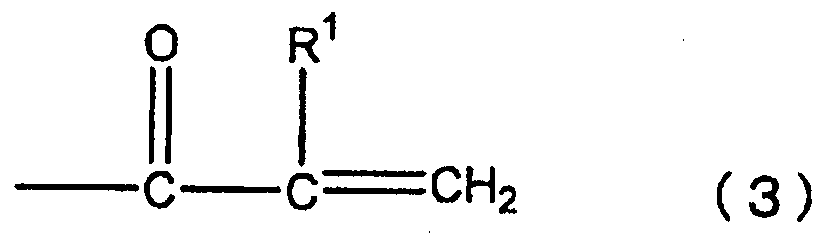
(In the formula, R1 represents a hydrogen atom or a methyl group, and "*" represents a bonding hand.)
The polyfunctional monomer having such a caprolactone structure is commercially available as KAYARAD DPCA series from NIPPON KAYAKU Co., Ltd., and examples thereof include KAYARAD DPCA-20 (in Fomrulas (1) to (3), a compound in which m = 1 , the number of groups represented by Formula (2) = 2, and all of Rhs represent a hydrogen atom), KAYARAD DPCA-30 (in the same formulas, a compound in which m = 1, the number of groups represented by Formula (2) = 3, and all of Rus represent a hydrogen atom), KAYARAD DPCA-60 (in the same formulas, a compound in which m = 1 , the number of groups represented by Formula (2) = 6, and all of R s represent a hydrogen atom), KAYARAD DPCA- 120 (in the same formula, a compound in which m = 2, the number of groups represented by Formula (2) = 6, and all of Rus represent a hydrogen atom), and the like.
In the present invention, a polyfunctional monomer having a caprolactone structure may be used either alone or in combination of two or more thereof.
As a specific monomer in the present invention, at least one selected from the compound group represented by the following general formula (i) or general formula (ii) is also preferred.

In the general formula (i) and general formula (ii), each of E's independently represents -((CH2)yCH20)- or -((CH2)yCH(CH3)0)-, each of y's independently represents an integer of from 0 to 10, each of X's independently represents an acryloyl group, a methacryloyl group, a hydrogen atom or a carboxyl group.
In the general formula (i), the sum of an acryloyl group and a methacryloyl group is 3 or 4, each of m's indenpendently represents an integer of from 0 to 10, and the sum of each m is an integer of from 0 to 40. However, when the sum of each m is 0, any one of X's is a carboxyl group.
In the general formula (ii), the sum of an acryloyl group and a methacryloyl group is 5 or 6, each of n indenpendently represents an integer of from 0 to 10, and the sum of each n is an integer of from 0 to 60. However, when the sum of each n is 0, any one of X is a carboxyl group.
In the general formula (i), m is preferably an integer of from 0 to 6, and more preferably an integer of from 0 to 4. The sum of each m is preferably an integer of from 2 to 40, more preferably an integer of from 2 to 16, and particularly preferably an integer of from 4 to 8.
In the general formula (ii), n is preferably an integer of from 0 to 6, and more preferably an integer of from 0 to 4. The sum of each n is preferably an integer of from 3 to 60, more preferably an integer of from 3 to 24, and particularly preferably an integer of from 6 to 12.
-((CH2)yCH20)- or -((CH2)yCH(CH3)0)- in the general formula (i) or the general formula (ii) is preferably a form in which X is bonded to the terminal end of the oxygene atom side.
The compound represented by the general formula (i) or general formula (II) may be used either alone or in combination of two or more thereof. In particular, in the general
formula (ii), a form n which all of six X's are an acrylolyl group is preferred.
The total content of the compound represented by the general formula (i) or general formula (ii) in the specific monomer is preferably 20 mass% or more and more preferably 50 mass% or more.
The compound represented by the general formula (i) or general formula (ii) may be synthesized from a process of bonding a ring-opening skeleton of ethylene oxide or propylene oxide to pentaerythritol or dipentaerythritol by means of a ring-opening addition reaction and a process of reacting, for example, (meth)acryloylchloride with a terminal hydroxyl group of the ring-opening skeleton to introduce a (meth)acryloyl group, which are processes known in the related art. Each process is well known process, and the compound represented by the general formula (i) or general formula (ii) may be readily synthesized by those skilled in the art.
Even among the compositions represented by the general formula (i) and general formula (ii), pentaerythrol deritives and/or dipentaerythritol derivatives are more preferred.
Specific examples thereof include compounds represented by the following formulas (a) to (f) (hereinafter, referred to as "exemplary compounds (a) to (f)") and among them, the exemplary compounds (a), (b), (e) and (f) are preferred.

(The sum of each n is 6)

(The sum of each n is 12)

(The sum of each n is 12)

(The sum of each n is 6)


ti 'm (The sum of each m is 12)
Examples of the commercially available products of the specific monomer represented by the general formula (i) and general formula (ii) include SR-494, which is a 4-functional acrylate having four ethyleneoxy chains, manufactured by Sartomer Company Inc., DPCA-60, which is a 6-functional acrylate having six pentyleneoxy chains, manufacutured by NIPPON KAYAKU Co., Ltd., TPA-330, which is a 3-functional acrylate having three isobutyleneoxy chains, and the like.
As a polymerizable compound, urethane acrylates as described in Japanese Patent Publication Nos. S48-41708, S51-37193, H2-32293 and H2-16765, or urethane compounds having an ethyleneoxide-based skeleton, described in Japanese Patent Publication Nos. S58-49860, S56-17654, S62-39417 and S62-39418 are also suitable. As a polymerizable compound, a curable composition having excellent photosensitive speed may be obtained by
using addition polymerizable compounds having an amino structure or a sulfide structure in a molecule, described in Japanese Patent Application Laid-Open Publication Nos. S63-277653, S63-260909 and Hl-105238.
Examples of the commercially available product of the polymerizable compound include urethane oligomers UAS-10 and UAB-140 (manufacuted by Sanyo-Kokusaku Pulp Co., Ltd.), UA-7200 (manufactured by SHIN-NAKAMURA CHMICAL CO., LTD.) DPHA-40H (manufactured by NIPPON KAYAKU Co., Ltd.), UA-306H, UA-306T, UA-306I, AH-600, T-600 and AI-600 (manufactured by KYOEISHA CHEMICAL CO., LTD.).
As the polymerizable compound, ethylenically unsaturated compounds having an acid group are suitable. The ethylenically unsaturated compounds having an acid group are obtained by a method for subjecting some hydroxyl groups of the polyfunctional alcohol to (meth)acrylation and addition-reacting an acid anhydride to the residual hydroxyl groups to obtain a carboxyl group and the like. Examples of the commericially available product include polybasic acid modified-acrylic oligomers manufactured by TOAGOSEI CO., LTD., such as M-5120 and M-520.
For these polymerizable compounds, details of the methods of use thereof, such as the structure of the compounds, single use or use of a combination, the amount to be added, and the like, may be arbitrarily determined in accordance with the final performance design of the curable compounds. For example, the details are selected from the viewpoint which is described above in the polymerizable compound (D-l).
When the composition of the present invention is a curable composition and contains a polymerizable compound (D-2), a polymerizable compound (hereinafter, also referred to as "epoxy compound") having at least one epoxy group may be used as the polymerizable compound (D-2). Such epoxy compounds are widely known in the technical field, and any of these compounds may be used in the present invention without any particular limitation.
The compound of the present invention may or may not contain the polymerizable compound (D-2), but when the compound contains the polymerizable compound (D-2), the content of the polymerizable compound (D-2) is preferably in the range of from 1 mass% to 50 mass%, more preferably in the range of from 3 mass% to 40 mass%, and even more preferably in the range of from 5 mass% to 30 mass%, based on the total solid content of the composition.
The content within the range is preferred, because the curability is excellent without deteriorating the refractive index.
(E-2) Polymerization Initiator
The polymerization initiator (E-2) used when the composition of the present invention is a curable composition and contains the polymerizable compound (D-2) is a compound that initiates and promotes the polymerization of the polymerizable compound (D-2), and it is preferred that the polymerization initiator (E-2) is stable up to 45°C from the viewpoint of improving the curing in the heating process such as processes (IV-2) and (b) in a method for manufacturing a microlens to be described below, but an ability to initiate polymerization during heating at a high temperature is excellent.
From the viewpoint of improving the curing in the exposure process by irradiation of radiation, such as processes (Π-2), (b), (d) and the like in the method for manufacturing a microlens to be described below, it is preferred to have photosensitivity to visible light from the ultraviolet region. The polymerization initiator may be an activator which causes any action with a photo-excited sensitizer to produce an active radical and may be an initiator which initiates the cationic polymerization according to the kind of the monomer.
It is preferred that the polymerization initiator contains at least one compound having a molecular absorption coefficient of at least about 50 within the range of about from 300 nm to 800 nm (more preferably from 330 nm to 500 nm).
The polymerization initiator may be used either alone or in combination of two or more thereof.
Examples of the polymerization initiator (E-2) include an organic halide compound, an oxydiazole compound, a carbonyl compound, a ketal compound, a benzoin compound, an acridine compound, an organic peroxide compound, an azo compound, a coumarin compound, an azide compound, a metallocene compound, a hexaaryl biimidazole compound, an organic boric acid compound, a disulfonic acid compound, an oxime ester compound, an onium salt compound and an acyl phosphine(oxide) compound, and specific examples thereof are the same as those described above in the polymerization initiator (E-l) and the preferred ranges thereof are also the same.
The oxime compound decomposes by the action of heat and functions as a thermal polymerization initiator that initiates and promotes the polymerization.
The oxime compound used in the second invention preferably has a maximum absorption wavelength in the wavelength region of from 350 nm to 500 nm, more preferably an absorption wavelength in the wavelength region of from 360 nm to 480 nm, and it is particularly preferred that the oxime compound has a high absorbance of 365 nm and 455 nm.
The oxime compound has a molar absorption coefficient of preferably from 1,000 to 300,000, more preferably from 2,000 to 300,000, and particularly preferably 5,000 to 200,000 in 365 nm or 405 nm, from the viewpoint of sensitivity.
The molar absorption coefficient of the compound may be measured by using a known method, but specifically, it is preferred that the coefficient is measured, for example, by an ultraviolet and visible spectrophotometer (CARY-5 spectrophotometer, manufactured by Varian Inc.) at a concentration of 0.01 g/L using an ethyl acetate solvent.
As the oxime compound, commercially available products such as IRGACURE OXE01 and IRGACURE OXE02 (all manufactured by BASF Corporation) may be suitably used and IRGACURE OXE01 is more preferred.
Examples of the onium salt compound include the onium salt compounds which are described above in the polymerization initiator (E-l) and the like, and the preferred ranges thereof are also the same.
The composition of the present invention may or may not contain the polymerization initiator (E-2), but when the composition contains the initiator, the content of the polymerization initiator (E-2) (total content in the case of two or more thereof) is preferably from 0.1 mass% to 10 mass%, more preferably from 0.3 mass% to 8 mass%, and even more preferably from 0.5 mass% to 5 mass%, based on the total solid content of the composition. Within these ranges, good curability may be obtained.
When the composition of the present invention is a curable composition, the curable composition may further contain an arbitrary component if needed, as described in detail below. Hereinafter, the arbitrary component, which the curable composition may contain, will be described.
[Sensitizer]
The curable composition of the present invention may contain a sensitizer for the purpose of improving radical generation efficiency of the polymerization initiator (E-2), and shifting the sensitive wavelength to a longer wavelength.
The sensitizer that may be used in the present invention preferably sensitizes the polymerization initiator (E-2) by the electron transfer mechanism or the energy transfer mechanism.
Examples of the sensitizer include sensitizers that belong to the compounds to be listed below and have an absorption wavelength in the wavelength region of from 300 nm to 450 nm.
That is, examples thereof include polynuclear aromatic groups (for example, phenanthrene, anthracene, pyrene, perylene, triphenylene and 9,10-dialkoxy anthracene), xanthenes (for example, fluorescein, eosin, erythrosine, Rhodamine B and rose bengal), thioxanthones (isopropylthioxanthone, diethylthioxanthone and chlorothioxanthone), cyanines (for example, thiacarbocyanine and oxacarbocyanine), merocyanines (for example, merocyanine and carbomerocyanine), phthalocyanines, thiazines (for example, thionine, Methylene Blue and Toluidine Blue), acridines (for example, acridine orange, chloroflavin and acriflavine), anthraquinones (for example, anthraquinone), squaryliums (for example, squarylium), acridine orange, coumarins (for example, 7-diethylamino-4-methylcoumarin), ketocoumarin, phenothiazines, phenazines, styryl benzenes, azo compounds, diphenylmethane, triphenylmethane, distyryl benzenes, carbazoles, porphyrin, spiro compounds, quinacridone, indigo, styryl, pyrylium compounds, pyrromethene compounds, pyrazolotriazole compounds, benzothiazole compounds, barbituric acid derivatives, thiobarbituric acid derivatives, aromatic ketone compounds such as acetophenone, benzophenone, thioxanthone, Michler's ketone and the like, heterocyclic compounds such as N-aryloxazolidinone.
More preferred examples of the sensitizer that may be used in the present invention include compounds represented by following general formulas (e-1) to (e-4).

In Formula (e-1), A1 represents a sulfur atom or NR50, R50 represents an alkyl group or an aryl group, L1 represents a non-metal atomic group that forms a basic nucleus of the dye, together with A1 and carbon atoms which are adjacent to L1, each of R3i and R52 independently represents a hydrogen atom or a monovalent non-metal atomic group, and R and R may be bonded to each other to form an acidic nucleus of the dye. W represents an oxygen atom or a sulfur atom.
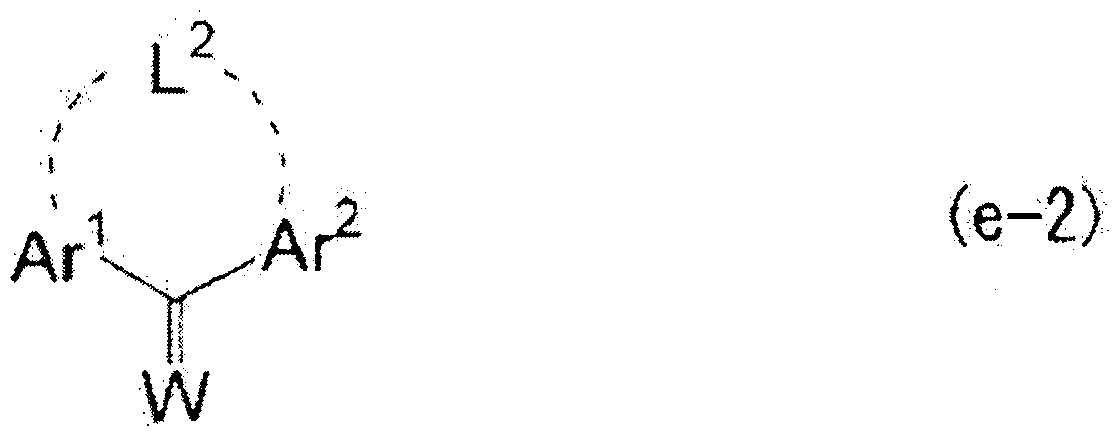
1 1
In Formula (e-2), each of Ar and Ar independently represents an aryl group, and Ar and Ar2 are linked with each other via the bond -L2- therebetween. Here, -L2- represents -O- or -S-. W is the same as what is described in Formula (e-1).
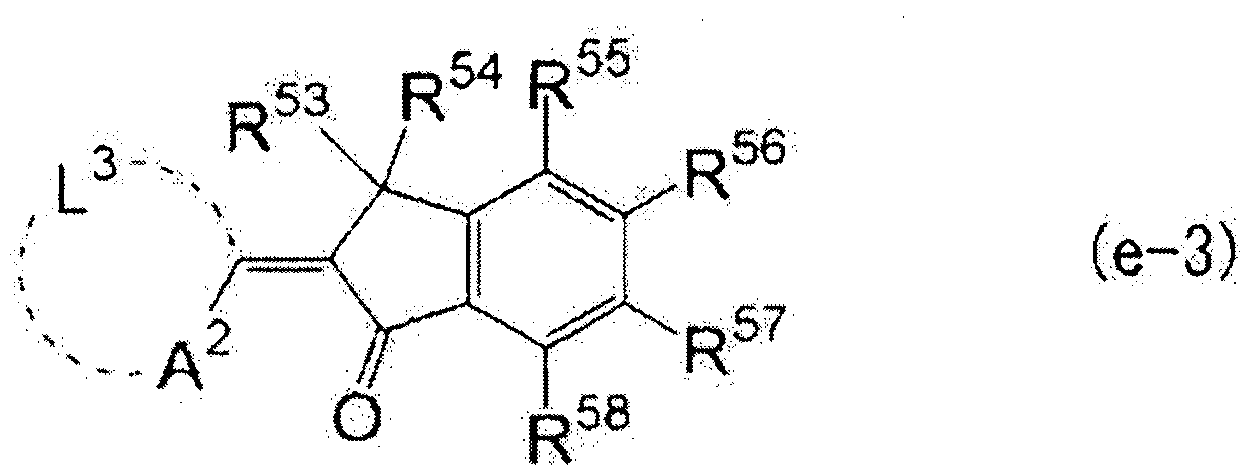
In Formula (e-3), A2 represents a sulfur atom or NR59, L3 represents a non-metal atomic group that forms a basic nucleus of the dye together with A2 and carbon atoms, which are adjacent to L3, each of R53, R54, R55, R56, R57 and R38 independently represents a monovalent non-metal atomic group, and R59 represents an alkyl group or an aryl group.
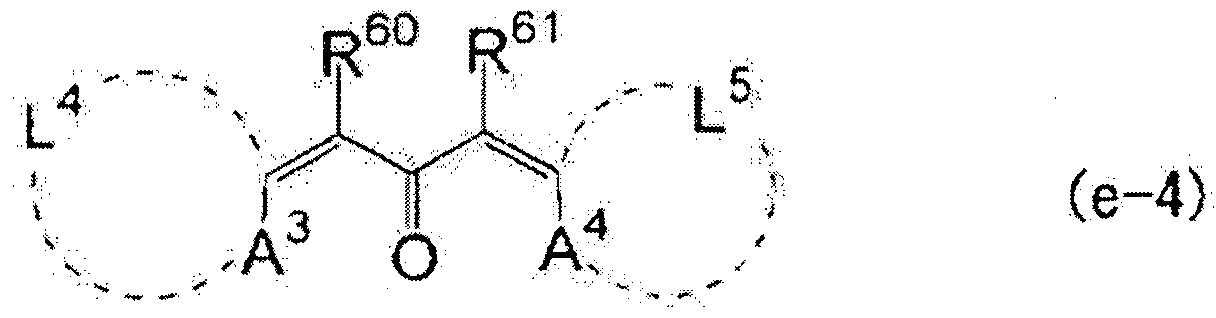
In Formula (e-4), each of A3 and A4 independently represents -S- or -NR62, R62 represents a substituted or unsbstituted alkyl group, or a substituted or unsbstituted aryl group, L4 represents a non-metal atomic group that forms a basic nucleus of the dye together with A3 and carbon atoms, which are adjacent to L4, L5 represents a non-metal atomic group that forms a basic nucleus of the dye together with A4 and carbon atoms, which are adjacent to L5, each of R60 and R61 independently represents a monovalent non-metal atomic group, or may be bonded to each other to form an aliphatic or aromatic ring.
The curable composition may or may not contain a sensitizer, but when the
composition contains a sensitizer, the content of the sensitizer in the curable composition is preferably from 0.1 mass% to 20 mass%, and more preferably from 0.5 mass% to 15 mass%, in terms of solid content from the viewpoint of light absorption efficiency to the deep portion and the decomposition efficiency of an initiator.
The sensitizers may be either alone or in combination of two or more thereof.
Examples of the preferable sensitizer that may be contained in the curable composition include at least one selected from the compound represented by the following general formula (II) and the compound represented by the general formula (III), in adition to the sensitizers.
The sensitizers may be either alone or in combination of two or more thereof.

In Formula (II), each of Ru and R12 independently represents a monovalent substituent group, and each of R13, R14, R15 and R16 independently represents a hydrogen atom or a monovalent substituent group, n represents an integer of from 0 to 5, n' represents an integer of from 0 to 5, but there is no case where both n and n' are 0 at the same time. When n is two or more, each of a plurality of Rn's may be the same as or different from every other Rn. When n' is two or more, each of a plurality of R12's may be the same as or different from every other R . The Formula (II) is not limited to any one of the isomers thereof by means of the double bonds.
The molar absorption coefficient ε of the compound represented by Formula (II) is preferably 500 mor'-L-cm"1 or more at a wavelength of 365 nm, more preferably 3,000 mor'-L-cm"1 or more at a wavelength of 365 nm, and most preferably 20,000 mor'-L-cm"1 or more at a wavelength of 365 nm. It is preferred that the value of the molar absorption coefficient ε at each wavelength is within the above-described range, from the viewpoint of the light absorption efficiency because the effect of increasing the sensitivity is high.
Preferred specific examples of the compounds represented by the general formula (II) are illstrated below, but the present invention is not limited thereto.
Meanwhile, in the present specification, chemical formulas may be described by
simplified structural formulas, and solid lines represent hydrocarbon groups, unless elements or substituent groups are otherwise specified.

In the general formula (III), A represents an aromatic ring or heterocyclic ring which may have a substituent group, X4 represents an oxygen atom, a sulfur atom or -N(R23)-, and Y
, 22 represents an oxygen atom, a sulfur atom or -N(R23)-. Each of R21, R and R 2f independently represents a hydrogen atom or a monovalent non-metal atomic group, and each of A5, R21, R22 and R23 may be bonded to one another to form an aliphatic or aromatic ring.
In the general formula (III), each of R21, R22 and R23 independently represents a
21 22 23 hydrogen atom or a monovalent non-metal atomic group. When each of R , R and R
1 22 23
represents a monovalent non-metal atomic group, each of R , R and R is preferably a substituted or unsubstituted alkyl group, a substituted or unsubstituted aryl group, a substituted or unsubstituted alkenyl group, a substituted or unsubstituted aromatic heterocyclic residue, a substituted or unsubstituted alkoxy group, a substituted or unsubstituted alkylthio group, a hydroxyl group or a halogen atom.
In a compound represented by the general formula (III), Y is preferably an oxygen atom or -N(R23)-, from the viewpoint of improving the decomposition efficiency of the photopolymerization initiator. R23 represents a hydrogen atom or a monovalent non-metal atomic group. Y is most preferably -N(R )-.
Hereinafter, preferred specific examples of the compounds represented by the general formula (III) will be shown, but the present invention is not limited thereto. The isomers by means of the double bond that connects the acidic nucleus and the basic nucleus are not specified, and the present invention is not limited to any one of the isomers.

[Co-Sensitizer]
It is preferred that the curable composition of the present invention also contains a co-sensitizer.
In the present invention, the co-sensitizer has the function of further increasing the sensitivity of the polymerization initiator (E-2) or a sensitizer to the active radiation, suppressing the polymerization inhibition of the polymerizable compound (D-2) due to oxygen, and the like.
Examples of such co-sensitizers include amines, for example, compounds described in "Journal of Polymer Society", Vol. 10, p. 3173 (1972) written by M. R. Sander et al., Japanese Patent Publication No. S44-20189, Japanese Patent Application Laid-Open Nos. S51-82102, S52-134692, S59-138205, S60-84305, S62-18537 and S64-33104, and Research Disclosure No. 33825. Specific examples thereof include triethanol amine, ethyl-p-dimethylaminobenzoate, p-formyldimethylaniline, p-methylthiodimethylaniline and the like.
Other examples of the co-sensitizers include thiols and sulfides, for example, thiol compounds described in Japanese Patent Application Laid-Open No. S53-702, Japanese Patent Publication No. S55-500806, and Japanese Patent Application Laid-Open No. H5- 142772, disulfide compounds described in Japanese Patent Application Laid-Open No. S56-75643, and the like. Specific examples thereof include 2-mercaptobenzothiazole,
2-mercaptobenzoxazole, 2-mercaptobenzimidazole, 2-mercapto-4(3H)-quinazoline, β-mercaptonaphthalene and the like.
Still other examples of the co-sensitizers include amino acid compounds (for example, N-phenylglycine and the like), organic metal compounds described in Japanese Patent Publication No. S48-42965 (for example, tributyl tin acetate and the like), a hydrogen donor
described in Japanese Patent Publication No. S55-34414, sulfur compounds (for example, trithiane and the like) described in Japanese Patent Application Laid-Open No. H6-308727, and the like.
The curable composition may or may not contain a co-sensitizer, but when the composition contains a co-sensitizer, the content of the co-sensitizer is preferably in the range of from 0.1 mass% to 30 mass%, more preferably in the range of from 1 mass% to 25 mass%, and even more preferably in the range of from 1.5 mass% to 20 mass%, based on the total solid content mass of the curable composition from the viewpoint of increasing the curing rate by means of the balance of the polymerization growth rate and the chain transfer.
[Polymerization Inhibitor]
In the present invention, in order to prevent unnecessary polymerization of a compound having a polymerizable ethylenically unsaturated double bond during the preparation or the storage of the curable composition, it is preferable to add a polymerization inhibitor.
As the polymerization inhibitor, the polymerization inhibitor which is described above in the first invention may be used in the above-described amount of the polymerization inhibitor added. Preferred aspects thereof are also the same as in the first invention.
(UV Absorber)
The curable composition of the present invention may contain an UV absorber. As the UV absorber, the UV absorber which is described above in the first invention may be used in the above-described content of the UV absorber. The preferred ranges thereof are also the same.
[Other additives]
In order to improve physical properties of the cured film, any one of known additives such as a plasticizer and a sensitization agent may be added to the curable composition.
As the plasticizer, the plasticizer which is described above in the first invention may be used in the above-described amount of the plasticizer added.
The composition or curable composition of the present invention includes a solvent, and the solvent may consists of various organic solvents. Examples of the organic solvents that may be used include the organic solvents such as the solvent (C-2) in the above-described dispersion composition.
These organic solvents may be used either alone or in combination. The concentration of the solid content in the composition or curable composition of the present
invention is preferably from 2 mass% to 60 mass%.
[Method for Manufacturing Transparent Film]
A method for manufacturing a transparent film of the present invention includes a process of coating the composition or curable composition described above on a wafer by means of a spray method, a roll coat method, a spin coating method, a bar-coating method and the like, a subsequent first heating process, and a subsequent second heating process at a temperature higher than the heating temperature in the first heating process.
The conditions in the first heating process are the same as the conditions to be described below as pre-bake conditions in the (1-2) process in the method for manufacturing a microlens.
The conditions in the second heating process are the same as the conditions to be described below as post-bake conditions in the (IV-2) process in the method for manufacturing a microlens.
<Microlens>
The compositon or curable composition of the present invention may form a transparent film which has high refractive index and high transmittance, and thus, may be very suitably used for forming, for example, a microlens and a microlens array.
That is, the composition or curable composition of the present invention is preferably for forming a microlens.
The present invention also relates to a microlens formed by using a transparent film formed by using the composition or curable composition of the present invention.
[Method for Forming Microlens]
As a method for manufacturing a microlens by using the composition or curable composition of the present invention, a method which is usually used may be applied without any particular limitation, and examples thereof include a manufacturing method further including a process of subjecting the transparent film described above to post-bake treatment to shape the transparent film and a dry etching process and the like.
The process of subjecting the transparent film to post-bake treatment to shape the transparent film is the same as the process to be described in detail below as the (f) process.
The dry etching process is the same as the process to be described in detail below as the (g) process.
As a preferred aspect of the method for manufacturing a microlens by using the curable composition of the present invention, examples thereof include a manufacturing method, at
least including the following (1-2) to (IV-2) processes.
(1-2) A process of forming a coating film of the curable composition of the present invention on a substrate
(II-2) A process of irradiating radiation on at least some portion of the coating film (III-2) A process of developing the coating film after the irradiation
(IV-2) A process of heating the coating film after the development
Hereinafter, these processes will be described.
(1-2) Process
In this process, the curable composition is preferably coated as a liquid composition on the surface of a substrate and subjected to pre-bake to remove the solvent, thereby forming a coating film on the substrate.
Examples of the substrate include a glass substrate, a silicon wafer, a substrate with various metal layers formed on the surface thereof, a substrate on which an on-chip color filter for an image sensor is coated, and the like.
The coating method is not particularly limited, and an appropriate method such as, for example, a spray method, a roll coat method, a spin coating method and a bar-coating method may be employed.
The pre-bake condition may vary according to the kind or use amount of each component, but is usually at from 60°C to 120°C for from 30 sec to 15 min. The film thickness of the coating film to be formed is a value after the pre-bake, and is preferably from 0.5 μηι to 20 μιτι.
(II-2) Process
In this process, radiation is irradiated on at least some portion of the coating film formed.
When radiation is irradiated only on some portion of the coating film, the radiation is irradiated via a mask having a predetermined pattern.
As the radiation rays to be irradiated, ultraviolet rays such as, for example, g-ray and i-ray, far ultraviolet rays such as KrF excimer laser and ArF excimer laser, X-ray such as synchrotron radiation, charged particle radiations such as electron radiation may be used, but among them, ultraviolet rays are most preferred.
The exposure amount may be suitably selected according to the constitution of a curable composition and the like, but is preferably from 50 mJ/cm2 to 2,000 mJ/cm2.
(III-2) Process
In this process, the coating film after the exposure is developed by a developing solution, preferably an alkaline developing solution and a pattern of a predetermined shape is formed by removing unirradiated portions.
The alkaline developing solution, developing method and developing time are the same as each of the alkaline developing solution, developing method and developing time, which are described above in the (V-l ) process in the first invention, respectively.
(IV-2) Process
In this process, the coating film is cured by heating (post-bake) the coating film after the development by using a heating apparatus such as a hot plate and an oven.
In the post-bake, the heating temperature is usually from 120°C to 250°C, and preferably from 160°C to 230°C. The heating time may vary according to the heating means, but when heating is performed on a hot plate, the heating time is usually from 5 min to 30 min, and when the heating is performed in an oven, the heating time is usually from 30 min to 90 min.
In performing the post-bake, a step bake method including carrying out a heat treatment two or more times may be employed.
As another preferred aspect of the method for manufacturing a microlens by using the curable composition of the present invention, examples thereof include a forming method, at least including the following (a) to (g) processes.
(a) A process of forming a coating film on a substrate such as a color filter by using the curable composition of the present invention
(b) A process of performing at least one of heating the above-described coating film to dry (or dry and cure) the coating film or exposing the above-described coating film by means of a light source (g-ray, i-ray and the like) having an appropriate wavelength to cure the coating film, thereby obtaining a high refractive index film (transparent film)
(c) A process of forming a resist coating film on the high refractive index film after the heating
(d) A process of exposing the resist coating film by using a light source (g-ray, i-ray and the like) having an appropriate wavelength
(e) A process of developing the resist coating film after the exposure to form a resist pattern
(f) A process of shaping the resist into a lens-type by means of post-heating
(g) A process of removing the resist pattern and some portion of the high refractive
index film by means of dry etching to shape the high refractive index film into a lens-type Hereinafter, these processes will be described.
- (a) Process -
In this process, the curable composition of the present invention is coated on a substrate such as a color filter to form a coating film.
Examples of the coating method include the method as in the process (1-2).
- (b) Process -
In this process, a preferred embodiment of heating the coating film may include a two-step heating treatment of pre-bake and post-bake.
The pre-bake condition may vary according to the kind or use amount of each component, but is usually at from 60°C to 120°C for from 30 sec to 15 min. The film thickness of the coating film to be formed is a value after the pre-bake, and is preferably from 0.5 μηι to 20 μηι. The pre-bake process may be omitted in some cases.
Subsequently, the coating film is cured by heating (post-bake) the coating film using a heating apparatus such as a hot plate and an oven. The post-bake condition is usually at from 120°C to 300°C for from 30 sec to 60 min. Meanwhile, the curing may be promoted by performing exposure prior to the post-bake process.
When the above-described coating film is exposed by a light source (g-ray, i-ray and the like) having an appropriate wavelength to be cured, the kind of radiation and the amount of exposure, which are the same as in the process (II-2), may be applied to the radiation to be irradiated.
- (c) Process -
In the process, a resist coating film is formed on a high refractive index film. As the resist, generally commercially available resists which is able to form a pattern by ultraviolet exposure may be used. For the resist coating film, the pre-bake is performed in the (a) process.
- (d) Process -
In this process, (the coating film is exposed into a pattern type by using a mask. The kind of radiation and the amount of exposure, which are the same as in the process (Π-2), may be applied to the radiation to be irradiated.
- (e) Process -
In this process, the resist coating film after the exposure is developed by a developing solution, preferably an alkaline developing solution and a pattern of a predetermined shape is
formed by removing unirradiated portions or irradiated portions, of the radiation.
Examples of the alkaline developing solution include the alkaline developing solution as in the process (ΠΙ-2).
Examples of the developing method include the method as described above about the process (III-2).
The developing time is the same as what is described above in the process (ΙΠ-2).
- (f) Process -
In this process, a post-heating (post-bake) is performed by a heating apparatus such as a hot plate and an oven, thereby shaping the resist into a lens type after the pattern is formed. The post-bake condition is usually at from 120°C to 300°C for from 30 sec to 60 min. For shaping into a lens type, a step bake method including carrying out a heat treatment two or more times may also be employed.
- (g) Process -
Dry etching may be performed by a known method (for example, Japanese Patent Application Laid-Open No. 2010-204154).
In this manner, a desired microlens may be manufactured.
According to the method of the present invention for manufacturing a microlens, a high-definition microlens and microlens array having excellent properties (for example, high refractive index and high transmittance) may be simply formed with a high product yield.
The microlens in the present invention is formed from the composition or curable composition of the present invention and has excellent balance in properties, and may be very suitably used in a liquid crystal display device for various OA equipment, liquid crystal televisions, portable telephones, projectors and the like, the imaging optics of a on-chip color filter such as a facsimile, an electronic copy machine, a solid-state image sensing device and the like, an optical fiber connector, and the like.
<Solid-State Image Sensing Device>
The solid-state image sensing device of the present invention includes the microlens formed by using the above-described composition or curable composition of the present invention.
The solid-state image sensing device of the present invention includes a microlens which has a high refractive index and high transmittance, and thus, noise may be reduced, and excellent color reproducibility is shown.
The solid-state image sensing device of the present invention is not particularly limited
as long as the device has a constitution in which the microlens formed by using the composition or curable composition of the present invention is included and a constitution which functions as a solid-state sensing device, and examples thereof include a constitution in which a light-receiving element consisting of a plurality of photodiodes, polysilicons and the like which constitute a light-receiving area of a solid-state image sensing device (CCD image sensor, CMOS image sensor, and the like) is disposed on a substrate, a constitution in which the microlens is included on a color filter and the like.
The method of the present invention for manufacturing a solid-state image sensing device is not particularly limited, but as one preferred aspect, the method includes a process of forming red pixels, blue pixels and green pixels on a substrate for a solid-state image sensing device having at least a photodiode, a light-shielding film and a device protective film, a process of coating the composition or curable composition described above and performing heating, a process of forming a resist pattern, a process of shaping a resist pattern formed by performing post-bake treatment into a lens-type shape, and a process of performing dry etching.
The process of coating the composition or curable composition and performing heating is performed in the same manner as in the process of forming a coating film on a substrate and the process of heating the coating film to dry (or dry and cure) the coating film in the (a) process and the (b) process in the above-described method for manufacturing a microlens.
The process of forming a resist pattern is performed in the same manner as in the (d) process and (e) process in the above-described method for manufacturing a microlens.
The process of shaping a resist pattern formed by performing a post-bake treatment into a lens-type shape is performed in the same manner as in the (f) process in the above-described method for manufacturing a microlens.
The process of performing dry etching is performed in the same manner as in the (g) process in the above-described method for manufacturing a microlens.
Examples
Hereinafter, the present invention will be specifically described with reference to examples, but the present invention is not limited to the examples. Meanwhile, unless particularly specificed, "parts" and "%" are based on by mass.
<Example 1-1>
[Preparation of Titanium Dioxide Dispersion Liquid (Dispersion Composition)]
A mixed liquid having the following composition was subjected to dispersion treatment by using ULTRA APEX MILL manufactured by KOTOBUKI INDUSTRIES Co., Ltd. as a circulation-type dispersion device (bead mill) in the following manner to obtain a titanium dioxide dispersion liquid as a dispersion composition.
- Composition -
• Titanium dioxide (manufactured by ISHIHARA SANGYO KAISHA, LTD. TTO-51 (C-l)): 150 parts
• Resin of "Exemplary Compound 3" (Graft Copolymer (B-l)): 40.5 parts
• Propylene glycol monomethyl ether acetate: 462 parts
A graft chain of the resin of the Exemplary Compound 3 has the number of atoms (except hydrogen atoms) of 253 and a weight average molecular weight of 30,000.
The dispersion device is operated under the following conditions.
• Bead diameter: φθ.05 mm
• Bead filling rate: 75 volume%
• Peripheral speed: 8 m/sec
• Pump supply amount: 10 Kg/hour
• Cooling water: tap water
■ Inner volume of bead mill annular passage: 0.15 L
• Amount of mixed liquid for dispersion treatment: 0.44 Kg
After the initiation of dispersion, average particle diameters were measured at a 30 minute interval (time for one pass).
The average particle diameter was decreased with the dispersion time (number of passes), but the variation amounts were gradually decreased. At a time point in which the change in the primary particle diameter when the dispersion time was increased by 30 min became 5 nm or less, the dispersion was terminated. Meanwhile, titanium dioxide particles in the dispersion liquid had a primary particle diameter of 40 nm.
Meanwhile, the primary particle diameter of titanium dioxide in the present Example refers to a value obtained by performing measurement on a diluted solution obtained by diluting a mixed solution or a dispersion liquid including titanium dioxide to 80 times (by volume) with propylene glycol monomethyl ether acetate using a dynamic light scattering method.
This measurement is calculated as a number average particle diameter obtained by performing measurement using MICROTRAC UPA-EX150 manufactured by NIKKISO Co.,
Ltd.
[Preparation of Curable Composition]
The titanium dioxide dispersion liquid (dispersion composition) obtained above was used and each component was mxied with each other so as to have the following composition, thereby obtaining a curable composition.
- Composition of Curable Composition -
■ Titanium dioxide dispersion liquid prepared above (dispersion composition)
78.26 parts
Acrylate monomer (polymerizable compound, rKAYARAD DPHAj (manufactured by NIPPON KAYAKU Co., Ltd.)) 4.36 parts
• Oxime-based photopolymerization initiator 0.30 parts (Polymerization initiator, following K-l)
• Binder polymer (F- 1 ) 2.18 parts (Following J-1 ; weight average molecular weight (Mw) and copolymerization ratio
(molar ratio) are as follows)
• Surfactant (G-l) MEGAFAC F-781 (manufactured by DIC Corporation) 0.30 parts
• Propylene glycol monomethyl ether acetate 14.60 parts


(manufactured by BASF Corporation)
(manufactured by BASF Corporation) . (manufactured by BASF Corporation)

(Manufacture of Transparent Film)
The curable composition obtained above was coated on a 12-inch silicon wafer by a spin coating method, followed by heating at 100°C on a hot plate for 2 min to obtain a coating film having a film thickness of 1.05 μιη. The coating film was heated at 200°C on a hot plate for 5 min to obtain a cured film (film thickness: 1.0 μιη) as a transparent film.
[Measurement of Refractive Index and Light Transmittance of Transparent Film]
For the substrate obtained above, a referactive index of a transparent film to light at a wavelength of 500 nm was measured by using ellipsometry manufactured by J.A.WooUam JAPAN Co., Inc. The light transmittance of the transparent film was measured throughout the wavelength region of from 400 nm to 700 nm by using MCPD Series manufactured by Otsuka Electronics Co., Ltd.
Each of the results is shown in the following Table 1-1. Meanwhile, because the tranmittance at 400 nm in the range of from 400 to 700 nm is the lowest value, the transmittance at 400 nm was described.
[Evaluation of Dispersion Stability]
The viscosity of the titanium dioxide dispersion liquid (dispersion composition) obtained above was measured by "RE-85L" manufactured by TOKI SANGYO CO., LTD., and then the dispersion liquid was allowed to stand under conditions at 45 °C for 3 days and the viscosity was again measured again to evaluate the difference in viscosity before and after the process.
[Measurement of Difference in Film Thickness between Center portion and Peripheral Portion of Wafer]
For a wafer substrate with a transparent film formed thereon, which was obtained above, a difference between a thickness of the transparent film at a center portion of the wafer and a thickness of the transparent film at a portion that was recessed by 3 cm in a direction from a peripheral portion of the wafer to the center portion of the wafer was measured by Dekrak (manufactured by Veeco Instruments Inc.). Numerical results are shown in the following Table 1-1.
<Examples 1-2 to 1-27, Reference Examples 1-1 to 1-4, and Comparative Examples 1-1 and l-2>
The curable compositions in Examples 1-2 to 1-27, Reference Examples 1-1 to 1-4, and Comparative Examples 1-1 and 1-2 were prepared in accordance with Example 1 -1, except that the content of titanium dioxide based on the total solid content of the curable composition and the kinds of graft copolymer and polymerization initiator were changed as in the following Table 1-1.
That is, in the example in which the graft copolymer was changed from the Exemplary Compound 3 which was used in Example 1-1, a titanium dioxide dispersion liquid obtained by using the graft copolymer shown in Table 1-1 instead of the Exemplary Compound 3 was used in the preparation of the titanium dioxide dispersion liquid used in Example 1-1. Meanwhile, "the number of atoms of the graft chain" described in Table 1-1 means the number of atoms except hydrogen atoms.
In the example in which the polymerization initiator was changed from the compound -l used in Example 1-1, a polymerization initiator shown in Table 1-1 instead of the compound K-l was used in the preparation of the curable composition in Example 1-1. Meanwhile, for Example 1-2, Example 1-3, Reference Example 1-1 and Reference Example 1 -2, preparations were separately performed as follows.
Example 1-2
The titanium dioxide dispersion liquid (dispersion composition) obtained above was used and each component was mxied with each other so as to have the following composition, thereby obtaining a curable composition.
- Composition of Curable Composition -
• Titanium dioxide dispersion liquid prepared above (dispersion composition)
65.22 parts
• Acrylate monomer (polymerizable compound, "KAYARAD DPHA" (manufactured by NIPPON KAYAKU Co., Ltd.)) 4.36 parts
• Oxime-based photopolymerization initiator 0.30 parts (Polymerization initiator, above K-l)
• Binder polymer (F-l) 5.99 parts (Above J-1 ; weight average molecular weight (Mw) and copolymerization ratio (molar ratio) are the same as above)
• Surfactant (G-l) MEGAFAC F-781 0.30 parts
• Propylene glycol monomethyl ether acetate 23.83 parts Reference Example 1-1
The titanium dioxide dispersion liquid (dispersion composition) obtained above was used and each component was mxied with each other so as to have the following composition, thereby obtaining a curable composition.
- Composition of Curable Composition -
• Titanium dioxide dispersion liquid prepared above (dispersion composition
63.91 parts
• Acrylate monomer (polymerizable compound, "KAYARAD DPHA" (manufactured by NIPPON KAYAKU Co., Ltd.)) 4.36 parts
• Oxime-based photopolymerization initiator 0.30 parts (Polymerization initiator, above K-l)
• Binder polymer (F-l) 6.37 parts (Above J-1 ; weight average molecular weight (Mw) and copolymerization ratio (molar ratio) are the same as above)
• Surfactant (G- 1 ) MEGAFAC F-781 0.30 parts
• Propylene glycol monomethyl ether acetate 24.76 parts Example 1-3
A titanium dioxide dispersion liquid (titanium dioxide particles have a primary particle diameter of 40 nm) was prepared with the following composition in the same manner as above.
- Composition -
• Titanium dioxide (manufactured by ISHIHARA SANGYO KAISHA, LTD. TTO-51 (C-l)): 150 parts
• Resin of "Exemplary Compound 3" (Graft Copolymer (B-l)): 12.0 parts
• Propylene glycol monomethyl ether acetate: 490.5 parts The titanium dioxide dispersion liquid (dispersion composition) obtained above was
used and each component was mxied with each other so as to have the following composition, thereby obtaining a curable composition.
- Composition of Curable Composition -
• Titanium dioxide dispersion liquid prepared above (dispersion composition)
1 17.39 parts
• Acrylate monomer (polymerizable compound, "KAYARAD DPHA" (manufactured by NIPPON KAYAKU Co., Ltd.)) 0.73 parts
• Oxime-based photopolymerization initiator 0.10 parts (Polymerization initiator, above K-l)
■ Surfactant (G-l) MEGAFAC F-781 0.01 parts
■ Propylene glycol monomethyl ether acetate 10.0 parts Reference Example 1 -2
- Composition of Curable Composition -
• Titanium dioxide dispersion liquid described in Example 1-3 (dispersion composition) 118.69 parts
• Acrylate monomer (polymerizable compound, "KAYARAD DPHA" (manufactured by NIPPON KAYAKU Co., Ltd.)) 0.44 parts
• Oxime-based photopolymerization initiator 0.08 parts (Polymerization initiator, above K-l)
• Surfactant (G-l) MEGAFAC F-781 0.01 parts
■ Propylene glycol monomethyl ether acetate 10.0 parts The curable composition obtained was used in the same manner as in Example 1-1 to manufacture each of the transparent films, followed by evaluation in the same manner as in Example 1 - 1. The results are shown in Table 1 - 1.
)
) g
 Table 1-1
#1 : Content (mass%) of titanium dioxide based on total solid content of curable composition
#2: Content (mass%) of structural unit having acid group based on total mass of graft copolymer (B-l)
#3: Acid value (mgKOH/g) of graft copolymer (B-l)
#4: Weight average molecular weight of graft copolymer (B-l)
#5: Difference (nm) in film thickness of transparent film between center portion and peripheral portion of wafer

Table 1-1 continued

Table 1-1 continued

From Table 1-1, it can be seen that the curable composition of the present invention had a small difference in film thickness between the center portion and the peripheral portion of the wafer. It can be seen that a transparent film formed by using the curable composition of the present invention had a high refractive index.
Although examples in which a transparent film is formed on a silicon wafer have been described in the above Examples, in the case of manufacturing a solid-state image sensing device, the silicon wafer may be changed only into a substrate for a solid-state image sensing device, with a photodiode, a light-shielding film, a device protective film and the like formed thereon.
A light-shielding film formed of tungsten, such that only a light-receiving part of a photodiode is open, is formed on a silicon wafer with the photodiode and a transfer electrode formed thereon to form a device protective layer formed of silicon nitride such that the entire surface of the light-shielding film formed and the photodiode light-receiving part (opening part in the light-shielding film) are covered.
Subsequently, the curable composition in the Example, which was prepared as an undercoat layer as described above, was coated on the formed device protective layer so as to have a film thickness of 0.50 μιη, followed by heating at 100°C for 2 min with a hot plate. Subsequently, the film was heated at 230°C for 10 min by using a hot plate and cured. Thereon, each of red pixels, blue pixels and green pixels with a side length of 1.4 μηι was formed by a method described in Example 16 of Japanese Patent Application Laid-Open No. 2010-210702 and then a color filter was prepared.
Thereon, the curable composition in the Example, prepared as described above, was coated so as to have a film thickness of 1.5 μηι, heated at 100°C for 2 min by using a hot plate, followed by heating at 230°C for 10 min by using a hot plate to cure the film.
HPR-204ESZ-9-5 mPa-s (resist liquid manufactured by FUJIFILM Electronic Materials Co., Ltd.) was coated thereon, followed by heating at 90°C for 1 min by using a hot plate. The coating film was exposed at 100 mJ/cm2 via a mask having a plurality of square paterns with a side length of 1.4 μηι by an i-ray stepper (product name: FPA-3000i5+, manufactured by Canon Inc.). Here, the mask was disposed such that the plurality of square patterns in the mask had positions corresponding to red pixels, blue pixels and green pixels in the color filter, respectively.
The film was subjected to puddle development using the alkaline developing solution
HPRD-429E (manufactured by FUJIFILM Electronic Materials Co., Ltd.) at room temperature for 60 sec, followed by rinsing with pure water by spin shower for 20 sec. Thereafter, the film was further washed with pure water, and then the substrate was dried with a high-speed rotation to form a resist pattern. The film was subjected to a post-bake treatment on a hot plate at 200°C for 300 sec to shape the resist into a lens-type shape.
The substrate thus-obtained was subjected to a dry etching treatment under the following conditions by using a dry etching device (manufactured by Hitachi High-Technologies Corporation : U-621) and then a high refractive index transparent film of the present invention having a high refractive index was processed so as to be used as a microlens.
• RF Power: 800 W
• Antenna bias: 100 W
■ Wafer bias: 500 W
• Chamber inner pressure: 0.5 Pa
• Substrate temperature: 50°C
• Kind of mixed gas and flow rate: CF4/C4F6/02/Ar=l 75/25/50/200 ml/min
• Photoresist etching rate: 140 nm/min
When the device obtained was used to photograph an image, an image having excellent sensitivity even in a dark room could be obtained.
<Preparative Example 2-l>
[Preparation of Titanium Dioxide Dispersion Liquid 1 (Dispersion Composition)] A mixed liquid having the following composition was subjected to dispersion treatment by using ULTRA APEX MILL (product name) manufactured by KOTOBUKI INDUSTRIES Co., Ltd. as a circulation-type dispersion device (bead mill) in the following manner to obtain a titanium dioxide dispersion liquid 1 as a dispersion composition.
- Composition -
• Titanium dioxide (manufactured by ISHIHARA SANGYO KAISHA, LTD., product name: TTO-51 (C-2)): 180 parts
• Resin of "Exemplary Compound 33" (Dispersion resin (B-2)): 48.6 parts
• Propylene glycol monomethyl ether acetate (PGMEA): 300 parts
The resin of Exemplary Compound 33 has a weight average molecular weight of
38,000.
The dispersion device is operated under the following conditions.
• Bead diamter: φθ.05 mm
■ Bead Filling Ratio: 75 volume%
• Peripheral Speed: 8 m/sec
• Pump Supply Amount: 10 Kg/hour
• Cooling Water: Tap Water
• Inner volume of bead mill annular passage: 0.15 L
• Amount of mixed liquid for dispersion treatment: 0.44 Kg
After the initiation of dispersion, average particle diameters were measured at a 30 minute interval (time for one pass).
The average particle diameter was decreased with the dispersion time (number of passes), but the variation amounts were gradually decreased. At a time point in which the change in the primary particle diameter when the dispersion time was increased by 30 min became 5 nm or less, the dispersion was terminated. Meanwhile, titanium dioxide particles in the dispersion liquid had a primary particle diameter of 40 nm.
Meanwhile, the primary particle diameter of titanium dioxide in the present Example refers to a value obtained by performing measurement on a diluted solution obtained by diluting a mixed solution or a dispersion liquid including titanium dioxide to 80 times with propylene glycol monomethyl ether acetate using a dynamic light scattering method.
This measurement is calculated as a number average particle diameter obtained by performing measurement using MICROTRAC UPA-EX150 manufactured by NIKKISO Co., Ltd.
<Preparative Example 2-2>
[Preparation of Zirconium Oxide Dispersion Liquid (Dispersion Composition)] An aqueous solution of zirconium oxychloride at a concentration of 50 g/L was neutralized with an aqueous solution of 48 mass% sodium hydroxide to obtain a hydrated zirconium liquid suspension. The dispersion liquid was filtered, followed by washing with ion exchanged water to obtain a hydrated zirconium cake. The cake was controlled with ion exchanged water as a solvent to a concentration of 15 mass% in terms of zirconium oxide, put into an autoclave, subjected to hydrothermal treatment at a pressure of 150 atm at 150°C for 24 hr to be prepared into a zirconium oxide fine particle liquid suspension, and dried to remove moisture, thereby obtaining fine particles of zirconium oxide (average particle diameter 5 nm).
A zirconium oxide dispersion liquid was prepared in the same manner, except that
titanium dioxide in the titanium dioxide dispersion liquid prepared in Preparative Example 2-1 was changed into the zirconium oxide above. A primary particle diameter of zirconium oxide particles in the zirconium oxide dispersion liquid, which was obtained in the same manner as in Preparative Example 2-1, was 10 run.
<Preparative Example 2-3>
[Preparation of Titanium Dioxide Dispersion Liquid 2 (Dispersion Composition)] A mixed liquid having the following composition was subjected to dispersion treatment by using ULTRA APEX MILL (product name) manufactured by KOTOBUKI INDUSTRIES Co., Ltd. as a circulation-type dispersion device (bead mill) in the following manner to obtain a titanium dioxide dispersion liquid 2 as a dispersion composition.
- Composition -
• Titanium dioxide (manufactured by ISHIHARA SANGYO KAISHA, LTD., product
TTO-51 (C-2)): 180 parts
• Following dispersion resin (dispersion resin (B-2)): 48.6 parts
• Propylene glycol monomethyl ether acetate (PGMEA) 300 parts
Dis ersion Resin

Weight average molecular weight (M w) = 9 0 0 0 Acid value 3 O m g κ ο H/ g
The dispersion device was operated in the same conditions as in Preparative Example 2-1. A primary particle diameter of titanium dioxide particles in the titanium dioxide dispersion liquid 2, which was measured and obtained in the same manner as in Preparative Example 2-1, was 40 nm.
<Example 2-l>
[Preparation of Composition]
The titanium dioxide dispersion liquid 1 (dispersion composition) obtained above was used and each component was mxied with each other so as to have the following composition, thereby obtaining a composition (curable composition).
- Composition of Curable Composition -
• Titanium dioxide dispersion liquid 1 (dispersion composition) prepared above
52.86 parts
• Binder polymer (J- 1 ) 3.27 parts
(Above-described J-l ; weight average molecular weight (Mw) and copolymerization ratio (molar ratio) are the same as above)
• Surfactant 0.30 parts (MEGAFAC F-781 fluorine-based surfactant (manufactured by DIC Corporation))
• Dipentaerythritol hexaacrylate 4.36 parts (Polymerizable compound, following T-l)
Oxime polymerization initiator 0.30 parts
(Photopolymerization initiator, IRGACURE OXE-01 (following K-l) manufactured by BASF Corporation)
• Propylene glycol monomethyl ether acetate (PGMEA) 40.0 parts

(Manufacture of Transparent Film)
The curable composition obtained above was coated on a 12-inch silicon wafer by a spin coating method, followed by heating at 100°C on a hot plate for 2 min to obtain a coating film having a film thickness of 1.05 μιη. The coating film was heated at 200°C on a hot plate for 5 min to obtain a cured film (film thickness: 1.0 μπι) as a transparent film.
[Measurement of Refractive Index and Light Transmittance of Transparent Film]
For the substrate obtained above, a referactive index of a transparent film to light at a wavelength of 500 nm was measured by using ellipsometry manufactured by J.A.Woollam JAPAN Co., Inc. The light transmittance of the transparent film was measured throughout the wavelength region of from 400 nm to 700 nm by using MCPD Series manufactured by Otsuka Electronics Co., Ltd.
The results of refractive indices of the transparent film are shown in the following Table 2-1. Meanwhile, light transmittance of the transparent film was measured at a wavelength of from 400 nm to 700 nm, and immediately after the coating, a light
transmittance of 92% or more was shown in anywhere of the measurement range.
[Evaluation of Shape of Coating Face Over Time after Coating]
A sample in which the curable composition as described above was coated was allowed to stand at room temperature for 24 hr, followed by visual confirmation of the transparency to perform an evaluation on a scale of from 5 to 1. The results are shown in the following Table 2-1.
5: No change in transparency and no-problem level
4: Slight change in transparency in peripheral portion, but no change in center portion and thus practically no-problem level
3: Slight changes acknowledged on peripheral portion and center portion, but practically no-problem level
2: Uneven parts acknowledged on peripheral portion and center portion, and practically problematic level
1 : Uneven parts on the entire surface, and thus apparently unacceptable level
[Evaluation of Refractive Index of Transparent Film After Development Treatment of Resist for Etching]
On the cured film as a transparent film formed as described above, a positive-type photoresist "FHi622BC" (manufactured by FUJIFILM Electronic Materials Co., Ltd.) was coated by spin coating and subjected to heat treatment at 100°C for 1 min to form a photoresist layer so as to have a film thickness of 0.8 μιη. Subsequently, the layer was fully exposed to an amount of 300 mJ/cm2 by using an i-ray stepper (FPA3000i5 manufactured by Canon Inc.), subjected to heat treatment at 110°C for 1 min, and developed with the developing solution FHD- 5 (manufactured by FUJIFILM Electronic Materials Co., Ltd.) for 1 min to peel off all of the photoresist layer on the transparent film (cured film). The refractive index of the transparent film (cured film) after the treatment was measured in accordance with the above-described method.
The results are shown in the following Table 2-1 , along with the value of change in refractive index after the development treatment, obtained from [refractive index after development treatment]— [refractive index prior to development treatment].
<Examples 2-2 to 2-43, Comparative Examples 2-1 to 2-9>
Curable compositions in Examples 2-2 to 2-43 and Comparative Examples 2-1 to 2-9 were prepared in accordance with Example 2-1 , except that in the curable composition, the kind of dispersion liquid, the kind of binder polymer, the kind of surfactant, and the content of
the surfactant based on the total solid content of the curable composition were changed as in the following Table 2-1, and the evaluated results are shown in Table 2-1. Herein, when the content of the surfactant was changed, the content was changed by increasing and decresing the amount of the binder polymer (F-2) added according to the increase and decrease in amount of the surfactant added such that the amount of the surfactant added was increased and decreased and simultaneously the total solid content of the composition was constantly maintained (that is, the concentration of the solid content was constantly maintained). Meanwhile, light transmittances of these transparent films were measured at a wavelength of from 400 nm to 700 nm, and immediately after the coating, a light transmittance of 92% or more was shown in anywhere of the measurement range.
<Example 2-44 to 2-46>
[Preparation of Composition]
The titanium dioxide dispersion liquid 2 (dispersion composition) obtained above was used and each component was mxied with each other so as to have the following composition, thereby obtaining a composition in Example 2-44 (curable composition).
- Composition of Curable Composition -
• Titanium dioxide dispersion liquid 2 (dispersion composition) prepared above
52.86 parts
• Binder polymer (J-5) 3.27 parts
(Above-described J-5; weight average molecular weight (Mw) and copolymerization ratio (molar ratio) are the same as above)
• Surfactant 0.30 parts (MEGAFAC F-781 fluorine-based surfactant (manufactured by DIC Corporation))
• Epoxy compound 4.36 parts (Polymerizable compound, trade name: EHPE3150 (manufactured by Daicel
Corporation))
• Oxime polymerization initiator 0.30 parts (Photopolymerization initiator, IRGACURE OXE-01 (above K-l) manufactured by
BASF Corporation)
• Propylene glycol monomethyl ether acetate (PGMEA) 40.0 parts
• p-methoxyphenol (polymerization inhibitor) 0.001 part In the curable composition in Example 2-44, curable compositions in Examples 2-45 and 2-46 were prepared in accordance with Example 2-44, except that the content of the
surfactant was changed as in the following Table 2-1 , based on the total solid content of the curable composition. Herein, when the content of the surfactant was changed, the content was changed by increasing and decresing the amount of the binder polymer (F-2) added according to the increase and decrease in amount of the surfactant added such that the amount of the surfactant added was increased and decreased and simultaneously the total solid content of the composition was constantly maintained (that is, the concentration of the solid content was constantly maintained). Curable compositions in Examples 2-44 to 2-46 were evaluated in accordance with Example 2-1 , and the results thereof are shown in Table 2-1.
Meanwhile, light transmittances of the transparent films were measured at a wavelength of from 400 nm to 700 nm, and immediately after the coating, a light transmittance of 92% or more was shown in anywhere of the measurement range.
Meanwhile, the expression "Ti02-1" in the column of metal oxide particles (A-2) means that the titanium dioxide dispersion liquid 1 controlled in the Preparative Example 2-1 was used as a dispersion composition, the expression "Zr02" means that the zirconium oxide dispersion liquid controlled in the Preparative Example 2-2 was used as a dispersion compostion, and the expression "Ti02-2" means that the titanium dioxide dispersion liquid 2 controlled in the Preparative Example 2-3 was used as a dispersion composition.
J-2 to J-6 in the column of the binder polymer (F-2) are binder polymers having the above-described structure, weight average molecular weight (Mw), and copolymerization ratio (molar ratio).
"Surfynol 465" in the column of the surfactant (G-2) means Surfynol 465 (nonionic surfactant, manufactured by Nissin Chemical Industry Co., Ltd.), and "KF-6001" means KF-6001 (silicon-based surfactant manufactured by Shin-Etsu Silicone Co., Ltd.).
J-7 of the binder polymer used in Comparative Example 2-9 is a binder polymer for comparison, which has the structure, the weight average molecular weight (Mw), and the polymerization ratio (molar ratio), which will be described below, and does not contain a repeating unit derived from benzyl(meth)acrylate.

iBuMA MAA
We i ght average mo l ecu l ar we i ght (Mw) =38000
Table 2-1
#1 : Surfactant/total solid content (mass%)
#2: Refractive index (before development treatment)
#3 : Evaluation of shape of coating face over time
#4: Refractive index after development treatment
#5: Change in refractive index after development treatment


Table 2-1 (continued)

From Table 2-1 , it can be seen that a film formed by using the composition (curable composition) of the present invention has a small change in shape of coating face over time after the coating of the composition, and a drop in refractive index after the development treatment is small. A transparent film formed by using the composition (curable composition) of the present invention had high refractive index.
Although examples in which a transparent film is formed on a silicon wafer have been described in the above Examples, in the case of manufacturing a solid-state image sensing device, the silicon wafer may be changed only into a substrate for a solid-state image sensing device, with a photodiode, a light-shielding film, a device protective film and the like formed thereon.
A light-shielding film formed of tungsten, such that only a light-receiving part of a photodiode is open, is formed on a silicon wafer with the photodiode and a transfer electrode formed thereon to form a device protective layer formed of silicon nitride such that the entire surface of the light-shielding film formed and the photodiode light-receiving part (opening part in the light- shielding film) are covered.
Subsequently, on the device protective layer formed, each of red pixels, blue pixels and green pixels with a side length of 1.4 μιη was formed by a method described in Example 16 of Japanese Patent Application Laid-Open No. 2010-210702, and then a color filter was prepared.
Thereon, the curable composition in the Example, controlled as described above, was coated so as to have a film thickness of 1.5 μηι, heated at 100°C for 2 min by using a hot plate, followed by heating at 200°C for 5 min by using a hot plate to cure the film.
HPR-204ESZ-9-5 mPa-s (resist liquid manufactured by FUJIFILM Electronic Materials Co., Ltd.) was coated thereon, followed by heating at 90°C for 1 min by using a hot plate. The coating film was exposed at 100 mJ/cm via a mask having a plurality of square paterns with a side length of 1.4 μπι by an i-ray stepper (product name: FPA-3000i5+, manufactured by Canon Inc.). Here, the mask was disposed such that the plurality of square patterns in the mask had positions corresponding to red pixels, blue pixels and green pixels in the color filter, respectively.
The film was subjected to puddle development using the alkaline developing solution HPRD-429E (manufactured by FUJIFILM Electronic Materials Co., Ltd.) at room temperature for 60 sec, followed by further rinsing with pure water by spin shower for 20 sec. Thereafter, the film was further washed with pure water, and then the substrate was dried with a high-speed rotation to form a resist pattern. The film was subjected to a post-bake treatment on a hot plate at 200°C for 300 sec to shape the resist into a lens-type shape.
The substrate thus-obtained was subjected to a dry etching treatment under the following conditions by using a dry etching device (manufactured by Hitachi High-Technologies Corporation: U-621) and then a transparent film of the present invention
having a high refractive index was processed so as to be used as a microlens.
• RF Power : 800 W
• Antenna bias: 100 W
• Wafer bias: 500 W
■ Chamber inner pressure: 0.5 Pa
• Substrate temperature: 50°C
■ Kind of mixed gas and flow rate: CF4/C4F6/02/Ar= 175/25/50/200 ml/min
• Photoresist etching rate: 140 nm/min
When the device obtained was used to photograph an image, an image having excellent sensitivity even in a dark room could be obtained.
Industrial Applicability
According to the present invention (the first invention), it is possible to provide a dispersion composition having excellent dispersion stability and also having very high refractive index when prepared as a curable composition, which is able to form a film having a small difference in film thickness between the center portion and the peripheral portion thereof even when the composition is applied on a large size wafer, and a curable composition, a transparent film, a microlens and a solid-state image sensing device using the same.
According to the present invention (the second invention), it is possible to provide a composition having a high refractive index and also having a property of a small change in shape of the coating face over time after the application of the composition, which is able to form a film having a small drop in refractive index after the development treatment, a transparent film, a microlens, a solid-state image sensing device, a method for manufacturing a transparent film, a method for manufacturing a microlens and a method for manufacturing a solid-state image sensing device, using the same.
This application is based on Japanese patent application Nos. JP 2011-103877 filed on May 6, 2011 , JP 2011-111734 filed on May 18, 2011 , JP 2011-190180 filed on August 31, 2011 and JP 2011 -251118 filed on November 16, 2011, the entire contents of which are hereby incorporated by reference, the same as if set forth at length.
Claims
1. A dispersion composition, comprising:
metal oxide particles (A-l) having a primary particle diamter of 1 nm to 100 nm;
a graft copolymer (B-1) having a graft chain in which the number of atoms in the graft chain except hydrogen atoms is from 40 to 10,000; and
a solvent (C-l),
wherein a content of the metal oxide particles (A-l) is from 50 mass% to 90 mass% based on a total solid content of the dispersion composition, and
the graft copolymer (B-1) has a structural unit having an acid group in an amount of from 25 mass% to 90 mass% based on a total mass of the graft copolymer (B-1).
2. The dispersion composition according to claim 1,
wherein the graft copolymer (B-1) has an acid value of from 70 mgKOH/g to 350 mgKOH/g.
3. The dispersion composition according to claim 1 or 2,
wherein the graft chain in the graft copolymer (B-1) is at least one structure selected from the group consisting of a polyester structure, a polyether structure and a poly(meth)acrylic structure.
4. The dispersion composition according to any one of claims 1 to 3,
wherein the graft copolymer (B-1) is a graft copolymer containing a structural unit represented by at least one of the following Formulas (1) to (4):

in Formulas (1) to (4), each of X1, X2, X3, X4 and X5 independently represents a hydrogen atom or a monovalent organic group;
each of W1, W2, W3 and W4 independently represents an oxygen atom or NH;
R represents a hydrogen atom or a monovalent organic group, and R's having different structures in the copolymer may be present;
R' represents a branched- or straight-chained alkylene group, and R's having different structures in the copolymer may be present;
each of Y1, Y2, Y3 and Y4 independently represents a divalent linking group;
each of Z1, Z2, Z3 and Z4 independently represents a hydrogen atom or a monovalent substituent group;
each of j and k independently represents an integer of from 2 to 8; and
each of n, m, p and q represents an integer of from 1 to 500.
5. The dispersion composition according to any one of claims 1 to 4,
wherein the graft copolymer (B-1) is a graft copolymer containing a structural unit having the graft chain in a range of from 10% to 75% by mass based on the total mass of the graft copolymer (B-1).
6. The dispersion composition according to any one of claims 1 to 5,
wherein the acid group in the structural unit having an acid group is at least one group selected from the group consisting of a carboxylic acid group, a sufonic acid group and a phosphoric acid group.
7. A curable composition, comprising:
the dispersion composition according to any one of claims 1 to 6,
wherein the dispersion composition further contains a polymerizable compound (D-1) and a polymerization initiator (E-l).
8. The curable composition according to claim 7, further comprising:
a binder polymer (F-l).
9. The curable composition according to claim 7 or 8,
wherein the polymerization initiator (E-l) is an oxime-based polymerization initiator.
10. The curable composition according to any one of claims 7 to 9, which is used for forming a microlens.
1 1. The curable composition according to any one of claims 7 to 9, which is used for forming an undercoat film of a color filter.
12. A transparent film, which is formed by using the curable composition according to any one of claims 7 to 11.
13. A microlens, which is formed by using a transparent film obtained by the curable composition according to claim 10.
14. The microlens according to claim 13, which is formed by dry etching the transparent film.
15. A solid-state image sensing device, comprising:
at least one of the transparent film according to claim 12 and the microlens according to claim 13 or 14.
16. A composition, comprising:
titanium oxide particles or zirconium oxide particles as metal oxide particles (A-2); a binder polymer (F-2) containing a repeating unit derived from benzyl(meth)acrylate;
and
a surfactant (G-2),
wherein a content of the surfactant (G-2) is from 0.0010 mass% to 3.0 mass% based on a total solid content of the composition.
17. The composition according to claim 16,
wherein the surfactant (G-2) is a fluorine-based surfactant or a non-ionic surfactant.
18. The composition according to claim 16 or 17,
wherein a content of the surfactant (G-2) is from 0.50 mass% to 3.0 mass% based on the total solid content of the composition.
19. The composition according to any one of claims 16 to 18, comprising:
titanium oxide particles as the metal oxide particles (A-2).
20. The composition according to any one of claims 16 to 19,
wherein the binder polymer (F-2) further contains a repeating unit derived from (meth)acrylate.
21. The composition according to any one of claims 16 to 20,
wherein the binder polymer (F-2) has an ethylene oxide group.
22. The composition according to any one of claims 16 to 21,
wherein the binder polymer (F-2) further contains both a repeating unit derived from alkyl(meth)acrylate having an ethylene oxide group and a repeating unit derived from isobutyl(meth)acrylate.
23. The composition according to any one of claims 16 to 22, which is used for forming a microlens.
24. A transparent film, which is formed by using the composition according to any one of claims 16 to 23.
25. A microlens, which is formed by using the transparent film according to claim
24.
26. The microlens according to claim 25, which is formed by dry etching the transparent film.
27. A solid-state image sensing device, comprising:
the microlens according to claim 25 or 26.
28. A method for manufacturing a transparent film, comprising:
applying the composition according to any one of claims 16 to 23 on a wafer;
a subsequent first heating process of heating the composition; and
a subsequent second heating process of heating the composition at a temperature higher than a heating temperature in the first heating process.
29. A method for manufacturing a microlens, comprising:
a process of subjecting the transparent film according to claim 24 to a post bake treatment to shape the transparent film; and
a process of dry etching the transparent film.
30. A method for manufacturing a solid-state image sensing device, comprising: a process of forming red pixels, blue pixels and green pixels on a substrate for a solid-state image sensing device having at least a photodiode, a light-shielding film and a device protective film;
a process of applying the composition according to any one of claims 16 to 23 and performing heating;
a process of forming a resist pattern;
a process of shaping the formed resist pattern into a lens-type shape by performing post-bake treatment; and
a process of performing dry etching.
Priority Applications (1)
| Application Number | Priority Date | Filing Date | Title |
|---|---|---|---|
| KR1020137029517A KR101673363B1 (en) | 2011-05-06 | 2012-05-02 | Dispersion composition, curable composition, composition, transparent film, microlens, solid-state image sensing device, method for manufacturing transparent film, method for manufacturing microlens and method for manufacturing solid-state image sensing device |
Applications Claiming Priority (8)
| Application Number | Priority Date | Filing Date | Title |
|---|---|---|---|
| JP2011-103877 | 2011-05-06 | ||
| JP2011103877 | 2011-05-06 | ||
| JP2011-111734 | 2011-05-18 | ||
| JP2011111734 | 2011-05-18 | ||
| JP2011190180A JP5898887B2 (en) | 2011-05-18 | 2011-08-31 | Composition, and transparent film, microlens, solid-state imaging device, method for manufacturing transparent film, method for manufacturing microlens, and method for manufacturing solid-state imaging device using the same |
| JP2011-190180 | 2011-08-31 | ||
| JP2011-251118 | 2011-11-16 | ||
| JP2011251118A JP5816535B2 (en) | 2011-05-06 | 2011-11-16 | Curable composition, transparent film, microlens, and solid-state imaging device |
Publications (1)
| Publication Number | Publication Date |
|---|---|
| WO2012153826A1 true WO2012153826A1 (en) | 2012-11-15 |
Family
ID=47139300
Family Applications (1)
| Application Number | Title | Priority Date | Filing Date |
|---|---|---|---|
| PCT/JP2012/062079 Ceased WO2012153826A1 (en) | 2011-05-06 | 2012-05-02 | Dispersion composition, curable composition, composition, transparent film, microlens, solid-state image sensing device, method for manufacturing transparent film, method for manufacturing microlens and method for manufacturing solid-state image sensing device |
Country Status (1)
| Country | Link |
|---|---|
| WO (1) | WO2012153826A1 (en) |
Cited By (3)
| Publication number | Priority date | Publication date | Assignee | Title |
|---|---|---|---|---|
| EP2710417A4 (en) * | 2011-08-31 | 2015-03-25 | Fujifilm Corp | Radiation-sensitive composition, method for forming pattern, color filter and method of producing the same, and solid-state image sensor |
| US10287422B2 (en) | 2012-08-31 | 2019-05-14 | Fujifilm Corporation | Dispersion composition, curable composition using the same, transparent film, microlens, and solid-state imaging device |
| CN110144028A (en) * | 2019-05-27 | 2019-08-20 | 东北大学秦皇岛分校 | A new production process for preparing organic-inorganic composite water retaining agent |
Citations (9)
| Publication number | Priority date | Publication date | Assignee | Title |
|---|---|---|---|---|
| JP2004287409A (en) * | 2003-03-06 | 2004-10-14 | Jsr Corp | Radiation-sensitive composition for color filter |
| JP2008046268A (en) * | 2006-08-11 | 2008-02-28 | Fujifilm Corp | Photocurable coloring composition and color filter using the same |
| JP2009084452A (en) * | 2007-09-28 | 2009-04-23 | Fujifilm Corp | Processed pigment, pigment dispersion composition using the same, colored photosensitive composition, color filter, liquid crystal display element having the color filter and solid-state image pickup device |
| JP2009096977A (en) * | 2007-09-26 | 2009-05-07 | Fujifilm Corp | Pigment dispersion composition, photocurable composition, and color filter |
| JP2009227839A (en) * | 2008-03-24 | 2009-10-08 | Fujifilm Corp | Pigment dispersion composition, photocurable composition, color filter, liquid crystal display and solid image sensor |
| WO2010038836A1 (en) * | 2008-10-03 | 2010-04-08 | 富士フイルム株式会社 | Dispersed composition, polymerizable composition, light shielding color filter, solid-state imaging element, liquid crystal display device, wafer-level lens, and imaging unit |
| WO2010098327A1 (en) * | 2009-02-26 | 2010-09-02 | 富士フイルム株式会社 | Dispersion composition, polymerizable composition, opaque color filter, liquid crystal display element equipped with opaque color filter, solid state imaging element, wafer-level lens, and imaging unit equipped with wafer-level lens |
| JP2011127096A (en) * | 2009-11-20 | 2011-06-30 | Fujifilm Corp | Dispersion composition, photosensitive resin composition, and solid-state image pickup element |
| JP2011145663A (en) * | 2009-12-18 | 2011-07-28 | Fujifilm Corp | Light-shielding curable composition, wafer level lens, and light-shielding color filter |
-
2012
- 2012-05-02 WO PCT/JP2012/062079 patent/WO2012153826A1/en not_active Ceased
Patent Citations (9)
| Publication number | Priority date | Publication date | Assignee | Title |
|---|---|---|---|---|
| JP2004287409A (en) * | 2003-03-06 | 2004-10-14 | Jsr Corp | Radiation-sensitive composition for color filter |
| JP2008046268A (en) * | 2006-08-11 | 2008-02-28 | Fujifilm Corp | Photocurable coloring composition and color filter using the same |
| JP2009096977A (en) * | 2007-09-26 | 2009-05-07 | Fujifilm Corp | Pigment dispersion composition, photocurable composition, and color filter |
| JP2009084452A (en) * | 2007-09-28 | 2009-04-23 | Fujifilm Corp | Processed pigment, pigment dispersion composition using the same, colored photosensitive composition, color filter, liquid crystal display element having the color filter and solid-state image pickup device |
| JP2009227839A (en) * | 2008-03-24 | 2009-10-08 | Fujifilm Corp | Pigment dispersion composition, photocurable composition, color filter, liquid crystal display and solid image sensor |
| WO2010038836A1 (en) * | 2008-10-03 | 2010-04-08 | 富士フイルム株式会社 | Dispersed composition, polymerizable composition, light shielding color filter, solid-state imaging element, liquid crystal display device, wafer-level lens, and imaging unit |
| WO2010098327A1 (en) * | 2009-02-26 | 2010-09-02 | 富士フイルム株式会社 | Dispersion composition, polymerizable composition, opaque color filter, liquid crystal display element equipped with opaque color filter, solid state imaging element, wafer-level lens, and imaging unit equipped with wafer-level lens |
| JP2011127096A (en) * | 2009-11-20 | 2011-06-30 | Fujifilm Corp | Dispersion composition, photosensitive resin composition, and solid-state image pickup element |
| JP2011145663A (en) * | 2009-12-18 | 2011-07-28 | Fujifilm Corp | Light-shielding curable composition, wafer level lens, and light-shielding color filter |
Cited By (3)
| Publication number | Priority date | Publication date | Assignee | Title |
|---|---|---|---|---|
| EP2710417A4 (en) * | 2011-08-31 | 2015-03-25 | Fujifilm Corp | Radiation-sensitive composition, method for forming pattern, color filter and method of producing the same, and solid-state image sensor |
| US10287422B2 (en) | 2012-08-31 | 2019-05-14 | Fujifilm Corporation | Dispersion composition, curable composition using the same, transparent film, microlens, and solid-state imaging device |
| CN110144028A (en) * | 2019-05-27 | 2019-08-20 | 东北大学秦皇岛分校 | A new production process for preparing organic-inorganic composite water retaining agent |
Similar Documents
| Publication | Publication Date | Title |
|---|---|---|
| JP5816535B2 (en) | Curable composition, transparent film, microlens, and solid-state imaging device | |
| JP5898887B2 (en) | Composition, and transparent film, microlens, solid-state imaging device, method for manufacturing transparent film, method for manufacturing microlens, and method for manufacturing solid-state imaging device using the same | |
| TWI494332B (en) | Dispersion composition, photosensitive resin composition and solid-state imaging device | |
| JP5816428B2 (en) | Photosensitive transparent composition for color filter of solid-state image sensor, method for producing color filter of solid-state image sensor using the same, color filter of solid-state image sensor, and solid-state image sensor | |
| KR101791493B1 (en) | Black curable composition, light-shielding color filter, light-shielding film and method for manufacturing the same, wafer level lens, and solid-state imaging device | |
| KR101669025B1 (en) | Colored composition for light-shielding film, light-shielding pattern, method for forming the same, solid-state image sensing device, and method for producing the same | |
| TWI516870B (en) | Radiation-sensitive composition, method for forming pattern, color filter and method of producing the same, and solid-state image sensor | |
| JP5618746B2 (en) | Photosensitive composition, pattern forming material, and photosensitive film using the same, pattern forming method, pattern film, low refractive index film, antireflection film, optical device, and solid-state imaging device | |
| EP2354187A1 (en) | Dispersed composition, polymerizable composition, light shielding color filter, solid-state imaging element, liquid crystal display device, wafer-level lens, and imaging unit | |
| JP5894943B2 (en) | Dispersion composition, curable composition using the same, transparent film, microlens, method for producing microlens, and solid-state imaging device | |
| JP5449061B2 (en) | Photosensitive composition, pattern forming material, and photosensitive film using the same, pattern forming method, pattern film, low refractive index film, optical device, and solid-state imaging device | |
| JP5745458B2 (en) | Dispersion composition, curable composition using the same, transparent film, microlens, and solid-state imaging device, transparent film manufacturing method, microlens manufacturing method, and solid-state imaging device manufacturing method | |
| WO2014034813A1 (en) | Dispersion composition, and curable composition, transparent film, microlens and solid-state imaging element using same, and polymer compound | |
| WO2014007267A1 (en) | Microlens fabrication method | |
| JP5894944B2 (en) | Compound and dispersion composition | |
| JP5606869B2 (en) | Photopolymerizable composition, color filter and method for producing the same, low refractive index cured film, solid-state imaging device, and novel compound | |
| WO2012153826A1 (en) | Dispersion composition, curable composition, composition, transparent film, microlens, solid-state image sensing device, method for manufacturing transparent film, method for manufacturing microlens and method for manufacturing solid-state image sensing device | |
| KR101673363B1 (en) | Dispersion composition, curable composition, composition, transparent film, microlens, solid-state image sensing device, method for manufacturing transparent film, method for manufacturing microlens and method for manufacturing solid-state image sensing device | |
| JP5618651B2 (en) | Photosensitive composition, pattern forming material, and photosensitive film using the same, pattern forming method, pattern film, low refractive index film, antireflection film, optical device, and solid-state imaging device | |
| TWI549977B (en) | Dispersion composition, curable composition, composition, transparent film, microlens, solid-state image sensing device, method for manufacturing transparent film, method for manufacturing microlens and method for manufacturing solid-state image sensing |
Legal Events
| Date | Code | Title | Description |
|---|---|---|---|
| 121 | Ep: the epo has been informed by wipo that ep was designated in this application |
Ref document number: 12782694 Country of ref document: EP Kind code of ref document: A1 |
|
| ENP | Entry into the national phase |
Ref document number: 20137029517 Country of ref document: KR Kind code of ref document: A |
|
| NENP | Non-entry into the national phase |
Ref country code: DE |
|
| 122 | Ep: pct application non-entry in european phase |
Ref document number: 12782694 Country of ref document: EP Kind code of ref document: A1 |