WO2012149465A2 - Modulation of cd36 expression - Google Patents
Modulation of cd36 expression Download PDFInfo
- Publication number
- WO2012149465A2 WO2012149465A2 PCT/US2012/035648 US2012035648W WO2012149465A2 WO 2012149465 A2 WO2012149465 A2 WO 2012149465A2 US 2012035648 W US2012035648 W US 2012035648W WO 2012149465 A2 WO2012149465 A2 WO 2012149465A2
- Authority
- WO
- WIPO (PCT)
- Prior art keywords
- animal
- compound
- modified oligonucleotide
- modified
- certain embodiments
- Prior art date
- Legal status (The legal status is an assumption and is not a legal conclusion. Google has not performed a legal analysis and makes no representation as to the accuracy of the status listed.)
- Ceased
Links
- 0 C*CC1(C2*=C)OC(*)C2OC1C Chemical compound C*CC1(C2*=C)OC(*)C2OC1C 0.000 description 3
Classifications
-
- C—CHEMISTRY; METALLURGY
- C12—BIOCHEMISTRY; BEER; SPIRITS; WINE; VINEGAR; MICROBIOLOGY; ENZYMOLOGY; MUTATION OR GENETIC ENGINEERING
- C12N—MICROORGANISMS OR ENZYMES; COMPOSITIONS THEREOF; PROPAGATING, PRESERVING, OR MAINTAINING MICROORGANISMS; MUTATION OR GENETIC ENGINEERING; CULTURE MEDIA
- C12N15/00—Mutation or genetic engineering; DNA or RNA concerning genetic engineering, vectors, e.g. plasmids, or their isolation, preparation or purification; Use of hosts therefor
- C12N15/09—Recombinant DNA-technology
- C12N15/11—DNA or RNA fragments; Modified forms thereof; Non-coding nucleic acids having a biological activity
- C12N15/113—Non-coding nucleic acids modulating the expression of genes, e.g. antisense oligonucleotides; Antisense DNA or RNA; Triplex- forming oligonucleotides; Catalytic nucleic acids, e.g. ribozymes; Nucleic acids used in co-suppression or gene silencing
- C12N15/1138—Non-coding nucleic acids modulating the expression of genes, e.g. antisense oligonucleotides; Antisense DNA or RNA; Triplex- forming oligonucleotides; Catalytic nucleic acids, e.g. ribozymes; Nucleic acids used in co-suppression or gene silencing against receptors or cell surface proteins
-
- C—CHEMISTRY; METALLURGY
- C12—BIOCHEMISTRY; BEER; SPIRITS; WINE; VINEGAR; MICROBIOLOGY; ENZYMOLOGY; MUTATION OR GENETIC ENGINEERING
- C12N—MICROORGANISMS OR ENZYMES; COMPOSITIONS THEREOF; PROPAGATING, PRESERVING, OR MAINTAINING MICROORGANISMS; MUTATION OR GENETIC ENGINEERING; CULTURE MEDIA
- C12N2310/00—Structure or type of the nucleic acid
- C12N2310/10—Type of nucleic acid
- C12N2310/11—Antisense
-
- C—CHEMISTRY; METALLURGY
- C12—BIOCHEMISTRY; BEER; SPIRITS; WINE; VINEGAR; MICROBIOLOGY; ENZYMOLOGY; MUTATION OR GENETIC ENGINEERING
- C12N—MICROORGANISMS OR ENZYMES; COMPOSITIONS THEREOF; PROPAGATING, PRESERVING, OR MAINTAINING MICROORGANISMS; MUTATION OR GENETIC ENGINEERING; CULTURE MEDIA
- C12N2310/00—Structure or type of the nucleic acid
- C12N2310/30—Chemical structure
- C12N2310/31—Chemical structure of the backbone
- C12N2310/315—Phosphorothioates
-
- C—CHEMISTRY; METALLURGY
- C12—BIOCHEMISTRY; BEER; SPIRITS; WINE; VINEGAR; MICROBIOLOGY; ENZYMOLOGY; MUTATION OR GENETIC ENGINEERING
- C12N—MICROORGANISMS OR ENZYMES; COMPOSITIONS THEREOF; PROPAGATING, PRESERVING, OR MAINTAINING MICROORGANISMS; MUTATION OR GENETIC ENGINEERING; CULTURE MEDIA
- C12N2310/00—Structure or type of the nucleic acid
- C12N2310/30—Chemical structure
- C12N2310/32—Chemical structure of the sugar
- C12N2310/323—Chemical structure of the sugar modified ring structure
-
- C—CHEMISTRY; METALLURGY
- C12—BIOCHEMISTRY; BEER; SPIRITS; WINE; VINEGAR; MICROBIOLOGY; ENZYMOLOGY; MUTATION OR GENETIC ENGINEERING
- C12N—MICROORGANISMS OR ENZYMES; COMPOSITIONS THEREOF; PROPAGATING, PRESERVING, OR MAINTAINING MICROORGANISMS; MUTATION OR GENETIC ENGINEERING; CULTURE MEDIA
- C12N2310/00—Structure or type of the nucleic acid
- C12N2310/30—Chemical structure
- C12N2310/32—Chemical structure of the sugar
- C12N2310/323—Chemical structure of the sugar modified ring structure
- C12N2310/3231—Chemical structure of the sugar modified ring structure having an additional ring, e.g. LNA, ENA
-
- C—CHEMISTRY; METALLURGY
- C12—BIOCHEMISTRY; BEER; SPIRITS; WINE; VINEGAR; MICROBIOLOGY; ENZYMOLOGY; MUTATION OR GENETIC ENGINEERING
- C12N—MICROORGANISMS OR ENZYMES; COMPOSITIONS THEREOF; PROPAGATING, PRESERVING, OR MAINTAINING MICROORGANISMS; MUTATION OR GENETIC ENGINEERING; CULTURE MEDIA
- C12N2310/00—Structure or type of the nucleic acid
- C12N2310/30—Chemical structure
- C12N2310/33—Chemical structure of the base
- C12N2310/334—Modified C
- C12N2310/3341—5-Methylcytosine
-
- C—CHEMISTRY; METALLURGY
- C12—BIOCHEMISTRY; BEER; SPIRITS; WINE; VINEGAR; MICROBIOLOGY; ENZYMOLOGY; MUTATION OR GENETIC ENGINEERING
- C12N—MICROORGANISMS OR ENZYMES; COMPOSITIONS THEREOF; PROPAGATING, PRESERVING, OR MAINTAINING MICROORGANISMS; MUTATION OR GENETIC ENGINEERING; CULTURE MEDIA
- C12N2310/00—Structure or type of the nucleic acid
- C12N2310/30—Chemical structure
- C12N2310/34—Spatial arrangement of the modifications
- C12N2310/341—Gapmers, i.e. of the type ===---===
-
- C—CHEMISTRY; METALLURGY
- C12—BIOCHEMISTRY; BEER; SPIRITS; WINE; VINEGAR; MICROBIOLOGY; ENZYMOLOGY; MUTATION OR GENETIC ENGINEERING
- C12N—MICROORGANISMS OR ENZYMES; COMPOSITIONS THEREOF; PROPAGATING, PRESERVING, OR MAINTAINING MICROORGANISMS; MUTATION OR GENETIC ENGINEERING; CULTURE MEDIA
- C12N2310/00—Structure or type of the nucleic acid
- C12N2310/30—Chemical structure
- C12N2310/34—Spatial arrangement of the modifications
- C12N2310/346—Spatial arrangement of the modifications having a combination of backbone and sugar modifications
Definitions
- kits for reducing expression of CD36 mPvNA and protein in an animal are provided herein. Also, provided herein are methods, compounds, and compositions having a CD36 inhibitor for reducing CD36 related diseases or conditions in an animal. Such methods, compounds, and compositions are useful, for example, to treat, prevent, delay or ameliorate any one or more of cardiovascular disease or inflammatory disease, or a symptom thereof, in an animal.
- Cardiovascular disease encompasses a wide variety of etiologies and has an equally wide variety of causative agents and interrelated players. Many causative agents contribute to symptoms such as elevated plasma levels of cholesterol, including non-HDL cholesterol, as well as other lipid-related disorders. Such lipid-related disorders, generally referred to as dyslipidemia, include hyperlipidemia, hypercholesterolemia and hypertriglyceridemia among other indications. Elevated non-HDL cholesterol is associated with atherogenesis and its sequelae, including cardiovascular diseases such as arteriosclerosis, atherosclerosis, coronary artery disease, myocardial infarction, ischemic stroke, and other forms of heart disease. These rank as the most prevalent types of illnesses in industrialized countries. Indeed, an estimated 12 million people in the United States suffer with coronary artery disease and about 36 million require treatment for elevated cholesterol levels.
- TG circulating triglyceride
- TG derived from either exogenous or endogenous sources is incorporated and secreted in chylomicrons from the intestine or in very low density lipoproteins (VLDL) from the liver. Once in circulation, TG is hydrolyzed by lipoprotein lipase (LpL) and the resulting free fatty acids can then be taken up by local tissues and used as an energy source.
- VLDL very low density lipoproteins
- CD36 a 88-KDa protein found on various cell types (Greenwalt et al., Blood, 1992, 80, 1105-1115; Tandon et al., J Biol. Chem., 1989, 264, 7576-7583), participates in a variety of physiological processes (Endemann et al., J Biol. Chem., 1993, 268, 11811-11816; Abumrad et al., J. Biol. Chem., 1993, 268, 17665-17668; Febbraio et al., J. Biol. Chem., 1999, 274, 19055- 19062; Rigotti et al., J. Biol.
- Antisense compounds demonstrate robust activity in the liver, adipose tissue and macrophages, all sites that exhibit abundant CD36 expression (Antisense Drug Technology 2 nd Edition, ST Crooke, Ed., CRC Press, Boca Raton, FL) making antisense technology uniquely suited to target CD36 expression and function.
- Antisense compounds targeting CD36 have been described in USSN 10/272,811 (US2004/0076621) and USSN 10/272,727 (US2004/0077567), Antisense technology is emerging as an effective means for reducing the expression of certain gene products and may therefore prove to be uniquely useful in a number of therapeutic, diagnostic, and research applications for the modulation of CD36. It is therefore an object herein to provide compounds and methods for the treatment of cardiovascular or inflammatory diseases and disorders by inhibiting CD36.
- antisense compounds useful for modulating gene expression and associated pathways via antisense mechanisms of action such as RNaseH, RNAi and dsRNA enzymes, as well as other antisense mechanisms based on target degradation or target occupancy.
- CD36 related disease or condition is a CD36 related disease or condition.
- the CD36 related disease or condition is a CD36 related disease or condition.
- the CD36 related disease is antherosclerosis.
- the compounds or compositions described herein comprise a modified oligonucleotide 10 to 30 linked nucleosides in length targeted to CD36.
- the CD36 target can have a sequence selected from any one of SEQ ID NOs: 1-8.
- oligonucleotide targeting CD36 can have a nucleobase sequence complementary to an equal length portion of any of SEQ ID NOs: 1-8.
- the modified oligonucleotide can have a nucleobase sequence comprising at least 8, 9, 10, 11, 12, 13, 14, 15, 16, 17, 18, 19 or 20 contiguous nucleobases.
- the contiguous nucleobase portion of the modified oligonucleotide can be complementary to an equal length portion of a CD36 region selected from any one of SEQ ID NOs: 1-8.
- Certain embodiments provide methods and use of the compound for reducing CD36 expression in an animal comprising administering to the animal a compound comprising a modified oligonucleotide targeting CD36. Certain embodiments provide methods and use of the compound for reducing CD36 in atherosclerotic plaques.
- Certain embodiments provide methods and use of the compound for reducing one or more of triglyceride levels (TG), low-density lipoprotein cholesterol (LDL-C), cholesterol,
- Atherosclerotic plaque number or atherosclerotic plaque size in an animal comprising
- a compound comprising a modified oligonucleotide targeting CD36, wherein the modified oligonucleotide reduces CD36 expression in the animal.
- Certain embodiments provide methods and use of the compound for ameliorating cardiovascular disease or inflammatory disease in an animal comprising administering to the animal a compound comprising a modified oligonucleotide targeting CD36, wherein the modified oligonucleotide reduces CD36 expression in the animal.
- Certain embodiments provide methods and use of the compound for treating an animal with cardiovascular disease or inflammatory disease comprising: 1) identifying the animal with cardiovascular disease or inflammatory disease, and 2) administering to the animal a
- a compound comprising a modified oligonucleotide consisting of 20 linked nucleosides and having a nucleobase sequence at least 90%
- the therapeutically effective amount of the compound administered to the animal reduces cardiovascular disease or inflammatory disease, or a symptom thereof, in the animal.
- the symptom of cardiovascular disease or inflammatory disease is the number and/or size of atherosclerotic plaques.
- 2'-0-methoxyethyl refers to an O-methoxy-ethyl modification of the 2' position of a furosyl ring.
- a 2'-0-methoxyethyl modified sugar is a modified sugar.
- “2'-0-methoxyethyl nucleotide” means a nucleotide comprising a 2'-0-methoxyethyl modified sugar moiety.
- 3' target site refers to the nucleotide of a target nucleic acid which is complementary to the 3 '-most nucleotide of a particular antisense compound.
- 5' target site refers to the nucleotide of a target nucleic acid which is complementary to the 5' -most nucleotide of a particular antisense compound.
- 5-methylcytosine means a cytosine modified with a methyl group attached to the 5' position.
- a 5-methylcytosine is a modified nucleobase.
- ABSOR means within ⁇ 10% of a value. For example, if it is stated, “a marker may be increased by about 50%”, it is implied that the marker may be increased between 45%-55%
- Active pharmaceutical agent means the substance or substances in a pharmaceutical composition that provide a therapeutic benefit when administered to an individual.
- an antisense oligonucleotide targeted to CD36 is an active
- Active target region or “target region” means a region to which one or more active antisense compounds is targeted.
- Active antisense compounds means antisense compounds that reduce target nucleic acid levels or protein levels.
- Adipogenesis means the development of fat cells from preadipocytes.
- Lipogenesis means the production or formation of fat, either fatty degeneration or fatty infiltration.
- administering refers to the co-administration of two agents in any manner in which the pharmacological effects of both are manifest in the patient at the same time. Concomitant administration does not require that both agents be administered in a single pharmaceutical composition, in the same dosage form, or by the same route of administration. The effects of both agents need not manifest themselves at the same time. The effects need only be overlapping for a period of time and need not be coextensive.
- administering means providing an agent to an animal, and includes, but is not limited to, administering by a medical professional and self-administering.
- Agent means an active substance that can provide a therapeutic benefit when administered to an animal.
- First Agent means a therapeutic compound of the invention.
- a first agent can be an antisense oligonucleotide targeting CD36.
- second agent means a second therapeutic compound of the invention (e.g. a second antisense oligonucleotide targeting CD36) and/or a non-CD36 therapeutic compound.
- “Amelioration” refers to a lessening of at least one indicator, sign, or symptom of an associated disease, disorder, or condition.
- the severity of indicators can be determined by subjective or objective measures, which are known to those skilled in the art.
- Animal refers to a human or non-human animal, including, but not limited to, mice, rats, rabbits, dogs, cats, pigs, and non-human primates, including, but not limited to, monkeys and chimpanzees.
- Antisense activity means any detectable or measurable activity attributable to the hybridization of an antisense compound to its target nucleic acid. In certain embodiments, antisense activity is a decrease in the amount or expression of a target nucleic acid or protein encoded by such target nucleic acid.
- Antisense compound means an oligomeric compound that is capable of undergoing hybridization to a target nucleic acid through hydrogen bonding. As used herein, the term
- antisense compound encompasses pharmaceutically acceptable derivatives of the compounds described herein.
- Antisense inhibition means the reduction of target nucleic acid levels or target protein levels in the presence of an antisense compound complementary to a target nucleic acid compared to target nucleic acid levels or target protein levels in the absence of the antisense compound.
- Antisense oligonucleotide means a single-stranded oligonucleotide having a nucleobase sequence that permits hybridization to a corresponding region or segment of a target nucleic acid.
- antisense oligonucleotide encompasses pharmaceutically acceptable derivatives of the compounds described herein.
- ApoB-containing lipoprotein means any lipoprotein that has apolipoprotein B as its protein component, and is understood to include LDL, VLDL, IDL, and lipoprotein(a) and can be generally targeted by lipid lowering agent and therapies.
- ApoB-lOO-containing LDL means apoB-100 isoform containing LDL.
- Atherosclerosis means a hardening of the arteries affecting large and medium-sized arteries and is characterized by the presence of fatty deposits.
- the fatty deposits are called
- bicyclic sugar means a furosyl ring modified by the bridging of two non-geminal ring atoms.
- a bicyclic sugar is a modified sugar.
- BNA Bicyclic nucleic acid
- BNA a nucleoside or nucleotide wherein the furanose portion of the nucleoside or nucleotide includes a bridge connecting two carbon atoms on the furanose ring, thereby forming a bicyclic ring system.
- CD36 means any nucleic acid or protein of CD36.
- CD36 expression means the level of mRNA transcribed from the gene encoding CD36 or the level of protein translated from the mRNA. CD36 expression can be determined by art known methods such as a Northern or Western blot.
- CD36 inhibitor is any agent capable of specifically inhibiting CD36 mRNA and/or
- CD36 protein expression or activity at the molecular level include nucleic acids (including antisense compounds), peptides, antibodies, small molecules, and other agents capable of inhibiting the expression of CD36 mRNA and/or CD36 protein.
- CD36 nucleic acid means any nucleic acid encoding CD36.
- a CD36 nucleic acid includes a DNA sequence encoding CD36, a RNA sequence transcribed from DNA encoding CD36 (including genomic DNA comprising introns and exons), and a mRNA sequence encoding CD36.
- CD36 mRNA means a mRNA encoding a CD36 protein.
- Cap structure or "terminal cap moiety” means chemical modifications, which have been incorporated at either terminus of an antisense compound.
- Cardiovascular disease or “cardiovascular disorder” refers to a group of conditions related to the heart, blood vessels, or the circulation.
- cardiovascular diseases or disorders include, but are not limited to, aneurysm, angina, arrhythmia, atherosclerosis, arteriosclerosis, cerebrovascular disease (stroke), coronary heart disease, hypertension, dyslipidemia, hyperlipidemia, and hypercholesterolemia.
- “Chemically distinct region” refers to a region of an antisense compound that is in some way chemically different than another region of the same antisense compound. For example, a region having 2'-0-methoxyethyl nucleotides is chemically distinct from a region having nucleotides without 2'-0-methoxyethyl modifications.
- Chimeric antisense compound means an antisense compound that has at least two chemically distinct regions.
- Co-administration means administration of two or more agents to an individual. The two or more agents can be in a single pharmaceutical composition, or can be in separate pharmaceutical compositions. Each of the two or more agents can be administered through the same or different routes of administration. Co-administration encompasses parallel or sequential administration.
- Consstrained ethyl or “cEt” refers to a bicyclic nucleoside having a furanosyl sugar that comprises a methyl(methyleneoxy) (4'- ⁇ ( ⁇ 1 ⁇ 4)-0-2') bridge between the 4' and the 2' carbon atoms.
- “Cholesterol” is a sterol molecule found in the cell membranes of all animal tissues.
- Lipoproteins including very low density lipoprotein (VLDL), intermediate density lipoprotein (IDL), low density lipoprotein (LDL), and high density lipoprotein (HDL).
- VLDL very low density lipoprotein
- IDL intermediate density lipoprotein
- LDL low density lipoprotein
- HDL high density lipoprotein
- Plasma cholesterol refers to the sum of all lipoproteins (VDL, IDL, LDL, HDL) esterified and/or non-esterified cholesterol present in the plasma or serum.
- “Cholesterol absorption inhibitor” means an agent that inhibits the absorption of exogenous cholesterol obtained from diet.
- “Complementarity” means the capacity for pairing between nucleobases of a first nucleic acid and a second nucleic acid.
- complementarity between the first and second nucleic acid may be between two DNA strands, between two RNA strands, or between a DNA and an RNA strand.
- some of the nucleobases on one strand are matched to a complementary hydrogen bonding base on the other strand.
- all of the nucleobases on one strand are matched to a complementary hydrogen bonding base on the other strand.
- a first nucleic acid is an antisense compound and a second nucleic acid is a target nucleic acid. In certain such embodiments, an antisense
- oligonucleotide is a first nucleic acid and a target nucleic acid is a second nucleic acid.
- Contiguous nucleobases means nucleobases immediately adjacent to each other.
- Cross-reactive means an oligomeric compound targeting one nucleic acid sequence can hybridize to a different nucleic acid sequence.
- an antisense oligonucleotide targeting human CD36 can cross-react with a murine CD36.
- Whether an oligomeric compound cross-reacts with a nucleic acid sequence other than its designated target depends on the degree of complementarity the compound has with the non-target nucleic acid sequence.
- “Cure” means a method that restores health or a prescribed treatment for an illness.
- CHD Coronary heart disease
- Deoxyribonucleotide means a nucleotide having a hydrogen at the 2' position of the sugar portion of the nucleotide. Deoxyribonucleotides may be modified with any of a variety of substituents.
- “Diluent” means an ingredient in a composition that lacks pharmacological activity, but is pharmaceutically necessary or desirable.
- the diluent in an injected composition can be a liquid, e.g. saline solution.
- Dyslipidemia refers to a disorder of lipid and/or lipoprotein metabolism, including lipid and or lipoprotein overproduction or deficiency. Dyslipidemias may be manifested by elevation of lipids such as cholesterol and triglycerides as well as lipoproteins such as low-density lipoprotein cholesterol (LDL-C).
- LDL-C low-density lipoprotein cholesterol
- Dosage unit means a form in which a pharmaceutical agent is provided, e.g. pill, tablet, or other dosage unit known in the art.
- a dosage unit is a vial containing lyophilized antisense oligonucleotide.
- a dosage unit is a vial containing reconstituted antisense oligonucleotide.
- Dose means a specified quantity of a pharmaceutical agent provided in a single administration, or in a specified time period.
- a dose can be administered in one, two, or more boluses, tablets, or injections.
- the desired dose requires a volume not easily
- the pharmaceutical agent is administered by infusion over an extended period of time or continuously.
- Doses can be stated as the amount of pharmaceutical agent per hour, day, week, or month. Doses can be expressed, for example, as mg/kg or g/kg.
- Effective amount or “therapeutically effective amount” means the amount of active pharmaceutical agent sufficient to effectuate a desired physiological outcome in an individual in need of the agent.
- the effective amount can vary among individuals depending on the health and physical condition of the individual to be treated, the taxonomic group of the individual to be treated, the formulation of the composition, assessment of the individual's medical condition, and other relevant factors.
- Fully complementary or “100% complementary” means each nucleobase of a nucleobase sequence of a first nucleic acid has a complementary nucleobase in a second nucleobase sequence of a second nucleic acid.
- a first nucleic acid is an antisense compound and a second nucleic acid is a target nucleic acid.
- Gapmer means a chimeric antisense compound in which an internal region having a plurality of nucleosides that support R ase H cleavage is positioned between external regions having one or more nucleosides, wherein the nucleosides comprising the internal region are chemically distinct from the nucleoside or nucleosides comprising the external regions.
- the internal region can be referred to as a "gap segment” and the external regions can be referred to as "wing segments.”
- Gap-widened means a chimeric antisense compound having a gap segment of 12 or more contiguous 2'-deoxyribonucleosides positioned between and immediately adjacent to 5' and 3' wing segments having from one to six nucleosides.
- High density lipoprotein-C means cholesterol associated with high density lipoprotein particles. Concentration of HDL-C in serum (or plasma) is typically quantified in mg/dL or nmol/L. "serum HDL-C” and “plasma HDL-C” mean HDL-C in serum and plasma, respectively.
- HMG-CoA reductase inhibitor means an agent that acts through the inhibition of the enzyme HMG-CoA reductase, such as atorvastatin, rosuvastatin, fluvastatin, lovastatin, pravastatin, and simvastatin.
- Hybridization means the annealing of complementary nucleic acid molecules.
- complementary nucleic acid molecules include an antisense compound and a target nucleic acid.
- “Hypercholesterolemia” means a condition characterized by elevated cholesterol or circulating (plasma) cholesterol, LDL-cholesterol (LDL-C) and VLDL-cholesterol (VLDL-C), as per the guidelines of the Expert Panel Report of the National Cholesterol Educational Program (NCEP) of Detection, Evaluation of Treatment of high cholesterol in adults (see, Arch. Int. Med. (1988) 148, 36-39).
- “Hyperlipidemia” or “hyperlipemia” is a condition characterized by elevated serum lipids or circulating (plasma) lipids. This condition manifests an abnormally high concentration of fats.
- the lipid fractions in the circulating blood are cholesterol, low density lipoproteins, very low density lipoproteins and triglycerides.
- “Hypertriglyceridemia” means a condition characterized by elevated triglyceride levels.
- Identifying or “selecting a subject having a inflammatory or cardiovascular disease” means identifying or selecting a subject having been diagnosed with a inflammatory disease or a cardiovascular disease; or, identifying or selecting a subject having any symptom of a inflammatory disease or cardiovascular disease including, but not limited to, atherosclerosis, arteriosclerosis, hypercholesterolemia, hyperglycemia, hyperlipidemia, hypertriglyceridemia, hypertension or any combination thereof.
- Such identification may be accomplished by any method, including but not limited to, standard clinical tests or assessments, such as measuring serum or circulating (plasma) lipids such as LDL or VLDL, measuring serum or circulating (plasma) cholesterol, measuring serum or circulating (plasma) blood-glucose, measuring serum or circulating (plasma) triglycerides, measuring blood-pressure, measuring body fat content, measuring body weight, and the like.
- standard clinical tests or assessments such as measuring serum or circulating (plasma) lipids such as LDL or VLDL, measuring serum or circulating (plasma) cholesterol, measuring serum or circulating (plasma) blood-glucose, measuring serum or circulating (plasma) triglycerides, measuring blood-pressure, measuring body fat content, measuring body weight, and the like.
- Identifying or “selecting a subject having dyslipidemia” means identifying or selecting a subject diagnosed with a disorder of lipid and/or lipoprotein metabolism, including lipid and/or lipoprotein overproduction or deficiency.
- Dyslipidemias may be manifested by elevation of lipids such as cholesterol and triglycerides as well as lipoproteins such as low- density lipoprotein cholesterol (LDL-C).
- LDL-C low- density lipoprotein cholesterol
- Identifying or “selecting a subject having atherosclerosis” means identifying or selecting a subject diagnosed with atherosclerosis.
- Improved cardiovascular outcome means a reduction in the occurrence of adverse cardiovascular events, or the risk thereof.
- adverse cardiovascular events include, without limitation, atherosclerosis, death, reinfarction, stroke, cardiogenic shock, pulmonary edema, cardiac arrest, and atrial dysrhythmia.
- “Individual” or “subject” or “animal” means a human or non-human animal selected for treatment or therapy.
- an amount effective to inhibit the activity or expression of CD36 means that the level of activity or expression of CD36 in a treated sample will differ from the level of CD36 activity or expression in an untreated sample. Such terms are applied to, for example, levels of expression, and levels of activity.
- “Inhibiting the expression or activity” refers to a reduction or blockade of the expression or activity and does not necessarily indicate a total elimination of expression or activity.
- Internucleoside linkage refers to the chemical bond between nucleosides.
- Intravenous administration means administration into a vein.
- Linked nucleosides means adjacent nucleosides which are bonded together.
- Lipid-lowering means a reduction in one or more lipids in a subject. Lipid-lowering can occur with one or more doses over time.
- Lipid-lowering agent means an agent, for example, a CD36-specific modulator, provided to a subject to achieve a lowering of lipids in the subject.
- a lipid-lowering agent is provided to a subject to reduce one or more of CD36, total cholesterol, LDL-C, VLDL-C, non-HDL-C, triglycerides and the like in a subject.
- Lipid-lowering therapy means a therapeutic regimen provided to a subject to reduce one or more lipids in a subject.
- a lipid-lowering therapy is provided to reduce one or more of CD36, total cholesterol, LDL-C, VLDL-C, non-HDL-C, triglycerides and the like in a subject.
- lipid-lowering therapy include statins, fibrates, MTP inhibitors and the like.
- Lipoprotein such as VLDL, LDL and HDL, refers to a protein/lipid complex found in the serum, plasma and lymph and are important for lipid transport.
- the chemical composition of each lipoprotein differs in that the HDL has a higher proportion of protein versus lipid, whereas the VLDL has a lower proportion of protein versus lipid.
- LDL-C Low density lipoprotein-cholesterol
- Major risk factors refers to factors that contribute to a high risk for a particular disease or condition.
- major risk factors for coronary heart disease include, without limitation, cigarette smoking, hypertension, low HDL-C, family history of coronary heart disease, age, and other factors disclosed herein.
- Metabolic disorder refers to a condition characterized by an alteration or disturbance in metabolic function.
- Metabolic and metabolic disease are terms well known in the art and generally include the whole range of biochemical processes that occur within a living organism. Metabolic disorders include, but are not limited to, hyperglycemia, prediabetes, diabetes (type I and type 2), obesity, insulin resistance, metabolic syndrome and dyslipidemia due to type 2 diabetes.
- Metabolic syndrome means a condition characterized by a clustering of lipid and nonlipid cardiovascular risk factors of inflammatory origin.
- metabolic syndrome is identified by the presence of any 3 of the following factors: waist circumference of greater than 102 cm in men or greater than 88 cm in women; serum triglyceride of at least 150 mg dL; HDL-C less than 40 mg/dL in men or less than 50 mg/dL in women; blood pressure of at least 130/85 mmHg; and fasting glucose of at least 110 mg/dL.
- mismatch or “non-complementary nucleobase” refers to the case when a nucleobase of a first nucleic acid is not capable of pairing with the corresponding nucleobase of a second or target nucleic acid.
- Mated dyslipidemia means a condition characterized by elevated cholesterol and elevated triglycerides.
- Modified internucleoside linkage refers to a substitution or any change from a naturally occurring internucleoside bond (i.e. a phosphodiester internucleoside bond).
- Modified nucleobase refers to any nucleobase other than adenine, cytosine, guanine, thymidine, or uracil.
- An "unmodified nucleobase” means the purine bases adenine (A) and guanine (G), and the pyrimidine bases thymine (T), cytosine (C), and uracil (U).
- Modified nucleoside means a nucleoside having, independently, one or more of a modified sugar moiety or modified nucleobase.
- Modified nucleotide means a nucleotide having, independently, one or more of a modified sugar moiety, modified internucleoside linkage, or modified nucleobase.
- a “modified nucleoside” means a nucleoside having, independently, one or more of a modified sugar moiety or modified nucleobase.
- Modified oligonucleotide means an oligonucleotide comprising at least one modified nucleotide.
- Modified sugar refers to a substitution or change from a natural sugar.
- MTP inhibitor means an agent inhibits the enzyme microsomal triglyceride transfer protein.
- Natural sugar moiety means a sugar found in DNA (2'-H) or RNA (2'-OH).
- Non-alcoholic fatty liver disease or “NAFLD” means a condition characterized by fatty inflammation of the liver that is not due to excessive alcohol use (for example, alcohol consumption of over 20 g/day).
- NAFLD is related to insulin resistance and metabolic syndrome.
- NAFLD encompasses a disease spectrum ranging from simple triglyceride accumulation in hepatocytes (hepatic steatosis) to hepatic steatosis with inflammation (steatohepatitis), fibrosis, and cirrhosis.
- NASH Nonalcoholic steatohepatitis
- a “second hit” capable of inducing necrosis, inflammation, and fibrosis is required for development of NASH.
- Candidates for the second-hit can be grouped into broad categories: factors causing an increase in oxidative stress and factors promoting expression of proinflammatory cytokines.
- liver triglycerides lead to increased oxidative stress in hepatocytes of animals and humans, indicating a potential cause- and-effect relationship between hepatic triglyceride accumulation, oxidative stress, and the progression of hepatic steatosis to NASH (Browning and Horton, J Clin Invest, 2004, 114, 147- 152).
- Hypertriglyceridemia and hyperfattyacidemia can cause triglyceride accumulation in peripheral tissues (Shimamura et al., Biochem Biophys Res Commun, 2004, 322, 1080-1085).
- Nucleic acid refers to molecules composed of monomelic nucleotides.
- a nucleic acid includes ribonucleic acids (RNA), deoxyribonucleic acids (DNA), single-stranded nucleic acids, double-stranded nucleic acids, small interfering ribonucleic acids (siRNA), and microRNAs (miRNA).
- RNA ribonucleic acids
- DNA deoxyribonucleic acids
- siRNA small interfering ribonucleic acids
- miRNA microRNAs
- Nucleobase means a heterocyclic moiety capable of pairing with a base of another nucleic acid.
- nucleobase complementarity refers to a nucleobase that is capable of base pairing with another nucleobase.
- adenine (A) is complementary to thymine (T).
- adenine (A) is complementary to uracil (U).
- complementary nucleobase refers to a nucleobase of an antisense compound that is capable of base pairing with a nucleobase of its target nucleic acid.
- nucleobase at a certain position of an antisense compound is capable of hydrogen bonding with a nucleobase at a certain position of a target nucleic acid
- the oligonucleotide and the target nucleic acid are considered to be complementary at that nucleobase pair.
- Nucleobase sequence means the order of contiguous nucleobases independent of any sugar, linkage, or nucleobase modification.
- Nucleoside means a nucleobase linked to a sugar.
- Nucleoside mimetic includes those structures used to replace the sugar or the sugar and the base and not necessarily the linkage at one or more positions of an oligomeric compound; for example nucleoside mimetics having morpholino, cyclohexenyl, cyclohexyl, tetrahydropyranyl, bicyclo or tricyclo sugar mimetics such as non furanose sugar units.
- Nucleotide means a nucleoside having a phosphate group covalently linked to the sugar portion of the nucleoside.
- Oligomeric compound refers to a polymeric structure comprising two or more sub-structures and capable of hybridizing to a region of a nucleic acid molecule.
- oligomeric compounds are oligonucleosides.
- oligomeric compounds are oligonucleotides.
- oligomeric compounds are antisense compounds.
- oligomeric compounds are antisense oligonucleotides.
- oligomeric compounds are chimeric oligonucleotides.
- Oligonucleotide means a polymer of linked nucleosides each of which can be modified or unmodified, independent one from another.
- Parenteral administration means administration by a manner other than through the digestive tract.
- Parenteral administration includes topical administration, subcutaneous administration, intravenous administration, intramuscular administration, intraarterial administration, intraperitoneal administration, or intracranial administration, e.g. intrathecal or intracerebroventricular administration. Administration can be continuous, or chronic, or short or intermittent.
- Peptide means a molecule formed by linking at least two amino acids by amide bonds. Peptide refers to polypeptides and proteins.
- “Pharmaceutical agent” means a substance that provides a therapeutic benefit when administered to an individual. For example, in certain embodiments, an antisense oligonucleotide targeted to CD36 is pharmaceutical agent.
- composition means a mixture of substances suitable for administering to an individual.
- a pharmaceutical composition can comprise one or more active agents and a sterile aqueous solution.
- “Pharmaceutically acceptable carrier” means a medium or diluent that does not interfere with the structure or function of the oligonucleotide. Certain, of such carriers enable
- Certain of such carriers enable pharmaceutical compositions to be formulated for injection or infusion.
- a pharmaceutically acceptable carrier can be a sterile aqueous solution.
- “Pharmaceutically acceptable derivative” encompasses derivatives of the compounds described herein such as solvates, hydrates, esters, prodrugs, polymorphs, isomers, isotopically labelled variants, conjugates, pharmaceutically acceptable salts and other derivatives known in the art.
- pharmaceutically acceptable salts of antisense compounds i.e., salts that retain the desired biological activity of the parent oligonucleotide and do not impart undesired toxicological effects thereto.
- pharmaceutically acceptable salt or “salt” includes a salt prepared from pharmaceutically acceptable non-toxic acids or bases, including inorganic or organic acids and bases.
- “Pharmaceutically acceptable salts” of the compounds described herein may be prepared by methods well-known in the art. For a review of pharmaceutically acceptable salts, see Stahl and Wermuth, Handbook of Pharmaceutical Salts: Properties, Selection and Use (Wiley- VCH, Weinheim, Germany, 2002). Sodium salts of antisense oligonucleotides are useful and are well accepted for therapeutic adrninistration to humans. Accordingly, in one embodiment the compounds described herein are in the form of a sodium salt.
- Phosphorothioate linkage means a linkage between nucleosides where the
- phosphodiester bond is modified by replacing one of the non-bridging oxygen atoms with a sulfur atom.
- a phosphorothioate linkage is a modified internucleoside linkage.
- Portion means a defined number of contiguous (i.e. linked) nucleobases of a nucleic acid. In certain embodiments, a portion is a defined number of contiguous nucleobases of a target nucleic acid. In certain embodiments, a portion is a defined number of contiguous nucleobases of an antisense compound.
- Prevent refers to delaying or forestalling the onset or development of a disease, disorder, or condition for a period of time from minutes to indefinitely. Prevent also means reducing risk of developing a disease, disorder, or condition.
- Prodrug means a therapeutic agent that is prepared in an inactive form that is converted to an active form (i.e. a drug) within the body or cells thereof by the action of endogenous enzymes or other chemicals or conditions.
- Region or target region is defined as a portion of the target nucleic acid having at least one identifiable structure, function, or characteristic.
- “Ribonucleotide” means a nucleotide having a hydroxy at the 2' position of the sugar portion of the nucleotide. Ribonucleotides can be modified with any of a variety of substituents.
- “Second agent” or “second therapeutic agent” means an agent that can be used in combination with a "first agent”.
- a second therapeutic agent can be any agent that ameliorates, inhibits or prevents inflammatory and/or cardiovascular disease.
- a second therapeutic agent can include, but is not limited to, an siRNA or antisense oligonucleotide including antisense oligonucleotides targeting CD36 or another target.
- a second agent can also include antibodies (e.g., anti-CD36 antibodies), peptide inhibitors (e.g., CD36 peptide inhibitors), cholesterol lowering agents, lipid lowering agents, glucose lowering agents and anti-inflammatory agents.
- a “target segment” means the sequence of nucleotides of a target nucleic acid to which one or more antisense compounds is targeted.
- “5' target site” refers to the 5 '-most nucleotide of a target segment.
- 3' target site refers to the 3' -most nucleotide of a target segment.
- Side effects means physiological responses attributable to a treatment other than the desired effects.
- side effects include injection site reactions, liver function test abnormalities, renal function abnormalities, liver toxicity, renal toxicity, central nervous system abnormalities, myopathies, and malaise. For example, increased
- Single-stranded oligonucleotide means an oligonucleotide which is not hybridized to a complementary strand.
- Specifically hybridizable refers to an antisense compound having a sufficient degree of complementarity with a target nucleic acid to induce a desired effect, while exhibiting minimal or no effects on non-target nucleic acids under conditions in which specific binding is desired, i.e. under physiological conditions in the case of in vivo assays and therapeutic treatments.
- Subcutaneous administration means administration just below the skin.
- Subject means a human or non-human animal selected for treatment or therapy.
- Targeting or “targeted” means the process of design and selection of an antisense compound that will specifically hybridize to a target nucleic acid and induce a desired effect.
- Target nucleic acid “Target nucleic acid,” “target RNA,” and “target RNA transcript” all refer to a nucleic acid capable of being targeted by antisense compounds.
- Target region is defined as a portion of the target nucleic acid having at least one identifiable structure, function, or characteristic.
- Target segment means the sequence of nucleotides of a target nucleic acid to which one or more antisense compound is targeted.
- 5' target site refers to the 5 '-most nucleotide of a target segment.
- 3' target site refers to the 3 '-most nucleotide of a target segment.
- “Therapeutic lifestyle change” means dietary and lifestyle changes intended to lower fat /adipose tissue mass and/or cholesterol. Such change can reduce the risk of developing heart disease, and may include recommendations for dietary intake of total daily calories, total fat, saturated fat, polyunsaturated fat, monounsaturated fat, carbohydrate, protein, cholesterol, insoluble fiber, as well as recommendations for physical activity.
- Triglyceride or "TG” means a lipid or neutral fat consisting of glycerol combined with three fatty acid molecules.
- Treat refers to administering a pharmaceutical composition to effect an alteration or improvement of a disease, disorder, or condition.
- Unmodified nucleotide means a nucleotide composed of naturally occurring nucleobases, sugar moieties, and internucleoside linkages.
- an unmodified nucleotide is a RNA nucleotide (i.e. ⁇ -D-ribonucleosides) or a DNA nucleotide (i.e. ⁇ -D-deoxyribonucleoside).
- the compounds or compositions described herein comprise a modified oligonucleotide 10 to 30 linked nucleosides in length targeted to CD36.
- the CD36 target can have a sequence selected from any one of SEQ ID NOs: 1-8.
- the compounds or compositions described herein comprise a modified oligonucleotide consisting of 10 to 30 nucleosides having a nucleobase sequence complementary to any of SEQ ID NOs: 1-8.
- the nucleobase sequence of the modified oligonucleotide is at least 70%, 75%, 80%, 85%, 90%, 95%, 98% or 100% complementary to any one of SEQ ID NO: 1-8 as measured over the entirety of the modified oligonucleotide.
- the compounds or compositions described herein comprise a modified oligonucleotide consisting of 10 to 30 linked nucleosides and having a nucleobase sequence comprising at least 8, 9, 10, 11, 12, 13, 14, 15, 16, 17, 18, 19 or 20 contiguous nucleobases.
- the compounds or compositions described herein comprise a salt of the modified oligonucleotide.
- the compounds or compositions described herein further comprise a pharmaceutically acceptable carrier or diluent.
- the compound described herein consists of a single-stranded modified oligonucleotide.
- the modified oligonucleotide consists of 8, 9, 10, 11, 12, 13, 14, 15, 16, 17, 18, 19, 20, 21, 22, 23, 24, 25, 26, 27, 28, 29 or 30 linked nucleosides. In certain embodiments, the modified oligonucleotide consists of 20 linked nucleosides.
- oligonucleotide is a modified internucleoside linkage.
- each oligonucleotide is a modified internucleoside linkage.
- internucleoside linkage is a phosphorothioate internucleoside linkage.
- At least one nucleoside of the modified oligonucleotide comprises a modified sugar.
- the modified oligonucleotide comprises at least one tetrahydropyran modified nucleoside wherein a tetrahydropyran ring replaces a furanose ring.
- At least one nucleoside of said modified oligonucleotide comprises a modified nucleobase.
- the modified nucleobase is a 5- methylcytosine.
- the modified oligonucleotide comprises: a) a gap segment consisting of linked deoxynucleosides; b) a 5' wing segment consisting of linked nucleosides; and c) a 3' wing segment consisting of linked nucleosides. The gap segment is positioned between the 5' wing segment and the 3' wing segment and each nucleoside of each wing segment comprises a modified sugar.
- the modified oligonucleotide consists of 20 linked nucleosides, the gap segment consisting of eight to fourteen linked deoxynucleosides, the 5' wing segment consisting of three to six linked nucleosides, the 3' wing segment consisting of three to six linked nucleosides, each nucleoside of each wing segment comprises a 2'-0- methoxyethyl sugar and each internucleoside linkage is a phosphorothioate linkage.
- the modified oligonucleotide consists of 20 linked nucleosides, the gap segment consisting of ten linked deoxynucleosides, the 5' wing segment consisting of five linked nucleosides, the 3' wing segment consisting of five linked nucleosides, each nucleoside of each wing segment comprises a 2'-0-methoxyethyl sugar and each internucleoside linkage is a phosphorothioate linkage.
- Certain embodiments provide methods, compounds, and compositions for inhibiting
- Certain embodiments provide a method of reducing CD36 expression in an animal comprising administering to the animal a compound or composition comprising a CD36 inhbitor. Certain embodiments provide a method of reducing CD36 expression in an animal comprising administering to the animal a compound comprising a modified oligonucleotide 10 to 30 linked nucleosides in length targeted to CD36. In certain embodiments, a reduction in CD36 in an animal leads to a reduction in atherosclerotic plaques in the animal.
- Certain embodiments provide a method of reducing low-density lipoprotein cholesterol (LDL-C) levels in an animal comprising administering to the animal a compound or composition comprising a CD36 inhbitor. Certain embodiments provide a method of reducing low-density lipoprotein cholesterol (LDL-C) levels in an animal comprising administering to the animal a compound comprising a modified oligonucleotide 10 to 30 linked nucleosides in length targeted to CD36, thereby reducing the level of low-density lipoprotein cholesterol (LDL-C) in the animal.
- LDL-C low-density lipoprotein cholesterol
- Certain embodiments provide a method of reducing triglyceride levels in an animal comprising administering to the animal a compound or composition comprising a CD36 inhbitor. Certain embodiments provide a method of reducing triglyceride levels in an animal comprising administering to the animal a compound comprising a modified oligonucleotide 10 to 30 linked nucleosides in length targeted to CD36, thereby reducing the level of triglyceride in the animal.
- Certain embodiments provide a method of reducing cholesterol levels in an animal comprising administering to the animal a compound or composition comprising a CD36 inhbitor. Certain embodiments provide a method of reducing cholesterol levels in an animal comprising administering to the animal a compound comprising a modified oligonucleotide 10 to 30 linked nucleosides in length targeted to CD36, thereby reducing the level of cholesterol in the animal.
- Certain embodiments provide a method of reducing CD36 expression in an atherosclerotic plaque in an animal comprising administering to the animal a compound or composition comprising a CD36 inhbitor. Certain embodiments provide a method of reducing CD36 expression in an atherosclerotic plaque in an animal comprising administering to the animal a compound comprising a modified oligonucleotide 10 to 30 linked nucleosides in length targeted to CD36, thereby reducing the expression of CD36 in the atherosclerotic plaque in the animal.
- Certain embodiments provide a method of reducing atherosclerotic plaque numbers in an animal comprising administering to the animal a compound or composition comprising a CD36 inhbitor. Certain embodiments provide a method of reducing atherosclerotic plaque numbers in an animal comprising administering to the animal a compound comprising a modified
- oligonucleotide 10 to 30 linked nucleosides in length targeted to CD36, thereby reducing the number of atherosclerotic plaques in the animal.
- Certain embodiments provide a method of reducing atherosclerotic plaque size in an animal comprising administering to the animal a compound or composition comprising a CD36 inhbitor. Certain embodiments provide a method of reducing atherosclerotic plaque size in an animal comprising administering to the animal a compound comprising a modified
- oligonucleotide 10 to 30 linked nucleosides in length targeted to CD36, thereby reducing the size of the atherosclerotic plaque in the animal.
- Certain embodiments provide a method of treating, preventing or ameliorating
- inflammatory or cardiovascular disease in an animal comprising administering to the animal a compound or composition comprising a CD36 inhbitor.
- Certain embodiments provide a method of treating, preventing or ameliorating inflammatory or cardiovascular disease in an animal comprising administering to the animal a compound comprising a modified oligonucleotide 10 to 30 linked nucleosides in length targeted to CD36, thereby treating, preventing or ameliorating the inflammatory or cardiovascular disease in the animal.
- the cardiovascular disease is atherosclerosis or arteriosclerosis.
- Certain embodiments provide a method for treating an animal with a CD36 related disease or condition comprising: a) identifying said animal with the CD36 related disease or condition, and b) administering to said animal a therapeutically effective amount of a compound or composition comprising a CD36 inhbitor. Certain embodiments provide a method for treating an animal with a CD36 related disease or condition comprising: a) identifying said animal with the CD36 related disease or condition, and b) administering to said animal a therapeutically effective amount of a compound comprising a modified oligonucleotide 10 to 30 linked nucleosides in length targeted to CD36. In certain embodiments, the therapeutically effective amount of the compound administered to the animal reduces the CD36 related disease or condition in the animal.
- the modified oligonucleotide consists of 20 linked nucleosides.
- the nucleobase sequence is at least 80%, at least 85%, at least 90%, at least 95% at least 98% or 100% complementary to any of SEQ ID NO: 1-8 as measured over the entirety of said modified oligonucleotide.
- the CD36 related disease or condition is inflammatory or cardiovascular disease. In certain embodiments, the CD36 related disease is arteriosclerosis. In certain embodiments, the CD36 related disease is atherosclerosis. In certain embodiments, reducing CD36 leads to a reduction in fatty plaques. In certain embodiments, reducing CD36 leads to a reduction in atherosclerotic plaques. In certain embodiments, the reduction
- Atherosclerotic plaques refer to a reduction in the size or number of atherosclerotic plaques.
- Certain embodiments provide a method of decreasing one or more of CD36 levels, LDL- C levels, triglyceride levels, cholesterol levels, atherosclerotic plaque numbers, atherosclerotic plaque size, cardiovascular disease or inflammatory disease in an animal by adn inistering a compound or composition comprising a CD36 inhbitor. Certain embodiments provide a method of decreasing one or more of CD36 levels, LDL-C levels, triglyceride levels, cholesterol levels, atherosclerotic plaque numbers, atherosclerotic plaque size, cardiovascular disease or
- a CD36 inhibitor comprising a modified oligonucleotide consisting of 20 linked nucleosides and having a nucleobase sequence at least 90% complementary to SEQ ID NO: 1-8 as measured over the entirety of said modified oligonucleotide.
- the CD36 level is decreased in an atherosclerotic plaque.
- Certain embodiments provide use of the compounds and compositions described herein for reducing one or more of CD36 levels, LDL-C levels, triglyceride levels, cholesterol levels, atherosclerotic plaque numbers, atherosclerotic plaque size, cardiovascular disease or inflammatory disease in an animal. Certain embodiments include administering to the animal a compound or composition comprising a CD36 inhbitor, thereby reducing one or more of CD36 levels, LDL-C levels, triglyceride levels, cholesterol levels, atherosclerotic plaque numbers, atherosclerotic plaque size, cardiovascular disease or inflammatory disease in the animal.
- Certain embodiments include administering to the animal a compound comprising a modified oligonucleotide 10 to 30 linked nucleosides in length targeted to CD36, thereby reducing one or more of CD36 levels, LDL-C levels, triglyceride levels, cholesterol levels, atherosclerotic plaque numbers, atherosclerotic plaque size, cardiovascular disease or inflammatory disease in the animal.
- the CD36 level is decreased in an atherosclerotic plaque.
- Certain embodiments include administering to the animal a compound or composition comprising a CD36 inhbitor, thereby ameliorating the inflammatory or cardiovascular disease in the animal. Certain embodiments provide use of the compounds and compositions described herein for treating, preventing or ameliorating inflammatory or cardiovascular disease in an animal. Certain embodiments include administering to the animal a compound comprising a modified oligonucleotide 10 to 30 linked nucleosides in length targeted to CD36, thereby ameliorating the inflammatory or cardiovascular disease in the animal. In certain embodiments, the cardiovascular disease is arteriosclerosis. In certain embodiments, the cardiovascular disease is atherosclerosis.
- Certain embodiments provide use of the compounds and compositions described herein for treating an animal with a CD36 related disease or condition.
- the CD36 related disease or condition is inflammatory or cardiovascular disease.
- embodiments include: a) identifying said animal with the CD36 related disease or condition, and b) administering to said animal a therapeutically effective amount of a compound or composition comprising a CD36 inhbitor. Certain embodiments include: a) identifying said animal with the CD36 related disease or condition, and b) administering to said animal a therapeutically effective amount of a compound comprising a modified oligonucleotide 10 to 30 linked nucleosides in length targeted to CD36. In certain embodiments, the therapeutically effective amount of the compound administered to the animal reduces the CD36 related disease or condition in the animal.
- CD36 has the sequence of the GenBank Accession Numbers set forth in Table 1.
- the animal is a human.
- the compounds or compositions are designated as a first agent and the methods further comprise administering a second agent.
- the first agent and the second agent are co-administered.
- the first agent and the second agent are co-administered sequentially or concomitantly.
- the second agent is a lipid-lowering therapy.
- the lipid lowering therapy can include, but is not limited to, a therapeutic lifestyle change, HMG-CoA reductase inhibitor, triglyceride lowering agent, cholesterol absorption inhibitor, MTP inhibitor, antisense compound targeted to ApoB or any combination thereof.
- the HMG-CoA reductase inhibitor can be atorvastatin, rosuvastatin, fluvastatin, lovastatin, pravastatin, or simvastatin.
- the cholesterol absorption inhibitor can be ezetimibe.
- the triglyceride lowering agent can be a fibrate, niacin or fish oil.
- administration comprises parenteral administration.
- the inflammatory or cardiovascular disease includes, but is not limited to, arteriosclerosis, atherosclerosis, dyslipidemia, coronary heart disease, non-alcoholic fatty liver disease (NAFLD), hyperfattyacidemia or metabolic syndrome, or a combination thereof.
- the dyslipidemia can be hyperlipidemia.
- the hyperlipidemia can be hypercholesterolemia, hypertriglyceridemia, or both hypercholesterolemia and
- the NAFLD can be hepatic steatosis or steatohepatitis.
- administering the compound to an animal results in a reduction of lipid levels, including triglyceride levels, LDL-C levels, cholesterol levels or a combination thereof.
- lipid levels including triglyceride levels, LDL-C levels, cholesterol levels or a combination thereof.
- One or more of the levels can be independently reduced by at least 5%, 10%, 20%, 30%, 35%, 40%, 45%, 50%, 55%, 60%, 65%, 70%, 75%, 80%, 85%, 90% or 95%.
- administering the compound to an animal can result in a reduction in atherosclerotic plaques in the animal.
- the reduction in atherosclerotic plaques can be a reduction in the number and/or size of atherosclerotic plaques in the animal.
- Certain embodiments provide the use of a compound as described herein in the manufacture of a medicament for treating, ameliorating, delaying or preventing one or more of an inflammatory disease or a cardiovascular disease.
- kits for treating, preventing, or ameliorating one or more of an inflammatory disease or a cardiovascular disease as described herein wherein the kit comprises: a) a compound as described herein; and optionally b) an additional agent or therapy as described herein.
- the kit can further include instructions or a label for using the kit to treat, prevent, or ameliorate one or more of an inflammatory disease or a cardiovascular disease.
- Oligomeric compounds include, but are not limited to, oligonucleotides, oligonucleosides, oligonucleotide analogs, oligonucleotide mimetics, antisense compounds, antisense
- oligonucleotides and siRNAs.
- An oligomeric compound can be "antisense" to a target nucleic acid, meaning that is capable of undergoing hybridization to a target nucleic acid through hydrogen bonding.
- an antisense compound has a nucleobase sequence that, when written in the 5' to 3' direction, comprises the reverse complement of the target segment of a target nucleic acid to which it is targeted. In certain such embodiments, an antisense
- oligonucleotide has a nucleobase sequence that, when written in the 5' to 3' direction, comprises the reverse complement of the target segment of a target nucleic acid to which it is targeted.
- an antisense compound targeted to CD36 nucleic acid is 10 to 30 nucleotides in length. In other words, antisense compounds are from 10 to 30 linked
- the antisense compound comprises a modified oligonucleotide consisting of 8 to 80, 10 to 80, 12 to 50, 15 to 30, 18 to 24, 19 to 22, or 20 linked nucleobases.
- the antisense compound comprises a modified oligonucleotide consisting of 8, 9, 10, 11, 12, 13, 14, 15, 16, 17, 18, 19, 20, 21, 22, 23, 24, 25, 26, 27, 28, 29, 30, 31, 32, 33, 34, 35, 36, 37, 38, 39, 40, 41, 42, 43, 44, 45, 46, 47, 48, 49, 50, 51, 52, 53, 54, 55, 56, 57, 58, 59, 60, 61, 62, 63, 64, 65, 66, 67, 68, 69, 70, 71, 72, 73, 74, 75, 76, 77, 78, 79, or 80 linked nucleobases in length, or a range defined by any two of the above values.
- the antisense compound comprises a modified oligonucleotide consisting
- the antisense compound comprises a shortened or truncated modified oligonucleotide.
- the shortened or truncated modified oligonucleotide can have a single nucleoside deleted from the 5' end (5' truncation), the central portion or alternatively from the 3' end (3' truncation).
- a shortened or truncated oligonucleotide can have two or more nucleosides deleted from the 5' end, two or more nucleosides deleted from the central portion or alternatively can have two or more nucleosides deleted from the 3' end.
- the deleted nucleosides can be dispersed throughout the modified oligonucleotide, for example, in an antisense compound having one or more nucleoside deleted from the 5' end, one or more nucleoside deleted from the central portion and/or one or more nucleoside deleted from the 3' end.
- the additional nucleoside can be located at the 5' end, 3' end or central portion of the
- the added nucleosides can be adjacent to each other, for example, in an oligonucleotide having two nucleosides added to the 5' end (5' addition), to the 3' end (3' addition) or the central portion, of the oligonucleotide.
- the added nucleoside can be dispersed throughout the antisense compound, for example, in an oligonucleotide having one or more nucleoside added to the 5' end, one or more nucleoside added to the 3' end, and/or one or more nucleoside added to the central portion.
- an antisense compound such as an antisense oligonucleotide
- an antisense oligonucleotide it is possible to increase or decrease the length of an antisense compound, such as an antisense oligonucleotide, and/or introduce mismatch bases without eliminating activity.
- an antisense compound such as an antisense oligonucleotide
- a series of antisense oligonucleotides 13-25 nucleobases in length were tested for their ability to induce cleavage of a target RNA in an oocyte injection model.
- Antisense oligonucleotides 25 nucleobases in length with 8 or 11 mismatch bases near the ends of the antisense oligonucleotides were able to direct specific cleavage of the target mRNA, albeit to a lesser extent than the antisense oligonucleotides that contained no mismatches. Similarly, target specific cleavage was achieved using 13 nucleobase antisense oligonucleotides, including those with 1 or 3 mismatches.
- Gautschi et al demonstrated the ability of an oligonucleotide having 100% complementarity to the bcl-2 mRNA and having 3 mismatches to the bcl-xL mRNA to reduce the expression of both bcl-2 and bcl-xL in vitro and in vivo.
- this oligonucleotide demonstrated potent anti-tumor activity in vivo.
- antisense compounds targeted to a CD36 nucleic acid have chemically modified subunits arranged in patterns, or motifs, to confer to the antisense compounds properties such as enhanced inhibitory activity, increased binding affinity for a target nucleic acid, or resistance to degradation by in vivo nucleases.
- Chimeric antisense compounds typically contain at least one region modified so as to confer increased resistance to nuclease degradation, increased cellular uptake, increased binding affinity for the target nucleic acid, and/or increased inhibitory activity.
- a second region of a chimeric antisense compound can optionally serve as a substrate for the cellular endonuclease RNase H, which cleaves the RNA strand of an RNA:DNA duplex.
- Antisense compounds having a gapmer motif are considered chimeric antisense compounds.
- a gapmer an internal region having a plurality of nucleotides that supports
- RNaseH cleavage is positioned between external regions having a plurality of nucleotides that are chemically distinct from the nucleosides of the internal region.
- the gap segment In the case of an antisense oligonucleotide having a gapmer motif, the gap segment generally serves as the substrate for endonuclease cleavage, while the wing segments comprise modified nucleosides.
- the regions of a gapmer are differentiated by the types of sugar moieties comprising each distinct region.
- each distinct region comprises uniform sugar moieties.
- wing-gap-wing motif is frequently described as "X-Y-Z", where "X” represents the length of the 5' wing region, "Y” represents the length of the gap region, and “Z” represents the length of the 3' wing region.
- a gapmer described as "X-Y-Z” has a configuration such that the gap segment is positioned immediately adjacent each of the 5' wing segment and the 3' wing segment. Thus, no intervening nucleotides exist between the 5' wing segment and gap segment, or the gap segment and the 3' wing segment. Any of the antisense compounds described herein can have a gapmer motif.
- X and Z are the same, in other embodiments they are different.
- Y is between 8 and 15 nucleotides.
- X, Y or Z can be any of 1, 2, 3, 4, 5, 6, 7, 8, 9, 10, 11, 12, 13, 14, 15, 16, 17, 18, 19, 20, 21, 22, 23, 24, 25, 26, 27, 28, 29, 30 or more nucleotides.
- gapmers include, but are not limited to, for example 5-10-5, 4-8-4, 4-12-3, 4- 12-4, 3-14-3, 2-13-5, 2-16-2, 1-18-1, 3-10-3, 2-10-2, 1-10-1, 2-8-2, 6-8-6, 5-8-5, 1-8-1, 2-6-2, 6- 8-6, 5-8-5, 1-8-1, 2-6-2, 2-13-2, 1-8-2, 2-8-3, 3-10-2, 1-18-2, or 2-18-2.
- the antisense compound as a "wingmer” motif, having a wing- gap or gap-wing configuration, i.e. an X-Y or Y-Z configuration as described above for the gapmer configuration.
- wingmer configurations include, but are not limited to, for example 5-10, 8-4, 4-12, 12-4, 3-14, 16-2, 18-1, 10-3, 2-10, 1-10, 8-2, 2-13, or 5-13.
- antisense compounds targeted to a CD36 nucleic acid possess a 5-10-5 gapmer motif.
- an antisense compound targeted to a CD36 nucleic acid has a gap-widened motif.
- Nucleotide sequences that encode CD36 include, without limitation, the sequences set forth in Table 1. It is understood that the sequence set forth in each SEQ ID NO in the Examples contained herein is independent of any modification to a sugar moiety, an internucleoside linkage, or a nucleobase. As such, antisense compounds defined by a SEQ ID NO can comprise, independently, one or more modifications to a sugar moiety, an internucleoside linkage, or a nucleobase. Antisense compounds described by Isis Number (Isis No) indicate a combination of nucleobase sequence and motif.
- a target region is a structurally defined region of the target nucleic acid.
- a target region can encompass a 3' UTR, a 5' UTR, an exon, an intron, an exon/intron junction, a coding region, a translation initiation region, translation termination region, or other defined nucleic acid region.
- the structurally defined regions for CD36 can be obtained by accession number from sequence databases such as NCBI and such information is incorporated herein by reference.
- a target region can encompass the sequence from a 5' target site of one target segment within the target region to a 3 ' target site of another target segment within the target region.
- a target segment is a smaller, sub-portion of a target region within a nucleic acid.
- a target segment can be the sequence of nucleotides of a target nucleic acid to which one or more antisense compound is targeted.
- 5' target site refers to the 5 '-most nucleotide of a target segment.
- 3' target site refers to the 3 '-most nucleotide of a target segment.
- Targeting includes determination of at least one target segment to which an antisense compound hybridizes, such that a desired effect occurs.
- the desired effect is a reduction in mRNA target nucleic acid levels.
- the desired effect is reduction of levels of protein encoded by the target nucleic acid or a phenotypic change associated with the target nucleic acid.
- a target region can contain one or more target segments. Multiple target segments within a target region can be overlapping. Alternatively, they can be non-overlapping. In certain embodiments, target segments within a target region are separated by no more than about 300 nucleotides. In certain embodiments, target segments within a target region are separated by a number of nucleotides that is, is about, is no more than, is no more than about, 250, 200, 150, 100, 90, 80, 70, 60, 50, 40, 30, 20, or 10 nucleotides on the target nucleic acid, or is a range defined by any two of the preceding values. In certain embodiments, target segments within a target region are separated by no more than, or no more than about, 5 nucleotides on the target nucleic acid.
- target segments are contiguous. Contemplated are target regions defined by a range having a starting nucleic acid that is any of the 5' target sites or 3' target sites listed herein. Suitable target segments can be found within a 5' UTR, a coding region, a 3' UTR, an intron, an exon, or an exon/intron junction. Target segments containing a start codon or a stop codon are also suitable target segments. A suitable target segment can specifically exclude a certain structurally defined region such as the start codon or stop codon.
- the determination of suitable target segments can include a comparison of the sequence of a target nucleic acid to other sequences throughout the genome.
- the BLAST algorithm can be used to identify regions of similarity amongst different nucleic acids. This comparison can prevent the selection of antisense compound sequences that can hybridize in a non-specific manner to sequences other than a selected target nucleic acid (i.e., non-target or off- target sequences).
- Reductions in levels of a CD36 protein are also indicative of inhibition of target mRNA expression. Further, phenotypic changes, such as a reduction of the level of cholesterol, LDL-C, triglyceride, or glucose, can be indicative of inhibition of CD36 mRNA and/or protein
- hybridization occurs between an antisense compound disclosed herein and a CD36 nucleic acid.
- the most common mechanism of hybridization involves hydrogen bonding (e.g., Watson-Crick, Hoogsteen or reversed Hoogsteen hydrogen bonding) between complementary nucleobases of the nucleic acid molecules.
- Hybridization can occur under varying conditions. Stringent conditions are sequence- dependent and are determined by the nature and composition of the nucleic acid molecules to be hybridized.
- the antisense compounds provided herein are specifically hybridizable with a CD36 nucleic acid.
- An antisense compound and a target nucleic acid are complementary to each other when a sufficient number of nucleobases of the antisense compound can hydrogen bond with the corresponding nucleobases of the target nucleic acid, such that a desired effect will occur (e.g., antisense inhibition of a target nucleic acid, such as a CD36 nucleic acid).
- An antisense compound can hybridize over one or more segments of a CD36 nucleic acid such that mtervening or adjacent segments are not involved in the hybridization event (e.g., a loop structure, mismatch or hairpin structure).
- the antisense compounds provided herein, or a specified portion thereof are, or are at least, 70%, 75%, 80%, 85%, 86%, 87%, 88%, 89%, 90%, 91%, 92%, 93%, 94%, 95%, 96%, 97%, 98%, 99%, or 100% complementary to a CD36 nucleic acid, a target region, target segment, or specified portion thereof.
- the antisense compounds provided herein, or a specified portion thereof are, or are at least, 70%, 75%, 80%, 85%, 86%, 87%, 88%, 89%, 90%, 91%, 92%, 93%, 94%, 95%, 96%, 97%, 98%, 99%, or 100% complementary to the sequence of one or more of SEQ ID NOs: 1-8. Percent complementarity of an antisense compound with a target nucleic acid can be determined using routine methods.
- an antisense compound in which 18 of 20 nucleobases of the antisense compound are complementary to a target region, and would therefore specifically hybridize would represent 90 percent complementarity.
- the remaining non-complementary nucleobases can be clustered or interspersed with complementary nucleobases and need not be contiguous to each other or to complementary nucleobases.
- an antisense compound which is 18 nucleobases in length having 4 (four) non-complementary nucleobases which are flanked by two regions of complete complementarity with the target nucleic acid would have 77.8% overall complementarity with the target nucleic acid and would thus fall within the scope of the present invention.
- Percent complementarity of an antisense compound with a region of a target nucleic acid can be determined routinely using BLAST programs (basic local alignment search tools) and PowerBLAST programs known in the art (Altschul et al., J. Mol. Biol., 1990, 215, 403 410; Zhang and Madden, Genome Res., 1997, 7, 649 656). Percent homology, sequence identity or complementarity, can be determined by, for example, the Gap program (Wisconsin Sequence Analysis Package, Version 8 for Unix, Genetics Computer Group,
- the antisense compounds provided herein, or specified portions thereof are fully complementary (i.e. 100% complementary) to a target nucleic acid, or specified portion thereof.
- an antisense compound can be fully complementary to a CD36 nucleic acid, or a target region, or a target segment or target sequence thereof.
- "fully complementary" means each nucleobase of an antisense compound is capable of precise base pairing with the corresponding nucleobases of a target nucleic acid.
- a 20 nucleobase antisense compound is fully complementary to a target sequence that is 400 nucleobases long, so long as there is a corresponding 20 nucleobase portion of the target nucleic acid that is fully complementary to the antisense compound.
- Fully complementary can also be used in reference to a specified portion of the first and /or the second nucleic acid.
- a 20 nucleobase portion of a 30 nucleobase antisense compound can be "fully complementary" to a target sequence that is 400 nucleobases long.
- the 20 nucleobase portion of the 30 nucleobase oligonucleotide is "fully complementary" to the target sequence if the target sequence has a corresponding 20 nucleobase portion wherein each nucleobase is complementary to the 20 nucleobase portion of the antisense compound.
- the entire 30 nucleobase antisense compound can be fully complementary to the target sequence, depending on whether the remaining 10 nucleobases of the antisense compound are also complementary to the target sequence.
- non-complementary nucleobase can be at the 5' end or 3' end of the antisense compound.
- the non-complementary nucleobase or nucleobases can be at an internal position of the antisense compound.
- two or more non-complementary nucleobases are present, they can be either contiguous (i.e. linked) or non-contiguous.
- a non-complementary nucleobase is located in the wing segment of a gapmer antisense oligonucleotide.
- antisense compounds that are, or are up to 10, 12, 13, 14, 15, 16,
- nucleobases in length comprise no more than 4, no more than 3, no more than 2, or no more than 1 non-complementary nucleobase(s) relative to a target nucleic acid, such as a CD36 nucleic acid, or specified portion thereof.
- antisense compounds that are, or are up to 10, 12, 13, 14, 15, 16, 17, 18, 19, 20, 21, 22, 23, 24, 25, 26, 27, 28, 29, or 30 nucleobases in length comprise no more than 6, no more than 5, no more than 4, no more than 3, no more than 2, or no more than 1 non- complementary nucleobase(s) relative to a target nucleic acid, such as a CD36 nucleic acid, or specified portion thereof.
- the antisense compounds provided herein also include those which are complementary to a portion of a target nucleic acid.
- portion refers to a defined number of contiguous (i.e. linked) nucleobases within a region or segment of a target nucleic acid.
- a “portion” can also refer to a defined number of contiguous nucleobases of an antisense compound.
- the antisense compounds are complementary to at least an 8 nucleobase portion of a target segment.
- the antisense compounds are complementary to at least a 10 nucleobase portion of a target segment.
- the antisense compounds are complementary to at least a 15 nucleobase portion of a target segment.
- antisense compounds that are complementary to at least an 8, 9, 10, 11, 12, 13, 14, 15, 16, 17, 18, 19, 20, or more nucleobase portion of a target segment, or a range defined by any two of these values.
- the antisense compounds provided herein can also have a defined percent identity to a particular nucleotide sequence, SEQ ID NO, or the sequence of a compound represented by a specific Isis number, or portion thereof.
- an antisense compound is identical to the sequence disclosed herein if it has the same nucleobase pairing ability.
- a RNA which contains uracil in place of thymidine in a disclosed DNA sequence would be considered identical to the DNA sequence since both uracil and thymidine pair with adenine.
- Shortened and lengthened versions of the antisense compounds described herein as well as compounds having non-identical bases relative to the antisense compounds provided herein also are contemplated.
- the non-identical bases can be adjacent to each other or dispersed throughout the antisense compound. Percent identity of an antisense compound is calculated according to the number of bases that have identical base pairing relative to the sequence to which it is being compared.
- the antisense compounds, or portions thereof are at least 70%, 75%, 80%, 85%, 90%, 95%, 96%, 97%, 98%, 99% or 100% identical to one or more of the antisense compounds or SEQ ID NOs, or a portion thereof, disclosed herein. Modifications
- a nucleoside is a base-sugar combination.
- the nucleobase (also known as base) portion of the nucleoside is normally a heterocyclic base moiety.
- Nucleotides are nucleosides that further include a phosphate group covalently linked to the sugar portion of the nucleoside. For those nucleosides that include a pentofuranosyl sugar, the phosphate group can be linked to the 2', 3' or 5' hydroxyl moiety of the sugar.
- Oligonucleotides are formed through the covalent linkage of adjacent nucleosides to one another, to form a linear polymeric oligonucleotide. Within the oligonucleotide structure, the phosphate groups are commonly referred to as forming the intemucleoside linkages of the oligonucleotide.
- Modified antisense compounds are often preferred over native forms because of desirable properties such as, for example, enhanced cellular uptake, enhanced affinity for nucleic acid target, increased stability in the presence of nucleases, or increased inhibitory activity.
- Chemically modified nucleosides can also be employed to increase the binding affinity of a shortened or truncated antisense oligonucleotide for its target nucleic acid. Consequently, comparable results can often be obtained with shorter antisense compounds that have such chemically modified nucleosides.
- Modified Intemucleoside Linkages
- RNA and DNA are naturally occurring intemucleoside linkage of RNA and DNA.
- Antisense compounds having one or more modified, i.e. non-naturally occurring, intemucleoside linkages are often selected over antisense compounds having naturally occurring intemucleoside linkages because of desirable properties such as, for example, enhanced cellular uptake, enhanced affinity for target nucleic acids, and increased stability in the presence of nucleases.
- Oligonucleotides having modified intemucleoside linkages include intemucleoside linkages that retain a phosphorus atom as well as intemucleoside linkages that do not have a phosphorus atom.
- Representative phosphorus containing intemucleoside linkages include, but are not limited to, phosphodiesters, phosphotriesters, methylphosphonates, phosphoramidate, and phosphorothioates. Methods of preparation of phosphorous-containing and non-phosphorous- containing linkages are well known.
- antisense compounds targeted to a CD36 nucleic acid comprise one or more modified internucleoside linkages.
- the modified internucleoside linkages are phosphorothioate linkages.
- each internucleoside linkage of an antisense compound is a phosphorothioate internucleoside linkage.
- Antisense compounds can optionally contain one or more nucleosides wherein the sugar group has been modified.
- Such sugar modified nucleosides may impart enhanced nuclease stability, increased binding affinity, or some other beneficial biological property to the antisense compounds.
- nucleosides comprise chemically modified ribofuranose ring moieties.
- Examples of chemically modified ribofuranose rings include without limitation, addition of substitutent groups (including 5' and 2' substituent groups, bridging of non-geminal ring atoms to form bicyclic nucleic acids (BNA), replacement of the ribosyl ring oxygen atom with S, N(R), or C(Ri)(R 2 ) (R, R ⁇ and R 2 are each independently H, Q-Cn alkyl or a protecting group) and combinations thereof.
- substitutent groups including 5' and 2' substituent groups
- BNA bicyclic nucleic acids
- Examples of chemically modified sugars include 2 -F-5'- methyl substituted nucleoside (see PCT International Application WO 2008/101157 Published on 8/21/08 for other disclosed 5',2'-bis substituted nucleosides) or replacement of the ribosyl ring oxygen atom with S with further substitution at the 2'-position (see published U.S. Patent Application US2005-0130923, published on June 16, 2005) or alternatively 5'-substitution of a BNA (see PCT International Application WO 2007/134181 Published on 11/22/07 wherein LNA is substituted with for example a 5'-methyl or a 5 '-vinyl group).
- nucleosides having modified sugar moieties include without limitation nucleosides comprising 5'-vinyl, 5"-methyl (R or S), 4'-S, 2 * -F, 2"-OCH 3 , 2'-OCH 2 CH 3 , 2'- OCH 2 CH 2 F and 2'-0(CH 2 ) 2 OCH 3 substituent groups.
- bicyclic nucleosides refer to modified nucleosides comprising a bicyclic sugar moiety.
- examples of bicyclic nucleosides include without limitation nucleosides comprising a bridge between the 4' and the 2' ribosyl ring atoms.
- antisense compounds provided herein include one or more bicyclic nucleosides comprising a 4' to 2' bridge.
- 4' to bridged bicyclic nucleosides examples include but are not limited to one of the formulae: 4'-(CH 2 )-0-2' (LNA); 4'-(CH 2 )-S-2'; 4'-(CH 2 ) 2 -0-2* (ENA); 4'-CH(CH 3 )- 0-2' and 4'-CH(CH 2 OCH 3 )-0-2' (and analogs thereof see U.S.
- bicyclic nucleosides can be prepared having one or more stereochemical sugar configurations including for example a-L-ribofuranose and ⁇ -D-ribofuranose (see PCT international application PCT/DK98/00393, published on March 25, 1999 as WO 99/14226).
- the bridge of a bicyclic sugar moiety is -[C(R a )(Rb)] n -,
- the bridge is 4'-CH 2 -2', 4'-(CH2)2-2', 4'-(CH 2 ) 3 -2', 4'-CH 2 -0-2*, 4 , -(CH 2 )2-0-2', 4'-CH 2 -0-N(R)-2' and 4'-CH 2 - N(R)-0-2'- wherein each R is, independently, H, a protecting group or Ci-Cn alkyl.
- bicyclic nucleosides are further defined by isomeric
- a nucleoside comprising a 4' -2' methylene-oxy bridge
- a nucleoside may be in the a-L configuration or in the ⁇ -D configuration.
- a-L-methyleneoxy (4'- 3 ⁇ 4-0-2') BNA's have been incorporated into antisense oligonucleotides that showed antisense activity (Frieden et al, Nucleic Acids Research, 2003, 21, 6365-6372).
- bicyclic nucleosides include, but are not limited to, (A) a-L- methyleneoxy (4'-CH 2 -0-2') BNA , (B) ⁇ -D-methyleneoxy (4'-CH 2 -0-2') BNA , (C) ethyleneoxy (4'-(CH 2 ) 2 -0-2') BNA , (D) aminooxy (4'-CH 2 -0-N(R)-2') BNA, (E) oxyamino (4'-CH 2 -N(R)-0-2') BNA, and (F) methyl(methyleneoxy) (4'-CH(CH 3 )-0-2') BNA, (G) methylene-thio (4'-CH 2 -S-2') BNA, (H) methylene-amino (4'-CH 2 -N(R)-2') BNA, (I) methyl carbocyclic (4'-CH 2 -CH(CH 3 )-2') BNA,
- Bx is the base moiety and R is independently H, a protecting group or C 1 -C 12 alkyl.
- bicyclic nucleosides are provided having Formula I:
- Bx is a heterocyclic base moiety
- -Qa-Qb-Qc- is -CH 2 -N(Rc)-CH2-, -CH 2 -0-N(Rc)-, -CH 2 -N(Rc)-0- or - N(R c )-0-CH 2 ;
- o is C ! -C 12 alkyl or an amino protecting group
- T a and T are each, independently H, a hydroxyl protecting group, a conjugate group, a reactive phosphorus group, a phosphorus moiety or a covalent attachment to a support medium.
- bicyclic nucleosides are provided having Formula II: wherein:
- Bx is a heterocyclic base moiety
- T a and T b are each, independently H, a hydroxyl protecting group, a conjugate group, a reactive phosphorus group, a phosphorus moiety or a covalent attachment to a support medium;
- Z a is Ci-C 6 alkyl, C 2 -C6 alkenyl, C 2 -C 6 alkynyl, substituted Ci-C 6 alkyl, substituted C 2 -C6 alkenyl, substituted C 2 -C6 alkynyl, acyl, substituted acyl, substituted amide, thiol or substituted thio.
- bicyclic nucleosides are provided having Formula III:
- Bx is a heterocyclic base moiety
- T a and T b are each, independently H, a hydroxyl protecting group, a conjugate group, a reactive phosphorus group, a phosphorus moiety or a covalent attachment to a support medium;
- bicyclic nucleosides are provided having Formula IV:
- Bx is a heterocyclic base moiety
- T a and T are each, independently H, a hydroxyl protecting group, a conjugate group, a reactive phosphorus group, a phosphorus moiety or a covalent attachment to a support medium;
- R d is Q-C6 alkyl, substituted C!-C 6 alkyl, C 2 -C 6 alkenyl, substituted C 2 -C 6 alkenyl, C2-C 6 alkynyl or substituted C 2 -C 6 alkynyl;
- each q a , qb, q c and qa is, independently, H, halogen, Cj-C 6 alkyl, substituted C C6 alkyl, C 2 -C 6 alkenyl, substituted C 2 -C 6 alkenyl, C 2 -C 6 alkynyl or substituted C 2 -C 6 alkynyl, Ci-C alkoxyl, substituted Q-Q alkoxyl, acyl, substituted acyl, C C6 aminoalkyl or substituted C!-C 6 aminoalkyl;
- bicyclic nucleosides are provided having Formula V:
- Bx is a heterocyclic base moiety
- T a and T b are each, independently H, a hydroxyl protecting group, a conjugate group, a reactive phosphorus group, a phosphorus moiety or a covalent attachment to a support medium;
- q g and qj are each, independently, H, halogen, C1-C12 alkyl or substituted C1-C12 alkyl.
- bicyclic nucleosides are provided having Formula VI:
- Bx is a heterocyclic base moiety
- T a and T b are each, independently H, a hydroxyl protecting group, a conjugate group, a reactive phosphorus group, a phosphorus moiety or a covalent attachment to a support medium; each qj, q j , q k and 3 ⁇ 4 is, independently, H, halogen, C ⁇ -C ⁇ i alkyl, substituted Q-Cn alkyl,
- 4'-2' bicyclic nucleoside or “4' to 2' bicyclic nucleoside” refers to a bicyclic nucleoside comprising a furanose ring comprising a bridge connecting two carbon atoms of the furanose ring connects the 2' carbon atom and the 4' carbon atom of the sugar ring.
- nucleosides refer to nucleosides comprising modified sugar moieties that are not bicyclic sugar moieties.
- sugar moiety, or sugar moiety analogue, of a nucleoside may be modified or substituted at any position.
- 2'-modified sugar means a furanosyl sugar modified at the 2' position.
- such modifications include substituents selected from: a halide, including, but not limited to substituted and unsubstituted alkoxy, substituted and unsubstituted thioalkyl, substituted and unsubstituted amino alkyl, substituted and unsubstituted alkyl, substituted and unsubstituted allyl, and substituted and unsubstituted alkynyl.
- 2' modifications are selected from substituents including, but not limited to:
- 2'- substituent groups can also be selected from: C1-C12 alkyl, substituted alkyl, alkenyl, alkynyl, alkaryl, aralkyl, O-alkaryl or O-aralkyl, SH, SCH 3 , OCN, CI, Br, CN, F, CF 3 , OCF 3 , SOCH 3 , S0 2 CH 3 , ON0 2 , N0 2 , N3, NH 2 , heterocycloalkyl, heterocycloalkaryl, aminoalkylamino, polyalkylamino, substituted silyl, an RNA cleaving group, a reporter group, an intercalator, a group for improving pharmacokinetic properties, or a group for improving the pharmacodynamic properties of an antisense compound, and other substituents having similar properties.
- modifed nucleosides comprise a 2'-MOE side chain (Baker et ah, J. Biol. Chem., 1997, 272, 11944-12000).
- 2 -MOE substitution have been described as having improved binding affinity compared to unmodified nucleosides and to other modified nucleosides, such as 2'- O- methyl, O-propyl, and O-aminopropyl.
- Oligonucleotides having the 2 -MOE substituent also have been shown to be antisense inhibitors of gene expression with promising features for in vivo use (Martin, He/v. Chim.
- a "modified tetrahydropyran nucleoside” or “modified THP nucleoside” means a nucleoside having a six-membered tetrahydropyran "sugar” substituted in for the pentofuranosyl residue in normal nucleosides (a sugar surrogate).
- Modified THP nucleosides include, but are not limited to, what is referred to in the art as hexitol nucleic acid (HNA), anitol nucleic acid (ANA), manitol nucleic acid (MNA) (see Leumann, Bioorg. Med. Chem., 2002, 10, 841-854), fluoro HNA -HNA) or those compounds having Formula VII:
- Bx is a heterocyclic base moiety
- T a and T b are each, independently, an internucleoside linking group linking the tetrahydropyran nucleoside analog to the antisense compound or one of T a and T b is an internucleoside linking group linking the tetrahydropyran nucleoside analog to the antisense compound and the other of T a and T b is H, a hydroxyl protecting group, a linked conjugate group or a 5' or 3 '-terminal group;
- qi, q 2 , q 3 , q 4 , q 5 , q 6 and q 7 are each independently, H, Ci-Ce alkyl, substituted C C6 alkyl,
- the modified THP nucleosides of Formula VII are provided wherein q l3 q 2 , q 3 , q 4 , q 5 , q 6 and q 7 are each H. In certain embodiments, at least one of q ls q 2 , q 3 , q 4 , q 5 , q 6 and q 7 is other than H. In certain embodiments, at least one of q l5 q 2 , q 3 , q 4 , q 5 , q 6 and q 7 is methyl. In certain embodiments, THP nucleosides of Formula VII are provided wherein one of Ri and R 2 is fluoro. In certain embodiments, Ri is fluoro and R 2 is H; Ri is methoxy and R 2 is H, and Ri is methoxyethoxy and R 2 is H.
- 2 '-modified or “2 '-substituted” refers to a nucleoside comprising a sugar comprising a substituent at the 2' position other than H or OH.
- 2'-F refers to a nucleoside comprising a sugar comprising a fluoro group at the 2' position.
- 2'-OMe or “2'-OCH 3 " or “2'-0-methyl” each refers to a nucleoside comprising a sugar comprising an -OCH 3 group at the 2' position of the sugar ring.
- MOE or "2'-MOE” or “2'-OCH 2 CH 2 OCH 3 " or “2'-0-methoxyethyl” each refers to a nucleoside comprising a sugar comprising a -OCH 2 CH 2 OCH 3 group at the 2' position of the sugar ring.
- oligonucleotide refers to a compound comprising a plurality of linked nucleosides. In certain embodiments, one or more of the plurality of nucleosides is modified. In certain embodiments, an oligonucleotide comprises one or more ribonucleosides (RNA) and/or deoxyribonucleosides (DNA).
- RNA ribonucleosides
- DNA deoxyribonucleosides
- Such ring systems can undergo various additional substitutions to enhance activity.
- nucleobase moieties In nucleotides having modified sugar moieties, the nucleobase moieties (natural, modified or a combination thereof) are maintained for hybridization with an appropriate nucleic acid target.
- antisense compounds comprise one or more nucleosides having modified sugar moieties.
- the modified sugar moiety is 2' -MOE.
- the 2'-MOE modified nucleosides are arranged in a gapmer motif.
- the modified sugar moiety is a bicyclic nucleoside having a (4'-CH(CH3)- 0-2') bridging group.
- the (4'-CH(CH 3 )-0-2') modified nucleosides are arranged throughout the wings of a gapmer motif.
- Nucleobase (or base) modifications or substitutions are structurally distinguishable from, yet functionally interchangeable with, naturally occurring or synthetic unmodified nucleobases. Both natural and modified nucleobases are capable of participating in hydrogen bonding. Such nucleobase modifications can impart nuclease stability, binding affinity or some other beneficial biological property to antisense compounds. Modified nucleobases include synthetic and natural nucleobases such as, for example, 5-methylcytosine (5-me-C). Certain nucleobase substitutions, including 5-methylcytosine substitutions, are particularly useful for increasing the binding affinity of an antisense compound for a target nucleic acid.
- 5-methylcytosine substitutions have been shown to increase nucleic acid duplex stability by 0.6-1.2°C (Sanghvi, Y.S., Crooke, S.T. and Lebleu, B., eds., Antisense Research and Applications, CRC Press, Boca Raton, 1993, pp. 276-278).
- Additional modified nucleobases include 5-hydroxymethyl cytosine, xanthine, hypoxanthine, 2-aminoadenine, 6-methyl and other alkyl derivatives of adenine and guanine, 2- propyl and other alkyl derivatives of adenine and guanine, 2-thiouracil, 2-thiothymine and 2- thiocytosine, 5-halouracil and cytosine, 5-propynyl (-C ⁇ C-CH3) uracil and cytosine and other alkynyl derivatives of pyrimidine bases, 6-azo uracil, cytosine and thymine, 5-uracil
- Heterocyclic base moieties can also include those in which the purine or pyrimidine base is replaced with other heterocycles, for example 7-deaza-adenine, 7-deazaguanosine, 2- aminopyridine and 2-pyridone.
- Nucleobases that are particularly useful for increasing the binding affinity of antisense compounds include 5-substituted pyrimidines, 6-azapyrimidines and N-2, N-6 and 0-6 substituted purines, including 2 aminopropyladenine, 5-propynyluracil and 5- propynylcytosine.
- antisense compounds targeted to a CD36 nucleic acid comprise one or more modified nucleobases.
- shortened or gap-widened antisense oligonucleotides targeted to a CD36 nucleic acid comprise one or more modified nucleobases.
- the modified nucleobase is 5-methylcytosine.
- each cytosine is a 5-methylcytosine.
- Antisense oligonucleotides can be admixed with pharmaceutically acceptable active or inert substance for the preparation of pharmaceutical compositions or formulations.
- Compositions and methods for the formulation of pharmaceutical compositions are dependent upon a number of criteria, including, but not limited to, route of administration, extent of disease, or dose to be administered.
- An antisense compound targeted to a CD36 nucleic acid can be utilized in pharmaceutical compositions by combining the antisense compound with a suitable pharmaceutically acceptable diluent or carrier.
- the "pharmaceutical carrier” or “excipient” is a pharmaceutically acceptable solvent, suspending agent or any other pharmacologically inert vehicle for delivering one or more nucleic acids to an animal.
- the excipient can be liquid or solid and can be selected, with the planned manner of administration in mind, so as to provide for the desired bulk, consistency, etc., when combined with a nucleic acid and the other components of a given pharmaceutical composition.
- Typical pharmaceutical carriers include, but are not limited to, binding agents (e.g., pregelatinized maize starch, polyvinylpyrrolidone or hydroxypropyl methylcellulose, etc.); fillers (e.g., lactose and other sugars, microcrystalline cellulose, pectin, gelatin, calcium sulfate, ethyl cellulose, polyacrylates or calcium hydrogen phosphate, etc.); lubricants (e.g., magnesium stearate, talc, silica, colloidal silicon dioxide, stearic acid, metallic stearates, hydrogenated vegetable oils, corn starch, polyethylene glycols, sodium benzoate, sodium acetate, etc.); disintegrants (e.g., starch, sodium starch glycolate, etc.); and wetting agents (e.g., sodium lauryl sulphate, etc.).
- binding agents e.g., pregelatinized maize starch, polyvinylpyrrolidone or hydroxyprop
- compositions of the present invention can also be used to formulate the compositions of the present invention.
- suitable pharmaceutically acceptable carriers include, but are not limited to, water, salt solutions, alcohols, polyethylene glycols, gelatin, lactose, amylose, magnesium stearate, talc, silicic acid, viscous paraffin,
- hydroxymethylcellulose polyvinylpyrrolidone and the like.
- a pharmaceutically acceptable diluent includes phosphate-buffered saline (PBS).
- PBS is a diluent suitable for use in compositions to be delivered parenterally.
- employed in the methods described herein is a pharmaceutical composition comprising an antisense compound targeted to a CD36 nucleic acid and a pharmaceutically acceptable diluent.
- the pharmaceutically acceptable diluent is PBS.
- the antisense compound is an antisense oligonucleotide.
- compositions comprising antisense compounds encompass any pharmaceutically acceptable salts, esters, or salts of such esters, or an oligonucleotide which, upon administration to an animal, including a human, is capable of providing (directly or indirectly) the biologically active metabolite or residue thereof. Accordingly, for example, the disclosure is also drawn to pharmaceutically acceptable salts of antisense compounds, prodrugs, pharmaceutically acceptable salts of such prodrugs, and other bioequivalents. Suitable pharmaceutically acceptable salts include, but are not limited to, sodium and potassium salts.
- a prodrug can include the incorporation of additional nucleosides at one or both ends of an antisense compound which are cleaved by endogenous nucleases within the body, to form the active antisense compound.
- Antisense compounds can be covalently linked to one or more moieties or conjugates which enhance the activity, cellular distribution or cellular uptake of the resulting antisense oligonucleotides.
- Typical conjugate groups include cholesterol moieties and lipid moieties.
- Additional conjugate groups include carbohydrates, phospholipids, biotin, phenazine, folate, phenanthridine, anthraquinone, acridine, fluoresceins, rhodamines, coumarins, and dyes.
- Antisense compounds can also be modified to have one or more stabilizing groups that are generally attached to one or both termini of antisense compounds to enhance properties such as, for example, nuclease stability. Included in stabilizing groups are cap structures. These terminal modifications protect the antisense compound having terminal nucleic acids from exonuclease degradation, and can help in delivery and/or localization within a cell. The cap can be present at the 5'-terminus (5'-cap), or at the 3 '-terminus (3 '-cap), or can be present on both termini. Cap structures are well known in the art and include, for example, inverted deoxy abasic caps. Further 3' and 5 '-stabilizing groups that can be used to cap one or both ends of an antisense compound to impart nuclease stability include those disclosed in WO 03/004602 published on January 16, 2003.
- CD36 nucleic acids can be tested in vitro in a variety of cell types.
- Cell types used for such analyses are available from commercial vendors (e.g. American Type Culture Collection, Manassus, VA; Zen- Bio, Inc., Research Triangle Park, NC; Clonetics Corporation, Walkersville, MD) and cells are cultured according to the vendor's instructions using commercially available reagents (e.g.
- Illustrative cell types include, but are not limited to, HepG2 cells, Hep3B cells, Huh7 (hepatocellular carcinoma) cells, primary hepatocytes, A549 cells, GM04281 fibroblasts and LLC-MK2 cells.
- Described herein are methods for treatment of cells with antisense oligonucleotides, which can be modified appropriately for treatment with other antisense compounds.
- cells are treated with antisense oligonucleotides when the cells reach approximately 60-80% confluence in culture.
- One reagent commonly used to introduce antisense oligonucleotides into cultured cells includes the cationic lipid transfection reagent LIPOFECTIN® (Invitrogen, Carlsbad, CA).
- Antisense oligonucleotides are mixed with LIPOFECTIN® in OPTI-MEM® 1 (Invitrogen, Carlsbad, CA) to achieve the desired final concentration of antisense oligonucleotide and a
- LIPOFECTIN® concentration that typically ranges 2 to 12 ug/mL per 100 nM antisense oligonucleotide.
- Another reagent used to introduce antisense oligonucleotides into cultured cells includes LIPOFECT AMINE 2000® (Invitrogen, Carlsbad, CA). Antisense oligonucleotide is mixed with LIPOFECTAMINE 2000® in OPTI-MEM® 1 reduced serum medium (Invitrogen, Carlsbad,
- Another reagent used to introduce antisense oligonucleotides into cultured cells includes Cytofectin® (Invitrogen, Carlsbad, CA).
- Antisense oligonucleotide is mixed with Cytofectin® in OPTI-MEM® 1 reduced serum medium (Invitrogen, Carlsbad, CA) to achieve the desired concentration of antisense oligonucleotide and a Cytofectin® concentration that typically ranges 2 to 12 ug/mL per 100 nM antisense oligonucleotide.
- Another reagent used to introduce antisense oligonucleotides into cultured cells includes OligofectamineTM (Invitrogen Life Technologies, Carlsbad, CA). Antisense oligonucleotide is mixed with OligofectamineTM in Opti-MEMTM-l reduced serum medium (Invitrogen Life Technologies, Carlsbad, CA) to achieve the desired concentration of oligonucleotide with an OligofectamineTM to oligonucleotide ratio of approximately 0.2 to 0.8 ⁇ , per 100 nM.
- Another reagent used to introduce antisense oligonucleotides into cultured cells includes FuGENE 6 (Roche Diagnostics Corp., Indianapolis, IN). Antisense oligomeric compound was mixed with FuGENE 6 in 1 mL of serum-free RPMI to achieve the desired concentration of oligonucleotide with a FuGENE 6 to oligomeric compound ratio of 1 to 4 of FuGENE 6 per 100 nM.
- Another technique used to introduce antisense oligonucleotides into cultured cells includes electroporation (Sambrooke and Russell in Molecular Cloning. A Laboratory Manual. Third Edition. Cold Spring Harbor laboratory Press, Cold Spring Harbor, New York. 2001).
- Cells are treated with antisense oligonucleotides by routine methods. Cells are typically harvested 16-24 hours after antisense oligonucleotide treatment, at which time RNA or protein levels of target nucleic acids are measured by methods known in the art and described herein (Sambrooke and Russell in Molecular Cloning. A Laboratory Manual. Third Edition. Cold Spring Harbor laboratory Press, Cold Spring Harbor, New York. 2001). In general, when treatments are performed in multiple replicates, the data are presented as the average of the replicate treatments.
- the concentration of antisense oligonucleotide used varies from cell line to cell line. Methods to determine the optimal antisense oligonucleotide concentration for a particular cell line are well known in the art (Sambrooke and Russell in Molecular Cloning. A Laboratory Manual. Third Edition. Cold Spring Harbor laboratory Press, Cold Spring Harbor, New York. 2001). Antisense oligonucleotides are typically used at concentrations ranging from 1 nM to 300 nM when transfected with LIPOFECTAMINE2000®, Lipofectin or Cytofectin. Antisense oligonucleotides are used at higher concentrations ranging from 625 to 20,000 nM when transfected using electroporation.
- RNA analysis can be performed on total cellular RNA or poly(A)+ mRNA.
- RNA is prepared using methods well known in the art, for example, using the TRIZOL® Reagent (Invitrogen, Carlsbad, CA) according to the
- Inhibition of levels or expression of a CD36 nucleic acid can be assayed in a variety of ways known in the art (Sambrooke and Russell in Molecular Cloning. A Laboratory Manual.
- target nucleic acid levels can be quantitated by, e.g., Northern blot analysis, competitive polymerase chain reaction (PCR), or quantitative real-time PCR.
- RNA analysis can be performed on total cellular RNA or poly(A)+ mRNA. Methods of RNA isolation are well known in the art.
- Northern blot analysis is also routine in the art. Quantitative real-time PCR can be conveniently accomplished using the commercially available ABI PRISM® 7600, 7700, or 7900 Sequence Detection System, available from PE-Applied Biosystems, Foster City, CA and used according to manufacturer's instructions.
- Quantitation of target RNA levels can be accomplished by quantitative real-time PCR using the ABI PRISM® 7600, 7700, or 7900 Sequence Detection System (PE-Applied
- RNA Prior to real-time PCR, the isolated RNA is subjected to a reverse transcriptase (RT) reaction, which produces complementary DNA (cDNA) that is then used as the substrate for the real-time PCR amplification.
- RT reverse transcriptase
- cDNA complementary DNA
- the RT and real-time PCR reactions are performed sequentially in the same sample well.
- RT and real-time PCR reagents are obtained from Invitrogen (Carlsbad, CA). RT, and real-time-PCR reactions are carried out by methods well known to those skilled in the art.
- Gene (or RNA) target quantities obtained by real time PCR can be normalized using either the expression level of a gene whose expression is constant, such as cyclophilin A, or by quantifying total RNA using RIBOGREEN® (Invitrogen, Inc. Carlsbad, CA). Cyclophilin A expression is quantified by real time PCR, by being run simultaneously with the target, multiplexing, or separately. Total RNA is quantified using RIBOGREEN® RNA quantification reagent (Invitrogen, Inc. Carlsbad, CA). Methods of RNA quantification by RIBOGREEN® are taught in Jones, L.J., et al, (Analytical Biochemistry, 1998, 265, 368-374). A CYTOFLUOR® 4000 instrument (PE Applied Biosystems) is used to measure RIBOGREEN® fluorescence.
- Probes and primers are designed to hybridize to a CD36 nucleic acid.
- Methods for designing real-time PCR probes and primers are well known in the art, and can include the use of software such as PRIMER EXPRESS® Software (Applied Biosystems, Foster City, CA).
- Gene target quantities obtained by RT, real-time PCR can be normalized using either the expression level of GAPDH, a gene whose expression is constant, or by quantifying total RNA using RiboGreenTM (Molecular Probes, Inc. Eugene, OR).
- GAPDH expression can be quantified by RT, real-time PCR, by being run simultaneously with the target, multiplexing, or separately.
- Total RNA can be quantified using RiboGreenTM RNA quantification reagent (Molecular Probes, Inc. Eugene, OR).
- Probes and primers for use in real-time PCR are designed to hybridize to target-specific sequences.
- the target-specific PCR probes can have FAM covalently linked to the 5' end and TAMRA or MGB covalently linked to the 3' end, where FAM is the fluorescent dye and
- TAMRA or MGB is the quencher dye.
- Antisense inhibition of CD36 nucleic acids can be assessed by measuring CD36 protein levels.
- Protein levels of CD36 can be evaluated or quantitated in a variety of ways well known in the art, such as immunoprecipitation, Western blot analysis (immunoblotting), enzyme-linked immunosorbent assay (ELISA), quantitative protein assays, protein activity assays (for example, caspase activity assays), immunohistochemistry, immunocytochemistry or fluorescence-activated cell sorting (FACS) (Sambrooke and Russell, Molecular Cloning: A Laboratory Manual, 3 rd Ed., 2001).
- Antibodies directed to a target can be identified and obtained from a variety of sources, such as the MSRS catalog of antibodies (Aerie Corporation, Birmingham, MI), or can be prepared via conventional monoclonal or polyclonal antibody generation methods well known in the art. In vivo testing of antisense compounds
- Antisense compounds for example, antisense oligonucleotides, are tested in animals to assess their ability to inhibit expression of CD36 and produce phenotypic changes. Testing can be performed in normal animals, or in experimental disease models.
- antisense oligonucleotides are formulated in a pharmaceutically acceptable diluent, such as phosphate-buffered saline. Administration includes parenteral routes of administration.
- RNA is isolated from tissue and changes in CD36 nucleic acid expression are measured. Changes in CD36 protein levels are also measured.
- provided herein are methods of treating an individual comprising administering one or more pharmaceutical compositions as described herein.
- the individual has inflammatory or cardiovascular disease.
- provided herein are methods for ameliorating a symptom associated with inflammatory or cardiovascular disease in a subject in need thereof.
- a method for reducing the rate of onset of a symptom associated with inflammatory or cardiovascular disease In certain embodiments, provided is a method for reducing the severity of a symptom associated with inflammatory or cardiovascular disease.
- the methods comprise administering to an individual in need thereof a therapeutically effective amount of a compound targeted to a CD36 nucleic acid.
- administration of a therapeutically effective amount of an antisense compound targeted to a CD36 nucleic acid is accompanied by monitoring of CD36 levels or markers of inflammatory or cardiovascular or other processes associated with the expression of CD36, to determine an individual's response to administration of the antisense compound.
- markers include, but are not limited to, LDL-C levels, triglyceride levels, the number of atherosclerotic plaques and/or the size of atherosclerotic plaques.
- An individual's response to administration of the antisense compound is used by a physician to determine the amount and duration of therapeutic intervention.
- administration of an antisense compound targeted to a CD36 nucleic acid results in reduction of CD36 expression by at least about 15, 20, 25, 30, 35, 40, 45, 50, 55, 60, 65, 70, 75, 80, 85, 90, 95 or 99%, or a range defined by any two of these values.
- administration of an antisense compound targeted to a CD36 nucleic acid results in an increase or a decrease in one or more marker expression by at least about 15, 20, 25, 30, 35, 40, 45, 50, 55, 60, 65, 70, 75, 80, 85, 90, 95 or 99%, or a range defined by any two of these values.
- compositions comprising an antisense compound targeted to CD36 are used for the preparation of a medicament for treating a patient suffering or susceptible to inflammatory or cardiovascular disease.
- the methods described herein include admimstering a compound comprising a modified oligonucleotide having an 8, 9, 10, 11, 12, 13, 14, 15, 16, 17, 18, 19 or 20 contiguous nucleobase portion complementary to CD36.
- the compounds or pharmaceutical compositions of the present invention can be administered in a number of ways depending upon whether local or systemic treatment is desired and upon the area to be treated. Administration can be topical, intradermal, pulmonary, (e.g., by local inhalation or insufflation of powders or aerosols, including by nebulizer; intratracheal, intranasal, epidermal and transdermal), oral or parenteral.
- Administration can be topical, intradermal, pulmonary, (e.g., by local inhalation or insufflation of powders or aerosols, including by nebulizer; intratracheal, intranasal, epidermal and transdermal), oral or parenteral.
- parenteral administration includes intravenous, intra-arterial, subcutaneous, intraperitoneal or intramuscular injection or infusion; or intracranial, e.g., intrathecal or intraventricular, administration.
- parenteral administration is by infusion.
- Infusion can be chronic or continuous or short or intermittent.
- infused pharmaceutical agents are delivered with a pump.
- parenteral administration is by injection.
- the injection can be delivered with a syringe or a pump.
- the injection is a bolus injection.
- the injection is administered directly to a tissue or organ.
- formulations for parenteral, intrathecal or intraventricular administration can include sterile aqueous solutions which can also contain buffers, diluents and other suitable additives such as, but not limited to, penetration enhancers, carrier compounds and other pharmaceutically acceptable carriers or excipients.
- formulations for topical administration of the compounds or compositions can include, but is not limited to, pharmaceutical carriers, excipients, sterile and non-sterile aqueous solutions, non-aqueous solutions in common solvents such as alcohols, or solutions of the compounds or compositions in liquid or solid oil bases.
- the solutions can also contain buffers, diluents and other suitable additives.
- Formulations for topical administration can include transdermal patches, ointments, lotions, creams, gels, drops, suppositories, sprays, liquids and powders.
- formulations for oral administration of the compounds or compositions can include, but is not limited to, pharmaceutical carriers, excipients, powders or granules, microparticulates, nanoparticulates, suspensions or solutions in water or non-aqueous media, capsules, gel capsules, sachets, tablets or minitablets. Thickeners, flavoring agents, diluents, emulsifiers, dispersing aids or binders can be desirable.
- oral formulations are those in which compounds provided herein are administered in conjunction with one or more penetration enhancers, surfactants and chelators.
- compositions are administered according to a dosing regimen (e.g., dose, dose frequency, and duration) wherein the dosing regimen can be selected to achieve a desired effect.
- a dosing regimen e.g., dose, dose frequency, and duration
- the desired effect can be, for example, reduction of CD36 or the prevention, reduction, amelioration or slowing the progression of a disease or condition associated with CD36.
- the variables of the dosing regimen are adjusted to result in a desired concentration of pharmaceutical composition in a subject.
- dose regimen can refer to the compound, oligonucleotide, or active ingredient of the pharmaceutical composition.
- dose and dose frequency are adjusted to provide a tissue concentration or plasma concentration of a pharmaceutical composition at an amount sufficient to achieve a desired effect. Dosing is dependent on severity and responsiveness of the disease state to be treated, with the course of treatment lasting from several days to several months, or until a cure is effected or a diminution of the disease state is achieved. Dosing is also dependent on drug potency and metabolism.
- dosage is from 0.01 ⁇ g to lOOmg per kg of body weight, or within a range of 0.00 lmg to lOOOmg dosing, and may be given once or more daily, weekly, monthly or yearly, or even once every 2 to 20 years.
- a first agent comprising the modified oligonucleotide provided herein is co-administered with one or more secondary agents.
- such second agents are designed to treat the same inflammatory or cardiovascular disease as the first agent described herein.
- such second agents are designed to treat a different disease, disorder, or condition as the first agent described herein.
- such second agents are designed to treat an undesired side effect of one or more pharmaceutical compositions as described herein.
- such first agent are designed to treat an undesired side effect of a second agent.
- second agents are co-administered with the first agent to treat an undesired effect of the first agent.
- second agents are co-administered with the first agent to produce a combinational effect.
- second agents are co-administered with the first agent to produce a synergistic effect.
- the co-administration of the first and second agents permits use of lower dosages than would be required to achieve a therapeutic or prophylactic effect if the agents were administered as independent therapy.
- a first agent and one or more second agents are administered at the same time. In certain embodiments, the first agent and one or more second agents are administered at different times. In certain embodiments, the first agent and one or more second agents are prepared together in a single pharmaceutical formulation. In certain embodiments, the first agent and one or more second agents are prepared separately. In certain embodiments, second agents include, but are not limited to, a cholesterol or lipid lowering therapy.
- the cholesterol or lipid lowering therapy can include, but is not limited to, a therapeutic lifestyle change, statins, bile acids sequestrants, nicotinic acid, niacin, fish oil and fibrates.
- the statins can be atorvastatin, fiuvastatin, lovastatin, pravastatin, rosuvastatin and simvastatin and the like.
- the bile acid sequestrants can be colesevelam, cholestyramine, colestipol and the like.
- the fibrates can be gemfibrozil, fenofibrate, clofibrate and the like.
- Example 1 In vivo effect of antisense inhibition of CD36 in a mouse model of
- ISIS 305429 (GAATGGATCTTTGTAACCCC, incorporated herein as SEQ ID NO: 9) is a chimeric antisense oligonucleotide designed as a 5-10-5 MOE gapmer targeting murine CD36 (GENBANK Accession No. NM 007643.1, incorporated herein as SEQ ID NO: 1;
- the gapmer is 20 nucleotides in length, wherein the central gap segment is comprised of 10 consecutive 2'-deoxynucleosides and is flanked on both sides (in the 5' and 3' directions) by wings comprising 5 nucleosides each. Each nucleoside in each wing segment has a 2' -MOE modification.
- mice Female six- week old LDLr "7" mice were maintained on a 12-hour light/dark cycle and were fed ad libitum the Western diet (TD88137; 42% cal from fat, 0.2% cholesterol; Harlan Laboratories, Indianapolis, IN). Animals were acclimated for at least 7 days in the research facility before initiation of the experiment and were initiated on an atherogenic diet (TD94059 comprising 15.8% fat, half of which is from cocoa butter and 1.25% cholesterol; Harlan
- ASOs Antisense oligonucleotides
- PBS phosphate buffered saline
- Oligonucleotides were dissolved in 0.9% PBS for injection.
- mice each received weekly intraperitoneal injections of ISIS 305429 at doses of 25 mg/kg or 50 mg/kg for 16 weeks.
- a group of 5 mice received intraperitoneal injections of PBS for 16 weeks.
- the PBS group served as the control group to which oligonucleotide-treated groups were compared.
- GAGATTACTTTTTCAGTGCAGAA designated herein as SEQ ID NO: 11
- probe sequence TCACCCCTCCAGAATCCAGACAACCAT designated herein as SEQ ID NO: 12
- the mRNA levels were normalized with GAPDH.
- treatment with ISIS 305429 led to a significant reduction of CD36 mRNA expression both in the liver and aorta.
- the results are expressed as percent inhibition of CD36 mRNA, relative to the PBS control.
- Plasma total cholesterol, LDL cholesterol and triglycerides were measured with an Olympus clinical analyzer (Hitachi Olympus AU400e, Melville, NY). The results are presented in Table 3 and are expressed in mg/dL. Treatment with ISIS 305429 resulted in significant reduction of total cholesterol, LDL cholesterol and plasma triglyceride levels compared to the PBS control.
- the presence of atherosclerotic plaques in the aorta was analyzed.
- the aortae were initially perfused with 5 mL of PBS after which they were fixed with 5 mL of 5% formaldehyde delivered by perfusion.
- the aorta was dissected, from the proximal ascending aorta to the end of the thoracic aorta, using a dissecting microscope.
- Adventitial fat was removed and the aorta was opened longitudinally, pinned flat onto black dissecting wax, stained with lipophilic Sudan IV dye, and photographed at a fixed magnification.
- mice The body weights of the mice were measured pre-dose and regularly during the treatment period. The body weights are presented in Table 5, and are expressed in grams. Liver, kidney and spleen weights were also measured and presented in Table 5. The data indicates that treatment with ISIS 305429 had no adverse effects on the overall health of the mice, as demonstrated by the body and organ weight measurements.
- Example 2 Dose-dependent antisense inhibition of CD36 in an ApoE knockout mouse model
- mice Female six- week old ApoE "7" mice were maintained on a 12-hour light/dark cycle and were fed ad libitum the Western diet (TD88137; 42% cal from fat, 0.2% cholesterol; Harlan Laboratories, Indianapolis, IN). Animals were acclimated for at least 7 days in the research facility before initiation of the experiment and were initiated on an atherogenic diet (TD94059 comprising 15.8% fat, half of which is from cocoa butter and 1.25% cholesterol; Harlan
- ASOs Antisense oligonucleotides
- PBS phosphate buffered saline
- Oligonucleotides were dissolved in 0.9% PBS for injection.
- mice each received intraperitoneal injections of ISIS 305429 at doses of 6.3 mg/kg, 12.5 mg/kg, or 25 mg/kg administered twice a week for 3 weeks, and subsequently once a week for another 12 weeks.
- a group of 8 mice received intraperitoneal injections of PBS, administered in a similar manner as the oligonucleotide dosing, for 15 weeks.
- the PBS group served as the control group to which oligonucleotide-treated groups were compared.
- Plasma total cholesterol, LDL cholesterol and triglycerides were measured with an Olympus clinical analyzer (Hitachi Olympus AU400e, Melville, NY). Contrary to the results obtained in the LDLr-/- mouse, there were no significant alterations in triglyceride or LDL cholesterol levels, either in the liver or the plasma after treatment with ISIS 305429 in this model. Because dyslipidemia in the apoE-/- mouse is characterized by the accumulation of triglyceride rich lipoproteins (TGRL) and not LDL, the differences in plasma lipids between these two models suggests that inhibition of CD36 has a differential role in clearance of TGRL vs. LDL.
- Olympus clinical analyzer Hitachi Olympus AU400e, Melville, NY.
- the presence of atherosclerotic plaques in the aorta was analyzed. Mice were injected 12 hours before sacrifice with 1.5 nmol of ProSense 750 (Perkin Elmer, Waltham MA). The heart and aorta were initially perfused with 5 mL of PBS. The entire aorta was dissected, from the proximal ascending aorta to the end of the thoracic region, using a dissecting microscope.
Landscapes
- Health & Medical Sciences (AREA)
- Life Sciences & Earth Sciences (AREA)
- Engineering & Computer Science (AREA)
- Genetics & Genomics (AREA)
- Biomedical Technology (AREA)
- Chemical & Material Sciences (AREA)
- Organic Chemistry (AREA)
- Molecular Biology (AREA)
- Biotechnology (AREA)
- General Engineering & Computer Science (AREA)
- Zoology (AREA)
- Bioinformatics & Cheminformatics (AREA)
- Wood Science & Technology (AREA)
- Microbiology (AREA)
- Plant Pathology (AREA)
- Biophysics (AREA)
- Biochemistry (AREA)
- General Health & Medical Sciences (AREA)
- Physics & Mathematics (AREA)
- Heterocyclic Carbon Compounds Containing A Hetero Ring Having Nitrogen And Oxygen As The Only Ring Hetero Atoms (AREA)
- Acyclic And Carbocyclic Compounds In Medicinal Compositions (AREA)
- Pharmaceuticals Containing Other Organic And Inorganic Compounds (AREA)
- Medicines That Contain Protein Lipid Enzymes And Other Medicines (AREA)
Abstract
Provided herein are methods, compounds, and compositions for reducing expression of a CD36 mRNA and protein in an animal. Also provided herein are methods, compounds, and compositions for reducing lipids and atherosclerotic plaques in an animal. Such methods, compounds, and compositions are useful to treat, prevent, delay, or ameliorate any one or more of cardiovascular disease or inflammatory disease, or a symptom thereof.
Description
MODULATION OF CD36 EXPRESSION
Sequence Listing
The present application is being filed along with a Sequence Listing in electronic format. The Sequence Listing is provided as a file entitled BIOL0153WOSEQ.txt, created April 27, 2012, which is 72 Kb in size. The information in the electronic format of the sequence listing is incorporated herein by reference in its entirety.
Field
Provided herein are methods, compounds, and compositions for reducing expression of CD36 mPvNA and protein in an animal. Also, provided herein are methods, compounds, and compositions having a CD36 inhibitor for reducing CD36 related diseases or conditions in an animal. Such methods, compounds, and compositions are useful, for example, to treat, prevent, delay or ameliorate any one or more of cardiovascular disease or inflammatory disease, or a symptom thereof, in an animal.
Background
Cardiovascular disease encompasses a wide variety of etiologies and has an equally wide variety of causative agents and interrelated players. Many causative agents contribute to symptoms such as elevated plasma levels of cholesterol, including non-HDL cholesterol, as well as other lipid-related disorders. Such lipid-related disorders, generally referred to as dyslipidemia, include hyperlipidemia, hypercholesterolemia and hypertriglyceridemia among other indications. Elevated non-HDL cholesterol is associated with atherogenesis and its sequelae, including cardiovascular diseases such as arteriosclerosis, atherosclerosis, coronary artery disease, myocardial infarction, ischemic stroke, and other forms of heart disease. These rank as the most prevalent types of illnesses in industrialized countries. Indeed, an estimated 12 million people in the United States suffer with coronary artery disease and about 36 million require treatment for elevated cholesterol levels.
Epidemiological and experimental evidence has shown that high levels of circulating triglyceride (TG) can contribute to cardiovascular disease and a myriad of metabolic disorders (Valdivielso et al., 2009, Atherosclerosis. 207(2):573-8; Zhang et al., 2008, Circ Res.
l;102(2):250-6). TG derived from either exogenous or endogenous sources is incorporated and
secreted in chylomicrons from the intestine or in very low density lipoproteins (VLDL) from the liver. Once in circulation, TG is hydrolyzed by lipoprotein lipase (LpL) and the resulting free fatty acids can then be taken up by local tissues and used as an energy source.
CD36, a 88-KDa protein found on various cell types (Greenwalt et al., Blood, 1992, 80, 1105-1115; Tandon et al., J Biol. Chem., 1989, 264, 7576-7583), participates in a variety of physiological processes (Endemann et al., J Biol. Chem., 1993, 268, 11811-11816; Abumrad et al., J. Biol. Chem., 1993, 268, 17665-17668; Febbraio et al., J. Biol. Chem., 1999, 274, 19055- 19062; Rigotti et al., J. Biol. Chem., 1995, 270, 16221-16224; Ryeom et al., J. Biol. Chem., 1996, 271, 20536-20539; Ryeom et al., J. Cell Set, 1996, 109, 387-395; Tandon et al., J. Biol. Chem., 1989, 264, 7576-7583; Ho and White, Am. J. Physiol, 1999, 276, C1231-1242; Oquendo et al., Cell, 1989, 55, 95-101).
Antisense compounds demonstrate robust activity in the liver, adipose tissue and macrophages, all sites that exhibit abundant CD36 expression (Antisense Drug Technology 2nd Edition, ST Crooke, Ed., CRC Press, Boca Raton, FL) making antisense technology uniquely suited to target CD36 expression and function. Antisense compounds targeting CD36 have been described in USSN 10/272,811 (US2004/0076621) and USSN 10/272,727 (US2004/0077567), Antisense technology is emerging as an effective means for reducing the expression of certain gene products and may therefore prove to be uniquely useful in a number of therapeutic, diagnostic, and research applications for the modulation of CD36. It is therefore an object herein to provide compounds and methods for the treatment of cardiovascular or inflammatory diseases and disorders by inhibiting CD36.
Summary
Provided herein are antisense compounds useful for modulating gene expression and associated pathways via antisense mechanisms of action such as RNaseH, RNAi and dsRNA enzymes, as well as other antisense mechanisms based on target degradation or target occupancy.
Provided herein are methods, compounds, and compositions for inhibiting expression of CD36 and treating, preventing, delaying or ameliorating a CD36 related disease, condition or a symptom thereof. In certain embodiments, the CD36 related disease or condition is
cardiovascular disease or inflammatory disease. In certain embodiments, the CD36 related disease is antherosclerosis.
In certain embodiments, the compounds or compositions described herein comprise a modified oligonucleotide 10 to 30 linked nucleosides in length targeted to CD36. The CD36 target can have a sequence selected from any one of SEQ ID NOs: 1-8. The modified
oligonucleotide targeting CD36 can have a nucleobase sequence complementary to an equal length portion of any of SEQ ID NOs: 1-8. The modified oligonucleotide can have a nucleobase sequence comprising at least 8, 9, 10, 11, 12, 13, 14, 15, 16, 17, 18, 19 or 20 contiguous nucleobases. The contiguous nucleobase portion of the modified oligonucleotide can be complementary to an equal length portion of a CD36 region selected from any one of SEQ ID NOs: 1-8.
Certain embodiments provide methods and use of the compound for reducing CD36 expression in an animal comprising administering to the animal a compound comprising a modified oligonucleotide targeting CD36. Certain embodiments provide methods and use of the compound for reducing CD36 in atherosclerotic plaques.
Certain embodiments provide methods and use of the compound for reducing one or more of triglyceride levels (TG), low-density lipoprotein cholesterol (LDL-C), cholesterol,
atherosclerotic plaque number or atherosclerotic plaque size in an animal comprising
administering to the animal a compound comprising a modified oligonucleotide targeting CD36, wherein the modified oligonucleotide reduces CD36 expression in the animal.
Certain embodiments provide methods and use of the compound for ameliorating cardiovascular disease or inflammatory disease in an animal comprising administering to the animal a compound comprising a modified oligonucleotide targeting CD36, wherein the modified oligonucleotide reduces CD36 expression in the animal.
Certain embodiments provide methods and use of the compound for treating an animal with cardiovascular disease or inflammatory disease comprising: 1) identifying the animal with cardiovascular disease or inflammatory disease, and 2) administering to the animal a
therapeutically effective amount of a compound comprising a modified oligonucleotide consisting of 20 linked nucleosides and having a nucleobase sequence at least 90%
complementary any of SEQ ID NO: 1-8 as measured over the entirety of said modified oligonucleotide, thereby treating the animal with cardiovascular disease or inflammatory disease. In certain embodiments, the therapeutically effective amount of the compound administered to the animal reduces cardiovascular disease or inflammatory disease, or a symptom thereof, in the
animal. In certain embodiments, the symptom of cardiovascular disease or inflammatory disease is the number and/or size of atherosclerotic plaques.
Detailed Description
It is to be understood that both the foregoing general description and the following detailed description are exemplary and explanatory only and are not restrictive of the invention, as claimed. Herein, the use of the singular includes the plural unless specifically stated otherwise. As used herein, the use of "or" means "and/or" unless stated otherwise. Furthermore, the use of the term "including" as well as other forms, such as "includes" and "included", is not limiting. Also, terms such as "element" or "component" encompass both elements and components comprising one unit and elements and components that comprise more than one subunit, unless specifically stated otherwise.
The section headings used herein are for organizational purposes only and are not to be construed as limiting the subject matter described. All documents, or portions of documents, cited in this application, including, but not limited to, patents, patent applications, articles, books, and treatises, are hereby expressly incorporated-by-reference for the portions of the document discussed herein, as well as in their entirety.
Definitions
Unless specific definitions are provided, the nomenclature utilized in connection with, and the procedures and techniques of, analytical chemistry, synthetic organic chemistry, and medicinal and pharmaceutical chemistry described herein are those well known and commonly used in the art. Standard techniques can be used for chemical synthesis, and chemical analysis. Where permitted, all patents, applications, published applications and other publications, GENBANK Accession Numbers and associated sequence information obtainable through databases such as National Center for Biotechnology Information (NCBI) and other data referred to throughout in the disclosure herein are incorporated by reference for the portions of the document discussed herein, as well as in their entirety.
Unless otherwise indicated, the following terms have the following meanings:
"2'-0-methoxyethyl" (also 2'-MOE and 2'-0(CH2)2-OCH3) refers to an O-methoxy-ethyl modification of the 2' position of a furosyl ring. A 2'-0-methoxyethyl modified sugar is a modified sugar.
"2'-0-methoxyethyl nucleotide" means a nucleotide comprising a 2'-0-methoxyethyl modified sugar moiety.
"3' target site" refers to the nucleotide of a target nucleic acid which is complementary to the 3 '-most nucleotide of a particular antisense compound.
"5' target site" refers to the nucleotide of a target nucleic acid which is complementary to the 5' -most nucleotide of a particular antisense compound.
"5-methylcytosine" means a cytosine modified with a methyl group attached to the 5' position. A 5-methylcytosine is a modified nucleobase.
"About" means within ±10% of a value. For example, if it is stated, "a marker may be increased by about 50%", it is implied that the marker may be increased between 45%-55%
"Active pharmaceutical agent" means the substance or substances in a pharmaceutical composition that provide a therapeutic benefit when administered to an individual. For example, in certain embodiments an antisense oligonucleotide targeted to CD36 is an active
pharmaceutical agent.
"Active target region" or "target region" means a region to which one or more active antisense compounds is targeted.
"Active antisense compounds" means antisense compounds that reduce target nucleic acid levels or protein levels.
"Adipogenesis" means the development of fat cells from preadipocytes. "Lipogenesis" means the production or formation of fat, either fatty degeneration or fatty infiltration.
"Administered concomitantly" refers to the co-administration of two agents in any manner in which the pharmacological effects of both are manifest in the patient at the same time. Concomitant administration does not require that both agents be administered in a single pharmaceutical composition, in the same dosage form, or by the same route of administration. The effects of both agents need not manifest themselves at the same time. The effects need only be overlapping for a period of time and need not be coextensive.
"Administering" means providing an agent to an animal, and includes, but is not limited to, administering by a medical professional and self-administering.
"Agent" means an active substance that can provide a therapeutic benefit when administered to an animal. "First Agent" means a therapeutic compound of the invention. For example, a first agent can be an antisense oligonucleotide targeting CD36. "Second agent" means
a second therapeutic compound of the invention (e.g. a second antisense oligonucleotide targeting CD36) and/or a non-CD36 therapeutic compound.
"Amelioration" refers to a lessening of at least one indicator, sign, or symptom of an associated disease, disorder, or condition. The severity of indicators can be determined by subjective or objective measures, which are known to those skilled in the art.
"Animal" refers to a human or non-human animal, including, but not limited to, mice, rats, rabbits, dogs, cats, pigs, and non-human primates, including, but not limited to, monkeys and chimpanzees.
"Antisense activity" means any detectable or measurable activity attributable to the hybridization of an antisense compound to its target nucleic acid. In certain embodiments, antisense activity is a decrease in the amount or expression of a target nucleic acid or protein encoded by such target nucleic acid.
"Antisense compound" means an oligomeric compound that is capable of undergoing hybridization to a target nucleic acid through hydrogen bonding. As used herein, the term
"antisense compound" encompasses pharmaceutically acceptable derivatives of the compounds described herein.
"Antisense inhibition" means the reduction of target nucleic acid levels or target protein levels in the presence of an antisense compound complementary to a target nucleic acid compared to target nucleic acid levels or target protein levels in the absence of the antisense compound.
"Antisense oligonucleotide" means a single-stranded oligonucleotide having a nucleobase sequence that permits hybridization to a corresponding region or segment of a target nucleic acid.
As used herein, the term "antisense oligonucleotide" encompasses pharmaceutically acceptable derivatives of the compounds described herein.
"ApoB-containing lipoprotein" means any lipoprotein that has apolipoprotein B as its protein component, and is understood to include LDL, VLDL, IDL, and lipoprotein(a) and can be generally targeted by lipid lowering agent and therapies. "ApoB-lOO-containing LDL" means apoB-100 isoform containing LDL.
"Atherosclerosis" means a hardening of the arteries affecting large and medium-sized arteries and is characterized by the presence of fatty deposits. The fatty deposits are called
"atheromas" or "plaques," which consist mainly of cholesterol and other fats, calcium and scar tissue, and damage the lining of arteries.
"Bicyclic sugar" means a furosyl ring modified by the bridging of two non-geminal ring atoms. A bicyclic sugar is a modified sugar.
"Bicyclic nucleic acid" or "BNA" refers to a nucleoside or nucleotide wherein the furanose portion of the nucleoside or nucleotide includes a bridge connecting two carbon atoms on the furanose ring, thereby forming a bicyclic ring system.
"CD36" means any nucleic acid or protein of CD36.
"CD36 expression" means the level of mRNA transcribed from the gene encoding CD36 or the level of protein translated from the mRNA. CD36 expression can be determined by art known methods such as a Northern or Western blot.
"CD36 inhibitor" is any agent capable of specifically inhibiting CD36 mRNA and/or
CD36 protein expression or activity at the molecular level. For example, CD36 specific inhibitors include nucleic acids (including antisense compounds), peptides, antibodies, small molecules, and other agents capable of inhibiting the expression of CD36 mRNA and/or CD36 protein.
"CD36 nucleic acid" means any nucleic acid encoding CD36. For example, in certain embodiments, a CD36 nucleic acid includes a DNA sequence encoding CD36, a RNA sequence transcribed from DNA encoding CD36 (including genomic DNA comprising introns and exons), and a mRNA sequence encoding CD36. "CD36 mRNA" means a mRNA encoding a CD36 protein.
"Cap structure" or "terminal cap moiety" means chemical modifications, which have been incorporated at either terminus of an antisense compound.
"Cardiovascular disease" or "cardiovascular disorder" refers to a group of conditions related to the heart, blood vessels, or the circulation. Examples of cardiovascular diseases or disorders include, but are not limited to, aneurysm, angina, arrhythmia, atherosclerosis, arteriosclerosis, cerebrovascular disease (stroke), coronary heart disease, hypertension, dyslipidemia, hyperlipidemia, and hypercholesterolemia.
"Chemically distinct region" refers to a region of an antisense compound that is in some way chemically different than another region of the same antisense compound. For example, a region having 2'-0-methoxyethyl nucleotides is chemically distinct from a region having nucleotides without 2'-0-methoxyethyl modifications.
"Chimeric antisense compound" means an antisense compound that has at least two chemically distinct regions.
"Co-administration" means administration of two or more agents to an individual. The two or more agents can be in a single pharmaceutical composition, or can be in separate pharmaceutical compositions. Each of the two or more agents can be administered through the same or different routes of administration. Co-administration encompasses parallel or sequential administration.
"Constrained ethyl" or "cEt" refers to a bicyclic nucleoside having a furanosyl sugar that comprises a methyl(methyleneoxy) (4'-ϋί(ϋ¼)-0-2') bridge between the 4' and the 2' carbon atoms.
"Cholesterol" is a sterol molecule found in the cell membranes of all animal tissues.
Cholesterol must be transported in an animal's blood plasma by lipoproteins including very low density lipoprotein (VLDL), intermediate density lipoprotein (IDL), low density lipoprotein (LDL), and high density lipoprotein (HDL). "Plasma cholesterol" refers to the sum of all lipoproteins (VDL, IDL, LDL, HDL) esterified and/or non-esterified cholesterol present in the plasma or serum.
"Cholesterol absorption inhibitor" means an agent that inhibits the absorption of exogenous cholesterol obtained from diet.
"Complementarity" means the capacity for pairing between nucleobases of a first nucleic acid and a second nucleic acid. In certain embodiments, complementarity between the first and second nucleic acid may be between two DNA strands, between two RNA strands, or between a DNA and an RNA strand. In certain embodiments, some of the nucleobases on one strand are matched to a complementary hydrogen bonding base on the other strand. In certain embodiments, all of the nucleobases on one strand are matched to a complementary hydrogen bonding base on the other strand. In certain embodiments, a first nucleic acid is an antisense compound and a second nucleic acid is a target nucleic acid. In certain such embodiments, an antisense
oligonucleotide is a first nucleic acid and a target nucleic acid is a second nucleic acid.
"Contiguous nucleobases" means nucleobases immediately adjacent to each other.
"Cross-reactive" means an oligomeric compound targeting one nucleic acid sequence can hybridize to a different nucleic acid sequence. For example, in some instances an antisense oligonucleotide targeting human CD36 can cross-react with a murine CD36. Whether an oligomeric compound cross-reacts with a nucleic acid sequence other than its designated target depends on the degree of complementarity the compound has with the non-target nucleic acid sequence.
"Cure" means a method that restores health or a prescribed treatment for an illness.
"Coronary heart disease (CHD)" means a narrowing of the small blood vessels that supply blood and oxygen to the heart, which is often a result of atherosclerosis.
"Deoxyribonucleotide" means a nucleotide having a hydrogen at the 2' position of the sugar portion of the nucleotide. Deoxyribonucleotides may be modified with any of a variety of substituents.
"Diluent" means an ingredient in a composition that lacks pharmacological activity, but is pharmaceutically necessary or desirable. For example, the diluent in an injected composition can be a liquid, e.g. saline solution.
"Dyslipidemia" refers to a disorder of lipid and/or lipoprotein metabolism, including lipid and or lipoprotein overproduction or deficiency. Dyslipidemias may be manifested by elevation of lipids such as cholesterol and triglycerides as well as lipoproteins such as low-density lipoprotein cholesterol (LDL-C).
"Dosage unit" means a form in which a pharmaceutical agent is provided, e.g. pill, tablet, or other dosage unit known in the art. In certain embodiments, a dosage unit is a vial containing lyophilized antisense oligonucleotide. In certain embodiments, a dosage unit is a vial containing reconstituted antisense oligonucleotide.
"Dose" means a specified quantity of a pharmaceutical agent provided in a single administration, or in a specified time period. In certain embodiments, a dose can be administered in one, two, or more boluses, tablets, or injections. For example, in certain embodiments where subcutaneous administration is desired, the desired dose requires a volume not easily
accommodated by a single injection, therefore, two or more injections can be used to achieve the desired dose. In certain embodiments, the pharmaceutical agent is administered by infusion over an extended period of time or continuously. Doses can be stated as the amount of pharmaceutical agent per hour, day, week, or month. Doses can be expressed, for example, as mg/kg or g/kg.
"Effective amount" or "therapeutically effective amount" means the amount of active pharmaceutical agent sufficient to effectuate a desired physiological outcome in an individual in need of the agent. The effective amount can vary among individuals depending on the health and physical condition of the individual to be treated, the taxonomic group of the individual to be treated, the formulation of the composition, assessment of the individual's medical condition, and other relevant factors.
"Fully complementary" or "100% complementary" means each nucleobase of a nucleobase sequence of a first nucleic acid has a complementary nucleobase in a second nucleobase sequence of a second nucleic acid. In certain embodiments, a first nucleic acid is an antisense compound and a second nucleic acid is a target nucleic acid.
"Gapmer" means a chimeric antisense compound in which an internal region having a plurality of nucleosides that support R ase H cleavage is positioned between external regions having one or more nucleosides, wherein the nucleosides comprising the internal region are chemically distinct from the nucleoside or nucleosides comprising the external regions. The internal region can be referred to as a "gap segment" and the external regions can be referred to as "wing segments."
"Gap-widened" means a chimeric antisense compound having a gap segment of 12 or more contiguous 2'-deoxyribonucleosides positioned between and immediately adjacent to 5' and 3' wing segments having from one to six nucleosides.
"High density lipoprotein-C (HDL-C)" means cholesterol associated with high density lipoprotein particles. Concentration of HDL-C in serum (or plasma) is typically quantified in mg/dL or nmol/L. "serum HDL-C" and "plasma HDL-C" mean HDL-C in serum and plasma, respectively.
"HMG-CoA reductase inhibitor" means an agent that acts through the inhibition of the enzyme HMG-CoA reductase, such as atorvastatin, rosuvastatin, fluvastatin, lovastatin, pravastatin, and simvastatin.
"Hybridization" means the annealing of complementary nucleic acid molecules. In certain embodiments, complementary nucleic acid molecules include an antisense compound and a target nucleic acid.
"Hypercholesterolemia" means a condition characterized by elevated cholesterol or circulating (plasma) cholesterol, LDL-cholesterol (LDL-C) and VLDL-cholesterol (VLDL-C), as per the guidelines of the Expert Panel Report of the National Cholesterol Educational Program (NCEP) of Detection, Evaluation of Treatment of high cholesterol in adults (see, Arch. Int. Med. (1988) 148, 36-39).
"Hyperlipidemia" or "hyperlipemia" is a condition characterized by elevated serum lipids or circulating (plasma) lipids. This condition manifests an abnormally high concentration of fats. The lipid fractions in the circulating blood are cholesterol, low density lipoproteins, very low density lipoproteins and triglycerides.
"Hypertriglyceridemia" means a condition characterized by elevated triglyceride levels. "Identifying" or "selecting a subject having a inflammatory or cardiovascular disease" means identifying or selecting a subject having been diagnosed with a inflammatory disease or a cardiovascular disease; or, identifying or selecting a subject having any symptom of a inflammatory disease or cardiovascular disease including, but not limited to, atherosclerosis, arteriosclerosis, hypercholesterolemia, hyperglycemia, hyperlipidemia, hypertriglyceridemia, hypertension or any combination thereof. Such identification may be accomplished by any method, including but not limited to, standard clinical tests or assessments, such as measuring serum or circulating (plasma) lipids such as LDL or VLDL, measuring serum or circulating (plasma) cholesterol, measuring serum or circulating (plasma) blood-glucose, measuring serum or circulating (plasma) triglycerides, measuring blood-pressure, measuring body fat content, measuring body weight, and the like.
"Identifying" or "selecting a subject having dyslipidemia" means identifying or selecting a subject diagnosed with a disorder of lipid and/or lipoprotein metabolism, including lipid and/or lipoprotein overproduction or deficiency. Dyslipidemias may be manifested by elevation of lipids such as cholesterol and triglycerides as well as lipoproteins such as low- density lipoprotein cholesterol (LDL-C).
"Identifying" or "selecting a subject having atherosclerosis" means identifying or selecting a subject diagnosed with atherosclerosis.
"Improved cardiovascular outcome" means a reduction in the occurrence of adverse cardiovascular events, or the risk thereof. Examples of adverse cardiovascular events include, without limitation, atherosclerosis, death, reinfarction, stroke, cardiogenic shock, pulmonary edema, cardiac arrest, and atrial dysrhythmia.
"Immediately adjacent" means there are no intervening elements between the
immediately adjacent elements, for example, between regions, segments, nucleotides and/or nucleosides.
"Individual" or "subject" or "animal" means a human or non-human animal selected for treatment or therapy.
"Induce", "inhibit", "potentiate", "elevate", "increase", "decrease" or the like, e.g., denote quantitative differences between two states. For example, "an amount effective to inhibit the activity or expression of CD36" means that the level of activity or expression of CD36 in a
treated sample will differ from the level of CD36 activity or expression in an untreated sample. Such terms are applied to, for example, levels of expression, and levels of activity.
"Inhibiting the expression or activity" refers to a reduction or blockade of the expression or activity and does not necessarily indicate a total elimination of expression or activity.
"Internucleoside linkage" refers to the chemical bond between nucleosides.
"Intravenous administration" means administration into a vein.
"Linked nucleosides" means adjacent nucleosides which are bonded together.
"Lipid-lowering" means a reduction in one or more lipids in a subject. Lipid-lowering can occur with one or more doses over time.
"Lipid-lowering agent" means an agent, for example, a CD36-specific modulator, provided to a subject to achieve a lowering of lipids in the subject. For example, in certain embodiments, a lipid-lowering agent is provided to a subject to reduce one or more of CD36, total cholesterol, LDL-C, VLDL-C, non-HDL-C, triglycerides and the like in a subject.
"Lipid-lowering therapy" means a therapeutic regimen provided to a subject to reduce one or more lipids in a subject. In certain embodiments, a lipid-lowering therapy is provided to reduce one or more of CD36, total cholesterol, LDL-C, VLDL-C, non-HDL-C, triglycerides and the like in a subject. Examples of lipid-lowering therapy include statins, fibrates, MTP inhibitors and the like.
"Lipoprotein", such as VLDL, LDL and HDL, refers to a protein/lipid complex found in the serum, plasma and lymph and are important for lipid transport. The chemical composition of each lipoprotein differs in that the HDL has a higher proportion of protein versus lipid, whereas the VLDL has a lower proportion of protein versus lipid.
"Low density lipoprotein-cholesterol (LDL-C)" means cholesterol carried in low density lipoprotein particles. Concentration of LDL-C in serum (or plasma) is typically quantified in mg/dL or nmol/L. "Serum LDL-C" and "plasma LDL-C" mean LDL-C in the serum and plasma, respectively.
"Major risk factors" refers to factors that contribute to a high risk for a particular disease or condition. In certain embodiments, major risk factors for coronary heart disease include, without limitation, cigarette smoking, hypertension, low HDL-C, family history of coronary heart disease, age, and other factors disclosed herein.
"Metabolic disorder" or "metabolic disease" refers to a condition characterized by an alteration or disturbance in metabolic function. "Metabolic" and "metabolism" are terms well
known in the art and generally include the whole range of biochemical processes that occur within a living organism. Metabolic disorders include, but are not limited to, hyperglycemia, prediabetes, diabetes (type I and type 2), obesity, insulin resistance, metabolic syndrome and dyslipidemia due to type 2 diabetes.
"Metabolic syndrome" means a condition characterized by a clustering of lipid and nonlipid cardiovascular risk factors of inflammatory origin. In certain embodiments, metabolic syndrome is identified by the presence of any 3 of the following factors: waist circumference of greater than 102 cm in men or greater than 88 cm in women; serum triglyceride of at least 150 mg dL; HDL-C less than 40 mg/dL in men or less than 50 mg/dL in women; blood pressure of at least 130/85 mmHg; and fasting glucose of at least 110 mg/dL. These determinants can be readily measured in clinical practice (JAMA, 2001, 285: 2486-2497).
"Mismatch" or "non-complementary nucleobase" refers to the case when a nucleobase of a first nucleic acid is not capable of pairing with the corresponding nucleobase of a second or target nucleic acid.
"Mixed dyslipidemia" means a condition characterized by elevated cholesterol and elevated triglycerides.
"Modified internucleoside linkage" refers to a substitution or any change from a naturally occurring internucleoside bond (i.e. a phosphodiester internucleoside bond).
"Modified nucleobase" refers to any nucleobase other than adenine, cytosine, guanine, thymidine, or uracil. An "unmodified nucleobase" means the purine bases adenine (A) and guanine (G), and the pyrimidine bases thymine (T), cytosine (C), and uracil (U).
"Modified nucleoside" means a nucleoside having, independently, one or more of a modified sugar moiety or modified nucleobase.
"Modified nucleotide" means a nucleotide having, independently, one or more of a modified sugar moiety, modified internucleoside linkage, or modified nucleobase. A "modified nucleoside" means a nucleoside having, independently, one or more of a modified sugar moiety or modified nucleobase.
"Modified oligonucleotide" means an oligonucleotide comprising at least one modified nucleotide.
"Modified sugar" refers to a substitution or change from a natural sugar.
"Motif means the pattern of chemically distinct regions in an antisense compound.
"MTP inhibitor" means an agent inhibits the enzyme microsomal triglyceride transfer protein.
"Naturally occurring internucleoside linkage" means a 3' to 5' phosphodiester linkage. "Natural sugar moiety" means a sugar found in DNA (2'-H) or RNA (2'-OH).
"Non-alcoholic fatty liver disease" or "NAFLD" means a condition characterized by fatty inflammation of the liver that is not due to excessive alcohol use (for example, alcohol consumption of over 20 g/day). In certain embodiments, NAFLD is related to insulin resistance and metabolic syndrome. NAFLD encompasses a disease spectrum ranging from simple triglyceride accumulation in hepatocytes (hepatic steatosis) to hepatic steatosis with inflammation (steatohepatitis), fibrosis, and cirrhosis.
"Nonalcoholic steatohepatitis" (NASH) occurs from progression of NAFLD beyond deposition of triglycerides. A "second hit" capable of inducing necrosis, inflammation, and fibrosis is required for development of NASH. Candidates for the second-hit can be grouped into broad categories: factors causing an increase in oxidative stress and factors promoting expression of proinflammatory cytokines. It has been suggested that increased liver triglycerides lead to increased oxidative stress in hepatocytes of animals and humans, indicating a potential cause- and-effect relationship between hepatic triglyceride accumulation, oxidative stress, and the progression of hepatic steatosis to NASH (Browning and Horton, J Clin Invest, 2004, 114, 147- 152). Hypertriglyceridemia and hyperfattyacidemia can cause triglyceride accumulation in peripheral tissues (Shimamura et al., Biochem Biophys Res Commun, 2004, 322, 1080-1085).
"Nucleic acid" refers to molecules composed of monomelic nucleotides. A nucleic acid includes ribonucleic acids (RNA), deoxyribonucleic acids (DNA), single-stranded nucleic acids, double-stranded nucleic acids, small interfering ribonucleic acids (siRNA), and microRNAs (miRNA). A nucleic acid can also comprise a combination of these elements in a single molecule.
"Nucleobase" means a heterocyclic moiety capable of pairing with a base of another nucleic acid.
"Nucleobase complementarity" refers to a nucleobase that is capable of base pairing with another nucleobase. For example, in DNA, adenine (A) is complementary to thymine (T). For example, in RNA, adenine (A) is complementary to uracil (U). In certain embodiments, complementary nucleobase refers to a nucleobase of an antisense compound that is capable of base pairing with a nucleobase of its target nucleic acid. For example, if a nucleobase at a certain
position of an antisense compound is capable of hydrogen bonding with a nucleobase at a certain position of a target nucleic acid, then the oligonucleotide and the target nucleic acid are considered to be complementary at that nucleobase pair.
"Nucleobase sequence" means the order of contiguous nucleobases independent of any sugar, linkage, or nucleobase modification.
"Nucleoside" means a nucleobase linked to a sugar.
"Nucleoside mimetic" includes those structures used to replace the sugar or the sugar and the base and not necessarily the linkage at one or more positions of an oligomeric compound; for example nucleoside mimetics having morpholino, cyclohexenyl, cyclohexyl, tetrahydropyranyl, bicyclo or tricyclo sugar mimetics such as non furanose sugar units.
"Nucleotide" means a nucleoside having a phosphate group covalently linked to the sugar portion of the nucleoside.
"Nucleotide mimetic" includes those structures used to replace the nucleoside and the linkage at one or more positions of an oligomeric compound such as for example peptide nucleic acids or morpholinos (morpholinos linked by -N(H)-C(=0)-0- or other non-phosphodiester linkage).
"Oligomeric compound" or "oligomer" refers to a polymeric structure comprising two or more sub-structures and capable of hybridizing to a region of a nucleic acid molecule. In certain embodiments, oligomeric compounds are oligonucleosides. In certain embodiments, oligomeric compounds are oligonucleotides. In certain embodiments, oligomeric compounds are antisense compounds. In certain embodiments, oligomeric compounds are antisense oligonucleotides. In certain embodiments, oligomeric compounds are chimeric oligonucleotides.
"Oligonucleotide" means a polymer of linked nucleosides each of which can be modified or unmodified, independent one from another.
"Parenteral administration" means administration by a manner other than through the digestive tract. Parenteral administration includes topical administration, subcutaneous administration, intravenous administration, intramuscular administration, intraarterial administration, intraperitoneal administration, or intracranial administration, e.g. intrathecal or intracerebroventricular administration. Administration can be continuous, or chronic, or short or intermittent.
"Peptide" means a molecule formed by linking at least two amino acids by amide bonds. Peptide refers to polypeptides and proteins.
"Pharmaceutical agent" means a substance that provides a therapeutic benefit when administered to an individual. For example, in certain embodiments, an antisense oligonucleotide targeted to CD36 is pharmaceutical agent.
"Pharmaceutical composition" or "composition" means a mixture of substances suitable for administering to an individual. For example, a pharmaceutical composition can comprise one or more active agents and a sterile aqueous solution.
"Pharmaceutically acceptable carrier" means a medium or diluent that does not interfere with the structure or function of the oligonucleotide. Certain, of such carriers enable
pharmaceutical compositions to be formulated as, for example, tablets, pills, dragees, capsules, liquids, gels, syrups, slurries, suspension and lozenges for the oral ingestion by a subject. Certain of such carriers enable pharmaceutical compositions to be formulated for injection or infusion. For example, a pharmaceutically acceptable carrier can be a sterile aqueous solution.
"Pharmaceutically acceptable derivative" encompasses derivatives of the compounds described herein such as solvates, hydrates, esters, prodrugs, polymorphs, isomers, isotopically labelled variants, conjugates, pharmaceutically acceptable salts and other derivatives known in the art.
"Pharmaceutically acceptable salts" or "salts" means physiologically and
pharmaceutically acceptable salts of antisense compounds, i.e., salts that retain the desired biological activity of the parent oligonucleotide and do not impart undesired toxicological effects thereto. The term "pharmaceutically acceptable salt" or "salt" includes a salt prepared from pharmaceutically acceptable non-toxic acids or bases, including inorganic or organic acids and bases. "Pharmaceutically acceptable salts" of the compounds described herein may be prepared by methods well-known in the art. For a review of pharmaceutically acceptable salts, see Stahl and Wermuth, Handbook of Pharmaceutical Salts: Properties, Selection and Use (Wiley- VCH, Weinheim, Germany, 2002). Sodium salts of antisense oligonucleotides are useful and are well accepted for therapeutic adrninistration to humans. Accordingly, in one embodiment the compounds described herein are in the form of a sodium salt.
"Phosphorothioate linkage" means a linkage between nucleosides where the
phosphodiester bond is modified by replacing one of the non-bridging oxygen atoms with a sulfur atom. A phosphorothioate linkage is a modified internucleoside linkage.
"Portion" means a defined number of contiguous (i.e. linked) nucleobases of a nucleic acid. In certain embodiments, a portion is a defined number of contiguous nucleobases of a
target nucleic acid. In certain embodiments, a portion is a defined number of contiguous nucleobases of an antisense compound.
"Prevent" refers to delaying or forestalling the onset or development of a disease, disorder, or condition for a period of time from minutes to indefinitely. Prevent also means reducing risk of developing a disease, disorder, or condition.
"Prodrug" means a therapeutic agent that is prepared in an inactive form that is converted to an active form (i.e. a drug) within the body or cells thereof by the action of endogenous enzymes or other chemicals or conditions.
"Region" or "target region" is defined as a portion of the target nucleic acid having at least one identifiable structure, function, or characteristic.
"Ribonucleotide" means a nucleotide having a hydroxy at the 2' position of the sugar portion of the nucleotide. Ribonucleotides can be modified with any of a variety of substituents.
"Second agent" or "second therapeutic agent" means an agent that can be used in combination with a "first agent". A second therapeutic agent can be any agent that ameliorates, inhibits or prevents inflammatory and/or cardiovascular disease. A second therapeutic agent can include, but is not limited to, an siRNA or antisense oligonucleotide including antisense oligonucleotides targeting CD36 or another target. A second agent can also include antibodies (e.g., anti-CD36 antibodies), peptide inhibitors (e.g., CD36 peptide inhibitors), cholesterol lowering agents, lipid lowering agents, glucose lowering agents and anti-inflammatory agents.
"Segments" are defined as smaller, sub-portions of regions within a nucleic acid. For example, a "target segment" means the sequence of nucleotides of a target nucleic acid to which one or more antisense compounds is targeted. "5' target site" refers to the 5 '-most nucleotide of a target segment. "3' target site" refers to the 3' -most nucleotide of a target segment.
"Shortened" or "truncated" versions of antisense oligonucleotides or target nucleic acids taught herein have one, two or more nucleosides deleted.
"Side effects" means physiological responses attributable to a treatment other than the desired effects. In certain embodiments, side effects include injection site reactions, liver function test abnormalities, renal function abnormalities, liver toxicity, renal toxicity, central nervous system abnormalities, myopathies, and malaise. For example, increased
aminotransferase levels in serum can indicate liver toxicity or liver function abnormality. For example, increased bilirubin can indicate liver toxicity or liver function abnormality.
"Single-stranded oligonucleotide" means an oligonucleotide which is not hybridized to a complementary strand.
"Specifically hybridizable" refers to an antisense compound having a sufficient degree of complementarity with a target nucleic acid to induce a desired effect, while exhibiting minimal or no effects on non-target nucleic acids under conditions in which specific binding is desired, i.e. under physiological conditions in the case of in vivo assays and therapeutic treatments.
"Statin" means an agent that inhibits the activity of HMG-CoA reductase.
"Subcutaneous administration" means administration just below the skin.
"Subject" means a human or non-human animal selected for treatment or therapy.
"Targeting" or "targeted" means the process of design and selection of an antisense compound that will specifically hybridize to a target nucleic acid and induce a desired effect.
"Target nucleic acid," "target RNA," and "target RNA transcript" all refer to a nucleic acid capable of being targeted by antisense compounds.
"Target region" is defined as a portion of the target nucleic acid having at least one identifiable structure, function, or characteristic.
"Target segment" means the sequence of nucleotides of a target nucleic acid to which one or more antisense compound is targeted. "5' target site" refers to the 5 '-most nucleotide of a target segment. "3' target site" refers to the 3 '-most nucleotide of a target segment.
"Therapeutic lifestyle change" means dietary and lifestyle changes intended to lower fat /adipose tissue mass and/or cholesterol. Such change can reduce the risk of developing heart disease, and may include recommendations for dietary intake of total daily calories, total fat, saturated fat, polyunsaturated fat, monounsaturated fat, carbohydrate, protein, cholesterol, insoluble fiber, as well as recommendations for physical activity.
"Triglyceride" or "TG" means a lipid or neutral fat consisting of glycerol combined with three fatty acid molecules.
"Treat" refers to administering a pharmaceutical composition to effect an alteration or improvement of a disease, disorder, or condition.
"Unmodified nucleotide" means a nucleotide composed of naturally occurring nucleobases, sugar moieties, and internucleoside linkages. In certain embodiments, an unmodified nucleotide is a RNA nucleotide (i.e. β-D-ribonucleosides) or a DNA nucleotide (i.e. β-D-deoxyribonucleoside).
Certain Embodiments
In certain embodiments, the compounds or compositions described herein comprise a modified oligonucleotide 10 to 30 linked nucleosides in length targeted to CD36. The CD36 target can have a sequence selected from any one of SEQ ID NOs: 1-8.
In certain embodiments, the compounds or compositions described herein comprise a modified oligonucleotide consisting of 10 to 30 nucleosides having a nucleobase sequence complementary to any of SEQ ID NOs: 1-8.
In certain embodiments, the nucleobase sequence of the modified oligonucleotide is at least 70%, 75%, 80%, 85%, 90%, 95%, 98% or 100% complementary to any one of SEQ ID NO: 1-8 as measured over the entirety of the modified oligonucleotide.
In certain embodiments, the compounds or compositions described herein comprise a modified oligonucleotide consisting of 10 to 30 linked nucleosides and having a nucleobase sequence comprising at least 8, 9, 10, 11, 12, 13, 14, 15, 16, 17, 18, 19 or 20 contiguous nucleobases.
In certain embodiments, the compounds or compositions described herein comprise a salt of the modified oligonucleotide.
In certain embodiments, the compounds or compositions described herein further comprise a pharmaceutically acceptable carrier or diluent.
In certain embodiments, the compound described herein consists of a single-stranded modified oligonucleotide.
In certain embodiments, the modified oligonucleotide consists of 8, 9, 10, 11, 12, 13, 14, 15, 16, 17, 18, 19, 20, 21, 22, 23, 24, 25, 26, 27, 28, 29 or 30 linked nucleosides. In certain embodiments, the modified oligonucleotide consists of 20 linked nucleosides.
In certain embodiments, at least one internucleoside linkage of said modified
oligonucleotide is a modified internucleoside linkage. In certain embodiments, each
internucleoside linkage is a phosphorothioate internucleoside linkage.
In certain embodiments, at least one nucleoside of the modified oligonucleotide comprises a modified sugar. In certain embodiments the modified oligonucleotide comprises at least one tetrahydropyran modified nucleoside wherein a tetrahydropyran ring replaces a furanose ring.
In certain embodiments, at least one nucleoside of said modified oligonucleotide comprises a modified nucleobase. In certain embodiments, the modified nucleobase is a 5- methylcytosine.
In certain embodiments, the modified oligonucleotide comprises: a) a gap segment consisting of linked deoxynucleosides; b) a 5' wing segment consisting of linked nucleosides; and c) a 3' wing segment consisting of linked nucleosides. The gap segment is positioned between the 5' wing segment and the 3' wing segment and each nucleoside of each wing segment comprises a modified sugar. In certain embodiments, the modified oligonucleotide consists of 20 linked nucleosides, the gap segment consisting of eight to fourteen linked deoxynucleosides, the 5' wing segment consisting of three to six linked nucleosides, the 3' wing segment consisting of three to six linked nucleosides, each nucleoside of each wing segment comprises a 2'-0- methoxyethyl sugar and each internucleoside linkage is a phosphorothioate linkage. In certain embodiments, the modified oligonucleotide consists of 20 linked nucleosides, the gap segment consisting of ten linked deoxynucleosides, the 5' wing segment consisting of five linked nucleosides, the 3' wing segment consisting of five linked nucleosides, each nucleoside of each wing segment comprises a 2'-0-methoxyethyl sugar and each internucleoside linkage is a phosphorothioate linkage.
Certain embodiments provide methods, compounds, and compositions for inhibiting
CD36 expression.
Certain embodiments provide a method of reducing CD36 expression in an animal comprising administering to the animal a compound or composition comprising a CD36 inhbitor. Certain embodiments provide a method of reducing CD36 expression in an animal comprising administering to the animal a compound comprising a modified oligonucleotide 10 to 30 linked nucleosides in length targeted to CD36. In certain embodiments, a reduction in CD36 in an animal leads to a reduction in atherosclerotic plaques in the animal.
Certain embodiments provide a method of reducing low-density lipoprotein cholesterol (LDL-C) levels in an animal comprising administering to the animal a compound or composition comprising a CD36 inhbitor. Certain embodiments provide a method of reducing low-density lipoprotein cholesterol (LDL-C) levels in an animal comprising administering to the animal a compound comprising a modified oligonucleotide 10 to 30 linked nucleosides in length targeted to CD36, thereby reducing the level of low-density lipoprotein cholesterol (LDL-C) in the animal.
Certain embodiments provide a method of reducing triglyceride levels in an animal comprising administering to the animal a compound or composition comprising a CD36 inhbitor. Certain embodiments provide a method of reducing triglyceride levels in an animal comprising
administering to the animal a compound comprising a modified oligonucleotide 10 to 30 linked nucleosides in length targeted to CD36, thereby reducing the level of triglyceride in the animal.
Certain embodiments provide a method of reducing cholesterol levels in an animal comprising administering to the animal a compound or composition comprising a CD36 inhbitor. Certain embodiments provide a method of reducing cholesterol levels in an animal comprising administering to the animal a compound comprising a modified oligonucleotide 10 to 30 linked nucleosides in length targeted to CD36, thereby reducing the level of cholesterol in the animal.
Certain embodiments provide a method of reducing CD36 expression in an atherosclerotic plaque in an animal comprising administering to the animal a compound or composition comprising a CD36 inhbitor. Certain embodiments provide a method of reducing CD36 expression in an atherosclerotic plaque in an animal comprising administering to the animal a compound comprising a modified oligonucleotide 10 to 30 linked nucleosides in length targeted to CD36, thereby reducing the expression of CD36 in the atherosclerotic plaque in the animal.
Certain embodiments provide a method of reducing atherosclerotic plaque numbers in an animal comprising administering to the animal a compound or composition comprising a CD36 inhbitor. Certain embodiments provide a method of reducing atherosclerotic plaque numbers in an animal comprising administering to the animal a compound comprising a modified
oligonucleotide 10 to 30 linked nucleosides in length targeted to CD36, thereby reducing the number of atherosclerotic plaques in the animal.
Certain embodiments provide a method of reducing atherosclerotic plaque size in an animal comprising administering to the animal a compound or composition comprising a CD36 inhbitor. Certain embodiments provide a method of reducing atherosclerotic plaque size in an animal comprising administering to the animal a compound comprising a modified
oligonucleotide 10 to 30 linked nucleosides in length targeted to CD36, thereby reducing the size of the atherosclerotic plaque in the animal.
Certain embodiments provide a method of treating, preventing or ameliorating
inflammatory or cardiovascular disease in an animal comprising administering to the animal a compound or composition comprising a CD36 inhbitor. Certain embodiments provide a method of treating, preventing or ameliorating inflammatory or cardiovascular disease in an animal comprising administering to the animal a compound comprising a modified oligonucleotide 10 to 30 linked nucleosides in length targeted to CD36, thereby treating, preventing or ameliorating the
inflammatory or cardiovascular disease in the animal. In certain embodiments, the cardiovascular disease is atherosclerosis or arteriosclerosis.
Certain embodiments provide a method for treating an animal with a CD36 related disease or condition comprising: a) identifying said animal with the CD36 related disease or condition, and b) administering to said animal a therapeutically effective amount of a compound or composition comprising a CD36 inhbitor. Certain embodiments provide a method for treating an animal with a CD36 related disease or condition comprising: a) identifying said animal with the CD36 related disease or condition, and b) administering to said animal a therapeutically effective amount of a compound comprising a modified oligonucleotide 10 to 30 linked nucleosides in length targeted to CD36. In certain embodiments, the therapeutically effective amount of the compound administered to the animal reduces the CD36 related disease or condition in the animal. In certain embodiments, the modified oligonucleotide consists of 20 linked nucleosides. In certain embodiments, the nucleobase sequence is at least 80%, at least 85%, at least 90%, at least 95% at least 98% or 100% complementary to any of SEQ ID NO: 1-8 as measured over the entirety of said modified oligonucleotide.
In certain embodiments, the CD36 related disease or condition is inflammatory or cardiovascular disease. In certain embodiments, the CD36 related disease is arteriosclerosis. In certain embodiments, the CD36 related disease is atherosclerosis. In certain embodiments, reducing CD36 leads to a reduction in fatty plaques. In certain embodiments, reducing CD36 leads to a reduction in atherosclerotic plaques. In certain embodiments, the reduction
atherosclerotic plaques refer to a reduction in the size or number of atherosclerotic plaques.
Certain embodiments provide a method of decreasing one or more of CD36 levels, LDL- C levels, triglyceride levels, cholesterol levels, atherosclerotic plaque numbers, atherosclerotic plaque size, cardiovascular disease or inflammatory disease in an animal by adn inistering a compound or composition comprising a CD36 inhbitor. Certain embodiments provide a method of decreasing one or more of CD36 levels, LDL-C levels, triglyceride levels, cholesterol levels, atherosclerotic plaque numbers, atherosclerotic plaque size, cardiovascular disease or
inflammatory disease in an animal by administering a CD36 inhibitor comprising a modified oligonucleotide consisting of 20 linked nucleosides and having a nucleobase sequence at least 90% complementary to SEQ ID NO: 1-8 as measured over the entirety of said modified oligonucleotide. In certain embodiments, the CD36 level is decreased in an atherosclerotic plaque.
Certain embodiments provide uses of the compounds and compositions described herein for reducing CD36 expression in an animal.
Certain embodiments provide use of the compounds and compositions described herein for reducing one or more of CD36 levels, LDL-C levels, triglyceride levels, cholesterol levels, atherosclerotic plaque numbers, atherosclerotic plaque size, cardiovascular disease or inflammatory disease in an animal. Certain embodiments include administering to the animal a compound or composition comprising a CD36 inhbitor, thereby reducing one or more of CD36 levels, LDL-C levels, triglyceride levels, cholesterol levels, atherosclerotic plaque numbers, atherosclerotic plaque size, cardiovascular disease or inflammatory disease in the animal. Certain embodiments include administering to the animal a compound comprising a modified oligonucleotide 10 to 30 linked nucleosides in length targeted to CD36, thereby reducing one or more of CD36 levels, LDL-C levels, triglyceride levels, cholesterol levels, atherosclerotic plaque numbers, atherosclerotic plaque size, cardiovascular disease or inflammatory disease in the animal. In certain embodiments, the CD36 level is decreased in an atherosclerotic plaque.
Certain embodiments include administering to the animal a compound or composition comprising a CD36 inhbitor, thereby ameliorating the inflammatory or cardiovascular disease in the animal. Certain embodiments provide use of the compounds and compositions described herein for treating, preventing or ameliorating inflammatory or cardiovascular disease in an animal. Certain embodiments include administering to the animal a compound comprising a modified oligonucleotide 10 to 30 linked nucleosides in length targeted to CD36, thereby ameliorating the inflammatory or cardiovascular disease in the animal. In certain embodiments, the cardiovascular disease is arteriosclerosis. In certain embodiments, the cardiovascular disease is atherosclerosis.
Certain embodiments provide use of the compounds and compositions described herein for treating an animal with a CD36 related disease or condition. In certain embodiments, the CD36 related disease or condition is inflammatory or cardiovascular disease. Certain
embodiments include: a) identifying said animal with the CD36 related disease or condition, and b) administering to said animal a therapeutically effective amount of a compound or composition comprising a CD36 inhbitor. Certain embodiments include: a) identifying said animal with the CD36 related disease or condition, and b) administering to said animal a therapeutically effective amount of a compound comprising a modified oligonucleotide 10 to 30 linked nucleosides in length targeted to CD36. In certain embodiments, the therapeutically effective amount of the
compound administered to the animal reduces the CD36 related disease or condition in the animal.
In certain embodiments, CD36 has the sequence of the GenBank Accession Numbers set forth in Table 1.
Table 1: Gene Target Names and Sequences

In certain embodiments, the animal is a human.
In certain embodiments, the compounds or compositions are designated as a first agent and the methods further comprise administering a second agent. In certain embodiments, the first agent and the second agent are co-administered. In certain embodiments the first agent and the second agent are co-administered sequentially or concomitantly.
In certain embodiments, the second agent is a lipid-lowering therapy. In certain embodiments the lipid lowering therapy can include, but is not limited to, a therapeutic lifestyle change, HMG-CoA reductase inhibitor, triglyceride lowering agent, cholesterol absorption inhibitor, MTP inhibitor, antisense compound targeted to ApoB or any combination thereof. The HMG-CoA reductase inhibitor can be atorvastatin, rosuvastatin, fluvastatin, lovastatin, pravastatin, or simvastatin. The cholesterol absorption inhibitor can be ezetimibe. The triglyceride lowering agent can be a fibrate, niacin or fish oil.
In certain embodiments, administration comprises parenteral administration.
In certain embodiments, the inflammatory or cardiovascular disease includes, but is not limited to, arteriosclerosis, atherosclerosis, dyslipidemia, coronary heart disease, non-alcoholic fatty liver disease (NAFLD), hyperfattyacidemia or metabolic syndrome, or a combination thereof. The dyslipidemia can be hyperlipidemia. The hyperlipidemia can be
hypercholesterolemia, hypertriglyceridemia, or both hypercholesterolemia and
hypertriglyceridemia. The NAFLD can be hepatic steatosis or steatohepatitis.
In certain embodiments, administering the compound to an animal results in a reduction of lipid levels, including triglyceride levels, LDL-C levels, cholesterol levels or a combination thereof. One or more of the levels can be independently reduced by at least 5%, 10%, 20%, 30%, 35%, 40%, 45%, 50%, 55%, 60%, 65%, 70%, 75%, 80%, 85%, 90% or 95%.
In certain embodiments, administering the compound to an animal can result in a reduction in atherosclerotic plaques in the animal. The reduction in atherosclerotic plaques can be a reduction in the number and/or size of atherosclerotic plaques in the animal.
Certain embodiments provide the use of a compound as described herein in the manufacture of a medicament for treating, ameliorating, delaying or preventing one or more of an inflammatory disease or a cardiovascular disease.
Certain embodiments provide a kit for treating, preventing, or ameliorating one or more of an inflammatory disease or a cardiovascular disease as described herein wherein the kit comprises: a) a compound as described herein; and optionally b) an additional agent or therapy as described herein. The kit can further include instructions or a label for using the kit to treat, prevent, or ameliorate one or more of an inflammatory disease or a cardiovascular disease.
Antisense Compounds
Oligomeric compounds include, but are not limited to, oligonucleotides, oligonucleosides, oligonucleotide analogs, oligonucleotide mimetics, antisense compounds, antisense
oligonucleotides, and siRNAs. An oligomeric compound can be "antisense" to a target nucleic acid, meaning that is capable of undergoing hybridization to a target nucleic acid through hydrogen bonding.
In certain embodiments, an antisense compound has a nucleobase sequence that, when written in the 5' to 3' direction, comprises the reverse complement of the target segment of a target nucleic acid to which it is targeted. In certain such embodiments, an antisense
oligonucleotide has a nucleobase sequence that, when written in the 5' to 3' direction, comprises the reverse complement of the target segment of a target nucleic acid to which it is targeted.
In certain embodiments, an antisense compound targeted to CD36 nucleic acid is 10 to 30 nucleotides in length. In other words, antisense compounds are from 10 to 30 linked
nucleobases. In other embodiments, the antisense compound comprises a modified
oligonucleotide consisting of 8 to 80, 10 to 80, 12 to 50, 15 to 30, 18 to 24, 19 to 22, or 20 linked nucleobases. In certain such embodiments, the antisense compound comprises a modified oligonucleotide consisting of 8, 9, 10, 11, 12, 13, 14, 15, 16, 17, 18, 19, 20, 21, 22, 23, 24, 25, 26, 27, 28, 29, 30, 31, 32, 33, 34, 35, 36, 37, 38, 39, 40, 41, 42, 43, 44, 45, 46, 47, 48, 49, 50, 51, 52, 53, 54, 55, 56, 57, 58, 59, 60, 61, 62, 63, 64, 65, 66, 67, 68, 69, 70, 71, 72, 73, 74, 75, 76, 77, 78, 79, or 80 linked nucleobases in length, or a range defined by any two of the above values. In some embodiments, the antisense compound is an antisense oligonucleotide.
In certain embodiments, the antisense compound comprises a shortened or truncated modified oligonucleotide. The shortened or truncated modified oligonucleotide can have a single nucleoside deleted from the 5' end (5' truncation), the central portion or alternatively from the 3' end (3' truncation). A shortened or truncated oligonucleotide can have two or more nucleosides deleted from the 5' end, two or more nucleosides deleted from the central portion or alternatively can have two or more nucleosides deleted from the 3' end. Alternatively, the deleted nucleosides can be dispersed throughout the modified oligonucleotide, for example, in an antisense compound having one or more nucleoside deleted from the 5' end, one or more nucleoside deleted from the central portion and/or one or more nucleoside deleted from the 3' end.
When a single additional nucleoside is present in a lengthened oligonucleotide, the additional nucleoside can be located at the 5' end, 3' end or central portion of the
oligonucleotide. When two or more additional nucleosides are present, the added nucleosides can be adjacent to each other, for example, in an oligonucleotide having two nucleosides added to the 5' end (5' addition), to the 3' end (3' addition) or the central portion, of the oligonucleotide. Alternatively, the added nucleoside can be dispersed throughout the antisense compound, for example, in an oligonucleotide having one or more nucleoside added to the 5' end, one or more nucleoside added to the 3' end, and/or one or more nucleoside added to the central portion.
It is possible to increase or decrease the length of an antisense compound, such as an antisense oligonucleotide, and/or introduce mismatch bases without eliminating activity. For example, in Woolf et al. (Proc. Natl. Acad. Sci. USA 89:7305-7309, 1992), a series of antisense oligonucleotides 13-25 nucleobases in length were tested for their ability to induce cleavage of a target RNA in an oocyte injection model. Antisense oligonucleotides 25 nucleobases in length with 8 or 11 mismatch bases near the ends of the antisense oligonucleotides were able to direct specific cleavage of the target mRNA, albeit to a lesser extent than the antisense oligonucleotides
that contained no mismatches. Similarly, target specific cleavage was achieved using 13 nucleobase antisense oligonucleotides, including those with 1 or 3 mismatches.
Gautschi et al (J. Natl. Cancer Inst. 93:463-471, March 2001) demonstrated the ability of an oligonucleotide having 100% complementarity to the bcl-2 mRNA and having 3 mismatches to the bcl-xL mRNA to reduce the expression of both bcl-2 and bcl-xL in vitro and in vivo.
Furthermore, this oligonucleotide demonstrated potent anti-tumor activity in vivo.
Maher and Dolnick (Nuc. Acid. Res. 16:3341-3358, 1988) tested a series of tandem 14 nucleobase antisense oligonucleotides, and a 28 and 42 nucleobase antisense oligonucleotides comprised of the sequence of two or three of the tandem antisense oligonucleotides, respectively, for their ability to arrest translation of human DHFR in a rabbit reticulocyte assay. Each of the three 14 nucleobase antisense oligonucleotides alone was able to inhibit translation, albeit at a more modest level than the 28 or 42 nucleobase antisense oligonucleotides.
Antisense Compound Motifs
In certain embodiments, antisense compounds targeted to a CD36 nucleic acid have chemically modified subunits arranged in patterns, or motifs, to confer to the antisense compounds properties such as enhanced inhibitory activity, increased binding affinity for a target nucleic acid, or resistance to degradation by in vivo nucleases.
Chimeric antisense compounds typically contain at least one region modified so as to confer increased resistance to nuclease degradation, increased cellular uptake, increased binding affinity for the target nucleic acid, and/or increased inhibitory activity. A second region of a chimeric antisense compound can optionally serve as a substrate for the cellular endonuclease RNase H, which cleaves the RNA strand of an RNA:DNA duplex.
Antisense compounds having a gapmer motif are considered chimeric antisense compounds. In a gapmer an internal region having a plurality of nucleotides that supports
RNaseH cleavage is positioned between external regions having a plurality of nucleotides that are chemically distinct from the nucleosides of the internal region. In the case of an antisense oligonucleotide having a gapmer motif, the gap segment generally serves as the substrate for endonuclease cleavage, while the wing segments comprise modified nucleosides. In certain embodiments, the regions of a gapmer are differentiated by the types of sugar moieties comprising each distinct region. The types of sugar moieties that are used to differentiate the regions of a gapmer can in some embodiments include β-D-ribonucleosides, β-D-
deoxyribonucleosides, 2'-modified nucleosides (such 2'-modified nucleosides can include 2'- MOE, and 2'-0-CH3, among others), and bicyclic sugar modified nucleosides (such bicyclic sugar modified nucleosides can include those having a 4'-(CH2)n-0-2' bridge, where n=l or n=2). Preferably, each distinct region comprises uniform sugar moieties. The wing-gap-wing motif is frequently described as "X-Y-Z", where "X" represents the length of the 5' wing region, "Y" represents the length of the gap region, and "Z" represents the length of the 3' wing region. As used herein, a gapmer described as "X-Y-Z" has a configuration such that the gap segment is positioned immediately adjacent each of the 5' wing segment and the 3' wing segment. Thus, no intervening nucleotides exist between the 5' wing segment and gap segment, or the gap segment and the 3' wing segment. Any of the antisense compounds described herein can have a gapmer motif. In some embodiments, X and Z are the same, in other embodiments they are different. In a preferred embodiment, Y is between 8 and 15 nucleotides. X, Y or Z can be any of 1, 2, 3, 4, 5, 6, 7, 8, 9, 10, 11, 12, 13, 14, 15, 16, 17, 18, 19, 20, 21, 22, 23, 24, 25, 26, 27, 28, 29, 30 or more nucleotides. Thus, gapmers include, but are not limited to, for example 5-10-5, 4-8-4, 4-12-3, 4- 12-4, 3-14-3, 2-13-5, 2-16-2, 1-18-1, 3-10-3, 2-10-2, 1-10-1, 2-8-2, 6-8-6, 5-8-5, 1-8-1, 2-6-2, 6- 8-6, 5-8-5, 1-8-1, 2-6-2, 2-13-2, 1-8-2, 2-8-3, 3-10-2, 1-18-2, or 2-18-2.
In certain embodiments, the antisense compound as a "wingmer" motif, having a wing- gap or gap-wing configuration, i.e. an X-Y or Y-Z configuration as described above for the gapmer configuration. Thus, wingmer configurations include, but are not limited to, for example 5-10, 8-4, 4-12, 12-4, 3-14, 16-2, 18-1, 10-3, 2-10, 1-10, 8-2, 2-13, or 5-13.
In certain embodiments, antisense compounds targeted to a CD36 nucleic acid possess a 5-10-5 gapmer motif.
In certain embodiments, an antisense compound targeted to a CD36 nucleic acid has a gap-widened motif.
Target Nucleic Acids, Target Regions and Nucleotide Sequences
Nucleotide sequences that encode CD36 include, without limitation, the sequences set forth in Table 1. It is understood that the sequence set forth in each SEQ ID NO in the Examples contained herein is independent of any modification to a sugar moiety, an internucleoside linkage, or a nucleobase. As such, antisense compounds defined by a SEQ ID NO can comprise, independently, one or more modifications to a sugar moiety, an internucleoside linkage, or a
nucleobase. Antisense compounds described by Isis Number (Isis No) indicate a combination of nucleobase sequence and motif.
In certain embodiments, a target region is a structurally defined region of the target nucleic acid. For example, a target region can encompass a 3' UTR, a 5' UTR, an exon, an intron, an exon/intron junction, a coding region, a translation initiation region, translation termination region, or other defined nucleic acid region. The structurally defined regions for CD36 can be obtained by accession number from sequence databases such as NCBI and such information is incorporated herein by reference. In certain embodiments, a target region can encompass the sequence from a 5' target site of one target segment within the target region to a 3 ' target site of another target segment within the target region.
In certain embodiments, a "target segment" is a smaller, sub-portion of a target region within a nucleic acid. For example, a target segment can be the sequence of nucleotides of a target nucleic acid to which one or more antisense compound is targeted. "5' target site" refers to the 5 '-most nucleotide of a target segment. "3' target site" refers to the 3 '-most nucleotide of a target segment.
Targeting includes determination of at least one target segment to which an antisense compound hybridizes, such that a desired effect occurs. In certain embodiments, the desired effect is a reduction in mRNA target nucleic acid levels. In certain embodiments, the desired effect is reduction of levels of protein encoded by the target nucleic acid or a phenotypic change associated with the target nucleic acid.
A target region can contain one or more target segments. Multiple target segments within a target region can be overlapping. Alternatively, they can be non-overlapping. In certain embodiments, target segments within a target region are separated by no more than about 300 nucleotides. In certain embodiments, target segments within a target region are separated by a number of nucleotides that is, is about, is no more than, is no more than about, 250, 200, 150, 100, 90, 80, 70, 60, 50, 40, 30, 20, or 10 nucleotides on the target nucleic acid, or is a range defined by any two of the preceding values. In certain embodiments, target segments within a target region are separated by no more than, or no more than about, 5 nucleotides on the target nucleic acid. In certain embodiments, target segments are contiguous. Contemplated are target regions defined by a range having a starting nucleic acid that is any of the 5' target sites or 3' target sites listed herein.
Suitable target segments can be found within a 5' UTR, a coding region, a 3' UTR, an intron, an exon, or an exon/intron junction. Target segments containing a start codon or a stop codon are also suitable target segments. A suitable target segment can specifically exclude a certain structurally defined region such as the start codon or stop codon.
The determination of suitable target segments can include a comparison of the sequence of a target nucleic acid to other sequences throughout the genome. For example, the BLAST algorithm can be used to identify regions of similarity amongst different nucleic acids. This comparison can prevent the selection of antisense compound sequences that can hybridize in a non-specific manner to sequences other than a selected target nucleic acid (i.e., non-target or off- target sequences).
There can be variation in activity (e.g., as defined by percent reduction of target nucleic acid levels) of the antisense compounds within an active target region. In certain embodiments, reductions in CD36 niRNA levels are indicative of inhibition of CD36 protein expression.
Reductions in levels of a CD36 protein are also indicative of inhibition of target mRNA expression. Further, phenotypic changes, such as a reduction of the level of cholesterol, LDL-C, triglyceride, or glucose, can be indicative of inhibition of CD36 mRNA and/or protein
expression.
Hybridization
In some embodiments, hybridization occurs between an antisense compound disclosed herein and a CD36 nucleic acid. The most common mechanism of hybridization involves hydrogen bonding (e.g., Watson-Crick, Hoogsteen or reversed Hoogsteen hydrogen bonding) between complementary nucleobases of the nucleic acid molecules.
Hybridization can occur under varying conditions. Stringent conditions are sequence- dependent and are determined by the nature and composition of the nucleic acid molecules to be hybridized.
Methods of determining whether a sequence is specifically hybridizable to a target nucleic acid are well known in the art (Sambrooke and Russell, Molecular Cloning: A Laboratory Manual, 3rd Ed., 2001). In certain embodiments, the antisense compounds provided herein are specifically hybridizable with a CD36 nucleic acid.
Complementarity
An antisense compound and a target nucleic acid are complementary to each other when a sufficient number of nucleobases of the antisense compound can hydrogen bond with the corresponding nucleobases of the target nucleic acid, such that a desired effect will occur (e.g., antisense inhibition of a target nucleic acid, such as a CD36 nucleic acid).
An antisense compound can hybridize over one or more segments of a CD36 nucleic acid such that mtervening or adjacent segments are not involved in the hybridization event (e.g., a loop structure, mismatch or hairpin structure).
In certain embodiments, the antisense compounds provided herein, or a specified portion thereof, are, or are at least, 70%, 75%, 80%, 85%, 86%, 87%, 88%, 89%, 90%, 91%, 92%, 93%, 94%, 95%, 96%, 97%, 98%, 99%, or 100% complementary to a CD36 nucleic acid, a target region, target segment, or specified portion thereof. In certain embodiments, the antisense compounds provided herein, or a specified portion thereof, are, or are at least, 70%, 75%, 80%, 85%, 86%, 87%, 88%, 89%, 90%, 91%, 92%, 93%, 94%, 95%, 96%, 97%, 98%, 99%, or 100% complementary to the sequence of one or more of SEQ ID NOs: 1-8. Percent complementarity of an antisense compound with a target nucleic acid can be determined using routine methods.
For example, an antisense compound in which 18 of 20 nucleobases of the antisense compound are complementary to a target region, and would therefore specifically hybridize, would represent 90 percent complementarity. In this example, the remaining non-complementary nucleobases can be clustered or interspersed with complementary nucleobases and need not be contiguous to each other or to complementary nucleobases. As such, an antisense compound which is 18 nucleobases in length having 4 (four) non-complementary nucleobases which are flanked by two regions of complete complementarity with the target nucleic acid would have 77.8% overall complementarity with the target nucleic acid and would thus fall within the scope of the present invention. Percent complementarity of an antisense compound with a region of a target nucleic acid can be determined routinely using BLAST programs (basic local alignment search tools) and PowerBLAST programs known in the art (Altschul et al., J. Mol. Biol., 1990, 215, 403 410; Zhang and Madden, Genome Res., 1997, 7, 649 656). Percent homology, sequence identity or complementarity, can be determined by, for example, the Gap program (Wisconsin Sequence Analysis Package, Version 8 for Unix, Genetics Computer Group,
University Research Park, Madison Wis.), using default settings, which uses the algorithm of Smith and Waterman (Adv. Appl. Math., 1981, 2, 482 489).
In certain embodiments, the antisense compounds provided herein, or specified portions thereof, are fully complementary (i.e. 100% complementary) to a target nucleic acid, or specified portion thereof. For example, an antisense compound can be fully complementary to a CD36 nucleic acid, or a target region, or a target segment or target sequence thereof. As used herein, "fully complementary" means each nucleobase of an antisense compound is capable of precise base pairing with the corresponding nucleobases of a target nucleic acid. For example, a 20 nucleobase antisense compound is fully complementary to a target sequence that is 400 nucleobases long, so long as there is a corresponding 20 nucleobase portion of the target nucleic acid that is fully complementary to the antisense compound. Fully complementary can also be used in reference to a specified portion of the first and /or the second nucleic acid. For example, a 20 nucleobase portion of a 30 nucleobase antisense compound can be "fully complementary" to a target sequence that is 400 nucleobases long. The 20 nucleobase portion of the 30 nucleobase oligonucleotide is "fully complementary" to the target sequence if the target sequence has a corresponding 20 nucleobase portion wherein each nucleobase is complementary to the 20 nucleobase portion of the antisense compound. At the same time, the entire 30 nucleobase antisense compound can be fully complementary to the target sequence, depending on whether the remaining 10 nucleobases of the antisense compound are also complementary to the target sequence.
The location of a non-complementary nucleobase can be at the 5' end or 3' end of the antisense compound. Alternatively, the non-complementary nucleobase or nucleobases can be at an internal position of the antisense compound. When two or more non-complementary nucleobases are present, they can be either contiguous (i.e. linked) or non-contiguous. In one embodiment, a non-complementary nucleobase is located in the wing segment of a gapmer antisense oligonucleotide.
In certain embodiments, antisense compounds that are, or are up to 10, 12, 13, 14, 15, 16,
17, 18, 19, or 20 nucleobases in length comprise no more than 4, no more than 3, no more than 2, or no more than 1 non-complementary nucleobase(s) relative to a target nucleic acid, such as a CD36 nucleic acid, or specified portion thereof.
In certain embodiments, antisense compounds that are, or are up to 10, 12, 13, 14, 15, 16, 17, 18, 19, 20, 21, 22, 23, 24, 25, 26, 27, 28, 29, or 30 nucleobases in length comprise no more than 6, no more than 5, no more than 4, no more than 3, no more than 2, or no more than 1 non-
complementary nucleobase(s) relative to a target nucleic acid, such as a CD36 nucleic acid, or specified portion thereof.
The antisense compounds provided herein also include those which are complementary to a portion of a target nucleic acid. As used herein, "portion" refers to a defined number of contiguous (i.e. linked) nucleobases within a region or segment of a target nucleic acid. A "portion" can also refer to a defined number of contiguous nucleobases of an antisense compound. In certain embodiments, the antisense compounds, are complementary to at least an 8 nucleobase portion of a target segment. In certain embodiments, the antisense compounds are complementary to at least a 10 nucleobase portion of a target segment. In certain embodiments, the antisense compounds are complementary to at least a 15 nucleobase portion of a target segment. Also contemplated are antisense compounds that are complementary to at least an 8, 9, 10, 11, 12, 13, 14, 15, 16, 17, 18, 19, 20, or more nucleobase portion of a target segment, or a range defined by any two of these values. Identity
The antisense compounds provided herein can also have a defined percent identity to a particular nucleotide sequence, SEQ ID NO, or the sequence of a compound represented by a specific Isis number, or portion thereof. As used herein, an antisense compound is identical to the sequence disclosed herein if it has the same nucleobase pairing ability. For example, a RNA which contains uracil in place of thymidine in a disclosed DNA sequence would be considered identical to the DNA sequence since both uracil and thymidine pair with adenine. Shortened and lengthened versions of the antisense compounds described herein as well as compounds having non-identical bases relative to the antisense compounds provided herein also are contemplated. The non-identical bases can be adjacent to each other or dispersed throughout the antisense compound. Percent identity of an antisense compound is calculated according to the number of bases that have identical base pairing relative to the sequence to which it is being compared.
In certain embodiments, the antisense compounds, or portions thereof, are at least 70%, 75%, 80%, 85%, 90%, 95%, 96%, 97%, 98%, 99% or 100% identical to one or more of the antisense compounds or SEQ ID NOs, or a portion thereof, disclosed herein.
Modifications
A nucleoside is a base-sugar combination. The nucleobase (also known as base) portion of the nucleoside is normally a heterocyclic base moiety. Nucleotides are nucleosides that further include a phosphate group covalently linked to the sugar portion of the nucleoside. For those nucleosides that include a pentofuranosyl sugar, the phosphate group can be linked to the 2', 3' or 5' hydroxyl moiety of the sugar. Oligonucleotides are formed through the covalent linkage of adjacent nucleosides to one another, to form a linear polymeric oligonucleotide. Within the oligonucleotide structure, the phosphate groups are commonly referred to as forming the intemucleoside linkages of the oligonucleotide.
Modifications to antisense compounds encompass substitutions or changes to
intemucleoside linkages, sugar moieties, or nucleobases. Modified antisense compounds are often preferred over native forms because of desirable properties such as, for example, enhanced cellular uptake, enhanced affinity for nucleic acid target, increased stability in the presence of nucleases, or increased inhibitory activity.
Chemically modified nucleosides can also be employed to increase the binding affinity of a shortened or truncated antisense oligonucleotide for its target nucleic acid. Consequently, comparable results can often be obtained with shorter antisense compounds that have such chemically modified nucleosides. Modified Intemucleoside Linkages
The naturally occurring intemucleoside linkage of RNA and DNA is a 3' to 5'
phosphodiester linkage. Antisense compounds having one or more modified, i.e. non-naturally occurring, intemucleoside linkages are often selected over antisense compounds having naturally occurring intemucleoside linkages because of desirable properties such as, for example, enhanced cellular uptake, enhanced affinity for target nucleic acids, and increased stability in the presence of nucleases.
Oligonucleotides having modified intemucleoside linkages include intemucleoside linkages that retain a phosphorus atom as well as intemucleoside linkages that do not have a phosphorus atom. Representative phosphorus containing intemucleoside linkages include, but are not limited to, phosphodiesters, phosphotriesters, methylphosphonates, phosphoramidate, and phosphorothioates. Methods of preparation of phosphorous-containing and non-phosphorous- containing linkages are well known.
In certain embodiments, antisense compounds targeted to a CD36 nucleic acid comprise one or more modified internucleoside linkages. In certain embodiments, the modified internucleoside linkages are phosphorothioate linkages. In certain embodiments, each internucleoside linkage of an antisense compound is a phosphorothioate internucleoside linkage.
Modified Sugar Moieties
Antisense compounds can optionally contain one or more nucleosides wherein the sugar group has been modified. Such sugar modified nucleosides may impart enhanced nuclease stability, increased binding affinity, or some other beneficial biological property to the antisense compounds. In certain embodiments, nucleosides comprise chemically modified ribofuranose ring moieties. Examples of chemically modified ribofuranose rings include without limitation, addition of substitutent groups (including 5' and 2' substituent groups, bridging of non-geminal ring atoms to form bicyclic nucleic acids (BNA), replacement of the ribosyl ring oxygen atom with S, N(R), or C(Ri)(R2) (R, R\ and R2 are each independently H, Q-Cn alkyl or a protecting group) and combinations thereof. Examples of chemically modified sugars include 2 -F-5'- methyl substituted nucleoside (see PCT International Application WO 2008/101157 Published on 8/21/08 for other disclosed 5',2'-bis substituted nucleosides) or replacement of the ribosyl ring oxygen atom with S with further substitution at the 2'-position (see published U.S. Patent Application US2005-0130923, published on June 16, 2005) or alternatively 5'-substitution of a BNA (see PCT International Application WO 2007/134181 Published on 11/22/07 wherein LNA is substituted with for example a 5'-methyl or a 5 '-vinyl group).
Examples of nucleosides having modified sugar moieties include without limitation nucleosides comprising 5'-vinyl, 5"-methyl (R or S), 4'-S, 2*-F, 2"-OCH3, 2'-OCH2CH3, 2'- OCH2CH2F and 2'-0(CH2)2OCH3 substituent groups. The substituent at the 2' position can also be selected from allyl, amino, azido, thio, O-allyl, O-d-C10 alkyl, OCF3, OCH2F, 0(CH2)2SCH3, 0(CH2)2-0-N(Rm)(Rn), 0-CH2-C(=0)-N(Rm)(R„), and 0-CH2-C(=0)-N(R,)-(CH2)2-N(Rm)(Rn), where each ¾, Rm and R„ is, independently, H or substituted or unsubstituted
 alkyl.
As used herein, "bicyclic nucleosides" refer to modified nucleosides comprising a bicyclic sugar moiety. Examples of bicyclic nucleosides include without limitation nucleosides comprising a bridge between the 4' and the 2' ribosyl ring atoms. In certain embodiments, antisense compounds provided herein include one or more bicyclic nucleosides comprising a 4' to 2' bridge. Examples of such 4' to bridged bicyclic nucleosides, include but are not limited
to one of the formulae: 4'-(CH2)-0-2' (LNA); 4'-(CH2)-S-2'; 4'-(CH2)2-0-2* (ENA); 4'-CH(CH3)- 0-2' and 4'-CH(CH2OCH3)-0-2' (and analogs thereof see U.S. Patent 7,399,845, issued on July 15, 2008); 4'-C(CH3)(CH3)-0-2' (and analogs thereof see published International Application WO/2009/006478, published January 8, 2009); 4'-CH2-N(OCH3)-2' (and analogs thereof see published International Application WO/2008/150729, published December 11 , 2008); 4'-CH2-0- N(CH3)-2* (see published U.S. Patent Application US2004-0171570, published September 2, 2004 ); 4,-CH2-N(R)-0-2', wherein R is H, C1-C12 alkyl, or a protecting group (see U.S. Patent 7,427,672, issued on September 23, 2008); 4*-CH2-C(H)(CH3)-2* (see Chattopadhyaya et al, J. Org. Chem., 2009, 74, 118-134); and 4'-CH2-C(=CH2)-2* (and analogs thereof see published International Application WO 2008/154401 , published on December 8, 2008).
Further reports related to bicyclic nucleosides can also be found in published literature (see for example: Singh et al, Chem. Commun., 1998, 4, 455-456; Koshkin et al, Tetrahedron, 1998, 54, 3607-3630; Wahlestedt et al, Proc. Natl. Acad. Sci. U. S. A., 2000, 97, 5633-5638; Kumar et al, Bioorg. Med. Chem. Lett., 1998, 8, 2219-2222; Singh et al, J. Org. Chem., 1998, 63, 10035-10039; Srivastava et al, J. Am. Chem. Soc, 2007, 129(26) 8362-8379; Elayadi et al, Curr. Opinion Invest. Drugs, 2001, 2, 558-561; Braasch et al, Chem. Biol., 2001, 8, 1-7; and Oram et a/., Curr. Opinion Mol. Ther., 2001, 3, 239-243; U.S. Patent Nos. 6,268,490; 6,525,191; 6,670,461; 6,770,748; 6,794,499; 7,034,133; 7,053,207; 7,399,845; 7,547,684; and 7,696,345; U.S. Patent Publication No. US2008-0039618; US2009-0012281; U.S. Patent Serial Nos.
60/989,574; 61/026,995; 61/026,998; 61/056,564; 61/086,231; 61/097,787; and 61/099,844; Published PCT International applications WO 1994/014226; WO 2004/106356; WO
2005/021570; WO 2007/134181; WO 2008/150729; WO 2008/154401; and WO 2009/006478. Each of the foregoing bicyclic nucleosides can be prepared having one or more stereochemical sugar configurations including for example a-L-ribofuranose and β-D-ribofuranose (see PCT international application PCT/DK98/00393, published on March 25, 1999 as WO 99/14226).
In certain embodiments, bicyclic sugar moieties of BNA nucleosides include, but are not limited to, compounds having at least one bridge between the 4' and the 2' position of the pentofuranosyl sugar moiety wherein such bridges independently comprises 1 or from 2 to 4 linked groups independently selected from -[C(Ra)(Rb)]„-, -C(Ra)=C(Rb)-, -C(Ra)=N-, -C(=0)-, -C(=NRa)-, -C(=S)-, -0-, -Si(Ra)2-, -S(=0)x-, and -N(Ra)-;
wherein:
x is 0, 1, or 2;
n is 1, 2, 3, or 4;
each Ra and ¾, is, independently, H, a protecting group, hydroxyl, C1-C12 alkyl, substituted C1-C12 alkyl, C2- 2 alkenyl, substituted C2-C12 alkenyl, C2-C12 alkynyl, substituted C2-C!2 alkynyl, C5-C20 aryl, substituted C5-C20 aryl, heterocycle radical, substituted heterocycle radical, heteroaryl, substituted heteroaryl, C5-C7 alicyclic radical, substituted C5-C7 alicyclic radical, halogen, Oh, NJ!J2, SJl5 N3, COOJl5 acyl (C(=0)-H), substituted acyl, CN, sulfonyl (S(=O)2-J , or sulfoxyl (S(=O)-J ; and
each J] and J2 is, independently, H, C1-C]2 alkyl, substituted C1-Q2 alkyl, C2-C!2 alkenyl, substituted C2-Q2 alkenyl, C2-Q2 alkynyl, substituted C2-C12 alkynyl, C5-C20 aryl, substituted C5-C20 aryl, acyl (C(=0)-H), substituted acyl, a heterocycle radical, a substituted heterocycle radical, C1-C12 aminoalkyl, substituted C1-C12 aminoalkyl or a protecting group.
In certain embodiments, the bridge of a bicyclic sugar moiety is -[C(Ra)(Rb)]n-,
-[C(Ra)(Rb)]n-0-, -C(RaRb)-N(R)-0- or -C(RaRb)-0-N(R)-. In certain embodiments, the bridge is 4'-CH2-2', 4'-(CH2)2-2', 4'-(CH2)3-2', 4'-CH2-0-2*, 4,-(CH2)2-0-2', 4'-CH2-0-N(R)-2' and 4'-CH2- N(R)-0-2'- wherein each R is, independently, H, a protecting group or Ci-Cn alkyl.
In certain embodiments, bicyclic nucleosides are further defined by isomeric
configuration. For example, a nucleoside comprising a 4' -2' methylene-oxy bridge, may be in the a-L configuration or in the β-D configuration. Previously, a-L-methyleneoxy (4'- ¾-0-2') BNA's have been incorporated into antisense oligonucleotides that showed antisense activity (Frieden et al, Nucleic Acids Research, 2003, 21, 6365-6372).
In certain embodiments, bicyclic nucleosides include, but are not limited to, (A) a-L- methyleneoxy (4'-CH2-0-2') BNA , (B) β-D-methyleneoxy (4'-CH2-0-2') BNA , (C) ethyleneoxy (4'-(CH2)2-0-2') BNA , (D) aminooxy (4'-CH2-0-N(R)-2') BNA, (E) oxyamino (4'-CH2-N(R)-0-2') BNA, and (F) methyl(methyleneoxy) (4'-CH(CH3)-0-2') BNA, (G) methylene-thio (4'-CH2-S-2') BNA, (H) methylene-amino (4'-CH2-N(R)-2') BNA, (I) methyl carbocyclic (4'-CH2-CH(CH3)-2') BNA, and (J) propylene carbocyclic (4'-(CH2)3-2') BNA as depicted below.

(A) (B) (C)


In certain embodiments, bicyclic nucleosides are provided having Formula I:

Bx is a heterocyclic base moiety;
-Qa-Qb-Qc- is -CH2-N(Rc)-CH2-,
 -CH2-0-N(Rc)-, -CH2-N(Rc)-0- or - N(Rc)-0-CH2;
o is C!-C12 alkyl or an amino protecting group; and
Ta and T are each, independently H, a hydroxyl protecting group, a conjugate group, a reactive phosphorus group, a phosphorus moiety or a covalent attachment to a support medium.
In certain embodiments, bicyclic nucleosides are provided having Formula II:
 wherein:
Bx is a heterocyclic base moiety;
Ta and Tb are each, independently H, a hydroxyl protecting group, a conjugate group, a reactive phosphorus group, a phosphorus moiety or a covalent attachment to a support medium;
Za is Ci-C6 alkyl, C2-C6 alkenyl, C2-C6 alkynyl, substituted Ci-C6 alkyl, substituted C2-C6 alkenyl, substituted C2-C6 alkynyl, acyl, substituted acyl, substituted amide, thiol or substituted thio.
In one embodiment, each of the substituted groups is, independently, mono or poly substituted with substituent groups independently selected from halogen, oxo, hydroxyl, OJc, NJJd, SJC, N3, OC(=X)Jc, and NJeC(=X)NJcJd, wherein each Jc, Jd and Je is, independently, H, Q- C6 alkyl, or substituted Q-Q alkyl and X is O or NJC.
In certain embodiments, bicyclic nucleosides are provided having Formula III:

wherein:
Bx is a heterocyclic base moiety;
Ta and Tb are each, independently H, a hydroxyl protecting group, a conjugate group, a reactive phosphorus group, a phosphorus moiety or a covalent attachment to a support medium;
Zb is Ci-C6 alkyl, C2-C6 alkenyl, C2-C6 alkynyl, substituted C C6 alkyl, substituted C2-C6 alkenyl, substituted C2-C6 alkynyl or substituted acyl (C(=0)-).
In certain embodiments, bicyclic nucleosides are provided having Formula IV:

Bx is a heterocyclic base moiety;
Ta and T are each, independently H, a hydroxyl protecting group, a conjugate group, a reactive phosphorus group, a phosphorus moiety or a covalent attachment to a support medium;
Rd is Q-C6 alkyl, substituted C!-C6 alkyl, C2-C6 alkenyl, substituted C2-C6 alkenyl, C2-C6 alkynyl or substituted C2-C6 alkynyl;
each qa, qb, qc and qa is, independently, H, halogen, Cj-C6 alkyl, substituted C C6 alkyl, C2-C6 alkenyl, substituted C2-C6 alkenyl, C2-C6 alkynyl or substituted C2-C6 alkynyl, Ci-C alkoxyl, substituted Q-Q alkoxyl, acyl, substituted acyl, C C6 aminoalkyl or substituted C!-C6 aminoalkyl;
In certain embodiments, bicyclic nucleosides are provided having Formula V:

Bx is a heterocyclic base moiety;
Ta and Tb are each, independently H, a hydroxyl protecting group, a conjugate group, a reactive phosphorus group, a phosphorus moiety or a covalent attachment to a support medium;
qa, qb, qe and qf are each, independently, hydrogen, halogen, C C12 alkyl, substituted C\- C12 alkyl, C2-C12 alkenyl, substituted C2-C12 alkenyl, C2-C12 alkynyl, substituted C2-C12 alkynyl, C1-C12 alkoxy, substituted Ci-C12 alkoxy, OJj, SJj, SOJj, S02Jj, NJjJk, N3, CN, C(-0)OJj, C(=0)NJjJk, C(=0)Jj, 0-C(=0)NJjJk, N(H)C(=NH)NJjJk, N(H)C(=0)NJjJk orN(H)C(=S)NJjJk;
or qe and qf together are =C(qg)(qh);
qg and qj, are each, independently, H, halogen, C1-C12 alkyl or substituted C1-C12 alkyl.
The synthesis and preparation of the methyleneoxy (4'-CH2-0-2') BNA monomers adenine, cytosine, guanine, 5-methyl-cytosine, thymine and uracil, along with their
oligomerization, and nucleic acid recognition properties have been described (Koshkin et al., Tetrahedron, 1998, 54, 3607-3630). BNAs and preparation thereof are also described in WO 98/39352 and WO 99/14226.
Analogs of methyleneoxy (4'-CH2-0-2') BNA and 2'-thio-BNAs, have also been prepared (Kumar et al, Bioorg. Med. Chem. Lett., 1998, 8, 2219-2222). Preparation of locked nucleoside analogs comprising oligodeoxyribonucleotide duplexes as substrates for nucleic acid polymerases has also been described (Wengel et al., WO 99/14226 ). Furthermore, synthesis of 2'-amino-BNA, a novel comformationally restricted high-affinity oligonucleotide analog has been described in the art (Singh et al, J. Org. Chem., 1998, 63, 10035-10039). In addition, 2'-amino- and 2'-methylarnino-BNA's have been prepared and the thermal stability of their duplexes with complementary RNA and DNA strands has been previously reported.
In certain embodiments, bicyclic nucleosides are provided having Formula VI:

Bx is a heterocyclic base moiety;
Ta and Tb are each, independently H, a hydroxyl protecting group, a conjugate group, a reactive phosphorus group, a phosphorus moiety or a covalent attachment to a support medium; each qj, qj, qk and ¾ is, independently, H, halogen, C\-C\i alkyl, substituted Q-Cn alkyl,
C2-Q2 alkenyl, substituted C2-C12 alkenyl, x- \2 alkynyl, substituted C2-C!2 alkynyl, C1-C12 alkoxyl, substituted Q-C^ alkoxyl, OJj, SJj, SOJj, S02Jj, NJjJk, N3, CN, C(=0)OJjs C(=0)NJjJk,
C(=0)Jj, 0-C(=0)NJjJk, N(H)C(=NH)NJjJk, N(H)C(=0)NJjJk orN(H)C(=S)NJjJk; and
qi and qj or qi and qk together are =C(qg)(qh), wherein qg and qh are each, independently,
H, halogen, C\-C\2 alkyl or substituted CrC12 alkyl.
One carbocyclic bicyclic nucleoside having a 4'-(CH2)3-2' bridge and the alkenyl analog bridge 4'-CH=CH-CH2-2' have been described (Freier et al, Nucleic Acids Research, 1997,
25(22), 4429-4443 and Albaek et al, J. Org. Chem., 2006, 71, 7731-7740). The synthesis and preparation of carbocyclic bicyclic nucleosides along with their oligomerization and biochemical studies have also been described (Srivastava et al, J. Am. Chem. Soc, 2007, 129(26), 8362- 8379).
As used herein, "4'-2' bicyclic nucleoside" or "4' to 2' bicyclic nucleoside" refers to a bicyclic nucleoside comprising a furanose ring comprising a bridge connecting two carbon atoms of the furanose ring connects the 2' carbon atom and the 4' carbon atom of the sugar ring.
As used herein, "monocylic nucleosides" refer to nucleosides comprising modified sugar moieties that are not bicyclic sugar moieties. In certain embodiments, the sugar moiety, or sugar moiety analogue, of a nucleoside may be modified or substituted at any position.
As used herein, "2'-modified sugar" means a furanosyl sugar modified at the 2' position. In certain embodiments, such modifications include substituents selected from: a halide, including, but not limited to substituted and unsubstituted alkoxy, substituted and unsubstituted thioalkyl, substituted and unsubstituted amino alkyl, substituted and unsubstituted alkyl, substituted and unsubstituted allyl, and substituted and unsubstituted alkynyl. In certain embodiments, 2' modifications are selected from substituents including, but not limited to:
0[(CH2)nO]mCH3, 0(CH2)nNH2, 0(CH2)nCH3, 0(CH2)nF, 0(CH2)nONH2, OCH2C(=0)N(H)CH3; and 0(CH2)nON[(CH2)nCH3]2, where n and m are from 1 to about 10. Other 2'- substituent groups can also be selected from: C1-C12 alkyl, substituted alkyl, alkenyl, alkynyl, alkaryl, aralkyl, O-alkaryl or O-aralkyl, SH, SCH3, OCN, CI, Br, CN, F, CF3, OCF3, SOCH3, S02CH3, ON02, N02, N3, NH2, heterocycloalkyl, heterocycloalkaryl, aminoalkylamino, polyalkylamino, substituted silyl, an RNA cleaving group, a reporter group, an intercalator, a group for improving pharmacokinetic properties, or a group for improving the pharmacodynamic properties of an antisense compound, and other substituents having similar properties. In certain embodiments, modifed nucleosides comprise a 2'-MOE side chain (Baker et ah, J. Biol. Chem., 1997, 272, 11944-12000). Such 2 -MOE substitution have been described as having improved binding affinity compared to unmodified nucleosides and to other modified nucleosides, such as 2'- O- methyl, O-propyl, and O-aminopropyl. Oligonucleotides having the 2 -MOE substituent also have been shown to be antisense inhibitors of gene expression with promising features for in vivo use (Martin, He/v. Chim. Acta, 1995, 78, 486-504; Altmann et al, Chimia, 1996, 50, 168-176;
Altmann et al., Biochem. Soc. Trans., 1996, 24, 630-637; and Altmann et al., Nucleosides Nucleotides, 1997, 16, 917-926).
As used herein, a "modified tetrahydropyran nucleoside" or "modified THP nucleoside" means a nucleoside having a six-membered tetrahydropyran "sugar" substituted in for the pentofuranosyl residue in normal nucleosides (a sugar surrogate). Modified THP nucleosides include, but are not limited to, what is referred to in the art as hexitol nucleic acid (HNA), anitol nucleic acid (ANA), manitol nucleic acid (MNA) (see Leumann, Bioorg. Med. Chem., 2002, 10, 841-854), fluoro HNA -HNA) or those compounds having Formula VII:

VII wherein independently for each of said at least one tetrahydropyran nucleoside analog of Formula VII:
Bx is a heterocyclic base moiety;
Ta and Tb are each, independently, an internucleoside linking group linking the tetrahydropyran nucleoside analog to the antisense compound or one of Ta and Tb is an internucleoside linking group linking the tetrahydropyran nucleoside analog to the antisense compound and the other of Ta and Tb is H, a hydroxyl protecting group, a linked conjugate group or a 5' or 3 '-terminal group;
qi, q2, q3, q4, q5, q6 and q7 are each independently, H, Ci-Ce alkyl, substituted C C6 alkyl,
C2-C6 alkenyl, substituted C2-C6 alkenyl, C2-C6 alkynyl or substituted C2-C6 alkynyl; and each of Ri and R2 is selected from hydrogen, hydroxyl, halogen, substituted or unsubstituted alkoxy, NJ1J2, SJi, N3, OC(=X)Jl5 OC(=X)NJiJ2, NJ3C(=X)NJiJ2 and CN, wherein X is O, S or NJi and each Ji, J2 and J3 is, independently, H or Ci-C6 alkyl.
In certain embodiments, the modified THP nucleosides of Formula VII are provided wherein ql3 q2, q3, q4, q5, q6 and q7 are each H. In certain embodiments, at least one of qls q2, q3, q4, q5, q6 and q7 is other than H. In certain embodiments, at least one of ql5 q2, q3, q4, q5, q6 and q7 is methyl. In certain embodiments, THP nucleosides of Formula VII are provided wherein one of
Ri and R2 is fluoro. In certain embodiments, Ri is fluoro and R2 is H; Ri is methoxy and R2 is H, and Ri is methoxyethoxy and R2 is H.
As used herein, "2 '-modified" or "2 '-substituted" refers to a nucleoside comprising a sugar comprising a substituent at the 2' position other than H or OH. 2'-modified nucleosides, include, but are not limited to, bicyclic nucleosides wherein the bridge connecting two carbon atoms of the sugar ring connects the 2' carbon and another carbon of the sugar ring; and nucleosides with non-bridging 2'substituents, such as allyl, amino, azido, thio, O-allyl, O-Q-Cio alkyl, -OCF3, 0-(CH2)2-0-CH3, 2'-0(CH2)2SCH3, 0-(CH2)2-0-N(Rm)(Rn), or 0-CH2-C(=0)- N(Rm)(Rn), where each Rm and R„ is, independently, H or substituted or unsubstituted C1-C10 alkyl. 2'-modifed nucleosides may further comprise other modifications, for example at other positions of the sugar and/or at the nucleobase.
As used herein, "2'-F" refers to a nucleoside comprising a sugar comprising a fluoro group at the 2' position.
As used herein, "2'-OMe" or "2'-OCH3" or "2'-0-methyl" each refers to a nucleoside comprising a sugar comprising an -OCH3 group at the 2' position of the sugar ring.
As used herein, "MOE" or "2'-MOE" or "2'-OCH2CH2OCH3" or "2'-0-methoxyethyl" each refers to a nucleoside comprising a sugar comprising a -OCH2CH2OCH3 group at the 2' position of the sugar ring.
As used herein, "oligonucleotide" refers to a compound comprising a plurality of linked nucleosides. In certain embodiments, one or more of the plurality of nucleosides is modified. In certain embodiments, an oligonucleotide comprises one or more ribonucleosides (RNA) and/or deoxyribonucleosides (DNA).
Many other bicyclo and tricyclo sugar surrogate ring systems are also known in the art that can be used to modify nucleosides for incorporation into antisense compounds (see for example review article: Leumann, Bioorg. Med. Chem., 2002, 10, 841-854).
Such ring systems can undergo various additional substitutions to enhance activity.
Methods for the preparations of modified sugars are well known to those skilled in the art.
In nucleotides having modified sugar moieties, the nucleobase moieties (natural, modified or a combination thereof) are maintained for hybridization with an appropriate nucleic acid target.
In certain embodiments, antisense compounds comprise one or more nucleosides having modified sugar moieties. In certain embodiments, the modified sugar moiety is 2' -MOE. In
certain embodiments, the 2'-MOE modified nucleosides are arranged in a gapmer motif. In certain embodiments, the modified sugar moiety is a bicyclic nucleoside having a (4'-CH(CH3)- 0-2') bridging group. In certain embodiments, the (4'-CH(CH3)-0-2') modified nucleosides are arranged throughout the wings of a gapmer motif.
Modified Nucleobases
Nucleobase (or base) modifications or substitutions are structurally distinguishable from, yet functionally interchangeable with, naturally occurring or synthetic unmodified nucleobases. Both natural and modified nucleobases are capable of participating in hydrogen bonding. Such nucleobase modifications can impart nuclease stability, binding affinity or some other beneficial biological property to antisense compounds. Modified nucleobases include synthetic and natural nucleobases such as, for example, 5-methylcytosine (5-me-C). Certain nucleobase substitutions, including 5-methylcytosine substitutions, are particularly useful for increasing the binding affinity of an antisense compound for a target nucleic acid. For example, 5-methylcytosine substitutions have been shown to increase nucleic acid duplex stability by 0.6-1.2°C (Sanghvi, Y.S., Crooke, S.T. and Lebleu, B., eds., Antisense Research and Applications, CRC Press, Boca Raton, 1993, pp. 276-278).
Additional modified nucleobases include 5-hydroxymethyl cytosine, xanthine, hypoxanthine, 2-aminoadenine, 6-methyl and other alkyl derivatives of adenine and guanine, 2- propyl and other alkyl derivatives of adenine and guanine, 2-thiouracil, 2-thiothymine and 2- thiocytosine, 5-halouracil and cytosine, 5-propynyl (-C≡C-CH3) uracil and cytosine and other alkynyl derivatives of pyrimidine bases, 6-azo uracil, cytosine and thymine, 5-uracil
(pseudouracil), 4-thiouracil, 8-halo, 8-amino, 8-thiol, 8-thioalkyl, 8-hydroxyl and other 8- substituted adenines and guanines, 5-halo particularly 5-bromo, 5-trifluoromethyl and other 5- substituted uracils and cytosines, 7-methylguanine and 7-methyladenine, 2-F-adenine, 2-aminoadenine, 8-azaguanine and 8-azaadenine, 7-deazaguanine and 7-deazaadenine and 3- deazaguanine and 3-deazaadenine.
Heterocyclic base moieties can also include those in which the purine or pyrimidine base is replaced with other heterocycles, for example 7-deaza-adenine, 7-deazaguanosine, 2- aminopyridine and 2-pyridone. Nucleobases that are particularly useful for increasing the binding affinity of antisense compounds include 5-substituted pyrimidines, 6-azapyrimidines and
N-2, N-6 and 0-6 substituted purines, including 2 aminopropyladenine, 5-propynyluracil and 5- propynylcytosine.
In certain embodiments, antisense compounds targeted to a CD36 nucleic acid comprise one or more modified nucleobases. In certain embodiments, shortened or gap-widened antisense oligonucleotides targeted to a CD36 nucleic acid comprise one or more modified nucleobases. In certain embodiments, the modified nucleobase is 5-methylcytosine. In certain embodiments, each cytosine is a 5-methylcytosine.
Compositions and Methods for Formulating Pharmaceutical Compositions
Antisense oligonucleotides can be admixed with pharmaceutically acceptable active or inert substance for the preparation of pharmaceutical compositions or formulations. Compositions and methods for the formulation of pharmaceutical compositions are dependent upon a number of criteria, including, but not limited to, route of administration, extent of disease, or dose to be administered.
An antisense compound targeted to a CD36 nucleic acid can be utilized in pharmaceutical compositions by combining the antisense compound with a suitable pharmaceutically acceptable diluent or carrier.
In certain embodiments, the "pharmaceutical carrier" or "excipient" is a pharmaceutically acceptable solvent, suspending agent or any other pharmacologically inert vehicle for delivering one or more nucleic acids to an animal. The excipient can be liquid or solid and can be selected, with the planned manner of administration in mind, so as to provide for the desired bulk, consistency, etc., when combined with a nucleic acid and the other components of a given pharmaceutical composition. Typical pharmaceutical carriers include, but are not limited to, binding agents (e.g., pregelatinized maize starch, polyvinylpyrrolidone or hydroxypropyl methylcellulose, etc.); fillers (e.g., lactose and other sugars, microcrystalline cellulose, pectin, gelatin, calcium sulfate, ethyl cellulose, polyacrylates or calcium hydrogen phosphate, etc.); lubricants (e.g., magnesium stearate, talc, silica, colloidal silicon dioxide, stearic acid, metallic stearates, hydrogenated vegetable oils, corn starch, polyethylene glycols, sodium benzoate, sodium acetate, etc.); disintegrants (e.g., starch, sodium starch glycolate, etc.); and wetting agents (e.g., sodium lauryl sulphate, etc.).
Pharmaceutically acceptable organic or inorganic excipients, which do not deleteriously react with nucleic acids, suitable for parenteral or non-parenteral administration can also be used
to formulate the compositions of the present invention. Suitable pharmaceutically acceptable carriers include, but are not limited to, water, salt solutions, alcohols, polyethylene glycols, gelatin, lactose, amylose, magnesium stearate, talc, silicic acid, viscous paraffin,
hydroxymethylcellulose, polyvinylpyrrolidone and the like.
A pharmaceutically acceptable diluent includes phosphate-buffered saline (PBS). PBS is a diluent suitable for use in compositions to be delivered parenterally. Accordingly, in one embodiment, employed in the methods described herein is a pharmaceutical composition comprising an antisense compound targeted to a CD36 nucleic acid and a pharmaceutically acceptable diluent. In certain embodiments, the pharmaceutically acceptable diluent is PBS. In certain embodiments, the antisense compound is an antisense oligonucleotide.
Pharmaceutical compositions comprising antisense compounds encompass any pharmaceutically acceptable salts, esters, or salts of such esters, or an oligonucleotide which, upon administration to an animal, including a human, is capable of providing (directly or indirectly) the biologically active metabolite or residue thereof. Accordingly, for example, the disclosure is also drawn to pharmaceutically acceptable salts of antisense compounds, prodrugs, pharmaceutically acceptable salts of such prodrugs, and other bioequivalents. Suitable pharmaceutically acceptable salts include, but are not limited to, sodium and potassium salts.
A prodrug can include the incorporation of additional nucleosides at one or both ends of an antisense compound which are cleaved by endogenous nucleases within the body, to form the active antisense compound.
Conjugated Antisense Compounds
Antisense compounds can be covalently linked to one or more moieties or conjugates which enhance the activity, cellular distribution or cellular uptake of the resulting antisense oligonucleotides. Typical conjugate groups include cholesterol moieties and lipid moieties.
Additional conjugate groups include carbohydrates, phospholipids, biotin, phenazine, folate, phenanthridine, anthraquinone, acridine, fluoresceins, rhodamines, coumarins, and dyes.
Antisense compounds can also be modified to have one or more stabilizing groups that are generally attached to one or both termini of antisense compounds to enhance properties such as, for example, nuclease stability. Included in stabilizing groups are cap structures. These terminal modifications protect the antisense compound having terminal nucleic acids from exonuclease degradation, and can help in delivery and/or localization within a cell. The cap can
be present at the 5'-terminus (5'-cap), or at the 3 '-terminus (3 '-cap), or can be present on both termini. Cap structures are well known in the art and include, for example, inverted deoxy abasic caps. Further 3' and 5 '-stabilizing groups that can be used to cap one or both ends of an antisense compound to impart nuclease stability include those disclosed in WO 03/004602 published on January 16, 2003.
Cell culture and antisense compounds treatment
The effects of antisense compounds on the level, activity or expression of CD36 nucleic acids can be tested in vitro in a variety of cell types. Cell types used for such analyses are available from commercial vendors (e.g. American Type Culture Collection, Manassus, VA; Zen- Bio, Inc., Research Triangle Park, NC; Clonetics Corporation, Walkersville, MD) and cells are cultured according to the vendor's instructions using commercially available reagents (e.g.
Invitrogen Life Technologies, Carlsbad, CA). Illustrative cell types include, but are not limited to, HepG2 cells, Hep3B cells, Huh7 (hepatocellular carcinoma) cells, primary hepatocytes, A549 cells, GM04281 fibroblasts and LLC-MK2 cells.
In vitro testing of antisense oligonucleotides
Described herein are methods for treatment of cells with antisense oligonucleotides, which can be modified appropriately for treatment with other antisense compounds.
In general, cells are treated with antisense oligonucleotides when the cells reach approximately 60-80% confluence in culture.
One reagent commonly used to introduce antisense oligonucleotides into cultured cells includes the cationic lipid transfection reagent LIPOFECTIN® (Invitrogen, Carlsbad, CA).
Antisense oligonucleotides are mixed with LIPOFECTIN® in OPTI-MEM® 1 (Invitrogen, Carlsbad, CA) to achieve the desired final concentration of antisense oligonucleotide and a
LIPOFECTIN® concentration that typically ranges 2 to 12 ug/mL per 100 nM antisense oligonucleotide.
Another reagent used to introduce antisense oligonucleotides into cultured cells includes LIPOFECT AMINE 2000® (Invitrogen, Carlsbad, CA). Antisense oligonucleotide is mixed with LIPOFECTAMINE 2000® in OPTI-MEM® 1 reduced serum medium (Invitrogen, Carlsbad,
CA) to achieve the desired concentration of antisense oligonucleotide and a LIPOFECTAMINE® concentration that typically ranges 2 to 12 ug/mL per 100 nM antisense oligonucleotide.
Another reagent used to introduce antisense oligonucleotides into cultured cells includes Cytofectin® (Invitrogen, Carlsbad, CA). Antisense oligonucleotide is mixed with Cytofectin® in OPTI-MEM® 1 reduced serum medium (Invitrogen, Carlsbad, CA) to achieve the desired concentration of antisense oligonucleotide and a Cytofectin® concentration that typically ranges 2 to 12 ug/mL per 100 nM antisense oligonucleotide.
Another reagent used to introduce antisense oligonucleotides into cultured cells includes Oligofectamine™ (Invitrogen Life Technologies, Carlsbad, CA). Antisense oligonucleotide is mixed with Oligofectamine™ in Opti-MEM™-l reduced serum medium (Invitrogen Life Technologies, Carlsbad, CA) to achieve the desired concentration of oligonucleotide with an Oligofectamine™ to oligonucleotide ratio of approximately 0.2 to 0.8 μΐ, per 100 nM.
Another reagent used to introduce antisense oligonucleotides into cultured cells includes FuGENE 6 (Roche Diagnostics Corp., Indianapolis, IN). Antisense oligomeric compound was mixed with FuGENE 6 in 1 mL of serum-free RPMI to achieve the desired concentration of oligonucleotide with a FuGENE 6 to oligomeric compound ratio of 1 to 4 of FuGENE 6 per 100 nM.
Another technique used to introduce antisense oligonucleotides into cultured cells includes electroporation (Sambrooke and Russell in Molecular Cloning. A Laboratory Manual. Third Edition. Cold Spring Harbor laboratory Press, Cold Spring Harbor, New York. 2001).
Cells are treated with antisense oligonucleotides by routine methods. Cells are typically harvested 16-24 hours after antisense oligonucleotide treatment, at which time RNA or protein levels of target nucleic acids are measured by methods known in the art and described herein (Sambrooke and Russell in Molecular Cloning. A Laboratory Manual. Third Edition. Cold Spring Harbor laboratory Press, Cold Spring Harbor, New York. 2001). In general, when treatments are performed in multiple replicates, the data are presented as the average of the replicate treatments.
The concentration of antisense oligonucleotide used varies from cell line to cell line. Methods to determine the optimal antisense oligonucleotide concentration for a particular cell line are well known in the art (Sambrooke and Russell in Molecular Cloning. A Laboratory Manual. Third Edition. Cold Spring Harbor laboratory Press, Cold Spring Harbor, New York. 2001). Antisense oligonucleotides are typically used at concentrations ranging from 1 nM to 300 nM when transfected with LIPOFECTAMINE2000®, Lipofectin or Cytofectin. Antisense
oligonucleotides are used at higher concentrations ranging from 625 to 20,000 nM when transfected using electroporation.
RNA Isolation
RNA analysis can be performed on total cellular RNA or poly(A)+ mRNA. Methods of
RNA isolation are well known in the art (Sambrooke and Russell, Molecular Cloning: A
Laboratory Manual, 3rd Ed., 2001). RNA is prepared using methods well known in the art, for example, using the TRIZOL® Reagent (Invitrogen, Carlsbad, CA) according to the
manufacturer's recommended protocols.
Analysis of inhibition of target levels or expression
Inhibition of levels or expression of a CD36 nucleic acid can be assayed in a variety of ways known in the art (Sambrooke and Russell in Molecular Cloning. A Laboratory Manual.
Third Edition. Cold Spring Harbor laboratory Press, Cold Spring Harbor, New York. 2001). For example, target nucleic acid levels can be quantitated by, e.g., Northern blot analysis, competitive polymerase chain reaction (PCR), or quantitative real-time PCR. RNA analysis can be performed on total cellular RNA or poly(A)+ mRNA. Methods of RNA isolation are well known in the art.
Northern blot analysis is also routine in the art. Quantitative real-time PCR can be conveniently accomplished using the commercially available ABI PRISM® 7600, 7700, or 7900 Sequence Detection System, available from PE-Applied Biosystems, Foster City, CA and used according to manufacturer's instructions.
Quantitative Real-Time PCR Analysis of Target RNA Levels
Quantitation of target RNA levels can be accomplished by quantitative real-time PCR using the ABI PRISM® 7600, 7700, or 7900 Sequence Detection System (PE-Applied
Biosystems, Foster City, CA) according to manufacturer's instructions. Methods of quantitative real-time PCR are well known in the art.
Prior to real-time PCR, the isolated RNA is subjected to a reverse transcriptase (RT) reaction, which produces complementary DNA (cDNA) that is then used as the substrate for the real-time PCR amplification. The RT and real-time PCR reactions are performed sequentially in the same sample well. RT and real-time PCR reagents are obtained from Invitrogen (Carlsbad,
CA). RT, and real-time-PCR reactions are carried out by methods well known to those skilled in the art.
Gene (or RNA) target quantities obtained by real time PCR can be normalized using either the expression level of a gene whose expression is constant, such as cyclophilin A, or by quantifying total RNA using RIBOGREEN® (Invitrogen, Inc. Carlsbad, CA). Cyclophilin A expression is quantified by real time PCR, by being run simultaneously with the target, multiplexing, or separately. Total RNA is quantified using RIBOGREEN® RNA quantification reagent (Invitrogen, Inc. Carlsbad, CA). Methods of RNA quantification by RIBOGREEN® are taught in Jones, L.J., et al, (Analytical Biochemistry, 1998, 265, 368-374). A CYTOFLUOR® 4000 instrument (PE Applied Biosystems) is used to measure RIBOGREEN® fluorescence.
Probes and primers are designed to hybridize to a CD36 nucleic acid. Methods for designing real-time PCR probes and primers are well known in the art, and can include the use of software such as PRIMER EXPRESS® Software (Applied Biosystems, Foster City, CA).
Gene target quantities obtained by RT, real-time PCR can be normalized using either the expression level of GAPDH, a gene whose expression is constant, or by quantifying total RNA using RiboGreen™ (Molecular Probes, Inc. Eugene, OR). GAPDH expression can be quantified by RT, real-time PCR, by being run simultaneously with the target, multiplexing, or separately. Total RNA can be quantified using RiboGreen™ RNA quantification reagent (Molecular Probes, Inc. Eugene, OR).
Probes and primers for use in real-time PCR are designed to hybridize to target-specific sequences. The target-specific PCR probes can have FAM covalently linked to the 5' end and TAMRA or MGB covalently linked to the 3' end, where FAM is the fluorescent dye and
TAMRA or MGB is the quencher dye. Analysis of Protein Levels
Antisense inhibition of CD36 nucleic acids can be assessed by measuring CD36 protein levels. Protein levels of CD36 can be evaluated or quantitated in a variety of ways well known in the art, such as immunoprecipitation, Western blot analysis (immunoblotting), enzyme-linked immunosorbent assay (ELISA), quantitative protein assays, protein activity assays (for example, caspase activity assays), immunohistochemistry, immunocytochemistry or fluorescence-activated cell sorting (FACS) (Sambrooke and Russell, Molecular Cloning: A Laboratory Manual, 3rd Ed., 2001). Antibodies directed to a target can be identified and obtained from a variety of sources,
such as the MSRS catalog of antibodies (Aerie Corporation, Birmingham, MI), or can be prepared via conventional monoclonal or polyclonal antibody generation methods well known in the art. In vivo testing of antisense compounds
Antisense compounds, for example, antisense oligonucleotides, are tested in animals to assess their ability to inhibit expression of CD36 and produce phenotypic changes. Testing can be performed in normal animals, or in experimental disease models. For administration to animals, antisense oligonucleotides are formulated in a pharmaceutically acceptable diluent, such as phosphate-buffered saline. Administration includes parenteral routes of administration.
Calculation of antisense oligonucleotide dosage and dosing frequency depends upon factors such as route of administration and animal body weight. Following a period of treatment with antisense oligonucleotides, RNA is isolated from tissue and changes in CD36 nucleic acid expression are measured. Changes in CD36 protein levels are also measured.
Certain Indications
In certain embodiments, provided herein are methods of treating an individual comprising administering one or more pharmaceutical compositions as described herein. In certain embodiments, the individual has inflammatory or cardiovascular disease.
Accordingly, provided herein are methods for ameliorating a symptom associated with inflammatory or cardiovascular disease in a subject in need thereof. In certain embodiments, provided is a method for reducing the rate of onset of a symptom associated with inflammatory or cardiovascular disease. In certain embodiments, provided is a method for reducing the severity of a symptom associated with inflammatory or cardiovascular disease. In such embodiments, the methods comprise administering to an individual in need thereof a therapeutically effective amount of a compound targeted to a CD36 nucleic acid.
In certain embodiments, administration of a therapeutically effective amount of an antisense compound targeted to a CD36 nucleic acid is accompanied by monitoring of CD36 levels or markers of inflammatory or cardiovascular or other processes associated with the expression of CD36, to determine an individual's response to administration of the antisense compound. Examples of markers include, but are not limited to, LDL-C levels, triglyceride levels, the number of atherosclerotic plaques and/or the size of atherosclerotic plaques. An
individual's response to administration of the antisense compound is used by a physician to determine the amount and duration of therapeutic intervention.
In certain embodiments, administration of an antisense compound targeted to a CD36 nucleic acid results in reduction of CD36 expression by at least about 15, 20, 25, 30, 35, 40, 45, 50, 55, 60, 65, 70, 75, 80, 85, 90, 95 or 99%, or a range defined by any two of these values. In certain embodiments, administration of an antisense compound targeted to a CD36 nucleic acid results in an increase or a decrease in one or more marker expression by at least about 15, 20, 25, 30, 35, 40, 45, 50, 55, 60, 65, 70, 75, 80, 85, 90, 95 or 99%, or a range defined by any two of these values.
In certain embodiments, pharmaceutical compositions comprising an antisense compound targeted to CD36 are used for the preparation of a medicament for treating a patient suffering or susceptible to inflammatory or cardiovascular disease.
In certain embodiments, the methods described herein include admimstering a compound comprising a modified oligonucleotide having an 8, 9, 10, 11, 12, 13, 14, 15, 16, 17, 18, 19 or 20 contiguous nucleobase portion complementary to CD36.
Administration
The compounds or pharmaceutical compositions of the present invention can be administered in a number of ways depending upon whether local or systemic treatment is desired and upon the area to be treated. Administration can be topical, intradermal, pulmonary, (e.g., by local inhalation or insufflation of powders or aerosols, including by nebulizer; intratracheal, intranasal, epidermal and transdermal), oral or parenteral.
In certain embodiments, the compounds and compositions as described herein are administered parenterally. Parenteral administration includes intravenous, intra-arterial, subcutaneous, intraperitoneal or intramuscular injection or infusion; or intracranial, e.g., intrathecal or intraventricular, administration.
In certain embodiments, parenteral administration is by infusion. Infusion can be chronic or continuous or short or intermittent. In certain embodiments, infused pharmaceutical agents are delivered with a pump.
In certain embodiments, parenteral administration is by injection. The injection can be delivered with a syringe or a pump. In certain embodiments, the injection is a bolus injection. In certain embodiments, the injection is administered directly to a tissue or organ.
In certain embodiments, formulations for parenteral, intrathecal or intraventricular administration can include sterile aqueous solutions which can also contain buffers, diluents and other suitable additives such as, but not limited to, penetration enhancers, carrier compounds and other pharmaceutically acceptable carriers or excipients.
In certain embodiments, formulations for topical administration of the compounds or compositions can include, but is not limited to, pharmaceutical carriers, excipients, sterile and non-sterile aqueous solutions, non-aqueous solutions in common solvents such as alcohols, or solutions of the compounds or compositions in liquid or solid oil bases. The solutions can also contain buffers, diluents and other suitable additives. Formulations for topical administration can include transdermal patches, ointments, lotions, creams, gels, drops, suppositories, sprays, liquids and powders.
In certain embodiments, formulations for oral administration of the compounds or compositions can include, but is not limited to, pharmaceutical carriers, excipients, powders or granules, microparticulates, nanoparticulates, suspensions or solutions in water or non-aqueous media, capsules, gel capsules, sachets, tablets or minitablets. Thickeners, flavoring agents, diluents, emulsifiers, dispersing aids or binders can be desirable. In certain embodiments, oral formulations are those in which compounds provided herein are administered in conjunction with one or more penetration enhancers, surfactants and chelators. Dosing
In certain embodiments, pharmaceutical compositions are administered according to a dosing regimen (e.g., dose, dose frequency, and duration) wherein the dosing regimen can be selected to achieve a desired effect. The desired effect can be, for example, reduction of CD36 or the prevention, reduction, amelioration or slowing the progression of a disease or condition associated with CD36.
In certain embodiments, the variables of the dosing regimen are adjusted to result in a desired concentration of pharmaceutical composition in a subject. "Concentration of
pharmaceutical composition" as used with regard to dose regimen can refer to the compound, oligonucleotide, or active ingredient of the pharmaceutical composition. For example, in certain embodiments, dose and dose frequency are adjusted to provide a tissue concentration or plasma concentration of a pharmaceutical composition at an amount sufficient to achieve a desired effect.
Dosing is dependent on severity and responsiveness of the disease state to be treated, with the course of treatment lasting from several days to several months, or until a cure is effected or a diminution of the disease state is achieved. Dosing is also dependent on drug potency and metabolism. In certain embodiments, dosage is from 0.01 μg to lOOmg per kg of body weight, or within a range of 0.00 lmg to lOOOmg dosing, and may be given once or more daily, weekly, monthly or yearly, or even once every 2 to 20 years. Following successful treatment, it may be desirable to have the patient undergo maintenance therapy to prevent the recurrence of the disease state, wherein the oligonucleotide is administered in maintenance doses, ranging from 0.0 ^g to lOOmg per kg of body weight, once or more daily, to once every 20 years or ranging from 0.00 lmg to lOOOmg dosing.
Certain Combination Therapies
In certain embodiments, a first agent comprising the modified oligonucleotide provided herein is co-administered with one or more secondary agents. In certain embodiments, such second agents are designed to treat the same inflammatory or cardiovascular disease as the first agent described herein. In certain embodiments, such second agents are designed to treat a different disease, disorder, or condition as the first agent described herein. In certain
embodiments, such second agents are designed to treat an undesired side effect of one or more pharmaceutical compositions as described herein. In certain embodiments, such first agent are designed to treat an undesired side effect of a second agent. In certain embodiments, second agents are co-administered with the first agent to treat an undesired effect of the first agent. In certain embodiments, second agents are co-administered with the first agent to produce a combinational effect. In certain embodiments, second agents are co-administered with the first agent to produce a synergistic effect. In certain embodiments, the co-administration of the first and second agents permits use of lower dosages than would be required to achieve a therapeutic or prophylactic effect if the agents were administered as independent therapy.
In certain embodiments, a first agent and one or more second agents are administered at the same time. In certain embodiments, the first agent and one or more second agents are administered at different times. In certain embodiments, the first agent and one or more second agents are prepared together in a single pharmaceutical formulation. In certain embodiments, the first agent and one or more second agents are prepared separately.
In certain embodiments, second agents include, but are not limited to, a cholesterol or lipid lowering therapy. The cholesterol or lipid lowering therapy can include, but is not limited to, a therapeutic lifestyle change, statins, bile acids sequestrants, nicotinic acid, niacin, fish oil and fibrates. The statins can be atorvastatin, fiuvastatin, lovastatin, pravastatin, rosuvastatin and simvastatin and the like. The bile acid sequestrants can be colesevelam, cholestyramine, colestipol and the like. The fibrates can be gemfibrozil, fenofibrate, clofibrate and the like.
EXAMPLES
Non-limiting disclosure and incorporation by reference
While certain compounds, compositions and methods described herein have been described with specificity in accordance with certain embodiments, the following examples serve only to illustrate the compounds described herein and are not intended to limit the same. Each of the references recited in the present application is incorporated herein by reference in its entirety. Example 1: In vivo effect of antisense inhibition of CD36 in a mouse model of
atherosclerosis
The effect of inhibition by an antisense oligonucleotide targeting CD36 rnRNA and its role in ameliorating hyperlipidemia, which leads to cardiovascular disease and atherosclerosis, was evaluated in LDL receptor knockout mice fed a high-fat diet.
ISIS 305429 (GAATGGATCTTTGTAACCCC, incorporated herein as SEQ ID NO: 9) is a chimeric antisense oligonucleotide designed as a 5-10-5 MOE gapmer targeting murine CD36 (GENBANK Accession No. NM 007643.1, incorporated herein as SEQ ID NO: 1;
oligonucleotide target site starting at position 820). The gapmer is 20 nucleotides in length, wherein the central gap segment is comprised of 10 consecutive 2'-deoxynucleosides and is flanked on both sides (in the 5' and 3' directions) by wings comprising 5 nucleosides each. Each nucleoside in each wing segment has a 2' -MOE modification. The internucleoside linkages throughout the gapmer are phosphorothioate (P=S) internucleoside linkages. All cytosine residues throughout the gapmer are 5'methylcytosines.
Female six- week old LDLr"7" mice were maintained on a 12-hour light/dark cycle and were fed ad libitum the Western diet (TD88137; 42% cal from fat, 0.2% cholesterol; Harlan Laboratories, Indianapolis, IN). Animals were acclimated for at least 7 days in the research facility before initiation of the experiment and were initiated on an atherogenic diet (TD94059
comprising 15.8% fat, half of which is from cocoa butter and 1.25% cholesterol; Harlan
Laboratories, Indianapolis, IN) a week before the dosing period. Antisense oligonucleotides (ASOs) were prepared in phosphate buffered saline (PBS) and sterilized by filtering through a 0.2 micron filter. Oligonucleotides were dissolved in 0.9% PBS for injection.
Treatment
Groups of 5 mice each received weekly intraperitoneal injections of ISIS 305429 at doses of 25 mg/kg or 50 mg/kg for 16 weeks. A group of 5 mice received intraperitoneal injections of PBS for 16 weeks. The PBS group served as the control group to which oligonucleotide-treated groups were compared.
Inhibition ofCD36 mRNA
Twenty four hours after the final dose, the animals were sacrificed and liver and aortic tissues were isolated. RNA was isolated from each tissue sample for real-time PCR analysis of CD36 using primer probe set mCD36_l 166 (forward sequence TCCAGCCAATGCCTTTGC, designated herein as SEQ ID NO: 10; reverse primer sequence
GAGATTACTTTTTCAGTGCAGAA, designated herein as SEQ ID NO: 11; probe sequence TCACCCCTCCAGAATCCAGACAACCAT, designated herein as SEQ ID NO: 12). The mRNA levels were normalized with GAPDH. As presented in Table 2, treatment with ISIS 305429 led to a significant reduction of CD36 mRNA expression both in the liver and aorta. The results are expressed as percent inhibition of CD36 mRNA, relative to the PBS control.
Table 2
Percent inhibition of CD36 mRNA ex ression in LDLr"7" mice

Cholesterol and triglyceride levels
Plasma total cholesterol, LDL cholesterol and triglycerides were measured with an Olympus clinical analyzer (Hitachi Olympus AU400e, Melville, NY). The results are presented in Table 3 and are expressed in mg/dL. Treatment with ISIS 305429 resulted in significant
reduction of total cholesterol, LDL cholesterol and plasma triglyceride levels compared to the PBS control.
Table 3
Plasma cholesterol and tri l ceride levels mg/dL) in LDLr"'" mice after 16 wks o treatments
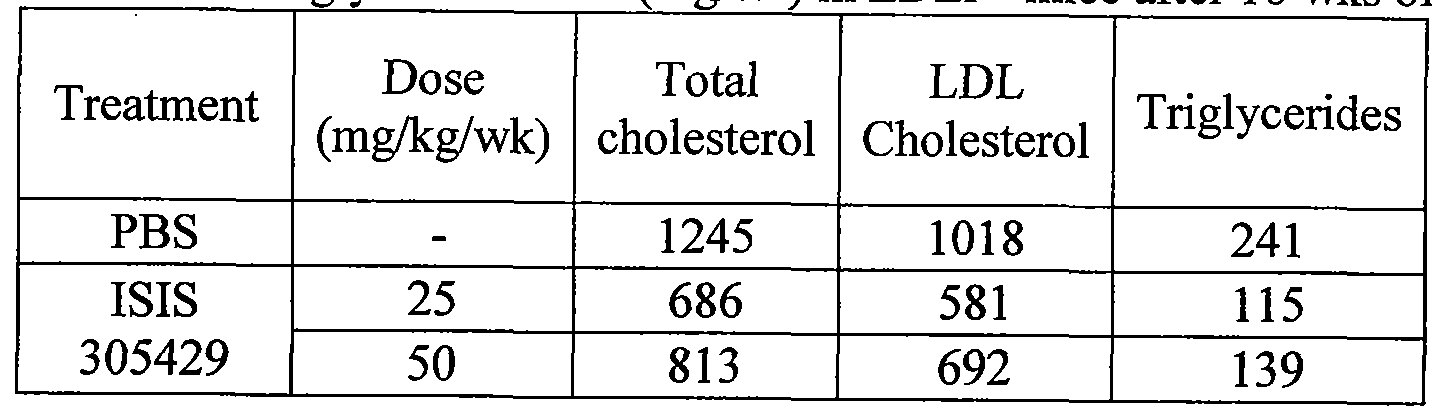
Aortic plaques
The presence of atherosclerotic plaques in the aorta was analyzed. The aortae were initially perfused with 5 mL of PBS after which they were fixed with 5 mL of 5% formaldehyde delivered by perfusion. The aorta was dissected, from the proximal ascending aorta to the end of the thoracic aorta, using a dissecting microscope. Adventitial fat was removed and the aorta was opened longitudinally, pinned flat onto black dissecting wax, stained with lipophilic Sudan IV dye, and photographed at a fixed magnification. The photographs were digitized, and the total aortic areas and lesion areas were calculated by using Adobe Photoshop, version 7.0 and NIH Scion Image software (http://rsb.info.nih.gov/nih-image/Default.html). The results are presented in Table 4 as a percentage of the total aortic area that contained lesions. The data indicates that inhibition of CD36 resulted in reduction in the number of plaques in the aorta as well as the size of the plaques.
Table 4
Plaques (% of total aortic area) in LDLr"7" mice

Body and organ weights
The body weights of the mice were measured pre-dose and regularly during the treatment period. The body weights are presented in Table 5, and are expressed in grams. Liver, kidney and spleen weights were also measured and presented in Table 5. The data indicates that
treatment with ISIS 305429 had no adverse effects on the overall health of the mice, as demonstrated by the body and organ weight measurements.
Table 5

Liver function
To evaluate the effect of ISIS oligonucleotides on hepatic function, plasma concentrations of transaminases were measured using an automated clinical chemistry analyzer (Hitachi Olympus AU400e, Melville, NY) (Nyblom, H. et al., Alcohol & Alcoholism 39: 336-339, 2004; Tietz NW (Ed): Clinical Guide to Laboratory Tests, 3rd ed. W. B. Saunders, Philadelphia, PA, 1995). Plasma concentrations of ALT (alanine transaminase) and AST (aspartate transaminase) were measured and the results are presented in Table 6 expressed in IU/L. Treatment with all doses of ISIS 305429 was considered tolerable in the mice, as demonstrated by their liver transaminase profile.
Table 6
Plasma transaminase levels (IU/L) of LDLr_ " mice after 16 wks of treatments

Example 2: Dose-dependent antisense inhibition of CD36 in an ApoE knockout mouse model
The effect of inhibition by ISIS 305429 and its role in preventing atherosclerosis and liver steatosis was evaluated in ApoE knockout mice.
Female six- week old ApoE"7" mice were maintained on a 12-hour light/dark cycle and were fed ad libitum the Western diet (TD88137; 42% cal from fat, 0.2% cholesterol; Harlan
Laboratories, Indianapolis, IN). Animals were acclimated for at least 7 days in the research facility before initiation of the experiment and were initiated on an atherogenic diet (TD94059 comprising 15.8% fat, half of which is from cocoa butter and 1.25% cholesterol; Harlan
Laboratories, Indianapolis, IN) a week before the dosing period. Antisense oligonucleotides (ASOs) were prepared in phosphate buffered saline (PBS) and sterilized by filtering through a 0.2 micron filter. Oligonucleotides were dissolved in 0.9% PBS for injection.
Treatment
Groups of 8 mice each received intraperitoneal injections of ISIS 305429 at doses of 6.3 mg/kg, 12.5 mg/kg, or 25 mg/kg administered twice a week for 3 weeks, and subsequently once a week for another 12 weeks. A group of 8 mice received intraperitoneal injections of PBS, administered in a similar manner as the oligonucleotide dosing, for 15 weeks. The PBS group served as the control group to which oligonucleotide-treated groups were compared. Inhibition of CD36 mRNA
Twenty four hours after the final dose, the animals were sacrificed and liver tissues were isolated. RNA was isolated from each tissue sample for real-time PCR analysis of CD36 using primer probe set mCD36_l 166. As presented in Table 7, treatment with ISIS 305429 led to a significant reduction of CD36 mRNA expression at all three doses administered. The results are expressed as percent inhibition of CD36 mRNA, relative to the PBS control.
Table 7

Cholesterol and triglyceride levels
Plasma total cholesterol, LDL cholesterol and triglycerides were measured with an Olympus clinical analyzer (Hitachi Olympus AU400e, Melville, NY). Contrary to the results obtained in the LDLr-/- mouse, there were no significant alterations in triglyceride or LDL cholesterol levels, either in the liver or the plasma after treatment with ISIS 305429 in this model. Because
dyslipidemia in the apoE-/- mouse is characterized by the accumulation of triglyceride rich lipoproteins (TGRL) and not LDL, the differences in plasma lipids between these two models suggests that inhibition of CD36 has a differential role in clearance of TGRL vs. LDL.
Aortic plaques
The presence of atherosclerotic plaques in the aorta was analyzed. Mice were injected 12 hours before sacrifice with 1.5 nmol of ProSense 750 (Perkin Elmer, Waltham MA). The heart and aorta were initially perfused with 5 mL of PBS. The entire aorta was dissected, from the proximal ascending aorta to the end of the thoracic region, using a dissecting microscope.
Adventitial fat was removed and atherosclerotic regions were quantitated from fluorescent reflectance scanning of the aorta using the Odyssey (LI-COR). Fluorescent activation of ProSense 750 has been shown to be a result of atherosclerotic macrophage activity. Total aortic areas and lesion areas were calculated by using Adobe Photoshop, version 7.0 and NIH Scion Image software (http://rsb.info.nih.gov/nih-image/Default.html). The results are presented in Table 8 as a percentage of the total aortic area that contained lesions. The data indicates that inhibition of CD36 resulted in reduction in the number and size of plaques in the aorta.
Table 8

Claims
1. A method of reducing CD36 expression in an animal comprising administering to the animal a compound comprising a modified oligonucleotide 10 to 30 linked nucleosides in length targeted to CD36, wherein expression of CD36 is reduced in the animal.
2. A method of reducing LDL-C levels in an animal comprising administering to the animal a compound comprising a modified oligonucleotide 10 to 30 linked nucleosides in length targeted to CD36, wherein expression of LDL-C is reduced in the animal.
3. A method of reducing triglyceride levels in an animal comprising administering to the animal a compound comprising a modified oligonucleotide 10 to 30 linked nucleosides in length targeted to CD36, wherein the level of triglyceride is reduced in the animal.
4. A method of reducing cholesterol levels in an animal comprising administering to the animal a compound comprising a modified oligonucleotide 10 to 30 linked nucleosides in length targeted to CD36, wherein the level of cholesterol is reduced in the animal.
5. A method of reducing CD36 expression in an atherosclerotic plaque in an animal comprising administering to the animal a compound comprising a modified oligonucleotide 10 to 30 linked nucleosides in length targeted to CD36, wherein expression of CD36 is reduced in the atherosclerotic plaque in the animal.
6. A method of reducing one or more of atherosclerotic plaque numbers or size in an animal comprising administering to the animal a compound comprising a modified
oligonucleotide 10 to 30 linked nucleosides in length targeted to CD36, wherein one or more of the number or size of the atherosclerotic plaque is reduced in the animal.
7. A method of treating, preventing or ameliorating an inflammatory or
cardiovascular disease in an animal comprising administering to the animal a compound comprising a modified oligonucleotide 10 to 30 linked nucleosides in length targeted to CD36, wherein the inflammatory or cardiovascular disease is treated, prevented or ameliorated in the animal.
8. The method of any of claims 1-7, wherein the modified oligonucleotide has a nucleobase sequence at least 90% complementary to any of SEQ ID NO: 1-8 as measured over the entirety of said modified oligonucleotide.
9. The method of any one of claims 1-7, wherein the nucleobase sequence of the modified oligonucleotide is at least 95% complementary to any of SEQ ID NO: 1-8 as measured over the entirety of said modified oligonucleotide.
10. The method of any one of claims 1-7, wherein the nucleobase sequence of the modified oligonucleotide is 98% complementary to any of SEQ ID NO: 1-8 as measured over the entirety of said modified oligonucleotide.
11. The method of any one of claims 1 -7, wherein the nucleobase sequence of the modified oligonucleotide is 100% complementary to any of SEQ ID NO: 1-8 as measured over the entirety of said modified oligonucleotide.
12. The method of any one of claims 1-7, wherein at least one internucleoside linkage of said modified oligonucleotide is a modified internucleoside linkage.
13. The method of claim 12, wherein each internucleoside linkage is a
phosphorothioate internucleoside linkage.
14. The method of any one of claims 1-7, wherein at least one nucleoside of said modified oligonucleotide comprises a modified sugar.
15. The method of claim 14, comprising at least one tetrahydropyran modified nucleoside wherein a tetrahydropyran ring replaces a furanose ring.
16. The method of claim 14, wherein at least one modified sugar is a bicyclic sugar.
17. The method of claim 14, wherein at least one modified sugar comprises a 2'-0- methoxyethyl or a 4'- (CH2)n-0-2' bridge, wherein n is 1 or 2.
18. The method of any one of claims 1 -7, wherein at least one nucleoside of said modified oligonucleotide comprises a modified nucleobase.
19. The method of claim 18, wherein the modified nucleobase is a 5-methylcytosine.
20. The method of any one of claims 1 -7, wherein the modified oligonucleotide consists of 20 linked nucleosides.
21. The method of any one of claims 1-7, wherein the modified oligonucleotide comprises:
a. a gap segment consisting of linked deoxynucleosides;
b. a 5' wing segment consisting of linked nucleosides;
c. a 3' wing segment consisting of linked nucleosides;
wherein the gap segment is positioned between the 5' wing segment and the 3' wing segment and wherein each nucleoside of each wing segment comprises a modified sugar.
22. The method of claim 1-7, wherein the modified oligonucleotide consists of 20 linked nucleosides, has a nucleobase sequence complementary to any of SEQ ID NO: 1-8 as measured over the entirety of said modified oligonucleotide and comprises:
a. a gap segment consisting of ten linked deoxynucleosides;
b. a 5' wing segment consisting of five linked nucleosides;
c. a 3' wing segment consisting of five linked nucleosides;
wherein the gap segment is positioned between the 5' wing segment and the 3' wing segment, wherein each nucleoside of each wing segment comprises a 2'-0-methoxyethyl sugar, wherein each internucleoside linkage is a phosphorothioate linkage, and wherein each cytosine is a 5'-methylcytosine.
23. A method for treating an animal with inflammatory or cardiovascular disease comprising
a. identifying said animal with inflammatory or cardiovascular disease,
b. administering to said animal a therapeutically effective amount of a compound comprising a modified oligonucleotide consisting of 20 linked nucleosides and having a nucleobase sequence at least 90% complementary to any of SEQ ID NO: 1-8 as measured over the entirety of said modified oligonucleotide, wherein said animal with inflammatory or cardiovascular disease is treated.
24. The method of claim 23, wherein the therapeutically effective amount of the compound administered to the animal reduces inflammatory or cardiovascular disease in the animal.
25. The method of claim 7 or 23, wherein the inflammatory or cardiovascular disease is atherosclerosis, dyslipidemia, coronary heart disease, non-alcoholic fatty liver disease
(NAFLD), hyperfattyacidemia, metabolic syndrome or a combination thereof.
26. The method of claim 1 , wherein the administration of the modified
oligonucleotide results in a reduction of triglyceride levels, LDL-C levels or a combination thereof.
27. The method of claim 26, wherein the levels are independently reduced by at least 5%, 10%, 20%, 30%, 35%, 40%, 45%, 50%, 55%, 60%, 65%, 70%, 75%, 80%, 85%, 90% or 95%.
28. The method of claim 1 , wherein the administration of the modified
oligonucleotide results in a decrease in one or more of number or size of atherosclerotic plaques.
29. The method of claim 28, wherein the levels are independently decreased by at least 5%, 10%, 20%, 30%, 35%, 40%, 45%, 50%, 55%, 60%, 65%, 70%, 75%, 80%, 85%, 90% or 95%.
30. The method of claims 1, 2, 3, 4, 5, 7 or 23 wherein the administration of the modified oligonucleotide results in a reduction in atherosclerotic plaques.
31. A method of decreasing one or more of CD36 levels, LDL-C levels, triglyceride levels, atherosclerostic plaque number, atherosclerostic plaque size, cardiovascular disease or inflammatory disease, in a human by administering a CD36 inhibitor comprising a modified oligonucleotide consisting of 20 linked nucleosides and having a nucleobase sequence at least 90% complementary to any of SEQ ID NO: 1 -8 as measured over the entirety of said modified oligonucleotide.
32. The method of any one of claims 1, 2, 3, 4, 5, 6, 7, 23 or 31, wherein the animal is a human.
33. The method of any one of claims 1 , 2, 3, 4, 5, 6, 7, 23 or 31 , wherein the compound is a first agent and further comprising administering a second agent.
34. The method of claim 33, wherein the first agent and the second agent are coadministered.
35. The method of claim 33, wherein the second agent is a lipid-lowering therapy.
36. The method of claim 35, wherein the lipid lowering therapy is a therapeutic lifestyle change, HMG-CoA reductase inhibitor, cholesterol absorption inhibitor, MTP inhibitor, antisense compound targeted to ApoB or any combination thereof
37. The method of claim 35, wherein the lipid lowering therapy is a HMG-CoA reductase inhibitor selected from atorvastatin, rosuvastatin, fluvastatin, lovastatin, pravastatin or simvastatin.
38. The method of claim 35, wherein the lipid lowering therapy is the cholesterol absorption inhibitor ezetimibe.
39. The method of claim 35, wherein the lipid lowering therapy is a triglyceride lowering agent.
40. The method of claim 39, wherein the triglyceride lowering agent is a fibrate, niacin or fish oil.
41. The method of any one of claims 1, 2, 3, 4, 5, 6, 7, 23 or 31, wherein
administration comprises parenteral administration.
42. The method of any one of claims 1 , 2, 3, 4, 5, 6, 7, 23 or 31 , wherein the compound consists of a single-stranded modified oligonucleotide.
43. A compound comprising a modified oligonucleotide consisting of 10 to 30 linked nucleosides targeting CD36 as shown in any of SEQ ID NOs: 1-8.
44. The compound of claim 43, wherein the nucleobase sequence of the modified oligonucleotide is at least 95% complementary to SEQ ID NO: 1-8.
45. The compound of claim 44, wherein the nucleobase sequence of the modified oligonucleotide is 100% complementary to SEQ ID NO: 1-8.
46. The compound of claim 43, wherein the modified oligonucleotide is a single- stranded oligonucleotide.
47. The compound of claim 43, wherein at least one internucleoside linkage is a modified internucleoside linkage.
48. The compound of claim 47, wherein each internucleoside linkage is a phosphorothioate internucleoside linkage.
49. The compound of claim 43, wherein at least one nucleoside comprises a modified sugar.
50. The compound of claim 49, wherein at least one modified sugar is a bicyclic sugar.
51. The compound of claim 49, wherein at least one modified sugar comprises a 2'-0- methoxyethyl or a 4'- (CH2)n-0-2' bridge, wherein n is 1 or 2.
52. The compound of claim 43, wherein at least one nucleoside comprises a modified nucleobase.
53. The compound of claim 52, wherein the modified nucleobase is a 5- methylcytosine.
54. The compound of claim 43, wherein the modified oligonucleotide comprises: a gap segment consisting of linked deoxynucleosides;
a 5' wing segment consisting of linked nucleosides;
a 3' wing segment consisting of linked nucleosides;
wherein the gap segment is positioned between the 5' wing segment and the 3' wing segment and wherein each nucleoside of each wing segment comprises a modified sugar.
55. The compound of claim 43, wherein the modified oligonucleotide consists of 20 linked nucleosides and comprises:
a gap segment consisting often linked deoxynucleosides;
a 5' wing segment consisting of five linked nucleosides;
a 3' wing segment consisting of five linked nucleosides;
wherein the gap segment is positioned between the 5' wing segment and the 3' wing segment, wherein each nucleoside of each wing segment comprises a 2'-0-methoxyethyl sugar; and wherein each internucleoside linkage is a phosphorothioate linkage.
56. The compound of claim 43, wherein the modified oligonucleotide consists of 20 linked nucleosides.
57. Use of a compound targeting CD36 for treating, preventing, ameliorating or reducing at least one symptom of an inflammatory or cardiovascular disease, by decreasing CD36.
58. Use of a compound targeting CD36 for treating, preventing, ameliorating or reducing atherosclerosis by decreasing CD36.
Applications Claiming Priority (2)
| Application Number | Priority Date | Filing Date | Title |
|---|---|---|---|
| US201161479815P | 2011-04-27 | 2011-04-27 | |
| US61/479,815 | 2011-04-27 |
Publications (2)
| Publication Number | Publication Date |
|---|---|
| WO2012149465A2 true WO2012149465A2 (en) | 2012-11-01 |
| WO2012149465A3 WO2012149465A3 (en) | 2012-12-27 |
Family
ID=47073106
Family Applications (1)
| Application Number | Title | Priority Date | Filing Date |
|---|---|---|---|
| PCT/US2012/035648 Ceased WO2012149465A2 (en) | 2011-04-27 | 2012-04-27 | Modulation of cd36 expression |
Country Status (1)
| Country | Link |
|---|---|
| WO (1) | WO2012149465A2 (en) |
Family Cites Families (3)
| Publication number | Priority date | Publication date | Assignee | Title |
|---|---|---|---|---|
| US6322976B1 (en) * | 1998-05-28 | 2001-11-27 | Medical Research Council | Compositions and methods of disease diagnosis and therapy |
| US20040077567A1 (en) * | 2002-10-16 | 2004-04-22 | Isis Pharmaceuticals Inc. | Antisense modulation of CD36 expression |
| ES2415375T3 (en) * | 2007-02-05 | 2013-07-25 | Region Nordjylland | A procedure to diagnose atherosclerotic plaques by measuring CD36 |
-
2012
- 2012-04-27 WO PCT/US2012/035648 patent/WO2012149465A2/en not_active Ceased
Also Published As
| Publication number | Publication date |
|---|---|
| WO2012149465A3 (en) | 2012-12-27 |
Similar Documents
| Publication | Publication Date | Title |
|---|---|---|
| CA2786071C (en) | Modulation of angiopoietin-like 3 expression | |
| AU2012312433B2 (en) | Antisense modulation of GCGR expression | |
| US20130053430A1 (en) | Modulation of cetp expression | |
| EP2855500A2 (en) | Methods and compositions for modulating apolipoprotein(a) expression | |
| WO2015100394A1 (en) | Modulation of angiopoietin-like 3 expression | |
| EP2771463A1 (en) | Antisense modulation of gccr expression | |
| WO2011127175A1 (en) | Modulation of cd130 (gp130) expression | |
| EP2480667A1 (en) | Modulation of ttc39 expression to increase hdl | |
| WO2012149386A1 (en) | Modulation of cideb expression | |
| WO2011133918A1 (en) | Modulation of gm3 synthase (gm3s) expression | |
| WO2011156673A2 (en) | Modulation of phosphoenolpyruvate carboxykinase-mitochondrial (pepck-m) expression | |
| WO2016077704A1 (en) | Modulation of agpat5 expression | |
| AU2019201882B2 (en) | Modulation of angiopoietin-like 3 expression | |
| WO2011133923A1 (en) | Modulation of lactosylceramide synthase (lcs) expression | |
| WO2011133915A1 (en) | Modulation of glucosylceramide synthase (gcs) expression | |
| WO2013023172A1 (en) | Modulation of inflammatory responses by saa1 and saa2 | |
| HK1176557B (en) | Modulation of angiopoietin-like 3 expression | |
| HK1176557A (en) | Modulation of angiopoietin-like 3 expression |
Legal Events
| Date | Code | Title | Description |
|---|---|---|---|
| 121 | Ep: the epo has been informed by wipo that ep was designated in this application |
Ref document number: 12777073 Country of ref document: EP Kind code of ref document: A2 |
|
| NENP | Non-entry into the national phase |
Ref country code: DE |
|
| 122 | Ep: pct application non-entry in european phase |
Ref document number: 12777073 Country of ref document: EP Kind code of ref document: A2 |