WO2012147103A2 - PROCESS FOR CONTINUOUS FLOW SYNTHESIS OF β-ΑΜΙΝΟ CROTONATE - Google Patents
PROCESS FOR CONTINUOUS FLOW SYNTHESIS OF β-ΑΜΙΝΟ CROTONATE Download PDFInfo
- Publication number
- WO2012147103A2 WO2012147103A2 PCT/IN2012/000302 IN2012000302W WO2012147103A2 WO 2012147103 A2 WO2012147103 A2 WO 2012147103A2 IN 2012000302 W IN2012000302 W IN 2012000302W WO 2012147103 A2 WO2012147103 A2 WO 2012147103A2
- Authority
- WO
- WIPO (PCT)
- Prior art keywords
- methyl
- crotonate
- beta
- ester
- amino crotonate
- Prior art date
- Legal status (The legal status is an assumption and is not a legal conclusion. Google has not performed a legal analysis and makes no representation as to the accuracy of the status listed.)
- Ceased
Links
Classifications
-
- C—CHEMISTRY; METALLURGY
- C07—ORGANIC CHEMISTRY
- C07C—ACYCLIC OR CARBOCYCLIC COMPOUNDS
- C07C227/00—Preparation of compounds containing amino and carboxyl groups bound to the same carbon skeleton
- C07C227/04—Formation of amino groups in compounds containing carboxyl groups
- C07C227/06—Formation of amino groups in compounds containing carboxyl groups by addition or substitution reactions, without increasing the number of carbon atoms in the carbon skeleton of the acid
Definitions
- the invention relates to process for the synthesis of ⁇ -amino crotonate. Particularly, the invention discloses a continuous flow synthesis for the preparation of ⁇ -amino crotonates.
- ⁇ -amino crotonate are compounds of interest since they find use as intermediates for the synthesis of Ca channel blockers such as Nisoladipine, Benidipine, Nicardipine and such type of compounds, in the preparation and purification of various metals and as a catalyst for polymerization.
- a reaction mixture of an acetoacetate ester of the formula CH 3 C(O)CH 2 C(O)OR' wherein R 1 is the same as defined above is first formed in an organic solvent and this mixture reacted with aqueous ammonium hydroxide in the presence of a salt of ammonia or of a metal selected from the group consisting of lithium, zinc, cadmium, cerium and lead.
- the salt is soluble in the organic solvent to an extent sufficient to catalyze the reaction between ammonia and the ester.
- the reaction product is readily recovered simply by extracting the solution with a solvent that dissolves the 8-amino a,.8-unsaturated ester.
- the yield in the process is between 20-50%.
- the inventors disclose a continuous flow synthesis. process for ⁇ -amino crotonates.
- the invention includes a solvent free catalytic process for the synthesis of ⁇ -amino crotonate resulting in pure ⁇ -amino crotonate.
- the process comprising reacting a ketonic ester with a base optionally in presence of an organic solvent and an acid catalyst to obtain the said beta aminocrotonates.
- the ester is methyl aceto acetate or ethyl acetoacetate.
- said base is selected from the group consisting of ammonia, methylamine, ethylamine and tertiary butylamine.
- the organic solvent is an alcohol selected from the group consisting of methanol, ethanol or isopropanol .
- ratio of said base to said ester is 1:3 to 3:1.
- ratio of said base, ester and the solvent is 1:3:0 to 3: 1:3.
- said catalyst is an aliphatic carboxylic acid selected from acetic acid or n-propanoic acid.
- the. reaction is performed at a temperature ranging between 20-60 °C.
- the beta aminocrotonates obtained by the process yields in the range of 93% to 100 %.
- the representative beta aminocrotonates are methyl amino crotonate, ethyl amino crotonate, tertiary butyl amino crotonate, methyl 3-methyl aminocrotonate, ethyl 3- methyl aminocrotonate, methyl 3-butyl aminocrotonate and butyl 3-ethyl aminocrotonate.
- said process is a non-cryogenic process.
- the base used is recycled.
- an acid is added, such as acetic acid to reduce the reaction time, and is thus used as a catalyst.
- process is carried out in a tubular reactor, reducing reaction times but yet yielding products with comparable yields.
- the process needs continuous supply of only methyl ac'etoacetate and ammonia to obtain zero water discharge reaction.
- This reaction is exemplified herein resulting in yield of greater than 90% on repeated cycles.
- Figure 1 Set-up for zero water discharge continuous process for synthesis of ⁇ -amino crotonate requiring continuous supply of only methyl
- Figure 2 1 H NMR of methyl amino crotonate.
- the inventors disclose a continuous flow synthesis process for ⁇ -amino crotonate comprising: reacting a base with an ester in the presence of an organic solvent in ratios ranging from 1:3:0 to 3:1:3 to obtain ⁇ -amino crotonate of purity greater than 99.98 % and yield greater than 93%.
- Such ⁇ -amino crotonates are further reacted with benzilidines to obtain Ca channel blockers.
- esters used for the process are methyl acetoacetate, ethyl acetoacetate, and such like.
- the base is selected from ammonia, methylamine, ethylamine, tertiary butylamine and such like.
- the base used is recycled.
- the process an acid is added, such as acetic acid to reduce the reaction time, and is thus used as a catalyst.
- the solvent of the process is preferably isopropanol.
- the drying time is programmed to result in crystals of ⁇ -amino crotonate that required no further purification.
- the process is carried out in a tubular reactor, reducing reaction times but yet yielding products with comparable yields.
- the continuous flow synthesis process of ⁇ -amino crotonate of the invention can be carried out in batch mode too.
- the process needs continuous supply of only methyl acetoacetate and ammonia to obtain zero water discharge reaction.
- This reaction is exemplified herein resulting in yield of greater than 90% on repeated cycles.
- the continuous process of the invention is carried out at temperature ranging from room temperature to 50 S C, unlike prior art processes that are generally carryout out at cryogenic temperatures to avoid loss of ammonia and to contain exothermic nature of the reaction.
- Example 1 Process for the preparation of methyl amino crotonate
- Example 2 Process for the preparation of methyl amino crotonate
- Example 5 Process for the preparation of methyl amino crotonate Continuous flow experiment was carried out in a SS316 tubular reactor of 6.35 mm o.d. and 2 m length at 50 e C with a residence time of 120 - 160 s without any solvent.
- the Methyl aceto acetate to ammonia to catalyst (Acetic acid)- volume ratio of 1:3:0.5 yielded 94% methyl amino crotonate from the first crop. No choking of reactor was observed.
- Example 6 Process for the preparation of methyl amino crotonate
- Example 8 Process for the preparation of Ethyl amino crotonate
- Example 9 Process for the preparation of Ethyl amino crotonate Continuous flow experiment was carried out in a SS316 tubular reactor of 1.58 mm o.d. by mixing ethyl acetoacetate with aqueous ammonia (25% solution) in the ratio 1:3 using a simple T-mixer and reactor with 1 m length having a residence time of 22 min. Product yields was 94% at 50 Q C.
- Example 10 Process for the preparation of Methyl 3-methyl amino crotonate
Landscapes
- Chemical & Material Sciences (AREA)
- Organic Chemistry (AREA)
- Chemical Kinetics & Catalysis (AREA)
- Organic Low-Molecular-Weight Compounds And Preparation Thereof (AREA)
- Low-Molecular Organic Synthesis Reactions Using Catalysts (AREA)
Abstract
Beta aminocrotonates are important intermediates for the synthesis of Ca channel blockers. The processes available in the art are batch processes with yields about 85%. There are no continuous processes available for the synthesis of such compounds. This gap in the art is addressed by the invention by disclosing a continuous process resulting in high yields of beta amino crotonates.
Description
PROCESS FOR CONTINUOUS FLOW SYNTHESIS OF β-ΑΜΙΝΟ
CROTONATE FIELD OF THE INVENTION
The invention relates to process for the synthesis of β-amino crotonate. Particularly, the invention discloses a continuous flow synthesis for the preparation of β-amino crotonates. BACKGROUND AND PRIOR ART OF THE INVENTION
β-amino crotonate are compounds of interest since they find use as intermediates for the synthesis of Ca channel blockers such as Nisoladipine, Benidipine, Nicardipine and such type of compounds, in the preparation and purification of various metals and as a catalyst for polymerization.
Several batch synthesis processes are disclosed in patent and non patent literature or such types of compounds.
US4046803 titled "Method Of Preparing β-Amino Derivatives Of α, β- Unsaturated Esters" discloses a method for the preparation of β-amino derivatives of a, β-unsaturated esters of the formula CH3C(NH2)= CHCOOR' where R' is Ci to Cio linear or branched alkyl or substituted Ci to Cio linear or branched alkyl. A reaction mixture of an acetoacetate ester of the formula CH3C(O)CH2C(O)OR' wherein R1 is the same as defined above is first formed in an organic solvent and this mixture reacted with aqueous ammonium hydroxide in the presence of a salt of ammonia or of a metal selected from the group consisting of lithium, zinc, cadmium, cerium and lead. The salt is soluble in the organic solvent to an extent sufficient to catalyze the reaction between ammonia and the ester. The reaction product is readily recovered simply by extracting the solution with a solvent that dissolves the 8-amino a,.8-unsaturated ester. But this process definitely requires the addition of a salt of ammonia or a metal in spite of
addition of aqueous ammonium hydroxide, such that salt is soluble in the organic solvent to an extent sufficient to catalyze the reaction between ammonia and the ester.
US4448964 titled "1,4-Dihydropyridine derivatives" uses a process for preparation of 1,4-Dihydropyridine derivatives described in B. Loev, et al, J. Medicinal Chern., 17, 956 (1974) in Process No. 2 which is reproduce as follows:

2COCH2COOR4 + HH3 (or ammonium salt) ^
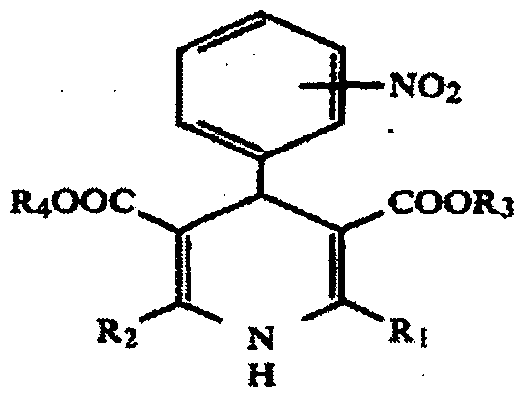
The yield in the process is between 20-50%.
But there is no prior art disclosing a continuous flow synthesis process of β-amino crotonates. Further, there are no prior arts that disclose processes that afford high yield of beta amino crotonates.
To fulfill this gap in the art, the inventors disclose a continuous flow synthesis. process for β-amino crotonates.
J Further^, the invention includes a solvent free catalytic process for the synthesis of β-amino crotonate resulting in pure β-amino crotonate.
SUMMARY OF THE INVENTION
Accordingly, continuous process for the synthesis of beta aminocrotonates, the processcomprising reacting a ketonic ester with a base optionally in presence of an organic solvent and an acid catalyst to obtain the said beta aminocrotonates.
In an embodiment of the present invention, the ester is methyl aceto acetate or ethyl acetoacetate.
In another embodiment of the present invention, said base is selected from the group consisting of ammonia, methylamine, ethylamine and tertiary butylamine.
In yet another embodiment of the present invention, the organic solvent is an alcohol selected from the group consisting of methanol, ethanol or isopropanol .
In yet another embodiment of the present invention, ratio of said base to said ester is 1:3 to 3:1.
In yet another embodiment of the present invention, ratio of said base, ester and the solvent is 1:3:0 to 3: 1:3.
In yet another embodiment of the present invention, said catalyst is an aliphatic carboxylic acid selected from acetic acid or n-propanoic acid. In yet another embodiment of the present invention, the. reaction is performed at a temperature ranging between 20-60 °C.
In yet another embodiment of the present invention, the beta aminocrotonates obtained by the process yields in the range of 93% to 100 %.
In yet another embodiment of the present invention, the representative beta aminocrotonates are methyl amino crotonate, ethyl amino crotonate, tertiary butyl amino crotonate, methyl 3-methyl aminocrotonate, ethyl 3- methyl aminocrotonate, methyl 3-butyl aminocrotonate and butyl 3-ethyl aminocrotonate.
In yet another embodiment of the present invention, said process is a non-cryogenic process.
In yet another embodiment of the present invention, the base used is recycled.
In yet another embodiment of the present invention, an acid is added, such as acetic acid to reduce the reaction time, and is thus used as a catalyst.
In yet another embodiment of the present invention, process is carried out in a tubular reactor, reducing reaction times but yet yielding products with comparable yields.
In yet another embodiment of the invention, with reference to figure 1, the process needs continuous supply of only methyl ac'etoacetate and ammonia to obtain zero water discharge reaction. This reaction is exemplified herein resulting in yield of greater than 90% on repeated cycles. BRIEF DESCRIPTION OF THE FIGURES
Figure 1: Set-up for zero water discharge continuous process for synthesis of β-amino crotonate requiring continuous supply of only methyl
acetoacetate and ammonia.
Figure 2: 1 H NMR of methyl amino crotonate.
DETAILED DESCRIPTION OF THE INVENTION
In accordance with the objectives of the invention, the inventors disclose a continuous flow synthesis process for β-amino crotonate comprising: reacting a base with an ester in the presence of an organic solvent in ratios ranging from 1:3:0 to 3:1:3 to obtain β-amino crotonate of purity greater than 99.98 % and yield greater than 93%.
Such β-amino crotonates are further reacted with benzilidines to obtain Ca channel blockers.
The esters used for the process are methyl acetoacetate, ethyl acetoacetate, and such like.
The base is selected from ammonia, methylamine, ethylamine, tertiary butylamine and such like. The base used is recycled. The process an acid is added, such as acetic acid to reduce the reaction time, and is thus used as a catalyst.
The solvent of the process is preferably isopropanol.
The drying time is programmed to result in crystals of β-amino crotonate that required no further purification.
The process is carried out in a tubular reactor, reducing reaction times but yet yielding products with comparable yields.
The continuous flow synthesis process of β-amino crotonate of the invention can be carried out in batch mode too.
Experiments were carried out by mixing methyl acetoacetate with aqueous ammonia (25% solution) at room temperature. Experiment was carried out with and without isopropanol as the solvent media. With the Methyl aceto acetate to ammonia ratio of 1:1, 1:2 and 1:3 in identical amounts of solvent, the reaction time decreased from 180 min to 75 min with yield of the methyl amino crotonate increasing from 59% to 73%. With the Methyl aceto acetate to ammonia to solvent ratio of 1:2:0, 1:2:1, and 1:2:3, the reaction time for complete conversion of methyl aceto acetate increased from 75 min to 120 min, the yield also increased from 59% to 86%.
Experiments were also carried out by mixing methyl acetoacetate with aqueous ammonia (25% solution) at different temperatures. With an increase in the batch temperature from 25 degree C to 50 degree C, the yield decreased from 78% to 52%.
With reference to figure 1, the process needs continuous supply of only methyl acetoacetate and ammonia to obtain zero water discharge reaction. This reaction is exemplified herein resulting in yield of greater than 90% on repeated cycles.
The continuous process of the invention is carried out at temperature ranging from room temperature to 50SC, unlike prior art processes that are generally carryout out at cryogenic temperatures to avoid loss of ammonia and to contain exothermic nature of the reaction.
Examples
Following examples are given by way of illustration therefore should not be construed to limit the scope of the invention.
Example 1: Process for the preparation of methyl amino crotonate
Continuous flow experiment was carried out in a SS316 tubular reactor of 6.35 mm o.d. and 2 m length at 50 QC with a residence time of 15 min. The Methyl aceto acetate to ammonia to solvent iso-propanol ratio was 1:3: 1, and the yield of methyl amino crotonate was 56%.
Example 2: Process for the preparation of methyl amino crotonate
Continuous flow experiment was carried out in a SS316 tubular reactor of 6.35 mm o.d. and 2 m length at 50e C in presence of ultrasonic field with a residence time of 15 min. The Methyl aceto acetate to ammonia to solvent ratio was 1:3:0, and the yield of methyl amino crotonate was 54%. No choking of reactor was observed. Example 3: Process for the preparation of methyl amino crotonate
Continuous flow experiment was carried out in a SS316 tubular reactor of 6.35 mm o.d. and 2 m length at 50 C with a residence time of 15 min in the absence of any solvent and without sonication. The Methyl aceto acetate to ammonia ratio of 1:3 resulted in the yield of methyl amino crotonate of 48%. No choking of reactor was observed.
Example 4: Process for the preparation of methyl amino crotonate
Continuous flow experiment was carried out in a SS316 tubular reactor of 6.35 mm o.d. and 2 m length at 50 9 C with a residence time of 15 min in the absence of any solvent and without sonication. The Methyl aceto acetate to ammonia ratio of 1:2, the yield of methyl amino crotonate observed was 59%. No choking of reactor was observed.
Example 5: Process for the preparation of methyl amino crotonate Continuous flow experiment was carried out in a SS316 tubular reactor of 6.35 mm o.d. and 2 m length at 50 e C with a residence time of 120 - 160 s
without any solvent. The Methyl aceto acetate to ammonia to catalyst (Acetic acid)- volume ratio of 1:3:0.5 yielded 94% methyl amino crotonate from the first crop. No choking of reactor was observed. Example 6: Process for the preparation of methyl amino crotonate
Continuous flow experiment was carried out in a SS316 tubular reactor of 6.35 mm o.d. and 3 m length at 50 s C with a residence time of 120 - 160 s without any solvent with the inlet composition as in Example 7. The hourly yield of the product methyl amino crotonate was 700 gm. ie. 93% yield.
Example 7: Process for the preparation of Ethyl amino crotonate
Continuous flow experiment was carried out in a SS316 tubular reactor of 1.58 mm o.d. by mixing ethyl acetoacetate with aqueous ammonia (25% solution) using a simple T-mixer and reactor with 1 m length having a residence time of 22 min. Product yields was 73% at 20 Q C.
Example 8: Process for the preparation of Ethyl amino crotonate
Continuous flow experiment was carried out in a SS316 tubular reactor of 1.58 mm o.d. by mixing ethyl acetoacetate with aqueous ammonia (25% solution) in the ration 1:3 using a simple T-mixer and reactor with 1 m length having a residence time of 22 min. Product yields was 84% at 30 3 C.
Example 9: Process for the preparation of Ethyl amino crotonate Continuous flow experiment was carried out in a SS316 tubular reactor of 1.58 mm o.d. by mixing ethyl acetoacetate with aqueous ammonia (25% solution) in the ratio 1:3 using a simple T-mixer and reactor with 1 m length having a residence time of 22 min. Product yields was 94% at 50 Q C.
Example 10: Process for the preparation of Methyl 3-methyl amino crotonate
Continuous flow experiment was carried out in a SS316 tubular reactor of 1.58 mm o.d. by mixing methyl acetoacetate with methyl amine in isoproponol in the ratio 1:3 using a simple T-mixer and reactor with 1 m length at 40 C. Complete conversion of the substrates is observed in 30 s. ie 100 % yield.
Example 11
With reference to figure 1, set-up for reaction which needs continuous supply of only methyl acetoacetate and ammonia to obtain zero water discharge reaction is exemplified.
Methyl acetoacetate (1 mol) = 116 gm (Expected yield of the product for 100% conversion = 115 gm) when reacted with Aq. Ammonia (2 mol) (MAA:NH3: 1:2) and Acetic acid (1 mol) as a catalyst at 50 °C in a tubular reactor for 160 s, it yielded 95.9 gm methyl amino crotonate (86% yield). Filtrate was saturated with gaseous ammonia and was resent to the reactor through a T-mixer with another stream containing only the methyl acetoacetate. Reaction was carried out for reacting 1 mol of the reactant with the ammonia saturated filtrate for all other conditions as mentioned above. The product yield was 101.1 gm (87.8% yield). Upon repeating the filtration, saturation, recycle and reuse of the solution containing acetic acid for the third time and reacted with 1 mol of methyl acetoacetate it yielded 105.8 gm (92% yield) of product. The process thus becomes a zero water discharge process and eventually it achieves a steady state yield of 98%. The maximum loss of acetic acid per recycle was less than 2%. Methyl amino crotonate synthesized by the examples provided herein was characterized by NMR as shown in Figure 2. 1 H NMR (400 MHz, CDCI3) showed δ 4.53 (s , 1H,C=CH), 3.64 (s, 3H, CHaC=0), 1.91 (s, 3H, CHj). The compound was also characterized by mp and found to be 81.9-82.5 (lit 81-83)
ADVANTAGES OF THE INVENTION
1. Continuous process with high yields.
2. Non cryogenic process.
3. Organic solvent process.
4. Zero discharge process with base and catalyst recycled.
Claims
We claim:
L A continuous process for the synthesis of beta aminocrotonates, the processcomprising reacting a ketonic ester with a base optionally in presence of an organic solvent and an acid catalyst to obtain the said beta aminocrotonates.
2. A process as claimed in claim 1, wherein the ester is methyl aceto acetate or ethyl acetoacetate.
3. A process as claimed in claim 1, wherein said base is selected from the group consisting of ammonia, methylamine, ethylamine and tertiary butylamine.
4. The process of claim 1, the organic solvent is an alcohol selected from the group consisting of methanol, ethanol or isopropanol.
5. The process as claim 1, wherein ratio of said base to said ester is 1:3 to 3:1.
6. The process of claim 1, wherein ratio of said base, ester and the solvent is 1:3:0 to 3:1:3.
7. The process of claim 1, wherein said catalyst is an aliphatic carboxylic acid selected from acetic acid or n-propanoic acid.
8. The process of claim 1, wherein the reaction is performed at a temperature ranging between 20-60 °C .
9. The process of claim 1, wherein the beta aminocrotonates obtained by the process yields in the range of 93% to 100 %.
10. The process of claim 1, wherein the representative beta aminocrotonates are methyl amino crotonate, ethyl amino crotonate, tertiary butyl amino crotonate, methyl 3-methyl aminocrotonate, ethyl 3-methyl aminocrotonate, methyl 3-butyl aminocrotonate and butyl 3-ethyl aminocrotonate.
11. The process of claim 1, wherein said process is a non-cryogenic process.
Priority Applications (3)
| Application Number | Priority Date | Filing Date | Title |
|---|---|---|---|
| EP12729240.7A EP2702035B1 (en) | 2011-04-25 | 2012-04-25 | Process for continuous flow synthesis of beta-amino crotonate |
| US14/113,804 US9199913B2 (en) | 2011-04-25 | 2012-04-25 | Process for continous flow synthesis of beta-amino crotonate |
| IL229077A IL229077A0 (en) | 2011-04-25 | 2013-10-24 | Process for continuous flow synthesis of ß-amino crotonate |
Applications Claiming Priority (4)
| Application Number | Priority Date | Filing Date | Title |
|---|---|---|---|
| IN1205/DEL/2011 | 2011-04-25 | ||
| IN1205DE2011 | 2011-04-25 | ||
| IN0598/DEL/2012 | 2012-03-02 | ||
| IN598DE2012 | 2012-03-02 |
Publications (2)
| Publication Number | Publication Date |
|---|---|
| WO2012147103A2 true WO2012147103A2 (en) | 2012-11-01 |
| WO2012147103A3 WO2012147103A3 (en) | 2012-12-20 |
Family
ID=46331658
Family Applications (1)
| Application Number | Title | Priority Date | Filing Date |
|---|---|---|---|
| PCT/IN2012/000302 Ceased WO2012147103A2 (en) | 2011-04-25 | 2012-04-25 | PROCESS FOR CONTINUOUS FLOW SYNTHESIS OF β-ΑΜΙΝΟ CROTONATE |
Country Status (4)
| Country | Link |
|---|---|
| US (1) | US9199913B2 (en) |
| EP (1) | EP2702035B1 (en) |
| IL (1) | IL229077A0 (en) |
| WO (1) | WO2012147103A2 (en) |
Citations (2)
| Publication number | Priority date | Publication date | Assignee | Title |
|---|---|---|---|---|
| US4046803A (en) | 1976-10-27 | 1977-09-06 | Armstrong Cork Company | Method of preparing β-amino derivatives of α,β-unsaturated esters |
| US4448964A (en) | 1981-04-17 | 1984-05-15 | Kyowa Hakko Kogyo Co., Ltd. | 1,4-Dihydropyridine derivatives |
Family Cites Families (3)
| Publication number | Priority date | Publication date | Assignee | Title |
|---|---|---|---|---|
| HU202474B (en) * | 1988-06-03 | 1991-03-28 | Egyt Gyogyszervegyeszeti Gyar | Process for producing methyl 3-aminocrotonate |
| EP1028938B1 (en) * | 1997-11-07 | 2002-07-31 | Solvay Fluor und Derivate GmbH | Production of aminohalogencrotonates |
| US20050106689A1 (en) * | 2002-03-21 | 2005-05-19 | Solvay Fluor Und Derivate Gmbh | Synthesis of aminocrotonates |
-
2012
- 2012-04-25 WO PCT/IN2012/000302 patent/WO2012147103A2/en not_active Ceased
- 2012-04-25 US US14/113,804 patent/US9199913B2/en active Active
- 2012-04-25 EP EP12729240.7A patent/EP2702035B1/en not_active Not-in-force
-
2013
- 2013-10-24 IL IL229077A patent/IL229077A0/en active IP Right Grant
Patent Citations (2)
| Publication number | Priority date | Publication date | Assignee | Title |
|---|---|---|---|---|
| US4046803A (en) | 1976-10-27 | 1977-09-06 | Armstrong Cork Company | Method of preparing β-amino derivatives of α,β-unsaturated esters |
| US4448964A (en) | 1981-04-17 | 1984-05-15 | Kyowa Hakko Kogyo Co., Ltd. | 1,4-Dihydropyridine derivatives |
Non-Patent Citations (1)
| Title |
|---|
| B. LOEV, J. MEDICINAL CHERN., vol. 17, 1974, pages 956 |
Also Published As
| Publication number | Publication date |
|---|---|
| US9199913B2 (en) | 2015-12-01 |
| IL229077A0 (en) | 2016-10-31 |
| EP2702035B1 (en) | 2018-03-07 |
| US20140046090A1 (en) | 2014-02-13 |
| EP2702035A2 (en) | 2014-03-05 |
| WO2012147103A3 (en) | 2012-12-20 |
Similar Documents
| Publication | Publication Date | Title |
|---|---|---|
| CN103201256B (en) | For the method preparing carboxylic acid amide esters compound | |
| KR101472686B1 (en) | Method for preparation of benzimidazole derivatives | |
| EA036663B1 (en) | Method for preparing azoxystrobin | |
| EP3812377A1 (en) | Brivaracetam intermediate, preparation method therefor, and preparation method for brivaracetam | |
| JP7346544B2 (en) | Method for producing N-methyl (meth)acrylamide | |
| EP2630118B1 (en) | Synthesis of aliskiren | |
| AU2010234280A1 (en) | Method for continuously producing alkylamino(meth)acrylamides | |
| EP2702035B1 (en) | Process for continuous flow synthesis of beta-amino crotonate | |
| WO2012123328A1 (en) | Process for the preparation of aromatic primary amides | |
| CN114181117B (en) | Preparation method of peramivir intermediate | |
| IL239136A (en) | Method for producing 4-haloakyl-3-mercapto-substituted 2-hydroxy-benzoic acid derivatives | |
| JP2006182676A (en) | Method for producing amide compound | |
| CN105085290A (en) | Method for synthesizing pregabalin | |
| US4046803A (en) | Method of preparing β-amino derivatives of α,β-unsaturated esters | |
| WO2023278688A1 (en) | Process for preparing nitrile intermediates for nitrogen-containing chelators | |
| EP2699538B1 (en) | Process for the preparation of alkyldiamines | |
| JPWO2007119361A1 (en) | Method for producing quinazolin-4-one derivative | |
| JP3595110B2 (en) | Method for nitrosating C—H-acid compounds | |
| US5641881A (en) | Preparation of N-alkenylcarboxamides | |
| JP2005336101A (en) | Method for producing phenyloxadiazole compound | |
| WO2009144221A1 (en) | Process for preparing 3-(2,2- dimethylhydrazino) methylpropionate | |
| CN104030942B (en) | A kind of preparation method of L-alpha-amido butanamide hydrochloride | |
| WO2005023768A1 (en) | An improved process for the preparation of pure nisoldipine | |
| US7002038B2 (en) | Method for producing 3-amino-4,4,4-trifluorocrotonic acid esters | |
| JP2007261982A (en) | Method for producing quinazoline-2,4-dione derivative |
Legal Events
| Date | Code | Title | Description |
|---|---|---|---|
| 121 | Ep: the epo has been informed by wipo that ep was designated in this application |
Ref document number: 12729240 Country of ref document: EP Kind code of ref document: A2 |
|
| WWE | Wipo information: entry into national phase |
Ref document number: 14113804 Country of ref document: US Ref document number: 2012729240 Country of ref document: EP |
|
| NENP | Non-entry into the national phase |
Ref country code: DE |