WO2012145857A1 - Aqueous dispersion of preferably benzophenone-containing (meth)acrylate polymers for leather coating - Google Patents
Aqueous dispersion of preferably benzophenone-containing (meth)acrylate polymers for leather coating Download PDFInfo
- Publication number
- WO2012145857A1 WO2012145857A1 PCT/CN2011/000720 CN2011000720W WO2012145857A1 WO 2012145857 A1 WO2012145857 A1 WO 2012145857A1 CN 2011000720 W CN2011000720 W CN 2011000720W WO 2012145857 A1 WO2012145857 A1 WO 2012145857A1
- Authority
- WO
- WIPO (PCT)
- Prior art keywords
- weight
- dispersion according
- acrylate
- dispersion
- component
- Prior art date
- Legal status (The legal status is an assumption and is not a legal conclusion. Google has not performed a legal analysis and makes no representation as to the accuracy of the status listed.)
- Ceased
Links
Classifications
-
- C—CHEMISTRY; METALLURGY
- C09—DYES; PAINTS; POLISHES; NATURAL RESINS; ADHESIVES; COMPOSITIONS NOT OTHERWISE PROVIDED FOR; APPLICATIONS OF MATERIALS NOT OTHERWISE PROVIDED FOR
- C09D—COATING COMPOSITIONS, e.g. PAINTS, VARNISHES OR LACQUERS; FILLING PASTES; CHEMICAL PAINT OR INK REMOVERS; INKS; CORRECTING FLUIDS; WOODSTAINS; PASTES OR SOLIDS FOR COLOURING OR PRINTING; USE OF MATERIALS THEREFOR
- C09D133/00—Coating compositions based on homopolymers or copolymers of compounds having one or more unsaturated aliphatic radicals, each having only one carbon-to-carbon double bond, and at least one being terminated by only one carboxyl radical, or of salts, anhydrides, esters, amides, imides, or nitriles thereof; Coating compositions based on derivatives of such polymers
- C09D133/04—Homopolymers or copolymers of esters
- C09D133/06—Homopolymers or copolymers of esters of esters containing only carbon, hydrogen and oxygen, the oxygen atom being present only as part of the carboxyl radical
Definitions
- the present invention relates to an aqueous dispersion of preferably benzophenone-containing (meth)acrylate polymers and its application in leather coating.
- Dispersions of this type have long been used for coating various substrates to seal and protect them.
- One exemplary application relates to the sealing of mineral substrates, such as brick, concrete, concrete roof tiles, conventional tiles and the like (cf. US patent 4,511 ,699 and also GB patent 1 41 1 268).
- EP 0 355 028 Al discloses a process wherein substrates are coated on their surfaces with aqueous polyacrylate dispersions and the coatings are subsequently dried at elevated temperature.
- the coating utilizes a mixture of A) a 20% to 65% by weight aqueous dispersion of a copolymer of a) 20% to 70%, based on the weight of the copolymer, of (meth)acrylic esters of alkanols which contain 3 to 20 carbon atoms and have a tertiary CH group, b) 30% to 60%, based on the weight of the copolymer, of styrene, alphamethylstyrene, methyl methacrylate, tert- butyl (meth)acrylate and/or (meth)acrylonitrile, and c) 0.2% to 7%, based on the weight of the copolymer, of mono- and/or dicarboxylic acids of 3 to 5 carbon atoms and/or their amides which may
- Useful aromatic ketones according to EP 0 355 028 Al include, for example, benzophenone and benzophenone derivatives such as 3,3'- dimethyl-4-methoxybenzophenone, 3- and 4-hydroxybenzophenone, benzophenone-2-carboxylic acid, benzophenone-3-carboxylic acid, benzophenone-4-carboxylic acid and the like and also 2-, 3- and 4- phenylbenzophenone, 2-, 3- and 4-alkylbenzophenones having 1 to 10 carbon atoms in the alkyl radicals, such as 2-, 3- and 4- methylbenzophenone, 2-, 3-, 4-nonylbenzophenone, dialkylbenzophenones and also olefinically unsaturated as well as water- soluble benzophenone derivatives.
- benzophenone and benzophenone derivatives such as 3,3'- dimethyl-4-methoxybenzophenone, 3- and 4-hydroxybenzophenone, benzophenone-2-carboxylic acid,
- Benzophenone and low molecular weight benzophenone derivatives are customary photoinitiators. Irradiation leads to the formation of free radicals which can effectuate the polymerization or crosslinking of ethylenically unsaturated monomers.
- Copolymers of acryloyloxybenzophenone with menthyl acrylate, methyl aery late or 1- aery loyloxy-2-ethoxy ethane are disclosed.
- the copolymers described include about 10 to 90 mol% of acryloyloxybenzophenone units and are useful for photoinitiating the polymerization.
- the molecular weight of the photo initiators described is not precisely specified in the paper in question.
- US 5,900,472 A describes copolymerizable benzophenone photoinitiators.
- benzophenone derivatives having 2 to 4 (meth)acrylate groups and also UV-curable coatings, obtainable by reacting the polyfunctional benzophenone derivatives with (meth)acrylate under the action of radiation.
- the coatings obtainable using the polyfunctional benzophenones are superior to existing coatings involving known photoinitiators in that they display a reduced tendency to leach, bleed or migrate. Unconsumed photoinitiator hitherto tended to be prone to this phenomenon, which limited its use to a few possibilities, which did not include use for leather application.
- WO 2002100912 describes UV-curable aqueous dispersions for coating cellulose, particularly adapted to hygiene articles. The purpose here is to improve the resistance to water. This system is not applicable to leather because the material requirements are completely different and the purpose of the coating is completely different.
- WO2010108752 describes a benzophenone-containing (meth)acrylate polymer and its use as polymer-bonded UV initiators or additive to UV- curable resins. The possibility for leather application is not explored.
- Aqueous dispersions for leather coating shall have good adhesion, good low temperature flexibility, non-tackiness at room temperature, and good mechanical properties. It is difficult to fulfill all the needs together.
- aqueous dispersion itself shall be very simple to use.
- the aqueous dispersion shall fully comply with workplace regulations and, more particularly, also be recognized as very safe to health.
- the coatings shall be very quick to cure and/or dry very fully and the leather materials processed shall have a comparatively long service life. For this, curing shall bring about very effective, i.e. complete and intensive, crosslinking of the coating. Summary of the invention
- the present invention provides an aqueous dispersion of preferably benzophenone-containing (meth)acrylate polymers which can be used for leather coating.
- the present invention also provides the use of the aqueous dispersion of the present invention for leather coating.
- the present invention further provides a process for coating leather with the aqueous dispersion of the present invention.
- the present invention further provides a leather material obtained by the process of the present invention.
- the aqueous dispersion of the present invention contains one or more (meth)acrylate polymers containing one or more compounds of the general formula (I) in polymerized form and obtainable by emulsion polymerization of a monomer composition comprising a) 0.1% to 25.0% by weight of at least one compound of the general formula (I)
- R 1 is hydrogen or methyl
- R 2 is oxygen or NH
- R 3 is a radical of the general formula II
- R 7 , R 8 and R 9 are each independently hydrogen or methyl
- n is an integer from zero to two hundred
- o and p are each independently an integer from zero to two, subject to the proviso that R is a bond when the sum total of n and o and p is zero, R 4 is a bond, oxygen or 0-CO-O,
- R 5 is hydrogen, halogen or a radical which contains one to twenty carbon atoms and is optionally substituted with oxygen, nitrogen and/or sulphur, where m is an integer from one to five, and
- R 6 is an aryl or heterocyclyl radical, substituted or unsubstituted and b) a mixture of further compounds comprising
- R 1 is methyl.
- R is oxygen
- R 4 is a bond
- R 6 is phenyl. In one embodiment of the present invention, R 5 is hydrogen.
- component a) used is one or compounds conforming to the general formula (J).
- component a) comprises at least one benzophenone (meth)acrylate of the general formula J):
- R 1 and R 5 and also m are each as defined above for the formulae (I).
- the meanings of R 10 are analogous to those of R 5 and those of q are analogous to those of m. It is very particularly advantageous to use benzophenone methacrylate as component a) to produce the polymer for aqueous dispersion according to the invention.
- the compounds of formulae (I) and (J) are either commercially available or obtainable by literature methods. Possible methods of preparation include for example the transesterification of (meth)acrylates with the corresponding alcohols.
- component a) represents 0.1% to 10.0% by weight, more preferably 0.1% to 5% by weight, more preferably 0.5% to 1.0% by weight of the polymerizable constituents of the monomer composition.
- component b) of the monomer composition of the aqueous dispersion of the present invention preferably comprises:
- acrylamides and/or methacrylamides and/or acrylonitrile and/or methacrylonitrile and/or hydroxyalkyl acrylates and/or hydroxyalkyl methacrylates 0% to 5.0% by weight of one or more acrylamides and/or methacrylamides and/or acrylonitrile and/or methacrylonitrile and/or hydroxyalkyl acrylates and/or hydroxyalkyl methacrylates.
- Acrylates herein are all functionalized or non functionalized acrylates other than a). Preference is given to ethyl acrylate, propyl acrylate, butyl acrylate, ethylhexyl acrylate or mixtures thereof. Methacrylates herein are all functionalized or nonfunctionalized methacrylates other than a). Preference is given to methyl methacrylate, ethyl methacrylate, propyl methacrylate, butyl methacrylate, ethylhexyl methacrylate or mixtures thereof.
- the acrylamides and/or methacrylamides of component b) comprise acrylamide, N-methylol acrylamide, methacrylamide, N- methylol methacrylamide or mixtures thereof.
- component b) of the monomer composition of the aqueous dispersion of the present invention comprises:
- component b) of the monomer composition of the aqueous dispersion of the present invention is preferably chosen such that the (meth)acrylate polymers used according to the invention have a glass transition temperature below 15°C, preferably below 5°C and more preferably below -5°C.
- the pH of the dispersion of the present invention is 6.0 to 9.0.
- the polymers in the dispersions used according to the invention are generally obtained through free-radical polymerization.
- the customary free-radical polymerization is exhaustively described in Ullmanns' Encyclopaedia of Industrial Chemistry, Sixth Edition, as well as elsewhere.
- the polymerization can be started using at least one polymerization initiator for free radical polymerization.
- This includes redox systems widely known among those skilled in the art.
- a preferably redox system consists of ammonium peroxodisulphate, sodium hydroxymethanefulinate and FeS0 4 .
- the polymerization to obtain the polymers of the invention can be carried out at atmospheric pressure, subatmo spheric pressure or superatmospheric pressure.
- Polymerization temperature is similarly uncritical. Generally, however, it is in the range form -20 to 200°C, preferably in the range of 0-180°C, more preferably in the range of 50- 180°C, even more preferably in the range of 50-130°C and yet even more preferably in the range of 60-120°C.
- Such an aqueous dispersion permits in a not readily foreseeable manner the creation of coatings on leather with advantageous properties through incorporation of polymer-attached UV curable (meth)acrylate polymers in conventional dispersions.
- One advantage of the system in relation to the coating of leather with the aqueous dispersion of the invention resides in that no additional photo initiators are required for the UV curing and no migration of the UV-active species is likely, since the UV active substance is incorporated as a copolymerized monomer in the corresponding coating.
- Processing the dispersions of the invention for coating leather takes the form of applying the aqueous dispersion to the leather sheet material, then drying and a subsequent UV cure which is usually carried out continuously in a belt apparatus.
- a delay period is inserted between the drying step and the UV-curing step to complete the filming of the coating. This generally takes within a few minutes or even within a few seconds.
- the applying comprises spread coating, roll coating, printing, spraying, saturating or padding.
- the process of the invention which involves a UV-curing step, is advantageous over the prior art thermal curing, in several respects.
- the energy requirements are distinctly lower;
- the equipment needed for the padding and subsequent curing can be made distinctly more space-saving and technically less complex.
- a distinctly more long-winded thermal cure naturally requires more space than a short unit for UV curing.
- the dispersions of the invention are observed to be distinctly less prone to coagulate than the prior art dispersions.
- the materials display better shear stability and hence better and potentially also faster processibility.
- the preferably benzophenone-containing compounds in the composition of the present invention comprise monomers which effectuate a cure via UV crosslinking, instead of polymeric photoinitiators. This constitutes a significant difference from prior art.
- UV curing lamp Philips TL20W/05* 2
- EA Ethyl Acrylate
- MMA Methyl Methacrylate
- GMAA Methyacrylic Acid
- the temperature of the mixture was cooled to and maintained at 70 °C for 2 hours. Then 0.06 g of APS in 6 g of deionized water was added. The temperature of the mixture was maintained at 70 °C another 3 hours. The temperature of the mixture was then cooled to room temperature and the result mixture was filtered to remove any coagulum.
- the total amount of the raw material used was 888 g.
- the content of all the monomers was 40 % by weight.
- aqueous dispersions were prepared. For each batch, the total amount of the raw material used was also 888 g and the content of all the monomers was also 40 % by weight. The process for preparing these aqueous dispersions was the same as Example 1 except the ratio of monomers which is reported in Table 1. Percentages in the table are all by weight unless otherwise indicated. The original pH of the dispersion is around 2-3. For Examples 10-13, a portion of the dispersion was taken out and their pH value was adjusted to 8-9 with aqueous ammonia.
- Tg, coagulum weight, viscosity, pH, solid content and particle size of Examples 1-13 were calculated or measured. The results are reported in Table 1.
- the dispersions of Examples 1-13 were put in open containers and dried at 60 °C overnight. The dried films were further exposed to a weak UV source (Philips TL20W/05 *2 ) for a fixed time of Oh, 0.5h, lh, 2h and 3h or to a stronger UV source (GY UV 2kW/2, WANGYI) for a fixed time of 2s, 5s and 10s.
- a weak UV source Philips TL20W/05 *2
- GY UV 2kW/2, WANGYI a stronger UV source for a fixed time of 2s, 5s and 10s.
- the brittleness test of the film samples was conducted according to QB/T 2223-96 with the focus that whether the film is still flexible at -18 °C after long time storage at that temperature (8 hours or 16 hours - two cycles).
- the prepared film was kept at least for 24 hours at room temperature. Then the film was tested with finger. The tackiness was judged by the feeling. The above performance of the films is reported in Table 2.
- Table 1 shows that BPMA contributes to gel weight reduction. More BPMA in the recipe, less coagulum could be formed. Table 2 shows BPMA also contributes film tackiness reduction. More BPMA, less tacky the resultant film could be.
- the emulsion should not contain much coagulum, preferably less than 1 wt.%, or even less than 0.5 wt.%.
- the resultant film should be non-tacky at room temperature. But on the other hand, it should be flexible enough, that means, even at very low temperature (-18°C) it is not brittle and without any fold remained. Ideally, it would be better if the elongation at break is within 300% to 500% at room temperature while keeping enough tensile strength.
Landscapes
- Chemical & Material Sciences (AREA)
- Life Sciences & Earth Sciences (AREA)
- Engineering & Computer Science (AREA)
- Materials Engineering (AREA)
- Wood Science & Technology (AREA)
- Organic Chemistry (AREA)
- Paints Or Removers (AREA)
- Treatment And Processing Of Natural Fur Or Leather (AREA)
Abstract
An aqueous dispersion of preferably benzophenone-containing (meth)acrylate polymers and its application in leather coating are disclosed. The advantages of the present invention include no additional photoinitiators required for UV curing and no release of formaldehyde during the UV curing.
Description
Aqueous dispersion of preferably benzophenone-containing (meth)acrylate polymers for leather coating
Field of the invention
The present invention relates to an aqueous dispersion of preferably benzophenone-containing (meth)acrylate polymers and its application in leather coating. Background
Leather coating is a very special application field for water based polymer systems. There are a lot of requirements for such dispersions and their resultant films. Among others, the most important requirements include good adhesion, good low temperature flexibility, non-tackiness and good mechanical properties (rub fastness). It is difficult to fulfill all needs together. Crosslinking mechanism currently used (since many years ago) is the aziridine crosslinking but it is highly toxic. Therefore, since many years there is the target for substitution, but without success so far.
Polyacrylate dispersions are known in principle. Dispersions of this type have long been used for coating various substrates to seal and protect them. One exemplary application relates to the sealing of mineral substrates, such as brick, concrete, concrete roof tiles, conventional tiles and the like (cf. US patent 4,511 ,699 and also GB patent 1 41 1 268).
EP 0 355 028 Al discloses a process wherein substrates are coated on their surfaces with aqueous polyacrylate dispersions and the coatings are subsequently dried at elevated temperature. The coating utilizes a mixture of A) a 20% to 65% by weight aqueous dispersion of a copolymer of a) 20% to 70%, based on the weight of the copolymer, of (meth)acrylic esters of alkanols which contain 3 to 20 carbon atoms and have a tertiary CH group, b) 30% to 60%, based on the weight of the copolymer, of styrene, alphamethylstyrene, methyl methacrylate, tert- butyl (meth)acrylate and/or (meth)acrylonitrile, and c) 0.2% to 7%, based
on the weight of the copolymer, of mono- and/or dicarboxylic acids of 3 to 5 carbon atoms and/or their amides which may optionally be substituted at the nitrogen atom by alkyl of 1 to 4 carbon atoms, said dispersion having a minimum film-forming temperature of -30 to +30°C, and B) 0.1% to 5% by weight, based on the amount of the copolymer present in component (A), of an aromatic ketone. The mixture is then cured by exposing it to ultraviolet light before or after drying.
Useful aromatic ketones according to EP 0 355 028 Al include, for example, benzophenone and benzophenone derivatives such as 3,3'- dimethyl-4-methoxybenzophenone, 3- and 4-hydroxybenzophenone, benzophenone-2-carboxylic acid, benzophenone-3-carboxylic acid, benzophenone-4-carboxylic acid and the like and also 2-, 3- and 4- phenylbenzophenone, 2-, 3- and 4-alkylbenzophenones having 1 to 10 carbon atoms in the alkyl radicals, such as 2-, 3- and 4- methylbenzophenone, 2-, 3-, 4-nonylbenzophenone, dialkylbenzophenones and also olefinically unsaturated as well as water- soluble benzophenone derivatives. Although the coatings of EP 0 355 028 Al already reveal a satisfactory durability for the coating film, the coatings are nonetheless further in need of improvement, particularly with regard to properties such as film tackiness the like. Owing to these properties, the dispersions described are unsuitable for leather application.
Benzophenone and low molecular weight benzophenone derivatives are customary photoinitiators. Irradiation leads to the formation of free radicals which can effectuate the polymerization or crosslinking of ethylenically unsaturated monomers.
Carlini et al. in Polymer, 1983, Vol. 24, May, page 599 et seq., report polymers containing side-chain benzophenone chromophores and their use as highly efficient photoinitiators. Copolymers of acryloyloxybenzophenone with menthyl acrylate, methyl aery late or 1- aery loyloxy-2-ethoxy ethane are disclosed. The copolymers described include about 10 to 90 mol% of acryloyloxybenzophenone units and are
useful for photoinitiating the polymerization. The molecular weight of the photo initiators described is not precisely specified in the paper in question. US 5,900,472 A describes copolymerizable benzophenone photoinitiators. Disclosed are benzophenone derivatives having 2 to 4 (meth)acrylate groups and also UV-curable coatings, obtainable by reacting the polyfunctional benzophenone derivatives with (meth)acrylate under the action of radiation. According to US 5,900,472 A, the coatings obtainable using the polyfunctional benzophenones are superior to existing coatings involving known photoinitiators in that they display a reduced tendency to leach, bleed or migrate. Unconsumed photoinitiator hitherto tended to be prone to this phenomenon, which limited its use to a few possibilities, which did not include use for leather application.
WO 2002100912 describes UV-curable aqueous dispersions for coating cellulose, particularly adapted to hygiene articles. The purpose here is to improve the resistance to water. This system is not applicable to leather because the material requirements are completely different and the purpose of the coating is completely different.
WO2010108752 describes a benzophenone-containing (meth)acrylate polymer and its use as polymer-bonded UV initiators or additive to UV- curable resins. The possibility for leather application is not explored.
Aqueous dispersions for leather coating shall have good adhesion, good low temperature flexibility, non-tackiness at room temperature, and good mechanical properties. It is difficult to fulfill all the needs together.
An ideal aqueous dispersion itself shall be very simple to use. In this regard, the aqueous dispersion shall fully comply with workplace regulations and, more particularly, also be recognized as very safe to health. In addition, the coatings shall be very quick to cure and/or dry very fully and the leather materials processed shall have a comparatively long service life. For this, curing shall bring about very effective, i.e.
complete and intensive, crosslinking of the coating. Summary of the invention
In view of the prior art cited and discussed above, the present inventor developed an aqueous dispersion and explored its possibility for leather coating, which finally leads to the present invention.
The present invention provides an aqueous dispersion of preferably benzophenone-containing (meth)acrylate polymers which can be used for leather coating.
The present invention also provides the use of the aqueous dispersion of the present invention for leather coating. The present invention further provides a process for coating leather with the aqueous dispersion of the present invention.
The present invention further provides a leather material obtained by the process of the present invention.
Detailed description of the invention
The aqueous dispersion of the present invention contains one or more (meth)acrylate polymers containing one or more compounds of the general formula (I) in polymerized form and obtainable by emulsion polymerization of a monomer composition comprising a) 0.1% to 25.0% by weight of at least one compound of the general formula (I)

R2 is oxygen or NH,
R3 is a radical of the general formula II

R7, R8 and R9 are each independently hydrogen or methyl,
n is an integer from zero to two hundred,
o and p are each independently an integer from zero to two, subject to the proviso that R is a bond when the sum total of n and o and p is zero, R4 is a bond, oxygen or 0-CO-O,
R5 is hydrogen, halogen or a radical which contains one to twenty carbon atoms and is optionally substituted with oxygen, nitrogen and/or sulphur, where m is an integer from one to five, and
R6 is an aryl or heterocyclyl radical, substituted or unsubstituted and b) a mixture of further compounds comprising
40.0% to 99.9% by weight of one or more acrylates other than a),
0% to 59.9% by weight of one or more methacrylates other than a), 0% to 10% by weight of acrylic acid and/or methacrylic acid,
0% to 10% by weight of one or more acrylamides and/or methacrylamides and/or acrylonitrile and/or methacrylonitrile and/or hydroxyalkyl acrylates and/or hydroxyalkyl methacrylates, wherein the components a) and b) together amount to 100% by weight of the polymerizable constituents of the monomer composition . In one embodiment of the present invention, R1 is methyl.
In one embodiment of the present invention, R is oxygen.
In one embodiment of the present invention, R4 is a bond.
In one embodiment of the present invention, p = o = n = zero.
In one embodiment of the present invention, R6 is phenyl. In one embodiment of the present invention, R5 is hydrogen.
A particularly preferred embodiment of the invention is directed to such aqueous dispersion wherein component a) used is one or compounds conforming to the general formula (J). In this case, component a) comprises at least one benzophenone (meth)acrylate of the general formula J):
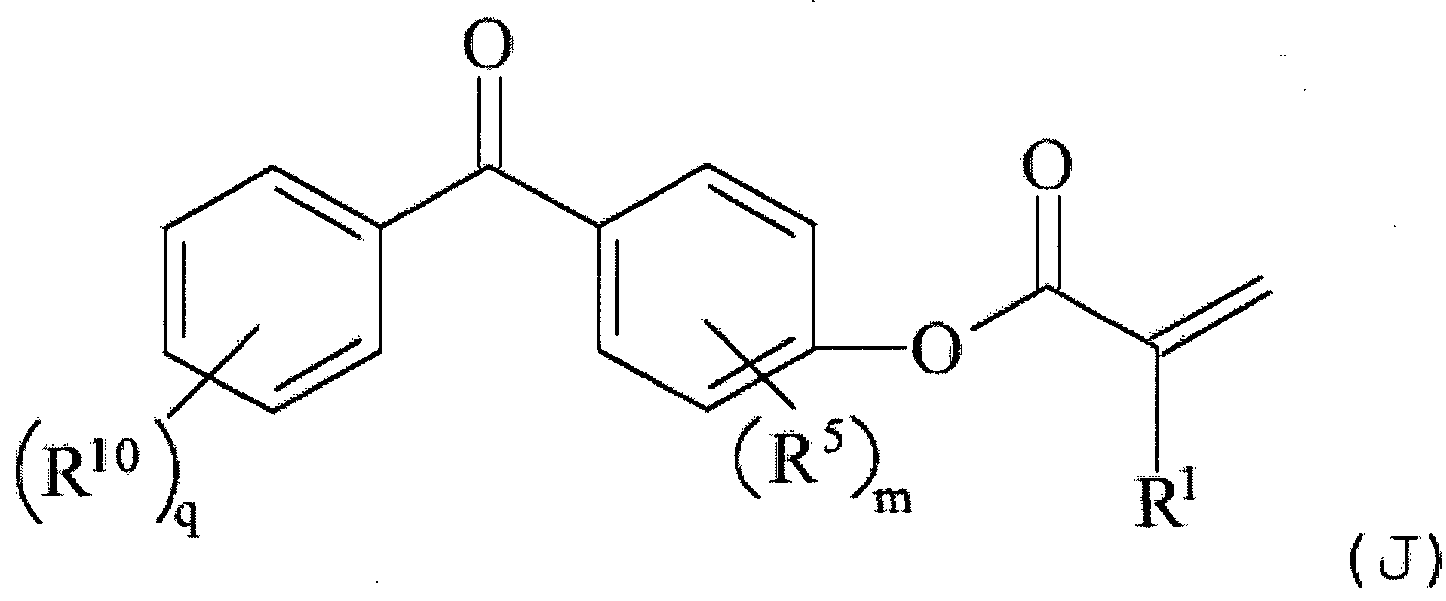
The compounds of formulae (I) and (J) are either commercially available or obtainable by literature methods. Possible methods of preparation include for example the transesterification of (meth)acrylates with the corresponding alcohols.
Preferably, component a) represents 0.1% to 10.0% by weight, more preferably 0.1% to 5% by weight, more preferably 0.5% to 1.0% by weight of the polymerizable constituents of the monomer composition.
For component b) of the monomer composition of the aqueous dispersion of the present invention, it preferably comprises:
60.0% to 80.0% by weight of one or more acrylates other than a),
0% to 40.0% by weight of one or more methacrylates other than a), 0% to 5.0% by weight of acrylic acid and/or methacrylic acid,
0% to 5.0% by weight of one or more acrylamides and/or methacrylamides and/or acrylonitrile and/or methacrylonitrile and/or hydroxyalkyl acrylates and/or hydroxyalkyl methacrylates.
Acrylates herein are all functionalized or non functionalized acrylates other than a). Preference is given to ethyl acrylate, propyl acrylate, butyl acrylate, ethylhexyl acrylate or mixtures thereof. Methacrylates herein are all functionalized or nonfunctionalized methacrylates other than a). Preference is given to methyl methacrylate, ethyl methacrylate, propyl methacrylate, butyl methacrylate, ethylhexyl methacrylate or mixtures thereof. Preferably, the acrylamides and/or methacrylamides of component b) comprise acrylamide, N-methylol acrylamide, methacrylamide, N-
methylol methacrylamide or mixtures thereof.
More preferably, component b) of the monomer composition of the aqueous dispersion of the present invention comprises:
10.0% to 30.0% by weight of butyl acrylate,
40.0% to 80.0% by weight of ethyl acrylate,
0% to 40.0% by weight of methyl methacrylate,
0% to 3.0% by weight of methacrylic acid,
0% to 3.0% by weight of methacrylamide.
Preferably, component b) of the monomer composition of the aqueous dispersion of the present invention is preferably chosen such that the (meth)acrylate polymers used according to the invention have a glass transition temperature below 15°C, preferably below 5°C and more preferably below -5°C.
Preferably, the pH of the dispersion of the present invention is 6.0 to 9.0.
The polymers in the dispersions used according to the invention are generally obtained through free-radical polymerization. The customary free-radical polymerization is exhaustively described in Ullmanns' Encyclopaedia of Industrial Chemistry, Sixth Edition, as well as elsewhere. In the present invention, the polymerization can be started using at least one polymerization initiator for free radical polymerization. This includes redox systems widely known among those skilled in the art. A preferably redox system consists of ammonium peroxodisulphate, sodium hydroxymethanefulinate and FeS04.
The polymerization to obtain the polymers of the invention can be carried out at atmospheric pressure, subatmo spheric pressure or superatmospheric pressure. Polymerization temperature is similarly uncritical. Generally, however, it is in the range form -20 to 200°C, preferably in the range of 0-180°C, more preferably in the range of 50- 180°C, even more preferably in the range of 50-130°C and yet even more
preferably in the range of 60-120°C.
Such an aqueous dispersion permits in a not readily foreseeable manner the creation of coatings on leather with advantageous properties through incorporation of polymer-attached UV curable (meth)acrylate polymers in conventional dispersions.
One advantage of the system in relation to the coating of leather with the aqueous dispersion of the invention resides in that no additional photo initiators are required for the UV curing and no migration of the UV-active species is likely, since the UV active substance is incorporated as a copolymerized monomer in the corresponding coating.
A very particular advantage particularly for applications relating to leather is the curing without release of a low molecular weight compound such as, formaldehyde in the prior art. Hence the process of the invention is of immense advantageousness compared with the prior art in respect of ecological and toxicological aspects. Processing the dispersions of the invention for coating leather takes the form of applying the aqueous dispersion to the leather sheet material, then drying and a subsequent UV cure which is usually carried out continuously in a belt apparatus. Preferably, a delay period is inserted between the drying step and the UV-curing step to complete the filming of the coating. This generally takes within a few minutes or even within a few seconds. The applying comprises spread coating, roll coating, printing, spraying, saturating or padding.
In relation to the processing of leather, the process of the invention, which involves a UV-curing step, is advantageous over the prior art thermal curing, in several respects. First, the energy requirements are distinctly lower; secondly, the equipment needed for the padding and subsequent curing can be made distinctly more space-saving and technically less complex. A distinctly more long-winded thermal cure naturally requires more space than a short unit for UV curing.
In addition, in the practice of the process of the invention, the dispersions of the invention are observed to be distinctly less prone to coagulate than the prior art dispersions. In addition, the materials display better shear stability and hence better and potentially also faster processibility.
It is further notable that the preferably benzophenone-containing compounds in the composition of the present invention comprise monomers which effectuate a cure via UV crosslinking, instead of polymeric photoinitiators. This constitutes a significant difference from prior art.
Embodiments
The examples which follow further elucidate the invention without restricting it in any way. The examples show in particular that the aqueous dispersions and the process of the invention at least meet the requirements for leather coating in respect of the material properties of the end product. Especially the equipment advantages of UV crosslinking and also the ecological advantages of the present invention were comprehensively described above.
Apparatus
1) 1L four-neck flask, reflux condenser, saber agitator, motor-driven agitator, metering pump, thermometer, PH meter, contact thermometer in the oil bath, oil bath with motor-driven agitator for homogenization, nitrogen flask with feed line and flow meter, high speed disperser.
2) UV curing lamp: Philips TL20W/05* 2
3) UV curing machine: GY UV 2kw/2, WANGYI
Chemicals
Ethyl Acrylate (EA),
Butyl Acrylate (BA),
Methyl Methacrylate (MMA),
Methacrylamide (MAA),
Methyacrylic Acid (GMAA),
4-(Methacryloyloxy)benzophenone (BPMA),
Ammonium peroxodisulphate (APS),
Sodium Hydroxymethanefulinate,
FeS04-7H20,
Sodium Lauyl Sulphate (SLS),
Deionized Water.
Preparing the aqueous dispersions
Example 1
2.63 g of SLS (emulsifier), 145.08 g of EA, 70.47 g of BA, 10.57 g of MAA, 7.0 g of GMAA, 5.83 g of BPMA, 35.233 g of MMA and 497 g of deionized water were mixed and emulsified using Ultra-Turrax at 10000 rpm for 2.5 minutes. The mixture was charged to a reactor. The agitator speed was adjusted to 1 10 rpm and the temperature of the mixture was kept at about 35 °C. Under nitrogen atmosphere, 1 g of APS in 10 g of deionized water was added to the reactor. After 30 seconds, 0.0052 g of FeS04-7H20 in 4 g of deionized water was added. After another 30 seconds, 0.52 g of hydroxymethanefulinate in 8 g of deionized water was added to start the polymerization. The temperature went up to about 90 °C in about 6 minutes. 0.06 g of APS in 6 g of deionized water was added immediately thereafter. Then 78.12 g of EA was added dropwise over 15 minutes.
The temperature of the mixture was cooled to and maintained at 70 °C for 2 hours. Then 0.06 g of APS in 6 g of deionized water was added. The temperature of the mixture was maintained at 70 °C another 3 hours. The temperature of the mixture was then cooled to room temperature and the result mixture was filtered to remove any coagulum.
The total amount of the raw material used was 888 g. The content of all the monomers was 40 % by weight.
Example 2-13
Another 12 batches of aqueous dispersions were prepared. For each batch, the total amount of the raw material used was also 888 g and the content of all the monomers was also 40 % by weight.
The process for preparing these aqueous dispersions was the same as Example 1 except the ratio of monomers which is reported in Table 1. Percentages in the table are all by weight unless otherwise indicated. The original pH of the dispersion is around 2-3. For Examples 10-13, a portion of the dispersion was taken out and their pH value was adjusted to 8-9 with aqueous ammonia.
Tg, coagulum weight, viscosity, pH, solid content and particle size of Examples 1-13 were calculated or measured. The results are reported in Table 1.
Performance test of the resultant films
Film preparation
The dispersions of Examples 1-13 were put in open containers and dried at 60 °C overnight. The dried films were further exposed to a weak UV source (Philips TL20W/05 *2 ) for a fixed time of Oh, 0.5h, lh, 2h and 3h or to a stronger UV source (GY UV 2kW/2, WANGYI) for a fixed time of 2s, 5s and 10s.
Elongation at break test
The preparation of film samples and the tests for elongation at break was conducted according to QB/T 2223-96 (Chinese Industry Standard).
Brittleness test
The brittleness test of the film samples was conducted according to QB/T 2223-96 with the focus that whether the film is still flexible at -18 °C after long time storage at that temperature (8 hours or 16 hours - two cycles).
Tackiness test
The prepared film was kept at least for 24 hours at room temperature. Then the film was tested with finger. The tackiness was judged by the feeling.
The above performance of the films is reported in Table 2.
Table 1 shows that BPMA contributes to gel weight reduction. More BPMA in the recipe, less coagulum could be formed. Table 2 shows BPMA also contributes film tackiness reduction. More BPMA, less tacky the resultant film could be.
Leather coatings should meet many requirements. For example, the emulsion should not contain much coagulum, preferably less than 1 wt.%, or even less than 0.5 wt.%. The resultant film should be non-tacky at room temperature. But on the other hand, it should be flexible enough, that means, even at very low temperature (-18°C) it is not brittle and without any fold remained. Ideally, it would be better if the elongation at break is within 300% to 500% at room temperature while keeping enough tensile strength.
It can be seen from the results in the tables that the properties of the dispersions and the performance of the resultant inventive films generally meet the requirements of leather coating industry. Furthermore, the tensile strength of the resultant films is all above 2.0 MPa which is also advantageous for leather coatings.
Table 1 Emulsion composition and property of examples

Table 2 Film performance of the examples

* UV curing time, using Philips TL 20W/05, ca 5.5cm between lamp and sample.
* * UV curing time, using GY UV 2kw/2, WANGYI good;
a little bit.
Claims
Claims
1. An aqueous dispersion, characterized in that the dispersion contains one or more (meth)acrylate polymers containing one or more compounds of the general formula (I) in polymerized form and obtainable by emulsion polymerization of a monomer composition comprising a) 0.1% to 25.0% by weight of at least one compound of the general formula (I)

R2 is oxygen or NH,
R3 is a radical of the general formula II

R', R° and Ry are each independently hydrogen or methyl,
n is an integer from zero to two hundred,
o and p are each independently an integer from zero to two, subject to the proviso that R is a bond when the sum total of n and o and p is zero, R4 is a bond, oxygen or 0-CO-O,
R5 is hydrogen, halogen or a radical which contains one to twenty carbon atoms and is optionally substituted with oxygen, nitrogen and/or sulphur, where m is an integer from one to five, and
R6 is an aryl or heterocyclyl radical, substituted or unsubstituted, and b) a mixture of further compounds comprising
40.0% to 99.9% by weight of one or more acrylates other than a),
0% to 59.9% by weight of one or more methacrylates other than a), 0% to 10% by weight of acrylic acid and/or methacrylic acid,
0% to 10%) by weight of one or more acrylamides and/or methacrylamides and/or acrylonitrile and/or methacrylonitrile and/or hydroxyalkyl acrylates and/or hydroxyalkyl methacrylates, wherein the components a) and b) together amount to 100% by weight of the polymerizable constituents of the monomer composition .
2. The dispersion according to Claim 1, characterized in that R1 is methyl.
3. The dispersion according to Claim 1 or 2, characterized in that R2 is oxygen.
4. The dispersion according to any of the preceding claims, characterized in that R4 is a bond.
5. The dispersion according to any of the preceding claims, characterized in that p = o = n = zero. 6. The dispersion according to any of the preceding claims, characterized in that R6 is phenyl.
7. The dispersion according to any of the preceding claims, characterized in that each R5 is hydrogen.
8. The dispersion according to any of the preceding claims, characterized
in that component a) is 4-(methacryloyloxy)benzophenone.
9. The dispersion according to any of the preceding claims, characterized in that component a) represents 0.1% to 10.0% by weight, preferably 0.1% to 5% by weight, more preferably 0.5% to 1.0% by weight of the polymerizable constituents of the monomer composition.
10. The dispersion according to any of the preceding claims, characterized in that component b) comprises:
60.0% to 80.0% by weight of one or more acrylates other than a),
0% to 40.0% by weight of one or more methacrylates other than a), 0% to 5.0% by weight of acrylic acid and/or methacrylic acid and
0% to 5.0% by weight of one or more acrylamides and/or methacrylamides and/or acrylonitrile and/or methacrylonitrile and/or hydroxy alky 1 acrylates and/or hydroxy alky 1 methacrylates.
11. The dispersion according to any of the preceding claims, characterized in that the acrylates of component b) comprise ethyl acrylate, propyl acrylate, butyl acrylate or ethylhexyl acrylate or mixtures thereof.
12. The dispersion according to any of the preceding claims, characterized in that the methacrylates of component b) comprise methyl methacrylate, ethyl methacrylate, propyl methacrylate, butyl methacrylate, ethylhexyl methacrylate or mixtures thereof.
13. The dispersion according to any of the preceding claims, characterized in that the acrylamides and/or methacrylamides of component b) comprise acrylamide, N-methylol acrylamide, methacrylamide, N-methylol methacrylamide or mixtures thereof.
14. The dispersion according to any of the preceding claims, characterized in that component b) comprises:
10.0% to 30.0% by weight of butyl acrylate,
40.0% to 80.0% by weight of ethyl acrylate,
0% to 40.0% by weight of methyl methacrylate,
0% to 3.0% by weight of methacrylic acid,
0% to 3.0% by weight of methacrylamide.
15. The dispersion according to any of the preceding claims, characterized in that the (meth)acrylate polymers have a glass transition temperature below 15°C, preferably below 5°C and more preferably below -5°C.
16. The dispersion according to any of the preceding claims, characterized in that the pH of the dispersion is 6.0 to 9.0.
17. Use of the dispersion according to any of the preceding claims for coating leather. 18. A process for coating leather, characterized in that the coating includes applying the dispersion according to any of Claims 1-16, then drying and subsequent curing by means of UV radiation.
19. The process according to Claim 18, characterized in that the applying comprises spread coating, roll coating, printing, spraying, saturating or padding, preferably padding.
20. Leather material obtained by the process according to Claim 18 or 19.
Priority Applications (1)
| Application Number | Priority Date | Filing Date | Title |
|---|---|---|---|
| PCT/CN2011/000720 WO2012145857A1 (en) | 2011-04-25 | 2011-04-25 | Aqueous dispersion of preferably benzophenone-containing (meth)acrylate polymers for leather coating |
Applications Claiming Priority (1)
| Application Number | Priority Date | Filing Date | Title |
|---|---|---|---|
| PCT/CN2011/000720 WO2012145857A1 (en) | 2011-04-25 | 2011-04-25 | Aqueous dispersion of preferably benzophenone-containing (meth)acrylate polymers for leather coating |
Publications (1)
| Publication Number | Publication Date |
|---|---|
| WO2012145857A1 true WO2012145857A1 (en) | 2012-11-01 |
Family
ID=47071528
Family Applications (1)
| Application Number | Title | Priority Date | Filing Date |
|---|---|---|---|
| PCT/CN2011/000720 Ceased WO2012145857A1 (en) | 2011-04-25 | 2011-04-25 | Aqueous dispersion of preferably benzophenone-containing (meth)acrylate polymers for leather coating |
Country Status (1)
| Country | Link |
|---|---|
| WO (1) | WO2012145857A1 (en) |
Cited By (3)
| Publication number | Priority date | Publication date | Assignee | Title |
|---|---|---|---|---|
| CN107384081A (en) * | 2017-08-29 | 2017-11-24 | 安徽乐踏鞋业有限公司 | A kind of finishing agent for improving the low temperature resistant dry environment of leather |
| US10221270B2 (en) | 2016-07-14 | 2019-03-05 | Rohm And Haas Company | Latex functionalized with phosphorus acid and photoinitiator groups |
| US11186726B2 (en) | 2017-04-01 | 2021-11-30 | Dow Global Technologies Llc | Aqueous polymer dispersion and aqueous coating composition comprising the same |
Citations (4)
| Publication number | Priority date | Publication date | Assignee | Title |
|---|---|---|---|---|
| CN1796421A (en) * | 2004-12-29 | 2006-07-05 | 国家淀粉及化学投资控股公司 | Photoinitiators and UV-crosslinkable acrylic polymers for pressure sensitive adhesives |
| WO2010108752A1 (en) * | 2009-03-24 | 2010-09-30 | Evonik Röhm Gmbh | (meth)acrylate polymers and the use thereof as polymer-bound uv initiators or additive to uv-curable resins |
| WO2010108762A1 (en) * | 2009-03-24 | 2010-09-30 | Evonik Röhm Gmbh | Composition comprising as the aqueous dispersion preferably (meth)acrylate polymers containing benzophenone in a mixture with (meth)acrylate polymers different therefrom and the use of said composition |
| TW201105758A (en) * | 2009-03-30 | 2011-02-16 | Evonik Roehm Gmbh | Coating composition, (meth) acrylic polymer and monomer mixture for preparing the (meth) acrylic polymer |
-
2011
- 2011-04-25 WO PCT/CN2011/000720 patent/WO2012145857A1/en not_active Ceased
Patent Citations (4)
| Publication number | Priority date | Publication date | Assignee | Title |
|---|---|---|---|---|
| CN1796421A (en) * | 2004-12-29 | 2006-07-05 | 国家淀粉及化学投资控股公司 | Photoinitiators and UV-crosslinkable acrylic polymers for pressure sensitive adhesives |
| WO2010108752A1 (en) * | 2009-03-24 | 2010-09-30 | Evonik Röhm Gmbh | (meth)acrylate polymers and the use thereof as polymer-bound uv initiators or additive to uv-curable resins |
| WO2010108762A1 (en) * | 2009-03-24 | 2010-09-30 | Evonik Röhm Gmbh | Composition comprising as the aqueous dispersion preferably (meth)acrylate polymers containing benzophenone in a mixture with (meth)acrylate polymers different therefrom and the use of said composition |
| TW201105758A (en) * | 2009-03-30 | 2011-02-16 | Evonik Roehm Gmbh | Coating composition, (meth) acrylic polymer and monomer mixture for preparing the (meth) acrylic polymer |
Cited By (3)
| Publication number | Priority date | Publication date | Assignee | Title |
|---|---|---|---|---|
| US10221270B2 (en) | 2016-07-14 | 2019-03-05 | Rohm And Haas Company | Latex functionalized with phosphorus acid and photoinitiator groups |
| US11186726B2 (en) | 2017-04-01 | 2021-11-30 | Dow Global Technologies Llc | Aqueous polymer dispersion and aqueous coating composition comprising the same |
| CN107384081A (en) * | 2017-08-29 | 2017-11-24 | 安徽乐踏鞋业有限公司 | A kind of finishing agent for improving the low temperature resistant dry environment of leather |
Similar Documents
| Publication | Publication Date | Title |
|---|---|---|
| CA2545727C (en) | Aqueous dispersions containing multi-stage emulsion polymers | |
| CA3032277C (en) | Ambient self-crosslinkable latex | |
| CN107849186B (en) | paint additives | |
| US20050027079A1 (en) | Aqueous multistage emulsion polymer composition | |
| JP6359953B2 (en) | Film forming aid | |
| JP5530156B2 (en) | Resin emulsion for sealer and method for producing the same | |
| CN109153739B (en) | Amine functional anionic polymer dispersion and coating composition therefor | |
| CA3047842C (en) | Method for producing aqueous polymer compositions with less yellowing | |
| WO2012145857A1 (en) | Aqueous dispersion of preferably benzophenone-containing (meth)acrylate polymers for leather coating | |
| JPS62241965A (en) | Emulsion composition | |
| JP5547459B2 (en) | Resin emulsion for sealers | |
| JP2018529796A (en) | Aqueous dispersion of oxazoline group-containing polymer | |
| JP3216262B2 (en) | Heat-curable anti-fog composition for vehicle lighting and vehicle lighting | |
| JPS62241901A (en) | Production of self-dispersed water-based resin | |
| JP5547460B2 (en) | Resin composition for sealer | |
| JP7129481B2 (en) | Aqueous dispersion, method for producing the same, coating composition and coating film | |
| CN111004347B (en) | Low-ammonia-release-amount water-based emulsion and preparation method and application thereof | |
| EP4351804A1 (en) | Storage stable pigmented coating composition | |
| JP2000169510A (en) | Aqueous resin dispersion | |
| RU2260602C1 (en) | Method for preparing styrene-acrylic copolymers aqueous dispersions | |
| CN114621387A (en) | Aqueous urea-modified polyacrylate dispersion for flexible waterproofing materials | |
| JP2010059239A (en) | Curable ethylenic unsaturated monomer, one-component-curable polymer emulsion composition, and product made of resin using the composition | |
| JPH03153782A (en) | Water-base acrylic resin composition | |
| JP2001316421A (en) | Anionic polymer dispersion containing nonvolatile protonated amino compound |
Legal Events
| Date | Code | Title | Description |
|---|---|---|---|
| 121 | Ep: the epo has been informed by wipo that ep was designated in this application |
Ref document number: 11864297 Country of ref document: EP Kind code of ref document: A1 |
|
| NENP | Non-entry into the national phase |
Ref country code: DE |
|
| 122 | Ep: pct application non-entry in european phase |
Ref document number: 11864297 Country of ref document: EP Kind code of ref document: A1 |