WO2012142457A2 - Macrolactam compounds and methods for the treatment of malaria - Google Patents
Macrolactam compounds and methods for the treatment of malaria Download PDFInfo
- Publication number
- WO2012142457A2 WO2012142457A2 PCT/US2012/033586 US2012033586W WO2012142457A2 WO 2012142457 A2 WO2012142457 A2 WO 2012142457A2 US 2012033586 W US2012033586 W US 2012033586W WO 2012142457 A2 WO2012142457 A2 WO 2012142457A2
- Authority
- WO
- WIPO (PCT)
- Prior art keywords
- alkyl
- compound
- och
- methyl
- heteroaryl
- Prior art date
- Legal status (The legal status is an assumption and is not a legal conclusion. Google has not performed a legal analysis and makes no representation as to the accuracy of the status listed.)
- Ceased
Links
- 0 C*C(C*)C(C)C(N(CC(*)C(*)CN(*)*)C(C)COCc(cc1)ccc1OC)=O Chemical compound C*C(C*)C(C)C(N(CC(*)C(*)CN(*)*)C(C)COCc(cc1)ccc1OC)=O 0.000 description 20
- SUHHEDOZELIJOX-GADYJKOBSA-N C[C@@H](COCc(cc1)ccc1OC)N1Cc2cc(NC(Nc3c(C)[o]nc3C)=O)ccc2O[C@@H](C)CCCCO[C@@H](CN(C)S(c(cc2)ccc2F)(=O)=O)[C@H](C)C1 Chemical compound C[C@@H](COCc(cc1)ccc1OC)N1Cc2cc(NC(Nc3c(C)[o]nc3C)=O)ccc2O[C@@H](C)CCCCO[C@@H](CN(C)S(c(cc2)ccc2F)(=O)=O)[C@H](C)C1 SUHHEDOZELIJOX-GADYJKOBSA-N 0.000 description 1
- YXFVVABEGXRONW-UHFFFAOYSA-N Cc1ccccc1 Chemical compound Cc1ccccc1 YXFVVABEGXRONW-UHFFFAOYSA-N 0.000 description 1
- VQHGELUKJYOETQ-UHFFFAOYSA-N [O-][N+](c(cc1)cc(S(Cl)(=O)=O)c1F)=O Chemical compound [O-][N+](c(cc1)cc(S(Cl)(=O)=O)c1F)=O VQHGELUKJYOETQ-UHFFFAOYSA-N 0.000 description 1
Classifications
-
- A—HUMAN NECESSITIES
- A61—MEDICAL OR VETERINARY SCIENCE; HYGIENE
- A61K—PREPARATIONS FOR MEDICAL, DENTAL OR TOILETRY PURPOSES
- A61K31/00—Medicinal preparations containing organic active ingredients
- A61K31/33—Heterocyclic compounds
- A61K31/395—Heterocyclic compounds having nitrogen as a ring hetero atom, e.g. guanethidine or rifamycins
- A61K31/55—Heterocyclic compounds having nitrogen as a ring hetero atom, e.g. guanethidine or rifamycins having seven-membered rings, e.g. azelastine, pentylenetetrazole
- A61K31/553—Heterocyclic compounds having nitrogen as a ring hetero atom, e.g. guanethidine or rifamycins having seven-membered rings, e.g. azelastine, pentylenetetrazole having at least one nitrogen and one oxygen as ring hetero atoms, e.g. loxapine, staurosporine
-
- A—HUMAN NECESSITIES
- A61—MEDICAL OR VETERINARY SCIENCE; HYGIENE
- A61P—SPECIFIC THERAPEUTIC ACTIVITY OF CHEMICAL COMPOUNDS OR MEDICINAL PREPARATIONS
- A61P33/00—Antiparasitic agents
-
- C—CHEMISTRY; METALLURGY
- C07—ORGANIC CHEMISTRY
- C07D—HETEROCYCLIC COMPOUNDS
- C07D273/00—Heterocyclic compounds containing rings having nitrogen and oxygen atoms as the only ring hetero atoms, not provided for by groups C07D261/00 - C07D271/00
- C07D273/01—Heterocyclic compounds containing rings having nitrogen and oxygen atoms as the only ring hetero atoms, not provided for by groups C07D261/00 - C07D271/00 having one nitrogen atom
-
- C—CHEMISTRY; METALLURGY
- C07—ORGANIC CHEMISTRY
- C07D—HETEROCYCLIC COMPOUNDS
- C07D409/00—Heterocyclic compounds containing two or more hetero rings, at least one ring having sulfur atoms as the only ring hetero atoms
- C07D409/02—Heterocyclic compounds containing two or more hetero rings, at least one ring having sulfur atoms as the only ring hetero atoms containing two hetero rings
- C07D409/12—Heterocyclic compounds containing two or more hetero rings, at least one ring having sulfur atoms as the only ring hetero atoms containing two hetero rings linked by a chain containing hetero atoms as chain links
-
- C—CHEMISTRY; METALLURGY
- C07—ORGANIC CHEMISTRY
- C07D—HETEROCYCLIC COMPOUNDS
- C07D413/00—Heterocyclic compounds containing two or more hetero rings, at least one ring having nitrogen and oxygen atoms as the only ring hetero atoms
- C07D413/02—Heterocyclic compounds containing two or more hetero rings, at least one ring having nitrogen and oxygen atoms as the only ring hetero atoms containing two hetero rings
- C07D413/06—Heterocyclic compounds containing two or more hetero rings, at least one ring having nitrogen and oxygen atoms as the only ring hetero atoms containing two hetero rings linked by a carbon chain containing only aliphatic carbon atoms
-
- C—CHEMISTRY; METALLURGY
- C07—ORGANIC CHEMISTRY
- C07D—HETEROCYCLIC COMPOUNDS
- C07D413/00—Heterocyclic compounds containing two or more hetero rings, at least one ring having nitrogen and oxygen atoms as the only ring hetero atoms
- C07D413/02—Heterocyclic compounds containing two or more hetero rings, at least one ring having nitrogen and oxygen atoms as the only ring hetero atoms containing two hetero rings
- C07D413/12—Heterocyclic compounds containing two or more hetero rings, at least one ring having nitrogen and oxygen atoms as the only ring hetero atoms containing two hetero rings linked by a chain containing hetero atoms as chain links
-
- C—CHEMISTRY; METALLURGY
- C07—ORGANIC CHEMISTRY
- C07D—HETEROCYCLIC COMPOUNDS
- C07D498/00—Heterocyclic compounds containing in the condensed system at least one hetero ring having nitrogen and oxygen atoms as the only ring hetero atoms
- C07D498/02—Heterocyclic compounds containing in the condensed system at least one hetero ring having nitrogen and oxygen atoms as the only ring hetero atoms in which the condensed system contains two hetero rings
- C07D498/04—Ortho-condensed systems
-
- Y—GENERAL TAGGING OF NEW TECHNOLOGICAL DEVELOPMENTS; GENERAL TAGGING OF CROSS-SECTIONAL TECHNOLOGIES SPANNING OVER SEVERAL SECTIONS OF THE IPC; TECHNICAL SUBJECTS COVERED BY FORMER USPC CROSS-REFERENCE ART COLLECTIONS [XRACs] AND DIGESTS
- Y02—TECHNOLOGIES OR APPLICATIONS FOR MITIGATION OR ADAPTATION AGAINST CLIMATE CHANGE
- Y02A—TECHNOLOGIES FOR ADAPTATION TO CLIMATE CHANGE
- Y02A50/00—TECHNOLOGIES FOR ADAPTATION TO CLIMATE CHANGE in human health protection, e.g. against extreme weather
- Y02A50/30—Against vector-borne diseases, e.g. mosquito-borne, fly-borne, tick-borne or waterborne diseases whose impact is exacerbated by climate change
Definitions
- Malaria is a vector-borne infectious disease caused by protozoan parasites and is widespread in tropical and subtropical regions, including parts of the Americas, Asia and Africa.
- P. falciparum P. vivax, P. ovale, P. malariae and P. knowlesi
- P. falciparum and P. vivax the most serious forms of the disease are caused by P. falciparum and P. vivax.
- P. falciparum and P. vivax Ofthe approximately 515 million people infected yearly, between one and three million people, the majority of whom are young children in Sub-Saharan Africa, die from the disease.
- macrolactam compounds a novel class of compounds based on a macrolactam scaffold
- Representative compounds disclosed herein exhibit potent anti-malaria activity in vitro and in vivo and likely act via a mechanism that has not been utilized in malaria drug development.
- one embodiment of the present invention is a method of treating a subject with malaria, comprising administering to the subject an effective . amount of a macrolactam compound of the invention, or a pharmaceutically acceptable salt thereof, or a composition comprising a macrolactam compound of the invention, or a pharmaceutically acceptable salt thereof.
- Another embodiment of the invention is a macrolactam compound described herein, or a pharmaceutically acceptable salt thereof.
- compositions comprising a macrolactam compound described herein, or a pharmaceutically acceptable salt thereof.
- Another embodiment of the invention is the use of a macrolactam compound described herein, or a pharmaceutically acceptable salt thereof, for treating malaria in a subject.
- Another embodiment of the invention is the use of a macrolactam compound described herein, or a pharmaceutically acceptable salt thereof, for the manufacture of a medicament for treating malaria in a subject.
- the present invention is directed to a macrolactam compound represented by the following structural formula: or a pharmaceutically acceptable salt thereof.
- L is CrQo alkylene, Ci-C 10 alkenylene, or Ci-Qo alkynylene.
- L is C1-C5 alkylene, C C 5 alkenylene, or Ci-C 5 alkynylene.
- L is C 2 -C 5 alkylene or C 2 -C 5 alkenylene.
- L is Q-C5 alkylene or Ci-C 5 alkenylene.
- L is optionally substituted with 1 to 3 groups represented by R 5 .
- L is optionally substituted with 1 group represented by R 5 .
- L is substituted with methyl.
- L is unsubstituted.
- Each of Xi , X3, and X 4 is independently S, 0, N, NH or CH.
- Each of X ls X 3 , and X 4 is independently S, N, NH or CH.
- Each of X ls X 3 , and X 4 is independently N, NH or CH.
- Each of X u X 3 , and X 4 is independently N or CH.
- X 2 if present, is S, O, N, NH or CH.
- X 2 is S, O, N, NH or CH.
- X 2 is absent.
- X 2 if present, is S, N, NH or CH.
- X 2 if present, is N, NH or CH.
- X 2 if present, is N or CH.
- Y 1 ⁇ if present is bonded to any one of X l5 X 3 and X 4 or X 2 , if present.
- Y ⁇ is present and is bonded to any one of Xj, X 3 and X 4 or X 2 , if present. is present and is bonded to X 3 .
- Y ⁇ is present, and is bonded to X 2 .
- Y 1 ⁇ if present is bonded to XI or X 3 or X 2 , if present.
- Y l5 if present is bonded to X 3 or X 2 , if present. Yi is present and is bonded to Xj.
- the X ⁇ , X 3 and X 4 or X 2 , if present, to which Y ⁇ is bonded is C or N.
- the Xi, X 3 and X 4 or X 2 , if present, to which Yi is bonded is C.
- the Xj, X 3 and X4 or X 2 , if present, to which Y ⁇ is bonded is N.
- Yi is Ri, R 1 -(C 1 -C 3 )alkylene, R 1 -(C 2 -C 3 )alkenylene, Ri-(C 2 -C 3 )alkynylene, .
- Ri-NR 6 C(0)NR 6 - Ri-OC(S)-, Ri-NR 6 C(0)NR 6 -, R 1 -NR 6 C(S)NR 6 -, R ! -S0 2 NR 6 -, Ri-N eSO , or Ri-NR 6 C(0)0-, wherein the Ri-(C C 3 )alkylene, 3 ⁇ 4 -(C 2 -C 3 )alkenylene, or Rj-(C 2 - C 3 )alkynylene.
- Yi is R h R 1 -(C 1 -C 3 )alkylene, R ! -NR 6 -, R C(0)NR 6 -, R C(0)0-, or R!-S0 2 NR 6 -.
- Y is 3 ⁇ 4, R 1 -CH 2 - 5 R r NR 6 -, R 1 -C(0)NR 6 -, R-C(0)0-,
- Y ⁇ is Ri-NHC(0)NH-.
- Yj is not Ri-NHC(0)NH- when R] is unsubstituted phenyl.
- Y ⁇ is optionally substituted with one to three groups selected from R 5 .
- R] is hydrogen, halogen, -N(R 6 ) 2 , -CN, (Ci-C 6 )alk l, halo(Ci-C 6 )alkyl, (C C 6 )alkoxy, (C[-C 6 )alkoxy(C 1 -C 6 )alkyl, cycloalkyl, aryl, heteroaryl, heterocyclyl, cycloalkyl(Ci-C 3 )alkyl, aryl(C 1 -C 3 )alkyl, heteroaryl(C 1 -C 3 )alkyl, heterocyclyKOr C 3 )alkyl, spiro cycloalkyl, or spiro heterocycyl.
- Rj is hydrogen, halogen, -N(R 6 ) 2 , -CN, (Ci-C 6 )alkyl, halo(C 1 -C 6 )alkyl, cycloalkyl, aryl or heteroaryl.
- Ri is hydrogen, fluoro, -CF 3 , NH 2 , -CN, (C 1 -C 3 )alkyl, phenyl, isoxazoyl, benzoxazoyl, imidazolyl, pyridine, or thiophene.
- Ri is optionally substituted with one to three groups represented by R 5 .
- Y 2 is R 2a -(Ci-C 3 )alkylene-, R 2a -C(0)-, R 2a -S0 2 - , R 2a -S(0)- , R 2a -C(0)NR 6 -, R 2a -S0 2 NR 6 -, R 2a -R 6 C(0)-, or R 2a -NR 6 S0 2 -, wherein the R 2a -(C 1 -C 3 )alkylene is optionally substituted with one to three groups selected from R 5 ; or Y 2 is R 2 b-. Y 2 is R 2b or R 2a -(Ci-C 2 )alkylene-. Y 2 is R 2a -CH 2 CH 2 CH(CH 3 )- orY 2 is R 2b -. Y 2 is R 2b -. Y 2 is not -CH(CH 3 )CH 2 OH.
- R 2a is hydrogen, halogen, (d-C6)alkyl, (Ci-C 6 )alkoxy,
- R 2a is (Ci-C 6 )alkoxy, aryloxy, or heteroaryloxy.
- R 2a is (C 1 -C 6 )alkyl, (Cj-C6)alkoxy, aryl, aryloxy, heteroaryl, heteroaryloxy, or heteroaryl(C 1 -C 3 )alkyl.
- R 2a is optionally substituted with one to three groups represented by R 5 or further selected from -N 3 , aryloxy, aroyl, benzoate, tert-butyldimethylsiloxy, cylcoalkoxy, heterocyclyloxy, or heteroaryl.
- R 2a is optionally substituted with one to three groups represented by R 5 or further selected from -N 3 , pyridinoxy, benzoxy, p-methoxybenzoxy, benzoate, heterocyclyloxy, tert-butyldimethylsiloxy, or heteroaryl.
- R 2a is optionally substituted with one to three groups represented by R 5 .
- R 2b is hydrogen, cycloalkyl, aryl, heteroaryl, heterocyclyl, cycloalkyl(Ci-C 3 )alkyl, aryl(Ci-C3)alkyl, heteroary ⁇ C C 3 )alkyl, heterocyclyl(Cj-C 3 )alkyl, spiro cycloalkyl, or spiro heterocyclyl.
- R 2b - is CH 3 CH 2 CH(CH 3 )-.
- R 2b is hydrogen, (C C 6 )alkyl, aryl, or heteroaryl.
- R 2b is 1- methylethyl. When R 2b is 1 -methylethyl, R 2b is not substituted with hydroxy.
- R 2b is optionally substituted with one to three groups represented by R 5 or further selected from -N 3 , aryloxy, aroyl, benzoate, tert-butyldimethylsiloxy, cylcoalkoxy, heterocyclyloxy, or heteroaryl.
- R 2b is optionally substituted with one to three groups represented by R 5 or further selected from -N 3 , pyridinoxy, benzoxy, p-methoxybenzoxy, benzoate, heterocyclyloxy, tert-butyldimethylsiloxy, or heteroaryl.
- R 2b is optionally substituted with one group represented by R 5 or further selected from benzoate, tert-butyldimethylsiloxy, or heterocyclyloxy.
- R 2b is optionally substituted with p-methoxybenzoxy, (Ci-C 4 )alkoxy, hydroxy, or dimethylamino.
- Y 3 is R 3 -, R 3 -(Ci-C 3 )alkylene, R 3 -C(0)0-, R 3 -OC(0)-, R 3 -C(0)-, R 3 -S0 2 -, R 3 -SO-, R 3 -C(0)NR 6 -, R 3 -NR 6 CO-, R 3 -S0 2 NRe, or R 3 -NR 6 S0 2 -, wherein the
- R3-(Ci-C 3 )alkylene is optionally substituted with R 5 .
- Y 3 is R 3 , R 3 -CH 2 -, R 3 -C(0)0-, R 3 -C(0)-, R 3 -S0 2 -, or R 3 -C(0)NR 6 -.
- Y 3 is R 3 -,-CH 2 -, -C(0)0-, -C(O)-, -S0 2 -, or -C(0)NR 6 -.
- Y 3 is R 3 S0 2 -.
- R 3 is hydrogen, halogen, (C 1 -C 6 )alkyl, (C 2 -C 6 )alkenyl, (C 2 -C 6 )alkynyl, (C r C 6 )alkoxy, (C 1 -C 6 )alkoxy(C 1 -C 6 )alkyl, cycloalkyl, aryl, heteroaryl, heterocyclyl, cycloalkyl(Ci-C 3 )alkyl, aryl(Ci-C 3 )alkyl, heteroaryl(C ⁇ C 3 )alkyl, heterocyclyl(C C 3 )alkyl, spiro cycloalkyl, or spiro heterocycyl.
- R 3 is hydrogen, (Ci-C 6 )alkyl, (d- C 6 )alkenyl, (C C 6 )alkoxy, (Ci-C 6 )alkoxy(Ci-C 6 )alkyl, (C 3 -C 7 )cycloalkyl, phenyl, or heteroaryl.
- R 3 is phenyl.
- R 3 is optionally substituted with one to three groups represented by R 5 .
- R 3 is optionally substituted with fluoro, chloro, methyl, methoxy, trifluoromethyl, or carboxy.
- R 4 is hydrogen or (Ci-C 6 )alkyl. 3 ⁇ 4 is hydrogen, methyl, ethyl, propyl, isopropyl, or tert-butyl.
- R4 is hydrogen or methyl.
- R is hydrogen. Alternatively, R4 is methyl.
- R is optionally substituted with one to three groups represented by R 5 . Alternatively, 4 is unsubstituted.
- R4 and R 3 taken together, form a 5- to 7-membered heterocyclyl, heteroaryl, or spiro heterocyclyl, wherein each ring of the spiro heterocyclyl independently includes 3 to 7 atoms including Y 3 and the nitrogen atom to which R 4 is attached and is optionally substituted with 1 to 3 groups represented by R 5 .
- R4 and R 3 taken together, form a 5- to 7-membered heterocyclyl.
- R4 and R 3 taken together, form a 6-membered heterocyclyl.
- V and W are each independently selected from -NR 6 -, -C(R ) 2 -, -0-, -S-, -S(O)-, and -S(0) 2 -.
- V and W are each independently selected from -NR 6 - and -0-.
- V is selected from -NR 6 - and -O- and W is -0-.
- V and W are each -0-.
- Each R 5 is independently selected from halogen, nitro, cyano, isocyano, hydroxy, (C 1 -C 4 )alkyl, (C 3 -C 6 )cycloalkyl, halo(d-C 4 )alkyl, hydroxy(Ci-C 4 )alkyl, (Ci-C 4 )alkoxy, (Ci-C 4 )alkoxy(Ci-C 4 )alkyl, H(CH 2 CH 2 0) m -, H(CH 2 OCH 2 0) m -, H(CH 2 0) m -, H(CH 2 OCH 2 CH 2 0) thread-, H(CH 2 CH 2 OCH 2 0) n -, H(OCH 2 OCH 2 CH 2 ) thread-, H(OCH 2 CH 2 OCH 2 ) n -, H(CH 2 OCH 2 CH 2 OCH 2 0) n -, H(CH 2 OCH 2 )-,
- Each R 5 is independently selected from (Ci-C 4 )alkoxy, H(CH 2 CH 2 0) m -, H(CH 2 OCH 2 0) m -, H(CH 2 0) m -, H(CH 2 OCH 2 CH 2 0) n -, H(CH 2 CH 2 OCH 2 0) n -, H(OCH 2 OCH 2 CH 2 ) n -, H(OCH 2 CH 2 OCH 2 ) n -, H(CH 2 OCH 2 CH 2 OCH 2 0) communiqué-,
- Each R 5 is independently selected from fluoro, chloro, cyano, hydroxy, (Ci-C 4 )alkyl, halo(C]-C 4 )alkyl, hydroxy ⁇ -C 4 )alkyl, (C - C 4 )alkoxy, H(CH 2 OCH 2 CH 2 OCH 2 0) classroom-, H(CH 2 OCH 2 )-, H(CH 2 OCH 2 0)-, -NH 2 , -N(CH 3 ) 2 , -NHCH3, -C0 2 R6, -NR 6 C0 2 R6, -NR 6 C0 2 NR 6 , -S0 2 6, -NR 6 S0 2 R6, and -S0 2 N(R 6 ) 2 .
- Each R 6 is independently selected from hydrogen and (Ci-C 4 )alkyl. Each R 6 is independently selected from hydrogen and methyl. R 6 is hydrogen. R-8 is hydrogen or (Q-C ⁇ alkyl. Rg is hydrogen or methyl. R 8 is hydrogen. Alternatively, R 8 is methyl.
- n 1, 2, 3, 4, 5, or 6. m is 1, 2, or 3. m is 1.
- n 1, 2, or 3. n is 1 or 2. n is 1.
- a first embodiment is a compound represented by Structural Formula I, or a pharmaceutically acceptable salt thereof, wherein:
- L is Ci-Cio alkylene, d-Cjo alkenylene, or CrC 10 alkynylene and is
- R 5 optionally substituted with 1 to 3 groups represented by R 5 ;
- each of Xj, X 3 , and X 4 is independently S, O, N, NH or CH and X 2 , if
- Yj if present, is bonded to any one of Xi, X 3 and X 4 or X 2 , if present, and wherein the X ls X 3 and X or X 2 , if present, to which Y ⁇ is bonded is C or N;
- Yi is Ri, R I -(Ci-C 3 )alkylene, Ri-(C 2 -C 3 )alkenylene, R 1 -(C 2 -C 3 )alkynylene, R NR 6 -, Ri-0-, Ri-S-, RrC(O)-, RrC(S)-, R SCh- , Ri-S(0)-, Ri- C(0)NR 6 -, R ! -NR 6 C(0)-, Rj-C(0)0-, Ri -OC(O)-, R C(S)NR 6 -, R
- Ri is hydrogen, halogen, -N(R 6 ) 2 , -CN, (C C 6 )alkyl, halo(Ci-C 6 )alkyl, (C
- Y2 is R3 ⁇ 4-;
- R 2a is hydrogen, halogen, (Ci-C 6 )alkyl, (Ci-C 6 )alkoxy, (C 1 -C 6 )alkoxy(Ci-
- C 6 alkyl, cycloalkyl, aryl, aryloxy, heteroaryl, heteroaryloxy, heterocyclyl, cycloalkyl(C 1 -C 3 )alkyl, aryl(C 1 -C 3 )alkyl, heteroaryl(Cj- C 3 )alkyl, heterocyclyl(Ci-C 3 )alkyl, spiro cycloalkyl, or spiro
- heterocyclyl each optionally substituted with one to three groups represented by R 5 or further selected from -N 3 , aryloxy, aroyl, benzoate, tert-butyldimethylsiloxy, cylcoalkoxy, heterocyclyloxy, or heteroaryl;
- R3 ⁇ 4 is hydrogen, (C]-C 6 )alkyl, (Ci-C 6 )alkoxy(Ci-C6)alkyl, cycloalkyl, aryl, heteroaryl, heterocyclyl, cycloalkyl(Ci-C 3 )alkyl, aryl(C 1 -C 3 )alkyl, heteroaryl(Ci-C 3 )alkyl, heterocyclyl(Ci-C 3 )alkyl, spiro cycloalkyl, or spiro heterocyclyl, each optionally substituted with one to three groups represented by R 5 or further selected from -N 3 , aryloxy, aroyl, benzoate, tert-butyldimethylsiloxy, cylcoalkoxy, heterocyclyloxy, or heteroaryl;
- Y 3 is R 3 -, R 3 -(Ci-C 3 )alkylene, R 3 -C(0)0-, R 3 -OC(0)-, R 3 -C(0)-, R 3 -S0 2 -, R 3 -SO-, R 3 -C(0)NR 6 -, R 3 -NR 6 CO-, R 3 -S0 2 NR6, or R 3 -NR 6 S0 2 -, wherein the R 3 -(CrC 3 )alkylene is optionally substituted with R 5 ;
- R 3 is hydrogen, halogen, (d-C 6 )alkyl, (C 2 -C 6 )alkenyl, (C 2 -C 6 )alkynyl, (C ⁇ - C 6 )alkoxy, (CrC 6 )alkoxy(Ci-C 6 )alkyl, cycloalkyl, aryl, heteroaryl, heterocyclyl, cycloalkyl(Ci-C 3 )alkyl, aryl(C 1 -C 3 )alkyl, heteroaryl(Cj- C 3 )alkyl, heterocyclyl(C 1 -C 3 )alkyl, spiro cycloalkyl, or spiro heterocycyl, each optionally substituted with one to three groups represented by R 5 ;
- R4 is hydrogen or (Ci-C 6 )alkyl optionally substituted with one to three
- R4 and R 3 taken together, form a 5- to 7-membered heterocyclyl, heteroaryl, or spiro heterocyclyl, wherein each ring of the spiro heterocyclyl independently includes 3 to 7 atoms including Y 3 and the nitrogen atom to which 4 is attached and is optionally substituted with 1 to 3 groups represented by R 5 ;
- V and W are each independently selected from -NR -, -C(R 6 ) 2 -, -0-, -S-, -S(0>, and -S(0) 2 -;
- each R 5 is independently selected from halogen, nitro, cyano, isocyano, hydroxy, (Ci-C 4 )alk l, (C 3 -C 6 )cycloalkyl, halo(Ci-C 4 )alkyl, hydroxy(d- C 4 )alkyl, (C C 4 )alkoxy, (C ] -C 4 )alkoxy(C 1 -C 4 )alkyl, H(CH 2 CH 2 0) m -, H(CH 2 OCH 2 0) m -, H(CH 2 0) m -, H(CH 2 OCH 2 CH 2 0) n -,
- H(CH 2 CH 2 OCH 2 0) (CH 2 CH 2 OCH 2 0)
- each R 6 is independently selected from hydrogen or (C 1 -C 4 )alkyl
- R 8 is hydrogen or (CrC 4 )alkyl
- n 1, 2, 3, 4, 5, or 6;
- n 1, 2, or 3.
- the compound is represented by the following structural formula:
- X 1? X 2 and 3 ⁇ 4 are each CH, X 3 is C and Y ⁇ is Rj-NHC(0)NH- and is bonded to X 3 , then Ri is not unsubstituted phenyl.
- the values for the remaining variables are as defined in the first
- Y 2 is not -CH(CH 3 )CH 2 OH.
- the values for the remaining variables are as defined in the first embodiment, or first or second aspects thereof.
- Y 2 is R 2a -CH 2 CH 2 CH(CH 3 )- or
- R-2bS R-2a- is (Cj-C f alkoxy, aryloxy, or heteroaryloxy, each optionally substituted with one to three groups represented by R 5 ;
- R 2 b- is CH 3 CH 2 CH(CH 3 )- and is optionally substituted with one group represented by R 5 or further selected from benzoate, tert-butyldimethylsiloxy, or heterocyclyloxy; and each R 5 is independently selected from (Ci-C 4 )alkoxy, H(CH 2 CH 2 0) m -, H(CH 2 OCH 2 0) m -, H(CH 2 0) m -, H(CH 2 OCH 2 CH 2 0) n -, H(CH 2 CH 2 OCH 2 0) n -, H(OCH 2 OCH 2 CH 2 ) n -,
- X 1; X 2 , X 3 and X4 are defined as follows:
- X 2 and X 3 are each CH.
- the values for the remaining variables are as defined in the first embodiment, or first through fifth aspects thereof.
- X 2 is absent.
- the values for the remaining variables are as defined in the first embodiment, or first through sixth aspects thereof.
- V is -O- or -NR 6 -
- W is -0-
- L is (C ⁇ Cs) alkylene or (Ci-C 5 ) alkenylene optionally substituted with methyl.
- the values for the remaining variables are as defined in the first embodiment, or first through seventh aspects thereof.
- L is unsubstituted C -C 5 alkylene.
- the values for the remaining variables are as defined in the first embodiment, or first through eighth aspects thereof.
- R 9 is hydrogen or (CrC ⁇ alkyl.
- R 9 is hydrogen or methyl.
- the values for the remaining variables are as defined in the first embodiment, or any aspect thereof, or in the second embodiment.
- R 9 is hydrogen.
- the values for the remaining variables are as defined in the first embodiment, or any aspect thereof, or in the second embodiment, or first aspect thereof.
- R 9 is methyl.
- the values for the remaining variables are as defined in the first embodiment, or any aspect thereof, or in the second embodiment, or first or second aspect thereof.
- R 8 is methyl and R 9 is methyl.
- the values for the remaining variables are as defined in the first embodiment, or any aspect thereof, or in the second embodiment, or first through third aspects thereof.
- R 8 is hydrogen and R 9 is hydrogen.
- the values for the remaining variables are as defined in the first embodiment, or any aspect thereof, or in the second embodiment, or first through fourth aspects thereof.
- R 8 is hydrogen and R 9 is methyl.
- the values for the remaining variables are as defined in the first embodiment, or any aspect thereof, or in the second embodiment, or first through fifth aspects thereof.
- R 8 is methyl and R 9 is hydrogen.
- the values for the remaining variables are as defined in the first embodiment, or any aspect thereof, or in the second embodiment, or first through sixth aspects thereof.
- the compound of Structural Formula IV is repres
- the compound of Structural Formula IV is selected from the group consisting of Compounds 1-4, 6-13, 15 A, 15B, 16-22, 24-33, 35, 38, 40-44, 49, 50 and 134, or a pharmaceutically acceptable salt thereof.
- the compound of Structural Formula VI is represented by the following structural formula:
- the compound of Structural Formula VI is selected from the group consisting of Compounds 100-105, ZZ and 111.
- a fifth embodiment is a compound represented by the following structural formula:
- each of X], X 2 , X 3 , and X 4 is independently N or CH, wherein at least two of Xi, X 2 , X 3 , and X 4 are CH; wherein if is present, then it is bonded to any one of X 1; X 2 , X 3 , and X4, wherein the X], X 2 , X 3 , and X 4 to which Yi is bonded to is C; Yi is Ri, Ri-(Ci-C 3 )alkylene, Ri-(C 2 -C 3 )alkenylene, R 1 -(C 2 -C 3 )alkynylene, RrNR 6 -, R,-0-, Ri-S-, Ri-C(O)-, Ri-C(S)-, R S0 2 -, Ri-S(O)-, R,-C(0)NR6., R
- Ri is hydrogen, halogen, -N(R 6 ) 2 , -CN, (CrC ⁇ alkyl, halo(C 1 -C 6 )alkyl, (Q-
- heterocyclyl(Ci-C 3 )alkyl spiro cycloalkyl, or spiro heterocycyl, each optionally substituted with one to three groups represented by R 5 ;
- Y 2 is R 2a -(C 1 -C 3 )alkylene-, R 2a -C(0)-, R 2a -S0 2 -, R 2a -S(O)-, R 2a -C(0)NR 6 -, R 2a -S0 2 NR 6 -, R 2a -R6C(0)-, or R 2a -NR 6 S0 2 -, wherein the R 2a - (d-C 3 )alkyl is optionally substituted with one to three groups selected from R 5 ; or Y 2 is R 2b -;
- R 2a is hydrogen, halogen, (C]-C 6 )alkyl, (Cj-C6)alkoxy, (Ci-C6)alkoxy(Ci-C 6 )alkyl, cycloalkyl, aryl, aryloxy, heteroaryl, heteroaryloxy, heterocyclyl, cycloalkyl(Ci- C 3 )alkyl, aryl(C 1 -C 3 )alkyl, heteroaryl(Ci-C 3 )alkyl, heterocyclyl(Ci-C 3 )alkyl, spiro cycloalkyl, or spiro heterocycyl, each optionally substituted with one to three groups represented by R 5 or further selected from -N 3 , aryloxy, aroyl, benzoate, tert-butyldimethylsiloxy, or heteroaryl;
- R 2b is hydrogen, (Ci-C 6 )alkyl, (Ci-C 6 )alkoxy(Ci-C 6 )alkyl, cycloalkyl, aryl,
- heteroaryl heterocyclyl, cycloalkyl(Ci-C 3 )alkyl, aryl(Ci-C 3 )alkyl, heteroaryl(C]- C 3 )alkyl, heterocyclyl(C 1 -C 3 )alkyl, spiro cycloalkyl, or spiro heterocycyl, each optionally substituted with one to three groups represented by R 5 or further selected from -N 3 , aryloxy, aroyl, benzoate, tert-butyldimethylsiloxy, or heteroaryl;
- Y 3 is R 3 -, R 3 -(C 1 -C 3 )alkylene, R 3 -C(0)0-, R 3 -OC(0)-, R 3 -C(0)-, R 3 -S0 2 -, R 3 ⁇ SO-, R 3 -C(0)NR 6 -, R 3 -NR 6 CO-, R SC ⁇ NRe, or R 3 -NR 6 S0 2 -, wherein the R3-(Q-
- C 3 )alkylene is optionally substituted with R 5 ;
- R 3 is hydrogen, halogen, (Ci-C 6 )alkyl, (C 2 -C 6 )alkenyl, (C 2 -C 6 )alkynyl, (Ci-
- C 6 alkoxy, (C 1 -C 6 )alkoxy(C 1 -C 6 )alkyl, cycloalkyl, aryl, heteroaryl, heterocyclyl, cycloalkyl(C 1 -C 3 )alkyl, aryl(Ci-C 3 )alkyl, heteroaryl(Ci-C 3 )alkyl,
- R4 is hydrogen, or (Ci-C 6 )alkyl optionally substituted with one to three groups
- R4 and R 3 taken together form a 5- to 7-membered heterocyclyl, heteroaryl, or spiro heterocyclyl, wherein each ring of the spiro heterocyclyl formed independently includes 3 to 7 atoms, with Y 3 and the nitrogen atom to which R4 is attached, wherein the ring formed is optionally substituted with 1 to 3 groups represented by 3 ⁇ 4;
- each R5 is independently selected from halogen, nitro, cyano, isocyano, hydroxy, (Ci-C 4 )alkyl, (C 3 -C 6 )cycloalkyl,halo(C 1 -C 4 )alkyl, hydroxy ⁇ -C 4 )alkyl, (C
- each R 6 is independently selected from hydrogen or (C 1 -C 4 )alkyl
- n 1 , 2, 3, 4, 5, or 6;
- n 1, 2, or 3.
- Xi, X 2 , X 3 , and X 4 are defined as follows:
- the compound is represented by the following structural formula:
- the compound is represented by the following structural formula:
- the compound is represented by the following structural formula:
- the compound is represented by the following structural formula:
- the compound is represented by any one of the structural formulas of the first tlirough fourth embodiments, or any aspect thereof, or the fifth embodiment, or the first, second, third, or fourth aspect thereof, wherein Xi is N and X 4 is N; X) is N and X 4 is CH; Xi is CH and X 4 is CH; or X is N and X 4 is N, wherein the values for the remaining variables are as defined in the first through fourth embodiments, or any aspect thereof, or the fifth embodiment, or first through fourth aspects thereof.
- the compound is represented by any one of the structural formulas of the first through fourth embodiments, or any aspect thereof, or the fifth embodiment or the first, second, third, or fourth aspect of the fifth embodiment and Yi is R Ri-CH 2 -, R r NR ⁇ 5-, Ri-C(0)NR 6 -, R! ⁇ C(0)0-, Ri-NR 6 C(0)NR 6 -, or Ri-S0 2 NR6-, wherein the values for the remaining variables are as defined in the first through fourth embodiments, or any aspect thereof, or the fifth embodiment, or first through seventh aspects thereof.
- the compound is represented by any one of the structural formulas of the first through fourth embodiments, or any aspect thereof, or the fifth embodiment or the first, second, third, or fourth aspect of the fifth embodiment and Ri is hydrogen, halogen, -N(R 6 ) 2 , -CN, (C 1 -C 6 )alkyl, halo(C 1 -C 6 )alkyl, cycloalkyl, aryl or heteroaryl, each optionally substituted with one to three groups represented by R 5 , wherein the values for the remaining variables are as defined in the first through fourth embodiments, or any aspect thereof, or the fifth embodiment, or first through eighth aspects thereof.
- the compound is represented by any one of the structural formulas of the first through fourth embodiments, or any aspect thereof, or the fifth embodiment or the first, second, third, or fourth aspect of the fifth embodiment and Y 2 is 3 ⁇ 4 or Y 2 is R 2a -(C 1 -C 2 alkylene), wherein the values for the remaining variables are as defined in the first through fourth embodiments, or any aspect thereof, or the fifth embodiment, or first through ninth aspects thereof.
- the compound is represented by any one of the structural formulas of the first through fourth embodiments, or any aspect thereof, or the fifth embodiment or the first, second, third, or fourth aspect of the fifth embodiment;
- R 2a is (CrC 6 )alkoxy, aryl, aryl(Ci-C 3 )alkyl, aryloxy, heteroaryl, heteroaryl(Ci-C3)alkyl, or heteroaryloxy, each optionally substituted with one to three groups represented by R 5 or further selected from -N 3 , aryloxy, heteroaryloxy, benzoate, tert-butyldimethylsiloxy, or heteroaryl; and
- R b is hydrogen, (Ci-C 6 )alkyl, aryl, heteroaryl, each optionally substituted with one to three groups represented by R 5 or further selected from -N 3 , aryloxy, heteroaryloxy, benzoate, tert-butyldimethylsiloxy, or heteroaryl;
- R 2a and R 3 ⁇ 4 are each optionally substituted with one to three groups represented by R 5 or further selected from -N 3 , pyridinoxy, benzoxy, p-methoxybenzoxy, benzoate, tert-butyldimethylsiloxy, or heteroaryl.
- the compound is represented by any one of the structural formulas of the first through fourth embodiments, or any aspect thereof, or the fifth embodiment or the first, second, third, or fourth aspect of the fifth embodiment and Y 3 is R 3 , -CH 2 -, -C(0)O, -C(O)-, -S0 2 - ; or -C(0)NR 6 -, wherein the values for the remaining variables are as defined in the first through fourth embodiments, or any aspect thereof, or the fifth embodiment, or first through eleventh aspects thereof.
- the compound is represented by any one of the structural formulas of the first through fourth embodiments, or any aspect thereof, or the fifth embodiment or the first, second, third, or fourth aspect of the fifth embodiment and R 3 is hydrogen, (Ci-C 6 )alkyl, (Cj- C 6 )alkoxy, (C 3 -C 7 )cycloalkyl, phenyl, or heteroaryl, each optionally substituted with one to three groups represented by R 5 , wherein the values for the remaining variables are as defined in the first through fourth embodiments, or any aspect thereof, or the fifth embodiment, or first through twelfth aspects thereof.
- the compound is represented by any one of the structural formulas of the first through fourth embodiments, or any aspect thereof, or the fifth embodiment or the first, second, third, or fourth aspect of the fifth embodiment and R4 is hydrogen, methyl, ethyl, propyl, isopropyl, butyl or tert-butyl, wherein the values for the remaining variables are as defined in the first through fourth embodiments, or any aspect thereof, or the fifth embodiment, or first through thirteenth aspects thereof.
- R4 is methyl.
- the compound is represented by any one of the structural formulas of the first through fourth embodiments, or any aspect thereof, or the fifth embodiment or the first, second, third, or fourth aspect of the fifth embodiment and each R 5 is selected from fluoro, chloro, cyano, hydroxy, (d-C 4 )alkyl, halo(d-C 4 )alkyl, hydroxy(Ci-C 4 )alkyl, (Ci-C 4 )alkoxy,
- a sixth embodiment is a compound represented by the following structural formula, wherein the compound is represented by the following structural formula:
- each of Xi and X 4 is independently N or CH;
- Yi is Ru R1 -CH2-, Ri-NR6-, R,-C(0)NR6-, Ri ⁇ C(0)0-, Ri-NR 6 C(0)NR 6 -, or Rj-
- Ri is hydrogen, halogen, -N(R 6 ) 2 , -CN, (Ci-C 6 )alkyl, halo(CrC 6 )alkyl, cycloalkyl, aryl or heteroaryl, each optionally substituted with one to three groups represented by R 5 ;
- Y 2 is R 2b or Y 2 is R 2a -(C,-C 2 alkyl)-;
- R 2a is (Cj-C 6 )alkyl, (C]-C 6 )alkoxy, aryl, aryl(Ci-C 3 )alkyl, aryloxy, heteroaryl,
- heteroaryl(Ci-C 3 )alkyl, or heteroaryloxy each optionally substituted with one to three groups represented by R 5 or further selected from -N 3 , pyridinoxy, benzoxy, p-methoxybenzoxy, benzoate, tert-butyldimethylsiloxy, or heteroaryl
- R 2b is hydrogen, (Ci-C 6 )alkyl, aryl, heteroaryl, each optionally substituted with one to three groups represented by R 5 or further selected from -N 3 , pyridinoxy, benzoxy, p-methoxybenzoxy, benzoate, tert-butyldimethylsiloxy, or heteroaryl;
- Y 3 is R 3 , -CH 2 -, -C(0)0-, -C(O)-, -S0 2 - or -C(0)NR 6 -;
- R 3 is hydrogen
- R is hydrogen, methyl, ethyl, propyl, isopropyl, butyl or tert-butyl;
- R 5 is selected from fluoro, chloro, cyano, hydroxy, (Ci-C 4 )alkyl, halo(Ci-C 4 )alkyl, hydroxy(Ci-C 4 )alkyl, (Ci-C 4 )alkoxy, H(CH 2 OCH 2 CH 2 OCH 2 0)-; H(CH 2 OCH 2 )-, H(CH 2 OCH 2 0)-, NH 2 , N(CH 3 ) 2 , NHCH 3 , C0 2 R0, -NR 6 C0 2 6, -NR ⁇ ,C0 2 NR 6 , S0 2 R6, NRiSOaRe, and S0 2 N(R 6 ) 2 .
- the compound is represented by the followin gagtural formula:
- the compound is represented by the following structural formula:
- the compound is represented by the following structural formula:
- the compound is represented by the following structural formula:
- the compound is represented by the following structural formula:
- the compound is represented by the following structural formula:
- the compound is represented by any one of the structural formulas of the first through fifth embodiments, or any aspect thereof, or the sixth embodiment or the first, second, third, fourth, fifth, or sixth aspect of the sixth embodiment and Y ⁇ is R ls R ⁇ NH-, R ! -NHC(0)NH-, Ri.- C(0)NH-, or Ri-S0 2 NH-, wherein the values for the remaining variables are as defined in the first through fifth embodiments, or any aspect thereof, or the sixth embodiment, or first through sixth aspects thereof.
- the compound is represented by any one of the structural formulas of the first through fifth embodiments, or any aspect thereof, or the sixth embodiment or the first, second, third, fourth, fifth, or sixth aspect of the sixth embodiment and Ri is hydrogen, fluoro, -CF 3 , -N3 ⁇ 4, -CN, (Ci-C 3 )alkyl, phenyl, isoxazoyl, benzoxazolyl, imidazolyl, pyridine, or thiophene, each optionally substituted with one to three groups represented by R 5 , or
- the compound is represented by any one of the structural formulas of the first through fifth embodiments, or any aspect thereof, or the sixth embodiment or the first, second, third, fourth, fifth, or sixth aspect of the sixth embodiment and Y 2 is R 2b , wherein the values for the remaining variables are as defined in the first through fifth embodiments, or any aspect thereof, or the sixth embodiment, or first through eighth aspects thereof.
- the compound is represented by any one of the structural formulas of the first through fifth embodiments, or any aspect thereof, or the sixth embodiment or the first, second, third, fourth, fifth, or sixth aspect of the sixth embodiment and R 2b is ethyl or 1-methylethyl, optionally substituted with p-methoxybenzoxy, (Ci-C 4 )alkoxy, hydroxyl, or dimethylamino, wherein the values for the remaining variables are as defined in the first through fifth embodiments, or any aspect thereof, or the sixth embodiment, or first through ninth aspects thereof.
- the compound is represented by any one of the structural formulas of the first through fifth embodiments, or any aspect thereof, or the sixth embodiment or the first, second, third, fourth, fifth, or sixth aspect of the sixth embodiment and Y 3 is R 3 -S0 2 -, wherein the values for the remaining variables are as defined in the first through fifth embodiments, or any aspect thereof, or the sixth embodiment, or first through tenth aspects thereof.
- the compound is represented by any one of the structural formulas of the first through fifth embodiments, or any aspect thereof, or the sixth embodiment or the first, second, third, fourth, fifth, or sixth aspect of the sixth embodiment and R 3 is phenyl optionally substituted with fluoro, chloro, methyl, methoxy, trifluoromethyl, or carboxy, wherein the values for the remaining variables are as defined in the first through fifth embodiments, or any aspect thereof, or the sixth embodiment, or first through eleventh aspects thereof.
- the compound is represented by any one of the structural formulas of the first through fifth embodiments, or any aspect thereof, or the sixth embodiment or the first, second, third, fourth, fifth, or sixth aspect of the sixth embodiment and R is hydrogen or methyl, wherein the values for the remaining variables are as defined in the first through fifth
- R is methyl
- Xi is N or CH
- Ri is hydrogen, fluoro, (C 1 -C 3 )alkyl, phenyl or isoxazoyl, wherein the phenyl or isoxazoyl each are optionally substituted with one to two methyl groups;
- R9 is p-methoxybenzoxy, butoxy, hydroxy, methoxymethoxy, 2- methoxyethoxy, azido and dimethylamine, and
- R 5 is fluoro, chloro, methyl, methoxy, or trifluoromethyl.
- the compound is not selected from any one of Compounds 137-201.
- Another embodiment of the invention is a pharmaceutical composition
- a pharmaceutical composition comprising a pharmaceutically acceptable carrier or diluent and a compound of any one of the first through seventh embodiments, or any aspect thereof.
- Another embodiment of the invention is a method of treating malaria in a subject in need thereof, comprising administering to the subject an effective amount of a compound of any one of the first through seventh embodiments, or any aspect thereof, or a pharmaceutically acceptable salt thereof, or a pharmaceutical composition comprising a compound of any one of the first through seventh embodiments, or any aspect thereof, or a pharmaceutically acceptable salt thereof.
- the compounds of the invention may be present in the form of
- salts of the compounds of the invention refer to non-toxic “pharmaceutically acceptable salts.”
- Pharmaceutically acceptable salt forms include pharmaceutically acceptable acidic/anionic or basic/cationic salts.
- Pharmaceutically acceptable acidic/anionic salts include, the acetate, benzenesulfonate, benzoate, bicarbonate, bitartrate, bromide, calcium edetate, camsylate, carbonate, chloride, citrate, dihydrochloride, edetate, edisylate, estolate, esylate, fumarate, glyceptate, gluconate, glutamate, glycollylarsanilate,
- hexylresorcinate hydrobromide, hydrochloride, hydroxynaphthoate, iodide, isethionate, lactate, lactobionate, malate, maleate, malonate, mandelate, mesylate, methylsulfate, mucate, napsylate, nitrate, pamoate, pantothenate,
- phosphate/diphospate polygalacturonate
- salicylate stearate, subacetate
- succinate sulfate
- hydrogensulfate tannate, tartrate, teoclate, tosylate
- triethiodide salts phosphate/diphospate, polygalacturonate, salicylate, stearate, subacetate, succinate, sulfate, hydrogensulfate, tannate, tartrate, teoclate, tosylate, and triethiodide salts.
- Pharmaceutically acceptable basic/cationic salts include, the sodium, potassium, calcium, magnesium, diethanolamine, N-methyl-D-glucamine, L-lysine, L-arginine, ammonium, ethanolamine, piperazine and triethanolamine salts.
- the disclosed compounds can be used alone (i.e., as a monotherapy) or in combination with another therapeutic agent effective for treating malaria.
- a pharmaceutical composition of the invention may comprise an antimalarial compound disclosed herein, or a pharmaceutical salt thereof, as the only pharmaceutically active agent in the pharmaceutical composition.
- the disclosed macrolactam compounds can be used alone or in a combination therapy with one or more additional agents for the treatment of malaria.
- a pharmaceutical composition of the invention may, alternatively or in addition to a macrolactam antimalarial compound disclosed herein, comprise a pharmaceutically acceptable salt of a macrolactam compound disclosed herein, or a prodrug or pharmaceutically active metabolite of such a compound or salt and one or more pharmaceutically acceptable carriers therefore.
- a pharmaceutically acceptable salt of a macrolactam compound disclosed herein or a prodrug or pharmaceutically active metabolite of such a compound or salt and one or more pharmaceutically acceptable carriers therefore.
- composition of the invention may comprise an antimalarial compound disclosed herein or a pharmaceutical salt thereof as the only
- the invention includes a therapeutic method for treating malaria in a subject in need thereof comprising administering to the subject in need thereof an effective amount of a macrolactam compound disclosed herein, or a pharmaceutically acceptable salt thereof or a composition thereof (e.g., a pharmaceutical composition comprising a macrolactam compound and a pharmaceutically- acceptable carrier).
- a macrolactam compound disclosed herein or a pharmaceutically acceptable salt thereof or a composition thereof (e.g., a pharmaceutical composition comprising a macrolactam compound and a pharmaceutically- acceptable carrier).
- Compounds disclosed herein can be used in the treatment of malaria.
- the invention relates to the use of a compound disclosed herein for the treatment of malaria in a subject in need thereof.
- the invention relates to the use of a compound disclosed herein in the treatment of malaria and the use of a compound disclosed herein in the manufacture of a medicament for the treatment of malaria.
- treating includes both therapeutic and prophylactic treatment.
- Therapeutic treatment includes reducing the symptoms associated with a disease or condition and/or increasing the longevity of a subject with the disease or condition.
- Prophylactic treatment includes delaying the onset of a disease or condition in a subject at risk of developing the disease or condition or reducing the likelihood that a subject will then develop the disease or condition in a subject that is at risk for developing the disease or condition.
- an "effective amount” is an amount sufficient to achieve a desired effect under the conditions of administration, in vitro, in vivo or ex vivo, such as, for example, an amount sufficient to treat malaria in a subject.
- the effectiveness of a compound can be determined by suitable methods known by those of skill in the art including those described herein.
- a "therapeutically effective amount” is an amount sufficient to achieve a desired therapeutic or prophylactic effect in a subject in need thereof under the conditions of administration, such as, for example, an amount sufficient treat malaria in a subject.
- the effectiveness of a therapy can be determined by suitable methods known by those of skill in the art.
- An embodiment of the invention includes administering an antimalarial compound disclosed herein, or composition thereof, in a combination therapy with one or more additional agents for the treatment of malaria.
- Agents for the treatment of malaria include quinine, atovaquone, chloroquine, cycloguanil,
- the compounds of the present invention can be prepared and administered in a wide variety of oral and parenteral dosage forms.
- the compounds of the present invention can be administered by injection, that is, intravenously, intramuscularly, intracutaneously, subcutaneously, intraduodenally, or
- the compounds of the present invention can be administered intranasally or transdermally. It will be obvious to those skilled in the art that the following dosage forms may comprise as the active ingredient, either compounds or a corresponding pharmaceutically acceptable salt of a compound of the present invention.
- pharmaceutically acceptable carriers can either be solid or liquid.
- Solid form preparations include powders, tablets, pills, capsules, cachets, suppositories, and dispersible granules.
- a solid carrier can be one or more substances which may also act as diluents, flavoring agents, solubilizers, lubricants, suspending agents, binders, preservatives, tablet disintegrating agents, or an encapsulating material.
- the carrier is a finely divided solid which is in a mixture with the finely divided active ingredient.
- the active ingredient is mixed with the carrier having the necessary binding properties in suitable proportions and compacted in the shape and size desired.
- the powders and tablets preferably contain from about one to about seventy percent of the active ingredient.
- Suitable carriers are magnesium carbonate, magnesium stearate, talc, sugar, lactose, pectin, dextrin, starch, gelatin, tragacanth, methylcellulose, sodium caboxymethylcellulose, a low-melting wax, cocoa butter, and the like. Tablets, powders, cachets, lozenges, fast-melt strips, capsules and pills can be used as solid dosage forms containing the active ingredient suitable for oral administration.
- Suitable for enteral administration are also suppositories that consist of a combination of the active ingredient and a suppository base.
- Suitable as suppository bases are, for example, natural or synthetic triglycerides, paraffins, polyethylene glycols or higher alkanols. It is also possible to use gelatin rectal capsules that contain a combination of the active ingredient and a base material; suitable base materials are, for example, liquid triglycerides, polyethylene glycols or paraffin hydrocarbons.
- a low-melting wax such as a mixture of fatty acid glycerides or cocoa butter, is first-melted and the active ingredient is dispersed homogeneously therein, as by stirring. The molten homogeneous mixture is then poured into convenient sized molds, allowed to cool, and thereby to solidify.
- Liquid form preparations include solutions, suspensions, retention enemas, and emulsions, for example, water or water propylene glycol solutions.
- liquid preparations can be formulated in solution in aqueous polyethylene glycol solution.
- Aqueous solutions suitable for oral administration can be prepared by dissolving the active ingredient in water and adding suitable colorants, flavors, stabilizing, and thickening agents as desired.
- Aqueous suspensions for oral administration can be prepared by dispersing the finely divided active ingredient in water with viscous material, such as natural or synthetic gums, resins,
- methylcellulose sodium carboxymethylcellulose, and other well-known suspending agents.
- the pharmaceutical composition is preferably in unit dosage form.
- the composition is subdivided into unit doses containing appropriate quantities of the active ingredient.
- the unit dosage form can be a packaged preparation, the package containing discrete quantities of, for example, tablets, powders, and capsules in vials or ampules.
- the unit dosage form can be a tablet, cachet, capsule, or lozenge itself, or it can be the appropriate amount of any of these in packaged form.
- the dosages may be varied depending upon the requirements of the patient, the severity of the condition being treated, and the compound being employed. Determination of the proper dosage for a particular situation is within the skill in the art. Also, the pharmaceutical composition may contain, if desired, other compatible therapeutic agents.
- alkyl used alone or as part of a larger moiety such as “arylalkyl” or “haloalkyl” means a straight or branched hydrocarbon radical having, for example, 1-10 carbon atoms, specifically 1-6 carbon atoms, or even more specifically, 1-3 carbon atoms, and includes, for example, methyl, ethyl, n-propyl, isopropyl, n-butyl, sec-butyl, isobutyl, tert-butyl, n-pentyl, i-pentyl, n-hexyl, n- heptyl, n-octyl, n-nonyl, n-decyl and the like.
- alkynyl group is an alkyl group in which at least a pair of adjacent methylenes is replaced with -C ⁇ C-.
- Alkylene means an optionally substituted saturated aliphatic branched or straight-chain divalent hydrocarbon radical having the specified number of carbon atoms.
- (Ci-C 3 )alkylene means a divalent saturated aliphatic radical having from 1- 3 carbon atoms in a linear arrangement, e.g., -[(CH 2 ) n ]-, where n is an integer from 1 to 3,
- (Ci-C 3 )alkylene” includes methylene, ethylene, propylene, butylene, pentylene and hexylene.
- (Ci-C 3 )alkylene means a divalent saturated radical having from 1-3 carbon atoms in a branched arrangement, for exampl -[(CH 2 CH(CH 3 )]-, -[(C(CH 3 ) 2 ]-, and the like.
- alkylene is and a specific C 2 -alkylene is .
- alkynylene group is an alkylene group in which at least a pair of adjacent methylenes is replaced with -C ⁇ C-.
- alkoxy means an alkyl radical attached through an oxygen linking atom.
- (d-C4)-alkoxy includes methoxy, ethoxy, propoxy, and butoxy.
- arylalkoxy or "aryloxyalkyl” means a 6-14 membered carbocyclic aromatic monocyclic or polycyclic ring system, preferably a 5-8 membered ring system. Examples include phenyl, naphthyl, anthracenyl, 1 ,2-dihydronaphthyl, 1,2,3,4- tetrahydronaphthyl, fluorenyl, indanyl, indenyl and the like.
- aryl also includes fused aryl groups, wherein a monocyclic aryl rings, for example phenyl, is fused to a cycloalkyl, an aromatic ring, or both, or a combination thereof.
- fused aryl groups include up to three rings, or more specifically, two rings fused together.
- aryl may be used interchangeably with the terms “aromatic group”, “aryl ring” “aromatic ring”, “aryl group” and “aromatic group.”
- exemplary substituents for a substituted aryl group include groups represented by R 5 .
- Aroyl means an aryl or an arylalkyl attached through a -C(O)- group.
- Aroyl includes includes, but is not limited to, phenoyl and benzoyl.
- aryloxy means an aryl moiety attached through an oxygen linking atom.
- Aryloxy includes, but not limited to, phenoxy, benzoxy, or pyridinyloxy.
- cycloalkyl used alone or as part of a larger moiety, means a monocyclic, bicyclic or tricyclic, saturated hydrocarbon ring having 3-10 carbon atoms, preferably 3-7 carbon atoms, and includes, for example, cyclopropyl, cyclobutyl, cyclopentyl, cyclohexyl, cycloheptyl, cyclooctyl, bicyclo[2.2.2]octyl, bicyclo[2.2.1]heptyl, spiro [4.4]nonane, adamantyl and the like.
- cyclopropyl cyclobutyl
- cyclopentyl cyclohexyl
- cycloheptyl cyclooctyl
- bicyclo[2.2.2]octyl bicyclo[2.2.1]heptyl
- spiro [4.4]nonane adamantyl and the like.
- cycloalkyl also includes fused cycloalkyl groups, wherein a cycloalkyl ring is fused to non-aromatic cycloalkyl ring, to a heterocyclyl group, to a heteroaryl group, to an aryl ring, or to any combination thereof.
- fused cycloalkyl groups include up to three rings, or more specifically, two rings fused together.
- exemplary substituents for a substituted cycloalkyl group include groups represented by R 5 .
- cycloalkoxy means a cycloalkyl radical attached through an oxygen linking atom.
- (C 3 -C 6 )cycloalkoxy includes cyclopropyloxy
- Hetero refers to the replacement of at least one carbon atom member in a ring system with at least one heteroatom selected from N, S, and 0 or combinations thereof.
- one heteroatom is S, it can be optionally mono- or di-oxygenated (i.e., -S(O)-, -S(0) 2 -).
- a hetero ring may have 1, 2, 3, or 4 carbon atom members replaced by a heteroatom.
- Heteroaryl used alone or as part of a larger moiety as in “heteroarylalkyl” or “heteroarylalkoxy”, means a 5-10 membered, preferably 5-7 membered, monovalent heteroaromatic monocyclic and polycylic ring radical containing 1 to 4 heteroatoms independently selected from N, O, and S.
- heteroaryl also includes fused heteroaryl groups, wherein a monocyclic heteroaryl ring is fused to non-aromatic cycloalkyl ring, to a heterocyclyl group, to a heteroaryl group, to an aryl ring, or to any combination thereof.
- fused heteroaryl groups include up to three rings, or more specifically, two rings fused together.
- Heteroaryl groups include, but are not limited to, furyl, thienyl, thiophenyl, thiophene, pyrrolyl, oxazolyl, thiazolyl, imidazolyl, pyrazolyl, isoxazolyl, isothiazolyl, oxadiazolyl, triazolyl, thiadiazolyl, pyridinyl, pyridinyl-N-oxide, pyridazinyl, pyrimidinyl, pyrazinyl, indolizinyl, indolyl, isoindolyl, imidazo[4,5-b]pyridine, benzo[b]furyl, benzo[b]thienyl, indazolyl, benzimidazolyl, benzthiazolyl, purinyl, 4H-quinolizinyl, qui
- heteroarylalkyl means alkyl substituted with heteroaryl
- heteroarylalkoxy means alkoxy substituted with heteroaryl.
- exemplary substituents for a substituted heteroaryl group include the include groups represented by R 5 .
- heteroaryloxy means a heteroaryl or heteroaryl(C 1 -C 3 )alkyl moiety attached through an oxygen linking atom. Heteroaryloxy includes, but is not limited to, pyridinyloxy.
- heterocyclyl means a 4-, 5-, 6- or 7-membered saturated or partially unsaturated heterocyclic ring containing 1 to 4 heteroatoms independently selected from N, O, and S or a combination thereof.
- heterocyclycyl also includes fused heterocyclyl groups, wherein a monocyclic heterocyclyl ring is fused to non-aromatic cycloalkyl ring, to a heterocyclyl group, to an aryl ring, or to any combination thereof.
- fused heterocycyl groups include up to three rings, or more specifically, two rings fused together.
- heterocyclyls include azetidine, pyrrolidine, pyrrolidin-2-one, 1 -methylpyrrolidin-2-one, piperidine, piperidin-2-one, 2-pyridone, 4-pyridone, piperazine, 1 -(2,2,2- trifluoroethyl)piperazine, piperazin-2-one, 5,6-dihydropyrimidin-4-one, pyrimidin-4- one, tetrahydrofuran, tetrahydropyran, tetrahydrothiophene, tetrahydrothiopyran, isoxazolidine, 1,3-dioxolane, 1,3-dithiolane, 1,3-dioxane, 1,4-dioxane, 1,3-dithiane, 1,4-dithiane, oxazolidin-2-one, imidazolidin-2-one, imidazolidine-2,4-dione, tetrahydr
- exemplary substituents for a substituted heterocyclyl group include groups represented by R 5 .
- heterocyclyloxy means a heterocyclyl radical attached through an oxygen linking atom.
- Heterocyclyloxy includes, but is not limited to,
- a spiro cycloalkyl has two rings which have only one ring atom in common.
- the first ring is a monocyclic cycloalkyl and the second ring is a monocyclic cycloalkyl.
- Example of a spiro cycloalkyl includes, but is not limited to,
- exemplary substituents for a substituted spiro cycloalkyl group include groups represented by R 5 .
- a spiro heterocyclyl has two rings which have only one ring atom in common.
- the first ring is a monocyclic heterocyclyl and the second ring is a monocyclic cycloalkyl or a monocyclic heterocyclyl.
- the second ring is a (C 3 -C 6 )cycloalkyl.
- the second ring is phenyl.
- Example of a spiro heterocyclyl includes, but are not limited to, azaspiro[4.4]nonane,
- exemplary substituents for a substituted spiro heterocyclyl group include groups represented by R 5 .
- halogen and halo are interchangeably used herein and each refers to fluorine, chlorine, bromine, or iodine.
- Stereoisomers are compounds that differ only in their spatial arrangement. Enantiomers are pairs of stereoisomers whose mirror images are not superimposable, most commonly because they contain an asymmetrically substituted carbon atom that acts as a chiral center. "Enantiomer” means one of a pair of molecules that are mirror images of each other and are not superimposable. Diastereomers are stereoisomers that are not related as mirror images, most commonly because they contain two or more asymmetrically substituted carbon atoms, "i?” and
- Enantiomers of a compound can be prepared, for example, by separating an enantiomer from a racemate using one or more well-known techniques and methods, such as, for example, chiral chromatography and separation methods based thereon.
- the appropriate technique and/or method for separating an enantiomer of a compound described herein from a racemic mixture can be readily determined by those of skill in the art.
- Racemate or “racemic mixture” means a compound containing two enantiomers, wherein such mixtures exhibit no optical activity; i.e., they do not rotate the plane of polarized light.
- “Geometric isomer” means isomers that differ in the orientation of substituent atoms in relationship to a carbon-carbon double bond, to a cycloalkyl ring, or to a bridged bicyclic system. Atoms (other than H) on each side of a carbon- carbon double bond may be in an E (substituents are on opposite sides of the carbon- carbon double bond) or Z (substituents are oriented on the same side) configuration.
- R,” “S,” “S*,” “R*,” “E,” “Z,” “cis,” and “trans,” indicate configurations relative to the core molecule.
- a specific stereochemical designation of a macrolactam compound of the invention, or a pharmaceutically acceptable salt thereof, is as foll ws:
- Certain of the disclosed compounds may exist in atropisomeric forms.
- Atropisomers are stereoisomers resulting from hindered rotation about single bonds where the steric strain barrier to rotation is high enough to allow for the isolation of the conformers.
- the compounds of the invention may be prepared as individual isomers by either isomer-specific synthesis or resolved from an isomeric mixture.
- Conventional resolution techniques include forming the salt of a free base of each isomer of an isomeric pair using an optically active acid (followed by fractional crystallization and regeneration of the free base), forming the salt of the acid form of each isomer of an isomeric pair using an optically active amine (followed by fractional crystallization and regeneration of the free acid), forming an ester or amide of each of the isomers of an isomeric pair using an optically pure acid, amine or alcohol (followed by chromatographic separation and removal of the chiral auxiliary), or resolving an isomeric mixture of either a starting material or a final product using various well known chromatographic methods.
- the stereochemistry of a disclosed compound is named or depicted by structure
- the named or depicted stereoisomer is at least 60%, 70%, 80%, 90%, 99% or 99.9%) by weight relative to the other stereoisomers.
- the depicted or named enantiomer is at least 60%, 70%, 80%, 90%, 99% or 99.9% by weight optically pure.
- diastereomer is named or depicted by structure, the depicted or named diastereomer is at least 60%, 70%, 80%, 90%, 99% or 99.9% by weight pure.
- Percent optical purity is the ratio of the weight of the enantiomer or over the weight of the enantiomer plus the weight of its optical isomer.
- Diastereomeric purity by weight is the ratio of the weight of one diastereomer or over the weight of all the
- the stereochemistry of a disclosed compound is named or depicted by structure
- the named or depicted stereoisomer is at least 60%, 70%, 80%, 90%, 99% or 99.9% by mole fraction pure relative to the other stereoisomers.
- the depicted or named enantiomer is at least 60%, 70%, 80%, 90%, 99% or 99.9% by mole fraction pure.
- the depicted or named diastereomer is at least 60%, 70%, 80%, 90%, 99% or 99.9% by mole fraction pure.
- Percent purity by mole fraction is the ratio of the moles of the enantiomer or over the moles of the enantiomer plus the moles of its optical isomer. Similarly, percent purity by moles fraction is the ratio of the moles of the diastereomer or over the moles of the diastereomer plus the moles of its isomer
- diastereomer(s) or mixtures of diastereomers in which one or more diastereomer is enriched relative to the other diastereomers are diastereomers(s) or mixtures of diastereomers in which one or more diastereomer is enriched relative to the other diastereomers.
- substantially pure means that the depicted or named compound is at least about 60% by weight.
- substantially pure can mean about 60%, 70%, 72%, 75%, 77%, 80%, 82%, 85%, 86%, 87%, 88%, 89%, 90%, 91%, 92%, 93%, 94%, 95%, 96%, 97%, 98%, 99%, 99.5%, 99.9%, or a percentage between 70% and 100%.
- substantially pure means that the depicted or named compound is at least about 75% pure.
- substantially pure means that the depicted or named compound is at least about 90 % by weight.
- a mammal in need of treatment e.g., companion animals (e.g., dogs, cats, and the like), farm animals (e.g., cows, pigs, horses, sheep, goats and the like) and laboratory animals (e.g., rats, mice, guinea pigs and the like).
- companion animals e.g., dogs, cats, and the like
- farm animals e.g., cows, pigs, horses, sheep, goats and the like
- laboratory animals e.g., rats, mice, guinea pigs and the like.
- Malaria is a parasitic infection of red blood cells caused by eukaryotic protists of the genus Plasmodium in the phylum Apicomplexa.
- Human malaria is known to be caused by five different Plasmodium species: Plasmodium falciparum, Plasmodium vivax, Plasmodium ovale, Plasmodium malariae or Plasmodium knowlesi. Malaria parasites are transmitted by female Anopheles mosquitoes. The parasites multiply within red blood cells, causing symptoms that include symptoms of anemia (light headedness, shortness of breath, tachycardia), as well as other general symptoms such as an enlarged spleen, fatigue, fever, chills, nausea, flu-like illness, and in severe cases, coma and death. The methods described herein are useful for treating human malaria caused by a Plasmodium species, such as
- the invention relates to a method of treating a malaria caused by Plasmodium falciparum. Both drug- resistant and drug-sensitive strains of Plasmodium are intended to be included herein.
- the crude product was extracted with 2 x 500mL DCM, washed with 300mL H 2 0, and dried with Na 2 S0 4 .
- the solvent was evaporated under reduced pressure and the crude material diluted with MeOH, THF and treated with a lOOmg/mL aqueous solution of potassium bicarbonate in a 3: 1 :1 ratio respectively (H lmL:37.1mL:37.1mL, 0.2M).
- the mixture was stirred at rt for 3h and then concentrated under reduced pressure.
- the residue was diluted with 50mL H 2 0, 5mL saturated sodium bicarbonate, and lOmL brine and the crude product was extracted 3 x lOOmL DCM, dried with MgS0 4 and concentrated under reduced pressure.
- the crude material was dissolved in DCM (371mL, 0.1 M) and treated with 2,6-luditine (8.64mL, 74.2mmol, 2 eqv) followed by 4-fluorobenzene-l-sulfonyl chloride (10.83g, 55.7mmol, 1.5 eqv) and stirred at rt for 18h.
- the reaction was diluted with H 2 0 and the crude product was extracted 2 x 200 mL DCM, washed 3 x 200mL H 2 0, dried with NaS0 4 and concentrated under reduced pressure.
- the solution was left to stir at 0°C until no bubbling was observed at which time it was warmed to rt and stirred for 15 min before being refluxed at 65°C for 6h.
- the solution was cooled to rt and then to 0°C at which point it was quenched with 50mL of methanol dropwise over 30 min.
- a subsequent 150mL of methanol was added and the solution was stirred for 15min before being concentrated under reduced pressure and azetroped 3 x 200mL methanol.
- the residue was suspended in 7Q0mL of methanol, treated with 700mL of 10% Rochelle's salt, and refluxed at 80°C for 18h. The solution was cooled to rt and concentrated under reduce pressure.
- the crude product was extracted from the aqueous mixture with 3 x 700 mL ethyl acetate, washed with 700 mL brine, dried with MgS0 4 , and concentrated under reduced pressure to afford 20.2 g of the desired crude material as a clear oil, which was carried on to the next step without further purification.
- reaction was allowed to stir for 2 hours at room temperature. Rxn was then quenched with water, the organic component was extracted with ethyl acetate dried over sodium sulfate and evaporated under reduced pressure. The reaction was purified by column chromatography using Ethylacetate/hexane to afford the desired product (267 mg,79 %).
- V23 and V24 The crude mixture of V23 and V24 was prepared and characterized as reported in: Marcaurelle, L. A.; Comer, E.; Dandapani, S.; Duvall, J. R.; Gerard, B.; Kesavan, S.; Lee, M. D, IV; Liu, H.; Lowe, J. T.; Marie, J.-C; Mulrooney, C. A.; Pandya, B. A.; Rowley, A.; Ryba, T. D.; Suh, B.-C; Wei, J.; Young, D. W.; Akella, L. B.; Ross, N. B.; Zhang, Y.-L.; Fass, D. M.; Reis, S. A.; Zhao, W.-N.; Haggarty, S. J.; Palmer, M.; Foley, M. A. J. Am. Chem. Soc. 2010, 132, 16962-16976.
- the mixture of isomers was purified by silica gel chromatography using EtOAc in hexanes to yield two pure isomers, the earlier eluting product from the Si0 2 column will be labeled intermediate V23 and the later eluting product intermediate V24.
- reaction mixture was stirred in the ice-H 2 0 bath 30 min then allowed to warm to rt and stirred 3 h. Then additional 2,6-dimethylpyridine (0.168 mL, 1.45 mmol) was added and the reaction quenched with sat. aq. NaHC0 3 .
- the aqueous phase was extracted with CH 2 C1 2 and the organic phase was washed with H 2 0, dried (Na 2 S0 4 ) and solvent evaporated.
- the residue was dissolved in THF (3.6 mL) in a 81eflon bottle and to this was added pyridine hydrofluoride (0.045 mL, 0.36 mmol). The solution was stirred 20 min then quenched with sat.
- the mixture was stirred in a 60 °C oil bath for 96h.
- the reaction mixture was cooled and diluted with H 2 0 and EtOAc.
- the aqueous phase was washed with EtOAc and the organic phase was washed with H 2 0, dried (Na 2 S0 4 ) and the solvent evaporated.
- the reaction mixture was stirred 1 h at 0 °C, then warmed to rt and stirred for 16 h.
- the solvent was evaporated and the residue was dissolved in acetonitrile (1.1 mL), then CsC0 3 (0.108 g, 0.333 mmol) and Nal (8.3 mg, 0.056 mmol) were added, and the reaction mixture was stirred in a 70 °C oil bath for 24 h.
- the mixture was then cooled to rt and the solvent evaporated.
- the residue was diluted in EtOAc and H 2 0, and the phases partitioned.
- the aqueous phase was extracted with EtOAc, the combined organic layers were dried over Na 2 S0 4 and the solvent evaporated.
- reaction mixture was stirred overnight at rt. Then it was diluted with CH 2 C1 2 and washed with H 2 0. The aqueous phase was extracted with CH 2 C1 2 , and the combined organics were washed with H 2 0, dried (Na 2 S0 4 ) and the solvent evaporated. Purification was accomplished by Si0 2 chromatography to yield 103 mg (34%) of pure product.
- n 1 ,2,3 U 2012/033586
- Examples 17-24 and intermediate DDI from steps 1 and 2 were synthesized following synthesized following the procedure previously reported in Marcaurelle, L. A.; Comer, E.; Dandapani, S.; Duvall, J. R.; Gerard, B.; Kesavan, S.; Lee, M. D, IV; Liu, H.; Lowe, J. T.; Marie, J.-C; Mulrooney, C. A.; Pandya, B. A.; Rowley, A.; Ryba, T. D.; Suh, B.-C; Wei, J.; Young, D. W.; Akella, L. B.; Ross, N. B.; Zhang, Y.-L.; Fass, D. M.; Reis, S. A.; Zhao, W.-N.; Haggarty, S. J.; Palmer, M.; Foley, M. A. J. Am. Chem. Soc. 2010, 132, 16962-16976.
- the reaction mixture was stirred in the ice bath 30 min, then allowed to warm to rt and stirred 3 h. Additional 2,6-lutidine (.017 mL, 0.15 mmol) was added to the mixture, then it was quenched with sat. aq. NaHC0 3 .
- the aqueous phase was extracted into CH 2 C1 2 , the organic layer dried (Na 2 S0 4 ) and the solvent evaporated.
- the residue was dissolved in THF (0.5 mL) in a Teflon bottle, and HF-Pyridine (4.5 ⁇ , 0.036 mmol) was added. The solution was stirred 45 min, then quenched with sat. aq.
- Example 26 To a mixture of the crude amine intermediate prepared during the synthesis of Example 26 (0.078 g, 0.12 mmol) and magnesium sulfate (0.072 g, 0.600 mmol) in dry DCM (1.2 ml) was added by benzaldehyde (0.036 ml, 0.360 mmol) under N 2 atmosphere. The suspension was stirred for lh followed by the addition of sodium triacetoxyborohydride (0.178 g, 0.840 mmol). The resulting mixture was stirred at room temperature for 4h. The reaction was diluted with DCM (10 ml) and water (10 ml). The aqueous phase was separated and washed with DCM (10 ml).
- reaction mixture was cooled to 0 °C in an ice-H 2 0 bath.
- 4,5-dichloro-3,6-dioxocyclohexa-l,4-diene-l,2- dicarbonitrile 0.730 g, 3.21 mmol
- the reaction was quenched with sat. NaHC0 3 , and stirred for 1 h.
- the phases were separated and the aqueous phase was washed with DCM twice.
- the organic phases were combined and washed with saturated NaHC0 3 and H 2 0.
- the organic components were dried (Na 2 S0 4 ) and evaporated under reduced pressure to afford crude material.
- the reaction was purified by column
- a mixture of Alloc-protected amine (0.77 g, 1.077 mmol), 1 ,3-dimethylpyrimidine- 2,4,6(lH,3H,5H)-trione (1.261 g, 8.08 mmol) and Pd (PPh3)4 (0.249 g, 0.215 mmol) in dry DCM (15.39 ml) was stirred under N 2 atmosphere at room temperature for 1 h.
- the reaction mixture was diluted with DCM (25 ml), washed with Sat. NaHC0 3 (2 X 25 ml) and water (2 X 25 ml). The organic phase was separated, dried (Na 2 S0 4 ) and evaporated to dryness.
- the crude product was then re-dissolved in dry DCM (10.77 ml), then 2,6-lutidine (0.878 ml, 7.54 mmol) was added, followed by 4- fluorobenzene-l-sulfonyl chloride (0.419 g, 2.154 mmol) under N 2 atmosphere. The resulting mixture was stirred at room temperature for 15h.
- the reaction was diluted with DCM (25 ml) and washed with water (2 X 25 ml). The organic layer was separated, dried (Na 2 S0 4 ) and evaporated to dryness. This material was
- TBS protection allyl (((2S,8R,9R)-14-((((9H-fluoren-9-yl)methoxy)carbonyl)amino)-ll-((S)-l- ((tert-butyIdimethylsilyI)oxy)propan-2-yl)-2,9-dimethyl-12-oxo- 2,3,4,5,6,8,9,10,11, 12-decahydrobenzo[b][l,9,5]dioxaazacydotetradecin-8- yl)methyl)(methyl)carbamate (79):
- reaction mixture was stirred for 16h at rt.
- the reaction was diluted EtOAc, dried (Na 2 S0 4 ) and solvent evaporated to afford a crude material. This material was purified by column chromatography using MeOH/DCM to afford the desired product (45 mg, 76%).
- the suspension was stirred at heated at 110°C for 72h.
- the reaction was cooled to rt and an additional to 2 eqv of silver carbonate (93mg, 0.338mmol) was added and the reaction was heated to 110°C and stirred for 48h before being cooled to rt.
- the insoluble products were filtered off via a celite pad and washed with 20mL DCM and 20mL MeOH and the filtrate was concentrated under reduced pressure.
- the crude product was chromato graphed on silica, eluting with 30%-80% ethyl acetate/hexanes to afford 46mg (30% yield of desired) of pure product.
- the solution turned orange upon addition of NaN0 2 .
- the reaction was stirred for 16 h and the reaction mixture was extracted with DCM and the organic phase washed with water, dried over sodium sulfate and evaporated under reduced pressure.
- the reaction was purified by column chromatography using
- This product was prepared with the same procedure as for the preparation of 4- fluoro-N-(((2S,8R,9R)-l l-isopropyl-2,9-dimethyl-12-oxo-2,3,4,5,6,8,9,10,l 1,12- decahydrobenzo[b][l,9,5]dioxaazacyclotetradecin-8-yl)methyl)-N- methylbenzenesulfonamide. During this deamination, the TBS group was removed, yielding the free hydroxyl compound as the final product.
- N-(((2S,8R,9R)-14-amino-l l-isopropyl-2,9-dimethyl-12-oxo-2,3,4,5,6,8,9,10,l l,12- decahydrobenzo[b][l,9,5]dioxaazacyclotetradecin-8-yl)methyl)-4-fluoro-N- methylbenzenesulfonamide was dissolved in THF:MeOH:AcOH (4:1 :0.2) (364 ⁇ ) and formaldehyde (54.2 ⁇ , 0.728 mmol) was added.
- the 1 1 -membered ring analogue was prepared using this method:
Landscapes
- Chemical & Material Sciences (AREA)
- Organic Chemistry (AREA)
- Health & Medical Sciences (AREA)
- Veterinary Medicine (AREA)
- Medicinal Chemistry (AREA)
- Pharmacology & Pharmacy (AREA)
- Life Sciences & Earth Sciences (AREA)
- Animal Behavior & Ethology (AREA)
- General Health & Medical Sciences (AREA)
- Public Health (AREA)
- Epidemiology (AREA)
- Tropical Medicine & Parasitology (AREA)
- Chemical Kinetics & Catalysis (AREA)
- General Chemical & Material Sciences (AREA)
- Nuclear Medicine, Radiotherapy & Molecular Imaging (AREA)
- Pharmaceuticals Containing Other Organic And Inorganic Compounds (AREA)
Abstract
The present invention relates to a macrolactam compound, and methods for treating a subject with malaria using the macrolactam compound, represented by the following structural formula (l), wherein the values and preferred values of the variables are defined herein.
Description
MACROLACTAM COMPOUNDS AND METHODS FOR THE TREATMENT
OF MALARIA
RELATED APPLICATIONS
This application claims the benefit of U.S. Provisional Application No. 61/618,501, filed on March 30, 2012, and U.S. Provisional Application No.
61/476,105, filed on April 15, 2011. The entire teachings ofthe above applications are incorporated herein by reference.
GOVERNMENT SUPPORT
The invention was supported, in whole or in part, by grant US4- IUS4HG005032-01 from the NIH Molecular Libraries Probe Center Network. The Government has certain rights in the invention.
BACKGROUND OF THE INVENTION
Malaria is a vector-borne infectious disease caused by protozoan parasites and is widespread in tropical and subtropical regions, including parts of the Americas, Asia and Africa. Of the five Plasmodium parasite species that can infect humans (P. falciparum, P. vivax, P. ovale, P. malariae and P. knowlesi), the most serious forms of the disease are caused by P. falciparum and P. vivax. Ofthe approximately 515 million people infected yearly, between one and three million people, the majority of whom are young children in Sub-Saharan Africa, die from the disease. The current armament of approved anti-malarial drugs, such as chloroquine, atovaquone, pyrimethamine, and sulfadoxine, is limited to only a few targets within the human malaria parasite, and growing widespread resistance to current drugs is prompting the development of new antimalarial agents that have new biological targets.
SUMMARY OF THE INVENTION
It has now been found that a novel class of compounds based on a macrolactam scaffold (referred to herein as "macrolactam compounds") has efficacy in the treatment of malaria. Representative compounds disclosed herein exhibit potent anti-malaria activity in vitro and in vivo and likely act via a mechanism that has not been utilized in malaria drug development.
Accordingly, one embodiment of the present invention is a method of treating a subject with malaria, comprising administering to the subject an effective . amount of a macrolactam compound of the invention, or a pharmaceutically acceptable salt thereof, or a composition comprising a macrolactam compound of the invention, or a pharmaceutically acceptable salt thereof.
Another embodiment of the invention is a macrolactam compound described herein, or a pharmaceutically acceptable salt thereof.
Another embodiment of the invention is a composition (e.g., pharmaceutical compositions) comprising a macrolactam compound described herein, or a pharmaceutically acceptable salt thereof.
Another embodiment of the invention is a method of preparing a
macrolactam compound described herein, or a pharmaceutically acceptable salt thereof.
Another embodiment of the invention is the use of a macrolactam compound described herein, or a pharmaceutically acceptable salt thereof, for treating malaria in a subject.
Another embodiment of the invention is the use of a macrolactam compound described herein, or a pharmaceutically acceptable salt thereof, for the manufacture of a medicament for treating malaria in a subject.
DETAILED DESCRIPTION OF THE INVENTION
The present invention is directed to a macrolactam compound represented by the following structural formula:
 or a pharmaceutically acceptable salt thereof.
Values and alternative values for the variables in Structural Formula I are defined as follows:
L is CrQo alkylene, Ci-C10 alkenylene, or Ci-Qo alkynylene. L is C1-C5 alkylene, C C5 alkenylene, or Ci-C5 alkynylene. L is C2-C5 alkylene or C2-C5 alkenylene. Alternatively, L is Q-C5 alkylene or Ci-C5 alkenylene.
L is optionally substituted with 1 to 3 groups represented by R5. L is optionally substituted with 1 group represented by R5. L is substituted with methyl. Alternatively, L is unsubstituted.
Each of Xi , X3, and X4 is independently S, 0, N, NH or CH. Each of Xls X3, and X4 is independently S, N, NH or CH. Each of Xls X3, and X4 is independently N, NH or CH. Each of Xu X3, and X4 is independently N or CH.
X2, if present, is S, O, N, NH or CH. X2 is S, O, N, NH or CH.
Alternatively, X2 is absent. X2, if present, is S, N, NH or CH. X2, if present, is N, NH or CH. X2, if present, is N or CH.
Y1} if present, is bonded to any one of Xl5 X3 and X4 or X2, if present. Y\ is present and is bonded to any one of Xj, X3 and X4 or X2, if present.
 is present and is bonded to X3. Alternatively, Y\ is present, and is bonded to X2. Y1} if present, is bonded to XI or X3 or X2, if present. Yl5 if present, is bonded to X3 or X2, if present. Yi is present and is bonded to Xj.
The X\, X3 and X4 or X2, if present, to which Y\ is bonded is C or N. The Xi, X3 and X4 or X2, if present, to which Yi is bonded is C. Alternatively, the Xj, X3 and X4 or X2, if present, to which Y\ is bonded is N.
Yi is Ri, R1-(C1-C3)alkylene, R1-(C2-C3)alkenylene, Ri-(C2-C3)alkynylene, . R,-NR6-, Ri-0-, Ri-S-, Ri-C(O)-, Rj-C(S)-, R1-SO2-, Ri-S(O)-, R!-C(0)NR6-, R!-NR6C(0)-, R!-C(0)0-, Ri -OC(O)-, RrC(S)NR6-, R NR6C(S)-, R!-C(S)0-, Ri-OC(S)-, Ri-NR6C(0)NR6-, R1-NR6C(S)NR6-, R!-S02NR6-, Ri-N eSO , or
Ri-NR6C(0)0-, wherein the Ri-(C C3)alkylene, ¾ -(C2-C3)alkenylene, or Rj-(C2- C3)alkynylene. Yi is Rh R1-(C1-C3)alkylene, R!-NR6-, R C(0)NR6-, R C(0)0-, or R!-S02NR6-. Y, is ¾, R1-CH2-5 RrNR6-, R1-C(0)NR6-, R-C(0)0-,
Ri-NR6C(0)NR6-, or R^SO^Re-. Yi is R ¾-ΝΗ-, RrC(0)NH-,
R1-NHC(0)NH-, or Ri-S02NH-. Y{ is Ri-NHC(0)NH-. Yj is not Ri-NHC(0)NH- when R] is unsubstituted phenyl.
Y\ is optionally substituted with one to three groups selected from R5.
R] is hydrogen, halogen, -N(R6)2, -CN, (Ci-C6)alk l, halo(Ci-C6)alkyl, (C C6)alkoxy, (C[-C6)alkoxy(C1-C6)alkyl, cycloalkyl, aryl, heteroaryl, heterocyclyl, cycloalkyl(Ci-C3)alkyl, aryl(C1-C3)alkyl, heteroaryl(C1-C3)alkyl, heterocyclyKOr C3)alkyl, spiro cycloalkyl, or spiro heterocycyl. Rj is hydrogen, halogen, -N(R6)2, -CN, (Ci-C6)alkyl, halo(C1-C6)alkyl, cycloalkyl, aryl or heteroaryl. Ri is hydrogen, fluoro, -CF3, NH2, -CN, (C1-C3)alkyl, phenyl, isoxazoyl, benzoxazoyl, imidazolyl, pyridine, or thiophene.
Ri is optionally substituted with one to three groups represented by R5.
Y2 is R2a-(Ci-C3)alkylene-, R2a-C(0)-, R2a-S02-, R2a-S(0)-, R2a-C(0)NR6-, R2a-S02NR6-, R2a-R6C(0)-, or R2a-NR6S02-, wherein the R2a-(C1-C3)alkylene is optionally substituted with one to three groups selected from R5; or Y2 is R2b-. Y2 is R2b or R2a-(Ci-C2)alkylene-. Y2 is R2a-CH2CH2CH(CH3)- orY2 is R2b-. Y2 is R2b-. Y2 is not -CH(CH3)CH2OH.
R2a is hydrogen, halogen, (d-C6)alkyl, (Ci-C6)alkoxy,

C6)alkyl, cycloalkyl, aryl, aryloxy, heteroaryl, heteroaryloxy, heterocyclyl, cycloalkyl(Ci-C3)alkyl, aryl(Cj-C3)alkyl, heteroaryl(Ci-C3)alkyl, heterocyclyl(d- C3)alkyl, spiro cycloalkyl, or spiro heterocyclyl. R2a is (Ci-C6)alkoxy, aryloxy, or heteroaryloxy. R2a is (C1-C6)alkyl, (Cj-C6)alkoxy, aryl, aryloxy, heteroaryl, heteroaryloxy, or heteroaryl(C1-C3)alkyl.
R2a is optionally substituted with one to three groups represented by R5 or further selected from -N3, aryloxy, aroyl, benzoate, tert-butyldimethylsiloxy, cylcoalkoxy, heterocyclyloxy, or heteroaryl. R2a is optionally substituted with one to three groups represented by R5 or further selected from -N3, pyridinoxy, benzoxy,
p-methoxybenzoxy, benzoate, heterocyclyloxy, tert-butyldimethylsiloxy, or heteroaryl. R2a is optionally substituted with one to three groups represented by R5.
R2b is hydrogen,
 cycloalkyl, aryl, heteroaryl, heterocyclyl, cycloalkyl(Ci-C3)alkyl, aryl(Ci-C3)alkyl, heteroary^C C3)alkyl, heterocyclyl(Cj-C3)alkyl, spiro cycloalkyl, or spiro heterocyclyl. R2b- is CH3CH2CH(CH3)-. R2b is hydrogen, (C C6)alkyl, aryl, or heteroaryl. R2b is 1- methylethyl. When R2b is 1 -methylethyl, R2b is not substituted with hydroxy.
R2b is optionally substituted with one to three groups represented by R5 or further selected from -N3, aryloxy, aroyl, benzoate, tert-butyldimethylsiloxy, cylcoalkoxy, heterocyclyloxy, or heteroaryl. R2b is optionally substituted with one to three groups represented by R5 or further selected from -N3, pyridinoxy, benzoxy, p-methoxybenzoxy, benzoate, heterocyclyloxy, tert-butyldimethylsiloxy, or heteroaryl. R2b is optionally substituted with one group represented by R5 or further selected from benzoate, tert-butyldimethylsiloxy, or heterocyclyloxy. R2b is optionally substituted with p-methoxybenzoxy, (Ci-C4)alkoxy, hydroxy, or dimethylamino.
Y3 is R3-, R3-(Ci-C3)alkylene, R3-C(0)0-, R3-OC(0)-, R3-C(0)-, R3-S02-, R3-SO-, R3-C(0)NR6-, R3-NR6CO-, R3-S02NRe, or R3-NR6S02-, wherein the
R3-(Ci-C3)alkylene is optionally substituted with R5. Y3 is R3, R3-CH2-, R3-C(0)0-, R3-C(0)-, R3-S02-, or R3-C(0)NR6-. Y3 is R3-,-CH2-, -C(0)0-, -C(O)-, -S02-, or -C(0)NR6-. Y3 is R3S02-.
R3 is hydrogen, halogen, (C1-C6)alkyl, (C2-C6)alkenyl, (C2-C6)alkynyl, (Cr C6)alkoxy, (C1-C6)alkoxy(C1-C6)alkyl, cycloalkyl, aryl, heteroaryl, heterocyclyl, cycloalkyl(Ci-C3)alkyl, aryl(Ci-C3)alkyl, heteroaryl(C^C3)alkyl, heterocyclyl(C C3)alkyl, spiro cycloalkyl, or spiro heterocycyl. R3 is hydrogen, (Ci-C6)alkyl, (d- C6)alkenyl, (C C6)alkoxy, (Ci-C6)alkoxy(Ci-C6)alkyl, (C3-C7)cycloalkyl, phenyl, or heteroaryl. R3 is phenyl.
R3 is optionally substituted with one to three groups represented by R5. R3 is optionally substituted with fluoro, chloro, methyl, methoxy, trifluoromethyl, or carboxy.
R4 is hydrogen or (Ci-C6)alkyl. ¾ is hydrogen, methyl, ethyl, propyl, isopropyl, or tert-butyl. R4 is hydrogen or methyl. R is hydrogen. Alternatively, R4 is methyl.
R is optionally substituted with one to three groups represented by R5. Alternatively, 4 is unsubstituted.
R4 and R3, taken together, form a 5- to 7-membered heterocyclyl, heteroaryl, or spiro heterocyclyl, wherein each ring of the spiro heterocyclyl independently includes 3 to 7 atoms including Y3 and the nitrogen atom to which R4 is attached and is optionally substituted with 1 to 3 groups represented by R5. R4 and R3, taken together, form a 5- to 7-membered heterocyclyl. R4 and R3, taken together, form a 6-membered heterocyclyl.
V and W are each independently selected from -NR6-, -C(R )2-, -0-, -S-, -S(O)-, and -S(0)2-. V and W are each independently selected from -NR6- and -0-. V is selected from -NR6- and -O- and W is -0-. V and W are each -0-.
Each R5 is independently selected from halogen, nitro, cyano, isocyano, hydroxy, (C1-C4)alkyl, (C3-C6)cycloalkyl, halo(d-C4)alkyl, hydroxy(Ci-C4)alkyl, (Ci-C4)alkoxy, (Ci-C4)alkoxy(Ci-C4)alkyl, H(CH2CH20)m-, H(CH2OCH20)m-, H(CH20)m-, H(CH2OCH2CH20)„-, H(CH2CH2OCH20)n-, H(OCH2OCH2CH2)„-, H(OCH2CH2OCH2)n-, H(CH2OCH2CH2OCH20)n-, H(CH2OCH2)-, halo(Ci- C4)alkoxy, aryl, aryloxy, N(R6)2, -C02R6, -OCORe, -NR6C02R6, -NReCC^NRe, -S02R6, -SOR6, -S03R6, -NR6S02R6, -S02N(R6)2, morpholino, piperadyl, and piperazyl. Each R5 is independently selected from (Ci-C4)alkoxy, H(CH2CH20)m-, H(CH2OCH20)m-, H(CH20)m-, H(CH2OCH2CH20)n-, H(CH2CH2OCH20)n-, H(OCH2OCH2CH2)n-, H(OCH2CH2OCH2)n-, H(CH2OCH2CH2OCH20)„-,
H(CH2OCH2)-, aryl and aryloxy. Each R5 is independently selected from fluoro, chloro, cyano, hydroxy, (Ci-C4)alkyl, halo(C]-C4)alkyl, hydroxy^ -C4)alkyl, (C - C4)alkoxy, H(CH2OCH2CH2OCH20)„-, H(CH2OCH2)-, H(CH2OCH20)-, -NH2, -N(CH3)2, -NHCH3, -C02R6, -NR6C02R6, -NR6C02NR6, -S02 6, -NR6S02R6, and -S02N(R6)2.
Each R6 is independently selected from hydrogen and (Ci-C4)alkyl. Each R6 is independently selected from hydrogen and methyl. R6 is hydrogen.
R-8 is hydrogen or (Q-C^alkyl. Rg is hydrogen or methyl. R8 is hydrogen. Alternatively, R8 is methyl.
m is 1, 2, 3, 4, 5, or 6. m is 1, 2, or 3. m is 1.
n is 1, 2, or 3. n is 1 or 2. n is 1.
A first embodiment is a compound represented by Structural Formula I, or a pharmaceutically acceptable salt thereof, wherein:
L is Ci-Cio alkylene, d-Cjo alkenylene, or CrC10 alkynylene and is
optionally substituted with 1 to 3 groups represented by R5;
each of Xj, X3, and X4 is independently S, O, N, NH or CH and X2, if
present, is S, O, N, NH or CH, wherein Yj, if present, is bonded to any one of Xi, X3 and X4 or X2, if present, and wherein the Xls X3 and X or X2, if present, to which Y\ is bonded is C or N;
Yi is Ri, RI-(Ci-C3)alkylene, Ri-(C2-C3)alkenylene, R1-(C2-C3)alkynylene, R NR6-, Ri-0-, Ri-S-, RrC(O)-, RrC(S)-, R SCh-, Ri-S(0)-, Ri- C(0)NR6-, R!-NR6C(0)-, Rj-C(0)0-, Ri -OC(O)-, R C(S)NR6-, R
NR6C(S)-, RrC(S)0-, Ri-OC(S)-, - R!-NR6C(0)NR6-, RrNR6C(S)NR6-, R!-S02NR6-, RrNRoSO;,-, or R1-NR6C(0)0-, wherein the Ri-(d- C3)alkylene, Ri -(C2-C3)alkenylene, or R1-(C2-C3)alkynylene, is optionally substituted with one to three groups selected from R5; Ri is hydrogen, halogen, -N(R6)2, -CN, (C C6)alkyl, halo(Ci-C6)alkyl, (C
C6)alkoxy,
 cycloalkyl, aryl, heteroaryl, heterocyclyl, cycloalkyl(Ci-C3)alkyl, aryl(CrC3)alkyl, heteroaryl(d- C3)alkyl, heterocyclyl(C1-C3)alkyl, spiro cycloalkyl, or spiro heterocycyl, each optionally substituted with one to three groups represented by R5; Y2 is R2a-(Ci-C3)alkylene-, R2a-C(0)-, R2a-S02-, R2a-S(0)-; R2a-C(0)NR6-,
R2a-S02NR6-, R2a-R6C(0)-, or R2a-NR6S02-, wherein the R^-CQ- C3)alkylene is optionally substituted with one to three groups selected from R5; or
Y2 is R¾-;
R2a is hydrogen, halogen, (Ci-C6)alkyl, (Ci-C6)alkoxy, (C1-C6)alkoxy(Ci-
C6)alkyl, cycloalkyl, aryl, aryloxy, heteroaryl, heteroaryloxy,
heterocyclyl, cycloalkyl(C1-C3)alkyl, aryl(C1-C3)alkyl, heteroaryl(Cj- C3)alkyl, heterocyclyl(Ci-C3)alkyl, spiro cycloalkyl, or spiro
heterocyclyl, each optionally substituted with one to three groups represented by R5 or further selected from -N3, aryloxy, aroyl, benzoate, tert-butyldimethylsiloxy, cylcoalkoxy, heterocyclyloxy, or heteroaryl;
R¾ is hydrogen, (C]-C6)alkyl, (Ci-C6)alkoxy(Ci-C6)alkyl, cycloalkyl, aryl, heteroaryl, heterocyclyl, cycloalkyl(Ci-C3)alkyl, aryl(C1-C3)alkyl, heteroaryl(Ci-C3)alkyl, heterocyclyl(Ci-C3)alkyl, spiro cycloalkyl, or spiro heterocyclyl, each optionally substituted with one to three groups represented by R5 or further selected from -N3, aryloxy, aroyl, benzoate, tert-butyldimethylsiloxy, cylcoalkoxy, heterocyclyloxy, or heteroaryl;
Y3 is R3-, R3-(Ci-C3)alkylene, R3-C(0)0-, R3-OC(0)-, R3-C(0)-, R3-S02-, R3-SO-, R3-C(0)NR6-, R3-NR6CO-, R3-S02NR6, or R3-NR6S02-, wherein the R3-(CrC3)alkylene is optionally substituted with R5;
R3 is hydrogen, halogen, (d-C6)alkyl, (C2-C6)alkenyl, (C2-C6)alkynyl, (C\- C6)alkoxy, (CrC6)alkoxy(Ci-C6)alkyl, cycloalkyl, aryl, heteroaryl, heterocyclyl, cycloalkyl(Ci-C3)alkyl, aryl(C1-C3)alkyl, heteroaryl(Cj- C3)alkyl, heterocyclyl(C1-C3)alkyl, spiro cycloalkyl, or spiro heterocycyl, each optionally substituted with one to three groups represented by R5;
R4 is hydrogen or (Ci-C6)alkyl optionally substituted with one to three
groups represented by R5; or
R4 and R3, taken together, form a 5- to 7-membered heterocyclyl, heteroaryl, or spiro heterocyclyl, wherein each ring of the spiro heterocyclyl independently includes 3 to 7 atoms including Y3 and the nitrogen atom to which 4 is attached and is optionally substituted with 1 to 3 groups represented by R5;
V and W are each independently selected from -NR -, -C(R6)2-, -0-, -S-, -S(0>, and -S(0)2-;
each R5 is independently selected from halogen, nitro, cyano, isocyano, hydroxy, (Ci-C4)alk l, (C3-C6)cycloalkyl, halo(Ci-C4)alkyl, hydroxy(d- C4)alkyl, (C C4)alkoxy, (C]-C4)alkoxy(C1-C4)alkyl, H(CH2CH20)m-,
H(CH2OCH20)m-, H(CH20)m-, H(CH2OCH2CH20)n-,
H(CH2CH2OCH20)„-, H(OCH2OCH2CH2)n-, H(OCH2CH2OCH2)n-, H(CH2OCH2CH2OCH20)n-, H(CH2OCH2)-, halo(C1-C4)alkoxy, aryl, aryloxy, N(R6)2, -C02R6, -OCOR6, -NRgCO^, -NR6C02NR6, -S02R6, -SOR0, -S03R6, -NReSOaRe, -S02N(R6)2, morpholino, piperadyl, and piperazyl;
each R6 is independently selected from hydrogen or (C1-C4)alkyl;
R8 is hydrogen or (CrC4)alkyl;
m is 1, 2, 3, 4, 5, or 6; and
n is 1, 2, or 3.
In a first aspect of the first embodiment, the compound is represented by the following structural formula:

or a pharmaceutically acceptable salt thereof. The values for the remaining variables are as defined in the first embodiment.
In a second aspect of the first embodiment, if X1? X2 and ¾ are each CH, X3 is C and Y\ is Rj-NHC(0)NH- and is bonded to X3, then Ri is not unsubstituted phenyl. The values for the remaining variables are as defined in the first
embodiment, or first aspect thereof.
In a third aspect of the first embodiment, Y2 is not -CH(CH3)CH2OH. The values for the remaining variables are as defined in the first embodiment, or first or second aspects thereof.
In a fourth aspect of the first embodiment, Y2 is R2a-CH2CH2CH(CH3)- or
R-2bS R-2a- is (Cj-Cf alkoxy, aryloxy, or heteroaryloxy, each optionally substituted with one to three groups represented by R5; R2b- is CH3CH2CH(CH3)- and is optionally substituted with one group represented by R5 or further selected from benzoate, tert-butyldimethylsiloxy, or heterocyclyloxy; and each R5 is independently
selected from (Ci-C4)alkoxy, H(CH2CH20)m-, H(CH2OCH20)m-, H(CH20)m-, H(CH2OCH2CH20)n-, H(CH2CH2OCH20)n-, H(OCH2OCH2CH2)n-,
H(OCH2CH2OCH2)n-, H(CH2OCH2CH2OCH20)n-, H(CH2OCH2)-, aryl and aryloxy. The values for the remaining variables are as defined in the first embodiment, or first through third aspects thereof.
In a fifth aspect of the first embodiment, X1; X2, X3 and X4 are defined as follows:
in:


The values for the remaining variables are as defined in the first embodiment, or first through fourth aspects thereof.
In a sixth aspect of the first embodiment, X2 and X3 are each CH. The values for the remaining variables are as defined in the first embodiment, or first through fifth aspects thereof.
In a seventh aspect of the first embodiment, X2 is absent. The values for the remaining variables are as defined in the first embodiment, or first through sixth aspects thereof.
In an eighth aspect of the first embodiment, V is -O- or -NR6-, W is -0-, and L is (C^Cs) alkylene or (Ci-C5) alkenylene optionally substituted with methyl. The values for the remaining variables are as defined in the first embodiment, or first through seventh aspects thereof.
In a ninth aspect of the first embodiment, L is unsubstituted C -C5 alkylene. The values for the remaining variables are as defined in the first embodiment, or first through eighth aspects thereof.
A second embodiment of the invention is a compound represented by the following structural formula:

or a pharmaceutically acceptable salt thereof, wherein:
represents a single or a double bond; and
R9 is hydrogen or (CrC^alkyl.
The values for the remaining variables are as defined in the first embodiment, or any aspect thereof.
In a first aspect of the second embodiment, R9 is hydrogen or methyl. The values for the remaining variables are as defined in the first embodiment, or any aspect thereof, or in the second embodiment.
In a second aspect of the second embodiment, R9 is hydrogen. The values for the remaining variables are as defined in the first embodiment, or any aspect thereof, or in the second embodiment, or first aspect thereof.
In a third aspect of the second embodiment, R9 is methyl. The values for the remaining variables are as defined in the first embodiment, or any aspect thereof, or in the second embodiment, or first or second aspect thereof.
In a fourth aspect of the second embodiment, R8 is methyl and R9 is methyl. The values for the remaining variables are as defined in the first embodiment, or any aspect thereof, or in the second embodiment, or first through third aspects thereof.
In a fifth aspect of the second embodiment, R8 is hydrogen and R9 is hydrogen. The values for the remaining variables are as defined in the first embodiment, or any aspect thereof, or in the second embodiment, or first through fourth aspects thereof.
In a sixth aspect of the second embodiment, R8 is hydrogen and R9 is methyl. The values for the remaining variables are as defined in the first embodiment, or any aspect thereof, or in the second embodiment, or first through fifth aspects thereof.
In a seventh aspect of the second embodiment, R8 is methyl and R9 is hydrogen. The values for the remaining variables are as defined in the first embodiment, or any aspect thereof, or in the second embodiment, or first through sixth aspects thereof.
In an eighth aspect of the second embodiment, represents a single bond. The values for the remaining variables are as defined in the first embodiment, or any aspect thereof, or in the second embodiment, or first through seventh aspects thereof.
In a ninth aspect of the second embodiment, =^ represents a double bond. The values for the remaining variables are as defined in the first embodiment, or any aspect thereof, or in the second embodiment, or first through eighth aspects thereof.
A third embodiment of the invention is a compound represented by the following structural formula:

In a first aspect of the third embodiment, the compound of Structural Formula IV is repres

In a second aspect of the third embodiment, the compound of Structural Formula IV is selected from the group consisting of Compounds 1-4, 6-13, 15 A, 15B, 16-22, 24-33, 35, 38, 40-44, 49, 50 and 134, or a pharmaceutically acceptable salt thereof.
A fourth embodiment of the invention is a compound represented by the following structural formula:

or a pharmaceutically acceptable salt thereof. The values for the remaining variables are as defined in the first or second embodiments, or any aspect thereof.
In a first aspect of the fourth embodiment, the compound of Structural Formula VI is represented by the following structural formula:

or a pharmaceutically acceptable salt thereof. The values for the remaining variables are as defined in the first or second embodiments, or any aspect thereof, or the fourth embodiment.
In a second aspect of the fourth embodiment, the compound of Structural Formula VI is selected from the group consisting of Compounds 100-105, ZZ and 111.
A fifth embodiment is a compound represented by the following structural formula:

, or a pharmaceutically acceptable salt thereof, wherein
== represents a single or a double bond;
each of X], X2, X3, and X4 is independently N or CH, wherein at least two of Xi, X2, X3, and X4 are CH; wherein if is present, then it is bonded to any one of X1; X2, X3, and X4, wherein the X], X2, X3, and X4 to which Yi is bonded to is C; Yi is Ri, Ri-(Ci-C3)alkylene, Ri-(C2-C3)alkenylene, R1-(C2-C3)alkynylene, RrNR6-, R,-0-, Ri-S-, Ri-C(O)-, Ri-C(S)-, R S02-, Ri-S(O)-, R,-C(0)NR6., R
NR6C(0)-, Ri-C(0)0-, Ri -OC(O)-, Ri-C(S)NR6-, Ri-NR6C(S)-, R1-C(S)0-, RrOC(S)-, - Ri-NR6C(0)NR6-, R1-NR6C(S)NR6-, R SC^NRg-, Ri-NR6S02-, or R NR6C(0)0-, wherein the R1-(C1-C3)alkylene, R1 -(C2-C3)alkenylene, or Ri-(C2-C3)alkynylene, is optionally substituted with one to three groups selected from R5;
Ri is hydrogen, halogen, -N(R6)2, -CN, (CrC^alkyl, halo(C1-C6)alkyl, (Q-
C6)alkoxy, (C1-C6)alkoxy(C1-C6)alkyl, cycloalkyl, aryl, heteroaryl, heterocyclyl, cycloalkyl(Ci-C3)alkyl, aryl(C1-C3)alkyl, heteroaryl(C1-C3)alkyl,
heterocyclyl(Ci-C3)alkyl, spiro cycloalkyl, or spiro heterocycyl, each optionally substituted with one to three groups represented by R5;
Y2 is R2a-(C1-C3)alkylene-, R2a-C(0)-, R2a -S02-, R2a -S(O)-, R2a -C(0)NR6-, R2a -S02NR6-, R2a-R6C(0)-, or R2a-NR6S02-, wherein the R2a - (d-C3)alkyl is optionally substituted with one to three groups selected from R5; or
Y2 is R2b-;
R2a is hydrogen, halogen, (C]-C6)alkyl, (Cj-C6)alkoxy, (Ci-C6)alkoxy(Ci-C6)alkyl, cycloalkyl, aryl, aryloxy, heteroaryl, heteroaryloxy, heterocyclyl, cycloalkyl(Ci- C3)alkyl, aryl(C1-C3)alkyl, heteroaryl(Ci-C3)alkyl, heterocyclyl(Ci-C3)alkyl, spiro cycloalkyl, or spiro heterocycyl, each optionally substituted with one to three groups represented by R5 or further selected from -N3, aryloxy, aroyl, benzoate, tert-butyldimethylsiloxy, or heteroaryl;
R2b is hydrogen, (Ci-C6)alkyl, (Ci-C6)alkoxy(Ci-C6)alkyl, cycloalkyl, aryl,
heteroaryl, heterocyclyl, cycloalkyl(Ci-C3)alkyl, aryl(Ci-C3)alkyl, heteroaryl(C]- C3)alkyl, heterocyclyl(C1-C3)alkyl, spiro cycloalkyl, or spiro heterocycyl, each optionally substituted with one to three groups represented by R5 or further selected from -N3, aryloxy, aroyl, benzoate, tert-butyldimethylsiloxy, or heteroaryl;
Y3 is R3-, R3-(C1-C3)alkylene, R3-C(0)0-, R3-OC(0)-, R3-C(0)-, R3-S02-, R3~SO-, R3-C(0)NR6-, R3-NR6CO-, R SC^NRe, or R3-NR6S02-, wherein the R3-(Q-
C3)alkylene is optionally substituted with R5;
R3 is hydrogen, halogen, (Ci-C6)alkyl, (C2-C6)alkenyl, (C2-C6)alkynyl, (Ci-
C6)alkoxy, (C1-C6)alkoxy(C1-C6)alkyl, cycloalkyl, aryl, heteroaryl, heterocyclyl, cycloalkyl(C1-C3)alkyl, aryl(Ci-C3)alkyl, heteroaryl(Ci-C3)alkyl,
heterocyclyl(C1-C3)alkyl, spiro cycloalkyl, or spiro heterocycyl, each optionally substituted with one to three groups represented by R5;
R4 is hydrogen, or (Ci-C6)alkyl optionally substituted with one to three groups
represented by R5; or
R4 and R3, taken together form a 5- to 7-membered heterocyclyl, heteroaryl, or spiro heterocyclyl, wherein each ring of the spiro heterocyclyl formed independently includes 3 to 7 atoms, with Y3 and the nitrogen atom to which R4 is attached, wherein the ring formed is optionally substituted with 1 to 3 groups represented by ¾;
each R5 is independently selected from halogen, nitro, cyano, isocyano, hydroxy, (Ci-C4)alkyl, (C3-C6)cycloalkyl,halo(C1-C4)alkyl, hydroxy^ -C4)alkyl, (C
C4)alkoxy, (Ci-C4)alkoxy(Ci-C4)alkyl, H(CH2CH20)m-, H(CH2OCH20)m-,
H(CH20)m-, H(CH2OCH2CH20)„-; H(CH2CH20CH2O)n-; H(OCH2OCH2CH2)n-; H(OCH2CH2OCH2)n-; H(CH2OCH2CH2OCH20)n-; H(CH2OCH2)-, halo(Ci- C4)alkoxy, aryl, aryloxy, (R6)2, -C02R6, -OCOR6, -NR6C02R6, -NRsCC^NRe, S02R6, SORe, S03 6,NR6S02R6, S02N(R6)2, morpholino, piperadyl, and piperazyl;
each R6 is independently selected from hydrogen or (C1-C4)alkyl;
m is 1 , 2, 3, 4, 5, or 6; and
n is 1, 2, or 3.
Specifically, Xi, X2, X3, and X4 are defined as follows:

In a first aspect of the fifth embodiment, the compound is represented by the following structural formula:

, or a pharmaceutically acceptable salt thereof, wherein the values for the remaining variables are as defined in the first through fourth embodiments, or any aspect thereof, or the fifth embodiment.
In a second aspect of the fifth embodiment, the compound is represented by the following structural formula:

, or a pharmaceutically acceptable salt thereof, wherein the values for the remaining variables are as defined in the first through fourth embodiments, or any aspect thereof, or the fifth embodiment, or first aspect thereof.
In a third aspect of the fifth embodiment, the compound is represented by the following structural formula:

, or a pharmaceutically acceptable salt thereof, wherein the values for the remaining variables are as defined in the first through fourth embodiments, or any aspect thereof, or the fifth embodiment, or first or second aspect thereof.
In a fourth aspect of the fifth embodiment, the compound is represented by the following structural formula:

In a fifth aspect of the fifth embodiment, the compound is represented by any one of the structural formulas of the first tlirough fourth embodiments, or any aspect thereof, or the fifth embodiment, or the first, second, third, or fourth aspect thereof, wherein Xi is N and X4 is N; X) is N and X4 is CH; Xi is CH and X4 is CH; or X is N and X4 is N, wherein the values for the remaining variables are as defined in the first through fourth embodiments, or any aspect thereof, or the fifth embodiment, or first through fourth aspects thereof.
In a sixth aspect of the fifth embodiment, the compound is represented by any one of the structural formulas of the first through fourth embodiments, or any aspect thereof, or the fifth embodiment or the first, second, third, or fourth aspect of the fifth embodiment, = represents a single bond, wherein the values for the remaining variables are as defined in the first through fourth embodiments, or any aspect thereof, or the fifth embodiment, or first through fifth aspects thereof.
In a seventh aspect of the fifth embodiment, the compound is represented by any one of the structural formulas of the first through fourth embodiments, or any aspect thereof, or the fifth embodiment or the first, second, third, or fourth aspect of the fifth embodiment, ^= represents a double bond, wherein the values for the remaining variables are as defined in the first through fourth embodiments, or any aspect thereof, or the fifth embodiment, or first through fifth aspects thereof.
In an eighth aspect of the fifth embodiment, the compound is represented by any one of the structural formulas of the first through fourth embodiments, or any aspect thereof, or the fifth embodiment or the first, second, third, or fourth aspect of the fifth embodiment and Yi is R Ri-CH2-, RrNR<5-, Ri-C(0)NR6-, R!~C(0)0-, Ri-NR6C(0)NR6-, or Ri-S02NR6-, wherein the values for the remaining variables are as defined in the first through fourth embodiments, or any aspect thereof, or the fifth embodiment, or first through seventh aspects thereof.
In a ninth aspect of the fifth embodiment, the compound is represented by any one of the structural formulas of the first through fourth embodiments, or any aspect thereof, or the fifth embodiment or the first, second, third, or fourth aspect of the fifth embodiment and Ri is hydrogen, halogen, -N(R6)2, -CN, (C1-C6)alkyl, halo(C1-C6)alkyl, cycloalkyl, aryl or heteroaryl, each optionally substituted with one to three groups represented by R5, wherein the values for the remaining variables are as defined in the first through fourth embodiments, or any aspect thereof, or the fifth embodiment, or first through eighth aspects thereof.
In a tenth aspect of the fifth embodiment, the compound is represented by any one of the structural formulas of the first through fourth embodiments, or any aspect thereof, or the fifth embodiment or the first, second, third, or fourth aspect of the fifth embodiment and Y2 is ¾ or Y2 is R2a-(C1-C2alkylene), wherein the values
for the remaining variables are as defined in the first through fourth embodiments, or any aspect thereof, or the fifth embodiment, or first through ninth aspects thereof.
In an eleventh aspect of the fifth embodiment, the compound is represented by any one of the structural formulas of the first through fourth embodiments, or any aspect thereof, or the fifth embodiment or the first, second, third, or fourth aspect of the fifth embodiment; R2a is
 (CrC6)alkoxy, aryl, aryl(Ci-C3)alkyl, aryloxy, heteroaryl, heteroaryl(Ci-C3)alkyl, or heteroaryloxy, each optionally substituted with one to three groups represented by R5 or further selected from -N3, aryloxy, heteroaryloxy, benzoate, tert-butyldimethylsiloxy, or heteroaryl; and R b is hydrogen, (Ci-C6)alkyl, aryl, heteroaryl, each optionally substituted with one to three groups represented by R5 or further selected from -N3, aryloxy, heteroaryloxy, benzoate, tert-butyldimethylsiloxy, or heteroaryl, wherein the values for the remaining variables are as defined in the first through fourth embodiments, or any aspect thereof, or the fifth embodiment, or first through tenth aspects thereof. In a specific aspect of the eleventh aspect, R2a and R¾ are each optionally substituted with one to three groups represented by R5 or further selected from -N3, pyridinoxy, benzoxy, p-methoxybenzoxy, benzoate, tert-butyldimethylsiloxy, or heteroaryl.
In a twelfth aspect of the fifth embodiment, the compound is represented by any one of the structural formulas of the first through fourth embodiments, or any aspect thereof, or the fifth embodiment or the first, second, third, or fourth aspect of the fifth embodiment and Y3 is R3, -CH2-, -C(0)O, -C(O)-, -S02-; or -C(0)NR6-, wherein the values for the remaining variables are as defined in the first through fourth embodiments, or any aspect thereof, or the fifth embodiment, or first through eleventh aspects thereof.
In a thirteenth aspect of the fifth embodiment, the compound is represented by any one of the structural formulas of the first through fourth embodiments, or any aspect thereof, or the fifth embodiment or the first, second, third, or fourth aspect of the fifth embodiment and R3 is hydrogen, (Ci-C6)alkyl,
 (Cj- C6)alkoxy,
 (C3-C7)cycloalkyl, phenyl, or heteroaryl, each optionally substituted with one to three groups represented by R5, wherein the values for the remaining variables are as defined in the first through fourth
embodiments, or any aspect thereof, or the fifth embodiment, or first through twelfth aspects thereof.
(C3-C7)cycloalkyl, phenyl, or heteroaryl, each optionally substituted with one to three groups represented by R5, wherein the values for the remaining variables are as defined in the first through fourth
embodiments, or any aspect thereof, or the fifth embodiment, or first through twelfth aspects thereof.
In a fourteenth aspect of the fifth embodiment, the compound is represented by any one of the structural formulas of the first through fourth embodiments, or any aspect thereof, or the fifth embodiment or the first, second, third, or fourth aspect of the fifth embodiment and R4 is hydrogen, methyl, ethyl, propyl, isopropyl, butyl or tert-butyl, wherein the values for the remaining variables are as defined in the first through fourth embodiments, or any aspect thereof, or the fifth embodiment, or first through thirteenth aspects thereof. In a specific aspect of the fourteenth aspect, R4 is methyl.
In a fifteenth aspect of the fifth embodiment, the compound is represented by any one of the structural formulas of the first through fourth embodiments, or any aspect thereof, or the fifth embodiment or the first, second, third, or fourth aspect of the fifth embodiment and each R5 is selected from fluoro, chloro, cyano, hydroxy, (d-C4)alkyl, halo(d-C4)alkyl, hydroxy(Ci-C4)alkyl, (Ci-C4)alkoxy,
H(CH2OCH2CH2OCH20)-; H(CH2OCH2)-, NH2, N(CH3)2, NHCH3, C02Re, -NR6C02¾, -NR6C02NR6, S02Re, NR6S02R6, and S02N(R6)2, wherein the values for the remaining variables are as defined in the first through fourth embodiments, or any aspect thereof, or the fifth embodiment, or first through fourteenth aspects thereof.
A sixth embodiment is a compound represented by the following structural formula, wherein the compound is represented by the following structural formula:

, or a pharmaceutically acceptable salt thereof, wherein:
= represents a single or a double bond;
each of Xi and X4 is independently N or CH;
Yi is Ru R1 -CH2-, Ri-NR6-, R,-C(0)NR6-, Ri~C(0)0-, Ri-NR6C(0)NR6-, or Rj-
Ri is hydrogen, halogen, -N(R6)2, -CN, (Ci-C6)alkyl, halo(CrC6)alkyl, cycloalkyl, aryl or heteroaryl, each optionally substituted with one to three groups represented by R5;
Y2 is R2b or Y2 is R2a-(C,-C2alkyl)-;
R2a is (Cj-C6)alkyl, (C]-C6)alkoxy, aryl, aryl(Ci-C3)alkyl, aryloxy, heteroaryl,
heteroaryl(Ci-C3)alkyl, or heteroaryloxy, each optionally substituted with one to three groups represented by R5 or further selected from -N3, pyridinoxy, benzoxy, p-methoxybenzoxy, benzoate, tert-butyldimethylsiloxy, or heteroaryl; R2b is hydrogen, (Ci-C6)alkyl, aryl, heteroaryl, each optionally substituted with one to three groups represented by R5 or further selected from -N3, pyridinoxy, benzoxy, p-methoxybenzoxy, benzoate, tert-butyldimethylsiloxy, or heteroaryl;
Y3 is R3, -CH2-, -C(0)0-, -C(O)-, -S02- or -C(0)NR6-;
R3 is hydrogen,

C6)alkyl, (C3-C7)cycloalkyl, phenyl, or heteroaryl, each optionally substituted with one to three groups represented by R5;
R is hydrogen, methyl, ethyl, propyl, isopropyl, butyl or tert-butyl; and
R5 is selected from fluoro, chloro, cyano, hydroxy, (Ci-C4)alkyl, halo(Ci-C4)alkyl, hydroxy(Ci-C4)alkyl, (Ci-C4)alkoxy, H(CH2OCH2CH2OCH20)-; H(CH2OCH2)-,
H(CH2OCH20)-, NH2, N(CH3)2, NHCH3, C02R0, -NR6C02 6, -NR<,C02NR6, S02R6, NRiSOaRe, and S02N(R6)2.
In a first aspect of the sixth embodiment, the compound is represented by the followin tructural formula:

, or a pharmaceutically acceptable salt thereof, wherein the values for the remaining variables are as defined in the first through fifth embodiments, or any aspect thereof, or the sixth embodiment.
In a second aspect of the sixth embodiment, the compound is represented by the following structural formula:

, or a pharmaceutically acceptable salt thereof, wherein the values for the remaining variables are as defined in the first through fifth embodiments, or any aspect thereof, or the sixth embodiment, or first aspect thereof.
In a third aspect of the sixth embodiment, the compound is represented by the following structural formula:

, or a pharmaceutically acceptable salt thereof, wherein the values for the remaining variables are as defined in the first through fifth embodiments, or any aspect thereof, or the sixth embodiment, or first or second aspect thereof.
In a fourth aspect of the sixth embodiment, the compound is represented by the following structural formula:

, or a pharmaceutically acceptable salt thereof, wherein the values for the remaining variables are as defined in the first through fifth embodiments, or any aspect thereof, or the sixth embodiment, or first through third aspects thereof.
In a fifth aspect of the sixth embodiment, the compound is represented by the following structural formula:

, or a pharmaceutically acceptable salt thereof, wherein the values for the remaining variables are as defined in the first through fifth embodiments, or any aspect thereof, or the sixth embodiment, or first through fourth aspects thereof.
In a sixth aspect of the sixth embodiment, the compound is represented by the following structural formula:

, or a pharmaceutically acceptable salt thereof, wherein the values for the remaining variables are as defined in the first through fifth embodiments, or any aspect thereof, or the sixth embodiment, or first through fifth aspects thereof.
In a seventh aspect of the sixth embodiment, the compound is represented by any one of the structural formulas of the first through fifth embodiments, or any aspect thereof, or the sixth embodiment or the first, second, third, fourth, fifth, or sixth aspect of the sixth embodiment and Y\ is Rls R^NH-, R!-NHC(0)NH-, Ri.- C(0)NH-, or Ri-S02NH-, wherein the values for the remaining variables are as defined in the first through fifth embodiments, or any aspect thereof, or the sixth embodiment, or first through sixth aspects thereof.
In an eighth aspect of the sixth embodiment, the compound is represented by any one of the structural formulas of the first through fifth embodiments, or any aspect thereof, or the sixth embodiment or the first, second, third, fourth, fifth, or sixth aspect of the sixth embodiment and Ri is hydrogen, fluoro, -CF3, -N¾, -CN, (Ci-C3)alkyl, phenyl, isoxazoyl, benzoxazolyl, imidazolyl, pyridine, or thiophene, each optionally substituted with one to three groups represented by R5, or
Ri-S02NH-, wherein the values for the remaining variables are as defined in the first through fifth embodiments, or any aspect thereof, or the sixth embodiment, or first through seventh aspects thereof.
In a ninth aspect of the sixth embodiment, the compound is represented by any one of the structural formulas of the first through fifth embodiments, or any aspect thereof, or the sixth embodiment or the first, second, third, fourth, fifth, or sixth aspect of the sixth embodiment and Y2 is R2b, wherein the values for the remaining variables are as defined in the first through fifth embodiments, or any aspect thereof, or the sixth embodiment, or first through eighth aspects thereof.
In a tenth aspect of the sixth embodiment, the compound is represented by any one of the structural formulas of the first through fifth embodiments, or any aspect thereof, or the sixth embodiment or the first, second, third, fourth, fifth, or sixth aspect of the sixth embodiment and R2b is ethyl or 1-methylethyl, optionally substituted with p-methoxybenzoxy, (Ci-C4)alkoxy, hydroxyl, or dimethylamino, wherein the values for the remaining variables are as defined in the first through fifth embodiments, or any aspect thereof, or the sixth embodiment, or first through ninth aspects thereof.
In an eleventh aspect of the sixth embodiment, the compound is represented by any one of the structural formulas of the first through fifth embodiments, or any aspect thereof, or the sixth embodiment or the first, second, third, fourth, fifth, or sixth aspect of the sixth embodiment and Y3 is R3-S02-, wherein the values for the remaining variables are as defined in the first through fifth embodiments, or any aspect thereof, or the sixth embodiment, or first through tenth aspects thereof.
In a twelfth aspect of the sixth embodiment, the compound is represented by any one of the structural formulas of the first through fifth embodiments, or any
aspect thereof, or the sixth embodiment or the first, second, third, fourth, fifth, or sixth aspect of the sixth embodiment and R3 is phenyl optionally substituted with fluoro, chloro, methyl, methoxy, trifluoromethyl, or carboxy, wherein the values for the remaining variables are as defined in the first through fifth embodiments, or any aspect thereof, or the sixth embodiment, or first through eleventh aspects thereof.
In a thirteenth aspect of the sixth embodiment, the compound is represented by any one of the structural formulas of the first through fifth embodiments, or any aspect thereof, or the sixth embodiment or the first, second, third, fourth, fifth, or sixth aspect of the sixth embodiment and R is hydrogen or methyl, wherein the values for the remaining variables are as defined in the first through fifth
embodiments, or any aspect thereof, or the sixth embodiment, or first through twelfth aspects thereof. In a specific aspect of the thirteenth aspect, R is methyl.
A seventh embodiment is a compound represented by the following

, or a pharmaceutically acceptable salt thereof, wherein:
Xi is N or CH;
Ri is hydrogen, fluoro, (C1-C3)alkyl, phenyl or isoxazoyl, wherein the phenyl or isoxazoyl each are optionally substituted with one to two methyl groups;
Yi is Ri or Ri-NHC(0)NH-;
R9 is p-methoxybenzoxy, butoxy, hydroxy, methoxymethoxy, 2- methoxyethoxy, azido and dimethylamine, and
R5 is fluoro, chloro, methyl, methoxy, or trifluoromethyl.
In a specific aspect of the first through seventh embodiments, the compound is not selected from any one of Compounds 137-201.
Another embodiment of the invention is a pharmaceutical composition comprising a pharmaceutically acceptable carrier or diluent and a compound of any one of the first through seventh embodiments, or any aspect thereof.
Another embodiment of the invention is a method of treating malaria in a subject in need thereof, comprising administering to the subject an effective amount of a compound of any one of the first through seventh embodiments, or any aspect thereof, or a pharmaceutically acceptable salt thereof, or a pharmaceutical composition comprising a compound of any one of the first through seventh embodiments, or any aspect thereof, or a pharmaceutically acceptable salt thereof.
The compounds of the invention may be present in the form of
pharmaceutically acceptable salts. For use in medicines, the salts of the compounds of the invention refer to non-toxic "pharmaceutically acceptable salts."
Pharmaceutically acceptable salt forms include pharmaceutically acceptable acidic/anionic or basic/cationic salts.
Pharmaceutically acceptable acidic/anionic salts include, the acetate, benzenesulfonate, benzoate, bicarbonate, bitartrate, bromide, calcium edetate, camsylate, carbonate, chloride, citrate, dihydrochloride, edetate, edisylate, estolate, esylate, fumarate, glyceptate, gluconate, glutamate, glycollylarsanilate,
hexylresorcinate, hydrobromide, hydrochloride, hydroxynaphthoate, iodide, isethionate, lactate, lactobionate, malate, maleate, malonate, mandelate, mesylate, methylsulfate, mucate, napsylate, nitrate, pamoate, pantothenate,
phosphate/diphospate, polygalacturonate, salicylate, stearate, subacetate, succinate, sulfate, hydrogensulfate, tannate, tartrate, teoclate, tosylate, and triethiodide salts.
Pharmaceutically acceptable basic/cationic salts include, the sodium, potassium, calcium, magnesium, diethanolamine, N-methyl-D-glucamine, L-lysine, L-arginine, ammonium, ethanolamine, piperazine and triethanolamine salts.
The disclosed compounds can be used alone (i.e., as a monotherapy) or in combination with another therapeutic agent effective for treating malaria.
Alternatively, a pharmaceutical composition of the invention may comprise an antimalarial compound disclosed herein, or a pharmaceutical salt thereof, as the only pharmaceutically active agent in the pharmaceutical composition. The disclosed macrolactam compounds can be used alone or in a combination therapy with one or more additional agents for the treatment of malaria.
A pharmaceutical composition of the invention may, alternatively or in addition to a macrolactam antimalarial compound disclosed herein, comprise a pharmaceutically acceptable salt of a macrolactam compound disclosed herein, or a prodrug or pharmaceutically active metabolite of such a compound or salt and one or more pharmaceutically acceptable carriers therefore. Alternatively, a
pharmaceutical composition of the invention may comprise an antimalarial compound disclosed herein or a pharmaceutical salt thereof as the only
pharmaceutically active agent in the pharmaceutical composition.
The invention includes a therapeutic method for treating malaria in a subject in need thereof comprising administering to the subject in need thereof an effective amount of a macrolactam compound disclosed herein, or a pharmaceutically acceptable salt thereof or a composition thereof (e.g., a pharmaceutical composition comprising a macrolactam compound and a pharmaceutically- acceptable carrier). Compounds disclosed herein can be used in the treatment of malaria. Thus, in one embodiment, the invention relates to the use of a compound disclosed herein for the treatment of malaria in a subject in need thereof. In other embodiments, the invention relates to the use of a compound disclosed herein in the treatment of malaria and the use of a compound disclosed herein in the manufacture of a medicament for the treatment of malaria. As used herein, "treating" or "treatment" includes both therapeutic and prophylactic treatment. Therapeutic treatment includes reducing the symptoms associated with a disease or condition and/or increasing the longevity of a subject with the disease or condition. Prophylactic treatment includes delaying the onset of a disease or condition in a subject at risk of developing the disease or condition or reducing the likelihood that a subject will then develop the disease or condition in a subject that is at risk for developing the disease or condition.
As used herein, an "effective amount" is an amount sufficient to achieve a desired effect under the conditions of administration, in vitro, in vivo or ex vivo, such as, for example, an amount sufficient to treat malaria in a subject. The effectiveness of a compound can be determined by suitable methods known by those of skill in the art including those described herein.
As defined herein, a "therapeutically effective amount" is an amount sufficient to achieve a desired therapeutic or prophylactic effect in a subject in need thereof under the conditions of administration, such as, for example, an amount sufficient treat malaria in a subject. The effectiveness of a therapy can be determined by suitable methods known by those of skill in the art.
An embodiment of the invention includes administering an antimalarial compound disclosed herein, or composition thereof, in a combination therapy with one or more additional agents for the treatment of malaria. Agents for the treatment of malaria include quinine, atovaquone, chloroquine, cycloguanil,
hydroxycholoroquine, amodiaquine, pyrimethamine, sulphadoxine, proguanil, mefloquine, halofantrine, pamaquine, primaquine, artemesinin, artemether, artesunate, artenimol, lumefantrine, dihydroartemisinin, piperaquine, artether, doxycycline and clindamycin.
The compounds of the present invention can be prepared and administered in a wide variety of oral and parenteral dosage forms. Thus, the compounds of the present invention can be administered by injection, that is, intravenously, intramuscularly, intracutaneously, subcutaneously, intraduodenally, or
intraperitoneally. Additionally, the compounds of the present invention can be administered intranasally or transdermally. It will be obvious to those skilled in the art that the following dosage forms may comprise as the active ingredient, either compounds or a corresponding pharmaceutically acceptable salt of a compound of the present invention.
For preparing pharmaceutical compositions from the compounds of the present invention, pharmaceutically acceptable carriers can either be solid or liquid. Solid form preparations include powders, tablets, pills, capsules, cachets, suppositories, and dispersible granules. A solid carrier can be one or more
substances which may also act as diluents, flavoring agents, solubilizers, lubricants, suspending agents, binders, preservatives, tablet disintegrating agents, or an encapsulating material. In powders, the carrier is a finely divided solid which is in a mixture with the finely divided active ingredient.
In tablets, the active ingredient is mixed with the carrier having the necessary binding properties in suitable proportions and compacted in the shape and size desired.
The powders and tablets preferably contain from about one to about seventy percent of the active ingredient. Suitable carriers are magnesium carbonate, magnesium stearate, talc, sugar, lactose, pectin, dextrin, starch, gelatin, tragacanth, methylcellulose, sodium caboxymethylcellulose, a low-melting wax, cocoa butter, and the like. Tablets, powders, cachets, lozenges, fast-melt strips, capsules and pills can be used as solid dosage forms containing the active ingredient suitable for oral administration.
Suitable for enteral administration are also suppositories that consist of a combination of the active ingredient and a suppository base. Suitable as suppository bases are, for example, natural or synthetic triglycerides, paraffins, polyethylene glycols or higher alkanols. It is also possible to use gelatin rectal capsules that contain a combination of the active ingredient and a base material; suitable base materials are, for example, liquid triglycerides, polyethylene glycols or paraffin hydrocarbons. For preparing suppositories, a low-melting wax, such as a mixture of fatty acid glycerides or cocoa butter, is first-melted and the active ingredient is dispersed homogeneously therein, as by stirring. The molten homogeneous mixture is then poured into convenient sized molds, allowed to cool, and thereby to solidify.
Liquid form preparations include solutions, suspensions, retention enemas, and emulsions, for example, water or water propylene glycol solutions. For parenteral injection, liquid preparations can be formulated in solution in aqueous polyethylene glycol solution.
Aqueous solutions suitable for oral administration can be prepared by dissolving the active ingredient in water and adding suitable colorants, flavors, stabilizing, and thickening agents as desired. Aqueous suspensions for oral
administration can be prepared by dispersing the finely divided active ingredient in water with viscous material, such as natural or synthetic gums, resins,
methylcellulose, sodium carboxymethylcellulose, and other well-known suspending agents.
The pharmaceutical composition is preferably in unit dosage form. In such form, the composition is subdivided into unit doses containing appropriate quantities of the active ingredient. The unit dosage form can be a packaged preparation, the package containing discrete quantities of, for example, tablets, powders, and capsules in vials or ampules. Also, the unit dosage form can be a tablet, cachet, capsule, or lozenge itself, or it can be the appropriate amount of any of these in packaged form.
The dosages may be varied depending upon the requirements of the patient, the severity of the condition being treated, and the compound being employed. Determination of the proper dosage for a particular situation is within the skill in the art. Also, the pharmaceutical composition may contain, if desired, other compatible therapeutic agents.
DEFINITIONS
The term "alkyl", used alone or as part of a larger moiety such as "arylalkyl" or "haloalkyl" means a straight or branched hydrocarbon radical having, for example, 1-10 carbon atoms, specifically 1-6 carbon atoms, or even more specifically, 1-3 carbon atoms, and includes, for example, methyl, ethyl, n-propyl, isopropyl, n-butyl, sec-butyl, isobutyl, tert-butyl, n-pentyl, i-pentyl, n-hexyl, n- heptyl, n-octyl, n-nonyl, n-decyl and the like.
An "alkenyl group" is an alkyl group in which at least a pair of adjacent methylenes is replaced with -CH=CH-.
An "alkynyl group" is an alkyl group in which at least a pair of adjacent methylenes is replaced with -C≡C-.
"Alkylene" means an optionally substituted saturated aliphatic branched or straight-chain divalent hydrocarbon radical having the specified number of carbon atoms. Thus, "(Ci-C3)alkylene" means a divalent saturated aliphatic radical having
from 1- 3 carbon atoms in a linear arrangement, e.g., -[(CH2)n]-, where n is an integer from 1 to 3, "(Ci-C3)alkylene" includes methylene, ethylene, propylene, butylene, pentylene and hexylene. Alternatively, "(Ci-C3)alkylene" means a divalent saturated radical having from 1-3 carbon atoms in a branched arrangement, for exampl -[(CH2CH(CH3)]-, -[(C(CH3)2]-, and the like. A specific branched C3-
alkylene is
 and a specific C2-alkylene is . The
indicates the point of connection to the remainder of the molecule.
An "alkenylene" is an alkylene group in which at least a pair of adjacent methylenes is replaced with -CH=CH-.
An "alkynylene group" is an alkylene group in which at least a pair of adjacent methylenes is replaced with -C≡C-.
The term "alkoxy" means an alkyl radical attached through an oxygen linking atom. "(d-C4)-alkoxy" includes methoxy, ethoxy, propoxy, and butoxy.
"Aryl", used alone or as part of a larger moiety as in "arylalkyl",
"arylalkoxy", or "aryloxyalkyl", means a 6-14 membered carbocyclic aromatic monocyclic or polycyclic ring system, preferably a 5-8 membered ring system. Examples include phenyl, naphthyl, anthracenyl, 1 ,2-dihydronaphthyl, 1,2,3,4- tetrahydronaphthyl, fluorenyl, indanyl, indenyl and the like. The term "aryl" also includes fused aryl groups, wherein a monocyclic aryl rings, for example phenyl, is fused to a cycloalkyl, an aromatic ring, or both, or a combination thereof.
Specifically, fused aryl groups include up to three rings, or more specifically, two rings fused together. The term "aryl" may be used interchangeably with the terms "aromatic group", "aryl ring" "aromatic ring", "aryl group" and "aromatic group." Unless otherwise described, exemplary substituents for a substituted aryl group include groups represented by R5.
"Aroyl" means an aryl or an arylalkyl attached through a -C(O)- group. Aroyl includes includes, but is not limited to, phenoyl and benzoyl.
The term "aryloxy" means an aryl moiety attached through an oxygen linking atom. Aryloxy includes, but not limited to, phenoxy, benzoxy, or pyridinyloxy.
The term "cycloalkyl", used alone or as part of a larger moiety, means a monocyclic, bicyclic or tricyclic, saturated hydrocarbon ring having 3-10 carbon atoms, preferably 3-7 carbon atoms, and includes, for example, cyclopropyl, cyclobutyl, cyclopentyl, cyclohexyl, cycloheptyl, cyclooctyl, bicyclo[2.2.2]octyl, bicyclo[2.2.1]heptyl, spiro [4.4]nonane, adamantyl and the like. The term
"cycloalkyl" also includes fused cycloalkyl groups, wherein a cycloalkyl ring is fused to non-aromatic cycloalkyl ring, to a heterocyclyl group, to a heteroaryl group, to an aryl ring, or to any combination thereof. Specifically, fused cycloalkyl groups include up to three rings, or more specifically, two rings fused together. Unless otherwise described, exemplary substituents for a substituted cycloalkyl group include groups represented by R5.
The term "cycloalkoxy" means a cycloalkyl radical attached through an oxygen linking atom. "(C3-C6)cycloalkoxy" includes cyclopropyloxy,
cyclobutyloxy, cyclopentyloxy and cyclohexyloxy.
"Hetero" refers to the replacement of at least one carbon atom member in a ring system with at least one heteroatom selected from N, S, and 0 or combinations thereof. When one heteroatom is S, it can be optionally mono- or di-oxygenated (i.e., -S(O)-, -S(0)2-). A hetero ring may have 1, 2, 3, or 4 carbon atom members replaced by a heteroatom.
"Heteroaryl", used alone or as part of a larger moiety as in "heteroarylalkyl" or "heteroarylalkoxy", means a 5-10 membered, preferably 5-7 membered, monovalent heteroaromatic monocyclic and polycylic ring radical containing 1 to 4 heteroatoms independently selected from N, O, and S. The term "heteroaryl" also includes fused heteroaryl groups, wherein a monocyclic heteroaryl ring is fused to non-aromatic cycloalkyl ring, to a heterocyclyl group, to a heteroaryl group, to an aryl ring, or to any combination thereof. Specifically, fused heteroaryl groups include up to three rings, or more specifically, two rings fused together. Heteroaryl groups include, but are not limited to, furyl, thienyl, thiophenyl, thiophene, pyrrolyl,
oxazolyl, thiazolyl, imidazolyl, pyrazolyl, isoxazolyl, isothiazolyl, oxadiazolyl, triazolyl, thiadiazolyl, pyridinyl, pyridinyl-N-oxide, pyridazinyl, pyrimidinyl, pyrazinyl, indolizinyl, indolyl, isoindolyl, imidazo[4,5-b]pyridine, benzo[b]furyl, benzo[b]thienyl, indazolyl, benzimidazolyl, benzthiazolyl, purinyl, 4H-quinolizinyl, quinolinyl, isoquinolinyl, quinazolinyl, benzothienyl, benzofuranyl, 2,3- dihydrobenzofuranyl, benzodioxolyl, benzimidazolyl, indazolyl, benzisoxazolyl, benzoxazolyl, benzothiazolyl, cinnolinyl, phthalzinyl, quinazolinyl, quinoxalinyl, 1,8-naphthyridinyl, 1,2,3 -triazolyl, 1,2,4-triazolyl, 1,3,4-oxadiazolyl, 1,2,5- thiadiazolyl, 1,2,5-thiadiazolyl-l -oxide, 1,2,5-thiadiazolyl- 1,1 -dioxide, 1,3,4- thiadiazolyl, 1,2,4-triazinyl, 1,3,5-triazinyl, tetrazolyl, and pteridinyl. The terms "heteroaryl", "heteroaromatic", "heteroaryl ring", "heteroaryl group" and
"heteroaromatic group" are used interchangeably herein. "Heteroarylalkyl" means alkyl substituted with heteroaryl; and "heteroarylalkoxy" means alkoxy substituted with heteroaryl. Unless otherwise described, exemplary substituents for a substituted heteroaryl group include the include groups represented by R5.
The term "heteroaryloxy" means a heteroaryl or heteroaryl(C1-C3)alkyl moiety attached through an oxygen linking atom. Heteroaryloxy includes, but is not limited to, pyridinyloxy.
The term "heterocyclyl" means a 4-, 5-, 6- or 7-membered saturated or partially unsaturated heterocyclic ring containing 1 to 4 heteroatoms independently selected from N, O, and S or a combination thereof. The term "heterocycyl" also includes fused heterocyclyl groups, wherein a monocyclic heterocyclyl ring is fused to non-aromatic cycloalkyl ring, to a heterocyclyl group, to an aryl ring, or to any combination thereof. Specifically, fused heterocycyl groups include up to three rings, or more specifically, two rings fused together. Exemplary heterocyclyls include azetidine, pyrrolidine, pyrrolidin-2-one, 1 -methylpyrrolidin-2-one, piperidine, piperidin-2-one, 2-pyridone, 4-pyridone, piperazine, 1 -(2,2,2- trifluoroethyl)piperazine, piperazin-2-one, 5,6-dihydropyrimidin-4-one, pyrimidin-4- one, tetrahydrofuran, tetrahydropyran, tetrahydrothiophene, tetrahydrothiopyran, isoxazolidine, 1,3-dioxolane, 1,3-dithiolane, 1,3-dioxane, 1,4-dioxane, 1,3-dithiane, 1,4-dithiane, oxazolidin-2-one, imidazolidin-2-one, imidazolidine-2,4-dione,
tetrahydropyrimidin-2(lH)-one, morpholine, N-methylmorpholine, morpholin-3- one, l,3-oxazinan-2-one, thiomorpholine, thiomorpholine 1,1-dioxide, tetrahydro-
1.2.5- thiaoxazole 1,1-dioxide, tetrahydro-2H-l,2-thiazine 1,1-dioxide, hexahydro-
1.2.6- thiadiazine 1,1-dioxide, tetrahydro- 1,2,5 -thiadiazole 1,1-dioxide and isothiazolidine 1,1-dioxide. Unless otherwise described, exemplary substituents for a substituted heterocyclyl group include groups represented by R5.
The term "heterocyclyloxy" means a heterocyclyl radical attached through an oxygen linking atom. "Heterocyclyloxy" includes, but is not limited to,
glucosyloxy.
A spiro cycloalkyl has two rings which have only one ring atom in common.
The first ring is a monocyclic cycloalkyl and the second ring is a monocyclic cycloalkyl. Example of a spiro cycloalkyl includes, but is not limited to,
spiro[4.4]nonane, spiro[4.5]decane, and spiro[5.5]undecane. Unless otherwise described, exemplary substituents for a substituted spiro cycloalkyl group include groups represented by R5.
A spiro heterocyclyl has two rings which have only one ring atom in common. The first ring is a monocyclic heterocyclyl and the second ring is a monocyclic cycloalkyl or a monocyclic heterocyclyl. For example, the second ring is a (C3-C6)cycloalkyl. Alternatively, the second ring is phenyl. Example of a spiro heterocyclyl includes, but are not limited to, azaspiro[4.4]nonane,
7-azaspiro [4.4]nonane, azasprio [4.5] decane, 8-azaspiro [4.5] decane,
azaspiro[5.5]undecane, 3-azaspiro[5.5]undecane and 3,9-diazaspiro[5.5]undecane. Unless otherwise described, exemplary substituents for a substituted spiro heterocyclyl group include groups represented by R5.
The terms "halogen" and "halo" are interchangeably used herein and each refers to fluorine, chlorine, bromine, or iodine.
Certain of the disclosed compounds may exist in various stereoisomeric forms. Stereoisomers are compounds that differ only in their spatial arrangement. Enantiomers are pairs of stereoisomers whose mirror images are not superimposable, most commonly because they contain an asymmetrically substituted carbon atom that acts as a chiral center. "Enantiomer" means one of a pair of molecules that are
mirror images of each other and are not superimposable. Diastereomers are stereoisomers that are not related as mirror images, most commonly because they contain two or more asymmetrically substituted carbon atoms, "i?" and
represent the configuration of substituents around one or more chiral carbon atoms. Enantiomers of a compound can be prepared, for example, by separating an enantiomer from a racemate using one or more well-known techniques and methods, such as, for example, chiral chromatography and separation methods based thereon. The appropriate technique and/or method for separating an enantiomer of a compound described herein from a racemic mixture can be readily determined by those of skill in the art.
"Racemate" or "racemic mixture" means a compound containing two enantiomers, wherein such mixtures exhibit no optical activity; i.e., they do not rotate the plane of polarized light.
"Geometric isomer" means isomers that differ in the orientation of substituent atoms in relationship to a carbon-carbon double bond, to a cycloalkyl ring, or to a bridged bicyclic system. Atoms (other than H) on each side of a carbon- carbon double bond may be in an E (substituents are on opposite sides of the carbon- carbon double bond) or Z (substituents are oriented on the same side) configuration.
"R," "S," "S*," "R*," "E," "Z," "cis," and "trans," indicate configurations relative to the core molecule. For example, a specific stereochemical designation of a macrolactam compound of the invention, or a pharmaceutically acceptable salt thereof, is as foll ws:

Certain of the disclosed compounds may exist in atropisomeric forms.
Atropisomers are stereoisomers resulting from hindered rotation about single bonds
where the steric strain barrier to rotation is high enough to allow for the isolation of the conformers.
The compounds of the invention may be prepared as individual isomers by either isomer-specific synthesis or resolved from an isomeric mixture. Conventional resolution techniques include forming the salt of a free base of each isomer of an isomeric pair using an optically active acid (followed by fractional crystallization and regeneration of the free base), forming the salt of the acid form of each isomer of an isomeric pair using an optically active amine (followed by fractional crystallization and regeneration of the free acid), forming an ester or amide of each of the isomers of an isomeric pair using an optically pure acid, amine or alcohol (followed by chromatographic separation and removal of the chiral auxiliary), or resolving an isomeric mixture of either a starting material or a final product using various well known chromatographic methods.
When the stereochemistry of a disclosed compound is named or depicted by structure, the named or depicted stereoisomer is at least 60%, 70%, 80%, 90%, 99% or 99.9%) by weight relative to the other stereoisomers. When a single enantiomer is named or depicted by structure, the depicted or named enantiomer is at least 60%, 70%, 80%, 90%, 99% or 99.9% by weight optically pure. When a single
diastereomer is named or depicted by structure, the depicted or named diastereomer is at least 60%, 70%, 80%, 90%, 99% or 99.9% by weight pure. Percent optical purity is the ratio of the weight of the enantiomer or over the weight of the enantiomer plus the weight of its optical isomer. Diastereomeric purity by weight is the ratio of the weight of one diastereomer or over the weight of all the
diastereomers.
When the stereochemistry of a disclosed compound is named or depicted by structure, the named or depicted stereoisomer is at least 60%, 70%, 80%, 90%, 99% or 99.9% by mole fraction pure relative to the other stereoisomers. When a single enantiomer is named or depicted by structure, the depicted or named enantiomer is at least 60%, 70%, 80%, 90%, 99% or 99.9% by mole fraction pure. When a single diastereomer is named or depicted by structure, the depicted or named diastereomer is at least 60%, 70%, 80%, 90%, 99% or 99.9% by mole fraction pure. Percent
purity by mole fraction is the ratio of the moles of the enantiomer or over the moles of the enantiomer plus the moles of its optical isomer. Similarly, percent purity by moles fraction is the ratio of the moles of the diastereomer or over the moles of the diastereomer plus the moles of its isomer
When a disclosed compound is named or depicted by structure without indicating the stereochemistry, and the compound has at least one chiral center, it is to be understood that the name or structure encompasses either enantiomer of the compound free from the corresponding optical isomer, a racemic mixture of the compound or mixtures enriched in one enantiomer relative to its corresponding optical isomer.
When a disclosed compound is named or depicted by structure without indicating the stereochemistry and has two or more chiral centers, it is to be understood that the name or structure encompasses a diastereomer free of other diastereomers, a number of diastereomers free from other diastereomeric pairs, mixtures of diastereomers, mixtures of diastereomeric pairs, mixtures of
diastereomers in which one diastereomer is enriched relative to the other
diastereomer(s) or mixtures of diastereomers in which one or more diastereomer is enriched relative to the other diastereomers.
As used herein, "substantially pure" means that the depicted or named compound is at least about 60% by weight. For example, "substantially pure" can mean about 60%, 70%, 72%, 75%, 77%, 80%, 82%, 85%, 86%, 87%, 88%, 89%, 90%, 91%, 92%, 93%, 94%, 95%, 96%, 97%, 98%, 99%, 99.5%, 99.9%, or a percentage between 70% and 100%. In one embodiment, substantially pure means that the depicted or named compound is at least about 75% pure. In a specific embodiment, substantially pure means that the depicted or named compound is at least about 90 % by weight.
As used herein the terms "subject" and "patient" may be used
interchangeably, and means a mammal in need of treatment, e.g., companion animals (e.g., dogs, cats, and the like), farm animals (e.g., cows, pigs, horses, sheep, goats and the like) and laboratory animals (e.g., rats, mice, guinea pigs and the like). Typically, the subject is a human in need of treatment.
Malaria is a parasitic infection of red blood cells caused by eukaryotic protists of the genus Plasmodium in the phylum Apicomplexa. Human malaria is known to be caused by five different Plasmodium species: Plasmodium falciparum, Plasmodium vivax, Plasmodium ovale, Plasmodium malariae or Plasmodium knowlesi. Malaria parasites are transmitted by female Anopheles mosquitoes. The parasites multiply within red blood cells, causing symptoms that include symptoms of anemia (light headedness, shortness of breath, tachycardia), as well as other general symptoms such as an enlarged spleen, fatigue, fever, chills, nausea, flu-like illness, and in severe cases, coma and death. The methods described herein are useful for treating human malaria caused by a Plasmodium species, such as
Plasmodium falciparum, Plasmodium vivax, Plasmodium ovale, Plasmodium malariae or Plasmodium knowlesi. In a particular embodiment, the invention relates to a method of treating a malaria caused by Plasmodium falciparum. Both drug- resistant and drug-sensitive strains of Plasmodium are intended to be included herein.
EXEMPLIFICATION
General synthetic scheme:


For the following synthetic routes, intermediates and final compounds were synthesized using the procedures previously reported in Marcaurelle, L. A.; Comer, E.; Dandapani, S.; Duvall, J. R.; Gerard, B.; Kesavan, S.; Lee, M. D, IV; Liu, H.; Lowe, J. T.; Marie, J.-C; Mulrooney, C. A.; Pandya, B. A.; Rowley, A.; Ryba, T. D.; Suh, B.-C; Wei, J.; Young, D. W.; Akella, L. B.; Ross, N. B.; Zhang, Y.-L.; Fass, D. M.; Reis, S. A.; Zhao, W.-N.; Haggarty, S. J.; Palmer, M.; Foley, M. A. J. Am. Chem. Soc. 2010, 132, 16962-16976.
Des-M ethyl Acid synthesis;
MeO Mel' Cs2C03


Intermediate A:

(R)-methyl 3-((te^butyldimethyIsilyl)oxy)-4-(4-fluoro-N- methyIphenylsulfonamido)butanoate
To a solution of (i?)-methyl 4-amino-3-((tert-butyldimethylsilyl)oxy)butanoate (500 mg, 2.02 mmol) in CH2C12 (20 mL) was added 4-fluorobenzenesulfonyl chloride (590 mg, 3.03 mmol) and triethylamine (1.4 mL, 10 mmol). The reaction mixture was stirred at rt for 16 h, then diluted with H20 and CH2C12. The phases were partitioned and the organic layer dried (MgS04) and solvent evaporated. The residue was purified with Si02 chromatography to yield 400 mg (49%) of product with some impurities. This product ((i?)-methyl 3-((tert-butyldimethylsilyl)oxy)-4- (4-fluorophenylsulfonamido)butanoate) was carried on to the next step without further purification. To a solution of (i?)-methyl 3-((tert-butyldimethylsilyl)oxy)-4- (4-fluorophenylsulfonamido)butanoate (433 mg, 1.07 mmol) in DMF (11 mL) was added CsC03 (696 mg, 2.14 mmol) and iodomethane (0.080 mL, 1.28 mmol). The reaction mixture was stirred overnight at rt, then diluted with EtOAc and H20. The phases were partitioned and the organic layer dried (MgS04) and solvent evaporated. The residue was purified with Si02 chromatography to yield 300 mg (67%) of product. 1H NM (300 MHz, CDC13) δ 7.83 - 7.73 (m, 2H), 7.25 - 7.14 (m, 2H), 4.38 - 4.27 (m, 1H), 3.67 (s, 3H), 3.07 - 2.94 (m, 3H), 2.81 (s, 3H), 2.71 (dd, J= 15.4, 5.6 Hz, 1H), 2.51 (dd, J = 15.5, 6.5 Hz, 2H), 0.86 (s, 9H), 0.07 - 0.01 (m, 6H). MS calculated for C] 8H3iFN05SSi [M+H]+: 420. Found: 420.
Intermediate B:

(R)-3-((^-butyldimethylsilyl)oxy)-4-(4-fluoro-N- methylphenylsulfonamido)butanoic acid
To a chilled (ice-H20 bath) solution of (i?)-methyl 3-((fert-butyldimethylsilyl)oxy)- 4-(4-fluoro-N-methylphenylsulfonamido)butanoate (1.00 g, 2.38 mmol) in THF (19 mL) and H20 (4.8 niL) was added LiOH (150 mg, 3.57 mmol). The reaction mixture was allowed to warm to rt and stirred overnight. The mixture was concentrated to remove organic solvent, then acidified with IN HCl and the aqueous phase extracted with EtOAc. The phases were separated and the organic layer dried over MgS04 and solvent evaporated. The crude material was carried on to the next step without further purification. 1H NMR (300 MHz, CDC13) δ 7.82 - 7.72 (m, 2H), 7.26 - 7.16 (m, 2H), 4.40 - 4.29 (m, 1H), 3.03 (qd, J = 13.9, 5.6 Hz, 2H), 2.82 (S, 3H), 2.81 - 2.73 (m, 1H), 2.57 (dd, J= 15.8, 6.5 Hz, 1H), 0.87 (s, 9H), 0.09 (s, 6H). MS calculated for C17H29FN05SSi [M+H]+: 406. Found: 406.
Synthesis of linear amine intermediate D:

D Intermediate C:
OTBS
R, NMeR,


Intermediate D:


Alternate synthesis to Linear Amine I :


Intermediate E:

(2S,3R)-(lS,2R)-l-phenyl-2-(N,2,4,6-tetramethylphenylsulfonamido)propyl 4- ((fe^butoxycarbonyl)amino)-3-hydroxy-2-methylbutanoate A flame dried 3 -neck flask equipped with an internal temperature probe and a dropping funnel was charged with a solution of (lS,2i?)-l -phenyl-2-(N,2,4,6- tetramethylphenylsulfonamido)propyl propionate (12.0 g, 29.7 mmol) in dry CH2C12 (102 mL) under N2. The solution was chilled to -72 °C and Et3N (12.4 mL, 89.0 mmol) was added dropwise. A solution of dicyclohexylboron triflate (19.4 g, 59.5 mmol) in dry CH2C12 (64 mL) was then added dropwise to the reaction mixture, maintaining internal temperature below -67 °C. Stirring was continued for 2 h keeping the reaction temperature at -72 °C, then a solution of tert-butyl (2- oxoethyl)carbamate (9.47 g, 59.5 mmol) in dry CH2C12 (32 mL) was added dropwise, maintaining the reaction temperature below -70 °C. Stirring was continued for 2 h keeping the reaction temperature at -72 °C, then the reaction was allowed to warm to 0 °C and stirring continued for 1 h. The reaction was quenched with a solution of MeOH (120 mL) and pH 7 buffer (12 mL) added dropwise, then a solution of H202 (16.7 mL, 30% in H20, 164 mmol) was added dropwise, maintaining reaction temperature below 23 °C. The mixture was stirred overnight at rt. The mixture was concentrated under reduced pressure to remove the MeOH, then partitioned between CH2C12 and H20. The aqueous phase was washed with CH2C12, and the combined organic layers were washed with H20, dried over Na2S04, and the solvent evaporated. Purification was accomplished via Si02 chromatography to yield 14.8 g (89%) of desired product. Ή NMR (300 MHz, CDC13) δ 7.23 - 7.14 (m, 3H), 7.08 - 6.99 (m, 2H), 6.86 (s, 2H), 5.77 (d, J = 5.2 Hz, 1H), 5.07 (br s, 1H), 4.10 - 3.98 (m, 1 H), 3.82-3.71 (m,lH), 3.44 - 3.25 (m, 2H), 3.17-3.03 (m, 1H), 2.71 (s, 3H), 2.69-2.56 (m, 1H), 2.41 (s, 6H), 2.28 (s, 3H), 1.41 (s, 9H), 1.29 - 1.24 (m, 3H), 1.16 (d, J = 7.2 Hz, 3H). MS calculated for C29H42N207S [M+H]+: 563. Found: 563.
Intermediate F:
O OH
HOA?i^ N HBOC .
Me
(2S,3^)-4-((^-butoxycarbonyl)amino)-3-hydroxy-2-methylbutanoic acid
To a chilled (ice-H20 bath) solution of (2S,3i?)-(lS,2i?)-l-phenyl-2-(N,2,4,6- tetramethylphenylsulfonamido)propyl 4-((tert-butoxycarbonyl)amino)-3-hydroxy-2- methylbutanoate (14.7 g, 26.1 mmol) in MeOH (131 mL) and t-BuOH (131 mL) was added a solution of H202 (16.0 mL, 30%, 157 mmol) in H20 followed by a solution of NaOH (78 mL, IN, 78 mmol) in H20 while maintaining the internal temperature of the reaction mixture below 8 °C. The mixture was stirred overnight allowing to warm to rt. The mixture was concentrated under reduced pressure to remove the MeOH, then partitioned between EtOAc and H20. The organic layer was washed with H20, then the combined aqueous phase was washed with EtOAc. The aqueous layer was then acidified to pH 3 with 6N HCl, then extracted with EtOAc. The second organic layer was washed with H20, dried over Na2S04, and the solvent evaporated to yield 5.51 g (90%) of pure product. 1H NMR (300 MHz, CDC13) δ 9.21 (br s, 1H), 5.20 ( br s, 1H), 4.00 - 3.75 (m, 1H), 3.44-3.27 (m, 1H), 3.25 - 3.10 (m, 1H), 2.63 - 2.52 (m, 1H), 1.43 (s, 9H), 1.25 (d, J = 10.3 Hz, 3H). MS calculated for C10H20NO5 [M-H]+: 232. Found: 232.
Intermediate G:

(S)-2-((R)-3-(tert-butoxycarbonyl)-2,2-dimethyloxazolidin-5-yI)propanoic acid
To a solution of (25",3i?)-4-((tert-butoxycarbonyl)amino)-3-hydroxy-2- methylbutanoic acid (5.51 g, 23.6 mmol) in acetone (1 18 mL) was added 2,2- dimethoxypropane (59 mL, 470 mmol) followed by p-toluenesulfonic acid hydrate (449 mg, 2.36 mmol). The reaction mixture was stirred for 30 min, then diluted with H20 and concentrated under reduced pressure to remove the organics. The aqueous phase was then extracted with CH2C12, the organic phase washed with H20, dried over Na2S04, and the solvent evaporated to yield 5.28 g (82%) of pure product. 1H NMR (300 MHz, CDC13) δ 9.21 (br s, 1H), 4.27 (dt, J = 14.2, 7.2 Hz, 1H), 3.81 - 3.56 (m, lH), 3.25 - 3.09 (m, 1H), 2.67 (br s, 1H), 1.55 (br s, 3H), 1.46 (s, 9H), 1.21 - 1.13 (m, 3H). MS calculated for Ci3H24N05 [M-H]+: 272. Found: 272.
Intermediate H:

tert-butyl ((2R,3'S)-2-hydroxy-4-(((S)-l-((4-methoxybenzyl)oxy)propan-2- yl)amino)-3-methyl-4-thioxobutyl)carbamate
To a solution of (5 -2-((i?)-3-(tert-butoxycarbonyl)-2,2-dimethyloxazolidin-5- yl)propanoic acid (5.20 g, 11.5 mmol) in dry toluene (1 15 mL) was added
Lawesson's reagent (2.57 g, 6.35 mmol). The reaction mixture was stirred under N2 while heated in a 42 °C oil bath for 6 h, then cooled, and absorbed onto Si02 and purified via Si02 chromatography to yield 2 products: 2.04 g (41%) of tert-butyl ((2i?,35)-2-hydroxy-4-(((,S)-l-((4-methoxybenzyl)oxy)propan-2-yl)amino)-3-methyl- 4-thioxobutyl)carbamate and 1.91 g (36%) of (R)-tert- vXy\ 5-((5)-l-(((5 -l-((4- methoxybenzyl)oxy)propan-2-yl)amino)-l-thioxopropan-2-yl)-2,2- dimethyloxazolidine-3-carboxylate (desired product). 1H NMR (300 MHz, CDC13) δ 8.50-8.39 (m,lH), 7.25 (d, J = 8.6 Hz, 2H), 6.87 (d, J = 8.6 Hz, 2H), 5.13-5.00 (m,lH), 4.88 - 4.73 (m, 1H), 4.47 (q, J = 11.6 Hz, 2H), 4.11 - 4.01 (m, 1H), 3.79 (s, 3H), 3.78 - 3.68 (m, 1H), 3.63-3.44 (m, 2H), 3.38-3.23 (m, 2H), 3.13-3.01 (m, 2H), 2.79-2.70 (m, 1H), 1.43 (s, 9H), 1.35 - 0.88 (m, 6H). MS calculated for C2iH34N205S [M+H]+: 427. Found: 427.
Linear Amine Intermediate I:

tert-butyl ((2R,3R)-2-hydroxy-4-(((S)-l-((4-methoxybenzyl)oxy)propan-2- yl)amino)-3-methylbutyl)carbamate
To a solution of (i?)-tert-butyl 5-((5)-l-(((5 -l-((4-methoxybenzyl)oxy)propan-2- yl)amino)-l-thioxopropan-2-yl)-2,2-dimethyloxazolidine-3-carboxylate (1.17 g, 2.74 mmol) in THF (34 mL) and MeOH (34 mL) was added nickel(II) chloride (3.02 g, 23.3 mmol). The yellow suspension was chilled in an ice-H20 bath, and NaBH4 (5.19 g, 137 mmol) was added in portions slowly. Vigorous bubbling was observed throughout addition. The black mixture was stirred in the ice bath until the bubbling subsided, then the bath was removed and the mixture stirred at ambient temperature for 2 h. Diethyl enetriamine (25 mL, 233 mmol) was then added to the mixture and stirred for 30 min. The reaction mixture was concentrated under reduced pressure to remove the volatile organic solvents, then the residue was partitioned between EtOAc and H20 in a separatory funnel. An additional 25 mL of diethylenetriamine was added, and the funnel vigorously shaken until the aqueous turned from black to purple. The phases were separated and the aqueous phase extracted with additional EtOAc. The combined organic phases were washed with brine, dried (Na2S04) and the solvent evaporated to yield 0.93 g (86%) of pure product. !H NMR (300 MHz, CDC13) δ 7.24 (d, J= 9.7 Hz, 3H), 6.93 - 6.82 (m, 2H), 5.07 (br s, 1H), 4.42 (s, 2H), 3.79 (s, 3H), 3.57 - 3.47 (m, 1H), 3.41-3.27 (m, 2H), 3.10-2.99 (m, 1H), 2.93-2.74 (m, 2H), 2.55 (dd, J= 12.1, 10.2 Hz, 1H), 1.67-1.53 (m, 1H), 1.44 (s, 9H), 1.06 (d, J = 8.6 Hz, 3H), 1.01 - 0.74 (m, 3H). MS calculated for C2iH37N205 [M+H]+: 397. Found: 397.
Synthesis of Linear amine intermediate K

Intermediate J

(2S,3R)-3-((tert-butyldimethylsilyl)oxy)-4-(4-fluoro-N- methylphenylsulfonamido)-N-((S)-l-((4-methoxybenzyl)oxy)propan-2-yl)-2- methylbutanamide
A solution of C6 (20.0g, 37.1mmol, 1.0 eqv) in DCM (742mL, 0.05 M) under N2 was cooled to 0°C and treated with 2,6-lutidine (21.62mL, 186 mmol, 5 eqv) and tert-butyldimethylsilyl trifluoromethanesulfonate (21.90mL, 93mmol, 2.5eqv). The reaction was stirred at 0°C for 25 min and then at RT for 3.5h at which point the reaction was treated with 2,6-lutidine (21.62mL, 186 mmol, 5 eqv) before being quenched with 500mL saturated ammonium chloride. The crude product was extracted with 2 x 500mL DCM, washed with 300mL H20, and dried with Na2S04. The solvent was evaporated under reduced pressure and the crude material diluted with MeOH, THF and treated with a lOOmg/mL aqueous solution of potassium bicarbonate in a 3: 1 :1 ratio respectively (H lmL:37.1mL:37.1mL, 0.2M). The mixture was stirred at rt for 3h and then concentrated under reduced pressure. The residue was diluted with 50mL H20, 5mL saturated sodium bicarbonate, and lOmL brine and the crude product was extracted 3 x lOOmL DCM, dried with MgS04 and concentrated under reduced pressure. The crude material was dissolved in DCM (371mL, 0.1 M) and treated with 2,6-luditine (8.64mL, 74.2mmol, 2 eqv) followed by 4-fluorobenzene-l-sulfonyl chloride (10.83g, 55.7mmol, 1.5 eqv) and stirred at rt for 18h. The reaction was diluted with H20 and the crude product was extracted 2 x 200 mL DCM, washed 3 x 200mL H20, dried with NaS04 and concentrated under reduced pressure. This material was chromatographed on silica, eluting with 10- 50% ethyl acetate in hexanes to afford 20.8g (94% yield) of the desired product as a clear light yellow oil. 1H NMR (300 MHz, CDC13) δ 7.76 (m, 2H), 7.2 (m, 4H), 6.86 (m, 2H), 4.42 (m, 2H), 4.15(m, 1H), 4.03 (m, 1H), 3.79 (d, J= 4.4 Hz, 3H), 3.36 (m, 2H), 3.10 (dt, J = 16.0, 8.0 Hz, 1H), 2.76 (m, 4H), 2.60 (qd, J = 7.2, 3.1 Hz, 1H), 1.25 (dd, J = 11.5, 5.8 Hz, 3H), 1.13 (t, J = 7.8 Hz, 3H), 0.90 (d, J = 4.8 Hz, 9H), 0.19 (s, 3H), 0.12 (m, 3H). MS (ESI) calcd for C29H45FN206SSi [M + H]+: 597. Found: 597
Linear amine Intermediate K

N-((2R,3R)-2-((tert-butyldimethylsilyl)oxy)-4-(((S)-l-((4- methoxybenzyl)oxy)propan-2-yI)amino)-3-methyIbutyI)-4-fluoro-N- methylbenzenesulfonamide
A solution of (2S,3R)-3-((tert-butyldimethylsilyl)oxy)-4-(4-fluoro-N- methylphenylsulfonamido)-N-((S)-l-((4-methoxybenzyl)oxy)propan-2-yl)-2- methylbutanamide (20.8g, 34.9mmol, 1.0 eqv) was dissolved in THF (349mL, 0.1M) under N2 and cooled to 0°C. Borane-methyl sulfide complex (13.24mL, 139mmol, 4eqv) was added dropwise. The solution was left to stir at 0°C until no bubbling was observed at which time it was warmed to rt and stirred for 15 min before being refluxed at 65°C for 6h. The solution was cooled to rt and then to 0°C at which point it was quenched with 50mL of methanol dropwise over 30 min. A subsequent 150mL of methanol was added and the solution was stirred for 15min before being concentrated under reduced pressure and azetroped 3 x 200mL methanol. The residue was suspended in 7Q0mL of methanol, treated with 700mL of 10% Rochelle's salt, and refluxed at 80°C for 18h. The solution was cooled to rt and concentrated under reduce pressure. The crude product was extracted from the aqueous mixture with 3 x 700 mL ethyl acetate, washed with 700 mL brine, dried with MgS04, and concentrated under reduced pressure to afford 20.2 g of the desired crude material as a clear oil, which was carried on to the next step without further purification. 1H NMR (300 MHz, CDC13) δ 7.79 (m, 2H), 7.21 (m, 4H), 6.86 (m, 2H), 4.44 (s, 2H), 3.91 (m, 1H), 3.79 (s, 3H), 3.32 (m, 2H), 3.06 (m, 1H), 2.78 (m, 6H), 2.48 (dd, J = 11.8, 8.0 Hz, 1H), 1.89 (d, J = 11.8 Hz, 1H), 0.99 (m, 6H), 0.89 (d, J = 4.9 Hz, 9H), 0.09 (dd, J = 12.7, 6.8 Hz, 6H). MS (ESI) calcd for C29H47FN205SSi [M + H]+: 583. Found: 583
Synthesis of intermediate M
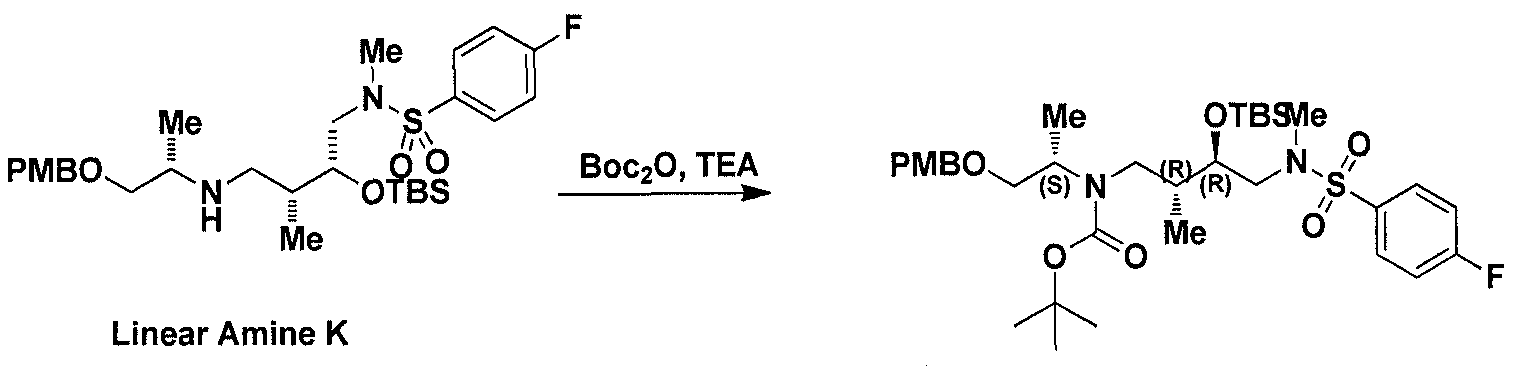

Intermediate L
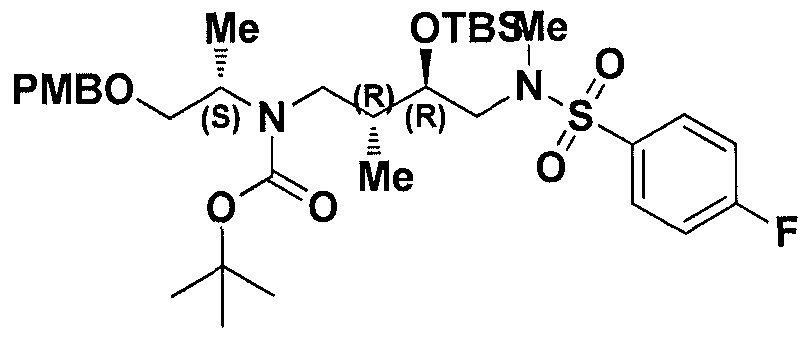
Synthesis of tert-butyl ((2R,3R)-3 -((tert-butyldimethylsilyl)oxy)-4-(4-fluoro-N- methylphenylsulfonamido)-2-methylbutyl)((S)- 1 -((4-methoxybenzyl)oxy)propan-2- yl)carbamate
To a solution of Linear amine K (1.524 g, 2.61 mmol) in DCM (13 ml) was added di-tert-butyl dicarbonate (0.571g, 2.61mmol), followed by triethylamine (0.729 ml, 5.23 mmol). The reaction was stirred at room temperature until completion. The mixture was worked up with water, the layers were separated and the aqueous layer was extracted with DCM. The combined organic layers were dried over Na2S04, filtered and the solvent was removed under pressure. The crude residue was purified by silica gel chromatography using ethyl acetate/hexanes to give 1.445 g of pure product (81% yield). 1H NMR (300 MHz, CDC13) δ 7.80 - 7.63 (m, 2H), 7.25 - 7.01 (m, 4H), 6.89 - 6.69 (d, 2H), 4.38 (s, 2H), 3.86 - 3.77 (m, 1H), 3.75 (s, 3H), 3.70 - 3.46 (m, 2H), 3.43 - 3.24 (m, 1H), 3.23 - 3.02(m, 2H), 2.99 - 2.77 (d, 2H), 2.73(s, 3H), 1.97 (m, 1H), 1.36 (s, 9H), 1.19 (d, 3H), 0.83 (d, 3H), 0.73 (s, 9H), 0.00 (m, 6H). MS (ESI) calculated for C34H55FN207SSi [M + H]+: 683. Found: 683. Intermediate M

Synthesis of tert-butyl ((2R,3R)-4-(4-fluoro-N-methylphenylsulfonamido)-3- hydroxy-2-methylbutyl)((S)-l-((4-methoxybenzyl)oxy)propan-2-yl)carbamate
To a solution of Linear amine Intermediate L (0.600 g, 0.879 mmol) in THF (6.76 ml) under N2 was added TBAF (0.636 ml, 2.196 mmol). The reaction was stirred at room temperature overnight. The reaction was then quenched with a saturated ammonium chloride solution and the product was extracted with ethyl acetate. The aqueous layer was washed with ethyl acetate. The combined organic layers were washed with brine, dried over Na2S04 and concentrated under reduced pressure. The crude product was purified by silica gel chromatography using ethyl acetate/hexanes to afford 0.477g of pure product (95 % yield). 1H NMR (300 MHz, CDC13) δ 7.80 - 7.58 (m, 2H), 7.20 - 6.94 (m, 4H), 6.86 - 6.66 (d, 2H), 4.35 (s, 2H), 3.95 - 3.77 (m, 1H), 3.72 (s, 3H), 3.66 - 3.58 (m, 1H), 3.58 - 3.45 (m, 2H), 3.45 - 3.29(m, 1H), 3.29 - 3.15 (m, 1H), 3.15 - 2.83 (m, 3H), 2.75 (s, 3H), 1.90 - 1.69 (m, 1H), 1.30 (s, 9H), 1.20 - 1.00 (d, 3H), 0.91 - 0.74 (d, 3H). MS (ESI) calculated for C28H41FN207S [M + H]+: 569. Found: 569.
Synthesis of aryl carboxylic acid intermediate N:

(5)-5-nitro-2-(pent-4-en-2-yloxy)benzoic acid was synthesized following the procedure previously reported in Marcaurelle, L. A.; et al. The following intermediates were synthesized by previously reported procedures:
O
Rl>f ^OH
o. Structure Name MS
[M-H]"
(S)-2-(pent-4-en-2-yloxy)-4- calcd 273;
Nl
(trifluoromethyl)benzoic acid found, 273
OH *
[M+H] +
(S)-3-(pent-4-en-2-yloxy)picolinic
N2 calcd 208;
acid
found, 208
OH **
[M+H] +
(S)-5-fluoro-2-(pent-4-en-2-
N3 calcd 225;
yloxy)benzoic acid
found, 225
OH
[M+H] +
(S)-3-(pent-4-en-2-yloxy)pyrazine-2-
N4 calcd 209;
carboxylic acid
found, 209
OH
1 siii /
[M+H] +
(S)-l-methyl-5-(pent-4-en-2-yloxy)-
N5 calcd 211;
lH-pyrazoIe-4-carboxylic acid
found, 211
0
[M+H] +
(S)-3-(pent-4-en-2-yloxy)thiophene-
N6 calcd 212;
2-carboxylic acid
found, 212
0
[M+H]+
2-(but-3-en-l-yIoxy)-5-nitrobenzoic calcd 238;
N7
θ2Ν- γ°Η acid found,238
0
[M+H]+
(R)-5-nitro-2-(pent-4-en-2- calcd 252;
N8
Ο,Ν-θγ yloxy)benzoic acid found,252
OH
*methyl 2-hydroxy-5-(trifluoromethyl)benzoate can be prepared as is reported in Gormemis, A.E.; Ha, T.S.; Im, I.; Jung, K.-Y.; Lee, J.Y.; Park, C.-S.; Kim, Y.-C. ChemBioChem 2005, 6, 1745-1748.
** methyl 3-hydroxypicolinate can be prepared as is reported in Hirashima, S.;
Suzuki, T.; Ishida, T.; Noji, S.; Yata, S.; Ando, I.; Komatsu, M.; Ikeda, S.;
Hashimoto, H. J. Med. Chem. 2006, 49, 4721-4736.

7¾rt-butyl 2-chloronicotinate was synthesized following the procedure previously reported in Kloc, K.; Maliszewka, I.; Mlochowski, J. Synth. Commun. 2003, 33, 3805-3815.
Intermediate O:

Pent-4-en-2-yl 2-((S)-pent-4-en-2-yloxy)nicotinate (O)
A solution of (S)-pent-4-en-2-ol (3.85mL, 37.4 mmol 4.0 equiv) in THF (24mL, 0.05 M) was cooled to -8C and treated with 1 molar sodium hexamethyldisilazane in THF (37.4 mL, 37.4 mmol, 4.0 equiv). The reaction was stirred at the reduced temperature for 5 minutes before the ice bath was removed. Stirring was continued for an additional 25 minutes before being treated with a solution of fert-butyl 2- chloronicotinate (2.0g, 9.36 mmol, 1 equiv.) in THF (24 mL, 0.05 M). The reaction was stirred for 1 hour at room temperature before being quenched with 50 mL of saturated ammonium chloride. The crude product was extracted with 3 x 60 mL DCM, dried with Na2S04 and concentrated under reduced pressure. This material was chromato graphed on silica, eluting with 10-20% ethyl acetate in hexanes to afford 1.7 g (66% yield) of the desired product as a clear oil. 1H NMR (300 MHz, CDC13) δ 8.22 (dd, J = 1.3, 4.9, 1H), 8.05 (dd, J = 1.4, 7.5, 1H), 6.85 (dd, J = 5.2, 7.1, 1H), 5.86 (m, 2H), 5.35 (m, 1H), 5.12 (m, 5H), 2.62 - 2.27 (m, 4H), 1.32 (t, J = 5.9, 6H). MS (ESI) calcd for Ci6H2iN03 [M + H]+: 276. Found: 276.
Intermediate P:

(S)-2-(pent-4-en-2-yloxy)nicotinic acid (P)
To a solution of pent-4-en-2-yl 2-((S)-pent-4-en-2-yloxy)nicotinate (1.7g, 6.17mmol, 1.0 equiv) in isopropanol (20.5 mL, 0.3 M) was added 2 M sodium hydroxide (4 mL, 8.00 mmol, 1.3 equiv). The reaction was stirred for 18 h before being quenched with glacial acetic acid (3.5 mL, 61.7 mmol, 10 equiv) and concentrated under reduced pressure. The crude material was resuspended with 75 mL DCM and partitioned between 30 mL of H20. The aqueous layer was washed 2 x 50 mL DCM. The combined organic layers were dried with Na2S04, concentrated under reduced pressure, resuspended in toluene and concentrated under reduced pressure to afford 1.3g of the desired crude material, which was carried on to the next step without further purification. 1H NMR (300 MHz, CDC13) δ 8.44 (dd, J = 1.7, 7.6, 1H), 8.33 (dd, J = 2.0, 4.8, 1H), 7.08 (dd, J = 4.9, 7.5, 1H), 5.81 (m, 1H), 5.61 (dd, J= 6.1, 12.3, 1H), 5.26 - 5.08 (m, 2H), 2.53 (m, 2H), 1.45 (d, J= 6.3, 3H). MS (ESI) calcd for CnH13N03 [M + H]+: 208. Found: 208.
Synthesis of f-Bu ether Q for preparation of intermediate C4:

Q tert-butyl((2R,3R)-4-(((S)-l-(tert-butoxy)propan-2-yl)amino)-2-((tert- butyIdimethylsiIyl)oxy)-3-methylbutyl)(methyl)carbamate (Q)
To 4-methylbenzenesulfonic acid (4.59 g, 26.6 mmol) in dry DCM (133 ml) was added (S)-2-aminopropan-l-ol (1.038 ml, 13.31 mmol) at room temperature. Then a balloon of isobutylene gas was added and the resulting solution was purged for lOmin, and finally stirred under static isobutylene gas at room temperature for 96h. The solution was purged with nitrogen for 15min and degassed carefully. Around 3/4 volume of solvent was evaporated, then ether (6 X initial volume) was added and crystallization was completed by cooling the mixture to 0°C. The crude was filtered and washed with ether affording the desired product under PTSA salt as white solid (3.61 g, 89%). 1H NMR (300 MHz, CDC13) δ 7.76 (d, J = 7.8, 2H), 7.60 (s, 2H), 7.17 (d, J = 7.8, 2H), 3.61- 3.19 (m, 4H), 2.36 (s, 4H), 1.32 (d, 3H), 1.10 (s, 7H). MS (ESI) calcd for C7H17NO [M + H]+: 132. Found: 132.
Amide formation:
Intermediates R1-R8 were synthesized following the procedure previously reported in Marcaurelle, L. A.; Comer, E.; Dandapani, S.; Duvall, J. R.; Gerard, B.; Kesavan,
S.; Lee, M. D, IV; Liu, H.; Lowe, J. T.; Marie, J.-C; Mulrooney, C. A.; Pandya, B. A.; Rowley, A.; Ryba, T. D.; Suh, B.-C; Wei, J.; Young, D. W.; Akella, L. B.; Ross, N. B.; Zhang, Y.-L.; Fass, D. M.; Reis, S. A.; Zhao, W.-N.; Haggarty, S. J.; Palmer, M.; Foley, M. A. J. Am. Chem. Soc. 2010, 132, 16962-16976.
Intermediate R;


Synthesis of Sulphonamide Intermediate S:

Synthesis of N-((2R,3R)-3-((tert-butyldimethylsilyl)oxy)-4-(4-fluoro-N- niethylphenylsulfonamido)-2-methylbutyl)-2-fluoro-N-((S)-l-((4- methoxybenzyl)oxy)propan-2-yl)-5-nitrobenzenesuIfonamide
To a solution of Linear amine K (0.94 g, 1.613 mmol) in DCM (16.13 ml) was added triethylamine (0.674 ml, 4.84 mmol) followed by 2-fluoro-5 -nitrobenzene- 1- sulfonyl chloride (0.281 ml, 1.935 mmol). The reaction mixture was stirred at room temperature for 16 h. The reaction mixture was quenched with saturated ammonium chloride and extracted with DCM. The organic components were dried over MgS0 , filtered and concentrated under reduced pressure. This material was chromato graphed on silica, eluting with ethyl acetate in hexanes to afford 1.2 g
(95% yield) of the desired product as an oil. Ή NMR (300 MHz, CDC13) δ 8.64- 8.57 (m, 1H), 7.99 - 7.90 (m, 1H), 7.75 - 7.60 (m, 2H), 7.21-7.09 (m, 2H), 6.93- 6.85 (m, 2H), 6.77-6.64 (m, 3H), 4.18 - 3.88 (m, 3H), 3.75 (s, 3H), 3.67-3.45 (m, 2H), 3.35-3.14 (m, 2H), 3.13-3.00 (m, 1H), 2.70 (s, 3H), 2.09 (s, 3H), 1.19 (d, J = 7.0 Hz, 3H), 1.05 (d, J = 6.9 Hz, 3H), 0.85 (s, 9H), 0.01 (d, J = 3.1 Hz, 6H). MS (ESI) calcd for C35H49F2N309S2Si [M + H]+:786. Found: 786.
Scheme of alternate amide formation for preparation of intermediates R9-R20:

Intermediate R9:

tert-butyl((2R,3R)-2-((tert-butyIdimethylsilyl)oxy)-4-(N-((S)-l-((4- methoxybenzyl)oxy)propan-2-yl)-2-((S)-pent-4-en-2-yloxy)nicotinamido)-3- methylbutyl)(methyl)carbamate (R9)
To a solution of (S)-2-(pent-4-en-2-yloxy)nicotinic acid (3.65 g, 17.61 mmol) in 147 mL of DCM at 0 °C was added DIEA (8.97 ml, 51.4 mmol), secondary amine (7.70 g, 14.68 mmol) followed by BOP-C1 (4.48 g, 17.61 mmol). After stirring at reduced temperature for 10 minutes the ice water bath was removed and stirring was continued at room temperature for 90 minutes. Saturated ammonium chloride solution ( ~ 40 mL) was then added and the reaction was partitioned. The aqueous layer was washed with 2 x 40 mL DCM and the combined organics were dried over sodium sulfate and concentrated. The material was then brought on crude to the next reaction. !H NMR (300 MHz, CDC13) δ 8.21 - 7.97 (br, 1H), 7.55 - 7.31 (m, 1H), 7.16 - 7.03 (m, 2H), 6.93 - 6.65 (m, 3H), 5.92 - 5.65 (m, 1H), 5.42 - 5.16 (m, 1H), 5.12 - 4.96 (m, 2H), 4.56 - 4.21 (m, 2H), 4.20 - 3.82 (m, 1H), 3.78 (s, 3H), 3.74 - 3.58 (m, 1H), 3.54 - 3.22 (m, 2H), 3.19 - 2.99 (m, 2H), 2.96 - 2.64 (m, 3H), 2.60 - 2.18 (m, 3H), 1.54 - 1.31 (m, 9H), 1.35 - 0.95 (m, 9H), 0.89 (s, 6H), 0.64 (s, 3H), 0.05 (s, 2H), 0.03 (s, 2H), -0.09 (s, 1H), -0.19(s, 1H)
MS (ESI) calcd for C39H63N307Si [M + H]+: 715. Found: 715.
The following intermediates were prepared using this method:


yl)-5 -nitrobenzamide
Scheme of alternate amide formation for preparation of intermediate R21:

Synthesis of tert-butyl ((2R,3R)-3-(allyloxy)-4-(4-fluoro-N- methyIphenylsuIfonamido)-2-methylbutyl)((S)-l-((4- methoxybenzyl)oxy)propan-2-yl)carbamate
To a solution of M (0.719 g, 1.264 mmol) in DMF (8.43 ml) at 0 °C was added 3- bromoprop-l-ene (0.321 ml, 3.79 mmol) followed by sodium hydride (0.101 g, 2.53 mmol). After 7 h further sodium hydride (0.050 g, 1.26 mmol) was added. After 24 h the reaction was quenched with saturated ammonium chloride solution (8 mL) and extracted with EtOAc (3 x 15 mL). The combined organic layers were dried with magnesium sulfate, concentrated and subjected to chromatography on silica, using Hexane/Ethyl acetate to give the desired product (0.685 g, 89%) as colorless resin. 1H NMR (300 MHz, CDC13) δ 7.84-7.79 (m 2H), 7.40-7.04 (m, 4H), 6.88 (d, J = 8.5 Hz, 2H), 5.91-5.78 (m, 1H), 5.62-4.84 (m, 2H), 4.45 (s, 2H), 4.00 (d, J = 4.5 Hz, 2H), 3.80 (s, 3H), 3.71-3.56 (m 2H), 3.54-3.38 (m, 2H), 3.28-3.03 (s, 3H), 2.83 (s, 3H), 2.29-1.98 (s, 2H), 1.44 (s, 9H), 1.24 (d, J = 6.7 Hz, 3H), 0.92 (d, J = 6.8 Hz, 3H). MS (ESI) calcd for C3iH45FN207S [M + H]+: 609. Found: 609.
Intermediate R21

Synthesis of N-((2R,3R)-3-(allyloxy)-4-(4-fluoro-N-methylphenylsulfonamido)- 2-methylbutyl)-2-r2-fluoro-5-nitrophenyl)-N-f(S)-l-((4- methoxybenzyl)oxy)propan-2-yl)acetamide
To a solution of T (0.685 g, 1.125 mmol) in DCM (22.50 ml) at 0°C was added 2,6- dimethylpyridine (0.524 ml, 4.50 mmol), followed by TBS-triflate (0.647 ml, 2.81 mmol). The reaction was stirred for 2h. 2,6-dimethylpyridine (0.524 ml, 4.50 mmol) was then added, and the reaction was quenched with saturated ammonium chloride. The layers were separated, and the aqueous layer was extracted with DCM (3 X 30 mL). The combined organics were dried, filtered, and concentrated under reduced pressure and the crude residue was used in the next step. This crude material was dissolved in THF (20.0 ml) in a plastic bottle and cooled to 0 °C before adding a 70% HF-Pyridine solution (0.147 ml, 1.181 mmol). The reaction was stirred for lh and was then quenched with saturated ammonium chloride and extracted with EtOAc. The combined organics were dried, filtered and concentrated under reduced pressure and the crude residue was used directly in the subsequent reaction. To a solution of this crude material (0.606 g, 1.191 mmol), N-ethyl-N-isopropylpropan-2- amine (0.623 ml, 3.57 mmol), and 2-(2-fluoro-5-nitrophenyl)acetic acid (0.273 g, 1.370 mmol) in DCM (1 1.91 ml) at 0 °C was added PyBOP (0.744 g, 1.430 mmol) as a solid in one portion. The reaction was stirred for 2h. The reaction was then concentrated under reduced pressure and the crude residue was chromatographed on silica, eluting with 10-20% ethyl acetate in hexanes to afford 0.630 g (81% yield) of the desired product. 1H NMR (300 MHz, CDC13) δ 8.29 - 8.01 (m, 2H), 7.87-7.66 (m, 2H), 7.32-7.06 (m, 5H), 6.89 (m, 2H), 5.96-5.73 (m, 1H), 5.36 - 5.07 (m, 2H), 4.50-5.41 (m, 2H), 4.32 - 4.19 (m, 1H), 4.18 - 3.85 (m, 4H), 3.81-3.79 (m, 3H), 3.66 - 3.27 (m, 4H), 3.25 - 3.11 (m, 2H), 3.07-2.92 (m, 1H), 2.80-2.79 (m, 3H), 2.33-2.16 (m, 1H), 1.41-1.18 (m, 3H), 1.17-0.85 (m, 3H). MS calculated for C34H41F2N308S [M+H]+: 690. Found: 690.
SNAr reaction to prepare intermediate R22 and R23:

Intermediate R22 :

To a solution of (S) + 4-penten-2-ol (15.93 μΐ, 0.16 mmol) in THF (298 μΐ) was added sodium hydride (6.19 mg, 0.16 mmol) and the mixture was stirred for 20 min. To this solution was added tert-butyl((2R,3R)-2-((tert-butyldimethylsilyl)oxy)-4-(5- cyano-2-fluoro-N-((S)-l -((4-methoxybenzyl)oxy)propan-2-yl)benzamido)-3- methylbutyl)(methyl)carbamate in 0.3 mL THF dropwise at 0°C. The reaction was allowed to stir for 2 hours at room temperature. Rxn was then quenched with water, the organic component was extracted with ethyl acetate dried over sodium sulfate and evaporated under reduced pressure. The reaction was purified by column chromatography using Ethylacetate/hexane to afford the desired product (267 mg,79 %). 1H NMR (300 MHz, CDC13) δ 7.59-7.30 (m, 2H), 7.27-7.05 (m, 2H), 6.99- 6.72 (m, 3H), 5.87-5.54 (m, 1H), 5.19-4.90 (m, 2H), 4.60^1.37 (m, 1H), 4.36-4.19 (m, 1H), 4.18-3.88 (m, 4H), 3.81-3.49 (m, 3H), 3.51-2.93 (m, 3H), 2.93-2.67 (m, 2H), 2.66-2.17 (m, 2H), 2.13 (s, 1H), 1.66-1.36 (m, 7H), 1.29-0.93 (m, 14H), 0.92- 0.74 (m, 6H), 0.71-0.48 (m, 3H), 0.11- -0.04 (m, 3H), -0.09- -0.4 (m, 3H). MS (ESI) calcd for C4iH63N307Si [M + H]+: 738. Found: 738.
The following intermediate was also prepared using this method:

Alternative SNAr reaction with allyl alcohol To prepare intermediates R24-R27

Synthesis of 2-(but-3-en-l-yloxy)-N-((2R,3R)-3-((tert-butyldimethylsilyl)oxy)-4-(4- fluoro-N-methylphenyIsuIfonamido)-2-methyIbutyl)-N-((S)-l-((4- methoxybenzyl)oxy)propan-2-yl)-5-nitrobenzenesulfonamide
To a solution of but-3-en-l-ol (0.246 ml, 2.88 mmol) in THF (14.38 ml) was added sodium hydride (0.115 g, 2.88 mmol) at 0°C and the mixture was stirred for 20 min. To this was added S (1.13 g, 1.438 mmol) in THF (3 ml) dropwise over 5 min. The reaction was stirred at 0°C for 40 mins. The reaction was quenched with water after 2h, the organic component was extracted with ethyl acetate dried and was purified by column chromatography using Ethylacetate/hexane to afford the desired product (1.19g, 99 %). Ή NMR (300 MHz, CDC13) δ 8.72 (d, J= 2.8, 1H), 8.13 (dd, J= 9.1, 2.8, 1H), 7.75-7.63 (m, 2H), 7.17 (t, J = 8.5, 2H), 6.92 (d, J= 8.5, 2H), 6.72 (d, J = 8.5 , 2H), 6.67 (d, J = 9.2, 1H), 5.90-6.71 (m, 1H), 5.19-4.99 (m, 2H), 4.15 (q, J = 11.1, 2H), 3.94 - 3.77 (m, 4H), 3.73 (s, 3H), 3.65-3.43 (m, 2H), 3.44-3.30 (m, 1H), 3.28-3.09 (m, 2H), 2.68 (s, 3H), 2.65-2.51 (m, 3H), 2.13-1.98 (m, 1H), 1.96 (s, 3H), 1.03 (d, J = 6.9, 3H), 0.83 (s, 9H), 0.00 (s, 6H). MS calculated for C39H56FN3Oi0S2Si : [M+Na]+ 860. Found: 860.


Alternative SNAr reaction and Boc protection to prepare intermediate R28;

Synthesis of tert-butyl but-3-en-l-yl(2-(((2R,3R)-3-((tert- butyldimethylsilyl)oxy)-4-(4-fluoro-N-methylphenylsuIfonamido)-2- methylbutyl)((S)-l-((4-methoxybenzyl)oxy)propan-2-yl)carbamoyl)-4- nitrophenyl)carbamate
To a solution of N-((2R,3R)-3-((tert-butyldimethylsilyl)oxy)-4-(4-fluoro-N- methylphenylsulfonamido)-2-methylbutyl)-2-fluoro-N-((S)- 1 -((4- methoxybenzyl)oxy)propan-2-yl)-5-nitrobenzamide R20 (228 mg, 0.304 mmol) in DMF (7239 μΐ) was added DIEA (82 μΐ, 0.471 mmol) and but-3-en-l -amine (78 μΐ, 0.851 mmol) at room temperature. The rxn was then heated to 35 °C. After 2 h further but-3 -en- 1 -amine (78 μΐ, 0.851 mmol) and DIEA (82 μΐ, 0.471 mmol) were added. After 5h the reaction was evaporated under reduced pressure. The reaction was purified by column chromatography using using Ethylacetate/hexane to afford the desired product. (220 mg, 90%). 1H NMR (300 MHz, CDC13) δ 8.09-7.99 (m, 2H), 7.75-7.65 (m, 2H), 7.37 - 6.99 (m, 4H), 6.84-6.75 (m, 2H), 6.49 (d, J = 8.7, 1H), 5.74-5.56 (m, 1H), 5.02 (dd, J= 13.6, 2.0, 2H), 4.51-4.28 (m, 2H), 3.72 (s, 3H), 3.51-3.20 (m, 2H), 3.16-3.00 (m, 4H), 2.96 - 2.52 (m, 4H), 2.23 - 1.97 (m, 5H), 1.85 - 1.30 (m, 7H), 1.02 - 0.42 (m, 9H), 0.14 - -0.42(m, 6H). MS (ESI) calcd for
C4oH57FN408SSi [M + H]+: 801. Found: 801. To a solution of this material (20 mg, 0.025 mmol) in THF (250 μΐ) was added di-tert-butyl dicarbonate (21.80 mg, 0.100 mmol) and DMAP (0.610 mg, 4.99 μιηοΐ) and the reaction was heated to reflux for 1 hour. The reaction mixture was then concentrated under reduced pressure. This mixture was purified by column chromatography using Ethylacetate/hexane to afford the desired product (16 mg,71 %). 1H NMR (300 MHz, CDC13) δ 8.45-8.24 (m, 1H), 8.13-7.97 (m, ΓΗ), 7.77-7.60 (m, 2H), 7.22 - 7.01 (m, 5H), 6.85 - 6.67 (m, 2H), 5.72 - 5.53 (m 1H), 5.03 - 4.89 (m, 2H), 4.46 - 4.22 (m, 2H), 4.15 - 3.93 (m, 1H), 3.87-3.75 (m, 1H), 3.70 (s, 3H), 3.40-3.23 (m, 2H), 3.22-3.01 (m, 2H), 2.98- 2.84 (m, 2H), 2.71 (s, 3H), 2.27-2.03 (m, 3H), 1.71 - 1.53 (m, 2H), 1.50 - 1.18 (m, 12H), 1.03-0.90 (m, 3H), 0.82 (s, 9H), 0.06 - -0.08 (m, 6H). MS (ESI) calcd for C45H65FN4OioSSi [M + H]+: 901. Found: 901.
Deprotection of TBS ether;
Intermediates T1-T19 were synthesized following the procedure previously reported in Marcaurelle, L. A.; Comer, E.; Dandapani, S.; Duvall, J. R.; Gerard, B.; Kesavan, S.; Lee, M. D, IV; Liu, H.; Lowe, J. T.; Marie, J.-C; Mulrooney, C. A.; Pandya, B. A.; Rowley, A.; Ryba, T. D.; Suh, B.-C; Wei, J.; Young, D. W.; Akella, L. B.; Ross, N. B.; Zhang, Y.-L.; Fass, D. M.; Reis, S. A.; Zhao, W.-N.; Haggarty, S. J.; Palmer, M.; Foley, M. A. J. Am. Chem. Soc. 2010, 132, 16962-16976.
Intermediate T:


N-((2R,3R)-4-(4-fluoro-N- methylphenylsulfonamido)-
[M+H]+ 3-hydroxy-2-methylbutyl)- calcd 702;
T19 N-((S)-l-(4- found, 702 methoxybenzyloxy)propan-
2-yl)-5-nitro-2-((R)-pent-4- en-2-yloxy)benzamide
Allylation:
Intermediates U1-U21 were synthesized following the procedure previously reported in Marcaurelle, L. A.; Comer, E.; Dandapani, S.; Duvall, J. R.; Gerard, B.; Kesavan, S.; Lee, M. D, IV; Liu, H.; Lowe, J. T.; Marie, J.-C; Mulrooney, C. A.; Pandya, B. A.; Rowley, A.; Ryba, T. D.; Suh, B.-C; Wei, J.; Young, D. W.; Akella, L. B.; Ross, N. B.; Zhang, Y.-L.; Fass, D. M.; Reis, S. A.; Zhao, W.-N.; Haggarty, S. J.; Palmer, M.; Foley, M. A. J. Am. Chem. Soc. 2010, 132, 16962-16976.
IntermediateUI:
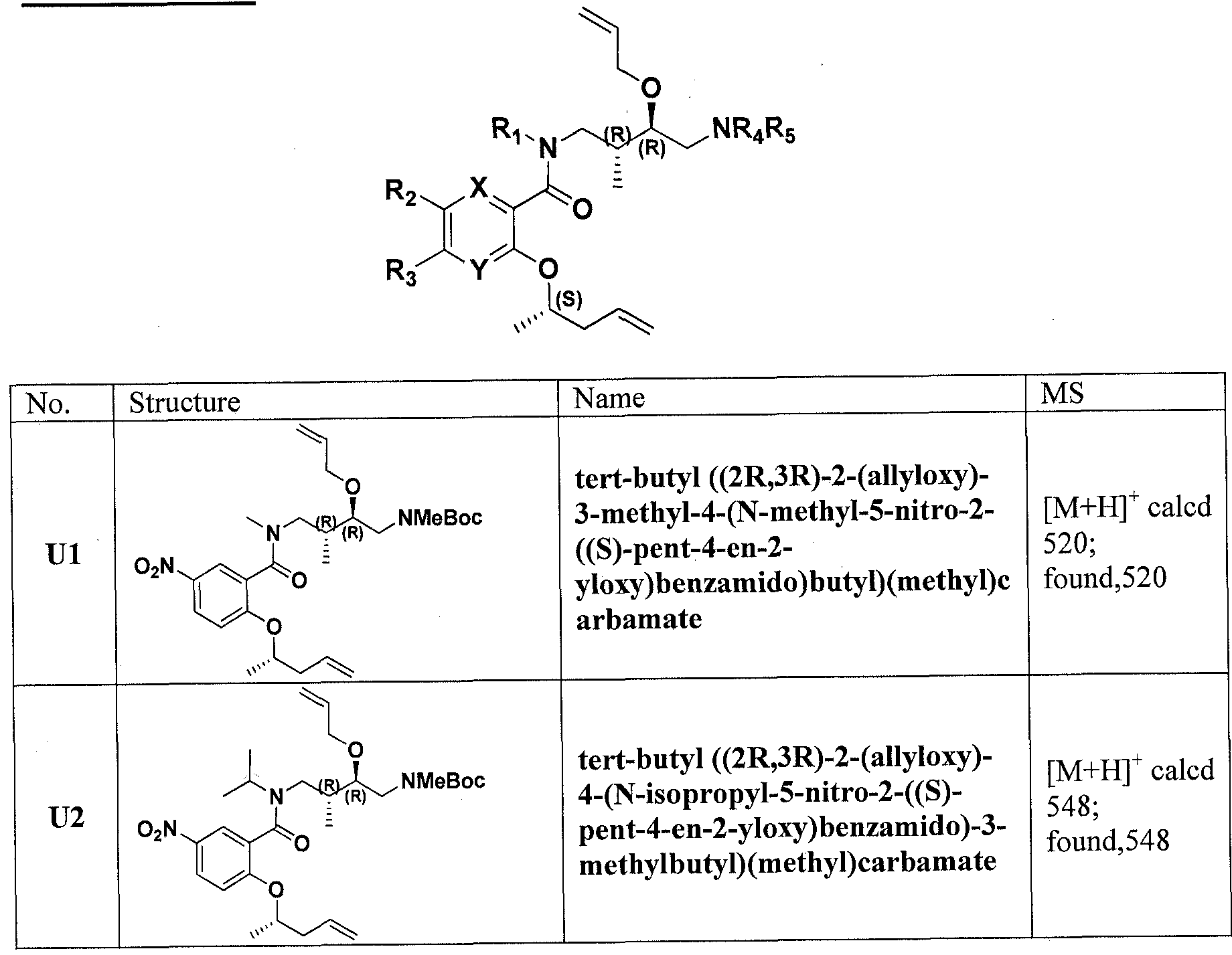


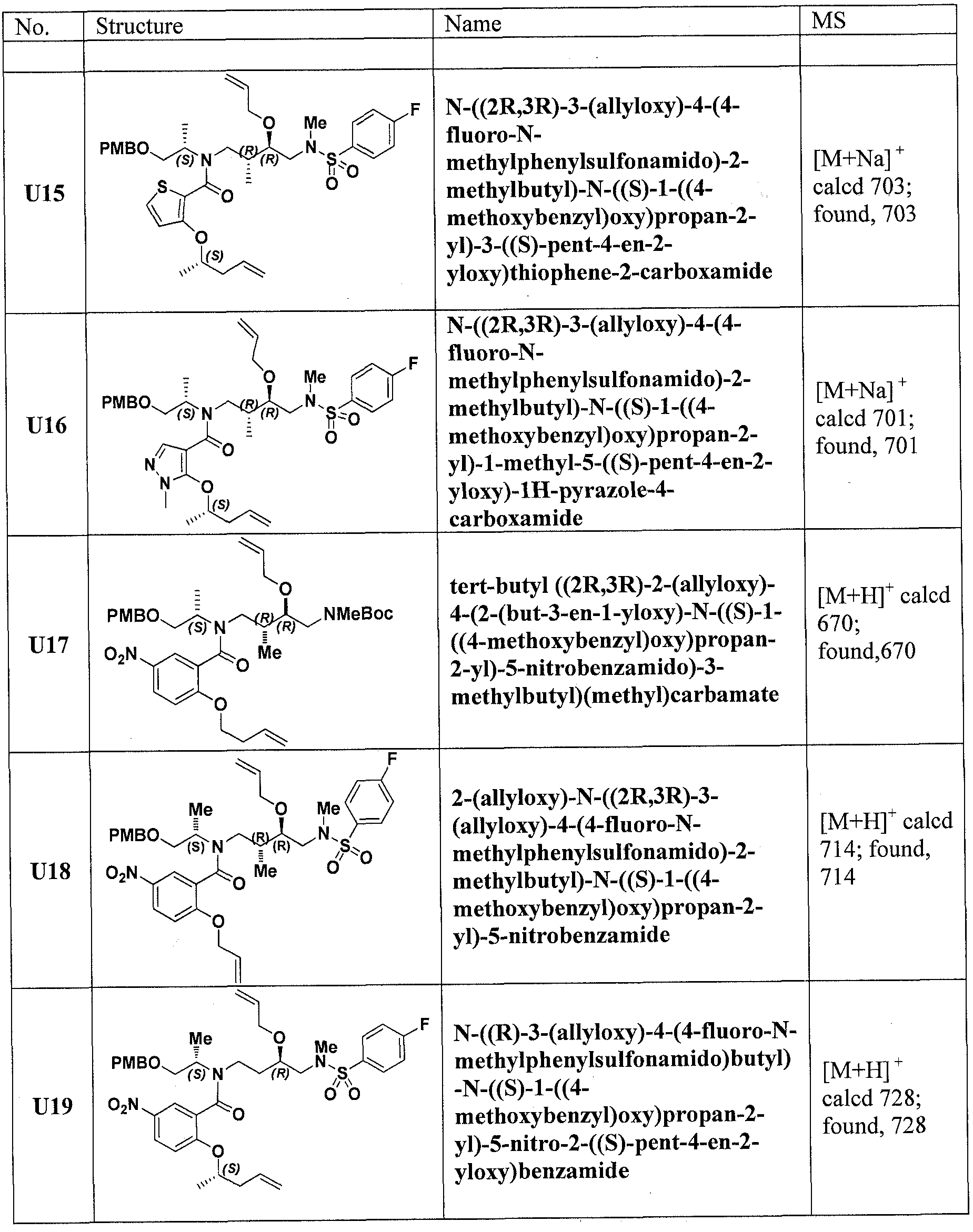

Boc deprotection of U12;

Synthesis of N-((2R,3 )-3-(allyloxy)-4-(4-fluoro-N-methylphenylsuIfonamido)-
2-methylbutyl)-2-(but-3-en-l-ylamino)-N-((S)-l-((4- methoxybenzyl)oxy)propan-2-yl)-5-nitrobenzamide
To a chilled (using ice bath) solution of U12 (180 mg, 0.218 mmol) in DCM (4353 μΐ) under Nitrogen was added 2,6-dimethylpyridine (203 μΐ, 1.741 mmol) followed by tert-butyldimethylsilyl trifluoromethanesulfonate (257 μΐ, 1.088 mmol). The reaction was stirred at 0 °C for 25 min, then was stirred at room temperature. After 5h further 2,6-dimethylpyridine (100 0.857 mmol) and tert-butyldimethylsilyl trifluoromethanesulfonate (130 μΐ. 1.088 mmol) were added. After 6h, 2,6-Lutidine (0.2 mL) was added, then saturated ammonium chloride (5 mL) was added slowly. The aqueous component was extracted with DCM (3 x 35 mL) and the combined organic layers were washed with water and brine, dried over Na2S04, filtered and the solvent evaporated. To a solution of the residue in THF (4.0 ml) was added pyridine hydrofluoride (48.7 μΐ, 0.392 mmol) at room temperature. The reaction was stirred for 30 min and then diluted with saturated ammonium chloride and extracted with EtOAc (3 x 35 mL). The combined organics were washed with brine, dried (Na2S04) and the solvent evaporated. The reaction was purified by column chromatography using DCM/Methanol to afford the desired product (130 mg, 82 %).
!H NMR (300 MHz, CDC13) δ 8.10-7.98 (m, 2H), 7.82-7.67 (m, 2H), 7.25-7.07 (m, 4H), 6.86-6.71 (m, 2H), 6.51 (d, J = 9.5, 1H), 5.98 - 5.54 (m, 3H), 5.26 - 4.90 (m, 5H), 4.43-4.24 (s, 2H), 4.09-3.82 (m, 3H), 3.73 (s, 3H), 3.46 - 2.88 (m, 5H), 2.81- 2.58 (m, 5H), 2.23-1.99 (m, 4H), 1.22 - 1.05 (m, 3H), 1.01 - 0.61 (m, 3H). MS calculated for C37H47FN408S [M+H]+: 727. Found: 727.
Ring-closing metathesis:
Intermediates V1-V22 were synthesized following the procedure previously reported in Marcaurelle, L. A.; Comer, E.; Dandapani, S.; Duvall, J. R.; Gerard, B.; Kesavan, S.; Lee, M. D, IV; Liu, H.; Lowe, J. T.; Marie, J.-C; Mulrooney, C. A.; Pandya, B. A.; Rowley, A.; Ryba, T. D.; Suh, B.-C; Wei, 1; Young, D. W.; Akella, L. B.; Ross, N. B.; Zhang, Y.-L.; Fass, D. M.; Reis, S. A.; Zhao, W.-N.; Haggarty, S. J.; Palmer, M.; Foley, M. A. J Am. Chem. Soc. 2010, 132, 16962-16976.
Intermediate V;

No. Structure Name MS
Me
tert-butyl methyl(((2S,8R,9R)-2,9,ll- Boc trimethyl-14-nitro-12-oxo- [M+H]+
VI 2,3,6,8,9,10,11,12- calcd 492;
octahydrobenzo[b] [l,9,5]dioxaazacycl found,492 otetradecin-8-yl)methyl)carbamate
Me tert-butyl (((2S,8R,9R)-ll-isopropyl-
1 = Boc 2,9-dimethyl-14-nitro-12-oxo-
[M+H]+
2,3,6,8,9,10,11,12-
V2 calcd 520;
octahydrobenzo[b] [l,9,5]dioxaazacycl
found, 520 otetradecin-8- yl)methyl)(methyl)carbamate
Me tert-butyl (((2S,8R,9R)-ll-(2-((4-
PMBO. , „„ methoxybenzyl)oxy)ethyl)-2,9- Boc
dimethyI-14-nitro-12-oxo- [M+H]+
V3 2,3,6,8,9,10,11,12- calcd 642;
octahydrobenzo[b] [l,9,5]dioxaazacycI found,642 otetradecin-8- yl)methyl)(methyl)carbamate


Mxture o E an Z somers
eparation of the E and Z isomers after ring closing metathesis to prepare

The crude mixture of V23 and V24 was prepared and characterized as reported in: Marcaurelle, L. A.; Comer, E.; Dandapani, S.; Duvall, J. R.; Gerard, B.; Kesavan, S.; Lee, M. D, IV; Liu, H.; Lowe, J. T.; Marie, J.-C; Mulrooney, C. A.; Pandya, B. A.; Rowley, A.; Ryba, T. D.; Suh, B.-C; Wei, J.; Young, D. W.; Akella, L. B.; Ross, N. B.; Zhang, Y.-L.; Fass, D. M.; Reis, S. A.; Zhao, W.-N.; Haggarty, S. J.; Palmer, M.; Foley, M. A. J. Am. Chem. Soc. 2010, 132, 16962-16976.
The mixture of isomers was purified by silica gel chromatography using EtOAc in hexanes to yield two pure isomers, the earlier eluting product from the Si02 column will be labeled intermediate V23 and the later eluting product intermediate V24.

Alternative Ring Closing Metathesis for 13-membered analogue Intermediate V25:

Intermediate V25

Syntesis of 4-fiuoro-N-(((7S,8R)-10-((S)-l-((4-methoxybenzyl)oxy)propan-2-yl)-8- methyl-13-nitro-l l-oxo-5,7,8,9,10,1 l-hexahydro-2H- benzo[b] [ 1 ,9,5]dioxaazacyclotridecin-7-yl)methyl)-N-methylbenzenesulfonamide To a solution of U18 (690 mg, 0.967 mmol) in DCM (96.700 ml) Grubbs I catalyst (0.129 g, 0.153 mmol) was added and the reaction mixture was stirred at room temperature for 72 hours. Then the solvent was removed under pressure and the crude product was purified by silica gel chromatography using ethylacetate/hexanes to afford 433 mg of desired product (65% yield). 1H NMR (300 MHz, CDC13) δ 8.29 - 8.04 (m, 1H), 7.85 - 7.71 (m, 2H), 7.25 - 7.08 (m, 4H), 7.04-6.95 (m, 1H), 6.94 - 6.80 (m, 3H), 6.08 - 5.70 (m, 2H), 4.72-4.24 (m, 4H), 4.15 - 3.97 (m, 1H), 3.93 - 3.56 (m, 5H), 3.47-3.25 (m, 4H), 3.24-3.08 (m, 2H), 2.89 - 2.44 (m, 6H), 1.93 - 1.46 (m, 1H), 1.28 - 1.05 (m, 3H), 1.00 - 0.77 (m, 3H). MS (ESI) calcd for
C34H4oFN309S [M + H]+: 686. Found: 686.
Synthesis of Intermediate X from Intermediate V21

Intermediate W;

(2S,8R,9R)-8-(aminomethyl)-ll-((S)-l-((4-methoxybenzyI)oxy)propan-2-yl)-2,9- dimethyl-14-nitro-2,3,8,9,10,ll- hexahydrobenzo[b][l,9,5]dioxaazacyclotetradecin-12(6H)-one
To a solution of tert-butyl (((2S,8i?,9i?)-l l-((5)-l-((4-methoxybenzyl)oxy)propan-2- yl)-2,9-dimethyl-14-nitro- 12-oxo-2,3, 6,8,9, 10, 11,12- octahydrobenzo [b] [ 1 , 9, 5 ] dioxaazacyclotetradecin- 8 -yl)methyl)carbamate (0.232 g, 0.362 mmol) in dry CH2C12 (3.6 mL) under N2 and chilled in an ice-H20 bath was added 2,6-dimethylpyridine (0.168 mL, 1.45 mmol) followed by tert- butyldimethylsilyl trifluoromethanesulfonate (0.21 mL, 0.90 mmol). The reaction mixture was stirred in the ice-H20 bath 30 min then allowed to warm to rt and stirred 3 h. Then additional 2,6-dimethylpyridine (0.168 mL, 1.45 mmol) was added and the reaction quenched with sat. aq. NaHC03. The aqueous phase was extracted with CH2C12 and the organic phase was washed with H20, dried (Na2S04) and solvent evaporated. The residue was dissolved in THF (3.6 mL) in a 81eflon bottle and to this was added pyridine hydrofluoride (0.045 mL, 0.36 mmol). The solution was stirred 20 min then quenched with sat. NaHC03 and the aqueous phase was extracted with EtOAc. The organics were washed with H20, brine, dried (Na2S04) and the solvent evaporated. The residue was azeotroped with toluene 3X and the solvent removed under vacuum. The residue was carried on to the next step without further purification.Ή NMR (300 MHz, CDC13) δ 8.24-8.04 (m, 2H), 7.26 - 7.12 (m, 2H), 6.94 - 6.82 (m, 3H), 5.60 - 5.41 (m, 2H), 4.80 - 4.36 (m, 3H), 4.17 - 3.85 (m, 2H), 3.77 (s, 3H), 3.74 - 3.45 (m, 3H), 3.44 - 3.06 (m, 3H), 2.86-2.66 (m, 1H), 2.63 - 2.35 (m, 2H), 2.31 - 1.78 (m, 2H), 1.41 - 1.20 (m, 3H), 1.07 (d, J= 6.6 Hz, 3H), 0.93 - 0.78 (m, 3H). MS calculated for C29H40N3O7 [M+H]+: 542. Found: 542.
Intermcdiate X;

(2S,8R,9R)-ll-((S)-l-((4-methoxybenzyl)oxy)propan-2-yl)-2,9-dimethyl-8- (morpholinomethyl)-14-nitro-2,358,9,10,ll- hexahydrobenzo[b][l,9,5]dioxaazacyclotetradecin-12(6H)-one
To a mixture of (25,8i?,9i?)-8-(aminomethyl)-l l -((5)-l -((4- methoxybenzyl)oxy)propan-2-yl)-2,9-dimethyl- 14-nitro-2,3 ,8,9,10,11- hexahydrobenzo[b][l,9,5]dioxaazacyclotetradecin-12(6H)-one (0.0383 g, 0.071 mmol), K2C03 (0.029 g, 0.21 mmol), and Nal (5.3 mg, 0.035 mmol) in DMF (0.71 mL) under Ar was added l-chloro-2-(2-chloroethoxy)ethane (0.012 mL, 0.11 mmol). The mixture was stirred in a 60 °C oil bath for 96h. The reaction mixture was cooled and diluted with H20 and EtOAc. The aqueous phase was washed with EtOAc and the organic phase was washed with H20, dried (Na2S04) and the solvent evaporated.
Purification was accomplished by Si02 chromatography to yield 14.8 mg (34%) of pure product. 1H NMR (300 MHz, CDC13) δ 8.25 - 8.05 (m, 2H), 7.26 - 7.18 (m, 2H), 6.95-6.84 (m, 3H), 5.62-5.35 (m, 2H), 4.77 - 4.40 (m, 3H), 4.22 - 4.09 (m, 1H), 4.04-3.90 (m, 2H), 3.81(s, 3H), 3.82 - 3.34 (m, 7H), 2.75 - 2.20 (m, 8H), 2.10- 1.71 (m, 1H), 1.42 - 1.31 (m, 3H), 1.07 (dd, J= 6.5, 3.5 Hz, 3H), 0.89 (dd, J= 7.1, 3.7 Hz, 3H). MS calculated for C33H46N308 [M+H]+: 612. Found: 612.

Intermediate Y:

To a chilled (0 °C) solution of (2,S,8i?,9i?)-8-(aminomethyl)-l l-((S)-l-((4- methoxybenzyl)oxy)propan-2-yl)-2,9-dimethyl- 14-nitro-2,3 ,8,9, 10,11- hexahydrobenzo[b][l,9,5]dioxaazacyclotetradecin-12(6H)-one (0.060 g, 0.11 mmol) in CH2C12 (1.1 mL) was added Et3N (0.046 mL, 0.33 mmol) and 4-chlorobutane-l- sulfonyl chloride (0.025 g, 0.13 mmol). The reaction mixture was stirred 1 h at 0 °C, then warmed to rt and stirred for 16 h. The solvent was evaporated and the residue was dissolved in acetonitrile (1.1 mL), then CsC03 (0.108 g, 0.333 mmol) and Nal (8.3 mg, 0.056 mmol) were added, and the reaction mixture was stirred in a 70 °C oil bath for 24 h. The mixture was then cooled to rt and the solvent evaporated. The residue was diluted in EtOAc and H20, and the phases partitioned. The aqueous phase was extracted with EtOAc, the combined organic layers were dried over Na2S04 and the solvent evaporated. Purification was accomplished with Si02 chromatography to yield 54 mg (74 %) of pure product. 1H NMR (300 MHz, CDC13) δ 8.22 (dd, J= 9.2, 2.7 Hz, 1H), 8.10 (dd, J- 4.8, 2.8 Hz, 1H), 7.25 - 7.20 (m, 2H), 6.96 - 6.85 (m, 3H), 5.68 - 5.36 (m, 2H), 4.76 - 4.65 (m, 1H), 4.59 - 4.41 (m, 2H), 4.07-3.87 (m, 1H), 3.79 (s, 3H), 3.78 - 3.35(m, 6H), 3.26 - 3.00 (m, 2H), 2.92 - 2.39 (m, 4H), 2.31 - 1.90 (m, 4H), 1.79 - 1.45 (m, 2H), 1.39 - 1.32 (m, 3H), 1.10-1.04 (m, 3H), 0.95 - 0.85 (m, 3H). MS calculated for C33H46N309S [M+H]+: 660. Found: 660.


7V-ethyl-4-fluoro-N-(((2S,8R,9R)-ll-((S)-l-((4-methoxybenzyl)oxy)propan-2-yl)- 2,9-dimethyl-14-nitro-12-oxo-2,3,6,8,9,10,ll,12- octahydrobenzo[b][l,9,5]dioxaazacyclotetradecin-8- yl)methyl)benzenesulfonamide
To a solution of (2S,8i?,9i?)-8-(aminomethyl)-l 1-((5 -1-((4- methoxybenzyl)oxy)propan-2-yl)-2,9-dimethyl-14-nitro-2,3,8,9,10,l l- hexahydrobenzo[b][l,9,5]dioxaazacyclotetradecin-12(6H)-one (0.211 g, 0.390 mmol) in dry CH2C12 (3.9 mL) under N2 was added 2,6-lutidine (0.136 mL, 1.17 mmol) followed by 4-fluorobenzene-l -sulfonyl chloride (0.152 g, 0.779 mmol).
The reaction mixture was stirred overnight at rt. Then it was diluted with CH2C12 and washed with H20. The aqueous phase was extracted with CH2C12, and the combined organics were washed with H20, dried (Na2S04) and the solvent evaporated. Purification was accomplished by Si02 chromatography to yield 103 mg (34%) of pure product.
To a solution of this product (0.103 g, 0.147 mmol) and iodoethane (0.018 mL, 0.22 mmol) in dry DMF (0.736 mL) under N2 was added CsC03 (0.096 g, 0.29 mmol). The reaction mixture was stirred for 2 h at rt, then diluted with EtOAc and H20, the phases were partitioned and the organic phase was washed with H20, brine, dried (Na2S04) and the solvent evaporated. Purification was accomplished by Si02 chromatography to yield 82 mg (88%) of pure product. 1H NMR (300 MHz, CDC13) δ 8.24 - 8.15 (m, 1H), 8.10 (dd, J= 8.4, 2.8 Hz, 1H), 7.92 - 7.85 (m, 2H), 7.28 - 7.16 (m, 2H), 7.09 (ddd, J= 8.7, 6.3, 3.0 Hz, 2H), 6.94 - 6.80 (m, 3H), 5.72-4.98 (m, 2H), 4.93 - 4.64 (m, 1H), 4.50 - 4.39 (m, 2H), 4.04-3.95 (m, 1H), 3.79 (s, 3H), 3.78-3.04 (m, 10H), 2.72 (d, J= 14.0 Hz, 1H), 2.61 - 2.09 (m, 1H), 2.04 - 1.88 (m, 2H), 1.35 - 1.29 (m, 3H), 1.28 - 1.21 (m, 3H), 1.13 - 1.00 (m, 3H), 0.99 - 0.77 (m, 3H). MS calculated for C37H47N309S [M+H]+: 728. Found: 728.
Reduction of the nitro and olefin groups by catalytic hydrogenation:
The following intermediates AA1-AA18 were synthesized following the procedure previously reported in Marcaurelle, L. A.; Comer, E.; Dandapani, S.; Duvall, J. R.; Gerard, B.; Kesavan, S.; Lee, M. D, IV; Liu, H.; Lowe, J. T.; Marie, J.-C;
Mulrooney, C. A.; Pandya, B. A.; Rowley, A.; Ryba, T. D.; Suh, B.-C; Wei, J.; Young, D. W.; Akella, L. B.; Ross, N. B.; Zhang, Y.-L.; Fass, D. M.; Reis, S. A.; Zhao, W.-N.; Haggarty, S. J.; Palmer, M.; Foley, M. A. J Am. Chem. Soc. 2010, 132, 16962-16976.
Intermediates AA and 1 :


yl)methyl)(methyl)carbamate
Selective reduction of -NO? in presence of olefin to provide intermediates BB1-

Intermediate BBl

(tert-butyl (((2S,8R,9R,E/Z)-14-amino-ll-((S)-l-((4- methoxybenzyI)oxy)propan-2-yl)-2,9-dimethyl-12-oxo-2,3,6,8,9,10,ll,12- octahydrobenzo[b] [l,9,5]dioxaazacyclotetradecin-8- yl)methyl)(methyl)carbamate) (BB1)
To a solution of nitro compound intermediate V23 (0.1928 g, 0.294 mmol) in methanol (1.470 ml) under N2 atmosphere was added tin(II) chloride dihydrate (0.332 g, 1.470 mmol) at room temperature. The resulting mixture was stirred for 20 h. The reaction was diluted with EtOAc and washed with 2N KOH aqueous solution, then with water (2 X), brine, finally dried over Na2S04) and evaporated to dryness. This material was chromatographed on silica, using methanol /
dichloromethane to give the desired product (0.121 g, 66%) as colorless resin. 1H NMR (300 MHz, CDC13) δ 7.25 (d, 2H), 6.88 (d, 2H), 6.74 - 6.40 (m, 3H), 5.59 - 5.23 (m, 1H), 4.47 (s, 2H), 4.28 (m, 1H), 3.99 (s, 2H), 3.92 - 3.66 (m, 6H), 3.56 (m, 2H), 3.43 (s, 2H), 3.09 (m, 1H), 2.89 (m, 1H), 2.77 (m, 3H), 2.44 (m, 1H), 1.97 (m, 2H), 1.60 (s, 4H), 1.45 (m, 9H), 1.26 (m, 3H), 1.05 (d, 2H), 0.92 (m, 2H). MS calculated for C35H5]N307 : [M+H]+ 626. Found: 626.
The following intermediate was prepared from this method starting with intermediate V24:
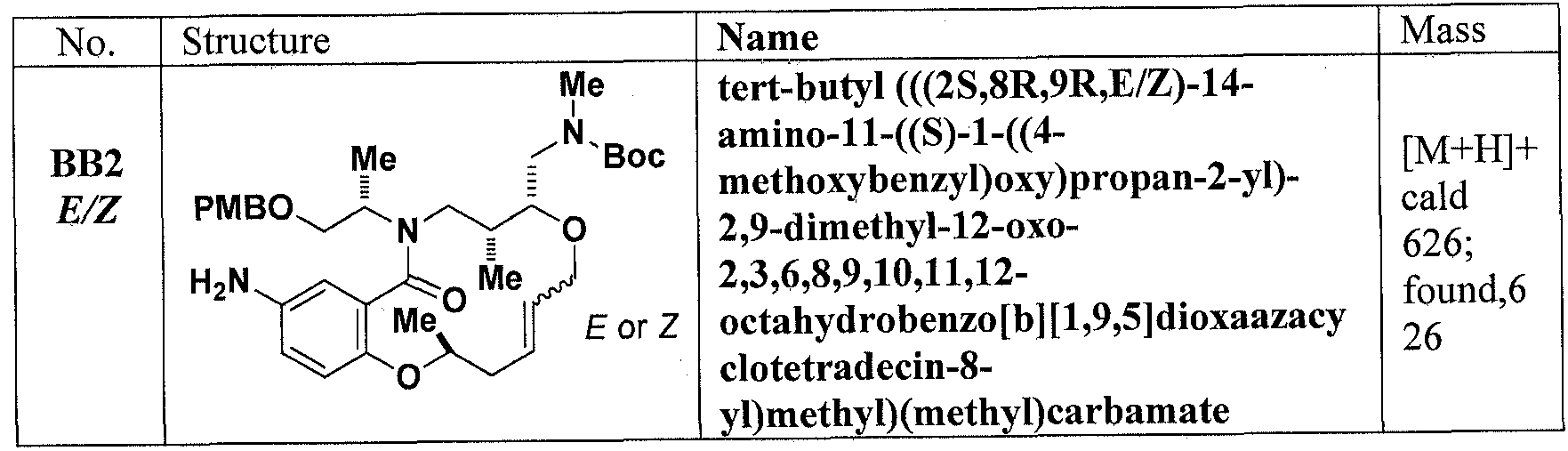
Alternative reduction of the olefin groups by catalytic hydrogenation:

Synthesis of 4-fluoro-N-(((6S,12R,13R)-15-((S)-l-((4- methoxybenzyl)oxy)propan-2-yI)-6,13-dimethyl-16-oxo- 6,7,8,9,10,12,13,14,15,16-decahydropyrazino[2,3- b] [l,9,5]dioxaazacyclotetradecin-12-yl)methyI)-N-methylbenzenesulfonamide
To a solution of V15 (35 mg, 0.052 mmol) in degassed THF (Volume: 522 μΐ) and tertbutanol (Volume: 522 μΐ) was added Wilkinson's catalyst (19.31 mg, 2.10 μηιοΐ). The reaction mixture was degassed and filled with Hydrogen using a Hydrogen balloon. The resulting mixture was stirred for 22 h. This material was evaporated to dryness and chromato graphed on silica, using methanol / dichloromethane to give the desired product (0.022 g, 63%). 1H NMR (300 MHz, CDC13) 1H NMR (300 MHz, CDC13) δ 8.00-7.93 (m, 2H), 7.82 - 7.65 (m, 2H), 7.23 - 7.03 (m, 4H), 6.80 (d, J= 8.6 Hz, 2H), 5.16 (m, 1H), 4.46 - 4.23 (m, 2H), 4.08- 3.77 (m, 2H), 3.74 (s, 4H), 3.62 - 3.26 (m, 5H), 2.78 (s, 3H), 2.74-2.51 (m, 3H), 2.25-2.06 (m, 2H), 1.78 - 1.42 (m, 4H), 1.39 - 1.16 (m, 3H), 1.05 (d, J= 6.5 Hz, 3H), 0.94 - 0.58 (m, 3H). MS (ESI) calcd for C34H45FN407S [M + H]+: 673. Found: 673. The following intermediates were prepared from this method starting with intermediates V25 and Y:

Alternative reduction of the olefin groups by catalytic hydrogenation;

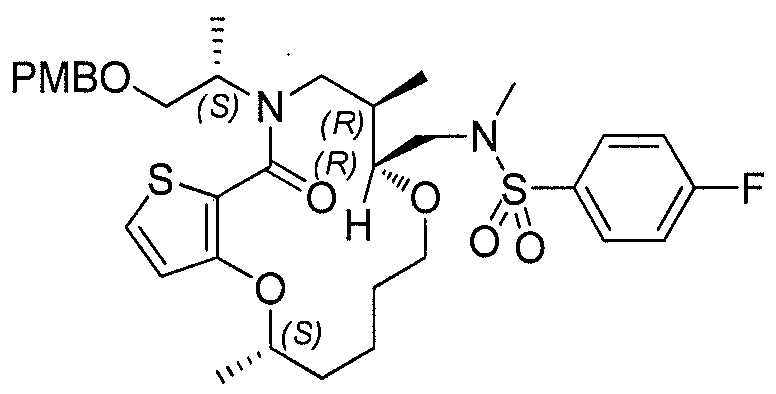
Synthesis of 4-fluoro-N-(((5S,llR,12R)-14-((S)-l-((4- methoxybenzyl)oxy)propan-2-yl)-5,12-dimethyl-15-oxo-5,6,7,8,9,ll, 12,13, 14,15- decahydrothieno[3,2-b] [1,9,5] dioxaazacyclotetradecin-ll-yI)methyl)-N- methylbenzenesulfonamide
To a solution of V17 (0.053 g, 0.079 mmol) in MeOH (1.571 ml) at room
temperature was added dihydroxypalladium (5.51 mg, 7.85 μηιοΐ). The reaction was placed under a hydrogen gas atmosphere using a hydrogen balloon, and stirred for lOh. This material was evaporated to dryness and chromato graphed on silica, using ethylacetate hexane to give the desired product (0.012 g, 60%) as colorless resin. 1H NMR (300 MHz, CDC13) 5 7.81-7.64 (m, 2H), 7.27 - 6.93 (m, 5H), 6.84 - 6.76 (m, 2H), 6.64 - 6.55 (m, 1H), 4.40 (s, 3H), 4.30 - 3.94 (m, 2H), 3.74 (s, 3H), 3.62 - 3.43 (m, 4H), 3.39-3.20 (m, 2H), 3.01-2.85 (m, 1H), 2.80 - 2.57 (m, 3H), 2.05 - 1.73 (m, 2H), 1.69-1.51 (s, 2H), 1.48-1.27 (m, 3H), 1.33 - 1.15 (m, 4H), 1.05 (d, J= 6.6, 3H), 0.90 - 0.60 (m, 3H). MS (ESI) calcd for C34H45FN207S2 [M + H]+: 677. Found: 677.
Alternative reduction of the Nitro and olefin groups followed by Urea formation:

Compound 4:

Synthesis of N-(((8R,9R)-14-(3-(3,5-dimethylisoxazol-4-yl)ureido)-ll-((S)-l-((4- methoxybenzyl)oxy)propan-2-yl)-9-methyI-12-oxo-2,3,4,5,6,8,9,10,ll,12- decahydro-lH-benzo[g] [1,5,9] oxadiazacyclotetradecin-8-yl)methyl)-4-fluoro-N- methylbenzenesulfonamide
To a solution of V14 (30 mg, 0.043 mmol) in ethanol (429 μΐ) was added 10% palladium on carbon (4.57 mg, 4.29 μηιοΐ). The reaction mixture was degassed and back filled with a hydrogen balloon. The reaction was stirred at room temp for 16 h. The reaction mixture was filtered through celite washing with dichloromethane and crude nitro material was carried forward to next step. To a solution of a portion of this crude material (7 mg, 9.99 μηιοΐ) in Ethanol (100 μΐ) was added Tin (II) chloride dihydrate (11.27 mg, 0.050 mmol) and the reaction was stirred at room temp. After 14h further Tin (II) chloride dihydrate (11.27 mg, 0.050 mmol) was added. After 22 h a sodium bicarbonate solution (300 μΐ) was added and the reaction mixture was concentrated to remove Ethanol. The material was extracted with ethylacetate (2 x 10 mL). The combined organic layer was washed with water (1 mL), concentrated and the crude material was carried forward to next step. To a solution of this crude material (6.7 mg, 9.99 μπιοι) in dry DCM (Volume: 100 μΐ) under nitrogen was added 4-isocyanato-3,5-dimethylisoxazole (1.122 μΐ, 9.99 μηιοι). The reaction mixture was stirred for 16h. This material was evaporated to dryness and chromatographed on silica, using methanol / dichloromethane to give the desired product (4 mg, 50%). 1H NMR (500 MHz, CDC13) 7.82-7.57 (m, 3H), 7.32-7.06 (m, 6H), 6.84-6.72 (m, 2H), 4.57-4.26 (m, 3H), 4.22 - 3.95 (m, 1H), 3.82 - 3.76 (m, 1H), 3.71 (s, 3H), 3.64 - 3.50 (m, 2H), 3.29 - 2.93 (m, 6H), 2.88-2.66 (m, 3H), 2.27 (s, 3H), 2.19-2.04 (m, 4H), 1.63-1.41 (m, 6H), 1.39-1.26 (m, 4H), 1.24- 0.86 (m, 3H). MS (ESI) calcd for C4iH53FN608S [M + H]+: 808. Found: 809. Aryl urea formation to provide intermediates CC1-CC9 and Examples 5-13:


tert-butyl (((2S,8R,9R)-ll-((S)-l-((4-methoxybenzyl)oxy)propan-2-yl)-2,9- dimethyl-12-oxo-14-(3-phenylureido)-2,3,4,5,6,8,9,10,ll,12- decahydrobenzo [b] [1 ,9,5] dioxaazacycIotetradecin-8- yl)methyl)(methyl)carbamate (CC1)
To a solution of tert-butyl (((2S,8R,9R)-14-amino-l l-((S)-l-((4- methoxybenzyl)oxy)propan-2-yl)-2,9-dimethyl- 12-oxo-2,3 ,4,5,6,8,9, 10,11,12 decahydrobenzo[b][l,9,5]dioxaazacyclotetradecin-8-yl)methyl)(methyl)carbamate AA19 (570 mg, 0.908 mmol) in DCM (9.08 ml) under N2 was added phenyl isocyanate (0.198 ml, 1.816 mmol). The reaction was stirred for 16h. The crude reaction mixture was evaporated under reduced pressure and purified by column chromatography using Ethylacetate/hexane to afford the desired product (568 mg, 84%) 1HNMR (300 MHz, CDC13) δ 8.32-7.74 (m, IH), 7.72-7.56 (m, IH), 7.54- 7.41 (m, 2H), 7.36-7.17 (m, 5H), 7.08-6.64 (m, 2H), 6.79-6.59 (m, IH), 4.70-4.25 (m, 3H), 4.24^.03 (m, 2H), 4.03-3.88 (m, IH), 3.88-3.71 (m, 3H), 3.71-3.56 (m, 2H), 3.54-3.21 (m, 3H), 3.21-2.66 (m, 5H), 1.94-1.72 (m, IH), 1.72-1.55 (m, 3H), 1.55-1.31 (m, 12H), 1.33-0.99 (m, 8H), 0.96-0.86 (m, IH), 0.83-0.65 (m, 2H). MS (ESI) calcd for C42H58N408 [M + H]+: 747. Found: 747.
The following intermediates CC2-CC9 and Examples 6-14 were prepared from this method:

n = 1 ,2,3


 U 2012/033586
-96-
 *11 was prepared from the intermediate FFF1
Alternative reduction of olefin and -NO2 and direct conversion to urea to afford 13-16 :

Synthesis of N-(((8R,9R)-15-(3-(3,5-dimethylisoxazol-4-yl)ureido)-ll-((S)-l-((4- methoxybenzyl)oxy)propan-2-yl)-9-methyl-12-oxo-3,4,5,6,8,9,10,ll»12,13- decahydro-2H-benzo[h] [l,10,5]dioxaazacycIopentadecin-8-yl)methyl)-4-fluoro- N-methylbenzenesuIfonamide
To a solution of V12 (0.040 g, 0.056 mmol) in ethylacetate (1.121 ml) was added dihydroxypalladium (3.93 mg, 5.60 μιηοΐ). The atmosphere was evacuated, and filled with a balloon of hydrogen gas. The reaction mixture was stirred for 18h. The reaction mixture was then filtered through Celite, eluting with dichloromethane. The filtrate was concentrated, and the crude material was carried on to the next step without further purification. To a solution of a portion of this crude material (0.023 g, 0.032 mmol) in THF (Volume: 0.459 ml) and AcOH (Volume: 0.459 ml) was added zinc dust (0.045 g, 0.688 mmol). The reaction was stirred for 20h. The reaction mixture was then filtered through celite, eluting with dichloromethane. The filtrate was concentrated, and the crude material was carried on to the next step without further purification. This crude material was dissolved in DCM (1.0 ml) and to this was added 3,5-dimethyl-4-isocyanato-isoxazole (9.82 μΐ, 0.087 mmol). The reaction mixture was stirred for 16 h. The reaction mixture was concentrated under reduced pressure and this crude material was chromatographed on silica, using methanol / dichloromethane to give the desired product (0.0065 g, 24%) as colorless resin. 1H NMR (300 MHz, CDCI3) δ 7.73-7.68 (m, 2H), 7.51 (s, 1H), 7.28-6.96 (m, 5H), 6.93-6.57 (m, 3H), 4.34 (dd, J= 25.5, 11.5, 2H), 4.04 - 3.93 (m, 2H), 3.98 - 3.71 (m, 2H), 3.69 (s, 3H), 3.47-3.36 (m, 2H), 3.30-3.01 (m, 5H), 2.67 (s, 3H), 2.53- 2.44 (m, 2H), 2.24 (s, 3H), 2.11 (s, 3H), 2.00 - 1.67 (m, 3H), 1.67 - 1.28 (m, 5H), 1.26 (d, J= 6.8 Hz, 3H), 1.01 (d, J= 6.8 Hz, 3H). MS calculated for C42H54FN509S [M+H]+: 824. Found: 824.
The following intermediate was prepared from this method starting with intermediate V13:

The following examples were prepared following steps 2 and 3 from this method.

*15B was prepared from intermediate EEE2 and 16 was prepared from the intermediate AA20
Gencral Scheme for the synthesis of examples 18-24

Examples 17-24 and intermediate DDI from steps 1 and 2 were synthesized following synthesized following the procedure previously reported in Marcaurelle, L. A.; Comer, E.; Dandapani, S.; Duvall, J. R.; Gerard, B.; Kesavan, S.; Lee, M. D, IV; Liu, H.; Lowe, J. T.; Marie, J.-C; Mulrooney, C. A.; Pandya, B. A.; Rowley, A.; Ryba, T. D.; Suh, B.-C; Wei, J.; Young, D. W.; Akella, L. B.; Ross, N. B.; Zhang, Y.-L.; Fass, D. M.; Reis, S. A.; Zhao, W.-N.; Haggarty, S. J.; Palmer, M.; Foley, M. A. J. Am. Chem. Soc. 2010, 132, 16962-16976.
A small aliquot of select intermediates were purified via HPLC for screening examples 20-24:


- 101 -

Synthesis of 24 from Intermediate V21


l-(3,5-dimethylisoxazol-4-yI)-3-((2S,8R,9R)-ll-((S)-l-((4- methoxybenzyI)oxy)propan-2-yl)-2,9-dimethyl-12-oxo-8-(piperidin-l-ylmethyl)- 2,3,4,5,6,8,9,10,ll,12-decahydrobenzo[b] [1,9,5] dioxaazacyclotetradecin-14- yl)urea
To a solution of tert-butyl (((25',8i?,9i?)-14-(3-(3,5-dimethylisoxazol-4-yl)ureido)- 11 -((5)- 1 -((4-methoxybenzyl)oxy)propan-2-yl)-2,9-dimethyl- 12-oxo- 2,3,4,5,6,8,9,10,11,12-decahydrobenzo [b] [ 1 ,9,5]dioxaazacyclotetradecin-8- yl)methyl)carbamate (0.027 g, 0.036 mmol) in dry CH2C12 (0.36 mL) under N2 and chilled in an ice-H20 bath was added 2,6-lutidine (0.017 mL, 0.15 mmol) followed by tert-butyldimethylsilyl trifluoromethanesulfonate (0.022 mL, 0.091 mmol). The reaction mixture was stirred in the ice bath 30 min, then allowed to warm to rt and stirred 3 h. Additional 2,6-lutidine (.017 mL, 0.15 mmol) was added to the mixture, then it was quenched with sat. aq. NaHC03. The aqueous phase was extracted into CH2C12, the organic layer dried (Na2S04) and the solvent evaporated. The residue was dissolved in THF (0.5 mL) in a Teflon bottle, and HF-Pyridine (4.5 μΐ, 0.036 mmol) was added. The solution was stirred 45 min, then quenched with sat. aq. NaHC03 and the aqueous phase extracted into EtOAc. The organic layer was dried (Na S04) and the solvent evaporated. The residue (l-((2S',8i?,9i?)-8-(aminomethyl)- 1 1 -((S -l -((4-methoxybenzyl)oxy)propan-2-yl)-2,9-dimethyl-12-oxo-
2,3,4,5,6,8,9,10,1 l,12-decahydrobenzo[b][l,9,5]dioxaazacyclotetradecin-14-yl)-3-
2012/033586
- 103 -
(3,5-dimethylisoxazol-4-yl)urea) was carried on to the next step without further purification.
To a solution of l-((25,,8i?,9i?)-8-(aminomethyl)-l l-((5)-l-((4- methoxybenzyl)oxy)propan-2-yl)-2,9-dimethyl-12-oxo-2,3,4,5,6,8,9,10,l l,12- decahydrobenzo [b] [ 1 ,9,5] dioxaazacyclotetradecin- 14-yl)-3 -(3 ,5 -dimethylisoxazol-4- yl)urea (0.010 g, 0.015 mmol) in acetonitrile (0.15 mL), was added NaHC03 (3.9 mg, 0.046 mmol) and 1,5-diiodopentane (2.7 μΐ, 0.018 mmol). The reaction mixture was stirred at rt for 16 h. Purification was accomplished by prep TLC to yield 1.0 mg (9%) of pure product. 1H NMR (300 MHz, CDC13) δ 7.62-7.38 (m, 1H), 7.21 (d, J= 8.5 Hz, 2H), 7.18-7.08 (m, 1H), 6.88 (d, J= 7.8 Hz, 2H), 6.78-6.68 (m, 1H), 4.52 - 4.28 (m, 3H), 4.20 - 4.01 (m, 1H), 3.90 - 3.68 (m, 4H), 3.80 (s, 3H), 3.64 - 3.37 (m, 2H), 3.10-2.68 (m, 1H), 2.37 - 2.1 1 (m, 10H), 1.89-1.82 (m, 1H), 1.80-1.58 (m, 6H), 1.56-1.41 (m, 5H), 1.33 - 1.04 (m, 6H), 0.90 - 0.66 (m, 6H). MS
calculated for C40H58N5O7 [M+H]+: 720. Found: 720.
Sulfonamide formation on Intermediates CC3-CC9, AA8, AA13-AA18,
Examples 5 and 8:

4-fluoro-N-(((2S,8R,9R)-ll-((S)-l-((4-methoxybenzyl)oxy)propan-2-yl)-2,9- dimethyl-12-oxo-14-(3-phenylureido)-2,3,4,5,6,8,9,10,ll,12- decahydrobenzo[b][l,9,5]dioxaazacyclotetradecin-8-yI)methyl)-N- methylbenzenesulfonam.de (25)
A solution of tert-butyl (((2S,8R,9R)-1 l-((S)-l-((4-methoxybenzyl)oxy)propan-2- yl)-2,9-dimethyl-12-oxo-14-(3-phenylureido)-2,3,4,5,6,8,9,10,l l,12- decahydrobenzo[b][l ,9,5]dioxaazacyclotetradecin-8-yl)methyl)(methyl)carbamate (2.3 g, 3.08 mmol) in dry DCM (61.6 ml) under N2 was chilled in a ice-H20 bath and to this was added 2,6-dimethylpyridine (1.435 ml, 12.32 mmol) and then tert- butyldimethylsilyl trifluoromethanesulfonate (1.817 ml, 7.70 mmol) dropwise. The reaction was stirred at 0 °C for 30 min, and was then stirred at rt for a further 3h. To the solution was added 2,6-lutidine (1.4 mL) and the reaction was quenched with sat. NH4C1. The layers were separated, and the aqueous layer was extracted with DCM. The combined organic extracts were washed with sat. NH4C1 and brine, dried
(MgS04), filtered and the solvent evaporated. The residue was dissolved in THF (30 mL), transferred to a teflon bottle, then added pyridine hydro fluoride (0.382 ml, 3.08 mmol) was added. The reaction was stirred for 30 min and to this was added sat. NaHC03, the organic layer was dried over MgS04, filtered and concentrated in vacuo to yield the crude product which was carried onto the next step. To a solution of the residue (1.992 g, 3.08 mmol) in DCM (30.8 ml) was added 2,6-
6
- 104 - dimethylpyridine (0.717 ml, 6.16 mmol) was added 4-fluorobenzene-l-sulfonyl chloride (0.899 g, 4.62 mmol). The reaction was stirred at room temperature under N2 overnight. To the solution was added H20, the layers were separated and aqueous layer extracted with DCM, washed with H20, dried (Na2S04) and evaporated under reduced pressure. The reaction was purified by column chromatography using Ethyl acetate/hexane to afford the desired product (2.14 g, 86%). 1HNMR (300 MHz, CDC13) δ 8.74-7.86 (m, 1H), 7.81-7.42 (m, 5H), 7.37-6.98 (m, 7H), 6.98-6.74 (m, 1H), 6.77-6.54 (m, 2H), 5.57-5.38 (m, 1H), 4.66-4.37 (m, 1H), 4.35-3.98 (m, 1H), 3.96-3.19 (m, 7H), 3.19-2.87 (m, 2H), 2.87-2.53 (m, 6H), 2.14-1.82 (m, 2H), 1.82- 1.30 (m, 8H), 1.29-0.84 (m, 7H), 0.84-0.47 (m, 2H). MS (ESI) calcd for
C43H53FN408S [M + H]+: 805. Found: 805.
The following examples were prepared using this method:

- 105-


- 107-
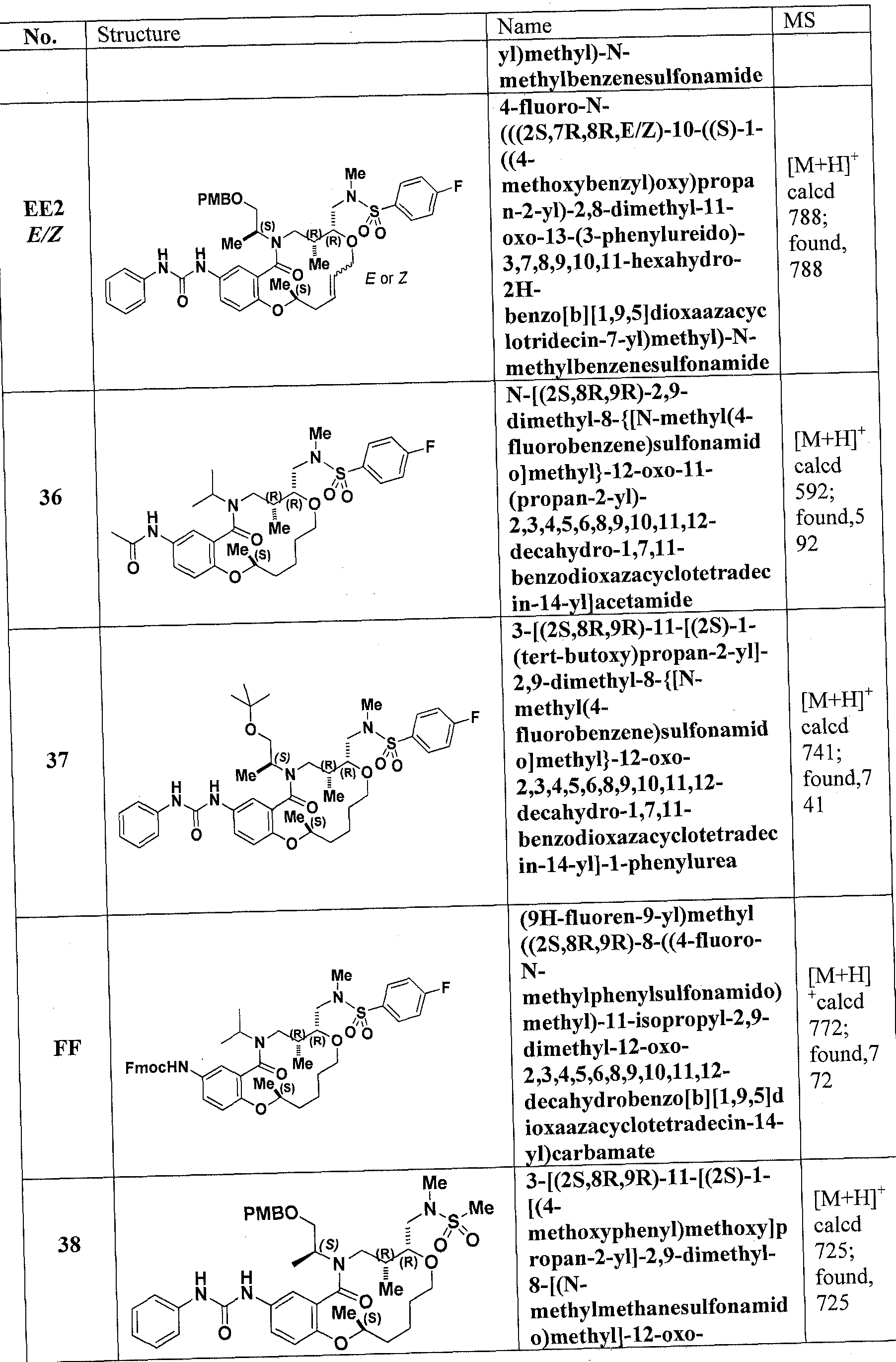

methylbenzenesulfonamide
Amide Reduction and Urea Formation

Example 43;

Synthesis of N-(((2S,8R,9R)-14-(3-(3,5-dimethylisoxazol-4-yl)ureido)-ll-((S)-l- ((4-methoxybenzyl)oxy)propan-2-yl)-2,9-dimethyl-2,3,4,5,6,8,9,10,ll,12- decahydrobenzo[b][l,9,5]dioxaazacyclotetradecin-8-yl)methyl)-4-fluoro-N- methylbenzenesulfonamide
To a solution of AA7 (25mg, 0.036 mmol) in dry THF (500 μΐ) under nitrogen was added dropwise over 5 min borane-methyl sulfide complex (20.74 μΐ, 0.219 mmol). A reflux condenser was connected to the reaction flask and the reaction was heated to 70 °C using an oil bath. After 3h the reaction was cooled to room temperature and then MeOH was added slowly and dropwise until the bubbling slowed. More MeOH was added and the reaction was stirred at room temperature until no bubbling was seen. The solvent was removed under reduced pressure and the crude material was co-evaporated with MeOH to remove any excess of B(OMe)3. To a solution of a portion of this crude material (13 mg, 0.019 mmol) in dry DCM (400 μΐ) under nitrogen was added 4-isocyanato-3,5-dimethylisoxazole (2.61 μΐ, 0.023 mmol) and
T U 2012/033586
- 110 - the reaction was stirred overnight. The reaction mixture was evaporated to dryness. This material was chromatographed on silica, using methanol / dichloromethane to give the title product (5 mg, 32%) as colorless resin. 1H NMR (300 MHz, CDC13) δ 7.79-7.58 (m, 3H), 7.30-7.05 (m, 6H), 6.95-6.70 (m, 2H), 4.63-4.25 (m, 3H), 4.19- 3.78 (m, 3H), 3.74-3.68 (m, 3H), 3.64-3.28 (m, 4H), 3.39-2.88 (m, 4H), 2.76-2.63 (m, 4H), 2.42 - 1.94 (m, 7H), 1.88-1.31 (m, 6H), 1.28-1.97 (m, 6H), 0.95 - 0.64 (m, 3H). MS calculated for C42H56FN508S [M+H]+: 810. Found: 810.
Reductive Amination:

3-[(2S,8R,9R)-8-{[benzyI(methyI)amino]methyI}-ll-[(2S)-l-[(4- methoxyphenyl)methoxy]propan-2-yl]-2,9-dimethyl-12-oxo-
2,3,4,5,6,8,9,10,ll>12-decahydro-l,7,ll-benzodioxazacyclotetradecin-14-yl]-l- phenylurea (44)
To a mixture of the crude amine intermediate prepared during the synthesis of Example 26 (0.078 g, 0.12 mmol) and magnesium sulfate (0.072 g, 0.600 mmol) in dry DCM (1.2 ml) was added by benzaldehyde (0.036 ml, 0.360 mmol) under N2 atmosphere. The suspension was stirred for lh followed by the addition of sodium triacetoxyborohydride (0.178 g, 0.840 mmol). The resulting mixture was stirred at room temperature for 4h. The reaction was diluted with DCM (10 ml) and water (10 ml). The aqueous phase was separated and washed with DCM (10 ml). Then the combined organic layers were washed with water (10 ml), separated, dried (Na2S04) and evaporated to dryness. This material was chromatographed on silica, using methanol / dichloromethane to give the title product (4 mg, 5%) as colorless resin. 1H NMR (300 MHz, CDC13) δ 7.72 (m, 2H), 7.53 (m, 4H), 7.37 (m, 3H), 7.23 (m, 2H), 6.84 (m, 3H), 6.63 (m, 2H), 4.47 (m, 2H), 4.33 (m, 2H), 4.22 (m, 2H), 3.78 (m, 3H), 3.36 (m, 3H), 2.73 (m, 5H), 1.59 (m, 7H), 1.23 (m, 4H), 1.03 (m, 4H), 0.90 (m, 6H), 0.59 (m, 2H). MS calculated for C44H56N406 [M+H]+: 737. Found: 737.
The following examples were prepared from this method:
e


l-((2S,8R,9R)-8-(((4- methoxybenzyl)(methyl)a mino)methyl)-ll-((S)-l- [M+H] ((4- + calcd
50 methoxybenzyl)oxy)propa 767;
n-2-yl)-2,9-dimethyl-12- found, oxo-2,3,4,5,6,8,9,10,11,12- 767
 decahydrobenzo[b][l,9,5]d
ioxaazacycIotetradecin-14- yl)-3-phenylurea
Synthesis of carbamates:

2-methoxyethyl (((2S,8R,9R)-ll-((S)-l-((4-raethoxybenzyl)oxy)propan-2-yl)-2,9- dimethyl-12-oxo-14-(3-phenylureido)-2,3,4,5,6,8,9,10,H,12- decahydrobenzo[b] [l,9,5]dioxaazacyclotetradecin-8- yl)methyl)(methyl)carbamate (GG) To a solution of crude amine intermediate prepared during the synthesis of Example 26 (0.22, 0.340 mmol) in dioxane (8.50 ml) under N2 was added a 10% Sodium Bicarbonate (1.648 ml, 2.041 mmol) aqueous solution, followed by 2-methoxyethyl chloroformate (0.079 ml, 0.680 mmol). The reaction mixture was stirred at room temperature for 15h. The reaction was diluted with EtOAc and water. The aqueous phase was separated and washed with EtOAc, then the combined organic layers were washed with water and brine, dried over Na2S04 and evaporated to dryness. This material was chromatographed on silica, using methanol / dichloromethane to give 0.15 g (59%) of the final product as colorless resin. !H NMR (300 MHz, CDC13) δ 7.60 (m, 2H), 7.41 (m, 2H), 7.37 - 7.12 (m, 3H), 6.97 (m, 1H), 6.93 - 6.81 (m, 2H), 6.75 (m, 2H), 5.31 (s, 1H), 4.50 (m, 2H), 4.34 (m, 1H), 4.19 (m, 2H), 3.97 (m, 2H), 3.79 (m, 3H), 3.74 _ 3.44 (m, 4H), 3.44 - 3.25 (m, 3H), 3.22 (m, 1H), 3.00 (m, 4H), 2.78 - 2.58 (m, 1H), 2.1 1 (m, 2H), 1.52 (m, 9H), 1.23 (m, 6H), 1.08 (m, 2H), 0.81 (m, 1H). MS calculated for C41H56N409 : 749 [M+H]+. Found 749.
The following intermediate HH and example 52 were prepared from this


Alternative Boc-deprotection and sulfonylation;

Example 52:
33586
- 114 -

3-[(2S,8R,9R)-2,9-dimethyI-8-{[N-methyl(4- fluorobenzene)sulfonamido]methyl}-12-oxo-ll-(propan-2-yl)- 2,3,4,5,6,8,9, 10,ll)12-decahydro-l,7,ll-benzodioxazacyclotetradecin-14-yl]-l- phenylurea (52)
To a solution of Boc-protected amine CC2 (0.0615 g, 0.101 mmol) in dry DCM (2.014 ml) was added anisole (0.109 ml, 1.007 mmol), triethylsilane (0.016 ml, 0.101 mmol), and 2,2,2-trifluoroacetic acid (0.187 ml, 2.52 mmol) under N2 atmosphere. The resulting mixture was stirred at room temperature for 90 min. The solution was then evaporated and azeotroped with toluene (3 X) and finally dried under high vacuum. The crude amine (0.0727 g, 0.142 mmol) was re-dissolved in DCM (1.424 ml), then N-ethyl-N-isopropylpropan-2-amine (0.025 ml, 0.142 mmol) was added, followed by 2,6-dimethylpyridine (0.099 ml, 0.854 mmol), and 4- fluorobenzene-l -sulfonyl chloride (0.055 g, 0.285 mmol). The resulting mixture was stirred at room temperature for 15h. The reaction was diluted with DCM (10 ml) and washed with water (2 X 10 ml). The organic phase was then separated, dried
(Na2S04) and evaporated to dryness. This material was chromatographed on silica, using methanol / dichloromethane to give the final product (39 mg, 41% over 2 steps) as colorless resin. 1H NMR (300 MHz, CDC13) δ 7.81 - 7.65 (m, 2H), 7.53 - 7.29 (m, 1H), 7.39 - 7.29 (m, 1H), 7.27 - 7.19 (m, 1H), 7.17 - 7.10 (m, 2H), 7.07 - 7.01 (m, 1H), 6.88 - 6.92 (m, 2H), 6.89 - 6.84 (m, 1H), 6.81 - 6.74 (m, 1H), 4.48 (s, 1H), 4.01 - 3.68 (m, 3H), 3.62 - 3.40 (m, 1H), 3.13 - 2.95 (m, 1H), 2.92 - 2.80 (m, 2H), 2.79 - 2.71 (m, 1H), 2.69 - 2.57 (m, 1H), 2.54 - 2.42 (m, 4H), 2.39 - 2.14 (m, 1H), 1.88 - 1.67 (m, 1H), 1.65 - 1.58 (m, 8H), 1.52 - 1.38 (m, 2H), 1.33 - 1.18 (m, 2H), 1.14 - 1.06 (m, 1H), 1.04 - 0.88 (m, 3H), 0.85 - 0.73 (d, 1H). MS calculated for C35H45FN406S [M+H]+: 669. Found: 669.
Deprotection of the -PMB ether;

4-fluoro-N-(((2S,8R,9R)-ll-((S)-l-hydroxypropan-2-yl)-2,9-dimethyl-12-oxo- 14-(3-phenylureido)-2,3,4,5,6,8,9,10,ll,12-
decahydrobenzo[b] [1,9,5] dioxaazacyclotetradecin-8-yl)methyl)-N- methylbenzenesulfonamide (53)
To a solution of 4-fluoro-N-(((2S,8R,9R)-l l-((S)-l-((4-methoxybenzyl)oxy)propan- 2-yl)-2,9-dimethyl-12-oxo-14-(3-phenylureido)-2,3,4,5,6,8,9,10,l l ,12- decahydrobenzo [b] [ 1 , 9, 5] dioxaazacyclotetradecin- 8 -yl)methyl)-N- methylbenzenesulfonamide (1.99 g, 2.472 mmol) in DCM (24.72 ml) was added 2.5 mL pH 7 buffer. The reaction mixture was cooled to 0 °C in an ice-H20 bath. To this mixture was added 4,5-dichloro-3,6-dioxocyclohexa-l,4-diene-l,2- dicarbonitrile (0.730 g, 3.21 mmol) and the mixture was stirred under N2 for 16h, allowing warming to rt. The reaction was quenched with sat. NaHC03, and stirred for 1 h. The phases were separated and the aqueous phase was washed with DCM twice. The organic phases were combined and washed with saturated NaHC03 and H20. The organic components were dried (Na2S04) and evaporated under reduced pressure to afford crude material. The reaction was purified by column
chromatography using Ethylacetate/hexane to afford the desired product (1.41 g, 83%). 'HNMR (300 MHz, CDC13) δ 8.17-7.49 (m, 3H), 7.46-7.08 (m, 7H), 7.07- 6.59 (m, 2H), 4.73-4.53 (m, 1H), 4.51^1.22 (m, 1H), 4.1 1-3.62 (m, 3H), 3.62-3.24 (m, 4H), 3.24-2.93 (m, 4H), 2.93-2.59 (m, 5H), 2.45-1.94 (m, 2H), 1.84-1.25 (m, 5H), 1.22-0.92 (m, 6H), 0.91-0.65 (m, 2H). MS (ESI) calcd for C35H45FN407S [M + H]+: 685. Found: 685.


amide
Alternate synthesis of intermediates II-JJ and examples 71-72

Intermediate II:
 (S)-2-((2S,8R,9R)-14-((((9H-fluoren-9-yl)methoxy)carbonyl)amino)-8- ((((allyIoxy)carbonyl)(methyl)amino)methyl)-2,9-dimethyl-12-oxo-3,4,5,6,9,10- hexahydrobenzo[b] [l,9,5]dioxaazacyclotetradecin-ll(2H,8H,12H)-yl)propyI benzoate (II)
To a solution of allyl (((2S,8R,9R)-14-((((9H-fIuoren-9- yl)methoxy)carbonyl)amino)- 11 -((S)- 1 -hydroxypropan-2-yl)-2,9-dimethyl- 12-oxo- 2,3,4,5,6,8,9,10,1 l,12-decahydrobenzo[b][l, 9, 5]dioxaazacyclotetradecin-8- yl)methyl)(methyl)carbamate (0.509 g, 0.713 mmol) in dry DCM (5.94 ml) was added pyridine (0.577 ml, 7.13 mmol) followed by benzoyl chloride (0.248 ml, 2.139 mmol) under N2 atmosphere at room temperature. The resulting mixture was stirred at room temperature for 4h. The reaction was diluted with DCM (10 ml) and washed with water (2 X 10 ml). The organic phase was then separated, dried
(Na2S04) and evaporated to dryness. This material was chromatographed on silica, using ethyl acetate / hexanes to give 0.54 g (93%) of the desired product. ]H NMR (300 MHz, CDC13) δ 8.05 (d, 1H), 8.00 (d, 1H), 7.77 (d, 2H), 7.66-7.50 (m, 3H), 7.48 - 7.37 (m, 4H), 7.36-7.28 (m, 2H), 7.22-7.11 (m, 1H), 6.89-6.66 (m, 2H), 6.03- 5.78 (m, 1H), 5.26 - 5.06 (m, 1H), 4.72-4.40 (m, 4H), 4.32-4.22 (m, 1H), 4.18 - 4.02 (m, 1H), 4.00-3.84 (m, 1H), 3.80-3.50 (m, 1H), 3.47 (d, 2H), 3.41 - 3.15 (m, 1H), 3.12-2.73 (m, 3H), 2.19 (m, 1H), 2.04 (m, 1H), 1.91-1.69 (m, 2H), 1.67-1.45 (m, 3H), 1.37-1.08 (m, 9H), 0.99-0.80 (m, 6H), 0.77 (m, 2H). MS calculated for C48H55N309 [M+H]+: 818. Found: 818. Intermediate JJ:

A mixture of Fmoc-protected aniline (1.61 g, 1.968 mmol) and piperidine (0.390 ml, 3.94 mmol) in dry DMF (19.68 ml) was stirred under N2 atmosphere at room temperature for 40 min. Then phenyl isocyanate(0.209 ml, 1.914 mmol) was introduced to the reaction mixture, which was stirred at room temperature for 3 h. The reaction was diluted with water/EtOAc (10 ml) and extracted with EtOAc. The organic phase was separated, washed with water, brine, dried (Na2S04) and evaporated to dryness. This material was chromatographed on silica, using ethyl acetate / hexanes to afford the desired product (0.77 g, 60% over 2 steps). 1H NMR (300 MHz, CDC13) δ 8.06 (m, 1H), 8.04 - 7.89 (m, 1H), 7.81 (m, 1H), 7.59 (m, 2H), 7.51 - 7.30 (m, 2H), 7.23 (m, 2H), 6.96 (m, 1H), 6.82 (m, 1H), 6.69 (m, 1H), 5.89 (m, 1H), 5.45 - 5.08 (m, 2H), 4.83 (m, 1H), 4.55 (m, 3H), 4.18 - 4.02 (m, 1H), 3.93 (m, 2H), 3.50 (m, 1H), 3.34 (m, 1H), 3.26 - 2.95 (m, 3H), 2.88 (m, 3H), 2.26 (m, 1H), 2.04 (m, 1H), 1.77 (m, 2H), 1.62 (m, 2H), 1.38 (m, 3H), 1.24 (m, 5H), 1.14 - 1.00 (m, 2H), 0.99 - 0.85 (m, 2H), 0.77 (m, 2H). MS calculated for C4oH5oN408 [M+H]+: 715. Found: 715.
The following example was prepared from this method:


Alloc deprotection and sulfonation to provide example 72:

chromato graphed on silica, using ethyl acetate / hexanes to give 0.53 g (62%) of the title product as colorless resin. Ή NMR (300 MHz, CDC13) 8 8.11 - 7.84 (m, 2H),
33586
- 123 -
7.79 (m, 1H), 7.62 (m, 3H), 7.37 (m, 2H), 7.34 - 7.16 (m, 2H), 7.04 (m, 4H), 6.87 - 6.63 (m, 2H), 6.52 (m, 1H), 4.89 - 4.48 (m, 1H), 4.45 - 4.18 (m, 1H), 4.06 (m, 1H), 3.77 (m, 2H), 3.50 (m, 1H), 3.35 (m, 1H), 2.94 (m, 2H), 2.64 (m, 5H), 1.88 (m, 1H), 1.56 (m, 2H), 1.43 (m, 2H), 1.31 (m, 4H), 1.04 (m, 3H), 0.88 (m, 2H), 0.75 (m, 1H), 0.60 (m, 2H), 0.37 (m, 1H). MS calculated for C42H49FN408S [M+H]+: 789. Found: 789.
Alternate synthetic order to prepare Intermediates KK-MM:


(S)-2-((2S,8R,9R)-14-((((9H-fluoren-9-yl)methoxy)carbonyl)amino)-8-((4- fluoro-N-methylphenylsulfonamido)methyl)-2,9-dimethyl-12-oxo-3,4,5,6,9,1 - hexahydrobenzo[b][l,9,5]dioxaazacyclotetradecin-ll(2H,8H,12H)-yl)propyl benzoate (KK)
A mixture of Alloc-protected amine II (0.268 g, 0.328 mmol), 1,3- dimethylpyrimidine-2,4,6(lH,3H,5H)-trione (0.384 g, 2.46 mmol) and Pd(PPh3)4 (76 mg, 0.066 mmol) in dry CH2C12 (4.7 ml) was stirred under N2 atmosphere at room temperature for 1 h. The reaction mixture was diluted with CH2CI2, washed with Sat. NaHC03 and water, dried (Na2S04) and evaporated to dryness. The crude product was then re-dissolved in dry CH2C12 (3.3 ml), then 2,6-lutidine (0.27 ml, 2.3
U 2012/033586
- 124 - mmol) was added, followed by 4-fluorobenzene-l-sulfonyl chloride (0.127 g, 0.654 mmol) under N2 atmosphere. The resulting mixture was stirred at room temperature for 15 h. The reaction was diluted with CH2C12 and washed with water, dried
(Na2S04) and evaporated to dryness. This material was chromatographed on silica, using ethyl acetate / hexanes to give 0.20 g (70%) of the title product as colorless resin. 1H NMR (300 MHz, CDC13) δ 8.08-7.95 (m, 2H), 7.86 - 7.67 (m, 4H), 7.65- 7.49 (m, 3H), 7.48-7.37 (m, 4H), 7.36 - 7.23 (m, 3H), 7.22-7.09 (m, 3H), 6.88 - 6.74 (m, 1H), 6.68 (m, 1H), 4.89 - 4.58 (m, 1H), 4.57 - 4.40 (m, 3H), 4.30-4.17 (m, 1H), 4.06 (m, 1H), 3.99-3.80 (m, 2H), 3.78-3.40 (m, 2H), 3.20-2.87(m, 2H), 2.86- 2.68 (m, 3H), 2.28-2.15 (m, 1H), 2.07-1.89 (m, 1H), 1.86-1.52 (m, 4H), 1.52-1.29 (m, 6H), 1.23-1.08 (m, 3H), 1.01-0.70 (m, 3H). MS calculated for C50H54FN3O9S [M+H]+: 892. Found: 892.

(S)-2-((2S,8R,9R)-14-(3-(3,5-dimethylisoxazol-4-yl)ureido)-8-((4-fluoro-N- methylphenylsulfonamido)methyl)-2,9-dimethyl-12-oxo-3,4,5,6,9,10- hexahydrobenzo[b][l,9,5]dioxaazacyclotetradecin-ll(2H,8H,12H)-yl)propyl benzoate (LL)
To a solution of Fmoc protectee aniline (60 mg, 0.067 mmol) in dry DMF (0.67 ml) was added piperidine (0.013 mL, 0.14 mmol). The reaction mixture was stirred for lh, then 4-isocyanato-3,5-dimethylisoxazole (0.030 mL, 0.27 mmol) was added and the mixture stirred for 2 h. The mixture was then diluted with EtOAc and H20, separatedphases and washed aq. with EtOAc. The combined organics were washed with H20, dried (Na2S04) and the solvent evaporated. This material was chromatographed on silica, using MeOH / DCM to yield 22 mg (41%) of product. 1H NMR (300 MHz, CDC13) δ 8.12-7.92 (m, 2H), 7.91 - 7.62 (m, 3H), 7.61-7.49 (m, 1H), 7.48-7.33 (m, 2H), 7.22 - 7.08 (m, 2H), 7.05-6.69 (m, 3H), 4.98-4.30 (m, 3H), 4.25-4.02 (m, 1H), 3.98 - 3.79 (m, 1H), 3.77-3.60 (m, 1H), 3.57-3.27 (m, 1H), 3.23 - 2.95 (m, 2H), 2.94-2.68 (m, 3H), 2.36-2.00 (m, 6H), 1.85-1.70 (m, 2H), 1.63- 1.33 (m, 5H), 1 (m, 2H), 1.32- 1.02 (m, 6H), 1.05-0.77 (m, 3H). MS calculated for C4iH5oFN509S [M+H]+: 808. Found: 808.
The following intermediate MM was prepared from this method:

Alternate synthesis of Example 53, Bz deprotection:

3-[(2S,8R,9R)-ll-[(2S)-l-hydroxypropan-2-yl]-2,9-dimethyl-8-{[N-methyl(4- fluorobenzene)sulfonamido]methyl}-12-oxo-2,3,4,5,6,8,9,10,ll,12-decahydro- l,7,ll-benzodioxazacyclotetradecin-14-yl]-l-phenylurea (53)
To a solution of Bz-protected alcohol (0.49 g, 0.621 mmol) in methanol (12.42 ml) was added potassium carbonate (0.472 g, 3.42 mmol) under N2 atmosphere. The suspension was stirred at room temperature for 15h. The reaction mixture was then quenched with Sat. NH C1 (15 ml) and extracted with EtOAc. The organic phase was separated, washed with water and brine, dried (Na2S04) and evaporated to dryness. This material was chromatographed on silica, using methanol / dichloromethane to afford the desired product (0.4 g, 94%) as colorless resin. 1H NMR (300 MHz, CDC13) δ 7.95 - 7.51 (m, 3H), 7.39 (m, 1H), 7.34 - 7.07 (m, 5H), 7.07 - 6.91 (m, 1H), 6.91 - 6.60 (m, 2H), 4.65 (s, 1H), 4.33 (s, 1H), 3.93 (m, 4H), 3.56 (m, 2H), 3.10 (m, 2H), 2.96 - 2.55 (m, 5H), 2.47 - 2.27 (m, 1H), 2.04 (m, 1H), 1.64 (m, 3H), 1.47 (m, 4H), 1.38 - 1.22 (m, 2H), 1.22 - 1.09 (m, 3H), 1.09 - 0.90 (m, 2H), 0.79 (m, 2H). MS calculated for C35H45FN407S [M+H]+: 685. Found: 685.
The following examples were prepared from this method:


Synthesis of Example 78:

3-[(2R,8R,9R)-8-({[(4-fluorophenyl)methyI](methyl)amino}methyl)-ll-[(2S)-l- hydroxypropan-2-yl]-2,9-dimethyl-12-oxo-2,3,4,5,6,8,9,10,ll,12-decahydro- l,7,ll-benzodioxazacyclotetradecin-14-yl]-l-phenylurea (78)
To a mixture of the crude amine (0.0484 g, 0.077 mmol) and magnesium sulfate (7.37 mg, 0.077 mmol) in dry DCM (0.767 ml) was added by 4-fluorobenzaldehyde (0.024 ml, 0.230 mmol) under N2 atmosphere. The suspension was stirred for lh followed by the addition of sodium triacetoxyborohydride (0.101 g, 0.537 mmol). The resulting mixture was stirred at room temperature for 4h. The reaction was diluted with DCM (10 ml) and water (10 ml). The aqueous phase was separated and washed with DCM (10 ml). Then the combined organic layers were washed with water (10 ml), separated, dried (Na2S04) and evaporated to dryness. Crude product was carried on to the benzoyl deprotection step, following the same procedure as for 3-[(2S,8R,9R)-ll-[(2S)-l-hydroxypropan-2-yI]-2,9-dimethyl-8-{[N-methyl(4- fluorobenzene)sulfonamido]methyl}-12-oxo-2,3?4,5,6,8,9,10,ll,12-decahydro- l,7,ll-benzodioxazacyclotetradecin-14-yl]-l-phenylurea (11 mg (23% over 2 steps) of the desired compound were obtained as colorless resin. Ή NMR (300 MHz, CDC13) δ 8.18 - 7.79 (m, 2H), 7.46 (m, 4H), 7.37 - 7.17 (m, 3H), 7.17 - 6.89 (m, 2H), 6.76 (m, 1H), 4.69 - 4.44 (m, 1H), 4.24 (m, 1H), 3.84 (m, 2H), 3.52 (m, 2H), 3.20 - 3.00 (m, 1H), 2.77 (m, 1H), 2.64 (m, 6H), 2.17 (m, 2H), 2.03 - 1.87 (m, 1H), 1.61 (m, 4H), 1.40 (m, 4H), 1.31 - 1.16 (m, 4H), 1.08 (m, 2H), 0.98 - 0.84 (m, 2H), 0.80 - 0.62 (m, 2H). MS calculated for C36H47FN405 [M+H]+: 635. Found: 635.
Alternative synthesis scheme, protecting group modification (Examples 79-84);

TBS protection:
 allyl (((2S,8R,9R)-14-((((9H-fluoren-9-yl)methoxy)carbonyl)amino)-ll-((S)-l- ((tert-butyIdimethylsilyI)oxy)propan-2-yl)-2,9-dimethyl-12-oxo- 2,3,4,5,6,8,9,10,11, 12-decahydrobenzo[b][l,9,5]dioxaazacydotetradecin-8- yl)methyl)(methyl)carbamate (79):
To a solution of free alcohol (0.494 g, 0.692 mmol) in dry DMF (2.77 ml) was added imidazole (0.141 g, 2.076 mmol) followed by TBSCl (0.146 g, 0.692 mmol) under N2 atmosphere at room temperature. The resulting mixture was stirred at room temperature for 16 h. The reaction was diluted with DCM (10 ml) and washed with water (2 X). The organic phase was then separated, dried (Na2S04) and evaporated to dryness. This material was chromatographed on silica, using ethyl acetate / hexanes to give 0.37 g (65%) of the desired product. ]H NMR (300 MHz, CDC13) δ 7.78 (d, 2H), 7.60 (d, 2H), 7.53 - 7.20 (m, 4H), 7.09 (s, 1H), 6.82 (m, 1H), 6.55 (s, 1H), 5.94 (m, 1H), 5.47 - 5.06 (m, 1H), 4.75 - 4.39 (m, 4H), 4.26 (m, 1H), 4.10 (m, 1H), 3.99 - 3.62 (m, 4H), 3.49 - 3.10 (m, 2H), 3.00 (m, 2H), 2.88 - 2.66 (m, 1H), 2.19 (s, 1H), 2.01 (s, 1H), 1.83 (m, 1H), 1.63 (s, 4H), 1.32 (m, 4H), 1.16 - 1.02 (m, 2H), 1.02 - 0.57 (m, 9H), 0.15 - -0.15 (m, 5H). MS calculated for
C47H65N308 [M+H]+: 828. Found: 828.

allyl (((2S,8R,9R)-1 l-((S)-l-((tert-butyldimethylsilyl)oxy)propan-2-yl)-2,9- dimethyI-12-oxo-14-(3-phenylureido)-2,3,4,5,6,8,9,10,ll,12- decahydrobenzo [b] [1,9,5] dioxaazacyclotetradecin-8- yl)methyl)(methyl)carbamate (80) To a solution of Fmoc protectee aniline 79 (0.330 g, 0.398 mmol) in dry
DMF (3.98 ml) was added piperidine (0.079 mL, 0.797 mmol). The reaction mixture was stirred for 30 min, then phenyl isocyanate (0.174 mL, 1.594 mmol) was added. The resulting mixture was stirred at room temperature for 16 h. The reaction was diluted with water and EtOAc, the phases were separated, and the organic phase
was washed with H20 6X. The organic phase was then dried (Na2S04) and evaporated to dryness.
This material was chromato graphed on silica, using MeOH / DCM to yield 0.200 g (69%) of the desired product. H NMR (300 MHz, CDC13) δ 7.91 (m, 1H), 7.70 (m, 1H), 7.47 (m, 2H), 7.37 - 7.08 (m, 1H), 6.94 (m, 1H), 6.67 (m, 2H), 5.91 (m, 1H), 5.43 - 5.08 (m, 2H), 4.58 (m, 3H), 3.86 (m, 4H), 3.49 (m, 4H), 3.18 - 2.92 (m, 4H), 2.85 (m, 1H), 2.21 (m, 1H), 1.73 (m, 2H), 1.49 (m, 5H), 1.23 (m, 2H), 1.20 - 1.06 (m, 2H), 1.04 - 0.77 (m, 11H), 0.22 - -0.08 (m, 5H). MS calculated for
C39H6oN407Si[M+H]+: 725. Found: 725.
Preparation of examples 81-84 from example 80 (alloc deprotection sulfonamide formation);

2-fluoro-N-(((2S,8R,9R)-ll-((S)-l-hydroxypropan-2-yl)-2,9-dimethyl-12-oxo- 14-(3-phenylureido)-2,3,4,5,6,8,9,10,H,12- decahydrobenzo[b] [1,9,5] dioxaazacyclotetradecin-8-yl)methyl)-N- methylbenzenesulfonamide (81)
To a solution of alloc protected amine 81 (0.157 g, 0.217 mmol) in DCM (2.5 mL) under N was added l,3-dimethylpyrimidine-2,4,6(lH,3H,5H)-trione (0.483 g, 3.09 mmol) followed by Pd(PPh3)4 (0.143 mg, 0.124 mmol). The reaction mixture was stirred for 30 min, then purification via siliabond catch and release was performed to yield product of the TBS deprotection. A small portion of this crude material was purified by HPLC to yield material for biological assay. The crude material was dissolved in DCM (2.5 mL) and to this solution was added 2,6-lutidine (43 uL, 0.373 mmol) followed by 2-fluorobenzene-l-sulfonyl chloride (31 mg, 0.16 mmol). The reaction mixture was stirred 16 h. Purification of the crude mixture was accomplished with Si02 chromatography to yield 10.3 mg (12% yield) of desired product. 1H NMR (300 MHz, CDC13) δ 8.01 - 7.71 (m, 2H), 7.71 - 7.48 (m, 3H), 7.39 (m, 1H), 7.37 - 7.10 (m, 3H), 7.10 - 6.86 (m, 2H), 6.86 - 6.63 (m, 1H), 4.64 (s, 1H), 4.40 (m, 1H), 4.22 - 4.03 (m, 1H), 3.91 (m, 3H), 3.76 (m, 1H), 3.65 - 3.39 (m, 2H), 3.32 (m, 1H), 3.09 (m, 1H), 2.99 - 2.71 (m, 4H), 2.67 (m, 1H), 2.04 (m, 1H), 1.90 - 1.59 (m, 4H), 1.47 (m, 4H), 1.39 - 1.22 (m, 2H), 1.22 - 1.09 (m, 2H), 1.08 - 0.89 (m, 2H), 0.77 (d, 2H). MS calculated for C35H45FN407S [M+H]+: 685. Found: 685.
A small aliquot of the intermediate was purified via HPLC for screening.
No. Structure Name MS
3-[(2S,8S,9R)-ll-[(2S)-l-
Me hydroxypropan-2-yl]-2,9-
HO. ^NH dimethyl-8-
[M+H]+
[(methylamino)methyl]-12-
82 calcd 527;
oxo-2,3,4,5,6,8,9,10,11,12- found, 527 decahyd ro- 1 ,7, 11 - benzodioxazacyclotetradecin- 14-yll-l-phenylurea
The following examples were prepared from this method:


Carbamate formation:
2012/033586
- 131 - benzyI(((2S,8R,9R)-ll-((S)-l-hydroxypropan-2-yl)-2,9-dimethyl-12-oxo-14-(3- phenylureido)-2,3,4,5,6,8,9,10,ll,12- decahydrobenzo[b][l,9,5]dioxaazacyclotetradecin-8- yl)methyl)(methyl)carbamate (85)
A solution of the crude alloc-deprotected mixture (19 mg, 0.036 mmol) in dioxane (0.9 mL) was added a solution of NaHC03 (0.018 g, 0.219 mmol) in H20 (0.18 mL) followed by benzyl chloroformate (10 uL, 0.073 mmol). The reaction mixture was stirred overnight. The mixture was then diluted with EtOc, H20, the phases separated and the combined organic phases were washed with H20 and brine. After drying (Na2S0 ) the organic phase was concentrated and purified by prep HPLC to yield 4.9 mg (20%) of the desired product. 1H NMR (300 MHz, CDC13) δ 8.02 (s, 1H), 7.67 (m, 2H), 7.49 - 7.15 (m, 6H), 6.97 (m, 2H), 6.87 - 6.56 (m, 2H), 5.09 (m, 2H), 4.65 (s, 1H), 4.43 (m, 1H), 3.82 (m, 4H), 3.53 (m, 3H), 3.28 (m, 1H), 3.07 (m, 2H), 2.96 (m, 4H), 2.65 (m, 1H), 1.78 (m, 1H), 1.67 - 1.24 (m, 9H), 1.24 - 0.88 (m, 4H), 0.81 (s, 1H), 0.66 (s, 1H). MS calculated for C37H48N407 [M+H]+: 660. Found: 660.

The following compound was prepared from the same method:

Alternate synthesis of analogs, changing reaction order:
Intermediate NN (from Example 79):

(9H-fluoren-9-yl)methyl ((2S,8R,9R)-ll-((S)-l-((tert- butyldimethylsilyl)oxy)propan-2-yl)-8-((4-fluoro-N- methylphenylsulfonamido)methyl)-2,9-dimethyl-12-oxo-2,3,4,5,6,8,9,10,ll,12- decahydrobenzo[b][l,9,5]dioxaazacyclotetradecin-14-yl)carbamate (NN)
To a solution of alloc protected amine 79 (0.225 g, 0.217 mmol) in DCM (3.9 mL) under N2 was added l,3-dimethylpyrimidine-2,4,6(lH,3H,5H)-trione
(0.318 g, 2.038 mmol) followed by Pd(PPh3)4 (0.094 g, 0.082 mmol). The reaction mixture was stirred for lh, then diluted with DCM and washed with sat. NaHC03 3X, H20 3X, dried (Na2S04) and solvent evaporated to yield a red oil. The crude material was dissolved in DCM (5.4 mL) and to this solution was added 2,6-lutidine (0.32 mL, 2.7 mmol) followed by 4-fluorobenzene-l-sulfonyl chloride (264 mg, 1.36 mmol). The reaction mixture was stirred 16 h. Purification of the crude mixture was accomplished with Si02 chromatography to yield 130 mg (53% yield) of desired product. H NMR (300 MHz, CDC13) δ 7.84 - 7.72 (m, 2H), 7.71-7.63 (m, 2H), 7.54 (s, 1H), 7.23-6.92 (m, 8H), 6.77-6.68 (m, 2H), 6.64-6.58 (m, 1H), 4.73-4.41 (m, 2H), 3.96-3.60 (m, 8H), 3.57-3.34 (m, 3H), 3.16-2.82 (m, 2H), 2.80 s, 3H), 2.74 - 2.62 (m, 1H), 2.26-2.04 (m, 1H), 1.93-1.76 (m, 2H), 1.75-1.42 (m, 4H), 1.38 - 1.19 (m, 4H), 1.03 - 0.76 (m, 15H), 0.10—0.06 (m, 6H). MS calculated for C49H64FN308SSi [M+H]+: 902. Found: 902. Preparation of Examples 87-88:

N-((2S,8R,9R)-8-((4-fluoro-N-methylphenylsulfonamido)methyl)-ll-((S)-l- hydroxypropan-2-yl)-2,9-dimethyl-12-oxo-2,3,4,5,6,8,9,10,ll,12- decahydrobenzo[b][l,9,5]dioxaazacyclotetradecin-14-yl)acetamide (87)
To a solution of Fmoc protectee aniline NN (0.11 1 g, 0.123 mmol) in dry DMF (1.2 ml) was added piperidine (0.024 mL, 0.246 mmol). The reaction mixture was stirred for lh, then quenched with sat. NH4C1, extracted nto DCM, then the organic phase was dried (Na2S04) and evaporated to dryness. The crude material
(30.7 mg, 0.045 mmol) was either carried on to the TBAF step directly, or dissolved in DCM (0.45 mL) and to this was added DIEA (47 uL, 0.271 mmol) followed by acetic acid (8 uL, 0.14 mmol). Then PyBop (70 mg, 0.135 mmol) was added and the mixture stirred for 16 h. The mixture was then diluted with DCM and H20, washed aq. with DCM and washed organics with H20, dried (Na2S04) and solvent evaporated. The crude material was then dissolved in THF (0.35 mL) and to this was added TBAF in THF (1M, 170 uL, 0.170 mmol). The mixture was stirred for 16 h, then quenched with sat. NH4C1, washed with EtOAc 2X, washed organics with H20, brine, dried (Na2S04). Purification was accolmplished with prep HPLC to yield 9 mg (43%) of product. 1H NMR (300 MHz, CDC13) δ 7.94 - 7.67 (m, 1H), 7.50 (m, 1H), 7.38 - 7.03 (m, 4H), 6.92 (m, 1H), 4.96 (s, 1H), 4.72 (s, 1H), 4.49 (m, 1H), 4.02 (m, 1H), 3.94 - 3.65 (m, 2H), 3.58 (m, 2H), 3.17 - 2.97 (m, 1H), 2.91 (m, 1H), 2.72 (m, 1H), 2.58 (m, 3H), 2.38 (m, 1H), 2.15 (m, 1H), 1.83 (m, 1H), 1.59 (m, 10H), 1.48 - 1.35 (m, 2H), 1.35 - 1.15 (m, 2H), 1.04 (m, 2H), 0.77 (m, 2H). MS calculated for C30H42FN3O7S [M+H]+: 608. Found: 608.
The followin exam le was also re ared with this method

Exocyclic chain modifications, general synthetic scheme:

Azide formation:
P T/US2012/033586
- 134 -

N-(((2S,8R,9R)-ll-((S)-l-azidopropan-2-yI)-2,9-dimethyl-12-oxo-14-(3- phenylureido)-2,3,4,5,6,8,9,10,ll,12- decahydrobenzo[b] [l,9,5]dioxaazacyclotetradecin-8-yl)methyl)-4-fluoro-N- methylbenzenesulfonamide (89)
To a solution of 4-fluoro-N-(((2S,8R,9R)-l l-((S)-l-hydroxypropan-2-yl)-2,9- dimethyl- 12-oxo- 14-(3 -phenylureido)-2,3 ,4,5,6,8,9,10,11,12- decahydrobenzo [b] [ 1 ,9,5]dioxaazacyclotetradecin-8-yl)methyl)-N- methylbenzenesulfonamide (0.401 g, 0.586 mmol) in dry THF (2.93 ml) under N2 was added DBU (0.27 ml, 1.76 mmol) followed by diphenyl phosphorazidate (0.19 ml, 0.88 mmol). The reaction was stirred at rt for 16h. The reaction solvent was evaporated under reduced pressure to afford crude material which was purified by column chromatography using MeOH/DCM to afford the desired product (360 mg, 87%). 1HNMR (300 MHz, CDC13) δ 8.24-7.64 (m, 2H), 7.57-7.33 (m, 2H), 7.31- 7.05 (m, 4H), 7.03-6.77 (m, 3H), 6.77-6.53 (m, 1H), 4.67^.27 (m, 3H), 4.23-4.09 (m, 1H), 4.01-3.84 (m, 2H), 3.83-3.61 (m, 4H), 3.61-3.29 (m, 2H), 3.25-3.02 (m, 2H), 3.06-2.55 (m, 4H), 2.27-1.94 (m, 1H), 1.92-1.32 (m, 6H), 1.30-1.14 (m, 3H), 1.14-1.01 (m, 2H), 0.98-0.85 (m, 1H), 0.83-0.62 (m, 1H). MS (ESI) calcd for C35H44FN706S [M + H]+: 710. Found: 710.
The following examples 90-93 and intermediates OO-PP were prepared from this method:

- 135 -

Reduction of azide to amine:

N-(((2S,8R,9R)-ll-((S)-l-aminopropan-2-yI)-2,9-dimethyl-12-oxo-14-(3- phenylureido)-2,3,4,5,6,8,9,10,ll,12- decahydrobenzo[b] [l,9,5]dioxaazacyclotetradecin-8-yl)methyl)-4-fluoro-N- methylbenzenesulfonamide (94)
To a solution of N-(((2S,8R,9R)-1 l-((S)-l-azidopropan-2-yl)-2,9-dimethyl-12-oxo- 14-(3-phenylureido)-2,3,4,5,6,8,9,10,l l,12- decahydrobenzo[b][l,9,5]dioxaazacyclotetradecin-8-yl)methyl)-4-fluoro-N- methylbenzenesulfonamide (0.33 g, 0.465 mmol) in THF (14.64 ml) under N2 was added Water (0.861 ml) followed by triphenylphosphine (0.305 g, 1.162 mmol). The reaction mixture was stirred for 16h at rt. The reaction was diluted EtOAc, dried (Na2S04) and solvent evaporated to afford a crude material. This material was purified by column chromatography using MeOH/DCM to afford the desired product (45 mg, 76%). Ή NMR (300 MHz, CDC13) δ 8.96-8.20 (m, 2H), 7.92-7.65 (m, 2H), 7.58-7.33 (m, 2H), 7.33-7.05 (m, 4H), 7.08-6.85 (m, 1H), 6.84-6.62 (m, 1H), 4.73^1.32 (m, 1H), 4.16-3.53 (m, 4H), 3.48-3.24 (m, 1H), 3.21-2.92 (m, 4H), 2.91-2.79 (m, 2H), 2.80-2.51 (m, 4H), 2.31-1.89 (m, 2H), 1.89-1.37 (m, 6H), 1.37- 1.14 (m, 6H), 1.10-0.89 (m, 2H), 0.67-0.32 (m, 2H). MS (ESI) calcd for Chemical Formula: C35H46FN506S [M + H]+:684. Found: 684.
The following intermediate was prepared using this method.

Alternative preparation of amines:

3-[(2S,8R,9R)-2,9-dimethyl-8-{[N-methyl(4- fluorobenzene)sulfonamido]methyl}-ll-[(2S)-l-(methylamino)propan-2-yl]-12- oxo-2,3,4,5,6,8,9,10,11 2-decahydro-l,7,ll-benzodioxazacyclotetradecin-14-yl]- l-phenylurea (95)
To a solution of free alcohol (0.081 g, 0.118 mmol) in dry THF (2.366 ml) was added triphenylphosphine (0.155 g, 0.591 mmol) and N-methyl-2- nitrobenzenesulfonamide (0.051 g, 0.237 mmol) under N2 atmosphere at room temperature. This stirring solution was then cooled to 0°C and DIAD (0.115 ml, 0.591 mmol) was added. The resulting mixture was stirred for 15h, letting slowly warm to room temperature. The reaction was concentrated in vacuo, then crude product was re-dissolved in dry DMF (0.672 ml) and potassium carbonate (0.030 g, 0.215 mmol) was introduced to the reaction mixture, followed by benzenethiol (0.01 1 ml, 0.108 mmol). The resulting mixture was stirred under Ar at room temperature for 15h.
This material was then evaporated to dryness and chromato graphed on silica , using methanol / dichloromethane to give 2.9 mg (4%) of the desired compound. 1H NMR (300 MHz, CDC13) δ 8.10 (d, 2H), 7.95 - 7.67 (m, 3H), 7.59 (d, 1H), 7.40 (m, 2H), 7.33 - 7.05 (m, 2H), 6.95 (m, 1H), 6.70 (m, 1H), 4.61 (s, 1H), 4.37 - 3.97 (m, 1H), 3.97 - 3.72 (m, 2H), 3.64 (m, 2H), 3.31 - 3.09 (m, 2H), 2.99 (m, 2H), 2.85 (m, 1H), 2.74 (m, 4H), 2.45 (m, 4H), 1.97 (s, 2H), 1.71 (m, 2H), 1.50 (m, 2H), 1.36 (m, 3H), 1.18 (m, 4H), 0.96 (m, 2H), 0.66 (m, 2H). MS calculated for C36H48FN506S
[M+H]+: 698. Found: 698.
The following intermediates RR-TT were isolated from the first step with this method:


ntro enzenesu onam e
The following examples were also prepared with this method:

- 139 -

Reductive methylation of amines:

N-(((2S,8R,9R)-ll-((S)-l-(dimethylamino)propan-2-yI)-2,9-dimethyl-12-oxo-14- (3-phenylureido)-2,3,4,5,6,8,9,10,ll,12- decahydrobenzo[b] [1,9,5] dioxaazacycIotetradecin-8-yl)methyI)-4-fluoro-N- methylbenzenesulfonamide (100)
To a solution of N-(((2S,8R,9R)-1 l-((S)-l-aminopropan-2-yl)-2,9-dimethyl-12-oxo- 14-(3 -phenylureido)-2,3 ,4,5,6,8,9, 10, 1 1 , 12- decahydrobenzo[b] [1 ,9,5]dioxaazacyclotetradecin-8-yl)methyl)-4-fluoro-N- methylbenzenesulfonamide 94 (39 mg, 0.058 mmol) in DCM (1.154 ml) was added magnesium sulfate (0.069 g, 0.577 mmol) followed by Formaldehyde (0.026 ml, 0.346 mmol). This mixture was stirred for lh at room temperature. After this period sodium triacetoxyborohydride (0.147 g, 0.692 mmol) was added to the reaction flask and the mixture stirred overnight. The reaction solvent was evaporated
under reduced pressure to afford crude mixture which was purified by column chromatography using MeOH/DCM to afford the desired product (360 mg, 87%). 1HNMR (300 MHz, CDC13) 8 8.24-7.64 (m, 2H), 7.57-7.33 (m, 2H), 7.31-7.05 (m, 4H), 7.03-6.77 (m, 3H), 6.77-6.53 (m, 1H), 4.67-4.27 (m, 3H), 4.23-4.09 (m, 1H), 4.01-3.84 (m, 2H), 3.83-3.61 (m, 4H), 3.61-3.29 (m, 2H), 3.25-3.02 (m, 2H), 3.06- 2.55 (m, 4H), 2.27-1.94 (m, 1H), 1.92-1.32 (m, 6H), 1.30-1.14 (m, 3H), 1.14-1.01 (m, 2H), 0.98-0.85 (m, 1H), 0.83-0.62 (m, 1H),. MS (ESI) calcd for Chemical Formula: C37H50FN5O6S [M + H]+: 712. Found: 712.
The following examples were also prepared with this method starting from
Examples 101-105:


Preparation of intermediates UU-ZZ and Examples 106-112 through an alternate synthetic route:

tert-butyl ((S)-2-((8R,9R,15S)-9-((4-fluoro-N- methylphenylsulfonamido)methyl)-8,15-dimethyl-5-oxo-8,9,12,13, 14,15- hexahy dropyrido [2,3-b] [1 ,9,5] dioxaazacy clotetradecin-6(5H,7H,l 1H)- yl)propyl)((2-nitrophenyl)sulfonyl)carbamate (UU)
To a solution of triphenylphosphine (0.041 g, 0.155 mmol) in 0.69 mL THF at 0 °C was added diisopropyl azodicarboxylate (DIAD, 0.030 mL, 0.155 mmol). After stirring was continued for 10 minutes at reduced temperature, N-(tert- Butoxycarbonyl)-2-nitrobenzenesulfonamide (0.050 g, 0.165 mmol) was added as a
12 033586
- 142 - solid in one portion followed by a solution of primary alcohol 55 (0.057g, 0.103 mmol) in 0.34 mL THF. Stirring was continued at reduced temperature for 15 minutes at which time the icebath was removed and the reaction was allowed to warm to room temperature. After one hour the SM was consumed by LC/MS analysis and the reaction was concentrated to an oil. Purification by flash column chromatography (20% EA/hexanes - 100% EA) gave 50.0 mg of pure product (58% yield).
1H NMR (300 MHz, CDC13) δ 8.35 - 8.18 (m, 1H), 8.18 - 8.07 (m, 1H), 7.88 - 7.58 (m, J = 24.9, 5H), 7.41 - 7.07 (m, 2H), 6.97 - 6.77 (m, 1H), 5.66 - 5.06 (m, 1H), 4.75 - 4.05 (m, 1H), 4.07 - 3.37 (m, 4H), 3.32 - 3.04 (m, 1H), 3.03 - 2.56 (m, 5H), 2.54 - 2.12 (m, 1H), 2.09 - 1.92 (m, 1H), 1.88 - 1.02 (m, 22H), 0.96 - 0.70 (m, 3H). MS (ESI) calcd for C38H50FN5O11S2 [M + H]+:836. Found: 836.
The following intermediate was also prepared using this method:
-

b] [1,9,5] dioxaazacyclotetradecin-9-yl)methyl)-4-fluoro-N- methylbenzenesulfonamide (WW)
To a solution of carbamate in 0.6 mL of dichloromethane was added 0.15 mL trifluoroacetic acid. The reaction was stirred at r.t. for 90 minutes at which time no SM was observed by lc/ms. Solvent was then removed and the remaining oil was azeotroped with 3 x 2 mL toluene before being used in the next reaction crude.
Ή NMR (300 MHz, CDC13) δ 8.30 - 8.04 (m, 2H), 7.92 - 7.54 (m, 5H), 7.25 - 7.09 (m, J= 1.2, 4H), 6.96 - 6.84 (m, 1H), 6.17 - 5.96 (m, 1H), 5.70 - 5.44 (m, 1H), 3.94
- 3.56 (m, 4H), 3.54 - 3.31 (m, 2H), 3.29 - 2.85 (m, 4H), 2.80 (s, 3H), 1.99 - 1.43 (m, 6H), 1.40 - 1.03 (m, 6H), 1.01 - 0.61 (m, 4H). MS (ESI) calcd for C33H42FN509S2 [M + H]+:736. Found: 736.
The following intermediate was also prepared using this method:

Formed through Nosyl-amine

N-(((8R,9R,15S)-6-((S)-l-aminopropan-2-yl)-8,15-dimethyl-5-oxo- 5,6,7,8,9,ll,12,13,14,15-decahydropyrido[2,3-b][l,9,5]dioxaazacyclotetradecin- 9-yl)methyl)-4-fluoro-N-methylbenzenesulfonamide (106)
Brought sulfonamide N-(((8R,9R,15S)-8,15-dimethyl-6-((S)-l-(2- nitrophenylsulfonamido)propan-2-yl)-5-oxo-5 ,6,7,8,9, 1 1,12,13,14,15- decahydropyrido[2,3-b][l,9,5]dioxaazacyclotetradecin-9-yl)methyl)-4-fluoro-N- methylbenzenesulfonamide (0.012 g, 0.016 mmol) up in 0.16 mL of DMF. Added potassium carbonate (9.02 mg, 0.065 mmol) followed by Thiophenol (3.36 μΐ, 0.033 mmol), turned yellow immediately. Continued stirring at r.t. for 90 minutes at which time the reaction was then diluted with ~ 1 mL water and extracted with 2 2 mL ethyl acetate. The combined organics were then dried over sodium sulfate and concentrated. Purification with flash chromatography followed using MeOH/DCM to afford the desired product (22 mg, 44%). 1H NMR (300 MHz, CDC13) 1H NMR (300 MHz, CDC13) δ 8.17-8.01 (m, 1H), 7.87-7.57 (m, 2H), 7.49-7.27 (m, 1H), 7.19-7.04 (m, 2H), 6.97-6.64 (m, 1H), 5.59-5.10 (m, 2H), 4.08-3.30 (m, 4H), 3.20- 2.79 (m, 3H), 2.78-2.56 (m, 3H), 2.48-2.15 (m, 2H), 2.13-1.89 (m, 3H), 1.86-1.64 (m, 2H), 1.64-1.29 (m, 4H), 1.29-1.11 (m, 3H), 1.10 - 0.74 (m, 3H), 0.72-0.33 (m, 4H). MS (ESI) calcd for C27H39FN405S [M + H]+:551. Found: 551.
The following example was prepared using this method:


N-((S)-2-((8R,9R,15S)-9-((4-fluoro-N-methylphenylsulfonamido)methyl)-8,15- dimethyl-5-oxo-8,9,12,13,14,15-hexahydropyrido[2,3- b][l,9,5]dioxaazacyclotetradecin-6(5H,7H,HH)-yl)propyl)-N-methyl-2- nitrobenzenesulfonamide (YY) To a solution of WW (0.035 g, 0.048 mmol) in 0.48 mL DMF was added potassium carbonate (0.033 g, 0.238 mmol) followed by methyl iodide (3.57 μΐ, 0.057 mmol). The reaction was stirred at r.t. for 1 hour at which time no SM remained by lc/ms. A quench followed, 3 mL saturated ammonium chloride solution and the reaction was extracted with 2 x 10 mL DCM. The combined organics were dried over Na2S04 and concentrated. The crude oil was then purified by chromatography 10-60% EA/hex to yield 25.0 mg (70%).
1H NMR (300 MHz, CDC13) 8.20 - 8.07 (m, 1H), 7.93 - 7.86 (m, lH), 7.82 - 7.41 (m, 6H), 7.25 - 7.06 (m, 2H), 6.98 - 6.79 (m, 1H), 5.68 - 5.06 (m, 1H), 4.18 - 3.96 (m, 1H), 3.96 - 3.68 (m, 3H), 3.67 - 3.52 (m, 1H), 3.26 - 3.07 (m, 1H), 3.04 - 2.72 (m, 12H), 1.91 - 1.15 (m, 9H), 1.12 - 0.83 (m, 2H), 0.75 (d, J= 6.5, 2H).
MS (ESI) calcd for C34H44FN509S2 [M + H]+:750. Found: 750.
The following intermediate was prepared using this method:


N-(((8R,9R,15S)-8,15-dimethyl-6-((S)-l-(methylamino)propan-2-yI)-5-oxo- 5,6,7,8,9,11, 12,13,14,15-decahydropyrido[2,3-b] [l,9,5]dioxaazacyclotetradecin- 9-yl)methyl)-4-fluoro-N-methylbenzenesulfonamide (108)
To a solution of methyl sulfonamide (0.025 g, 0.033 mmol) in 0.33 mL DMF was added potassium carbonate (0.023 g, 0.167 mmol) followed by thiophenol (6.87 μΐ, 0.067 mmol). Continued stirring at rt for 90 min at which time the reaction was then diluted with ~ 1 mL water and extracted with 2 x 2 mL ethyl acetate. The combined organics were then dried over sodium sulfate and concentrated. Purification with flash chromatography followed (0 - 10% MeOH/DCM). Recovered 12.5 mg product (66% yield).
Ή NMR (300 MHz, CDC13) δ 8.31 - 8.08 (m, 1H), 7.94 - 7.38 (m, 3H), 7.24 - 7.11 (m, 2H), 7.02 - 6.81 (m, 1H), 5.72 - 5.13 (m, 1H), 4.46 - 3.76 (m, 3H), 3.74 - 3.63 (m, 1H), 3.58 - 3.42 (m, 1H), 3.38 - 3.08 (m, 1H), 3.08 - 2.93 (m, 1H), 2.94 - 2.71 (m, 5H), 2.71 - 2.50 (m, 3H), 2.41 (s, 2H), 2.25 - 1.94 (m, 2H), 1.95 - 1.55 (m, 4H), 1.49 - 1.18 (m, 6H), 1.07 (t, J= 6.4, 3H), 0.78 (d, J= 6.6, 1H).
MS (ESI) calcd for C28H4iFN405S [M + H]+:565. Found: 565.
The following example was prepared using this method:


N-(((8R,9R,15S)-6-((S)-l-(dimethylamino)propan-2-yl)-8,15-dimethyl-5-oxo- 5,6,7,8,9,ll,12,13,14,15-decahydropyrido[2,3-b] [l,9,5]dioxaazacycIotetradecin- 9-yl)methyl)-4-fluoro-N-methylbenzenesulfonamide (110)
2012/033586
- 146 -
To a solution of secondary amine 108 (10.00 mg, 0.0177 mmol) in 0.35 mL DCM was added magnesium sulfate (0.021 g, 0.177 mmol) followed by 37%
formaldehyde (7.91 μΐ, 0.106 mmol). Stirred for lh. Sodium triacetoxyborohydride (0.045 g, 0.212 mmol) was subsequently added and stirring was continued
overnight. The reaction was then quenched with 1 mL saturated sodium bicarbonate and extracted w 3 x 2 mL DCM. The combined organics were dried over potassium carbonate and concentrated. Column chromatography was then preformed (2-15% MeOH/DCM) to give 8.0 mg product (78%). 1H NMR (300 MHz, CDCI3) δ 8.21 - 8.04 (m, 1H), 7.85 - 7.63 (m, 2H), 7.62 - 7.33 (m, 1H), 7.17 - 7.05 (m, 2H), 6.90 - 6.73 (m, 1H), 5.60 - 4.99 (m, 1H), 4.27 - 3.46 (m, 4H), 3.42 (s, 2H), 3.21 - 2.84 (m, 2H), 2.85 - 2.65 (m, 3H), 2.64 - 2.09 (m, 5H), 2.04 (s, 3H), 1.97 - 1.10 (m, 10H), 1.07 - 0.55 (m, 5H).
MS (ESI) calcd for C29H43FN405S [M + H]+:579. Found: 579.

*compound 112 was prepared using the same procedure as about expect using 2,5- Difluorobenzaldehyde instead of formaldehyde
Ether formation starting from Example 53:


N-(((2S,8R,9R)-2,9-dimethyI-12-oxo-14-(3-phenylureido)-ll-((S)-l-(pyridin-3- yloxy) propan-2-yl)-2,3j4,5,6,8,9,10,lljl2-decahydrobenzo[b][l,9,5]dioxaaza cyclotetradec in-8-yl)methyl)-4-fluoro-N-methylbenzenesulfonamide (113)
To a solution of triphenylphosphine (0.017 g, 0.066 mmol) in 0.51 mL THF at 0 °C was added diisopropyl azodicarboxylate (DIAD, 0.013 mL, 0.066 mmol). After stirring was continued for 10 minutes at reduced temperature, pyridine-3-ol (6.80 mg, 0.072 mmol) was added followed by a solution of the primary alcohol 33 (0.035 g, 0.051 mmol) in 0.30 mL of THF. Stirring was continued at reduced temperature for 10 minutes at which time the icebath was removed and the reaction was allowed to warm to room temperature. After one hour the SM was consumed by LC/MS analysis and the reaction was concentrated to an oil and was purified by flash column chromatography (40% EA/hexanes - 100% EA) to give 28.1 mg of product (72% yield).
1H NMR (300 MHz, CDC13) 5 8.43 - 8.09 (m, 2H), 7.95 - 7.44 (m, 4H), 7.45 - 7.15 (m, 11H), 7.07 - 6.62 (m, 2H), 4.83 - 4.48 (m, 1H), 4.44 - 3.76 (m, 4H), 3.76 - 3.30 (m, 1H), 3.27 - 2.95 (m, 2H), 2.98 - 2.64 (m, 4H), 2.43 - 1.94 (m, 2H), 1.89 - 1.66 (m, 1H), 1.63 - 1.28 (m, 6H), 1.29 - 1.01 (m, 5H), 0.98 - 0.66 (m, 4H).
MS (ESI) calcd for C4oH48FN507S [M + H]+: 762. Found: 762.
The following example was prepared using this method:


To a solution of free alcohol 53 (15.3 mg, 0.022 mmol) in dry DMF (0.223 ml) was added iodomethane (0.014 mL, 0.223 mmol) under N2 atmosphere at room temperature. The mixture was cooled to 0°C and sodium hydride (1.787 mg, 0.045 mmol) was added. The resulting mixture was slowly warmed to room temperature and allowed to stir at room temperature for 15h. The reaction was then cooled to 0°C and quenched with Sat. NH4C1 (10 ml) and the product was extracted with EtOAc (2 X 10 ml). Combined organics were washed with water (4 X 10 ml), brine, dried (Na2S04) and evaporated to dryness to give an oil. This material was
chromatographed on silica, using methanol / dichloromethane to give the product (4 mg, 26%) as colorless resin. lll NMR (300 MHZ, CDC13) δ 7.89-7.65 (m, 3H), 7.60- 7.41 (m, 2H), 7.31 -7.15 (m, 3H), 7.07-6.89 (m, 2H), 6.85-6.70 (m, 2H), 5.38 (m, 1H), 3.90-3.77 (m, 2H), 3.69-3.43 (m, 3H), 3.30 (m, 2H), 3.15 (m, 2H), 2.89 (m, 1H), 2.82 (m, 1H), 2.29-2.1 1 (m, 1H), 2.07-1.85 (m, 1H), 1.63 (m, 1H), 1.47-1.35 (m, 5H), 1.33-1.16 (m, 8H), 1.1 1 -0.95 (m, 4H), 0.91-0.81 (m, 2H), 0.79-0.70 (m, 1H). MS calculated for C36H47FN407S [M+H]+: 699. Found: 699.
The following examples were prepared using the same method:


3-[(2S,8R,9R)-ll-[(2S)-l-[(tert-butyIdimethylsiIyl)oxy]propan-2-yl]-2,9- dimethyl-8-{[N-methyl(4-fluorobenzene)sulfonamido]methyl}-12-oxo-
2,3,4,5,6,8,9, 10,11, 12-decahydro-l,7,ll-benzodioxazacyclotetradecin-14-yl]-l- phenylurea (118)
To a solution of alcohol 53 (0.021 g, 0.031 mmol) in dry DMF (0.123 ml) was added IH-imidazole (6.26 mg, 0.092 mmol), followed by /ert-butylsilane (9.24 mg, 0.061 mmol) under N2 atmosphere. The resulting mixture was stirred at room temperature for 15h. The reaction was diluted with DCM (1 ml) and water (0.5 ml). The organic phase was separated, and then extracted again with DCM (0.5 ml). Combined organics were washed with water (2 X 0.5 mL), dried (Na2S04) and evaporated to dryness. This material was chromatographed on silica, using ethyl acetate / hexanes to give the desired product (12 mg, 50%) as a colorless resin. 1H NMR (300 MHz, CDC13) δ 7.80 (m, 3H), 7.65 - 7.46 (m, 1H), 7.37 (m, 2H), 7.33 - 7.10 (m, 2H), 6.94 (m, 2H), 6.71 (m, 2H), 3.88 (m, 3H), 3.74 (m, 2H), 3.61 - 3.31 (m, 2H), 3.05 (m, 2H), 2.80 (m, 5H), 2.25 (m, 2H), 1.82 (m, 4H), 1.68 - 1.51 (m, 4H), 1.51 - 1.32 (m, 5H), 1.17 - 0.99 (m, 5H), 0.99 - 0.69 (m, 7H), 0.08 (m, 6H). MS calculated for C4iH59F

The following examples were prepared using the same method:

(S)-2-((2S,8R,9R)-8-((4-fluoro-N-methylphenylsulfonamido)methyl)-2,9- dimethyl-12-oxo-14-(3-phenylureido)-3,4,5,6,9,10- hexahydrobenzo[b][l,9,5]dioxaazacycIotetradecin-ll(2H,8H,12H)-yl)propyl 4- methylbenzenesulfonate (121)
To a solution of alcohol 53 (0.0861 g, 0.126 mmol) in dry DCM (2.51 ml) under N2 atmosphere was added triethylamine (0.070 ml, 0.503 mmol), followed by ^-toluenesulfonyl chloride (0.048 g, 0.251 mmol), and DMAP (7.68 mg, 0.063 mmol). The resulting mixture was stirred at room temperature for 15h. The reaction was diluted with DCM, washed with water (3 X), dried over Na2S04 and evaporated to dryness. This material was chromatographed on silica, using ethyl acetate / hexanes to afford the title compound (38 mg, 36%). lH NMR (300 MHz, CDC13) δ 7.81 (m, 3H), 7.51 (d, 2H), 7.40 (d, 2H), 7.34 - 7.09 (m, 5H), 7.05 (m, 1H), 6.83 (m, 3H), 4.57 - 4.43 (m, 1H), 4.43 - 3.98 (m, 2H), 3.86 - 3.70 (m, 1H), 3.63 (m, 1H), 3.39 - 2.97 (m, 4H), 2.81 (m, 3H), 2.15 (s, 3H), 2.01 (m, 2H), 1.76 (m, 1H), 1.65 - 1.37 (m, 6H), 1.26 (m, 8H), 1.08 (d, 2H), 0.98 - 0.78 (m, 1H). MS calculated for C42H51FN4O9S2 [M+H]+: 839. Found: 839.
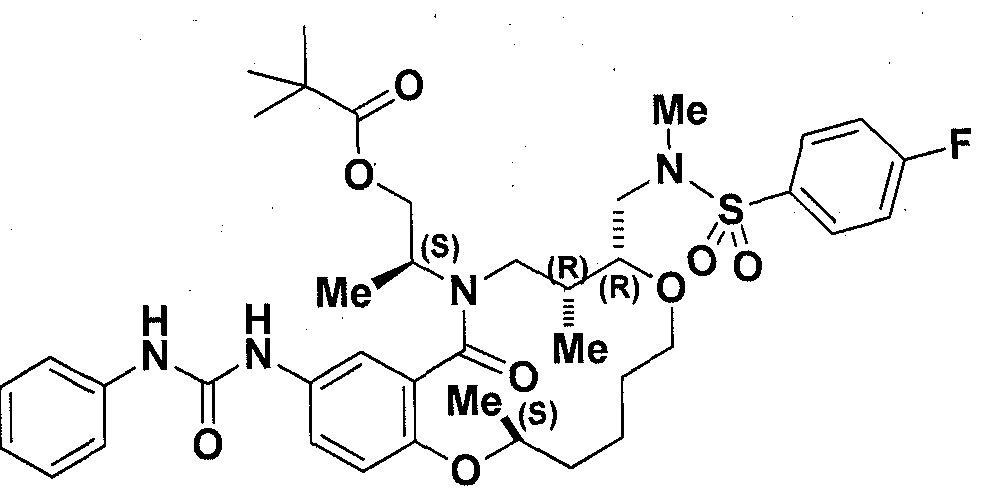
(2S)-2-[(2S,8R,9R)-2,9-dimethyl-8-{[N-methyl(4- fluorobenzene)sulfonamido]methyl}-12-oxo-14-[(phenylcarbamoyl)amino]- 2,3,4,5,6,8,9,10,11 ,12-decahydro-l ,7,11-benzodioxazacyclotetradecin-l 1- yl] ropyl 2,2-dimethylpropanoate (122)
To a solution of alcohol 53 (0.041 g, 0.060 mmol) in dry DCM (0.599 ml) was added pyridine (0.024 ml, 0.299 mmol) followed by pivaloyl chloride (17.84 μΐ, 0.148 mmol) under N2 atmosphere. The resulting mixture was stirred at room temeperature for 15h. The reaction was diluted with DCM (10 ml) and washed with water (10 ml) and brine. The organic phase was then separated, dried (Na2S04) and evaporated to dryness. This material was chromatographed on silica, using methanol / dichloromethane to afford 30 mg (15%) of the desired product. 1H NMR (300 MHz, CDC13) δ 7.79 (m, 2H), 7.65 - 7.45 (m, 1H), 7.37 (m, 2H), 7.29 - 7.03 (m, 4H), 6.98 (s, 1H), 6.75 (m, 2H), 4.56 (m, 2H), 4.46 - 4.31 (m, 1H), 4.26 - 4.03 (m, 2H), 3.93 (s, 3H), 3.78 - 3.62 (m, 1H), 3.14 (m, 2H), 2.88 (m, 3H), 2.75 (m, 3H), 1.75 (m, 2H), 1.53 (m, 6H), 1.39 - 1.11 (m, 4H), 1.04 (m, 5H), 0.92 - 0.60 (m, 7H). MS calculated for C40H53FN4O8S [M+H]+: 769. Found: 769.
Glycosylation of free-alcohol
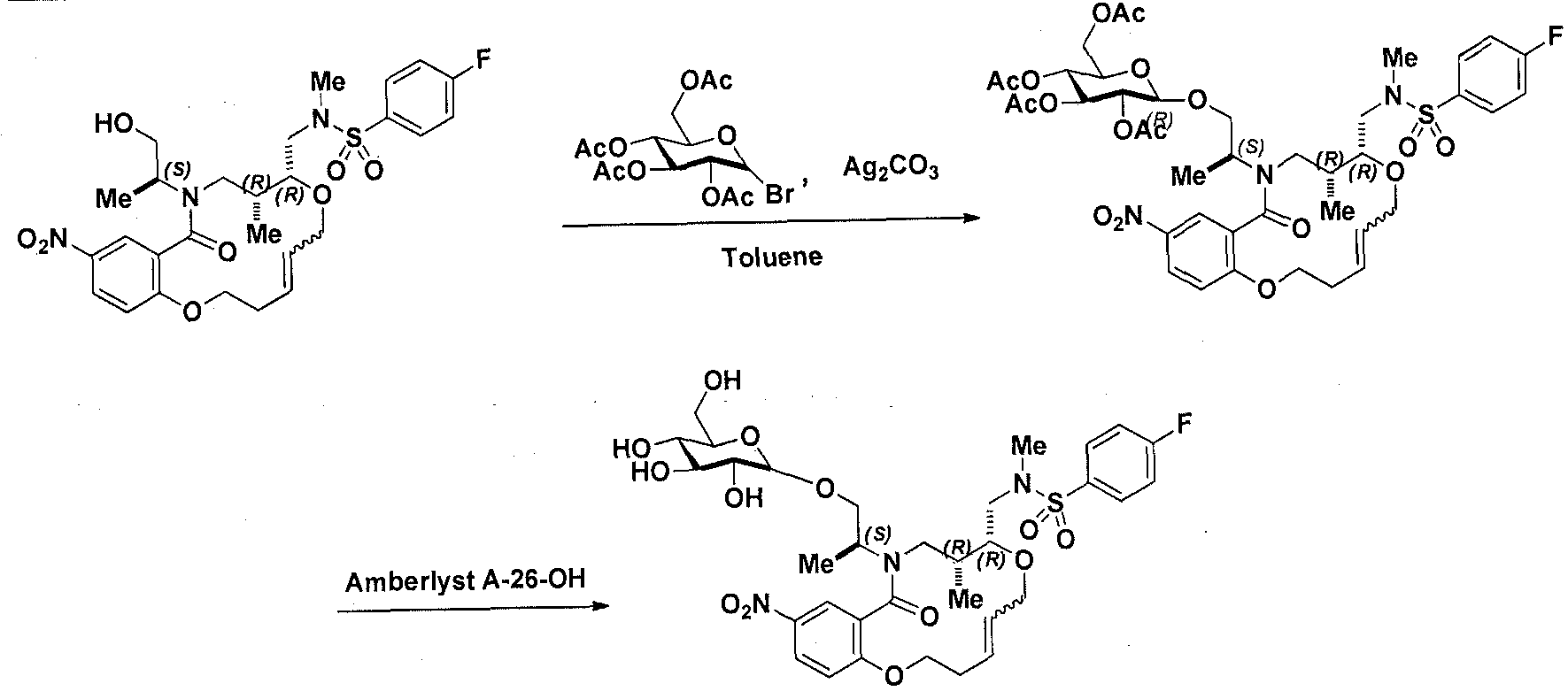

Intermediate AAA: (2R,3S,4S)-2-(acetoxymethyl)-6-((S)-2-((8R,9R,E)-8-((4-fluoro-N- methylphenylsulfonamido)methyl)-9-methyI-14-nitro-12-oxo-2,359,10- tetrahydrobenzo[b] [1,9,5] dioxaazacyclotetradecin-ll(6H,8H,12H)- yl)propoxy)tetrahydro-2H-pyran-3,4,5-triyl triacetate Silver carbonate (186mg, 0.676mmol) was suspended in a solution of 4-fluoro-N- (((8R,9R,E)-l l-((S)-l-hydroxypropan-2-yl)-9-methyl-14-nitro-12-oxo- 2,3 ,6,8,9, 10, 11 ,12-octahydrobenzo[b] [1 ,9,5]dioxaazacyclotetradecin-8-yl)methyl)- N-methylbenzenesulfonamide (98mg,0.169mmol) and (2R,3R,4S,5R)-2- (acetoxymethyl)-6-bromotetrahydro-2H-pyran-3,4,5-triyl triacetate (278mg, 0.676) in anhydrous toluene (1.127mL) in a sealed vial. The suspension was stirred at heated at 110°C for 72h. The reaction was cooled to rt and an additional to 2 eqv of silver carbonate (93mg, 0.338mmol) was added and the reaction was heated to 110°C and stirred for 48h before being cooled to rt. The insoluble products were filtered off via a celite pad and washed with 20mL DCM and 20mL MeOH and the filtrate was concentrated under reduced pressure. The crude product was chromato graphed on silica, eluting with 30%-80% ethyl acetate/hexanes to afford 46mg (30% yield of desired) of pure product. 1H NMR (300 MHz, CDC13) δ 8.25 (m, 1H), 8.05 (m, 1H), 7.82 (s, 2H), 7.16 (s, 2H), 6.95 (m, 1H), 5.25 (m, 1H),5.05 (m, 2H), 4.20 (s, 6H), 3.74 (s, 3H), 2.81 (t, J= 21.1, 3H), 2.60 (m, 1H), 2.07 (m, 15H), 1.57 (s, 8H), 1.01 (d, J= 7.3, 6H). MS (ESI) calcd for C41H52FN3Q17S [M + H]+: 910. Found: 910.
Example 123:

4-fluoro-N-methy]-N-(((8R,9R,E)-9-methyl-14-nitro-12-oxo-ll-((2S)-l-
(((3R,4S,5S,6R)-3,4,5-trihydroxy-6-(hydroxymethyl)tetrahydro-2H-pyran-2- yI)oxy)propan-2-yl)-2,3,6,8,9,10,ll,12-
octahydrobenzo[b] [1,9,5] dioxaazacyclotetradecin-8- yl)methyl)benzenesulfonamide
(2R,3S,4S)-2-(acetoxymethyl)-6-((S)-2-((8R,9R,E)-8-((4-fluoro-N- methylphenylsulfonamido)methyl)-9-methyl- 14-nitro- 12-oxo-2,3 ,9,10- tetrahydrobenzo [b]
[l ,9,5]dioxaazacyclotetradecin-l l(6H,8H,12H)-yl)propoxy)tetrahydro-2H-pyran- 3,4,5-triyl triacetate (l lmg, 0.012mmol) was dissolved in methanol (0.604mL) and was treated with amberlyst A-26-OH (17mg, 0.019mmol) in a sealed vial. The reaction mixture was shaken for lh. The reaction mixture was filtered and washed with an excessive amount of MeOH (25mL). The filterate was concentrated under reduce pressure and chromatographed on silica, eluting with 0-10% methanol/methylene chloride to afford 4mg (45% yield) of pure product. !H NMR (300 MHz, CDC13) δ 8.11 (d, J= 51.7, 2H), 7.80 (s, 2H), 7.17 (s, 2H), 6.99 (s, 1H), 5.58 (m, 2H), 4.26 (m, 4H), 3.87 (s, 3H), 3.63 (m, 4H), 3.37 (m, 3H), 2.91 (d, J = 7.3, 1H), 2.74 (s, 2H), 2.61 (s, 1H), 1.67 (s, 5H), 1.19 (d, J= 34.1, 6H), 0.86 (d, J = 21.0, 6H). MS (ESI) calcd for C33H44FN3Oi3S [M + H]+: 742. Found: 742.
Triazole formation Example 124:

3-[(2S,8R,9R)-ll-[(2S)-l-(4-tert-butyl-lH-l,2,3-triazol-l-yl)propan-2-yl]-2,9- dimethyl-8-{[N-methyl(4-fluorobenzene)sulfonamido]methyl}-12-oxo- 2,3,4,5,6,8,9,10,1 l,12-decahydro-l,7,ll-benzodioxazacyclotetradecin-14-yl]-l- phenylurea (124)
To a mixture of azide 89 (0.0165 g, 0.023 mmol) and 3,3-dimethylbut-l-yne (5.72 μΐ, 0.046 mmol) in dry Toluene (0.465 ml, Density: 0.865 g/ml) was added Tetrakis (acetonitrile) copper (I) hexafluorophospate (0.026 g, 0.116 mmol) under N2 atmosphere at room temperature. The resulting solution was heated at 80°C for lh. The reaction was then cooled to room temperature and concentrated under vacuum. This material was chromatographed on silica, using ethyl acetate / hexanes to afford the final product (4 mg, 19%) as colorless resin. 1H NMR (300 MHz, CDC13) δ 7.72 - 7.60 (m, 2H), 7.54 (m, 2H), 7.43 (s, 1H), 7.33 - 7.21 (m, 2H), 7.21 - 7.04 (m, 5H), 6.63 (m, 1H), 5.36 (m, 1H), 4.49 (s, 1H), 3.84 (s, 1H), 3.61 (m, 2H), 3.38 (m, 3H), 3.05 (s, 1H), 2.89 (s, 1H), 2.80 (s, 3H), 2.62 (s, 2H), 1.75 (s, 1H), 1.65 (s, 4H), 1.52 (m, 5H), 1.31 - 1.00 (m, 9H), 0.98 - 0.82 (m, 2H), 0.76 (m, 4H), 0.12 (m, 2H). MS calculated for C4iH5 FN706S [M+H]+: 792. Found: 792.
The following example was also prepared using the same method:
12033586
- 154-


Amide functionalization:

To a solution of amine 94 (38 mg, 0.056 mmol) in DCM (.56 ml) under N2 was added 2,6-lutidine (1.648 ml, 2.041 mmol) aqueous solution, followed by pivaloyl chloride (10 μϋ,, 0.084 mmol). The reaction mixture was stirred at room temperature for 16 h then diluted with EtOAc and water. The aqueous phase was separated and washed with EtOAc, then loaded onto a Si02 plug and
chromatographed on silica, using methanol / dichloromethane to give 15 mg (36%) of the final product as colorless resin. Ή NMR (300 MHz, CDC13) δ 7.78-7.66 (m, 3H), 7.41-7.34 (m, 2H), 7.25 - 7.03 (m, 3H), 6.98 (m, IH), 6.86 (m, IH), 6.79-6.67 (m, IH), 4.64 (m, IH), 4.05-3.82 (m, 2H), 3.81-3.68 (m, 2H), 3.58-3.47 (m, IH), 3.18-3.01 (m, 2H), 2.96- 2.83 (m, 2H), 2.74 (s, 3H), 2.11-1.95 (m, I H), 1.87-1.69 (m, 2H), 1.66-1.33 (m, 8H), 1.31- 1.22 (m, IH) 1.20 (s, 9H), 1.18-0.93 (m, 6H), 0.80 (m, 3H). MS calculated for
C40H54N5O7S : 768 [M+H]+. Found 768.
The following example was prepared from the same method:


ethyl N-[(2S)-2-[(2S,8R,9R)-2,9-dimethyl-8-{[N-methyl(4- fluorobenzene)sulfonamido]methyl}-12-oxo-14-[(phenylcarbamoyl)amino]- 2,3,4,5,6,8,9,10,ll,12-decahydro-l,7,ll-benzodioxazacyclotetradecin-ll- yl]propyl]carbamate (129)
To a solution of amine 94 (0.038 g, 0.055 mmol) in dioxane (1.375 ml) was added sodium bicarbonate (0.267 ml, 0.330 mmol) followed by ethyl chloroformate (10.52 μΐ, 0.110 mmol) under N2 atmosphere. The resulting mixture was stirred at room temperature for 15h. The reaction was diluted with water (10 ml) and EtOAc
(10 ml) and the product extracted with EtOAc (10 ml). Combined organics were then washed with water and brine, dried (Na2S04) and evaporated to dryness. This material was chromatographed on silica, using methanol / dichloromethane to afford
23 mg (54%) of the desired product as colorless resin. 1H NMR (300 MHz, CDC13) δ 8.51 (s, 1H), 8.18 (s, 1H), 7.78 (m, 3H), 7.57 - 7.32 (m, 2H), 7.32 - 7.10 (m, 3H), 6.93 (s, 2H), 6.87 - 6.66 (m, 1H), 4.63 (s, 1H), 4.10 (s, 2H), 3.86 (s, 2H), 3.67 (s, 1H), 3.10 (s, 2H) 21, 2.91 (m, 4H), 2.75 (s, 2H), 1.62 (s, 6H), 1.47 - 1.35 (m, 3H), 1.32 (s, 2H), 1.18 (m, 7H), 1.06 - 0.90 (m, 3H), 0.80 (m, 2H). MS calculated for CsgHsoFNsOgS [M+H]+: 756. Found: 756.

3-[(2S,8R,9R)-ll-[(2S)-l-[(ethylcarbamoyl)amino]propan-2-yl]-2,9-dimethyl-8- {[N-methyl(4-fluorobenzene)sulfonamido]methyl}-12-oxo-2,3,4,5,6,8,9,10,ll»12- decahydro-l,7,ll-benzodioxazacyclotetradecin-14-yl]-l-phenylurea (130)
To a solution of amine 94 (0.038 g, 0.055 mmol) in dry DCM (0.550 ml) was added isocyanatoethane (0.013 ml, 0.165 mmol) under N2 atmosphere. The resulting mixture was stirred at room temperature for 15h. The reaction was diluted with DCM (10 ml), the organic phase separated, washed with water (2 X 10 ml), dried (Na2S04) and evaporated to dryness. This material was chromatographed on silica, using methanol / dichloromethane to give the final product (3 mg, 6%) as colorless resin. 1H NMR (300 MHz, CDC13) δ 8.15 (m, 1H), 7.87 - 7.76 (m, 1H), 7.76 - 7.66 (m, 1H), 7.66 - 7.49 (m, 1H), 7.42 (s, 1H), 7.26 (s, 5H), 7.07 - 6.90 (m, 1H), 6.56 - 6.43 (m, 1H), 4.21 (s, 1H), 3.68 - 3.51 (m, 1H), 2.92 (s, 2H), 2.74 - 2.54 (m, 3H), 2.32 - 2.11 (m, 3H), 2.00 (s, 3H), 1.55 (m, 6H), 1.44 - 1.02 (m, 6H), 0.87 (m, 9H), 0.61 (s, 2H), 0.07 (s, 3H). MS calculated for C38H5iFN607S [M+H]+: 755. Found:
755.
Deamination of anilines to yield Examples 131-132:

2,3,4,5,6,8,9, 10, 11, 12-decahydrobenzo[b] [1,9,5] dioxaazacyclotetradecin-8- yl)methyl)-N-methylbenzenesuIfonamide (131) To a solution of N-(((2S,8R,9R)-14-amino-l l-isopropyl-2,9-dimethyl-12-oxo- 2,3,4,5,6,8,9,10,1 l,12-decahydrobenzo[b][l, 9, 5]dioxaazacyclotetradecin-8- yl)methyl)-4-fluoro-N-methylbenzenesulfonamide (75 mg, 0.097 mmol) in DMF (972 μΐ) under N2 was added piperidine (14.43 μΐ, 0.146 mmol). The reaction was stirred for lh then quenched with water (1 mL) and extracted with EtOAc (2 x 5 mL). The combined organic layers were dried with sodium sulfate, concentrated and dried. The crude taken to the next step. To a solution of the crude amine N- (((2S,8R,9R)-14-amino-l l-isopropyl-2,9-dimethyl-12-oxo-2,3,4,5,6,8,9,10,l l,12- decahydrobenzo[b][l,9,5]dioxaazacyclotetradecin-8-yl)methyi)-4-fluoro-N- methylbenzenesulfonamide (20 mg, 0.036 mmol) in EtOH (1.6 ml) and Acetic Acid (0.3 ml) was added under N2 and Sodium nitrite (455 μΐ, 0.364 mmol) in 0.45 mL water and then Sodium bisulfite (25mg, 0.364 mmol) in 0.6 mL water was added. The solution turned orange upon addition of NaN02. The reaction was stirred for 16 h and the reaction mixture was extracted with DCM and the organic phase washed with water, dried over sodium sulfate and evaporated under reduced pressure. The reaction was purified by column chromatography using
DCM/Methanol to afford the desired product (12.4 mg, 64%). 1H NMR (500 MHz, CDC13) δ 7.88-7.57 (m, 2H), 7.19 (s, 2H), 7.14-6.94 (m, 2H), 6.90-6.66 (m, 2H), 4.64-4.29 (m, 1H), 4.21-3.96 (m, 1H), 3.97-3.79 (m, 1H), 3.76-3.51 (m, 2H), 3.52- 3.30 (m, 1H), 2.79 (s, 2H), 2.70-2.41 (m, 3H), 2.31-2.01 (m, 3H), 1.98 (s, 2H), 1.51 (s, 4H), 1.19 (s, 7H), 0.92 (s, 6H). MS (ESI) calcd for C28H39FN205S [M + H]+: 535. Found: 535.

4-fluoro-N-{[(2S,8R,9R)-ll-[(2S)-l-hydroxypropan-2-yl]-2,9-dimethyl-12-oxo- 2,3,4,5,6,8,9,10,ll,12-decahydro-l,7,ll-benzodioxazacyclotetradecin-8- yI]methyl}-N-methylbenzene-l-sulfonamide (132)
This product was prepared with the same procedure as for the preparation of 4- fluoro-N-(((2S,8R,9R)-l l-isopropyl-2,9-dimethyl-12-oxo-2,3,4,5,6,8,9,10,l 1,12- decahydrobenzo[b][l,9,5]dioxaazacyclotetradecin-8-yl)methyl)-N- methylbenzenesulfonamide. During this deamination, the TBS group was removed, yielding the free hydroxyl compound as the final product. 1H NMR (300 MHz, CDC13) δ 7.86-7.69 (m, 2H), 7.38-7.29 (m, 1H), 7.24-7.08 (m, 3H), 7.04-6.79 (m, 2H), 5.11-5.01 (m, 1H), 4.83 - 4.70 (m, 1H), 4.60-4.46 (m, 1H), 4.05 (m, 1H), 3.98- 3.82 (m, 2H), 3.81-3.70 (m, 1H), 3.67 - 3.42 (m, 4H), 3.19-2.91 (m, 2H), 2.90-2.85 (m, 3H), 2.76-2.58 (m, 2H), 2.40 (m, 1H), 1.95-1.75 (m, 2H), 1.73-1.49 (m, 2H),
1.47-1.30 (m, 5H), 1.10 - 0.72 (m, 6H). MS calculated for C28H39N206S [M+H]+: 551. Found: 551.
N-Oxide formation

(S)-2-((2S,8R,9R)-14-fIuoro-8-((4-fluoro-N-methylphenylsulfonamido)methyl)- 2,9-dimethyl-12-oxo-3,4,5,6,9,10- hexahydrobenzo[b] [l,9,5]dioxaazacyclotetradecin-ll(2H,8H,12H)-yl)-N,N- dimethylpropan-l-amine oxide (133)
N-(((2S,8R,9R)- 11 -((S)- 1 -(dimethylamino)propan-2-yl)- 14-fluoro-2,9-dimethyl- 12- oxo-2,3,4,5,6,8,9,10,l l ,12-decahydrobenzo[b][l,9,5]dioxaazacyclotetradecin-8- yl)methyl)-4-fluoro-N-methylbenzenesulfonamide (16 mg, 0.027 mmol) was dissolved in DCM (269 μΐ) and to this was added mCPBA (660 mg, 2.9 mmol). The mixture was stirred at room temperature for 2 h and after this time the solvent was evaporated under reduced pressure to afford a crude material. This material was purified by column chromatography using MeOH/DCM to afford the desired product (10 mg, 62%). δ 7.83-7.55 (m, 2H), 7.20-7.08 (m, 2H), 7.02-6.93 (m, 1H), 6.94-6.82 (m, 1H), 6.81-6.61 (m, 1H), 4.69-4.51 (m, 1H), 4.16-3.71 (m, 4H), 3.52- 3.28 (m, 3H), 3.24-2.88 (m, 4H), 2.86-2.60 (m, 4H), 2.13-1.89 (m, 2H), 1.84-1.64 (m, 2H), 1.66-1.29 (m, 7H), 1.28-0.85 (m, 6H), 0.82-0.55 (m, 3H). MS (ESI) calcd for C3oH43F2N306S [M + H]+: 612. Found: 612.
Tetrazole formation:

4-fIuoro-N-(((2S,8R,9R)-ll-((S)-l-((4-methoxybenzyl)oxy)propan-2-yl)-2,9- dimethyl-12-oxo-14-(lH-tetrazol-5-yl)-2,3,4,5,6,8,9,10,ll,12- decahydrobenzo[b] [1,9,5] dioxaazacyclotetradecin-8-yl)methyl)-N- methylbenzenesulfonamide (134)
A 5 mL microwave vial containing nitrile N-(((2S,8R,9R)-14-cyano-l l-((S)-l-((4- methoxybenzyl)oxy)propan-2-yl)-2,9-dimethyl-12-oxo-2,3,4,5,6,8,9,10,l l,12- decahydrobenzo[b][l,9,5]dioxaazacyclotetradecin-8-yl)methyl)-4-fluoro-N- methylbenzenesulfonamide (21 mg, .03 mmol), sodium azide (11.77 mg, 0.181
mmol), zinc bromide (6.58 mg, 0.045 mmol), 700 of water and 700 of 2- propanol was heated in with a Biotage Initiator 2.5 Microwave Synthesizer microwave reactor at 150 °C for a total of 210 minutes. The mixture was evaporated under reduced pressure and purified by column chromatography using
ethylacetate/hexane to afford the desired compound (15 mg, 67%).1HNMR (300 MHz, CDC13) δ 8.03-7.86 (m, 2H), 7.86-7.55 (m, 2H), 7.25-7.00 (m, 4H), 6.94-6.77 (m, 2H), 6.77-6.61 (m, 1H), 4.66^1.33 (m, 2H), 4.17-3.97 (m, 2H), 3.94-3.70 (m, 3H), 3.66-3.50 (m, 2H), 3.48-3.32 (m, 2H), 3.25-3.00 (m, 2H), 2.94-2.67 (m, 4H), 2.47-2.17 (m, 3H), 2.21-1.89 (m, 3H), 1.84-1.29 (m, 6H), 1.26-1.14 (m,2H), 1.14- 0.71 (m, 5H). MS (ESI) calcd for C37H47FN607S [M + H]+: 739. Found: 739.
Amide reduction:

3-[(2S,8R,9R)-2,9-dimethyl-8-{[N-methyl(4- fluorobenzene)sulfonamido]methyl}-ll-(propan-2-yl)-2,3,4,5,6,8,9,10,ll,12- decahydro-l,7,ll-benzodioxazacyclotetradecin-14-yl]-l-phenylurea (135)
To a chilled (ice-H20 bath) solution of 4-fluoro-N-(((2S,8R,9R)-l l-isopropyl-2,9- dimethyl-12-oxo-14-(3-phenylureido)-2,3,4,5,6,8,9,10,l l,12- decahydrobenzo[b][l,9,5]dioxaazacyclotetradecin-8-yl)methyl)-N- methylbenzenesulfonamide in dry THF (500 μΐ) under nitrogen was added dropwise over 5 min borane-methyl sulfide complex (9.93 μΐ, 0.105 mmol). Let warm to rt, then added a reflux condenser and heated in to 70 °C in an oil bath. After 4 h the reaction was cooled to roomtemperature, then chilled in an ice-H20 bath and added MeOH slowly dropwise until the bubbling slowed. More of MeOH was added and the reaction stirred at rt until no bubbling seen. The solvent was removed in vacuo, and the crude oil was coevaporated with MeOH. MeOH (2 ml) was added to the crude mixture followed by Na/K tartrate (2 ml, 10%) and the reaction mixture was heated at 80°C (oil bath temp) for 16 hours. The reaction was cooled and
concentrated to remove MeOH and extracted into EtOAc. Washed organics with brine, dried (Na2S04) and solvent evaporated. Purification with flash
chromatography followed (MeOH/DCM) afforded the desired product (2.41mg, 18%)
MS (ESI) calcd for C35H47FN405S [M + H]+:655. Found: 655.
Reductive methylation:
3586

N-(((2S,8R,9R)-14-(dimethylamino)-ll-isopropyl-2,9-dimethyl-12-oxo- 2,3,4,5,6,8,9,10,11, 12-decahydrobenzo[b] [l,9,5]dioxaazacyclotetradecin-8- yl)methyl)-4-fluoro-N-methylbenzenesulfonamide (136)
N-(((2S,8R,9R)-14-amino-l l-isopropyl-2,9-dimethyl-12-oxo-2,3,4,5,6,8,9,10,l l,12- decahydrobenzo[b][l,9,5]dioxaazacyclotetradecin-8-yl)methyl)-4-fluoro-N- methylbenzenesulfonamide was dissolved in THF:MeOH:AcOH (4:1 :0.2) (364 μΐ) and formaldehyde (54.2 μΐ, 0.728 mmol) was added. Stirred at rt for 1 hr then sodium cyanoborohydride (22.86 mg, 0.364 mmol) was added. The reaction was stirred for 16h and then quenched with saturated sodium bicarbonate solution (2 ml), extracted with ethyl acetate and solvent evaporated. Purification with flash chromatography followed (MeOH/DCM) afforded the desired product (17 mg, 81%).
1H NMR (300 MHz, CDC13) δ 7.85-7.58 (m, 2H), 7.14-6.92 (m, 3H), 6.90-6.42 (m, 2H), 4.57-4.14 (m, 2H), 4.02-3.64 (m, 3H), 3.62-3.32 (m, 2H), 3.29-2.88 (m, 1H), 2.86-2.60 (m, 5H), 2.59-2.41 (m, 4H), 2.30-1.84 (m, 3H), 1.84-1.36 (m, 4H), 1.37- 1.00 (m, 8H), 1.00-0.61 (m, 5H). MS (ESI) calcd for C30H44FN3O5S [M + H]+:578. Found: 578.
General synthetic scheme for the preparation of the 12-membered ring analogue.
DIBAL-H


3-methylbutan-2-yl)oxy)propanoate. To a solution of Intermediate M (1.17 g, 2.057 mmol) in Tert-Butanol (0.1 M) under N2 was added methyl acrylate (7.46 ml, 82 mmol) and cesium carbonate (0.670 g, 2.057 mmol). The reaction was stirred at room temperature for 48 hours. The reaction was then diluted with a saturated ammonium chloride solution and extracted into ethyl acetate. The organic layers were washed with H20, brine, dried over Na2S04 and solvent evaporated. The residue was purified by silica gel chromatography using ethyl acetate/hexanes to afford the desired product (1.20g, 89% yield). 1H NMR (300 MHz, CDC13) δ 7.72 (d, 2H), 7.25 - 7.01 (m, 4H), 6.79 (d, 2H), 4.37 (s, 2H), 3.72 (s, 3H), 3.79 - 3.47 (m, 4H), 3.55 (s, 3H), 3.47 - 3.22 (m, 2H), 3.20 - 2.84 (m, 3H), 2.73 (s, 3H), 2.44 (t, 2H), 2.12 - 1.90 (m, 1H), 1.35 (s, 9H), 1.24 - 1.01 (m, 4H), 0.81 (d, 3H). MS (ESI) calcd for C32H47FN209S [M + H]+: 655. Found: 655.
Intermediate BBB2

Synthesis of Methyl 2-(((2R,3^)-4-((fert-butoxycarbonyl)((S)-l-((4- methoxybenzyl)oxy)propan-2-yl)amino)-l-(4-fluoro-N- methylphenylsulfonamido)-3-methylbutan-2-yl)oxy)acetate
To a chilled (-78 °C) solution of tert-butyl ((27?,3i?)-4-(4-fluoro-N- methylphenylsulfonamido)-3 -hydroxy-2-methylbutyl)((5 - 1 -((4- methoxybenzyl)oxy)propan-2-yl)carbamate (M) (1.10 g, 1.93 mmol) in dry THF (8.3 mL) and dry DMF (1.4 mL) under N2 was added methyl 2-bromoacetate (1.8 mL, 19 mmol) followed by sodium Ws-(trimethylsilyl)amide (5.8 mL, 5.8 mmol). The solution was stirred 15 min at -78 °C, then the reaction flask was warmed to 3 °C and stirred at this temperature for 16 h. The reaction mixture was then quenched with sat. aq. NH4C1, diluted with H20 and EtOAc, the phases were partitioned and the aqueous was washed with EtOAc, then the organics were washed with H20 then brine, dried (Na2S04) and the solvent evaporated. Purification was accomplished with Si02 chromatography to yield 0.44 g (36%) of pure product. 1H NMR (300 MHz, CDC13) δ 7.86-7.69 (m, 2H), 7.25 - 7.1 1 (m, 4H), 6.86 (d, J= 8.4 Hz, 2H), 4.47 - 4.39 (m, 2H), 4.13 (s, 2H), 3.93 - 3.64 (m, 3H), 3.78 (s, 3FI), 3.71 (s, 3H), 3.60 - 3.37 (m, 2H), 3.28 - 3.06 (m, 3H), 2.84 (s, 3H), 2.26-2.02 (m, 1H), 1.43 (s, 9H), 1.21 (d, J= 6.9 Hz, 3H), 0.91 (d, J= 6.9 Hz, 3H). MS calculated for
C31H45FN209SNa [M+Na]+: 663. Found: 663.
12 033586
- 163 -
Intermediate CCC:

Synthesis of tert-butyl ((2R,3R)-4-(4-fluoro-N-methylphenylsulfonamido)-3-(3- hydroxypropoxy)-2-methylbutyl)((S)-l-((4-methoxybenzyl)oxy)propan-2- yl)carbamate (CCC1)
BBB1 (0.406 g, 0.620 mmol) was dissolved in Toluene (12.81 ml,) and cooled to - 78 °C. DIBAL in Toluene (1.240 ml, 1.240 mmol) was added dropwise to the reaction mixture. The reaction was let stir for 30 min before removing from the bath and stirring at room temperature. After 2 hours the reaction was complete and it was quenched with methanol (15.37 ml) slowly until there was no more bubbling. Then an additional 15.37 ml of methanol and 6 mL of Rochelle salts were added and the reaction was left to stir overnight. The crude mixture was concentrated under pressure, water was added and the crude product was extracted with ethyl acetate 3 times. The combined organics were dried over Na2S04 and the product was purified by silica gel chromatography using methanol/DCM to give 268mg of the desired product (69% yield). Ή NMR (300 MHz, CDC13) δ 7.72 (s, 2H), 7.24 - 7.04 (m, 4H), 6.80 (d, 2H), 4.36 (m, 2H), 3.72 (s, 3H), 3.80 - 3.45 (m, 6H), 3.44 - 3.25 (m, 2H), 3.14 - 2.92 (m, 3H), 2.73 (s, 3H), 2.02 - 1.93 (m, 1H), 1.78 - 1.61 (m, 2H), 1.35 (s, 9H), 1.27 - 0.98 (m, 5H), 0.83 (d, 3H). MS (ESI) calcd for C3iH47FN208S [M + H]+: 627. Found: 627.
The 1 1 -membered ring analogue was prepared using this method:

Intermediate DDD:
12 033586
- 164 -

Synthesis of tert-butyl 2-(3-(((2R,3R)-4-((tert-butoxycarbonyl)((S)-l -((4- methoxybenzyl)oxy)propan-2-yl)amino)-l-(4-fluoro-N-methylphenylsulfonaniido)- 3-methylbutan-2-yl)oxy)propoxy)-5-nitrobenzoate(DDDl)
4A molecular sieves were activated before use by flame-drying under vacuum. To a suspension of 400 mg 4A activated molecular sieves in dry THF (Ratio: 1.000, 0.577 ml) under N2 was added TBAF (0.692 ml, 0.692mmol) and the suspension was stirred 10 min. Then, a solution of CCC1 (0.217g, 0.346mmol) and tert-butyl 2- fluoro-5-nitrobenzoate (0.125g, 0.519 mmol) in THF (1.154 ml) was added and the mixture was stirred overnight. After 24 hours the reaction was still not complete as monitored by LCMS so 2 other equivalents of TBAF (0.692ml, 0.692 mmol) previously stirred in activated sieves were added and the reaction was complete after further 16 hours. The reaction mixture was quenched with saturated NH4C1 solution, diluted with ethyl acetate and filtered. The aqueous layer was extracted with ethyl acetate, and the combined organic layers were washed with an acid acetic solution at pH4, brine, dried over NajSC and the solvent was evaporated under pressure. The crude product was purified with silica gel chromatography to give 203.5mg of pure product (69% yield). 'H NMR (300 MHz, CDC13) δ 8.40 (d, 1H), 8.13 (d, 1H), 7.73 - 7.50 (m, 2H), 7.18 - 6.80 (m, 5H), 6.71 (d, 8.4, 2H), 4.26 (s, 2H), 3.63 (s, 3H), 3.59 - 3.37 (s, 4H), 3.37 - 3.16 (m, 3H), 3.16 - 2.88 (m, 3H), 2.88 - 2.74 (m, 2H), 2.58 (s, 3H), 1.94 (m, 3H), 1.43 (s, 9H), 1.25 (s, 9H), 1.16 - 0.97 (m, 3H), 0.74 (d, 3H).MS (ESI) calcd for C42H58FN3Oi2S [M + H]+: 848. Found: 848. The 11 -membered ring analogue was prepared using this method:
T/US2012/033586
- 165 -

Intermediate EEE:

Synthesis of 2-(3-(((2R,3R)-l-(4-fluoro-N-methylphenylsulfonamido)-4-(((S)-l-((4- methoxybenzyl)oxy)propan-2-yl)amino)-3-methylbutan-2-yl)oxy)propoxy)-5- nitrobenzoic acid (EEE1)
A solution of DDD1 (0.203 g, 0.239 mmol) in dry DCM (4.79 ml) under N2 was chilled in a ice-H20 bath and to this was added 2,6-dimethylpyridine (0.069 ml, 0.598 mmol) followed by tert-butyldimethylsilyl trifluoromethanesulfonate (0.283 ml, 1.197 mmol). The reaction was stirred at 0 °C for 25 min, and the bath was then removed and the reaction was stirred at room temperature for 3h. To the solution was then added 2,6-lutidine (0.069 mL, 0.598 mmol) and the reaction was quenched with saturated NaHC03 solution. The layers were separated, and the aqueous layer was extracted with DCM. The combined organic extracts were dried over Na2S04j filtered and concentrated under pressure. The crude residue was dissolved in THF (4.8 mL), transferred to a teflon bottle, and pyridine hydrofluoride (29.8 \xh, 0.240 mmol) was added. The reaction was stirred for lh30. Then the reaction was quenched with a saturated NaHC03 solution (bubbling), and diluted with ethyl acetate. The aqueous layer was washed with ethyl acetate, and the organic layers were washed with brine, dried over Na2S04, filtered and concentrated to yield the crude product which was carried onto the next step. The crude residue was diluted in dry DCM (8.00 ml) and BOP-C1 (0.122 g, 0.480 mmol) was added at 0 °C. Then Hunig'sBase (0.151 ml, 0.864 mmol) was added and the reaction mixture was slowly warmed to room temperature. After 3 hours the reaction was complete and the solvent was evaporated. The crude mixture was purified by silica gel
chromatography using ethyl acetate/hexanes to give 0.144 mg of desired product (89% yield). 1H NMR (300 MHz, CDC13) δ 8.36 - 7.87 (m, 2H), 7.86 - 7.59 (m, 2H), 7.37 - 6.96 (m, 4H), 6.96 - 6.68 (m, 3H), 4.36 (s, 2H), 4.30 - 4.08 (m, 1H), 4.06 - 3.80 (m, 2H), 3.76 - 3.74 (m, 3H), 3.76 - 3.63 (m, 1H), 3.59 - 3.49 (m, 2H), 3.27 - 3.05 (m, 2H), 3.04 - 2.81 (m, 2H), 2.80 - 2.74 (m, 3H), 2.73 - 2.37( m, 2H),
2.23 - 1.68 (m, 2H), 1.65 - 1.50 (m, 1H), 1.26 - 1.00 (m, 3H), 0.88 - 0.69 (m, 3H). MS (ESI) calcd for C33H40FN3O9S [M + H]+: 674. Found: 674
The 1 1-membered ring analogue was prepared using this method:

Nitro-group reduction:

N-(((6R,7R)-12-amino-9-((S)-l-((4-methoxybenzyl)oxy)propan-2-yI)-7-methyI- 10-oxo-2,3,4,6,7,8,9,10-octahydrobenzo[f][l,5,9]dioxaazacyclododecin-6- yl)methyl)-4-fluoro-N-methylbenzenesulfonamide(FFFl)
To a solution of EEE1 (0.0146 g, 0.022 mmol) in methanol (0.217 ml) was added Tin (II) chloride dihydrate (0.024 g, 0.108 mmol) and the mixture was stirred at 50 °C. After 20 hours the reaction was complete and the methanol was removed under pressure. The product was extracted with ethyl acetate and water was added to dissolve the thick precipitate formed. The layers were separated and the aqueous layer extracted with ethyl acetate. The combined organic layers were washed with water and brine, dried over Na2S04 and concentrated. Purification using silica gel chromatography permits to afford 10 mg of pure product (71% yield). 1H NMR (300 MHz, CDC13) δ 8.01 - 7.58 (m, 2H), 7.36 - 6.92 (m, 6H), 6.91 - 6.49 (m, 3H), 4.51 - 4.32 (m, 2H), 4.32 - 4.1 l(m, 2H), 4.11 - 3.87 (m, 1H), 3.80 - 3.74 (m, 1H), 3.74 - 3.64 (m, 3H), 3.59 - 3.43 (m, 2H), 3.43 - 3.17 (m, 3H), 3.16 - 3.03 (m, 1H), 3.01 - 2.84 (m, 1H), 2.88 - 2.67 (m, 3H), 2.74 - 2.37 (m, 2H), 2.14 - 1.88 (m, 1H), 1.88 - 1.59 (m, 2H), 1.52 - 1.22 (m, 1H), 1.22 - 0.92 (m, 3H), 0.92 - 0.58 (m, 3H). MS (ESI) calcd for C33H42FN307S [M + H]+: 644. Found: 644.
The 1 1 and the 13-membered ring analogues were prepared using this method:

* Intermediate FFF2 was prepared from Intermediate AA20
Abbreviations for protecting groups

General Information
All oxygen and/or moisture sensitive reactions were carried out under N2
3586
- 168 - atmosphere in glassware that had been flame-dried under vacuum (-0.5 mmHg) and purged with N2 prior to use. All reagents and solvents were purchased from
commercial vendors and used as received, or synthesized according to the footnoted references. NMR spectra were recorded on a Bruker 300 (300 MHz !H, 75 MHz
13 C) spectrometer. Proton chemical shifts are reported in ppm (δ) referenced to the NMR solvent.1 Data are reported as follows: chemical shifts, multiplicity (br = broad, s = singlet, d = doublet, t = triplet, q = quartet, p = pentet, m = multiplet;
coupling constant(s) in Hz; integration). Unless otherwise indicated NMR data were collected at 25 °C. Flash chromatography was performed using 40-60 μηι Silica Gel (60 A mesh) on a Teledyne Isco Combiflash R/.
Compound purity and identity were determined by LC-MS with two different methods, and by UP LC. Purity was measured by UV absorbance at 210 nm. LCMS method 1 :(Alliance 2795, Waters, Milford, MA) Identity was determined on a SQ mass spectrometer by positive and negative electrospray ionization. Mobile phase A consisted of either 0.01% ammonium hydroxide or 0.01 % formic acid in water, while mobile phase B consisted of the same additives in acetonitrile. The gradient ran from 5% to 95% mobile phase B over 1.6 minutes at 3 mL/min. An XBridge CI 8, 3.5 um, 4.6x30 mm column was used with column temperature maintained at 40 oC. 5 uL of sample solution were injected. LCMS method 2: Identity was determined on an SQ mass spectrometer by positive and negative electrospray ionization. Mobile phase A consisted of 0.01% formic acid in water or pure water, while mobile phase B consisted of 0.01% formic acid in acetonitrile or pure acetonitrile. The gradient ran from 5% to 95% mobile phase B over 1.75 minutes at 1.75 mL/min. An Agilent Poroshell 120 EC-C18, 2.7 um, 3.0x30 mm column was used with column temperature maintained at 40 oC. 2.1 uL of sample solution were injected.
UPLC-MS (Waters, Milford, MA) method: Identity was determined on a SQ mass spectrometer by positive electrospray ionization. Mobile phase A consisted of either 0.01%) ammonium hydroxide or 0.01% formic acid in water, while mobile phase B consisted of the same additives in acetonitrile. The gradient ran from 5% to 95% mobile phase B over 0.8 minutes at 0.45 mL/min. An Acquity BEH CI 8, 1.7 um, 1.0x50 mm column was used with column temperature maintained at 65 °C.

1 Gottlieb, H. E., Kotlyar, V., Nudelman, A. J. Org. Chem. \991, 62, 7512-7515.

- 170-


- 175 -
 2033586
- 176-


Me H l-(4-fluorophenyl)-3- [M+H]
{[(2R,8S,9R)-11-[(2S)-1- + calcd, hydroxypropan-2-yl]-14- 622; methanesulfonamido-2,9- found dimethyl-12-oxo- 622
2,3,4,5,6,8,9,10,11,12- decahydro-1,7,11- benzodioxazacyclotetradeci
201 n-8-yl]methyl}-3- methylurea
Bioactivity table:
Key:
* >5000 nM
** 500-5000nM
*** <500 nM
Compound
Name Bioactivity (Dd2) Number
4-fluoro-N-(((7R,8R,14S)-5-((S)-l-((4- methoxybenzyl)oxy)propan-2-yl)-l,7,14-trimethyl-4-oxo-
1 4,5,6,7,8,10,ll,12,13,14-decahydro-lH-pyrazolo[3,4- * * *
b] [l,9,5]dioxaazacyclotetradecin-8-yl)methyl)-N- methylbenzenesulfonamide
4-fluoro-N-(((6S,12R,13R)-15-((S)-l-((4- methoxybenzyl)oxy)propan-2-yl)-6,13-dimethyl-16-oxo-
2 6,7,8,9,10,12,13,14,15,16-decahydropyrazino[2,3- ***
b] [l,9,5]dioxaazacyclotetradecin-12-yl)methyl)-N- methylbenzenesulfonamide
Compound
Name Bioactivity (Dd2) Number
4-fluoro-N-(((5S,llR,12R)-14-((S)-l-((4- methoxybenzyl)oxy)propan-2-yl)-5,12-dimethyI-15-oxo-
3 5,6,7,8,9,ll,12,13,14,15-decahydrothieno[3,2- ***
b] [ 1 ,9,5] dioxaazacyclotetradecin- 11-yl) methyI)-N- methylbenzenesulfonamide
N-(((8R,9R)-14-(3-(3,5-dimethylisoxazol-4-yl)ureido)-ll-((S)-l- ((4-methoxybenzyl)oxy)propan-2-yl)-9-methyl-12-oxo-
4 2,3,4,5,6,8,9,10,11,12-decahydro-lH- ***
benzo[g][l,5,9]oxadiazacyclotetradecin-8-yl)methyl)-4-fluoro-N- methylbenzenesulfonamide
tert-butyI N-methyl-N-{[(2S,8S,9R)-2,9,ll-trimethyl-12-oxo-14- [(phenylcarbamoyl)amino]-2,3,4,5,6,8,9,10,ll,12-decahydro- l,7,ll-benzodioxazacyclotetradecin-8-yl]methyl}carbamate
5 *
l-(3,5-dimethylisoxazol-4-yI)-3-((2S,8R,9R)-ll-((S)-l-((4- methoxybenzyl)oxy)propan-2-yl)-2,9-dimethyI-8-
6 **
(morpholinomethyl)-12-oxo-2,3,4,5,6,8,9,10,ll,12- decahydrobenzo[b][l,9,5]dioxaazacyclotetradecin-14-yl)urea
N-(((2S,8R,9R)-14-(3-(3,5-dimethylisoxazoI-4-yl)ureido)-ll-((S)- l-((4-methoxybenzyl)oxy)propan-2-yl)-2,9-dimethyl-12-oxo-
7 2,3,4,5,6,8,9,10,11,12- NA
decahydrobenzo[b][l,9,5]dioxaazacycIotetradecin-8-yl)methyl)- N-ethyI-4-fluorobenzenesuIfonamide
Compound
Name Bioactivity (Dd2) Number tert-butyl (((2S,8R,9R)-14-(3-(3,5-dimethylisoxazol-4-yl)ureido)- ll-((S)-l-((4-methoxybenzyl)oxy)propan-2-yl)-2,9-dimethyl-12-
8 oxo-2,3,4,5,6,8,9,10,11,12- NA
decahydrobenzo[b] [1,9,5] dioxaazacyclotetradecin-8- yl)methyl)carbamate
N-(((2R,8R,9R)-14-(3-(3,5-dimethylisoxazol-4-yl)ureido)-ll-((S)- l-(4-methoxybenzyloxy)propan-2-yl)-2,9-dimethyl-12-oxo-
9 2,3,4,5,6,8,9,10,11,12- ***
decahydrobenzo[b][l,9,5]dioxaazacyclotetradecin-8-yl)methyI)- 4-fluoro-N-methylbenzenesulfonamide
N-(((4R,5R)-15-(3-(3,5-dimethylisoxazol-4-yl)ureido)-2-((S)-l- ((4-methoxybenzyl)oxy)propan-2-yl)-4-methyl-l,l-dioxido-
10 3,4,5,7,8,9,10,1 l-octahydro-2H- ***
benzo[b][l,9,4,5]dioxathiaazacyclotetradecin-5-yl)methyl)-4- fluoro-N-methylbenzenesulfonamide
N-(((6R,7R)-12-(3-(3,5-dimethylisoxazol-4-yl)ureido)-9-((S)-l-
((4-methoxybenzyl)oxy)propan-2-yI)-7-methyI-10-oxo-
11 NA
2,3,4,6,7,8,9,10-octahydrobenzo[f][l,5,9]dioxaazacyclododecin- 6-yl)methyl)-4-fluoro-N-methylbenzenesuIfonamide
N-(((7R,8S)-13-(3-(3,5-dimethylisoxazol-4-yl)ureido)-10-((R)-l- ((4-methoxybenzyl)oxy)propan-2-yl)-8-methyl-l 1-oxo-
12 3,4,5,7,8,9,10,1 l-octahydro-2H- ***
benzo[b][l,9,5]dioxaazacyclotridecin-7-yl)methyl)-4-fluoro-N- methylbenzenesulfonamide
12 033586
- 185 -
Compound
Name Bioactivity (Dd2) Number
Synthesis of N-(((8R,9R)-15-(3-(3,5-dimethylisoxazol-4- yl)ureido)-ll-((S)-l-((4-methoxybenzyl)oxy)propan-2-yI)-9- methyl-12-oxo-3,4,5,6,8,9,10,ll,12,13-decahydro-2H-
13 **
benzo[h][l,10,5]dioxaazacydopentadecin-8-yI)methyl)-4-fluoro- N-methylbenzenesuIfonamide
N-(((7R,8R)-14-(3-(3,5-dimethylisoxazol-4-yl)ureido)-10-((S)-l- ((4-methoxybenzyl)oxy)propan-2-yI)-8-methyl-ll-oxo-
14 2,3,4,5,7,8,9,10,11,12- **
decahydrobenzo[h][l,10,5]dioxaazacyclotetradecin-7- yl)methyl)-4-fluoro-N-methylbenzenesulfonamide
N-(((5R,6R)-ll-amino-8-((S)-l-((4-methoxybenzyl)oxy)propan-
2-yI)-6-methyl-9-oxo-3,5,6,7,8,9-hexahydro-2H-
15 NA
benzo[e] [ 1 ,4,8] dioxaazacycloundecin-5-yl)methyl)-4-fluoro-N- methylbenzenesulfonamide
l-(3,5-dimethylisoxazol-4-yl)-3-((2S,8R,9R)-8-((l,l-dioxido-l,2- thiazinan-2-yl)methyl)-ll-((S)-l-((4-methoxybenzyl)oxy)propan- **
16
2-yl)-2,9-dimethyl-12-oxo-2,3,4,5,6,8,9,10,ll,12- decahydrobenzo[b][l,9,5]dioxaazacyclotetradecin-14-yl)urea
tert-butyl N-{[(2S,8R,9R)-14-cyano-ll-[(2S)-l-[(4- methoxyphenyI)methoxy]propan-2-yl]-2,9-dimethyl-12-oxo- 2,3,4,5,6,8,9,10,ll,12-decahydro-l,7,ll- **
17 benzodioxazacyclotetradecin-8-yl]methyl}-N-methylcarbamate
Compound
Name Bioactivity (Dd2) Number
tert-butyl N-{[(2S,8R,9R)-ll-[(2S)-l-[(4-
18 **
methoxyphenyl)methoxy]propan-2-yl]-2,9-dimethyl-12-oxo-15-
(trifluoromethyl)-2,3,4,5,6,8,9,10,ll,12-decahydro-l,7,ll- benzodioxazacyclotetradecin-8-yl]methyI}-N-methylcarbamate
(2S,8R,9R)-14-fluoro-ll-[(2S)-l-[(4-
19 **
methoxyphenyl)methoxy]propan-2-yl]-2,9-dimethyl-8- [(methylamino)methyl]-2,3,4,5,6,8,9,10,ll,12-decahydro-l,7,ll- benzodioxazacyclotetradecin-12-one
(2S,8R,9R)-ll-[(2S)-l-[(4-methoxyphenyl)methoxy]propan-2- *
20 yl]-2,9-dimethyl-8-[(methylamino)methyl]-12-oxo- 2,3,4,5,6,8,9,10,ll,12-decahydro-l,7,ll- benzodioxazacyclotetradecine-14-carbonitriIe
(8R,9R,15S)-6-[(2S)-l-[(4-methoxyphenyl)methoxy]propan-2-
21 *
yl]-8,15-dimethyl-9-[(methyIamino)methyI]- 5H,6H,7H,8H,9H,HH,12H,13H,14H,15H-pyrido[2,3-b]l,9- dioxa-5-azacyclotetradecan-5-one
(2S,8R,9R)-ll-[(2S)-l-[(4-methoxyphenyl)methoxy]propan-2-
22 yl]-2,9-dimethyl-8-[(methylamino)methyl]-14-(trifluoromethyl)- **
2,3,4,5,6,8,9,10,ll,12-decahydro-l,7,ll- benzodioxazacyclotetradecin-12-one
2 033586
- 187 -
Compound
Name Bioactivity (Dd2) Number
l-phenyl-3-[(2S,8S,9R)-2,9,ll-trimethyl-8-
23 *
[(methylamino)methyl]-12-oxo-2,354,5,6,8,9,10,11 2-decahydro- 1,7,11 -benzod ioxazacyclotetradecin-14-yl] u rea
l-(3,5-dimethyIisoxazol-4-yl)-3-((25',8 ?,9/-)-ll-((lS,)-l-((4- methoxybenzyl)oxy)propan-2-yl)-2,9-dimethyl-12-oxo-8-
24 **
(piperidin-l-ylmethyl)-2,3,4,5,6,8,9,10,ll,12- decahydrobenzo[b] [1,9,5] dioxaazacycIotetradecin-14-yl)urea
3-[(2S,8R,9R)-ll-[(2S)-l-[(4-methoxyphenyl)methoxy]propan-2- ***
25 yl]-2,9-dimethyl-8-{[N-methyl(4- fluorobenzene)sulfonamido]methyl}-12-oxo- 2,3,4,5,6,8,9,10,ll,12-decahydro-l,7,ll- benzodioxazacyc!otetradecin-14-yl]-l-phenylurea
3-[(2S,8R,9R)-ll-[(2R)-l-[(4-methoxyphenyl)methoxy]propan- 2-yl]-2,9-dimethyI-8-{[N-methyI(4- fluorobenzene)sulfonamido]methyl}-12-oxo-
26 ***
2,3,4,5,6,8,9,10,ll,12-decahydro-l,7,ll- benzodioxazacyclotetradecin-14-yl]-l-phenylurea
4-fluoro-N-{[(8R,9R,15S)-6-[(2S)-l-[(4- methoxyphenyl)methoxy]propan-2-yl]-8,15-dimethyI-5-oxo- 5H,6H,7H,8H,9H,llH,12H,13H,14H,15H-pyrido[2,3-b]l,9-
27 ***
dioxa-5-azacyclotetradecan-9-yl]methyl}-N-methylbenzene-l- sulfonamide
12 033586
- 188 -
Compound
Name Bioactivity (Dd2) Number
4-fluoro-N-(((2S,8R,9R)-14-fluoro-ll-((S)-l-((4- methoxybenzyl)oxy)propan-2-yl)-2,9-dimethyl-12-oxo-
28 2,3,4,5,6,8,9,10,11,12- * **
decahydrobenzo[b][l,9,5]dioxaazacyclotetradecin-8-yl)methy])- N-methylbenzenesulfonamide
N-{[(2S,8R,9R)-14-cyano-ll-[(2S)-l-[(4- methoxyphenyl)methoxy]propan-2-yI]-2,9-dimethyl-12-oxo- 2,3,4,5,6,8,9,10,ll,12-decahydro-l,7,ll-
29 * **
benzodioxazacyclotetradecin-8-yI]methyl}-4-fluoro-N- methylbenzene-l-sulfonamide
4-fluoro-N-{[(2S,8R,9R)-ll-[(2S)-l-[(4- * **
30 methoxyphenyl)methoxy]propan-2-yl]-2,9-dimethyl-12-oxo-14-
(trifluoromethyl)-2,3,4,5,6,8,9,10,ll,12-decahydro-l,7,ll- benzodioxazacyclotetradecin-8-yl]methyl}-N-methylbenzene-l- sulfonamide
4-fluoro-N-{[(2S,8R,9R)-ll-[(2S)-l-[(4- methoxy phenyl)m ethoxy ] propan-2-yl] -2,9-dimethyl- 12-oxo- 15- 4,5,6,8,9,10,ll,12-decahydro-l,7,ll- * **
31 (trifluoromethyl)-2,3,
benzodioxazacyclotetradecin-8-yl]methyl}-N-methylbenzene-l- sulfonamide
4-fluoro-N-{[(6S,12R,13R)-15-[(2S)-l-[(4- methoxyphenyl)methoxy]propan-2-yl]-6,13-dimethyl-16-oxo- 6H,7H,8H,9H,10H,12H,13H,14H,15H,16H-pyrido[3,2-b]l,9- * **
32 dioxa-5-azacyclotetradecan-12-yl]methyl}-N-methylbenzene-l- sulfonamide
Compound
Name Bioactivity (Dd2) Number
N-(((2S,8R,9R)-14-(3-(3,5-dimethylisoxazol-4-yl)ureido)-ll-((S)- l-((4-methoxybenzyl)oxy)propan-2-yl)-2,9-dimethyl-12-oxo- 2,3,4,5,6,8,9,10,11,12-
33 ***
decahydrobenzo[b][l,9,5]dioxaazacydotetradecin-8-yl)methyl)- 4-fluoro-N-methylbenzenesulfonamide
l-phenyI-3-[(2S,8S,9R)-2,9,ll-trimethyl-8-{[N-methyl(4-
34 **
fluorobenzene)sulfonamido]methyl}-12-oxo- 2,3,4,5,6,8,9,10,ll,12-decahydro-l,7,ll- benzodioxazacyclotetradecin-14-yl]urea
3-[(2S,8R,9R)-ll-{2-[(4-methoxyphenyl)methoxy]ethyl}-2,9-
35 ***
dimethyl-8-{[N-methyl(4-fluorobenzene)suIfonamido]methyl}- 12-oxo-2,3,4,5,6,8,9,10,ll,12-decahydro-l,7,ll- benzodioxazacyclotetradecin-14-yl]-l-phenylurea
N-[(2S,8R,9R)-2,9-dimethyl-8-{[N-methyl(4-
36 fluorobenzene)sulfonamido]methyl}-12-oxo-ll-(propan-2-yl)- **
2,3,4,5,6,8,9,10,ll,12-decahydro-l,7,ll- benzodioxazacyclotetradecin-14-yl]acetamide
3-[(2S,8R,9R)-ll-[(2S)-l-(tert-butoxy)propan-2-yl]-2,9- dimethyI-8-{[N-methyl(4-fluorobenzene)sulfonamido]methyl}- 12-oxo-2,3,4,5,6,8,9,10,ll,12-decahydro-l,7,ll-
37 benzodioxazacyclotetradecin-14-yI]-l-phenylurea ***
Compound
Name Bioactivity (Dd2) Number
3-[(2S,8R,9R)-ll-[(2S)-l-[(4-methoxyphenyl)methoxy]propan-2- yI]-2,9-dimethyl-8-[(N-methylmethanesuIfonamido)methyl]-12-
38 ***
oxo-2,3,4,5,6,8,9,10,ll,12-decahydro-l,7,ll- benzodioxazacyc!otetradecin-14-yl]-l-phenylurea
N-(((2S,8R,9R)-14-(3-(3,5-dimethylisoxazol-4-yI)ureido)-ll- isopropyl-2,9-dimethyl-12-oxo-2,3,4,5,6,8,9,10,ll,12-
39 ***
decahydrobenzo[b][l,9,5]dioxaazacyclotetradecin-8-yl)methyl)- 4-fluoro-N-methylbenzenesuIfonamide
N-(((8R,9R)-14-(3-(3,5-dimethylisoxazol-4-yl)ureido)-ll-((S)-l- ((4-methoxybenzyl)oxy)propan-2-yl)-9-methyl-12-oxo-
40 2,3,4,5,6,8,9,10,11,12- ***
decahydrobenzo[b][l,9,5]dioxaazacyclotetradecin-8-yl)methyl)- 4-fluoro-N-methyIbenzenesulfonamide
N-(((2S,8R,9R)-14-(3-(3,5-dimethylisoxazoI-4-yI)ureido)-ll-((S)- l-((4-methoxybenzyl)oxy)propan-2-yl)-2,9-dimethyl-12-oxo-
41 2,3,4,5,6,8,9,10,11,12- **
decahydrobenzo[b][l,9,5]dioxaazacyclotetradecin-8-yl)methyl)- 4-fluorobenzenesulfonamide
N-(((2S,8R)-14-(3-(3,5-dimethylisoxazol-4-yl)ureido)-ll-((S)-l- ((4-methoxybenzyl)oxy)propan-2-yl)-2-methyl-12-oxo-
42 2,3,4,5,6,8,9,10,11,12- NA
decahyd robenzo [b] [ 1,9,5] dioxaazacyclotetradecin-8-yl)methyl)- 4-fluoro-N-methylbenzenesulfonamide
N-(((2S,8R,9R)-14-(3-(3,5-dimethylisoxazol-4-yl)ureido)-ll-((S)- l-((4-methoxybenzyl)oxy)propan-2-yl)-2,9-dimethyl-
43 2,3,4,5,6,8,9,10,11,12- ***
decahydrobenzo[b][l,9,5]dioxaazacyclotetradecin-8-yI)methyl)- 4-fluoro-N-methylbenzenesulfonamide
3-[(2S,8R,9R)-8-{[benzyl(methyl)amino]methyl}-ll-[(2S)-l-[(4- methoxyphenyl)methoxy]propan-2-yl]-2,9-dimethyl-12-oxo- 2,3,4,5,6,8,9,10,ll,12-decahydro-l,7,ll-
44 ***
benzodioxazacyclotetradecin-14-yl]-l-phenyIurea
3586
- 191 -
Compound
Name Bioactivity (Dd2) Number
3-[(2S,8R,9R)-8-({[(4- fluorophenyl)methyl](methyl)amino}methyl)-2,9-diraethyl-12-
45 **
oxo-ll-(propan-2-yl)-2,3,4,5,6,8,9,10,ll,12-decahydro-l,7,ll- benzodioxazacyclotetradecin-14-yl]-l-phenylurea
3-[(2S,8R,9R)-8-{[(cyclohexylmethyl)(methyl)amino]methyI}- 2,9-dimethyl-12-oxo-l l-(propan-2-yI)-2,3,4,5,6,8,9,10,l l,12-
46 **
decahydro-l,7,ll-benzodioxazacyclotetradecin-14-yl]-l- phenylurea
3-[(2S,8R,9R)-8-{[benzyl(methyl)amino]methyl}-2,9-dimethyl-
**
47 12-oxo-ll-(propan-2-yI)-2,3,4,5,6,8,9,10,ll,12-decahydro-l,7,ll- benzodioxazacycIotetradecin-14-yl]-l-phenyIurea
3-[(2S,8R,9R)-8-({[(4-
48 methoxyphenyl)methyl](methyl)amino}methyl)-2,9-dimethyl-12- **
oxo-ll-(propan-2-yl)-2,3,4,5,6,8,9,10,ll>12-decahydro-l,7,ll- benzodioxazacydotetradecin-14-yI]-l-phenyIurea
3-[(2S,8R,9R)-8-{[(cycIohexylmethyl)(methyl)amino]methyl}-ll- [(2S)-l-[(4-methoxyphenyI)methoxy]propan-2-yl]-2,9-dimethyl- ***
49
12-oxo-2,3,4,5,6,8,9,10,l l,12-decahydro-l,7,ll- benzodioxazacyclotetradecin-14-yI]-l-phenylurea
Compound
Name Bioactivity (Dd2) Number
l-((2S,8R,9R)-8-(((4-methoxybenzyl)(methyl)amino)methyl)-ll-
50 ((S)-l-((4-methoxybenzyI)oxy)propan-2-yI)-2,9-dimethyI-12-oxo- * * *
2,3,4,5,6,8,9,10,11,12- decahydrobenzo[b][l,9,5]dioxaazacyclotetradecin-14-yI)-3- phenylurea
(2S)-2-[(2S,8R,9R)-8-({[(tert- butoxy)carbonyl](methyl)amino}methyl)-2,9-dimethyl-12-oxo-
51 **
14-[(phenylcarbamoyl)amino]-2,3,4,5,6,8,9,10,ll,12-decahydro- l,7,ll-benzodioxazacyclotetradecin-ll-yl]propyl benzoate
3-[(2S,8R,9R)-2,9-dimethyl-8-{[N-methyI(4- luorobenzene)sulfonamido]methyI}-12-oxo-ll-(propan-2-yl)- ***
52 f
2,3,4,5,6,8,9,10,ll,12-decahydro-l,7,ll- benzodioxazacyclotetradecin-14-yl]-l-phenylurea
3-[(2S,8R,9R)-ll-[(2S)-l-hydroxypropan-2-yl]-2,9-diraethyl-8- {[N-methyl(4-fluorobenzene)sulfonamido]methyl}-12-oxo- ** *
53
2,3,4,5,6,8,9,10,ll,12-decahydro-l,7,ll- benzodioxazacyclotetradecin-14-yl]-l-phenylurea
3-[(2S,8R,9R)-ll-[(2R)-l-hydroxypropan-2-yl]-2,9-dimethyl-8- {[N-methyl(4-fluorobenzene)sulfonamido]methyl}-12-oxo-
54 ***
2,3,4,5,6,8,9,10,ll,12-decahydrorl,7,ll- benzodioxazacyclotetradecin-14-yl]-l-phenylurea
4-fluoro-N-{[(8R,9R,15S)-6-[(2S)-l-hydroxypropan-2-yI]-8,15- dimethyl-5-oxo-5H,6H,7H,8H,9H,HH,12H,13H,14H,15H- pyrido[2,3-b]l,9-dioxa-5-azacycIotetradecan-9-yI]methyl}-N- *
55
methylbenzene-l-sulfonamide
T/US2012/033586
- 193 -
Compound
Name Bioactivity (Dd2) Number
4-fluoro-N-{[(2S,8R,9R)-14-fluoro-ll-[(2S)-l-hydroxypropan-2- yI]-2,9-dimethyl-12-oxo-2,3,4,5,6,8,9,10,ll,12-decahydro-l,7,ll-
56 *
benzodioxazacyclotetradecin-8-yl]methyl}-N-raethylbenzene-l- sulfonamide
4-fluoro-N-{[(2S,8R,9R)-ll-[(2S)-l-hydroxypropan-2-yl]-2,9- dimethyl-12-oxo-14-(trifluoromethyl)-2,3,4,5,6,8,9,10,ll,12-
57 **
decahydro-l,7,ll-benzodioxazacyclotetradecin-8-yI]methyl}-N- methylbenzene-l-sulfonamide
N-{[(2S,8R,9R)-14-cyano-ll-[(2S)-l-hydroxypropan-2-yl]-2,9- dimethyl-12-oxo-2,3,4,5,6,8,9,10,ll,12-decahydro-l,7,ll-
58 *
benzodioxazacyclotetradecin-8-yl]methyl}-4-fluoro-N- methylbenzene-l-sulfonamide
4-fluoro-N-{[(2S,8R,9R)-ll-[(2S)-l-hydroxypropan-2-yI]-2,9- dimethyl-12-oxo-15-(trifluoromethyl)-2,3,4,5,6,8,9,10,ll,12-
59 decahydro-l,7,ll-benzodioxazacyclotetradecin-8-yl]methyl}-N- **
methylbenzene-l-sulfonamide
4-fluoro-N-{[(6S,12R,13R)-15-[(2S)-l-hydroxypropan-2-yl]-6,13- dimethyl-16-oxo-6H,7H,8H,9H,10H,12H,13H,14H,15H,16H-
60 *
pyrido[3,2-b]l,9-dioxa-5-azacyclotetradecan-12-yI]methyl}-N- methylbenzene-l-sulfonamide l-[(2S,8R,9R)-ll-[(2S)-l-hydroxypropan-2-yl]-2,9-dimethyl-8- {[N-methyl(4-fluorobenzene)sulfonamido]methyl}-12-oxo-
61 ***
2,3,4,5,6,8,9,10,1 l,12-decahydro-l,7,ll- benzodioxazacyclotetradecin-14-yl]-3-(propan-2-yl)urea
3-[(2S,8R,9R)-ll-[(2S)-l-hydroxypropan-2-yI]-2,9-dimethyl-8- ({N-methyl[4-(trifluoromethyl)benzene]sulfonamido}methyl)-
62 **
12-oxo-2,3,4,5,6,8,9,10,H,12-decahydro-l,7,ll- benzodioxazacycIotetradecin-14-yl]-l-phenylurea
3-[(2S,8R,9R)-ll-(2-hydroxyethyl)-2,9-dimethyl-8-{[N-methyl(4- fluorobenzene)sulfonamido]methyl}-12-oxo-
63 **
2,3,4,5,6,8,9,10,1 l,12-decahydro-l,7,ll- benzodioxazacyclotetradecin-14-yl]-l-phenylurea
Compound
Name Bioactivity (Dd2) Number
3-[(2S,8R,9R)-ll-[(2S)-l-hydroxypropan-2-yl]-2,9-dimethyI-8- {[N-methyl(4-fluorobenzene)sulfonamido]methyl}-12-oxo-
64 E/Z 2,3,6,8,9,10,ll,12-octahydro-l,7,ll- ***
benzodioxazacyclotetradecin-14-yl]-l-phenylurea
3-[(2S,8R,9R)-ll-[(2S)-l-hydroxypropan-2-yl]-2,9-dimethyI-8- {[N-methyl(4-fluorobenzene)sulfonamido]methyl}-12-oxo-
65 E/Z ***
2,3,6,8,9,10,1 l,12-octahydro-l,7,ll- benzodioxazacyclotetradecin-14-yl]-l-phenylurea phenyl N-{[(2S,8R,9R)-ll-[(2S)-l-hydroxypropan-2-yl]-2,9- dimethyl-12-oxo-14-[(phenylcarbamoyl)amino]-
66 *
2,3,4,5,6,8,9,10,ll,12-decahydro-l,7,ll- benzodioxazacycIotetradecin-8-yl]methyI}-N-methylcarbamate
2-methoxyethyl N-{[(2S,8R,9R)-ll-[(2S)-l-hydroxypropan-2-yl]- 2,9-dimethyl-12-oxo-14-[(phenylcarbamoyl)amino]-
67 *
2,3,4,5,6,8,9,10,ll,12-decahydro-l,7,ll- benzodioxazacycIotetradecin-8-yl]methyI}-N-methylcarbamate
N-(((8R,9R)-14-(3-(3,5-dimethylisoxazol-4-yl)ureido)-ll-((S)-l- hydroxypropan-2-yl)-9-methyl-12-oxo-2,3,4,5,6,8,9,10,ll,12-
68 NA
decahydrobenzo[b][l,9,5]dioxaazacycIotetradecin-8-yl)methyl)- 4-fluoro-N-methylbenzenesulfonamide
N-(((2R,8R,9R)-14-(3-(3,5-dimethyIisoxazol-4-yl)ureido)-ll-((S)- l-hydroxypropan-2-yI)-2,9-dimethyl-12-oxo-
69 2,3,4,5,6,8,9,10,11,12- NA
decahydrobenzo[b][l,9,5]dioxaazacyclotetradecin-8-yl)methyl)- 4-fluoro-N-methylbenzenesulfonamide
4-fluoro-N-(((8R,9R)-ll-((S)-l-hydroxypropan-2-yl)-9-methyl-
14-nitro-12-oxo-2,3,6,8,9,10,ll,12-
70 octahydrobenzo[b][l,9,5]dioxaazacyclotetradecin-8-yl)methyl)- NA
N-methylbenzenesulfonaraide
R)-2-((2S,8R,9R)-8- ((((aIlyloxy)carbonyl)(methyl)amino)methyl)-2,9-dimethyl-12-
71 oxo-14-(3-phenylureido)-3,4,5,6,9,10- **
hexahydrobenzo[b][l,9,5]dioxaazacyclotetradecin- ll(2H,8H,12H)-yl)propyl benzoate
Compound
Name Bioactivity (Dd2) Number
(2S)-2-[(2S,8R,9R)-2,9-dimethyl-8-{[N-methyI(4- fluorobenzene)sulfonamido]methyl}-12-oxo-14-
72 ***
[(phenylcarbamoyl)amino]-2,3,4,5,6,8,9,10,ll,12-decahydro- l,7,ll-benzodioxazacyclotetradecin-ll-yI]propyI benzoate prop-2-en-l-yl N-{[(2S,8R,9R)-ll-[(2S)-l-hydroxypropan-2-yl]- 2,9-dim ethyl- 12-oxo- 14- [(phenylcarbamoyl)amino] -
73 **
2,3,4,5,6,8,9,10,ll,12-decahydro-l,7,ll- benzodioxazacyclotetradecin-8-yl]methyl}-N-methylcarbamate prop-2-en-l-yl N-{[(2S,8R,9R)-ll-[(2R)-l-hydroxypropan-2-yl]- 2,9-dimethyI-12-oxo-14-[(phenyIcarbamoyl)amino]-
74 *
2,3,4,5,6,8,9,10,ll,12-decahydro-l,7,ll- benzodioxazacyclotetradecin-8-yI]methyl}-N-methylcarbamate tert-butyI N-{[(2S,8R,9R)-ll-[(2S)-l-hydroxypropan-2-yl]-2,9- dimethyl-12-oxo-14-[(phenylcarbamoyl)amino]-
75 **
2,3,4,5,6,8,9,10,ll,12-decahydro-l,7,ll- benzodioxazacyclotetradecin-8-yl]methyl}-N-methylcarbamate
N-{[(2S,8R,9R)-14-[(l,3-benzoxazoI-2-yl)amino]-ll-[(2S)-l- hydroxypropan-2-yl]-2,9-dimethyl-12-oxo-2,3,4,5,6,8,9,10,ll,12-
76 **
decahydro-l,7,ll-benzodioxazacyclotetradecin-8-yl]methyl}-4- fluoro-N-methylbenzene-l-sulfonamide
3-(dimethyl-l,2-oxazol-4-yl)-l-[(2S,8R,9R)-ll-[(2S)-l- hydroxypropan-2-yl]-2,9-dimethyI-8-{[N-methyI(4-
77 fluorobenzene)sulfonamido]methyl}-12-oxo- ***
2,3,4,5,6,8,9,10,ll,12-decahydro-l,7,ll- benzodioxazacyclotetradecin-14-yl]urea
l-((2S,8R,9R)-8-(((4-fluorobenzyl)(methyI)amino)methyl)-ll- ((S)-l-hydroxypropan-2-yI)-2,9-dimethyl-12-oxo-
78 2,3,4,5,6,8,9,10,11,12- **
decahydrobenzo[b][l,9,5]dioxaazacyclotetradecin-14-yl)-3- phenylurea
9H-fluoren-9-yImethyI N-[(2S,8R,9R)-ll-[(2S)-l-[(tert- butyldimethylsilyl)oxy]propan-2-yl]-2,9-dimethyl-8-
79 ({methyl[(prop-2-en-l-yloxy)carbonyI]amino}methyI)-12-oxo- *
2,3,4,5,6,8,9,10,ll,12-decahydro-l,7,ll- benzodioxazacycIotetradecin-14-yl]carbamate
Compound
Name Bioactivity (Dd2) Number
prop-2-en-l-yl N-{[(2S,8S,9R)-ll-[(2S)-l-[(tert- butyldimethylsilyl)oxy]propan-2-yI]-2,9-dimethyl-12-oxo-14-
80 [(phenylcarbamoyl)amino]-2,3,4,5,6,8,9,10,ll,12-decahydro- **
1 ,7,1 l-benzodioxazacyclotetradecin-8-yI] methyl}-N- methylcarbamate
3-[(2S,8R,9R)-ll-[(2S)-l-hydroxypropan-2-yI]-2,9-dimethyI-8- {[N-methyl(2-fluorobenzene)suIfonamido]methyl}-12-oxo-
81 **
2,3,4,5,6,8,9,10,1 l,12-decahydro-l,7,ll- benzodioxazacyclotetradecin-14-yl]-l-phenylurea
3-[(2S,8S,9R)-ll-[(2S)-l-hydroxypropan-2-yl]-2,9-dimethyl-8-
82 [(methylamino)methyl]-12-oxo-2,3,4,5,6,8,9,10,ll,12-decahydro- *
l,7,ll-benzodioxazacyclotetradecin-14-yl]-l-phenylurea
3-[(2S,8R,9R)-ll-[(2S)-l-hydroxypropan-2-yl]-2,9-dimethyl-8- {[N-methyl(3-fluorobenzene)sulfonamido]methyl}-12-oxo-
83 **
2,3,4,5,6,8,9,10,ll,12-decahydro-l,7,ll- benzodioxazacyclotetradecin-14-yl]-l-phenylurea
3-[(2S,8R,9R)-ll-[(2S)-l-hydroxypropan-2-yl]-2,9-dimethyl-8- [(N-methylpyridine-3-sulfonamido)methyl]-12-oxo-
84 2,3,4,5,6,8,9,10,ll,12-decahydro-l,7,ll- *
benzodioxazacyclotetradecin-14-yl]-l-phenylurea benzyl N-{[(2S,8R,9R)-ll-[(2S)-l-hydroxypropan-2-yl]-2,9- dimethyl-12-oxo-14-[(phenylcarbamoyI)amino]-
85 *
2,3,4,5,6,8,9,10,ll,12-decahydro-l,7,ll- benzodioxazacyclotetradecin-8-yl]methyI}-N-methylcarbamate propyl N-{[(2S,8R,9R)-ll-[(2S)-l-hydroxypropan-2-yl]-2,9- dimethyl-12-oxo-14-[(phenylcarbamoyl)amino]-
86 *
2,3,4,5,6,8,9,10,ll,12-decahydro-l,7,ll- benzodioxazacyclotetradecin-8-yl]methyl}-N-methylcarbamate
N-[(2S,8R,9R)-ll-[(2S)-l-hydroxypropan-2-yl]-2,9-dimethyl-8- {[N-methyl(4-fluorobenzene)sulfonamido]methyl}-12-oxo-
87 *
2,3,4,5,6,8,9,10,ll,12-decahydro-l,7,ll- benzodioxazacyclotetradecin-14-yl]acetamide
Compound
Name Bioactivity (Dd2) Number
N-{[(2S,8R,9R)-14-amino-ll-[(2S)-l-hydroxypropan-2-yI]-2,9- dimethyl-12-oxo-2,3,4,5,6,8,9,10,ll,12-decahydro-l,7,ll-
88 ***
benzodioxazacyclotetradecin-8-yl]methyl}-4-fluoro-N- methylbenzene-l-sulfonamide
N-(((2S,8R,9R)-ll-((S)-l-azidopropan-2-yl)-2,9-dimethyl-12- oxo-14-(3-phenylureido)-2,3,4,5,6,8,9,10,ll,12-
89 ***
decahydrobenzo[b][l,9,5]dioxaazacyclotetradecin-8-yl)methyl)- 4-fluoro-N-methyIbenzenesulfonamide
N-{[(2S,8R,9R)-ll-[(2S)-l-azidopropan-2-yl]-14-lluoro-2,9- dimethyl-12-oxo-2,3,4,5,6,8,9,10,ll,12-decahydiO-l,7,ll-
90 benzodioxazacyclotetradecin-8-yl]methyl}-4-fluoro-N- **
methylbenzene-l-sulfonamide
N-{[(2S,8R,9R)-ll-[(2S)-l-azidopropan-2-yl]-14-cyano-2,9- dimethyl-12-oxo-2,3,4,5,6,8,9,l 0,11 ,12-decahydro-l,7,l 1- **
91
benzodioxazacyclotetradecin-8-yl]methyl}-4-fluoro-N- methylbenzene- 1-sulfonamide
N-{[(6S,12R,13R)-15-[(2S)-l-azidopropan-2-yl]-6,13-dimethyl- 16-oxo-6H,7H,8H,9H,10H,12H,13H,14H,15H,16H-pyrido[3,2- **
92 b] 1 ,9-dioxa-5-azacyclotetradecan-12-yl]methyl}-4-fluoro-N- methylbenzene- 1-sulfonamide
N-{[(2S,8R,9R)-ll-[(2S)-l-azidopropan-2-yl]-2,9-dimethyl-12- oxo-15-(trifluoromethyl)-2,3,4,5,6,8,9,10,ll,12-decahydro- l,7,ll-benzodioxazacyclotetradecin-8-yl]methyl}-4-fluoro-N- ***
93
methylbenzene-l-sulfonamide
3-[(2S,8R,9R)-ll-[(2S)-l-aminopropan-2-yl]-2,9-dimethyl-8-{[N- methyI(4-fluorobenzene)sulfonamido]methyl}-12-oxo- ***
94
2,3,4,5,6,8,9,10,ll,12-decahydro-l,7,ll- benzodioxazacyclotetradecin-14-yl]-l-phenyIurea
3-[(2S,8R,9R)-2,9-dimethyl-8-{[N-methyl(4- fluorobenzene)sulfonamido] methyl}-l 1- [(2S)-1-
95 (methylamino)propan-2-yl]-12-oxo-2,3,4,5,6,8,9,10,ll,12- * * *
decahyd ro-1 ,7,11 -benzod ioxazacyclotetradecin- 14-yl] -1- phenylurea
Compound
Name Bioactivity (Dd2) Number
3-[(2S,8R,9R)-2,9-dimethyI-8-{[N-methyI(4~
fluorobenzene)sulfonamido]methyl}-ll-[(2R)-l-
96 (methylamino)propan-2-yl]-12-oxo-2,3,4,5,6,8,9,10,ll,12- **
decahydro-l,7,ll-benzodioxazacycIotetradecin-14-yl]-l- phenylurea
N-{[(2S,8R,9R)-2,9-dimethyI-ll-[(2S)-l-(methylamino)propan-
2-yl]-12-oxo-14-(trifluoromethyl)-2,3,4,5,6,8,9,10,ll,12-
97 decahydro-l,7,ll-benzodioxazacyclotetradecin-8-yl]methyl}-4- **
fluoro-N-methylbenzene-l-sulfonamide
4-fluoro-N-{[(2S,8R,9R)-14-fluoro-2,9-dimethyl-ll-[(2S)-l- (methylamiuo)propan-2-yl]-12-oxo-2,3,4,5,6,8,9,10,ll,12-
98 **
decahydro-l,7,ll-benzodioxazacyclotetradecin-8-yI]methyl}-N- methylbenzene- 1-sulfonamide
N-(((8R,9R)-14-(3-(3,5-dimethylisoxazol-4-yl)ureido)-9-methyl- ll-((S)-l-(methylamino)propan-2-yl)-12-oxo-
**
99 2,3,4,5,6,8,9,10,11,12- decahydrobenzo[b][l,9,5]dioxaazacyclotetradecin-8-yl)methyl)- 4-fluoro-N-methylbenzenesulfonamide
3-[(2S,8R,9R)-ll-[(2S)-l-(dimethyIamino)propan-2-yl]-2,9- dimethyI-8-{[N-methyl(4-fluorobenzene)sulfonamido]methyl}- ***
100 12-oxo-2,3,4,5,6,8,9,10,ll,12-decahydro-l,7,ll- benzodioxazacyclotetradecin-14-yl]-l-phenylurea
N-{[(2S,8R,9R)-ll-[(2S)-l-(dimethylamino)propan-2-yI]-2,9- dimethyl-12-oxo-14-(trifluoromethyl)-2,3,4,5,6,8,9,10,ll,12- **
101 decahydro-l,7,ll-benzodioxazacyclotetradecin-8-yl]methyl}-4- fluoro-N-methylbenzene-l-sulfonamide
N-{[(2S,8R,9R)-ll-[(2S)-l-(dimethylamino)propan-2-yl]-14- nuoro-2,9-dimethyI-12-oxo-2,3,4,5,6,8,9,10,ll,12-decahydro- **
102 1,7,1 l-benzodioxazacyclotetradecin-8-yl]methyl}-4-fluoro-N- methylbenzene-l-sulfonamide
N-(((2S,8R,9R)-ll-((R)-l-(dimethylaniino)propan-2-yl)-2,9- dimethyl-12-oxo-14-(3-phenylureido)-2,3,4,5,6,8,9,10,ll,12- **
103 decahydrobenzo[b][l,9,5]dioxaazacyclotetradecin-8-yl)methyl)- 4-fluoro-N-methylbeiizenesullbnamide
Compound
Name Bioactivity (Dd2) Number
3-(dimethyl-l,2-oxazol-4-yI)-l-[(2S,8R,9R)-ll-[(2S)-l- (dimethyIamino)propan-2-yl]-2,9-dimethyl-8-{[N-methyl(4-
104 fluorobenzene)suIfonamido]methyI}-12-oxo- ***
2,3,4,5,6,8,9,10,1 l,12-decahydro-l,7,ll- benzodioxazacyclotetradecin-14-yl]urea
N-(((8R,9R)-ll-((S)-l-(dimethyIamino)propan-2-yl)-14-(3-(3,5- dimethylisoxazol-4-yl)ureido)-9-methyl-12-oxo-
105 2,3,4,5,6,8,9,10,11,12- ***
decahydrobenzo[b][l,9,5]dioxaazacyclotetradecin-8-yl)methyl)- 4-fluoro-N-methylbenzenesulfonamide
N-(((8R,9R,15S)-6-((S)-l-aminopropan-2-yl)-8,15-dimethyl-5- oxo-5,6,7,8,9,ll,12,13,14,15-decahydropyrido[2,3-
106 **
b] [l,9,5]dioxaazacycIotetradecin-9-yI)methyl)-4-fluoro-N- methylbenzenesulfonamide
N-(((2S,8R,9R)-ll-((S)-l-aminopropan-2-yl)-2,9-dimethyl-12- oxo-15-(trifluoromethyl)-2,3,4,5,6,8,9,10,ll,12-
107 *#*
decahydrobenzo[b][l,9,5]dioxaazacyclotetradecin-8-yl)methyl)- 4-fluoro-N-methylbenzenesulfonamide
N-(((8R,9R,15S)-8,15-dimethyl-6-((S)-l-(methylamino)propan- 2-yl)-5-oxo-5,6,7,8,9,ll,12,13,14,15-decahydropyrido[2,3- ***
108 b][l,9,5]dioxaazacyclotetradecin-9-yl)methyl)-4-fluoro-N- methylbenzenesulfonamide
N-(((2S,8R,9R)-2,9-dimethyl-ll-((S)-l-(methylamino)propan-2- yl)-12-oxo-15-(trifluoromethyl)-2,3,4,5,6,8,9,10,ll,12- decahydrobenzo[b][l,9,5]dioxaazacycIotetradecin-8-yl)methyl)-
109 ***
4-fluoro-N-methyIbenzenesulfonamide
N-(((8R,9R,15S)-6-((S)-l-(dimethylamino)propan-2-yl)-8,15- dimethyl-5-oxo-5,6,7,8,9,ll,12,13,14,15-decahydropyrido[2,3-
110 ***
b] [1,9,5] dioxaazacyclotetradecin-9-yl)methyl)-4-fluoro-N- methylbenzenesulfonamide
N-{[(2S,8R,9R)-ll-[(2S)-l-(dimethylamino)propan-2-yl]-2,9- dimethyl-12-oxo-15-(trifluoromethyl)-2,3,4,5,6,8,9,10,ll,12-
111 ***
decahydro-l,7,ll-benzodioxazacyclotetradecin-8-yl]methyl}-4- fluoro-N-methylbenzene-l-suIfonamide
P T/US2012/033586
- 200 -
Compound
Name
Number Bioactivity (Dd2)
N-(((8R,9R,15S)-6-((S)-l-((2,4- difluorobenzyl)(methyl)amino)propan-2-yl)-8,15-dimethyl-5-
112 oxo-5,6,7,8,9,ll,12,13,14,15-decahydropyrido[2,3- *
b][l,9,5]dioxaazacyclotetradecin-9-yl)methyl)-4-fluoro-N- methylbenzenesulfonamide
3-[(2S,8R,9R)-2,9-dimethyl-8-{[N-methyl(4- fluorobenzene)sulfonamido]methyl}-12-oxo-ll-[(2S)-l-(pyridin-
113 ***
3-yloxy)propan-2-yl]-2,3,4,5,6,8,9,10,ll,12-decahydro-l,7,ll- benzodioxazacyclotetradecin-14-yl]-l-phenylurea
3-[(2S,8R,9R)-2,9-dimethyI-8-{[N-methyl(4- fluorobenzene)sulfonamido]methyl}-12-oxo-ll-[(2S)-l-(pyridin-
114 ***
2-yloxy)propan-2-yl]-2,3,4,5,6,8,9,10,ll,12-decahydro-l,7,ll- benzodioxazacyclotetradecin-14-yl]-l-phenylurea
3-[(2S,8R,9R)-ll-[(2S)-l-methoxypropan-2-yl]-2,9-dimethyl-8- {[N-methyl(4-fluorobenzene)sulfonamido]methyI}-12-oxo-
115 **
2,3,4,5,6,8,9,10,ll,12-decahydro-l,7,ll- benzodioxazacyclotetradecin-14-yl]-l-phenylurea
3-[(2S,8R,9R)-ll-[(2S)-l-(methoxymethoxy)propan-2-yl]-2,9- dimethyl-8-{[N-methyl(4-fluorobenzene)sulfonamido]methyl}-
116 ***
12-oxo-2,3,4,5,6,8,9,10,ll,12-decahydro-l,7,ll- benzodioxazacyclotetradecin-14-yl]-l-phenylurea
3-[(2S,8R,9R)-ll-[(2S)-l-[(2-methoxyethoxy)methoxy]propan-2- yl]-2,9-dimethyl-8-{[N-methyl(4-
117 fluorobenzene)suIfonamido]methyI}-12-oxo- ***
2,3,4,5,6,8,9,10,H,12-decahydro-l,7,ll- benzodioxazacyclotetradecin-14-yl]-l-phenylurea
3-[(2S,8R,9R)-ll-[(2S)-l-[(tert-butyldimethylsilyl)oxy]propan-2- yl]-2,9-dimethyl-8-{[N-methyl(4-
118 fluorobenzene)sulfonamido]methyl}-12-oxo- ***
2,3,4,5,6,8,9,10,1 l,12-decahydro-l,7,ll- benzodioxazacycIotetradecin-14-yI]-l-phenylurea
3-[(2S,8R,9R)-ll-{2-[(tert-butyldimethylsilyl)oxy]ethyl}-2,9- dimethyl-8-{[N-methyl(4-fluorobenzene)sulfonamido]methyl}-
119 12-oxo-2,3,4,5,6,8,9,10,ll,12-decahydro-l,7,ll- ***
benzodioxazacyclotetradecin-14-yl]-l-phenylurea
Compound
Name Bioactivity (Dd2) Number
3-[(2S,8R,9R)-ll-[(2R)-l-[(tert-butyldimethylsiIyl)oxy]propan- 2-yl]-2,9-dimethyl-8-{[N-methyl(4-
120 fluorobenzene)suIfonamido]methyl}-12-oxo- ***
2,3,4,5,6,8,9,10,ll,12-decahydro-l,7,ll- benzodioxazacyclotetradecin-14-yl]-l-phenyIurea
(2S)-2-[(2S,8R,9R)-2,9-dimethyl-8-{[N-methyl(4- fluorobenzene)sulfonamido]methyl}-12-oxo-14-
121 [(phenylcarbamoyl)amino]-2,3,4,5,6,8,9,10,ll,12-decahydro- ***
1,7,11 -benzodioxazacyclotetradecin- 11-yl] propyl 4- methylbenzene-l-sulfonate
(2S)-2-[(2S,8R,9R)-2,9-dimethyl-8-{[N-methyI(4- fluorobenzene)sulfonamido]methyI}-12-oxo-14-
122 [(phenylcarbamoyl)amino]-2,3,4,5,6,8,9,10,ll,12-decahydro- ***
l,7,ll-benzodioxazacyclotetradecin-ll-yl]propyl 2,2- dimethylpropanoate
4-fluoro-N-methyl-N-(((8R,9R,E)-9-methyl-14-nitro-12-oxo-ll-
((2S)-l-(((3R,4S,5S,6R)-3,4,5-trihydroxy-6- (hydroxymethyl)tetrahydro-2H-pyran-2-yl)oxy)propan-2-yl)-
123 2,3,6,8,9,10,11,12- NA
octahydrobenzo[b][l,9,5]dioxaazacyclotetradecin-8- yl)methyl)benzenesulfonamide
3-[(2S,8R,9R)-ll-[(2S)-l-(4-tert-butyl-lH-l,2,3-triazol-l- yl)propan-2-yl]-2,9-dimethyl-8-{[N-methyl(4-
124 fluorobenzene)sulfonamido]methyl}-12-oxo- **
2,3,4,5,6,8,9,10,11,12-decahydro-l ,7,11- benzodioxazacyclotetradecin-14-yl]-l-phenylurea
3-[(2S,8R,9R)-ll-[(2S)-l-[4-(methoxymethyl)-lH-l,2,3-triazol-l- yl]propan-2-yl]-2,9-dimethyl-8-{[N-methyl(4-
125 fluorobenzene)sulfonamido]methyl}-12-oxo- ***
2,3,4,5,6,8,9,10,ll,12-decahydro-l,7,ll- benzodioxazacyclotetradecin-14-yl]-l-phenylurea
3-[(2S,8R,9R)-ll-[(2S)-l-(4-cyclopropyl-lH-l,2,3-triazol-l- yl)propan-2-yl]-2,9-dimethyl-8-{[N-methyl(4-
126 fluorobenzene)sulfonamido]methyl}-12-oxo- ***
2,3,4,5,6,8,9,10,ll,12-decahydro-l,7,ll- benzodioxazacyclotetradedn-14-yl]-l-phenylurea
N-[(2S)-2-[(2S,8R,9R)-2,9-dimethyl-8-{[N-methyl(4- fluorobenzene)suIfonamido]methyI}-12-oxo-14-
127 [(phenylcarbamoyl)amino]-2,3,4,5,6,8,9,10,ll,12-decahydro- ***
l,7,ll-benzodioxazacycIotetradecin-ll-yl]propyl]-2,2- dimethylpropanamide
2012/033586
- 202 -
Compound
Name Bioactivity (Od2) Number
N-[(2S)-2-[(2S,8R,9R)-2,9-dimethyl-8-{[N-methyI(4- fluorobenzene)sulfonamido]methyl}-12-oxo-14-
128 **
[(phenylcarbamoyl)amino]-2,3,4,5,6,8,9,10,ll,12-decahydro- 1,7,1 l-benzodioxazacyclotetradecin-ll-yl]propyl]acetaraide ethyl N-[(2S)-2-[(2S,8R,9R)-2,9-dimethyl-8-{[N-methyl(4- fluorobenzene)sulfonamido]methyl}-12-oxo-14-
129 ***
[(phenylcarbamoyl)amino]-2,3,4,5,6,8,9,10,ll,12-decahydro- 1,7,11-benzodioxazacyclotetradecin-l 1-yI] propyl] carbamate
3-[(2S,8R,9R)-ll-[(2S)-l-[(ethylcarbamoyl)amino]propan-2-yl]- 2,9-dimethyl-8-{[N-methyI(4-
130 fluorobenzene)sulfonamido]methyl}-12-oxo- ***
2,3,4,5,6,8,9,10,ll,12-decahydro-l,7,ll- benzodioxazacycIotetradecin-14-yI]-l-phenylurea
N-{[(2S,8R,9R)-2,9-dimethyl-12-oxo-ll-(propan-2-yl)-
2,3,4,5,6,8,9,10,ll,12-decahydro-l,7,ll-
131 **
benzodioxazacyclotetradecin-8-yl]methyl}-4-fluoro-N- methylbenzene-l-sulfonamide
4-fluoro-N-{[(2S,8R,9R)-ll-[(2S)-l-hydroxypropan-2-yl]-2,9- dimethyl-12-oxo-2,3,4,5,6,8,9,10,ll,12-decahydro-l,7,ll-
132 **
benzodioxazacycIotetradecin-8-yl]methyI}-N-methylbenzene-l- sulfonamide
(2S)-2-[(2S,8R,9R)-14-fluoro-2,9-dimethyl-8-{[N-methyl(4- fluorobenzene)sulfonamido]methyl}-12-oxo-
133 2,3,4,5,6,8,9,10,ll,12-decahydro-l,7,ll- *
benzodioxazacyclotetradecin-ll-yl]-N,N-dimethylpropanamine
oxide
4-fluoro-N-{[(2S,8R,9R)-ll-[(2S)-l-[(4- methoxyphenyI)methoxy]propan-2-yl]-2,9-dimethyl-12-oxo-14-
134 (lH-l,2,3,4-tetrazol-5-yI)-2,3,4,5,6,8,9,10,ll,12-decahydro- ***
l,7,ll-benzodioxazacyclotetradecin-8-yl]methyl}-N- methylbenzene-l-sulfonamide
3-[(2S,8R,9R)-2,9-dimethyl-8-{[N-methyl(4- fluorobenzene)sulfonamido]methyl}-ll-(propan-2-yl)-
135 **
2,3,4,5,6,8,9,10,ll,12-decahydro-l,7,ll- benzodioxazacyclotetradecin-14-yl]-l-phenylurea
Compound
Name Bioactivity (Dd2) Number
N-{[(2S,8R,9R)-14-(dimethyIamino)-2,9-dimethyI-12-oxo-ll- (propan-2-yl)-2,3,4,5,6,8,9,10,ll,12-decahydro-l,7,ll-
136 **
benzodioxazacyclotetradecin-8-yl]methyI}-4-fluoro-N- methylbenzene-l-sulfonamide l-[(2R,8R,9S)-ll-[(2S)-l-hydroxypropan-2-yl]-2,9-dimethyl-8- {[methyl(propyl)amino]methyl}-12-oxo-2,3,4,5,6,8,9,10,ll,12-
137 *
decahydro-l,7,ll-benzodioxazacyclotetradecin-14-yl]-3- (propan-2-yl)urea
3-{[(2R,8S,9R)-14-benzenesulfonamido-ll-[(2S)-l- hydroxypropan-2-yl]-2,9-dimethyl-12-oxo-2,3,4,5,6,8,9,10,ll,12-
138 **
decahydro-l,7,ll-benzodioxazacyclotetradecin-8-yl]methyl}-l- (4-fluorophenyl)-3-methyIurea
N-{[(2R,3S)-5-[(2S)-l-hydroxypropan-2-yl]-9-[(4- methoxybenzene)sulfonamido]-3-methyl-6-oxo-2,3,4,5,6,7-
139 **
hexahydro-l,5-benzoxazonin-2-yI]methyI}-4-methoxy-N- methylbenzene-l-sulfonamide
3-[(2S,8R,9R)-ll-[(2S)-l-hydroxypropan-2-yl]-2,9-dimethyl-8- [(N-methyldimethyl-l,2-oxazole-4-suIfonamido)methyl]-12-oxo- **
140 2,3,4,5,6,8,9,10,ll,12-decahydiO-l,7,ll- benzodioxazacyclotetradecin-14-yI]-l-phenylurea l-{[(2S,8R,9R)-ll-[(2S)-l-hydroxypropan-2-yI]-2,9-dimethyl-12- oxo-14-[(phenylcarbamoyl)amino]-2,3,4,5,6,8,9,10,ll»12- **
141 decahydro-l,7,ll-benzodioxazacyclotetradecin-8-yl]methyl}-l- methyI-3-(naphthalen-l-yl)urea
4-[({[(2S,8R,9R)-ll-[(2S)-l-hydroxypropan-2-yl]-2,9-dimethyl- 12-oxo-14-[(phenylcarbamoyl)amino]-2,3,4,5,6,8,9,10,ll?12- *
142
decahydro-l,7,ll-benzodioxazacyclotetradecin-8- yl]methyl}(methyl)amino)methyl]benzoic acid
3-[(2S,8R,9R)-ll-[(2S)-l-hydroxypropan-2-yl]-2,9-dimethyI-8- [(N-methyll-methyl-lH-imidazole-4-sulfonamido)methyl]-12-
143 *
oxo-2,3,4,5,6,8,9,10,ll,12-decahydro-l,7,ll- benzodioxazacyclotetradecin-14-yI]-l-phenylurea
Compound
Name Bioactivity Number (Dd2)
3-[(2S,8R,9R)-ll-[(2S)-l-hydroxypropan-2-yl]-2,9-dimethyl-8-
144 {[N-methyl(4-methylbenzene)sulfonamido]methyl}-12-oxo- ***
2,3,4,5,6,8,9,10,ll,12-decahydro-l,7,ll- benzodioxazacyclotetradecin-14-yl]-l-phenylurea
3-[(2S,8R,9R)-8-{[(cyclohexylmethyl)(methyl)amino]methyl}-ll- [(2S)-l-hydroxypropan-2-yI]-2,9-dimethyI-12-oxo-
145 **
2,3,4,5,6,8,9,10,ll,12-decahydro-l,7,ll- benzodioxazacyclotetradecin-14-yl]-l-phenylurea
4-(dimethylamino)-N-{[(2S,8R,9R)-ll-[(2S)-l-hydroxypropan-2- yI]-2,9-dimethyl-12-oxo-14-[(phenylcarbamoyl)amino]-
146 *
2,3,4,5,6,8,9,10,ll,12-decahydro-l,7,ll- benzodioxazacyclotetradecin-8-yl]methyI}-N-methylbutanamide
3-[(2S,8R,9R)-8-{[benzyl(methyl)amino]methyI}-ll-[(2S)-l- hydroxypropan-2-yl]-2,9-dimethyl-12-oxo-2,3,4,5,6,8,9,10,H,12-
147 **
decahydro-l,7,ll-benzodioxazacyclotetradecin-14-yl]-l- phenylurea
3-[(2S,8R,9R)-ll-[(2S)-l-hydroxypropan-2-yl]-2,9-dimethyl-8- {[methyl({[4-(trifluoromethyl)phenyl]methyl})amino]methyl}-
148 **
12-oxo-2,3,4,5,6,8,9,10,ll,12-decahydro-l,7,ll- benzod ioxazacyclo tetradecin- 14-yl] - 1 -phenylurea
3-[(2S,8R,9R)-ll-[(2S)-l-hydroxypropan-2-yl]-8-({[(4- methoxyphenyl)methyl](methyl)amino}methyl)-2,9-dimethyl-12- **
149 oxo-2,3,4,5,6,8,9,10,ll,12-decahydro-l,7,ll- benzodioxazacyclotetradecin-14-yl]-l-phenylurea
N-{[(2S,8R,9R)-ll-[(2S)-l-hydroxypropan-2-yl]-2,9-dimethyl- 12-oxo-14-[(phenylcarbamoyl)amino]-2,3,4,5,6,8,9,10,ll>12-
150 **
decahydro-l,7,ll-benzodioxazacyclotetradecin-8-yl]methyl}-N- methylbenzamide
3-[(2S,8R,9R)-8-{[(2H-l,3-benzodioxol-5- ylmethyl)(methyl)amino]methyl}-ll-[(2S)-l-hydroxypropan-2-
151 **
yl]-2,9-dimethyl-12-oxo-2,3,4,5,6,8,9,10,ll,12-decahydro-l,7,ll- benzodioxazacyclotetradecin-14-yI]-l-phenyIurea
P T/US2012/033586
- 205 -
Compound
Name Bioactivity (Dd2) Number
3-[(2S,8R,9R)-ll-[(2S)-l-hydroxypropan-2-yl]-2,9-dimethyl-8- {[N-methyl(4-methoxybenzene)sulfonamido]methyl}-12-oxo-
152 **
2,3,4,5,6,8,9,10,ll,12-decahydro-l,7,ll- benzodioxazacyclotetradecin- 14-yl] - 1-phenylurea
3-[(2S,8R,9R)-8-({[(3,4- dichlorophenyl)methyl](methyl)amino}methyl)-ll-[(2S)-l-
153 hydroxypropan-2-yl]-2,9-dimethyl-12-oxo-2,3,4,5,6,8,9,10,ll,12- **
decahydro-l,7,ll-benzodioxazacyclotetradecin-14-yl]-l- phenylurea
3-[(2S,8R,9R)-ll-[(2S)-l-hydroxypropan-2-yl]-2,9-dimethyl-8- [(N-methyIthiophene-2-sulfonamido)methyl]-12-oxo-
154 ***
2,3,4,5,6,8,9,10,ll,12-decahydro-l,7,H- benzodioxazacyclotetradecin-14-yl]-l-phenylurea
3-[(2S,8R,9R)-ll-[(2S)-l-hydroxypropan-2-yl]-2,9-dimethyl-8- {[N-methyl(4-chlorobenzene)sulfonamido]methyl}-12-oxo-
155 **
2,3,4,5,6,8,9,10,ll,12-decahydro-l,7,ll- benzodioxazacyclotetradecin-14-yl]-l-phenylurea
N-{[(2S,8R,9R)-ll-[(2S)-l-hydroxypropan-2-yl]-2,9-dimethyl- 12-oxo-14-[(phenylcarbamoyl)amino]-2,3,4,5,6,8,9,10,ll,12- *
156 decahydro-l,7,ll-benzodioxazacyclotetradecin-8-yl]methyl}-N- methyl-2-phenylacetamide
3-[(2S,8R,9R)-ll-[(2S)-l-hydroxypropan-2-yI]-2,9-dimethyI-8- [(N-methylbenzenesuIfonamido)methyl]-12-oxo-
157 ***
2,3,4,5,6,8,9,10,ll,12-decahydro-l,7,ll- benzodioxazacyclotetradecin-14-yl]-l-phenylurea
N-{[(2S,8R,9R)-ll-[(2S)-l-hydroxypropan-2-yl]-2,9-dimethyl-
12-oxo-14-[(phenylcarbamoyl)amino]-2,3,4,5,6,8,9,10,ll,12-
158 **
decahydro-l,7,ll-benzodioxazacycIotetradecin-8-yl]methyl}-N- methylcyclohexanecarboxamide
4,4,4-trifluoro-N-{[(2S,8R,9R)-ll-[(2S)-l-hydroxypropan-2-yl]- 2,9-dimethyl-12-oxo-14-[(phenyIcarbamoyl)amino]-
159 *
2,3,4,5,6,8,9,10,ll,12-decahydro-l,7,ll- benzodioxazacyclotetradecin-8-yl]methyl}-N-methylbutanamide
Compound
Name Bioactivity (Dd2) Number
3-[(2S,8R,9R)-ll-[(2S)-l-hydroxypropan-2-yl]-2,9-dimethyl-8- {[methyl(pyridin-4-ylmethyl)amino]methyI}-12-oxo-
160 **
2,3,4,5,6,8,9,10,H,12-decahydro-l,7,ll- benzodioxazacyclotetradecin-14-yl]-l-phenylurea l-{[(2S,8R,9R)-ll-[(2S)-l-hydroxypropan-2-yl]-2,9-dimethyl-12- oxo-14-[(phenylcarbamoyl)amino]-2,3,4,5,6,8,9,10,ll,12-
161 *
decahydro-l,7,ll-benzodioxazacyclotetradecin-8-yl]methyl}-l- methyl-3-phenylurea
3-[(2S,8R,9R)-8-[(dimethylamino)methyl]-ll-[(2S)-l- hydroxypropan-2-yl]-2,9-dimethyl-12-oxo-2,3,4,5,6,8,9,10,ll,12-
162 *
decahydro-l,7,ll-benzodioxazacyclotetradecin-14-yl]-l- phenylurea
3-[(2S,8R,9R)-ll-[(2S)-l-hydroxypropan-2-yl]-2,9-dimethyl-8- ({methyl[(propan-2-yl)carbamoyl]amino}methyl)-12-oxo-
163 *
2,3,4,5,6,8,9,10,ll,12-decahydro-l,7,ll- benzodioxazacyclotetradecin-14-yl]-l-phenylurea l-{[(2S,8R,9R)-ll-[(2S)-l-hydroxypropan-2-yI]-2,9-dimethyI-12- oxo-14-[(phenylcarbamoyl)amino]-2,3,4,5,6,8,9,10,11 2-
164 *
decahydro-l,7,ll-benzodioxazacycIotetradecin-8-yI]methyI}-l- methyl-3-[4-(trifluoromethyl)phenyl]urea
4,4,4-trifluoro-N-[(2S,8R,9R)-ll-[(2S)-l-hydroxypropan-2-yl]- 2,9-dimethyl-8-{[N-methyl(4-
165 fluorobenzene)sulfonamido]methyl}-12-oxo- **
2,3,4,5,6,8,9,10,ll,12-decahydro-l,7,ll- benzodioxazacyclotetradecin-14-yl]butanamide
3-[(2S,8R,9R)-ll-[(2S)-l-hydroxypropan-2-yl]-2,9-dimethyl-8- {[N-methyl(4-fluorobenzene)suIfonamido]methyl}-12-oxo-
166 2,3,4,5,6,8,9,10,ll,12-decahydro-l,7,ll- **
benzodioxazacyc!otetradecin-14-yl]-l-[4- (trifluoromethyl)phenyl]urea
N-[(2S,8R,9R)-ll-[(2S)-l-hydroxypropan-2-yl]-2,9-dimethyl-8- {[N-methyl(4-fluorobenzene)sulfonamido]methyl}-12-oxo-
167 2,3,4,5,6,8,9,10,H,12-decahydro-l,7,ll- *
benzodioxazacyclotetradecin-14-yl]-4-methoxybenzene-l- sulfonamide
Compound
Name Bioactivity (Dd2) Number
N-[(2S,8R,9R)-ll-[(2S)-l-hydroxypropan-2-yl]-2,9-dimethyl-8- {[N-methyl(4-fluorobenzene)suIfonamido]methyl}-12-oxo-
168 2,3,4,5,6,8,9,10,ll,12-decahydro-l,7,li- **
benzodioxazacydotetradecin-14-yI]-3,5-dimethyl-l,2-oxazole-4- sulfonamidc
N-{[(2S,8R,9R)-14-benzenesulfonamido-ll-[(2S)-l- hydroxypropan-2-yl]-2,9-dimethyl-12-oxo-2,3,4,5,6,8,9,10,ll,12-
169 **
decahydro-l,7,ll-benzodioxazacyclotetradecin-8-yI]methyl}-4- fluoro-N-methylbenzene-l-sulfonamide
N-[(2S,8R,9R)-ll-[(2S)-l-hydroxypropan-2-yl]-2,9-dimethyI-8- {[N-methyI(4-fIuorobenzene)suIfonamido]methyl}-12-oxo-
170 2,3,4,5,6,8,9,10,ll,12-decahydro-l,7,ll- *
benzodioxazacyclotetradecin-14-yl]-l-methyl-lH-imidazole-4- sulfonamide
4-fluoro-N-{[(2S,8R,9R)-ll-[(2S)-l-hydroxypropan-2-yl]-2,9- . dimethyl-14-[(4-methylbenzene)sulfonamido]-12-oxo-
171 2,3,4,5,6,8,9,10,H,12-decahydro-l,7,ll- *
benzodioxazacyclotetradecin-8-yI]methyl}-N-methylbenzene-l- sulfonamide
N-[(2S,8R,9R)-ll-[(2S)-l-hydroxypropan-2-yl]-2,9-dimethyl-8- {[N-methyI(4-fluorobenzene)sulfonamido]methyl}-12-oxo-
172 **
2,3,4,5,6,8,9,10,ll,12-decahydro-l,7,ll- benzodioxazacyclotetradecin-14-yl]pyridine-4-carboxamide
N-[(2S,8R,9R)-ll-[(2S)-l-hydroxypropan-2-yl]-2,9-dimethyl-8- {[N-methyl(4-fluorobenzene)sulfonamido]methyl}-12-oxo-
173 2,3,4,5,6,8,9,10,1 l,12-decahydro-l,7,ll- **
benzodioxazacyclotetradecin-14-yl]cyclohexanecarboxamide
N-[(2S,8R,9R)-ll-[(2S)-l-hydroxypropan-2-yl]-2,9-dimethyl-8- {[N-methyl(4-fluorobenzene)sulfonamido]methyl}-12-oxo-
174 *
2,3,4,5,6,8,9,10,1 l,12-decahydro-l,7,ll- benzodioxazacyclotetradecin-14-yI]thiophene-2-sulfonamide
N-{[(2S,8R,9R)-14-(dimethylamino)-ll-[(2S)-l-hydroxypropan- 2-yl]-2,9-dimethyl-12-oxo-2,3,4,5,6,8,9,10,ll,12-decahydro-
175 *
l,7,ll-benzodioxazacyclotetradecin-8-yI]methyl}-4-fluoro-N- methylbenzene-l-sulfonamide
Compound
Name Bioactivity (Dd2) Number l-cyclohexyl-3-[(2S,8R,9R)-ll-[(2S)-l-hydroxypropan-2-yl]-2,9- dimethyl-8-{[N-methyl(4-fluorobenzene)sulfonamido]methyl}-
176 **
12-oxo-2,3,4,5,6,8,9,10,ll,12-decahydro-l,7,ll- benzodioxazacycIotetradecin-14-yl]urea
4-fluoro-N-{[(2S,8R,9R)-14-[(4-fluorobenzene)sulfonamido]-ll- [(2S)-l-hydroxypropan-2-yl]-2,9-dimethyl-12-oxo-
177 2,3,4,5,6,8,9,10,ll,12-decahydro-l,7,ll- **
benzodioxazacyclotetradecin-8-yl]methyl}-N-methylbenzene-l- sulfonamide
N-[(2S,8R,9R)-ll-[(2S)-l-hydroxypropan-2-yl]-2,9-dimethyl-8- {[N-methyI(4-fluorobenzene)sulfonamido]methyl}-12-oxo-
178 2,3,4,5,6,8,9,10,ll,12-decahydro-l,7,ll- **
benzodioxazacyclotetradecin- 14-yl] benzamide
4-fluoro-N-{[(2S,8R,9R)-ll-[(2S)-l-hydroxypropan-2-yl]-14- methanesulfonamido-2,9-dimethyl-12-oxo-2,3,4,5,6,8,9,10,ll?12-
179 *
decahydro-l,7,ll-benzodioxazacyclotetradecin-8-yl]methyl}-N- methylbenzene-l-sulfonamide
N-{[(2S,8R,9R)-14-[(4-chlorobenzene)sulfonamido]-ll-[(2S)-l- hydroxypropan-2-yl]-2,9-dimethyl-12-oxo-2,3,4,5,6,8,9,10,ll,12-
180 *
decahydro-1 ,7,1 l-benzodioxazacycIotetradecin-8-yI] methyl}-4- fluoro-N-methylbenzene-l-sulfonamide
3-[(2S,8S,9R)-ll-[(2S)-l-hydroxypropan-2-yl]-2,9-dimethyI-8- {[N-methyl(4-fluorobenzene)sulfonamido]methyl}-12-oxo-
181 2,3,4,5,6,8,9,10,ll,12-decahydro-l,7,ll- **
benzodioxazacyclotetrad ecin- 14-yl] - 1-phenylurea
3-[(2R,8R,9S)-ll-[(2R)-l-hydroxypropan-2-yl]-2,9-dimethyl-8- {[N-methyl(4-fluorobenzene)sulfonamido]methyl}-12-oxo-
182 **
2,3,4,5,6,8,9,10,ll,12-decahydro-l,7,ll- benzodioxazacyclotetrad ecin- 14-yl] - 1-phenylurea
3-[(2S,8R,9R)-ll-[(2R)-l-hydroxypropan-2-yl]-2,9-dimethyl-8- {[N-methyl(4-fluorobenzene)sulfonamido]methyl}-12-oxo-
183 ***
2,3,4,5,6,8,9,10,ll,12-decahydro-l,7,ll- benzodioxazacycIotetradecin-14-yI]-l-phenylurea
Compound
Name Bioactivity (Dd2) Number
3-[(2S,8R,9S)-ll-[(2S)-l-hydroxypropan-2-yl]-2,9-dimethyl-8- {[N-methyl(4-fluorobenzene)sulfonamido]methyl}-12-oxo-
184 **
2,3,4,5,6,8,9,10,ll,12-decahydro-l,7,ll- benzodioxazacydotetradecin-14-yl]-l-phenylurea
3-[(2S,8R,9S)-ll-[(2R)-l-hydroxypropan-2-yl]-2,9-dimethyl-8- {[N-methyl(4-fluorobenzene)sulfonamido]methyl}-12-oxo-
185 *
2,3,4,5,6,8,9,10,1 l,12-decahydro-l,7,ll- benzodioxazacyclotetradecin-14-yl]-l-phenylurea
3-[(2R,8S,9R)-ll-[(2S)-l-hydroxypropan-2-yl]-2,9-dimethyl-8- {[N-methyl(4-fluorobenzene)sulfonamido]methyl}-12-oxo-
186 **
2,3,4,5,6,8,9,10,ll,12-decahydro-l,7,ll- benzodioxazacyc!otetradecin-14-yl]-l-phenylurea
3-[(2R,8S,9S)-ll-[(2S)-l-hydroxypropan-2-yl]-2,9-dimethyl-8- {[N-methyI(4-fluorobenzene)sulfonamido]methyl}-12-oxo-
187 **
2,3,4,5,6,8,9,10,1 l,12-decahydro-l,7,ll- benzodioxazacyclotetradecin-14-yI]-l-phenylurea
3-[(2S,8S,9S)-ll-[(2S)-l-hydroxypropan-2-yl]-2,9-dimethyl-8- {[N-methyl(4-fluorobenzene)sulfonamido]methyI}-12-oxo- **
188
2,3,4,5,6,8,9,10,1 l,12-decahydro-l,7,ll- benzodioxazacyclotetradecin-14-yI]-l-phenylurea
3-[(2R,8R,9S)-ll-[(2S)-l-hydroxypropan-2-yl]-2,9-dimethyl-8- {[N-methyI(4-fluorobenzene)suIfonamido]methyl}-12-oxo-
189 **
2,3,4,5,6,8,9,10,ll,12-decahydro-l,7,ll- benzodioxazacyclotetradecin-14-yI]-l-phenyIurea
3-[(2S,8S,9R)-ll-[(2R)-l-hydroxypropan-2-yl]-2,9-dimethyl-8- {[N-methyI(4-fluorobenzene)sulfonamido]methyl}-12-oxo-
190 **
2,3,4,5,6,8,9,10,ll,12-decahydro-l,7,ll- benzodioxazacycIotetradecin-14-yI]-l-phenylurea
3-[(2R,8R,9R)-ll-[(2S)-l-hydroxypropan-2-yl]-2,9-dimethyl-8- {[N-methyl(4-fluorobenzene)sulfonamido]methyl}-12-oxo-
191 *
2,3,4,5,6,8,9,10,ll,12-decahydro-l,7,ll- benzodioxazacyc!otetradecin-14-yl]-l-phenylurea
2 033586
- 210 -
Compound
Name Bioactivity (Dd2) Number
3-[(2S,8S,9S)-ll-[(2R)-l-hydroxypropan-2-yl]-2,9-dimethyl-8- {[N-methyl(4-fluorobenzene)suIfonamido]methyI}-12-oxo-
192 **
2,3,4,5,6,8,9,10,ll,12-decahydro-l,7,H- benzodioxazacyclotetradecin-14-yl]-l-phenylurea
3-[(2R,8R,9R)-ll-[(2R)-l-hydroxypropan-2-yl]-2,9-dimethyl-8- {[N-methyl(4-fluorobenzene)sulfonamido]methyl}-12-oxo-
193 2,3,4,5,6,8,9,10,ll,12-decahydro-l,7,ll- *
benzodioxazacycIotetradecin-14-yl]-l-phenyIurea
3- [(2R,8S,9S)-11- [(2R)- l-hydroxypropan-2-yI]-2,9-dimethyI-8- {[N-methyl(4-fluorobenzene)sulfonamido]methyl}-12-oxo-
194 **
2,3,4,5,6,8,9,10,ll,12-decahydro-l,7,H- benzodioxazacyclotetradecin-14-yl]-l-phenylurea
3-[(2R,8S,9R)-ll-[(2R)-l-hydroxypropan-2-yI]-2,9-dimethyl-8- {[N-methyl(4-fluorobenzene)sulfonamido]methyl}-12-oxo-
195 *
2,3,4,5,6,8,9,10,ll,12-decahydro-l,7,ll- benzodioxazacyclotetradecin-14-yI]-l-phenyIurea
l-[(2R,8S,9R)-8-({[(4- fluorophenyl)carbamoyl](methyl)amino}methy])-ll-[(2S)-l- hydroxypropan-2-yl]-2,9-dimethyl-12-oxo-2,3,4,5,6,8,9,10,ll,12- **
196
decahydro-l,7,ll-benzodioxazacyclotetradecin-14-yI]-3- phenylurea
N-{[(2R,8S,9R)-14-benzenesulfonamido-ll-[(2S)-l- hydroxypropan-2-yI]-2,9-dimethyI-12-oxo-2,3,4,5,6,8,9,10,ll,12- decahydro-l,7,ll-benzodioxazacyclotetradecin-8-yl]methyl}-4- **
197
fluoro-N-methylbenzene-l-sulfonamide
3-{[(2R,8S,9R)-14-benzenesulfonamido-ll-[(2S)-l- hydroxypropan-2-yl]-2,9-dimethyl-12-oxo-2,3,4,5,6,8,9,10,ll,12- **
198
decahydro-l,7,ll-benzodioxazacycIotetradecin-8-yl]methyl}-3- methyl-l-phenylurea
3-{[(2R,8S,9R)-14-[(4-fluorobenzene)suIfonamido]-ll-[(2S)-l- hydroxypropan-2-yl]-2,9-dimethy]-12-oxo-2,3,4,5,6,8,9,10,ll,12- **
199
decahydro-l,7,ll-benzodioxazacyclotetradecin-8-yl]raethyl}-l- (4-fluorophenyl)-3-niethyiurea
N-[(2R,8S,9R)-8-{[benzyl(methyl)amino]methyl}-ll-[(2S)-l- hydroxypropan-2-yl]-2,9-dimethyl-12-oxo-2,3,4,5,6,8,9,10,ll,12- **
200
d ecahy d ro- 1 ,7,11-benzodioxazacyclotetrad ecin- 14- yl] benzenesulfonamide
Compound
Name Bioactivity (Dd2) Number
l-(4-nuorophenyl)-3-{[(2R,8S,9R)-ll-[(2S)-l-hydroxypropan-2- yl]-14-methanesulfonamido-2,9-dimethyl-12-oxo-
201 **
2,3,4,5,6,8,9,10,1 l,12-decahydro-l,7,ll- benzodioxazacyclotetradecin-8-yllmethyl}-3-methylurea
While this invention has been particularly shown and described with references to example embodiments thereof, it will be understood by those skilled the art that various changes in form and details may be made therein without departing from the scope of the invention encompassed by the appended claims.
Claims
What is claimed is:
1. A compound represented by the following structural formula:

or a pharmaceutically acceptable salt thereof, wherein:
L is Ci-Cio alkylene, Ci-C]0 alkenylene, or Ci-Cio alkynylene and is
optionally substituted with 1 to 3 groups represented by R5;
each of Xi, X3, and X4 is independently S, O, N, NH or CH and X2, if
present, is S, O, N, NH or CH, wherein Yj, if present, is bonded to any one of X1} X3 and X4 or X2, if present, and wherein the Xls X3 and X4 or X2, if present, to which Y\ is bonded is C or N;
Yi is Ri, R (Ci-C3)alkylene, Rr(C2-C3)alkenylene, R1-(C2-C3)alkynylene, Ri-NRe-, Ri-O-, Ri-S-, Ri-C(O)-, Ri-C(S)-, RrS02- ¾-8(0)-, ¾- C(0)NR6-, R,-NR6C(0)-, R]-C(0)0-, ¾ -OC(O)-, R1-C(S)NR6-, R NR6C(S)-, Ri-C(S)0-, Ri-OC(S)-, - R NR6C(0)NR6-, Ri-NR6C(S)NR6-, Ri-S02NR6-, Ri-NR6S02-, or Ri-NR6C(0)0-, wherein the i-(Ci- C3)alkylene, R\ -(C2-C3)alkenylene, or R1-(C2-C3)alkynylene, is optionally substituted with one to three groups selected from R5 and wherein the X1; X3 and X4 or X2, if present, to which Y1 is bonded is C;
Ri is hydrogen, halogen, -N(R6)2, -CN, (CrC6)alkyl, halo(CrC6)alkyl, (d- C6)alkoxy, (C1-C6)alkoxy(Ci-C6)alkyl, cycloalkyl, aryl, heteroaryl, heterocyclyl, cycloalkyl(Ci-C3)alkyl, aryl(C1-C3)alkyl, heteroaryl (Cj- C3)alkyl, heterocyclyl(CrC3)alkyl, spirO cycloalkyl, or spiro heterocycyl, each optionally substituted with one to three groups represented by R5;
Y2 is R2a-(Ci-C3)alkylene-, R2a-C(0)-, R2a-S02-, R2a-S(0)-, R2a-C(0)NR6-, 2a-S02NR6-, R2a-R6C(0)-, or R2a-NR6S02-, wherein the R2a-(d-
C3)alkylene is optionally substituted with one to three groups selected from R5; or
Y2 is R2b-;
R2a is hydrogen, halogen, (Cj-C6)alkyl, (Ci-C6)alkoxy,

C6)alkyl, cycloalkyl, aryl, aryloxy, heteroaryl, heteroaryloxy,
heterocyclyl, cycloalkyl(C]-C3)alkyl, aryl(C1-C3)alkyl, heteroaryl(Ci- C3)alkyl, heterocyclyl(Ci-C3)alkyl, spiro cycloalkyl, or spiro
heterocyclyl, each optionally substituted with one to three groups represented by R5 or further selected from -N3, aryloxy, aroyl, benzoate, tert-butyldimethylsiloxy, cylcoalkoxy, heterocyclyloxy, or heteroaryl;
R2 is hydrogen, (C1-C6)alkyl, (Ci-C6)alkoxy(Ci-C6)alkyl, cycloalkyl, aryl, heteroaryl, heterocyclyl, cycloalkyl(C]-C3)alkyl, aryl(Ci-C3)alkyl, heteroaryl(C1-C3)alkyl, heterocyclyl(C]-C3)alkyl, spiro cycloalkyl, or spiro heterocyclyl, each optionally substituted with one to three groups represented by R5 or further selected from -N3, aryloxy, aroyl, benzoate, tert-butyldimethylsiloxy, cylcoalkoxy, heterocyclyloxy, or heteroaryl;
Y3 is R3-, R3-(C1-C3)alkylene, R3-C(0)0-, R3-OC(0)-, R3-C(0)-, R3-S02-, R3-SO-, R3-C(0)NR6-, R3-NR6CO-, R3-S02NR6, or R3-NR6S02-, wherein the R3-(Ci-C3)alkylene is optionally substituted with R5;
R3 is hydrogen, halogen, (C C6)alkyl, (C2-C6)alkenyl, (C2-C6)alkynyl, (Ci- C6)alkoxy, (Ci-C6)alkoxy(C1-C6)alkyl, cycloalkyl, aryl, heteroaryl, heterocyclyl, cycloalkyl(C]-C3)alkyl, aryl(Ci-C3)alkyl, heteroaryl(Ci- C3)alkyl, heterocyclyl(C1-C3)alkyl, spiro cycloalkyl, or spiro heterocycyl, each optionally substituted with one to three groups represented by R5;
R4 is hydrogen or (C]-C6)alkyl optionally substituted with one to three
groups represented by R5; or
R4 and R3, taken together, form a 5- to 7-membered heterocyclyl, heteroaryl, or spiro heterocyclyl, wherein each ring of the spiro heterocyclyl independently includes 3 to 7 atoms including Y3 and the nitrogen atom to which R4 is attached and is optionally substituted with 1 to 3 groups represented by R5;
V and W are each independently selected from -NR6-, -C(R6)2-, -0-, -S-, -S(O)-, and -S(0)2-;
each R5 is independently selected from halogen, nitro, cyano, isocyano, hydroxy, (C1-C4)alkyl, (C3-C6)cycloalkyl, halo(Ci-C4)alkyl, hydroxy(C1- C4)alkyl, (C C4)alkoxy, (C1-C4)alkoxy(C1-C4)alkyl, H(CH2CH20)m-, H(CH2OCH20)m-, H(CH20)m-, H(CH2OCH2CH20)n-,
H(CH2CH2OCH20)n-, H(OCH2OCH2CH2)n-, H(OCH2CH2OCH2)n-, H(CH2OCH2CH2OCH20)n-, H(CH2OCH2)-, halo(C1-C4)alkoxy, aryl, aryloxy, N(R6)2, -C02R6, -OCORe, -NR6C02R6, -NR6C02NR6, -S02R6, -SOR6, -S03R6, -NR6S02R6, -S02N(R6)2, morpholino, piperadyl, and piperazyl;
each R6 is independently selected from hydrogen or (Ci-C4)alkyl;
R8 is hydrogen or (C]-C4)alkyl;
m is 1, 2, 3, 4, 5, or 6; and
n is 1, 2, or 3,
provided that Y2 is not -CH(CH3)CH2OH.
The compound of Claim 1 , wherein the compound is represented by the following structural formula:

or a pharmaceutically acceptable salt thereof.
The compound of Claim 1, wherein:
Y2 is R2a-CH2CH2CH(CH3)-; or
Y2 is R2b-;
R2a- is (Ci-C6)alkoxy, aryloxy, or heteroaryloxy, each optionally substituted with one to three groups represented by R5;
R2b- is CH3CH2CH(C]¾)- and is optionally substituted with one group represented by R5 or further selected from benzoate, tert- butyldimethylsiloxy, or heterocyclyloxy; and
each R5 is independently selected from (Ci-C4)alkoxy, H(CH2CH20)m-, H(CH2OCH20)m-, H(CH20)m-, H(CH2OCH2CH20)„-,
H(CH2CH2OCH20)n-, H(OCH2OCH2CH2)n-, H(OCH2CH2OCH2)n-, H(CH2OCH2CH2OCH20)n-, H(CH2OCH2)-, aryl and aryloxy.
The compound of Claim 1, wherein the compound is represented by the following structural formula:

or a pharmaceutically acceptable salt thereof.
The compound of Claim 1, wherein the compound is represented by the following struc

or a pharmaceutically acceptable salt thereof.
The compound of Claim 4, wherein the compound is selected from the group consisting of Compounds 1-4, 6-13, 15A, 15B, 16-22, 24-33, 35, 38, 40-44, 49, 50 and 134, or a pharmaceutically acceptable salt thereof.
The compound of Claim 1 , wherein the compound is represented by the following structural formula:

or a pharmaceutically acceptable salt thereof, wherein:
each R7 is independently (CrC4)alkyl.
8. The compound of Claim 7, wherein the compound is represented by the following structural formula:

or a pharmaceutically acceptable salt thereof.
9. The compound of Claim 7, wherein the compound is selected from the consisting of Compounds 100-105, ZZ and 111, or a pharmaceutically acceptable salt thereof.
A compound represented by the following structural formula:

L is Ci-Cio alkylene, Ci-Cio alkenylene, or Ci-Cio alkynylene and is
optionally substituted with 1 to 3 groups represented by R5;
each of X], X3, and X4 is independently S, O, N, NH or CH and X2, if
present, is S, O, N, NH or CH, wherein Yls if present, is bonded to any one of Xls X3 and X4 or X2, if present, and wherein the Xl 5 X3 and X4 or X2, if present, to which Yi is bonded is C or N;
Yi is Ri, R1-(C1-C3)alkylene, R1-(C2-C3)alkenylene, R1-(C2-C3)alkynylene, Ri-NRe-, Ri-O-, Ri-S-, Ri-C(O)-, Ri-C(S)-, R1-SO2-, Ri-S(0)-, Ri- C(0)NR6-, R NR6C(0)-, R,-C(0)0-, Ri -OC(O)-, R1-C(S)NR6-, Ri- NR6C(S)-, R,-C(S)0-, Ri-OC(S)-, - Ri-NR6C(0)NR6-, R!- R6C(S)NR6-, R1-S02NR6-, Ri-NR6S02-, or Ri-NR6C(0)0-, wherein the Ri-(Ci- C3)alkylene, Ri -(C2-C3)alkenylene, or Ri-(C2-C3)alkynylene, is optionally substituted with one to three groups selected from R5;
Ri is hydrogen, halogen, -N(R6)2, -CN, (CrC6)alkyl, halo(Ci-C6)alkyl, (C C6)alkoxy, (Ci-C6)alkoxy(Ci-C6)alkyl, cycloalkyl, aryl, heteroaryl, heterocyclyl, cycloalkyl(C1-C3)alkyl, aryl(C[-C3)alkyl, heteroaryl(Ci- C3)alkyl, heterocyclyl(Ci-C3)alkyl, spiro cycloalkyl, or spiro heterocycyl, each optionally substituted with one to three groups represented by R5;
Y2 is R2a-(Ci-C3)alkylene-, R2a-C(0)-, R2a-S02-, R2a-S(0)-, R2a-C(0)NR6-, R2a-S02NR6-, R2a-R6C(0)-, or R2a-NR6S02-, wherein the R2a-(Ci- C3)alkylene is optionally substituted with one to three groups selected from R5; or
Y2 is R2b-;
R2a is hydrogen, halogen, (Ci-C6)alkyl, (C!-C6)alkoxy, (Ci-C6)alkoxy(C1- C6)alkyl, cycloalkyl, aryl, aryloxy, heteroaryl, heteroaryloxy,
heterocyclyl, cycloalkyl(C1-C3)alkyl, aryl(C]-C3)alkyl, heteroaryl(Ci- C3)alkyl, heterocyclyl(C1-C3)alkyl, spiro cycloalkyl, or spiro
heterocyclyl, each optionally substituted with one to three groups represented by R5 or further selected from -N3, aryloxy, aroyl, benzoate, tert-butyldimethylsiloxy, cylcoalkoxy, heterocyclyloxy, or heteroaryl;
R2b is hydrogen, (C1-C6)alkyl, (C1-C6)alkoxy(C1-C6)alkyl, cycloalkyl, aryl, heteroaryl, heterocyclyl, cycloalkyl(C1-C3)alkyl, aryl(C!-C3)alkyl, heteroaryl(C]-C3)alkyl, heterocyclyl(Ci-C3)alkyl, spiro cycloalkyl, or spiro heterocyclyl, each optionally substituted with one to three groups represented by R5 or further selected from -N3, aryloxy, aroyl, benzoate, tert-butyldimethylsiloxy, cylcoalkoxy, heterocyclyloxy, or heteroaryl;
Y3 is R3-, R3-(Ci-C3)alkylene, R3-C(0)0-, R3-OC(0)-, R3-C(0)-, R3-SQ2-, R3-SO-, R3-C(0)NR6-, R3-NR6CO-, R3-S02NR6, or R3-NR6S02-, wherein the R3-(Ci-C3)alkylene is optionally substituted with R5;
R3 is hydrogen, halogen, (Cj-C6)alkyl, (C2-C6)alkenyl, (C2-C6)alkynyl, (C\- C6)alkoxy, (C]-C6)alkoxy(Ci-C6)alkyl, cycloalkyl, aryl, heteroaryl, heterocyclyl, cycloalkyl(Ci-C3)alkyl, aryl(C1-C3)alkyl, heteroaryl(Ci- C3)alkyl, heterocyclyl(C]-C3)alkyl, spiro cycloalkyl, or spiro heterocycyl, each optionally substituted with one to three groups represented by R5;
R4 is hydrogen or (CrC^alkyl optionally substituted with one to three
groups represented by R5; or
R4 and R3, taken together, form a 5- to 7-membered heterocyclyl, heteroaryl, or spiro heterocyclyl, wherein each ring of the spiro heterocyclyl independently includes 3 to 7 atoms including Y3 and the nitrogen atom to which R4 is attached and is optionally substituted with 1 to 3 groups represented by R5;
V and W are each independently selected from -NR6-, -C(R6)2-, -0-, -S-, -S(O)-, and -S(0)2-;
each R5 is independently selected from halogen, nitro, cyano, isocyano, hydroxy, (Ci-C4)alkyl, (C3-C6)cycloalkyl, halo(Ci-C4)alkyl, hydroxy(d- C4)alkyl, (d-C4)alkoxy, (d-C4)alkoxy(Ci-C4)alkyl, H(CH2CH20)m-, H(CH2OCH20)m-, H(CH20)m-, H(CH2OCH2CH20)n-,
H(CH2CH2OCH20)n-, H(OCH2OCH2CH2)n-, H(OCH2CH2OCH2)n-, H(CH2OCH2CH2OCH20)n-, H(CH2OCH2)-, halo(Ci-C4)alkoxy, aryl, aryloxy, N(R6)2, -CO^, -OCOR6, -NR6C02R6, -NR6C02NR6, -S02R6,
-SOR6, -S03R6, -NR6S02R6, -S02N(R6)2, morpholino, piperadyl, and piperazyl;
each R6 is independently selected from hydrogen or (C1-C4)alkyl;
R8 is hydrogen or (Ci-C4)alkyl;
m is 1 , 2, 3, 4, 5, or 6; and
n is 1 , 2, or 3,
wherein if Xu X2 and X4 are each CH, X3 is C and Yi is Ri-NHC(0)NH- and is bonded to X3, then Ri is not unsubstituted phenyl.
1 1. The compound of Claim 1 or Claim 10, wherein:
V is O or NR6;
W is O; and
L is C\-Cs alkylene or C C5 alkenylene and is optionally substituted with
12. The compound of Claim 1 or Claim 10, wherein the compound is represented by the following structural formula:

or a pharmaceutically acceptable salt thereof, wherein:
^=-= represents a single or a double bond; and
R9 is hydrogen or (Ci-C4)alkyl.
13. The compound of Claim 1 or Claim 10, wherein L is unsubstituted C2-C5 alkylene.
14. The compound of Claim 1 or Claim 10, wherein Xl5 X2, X3 and X4 are each
CH.
15. The compound of Claim 1 or 10, wherein X2 and X3 are each CH.
16. The compound of Claim 15, wherein X\ and X4 are each N.
17. The compound of Claim 15, wherein Xj is N and X4 is CH.
18. The compound of Claim 15, wherein Xj is CH and X4 is N. 19. The compound of Claim 1 or Claim 10, wherein X2 is absent.
20. The compound of Claim 19, wherein X4 is S and X] and X3 are each CH.
21. The compound of Claim 19, wherein Xi is N or NH, X3 is N or NH, and X4 is CH.
22. The compound of Claim 1 or Claim 10, wherein Yi is Ru RrCH2-, Ri-NR6-, R,-C(0)NR6-, R-C(0)0-, R!-NR6C(0)NR6-, or
 23. The compound of Claim 22, wherein Ri is hydrogen, halogen, -N(R6)2, -CN, (C]-C6)alkyl, halo(Ci-C6)alkyl, cycloalkyl, aryl or lieteroaryl, each optionally substituted with one to three groups represented by R5.
24. The compound of Claim 1 or Claim 10, wherein R2a and R¾ are each
optionally substituted with one to three groups represented by R5 or further selected from -N3, pyridinoxy, benzoxy, p-methoxybenzoxy, benzoate, heterocyclyloxy, tert-butyldimethylsiloxy, or heteroaryl.
25. The compound of Claim 1 or Claim 10, wherein Y3 is R3, R3-CH2-,
R3-C(0)0-, R3-C(0)-, R3-S02-, or R3-C(0)NR6-.
- 221 -
The compound of Claim 25, wherein R3 is hydrogen, (Cj-C6)alkyl, (Q- C6)alkenyl, (C]-C6)alkoxy, (Ci-C6)alkoxy(C1-C6)alkyl, (C3-C7)cycloalkyl, phenyl, or heteroaryl, each optionally substituted with one to three groups represented by R5.
27. The compound of Claim 1 or Claim 1 , wherein R4 is hydrogen, methyl, ethyl, propyl, isopropyl, butyl or tert-butyl.
28. The compound of Claim 27, wherein R4 is hydrogen or methyl. 29. The compound of Claim 1 or Claim 10, wherein R5 is selected from fluoro, chloro, cyano, hydroxy, (C1-C4)alkyl, halo(C1-C )alkyl, hydroxy^- C4)alkyl, (Ci-C4)alkoxy, H(CH2OCH2CH2OCH20)n-, H(CH2OCH2)-, -NH2, -N(CH3)2, -NHCH3, -C02R6, -NR6C02R6, -NR6C02NR6, -SO2R6,
-NR6S02R6, and -S02N(R6)2.
30. The compound of Claim 1 or Claim 10, wherein Rg is hydrogen or methyl. 31. The compound of Claim 1 or Claim 10, wherein the compound is represented by the following structural formula:

or a pharmaceutically acceptable salt thereof.
32. The compound of Claim 31, wherein:
Yi is Ri, RjCH , ¾-0(0)Ν¾-, RiC(0)0-, R NR6C(0)NR6- or
RiSOiNRe-;
Ri is hydrogen, halogen, N(R6)2-, -CN, (Ci-C6)alkyl, halo(Ci-C6)alkyl, cycloalkyl, aryl, or heteroaryl, each optionally substituted with one to three groups represented by R5.
Y2 is R2b or Y2 is R2a-(C1-C2)alkylene-;
R2a is (Ci-C6)alkyl, (C1-C6)alkoxy, aryl, aryloxy, heteroaryl, heteroaryloxy, or heteroaryl(Ci-C3)alkyl, each optionally substituted with one to three groups represented by R5 or further selected from -N3, aryloxy, aroyl, benzoate, tert-butyldimethylsiloxy, cylcoalkyloxy, heterocyclyloxy, or heteroaryl;
R¾ is hydrogen, (Ci-C6)alkyl, aryl or heteroaryl, each optionally substituted with one to three groups represented by R5 or further selected from -N3, aryloxy, aroyl, benzoate, tert-butyldimethylsiloxy, cylcoalkyloxy, heterocyclyloxy, or heteroaryl;
Y3 is R3-,-CH2-, -C(0)O, -C(O)-, -SOr, or -C(0)NR6-;
R3 is hydrogen, (Ci-C6)alkyl, (C2-C6)alkenyl, (Ci-C6)alkoxy, (Ci-
C6)alkoxy(C1-C6)alkyl, (C3-C7)cycloalkyl, phenyl, or heteroaryl, each optionally substituted with one to three groups represented by R5;
R4 is hydrogen, methyl, ethyl, propyl, isopropyl, butyl, or tert-butyl; and each R5 is independently selected from fluoro, chloro, cyano, hydroxy, (d- C4)alkyl, halo(d-C4)alkyl, hydroxyCd-C^alkyl, (Ci-C4)alkoxy,
H(CH2OCH2CH2OCH20)n-, H(CH2OCH2)-, H(CH2OCH20 , NH2, N(CH3)2, NHCH3, -C02R6, -NR6C02R6, -NR6C02NR6, -S02R6, -NR6S02R6, and -S02N(R6)2.
The compound of Claim 31, wherein Yi is R Rj-ΝΗ-, R NHC(0)NH- Ri-C(0)NH-, or RrSOaNH-.
34. The compound of Claim 32, wherein Ri is hydrogen, fluoro, -CF3, NH2,
-CN, (Ci-C3)alkyl, phenyl, isoxazoyl, benzoxazoyl, imidazolyl, pyridine, or thiophene, each optionally substituted with one to three groups represented by R5-
35. The compound of Claim 31, wherein Y2 is R2b. 36. The compound of Claim 35, wherein R2b is ethyl or 1 -methyl ethyl,
optionally substituted with p-methoxybenzoxy, (Q-C^alkoxy, hydroxy, or dimethylamino.
37. The compound of Claim 1 or Claim 10, wherein Y3 is R3S02-. 38. The compound of Claim 37, wherein R3 is phenyl optionally substituted with fluoro, chloro, methyl, methoxy, trifiuoromethyl, or carboxy.
39. The compound of Claim 1 or Claim 10, wherein R is hydrogen or methyl. 40. A pharmaceutical composition comprising a pharmaceutically acceptable carrier or diluent and a compound of any one of Claims 1 -39.
41. A method of treating malaria in a subject in need thereof, comprising
administering to the subject an effective amount of a compound represented by the following structural formula:

or a pharmaceutically acceptable salt thereof, wherein:
L is Ci-C10 alkylene, Cj-Qo alkenylene, or C\-C\o alkynylene and is
optionally substituted with 1 to 3 groups represented by R5; each of Xi, X3, and X is independently S, O, N, NH or CH and X2, if
present, is S, O, N, NH or CH, wherein Y1; if present, is bonded to any
one of Xi, X3 and X4 or X2, if present, and wherein the X1; X3 and X4 or X2, if present, to which Yi is bonded is C or N;
Yi is ¾, R1-(C1-C3)alkylene, Ri-(C2-C3)alkenylene, R1-(C2-C3)alkynylene, Ri- Re-, RrO-, R S-, R C(0)-, R!-C(S)-, Ri-S02-, ¾-8(0)-, ¾- C(0)NR6-, Rj-NReCCO)-, R1-C(0)0-, Rj -OC(O)-, Ri-C(S)NR6-, ¾- NR6C(S)-, Ri-C(S)0-, RrOC(S)-, -
 R1-NR6C(S)NR6-, Ri-S02NR6-, RrNR6S02-, or Ri-NR6C(0)0-, wherein the R (Ci- C3)alkylene, Ri -(C2-C3)alkenylene, or R!-(C2-C3)alkynylene, is optionally substituted with one to three groups selected from R5 and wherein the Xi, X3 and X4 or X2, if present, to which Yi is bonded is C;
Ri is hydrogen, halogen, -N(R6)2, -CN, (d-C6)alkyl, halo(Ci-C6)alkyl, (C C6)alkoxy, (C1-C6)alkoxy(C1-C6)alkyl, cycloalkyl, aryl, heteroaryl, heterocyclyl, cycloalkyl(CrC3)alkyl, aryl(C!-C3)alkyl, heteroaryl(Cr C3)alkyl, heterocyclyl(Ci-C3)alkyl, spiro cycloalkyl, or spiro heterocycyl, each optionally substituted with one to three groups represented by R5;
Y2 is R2a-(C1-C3)alkylene-, R2a-C(0)-, R2a-S02- R2a-S(0)-, R2a-C(0)NR6-, R2a-S02NRe-, R2a-R6C(0)-, or R2a-NR6S02-, wherein the R2a-(Ci- C3)alkylene is optionally substituted with one to three groups selected from R5; or
Y2 is R2b-;
R2a is hydrogen, halogen,

C6)alkyl, cycloalkyl, aryl, aryloxy, heteroaryl, heteroaryloxy,
heterocyclyl, cycloalkyl(C1-C3)alkyl, aryl(C1-C3)alkyl, heteroaryl(Cr C3)alkyl, heterocyclyl(C]-C3)alkyl, spiro cycloalkyl, or spiro
heterocyclyl, each optionally substituted with one to three groups represented by R5 or further selected from -N3, aryloxy, aroyl, benzoate, tert-butyldimethylsiloxy, cylcoalkoxy, heterocyclyloxy, or heteroaryl;
R2b is hydrogen, (CrC6)alkyl, (C1-C6)alkoxy(C1-C6)alkyl, cycloalkyl, aryl, heteroaryl, heterocyclyl, cycloalkyl(C1-C3)alkyl, aryl(C1-C3)alkyl, heteroaryl(C1-C3)alkyl, heterocyclyl(Ci-C3)alkyl, spiro cycloalkyl, or spiro heterocyclyl, each optionally substituted with one to three groups
represented by R5 or further selected from -N3, aryloxy, aroyl, benzoate, tert-butyldimethylsiloxy, cylcoalkoxy, heterocyclyloxy, or heteroaryl;
Y3 is R3-, R3-(C1-C3)alkylene, R3-C(0)0-, R3-OC(0)-, R3-C(0)-, R3-S02-, R3-SO-, R3-C(0)NR6-, R3-NR6CO-, R3-S02NR6, or R3-NR6S02-, wherein the R3-(C!-C3)alkylene is optionally substituted with R5;
R3 is hydrogen, halogen, (Ci-C6)alkyl, (C2-C6)alkenyl, (C2-C6)alkynyl, (Q- C6)alkoxy, (C1-C6)alkoxy(C1-C6)alkyl, cycloalkyl, aryl, heteroaryl, heterocyclyl, cycloalkyl(C1-C3)alkyl, aryl(CrC3)alkyl, heteroaryl(Ci- C3)alkyl, heterocyclyl(Ci-C3)alkyl, spiro cycloalkyl, or spiro heterocycyl, each optionally substituted with one to three groups represented by R5;
R4 is hydrogen or (Ci-C6)alkyl optionally substituted with one to three
groups represented by R5; or
R4 and R3, taken together, form a 5- to 7-membered heterocyclyl, heteroaryl, or spiro heterocyclyl, wherein each ring of the spiro heterocyclyl independently includes 3 to 7 atoms including Y3 and the nitrogen atom to which R4 is attached and is optionally substituted with 1 to 3 groups represented by R5;
V and W are each independently selected from -NR6-, -C(R6)2-, -0-, -S-, -S(0)-, and -S(0)2-;
each R5 is independently selected from halogen, nitro, cyano, isocyano, hydroxy, (C1-C4)alkyl, (C3-C6)cycloalkyl, halo(Ci-C )alkyl, hydroxyCQ- C4)alkyl, (Ci-C4)alkoxy, (Ci-C4)alkoxy(Ci-C4)alkyl, H(CH2CH20)m-, H(CH2OCH20)m-, H(CH20)m-, H(CH2OC¾CH20)n-,
H(CH2CH2OCH20)n-, H(OCH2OCH2CH2)n-, H(OCH2CH2OCH2)n-, H(CH2OCH2CH2OCH20)n-, H(CH2OCH2)-, halo(Ci-C4)alkoxy, aryl, aryloxy, N(R6)2, -C02R6, -OCOR6, -NR6C02Re, -NR6C02NR6, -S02¾, -SOR6, -S03R6, -NR6S02R6, -S02N(R6)2, morpholino, piperadyl, and piperazyl;
each R6 is independently selected from hydrogen or (CrC^alkyl;
R8 is hydrogen or (C1-C4)alkyl;
m is 1, 2, 3, 4, 5, or 6; and
n is 1, 2, or 3.
The method of Claim 41, wherein the compound is represented by the following structural formula:

or a pharmaceutically acceptable salt thereof.
Applications Claiming Priority (4)
| Application Number | Priority Date | Filing Date | Title |
|---|---|---|---|
| US201161476105P | 2011-04-15 | 2011-04-15 | |
| US61/476,105 | 2011-04-15 | ||
| US201261618501P | 2012-03-30 | 2012-03-30 | |
| US61/618,501 | 2012-03-30 |
Publications (3)
| Publication Number | Publication Date |
|---|---|
| WO2012142457A2 true WO2012142457A2 (en) | 2012-10-18 |
| WO2012142457A8 WO2012142457A8 (en) | 2012-12-27 |
| WO2012142457A3 WO2012142457A3 (en) | 2013-02-07 |
Family
ID=47010005
Family Applications (1)
| Application Number | Title | Priority Date | Filing Date |
|---|---|---|---|
| PCT/US2012/033586 Ceased WO2012142457A2 (en) | 2011-04-15 | 2012-04-13 | Macrolactam compounds and methods for the treatment of malaria |
Country Status (1)
| Country | Link |
|---|---|
| WO (1) | WO2012142457A2 (en) |
Cited By (1)
| Publication number | Priority date | Publication date | Assignee | Title |
|---|---|---|---|---|
| WO2015095437A1 (en) * | 2013-12-20 | 2015-06-25 | Merck Sharp & Dohme Corp. | Methods and intermediates for the preparation of macrolactams |
Family Cites Families (1)
| Publication number | Priority date | Publication date | Assignee | Title |
|---|---|---|---|---|
| EP2121957A4 (en) * | 2007-01-26 | 2010-11-10 | Kosan Biosciences Inc | Macrolactams by engineered biosynthesis |
-
2012
- 2012-04-13 WO PCT/US2012/033586 patent/WO2012142457A2/en not_active Ceased
Cited By (1)
| Publication number | Priority date | Publication date | Assignee | Title |
|---|---|---|---|---|
| WO2015095437A1 (en) * | 2013-12-20 | 2015-06-25 | Merck Sharp & Dohme Corp. | Methods and intermediates for the preparation of macrolactams |
Also Published As
| Publication number | Publication date |
|---|---|
| WO2012142457A8 (en) | 2012-12-27 |
| WO2012142457A3 (en) | 2013-02-07 |
Similar Documents
| Publication | Publication Date | Title |
|---|---|---|
| AU2020209215B2 (en) | PCSK9 inhibitors and methods of use thereof | |
| AU2007288281B2 (en) | Compounds and methods for inhibiting the interaction of Bcl proteins with binding partners | |
| JP4808380B2 (en) | Carbamate esters as HIV protease inhibitors | |
| JP7044392B2 (en) | Compounds and methods for the treatment of malaria | |
| AU2018331172A1 (en) | Influenza virus replication inhibitor and use thereof | |
| CA3201793A1 (en) | Macrocycles containing a 1,3,4-oxadiazole ring for use as modulators of cystic fibrosis transmembrane conductance regulator | |
| TW202432557A (en) | Nitrogen-containing heterocyclic compound, pharmaceutically acceptable salt thereof and preparation method and application thereof | |
| AU2011270701A1 (en) | Prodrugs of NH-acidic compounds: ester, carbonate, carbamate and phosphonate derivatives | |
| JPH09505596A (en) | Heterocyclic esters of rapamycin and pharmaceutical compositions containing them | |
| JP7631473B2 (en) | Compounds with anticancer activity | |
| CA3230123A1 (en) | Spiro indoline inhibitors of kif18a | |
| CA2861150A1 (en) | Morphinan derivative | |
| CZ63799A3 (en) | Spirocyclic metalloprotease inhibitors | |
| BR112019024509A2 (en) | PROPHARMACEUTIC GLYCURONID OF JANUS KINASE INHIBITORS | |
| CA3108871A1 (en) | Substituted benzimidazoles as pad4 inhibitors | |
| TWI844004B (en) | 1,3,4-oxadiazole thiocarbonyl compounds as histone deacetylase 6 inhibitor, and pharmaceutical composition comprising the same | |
| KR20190129968A (en) | Compounds and Methods for the Treatment of Parasitic Diseases | |
| CN119855820A (en) | Camptothecins compound and its preparation method and use | |
| TW202330513A (en) | ) inhibitors and methods using same | |
| CA3066857A1 (en) | Heteroaryldihydropyrimidine derivatives and methods of treating hepatitis b infections | |
| WO2012142457A2 (en) | Macrolactam compounds and methods for the treatment of malaria | |
| CN112118891A (en) | Fused polycyclic pyridone compounds as inhibitors of influenza virus replication | |
| CN104876950B (en) | A sulfur-containing fused heterotetracyclic azasaccharide derivative and its preparation method | |
| CA3180417A1 (en) | Synthesis of (2s,5r)-5-(2-chlorophenyl)-1-(2'-methoxy-[1,1'-biphenyl]-4-carbonyl)pyrrolidine-2-carboxylic acid | |
| RU2809763C2 (en) | Compound with anti-cancer activity |
Legal Events
| Date | Code | Title | Description |
|---|---|---|---|
| 121 | Ep: the epo has been informed by wipo that ep was designated in this application |
Ref document number: 12770666 Country of ref document: EP Kind code of ref document: A2 |
|
| NENP | Non-entry into the national phase |
Ref country code: DE |
|
| 122 | Ep: pct application non-entry in european phase |
Ref document number: 12770666 Country of ref document: EP Kind code of ref document: A2 |