WO2012131031A1 - New positive allosteric modulators of nicotinic acetylcholine receptor - Google Patents
New positive allosteric modulators of nicotinic acetylcholine receptor Download PDFInfo
- Publication number
- WO2012131031A1 WO2012131031A1 PCT/EP2012/055775 EP2012055775W WO2012131031A1 WO 2012131031 A1 WO2012131031 A1 WO 2012131031A1 EP 2012055775 W EP2012055775 W EP 2012055775W WO 2012131031 A1 WO2012131031 A1 WO 2012131031A1
- Authority
- WO
- WIPO (PCT)
- Prior art keywords
- methyl
- indol
- carboxamide
- isoxazole
- pyrazole
- Prior art date
- Legal status (The legal status is an assumption and is not a legal conclusion. Google has not performed a legal analysis and makes no representation as to the accuracy of the status listed.)
- Ceased
Links
- 0 *Cc1cc(cc(CN)cc2)c2[n]1 Chemical compound *Cc1cc(cc(CN)cc2)c2[n]1 0.000 description 2
- YGGPWQOKKJZBJU-UHFFFAOYSA-N Cc1cc2cc(C#N)ccc2[n]1C(F)(F)F Chemical compound Cc1cc2cc(C#N)ccc2[n]1C(F)(F)F YGGPWQOKKJZBJU-UHFFFAOYSA-N 0.000 description 2
- ZBYZNDDDEZXVLZ-UHFFFAOYSA-N CC(Cc1c2)Nc1ccc2C#N Chemical compound CC(Cc1c2)Nc1ccc2C#N ZBYZNDDDEZXVLZ-UHFFFAOYSA-N 0.000 description 1
- ZKRFVWZWDVEPNK-UHFFFAOYSA-N CC(c1ccc2[nH]ccc2c1)NC(c1cc(C)n[o]1)=O Chemical compound CC(c1ccc2[nH]ccc2c1)NC(c1cc(C)n[o]1)=O ZKRFVWZWDVEPNK-UHFFFAOYSA-N 0.000 description 1
- WGIXOUXSOBNSTA-MRVPVSSYSA-N C[C@H](c(cc1)cc2c1[nH]c(C)c2)N Chemical compound C[C@H](c(cc1)cc2c1[nH]c(C)c2)N WGIXOUXSOBNSTA-MRVPVSSYSA-N 0.000 description 1
- HZVSYKJDIAFIJT-UHFFFAOYSA-N C[n]1c2ccc(CNC(c3cc(CC(F)(F)F)n[o]3)=O)cc2cc1C(F)(F)F Chemical compound C[n]1c2ccc(CNC(c3cc(CC(F)(F)F)n[o]3)=O)cc2cc1C(F)(F)F HZVSYKJDIAFIJT-UHFFFAOYSA-N 0.000 description 1
- SBDFINZZQIHWSS-UHFFFAOYSA-N C[n]1ncc(C(NCc(cc2)cc3c2[nH]c(C(F)(F)F)c3)=O)c1 Chemical compound C[n]1ncc(C(NCc(cc2)cc3c2[nH]c(C(F)(F)F)c3)=O)c1 SBDFINZZQIHWSS-UHFFFAOYSA-N 0.000 description 1
- YOHGOWIHWNMVHG-UHFFFAOYSA-N Cc([n](C(F)(F)F)c(c1c2)ccc2C#N)c1Br Chemical compound Cc([n](C(F)(F)F)c(c1c2)ccc2C#N)c1Br YOHGOWIHWNMVHG-UHFFFAOYSA-N 0.000 description 1
- VAFOSHJTGMYOMD-UHFFFAOYSA-N Cc([n](C(F)(F)F)c1ccc(CN)cc11)c1Br Chemical compound Cc([n](C(F)(F)F)c1ccc(CN)cc11)c1Br VAFOSHJTGMYOMD-UHFFFAOYSA-N 0.000 description 1
- XEYODTUYPAAFAI-UHFFFAOYSA-N Cc1c(C(N)=O)[o]nc1 Chemical compound Cc1c(C(N)=O)[o]nc1 XEYODTUYPAAFAI-UHFFFAOYSA-N 0.000 description 1
- VEBWEJPXQXJVMC-UHFFFAOYSA-N Cc1c(C(NCc(cc2)cc3c2[nH]c(C)c3)=O)[o]nc1 Chemical compound Cc1c(C(NCc(cc2)cc3c2[nH]c(C)c3)=O)[o]nc1 VEBWEJPXQXJVMC-UHFFFAOYSA-N 0.000 description 1
- HIIKNBABUHOCSG-UHFFFAOYSA-N Cc1c(C(NCc(cc2)cc3c2[nH]c(C)c3)=O)[s]cc1 Chemical compound Cc1c(C(NCc(cc2)cc3c2[nH]c(C)c3)=O)[s]cc1 HIIKNBABUHOCSG-UHFFFAOYSA-N 0.000 description 1
- ORAODODRZGPQKA-UHFFFAOYSA-N Cc1cc(cc(CNC(c2c[n](CC(F)(F)F)nc2)=O)cc2)c2[nH]1 Chemical compound Cc1cc(cc(CNC(c2c[n](CC(F)(F)F)nc2)=O)cc2)c2[nH]1 ORAODODRZGPQKA-UHFFFAOYSA-N 0.000 description 1
- VPONGZCLLQJPIL-UHFFFAOYSA-N Cc1cc(cc(CNC(c2cnc(C)[o]2)=O)cc2)c2[nH]1 Chemical compound Cc1cc(cc(CNC(c2cnc(C)[o]2)=O)cc2)c2[nH]1 VPONGZCLLQJPIL-UHFFFAOYSA-N 0.000 description 1
- HJXLFBMCEIEDRY-UHFFFAOYSA-N Cc1cc(cc(CNC(c2n[n](C)c(C)c2)=O)cc2)c2[nH]1 Chemical compound Cc1cc(cc(CNC(c2n[n](C)c(C)c2)=O)cc2)c2[nH]1 HJXLFBMCEIEDRY-UHFFFAOYSA-N 0.000 description 1
- GZOZUCRQVNONJO-UHFFFAOYSA-N Cc1cc(cc(CNC(c2n[n](CCC3)c3c2)=O)cc2)c2[nH]1 Chemical compound Cc1cc(cc(CNC(c2n[n](CCC3)c3c2)=O)cc2)c2[nH]1 GZOZUCRQVNONJO-UHFFFAOYSA-N 0.000 description 1
- FVTKNJCMSORNON-UHFFFAOYSA-N Cc1cc(cc(CNC(c2n[n](CCOC)cc2)=O)cc2)c2[nH]1 Chemical compound Cc1cc(cc(CNC(c2n[n](CCOC)cc2)=O)cc2)c2[nH]1 FVTKNJCMSORNON-UHFFFAOYSA-N 0.000 description 1
- PVKJYCITKPSXJJ-UHFFFAOYSA-N Cc1cc2cc(C#N)ccc2[nH]1 Chemical compound Cc1cc2cc(C#N)ccc2[nH]1 PVKJYCITKPSXJJ-UHFFFAOYSA-N 0.000 description 1
- RYJGOKILZMOGEC-UHFFFAOYSA-N Cc1cc2cc(CN)ccc2[n]1C(F)(F)F Chemical compound Cc1cc2cc(CN)ccc2[n]1C(F)(F)F RYJGOKILZMOGEC-UHFFFAOYSA-N 0.000 description 1
- ZEBXLIDOMXWVBS-UHFFFAOYSA-N Cc1cc2cc(CNC(c3cc(C)n[n]3C)=O)ccc2[nH]1 Chemical compound Cc1cc2cc(CNC(c3cc(C)n[n]3C)=O)ccc2[nH]1 ZEBXLIDOMXWVBS-UHFFFAOYSA-N 0.000 description 1
- ZVDRFCCWGILJEB-UHFFFAOYSA-N Cc1cc2cc(CNC(c3cc(CC(F)(F)F)n[o]3)=O)ccc2[n]1C(F)(F)F Chemical compound Cc1cc2cc(CNC(c3cc(CC(F)(F)F)n[o]3)=O)ccc2[n]1C(F)(F)F ZVDRFCCWGILJEB-UHFFFAOYSA-N 0.000 description 1
- FVMAVKHPHWZYSC-UHFFFAOYSA-N Cc1cc2cc(CNC(c3n[o]c(C)n3)=O)ccc2[nH]1 Chemical compound Cc1cc2cc(CNC(c3n[o]c(C)n3)=O)ccc2[nH]1 FVMAVKHPHWZYSC-UHFFFAOYSA-N 0.000 description 1
- XKFVYBXOQGLLEV-UHFFFAOYSA-N Cc1n[o]c(C(NCc(cc2C)cc3c2[nH]cc3)=O)c1 Chemical compound Cc1n[o]c(C(NCc(cc2C)cc3c2[nH]cc3)=O)c1 XKFVYBXOQGLLEV-UHFFFAOYSA-N 0.000 description 1
- NBNIQGRWWWXPAD-UHFFFAOYSA-N NCc(cc1)cc2c1[nH]c(C(F)(F)F)c2 Chemical compound NCc(cc1)cc2c1[nH]c(C(F)(F)F)c2 NBNIQGRWWWXPAD-UHFFFAOYSA-N 0.000 description 1
- GBDNTYWCLFRODB-UHFFFAOYSA-N O=C(c1cc(CCF)n[o]1)NCc(cc1)cc2c1[nH]cc2 Chemical compound O=C(c1cc(CCF)n[o]1)NCc(cc1)cc2c1[nH]cc2 GBDNTYWCLFRODB-UHFFFAOYSA-N 0.000 description 1
- CUOWNWHOEBDREB-UHFFFAOYSA-N OC(c1n[n](CCF)cc1)=O Chemical compound OC(c1n[n](CCF)cc1)=O CUOWNWHOEBDREB-UHFFFAOYSA-N 0.000 description 1
Classifications
-
- C—CHEMISTRY; METALLURGY
- C07—ORGANIC CHEMISTRY
- C07D—HETEROCYCLIC COMPOUNDS
- C07D403/00—Heterocyclic compounds containing two or more hetero rings, having nitrogen atoms as the only ring hetero atoms, not provided for by group C07D401/00
- C07D403/02—Heterocyclic compounds containing two or more hetero rings, having nitrogen atoms as the only ring hetero atoms, not provided for by group C07D401/00 containing two hetero rings
- C07D403/12—Heterocyclic compounds containing two or more hetero rings, having nitrogen atoms as the only ring hetero atoms, not provided for by group C07D401/00 containing two hetero rings linked by a chain containing hetero atoms as chain links
-
- A—HUMAN NECESSITIES
- A61—MEDICAL OR VETERINARY SCIENCE; HYGIENE
- A61P—SPECIFIC THERAPEUTIC ACTIVITY OF CHEMICAL COMPOUNDS OR MEDICINAL PREPARATIONS
- A61P25/00—Drugs for disorders of the nervous system
-
- A—HUMAN NECESSITIES
- A61—MEDICAL OR VETERINARY SCIENCE; HYGIENE
- A61P—SPECIFIC THERAPEUTIC ACTIVITY OF CHEMICAL COMPOUNDS OR MEDICINAL PREPARATIONS
- A61P25/00—Drugs for disorders of the nervous system
- A61P25/04—Centrally acting analgesics, e.g. opioids
-
- A—HUMAN NECESSITIES
- A61—MEDICAL OR VETERINARY SCIENCE; HYGIENE
- A61P—SPECIFIC THERAPEUTIC ACTIVITY OF CHEMICAL COMPOUNDS OR MEDICINAL PREPARATIONS
- A61P25/00—Drugs for disorders of the nervous system
- A61P25/08—Antiepileptics; Anticonvulsants
-
- A—HUMAN NECESSITIES
- A61—MEDICAL OR VETERINARY SCIENCE; HYGIENE
- A61P—SPECIFIC THERAPEUTIC ACTIVITY OF CHEMICAL COMPOUNDS OR MEDICINAL PREPARATIONS
- A61P25/00—Drugs for disorders of the nervous system
- A61P25/18—Antipsychotics, i.e. neuroleptics; Drugs for mania or schizophrenia
-
- A—HUMAN NECESSITIES
- A61—MEDICAL OR VETERINARY SCIENCE; HYGIENE
- A61P—SPECIFIC THERAPEUTIC ACTIVITY OF CHEMICAL COMPOUNDS OR MEDICINAL PREPARATIONS
- A61P25/00—Drugs for disorders of the nervous system
- A61P25/28—Drugs for disorders of the nervous system for treating neurodegenerative disorders of the central nervous system, e.g. nootropic agents, cognition enhancers, drugs for treating Alzheimer's disease or other forms of dementia
-
- C—CHEMISTRY; METALLURGY
- C07—ORGANIC CHEMISTRY
- C07D—HETEROCYCLIC COMPOUNDS
- C07D405/00—Heterocyclic compounds containing both one or more hetero rings having oxygen atoms as the only ring hetero atoms, and one or more rings having nitrogen as the only ring hetero atom
- C07D405/02—Heterocyclic compounds containing both one or more hetero rings having oxygen atoms as the only ring hetero atoms, and one or more rings having nitrogen as the only ring hetero atom containing two hetero rings
- C07D405/12—Heterocyclic compounds containing both one or more hetero rings having oxygen atoms as the only ring hetero atoms, and one or more rings having nitrogen as the only ring hetero atom containing two hetero rings linked by a chain containing hetero atoms as chain links
-
- C—CHEMISTRY; METALLURGY
- C07—ORGANIC CHEMISTRY
- C07D—HETEROCYCLIC COMPOUNDS
- C07D405/00—Heterocyclic compounds containing both one or more hetero rings having oxygen atoms as the only ring hetero atoms, and one or more rings having nitrogen as the only ring hetero atom
- C07D405/14—Heterocyclic compounds containing both one or more hetero rings having oxygen atoms as the only ring hetero atoms, and one or more rings having nitrogen as the only ring hetero atom containing three or more hetero rings
-
- C—CHEMISTRY; METALLURGY
- C07—ORGANIC CHEMISTRY
- C07D—HETEROCYCLIC COMPOUNDS
- C07D409/00—Heterocyclic compounds containing two or more hetero rings, at least one ring having sulfur atoms as the only ring hetero atoms
- C07D409/02—Heterocyclic compounds containing two or more hetero rings, at least one ring having sulfur atoms as the only ring hetero atoms containing two hetero rings
- C07D409/12—Heterocyclic compounds containing two or more hetero rings, at least one ring having sulfur atoms as the only ring hetero atoms containing two hetero rings linked by a chain containing hetero atoms as chain links
-
- C—CHEMISTRY; METALLURGY
- C07—ORGANIC CHEMISTRY
- C07D—HETEROCYCLIC COMPOUNDS
- C07D413/00—Heterocyclic compounds containing two or more hetero rings, at least one ring having nitrogen and oxygen atoms as the only ring hetero atoms
- C07D413/02—Heterocyclic compounds containing two or more hetero rings, at least one ring having nitrogen and oxygen atoms as the only ring hetero atoms containing two hetero rings
- C07D413/12—Heterocyclic compounds containing two or more hetero rings, at least one ring having nitrogen and oxygen atoms as the only ring hetero atoms containing two hetero rings linked by a chain containing hetero atoms as chain links
-
- C—CHEMISTRY; METALLURGY
- C07—ORGANIC CHEMISTRY
- C07D—HETEROCYCLIC COMPOUNDS
- C07D417/00—Heterocyclic compounds containing two or more hetero rings, at least one ring having nitrogen and sulfur atoms as the only ring hetero atoms, not provided for by group C07D415/00
- C07D417/02—Heterocyclic compounds containing two or more hetero rings, at least one ring having nitrogen and sulfur atoms as the only ring hetero atoms, not provided for by group C07D415/00 containing two hetero rings
- C07D417/12—Heterocyclic compounds containing two or more hetero rings, at least one ring having nitrogen and sulfur atoms as the only ring hetero atoms, not provided for by group C07D415/00 containing two hetero rings linked by a chain containing hetero atoms as chain links
Definitions
- New positive allosteric modulators of nicotinic acetylcholine receptor New positive allosteric modulators of nicotinic acetylcholine receptor.
- the present invention relates to compounds useful in therapy, to compositions comprising said compounds, and to methods of treating diseases comprising administration of said compounds.
- the compounds referred to are positive allosteric modulators (PAMs) of the nicotinic acetylcholine a7 receptor.
- Nicotinic acetylcholine receptors belong to the super family of ligand gated ionic channels, and gate the flow of cations including calcium.
- the nAChRs are endogenously activated by acetylcholine (ACh) and can be divided into nicotinic receptors of the neuromuscular junction and neuronal nicotinic receptors (NNRs).
- the NNRs are widely expressed throughout the central nervous system (CNS) and the peripheral nervous system (PNS).
- NNRs have been suggested to play an important role in CNS function by modulating the release of many neurotransmitters, for example, ACh, norepinephrine, dopamine, serotonin, and GABA, among others, resulting in a wide range of physiological effects.
- nAChRs Seventeen subunits of nAChRs have been reported to date, which are identified as ⁇ 2- ⁇ 10, ⁇ 1- ⁇ 4, ⁇ , ⁇ and ⁇ . From these subunits, nine subunits, a2 through a 7 and ⁇ 2 through ⁇ 4, prominently exist in the mammalian brain. Many functionally distinct nAChR complexes exist, for example five a7 subunits can form a receptor as a homomeric functional pentamer or combinations of different subunits can form heteromeric receptors such as ⁇ 4 ⁇ 2 and ⁇ 3 ⁇ 4 receptors (Gotti, C. et al., Prog. Neurobiol. 2004, 74: 363-396;
- the homomeric a7 receptor is one of the most abundant NNRs, along with ⁇ 4 ⁇ 2 receptors, in the brain, wherein it is heavily expressed in the hippocampus, cortex, thalamic nuclei, ventral tegmental area and substantia nigra (Broad, L. M. et al., Drugs of the Future, 2007, 32(2): 161-170, Poorthuis RB, Biochem Pharmacol. 2009, 1 ;78(7):668-76).
- NNRs have been demonstrated to regulate interneuron excitability and modulate the release of excitatory as well as inhibitory neurotransmitters.
- a7 NNRs have been reported to be involved in neuroprotective effects in experimental models of cellular damage (Shimo- hama, S., Biol Pharm Bull. 2009, 32(3):332-6). Studies have shown that a7 subunits, when expressed recombinant in-vitro, activate and desensitize rapidly, and exhibit relatively higher calcium permeability compared to other NNR combinations (Papke, R.L. et al., J Pharmacol Exp Ther. 2009, 329(2):791-807).
- the NNRs in general, are involved in various cognitive functions, such as learning, memory and attention, and therefore in CNS disorders, i.e., Alzheimer's disease (AD), Parkinson's disease (PD), attention deficit hyperactivity disorder (ADHD), Tourette's syndrome, schizophrenia, bipolar disorder, pain and tobacco dependence (Keller, J. J., et al., Behav. Brain Res. 2005, 162: 143-52; Haydar S.N. et al., Curr Top Med Chem.
- AD Alzheimer's disease
- PD Parkinson's disease
- ADHD attention deficit hyperactivity disorder
- Tourette's syndrome schizophrenia, bipolar disorder, pain and tobacco dependence
- a7-NNRs have been shown to be involved in the neuroprotective effects of nicotine both in vitro (Jonnala, R. B.
- neurodegeneration underlies several progressive CNS disorders, including, but not limited to, AD, PD, amyotrophic lateral sclerosis, Huntington's disease, dementia with Lewy bodies, as well as diminished CNS function resulting from traumatic brain injury.
- a7 NNRs the impaired function of a7 NNRs by beta-amyloid peptides linked to AD has been implicated as a key factor in development of the cognitive deficits associated with the disease (Liu, Q.S., et al., PNAS, 2001,98: 4734-4739).
- modulating the activity of a7 NNRs demonstrates promising potential to prevent or treat a variety of diseases indicated above, such as AD, other dementias, other neurodegenerative diseases, schizophrenia and neurodegeneration, with an underlying pathology that involves cognitive function including, for example, aspects of learning, memory, and attention (Thomsen, M.S. et al., Curr Pharm Des. 2010
- NNR ligands include a7 ligands, have also been implicated in weight control, diabetis inflammation, angiogenesis and as potential analgesics (Marrero, M.B. et al., J. Pharmacol Exp Ther. 2010, 332(1): 173-80; Vincler, M., Exp. Opin. Invest.
- Nicotine is known to enhance attention and cognitive performance, reduced anxiety, enhanced sensory gating, and analgesia and neuroprotective effects when administered. Such effects are mediated by the non-selective effect of nicotine at multiple nicotinic receptor subtypes.
- nicotine also exerts adverse events, such as cardiovascular and gastro- intestinal problems (Karaconji, I.B. et al., Arh Hig Rada Toksikol. 2005, 56(4):363-71). Consequently, there is a need to identify subtype-selective compounds that retain the beneficial effects of nicotine, or an NNR ligand, while eliminating or decreasing adverse effects.
- NNR ligands are a7 NNR agonists, such as DMXB-A,
- NNR ligands Despite the beneficial effects of NNR ligands, it remains uncertain whether chronic treatment with agonists affecting NNRs may provide suboptimal benefit due to sustained activation and desensitization of the NNRs, in particular the a7 NNR subtype.
- administering a positive allosteric modulator (PAM) can reinforce endogenous cholinergic transmission without directly stimulating the target receptor. Nicotinic PAMs can selec- tively modulate the activity of ACh at NNRs, preserving the activation and deactivation kinetics of the receptor. Accordingly, a7 NNR-selective PAMs have emerged (Faghih, R., Recent Pat CNS Drug Discov. 2007, 2(2):99-106).
- NNR PAMs such as 5-hydroxyindole (5-HI), ivermectin, galantamine, and SLURP-1 , a peptide derived from acetylcholinesterase (AChE).
- Gen- istein a kinase inhibitor was also reported to increase a7 responses.
- PNU-120596 a urea derivative, was reported to increase the potency ACh as well as improve auditory gating defi- cits induced by amphetamine in rats.
- NS1738, JNJ-1930942 and compound 6 have been reported to potentiate the response of ACh and exert beneficial effect in experimental models of sensory and cognitive processing in rodents.
- NNR PAMs include derivatives of quinuclidine, indole, benzopyrazole, thiazole, and benzoisothiazoles (Hurst, R. S. et al., J. Neurosci. 2005, 25: 4396-4405; Faghih, R., Recent Pat CNS Drug Discov. 2007, 2(2):99-106; Timmermann, D.B., J Pharmacol Exp Ther. 2007 Oct;323(1):294-307; Ng, H.J. et al., Proc Natl Acad Sci U S A. 2007, 104(19): 8059-64; Dinklo, T., J Pharmacol Exp Ther. 2011 , 336(2): 560-74.).
- WO 01/32619 discloses that compounds of the following core structure possess PAM activity
- WO 2009/100294 discloses compounds with the core structure
- ⁇ 7 NNR PAMs presently known generally demonstrate weak activity, have a range of non-specific effects, or can only achieve limited access to the central nervous system where a7 NNRs are abundantly expressed. Accordingly, it would be beneficial to identify and provide new PAM compounds of a7 NNRs and compositions for treating diseases and disorders wherein a7 NNRs are involved.
- KCNQ channel openers have been associated with a complex range of potential side-effects including but not limited to effects on, the cardiovascular system (Mackie AR, Mol Pharmacol. 2008 74(5) :1 171-9), bladder function (Gopalakrish- nan M, Expert Opin Ther Targets. 2004 8(5):437-58) and hypothermia (Kristensen L, Neuro- sci Lett.
- KCNQ channel blockers have been suggested to have pro-cognition potential (Gribkoff VK, Expert Opin Ther Targets. 2003, 7(6):737-48), which points to a possible disruptive effect of KCNQ channel openers on cognition.
- pro-cognition potential Gribkoff VK, Expert Opin Ther Targets. 2003, 7(6):737-48
- KCNQ channel openers There is therefore a need for new a7 NNR PAMs which show reduced effect as openers of KCNQ channels.
- Compounds with such improvements are likely to benefit from e.g. reduced side effects, enlarged therapeutic index, improved tolerability and improved compliance.
- the present invention discloses novel compounds that are PAMs of a7 NNRs.
- the compounds of the invention furthermore possess improved properties compared to known NNR PAMs.
- the invention discloses pharmaceutical compositions, methods of preparation and uses of said compounds.
- furan-2-carboxylic acid (2-methyl-1 H-indol-5-ylmethyl)-amide
- furan-2-carboxylic acid (1 ,2-dimethyl-1 H-indol-5-ylmethyl)-amide
- the objective of the present invention is to provide compounds that are positive allos- teric modulators of the nicotinic acetylcholine receptor subtype a7.
- a further objective of the present invention is to provide compounds which have such activity, and which have improved properties compared to known PAMs of the a7 NNR.
- R1 represents H, trifluoromethyl, difluoromethyl, Ci -4 alkyl, C 2 . 4 alkenyl or C 2 . 4 alkynyl
- R2 represents H, Ci -4 alkyl, C 2 _ 4 alkenyl, C 2 . 4 alkynyl, halogen or cyano, wherein said Ci -4 alkyl, C 2 - 4 alkenyl or C 2 . 4 alkynyl is optionally substituted with one or more substituents selected from chlorine and fluorine;
- R3, R4, R5 and R6 are selected independently from H, Ci -4 alkyl, C 2 _ 4 alkenyl, C 2 . 4 alkynyl, halogen and cyano, wherein said Ci -4 alkyl, C 2 _ 4 alkenyl or C 2 . 4 alkynyl is optionally substituted with one or more substituents selected from chlorine and fluorine;
- R7 represents H, methyl, trifluoromethyl or hydroxy methyl
- Q represents a heteroaryl with 5 ring atoms, wherein 1 , 2 or 3 ring atoms are selected inde- pendently from O, N and S, wherein said heteroaryl may be optionally substituted on its carbon atoms with one or more substituents represented by R10, and provided that said heteroaryl cannot be 1 ,2,3 triazolyl or imidazolyl;
- each R10 is independently selected from Ci -4 alkyl, C 2 _ 4 alkenyl, C 2 . 4 alkynyl, Ci_ 4 alkoxy, Ci. 4 fluoroalkoxy, halogen and oxo, wherein said Ci -4 alkyl, C 2 . 4 alkenyl or C 2 . 4 alkynyl is optionally substituted with one or more substituents selected from fluorine, Ci_ 4 alkoxy and Ci.
- each R1 1 is independently selected from Ci -4 alkyl and a monocyclic saturated ring moiety having 4-6 ring atoms wherein one of said ring atoms may be O and the rest is C, and wherein said Ci-4 alkyl may be optionally substituted with one or more substituents selected from fluorine, Ci_ 4 alkoxy and Ci_ 4 fluoroalkoxy;
- two R10 or one R10 and one R1 1 may, when sitting on neighbouring ring atoms and when represented by Ci_ 4 alkyl be linked together by a carbon bond to form a fused ring system; and pharmaceutically acceptable salts thereof;
- furan-2-carboxylic acid (2-methyl-1 H-indol-5-ylmethyl)-amide
- furan-2-carboxylic acid (1 ,2-dimethyl-1 H-indol-5-ylmethyl)-amide
- the invention relates to a compound according to formula [I], and pharmaceutically acceptable salts thereof, for use in therapy.
- the invention relates to a compound according to formula [I], and pharmaceutically acceptable salts thereof, for use in the treatment of a disease or disorder selected from Psychosis; Schizophrenia; cognitive disorders; cognitive impairment associated with schizophrenia; Attention Deficit Hyperactivity Disorder (ADHD); autism spectrum disor- ders, Alzheimer's disease (AD); mild cognitive impairment (MCI); age associated memory impairment (AAMI); senile dementia; AIDS dementia; Pick's disease; dementia associated with Lewy bodies; dementia associated with Down's syndrome; Huntington's Disease; Parkinson's disease (PD); traumatic brain injury; epilepsy; post-traumatic stress; Wernicke-Korsakoff syndrome (WKS); post-traumatic amnesia; cognitive deficits associated with depression; dia- betes, weight control, inflammatory disorders, reduced angiogenesis; amyotrophic lateral sclerosis and pain.
- a disease or disorder selected from Psychosis; Schizophrenia; cognitive disorders; cognitive impairment associated with schizophrenia; Attention Deficit Hyperactivity Disorder (ADHD); autism spectrum
- the invention relates to a pharmaceutical composition
- a pharmaceutical composition comprising a compound according to formula [I] and pharmaceuetically acceptable salts thereof, and one or more pharmaceutically acceptable carrier or excipient.
- the invention relates to a kit comprising a compound according to formula [I], and pharmaceutically acceptable salts thereof, together with a compound selected from the list consisting of acetylcholinesterase inhibitors; glutamate receptor antagonists; dopamine transport inhibitors; noradrenalin transport inhibitors; D2 antagonists; D2 partial ago- nists; PDE10 antagonists; 5-HT2A antagonists; 5-HT6 antagonists; KCNQ antagonists; lithium; sodium channel blockers and GABA signaling enhancers.
- a compound selected from the list consisting of acetylcholinesterase inhibitors; glutamate receptor antagonists; dopamine transport inhibitors; noradrenalin transport inhibitors; D2 antagonists; D2 partial ago- nists; PDE10 antagonists; 5-HT2A antagonists; 5-HT6 antagonists; KCNQ antagonists; lithium; sodium channel blockers and GABA signaling enhancers.
- the invention relates to a method for the treatment of a disease or disorder selected from Psychosis; Schizophrenia; cognitive disorders; cognitive impairment associated with schizophrenia; Attention Deficit Hyperactivity Disorder (ADHD); autism spectrum disorders, Alzheimer's disease (AD); mild cognitive impairment (MCI); age associated memory impairment (AAMI); senile dementia; AIDS dementia; Pick's disease; dementia associated with Lewy bodies; dementia associated with Down's syndrome; Huntington's Disease; Parkinson's disease (PD); traumatic brain injury; epilepsy; post-traumatic stress; Wernicke- Korsakoff syndrome (WKS); post-traumatic amnesia; cognitive deficits associated with depression; diabetes, weight control, inflammatory disorders, reduced angiogenesis; amyotrophic lateral sclerosis and pain, which method comprises the administration of a therapeutically effective amount of a compound according to formula [I], and pharmaceutically acceptable salts thereof.
- ADHD Attention Deficit Hyperactivity Disorder
- MCI mild cognitive impairment
- AAMI age associated memory impairment
- senile dementia AIDS
- the invention relates to the use of a compound according to formula [I], and pharmaceutically acceptable salts thereof, for the manufacture of a medicament for the treatment of a disease or disorder selected from Psychosis; Schizophrenia; cognitive disorders; cognitive impairment associated with schizophrenia; Attention Deficit Hyperactivity Disorder (ADHD); autism spectrum disorders, Alzheimer's disease (AD); mild cognitive im- pairment (MCI); age associated memory impairment (AAMI); senile dementia; AIDS dementia; Pick's disease; dementia associated with Lewy bodies; dementia associated with Down's syndrome; Huntington's Disease; Parkinson's disease (PD); traumatic brain injury; epilepsy; post-traumatic stress; Wernicke-Korsakoff syndrome (WKS); post-traumatic amnesia; cognitive deficits associated with depression; diabetes, weight control, inflammatory disorders, re- cuted angiogenesis; amyotrophic lateral sclerosis and pain.
- a disease or disorder selected from Psychosis; Schizophrenia; cognitive disorders; cognitive impairment associated with schizophrenia; Attention Deficit Hyperactivity
- optionally substituted means that the indicated moiety may or may not be substituted, and when substituted is mono-, di-, or tri-substituted, such as with 1 , 2 or 3 substituents.
- the substituent is independently selected from the group consisting of Ci -4 alkyl, C 2 . 4 alkenyl, C 2 . 4 alkynyl, phenyl, Ci_ 4 alkoxy, hydroxy, halogen and oxo. It is understood that where no substituents are indicated for an "optionally substituted” moiety, then the position is held by a hydrogen atom.
- alkyl is intended to indicate a straight, branched and/or cyclic saturated hydrocarbon.
- Ci -4 alkyl is intended to indicate such hydrocarbon having 1 , 2, 3 or 4 carbon atoms.
- Examples of Ci_ 4 alkyl include methyl, ethyl, propyl, butyl, cyclo- propyl, cyclobutyl, methylcyclopropyl, 2-methyl-propyl and tert-butyl.
- alkenyl is intended to indicate a non-aromatic, straight, branched and/or cyclic hydrocarbon comprising at least one carbon-carbon double bond.
- C 2 - 4 alkenyl is intended to indicate such hydrocarbon having 2, 3 or 4 carbon atoms.
- Examples of C 2 . 4 alkenyl include ethenyl, 1-propenyl, 2-propenyl, 1-butenyl, 2-butenyl and 3-butenyl.
- alkynyl is intended to indicate a non-aromatic, straight, branched and/or cyclic hydrocarbon comprising at least one carbon-carbon triple bond and optionally also one or more carbon-carbon double bonds.
- C 2 - 4 alkynyl is intended to indicate such hydrocarbon having 2, 3 or 4 carbon atoms. Examples of C 2 . 4 alkynyl include ethynyl, 1-propynyl, 2-propynyl, 1-butynyl, 2-butynyl and 3-butynyl.
- hydroxy is intended to indicate -OH.
- alkoxy is intended to indicate a moiety of the formula -OR', wherein R' indicates alkyl as defined above.
- Ci_ 4 alkoxy is intended to indicate such moiety wherein the alkyl part has 1 , 2, 3 or 4 carbon atoms.
- Examples of “Ci_ 4 alkoxy” include methoxy, ethoxy, n-butoxy and tert-butoxy.
- fluoroalkoxy indicates an alkoxy as defined above substituted with one or more fluorine atoms per carbon atom. Examples include trifluoromethoxy and 2,2,2-trifluoroethoxy.
- halo and halogen are used interchangeably and refer to fluorine, chlorine, bromine or iodine.
- cyano indicates the group -C ⁇ N, which consists of a carbon atom triple-bonded to a nitrogen atom.
- a "5 membered heteroaryl” is intended to indicate a 5 mem- bered ring wherein 1 , 2 or 3 ring atoms are selected from O, N or S.
- Examples of 5 membered heteroaryls of the present invention include thiophenyl, pyrrolyl, furanyl, oxazolyl, isoxazolyl, thiazolyl, isothiazolyl, pyrazolyl, oxadiazolyl, thiadiazolyl.
- a "monocyclic moiety" is intended to indicate a ring formed structure comprising only one ring.
- a "fused ring system” is intended to indicate a system of monocyclic rings that share their connecting bonds.
- Said monocyclic rings can be aromatic or non- aromatic and they can comprise one or more atoms selected from N, O and S.
- One example of a "fused ring system” of the present invention is 5,6-Dihydro-4H-pyrrolo[1 ,2-b]pyrazole.
- ring atom is intended to indicate the atoms constituting a ring, and ring atoms are selected from C, N, O and S.
- benzene and toluene both have 6 carbons as ring atoms whereas pyridine has 5 carbons and 1 nitrogen as ring atoms.
- heteroatom means a nitrogen, oxygen or sulfur atom.
- Examples of 5 membered heteroaromats substituted with an oxo include 2,4-Dihydro-pyrazol-3-one, , 3H-Thiazol-2-one, 4H-lsothiazol-5- one, 3H-Oxazol-2-one, 4H-lsoxazol-5-one.
- deuterium indicates the atomic isotope of hydrogen consisting of one proton and one neutron in its nucleus, and thus having an approximate weight of two (2).
- Deuterium is represented as D or 2 H.
- An example of a substituent labeled with deuterium is trideuteriomethyl (MeD 3 ) wherein the three hydrogens in methyl are the 2 H isotopes.
- pharmaceutically acceptable salts include pharmaceutical ac- ceptable acid addition salts, pharmaceutically acceptable metal salts, ammonium and alkylated ammonium salts.
- Acid addition salts include salts of inorganic acids as well as organic acids.
- suitable inorganic acids include hydrochloric, hydrobromic, hydroiodic, phosphoric, sulfuric, sulfamic, nitric acids and the like.
- suitable organic acids include formic, acetic, trichloroacetic, trifluoroace- tic, propionic, benzoic, cinnamic, citric, fumaric, glycolic, itaconic, lactic, methanesulfonic, maleic, malic, malonic, mandelic, oxalic, picric, pyruvic, salicylic, succinic, methane sulfonic, ethanesulfonic, tartaric, ascorbic, pamoic, bismethylene salicylic, ethanedisulfonic, gluconic, citraconic, aspartic, stearic, palmitic, EDTA, glycolic, p-aminobenzoic, glutamic, benzenesul- fonic, p-toluenesulfonic acids, theophylline acetic acids, as well as the 8-halotheophyllines, for example 8-bromotheophyl
- compositions include the pharmaceutically acceptable salts listed in Berge, S.M. et al., J. Pharm. Sci. 1977, 66, 2, which is incorporated herein by reference.
- metal salts include lithium, sodium, potassium, magnesium salts and the like.
- ammonium and alkylated ammonium salts include ammonium, methyl-, dimethyl-, trimethyl-, ethyl-, hydroxyethyl-, diethyl-, n-butyl-, sec-butyl-, tert-butyl-, tetrame- thylammonium salts and the like.
- pharmaceutical carriers include inert solid diluents or fillers, sterile aqueous solutions and various organic solvents.
- solid carriers include lactose, terra alba, sucrose, cyclodextrin, talc, gelatin, agar, pectin, acacia, magnesium stearate, stearic acid and lower alkyl ethers of cellulose.
- liquid carriers include, but are not limited to, syrup, peanut oil, olive oil, phospholipids, fatty acids, fatty acid amines, poly- oxyethylene and water.
- the carrier may include any sustained release material known in the art, such as glyceryl monostearate or glyceryl distearate, alone or mixed with a wax.
- the term "therapeutically effective amount" of a compound means an amount sufficient to cure, alleviate or partially arrest the clinical manifestations of a given disease and its complications in a therapeutic intervention comprising the administration of said compound.
- An amount adequate to accomplish this is defined as “therapeutically effective amount”.
- Effective amounts for each purpose will depend on the severity of the disease or injury as well as the weight and general state of the subject. It will be understood that determining an appropriate dosage may be achieved using routine experimentation, by constructing a matrix of values and testing different points in the matrix, which is all within the ordinary skills of a trained physician.
- treatment means the management and care of a patient for the purpose of combating a condition, such as a disease or a disor- der.
- the term is intended to include the full spectrum of treatments for a given condition from which the patient is suffering, such as administration of the active compound to alleviate the symptoms or complications, to delay the progression of the disease, disorder or condition, to alleviate or relief the symptoms and complications, and/or to cure or eliminate the disease, disorder or condition as well as to prevent the condition, wherein prevention is to be under- stood as the management and care of a patient for the purpose of combating the disease, condition, or disorder and includes the administration of the active compounds to prevent the onset of the symptoms or complications.
- the patient to be treated is preferably a mammal, in particular a human being.
- the term "cognitive disorders” is intended to indicate disorders characterized by abnormalities in aspects of perception, problem solving, language, learning, working memory, memory, social recognition, attention and pre-attentional processing, such as by not limited to Attention Deficit Hyperactivity Disorder (ADHD), autism spectrum disor- ders, Alzheimer's disease (AD), mild cognitive impairment (MCI), age associated memory impairment (AAMI), senile dementia, vascular dementia, frontotemporal lobe dementia, Pick's disease, dementia associated with Lewy bodies, and dementia associated with Down's syndrome, cognitive impairment associated with Multiple Sclerosis, cognitive impairment in epilepsy, cognitive impairment associated with fragile X, cognitive impairment associated with neurofibromatosis, cognitive impairment associated with Friedreich's Ataxia, progressive supranuclear palsy (PSP), HIV associated dementia (HAD), HIV associated
- autism spectrum disorders is intended to indicate disorders characterized by widespread abnormalities of social interactions and verbal and non-verbal communication, as well as restricted interests, repetitive behavior and attention, such as by not limited to autism, Asperger syndrome, Pervasive Developmental Disorder Not Otherwise Specified (PDD-NOS), Rett syndrome, Angelmann syndrome, fragile X, DiGeorge syndrome and Childhood Disintegrative Disorder.
- PDD-NOS Pervasive Developmental Disorder Not Otherwise Specified
- inflammatory disorders is intended to indicate disorders characterized by abnormalities in the immune system such as by not limited to, allergic reactions and myopathies resulting in abnormal inflammation as well as non-immune diseases with etiological origins in inflammatory processes are thought to include by not be limited to cancer, atherosclerosis, osteoarthritis, rheumatoid arthritis and ischaemic heart disease.
- PAMs positive allosteric modulators
- NNRs may be dosed in combination with other drugs in order to achieve more efficacious treatment in certain patient populations.
- An a7 NNR PAM may act synergis- tically with another drug, this has been described in animals for the combination of compounds affecting nicotinic receptors, including a7 NNRs and D2 antagonism (Wiker, C, Int J Neuropsychopharmacol. 2008 Sep; 11 (6): 845-50).
- compounds of the present invention may be useful treatment in the combination with e.g. acetylcholinesterase inhibitors, glutamate receptor antagonists, dopamine transport inhibitors, noradrenalin transport inhibitors, D2 antagonists, D2 partial agonists, PDE10 antagonists, 5-HT2A antagonists, 5-HT6 antagonists and KCNQ antagonists, lithium, sodium channel blockers, GABA signalling enhancers.
- acetylcholinesterase inhibitors e.g. acetylcholinesterase inhibitors, glutamate receptor antagonists, dopamine transport inhibitors, noradrenalin transport inhibitors, D2 antagonists, D2 partial agonists, PDE10 antagonists, 5-HT2A antagonists, 5-HT6 antagonists and KCNQ antagonists, lithium, sodium channel blockers, GABA signalling enhancers.
- compounds of the present invention are used for treatment of subjects who are already in treatment with another drug. In one embodiment, compounds of the present invention are used as the sole medicament in treatment of a subject. In one embodiment, compounds of the present invention are used for treatment of subjects who are not already in treatment with another drug. In one embodiment, compounds of the present invention are adapted for administration simultaneous with another drug. In one embodiment com- pounds of the present invention are adapted for administration sequentially with another drug.
- the first embodiment is denoted E1
- the second embodiment is denoted E2 and so forth.
- R1 represents H, trifluoromethyl, difluoromethyl, Ci -4 alkyl, C ⁇ alkenyl or C ⁇ alkynyl
- R2 represents H, Ci -4 alkyl, C ⁇ alkenyl, C ⁇ alkynyl, halogen or cyano, wherein said Ci -4 alkyl, C 2 - 4 alkenyl or C ⁇ alkynyl is optionally substituted with one or more substituents selected from chlorine and fluorine
- R3, R4, R5 and R6 are selected independently from H, Ci -4 alkyl, C 2 . 4 alkenyl, C 2 .
- Ci -4 alkyl, C 2 _ 4 alkenyl or C 2 . 4 alkynyl is optionally substituted with one or more substituents selected from chlorine and fluorine;
- R7 represents H, methyl, trifluoromethyl or hydroxy methyl
- Q represents a heteroaryl with 5 ring atoms, wherein 1 , 2 or 3 ring atoms are selected independently from O, N and S, wherein said heteroaryl may be optionally substituted on its carbon atoms with one or more substituents represented by R10, and provided that said heteroaryl cannot be 1 ,2,3 triazolyl or imidazolyl;
- each R10 is independently selected from Ci -4 alkyl, C 2 _ 4 alkenyl, C 2 . 4 alkynyl, Ci_ 4 alkoxy, Ci. 4 fluoroalkoxy, halogen and oxo, wherein said Ci -4 alkyl, C 2 . 4 alkenyl or C 2 . 4 alkynyl is optionally substituted with one or more substituents selected from fluorine, Ci_ 4 alkoxy and Ci.
- each R1 1 is independently selected from Ci -4 alkyl and a monocyclic saturated ring moiety having 4-6 ring atoms wherein one of said ring atoms may be O and the rest is C, and wherein said Ci -4 alkyl may be optionally substituted with one or more substituents selected from fluorine, Ci -4 alkoxy and Ci -4 fluoroalkoxy;
- two R10 or one R10 and one R1 1 may, when sitting on neighbouring ring atoms and when represented by Ci -4 alkyl be linked together by a carbon bond to form a fused ring system; and pharmaceutically acceptable salts thereof;
- furan-2-carboxylic acid (2-methyl-1 H-indol-5-ylmethyl)-amide
- furan-2-carboxylic acid (1 ,2-dimethyl-1 H-indol-5-ylmethyl)-amide
- R2 represents H, Ci -2 alkyl or cyano, wherein said Ci -2 alkyl is optionally substituted with one or more fluorine;
- R3, R4, R5 and R6 are selected independently from H, methyl and fluorine;
- R7 represents H, methyl or trifluoromethyl;
- Q represents a heteroaryl with 5 ring atoms, wherein 1 , 2 or 3 ring atoms are selected independently from O, N and S, wherein said heteroaryl may be optionally substituted on its carbon atoms with one or more substituents represented by R10 and provided that said het- eroaryl cannot be 1 ,2,3 triazolyl or imidazolyl;
- each R10 is independently selected from Ci_ 4 alkyl, Ci_ 2 alkoxy, halogen and oxo, wherein said Ci_ 4 alkyl is optionally substituted with one or more substituents selected from fluorine and Ci. 2 alkoxy;
- each R1 1 is independently selected from Ci_ 4 alkyl and a monocyclic saturated ring moiety having 4-6 ring atoms, wherein one of said ring atoms may be O and the rest is C, and wherein said Ci_ 4 alkyl may be optionally substituted with one or more substituents selected from fluorine and Ci_ 2 alkoxy;
- two R10 or one R10 and one R1 1 may, when sitting on neighbouring ring atoms and when both are represented by Ci_ 4 alkyl be linked together by a carbon bond to form a fused ring system.
- E5. The compound according to embodiment 4, wherein R1 is H.
- E6. The compound according to any of embodiments 1-5, wherein four or more of R2, R3, R4, R5 and R6 are H.
- each R10 is independently selected from Ci -4 alkyl, d. 2 alkoxy, halogen and oxo, wherein said Ci -4 alkyl is optionally substituted with one or more substituents selected from fluorine and Ci_ 2 alkoxy.
- each R10 is independently selected from methyl, isopropyl, methoxy and oxo.
- each R11 is independently selected from Ci -4 alkyl and a monocyclic saturated ring moiety having 4-6 ring at- oms wherein one of said ring atoms may be O and the rest is C, and wherein said Ci -4 alkyl may be optionally substituted with one or more substituents selected from fluorine and Ci. 2 alkoxy.
- each R11 is independently se- lected from methyl, trifluoromethyl and [2,2,2]trifluoroethyl.
- a compound according to any of embodiments 1-31 for use in the treatment of a disease or disorder selected from Psychosis; Schizophrenia; cognitive disorders; cognitive impairment associated with schizophrenia; Attention Deficit Hyperactivity Disorder (ADHD); au- tism spectrum disorders, Alzheimer's disease (AD); mild cognitive impairment (MCI); age associated memory impairment (AAMI); senile dementia; AIDS dementia; Pick's disease; dementia associated with Lewy bodies; dementia associated with Down's syndrome; Huntington's Disease; Parkinson's disease (PD); traumatic brain injury; epilepsy; post-traumatic stress; Wernicke-Korsakoff syndrome (WKS); post-traumatic amnesia; cognitive deficits as- sociated with depression; diabetes, weight control, inflammatory disorders, reduced angio- genesis; amyotrophic lateral sclerosis and pain.
- a disease or disorder selected from Psychosis; Schizophrenia; cognitive disorders; cognitive impairment associated with schizophrenia; Attention Deficit Hyperactivity Disorder (ADHD); au- tism spectrum disorders, Alzheimer'
- E34 The compound according to embodiment 33, wherein said a disease or disorder is selected from schizophrenia; AD; ADHD; autism spectrum disorders; PD; amyotrophic lateral sclerosis; Huntington's disease; dementia associated with Lewy bodies and pain.
- E35 The compound according to embodiment 34, wherein said disease or disorder is selected from schizophrenia; AD; ADHD and autism spectrum disorders.
- E36 The compound according to embodiment 35, wherein said disease or disorder is selected from negative and/or cognitive symptoms of schizophrenia.
- E37 The compound according to any of embodiments 33-35, wherein the treatment further comprises treatment with a second compound selected from the list consisting of acetylcholi- nesterase inhibitors; glutamate receptor antagonists; dopamine transport inhibitors;
- noradrenalin transport inhibitors D2 antagonists; D2 partial agonists; PDE10 antagonists; 5- HT2A antagonists; 5-HT6 antagonists; KCNQ antagonists; lithium; sodium channel blockers and GABA signaling enhancers.
- a pharmaceutical composition comprising a compound according to any of embodi- ments 1-31 , and one or more pharmaceutically acceptable carrier or excipient.
- composition according to embodiment 39 which composition additionally comprises a second compound selected from the list consisting of acetylcholinesterase inhibitors; glutamate receptor antagonists; dopamine transport inhibitors; noradrenalin transport inhibi- tors; D2 antagonists; D2 partial agonists; PDE10 antagonists; 5-HT2A antagonists; 5-HT6 antagonists; KCNQ antagonists; lithium; sodium channel blockers and GABA signaling enhancers.
- acetylcholinesterase inhibitors glutamate receptor antagonists
- dopamine transport inhibitors noradrenalin transport inhibi- tors
- D2 antagonists D2 partial agonists
- PDE10 antagonists 5-HT2A antagonists
- 5-HT6 antagonists 5-HT6 antagonists
- KCNQ antagonists lithium; sodium channel blockers and GABA signaling enhancers.
- composition according to embodiment 40 wherein said second compound is an acetylcholinesterase inhibitor.
- a kit comprising a compound according to any of embodiments 1-31 , together with a second compound selected from the list consisting of acetylcholinesterase inhibitors; glutamate receptor antagonists; dopamine transport inhibitors; noradrenalin transport inhibitors; D2 antagonists; D2 partial agonists; PDE10 antagonists; 5-HT2A antagonists; 5-HT6 antagonists; KCNQ antagonists; lithium; sodium channel blockers and GABA signaling enhancers.
- E45 The method according to embodiment 44, wherein said disease or disorder is selected from schizophrenia; AD; ADHD; autism spectrum disorders; PD; amyotrophic lateral sclerosis; Huntington's disease; dementia associated with Lewy bodies and pain.
- disease or disorder is selected from schizophrenia; AD; ADHD and autism spectrum disorders.
- E48 Use of a compound according to any of embodiments 1-31 , for the manufacture of a medicament for the treatment of a disease or disorder selected from Psychosis; Schizophrenia; cognitive disorders; cognitive impairment associated with schizophrenia; Attention Deficit Hyperactivity Disorder (ADHD); autism spectrum disorders, Alzheimer's disease (AD); mild cognitive impairment (MCI); age associated memory impairment (AAMI); senile dementia; AIDS dementia; Pick's disease; dementia associated with Lewy bodies; dementia associated with Down's syndrome; Huntington's Disease; Parkinson's disease (PD); traumatic brain injury; epilepsy; post-traumatic stress; Wernicke-Korsakoff syndrome (WKS); post-traumatic amnesia; cognitive deficits associated with depression; diabetes, weight control, inflammatory disorders, reduced angiogenesis; amyotrophic lateral sclerosis and pain.
- a disease or disorder selected from Psychosis; Schizophrenia; cognitive disorders; cognitive impairment associated with schizophrenia; Attention Deficit Hyperactivity Disorder (ADHD); autism spectrum disorders, Alzheimer's disease (AD
- disease or disorder is selected from schizophrenia; AD; ADHD; autism spectrum disorders; PD; amyotrophic lateral sclerosis; Huntington's disease; dementia associated with Lewy bodies and pain.
- disease or disorder is selected from schizophrenia; AD; ADHD and autism spectrum disorders.
- E51 The use according to embodiment 50, wherein said disease is the positive, negative and/or cognitive symptoms of schizophrenia.
- noradrenalin transport inhibitors D2 antagonists; D2 partial agonists; PDE10 antagonists; 5- HT2A antagonists; 5-HT6 antagonists; KCNQ antagonists; lithium; sodium channel blockers and GABA signaling enhancers.
- the compounds of the invention may exist in unsolvated as well as in solvated forms in which the solvent molecules are selected from pharmaceutically acceptable solvents such as water, ethanol and the like. In general, such solvated forms are considered equivalent to the unsolvated forms for the purposes of this invention.
- isotopically labeled compounds which are identical to those claimed in formula [I], wherein one or more atoms are represented by an atom of the same element having an atomic mass or mass number different from the atomic mass or mass number usually found in nature (e.g., 2 H, 3 H, 11 C, 13 C, 15 N, 18 F and the like).
- the compounds of the present invention may have one or more asymmetric centres and it is intended that any optical isomers (i.e. enantiomers or diastereomers), in the form of separated, pure or partially purified optical isomers and any mixtures thereof including race- mic mixtures, i.e. a mixture of stereoisomers, are included within the scope of the invention.
- any optical isomers i.e. enantiomers or diastereomers
- any mixtures thereof including race- mic mixtures i.e. a mixture of stereoisomers
- the compounds of the present invention may have an asymmetric centre at C-R7 indicated with an arrow below.
- the compounds of the invention are manufactured from a chiral intermediate e.g. (+)-1-(2-Methyl-1 H-indol-5-yl)- ethylamine (IM9) with the stereochemistry around R7 as indicated by the arrow below.
- one embodiment of the invention relates to a compound of the invention having an enantiomeric excess of at least 60%, at least 70%, at least 80%, at least 85%, at least 90%, at least 96%, preferably at least 98%.
- Racemic forms can be resolved into the optical antipodes by known methods, for example by separation of diastereomeric salts thereof with an optically active acid, and liberating the optically active amine compound by treatment with a base. Another method for resolv- ing racemates into the optical antipodes is based upon chromatography of an optically active matrix. The compounds of the present invention may also be resolved by the formation of diastereomeric derivatives. Additional methods for the resolution of optical isomers, known to those skilled in the art, may be used. Such methods include those discussed by J. Jaques, A. Collet and S. Wilen in "Enantiomers, Racemates, and Resolutions", John Wiley and Sons, New York (1981 ). Optically active compounds can also be prepared from optically active starting materials.
- geometric isomers may be formed. It is intended that any geometric isomers, as separated, pure or partially purified geometric isomers or mixtures thereof are in- eluded within the scope of the invention. Likewise, molecules having a bond with restricted rotation may form geometric isomers. These are also intended to be included within the scope of the present invention.
- the inventors have found that a broad selection of the compounds of the invention- possesses improved aqueous solubility compared to prior art compounds.
- the choice of the substituents R1-R5 has an impact on the solubility of the compounds.
- Especially compounds of the invention wherein R2 is not trifluoromethyl have shown to possess im- proved aqueous solubility compared to prior art compounds which are PAMs of the NNRs.
- the compounds of the present invention may be administered alone as a pure compound or in combination with pharmaceutically acceptable carriers or excipients, in either single or multiple doses.
- compositions according to the invention may be formulated with pharmaceutically acceptable carriers or diluents as well as any other known adjuvants and excipients in accordance with conventional techniques such as those disclosed in Remington: The Science and Practice of Pharmacy, 19 Edition, Gennaro, Ed., Mack Publishing Co., Easton, PA, 1995.
- compositions may be specifically formulated for administration by any suitable route such as the oral, rectal, nasal, pulmonary, topical (including buccal and sublingual), transdermal, intracisternal, intraperitoneal, vaginal and parenteral (including subcutaneous, intramuscular, intrathecal, intravenous and intradermal) route, the oral route being preferred. It will be appreciated that the preferred route will depend on the general condition and age of the subject to be treated, the nature of the condition to be treated and the active ingredient chosen.
- compositions for oral administration include solid dosage forms such as capsules, tablets, dragees, pills, lozenges, powders and granules. Where appropriate, they can be prepared with coatings.
- Liquid dosage forms for oral administration include solutions, emulsions, suspensions, syrups and elixirs.
- compositions for parenteral administration include sterile aqueous and nonaqueous injectable solutions, dispersions, suspensions or emulsions as well as sterile powders to be reconstituted in sterile injectable solutions or dispersions prior to use.
- Suitable administration forms include suppositories, sprays, ointments, cremes, gels, inhalants, dermal patches, implants, etc.
- the compound of the present invention is administered in an amount from about 0.001 mg/kg body weight to about 100 mg/kg body weight per day.
- daily dosages may be in the range of 0.01 mg/kg body weight to about 50 mg/kg body weight per day. The exact dosages will depend upon the frequency and mode of administration, the sex, the age the weight, and the general condition of the subject to be treated, the nature and the severity of the condition to be treated, any concomitant diseases to be treated, the desired effect of the treatment and other factors known to those skilled in the art.
- a typical oral dosage for adults will be in the range of 1-1000 mg/day of a compound of the present invention, such as 1-500 mg/day, such as 1-100 mg/day or 1-50 mg/day.
- the compounds of the invention are administered in a unit dosage form containing said compounds in an amount of about 0.1 to 500 mg, such as 10 mg, 50 mg 100 mg, 150 mg, 200 mg or 250 mg of a compound of the present invention.
- solutions of the compound of the invention in sterile aqueous solution aqueous propylene glycol, aqueous vitamin E or sesame or peanut oil may be employed.
- aqueous solutions should be suitably buffered if necessary and the liquid diluent first rendered isotonic with sufficient saline or glucose.
- the aqueous solutions are particularly suitable for intravenous, intramuscular, subcutaneous and intraperitoneal administration.
- the sterile aqueous media employed are all readily available by standard techniques known to those skilled in the art.
- Suitable pharmaceutical carriers include inert solid diluents or fillers, sterile aqueous solution and various organic solvents.
- solid carriers are lactose, terra alba, sucrose, cyclodextrin, talc, gelatine, agar, pectin, acacia, magnesium stearate, stearic acid and lower alkyl ethers of cellulose.
- liquid carriers are syrup, peanut oil, olive oil, phospho lipids, fatty acids, fatty acid amines, polyoxyethylene and water.
- Formulations of the present invention suitable for oral administration may be pre- sented as discrete units such as capsules or tablets, each containing a predetermined amount of the active ingredient, and which may include a suitable excipient.
- the orally available formulations may be in the form of a powder or granules, a solution or suspension in an aqueous or non-aqueous liquid, or an oil-in-water or water-in-oil liquid emulsion.
- the preparation may be tablet, e.g. placed in a hard gelatine capsule in powder or pellet form or in the form of a troche or lozenge.
- the amount of solid carrier may vary but will usually be from about 25 mg to about 1 g.
- the preparation may be in the form of a syrup, emulsion, soft gelatine capsule or sterile injectable liquid such as an aqueous or non-aqueous liquid suspension or solution.
- Tablets may be prepared by mixing the active ingredient with ordinary adjuvants and/or diluents followed by the compression of the mixture in a conventional tabletting machine.
- adjuvants or diluents comprise: Corn starch, potato starch, talcum, magnesium stearate, gelatine, lactose, gums, and the like. Any other adjuvants or additives usu- ally used for such purposes such as colourings, flavourings, preservatives etc. may be used provided that they are compatible with the active ingredients.
- TMS was used as internal reference for 1 H and the solvent was used as internal reference for 13 C.
- DMSO-d 6 or CDCI 3 was used as solvent.
- LC-MS were run on a Sciex API 150EX equipped with APPI-source operating in positive ion mode.
- the HPLC consisted of Shimadzu LC10-ADvp LC pumps, SPD-M20A PDA detector (operating at 254 nM) and SCL-10A system controller.
- Autosampler was Gilson 215, Colomn oven was a Jones Chromatography 7990R and ELS detector was a Sedere Sedex 85.
- LC-conditions The column was a Waters Symmetry C-18, 4.6 x 30 mm, 3.5 ⁇ operating at 60 °C with 3.0 ml/min of a binary gradient consisting of water + 0.05 % TFA (A) and methanol + 0.05 % TFA (B).
- LC-MS were run on Waters Aquity UPLC-MS consisting of Waters Aquity including column manager, binary solvent manager, sample organizer, PDA detector (operating at 254 nM), ELS detector and SQ-MS equipped with APPI-source operating in positive ion mode (ESI- source, APCI-source positive ion mode, negative ion mode).
- Waters Aquity UPLC-MS consisting of Waters Aquity including column manager, binary solvent manager, sample organizer, PDA detector (operating at 254 nM), ELS detector and SQ-MS equipped with APPI-source operating in positive ion mode (ESI- source, APCI-source positive ion mode, negative ion mode).
- LC-conditions The column was a Acquity UPLC BEH C18 1.7 ⁇ ; 2.1x50mm operating at 60 °C with 1.2 ml/min of a binary gradient consisting of water + 0.01 % formic acid (A) and ace- tonitrile + 5% water + 0.1 % formic acid (B). Gradient: Time, min. %B
- the column was a Acquity UPLC BEH C18 1.7 ⁇ ; 2.1x50mm operating at 60 °C with 1.2 ml/min of a binary gradient consisting of water + 0.05 % TFA (A) and acetonitrile + 5% water + 0.035% TFA (B).
- Preparative supercritical fluid chromatography was performed on a Berger Multigram II operating at 50 ml/min at 35 °C and 100 bar backpressure using stacked injections.
- the column was a Phenomenex Lux 5 ⁇ Cellulose-1 (250*21.2 mm).
- the eluent was CO 2 (70 %) and methanol + 0.5 % diethylamine (30%).
- Method F Preparative supercritical fluid chromatography (SFC) was performed on a Thar SFC-80 system operating at 80g/min and 80 bar backpressure. The column was a Chiralcel OJ-H (250X30)mm, 5 ⁇ . Co Solvent: 20% of 0.5% Isopropyl amine in Isopropanol; Diluent: Metha- nol+lsopropanol (50+50).
- Preparative HPLC was performed on a Shimadzu LC-8A instrument fitted with a Phenomenex Gemini C18 250*21.2 ⁇ ⁇ *5 ⁇ column using water and acetonitrile as the eluents.
- Mobile phase A water (containing 0.05% ammonia, v/v)
- mobile phase B acetonitrile.
- Gradient B from 25% to 55% in 25min.
- Preparative HPLC was performed on a Shimadzu FRC-10A instrument fitted with a Synergi C18 column (250mm*50mm, 10 ⁇ ), using water and acetonitrile as the eluents.
- Mobile phase A water (containing 0.1 % TFA, v/v)
- mobile phase B acetonitrile.
- Gradient 10-40% B, 0-22min; 40-70% B, 23-35 min.
- Preparative HPLC was performed on a Gilson-GX-821 Autosampler (Pumps-333 &334 De- tector-UV) instrument fitted with a Chiralpak-IA column (250*30*5 ⁇ ) using N-Hexane and Ethanol as the eluents.
- Mobile phase A N-Hexane (85%)
- mobile phase B Ethanol (15%).
- Method Isocratic with runtime 30min.
- API 150EX single qaudrupole mass spectrometer and atmospheric pressure photo ionisation (APPI) ion source Gilson 333/334 pumps, Gilson UV/VIS 155 detector, and Gilson GX 281 sampler/fraction collector.
- Step 1
- 5-bromo-2-methylindole (6.00g, 28.6 mmol) was dissolved in quinoline (50 mL). Copper cyanide (7.46 g, 83.3 mmol) was added. The mixture was refluxed for 1 hour.
- LiAIH 4 (9.70g, 255 mmol) was suspended in THF (400 mL) and the resulting suspension was cooled in a ice/water bath.
- Step 1 A round-bottomed flask was charged with 3-methyl-4-nitrobenzyl alcohol (30.0 g, 179 mmol) in methylene chloride (200 mL). To this solution was added triethylamine (40.0 mL, 287 mmol) and 4-dimethylaminopyridine (2.20 g, 18.0 mmol). The solution was cooled to 0 °C. A solution of te/f-butyldimethylsilyl chloride (29.8 g, 197 mmol) dissolved in methylene chloride (50 mL) was added dropwise over 10 minutes keeping the internal temperature at 4-11 °C . The mixture was then stirred at room temperature over night.
- Step-4 A round-bottomed flask was charged with (7-methyl-1 H-indol-5-yl)-methanol (3.44 g, 18.1 mmol) in THF (125 mL). To this solution was added phthalimide (3.34 g, 22.7 mmol) and triphenylphosphine (7.61 g, 29.0 mmol. The mixture was stirred for 10 minutes and then cooled in an ice-water bath. A solution of diethyl azodicarboxylate in toluene (0.225M, 141 mL) was added dropwise over 10 minutes keeping the internal temperature at 10-25 °C. The mixture was then stirred for 2 hours at room temperature. The mixture was concentrated to a volume of approx.
- the compound was prepared as described in WO2009/127678A1.
- the compound was purchased from Chembridge, Catalog No 4102139.
- the compound was purchased from Enamine, Catalog No. EN300-55879.
- IM9 (+)-R- 1-(2-Methyl- 1H-indol-5-yl)-ethylamii 0.170 g isolated (Method E). Optical rotation + 24.7 0 (0.5% in CH 3 OH). A crystal of a salt of amine IM9 with /V-Ac-L-phenyl-alanine (S)-configuration) shows that the absolute configuration of IM9 is (R).
- Step 1
- Step 5 To a solution of (S)-2-methyl-propane-2-sulfinic acid [(S)-2,2,2-trifluoro-1-(2-methyl-1 H-indol- 5-yl)-ethyl]-amide (6.3 g, 19.0 mmol) in diethyl ether (64 mL) at 0 °C was added 2M HCI in diethyl ether (32 mL). The reaction mixture was subsequently stirred at 25 °C for 4 h. The reaction mixture was then filtered and the remanence washed with EtOAc and dried under vac- uum. The crude salt was dissolved in water (120 mL) and basified with 1 M NaOH. The resulting mixture was filtered and the remanence was washed with water (60 mL) to give the title compound IM10 as a pale brown powder (3.5g, 81 %).
- Step 1
- the compound was purchased from Sigma-Aldrich, Catalog No 655864.
- Step 1
- Step 1
- Step 2 To a solution of LDA (1.8 M, 10 ml_, 19.7 mmol) in THF (30 ml_) at -78 °C under an atmosphere of nitrogen was added a solution of 1-benzenesulfonyl-1 H-indole-5-carbonitrile (4.0g, 14.1 mmol) in THF (15 ml_). The mixture was stirred for 30 min, the temperature of the solution was slowly raised to -40 °C and after 30 min the mixture was re-cooled to -78 °C. To this solution was added dropwise a solution of Mel (4.42g, 31.1 mmol) in THF (15 ml_). The reaction temperature was maintained at -78 °C for 2 h.
- Step 1
- Step 1
- IM18 was prepared in a sequence of steps similar to IM17 and IM16 as outlined above. IM18 was isolated from HCI in isopropylacetate to give the HCI salt of the title compound as colorless crystals.
- Step 1
- Step 1
- Step 1
- IM22 (-)-1-(2-Trifluoromethyl-1H-indol-5-yl)-ethylamine
- the (-)-1-(1-benzyl-2-trifluoromethyl-1 H-indol-5-yl)-ethylamine isomer was taken the same step as described for IM21 to give (-)1-(2-Trifluoromethyl-1 H-indol-5-yl)-ethylamine.
- Step l
- the 5-bromo-6-fluoro-1 H-indole was taken through steps 2 to 8 as described for IM28.
- the methylation step 3 gave two methylated isomers with 2-methyl being major and 7-methyl be- ing minor. This binary mixture was used without further purification to make amides 102 and 103.
- Step 1
- Step 6 To a solution of 2-(2,2,2-trifluoro-ethyl)-1 H-indole-5-carbonitrile (110 mg, 0.491 mmol) in methanol (3 mL) was added Raney Ni (20 mg) followed by 5 M ammonia in methanol (2 mL). The reaction solution was hydrogenated at 60 psi for 4 h at room temperature. The reaction mixture was filtered through a plug of celite. The filtrate was concentrated under vacuo and the resulting crystals were washed with diethyl ether to give the title compound IM25 as colorless crystals (0.11g, 98%).
- Step 1
- Step 1
- 2,6-lutidine (1.2 g, 10.9 mmol) was added to a mixture of 4-fluoro-2-methyl-1 H-indol-5-ol (1.4g, 9.1 mmol) in methylene chloride (70 mL) at 0 °C.
- Tf 2 0 (3.0g, 10.9 mmol) dropwise and the mixture was stirred at room temperature overnight.
- Water was added and the mixture was extracted with methylene chloride (1500 mL). The organic layer was washed with water, brine, dried over Na 2 S0 4 and evaporated to dryness.
- Step 1
- Step 3 A solution of LDA in THF (2.0M, 35.1 mL, 68.8 mmol) added to THF (120 mL) and the mixture was cooled to -78 °C. A solution of 1-benzenesulfonyl-5-bromo-7-fluoro-1 H-indole (13.5 g, 38.2 mmol) in THF (90 mL) added dropwise. After 30 min the mixture was allowed to reach - 30 °C and stirred at this temperature for 30 min before being re-cooled to -78 °C. lo- domethane (5.4 mL, 84.04 mmol) in THF (50 mL) was added dropwise and the mixture was allowed to slowly reach room temperature overnight.
- Step 6 To a solution of (S)-2-methyl-propane-2-sulfinic acid [1-(1-benzenesulfonyl-7-fluoro-2-methyl- 1 H-indol-5-yl)-ethylidene]-amide (1.3 g, 2.99 mmol) in THF (30 mL) was slowly added L- selectride (1.0M in THF, 3.89 mL, 3.89 mmol) at -78 °C. The reaction mixture was stirred at this temperature for 2 h. The mixture was quenched with saturated, aqueous NH 4 CI solution and extracted with ethyl acetate (2 x 30 mL).
- the compound can be prepared as described in WO2009010871A2.
- the compound was prepared as described for IM31 using 2-methoxy-1-bromoethane to give the title compound IM30 as a colorless solid.
- Step 1
- Step 2 To a solution of 1-(2-fluoro-ethyl)-1 H-pyrazole-4-carboxylic acid ethyl ester (4.0 g, 21.48 mmol) in THF: CH 3 OH: water (20:60:20 mL) was added LiOH (1.8 g, 42.96 mmol) and the mixture was stirred at room temperature for 6 h. The volume was concentrated under reduced pressure and pH was adjusted to 2-3 using 1 N HCI. The mixture was extracted with EtOAc (3 x 50 mL) and the combined organic layers were washed with water (2 x 30 mL), dried over Na 2 S0 4 and evaporated to dryness to give the title compound IM31 as a colorless solid (2.3g, 67%).
- Step l
- Step 1
- Step 3 To a solution of 4-iodo-1-(tetrahydro-furan-3-yl)-1 H-pyrazole (7.00 g, 26.8 mmol) in THF (100 mL) was added i-PrMgCI (2M in THF, 106.0 mL) dropwise at 0 °C. The mixture was then stirred at 25 °C for 30 min. DMF (9.69 g, 132.5 mmol) was added and the mixture was stirred at room temperature overnight. The mixture was concentrated in vacuo and extracted with EtOAc (3 x 200 mL). The combined organic layers were washed with saturated, aqueous NH 4 CI (200 mL) and then evaporated to dryness. Flash chromatography (silica,
- Step 1
- Step 1
- the compound was prepared as described for IM36 using 2-methoxy-1-bromoethane to give the title compound IM37 as a colorless solid.
- Step 1
- Step 1
- Example 1 Compounds of the invention
Landscapes
- Organic Chemistry (AREA)
- Chemical & Material Sciences (AREA)
- Health & Medical Sciences (AREA)
- Engineering & Computer Science (AREA)
- Bioinformatics & Cheminformatics (AREA)
- Biomedical Technology (AREA)
- Neurology (AREA)
- Neurosurgery (AREA)
- Medicinal Chemistry (AREA)
- Veterinary Medicine (AREA)
- Chemical Kinetics & Catalysis (AREA)
- Nuclear Medicine, Radiotherapy & Molecular Imaging (AREA)
- General Chemical & Material Sciences (AREA)
- Pharmacology & Pharmacy (AREA)
- Life Sciences & Earth Sciences (AREA)
- Animal Behavior & Ethology (AREA)
- General Health & Medical Sciences (AREA)
- Public Health (AREA)
- Pain & Pain Management (AREA)
- Psychiatry (AREA)
- Hospice & Palliative Care (AREA)
- Pharmaceuticals Containing Other Organic And Inorganic Compounds (AREA)
Abstract
The present invention relates to compounds useful in therapy, to compositions comprising said compounds, and to methods of treating diseases comprising administration of said com- pounds. The compounds referred to are positive allosteric modulators (PAMs) of the nicotinic acetylcholine α7 receptor.
Description
TITLE
New positive allosteric modulators of nicotinic acetylcholine receptor.
FIELD OF THE INVENTION
The present invention relates to compounds useful in therapy, to compositions comprising said compounds, and to methods of treating diseases comprising administration of said compounds. The compounds referred to are positive allosteric modulators (PAMs) of the nicotinic acetylcholine a7 receptor. BACKGROUND OF THE INVENTION
Nicotinic acetylcholine receptors (nAChRs) belong to the super family of ligand gated ionic channels, and gate the flow of cations including calcium. The nAChRs are endogenously activated by acetylcholine (ACh) and can be divided into nicotinic receptors of the neuromuscular junction and neuronal nicotinic receptors (NNRs). The NNRs are widely expressed throughout the central nervous system (CNS) and the peripheral nervous system (PNS). The NNRs have been suggested to play an important role in CNS function by modulating the release of many neurotransmitters, for example, ACh, norepinephrine, dopamine, serotonin, and GABA, among others, resulting in a wide range of physiological effects.
Seventeen subunits of nAChRs have been reported to date, which are identified as α2-α10, β1-β4, γ, δ and ε. From these subunits, nine subunits, a2 through a 7 and β2 through β4, prominently exist in the mammalian brain. Many functionally distinct nAChR complexes exist, for example five a7 subunits can form a receptor as a homomeric functional pentamer or combinations of different subunits can form heteromeric receptors such as α4β2 and α3β4 receptors (Gotti, C. et al., Prog. Neurobiol. 2004, 74: 363-396;
Gotti, C. et al. Biochemical Pharmacology, 2009, 78: 703-71 1)
The homomeric a7 receptor is one of the most abundant NNRs, along with α4β2 receptors, in the brain, wherein it is heavily expressed in the hippocampus, cortex, thalamic nuclei, ventral tegmental area and substantia nigra (Broad, L. M. et al., Drugs of the Future, 2007, 32(2): 161-170, Poorthuis RB, Biochem Pharmacol. 2009, 1 ;78(7):668-76).
The role of a7 NNR in neuronal signalling has been actively investigated. The a7
NNRs have been demonstrated to regulate interneuron excitability and modulate the release of excitatory as well as inhibitory neurotransmitters. In addition, a7 NNRs have been reported to be involved in neuroprotective effects in experimental models of cellular damage (Shimo- hama, S., Biol Pharm Bull. 2009, 32(3):332-6).
Studies have shown that a7 subunits, when expressed recombinant in-vitro, activate and desensitize rapidly, and exhibit relatively higher calcium permeability compared to other NNR combinations (Papke, R.L. et al., J Pharmacol Exp Ther. 2009, 329(2):791-807).
The NNRs, in general, are involved in various cognitive functions, such as learning, memory and attention, and therefore in CNS disorders, i.e., Alzheimer's disease (AD), Parkinson's disease (PD), attention deficit hyperactivity disorder (ADHD), Tourette's syndrome, schizophrenia, bipolar disorder, pain and tobacco dependence (Keller, J. J., et al., Behav. Brain Res. 2005, 162: 143-52; Haydar S.N. et al., Curr Top Med Chem.
2010; 10(2): 144-52).
The a7 NNRs in particular, have also been linked to cognitive disorders including, for example, ADHD, autism spectrum disorders, AD, mild cognitive impairment (MCI), age associated memory impairment (AAMI) senile dementia, frontotemporal lobar degeneration, HIV associated dementia (HAD), HIV associated cognitive impairment (HIV-CI), Pick's disease, dementia associated with Lewy bodies, cognitive impairment associated with Multiple Sclero- sis, Vascular Dementia, cognitive impairment in Epilepsy, cognitive impairment associated with fragile X, cognitive impairment associated with Friedreich's Ataxia, and dementia associated with Down's syndrome, as well as cognitive impairment associated with schizophrenia. In addition, a7-NNRs have been shown to be involved in the neuroprotective effects of nicotine both in vitro (Jonnala, R. B. et al., J. Neurosci. Res., 2001 , 66: 565- 572) and in vivo (Shimohama, S., Brain Res., 1998, 779: 359-363) as well as in pain signalling. More particularly, neurodegeneration underlies several progressive CNS disorders, including, but not limited to, AD, PD, amyotrophic lateral sclerosis, Huntington's disease, dementia with Lewy bodies, as well as diminished CNS function resulting from traumatic brain injury. For example, the impaired function of a7 NNRs by beta-amyloid peptides linked to AD has been implicated as a key factor in development of the cognitive deficits associated with the disease (Liu, Q.S., et al., PNAS, 2001,98: 4734-4739). Thus, modulating the activity of a7 NNRs demonstrates promising potential to prevent or treat a variety of diseases indicated above, such as AD, other dementias, other neurodegenerative diseases, schizophrenia and neurodegeneration, with an underlying pathology that involves cognitive function including, for example, aspects of learning, memory, and attention (Thomsen, M.S. et al., Curr Pharm Des. 2010
Jan; 16(3):323-43; Olincy, A. et al., Arch Gen Psychiatry. 2006, 63(6):630-8; Deutsch, S.I., Clin Neuropharmacol. 2010, 33(3):1 14-20; Feuerbach, D., Neuropharmacology. 2009, 56(1): 254-63)
The NNR ligands, including a7 ligands, have also been implicated in weight control, diabetis inflammation, angiogenesis and as potential analgesics (Marrero, M.B. et al., J. Pharmacol Exp Ther. 2010, 332(1): 173-80; Vincler, M., Exp. Opin. Invest. Drugs, 2005, 14 (10): 1 191-1 198; Rosas-Ballina, M., J. Intern Med. 2009, 265(6):663-79; Arias, H.R., Int. J. Biochem Cell Biol. 2009, 41 (7) : 1441 -51 ) .
Nicotine is known to enhance attention and cognitive performance, reduced anxiety, enhanced sensory gating, and analgesia and neuroprotective effects when administered. Such effects are mediated by the non-selective effect of nicotine at multiple nicotinic receptor subtypes. However, nicotine also exerts adverse events, such as cardiovascular and gastro- intestinal problems (Karaconji, I.B. et al., Arh Hig Rada Toksikol. 2005, 56(4):363-71). Consequently, there is a need to identify subtype-selective compounds that retain the beneficial effects of nicotine, or an NNR ligand, while eliminating or decreasing adverse effects.
Examples of reported NNR ligands are a7 NNR agonists, such as DMXB-A,
SSR18071 1 and ABT-107, which have shown some beneficial effects on cognitive processing both in rodents and humans (H312: 1213-22; Olincy, A. et al., Arch Gen Psychiatry. 2006 63(6):630-8; Pichat, P., et al., Neuropsychopharmacology. 2007 32(1): 17-34; Bitner, R.S., J Pharmacol Exp Ther. 2010 1 ;334(3):875-86). In addition, modulation of a7 NNRs have been reported to improve negative symptoms in patients with schizophrenia (Freedman, R. et al., Am J Psychiatry. 2008 165(8): 1040-7).
Despite the beneficial effects of NNR ligands, it remains uncertain whether chronic treatment with agonists affecting NNRs may provide suboptimal benefit due to sustained activation and desensitization of the NNRs, in particular the a7 NNR subtype. In contrast to agonists, administering a positive allosteric modulator (PAM) can reinforce endogenous cholinergic transmission without directly stimulating the target receptor. Nicotinic PAMs can selec- tively modulate the activity of ACh at NNRs, preserving the activation and deactivation kinetics of the receptor. Accordingly, a7 NNR-selective PAMs have emerged (Faghih, R., Recent Pat CNS Drug Discov. 2007, 2(2):99-106).
Consequently, it would be beneficial to increase a7 NNR function by enhancing the effect of the endogenous neurotransmitter acetylcholine via PAMs. This could reinforce the en- dogenous cholinergic neurotransmission without directly activating a7 NNRs, like agonists. Indeed, PAMs for enhancing channel activity have been proven clinically successful for GABAa receptors where benzodiazepines and barbiturates, behave as PAMs acting at distinct sites (Hevers, W. et al., Mol. Neurobiol., 1998, 18: 35-86).
To date, only a few NNR PAMs are known, such as 5-hydroxyindole (5-HI), ivermectin, galantamine, and SLURP-1 , a peptide derived from acetylcholinesterase (AChE). Gen- istein, a kinase inhibitor was also reported to increase a7 responses. PNU-120596, a urea derivative, was reported to increase the potency ACh as well as improve auditory gating defi- cits induced by amphetamine in rats. Also, NS1738, JNJ-1930942 and compound 6 have been reported to potentiate the response of ACh and exert beneficial effect in experimental models of sensory and cognitive processing in rodents. Other NNR PAMs include derivatives of quinuclidine, indole, benzopyrazole, thiazole, and benzoisothiazoles (Hurst, R. S. et al., J. Neurosci. 2005, 25: 4396-4405; Faghih, R., Recent Pat CNS Drug Discov. 2007, 2(2):99-106; Timmermann, D.B., J Pharmacol Exp Ther. 2007 Oct;323(1):294-307; Ng, H.J. et al., Proc Natl Acad Sci U S A. 2007, 104(19): 8059-64; Dinklo, T., J Pharmacol Exp Ther. 2011 , 336(2): 560-74.).
Of particular examples WO 01/32619 discloses that compounds of the following core structure possess PAM activity

WO 2009/100294 discloses compounds with the core structure

with PAM activity based on an in vitro assay. Likewise WO 2009/127679 discloses 25 pounds of similar structures with PAM activity.
The α7 NNR PAMs presently known generally demonstrate weak activity, have a range of non-specific effects, or can only achieve limited access to the central nervous system where a7 NNRs are abundantly expressed. Accordingly, it would be beneficial to identify and provide new PAM compounds of a7 NNRs and compositions for treating diseases and disorders wherein a7 NNRs are involved.
It would further be particularly beneficial if such compounds can provide improved efficacy of treatment while reducing adverse effects associated with compounds targeting neuronal nicotinic receptors by selectively modulating a7 NNRs. In particular, some compounds with a7 NNR PAM activity are found to be openers of voltage dependent Kv7 potassium channels, also termed KCNQ channels. KCNQ channel openers have been associated with a complex range of potential side-effects including but not limited to effects on, the cardiovascular system (Mackie AR, Mol Pharmacol. 2008 74(5) :1 171-9), bladder function (Gopalakrish- nan M, Expert Opin Ther Targets. 2004 8(5):437-58) and hypothermia (Kristensen L, Neuro- sci Lett. 201 1 20;488(2): 178-82). In addition, KCNQ channel blockers have been suggested to have pro-cognition potential (Gribkoff VK, Expert Opin Ther Targets. 2003, 7(6):737-48), which points to a possible disruptive effect of KCNQ channel openers on cognition. There is therefore a need for new a7 NNR PAMs which show reduced effect as openers of KCNQ channels. Compounds with such improvements are likely to benefit from e.g. reduced side effects, enlarged therapeutic index, improved tolerability and improved compliance.
Another disadvantage of many known a7 NNR PAMs is low aqueous solubility which might result in low bioavailability and problems in relation to pharmaceutical formulation.
Consequently, the present invention discloses novel compounds that are PAMs of a7 NNRs. The compounds of the invention furthermore possess improved properties compared to known NNR PAMs. Furthermore, the invention discloses pharmaceutical compositions, methods of preparation and uses of said compounds.
The four compounds:
furan-2-carboxylic acid (2-methyl-1 H-indol-5-ylmethyl)-amide;
furan-2-carboxylic acid (1 ,2-dimethyl-1 H-indol-5-ylmethyl)-amide;
thiophene-2-carboxylic acid (1 ,2-dimethyl-1 H-indol-5-ylmethyl)-amide;
thiophene-2-carboxylic acid (2-methyl-1 H-indol-5-ylmethyl)-amide
are published in the STN database and are not included in the compounds of the present invention.
SUMMARY OF THE INVENTION
The objective of the present invention is to provide compounds that are positive allos- teric modulators of the nicotinic acetylcholine receptor subtype a7.
A further objective of the present invention is to provide compounds which have such activity, and which have improved properties compared to known PAMs of the a7 NNR.
The compounds of the present invention are defined by formula [I] below:

[I]
wherein R1 represents H, trifluoromethyl, difluoromethyl, Ci-4alkyl, C2.4alkenyl or C2.4alkynyl; R2 represents H, Ci-4alkyl, C2_4alkenyl, C2.4alkynyl, halogen or cyano, wherein said Ci-4alkyl, C2-4alkenyl or C2.4alkynyl is optionally substituted with one or more substituents selected from chlorine and fluorine;
R3, R4, R5 and R6 are selected independently from H, Ci-4alkyl, C2_4alkenyl, C2.4alkynyl, halogen and cyano, wherein said Ci-4alkyl, C2_4alkenyl or C2.4alkynyl is optionally substituted with one or more substituents selected from chlorine and fluorine;
R7 represents H, methyl, trifluoromethyl or hydroxy methyl;
Q represents a heteroaryl with 5 ring atoms, wherein 1 , 2 or 3 ring atoms are selected inde- pendently from O, N and S, wherein said heteroaryl may be optionally substituted on its carbon atoms with one or more substituents represented by R10, and provided that said heteroaryl cannot be 1 ,2,3 triazolyl or imidazolyl;
each R10 is independently selected from Ci-4alkyl, C2_4alkenyl, C2.4alkynyl, Ci_4alkoxy, Ci. 4fluoroalkoxy, halogen and oxo, wherein said Ci-4alkyl, C2.4alkenyl or C2.4alkynyl is optionally substituted with one or more substituents selected from fluorine, Ci_4alkoxy and Ci.
4fluoroalkoxy;
if one or more ring atoms in said heteroraryl are N atoms these may, when valency allows, individually be optionally substituted with a substituent represented by R11 , wherein each R1 1 is independently selected from Ci-4alkyl and a monocyclic saturated ring moiety having
4-6 ring atoms wherein one of said ring atoms may be O and the rest is C, and wherein said Ci-4 alkyl may be optionally substituted with one or more substituents selected from fluorine, Ci_4alkoxy and Ci_4fluoroalkoxy;
when Q is a pyrazolyl at least one of the N atoms in said pyrazolyl must be substituted with R1 1 ;
two R10 or one R10 and one R1 1 may, when sitting on neighbouring ring atoms and when represented by Ci_4alkyl be linked together by a carbon bond to form a fused ring system; and pharmaceutically acceptable salts thereof;
with the proviso that the compound of formula [I] is other than
furan-2-carboxylic acid (2-methyl-1 H-indol-5-ylmethyl)-amide;
furan-2-carboxylic acid (1 ,2-dimethyl-1 H-indol-5-ylmethyl)-amide;
thiophene-2-carboxylic acid (1 ,2-dimethyl-1 H-indol-5-ylmethyl)-amide;
thiophene-2-carboxylic acid (2-methyl-1 H-indol-5-ylmethyl)-amide.
In one embodiment, the invention relates to a compound according to formula [I], and pharmaceutically acceptable salts thereof, for use in therapy.
In one embodiment, the invention relates to a compound according to formula [I], and pharmaceutically acceptable salts thereof, for use in the treatment of a disease or disorder selected from Psychosis; Schizophrenia; cognitive disorders; cognitive impairment associated with schizophrenia; Attention Deficit Hyperactivity Disorder (ADHD); autism spectrum disor- ders, Alzheimer's disease (AD); mild cognitive impairment (MCI); age associated memory impairment (AAMI); senile dementia; AIDS dementia; Pick's disease; dementia associated with Lewy bodies; dementia associated with Down's syndrome; Huntington's Disease; Parkinson's disease (PD); traumatic brain injury; epilepsy; post-traumatic stress; Wernicke-Korsakoff syndrome (WKS); post-traumatic amnesia; cognitive deficits associated with depression; dia- betes, weight control, inflammatory disorders, reduced angiogenesis; amyotrophic lateral sclerosis and pain.
In one embodiment, the invention relates to a pharmaceutical composition comprising a compound according to formula [I] and pharmaceuetically acceptable salts thereof, and one or more pharmaceutically acceptable carrier or excipient.
In one embodiment, the invention relates to a kit comprising a compound according to formula [I], and pharmaceutically acceptable salts thereof, together with a compound selected from the list consisting of acetylcholinesterase inhibitors; glutamate receptor antagonists; dopamine transport inhibitors; noradrenalin transport inhibitors; D2 antagonists; D2 partial ago-
nists; PDE10 antagonists; 5-HT2A antagonists; 5-HT6 antagonists; KCNQ antagonists; lithium; sodium channel blockers and GABA signaling enhancers.
In one embodiment, the invention relates to a method for the treatment of a disease or disorder selected from Psychosis; Schizophrenia; cognitive disorders; cognitive impairment associated with schizophrenia; Attention Deficit Hyperactivity Disorder (ADHD); autism spectrum disorders, Alzheimer's disease (AD); mild cognitive impairment (MCI); age associated memory impairment (AAMI); senile dementia; AIDS dementia; Pick's disease; dementia associated with Lewy bodies; dementia associated with Down's syndrome; Huntington's Disease; Parkinson's disease (PD); traumatic brain injury; epilepsy; post-traumatic stress; Wernicke- Korsakoff syndrome (WKS); post-traumatic amnesia; cognitive deficits associated with depression; diabetes, weight control, inflammatory disorders, reduced angiogenesis; amyotrophic lateral sclerosis and pain, which method comprises the administration of a therapeutically effective amount of a compound according to formula [I], and pharmaceutically acceptable salts thereof.
In one embodiment, the invention relates to the use of a compound according to formula [I], and pharmaceutically acceptable salts thereof, for the manufacture of a medicament for the treatment of a disease or disorder selected from Psychosis; Schizophrenia; cognitive disorders; cognitive impairment associated with schizophrenia; Attention Deficit Hyperactivity Disorder (ADHD); autism spectrum disorders, Alzheimer's disease (AD); mild cognitive im- pairment (MCI); age associated memory impairment (AAMI); senile dementia; AIDS dementia; Pick's disease; dementia associated with Lewy bodies; dementia associated with Down's syndrome; Huntington's Disease; Parkinson's disease (PD); traumatic brain injury; epilepsy; post-traumatic stress; Wernicke-Korsakoff syndrome (WKS); post-traumatic amnesia; cognitive deficits associated with depression; diabetes, weight control, inflammatory disorders, re- duced angiogenesis; amyotrophic lateral sclerosis and pain.
Definitions
In the present context, "optionally substituted" means that the indicated moiety may or may not be substituted, and when substituted is mono-, di-, or tri-substituted, such as with 1 , 2 or 3 substituents. In some instances, the substituent is independently selected from the group consisting of Ci-4alkyl, C2.4alkenyl, C2.4alkynyl, phenyl, Ci_4alkoxy, hydroxy, halogen and oxo. It is understood that where no substituents are indicated for an "optionally substituted" moiety, then the position is held by a hydrogen atom.
In the present context, "alkyl" is intended to indicate a straight, branched and/or cyclic saturated hydrocarbon. In particular "Ci-4alkyl" is intended to indicate such hydrocarbon having 1 , 2, 3 or 4 carbon atoms. Examples of Ci_4alkyl include methyl, ethyl, propyl, butyl, cyclo- propyl, cyclobutyl, methylcyclopropyl, 2-methyl-propyl and tert-butyl.
In the present context, "alkenyl" is intended to indicate a non-aromatic, straight, branched and/or cyclic hydrocarbon comprising at least one carbon-carbon double bond. In particular "C2-4alkenyl" is intended to indicate such hydrocarbon having 2, 3 or 4 carbon atoms. Examples of C2.4alkenyl include ethenyl, 1-propenyl, 2-propenyl, 1-butenyl, 2-butenyl and 3-butenyl.
In the present context, "alkynyl" is intended to indicate a non-aromatic, straight, branched and/or cyclic hydrocarbon comprising at least one carbon-carbon triple bond and optionally also one or more carbon-carbon double bonds. In particular "C2-4alkynyl" is intended to indicate such hydrocarbon having 2, 3 or 4 carbon atoms. Examples of C2.4alkynyl include ethynyl, 1-propynyl, 2-propynyl, 1-butynyl, 2-butynyl and 3-butynyl.
In the present context, "hydroxy" is intended to indicate -OH.
In the present context, "alkoxy" is intended to indicate a moiety of the formula -OR', wherein R' indicates alkyl as defined above. In particular "Ci_4alkoxy" is intended to indicate such moiety wherein the alkyl part has 1 , 2, 3 or 4 carbon atoms. Examples of "Ci_4alkoxy" include methoxy, ethoxy, n-butoxy and tert-butoxy.
In the present context, "fluoroalkoxy" indicates an alkoxy as defined above substituted with one or more fluorine atoms per carbon atom. Examples include trifluoromethoxy and 2,2,2-trifluoroethoxy.
In the present context, the terms "halo" and "halogen" are used interchangeably and refer to fluorine, chlorine, bromine or iodine.
In the present context, the term "cyano" indicates the group -C≡N, which consists of a carbon atom triple-bonded to a nitrogen atom.
In the present context, a "5 membered heteroaryl" is intended to indicate a 5 mem- bered ring wherein 1 , 2 or 3 ring atoms are selected from O, N or S. Examples of 5 membered heteroaryls of the present invention include thiophenyl, pyrrolyl, furanyl, oxazolyl, isoxazolyl, thiazolyl, isothiazolyl, pyrazolyl, oxadiazolyl, thiadiazolyl.
In the present context, a "monocyclic moiety" is intended to indicate a ring formed structure comprising only one ring.
In the present context, a "fused ring system" is intended to indicate a system of monocyclic rings that share their connecting bonds. Said monocyclic rings can be aromatic or non-
aromatic and they can comprise one or more atoms selected from N, O and S. One example of a "fused ring system" of the present invention is 5,6-Dihydro-4H-pyrrolo[1 ,2-b]pyrazole.
In the present context, "ring atom" is intended to indicate the atoms constituting a ring, and ring atoms are selected from C, N, O and S. As an example, benzene and toluene both have 6 carbons as ring atoms whereas pyridine has 5 carbons and 1 nitrogen as ring atoms.
In the present context, "heteroatom" means a nitrogen, oxygen or sulfur atom.
In the present context, "oxo" is intended to indicate an oxygen substituent of a carbon atom that results in the formation of a carbonyl group (C=0). An oxo group that is a substituent of a nonaromatic carbon atom results in a conversion of -CH2- to -C(=0)-. An oxo group that is a substituent of an aromatic carbon atom results in a conversion of -CH- to - C(=0)- and may result in a loss of aromaticity. Examples of 5 membered heteroaromats substituted with an oxo include 2,4-Dihydro-pyrazol-3-one, , 3H-Thiazol-2-one, 4H-lsothiazol-5- one, 3H-Oxazol-2-one, 4H-lsoxazol-5-one.
In the present context, "deuterium" indicates the atomic isotope of hydrogen consisting of one proton and one neutron in its nucleus, and thus having an approximate weight of two (2). Deuterium is represented as D or 2H. An example of a substituent labeled with deuterium is trideuteriomethyl (MeD3) wherein the three hydrogens in methyl are the 2H isotopes.
In the present context, pharmaceutically acceptable salts include pharmaceutical ac- ceptable acid addition salts, pharmaceutically acceptable metal salts, ammonium and alkylated ammonium salts. Acid addition salts include salts of inorganic acids as well as organic acids.
Examples of suitable inorganic acids include hydrochloric, hydrobromic, hydroiodic, phosphoric, sulfuric, sulfamic, nitric acids and the like.
Examples of suitable organic acids include formic, acetic, trichloroacetic, trifluoroace- tic, propionic, benzoic, cinnamic, citric, fumaric, glycolic, itaconic, lactic, methanesulfonic, maleic, malic, malonic, mandelic, oxalic, picric, pyruvic, salicylic, succinic, methane sulfonic, ethanesulfonic, tartaric, ascorbic, pamoic, bismethylene salicylic, ethanedisulfonic, gluconic, citraconic, aspartic, stearic, palmitic, EDTA, glycolic, p-aminobenzoic, glutamic, benzenesul- fonic, p-toluenesulfonic acids, theophylline acetic acids, as well as the 8-halotheophyllines, for example 8-bromotheophylline and the like. Further examples of pharmaceutical acceptable inorganic or organic acid addition salts include the pharmaceutically acceptable salts listed in Berge, S.M. et al., J. Pharm. Sci. 1977, 66, 2, which is incorporated herein by reference.
Examples of metal salts include lithium, sodium, potassium, magnesium salts and the like.
Examples of ammonium and alkylated ammonium salts include ammonium, methyl-, dimethyl-, trimethyl-, ethyl-, hydroxyethyl-, diethyl-, n-butyl-, sec-butyl-, tert-butyl-, tetrame- thylammonium salts and the like.
In the present context, pharmaceutical carriers include inert solid diluents or fillers, sterile aqueous solutions and various organic solvents. Examples of solid carriers include lactose, terra alba, sucrose, cyclodextrin, talc, gelatin, agar, pectin, acacia, magnesium stearate, stearic acid and lower alkyl ethers of cellulose. Examples of liquid carriers include, but are not limited to, syrup, peanut oil, olive oil, phospholipids, fatty acids, fatty acid amines, poly- oxyethylene and water. Similarly, the carrier may include any sustained release material known in the art, such as glyceryl monostearate or glyceryl distearate, alone or mixed with a wax.
In the present context, the term "therapeutically effective amount" of a compound means an amount sufficient to cure, alleviate or partially arrest the clinical manifestations of a given disease and its complications in a therapeutic intervention comprising the administration of said compound. An amount adequate to accomplish this is defined as "therapeutically effective amount". Effective amounts for each purpose will depend on the severity of the disease or injury as well as the weight and general state of the subject. It will be understood that determining an appropriate dosage may be achieved using routine experimentation, by constructing a matrix of values and testing different points in the matrix, which is all within the ordinary skills of a trained physician.
In the present context, the term "treatment" and "treating" means the management and care of a patient for the purpose of combating a condition, such as a disease or a disor- der. The term is intended to include the full spectrum of treatments for a given condition from which the patient is suffering, such as administration of the active compound to alleviate the symptoms or complications, to delay the progression of the disease, disorder or condition, to alleviate or relief the symptoms and complications, and/or to cure or eliminate the disease, disorder or condition as well as to prevent the condition, wherein prevention is to be under- stood as the management and care of a patient for the purpose of combating the disease, condition, or disorder and includes the administration of the active compounds to prevent the onset of the symptoms or complications. Nonetheless, prophylactic (preventive) and therapeutic (curative) treatments are two separate aspects of the present invention. The patient to be treated is preferably a mammal, in particular a human being.
In the present context, the term "cognitive disorders" is intended to indicate disorders characterized by abnormalities in aspects of perception, problem solving, language, learning, working memory, memory, social recognition, attention and pre-attentional processing, such as by not limited to Attention Deficit Hyperactivity Disorder (ADHD), autism spectrum disor- ders, Alzheimer's disease (AD), mild cognitive impairment (MCI), age associated memory impairment (AAMI), senile dementia, vascular dementia, frontotemporal lobe dementia, Pick's disease, dementia associated with Lewy bodies, and dementia associated with Down's syndrome, cognitive impairment associated with Multiple Sclerosis, cognitive impairment in epilepsy, cognitive impairment associated with fragile X, cognitive impairment associated with neurofibromatosis, cognitive impairment associated with Friedreich's Ataxia, progressive supranuclear palsy (PSP), HIV associated dementia (HAD), HIV associated cognitive impairment (HIV-CI), Huntington's Disease, Parkinson's disease (PD), traumatic brain injury, epilepsy, post-traumatic stress, Wernicke-Korsakoff syndrome (WKS), post-traumatic amnesia, cognitive deficits associated with depression as well as cognitive impairment associated with schizophrenia.
In the present context, the term "autism spectrum disorders" is intended to indicate disorders characterized by widespread abnormalities of social interactions and verbal and non-verbal communication, as well as restricted interests, repetitive behavior and attention, such as by not limited to autism, Asperger syndrome, Pervasive Developmental Disorder Not Otherwise Specified (PDD-NOS), Rett syndrome, Angelmann syndrome, fragile X, DiGeorge syndrome and Childhood Disintegrative Disorder.
In the present context, the term "inflammatory disorders" is intended to indicate disorders characterized by abnormalities in the immune system such as by not limited to, allergic reactions and myopathies resulting in abnormal inflammation as well as non-immune diseases with etiological origins in inflammatory processes are thought to include by not be limited to cancer, atherosclerosis, osteoarthritis, rheumatoid arthritis and ischaemic heart disease.
DETAILED DESCRIPTION OF THE INVENTION
The present inventors have found that certain new compounds are positive allosteric modulators (PAMs) of NNRs, and as such may be used in the treatment of various diseases and disorders.
PAMs of NNRs may be dosed in combination with other drugs in order to achieve more efficacious treatment in certain patient populations. An a7 NNR PAM may act synergis-
tically with another drug, this has been described in animals for the combination of compounds affecting nicotinic receptors, including a7 NNRs and D2 antagonism (Wiker, C, Int J Neuropsychopharmacol. 2008 Sep; 11 (6): 845-50).
Thus, compounds of the present invention may be useful treatment in the combination with e.g. acetylcholinesterase inhibitors, glutamate receptor antagonists, dopamine transport inhibitors, noradrenalin transport inhibitors, D2 antagonists, D2 partial agonists, PDE10 antagonists, 5-HT2A antagonists, 5-HT6 antagonists and KCNQ antagonists, lithium, sodium channel blockers, GABA signalling enhancers.
In one embodiment, compounds of the present invention are used for treatment of subjects who are already in treatment with another drug. In one embodiment, compounds of the present invention are used as the sole medicament in treatment of a subject. In one embodiment, compounds of the present invention are used for treatment of subjects who are not already in treatment with another drug. In one embodiment, compounds of the present invention are adapted for administration simultaneous with another drug. In one embodiment com- pounds of the present invention are adapted for administration sequentially with another drug.
Embodiments according to the invention
In the following, embodiments of the invention are disclosed. The first embodiment is denoted E1 , the second embodiment is denoted E2 and so forth.
E1. A compound according to formula I

[I] wherein R1 represents H, trifluoromethyl, difluoromethyl, Ci-4alkyl, C^alkenyl or C^alkynyl; R2 represents H, Ci-4alkyl, C^alkenyl, C^alkynyl, halogen or cyano, wherein said Ci-4alkyl, C2-4alkenyl or C^alkynyl is optionally substituted with one or more substituents selected from chlorine and fluorine;
R3, R4, R5 and R6 are selected independently from H, Ci-4alkyl, C2.4alkenyl, C2.4alkynyl, halogen and cyano, wherein said Ci-4alkyl, C2_4alkenyl or C2.4alkynyl is optionally substituted with one or more substituents selected from chlorine and fluorine;
R7 represents H, methyl, trifluoromethyl or hydroxy methyl;
Q represents a heteroaryl with 5 ring atoms, wherein 1 , 2 or 3 ring atoms are selected independently from O, N and S, wherein said heteroaryl may be optionally substituted on its carbon atoms with one or more substituents represented by R10, and provided that said heteroaryl cannot be 1 ,2,3 triazolyl or imidazolyl;
each R10 is independently selected from Ci-4alkyl, C2_4alkenyl, C2.4alkynyl, Ci_4alkoxy, Ci. 4fluoroalkoxy, halogen and oxo, wherein said Ci-4alkyl, C2.4alkenyl or C2.4alkynyl is optionally substituted with one or more substituents selected from fluorine, Ci_4alkoxy and Ci.
4fluoroalkoxy;
if one or more ring atoms in said heteroraryl are N atoms these may, when valency allows, individually be optionally substituted with a substituent represented by R11 , wherein each R1 1 is independently selected from Ci-4alkyl and a monocyclic saturated ring moiety having 4-6 ring atoms wherein one of said ring atoms may be O and the rest is C, and wherein said Ci-4 alkyl may be optionally substituted with one or more substituents selected from fluorine, Ci-4alkoxy and Ci-4fluoroalkoxy;
when Q is a pyrazolyl at least one of the N atoms in said pyrazolyl must be substituted with R1 1 ;
two R10 or one R10 and one R1 1 may, when sitting on neighbouring ring atoms and when represented by Ci-4alkyl be linked together by a carbon bond to form a fused ring system; and pharmaceutically acceptable salts thereof;
with the proviso that the compound of formula [I] is other than
furan-2-carboxylic acid (2-methyl-1 H-indol-5-ylmethyl)-amide;
furan-2-carboxylic acid (1 ,2-dimethyl-1 H-indol-5-ylmethyl)-amide;
thiophene-2-carboxylic acid (1 ,2-dimethyl-1 H-indol-5-ylmethyl)-amide;
thiophene-2-carboxylic acid (2-methyl-1 H-indol-5-ylmethyl)-amide. E2. The compound according to embodiment 1 , wherein R1 represents H, trifluoromethyl, difluoromethyl or Ci-2alkyl;
R2 represents H, Ci-2alkyl or cyano, wherein said Ci-2alkyl is optionally substituted with one or more fluorine;
R3, R4, R5 and R6 are selected independently from H, methyl and fluorine;
R7 represents H, methyl or trifluoromethyl;
Q represents a heteroaryl with 5 ring atoms, wherein 1 , 2 or 3 ring atoms are selected independently from O, N and S, wherein said heteroaryl may be optionally substituted on its carbon atoms with one or more substituents represented by R10 and provided that said het- eroaryl cannot be 1 ,2,3 triazolyl or imidazolyl;
each R10 is independently selected from Ci_4alkyl, Ci_2alkoxy, halogen and oxo, wherein said Ci_4alkyl is optionally substituted with one or more substituents selected from fluorine and Ci. 2alkoxy;
if one or more ring atoms in said heteroraryl are N atoms these may, when valency allows, individually be optionally substituted with a substituent represented by R11 , wherein each R1 1 is independently selected from Ci_4alkyl and a monocyclic saturated ring moiety having 4-6 ring atoms, wherein one of said ring atoms may be O and the rest is C, and wherein said Ci_4alkyl may be optionally substituted with one or more substituents selected from fluorine and Ci_2alkoxy;
when Q is a pyrazolyl at least one of the N atoms in said pyrazolyl must be substituted with R1 1 ;
two R10 or one R10 and one R1 1 may, when sitting on neighbouring ring atoms and when both are represented by Ci_4alkyl be linked together by a carbon bond to form a fused ring system.
E3. The compound according to any of embodiments 1-2, wherein Q is selected from optionally substituted thiophenyl, pyrrolyl, furanyl, oxazolyl, isoxazolyl, thiazolyl, isothiazolyl, pyrazolyl, [1 ,2,4]oxadiazolyl and [1 ,3,4]oxadiazolyl. E4. The compound according to any of embodiments 1-3, wherein R1 is selected from H, methyl, trifluoromethyl or difluoromethyl.
E5. The compound according to embodiment 4, wherein R1 is H. E6. The compound according to any of embodiments 1-5, wherein four or more of R2, R3, R4, R5 and R6 are H.
E7. The compound according to embodiment 6, wherein all of R3, R4, R5 and R6 are H.
E8. The compound according to any of embodiments 1-6, wherein R3, R4, R5 and R6 are selected independently from H, methyl and fluorine.
E9. The compound according to any of embodiments 1-8, wherein R2 is selected from H, methyl, trifluoromethyl, difluoromethyl, [2,2,2]-trifluoroethyl and cyano.
E10. The compound according to embodiment 9, wherein R2 is methyl.
E1 1. The compound according to embodiment 10, wherein R2 is MeD3.
E12. The compound according to any of embodiments 1-1 1 , wherein R3 is H
E13. The compound according to any of embodiments 1-12, wherein R7 is selected from H, methyl or trifluoromethyl
E14. The compound according to embodiment 13, wherein R7 is methyl.
E15. The compound according to any of embodiments 1-14, wherein Q is optionally substituted thiophenyl.
E16. The compound according to any of embodiments 1-14, wherein Q is optionally substituted pyrrolyl.
E17. The compound according to any of embodiments 1-14, wherein Q is optionally substi- tuted furanyl.
E18. The compound according to any of embodiments 1-14, wherein Q is optionally substituted oxazolyl. E19. The compound according to any of embodiments 1-14, wherein Q is optionally substituted isoxazolyl.
E20. The compound according to any of embodiments 1-14, wherein Q is optionally substituted thiazolyl.
E21. The compound according to any of embodiments 1-14, wherein Q is optionally substituted pyrazolyl, wherein at least one of the N atoms in said pyrazolyl is substituted with R11. E22. The compound according to any of embodiments 1-14, wherein Q is optionally substituted [1 ,2,4]oxadiazolyl.
E23. The compound according to any of embodiments 1-14, wherein Q is optionally substituted [1 ,3,4]oxadiazolyl.
E24. The compound according to any of embodiments 1-23, wherein each R10 is independently selected from Ci-4alkyl, d.2alkoxy, halogen and oxo, wherein said Ci-4alkyl is optionally substituted with one or more substituents selected from fluorine and Ci_2alkoxy. E25. The compound according to embodiment 24, wherein each R10 is independently selected from methyl, isopropyl, methoxy and oxo.
E26. The compound according to any of embodiments 1-25, wherein each R11 is independently selected from Ci-4alkyl and a monocyclic saturated ring moiety having 4-6 ring at- oms wherein one of said ring atoms may be O and the rest is C, and wherein said Ci-4alkyl may be optionally substituted with one or more substituents selected from fluorine and Ci. 2alkoxy.
E27. The compound according to embodiment 26, wherein each R11 is independently se- lected from methyl, trifluoromethyl and [2,2,2]trifluoroethyl.
E28. The compound according to any of embodiments 1-2, wherein R1 represents H; R2 represents H or methyl; R3-R6 are selected independently from H and fluorine, and R7 represents H or methyl.
E29. The compound according to any of embodiments 1-28, with the proviso that R2 is not trifluoromethyl.
E30. The compound according to any of the embodiments 1-29, wherein R7 is not H and said compound is essentially the enantiomer as depicted in formula Γ

[Ι']
E31. The compound according to embodiment 1 selected from
1 : 3-methyl-N-[(2-methyl-1 H-indol-5-yl)methyl]furan-2-carboxamide
2: 2,4-dimethyl-N-[(2-methyl-1 H-indol-5-yl)methyl]thiazole-5-carboxamide
3: 5-Chloro-thiophene-2-carboxylic acid (2-methyl-1 H-indol-5-ylmethyl)-amide
4: 3-chloro-N-[(2-methyl-1 H-indol-5-yl)methyl]thiophene-2-carboxamide
5: N-[(2-methyl-1 H-indol-5-yl)methyl]thiazole-4-carboxamide
6: N-[(2-methyl-1 H-indol-5-yl)methyl]thiophene-3-carboxamide
7: 2,5-dimethyl-N-[(2-methyl-1 H-indol-5-yl)methyl]furan-3-carboxamide
8: 5-methyl-N-[(2-methyl-1 H-indol-5-yl)methyl]isoxazole-3-carboxamide
9: 3-methyl-N-[(2-methyl-1 H-indol-5-yl)methyl]thiophene-2-carboxamide
10: N-[(2-methyl-1 H-indol-5-yl)methyl]furan-2-carboxamide
11 : N-[(2-methyl-1 H-indol-5-yl)methyl]furan-3-carboxamide
12: 1 ,5-dimethyl-N-[(2-methyl-1 H-indol-5-yl)methyl]pyrazole-3-carboxamide
13: N-[(2-methyl-1 H-indol-5-yl)methyl]thiophene-2-carboxamide
14: N-[(2-methyl-1 H-indol-5-yl)methyl]-1 H-pyrrole-2-carboxamide
15: 4-methyl-N-[(2-methyl-1 H-indol-5-yl)methyl]isoxazole-5-carboxamide
16: 4-methyl-N-[1-(2-methyl-1 H-indol-5-yl)ethyl]isoxazole-5-carboxamide
17: 3-methyl-N-[(3-methyl-1 H-indol-5-yl)methyl]isoxazole-5-carboxamide
18: 3-methoxy-N-[1-(2-methyl-1 H-indol-5-yl)ethyl]isoxazole-5-carboxamide
19: 3-methoxy-N-[(2-methyl-1 H-indol-5-yl)methyl]isoxazole-5-carboxamide
20: N-[(2-methyl-1 H-indol-5-yl)methyl]thiazole-2-carboxamide
21 : 2,4-dimethyl-N-[(2-methyl-1 H-indol-5-yl)methyl]oxazole-5-carboxamide
22: 4-methyl-N-[(2-methyl-1 H-indol-5-yl)methyl]oxazole-5-carboxamide
23: 3-methyl-N-[(7-methyl-1 H-indol-5-yl)methyl]isoxazole-5-carboxamide
24: 5-methyl-N-[(2-methyl-1 H-indol-5-yl)methyl]thiophene-2-carboxamide
25: 2-methyl-N-[(2-methyl-1 H-indol-5-yl)methyl]thiazole-4-carboxamide
26: N-[(2-methyl-1 H-indol-5-yl)methyl]isoxazole-5-carboxamide
27: 3,5-dimethyl-N-[(2-methyl-1 H-indol-5-yl)methyl]isoxazole-4-carboxamide
28: 3-methyl-N-[(2-methyl-1 H-indol-5-yl)methyl]isoxazole-5-carboxamide
29: 1-methyl-N-[(2-methyl-1 H-indol-5-yl)methyl]pyrazole-4-carboxamide
30: 1-methyl-N-[[2-(trifluoromethyl)-1 H-indol-5-yl]methyl]pyrazole-4-carboxamide
31 : N-[[2-(trifluoromethyl)-1 H-indol-5-yl]methyl]isoxazole-5-carboxamide
32: 2-methyl-N-[(2-methyl-1 H-indol-5-yl)methyl]-3-oxo-1 H-pyrazole-5-carboxamide
33: 3-methyl-N-[1-(2-methyl-1 H-indol-5-yl)ethyl]isoxazole-5-carboxamide
34: 3-isopropyl-N-[(2-methyl-1 H-indol-5-yl)methyl]isoxazole-5-carboxamide
35: 2-methyl-N-[(2-methyl-1 H-indol-5-yl)methyl]thiazole-5-carboxamide
36: N-[(2-methyl-1 H-indol-5-yl)methyl]-1-(2,2,2-trifluoroethyl)pyrazole-4-carboxamide
37: 1-methyl-N-[(2-methyl-1 H-indol-5-yl)methyl]pyrrole-3-carboxamide
38: N-[1-(1 H-indol-5-yl)ethyl]-3-methyl-isoxazole-5-carboxamide
39: 3-methyl-N-[(6-methyl-1 H-indol-5-yl)methyl]isoxazole-5-carboxamide
40: 1-(2,2,2-trifluoroethyl)-N-[[2-(trifluoromethyl)-1 H-indol-5-yl]methyl]pyrazole-4-carboxamide 41 : N-[(2,3-dimethyl-1 H-indol-5-yl)methyl]-3-methyl-isoxazole-5-carboxamide
42: 2-methyl-N-[(1 R)-1-(2-methyl-1 H-indol-5-yl)ethyl]thiazole-5-carboxamide
43: 1-ethyl-N-[(1 R)-1-(2-methyl-1 H-indol-5-yl)ethyl]pyrazole-4-carboxamide
44: 1-methyl-N-[(1 R)-1-(2-methyl-1 H-indol-5-yl)ethyl]pyrazole-4-carboxamide
45: 3-methyl-N-[(1S)-2,2,2-trifluoro-1-(2-methyl-1 H-indol-5-yl)ethyl]isoxazole-5-carboxamide 46: 1-(2-methoxyethyl)-N-[(1 R)-1-(2-methyl-1 H-indol-5-yl)ethyl]pyrazole-4-carboxamide
47: 3-methyl-N-[(1 R)-1-(2-methyl-1 H-indol-5-yl)ethyl]isothiazole-5-carboxamide
48: 1-(2-fluoroethyl)-N-[(1 R)-1-(2-methyl-1 H-indol-5-yl)ethyl]pyrazole-4-carboxamide
49: N-[(2-methyl-1 H-indol-5-yl)methyl]-1-(oxetan-3-yl)pyrazole-4-carboxamide
50: 2-methyl-N-[(2-methyl-1 H-indol-5-yl)methyl]oxazole-5-carboxamide
51 : N-[(2-methyl-1 H-indol-5-yl)methyl]-1-tetrahydrofuran-3-yl-pyrazole-4-carboxamide
52: N-[(1 R)-1-(2-methyl-1 H-indol-5-yl)ethyl]-1-(oxetan-3-yl)pyrazole-4-carboxamide
53: N-[(1 R)-1-(4-fluoro-2-methyl-1 H-indol-5-yl)ethyl]-3-methyl-isoxazole-5-carboxamide
54: N-[(1S)-1-(4-fluoro-2-methyl-1 H-indol-5-yl)ethyl]-3-methyl-isoxazole-5-carboxamide
55: 2,5-dimethyl-N-[(2-methyl-1 H-indol-5-yl)methyl]pyrazole-3-carboxamide
56: 4-chloro-3-methyl-N-[(2-methyl-1 H-indol-5-yl)methyl]isoxazole-5-carboxamide
57: 1-methyl-N-[(2-methyl-1 H-indol-5-yl)methyl]pyrrole-2-carboxamide
58: N-(1 H-indol-5-ylmethyl)-3-methyl-isoxazole-5-carboxamide
59: N-(1 H-indol-5-ylmethyl)-3,4-dimethyl-2-oxo-thiazole-5-carboxamide
60: 3,4-dimethyl-N-[(2-methyl-1 H-indol-5-yl)methyl]-2-oxo-thiazole-5-carboxamide
61 : 3-methyl-N-[(1 R)-1-(2-methyl-1 H-indol-5-yl)ethyl]isoxazole-5-carboxamide
62: 3-methyl-N-[(1S)-1-(2-methyl-1 H-indol-5-yl)ethyl]isoxazole-5-carboxamide
63: N-[[1-(difluoromethyl)indol-5-yl]methyl]-3-methyl-isoxazole-5-carboxamide
64: N-[[1-(difluoromethyl)-2-methyl-indol-5-yl]methyl]-3-methyl-isoxazole-5-carboxamide 65: 3-methyl-N-[[2-(trifluoromethyl)-1 H-indol-5-yl]methyl]isoxazole-5-carboxamide
66: 2-methyl-N-[[2-(trifluoromethyl)-1 H-indol-5-yl]methyl]thiazole-5-carboxamide
67: 3-isopropyl-N-[[2-(trifluoromethyl)-1 H-indol-5-yl]methyl]isoxazole-5-carboxamide
68: N-[[1-(difluoromethyl)indol-5-yl]methyl]-1-(2,2,2-trifluoroethyl)pyrazole-4-carboxamide 69: N-[[1-(difluoromethyl)-2-methyl-indol-5-yl]methyl]-1-(2,2,2-trifluoroethyl)pyrazole-4- carboxamide
70: N-[[1-(difluoromethyl)-2-methyl-indol-5-yl]methyl]-3-(2,2,2-trifluoroethyl)isoxazole-5- carboxamide
71 : 1-isopropyl-N-[(2-methyl-1 H-indol-5-yl)methyl]pyrazole-4-carboxamide
72: N-[[1-(difluoromethyl)indol-5-yl]methyl]-3-(2,2,2-trifluoroethyl)isoxazole-5-carboxamide
73: 3-methyl-N-[[2-(trideuteriomethyl)-1 H-indol-5-yl]methyl]isoxazole-5-carboxamide 74: 5-methyl-N-[(2-methyl-1 H-indol-5-yl)methyl]-1 ,3,4-oxadiazole-2-carboxamide
75: 5-ethyl-N-[(2-methyl-1 H-indol-5-yl)methyl]isoxazole-3-carboxamide
76: 2-methyl-N-[(2-methyl-1 H-indol-5-yl)methyl]oxazole-4-carboxamide
77: 5-methyl-N-[(2-methyl-1 H-indol-5-yl)methyl]-1 ,2,4-oxadiazole-3-carboxamide
78: N-[[2-(trideuteriomethyl)-1 H-indol-5-yl]methyl]-3-(2,2,2-trifluoroethyl)isoxazole-5- carboxamide
79: N-[(2-methyl-1 H-indol-5-yl)methyl]-3-(2,2,2-trifluoroethyl)isoxazole-5-carboxamide 80: 3-methyl-N-[[1-(trifluoromethyl)indol-5-yl]methyl]isoxazole-5-carboxamide
81 : 1-(2,2,2-trifluoroethyl)-N-[[1-(trifluoromethyl)indol-5-yl]methyl]pyrazole-4-carboxamide 82: N-[[2-(trideuteriomethyl)-1 H-indol-5-yl]methyl]-1-(2,2,2-trifluoroethyl)pyrazole-4- carboxamide
83: N-[[2-methyl-1-(trifluoromethyl)indol-5-yl]methyl]-1-(2,2,2-trifluoroethyl)pyrazol^ carboxamide
84: 3-methyl-N-[[2-methyl-1-(trifluoromethyl)indol-5-yl]methyl]isoxazole-5-carboxamide
85: N-[[2-methyl-1-(trifluoromethyl)indol-5-yl]methyl]-3-(2,2,2-trifluoroethyl)isoxazole-5- carboxamide
86: N-[(1 R)-1-(2-methyl-1 H-indol-5-yl)ethyl]-1-(2,2,2-trifluoroethyl)pyrazole-4-carboxamide 87: 5-tert-butyl-N-[(2-methyl-1 H-indol-5-yl)methyl]isoxazole-3-carboxamide
88: N-[[1-methyl-2-(trifluoromethyl)indol-5-yl]methyl]-1-(2,2,2-trifluoroethyl)pyrazole-4- carboxamide
89: 3-methyl-N-[[1-methyl-2-(trifluoromethyl)indol-5-yl]methyl]isoxazole-5-carboxamide
90: N-[[1-methyl-2-(trifluoromethyl)indol-5-yl]methyl]-3-(2,2,2-trifluoroethyl)isoxazole-5- carboxamide
91 : N-[[2-(difluoromethyl)-1 H-indol-5-yl]methyl]-1-(2,2,2-trifluoroethyl)pyrazole-4-carboxamide 92: N-[[2-(difluoromethyl)-1 H-indol-5-yl]methyl]-3-methyl-isoxazole-5-carboxamide
93: N-[[2-(difluoromethyl)-1 H-indol-5-yl]methyl]-3-(2,2,2-trifluoroethyl)isoxazole-5- carboxamide
94: 1 -(2-fluoroethyl)-N-[(2-methyl-1 H-indol-5-yl)methyl]pyrazole-3-carboxamide
95: 1-(2-methoxyethyl)-N-[(2-methyl-1 H-indol-5-yl)methyl]pyrazole-3-carboxamide
96: 3-methyl-N-[1-[2-(trifluoromethyl)-1 H-indol-5-yl]ethyl]isoxazole-5-carboxamide
97: 3-methyl-N-[1-[2-(trifluoromethyl)-1 H-indol-5-yl]ethyl]isoxazole-5-carboxamide
98: 3-(methoxymethyl)-N-[(2-methyl-1 H-indol-5-yl)methyl]isoxazole-5-carboxamide
99: 1-(2-fluoroethyl)-N-[(2-methyl-1 H-indol-5-yl)methyl]pyrazole-4-carboxamide
100: 1-(2-methoxyethyl)-N-[(2-methyl-1 H-indol-5-yl)methyl]pyrazole-4-carboxamide
101 : N-[(2,3-dimethyl-1 H-indol-5-yl)methyl]-1-(2,2,2-trifluoroethyl)pyrazole-4-carboxamide 102: N-[(1 R)-1-(6-fluoro-2-methyl-1 H-indol-5-yl)ethyl]-3-methyl-isoxazole-5-carboxamide 103: N-[(1 R)-1-(6-fluoro-7-methyl-1 H-indol-5-yl)ethyl]-3-methyl-isoxazole-5-carboxamide 104: N-[(6-fluoro-2-methyl-1 H-indol-5-yl)methyl]-3-methyl-isoxazole-5-carboxamide
105: N-[(6-fluoro-7-methyl-1 H-indol-5-yl)methyl]-3-methyl-isoxazole-5-carboxamide
106: 3-(2-fluoroethyl)-N-[(2-methyl-1 H-indol-5-yl)methyl]isoxazole-5-carboxamide
107: 3-methyl-N-[(2-methyl-1 H-indol-5-yl)methyl]isothiazole-5-carboxamide
108: 3-methyl-N-[[2-(2,2,2-trifluoroethyl)-1 H-indol-5-yl]methyl]isoxazole-5-carboxamide
109: N-[(7-fluoro-2-methyl-1 H-indol-5-yl)methyl]-3-methyl-isoxazole-5-carboxamide
110: N-[(4-fluoro-2-methyl-1 H-indol-5-yl)methyl]-3-methyl-isoxazole-5-carboxamide
111 : N-[(1 R)-1-(7-fluoro-2-methyl-1 H-indol-5-yl)ethyl]-3-methyl-isoxazole-5-carboxamide 112: 3-(methoxymethyl)-N-[(1 R)-1-(2-methyl-1 H-indol-5-yl)ethyl]isoxazole-5-carboxamide 113: 3-(2-fluoroethyl)-N-[(1 R)-1-(2-methyl-1 H-indol-5-yl)ethyl]isoxazole-5-carboxamide
114: 3-(methoxymethyl)-N-[[2-(trifluoromethyl)-1 H-indol-5-yl]methyl]isoxazole-5-carboxamide
115: 3-(2-fluoroethyl)-N-(1 H-indol-5-ylmethyl)isoxazole-5-carboxamide
116: 5-methyl-N-[(2-methyl-1 H-indol-5-yl)methyl]oxazole-2-carboxamide
117: N-[(2-methyl-1 H-indol-5-yl)methyl]-5,6-dihydro-4H-pyrrolo[1 ,2-b]pyrazole-3-carboxamide 118: N-[(2-methyl-1 H-indol-5-yl)methyl]-5,6-dihydro-4H-pyrrolo[1 ,2-b]pyrazole-2-carboxamide 119: 3-methyl-N-[(2-methyl-1 H-indol-5-yl)methyl]-1 ,2,4-oxadiazole-5-carboxamide
120: N-[(2-cyano-1 H-indol-5-yl)methyl]-3-methyl-isothiazole-5-carboxamide
121 : N-[(1 R)-1-(2-cyano-1 H-indol-5-yl)ethyl]-3-methyl-isoxazole-5-carboxamide;
and pharmaceutically acceptable salts of any of these compounds. E32. A compound according to any of embodiments 1-31 , for use in therapy.
E33. A compound according to any of embodiments 1-31 , for use in the treatment of a disease or disorder selected from Psychosis; Schizophrenia; cognitive disorders; cognitive impairment associated with schizophrenia; Attention Deficit Hyperactivity Disorder (ADHD); au- tism spectrum disorders, Alzheimer's disease (AD); mild cognitive impairment (MCI); age associated memory impairment (AAMI); senile dementia; AIDS dementia; Pick's disease; dementia associated with Lewy bodies; dementia associated with Down's syndrome; Huntington's Disease; Parkinson's disease (PD); traumatic brain injury; epilepsy; post-traumatic stress; Wernicke-Korsakoff syndrome (WKS); post-traumatic amnesia; cognitive deficits as- sociated with depression; diabetes, weight control, inflammatory disorders, reduced angio- genesis; amyotrophic lateral sclerosis and pain.
E34. The compound according to embodiment 33, wherein said a disease or disorder is selected from schizophrenia; AD; ADHD; autism spectrum disorders; PD; amyotrophic lateral sclerosis; Huntington's disease; dementia associated with Lewy bodies and pain.
E35. The compound according to embodiment 34, wherein said disease or disorder is selected from schizophrenia; AD; ADHD and autism spectrum disorders. E36. The compound according to embodiment 35, wherein said disease or disorder is selected from negative and/or cognitive symptoms of schizophrenia.
E37. The compound according to any of embodiments 33-35, wherein the treatment further comprises treatment with a second compound selected from the list consisting of acetylcholi-
nesterase inhibitors; glutamate receptor antagonists; dopamine transport inhibitors;
noradrenalin transport inhibitors; D2 antagonists; D2 partial agonists; PDE10 antagonists; 5- HT2A antagonists; 5-HT6 antagonists; KCNQ antagonists; lithium; sodium channel blockers and GABA signaling enhancers.
E38. The compound according to embodiment 37, wherein the treatment further comprises treatment with a second compound which is an acetylcholinesterase inhibitor.
E39. A pharmaceutical composition comprising a compound according to any of embodi- ments 1-31 , and one or more pharmaceutically acceptable carrier or excipient.
E40. The composition according to embodiment 39, which composition additionally comprises a second compound selected from the list consisting of acetylcholinesterase inhibitors; glutamate receptor antagonists; dopamine transport inhibitors; noradrenalin transport inhibi- tors; D2 antagonists; D2 partial agonists; PDE10 antagonists; 5-HT2A antagonists; 5-HT6 antagonists; KCNQ antagonists; lithium; sodium channel blockers and GABA signaling enhancers.
E41. The composition according to embodiment 40, wherein said second compound is an acetylcholinesterase inhibitor.
E42. A kit comprising a compound according to any of embodiments 1-31 , together with a second compound selected from the list consisting of acetylcholinesterase inhibitors; glutamate receptor antagonists; dopamine transport inhibitors; noradrenalin transport inhibitors; D2 antagonists; D2 partial agonists; PDE10 antagonists; 5-HT2A antagonists; 5-HT6 antagonists; KCNQ antagonists; lithium; sodium channel blockers and GABA signaling enhancers.
E43. The kit according to embodiment 42, wherein said second compound is an acetylcholinesterase inhibitor.
E44. A method for the treatment of a disease or disorder selected from Psychosis; Schizophrenia; cognitive disorders; cognitive impairment associated with schizophrenia; Attention Deficit Hyperactivity Disorder (ADHD); autism spectrum disorders, Alzheimer's disease (AD); mild cognitive impairment (MCI); age associated memory impairment (AAMI); senile demen-
tia; AIDS dementia; Pick's disease; dementia associated with Lewy bodies; dementia associated with Down's syndrome; Huntington's Disease; Parkinson's disease (PD); traumatic brain injury; epilepsy; post-traumatic stress; Wernicke-Korsakoff syndrome (WKS); post-traumatic amnesia; cognitive deficits associated with depression; diabetes, weight control, inflammatory disorders, reduced angiogenesis; amyotrophic lateral sclerosis and pain, which method comprises the administration of a therapeutically effective amount of a compound according to any of embodiments 1-31 to a patient in need thereof.
E45. The method according to embodiment 44, wherein said disease or disorder is selected from schizophrenia; AD; ADHD; autism spectrum disorders; PD; amyotrophic lateral sclerosis; Huntington's disease; dementia associated with Lewy bodies and pain.
E46. The method according to embodiment 45, wherein said disease or disorder is selected from schizophrenia; AD; ADHD and autism spectrum disorders.
E47. The method according to embodiment 46, wherein said treatment comprises the treatment of negative and/or cognitive symptoms of schizophrenia.
E48. Use of a compound according to any of embodiments 1-31 , for the manufacture of a medicament for the treatment of a disease or disorder selected from Psychosis; Schizophrenia; cognitive disorders; cognitive impairment associated with schizophrenia; Attention Deficit Hyperactivity Disorder (ADHD); autism spectrum disorders, Alzheimer's disease (AD); mild cognitive impairment (MCI); age associated memory impairment (AAMI); senile dementia; AIDS dementia; Pick's disease; dementia associated with Lewy bodies; dementia associated with Down's syndrome; Huntington's Disease; Parkinson's disease (PD); traumatic brain injury; epilepsy; post-traumatic stress; Wernicke-Korsakoff syndrome (WKS); post-traumatic amnesia; cognitive deficits associated with depression; diabetes, weight control, inflammatory disorders, reduced angiogenesis; amyotrophic lateral sclerosis and pain. E49. The use according to embodiment 47, wherein said disease or disorder is selected from schizophrenia; AD; ADHD; autism spectrum disorders; PD; amyotrophic lateral sclerosis; Huntington's disease; dementia associated with Lewy bodies and pain.
E50. The use according to embodiment 49, wherein said disease or disorder is selected from schizophrenia; AD; ADHD and autism spectrum disorders.
E51. The use according to embodiment 50, wherein said disease is the positive, negative and/or cognitive symptoms of schizophrenia.
E52. The use according to any of embodiments 48-51 , wherein said manufacture further comprises the use of a second compound selected from the list consisting of acetylcholinesterase inhibitors; glutamate receptor antagonists; dopamine transport inhibitors;
noradrenalin transport inhibitors; D2 antagonists; D2 partial agonists; PDE10 antagonists; 5- HT2A antagonists; 5-HT6 antagonists; KCNQ antagonists; lithium; sodium channel blockers and GABA signaling enhancers.
E53. The use according to embodiment 52, wherein said second compound is an acetyl- cholinesterase inhibitor.
The compounds of the invention may exist in unsolvated as well as in solvated forms in which the solvent molecules are selected from pharmaceutically acceptable solvents such as water, ethanol and the like. In general, such solvated forms are considered equivalent to the unsolvated forms for the purposes of this invention.
Included also in this invention are isotopically labeled compounds, which are identical to those claimed in formula [I], wherein one or more atoms are represented by an atom of the same element having an atomic mass or mass number different from the atomic mass or mass number usually found in nature (e.g., 2H, 3H, 11C, 13C, 15N, 18F and the like).
The compounds of the present invention may have one or more asymmetric centres and it is intended that any optical isomers (i.e. enantiomers or diastereomers), in the form of separated, pure or partially purified optical isomers and any mixtures thereof including race- mic mixtures, i.e. a mixture of stereoisomers, are included within the scope of the invention.
When R7 is not H, the compounds of the present invention may have an asymmetric centre at C-R7 indicated with an arrow below. In a preferred embodiment, the compounds of the invention are manufactured from a chiral intermediate e.g. (+)-1-(2-Methyl-1 H-indol-5-yl)- ethylamine (IM9) with the stereochemistry around R7 as indicated by the arrow below.

In this context is understood that when specifying the enantiomeric form, then the compound is in enantiomeric excess, e.g. essentially in a pure, mono-enantiomeric form. Accordingly, one embodiment of the invention relates to a compound of the invention having an enantiomeric excess of at least 60%, at least 70%, at least 80%, at least 85%, at least 90%, at least 96%, preferably at least 98%.
Racemic forms can be resolved into the optical antipodes by known methods, for example by separation of diastereomeric salts thereof with an optically active acid, and liberating the optically active amine compound by treatment with a base. Another method for resolv- ing racemates into the optical antipodes is based upon chromatography of an optically active matrix. The compounds of the present invention may also be resolved by the formation of diastereomeric derivatives. Additional methods for the resolution of optical isomers, known to those skilled in the art, may be used. Such methods include those discussed by J. Jaques, A. Collet and S. Wilen in "Enantiomers, Racemates, and Resolutions", John Wiley and Sons, New York (1981 ). Optically active compounds can also be prepared from optically active starting materials.
Furthermore, when a double bond or a fully or partially saturated ring system is present in the molecule geometric isomers may be formed. It is intended that any geometric isomers, as separated, pure or partially purified geometric isomers or mixtures thereof are in- eluded within the scope of the invention. Likewise, molecules having a bond with restricted rotation may form geometric isomers. These are also intended to be included within the scope of the present invention.
Furthermore, some of the compounds of the present invention may exist in different tautomeric forms and it is intended that any tautomeric forms that the compounds are able to form are included within the scope of the present invention.
The inventors have found that a broad selection of the compounds of the invention- possesses improved aqueous solubility compared to prior art compounds. In particular, the choice of the substituents R1-R5 has an impact on the solubility of the compounds. Especially compounds of the invention wherein R2 is not trifluoromethyl have shown to possess im- proved aqueous solubility compared to prior art compounds which are PAMs of the NNRs.
The compounds of the present invention may be administered alone as a pure compound or in combination with pharmaceutically acceptable carriers or excipients, in either single or multiple doses. The pharmaceutical compositions according to the invention may be formulated with pharmaceutically acceptable carriers or diluents as well as any other known adjuvants and excipients in accordance with conventional techniques such as those disclosed in Remington: The Science and Practice of Pharmacy, 19 Edition, Gennaro, Ed., Mack Publishing Co., Easton, PA, 1995.
The pharmaceutical compositions may be specifically formulated for administration by any suitable route such as the oral, rectal, nasal, pulmonary, topical (including buccal and sublingual), transdermal, intracisternal, intraperitoneal, vaginal and parenteral (including subcutaneous, intramuscular, intrathecal, intravenous and intradermal) route, the oral route being preferred. It will be appreciated that the preferred route will depend on the general condition and age of the subject to be treated, the nature of the condition to be treated and the active ingredient chosen.
Pharmaceutical compositions for oral administration include solid dosage forms such as capsules, tablets, dragees, pills, lozenges, powders and granules. Where appropriate, they can be prepared with coatings.
Liquid dosage forms for oral administration include solutions, emulsions, suspensions, syrups and elixirs.
Pharmaceutical compositions for parenteral administration include sterile aqueous and nonaqueous injectable solutions, dispersions, suspensions or emulsions as well as sterile powders to be reconstituted in sterile injectable solutions or dispersions prior to use.
Other suitable administration forms include suppositories, sprays, ointments, cremes, gels, inhalants, dermal patches, implants, etc.
In one embodiment, the compound of the present invention is administered in an amount from about 0.001 mg/kg body weight to about 100 mg/kg body weight per day. In particular, daily dosages may be in the range of 0.01 mg/kg body weight to about 50 mg/kg body weight per day. The exact dosages will depend upon the frequency and mode of administration, the sex, the age the weight, and the general condition of the subject to be treated, the nature and the severity of the condition to be treated, any concomitant diseases to be treated, the desired effect of the treatment and other factors known to those skilled in the art.
A typical oral dosage for adults will be in the range of 1-1000 mg/day of a compound of the present invention, such as 1-500 mg/day, such as 1-100 mg/day or 1-50 mg/day.
Conveniently, the compounds of the invention are administered in a unit dosage form containing said compounds in an amount of about 0.1 to 500 mg, such as 10 mg, 50 mg 100 mg, 150 mg, 200 mg or 250 mg of a compound of the present invention.
For parenteral administration, solutions of the compound of the invention in sterile aqueous solution, aqueous propylene glycol, aqueous vitamin E or sesame or peanut oil may be employed. Such aqueous solutions should be suitably buffered if necessary and the liquid diluent first rendered isotonic with sufficient saline or glucose. The aqueous solutions are particularly suitable for intravenous, intramuscular, subcutaneous and intraperitoneal administration. The sterile aqueous media employed are all readily available by standard techniques known to those skilled in the art.
Suitable pharmaceutical carriers include inert solid diluents or fillers, sterile aqueous solution and various organic solvents. Examples of solid carriers are lactose, terra alba, sucrose, cyclodextrin, talc, gelatine, agar, pectin, acacia, magnesium stearate, stearic acid and lower alkyl ethers of cellulose. Examples of liquid carriers are syrup, peanut oil, olive oil, phospho lipids, fatty acids, fatty acid amines, polyoxyethylene and water. The pharmaceutical compositions formed by combining the compound of the invention and the pharmaceutical acceptable carriers are then readily administered in a variety of dosage forms suitable for the disclosed routes of administration.
Formulations of the present invention suitable for oral administration may be pre- sented as discrete units such as capsules or tablets, each containing a predetermined amount of the active ingredient, and which may include a suitable excipient. Furthermore, the orally available formulations may be in the form of a powder or granules, a solution or suspension in an aqueous or non-aqueous liquid, or an oil-in-water or water-in-oil liquid emulsion.
If a solid carrier is used for oral administration, the preparation may be tablet, e.g. placed in a hard gelatine capsule in powder or pellet form or in the form of a troche or lozenge. The amount of solid carrier may vary but will usually be from about 25 mg to about 1 g. If a liquid carrier is used, the preparation may be in the form of a syrup, emulsion, soft gelatine capsule or sterile injectable liquid such as an aqueous or non-aqueous liquid suspension or solution.
Tablets may be prepared by mixing the active ingredient with ordinary adjuvants and/or diluents followed by the compression of the mixture in a conventional tabletting machine. Examples of adjuvants or diluents comprise: Corn starch, potato starch, talcum, magnesium stearate, gelatine, lactose, gums, and the like. Any other adjuvants or additives usu-
ally used for such purposes such as colourings, flavourings, preservatives etc. may be used provided that they are compatible with the active ingredients.
All references, including publications, patent applications, and patents, cited herein are hereby incorporated by reference in their entirety and to the same extent as if each reference were individually and specifically indicated to be incorporated by reference and were set forth in its entirety herein (to the maximum extent permitted by law), regardless of any separately provided incorporation of particular documents made elsewhere herein.
The use of the terms "a" and "an" and "the" and similar referents in the context of de- scribing the invention are to be construed to cover both the singular and the plural, unless otherwise indicated herein or clearly contradicted by context. For example, the phrase "the compound" is to be understood as referring to various "compounds" of the invention or particular described aspect, unless otherwise indicated.
The description herein of any aspect or aspect of the invention using terms such as "comprising", "having," "including," or "containing" with reference to an element or elements is intended to provide support for a similar aspect or aspect of the invention that "consists of", "consists essentially of", or "substantially comprises" that particular element or elements, unless otherwise stated or clearly contradicted by context (e.g., a composition described herein as comprising a particular element should be understood as also describing a compo- sition consisting of that element, unless otherwise stated or clearly contradicted by context).
It should be understood that the various aspects, embodiments, implementations and features of the invention mentioned herein may be claimed separately, or in any combination.
EXAMPLES
The invention will be illustrated by the following non-limiting examples.
SYNTHETIC ROUTES
Methods
NMR spectra were recorded on a Bruker 600-Avance-lll spectrometer equipped with a 5 mm TCI cryoprobe operating at 600.16 MHz for 1 H and 150.91 MHz for 13C or a Bruker 500- Avance or a Bruker DRX-500 spectrometer equipped with a 5 mm QNP probe operating at 500.13 MHz for 1 H and 125.76 MHz for 13C or a Varian 400MR instrument at T=298.15 K or at 400 MHz or a Varian vnmrs instrument. TMS was used as internal reference for 1 H and the solvent was used as internal reference for 13C. DMSO-d6 or CDCI3 was used as solvent.
LCMS methods
Method A:
LC-MS were run on a Sciex API 150EX equipped with APPI-source operating in positive ion mode. The HPLC consisted of Shimadzu LC10-ADvp LC pumps, SPD-M20A PDA detector (operating at 254 nM) and SCL-10A system controller. Autosampler was Gilson 215, Colomn oven was a Jones Chromatography 7990R and ELS detector was a Sedere Sedex 85.
LC-conditions: The column was a Waters Symmetry C-18, 4.6 x 30 mm, 3.5 μηι operating at 60 °C with 3.0 ml/min of a binary gradient consisting of water + 0.05 % TFA (A) and methanol + 0.05 % TFA (B).
0 .01 min 17% B
0 .27 min 28% B
0 .53 min 39% B
0 .80 min 50% B
1 .07 min 59% B
1 .34 min 68% B
1 .60 min 78% B
1 .87 min 86% B
2 .14 min 93% B
2 .38 min 100% B
2 .40 min 17% B
2 .80 min 17% B
Total run time: 2.8 min Method B:
LC-MS were run on Waters Aquity UPLC-MS consisting of Waters Aquity including column manager, binary solvent manager, sample organizer, PDA detector (operating at 254 nM), ELS detector and SQ-MS equipped with APPI-source operating in positive ion mode (ESI- source, APCI-source positive ion mode, negative ion mode).
LC-conditions: The column was a Acquity UPLC BEH C18 1.7μηι; 2.1x50mm operating at 60 °C with 1.2 ml/min of a binary gradient consisting of water + 0.01 % formic acid (A) and ace- tonitrile + 5% water + 0.1 % formic acid (B).
Gradient: Time, min. %B
0.00 10.0
1.00 99.9
1.01 10.0
1.15 10.0
Method C:
As method B but using the following LC-conditions:
The column was a Acquity UPLC BEH C18 1.7μηι; 2.1x50mm operating at 60 °C with 1.2 ml/min of a binary gradient consisting of water + 0.05 % TFA (A) and acetonitrile + 5% water + 0.035% TFA (B).
Gradient: Time, min. %B
0.00 10.0
1.00 100
1.01 10.0
1.15 10.0
Method D:
As method D but using:
Gradient: Time, min. %B
0.00 2
1.00 100
1.01 2
1.15 2
Preparative methods
Method E:
Preparative supercritical fluid chromatography (SFC) was performed on a Berger Multigram II operating at 50 ml/min at 35 °C and 100 bar backpressure using stacked injections. The column was a Phenomenex Lux 5μηι Cellulose-1 (250*21.2 mm). The eluent was CO2 (70 %) and methanol + 0.5 % diethylamine (30%).
Method F:
Preparative supercritical fluid chromatography (SFC) was performed on a Thar SFC-80 system operating at 80g/min and 80 bar backpressure. The column was a Chiralcel OJ-H (250X30)mm, 5μηι. Co Solvent: 20% of 0.5% Isopropyl amine in Isopropanol; Diluent: Metha- nol+lsopropanol (50+50).
Method G:
Preparative HPLC was performed on a Shimadzu LC-8A instrument fitted with a Phenomenex Gemini C18 250*21.2ΓΤΐ ΓΤΐ*5μΓΤΐ column using water and acetonitrile as the eluents. Mobile phase A: water (containing 0.05% ammonia, v/v), mobile phase B: acetonitrile. Gradient: B from 25% to 55% in 25min.
Method H:
Preparative HPLC was performed on a Shimadzu FRC-10A instrument fitted with a Synergi C18 column (250mm*50mm, 10μηι), using water and acetonitrile as the eluents. Mobile phase A: water (containing 0.1 % TFA, v/v), mobile phase B: acetonitrile. Gradient: 10-40% B, 0-22min; 40-70% B, 23-35 min.
Method I:
Preparative HPLC was performed on a Gilson-GX-821 Autosampler (Pumps-333 &334 De- tector-UV) instrument fitted with a Chiralpak-IA column (250*30*5μηι) using N-Hexane and Ethanol as the eluents. Mobile phase A: N-Hexane (85%), mobile phase B: Ethanol (15%). Method: Isocratic with runtime 30min.
Method J:
Preparative LCMS was performed on a system consisting of Sciex Applied Biosystems
API 150EX single qaudrupole mass spectrometer and atmospheric pressure photo ionisation (APPI) ion source, Gilson 333/334 pumps, Gilson UV/VIS 155 detector, and Gilson GX 281 sampler/fraction collector.
Duration: app. 7.5 min. pr sample injection. Column: Sunfire Prep C18 5 μηι, 19 x 50 mm, Nebulizer temp: 425 °C, Injection volume: 0-200 μί, Flow: 40 ml/min, Temperature: 40 °C Solvents: A: Water containing 0.05% v/v TFA, B: Methanol containing 0.05% v/v TFA.
Gradient: Time, min. %B
0.00 10.0
3.00 100.0
3.20 100.0
3.21 10.0 Injection into mobile phase B - time from injection to application on column/mixture with mobile phase A: 0.7 minutes (prior to T=0 minute in gradient program)
Method K:
Preparative supercritical fluid chromatography (SFC) was performed on a Berger MultiGram system operating at 65mL/min and 100 bar backpressure. The column was a DAICEL
AS250mm*30mm, 5μηι. Mobile phase: A: Supercritical C02 , B: EtOH(0.05% NH3H20), A:B =75:25. Column Temp 38 °C.
Preparation of intermediates
Preparation of indoles

IM1: C-(2-Methyl-1H-indol-5-yl)-methylamine
Step 1 :
5-bromo-2-methylindole (6.00g, 28.6 mmol) was dissolved in quinoline (50 mL). Copper cyanide (7.46 g, 83.3 mmol) was added. The mixture was refluxed for 1 hour.
The mixture was cooled to room temperature, diluted with EtOAc (500 mL) and washed with ice-cold hydrochloric acid (1 M). The organic layer was washed with brine, dried over MgS04, filtered and evaporated to dryness. Flash chromatography (silica, heptanes: EtOAc 1 : 1) gave 2-methyl-1 H-indole-5-carbonitrile as a brown solid (4.1 1g, 83%).
Step 2:
LiAIH4 (9.70g, 255 mmol) was suspended in THF (400 mL) and the resulting suspension was cooled in a ice/water bath. A solution of 2-methyl-1 H-indole-5-carbonitrile (11.4g, 73 mmol) in THF (100 mL) was added dropwise over 30 minutes while keeping the internal temperature at 5-7 °C. The mixture was then heated to reflux for 1 h. The mixture was cooled in an ice-water bath. To this mixture was sequentially added 20 ml water, 10 ml sodium hydroxide-solution
(5 ) and 50 ml water and the mixture was stirred for 10 minutes. A generous amount of MgS04 was added. The mixture was stirred for additional 10 minutes and then filtered. The residue was thoroughly extracted with THF. To the combined filtrates was added EtOAc (1L) and this solution was dried with MgS04. The mixture was filtered and evaporated to dryness to give the title compound as a light-yellow powder (11.9 g, 97%).
1 H NMR (500 MHz, DMSO) δ 10.76 (s, 1H), 7.31 (s, 1 H), 7.18 (d, J = 8.2 Hz, 1H), 6.95 (d, J = 8.2 Hz, 1 H), 6.05 (s, 1 H), 3.73 (s, 2H), 2.36 (s, 3H).

IM2: rac-1- 2-Methyl-1H-indol-5-yl)-ethylamine

Step 1 : 2-Methyl-1H-indole-5-carbonitrile
A round bottomed flask was charged with 5-bromo-2-methylindole (20.0 g, 95.2 mmol) in qui- noline (200 mL). Copper cyanide (13.30 g, 148.5 mmol) was added. The mixture was refluxed for 1 hour. Formation of a dense precipitate impeded the stirring early in the reaction, later on the precipitate disappeared. The mixture was cooled to room temperature and poured into EtOAc (0.5 L) and 6N HCI (250 mL). The mixture was filtered. The filtrate was thoroughly washed with ice-cold hydrochloric acid (2M). The organic layer was then washed with brine, dried over MgS04 and evaporated to dryness. Flash chromatography (silica, EtOAc:heptane 1 :1) gave 2-methyl-1 H-indole-5-carbonitrile (13.0 g, 80%) as a light-brown powder, Mp 125-7 °C.
Step 2:
A dry round-bottomed flask was charged with 2-methyl-1 H-indole-5-carbonitrile (2.00 g, 12.8 mmol) in THF (20 mL). A solution of methylmagnesiumbromide in toluene (1.40 M, 45.7 mL) was added dropwise. The mixture was heated to reflux overnight. The mixture was cooled to room temperature. Methanol (3 mL) was added and the mixture was stirred for 1 h. The result-
ing suspension was filtered and the filtrate was evaporated to dryness. The residue was suspended in methanol (30 mL) and was cooled to 0-5 °C. Sodium tetrahydroborate (0.969 g, 25.6 mmol) was added portion wise over 20 minutes and then the mixture was left with stirring overnight at room temperature followed by reflux for 2 hours. The mixture was cooled to 10 °C and a mixture of water (8 mL) and acetic acid (3 mL) was added. The reaction was stirred for 30 minutes at room temperature, heated to reflux for 1 hour and then evaporated to dryness. The residue was diluted with ice water. NaOH (cone.) was added until pH reached 8- 10 and the mixture was extracted with EtOAc (3x100 mL). The combined organic layers were washed with brine(100 mL), dried over MgS04 and evaporated to dryness. Flash chromatog- raphy (silica, EtOAc:ethanol:TEA 100:5:4) gave racemic 1-(2-methyl-1 H-indol-5-yl)- ethylamine as an oil (1 ,62g, 73%).
1 H NMR (500 MHz, CDCI3) δ 8.35 (br s, 1 H), 7.51 (s, 1 H), 7.27 - 7.22 (m, 1 H), 7.16 - 7.10 (m, 1 H), 6.22 (s, 1 H), 4.27 - 4.21 (m, 1 H), 2.44 (s, 3H), 1.60 (br s, 2H), 1.50 (d, J = 6.9 Hz, 3H).

IM3: C- 3-Methyl-1H-indol-5-yl)-methylamine

A dry round bottomed flask was charged with 5-bromo-3-methylindole (5.00 g, 23.8 mmol) in quinoline (50 mL). Copper cyanide (6.40 g, 71.4 mmol) was added and the mixture was re- fluxed for 1 hour with rigorous stirring. The mixture was allowed to reach room temperature and then poured into EtOAc (400 mL) and stirred for 5 minutes. The suspension was filtered. The filtrate was washed with ice-cold hydrochloric acid (2M) followed by brine. The organic layer was dried over MgS04, filtered and evaporated to dryness. Flash chromatography (silica, EtOAc: heptanes 1 : 1) gave 3-methyl-1 H-indole-5-carbonitrile as a dark-brown powder (2.90g, 78%).
1 H NMR (500 MHz, DMSO) δ 11.34 (s, 1 H), 8.03 (s, 1 H), 7.52 - 7.47 (m, 1 H), 7.43 - 7.38 (m, 1H), 7.32 (s, 1 H), 2.29 (s, 3H).
Step-2:
A dry round-bottomed flask was charged with LiAlh (2.47 g, 65.0 mmol) in THF (75ml_). The mixture was cooled to 0 °C. A solution of 3-methyl-1H-indole-5-carbonitrile (2.90 g, 18.6 mmol) in THF (50.0 mL) was added dropwise over 10 minutes keeping the internal temperature at 8-12 °C. The mixture was subsequently refluxed for 45 minutes. The mixture was cooled to 0 °C and carefully quenched with water (5 mL) followed by sodium hydroxide- solution (5M, 2.5 mL) and finally water (12.5 mL). The mixture was stirred for 5 minutes. A generous amount of MgS04 was added. The mixture was stirred for 10 minutes, filtered and evaporated to dryness. Flash chromatography (silica, EtOAc: heptanes 1 :1 to
EtOAc:ethanol:triethylamine 70:25:5) gave the title compound IM3 as a light-brownish powder (1.75g, 59%).
1 H NMR (500 MHz, DMSO) δ 10.62 (s, 1 H), 7.41 (s, 1H), 7.29 - 7.22 (m, 1 H), 7.08 - 7.02 (m, 2H), 3.79 (s, 2H), 2.28 - 2.21 (m, 3H).

-(7-Methyl-1H-indol-5-yl)-methylam


Step 1 :
A round-bottomed flask was charged with 3-methyl-4-nitrobenzyl alcohol (30.0 g, 179 mmol) in methylene chloride (200 mL). To this solution was added triethylamine (40.0 mL, 287 mmol) and 4-dimethylaminopyridine (2.20 g, 18.0 mmol). The solution was cooled to 0 °C. A solution of te/f-butyldimethylsilyl chloride (29.8 g, 197 mmol) dissolved in methylene chloride (50 mL) was added dropwise over 10 minutes keeping the internal temperature at 4-11 °C .The mixture was then stirred at room temperature over night. The mixture was filtered and evaporated to dryness. Flash chromatography (silica, heptane: EtOAc 4:1) gave te/f-butyl- dimethyl-(3-methyl-4-nitro-benzyloxy)-silane as a yellow oil (53.1 g, quant.) Step 2:
A round-bottomed flask was charged with te/f-butyl-dimethyl-(3-methyl-4-nitro-benzyloxy)- silane (42.0 g, 142 mmol) in THF (800 mL). The mixture was cooled in a dry ice/acetone bath to -40 °C. A solution of vinylmagnesium bromide in THF (1.0 M, 440.0 mL) was added over 10 minutes keeping the internal temperature between -40 and -25 °C. The mixture was then stirred for 20 minutes at -35 °C. The cold mixture was poured into aqueous ammonium chloride-solution (10%, 1.5 L). This mixture was extracted with EtOAc. The combined organic layers were washed with brine, dried over MgS04, filtered and evaporated to dryness. Flash chromatography (silica, heptane: EtOAc 4: 1) gave 5-(te/f-butyl-dimethyl-silanyloxymethyl)-7- methyM H-indole as a red oil (8.95 g, 23%).
1 H NMR (500 MHz, DMSO) δ 10.99 (s, 1 H), 7.34 - 7.26 (m, 2H), 6.83 (s, 1 H), 6.42 - 6.38 (m, 1 H), 4.72 (s, 2H), 2.46 (s, 3H), 0.94 - 0.87 (m, 9H), 0.08 (s, 6H).
Step-3:
A round-bottomed flask was charged with 5-(te/f-butyl-dimethyl-silanyloxymethyl)-7-methyl- 1 H-indole (8.95 g, 32.5 mmol) in THF (100 mL) and cooled in an ice-water batch. A solution of tetra-n-butylammonium fluoride in THF (1.0M, 34.0 mL) was added dropwise over 10 minutes at 2-4 °C. The mixture was stirred at room temperature for 3 hours. The mixture was poured into brine and extracted with EtOAc. The combined organic layers were washed with brine, dried over MgS04, filtered and evaporated to dryness. Flash chromatography (silica, EtOAc: heptanes 1 :1) gave crude (7-methyl-1 H-indol-5-yl)-methanol as a dark-red oil (3.44g, 56%).
Step-4:
A round-bottomed flask was charged with (7-methyl-1 H-indol-5-yl)-methanol (3.44 g, 18.1 mmol) in THF (125 mL). To this solution was added phthalimide (3.34 g, 22.7 mmol) and triphenylphosphine (7.61 g, 29.0 mmol. The mixture was stirred for 10 minutes and then cooled in an ice-water bath. A solution of diethyl azodicarboxylate in toluene (0.225M, 141 mL) was added dropwise over 10 minutes keeping the internal temperature at 10-25 °C. The mixture was then stirred for 2 hours at room temperature. The mixture was concentrated to a volume of approx. 150 ml. Flash chromatography of this material (silica, EtOAc: heptanes 1 :1) gave crude 2-(7-methyl-1 H-indol-5-ylmethyl)-isoindole-1 ,3-dione (3.27 g, 47%) as a pale- yellow powder.
Step-5:
A round-bottomed flask was charged with 2-(7-methyl-1 H-indol-5-ylmethyl)-isoindole-1 ,3- dione (3.27 g, 8.45 mmol) in a mixture of THF (30 mL) and methanol (100 mL). Hydrazine hydrate (1.23 mL, 25.3 mmol) was added. The mixture was refluxed for 3 hours. The mixture was then concentrated to a volume of approx. 50 mL. A copious white precipitate formed. The mixture was filtered and the filtrate was subjected to flash chromatography (silica,
EtOAc:ethanol:triethylamine 85:10:5) to give compound IM4 as a tan solid (0.771 g, 54%).
1 H NMR (600 MHz, DMSO) δ 10.98 (s, 1 H), 7.32 - 7.23 (m, 2H), 6.87 (s, 1 H), 6.38 - 6.31 (m, 1 H), 3.76 (s, 2H), 2.44 (s, 3H).

IM5: C-(2-Trifluoromethyl- 1 H-indol-5-yl)-methylamine
The compound was prepared as described in WO2009/127678A1.

IM6: 1-(1H-lndol-5-yl)-ethylamine
The compound was purchased from Chembridge, Catalog No 4102139.

IM7: C-(6-Methyl-1H-indol-5-yl)-methylamine
A dry round-bottomed flask was charged with LiAIH4(1.09 g, 28.8 mmol) suspended in 60 ml THF. The suspension was cooled to 0-5 °C. A solution of 5-cyano-6-methyl indole (1.50 g, 9.60 mmol) in THF (30 ml_) was added dropwise. After addition was complete the reaction was heated to reflux for 3 hours. The reaction was quenched by the careful addition of water (0.5 ml_) then 2 N NaOH (0.5 ml_) and finally water (2.5 ml_). To the reaction mixture was added MgS04 and the mixture was stirred for 10 minutes and was then filtered. The filtrate was evaporated to dryness. Flash chromatography (silica, EtOAc:ethanol:TEA 90:10:4) gave the title compound as a solid (1.35g, 88%).
1 H NMR (500 MHz, DMSO) δ 10.82 (s, 1 H), 7.46 (s, 1 H), 7.22 - 7.18 (m, 1 H), 7.15 (s, 1 H), 6.32 (s, 1 H), 3.75 (s, 2H), 2.37 (s, 3H).
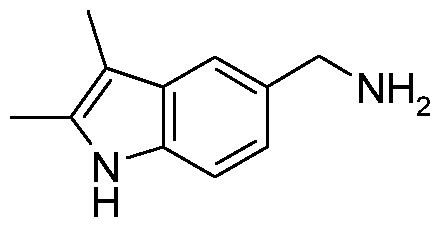
IM8: C-(2, 3-Dimethyl- 1 H-indol-5-yl)-methylamine
The compound was purchased from Enamine, Catalog No. EN300-55879.
IM9: (+)-R-1-(2-Methyl-1H-indol-5-yl)-ethylamine and IM13 (-)-S-1-(2-Methyl-1H-indol-5-yl)- ethylamine
Approximately 1.5 g of racemic material IM2 was subjected to preparative SFC separation of isomers (Method E) to give:

IM9: (+)-R- 1-(2-Methyl- 1H-indol-5-yl)-ethylamii
0.170 g isolated (Method E). Optical rotation + 24.7 0 (0.5% in CH3OH). A crystal of a salt of amine IM9 with /V-Ac-L-phenyl-alanine (S)-configuration) shows that the absolute configuration of IM9 is (R).

IM13: (-)-S- 1-(2-Methyl- 1 H-indol-5-yl)-ethylamine
0.278 g isolated (Method E).

IM10: (-)-(S)-2 2-Trifluoro-1-(2-methyl-1H-indol-5-yl)-ethylamh

Step 1 :
To a solution of 1-benzenesulfonyl-2-methyl-1 H-indole-5-carbonitrile (10.0 g, 33.8 mmol) in methylene chloride (100 mL) was added DIBAL-H (1 M in toluene, 50.6 mL, 50.7 mmol) dropwise at -78 °C. The reaction mixture was stirred at -78 °C for 2h and was then carefully diluted with 2N HCI (200 mL). The mixture was extracted with EtOAc (2 x 250 mL). The combined organic layers were dried over Na2S04 and evaporated to dryness. The crude material was washed with diethyl ether to give 1-benzenesulfonyl-2-methyl-1 H-indole-5-carbaldehyde
as a yellow solid (9.0g, 89%). The material was used in the next step without further purification.
Step 2:
To a solution of 1-benzenesulfonyl-2-methyl-1 H-indole-5-carbaldehyde (25.0 g, 83.6 mmol) in anhydrous THF (500 mL) was added (S)-2-methyl-2-propanesulfinamide (15.2 g, 125.4 mmol) and Ti(OEt)4 (38.1 g, 167.2 mmol) at room temperature. The reaction mixture was stirred at reflux for 6 h. The reaction mixture was then diluted with brine (500 mL) and the resulting mixture was extracted with EtOAc (2 x 500 mL). The combined organic layers were dried over anhydrous Na2S04 and evaporated to dryness to give (S)-2-methyl-propane-2- sulfinic acid 1-(1-benzenesulfonyl-2-methyl-1 H-indol-5-yl)-methylideneamide as a pale yellow liquid (32. Og, 95%) which was used in the next step without further purification.
Step 3:
This step was carried out as described in Olah, G. et al, Angew. Chem. Int. Ed. 2001 , 40, 3, 589-590: To a solution of (S)-2-methyl-propane-2-sulfinic acid 1-(1-benzenesulfonyl-2-methyl- 1 H-indol-5-yl)-methylideneamide (2.0 g, 4.97 mmol) in dry THF (60 mL), was added tetrabu- tylammonium difluorotriphenylsilicate (5.3 g, 9.95 mmol) and TMSCF3 (1.41 g, 9.95 mmol) at - 55 °C. The reaction mixture was stirred at -55 °C - 0 °C for 1 h. The reaction mixture was then diluted with saturated aqueous NH4CI solution (50 mL). The mixture was extracted with
EtOAc (2 x 50 mL). The combined organic layers were dried over Na2S04 and evaporated to dryness. Flash chromatography (silica, EtOAc: petroleum ether 1 :3) gave (S)-2-methyl- propane-2-sulfinic acid [(S)-1-(1-benzenesulfonyl-2-methyl-1 H-indol-5-yl)-2,2,2-trifluoro-ethyl]- amide as an off-white solid (1.8g, 77%).
Step 4:
To a solution of (S)-2-methyl-propane-2-sulfinic acid [(S)-1-(1-benzenesulfonyl-2-methyl-1 H- indol-5-yl)-2,2,2-trifluoro-ethyl]-amide (8.0 g, 16.94 mmol) in MeOH (160 mL) was added KOH (14.25 g, 254 mmol) at 0 °C. The reaction mixture was stirred at 25 °C for 48 h. The reaction mixture was poured into water and stirred for 30 min. The mixture was filtered and the rema- nence washed with n-pentane (50 mL) to give (S)-2-methyl-propane-2-sulfinic acid [(S)-2,2,2- trifluoro-1-(2-methyl-1 H-indol-5-yl)-ethyl]-amide as an off-white solid (3.3g, 59%).
Step 5:
To a solution of (S)-2-methyl-propane-2-sulfinic acid [(S)-2,2,2-trifluoro-1-(2-methyl-1 H-indol- 5-yl)-ethyl]-amide (6.3 g, 19.0 mmol) in diethyl ether (64 mL) at 0 °C was added 2M HCI in diethyl ether (32 mL). The reaction mixture was subsequently stirred at 25 °C for 4 h. The reaction mixture was then filtered and the remanence washed with EtOAc and dried under vac- uum. The crude salt was dissolved in water (120 mL) and basified with 1 M NaOH. The resulting mixture was filtered and the remanence was washed with water (60 mL) to give the title compound IM10 as a pale brown powder (3.5g, 81 %).
1 H NMR (DMSO, 400 MHz) δ 10.91 (1 H, s), 7.48 (1 H, s), 7.23-7.21 (1 H, d), 7.08-7.06 (1 H, d), 6.10 (1 H, s), 4.44-4.43 (1 H, m), 2.37 (3H, br s).
(Specific optical rotation -20.1 °, 0.51 % MeOH)
IM11: (R)- 1-(4-Fluoro-2-methyl- 1H-indol-5-yl)-ethylamine (major) and (S)- 1-(4-Fluoro-2-

Step 1 :
DIBAL-H (0.45mL, 0.5 mmol, 1.0 M in THF) was added to a mixture of 4-fluoro-2-methyl-1 H- indole-5-carbonitrile (50 mg, 0.29 mmol) in dry THF (0.5 mL) at 0 °C. The reaction mixture was stirred at 0 °C for 30 min and then stirred without cooling overnight. The mixture was quenched with water and extracted with EtOAc (200 mL). The organic layer was dried over
Na2S04 and evaporated to dryness. The residue was purified by pTLC to give 4-fluoro-2- methyl-1 H-indole-5-carbaldehyde as a white solid (23 mg, 45%).
1 HNMR (CDCIs, 400 MHz) δ 10.35 (s, 1 H), 8.25 (s, 1 H), 7.53(m, 1 H), 7.05 (m, 1 H), 6.37 (m, 1 H), 2.40 (s, 3H).
Step 2:
A mixture of 4-fluoro-2-methyl-1 H-indole-5-carbaldehyde (1.5 g, 8.5 mmol) in THF (30 ml_) was stirred at room temperature. To this mixture was added (S)-2-methyl-2- propanesulfinamide (2.0 g, 17.0 mmol) and Ti(OEt)4 (5.8 g, 25.5 mmol) and the mixture was refluxed overnight. The mixture was then cooled, diluted with water and extracted with EtOAc (1000 ml_). The organic layer was dried over Na2S04 and evaporated to dryness to give crude (S)-2-methyl-propane-2-sulfinic acid 1-(4-fluoro-2-methyl-1 H-indol-5-yl)- methylideneamide as a yellow oil (2.0 g, 87%) which was used without further purification.
Step 3:
CHsMgBr (7.3 ml_, 22.0 mmol, 3.0 M in THF) was added dropwise to a solution of (S)-2- methyl-propane-2-sulfinic acid 1-(4-fluoro-2-methyl-1 H-indol-5-yl)-methylideneamide (2.0 g, 8.8 mmol) in dry THF (35 ml_) at -78 °C. Cooling was then removed and the reaction mixture was stirred at room temperature for 1 h. Another 7.3 ml_ of CH3MgBr (3.0 M in THF) was added and the mixture was stirred at room temperature overnight. The mixture was quenched with water and extracted with EtOAc (2000 ml_). The organic layer was washed with water, brine and dried over Na2S04 and evaporated to dryness. Flash chromatography (silica, EtOAc: petroleum ether 1 :20 to 1 :2) gave (S)-2-methyl-propane-2-sulfinic acid [(R)-1-(4-fluoro- 2-methyl-1 H-indol-5-yl)-ethyl]-amide as a yellow solid (1.2g, 46%). The diastereomeric ratio was approx 7:3 by 1 H NMR.
Step 4:
(S)-2-methyl-propane-2-sulfinic acid [(R)-1-(4-fluoro-2-methyl-1 H-indol-5-yl)-ethyl]-amide (1.2 g, 4.1 mmol), dr 7:3, was stirred at room temperature for 2 h in a solution of HCI in MeOH (20.0 ml_, 4.0 M). The mixture was evaporated to dryness to give IM11. This mixture, which was a binary mixture of approx 7:3 R:S, was used without further purification and was used to make amides 53 and 54.

IM12: C-(1H-lndol-5-yl)-methylamine
The compound was purchased from Sigma-Aldrich, Catalog No 655864.

-(1-Difluoromethyl-1H-ind -5-yl)-methylamine

Step 1 :
To a stirred solution of 5-cyanoindole (10.0g, 70 mmol) in methylene chloride (150 mL) was added a solution of NaOH (8.4g, 210 mmol) in of water (12 mL). Benzyltriethyl ammonium chloride (0.795g, 3.5 mmol) was added and the reaction mixture was stirred for 15 min. CHCIF2 gas was purged through the reaction mixture for 3 hours. The reaction mixture was diluted with methylene chloride and the organic layer was washed with water. The organic layer was dried over anhydrous Na2S04 and evaporated to dryness. Flash chromatography (silica, EtOAc:hexanes 1 :9) gave 1-difluoromethyl-1 H-indole-5-carbonitrile as a colorless solid (9.1g, 67%).
1 H NMR (400 MHz, DMSO) δ 7.9 (1 H, s), 7.6-7.7 (1 H, m), 7.5-7.6 (1 H, m), 7.1-7.4 (2H, m), 6.7 (1H, m).
Step 2:
To a solution of 1-difluoromethyl-1 H-indole-5-carbonitrile (9.0g, 46.0 mmol) in methanol (40 mL) was carefully added Raney Ni (0.9g) followed by ammonia in methanol (5M, 40 mL). The reaction mixture was hydrogenated at 60 psi for 24 hours. The reaction mixture was then filtered through a plug of celite and the filtrate was concentrated in vacuo. Flash chromatogra-
phy (silica, MeOH:methylene chloride 15:85) gave the title compound IM14 as a brown semisolid (5.1 g, 56%).
1 H NMR (400 MHz, DMSO) δ 7.8-8.1 (1 H, m), 7.55-7.65 (3H, m), 7.32-7.26 (1 H, m), 6.67 1 H s), 3.8 (2H, s).

Step 1 :
To a suspension of sodium hydride (60%, 42.0g, 1.053 mol) THF (600 mL) at 0 °C was slowly added a solution of 5-cyanoindole (50. Og, 0.351 mol) in THF (200 mL). The mixture was stirred for 30 min. A solution of benzene sulfonyl chloride (1 1 1.5g, 0.633 mol) in THF (200 mL) was then slowly added at 0 °C. The mixture was allowed to reach room temperature and was then stirred for 15 h. EtOAc was added and the mixture was washed with 1 N hydrochlo- ric acid. The aqueous layer was extracted with EtOAc. The combined organic layers were dried over anhydrous Na2S04 and concentrated to dryness. The resulting solid was washed with petroleum ether to give 1-benzenesulfonyl-1 H-indole-5-carbonitrile as a yellow solid (80.0 g, 81 %). 1 H NMR (400 MHz, CDCI3) δ 8.09-8.07 (1 H,d), 7.90-7.88 (3H, m), 7.70-7.69 (1 H, d), 7.61 (1 H, s), 7.59-7.55 (1 H, t), 7.50-7.47 (2H, t) , 6.73-6.72 (1 H, d).
Step 2:
To a solution of LDA (1.8 M, 10 ml_, 19.7 mmol) in THF (30 ml_) at -78 °C under an atmosphere of nitrogen was added a solution of 1-benzenesulfonyl-1 H-indole-5-carbonitrile (4.0g, 14.1 mmol) in THF (15 ml_). The mixture was stirred for 30 min, the temperature of the solution was slowly raised to -40 °C and after 30 min the mixture was re-cooled to -78 °C. To this solution was added dropwise a solution of Mel (4.42g, 31.1 mmol) in THF (15 ml_). The reaction temperature was maintained at -78 °C for 2 h. The mixture was then allowed to reach room temperature and was left overnight. The mixture was diluted with EtOAc and the organic layer was washed with 1 N hydrochloric acid. The organic layer was evaporated to dryness. Flash chromatography (silica, EtOAc: petroleum ether 1 :4) gave 1-benzenesulfonyl-2-methyl- 1 H-indole-5-carbonitrile as an off-white solid (2.2g, 52%).
1 H NMR (400 MHz, DMSO) δ : 8.22-8.19 (1 H, m), 8.05 (1 H, s) 7.94-7.92 (2H, m), 7.76-7.74 (1 H, m), 7.70-7.68 (1 H, m), 7.64-7.60 (2H, m) , 6.71 (1 H, s), 2.63 (3H, s). Step 3:
To a stirred solution of 1-benzenesulfonyl-2-methyl-1 H-indole-5-carbonitrile in THF:MeOH (1 :1 , 36 ml_) was added a solution of NaOH (3.9 g, 0.1 mol) in water (10 ml_) dropwise at 0 °C. The mixture was stirred for 30 min, cooling was removed and the mixture was left overnight. The mixture was concentrated in vacuo. The residue was diluted with water and the aqueous layer was extracted with EtOAc. The combined organic layers were dried over Na2S04 and evaporated to dryness. Flash chromatography gave 2-methyl-1 H-indole-5- carbonitrile as an off-white solid (0.85 g, 73%).
1 H NMR (400 MHz, CDCI3) δ 8.21 (1 H, br s), 7.84 (1 H, s), 7.36-7.25 (2H, m), 6.29 (1 H, s), 2.47 (3H, s).
Step 4:
To a stirred solution of 2-methyl-1 H-indole-5-carbonitrile (8.0g, 51.2 mmol) in methylene chloride (100 ml_) at 0 °C was added NaOH (6.15g, 154 mmol in 15 mL water) followed by ben- zyltriethyl ammonium chloride (0.58g, 2.5 mmol). The mixture was stirred for 15 min. CHCIF2 gas was purged through the reaction mixture for 3 h. The reaction mixture was diluted with methylene chloride, dried over Na2S04 and evaporated to dryness. Flash chromatography (silica, EtOAc: petroleum ether 1 :4) gave 1-difluoromethyl-2-methyl-1 H-indole-5-carbonitrile as an off-white solid (3.10 g, 29%).
1 H NMR (400 MHz, CDCI3) δ 7.83 (1 H, s), 7.61-7.59 (1 H, m), 7.47-7.45 (1 H, m), 7.41-7.11 (1 H, m), 6.39 (1 H, s). 2.54 (3H, s). Step 5:
To a stirred solution of 1-difluoromethyl-2-methyl-1 H-indole-5-carbonitrile (3.1g, 15.0 mmol) in methanol (20 mL) was carefully added Raney Ni (0.35g) followed by ammonia in methanol (20 mL, 5M). The mixture was hydrogenated at 60 psi for 12 h. The reaction mixture was then filtered through a plug of celite and the filtrate was evaporated to dryness. Flash chromatog- raphy (silica, MeOH:methylene chloride1 :9) gave the title compound IM15 as an off-white solid (2.6g, 82%).
1 H NMR (400 MHz, CD3OD) δ 7.74 (1 H, s), 7.59 (1 H, s), 7.53-7.51 (1 H, m), 7.16-7.14 (1 H, m), 6.30 (1 H, s), 3.84 (2H, br s), 2.48 (3H, s).

IM16: C- 2-Methyl-d3- 1 H-indol-5-yl)-methyl-amine

Step 1 :
LDA in THF (20.4 mL, 1.8 M solution, 36.87 mmol) was added to THF (20 mL) and the mixture was cooled at -78°C. A solution of 1-benzenesulfonyl-1 H-indole-5-carbonitrile (8.0 g, 28.36 mmol) in THF (15 mL) was added dropwise. After 30 min the mixture was allowed to reach -40 °C. After stirring at this temperature for 30 min the mixture was cooled to -78 °C. lodomethane-D3 (8.22 g, 56.73 mmol) in THF (15 mL) was added dropwise. The mixture was allowed to reach room temperature overnight. EtOAc (60 mL) was added and the resulting
mixture was washed with 1 N hydrochloric acid (60 mL). The organic layer was evaporated to dryness. Flash chromatography (silica, EtOAc: petroleum ether 1 :4) gave 1-benzenesulfonyl- 2-methyl-d3-1 H-indole-5-carbonitrileas an off-white solid (3.2g, 38%). Step 2:
To a vigorously stirred solution of 1-benzenesulfonyl-2-methyl-d3-1 H-indole-5-carbonitrile (2.2 g, 7.35 mmol) in THF: MeOH (18 mL: 18 mL) was added 10 M NaOH (10 mL) dropwise at 0 °C. The mixture was stirred for 30 min and then left without cooling overnight. The volatiles were removed under vacuum and the remanence was diluted with water (20 mL) and ex- tracted with ethyl acetate (2 x 40 mL). The combined organic layers were dried over Na2S04 and evaporated to dryness. Flash chromatography (silica, EtOAc: petroleum ether 1 :4) gave 2-methyl-d3-1 H-indole-5-carbonitrile as an off-white solid (800 mg, 68%).
Step 3:
To a solution of 2-methyl-d3-1 H-indole-5-carbonitrile (600 mg, 3.77 mmol) in methanol (10 mL) was added Raney Ni (100 mg) followed by 5 M ammonia in methanol (15 mL). The reaction solution was hydrogenated at 60 psi for 12 h. The mixture was filtered through a plug of celite and the filtrate was evaporated to dryness. Flash chromatography (silica,
MeOH:methylene chloride 12:88) gave the title compound IM16 as an off-white solid ( 0.55g, 89%).
1 H NMR (DMSO, 400 MHz) δ 10.74 (1 H, s), 7.29 (1 H, s), 7.17-7.15 (1 H, d), 6.94-6.92 (1 H, d), 6.03 (1 H, s), 3.71 (2H, s), 1.66 (2H, broad).

IM17: C-(1- Trifluoromethyl- 1 H-indol-5-yl) -methylamine

Step 1 :
To a stirred solution of 5-cyanoindole (20.0 g, 140 mmol) in trifluoroacetic acid (150 mL) at 0 °C was added triethylsilane (45.2 mL, 281 mmol). The reaction mixture was stirred for 4h at 0 °C. The reaction mixture was diluted with EtOAc (200 mL) and the organic layer was extracted with 1 N HCI (200 mL). The aqueous layer was basified with 50% NaOH solution to pH 10-11 and extracted with EtOAc (2x 200 mL). The combined organic layers were dried over anhydrous Na2S0 and evaporated to dryness to give 2,3-dihydro-1 H-indole-5-carbonitrile (6.2g, 31%) as a pale yellow solid. The material was used without further purification.
Step 2:
To a suspension of NaH (2.5 g, 108 mmol) in DMF (100 mL) at 0 °C was added 2,3-dihydro- 1 H-indole-5-carbonitrile (6.2 g, 43.0 mmol). After 15 min, CS2 (3.8 mL, 64.6 mmol) was added followed by Mel (4.0 mL, 64.6 mmol). The reaction mixture was stirred for 1 h at room temperature. The reaction mixture was then was poured onto ice. The resulting mixture was filtered. The remanence was washed with methylene chloride to give 5-cyano-2,3-dihydro- indole-1-carbodithioic acid methyl ester as a off-white solid (7.5g, 76%). The material was used without further purification.
To a stirred solution of 5-cyano-2,3-dihydro-indole-1-carbodithioic acid methyl ester (8.0 g, 34.1 mmol) in methylene chloride (200 mL) at 0 °C was added a solution of tetrabutylammo- nium dihydrogen trifluoride (51.4 g, 170.7 mmol) in methylene chloride (50 mL) dropwise. To this mixture was added NBS (30.3 g, 170.7 mmol). The reaction mixture was stirred for 18h at room temperature and was then diluted with methylene chloride (100 mL). The mixture was
washed with water (100 mL), brine (100 mL) and was then dried over anhydrous Na2S04 and evaporated to dryness.
Flash chromatography (silica, EtOAc:hexanes 1 :9) gave 1-trifluoromethyl-2,3-dihydro-1 H- indole-5-carbonitrile as a pale yellow oil (4.0g, 56%).
1 H NMR (400 MHz, CDCI3) δ 7.48-7.43 (2H, m), 7.04-7.02 (1 H, m), 3.85-3.80 (2H, m), 3.18- 3.13 (2H, m).
Step 3:
To a stirred solution of 1-trifluoromethyl-2,3-dihydro-1 H-indole-5-carbonitrile (4.0 g; 18.9 mmol) in CCI4 (100 mL) at room temperature was added NBS (6.7 g, 37.7 mmol). The reaction mixture was stirred for 18h at 80 °C. The reaction mixture was diluted with methylene chloride (100 mL) and the resulting mixture was washed with water (100 mL) followed by brine (100 mL). The organic layers was dried over anhydrous Na2S04 and evaporated to dry- ness. Flash chromatography (silica, EtOAc:hexanes 15:85) gave 3-bromo-1-trifluoromethyl- 1 H-indole-5-carbonitrile as a pale yellow solid (5.0g, 93%).
To a solution of 3-bromo-1-trifluoromethyl-1 H-indole-5-carbonitrile (500 mg; 1.73 mmol) in MeOH.NH3 (20 mL, 5M) at room temperature was added 10% Pd/C (100 mg). The reaction mixture was stirred for 2h at room temperature under H2 (60 psi). The reaction mixture was then filtered through a plug of celite and the filtrate was evaporated to dryness to give 1- trifluoromethyl-1 H-indole-5-carbonitrile as a off-white solid (350 mg, 97%).
1 H NMR (400 MHz, CDCI3) δ 7.99 (1 H, s), 7.68-7.66 (1 H, m), 7.60-7.57 (1 H, m), 7.44-7.43 (1 H, m), 6.75-6.74 (1 H, m).
Step 4:
To a solution of 1-trifluoromethyl-1 H-indole-5-carbonitrile (350 mg, 1.67 mmol) in MeOH.NH3 (20 mL, 5M) at room temperature was added Raney-Ni (100 mg). The reaction mixture was stirred for 2h under H2 (60 psi). The reaction mixture was filtered through a plug of celite and the filtrate evaporated to dryness. The crude compound was washed with pentane to give C- (1-trifluoromethyl-1 H-indol-5-yl)-methylamine IM17 as a white solid (0.200g, 57%).
1 H NMR (400 MHz, CDCI3) δ 8.22 (2H, broad), 7.81-7.80 (2H, m), 7.68-7.65 (1 H, m), 7.50- 7.47 (1 H, m), 6.89-6.88 (1 H, m), 4.11 (2H, s).

-(2-Methyl- 1-trifluoromethyl- 1 H-indol-5-yl)-methylamine

IM18 was prepared in a sequence of steps similar to IM17 and IM16 as outlined above. IM18 was isolated from HCI in isopropylacetate to give the HCI salt of the title compound as colorless crystals.
1 H NMR (DMSO, 400 MHz) δ 8.31 (3H, br), 7.67 (1 H, s), 7.61-7.58 (1 H, m), 7.39-7.37 (1 H, m), 6.65 (1 H, s), 4.08 (2H, s), 2.50 (3H, s).

IM19: C-(1-Methyl-2-trifluoromethyl-1H-indol-5-yl)-methylamine

Step 1 :
NaH (0.71 g, 0.029 mol) was added to a solution of 2-trifluoromethyl-1 H-indole-5-carbonitrile (preparation described in WO2009/127678A1) (2.5 g; 0.011 mol) in DMF (50 mL) at room temperature. The reaction mixture was cooled to 0 °C, Mel was added drop-wise and the reaction mixture was slowly warmed to room temperature. After stirring for 4 h the reaction mixture was poured into ice water. The mixture was filtered and the remanence was dried to give 1-methyl-2-trifluoromethyl-1 H-indole-5-carbonitrile as a pale yellow solid (2.1 g, 79%). Step 2:
Raney Ni (400 mg) was added to solution of 1-methyl-2-trifluoromethyl-1 H-indole-5- carbonitrile (2.0 g, 8.92 mmol) in MeOH.NH3 (10M, 50 mL) under a N2 atmosphere. The reaction mixture was hydrogenated at 60 psi H2 at room temperature for 4h. The reaction mixture was filtered through a pad of celite and evaporated to dryness. The crude material was tritu- rated with diethyl ether to give the title compound IM19 as a white solid (1.6g, 79%). The compound was converted to its HCI salt using HCI in isopropyl acetate (4.0 M; 5.0 mL).
1 HNMR (DMSO, 400 MHz) δ 8.24 (3H, br s), 7.79 (1 H, s), 7.72-7.70 (1 H, d), 7.49-7.47 (1 H, d), 7.18 (1 H, s), 4.11 (2H, s), 3.88 (3H, s).
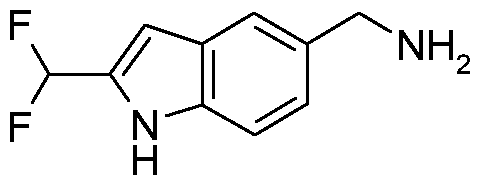
IM20: C-(2-difluoromethyl- 1 H-indol-5-yl)-methylamine


To a solution of 2-formyl-1 H-indole-5-carbonitrile (prepared as described in
WO2009153307A1) (3.6 g, 21.17 mmol) in CH3CN:THF (120 ml_:120 mL) at 0 °C was added (Boc)20 (6.0 g, 27.52 mmol) and DMAP (516 mg, 4.234 mmol). Cooling was removed and the mixture was stirred at 25 °C overnight. The reaction mixture was poured into ice-cold water (100 mL) and extracted with ethyl acetate (2 x 200 mL). The combined organic layers were dried over anhydrous Na2S04 and evaporated to dryness. Flash chromatography (silica, EtOAc: petroleum ether 1 :4) gave 5-cyano-2-formyl-indole-1-carboxylic acid tert-butyl ester as an off-white solid (2.6g, 45%).
Step 2:
To a solution of 5-cyano-2-formyl-indole-1-carboxylic acid tert-butyl ester (2.3 g, 8.51 mmol) in methylene chloride (200 mL) was slowly added deoxo-flour (bis(2- methoxyethyl)aminosulfur trifluoride) (7.53 g, 34.07 mmol) at 0 °C under N2. The mixture was subsequently stirred at 25 °C overnight. The reaction mixture was then poured into a cold solution of saturated aqueous NaHC03 (100 mL). The aqueous layer was extracted with EtOAc (2 x 300 mL). The combined organic layers were dried over anhydrous Na2S04 and evaporated to dryness. Flash chromatography (silica, EtOAc: petroleum ether 1 : 10) gave 5-cyano-2- difluoromethyl-indole-1-carboxylic acid tert-butyl ester as an off-white solid (1.8g, 72%).
Step 3:
To a solution of 5-cyano-2-difluoromethyl-indole-1-carboxylic acid tert-butyl ester
(1.8 g, 6.16 mmol) in methylene chloride (60 mL) was slowly added trifluoro acetic acid (15 mL) at 0 °C and the reaction temperature was slowly increased to 25 °C and stirred at this temperature for 12 h. The mixture was then diluted with methylene chloride (100 mL) and washed with saturated aqueous NaHC03 (2 x 100 mL). The combined organic layers were dried over Na2S04 and evaporated to dryness. Flash chromatography (silica,
EtOAc: petroleum ether 1 :4) gave 2-difluoromethyl-1 H-indole-5-carbonitrile as an off-white solid (0.85g, 72%).
Step 4:
To a solution of 2-difluoromethyl-1 H-indole-5-carbonitrile (3.0 g, 15.6 mmol) in methanol (40 mL) was carefully added Raney Ni (0.50 g) followed by 5 M ammonia in methanol (20 mL).
The reaction mixture was hydrogenated at 60 psi for 12 h. The mixture was filtered and the filtrate evaporated to dryness. The crude material was dissolved in EtOAc (50 mL) and cooled to 0 °C. A solution of 2M HCI in diethyl ether (5.0 mL) was added and the mixture stirred for 2 h. Filtration afforded the title compound IM20 as the HCI salt as a reddish solid (1.95 g, 64%).
1 H NMR (DMSO 400 MHz) δ 1 1.94 (1 H, s), 8.33 (3H, br), 7.73 (1 H, s), 7.48-7.46 (1 H, d), 7.37-7.09 (2H, m), 6.81-6.81 (1 H, d), 4.07-4.06 (2H, m).

IM21: +)- 1-(2-Trifluoromethyl- 1 H-indol-5-yl)-ethylamine

Step 1 :
To a solution of 2-trifluoromethyl-1 H-indole-5-carbonitrile (5.0 g, 0.023mol) in DMF (50 mL), was added NaH (2.8 g, 0.071 mol) at 0 °C. Benzyl bromide (4.8 mL, 0.035 mol) was added drop-wise. The mixture was stirred overnight. The reaction mixture was poured in to ice-cold water and extracted with ethyl acetate (2 x 75 mL). The combined organic layers were washed with brine (2 x 50 mL), dried over Na2S04 and evaporated to dryness. Flash chromatography (silica, EtOAc: petroleum ether 1 :9) gave 1-benzyl-2-trifluoromethyl-1 H-indole-5- carbonitrile as an oil that slowly solidified upon standing (5.0g, 70%).
Step 2:
To a stirred solution of 1-benzyl-2-trifluoromethyl-1 H-indole-5-carbonitrile (4.0 g, 13.3 mmol) in dry toluene (10 mL) at 0 °C was added MeMgBr(1.4 M in toluene, 48 mL, 66.6 mmol) drop- wise. After addition was completed the mixture was refluxed for 1 h. The mixture was cooled to 0 °C and then quenched with methanol. The resulting mixture was stirred at room tempera-
ture for 30 min and filtered. The remanence was washed with methanol (20 ml_). The combined filtrates were cooled to 0 °C and NaBH4 (4.0 g, 66.6 mmol) was added in small portions. Cooling was then removed and the mixture was left stirring at room temperature overnight. The mixture was quenched at 0 °C with saturated aqueous NH4CI and then extracted with EtOAc (2 x 100 ml_). The combined organic layers were washed with brine, dried over Na2S04 and evaporated to dryness. Flash chromatography (neutral alumina,
MeOH:methylene chloride 1 :9) gave 1.5g of free base. This material was converted to its HCI salt by using 2 N HCI in ether (10 ml_) to give 1-(1-Benzyl-2-trifluoromethyl-1 H-indol-5-yl)- ethylamine HCI salt (2.0g, 35%).
Chiral separation by SFC (Method F) of racemic 1-(1-Benzyl-2-trifluoromethyl-1 H-indol-5-yl)- ethylamine (5.5 g) gave 2.4g (-) isomer as peak 1 (specific optical rotation -13.3°, 0.5% MeOH) and 1.1g (+) isomer as peak 2 (specific optical rotation +1 1.5°, 0.5% MeOH). Step 3:
To a stirred solution of (+)-1-(1-benzyl-2-trifluoromethyl-1 H-indol-5-yl)-ethylamine (1.1 g, 3.46 mmol) in DMSO (11 ml_) was added t-BuOK in THF (1 M, 28 ml_, 28 mmol) drop-wise at 0 °C. Oxygen gas was bubbled through the reaction mixture for 15 min. The mixture was then stirred for 30 min. The reaction mixture was then slowly poured into crushed ice. The resulting mixture was extracted with EtOAc (2 x 75 ml) and the combined organic layers were washed with brine and evaporated to dryness. The crude product was dissolved in diethyl ether (10 ml_). To this solution was added 2 M HCI in diethyl ether (4 ml_) and the mixture was stirred for 5 min and evaporated to dryness. The resulting salt was washed with 10% methanol in methylene chloride (5 ml) and dried to give the title compound IM21 as the HCI salt (0.50g, 55%).
1 HMR (DMSO, 400 MHz) δ 12.42 (1 H, s), 8.42 (3H, br s), 7.79 (1 H, s), 7.54-7.52 (1 H, d), 7.46-7.44 (1 H, d), 7.07 (1 H, s), 4.48 (1 H, br s), 1.56-1.55 (3H, d). (specific optical rotation +14.71 °, 0.5% MeOH)
IM22: (-)-1-(2-Trifluoromethyl-1H-indol-5-yl)-ethylamine
The (-)-1-(1-benzyl-2-trifluoromethyl-1 H-indol-5-yl)-ethylamine isomer was taken the same step as described for IM21 to give (-)1-(2-Trifluoromethyl-1 H-indol-5-yl)-ethylamine.
(specific optical rotation -17.22°, 0.5% MeOH)

IM23: (R)-1-(6-Fluoro-2-methyl-1H-indol-5-yl)-ethylamine and (R)-1-(6-Fluoro-7-methyl-1H- indol-5-yl) -ethyl a mine

major minor
Step l :
To a solution of 4-bromo-3-flouro-aniline (40.0 g, 211.6 mmol) in acetic acid (520 ml_) was slowly added N-iodo succinimide (57.14 g, 253.9 mmol) 25 °C. The mixture was stirred for 90 min. The reaction mixture was poured into ice-water and filtered. The remanence was dried in vacuo to give 4-bromo-5-fluoro-2-iodo-phenylamine as a brown solid (60g, 90%).
Step 2:
To a solution of 4-bromo-5-fluoro-2-iodo-phenylamine (30.0 g, 95.2 mmol), Pd(PPh3)2CI2 (3.3 g, 4.7 mmol) and copper iodide (0.9 g, 4.7 mmol) in triethylamine (700 ml_) was slowly added trimethylsilylacetylene (9.3 g, 95.2 mmol) at 0 °C. The mixture was subsequently stirred at 25 °C for 2h. The mixture was then filtered through a pad of celite. The filtrate was washed with water and brine. The organic layer was dried over Na2S04 and concentrated in vacuo. Flash chromatography (silica, EtOAc: petroleum ether 1 :9) gave 4-bromo-5-fluoro-2- trimethylsilanylethynyl-phenylamine as a yellow oil (20 g, 74 %).
Step 3:
To a solution of 4-bromo-5-fluoro-2-trimethylsilanylethynyl-phenylamine (50.0 g, 175.4 mmol) in DMF (1000 mL) at 0 °C was added copper iodide (66.0 g, 351 mmol). The reaction mixture was stirred at 100 °C for 4 h. The reaction mixture was then diluted with water (1000 mL) and extracted with EtOAc (2 x 1000 mL). The combined organic layers were dried over anhydrous Na2S04 and evaporated to dryness. Flash chromatography (silica, EtOAc: petroleum ether 1 :9) gave 5-bromo-6-fluoro-1 H-indole as a brown solid (20 g, 54%). 1 H NMR (DMSO, 400 MHz) δ 1 1.32 (1 H, s), 7.84-7.82 (1 H, d), 7.41-7.35 (2H, m), 6.43-6.42 (1 H, m).
The 5-bromo-6-fluoro-1 H-indole was taken through steps 2 to 8 as described for IM28. The methylation step 3 gave two methylated isomers with 2-methyl being major and 7-methyl be- ing minor. This binary mixture was used without further purification to make amides 102 and 103.

IM24: C-(6-Fluoro-2-methyl-1H-indol-5-yl)-methylamine and C-(6-Fluoro-7-methyl-1H-indol- -yl)-methylamine

5-bromo-6-fluoro-1 H-indole was taken through steps 2 to 3 as described for IM28 to give a mixture of two methylated indoles. This binary mixture was taken through steps 1 to 3 as de-
scribed for IM26. The resulting binary mixture was used without further purification to make amides 104 and 105

Step 1 :
To a solution of 4-amino-3-methylbenzonitrile 1 (5.0 g, 37.87 mmol) in toluene (50 mL) was added benzophenone (7.5 g, 45.45 mmol) and pTSA (0.07 g, 0.378 mmol) at room temperature. The flask was fitted with dean-stark trap and heated to reflux for 7 days. The mixture was evaporated to dryness. Flash chromatography (silica, EtOAc: petroleum ether 4:96) gave 4-(benzhydrylidene-amino)-3-methyl-benzonitrile as a yellow solid (8.0g, 71 %).
Step 2:
To a solution of 4-(benzhydrylidene-amino)-3-methyl-benzonitrile (7.0 g, 23.64 mmol) in CCI4 (75 mL) was added N-bromo succinimide (4.6 g, 26.0 mmol) and benzoyl peroxide (0.8 g, 3.54 mmol). The mixture was heated to reflux for 6 h. The mixture was then diluted with 1 N NaOH solution (100 mL) and extracted with methylene chloride (2 x 100 mL). The combined organic layers were washed with brine, dried over Na2S04 evaporated to dryness. Flash
chromatography (silica, EtOAc: petroleum ether 3:97) gave 4-(benzhydrylidene-amino)-3- bromomethyl-benzonitrile as a yellow solid (6.0g, 68%).
Step 3:
To a solution of 4-(benzhydrylidene-amino)-3-bromomethyl-benzonitrile (500 mg, 1.34 mmol) in toluene (15 mL) was added triphenyl phosphine (420 mg, 1.61 mmol). The mixture was heated to reflux for 12 h. The mixture was diluted with EtOAc (20 mL) and stirred for 15 min and then filtered. The remanence was washed with EtOAc and dried under vacuum to give [6- (benzhydrylidene-amino)-3-cyano-cyclohexa-1 ,3,4,5-tetraenylmethyl]-triphenyl-phosphonium; bromide as an off-white solid (0.60 g, 81 %) which was used without further purification.
Step 4:
To a solution of [6-(benzhydrylidene-amino)-3-cyano-cyclohexa-1 ,3,4,5-tetraenylmethyl]- triphenyl-phosphonium; bromide (250 mg, 0.449 mmol) in THF:methylene chloride (2 mL : 2 mL) at 0 °C was added HCI in diethyl ether(1 M, 1 mL). The mixture was subsequently stirred at room temperature for 12 h. The mixture was then filtered and the remanence was washed with EtOAc and dried under vacuum to give (6-amino-3-cyano-cyclohexa-1 , 3,4,5- tetraenylmethyl)-triphenyl-phosphonium; bromide as an off-white solid (0.15g, 85%) which was used without further purification.
Step 5:
To a solution of (6-amino-3-cyano-cyclohexa-1 ,3,4,5-tetraenylmethyl)-triphenyl-phosphonium; bromide (4.0 g, 10.2 mmol) in THF (200 mL) was added 3,3,3-triflouro propanoic acid (1.35 mL, 15.3 mmol), propyl phosphonic anhydride (50% in DMF) (14.2 g, 44.88 mmol) and DIPEA (6.7 mL, 40.8 mmol) at room temperature. The mixture was stirred at this temperature for 6 h. The volatiles were removed in vacuo and the remanence was taken up in DMF (120 mL) and heated to reflux for 48 h. The reaction mixture was then diluted with water (100 mL) and extracted with EtOAc (2 x 100 mL). The combined organic layers were washed with brine, dried over Na2S04 and evaporated to dryness. Flash chromatography (silica, EtOAc:petroleum ether 1 :4) gave 2-(2,2,2-trifluoro-ethyl)-1 H-indole-5-carbonitrile as colorless crystals (0.11 g, 5%).
Step 6:
To a solution of 2-(2,2,2-trifluoro-ethyl)-1 H-indole-5-carbonitrile (110 mg, 0.491 mmol) in methanol (3 mL) was added Raney Ni (20 mg) followed by 5 M ammonia in methanol (2 mL). The reaction solution was hydrogenated at 60 psi for 4 h at room temperature. The reaction mixture was filtered through a plug of celite. The filtrate was concentrated under vacuo and the resulting crystals were washed with diethyl ether to give the title compound IM25 as colorless crystals (0.11g, 98%).
1 H NMR (DMSO, 400 MHz) δ 11.06 (1 H, s), 7.41 (1 H, s), 7.29-7.27 (1 H, m), 7.46-7.42 (1 H,
-3.75 (4H, m), 2.23 (2H, br s).

Step 1 :
To a solution of 1-benzenesulfonyl-5-bromo-7-fluoro-2-methyl-1 H-indole (prepared as described for IM28 (2.0 g; 5.44 mmol) in DMF (40mL) was added CuCN (975 mg; 10.8 mmol) at room temperature. The reaction temperature was slowly heated to 150 °C and stirred at this temperature for 12h. The mixture was then cooled to room temperature and diluted with EtOAc (100 mL). The mixture was filtered through a pad of celite and the filtrate was washed with water followed by brine. The organic layer was dried over anhydrous Na2S04 and evaporated to dryness. Flash chromatography (silica, EtOAc: petroleum ether 15:85) gave 1- benzenesulfonyl-7-fluoro-2-methyl-1 H-indole-5-carbonitrile as an off-white solid (1.0g, 58%).
Step 2:
To a vigorously stirring solution of 1-benzenesulfonyl-7-fluoro-2-methyl-1 H-indole-5- carbonitrile (1.0 g, 3.18 mmol) in THF: MeOH (20 mL:20 mL) at O °C was added 10 N NaOH (4.7 mL) dropwise. The mixture was stirred for 30 min at 0 °C and then left without cooling overnight. The mixture was evaporated to dryness and the resulting residue was diluted with
water (20 mL) and stirred for 30 min. The formed solid was collected by filtration and washed with water. Flash chromatography (silica, EtOAc:petroleum ether 1 :4) gave 7-fluoro-2-methyl- 1 H-indole-5-carbonitrile as an off-white solid (400 mg, 72%). Step 3:
To a solution of 7-fluoro-2-methyl-1 H-indole-5-carbonitrile (400 mg, 2.29 mmol) in methanol (4 mL) was carefully added Raney Ni (100 mg) followed by 5 M ammonia in methanol (6 mL). The reaction solution was hydrogenated at 60 psi for 4 h. The mixture was filtered through a pad of celite and the filtrate was evaporated to dryness. The crude compound was purified by washing with ether to give the title compound IM26 as a white solid (350 mg, 86%).
1 H NMR (DMSO, 400 MHz) δ 1 1.18 (1 H, s), 7.1 1 (1 H, s), 6.81-6.78 (1 H, m), 6.12 (1 H, s), 3.72 (2H, br s), 2.36 (3H, s), 1.75 (2H, br s).

I -(4-Fluoro-2-methyl- 1 H-indol-5-yl)-methylamine

Step 1 :
2,6-lutidine (1.2 g, 10.9 mmol) was added to a mixture of 4-fluoro-2-methyl-1 H-indol-5-ol (1.4g, 9.1 mmol) in methylene chloride (70 mL) at 0 °C. To this mixture was added Tf20 (3.0g, 10.9 mmol) dropwise and the mixture was stirred at room temperature overnight. Water was added and the mixture was extracted with methylene chloride (1500 mL). The organic layer
was washed with water, brine, dried over Na2S04 and evaporated to dryness. Flash chromatography (silica, EtOAc: petroleum ether 1 : 10) gave trifluoro-methanesulfonic acid 4-fluoro-2- methyl-1 H-indol-5-yl ester as a yellow solid (1.9g,70 %). Step 2:
A round bottomed flask was charged with trifluoro-methanesulfonic acid 4-fluoro-2-methyl-1 H- indol-5-yl ester (500 mg, 1.7 mmol), Pd2(dba)3 (183 mg, 0.2 mmol), dppf (440 mg, 0.8 mmol), Zn powder (30 mg, 0.4 mmol) and Zn(CN)2 (200 mg, 1.7 mmol) and degassed and backfilled with N2 three times. DMF (10 mL) was added via syringe and the reaction mixture was stirred at 120 °C for 5h. The mixture was cooled to room temperature and diluted with water. The mixture was then extracted with EtOAc (100 mL), dried over Na2S04 and evaporated to dryness. Flash chromatography (silica, EtOAc: petroleum ether 1 :20 to 1 :5) gave 4-fluoro-2- methyl-1 H-indole-5-carbonitrile as a yellow solid (255mg, 86%). 1 H NMR (CDCI3, 400 MHz) δ 8.37 (s, 1 H), 7.25-7.12(m, 2 H), 6.40(t, 1 H), 2.48(s, 3 H).
Step 3:
Raney Ni (300 mg) was added to a mixture of 4-fluoro-2-methyl-1 H-indole-5-carbonitrile (400 mg, 2.3 mmol) in MeOH (100 mL) and NH3.H20 (10 mL). The reaction mixture was stirred at room temperature overnight under 50 psi of H2. The mixture was filtered and evaporated to dryness to give the title compound IM27 as a yellow solid (390 mg, 95%) which was used without further purification.

IM28: (R)- 1-(7-Fluoro-2-methyl- 1H-indol-5-yl)-ethylamine

Step 1 :
To a solution of 4-bromo-2-flouro-1 -nitrobenzene (1.0 g, 4.54 mmol) in THF (20 mL) was added vinyl magnesium bromide (1 M in THF, 13.62 mL, 13.62 mmol) slowly at -40 °C. The reaction mixture was maintained at this temperature for 60 min. After completion of the reaction saturated aqueous NH4CI solution was added and the mixture was extracted with EtOAc (2 x 20 mL). The combined organic layers were dried over Na2S04 and evaporated to dryness. Flash chromatography (silica, EtOAc:petroleum ether 9:1) gave 5-bromo-7-fluoro-1 H- indole as a gummy solid (0.24g, 25%).
Step 2:
To a suspension of NaH (0.112g, 2.8 mmol) in THF (2 mL) at 0 °C was added a solution of 5- bromo-7-fluoro-1H-indole (200 mg, 0.934 mmol) in THF (2 mL) dropwise. The reaction mixture was stirred for 10 min. Benzenesulfonyl chloride (297 mg, 1.68 mmol) dissolved in THF (2 mL) was added dropwise. The mixture was slowly warmed to room temperature over 2 h while stirring. After completion of the reaction the reaction mixture was poured into ice-water (10 mL). The resulting mixture was filtered and the remanence was washed with water and petroleum ether and then dried in vacuo to give 1-benzenesulfonyl-5-bromo-7-fluoro-1H- indole as an off-white solid (0.15g, 43%).
Step 3:
A solution of LDA in THF (2.0M, 35.1 mL, 68.8 mmol) added to THF (120 mL) and the mixture was cooled to -78 °C. A solution of 1-benzenesulfonyl-5-bromo-7-fluoro-1 H-indole (13.5 g, 38.2 mmol) in THF (90 mL) added dropwise. After 30 min the mixture was allowed to reach - 30 °C and stirred at this temperature for 30 min before being re-cooled to -78 °C. lo- domethane (5.4 mL, 84.04 mmol) in THF (50 mL) was added dropwise and the mixture was allowed to slowly reach room temperature overnight. The mixture was quenched with saturated aqueous NH4CI solution and the resulting mixture was extracted with EtOAc (2 x 200 mL). The combined organic layers were dried over Na2S04 and evaporated to dryness. Flash chromatography (silica, EtOAc:petroleum ether 6:94) gave 1-benzenesulfonyl-5-bromo-7- fluoro-2-methyl-1 H-indole as an off-white solid (7.4g, 53%).
Step 4:
To a solution of 1-benzenesulfonyl-5-bromo-7-fluoro-2-methyl-1 H-indole (5.0 g, 13.62 mmol) in THF (100 mL) was slowly added t-BuLi (1.5M in heptanes, 16.3 mL, 24.5 mmol) at -78 °C. The mixture was stirred for 30 min. N-methoxy-methyl acetamide (2.8 mL, 27.2 mmol) was added to reaction mixture and the mixture was left without cooling overnight. The reaction was quenched with aqueous saturated NH4CI solution and extracted with ethyl acetate (2 x 20 mL). The combined organic layers was dried over Na2S04 and evaporated to dryness. Flash chromatography (silica, EtOAc: petroleum ether 15:85) gave 1-(1-benzenesulfonyl-7-fluoro-2- methyl-1 H-indol-5-yl)-ethanone as colorless crystals (1.3g, 29%).
Step 5:
To a solution of 1-(1-benzenesulfonyl-7-fluoro-2-methyl-1 H-indol-5-yl)-ethanone (1.3 g, 3.92 mmol) in THF (30 mL) was added (S)-2-methyl-2-propanesulfinamide (714 mg, 5.89 mmol) followed by Ti(OEt)4 (1.65 mL, 7.84 mmol) at room temperature. The reaction mixture was stirred at reflux for 12 h. The mixture was diluted with brine (30 mL) and extracted with EtOAc (2 x 50 mL). The combined organic layers were dried over Na2S04 and evaporated dryness. Flash chromatography (silica, EtOAc: petroleum ether 40:60) gave (S)-2-methyl-propane-2- sulfinic acid [1-(1-benzenesulfonyl-7-fluoro-2-methyl-1 H-indol-5-yl)-ethylidene]-amide (1.3g, 76%).
Step 6:
To a solution of (S)-2-methyl-propane-2-sulfinic acid [1-(1-benzenesulfonyl-7-fluoro-2-methyl- 1 H-indol-5-yl)-ethylidene]-amide (1.3 g, 2.99 mmol) in THF (30 mL) was slowly added L- selectride (1.0M in THF, 3.89 mL, 3.89 mmol) at -78 °C. The reaction mixture was stirred at this temperature for 2 h. The mixture was quenched with saturated, aqueous NH4CI solution and extracted with ethyl acetate (2 x 30 mL). The combined organic layers were dried over Na2S04 and evaporated to dryness to give (S)-2-methyl-propane-2-sulfinic acid [(R)-1-(1- benzenesulfonyl-7-fluoro-2-methyl-1 H-indol-5-yl)-ethyl]-amide (1.2 g, 92%).
Step 7:
To a solution of (S)-2-methyl-propane-2-sulfinic acid [(R)-1-(1-benzenesulfonyl-7-fluoro-2- methyl-1 H-indol-5-yl)-ethyl]-amide (1.2 g, 2.75 mmol) in methanol (24 mL) was added 6 N HCI (12 mL) at 0 °C. The reaction mixture was stirred at 25 °C for 6 h and then evaporated to dryness. Water was added to the crude product and the mixture was extracted with EtOAc (2 x 30 mL). The combined organic layers were dried over Na2S04 and evaporated to dryness to give (R)-1-(1-benzenesulfonyl-7-fluoro-2-methyl-1 H-indol-5-yl)-ethylamine as an off-white solid (0.80g, 88%).
Step 8:
To a solution of (R)-1-(1-benzenesulfonyl-7-fluoro-2-methyl-1 H-indol-5-yl)-ethylamine (800 mg, 2.40 mmol) in THF: MeOH (8 mL:8 mL) at 0 °C was added 10 N NaOH (3.6 mL) drop- wise. The mixture was stirred at this temperature for 30 min and then at room temperature for 48 h. The mixture evaporated to dryness the resulting residue was diluted with water (20 mL). The mixture was extracted with EtOAc (2 x 20 mL). The combined organic layers were dried over Na2S04 and evaporated to dryness. Flash chromatography (silica, MeOH: methylene chloride 3:7) gave the title compound IM28 as an off-white solid (300 mg, 65%).
1 H NMR (DMSO, 400 MHz) δ 11.49 (1 H, s), 8.33 (3H, br s), 7.34 (1 H, s), 7.05-7.02 (1 H, d), 6.23 (1 H, s), 4.43-4.38 (1 H, m), 2.39 (3H, s), 1.53-1.52 (3H, m).
Preparation of carboxylic acid derivatives

IM29: 1-(2,2,2-Trifluoro-ethyl)-1H-pyrazole-4-carboxylic acid
The compound can be prepared as described in WO2009010871A2. 1 H NMR (DMSO, 400 MHz) δ 12.57 (br s, 1 H), 8.37 (s, 1 H), 7.93 (s, 1 H), 5.21-5.16 (m, 2H).

IM30: 1-(2-Methoxy-ethyl)-1H-pyrazole-4-carboxylic acid
The compound was prepared as described for IM31 using 2-methoxy-1-bromoethane to give the title compound IM30 as a colorless solid.
1 H NMR (DMSO, 400 MHz) δ 12.28 (1 H, br, s), 8.19 (1 H, s), 7.79 (1 H, s), 4.30 - 4.27 (2H, m), 3.69 - 3.67 (2H, m), 3.22 (3H, s).

I -(2-Fluoro-ethyl)-1H-pyrazole-4-carboxylic acid

Step 1 :
To a solution of 1 H-pyrazole-4-carboxylic acid ethyl ester (4.3 g, 30.68 mmol) in CH3CN (30 ml_) was added K2C03 (6.35 g, 46.02 mmol) and 2-fluoro-1-bromo-ethane (4.28 g, 33.75 mmol). The reaction mixture was stirred for 48 h at room temperature. The mixture was filtered and the filtrate was evaporated to dryness. Flash chromatography (silica,
EtOAc: petroleum ether 1 : 10) gave 1-(2-fluoro-ethyl)-1 H-pyrazole-4-carboxylic acid ethyl ester as an off-white solid (4.0g, 70%).
Step 2:
To a solution of 1-(2-fluoro-ethyl)-1 H-pyrazole-4-carboxylic acid ethyl ester (4.0 g, 21.48 mmol) in THF: CH3OH: water (20:60:20 mL) was added LiOH (1.8 g, 42.96 mmol) and the mixture was stirred at room temperature for 6 h. The volume was concentrated under reduced pressure and pH was adjusted to 2-3 using 1 N HCI. The mixture was extracted with EtOAc (3 x 50 mL) and the combined organic layers were washed with water (2 x 30 mL), dried over Na2S04 and evaporated to dryness to give the title compound IM31 as a colorless solid (2.3g, 67%).
1 H NMR (DMSO, 400 MHz) δ 12.34 (1 H, s), 8.28 (1 H, s), 7.84 (1 H,s), 4.83-4.85 (1 H, m), 4.71-4.73 (1 H, m), 4.49-4.52 (1 H, m), 4.43-4.45 (1 H, m).

Step l :
To a solution of 1 H-pyrazole-4-carboxylic acid ethyl ester (1.0 g, 7.13 mmol) in DMF (10 mL) was added Cs2C03 (6.97 g, 21.40 mmol) and 3-bromo-oxetane (1.07 g, 7.84 mmol) and the mixture was stirred for 16 h at 100 °C. The mixture was then quenched with water and extracted with EtOAc (3 x 20 mL). The combined organic layers were dried over Na2S04 and evaporated to dryness to give 1-oxetan-3-yl-1 H-pyrazole-4-carboxylic acid ethyl ester as a colorless oil (1.0g, 64%) which was used without further purification.
Step 2:
To a solution of 1-oxetan-3-yl-1 H-pyrazole-4-carboxylic acid ethyl ester (1.7 g, 8.66 mmol) in THF:CH3OH:Water (10:30: 10 mL) was added LiOH (0.72g, 17.32 mmol) at room temperature. The mixture was stirred for 4h and then concentrated in vacuo. The pH was adjusted to 2-3 using 1 N HCI. The mixture was extracted with EtOAc (3 x 30 mL), the combined organic lay-
ers were dried over Na2S04 and evaporated to dryness. The remanence was washed with CH3CN (10 mL) and filtered to give the title compound IM32 as a colorless solid (800 mg, 55%) which was used without further purification. 1 H NMR (DMSO, 400 MHz) δ 12.39 (1 H, br s), 8.37 (1 H, s), 7.93 (1 H, s), 5.65-5.58 (1 H, m), 4.92-4.89 (2H, m), 4.88-4.86 (2H, m).

IM33: 1- Tetrahydro-furan-3-yl)- 1 H-pyrazole-4-carboxylic acid

Step 1 :
To a solution of tetrahydro-furan-3-ol (9.0 g, 79mmol) and triethyl amine (20 mL, 176 mmol) in THF (200 mL) was added methanesulfonyl chloride (12.9g, 1 13 mmol) at 0 °C. The mixture was stirred overnight and then evaporated to dryness. The residue was extracted with EtOAc (3 x 300 mL) and washed with saturated, aqueous NaHC03. The organic layer was dried over Na2S04 and evaporated to dryness to give methanesulfonic acid tetrahydro-furan-3-yl ester as a yellow viscous liquid (12.4g, 94%) which was used without further purification.
Step 2:
To a solution of 4-iodo-1 H-pyrazole (11.0 g, 56.7 mmol) in DMF (100 mL) was added NaH (2.50 g, 62.38 mmol, 60% in oil). The mixture was stirred at 25 °C for 30 min. A solution of methanesulfonic acid tetrahydro-furan-3-yl ester (10.4 g, 62.38 mmol) in DMF (20 mL) was added dropwise. The mixture was then stirred at 1 10 °C for 48 hours. This mixture was evaporated to dryness and purified by preparative HPLC (Method H) to give 4-iodo-1- (tetrahydro-furan-3-yl)-1 H-pyrazole as a colorless oil (8.03 g, 53%).
Step 3:
To a solution of 4-iodo-1-(tetrahydro-furan-3-yl)-1 H-pyrazole (7.00 g, 26.8 mmol) in THF (100 mL) was added i-PrMgCI (2M in THF, 106.0 mL) dropwise at 0 °C. The mixture was then stirred at 25 °C for 30 min. DMF (9.69 g, 132.5 mmol) was added and the mixture was stirred at room temperature overnight. The mixture was concentrated in vacuo and extracted with EtOAc (3 x 200 mL). The combined organic layers were washed with saturated, aqueous NH4CI (200 mL) and then evaporated to dryness. Flash chromatography (silica,
EtOAc: petroleum ether 1 :2) gave 1-(tetrahydro-furan-3-yl)-1 H-pyrazole-4-carbaldehyde as a colorless solid (3.04 g, 60%). Step 4:
To a solution of 1-(tetrahydro-furan-3-yl)-1 H-pyrazole-4-carbaldehyde (3.00 g, 18.05 mmol) in dioxane (150 mL) and H20 (30 mL) was added KMn04 (3.0 g, 20 mmol) at 25 °C. The mixture was stirred at room temperature for 5 hours and then evaporated to dryness. The remanence was washed with CH3CN and EtOAc to give the title compound IM33 as colorless crystals (2.20 g, 67 % yield) which was used in the next step without further purification.
1 H NMR (DMSO 400MHz) δ 7.69 (s, 1 H), 7.44 (s, 1 H), 4.95-4.89 (m, 1 H), 3.96-3.90 (m, 2H), 3.84-3.77 (m, 2H), 2.37-2.28 (m, 1 H), 2.25-2.17 (m, 1 H).

IM34: 4-Chloro-3-methyl-isoxazole-5-carboxylic acid
The compound was prepared as described in WO 00/024739A1 to give IM34.
1 H NMR: (CDCI3 400 MHz TMS): δ 8.59 (br s, 1 H), 2.39 (s, 3 H).

IM35: 3-(2,2,2-Trifluoro-ethyl)-isoxazole-5-carboxylic acid

Step 1 :
To a stirring solution of aqueous NaOH (14.4 g in 140 mL of water, 1.5 eq, 2.57 M) was added NH2OH.HCI (25.12 g, 361.57 mmol) portion wise at 20 °C. To this mixture was added 3,3,3-trifluoro-propionaldehyde (27.0 g, 241.0 mmol) and the reaction mixture was stirred at room temperature for 2 h. The mixture was extracted with methylene chloride (4 x 100 mL). The combined organic layers were dried over Na2S04 and evaporated to dryness to give the crude oxime as a white liquid (27 g) which was used without further purification. Step 2:
To a stirring solution of 3,3,3-trifluoro-propionaldehyde oxime (8.5 g, 66.9 mmol) in THF (178 mL) was added propynoic acid ethyl ester (8.9 mL, 133.8 mmol) at 20 °C. A solution of 4% aqueous NaOCI (240 mL) was added and the reaction mixture was stirred at room temperature for 2h. The mixture was then extracted with EtOAc (3 x 50 mL). The combined organic layers were dried over Na2S04 and evaporated to dryness. Flash chromatography (silica, EtOAc: petroleum ether 7:93) gave 3-(2,2,2-trifluoro-ethyl)-isoxazole-5-carboxylic acid ethyl ester (2.3g, 15%).
Step 3:
To a solution of 3-(2,2,2-trifluoro-ethyl)-isoxazole-5-carboxylic acid ethyl ester (10.0 g, 44.8 mmol) in THF: MeOH: H20 (40:120:40 mL) was added LiOH (1.07 g, 44.8 mmol). The mixture was stirred at room temperature for 16h. The volatiles were removed under reduced pressure and water (100 mL) was added. The aqueous layer was washed with EtOAc (3 x 50 mL) and subsequently the pH was adjusted to 4-5 using acetic acid. The mixture was evaporated to dryness and dried by co-distillation with toluene (3 x 50 mL). The remanence was washed with diethyl ether (50 mL) to give the title compound IM35 as a colorless solid (5.2g, 60%).
1 H NMR (DMSO, 400 MHz) δ 6.41 (s, 1 H), 3.76-3.84 (m, 2H).

IM36: 1-(2-Fluoro-ethyl)-1H-pyrazole-3-carboxylic acid

Step 1 :
To a suspension of 1 H-pyrazole-3-carboxylic acid ethyl ester (12.0 g, 85.67 mmol) in THF (250 mL) at 0 °C was added NaH (3.08 g, 128.51 mmol) in small portions. The mixture was stirred for 30 min. Then 2-fluoro-1-bromo ethane (1 1.87 g, 94.24 mmol) was added. The temperature was slowly increased to 80 °C and the mixture was left with stirring overnight. The mixture was quenched with ice-cold water and extracted with EtOAc (2 χ 150 mL). The com- bined organic layers were dried over Na2S04 and evaporated to dryness. Flash chromatography (silica, EtOAc: petroleum ether 3:7) gave 1-(2-fluoro-ethyl)-1 H-pyrazole-3-carboxylic acid ethyl ester as an off-white solid (7.5g, 47%).
Step 2:
To a solution of 1-(2-fluoro-ethyl)-1 H-pyrazole-3-carboxylic acid ethyl ester (7.5 g, 40.30 mmol) in THF: CH3OH: water (40: 110:40 mL) was added LiOH (3.38 g, 80.61 mmol) at room temperature. The mixture was stirred for 4h and then evaporated to dryness. Flash chromatography (silica, EtOAc:hexanes 4:1) gave the title compound IM36 as colorless crystals (2.7g, 42%).
1 H NMR (DMSO, 400 MHz) δ 12.66 (1 H, s), 7.87-7.86 (1 H, d, J = 2.4Hz), 6.71-6.70 (1 H, d, J = 2.0 Hz), 4.86-4.83 (1 H, m),4.74-4.72 (1 H, m), 4.55-4.53 (1 H, m), 4.48-4.46 (1 H, m).

IM37: 1-(2-Methoxy-ethyl)-1H-pyrazole-3-carboxylic acid
The compound was prepared as described for IM36 using 2-methoxy-1-bromoethane to give the title compound IM37 as a colorless solid.
1 H NMR (DMSO, 400 MHz) δ 12.58 (1 H, br, s), 7.79-7.78 (1 H, d, J = 2.4Hz), 6.67-6.66 (1 H, d, J = 2.4 Hz), 4.34-4.31 (2H, m), 3.71-3.68 (2H, m), 3.22 (3H, s).

Step 1 :
To a solution of 1 ,1 ,2-trimethoxy-ethane (25.0 g, 208.07 mmol) in methanol (125 mL) was added NH2OH.HCI (14.45 g, 208.07 mmol) at 0 °C. The mixture was stirred for 16 h at room temperature. The mixture was cooled to 10 °C and aqueous NaOH solution (8.32g, 208 mmol in 65 mL water) was added. The mixture was then stirred for 4 h at room temperature. The mixture was concentrated in vacuo and the remanence extracted with EtOAc (2 x 100 mL). The combined organic layers were dried over Na2S04 and evaporated to dryness to give the crude oxime as a pale yellow liquid (12.0g, 62%).
Step 2:
To a solution of methoxy-acetaldehyde oxime (12.0 g, 134.69 mmol) in THF (100 mL) at 0 °C was added propynoic acid ethyl ester (26.40 g, 269.4 mmol) and 4% aqueous NaOCI solution
(138 mL). The mixture was left without cooling overnight. The mixture was extracted with EtOAc (3 x 50 mL), the combined organic layers were dried over Na2S04 and evaporated to dryness. Flash chromatography (silica, EtOAc: petroleum ether 1 :9) gave 3-methoxymethyl- isoxazole-5-carboxylic acid ethyl ester as a orange oil (11. Og, 30%).
Step 3:
To a solution of 3-methoxymethyl-isoxazole-5-carboxylic acid ethyl ester (5.0 g, 27.0 mmol) in THF: CH3OH: Water (20.0:7.5:7.5 mL) was added LiOH (2.27 g, 54.1 mmol) at 0 °C, cooling was removed and the mixture was stirred at room temperature for 4 h. The volume was re- duced in vacuo and pH was adjusted to 2-3 using 1 N HCI. The mixture was evaporated to dryness. Flash chromatography (silica, MeOH:EtOAc 5:95) gave the title compound IM38 as a colorless solid (3.2g, 76%). 400 MHz) δ 6.65 (1 H, s), 4.45 (2H, s), 3.29 (3H, s).

IM39: 3-(2-Fluoro-ethyl)-isoxazole-5-carboxylic acid


To a suspension of NaH (7.57 g, 315.8 mmol) in THF kept at 0-10 °C was added propane1 ,3- diol (20.0 g, 263 mmol). The mixture was stirred for 30 min. A solution of TBDMSCI (43.62 g, 289 mmol) in THF (100 ml_) was added dropwise while keeping the temperature between 0- 10 °C. After stirring for additionally 30 min water was added and the resulting mixture was extracted with EtOAc (3 x 100 ml_). The combined organic layers were dried over Na2S04 and evaporated to dryness to give 3-(tert-butyl-dimethyl-silanyloxy)-propan-1-ol as a colorless liquid (48g, 96%) which was used without further purification. Step 2:
To a solution of oxalyl chloride (7.34 g, 57.80 mmol) in methylene chloride cooled at -78 °C was added DMSO (9.03 g, 115.60 mmol). The mixture was stirred for 15 min. To this mixture was added 3-(tert-butyl-dimethyl-silanyloxy)-propan-1-ol (10.0 g, 52.54 mmol) followed by pyridine (8.3 g, 105.1 mmol). The mixture was stirred for 30 min at -78 °C. Triethyl amine (26.53 g, 262.7 mmol) was then added and after 30 the mixture was quenched with water. The pH was adjusted to approx. 4 using 2N HCI and the mixture was extracted with methylene chloride (3 x 50 ml_). The combined organic layers were washed with 10% aqueous K2C03 solution (1 x 50 ml_), dried over Na2S04 and evaporated to dryness to give 3-(tert- butyl-dimethyl-silanyloxy)-propionaldehyde as a brown oil (9.0g, 80%) which was used with- out further purification.
Step 3:
To a solution of hydroxylamine hydrochloride (0.55 g, 7.97 mmol) in water at 20 °C was added NaOH (0.3 g, 7.97 mmol) in water (15 ml_). The mixture was stirred for 10 min before addition of 3-(tert-butyl-dimethyl-silanyloxy)-propionaldehyde (1.0 g , 5.31 mmol). The mixture was stirred for 16 h at room temperature and then extracted with EtOAc (3 x 20 ml_). The combined organic layers were dried over Na2S04 and evaporated to dryness to give 3-(tert- butyl-dimethyl-silanyloxy)-propionaldehyde oxime as a yellow liquid (0.7g, 70%) which was used without further purification.
Step 4:
To a solution of 3-(tert-butyl-dimethyl-silanyloxy)-propionaldehyde oxime (12.0 g, 59.0 mmol) in THF (102 ml_) at 20 °C was added propynoic acid ethyl ester (11.56 g, 1 18.0 mmol) and
4% aqueous NaOCI solution (205 mL). The mixture was stirred for 4 h at room temperature and then extracted with EtOAc (3 x 100 mL). The combined organic layers were dried over anhydrous Na2S04 and evaporated to dryness. Flash chromatography (silica,
EtOAc: petroleum ether 5:95) gave 3-[2-(tert-butyl-dimethyl-silanyloxy)-ethyl]-isoxazole-5- carboxylic acid ethyl ester as a pale yellow liquid (6.0g, 35%).
Step 5:
To a solution of 3-[2-(tert-butyl-dimethyl-silanyloxy)-ethyl]-isoxazole-5-carboxylic acid ethyl ester (70.0 g, 234.1 mmol) in THF (600 mL) at 10 °C was added TBAF (1 M in THF, 351.2 mL, 351.2 mmol) and the mixture was stirred at room temperature for 1 h. The mixture was quenched with water and subsequently extracted with EtOAc (3 x 200 mL). The combined organic layers were dried over Na2S04 and evaporated to dryness. Flash chromatography (silica, EtOAc: petroleum ether 1 :4) gave 3-(2-hydroxy-ethyl)-isoxazole-5-carboxylic acid ethyl ester as a yellow liquid (15.0g, 23%).
Step 6:
To a solution of 3-(2-hydroxy-ethyl)-isoxazole-5-carboxylic acid ethyl ester (8.0 g, 43.24 mmol) in methylene chloride (50 mL) at 0 °C was added Deoxo-fluor (14.35 g, 64.9 mmol). The mixture was stirred at room temperature for 16 h. The mixture was quenched with satu- rated, aqueous NaHC03 solution (100 mL) and extracted with methylene chloride (3 x 50 mL). The combined organic layers were dried over Na2S04 and evaporated to dryness. Flash chromatography (silica, EtOAc: petroleum ether 2:98) gave 3-(2-fluoro-ethyl)-isoxazole-5- carboxylic acid ethyl ester as a yellow liquid (1.72g, 41 %). Step 7:
To a solution of 3-(2-fluoro-ethyl)-isoxazole-5-carboxylic acid ethyl ester (3.0 g, 16.04 mmol) in THF: CH3OH: Water (13.5:4.5:4.5 mL) was added LiOH (1.34 g, 32.1 mmol) at 10 °C. The mixture was stirred at room temperature for 2h and then the mixture was concentrated in vacuo. The pH was adjusted to 2-3 using 1 N HCI and the mixture was evaporated to dryness. Flash chromatography (silica, MeOH:EtOAc 1 :9) gave the title compound IM39 as a colorless solid (2.3g, 75%).
1 H NMR (DMSO, 400 MHz) δ 6.77 (1 H, s), 4.77-4.74 (1 H, m), 4.65-4.62 (1 H, m), 3.03-3.01 (1 H, m), 2.97-2.94 (1 H, m).

IM40: 5, 6-Dihydro-4H-pyrrolo[ 1 ,2-b]pyrazole-3-carboxylic acid ethyl ester
The synthesis is described in WO2004104006A2.
1 H NMR (DMSO, 400 MHz) δ 7.80 (1 H, s), 4.20-4.15 (2H, m), 4.12-4.09 (2H, m), 2.99-2.96 (2H, m), 2.61-2.53 (2H, m), 1.26-1.23 (3H, t, J = 7.0 Hz).

IM41: 5,6-Dihydro-4H-pyrrolo[1,2-b]pyrazole-2-carboxylic acid ethyl ester
The synthesis is described in WO2004104006A2. 1 H NMR (DMSO, 400 MHz) δ 6.46 (1 H, s), 4.26-4.20 (2H, m), 4.14-4.10 (2H, m), 2.87-2.83 (2H, m), 2.58-2.50 (2H, m), 1.28-1.24 (3H, t, J = 7.2 Hz).

IM42: 1-Methyl-5-oxo-2,5-dihydro-1H-pyrazole-3-carboxylic acid
Prepared by hydrolysis of the commercially available ethyl 5-hydroxy-1-methyl-1 H-pyrazole-3- carboxylate.
Example 1 : Compounds of the invention

1: 3-methyl-N-[(2-methyl-1H-indol-5-yl)methyl]furan-2-carboxamide
Compound IM1 (0.06 mmol) was dissolved in DMF (240 uL). 3-Methyl-furan-2-carboxylic acid (0.062 mmol), N,N-Diisopropylethylamine (54 uL, 0.31 mmol) and N,N,N',N'-tetramethyl-0-(7- azabenzotriazol-1-yl)uronium hexafluorophosphate (24 mg, 0.062 mmol) were added. The reaction mixture was shaken at room temperature overnight. The reaction mixture was purified by preparative LC-MS (Method I) to give the title compound.
LC-MS (m/z) 269 (MH+); tR = 1.34. (Method A). The following compounds were prepared analogously:

2: 2, 4-dimethyl-N-[ (2-methyl- 1H-indol-5-yl)methyl]thiazole-5-carboxamide
Prepared using IM1 and 2,4-dimethyl-thiazole-5-carboxylic acid.
LC-MS (m/z) 300 (MH+); tR = 1.19 (Method A).

3: 5-Chloro-thiophene-2-carboxylic acid (2-methyl-1H-indol-5-ylmethyl)-amide
Prepared using IM1 and 5-chloro-thiophene-2-carboxylic acid.
LC-MS (m/z) 305 (MH+); tR = 1.52 (Method A).

4: 3-chloro-N-[ (2-methyl- 1H-indol-5-yl)methyl]thiophene-2-carboxamide Prepared using IM1 and 3-chloro-thiophene-2-carboxylic acid. LC-MS (m/z) 305 (MH+); tR = 1.49 (Method A).

5: N-[ (2-methyl- 1H-indol-5-yl)methyl]thiazole-4-carboxamide
Prepared using IM1 and thiazole-4-carboxylic acid.
LC-MS (m/z) 272 (MH+); tR = 1.49 (Method A).

6: N-[ (2-methyl- 1H-indol-5-yl)methyl]thiophene-3-carboxamide
Prepared using IM1 and thiophene-3-carboxylic acid.
LC-MS (m/z) 271 (MH+); tR = 1.19 (Method A).

7: 2, 5-dimethyl-N-[ (2-methyl- 1H-indol-5-yl)methyl]furan-3-carboxamide
Prepared using IM1 and 2,5-dimethyl-furan-3-carboxylic acid.
LC-MS (m/z) 283 (MH+); tR = 1.44 (Method A).

8: 5-methyl-N-[ (2-methyl- 1H-indol-5-yl)methyl]isoxazole-3-carboxamide Prepared using IM1 and 5-methyl-isoxazole-3-carboxylic acid.
LC-MS (m/z) 270 (MH+); tR = 1.22 (Method A).

9: 3-methyl-N-[ (2-methyl- 1H-indol-5-yl)methyl]thiophene-2-carboxamide Prepared using IM1 and 3-methyl-thiophene-2-carboxylic acid. LC-MS (m/z) 285 (MH+); tR = 1.37 (Method A).

10: N-[ (2-methyl- 1H-indol-5-yl)methyl]furan-2-carboxamide
Prepared using IM1 and furan-2-carboxylic acid.
LC-MS (m/z) 255 (MH+); tR = 1.13 (Method A).
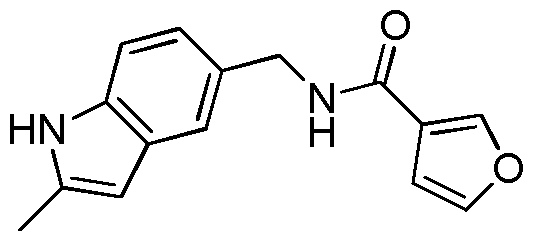
11: N-[(2-methyl-1H-indol-5-yl)methyl]furan-3-carboxamide
Prepared using IM1 and furan-3-carboxylic acid.
LC-MS (m/z) 255 (MH+); tR = 1.09 (Method A).

12: 1, 5-dimethyl-N-[ (2-methyl- 1H-indol-5-yl)methyl]pyrazole-3-carboxamide Prepared using IM1 and 1 ,5-dimethyl-1 H-pyrazole-3-carboxylic acid. LC-MS (m/z) 283 (MH+); tR = 1.18 (Method A).

13: N-[ (2-methyl- 1H-indol-5-yl)methyl]thiophene-2-carboxamide
Prepared using IM1 and thiophene-2-carboxylic acid.
LC-MS (m/z) 271 (MH+); tR = 1.19 (Method A).

14: N-[ (2-methyl- 1 H-indol-5-yl) methyl]- 1 H-pyrrole-2-carboxamide
Prepared using IM1 and 1 H-pyrrole-2-carboxylic acid.
LC-MS (m/z) 254 (MH+); tR = 1.10 (Method A).

15: 4-methyl-N-[ (2-methyl- 1H-indol-5-yl)methyl]isoxazole-5-carboxamide
Prepared using IM1 and 4-methyl-isoxazole-5-carboxylic acid.
LC-MS (m/z) 270 (MH+); tR = 1.24 (Method A).
NH

16: 4-methyl-N-[ 1 -(2-methyl- 1H-indol-5-yl)ethyl]isoxazole-5-carboxamide Prepared using IM2 and 4-methyl-isoxazole-5-carboxylic acid.
LC-MS (m/z) 284 (MH+); tR = 1.32 (Method A).

17: 3-methyl-N-[ (3-methyl- 1H-indol-5-yl)methyl]isoxazole-5-carboxamide Prepared using IM3 and 3-methyl-isoxazole-5-carboxylic acid.
-MS (m/z) 270 (MH+); tR = 1.21 (Method A).

18: 3-methoxy-N-[ 1 -(2-methyl- 1H-indol-5-yl)ethyl]isoxazole-5-carboxamide Prepared using IM2 and 3-methoxy-isoxazole-5-carboxylic acid.
LC-MS (m/z) 300 (MH+); tR = 1.33 (Method A).

19: 3-methoxy-N-[ (2-methyl- 1H-indol-5-yl)methyl]isoxazole-5-carboxamide Prepared using IM1 and 3-methoxy-isoxazole-5-carboxylic acid.
LC-MS (m/z) 286 (MH+); tR = 1.22 (Method A).

20: N-[ (2-methyl- 1H-indol-5-yl)methyl]thiazole-2-carboxamide
Prepared using IM1 and thiazole-2-carboxylic acid.
LC-MS (m/z) 272 (MH+); tR = 1.26 (Method A).

21: 2, 4-dimethyl-N-[ (2-methyl- 1 H-indol-5-yl) methyl]oxazole-5-carboxamide Prepared using IM1 and 2,4-dimethyl-oxazole-5-carboxylic acid.
LC-MS (m/z) 284 (MH+); tR = 0.55 (Method B).
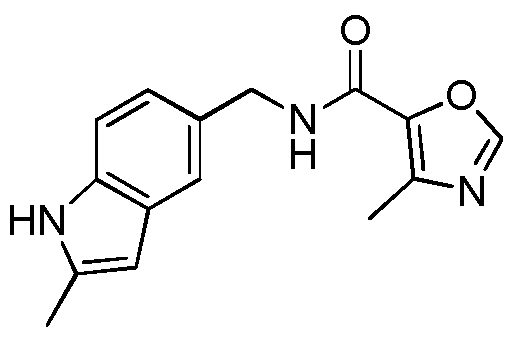
22: 4-methyl-N-[ (2-methyl- 1H-indol-5-yl)methyl]oxazole-5-carboxamide Prepared using IM1 and 4-methyl-oxazole-5-carboxylic acid.
LC-MS (m/z) 270 (MH+); tR = 0.52 (Method B).

23: 3-methyl-N-[ (7-methyl- 1H-indol-5-yl)methyl]isoxazole-5-carboxamide Prepared using IM4 and 3-methyl-isoxazole-5-carboxylic acid.
LC-MS (m/z) 271 (MH+); tR = 0.55 (Method B).

24: 5-methyl-N-[ (2-methyl- 1H-indol-5-yl)methyl]thiophene-2-carboxamide
A round bottomed flask was charged with IM1 (1.00 g, 6.24 mmol), 5-methyl-2- thiophenecarboxylic acid (0.976 g, 6.86 mmol), N,N,N',N'-tetramethyl-0-(7-azabenzotriazol-1- yl)uronium hexafluorophosphate (2.61 g, 6.86 mmol) and triethylamine (1.30 mL, 9.36 mmol) in N,N-dimethylformamide (25.0 mL, 323 mmol). The suspension was stirred at room temperature overnight. To the reaction mixture was added saturated aqueous NaHC03 solution until pH reached 8-10. The mixture was extracted with EtOAc (3 x 100mL). The combined organic layers were washed with brine (3 x 70 ml), dried over MgS04, filtered and evaporated to dryness. Flash chromatography (silica, EtOAc/heptane 1 : 1) gave the target molecule as a colorless solid (0.790g, 44%).
LC-MS (m/z) 285 (MH+); tR = 1.37. (Method A). The following compounds were prepared analogously:

25: 2-methyl-N-[ (2-methyl- 1H-indol-5-yl)methyl]thiazole-4-carboxamide
Prepared using IM1 and 2-methyl-thiazole-4-carboxylic acid.
LC-MS (m/z) 287 (MH+); tR = 1.36 (Method A).

26: N-[ (2-methyl- 1H-indol-5-yl)methyl]isoxazole-5-carboxamide
Prepared using IM1 and isoxazole-5-carboxylic acid.
LC-MS (m/z) 256 (MH+); tR = 1.03 (Method A).
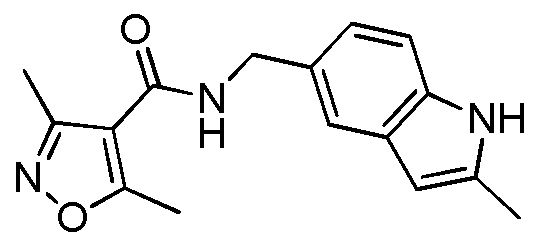
27: 3, 5-dimethyl-N-[ (2-methyl- 1H-indol-5-yl)methyl]isoxazole-4-carboxamide Prepared using IM1 and 3,5-dimethyl-isoxazole-4-carboxylic acid.
LC-MS (m/z) 284 (MH+); tR = 1.15 (Method A).

28: 3-methyl-N-[ (2-methyl- 1H-indol-5-yl)methyl]isoxazole-5-carboxamide Prepared using IM1 and 3-methyl-isoxazole-5-carboxylic acid.
LC-MS (m/z) 270 (MH+); tR = 1.17 (Method A).

29: 1-methyl-N-[ (2-methyl- 1H-indol-5-yl)methyl]pyrazole-4-carboxamide Prepared using IM1 and 1 -methyl-1 H-pyrazole-4-carboxylic acid.
LC-MS (m/z) 269 (MH+); tR = 0.95 (Method A).

30: 1-methyl-N-[[2-(trifluoromethyl)-1H-indol-5-yl]methyl]pyrazole-4-carboxamide Prepared using IM5 and 1 -methyl-1 H-pyrazole-4-carboxylic acid.
LC-MS (m/z) 323 (MH+); tR = 1.30 (Method A).

Prepared using IM5 and isoxazole-5-carboxylic acid.
LC-MS (m/z) 310 (MH+); tR = 1.38 (Method A).

32: 2-methyl-N-[ (2-methyl- 1 H-indol-5-yl)methyl]-3-oxo- 1 H-pyrazole-5-carboxamide
Prepared using IM1 and IM42.
LC-MS (m/z) 285 (MH+); tR = 1.03 (Method A).

33: 3-methyl-N-[ 1 -(2-methyl- 1H-indol-5-yl)ethyl]isoxazole-5-carboxamide
Prepared using IM2 and 3-methyl-isoxazole-5-carboxylic acid.
LC-MS (m/z) 284 (MH+); tR = 1.24 (Method A).

34: 3-isopropyl-N-[ (2-methyl- 1H-indol-5-yl)methyl]isoxazole-5-carboxamide Prepared using IM1 and 3-isopropyl-isoxazole-5-carboxylic acid.
LC-MS (m/z) 298 (MH+); tR = 1.44 (Method A).

Prepared using IM1 and 2-methyl-thiazole-5-carboxylic acid.
LC-MS (m/z) 286 (MH+); tR = 1.17 (Method A).

36: N-[(2-methyl-1H-indol-5-yl)methyl]-1-(2,2,2-trifluoroethyl)pyrazole-4-carboxamide
Prepared using IM1 and IM29.
LC-MS (m/z) 337 (MH+); tR = 1.24 (Method A).

37: 1-methyl-N-[ (2-methyl- 1H-indol-5-yl)methyl]pyrrole-3-carboxamide
Prepared using IM1 and 1 -methyl-1 H-pyrrole-3-carboxylic acid.
LC-MS (m/z) 268 (MH+); tR = 1.09 (Method A).

38: N-[ 1-( 1H-indol-5-yl)ethyl]-3-methyl-isoxazole-5-carboxamide
Prepared using IM6 and 3-methyl-isoxazole-5-carboxylic acid.
LC-MS (m/z) 144 (MH+); tR = 1.12 (Method A).

39: 3-methyl-N-[(6-methyl-1H-indol-5-yl)methyl]isoxazole-5-carboxamide
Prepared using IM7 and 3-methyl-isoxazole-5-carboxylic acid.
LC-MS (m/z) 270 (MH+); tR = 1.09 (Method A).

40: 1-(2, 2, 2-trifluoroethyl)-N-[[2-(trifluoromethyl)- 1H-indol-5-yl]methyl]pyrazole-4-carboxamide Prepared using IM5 and IM29.
LC-MS (m/z) 391 (MKT); tR = 1.48 (Method A).

41: N-[(2,3-dimethyl-1H-indol-5-yl)methyl]-3-methyl-isoxazole-5-carboxamide
Prepared using IM8 and 3-methyl-isoxazole-5-carboxylic acid.
LC-MS (m/z) 284 (MKT); tR = 1.28 (Method A).
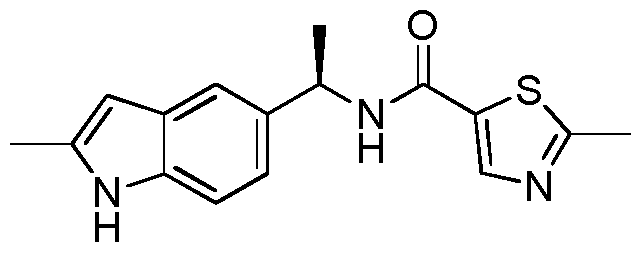
42: 2-methyl-N-[(1 R)- 1 -(2-methyl- 1H-indol-5-yl)ethyl]thiazole-5-carboxamide
Prepared using IM9 and 2-methyl-thiazole-5-carboxylic acid.
LC-MS (m/z) 300 (MKT); tR = 1.18 (Method A).

43: 1-ethyl-N-[(1R)- 1 -(2-methyl- 1H-indol-5-yl)ethyl]pyrazole-4-carboxamide
Prepared using IM9 and 1 -ethyl-1 H-pyrazole-4-carboxylic acid.
LC-MS (m/z) 298 (MKT); tR = 1.14 (Method A).

44: 1-methyl-N-[ (1R)- 1 -(2-methyl- 1H-indol-5-yl)ethyl]pyrazole-4-carboxamide
Prepared using IM9 and 1 -methyl-1 H-pyrazole-4-carboxylic acid.
LC-MS (m/z) 283 (MH+); tR = 1.04 (Method A).

45: 3-methyl-N-[(1S)-2,2,2-trifluoro-1-(2-methyl-1H-indol-5-yl)ethyl]isoxazole-5-carboxamide Prepared using IM10 and 3-methyl-isoxazole-5-carboxylic acid.
LC-MS (m/z) 339 (MH+); tR = 1.07 (Method A).

46: 1-(2-methoxyethyl)-N-[(1R)- 1 -(2-methyl- 1H-indol-5-yl)ethyl]pyrazole-4-carboxamide
Prepared using IM9 and IM30.
LC-MS (m/z) 327 (MH+); tR = 1.17 (Method A).

47: 3-methyl-N-[ (1R)- 1 -(2-methyl- 1H-indol-5-yl)ethyl]isothiazole-5-carboxamide
Prepared using IM9 and 3-methyl-isothiazole-5-carboxylic acid.
LC-MS (m/z) 300 (MH+); tR = 1.14 (Method A).

Prepared using IM9 and IM31.
LC-MS (m/z) 315 (MH+); tR = 0.53 (Method C).

49: N-[ (2-methyl- 1 H-indol-5-yl) methyl]- 1-(oxetan-3-yl)pyrazole-4-carboxamide
Prepared using IM1 and IM32.
LC-MS (m/z) 31 1 (MH+); tR = 0.46 (Method C).

50: 2-methyl-N-[ (2-methyl- 1H-indol-5-yl)methyl]oxazole-5-carboxamide
Prepared using IM1 and 2-methyl-oxazole-5-carboxylic acid.
LC-MS (m/z) 270 (MH+); tR = 0.49 (Method C).

51: N-[(2-methyl-1H-indol-5-yl)methyl]-1-tetrahydrofuran-3-yl-pyrazole-4-carboxamide
Prepared using IM1 and IM33.
LC-MS (m/z) 325 (MH+); tR = 0.48 (Method C).
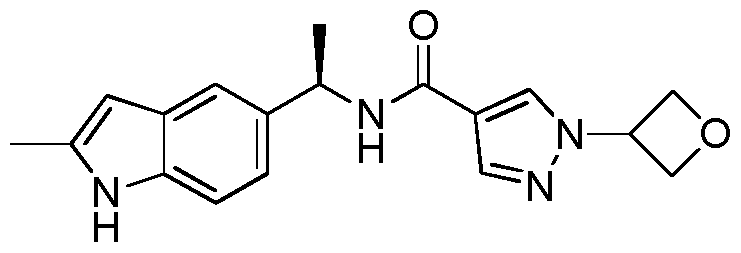
52: N-[(1R)- 1 -(2-methyl- 1 H-indol-5-yl)ethyl]- 1-(oxetan-3-yl)pyrazole-4-carboxamide
Prepared using IM9 and IM32.
1 H NMR (500 MHz, DMSO) δ 10.80 (s, 1 H), 8.43 - 8.26 (m, 2H), 8.04 (s, 1 H), 7.37 (s, 1 H), 7.19 (d, 1 H), 7.01 (d, 1 H), 6.07 (s, 1 H), 5.66 - 5.55 (m, 1 H), 5.28 - 5.12 (m, 1 H), 4.89 (m, 4H), 2.36 (s, 3H), 1.48 (d, 3H).

53: N-[ (1R)- 1-(4-fluoro-2-methyl- 1H-indol-5-yl)ethyl]-3-methyl-isoxazole-5-carboxamide Prepared using IM11 and 3-methyl-isoxazole-5-carboxylic acid. The final compound was purified by preparative HPLC (Method G) followed by preparative SFC (Method K).
1 HNMR (CDCIs, 400 MHz): δ 7.99 (s, 1 H), 7.05-6.99 (m, 2 H), 6.71 (s, 1 H), 6.30 (s, 1 H), 5.55- 5.47 (m, 1 H), 2.44 (s, 3H), 2.34 (s, 3H), 1.60 (d, 3 H).

54: N-[(1S)-1-(4-fluoro-2-methyl-1H-indol-5-yl)ethyl]-3-methyl-isoxazole-5-carboxam
Prepared using IM11 and 3-methyl-isoxazole-5-carboxylic acid. The final compound was purified by preparative HPLC (Method G) followed by preparative SFC (Method K).
1 HNMR (CDCI3, 400 MHz): δ 8.07(s, 1 H), 7.05-6.99 (m, 2 H), 6.71 (s, 1 H), 6.29 (s, 1 H), 5.55- 5.48 (m, 1 H), 2.44 (s, 3H), 2.34 (s, 3H), 1.66 (d, 3 H).

55: 2, 5-dimethyl-N-[ (2-methyl- 1H-indol-5-yl)methyl]pyrazole-3-carboxamide
Prepared using IM1 and 2,5-dimethyl-2H-pyrazole-3-carboxylic acid.
LC-MS (m/z) 283 (MH+); tR = 1.22 (Method ).

56: 4-chloro-3-methyl-N-[ (2-methyl- 1H-indol-5-yl)methyl]isoxazole-5-carboxamide
Prepared using IM1 and IM34.
1 H NMR (CDCIs 400 MHz): δ 7.96 (br s, 1 H), 7.47 (s, 1 H), 7.25-7.27 (m, 1 H), 7.08 (m, 1 H), 6.72 (br s, 1 H), 6.19 (s, 1 H), 4.67 (d, 2 H), 2.44 (s, 3 H), 2.23 (s, 3 H).

57: 1-methyl-N-[(2-methyl-1H-indol-5-yl)methyl]pyrrole-2-carboxamide
1-Methyl-1 H-pyrrole-2-carboxylic acid (0.100 g, 0.799 mmol) and 1-hydroxybenzotriazole (0.119 g, 0.879 mmol) was dissolved in N,N-Dimethylformamide (5 mL, 60 mmol). N-(3- Dimethylaminopropyl)-N'-ethylcarbodiimide hydrochloride (0.168 g, 0.879 mmol) was added and the mixture stirred at room temperature for 2 hours. Compound IM1 (0.141 g, 0.879 mmol) and triethylamine (0.167 mL, 1.20 mmol) was added and the mixture was stirred at room temperature overnight. The mixture was quenched with water and extracted with EtOAc. The combined organic layers were washed with brine and dried over Na2S04 and evaporated to dryness. Flash chromatography (silica, EtOAc: heptanes 1 : 1) gave the title compound (149 mg, 70%).
LC-MS (m/z) 268 (MH+); tR = 1.29 (Method A).
The following compounds were prepared analogously:

Prepared using IM12 and 3-methyl-isoxazole-5-carboxylic acid.
LC-MS (m/z) 256 (MH+); tR = 0.98 (Method A).

59: N-( 1 H-indol-5-ylmethyl)-3, 4-dimethyl-2-oxo-thiazole-5-carboxamide
Prepared using IM12 and 3,4-dimethyl-2-oxo-2,3-dihydro-thiazole-5-carboxylic acid.
LC-MS (m/z) 302 (MH+); tR = 0.97 (Method A).

60: 3, 4-dimethyl-N-[ (2-methyl- 1H-indol-5-yl)methyl]-2-oxo-thiazole-5-carboxamide Prepared using IM1 and 3,4-dimethyl-2-oxo-2,3-dihydro-thiazole-5-carboxylic acid.
LC-MS (m/z) 316 (MH+); tR = 1.10 (Method A).

61 : 3-methyl-N-[ (1R)- 1 -(2-methyl- 1 H-indol-5-yl) ethyl]isoxazole-5-carboxamide
Prepared using IM9 and 3-methyl-isoxazole-5-carboxylic acid.
LC-MS (m/z) 284 (MH+); tR = 1.25 (Method A).

62: 3-methyl-N-[ (1S)- 1 -(2-methyl- 1 H-indol-5-yl) ethyl]isoxazole-5-carboxamide
Prepared using IM13 and 3-methyl-isoxazole-5-carboxylic acid.
LC-MS (m/z) 284 (MH+); tR = 1.25 (Method A).

63: N-[[1-(difluoromethyl)indol-5-yl]methyl]-3-methyl-isoxazole-5-carboxamide
Prepared using IM14 and 3-methyl-isoxazole-5-carboxylic acid.
LC-MS (m/z) 306 (MKT); tR = 1.29 (Method A).

64: N-[[1-(difluoromethyl)-2-methyl-indol-5-yl]methyl]-3-methyl-isox^^
Prepared using IM15 and 3-methyl-isoxazole-5-carboxylic acid.
1 H NMR (DMSO, 400 MHz) δ 9.43-9.40 (1 H, m), 8.07-7.77(1 H, t, J = 58.4 Hz), 7.58 -7.56 (1 H, d), 7.42 (1 H, s), 7.17-7.14 (1 H, d), 6.93 (1 H, s), 6.39 (1 H, s), 4.50-4.49 (2H, m), 2.47 (3H, s), 2.29 (3H, s).

65: 3-methyl-N-[[2-(trifluoromethyl)- 1H-indol-5-yl]methyl]isoxazole-5-carboxamide Prepared using IM5 and 3-methyl-isoxazole-5-carboxylic acid.
LC-MS (m/z) 324 (MH+); tR = 1.43 (Method A).
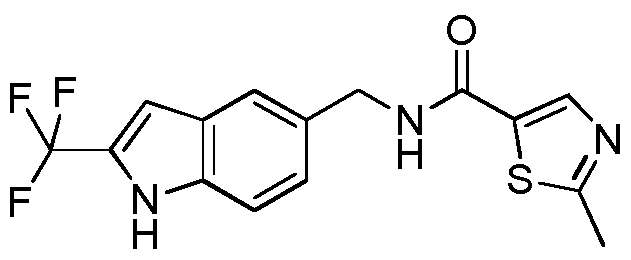
66: 2-methyl-N-[[2-(trifluoromethyl)- 1H-indol-5-yl]methyl]thiazole-5-carboxamide
Prepared using IM5 and 2-methyl-thiazole-5-carboxylic acid.
LC-MS (m/z) 340 (MH+); tR = 1.46 (Method A).

67: 3-isopropyl-N-[[2-(trifluoromethyl)-1H-indol-5-yl]methyl]isoxazole-5-ca
Prepared using IM5 and 3-isopropyl-isoxazole-5-carboxylic acid.
LC-MS (m/z) 352 (MKT); tR = 1.74 (Method A).

68: N-[[ 1-(difluoromethyl)indol-5-yl]methyl]-1-(2, 2, 2-trifluoroethyl)pyrazole-4-carboxamide
Prepared using IM14 and IM29.
LC-MS (m/z) 373 (MKT); tR = 1.34 (Method A).

69: N-[[ 1-(difluoromethyl)-2-methyl-indol-5-yl]methyl]- 1-(2, 2, 2-trifluoroethyl)pyrazole-4- carboxamide
Prepared using IM15 and IM29.
LC-MS (m/z) 387 (MKT); tR = 1.45 (Method A).

70: N-[[ 1-(difluoromethyl)-2-methyl-indol-5-yl]methyl]-3-(2, 2, 2-trifluoroethyl)isoxazole-5- carboxamide
Prepared using IM15 and IM35.
1 H NMR (DMSO, 400 MHz) δ 9.55-9.52 (1 H, m), 8.07-7.78 (1 H, t, J = 58.4 Hz), 7.59-7.57 (1 H, d), 7.44 (1 H, s), 7.18-7.16 (1 H, m), 7.14 (1 H, s), 6.40 (1 H, s), 4.51-4.50 (2H, m), 4.04- 3.95 (2H, m), 2.47 (3H, s).

71: 1-isopropyl-N-[(2-methyl-1H-indol-5-yl)methyl]pyrazole-4-carboxamide
Prepared using IM1 and 1 -isopropyl-1 H-pyrazole-4-carboxylic acid.
LC-MS (m/z) 297 (MH+); tR = 1.16 (Method A).

72: N-[[ 1-(difluoromethyl)indol-5-yl]methyl]-3-(2, 2, 2-trifluoroethyl)isoxazole-5-carboxamide Prepared using IM14 and IM35.
1 H NMR (DMSO, 400 MHz) δ 9.58-9.55 (1 H, m), 8.11-7.81 (1 H, t, J = 59.6 Hz), 7.65 -7.58 (3H, m), 7.27-7.25 (1 H, d), 7.14 (1 H, s), 6.68-6.67 (1 H, m), 4.54-4.53 (2H, m), 4.04-3.95 (2H, m).

73: 3-methyl-N-[[2-(trideuteriomethyl)-1H-indol-5-yl]methyl]i^
Prepared using IM16 and 3-methyl-isoxazole-5-carboxylic acid.
LC-MS (m/z) 273 (MH+); tR = 1.16 (Method A).
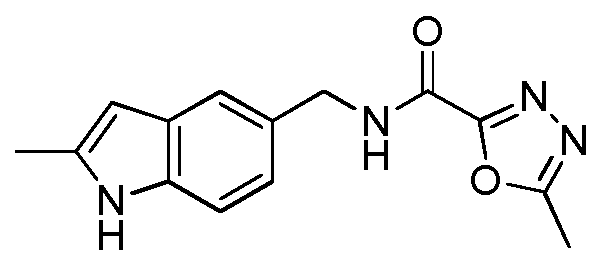
74: 5-methyl-N-[ (2-methyl- 1 H-indol-5-yl) methyl]- 1, 3, 4-oxadiazole-2-carboxamide
Prepared using IM1 and 5-methyl-[1 ,3,4]oxadiazole-2-carboxylic acid.
LC-MS (m/z) 271 (MH+); tR = 0.97 (Method A).

75: 5-ethyl-N-[ (2-methyl- 1H-indol-5-yl)methyl]isoxazole-3-carboxamide
Prepared using IM1 and 5-ethyl-isoxazole-3-carboxylic acid.
LC-MS (m/z) 284 (MH+); tR = 1.38 (Method A).

76: 2-methyl-N-[ (2-methyl- 1H-indol-5-yl)methyl]oxazole-4-carboxamide
Prepared using IM1 and 2-methyl-oxazole-4-carboxylic acid.
LC-MS (m/z) 270 (MH+); tR = 1.16 (Method A).

77: 5-methyl-N-[ (2-methyl- 1 H-indol-5-yl) methyl]- 1, 2, 4-oxadiazole-3-carboxamide Prepared using IM1 and 5-methyl-[1 ,2,4]oxadiazole-3-carboxylic acid.
LC-MS (m/z) 271 (MH+); tR = 1.02 (Method A).

78: N-[[2-(trideuteriomethyl)- 1H-indol-5-yl]methyl]-3-(2, 2, 2-trifluoroethyl)isoxazole-5- carboxamide
Prepared using IM16 and IM35.
LC-MS (m/z) 341 (MH+); tR = 1.35 (Method A).

79: N-[ (2-methyl- 1 H-indol-5-yl)methyl]-3-(2, 2, 2-trifluoroethyl)isoxazole-5-carboxamide Prepared using IM1 and IM35.
LC-MS (m/z) 338 (MH+); tR = 1.35 (Method A).

80: 3-methyl-N-[[1-(trifluoromethyl)indol-5-yl]methyl]iso
Prepared using IM17 and 3-methyl-isoxazole-5-carboxylic acid.
LC-MS (m/z) 324 (MH+); tR = 1.57 (Method A).
81: 1-(2,2,2-trifluoroethyl)-N-[[1-(trifluoromethyl)indol-5-yl]methyl]pyrazole-^^
Prepared using IM17 and IM29.
LC-MS (m/z) 391 (MH+); tR = 1.61 (Method A).

82: N-[[2-(trideuteriomethyl)- 1 H-indol-5-yl]methyl]- 1-(2, 2, 2-trifluoroethyl)pyrazole-4- carboxamide
Prepared using IM16 and IM29.
LC-MS (m/z) 340 (MKT); tR = 1.17 (Method A).

83: N-[[2-methyl- 1-(trifluoromethyl)indol-5-yl]methyl]- 1-(2, 2, 2-trifluoroethyl)pyrazole-4- carboxamide
Prepared using IM18 and IM29.
LC-MS (m/z) 405 (MKT); tR = 1.72 (Method A).

84: 3-methyl-N-[[2-methyl- 1-(trifluoromethyl)indol-5-yl]methyl]isoxazole-5-carboxamide Prepared using IM18 and 3-methyl-isoxazole-5-carboxylic acid.
LC-MS (m/z) 338 (MKT); tR = 1.70 (Method A).
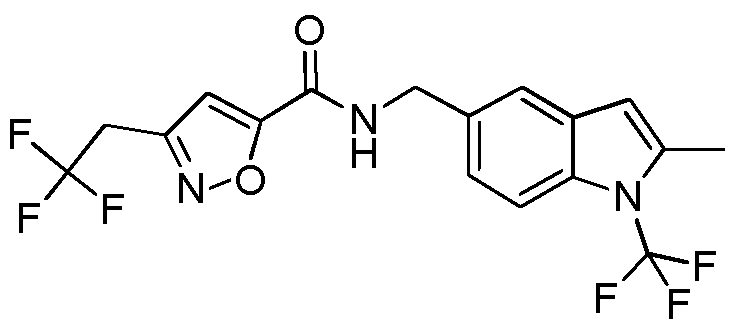
85: N-[[2-methyl- 1-(trifluoromethyl)indol-5-yl]methyl]-3-(2, 2, 2-trifluoroethyl)isoxazole-5- carboxamide
Prepared using IM18 and IM35.
1 H NMR (DMSO, 400 MHz) δ: 9.58-9.56 (1 H, m), 7.52-7.49 (2H, m), 7.26-7.25 (1 H, m), 7.14 (1 H, s), 6.59 (1 H, s), 4.53-4.51 (2H, d), 4.04-3.95 (2H, m), 2.50 (3H, m).

86: N-[(1R)- 1 -(2-methyl- 1 H-indol-5-yl)ethyl]- 1-(2, 2, 2-trifluoroethyl)pyrazole-4-carboxamide
Prepared using IM9 and IM29.
LC-MS (m/z) 351 (MH+); tR = 1.28 (Method A).

87: 5-tert-butyl-N-[ (2-methyl- 1H-indol-5-yl)methyl]isoxazole-3-carboxamide
Prepared using IM1 and 5-tert-butyl-isoxazole-3-carboxylic acid.
LC-MS (m/z) 312 (MH+); tR = 1.64 (Method A).

88: N-[[ 1-methyl-2-(trifluoromethyl)indol-5-yl]methyl]- 1-(2, 2, 2-trifluoroethyl)pyrazole-4- carboxamide
Prepared using IM19 and IM29.
LC-MS (m/z) 405 (MH+); tR = 1.65 (Method A).

Prepared using IM19 and 3-methyl-isoxazole-5-carboxylic acid.
LC-MS (m/z) 338 (MH+); tR = 1.62 (Method A).

90: N-[[ 1-methyl-2-(trifluoromethyl)indol-5-yl]methyl]-3-(2, 2, 2-trifluoroethyl)isoxazole-5- carboxamide
Prepared using IM19 and IM35.
LC-MS (m/z) 406 (MH+); tR = 1.79 (Method A).

91 : N-[[2-(difluoromethyl) - 1 H-indol-5-yl]methyl]- 1-(2,2, 2-trifluoroethyl) pyrazole-4-carboxamide
Prepared using IM20 and IM29.
LC-MS (m/z) 373 (MKT); tR = 1.21 (Method A).

92: N-[[2-(difluoromethyl)-1H-indol-5-yl]methyl]-3-methyl-isoxazole-5-carboxa
Prepared using IM20 and 3-methyl-isoxazole-5-carboxylic acid. 1 H NMR (DMSO, 400 MHz) δ 11.72 (1 H, br s), 9.42-9.39 (1 H, m), 7.53 (1 H, s), 7.39-7.37
(1 H, m), 7.33-7.06 (2H, m ), 6.93 (1 H, s), 6.75-6.74 (1 H, m), 4.50-4.49 (2H, m), 2.28 (3H, s).

93: N-[[2-(difluoromethyl)- 1 H-indol-5-yl]methyl]-3-(2, 2, 2-trifluoroethyl)isoxazole-5- carboxamide
Prepared using IM20 and IM35.
1 H NMR (DMSO, 400 MHz) δ 11.74 (1 H, br s), 9.54-9.51 (1 H, m), 7.55 (1 H, s), 7.40-7.38 (1 H, m), 7.33-7.06 (3H, m), 6.75 (1 H, s), 4.52-4.51 (2H, m), 4.03-3.95 (2H, m).

94: 1-(2-fluoroethyl)-N-[ (2-methyl-1H-indol-5-yl)methyl]pyrazole-3-carboxamide
Prepared using IM1 and IM36.
LC-MS (m/z) 301 (MH+); tR = 1.09 (Method A).

95: 1-(2-methoxyethyl)-N-[(2-methyl-1H-indol-5-yl)methyl]pyrazole-3-carboxam^
Prepared using IM1 and IM37.
LC-MS (m/z) 313 (MH+); tR = 1.12 (Method A).

96: 3-methyl-N-[ 1-[2-(trifluoromethyl)- 1H-indol-5-yl]ethyl]isoxazole-5-carboxamide
Prepared using IM21 and 3-methyl-isoxazole-5-carboxylic acid.
LC-MS (m/z) 339 (MH+); tR = 1.52 (Method A).

97: 3-methyl-N-[ 1-[2-(trifluoromethyl)- 1H-indol-5-yl]ethyl]isoxazole-5-carboxamide Prepared using IM22 and 3-methyl-isoxazole-5-carboxylic acid.
LC-MS (m/z) 339 (MH+); tR = 1.51 (Method A).

98: 3-(methoxymethyl)-N-[ (2-methyl-1H-indol-5-yl)methyl]isoxazole-5-carboxamide Prepared using IM1 and IM38.
LC-MS (m/z) 300 (MH+); tR = 1.13 (Method A).

99: 1-(2-fluoroethyl)-N-[(2-methyl-1H-indol-5-yl)methyl]pyrazole-4-carboxamide Prepared using IM1 and IM31.
LC-MS (m/z) 301 (MKT); tR = 0.98 (Method A).

700; 1-(2-methoxyethyl)-N-[(2-methyl-1H-indol-5-yl)methyl]pyrazole-4-carboxamide Prepared using IM1 and IM30.
LC-MS (m/z) 313 (MKT); tR = 1.02 (Method A).

101: N-[(2,3-dimethyl-1H-indol-5-yl)methyl]-1-(2,2,2-trifluoroethy
Prepared using IM8 and IM29.
LC-MS (m/z) 351 (MKT); tR = 1.33 (Method ).

102: N-[(1R)- 1-(6-fluoro-2-methyl- 1 H-indol-5-yl) ethyl]-3-methyl-isoxazole-5-carboxamide Prepared using IM23 and 3-methyl-isoxazole-5-carboxylic acid. The title compound was purified by preparative HPLC (Method I).
1 H NMR (DMSO, 400 MHz) δ 10.91 (1 H, s), 9.23-9.21 (1 H, m), 7.43-7.41 (1 H, m), 7.01-6.95 (2H, m), 6.08 (1 H, s), 5.42-5.35 (1 H, m), 2.33 (3H, s), 2.29 (3H, s), 1.49-1.47 (3H, m).

103: N-[(1R)- 1-(6-fluoro- 7 -methyl- 1 H-indol-5-yl) ethyl]-3-methyl-isoxazole-5-carboxamide Prepared using IM23 and 3-methyl-isoxazole-5-carboxylic acid. The title compound was purified by preparative HPLC (Method I).
1 H NMR (DMSO, 400 MHz) δ 1 1.11 (1 H, s), 9.23-9.21 (1 H, m), 7.40-7.39 (1 H, m), 7.31-7.30 (1 H, m), 6.96 (1 H, s), 6.40-6.39 (1 H, m), 5.41-5.37 (1 H, t), 2.38 (3H, s), 2.37 (3H, s), 1.50- 1.48 (3H, d).

104: N-[( 6-fluoro-2-methyl- 1 H-indol-5-yl) methyl]-3-methyl-isoxazole-5-carboxamide Prepared using IM24 and 3-methyl-isoxazole-5-carboxylic acid. 1 H NMR (DMSO, 400 MHz) δ 10.93 (1 H, br s), 9.31-9.28 (1 H, m), 7.32-7.31 (1 H, m), 7.04- 7.01 (1 H, d), 6.94 (1 H, s), 6.08 (1 H, s), 4.50-4.49 (2H, m), 2.33 (3H, s), 2.28 (3H, s).

105: N-[( 6-fluoro- 7 -methyl- 1 H-indol-5-yl) methyl]-3-methyl-isoxazole-5-carboxamide Prepared using IM24 and 3-methyl-isoxazole-5-carboxylic acid. The title compound was purified by preparative HPLC (Method I).
1 H NMR (DMSO, 400 MHz) δ 11.14 (1 H, s), 9.29 (1 H, br s), 7.31-7.29 (2H, ), 6.95 (1 H, s), 6.40 (1 H, s), 4.52-4.50 (2H, m), 2.38 (3H, s), 2.29 (3H, s).

106: 3-(2-fluoroethyl)-N-[ (2-methyl- 1H-indol-5-yl)methyl]isoxazole-5-carboxamide
Prepared using IM1 and IM39.
LC-MS (m/z) 302 (MH+); tR = 0.58 (Method C).

107: 3-methyl-N-[ (2-methyl- 1H-indol-5-yl)methyl]isothiazole-5-carboxamide
Prepared using IM1 and 3-methyl-isothiazole-5-carboxylic acid.
LC-MS (m/z) 286 (MKT); tR = 0.59 (Method C).

108: 3-methyl-N-[[2-(2, 2, 2-trifluoroethyl)- 1H-indol-5-yl]methyl]isoxazole-5-carboxamide Prepared using IM25 and 3-methyl-isoxazole-5-carboxylic acid.
LC-MS (m/z) 339 (MKT); tR = 0.64 (Method C).

109: N-[ (7-fluoro-2-methyl- 1 H-indol-5-yl) methyl]-3-methyl-isoxazole-5-carboxamide
Prepared using IM26 and 3-methyl-isoxazole-5-carboxylic acid. The title compound was purified by preparative HPLC (Method I).
1 H NMR (DMSO, 400 MHz) δ 1 1.29 (1 H, s), 9.39-9.36 (1 H, m), 7.15 (1 H, s), 6.93 (1 H, s), 6.80-6.67 (1 H, m), 6.16 (1 H, s), 4.46-4.44 (2H, d), 2.36 (3H, s), 2.28 (3H, s).

110: N-[ (4-fluoro-2-methyl- 1H-indol-5-yl)methyl]-3-methyl-isoxazole-5-carboxamide Prepared using IM27 and 3-methyl-isoxazole-5-carboxylic acid.
1 H-NMR (CDCI3, 400 MHz) δ 7.99 (s, 1 H), 7.24-7.02 (m, 2 H), 6.81 (br s, 1 H), 6.73 (s, 1 H), 6.29-6.28 (m, 1 H), 4.73-4.71 (q, 2H), 2.43 (3H, d), 2.33 (s, 3H).

111: N-[(1R)- 1-(7-fluoro-2-methyl- 1 H-indol-5-yl) ethyl]-3-methyl-isoxazole-5-carboxamide Prepared using IM28 and 3-methyl-isoxazole-5-carboxylic acid. 1 H NMR (DMSO, 400 MHz) δ 1 1.27 (1 H, s), 9.21-9.19 (1 H, d), 7.20 (1 H, s), 6.93 (1 H, s), 6.89-6.87 (1 H, m), 6.16 (1 H, s), 5.17-5.14 (1 H, m), 2.36 (3H, s), 2.28 (3H, s), 1.49-1.48 (3H, d).

112: 3-(methoxymethyl)-N-[ (1R)- 1-(2-methyl- 1H-indol-5-yl)ethyl]isoxazole-5-carboxamide Compound IM38 (0.429 g, 2.73 mmol) was dissolved in N,N-Dimethylformamide (5.00 ml_, 64.6 mmol) and tetrahydrofuran (40.0 ml_). To this mixture was added N,N- Carbonyldiimidazole (0.488 g, 3.01 mmol) and the mixture was refluxed for 25 minutes. To this mixture was added IM9 (0.650 g, 3.73 mmol) and the mixture was refluxed for 1 hour. The mixture was evaporated to dryness. Flash chromatography (silica, EtOAc: heptanes 1 :1) gave the title compound as a light yellow foam (0.22g, 24%).
LC-MS (m/z) 315 (MH+); tR = 0.60 (Method C). The following compounds were prepared analogously:

113: 3-(2-fluoroethyl)-N-[(1R)-1-(2-methyl-1H-indol-5-yl)ethy ^
Prepared using IM9 and IM39.
1 H NMR (500 MHz, DMSO) δ 10.83 (s, 1 H), 9.23 (d, 1 H), 7.39 (s, 1 H), 7.21 (d, 1 H), 7.09 (s, 1 H), 7.04 (m, 1 H), 6.08 (s, 1 H), 5.25 - 5.13 (m, 1 H), 4.80-4.78 (t, 1 H), 4.71-4.68 (t, 1 H), 3.14- 3.07 (m, 2H), 2.37 (s, 3H), 1.52-1.50 (d, 3H).

114: 3-(methoxymethyl)-N-[[2-(trifluoromethyl)-1H-indol-5-yl]m
Prepared using IM5 and IM38.
1 H NMR (600 MHz, DMSO) δ 12.24 (s, 1 H), 9.53 (m, 1 H), 7.61 (s, 1 H), 7.45 (d, 1 H), 7.28 (m, 1 H), 7.09 (s, 1 H), 7.01 (s, 1 H), 4.53 (s, 4H), 3.35 (s, 3H).

115: 3-(2-fluoroethyl)-N-( 1H-indol-5-ylmethyl)isoxazole-5-carboxamide
Prepared using IM12 and IM39.
LC-MS (m/z) 288 (MH+); tR = 0.51 (Method C).

116: 5-methyl-N-[ (2-methyl- 1H-indol-5-yl)methyl]oxazole-2-carboxamide
To a solution of 5-methyl-oxazole-2-carboxylic acid ethyl ester (300 mg, 1.94 mmol) in tolu- ene (5 ml_) at 0 °C was added AI(CH3)3 (1.5 ml_, 2.90 mmol). The mixture was stirred for 5 min. Compound IM1 (72 mg, 2.32 mmol) was added and then the mixture was heated to 110 °C for 1 h in a sealed tube. The reaction was quenched with 5% aqueous HCI (4 ml_) and then diluted with EtOAc (35 ml_). The organic layer was washed with water (2x15 ml_). The organic layer was evaporated to dryness. Flash chromatography (silica, EtOAc: heptanes 1 :1) gave the title compound as a yellow solid (165 mg, 33%).
LC-MS (m z) 270 (MH+); tR = 0.55 (Method C).

117: N-[ (2-methyl- 1 H-indol-5-yl)methyl]-5, 6-dihydro-4H-pyrrolo[ 1, 2-b]pyrazole-3-carboxamide Prepared using IM1 and IM40.
1 H NMR (DMSO-d6, 400 MHz) δ 10.79 (1 H, br s), 8.31-8.28 (1 H, m), 7.91 (1 H, s), 7.28 (1 H, s), 7.19-7.17 (1 H, d), 6.94-6.92 (1 H, d), 6.05 (1 H, s), 4.43-4.41 (2H, m), 4.06-4.03 (2H, m), 2.99-2.95 (2H, m), 2.58-2.50 (2H, m), 2.35 (3H, s).

118: N-[ (2-methyl- 1 H-indol-5-yl)methyl]-5, 6-dihydro-4H-pyrrolo[ 1, 2-b]pyrazole-2-carboxamide Prepared using IM1 and IM41.
1 H NMR (DMSO, 400 MHz) δ 10.79 (1 H, s), 8.38-8.35 (1 H, m), 7.28 (1 H, s), 7.17-7.15 (1 H, d), 6.95-6.93 (1 H, d), 6.36 (1 H, s), 6.04 (1 H, s), 4.43-4.41 (2H, m), 4.10-4.07 (2H, m), 2.86- 2.82 (2H, m), 2.57-2.50 (2H, m), 2.34 (3H, s).

119: 3-methyl-N-[ (2-methyl- 1 H-indol-5-yl)methyl]- 1,2, 4-oxadiazole-5-carboxamide
A mixture of compound IM1 (160 mg, 1 mmol) and 3-methyl-[1 ,2,4]oxadiazole-5-carboxylic acid ethyl ester (156 mg, 1 mmol) in anhydrous EtOH (3 ml_) was stirred at reflux for 15 h. The mixture was evaporated to dryness and the residue was purified by preparative TLC (silica, EtOAc: petroleum ether 1 : 1) to give the title compound as a yellow solid (210 mg, 78%). 1 H NMR (CDCIs 400 MHz) δ 7.87 (s, 1 H), 7.40 (s, 1 H), 7.22-7.16 (m, 2 H), 7.02-6.98 (m, 1 H), 6.13 (s, 1 H), 4.62 (m, 2 H), 2.38 (s, 3 H), 2.36 (s, 3 H).

Step 1 :
Lithium tetrahydroaluminate (6.00 g, 158 mmol) was suspended in THF (400 mL) and heated to reflux. A mixture of 5-cyano-1 H-indole-2-carboxylic acid ethyl ester (7.90 g, 36.9 mmol) in THF (125 mL) was added dropwise over 30 min. The mixture was refluxed for another 20 min. The mixture was cooled to 0 °C and water (12 mL), NaOH solution (4M, 6 mL) and the water (30 mL) was sequentially carefully added. MgS04 was added and the mixture stirred for 5 min. The mixture was filtered and the filtrate was evaporated to dryness. Flash chromatography (silica, EtOAc:EtOH:tri ethyl amine 70:25:5) gave crude (5-aminomethyl-1 H-indol-2-yl)- methanol as a yellow oil (1.25g, 16%) which was used without further purification.
Step 2:
3-methyl-isothiazole-5-carboxylic acid (0.50 g, 3.49 mmol), N,N,N\N'-tetramethyl-0-(7- azabenzotriazol-1-yOuronium Hexafluorophosphate (1.38 g, 3.63 mmol), triethyl amine (1.25 mL, 8.97 mmol) were stirred in DMF (5 mL) for 15 min at room temperature. This mixture was added dropwise over 5 min at room temperature to a solution of the 1.25 g crude amine from step 1 in THF (25 mL). The resulting mixture was poured into brine and subsequently ex- tracted with EtOAc. The combined organic layers were washed with brine, dried over MgS04 and evaporated to dryness. Flash chromatography (silica, EtOAc) gave 3-Methyl-isothiazole- 5-carboxylic acid (2-hydroxymethyl-1 H-indol-5-ylmethyl)-amide as a beige foam (0.807 g, 7% from 5-cyano-1H-indole-2-carboxylic acid ethyl ester). Step 3:
3-Methyl-isothiazole-5-carboxylic acid (2-hydroxymethyl-1 H-indol-5-ylmethyl)-amide (0.800 g, 2.65 mmol) was dissolved in a mixture of dimethyl sulfoxide (25.0)
and THF (25.0 mL). 1-Hydroxy-1 ,2-benziodoxol-3(1H)-one 1-Oxide (0.815 g, 2.91
mmol) was added and the mixture was stirred at room temperature overnight. The mixture was poured into brine and extracted with EtOAc. The organic layer was washed with brine,
dried over MgS04 and evaporated to dryness to give 1.33 g light-brown powder. This powder was dissolved in THF (20.0 ml_).
In another flask 1-hydroxy-1 ,2-benziodoxol-3(1 H)-one 1-Oxide (1.1 1 g, 3.98 mmol) was dissolved in ammonia in Water (13M, 20 ml_). When all the solids had dissolved acetonitrile (15 ml_) was added and the mixture was stirred for 5 min. To this mixture was added the mixture of the light-brown powder in THF dropwise and the resulting mixture was stirred for 3 days at room temperature. The mixture was poured into brine. The resulting mixture was extracted with EtOAc and the combined organic layers were washed with brine, dried over MgS04 and evaporated to dryness. Flash chromatography (silica, EtOAc: heptanes 4: 1) gave the title compound 120 as colorless crystals (0.51 g, 61 % from 3-Methyl-isothiazole-5-carboxylic acid (2-hydroxymethyl-1 H-indol-5-ylmethyl)-amide). LC-MS (m/z) 297 (MH+); tR = 0.52 (Method C).
1 H NMR (DMSO 600 MHz) δ 12.36 (br s, 1 H), 9.37-9.34 (m, 1 H), 7.72 (s, 1 H), 7.61 (s, 1 H), 7.46-7.44 (m, 1 H), 7.36-7.33 (m, 2H), 4.55-4.54 (m,2 H), 2.46 (s, 3H).

121: N-[(1R)- 1-(2-cyano- 1 H-indol-5-yl) ethyl]-3-methyl-isoxazole-5-carboxamide

Step 1 :
5-Acetyl-1 H-indole-2-carboxylic acid ethyl ester (15.4 g, 59.9 mmol) was dissolved in THF (500). S(-)-2-Methyl-2-propanesulfinamide (10.0 g, 82.5 mmol) and Ti(OEt)4 (40.0 ml_, 193 mmol) was added and the mixture was heated to reflux for 2 days. The mixture was diluted with 750 ml EtOAc and poured onto brine. The mixture was filtered through a plug of celite. The organic layer was washed with brine, dried over MgS04 and evaporated to dryness.
Flash chromatography (silica, EtOAc: heptanes 1 : 1) gave the crude imine as a yellow powder (17.2g). This material was dissolved in THF (300 mL) and added dropwise to L-Selectride (R) in THF (1.00 M, 180.0 mL) over 15 minutes at keeping the internal temperature at -48 to -46 °C. The mixture was stirred at -50 °C for 20 minutes and was then allowed to reach 0 °C. The cold mixture was poured on saturated NH4CI solution and extracted with EtOAc. The combined organic layers were washed with brine, dried over MgS04 evaporated to dryness. Flash chromatography (silica, EtOAc) gave 5-[(R)-1-((S)-2-methyl-propane-2-sulfinylamino)-ethyl]- 1 H-indole-2-carboxylic acid ethyl ester as a light-brown foam (10.5g, 50%).
Step 2:
5-[(R)-1-((S)-2-Methyl-propane-2-sulfinylamino)-ethyl]-1 H-indole-2-carboxylic acid ethyl ester (10.5 g, 29.6 mmol) was dissolved in MeOH (250 mL). A mixture of 12 M of Hydrogen chloride in Water (10 mL) and Water (10 mL) was added dropwise over 2 min. The mixture was stirred for 4 hours at room temperature. To this mixture was added K2C03 (10.24 g, 74.12 mmol) and the resulting mixture was stirred at room temperature overnight. The volume was reduced in vacuo to approx 50 mL and subsequently diluted with EtOAc (500 mL). This mixture was dried over MgS04, filtered and evaporated to dryness. The residue (16 g brown oil) was dissolved in THF (200 mL) and carefully added dropwise to a suspension of lithium tetra- hydroaluminate (2.50 g, 65.9 mmol) in THF (200 mL) over 20 min at 6-16 °C (the reaction flask was cooled in ice/water ). Then the mixture was stirred at 10 °C for 30 minutes. To this mixture was carefully added 5 ml water followed by 2.5 ml sodium hydroxide-solution (4M) and 10 ml water. The mixture was stirred for 5 minutes and then a generous amount of MgS04 was added. The mixture was filtered and evaporated to dryness. Flash chromatography (silica, EtOAc: EtOH:triethyl amine 70:25:5) gave [5-((R)-1-amino-ethyl)-1 H-indol-2-yl]- methanol as a light-brown oil (4.72g, 71 %).
Step 3:
3-Methyl-isoxazole-5-carboxylic acid (0.900 g, 7.08 mmol) was dissolved in
N,N-Dimethylformamide (10.0 mL). N,N,N',N'-Tetramethyl-0-(7-azabenzotriazol-1-yl)uronium Hexafluorophosphate (2.80 g, 7.36 mmol) and triethylamine (2.50 mL, 17.9 mmol) was added. The mixture was stirred at room temperature for 20 minutes. The resulting mixture was added dropwise to a mixture of [5-((R)-1-Amino-ethyl)-1 H-indol-2-yl]-methanol (1.66 g, 7.44 mmol) and triethyl amine (2.0 mL) in N,N-dimethylformamide (10 mL) and then left stirring at room temperature overnight. The mixture was poured into brine and extracted with
EtOAc. The combined organic layers were washed with brine and dried over MgS04. Flash chromatography (silica, EtOAc) gave the crude amide as a red oil (1 .8g). This residue was dissolved in a mixture of dimethylsulfoxide (50 mL) and THF (50). 1 -Hydroxy-1 ,2-benziodoxol- 3(1 H)-one 1 -Oxide (2.18 g, 7.79 mmol) was added and the mixture was stirred
at room temperature overnight. The mixture was poured into brine and extracted with EtOAc. The combined organic layers were washed with brine, dried over MgS04, filtered and evaporated to dryness. Flash chromatography (silica, EtOAc) gave 3-methyl-isoxazole-5-carboxylic acid [(R)-1 -(2-formyl-1 H-indol-5-yl)-ethyl]-amide as a colorless powder (0.365 g, 17%). Step 4:
1 -Hydroxy-1 ,2-benziodoxol-3(1 H)-one 1 -Oxide (0.508 g, 1.82 mmol) was dissolved in 13.0 M of Ammonia in Water (10 mL). Acetonitrile (8 mL) was added. To this mixture was added a solution of 3-methyl-isoxazole-5-carboxylic acid [(R)-1 -(2-formyl-1 H-indol-5-yl)-ethyl]-amide (0.360 g, 1.21 mmol) in THF (15 mL) dropwise over 3 min. The mixture was poured into brine and extracted with EtOAc. The combined organic layers were washed with brine, dried over MgS04 and evaporated to dryness. Flash chromatography (silica, EtOAc: heptanes 4: 1 ) gave the title compound 121 as colorless crystals (0.276g, 77%). LC-MS (m/z) 295 (MH+); tR = 0.88 (Method A). 1 H NM R (500 MHz, DMSO) δ 12.33 (br s, 1 H), 9.31 -9.29 (m, 1 H), 7.65 (s, 1 H), 7.43-7.36 (m, 3H), 6.95 (s, 1 H), 5.23-5.20 (m, 1 H), 2.29 (s, 3H), 1 .53-1 .52 (d, 3H).
In vitro assays
The nicotinic acetylcholine receptor a7 is a calcium-permeable ion channel, whose ac- tivity can be measured by over expression in mammalian cells or oocytes. These two individual assays are described in Example 2 and 3 respectively.
Example 2: a7 NNR flux assay
In this version of the assay, the human a7 receptor is stably expressed in the rat GH4C1 cell line. The assay was used to identify positive allosteric modulators (PAMs) of the a7 receptor. Activation of the channel was measured by loading cells with the calcium- sensitive fluorescent dye Calcium-4 (Assay kit from Molecular Devices), and then measuring real-time changes in fluorescence upon treatment with test compounds.
The cell line ChanClone GH4C1 -nAChRalpha7 from Genionics was seeded from frozen stock in 384-well plates in culture media 2-3 days before experiment to form an approximately 80% confluent layer on the day of experiment. Cell plating and dye loading
The cell culture were split into "22.5cm x 22.5cm"-plates with approximately 100x103 cells/cm2. After four days incubation in a humidified incubator at 37°C and 5% C02, it had grown to an 80-90% confluent layer, and the cells were harvested.
Culture media:
500 mL DMEM/F12 (Gibco 31331 )
50 mL FBS (Gibco 10091 -155, lot 453269FD)
5 mL Sodium Pyruvate (Gibco 1 1360)
5 mL Pen/Strep (Gibco 15140)
0.1 mg/mL G-418 (Gibco 1 181 1 -064)
Two or three days before the experiment the cells were seeded in 384 well plates from
Greiner bio-one (781946, CELLCOAT, Poly-D-Lysine, black, C\ear).
The media was poured off and the plate washed with PBS and left to drain. 5 mL Trypsin was added, cells were washed and incubated (at room temperature) for about 10 seconds. Trypsin was poured of quickly and the cells were incubated for 2 minutes at 37°C (if the cells were not already detached). Cells were resuspended in 10 mL culture media and transfered to 50 mL tubes.
The cell suspension was counted (NucleoCounter, total cell count) from the first plates to estimate the total cell number of the whole batch.
The cells were seeded in 384 well plates with 30 μίΛ/νβΙΙ (30000 cells/well) while stirring the cell suspension or otherwise preventing the cells from precipitating.
The plates were incubated at room temperature for 30-45 minutes.
The plates were placed in incubator for two days (37°C and 5% C02).
Loading the Cells
The loading buffer was 5 % v/v Calcium-4 Kit and 2.5 mM Probenecid in assay buffer.
190 mL assay buffer
10 mL Kit-solution
2 mL 250 mM Probenecid
This volume was enough for 3 x 8 cell plates.
Culture media were removed from the cell plates and 20 μΙ_ loading buffer was added in each well. The cell plates were placed in trays and incubated 90 minutes in the incubator (37°C). Thereafter the plates were incubated 30 minutes at toom temperature, still protected from light. Now the cell plates were ready to run in the Functional Drug Screening System (FDSS). The assay buffer was HBSS with 20 mM HEPES, pH 7.4 and 3 mM CaCI2.
FDSS Ca assay
200 nL 10 mM compound solution in DMSO was diluted in 50 μΙ_ assay buffer. The final test concentrations in the cell plates were 20-10-5-2.5-1.25-0.625-0.312-0.156-0.078- 0.039 μΜ. Assay buffer and 3μΜ PNU-120596 were used for control.
The agonist acetylcholine was added to a final concentration of 20 μΜ (-EC100).
In the FDSS7000 the Ex480-Em540 was measured with 1 second intervals. The baseline was made of 5 frames before addition of test compounds, and 95 frames more were made before addition of acetylcholine. The measurement stopped 30 frames after the 2nd addition.
Raw data for each well were collected as "the maximum fluorescence count" in the interval 100-131 seconds and as "the average fluorescence count" in the interval 96-100 seconds. The positive allosteric modulation in the 2nd addition was the enhancement of agonist response with test compound compared to agonist alone.
Results were calculated as % modulation of test compound compared to the reference PNU-120596 set to 100%. From these data EC50 curves were generated giving EC50, hill and maximum stimulation.
The compounds of the present invention characterized in the flux assay generally possess EC50 values below 20.000 nM or less such as below 10.000 nM. Many compounds, in fact have EC50 values below 5.000 nM. Table 1 shows EC50 values for exemplified compounds of the invention.
Table 1
Compound ECso (nM) Compound ECso (nM)
1 2700 61 2325
2 9800 62 9100
3 130 63 5800
4 2900 64 9300
4400 65 5000
520 66 8800
1400 67 6100
3200 68 2100
1800 69 4200
4000 70 9400
2400 71 2900
9100 72 7600
530 73 2800
7400 74 6000
9600 75 2100
11000 76 8200
11000 77 10500
6700 78 610
4600 79 560
3300 80 5700
9500 81 6000
7200 82 980
7100 83 11000
340 84 6000
4700 85 7700
7367 86 >20000
440 87 2600
2967 88 6200
9250 89 5600
5800 90 5000 nd 91 1700
11000 92 8300
2633 93 5400
900 94 9500
2450 95 7700
1495 96 4200
37 9800 97 5200
38 5900 98 3500
39 9100 99 6400
40 3500 100 8500
41 7700 101 2900
42 5600 102 1000
43 2200 103 330
44 6100 104 4200
45 1500 105 2900
46 3500 106 1700
47 >20000 107 560
48 1700 108 7700
49 6500 109 3100
50 8500 110 6500
51 6100 111 1300
52 5300 112 1100
53 6000 113 790
54 >20000 114 5000
55 7300 115 4300
56 4300 116 9900
57 3867 117 7000
58 8567 118 7200
59 7700 119 7100
60 4100 120 3300
121 4800
Selected compounds of the invention were tested in the more comprehensive oocyte assay (Example 3). Compounds No. 34, 47 and 86 were tested subsequently in the oocyte assay with the result of a significantly better NNR PAM activity in this assay.
Example 3: α7 NNR oocyte assay
Expression of a7 nACh receptors in Xenopus oocytes.
Oocytes were surgically removed from mature female Xenepus laevis anaesthetized in 0.4 % MS-222 for 10 - 15 min. The oocytes were then digested at room temperature for 2- 3 hours with 0.5 mg/ml collagenase (type IA Sigma-Aldrich) in OR2 buffer (82.5 mM NaCI, 2.0 mM KCI, 1.0 mM MgCI2 and 5.0 mM HEPES, pH 7.6). Oocytes avoid of the follicle layer were selected and incubated for 24 hours in Modified Barth's Saline buffer (88 mM NaCI, 1 mM KCI, 15 mM HEPES, 2.4 mM NaHC03, 0.41 mM CaCI2, 0.82 mM MgS04, 0.3 mM Ca(N03)2) supplemented with 2 mM sodium pyruvate, 0.1 U/l penicillin and 0.1 μg/l streptomycin. Stage IV oocytes were identified and injected with 4.2 - 48 nl of nuclease free water containing 0.1 - 1.2 ng of cRNA coding for human a7 nACh receptors or 3.0 - 32 ng of cRNA coding for rat a7 nACh receptors and incubated at 18°C for 1 - 10 days when they were used for electrophysiological recordings. Electrophysiological recordings of a7 nACh receptors expressed in oocytes.
Oocytes were used for electrophysiological recordings 1 - 10 days after injection. Oocytes were placed in a 1 ml bath and perfused with Ringer buffer (1 15 mM NaCI, 2.5 mM KCI, 10 mM HEPES, 1.8 mM CaCI2, 0.1 mM MgCI2, pH 7.5). Cells were impaled with agar plugged 0.2 - 1 ΜΩ electrodes containing 3 M KCI and voltage clamped at -90 mV by a Ge- neClamp 500B amplifier. The experiments were performed at room temperature. Oocytes were continuously perfused with Ringer buffer and the drugs were applied in the perfusate. ACh (30 μΜ) applied for 30 sec were used as the standard agonist for activation of the a7 nACh receptors. In the standard screening set-up the new test compound (10 μΜ or 30 μΜ) were applied for 1 min of pre-application allowing for evaluation of agonistic activity followed by 30 sec of co-application with ACh (30 μΜ) allowing for evaluation of PAM activity. The response of co-application was compared to the agonistic response obtained with ACh alone. The drug induced effects on both the peak response and the total charge (AUC) response were calculated thus giving the effect of drug induced PAM activity as fold modulation of the control response.
For more elaborate studies doses-response curves were performed for evaluation of max-fold modulation and EC50 values for both peak and AUC responses.
Selected compounds of the present invention (named "a", "b", "c" and "d") have been tested giving dose-response curves as indicated in Table 2.
Table 2

Comparative example illustrating KCNQ2 opening effect
The inventors have found that compounds of the invention possess beneficial properties relative to known compounds which are PAMs of the NNRs. In particular, compounds of the invention have shown to be beneficial in terms of reduced effect as KCNQ channel openers compared to prior art compounds. This has been illustrated by experimental data summarized in Table 3.
Example 4: 86Rb flux in KCNQ2 expressing cells
Chinese hamster ovary cells (CHO-K1) were stably transfected with human KCNQ2 inserted into the pCI-neo vector (Promega). Cells were plated at 2 x 10⁵ cells/ml in 96-well plates in 100 μΙ media (MEM Alpha media, 10% FBS, 1 % P/S, 1 % L-Glu, and 1 mg/ml G418). At the time of plating the cells were furthermore loaded with 1 μθϊ/ηηΐ 86Rb over-night. On the subsequent day, the cells were washed with 3x 50 μΙ assay buffer (HBSS + 10 mM HEPES, pH 7.4) and incubated in 50 μΙ buffer with retigabine for 30 minutes at 37° C. Following this preincubation, the cell membrane was depolarized for 30 minutes at 37° C with 15 mM KCI (final concentration) in assay buffer supplemented with the appropriate amount of compound to maintain drug concentration. The supernatant was removed and placed in pony-vials with 0.5 ml scintillation liquid and counted. The dose-dependent effect of the investigated compounds on the efflux of 86Rb through the hKCNQ2 channels were calculated according to the four parameter logistic equation: Y=Bottom + (Top-Bottom)/(1+10A((LogEC50-X)*HillSlope)), where X is the logarithm of concentration, Y is the response, and HillSlope is the hill coeffi- cient.
A representative selection of compounds of the invention were tested in the assay in addition to 6 comparative examples wherein Q has been substituted with a 6-membered ring comprising up to two N atoms. Comparative 1-4 has been disclosed in WO 2009/127678 or
WO 2009/127679 and comparative 5-6 are close analogues. Table 3 shows EC50 values and Max effect determined in % of the effect of 30 mM KCI. These data clearly indicates that compounds of the invention benefit from reduced effect as openers of KCNQ channels. enoted C1-C6) are illustrated below:

C1 : 5-Trifluonomethyl-pyrimidine-2-carboxylic acid (2-trifluoromethyl-1H-indol-5-ylmethyl)- amide

C2: 6-Phenyl-N-(2-trifluo methyl-1H-indol-5-ylmethyl)-nicotinamide

C3: 6-Thfluo methyl-N-(2-thfluommethyl-1H-indol-5-ylmethyl)-nicot ^

C4: 6-Cyano-N-(2-trifluommethyl-1H-indol-5-ylmethyl)-nicotinamide
-1H-indol-5-ylmethyl)-benzamide

C6: N-(1 ,2-Dimethyl- 1H-indol-5-ylmethyl)-2-†luorO-benzamide
Table 3
Compound ECso (nM) Max effect (%)
C1 >50000 34
C2 >50000 31
C3 17000 46
C4 >50000 15
C5 >50000 17
C6 >50000 13
1 >50000 2.0
24 >50000 5.0
28 100000 5.7
29 >50000 4.0
30 >50000 9.6
31 >50000 4.8
34 100000 1.0
35 100000 7.5
36 100000 3.3
40 >50000 2.4
61 100000 -5
65 100000 8.1
66 >50000 3.7
67 >50000 5.3
96 >50000 5.4
Claims
A compound according to formula I

[I]
wherein R1 represents H, trifluoromethyl, difluoromethyl, Ci-4alkyl, C2.4alkenyl or C2.4alkynyl; R2 represents H, Ci-4alkyl, C2_4alkenyl, C2.4alkynyl, halogen or cyano, wherein said Ci-4alkyl, C2-4alkenyl or C2.4alkynyl is optionally substituted with one or more substituents selected from chlorine and fluorine;
R3, R4, R5 and R6 are selected independently from H, Ci-4alkyl, C2_4alkenyl, C2.4alkynyl, halogen and cyano, wherein said Ci-4alkyl, C2_4alkenyl or C2.4alkynyl is optionally substituted with one or more substituents selected from chlorine and fluorine;
R7 represents H, methyl, trifluoromethyl or hydroxy methyl;
Q represents a heteroaryl with 5 ring atoms, wherein 1 , 2 or 3 ring atoms are selected independently from O, N and S, wherein said heteroaryl may be optionally substituted on its carbon atoms with one or more substituents represented by R10, and provided that said heteroaryl cannot be 1 ,2,3 triazolyl or imidazolyl;
each R10 is independently selected from Ci-4alkyl, C2_4alkenyl, C2.4alkynyl, Ci_4alkoxy, Ci. 4fluoroalkoxy, halogenand oxo, wherein said Ci-4alkyl, C2.4alkenyl or C2.4alkynyl is optionally substituted with one or more substituents selected from fluorine, Ci_4alkoxy and Ci.
4fluoroalkoxy;
if one or more ring atoms in said heteroraryl are N atoms these may, when valency allows, individually be optionally substituted with a substituent represented by R11 , wherein each R1 1 is independently selected from Ci-4alkyl and a monocyclic saturated ring moiety having 4-6 ring atoms wherein one of said ring atoms may be O and the rest is C, and wherein said Ci-4 alkyl may be optionally substituted with one or more substituents selected from fluorine, Ci_4alkoxy and Ci_4fluoroalkoxy; when Q is a pyrazolyl at least one of the N atoms in said pyrazolyl must be substituted with R1 1 ;
two R10 or one R10 and one R11 may, when sitting on neighbouring ring atoms and when represented by Ci-4alkyl or be linked together by a carbon bond to form a fused ring system; and pharmaceutically acceptable salts thereof;
with the proviso that the compound of formula [I] is other than
furan-2-carboxylic acid (2-methyl-1 H-indol-5-ylmethyl)-amide;
furan-2-carboxylic acid (1 ,2-dimethyl-1 H-indol-5-ylmethyl)-amide;
thiophene-2-carboxylic acid (1 ,2-dimethyl-1 H-indol-5-ylmethyl)-amide;
thiophene-2-carboxylic acid (2-methyl-1 H-indol-5-ylmethyl)-amide.
2. The compound according to claim 1 , wherein R1 represents H, trifluoromethyl, di- fluoromethyl or Ci-2alkyl;
R2 represents H, Ci-2alkyl or cyano, wherein said Ci-2alkyl is optionally substituted with one or more fluorine;
R3, R4, R5 and R6 are selected independently from H, methyl and fluorine;
R7 represents H, methyl or trifluoromethyl;
Q represents a heteroaryl with 5 ring atoms, wherein 1 , 2 or 3 ring atoms are selected independently from O, N and S, wherein said heteroaryl may be optionally substituted on its car- bon atoms with one or more substituents represented by R10 and provided that said heteroaryl cannot be 1 ,2,3 triazolyl or imidazolyl;
each R10 is independently selected from Ci_4alkyl, Ci_2alkoxy, halogen and oxo, wherein said Ci_4alkyl is optionally substituted with one or more substituents selected from fluorine and Ci. 2alkoxy;
if one or more ring atoms in said heteroraryl are N atoms these may, when valency allows, individually be optionally substituted with a substituent represented by R11 , wherein each R1 1 is independently selected from Ci_4alkyl and a monocyclic saturated ring moiety having 4-6 ring atoms, wherein one of said ring atoms may be O and the rest is C, and wherein said Ci_4alkyl may be optionally substituted with one or more substituents selected from fluorine and Ci-2alkoxy;
when Q is a pyrazolyl at least one of the N atoms in said pyrazolyl must be substituted with R1 1 ; two R10 or one R10 and one R1 1 may, when sitting on neighbouring ring atoms and when both are represented by Ci-4alkyl be linked together by a carbon bond to form a fused ring system. 3. The compound according to any of claims 1-2, wherein Q is selected from optionally substituted thiophenyl, pyrrolyl, furanyl, oxazolyl, isoxazolyl, thiazolyl, isothiazolyl, pyrazolyl, [1 ,2,4]oxadiazolyl and [1 ,
3,4]oxadiazolyl.
4. The compound according to any of claims 1-3, wherein R1 is selected from H, methyl, trifluoromethyl or difluoromethyl.
5. The compound according to any of claims 1-4, wherein four or more of R2, R3, R4, R5 and R6 are H.
6. The compound according to any of claims 1-5, wherein R2 is selected from H, methyl, trifluoromethyl, difluoromethyl, [2,2,2]-trifluoroethyl and cyano.
7. The compound according to any of claims 1-6, wherein each R10 is independently selected from Ci-4alkyl, d.2alkoxy, halogen and oxo, wherein said Ci_4alkyl is optionally sub- stituted with one or more substituents selected from fluorine and Ci_2alkoxy.
8. The compound according to any of claims 1-7, wherein each R1 1 is independently selected from Ci_4alkyl and a monocyclic saturated ring moiety having 4-6 ring atoms, wherein one of said ring atoms may be O and the rest is C, and wherein said Ci-4alkyl may be option- ally substituted with one or more substituents selected from fluorine and Ci_2alkoxy.
9. The compound according to claim 1 selected from
1 : 3-methyl-N-[(2-methyl-1 H-indol-5-yl)methyl]furan-2-carboxamide
2: 2,4-dimethyl-N-[(2-methyl-1 H-indol-5-yl)methyl]thiazole-5-carboxamide
3: 5-Chloro-thiophene-2-carboxylic acid (2-methyl-1 H-indol-5-ylmethyl)-amide
4: 3-chloro-N-[(2-methyl-1 H-indol-5-yl)methyl]thiophene-2-carboxamide
5: N-[(2-methyl-1 H-indol-5-yl)methyl]thiazole-4-carboxamide
6: N-[(2-methyl-1 H-indol-5-yl)methyl]thiophene-3-carboxamide
7: 2,5-dimethyl-N-[(2-methyl-1 H-indol-5-yl)methyl]furan-3-carboxamide 8: 5-methyl-N-[(2-methyl-1 H-indol-5-yl)methyl]isoxazole-3-carboxamide
9: 3-methyl-N-[(2-methyl-1 H-indol-5-yl)methyl]thiophene-2-carboxamide
10: N-[(2-methyl-1 H-indol-5-yl)methyl]furan-2-carboxamide
11 : N-[(2-methyl-1 H-indol-5-yl)methyl]furan-3-carboxamide
12: 1 ,5-dimethyl-N-[(2-methyl-1 H-indol-5-yl)methyl]pyrazole-3-carboxamide
13: N-[(2-methyl-1 H-indol-5-yl)methyl]thiophene-2-carboxamide
14: N-[(2-methyl-1 H-indol-5-yl)methyl]-1 H-pyrrole-2-carboxamide
15: 4-methyl-N-[(2-methyl-1 H-indol-5-yl)methyl]isoxazole-5-carboxamide
16: 4-methyl-N-[1-(2-methyl-1 H-indol-5-yl)ethyl]isoxazole-5-carboxamide
17: 3-methyl-N-[(3-methyl-1 H-indol-5-yl)methyl]isoxazole-5-carboxamide
18: 3-methoxy-N-[1-(2-methyl-1 H-indol-5-yl)ethyl]isoxazole-5-carboxamide
19: 3-methoxy-N-[(2-methyl-1 H-indol-5-yl)methyl]isoxazole-5-carboxamide
20: N-[(2-methyl-1 H-indol-5-yl)methyl]thiazole-2-carboxamide
21 : 2,4-dimethyl-N-[(2-methyl-1 H-indol-5-yl)methyl]oxazole-5-carboxamide
22: 4-methyl-N-[(2-methyl-1 H-indol-5-yl)methyl]oxazole-5-carboxamide
23: 3-methyl-N-[(7-methyl-1 H-indol-5-yl)methyl]isoxazole-5-carboxamide
24: 5-methyl-N-[(2-methyl-1 H-indol-5-yl)methyl]thiophene-2-carboxamide
25: 2-methyl-N-[(2-methyl-1 H-indol-5-yl)methyl]thiazole-4-carboxamide
26: N-[(2-methyl-1 H-indol-5-yl)methyl]isoxazole-5-carboxamide
27: 3,5-dimethyl-N-[(2-methyl-1 H-indol-5-yl)methyl]isoxazole-4-carboxamide
28: 3-methyl-N-[(2-methyl-1 H-indol-5-yl)methyl]isoxazole-5-carboxamide
29: 1-methyl-N-[(2-methyl-1 H-indol-5-yl)methyl]pyrazole-4-carboxamide
30: 1-methyl-N-[[2-(trifluoromethyl)-1 H-indol-5-yl]methyl]pyrazole-4-carboxamide
31 : N-[[2-(trifluoromethyl)-1 H-indol-5-yl]methyl]isoxazole-5-carboxamide
32: 2-methyl-N-[(2-methyl-1 H-indol-5-yl)methyl]-3-oxo-1 H-pyrazole-5-carboxamide
33: 3-methyl-N-[1-(2-methyl-1 H-indol-5-yl)ethyl]isoxazole-5-carboxamide
34: 3-isopropyl-N-[(2-methyl-1 H-indol-5-yl)methyl]isoxazole-5-carboxamide
35: 2-methyl-N-[(2-methyl-1 H-indol-5-yl)methyl]thiazole-5-carboxamide
36: N-[(2-methyl-1 H-indol-5-yl)methyl]-1-(2,2,2-trifluoroethyl)pyrazole-4-carboxamide
37: 1-methyl-N-[(2-methyl-1 H-indol-5-yl)methyl]pyrrole-3-carboxamide
38: N-[1-(1 H-indol-5-yl)ethyl]-3-methyl-isoxazole-5-carboxamide
39: 3-methyl-N-[(6-methyl-1 H-indol-5-yl)methyl]isoxazole-5-carboxamide
40: 1-(2,2,2-trifluoroethyl)-N-[[2-(trifluoromethyl)-1 H-indol-5-yl]methyl]pyrazole-4-carboxamide 41 : N-[(2,3-dimethyl-1 H-indol-5-yl)methyl]-3-methyl-isoxazole-5-carboxamide 42: 2-methyl-N-[(1 R)-1-(2-methyl-1 H-indol-5-yl)ethyl]thiazole-5-carboxamide 43: 1-ethyl-N-[(1 R)-1-(2-methyl-1 H-indol-5-yl)ethyl]pyrazole-4-carboxamide
44: 1-methyl-N-[(1 R)-1-(2-methyl-1 H-indol-5-yl)ethyl]pyrazole-4-carboxamide
45: 3-methyl-N-[(1S)-2,2,2-trifluoro-1-(2-methyl-1 H-indol-5-yl)ethyl]isoxazole-5-carboxamide 46: 1-(2-methoxyethyl)-N-[(1 R)-1-(2-methyl-1 H-indol-5-yl)ethyl]pyrazole-4-carboxamide 47: 3-methyl-N-[(1 R)-1-(2-methyl-1 H-indol-5-yl)ethyl]isothiazole-5-carboxamide
48: 1-(2-fluoroethyl)-N-[(1 R)-1-(2-methyl-1 H-indol-5-yl)ethyl]pyrazole-4-carboxamide
49: N-[(2-methyl-1 H-indol-5-yl)methyl]-1-(oxetan-3-yl)pyrazole-4-carboxamide
50: 2-methyl-N-[(2-methyl-1 H-indol-5-yl)methyl]oxazole-5-carboxamide
51 : N-[(2-methyl-1 H-indol-5-yl)methyl]-1-tetrahydrofuran-3-yl-pyrazole-4-carboxamide
52: N-[(1 R)-1-(2-methyl-1 H-indol-5-yl)ethyl]-1-(oxetan-3-yl)pyrazole-4-carboxamide
53: N-[(1 R)-1-(4-fluoro-2-methyl-1 H-indol-5-yl)ethyl]-3-methyl-isoxazole-5-carboxamide 54: N-[(1S)-1-(4-fluoro-2-methyl-1 H-indol-5-yl)ethyl]-3-methyl-isoxazole-5-carboxamide 55: 2,5-dimethyl-N-[(2-methyl-1 H-indol-5-yl)methyl]pyrazole-3-carboxamide
56: 4-chloro-3-methyl-N-[(2-methyl-1 H-indol-5-yl)methyl]isoxazole-5-carboxamide
57: 1-methyl-N-[(2-methyl-1 H-indol-5-yl)methyl]pyrrole-2-carboxamide
58: N-(1 H-indol-5-ylmethyl)-3-methyl-isoxazole-5-carboxamide
59: N-(1 H-indol-5-ylmethyl)-3,4-dimethyl-2-oxo-thiazole-5-carboxamide
60: 3,4-dimethyl-N-[(2-methyl-1 H-indol-5-yl)methyl]-2-oxo-thiazole-5-carboxamide
61 : 3-methyl-N-[(1 R)-1-(2-methyl-1 H-indol-5-yl)ethyl]isoxazole-5-carboxamide
62: 3-methyl-N-[(1S)-1-(2-methyl-1 H-indol-5-yl)ethyl]isoxazole-5-carboxamide
63: N-[[1-(difluoromethyl)indol-5-yl]methyl]-3-methyl-isoxazole-5-carboxamide
64: N-[[1-(difluoromethyl)-2-methyl-indol-5-yl]methyl]-3-methyl-isoxazole-5-carboxamide 65: 3-methyl-N-[[2-(trifluoromethyl)-1 H-indol-5-yl]methyl]isoxazole-5-carboxamide
66: 2-methyl-N-[[2-(trifluoromethyl)-1 H-indol-5-yl]methyl]thiazole-5-carboxamide
67: 3-isopropyl-N-[[2-(trifluoromethyl)-1 H-indol-5-yl]methyl]isoxazole-5-carboxamide
68: N-[[1-(difluoromethyl)indol-5-yl]methyl]-1-(2,2,2-trifluoroethyl)pyrazole-4-carboxamide 69: N-[[1-(difluoromethyl)-2-methyl-indol-5-yl]methyl]-1-(2,2,2-trifluoroethyl)pyrazole-4- carboxamide
70: N-[[1-(difluoromethyl)-2-methyl-indol-5-yl]methyl]-3-(2,2,2-trifluoroethyl)isoxazole-5- carboxamide
71 : 1-isopropyl-N-[(2-methyl-1 H-indol-5-yl)methyl]pyrazole-4-carboxamide
72: N-[[1-(difluoromethyl)indol-5-yl]methyl]-3-(2,2,2-trifluoroethyl)isoxazole-5-carboxamide
73: 3-methyl-N-[[2-(trideuteriomethyl)-1 H-indol-5-yl]methyl]isoxazole-5-carboxamide 74: 5-methyl-N-[(2-methyl-1 H-indol-5-yl)methyl]-1 ,3,4-oxadiazole-2-carboxamide
75: 5-ethyl-N-[(2-methyl-1 H-indol-5-yl)methyl]isoxazole-3-carboxamide
76: 2-methyl-N-[(2-methyl-1 H-indol-5-yl)methyl]oxazole-4-carboxamide
77: 5-methyl-N-[(2-methyl-1 H-indol-5-yl)methyl]-1 ,2,4-oxadiazole-3-carboxamide
78: N-[[2-(trideuteriomethyl)-1 H-indol-5-yl]methyl]-3-(2,2,2-trifluoroethyl)isoxazole-5- carboxamide
79: N-[(2-methyl-1 H-indol-5-yl)methyl]-3-(2,2,2-trifluoroethyl)isoxazole-5-carboxamide
80: 3-methyl-N-[[1-(trifluoromethyl)indol-5-yl]methyl]isoxazole-5-carboxamide
81 : 1-(2,2,2-trifluoroethyl)-N-[[1-(trifluoromethyl)indol-5-yl]methyl]pyrazole-4-carboxamide 82: N-[[2-(trideuteriomethyl)-1 H-indol-5-yl]methyl]-1-(2,2,2-trifluoroethyl)pyrazole-4- carboxamide
83: N-[[2-methyl-1-(trifluoromethyl)indol-5-yl]methyl]-1-(2,2,2-trifluoroethyl)pyrazole-4- carboxamide
84: 3-methyl-N-[[2-methyl-1-(trifluoromethyl)indol-5-yl]methyl]isoxazole-5-carboxamide
85: N-[[2-methyl-1-(trifluoromethyl)indol-5-yl]methyl]-3-(2,2,2-trifluoroethyl)isoxazole-5- carboxamide
86: N-[(1 R)-1-(2-methyl-1 H-indol-5-yl)ethyl]-1-(2,2,2-trifluoroethyl)pyrazole-4-carboxamide 87: 5-tert-butyl-N-[(2-methyl-1 H-indol-5-yl)methyl]isoxazole-3-carboxamide
88: N-[[1-methyl-2-(trifluoromethyl)indol-5-yl]methyl]-1-(2,2,2-trifluoroethyl)pyrazole-4- carboxamide
89: 3-methyl-N-[[1-methyl-2-(trifluoromethyl)indol-5-yl]methyl]isoxazole-5-carboxamide
90: N-[[1-methyl-2-(trifluoromethyl)indol-5-yl]methyl]-3-(2,2,2-trifluoroethyl)isoxazole-5- carboxamide
91 : N-[[2-(difluoromethyl)-1 H-indol-5-yl]methyl]-1-(2,2,2-trifluoroethyl)pyrazole-4-carboxamide 92: N-[[2-(difluoromethyl)-1 H-indol-5-yl]methyl]-3-methyl-isoxazole-5-carboxamide
93: N-[[2-(difluoromethyl)-1 H-indol-5-yl]methyl]-3-(2,2,2-trifluoroethyl)isoxazole-5- carboxamide
94: 1 -(2-fluoroethyl)-N-[(2-methyl-1 H-indol-5-yl)methyl]pyrazole-3-carboxamide
95: 1-(2-methoxyethyl)-N-[(2-methyl-1 H-indol-5-yl)methyl]pyrazole-3-carboxamide
96: 3-methyl-N-[1-[2-(trifluoromethyl)-1 H-indol-5-yl]ethyl]isoxazole-5-carboxamide
97: 3-methyl-N-[1-[2-(trifluoromethyl)-1 H-indol-5-yl]ethyl]isoxazole-5-carboxamide
98: 3-(methoxymethyl)-N-[(2-methyl-1 H-indol-5-yl)methyl]isoxazole-5-carboxamide
99: 1-(2-fluoroethyl)-N-[(2-methyl-1 H-indol-5-yl)methyl]pyrazole-4-carboxamide
100: 1-(2-methoxyethyl)-N-[(2-methyl-1 H-indol-5-yl)methyl]pyrazole-4-carboxamide 101 : N-[(2,3-dimethyl-1 H-indol-5-yl)methyl]-1-(2,2,2-trifluoroethyl)pyrazole-4-carboxam^
102: N-[(1 R)-1-(6-fluoro-2-methyl-1 H-indol-5-yl)ethyl]-3-methyl-isoxazole-5-carboxamide 103: N-[(1 R)-1-(6-fluoro-7-methyl-1 H-indol-5-yl)ethyl]-3-methyl-isoxazole-5-carboxamide 104: N-[(6-fluoro-2-methyl-1 H-indol-5-yl)methyl]-3-methyl-isoxazole-5-carboxamide
105: N-[(6-fluoro-7-methyl-1 H-indol-5-yl)methyl]-3-methyl-isoxazole-5-carboxamide
106: 3-(2-fluoroethyl)-N-[(2-methyl-1 H-indol-5-yl)methyl]isoxazole-5-carboxamide
107: 3-methyl-N-[(2-methyl-1 H-indol-5-yl)methyl]isothiazole-5-carboxamide
108: 3-methyl-N-[[2-(2,2,2-trifluoroethyl)-1 H-indol-5-yl]methyl]isoxazole-5-carboxamide
109: N-[(7-fluoro-2-methyl-1 H-indol-5-yl)methyl]-3-methyl-isoxazole-5-carboxamide
110: N-[(4-fluoro-2-methyl-1 H-indol-5-yl)methyl]-3-methyl-isoxazole-5-carboxamide
111 : N-[(1 R)-1-(7-fluoro-2-methyl-1 H-indol-5-yl)ethyl]-3-methyl-isoxazole-5-carboxamide 112: 3-(methoxymethyl)-N-[(1 R)-1-(2-methyl-1 H-indol-5-yl)ethyl]isoxazole-5-carboxamide 113: 3-(2-fluoroethyl)-N-[(1 R)-1-(2-methyl-1 H-indol-5-yl)ethyl]isoxazole-5-carboxamide
114: 3-(methoxymethyl)-N-[[2-(trifluoromethyl)-1 H-indol-5-yl]methyl]isoxazole-5-carboxamide 115: 3-(2-fluoroethyl)-N-(1 H-indol-5-ylmethyl)isoxazole-5-carboxamide
116: 5-methyl-N-[(2-methyl-1 H-indol-5-yl)methyl]oxazole-2-carboxamide
117: N-[(2-methyl-1 H-indol-5-yl)methyl]-5,6-dihydro-4H-pyrrolo[1 ,2-b]pyrazole-3-carboxamide 118: N-[(2-methyl-1 H-indol-5-yl)methyl]-5,6-dihydro-4H-pyrrolo[1 ,2-b]pyrazole-2-carboxamide 119: 3-methyl-N-[(2-methyl-1 H-indol-5-yl)methyl]-1 ,2,4-oxadiazole-5-carboxamide
120: N-[(2-cyano-1 H-indol-5-yl)methyl]-3-methyl-isothiazole-5-carboxamide
121 : N-[(1 R)-1-(2-cyano-1 H-indol-5-yl)ethyl]-3-methyl-isoxazole-5-carboxamide;
and pharmaceutically acceptable salts of any of these compounds.
10. A compound according to any of claims 1-9, for use in therapy.
1 1. A compound according to any of claims 1-9, for use in the treatment of a disease or disorder selected from Psychosis; Schizophrenia; cognitive disorders; cognitive impairment associated with schizophrenia; Attention Deficit Hyperactivity Disorder (ADHD); autism spectrum disorders, Alzheimer's disease (AD); mild cognitive impairment (MCI); age associated memory impairment (AAMI); senile dementia; AIDS dementia; Pick's disease; dementia associated with Lewy bodies; dementia associated with Down's syndrome; Huntington's Disease; Parkinson's disease (PD); traumatic brain injury; epilepsy; post-traumatic stress; Wernicke- Korsakoff syndrome (WKS); post-traumatic amnesia; cognitive deficits associated with de- pression; diabetes, weight control, inflammatory disorders, reduced angiogenesis; amyotrophic lateral sclerosis and pain.
12. The compound according to claim 11 , wherein the treatment further comprises treat- ment with a second compound selected from the list consisting of acetylcholinesterase inhibitors; glutamate receptor antagonists; dopamine transport inhibitors; noradrenalin transport inhibitors; D2 antagonists; D2 partial agonists; PDE10 antagonists; 5-HT2A antagonists; 5- HT6 antagonists; KCNQ antagonists; lithium; sodium channel blockers and GABA signaling enhancers.
13. A pharmaceutical composition comprising a compound according to any of claims 1-9, and one or more pharmaceutically acceptable carrier or excipient.
14. The composition according to claim 13, which composition additionally comprises a second compound selected from the list consisting of acetylcholinesterase inhibitors; glutamate receptor antagonists; dopamine transport inhibitors; noradrenalin transport inhibitors; D2 antagonists; D2 partial agonists; PDE10 antagonists; 5-HT2A antagonists; 5-HT6 antagonists; KCNQ antagonists; lithium; sodium channel blockers and GABA signaling enhancers.
15. A kit comprising a compound according to any of claims 1-9, together with a second compound selected from the list consisting of acetylcholinesterase inhibitors; glutamate receptor antagonists; dopamine transport inhibitors; noradrenalin transport inhibitors; D2 antagonists; D2 partial agonists; PDE10 antagonists; 5-HT2A antagonists; 5-HT6 antagonists; KCNQ antagonists; lithium; sodium channel blockers and GABA signaling enhancers.
Applications Claiming Priority (4)
| Application Number | Priority Date | Filing Date | Title |
|---|---|---|---|
| US201161470565P | 2011-04-01 | 2011-04-01 | |
| DKPA201100248 | 2011-04-01 | ||
| US61/470,565 | 2011-04-01 | ||
| DKPA201100248 | 2011-04-01 |
Publications (1)
| Publication Number | Publication Date |
|---|---|
| WO2012131031A1 true WO2012131031A1 (en) | 2012-10-04 |
Family
ID=46929514
Family Applications (1)
| Application Number | Title | Priority Date | Filing Date |
|---|---|---|---|
| PCT/EP2012/055775 Ceased WO2012131031A1 (en) | 2011-04-01 | 2012-03-30 | New positive allosteric modulators of nicotinic acetylcholine receptor |
Country Status (3)
| Country | Link |
|---|---|
| AR (1) | AR085822A1 (en) |
| TW (1) | TW201245185A (en) |
| WO (1) | WO2012131031A1 (en) |
Cited By (3)
| Publication number | Priority date | Publication date | Assignee | Title |
|---|---|---|---|---|
| WO2014049133A1 (en) * | 2012-09-28 | 2014-04-03 | H. Lundbeck A/S | New positive allosteric modulators of nicotinic acetylcholine receptor |
| US12195458B2 (en) | 2019-12-02 | 2025-01-14 | Storm Therapeutics Limited | Polyheterocyclic compounds as METTL3 inhibitors |
| RU2858287C2 (en) * | 2020-10-02 | 2026-03-17 | Сторм Терапьютикс Лимитед | Polyheterocyclic compounds as mettl3 inhibitors |
Citations (8)
| Publication number | Priority date | Publication date | Assignee | Title |
|---|---|---|---|---|
| WO2000024739A1 (en) | 1998-10-23 | 2000-05-04 | Dow Agrosciences Llc | 3-(substituted phenyl)-5-(substituted heterocyclyl)-1,2,4-triazole compounds |
| WO2001032619A1 (en) | 1999-11-03 | 2001-05-10 | Astrazeneca Ab | Positive modulators of nicotinic receptor agonists |
| WO2004104006A2 (en) | 2003-05-16 | 2004-12-02 | Wyeth Holdings Corporation | PROCESS FOR SYNTHESIZING β-LACTAMASE INHIBITOR IN INTERMEDIATES |
| WO2009010871A2 (en) | 2007-07-13 | 2009-01-22 | Addex Pharma S.A. | Pyrazole derivatives as antagonists of adenosine a3 receptor |
| WO2009100294A2 (en) | 2008-02-07 | 2009-08-13 | Abbott Laboratories | Amide derivatives as positive allosteric modulators and methods of use thereof |
| WO2009127679A1 (en) | 2008-04-17 | 2009-10-22 | Glaxo Group Limited | Indoles as modulators of nicoticic acetylcholine receptor subtype alpha-7 |
| WO2009153307A1 (en) | 2008-06-20 | 2009-12-23 | Glaxo Group Limited | Compounds |
| WO2010119078A1 (en) | 2009-04-16 | 2010-10-21 | Glaxo Group Limited | Indole derivative modulators of the alpha 7 nachr |
-
2012
- 2012-03-22 TW TW101109829A patent/TW201245185A/en unknown
- 2012-03-29 AR ARP120101077A patent/AR085822A1/en not_active Application Discontinuation
- 2012-03-30 WO PCT/EP2012/055775 patent/WO2012131031A1/en not_active Ceased
Patent Citations (9)
| Publication number | Priority date | Publication date | Assignee | Title |
|---|---|---|---|---|
| WO2000024739A1 (en) | 1998-10-23 | 2000-05-04 | Dow Agrosciences Llc | 3-(substituted phenyl)-5-(substituted heterocyclyl)-1,2,4-triazole compounds |
| WO2001032619A1 (en) | 1999-11-03 | 2001-05-10 | Astrazeneca Ab | Positive modulators of nicotinic receptor agonists |
| WO2004104006A2 (en) | 2003-05-16 | 2004-12-02 | Wyeth Holdings Corporation | PROCESS FOR SYNTHESIZING β-LACTAMASE INHIBITOR IN INTERMEDIATES |
| WO2009010871A2 (en) | 2007-07-13 | 2009-01-22 | Addex Pharma S.A. | Pyrazole derivatives as antagonists of adenosine a3 receptor |
| WO2009100294A2 (en) | 2008-02-07 | 2009-08-13 | Abbott Laboratories | Amide derivatives as positive allosteric modulators and methods of use thereof |
| WO2009127679A1 (en) | 2008-04-17 | 2009-10-22 | Glaxo Group Limited | Indoles as modulators of nicoticic acetylcholine receptor subtype alpha-7 |
| WO2009127678A1 (en) | 2008-04-17 | 2009-10-22 | Glaxo Group Limited | Indoles as modulators of nicotinic acetylcholin receptor subtype alpha-71 |
| WO2009153307A1 (en) | 2008-06-20 | 2009-12-23 | Glaxo Group Limited | Compounds |
| WO2010119078A1 (en) | 2009-04-16 | 2010-10-21 | Glaxo Group Limited | Indole derivative modulators of the alpha 7 nachr |
Non-Patent Citations (38)
| Title |
|---|
| "Remington: The Science and Practice of Pharmacy", 1995, MACK PUBLISHING CO. |
| ARIAS, H.R., INT. J. BIOCHEM CELL BIOL., vol. 41, no. 7, 2009, pages 1441 - 51 |
| BITNER, R.S., J PHARMACOL EXP THER., vol. 334, no. 3, January 2010 (2010-01-01), pages 875 - 86 |
| BROAD, L. M. ET AL., DRUGS OF THE FUTURE, vol. 32, no. 2, 2007, pages 161 - 170 |
| DEUTSCH, S.I., CLIN NEUROPHARMACOL., vol. 33, no. 3, 2010, pages 114 - 20 |
| DINKLO, T., J PHARMACOL EXP THER., vol. 336, no. 2, 2011, pages 560 - 74 |
| FAGHIH, R., RECENT PAT CNS DRUG DISCOV, vol. 2, no. 2, 2007, pages 99 - 106 |
| FAGHIH, R., RECENT PAT CNS DRUG DISCOV., vol. 2, no. 2, 2007, pages 99 - 106 |
| FEUERBACH, D., NEUROPHARMACOLOGY., vol. 56, no. 1, 2009, pages 254 - 63 |
| FREEDMAN, R. ET AL., AM J PSYCHIATRY, vol. 165, no. 8, 2008, pages 1040 - 7 |
| GOPALAKRISH- NAN M, EXPERT OPIN THER TARGETS, vol. 8, no. 5, 2004, pages 437 - 58 |
| GOTTI, C. ET AL., BIOCHEMICAL PHARMACOLOGY, vol. 78, 2009, pages 703 - 711 |
| GOTTI, C. ET AL., PROG. NEUROBIOL., vol. 74, 2004, pages 363 - 396 |
| GRIBKOFF VK, EXPERT OPIN THER TARGETS, vol. 7, no. 6, 2003, pages 737 - 48 |
| HAYDAR S.N. ET AL., CURR TOP MED CHEM., vol. 10, no. 2, 2010, pages 144 - 52 |
| HEVERS, W. ET AL., MOL. NEUROBIOL., vol. 18, 1998, pages 35 - 86 |
| HURST, R. S. ET AL., J. NEUROSCI., vol. 25, 2005, pages 4396 - 4405 |
| J. JAQUES; A. COLLET; S. WILEN: "Enantiomers, Racemates, and Resolutions", 1981, JOHN WILEY AND SONS |
| JONNALA, R. B. ET AL., J. NEUROSCI. RES., vol. 66, 2001, pages 565 - 572 |
| KARACONJI, I.B. ET AL., ARH HIG RADA TOKSIKOL., vol. 56, no. 4, 2005, pages 363 - 71 |
| KELLER, J. J. ET AL., BEHAV. BRAIN RES., vol. 162, 2005, pages 143 - 52 |
| KRISTENSEN L, NEUROSCI LETT., vol. 488, no. 2, pages 178 - 82 |
| LIU, Q.-S. ET AL., PNAS, vol. 98, 2001, pages 4734 - 4739 |
| MACKIE AR, MOL PHARMACOL., vol. 74, no. 5, 2008, pages 1171 - 9 |
| MARRERO, M.B. ET AL., J. PHARMACOL EXP THER., vol. 332, no. 1, 2010, pages 173 - 80 |
| NG, H.J. ET AL., PROC NATL ACAD SCI U S A., vol. 104, no. 19, 2007, pages 8059 - 64 |
| OLAH, G. ET AL., ANGEW. CHEM. INT. ED., vol. 40, no. 3, 2001, pages 589 - 590 |
| OLINCY, A. ET AL., ARCH GEN PSYCHIATRY, vol. 63, no. 6, 2006, pages 630 - 8 |
| PAPKE, R.L. ET AL., J PHARMACOL EXP THER., vol. 329, no. 2, 2009, pages 791 - 807 |
| PICHAT, P. ET AL., NEUROPSYCHOPHARMACOLOGY, vol. 32, no. 1, 2007, pages 17 - 34 |
| POORTHUIS RB, BIOCHEM PHARMACOL., vol. 78, no. 7, January 2009 (2009-01-01), pages 668 - 76 |
| ROSAS-BALLINA, M., J. INTERN MED., vol. 265, no. 6, 2009, pages 663 - 79 |
| SHIMOHAMA, S., BIOL PHARM BULL., vol. 32, no. 3, 2009, pages 332 - 6 |
| SHIMOHAMA, S., BRAIN RES., vol. 779, 1998, pages 359 - 363 |
| THOMSEN, M.S. ET AL., CURR PHARM DES., vol. 16, no. 3, January 2010 (2010-01-01), pages 323 - 43 |
| TIMMERMANN, D.B., J PHARMACOL EXP THER., vol. 323, no. 1, October 2007 (2007-10-01), pages 294 - 307 |
| VINCLER, M., EXP. OPIN.LNVEST. DRUGS, vol. 14, no. 10, 2005, pages 1191 - 1 198 |
| WIKER, C., INT J NEUROPSYCHOPHARMACOL., vol. 11, no. 6, September 2008 (2008-09-01), pages 845 - 50 |
Cited By (3)
| Publication number | Priority date | Publication date | Assignee | Title |
|---|---|---|---|---|
| WO2014049133A1 (en) * | 2012-09-28 | 2014-04-03 | H. Lundbeck A/S | New positive allosteric modulators of nicotinic acetylcholine receptor |
| US12195458B2 (en) | 2019-12-02 | 2025-01-14 | Storm Therapeutics Limited | Polyheterocyclic compounds as METTL3 inhibitors |
| RU2858287C2 (en) * | 2020-10-02 | 2026-03-17 | Сторм Терапьютикс Лимитед | Polyheterocyclic compounds as mettl3 inhibitors |
Also Published As
| Publication number | Publication date |
|---|---|
| TW201245185A (en) | 2012-11-16 |
| AR085822A1 (en) | 2013-10-30 |
Similar Documents
| Publication | Publication Date | Title |
|---|---|---|
| JP5301469B2 (en) | Indole and indoline cyclopropylamide derivatives as EP4 receptor antagonists | |
| US8536221B2 (en) | Amide derivatives as positive allosteric modulators and methods of use thereof | |
| JP5408434B2 (en) | Amide compounds | |
| TWI714527B (en) | Amide derivatives and salts thereof, preparation process and pharmaceutical use thereof | |
| JP6552061B2 (en) | Negative allosteric modulators (NAMS) of metabotropic glutamate receptors and their use | |
| WO1999019303A1 (en) | Pyrazole derivatives | |
| CA2712921A1 (en) | Derivatives of indole 2-carboxamides and azaindole 2-carboxamides substituted by a silanyle group, preparation thereof and therapeutic use thereof | |
| JP7643632B2 (en) | 3-azabicyclo(3.1.0)hexane derivatives having KDM5 inhibitory activity and their medical uses | |
| JP2017518350A (en) | Aminopyran ring derivatives and compositions and uses thereof | |
| EP3814331B1 (en) | Novel lxr modulators with bicyclic core moiety | |
| JP2023513373A (en) | P2X3 modulators | |
| WO2014049133A1 (en) | New positive allosteric modulators of nicotinic acetylcholine receptor | |
| KR20210024588A (en) | Proteasome activity enhancing compound | |
| JP6906449B2 (en) | Heterocyclic sulfonamide derivative and pharmaceuticals containing it | |
| US20120252853A1 (en) | Positive allosteric modulators of nicotinic acetylcholine receptor | |
| CA2615676C (en) | N(arylalkyl)-1h-pyrrolopyridine-2-carboxamide derivatives, preparation and therapeutic use thereof | |
| KR20070085340A (en) | Substituted Bicyclic Compounds Around Aryl Sulfonamide for Obstructive Arterial Disease | |
| WO2012038904A1 (en) | Nicotinamide derivatives, preparation thereof and therapeutic use thereof | |
| WO2021107125A1 (en) | Compound having lysophosphatidic acid receptor agonistic activity and pharmaceutical use of said compound | |
| WO2012131031A1 (en) | New positive allosteric modulators of nicotinic acetylcholine receptor | |
| WO2017018495A1 (en) | Cyclopropane derivative and drug containing same | |
| CA2784153C (en) | Novel (heterocycle/tetrahydropyridine)-(piperazinyl)-1-alcanone and (heterocycle/dihydropyrrolidine)-(piperazinyl)-1-alcanone derivatives, and use thereof as p75 inhibitors | |
| JPWO2017183723A1 (en) | KCNQ2-5 channel activator | |
| CN119462555A (en) | Sulfonamide compounds and uses thereof | |
| US20130005743A1 (en) | New positive allosteric modulators of nicotinic acetylcholine receptor |
Legal Events
| Date | Code | Title | Description |
|---|---|---|---|
| 121 | Ep: the epo has been informed by wipo that ep was designated in this application |
Ref document number: 12712262 Country of ref document: EP Kind code of ref document: A1 |
|
| NENP | Non-entry into the national phase |
Ref country code: DE |
|
| 122 | Ep: pct application non-entry in european phase |
Ref document number: 12712262 Country of ref document: EP Kind code of ref document: A1 |