WO2012126985A1 - Lubricating oil composition - Google Patents
Lubricating oil composition Download PDFInfo
- Publication number
- WO2012126985A1 WO2012126985A1 PCT/EP2012/055080 EP2012055080W WO2012126985A1 WO 2012126985 A1 WO2012126985 A1 WO 2012126985A1 EP 2012055080 W EP2012055080 W EP 2012055080W WO 2012126985 A1 WO2012126985 A1 WO 2012126985A1
- Authority
- WO
- WIPO (PCT)
- Prior art keywords
- lubricating oil
- oil composition
- acid
- ppm
- constituent
- Prior art date
- Legal status (The legal status is an assumption and is not a legal conclusion. Google has not performed a legal analysis and makes no representation as to the accuracy of the status listed.)
- Ceased
Links
- 0 C**N(C)*C Chemical compound C**N(C)*C 0.000 description 2
Classifications
-
- C—CHEMISTRY; METALLURGY
- C10—PETROLEUM, GAS OR COKE INDUSTRIES; TECHNICAL GASES CONTAINING CARBON MONOXIDE; FUELS; LUBRICANTS; PEAT
- C10M—LUBRICATING COMPOSITIONS; USE OF CHEMICAL SUBSTANCES EITHER ALONE OR AS LUBRICATING INGREDIENTS IN A LUBRICATING COMPOSITION
- C10M169/00—Lubricating compositions characterised by containing as components a mixture of at least two types of ingredient selected from base-materials, thickeners or additives, covered by the preceding groups, each of these compounds being essential
- C10M169/04—Mixtures of base-materials and additives
-
- C—CHEMISTRY; METALLURGY
- C10—PETROLEUM, GAS OR COKE INDUSTRIES; TECHNICAL GASES CONTAINING CARBON MONOXIDE; FUELS; LUBRICANTS; PEAT
- C10M—LUBRICATING COMPOSITIONS; USE OF CHEMICAL SUBSTANCES EITHER ALONE OR AS LUBRICATING INGREDIENTS IN A LUBRICATING COMPOSITION
- C10M135/00—Lubricating compositions characterised by the additive being an organic non-macromolecular compound containing sulfur, selenium or tellurium
- C10M135/12—Thio-acids; Thiocyanates; Derivatives thereof
- C10M135/14—Thio-acids; Thiocyanates; Derivatives thereof having a carbon-to-sulfur double bond
- C10M135/18—Thio-acids; Thiocyanates; Derivatives thereof having a carbon-to-sulfur double bond thiocarbamic type, e.g. containing the groups
-
- C—CHEMISTRY; METALLURGY
- C10—PETROLEUM, GAS OR COKE INDUSTRIES; TECHNICAL GASES CONTAINING CARBON MONOXIDE; FUELS; LUBRICANTS; PEAT
- C10M—LUBRICATING COMPOSITIONS; USE OF CHEMICAL SUBSTANCES EITHER ALONE OR AS LUBRICATING INGREDIENTS IN A LUBRICATING COMPOSITION
- C10M2203/00—Organic non-macromolecular hydrocarbon compounds and hydrocarbon fractions as ingredients in lubricant compositions
- C10M2203/10—Petroleum or coal fractions, e.g. tars, solvents, bitumen
- C10M2203/1006—Petroleum or coal fractions, e.g. tars, solvents, bitumen used as base material
-
- C—CHEMISTRY; METALLURGY
- C10—PETROLEUM, GAS OR COKE INDUSTRIES; TECHNICAL GASES CONTAINING CARBON MONOXIDE; FUELS; LUBRICANTS; PEAT
- C10M—LUBRICATING COMPOSITIONS; USE OF CHEMICAL SUBSTANCES EITHER ALONE OR AS LUBRICATING INGREDIENTS IN A LUBRICATING COMPOSITION
- C10M2205/00—Organic macromolecular hydrocarbon compounds or fractions, whether or not modified by oxidation as ingredients in lubricant compositions
- C10M2205/17—Fisher Tropsch reaction products
- C10M2205/173—Fisher Tropsch reaction products used as base material
-
- C—CHEMISTRY; METALLURGY
- C10—PETROLEUM, GAS OR COKE INDUSTRIES; TECHNICAL GASES CONTAINING CARBON MONOXIDE; FUELS; LUBRICANTS; PEAT
- C10M—LUBRICATING COMPOSITIONS; USE OF CHEMICAL SUBSTANCES EITHER ALONE OR AS LUBRICATING INGREDIENTS IN A LUBRICATING COMPOSITION
- C10M2219/00—Organic non-macromolecular compounds containing sulfur, selenium or tellurium as ingredients in lubricant compositions
- C10M2219/06—Thio-acids; Thiocyanates; Derivatives thereof
- C10M2219/062—Thio-acids; Thiocyanates; Derivatives thereof having carbon-to-sulfur double bonds
- C10M2219/066—Thiocarbamic type compounds
-
- C—CHEMISTRY; METALLURGY
- C10—PETROLEUM, GAS OR COKE INDUSTRIES; TECHNICAL GASES CONTAINING CARBON MONOXIDE; FUELS; LUBRICANTS; PEAT
- C10M—LUBRICATING COMPOSITIONS; USE OF CHEMICAL SUBSTANCES EITHER ALONE OR AS LUBRICATING INGREDIENTS IN A LUBRICATING COMPOSITION
- C10M2219/00—Organic non-macromolecular compounds containing sulfur, selenium or tellurium as ingredients in lubricant compositions
- C10M2219/06—Thio-acids; Thiocyanates; Derivatives thereof
- C10M2219/062—Thio-acids; Thiocyanates; Derivatives thereof having carbon-to-sulfur double bonds
- C10M2219/066—Thiocarbamic type compounds
- C10M2219/068—Thiocarbamate metal salts
-
- C—CHEMISTRY; METALLURGY
- C10—PETROLEUM, GAS OR COKE INDUSTRIES; TECHNICAL GASES CONTAINING CARBON MONOXIDE; FUELS; LUBRICANTS; PEAT
- C10M—LUBRICATING COMPOSITIONS; USE OF CHEMICAL SUBSTANCES EITHER ALONE OR AS LUBRICATING INGREDIENTS IN A LUBRICATING COMPOSITION
- C10M2223/00—Organic non-macromolecular compounds containing phosphorus as ingredients in lubricant compositions
- C10M2223/02—Organic non-macromolecular compounds containing phosphorus as ingredients in lubricant compositions having no phosphorus-to-carbon bonds
- C10M2223/049—Phosphite
-
- C—CHEMISTRY; METALLURGY
- C10—PETROLEUM, GAS OR COKE INDUSTRIES; TECHNICAL GASES CONTAINING CARBON MONOXIDE; FUELS; LUBRICANTS; PEAT
- C10N—INDEXING SCHEME ASSOCIATED WITH SUBCLASS C10M RELATING TO LUBRICATING COMPOSITIONS
- C10N2010/00—Metal present as such or in compounds
- C10N2010/12—Groups 6 or 16
-
- C—CHEMISTRY; METALLURGY
- C10—PETROLEUM, GAS OR COKE INDUSTRIES; TECHNICAL GASES CONTAINING CARBON MONOXIDE; FUELS; LUBRICANTS; PEAT
- C10N—INDEXING SCHEME ASSOCIATED WITH SUBCLASS C10M RELATING TO LUBRICATING COMPOSITIONS
- C10N2020/00—Specified physical or chemical properties or characteristics, i.e. function, of component of lubricating compositions
- C10N2020/01—Physico-chemical properties
- C10N2020/02—Viscosity; Viscosity index
-
- C—CHEMISTRY; METALLURGY
- C10—PETROLEUM, GAS OR COKE INDUSTRIES; TECHNICAL GASES CONTAINING CARBON MONOXIDE; FUELS; LUBRICANTS; PEAT
- C10N—INDEXING SCHEME ASSOCIATED WITH SUBCLASS C10M RELATING TO LUBRICATING COMPOSITIONS
- C10N2030/00—Specified physical or chemical properties which is improved by the additive characterising the lubricating composition, e.g. multifunctional additives
- C10N2030/02—Pour-point; Viscosity index
-
- C—CHEMISTRY; METALLURGY
- C10—PETROLEUM, GAS OR COKE INDUSTRIES; TECHNICAL GASES CONTAINING CARBON MONOXIDE; FUELS; LUBRICANTS; PEAT
- C10N—INDEXING SCHEME ASSOCIATED WITH SUBCLASS C10M RELATING TO LUBRICATING COMPOSITIONS
- C10N2030/00—Specified physical or chemical properties which is improved by the additive characterising the lubricating composition, e.g. multifunctional additives
- C10N2030/06—Oiliness; Film-strength; Anti-wear; Resistance to extreme pressure
-
- C—CHEMISTRY; METALLURGY
- C10—PETROLEUM, GAS OR COKE INDUSTRIES; TECHNICAL GASES CONTAINING CARBON MONOXIDE; FUELS; LUBRICANTS; PEAT
- C10N—INDEXING SCHEME ASSOCIATED WITH SUBCLASS C10M RELATING TO LUBRICATING COMPOSITIONS
- C10N2030/00—Specified physical or chemical properties which is improved by the additive characterising the lubricating composition, e.g. multifunctional additives
- C10N2030/54—Fuel economy
-
- C—CHEMISTRY; METALLURGY
- C10—PETROLEUM, GAS OR COKE INDUSTRIES; TECHNICAL GASES CONTAINING CARBON MONOXIDE; FUELS; LUBRICANTS; PEAT
- C10N—INDEXING SCHEME ASSOCIATED WITH SUBCLASS C10M RELATING TO LUBRICATING COMPOSITIONS
- C10N2040/00—Specified use or application for which the lubricating composition is intended
- C10N2040/25—Internal-combustion engines
Definitions
- This invention relates to a lubricating oil
- composition and more specifically relates to a
- Japanese Laid-open Patent 2002-371292 The fuel economy effect in the engine is realised by reducing the friction coefficient of the lubricating oil composition. Also, low viscosity lubricating oil compositions have been discovered in which the friction coefficient in the boundary lubrication domain is reduced by blending in organic molybdenum compounds and then a fuel economy effect is further realised also in the hydrodynamic lubrication domain by blending in specific ester-based lubricating oil base oils (for example, see Japanese Laid-open Patent 2005-041998) .
- low viscosity lubricating oils have been discovered in which, by blending in a combination of specific anti-oxidants , it is possible to achieve a superior fuel economy effect even without incorporating an organic molybdenum compound (for example, see Japanese Laid-open Patent 2005-146010) .
- organic molybdenum compound for example, see Japanese Laid-open Patent 2005-146010 .
- Patent H08-253785 (1996), Japanese Laid-open Patent 2004-
- Patent H10-130680 (1998)) .
- the organic molybdenum compounds are mainly
- molybdenum dialkyldithiophosphates (hereinafter referred to)
- dialkyldithiocarbamates (hereinafter referred to)
- MoDTC molybdenum tride
- MoDTPs have hardly been used recently because they contain phosphorus. This is because when an MoDTP is burnt together with the fuel inside the cylinders, exhaust gas containing phosphorus derived from the MoDTP is emitted. When exhaust gases containing said phosphorus pass through a three-way catalyst mounted on the downstream side, said three-way catalyst is poisoned.
- MoDTCs are used as friction modifiers in engine oils because they do not contain phosphorus.
- An MoDTC forms a film on the sliding surfaces inside engines and it is known that said film contains a molybdenum disulphide compound in which the elemental composition ratio is close to molybdenum disulphide. Because the MoDTC contains sulphur and molybdenum in its molecules, it breaks down on the sliding surfaces and a film containing a molybdenum disulphide compound is formed. This molybdenum
- disulphide compound is believed to reduce friction.
- An MoDTC contains sulphur and molybdenum in its molecules, but the amount of sulphur relative to the amount of molybdenum is relatively small, so that it has not been easy to create molybdenum disulphide compounds in a satisfactory way with just an MoDTC alone.
- This invention has been made in light of the above mentioned issues and its aim is to offer a lubricating oil composition with a superior friction reducing effect and a superior fuel economy effect.
- this invention offers the following lubricating oil
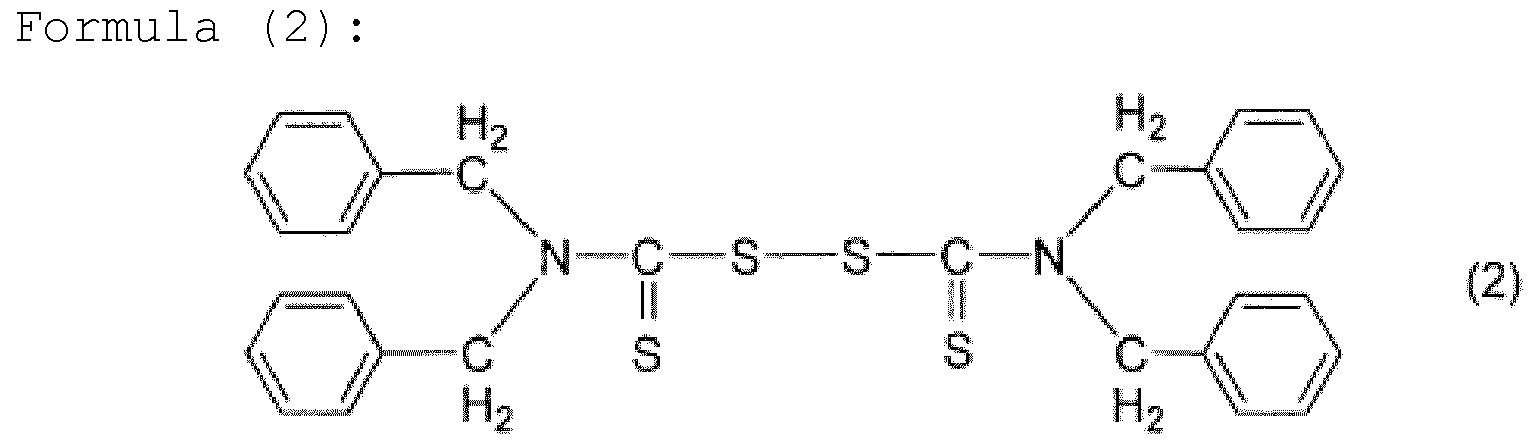
- molybdenum of a molybdenum dialkyldithiocarbamate as shown by the undermentioned Formula (1), and (C) from 20 to 250 ppm, in terms of sulphur, of tetrabenzyl thiuram disulphide as shown by the undermentioned Formula (2) .
- R 1 to R 4 denote alkyl groups.
- At least one base oil selected from the group consisting of (Al) a mixed mineral oil base oil having a kinematic viscosity at 100°C in the range of from 1.4 to 6 mm 2 /s, (A2) a polyalphaolefin, an
- the lubricating oil composition of the present inventon preferably comprises (D) from 10 to 2000 ppm, in terms of phosphorus, of a phosphite ester.
- the lubricating oil composition of the present invention preferably comprises at least one additive selected from the group consisting of metallic
- dialkyldithiophosphates dialkyldithiophosphates , rust preventatives, metal deactivators, viscosity index improvers, pour point depressants and defoamers.
- the lubricating oil composition of the present invention has a fuel economy characteristic, on Stage 4 of the fuel economy tests stipulated in ASTM-D-7589, which is a value at least 2.0% higher than the reference oil .
- the lubricating oil composition of this invention contains (B) from 250 to 2000 ppm, in terms of
- molybdenum of a molybdenum dialkyldithiocarbamate as shown by the aforementioned Formula (1), and (C) from 20 to 250 ppm, in terms of sulphur, of tetrabenzyl thiuram disulphide as shown by the aforementioned Formula (2), so that as well as molybdenum being offered from the molybdenum dialkyldithiocarbamate a sulphur component is offered by breakdown of the tetrabenzyl thiuram
- the tetrabenzyl thiuram disulphide having a high thermal decomposition temperature, remains resident for a long time within the lubricating oil composition, breaking down only a little even within the engine. By virtue of this, it is possible to prevent losses of sulphur in the lubricating oil composition over long periods, and it becomes possible to form a film continuously by means of a molybdenum disulphide compound. On that basis it is possible to exhibit a superior friction reducing effect and a superior fuel economy effect.
- One embodiment of the lubricating oil composition of this invention is a lubricating oil composition which comprises (A) a lubricating oil base oil with a kinematic viscosity at 100°C in the range of from 1.4 to 6 mm 2 /s (hereinafter sometimes referred to as constituent (A) ) , (B) from 250 to 2000 ppm, in terms of molybdenum, of a molybdenum dialkyldithiocarbamate as shown by the
- constituent (B) ) and (C) from 20 to 250 ppm, in terms of sulphur, of tetrabenzyl thiuram
- constituent (C) (hereinafter sometimes referred to as constituent (C) ) .
- the units "ppm” are based on mass.
- R 1 to R 4 denote alkyl groups.
- the lubricating oil composition of this embodiment thus contains constituent (B) and constituent (C) , as well as molybdenum being supplied from the molybdenum dialkyldithiocarbamate, the sulphur component is supplied by breakdown of the tetrabenzyl thiuram disulphide, and it is thus possible to form a film by means of a molybdenum disulphide compound on the sliding surfaces inside engines.
- the tetrabenzyl thiuram disulphide having a high thermal decomposition temperature, remains resident for a long time within the lubricating oil composition, breaking down only a little even within the engine.
- the fuel economy performance is preferably higher, particularly when an engine is being run at low revolutions (load: 1.5 kW) with the lubricating oil composition in a high temperature state, irrespective of whether the oil film becomes thin and metal contact increases. Specifically, it is preferable if the fuel economy is a value at least 2% higher than the reference oil at Stage 4 of the fuel economy test stipulated in ASTM-D-7589 (load: 1.5 kW, engine speed: 695 rpm, temperature of lubricating oil composition: 115°C) .
- Constituent (A) is a lubricating oil base oil with a kinematic viscosity at 100°C in the range of from 1.4 to 6 mm 2 /s.
- the kinematic viscosity at 100°C is preferably in the range of from 1.4 to 5.0 mm 2 /s and more preferably from 1.4 to 3.5 mm 2 /s. If the kinematic viscosity at
- the kinematic viscosity is the value determined by the method stipulated in JIS K 2283.
- Constituent (A) preferably contains a lubricating oil base oil selected from the group consisting of (Al) a mixed mineral oil base oil with a kinematic viscosity at 100°C in the range of from 1.4 to 6 mm 2 /s (hereinafter referred to sometimes as constituent (Al)), (A2) a polyalphaolefin, alphaolefin oligomer or mixture thereof with a kinematic viscosity at 100°C in the range of from 2 to 8 mm 2 /s (hereinafter referred to sometimes as constituent (A2)), (A3) a hindered ester, diester or mixture thereof with a kinematic viscosity at 100°C in the range of from 1.4 to 12 mm 2 /s (hereinafter referred to sometimes as constituent (A3)), and (A4) a lubricating oil base oil with a kinematic viscosity at 100°C of 8 to 50 mm 2 /s (hereinafter referred to
- Polyalphaolefins and alphaolefin oligomers respectively may be used as one lubricating base oil alone or a plurality of lubricating base oils may be mixed together.
- lubricating base oil used in the lubricating oil composition of this invention (constituent (A) ) it is preferable to use the following base oils (Al) to (A4), alone or, if required, in a mixture.
- constituent (Al) is a mixed mineral oil base oil with a kinematic viscosity at 100°C of 1.4 to 6 mm 2 /s. Specifically, it is a Group II base oil, a Group III base oil or a mixture of a Group II base oil and a Group III base oil. "Group II” and “Group III” here are categories for base oils in the API (American Petroleum Institute) standards.
- Group II base oils mention may be made of paraffinic mineral oils obtained by application of a suitable combination of refining procedures such as hydrocracking and dewaxing on lubricating oil fractions obtained by atmospheric distillation of crude oil.
- Group II base oils refining by hydrorefining methods such as the Gulf method, as well as having a total sulphur content of less than 10 ppm, have an aromatic component of not more than 5% and are ideal for possible use as base oils blended in the lubricating oil composition of the present invention.
- Group II base oils where the viscosity index is 100 or more but less than 120 are preferred, but 105 or more but less than 120 is more preferred.
- the sulphur content is the value determined by using an ICP (Inductively Coupled Plasma atomic emission spectroscopy) analysis apparatus.
- the nitrogen content is the value determined by means of the chemiluminescence method of JIS K 2609 (Crude
- Group III base oils mention may be made of paraffinic mineral oils obtained by application of severe hydrorefining measures on lubricating oil fractions obtained by atmospheric distillation of crude oil, base oils in which GTL (gas to liquid) waxes
- the viscosity index of Group III base oils is at least 120, and 120 to 150 is preferable.
- the total sulphur content of Group III base oils is preferably less than 100 ppm, but is more preferably less than 10 ppm.
- the total nitrogen content is also
- the aniline point of Group III base oils is preferably in the range of from 80 to 150°C, but is more preferably in the range of from 110 to 135°C.
- Constituent (A2) is a base oil with a kinematic viscosity at 100°C in the range of from 2 to 8 mm 2 /s, and is a polyalphaolefin, an alphaolefin oligomer ( -olefin oligomer) or a mixture (polyalphaolefin and alphaolefin oligomer) thereof.
- Polyalphaolefins are polymers of alphaolefins (monomers) of various kinds.
- polyalphaolefins may also be mixtures of a plurality of kinds of polymers of alphaolefins (monomers) .
- Alphaolefin oligomers are oligomers of alphaolefins
- alphaolefin oligomers may also be mixtures of a plurality of kinds of oligomers of alphaolefins. They may also be mixtures in which a plurality of oligomers of hydrogenated alphaolefins
- alphaolefin oligomers have been mixed together.
- the alphaolefin oligomers may also be mixtures of oligomers of
- alphaolefins (monomers) and oligomers of hydrogenated alphaolefins (monomers) .
- alphaolefins there is no special restriction on the alphaolefins (monomers), and mention may be made for example of ethylene, propylene, butene and alphaolefins with 5 or more carbons.
- the manufacture of polyalphaolefins or alphaolefin oligomers it is possible to use one kind alone of the aforementioned alphaolefins (monomers) or to use two kinds or more in combination.
- the aforementioned polyalphaolefins may be manufactured by a single
- polyalphaolefins may be single polymers (homopolymers ) of one kind of alphaolefin (monomer) or may be co-polymers of two or more kinds of alphaolefins.
- Constituent (A3) is a base oil with a kinematic viscosity at 100°C in the range of from 1.4 to 12 mm 2 /s, and is a hindered ester, diester or mixture (hindered ester and diester) thereof.
- Hindered esters are esters of hindered alcohols and fatty acids.
- Hindered alcohols are polyhydric alcohols which have neopentyl groups that contain quaternary carbon atoms in their molecules, preferably with a carbon number of 5 to 30.
- the hindered alcohols also even more preferably have a carbon number of 5 to 20, and a carbon number of 10 to
- hindered alcohols mention may be made of neopentyl glycol, 2, 2-diethylpropane-l, 3-diol, 2,2- dibutylpropane-1 , 3-diol, 2-methyl-2-propylpropane-l , 3- diol, 2-ethyl-2-butylpropane-l , 3-diol, trimethylolethane, trimethylolpropane, ditrimethylopropane,
- pentaerythritol dipentaerythritol , tripentaerythritol , tetrapentaerythritol and pentapentaerythritol .
- fatty acid a linear or branched fatty acid having from 4 to 20 carbon atoms is preferred.
- a fatty acid having 4 to 12 carbon atoms is more preferred, and one having 5 to 9 carbon atoms is especially preferred.
- linear fatty acids mention may be made of n-butanoic acid, n-pentanoic acid, n-hexanoic acid, n- heptanoic acid, n-octanoic acid, n-nonanoic acid, n- decanoic acid, n-undecanoic acid, n-dodecanoic acid, n- tridecanoic acid, n-tetradecanoic acid, n-pentadecanoic acid, n-hexadecanoic acid, n-heptadecanoic acid and n- octadecanoic acid.
- the linear fatty acids which form hindered esters may be one kind of these or may be two or more kinds.
- branched fatty acids mention may be made of 2-methylpropanoic acid, 2-methylbutanoic acid, 3-methylbutanoic acid, 2 , 2-dimethylpropanoic acid, 2-ethylbutanoic acid, 2 , 2-dimethylbutanoic acid, 2,3- dimethylbutanoic acid, 2-ethylpentanoic acid, 2,2- dimethylpentanoic acid, 2-ethyl-2-methylbutanoic acid, 3- methylhexanoic acid, 2-methylheptanoic acid, 2- ethylhexanoic acid, 2-propylpentanoic acid, 2,2- dimethylhexanoic acid, 2-ethyl-2-methylpentanoic acid, 2- methyloctanoic acid, 2 , 2-dimethylheptanoic acid, 2- ethylheptanoic acid
- fatty acids of fewer than 4 carbons for example, n-propanoic acid
- n-propanoic acid may be used so that the average number of carbons of the fatty acid-derived hydrocarbon groups which form the hindered esters (where the carbon number of the fatty acid-derived hydrocarbon groups (mole number) is divided by the hindered ester number (mole number)) becomes 4 to 8.
- the hindered esters can be manufactured by the manufacturing methods of the prior art. For example, mention may be made of (a) the method whereby a hindered alcohol and a fatty acid are directly esterified by dehydration and condensation without a catalyst or in the presence of an acidic catalyst. Mention may also be made of (b) the method whereby a fatty acid chloride is prepared and the fatty acid chloride obtained and a hindered alcohol are reacted. Mention may further be made of (c) the method of manufacture by
- hindered esters by any of the aforementioned methods (a) to (c) by using hindered alcohols of carbon number 5 to 30 and fatty acids of carbon number 4 to 20.
- diesters mention may be made of dicarboxylic acid diesters and dihydric alcohol diesters. Of these, dicarboxylic acid diesters are preferred. For the diesters it is possible to use one kind of diester alone or to use a combination (by mixing) of two or more kinds of diester.
- diesters of aliphatic dicarboxylic acids and monohydric alcohols are preferred.
- diesters of aliphatic monocarboxylic acids and dihydric alcohols are preferred .
- aliphatic dicarboxylic acids mention may be made of malonic acid, methylmalonic acid,
- monohydric alcohols mention may be made of methanol, ethanol, propanol, isopropanol,
- the monohydric alcohols which form esters with carboxylic acids in dicarboxylic acid molecules may be the same kind or may be of different kinds.
- aliphatic monocarboxylic acids mention may be made of n-propionic acid, n-butyric acid, isobutyric acid, n-valeric acid, n-hexanoic acid, - methylhexanoic acid, -ethylvaleric acid, isooctylic acid, pelargonic acid, n-decanoic acid, isodecanoic acid, isotridecanoic acid and isohexadecanoic acid.
- dihydric alcohols mention may be made of ethylene glycol, propylene glycol, butylene glycol, 2- butyl-2-ethylpropanediol and 2 , 4-diethyl-pentanediol .
- the diesters preferably have a carbon number for all molecules of 20 to 42, but a carbon number within the molecules of 22 to 30 is more preferable and a carbon number within the molecules of 22 to 28 is especially preferable. Furthermore, diesters which consist of a combination of carboxylic acids with a carbon number of 3 to 18 and alcohols with a carbon number of 5 to 20 are preferred. The esterification of the carboxylic acids and alcohols can be carried out by the known methods. Constituent (A4) :
- Constituent (A4) is a lubricating oil base oil with a kinematic viscosity at 100°C in the range of from 8 to
- Constituent (A4) is preferably a lubricating oil base oil corresponding to Group I, Group II, Group III or Group IV in the base oil categories of the API (American Petroleum Institute) standards. It may also be a mixture of two to four kinds of these (Groups I to IV) .
- constituent (A4) is incorporated in the lubricating oil composition with the purpose of modifying the
- the %CA as stipulated by ASTM D 3238 will be at least not less than 4.0, but preferably not less than 4.5 and more preferably not less than 4.9.
- constituent (A4) mention may be made of bright stock.
- Constituent (B) is a molybdenum
- R 1 to R 4 denote alkyl groups.
- the elemental analysis value for the molybdenum is preferably in the range of from 9.5 to 10.5 mass %, and the
- elemental analysis value for the sulphur is preferably in the range of from 7.0 to 14.0 mass %.
- Constituent (B) is incorporated in the lubricating oil composition in this form of embodiment in an amount, in terms of molybdenum, of from 250 to 2000 ppm, but preferably from 300 to 1800 ppm and more preferably from 350 to 1600 ppm. If it is less than 250 ppm, the amount of film formed by the molybdenum disulphide compound becomes small, so that the friction reducing effect and the fuel saving effect are reduced, which is not
- the content of constituent (B) in the lubricating oil composition can be determined by carrying out an
- ICP Inductively Coupled Plasma atomic emission spectroscopy
- aforementioned Formula (1) are each independently lipophilic groups of 1 to 30 carbons, and it is
- lipophilic groups is a secondary lipophilic group.
- Constituent (C) is tetrabenzyl thiuram disulphide as shown by the undermentioned Formula (2) .
- elemental analysis value of sulphur is preferably 23.5 ⁇ 1.0 mass %, and the elemental analysis value of nitrogen is preferably 5.1 ⁇ 0.5 mass %.
- Constituent (C) is incorporated in the lubricating oil composition of this form of embodiment in an amount, in terms of sulphur, of from 20 to 250 ppm, but
- constituent (B) preferably from 50 to 250 ppm, more preferably from 80 to 250 ppm and especially from 150 to 250 ppm. If it is less than 20 ppm, the amount of sulphur supplied by constituent (B) becomes small, and the amount of film formed by the molybdenum disulphide compound becomes small, so that the friction reducing effect and the fuel saving effect are reduced, which is not desirable. If it is greater than 250 ppm, the amount of sulphur supplied by constituent (B) will become too large, and the amount of sulphur in the exhaust gases emitted by the engine will increase, so that the catalyst to clean the engine's exhaust gases will be poisoned by said sulphur, which is not desirable.
- the content of constituent (C) in the lubricating oil composition can be measured by the ICP method.
- constituent (C) is lower than that of the tetrabenzyl thiuram disulphide, even if the amount used is small it is unlikely to be volatilised inside the engine and so it will supply sulphur reliably to the sliding surfaces. By virtue of this, formation of a film of molybdenum disulphide on the sliding surfaces can be promoted, and said film can be maintained. Also, because the amount of constituent (C) used can be made small, it is possible to inhibit
- the lubricating oil composition of this form of embodiment preferably contains, in terms of phosphorus, from 10 to 2000 ppm, but more preferably from 10 to 1000 ppm and especially from 10 to 500 ppm, but most
- Constituent (D) can be denoted by "P (OR 5 ) (OR 6 ) OR 7 )", R 5 , R 6 and R 7 being preferably each independently alkyl groups, aryl groups, alkylaryl groups or arylalkyl groups. At least two of R 5 , R 6 and R 7 more preferably have aromatic rings, and those with a benzene ring are especially preferred. This is because, by having a benzene ring, hydrolysis becomes less prone to occur and so stability is enhanced. Specifically, those having a structure as shown by the undermentioned Formula (3) are especially preferred.
- the elemental analysis value of phosphorus (P) is preferably 7.6 ⁇ 0.5 mass %.
- constituent (D) By including constituent (D) , it is possible to improve the solubility of the tetrabenzyl thiuram disulphide with respect to the lubricating oil
- constituent (D) apart from the compounds shown by the aforementioned Formula (3), mention may be made of the ADK STAB series of phosphite- based anti-oxidants sold by Adeka Co. Ltd.
- the lubricating oil composition of this form of embodiment it is preferable to add to the lubricating oil composition of this form of embodiment, as required, at least one kind of other additive selected from the group consisting of metallic detergents, ashless dispersants, zinc dialkyldithiophosphates , rust preventatives, metal deactivators, viscosity index improvers, pour point depressants and defoamers. Further, it is also possible to incorporate in the lubricating oil composition of this form of embodiment at least one kind of other additive selected from the group consisting of demulsifiers and rubber swelling agents. The aforementioned other kinds of additive may be blended in alone or in mixtures of a plurality of kinds.
- metallic detergent selected from the group consisting of alkaline earth metal sulphonates, alkaline earth metal phenates and alkaline earth metal salicylates is
- the base number of the metallic detergents is not specially restricted, but a value of not more than 500 mgKOH/g is preferable, and a value of from 150 to 450 mgKOH/g is more preferable.
- Base number here means the base number determined in accordance with "9.”
- lubricating oil composition is not specially restricted, but, relative to the total lubricating oil composition, is preferably from 0.1 to 10 mass %, and more preferably from 0.5 to 8 mass % and especially from 1 to 5 mass %. If it exceeds 10 mass %, a detergent effect matching the content may not be obtained.
- ashless dispersants it is possible to use any ashless dispersants generally used for lubricating oil compositions.
- any ashless dispersants generally used for lubricating oil compositions mention may be made of mono- succinimides or bis-succinimides having in their
- benzylamines having in their molecules at least one alkyl group or alkenyl group of carbon number 40 to 400, polyamines having in their molecules at least one alkyl group or alkenyl group of carbon number 40 to 400, or products thereof modified by, for example, boron
- the weight average molecular weight of the ashless dispersant is preferably not less than 3000, but more preferably is not less than 6500 even more preferably is not less than 7000 and most preferably is not less than
- the molecular weight is less than 3000, the sludge dispersion characteristics will be inferior because the molecular weight of the polybutenyl, which is a non-polar group, will be small. Also, the amine portion, which is a polar group which has a risk of becoming an activation point for oxidative ageing, becomes relatively large and so there is a possibility of deterioration of oxidative stability. From these
- the amount of nitrogen contained in the ashless dispersant is preferably not more than 3 mass %, but more preferably is not more than 2 mass % and
- the amount of nitrogen contained in the ashless dispersant is preferably not less than 0.1 mass %, but more preferably not less than 0.5 mass %. From the standpoint of preventing deterioration of low temperature viscosity characteristics, however, the weight average molecular weight is preferably not more than 20000 and more
- the content of ashless dispersant in the lubricating oil composition of this form of embodiment, relative to the total lubricating oil composition and in terms of elemental nitrogen, is preferably not less than 0.005 mass %, but more preferably not less than 0.01 mass % and especially not less than 0.05 mass %.
- the content of ashless dispersant, relative to the total lubricating oil composition and in terms of elemental nitrogen, is also preferably not more than 0.3 mass %, but more preferably not more than 0.2 mass % and especially not more than 0.15 mass %. If the amount of ashless dispersant is less than 0.005 mass %, it may be that sufficient detergent effect cannot be displayed. Also, if the amount of ashless dispersant exceeds 0.3 mass %, low temperature viscosity characteristics and demulsification
- succinimide-based ashless dispersant with a weight average molecular weight of not less than 6500 is used, satisfactory sludge dispersion characteristics will be displayed and the low temperature viscosity characteristics will be superior, so that the amount of said ashless dispersant, relative to the total lubricating oil composition and in terms of elemental nitrogen, is preferably from 0.005 to 0.05 mass %, but more preferably from 0.01 to 0.04 mass %.
- the amount of said ashless dispersant, relative to the total lubricating oil composition and in terms of elemental boron is
- the amount of said ashless dispersant, relative to the total lubricating oil composition and in terms of elemental boron, is also preferably not more than 0.2 mass %, but more preferably not more than 0.1 mass %. If the amount of ashless dispersant modified by a boron compound is smaller than 0.005 mass %, it may be that sufficient detergent effect cannot be displayed. Also, if the amount of ashless dispersant modified by a boron compound exceeds 0.2 mass %, low temperature viscosity characteristics and
- demulsification characteristics may deteriorate.
- zinc dialkyldithiophosphates mention may be made of zinc diisobutyldithiophosphate. By incorporating a zinc dialkyldithiophosphate it is possible to obtain the effects of wear prevention and oxidation prevention.
- dialkyldithiophosphate relative to the total lubricating oil composition and in terms of zinc, is from 0.02 to 0.15 mass %, but preferably from 0.05 to 0.12 mass %, and especially from 0.07 to 0.10 mass %.
- rust preventatives mention may be made of petroleum sulphonates, alkylbenzene sulphonates, dinonylnaphthalene sulphonates, alkenylsuccinate esters and esters of polyhydric alcohols.
- metal deactivators mention may be made of imidazoline, pyrimidine derivatives,
- alkylthiadiazoles mercaptobenzothiazole, benzotriazole or derivatives thereof, 1 , 3 , 4-thiadiazole polysulphides , 1, 3, 4-thiadiazolyl-2 , 5-bisdialkyldithiocarbamate, 2- ( alklyldithio ) benzoimidazole and ⁇ - (o- carboxybenzylthio ) propionitrile .
- viscosity index improvers mention may be made of non-dispersant type viscosity index improvers and dispersant type viscosity index improvers.
- non-dispersant viscosity index improvers mention may be made of polymethacrylates and olefin polymers such as ethylene-propylene copolymers, styrene- diene copolymers, polyisobutylene and polystyrene.
- dispersant viscosity index improvers mention may be made of polymers which are formed by
- Viscosity index improvers are desirable because they can effect an improvement in the viscosity characteristics of the lubricating oil composition.
- the viscosity index improver is preferably incorporated in an amount of from 0.05 to 20 mass % relative to the total lubricating oil composition.
- the pour point depressant can be freely selected, according to the characteristics of the lubricating oil base oil, from any of the known pour point depressants, but a polymethacrylate is preferred.
- the weight average molecular weight of the polymethacrylate used for the pour point depressant is preferably 10000 to 300000, but more preferably 50000 to 200000.
- Pour point depressants are desirable because they can effect an improvement in the low temperature flow characteristics of the
- the pour point depressant is preferably incorporated in an amount of from 0.05 to 20 mass % relative to the total lubricating oil
- silicone-based defoamers such as polydimethyl siloxane and fluorine-based defoamers such as fluorosilicones which are fluorine-modified silicones.
- the defoamers can be used by blending in one kind or two or more kinds selected from any of these.
- demulsifiers examples include polyalkylene glycol-based non-ionic surface active agents such as polyoxyethylene alkyl ethers, polyoxyethylene alkylphenyl ethers and polyoxyethylene alkylnaphthyl ethers .
- rubber swelling agents mention may be made of various amine compounds and esters.
- the method of manufacture of one form of embodiment of the lubricating oil composition of this invention is a method in which a lubricating oil composition is obtained by mixing together (A) a lubricating oil base oil with a kinematic viscosity at 100°C of from 1.4 to 6 mm 2 /s
- constituent (A) aforementioned constituent (A) , constituent (B) and constituent (C)
- constituent (B) is mixed with the mixture of constituent
- constituent (C) constituent (A) and constituent (C) .
- the dissolving of constituent (C) in constituent (A) because it is difficult to dissolve constituent (C) in constituent (A) (the lubricating oil base oil), the dissolving of
- constituent (C) is promoted by heating them up to a temperature close to (or higher than) the melting point of constituent (C) . It is also possible to dissolve constituent (B) in constituent (A) (the lubricating oil base oil) in advance, but it is preferable to dissolve constituent (B) in the mixture of constituent (A) and constituent (C) after dissolving constituent (C) in constituent (A) (the lubricating oil base oil) and cooling, because constituent (A) (the lubricating oil base oil) is heated in order to dissolve constituent (C) .
- the following method is also preferred. That is, the preferred method is one whereby a lubricating oil composition (the lubricating oil composition of this invention) containing (A) a
- lubricating oil base oil with a kinematic viscosity at 100°C of from 1.4 to 6 mm 2 /s, (B) from 250 to 2000 ppm, in terms of molybdenum, of a molybdenum
- dialkyldithiocarbamate as shown by the aforementioned Formula (1) and (C) from 20 to 250 ppm, in terms of sulphur, of tetrabenzyl thiuram disulphide as shown by the aforementioned Formula (2) is prepared by preparing a phosphite ester solution (hereinafter referred to
- Solution (X) is a phosphite ester solution
- phosphite ester Preferred for the phosphite ester is the aforementioned constituent (D) which forms part of the lubricating oil composition of this form of embodiment.
- D a constituent which forms part of the lubricating oil composition of this form of embodiment.
- disulphide is the aforementioned constituent (C) which also forms part of the lubricating oil composition of this form of embodiment.
- the proportion of tetrabenzyl thiuram disulphide contained in solution (X) is preferably in the range of from 30 to 80 mass %, but more preferably in the range of from 40 to 70 mass % and especially in the range of from 50 to 66 mass %. If it is less than 30 mass %, it will be necessary to add more of solution (X) in order to achieve the desired value for the concentration of the tetrabenzyl thiuram disulphide in the lubricating oil composition, so that the amount of phosphite ester added becomes too large, which is not desirable. If it is more than 80 mass %, it becomes difficult for the tetrabenzyl thiuram disulphide to dissolve, which is also not
- the tetrabenzyl thiuram disulphide is dissolved uniformly in solution (X) . In this case, it can be assessed as "uniform" if there is no precipitation visible to the naked eye.
- the method of manufacture of the phosphite ester solution is a method whereby a phosphite ester solution is prepared by
- solution (X) is preferably cooled to a temperature in the range of from 0 to 30°C, but more preferably cooled to a temperature in the range of from 15 to 25°C. Even if solution (X) is cooled to such temperatures, the tetrabenzyl thiuram disulphide will not separate out.
- the method of dissolving the tetrabenzyl thiuram disulphide in the phosphite ester is not specially limited, but a preferred method is to add the tetrabenzyl thiuram disulphide to the phosphite ester and to agitate them.
- a preferred method is to place the tetrabenzyl thiuram disulphide and the phosphite ester in a vessel (a dissolving tank or the like) and to use paddles or a stirrer for the agitation.
- the lubricating oil composition of this invention is prepared by mixing together said solution (X) , a lubricating oil base oil with a kinematic viscosity at 100°C of from 1.4 to 6 mm 2 /s" and a molybdenum dialkyldithiocarbamate as shown by the aforementioned Formula (1) in the temperature range of from 50 to 70°C.
- dialkyldithiocarbamate as shown by the aforementioned Formula (1) is mixed is in the range of from 50 to 70°C. If it is less than 50°C, it becomes difficult to dissolve solution (X) and the molybdenum dialkyldithiocarbamate as shown by the aforementioned Formula (1) uniformly in the lubricating oil base oil with a kinematic viscosity at 100°C of from 1.4 to 6 mm 2 /s. If it is higher than 70°C, there is a risk that thermal deterioration may occur, which is not desirable.
- lubricating oil base oil with a kinematic viscosity at 100°C of from 1.4 to 6 mm 2 /s and to agitate them.
- a preferred method is to place solution (X) , the lubricating oil base oil with a
- lubricating oil base oil with a kinematic viscosity at 100°C of from 1.4 to 6 mm 2 /s so that the blended amount of tetrabenzyl thiuram disulphide relative to the total lubricating oil composition becomes 20 to 250 ppm, in terms of sulphur.
- the amount of solution (X) added will more preferably give 50 to 250 ppm based on the aforementioned sulphur conversion, even more
- dialkyldithiocarbamate as shown by the aforementioned Formula (1) to the lubricating oil base oil with a kinematic viscosity at 100°C of from 1.4 to 6 mm 2 /s so that it becomes 250 to 2000 ppm, in terms of molybdenum, relative to the total lubricating oil composition.
- the amount of molybdenum dialkyldithiocarbamate is more preferably in the range of from 300 to 1800 ppm in terms of molybdenum and especially in the range of from 350 to 1600 ppm in terms of molybdenum.
- each of the other additives are preferably determined so that the preferred blend amount of each of the other additives is as blended in the aforementioned form of embodiment of the
- solution (X) disulphide in the aforementioned phosphite ester and to obtain solution (X) .
- solution (X) was cooled to room temperature (20°C) . Even though solution (X) had cooled to room temperature, no crystals (crystals of tetrabenzyl thiuram disulphide) separated out.
- ADK STAB 135A made by Adeka Co. Ltd. was used for the phosphite ester.
- Syler TBZTD made by Sanshin Chemical Industry
- dialkyldithiocarbamate as shown by the aforementioned Formula (1), 9.0 g of a viscosity index improver and 0.4 g of a defoamer, and finally 74.9 g of Base oil 2, 6.0 g of Base oil 3 and 0.6g of Base oil 4 were added.
- a commercial package made by Oronite Ltd. was used for the gasoline engine oil package additives for GF5 (GF5 package) . It contained a metallic detergent, a succinimide and a boron-modified succinimide, a zinc dialkyldithiophosphate, an anti-oxidant , a metal
- Solution (X) was added so that the content of tetrabenzyl thiuram
- the units "ppm" are based on mass.
- Base oil 1 (see Table 1) was a Fischer-Tropsch derived base oil (kinematic viscosity at 100°C: 4.0 mm 2 /s, VI (viscosity index) : 131) .
- Base oil 2 was a Group III base oil (kinematic viscosity at 100°C: 4.1 mm 2 /s, VI (viscosity index) : 134) .
- Base oil 3 was a Group II base oil (kinematic viscosity at 100°C: 3.1 mm 2 /s, VI (viscosity index) : 111) .
- Base oil 4 was a Group I base oil (kinematic viscosity at 100°C: 31 mm 2 /s, VI (viscosity index) : 95) .
- Base oil 1 was constituent (A3) in lubricating oil base oil (A), and base oil 2 and base oil 3 were constituent (Al) in lubricating oil base oil (A) .
- Base oil 4 was constituent (A4) in lubricating oil base oil (A) .
- the rubric base oil kinematic viscosity in Table 1 shows the kinematic viscosity at 100°C of the mixed base oil (lubricating oil base oil) when the base oils 1 to 4 were used in the examples and comparative examples.
- the lubricating oil composition was obtained by raising the temperature of the mixture in the conical beaker to 70°C and agitating with a stirrer for 20 minutes.
- the lubricating oil composition had a kinematic viscosity at 100°C of 7.2 mm 2 /s.
- the kinematic viscosity was determined by the method stipulated in JIS K 2283.
- the rubric "Thiuram” denotes, for the tetrabenzyl thiuram disulphide, the mass (g) of the total tetrabenzyl thiuram disulphide relative to the lubricating oil composition and the amount added (ppm) in terms of sulphur of tetrabenzyl thiuram
- Phosphite ester denotes the mass (g) of the total phosphite ester relative to the lubricating oil composition and the amount added (ppm) in terms of phosphorus (P) of phosphite ester relative to the
- the rubric "Base oil kinematic viscosity” denotes the kinematic viscosities at 100°C of the total base oils (base oil mixture with the contained base oils mixed together) contained in the examples and comparative examples.
- “G5 package” means the gasoline engine oil package additives for GF5.
- the rubric "Kinematic viscosity” denotes the kinematic viscosities at 100°C (mm 2 /s) of the lubricating oil compositions obtained.
- “Rate of friction reduction” denotes by what percentage (%) the friction coefficient was reduced based on the average values of friction coefficients of the lubricating oil compositions in Comparative Examples 1 and 2. Where the numerical value is a negative value, this means the friction coefficient was reduced.
- the friction coefficient for the lubricating oil composition obtained was determined by the method
- the fuel economy characteristics were measured for a lubricating oil composition obtained, by the method stipulated in ASTM-D-7589.
- Example 2 tetrabenzyl thiuram disulphide.
- the lubricating oil composition of Example 1 (Example 2) combines use of tetrabenzyl thiuram disulphide and a molybdenum
- dialkyldithiocarbamate added can be reduced by combining its use with tetrabenzyl thiuram disulphide. It can also be seen from Comparative Examples 1 and 2 that there is no friction reducing effect in the phosphite ester.
- compositions of Examples 1 to 5 have a low friction coefficient and an excellent friction reducing effect, so that the fuel economy effect was better.
- the LFW-1 friction test of ASTM-D-2714-94 is a ring- and-block friction test in a laboratory (laboratory friction test) .
- the aforementioned "fuel economy test” was a test performed at an American testing agency (entrusted to an American testing organisation) and so was a fuel economy test using an actual engine. If the fuel economy test had been carried out by the American official test agency on the lubricating oil compositions of all the examples, huge expenditure would have been incurred, and so the fuel economy test was carried out on only Example 4.
- the results, as recorded in the bottom row of Table 1, are under Stage 4 conditions and an improvement in fuel consumption of 2.43% compared with the reference oil was confirmed. On this basis, it was possible to support the effectiveness of the friction reducing effect in a LFW-1 friction test (laboratory friction test) .
- additives tetrabenzyl thiuram disulphide and so on were determined by the test method for determination of evaporation loss in engine oils as stipulated in ASTM D5800 (Noack evaporation loss test) . More specifically, the sulphur-based additive was dissolved in a Group III base oil with a kinematic viscosity at 100°C of 4 mm 2 /s, and a Noack evaporation loss test was performed. The masses of sulphur before and after the test were
- the lubricating oil composition of this invention preferably contains constituent (D) (a phosphite ester) , but a phosphite ester contains phosphorus (P) .
- constituent (D) a phosphite ester
- P phosphorus
- (D) is not problematical from the standpoint of catalyst poisoning, because the content in the lubricating oil composition is small.
- An MoDTP for example Adeka Sakura-Lube 300
- An MoDTC (for example Adeka Sakura-Lube 515) contains 10 mass % of Mo and 11 mass% of S. So, for example, in Example 4, by adding 0.7 mass % of Adeka Sakura-Lube 515, the Mo content in the lubricating oil composition becomes 700 ppm. If the same amount of Mo were to be provided by
- Example 4 In specific terms, the amount of P derived from the GF-5 package used in Example 4 was 600 ppm. On the other hand, the upper limit, from the standpoint of catalyst poisoning, for the content of P in a lubricating oil composition in the ILSAC GF-5 standard is 0.08 mass
- the lubricating oil composition of this invention can ideally be used as a lubricating oil composition to be used in internal combustion engines such as automobile engines .
Landscapes
- Chemical & Material Sciences (AREA)
- Chemical Kinetics & Catalysis (AREA)
- General Chemical & Material Sciences (AREA)
- Oil, Petroleum & Natural Gas (AREA)
- Organic Chemistry (AREA)
- Lubricants (AREA)
Abstract
A lubricating oil composition which contains (A) a lubricating oil base oil with a kinematic viscosity at 100ºC of from 1.4 to 6 mm2/s, (B) from 250 to 2000 ppm, in terms of molybdenum, of a molybdenum dialkyldithiocarbamate, and (C) from 20 to 250 ppm, in terms of sulphur, of tetrabenzyl thiuram disulphide. It preferably contains at least one base oil selected from the group consisting of (A1) a mixed mineral oil base oil with a kinematic viscosity at 100ºC of from1.4 to 6mm2/s, (A2) a polyalphaolefin, an alphaolefin oligomer or a mixture thereof with a kinematic viscosity at 100ºC of from 2 to 8 mm2/s, (A3) a hindered ester, diester or mixture thereof with a kinematic viscosity at 100ºC of from 1.4 to 12 mm2/s, and (A4) a lubricating oil base oil with a kinematic viscosity at 100ºC of from 8 to 50mm2/s.
Description
LUBRICATING OIL COMPOSITION
Technical Field
This invention relates to a lubricating oil
composition, and more specifically relates to a
lubricating oil composition with a superior friction reducing effect and a superior fuel economy effect.
Background of the Invention
In recent years, increasing attention has been given to environmental problems such as global warming, and an effective reduction in fuel consumption has been required of engine oils (lubricating oil compositions), too. For example, low viscosity lubricating oil compositions have been discovered in which the friction coefficient in the boundary lubrication domain has been reduced by blending in organic molybdenum compounds, (for example, see
Japanese Laid-open Patent 2002-371292) . The fuel economy effect in the engine is realised by reducing the friction coefficient of the lubricating oil composition. Also, low viscosity lubricating oil compositions have been discovered in which the friction coefficient in the boundary lubrication domain is reduced by blending in organic molybdenum compounds and then a fuel economy effect is further realised also in the hydrodynamic lubrication domain by blending in specific ester-based lubricating oil base oils (for example, see Japanese Laid-open Patent 2005-041998) .
In addition, low viscosity lubricating oils have been discovered in which, by blending in a combination of specific anti-oxidants , it is possible to achieve a superior fuel economy effect even without incorporating an organic molybdenum compound (for example, see Japanese
Laid-open Patent 2005-146010) . Also, as examples of commercial engine oils sold as fuel economy oils, mention may be made of low viscosity oils and low viscosity oils blended with organic molybdenum compounds such as SAE viscosity grades 5W-30, 5W-20 and OW-20.
Apart from these, lubricating oil compositions which, as well as containing organic molybdenum, are blended so that a sulphur component is offered up have been disclosed (for example, see Japanese Laid-open
Patent H08-253785 (1996), Japanese Laid-open Patent 2004-
149762 and Japanese Laid-open Patent H09-104888 (1997) .
Also, lubricating oil compositions containing molybdenum compounds and dithiocarbamates ( thiocarbamoyl compounds) have been disclosed (for example, see Japanese Laid-open Patent H10-121079 (1998) and Japanese Laid-open
Patent H10-130680 (1998)) .
The organic molybdenum compounds are mainly
classified into three types: the so-called molybdenum dialkyldithiophosphates (hereinafter referred to
sometimes as MoDTP) , the so-called molybdenum
dialkyldithiocarbamates (hereinafter referred to
sometimes as MoDTC) and compounds in which the molybdenum has become an amine complex. MoDTPs have hardly been used recently because they contain phosphorus. This is because when an MoDTP is burnt together with the fuel inside the cylinders, exhaust gas containing phosphorus derived from the MoDTP is emitted. When exhaust gases containing said phosphorus pass through a three-way catalyst mounted on the downstream side, said three-way catalyst is poisoned.
On the other hand, MoDTCs are used as friction modifiers in engine oils because they do not contain phosphorus. An MoDTC forms a film on the sliding
surfaces inside engines and it is known that said film contains a molybdenum disulphide compound in which the elemental composition ratio is close to molybdenum disulphide. Because the MoDTC contains sulphur and molybdenum in its molecules, it breaks down on the sliding surfaces and a film containing a molybdenum disulphide compound is formed. This molybdenum
disulphide compound is believed to reduce friction.
An MoDTC contains sulphur and molybdenum in its molecules, but the amount of sulphur relative to the amount of molybdenum is relatively small, so that it has not been easy to create molybdenum disulphide compounds in a satisfactory way with just an MoDTC alone. In order to enhance the film formation (creation of molybdenum disulphide) activity further, more sulphur has been necessary. For this reason, there have been
implementations supplying a sulphur component from outside (for example, see Japanese Laid-open Patent H08- 253785 (1996), Japanese Laid-open Patent 2004-149762 and Japanese Laid-open Patent H09-104888 (1997)) . However, increasing the sulphur component is not desirable because it speeds up poisoning of the catalyst.
Similarly, with compounds where molybdenum forms an amine complex, because they do not have sulphur in their molecules, it is difficult to create a molybdenum
disulphide compound on top of an MoDTC. For this reason the friction reducing effect has been extremely small. It has been absolutely necessary to supply a sulphur component from outside.
This invention has been made in light of the above mentioned issues and its aim is to offer a lubricating oil composition with a superior friction reducing effect and a superior fuel economy effect.
Summary of the Invention
In order to resolve the above mentioned issues, this invention offers the following lubricating oil
composition .
According to one aspect of the present invention there is provided a lubricating oil composition
comprising (A) a lubricating oil base oil with a
kinematic viscosity at 100°C in the range of from 1.4 to 6 mm2/s, (B) from 250 to 2000 ppm, in terms of
molybdenum, of a molybdenum dialkyldithiocarbamate as shown by the undermentioned Formula (1), and (C) from 20 to 250 ppm, in terms of sulphur, of tetrabenzyl thiuram disulphide as shown by the undermentioned Formula (2) .
Formula (1)

(In Formula 1, R1 to R4 denote alkyl groups.)
preferably comprises at least one base oil selected from the group consisting of (Al) a mixed mineral oil base oil having a kinematic viscosity at 100°C in the range of from 1.4 to 6 mm2/s, (A2) a polyalphaolefin, an
alphaolefin oligomer or a mixture thereof having a
kinematic viscosity at 100°C in the range of from 2 to 8 mm2/s, (A3) a hindered ester, diester or mixture thereof with a kinematic viscosity at 100°C in the range of from 1.4 to 12 mm2/s, and (A4) a lubricating oil base oil with a kinematic viscosity at 100°C in the range of from 8 to
50 mm2/ s .
The lubricating oil composition of the present inventon preferably comprises (D) from 10 to 2000 ppm, in terms of phosphorus, of a phosphite ester.
The lubricating oil composition of the present invention preferably comprises at least one additive selected from the group consisting of metallic
detergents, ashless dispersants, zinc
dialkyldithiophosphates , rust preventatives, metal deactivators, viscosity index improvers, pour point depressants and defoamers.
The lubricating oil composition of the present invention has a fuel economy characteristic, on Stage 4 of the fuel economy tests stipulated in ASTM-D-7589, which is a value at least 2.0% higher than the reference oil .
The lubricating oil composition of this invention contains (B) from 250 to 2000 ppm, in terms of
molybdenum, of a molybdenum dialkyldithiocarbamate as shown by the aforementioned Formula (1), and (C) from 20 to 250 ppm, in terms of sulphur, of tetrabenzyl thiuram disulphide as shown by the aforementioned Formula (2), so that as well as molybdenum being offered from the molybdenum dialkyldithiocarbamate a sulphur component is offered by breakdown of the tetrabenzyl thiuram
disulphide, which means that it is possible to form a film by means of a molybdenum disulphide compound on sliding surfaces within engines. In addition, the
tetrabenzyl thiuram disulphide, having a high thermal decomposition temperature, remains resident for a long time within the lubricating oil composition, breaking down only a little even within the engine. By virtue of this, it is possible to prevent losses of sulphur in the lubricating oil composition over long periods, and it becomes possible to form a film continuously by means of a molybdenum disulphide compound. On that basis it is possible to exhibit a superior friction reducing effect and a superior fuel economy effect.
Detailed Description of the Invention
Next is given an explanation in detail of a form in which the invention may be embodied, but the invention is not limited to the following form of embodiment, and it is to be understood that, so long as the essentials remain within the scope of the invention, changes and improvements in suitable designs based on normal
knowledge of those involved in the industry may be added. Lubricating Oil Composition:
One embodiment of the lubricating oil composition of this invention is a lubricating oil composition which comprises (A) a lubricating oil base oil with a kinematic viscosity at 100°C in the range of from 1.4 to 6 mm2/s (hereinafter sometimes referred to as constituent (A) ) , (B) from 250 to 2000 ppm, in terms of molybdenum, of a molybdenum dialkyldithiocarbamate as shown by the
undermentioned Formula (1) (hereinafter sometimes
referred to as constituent (B) ) , and (C) from 20 to 250 ppm, in terms of sulphur, of tetrabenzyl thiuram
disulphide as shown by the undermentioned Formula (2)
(hereinafter sometimes referred to as constituent (C) ) . The units "ppm" are based on mass.
Formula (1)

(In Formula 1, R1 to R4 denote alkyl groups.)
Formula ( 2 ) :
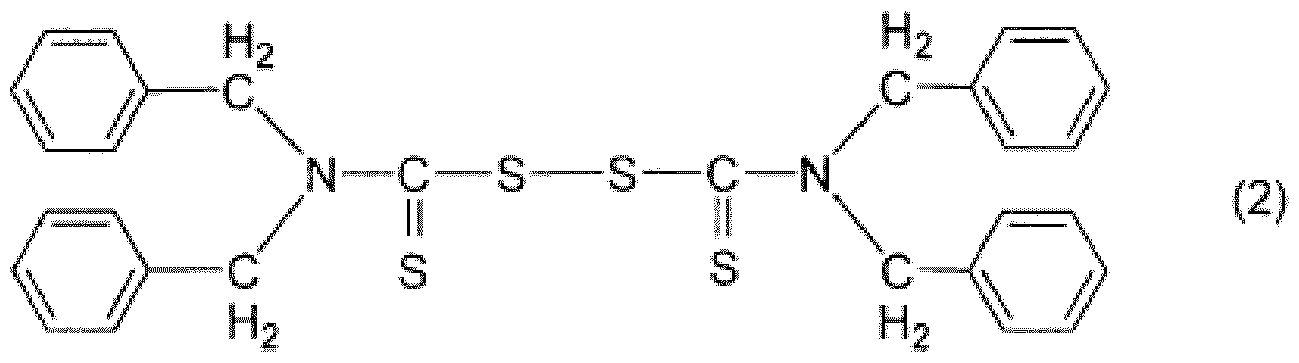
Since the lubricating oil composition of this embodiment thus contains constituent (B) and constituent (C) , as well as molybdenum being supplied from the molybdenum dialkyldithiocarbamate, the sulphur component is supplied by breakdown of the tetrabenzyl thiuram disulphide, and it is thus possible to form a film by means of a molybdenum disulphide compound on the sliding surfaces inside engines. In addition, the tetrabenzyl thiuram disulphide, having a high thermal decomposition temperature, remains resident for a long time within the lubricating oil composition, breaking down only a little even within the engine. By virtue of this, it is possible to prevent losses of sulphur in the lubricating oil composition over long periods, and it becomes possible to form a film continuously by means of a molybdenum disulphide compound. On that basis it is possible to exhibit a superior friction reducing effect and a superior fuel economy effect.
For the lubricating oil composition of this
embodiment the fuel economy performance is preferably
higher, particularly when an engine is being run at low revolutions (load: 1.5 kW) with the lubricating oil composition in a high temperature state, irrespective of whether the oil film becomes thin and metal contact increases. Specifically, it is preferable if the fuel economy is a value at least 2% higher than the reference oil at Stage 4 of the fuel economy test stipulated in ASTM-D-7589 (load: 1.5 kW, engine speed: 695 rpm, temperature of lubricating oil composition: 115°C) .
Constituent (A) :
Constituent (A) is a lubricating oil base oil with a kinematic viscosity at 100°C in the range of from 1.4 to 6 mm2/s. The kinematic viscosity at 100°C is preferably in the range of from 1.4 to 5.0 mm2/s and more preferably from 1.4 to 3.5 mm2/s. If the kinematic viscosity at
100°C is lower than 1.4 mm2/s, the amount of evaporation becomes large, which is not desirable. If the kinematic viscosity at 100°C is higher than 6 mm2/s, the fuel economy effect decreases, which is not desirable. The kinematic viscosity is the value determined by the method stipulated in JIS K 2283.
Constituent (A) preferably contains a lubricating oil base oil selected from the group consisting of (Al) a mixed mineral oil base oil with a kinematic viscosity at 100°C in the range of from 1.4 to 6 mm2/s (hereinafter referred to sometimes as constituent (Al)), (A2) a polyalphaolefin, alphaolefin oligomer or mixture thereof with a kinematic viscosity at 100°C in the range of from 2 to 8 mm2/s (hereinafter referred to sometimes as constituent (A2)), (A3) a hindered ester, diester or mixture thereof with a kinematic viscosity at 100°C in the range of from 1.4 to 12 mm2/s (hereinafter referred to sometimes as constituent (A3)), and (A4) a lubricating
oil base oil with a kinematic viscosity at 100°C of 8 to 50 mm2/s (hereinafter referred to sometimes as
constituent (A4)) . Polyalphaolefins and alphaolefin oligomers respectively may be used as one lubricating base oil alone or a plurality of lubricating base oils may be mixed together.
For the lubricating base oil used in the lubricating oil composition of this invention (constituent (A) ) it is preferable to use the following base oils (Al) to (A4), alone or, if required, in a mixture.
Constituent (Al) :
As mentioned above, constituent (Al) is a mixed mineral oil base oil with a kinematic viscosity at 100°C of 1.4 to 6 mm2/s. Specifically, it is a Group II base oil, a Group III base oil or a mixture of a Group II base oil and a Group III base oil. "Group II" and "Group III" here are categories for base oils in the API (American Petroleum Institute) standards.
As examples of Group II base oils mention may be made of paraffinic mineral oils obtained by application of a suitable combination of refining procedures such as hydrocracking and dewaxing on lubricating oil fractions obtained by atmospheric distillation of crude oil. Group II base oils refining by hydrorefining methods such as the Gulf method, as well as having a total sulphur content of less than 10 ppm, have an aromatic component of not more than 5% and are ideal for possible use as base oils blended in the lubricating oil composition of the present invention. Group II base oils where the viscosity index is 100 or more but less than 120 are preferred, but 105 or more but less than 120 is more preferred. Group II base oils where the total sulphur content is less than 500 ppm are preferred, and less than
300 ppm is more preferred, whilst less than 10 ppm is especially preferred. Group II base oils where the total nitrogen content is less than 10 ppm are preferred, and less than 1 ppm is more preferred. Group II base oils where the aniline point is 80 to 150°C are preferred, and
100 to 135°C is more preferred. The sulphur content is the value determined by using an ICP (Inductively Coupled Plasma atomic emission spectroscopy) analysis apparatus. The nitrogen content is the value determined by means of the chemiluminescence method of JIS K 2609 (Crude
Petroleum and Petroleum Products - Determination of Nitrogen Content) .
As examples of Group III base oils mention may be made of paraffinic mineral oils obtained by application of severe hydrorefining measures on lubricating oil fractions obtained by atmospheric distillation of crude oil, base oils in which GTL (gas to liquid) waxes
synthesised by the Fischer-Tropsch process, which is a technique for making liquefied fuels from natural gas, or waxes formed through dewaxing processes are refined by the Isodewaxing process which is a dewaxing process involving first solvent dewaxing then converting to isoparaffins and base oils refined by the Mobil wax isomerisation process. The viscosity index of Group III base oils is at least 120, and 120 to 150 is preferable.
Also, the total sulphur content of Group III base oils is preferably less than 100 ppm, but is more preferably less than 10 ppm. The total nitrogen content is also
preferably less than 10 ppm, but is more preferably less than 1 ppm. The aniline point of Group III base oils is preferably in the range of from 80 to 150°C, but is more preferably in the range of from 110 to 135°C.
Constituent (A2) :
Constituent (A2) is a base oil with a kinematic viscosity at 100°C in the range of from 2 to 8 mm2/s, and is a polyalphaolefin, an alphaolefin oligomer ( -olefin oligomer) or a mixture (polyalphaolefin and alphaolefin oligomer) thereof. Polyalphaolefins are polymers of alphaolefins (monomers) of various kinds. The
polyalphaolefins may also be mixtures of a plurality of kinds of polymers of alphaolefins (monomers) .
Alphaolefin oligomers are oligomers of alphaolefins
(monomers) of various kinds. The alphaolefin oligomers may also be mixtures of a plurality of kinds of oligomers of alphaolefins. They may also be mixtures in which a plurality of oligomers of hydrogenated alphaolefins
(monomers) have been mixed together. The alphaolefin oligomers may also be mixtures of oligomers of
alphaolefins (monomers) and oligomers of hydrogenated alphaolefins (monomers) .
There is no special restriction on the alphaolefins (monomers), and mention may be made for example of ethylene, propylene, butene and alphaolefins with 5 or more carbons. In the manufacture of polyalphaolefins or alphaolefin oligomers, it is possible to use one kind alone of the aforementioned alphaolefins (monomers) or to use two kinds or more in combination. The aforementioned polyalphaolefins may be manufactured by a single
polymerisation of one kind of alphaolefin or may be manufactured by co-polymerisation of two or more kinds of alphaolefin. In other words, the aforementioned
polyalphaolefins may be single polymers (homopolymers ) of one kind of alphaolefin (monomer) or may be co-polymers of two or more kinds of alphaolefins.
Constituent (A3) :
Constituent (A3) is a base oil with a kinematic
viscosity at 100°C in the range of from 1.4 to 12 mm2/s, and is a hindered ester, diester or mixture (hindered ester and diester) thereof.
Hindered esters are esters of hindered alcohols and fatty acids.
Hindered alcohols are polyhydric alcohols which have neopentyl groups that contain quaternary carbon atoms in their molecules, preferably with a carbon number of 5 to 30. The hindered alcohols also even more preferably have a carbon number of 5 to 20, and a carbon number of 10 to
20 is especially preferred.
As example of hindered alcohols mention may be made of neopentyl glycol, 2, 2-diethylpropane-l, 3-diol, 2,2- dibutylpropane-1 , 3-diol, 2-methyl-2-propylpropane-l , 3- diol, 2-ethyl-2-butylpropane-l , 3-diol, trimethylolethane, trimethylolpropane, ditrimethylopropane,
tritrimethylolpropane, tetratrimethylolpropane,
pentaerythritol , dipentaerythritol , tripentaerythritol , tetrapentaerythritol and pentapentaerythritol .
For the fatty acid a linear or branched fatty acid having from 4 to 20 carbon atoms is preferred. A fatty acid having 4 to 12 carbon atoms is more preferred, and one having 5 to 9 carbon atoms is especially preferred. As examples of linear fatty acids mention may be made of n-butanoic acid, n-pentanoic acid, n-hexanoic acid, n- heptanoic acid, n-octanoic acid, n-nonanoic acid, n- decanoic acid, n-undecanoic acid, n-dodecanoic acid, n- tridecanoic acid, n-tetradecanoic acid, n-pentadecanoic acid, n-hexadecanoic acid, n-heptadecanoic acid and n- octadecanoic acid. The linear fatty acids which form hindered esters may be one kind of these or may be two or more kinds. As examples of branched fatty acids mention may be made of 2-methylpropanoic acid, 2-methylbutanoic
acid, 3-methylbutanoic acid, 2 , 2-dimethylpropanoic acid, 2-ethylbutanoic acid, 2 , 2-dimethylbutanoic acid, 2,3- dimethylbutanoic acid, 2-ethylpentanoic acid, 2,2- dimethylpentanoic acid, 2-ethyl-2-methylbutanoic acid, 3- methylhexanoic acid, 2-methylheptanoic acid, 2- ethylhexanoic acid, 2-propylpentanoic acid, 2,2- dimethylhexanoic acid, 2-ethyl-2-methylpentanoic acid, 2- methyloctanoic acid, 2 , 2-dimethylheptanoic acid, 2- ethylheptanoic acid, 2-methylnonanoic acid, 2,2- dimethyloctanoic acid, 2-ethyloctanoic acid, 2- methylnonanoic acid, 2 , 2-dimethylnonanoic acid and branched fatty acids with 11 or more carbons. The branched fatty acids which form hindered esters may be one kind of these or may be two or more kinds.
In the case of using two or more kinds of fatty acids which form hindered esters, fatty acids of fewer than 4 carbons (for example, n-propanoic acid) may be used so that the average number of carbons of the fatty acid-derived hydrocarbon groups which form the hindered esters (where the carbon number of the fatty acid-derived hydrocarbon groups (mole number) is divided by the hindered ester number (mole number)) becomes 4 to 8.
The hindered esters can be manufactured by the manufacturing methods of the prior art. For example, mention may be made of (a) the method whereby a hindered alcohol and a fatty acid are directly esterified by dehydration and condensation without a catalyst or in the presence of an acidic catalyst. Mention may also be made of (b) the method whereby a fatty acid chloride is prepared and the fatty acid chloride obtained and a hindered alcohol are reacted. Mention may further be made of (c) the method of manufacture by
transesterification of esters of lower alcohols and fatty
acids and hindered alcohols. Specifically, it is
preferable to manufacture hindered esters by any of the aforementioned methods (a) to (c) by using hindered alcohols of carbon number 5 to 30 and fatty acids of carbon number 4 to 20.
As examples of diesters mention may be made of dicarboxylic acid diesters and dihydric alcohol diesters. Of these, dicarboxylic acid diesters are preferred. For the diesters it is possible to use one kind of diester alone or to use a combination (by mixing) of two or more kinds of diester.
For the dicarboxylic acid diester, diesters of aliphatic dicarboxylic acids and monohydric alcohols are preferred. For dihydric alcohol diesters, diesters of aliphatic monocarboxylic acids and dihydric alcohols are preferred .
As examples of aliphatic dicarboxylic acids mention may be made of malonic acid, methylmalonic acid,
dimethylmalonic acid, ethylmalonic acid, diethylmalonic acid, glutaric acid, dimethylglutaric acid,
diethylglutaric acid, di-n-propylglutaric acid,
diisopropylglutaric acid, dibutylglutaric acid, adipic acid, dimethyladipic acid, diethyladipic acid,
dipropyladipic acid, dibutyladipic acid, succinic acid, methylsuccinic acid, dimethylsuccinic acid, ethylsuccinic acid, diethylsuccinic acid, dipropylsuccinic acid, dibutylsuccinic acid, pimeric acid, tetramethylsuccinic acid, suberic acid, azelaic acid, sebacic acid,
dodecanoic diacid and brassylic acid.
As examples of monohydric alcohols, mention may be made of methanol, ethanol, propanol, isopropanol,
butanol, pentanol, hexanol, heptanol, octanol, 2- ethylhexanol , nonanol, decanol, isodecanol, undecanol,
dodecanol, tridecanol, tetradecanol and pentadecanol . The monohydric alcohols which form esters with carboxylic acids in dicarboxylic acid molecules may be the same kind or may be of different kinds.
As examples of aliphatic monocarboxylic acids mention may be made of n-propionic acid, n-butyric acid, isobutyric acid, n-valeric acid, n-hexanoic acid, - methylhexanoic acid, -ethylvaleric acid, isooctylic acid, pelargonic acid, n-decanoic acid, isodecanoic acid, isotridecanoic acid and isohexadecanoic acid.
As examples of dihydric alcohols mention may be made of ethylene glycol, propylene glycol, butylene glycol, 2- butyl-2-ethylpropanediol and 2 , 4-diethyl-pentanediol .
The diesters preferably have a carbon number for all molecules of 20 to 42, but a carbon number within the molecules of 22 to 30 is more preferable and a carbon number within the molecules of 22 to 28 is especially preferable. Furthermore, diesters which consist of a combination of carboxylic acids with a carbon number of 3 to 18 and alcohols with a carbon number of 5 to 20 are preferred. The esterification of the carboxylic acids and alcohols can be carried out by the known methods. Constituent (A4) :
Constituent (A4) is a lubricating oil base oil with a kinematic viscosity at 100°C in the range of from 8 to
50 mm2/s. Constituent (A4) is preferably a lubricating oil base oil corresponding to Group I, Group II, Group III or Group IV in the base oil categories of the API (American Petroleum Institute) standards. It may also be a mixture of two to four kinds of these (Groups I to IV) .
Since constituent (A4) is incorporated in the lubricating oil composition with the purpose of modifying the
viscosity and promoting dissolving of additives, the %CA
as stipulated by ASTM D 3238 will be at least not less than 4.0, but preferably not less than 4.5 and more preferably not less than 4.9.
As a specific example of constituent (A4) mention may be made of bright stock.
Constituent (B) :
Constituent (B) is a molybdenum
dialkyldithiocarbamate as shown by the following Formula
(1) .

(In Formula 1, R1 to R4 denote alkyl groups.)
In the molybdenum dialkyldithiocarbamate, the elemental analysis value for the molybdenum is preferably in the range of from 9.5 to 10.5 mass %, and the
elemental analysis value for the sulphur is preferably in the range of from 7.0 to 14.0 mass %.
Constituent (B) is incorporated in the lubricating oil composition in this form of embodiment in an amount, in terms of molybdenum, of from 250 to 2000 ppm, but preferably from 300 to 1800 ppm and more preferably from 350 to 1600 ppm. If it is less than 250 ppm, the amount of film formed by the molybdenum disulphide compound becomes small, so that the friction reducing effect and the fuel saving effect are reduced, which is not
desirable. If it is greater than 2000 ppm, corrosion of non-ferrous metals is caused, which is not desirable. This means the expensive molybdenum is used worthlessly, which is not desirable from the standpoints of
conservation of resources and reduction of costs. The
content of constituent (B) in the lubricating oil composition can be determined by carrying out an
elemental analysis using an ICP (Inductively Coupled Plasma atomic emission spectroscopy, hereinafter referred to sometimes as ICP) analysis apparatus. The amount of molybdenum can also be measured by the ICP method.
The alkyl groups R1, R2, R3 and R4 contained in the molybdenum dialkyldithiocarbamates shown in the
aforementioned Formula (1) are each independently lipophilic groups of 1 to 30 carbons, and it is
preferable if at least one or two of these four
lipophilic groups is a secondary lipophilic group.
Constituent (C) :
Constituent (C) is tetrabenzyl thiuram disulphide as shown by the undermentioned Formula (2) .

For the tetrabenzyl thiuram disulphide, the
elemental analysis value of sulphur is preferably 23.5 ± 1.0 mass %, and the elemental analysis value of nitrogen is preferably 5.1 ± 0.5 mass %.
Constituent (C) is incorporated in the lubricating oil composition of this form of embodiment in an amount, in terms of sulphur, of from 20 to 250 ppm, but
preferably from 50 to 250 ppm, more preferably from 80 to 250 ppm and especially from 150 to 250 ppm. If it is less than 20 ppm, the amount of sulphur supplied by constituent (B) becomes small, and the amount of film formed by the molybdenum disulphide compound becomes
small, so that the friction reducing effect and the fuel saving effect are reduced, which is not desirable. If it is greater than 250 ppm, the amount of sulphur supplied by constituent (B) will become too large, and the amount of sulphur in the exhaust gases emitted by the engine will increase, so that the catalyst to clean the engine's exhaust gases will be poisoned by said sulphur, which is not desirable. The content of constituent (C) in the lubricating oil composition can be measured by the ICP method.
Because the vapour pressure in constituent (C) is lower than that of the tetrabenzyl thiuram disulphide, even if the amount used is small it is unlikely to be volatilised inside the engine and so it will supply sulphur reliably to the sliding surfaces. By virtue of this, formation of a film of molybdenum disulphide on the sliding surfaces can be promoted, and said film can be maintained. Also, because the amount of constituent (C) used can be made small, it is possible to inhibit
poisoning by sulphur of the catalyst used for cleaning exhaust gases. Were the vapour pressure to be high, it would volatilise inside the engine and eventually
disappear, so that a film of molybdenum disulphide compound would be unlikely to form on the sliding
surfaces, which is not desirable.
Constituent (D) :
The lubricating oil composition of this form of embodiment preferably contains, in terms of phosphorus, from 10 to 2000 ppm, but more preferably from 10 to 1000 ppm and especially from 10 to 500 ppm, but most
preferably from 10 to 200 ppm, of (D) a phosphite ester (hereinafter referred to sometimes as "constituent (D) ") . Constituent (D) can be denoted by "P (OR5) (OR6) OR7)",
R5, R6 and R7 being preferably each independently alkyl groups, aryl groups, alkylaryl groups or arylalkyl groups. At least two of R5, R6 and R7 more preferably have aromatic rings, and those with a benzene ring are especially preferred. This is because, by having a benzene ring, hydrolysis becomes less prone to occur and so stability is enhanced. Specifically, those having a structure as shown by the undermentioned Formula (3) are especially preferred.

For the phosphite ester, the elemental analysis value of phosphorus (P) is preferably 7.6 ± 0.5 mass %.
By including constituent (D) , it is possible to improve the solubility of the tetrabenzyl thiuram disulphide with respect to the lubricating oil
composition .
As specific examples of constituent (D) , apart from the compounds shown by the aforementioned Formula (3), mention may be made of the ADK STAB series of phosphite- based anti-oxidants sold by Adeka Co. Ltd.
Other Additives:
It is preferable to add to the lubricating oil composition of this form of embodiment, as required, at least one kind of other additive selected from the group consisting of metallic detergents, ashless dispersants, zinc dialkyldithiophosphates , rust preventatives, metal deactivators, viscosity index improvers, pour point depressants and defoamers. Further, it is also possible
to incorporate in the lubricating oil composition of this form of embodiment at least one kind of other additive selected from the group consisting of demulsifiers and rubber swelling agents. The aforementioned other kinds of additive may be blended in alone or in mixtures of a plurality of kinds.
Metallic Detergents:
For metallic detergents at least one kind of
metallic detergent selected from the group consisting of alkaline earth metal sulphonates, alkaline earth metal phenates and alkaline earth metal salicylates is
preferred. Metallic detergents are normally sold
commercially and so can be procured in a form diluted in a light lubricating base oil, but it is preferable to use those with a metal content of from 1.0 to 20 mass %, and it is more preferable to use those with a metal content of from 2.0 to 16 mass %.
The base number of the metallic detergents is not specially restricted, but a value of not more than 500 mgKOH/g is preferable, and a value of from 150 to 450 mgKOH/g is more preferable. Base number here means the base number determined in accordance with "9."
(Perchloric acid method) of JIS K 2501 "Petroleum
products and lubricants - Determination of neutralisation value". The content of metallic detergent in the
lubricating oil composition is not specially restricted, but, relative to the total lubricating oil composition, is preferably from 0.1 to 10 mass %, and more preferably from 0.5 to 8 mass % and especially from 1 to 5 mass %. If it exceeds 10 mass %, a detergent effect matching the content may not be obtained.
Ashless Dispersants:
For ashless dispersants it is possible to use any
ashless dispersants generally used for lubricating oil compositions. As examples mention may be made of mono- succinimides or bis-succinimides having in their
molecules at least one linear or branched alkyl group or alkenyl group with a carbon number of 40 to 400,
benzylamines having in their molecules at least one alkyl group or alkenyl group of carbon number 40 to 400, polyamines having in their molecules at least one alkyl group or alkenyl group of carbon number 40 to 400, or products thereof modified by, for example, boron
compounds, carboxylic acids or phosphoric acid. At time of use, it is possible to blend in one kind or two or more kinds selected from any of these. In particular, it is preferable to use as ashless dispersants bis-type polybutenyl succinimides , bis-type polybutenyl
succinimide derivatives, or mixtures thereof.
The weight average molecular weight of the ashless dispersant is preferably not less than 3000, but more preferably is not less than 6500 even more preferably is not less than 7000 and most preferably is not less than
8000. If the molecular weight is less than 3000, the sludge dispersion characteristics will be inferior because the molecular weight of the polybutenyl, which is a non-polar group, will be small. Also, the amine portion, which is a polar group which has a risk of becoming an activation point for oxidative ageing, becomes relatively large and so there is a possibility of deterioration of oxidative stability. From these
standpoints, the amount of nitrogen contained in the ashless dispersant is preferably not more than 3 mass %, but more preferably is not more than 2 mass % and
especially is not more than 1 mass %. Also, the amount of nitrogen contained in the ashless dispersant is
preferably not less than 0.1 mass %, but more preferably not less than 0.5 mass %. From the standpoint of preventing deterioration of low temperature viscosity characteristics, however, the weight average molecular weight is preferably not more than 20000 and more
preferably not more than 15000.
The content of ashless dispersant in the lubricating oil composition of this form of embodiment, relative to the total lubricating oil composition and in terms of elemental nitrogen, is preferably not less than 0.005 mass %, but more preferably not less than 0.01 mass % and especially not less than 0.05 mass %. The content of ashless dispersant, relative to the total lubricating oil composition and in terms of elemental nitrogen, is also preferably not more than 0.3 mass %, but more preferably not more than 0.2 mass % and especially not more than 0.15 mass %. If the amount of ashless dispersant is less than 0.005 mass %, it may be that sufficient detergent effect cannot be displayed. Also, if the amount of ashless dispersant exceeds 0.3 mass %, low temperature viscosity characteristics and demulsification
characteristics may deteriorate. If a succinimide-based ashless dispersant with a weight average molecular weight of not less than 6500 is used, satisfactory sludge dispersion characteristics will be displayed and the low temperature viscosity characteristics will be superior, so that the amount of said ashless dispersant, relative to the total lubricating oil composition and in terms of elemental nitrogen, is preferably from 0.005 to 0.05 mass %, but more preferably from 0.01 to 0.04 mass %.
Also, in the case where ashless dispersants modified by boron compounds are used, the amount of said ashless dispersant, relative to the total lubricating oil
composition and in terms of elemental boron, is
preferably not less than 0.005 mass %, but more
preferably not less than 0.01 mass % and especially not less than 0.02 mass %. The amount of said ashless dispersant, relative to the total lubricating oil composition and in terms of elemental boron, is also preferably not more than 0.2 mass %, but more preferably not more than 0.1 mass %. If the amount of ashless dispersant modified by a boron compound is smaller than 0.005 mass %, it may be that sufficient detergent effect cannot be displayed. Also, if the amount of ashless dispersant modified by a boron compound exceeds 0.2 mass %, low temperature viscosity characteristics and
demulsification characteristics may deteriorate.
Zinc Dialkyldithiophosphates :
As an example of zinc dialkyldithiophosphates mention may be made of zinc diisobutyldithiophosphate. By incorporating a zinc dialkyldithiophosphate it is possible to obtain the effects of wear prevention and oxidation prevention. The amount of zinc
dialkyldithiophosphate, relative to the total lubricating oil composition and in terms of zinc, is from 0.02 to 0.15 mass %, but preferably from 0.05 to 0.12 mass %, and especially from 0.07 to 0.10 mass %.
Rust Preventatives:
As examples of rust preventatives mention may be made of petroleum sulphonates, alkylbenzene sulphonates, dinonylnaphthalene sulphonates, alkenylsuccinate esters and esters of polyhydric alcohols.
Metal Deactivators:
As examples of metal deactivators mention may be made of imidazoline, pyrimidine derivatives,
alkylthiadiazoles , mercaptobenzothiazole, benzotriazole
or derivatives thereof, 1 , 3 , 4-thiadiazole polysulphides , 1, 3, 4-thiadiazolyl-2 , 5-bisdialkyldithiocarbamate, 2- ( alklyldithio ) benzoimidazole and β- (o- carboxybenzylthio ) propionitrile .
Viscosity Index Improvers:
As examples of viscosity index improvers mention may be made of non-dispersant type viscosity index improvers and dispersant type viscosity index improvers. As examples of non-dispersant viscosity index improvers, mention may be made of polymethacrylates and olefin polymers such as ethylene-propylene copolymers, styrene- diene copolymers, polyisobutylene and polystyrene. As examples of dispersant viscosity index improvers mention may be made of polymers which are formed by
copolymerisation of monomers that form the aforementioned non-dispersant type viscosity index improvers and
nitrogen-containing monomers. Viscosity index improvers are desirable because they can effect an improvement in the viscosity characteristics of the lubricating oil composition. The viscosity index improver is preferably incorporated in an amount of from 0.05 to 20 mass % relative to the total lubricating oil composition.
Pour Point Depressants:
The pour point depressant can be freely selected, according to the characteristics of the lubricating oil base oil, from any of the known pour point depressants, but a polymethacrylate is preferred. The weight average molecular weight of the polymethacrylate used for the pour point depressant is preferably 10000 to 300000, but more preferably 50000 to 200000. Pour point depressants are desirable because they can effect an improvement in the low temperature flow characteristics of the
lubricating oil composition. The pour point depressant
is preferably incorporated in an amount of from 0.05 to 20 mass % relative to the total lubricating oil
composition .
Defoamers :
For defoamers it is possible to use any compounds normally used as foam inhibitors for lubricating oil compositions. As examples mention may be made of
silicone-based defoamers such as polydimethyl siloxane and fluorine-based defoamers such as fluorosilicones which are fluorine-modified silicones. The defoamers can be used by blending in one kind or two or more kinds selected from any of these.
Demulsifiers :
As examples of demulsifiers, mention may be made of polyalkylene glycol-based non-ionic surface active agents such as polyoxyethylene alkyl ethers, polyoxyethylene alkylphenyl ethers and polyoxyethylene alkylnaphthyl ethers .
Rubber Swelling Agents:
As examples of rubber swelling agents, mention may be made of various amine compounds and esters.
Method of Manufacture of the Lubricating Oil Composition:
Given next is an explanation of the method of manufacture of one form of embodiment of the lubricating oil composition of this invention.
The method of manufacture of one form of embodiment of the lubricating oil composition of this invention is a method in which a lubricating oil composition is obtained by mixing together (A) a lubricating oil base oil with a kinematic viscosity at 100°C of from 1.4 to 6 mm2/s
(constituent (A) ) , (B) from 250 to 2000 ppm, in terms of molybdenum, of a molybdenum dithiocarbamate as shown by the aforementioned Formula (1) (constituent (B) ) , and (C)
from 20 to 250 ppm, in terms of sulphur, of tetrabenzyl thiuram disulphide as shown by the aforementioned Formula (2) (constituent (C) ) .
As an example of the method of mixing the
aforementioned constituent (A) , constituent (B) and constituent (C) , mention may be made of the method whereby, at a temperature close to (or higher than) the melting point of constituent (C) , constituent (C) is dissolved in constituent (A) and, after cooling,
constituent (B) is mixed with the mixture of constituent
(A) and constituent (C) . In this method, because it is difficult to dissolve constituent (C) in constituent (A) (the lubricating oil base oil), the dissolving of
constituent (C) is promoted by heating them up to a temperature close to (or higher than) the melting point of constituent (C) . It is also possible to dissolve constituent (B) in constituent (A) (the lubricating oil base oil) in advance, but it is preferable to dissolve constituent (B) in the mixture of constituent (A) and constituent (C) after dissolving constituent (C) in constituent (A) (the lubricating oil base oil) and cooling, because constituent (A) (the lubricating oil base oil) is heated in order to dissolve constituent (C) .
As a method of mixing constituent (A) , constituent (B) and constituent (C) , the following method is also preferred. That is, the preferred method is one whereby a lubricating oil composition (the lubricating oil composition of this invention) containing (A) a
lubricating oil base oil with a kinematic viscosity at 100°C of from 1.4 to 6 mm2/s, (B) from 250 to 2000 ppm, in terms of molybdenum, of a molybdenum
dialkyldithiocarbamate as shown by the aforementioned Formula (1) and (C) from 20 to 250 ppm, in terms of
sulphur, of tetrabenzyl thiuram disulphide as shown by the aforementioned Formula (2) is prepared by preparing a phosphite ester solution (hereinafter referred to
sometimes as "Solution (X) ") by dissolving tetrabenzyl thiuram disulphide as shown by the aforementioned Formula
(2) in a phosphite ester in the temperature range of from 120 to 140°C, and by mixing said phosphite ester solution (solution (X)) and a lubricating oil base oil with a kinematic viscosity at 100°C of from 1.4 to 6 mm2/s together with a molybdenum dialkyldithiocarbamate as shown by the aforementioned Formula (1) in the
temperature range of from 50 to 70°C.
Solution (X) :
As mentioned above, it is difficult to dissolve the tetrabenzyl thiuram disulphide in constituent (A) (the lubricating oil base oil) . For this reason, in the prior art irrespective of application or purpose, tetrabenzyl thiuram disulphide has not been used very much as an additive in lubricating oil compositions. On the other hand, by, for example, increasing the temperature up to close to the melting point of the tetrabenzyl thiuram disulphide, as mentioned above, it becomes possible to make the tetrabenzyl thiuram disulphide dissolve in constituent (A) (the lubricating oil base oil) . However, there may also be deterioration of the lubricating oil composition or the additives, depending on type, by virtue of the heat, and, where possible, it is preferable to avoid heating lubricating oil compositions and
additives more than is necessary.
In response to issues such as those mentioned above, the inventors have discovered that a phosphite ester solution (solution (X)) obtained by dissolving
tetrabenzyl thiuram disulphide in a phosphite ester
readily dissolves in constituent (A) (the lubricating oil base oil) . By virtue of this, the problem whereby the tetrabenzyl thiuram disulphide is difficult to dissolve in constituent (A) (the lubricating oil base oil) has been resolved, and it has become possible to prepare, easily and while preventing deterioration of the
constituents, a lubricating oil composition in which tetrabenzyl thiuram disulphide has been dissolved.
Solution (X) is a phosphite ester solution
containing tetrabenzyl thiuram disulphide and a phosphite ester obtained by dissolving tetrabenzyl thiuram
disulphide in a phosphite ester. Preferred for the phosphite ester is the aforementioned constituent (D) which forms part of the lubricating oil composition of this form of embodiment. The tetrabenzyl thiuram
disulphide is the aforementioned constituent (C) which also forms part of the lubricating oil composition of this form of embodiment.
The proportion of tetrabenzyl thiuram disulphide contained in solution (X) is preferably in the range of from 30 to 80 mass %, but more preferably in the range of from 40 to 70 mass % and especially in the range of from 50 to 66 mass %. If it is less than 30 mass %, it will be necessary to add more of solution (X) in order to achieve the desired value for the concentration of the tetrabenzyl thiuram disulphide in the lubricating oil composition, so that the amount of phosphite ester added becomes too large, which is not desirable. If it is more than 80 mass %, it becomes difficult for the tetrabenzyl thiuram disulphide to dissolve, which is also not
desirable .
It is preferable that the tetrabenzyl thiuram disulphide is dissolved uniformly in solution (X) . In
this case, it can be assessed as "uniform" if there is no precipitation visible to the naked eye.
Method of Manufacture of Solution (X) :
As mentioned above, the method of manufacture of the phosphite ester solution (solution (X)) is a method whereby a phosphite ester solution is prepared by
dissolving tetrabenzyl thiuram disulphide (melting point: 130°C) as shown by the aforementioned Formula (2) in a phosphite ester in the temperature range of from 120 to 140°C.
After dissolving the tetrabenzyl thiuram disulphide in the phosphite ester, solution (X) is preferably cooled to a temperature in the range of from 0 to 30°C, but more preferably cooled to a temperature in the range of from 15 to 25°C. Even if solution (X) is cooled to such temperatures, the tetrabenzyl thiuram disulphide will not separate out.
The method of dissolving the tetrabenzyl thiuram disulphide in the phosphite ester is not specially limited, but a preferred method is to add the tetrabenzyl thiuram disulphide to the phosphite ester and to agitate them. For the method of agitation, a preferred method is to place the tetrabenzyl thiuram disulphide and the phosphite ester in a vessel (a dissolving tank or the like) and to use paddles or a stirrer for the agitation.
It is also possible to agitate by installing a pump outside the vessel containing the tetrabenzyl thiuram disulphide and the phosphite ester and circulating the solution inside the vessel by means of the pump.
Manufacture of Lubricating Oil Composition:
After preparing solution (X) , the lubricating oil composition of this invention is prepared by mixing together said solution (X) , a lubricating oil base oil
with a kinematic viscosity at 100°C of from 1.4 to 6 mm2/s" and a molybdenum dialkyldithiocarbamate as shown by the aforementioned Formula (1) in the temperature range of from 50 to 70°C.
For the lubricating oil base oil with a kinematic viscosity at 100°C of from 1.4 to 6 mm2/s the
aforementioned constituent (A) which forms part of the lubricating oil composition of this form of embodiment is preferred. For the molybdenum dialkyldithiocarbamate as shown by the aforementioned Formula (1) the
aforementioned constituent (B) which forms part of the lubricating oil composition of this form of embodiment is preferred .
The temperature at which solution (X) , the
lubricating oil base oil with a kinematic viscosity at
100°C of from 1.4 to 6 mm2/s and the molybdenum
dialkyldithiocarbamate as shown by the aforementioned Formula (1) are mixed is in the range of from 50 to 70°C. If it is less than 50°C, it becomes difficult to dissolve solution (X) and the molybdenum dialkyldithiocarbamate as shown by the aforementioned Formula (1) uniformly in the lubricating oil base oil with a kinematic viscosity at 100°C of from 1.4 to 6 mm2/s. If it is higher than 70°C, there is a risk that thermal deterioration may occur, which is not desirable.
The method of mixing solution (X) , the lubricating oil base oil with a kinematic viscosity at 100°C of from 1.4 to 6 mm2/s and the molybdenum dialkyldithiocarbamate as shown by the aforementioned Formula (1) is not
specially limited, but a preferred method is to add solution (X) and the molybdenum dialkyldithiocarbamate as shown by the aforementioned Formula (1) to the
lubricating oil base oil with a kinematic viscosity at
100°C of from 1.4 to 6 mm2/s and to agitate them. For the method of agitation, a preferred method is to place solution (X) , the lubricating oil base oil with a
kinematic viscosity at 100°C of from 1.4 to 6 mm2/s and the molybdenum dialkyldithiocarbamate as shown by the aforementioned Formula (1) in a vessel (a dissolving tank or the like) and to use paddles or a stirrer for the agitation. It is also possible to agitate by installing a pump outside the vessel and circulating the solution inside the vessel by means of the pump.
It is preferable to add solution (X) to the
lubricating oil base oil with a kinematic viscosity at 100°C of from 1.4 to 6 mm2/s so that the blended amount of tetrabenzyl thiuram disulphide relative to the total lubricating oil composition becomes 20 to 250 ppm, in terms of sulphur. Further, the amount of solution (X) added will more preferably give 50 to 250 ppm based on the aforementioned sulphur conversion, even more
preferably 80 to 250 ppm based on the aforementioned sulphur conversion, and most preferably 150 to 250 ppm.
It is preferable to add the molybdenum
dialkyldithiocarbamate as shown by the aforementioned Formula (1) to the lubricating oil base oil with a kinematic viscosity at 100°C of from 1.4 to 6 mm2/s so that it becomes 250 to 2000 ppm, in terms of molybdenum, relative to the total lubricating oil composition.
Further, the amount of molybdenum dialkyldithiocarbamate is more preferably in the range of from 300 to 1800 ppm in terms of molybdenum and especially in the range of from 350 to 1600 ppm in terms of molybdenum.
When solution (X) is mixed with the lubricating oil base oil with a kinematic viscosity at 100°C of from 1.4 to 6 mm2/s and the molybdenum dialkyldithiocarbamate as
shown by the aforementioned Formula (1), it is also possible to add other additives. As examples of the other additives mention may be made of the other
additives blended in the aforementioned form of
embodiment of the lubricating oil composition of this invention. The amounts added of each of the other additives are preferably determined so that the preferred blend amount of each of the other additives is as blended in the aforementioned form of embodiment of the
lubricating oil composition of this invention.
Examples
Given below in more specific detail are some
examples of the present invention, but the invention is in no way limited by any of these examples.
Example 1
100 g of tetrabenzyl thiuram disulphide as shown by the aforementioned Formula (2) and 50 g of a phosphite ester as shown by the aforementioned Formula (3) were mixed together in a conical beaker, and a uniform yellow solution (solution (X)) was obtained by raising the temperature to 130°C and agitating by means of a stirrer for 15 minutes. By this means, it was possible to dissolve the aforementioned tetrabenzyl thiuram
disulphide in the aforementioned phosphite ester and to obtain solution (X) . After this, solution (X) was cooled to room temperature (20°C) . Even though solution (X) had cooled to room temperature, no crystals (crystals of tetrabenzyl thiuram disulphide) separated out. "ADK STAB 135A" made by Adeka Co. Ltd. was used for the phosphite ester. "Sanceler TBZTD" made by Sanshin Chemical Industry
Co. Ltd. was used for the tetrabenzyl thiuram disulphide.
Next, to the conical beaker were added 9.0 g of the gasoline engine oil package additives for GF5, 0.129 g of
solution (X), 0.3 g of a molybdenum
dialkyldithiocarbamate as shown by the aforementioned Formula (1), 9.0 g of a viscosity index improver and 0.4 g of a defoamer, and finally 74.9 g of Base oil 2, 6.0 g of Base oil 3 and 0.6g of Base oil 4 were added.
A commercial package made by Oronite Ltd. was used for the gasoline engine oil package additives for GF5 (GF5 package) . It contained a metallic detergent, a succinimide and a boron-modified succinimide, a zinc dialkyldithiophosphate, an anti-oxidant , a metal
deactivator and a rust preventative. Solution (X) was added so that the content of tetrabenzyl thiuram
disulphide in the lubricating oil composition became 202 ppm in terms of sulphur. At this point, the content of phosphite ester in the lubricating oil composition was
35.5 ppm in terms of phosphorus (P) . The molybdenum dialkyldithiocarbamate was added so that the content of molybdenum dialkyldithiocarbamate in the lubricating oil composition became 300 ppm in terms of molybdenum. The commercial product "Adeka Sakura-Lube 525" made by Adeka
Co. Ltd. was used for the molybdenum
dialkyldithiocarbamate. A PMA-based non-dispersant type of viscosity index improver was used for the viscosity index improver. A 3% concentration of
polydimethylsiloxane in kerosene (polydimethylsiloxane : kerosene = 3 : 97 (mass ratio) ) was used for the defoamer (commercial name SHF12500, made by Dow Corning Co. Ltd.) . The units "ppm" are based on mass.
Base oil 1 (see Table 1) was a Fischer-Tropsch derived base oil (kinematic viscosity at 100°C: 4.0 mm2/s, VI (viscosity index) : 131) . Base oil 2 was a Group III base oil (kinematic viscosity at 100°C: 4.1 mm2/s, VI (viscosity index) : 134) . Base oil 3 was a
Group II base oil (kinematic viscosity at 100°C: 3.1 mm2/s, VI (viscosity index) : 111) . Base oil 4 was a Group I base oil (kinematic viscosity at 100°C: 31 mm2/s, VI (viscosity index) : 95) . Base oil 1 was constituent (A3) in lubricating oil base oil (A), and base oil 2 and base oil 3 were constituent (Al) in lubricating oil base oil (A) . Base oil 4 was constituent (A4) in lubricating oil base oil (A) .
The rubric base oil kinematic viscosity in Table 1 shows the kinematic viscosity at 100°C of the mixed base oil (lubricating oil base oil) when the base oils 1 to 4 were used in the examples and comparative examples.
Next, the lubricating oil composition was obtained by raising the temperature of the mixture in the conical beaker to 70°C and agitating with a stirrer for 20 minutes. The lubricating oil composition had a kinematic viscosity at 100°C of 7.2 mm2/s. The kinematic viscosity was determined by the method stipulated in JIS K 2283.
A friction test was carried out, by the method shown below, on the lubricating oil compositions obtained. The results are shown in Table 1.
In Table 1, the rubric "Organic molybdenum" denotes the mass (g) of the total molybdenum
dialkyldithiocarbamate relative to the total lubricating oil composition, and the amount added (ppm) in terms of molybdenum of the molybdenum dialkyldithiocarbamate relative to the total lubricating oil composition. The rubric "Solution (X) " denotes the mass (g) of the total solution (X) relative to the total lubricating oil solution, the amount added of tetrabenzyl thiuram
disulphide (thiuram) in solution (X) relative to the total lubricating oil composition, and the amount added of phosphite ester in solution (X) relative to the total
lubricating oil composition. The rubric "Thiuram" denotes, for the tetrabenzyl thiuram disulphide, the mass (g) of the total tetrabenzyl thiuram disulphide relative to the lubricating oil composition and the amount added (ppm) in terms of sulphur of tetrabenzyl thiuram
disulphide relative to the lubricating oil composition. The rubric "Phosphite ester" denotes the mass (g) of the total phosphite ester relative to the lubricating oil composition and the amount added (ppm) in terms of phosphorus (P) of phosphite ester relative to the
lubricating oil composition. The rubric "Base oil kinematic viscosity" denotes the kinematic viscosities at 100°C of the total base oils (base oil mixture with the contained base oils mixed together) contained in the examples and comparative examples. "G5 package" means the gasoline engine oil package additives for GF5. The rubric "Kinematic viscosity" denotes the kinematic viscosities at 100°C (mm2/s) of the lubricating oil compositions obtained. In Table 1, also, "Rate of friction reduction" denotes by what percentage (%) the friction coefficient was reduced based on the average values of friction coefficients of the lubricating oil compositions in Comparative Examples 1 and 2. Where the numerical value is a negative value, this means the friction coefficient was reduced.
Friction Test
The friction coefficient for the lubricating oil composition obtained was determined by the method
stipulated in ASTM-D-2714-94 (LFW-1 friction test) . The conditions for measuring the friction coefficient were a test load of 1069 (N) , a test oil temperature of 100 (°C), a test duration of 30 (minutes) and test speed of 546 (rpm) (1 (m/sec) ) .
Table 1

Examples 2 to 5, Comparative Examples 1 to 5 :
Apart from the changes to the various conditions shown in Table 1, lubricating oil compositions were prepared in the same way as in Example 1. The
aforementioned friction test was performed on the
lubricating oil compositions obtained. The results are shown in Table 1. For the lubricating oil composition of Example 4, a fuel economy test was carried out by the method given below. The results are shown in Table 1. Fuel economy test:
The fuel economy characteristics were measured for a lubricating oil composition obtained, by the method stipulated in ASTM-D-7589. The fuel economy
characteristics in Stage 4 of the method stipulated in ASTM-D-7589 (load: 1.5 kW, engine speed: 695 rpm, temperature of lubricating oil composition: 115°C) were taken as the results of the fuel economy test. The ratio (%) of difference in the measurement results for the lubricating oil composition which was the focus of the measurement and the measurement results of the reference oil relative to the measurement results of the reference oil was taken to be the value for fuel economy.
It can be seen from Table 1 that if the amount of molybdenum dialkyldithiocarbamate added is the same, lubricating oil compositions where a tetrabenzyl thiuram disulphide has further been added have a lower friction coefficient (Examples 2 and 4, Comparative Examples 4 and 5) . From the results of Example 3 and Example 4 it can also be seen that the friction coefficient can be lowered by increasing the amount of tetrabenzyl thiuram
disulphide added in the presence of a molybdenum
dialkyldithiocarbamate. From the results of Examples 1, 2, 4 and 5, it can be seen that the friction coefficient
can be lowered by increasing the amount of molybdenum dialkyldithiocarbamate added in the presence of
tetrabenzyl thiuram disulphide. The lubricating oil composition of Example 1 (Example 2) combines use of tetrabenzyl thiuram disulphide and a molybdenum
dialkyldithiocarbamate and so, notwithstanding the fact that the amount of molybdenum dialkyldithiocarbamate added is smaller than in the lubricating oil composition of Comparative Example 4 (Comparative Example 5) , the rate of friction reduction for the lubricating oil composition of Example 1 (Example 2) has the same value as for the lubricating oil composition of Comparative Example 4 (Comparative Example 5) . It can be seen that, by virtue of this, the amount of molybdenum
dialkyldithiocarbamate added can be reduced by combining its use with tetrabenzyl thiuram disulphide. It can also be seen from Comparative Examples 1 and 2 that there is no friction reducing effect in the phosphite ester.
According to Table 1, the lubricating oil
compositions of Examples 1 to 5 have a low friction coefficient and an excellent friction reducing effect, so that the fuel economy effect was better.
The LFW-1 friction test of ASTM-D-2714-94 is a ring- and-block friction test in a laboratory (laboratory friction test) .
The aforementioned "fuel economy test" was a test performed at an American testing agency (entrusted to an American testing organisation) and so was a fuel economy test using an actual engine. If the fuel economy test had been carried out by the American official test agency on the lubricating oil compositions of all the examples, huge expenditure would have been incurred, and so the fuel economy test was carried out on only Example 4. The
results, as recorded in the bottom row of Table 1, are under Stage 4 conditions and an improvement in fuel consumption of 2.43% compared with the reference oil was confirmed. On this basis, it was possible to support the effectiveness of the friction reducing effect in a LFW-1 friction test (laboratory friction test) .
It was confirmed, as below, that the tetrabenzyl thiuram disulphide contained in the lubricating of this invention was less likely to evaporate than the
tetraalkyl thiuram disulphides and that the remaining rate of sulphur was higher.
Volatility tests:
The evaporation losses of the sulphur-based
additives (tetrabenzyl thiuram disulphide and so on) were determined by the test method for determination of evaporation loss in engine oils as stipulated in ASTM D5800 (Noack evaporation loss test) . More specifically, the sulphur-based additive was dissolved in a Group III base oil with a kinematic viscosity at 100°C of 4 mm2/s, and a Noack evaporation loss test was performed. The masses of sulphur before and after the test were
measured, and the rate of remaining sulphur was
calculated as (100 x (mass of sulphur after the test) / (mass of sulphur before the test) ) .
The volatility tests were carried out on tetrabenzyl thiuram disulphide ("Sanceler TBZTD" made by Sanshin Chemical Industry Co. Ltd.), and on the tetraalkyl thiuram disulphides tetraethyl thiuram disulphide
(commercial name: Nocceler-TET, made by Ouchi Shinko Chemical Industrial Co. Ltd.), tetrabutyl thiuram
disulphide (commercial name: Nocceler-TBT, made by Ouchi Shinko Chemical Industrial Co. Ltd.) and tetraoctyl thiuram disulphide (commercial name: Nocceler-TOT-N, made
by Ouchi Shinko Chemical Industrial Co. Ltd.) .
The results of the volatility tests were that the rate of remaining sulphur in the tetrabenzyl thiuram disulphide was 12.18%, the rate of remaining sulphur in the tetraethyl thiuram disulphide was 8.04%, the rate of remaining sulphur in the tetrabutyl thiuram disulphide was 7.67%, and the rate of remaining sulphur in the tetraoctyl thiuram disulphide was 10.45%.
From the above it can be seen that the rate of remaining sulphur in the tetrabenzyl thiuram disulphide was higher than for the tetraalkyl thiuram disulphides. In can be seen by virtue of this that by using
tetrabenzyl thiuram disulphide, not only is a high friction reducing effect manifested but emissions of a sulphur component that will cause deterioration of the catalyst function also become smaller.
The lubricating oil composition of this invention preferably contains constituent (D) (a phosphite ester) , but a phosphite ester contains phosphorus (P) . However, as explained below, the phosphite ester of constituent
(D) is not problematical from the standpoint of catalyst poisoning, because the content in the lubricating oil composition is small.
An MoDTP (for example Adeka Sakura-Lube 300)
contains 9 mass % of Mo, 9.9 mass% of S and 3.5 mass % of
P. An MoDTC (for example Adeka Sakura-Lube 515) contains 10 mass % of Mo and 11 mass% of S. So, for example, in Example 4, by adding 0.7 mass % of Adeka Sakura-Lube 515, the Mo content in the lubricating oil composition becomes 700 ppm. If the same amount of Mo were to be provided by
Adeka Sakura-Lube 300, it would be necessary to add 0.78 mass % of Sakura-Lube 300. If such were done, the increase in the amount of P due to addition of the
Sakura-Lube 300 would be "3.5 x 0.078 = 273 ppm" . It is an extremely large value compared with the increase of P due to constituent (D) (the phosphite ester) in Example 4, 35.5 ppm. If an attempt was made to obtain the same fuel economy effect due to molybdenum with the
lubricating oil composition of Example 4 and a
lubricating oil composition prepared by using Adeka
Sakura-Lube 300, the increased amount of P due to the D constituent (phosphite ester) in the lubricating oil composition of Example 4 ends up as approximately 13%
(100 x 35.5 ppm/273 ppm) relative to the increase in P when using Adeka Sakura-Lube 300, so that it is evident that there will be hardly any effect on the catalyst of the amount of increase in P due to the D constituent (phosphite ester) in the lubricating oil composition of
Example 4. In specific terms, the amount of P derived from the GF-5 package used in Example 4 was 600 ppm. On the other hand, the upper limit, from the standpoint of catalyst poisoning, for the content of P in a lubricating oil composition in the ILSAC GF-5 standard is 0.08 mass
%. Therefore, there is a problem in that when an MoDTP (for example, Adeka Sakura-Lube 300) is used, the total P content ends up exceeding 0.08 mass % (600 ppm + 273 ppm) , but the lubricating oil composition of Example 4 has a smaller total P content of 635.5 ppm (600 ppm +
35.5 ppm), and also has a fuel economy effect, so it can be seen there is no problem with catalyst poisoning.
Possibility of Industrial Application:
The lubricating oil composition of this invention can ideally be used as a lubricating oil composition to be used in internal combustion engines such as automobile engines .
Claims
1. Lubricating oil composition which comprises (A) a lubricating oil base oil with a kinematic viscosity at 100°C of from 1.4 to 6 mm2/s, (B) from 250 to 2000 ppm, in terms of molybdenum, of a molybdenum
dialkyldithiocarbamate as shown by the undermentioned
Formula (1), and (C) from 20 to 250 ppm, in terms of sulphur, of tetrabenzyl thiuram disulphide as shown by the undermentioned Formula (2) .


2. Lubricating oil composition as described in Claim 1 in which the aforementioned lubricating oil base oil (A) contains at least one base oil selected from the group consisting of (Al) a mixed mineral oil base oil with a kinematic viscosity at 100°C of from 1.4 to 6 mm2/s, (A2) a polyalphaolefin, an alphaolefin oligomer or a mixture thereof with a kinematic viscosity at 100°C of from 2 to
8 mm2/s, (A3) a hindered ester, diester or mixture thereof with a kinematic viscosity at 100°C of from 1.4 to 12 mm2/s, and (A4) a lubricating oil base oil with a kinematic viscosity at 100°C of from 8 to 50 mm2/ s .
3. Lubricating oil composition as described in Claim 1 or Claim 2 which contains (D) from 10 to 2000 ppm, in terms of phosphorus, of a phosphite ester.
4. Lubricating oil composition as described in any of Claims 1 to 3 which contains at least one additive selected from the group consisting of metallic
detergents, ashless dispersants, zinc
dialkyldithiophosphates , rust preventatives, metal deactivators, viscosity index improvers, pour point depressants and defoamers.
5. Lubricating oil composition as described in any of Claims 1 to 4 in which the fuel economy characteristic, on Stage 4 of the fuel economy tests stipulated in ASTM-
D-7589, is a value at least 2.0% higher than the
reference oil.
Applications Claiming Priority (2)
| Application Number | Priority Date | Filing Date | Title |
|---|---|---|---|
| JP2011-063731 | 2011-03-23 | ||
| JP2011063731A JP5658066B2 (en) | 2011-03-23 | 2011-03-23 | Lubricating oil composition |
Publications (1)
| Publication Number | Publication Date |
|---|---|
| WO2012126985A1 true WO2012126985A1 (en) | 2012-09-27 |
Family
ID=45926544
Family Applications (1)
| Application Number | Title | Priority Date | Filing Date |
|---|---|---|---|
| PCT/EP2012/055080 Ceased WO2012126985A1 (en) | 2011-03-23 | 2012-03-22 | Lubricating oil composition |
Country Status (2)
| Country | Link |
|---|---|
| JP (1) | JP5658066B2 (en) |
| WO (1) | WO2012126985A1 (en) |
Cited By (5)
| Publication number | Priority date | Publication date | Assignee | Title |
|---|---|---|---|---|
| EP2716743A4 (en) * | 2011-05-26 | 2014-11-19 | Jx Nippon Oil & Energy Corp | LUBRICATING OIL COMPOSITION |
| US20140342958A1 (en) * | 2011-12-07 | 2014-11-20 | Kouichi Kubo | Lubricating oil composition |
| CN109439416A (en) * | 2018-12-05 | 2019-03-08 | 上海中孚特种油品有限公司 | A kind of environment-friendly type energy-saving gasoline engine oil and preparation method thereof |
| US11268044B2 (en) | 2015-07-23 | 2022-03-08 | Total Marketing Services | Long duration fuel economy lubricating composition |
| EP4185676B1 (en) | 2020-07-21 | 2025-06-04 | Chevron Japan Ltd. | Magnesium and boron containing lubricating oil composition for hybrid vehicles |
Families Citing this family (4)
| Publication number | Priority date | Publication date | Assignee | Title |
|---|---|---|---|---|
| JP6088305B2 (en) * | 2013-03-15 | 2017-03-01 | 出光興産株式会社 | Antifoam composition, lubricating oil composition and method for producing the same |
| JP6467377B2 (en) | 2016-06-29 | 2019-02-13 | 株式会社Adeka | Lubricating composition and engine oil composition comprising the lubricating composition |
| US10443008B2 (en) * | 2017-06-22 | 2019-10-15 | Exxonmobil Research And Engineering Company | Marine lubricating oils and method of making and use thereof |
| CN108130177A (en) * | 2018-01-24 | 2018-06-08 | 合肥华盖生物科技有限公司 | A kind of health-caring equipment antioxidant wear-resistant type lubricating oil and preparation method thereof |
Citations (10)
| Publication number | Priority date | Publication date | Assignee | Title |
|---|---|---|---|---|
| JPH08253785A (en) | 1994-09-01 | 1996-10-01 | Tonen Corp | Lubricating oil composition |
| JPH09104888A (en) | 1995-10-11 | 1997-04-22 | Tonen Corp | Lubricating oil composition |
| JPH10121079A (en) | 1996-10-21 | 1998-05-12 | Asahi Denka Kogyo Kk | Lubricating oil composition |
| JPH10130680A (en) | 1996-10-28 | 1998-05-19 | Asahi Denka Kogyo Kk | Lubricating oil composition |
| EP1013749A2 (en) * | 1998-12-24 | 2000-06-28 | Asahi Denka Kogyo Kabushiki Kaisha | Lubricating compositions |
| JP2002371292A (en) | 2002-05-07 | 2002-12-26 | Nippon Oil Corp | Engine oil composition |
| JP2004149762A (en) | 2002-09-06 | 2004-05-27 | Cosmo Sekiyu Lubricants Kk | Engine oil composition |
| JP2005041998A (en) | 2003-07-22 | 2005-02-17 | Nippon Oil Corp | Lubricating oil composition for internal combustion engines |
| US20050065044A1 (en) * | 2001-05-08 | 2005-03-24 | Migdal Cyril A | Nanosized particles of molybdenum sulfide and derivatives,method for its preparation and uses thereof as lubricant additive |
| JP2005146010A (en) | 2003-11-11 | 2005-06-09 | Nippon Oil Corp | Lubricating oil composition for engine oil |
Family Cites Families (3)
| Publication number | Priority date | Publication date | Assignee | Title |
|---|---|---|---|---|
| JPS5911397A (en) * | 1982-06-09 | 1984-01-20 | Idemitsu Kosan Co Ltd | Fatigue life modifying lubricant |
| AU719520B2 (en) * | 1995-09-19 | 2000-05-11 | Lubrizol Corporation, The | Additive compositions for lubricants and functional fluids |
| DE19681044B4 (en) * | 1995-10-23 | 2008-08-28 | Nsk Ltd. | Lubricant composition and its use |
-
2011
- 2011-03-23 JP JP2011063731A patent/JP5658066B2/en not_active Expired - Fee Related
-
2012
- 2012-03-22 WO PCT/EP2012/055080 patent/WO2012126985A1/en not_active Ceased
Patent Citations (10)
| Publication number | Priority date | Publication date | Assignee | Title |
|---|---|---|---|---|
| JPH08253785A (en) | 1994-09-01 | 1996-10-01 | Tonen Corp | Lubricating oil composition |
| JPH09104888A (en) | 1995-10-11 | 1997-04-22 | Tonen Corp | Lubricating oil composition |
| JPH10121079A (en) | 1996-10-21 | 1998-05-12 | Asahi Denka Kogyo Kk | Lubricating oil composition |
| JPH10130680A (en) | 1996-10-28 | 1998-05-19 | Asahi Denka Kogyo Kk | Lubricating oil composition |
| EP1013749A2 (en) * | 1998-12-24 | 2000-06-28 | Asahi Denka Kogyo Kabushiki Kaisha | Lubricating compositions |
| US20050065044A1 (en) * | 2001-05-08 | 2005-03-24 | Migdal Cyril A | Nanosized particles of molybdenum sulfide and derivatives,method for its preparation and uses thereof as lubricant additive |
| JP2002371292A (en) | 2002-05-07 | 2002-12-26 | Nippon Oil Corp | Engine oil composition |
| JP2004149762A (en) | 2002-09-06 | 2004-05-27 | Cosmo Sekiyu Lubricants Kk | Engine oil composition |
| JP2005041998A (en) | 2003-07-22 | 2005-02-17 | Nippon Oil Corp | Lubricating oil composition for internal combustion engines |
| JP2005146010A (en) | 2003-11-11 | 2005-06-09 | Nippon Oil Corp | Lubricating oil composition for engine oil |
Non-Patent Citations (1)
| Title |
|---|
| DE BARROS BOUCHET M I ET AL: "Mechanisms of MoS2 formation by MoDTC in presence of ZnDTP: effect of oxidative degradation", WEAR, ELSEVIER SEQUOIA, LAUSANNE, CH, vol. 258, no. 11-12, 1 June 2005 (2005-06-01), pages 1643 - 1650, XP027614377, ISSN: 0043-1648, [retrieved on 20050601] * |
Cited By (6)
| Publication number | Priority date | Publication date | Assignee | Title |
|---|---|---|---|---|
| EP2716743A4 (en) * | 2011-05-26 | 2014-11-19 | Jx Nippon Oil & Energy Corp | LUBRICATING OIL COMPOSITION |
| US20140342958A1 (en) * | 2011-12-07 | 2014-11-20 | Kouichi Kubo | Lubricating oil composition |
| US9580666B2 (en) * | 2011-12-07 | 2017-02-28 | Shell Oil Company | Lubricating oil composition |
| US11268044B2 (en) | 2015-07-23 | 2022-03-08 | Total Marketing Services | Long duration fuel economy lubricating composition |
| CN109439416A (en) * | 2018-12-05 | 2019-03-08 | 上海中孚特种油品有限公司 | A kind of environment-friendly type energy-saving gasoline engine oil and preparation method thereof |
| EP4185676B1 (en) | 2020-07-21 | 2025-06-04 | Chevron Japan Ltd. | Magnesium and boron containing lubricating oil composition for hybrid vehicles |
Also Published As
| Publication number | Publication date |
|---|---|
| JP5658066B2 (en) | 2015-01-21 |
| JP2012197393A (en) | 2012-10-18 |
Similar Documents
| Publication | Publication Date | Title |
|---|---|---|
| US9080120B2 (en) | Uses and compositions | |
| JP5658066B2 (en) | Lubricating oil composition | |
| US9828564B2 (en) | Non-aqueous lubricant and fuel compositions comprising fatty acid esters of hydroxy-carboxylic acids, and uses thereof | |
| JP5943252B2 (en) | Lubricating oil composition for internal combustion engines | |
| WO2009125551A1 (en) | Lubricant composition | |
| US9580666B2 (en) | Lubricating oil composition | |
| JP6043791B2 (en) | Lubricating oil composition for internal combustion engines | |
| EP1985690A2 (en) | Internal-combustion engine lubrican composition | |
| US10100265B2 (en) | Lubricating oil composition for internal combustion engines | |
| JP6072605B2 (en) | Lubricating oil composition for internal combustion engines | |
| JP6373857B2 (en) | Lubricating oil composition | |
| EP3253851A1 (en) | Use of glycerides of hydroxy polycarboxylic acids as anti-camshaft-wear additives in lubricants and fuels | |
| CN107001965A (en) | Lubricant oil composite | |
| WO2024162362A1 (en) | Lubricating oil composition | |
| JP2017039841A (en) | Lubricant composition for internal combustion engine |
Legal Events
| Date | Code | Title | Description |
|---|---|---|---|
| 121 | Ep: the epo has been informed by wipo that ep was designated in this application |
Ref document number: 12711611 Country of ref document: EP Kind code of ref document: A1 |
|
| NENP | Non-entry into the national phase |
Ref country code: DE |
|
| 122 | Ep: pct application non-entry in european phase |
Ref document number: 12711611 Country of ref document: EP Kind code of ref document: A1 |