WO2012111324A1 - 延伸セルロースエステルフィルム、及びその製造方法 - Google Patents
延伸セルロースエステルフィルム、及びその製造方法 Download PDFInfo
- Publication number
- WO2012111324A1 WO2012111324A1 PCT/JP2012/000987 JP2012000987W WO2012111324A1 WO 2012111324 A1 WO2012111324 A1 WO 2012111324A1 JP 2012000987 W JP2012000987 W JP 2012000987W WO 2012111324 A1 WO2012111324 A1 WO 2012111324A1
- Authority
- WO
- WIPO (PCT)
- Prior art keywords
- film
- cellulose ester
- acid
- ester film
- stretched
- Prior art date
- Legal status (The legal status is an assumption and is not a legal conclusion. Google has not performed a legal analysis and makes no representation as to the accuracy of the status listed.)
- Ceased
Links
Images


Classifications
-
- B—PERFORMING OPERATIONS; TRANSPORTING
- B29—WORKING OF PLASTICS; WORKING OF SUBSTANCES IN A PLASTIC STATE IN GENERAL
- B29C—SHAPING OR JOINING OF PLASTICS; SHAPING OF MATERIAL IN A PLASTIC STATE, NOT OTHERWISE PROVIDED FOR; AFTER-TREATMENT OF THE SHAPED PRODUCTS, e.g. REPAIRING
- B29C55/00—Shaping by stretching, e.g. drawing through a die; Apparatus therefor
- B29C55/02—Shaping by stretching, e.g. drawing through a die; Apparatus therefor of plates or sheets
- B29C55/04—Shaping by stretching, e.g. drawing through a die; Apparatus therefor of plates or sheets uniaxial, e.g. oblique
- B29C55/08—Shaping by stretching, e.g. drawing through a die; Apparatus therefor of plates or sheets uniaxial, e.g. oblique transverse to the direction of feed
-
- B—PERFORMING OPERATIONS; TRANSPORTING
- B29—WORKING OF PLASTICS; WORKING OF SUBSTANCES IN A PLASTIC STATE IN GENERAL
- B29D—PRODUCING PARTICULAR ARTICLES FROM PLASTICS OR FROM SUBSTANCES IN A PLASTIC STATE
- B29D11/00—Producing optical elements, e.g. lenses or prisms
- B29D11/00634—Production of filters
- B29D11/00644—Production of filters polarizing
-
- C—CHEMISTRY; METALLURGY
- C08—ORGANIC MACROMOLECULAR COMPOUNDS; THEIR PREPARATION OR CHEMICAL WORKING-UP; COMPOSITIONS BASED THEREON
- C08J—WORKING-UP; GENERAL PROCESSES OF COMPOUNDING; AFTER-TREATMENT NOT COVERED BY SUBCLASSES C08B, C08C, C08F, C08G or C08H
- C08J5/00—Manufacture of articles or shaped materials containing macromolecular substances
- C08J5/18—Manufacture of films or sheets
-
- G—PHYSICS
- G02—OPTICS
- G02B—OPTICAL ELEMENTS, SYSTEMS OR APPARATUS
- G02B1/00—Optical elements characterised by the material of which they are made; Optical coatings for optical elements
- G02B1/04—Optical elements characterised by the material of which they are made; Optical coatings for optical elements made of organic materials, e.g. plastics
-
- G—PHYSICS
- G02—OPTICS
- G02B—OPTICAL ELEMENTS, SYSTEMS OR APPARATUS
- G02B5/00—Optical elements other than lenses
- G02B5/30—Polarising elements
- G02B5/3025—Polarisers, i.e. arrangements capable of producing a definite output polarisation state from an unpolarised input state
- G02B5/3033—Polarisers, i.e. arrangements capable of producing a definite output polarisation state from an unpolarised input state in the form of a thin sheet or foil, e.g. Polaroid
-
- B—PERFORMING OPERATIONS; TRANSPORTING
- B29—WORKING OF PLASTICS; WORKING OF SUBSTANCES IN A PLASTIC STATE IN GENERAL
- B29K—INDEXING SCHEME ASSOCIATED WITH SUBCLASSES B29B, B29C OR B29D, RELATING TO MOULDING MATERIALS OR TO MATERIALS FOR MOULDS, REINFORCEMENTS, FILLERS OR PREFORMED PARTS, e.g. INSERTS
- B29K2001/00—Use of cellulose, modified cellulose or cellulose derivatives, e.g. viscose, as moulding material
-
- C—CHEMISTRY; METALLURGY
- C08—ORGANIC MACROMOLECULAR COMPOUNDS; THEIR PREPARATION OR CHEMICAL WORKING-UP; COMPOSITIONS BASED THEREON
- C08J—WORKING-UP; GENERAL PROCESSES OF COMPOUNDING; AFTER-TREATMENT NOT COVERED BY SUBCLASSES C08B, C08C, C08F, C08G or C08H
- C08J2301/00—Characterised by the use of cellulose, modified cellulose or cellulose derivatives
- C08J2301/08—Cellulose derivatives
- C08J2301/14—Mixed esters
-
- G—PHYSICS
- G02—OPTICS
- G02F—OPTICAL DEVICES OR ARRANGEMENTS FOR THE CONTROL OF LIGHT BY MODIFICATION OF THE OPTICAL PROPERTIES OF THE MEDIA OF THE ELEMENTS INVOLVED THEREIN; NON-LINEAR OPTICS; FREQUENCY-CHANGING OF LIGHT; OPTICAL LOGIC ELEMENTS; OPTICAL ANALOGUE/DIGITAL CONVERTERS
- G02F1/00—Devices or arrangements for the control of the intensity, colour, phase, polarisation or direction of light arriving from an independent light source, e.g. switching, gating or modulating; Non-linear optics
- G02F1/01—Devices or arrangements for the control of the intensity, colour, phase, polarisation or direction of light arriving from an independent light source, e.g. switching, gating or modulating; Non-linear optics for the control of the intensity, phase, polarisation or colour
- G02F1/13—Devices or arrangements for the control of the intensity, colour, phase, polarisation or direction of light arriving from an independent light source, e.g. switching, gating or modulating; Non-linear optics for the control of the intensity, phase, polarisation or colour based on liquid crystals, e.g. single liquid crystal display cells
- G02F1/133—Constructional arrangements; Operation of liquid crystal cells; Circuit arrangements
- G02F1/1333—Constructional arrangements; Manufacturing methods
- G02F1/1335—Structural association of cells with optical devices, e.g. polarisers or reflectors
- G02F1/13363—Birefringent elements, e.g. for optical compensation
Definitions
- the present invention relates to a stretched cellulose ester film and a production method thereof.
- LCDs liquid crystal display devices
- various optical films such as a polarizing film and a retardation film are used.
- Cellulose ester films are commonly used as polarizing plate protective films, but when manufacturing such thin and wide films, in order to adjust the optical properties and flatness, and the film thickness and width of the resulting film. In general, the film is stretched at a high magnification by a tenter after film formation. (For example, refer to Patent Document 1.)
- the object of the present invention is to suppress the “wrinkles in which the direction of the groove or the mountain is the conveying direction” when stretching at a high magnification in order to widen the width, and even if the width is widened, the retardation Ro in the in-plane direction is reduced.
- An object of the present invention is to provide a stretched cellulose ester film in which deviation at each part of the film is small and bending wrinkles at the end of the film when the film is conveyed at a high speed is suppressed, and a method for producing the stretched cellulose ester film.
- the width of the stretched cellulose ester film be L; the portion from the end of the stretched cellulose ester film to L ⁇ 0.05 in the width direction of the film is the end H; and the stretched cellulose ester film in the width direction of the film
- the average value of the surface roughness (Ra) of the end portion H of at least one surface of the stretched cellulose ester film is 1.7 nm when the portion from the center to ⁇ L ⁇ 0.1 is the central portion T.
- the average value of the surface roughness (Ra) of the central portion T is 0.1 nm to 1.0 nm higher, and the average elastic modulus of the central portion T is 3.0 GPa to 8.
- a stretched cellulose ester film that is 0.1 GPa to 2.0 GPa higher than the average value of the elastic modulus of the end H in the range of 0 GPa.
- the average surface roughness (Ra) of the end H on at least one surface of the stretched cellulose ester film is in the range of 2.2 nm to 3.5 nm, and the surface roughness (T Ra is 0.3 nm to 1.0 nm higher than the average value of Ra, and the average value of the elastic modulus of the central portion T is in the range of 4.0 GPa to 7.0 GPa.
- [5] A step of preparing a dope by dissolving cellulose ester in a solvent; a step of casting the dope on an endless metal support; and drying the cast dope and then peeling the dope from the metal support
- the stretched cellulose ester film according to any one of [1] to [4], comprising a step of obtaining an unstretched cellulose ester film and a step of stretching the unstretched cellulose ester film to obtain a stretched cellulose ester film.
- the width of the unstretched cellulose ester film is Lo; the portion from the end of the unstretched cellulose ester film to Lo ⁇ 0.05 in the width direction of the film is the end Ho; When the portion from the center of the unstretched cellulose ester film to ⁇ Lo ⁇ 0.1 in the direction is the central portion To, the unstretched portion
- the surface temperature of the end portion Ho of the surface A opposite to the surface in contact with the metal support of the stretched cellulose ester film is 10 ° C. to 50 ° C. higher than the surface temperature of the central portion To of the surface A
- stretching process is a manufacturing method of the extending
- At least a pair of end hot air generating portions for adjusting the surface temperature is disposed so as to face an end portion of the surface A of the unstretched cellulose ester film, and from the end hot air generating portion, Stretching the unstretched cellulose ester film while blowing hot air at a temperature 10 ° C. to 50 ° C. higher than the surface temperature of the central portion To of the surface A to the end portion Ho of the surface A of the unstretched cellulose ester film.
- the method for producing a stretched cellulose ester film according to [5].
- the present invention there is no occurrence of “wrinkles in which the direction of the groove or mountain is the conveying direction” when stretching at a high magnification in an attempt to widen the film, and the retardation Ro film in the in-plane direction even when widened It is possible to provide a stretched cellulose ester film in which deviation at each portion is small, and further, generation of folding wrinkles at the end of the film when the film is conveyed at a high speed and a method for producing the stretched cellulose ester film can be provided.
- the cellulose ester film after the stretching treatment is referred to as “stretched cellulose ester film”, and the cellulose ester film before the stretching treatment is referred to as “unstretched cellulose ester film” or “web”.
- the stretched cellulose ester film of the present invention contains a cellulose ester and fine particles, and further contains a plasticizer as necessary.
- the cellulose ester used in the stretched cellulose ester film of the present invention preferably has an average degree of acetyl group substitution of the whole cellulose ester ⁇ 1.9.
- the cellulose ester has a total acyl group substitution degree that satisfies the relationship of formulas (1) to (3) to be described later, it contributes to lowering the maximum stress during stretching, and the effects of the present invention are obtained. Can do.
- it is less than 1.9, the cellulose ester becomes too soft and the surface becomes rough when the solvent or additive volatilizes, which is not preferable.
- the measuring method of the substitution degree of the acyl group of the cellulose ester can be measured according to ASTM-D817-96.
- the cellulose ester used in the present invention is not particularly limited as long as the acetyl group substitution degree is satisfied, but the cellulose ester is a carboxylic acid ester having about 2 to 22 carbon atoms, and may be an aromatic carboxylic acid ester.
- a lower fatty acid ester of cellulose is preferable.
- the lower fatty acid in the lower fatty acid ester of cellulose means a fatty acid having 6 or less carbon atoms.
- the acyl group bonded to the hydroxyl group may be linear or branched or may form a ring. Furthermore, another substituent may be substituted. In the case of the same degree of substitution, birefringence decreases when the number of carbon atoms is large. Therefore, the number of carbon atoms is preferably selected from acyl groups having 2 to 6 carbon atoms.
- the cellulose ester preferably has 2 to 4 carbon atoms, more preferably 2 to 3 carbon atoms.
- the cellulose ester may be an acyl group derived from a mixed acid, and particularly preferably an acyl group having 2 and 3 carbon atoms, or 2 and 4 carbon atoms.
- a cellulose ester a mixed fatty acid ester of cellulose to which a propionate group or a butyrate group is bonded in addition to an acetyl group such as cellulose acetate propionate, cellulose acetate butyrate, or cellulose acetate propionate butyrate is used.
- the butyryl group forming butyrate may be linear or branched.
- cellulose ester preferably used in the present invention cellulose acetate, cellulose acetate butyrate, cellulose acetate propionate, and cellulose acetate phthalate are particularly preferably used.
- Preferred cellulose esters for the present invention are those that simultaneously satisfy the following formulas (1) to (3).
- Formula (3) 0 ⁇ Y ⁇ 1.1
- X is the degree of substitution of the acetyl group
- Y is the degree of substitution of the propionyl group or butyryl group
- X + Y is the degree of substitution of the total acyl group.
- triacetyl cellulose and cellulose acetate propionate are particularly preferably used.
- cellulose acetate propionate 1.9 ⁇ X ⁇ 2.5, and preferably 0.2 ⁇ Y ⁇ 1.0.
- substitution degree of the acetyl group is too low, there will be many unreacted parts with respect to the hydroxyl groups of the pyranose ring constituting the skeleton of the cellulose resin, and a large amount of the hydroxyl groups will leave dimensional changes, warpage, and slits.
- the physical properties as a binder, such as defects, are likely to deteriorate.
- the stretched cellulose ester film of the present invention preferably contains two or more cellulose esters having a weight average molecular weight (Mw) of Mw ⁇ 260,000 and different Mw of 10,000 or more.
- the compatibility between the plasticizer and the cellulose ester, which will be described later, can also be improved, so that there is an effect of suppressing increase in haze and enhancing dimensional stability.
- the weight average molecular weight (Mw) is preferably in the range of 260000-500000, more preferably in the range of 290000-400000.
- the difference in Mw between two or more cellulose esters is preferably 10,000 or more and 100,000 or less, and more preferably 20,000 or more and 50,000 or less.
- the mixing ratio of the cellulose ester having a low molecular weight and the cellulose ester having a high molecular weight can be in the range of 99: 1 to 1:99, preferably 90:10 to 50:50, more preferably 90:10 to 60:40. Particularly preferred is the range of 85:15 to 60:40.
- the weight average molecular weight (Mw) of the cellulose ester can be measured as follows.
- the cellulose used as a raw material for the cellulose ester used in the present invention is not particularly limited, and wood pulp (coniferous pulp, hardwood pulp), cotton linter, and the like can be used.
- the Mw of the cellulose ester can be controlled by the type of cellulose and the use of a plurality of raw material celluloses. For example, if esterification is performed using pre-hydrolysis kraft pulp, the Mw of the cellulose ester increases, and if softwood sulfite pulp is used, the Mw tends to decrease. Therefore, cellulose may be used singly or in combination of two or more. For example, softwood pulp and cotton linter or hardwood pulp may be used in combination. As cellulose, usually pulp (particularly softwood pulp) is often used.
- the ⁇ -cellulose content (mass%) of cellulose is usually from 94 to 99 (eg, 95 to 99), preferably from about 96 to 98.5 (eg, 97.3 to 98). .
- the acylating agent of the cellulose raw material is an acid anhydride (acetic anhydride, propionic anhydride, butyric anhydride)
- the cellulose ester according to the present invention uses an organic solvent such as acetic acid or an organic solvent such as methylene chloride.
- the reaction is carried out using a protic catalyst such as sulfuric acid.
- the acylating agent is acid chloride (CH 3 COCl, C 2 H 5 COCl, C 3 H 7 COCl)
- the reaction is carried out using a basic compound such as an amine as a catalyst. Specifically, it can be synthesized with reference to the method described in JP-A-10-45804.
- cellulose ester is also affected by trace metal components in cellulose ester. These are considered to be related to water used in the production process, but it is preferable that there are few components that can become insoluble nuclei, and metal ions such as iron, calcium, and magnesium contain organic acidic groups. Insoluble matter may be formed by salt formation with a polymer degradation product or the like that may be present, and it is preferable that the amount is small.
- the iron (Fe) component is preferably 10 ppm or less, and more preferably 8 ppm or less.
- the calcium (Ca) component it is easy to form a coordination compound, that is, a complex with an acidic component such as carboxylic acid or sulfonic acid, and many ligands. Starch, turbidity).
- the calcium (Ca) component is 60 ppm or less, preferably 0 to 30 ppm.
- the magnesium (Mg) component is preferably in the range of 0 to 70 ppm, and more preferably in the range of 0 to 20 ppm.
- Metal components such as iron (Fe) content, calcium (Ca) content, magnesium (Mg) content, etc. are pre-processed by completely digesting cellulose ester with micro digest wet cracking equipment (sulfuric acid decomposition) and alkali melting. After being performed, it can be analyzed using ICP-AES (Inductively Coupled Plasma Atomic Emission Spectrometer).
- the stretched cellulose ester film of the present invention can contain an appropriate amount of a plasticizer as necessary to obtain the effects of the present invention.
- the plasticizer is not particularly limited, but is preferably a polycarboxylic acid ester plasticizer, a glycolate plasticizer, a phthalate ester plasticizer, a fatty acid ester plasticizer, a polyhydric alcohol ester plasticizer, or a polyester plasticizer. Agent, acrylic plasticizer and the like. Of these, when two or more plasticizers are used, at least one plasticizer is preferably a polyhydric alcohol ester plasticizer.
- the polyhydric alcohol ester is composed of an ester of a divalent or higher aliphatic polyhydric alcohol and a monocarboxylic acid, and preferably has an aromatic ring or a cycloalkyl ring in the molecule.
- the polyhydric alcohol used is represented by the following general formula (1).
- R1- (OH) n (wherein R1 represents an n-valent organic group, and n represents a positive integer of 2 or more)
- preferred polyhydric alcohols include the following, but the present invention is not limited to these.
- monocarboxylic acid used for polyhydric alcohol ester there is no restriction
- aliphatic monocarboxylic acid a fatty acid having a straight chain or a side chain having 1 to 32 carbon atoms can be preferably used. More preferably, it has 1 to 20 carbon atoms, and particularly preferably 1 to 10 carbon atoms.
- acetic acid is preferred because the compatibility with the cellulose ester is increased, and it is also preferred to use a mixture of acetic acid and another monocarboxylic acid.
- Preferred aliphatic monocarboxylic acids include acetic acid, propionic acid, butyric acid, valeric acid, caproic acid, enanthic acid, caprylic acid, pelargonic acid, capric acid, 2-ethyl-hexanecarboxylic acid, undecylic acid, lauric acid, tridecylic acid , Saturated fatty acids such as myristic acid, pentadecylic acid, palmitic acid, heptadecylic acid, stearic acid, nonadecanoic acid, arachidic acid, behenic acid, lignoceric acid, serotic acid, heptacosanoic acid, montanic acid, melicic acid, laccelic acid, undecylenic acid, Examples thereof include unsaturated fatty acids such as oleic acid, sorbic acid, linoleic acid, linolenic acid and arachidonic acid.
- Examples of preferred alicyclic monocarboxylic acids include cyclopentane carboxylic acid, cyclohexane carboxylic acid, cyclooctane carboxylic acid, or derivatives thereof.
- Examples of preferred aromatic monocarboxylic acids include those in which an alkyl group is introduced into the benzene ring of benzoic acid such as benzoic acid and toluic acid, and two or more benzene rings such as biphenyl carboxylic acid, naphthalene carboxylic acid, and tetralin carboxylic acid.
- the aromatic monocarboxylic acid which has, or those derivatives can be mentioned. In particular, benzoic acid is preferred.
- the molecular weight of the polyhydric alcohol ester is preferably in the range of 300 to 1500, more preferably in the range of 350 to 750. A higher molecular weight is preferred because it is less likely to volatilize, and a smaller one is preferred in terms of moisture permeability and compatibility with cellulose ester.
- the carboxylic acid used for the polyhydric alcohol ester may be one kind or a mixture of two or more kinds. Moreover, all the OH groups in the polyhydric alcohol may be esterified, or a part of the OH groups may be left as they are.
- the specific compound of a polyhydric alcohol ester is shown below.
- trimethylolpropane triacetate pentaerythritol tetraacetate, and the like are also preferably used.
- the glycolate plasticizer is not particularly limited, but alkylphthalylalkyl glycolates can be preferably used.
- alkyl phthalyl alkyl glycolates include methyl phthalyl methyl glycolate, ethyl phthalyl ethyl glycolate, propyl phthalyl propyl glycolate, butyl phthalyl butyl glycolate, octyl phthalyl octyl glycolate, methyl phthalyl ethyl Glycolate, ethyl phthalyl methyl glycolate, ethyl phthalyl propyl glycolate, methyl phthalyl butyl glycolate, ethyl phthalyl butyl glycolate, butyl phthalyl methyl glycolate, butyl phthalyl ethyl glycolate, propyl phthalyl butyl glycol Butyl phthalyl propyl glycolate, methyl phthalyl octyl
- phthalate ester plasticizer examples include diethyl phthalate, dimethoxyethyl phthalate, dimethyl phthalate, dioctyl phthalate, dibutyl phthalate, di-2-ethylhexyl phthalate, dioctyl phthalate, dicyclohexyl phthalate, and dicyclohexyl terephthalate.
- citrate plasticizer examples include acetyl trimethyl citrate, acetyl triethyl citrate, and acetyl tributyl citrate.
- fatty acid ester plasticizers examples include butyl oleate, methylacetyl ricinoleate, and dibutyl sebacate.
- phosphate ester plasticizer examples include triphenyl phosphate, tricresyl phosphate, cresyl diphenyl phosphate, octyl diphenyl phosphate, diphenyl biphenyl phosphate, trioctyl phosphate, tributyl phosphate, and the like.
- the polyvalent carboxylic acid ester compound is composed of an ester of a divalent or higher, preferably a divalent to 20valent polyvalent carboxylic acid and an alcohol.
- the aliphatic polyvalent carboxylic acid is preferably divalent to 20-valent, and in the case of an aromatic polyvalent carboxylic acid or alicyclic polyvalent carboxylic acid, it is preferably trivalent to 20-valent.
- the polyvalent carboxylic acid is represented by the following general formula (2).
- R2 (COOH) m (OH) n (where R2 is an (m + n) -valent organic group, m is a positive integer of 2 or more, n is an integer of 0 or more, COOH group is a carboxyl group, OH Group represents an alcoholic or phenolic hydroxyl group)
- R2 is an (m + n) -valent organic group
- m is a positive integer of 2 or more
- n is an integer of 0 or more
- COOH group is a carboxyl group
- OH Group represents an alcoholic or phenolic hydroxyl group
- Trivalent or higher aromatic polyvalent carboxylic acids such as trimellitic acid, trimesic acid, pyromellitic acid or derivatives thereof, succinic acid, adipic acid, azelaic acid, sebacic acid, oxalic acid, fumaric acid, maleic acid, tetrahydrophthal
- An aliphatic polyvalent carboxylic acid such as an acid, an oxypolyvalent carboxylic acid such as tartaric acid, tartronic acid, malic acid and citric acid can be preferably used.
- the alcohol used in the polyvalent carboxylic acid ester compound that can be used in the present invention is not particularly limited, and known alcohols and phenols can be used.
- an aliphatic saturated alcohol or aliphatic unsaturated alcohol having a straight chain or a side chain having 1 to 32 carbon atoms can be preferably used. More preferably, it has 1 to 20 carbon atoms, and particularly preferably 1 to 10 carbon atoms.
- alicyclic alcohols such as cyclopentanol and cyclohexanol or derivatives thereof, aromatic alcohols such as benzyl alcohol and cinnamyl alcohol, or derivatives thereof can also be preferably used.
- the alcoholic or phenolic hydroxyl group of the oxypolycarboxylic acid may be esterified with a monocarboxylic acid.
- monocarboxylic acids include the following, but the present invention is not limited thereto.
- aliphatic monocarboxylic acid a straight-chain or side-chain fatty acid having 1 to 32 carbon atoms can be preferably used. More preferably, it has 1 to 20 carbon atoms, and particularly preferably 1 to 10 carbon atoms.
- Preferred aliphatic monocarboxylic acids include acetic acid, propionic acid, butyric acid, valeric acid, caproic acid, enanthic acid, caprylic acid, pelargonic acid, capric acid, 2-ethyl-hexanecarboxylic acid, undecylic acid, lauric acid, tridecylic acid, Saturated fatty acids such as myristic acid, pentadecylic acid, palmitic acid, heptadecylic acid, stearic acid, nonadecanoic acid, arachidic acid, behenic acid, lignoceric acid, serotic acid, heptacosanoic acid, montanic acid, melicic acid, and laccelic acid, undecylenic acid, olein Examples thereof include unsaturated fatty acids such as acid, sorbic acid, linoleic acid, linolenic acid, and arachidonic acid.
- Examples of preferable alicyclic monocarboxylic acids include cyclopentane carboxylic acid, cyclohexane carboxylic acid, cyclooctane carboxylic acid, and derivatives thereof.
- aromatic monocarboxylic acids examples include those in which an alkyl group is introduced into the benzene ring of benzoic acid such as benzoic acid and toluic acid, and two or more benzene rings such as biphenyl carboxylic acid, naphthalene carboxylic acid, and tetralin carboxylic acid. And aromatic monocarboxylic acids possessed by them, or derivatives thereof. Particularly preferred are acetic acid, propionic acid, and benzoic acid.
- the molecular weight of the polyvalent carboxylic acid ester compound is not particularly limited, but is preferably in the range of 300 to 1000, and more preferably in the range of 350 to 750.
- the larger one is preferable in terms of improvement in retention, and the smaller one is preferable in terms of moisture permeability and compatibility with cellulose ester.
- the alcohol used for the polyvalent carboxylic acid ester may be one kind or a mixture of two or more kinds.
- the acid value of the polycarboxylic acid ester compound is preferably 1 mgKOH / g or less, more preferably 0.2 mgKOH / g or less. Setting the acid value in the above range is preferable because the environmental fluctuation of the retardation is also suppressed.
- the acid value means the number of milligrams of potassium hydroxide necessary for neutralizing the acid (carboxyl group present in the sample) contained in 1 g of the sample.
- the acid value is measured according to JIS K0070.
- Examples of particularly preferred polyvalent carboxylic acid ester compounds are shown below, but the present invention is not limited thereto.
- Examples include tributyl trimellitic acid and tetrabutyl pyromellitic acid.
- the stretched cellulose ester film of the present invention contains a compound represented by the following general formula (3) (referred to as a sugar ester compound in the present invention) to prevent haze due to stretching and promote stable retardation development. Is preferable.
- the average degree of substitution of the compound represented by the general formula (3) used in the present invention is 3.0 to 6.0, which is effective for suppressing a haze increase and developing a stable phase difference in the stretching treatment. It is.
- the average degree of substitution is more preferably in the range of 4.5 to 6.5.
- the degree of substitution of the compound represented by the general formula (3) represents the number of substituents other than hydrogen among the eight hydroxyl groups contained in the general formula (3). Of R 1 to R 8 in the general formula (3), this represents a number containing a group other than hydrogen. Therefore, when all of R 1 to R 8 are substituted with a substituent other than hydrogen, the degree of substitution is 8.0, the maximum value, and when all of R 1 to R 8 are hydrogen atoms, 0.0 It becomes.
- the average substitution degree can be measured from the area ratio of the chart showing the substitution degree distribution.
- R 1 to R 8 represent a substituted or unsubstituted alkylcarbonyl group or a substituted or unsubstituted allylcarbonyl group, and R 1 to R 8 may be the same or different. It may be.
- sugar as a raw material for synthesizing the sugar ester compound used in the present invention examples include the following, but the present invention is not limited to these.
- Glucose galactose, mannose, fructose, xylose or arabinose, lactose, sucrose, nystose, 1F-fructosyl nystose, stachyose, maltitol, lactitol, lactulose, cellobiose, maltose, cellotriose, maltotriose, raffinose or kestose .
- gentiobiose gentiotriose
- gentiotetraose gentiotetraose
- xylotriose galactosyl sucrose
- the monocarboxylic acid used in the synthesis of the sugar ester compound used in the present invention is not particularly limited, and known aliphatic monocarboxylic acid, alicyclic monocarboxylic acid, aromatic monocarboxylic acid and the like can be used. .
- the carboxylic acid used may be one type or a mixture of two or more types.
- Examples of preferred aliphatic monocarboxylic acids include acetic acid, propionic acid, butyric acid, isobutyric acid, valeric acid, caproic acid, enanthic acid, caprylic acid, pelargonic acid, capric acid, 2-ethyl-hexanecarboxylic acid, undecyl acid, Saturated lauric acid, tridecylic acid, myristic acid, pentadecylic acid, palmitic acid, heptadecylic acid, stearic acid, nonadecanoic acid, arachidic acid, behenic acid, lignoceric acid, serotic acid, heptacosanoic acid, montanic acid, mellicic acid, and laxaric acid
- unsaturated fatty acids such as fatty acids, undecylenic acid, oleic acid, sorbic acid, linoleic acid, linolenic acid, arachidonic acid and oc
- Examples of preferable alicyclic monocarboxylic acids include cyclopentane carboxylic acid, cyclohexane carboxylic acid, cyclooctane carboxylic acid, and derivatives thereof.
- aromatic monocarboxylic acids examples include aromatic monocarboxylic acids in which 1 to 5 alkyl groups or alkoxy groups are introduced into the benzene ring of benzoic acid such as benzoic acid and toluic acid, cinnamic acid, benzylic acid, An aromatic monocarboxylic acid having two or more benzene rings such as biphenyl carboxylic acid, naphthalene carboxylic acid, tetralin carboxylic acid, or a derivative thereof can be exemplified, and benzoic acid is particularly preferable.
- the sugar ester compound used in the present invention can be produced by reacting a sugar ester with an acylating agent (also called an esterifying agent, for example, an acid halide of acetyl chloride, an anhydride such as acetic anhydride).
- an acylating agent also called an esterifying agent, for example, an acid halide of acetyl chloride, an anhydride such as acetic anhydride.
- the distribution of the degree of substitution is made by adjusting the amount of acylating agent, the timing of addition, and the esterification reaction time, but it is possible to mix sugar ester compounds with different degrees of substitution, or purely isolated degrees of substitution. By mixing the compounds, it is possible to adjust a component having a target average substitution degree and a substitution degree of 4 or less.
- the inside of the Kolben is depressurized to 4 ⁇ 10 2 Pa or less, and after excess pyridine is distilled off at 60 ° C., the inside of the Kolben is depressurized to 1.3 ⁇ 10 Pa or less and the temperature is raised to 120 ° C. Most of the acid and benzoic acid formed were distilled off. Then, 1 L of toluene and 300 g of a 0.5% by mass aqueous sodium carbonate solution were added, and the mixture was stirred at 50 ° C. for 30 minutes and then allowed to stand to separate a toluene layer.
- the obtained mixture was analyzed by high performance liquid chromatography-mass spectrometry (HPLC-MS). As a result, A-1 was 1.2% by mass, A-2 was 13.2% by mass, and A-3 was 14.2% by mass. %, A-4 was 35.4% by mass, A-5 and the like were 40.0% by mass. The average degree of substitution was 5.2.
- A-5 etc. means a mixture of all components having a substitution degree of 4 or less, that is, compounds having substitution degrees of 4, 3, 2, 1.
- the average degree of substitution was calculated with A-5 and the like being the degree of substitution 4.
- the average degree of substitution was adjusted by adding in combination the sugar ester close to the desired degree of average substitution and the isolated A-1 to A-5 etc. by the method prepared here.
- LC section Equipment Column oven (JASCO CO-965) manufactured by JASCO Corporation, detector (JASCO UV-970-240 nm), pump (JASCO PU-980), degasser (JASCO DG-980-50) Column: Inertsil ODS-3 Particle size 5 ⁇ m 4.6 ⁇ 250 mm (manufactured by GL Sciences Inc.) Column temperature: 40 ° C Flow rate: 1 ml / min Mobile phase: THF (1% acetic acid): H 2 O (50:50) Injection volume: 3 ⁇ l 2) MS unit Device: LCQ DECA (manufactured by Thermo Quest Co., Ltd.) Ionization method: Electrospray ionization (ESI) method Spray Voltage: 5 kV Capillary temperature: 180 ° C Vaporizer temperature: 450 ° C The stretched cellulose ester film of the present invention preferably contains 1 to 20% by mass, particularly 3 to 15% by
- the stretched cellulose ester film of the present invention preferably contains an ester compound represented by the following general formula (4) from the viewpoint of preventing haze due to stretching and suppressing breakage and the like.
- ester compound an ester compound having an aromatic ring or a cycloalkyl ring in the molecule is preferably used.
- ester compound an aromatic terminal ester plasticizer represented by the following general formula (4) is preferably used.
- benzene monocarboxylic acid component of the polyester plasticizer examples include benzoic acid, para-tert-butyl benzoic acid, orthotoluic acid, metatoluic acid, p-toluic acid, dimethyl benzoic acid, ethyl benzoic acid, normal propyl benzoic acid, and aminobenzoic acid. And acetoxybenzoic acid and the like, and these can be used as one kind or a mixture of two or more kinds, respectively.
- alkylene glycol component having 2 to 12 carbon atoms of the polyester plasticizer examples include ethylene glycol, 1,2-propylene glycol, 1,3-propylene glycol, 1,2-butanediol, 1,3-butanediol, 1, 2-propanediol, 2-methyl-1,3-propanediol, 1,4-butanediol, 1,5-pentanediol, 2,2-dimethyl-1,3-propanediol (neopentyl glycol), 2,2 -Diethyl-1,3-propanediol (3,3-dimethylolpentane), 2-n-butyl-2-ethyl-1,3-propanediol (3,3-dimethylolheptane), 3-methyl-1, 5-pentanediol 1,6-hexanediol, 2,2,4-trimethyl 1,3-pentanediol, 2-ethylene
- Examples of the oxyalkylene glycol component having 4 to 12 carbon atoms of the aromatic terminal ester include diethylene glycol, triethylene glycol, tetraethylene glycol, dipropylene glycol, and tripropylene glycol. These glycols include 1 It can be used as a seed or a mixture of two or more.
- alkylene dicarboxylic acid component having 4 to 12 carbon atoms of the aromatic terminal ester examples include succinic acid, maleic acid, fumaric acid, glutaric acid, adipic acid, azelaic acid, sebacic acid, and dodecanedicarboxylic acid. These are used as one kind or a mixture of two or more kinds.
- arylene dicarboxylic acid component having 6 to 12 carbon atoms examples include phthalic acid, terephthalic acid, isophthalic acid, 1,5 naphthalene dicarboxylic acid, and 1,4 naphthalene dicarboxylic acid.
- the number average molecular weight of the polyester plasticizer is preferably 300 to 1500, more preferably 400 to 1000.
- the acid value is 0.5 mgKOH / g or less, the hydroxyl value is 25 mgKOH / g or less, more preferably the acid value is 0.3 mgKOH / g or less, and the hydroxyl value is 15 mgKOH / g or less.
- Example No. 1 (Aromatic terminal ester sample)> A reaction vessel was charged with 410 parts of phthalic acid, 610 parts of benzoic acid, 737 parts of dipropylene glycol, and 0.40 part of tetraisopropyl titanate as a catalyst. While the monohydric alcohol was refluxed, heating was continued at 130 to 250 ° C. until the acid value became 2 or less, and water produced was continuously removed. Next, the distillate was removed under reduced pressure of 1.33 ⁇ 104 Pa to 4 ⁇ 102 Pa or less at 200 to 230 ° C., and then filtered to obtain an aromatic terminal ester plasticizer having the following properties. . Viscosity (25 ° C., mPa ⁇ s); 43400 Acid value: 0.2
- Sample No. 1 was used except that 410 parts of phthalic acid, 610 parts of benzoic acid, 341 parts of ethylene glycol, and 0.35 part of tetraisopropyl titanate as a catalyst were used in the reaction vessel. In the same manner as in No. 1, an aromatic terminal ester having the following properties was obtained. Viscosity (25 ° C., mPa ⁇ s); 31000 Acid value: 0.1
- Sample No. 1 was used except that 410 parts of phthalic acid, 610 parts of benzoic acid, 418 parts of 1,2-propanediol, and 0.35 part of tetraisopropyl titanate as the catalyst were used in the reaction vessel. In the same manner as in No. 1, an aromatic terminal ester having the following properties was obtained. Viscosity (25 ° C., mPa ⁇ s); 38000 Acid value: 0.05
- Sample No. 1 was used except that 410 parts of phthalic acid, 610 parts of benzoic acid, 418 parts of 1,3-propanediol, and 0.35 part of tetraisopropyl titanate as a catalyst were used in the reaction vessel. In the same manner as in No. 1, an aromatic terminal ester having the following properties was obtained. Viscosity (25 ° C., mPa ⁇ s); 37000 Acid value: 0.05
- the stretched cellulose ester film of the present invention preferably contains 1 to 20% by mass, particularly 3 to 11% by mass of the ester compound in the stretched cellulose ester film. If it is in this range, while exhibiting the outstanding effect of this invention, failures, such as a fracture
- the stretched cellulose ester film of the present invention can also contain an ultraviolet absorber.
- the ultraviolet absorber is intended to improve durability by absorbing ultraviolet light having a wavelength of 400 nm or less, and the transmittance at a wavelength of 370 nm is particularly preferably 10% or less, more preferably 5% or less. Preferably it is 2% or less.
- the ultraviolet absorber used in the present invention is not particularly limited, for example, oxybenzophenone compounds, benzotriazole compounds, salicylic acid ester compounds, benzophenone compounds, cyanoacrylate compounds, triazine compounds, nickel complex compounds, inorganic powders Examples include the body.
- These are commercially available products made by BASF Japan and can be preferably used.
- the UV absorbers preferably used in the present invention are benzotriazole UV absorbers, benzophenone UV absorbers, and triazine UV absorbers, particularly preferably benzotriazole UV absorbers and benzophenone UV absorbers. .
- benzotriazole-based ultraviolet absorber used in the present invention are listed below, but the present invention is not limited to these.
- UV-1 2- (2'-hydroxy-5'-methylphenyl) benzotriazole
- UV-2 2- (2'-hydroxy-3 ', 5'-di-tert-butylphenyl) benzotriazole
- UV-3 2- (2'-hydroxy-3'-tert-butyl-5'-methylphenyl) benzotriazole
- UV-4 2- (2'-hydroxy-3 ', 5'-di-tert-butylphenyl)- 5-Chlorobenzotriazole
- UV-5 2- (2′-hydroxy-3 ′-(3 ′′, 4 ′′, 5 ′′, 6 ′′ -tetrahydrophthalimidomethyl) -5′-methylphenyl) benzotriazole
- UV-6 2,2-methylenebis (4- (1,1,3,3-tetramethylbutyl) -6- (2H-benzotriazol-2-yl) phenol)
- UV-7 2- (2'-hydroxy-3'-tert-butyl-5'-methylphenyl) -5-ch
- UV-10 2,4-dihydroxybenzophenone
- UV-11 2,2'-dihydroxy-4-methoxybenzophenone
- UV-12 2-hydroxy-4-methoxy-5-sulfobenzophenone
- UV-13 Bis (2-methoxy -4-hydroxy-5-benzoylphenylmethane)
- a discotic compound such as a compound having a 1,3,5 triazine ring is also preferably used as the ultraviolet absorber.
- the stretched cellulose ester film according to the present invention preferably contains two or more ultraviolet absorbers.
- a polymeric ultraviolet absorber can be preferably used, and in particular, a polymer type ultraviolet absorber described in JP-A-6-148430 is preferably used.
- the method for adding the UV absorber is to add the UV absorber to the dope after dissolving the UV absorber in an alcohol such as methanol, ethanol or butanol, an organic solvent such as methylene chloride, methyl acetate, acetone or dioxolane, or a mixed solvent thereof. Or you may add directly in dope composition.
- a dissolver or a sand mill is used in the organic solvent and cellulose ester to disperse and then added to the dope.
- the amount of the UV absorber used is not uniform depending on the type of UV absorber, usage conditions, etc., but when the stretched cellulose ester film has a dry film thickness of 30 to 200 ⁇ m, it is 0.5% relative to the stretched cellulose ester film. Is preferably 10 to 10% by mass, and more preferably 0.6 to 4% by mass.
- the stretched cellulose ester film of the present invention preferably contains fine particles from the viewpoint of improving slipperiness and eliminating poor conveyance such as wrinkles.
- examples of inorganic compounds include silicon dioxide, titanium dioxide, aluminum oxide, zirconium oxide, calcium carbonate, calcium carbonate, talc, clay, calcined kaolin, calcined calcium silicate, hydrated calcium silicate, aluminum silicate, Examples thereof include magnesium silicate and calcium phosphate. Fine particles containing silicon are preferable in terms of low turbidity, and silicon dioxide is particularly preferable.
- the average primary particle size of the fine particles is preferably 5 to 400 nm, and more preferably 10 to 300 nm. These may be mainly contained as secondary aggregates having a particle size of 0.05 to 0.3 ⁇ m, and may be contained as primary particles without being aggregated if the particles have an average particle size of 100 to 400 nm. preferable.
- the content of these fine particles in the stretched cellulose ester film is preferably 0.01 to 1% by mass, particularly preferably 0.05 to 0.5% by mass. In the case of a stretched cellulose ester film having a multilayer structure by the co-casting method, it is preferable to contain fine particles of this addition amount on the surface.
- Silicon dioxide fine particles are commercially available, for example, under the trade names Aerosil R972, R972V, R974, R812, 200, 200V, 300, R202, OX50, TT600 (manufactured by Nippon Aerosil Co., Ltd.). it can.
- Zirconium oxide fine particles are commercially available under the trade names of Aerosil R976 and R811 (manufactured by Nippon Aerosil Co., Ltd.) and can be used.
- Examples of the polymer include silicone resin, fluororesin and acrylic resin. Silicone resins are preferable, and those having a three-dimensional network structure are particularly preferable. For example, Tospearl 103, 105, 108, 120, 145, 3120, and 240 (manufactured by Toshiba Silicone Co., Ltd.) It is marketed by name and can be used.
- Aerosil 200V and Aerosil R972V are particularly preferably used because they have a large effect of reducing the friction coefficient while keeping the haze of the stretched cellulose ester film low.
- the dynamic friction coefficient of at least one surface is preferably 0.2 to 1.0.
- a dye can also be added to the stretched cellulose ester film of the present invention for color adjustment.
- a blue dye may be added to suppress the yellowness of the film.
- Preferred examples of the dye include anthraquinone dyes.
- the anthraquinone dye can have an arbitrary substituent at any position from the 1st position to the 8th position of the anthraquinone.
- Preferred substituents include an anilino group, hydroxyl group, amino group, nitro group, or hydrogen atom.
- additives may be batch-added to a dope that is a cellulose ester-containing solution before film formation, or an additive solution may be separately prepared and added in-line.
- an additive solution may be separately prepared and added in-line.
- the additive solution When the additive solution is added in-line, it is preferably dissolved in a small amount of cellulose ester in order to improve mixing with the dope.
- a preferable amount of the cellulose ester is 1 to 10 parts by mass, and more preferably 3 to 5 parts by mass with respect to 100 parts by mass of the solvent.
- an in-line mixer such as a static mixer (manufactured by Toray Engineering), SWJ (Toray static type in-tube mixer Hi-Mixer) or the like is preferably used.
- the stretched cellulose ester film of the present invention has an average value of the surface roughness (Ra) of the end H of at least one surface in the range of 1.7 nm to 4.0 nm, and the central portion of the film surface. 0.1 nm to 1.0 nm higher than the average value of the surface roughness (Ra) of T; in the range where the average value of the elastic modulus of the central portion T of the film is 3.0 GPa to 8.0 GPa, the edge H of the film It is characterized by being 0.1 GPa to 2.0 GPa higher than the average value of the elastic modulus.
- At least one surface is a metal support surface when a dope solution containing a cellulose ester and a solvent is cast on an endless metal support (belt or drum) in a film manufacturing process described later.
- End H refers to a portion from the end of the film to L ⁇ 0.05 in the width direction of the film, where L is the width (full width) of the stretched cellulose ester film.
- the “center portion T” refers to a portion up to ⁇ L ⁇ 0.1 from the center portion of the film in the width direction of the stretched cellulose ester film when the width (full width) of the stretched cellulose ester film is L.
- a film having a distribution in the width direction so that the surface roughness of the end portion H of the film is large and the surface roughness of the central portion T is small has a difference in holding force by the roll in the width direction of the film.
- the tensile tension in the transport direction applied to the film does not concentrate on the central portion T of the film, and is easily dispersed uniformly in the width direction of the film.
- the end in the width direction of the film is easily held by the roll, the film is unlikely to shrink in the width direction.
- the film can be held at a constant width when the film is transported at high speed or taken up, so that not only is it difficult to produce wrinkles in which the direction of the groove or mountain is the transport direction, but also the end portion It was also found that it was difficult to cause wrinkles.
- the average value of the surface roughness (Ra) of the end portion H of at least one surface is in the range of 1.7 nm to 4.0 nm
- the surface roughness (Ra) of the central portion T is It is 0.1 nm to 1.0 nm higher than the average value
- the average value of the elastic modulus of the central portion T is in the range of 3.0 GPa to 8.0 GPa.
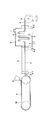
- FIG. 1 is a schematic view of a stretched cellulose ester film of the present invention.
- the stretched cellulose ester film shows a portion above the line b.
- the average value of the surface roughness (Ra) of the end portion H is different from the average value of the surface roughness of the central portion T, and the average value of the elastic modulus of the end portion H and the central portion.
- the average value of the elastic modulus of T is different.
- the end H refers to a portion from the end of the stretched cellulose ester film to L ⁇ 0.05 in the width direction, where L is the width (full width) of the stretched cellulose ester film.
- the center portion T refers to a portion from the center (L / 2) of the film to ⁇ L ⁇ 0.1 in the width direction, where L is the width (full width) of the stretched cellulose ester film, and FIG. Then, it refers to the area indicated by T.
- the average value of the surface roughness (Ra) of the end H of at least one surface (for example, the film surface A) of the stretched cellulose ester film F of the present invention is in the range of 1.7 nm to 4.0 nm, It is characterized by being 0.1 nm to 1.0 nm higher than the average value of the surface roughness (Ra).
- the average value of the surface roughness (Ra) of the end H of at least one surface (for example, film surface A) of the stretched cellulose ester film F of the present invention is preferably in the range of 2.2 nm to 3.5 nm. In addition, it is preferably 0.3 nm to 1.0 nm higher than the average value of the surface roughness (Ra) of the central portion T.
- the average value of the surface roughness (Ra) of the end portion H is obtained by measuring the surface roughness (Ra) of at least 5 points in the width direction of the film from the end of the film, and obtaining the average value thereof.
- the average value of the surface roughness (Ra) of the central portion T is obtained by measuring the surface roughness (Ra) of at least five points in the width direction of the film across the center of the film and calculating the average value thereof. .
- the surface roughness (Ra) is a numerical value defined in JIS B 0601, and examples of the measuring method include a stylus method or an optical method.
- the surface roughness (Ra) in the present invention can be measured using a non-contact surface fine shape measuring device WYKO NT-2000.
- the stretched cellulose ester film F of the present invention has an average elastic modulus of the central portion T in the range of 3.0 GPa to 8.0 GPa, and 0.1 GPa to 2. It is characterized by being 0 GPa high.
- the average value of the elastic modulus of the central portion T is in the range of 4.0 GPa to 7.0 GPa, and is 0.3 GPa to 1. It is preferably 0 GPa high.
- the average value of the elastic modulus of the end portion H is obtained by measuring the elastic modulus of at least five points from the end of the film in the width direction of the film, and obtaining the average value thereof.
- the average value of the elastic modulus of the central portion T is obtained by measuring the elastic modulus of at least five points in the width direction of the film across the center of the film, and obtaining the average value thereof.
- the elastic modulus means a tensile elastic modulus
- a specific measuring method thereof includes, for example, the method of JISK7217. That is, the elastic modulus is 23 ° C. and 55% RH in accordance with the method described in JIS-K-7127 using a tensile tester (TG-2KN, manufactured by Minebea Co., Ltd.), ORIENTEC tensile tester RTC-1225A, and the like. Obtained by measuring below.
- the stretched cellulose ester film of the present invention preferably has a retardation value Ro represented by the following formula of 0 to 20 nm and Rt of ⁇ 100 to 100 nm, more preferably Ro ⁇ 5 nm and ⁇ 50 nm ⁇ Rt ⁇ 50 nm. A range is preferable.
- the retardation value Ro is preferably 30 to 100 nm and the Rt is preferably 70 to 400 nm.
- Ro (nx ⁇ ny) ⁇ d
- Rt ((nx + ny) / 2 ⁇ nz) ⁇ d
- Ro is the retardation value in the film plane
- Rt is the retardation value in the film thickness direction
- nx is the refractive index in the slow axis direction in the film plane
- ny is the refractive index in the fast axis direction in the film plane
- nz represents the refractive index in the thickness direction of the film
- d represents the thickness (nm) of the film.
- the refractive index can be obtained at a wavelength of 590 nm in an environment of 23 ° C. and 55% RH using, for example, KOBRA-WR (Oji Scientific Instruments).
- the slow axis or the fast axis of the stretched cellulose ester film of the present invention exists in the film plane, and ⁇ 1 is preferably ⁇ 1 ° or more and + 1 ° or less, assuming that the angle formed with the film forming direction is ⁇ 1, More preferably, it is 0.5 ° or more and + 0.5 ° or less.
- This ⁇ 1 can be defined as an orientation angle, and the measurement of ⁇ 1 can be performed using an automatic birefringence meter KOBRA-21ADH (Oji Scientific Instruments).
- Each of ⁇ 1 satisfying the above relationship can contribute to obtaining high luminance in a display image, suppressing or preventing light leakage, and contributing to obtaining faithful color reproduction in a color liquid crystal display device.
- the moisture permeability of the stretched cellulose ester film of the present invention is preferably 10 to 1200 g / m 2 ⁇ 24 h at 40 ° C. and 90% RH, more preferably 20 to 1000 g / m 2 ⁇ 24 h, and 20 to 850 g / m 2 ⁇ 24 h. Is particularly preferred.
- the moisture permeability can be measured according to the method described in JIS Z 0208.
- the visible light transmittance of the stretched cellulose ester film of the present invention is preferably 90% or more, and more preferably 93% or more.
- the haze of the stretched cellulose ester film of the present invention is preferably less than 1%, particularly preferably 0 to 0.1%.
- the stretched cellulose ester film of the present invention may be produced by a solution casting method or a melt casting method.
- FIG. 2 is a schematic diagram showing an example of an apparatus for producing a stretched cellulose ester film by a solution casting method.
- the stretched cellulose ester film manufacturing apparatus includes a support 1 made of a rotating metal endless belt, and a die 2 that casts a dope that is a raw material solution of the cellulose ester film on the support 1.
- a peeling roll 3 for peeling the web W formed on the support 1 by the die 2 from the support 1, and a tenter 4 for transporting and drying the film F peeled from the support 1 in the width direction,
- a drying device 5 that dries the film F while being conveyed via a plurality of conveying rolls 6, and a winding roll 8 that winds the stretched cellulose ester film F obtained by drying.
- the film A surface referred to in the present invention refers to a surface opposite to the side in contact with the belt surface or drum surface when the dope is cast on the belt or drum.
- the heat retaining process 4-1 is performed so that the temperature of the unstretched cellulose ester film Fo does not become too low, and after the tenter 4 (stretching process), A cooling step 4-2 for performing slow cooling is provided. Further, before the drying step by the drying device 5, a heat retaining step 5-1 is performed so that the temperature of the stretched cellulose ester film F does not become too low, and after the drying device 5 (drying step), the film is gradually cooled.
- a cooling step 5-2 for performing the above is provided.
- the stretched cellulose ester film of the present invention by the solution casting method includes 1) a step of preparing a dope by dissolving the cellulose ester and the additive in a solvent, and 2) a step of casting the dope on an endless metal support. 3) A process of drying the cast dope and then peeling it from the metal support to obtain a web (unstretched cellulose ester film). 4) Stretching the web (unstretched cellulose ester film) to form a stretched cellulose ester film. It can be manufactured through a step of obtaining, 5) a step of drying the film, and 6) a step of winding up the film.
- the concentration of cellulose ester in the dope is preferably higher because the drying load after casting on the metal support can be reduced. However, if the concentration of cellulose ester is too high, the load during filtration increases and the filtration accuracy is poor. Become.
- the concentration that achieves both of these is preferably 10 to 35% by mass, and more preferably 15 to 25% by mass.
- the solvent used in the dope may be used alone or in combination of two or more, but it is preferable to use a mixture of a good solvent and a poor solvent of cellulose ester in terms of production efficiency, and there are many good solvents. This is preferable from the viewpoint of the solubility of the cellulose ester.
- the preferable range of the mixing ratio of the good solvent and the poor solvent is 70 to 98% by mass for the good solvent and 2 to 30% by mass for the poor solvent.
- the good solvent and the poor solvent change depending on the average acetylation degree (acetyl group substitution degree) of the cellulose ester.
- the good solvent and the poor solvent change depending on the average acetylation degree (acetyl group substitution degree) of the cellulose ester.
- the good solvent and the poor solvent change depending on the average acetylation degree (acetyl group substitution degree) of the cellulose ester.
- the cellulose ester acetate ester acetyl group substitution degree 2.4
- cellulose Acetate propionate is a good solvent
- cellulose acetate (acetyl group substitution degree 2.8) is a poor solvent.
- the good solvent is not particularly limited, and examples thereof include organic halogen compounds such as methylene chloride, dioxolanes, acetone, methyl acetate, and methyl acetoacetate. Particularly preferred is methylene chloride or methyl acetate.
- the poor solvent is not particularly limited, but for example, methanol, ethanol, n-butanol, cyclohexane, cyclohexanone, etc. are preferably used.
- the dope preferably contains 0.01 to 2% by mass of water.
- the recovery solvent may contain trace amounts of additives added to the cellulose ester, such as plasticizers, UV absorbers, polymers, monomer components, etc., but even if these are included, they are preferably reused. Can be purified and reused if necessary.
- a general method can be used as a method for dissolving the cellulose ester when the dope is prepared.
- heating and pressurization are combined, it is possible to heat above the boiling point at normal pressure. It is preferable to stir and dissolve while heating at a temperature that is equal to or higher than the boiling point of the solvent at normal pressure and that the solvent does not boil under pressure, in order to prevent the generation of massive undissolved materials called gels and macos.
- dissolving is also used preferably.
- Pressurization may be performed by a method of injecting an inert gas such as nitrogen gas or a method of increasing the vapor pressure of the solvent by heating. Heating is preferably performed from the outside.
- a jacket type is preferable because temperature control is easy.
- the heating temperature with the addition of the solvent is preferably higher from the viewpoint of the solubility of the cellulose ester, but if the heating temperature is too high, the required pressure increases and the productivity deteriorates.
- a preferred heating temperature is 45 to 120 ° C, more preferably 60 to 110 ° C, and still more preferably 70 ° C to 105 ° C. The pressure is adjusted so that the solvent does not boil at the set temperature.
- a cooling dissolution method is also preferably used, whereby the cellulose ester can be dissolved in a solvent such as methyl acetate.
- the cellulose ester solution is filtered using an appropriate filter medium such as filter paper.
- an appropriate filter medium such as filter paper.
- the filter medium it is preferable that the absolute filtration accuracy is small in order to remove insoluble matters and the like, but there is a problem that the filter medium is likely to be clogged if the absolute filtration accuracy is too small. For this reason, a filter medium with an absolute filtration accuracy of 0.008 mm or less is preferable, a filter medium with 0.001 to 0.008 mm is more preferable, and a filter medium with 0.003 to 0.006 mm is more preferable.
- the material of the filter medium there are no particular restrictions on the material of the filter medium, and ordinary filter media can be used.
- plastic filter media such as polypropylene and Teflon (registered trademark), and metal filter media such as stainless steel do not drop off fibers. preferable. It is preferable to remove and reduce impurities, particularly bright spot foreign matter, contained in the raw material cellulose ester by filtration.
- the bright spot foreign matter is placed in a crossed Nicols state with two polarizing plates, a stretched cellulose ester film is placed between them, light is applied from the side of one polarizing plate, and observed from the side of the other polarizing plate. It is a point (foreign matter) where light from the opposite side sometimes leaks, and the number of bright spots having a diameter of 0.01 mm or more is preferably 200 / cm 2 or less. More preferably, it is 100 pieces / cm 2 or less, further preferably 50 pieces / cm 2 or less, and further preferably 0 to 10 pieces / cm 2 . Further, it is preferable that the number of bright spots of 0.01 mm or less is small.
- the dope can be filtered by a normal method, but the method of filtering while heating at a temperature not lower than the boiling point of the solvent at normal pressure and in a range where the solvent does not boil under pressure is the filtration pressure before and after filtration.
- the increase in the difference (referred to as differential pressure) is small and preferable.
- a preferred temperature is 45 to 120 ° C., more preferably 45 to 70 ° C., and still more preferably 45 to 55 ° C.
- the filtration pressure is preferably 1.6 MPa or less, more preferably 1.2 MPa or less, and further preferably 1.0 MPa or less.
- the metal support in the casting process is preferably a mirror-finished surface, and the metal support is made of stainless steel belt or casting.
- a drum plated with is preferably used.
- the cast width can be 1 to 4 m. Since the width of the optical film of the present invention is preferably 2 m to 4 m, the cast width is necessarily wide.
- the surface temperature of the metal support may be the same as the surface temperature of the metal support in the step of drying the dope described later and then peeling the dope from the metal support to obtain a web.
- the surface temperature of the metal support is from ⁇ 50 ° C. to below the boiling point of the solvent, and the higher the temperature, the more the web is dried. This is preferable because the speed can be increased, but if it is too high, the web may foam or the flatness may deteriorate.
- the support temperature is preferably 0 to 40 ° C, more preferably 5 to 30 ° C.
- the method for controlling the temperature of the metal support is not particularly limited, and there are a method of blowing hot air or cold air, and a method of contacting hot water with the back side of the metal support. It is preferable to use warm water because heat transfer is performed efficiently, so that the time until the temperature of the metal support becomes constant is short. When warm air is used, wind at a temperature higher than the target temperature may be used.
- the amount of residual solvent when peeling the web from the metal support is preferably 10 to 150% by mass, more preferably 20 to 40% by mass or 60 to 130% by mass. %, Particularly preferably 20 to 30% by mass or 70 to 120% by mass.
- the amount of residual solvent is defined by the following formula.
- Residual solvent amount (% by mass) ⁇ (MN) / N ⁇ ⁇ 100 M is the mass of a sample collected during or after the production of the web or film, and N is the mass after heating M at 115 ° C. for 1 hour.
- the peeled web is conveyed to the above-described stretching process (preferably a tenter), and the stretching process according to the present invention is performed.
- the stretching process preferably a tenter
- FIG. 3 An example of the mechanism of the tenter 4 is shown in FIG.
- the tenter 4 has a large number of clips 11 connected in a chain state on both left and right sides of the housing 10, and these clips 11 form a single wheel and run on the rail 12.
- the unstretched cellulose ester film Fo is gripped and conveyed.
- each clip 11 is provided with a swingable presser arm.
- both ends in the width direction of the unstretched cellulose ester film Fo on the cradle are pressed by the tenter 4. It is sandwiched (clipped) between the curved surface tip of the arm and the cradle and conveyed together while being stretched, and at the same time dried.
- the unstretched cellulose ester film Fo has a film width holding zone A, a film width direction stretching zone B, and a film width holding zone C in the stretched state in a state where both ends in the width direction are gripped. Passing sequentially, the film width direction stretching treatment is performed, and a stretched cellulose ester film F is obtained.
- the film width holding zone A in the tenter 4 is a zone in which the distance between grip clips of the film width (both ends of the base) from the entrance of the tenter 4 to the stretching start point a is constant.
- the stretching zone B refers to a zone in which the distance between grip clips of the film width (both ends of the base) from the stretching start point a to the stretching end point b of the tenter 4 spreads in the traveling direction (conveying direction).
- the film width holding zone C in the stretched state is a zone in which the distance between the grip clips of the stretched film width (both ends of the base) from the stretch end point b of the tenter 4 to the grip clip release point c is constant. In the latter half of the film width holding zone C, if the stress in the width direction on the post-stretching film F is too strong, it is also preferable to provide a relaxation treatment.
- the rail 12 in the tenter 4 is normally a bendable rail.
- the stretching zone B corresponds to the stretching process of the present invention. Note that the combinations of these zones are not limited to those shown in the drawings, and may be combined in any order.
- the illustrated tenter 4 is a clip tenter method, this may be a pin tenter method, and in any case, the tenter method can be dried while maintaining the width of the stretched cellulose ester film F. In order to improve flatness and dimensional stability, it is preferable.
- the stretching treatment it is preferable to stretch the unstretched cellulose ester film Fo in the width direction of the film at a stretch ratio of 25% to 100% in order to widen the film, from the viewpoint of improving productivity and avoiding breakage and the like.
- the draw ratio is more preferably 30% to 50%.
- the stretching operation can also be performed in the longitudinal direction (MD direction) of the film.
- MD direction longitudinal direction
- the film transport tension in the film forming process such as in the tenter depends on the temperature, but is preferably 120 N / m to 200 N / m, and more preferably 140 N / m to 200 N / m. 140 N / m to 160 N / m is most preferable.
- the glass transition temperature of the stretched cellulose ester film of the present invention is defined as Tg (Tg-30) to (Tg + 100) ° C., more preferably (Tg-20) to (Tg + 80) ° C., and even more preferably (Tg ⁇ 5) to (Tg + 20) ° C.
- the Tg of the cellulose ester film can be controlled by the material type constituting the film and the ratio of the constituting materials.
- the Tg when the film is dried is preferably 110 ° C. or higher, more preferably 120 ° C. or higher.
- the glass transition temperature is preferably 190 ° C. or lower, more preferably 170 ° C. or lower.
- the Tg of the film can be determined by the method described in JIS K7121.
- the stretching time is appropriately selected, but is preferably a relatively short time from the viewpoint of flatness and dimensional stability. Specifically, the range is preferably 1 to 10 seconds, and more preferably 4 to 10 seconds. Further, the stretching speed in the width direction may be constant or may be changed. The stretching speed is preferably 50 to 500% / min, more preferably 100 to 400% / min, and most preferably 200 to 300% / min.
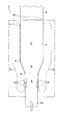
- FIG. 4 is a schematic diagram showing a stretching method preferred for the present invention.
- the unstretched cellulose ester film Fo is conveyed to a tenter, the end is gripped with a clip or the like, and stretched at a predetermined stretch ratio.
- the surface temperature of the end portion Ho of the surface A of the unstretched cellulose ester film Fo is the surface temperature of the central portion To of the surface A of the unstretched cellulose ester film Fo.
- stretching may be performed while raising the temperature by 10 ° C to 50 ° C. However, it is not limited to this method.
- the surface A of the unstretched cellulose ester film Fo refers to the surface opposite to the side in contact with the metal support surface when the dope solution is cast on the metal support to produce a film.
- the end Ho refers to a portion from the end of the film to Lo ⁇ 0.05 in the width direction of the film, where Lo is the width (full width) of the unstretched cellulose ester film Fo.
- the center portion To refers to a portion from the center of the film to ⁇ Lo ⁇ 0.1 in the width direction of the film when the width (full width) of the unstretched cellulose ester film Fo is Lo.
- the surface temperature of the end portion Ho and the central portion To of the unstretched cellulose ester film can be measured using a contact-type handy thermometer (ANITSU DIGITAL THREMOMETER HA-100K). Specifically, 5 points can be measured for each of the width directions at the point a at which the stretching process of the film being transported is started, and the average value can be set as the film temperature of the part.
- ANITSU DIGITAL THREMOMETER HA-100K Specifically, 5 points can be measured for each of the width directions at the point a at which the stretching process of the film being transported is started, and the average value can be set as the film temperature of the part.
- the method for adjusting the temperature is preferably a method in which hot air is blown locally on the end portion.
- at least a pair of end hot air generating portions G1 for adjusting the surface temperature is disposed so as to face the end portion of the surface A of the unstretched cellulose ester film, and from the end hot air generating portions, A method in which stretching is performed while spraying hot air having a temperature 10 ° C. to 50 ° C. higher than the surface temperature of the central portion To of the surface A of the film A on the end portion Ho of the surface A of the unstretched cellulose ester film Fo is preferable.
- the end hot air generating part preferably blows hot air, the temperature of which is controlled by a hot air generator (not shown), from the nozzle-like outlet to the entire end of the unstretched cellulose ester film Fo.
- the distance from the film end to the film end can be appropriately selected, but it is preferable to cover at least the point a before and after the point a at which the unstretched cellulose ester film Fo starts to be stretched.
- variety (full width) of the unstretched cellulose-ester film Fo when set to Lo, it can cover the part from the edge of this film to Lox0.2 in the width direction of a film, It is preferable because the temperature of the end portion and the center portion can be adjusted efficiently.
- the temperature distribution in the film width direction of the atmosphere is small from the viewpoint of improving the uniformity of the film, and the temperature distribution in the width direction at the end and the center is preferably within ⁇ 5 ° C, Within ⁇ 2 ° C is more preferred, and within ⁇ 1 ° C is most preferred.
- a pair of end hot air generating portions G1 are provided in the vicinity of the stretching start point a so as to cover both ends of the unstretched cellulose ester film Fo.
- the position of the end hot air generating part G1 in FIG. 4 shows a preferable position, and is not limited to this.
- the stretched cellulose ester film obtained in the stretching process is conveyed to the film drying process.
- the amount of residual solvent is preferably 1% by mass or less, more preferably 0.1% by mass or less, and particularly preferably 0 to 0.01% by mass or less. It is.
- a roll drying method (a method in which a plurality of rolls arranged at the top and bottom are alternately passed through the web for drying) or a tenter method for drying while transporting the web is employed.
- the means for drying the film is not particularly limited, and can be generally performed with hot air, infrared rays, heating rolls, microwaves, etc., but it is preferably performed with hot air in terms of simplicity.
- the drying temperature in the film drying step is preferably 90 ° C. to 200 ° C., more preferably 110 ° C. to 160 ° C.
- the drying temperature is preferably increased stepwise.
- the preferred drying time depends on the drying temperature, but is preferably 5 minutes to 60 minutes, more preferably 10 minutes to 30 minutes.
- the film thickness of the stretched cellulose ester film is not particularly limited, but is preferably 10 to 200 ⁇ m, more preferably 10 to 100 ⁇ m, and still more preferably 20 to 70 ⁇ m from the viewpoint of thin film and weight reduction.
- the stretched cellulose ester film of the present invention has a width of 2 to 4 m, more preferably 2 to 3 m. If it exceeds 4 m, conveyance becomes difficult.
- the stretched cellulose ester film is preferably heat-set after the stretching treatment described above, but the heat-set is preferably heat-set within a temperature range of Tg-20 ° C. or lower, usually for 0.5 to 300 seconds. At this time, it is preferable to perform heat fixing while sequentially raising the temperature in a range where the temperature difference is 1 to 100 ° C. in the region divided into two or more.
- the heat-fixed film is usually cooled to Tg or less, and the clip gripping portions at both ends of the film are cut and wound.
- the cooling is preferably performed by gradually cooling from the final heat setting temperature to Tg at a cooling rate of 100 ° C. or less per second.
- Means for cooling and relaxation treatment are not particularly limited, and can be performed by a conventionally known means. In particular, it is preferable to carry out these treatments while sequentially cooling in a plurality of temperature ranges from the viewpoint of improving the dimensional stability of the film.
- More optimal conditions of these heat setting conditions, cooling, and relaxation treatment conditions vary depending on the type of additives such as cellulose ester and plasticizer constituting the film, so the physical properties of the obtained stretched film are measured and preferable characteristics are obtained. Thus, it may be determined by adjusting as appropriate.
- Step of winding film the obtained stretched cellulose ester film is wound in a direction perpendicular to the width direction of the film to obtain a wound body.
- the polarizing plate of the present invention has a polarizer and a stretched cellulose ester film of the present invention disposed on at least one surface thereof.
- the stretched cellulose ester film used for the polarizing plate has at least a part of the end portion H (for example, L ⁇ 0.01 to 0.02 from the width direction end of the film). It is preferable that the region up to is removed by slit.
- the polarizing plate can be produced by a general method.
- the polarizer side of the stretched cellulose ester film of the present invention is preferably bonded to at least one surface of a polarizer prepared by alkali saponification treatment and immersed in an iodine solution using a completely saponified polyvinyl alcohol aqueous solution. .
- the stretched cellulose ester film may be used on the other surface, or another optical film may be used.
- cellulose ester films for example, Konica Minoltack KC8UX, KC4UX, KC5UX, KC8UY, KC4UY, KC12UR, KC8UCR-3, KC8UCR-4, KC8UCR-5, KC4FR-1, KC4DR, KC4KR, K4SR, KC4KR, K4SR KC8UY-HA, KC8UX-RHA, KC2UA, KC4UA, KC6UA, KC4CZ, KC2CZ or higher, manufactured by Konica Minolta Opto, Fujitac 8TD, 6TD, 4TD, NRT, or Fujifilm, Inc. are also preferably used.
- the stretched cellulose ester film of the present invention was an optical film A
- the optical film B was measured at a wavelength of 590 nm when the optical film used for the polarizing plate on the opposite side via a liquid crystal cell was an optical film B.
- the optical film B is not particularly limited, and these can be produced, for example, by the methods described in JP-A-2005-196149 and JP-A-2005-275104. It is also preferable to use an optical film that also serves as an optical compensation film having an optically anisotropic layer formed by aligning a liquid crystal compound such as a discotic liquid crystal.
- the optically anisotropic layer can be formed by the method described in JP-A-2005-275083.
- a polarizer which is a main component of a polarizing plate, is an element that allows only light of a plane of polarization in a certain direction to pass.
- a typical polarizer currently known is a polyvinyl alcohol-based polarizing film, which is polyvinyl alcohol.
- iodine is dyed on a system film and one in which dichroic dye is dyed.
- a polyvinyl alcohol aqueous solution is formed into a film and dyed by uniaxial stretching or dyed or uniaxially stretched and then preferably subjected to a durability treatment with a boron compound.
- the film thickness of the polarizer is preferably 5 to 30 ⁇ m, particularly preferably 10 to 20 ⁇ m.
- the ethylene unit content described in JP-A-2003-248123, JP-A-2003-342322, etc. is 1 to 4 mol%
- the degree of polymerization is 2000 to 4000
- the degree of saponification is 99.0 to 99.99 mol%.
- Ethylene-modified polyvinyl alcohol is also preferably used.
- an ethylene-modified polyvinyl alcohol film having a hot water cutting temperature of 66 to 73 ° C. is preferably used.
- the difference in hot water cutting temperature between two points 5 cm away in the TD direction of the film is more preferably 1 ° C. or less in order to reduce color spots, and two points separated 1 cm in the TD direction of the film. In order to reduce color spots, it is more preferable that the difference in the hot water cutting temperature is 0.5 ° C. or less.
- a polarizer using this ethylene-modified polyvinyl alcohol film is excellent in polarization performance and durability performance and has few color spots, and is particularly preferably used for a large liquid crystal display device.
- the polarizer obtained as described above is generally used as a polarizing plate with a protective film pasted on both sides or one side thereof.
- a PVA-based adhesive is used as an adhesive used for pasting.
- a PVA-based adhesive is preferably used.
- liquid crystal display device By incorporating the polarizing plate into the display device, various liquid crystal display devices with excellent visibility can be manufactured.
- a reflection type, a transmission type, a transflective type liquid crystal display device, or a liquid crystal display device of various drive systems such as a TN type, STN type, OCB type, VA type, IPS type, ECB type, particularly VA type. It is preferably applied to a liquid crystal display device of (MVA type, PVA type).
- the liquid crystal display device has a liquid crystal cell and a pair of polarizing plates that sandwich the liquid crystal cell. And at least one of a pair of polarizing plates contains the stretched cellulose ester film of this invention. It is preferable that the stretched cellulose ester film of this invention is arrange
- the stretched cellulose ester film of the present invention has a small deviation in the film plane of the retardation value Ro, the polarizing plate using it has good visibility when used in a large-screen liquid crystal display device, In addition, excellent front contrast can be imparted.
- a large-screen liquid crystal display device having a 17-inch or larger screen, particularly a 30-inch or larger screen, there is no distortion such as uneven color and wavy unevenness, and there is an effect that eyes are not tired even during long-time viewing.
- Example 1 Preparation of Fine Particle Dispersion 1 The following components were stirred and mixed with a dissolver for 50 minutes, and then dispersed with Manton Gorin. (Composition of fine particle dispersion 1) Fine particles (Aerosil R812V manufactured by Nippon Aerosil Co., Ltd.): 11 parts by mass Ethanol: 89 parts by mass
- Fine Particle Additive Solution 1 The fine particle dispersion 1 was slowly added to a dissolution tank containing methylene chloride with sufficient stirring. Further, the particles were dispersed by an attritor so that the secondary particles had a predetermined particle size. This was filtered through Finemet NF manufactured by Nippon Seisen Co., Ltd. to prepare a fine particle additive solution 1. (Composition of fine particle additive liquid 1) Methylene chloride: 99 parts by mass Fine particle dispersion 1: 5 parts by mass
- a dope solution having the following composition was prepared. First, methylene chloride and ethanol were added to the pressure dissolution tank. A cellulose acetate having an acetyl group substitution degree of 2.88, an ester compound, tinuvin 928, and the fine particle additive solution 1 were charged into a pressure dissolution tank containing a solvent while stirring. This was heated and dissolved completely with stirring. This was designated as Azumi Filter Paper No. A dope solution was prepared by filtration using 244.
- an endless belt casting apparatus was used to uniformly cast the dope solution on a stainless steel belt support at a temperature of 33 ° C. and a width of 1600 mm.
- the temperature of the stainless steel belt was controlled at 30 ° C.
- the solvent was evaporated until the amount of residual solvent in the cast (cast) film reached 75%, and then peeled off from the stainless steel belt support with a peeling tension of 130 N / m.
- the peeled cellulose acetate film is adjusted so that the temperature of the housing 10 is adjusted using the tenter 4 shown in FIG.
- the hot air generating part G1 was installed, and the film was stretched in the width direction at a stretching ratio of 46% while adjusting the temperature so that the stretching temperature at the film end surface was 190 ° C.
- the residual solvent at the start of stretching was 10%.
- the temperature of the film surface at the edge part and the central part was measured for each of the five points in the width direction of the film being conveyed using a contact-type handy thermometer (ANRITSU DIGITAL THREMOMETER HA-100K), and the average value was measured. It was set as the film temperature of the part.
- drying was completed and wound up while the drying zone was conveyed by a number of rolls.
- the drying temperature was 130 ° C. and the transport tension was 100 N / m.
- a stretched cellulose ester film 1 having a film width of 2200 mm, a dry film thickness of 60 ⁇ m, and a length of 5000 m was produced.
- Examples 2 to 13 and Comparative Examples 1 to 6 In the production of the stretched cellulose ester film 1, the stretched cellulose ester film was similarly prepared except that the end stretching temperature, the center stretching temperature, the stretching ratio, the film thickness, and the film width after stretching were set as shown in Table 2. 2 to 19 were produced.
- the stretched cellulose ester film 9 was produced by moving the end hot air generating portion G1 to the central portion so that the stretching temperature at the central portion was higher than that at the end.
- the average value of the surface roughness (Ra) of the edge H of the film was determined by measuring the surface roughness (Ra) at least 5 points in the width direction of the film from the end of the film, and calculating the average value thereof.
- the average value of the surface roughness (Ra) of the central portion T of the film was determined by measuring the surface roughness (Ra) at least 5 points in the width direction of the film across the center of the film, and calculating the average value thereof.
- the surface roughness (Ra) was measured using a non-contact surface fine shape measuring apparatus WYKO HD3300 in accordance with JIS B 0601.
- the average value of the elastic modulus at the end H of the film was determined by measuring the elastic modulus at a minimum of 5 points in the width direction of the film from the end of the film.
- the average value of the elastic modulus of the central portion T of the film was determined by measuring the elastic modulus of at least 5 points across the center of the film in the width direction of the film, and calculating the average value thereof.
- the elastic modulus was measured in an environment of 23 ° C. and 55% RH using an ORIENTEC tensile tester RTC-1225A according to the method described in JIS-K-7127.
- Ro (nx ⁇ ny) ⁇ d
- Rt ((nx + ny) / 2 ⁇ nz) ⁇ d
- Ro is the retardation value in the film plane
- Rt is the retardation value in the film thickness direction
- nx is the refractive index in the slow axis direction in the film plane
- ny is the refractive index in the fast axis direction in the film plane
- nz represents the refractive index in the thickness direction of the film
- d represents the thickness (nm) of the film.
- the end H 1 refers to a portion extending from the end of the film to L 1 ⁇ 0.05 in the width direction when the width (full width) of the slit-removed film is L 1 ; the center T is the film The portion from the center of the line to ⁇ L 1 ⁇ 0.1 in the width direction.
- the stretched cellulose ester films 1 to 3, 5, 7 to 8, 10, 12, and 15 to 19 of the present invention generated wrinkles extending in the transport direction with respect to the stretched cellulose ester film of the comparative example. , occurrence of wrinkles broken end of a high speed transport is suppressed, and since the deviation of the in-plane retardation value of the central portion T and the end portion H 1 in the slit-removed film is small, it is also suppressed variations in the optical properties I understood that.
- Example 14 A dope solution having the following composition was prepared. First, methylene chloride and ethanol were added to the pressure dissolution tank. Cellulose ester having a acetyl group substitution degree of 1.90, a propionyl group substitution degree of 0.70, and a total acyl group substitution degree of 2.60, a sugar ester compound, an ester compound, and tinuvin 928 The fine particle addition liquid 1 was added while stirring. This was heated and dissolved completely with stirring. This was designated as Azumi Filter Paper No. A dope solution was prepared by filtration using 244.
- an endless belt casting apparatus was used to uniformly cast the dope solution on a stainless steel belt support at a temperature of 33 ° C. and a width of 1800 mm.
- the temperature of the stainless steel belt was controlled at 30 ° C.
- the solvent was evaporated until the amount of residual solvent in the cast (cast) film reached 75%, and then peeled off from the stainless steel belt support with a peeling tension of 130 N / m.
- the peeled cellulose acetate film is adjusted so that the temperature of the housing 10 is adjusted using the tenter 4 shown in FIG.
- the hot air generating part G1 was installed, and the film was stretched in the width direction at a stretching ratio of 46% while adjusting the temperature so that the stretching temperature at the film end surface was 190 ° C.
- the residual solvent at the start of stretching was 10%.
- the temperature of the film surface at the edge part and the central part was measured for each of the five points in the width direction of the film being conveyed using a contact-type handy thermometer (ANRITSU DIGITAL THREMOMETER HA-100K), and the average value was measured. It was set as the film temperature of the part.
- drying was completed and wound up while the drying zone was conveyed by a number of rolls.
- the drying temperature was 130 ° C. and the transport tension was 100 N / m.
- stretched cellulose ester films 22 to 24 were produced in the same manner except that the types of sugar ester compound and ester compound were changed as shown in Table 3. When the sugar ester compound and the ester compound were used alone, 10 parts by mass were added.
- ⁇ Haze less than 0.15%
- ⁇ Haze 0.15% or more and less than 0.3%
- ⁇ Haze 0.3% or more and less than 0.5%
- ⁇ Haze 0.5% or more
- the present invention there is no occurrence of “wrinkles in which the direction of the groove or mountain is the conveying direction” when stretching at a high magnification in an attempt to widen the film, and the retardation Ro film in the in-plane direction even when widened It is possible to provide a stretched cellulose ester film in which deviation at each portion is small, and further, generation of folding wrinkles at the end of the film when the film is conveyed at a high speed and a method for producing the stretched cellulose ester film can be provided.
Landscapes
- Engineering & Computer Science (AREA)
- Physics & Mathematics (AREA)
- Manufacturing & Machinery (AREA)
- Chemical & Material Sciences (AREA)
- General Physics & Mathematics (AREA)
- Mechanical Engineering (AREA)
- Optics & Photonics (AREA)
- Health & Medical Sciences (AREA)
- Organic Chemistry (AREA)
- Ophthalmology & Optometry (AREA)
- Chemical Kinetics & Catalysis (AREA)
- Polymers & Plastics (AREA)
- Materials Engineering (AREA)
- Medicinal Chemistry (AREA)
- Polarising Elements (AREA)
- Shaping By String And By Release Of Stress In Plastics And The Like (AREA)
- Manufacture Of Macromolecular Shaped Articles (AREA)
- Liquid Crystal (AREA)
Abstract
本発明の目的は、高倍率に延伸する際の、「溝または山の方向が搬送方向であるシワ」が抑制され、広幅化されても面内方向のリターデーションRoのフィルム各部における偏差が小さく、かつフィルムを高速で搬送する際のフィルム端部の折れジワの発生が抑制された延伸セルロースエステルフィルムを提供することにある。延伸セルロースエステルフィルムの少なくとも一方の面の、端部Hの表面粗さ(Ra)の平均値が1.7nm~4.0nmの範囲で、中央部Tの表面粗さ(Ra)の平均値よりも0.1nm~1.0nm高く、中央部Tの弾性率の平均値が3.0GPa~8.0GPaの範囲で、端部Hの弾性率の平均値よりも0.1GPa~2.0GPa高い、延伸セルロースエステルフィルム。
Description
本発明は、延伸セルロースエステルフィルム、及びその製造方法に関する。
昨今、自動車搭載用の液晶ディスプレイ、大型液晶テレビのディスプレイ、携帯電話、ノートパソコン等の普及から液晶表示装置(以下、LCDとも言う)の需要が旺盛である。このようなLCDには、偏光フィルムや位相差フィルムなどの種々な光学フィルムが使用されている。
LCDの需要が増加し、これに合わせ使用される偏光板についても薄膜化、軽量化、高生産化が要望されている。更に、LCDの大画面化に伴い、部材としての光学フィルムも薄膜化、高生産化に伴う広幅化が求められており、機械的強度物性を中心とする膜特性を向上する検討も進められている。
セルロースエステルフィルムは偏光板保護フィルムとして常用化されているが、この様な薄膜化、広幅化のフィルムを製造する場合、光学特性や平面性、更に得られるフィルムの膜厚や幅を調整するために、一般に製膜後にテンターにより高倍率の延伸を行う。(例えば、特許文献1参照。)
しかしながら、セルロースエステルフィルムを広幅化、薄膜化しようとして高温で高倍率に延伸すると、特に1.6mを越えるような広幅なフィルムを生産する場合、「溝または山の方向が搬送方向であるシワ」が生じるという問題があった。また、高倍率の延伸によりセルロース配向の乱れが生じやすく、光学特性で重要な面内方向のリターデーションRoの、フィルム各部における偏差が大きくなるという問題があった。さらに、フィルムを高速で搬送する際に、フィルムの端部に「折れジワ」が発生し、生産性が低下するという問題があった。
従って、本発明の目的は、広幅化しようとして高倍率に延伸する際の、「溝または山の方向が搬送方向であるシワ」が抑制され、広幅化されても面内方向のリターデーションRoのフィルム各部における偏差が小さく、かつフィルムを高速で搬送する際のフィルム端部の折れジワが抑制された延伸セルロースエステルフィルムおよびその製造方法を提供することにある。
本発明の上記目的は以下の構成により達成される。
[1] 延伸セルロースエステルフィルムの幅をLとし;フィルムの幅方向に前記延伸セルロースエステルフィルムの端からL×0.05までの部分を端部Hとし;フィルムの幅方向に前記延伸セルロースエステルフィルムの中心から±L×0.1までの部分を中央部Tとしたとき、前記延伸セルロースエステルフィルムの少なくとも一方の面の、前記端部Hの表面粗さ(Ra)の平均値が1.7nm~4.0nmの範囲で、前記中央部Tの表面粗さ(Ra)の平均値よりも0.1nm~1.0nm高く、前記中央部Tの弾性率の平均値が3.0GPa~8.0GPaの範囲で、前記端部Hの弾性率の平均値よりも0.1GPa~2.0GPa高い、延伸セルロースエステルフィルム。
[2] 前記延伸セルロースエステルフィルムの少なくとも一方の面の、前記端部Hの表面粗さ(Ra)の平均値が2.2nm~3.5nmの範囲で、前記中央部Tの表面粗さ(Ra)の平均値よりも0.3nm~1.0nm高く、前記中央部Tの弾性率の平均値が4.0GPa~7.0GPaの範囲で、前記端部Hの弾性率の平均値よりも0.3GPa~1.0GPa高い、[1]に記載の延伸セルロースエステルフィルム。
[3] 前記延伸セルロースエステルフィルムの幅が2~3mであり、膜厚が20~70μmである、[1]または[2]に記載の延伸セルロースエステルフィルム。
[4] 前記延伸セルロースエステルフィルムは、フィルムの幅方向に垂直な方向に巻き取られた巻き取り体である、[1]~[3]のいずれかに記載の延伸セルロースエステルフィルム。
[1] 延伸セルロースエステルフィルムの幅をLとし;フィルムの幅方向に前記延伸セルロースエステルフィルムの端からL×0.05までの部分を端部Hとし;フィルムの幅方向に前記延伸セルロースエステルフィルムの中心から±L×0.1までの部分を中央部Tとしたとき、前記延伸セルロースエステルフィルムの少なくとも一方の面の、前記端部Hの表面粗さ(Ra)の平均値が1.7nm~4.0nmの範囲で、前記中央部Tの表面粗さ(Ra)の平均値よりも0.1nm~1.0nm高く、前記中央部Tの弾性率の平均値が3.0GPa~8.0GPaの範囲で、前記端部Hの弾性率の平均値よりも0.1GPa~2.0GPa高い、延伸セルロースエステルフィルム。
[2] 前記延伸セルロースエステルフィルムの少なくとも一方の面の、前記端部Hの表面粗さ(Ra)の平均値が2.2nm~3.5nmの範囲で、前記中央部Tの表面粗さ(Ra)の平均値よりも0.3nm~1.0nm高く、前記中央部Tの弾性率の平均値が4.0GPa~7.0GPaの範囲で、前記端部Hの弾性率の平均値よりも0.3GPa~1.0GPa高い、[1]に記載の延伸セルロースエステルフィルム。
[3] 前記延伸セルロースエステルフィルムの幅が2~3mであり、膜厚が20~70μmである、[1]または[2]に記載の延伸セルロースエステルフィルム。
[4] 前記延伸セルロースエステルフィルムは、フィルムの幅方向に垂直な方向に巻き取られた巻き取り体である、[1]~[3]のいずれかに記載の延伸セルロースエステルフィルム。
[5] セルロースエステルを溶剤に溶解させてドープを調製する工程と、前記ドープを無端状の金属支持体上に流延する工程と、流延した前記ドープを乾燥後、前記金属支持体から剥離して未延伸セルロースエステルフィルムを得る工程と、前記未延伸セルロースエステルフィルムを延伸して延伸セルロースエステルフィルムを得る工程とを含む、[1]~[4]のいずれかに記載の延伸セルロースエステルフィルムの製造方法であって、前記未延伸セルロースエステルフィルムの幅をLoとし;フィルムの幅方向に前記未延伸セルロースエステルフィルムの端からLo×0.05までの部分を端部Hoとし;フィルムの幅方向に前記未延伸セルロースエステルフィルムの中心から±Lo×0.1までの部分を中央部Toとしたとき、前記未延伸セルロースエステルフィルムの、前記金属支持体に接した面とは反対側の面Aの前記端部Hoの表面温度を、前記面Aの前記中央部Toの表面温度よりも10℃~50℃高くしながら延伸処理する、延伸セルロースエステルフィルムの製造方法。
[6] 前記表面温度を調整するための少なくとも一対の端部熱風発生部分を、前記未延伸セルロースエステルフィルムの面Aの端部と対向するように配置し、前記端部熱風発生部分より、前記未延伸セルロースエステルフィルムの前記面Aの端部Hoに、前記面Aの前記中央部Toの表面温度よりも10℃~50℃高い温度の熱風を吹き付けながら、前記未延伸セルロースエステルフィルムを延伸処理する、[5]に記載の延伸セルロースエステルフィルムの製造方法。
[7] 前記延伸セルロースエステルフィルムを、フィルムの幅方向に垂直な方向に巻き取る巻き取り工程をさらに含む、[5]または[6]に記載の延伸セルロースエステルフィルムの製造方法。
[8] 前記延伸処理では、前記未延伸セルロースエステルフィルムを、フィルムの幅方向に25%~100%の延伸倍率で延伸する、[5]~[7]のいずれかに記載の延伸セルロースエステルフィルムの製造方法。
[6] 前記表面温度を調整するための少なくとも一対の端部熱風発生部分を、前記未延伸セルロースエステルフィルムの面Aの端部と対向するように配置し、前記端部熱風発生部分より、前記未延伸セルロースエステルフィルムの前記面Aの端部Hoに、前記面Aの前記中央部Toの表面温度よりも10℃~50℃高い温度の熱風を吹き付けながら、前記未延伸セルロースエステルフィルムを延伸処理する、[5]に記載の延伸セルロースエステルフィルムの製造方法。
[7] 前記延伸セルロースエステルフィルムを、フィルムの幅方向に垂直な方向に巻き取る巻き取り工程をさらに含む、[5]または[6]に記載の延伸セルロースエステルフィルムの製造方法。
[8] 前記延伸処理では、前記未延伸セルロースエステルフィルムを、フィルムの幅方向に25%~100%の延伸倍率で延伸する、[5]~[7]のいずれかに記載の延伸セルロースエステルフィルムの製造方法。
本発明によれば、広幅化しようとして高倍率に延伸する際の、「溝または山の方向が搬送方向であるシワ」の発生がなく、広幅化されても面内方向のリターデーションRoのフィルム各部における偏差が小さく、さらにはフィルムを高速で搬送する際のフィルム端部の折れジワの発生が抑制された延伸セルロースエステルフィルムおよびその製造方法を提供することができる。
以下本発明を実施するための形態について詳細に説明するが、本発明はこれらに限定されるものではない。
本発明では、延伸処理後のセルロースエステルフィルムを「延伸セルロースエステルフィルム」とし、延伸処理前のセルロースエステルフィルムは「未延伸セルロースエステルフィルム」または「ウェブ」と呼称する。
本発明の延伸セルロースエステルフィルムは、セルロースエステルと、微粒子とを含有し、必要に応じて可塑剤などをさらに含有する。
<セルロースエステル>
本発明の延伸セルロースエステルフィルムに用いるセルロースエステルは、セルロースエステル全体の平均アセチル基置換度≧1.9であることが好ましい。好ましくは後述する式(1)~(3)の関係を満たす総アシル基置換度を有するセルロースエステルである場合、前記延伸時の最大応力を低下することにも寄与し本発明の効果を得ることができる。一方、1.9未満ではセルロースエステルが軟化し過ぎて溶剤や添加剤が揮発する際に表面が荒れるため好ましくない。
本発明の延伸セルロースエステルフィルムに用いるセルロースエステルは、セルロースエステル全体の平均アセチル基置換度≧1.9であることが好ましい。好ましくは後述する式(1)~(3)の関係を満たす総アシル基置換度を有するセルロースエステルである場合、前記延伸時の最大応力を低下することにも寄与し本発明の効果を得ることができる。一方、1.9未満ではセルロースエステルが軟化し過ぎて溶剤や添加剤が揮発する際に表面が荒れるため好ましくない。
セルロースエステルのアシル基の置換度の測定方法はASTM-D817-96に準じて測定することができる。
本発明に用いるセルロースエステルは上記アセチル基置換度を満足すれば、特に限定はないが、セルロースエステルとしては炭素数2~22程度のカルボン酸エステルであり、芳香族カルボン酸のエステルでもよく、特にセルロースの低級脂肪酸エステルであることが好ましい。セルロースの低級脂肪酸エステルにおける低級脂肪酸とは炭素原子数が6以下の脂肪酸を意味している。水酸基に結合するアシル基は、直鎖であっても分岐してもよく、また環を形成してもよい。更に別の置換基が置換してもよい。同じ置換度である場合、前記炭素数が多いと複屈折性が低下するため、炭素数としては炭素数2~6のアシル基の中で選択することが好ましい。前記セルロースエステルとしての炭素数が2~4であることが好ましく、炭素数が2~3であることがより好ましい。
前記セルロースエステルは、混合酸由来のアシル基を用いることもでき、特に好ましくは炭素数が2と3、或いは炭素数が2と4のアシル基を用いることができる。本発明ではセルロースエステルとして、セルロースアセテートプロピオネート、セルロースアセテートブチレート、またはセルロースアセテートプロピオネートブチレートのようなアセチル基の他にプロピオネート基またはブチレート基が結合したセルロースの混合脂肪酸エステルを用いることができる。尚、ブチレートを形成するブチリル基としては、直鎖状でも分岐していてもよい。本発明において好ましく用いられるセルロースエステルとしては、特にセルロースアセテート、セルロースアセテートブチレート、セルロースアセテートプロピオネート、セルロースアセテートフタレートが好ましく用いられる。
本発明に好ましいセルロースエステルとしては、下記式(1)~(3)を同時に満足するものが好ましい。
式(1) 2.0≦X+Y≦3.0
式(2) 1.9≦X≦3.0
式(3) 0≦Y≦1.1
式中、Xはアセチル基の置換度、Yはプロピオニル基またはブチリル基の置換度であり、X+Yは総アシル基の置換度である。
式(2) 1.9≦X≦3.0
式(3) 0≦Y≦1.1
式中、Xはアセチル基の置換度、Yはプロピオニル基またはブチリル基の置換度であり、X+Yは総アシル基の置換度である。
この中で特にトリアセチルセルロース、セルロースアセテートプロピオネートが好ましく用いられる。セルロースアセテートプロピオネートの場合は、1.9≦X≦2.5であり、0.2≦Y≦1.0であることが好ましい。
前記アセチル基の置換度が低過ぎると、セルロース樹脂の骨格を構成するピラノース環の水酸基に対して未反応部分が多くなり、該水酸基が多く残存することにより、寸法変化、反りの発生、且つスリット不良等、バインダーとしての物性が低下し易い。
本発明の延伸セルロースエステルフィルムは、重量平均分子量(Mw)がMw≧260000であって、且つMwが10000以上異なる2種以上のセルロースエステルを含有することが好ましい。
セルロースエステルの分子量は小さい方が延伸処理時のヘイズの上昇は少ないが、流延時のベルトからの剥離性が劣化し易く、分子量の異なる2種以上のセルロースエステルを混合することで、剥離性が改善されると同時に、後述する可塑剤とセルロースエステルとの相溶性も改善できる為、ヘイズの上昇抑制や寸法安定性を高める効果もある。
重量平均分子量(Mw)は260000~500000の範囲が好ましく、より好ましくは290000~400000の範囲である。2種以上のセルロースエステルのMwの差は10000以上、100000以下であることが好ましく、20000以上、50000以下であることが好ましい。
分子量の小さいセルロースエステルと分子量の大きいセルロースエステルの混合比は、99:1~1:99の範囲でとり得るが、好ましくは90:10~50:50、より好ましくは90:10~60:40、特に好ましくは85:15~60:40の範囲である。
セルロースエステルの重量平均分子量(Mw)は下記のように測定できる。
高速液体クロマトグラフィーにより下記条件で測定する。
溶媒:メチレンクロライド
カラム:Shodex K806、K805、K803G(昭和電工(株)製を3本接続して使用した)
カラム温度:25℃
試料濃度:0.1質量%
検出器:RI Model 504(GLサイエンス社製)
ポンプ:L6000(日立製作所(株)製)
流量:1.0ml/min
校正曲線:標準ポリスチレンSTK standard ポリスチレン(東ソー(株)製)Mw=1000000~500迄の13サンプルによる校正曲線を使用した。13サンプルは、ほぼ等間隔に用いることが好ましい。
カラム:Shodex K806、K805、K803G(昭和電工(株)製を3本接続して使用した)
カラム温度:25℃
試料濃度:0.1質量%
検出器:RI Model 504(GLサイエンス社製)
ポンプ:L6000(日立製作所(株)製)
流量:1.0ml/min
校正曲線:標準ポリスチレンSTK standard ポリスチレン(東ソー(株)製)Mw=1000000~500迄の13サンプルによる校正曲線を使用した。13サンプルは、ほぼ等間隔に用いることが好ましい。
本発明に用いられるセルロースエステルの原料のセルロースとしては、特に限定はないが、木材パルプ(針葉樹パルプ、広葉樹パルプ)や綿花リンターなどが使用できる。セルロースの種類や複数の原料セルロースの使用により、セルロースエステルのMwを制御できる。例えば、広葉樹前加水分解クラフトパルプを用いてエステル化すると、セルロースエステルのMwが大きくなり、針葉樹サルファイトパルプを用いると、Mwが小さくなり易い。そのため、セルロースは単独で又は二種以上組み合わせてもよく、例えば、針葉樹パルプと、綿花リンター又は広葉樹パルプとを併用してもよい。セルロースとしては、通常、パルプ(特に針葉樹パルプ)を用いる場合が多い。なお、セルロースのα-セルロース含有量(質量%)は、通常、94~99(例えば、95~99)、好ましくは96~98.5(例えば、97.3~98)程度であってもよい。
本発明に係わるセルロースエステルは、セルロース原料のアシル化剤が酸無水物(無水酢酸、無水プロピオン酸、無水酪酸)である場合には、酢酸のような有機酸やメチレンクロライド等の有機溶媒を用い、硫酸のようなプロトン性触媒を用いて反応が行われる。アシル化剤が酸クロライド(CH3COCl、C2H5COCl、C3H7COCl)の場合には、触媒としてアミンのような塩基性化合物を用いて反応が行われる。具体的には特開平10-45804号に記載の方法を参考にして合成することができる。
また、セルロースエステルは、セルロースエステル中の微量金属成分によっても影響を受ける。これらは製造工程で使われる水に関係していると考えられるが、不溶性の核となり得るような成分は少ない方が好ましく、鉄、カルシウム、マグネシウム等の金属イオンは、有機の酸性基を含んでいる可能性のあるポリマー分解物等と塩形成することにより不溶物を形成する場合があり、少ないことが好ましい。鉄(Fe)成分については、10ppm以下であることが好ましく、8ppm以下であることがより好ましい。カルシウム(Ca)成分については、カルボン酸や、スルホン酸等の酸性成分と、また多くの配位子と配位化合物即ち、錯体を形成しやすく、多くの不溶なカルシウムに由来するスカム(不溶性の澱、濁り)を形成する。
カルシウム(Ca)成分は60ppm以下、好ましくは0~30ppmである。マグネシウム(Mg)成分については、やはり多過ぎると不溶分を生ずるため、0~70ppmであることが好ましく、特に0~20ppmであることが好ましい。鉄(Fe)分の含量、カルシウム(Ca)分含量、マグネシウム(Mg)分含量等の金属成分は、絶乾したセルロースエステルをマイクロダイジェスト湿式分解装置(硫硝酸分解)、アルカリ溶融で前処理を行った後、ICP-AES(誘導結合プラズマ発光分光分析装置)を用いて分析することができる。
(可塑剤)
本発明の延伸セルロースエステルフィルムは、本発明の効果を得る上で必要に応じて適量の可塑剤を含有することができる。可塑剤は特に限定されないが、好ましくは、多価カルボン酸エステル系可塑剤、グリコレート系可塑剤、フタル酸エステル系可塑剤、脂肪酸エステル系可塑剤及び多価アルコールエステル系可塑剤、ポリエステル系可塑剤、アクリル系可塑剤等から選択される。そのうち、可塑剤を2種以上用いる場合は、少なくとも1種は多価アルコールエステル系可塑剤であることが好ましい。
本発明の延伸セルロースエステルフィルムは、本発明の効果を得る上で必要に応じて適量の可塑剤を含有することができる。可塑剤は特に限定されないが、好ましくは、多価カルボン酸エステル系可塑剤、グリコレート系可塑剤、フタル酸エステル系可塑剤、脂肪酸エステル系可塑剤及び多価アルコールエステル系可塑剤、ポリエステル系可塑剤、アクリル系可塑剤等から選択される。そのうち、可塑剤を2種以上用いる場合は、少なくとも1種は多価アルコールエステル系可塑剤であることが好ましい。
多価アルコールエステルは2価以上の脂肪族多価アルコールとモノカルボン酸のエステルよりなり、分子内に芳香環またはシクロアルキル環を有することが好ましい。
用いられる多価アルコールは次の一般式(1)で表される。
一般式(1) R1-(OH)n(式中、R1はn価の有機基、nは2以上の正の整数を表す)
好ましい多価アルコールの例としては、例えば以下のようなものを挙げることができるが、本発明はこれらに限定されるものではない。アドニトール、アラビトール、エチレングリコール、ジエチレングリコール、トリエチレングリコール、テトラエチレングリコール、1,2-プロパンジオール、1,3-プロパンジオール、ジプロピレングリコール、トリプロピレングリコール、1,2-ブタンジオール、1,3-ブタンジオール、1,4-ブタンジオール、ジブチレングリコール、1,2,4-ブタントリオール、1,5-ペンタンジオール、1,6-ヘキサンジオール、ヘキサントリオール、ガラクチトール、マンニトール、3-メチルペンタン-1,3,5-トリオール、ピナコール、ソルビトール、トリメチロールプロパン、トリメチロールエタン、キシリトール、ペンタエリスリトール、ジペンタエリスリトールなどを挙げることができる。中でも、トリメチロールプロパン、ペンタエリスリトールが好ましい。
好ましい多価アルコールの例としては、例えば以下のようなものを挙げることができるが、本発明はこれらに限定されるものではない。アドニトール、アラビトール、エチレングリコール、ジエチレングリコール、トリエチレングリコール、テトラエチレングリコール、1,2-プロパンジオール、1,3-プロパンジオール、ジプロピレングリコール、トリプロピレングリコール、1,2-ブタンジオール、1,3-ブタンジオール、1,4-ブタンジオール、ジブチレングリコール、1,2,4-ブタントリオール、1,5-ペンタンジオール、1,6-ヘキサンジオール、ヘキサントリオール、ガラクチトール、マンニトール、3-メチルペンタン-1,3,5-トリオール、ピナコール、ソルビトール、トリメチロールプロパン、トリメチロールエタン、キシリトール、ペンタエリスリトール、ジペンタエリスリトールなどを挙げることができる。中でも、トリメチロールプロパン、ペンタエリスリトールが好ましい。
多価アルコールエステルに用いられるモノカルボン酸としては、特に制限はなく、公知の脂肪族モノカルボン酸、脂環族モノカルボン酸、芳香族モノカルボン酸などを用いることができる。脂環族モノカルボン酸、芳香族モノカルボン酸を用いると、透湿性、保留性を向上させる点で好ましい。好ましいモノカルボン酸の例としては、以下のようなものを挙げることができるが、これに限定されるものではない。
脂肪族モノカルボン酸としては、炭素数1~32の直鎖または側鎖を持った脂肪酸を好ましく用いることができる。炭素数1~20であることが更に好ましく、炭素数1~10であることが特に好ましい。酢酸を用いるとセルロースエステルとの相溶性が増すため好ましく、酢酸と他のモノカルボン酸を混合して用いることも好ましい。
好ましい脂肪族モノカルボン酸としては、酢酸、プロピオン酸、酪酸、吉草酸、カプロン酸、エナント酸、カプリル酸、ペラルゴン酸、カプリン酸、2-エチル-ヘキサンカルボン酸、ウンデシル酸、ラウリン酸、トリデシル酸、ミリスチン酸、ペンタデシル酸、パルミチン酸、ヘプタデシル酸、ステアリン酸、ノナデカン酸、アラキン酸、ベヘン酸、リグノセリン酸、セロチン酸、ヘプタコサン酸、モンタン酸、メリシン酸、ラクセル酸などの飽和脂肪酸、ウンデシレン酸、オレイン酸、ソルビン酸、リノール酸、リノレン酸、アラキドン酸などの不飽和脂肪酸などを挙げることができる。好ましい脂環族モノカルボン酸の例としては、シクロペンタンカルボン酸、シクロヘキサンカルボン酸、シクロオクタンカルボン酸、またはそれらの誘導体を挙げることができる。好ましい芳香族モノカルボン酸の例としては、安息香酸、トルイル酸などの安息香酸のベンゼン環にアルキル基を導入したもの、ビフェニルカルボン酸、ナフタリンカルボン酸、テトラリンカルボン酸などのベンゼン環を2個以上持つ芳香族モノカルボン酸、またはそれらの誘導体を挙げることができる。特に、安息香酸が好ましい。
多価アルコールエステルの分子量300~1500の範囲であることが好ましく、350~750の範囲であることが更に好ましい。分子量が大きい方が揮発し難くなるため好ましく、透湿性、セルロースエステルとの相溶性の点では小さい方が好ましい。多価アルコールエステルに用いられるカルボン酸は一種類でもよいし、二種以上の混合であってもよい。また、多価アルコール中のOH基は全てエステル化してもよいし、一部をOH基のままで残してもよい。以下に、多価アルコールエステルの具体的化合物を示す。

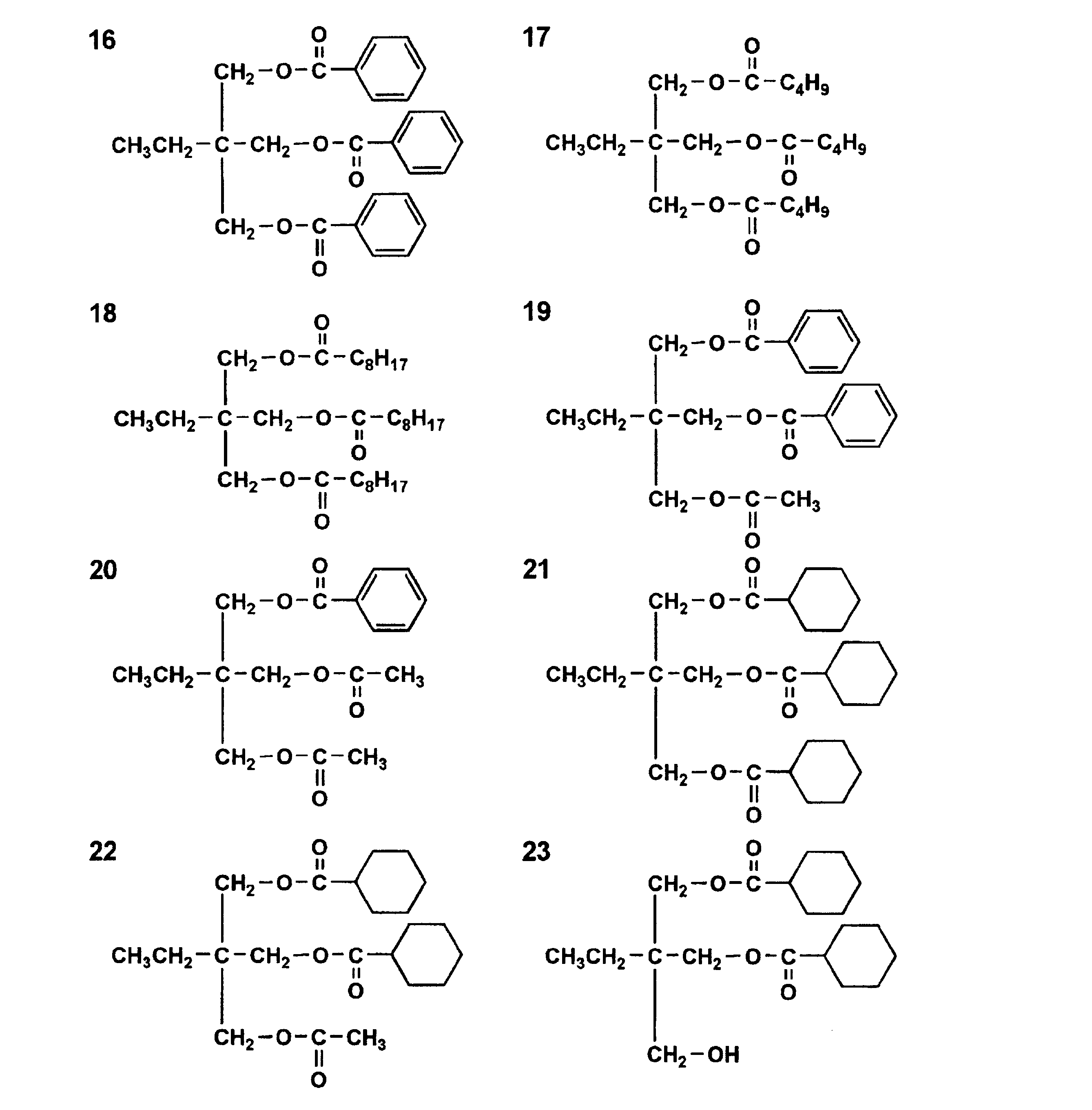

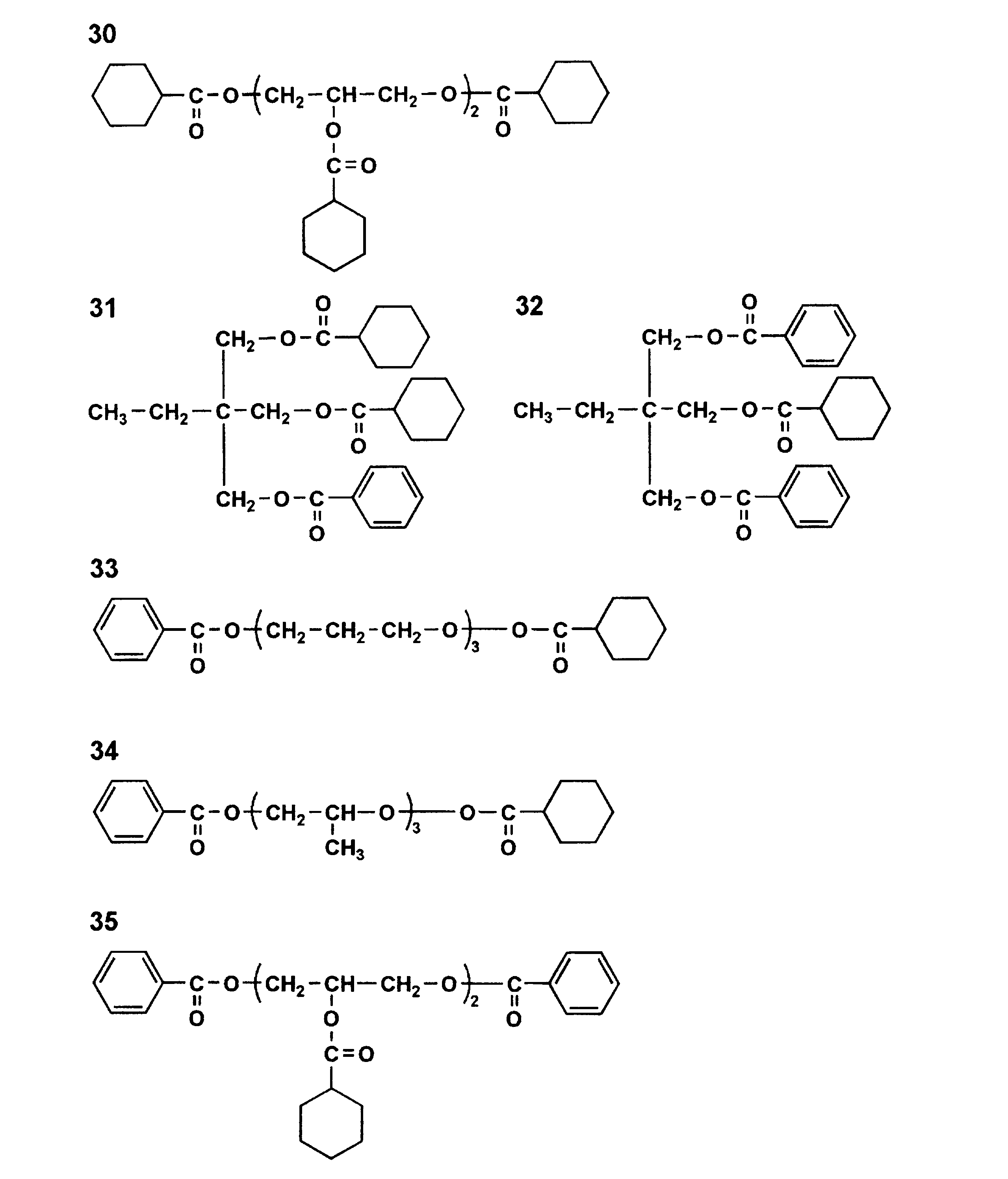
この他、トリメチロールプロパントリアセテート、ペンタエリスリトールテトラアセテートなども好ましく用いられる。
グリコレート系可塑剤は特に限定されないが、アルキルフタリルアルキルグリコレート類が好ましく用いることができる。アルキルフタリルアルキルグリコレート類としては、例えばメチルフタリルメチルグリコレート、エチルフタリルエチルグリコレート、プロピルフタリルプロピルグリコレート、ブチルフタリルブチルグリコレート、オクチルフタリルオクチルグリコレート、メチルフタリルエチルグリコレート、エチルフタリルメチルグリコレート、エチルフタリルプロピルグリコレート、メチルフタリルブチルグリコレート、エチルフタリルブチルグリコレート、ブチルフタリルメチルグリコレート、ブチルフタリルエチルグリコレート、プロピルフタリルブチルグリコレート、ブチルフタリルプロピルグリコレート、メチルフタリルオクチルグリコレート、エチルフタリルオクチルグリコレート、オクチルフタリルメチルグリコレート、オクチルフタリルエチルグリコレート等が挙げられる。
フタル酸エステル系可塑剤としては、ジエチルフタレート、ジメトキシエチルフタレート、ジメチルフタレート、ジオクチルフタレート、ジブチルフタレート、ジ-2-エチルヘキシルフタレート、ジオクチルフタレート、ジシクロヘキシルフタレート、ジシクロヘキシルテレフタレート等が挙げられる。
クエン酸エステル系可塑剤としては、クエン酸アセチルトリメチル、クエン酸アセチルトリエチル、クエン酸アセチルトリブチル等が挙げられる。
脂肪酸エステル系可塑剤として、オレイン酸ブチル、リシノール酸メチルアセチル、セバシン酸ジブチル等が挙げられる。
リン酸エステル系可塑剤としては、トリフェニルホスフェート、トリクレジルホスフェート、クレジルジフェニルホスフェート、オクチルジフェニルホスフェート、ジフェニルビフェニルホスフェート、トリオクチルホスフェート、トリブチルホスフェート等が挙げられる。
多価カルボン酸エステル化合物としては、2価以上、好ましくは2価~20価の多価カルボン酸とアルコールのエステルよりなる。また、脂肪族多価カルボン酸は2~20価であることが好ましく、芳香族多価カルボン酸、脂環式多価カルボン酸の場合は3価~20価であることが好ましい。
多価カルボン酸は次の一般式(2)で表される。
一般式(2) R2(COOH)m(OH)n(但し、R2は(m+n)価の有機基、mは2以上の正の整数、nは0以上の整数、COOH基はカルボキシル基、OH基はアルコール性またはフェノール性水酸基を表す)
好ましい多価カルボン酸の例としては、例えば以下のようなものを挙げることができるが、本発明はこれらに限定されるものではない。トリメリット酸、トリメシン酸、ピロメリット酸のような3価以上の芳香族多価カルボン酸またはその誘導体、コハク酸、アジピン酸、アゼライン酸、セバシン酸、シュウ酸、フマル酸、マレイン酸、テトラヒドロフタル酸のような脂肪族多価カルボン酸、酒石酸、タルトロン酸、リンゴ酸、クエン酸のようなオキシ多価カルボン酸などを好ましく用いることができる。特にオキシ多価カルボン酸を用いることが、保留性向上などの点で好ましい。
好ましい多価カルボン酸の例としては、例えば以下のようなものを挙げることができるが、本発明はこれらに限定されるものではない。トリメリット酸、トリメシン酸、ピロメリット酸のような3価以上の芳香族多価カルボン酸またはその誘導体、コハク酸、アジピン酸、アゼライン酸、セバシン酸、シュウ酸、フマル酸、マレイン酸、テトラヒドロフタル酸のような脂肪族多価カルボン酸、酒石酸、タルトロン酸、リンゴ酸、クエン酸のようなオキシ多価カルボン酸などを好ましく用いることができる。特にオキシ多価カルボン酸を用いることが、保留性向上などの点で好ましい。
本発明に用いることのできる多価カルボン酸エステル化合物に用いられるアルコールとしては特に制限はなく公知のアルコール、フェノール類を用いることができる。例えば炭素数1~32の直鎖または側鎖を持った脂肪族飽和アルコールまたは脂肪族不飽和アルコールを好ましく用いることができる。炭素数1~20であることが更に好ましく、炭素数1~10であることが特に好ましい。また、シクロペンタノール、シクロヘキサノールなどの脂環式アルコールまたはその誘導体、ベンジルアルコール、シンナミルアルコールなどの芳香族アルコールまたはその誘導体なども好ましく用いることができる。
多価カルボン酸としてオキシ多価カルボン酸を用いる場合は、オキシ多価カルボン酸のアルコール性またはフェノール性の水酸基をモノカルボン酸を用いてエステル化しても良い。好ましいモノカルボン酸の例としては以下のようなものを挙げることができるが、本発明はこれに限定されるものではない。
脂肪族モノカルボン酸としては炭素数1~32の直鎖または側鎖を持った脂肪酸を好ましく用いることができる。炭素数1~20であることが更に好ましく、炭素数1~10であることが特に好ましい。
好ましい脂肪族モノカルボン酸としては酢酸、プロピオン酸、酪酸、吉草酸、カプロン酸、エナント酸、カプリル酸、ペラルゴン酸、カプリン酸、2-エチル-ヘキサンカルボン酸、ウンデシル酸、ラウリン酸、トリデシル酸、ミリスチン酸、ペンタデシル酸、パルミチン酸、ヘプタデシル酸、ステアリン酸、ノナデカン酸、アラキン酸、ベヘン酸、リグノセリン酸、セロチン酸、ヘプタコサン酸、モンタン酸、メリシン酸、ラクセル酸などの飽和脂肪酸、ウンデシレン酸、オレイン酸、ソルビン酸、リノール酸、リノレン酸、アラキドン酸などの不飽和脂肪酸などを挙げることができる。
好ましい脂環族モノカルボン酸の例としては、シクロペンタンカルボン酸、シクロヘキサンカルボン酸、シクロオクタンカルボン酸、またはそれらの誘導体を挙げることができる。
好ましい芳香族モノカルボン酸の例としては、安息香酸、トルイル酸などの安息香酸のベンゼン環にアルキル基を導入したもの、ビフェニルカルボン酸、ナフタリンカルボン酸、テトラリンカルボン酸などのベンゼン環を2個以上もつ芳香族モノカルボン酸、またはそれらの誘導体を挙げることができる。特に酢酸、プロピオン酸、安息香酸であることが好ましい。
多価カルボン酸エステル化合物の分子量は特に制限はないが、分子量300~1000の範囲であることが好ましく、350~750の範囲であることが更に好ましい。保留性向上の点では大きい方が好ましく、透湿性、セルロースエステルとの相溶性の点では小さい方が好ましい。
多価カルボン酸エステルに用いられるアルコール類は一種類でも良いし、二種以上の混合であっても良い。
多価カルボン酸エステル化合物の酸価は1mgKOH/g以下であることが好ましく、0.2mgKOH/g以下であることが更に好ましい。酸価を上記範囲にすることによって、リターデーションの環境変動も抑制されるため好ましい。
(酸価)
酸価とは、試料1g中に含まれる酸(試料中に存在するカルボキシル基)を中和するために必要な水酸化カリウムのミリグラム数をいう。酸価はJIS K0070に準拠して測定したものである。
酸価とは、試料1g中に含まれる酸(試料中に存在するカルボキシル基)を中和するために必要な水酸化カリウムのミリグラム数をいう。酸価はJIS K0070に準拠して測定したものである。
特に好ましい多価カルボン酸エステル化合物の例を以下に示すが、本発明はこれに限定されるものではない。例えば、トリエチルシトレート、トリブチルシトレート、アセチルトリエチルシトレート(ATEC)、アセチルトリブチルシトレート(ATBC)、ベンゾイルトリブチルシトレート、アセチルトリフェニルシトレート、アセチルトリベンジルシトレート、酒石酸ジブチル、酒石酸ジアセチルジブチル、トリメリット酸トリブチル、ピロメリット酸テトラブチル等が挙げられる。
(糖エステル化合物)
本発明の延伸セルロースエステルフィルムは、下記一般式(3)で表される化合物(本発明では糖エステル化合物と呼称)を含有することが、延伸によるヘイズを防ぎ、安定な位相差発現を促す上で好ましい。
本発明の延伸セルロースエステルフィルムは、下記一般式(3)で表される化合物(本発明では糖エステル化合物と呼称)を含有することが、延伸によるヘイズを防ぎ、安定な位相差発現を促す上で好ましい。

本発明に用いられる一般式(3)で表される化合物の平均置換度は3.0~6.0であることが、延伸処理においてヘイズ上昇を抑制し安定な位相差を発現する上でも有効である。平均置換度はより好ましくは4.5~6.5の範囲である。
本発明において、一般式(3)で表される化合物の置換度とは、一般式(3)に含まれる8つの水酸基のうち、水素以外の置換基で置換されている数を表し、すなわち、一般式(3)のR1~R8のうち、水素以外の基を含む数を表す。したがって、R1~R8がすべて水素以外の置換基により置換された場合に、置換度は最大値の8.0となり、R1~R8がすべて水素原子である場合には、0.0となる。
一般式(3)で表される構造を有する化合物は、水酸基の数、OR基の数が固定された単一種の化合物を合成することは困難であり、式中の水酸基の数、OR基の異なる成分が数種類混合された化合物となることが知られているため、本発明における一般式(3)の置換度としては、平均置換度を用いることが適当であり、常法により高速液体クロマトグラフィーによって置換度分布を示すチャートの面積比から平均置換度を測定することができる。
一般式(3)において、R1~R8は、置換又は無置換のアルキルカルボニル基、或いは、置換又は無置換のアリルカルボニル基を表し、R1~R8は、同じであっても、異なっていてもよい。
本発明に用いられる糖エステル化合物の合成原料の糖の例としては、例えば以下のようなものを挙げることができるが、本発明はこれらに限定されるものではない。
グルコース、ガラクトース、マンノース、フルクトース、キシロース、あるいはアラビノース、ラクトース、スクロース、ニストース、1F-フラクトシルニストース、スタキオース、マルチトール、ラクチトール、ラクチュロース、セロビオース、マルトース、セロトリオース、マルトトリオース、ラフィノースあるいはケストース挙げられる。
この他、ゲンチオビオース、ゲンチオトリオース、ゲンチオテトラオース、キシロトリオース、ガラクトシルスクロースなども挙げられる。
本発明に用いられる糖エステル化合物の合成時に用いられるモノカルボン酸としては、特に制限はなく、公知の脂肪族モノカルボン酸、脂環族モノカルボン酸、芳香族モノカルボン酸等を用いることができる。用いられるカルボン酸は1種類でもよいし2種以上の混合であってもよい。
好ましい脂肪族モノカルボン酸の例としては、酢酸、プロピオン酸、酪酸、イソ酪酸、吉草酸、カプロン酸、エナント酸、カプリル酸、ペラルゴン酸、カプリン酸、2-エチル-ヘキサンカルボン酸、ウンデシル酸、ラウリン酸、トリデシル酸、ミリスチン酸、ペンタデシル酸、パルミチン酸、ヘプタデシル酸、ステアリン酸、ノナデカン酸、アラキン酸、ベヘン酸、リグノセリン酸、セロチン酸、ヘプタコサン酸、モンタン酸、メリシン酸、ラクセル酸等の飽和脂肪酸、ウンデシレン酸、オレイン酸、ソルビン酸、リノール酸、リノレン酸、アラキドン酸、オクテン酸等の不飽和脂肪酸等を挙げることができる。
好ましい脂環族モノカルボン酸の例としては、シクロペンタンカルボン酸、シクロヘキサンカルボン酸、シクロオクタンカルボン酸、またはそれらの誘導体を挙げることができる。
好ましい芳香族モノカルボン酸の例としては、安息香酸、トルイル酸等の安息香酸のベンゼン環に1~5個のアルキル基もしくはアルコキシ基を導入した芳香族モノカルボン酸、ケイ皮酸、ベンジル酸、ビフェニルカルボン酸、ナフタリンカルボン酸、テトラリンカルボン酸等のベンゼン環を2個以上有する芳香族モノカルボン酸、またはそれらの誘導体を挙げることができるが、特に安息香酸が好ましい。
具体例の一部を以下に示すが、これらは、R1~R8をすべて同じ置換基Rとした場合であって、本発明はこれらに限定されない。

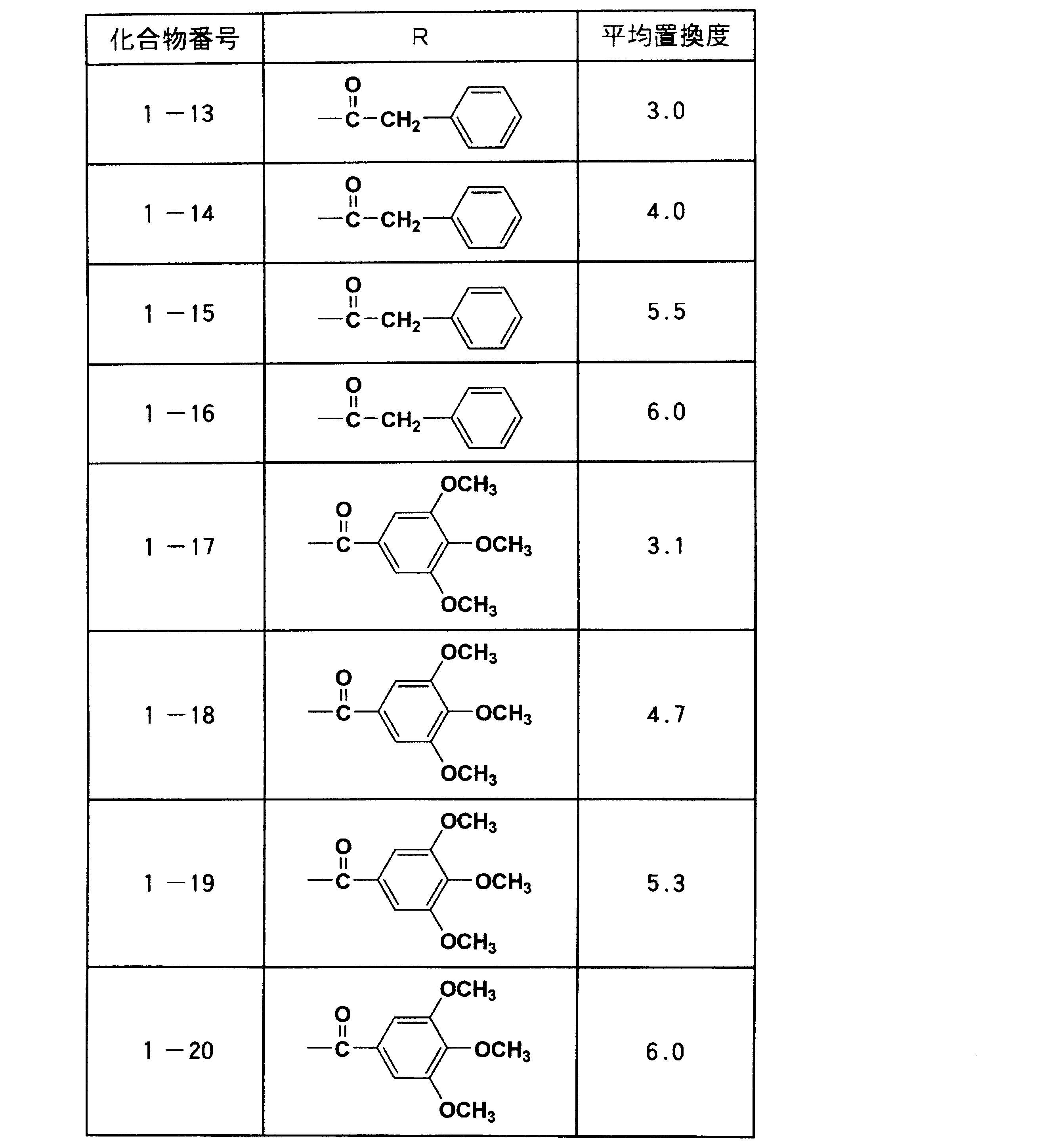
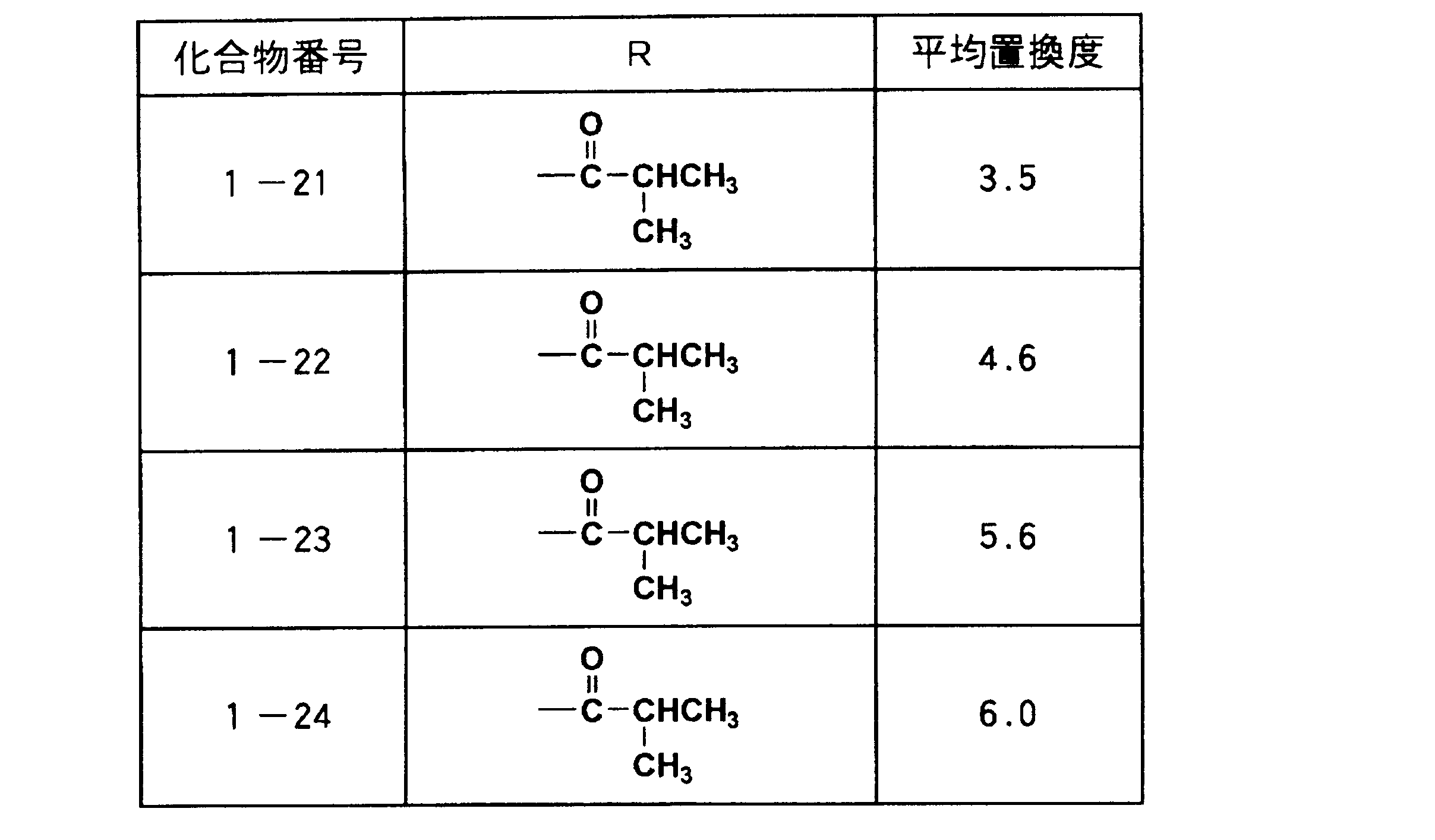
本発明に用いられる糖エステル化合物は、糖エステルに、アシル化剤(エステル化剤ともいう、例えば、アセチルクロライドの酸ハロゲン化物、無水酢酸等の無水物)を反応させることによって製造することが可能であり、置換度の分布は、アシル化剤の量、添加タイミング、エステル化反応時間の調節によって成されるが、置換度違いの糖エステル化合物の混合、あるいは純粋に単離した置換度違いの化合物を混合することにより、目的の平均置換度、置換度4以下の成分を調整することができる。
(合成例:本発明に係る化合物の合成)
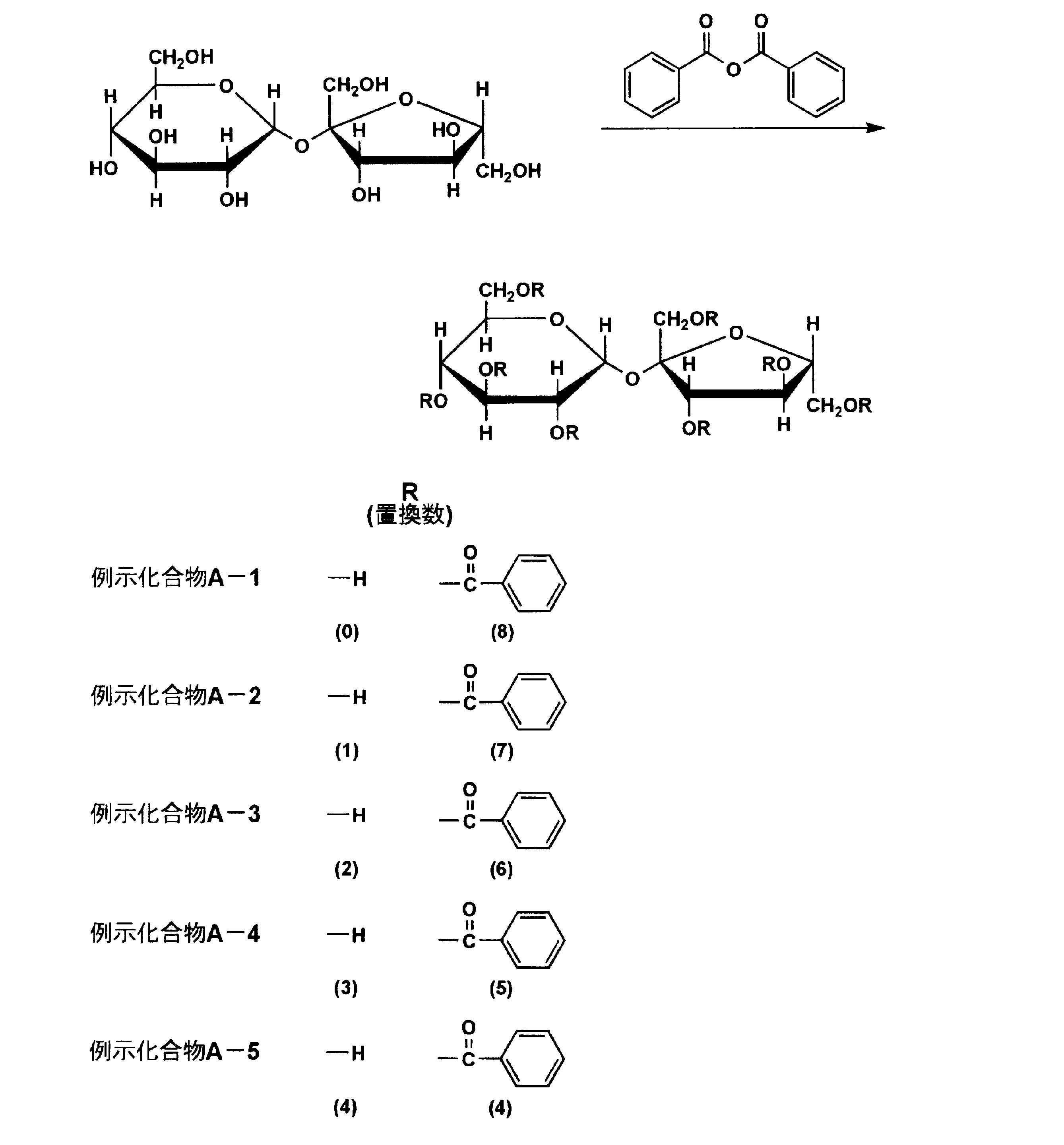
撹拌装置、還流冷却器、温度計及び窒素ガス導入管を備えた四頭コルベンに、ショ糖34.2g(0.1モル)、無水安息香酸135.6g(0.6モル)、ピリジン284.8g(3.6モル)を仕込み、撹拌下に窒素ガス導入管から窒素ガスをバブリングさせながら昇温し、70℃で5時間エステル化反応を行った。
次に、コルベン内を4×10²Pa以下に減圧し、60℃で過剰のピリジンを留去した後に、コルベン内を1.3×10Pa以下に減圧し、120℃まで昇温させ、無水安息香酸、生成した安息香酸の大部分を留去した。そして、次にトルエン1L、0.5質量%の炭酸ナトリウム水溶液300gを添加し、50℃で30分間撹拌後、静置して、トルエン層を分取した。最後に、分取したトルエン層に水100gを添加し、常温で30分間水洗後、トルエン層を分取し、減圧下(4×10²Pa以下)、60℃でトルエンを留去させ、化合物A-1、A-2、A-3、A-4及びA-5等の混合物である糖エステル化合物1を得た。
得られた混合物を高速液体クロマトグラフィー-質量分析(HPLC-MS)で解析したところ、A-1が1.2質量%、A-2が13.2質量%、A-3が14.2質量%、A-4が35.4質量%、A-5等が40.0質量%であった。平均置換度は5.2であった。
同様に、無水安息香酸158.2g(0.7モル)、146.9g(0.65モル)、135.6g(0.6モル)、124.3g(0.55モル)と当モルのピリジンとを反応させて、表1記載のような成分の糖エステルを得た。

ついで、得られた混合物の一部を、シリカゲルを用いたカラムクロマトグラフィーにより精製することで、それぞれ純度100%のA-1、A-2、A-3、A-4及びA-5等を得た。
なお、A-5等とは、置換度4以下のすべての成分、つまり置換度4、3、2、1の化合物の混合物であることを意味する。また、平均置換度は、A-5等を置換度4として計算した。
本発明においては、ここで作製した方法により所望の平均置換度に近い糖エステルおよび単離したA-1~A-5等を組み合わせ添加することにより、平均置換度を調整した。
<HPLC-MSの測定条件>
1)LC部
装置:日本分光(株)製カラムオーブン(JASCO CO-965)、ディテクター(JASCO UV-970-240nm)、ポンプ(JASCO PU-980)、デガッサ-(JASCO DG-980-50)
カラム:Inertsil ODS-3 粒子径5μm 4.6×250mm(ジーエルサイエンス(株)製)
カラム温度:40℃
流速:1ml/min
移動相:THF(1%酢酸):H2O(50:50)
注入量:3μl
2)MS部
装置:LCQ DECA(Thermo Quest(株)製)
イオン化法:エレクトロスプレーイオン化(ESI)法
Spray Voltage:5kV
Capillary温度:180℃
Vaporizer温度:450℃
本発明の延伸セルロースエステルフィルムは、上記糖エステル化合物を、延伸セルロースエステルフィルム中に1~20質量%、特に3~15質量%含むことが好ましい。この範囲内であれば、本発明の優れた効果を呈すると共に、原反保管中におけるブリードアウトなどもなく好ましい。
1)LC部
装置:日本分光(株)製カラムオーブン(JASCO CO-965)、ディテクター(JASCO UV-970-240nm)、ポンプ(JASCO PU-980)、デガッサ-(JASCO DG-980-50)
カラム:Inertsil ODS-3 粒子径5μm 4.6×250mm(ジーエルサイエンス(株)製)
カラム温度:40℃
流速:1ml/min
移動相:THF(1%酢酸):H2O(50:50)
注入量:3μl
2)MS部
装置:LCQ DECA(Thermo Quest(株)製)
イオン化法:エレクトロスプレーイオン化(ESI)法
Spray Voltage:5kV
Capillary温度:180℃
Vaporizer温度:450℃
本発明の延伸セルロースエステルフィルムは、上記糖エステル化合物を、延伸セルロースエステルフィルム中に1~20質量%、特に3~15質量%含むことが好ましい。この範囲内であれば、本発明の優れた効果を呈すると共に、原反保管中におけるブリードアウトなどもなく好ましい。
(エステル系化合物)
本発明の延伸セルロースエステルフィルムは、下記一般式(4)で表されるエステル系化合物を含有することが、延伸によるヘイズを防ぎ、破断等を抑制する上で好ましい。
本発明の延伸セルロースエステルフィルムは、下記一般式(4)で表されるエステル系化合物を含有することが、延伸によるヘイズを防ぎ、破断等を抑制する上で好ましい。
エステル系化合物は、分子内に芳香環またはシクロアルキル環を有するエステル系化合物を用いることが好ましい。エステル系化合物としては、下記一般式(4)で表せる芳香族末端エステル系可塑剤を用いることが好ましい。
一般式(4) B-(G-A)n-G-B(式中、Bはベンゼンモノカルボン酸残基、Gは炭素数2~12のアルキレングリコール残基または炭素数6~12のアリールグリコール残基または炭素数が4~12のオキシアルキレングリコール残基、Aは炭素数4~12のアルキレンジカルボン酸残基または炭素数6~12のアリールジカルボン酸残基を表し、またnは1以上の整数を表す。)
一般式(4)中、Bで示されるベンゼンモノカルボン酸残基とGで示されるアルキレングリコール残基またはオキシアルキレングリコール残基またはアリールグリコール残基、Aで示されるアルキレンジカルボン酸残基またはアリールジカルボン酸残基とから構成されるものであり、通常のポリエステル系可塑剤と同様の反応により得られる。
一般式(4)中、Bで示されるベンゼンモノカルボン酸残基とGで示されるアルキレングリコール残基またはオキシアルキレングリコール残基またはアリールグリコール残基、Aで示されるアルキレンジカルボン酸残基またはアリールジカルボン酸残基とから構成されるものであり、通常のポリエステル系可塑剤と同様の反応により得られる。
ポリエステル系可塑剤のベンゼンモノカルボン酸成分としては、例えば、安息香酸、パラターシャリブチル安息香酸、オルソトルイル酸、メタトルイル酸、パラトルイル酸、ジメチル安息香酸、エチル安息香酸、ノルマルプロピル安息香酸、アミノ安息香酸、アセトキシ安息香酸等があり、これらはそれぞれ1種または2種以上の混合物として使用することができる。
ポリエステル系可塑剤の炭素数2~12のアルキレングリコール成分としては、エチレングリコール、1,2-プロピレングリコール、1,3-プロピレングリコール、1,2-ブタンジオール、1,3-ブタンジオール、1,2-プロパンジオール、2-メチル1,3-プロパンジオール、1,4-ブタンジオール、1,5-ペンタンジオール、2,2-ジメチル-1,3-プロパンジオール(ネオペンチルグリコール)、2,2-ジエチル-1,3-プロパンジオール(3,3-ジメチロールペンタン)、2-n-ブチル-2-エチル-1,3プロパンジオール(3,3-ジメチロールヘプタン)、3-メチル-1,5-ペンタンジオール1,6-ヘキサンジオール、2,2,4-トリメチル1,3-ペンタンジオール、2-エチル1,3-ヘキサンジオール、2-メチル1,8-オクタンジオール、1,9-ノナンジオール、1,10-デカンジオール、1,12-オクタデカンジオール等があり、これらのグリコールは、1種または2種以上の混合物として使用される。特に炭素数2~12のアルキレングリコールがセルロースエステルとの相溶性に優れているため、特に好ましい。
また、上記芳香族末端エステルの炭素数4~12のオキシアルキレングリコール成分としては、例えば、ジエチレングリコール、トリエチレングリコール、テトラエチレングリコール、ジプロピレングリコール、トリプロピレングリコール等があり、これらのグリコールは、1種または2種以上の混合物として使用できる。
芳香族末端エステルの炭素数4~12のアルキレンジカルボン酸成分としては、例えば、コハク酸、マレイン酸、フマール酸、グルタール酸、アジピン酸、アゼライン酸、セバシン酸、ドデカンジカルボン酸等があり、これらは、それぞれ1種または2種以上の混合物として使用される。炭素数6~12のアリーレンジカルボン酸成分としては、フタル酸、テレフタル酸、イソフタル酸、1,5ナフタレンジカルボン酸、1,4ナフタレンジカルボン酸等がある。
ポリエステル系可塑剤は、数平均分子量が、好ましくは300~1500、より好ましくは400~1000の範囲が好適である。また、その酸価は、0.5mgKOH/g以下、水酸基価は25mgKOH/g以下、より好ましくは酸価0.3mgKOH/g以下、水酸基価は15mgKOH/g以下のものである。
以下、芳香族末端エステル系可塑剤の合成例を示す。
〈サンプルNo.1(芳香族末端エステルサンプル)〉
反応容器にフタル酸410部、安息香酸610部、ジプロピレングリコール737部、及び触媒としてテトライソプロピルチタネート0.40部を一括して仕込み窒素気流中で攪拌下、還流凝縮器を付して過剰の1価アルコールを還流させながら、酸価が2以下になるまで130~250℃で加熱を続け生成する水を連続的に除去した。次いで200~230℃で1.33×10⁴Pa~最終的に4×10²Pa以下の減圧下、留出分を除去し、この後濾過して次の性状を有する芳香族末端エステル系可塑剤を得た。
粘度(25℃、mPa・s);43400
酸価 ;0.2
反応容器にフタル酸410部、安息香酸610部、ジプロピレングリコール737部、及び触媒としてテトライソプロピルチタネート0.40部を一括して仕込み窒素気流中で攪拌下、還流凝縮器を付して過剰の1価アルコールを還流させながら、酸価が2以下になるまで130~250℃で加熱を続け生成する水を連続的に除去した。次いで200~230℃で1.33×10⁴Pa~最終的に4×10²Pa以下の減圧下、留出分を除去し、この後濾過して次の性状を有する芳香族末端エステル系可塑剤を得た。
粘度(25℃、mPa・s);43400
酸価 ;0.2
〈サンプルNo.2(芳香族末端エステルサンプル)〉
反応容器に、フタル酸410部、安息香酸610部、エチレングリコール341部、及び触媒としてテトライソプロピルチタネート0.35部を用いる以外はサンプルNo.1と全く同様にして次の性状を有する芳香族末端エステルを得た。
粘度(25℃、mPa・s);31000
酸価 ;0.1
反応容器に、フタル酸410部、安息香酸610部、エチレングリコール341部、及び触媒としてテトライソプロピルチタネート0.35部を用いる以外はサンプルNo.1と全く同様にして次の性状を有する芳香族末端エステルを得た。
粘度(25℃、mPa・s);31000
酸価 ;0.1
〈サンプルNo.3(芳香族末端エステルサンプル)〉
反応容器に、フタル酸410部、安息香酸610部、1,2-プロパンジオール418部、及び触媒としてテトライソプロピルチタネート0.35部を用いる以外はサンプルNo.1と全く同様にして次の性状を有する芳香族末端エステルを得た。
粘度(25℃、mPa・s);38000
酸価 ;0.05
反応容器に、フタル酸410部、安息香酸610部、1,2-プロパンジオール418部、及び触媒としてテトライソプロピルチタネート0.35部を用いる以外はサンプルNo.1と全く同様にして次の性状を有する芳香族末端エステルを得た。
粘度(25℃、mPa・s);38000
酸価 ;0.05
〈サンプルNo.4(芳香族末端エステルサンプル)〉
反応容器に、フタル酸410部、安息香酸610部、1,3-プロパンジオール418部、及び触媒としてテトライソプロピルチタネート0.35部を用いる以外はサンプルNo.1と全く同様にして次の性状を有する芳香族末端エステルを得た。
粘度(25℃、mPa・s);37000
酸価 ;0.05
反応容器に、フタル酸410部、安息香酸610部、1,3-プロパンジオール418部、及び触媒としてテトライソプロピルチタネート0.35部を用いる以外はサンプルNo.1と全く同様にして次の性状を有する芳香族末端エステルを得た。
粘度(25℃、mPa・s);37000
酸価 ;0.05
以下に、芳香族末端エステル系可塑剤の具体的化合物を示すが、本発明はこれに限定されない。
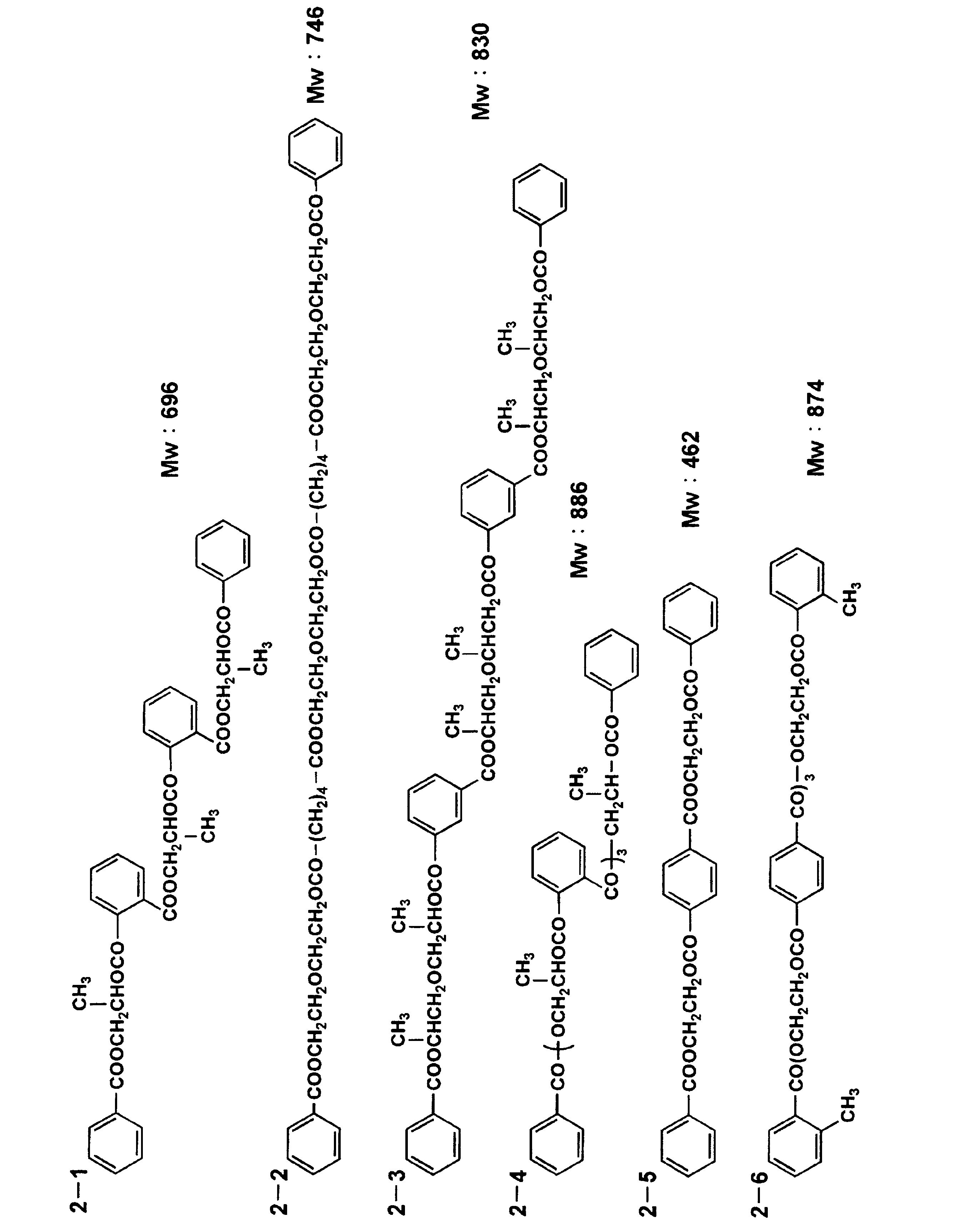

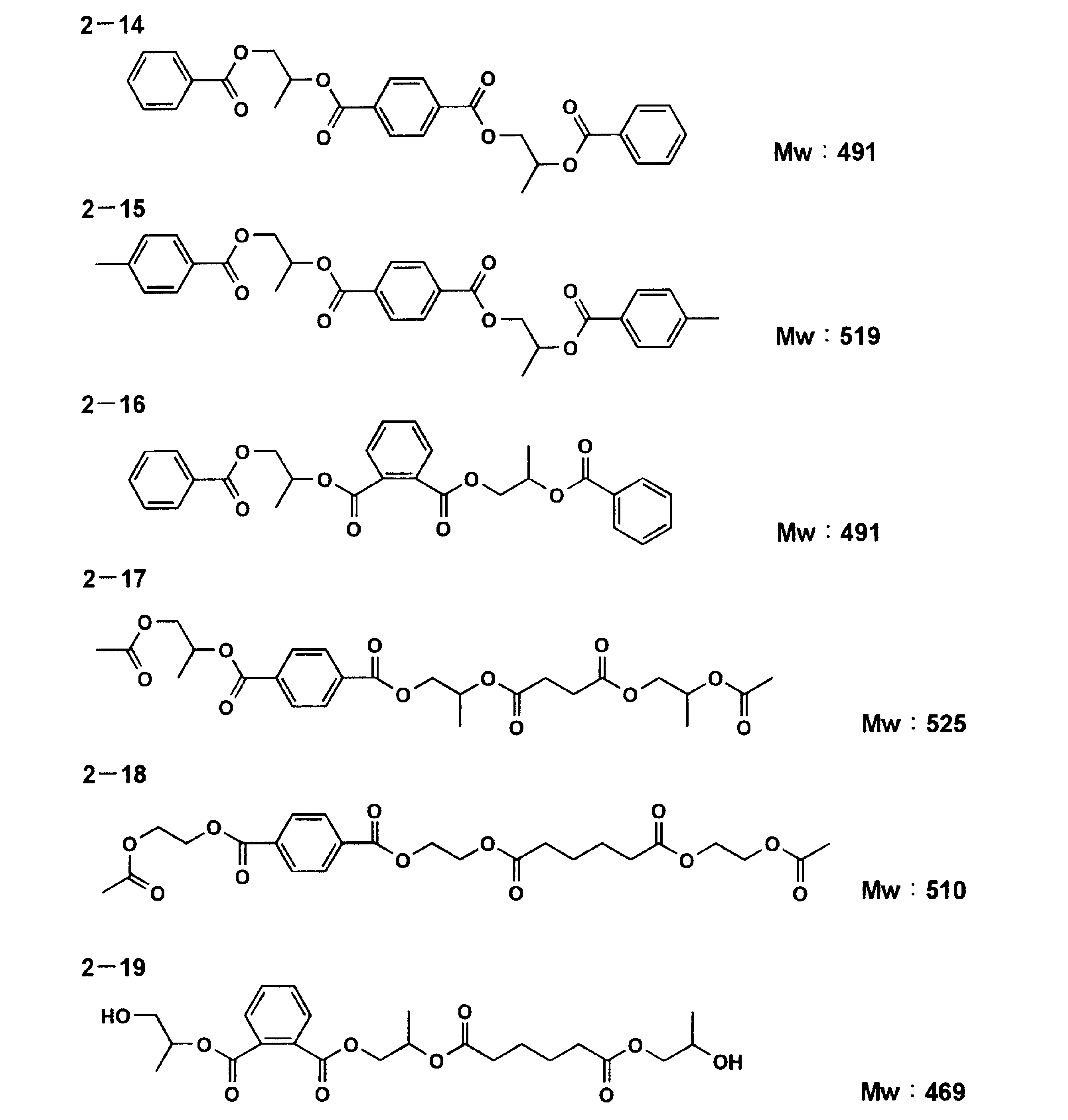
本発明の延伸セルロースエステルフィルムは、上記エステル系化合物を、延伸セルロースエステルフィルム中に1~20質量%、特に3~11質量%含むことが好ましい。この範囲内であれば、本発明の優れた効果を呈すると共に、破断等の故障を抑制することができる。
(紫外線吸収剤)
本発明の延伸セルロースエステルフィルムは、紫外線吸収剤を含有することもできる。紫外線吸収剤は400nm以下の紫外線を吸収することで、耐久性を向上させることを目的としており、特に波長370nmでの透過率が10%以下であることが好ましく、より好ましくは5%以下、更に好ましくは2%以下である。
本発明の延伸セルロースエステルフィルムは、紫外線吸収剤を含有することもできる。紫外線吸収剤は400nm以下の紫外線を吸収することで、耐久性を向上させることを目的としており、特に波長370nmでの透過率が10%以下であることが好ましく、より好ましくは5%以下、更に好ましくは2%以下である。
本発明に用いられる紫外線吸収剤は特に限定されないが、例えばオキシベンゾフェノン系化合物、ベンゾトリアゾール系化合物、サリチル酸エステル系化合物、ベンゾフェノン系化合物、シアノアクリレート系化合物、トリアジン系化合物、ニッケル錯塩系化合物、無機粉体等が挙げられる。
例えば、5-クロロ-2-(3,5-ジ-sec-ブチル-2-ヒドロキシルフェニル)-2H-ベンゾトリアゾール、(2-2H-ベンゾトリアゾール-2-イル)-6-(直鎖及び側鎖ドデシル)-4-メチルフェノール、2-ヒドロキシ-4-ベンジルオキシベンゾフェノン、2,4-ベンジルオキシベンゾフェノン等があり、また、チヌビン109、チヌビン171、チヌビン234、チヌビン326、チヌビン327、チヌビン328等のチヌビン類があり、これらは何れもBASFジャパン社製の市販品であり好ましく使用できる。
本発明で好ましく用いられる紫外線吸収剤は、ベンゾトリアゾール系紫外線吸収剤、ベンゾフェノン系紫外線吸収剤、トリアジン系紫外線吸収剤であり、特に好ましくはベンゾトリアゾール系紫外線吸収剤、ベンゾフェノン系紫外線吸収剤、である。
以下に本発明に用いられるベンゾトリアゾール系紫外線吸収剤の具体例を挙げるが、本発明はこれらに限定されない。
UV-1:2-(2′-ヒドロキシ-5′-メチルフェニル)ベンゾトリアゾール UV-2:2-(2′-ヒドロキシ-3′,5′-ジ-tert-ブチルフェニル)ベンゾトリアゾール
UV-3:2-(2′-ヒドロキシ-3′-tert-ブチル-5′-メチルフェニル)ベンゾトリアゾール
UV-4:2-(2′-ヒドロキシ-3′,5′-ジ-tert-ブチルフェニル)-5-クロロベンゾトリアゾール
UV-5:2-(2′-ヒドロキシ-3′-(3″,4″,5″,6″-テトラヒドロフタルイミドメチル)-5′-メチルフェニル)ベンゾトリアゾール
UV-6:2,2-メチレンビス(4-(1,1,3,3-テトラメチルブチル)-6-(2H-ベンゾトリアゾール-2-イル)フェノール)
UV-7:2-(2′-ヒドロキシ-3′-tert-ブチル-5′-メチルフェニル)-5-クロロベンゾトリアゾール
UV-8:2-(2H-ベンゾトリアゾール-2-イル)-6-(直鎖及び側鎖ドデシル)-4-メチルフェノール(TINUVIN171)
UV-9:オクチル-3-〔3-tert-ブチル-4-ヒドロキシ-5-(クロロ-2H-ベンゾトリアゾール-2-イル)フェニル〕プロピオネートと2-エチルヘキシル-3-〔3-tert-ブチル-4-ヒドロキシ-5-(5-クロロ-2H-ベンゾトリアゾール-2-イル)フェニル〕プロピオネートの混合物(TINUVIN109)
UV-3:2-(2′-ヒドロキシ-3′-tert-ブチル-5′-メチルフェニル)ベンゾトリアゾール
UV-4:2-(2′-ヒドロキシ-3′,5′-ジ-tert-ブチルフェニル)-5-クロロベンゾトリアゾール
UV-5:2-(2′-ヒドロキシ-3′-(3″,4″,5″,6″-テトラヒドロフタルイミドメチル)-5′-メチルフェニル)ベンゾトリアゾール
UV-6:2,2-メチレンビス(4-(1,1,3,3-テトラメチルブチル)-6-(2H-ベンゾトリアゾール-2-イル)フェノール)
UV-7:2-(2′-ヒドロキシ-3′-tert-ブチル-5′-メチルフェニル)-5-クロロベンゾトリアゾール
UV-8:2-(2H-ベンゾトリアゾール-2-イル)-6-(直鎖及び側鎖ドデシル)-4-メチルフェノール(TINUVIN171)
UV-9:オクチル-3-〔3-tert-ブチル-4-ヒドロキシ-5-(クロロ-2H-ベンゾトリアゾール-2-イル)フェニル〕プロピオネートと2-エチルヘキシル-3-〔3-tert-ブチル-4-ヒドロキシ-5-(5-クロロ-2H-ベンゾトリアゾール-2-イル)フェニル〕プロピオネートの混合物(TINUVIN109)
以下にベンゾフェノン系紫外線吸収剤の具体例を示すが、本発明はこれらに限定されない。
UV-10:2,4-ジヒドロキシベンゾフェノン
UV-11:2,2′-ジヒドロキシ-4-メトキシベンゾフェノン
UV-12:2-ヒドロキシ-4-メトキシ-5-スルホベンゾフェノン
UV-13:ビス(2-メトキシ-4-ヒドロキシ-5-ベンゾイルフェニルメタン)
この他、1,3,5トリアジン環を有する化合物等の円盤状化合物も紫外線吸収剤として好ましく用いられる。
UV-10:2,4-ジヒドロキシベンゾフェノン
UV-11:2,2′-ジヒドロキシ-4-メトキシベンゾフェノン
UV-12:2-ヒドロキシ-4-メトキシ-5-スルホベンゾフェノン
UV-13:ビス(2-メトキシ-4-ヒドロキシ-5-ベンゾイルフェニルメタン)
この他、1,3,5トリアジン環を有する化合物等の円盤状化合物も紫外線吸収剤として好ましく用いられる。
本発明に係わる延伸セルロースエステルフィルムは紫外線吸収剤を2種以上を含有することが好ましい。
また、紫外線吸収剤としては高分子紫外線吸収剤も好ましく用いることができ、特に特開平6-148430号記載のポリマータイプの紫外線吸収剤が好ましく用いられる。
紫外線吸収剤の添加方法は、メタノール、エタノール、ブタノール等のアルコールやメチレンクロライド、酢酸メチル、アセトン、ジオキソラン等の有機溶媒或いはこれらの混合溶媒に紫外線吸収剤を溶解してからドープに添加するか、または直接ドープ組成中に添加してもよい。無機粉体のように有機溶剤に溶解しないものは、有機溶剤とセルロースエステル中にディゾルバーやサンドミルを使用し、分散してからドープに添加する。
紫外線吸収剤の使用量は、紫外線吸収剤の種類、使用条件等により一様ではないが、延伸セルロースエステルフィルムの乾燥膜厚が30~200μmの場合は、延伸セルロースエステルフィルムに対して0.5~10質量%が好ましく、0.6~4質量%が更に好ましい。
(微粒子)
本発明の延伸セルロースエステルフィルムは、微粒子を含有することが滑り性を向上して、シワ等の搬送不良を解消する観点で好ましい。
本発明の延伸セルロースエステルフィルムは、微粒子を含有することが滑り性を向上して、シワ等の搬送不良を解消する観点で好ましい。
微粒子としては、無機化合物の例として、二酸化珪素、二酸化チタン、酸化アルミニウム、酸化ジルコニウム、炭酸カルシウム、炭酸カルシウム、タルク、クレイ、焼成カオリン、焼成ケイ酸カルシウム、水和ケイ酸カルシウム、ケイ酸アルミニウム、ケイ酸マグネシウム及びリン酸カルシウム等を挙げることができる。微粒子は珪素を含むものが濁度が低くなる点で好ましく、特に二酸化珪素が好ましい。
微粒子の一次粒子の平均粒径は5~400nmが好ましく、更に好ましいのは10~300nmである。これらは主に粒径0.05~0.3μmの2次凝集体として含有されていてもよく、平均粒径100~400nmの粒子であれば凝集せずに一次粒子として含まれていることも好ましい。延伸セルロースエステルフィルム中のこれらの微粒子の含有量は0.01~1質量%であることが好ましく、特に0.05~0.5質量%が好ましい。共流延法による多層構成の延伸セルロースエステルフィルムの場合は、表面にこの添加量の微粒子を含有することが好ましい。
二酸化珪素の微粒子は、例えば、アエロジルR972、R972V、R974、R812、200、200V、300、R202、OX50、TT600(以上日本アエロジル(株)製)の商品名で市販されており、使用することができる。
酸化ジルコニウムの微粒子は、例えば、アエロジルR976及びR811(以上日本アエロジル(株)製)の商品名で市販されており、使用することができる。
ポリマーの例として、シリコーン樹脂、フッ素樹脂及びアクリル樹脂を挙げることができる。シリコーン樹脂が好ましく、特に三次元の網状構造を有するものが好ましく、例えば、トスパール103、同105、同108、同120、同145、同3120及び同240(以上東芝シリコーン(株)製)の商品名で市販されており、使用することができる。
これらの中でもアエロジル200V、アエロジルR972Vが延伸セルロースエステルフィルムのヘイズを低く保ちながら、摩擦係数を下げる効果が大きいため特に好ましく用いられる。本発明の延伸セルロースエステルフィルムにおいては、少なくとも一方の面の動摩擦係数が0.2~1.0であることが好ましい。
(染料)
本発明の延伸セルロースエステルフィルムには、色味調整のため染料を添加することもできる。例えば、フィルムの黄色味を抑えるために青色染料を添加してもよい。好ましい染料としてはアンスラキノン系染料が挙げられる。
本発明の延伸セルロースエステルフィルムには、色味調整のため染料を添加することもできる。例えば、フィルムの黄色味を抑えるために青色染料を添加してもよい。好ましい染料としてはアンスラキノン系染料が挙げられる。
アンスラキノン系染料は、アンスラキノンの1位から8位迄の任意の位置に任意の置換基を有することができる。好ましい置換基としてはアニリノ基、ヒドロキシル基、アミノ基、ニトロ基、または水素原子が挙げられる。特に特開2001-154017号記載の青色染料、特にアントラキノン系染料を含有することが好ましい。
各種添加剤は製膜前のセルロースエステル含有溶液であるドープにバッチ添加してもよいし、添加剤溶解液を別途用意してインライン添加してもよい。特に微粒子は濾過材への負荷を減らすために、一部または全量をインライン添加することが好ましい。
添加剤溶解液をインライン添加する場合は、ドープとの混合性をよくするため、少量のセルロースエステルに溶解するのが好ましい。好ましいセルロースエステルの量は、溶剤100質量部に対して1~10質量部で、より好ましくは、3~5質量部である。
本発明においてインライン添加、混合を行うためには、例えば、スタチックミキサー(東レエンジニアリング製)、SWJ(東レ静止型管内混合器 Hi-Mixer)等のインラインミキサー等が好ましく用いられる。
延伸セルロースエステルフィルムの物性
本発明の延伸セルロースエステルフィルムは、少なくとも一方の面の端部Hの表面粗さ(Ra)の平均値が1.7nm~4.0nmの範囲で、フィルム面の中央部Tの表面粗さ(Ra)の平均値よりも0.1nm~1.0nm高く;フィルムの中央部Tの弾性率の平均値が3.0GPa~8.0GPaの範囲で、フィルムの端部Hの弾性率の平均値よりも0.1GPa~2.0GPa高いことを特徴とする。
本発明の延伸セルロースエステルフィルムは、少なくとも一方の面の端部Hの表面粗さ(Ra)の平均値が1.7nm~4.0nmの範囲で、フィルム面の中央部Tの表面粗さ(Ra)の平均値よりも0.1nm~1.0nm高く;フィルムの中央部Tの弾性率の平均値が3.0GPa~8.0GPaの範囲で、フィルムの端部Hの弾性率の平均値よりも0.1GPa~2.0GPa高いことを特徴とする。
少なくとも一方の面(フィルム面A)は、後述するフィルム製造工程において、セルロースエステルと溶剤とを含むドープ液を無端状の金属支持体(ベルトまたはドラム)上に流延したときの、金属支持体面(ベルト面またはドラム面)と接していた側とは反対側の面をいう。
「端部H」とは、延伸セルロースエステルフィルムの幅(全幅)をLとしたときの、フィルムの幅方向にフィルムの端からL×0.05までの部分をいう。「中央部T」とは、延伸セルロースエステルフィルムの幅(全幅)をLとしたときの、フィルムの幅方向にフィルムの中心部からに±L×0.1までの部分をいう。
生産性を高めるためには、高倍率でウェブを延伸したり、高速でフィルムを搬送したりすることが求められる。
例えば、延伸処理によって、幅1.6m以上、より好ましくは2m以上に広幅化された延伸セルロースエステルフィルムを得ようとすると、従来にない問題点が発生する。例えば、溝または山の方向が搬送方向であるシワが発生したり、面内方向のリターデーションRoのフィルムの端部と中央部における偏差が大きくなったりするという問題である。面内方向のリターデーションRoのフィルムの端部と中央部における偏差が大きいと、該セルロースエステフィルムを含む偏光板や液晶表示装置の視認性を低下させたり、コントラストのばらつきを生じたりする。そのため、広幅化されても、面内方向のリターデーションRoが、フィルムの端部と中央部とで均一であることが求められている。
本発明では、これらの問題に対し鋭意検討した結果、25%~100%という高い倍率の延伸処理を、ウェブの面全体を均一かつ高い温度に加熱しながら行うと、ウェブ全体の弾性率が急激に低下して、ウェブを幅方向に狭めるような力による変形が働き、溝または山の方向が搬送方向であるシワが発生することが判った。
そして、前記変形を抑制するためには、延伸されるウェブの弾性率を、ウェブの幅方向(TD方向)に変化させることが効果的であること;即ち、ウェブの中央部の弾性率(引張り張力)が高く、ウェブの端部の弾性率が低い方が、ウェブ全体の急激な弾性率の低下を抑制し、溝または山の方向が搬送方向であるシワの抑制に有効であることを見出した。また、延伸時にウェブにかかる応力を、(端部Hoを除く)ウェブ面内で均一にすることができるため、(端部Hを除く)フィルム面における、リターデーションRoのフィルムの端部Hと中央部Tにおける偏差を小さくできることを見出した。
また、フィルムをロールなどで高速搬送したり、巻き取ったりする際に、フィルムの端部に折れジワが発生するという問題もある。
これに対して、フィルムの端部Hの表面粗さが大きく、中央部Tの表面粗さが小さくなるように幅方向に分布を有するフィルムは、フィルムの幅方向にロールによる保持力に差が生じ、フィルムにかかる搬送方向の引張り張力が、フィルムの中央部Tに集中せず、フィルムの幅方向に均一に分散しやすい。具体的には、フィルムの幅方向端部がロールによって保持されやすくなるため、フィルムが幅方向に縮まりにくい。その結果、フィルムを高速搬送したり、巻き取ったりする際に、フィルムを一定の幅に保持することができるので、溝または山の方向が搬送方向であるシワを生じにくいだけでなく、端部の折れシワを生じにくいことも見出した。
従って、少なくとも一方の面(例えばフィルム面A)の、端部Hの表面粗さ(Ra)の平均値が1.7nm~4.0nmの範囲で、中央部Tの表面粗さ(Ra)の平均値よりも0.1nm~1.0nm高く、かつ中央部Tの弾性率の平均値が3.0GPa~8.0GPaの範囲で、端部Hの弾性率の平均値よりも0.1GPa~2.0GPa高くなるように調整された延伸セルロースエステルフィルムは、上記のように延伸処理時に、ウェブの弾性率が急激に低下するのを抑制し、ウェブを幅方向に狭めるような力による変形を抑制することができるので、搬送方向に延びるシワを抑制することができる。また、延伸処理時に、(ウェブの端部Hoを除く)ウェブ全体を均一な応力で延伸することができるので、(フィルムの端部Hを除く)延伸セルロースエステルフィルムの中央部と端部の面内リターデーションRoの偏差(中央部のRo値-端部のRo値)を低減できる。さらに、フィルムを高速搬送したり、巻き取ったりする際に、フィルムを一定の幅に保持することができるので、さらに搬送方向に延びるシワを生じにくくしうるだけでなく、フィルム端部の折れシワを生じにくくしうることを見出し、本発明を成すに至った次第である。
図1は、本発明の延伸セルロースエステルフィルムの模式図である。図1において、延伸セルロースエステルフィルムは、ラインbよりも上側の部分を示す。
本発明の延伸セルロースエステルフィルムFは、端部Hの表面粗さ(Ra)の平均値と中央部Tの表面粗さの平均値が異なり、かつ端部Hの弾性率の平均値と中央部Tの弾性率の平均値が異なるものである。端部Hとは、延伸セルロースエステルフィルムの幅(全幅)をLとしたとき、幅方向に、該延伸セルロースエステルフィルムの端からL×0.05までの部分をいい、図1ではHで示されるエリアをいう。また、中央部Tとは、延伸セルロースエステルフィルムの幅(全幅)をLとしたとき、幅方向に、フィルムの中心(L/2)から±L×0.1までの部分をいい、図1ではTで示されるエリアをいう。
本発明の延伸セルロースエステルフィルムFの少なくとも一方の面(例えばフィルム面A)の、端部Hの表面粗さ(Ra)の平均値が1.7nm~4.0nmの範囲で、中央部Tの表面粗さ(Ra)の平均値よりも0.1nm~1.0nm高いことを特徴とする。
本発明の延伸セルロースエステルフィルムFの少なくとも一方の面(例えばフィルム面A)の、端部Hの表面粗さ(Ra)の平均値は、2.2nm~3.5nmの範囲であることが好ましく、中央部Tの表面粗さ(Ra)の平均値よりも0.3nm~1.0nm高いことが好ましい。
端部Hの表面粗さ(Ra)の平均値は、フィルムの端からフィルムの幅方向に最少5点の表面粗さ(Ra)を測定し、それらの平均値を求めたものである。中央部Tの表面粗さ(Ra)の平均値は、フィルムの中心をまたいでフィルムの幅方向に最少5点の表面粗さ(Ra)を測定し、それらの平均値を求めたものである。
表面粗さ(Ra)は、JIS B 0601に規定された数値であり、測定方法としては、例えば、触針法もしくは光学的方法等が挙げられる。本発明における表面粗さ(Ra)は、非接触表面微細形状計測装置WYKO NT-2000を用いて測定することができる。
本発明の延伸セルロースエステルフィルムFは、前記中央部Tの弾性率の平均値が3.0GPa~8.0GPaの範囲で、前記端部Hの弾性率の平均値よりも0.1GPa~2.0GPa高いことを特徴とする。
本発明の延伸セルロースエステルフィルムFは、前記中央部Tの弾性率の平均値が4.0GPa~7.0GPaの範囲で、前記端部Hの弾性率の平均値よりも0.3GPa~1.0GPa高いことが好ましい。
端部Hの弾性率の平均値は、フィルムの端からフィルムの幅方向に最少5点の弾性率を測定し、それらの平均値を求めたものである。中央部Tの弾性率の平均値は、フィルムの中心をまたいでフィルムの幅方向に最少5点の弾性率を測定し、それらの平均値を求めたものである。
本発明でいう弾性率は引張弾性率を意味し、その具体的な測定方法としては、例えばJISK7217の方法が挙げられる。すなわち、弾性率は、引張り試験器(ミネベア社製、TG-2KN)、ORIENTECの引張試験機RTC-1225A等を用いて、JIS-K-7127に記載の方法に従い23℃、55%RHの環境下で測定することで得られる。
(屈折率制御)
本発明の延伸セルロースエステルフィルムは、延伸によってリターデーションを調整することも重要な操作である。本発明の延伸セルロースエステルフィルムは、下記式で表されるリターデーション値Roが0~20nm、Rtが-100~100nmであることが好ましく、より好ましくはRo≦5nm、-50nm≦Rt≦50nmの範囲であることが好ましい。
本発明の延伸セルロースエステルフィルムは、延伸によってリターデーションを調整することも重要な操作である。本発明の延伸セルロースエステルフィルムは、下記式で表されるリターデーション値Roが0~20nm、Rtが-100~100nmであることが好ましく、より好ましくはRo≦5nm、-50nm≦Rt≦50nmの範囲であることが好ましい。
また、延伸処理によってリターデーション値を大きくすることは位相差フィルムとして使用する上で好ましく、その場合はリターデーション値Roが30~100nm、Rtが70~400nmであることが好ましい。
式(i) Ro=(nx-ny)×d
式(ii) Rt=((nx+ny)/2-nz)×d
(式中、Roはフィルム面内リターデーション値、Rtはフィルム厚み方向リターデーション値、nxはフィルム面内の遅相軸方向の屈折率、nyはフィルム面内の進相軸方向の屈折率、nzはフィルムの厚み方向の屈折率、dはフィルムの厚さ(nm)を表す。)
上記屈折率は、例えばKOBRA-WR(王子計測機器(株))を用いて、23℃、55%RHの環境下で、波長が590nmで求めることができる。
式(ii) Rt=((nx+ny)/2-nz)×d
(式中、Roはフィルム面内リターデーション値、Rtはフィルム厚み方向リターデーション値、nxはフィルム面内の遅相軸方向の屈折率、nyはフィルム面内の進相軸方向の屈折率、nzはフィルムの厚み方向の屈折率、dはフィルムの厚さ(nm)を表す。)
上記屈折率は、例えばKOBRA-WR(王子計測機器(株))を用いて、23℃、55%RHの環境下で、波長が590nmで求めることができる。
本発明の延伸セルロースエステルフィルムの遅相軸または進相軸はフィルム面内に存在し、製膜方向とのなす角をθ1とするとθ1は-1°以上+1°以下であることが好ましく、-0.5°以上+0.5°以下であることがより好ましい。このθ1は配向角として定義でき、θ1の測定は、自動複屈折計KOBRA-21ADH(王子計測機器)を用いて行うことができる。θ1が各々上記関係を満たすことは、表示画像において高い輝度を得ること、光漏れを抑制または防止することに寄与でき、カラー液晶表示装置においては忠実な色再現を得ることに寄与できる。
(その他物性)
本発明の延伸セルロースエステルフィルムの透湿度は、40℃、90%RHで10~1200g/m2・24hが好ましく、更に20~1000g/m2・24hが好ましく、20~850g/m2・24hが特に好ましい。透湿度はJIS Z 0208に記載の方法に従い測定することができる。
本発明の延伸セルロースエステルフィルムの透湿度は、40℃、90%RHで10~1200g/m2・24hが好ましく、更に20~1000g/m2・24hが好ましく、20~850g/m2・24hが特に好ましい。透湿度はJIS Z 0208に記載の方法に従い測定することができる。
本発明の延伸セルロースエステルフィルムの可視光透過率は90%以上であることが好ましく、93%以上であることが更に好ましい。
本発明の延伸セルロースエステルフィルムのヘイズは1%未満であることが好ましく0~0.1%であることが特に好ましい。
2.延伸セルロースエステルフィルムの製造方法
本発明の延伸セルロースエステルフィルムは、溶液流延法で製造されても、溶融流延法で製造されてもよい。
本発明の延伸セルロースエステルフィルムは、溶液流延法で製造されても、溶融流延法で製造されてもよい。
図2は、溶液流延法による延伸セルロースエステルフィルムの製造装置の一例を示す模式図である。図2に示されるように、延伸セルロースエステルフィルムの製造装置は、回転金属製エンドレスベルトからなる支持体1と、支持体1上にセルロースエステルフィルムの原料溶液であるドープを流延するダイ2と、ダイ2によって支持体1上に形成されたウェブWを支持体1から剥離させる剥離ロール3と、支持体1から剥離されたフィルムFを幅方向に延伸しながら搬送して乾燥させるテンター4と、フィルムFを複数の搬送ロール6を経由させて搬送しながら乾燥させる乾燥装置5と、乾燥により得られた延伸セルロースエステルフィルムFを巻き取る巻取ロール8とを具備している。
本発明でいうフィルムA面とは、ドープをベルトまたはドラム上に流延した時に、ベルト面またはドラム面に接する側と反対側の面をいう。
図2においては、テンター4による延伸工程に入る前に、未延伸セルロースエステルフィルムFoの温度が低くなりすぎないように保温工程4-1が、またテンター4(延伸工程)の後には、フィルムの徐冷を行うための冷却工程4-2が設けられている。また、乾燥装置5による乾燥工程の前には、延伸セルロースエステルフィルムFの温度が低くなりすぎないように保温工程5-1が、また乾燥装置5(乾燥工程)の後には、フィルムの徐冷を行うための冷却工程5-2が設けられている。
溶液流延法による本発明の延伸セルロースエステルフィルムは、1)セルロースエステル及び前記添加剤を溶剤に溶解させてドープを調製する工程、2)ドープを無端状の金属支持体上に流延する工程、3)流延したドープを乾燥した後、金属支持体から剥離してウェブ(未延伸セルロースエステルフィルム)を得る工程、4)ウェブ(未延伸セルロースエステルフィルム)を延伸して延伸セルロースエステルフィルムを得る工程、5)フィルムを乾燥する工程、6)フィルムを巻取る工程、を経て製造することができる。
1)ドープを調製する工程
ドープを調製する工程について述べる。ドープ中のセルロースエステルの濃度は、濃い方が金属支持体に流延した後の乾燥負荷が低減できて好ましいが、セルロースエステルの濃度が濃過ぎると濾過時の負荷が増えて、濾過精度が悪くなる。これらを両立する濃度としては、10~35質量%が好ましく、更に好ましくは、15~25質量%である。
ドープを調製する工程について述べる。ドープ中のセルロースエステルの濃度は、濃い方が金属支持体に流延した後の乾燥負荷が低減できて好ましいが、セルロースエステルの濃度が濃過ぎると濾過時の負荷が増えて、濾過精度が悪くなる。これらを両立する濃度としては、10~35質量%が好ましく、更に好ましくは、15~25質量%である。
ドープで用いられる溶剤は、単独で用いても2種以上を併用してもよいが、セルロースエステルの良溶剤と貧溶剤を混合して使用することが生産効率の点で好ましく、良溶剤が多い方がセルロースエステルの溶解性の点で好ましい。良溶剤と貧溶剤の混合比率の好ましい範囲は、良溶剤が70~98質量%であり、貧溶剤が2~30質量%である。良溶剤、貧溶剤とは、使用するセルロースエステルを単独で溶解するものを良溶剤、単独で膨潤するかまたは溶解しないものを貧溶剤と定義している。そのため、セルロースエステルの平均酢化度(アセチル基置換度)によっては、良溶剤、貧溶剤が変わり、例えばアセトンを溶剤として用いる時には、セルロースエステルの酢酸エステル(アセチル基置換度2.4)、セルロースアセテートプロピオネートでは良溶剤になり、セルロースの酢酸エステル(アセチル基置換度2.8)では貧溶剤となる。
良溶剤は特に限定されないが、メチレンクロライド等の有機ハロゲン化合物やジオキソラン類、アセトン、酢酸メチル、アセト酢酸メチル等が挙げられる。特に好ましくはメチレンクロライドまたは酢酸メチルが挙げられる。
また、貧溶剤は特に限定されないが、例えば、メタノール、エタノール、n-ブタノール、シクロヘキサン、シクロヘキサノン等が好ましく用いられる。また、ドープ中には水が0.01~2質量%含有していることが好ましい。また、セルロースエステルの溶解に用いられる溶媒は、フィルム製膜工程で乾燥によりフィルムから除去された溶媒を回収し、これを再利用して用いられる。回収溶剤中に、セルロースエステルに添加されている添加剤、例えば可塑剤、紫外線吸収剤、ポリマー、モノマー成分などが微量含有されていることもあるが、これらが含まれていても好ましく再利用することができるし、必要であれば精製して再利用することもできる。
上記ドープを調製する時の、セルロースエステルの溶解方法としては、一般的な方法を用いることができる。加熱と加圧を組み合わせると常圧における沸点以上に加熱できる。溶剤の常圧での沸点以上でかつ加圧下で溶剤が沸騰しない範囲の温度で加熱しながら攪拌溶解すると、ゲルやママコと呼ばれる塊状未溶解物の発生を防止するため好ましい。また、セルロースエステルを貧溶剤と混合して湿潤或いは膨潤させた後、更に良溶剤を添加して溶解する方法も好ましく用いられる。
加圧は窒素ガス等の不活性気体を圧入する方法や、加熱によって溶剤の蒸気圧を上昇させる方法によって行ってもよい。加熱は外部から行うことが好ましく、例えばジャケットタイプのものは温度コントロールが容易で好ましい。
溶剤を添加しての加熱温度は、高い方がセルロースエステルの溶解性の観点から好ましいが、加熱温度が高過ぎると必要とされる圧力が大きくなり生産性が悪くなる。好ましい加熱温度は45~120℃であり、60~110℃がより好ましく、70℃~105℃が更に好ましい。また、圧力は設定温度で溶剤が沸騰しないように調整される。
もしくは冷却溶解法も好ましく用いられ、これによって酢酸メチルなどの溶媒にセルロースエステルを溶解させることができる。
次に、このセルロースエステル溶液を濾紙等の適当な濾過材を用いて濾過する。濾過材としては、不溶物等を除去するために絶対濾過精度が小さい方が好ましいが、絶対濾過精度が小さ過ぎると濾過材の目詰まりが発生し易いという問題がある。このため絶対濾過精度0.008mm以下の濾材が好ましく、0.001~0.008mmの濾材がより好ましく、0.003~0.006mmの濾材が更に好ましい。
濾材の材質は特に制限はなく、通常の濾材を使用することができるが、ポリプロピレン、テフロン(登録商標)等のプラスチック製の濾材や、ステンレススティール等の金属製の濾材が繊維の脱落等がなく好ましい。濾過により、原料のセルロースエステルに含まれていた不純物、特に輝点異物を除去、低減することが好ましい。
輝点異物とは、2枚の偏光板をクロスニコル状態にして配置し、その間に延伸セルロースエステルフィルムを置き、一方の偏光板の側から光を当てて、他方の偏光板の側から観察した時に反対側からの光が漏れて見える点(異物)のことであり、径が0.01mm以上である輝点数が200個/cm2以下であることが好ましい。より好ましくは100個/cm2以下であり、更に好ましくは50個/cm2以下であり、更に好ましくは0~10個/cm2以下である。また、0.01mm以下の輝点も少ない方が好ましい。
ドープの濾過は通常の方法で行うことができるが、溶剤の常圧での沸点以上で、且つ加圧下で溶剤が沸騰しない範囲の温度で加熱しながら濾過する方法が、濾過前後の濾圧の差(差圧という)の上昇が小さく、好ましい。好ましい温度は45~120℃であり、45~70℃がより好ましく、45~55℃であることが更に好ましい。
濾圧は小さい方が好ましい。濾圧は1.6MPa以下であることが好ましく、1.2MPa以下であることがより好ましく、1.0MPa以下であることが更に好ましい。
2)ドープを無端状の金属支持体上に流延する工程
流延(キャスト)工程における金属支持体は、表面を鏡面仕上げしたものが好ましく、金属支持体としては、ステンレススティールベルトもしくは鋳物で表面をメッキ仕上げしたドラムが好ましく用いられる。キャストの幅は1~4mとすることができる。本発明の光学フィルムの幅は好ましくは、2m~4mである為、必然的にキャスト幅も広幅となる。
流延(キャスト)工程における金属支持体は、表面を鏡面仕上げしたものが好ましく、金属支持体としては、ステンレススティールベルトもしくは鋳物で表面をメッキ仕上げしたドラムが好ましく用いられる。キャストの幅は1~4mとすることができる。本発明の光学フィルムの幅は好ましくは、2m~4mである為、必然的にキャスト幅も広幅となる。
金属支持体の表面温度は、後述するドープを乾燥させた後、金属支持体から剥離してウェブを得る工程における金属支持体の表面温度と同様としうる。
3)流延したドープを乾燥した後、金属支持体から剥離してウェブを得る工程
金属支持体の表面温度は、-50℃~溶剤の沸点未満の温度で、温度が高い方がウェブの乾燥速度が速くできるので好ましいが、余り高過ぎるとウェブが発泡したり、平面性が劣化する場合がある。好ましい支持体温度は0~40℃であり、5~30℃が更に好ましい。或いは、冷却することによってウェブをゲル化させて残留溶媒を多く含んだ状態でドラムから剥離することも好ましい方法である。金属支持体の温度を制御する方法は特に制限されないが、温風または冷風を吹きかける方法や、温水を金属支持体の裏側に接触させる方法がある。温水を用いる方が熱の伝達が効率的に行われるため、金属支持体の温度が一定になるまでの時間が短く好ましい。温風を用いる場合は目的の温度よりも高い温度の風を使う場合がある。
金属支持体の表面温度は、-50℃~溶剤の沸点未満の温度で、温度が高い方がウェブの乾燥速度が速くできるので好ましいが、余り高過ぎるとウェブが発泡したり、平面性が劣化する場合がある。好ましい支持体温度は0~40℃であり、5~30℃が更に好ましい。或いは、冷却することによってウェブをゲル化させて残留溶媒を多く含んだ状態でドラムから剥離することも好ましい方法である。金属支持体の温度を制御する方法は特に制限されないが、温風または冷風を吹きかける方法や、温水を金属支持体の裏側に接触させる方法がある。温水を用いる方が熱の伝達が効率的に行われるため、金属支持体の温度が一定になるまでの時間が短く好ましい。温風を用いる場合は目的の温度よりも高い温度の風を使う場合がある。
延伸セルロースエステルフィルムが良好な平面性を示すためには、金属支持体からウェブを剥離する際の残留溶媒量は10~150質量%が好ましく、更に好ましくは20~40質量%または60~130質量%であり、特に好ましくは、20~30質量%または70~120質量%である。
本発明においては、残留溶媒量は下記式で定義される。
残留溶媒量(質量%)={(M-N)/N}×100
尚、Mはウェブまたはフィルムを製造中または製造後の任意の時点で採取した試料の質量で、NはMを115℃で1時間の加熱後の質量である。
尚、Mはウェブまたはフィルムを製造中または製造後の任意の時点で採取した試料の質量で、NはMを115℃で1時間の加熱後の質量である。
次いで剥離されたウェブは前述の延伸処理工程(好ましくはテンター)に搬送され、本発明に係る延伸処理が行われる。
4)ウェブを延伸して延伸セルロースエステルフィルムを得る工程
テンター4の機構の例を図3に示す。図3に示すように、テンター4は、ハウジング10の左右両側部において、多数のクリップ11がチェン状態につながれており、これらのクリップ11が1つの輪になってレール12上を走行することで、未延伸セルロースエステルフィルムFoが把持搬送されるようになっている。各クリップ11は、図示は省略したが、揺動自在な押えアームを備えていて、テンター4の左右両側において、受け台上の未延伸セルロースエステルフィルムFoの幅方向両端部が、テンター4の押えアームの曲面形先端部と受け台とで挟まれ(クリップされ)て、延伸させられながら一緒に搬送されると同時に、乾燥される。
テンター4の機構の例を図3に示す。図3に示すように、テンター4は、ハウジング10の左右両側部において、多数のクリップ11がチェン状態につながれており、これらのクリップ11が1つの輪になってレール12上を走行することで、未延伸セルロースエステルフィルムFoが把持搬送されるようになっている。各クリップ11は、図示は省略したが、揺動自在な押えアームを備えていて、テンター4の左右両側において、受け台上の未延伸セルロースエステルフィルムFoの幅方向両端部が、テンター4の押えアームの曲面形先端部と受け台とで挟まれ(クリップされ)て、延伸させられながら一緒に搬送されると同時に、乾燥される。
テンター4内では、未延伸セルロースエステルフィルムFoは、これの幅方向両端部を把持された状態で、フィルムの幅保持ゾーンA、フィルム幅方向延伸ゾーンB、延伸状態でのフィルム幅保持ゾーンCを順次通過して、フィルム幅方向延伸処理が行われ、延伸セルロースエステルフィルムFが得られるものである。
ここで、テンター4におけるフィルムの幅保持ゾーンAとは、テンター4の入口から延伸開始点aまでのフィルム幅(ベース両端)の把持クリップ間距離が一定のゾーンをいう。また延伸ゾーンBとは、テンター4の延伸開始点aから延伸終了点bまでのフィルム幅(ベース両端)の把持クリップ間距離が進行方向(搬送方向)に広がるゾーンをいう。延伸状態でのフィルム幅保持ゾーンCとは、テンター4の延伸終了点bから把持クリップ解放点cまでの延伸後のフィルム幅(ベース両端)の把持クリップ間距離が一定のゾーンをいう。フィルム幅保持ゾーンCの後半には、延伸処理後フィルムFへの幅方向の応力が強すぎる場合は緩和処理を設けることも好ましい。
テンター4におけるレール12は、通常、屈曲可能なレールとなっており、このレール12が曲がることで、左右両端クリップ間距離が変わり、幅保持ゾーンA、延伸ゾーンB、及び幅保持ゾーンCを構成することができる。延伸ゾーンBが本発明の延伸工程に相当する。なお、これらのゾーンの組み合わせは、図示のものにかぎらず、どのような順序に組み合わせられていても良い。
また、図示のテンター4は、クリップテンター方式であるが、これはその他、ピンテンター方式であってもよく、いずれにしても、テンター方式で延伸セルロースエステルフィルムFの幅を保持しながら乾燥させることが、平面性や寸法安定性を向上させるために好ましい。
延伸処理では、フィルムを広幅化させる為に、未延伸セルロースエステルフィルムFoを25%~100%の延伸倍率でフィルムの幅方向に延伸することが好ましく、生産性向上と破断等を回避する観点から延伸倍率は30%~50%であることがより好ましい。
また、延伸操作は、フィルムの長手方向(MD方向)に行うこともでき、例えば、複数のロールに周速差をつけ、その間でロール周速差を利用してMD方向に延伸する方法、ウェブの両端をクリップやピンで固定し、クリップやピンの間隔を進行方向に広げてMD方向に延伸する方法、或いはMD/TD方向同時に広げてMD/TD両方向に延伸する方法などが挙げられる。
テンター内などの製膜工程でのフィルム搬送張力は温度にもよるが、120N/m~200N/mが好ましく、140N/m~200N/mがさらに好ましい。140N/m~160N/mが最も好ましい。
延伸する際は、本発明の延伸セルロースエステルフィルムのガラス転移温度をTgとすると(Tg-30)~(Tg+100)℃、より好ましくは(Tg-20)~(Tg+80)℃、さらに好ましく(Tg-5)~(Tg+20)℃である。
セルロースエステルフィルムのTgは、フィルムを構成する材料種及び構成する材料の比率によって制御することができる。本発明の用途においてはフィルムの乾燥時のTgは110℃以上が好ましく、さらに120℃以上が好ましい。
従ってガラス転移温度は190℃以下、より好ましくは170℃以下であることが好ましい。このとき、フィルムのTgはJIS K7121に記載の方法などによって求めることができる。
延伸時間は、適宜選択されるものではあるが、平面性、寸法安定性の観点からは比較的短時間である方が好ましい。具体的には1~10秒の範囲であることが好ましく、4~10秒がより好ましい。また幅方向への延伸速度は、一定で行ってもよいし、変化させてもよい。延伸速度としては、50~500%/minが好ましく、更に好ましくは100~400%/min、200~300%/minが最も好ましい。
図4は、本発明に好ましい延伸処理の方法を示した模式図である。
未延伸セルロースエステルフィルムFoはテンターに搬送され、端部をクリップ等で把持されて、所定の延伸倍率で延伸処理される。
本発明の延伸セルロースエステルフィルムの製造の好ましい方法としては、未延伸セルロースエステルフィルムFoの面Aの端部Hoの表面温度を、該未延伸セルロースエステルフィルムFoの面Aの中央部Toの表面温度よりも10℃~50℃高くしながら延伸処理することを挙げることができる。但し、この方法に限定されるものではない。
未延伸セルロースエステルフィルムFoの面Aとは、ドープ液を金属支持体上に流延してフィルムを製造する際に、金属支持体面に接していた側とは反対側の面をいう。
端部Hoとは、未延伸セルロースエステルフィルムFoの幅(全幅)をLoとしたとき、フィルムの幅方向に該フィルムの端からLo×0.05までの部分をいう。中央部Toとは、未延伸セルロースエステルフィルムFoの幅(全幅)をLoとしたとき、フィルムの幅方向に該フィルムの中心から±Lo×0.1までの部分をいう。
未延伸セルロースエステルフィルムの端部Hoと中央部Toの表面温度は、接触式ハンディー温度計(ANRITSU DIGITAL THREMOMETER HA-100K)を用いて測定することができる。具体的には搬送されているフィルムの延伸処理を開始する点aにおける幅方向に対し各々5点を測定し、平均値をその部位のフィルム温度とすることができる。
このように延伸処理時のフィルムの表面温度を、端部Hoと中央部Toとで異ならせることで、表面粗さ(Ra)や弾性率が変化する機構は、いまだ推定の域を出ないが、以下のように推測される。
即ち、上記延伸処理時のウェブの端部Hoの表面温度を上昇させると、その部位のウェブが軟化して柔らかくなり、端部Hoのウェブ中に埋もれていたマット剤が表面に流動して表面近傍に集まりやすい。それにより、ウェブの端部Hoの表面に微細な凹凸ができ、ウェブの端部Hoの表面粗さ(Ra)が上昇するものと考えられる。
また、延伸処理時のフィルムの表面温度を、端部Hoと中央部Toとで異なるようにすることで、ウェブの端部Hoと中央部Toとでセルロースエステル樹脂のポリマー鎖の並び方が変わるため、延伸によってウェブに加わる応力に差が生じる。具体的には、比較的低温である中央部Toのポリマー鎖が、端部Hoのポリマー鎖よりも硬くなるため、ウェブの中央部Toが、ウェブの端部Hoよりも高い応力で延伸されやすい。それにより、ウェブの中央部Toの弾性率が上昇するものと推定している。
前記温度を調整する方法は、局所的に前記端部に熱風を吹き付ける方法が好ましい。具体的には、表面温度を調整するための少なくとも一対の端部熱風発生部分G1を、未延伸セルロースエステルフィルムの面Aの端部と対向するように配置し、該端部熱風発生部分から、未延伸セルロースエステルフィルムFoの面Aの端部Hoに、該フィルムの面Aの中央部Toの表面温度よりも10℃~50℃高い温度の熱風を吹き付けながら延伸処理を行う方法が好ましい。
前記端部熱風発生部分は不図示の熱風発生装置によって温度制御された熱風をノズル状の吹き出し口から未延伸セルロースエステルフィルムFoの端部全体に吹き付けることが好ましく、吹き付けの面積、風量、吹き出し口からフィルム端部までの距離等は適宜選択することができるが、位置的には少なくとも未延伸セルロースエステルフィルムFoの延伸処理を開始する点aの前後をカバーすることが好ましい。また熱風を吹き付ける領域としては、未延伸セルロースエステルフィルムFoの幅(全幅)をLoとしたとき、フィルムの幅方向に、該フィルムの端からLo×0.2までの部分をカバーすることが、端部と中央部の温度調整を効率的に行うことができ好ましい。
延伸工程において、雰囲気の、フィルム幅方向の温度分布が少ないことが、フィルムの均一性を高める観点から好ましく、端部、及び中央部での幅方向の温度分布は、±5℃以内が好ましく、±2℃以内がより好ましく、±1℃以内が最も好ましい。
図4では、未延伸セルロースエステルフィルムFoの両側の端部をカバーするように、延伸処理開始点a近傍に一対の端部熱風発生部分G1を設けている。図4の端部熱風発生部分G1の位置は好ましい位置を示しており、これに限定されるものではない。
更に延伸終了点b以降において端部熱風発生部分G2を設けることも好ましく、熱風温度を延伸セルロースエステルフィルムの中央部温度~端部温度の間に設定することで、高速搬送適性をより向上することもできる。
延伸工程で得られた延伸セルロースエステルフィルムは、フィルム乾燥工程に搬送される。
5)フィルムを乾燥する工程
フィルム乾燥工程においては、残留溶媒量を1質量%以下にすることが好ましく、更に好ましくは0.1質量%以下であり、特に好ましくは0~0.01質量%以下である。
フィルム乾燥工程においては、残留溶媒量を1質量%以下にすることが好ましく、更に好ましくは0.1質量%以下であり、特に好ましくは0~0.01質量%以下である。
フィルム乾燥工程では一般にロール乾燥方式(上下に配置した多数のロールをウェブを交互に通し乾燥させる方式)やテンター方式でウェブを搬送させながら乾燥する方式が採られる。
フィルムを乾燥させる手段は特に制限なく、一般的に熱風、赤外線、加熱ロール、マイクロ波等で行うことができるが、簡便さの点で熱風で行うことが好ましい。
フィルムの乾燥工程における乾燥温度は90℃~200℃が好ましく、より好ましくは110℃~160℃である。乾燥温度は段階的に高くしていくことが好ましい。
好ましい乾燥時間は、乾燥温度にもよるが、5分~60分が好ましく、10分~30分がより好ましい。
延伸セルロースエステルフィルムの膜厚は、特に限定はされないが10~200μmが好ましく、10~100μmであることがより好ましく、更に好ましくは薄膜、軽量化の観点から20~70μmである。
本発明の延伸セルロースエステルフィルムは、幅2~4mのものが用いられ、より好ましくは2~3mである。4mを超えると搬送が困難となる。
延伸セルロースエステルフィルムは前述した延伸処理後、熱固定されることが好ましいが、熱固定はTg-20℃以下の温度範囲内で通常0.5~300秒間熱固定することが好ましい。この際、2つ以上に分割された領域で温度差が1~100℃となる範囲で順次昇温しながら熱固定することが好ましい。
熱固定されたフィルムは通常Tg以下まで冷却され、フィルム両端のクリップ把持部分をカットし巻き取られる。冷却は、最終熱固定温度からTgまでを、毎秒100℃以下の冷却速度で徐冷することが好ましい。冷却、弛緩処理する手段は特に限定はなく、従来公知の手段で行えるが、特に複数の温度領域で順次冷却しながらこれらの処理を行うことがフィルムの寸法安定性向上の点で好ましい。
これら熱固定条件、冷却、弛緩処理条件のより最適な条件は、フィルムを構成するセルロースエステルや可塑剤等の添加剤種により異なるので、得られた延伸フィルムの物性を測定し、好ましい特性を有するように適宜調整することにより決定すればよい。
6)フィルムを巻き取る工程
フィルムを巻き取る工程では、得られた延伸セルロースエステルフィルムを、フィルムの幅方向に垂直な方向に巻き取って巻き取り体を得る。
フィルムを巻き取る工程では、得られた延伸セルロースエステルフィルムを、フィルムの幅方向に垂直な方向に巻き取って巻き取り体を得る。
<偏光板>
本発明の延伸セルロースエステルフィルムを用いた偏光板、更に該偏光板を用いた液晶表示装置について説明する。
本発明の延伸セルロースエステルフィルムを用いた偏光板、更に該偏光板を用いた液晶表示装置について説明する。
本発明の偏光板は、偏光子と、その少なくとも一方の面に配置され、本発明の延伸セルロースエステルフィルムとを有する。偏光板の光学特性を面内で均一にするためには、偏光板に用いる延伸セルロースエステルフィルムは、端部Hの少なくとも一部(例えばフィルムの幅方向端からL×0.01~0.02までの領域)をスリット除去したものであることが好ましい。
偏光板は一般的な方法で作製することができる。本発明の延伸セルロースエステルフィルムの偏光子側をアルカリ鹸化処理し、沃素溶液中に浸漬延伸して作製した偏光子の少なくとも一方の面に、完全鹸化型ポリビニルアルコール水溶液を用いて貼り合わせることが好ましい。もう一方の面には該延伸セルロースエステルフィルムを用いても、また別の光学フィルムを用いてもよい。市販のセルロースエステルフィルム(例えば、コニカミノルタタック KC8UX、KC4UX、KC5UX、KC8UY、KC4UY、KC12UR、KC8UCR-3、KC8UCR-4、KC8UCR-5、KC4FR-1、KC4DR、KC4KR、KC4SR-1、KC4HR、KC4BR、KC8UY-HA、KC8UX-RHA、KC2UA、KC4UA、KC6UA、KC4CZ、KC2CZ以上コニカミノルタオプト(株)製、フジタック 8TD、6TD、4TD、NRT、以上富士フイルム(株)製)も好ましく用いられる。
更に、本発明の延伸セルロースエステルフィルムを光学フィルムAとしたとき、液晶セルを介して反対側の偏光板に用いられる光学フィルムを光学フィルムBとした時、該光学フィルムBは波長590nmで測定した面内リターデーションRoが20~100nm、Rt=70~300nmの位相差機能を有する光学フィルムであることも好ましい。
光学フィルムBについては特に限定されるものではなく、これらは例えば、特開2005-196149号、特開2005-275104号記載の方法で作製することができる。また、ディスコチック液晶などの液晶化合物を配向させて形成した光学異方層を有している光学補償フィルムを兼ねる光学フィルムを用いることも好ましい。例えば、特開2005-275083号記載の方法で光学異方性層を形成することができる。上記光学フィルムBは、本発明の光学フィルムAと組み合わせて使用することによって、安定した視野角拡大効果を有する偏光板、及び液晶表示装置を得ることができる。
偏光板の主たる構成要素である偏光子とは、一定方向の偏波面の光だけを通す素子であり、現在知られている代表的な偏光子は、ポリビニルアルコール系偏光フィルムで、これはポリビニルアルコール系フィルムにヨウ素を染色させたものと二色性染料を染色させたものがある。偏光子は、ポリビニルアルコール水溶液を製膜し、これを一軸延伸させて染色するか、染色した後一軸延伸してから、好ましくはホウ素化合物で耐久性処理を行ったものが用いられている。偏光子の膜厚は5~30μmが好ましく、特に10~20μmであることが好ましい。
また、特開2003-248123号公報、特開2003-342322号公報等に記載のエチレン単位の含有量1~4モル%、重合度2000~4000、けん化度99.0~99.99モル%のエチレン変性ポリビニルアルコールも好ましく用いられる。中でも熱水切断温度が66~73℃であるエチレン変性ポリビニルアルコールフィルムが好ましく用いられる。又、フィルムのTD方向に5cm離れた二点間の熱水切断温度の差が1℃以下であることが、色斑を低減させるうえで更に好ましく、更にフィルムのTD方向に1cm離れた二点間の熱水切断温度の差が0.5℃以下であることが、色斑を低減させるうえで更に好ましい。
このエチレン変性ポリビニルアルコールフィルムを用いた偏光子は、偏光性能及び耐久性能に優れているうえに、色斑が少なく、大型液晶表示装置に特に好ましく用いられる。
以上のようにして得られた偏光子は、一般にその両面または片面に保護フィルムが貼合されて偏光板として使用されるが、貼合する際に用いられる接着剤としては、PVA系の接着剤やウレタン系の接着剤などを挙げることができるが、中でもPVA系の接着剤が好ましく用いられる。
<液晶表示装置>
前記偏光板を表示装置に組み込むことによって、種々の視認性に優れた液晶表示装置を作製することができる。液晶表示装置としては、反射型、透過型、半透過型液晶表示装置または、TN型、STN型、OCB型、VA型、IPS型、ECB型等の各種駆動方式の液晶表示装置、特にVA型(MVA型、PVA型)の液晶表示装置で好ましく適用される。
前記偏光板を表示装置に組み込むことによって、種々の視認性に優れた液晶表示装置を作製することができる。液晶表示装置としては、反射型、透過型、半透過型液晶表示装置または、TN型、STN型、OCB型、VA型、IPS型、ECB型等の各種駆動方式の液晶表示装置、特にVA型(MVA型、PVA型)の液晶表示装置で好ましく適用される。
液晶表示装置は、液晶セルと、それを挟持する一対の偏光板とを有する。そして、一対の偏光板の少なくとも一方が、本発明の延伸セルロースエステルフィルムを含む。本発明の延伸セルロースエステルフィルムは、偏光板を構成する偏光子の液晶セル側の面に配置されることが好ましい。
本発明の延伸セルロースエステルフィルムは、リターデーション値Roのフィルム面内における偏差が小さいことから、それを用いた偏光板は大画面の液晶表示装置に使用した場合に、視認性が良好であり、かつ優れた正面コントラスト性を付与することができる。
画面が17型以上、特に画面が30型以上の大画面の液晶表示装置では、更に色ムラや波打ちムラ等の歪みがないため、長時間の鑑賞でも目が疲れないという効果があった。
以下に実施例を挙げて本発明を具体的に説明するが、本発明はこれらに限定されるものではない。
(実施例1)
微粒子分散液1の調製
下記成分をディゾルバーで50分間攪拌混合した後、マントンゴーリンで分散を行った。
(微粒子分散液1の組成)
微粒子(アエロジル R812V 日本アエロジル(株)製):11質量部
エタノール:89質量部
微粒子分散液1の調製
下記成分をディゾルバーで50分間攪拌混合した後、マントンゴーリンで分散を行った。
(微粒子分散液1の組成)
微粒子(アエロジル R812V 日本アエロジル(株)製):11質量部
エタノール:89質量部
微粒子添加液1の調製
メチレンクロライドを入れた溶解タンクに、微粒子分散液1を十分攪拌しながらゆっくりと添加した。更に、二次粒子の粒径が所定の大きさとなるようにアトライターにて分散を行った。これを日本精線(株)製のファインメットNFで濾過し、微粒子添加液1を調製した。
(微粒子添加液1の組成)
メチレンクロライド:99質量部
微粒子分散液1:5質量部
メチレンクロライドを入れた溶解タンクに、微粒子分散液1を十分攪拌しながらゆっくりと添加した。更に、二次粒子の粒径が所定の大きさとなるようにアトライターにて分散を行った。これを日本精線(株)製のファインメットNFで濾過し、微粒子添加液1を調製した。
(微粒子添加液1の組成)
メチレンクロライド:99質量部
微粒子分散液1:5質量部
ドープ液の調製
下記組成のドープ液を調製した。まず、加圧溶解タンクにメチレンクロライドとエタノールを添加した。溶剤の入った加圧溶解タンクに、アセチル基置換度2.88のセルロースアセテートと、エステル化合物と、チヌビン928と、微粒子添加液1とを攪拌しながら投入した。これを加熱し、攪拌しながら、完全に溶解させた。これを安積濾紙(株)製の安積濾紙No.244を使用して濾過し、ドープ液を調製した。
(ドープ液の組成)
メチレンクロライド:550質量部
エタノール:40質量部
セルロースアセテート(アセチル基置換度2.88、数平均分子量130000):100質量部
エステル化合物(芳香族末端エステル例示化合物2-16):9質量部
チヌビン928(BASFジャパン社製):2.6質量部
微粒子添加液1:5質量部
下記組成のドープ液を調製した。まず、加圧溶解タンクにメチレンクロライドとエタノールを添加した。溶剤の入った加圧溶解タンクに、アセチル基置換度2.88のセルロースアセテートと、エステル化合物と、チヌビン928と、微粒子添加液1とを攪拌しながら投入した。これを加熱し、攪拌しながら、完全に溶解させた。これを安積濾紙(株)製の安積濾紙No.244を使用して濾過し、ドープ液を調製した。
(ドープ液の組成)
メチレンクロライド:550質量部
エタノール:40質量部
セルロースアセテート(アセチル基置換度2.88、数平均分子量130000):100質量部
エステル化合物(芳香族末端エステル例示化合物2-16):9質量部
チヌビン928(BASFジャパン社製):2.6質量部
微粒子添加液1:5質量部
次いで、無端ベルト流延装置を用い、ドープ液を温度33℃、1600mm幅でステンレスベルト支持体上に均一に流延した。ステンレスベルトの温度は30℃に制御した。
ステンレスベルト支持体上で、流延(キャスト)したフィルム中の残留溶媒量が75%になるまで溶媒を蒸発させ、次いで剥離張力130N/mで、ステンレスベルト支持体上から剥離した。
剥離したセルロースアセテートフィルムは、図2で示すテンター4を用いてハウジング10の温度を調整して、フィルム中央部表面の延伸温度を160℃になるように調整し、更に図4で示す位置に端部熱風発生部分G1を設置して、フィルム端部表面の延伸温度が190℃になるように温度調整しながら、幅方向に延伸倍率46%で延伸した。延伸開始時の残留溶媒は10%であった。
端部、及び中央部のフィルム表面の温度は、接触式ハンディー温度計(ANRITSU DIGITAL THREMOMETER HA-100K)を用いて搬送されているフィルムの幅方向に対し各々5点を測定し、平均値をその部位のフィルム温度とした。
次いで、乾燥ゾーンを多数のロールで搬送させながら乾燥を終了させ巻き取った。乾燥温度は130℃で、搬送張力は100N/mとした。
以上のようにして、フィルム幅2200mm、乾燥膜厚60μm、長さ5000mの延伸セルロースエステルフィルム1を作製した。
フィルムから任意の位置10点のサンプルを採取し、リターデーションRo、Rtの平均値を測定したところ、Ro5nm、Rt45nmであった。
(実施例2~13と比較例1~6)
延伸セルロースエステルフィルム1の作製において、表2記載のように端部延伸温度、中央部延伸温度、及び延伸倍率、膜厚、延伸後のフィルム幅を設定した以外は同様にして、延伸セルロースエステルフィルム2~19を作製した。
延伸セルロースエステルフィルム1の作製において、表2記載のように端部延伸温度、中央部延伸温度、及び延伸倍率、膜厚、延伸後のフィルム幅を設定した以外は同様にして、延伸セルロースエステルフィルム2~19を作製した。
尚、延伸セルロースエステルフィルム9は、端部熱風発生部分G1を中央部に移動し中央部の延伸温度を端部よりも高くなるようにして作製した。
《評価》
作製した延伸セルロースエステルフィルム1~19について、以下の評価を実施した。
作製した延伸セルロースエステルフィルム1~19について、以下の評価を実施した。
(表面粗さ(Ra)の測定)
フィルムの端部Hの表面粗さ(Ra)の平均値は、フィルムの端からフィルムの幅方向に最少5点の表面粗さ(Ra)を測定し、それらの平均値を求めた。フィルムの中央部Tの表面粗さ(Ra)の平均値は、フィルムの中心をまたいでフィルムの幅方向に最少5点の表面粗さ(Ra)を測定し、それらの平均値を求めた。
フィルムの端部Hの表面粗さ(Ra)の平均値は、フィルムの端からフィルムの幅方向に最少5点の表面粗さ(Ra)を測定し、それらの平均値を求めた。フィルムの中央部Tの表面粗さ(Ra)の平均値は、フィルムの中心をまたいでフィルムの幅方向に最少5点の表面粗さ(Ra)を測定し、それらの平均値を求めた。
表面粗さ(Ra)は、JIS B 0601に則り、非接触表面微細形状計測装置WYKO HD3300を用いて測定した。
(弾性率の測定)
フィルムの端部Hの弾性率の平均値は、フィルムの端からフィルムの幅方向に最少5点の弾性率を測定し、それらの平均値を求めた。フィルムの中央部Tの弾性率の平均値は、フィルムの中心をまたいでフィルムの幅方向に最少5点の弾性率を測定し、それらの平均値を求めた。
フィルムの端部Hの弾性率の平均値は、フィルムの端からフィルムの幅方向に最少5点の弾性率を測定し、それらの平均値を求めた。フィルムの中央部Tの弾性率の平均値は、フィルムの中心をまたいでフィルムの幅方向に最少5点の弾性率を測定し、それらの平均値を求めた。
弾性率の測定は、ORIENTECの引張試験機RTC-1225A等を用いて、JIS-K-7127に記載の方法に従い23℃、55%RHの環境下で測定した。
(溝または山の方向が搬送方向であるシワ)
溝または山の方向が搬送方向であるシワの発生を、以下の評価基準によって目視評価した。
◎:溝または山の方向が搬送方向であるシワが全く確認されなかったもの
○:溝または山の方向が搬送方向であるシワがあまり確認されなかったもの、あるいは確認されても製品として問題がないと判断されるもの
○△:溝または山の方向が搬送方向であるシワが少しでも確認されたもの
×:製品性状を満足できない程度の溝または山の方向が搬送方向であるシワが確認されたもの
××:製品を満足できない程度の溝または山の方向が搬送方向であるシワが連続的に確認されたもの
溝または山の方向が搬送方向であるシワの発生を、以下の評価基準によって目視評価した。
◎:溝または山の方向が搬送方向であるシワが全く確認されなかったもの
○:溝または山の方向が搬送方向であるシワがあまり確認されなかったもの、あるいは確認されても製品として問題がないと判断されるもの
○△:溝または山の方向が搬送方向であるシワが少しでも確認されたもの
×:製品性状を満足できない程度の溝または山の方向が搬送方向であるシワが確認されたもの
××:製品を満足できない程度の溝または山の方向が搬送方向であるシワが連続的に確認されたもの
(高速搬送での端部折れシワ)
高速搬送時における端部折れシワの発生を、以下の基準で目視評価した。
◎:高速でフィルムを搬送させたときに端部の折れシワが全く発生しない
○:高速でフィルムを搬送させたときに端部の折れシワがほとんど発生しない
○△:高速でフィルムを搬送させたときに端部の折れシワが発生する
×:高速でフィルムを搬送させたときに端部の折れシワが頻繁に発生する
高速搬送時における端部折れシワの発生を、以下の基準で目視評価した。
◎:高速でフィルムを搬送させたときに端部の折れシワが全く発生しない
○:高速でフィルムを搬送させたときに端部の折れシワがほとんど発生しない
○△:高速でフィルムを搬送させたときに端部の折れシワが発生する
×:高速でフィルムを搬送させたときに端部の折れシワが頻繁に発生する
(Ro偏差)
作製した延伸セルロースエステルフィルムの端部Hをスリット除去した後、得られるフィルム(以下、スリット除去済フィルムともいう)の幅方向端部H1と中央部Tとからサンプルを採取した。そして、採取したサンプルの、23℃、55%RHの環境下で、波長590nmにおける面内方向のリターデーションRoを、KOBRA-WR(王子計測機器(株))を用いて測定した。
式(i) Ro=(nx-ny)×d
式(ii) Rt=((nx+ny)/2-nz)×d
(式中、Roはフィルム面内リターデーション値、Rtはフィルム厚み方向リターデーション値、nxはフィルム面内の遅相軸方向の屈折率、nyはフィルム面内の進相軸方向の屈折率、nzはフィルムの厚み方向の屈折率、dはフィルムの厚さ(nm)を表す。)
作製した延伸セルロースエステルフィルムの端部Hをスリット除去した後、得られるフィルム(以下、スリット除去済フィルムともいう)の幅方向端部H1と中央部Tとからサンプルを採取した。そして、採取したサンプルの、23℃、55%RHの環境下で、波長590nmにおける面内方向のリターデーションRoを、KOBRA-WR(王子計測機器(株))を用いて測定した。
式(i) Ro=(nx-ny)×d
式(ii) Rt=((nx+ny)/2-nz)×d
(式中、Roはフィルム面内リターデーション値、Rtはフィルム厚み方向リターデーション値、nxはフィルム面内の遅相軸方向の屈折率、nyはフィルム面内の進相軸方向の屈折率、nzはフィルムの厚み方向の屈折率、dはフィルムの厚さ(nm)を表す。)
端部H1とは、スリット除去済フィルムの幅(全幅)をL1としたとき、該フィルムの端から幅方向にL1×0.05までの部分をいい;中央部Tは、該フィルムの中心から幅方向に±L1×0.1までの部分をいう。
そして、面内方向のリターデーションRoのフィルムの部位ごとのばらつき(Ro偏差)を、下記評価基準で評価した。
○:Roの偏差(中央部Tの値-端部H1の値)が0.5未満
○△:Roの偏差(中央部Tの値-端部H1の値)が0.5以上1.0未満
△:Roの偏差(中央部Tの値-端部H1の値)が1.0以上2.0未満
×:Roの偏差(中央部Tの値-端部H1の値)が2.0以上
○:Roの偏差(中央部Tの値-端部H1の値)が0.5未満
○△:Roの偏差(中央部Tの値-端部H1の値)が0.5以上1.0未満
△:Roの偏差(中央部Tの値-端部H1の値)が1.0以上2.0未満
×:Roの偏差(中央部Tの値-端部H1の値)が2.0以上
以上の評価結果を表2に示した。
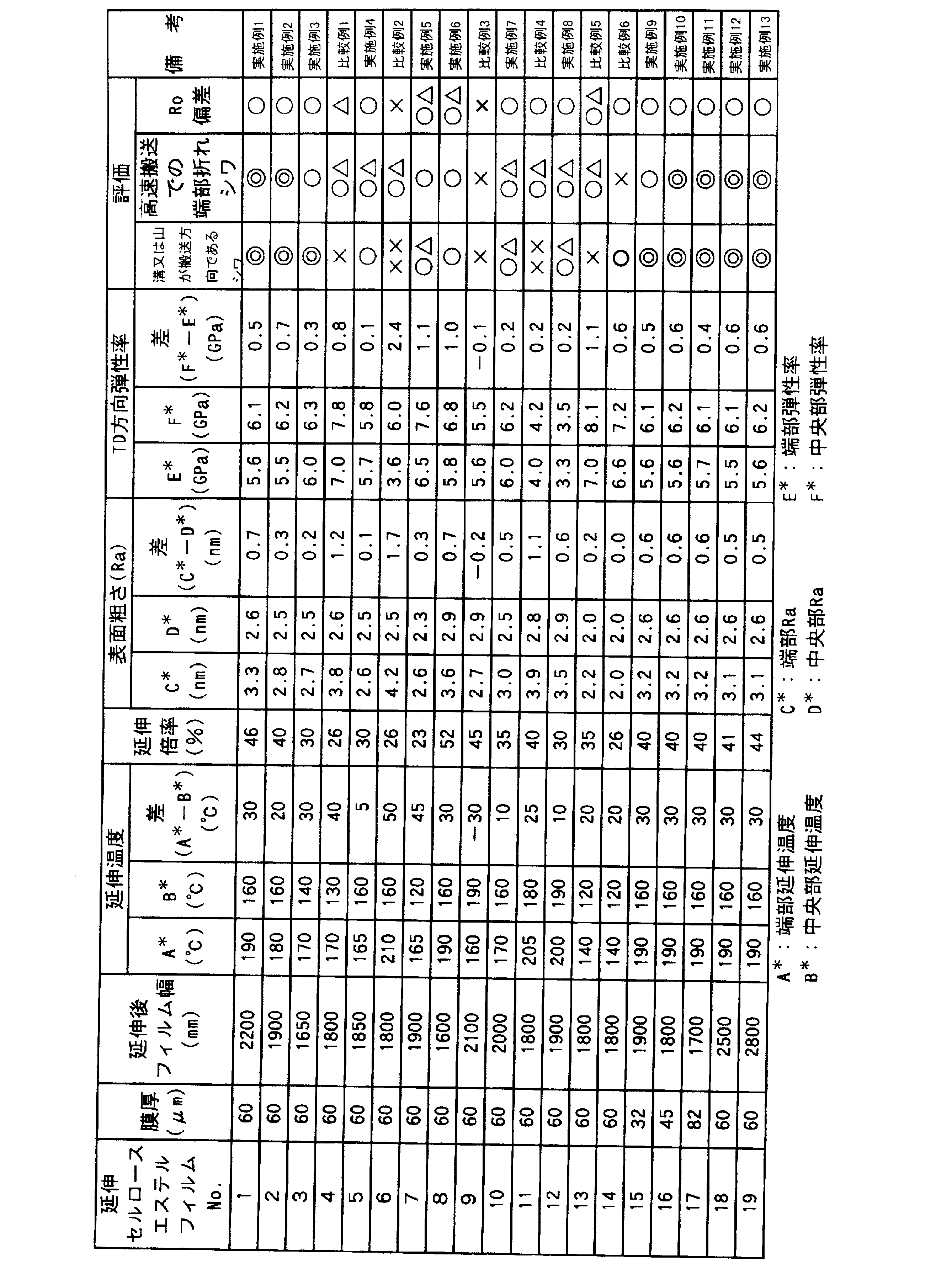
表2の結果より、本発明の延伸セルロースエステルフィルム1~3、5、7~8、10、12、15~19は、比較例の延伸セルロースエステルフィルムに対して、搬送方向に延びるシワの発生、高速搬送での端部折れシワの発生が抑制され、かつスリット除去済フィルムにおける中央部Tと端部H1の面内リターデーション値の偏差が小さいことから、光学特性のバラツキも抑制されることが分かった。
(実施例14)
下記組成のドープ液を調製した。まず加圧溶解タンクにメチレンクロライドとエタノールを添加した。溶剤の入った加圧溶解タンクにアセチル基置換度1.90、プロピオニル基置換度0.70、総アシル基置換度2.60のセルロースエステルと、糖エステル化合物と、エステル化合物と、チヌビン928と、微粒子添加液1とを攪拌しながら投入した。これを加熱し、攪拌しながら、完全に溶解させた。これを安積濾紙(株)製の安積濾紙No.244を使用して濾過し、ドープ液を調製した。
(ドープ液の組成)
メチレンクロライド:550質量部
エタノール:40質量部
セルロースアセテート(アセチル基置換度1.90、プロピオニル基置換度0.70、総アシル基置換度2.60、数平均分子量120000):100質量部
糖エステル化合物(例示化合物1-7):5質量部
エステル化合物(芳香族末端エステル例示化合物2-16):5質量部
チヌビン928(BASFジャパン社製):2.6質量部
微粒子添加液1:4質量部
下記組成のドープ液を調製した。まず加圧溶解タンクにメチレンクロライドとエタノールを添加した。溶剤の入った加圧溶解タンクにアセチル基置換度1.90、プロピオニル基置換度0.70、総アシル基置換度2.60のセルロースエステルと、糖エステル化合物と、エステル化合物と、チヌビン928と、微粒子添加液1とを攪拌しながら投入した。これを加熱し、攪拌しながら、完全に溶解させた。これを安積濾紙(株)製の安積濾紙No.244を使用して濾過し、ドープ液を調製した。
(ドープ液の組成)
メチレンクロライド:550質量部
エタノール:40質量部
セルロースアセテート(アセチル基置換度1.90、プロピオニル基置換度0.70、総アシル基置換度2.60、数平均分子量120000):100質量部
糖エステル化合物(例示化合物1-7):5質量部
エステル化合物(芳香族末端エステル例示化合物2-16):5質量部
チヌビン928(BASFジャパン社製):2.6質量部
微粒子添加液1:4質量部
次いで、無端ベルト流延装置を用い、ドープ液を温度33℃、1800mm幅でステンレスベルト支持体上に均一に流延した。ステンレスベルトの温度は30℃に制御した。
ステンレスベルト支持体上で、流延(キャスト)したフィルム中の残留溶媒量が75%になるまで溶媒を蒸発させ、次いで剥離張力130N/mで、ステンレスベルト支持体上から剥離した。
剥離したセルロースアセテートフィルムは、図3で示すテンター4を用いてハウジング10の温度を調整して、フィルム中央部表面の延伸温度を160℃になるように調整し、更に図4で示す位置に端部熱風発生部分G1を設置して、フィルム端部表面の延伸温度が190℃になるように温度調整しながら、幅方向に延伸倍率46%で延伸した。延伸開始時の残留溶媒は10%であった。
端部、及び中央部のフィルム表面の温度は、接触式ハンディー温度計(ANRITSU DIGITAL THREMOMETER HA-100K)を用いて搬送されているフィルムの幅方向に対し各々5点を測定し、平均値をその部位のフィルム温度とした。
次いで、乾燥ゾーンを多数のロールで搬送させながら乾燥を終了させ巻き取った。乾燥温度は130℃で、搬送張力は100N/mとした。
以上のようにして、フィルム幅2400mm、乾燥膜厚60μm、長さ5000mの延伸セルロースエステルフィルム21を作製した。
フィルムから任意の位置10点のサンプルを採取し、リターデーションRo、Rtの平均値を測定したところ、Ro50nm、Rt135nmであり良好な位相差性能を有していた。
(実施例15~17)
延伸セルロースエステルフィルム21の作製において、表3記載のように糖エステル化合物、エステル化合物の種類を変化させた以外は同様にして、延伸セルロースエステルフィルム22~24を作製した。糖エステル化合物、エステル化合物を単独で用いる場合は10質量部を添加した。
延伸セルロースエステルフィルム21の作製において、表3記載のように糖エステル化合物、エステル化合物の種類を変化させた以外は同様にして、延伸セルロースエステルフィルム22~24を作製した。糖エステル化合物、エステル化合物を単独で用いる場合は10質量部を添加した。
得られた延伸セルロースエステルフィルム21~24を用いて実施例1と同様に、表面粗さ(Ra)の測定、弾性率の測定、シワ評価、高速搬送での端部折れシワ、Ro偏差、及び下記ヘイズを評価したところ、表3に示すように実施例1を再現し良好な特性を有する延伸セルロースエステルフィルムであり、かつ糖エステル化合物を用いるとヘイズが低下することを確認した。
(ヘイズ)
フィルム試料1枚をASTM-D1003-52に従って、東京電色工業(株)製T-2600DAを使用して測定し、以下のようにヘイズをランク分けし評価する。
フィルム試料1枚をASTM-D1003-52に従って、東京電色工業(株)製T-2600DAを使用して測定し、以下のようにヘイズをランク分けし評価する。
◎:ヘイズ0.15%未満
○:ヘイズ0.15%以上0.3%未満
△:ヘイズ0.3%以上0.5%未満
×:ヘイズ0.5%以上
○:ヘイズ0.15%以上0.3%未満
△:ヘイズ0.3%以上0.5%未満
×:ヘイズ0.5%以上
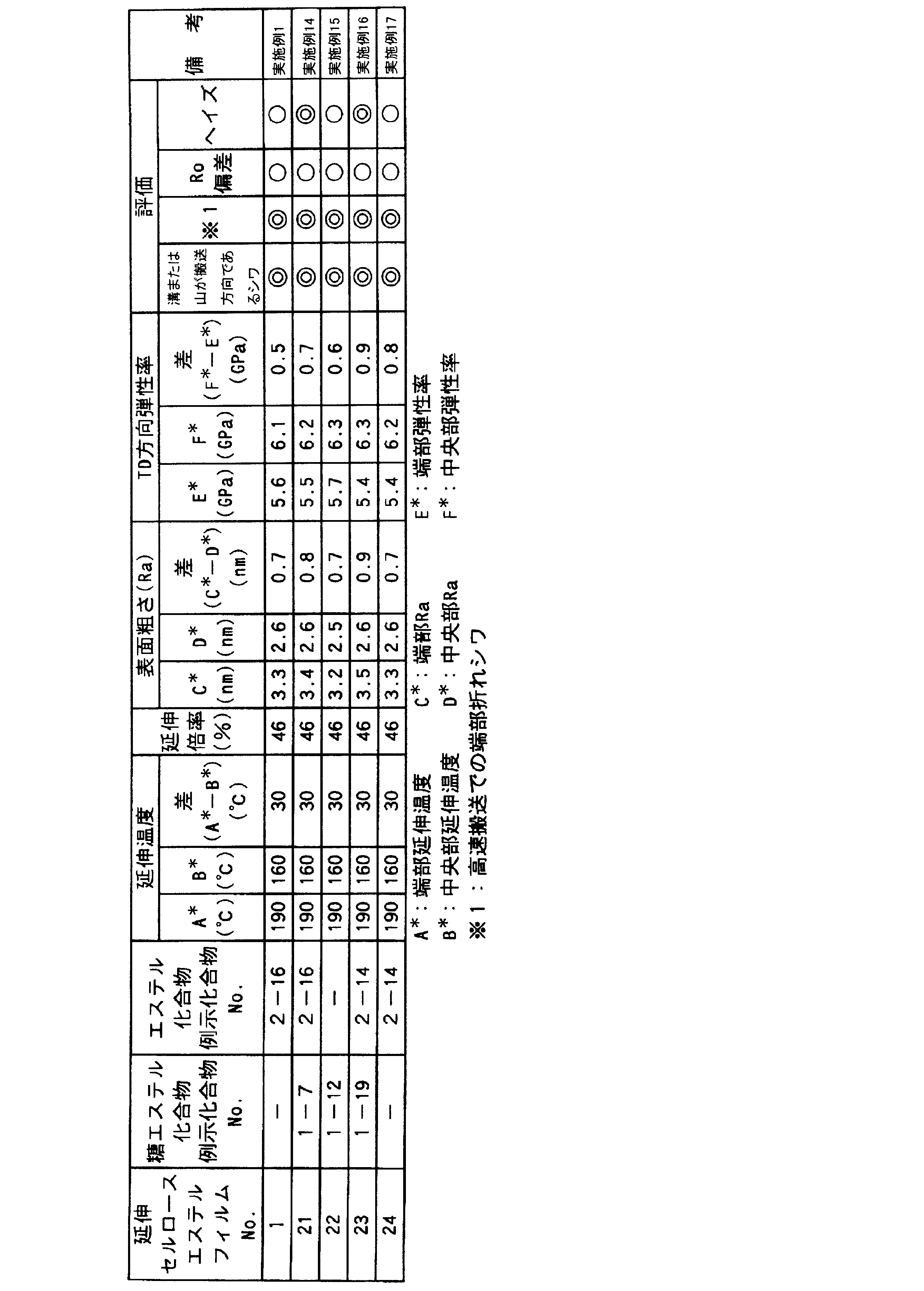
本出願は、2011年2月15日出願の特願2011-029477に基づく優先権を主張する。当該出願明細書および図面に記載された内容は、すべて本願明細書に援用される。
本発明によれば、広幅化しようとして高倍率に延伸する際の、「溝または山の方向が搬送方向であるシワ」の発生がなく、広幅化されても面内方向のリターデーションRoのフィルム各部における偏差が小さく、さらにはフィルムを高速で搬送する際のフィルム端部の折れジワの発生が抑制された延伸セルロースエステルフィルムおよびその製造方法を提供することができる。
Fo 未延伸セルロースエステルフィルム
F 延伸セルロースエステルフィルム
1 ステンレス鋼製エンドレスベルト(支持体)
3 剥離ロール
4 テンター
5 乾燥装置
6 搬送ロール
8 巻取ロール
F 延伸セルロースエステルフィルム
1 ステンレス鋼製エンドレスベルト(支持体)
3 剥離ロール
4 テンター
5 乾燥装置
6 搬送ロール
8 巻取ロール
Claims (8)
- 延伸セルロースエステルフィルムの幅をLとし;フィルムの幅方向に前記延伸セルロースエステルフィルムの端からL×0.05までの部分を端部Hとし;フィルムの幅方向に前記延伸セルロースエステルフィルムの中心から±L×0.1までの部分を中央部Tとしたとき、
前記延伸セルロースエステルフィルムの少なくとも一方の面の、前記端部Hの表面粗さ(Ra)の平均値が1.7nm~4.0nmの範囲で、前記中央部Tの表面粗さ(Ra)の平均値よりも0.1nm~1.0nm高く、
前記中央部Tの弾性率の平均値が3.0GPa~8.0GPaの範囲で、前記端部Hの弾性率の平均値よりも0.1GPa~2.0GPa高い、延伸セルロースエステルフィルム。 - 前記延伸セルロースエステルフィルムの少なくとも一方の面の、前記端部Hの表面粗さ(Ra)の平均値が2.2nm~3.5nmの範囲で、前記中央部Tの表面粗さ(Ra)の平均値よりも0.3nm~1.0nm高く、
前記中央部Tの弾性率の平均値が4.0GPa~7.0GPaの範囲で、前記端部Hの弾性率の平均値よりも0.3GPa~1.0GPa高い、請求項1に記載の延伸セルロースエステルフィルム。 - 前記延伸セルロースエステルフィルムの幅が2~3mであり、膜厚が20~70μmである、請求項1に記載の延伸セルロースエステルフィルム。
- 前記延伸セルロースエステルフィルムは、フィルムの幅方向に垂直な方向に巻き取られた巻き取り体である、請求項1に記載の延伸セルロースエステルフィルム。
- セルロースエステルを溶剤に溶解させてドープを調製する工程と、前記ドープを無端状の金属支持体上に流延する工程と、流延した前記ドープを乾燥後、前記金属支持体から剥離して未延伸セルロースエステルフィルムを得る工程と、前記未延伸セルロースエステルフィルムを延伸して延伸セルロースエステルフィルムを得る工程とを含む、請求項1に記載の延伸セルロースエステルフィルムの製造方法であって、
前記未延伸セルロースエステルフィルムの幅をLoとし;フィルムの幅方向に前記未延伸セルロースエステルフィルムの端からLo×0.05までの部分を端部Hoとし;フィルムの幅方向に前記未延伸セルロースエステルフィルムの中心から±Lo×0.1までの部分を中央部Toとしたとき、
前記未延伸セルロースエステルフィルムの、前記金属支持体に接した面とは反対側の面Aの前記端部Hoの表面温度を、前記面Aの前記中央部Toの表面温度よりも10℃~50℃高くしながら延伸処理する、延伸セルロースエステルフィルムの製造方法。 - 前記表面温度を調整するための少なくとも一対の端部熱風発生部分を、前記未延伸セルロースエステルフィルムの面Aの端部と対向するように配置し、
前記端部熱風発生部分より、前記未延伸セルロースエステルフィルムの前記面Aの端部Hoに、前記面Aの前記中央部Toの表面温度よりも10℃~50℃高い温度の熱風を吹き付けながら、前記未延伸セルロースエステルフィルムを延伸処理する、請求項5に記載の延伸セルロースエステルフィルムの製造方法。 - 前記延伸セルロースエステルフィルムを、フィルムの幅方向に垂直な方向に巻き取る巻き取り工程をさらに含む、請求項5に記載の延伸セルロースエステルフィルムの製造方法。
- 前記延伸処理では、前記未延伸セルロースエステルフィルムを、フィルムの幅方向に25%~100%の延伸倍率で延伸する、請求項5に記載の延伸セルロースエステルフィルムの製造方法。
Applications Claiming Priority (2)
| Application Number | Priority Date | Filing Date | Title |
|---|---|---|---|
| JP2011029477A JP2014079880A (ja) | 2011-02-15 | 2011-02-15 | 延伸セルロースエステルフィルム、及びその製造方法 |
| JP2011-029477 | 2011-02-15 |
Publications (1)
| Publication Number | Publication Date |
|---|---|
| WO2012111324A1 true WO2012111324A1 (ja) | 2012-08-23 |
Family
ID=46672268
Family Applications (1)
| Application Number | Title | Priority Date | Filing Date |
|---|---|---|---|
| PCT/JP2012/000987 Ceased WO2012111324A1 (ja) | 2011-02-15 | 2012-02-15 | 延伸セルロースエステルフィルム、及びその製造方法 |
Country Status (2)
| Country | Link |
|---|---|
| JP (1) | JP2014079880A (ja) |
| WO (1) | WO2012111324A1 (ja) |
Families Citing this family (1)
| Publication number | Priority date | Publication date | Assignee | Title |
|---|---|---|---|---|
| KR101779006B1 (ko) * | 2016-02-16 | 2017-09-18 | 주식회사 효성 | 이축 연신 셀룰로오스 에스테르 필름의 제조방법 |
Citations (5)
| Publication number | Priority date | Publication date | Assignee | Title |
|---|---|---|---|---|
| JPS5534937A (en) * | 1978-09-01 | 1980-03-11 | Unitika Ltd | Manufacturing method of thermally plastic resin stretched film |
| JP2002296422A (ja) * | 2001-04-02 | 2002-10-09 | Konica Corp | 位相差フィルム、その製造方法及び楕円偏光板 |
| JP2005181747A (ja) * | 2003-12-19 | 2005-07-07 | Konica Minolta Opto Inc | 光学フィルム及びその製造方法 |
| JP2009051163A (ja) * | 2007-08-29 | 2009-03-12 | Tohcello Co Ltd | 延伸フィルムの製造方法 |
| WO2010095316A1 (ja) * | 2009-02-18 | 2010-08-26 | コニカミノルタオプト株式会社 | 光学フィルムの製造方法 |
-
2011
- 2011-02-15 JP JP2011029477A patent/JP2014079880A/ja not_active Withdrawn
-
2012
- 2012-02-15 WO PCT/JP2012/000987 patent/WO2012111324A1/ja not_active Ceased
Patent Citations (5)
| Publication number | Priority date | Publication date | Assignee | Title |
|---|---|---|---|---|
| JPS5534937A (en) * | 1978-09-01 | 1980-03-11 | Unitika Ltd | Manufacturing method of thermally plastic resin stretched film |
| JP2002296422A (ja) * | 2001-04-02 | 2002-10-09 | Konica Corp | 位相差フィルム、その製造方法及び楕円偏光板 |
| JP2005181747A (ja) * | 2003-12-19 | 2005-07-07 | Konica Minolta Opto Inc | 光学フィルム及びその製造方法 |
| JP2009051163A (ja) * | 2007-08-29 | 2009-03-12 | Tohcello Co Ltd | 延伸フィルムの製造方法 |
| WO2010095316A1 (ja) * | 2009-02-18 | 2010-08-26 | コニカミノルタオプト株式会社 | 光学フィルムの製造方法 |
Also Published As
| Publication number | Publication date |
|---|---|
| JP2014079880A (ja) | 2014-05-08 |
Similar Documents
| Publication | Publication Date | Title |
|---|---|---|
| JP5440407B2 (ja) | 偏光板、液晶表示装置及びセルロースアセテートフィルムの製造方法 | |
| JP2009210777A (ja) | 光学フィルム、及びそれを用いた偏光板 | |
| WO2012026199A1 (ja) | 位相差フィルム、及びそれを用いた偏光板、液晶表示装置 | |
| JP5776362B2 (ja) | セルロースエステルフィルムおよびその製造方法、並びにこれを用いた位相差フィルムおよび表示装置 | |
| WO2012077587A1 (ja) | 光学フィルム、及びそれを用いた偏光板、液晶表示装置 | |
| WO2009119142A1 (ja) | セルロースエステルフィルム | |
| JP5861700B2 (ja) | 延伸セルロースエステルフィルム、及びその製造方法 | |
| JP5428045B2 (ja) | 液晶表示装置 | |
| JP6287211B2 (ja) | 光学フィルム、及びそれを用いた偏光板、液晶表示装置 | |
| WO2011114764A1 (ja) | 位相差フィルム及びそれが備えられた偏光板 | |
| JP5233935B2 (ja) | 光学フィルム、及びそれを用いた偏光板、液晶表示装置並びにリターデーション発現剤 | |
| WO2009101839A1 (ja) | 位相差フィルム | |
| WO2010041514A1 (ja) | 光学フィルム、及びそれを用いた偏光板 | |
| JP6330807B2 (ja) | 偏光板および液晶表示装置 | |
| WO2012133169A1 (ja) | 液晶表示装置 | |
| JPWO2013125419A1 (ja) | 光学フィルム、偏光板及び液晶表示装置 | |
| WO2012111324A1 (ja) | 延伸セルロースエステルフィルム、及びその製造方法 | |
| JP5299110B2 (ja) | 光学フィルム、及びそれを用いた偏光板、液晶表示装置 | |
| WO2010026832A1 (ja) | 液晶表示装置 | |
| JP5450775B2 (ja) | 光学フィルム、及び偏光板 | |
| JP2012118177A (ja) | セルロースアシレートフィルム、セルロースアシレートフィルムの製造方法、及び液晶表示装置 | |
| JP2011076031A (ja) | 光学フィルム、及びそれを用いた偏光板、液晶表示装置 | |
| JP5880016B2 (ja) | 垂直配向型液晶表示装置 | |
| WO2010106854A1 (ja) | 光学フィルム、光学フィルムの製造方法 | |
| JP5724820B2 (ja) | セルロースエステルフィルム、位相差フィルム、偏光板および液晶表示装置 |
Legal Events
| Date | Code | Title | Description |
|---|---|---|---|
| 121 | Ep: the epo has been informed by wipo that ep was designated in this application |
Ref document number: 12747707 Country of ref document: EP Kind code of ref document: A1 |
|
| NENP | Non-entry into the national phase |
Ref country code: DE |
|
| 122 | Ep: pct application non-entry in european phase |
Ref document number: 12747707 Country of ref document: EP Kind code of ref document: A1 |
|
| NENP | Non-entry into the national phase |
Ref country code: JP |