WO2012041124A1 - 氮杂双环辛烷类衍生物、其制备方法及其在医药上的应用 - Google Patents
氮杂双环辛烷类衍生物、其制备方法及其在医药上的应用 Download PDFInfo
- Publication number
- WO2012041124A1 WO2012041124A1 PCT/CN2011/078217 CN2011078217W WO2012041124A1 WO 2012041124 A1 WO2012041124 A1 WO 2012041124A1 CN 2011078217 W CN2011078217 W CN 2011078217W WO 2012041124 A1 WO2012041124 A1 WO 2012041124A1
- Authority
- WO
- WIPO (PCT)
- Prior art keywords
- group
- pyrrole
- dichlorophenyl
- hexahydro
- cyclopenta
- Prior art date
- Legal status (The legal status is an assumption and is not a legal conclusion. Google has not performed a legal analysis and makes no representation as to the accuracy of the status listed.)
- Ceased
Links
- 0 *C(*)(C(CNC1)C1(C1(*)*)[Al])C1(*)I Chemical compound *C(*)(C(CNC1)C1(C1(*)*)[Al])C1(*)I 0.000 description 7
- DZLWMYOSCQCDLL-VFVRVIDISA-N CC(C)(C)OC(N(C[C@H]1C[C@H](C2)O)C[C@@]12c(cc1)cc(Cl)c1Cl)=O Chemical compound CC(C)(C)OC(N(C[C@H]1C[C@H](C2)O)C[C@@]12c(cc1)cc(Cl)c1Cl)=O DZLWMYOSCQCDLL-VFVRVIDISA-N 0.000 description 2
- HQOHZZAXBXTPTJ-QINHECLXSA-N O=C(c1ccccc1)O[C@H](C[C@@H]1CNC2)C[C@]12c(cc1Cl)ccc1Cl Chemical compound O=C(c1ccccc1)O[C@H](C[C@@H]1CNC2)C[C@]12c(cc1Cl)ccc1Cl HQOHZZAXBXTPTJ-QINHECLXSA-N 0.000 description 2
- DZLWMYOSCQCDLL-VBHSOAQHSA-N CC(C)(C)OC(N(C[C@H]1C[C@@H](C2)O)C[C@@]12c(cc1)cc(Cl)c1Cl)=O Chemical compound CC(C)(C)OC(N(C[C@H]1C[C@@H](C2)O)C[C@@]12c(cc1)cc(Cl)c1Cl)=O DZLWMYOSCQCDLL-VBHSOAQHSA-N 0.000 description 1
- XHSSSRGTEQYBJJ-WYEJZRMESA-N CC(C)(C)OC(N(C[C@H]1C[C@@H](C2)OC(c3ccccc3)=O)C[C@@]12c(cc1)cc(Cl)c1Cl)=O Chemical compound CC(C)(C)OC(N(C[C@H]1C[C@@H](C2)OC(c3ccccc3)=O)C[C@@]12c(cc1)cc(Cl)c1Cl)=O XHSSSRGTEQYBJJ-WYEJZRMESA-N 0.000 description 1
- XHSSSRGTEQYBJJ-RRQZXNHTSA-N CC(C)(C)OC(N(C[C@H]1C[C@H](C2)OC(c3ccccc3)=O)C[C@@]12c(cc1)cc(Cl)c1Cl)=O Chemical compound CC(C)(C)OC(N(C[C@H]1C[C@H](C2)OC(c3ccccc3)=O)C[C@@]12c(cc1)cc(Cl)c1Cl)=O XHSSSRGTEQYBJJ-RRQZXNHTSA-N 0.000 description 1
- UQSHBYHJOWZZBW-RRQHEKLDSA-N CS[C@@H]1NCC2C1CCC2 Chemical compound CS[C@@H]1NCC2C1CCC2 UQSHBYHJOWZZBW-RRQHEKLDSA-N 0.000 description 1
- SGKVVIHPZPZOOL-UHFFFAOYSA-N C[N](C)(CC1N2CCC1)CC2=O Chemical compound C[N](C)(CC1N2CCC1)CC2=O SGKVVIHPZPZOOL-UHFFFAOYSA-N 0.000 description 1
- GRUPAEWJLDLTPV-UHFFFAOYSA-N NC1C=C2OCC2C1 Chemical compound NC1C=C2OCC2C1 GRUPAEWJLDLTPV-UHFFFAOYSA-N 0.000 description 1
- VVZRKHWDDUVSST-NRUUGDAUSA-N O[C@@H](C[C@@H]1CNC2)C[C@]12c(cc1Cl)ccc1Cl Chemical compound O[C@@H](C[C@@H]1CNC2)C[C@]12c(cc1Cl)ccc1Cl VVZRKHWDDUVSST-NRUUGDAUSA-N 0.000 description 1
Classifications
-
- C—CHEMISTRY; METALLURGY
- C07—ORGANIC CHEMISTRY
- C07D—HETEROCYCLIC COMPOUNDS
- C07D209/00—Heterocyclic compounds containing five-membered rings, condensed with other rings, with one nitrogen atom as the only ring hetero atom
- C07D209/02—Heterocyclic compounds containing five-membered rings, condensed with other rings, with one nitrogen atom as the only ring hetero atom condensed with one carbocyclic ring
- C07D209/52—Heterocyclic compounds containing five-membered rings, condensed with other rings, with one nitrogen atom as the only ring hetero atom condensed with one carbocyclic ring condensed with a ring other than six-membered
-
- A—HUMAN NECESSITIES
- A61—MEDICAL OR VETERINARY SCIENCE; HYGIENE
- A61K—PREPARATIONS FOR MEDICAL, DENTAL OR TOILETRY PURPOSES
- A61K31/00—Medicinal preparations containing organic active ingredients
- A61K31/33—Heterocyclic compounds
- A61K31/395—Heterocyclic compounds having nitrogen as a ring hetero atom, e.g. guanethidine or rifamycins
- A61K31/40—Heterocyclic compounds having nitrogen as a ring hetero atom, e.g. guanethidine or rifamycins having five-membered rings with one nitrogen as the only ring hetero atom, e.g. sulpiride, succinimide, tolmetin, buflomedil
- A61K31/403—Heterocyclic compounds having nitrogen as a ring hetero atom, e.g. guanethidine or rifamycins having five-membered rings with one nitrogen as the only ring hetero atom, e.g. sulpiride, succinimide, tolmetin, buflomedil condensed with carbocyclic rings, e.g. carbazole
-
- A—HUMAN NECESSITIES
- A61—MEDICAL OR VETERINARY SCIENCE; HYGIENE
- A61P—SPECIFIC THERAPEUTIC ACTIVITY OF CHEMICAL COMPOUNDS OR MEDICINAL PREPARATIONS
- A61P25/00—Drugs for disorders of the nervous system
- A61P25/22—Anxiolytics
-
- A—HUMAN NECESSITIES
- A61—MEDICAL OR VETERINARY SCIENCE; HYGIENE
- A61P—SPECIFIC THERAPEUTIC ACTIVITY OF CHEMICAL COMPOUNDS OR MEDICINAL PREPARATIONS
- A61P25/00—Drugs for disorders of the nervous system
- A61P25/24—Antidepressants
-
- C—CHEMISTRY; METALLURGY
- C07—ORGANIC CHEMISTRY
- C07D—HETEROCYCLIC COMPOUNDS
- C07D409/00—Heterocyclic compounds containing two or more hetero rings, at least one ring having sulfur atoms as the only ring hetero atoms
- C07D409/02—Heterocyclic compounds containing two or more hetero rings, at least one ring having sulfur atoms as the only ring hetero atoms containing two hetero rings
- C07D409/12—Heterocyclic compounds containing two or more hetero rings, at least one ring having sulfur atoms as the only ring hetero atoms containing two hetero rings linked by a chain containing hetero atoms as chain links
Definitions
- the present invention relates to a novel azabicyclooctane derivative of the formula (I), a process for the preparation thereof, and a pharmaceutical composition containing the same, and as a therapeutic agent, particularly as dopamine or norepinephrine And the use of serotonin reuptake inhibitors.
- Background technique
- Depression is a kind of mood disorder or affective disorder caused by various causes of depression. It is a group of clinical symptoms or states centered on depression and self-experience. In severe cases, psychosis such as hallucinations and delusions can occur. Sexual symptoms, anxiety and motor agitation in some cases are very significant. Depression is mainly caused by depression, slow thinking, and decreased will activity. In most cases, there are various physical symptoms.
- the currently used antidepressant drugs are mainly in the following categories: The first generation of classic antidepressants: including monoamine oxidase inhibitors (MAOI), such as isopropyl hydrazine, moclobemide, etc., and tricyclic antidepressants ( TCA) such as imipramine, amitriptyline, doxepin, clomipramine and maprotiline.
- MAOI monoamine oxidase inhibitors
- TCA tricyclic antidepressants
- Second-generation new antidepressants include selective serotonin reuptake inhibitors (SSRIs) such as Fluoxetine, Paroxetine, Citalopram, and escitalop (Escitalopram) Etc., selective serotonin and norepinephrine dual reuptake inhibitors (SNRIs), such as Venlafaxine, duloxetine and desvenlafaxine, and serotonin and Norepinephrine receptor blocker (NaSSA), such as mirtazepine.
- SSRIs selective serotonin reuptake inhibitors
- SNRIs selective serotonin and norepinephrine dual reuptake inhibitors
- NaSSA Norepinephrine receptor blocker
- new drugs have developed rapidly and emerged in an endless stream, current antidepressants are still dominated by selective serotonin (5-HT) reuptake inhibitors, and the most widely used drugs are clinically used.
- Tricyclic antidepressants have the longest clinical
- antidepressant drugs Although there are many antidepressant drugs currently used in clinical practice, there are almost no ideal drugs with satisfactory therapeutic effects.
- the effective rate of general antidepressants is about 40% ⁇ 50%, and many antidepressants have serious or More serious side effects such as sexual dysfunction, weight gain, affective disorder and cardiovascular side effects.
- these antidepressant drugs, especially SSRIs exert a slower antidepressant effect, usually around 4 to 8 weeks. These serious side effects greatly affect the confidence of patients with depression in drug use.
- the compounds designed in the present invention are dopamine, norepinephrine and serotonin reuptake inhibitors, and the inhibitory function of the dopamine reuptake system is added to the serotonin and norepinephrine reuptake inhibitors.
- the goal is to reduce the side effects and speed up the action of the new compounds while ensuring or significantly increasing the antidepressant effects of the new compounds, making them more acceptable to patients.
- the most important concept of the compounds designed by the present invention is the introduction of dopamine reuptake inhibition in novel drugs.
- the role of selective dopamine reuptake inhibitors in antidepressant has now been determined.
- the antidepressant drugs Nomifensine and Bupropion have a certain degree of dopaminergic nervous system effects.
- the clinically used antidepressant drugs Venlafaxine, Desvenlafaxine and Milnacipran have a norepinephrine weight.
- Intake and serotonin reuptake systems have dual inhibitory effects (SNRIs), while the recently marketed drug duloxetine is more active against both reuptake systems.
- Venlafaxine and desvenlafaxine have better antidepressant effects, regardless of their strength. And the time of action is more obvious than other drugs.
- dopamine, serotonin and norepinephrine have varying degrees of functional loss in depression.
- serotonin is associated with mood, sleep, appetite, sexual function, pain, and learning and memory.
- Norepinephrine is associated with sleep regulation, human dynamics and alertness, and dopamine is associated with recognition, motor function, energy, and Addiction is related.
- dopamine drugs have shown significant effects in the treatment of depression, such as a new generation of anti-schizophrenia drugs ⁇ ⁇
- Amisulpride has an ideal therapeutic effect in the treatment of depression, and it takes more time to act than SSRIs and B SNRIs.
- Amisulpride is a blocker of dopamine receptors D2 and D3 receptors. Clinically, Amisulpride treats depression and its blockade of D3 receptors, thereby increasing dopamine. There is a close relationship between the release and increase of synaptic dopamine concentrations. Other dopamine anti-schizophrenia drugs also have varying degrees of effects on depression.
- SMUBS Super mixed uptake blockers comprehensive inhibition of the monoamine reuptake system can not only ensure the antidepressant effect of selective serotonin reuptake inhibitors, but also the effects of norepinephrine and dopamine.
- the primary goal of combining three monoamine reuptake inhibitions in one compound is to increase the rate of action of the drug in depression, to improve the therapeutic effects of multiple symptoms of depression, and to substantially improve its side effects. Adding the active ingredient of dopamine to the drug molecule can also improve the patient's affective disorder, thereby reducing the lack of pleasure associated with depression (Anhedoni a ).
- the lack of pleasure is mainly related to the dopaminergic nervous system in the Limbic system, which enhances the dopa neurotransmitter in this brain region and will enhance the patient's pleasure.
- enhancing the dopaminergic neurotransmission in the frontal cortex of the brain can treat patients with memory loss.
- Ar is selected from aryl or heteroaryl, wherein the aryl or heteroaryl is optionally further one or more selected from the group consisting of alkyl, alkenyl, block, halogen, nitro, cyano, haloalkyl, Hydroxyalkyl, cycloalkyl, heterocyclic, -OR 7 , -0-C(0)R 7 , -C(0)R 7 , -C(0)OR 7 , -S(0)OR 7 , Substituted by a group of -NR 8 R 9 or -C(0)NR 8 R 9 ;
- R 1 and R 2 are each independently selected from a hydrogen atom, an alkyl group, an alkenyl group, a blocked group, a halogen, a nitro group, a cyano group, a cycloalkyl group, a heterocyclic group, -OR 7 , -0-C(0)R 7 , -C(0)R 7 , -C(0)OR 7 , -S(0)OR 7 , -NR 8 R 9 or -C(0)NR 8 R 9 , wherein the alkyl, alkenyl group Further, the block group, cycloalkyl or heterocyclic group is further further selected from one or more selected from the group consisting of alkyl, halogen, nitro, cyano, cycloalkyl, heterocyclic, -OR 7 , -0-C (0 Substituting R 7 , -C(0)R 7 , -C(0)OR 7 , -S(0)OR 7 -NR 8 R 9 or -C(0)NR 8 R 9
- R 3 , R 4 , R 5 and R 6 are each independently selected from a hydrogen atom, an alkyl group, a cycloalkyl group, a heterocyclic group, an aryl group, a heteroaryl group, -C(0)R 7 , -C(0)OR 7 or -C(0)NR 8 R 9 wherein said alkyl, cycloalkyl, heterocyclyl, aryl or heteroaryl group is further further selected from one or more selected from the group consisting of alkyl, halogen, nitro , cyano, cycloalkyl, heterocyclic, -OR 7 , -0-C(0)R 7 , -C(0)R 7 , -C(0)OR 7 , -S(0)OR 7 , Substituted by a group of -NR 8 R 9 or -C(0)NR 8 R 9 ;
- R 7 is selected from a hydrogen atom, an alkyl group, a cycloalkyl group, a heterocyclic group, an aryl group or a heteroaryl group, wherein the alkyl group, cycloalkyl group, heterocyclic group, aryl group or heteroaryl group is optionally further Substituted by one or more groups selected from alkyl, hydroxy, halogen, nitro, cyano, cycloalkyl, heterocyclyl, aryl or heteroaryl;
- R 8 and R 9 are each independently selected from a hydrogen atom, an alkyl group, an alkenyl group, a blocked group, a cycloalkyl group, a heterocyclic group, an aryl group or a heteroaryl group, wherein the alkyl group, the alkenyl group, the block group, the ring group
- the alkyl, heterocyclyl, aryl or heteroaryl group is further optionally further selected from one or more selected from the group consisting of alkyl, hydroxy, halogen, nitro, cyano, cycloalkyl, heterocyclyl, aryl or heteroaryl Replaced by a group;
- R 8 and R 9 together with the N atom to which they are attached form a heterocyclic group, wherein said heterocyclic group is optional Further substituted with one or more groups selected from the group consisting of alkyl, hydroxy, halogen, nitro, cyano, cycloalkyl, heterocyclyl, aryl or heteroaryl.
- a preferred embodiment of the invention a compound of the formula (I), and an enantiomer, diastereomer thereof or a pharmaceutically acceptable salt thereof, wherein:
- Ar is selected from the group consisting of aryl, wherein said aryl group is optionally further substituted with one or more groups selected from the group consisting of alkyl, halogen or -OR 7 ;
- R 7 is selected from a hydrogen atom, an alkyl group, a cycloalkyl group, a heterocyclic group, an aryl group or a heteroaryl group, wherein the alkyl group, cycloalkyl group, heterocyclic group, aryl group or heteroaryl group is optionally further One or more groups selected from an alkyl group, a cycloalkyl group, a hydroxyl group or a halogen are substituted.
- a preferred embodiment of the invention a compound of the formula (I), and an enantiomer, diastereomer thereof or a pharmaceutically acceptable salt thereof, wherein:
- Ar is selected from the group consisting of phenyl, wherein said phenyl group is optionally further substituted with one or more groups selected from the group consisting of alkyl, halogen or -OR 7 ;
- R 7 is selected from a hydrogen atom, an alkyl group, a cycloalkyl group, a heterocyclic group, an aryl group or a heteroaryl group, wherein the alkyl group, cycloalkyl group, heterocyclic group, aryl group or heteroaryl group is optionally further One or more groups selected from an alkyl group, a cycloalkyl group, a hydroxyl group or a halogen are substituted.
- a preferred embodiment of the invention a compound of the formula (I), and an enantiomer, diastereomer thereof or a pharmaceutically acceptable salt thereof, wherein:
- R 1 is selected from a hydrogen atom, an alkyl group or a halogen
- R 2 is selected from a hydrogen atom, an alkyl group, a halogen, -OR 7 or -0-C(0)R 7 , wherein the alkyl group is optionally substituted by one or more halogens;
- R 1 and R 2 together form a double bond, provided that R 1 and R 2 are not simultaneously a hydrogen atom;
- R 7 is selected from a hydrogen atom, an alkyl group, a cycloalkyl group, a heterocyclic group, an aryl group or a heteroaryl group, wherein the alkyl group, cycloalkyl group, heterocyclic group, aryl group or heteroaryl group is optionally further One or more groups selected from an alkyl group, a cycloalkyl group, a hydroxyl group or a halogen are substituted.
- a preferred embodiment of the invention a compound of the formula (I), and an enantiomer, diastereomer thereof or a pharmaceutically acceptable salt thereof, wherein:
- Ar is selected from the group consisting of phenyl, wherein said phenyl group is optionally further substituted with one or more groups selected from alkyl or halogen;
- R 1 is selected from a hydrogen atom or a halogen
- R 2 is selected from a hydrogen atom, an alkyl group, a halogen or -OR 7 , wherein the alkyl group is optionally substituted by one or more halogens; or, R 1 and R 2 together form a double bond, provided that R 1 and R 2 is not a hydrogen atom at the same time;
- R 3 , R 4 , R 5 and R 6 are each a hydrogen atom
- R 7 is selected from a hydrogen atom, an alkyl group or a cycloalkyl group, wherein the alkyl group or cycloalkyl group is optionally further substituted with one or more groups selected from an alkyl group, a cycloalkyl group, a hydroxyl group or a halogen.
- Ar is selected from the group consisting of phenyl, wherein said phenyl group is optionally further substituted with one or more groups selected from alkyl or halogen;
- R 1 is selected from a hydrogen atom or a halogen
- R 2 is selected from a hydrogen atom, an alkyl group, a halogen or -0-C(0)R 7 , wherein the alkyl group is optionally substituted by one or more halogens;
- R 1 and R 2 together form a double bond, provided that R 1 and R 2 are not simultaneously a hydrogen atom; and R 3 , R 4 , R 5 and R 6 are each a hydrogen atom;
- R 7 is selected from aryl or heteroaryl, wherein the aryl or heteroaryl is optionally further substituted with one or more groups selected from alkyl, cycloalkyl, hydroxy or halogen.
- the compound of the formula (I) may contain at least 3 asymmetric carbon atoms and may therefore be a mixture of optically pure diastereomers, diastereomeric mixtures, diastereomeric racemates, diastereomeric racemates.
- the form exists or exists as a meso form compound.
- the invention includes all of these forms. Mixtures of diastereomeric mixtures, diastereomeric racemates or diastereomeric racemates can be separated by conventional methods, for example by column chromatography, thin layer chromatography and HPLC.
- Typical compounds of the invention include, but are not limited to:
- the present invention relates to a compound of the formula (I), an enantiomer thereof, a diastereomer thereof or a pharmaceutically acceptable salt thereof, wherein the compound of the formula (I) is in a free form or a pharmaceutically acceptable acid addition salt.
- the acid addition salt includes hydrochloride, hydrobromide, methanesulfonate, sulfate, phosphate, fumarate, maleate, malate, citrate, B
- An acid salt or a trifluoroacetate salt, a fumarate salt, a tartrate salt or a p-toluenesulfonate salt preferably a trifluoroacetate salt, a fumarate salt, a hydrochloride salt, a p-toluenesulfonate salt, a tartrate salt, a phosphoric acid salt Salt, maleate and methanesulfonate.
- Typical compounds of the invention include, but are not limited to:
- the present invention relates to a process for the preparation of a compound of the formula (I) of the present invention, and an enantiomer, a diastereomer thereof or a pharmaceutically acceptable salt thereof, the process comprising:
- the carbonyl group of the compound (IA) can be reduced to a hydroxyl group by a reducing agent such as sodium borohydride, optionally converting the hydroxyl group to -OR 7 , and removing the protecting group PG to obtain a compound of the formula (I);
- a reducing agent such as sodium borohydride
- the carbonyl group of the compound (IA) may be reduced to a hydroxyl group by a reducing agent such as sodium borohydride, the hydroxyl group is further converted into a halogen, and the protecting group PG is removed to obtain a compound of the formula (I);
- a reducing agent such as sodium borohydride
- the hydroxyl group is further converted into a halogen
- the protecting group PG is removed to obtain a compound of the formula (I);
- the carbonyl group of the compound (IA) is further converted into an alkenyl group, an alkyl group, a blocked group, a nitro group, a cyano group, a cyclodecyl group, a heterocyclic group, -0-C(0)R 7 , -C(0)R 7 , -C(0)OR 7 , -S(0)OR 7 , -NR 8 R 9 or -C(0)NR 8 R 9 , deprotecting the PG to give a compound of the formula (I);
- PG is a protecting group for N, preferably -C(0)R 7 , -C(0)OR 7 or -C(0)NR 8 R 9 ;
- Ar, R 3 to R 9 are as defined in the formula (I).
- Another aspect of the invention relates to a compound of the formula (IA) or a pharmaceutically acceptable salt thereof,
- PG is a protecting group for N, preferably -C(0)R 7 , -C(0)OR 7 or -C(0)NR 8 R 9 ;
- Ar is selected from aryl or heteroaryl, wherein the aryl or heteroaryl is optionally further one or more selected from the group consisting of alkyl, alkenyl, block, halogen, nitro, cyano, haloalkyl, Hydroxyalkyl, cycloalkyl, heterocyclic, -OR 7 , -0-C(0)R 7 , -C(0)R 7 , -C(0)OR 7 , -S(0)OR 7 , Substituted by a group of -NR 8 R 9 or -C(0)NR 8 R 9 ;
- R 3 , R 4 , R 5 and R 6 are each independently selected from a hydrogen atom, an alkyl group, a cycloalkyl group, a heterocyclic group, an aryl group, a heteroaryl group, -C(0)R 7 , -C(0)OR 7 or -C(0)NR 8 R 9 wherein said alkyl, cycloalkyl, heterocyclyl, aryl or heteroaryl group is further further selected from one or more selected from the group consisting of alkyl, halogen, nitro , cyano, cycloalkyl, heterocyclic, -OR 7 , -0-C(0)R 7 , -C(0)R 7 , -C(0)OR 7 , -S(0)OR 7 , Substituted by a group of -NR 8 R 9 or -C(0)NR 8 R 9 ;
- R 7 is selected from a hydrogen atom, an alkyl group, a cycloalkyl group, a heterocyclic group, an aryl group or a heteroaryl group, wherein the alkyl group, cycloalkyl group, heterocyclic group, aryl group or heteroaryl group is optionally further Substituted by one or more groups selected from alkyl, hydroxy, halogen, nitro, cyano, cycloalkyl, heterocyclyl, aryl or heteroaryl;
- R 8 and R 9 are each independently selected from a hydrogen atom, an alkyl group, an alkenyl group, a blocked group, a cycloalkyl group, a heterocyclic group, an aryl group or a heteroaryl group, wherein the alkyl group, the alkenyl group, the block group, the ring group
- the alkyl, heterocyclyl, aryl or heteroaryl group is further optionally further selected from one or more selected from the group consisting of alkyl, hydroxy, halogen, nitro, cyano, cycloalkyl, heterocyclyl, aryl or heteroaryl Replaced by a group;
- R 8 and R 9 together with the N atom to which they are attached form a heterocyclic group, wherein said heterocyclic group is further optionally further selected from one or more selected from the group consisting of alkyl, hydroxy, halogen, nitro, cyano, cycloalkane Substituted by a group of a hetero group, a heterocyclic group, an aryl group or a heteroaryl group.
- a preferred embodiment of the invention a compound of the formula (IA): wherein R 3 , R 4 , R 5 and R 6 are selected from hydrogen, and an enantiomer, diastereomer thereof or a pharmaceutically acceptable salt thereof atom.
- a preferred embodiment of the invention a compound of the formula (IA): an enantiomer, a diastereomer thereof or a pharmaceutically acceptable salt thereof, wherein:
- Ar is selected from aryl, wherein said aryl group is further optionally further selected from one or more selected from the group consisting of alkyl, halogen or -OR 7 Substituted by the group; and
- R 7 is selected from a hydrogen atom, an alkyl group, a cycloalkyl group, a heterocyclic group, an aryl group or a heteroaryl group, wherein the alkyl group, cycloalkyl group, heterocyclic group, aryl group or heteroaryl group is optionally further One or more groups selected from an alkyl group, a cycloalkyl group, a hydroxyl group or a halogen are substituted.
- a preferred embodiment of the invention a compound of the formula (IA): an enantiomer, a diastereomer thereof or a pharmaceutically acceptable salt thereof, wherein:
- Ar is selected from the group consisting of phenyl, wherein said phenyl group is optionally further substituted with one or more groups selected from the group consisting of alkyl, halogen or -OR 7 ;
- R 7 is selected from a hydrogen atom, an alkyl group, a cycloalkyl group, a heterocyclic group, an aryl group or a heteroaryl group, wherein the alkyl group, cycloalkyl group, heterocyclic group, aryl group or heteroaryl group is optionally further One or more groups selected from an alkyl group, a cycloalkyl group, a hydroxyl group or a halogen are substituted.
- Another aspect of the invention relates to a process for the preparation of a compound of the formula (IA), an enantiomer thereof, a diastereomer or a pharmaceutically acceptable salt thereof, the process comprising:
- PG is a protecting group for N, preferably -C(0)R 7 , -C(0)OR 7 or -C(0)NR 8 R 9 ;
- R 3 , R 4 , R 5 and R 6 are a hydrogen atom
- Ar, R 7 to R 9 are as defined in the compound of the formula (I).
- Another aspect of the invention relates to the use of a compound of the formula (I) according to the invention, and an enantiomer, diastereomer thereof or a pharmaceutically acceptable salt thereof, for the preparation of dopamine, norepinephrine and serotonin uptake inhibitors.
- Another aspect of the invention relates to a method of inhibiting the uptake of dopamine, norepinephrine and serotonin comprising administering to a patient in need thereof a therapeutically effective amount of a compound of formula (I), an enantiomer thereof, a diastereomer thereof Or a pharmaceutically acceptable salt thereof.
- Another aspect of the present invention relates to the use of a compound of the formula (I) of the present invention, and an enantiomer, a diastereomer thereof or a pharmaceutically acceptable salt thereof, for the manufacture of a medicament for the treatment of depression or anxiety disorder.
- Another aspect of the present invention relates to a compound represented by the formula (I) of the present invention, and an enantiomer, a diastereomer thereof or a pharmaceutically acceptable salt thereof, as a medicament for treating depression or anxiety disorder.
- another aspect of the invention relates to a pharmaceutical composition
- a pharmaceutical composition comprising a therapeutically effective amount of a compound of the invention and an enantiomer, a diastereomer thereof or a pharmaceutically acceptable salt thereof, and a pharmaceutically acceptable carrier thereof excipient.
- Another aspect of the invention relates to a method of inhibiting dopamine neurotransmitter uptake, norepinephrine uptake and/or serotonin uptake, the method comprising administering to a patient in need of treatment a therapeutically effective amount of a compound of formula (I) or A pharmaceutical composition of a pharmaceutically acceptable salt.
- Another aspect of the invention relates to a pharmaceutical composition
- a pharmaceutical composition comprising a compound of the formula (I) according to the invention, and an enantiomer, a diastereomer thereof or a pharmaceutically acceptable salt thereof, for inhibiting the uptake of dopamine, norepinephrine and serotonin drug.
- the compounds of the present invention and their pharmaceutically acceptable salts can be administered orally, dermally or parenterally (e.g., by injection, inhalation, spray, sublingual, rectal or vaginal).
- injectable administration includes intravenous injection, joint injection, muscle injection, subcutaneous injection, parenteral injection, and infusion.
- Dermal administration includes topical or cross-administration.
- Oral administration is carried out according to methods well known to those skilled in the art, and one or more auxiliaries such as diluents, sweeteners, flavoring agents, colorants and preservatives may also be present in such formulations.
- the amount of the pharmaceutically active compound in each case should be in the range of from 0.1 to 90% by weight of the total composition, preferably from 0.5 to 50% by weight, i.e., in an amount sufficient to achieve the metering range provided below. If necessary, multiple specified doses can be provided daily.
- the active ingredient is mixed with non-toxic, pharmaceutically acceptable excipients.
- excipients include: inert diluents (such as calcium carbonate, sodium carbonate, lactose, calcium phosphate or sodium phosphate), granulation or disintegrants (such as corn starch, alginic acid) and binders (such as magnesium stearate) , stearic acid, talc).
- the tablets may be uncoated or they may be coated by known methods to alleviate the decomposition and absorption in the gastrointestinal tract to prolong the efficacy, such as glyceryl stearate or glyceryl distearate.
- These compounds can also be prepared in a solid, rapid release mode.
- the active ingredient is mixed with an inert solid diluent such as calcium carbonate, calcium phosphate or china clay; in a soft capsule, the active ingredient is mixed with water or an oil medium such as peanut oil, paraffin or olive oil.
- an inert solid diluent such as calcium carbonate, calcium phosphate or china clay
- the active ingredient is mixed with water or an oil medium such as peanut oil, paraffin or olive oil.
- the active ingredient is mixed with excipients which are suitable for pharmaceutical use.
- excipients are suspending agents (such as hydroxymethyl cellulose sodium, methyl cellulose, hydroxypropyl-methyl cellulose, sodium alginate, polyvinylpyrrolidone, gum arabic), dispersing agents or wetting agents [including natural Produced phospholipids (such as lecithin) or condensates of alkylenes and fatty acids (such as polyoxyethylene stearate) or condensates of ethylene and long-chain fatty alcohols (such as heptadecyl hexadecyl hexadecanol) Or a condensate of ethylene oxide and a partial ester derived from a fatty acid and a hexitol (e.g., polyethylene sorbitan monooleate).
- suspending agents such as hydroxymethyl cellulose sodium, methyl cellulose, hydroxypropyl-methyl cellulose, sodium alginate, polyviny
- the aqueous suspension may also mean a plurality of preservatives (such as ethyl p-hydroxybenzoate or propyl p-hydroxybenzoate); one or more colorants; one or more fragrances and one or A variety of sweeteners (such as sucrose or saccharin).
- preservatives such as ethyl p-hydroxybenzoate or propyl p-hydroxybenzoate
- colorants such as ethyl p-hydroxybenzoate or propyl p-hydroxybenzoate
- fragrances such as sucrose or saccharin
- Dispersible powders or granules suitable for the preparation of aqueous suspensions are prepared by admixing water, active ingredient and dispersing or wetting agents, suspending agents and one or more preservatives. Other excipients such as sweeteners, colorants or fragrances may also be added thereto.
- a syrup comprising the active ingredient material of the present invention or a composition thereof may additionally include a sweetener such as saccharin, sweetener, glycerin or sugar, and a flavoring agent.
- a sweetener such as saccharin, sweetener, glycerin or sugar
- a flavoring agent such as sweeteners such as vanilla or orange extracts.
- it may also include a suspending aid or a thickening agent (such as sodium carboxymethylcellulose), a wetting agent (such as a fatty alcohol and ethylene oxide). a product) or a preservative (such as p-hydroxybenzoate).
- Injection or infusion solutions are prepared in a conventional manner, for example, by adding isotonic agents, preservatives (such as parabens) or stabilizers (such as alkali metal salts of ethylenediaminetetraacetic acid), if necessary, using emulsifiers And/or a dispersing agent, when water is used as a diluent, that is, an organic solvent may be used as a dissolving agent or a co-solvent as needed, and transferred to an injection vial or an ampoule or a perfusion bottle.
- isotonic agents such as parabens
- stabilizers such as alkali metal salts of ethylenediaminetetraacetic acid
- emulsifiers And/or a dispersing agent when water is used as a diluent, that is, an organic solvent may be used as a dissolving agent or a co-solvent as needed, and transferred to an injection vial or an ampoule or a perfusion bottle
- Suitable suppositories are, for example, admixed with a carrier for this purpose, such as a neutral lipid or polyethylene glycol or a derivative thereof.
- Suitable excipients can be, for example, water, in pharmaceutically acceptable organic solvents (such as paraffin, for example, petroleum fractions), vegetable derived oils (for example, peanut oil or sesame oil), mono- or polyfunctional alcohols (for example, ethanol or glycerol).
- organic solvents such as paraffin, for example, petroleum fractions
- vegetable derived oils for example, peanut oil or sesame oil
- mono- or polyfunctional alcohols for example, ethanol or glycerol
- carrier such as natural mineral powder (for example, kaolin, clay, talc), synthetic mineral powder (for example, highly dispersible silica and silicate)], sugar (for example, raw sugar, lactose and glucose), emulsifier (eg, lignin, sulfite waste, methylcellulose, starch, and polyvinylpyrrolidone) and lubricants (eg, magnesium stearate, talc, stearic acid, and sodium lauryl sulfate).
- natural mineral powder for example, kaolin, clay, talc
- synthetic mineral powder for example, highly dispersible silica and silicate
- sugar for example, raw sugar, lactose and glucose
- emulsifier eg, lignin, sulfite waste, methylcellulose, starch, and polyvinylpyrrolidone
- lubricants eg, magnesium stearate, talc, stearic acid, and sodium lauryl sulf
- the formulations may be administered in a conventional manner, preferably by the oral or dermal route, preferably orally.
- the tablets may of course include additives (e.g., sodium citrate, calcium carbonate, and dicalcium phosphate) in addition to the above-described carriers, and other additives (e.g., starch, preferably potato starch, gelatin, and the like). It is also possible to use a lubricant to form tablets such as magnesium fatty acid, sodium lauryl sulfate and talc.
- the active substance may be mixed with various flavoring or coloring agents in addition to the above-mentioned excipients. Suitable liquid carrier materials can be used for the solution of the active substance for parenteral use.
- the intravenous dose is from 1 to 1000 mg per hour, preferably from 5 to 500 mg per hour.
- the dosage of the drug depends on a variety of factors including, but not limited to, the following factors: the activity of the particular compound used, the age of the patient, the weight of the patient, the health of the patient, the patient's The route, the patient's diet, the time of administration, the mode of administration, the rate of excretion, the combination of drugs, etc.; in addition, the optimal mode of treatment such as the mode of treatment, the daily dose of the compound of formula (I) or pharmaceutically acceptable
- the type of salt can be verified according to traditional treatment options. Detailed description of the invention
- Alkyl means a saturated aliphatic hydrocarbon group comprising straight and branched chain groups of 1 to 20 carbon atoms. Preference is given to alkyl groups having 1 to 12 carbon atoms, non-limiting examples including methyl, ethyl, n-propyl, isopropyl, n-butyl, isobutyl, tert-butyl, sec-butyl, n-pentyl 1,1-dimethylpropyl, 1,2-dimethylpropyl,
- lower alkyl groups having 1 to 6 carbon atoms non-limiting examples including methyl, ethyl, n-propyl, isopropyl, n-butyl, isobutyl, t-butyl, sec-butyl , n-pentyl, 1,1-dimethylpropyl, 1,2-dimethylpropyl, 2,2-dimethylpropyl, 1-ethylpropyl, 2-methylbutyl, 3 -methylbutyl, n-hexyl, 1-ethyl-2-methylpropyl, 1,1,2-trimethylpropyl, 1,1-dimethylbutyl, 1,2-dimethyl Butyl, 2,2-dimethylbutyl, 1,3-dimethylbutyl, 2-ethylbutyl, 2-methylpentyl, 3-methylpentyl, 4-methylpentyl , 2,3-dimethylbutyl and the like.
- the alkyl group may be substituted or unsubstituted, and when substituted, the substituent may be substituted at any available point of attachment, preferably one or more of the following groups, independently selected from alkyl, alkenyl, Block group, alkoxy group, alkylthio group, alkylamino group, halogen, thiol, hydroxy group, nitro group, cyano group, cycloalkyl group, heterocycloalkyl group, aryl group, heteroaryl group, cycloalkoxy group, hetero Cycloalkoxy, cycloalkylthio, heterocycloalkylthio, carbonyl, -OR 7 , -0-C(0)R 7 , -C(0)R 7 , -C(0)OR 7 , -S (0) OR 7 , -NR 8 R 9 or -C(0)NR 8 R 9 .
- alkenyl refers to an alkyl group as defined above consisting of at least two carbon atoms and at least one carbon-carbon double bond. For example, vinyl, 1-propenyl, 2-propenyl, 1-, 2- or 3-butenyl, and the like.
- the alkenyl group may be substituted or unsubstituted, and when substituted, the substituent is preferably one or more of the following groups, independently selected from the group consisting of alkyl, alkenyl, block, alkoxy, alkylthio, alkane.
- Block group An alkyl group as defined above consisting of at least two carbon atoms and at least one carbon-carbon triple bond. For example, an ethyl group, a 1-propyl block group, a 2-propyl block group, a 1-, 2- or 3-butyl block group, and the like.
- the block group may be substituted or unsubstituted, and when substituted, the substituent is preferably one or more of the following groups, independently selected from the group consisting of alkyl, alkenyl, block, alkoxy, alkylthio, alkane.
- Cycloalkyl means a saturated or partially unsaturated monocyclic or polycyclic cyclic hydrocarbon substituent comprising from 3 to 20 carbon atoms, preferably from 3 to 12 carbon atoms, more preferably the cycloalkyl ring comprises from 3 to 10 One carbon atom.
- monocyclic cycloalkyl groups include cyclopropyl, cyclobutyl, cyclopentyl, cyclopentenyl, cyclohexyl, cyclohexenyl, cyclohexadienyl, cycloheptyl, cycloheptatriene Base, cyclooctyl, etc.
- Polycyclic cycloalkyl groups include spiro, fused and bridged cycloalkyl groups.
- “Spirocycloalkyl” means a polycyclic group of 5 to 20 members which shares a carbon atom (referred to as a spiro atom) between monocyclic rings. These may contain one or more double bonds, but none of the rings have a fully conjugated pi-electron system. It is preferably 6 to 14 members, more preferably 7 to 10 members.
- the spirocycloalkyl group is classified into a monospirocycloalkyl group, a bispirocycloalkyl group or a polyspirocycloalkyl group, preferably a monospirocycloalkyl group and a bispirocycloalkyl group, depending on the number of common spiro atoms between the ring and the ring. . More preferably, it is 4 yuan / 4 yuan, 4 yuan / 5 yuan, 4 yuan / 6 yuan, 5 yuan / 5 yuan or 5 yuan / 6 yuan monospirocycloalkyl.
- fused cycloalkyl means 5 to 20 members, each ring of the system sharing an adjacent carbon atom of an all-carbon polycyclic group with other rings in the system, wherein one or more rings may contain one or more Two double bonds, but none of the rings have a fully conjugated ⁇ -electron system. It is preferably 6 to 14 members, more preferably 7 to 10 members. Depending on the number of constituent rings, it may be classified into a bicyclic, tricyclic, tetracyclic or polycyclic fused ring alkyl group, preferably a bicyclic ring or a tricyclic ring, more preferably 5 yuan/5 yuan or 5 yuan/6 yuan double.
- fused cycloalkyl groups include
- Bridge cycloalkyl means 5 to 20 members, any two rings sharing two carbon-free all-carbon polycyclic groups, which may contain one or more double bonds, but none of the rings have a total The ⁇ -electron system of the yoke. It is preferably 6 to 14 members, more preferably 7 to 10 members. Depending on the number of constituent rings, it may be classified into a bicyclic, tricyclic, tetracyclic or polycyclic bridged cycloalkyl group, preferably a bicyclic ring, a tricyclic ring or a tetracyclic ring, and more preferably a bicyclic ring or a tricyclic ring. Bridged cycloalkyl
- the cycloalkyl ring may be fused to an aryl, heteroaryl or heterocycloalkyl ring, wherein the ring to which the parent structure is attached is a cycloalkyl group, non-limiting examples include indanyl, tetrahydronaphthalene Base, benzocycloheptyl and the like.
- the cycloalkyl group may be optionally substituted or unsubstituted, and when substituted, the substituent is preferably one or more of the following groups independently selected from the group consisting of alkyl, alkenyl, block, alkoxy, alkylthio Base, alkylamino, halogen, thiol, hydroxy, nitro, cyano, cycloalkyl, heterocycloalkyl, aryl, heteroaryl, cycloalkoxy, heterocycloalkoxy, cycloalkylthio , heterocycloalkylthio, carbonyl, -OR 7 , -0-C(0)R 7 , -C(0)R 7 , -C(0)OR 7 , -S(0)OR 7 , -NR 8 R 9 or -C(0)NR 8 R 9 .
- Heterocyclyl means a saturated or partially unsaturated monocyclic or polycyclic cyclic hydrocarbon substituent comprising from 3 to 20 ring atoms wherein one or more of the ring atoms are selected from nitrogen, oxygen or S(0) m ( Wherein m is a hetero atom of the integer 0 to 2), but does not include a ring moiety of -0-0-, -0-S- or -SS-, and the remaining ring atoms are carbon. It preferably comprises from 3 to 12 ring atoms, wherein from 1 to 4 are heteroatoms, more preferably the cycloalkyl ring contains from 3 to 10 ring atoms.
- Non-limiting examples of monocyclic cycloalkyl groups include pyrrolidinyl, piperidinyl, piperazinyl, morpholinyl, thiomorpholinyl, homopiperazinyl and the like.
- Polycyclic cycloalkyl groups include spiro, fused, and bridged heterocyclic groups.
- spiroheterocyclyl means a polycyclic heterocyclic group of 5 to 20 members in which one atom (called a spiro atom) is shared between the monocyclic rings, wherein one or more ring atoms are selected from nitrogen, oxygen or S(0) m A hetero atom (where m is an integer from 0 to 2), and the remaining ring atoms are carbon.
- the spirocycloalkyl group is classified into a monospiroheterocyclic group, a dispiroheterocyclic group or a polyspirocyclic group according to the number of common spiro atoms between the ring and the ring, and is preferably a monospirocycloalkyl group and a bispirocycloalkyl group.
- spirocycloalkyl groups include
- “Fused heterocyclic group” means 5 to 20 members, each ring in the system shares an adjacent pair of atomic polycyclic heterocyclic groups with other rings in the system, and one or more rings may contain one or more a bond, but none of the rings have a fully conjugated ⁇ -electron system in which one or more ring atoms are selected from nitrogen, oxygen or S(0) p (where ⁇ is an integer from 0 to 2), and the remaining ring atoms are carbon. It is preferably 6 to 14 members, more preferably 7 to 10 members.
- bicyclic, tricyclic, tetracyclic or polycyclic fused heterocycloalkyl group preferably a bicyclic or tricyclic ring, more preferably a 5/5-membered or 5-membered/6-membered bicyclic fused heterocyclic group.
- fused heterocyclic groups include
- “Bridge heterocyclyl” refers to a polycyclic heterocyclic group of 5 to 14 members, any two rings sharing two atoms which are not directly bonded, these may contain one or more double bonds, but none of the rings have a complete conjugation A ⁇ -electron system in which one or more ring atoms are selected from nitrogen, oxygen or S(0) m (where m is an integer from 0 to 2), and the remaining ring atoms are carbon. It is preferably 6 to 14 members, more preferably 7 to 10 members. 7 to 10 yuan.
- the number of constituent rings it can be divided into bicyclic, tricyclic, tetracyclic or polycyclic bridged cycloalkyl groups, preferably bicyclic, tricyclic or tetracyclic, more selective
- the heterocyclyl ring may be fused to an aryl, heteroaryl or cycloalkyl ring, wherein the ring to which the parent structure is attached is a heterocyclic group,
- the heterocyclic group may be optionally substituted or unsubstituted, and when substituted, the substituent is preferably one or more of the following groups, independently selected from the group consisting of alkyl, alkenyl, block, alkoxy, alkylthio Base, alkylamino, halogen, thiol, hydroxy, nitro, cyano, cycloalkyl, heterocycloalkyl, aryl, heteroaryl, cycloalkoxy, heterocycloalkoxy, cycloalkylthio , heterocycloalkylthio, carbonyl, -OR 7 , -0-C(0)R 7 , -C(0)R 7 , -C(0)OR 7 , -S(0)OR 7 , -NR 8 R 9 or -C(0)NR 8 R 9 .
- the substituent is preferably one or more of the following groups, independently selected from the group consisting of alkyl, alkenyl, block, alkoxy, alkylthio Base,
- Aryl means a 6 to 14 membered all-carbon monocyclic or fused polycyclic ring (ie, a ring that shares a pair of adjacent carbon atoms), a polycyclic ring having a conjugated ⁇ -electron system (ie, having adjacent pairs)
- the ring of a carbon atom is preferably 6 to 10 members such as a phenyl group and a naphthyl group.
- the aryl ring may be fused to a heteroaryl, heterocyclic or cycloalkyl ring, the ring together being an aryl ring, non-limiting examples comprising:
- the aryl group may be substituted or unsubstituted, and when substituted, the substituent is preferably one or more of the following groups, independently selected from the group consisting of alkyl, alkenyl, block, alkoxy, alkylthio, alkane.
- Heteroaryl refers to a heteroaromatic system containing from 1 to 4 heteroatoms, 5 to 14 ring atoms, wherein the heteroatoms include oxygen, sulfur and nitrogen.
- the heteroaryl group is preferably 5 to 10 members, more preferably 5 members or 6 members, such as furyl, thienyl, pyridyl, pyrrolyl, N-alkylpyrrolyl, pyrimidinyl, pyrazinyl, imidazolyl, Tetrazolyl and the like.
- the heteroaryl ring may be fused to an aryl, heterocyclyl or cycloalkyl ring, wherein the ring to which the parent structure is attached is a heteroaryl ring, non-limiting examples comprising:
- the heteroaryl group may be optionally substituted or unsubstituted, and when substituted, the substituent is preferably one or more of the following groups independently selected from the group consisting of alkyl, alkenyl, block, alkoxy, alkylthio Base, alkylamino, halogen, thiol, hydroxy, nitro, cyano, cycloalkyl, heterocycloalkyl, aryl, heteroaryl, cycloalkoxy, heterocycloalkoxy, cycloalkylthio , heterocycloalkylthio, -OR 7 , -0-C(0)R 7 , -C(0)R 7 , -C(0)OR 7 , -S(0)OR 7 , -NR 8 R 9 Or -C(0)NR 8 R 9 .
- the substituent is preferably one or more of the following groups independently selected from the group consisting of alkyl, alkenyl, block, alkoxy, alkylthio Base, alkylamino,
- Alkoxy means -O-(indenyl) and -O-(unsubstituted cycloalkyl), wherein alkyl is as defined above. Non-limiting examples include methoxy, ethoxy, propoxy, butoxy, cyclopropoxy, cyclobutoxy, cyclopentyloxy, cyclohexyloxy, and the like.
- the alkoxy group may be optionally substituted or unsubstituted, and when substituted, the substituent is preferably one or more of the following groups, independently selected from the group consisting of an alkyl group, an alkenyl group, a block group, an alkoxy group, and an alkane group.
- Haloalkyl means that the alkyl group is substituted by one or more halogens.
- Hydroalkyl means an alkyl group substituted with a hydroxy group.
- Haldroxy means an -OH group.
- Halogen means fluoro, chloro, bromo or iodo.
- Amino means -NH 2 .
- Neitro means -N0 2 .
- heterocyclic group optionally substituted by an alkyl group means that an alkyl group may be, but not necessarily, present, including the case where the heterocyclic group is substituted by an alkyl group and the case where the heterocyclic group is not substituted by an alkyl group.
- “Pharmaceutical composition” means a mixture containing one or more of the compounds described herein, or a physiologically/pharmaceutically acceptable salt or prodrug thereof, and other chemical components, as well as other components such as physiological/pharmaceutically acceptable carriers. And excipients.
- the purpose of the pharmaceutical composition is to promote the administration of the organism, which facilitates the absorption of the active ingredient and thereby the biological activity.
- a compound of the formula (IB) (prepared by a known method "Tetrahedron, 2008, 64, 67-74") is reacted with Ar-Li or Ar-MgBr in the presence of a catalyst to obtain a formula (IA).
- the catalyst for the reaction is a cuprous salt, preferably cuprous chloride, cuprous bromide, cuprous iodide, more preferably cuprous bromide or cuprous iodide;
- the reaction temperature is from -80 ° C to 100 ° C, preferably from -5 ° C to 5 ° C ;
- the solvent for the reaction is an organic solvent, preferably tetrahydrofuran, diethyl ether, dichloromethane, benzene or toluene, more preferably diethyl ether or tetrahydrofuran;
- the reaction time is from 1 minute to 72 hours, preferably from 15 minutes to 24 hours, more preferably from 15 minutes to 12 hours;
- the carbonyl group of the compound (IA) can be reduced to a hydroxyl group by a reducing agent such as sodium borohydride, optionally converting the hydroxyl group to -OR 7 , or optionally removing the protecting group PG to give a compound of the formula (I) ;
- a reducing agent such as sodium borohydride
- the carbonyl group of the compound (IA) may be reduced to a hydroxyl group by a reducing agent such as sodium borohydride, the hydroxyl group is further converted into a halogen, or the protecting group PG is optionally removed to obtain a compound of the formula (I);
- a reducing agent such as sodium borohydride
- the hydroxyl group is further converted into a halogen
- the protecting group PG is optionally removed to obtain a compound of the formula (I);
- the carbonyl group of the compound (IA) is further converted into an alkenyl group, an alkyl group, a blocked group, a nitro group, a cyano group, a cyclodecyl group, a heterocyclic group, -0-C(0)R 7 , -C(0)R 7 , -C(0)OR 7 , -S(0)OR 7 , -NR 8 R 9 or -C(0)NR 8 R 9 , or optionally deprotecting the group PG to give a compound of the formula (I) ;
- PG is a protecting group for N, preferably -C(0)R 7 , -C(0)OR 7 or -C(0)NR 8 R 9 ;
- R 3 , R 4 , R 5 and R 6 are a hydrogen atom
- Ar, RR 2 and R 7 to R 9 are as defined in the formula (I). detailed description
- the structure of the compound is determined by nuclear magnetic resonance (NMR) or/and mass spectrometry (MS). NMR shifts ([delta]) are given in units of 10- 6 (ppm) a.
- the NMR was measured by a Bruker AVANCE-400 nuclear magnetic apparatus.
- the solvent was deuterated dimethyl sulfoxide deuterated chloroform (CDC1 3 ), deuterated methanol (CD 3 OD), internal standard was four.
- Methyl silane CTMS Methyl silane CTMS).
- the MS was assayed using a FINMGAN LCQAd (ESI) mass spectrometer (manufacturer: Thermo, model: Finnigan LCQ advantage MAX).
- ESI FINMGAN LCQAd
- HPLC measurements were performed using an Agilent 1200 DAD high pressure liquid chromatograph (Sunfire C18 150 x 4.6 mm column) and a Waters 2695-2996 high pressure liquid chromatograph (Gimini C18 150 x 4.6 mm column).
- the thin layer chromatography silica gel plate uses Yantai Yellow Sea HSGF254 or Qingdao GF254 silica gel plate.
- the silica gel plate used for thin layer chromatography (TLC) has a specification of 0.15 mm ⁇ 0.2 mm, and the thin layer chromatography separation and purification product adopts the specification of 0.4 mm. ⁇ 0.5 mm.
- the known starting materials of the present invention may be synthesized by or according to methods known in the art, or may be purchased from ABCR GmbH & Co. KG, Acros Organics, Aldrich Chemical Company, Accela ChemBio Inc, Companies such as Dare Chemicals.
- An argon atmosphere or a nitrogen atmosphere means that the reaction flask is connected to an argon or nitrogen balloon having a volume of about 1 L.
- the hydrogen atmosphere means that the reaction flask is connected to a hydrogen balloon of about 1 L volume.
- the pressurized hydrogenation reaction was carried out using a Parr Model 3916EKX hydrogenation apparatus and a clear blue QL-500 type hydrogen generator or a HC2-SS type hydrogenation apparatus.
- the hydrogenation reaction is usually evacuated, charged with hydrogen, and operated three times.
- the microwave reaction was carried out using a CEM Discover-S Model 908860 microwave reactor.
- the solution means an aqueous solution.
- reaction temperature is room temperature.
- the optimum temperature for the reaction at room temperature is from 20 ° C to 30 ° C.
- the progress of the reaction in the examples was monitored by thin layer chromatography (TLC).
- TLC thin layer chromatography
- the system used for the reaction was: dichloromethane and methanol systems, n-hexane and ethyl acetate systems, and the volume ratio of the solvent was based on the polar portion of the compound. Adjust for sex.
- Purification compounds using column chromatography eluent systems and thin layer chromatography developer systems include: A: petroleum ether and ethyl acetate systems, B: n-hexane and ethyl acetate systems, solvent volume ratios based on compounds The polarity is adjusted differently, and a small amount of an alkaline or acidic reagent such as triethylamine or acetic acid may be added for adjustment.
- cuprous iodide (660 mg, 3.47 mmol) was dispersed in 16 mL of tetrahydrofuran, and 3,4-dichlorophenylmagnesium bromide (1.73 g, 6.9 mmol) and 3.3 mL of trimethyl chloride were added sequentially at 0 °C.
- the ethyl ester solution to the reaction solution has a pH of less than 2.
- the reaction mixture was concentrated under reduced vacuoljjjjjjjjjjjjjjjjjjjjjjjjjjjjjjjjjjjjjjjjjjjjjjjjjjjjjjjjjjjjjjjjjjjjjjjjjjjjjjjjjjjjjjjjjjjjjjjjjjjjjjjjjjjjjjjjjjjjjjjjjjjjjjjjjjjjjjjjjjjjjjjjjjjjjjjjjjjjjjjjjjjjjjjjjjjjjjjjjjjjjjjjjjjjjjjjjjjjjjjjjjjjjjjjjjjjjjjjjjjj
- Benzoic acid (360 mg, 2.95 mmol) and diethyl azodicarboxylate (514 mg, 2.95 mmol) were dissolved in 5 mL diethyl ether and 5 mL (3aR, 5R, 6aS/3aS, 5 6aR)-3a- (3,4-dichlorophenyl)-5-hydroxy-l,3,4,5,6,6a-hexahydrocyclopenta[c]pyrrole-2-carboxylic acid tert-butyl ester 4b (1.0 g, 2.6 mmol) It was reacted with triphenylphosphine (774 mg, 2.95 mmol) in diethyl ether for 16 hours.
- reaction mixture was concentrated under reduced pressure and purified tolujjjjjjjjjjjjjjjjjjjjjjjjjjjjjjjjjjjjjjjjjjjjjjjjjjjjjjjjjjjjjjjjjjjjjjjjjjjjjjjjjjjjjjjjjjjjjjjjjjjjjjjjjjjjjjjjjjjjjjjjjjjjjjjjjjjjjjjjjjjjjjjjjjjjjjjjjjjjjjjjjjjjjjjjjjjjjjjjjjjjjjjjjjjjjjjjjjjjjjjjjjjjjjjjjjjjjjjjjjjjjjjjjjjjjjjjjjjjjjjjjjj
- Bromo-ethyl-triphenyl-phosphorus (1.8 g, 4.73 mmol) was dissolved in 10 mL of tetrahydrofuran, and potassium hexamethyldisilazide (8.1 mL, 4.05 mmol) was added at -78 °C The reaction was carried out at -78 ° C for 0.5 hour.
- Bromo-methyl-triphenyl-phosphorus (1.01 g, 2.84 mmol) was dissolved in 10 mL of tetrahydrofuran, and potassium hexamethyldisilazide (4.86 mL, 2.43 mmol) was added at -78 °C The reaction was carried out at -78 ° C for 30 minutes.
- reaction mixture was concentrated under reduced pressure, and then purified tolulululululululululululululululululululululululululululululululululululululululululululululululululululululululululululululululululululululululululululululululululululululululululululululululululululululululululululululululululululululululululululululululululululululululululululululululululululululululululululululululululululululululululululululululululululululululululululululululululululululululululululululululululululululululululululululululululululululululululululululululul
- the reaction mixture was filtered, and the filtered cake was evaporated,jjjjjjjjjjjjjjjjjjjjjjjjjjjjjjjjjjjjjjjjjjjjjjjjjjjjjjjjjjjjjjjjjjjjjjjjjjjjjjjjjjjjjjjjjjjjjjjjjjjjjjjjjjjjjjjjjjjjjjjjjjjjjjjjjjjjjjjjjjjjjjjjjjjjjjjjjjjjjjjjjjjjjjjjjjjjjjjjjjjjjjjjjjjjjjjjjjjjjjjjjjjjjjjjjjjjjjjjjjjjjjjjjjjjjjjjjjjjjj
- the aqueous phase is extracted with ethyl acetate (100 mL ⁇ 2).
- the filtrate was concentrated under reduced pressure, and the residue obtained was purified eluted eluted elut elut elut elut elut elut elut elut elut elut elut elut elut elut elut elut elut elut elut elut (tolylsulfonyloxy)-l,3,4,5,6,6a-hexahydrocyclopenta[c]pyrrole-2-carboxylic acid tert-butyl ester 32a (3.0 g, white oil), Yield: 62.5 %.
- the reaction mixture was filtered, and the filtered cake was evaporated,jjjjjjjjjjjjjjjjjjjjjjjjjjjjjjjjjjjjjjjjjjjjjjjjjjjjjjjjjjjjjjjjjjjjjjjjjjjjjjjjjjjjjjjjjjjjjjjjjjjjjjjjjjjjjjjjjjjjjjjjjjjjjjjjjjjjjjjjjjjjjjjjjjjjjjjjjjjjjjjjjjjjjjjjjjjjjjjjjjjjjjjjjjjjjjjjjjjjjjjjjjjjjjjjjjjjjjjjjjjjjjjjjjjjjjjjjjjjjj
- Test animals Adult ICR male mice, purchased from Shanghai Xipuer-Beikai Experimental Animal Co., Ltd., weighing 20 ⁇ 24 g, 8/cage, 12/12 hour light/dark cycle adjustment, temperature 23 ⁇ 1 ° C constant temperature, humidity 50 ⁇ 60%, free to feed into the water. After the animals are purchased from the experimental animal center, the experiment can be started after 3 to 7 days of adaptive feeding.
- Sample preparation Animals were randomly divided into a negative control group and a test drug treatment group according to a random number table.
- the treatment drug was prepared in 1% DMSO physiological saline before the experiment, and it was formulated into a good suspension, and the negative control group was given.
- mice were transferred to the laboratory and allowed to stand for one hour to adjust to the environment. After 60 minutes of administration (intraperitoneal injection or oral administration), the mice were placed in a beaker having a height of about 18 cm and an inner diameter of 14 cm, and the temperature was 24 to 25 ° C, and the water depth was 15 cm. The mice were allowed to swim for 4 minutes in the next 4 minutes, and the time of forced swimming in the test group was compared with the negative control group to determine the antidepressant effect of the drug. Its strength and characteristics.
- the minimum effective dose of the test compound injected into mice of the invention is shown in Table 1:
- Test animals Adult ICR male mice, purchased from Shanghai Xipuer-Beikai Experimental Animal Co., Ltd., weighing 20 ⁇ 24 g, 8/cage, 12/12 hour light/dark cycle adjustment, temperature 23 ⁇ 1 ° C constant temperature, humidity 50 ⁇ 60%, free to feed into the water. After the animals are purchased from the experimental animal center, the experiment can be started after 3 to 7 days of adaptive feeding.
- Sample preparation Animals were randomly divided into a negative control group and a test drug treatment group according to a random number table.
- the treatment drug was prepared in 1% DMSO physiological saline before the experiment, and it was formulated into a good suspension, and the negative control group was given.
- mice were transferred to the laboratory and allowed to stand for one hour to adjust to the environment. After 60 minutes of administration (intraperitoneal injection or oral administration), the tail was fixed at 20 mm, and the mouse was suspended on the barb in the universal soundproof box of Shanghai Jiliang Animal Behavior Analysis System, and suspended for 6 minutes. Analysis software 3.0 analyzed the immobile time for the next 4 minutes in 6 minutes. The suspension time of the test drug treatment group was compared with the negative control group for statistical analysis to determine the antidepressant effect, strength and characteristics of the drug.
- the minimum effective dose of the test compound injected into mice of the invention is shown in Table 2:
- Tris Buffer tri-hydroxymethylaminomethane buffer consisting of: sucrose 0.32 M, glucose 10 mM, Tris-HCl 10 mM, pH 7.4.
- the synaptosome obtained above - the precipitate after centrifugation was reconstituted into a uniform homogenate with a modified Krebs solution.
- the tissue homogenate was placed in a small test tube (three copies of the same sample), each tube was approximately 90 to 150 ⁇ ⁇ protein, and different concentrations of the experimental drug were added to the tissue homogenate.
- the blank group was added with the same volume of solvent used to dispense the drug, and incubated at 37 ° C for 10 minutes.
- the composition of the modified Krebs solution is as follows: NaC1 140 mM, KC1 5 mM, KH 2 P0 4 1.2 mM, NaHC0 3 25 mM, MgS0 4 1.2 mM, CaCl 2 1.4 mM, Glucose 10 mM, Ascorbic acid 1.1 mM, Disodium EDTA 0.13 mM, Pargyline 0.1 mM, pH 7.40.
- the compounds of the present invention have a triple inhibitory effect on the reuptake of dopamine (DA), norepinephrine (NA) and serotonin (5-HT), increasing the inhibition of dopamine (DA) reuptake, and at the same time Suppression always controls pIC 5 within a safe range. Not more than 6.5, to prevent stimulant-like effects caused by prolonging and strengthening the action of dopamine (DA).
- DA dopamine
- NA norepinephrine
- 5-HT serotonin
- Test animals Adult ICR male mice, purchased from Shanghai Xipuer-Beikai Experimental Animal Co., Ltd. Sample preparation: Animals were randomly divided into a negative control group and a test drug treatment group according to a random number table. The treatment drug was prepared in 1% DMSO physiological saline before the experiment, and it was formulated into a good suspension, and the negative control group was given. 1% DMS0 saline (10 mL/kg).
- mice were placed in a transparent plastic box of C35cmX 19cmX 17.5cm) with 5 cm of wood chips. After the mice were given different doses of the test compound by gavage, they were placed in the observation box for 20 minutes, and then taken out and placed in the cage. Place 20 transparent glass marbles (lcm diameter) in the observation box. After the placement is completed, put the mice back into the observation box 30 minutes after the mice are administered. It is necessary to place the same box with the first time and start measuring 30. Minutes were recorded for the mice to bury the bomb within 30 minutes.
- the standard for marble burial The part of the marble itself that is more than 2/3 is obscured and buried.
- Example 33 and Example 34 all effectively inhibited the bomb burial behavior of the mice, and the effects of the two compounds all showed a good dose-effect relationship, wherein the minimum effective dose of the compound of Example 33 was 2.0 mg/kg.
- the minimum effective dose of the compound of Example 34 was 1.0 mg/kg.
Landscapes
- Health & Medical Sciences (AREA)
- Chemical & Material Sciences (AREA)
- Organic Chemistry (AREA)
- Life Sciences & Earth Sciences (AREA)
- Medicinal Chemistry (AREA)
- Pharmacology & Pharmacy (AREA)
- Animal Behavior & Ethology (AREA)
- General Health & Medical Sciences (AREA)
- Public Health (AREA)
- Veterinary Medicine (AREA)
- Neurology (AREA)
- Engineering & Computer Science (AREA)
- Bioinformatics & Cheminformatics (AREA)
- Biomedical Technology (AREA)
- Neurosurgery (AREA)
- Chemical Kinetics & Catalysis (AREA)
- General Chemical & Material Sciences (AREA)
- Nuclear Medicine, Radiotherapy & Molecular Imaging (AREA)
- Pain & Pain Management (AREA)
- Psychiatry (AREA)
- Epidemiology (AREA)
- Pharmaceuticals Containing Other Organic And Inorganic Compounds (AREA)
Description
氮杂双环辛烧类衍生物、 其制备方法及其在医药上的应用
技术领域
本发明涉及一种通式(I )所示新的氮杂双环辛烷类衍生物、 其制备方法以及含 有该衍生物的药物组合物、 以及其作为治疗剂特别是作为多巴胺、 去甲肾上腺素 和五羟色胺重摄取抑制剂的用途。 背景技术
抑郁症是由各种原因引起的以抑郁为主要症状的一种心境障碍或情感性障碍, 是一组以抑郁心境自我体验为中心的临床症状群或状态, 严重者可出现幻觉、 妄 想等精神病性症状, 某些病例的焦虑与运动性激越症状表现很显著。 抑郁症主要 以抑郁心境、 思维迟缓和意志活动减退为主, 多数病例还存在各种躯体症状。
目前临床上使用的抗抑郁症药物主要为以下几类: 第一代经典抗抑郁药: 包括 单胺氧化酶抑制剂 (MAOI), 如异丙肼、 吗氯贝胺等, 和三环类抗抑郁药 (TCA)如 丙咪嗪、 阿米替林、 多虑平、 氯丙咪嗪和马普替林等。 第二代新型抗抑郁药: 这 类药物包括选择性五羟色胺重摄取抑制剂 (SSRIs), 如氟西汀 (Fluoxetine), 帕罗西 汀 (Paroxetine), 西酞普兰 (Citalopram), 依他普伦 (Escitalopram)等, 选择性五羟色 胺和去甲肾上腺素双重重摄取抑制剂 (SNRIs), 如文拉法辛 (Venlafaxine), 度洛西汀 (Duloxetine)和去甲文法拉辛 (Desvenlafaxine)等, 以及五羟色胺和去甲肾上腺素受 体阻断剂 (NaSSA), 如米氮平 (Mirtazepine)等。 虽然新药发展迅速, 层出不穷, 但 目前的抗抑郁药仍以选择性五羟色胺 (5-HT)重摄取抑剂为主,临床应用这类药物也 最多最广。 三环类抗抑郁药临床应用时间最长, 药理作用研究得也最多最充分。
虽然目前临床上使用的抗抑郁药选择颇多,但真正具有满意疗效的理想药物几 乎没有,一般临床抗抑郁药的有效率在 40%〜50%左右,而且许多抗抑郁症药物均 具有严重或比较严重的副作用, 比如性功能障碍, 体重增加, 情感障碍以及心血 管副作用。另外, 这些抗抑郁症药物,尤其是 SSRIs,发挥抗抑郁作用的时间较慢, 一般在 4〜8周左右。这些严重的副作用大大影响了抑郁症患者对药物使用的信心。
本发明设计的化合物为多巴胺, 去甲肾上腺素和五羟色胺重摄取抑制剂, 在五 羟色胺和去甲肾上腺素重摄取抑制剂的基础上, 加入多巴胺重摄取系统的抑制功 能。 其目标为, 在确保或显著提高新化合物抗抑郁作用的基础上, 减少其副作用, 加快发挥作用的时间, 使其更易为患者所接受。
本发明设计的化合物的最重要的概念就是在新型药物中引入多巴胺重摄取抑 制功能。 选择性多巴胺重摄取抑制剂在抗抑郁方面的作用目前已经被研究确定。 譬如,抗抑郁症药物诺米芬辛 (Nomifensine)和安非他酮 (Bupropion)均具有一定程度 的多巴胺神经系统作用。 在临床使用的抗抑郁症药物中, 文拉法新 (Venlafaxine), 去甲文拉法辛 (Desvenlafaxine)和米那普伦 (Milnacipran)均具有对去甲肾上腺素重
摄取和五羟色胺重摄取系统的双重抑制作用 (SNRIs), 而近期上市的新型药物度洛 西汀 (Duloxetine)则对这两个重摄取系统具有更强的活性。 在这些对去甲肾上腺素 重摄取和五羟色胺重摄取系统具有双重抑制作用的药物中, 文拉法新 (Venlafaxine) 和去甲文拉法辛 (Desvenlafaxine)的抗抑郁作用较好,无论在作用强度和发生作用的 时间方面较其他药物都具有明显的特点。
临床研究表明, 在抑郁症中, 多巴胺、 五羟色胺和去甲肾上腺素均有不同程度 的功能缺失。 在人体大脑中, 五羟色胺与人的情绪, 睡眠, 胃口, 性功能, 疼痛 以及学习和记忆有关, 去甲肾上腺素与睡眠调节, 人体动力和警觉有关, 多巴胺 则与识别功能, 运动功能, 能量以及成瘾性有关。 在临床上, 多巴胺类药物在治 疗抑郁症方面已经显示明显的作用, 譬如, 新一代的抗精神分裂症药物 ^ ^
^ (Amisulpride)在临床治疗抑郁症方面具有比较理想的疗效,而且其发挥药效的时 间比 SSRIs禾 B SNRIs还要快。 阿米舒必利 (Amisulpride)是一种多巴胺受体 D2和 D3受体的阻断剂, 临床上阿米舒必利 (Amisulpride)对抑郁症的治疗作用与其对 D3 受体的阻断作用, 从而增加多巴胺的释放, 增加神经突触多巴胺浓度有着密切关 系。 其他多巴胺类抗精神分裂症药物对抑郁症亦具有不同程度的作用。 临床上使 用新一代抗精神分裂症药物 (一般为 D2受体和 5-HT2受体抑制剂)结合选择性五羟 色胺重摄取抑制剂类抗抑郁药, 比如 Symbyax [奥氮平 (Olanzapine)/氟西汀 (fluoxetine), Eli Lilly] ,治疗双极性抑郁症显示非常成功的疗效。这种联合用药不但 使药物疗效增加, 显示疗效速度加快, 而且由于使用剂量相对较小, 药物副作用, 比如性功能减退, 恶心, 呕吐等, 明显减少。 临床试验结果充分证实, 多巴胺在 抑郁症中扮演重要角色, 在抗抑郁症药物分子中加入多巴胺成份将对抑郁症治疗 作用大大改善。
SMUBS (Super mixed uptake blockers)对单胺重摄取系统的综合抑制,既能够保 证选择性五羟色胺重摄取抑制剂的抗抑郁疗效, 同时能够加入去甲肾上腺素和多 巴胺的作用。 将三个单胺重摄取抑制作用结合在一个化合物中的主要目标就是提 高药物对抑郁症治疗作用的速度, 改善抑郁症多个症状的治疗作用, 同时大幅度 改善其副作用。 将多巴胺的作用成分添加在药物分子之中亦可改善病人的情感障 碍, 从而减少与抑郁症有关的快感缺乏 (Anhedonia)。 快感缺乏主要与大脑边缘区 (Limbic system)多巴胺神经系统有关, 增强这一大脑区域多巴神经传递, 将增强病 人快感。 同时, 增强大脑额叶皮层多巴胺神经传递可治疗病人记忆缺失的病症。
目前已公开了一系列多巴胺神经递质摄取抑制剂、 去甲肾上腺素摄取抑制剂 和 /或五羟色胺摄取抑制剂的专利申请, 如 WO2008013856 WO2008074716 WO2008153937和 WO2009141412。
尽管目前已公开了一系列治疗抑郁症的多巴胺重摄取抑制剂, 但仍需要开发 新的能够更好抑制多巴胺重摄取并且可以用于抑郁症或类似疾病的治疗或缓解性 的药物。 经过不断努力, 本发明设计具有通式(I )所示结构的化合物, 同现有技术
中具体公开的化合物具有较大的结构差异, 并表现出优异的效果和作用。 发明内容
为了克服现有技术的不足之处, 本发明的目的在于提供一种通式( I )所示氮杂 双环辛烷类衍生物, 以及它们的互变异构体、 对映体、 非对映体、 消旋体和可药 用的盐, 以及代谢产物和代谢前体或前药

Ar选自芳基或杂芳基, 其中所述的芳基或杂芳基任选进一步被一个或多个选 自烷基、 烯基、 块基、 卤素、 硝基、 氰基、 卤代烷基、 羟烷基、 环烷基、 杂环基、 -OR7、 -0-C(0)R7、 -C(0)R7、 -C(0)OR7、 -S(0)OR7、 -NR8R9或 -C(0)NR8R9的基团 所取代;
R1和 R2各自独立选自氢原子、 烷基、 烯基、 块基、 卤素、 硝基、 氰基、 环烷 基、杂环基、 -OR7、 -0-C(0)R7、 -C(0)R7、 -C(0)OR7、 -S(0)OR7、 -NR8R9或 -C(0)NR8R9, 其中所述的烷基、 烯基、 块基、 环烷基或杂环基任选进一步被一个或多个选自烷 基、 卤素、硝基、氰基、环烷基、 杂环基、 -OR7、 -0-C(0)R7、 -C(0)R7、 -C(0)OR7、 -S(0)OR7 -NR8R9或 -C(0)NR8R9的基团所取代, 或者 R1和 R2—起形成一个双键, 条件是 R1和 R2不同时为氢原子;
R3、 R4、 R5和 R6各自独立选自氢原子、 烷基、 环烷基、 杂环基、 芳基、 杂芳 基、 -C(0)R7、 -C(0)OR7或 -C(0)NR8R9, 其中所述的烷基、 环烷基、 杂环基、 芳基 或杂芳基任选进一步被一个或多个选自烷基、 卤素、 硝基、 氰基、 环烷基、 杂环 基、 -OR7、 -0-C(0)R7、 -C(0)R7、 -C(0)OR7、 -S(0)OR7、 -NR8R9或 -C(0)NR8R9的 基团所取代;
R7选自氢原子、 烷基、 环烷基、 杂环基、 芳基或杂芳基, 其中所述的烷基、 环烷基、 杂环基、 芳基或杂芳基任选进一步被一个或多个选自烷基、 羟基、 卤素、 硝基、 氰基、 环烷基、 杂环基、 芳基或杂芳基的基团所取代;
R8和 R9各自独立选自氢原子、 烷基、 烯基、 块基、 环烷基、 杂环基、 芳基或 杂芳基, 其中所述的烷基、 烯基、 块基、 环烷基、 杂环基、 芳基或杂芳基任选进 一步被一个或多个选自烷基、 羟基、 卤素、 硝基、 氰基、 环烷基、 杂环基、 芳基 或杂芳基的基团所取代;
或者, R8和 R9与其相连接的 N原子一起形成杂环基, 其中所述的杂环基任选
进一步被一个或多个选自烷基、 羟基、 卤素、 硝基、 氰基、 环烷基、 杂环基、 芳 基或杂芳基的基团所取代。
本发明的优选方案, 一种通式( I )所示的化合物及其对映体、 非对映体或其可 药用的盐, 其中:
Ar选自芳基,其中所述的芳基任选进一步被一个或多个选自烷基、卤素或 -OR7 的基团所取代; 且
R7选自氢原子、 烷基、 环烷基、 杂环基、 芳基或杂芳基, 其中所述的烷基、 环烷基、 杂环基、 芳基或杂芳基任选进一步被一个或多个选自烷基、 环烷基、 羟 基或卤素的基团所取代。
本发明的优选方案, 一种通式(I )所示的化合物及其对映体、 非对映体或其可 药用的盐, 其中:
Ar选自苯基,其中所述的苯基任选进一步被一个或多个选自烷基、卤素或 -OR7 的基团所取代; 且
R7选自氢原子、 烷基、 环烷基、 杂环基、 芳基或杂芳基, 其中所述的烷基、 环烷基、 杂环基、 芳基或杂芳基任选进一步被一个或多个选自烷基、 环烷基、 羟 基或卤素的基团所取代。
本发明的优选方案, 一种通式(I )所示的化合物及其对映体、 非对映体或其可 药用的盐, 其中:
R1选自氢原子、 烷基或卤素;
R2选自氢原子、 烷基、 卤素、 -OR7或 -0-C(0)R7, 其中烷基任选被一个或多个 卤素所取代;
或者, R1和 R2—起形成一个双键, 条件是 R1和 R2不同时为氢原子; 且
R7选自氢原子、 烷基、 环烷基、 杂环基、 芳基或杂芳基, 其中所述的烷基、 环烷基、 杂环基、 芳基或杂芳基任选进一步被一个或多个选自烷基、 环烷基、 羟 基或卤素的基团所取代。
本发明的优选方案, 一种通式(I )所示的化合物及其对映体、 非对映体或其可 药用的盐, 其中:
Ar选自苯基, 其中所述的苯基任选进一步被一个或多个选自烷基或卤素的基 团所取代;
R1选自氢原子或卤素;
R2选自氢原子、 烷基、 卤素或 -OR7, 其中烷基任选被一个或多个卤素所取代; 或者, R1和 R2—起形成一个双键, 条件是 R1和 R2不同时为氢原子;
R3、 R4、 R5和 R6各自分别为氢原子;
R7选自氢原子、 烷基或环烷基, 其中所述的烷基或环烷基任选进一步被一个 或多个选自烷基、 环烷基、 羟基或卤素的基团所取代。
本发明的优选方案, 一种通式(I )所示的化合物及其对映体、 非对映体或其可
药用的盐, 其中:
Ar选自苯基, 其中所述的苯基任选进一步被一个或多个选自烷基或卤素的基 团所取代;
R1选自氢原子或卤素;
R2选自氢原子、 烷基、 卤素或 -0-C(0)R7, 其中烷基任选被一个或多个卤素所 取代;
或者, R1和 R2—起形成一个双键, 条件是 R1和 R2不同时为氢原子; R3、 R4、 R5和 R6各自分别为氢原子;
R7选自芳基或杂芳基, 其中所述芳基或杂芳基任选进一步被一个或多个选自 烷基、 环烷基、 羟基或卤素的基团所取代。
本发明的优选方案, 一种通式( I )所示的化合物及其对映体、 非对映体或其可 药用的盐, 其中 R3、 R4、 R5和 R6各自分别选自氢原子。
通式( I )化合物可以含有至少 3个不对称碳原子, 因此可以以旋光纯的非对映 体、 非对映体混合物、 非对映体外消旋体、 非对映外消旋体的混合物的形式存在 或作为内消旋体化合物存在。 本发明包括所有这些形式。 非对映体混合物、 非对 映外消旋体或非对映外消旋体的混合物可以通过常规方法, 例如通过柱色谱法、 薄层色谱法和 HPLC等来分离。
本发明的典型化合物包括, 但不限于:


本发明的典型化合物包括, 但不限于:


 本发明涉及一种制备本发明通式( I )所示的化合物及其对映体、 非对映体或其 可药用的盐的方法, 该方法包括:

(IA)
通式化合物 (IA)转化为通式( I )化合物;
优选地, 将化合物 (IA)的羰基可以被还原剂, 如硼氢化钠, 还原成羟基, 任选 将羟基进一步转化成 -OR7, 脱去保护基 PG, 得到通式(I )化合物;
或者, 化合物 (IA)的羰基可以被还原剂, 如硼氢化钠, 还原成羟基后, 羟基进 一步转化为卤素, 脱去保护基 PG, 得到通式(I )化合物;
或者, 化合物 (IA)的羰基进一步转化为烯基、 烷基、 块基、 硝基、 氰基、 环浣 基、 杂环基、 -0-C(0)R7、 -C(0)R7、 -C(0)OR7、 -S(0)OR7、 -NR8R9或 -C(0)NR8R9, 脱去保护基 PG, 得到通式(I )化合物;
其巾:
PG为 N的保护基, 优选为 -C(0)R7、 -C(0)OR7或 -C(0)NR8R9; 且
Ar、 R3〜R9定义如通式(I )中所述。 本发明的另一方面涉及一种通式 (IA)所示的化合物或其可药用的盐,

(IA)
其巾:
PG为 N的保护基, 优选为 -C(0)R7、 -C(0)OR7或 -C(0)NR8R9;
Ar选自芳基或杂芳基, 其中所述的芳基或杂芳基任选进一步被一个或多个选 自烷基、 烯基、 块基、 卤素、 硝基、 氰基、 卤代烷基、 羟烷基、 环烷基、 杂环基、 -OR7、 -0-C(0)R7、 -C(0)R7、 -C(0)OR7、 -S(0)OR7、 -NR8R9或 -C(0)NR8R9的基团 所取代;
R3、 R4、 R5和 R6各自独立选自氢原子、 烷基、 环烷基、 杂环基、 芳基、 杂芳 基、 -C(0)R7、 -C(0)OR7或 -C(0)NR8R9, 其中所述的烷基、 环烷基、 杂环基、 芳基 或杂芳基任选进一步被一个或多个选自烷基、 卤素、 硝基、 氰基、 环烷基、 杂环 基、 -OR7、 -0-C(0)R7、 -C(0)R7、 -C(0)OR7、 -S(0)OR7、 -NR8R9或 -C(0)NR8R9的 基团所取代;
R7选自氢原子、 烷基、 环烷基、 杂环基、 芳基或杂芳基, 其中所述的烷基、 环烷基、 杂环基、 芳基或杂芳基任选进一步被一个或多个选自烷基、 羟基、 卤素、 硝基、 氰基、 环烷基、 杂环基、 芳基或杂芳基的基团所取代;
R8和 R9各自独立选自氢原子、 烷基、 烯基、 块基、 环烷基、 杂环基、 芳基或 杂芳基, 其中所述的烷基、 烯基、 块基、 环烷基、 杂环基、 芳基或杂芳基任选进 一步被一个或多个选自烷基、 羟基、 卤素、 硝基、 氰基、 环烷基、 杂环基、 芳基 或杂芳基的基团所取代;
或者, R8和 R9与其连接的 N原子一起形成杂环基, 其中所述的杂环基任选进 一步被一个或多个选自烷基、 羟基、 卤素、 硝基、 氰基、 环烷基、 杂环基、 芳基 或杂芳基的基团所取代。
本发明的优选方案, 一种通式 (IA)所示的化合物及其对映体、非对映体或其可 药用的盐, 其中 R3、 R4、 R5和 R6选自氢原子。
本发明的优选方案, 一种通式 (IA)所示的化合物及其对映体、非对映体或其可 药用的盐, 其中:
Ar选自芳基,其中所述的芳基任选进一步被一个或多个选自烷基、卤素或 -OR7
的基团所取代; 且
R7选自氢原子、 烷基、 环烷基、 杂环基、 芳基或杂芳基, 其中所述的烷基、 环烷基、 杂环基、 芳基或杂芳基任选进一步被一个或多个选自烷基、 环烷基、 羟 基或卤素的基团所取代。
本发明的优选方案, 一种通式 (IA)所示的化合物及其对映体、非对映体或其可 药用的盐, 其中:
Ar选自苯基,其中所述的苯基任选进一步被一个或多个选自烷基、卤素或 -OR7 的基团所取代; 且
R7选自氢原子、 烷基、 环烷基、 杂环基、 芳基或杂芳基, 其中所述的烷基、 环烷基、 杂环基、 芳基或杂芳基任选进一步被一个或多个选自烷基、 环烷基、 羟 基或卤素的基团所取代。
本发明另一方面涉及一种通式 (IA)所示的化合物及其对映体、非对映体或其可 药用的盐的制备方法, 该方法包括:

(IB) 将通式化合物 (IB)在催化剂条件下, 如碘化亚铜存在下, 与 Ar-Li或 Ar-MgBr 反应, 得到通式 (IA)化合物;
其巾:
PG为 N的保护基, 优选为 -C(0)R7、 -C(0)OR7或 -C(0)NR8R9;
R3、 R4、 R5和 R6为氢原子;
Ar、 R7〜R9定义如通式(I )化合物中所述。
本发明的另一方面涉及本发明通式( I )化合物及其对映体、 非对映体或其可药 用的盐, 在制备多巴胺、 去甲肾上腺素和五羟色胺摄取抑制剂中的用途。
本发明的另一方面涉及一种抑制多巴胺、 去甲肾上腺素和羟色胺摄取的方法, 该方法包括给予需要治疗的患者有效治疗量的通式(I )化合物及其对映体、 非对映 体或其可药用的盐。
本发明的另一方面涉及本发明通式(I )所示的化合物及其对映体、 非对映体或 其可药用的盐, 在制备治疗抑郁症或焦虑障碍的药物中的用途。
本发明的另一方面涉及本发明通式(I )所示的化合物及其对映体、 非对映体或 其可药用的盐, 作为治疗抑郁症或焦虑障碍的药物。
进一步, 本发明的另一方面涉及一种药物组合物, 其含有治疗有效剂量的本 发明化合物及其对映体、 非对映体或其可药用的盐, 及其可药用的载体或赋形剂。
该药物组合物在制备多巴胺、 去甲肾上腺素和五羟色胺摄取抑制剂中的用途。 该 药物组合物在制备治疗抑郁症或焦虑障碍的药物中的用途。
本发明的另一方面涉及一种抑制多巴胺神经递质摄取、 去甲肾上腺素摄取和 / 或五羟色胺摄取的方法, 该方法包括给予需要治疗的患者含有有效治疗量的通式 ( I )化合物或其可药用的盐的药物组合物。
本发明的另一方面涉及含有本发明通式( I )化合物及其对映体、 非对映体或其 可药用的盐的药物组合物, 作为抑制多巴胺、 去甲肾上腺素和五羟色胺摄取的药 物。
本发明所得化合物及其可药用的盐可通过口服、 真皮或非肠道 (如通过注射、 吸入、 喷雾、 舌下、 直肠或阴道)给药。 "注射给药"包括静脉注射、 关节注射、 肌 肉注射、 皮下注射、 非肠道注射以及输液。 真皮给药包括局部或交叉给药。 口服 用药是按照本领域技术人员所熟知的方法制备的, 在此类制剂中还可有一种或多 种助剂, 如稀释剂、 甜味剂、 调味剂、 色剂和防腐剂。 在每一种情况中的药物活 性化合物量应该在 0.1〜90重量%的总组合物范围内, 优选 0.5〜50重量%即以充 分达到以下提供的计量范围的量。 若必要, 可以每天提供多次指定的剂量。
在片剂中, 活性成分和无毒、 可药用的赋形剂混合。 这些赋形剂包括: 惰性稀 释剂 (如碳酸钙、 碳酸钠、 乳糖、 磷酸钙或磷酸钠)、 粒化或崩解剂 (如玉米淀粉、 藻酸)和粘合剂 (如硬脂酸镁、 硬脂酸、 滑石)。 片剂可以不包衣, 也可以用已知的 方法包衣来缓解在肠胃道中的分解和吸收从而延长药效时间, 如可以使用硬脂酸 甘油酯或甘油二硬脂酸酯。 这些化合物也可以制备成固态、 快速释放的模式。
在硬胶囊中, 活性组分和惰性固体稀释剂如碳酸钙、 磷酸钙或陶土混合; 在软 胶囊中, 活性成分和水或油媒介如花生油、 石蜡或橄榄油混合。
在水悬浮剂中,活性成分和能适合药用的赋形剂混合。这些赋形剂有悬浮剂 (如 羟基甲级纤维素钠、 甲基纤维素、 羟基丙基-甲基纤维素、 藻酸钠、 聚乙烯吡咯烷 酮、 阿拉伯胶)、 分散剂或湿润剂 [包括自然产生的磷脂 (如卵磷脂)或烯化养和脂肪 酸的縮合物 (如聚氧乙烯硬脂酸酯)或乙烯化养和长链脂肪醇的縮合物 (如十七碳乙 烯氧十六醇)或乙烯氧和由脂肪酸和己糖醇衍生得到的部分酯的縮合物 (如聚乙烯 脱水山梨糖醇单油酸酯)]。 所述水悬浮剂也可以含义中或多种防腐剂 (如对羟基苯 甲酸乙酯、 对羟基苯甲酸丙酯); 一种或多种色剂; 一种或多种芳香剂以及一种或 多种甜味剂 (如蔗糖或糖精)。
适合制备水悬浮剂的可分散粉末或颗粒是通过将水、活性组分和分散剂或湿润 剂、 悬浮剂和一种或多种防腐剂混合制备的。 也可以向其中加入其他赋形剂如甜 味剂、 色剂或芳香剂。
包括本发明的活性成分物质或其组合物的糖浆可另外包括甜味剂如糖精、 甜 精、 甘油或糖以及改味剂。 例如, 甜味剂, 如香草或橙萃取液。 此外, 其也可以 包括悬浮助剂或增稠剂 (如羟甲基纤维素钠)、 湿润剂 (例如脂肪醇与环氧乙烷的縮
合产物)或保存剂 (如对-羟基苯甲酸酯)。
注射或灌注溶液以常见的方式制备, 例如, 加入等渗剂、 保存剂 (如对羟基苯 甲酸酯)或稳定剂 (如乙二氨四醋酸的碱金属盐类),视需要使用乳化剂及 /或分散剂, 同时使用水作为稀释剂时, 即可视需要使用有机溶剂作为溶解剂或助溶剂, 并转 移至注射小瓶或安瓶或灌注瓶中。
适合的栓剂例如与为此规定的载体 (如中性脂或聚乙二醇或其衍生物)混合而 成。
适合的赋形剂可以是例如水、在可药用的有机溶剂 (如石蜡, 例如, 石油馏分)、 植物源油 (例如, 花生油或芝麻油)、 单或多官能醇 (例如, 乙醇或甘油)、 载体 [如天 然矿物粉 (例如, 高岭土、 粘土、 滑石粉)、 合成矿物粉 (例如, 高分散性二氧化硅 及硅酸盐)]、 糖 (例如, 粗糖、 乳糖及葡萄糖)、 乳化剂 (例如, 木质素、 亚硫酸盐废 液、 甲基纤维素、 淀粉及聚乙烯吡咯烷酮)及润滑剂 (例如, 硬脂酸镁、 滑石粉、 硬 脂酸及月桂基硫酸钠)。
可将制剂以常见的方式给药, 优选经口或皮肤途径, 优选为口服。 在口服时, 则片剂当然除了上述的载体之外可以包括添加剂 (如柠檬酸钠、碳酸钙及磷酸二钙) 与其他的添加剂 (如淀粉, 优选马铃薯淀粉、 明胶及类似物)。 也可以使用润滑剂形 成药片, 如硬脂肪酸镁、 月桂基硫酸钠及滑石粉。 在水性悬浮液的情况中, 可将 活性物质除了上述的赋形剂之外与各种改味剂或着色剂混合。 对于非肠使用的活 性物质溶液可使用适合的液态载体物质。 静脉注射剂量是以每小时计 1〜1000毫 克, 优选每小时介于 5〜500毫克。
但是,可视需要偏离上述剂量,它取决于体重或给药方法,个体对药物的反应, 所使用的制剂的性质及给药时间或间隔。 因此, 在一些情况下使用小于以上指定 的最少剂量已足够, 但是在其他的情况下必须超过指定的上限。 在以大的剂量给 药时, 则建议将其分成每天数次的单一剂量。
当然, 如本领域技术人员所熟知的, 药物的给药剂量依赖于多种因素, 包括但 并非限定以下因素: 所用特定化合物的活性、 病人的年龄、 病人的体重、 病人的 健康状况、 病人的行被、 病人的饮食、 给药时间、 给药方式、 排泄的速率、 药物 的组合等; 另外, 最佳的治疗方式如治疗的模式、 通式化合物 (I)的日用量或可药 用的盐的种类可以根据传统的治疗方案来验证。 发明的详细说明
除非有相反陈述, 在说明书和权利要求书中使用的术语具有下述含义。
"烷基 "指饱和的脂族烃基团, 包括 1至 20个碳原子的直链和支链基团。 优选 含有 1至 12个碳原子的烷基, 非限制性实例包括甲基、 乙基、 正丙基、 异丙基、 正丁基、 异丁基、 叔丁基、 仲丁基、 正戊基、 1,1-二甲基丙基、 1,2-二甲基丙基、
2,2-二甲基丙基、 1-乙基丙基、 2-甲基丁基、 3-甲基丁基、 正己基、 1-乙基 -2-甲基
丙基、 1,1,2-三甲基丙基、 1,1-二甲基丁基、 1,2-二甲基丁基、 2,2-二甲基丁基、 1,3- 二甲基丁基、 2-乙基丁基、 2-甲基戊基、 3-甲基戊基、 4-甲基戊基、 2,3-二甲基丁基、 正庚基、 2-甲基己基、 3-甲基己基、 4-甲基己基、 5-甲基己基、 2,3-二甲基戊基、 2,4- 二甲基戊基、 2,2-二甲基戊基、 3,3-二甲基戊基、 2-乙基戊基、 3-乙基戊基、正辛基、 2,3-二甲基己基、 2,4-二甲基己基、 2,5-二甲基己基、 2,2-二甲基己基、 3,3-二甲基己 基、 4,4-二甲基己基、 2-乙基己基、 3-乙基己基、 4-乙基己基、 2-甲基 -2-乙基戊基、 2-甲基 -3-乙基戊基、 正壬基、 2-甲基 -2-乙基己基、 2-甲基 -3-乙基己基、 2,2-二乙基 戊基、 正癸基、 3,3-二乙基己基、 2,2-二乙基己基, 及其各种支链异构体等。 更优 选的是含有 1至 6个碳原子的低级烷基, 非限制性实例包括甲基、 乙基、 正丙基、 异丙基、 正丁基、 异丁基、 叔丁基、 仲丁基、 正戊基、 1,1-二甲基丙基、 1,2-二甲 基丙基、 2,2-二甲基丙基、 1-乙基丙基、 2-甲基丁基、 3-甲基丁基、 正己基、 1-乙基 -2-甲基丙基、 1,1,2-三甲基丙基、 1,1-二甲基丁基、 1,2-二甲基丁基、 2,2-二甲基丁 基、 1,3-二甲基丁基、 2-乙基丁基、 2-甲基戊基、 3-甲基戊基、 4-甲基戊基、 2,3-二 甲基丁基等。 烷基可以是取代的或未取代的, 当被取代时, 取代基可以在任何可 使用的连接点上被取代, 优选为一个或多个以下基团, 独立地选自烷基、 烯基、 块基、 烷氧基、 烷硫基、 烷基氨基、 卤素、 硫醇、 羟基、 硝基、 氰基、 环烷基、 杂环烷基、 芳基、 杂芳基、 环烷氧基、 杂环烷氧基、 环烷硫基、 杂环烷硫基、 羰 基、 -OR7、 -0-C(0)R7、 -C(0)R7、 -C(0)OR7、 -S(0)OR7、 -NR8R9或 -C(0)NR8R9。
"烯基 "指由至少两个碳原子和至少一个碳-碳双键组成的如上述定义的烷基。 例如乙烯基、 1-丙烯基、 2-丙烯基、 1-, 2-或 3-丁烯基等。 烯基可以是取代的或未 取代的, 当被取代时, 取代基优选为一个或多个以下基团, 独立地选自烷基、 烯 基、 块基、 烷氧基、 烷硫基、 烷基氨基、 卤素、 硫醇、 羟基、 硝基、 氰基、 环烷 基、 杂环烷基、 芳基、 杂芳基、 环烷氧基、 杂环烷氧基、 环烷硫基、 杂环烷硫基、 羰基、 -OR7、 -0-C(0)R7、 -C(0)R7、 -C(0)OR7、 -S(0)OR7、 -NR8R9或 -C(0)NR8R9。
"块基 "至少两个碳原子和至少一个碳-碳三键组成的如上所定义的烷基。 例如 乙块基、 1-丙块基、 2-丙块基、 1-, 2-或 3-丁块基等。 块基可以是取代的或未取代 的, 当被取代时, 取代基优选为一个或多个以下基团, 独立地选自烷基、 烯基、 块基、 烷氧基、 烷硫基、 烷基氨基、 卤素、 硫醇、 羟基、 硝基、 氰基、 环烷基、 杂环烷基、 芳基、 杂芳基、 环烷氧基、 杂环烷氧基、 环烷硫基、 杂环烷硫基、 羰 基、 -OR7、 -0-C(0)R7、 -C(0)R7、 -C(0)OR7、 -S(0)OR7、 -NR8R9或 -C(0)NR8R9。
"环烷基"指饱和或部分不饱和单环或多环环状烃取代基, 其包括 3至 20个碳 原子, 优选包括 3至 12个碳原子, 更优选环烷基环包含 3至 10个碳原子。 单环 环烷基的非限制性实例包含环丙基、 环丁基、 环戊基、 环戊烯基、 环己基、 环己 烯基、 环己二烯基、 环庚基、 环庚三烯基、 环辛基等。 多环环烷基包括螺环、 稠 环和桥环的环烷基。
"螺环烷基"指 5至 20元, 单环之间共用一个碳原子 (称螺原子)的多环基团,
这些可以含有一个或多个双键, 但没有一个环具有完全共轭的 π 电子系统。 优选 为 6至 14元, 更优选为 7至 10元。 根据环与环之间共用螺原子的数目将螺环烷 基分为单螺环烷基、 双螺环烷基基或多螺环烷基, 优选为单螺环烷基和双螺环烷 基。 更优选为 4元 /4元、 4元 /5元、 4元 /6元、 5元 /5元或 5元 /6元单螺环烷基。 螺环烷基的非限制性实

"稠环烷基"指 5至 20元, 系统中的每个环与体系中的其他环共享毗邻的一对 碳原子的全碳多环基团, 其中一个或多个环可以含有一个或多个双键, 但没有一 个环具有完全共轭的 π电子系统。 优选为 6至 14元, 更优选为 7至 10元。 根据 组成环的数目可以分为双环、 三环、 四环或多环稠环烷基, 优选为双环或三环, 更优选为 5元 /5元或 5元 /6元双 。 稠环烷基的非限制性实例包含

"桥环烷基"指 5至 20元,任意两个环共用两个不直接连接的碳原子的全碳多 环基团, 这些可以含有一个或多个双键, 但没有一个环具有完全共轭的 π电子系 统。 优选为 6至 14元, 更优选为 7至 10元。 根据组成环的数目可以分为双环、 三环、 四环或多环桥环烷基, 优选为双环、 三环或四环, 更有选为双环或三环。 桥环烷基的非

所述环烷基环可以稠合于芳基、 杂芳基或杂环烷基环上, 其中与母体结构连 接在一起的环为环烷基, 非限制性实例包括茚满基、 四氢萘基、 苯并环庚烷基等。 环烷基可以是任选取代的或未取代的, 当被取代时, 取代基优选为一个或多个以 下基团, 独立地选自烷基、 烯基、 块基、 烷氧基、 烷硫基、 烷基氨基、 卤素、 硫 醇、 羟基、 硝基、 氰基、 环烷基、 杂环烷基、 芳基、 杂芳基、 环烷氧基、 杂环烷 氧基、 环烷硫基、 杂环烷硫基、 羰基、 -OR7、 -0-C(0)R7、 -C(0)R7、 -C(0)OR7、 -S(0)OR7、 -NR8R9或 -C(0)NR8R9。
"杂环基"指饱和或部分不饱和单环或多环环状烃取代基, 其包括 3至 20个环 原子,其中一个或多个环原子选自氮、氧或 S(0)m (其中 m是整数 0至 2)的杂原子, 但不包括 -0-0-、 -0-S-或 -S-S-的环部分, 其余环原子为碳。 优选包括 3至 12个环 原子, 其中 1〜4个是杂原子, 更优选环烷基环包含 3至 10个环原子。 单环环烷 基的非限制性实例包含吡咯烷基、 哌啶基、 哌嗪基、 吗啉基、 硫代吗啉基、 高哌 嗪基等。 多环环烷基包括螺环、 稠环和桥环的杂环基。 "螺杂环基"指 5至 20元, 单环之间共用一个原子 (称螺原子)的多环杂环基团, 其中一个或多个环原子选自 氮、 氧或 S(0)m (其中 m是整数 0至 2)的杂原子, 其余环原子为碳。 这些可以含有 一个或多个双键, 但没有一个环具有完全共轭的 π电子系统。 优选为 6至 14元, 更优选为 7至 10元。 根据环与环之间共用螺原子的数目将螺环烷基分为单螺杂环 基、双螺杂环基或多螺杂环基, 优选为单螺环烷基和双螺环烷基。 更优选为 4元 /4 元、 4元 /5元、 4元 /6元、 5元 /5元或 5元 /6元单螺环烷基。 螺环烷基的非限制性 实例包含

"稠杂环基"指 5至 20元, 系统中的每个环与体系中的其他环共享毗邻的一对原子 的多环杂环基团, 一个或多个环可以含有一个或多个双键, 但没有一个环具有完 全共轭的 π电子系统, 其中一个或多个环原子选自氮、 氧或 S(0)p (其中 ρ是整数 0 至 2)的杂原子, 其余环原子为碳。 优选为 6至 14元, 更优选为 7至 10元。 根据 组成环的数目可以分为双环、 三环、 四环或多环稠杂环烷基, 优选为双环或三环, 更优选为 5 /5元或 5元 /6元双环稠杂环基。 稠杂环基的非限制性实例包含

"桥杂环基"指 5至 14元,任意两个环共用两个不直接连接的原子的多环杂环基团, 这些可以含有一个或多个双键, 但没有一个环具有完全共轭的 π 电子系统, 其中 一个或多个环原子选自氮、 氧或 S(0)m (其中 m是整数 0至 2)的杂原子, 其余环原 子为碳。 优选为 6至 14元, 更优选为 7至 10元。 7至 10元。 根据组成环的数目 可以分为双环、 三环、 四环或多环桥环烷基, 优选为双环、 三环或四环, 更有选
 所述杂环基环可以稠合于芳基、 杂芳基或环烷基环上, 其中与母体结构连接在 起的环为杂环基,

等。 杂环基可以是任选取代的或未取代的, 当被取代时, 取代基优选为一个或多 个以下基团, 独立地选自烷基、 烯基、 块基、 烷氧基、 烷硫基、 烷基氨基、 卤素、 硫醇、 羟基、 硝基、 氰基、 环烷基、 杂环烷基、 芳基、 杂芳基、 环烷氧基、 杂环 烷氧基、 环烷硫基、 杂环烷硫基、 羰基、 -OR7、 -0-C(0)R7、 -C(0)R7、 -C(0)OR7、 -S(0)OR7、 -NR8R9或 -C(0)NR8R9。
"芳基 "指 6至 14元全碳单环或稠合多环 (也就是共享毗邻碳原子对的环)基团, 具有共轭的 π电子体系的多环 (即其带有相邻对碳原子的环)基团, 优选为 6至 10 元, 例如苯基和萘基。 所述芳基环可以稠合于杂芳基、 杂环基或环烷基环上, 其 一起的环为芳基环, 非限制性实例包含:

芳基可以是取代的或未取代的, 当被取代时, 取代基优选为一个或多个以下基团, 独立地选自烷基、 烯基、 块基、 烷氧基、 烷硫基、 烷基氨基、 ^素、 硫醇、 羟基、 硝基、 氰基、 环烷基、 杂环烷基、 芳基、 杂芳基、 环烷氧基、 杂环烷氧基、 环浣 硫基、 杂环烷硫基、 -OR7、 -0-C(0)R7、 -C(0)R7、 -C(0)OR7、 -S(0)OR7、 -NR8R9 或 -C(0)NR8R9。
"杂芳基"指包含 1至 4个杂原子, 5至 14个环原子的杂芳族体系, 其中杂原 子包括氧、 硫和氮。 杂芳基优选为 5至 10元, 更优选为是 5元或 6元, 例如呋喃 基、 噻吩基、 吡啶基、 吡咯基、 N-烷基吡咯基、 嘧啶基、 吡嗪基、 咪唑基、 四唑 基等。 所述杂芳基环可以稠合于芳基、 杂环基或环烷基环上, 其中与母体结构连 接在一起的环为杂芳基环, 非限制性实例包含:

杂芳基可以是任选取代的或未取代的, 当被取代时, 取代基优选为一个或多个以 下基团, 独立地选自烷基、 烯基、 块基、 烷氧基、 烷硫基、 烷基氨基、 卤素、 硫 醇、 羟基、 硝基、 氰基、 环烷基、 杂环烷基、 芳基、 杂芳基、 环烷氧基、 杂环烷 氧基、环烷硫基、杂环烷硫基、 -OR7、 -0-C(0)R7、 -C(0)R7、 -C(0)OR7、 -S(0)OR7、 -NR8R9或 -C(0)NR8R9。
"烷氧基" 指 -O- (浣基)和 -O- (未取代的环烷基), 其中烷基的定义如上所述。 非 限制性实例包含甲氧基、 乙氧基、 丙氧基、 丁氧基、 环丙氧基、 环丁氧基、 环戊 氧基、 环己氧基等。 烷氧基可以是任选取代的或未取代的, 当被取代时, 取代基 优选为一个或多个以下基团, 独立地选自为烷基、 烯基、 块基、 烷氧基、 烷硫基、 烷基氨基、 卤素、 硫醇、 羟基、 硝基、 氰基、 环烷基、 杂环烷基、 芳基、 杂芳基、 环烷氧基、 杂环烷氧基、 环烷硫基、 杂环烷硫基、 -OR7、 -0-C(0)R7 -C(0)R7 -C(0)OR7、 -S(0)OR7、 -NR8R9或 -C(0)NR8R9。
"卤代烷基"指烷基被一个或多个卤素取代。
"羟烷基"指烷基被羟基所取代。
"羟基 "指 -OH基团。
"卤素"指氟、 氯、 溴或碘。
"氨基 "指 -NH2。
"氰基 "指 -CN。
"硝基 "指 -N02。
"任选 "或"任选地 "意味着随后所描述地事件或环境可以但不必发生,该说明包 括该事件或环境发生或不发生地场合。例如, "任选被烷基取代的杂环基团"意味着 烷基可以但不必须存在, 该说明包括杂环基团被烷基取代的情形和杂环基团不被 烷基取代的情形。
"药物组合物 "表示含有一种或多种本文所述化合物或其生理学上 /可药用的盐 或前体药物与其他化学组分的混合物, 以及其他组分例如生理学 /可药用的载体和 赋形剂。 药物组合物的目的是促进对生物体的给药, 利于活性成分的吸收进而发 挥生物活性。
m和 R7〜R9的定义如通式 (; I )化合物中所述。 本发明化合物的合成方法
为了完成本发明的目的, 本发明采用如下技术方案:
一种通式(I )化合物的制备方法, 该方法包括:

B) IA)
(1) 将通式 (IB)化合物 (采用公知的方法" Tetrahedron, 2008, 64, 67-74"制备而成) 在催化剂存在下, 与 Ar-Li或 Ar-MgBr反应, 得到通式 (IA)化合物;
其中: 反应的催化剂为亚铜盐, 优选为氯化亚铜, 溴化亚铜, 碘化亚铜, 更有 选为溴化亚铜或碘化亚铜;
反应的温度为 -80°C至 100°C, 优选为 -5 °C至 5 °C ;
反应的溶剂为有机溶剂, 优选为四氢呋喃、 乙醚、 二氯甲烷、 苯或甲苯, 更优 选为乙醚或四氢呋喃;
反应的时间为 1分钟至 72小时, 优选为 15分钟至 24小时, 更优选为 15分钟 至 12小时;
(2) 通式化合物 (IA)进一步转化为通式( I )化合物;
优选地, 将化合物 (IA)的羰基可以被还原剂如硼氢化钠, 还原成羟基, 任选将 羟基进一步转化成 -OR7, 或者任选脱去保护基 PG, 得到通式(I )化合物;
或者, 化合物 (IA)的羰基可以被还原剂, 如硼氢化钠, 还原成羟基后, 羟基进 一步转化为卤素, 或者任选脱去保护基 PG, 得到通式(I )化合物;
或者, 化合物 (IA)的羰基进一步转化为烯基、 烷基、 块基、 硝基、 氰基、 环浣 基、 杂环基、 -0-C(0)R7、 -C(0)R7、 -C(0)OR7、 -S(0)OR7、 -NR8R9或 -C(0)NR8R9, 或者任选脱去保护基 PG, 得到通式(I )化合物;
其中: PG为 N的保护基, 优选为 -C(0)R7、 -C(0)OR7或 -C(0)NR8R9;
R3、 R4、 R5和 R6为氢原子;
Ar、 R R2和 R7〜R9的定义如通式(I )中所述。 具体实施方式
以下结合实施例用于进一步描述本发明, 但这些实施例并非限制着本发明的 范围。 实施例
化合物的结构是通过核磁共振 (NMR)或 /和质谱 (MS)来确定的。 NMR位移 (δ) 以 10—6 (ppm)的单位给出。 NMR的测定是用 Bruker AVANCE-400核磁仪, 测定溶 剂为氘代二甲基亚砜 氘代氯仿 (CDC13), 氘代甲醇 (CD3OD), 内标为四
甲基硅烷 CTMS)。
MS的测定用 FINMGAN LCQAd (ESI)质谱仪 (生产商: Thermo, 型号: Finnigan LCQ advantage MAX)。
HPLC的测定使用安捷伦 1200DAD高压液相色谱仪 (Sunfire C18 150x4.6 mm 色谱柱)和 Waters 2695-2996高压液相色谱仪 (Gimini C18 150x4.6 mm色谱柱)。
薄层层析硅胶板使用烟台黄海 HSGF254或青岛 GF254硅胶板, 薄层色谱法 (TLC)使用的硅胶板采用的规格是 0.15 mm〜0.2 mm, 薄层层析分离纯化产品采用 的规格是 0.4 mm〜0.5 mm。
柱层析一般使用烟台黄海硅胶 200〜300目硅胶为载体。
本发明的已知的起始原料可以采用或按照本领域已知的方法来合成, 或可购 买自 ABCR GmbH & Co. KG, Acros Organics, Aldrich Chemical Company, 韶远化 学科技 (Accela ChemBio Inc) 、 达瑞化学品等公司。
氩气氛或氮气氛是指反应瓶连接一个约 1 L容积的氩气或氮气气球。
氢气氛是指反应瓶连接一个约 1 L容积的氢气气球。
加压氢化反应使用 Parr 3916EKX型氢化仪和清蓝 QL-500 型氢气发生器或 HC2-SS型氢化仪。
氢化反应通常抽真空, 充入氢气, 反复操作 3次。
微波反应使用 CEM Discover-S 908860型微波反应器。
实施例中无特殊说明, 溶液是指水溶液。
实施例中无特殊说明, 反应的温度为室温。
室温为最适宜的反应温度, 为 20°C〜30°C。
实施例中的反应进程的监测采用薄层色谱法 (TLC), 反应所使用的展开剂的体 系有: 二氯甲烷和甲醇体系, 正己烷和乙酸乙酯体系, 溶剂的体积比根据化合物 的极性不同而进行调节。
纯化化合物采用的柱层析的洗脱剂的体系和薄层色谱法的展开剂体系包括: A: 石油醚和乙酸乙酯体系, B: 正己烷和乙酸乙酯体系, 溶剂的体积比根据化合 物的极性不同而进行调节, 也可以加入少量的三乙胺和醋酸等碱性或酸性试剂进 行调节。
实施例 1
( aR,5R,6aS/3a&5 & 6aRV3a-苯基 -2,3A5,6,6a-六氢 -1H-环戊「cl吡咯 -5-醇三氟乙酸盐


1a 1b 1c 1
第一步
(3aR,6a -5-氧代 -3a-苯基 -3,4,6,6a-四氢 -1H-环戊 [c]吡咯 -2-甲酸叔丁酯
0°C, 氮气氛下, 将溴化亚铜 (2.87 g, 20 mmol)分散于 30 mL乙醚中, 缓慢滴加 2 M苯基锂溶液 (20 mL, 40 mmol),在 0°C下反应 1小时,滴加 20 mL 5-氧代 -l,3,6,6a- 四氢环戊 [c]吡咯 -2-甲酸叔丁酯 la (采用公知的方法" Tetrahedron, 2008, 64, 67-74"制 备而成 )(2.23 g, lO mmol)的乙醚溶液, 滴毕在 0°C下反应 3小时。 将反应液倒入 300 mL饱和氯化铵溶液中, 分液, 水相用乙醚萃取 (50 mLx4), 合并有机相, 无水硫酸 镁干燥, 过滤, 减压浓縮滤液, 用硅胶柱色谱法以洗脱剂体系 B纯化所得残余物, 得到标题产物 C3aR,6a -5-氧代 -3a-苯基 -3,4,6,6a-四氢 -1H-环戊 [c]吡咯 -2-甲酸叔丁 酯 lb(1.9 g, 淡黄色油状物), 产率: 63.1%。
1H NMR (400 MHz, CDC13): δ 7.40-7.35 (m, 2H), 7.32-7.25 (m, 3H), 3.93-3.61 (m, 3H), 3.38-3.23 (m, 1H), 3.22-3.07 (m, 1H), 2.84 (d, 1H), 2.69 (d, 1H), 2.69-2.57 (m, 1H), 2.35-2.25 (m, 1H), 1.47 (s, 9H)
第二步
(3aR,5R,6aS/3aS,5 6aR)-5-羟基 -3a-苯基 -1,3,4,5,6,6&-六氢环戊^]吡咯-2-甲酸叔丁 酯
将 OR,6a -5-氧代 -3a-苯基 -3,4,6,6a-四氢 -1H-环戊 [c]吡咯 -2-甲酸叔丁酯 lb(300 mg, 1 mmol)溶解于 15 mL甲醇中, 在 -78 °C下加入硼氢化钠 (60 mg, 1.5 mmol), 反应 1小时。 加入 2 mL丙酮, 升至室温, 减压浓縮反应液, 用 20 mL乙酸 乙酯溶解残余物, 用水洗涤 (15 mL), 合并有机相, 无水硫酸镁干燥, 过滤, 减压 浓縮滤液, 得到标题产物 (3aR,5R,6aS/3aS,5 6aR)-5-羟基 -3a-苯基 -l,3,4,5,6,6a-六氢 环戊 [c]吡咯 -2-甲酸叔丁酯 lcC300 mg, 淡黄色油状物), 产率: 100%。
第三步
(3aR,5R,6aS/3aS,5 6aR)-3a-苯基 -2,3,4,5,6,6a-六氢 -1H-环戊 [c]吡咯 -5-醇三氟乙酸盐 氮气氛下, 将 (3aR,5R,6aS/3aS,5 6aR)-5-羟基 -3a-苯基 -l,3,4,5,6,6a-六氢环戊 [c] 吡咯 -2-甲酸叔丁酯 lc(300 mg, 0.99 mmol)溶解于 15 mL二氯甲烷中, 滴加三氟乙酸 (0.2 mL, 2.97 mmol), 反应 3小时。 减压浓縮反应液, 用 HPLC制备纯化得到标题 产物 (3aR,5R,6aS/3aS,5 6aR)-3a-苯基 -2,3,4,5,6,6a-六氢 -1H-环戊 [c]吡咯 -5-醇三氟乙 酸盐 1(200 mg, 白色固体), 产率: 63.7%。
MS m/z (ESI): 204.2 [M+l]
1H NMR (400 MHz, CDC13): δ 7.42-7.35 (m, 2H), 7.31-7.26 (m, 1H), 7.24-7.20 (m, 2H), 4.59-4.52 (m, 1H), 3.79-3.71 (m, 1H), 3.53-3.43 (m, 2H), 3.42-3.33 (m, 1H),
3.31-3.23 (m, 1H), 2.46-2.37 (m, 1H), 2.34-2.24 (m, 2H), 2.07-1.98 (m, 1H) 实施例 2
( aR,5R,6aS/3a&5 & 6aR)-5-甲氧基 -3a- -2,3,4,5,6,6a-六氢 -1H-环戊「cl吡咯三氟乙

(3aR,5R,6aS/3aS,5 6aR)-5-甲氧基 -3a-苯基 -l,3,4,5,6,6a-六氢环戊 [c]吡咯 -2-甲酸叔 丁酯
将 (3aR,5R,6aS/3aS,5 6aR)-5-羟基 -3a-苯基 -l,3,4,5,6,6a-六氢环戊 [c]吡咯 -2-甲 酸叔丁酯 lcC400 mg, 1.32 mmol)溶解于 15 mL四氢呋喃中, 加入 60%的氢化钠 (64 mg, 2.64 mmol), 反应 30分钟, 滴加对甲苯磺酸甲酯 (240 L, 1.59 mmol), 搅拌 反应 16小时。 加入少量甲醇, 减压浓縮反应液, 用硅胶柱色谱法以洗脱剂体系 B 纯化所得残余物, 得到标题产物0 5 6& /3& 5 6& -5-甲氧基-3&-苯基 -l,3,4,5,6,6a-六氢环戊 [c]吡咯 -2-甲酸叔丁酯 2a(260 mg,白色油状物 产率: 62.2%。 1H NMR (400 MHz, CDC13): δ 7.37-7.30 (m, 2H), 7.29-7.20 (m, 3H), 3.98-3.91 (m, 1H), 3.82-3.66 (m, 1H), 3.65-3.55 (m, 1H), 3.30 (s, 3H), 2.89-2.80 (m, 1H), 2.49-2.41 (m, 1H), 2.39-2.20 (m, 3H), 2.14-2.03 (m, 1H), 1.77-1.65 (m, 1H), 1.47 (s, 9H)
第二步
(3aR,5R,6aS/3aS,5 6aR)-5-甲氧基 -3a-苯基 -2,3,4,5,6,6a-六氢 -1H-环戊 [c]吡咯三氟乙 酸盐
将 (3aR,5R,6aS/3aS,5 6aR)-5-甲氧基 -3a-苯基 -l,3,4,5,6,6a-六氢环戊 [c]吡咯 -2- 甲酸叔丁酯 2a(260 mg, 0.82 mmol)溶解于 15 mL二氯甲烷中, 滴加三氟乙酸 (0.3 mL, 4.1 mmol), 反应 3小时。 减压浓縮反应液, 用 HPLC制备纯化, 得到标题产 物 (3aR,5R,6aS/3aS,5 6flR)-5-甲氧基 -3a-苯基 -2,3,4,5,6,6a-六氢 -1H-环戊 [c]吡咯三氟 乙酸盐 2(230 mg, 无色油状物), 产率: 82.7%。
MS m/z (ESI): 218.2 [M+l]
1H NMR (400 MHz, CDC13): δ 7.42-7.36 (m, 2H), 7.32-7.28 (m, 1H), 7.24-7.21 (m, 2H), 4.02-3.98 (m, 1H), 3.68-3.57 (m, 2H), 3.56-3.49 (m, 1H), 3.46 (s, 3H), 3.40-3.33
(m, 1H), 3.32-3.25 (m, 1H), 2.49-2.41 (m, 1H), 2.33-2.24 (m, 2H), 2.13-2.05 (m, 1H) C 实施例 3
( aR,5R,6aS/3a& 戊「cl吡咯三氟乙

第一步
(3aR,5R,6aS/3aS,5 6aR)-5-乙氧基 -3a-苯基 -l,3,4,5,6,6a-六氢环戊 [c]吡咯 -2-甲酸叔 丁酯
将 (3aR,5R,6aS/3aS,5 6aR)-5-羟基 -3a-苯基 -l,3,4,5,6,6a-六氢环戊 [c]吡咯 -2-甲 酸叔丁酯 lcC460 mg, 1.52 mmol)溶解于 15 mL四氢呋喃中, 加入 60%的氢化钠 (73 mg, 3.04 mmol), 反应 30分钟, 滴加碘乙烷 (150 L, 1.82 mmol), 反应 16小时。 加入少量甲醇, 减压浓縮反应液, 用硅胶柱色谱法以洗脱剂体系 B纯化所得残余 物, 得到标题产物 (3aR,5R,6aS/3aS,5 6aR)-5-乙氧基 -3a-苯基 -l,3,4,5,6,6a-六氢环戊 [c]吡咯 -2-甲酸叔丁酯 3aC251 mg, 白色油状物 产率: 49.9%。
1H NMR (400 MHz, CDC13): δ 7.36-7.30 (m, 2H), 7.28-7.20 (m, 3H), 4.06-3.98 (m, 1H), 3.93-3.76 (m, 1H), 3.75-3.65 (m, 1H), 3.65-3.54 (m, 1H), 3.47-3.40 (m, 2H), 2.88-2.77 (m, 1H), 2.48-2.31 (m, 2H), 2.30-2.20 (m, 1H), 2.13-2.03 (m, 1H),1.75-1.65 (m, 1H), 1.47 (s, 9H), 1.22-1.16 (t, 3H)
第二步
(3aR,5R,6aS/3aS,5 6aR)-5-乙氧基 -3a-苯基 -2,3,4,5,6,6a-六氢 -1H-环戊 [c]吡咯三氟乙 酸盐
将 (3aR,5R,6aS/3aS,5 6aR)-5-乙氧基 -3a-苯基 -l,3,4,5,6,6a-六氢环戊 [c]吡咯 -2- 甲酸叔丁酯 3a(240 mg, 0.73 mmol)溶解于 15 mL二氯甲烷中, 滴加三氟乙酸 (0.3 mL, 3.62 mmol), 反应 16小时。 减压浓縮反应液, 用 HPLC制备纯化, 得到标题 产物 (3aR,5R,6aS/3aS,5 6aR)-5-乙氧基 -3a-苯基 -2,3,4,5,6,6a-六氢 -1H-环戊 [c]吡咯三 氟乙酸盐 3(215 mg, 无色油状物), 产率: 85.3%。
MS m/z (ESI): 232.2 [M+l]
1H NMR (400 MHz, CDC13): δ 7.42-7.35 (m, 2H), 7.32-7.27 (m, 1H), 7.25-7.20 (m, 2H), 4.14-4.09 (m, 1H), 3.71-3.60 (m, 4H), 3.59-3.50 (m, 1H), 3.43-3.36 (m, 1H), 3.32-3.25 (m, 1H), 2.47-2.40 (m, 1H), 2.35-2.23 (m, 2H), 2.10-2.03 (m, 1H), 1.31-1.26 (m, 3H) 实施例 4
( aR,5R,6aS/3a&5 & 6aR)-3a-( ,4-二氯苯基 5-甲氧基 -2,3A5,6,6a-六氢 -1H-环戊「c

第一步
(3& 6&5/3& 6& -3&-(3,4-二氯苯基)-5-氧代-3,4,6,6&-四氢-1^环戊^]吡咯-2-甲酸 叔丁酯
将碘化亚铜 (660 mg, 3.47 mmol)分散于 16 mL四氢呋喃中, 0°C下依次加入 3,4- 二氯苯基溴化镁 (1.73 g, 6.9 mmol)和 3.3 mL三甲基氯硅烷 (670 L, 5.22 mmol)的 四氢呋喃溶液, 0°C下反应 30分钟, 滴加 3.3 mL 5-氧代 -l,3,6,6a-四氢环戊 [c]吡咯 -2-甲酸叔丁酯 la(517 mg, 2.31 mmol)和三甲基氯硅烷 (670 L, 5.22 mmol)的四氢 呋喃溶液, 滴毕, 0°C下反应 30 分钟。 加入少量饱和氯化铵溶液淬灭反应, 用乙 酸乙酯萃取 (20 mLx3), 合并有机相, 无水硫酸镁干燥, 过滤, 减压浓縮滤液, 用 硅胶柱色谱法以洗脱剂体系 A 纯化所得残余物, 得到标题产物 (3& 6&5/3& 6& -3&-(3,4-二氯苯基)-5-氧代-3,4,6,6&-四氢-1^环戊^]吡咯-2-甲酸 叔丁酯 4aC350 mg, 黄色液体), 产率: 40.8%。
1H NMR (400 MHz, CDC13): δ 7.47 (d, 1H), 7.41 (d, 1H), 7.18-7.15 (dd, 1H), 3.89-3.62 (m, 3H), 3.39-3.31 (m, 1H), 3.17-3.11 (m, 1H), 2.78-2.62 (m, 3H), 2.36-2.29 (m, 1H), 1.50 (s, 9H)
第二步
(3aR,5R,6aS/3aS,5 6aR)-3a-(3,4-二氯苯基) -5-羟基 -l,3,4,5,6,6a-六氢环戊 [c]吡咯 -2- 甲酸叔丁酯
将 (3& 6&5/3& 6& -3&-(3,4-二氯苯基)-5-氧代-3,4,6,6&-四氢-111-环戊^]吡咯 -2-甲酸叔丁酯 4aC350 mg, 0.95 mmol)溶解于 5 mL甲醇中, 分批加入硼氢化钠 (;37 mg, 0.98 mmol), 0°C下反应 30分钟, 自然升至室温反应 1小时。 减压浓縮反应 液, 加入 20 mL乙酸乙酯和 20 mL水, 分液, 水相用乙酸乙酯萃取 (20 mLx2), 合
并有机相, 无水硫酸镁干燥, 过滤, 减压浓縮滤液, 用硅胶柱色谱法以洗脱剂体 系 A纯化所得残余物, 得到标题产物0 5 6&^/3& 5 6& -3&-(;3,4-二氯苯基)-5- 羟基 -l,3,4,5,6,6a-六氢环戊 [c]吡咯 -2-甲酸叔丁酯 4bC351 mg, 无色油状物), 产率: 100%。
1H NMR (400 MHz, CDC13): δ 7.42 (d, 1H), 7.35 (d, 1H), 7.13-7.10 (dd, 1H), 4.15(d, 1H), 3.90-3.71 (m, 2H), 3.61-3.49 (m, 2H), 2.84-2.78 (m, 1H), 2.46-2.38 (m, 2H), 2.13-2.08 (m, 1H), 1.76-1.70 (m, 1H), 1.49 (s, 9H)
第三步
(3aR,5R,6aS/3aS,5 6aR)-3a-(3,4-二氯苯基) -5-甲氧基 -l,3,4,5,6,6a-六氢环戊 [c]吡咯
-2-甲酸叔丁酯
将 (3aR,5R,6aS/3aS,5 6aR)-3a-(3,4-二氯苯基) -5-羟基 -l,3,4,5,6,6a-六氢环戊 [c] 吡咯 -2-甲酸叔丁酯 4b(351 mg, 0.94 mmol)溶解于 5 mL四氢呋喃中, 0°C下依次加 入 60%的氢化钠 (53.6 mg, 1.34 mmol)和 0.20 mL对甲苯磺酸甲酯 (251 mg, 1.34 mmol)的四氢呋喃溶液, 反应 16小时。加入 10 mL水淬灭反应, 减压浓縮反应液, 用乙酸乙酯萃取 (20 mLx3), 合并有机相, 无水硫酸镁干燥, 过滤, 减压浓縮滤液, 用硅胶柱色谱法以洗脱剂体系 A 纯化所得残余物, 得到标题产物 (3aR,5R,6aS/3aS,5 6aR)-3a-(3,4-二氯苯基) -5-甲氧基 -l,3,4,5,6,6a-六氢环戊 [c]吡咯 -2-甲酸叔丁酯 4c(360 mg, 无色油状物), 产率: 100%。
1H NMR (400 MHz, CDC13): δ 7.42 (d, 1H), 7.35 (d, 1H), 7.13-7.11 (dd, 1H), 3.99-3.93 (m, 1H), 3.92-3.66 (m, 2H), 3.66-3.53 (m, 1H), 3.53-3.38 (m, 1H), 3.32 (s, 3H), 2.83-2.76 (m, 1H), 2.40-2.32 (m, 2H), 2.17-2.11 (m, 1H), 1.79-1.71 (m, 1H), 1.49 (s, 9H)
第四步
(3aR,5R,6aS/3aS,5 6aR)-3a-(3,4-二氯苯基) -5-甲氧基 -2,3,4,5,6,6a-六氢 -1H-环戊 [c] 吡咯三氟乙酸盐
将 (3aR,5R,6aS/3aS,5 6aR)-3a-(3,4-二氯苯基) -5-甲氧基 -l,3,4,5,6,6a-六氢环戊 [c 吡咯 -2-甲酸叔丁酯 4c(360 mg, 0.93 mmol)溶解于 5 mL二氯甲烷中, 加入三氟乙 酸693 μL, 9.3 mmol), 反应 16小时, 减压浓縮反应液, 用 HPLC制备纯化, 得 到标题产物 (3aR,5R,6aS/3aS,5 6aR)-3a-(3,4-二氯苯基) -5-甲氧基 -2,3,4,5,6,6a-六氢 -1H-环戊 [c]吡咯三氟乙酸盐 4d(360 mg, 淡黄色油状物), 产率: 96.5%。
第五步
(3aR,5R,6aS/3aS,5 6aR)-3a-(3,4-二氯苯基) -5-甲氧基 -2,3,4,5,6,6a-六氢 -1H-环戊 [c] 吡咯盐酸盐
将 (3aR,5R,6aS/3aS,5 6aR)-3a-(3,4-二氯苯基) -5-甲氧基 -2,3,4,5,6,6a-六氢 -1H-环 戊 [c]吡咯三氟乙酸盐 4d(360 mg, 0.9 mmol)溶解于 40 mL水中, 加入氢氧化钠至 反应液 ρΗ值大于 7, 用二氯甲烷萃取 (50 mL), 合并有机相, 无水硫酸镁干燥, 过 滤, 减压浓縮滤液。 向残余物中加入 5 mL乙酸乙酯, 滴加 2.6 M的氯化氢的乙酸
乙酯溶液至反应液 pH 值小于 2。 减压浓縮反应液, 真空干燥, 得到标题产物 (3aR,5R,6aS/3aS,5 6aR)-3a-(3,4-二氯苯基) -5-甲氧基 -2,3,4,5,6,6a-六氢 -1H-环戊 [c] 吡咯盐酸盐 4(250 mg, 淡黄色固体), 产率: 86.2%。
MS m/z (ESI): 286.1 [M+l]
1H NMR (400 MHz, DMSO-J6): δ 9.74 (s, 1H), 9.20 (s, 1H), 7.68 (s, 1H), 7.60 (d, 1H), 7.40 (d, 1H), 3.83 (s, 1H), 3.63(d, 1H), 3.50-3.40 (m, 1H), 3.39-3.26 (m, 1H), 3.23 (s, 3H), 3.19-3.13 (m, 1H), 3.09 (s, 1H), 2.33 (d, 1H), 2.28-2.17 (m, 1H), 2.16-2.01 (m, 1H), 1.80 (d, 1H) 实施例 5
( aR,5R,6aS/3a&5 & 6aR)-3a-(3,4-二氯苯基) -2,3,4,5,6,6a-六氢 -1H-环戊 W吡咯 -5-醇

将 (3aR,5R,6aS/3aS,5 6aR)-3a-(3,4-二氯苯基) -5-羟基 -l,3,4,5,6,6a-六氢环戊 [c] 吡咯 -2-甲酸叔丁酯 4b(372 mg, 1 mmol)溶解于 5 mL二氯甲烷中,加入三氟乙酸 (1.5 mL, 20 mmol), 反应 16小时。 减压浓縮反应液, 用 HPLC制备纯化, 得到标题产 物 (3aR,5R,6aS/3aS,5 6aR)-3a-(3,4-二氯苯基) -2,3,4,5,6,6a-六氢 -1H-环戊 [c]吡咯 -5- 醇三氟乙酸盐 5(340 mg, 淡黄色固体), 产率: 88.1%。
MS m/z (ESI): 272.1 [M+l]
1H NMR (400 MHz, OMSO-d6): δ 9.19 (s, 1H), 8.69 (s, 1H), 7.64-7.63 (d, 1H), 7.62-7.60 (d, 1H), 7.38-7.35 (dd, 2H), 4.30-4.20 (m, 1H), 3.79-3.68 (m, 1H), 3.53-3.41 (m, 1H), 3.35-3.23 (m, 2H), 3.18-3.07 (m, 1H), 2.28-2.14 (m, 2H), 2.05-2.00 (m, 1H), 1.73-1.69 (m, 1H) 实施例 6
( aR,5R,6aS/3a&5 & 6aR)-3a-(4-氯苯基 )-5-羟基 -2,3,4,5,6,6a-六氢 -1H-环戊「cl吡咯三 氟乙酸盐

(3aR,6a -3a-(4-氯苯基 )-5-氧代 -3,4,6,6a-四氢 -1H-环戊 [c]吡咯 -2-甲酸叔丁酯 将碘化亚铜 (5.71 g, 30 mmol)分散于 100 mL四氢呋喃中, -78 °C下依次加入
4-氯苯基溴化镁 (100 mL, 80 mmol)和 5.1 mL三甲基氯硅烷, -30°C下反应 30分钟, -78 °C下反应 30分钟, 滴加 100 mL 5-氧代 -l,3,6,6a-四氢环戊 [c]吡咯 -2-甲酸叔丁酯 la(4.46 g, 20 mmol)的四氢呋喃溶液, 加入 5.1 mL三甲基氯硅烷, 加毕, -78 °C下 反应 1小时。 加入 20 mL l M盐酸淬灭反应, 加入 50 mL水, 用乙酸乙酯萃取 (70 mLx3), 有机相依次用饱和氯化钠溶液 (50 mL), 饱和碳酸氢钠溶液 (50 mL)洗涤, 合并有机相, 无水硫酸镁干燥, 过滤, 减压浓縮滤液, 用硅胶柱色谱法以洗脱剂 体系 B纯化所得残余物, 得到标题产物 (3aR,6a -3a-(4-氯苯基 )-5-氧代 -3,4,6,6a-四 氢 -1H-环戊 [c]吡咯 -2-甲酸叔丁酯 6aC5.9 g, 黄色油状物), 产率: 87.8%。
1H NMR (400 MHz, CDC13): δ 7.34 (d, 2H), 7.24-7.21 (m, 2H), 3.87-3.61 (m, 3H), 3.36-3.22 (m, 1H), 3.16-3.06 (m, 1H), 2.77-2.56 (m, 3H), 2.32-2.27 (m, 1H), 1.46 (s, 9H)
第二步
(3aR,5R,6aS/3aS,5 6aR)-3a-(4-氯苯基 )-5-羟基 -l,3,4,5,6,6a-六氢环戊 [c]吡咯 -2-甲酸 叔丁酯
将 (3aR,6a -3a-(4-氯苯基 )-5-氧代 -3,4,6,6a-四氢 -1H-环戊 [c]吡咯 -2-甲酸叔丁酯
6a(3.36 g, 10 mmol)溶解于 40 mL甲醇中, 冰浴下分批加入硼氢化钠 (757 mg, 20 mmol), 反应 1小时。 加入 50 mL丙酮淬灭反应, 减压浓縮反应液, 加入 30 mL 水, 分液, 水相用乙酸乙酯萃取 (30 mLx3), 合并有机相, 无水硫酸镁干燥, 过滤, 减压浓縮滤液, 得到标题产物(3aR,5R,6a^/3aS,5S,6aR)-3a-(4-氯苯基)-5-羟基 -l,3,4,5,6,6a-六氢环戊 [c]吡咯 -2-甲酸叔丁酯 6b(3.1 g, 白色固体), 产率: 91.2%。 1H NMR (400 MHz, CDC13): δ 7.30-7.26 (m, 2H), 7.19-7.15 (m, 2H), 4.45-4.38 (m, 1H), 3.87-3.84 (d, 1H), 3.72-3.67 (m, 1H), 3.56-3.53 (d, 1H), 3.49-3.46 (m, 1H), 2.83-2.76 (m, 1H), 2.43-2.36 (m, 2H), 2.10-2.04 (m, 1H), 1.76 (s, 1H), 1.72-1.65 (m, 1H), 1.45 (s, 9H)
第三步
(3aR,5R,6aS/3aS,5 6aR)-3a-(4-氯苯基) -5-羟基 -2,3,4,5,6,6a-六氢 -1H-环戊 [c]吡咯 -5-
醇三氟乙酸盐
将 (3aR,5R,6aS/3aS,5 6aR)-3a-(4-氯苯基 )-5-羟基 -l,3,4,5,6,6a-六氢环戊 [c]吡咯 -2-甲酸叔丁酯 6b(500 mg, 1.48 mmol)溶解于 30 mL二氯甲烷中,加入三氟乙酸 (0.57 mL, 7.4 mmol), 反应 4小时。 减压浓縮反应液, 用 HPLC制备纯化, 得到标题产 物 (3aR,5R,6aS/3aS,5 6aR)-3a-(4-氯苯基 )-5-羟基 -2,3,4,5,6,6a-六氢 -1H-环戊 [c]吡咯 -5-醇三氟乙酸盐 6(460 mg, 白色固体), 产率: 88.3%。
MS m/z (ESI): 238.1 [M+l]
1H NMR (400 MHz, CD3OD): δ 7.39-7.33 (m, 4H), 4.42 (s, 1H), 3.80 (d, 1H), 3.56-3.51 (m, 1H), 3.43 (d, 1H), 3.35 (d, 1H), 3.28 (d, 1H), 2.37-2.30 (m, 2H), 2.24-2.20 (m, 1H), 1.91 (d, 1H) 实施例 7
( aR,5 & 6aS/3a&5R,6aR)-3a-(3,4-二氯苯基) -2,3,4,5,6,6a-六氢 -1H-环戊 W吡咯 -5-醇

(3aR,5 6aS/3aS,5R,6aR)-5-苯甲酰氧基 -3a-(3,4-二氯苯基) -l,3,4,5,6,6a-六氢环戊 [c] 吡咯 -2-甲酸叔丁酯
将苯甲酸 (360 mg, 2.95 mmol)和偶氮二甲酸二乙酯 (514 mg, 2.95 mmol)溶解 于 5 mL 乙醚中, 加入 5 mL (3aR,5R,6aS/3aS,5 6aR)-3a-(3,4-二氯苯基) -5-羟基 -l,3,4,5,6,6a-六氢环戊 [c]吡咯 -2-甲酸叔丁酯 4b(1.0 g, 2.6 mmol)和三苯基磷 (774 mg, 2.95 mmol)的乙醚溶液, 反应 16小时。 减压浓縮反应液, 用硅胶柱色谱法以 洗脱剂体系 A纯化所得残余物, 得到标题产物 OR,5 6a^/3aS,5R,6aR)-5-苯甲酰氧 基 -3a-C3,4-二氯苯基) -l,3,4,5,6,6a-六氢环戊 [c]吡咯 -2-甲酸叔丁酯 7aC900 mg, 淡黄 色油状物), 产率: 70.3%。
第二步
(3aR,5 6aS/3aS,5R,6aR)-3a-(3,4-二氯苯基) -5-羟基 -l,3,4,5,6,6a-六氢环戊 [c]吡咯 -2- 甲酸叔丁酯
将 (3aR,5 6aS/3aS,5R,6aR)-5-苯甲酰氧基 -3a-(3,4-二氯苯基) -l,3,4,5,6,6a-六氢
环戊 [c]吡咯 -2-甲酸叔丁酯 7a(900 mg, 1.89 mmol)溶解于 10 mL甲醇和水 (V/V=l/1) 的混合溶液中, 加入氢氧化钠至反应液 pH大于 7, 反应 2小时。减压浓縮反应液, 用二氯甲烷萃取 (30 mLx3), 合并有机相, 无水硫酸镁干燥, 过滤, 减压浓縮滤液, 得到标题产物 (3aR,5 6aS/3aS,5R,6aR)-3a-(3,4-二氯苯基) -5-羟基 -l,3,4,5,6,6a-六氢 环戊 [c]吡咯 -2-甲酸叔丁酯 7bC650 mg, 淡黄色油状物), 产率: 92.5%。
第三步
(3aR,5 6aS/3aS,5R,6aR)-3a-(3,4-二氯苯基) -2,3,4,5,6,6a-六氢 -1H-环戊 [c]吡咯 -5-醇 三氟乙酸盐
将 (3aR,5 6aS/3aS,5R,6aR)-3a-(3,4-二氯苯基) -5-羟基 -l,3,4,5,6,6a-六氢环戊 [c] 吡咯 -2-甲酸叔丁酯 7b(650 mg, 1.75 mmol)溶解于 10 mL二氯甲烷中,加入三氟乙酸
(2.6 mL, 35 mmol), 反应 16小时。 减压浓縮反应液, 用 HPLC制备纯化, 得到标题 产物 (3aR,5 6aS/3aS,5R,6aR)-3a-(3,4-二氯苯基) -2,3,4,5,6,6a-六氢 -1H-环戊 [c]吡咯
-5-醇三氟乙酸盐 7(500 mg, 淡黄色油状物), 产率: 74.2%。
MS m/z (ESI): 272.1 [M+l]
1H NMR (400 MHz, DMSO- ): δ 7.67 (d, 1H), 7.59 (d, 1H), 7.42-7.40 (dd, 1H), 4.30
(m, 1H), 3.48-3.39 (m, 3H), 3.23-3.15 (m, 1H), 3.15-3.09 (dd, 1H), 2.33-2.29 (dd, 1H),
1.94-1.78 (m, 3H) 实施例 8
( aR,5 & 6aS/3a&5R,6aRV3a-( ,4-二氯苯基 5-甲氧基 -2,3A5,6,6a-六氢 -1H-环戊「cl

(3aR,5 6aS/3aS,5R,6aR)-3a-(3,4-二氯苯基) -5-甲氧基 -l,3,4,5,6,6a-六氢环戊 [c]吡咯
-2-甲酸叔丁酯
将 (3aR,5 6aS/3aS,5R,6aR)-3a-(3,4-二氯苯基) -5-羟基 -l,3,4,5,6,6a-六氢环戊 [c] 吡咯 -2-甲酸叔丁酯 7b(700 mg, 1.88 mmol)溶解于 10 mL四氢呋喃中, 0°C下加入 60%的氢化钠 C150 mg, 3.76 mmol),搅拌数分钟,加入 0.57 mL对甲苯磺酸甲酯 (;700 mg, 3.76 mmol)的四氢呋喃溶液, 升至室温反应 16小时。 加入少量水淬灭反应, 加入 25 mL乙酸乙酯, 分液, 有机相用水洗涤 (25 mLx2), 合并有机相, 无水硫酸
镁干燥, 过滤, 减压浓縮滤液, 用硅胶柱色谱法以洗脱剂体系 A纯化所得残余物, 得到标题产物 (3aR,5 6aS/3aS,5R,6aR)-3a-(3,4-二氯苯基) -5-甲氧基 -l,3,4,5,6,6a-六 氢环戊 [c]吡咯 -2-甲酸叔丁酯 8aC500 mg, 淡黄色油状物), 产率: 68.9%。
第二步
(3aR,5 6aS/3aS,5R,6aR)-3a-(3,4-二氯苯基) -5-甲氧基 -2,3,4,5,6,6a-六氢 -1H-环戊 [c] 吡咯盐酸盐
将 (3aR,5 6aS/3aS,5R,6aR)-3a-(3,4-二氯苯基) -5-甲氧基 -l,3,4,5,6,6a-六氢环戊 [c 吡咯 -2-甲酸叔丁酯 8a(500 mg, 1.88 mmol)溶解于 5 mL乙酸乙酯中,加入 2.6 M氯 化氢的乙酸乙酯溶液至反应液 ρΗ值小于 2, 反应 2小时, 减压浓縮反应液, 用 HPLC制备纯化,得到标题产物 (3aR,5 6aS/3aS,5R,6aR)-3a-(3,4-二氯苯基) -5-甲氧基 -2,3,4,5,6,6a-六氢 -1H-环戊 [c]吡咯盐酸盐 8(300 mg, 淡黄色固体), 产率: 71.9%。 MS m/z (ESI): 286.1 [M+l]
1H NMR (400 MHz, DMSO-J6): δ 9.13 (s, 2H), 7.68 (d, 1H), 7.61 (d, 1H), 7.43-7.40 (dd, 1H), 4.00-3.94 (m, 1H), 3.58-3.31 (m, 3H), 3.23-3.13 (m, 2H), 3.08 (s, 3H), 2.35-2.30 (m, 1H), 2.13-2.00 (m, 2H), 1.89-1.83 (m, 1H) 实施例 9
( aR,5R,6aS/3a&5 & 6aR)-3a-(3,4-二氯苯基) -5-乙氧基 -2,3,4,5,6,6a-六氢 -1H-环戊「c

第一步
(3aR,5R,6aS/3aS,5 6aR)-3a-(3,4-二氯苯基) -5-乙氧基 -l,3,4,5,6,6a-六氢环戊 [c]吡咯
-2-甲酸叔丁酯
将 (3aR,5R,6aS/3aS,5 6aR)-3a-(3,4-二氯苯基) -5-羟基 -l,3,4,5,6,6a-六氢环戊 [c] 吡咯 -2-甲酸叔丁酯 4b(300 mg,0.81 mmol)溶解于 3 mL四氢呋喃中, 0°C下加入 60% 的氢化钠 (97 mg, 2.42 mmol)和碘乙烷 (377 mg, 2.42 mmol), 自然升至室温反应 16 小时。 加入 10 mL水和 10 mL乙酸乙酯, 分液, 水相用乙酸乙酯萃取 (10 mL), 合 并有机相, 无水硫酸镁干燥, 过滤, 减压浓縮滤液, 用硅胶柱色谱法以洗脱剂体 系 A纯化所得残余物, 得到标题产物0 5 6&^/3& 5 6& -3&-(;3,4-二氯苯基)-5-
乙氧基 -l,3,4,5,6,6a-六氢环戊 [c]吡咯 -2-甲酸叔丁酯 9a(280 mg, 淡黄色油状物), 产 率: 86.8%。
1H NMR (400 MHz, CDC13): δ 7.38 (d, 1H), 7.32 (d, 1H), 7.09-7.06 (dd, 1H), 4.04-3.96 (m, 1H), 3.88-3.60 (m, 2H), 3.62-3.49 (m, 1H), 3.45-3.40 (m, 3H), 2.79-2.69 (m, 1H), 2.37-2.29 (m, 2H), 2.12-2.07 (m, 1H), 1.74-1.67 (m, 1H), 1.45 (s, 9H), 1.20-1.16 (t, 3H) 第二步
(3aR,5R,6aS/3aS,5 6aR)-3a-(3,4-二氯苯基) -5-乙氧基 -2,3,4,5,6,6a-六氢 -1H-环戊 [c] 吡咯盐酸盐
将 (3aR,5R,6aS/3aS,5 6aR)-3a-(3,4-二氯苯基) -5-乙氧基 -l,3,4,5,6,6a-六氢环戊 [c 吡咯 -2-甲酸叔丁酯 9a(280 mg, 0.7 mmol)溶解于 2 mL乙酸乙酯中, 加入 2.6 M氯 化氢的乙酸乙酯溶液至反应液 ρΗ值小于 2, 室温下反应 12小时。 减压浓縮反应 液, 得到标题产物 (3aR,5R,6aS/3aS,5 6aR)-3a-(3,4-二氯苯基) -5-乙氧基 -2,3,4,5,6,6a- 六氢 -1H-环戊 [c]吡咯盐酸盐 9(235 mg, 白色固体), 产率: 99.9%。
MS m/z (ESI): 300.1 [M+l]
1H NMR (400 MHz, DMSO-J6): δ 9.39 (s, 2H), 7.67 (d, 1H), 7.60 (d, 1H), 7.41-7.38 (dd, 1H), 4.13-4.11 (m, 1H), 3.95-3.90 (m, 1H), 3.61 (d, 1H), 3.46-3.40 (m, 3H), 3.30 (s: 1H), 3.08-3.02 (m, 1H), 2.30-2.20 (m, 2H), 2.12-2.07 (m, 1H), 1.79-1.73 (m, 1H), 1.13-1.10 (t, 3H) 实施例 10
( aR,5 & 6aS/3a&5R,6aR)-3a-(3,4-二氯苯基) -5-乙氧基 -2,3,4,5,6,6a-六氢 -1H-环戊「cl

(3aR,5R,6aS/3aS,5 6aR)-3a-(3,4-二氯苯基) -5-( 甲苯基磺酰氧基 )-l,3,4,5,6,6a-六氢 环戊 M吡咯 -2-甲酸叔丁酯
将 (3aR,5R,6aS/3aS,5 6aR)-3a-(3,4-二氯苯基) -5-羟基 -l,3,4,5,6,6a-六氢环戊 [c
吡咯 -2-甲酸叔丁酯 4b(500 mg, 1.35 mmol)溶解于 5 mL吡啶中, 滴加对甲苯磺酰 氯 (282 mg, 1.48 mmol), 反应 16小时。 滴加盐酸至反应液 pH值为 2, 加入 20 mL 水和 20 mL乙酸乙酯, 分液, 水相用乙酸乙酯萃取 (20 mLx2), 合并有机相, 无水 硫酸镁干燥, 过滤, 减压浓縮滤液, 用硅胶柱色谱法以洗脱剂体系 A纯化所得残 余物, 得到标题产物0 5 6& /3& 5 6& -3&-(;3,4-二氯苯基)-5-( 甲苯基磺酰氧 基)-1,3,4,5,6 -六氢环戊[^|吡咯-2-甲酸叔丁酯10&(;420 1¾, 无色油状物), 产率: 59.4%。
1H NMR (400 MHz, CDC13): δ 7.82 (d, 2H), 7.44-7.38 (m, 3H), 7.28 (s, 1H), 7.05(d, 1H), 5.05-4.97 (m, 1H), 3.85-3.67 (m, 2H), 3.65-3.51 (m, 1H), 3.48-3.37 (m, 1H), 2.79 (s, 1H), 2.50 (s, 3H), 2.50-2.19 (m, 3H), 2.00-1.79 (m, 1H), 1.49 (s, 9H)
第二步
(3aR,5 6aS/3aS,5R,6aR)-3a-(3,4-二氯苯基) -5-乙氧基 -l,3,4,5,6,6a-六氢环戊 [c]吡咯
-2-甲酸叔丁酯
将乙醇钠(259 mg, 3.8 mmol)溶解于 15 mL 乙醇中, 力 B入 10 mL (3aR,5R,6aS/3aS,5 6aR)-3a-(3,4-二氯苯基) -5-( 甲苯基磺酰氧基 )-l,3,4,5,6,6a-六氢 环戊 [c]吡咯 -2-甲酸叔丁酯 10a(400 mg, 0.76 mmol)的乙醇溶液, 室温下反应 24小 时, 50°C下反应 5小时。 加入 50 mL水和 50 mL乙酸乙酯, 合并有机相, 无水硫 酸镁干燥, 过滤, 减压浓縮滤液, 用硅胶柱色谱法以洗脱剂体系 A纯化所得残余 物, 得到标题产物 (3aR,5 6aS/3a 5R,6aR)-3a-(3,4-二氯苯基)-5-乙氧基-l,3,4,5,6,6a- 六氢环戊 [c]吡咯 -2-甲酸叔丁酯 10bC180 mg, 黄色油状物), 产率: 59.2%。
1H NMR (400 MHz, CDC13): δ 7.42 (s, 1H), 7.37(d, 1H), 7.15 (d, 1H), 4.14-4.08 (m, 1H), 3.90-3.47 (m, 3H), 3.46-3.40 (m, 2H), 3.37-3.23 (m, 1H), 2.92-2.83 (m, 1H), 2.38-2.25 (m, 1H), 2.17-2.04 (m, 2H), 1.90-1.76 (m, 1H), 1.46 (s, 9H), 1.19-1.15 (t, 3H) 第三步
(3aR,5 6aS/3aS,5R,6aR)-3a-(3,4-二氯苯基) -5-乙氧基 -2,3,4,5,6,6a-六氢 -1H-环戊 [c] 吡咯盐酸盐
向 (3aR,5 6aS/3aS,5R,6aR)-3a-(3,4-二氯苯基) -5-乙氧基 -l,3,4,5,6,6a-六氢环戊 [c: 吡咯 -2-甲酸叔丁酯 10b(150 mg, 0.38 mmol)中加入 2.6 M氯化氢的乙酸乙酯溶液至 反应液 ρΗ 为 2, 反应 2 小时, 减压浓縮反应液, 得到标题产物 (3aR,5 6aS/3aS,5R,6aR)-3a-(3,4-二氯苯基) -5-乙氧基 -2,3,4,5,6,6a-六氢 -1H-环戊 [c] 吡咯盐酸盐 10(181 mg, 淡黄色固体), 产率: 100%。
MS m/z (ESI): 300.1 [M+l]
1H NMR (400 MHz, DMSO-J6): δ 9.47 (s, 2H), 7.68 (d, 1H), 7.59 (d, 1H), 7.42-7.39 (dd, 1H), 4.08-4.03 (m, 1H), 3.52 (d, 1H), 3.30-3.20 (m, 3H), 3.19-3.09 (m, 2H), 2.46 (d: 1H), 2.37-2.32 (m, 1H), 2.07-1.96 (m, 2H), 1.95-1.88 (m, 1H), 0.97 (t, 3H) 实施例 1 1
( aR,5R,6aS/3a&5 & 6aR)-5- (环丙基甲氧基) -3a-(3,4-二氯苯基) -2,3,4,5,6,6a-六氢 -1H- 环 盐

第一步
(3aR,5R,6aS/3aS,5 6aR)-5- (环丙基甲氧基) -3a-(3,4-二氯苯基) -l,3,4,5,6,6a-六氢环戊
[c]吡咯 -2-甲酸叔丁酯
将 (3aR,5R,6aS/3aS,5 6aR)-3a-(3,4-二氯苯基) -5-羟基 -l,3,4,5,6,6a-六氢环戊 [c] 吡咯 -2-甲酸叔丁酯 4b(1.8 g, 4.8 mmol)溶解于 60 mL四氢呋喃中, 0°C下依次加入 60%的氢化钠 (581 mg, 14.5 mmol), 溴甲基环丙烷 (1.41 mL, 14.5 mmol)和四丁基 碘化铵 (886 mg, 2.4 mmol), 自然升至室温反应 19小时。 减压浓縮反应液, 加入 100 mL水, 用乙酸乙酯萃取 (100 mLx3), 合并有机相, 无水硫酸镁干燥, 过滤, 减压浓縮滤液, 用硅胶柱色谱法以洗脱剂体系 B纯化所得残余物, 得到标题产物 (3aR,5R,6aS/3aS,5 6aR)-5- (环丙基甲氧基) -3a-(3,4-二氯苯基) -l,3,4,5,6,6a-六氢环戊 [c]吡咯 -2-甲酸叔丁酯 l la(1.60 g, 黄色油状物), 产率: 78.4%。
1H NMR (400 MHz, CDC13): δ 7.39 (d, 1H), 7.33 (d, 1H), 7.09 (dd, 1H), 4.08 -3.97 (m, 1H), 3.88 -3.38 (m, 4H), 3.23 (d, 2H), 2.84-2.66 (m, 1H), 2.34 (dt, 2H), 2.12 (dd,lH), 1.80 -1.66 (m, 1H), 1.46 (s, 9H), 1.10 - 0.95 (m, 1H), 0.54 (dt, 2H), 0.19 (q, 2H)
第二步
(3aR,5R,6aS/3aS,5 6aR)-5- (环丙基甲氧基) -3a-(3,4-二氯苯基) -2,3,4,5,6,6a-六氢 -1H- 环戊 [c]吡咯盐酸盐
向 (3aR,5R,6aS/3aS,5 6aR)-5- (环丙基甲氧基) -3a-(3,4-二氯苯基) -l,3,4,5,6,6a-六 氢环戊 [c]吡咯 -2-甲酸叔丁酯 l la(1.5 g, 3.53 mmol)中加入 2.6 M氯化氢的乙酸乙酯 溶液至反应液 ρΗ值为 2, 反应 2小时。 减压浓縮反应液, 用 HPLC制备纯化所得 残余物, 得到标题产物 (3aR,5R,6aS/3aS,5 6aR)-5- (环丙基甲氧基) -3a-(3,4-二氯苯 基) -2,3,4,5,6,6a-六氢 -1H-环戊 [c]吡咯盐酸盐 l l(1.20 g, 黄色固体), 产率: 93.8%。 MS m/z (ESI): 326.1 [M+l]
1H NMR (400 MHz, CDC13): δ 11.65 (s, 1H), 8.28 (s, 1H), 7.44 (d, 1H), 7.31 (s, 1H),
7.10 (d, 1H), 4.20-4.10 (m, 1H), 3.76-3.09 (m, 6H), 2.43 (d, 1H), 2.23 (m, 2H), 2.08 (m, 2H), 1.10 (br, 1H), 0.65 (d, 2H), 0.25 (s, 2H) 实施例 12、 13
( a&5 & 6aR)-6a-( ,4-二氯苯基) -5-甲氧基 -2,3,3a,4,5,6-六氢 -1H-环戊「c |吡咯盐酸盐 ( aR,5R,6a -6a-( ,4-二氯苯基 -5-甲氧基 -2,3,3a,4,5,6-六氢 -1H-环戊「c |吡咯盐酸盐

HGI HCI
将 (3aR,5R,6aS/3aS,5 6aR)-3a-(3,4-二氯苯基) -5-甲氧基 -2,3,4,5,6,6a-六氢 -1H-环 戊 [c]吡咯盐酸盐 4(737.8 mg, 2.29 mmol)进行手性拆分, 采用 HPLC法, 用手性柱 对异构体进行分离 (分离条件: 手性柱 Chiralpak IA, 流动相: 甲醇:二乙醇胺 =100:0.1, 流速: 0.8 ml/min), 收集其相应组分, 旋转蒸发除去溶剂, 并在室温下 真空干燥 4 小时, 得到标题产物 3a^,5S,6aR)-6a-(;3,4-二氯苯基) -5-甲氧基 -2,3,3a,4,5,6-六氢 -1H-环戊 [c]吡咯盐酸盐 12(277.7 mg, 白色固体, e.e. = 97.8% )和 (3aR,5R,6a -6a-(3,4-二氯苯基) -5-甲氧基 -2,3,3a,4,5,6-六氢 -1H-环戊 [c]吡咯盐酸盐 13(260.7 mg, 白色固体, e.e. = 98.5%)。 实施例 14、 15
( a&5 & 6aR)-6a-( ,4-二氯苯基) -5-乙氧基 -2,3,3a,4,5,6-六氢 -1H-环戊「c |吡咯盐酸盐 ( aR,5R,6a -6a-( ,4-二氯苯 -5-乙氧基 -2,3,3a,4 -六氢 -1H-环戊「c |吡咯盐酸盐

HCI HCI
将 (3aR,5R,6aS/3aS,5 6aR)-3a-(3,4-二氯苯基) -5-乙氧基 -2,3,4,5,6,6a-六氢 -1H-环 戊 [c]吡咯盐酸盐 9(868.3 mg, 2.58 mmol)进行手性拆分, 采用 HPLC法, 用手性柱 对异构体进行分离 (分离条件: 手性柱 Chiralpak IA, 流动相: 甲醇:二乙醇胺 =100:0.1, 流速: 0.8 ml/min), 收集其相应组分, 旋转蒸发除去溶剂, 并在室温下 真空干燥 4 小时, 得到标题产物 3a^,5S,6aR)-6a-(;3,4-二氯苯基) -5-乙氧基 -2,3,3a,4,5,6-六氢 -1H-环戊 [c]吡咯盐酸盐 14(286.2 mg, 白色固体)和 (3aR,5R,6a5)-6a-(3,4-二氯苯基) -5-乙氧基 -2,3,3a,4,5,6-六氢 - 1H-环戊 [c]吡咯盐酸 15(326.9 mg, 白色固体)。 实施例 16
「( aR,5R,6aS/3a&5 & 6aR)-3a-(3,4-二氯苯基) -2,3,4,5,6,6a-六氢 -1H-环戊「cl吡咯 -5-基 1

第一步
(3aR,5R,6aS/3aS,5 6aR)-5-苯酰氧基 -3a-(3,4-二氯苯基) -l,3,4,5,6,6a-六氢环戊 [c]吡 咯 -2-甲酸叔丁酯
将苯甲酸 (244 mg, 2.00 mmol)和 (3aR,5R,6aS/3aS,5 6aR)-3a-(3,4-二氯苯基) -5- 羟基 -l,3,4,5,6,6a-六氢环戊 [c]吡咯 -2-甲酸叔丁酯 4b(744 mg, 2.00 mmol)溶解于 20 mL 二氯甲烷中, 加入 1-(3-二甲氨基丙基 )-3-乙基碳二亚胺盐酸盐 (460 mg, 2.40 mmol)和 4-二甲氨基吡啶(12.2 mg, 0.20 mmol), 反应 12小时。 减压浓縮反应液, 用硅胶柱色谱法以洗脱剂体系 A 纯化所得残余物, 得到标题产物 (3aR,5R,6aS/3aS,5 6aR)-5-苯酰氧基 -3a-(3,4-二氯苯基) -l,3,4,5,6,6a-六氢环戊 [c]吡 咯 -2-甲酸叔丁酯 16aC530 mg, 白色固体), 产率: 56.0%。
第二步
[(3aR,5R,6aS/3aS,5 6aR)-3a-(3,4-二氯苯基) -2,3,4,5,6,6a-六氢 -1H-环戊 [c]吡咯 -5-基] 苯甲酸酯盐酸盐
向(3aR,5R,6aS/3aS,5 6aR)-5-苯酰氧基 -3a-(3,4-二氯苯基) -l,3,4,5,6,6a-六氢环 戊 [c]吡咯 -2-甲酸叔丁酯 16a(500 mg, 1.05 mmol)中加入 2.6 M氯化氢的乙酸乙酯 溶液至反应液 ρΗ 值为 2, 反应 2 小时。 减压浓縮反应液, 得到标题产物 [(3aR,5R,6aS/3aS,5 6aR)-3a-(3,4-二氯苯基) -2,3,4,5,6,6a-六氢 -1H-环戊 [c]吡咯 -5-基] 苯甲酸酯盐酸盐 16(390 mg, 白色固体), 产率: 90.0%。
MS m/z (ESI): 377.7 [M+l]
1H NMR (400 MHz, CD3OD): δ 8.07-8.04 (m, 2H), 7.69 (d, 1H), 7.68-7.63 (m, 1H), 7.60(d, 1H), 7.53 (m, 2H), 7.44-7.41 (dd, 1H), 5.55-5.50 (m, 1H), 3.85-3.74 (m, 3H), 3.47-3.36 (m, 2H), 2.78-2.70 (m, 1H), 2.61-2.52 (m, 2H), 2.13-2.07 (m, 1H) 实施例 17
r(3aR,5R,6aS/3a&5 & 6aR)-3a-(3,4-二氯苯基) -2,3,4,5,6,6a-六氢 -1H-环戊「cl吡咯 -5-基 1
 第一步
第一步
(3aR,5R,6aS/3aS,5 6aR)-3a-(3,4-二氯苯基) -5- (噻吩 -2-甲酰氧基 -l,3,4,5,6,6a-六氢环 戊 [c]吡咯 -2-甲酸叔丁酯
将 2-噻吩甲酸 (256 mg, 2.00 mmol)和 (3aR,5R,6aS/3aS,5 6aR)-3a-(3,4-二氯苯 基) -5-羟基 -l,3,4,5,6,6a-六氢环戊 [c]吡咯 -2-甲酸叔丁酯 4b (744 mg, 2.00 mmol)溶解 于 20 mL二氯甲烷中, 加入 1-(3-二甲氨基丙基 )-3-乙基碳二亚胺盐酸盐 (460 mg, 2.40 mmol)和 4-二甲氨基吡啶(12.2 mg, 0.20 mmol), 反应 12小时。 减压浓縮反 应液, 用硅胶柱色谱法以洗脱剂体系 A 纯化所得残余物, 得到标题产物 (3aR,5R,6aS/3aS,5 6aR)-3a-(3,4-二氯苯基) -5- (噻吩 -2-甲酰氧基 -l,3,4,5,6,6a-六氢环 戊 [c]吡咯 -2-甲酸叔丁酯 17aC210 mg, 白色固体 产率: 22.0%。
MS m/z (ESI): 384 [M+l-100]
第二步
[(3aR,5R,6aS/3aS,5 6aR)-3a-(3,4-二氯苯基) -2,3,4,5,6,6a-六氢 -1H-环戊 [c]吡咯 -5-基] 噻吩 -2-甲酸酯盐酸盐
向 (3aR,5R,6aS/3aS,5 6aR)-3a-(3,4-二氯苯基) -5- (噻吩 -2-甲酰氧基 -l,3,4,5,6,6a- 六氢环戊 [c]吡咯 -2-甲酸叔丁酯 17a(190 mg, 0.39 mmol)中加入 2.6 M氯化氢的乙 酸乙酯溶液至反应液 ρΗ值为 2, 反应 2小时。 减压浓縮反应液, 得到标题产物 [(3aR,5R,6aS/3aS,5 6aR)-3a-(3,4-二氯苯基) -2,3,4,5,6,6a-六氢 -1H-环戊 [c]吡咯 -5-基] 噻吩 -2-甲酸酯盐酸盐 17(160 mg, 无色液体), 产率: 97.0%。
MS m/z (ESI): 382.0 [M+l]
1H NMR (400 MHz, CD3OD): δ 7.88 (dd, 1H), 7.83-7.81 (dd, 1H), 7.68 (d, 1H), 7.59 (d: 1H), 7.43-7.40 (dd, 1H), 7.23-7.21 (dd, 1H), 5.54-5.49 (m, 1H), 3.83-3.75 (m, 3H), 3.46-3.37 (m, 2H), 2.73-2.66 (m, 1H), 2.55-2.53 (m, 2H), 2.11-2.06 (m, 1H) 实施例 18
( aR,5 & 6aS/3a&5R,6aR)-3a-(3,4-二氯苯基) -5-氟 -2,3,4,5,6,6a-六氢 -1H-环戊 W吡咯 富马酸盐

18a 18
第一步
(3aR,5 6aS/3aS,5R,6aR)-3a-(3,4-二氯苯基) -5-氟 -l,3,4,5,6,6a-六氢环戊 [c]吡咯 -2-甲 酸叔丁酯
将 (3aR,5R,6aS/3aS,5 6aR)-3a-(3,4-二氯苯基) -5-羟基 -l,3,4,5,6,6a-六氢环戊 [c] 吡咯 -2-甲酸叔丁酯 4b (372 mg, 1.00 mmol)溶解于 5 mL二氯甲烷中, 于 -60 °C下加 入二乙胺基三氟化硫 (187 mg, 1.10 mmol),于 -60°C下反应 1小时。减压浓縮反应液, 用硅胶柱色谱法以洗脱剂体系 B纯化所得残余物, 得到标题产物 (3aR,5 6aS/3aS,5R,6aR)-3a-(3,4-二氯苯基) -5-氟 -l,3,4,5,6,6a-六氢环戊 [c]吡咯 -2-甲 酸叔丁酯 18a(280 mg, 无色液体), 产率: 74.8%。
1H NMR (400 MHz, CDC13): δ 7.45-7.42 (m, 2H), 7.21-7.18 (dd, 1H), 5.42-5.24 (m, 1H), 4.04-3.72 (m, 1H), 3.70-3.50 (m, 1H), 3.46 (d, 1H), 3.42-3.31 (m, 1H), 3.07-2.98 (m, 1H), 2.52-2.34 (m, 3H), 2.01-1.81 (m, 1H), 1.50 (s, 9H)
第二步
(3aR,5 6aS/3aS,5R,6aR)-3a-(3,4-二氯苯基) -5-氟 -2,3,4,5,6,6a-六氢 -1H-环戊 [c]吡咯 盐酸盐
向(3aR,5 6aS/3aS,5R,6aR)-3a-(3,4-二氯苯基) -5-氟 - 1,3,4,5,6,6a-六氢环戊 [c]吡 咯 -2-甲酸叔丁酯 18a (280 mg, 0.75 mmol)中加入 2.6 M氯化氢的乙酸乙酯溶液至 反应液 ρΗ 值为 2, 反应 12 小时。 减压浓縮反应液, 得到标题产物 (3aR,5 6aS/3aS,5R,6aR)-3a-(3,4-二氯苯基) -5-氟 -2,3,4,5,6,6a-六氢 -1H-环戊 [c]吡咯 盐酸盐 18b(270 mg, 无色液体), 产率: 100%。
1H NMR (400 MHz, DMSO-J6): δ 6.82 (d, 1H), 6.73 (d, 1H), 6.58-6.55 (dd, 1H), 4.53-4.38 (m, 1H), 2.88 (d, 1H), 2.80-2.75 (m, 1H), 2.72-2.63 (m, 2H), 2.58-2.54 (m, 1H), 1.75-1.56 (m, 3H), 1.28-1.11 (m, 1H)
第三步
(3aR,5 6aS/3aS,5R,6aR)-3a-(3,4-二氯苯基) -5-氟 -2,3,4,5,6,6a-六氢 -1H-环戊 [c]吡咯 富马酸盐
将 (3aR,5 6aS/3aS,5R,6aR)-3a-(3,4-二氯苯基) -5-氟 -2,3,4,5,6,6a-六氢 -1H-环戊 [c
吡咯盐酸盐 18b (232 mg, 0.75 mmol)溶解于 5 mL水和 5 mL甲醇中, 加入氢氧化 钠 (60 mg, 1.50 mmol), 室温反应 2小时。 加入 20 mL水和 20 mL二氯甲烷, 分 层。 水层用二氯甲烷萃取 (20 mLx2), 合并有机相, 无水硫酸镁干燥, 过滤, 减压 浓縮滤液, 加入 3 mL乙酸乙酯和富马酸 (87.0 mg, 0.75 mmol), 反应 12小时。 过 滤, 滤饼真空干燥后所得残余物, 得到标题产物0 5 6&^/3& 5 6& -3&-(;3,4-二 氯苯基 )-5-氟 -2,3,4,5,6,6a-六氢 -1H-环戊 [c]吡咯富马酸盐 18C236 mg, 白色固体), 产 率: 81.1%。
MS m/z (ESI): 274.0 [M+l]
1H NMR (400 MHz, DMSO-J6): δ 7.63 (d, 1H), 7.57 (d, 1H), 7.39-7.37 (dd, 1H), 6.49 (s, 2H), 5.31-5.18 (m, 1H), 3.46-3.36 (m, 1H), 3.25-3.20 (m, 1H), 3.17-3.11 (m, 1H), 3.03-2.95 (m, 2H), 2.42-2.21 (m, 3H), 1.96-1.80 (m, 1H) 实施例 19
( & 6& 3&&6&^?)-3&-(3,4-二氯苯基) -5-乙基 -2,3,4,5,6,6a-六氢 -1H-环戊「cl吡咯富马

第一步
(3& 6&5/3& 6& -3&-(3,4-二氯苯基)-5-亚乙基-3,4,6,6&-四氢-1^环戊^]吡咯-2-甲 酸叔丁酯
将溴 -乙基 -三苯基-磷 (1.8 g, 4.73 mmol)溶解于 10 mL四氢呋喃中, 于 -78 °C下 加入六甲基二硅基胺基钾 (8.1 mL, 4.05 mmol),于 -78 °C下反应 0.5小时。加入 10 mL (3aR,6a -3a-(;3,4-二氯苯基) -5-氧代 -3,4,6,6a-四氢 -1H-环戊 [c]吡咯 -2-甲酸叔丁酯 4a(500 mg, 1.35 mmol)的四氢呋喃溶液, 室温反应 12小时。 加入 100 mL水, 分 液, 水相用乙酸乙酯萃取 (30 mLx3), 合并有机相, 无水硫酸镁干燥, 过滤, 减压 浓縮滤液, 用硅胶柱色谱法以洗脱剂体系 B 纯化所得残余物, 得到标题产物 (3& 6&5/3& 6& -3&-(3,4-二氯苯基)-5-亚乙基-3,4,6,6&-四氢-1^环戊^]吡咯-2-甲 酸叔丁酯 19aC280 mg, 浅黄色液体), 产率: 54.3%。
MS m/z (ESI):282 [M+l -100]
第二步
(3& 6&5/3& 6& -3&-(3,4-二氯苯基)-5-乙基-1,3,4,5,6,6&-六氢环戊^]吡咯-2-甲酸叔 丁酯
将 (3& 6&5/3& 6& -3&-(3,4-二氯苯基)-5-亚乙基-3,4,6,6&-四氢-1^环戊^]吡咯 -2-甲酸叔丁酯 19a (264 mg, 0.69 mmol)溶解于 10 mL乙醇中,加入二氧化铂 (19 mg, 0.07 mmol), 氢气氛下反应 1.5小时。 过滤反应液, 减压浓縮滤液, 用硅胶柱色谱 法以洗脱剂体系 B纯化所得残余物, 得到标题产物(3& 6&^/3& 6& -3&-(3,4-二氯 苯基) -5-乙基 -l,3,4,5,6,6a-六氢环戊 [c]吡咯 -2-甲酸叔丁酯 19b(265 mg, 黄色油状 物), 产率: 100%。
MS m/z (ESI): 285.1 [M+l-100]
第三步
(3& 6&5/3& 6& -3&-(3,4-二氯苯基)-5-乙基-2,3,4,5,6,6&-六氢-1^环戊^]吡咯 将 (3aR,6al>3a 6aR)-3a-(3,4-二氯苯基)-5-乙基-l,3,4,5,6,6a-六氢环戊[c]吡咯-2- 甲酸叔丁酯 19b (265 mg, 0.69 mmol)溶解于 10 mL二氯甲烷中,加入三氟乙酸 (197 mg, 1.73 mmol), 反应 12小时。反应液依次用饱和碳酸氢钠溶液 (10 mLx2), 水 (10 mLx2), 饱和氯化钠溶液洗涤 (10mLx2), 分出有机相, 无水硫酸镁干燥, 过滤, 减压浓縮滤液, 得到标题产物 0 6&^/3& 6& -3&-(;3,4-二氯苯基)-5-乙基 -2,3,4,5,6,6a-六氢 -1H-环戊 [c]吡咯 19c(200mg, 黄色液体), 产率: 100%。
第四步
(3& 6&5/3& 6& -3&-(3,4-二氯苯基)-5-乙基-2,3,4,5,6,6&-六氢-1^环戊^]吡咯富马 酸盐
将 (3& 6&5/3& 6& -3&-(3,4-二氯苯基)-5-乙基-2,3,4,5,6,6&-六氢-1^环戊^]吡 咯 19c(200mg, 0.69 mmol)溶解于 10 mL乙酸乙酯中, 加入富马酸 (80.0 mg, 0.69 mmol), 反应 12 小时。 过滤反应液, 收集滤饼, 真空干燥, 得到标题产物 (3& 6&5/3& 6& -3&-(3,4-二氯苯基)-5-乙基-2,3,4,5,6,6&-六氢-1^环戊^]吡咯富马 酸盐 19(155 mg, 白色固体), 产率: 55.4%。
MS m/z (ESI): 284.1 [M+l]
1H NMR (400 MHz, DMSO-J6): δ 7.62 (d, 1H), 7.58 (d, 1H), 7.36 (dd, 1H), 6.46 (s, 2H), 3.57 (d, 1H), 3.30-3.20 (m, 1H), 3.10-2.93 (m, 3H), 2.30-2.18 (m, 1H), 2.15-2.05 (m, 1H), 1.80-1.61 (m, 2H), 1.33-1.14 (m, 3H), 0.82 (t, 3H) 实施例 20
(¾ 6& 3&&6&^ -3&-( ,4-二氯苯基) -5-亚甲基 -1,2,3,4,6,6a-六氢环戊「c| 1吡咯富马 酸盐

(3& 6&5/3& 6& -3&-(3,4-二氯苯基)-5-亚甲基-3,4,6,6&-四氢-1^环戊^]吡咯-2-甲 酸叔丁酯
将溴 -甲基 -三苯基-磷 (1.01 g, 2.84 mmol)溶解于 10 mL四氢呋喃中, 于 -78 °C 下加入六甲基二硅基胺基钾 (4.86 mL, 2.43 mmol), 于 -78 °C下反应 30分钟。 加入 5 mL (3aR,6a5>3aS,6aR)-3a-(3,4-二氯苯基) -5-氧代 -3,4,6,6a-四氢 -1H-环戊 [c]吡咯 -2- 甲酸叔丁酯 4a(300 mg, 0.81 mmol)的四氢呋喃溶液, 室温下反应 12小时。 加入 100 mL饱和氯化铵溶液, 分液, 水相用乙酸乙酯萃取 (30 mLx3), 合并有机相, 无 水硫酸镁干燥, 过滤, 减压浓縮滤液, 用硅胶柱色谱法以洗脱剂体系 B纯化所得 残余物, 得到标题产物 (3& 6& /3& 6& -3&-(3,4-二氯苯基) -5-亚甲基 -3,4,6,6a-四氢 -1H-环戊 [c]吡咯 -2-甲酸叔丁酯 20aC198 mg, 浅黄色液体 产率: 66.3%。
1H NMR (400 MHz, CDC13): δ 7.43 (d, 1H), 7.40 (d, 1H), 7.15 (dd, 1H), 5.00 (d, 2H), 3.77-3.55 (m, 3H), 3.32-3.25 (m, 1H), 2.92-2.83 (m, 1H), 2.80-2.70 (m, 3H), 2.38 (d, 1H), 1.45 (s, 9H)
第二步
(3& 6&5/3& 6& -3&-(3,4-二氯苯基)-5-亚甲基-1,2,3,4,6,6&-六氢环戊^]吡咯 将 (3& 6&5/3& 6& -3&-(3,4-二氯苯基)-5-亚甲基-3,4,6,6&-四氢-1^环戊^]吡咯 -2-甲酸叔丁酯 20a(198 mg, 0.54 mmol)溶解于 5 mL二氯甲烷中,加入三氟乙酸 (153 mg, 1.34 mmol), 反应 12小时。 反应液依次用饱和碳酸氢钠溶液 (5 mLx2), 水 (5 mLx2), 饱和氯化钠溶液洗涤 (5 mLx2), 分液, 有机相用无水硫酸镁干燥, 过滤, 减压浓縮滤液, 得到标题产物 0 6& /3& 6& -3&-(;3,4-二氯苯基 )-5-亚甲基 -l,2,3,4,6,6a-六氢环戊 [c]吡咯 20b(150 mg, 黄色液体), 产率: 100%。
第三步
(3aR,6a5>3aS,6aR)-3a-(3,4-二氯苯基) -5-亚甲基 -l,2,3,4,6,6a-六氢环戊 [c] ]吡咯富马 酸盐
将 (3& 6&5/3& 6& -3&-(3,4-二氯苯基)-5-亚甲基-1,2,3,4,6,6&-六氢环戊^]吡咯
20b(130 mg, 0.48 mmol)溶解于 10 mL乙酸乙酯中, 加入富马酸 (56.0 mg, 0.48 mmol) , 反应 12 小时。 过滤反应液, 收集滤饼, 真空干燥, 得到标题产物 (3& 6& /3& 6& -3&-(3,4-二氯苯基)-5-亚甲基-1,2,3,4,6,6&-六氢环戊^]吡咯富马酸 盐 20(108 mg, 白色固体), 产率: 58.0%。
MS m/z (ESI): 268.0 [M+l]
1H NMR (400 MHz, CDC13): δ 7.65 (d, 1H), 7.59 (d, 1H), 7.38 (dd, 1H), 6.48 (s, 2H), 4.90 (d, 2H), 3.52-3.45 (dd, 1H), 3.40 (s, 2H), 3.10-2.96 (m, 2H), 2.82 (d, 1H), 2.75-2.55 (m, 2H), 2.34 (d, 1H) 实施例 21
(¾ 6& 3&&6&^?)-3&-( ,4-二氯苯基 5-(2-氟乙基 2,3,4,5,6,6a-六氢 -1H-环戊「cl吡咯

第一步
(3& 6&5/3& 6& -3&-(3,4-二氯苯基)-5-(2-乙氧基-2-氧代-亚乙基)-3,4,6,6&-四氢-1^ 环戊 M吡咯 -2-甲酸叔丁酯
将氢化钠 (277 mg, 6.91 mmol)悬浮于 30 mL四氢呋喃中, 加入 2-二乙氧基磷 酰基乙酸乙酯(1.55 g, 6.91 mmol), 反应 30 分钟。 力 B入 20 mL (3aR,6a5>3aS,6aR)-3a-C3,4-二氯苯基) -5-氧代 -3,4,6,6a-四氢 -1H-环戊 [c]吡咯 -2-甲酸 叔丁酯 4a (1.28 g, 3.45 mmol)的四氢呋喃溶液, 反应 1小时。 减压浓縮反应液, 用硅胶柱色谱法以洗脱剂体系 B 纯化所得残余物, 得到标题产物 (3& 6&5/3& 6& -3&-(3,4-二氯苯基)-5-(2-乙氧基-2-氧代-亚乙基)-3,4,6,6&-四氢-1^ 环戊 [c]吡咯 -2-甲酸叔丁酯 21aG.05 g, 无色液体), 产率: 69.0%。
1H NMR (400 MHz, CDC13): δ 7.40-7.31 (m, 2H), 7.13-7.05 (m, 1H), 5.84-5.52 (m,
1H), 4.18-4.10 (m, 2H), 3.87-3.13 (m, 6H), 2.96-2.80 (m, 2H), 2.79-2.48 (m, 1H), 1.46-1.42 (m, 9H), 1.29-1.25 (m, 4H)
第二步
(3& 6&5/3& 6& -3&-(3,4-二氯苯基)-5-(2-乙氧基-2-氧代-乙基)-1,3,4,5,6,6&-六氢环 戊 [c]吡咯 -2-甲酸叔丁酯
将 (3& 6&5/3& 6& -3&-(3,4-二氯苯基)-5-(2-乙氧基-2-氧代-亚乙基)-3,4,6,6&-四 氢 -1H-环戊 [c]吡咯 -2-甲酸叔丁酯 21a(484 mg, 1.10 mmol)溶解于 20 mL乙醇中, 加入二氧化铂 (48 mg, 10%), 氢气氛下反应 1小时。 过滤反应液, 减压浓縮滤液, 用硅胶柱色谱法以洗脱剂体系 B 纯化所得残余物, 得到标题产物 (3aR,6a5>3aS,6aR)-3a-(3,4-二氯苯基) -5-(2-乙氧基 -2-氧代-乙基) -l,3,4,5,6,6a-六氢环 戊 [c]吡咯 -2-甲酸叔丁酯 21bC387 mg, 无色油状物), 产率: 87.6%。
1H NMR (400 MHz, CDC13): δ 7.38 (d, 1H), 7.33 (d, 1H), 7.10-7.08 (dd, 1H), 4.14-4.09 (m, 2H), 3.76-3.23 (m, 5H), 2.85-2.74 (m, 1H), 2.49-2.37 (m, 3H), 2.35-2.22 (m, 2H), 1.73-1.65 (m, 1H), 1.46 (s, 9H), 1.39-1.22 (m, 3H)
第三步
(3& 6&5/3& 6& -3&-(3,4-二氯苯基)-5-(2-羟乙基)-1,3,4,5,6,6&-六氢环戊^]吡咯-2- 甲酸叔丁酯
将 (3aR,6al >3a 6aR)-3a-(3,4-二氯苯基)-5-(2-乙氧基-2-氧代-乙基)-l,3,4,5,6,6a- 六氢环戊[c |吡咯-2-甲酸叔丁酯21b(350 mg, 0.80 mmol)溶解于 10 mL四氢呋喃中, 加入四氢铝锂 (60 mg, 1.60 mmol),反应 2小时。加入 50 mL水和 50 mL乙酸乙酯, 分液, 水相用乙酸乙酯萃取 (50 mLx4), 合并有机相, 无水硫酸镁干燥, 过滤, 减 压浓縮滤液, 用硅胶柱色谱法以洗脱剂体系 B 纯化所得残余物, 得到标题产物 (3& 6&5/3& 6& -3&-(3,4-二氯苯基)-5-(2-羟乙基)-1,3,4,5,6,6&-六氢环戊^]吡咯-2- 甲酸叔丁酯 21cC270 mg, 无色液体), 产率: 84.3%。
1H NMR (400 MHz, CDC13): δ 7.38-7.36 (d, 1H), 7.32-7.31 (d, 1H), 7.09-7.06 (dd, 1H), 3.75-3.57 (m, 4H), 3.51 (s, 1H), 3.33-3.24 (m, 1H), 3.83-3.75 (m, 1H), 2.31-2.07 (m, 3H), 1.71-1.62 (m, 3H), 1.48-1.44 (m, 9H), 1.35-1.21 (m, 2H)
第四步
(3& 6&5/3& 6& -3&-(3,4-二氯苯基)-5-(2-二氟乙基)-1,3,4,5,6,6&-六氢环戊^]吡咯
-2-甲酸叔丁酯
将 (3& 6&5/3& 6& -3&-(3,4-二氯苯基)-5-(2-羟乙基)-1,3,4,5,6,6&-六氢环戊^] 吡咯 -2-甲酸叔丁酯 21c(270 mg, 0.68 mmol)溶解于 5 mL二氯甲烷中, 于 -60°C下加 入二乙胺基三氟化硫 (126 mg, 0.74 mmol),于 -60°C下反应 1小时。减压浓縮反应液, 用硅胶柱色谱法以洗脱剂体系 B纯化所得残余物, 得到标题产物 (3aR,6a5>3aS,6aR)-3a-(3,4-二氯苯基) -5-(2-二氟乙基) -l,3,4,5,6,6a-六氢环戊 [c]吡咯 -2-甲酸叔丁酯 21d(100 mg, 无色液体), 产率: 36.9%。
1H NMR (400 MHz, CDC13): δ 7.37 (d, 1H), 7.32 (d, 1H), 7.09-7.06 (dd, 1H), 4.39-4.36
(t, 1H), 4.51-4.39 (t, 1H), 3.78-3.39 (m, 4H), 3.74-3.22 (m, 1H), 2.83-2.74 (m, 1H), 2.32-2.19 (m, 2H), 1.86-1.64 (m, 3H), 1.46 (s, 9H), 1.37-1.28 (m, 1H)
第五步
(3& 6&5/3& 6& -3&-(3,4-二氯苯基)-5-(2-二氟乙基)-2,3,4,5,6,6&-六氢-1^环戊^]吡 咯
将 (3& 6&5/3& 6& -3&-(3,4-二氯苯基)-5-(2-二氟乙基)-1,3,4,5,6,6&-六氢环戊^: 吡咯 -2-甲酸叔丁酯 21d(145 mg, 0.36 mmol)溶解于 5 mL二氯甲烷中, 加入三氟乙 酸 (822 mg, 7.2 mmol), 反应 2小时。 反应液依次用饱和碳酸氢钠溶液 (10 mLx2), 水 (5 mLx2), 饱和氯化钠溶液洗涤 (5 mLx2), 分液, 有机相用无水硫酸镁干燥, 过滤, 减压浓縮滤液, 得到标题产物 0 6&^/3& 6& -3&-(;3,4-二氯苯基)-5-(;2-二氟 乙基) -2,3,4,5,6,6a-六氢 -1H-环戊 [c]吡咯 21e(l l l mg, 无色液体), 产率: 100%。
第六步
(3& 6&5/3& 6& -3&-(3,4-二氯苯基)-5-(2-氟乙基)-2,3,4,5,6,6&-六氢-1^环戊^]吡咯 富马酸盐
将 (3aR,6a5>3aS,6aR)-3a-(3,4-二氯苯基) -5-(2-二氟乙基) -2,3,4,5,6,6a-六氢 -1H-环 戊 [c]吡咯 21e(108 mg, 0.36 mmol)溶解于 3 mL乙酸乙酯中, 加入富马酸 (42.0 mg, 0.36 mmol), 反应 12 小时。 过滤反应液, 收集滤饼, 真空干燥, 得到标题产物 ((3& 6&5/3& 6& -3&-(3,4-二氯苯基)-5-(2-氟乙基)-2,3,4,5,6,6&-六氢-1^环戊^]吡 咯富马酸盐 21(108 mg, 白色固体), 产率: 72.0%。
MS m/z (ESI): 302.0 [M+l]
1H NMR (400 MHz, DMSO-J6): δ 7.61-7.55 (m, 2H), 7.39-7.32 (m, 1H), 6.48 (s, 2H), 4.35 (t, 1H), 4.47 (t, 1H), 3.51-3.49 (m, 1H), 3.18-3.13 (m, 1H), 2.99-2.88 (m, 3H), 2.34-2.23 (m, 1H), 2.18-2.08 (m, 1H), 1.88-1.79 (m, 1H), 1.74-1.60 (m, 3H), 1.21-1.14 (m, 1H) 实施例 22
( & 6& 3&&6&^?)-3&-(3,4-二氯苯基) -5-甲基 -2,3,4,5,6,6a-六氢 -1H-环戊「cl吡咯富马 酸盐
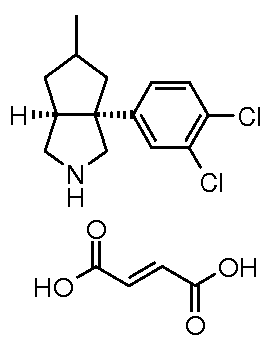

(3& 6& /3& 6& -3&-(3,4-二氯苯基)-5-甲基-1,3,4,5,6,6&-六氢[^|吡咯-2-甲酸叔丁酯 将 (3& 6&5/3& 6& -3&-(3,4-二氯苯基)-5-亚甲基-3,4,6,6&-四氢-1^环戊^]吡咯 -2-甲酸叔丁酯 20a(300 mg, 0.8 mmol)溶解于 15 mL乙醇中,加入二氧化铂 (30 mg, 10%), 氢气氛下反应 2小时。 过滤反应液, 减压浓縮滤液, 用硅胶柱色谱法以洗 脱剂体系 B纯化所得残余物,得到标题产物 (;3aR,6al¾βa 6aR)-3a-(;3,4-二氯苯基)-5- 甲基-l,3,4,5,6,6a-六氢[c |吡咯-2-甲酸叔丁酯 22aC150 mg, 无色油状物), 产率: 50.0%。
1H NMR (400 MHz, CDC13): δ 7.43-7.35 (m, 2H), 7.16-7.10 (m, 1H), 3.90-3.44 (m, 4H), 2.82-2.70 (m, 2H), 2.28-2.12 (m, 2H), 1.76-1.58 (m, 2H), 1.10-1.06 (m, 3H)
第二步
(3& 6&5/3& 6& -3&-(3,4-二氯苯基)-5-甲基-2,3,4,5,6,6&-六氢-1^环戊^]吡咯富马 酸
向 (3aR,6a5>3aS,6aR)-3a-(3,4-二氯苯基) -5-甲基 -l,3,4,5,6,6a-六氢 [c]吡咯 -2-甲酸 叔丁酯 22a (150 mg, 0.40 mmol)中加入 1.5 M氯化氢的乙酸乙酯溶液至反应液 pH 值为 2, 反应 12小时。 减压浓縮反应液, 加入 5 mL水和 5 mL甲醇, 加入氢氧化 钠 (60 mg, 1.50 mmol), 反应 2小时。 加入 20 mL水和 20 mL二氯甲烷, 分液, 水 相用二氯甲烷萃取 (20 mLx2), 合并有机相, 无水硫酸镁干燥, 过滤, 减压浓縮滤 液, 加入 5 mL乙酸乙酯和富马酸 (35.0 mg, 0.302 mmol), 反应 12小时。 过滤, 收集滤饼, 真空干燥, 得到标题产物0 6& /3& 6& -3&-(;3,4-二氯苯基)-5-甲基 -2,3,4,5,6,6a-六氢 -1H-环戊 [c]吡咯富马酸盐 22(73 mg, 白色固体 产率: 37.0%。 1H NMR (400 MHz, DMSO- ): δ 7.59-7.55 (m, 2H), 7.37-7.33 (m, 1H), 6.48 (s, 2H), 3.53-3.41 (m, 2H), 3.00-2.83 (m, 3H), 2.24-2.16 (m, 1H), 2.08-1.95 (m, 1H), 1.89-1.76 (m, 1H), 1.59-1.53 (m, 1H), 1.16-1.08 (m, 1H), 0.98-0.94 (m, 3H) 实施例 23
氟 -U 4,6,6a-六氢环戊「^!吡咯富马酸

4a 23a 23b 23 第一步
(3& 6&5/3& 6& -3&-(3,4-二氯苯基)-5,5-二氟-3,4,6,6&-四氢-1^环戊^]吡咯-2-甲酸 叔丁酯
将 (3& 6&5/3& 6& -3&-(3,4-二氯苯基)-5-氧代-3,4,6,6&-四氢-1^环戊^]吡咯 -2-甲酸叔丁酯 4a(730mg, 2.00 mmol)溶解于 10 mL二氯甲烷中,冰水浴下加入二乙 胺基三氟化硫 (0.94 mL, 2.50 mmol), 室温下反应 18小时。 减压浓縮反应液, 用硅 胶柱色谱法 以洗脱剂体系 B纯化所得残余物, 得到标题产物 (3aR,6a5>3aS,6aR)-3a-(3,4-二氯苯基) -5,5-二氟 -3,4,6,6a-四氢 -1H-环戊 [c]吡咯 -2-甲酸 叔丁酯 23aC200 mg, 淡黄色液体), 产率: 26.0%。
第二步
(3& 6&5/3& 6& -3&-(3,4-二氯苯基-5,5-二氟-1,2,3,4,6,6&-六氢环戊^]吡咯 将 (3& 6&5/3& 6& -3&-(3,4-二氯苯基)-5,5-二氟-3,4,6,6&-四氢-1^环戊^]吡咯 -2-甲酸叔丁酯 23a(160 mg,0.45 mmol)溶解于 5 mL二氯甲烷中,加入三氟乙酸 (822 mg, 7.2 mmol), 反应 2小时。 反应液依次用饱和碳酸氢钠溶液 (10 mLx2), 水 (5 mLx2), 饱和氯化钠溶液洗涤 (5mLx2), 分液, 合并有机相, 无水硫酸镁干燥, 过 滤, 减压浓縮滤液, 得到标题产物(3& 6& /3& 6& -3&-(3,4-二氯苯基-5,5-二氟 -l,2,3,4,6,6a-六氢环戊 [c]吡咯 23b(80mg, 无色液体), 产率: 67.0%
第三步
(3& 6& /3& 6& -3&-(3,4-二氯苯基)-5,5-二氟-1,2,3,4,6,6&-六氢环戊^]吡咯富马酸 将 (3aR,6a -3a-(3,4-二氯苯基 5,5-二氟 -l,2,3,4,6,6a-六氢环戊 c]吡咯 23b(74 mg, 0.25 mmol)溶解于 3 mL乙酸乙酯中, 加入富马酸 (29.0 mg, 0.25 mmol), 反 应 12 小时。 过滤反应液, 收集滤饼, 真空干燥, 得到标题产物 0 6& /3& 6& -3&-(3,4-二氯苯基)-5,5-二氟-1,2,3,4,6,6&-六氢环戊^]吡咯富马酸 盐 23(68mg, 白色固体), 产率: 67.0%。
1H NMR (400 MHz, DMSO- ): δ 7.64 (d, 1H), 7.59 (d, 1H), 7.40-7.37 (dd, 1H), 6.56
(s, 2H), 3.34-3.30 (d, 1H), 3.23-3.17 (m, 1H), 3.11 -3.01 (m, 1H), 2.96-2.83 (m, 2H): 2.63-2.53 (m, 2H), 2.19-1.95 (m, 2H) 实施例 24
( aR,5R,6aS/3a&5 & 6aR)-3a-( ,4-二氯苯基 5-氟 -2,3A5,6,6a-六氢 -1H-环戊「cl吡咯

24a 24b 24
第一步
(3aR,5R,6aS/3aS,5 6aR)-3a-(3,4-二氯苯基) -5-氟 -1,3,4,5,6,6&-六氢环戊^]吡咯-2-甲 酸叔丁酯
将 (3aR,5 6aS/3aS,5R,6aR)-3a-(3,4-二氯苯基) -5-羟基 -l,3,4,5,6,6a-六氢环戊 [c] 吡咯 -2-甲酸叔丁酯 7bC260 mg, 0.80 mmol)溶解于 5 mL二氯甲烷中, 冰水浴下加入 二乙胺基三氟化硫 (0.46 mL, 1.22 mmol), 室温下反应 18小时。 减压浓縮反应液, 用硅胶柱色谱法以洗脱剂体系 B纯化所得残余物, 得到标题产物 (3aR,5R,6 /3a5,55,6aR)-3a-(3,4-二氯苯基) -5-氟 - 1,3,4,5,6,6a-六氢环戊 [c]吡咯 -2-甲酸叔丁酯 24a(250 mg, 淡黄色液体), 产率: 96.0%。
1H NMR (400 MHz, CDC13): δ 7.43 (d, 1H), 7.36 (d, 1H), 7.12-7.10 (dd, 1H), 5.41-5.19 (m, 1H), 3.98-3.76 (m, 2H), 3.74-3.60 (m, 1H), 3.59-3.45 (m, 1H), 2.96-2.85 (m, 1H), 2.56-2.29 (m, 3H), 2.16-1.98 (m, 1H)
第二步
(3aR,5R,6aS/3aS,5 6aR)-3a-(3,4-二氯苯基) -5-氟 -2,3,4,5,6,6a-六氢 -1H-环戊 [c]吡咯 将 (3aR,5R,6aS/3aS,5 6aR)-3a-(3,4-二氯苯基) -5-氟 -l,3,4,5,6,6a-六氢环戊 [c]吡 咯 -2-甲酸叔丁酯 24a(250 mg, 0.67 mmol)溶解于 5 mL二氯甲烷中, 加入三氟乙酸 (822 mg, 7.2 mmol), 反应 2小时。 反应液依次用饱和碳酸氢钠溶液 (10 mLx2), 水 (5 mLx2), 饱和氯化钠溶液洗涤 (5 mLx2), 分液, 合并有机相, 无水硫酸镁干燥, 过滤, 减压浓縮滤液, 得到标题产物0 5 6&^/3& 5 6& -3&-(;3,4-二氯苯基)-5- 氟 -2,3,4,5,6,6a-六氢 -1H-环戊 [c]卩比咯 24b(125.6 mg, 无色液体), 产率: 68.6%
第三步
(3aR,5R,6aS/3aS,5 6aR)-3a-(3,4-二氯苯基) -5-氟 -2,3,4,5,6,6a-六氢 -1H-环戊 [c]吡咯 富马酸盐
将 (3aR,5R,6aS/3aS,5 6aR)-3a-(3,4-二氯苯基) -5-氟 -2,3,4,5,6,6a-六氢 -1H-环戊 [c 吡咯 24b(125.6 mg, 0.46 mmol)溶解于 3 mL乙酸乙酯中, 加入富马酸 (53.0 mg, 0.46 mmol) , 反应 12 小时。 过滤反应液, 收集滤饼, 真空干燥, 得到标题产物 (3aR,5R,6aS/3aS,5 6aR)-3a-(3,4-二氯苯基) -5-氟 -2,3,4,5,6,6a-六氢 -1H-环戊 [c]吡咯 富马酸 24(50 mg, 白色固体), 产率: 30.0%。
1H NMR (400 MHz, DMSO- ): δ 7.65 (d, 1H), 7.59 (d, 1H), 7.39-7.36 (dd, 1H), 6.52 (s, 2H), 5.32-5.12 (m, 1H), 3.48-3.38 (m, 2H), 3.32-3.24 (m, 1H), 3.07-2.96 (m, 2H), 2.42-2.12 (m, 3H), 1.97-1.87 (m, 1H) 实施例 25
( aR,5R,6aS/3a&5 & 6aR)-3a-( ,4-二氯苯基 5-甲氧基 -2,3A5,6,6a-六氢 -1H-环戊「c

第一步
(3aR,5R,6aS/3aS,5 6aR)-3a-(3,4-二氯苯基) -5-甲氧基 -2,3,4,5,6,6a-六氢 -1H-环戊 [c] 吡咯
将 (3aR,5R,6aS/3aS,5 6aR)-3a-(3,4-二氯苯基) -5-甲氧基 -l,3,4,5,6,6a-六氢环戊 [c 吡咯 -2-甲酸叔丁酯 4c(300 mg, 0.8 mmol)溶解于 20 mL二氯甲烷中, 加入三氟乙 酸 (6.87 mL, 92 mmol), 反应 5小时。 减压浓縮反应液, 加入 20 mL水和甲醇的混 合溶液 (V/V=l/1), 加入氢氧化钠至反应液 ρΗ值大于 7, 反应 2小时。 减压浓縮反 应液,加入 100 mL二氯甲烷和 lOO mL水,分液,水相用二氯甲烷萃取 C100 mLx2), 合并有机相, 无水硫酸镁干燥, 过滤, 减压浓縮滤液, 得到标题产物 (3aR,5R,6aS/3aS,5 6aR)-3a-(3,4-二氯苯基) -5-甲氧基 -2,3,4,5,6,6a-六氢 -1H-环戊 [c] 吡咯 25a(1.29 g, 黄色液体), 产率: 98.0%。
MS m/z (ESI): 286.1 [M]
第二步
(3aR,5R,6aS/3aS,5 6aR)-3a-(3,4-二氯苯基) -5-甲氧基 -2,3,4,5,6,6a-六氢 -1H-环戊 [c]
吡咯富马酸盐
将 (3aR,5R,6aS/3aS,5 6aR)-3a-(3,4-二氯苯基) -5-甲氧基 -2,3,4,5,6,6a-六氢 -1H-环 戊 [c]吡咯 25a(1.291 g, 4.51 mmol)溶于 10 mL乙酸乙酯中, 加入富马酸 (523 mg, 4.51 mmol), 反应 16小时。 过滤反应液, 收集滤饼, 真空干燥, 用 HPLC制备, 得到标题产物 (3aR,5R,6aS/3aS,5 6aR)-3a-(3,4-二氯苯基) -5-甲氧基 -2,3,4,5,6,6a-六 氢 -1H-环戊 [c]吡咯富马酸盐 25(1.69 g, 白色固体), 产率: 93.5%。
MS m/z (ESI): 286.0 [M]
1H NMR (400 MHz, CDC13): δ 7.63 (d, 1H), 7.59 (d, 1H), 7.37 (dd, 1H), 6.47 (s, 2H), 3.82-3.77 (m, 1H), 3.50 (d, 1H), 3.70 (dd, 1H), 3.23 (s, 3H), 3.18 (d, 1H), 3.10-3.06 (m, 1H), 3.02-2.96 (m, 1H), 2.27-2.20 (m, 2H), 2.12 (dd, 1H), 1.73-1.69 (m, 1H) 实施例 26
( aR,5R,6aS/3a&5 & 6aR)-3a-(3,4-二氯苯基) -5-甲氧基 -2,3,4,5,6,6a-六氢 -1H-环戊「c

MS m/z (ESI): 286.1 [M]
1H NMR (400 MHz, CDC13): δ 8.99 (s, 1H), 8.44 (s, 1H), 7.66 (d, 1H), 7.61 (d, 1H), 7.49-7.47 (m, 2H), 7.39 (dd, 1H), 7.13-7.10 (m, 2H), 3.88-3.84 (m, 1H), 3.69-3.64 (m, 1H), 3.52-3.46 (m, 1H), 3.38-3.32 (m, 1H), 3.25(s, 3H), 3.24-3.18 (m, 1H), 3.16-3.09 (m, 1H), 2.36-2.32 (m, 1H), 2.29 (s, 3H), 2.28-2.20 (m, 1H), 2.07-2.02 (m, 1H), 1.86-1.80 (m, 1H) 实施例 27
( aR,5R,6aS/3a&5 & 6aR)-3a-( ,4-二氯苯基 5-甲氧基 -2,3A5,6,6a-六氢 -1H-环戊「c

( aR,5R,6aS/3a&5 & 6aR)-3a-( ,4-二氯苯基 5-甲氧基 -2,3A5,6,6a-六氢 -1H-环戊「c

将 (3aR,5R,6aS/3aS,5 6aR)-3a-(3,4-二氯苯基) -5-甲氧基 -2,3,4,5,6,6a-六氢 -1H-环 戊 [c]吡咯 25a(317 mg, 1.1 1 mmol)溶于 5 mL乙酸乙酯中,加入马来酸 (64 mg, 0.55 mmol) , 反 应 2 小 时 。 减 压 浓 縮 反 应 液 , 得 到 标 题 产 物 (3aR,5R,6aS/3aS,5 6aR)-3a-(3,4-二氯苯基) -5-甲氧基 -2,3,4,5,6,6a-六氢 -1H-环戊 [c]
吡咯马来酸盐 28(381 mg, 白色固体), 产率: 100.0%。 实施例 29
( aR,5R,6aS/3a&5 & 6aR)-3a-( ,4-二氯苯基 5-甲氧基 -2,3A5,6,6a-六氢 -1H-环戊「cl

( aR,5R,6aS/3a&5 & 6aR)-3a-(3,4-二氯苯基) -5-甲氧基 -2,3,4,5,6,6a-六氢 -1H-环戊 W 吡咯 D-i- 酒石酸盐

( aR,5R,6aS/3a&5 & 6aR)-3a-( ,4-二氯苯基 5-甲氧基 -2,3A5,6,6a-六氢 -1H-环戊「c

31
将 (3aR,5R,6aS/3aS,5 6aR)-3a-(3,4-二氯苯基) -5-甲氧基 -2,3,4,5,6,6a-六氢 -1H-环 戊 [c]吡咯 25a(259 mg, 0.91 mmol) 溶于 10 mL乙酸乙酯中, 加入甲磺酸 (86 mg, 0.91 mmol), 反应 2 小 时 。 减压浓縮反应液 , 得到标题产物 (3aR,5R,6aS/3aS,5 6aR)-3a-(3,4-二氯苯基) -5-甲氧基 -2,3,4,5,6,6a-六氢 -1H-环戊 [c] 吡咯甲磺酸盐 31(348 mg, 淡黄色油状物), 产率: 100.0%。 实施例 32
( aR,5R,6aS/3a&5 & 6aR)-3a-( ,4-二氯苯基 5-甲基 -2,3A5,6,6a-六氢 -1H-环戊「cl吡 咯富马酸盐


(3aR,5 6aS/3aS,5R,6aR)-3a-(3,4-二氯苯基) -5-( 甲苯基磺酰氧基 )-l,3,4,5,6,6a-六氢 环戊 M吡咯 -2-甲酸叔丁酯
将 (3aR,5 6aS/3aS,5R,6aR)-3a-(3,4-二氯苯基) -5-羟基 -l,3,4,5,6,6a-六氢环戊 [c] 吡咯 -2-甲酸叔丁酯 7b(3.4 g, 9.13 mmol)溶解于 32 mL吡啶中, 加入对甲苯磺酰氯 (1.91 g, 10.04 mmol), 反应 16小时。 加入 1 M的盐酸调 pH值小于等于 4, 加入 120 mL水和 100 mL乙酸乙酯, 分液, 水相用乙酸乙酯萃取 (100 mLx2), 合并有机 相, 无水硫酸镁干燥, 过滤, 减压浓縮滤液, 用硅胶柱色谱法以洗脱剂体系 A纯 化所得残余物, 得到标题产物0 5 6&^/3& 5 6& -3&-(;3,4-二氯苯基)-5-( 甲苯 基磺酰氧基) -l,3,4,5,6,6a-六氢环戊 [c]吡咯 -2-甲酸叔丁酯 32a(3.0 g, 白色油状物), 产率: 62.5%。
第二步
(3aR,5R,6aS/3aS,5 6aR)-3a-(3,4-二氯苯基) -5-甲基 -l,3,4,5,6,6a-六氢环戊 [c]吡咯 -2- 甲酸叔丁酯
将碘化亚铜 (2.67 g, 14 mmol)溶解于 20 mL四氢呋喃中, 冷至 -8 °C, 滴加 17.5 mL 1.6 M 甲基锂的乙醚溶液, 于 -8°C下反应 2 小时, 滴加 10 mL (3aR,5 6aS/3aS,5R,6aR)-3a-(3,4-二氯苯基) -5-( 甲苯基磺酰氧基 )-l,3,4,5,6,6a-六氢 环戊 [c]吡咯 -2-甲酸叔丁酯 32a(1.05 g, 2 mmol)的四氢呋喃溶液, 反应 16小时。 向 反应液中加入 100 mL饱和碳酸钠溶液和 80 mL乙酸乙酯, 分液, 水相用乙酸乙酯 萃取 (60 mLx2), 合并有机相, 无水硫酸镁干燥, 过滤, 减压浓縮滤液, 用硅胶柱 色谱法 以 洗脱 剂体系 A 纯化所得残余物 , 得 到 标题产 物 (3aR,5R,6aS/3aS,5 6aR)-3a-(3,4-二氯苯基) -5-甲基 -l,3,4,5,6,6a-六氢环戊 [c]吡咯 -2- 甲酸叔丁酯 32bC480 mg, 无色油状物), 产率: 64.8%。
1H NMR (400 MHz, CDC13): δ 7.38 (d, 1H), 7.32 (d, 1H), 7.08 (dd, 1H), 3.71-3.31 (m, 6H), 2.78-2.75 (m, 1H), 2.23-2.12 (m, 3H), 1.45 (s, 9H), 1.06 (d, 3H)
第三步
(3aR,5R,6aS/3aS,5 6aR)-3a-(3,4-二氯苯基) -5-甲基 -2,3,4,5,6,6a-六氢 -1H-环戊 [c]吡 咯
将 (3aR,5R,6aS/3aS,5 6aR)-3a-(3,4-二氯苯基) -5-甲基 -l,3,4,5,6,6a-六氢环戊 [c] 吡咯 -2-甲酸叔丁酯 32b(480 mg, 1.30 mmol)溶解于 5 mL二氯甲烷中, 力口入 1.9 mL
三氟乙酸,反应 2小时,减压浓縮反应液。向残余物中加入 12 mL甲醇和水 (V/V=l/1) 的混合溶液, 加入 1.04 g氢氧化钠, 反应 5小时。 减压浓縮反应液, 用乙酸乙酯 萃取 (15 mLx3), 合并有机相, 无水硫酸镁干燥, 过滤, 减压浓縮滤液, 得到标题 产物 (3aR,5R,6aS/3aS,5 6aR)-3a-(3,4-二氯苯基) -5-甲基 -2,3,4,5,6,6a-六氢 -1H-环戊 [c 吡咯 32c(376 mg, 黄色油状物), 产率: 100%。
MS m/z (ESI): 270.1 [M]
第四步
(3aR,5R,6aS/3aS,5 6aR)-3a-(3,4-二氯苯基) -5-甲基 -2,3,4,5,6,6a-六氢 -1H-环戊 [c]吡 咯富马酸盐
将 (3aR,5R,6aS/3aS,5 6aR)-3a-(3,4-二氯苯基) -5-甲基 -2,3,4,5,6,6a-六氢 -1H-环戊 [c]吡咯 32c(376 mg, 1.39 mmol)溶解于 5 mL乙酸乙酯中, 加入富马酸 (161.5 mg, 1.39 mmol), 反应 16小时。 过滤反应液, 滤饼用 10 mL乙酸乙酯洗涤, 收集滤饼, 真空干燥, 得到标题产物(3aR,5R,6aS/3aS,5 6aR)-3a-(3,4-二氯苯基)-5-甲基 -2,3,4,5,6,6a-六氢 -1H-环戊 [c]吡咯富马酸盐 32(408 mg, 白色固体), 产率: 76.0%。 MS m/z (ESI): 270.1 [M]
1H NMR (400 MHz, DMSO-J6): δ 7.62 (d, 1H), 7.58 (d, 1H), 7.36 (dd, 1H), 6.47 (s, 2H), 3.56 (d, 1H), 3.23 (dd, 1H), 3.04 (dd, 1H), 3.06-2.93 (m, 2H), 2.24-2.17 (m,lH), 2.05 (dd, 1H), 1.88-1.80 (m, 1H), 1.66-1.59 (m, 1H), 1.21-1.13 (m, 1H), 0.95 (d, 3H) 实施例 33、 34
( aR,5R,6a -6a- 4-二氯苯基 5-羟基 -2 3a,4,5,6-六氢 -1H-环戊「cl吡咯盐酸盐 ( a&5&6aR)-6a-( ,4- H-环戊「c |吡咯盐酸盐
 将 (3aR,5R,6aS/3aS,5 6aR)-3a-(3,4-二氯苯基) -5-羟基 -l,3,4,5,6,6a-六氢环戊 [c]吡 咯 -2-甲酸叔丁酯 4b(33.23 g, 89.3 mmol)进行手性拆分, 采用 HPLC法, 用手性柱对 异构体进行分离 (分离条件:手性柱 Chiralpak ADH,流动相:二氧化碳:甲醇 =85 : 15, 流速: 2.0 ml/min), 收集其相应组分, 旋转蒸发除去溶剂, 并在室温下真空干燥 24 小时, 得到 (3aR,5R,6a -6a-(3,4-二氯苯基) -5-羟基 -l,3,3a,4,5,6-六氢环戊 [c]吡咯 -2- 甲酸叔丁酯 33a(16.15 g, 白色固体)和(3aS,5 6aR)-6a-(3,4-二氯苯基) -5-羟基 -l,3,3a,4,5,6-六氢环戊 [c]吡咯 -2-甲酸叔丁酯 34a(16.37 g, 白色固体)。 将 (3aR,5R,6a -6a-(3,4-二氯苯基) -5-羟基 -l,3,3a,4,5,6-六氢环戊 [c]吡咯 -2-甲酸叔丁酯 33a(16.15 g, 43.4 mmol)和 (3aS,5 6aR)-6a-(3,4-二氯苯基) -5-羟基 -l,3,3a,4,5,6-六氢 环戊 [c]吡咯 -2-甲酸叔丁酯 34aC16.37 g, 44.0 mmol)分别溶解于 160 mL 1 M氯化氢的 乙酸乙酯溶液中, 反应 16小时。 减压浓縮部分反应液, 过滤, 收集滤饼, 真空干
燥得到 标题产物 (3aR,5R,6a -6a-(3,4-二氯苯基) -5-羟基二 2,3,3a,4,5,6-六氢 -1H-环戊 [c]吡咯盐酸盐 33(13.40 g, 白色固体, e.e. = 99.0%)和 (3aS,5 6aR)-6a-(3,4-二氯苯 基) -5-羟基 -2,3,3a,4,5,6-六氢 -1H-环戊 [c]吡咯盐酸盐 34(13.58 g, 白色固体, e.e. = 99.9%) 实施例 35
将 (3aR,5R,6aS/3aS,5 6aR)-3a-(3,4-二氯苯基) -5-羟基 -l,3,4,5,6,6a-六氢环戊 [c]吡 咯 -2-甲酸叔丁酯 4b(33.23 g, 89.3 mmol)进行手性拆分, 采用 HPLC法, 用手性柱对 异构体进行分离 (分离条件:手性柱 Chiralpak ADH,流动相:二氧化碳:甲醇 =85 : 15, 流速: 2.0 ml/min), 收集其相应组分, 旋转蒸发除去溶剂, 并在室温下真空干燥 24 小时, 得到 (3aR,5R,6a -6a-(3,4-二氯苯基) -5-羟基 -l,3,3a,4,5,6-六氢环戊 [c]吡咯 -2- 甲酸叔丁酯 33a(16.15 g, 白色固体)和(3aS,5 6aR)-6a-(3,4-二氯苯基) -5-羟基 -l,3,3a,4,5,6-六氢环戊 [c]吡咯 -2-甲酸叔丁酯 34a(16.37 g, 白色固体)。 将 (3aR,5R,6a -6a-(3,4-二氯苯基) -5-羟基 -l,3,3a,4,5,6-六氢环戊 [c]吡咯 -2-甲酸叔丁酯 33a(16.15 g, 43.4 mmol)和 (3aS,5 6aR)-6a-(3,4-二氯苯基) -5-羟基 -l,3,3a,4,5,6-六氢 环戊 [c]吡咯 -2-甲酸叔丁酯 34aC16.37 g, 44.0 mmol)分别溶解于 160 mL 1 M氯化氢的 乙酸乙酯溶液中, 反应 16小时。 减压浓縮部分反应液, 过滤, 收集滤饼, 真空干
燥得到 标题产物 (3aR,5R,6a -6a-(3,4-二氯苯基) -5-羟基二 2,3,3a,4,5,6-六氢 -1H-环戊 [c]吡咯盐酸盐 33(13.40 g, 白色固体, e.e. = 99.0%)和 (3aS,5 6aR)-6a-(3,4-二氯苯 基) -5-羟基 -2,3,3a,4,5,6-六氢 -1H-环戊 [c]吡咯盐酸盐 34(13.58 g, 白色固体, e.e. = 99.9%) 实施例 35
( a&5 & 6aR)- 来酸盐

34 35a 35
第一步
(3aS,5 6aR)-6a-(3,4-二氯苯基) -5-羟基 -2,3,3a,4,5,6-六氢 -1H-环戊 [c]吡咯 将 (3a^,5S,6aR)-6a-(3,4-二氯苯基) -5-羟基 -2,3,3a,4,5,6-六氢 -1H-环戊 [c]吡咯盐 酸盐 34(800 mg, 2.15 mmol)溶解于 8 mL甲醇和水 (V/V=l/1)的混合溶剂中, 加入 氢氧化钠(172 mg, 4.29 mmol), 于 80°C下反应 3小时。 加入 20 mL二氯甲烷和 20 mL水, 分液, 水相用二氯甲烷萃取 (20 mLx3), 合并有机相, 无水硫酸镁干燥, 过滤, 减压浓縮滤液, 得到标题产物 C3a^,5S,6aR)-6a-C3,4-二氯苯基) -5-羟基 =2,3,3a,4,5,6-六氢 -1H-环戊 [c]吡咯 35a(632 mg, 淡黄色固体), 产率: 89.6%。
1H NMR (400 MHz, DMSO- ): δ 7.53 (d, 1H), 7.47 (d, 1H), 7.26 (dd, 1H), 4.66 (s, 2H), 3.97-3.92 (m, 1H), 3.18 (d, 1H), 2.89 (dd, 1H), 2.78 (d, 1H), 2.72-2.68 (m, 1H), 2.63 (d, 1H), 2.20-2.13 (m, 1H), 2.04 (dd, 1H), 1.94-1.89 (m, 1H), 1.51-1.46 (m, 1H)
第二步
O 5S,6aR)-6a-(3,4-二氯苯基) -5-羟基 -2,3,3a,4,5,6-六氢 -1H-环戊 [c]吡咯马来酸盐 将(3aS,5 6aR)-6a-(3,4-二氯苯基) -5-羟基 -2,3,3a,4,5,6-六氢 - 1H-环戊 [c]吡咯 35a(100 mg, 0.37 mmol)溶解于 2 mL乙酸乙酯中,加入马来酸 (42 mg, 0.37 mmol), 反应 16小时。过滤反应液,收集滤饼,真空干燥,得到标题产物 (3a^,5S,6aR)-6a-(3,4- 二氯苯基) -5-羟基二 2,3,3a,4,5,6-六氢 -1H-环戊 [c]吡咯马来酸盐 35(130 mg, 白色固 体), 产率: 91.55%。
1H NMR (400 MHz, DMSO- ): δ 7.64 (d, 1H), 7.62 (d, 1H), 7.37 (dd, 1H), 6.02 (m,
2H), 4.27-4.23 (m, 1H), 3.74 (d, 1H), 3.48 (dd, 1H), 3.28 (d, 2H), 3.16-3.10 (m, 1H): 2.27-2.18 (m, 2H), 2.03 (dd, 1H), 1.75-1.68 (m, 1H) 实施例 36
( a&5 & 6aRV6a-( ,4-二氯苯基 5-羟基 -2 3a,4,5,6-六氢 -1H-环戊「c!吡咯 L-i- 酒石

35a 36
将(3aS,5 6aR)-6a-(3,4-二氯苯基) -5-羟基二 2,3,3a,4,5,6-六氢 -1H-环戊 [c]吡咯 35a(100 mg, 0.37 mmol)溶解于 2 mL乙酸乙酯中, 加入 L- (-) -酒石酸 (55 mg, 0.37 mmol) , 反应 16 小时。 过滤反应液, 收集滤饼, 真空干燥, 得到标题产物 (3aS,5 6aR)-6a-(3,4-二氯苯基) -5-羟基 -2,3,3a,4,5,6-六氢 -1H-环戊 [c]吡咯 L- (-) -酒石 酸盐 36(106 mg, 白色固体), 产率: 67.9%。
1H NMR (400 MHz, DMSO- ): δ 7.62 (d, 1H), 7.60 (d, 1H), 7.36 (dd, 1H), 4.24-4.20 (m, 1H), 4.01-3.97 (m, 2H), 3.70 (d, 1H), 3.44 (dd, 1H), 3.24 (d, 2H), 3.11-3.05 (m, 1H) 2.25-2.14 (m, 2H), 2.04 (dd, 1H), 1.74-1.66 (m, 1H) 实施例 37
( a&5&6aR)-6a-( ,4-二 -1H-环戊「c|吡咯硫酸盐

将(3aS,5 6aR)-6a-(3,4-二氯苯基) -5-羟基 -2,3,3a,4,5,6-六氢 - 1H-环戊 [c]吡咯 35a(100 mg, 0.37 mmol)溶解于 2 mL乙酸乙酯中,加入浓硫酸 (36 mg, 0.37 mmol),
反应 16小时。过滤反应液,收集滤饼,真空干燥,得到标题产物 (3a^,5S,6aR)-6a-(3,4- 二氯苯基) -5-羟基二 2,3,3a,4,5,6-六氢 -1H-环戊 [c]吡咯硫酸盐 37(116 mg, 白色固体), 产率: 85.3%。
1H NMR (400 MHz, DMSO-J6): δ 7.64-7.60 (m, 2H), 7.37 (dd, 1H), 4.28-4.22 (m, 1H), 3.73 (d, 1H), 3.47 (dd, 1H), 3.30-3.25 (m, 2H), 3.16-3.08 (m, 1H), 2.26-2.14 (m, 2H), 2.03 (dd, 1H), 1.76-1.68 (m, 1H) 实施例 38
( a&5 & 6aRV6a-( ,4-二 H-环戊「cl吡咯富马酸盐

将(3aS,5 6aR)-6a-(3,4-二氯苯基) -5-羟基 -2,3,3a,4,5,6-六氢 - 1H-环戊 [c]吡咯 35a(100 mg, 0.37 mmol)溶解于 2 mL乙酸乙酯中,加入富马酸 (42 mg, 0.37 mmol), 反应 16小时。过滤反应液,收集滤饼,真空干燥,得到标题产物 (3a^,5S,6aR)-6a-(3,4- 二氯苯基) -5-羟基 -2,3,3a,4,5,6-六氢 -1H-环戊 [c]吡咯富马酸盐 38(130 mg, 白色固 体), 产率: 91.5%。
1H NMR (400 MHz, DMSO- ): δ 7.59-7.57 (m, 2H), 7.34 (dd, 1H), 6.47 (s, 2H), 4.17-4.10 (m, 1H), 3.54 (d, 1H), 3.29 (dd, 1H), 3.12-3.06 (m, 2H), 3.01-2.93 (m, 1H), 2.24-2.17 (m, 1H), 2.14-1.99 (m, 2H), 1.67-1.60 (m, 1H) 实施例 39
( aR,5R,6a -3a-( ,4-二氯苯基) -5-甲氧基 -2,3,4,5,6,6a-六氢 -1H-环戊「c|吡咯富马酸


1H NMR (400 MHz, DMSO- ): δ 11.63 (s, 3H), 7.65 (d, 1H), 7.59 (d, 1H), 7.38 (dd, 1H), 6.53 (s, 2H), 3.85-3.80 (m, 1H), 3.61 (d, 1H), 3.47 (dd, 1H), 3.32 (d, 1H), 3.23 (s, 3H), 3.16 (dd, 1H), 3.10-3.03 (m, 1H), 2.31-2.20 (m, 2H), 2.09 (dd, 1H), 1.81-1.75 (m, 1H) 实施例 40
( a&5 & 6aR)-3a-( ,4-二氯苯基) -5-甲氧基 -2,3,4,5,6,6a-六氢 -1H-环戊「c|吡咯富马酸

1H NMR (400 MHz, DMS0- ): δ 10.74 (s, 3H), 7.65 (d, 1H), 7.59 (d, 1H), 7.38 (dd, 1H), 6.48 (s, 2H), 3.84-3.79 (m, 1H), 3.58 (d, 1H), 3.44 (dd, 1H), 3.28 (d, 1H), 3.23 (s, 3H), 3.14 (dd, 1H), 3.07-3.01 (m, 1H), 2.29-2.20 (m, 2H), 2.11 (dd, 1H), 1.79-1.73 (m, 1H) 测试例:
生物学评价
例 1化合物对小鼠强迫游泳的影响
试验动物: 成年 ICR雄性小鼠, 购自上海西普尔 -必凯实验动物有限公司, 体 重 20〜24 g, 8只 /笼伺养, 12/12小时光 /暗周期调节,温度 23±1 °C恒温,湿度 50〜 60 %, 自由进食进水。 动物从实验动物中心购进后, 进行适应性伺养 3〜7天后, 方可开始实验。
样品配制: 按照随机数字表将动物随机分成阴性对照组和受试药物治疗组, 实验前将治疗药物配制于 1% DMSO 生理盐水之中, 将其配制成良好的混悬液, 阴性对照组给予 1% DMS0 生理盐水 (10 mL/kg)。
试验步骤: 将小鼠转移至实验室, 并放置一小时使其适应环境。 小鼠给药 (腹 腔注射或口服 )60分钟后, 将其放入高约 18cm、 内径 14cm的烧杯中, 内装温度为 24〜25°C温水, 水深 15 cm。 测定小鼠强迫游泳 6分钟内后面 4分钟的小鼠漂浮 不动的时间, 将受试药物治疗组的强迫游泳不动时间与阴性对照组进行统计学分 析比较, 从而确定药物的抗抑郁效果及其强度和特性。 小鼠注射本发明测试化合物的最低有效剂量如表 1所示:
表 1
实施例编号 最小给药剂量 (mg/kg)
0.5 (腹腔注射)
4
5.0 (口服)
2.0 (腹腔注射)
5
2.0 (口服)
8 1.0 (腹腔注射)
9 5.0 (腹腔注射)
10 1.0 (腹腔注射)
12 2.0 (口服)
16 0.5 (腹腔注射)
18 5.0 (口服)
22 0.5 (腹腔注射)
33 5 (口服)
34 1.0 (腹腔注射)
结论: 本发明化合物对小鼠游泳的不动时间有显著地抑制作用。 例 2 小鼠悬尾试验 (Tail Suspension test, TST)
试验动物: 成年 ICR雄性小鼠, 购自上海西普尔 -必凯实验动物有限公司, 体 重 20〜24 g, 8只 /笼伺养, 12/12小时光 /暗周期调节,温度 23±1 °C恒温,湿度 50〜 60 %, 自由进食进水。 动物从实验动物中心购进后, 进行适应性伺养 3〜7天后, 方可开始实验。
样品配制: 按照随机数字表将动物随机分成阴性对照组和受试药物治疗组, 实验前将治疗药物配制于 1% DMSO 生理盐水之中, 将其配制成良好的混悬液, 阴性对照组给予 1% DMSO 生理盐水 (10 mL/kg)。
试验步骤: 将小鼠转移至实验室, 并放置一小时使其适应环境。 小鼠给药 (腹 腔注射或口服 )60分钟后, 固定尾端 20 mm处, 将小鼠倒悬在上海吉量动物行为分 析系统的通用隔音箱内的倒钩上, 倒悬 6分钟, 采用悬尾分析软件 3.0分析 6分钟内 后面 4分钟的不动时间。 将受试药物治疗组的悬尾不动时间与阴性对照组进行统计 学分析比较, 从而确定药物的抗抑郁效果及其强度和特性。 小鼠注射本发明测试化合物的最低有效剂量如表 2所示:
表 2
实施例编号 最小给药剂量 (mg/kg)
3 5.0 (腹腔注射)
5.0 (腹腔注射)
4
5.0 (口服)
5.0 (腹腔注射)
5
2.0 (口服)
8 5.0 (腹腔注射)
9 5.0 (腹腔注射)
12 5.0 (口服)
13 5.0 (口服)
15 5.0 (口服)
16 5.0 (腹腔注射)
18 5.0 (腹腔注射)
20 5.0 (腹腔注射)
22 5.0 (腹腔注射)
结论: 本发明化合物对小鼠悬尾的不动时间有显著地抑制作用 例 3 多巴胺 (DA)、 去甲肾上腺素 (NA)和五羟色胺 (5-HTM本外重摄取试验
取年轻雄性大鼠,购自上海西普尔 -必凯实验动物有限公司, 动物生产许可号: SCXK (;沪 )2008-0016, 体重 150〜250克。 将大鼠迅速断头处死, 取出大脑。 将一 细胞培养皿置于碎冰之上, 将大鼠大脑置于细胞培养皿上, 将大脑区域 (额叶皮层, 纹状体,海马回)快速分离, 并投入装有 10倍体积冰冻的 Tris溶液的组织匀浆其中。 Tris溶液预先用 02:C02 95:5进行饱和。
Tris Buffer (三头羟甲基氨基甲烷缓冲液)组成: 蔗糖 0.32 M, 葡萄糖 10 mM, Tris-HCl 10 mM, pH 7.4。
用小剪刀将脑组织剪成小块, 倾去上清液。 在试管内加入新鲜的 Tris buffer, 用手动组织匀浆器将脑组织轻轻碾碎, 制成脑组织匀浆。 将脑组织匀浆在离心机 上离心, 1000 X g, 10 分钟, 4。C。 吸取上清液, 将试管内残留物弃去, 以去除神 经核和其他碎片杂质。 将上清液再次离心, 20,000 X g, 20 分钟, 4。C, 从而获 得初步的神经突触小体。
将上述取得的神经突触小体-离心后沉淀物, 用改良的 Krebs溶液重新制成均 匀匀浆。 将组织匀浆分置于小试管内 (同一样品作三份), 每管大约 90〜150 μΒ 蛋 白, 在此组织匀浆中, 加入不同浓度的实验药物。 空白组加入相同体积的配置药 物所用的溶剂, 在 37°C下温孵 10分钟。 在 10分钟温孵结束后, 在所有试管中加 入 50 nM 的同位素标记的神经递质: [3H]DA (56.8 Ci mmol—1), [3H]5-HT(27.7 Ci mmol"1), 以及 [3H]NA(14.1 Ci mmor^上述的神经递质购于中国同位素公司)。继续 在 37°C下温孵 15分钟, 使神经突触小体对同位素标记的神经递质进行摄取, 温 孵 5 分钟结束以后, 采用玻璃纤维过滤器将其过滤, 从而阻断其摄取过程, 过滤 膜预先在 GF/C在 0.1 %聚乙烯亚胺 (Polyethyleneimine)溶液中浸泡 1小时。 过滤 膜用 0.9 % NaCl冲洗三次, 将裁取下来的滤纸片放入闪烁瓶中, 加入 500 μ∑闪烁 液 (Soluene-350), 并放置过夜, 液闪计数。 将药物组计数, 减去空白记数, 与药物 浓度进行作图分析, 只有线性关系在 0.99以上的数据才可以使用。 从该曲线中计 算出 IC5()。
改良的 Krebs溶液的组成如下: NaC1 140 mM, KC1 5 mM, KH2P04 1.2 mM, NaHC0325 mM, MgS04 1.2 mM, CaCl2 1.4 mM, 葡萄糖 (Glucose) 10 mM, 抗坏血 酸 (Ascorbic acid) 1.1 mM, 乙二胺四乙酸二钠 (Disodium EDTA) 0.13 mM, 优降宁 (Pargyline) 0.1 mM, pH 7.40。
本发明化合物对多巴胺 (DA)、 去甲肾上腺素 (NA)和五羟色胺 (5-HT)在大鼠突 触小体中的重摄取抑制作用的 pIC5Q值如表 3所示:
表 3
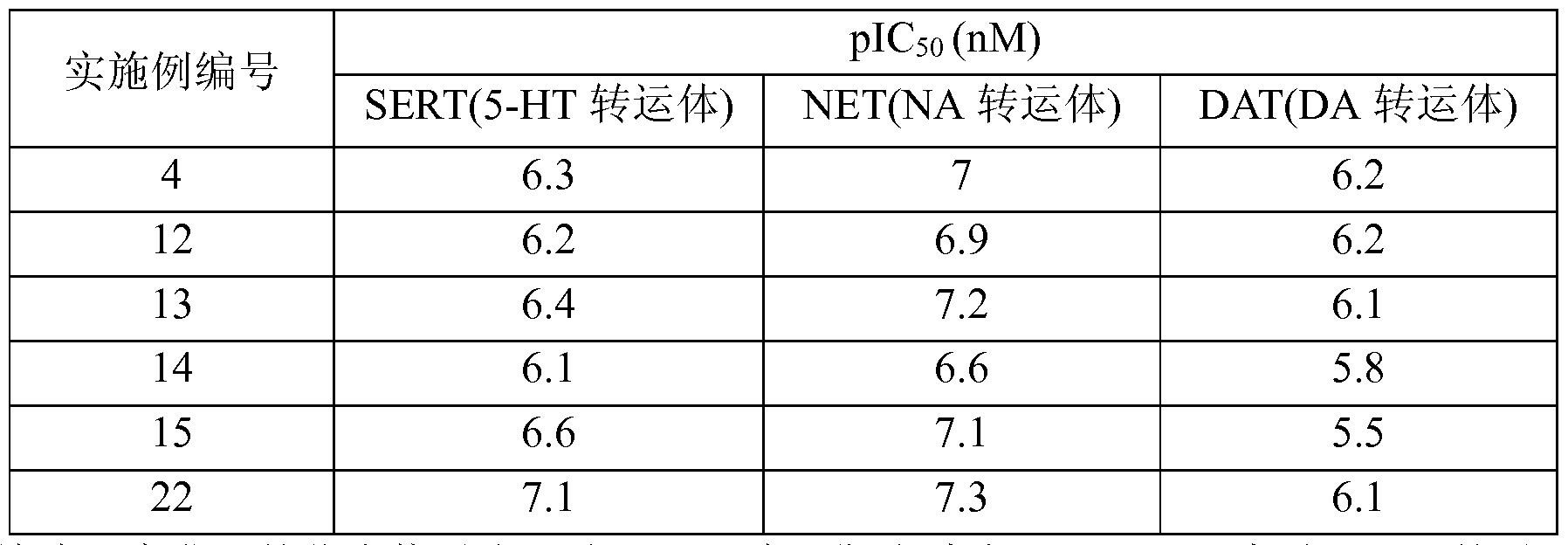
结论: 本发明的化合物对多巴胺 (DA)、 去甲肾上腺素 (NA)和五羟色胺 (5-HT)的重 摄取具有三重的抑制作用, 增加了多巴胺 (DA)重摄取的抑制, 同时将这种抑制一 直控制在安全的范围内 pIC5。不超过 6.5, 防止因延长和加强多巴胺 (DA)的作用而 导致的兴奋剂样效果。 例 4小鼠弹珠掩埋试验
试验动物: 成年 ICR雄性小鼠, 购自上海西普尔 -必凯实验动物有限公司。 样品配制: 按照随机数字表将动物随机分成阴性对照组和受试药物治疗组, 实验前将治疗药物配制于 1% DMSO 生理盐水之中, 将其配制成良好的混悬液, 阴性对照组给予 1% DMS0 生理盐水 (10 mL/kg)。
试验步骤: 将小鼠放在 C35cmX 19cmX 17.5cm)的透明塑料箱中, 内装 5 cm 的 木屑。 小鼠在灌胃给予不同剂量受试化合物后, 放入观察箱适应 20分钟, 然后取 出放回伺养笼。 在观察箱中放置 20颗透明玻璃弹珠 (lcm直径), 放置完成后, 于 小鼠给药后 30 分钟将小鼠放回观察箱, 需做到与第一次放置同箱, 开始测定 30 分钟记录小鼠于这 30分钟内弹珠掩埋情况。
弹珠掩埋的标准: 弹珠自身超过 2/3的部分被遮掩即为掩埋。
实验结果:
实施例 33和实施例 34化合物均有效地抑制了小鼠弹珠掩埋行为,该两个化合 物的作用均呈现较好的量效关系, 其中实施例 33 化合物的最小有效剂量 2.0 mg/kg , 实施例 34化合物的最小有效剂量为 1.0 mg/kg。
Claims
权利要求书
1、 一种通式(I )所示的化合 非对映体或其可药用的盐:

Ar选自芳基或杂芳基, 其中所述的芳基或杂芳基任选进一步被一个或多个选 自烷基、 烯基、 块基、 卤素、 硝基、 氰基、 卤代烷基、 羟烷基、 环烷基、 杂环基、 -OR7、 -0-C(0)R7、 -C(0)R7、 -C(0)OR7、 -S(0)OR7、 -NR8R9或 -C(0)NR8R9的基团 所取代;
R1和 R2各自独立选自氢原子、 烷基、 烯基、 块基、 卤素、 硝基、 氰基、 环烷 基、杂环基、 -OR7、 -0-C(0)R7、 -C(0)R7、 -C(0)OR7、 -S(0)OR7、 -NR8R9或 -C(0)NR8R9, 其中所述的烷基、 烯基、 块基、 环烷基或杂环基任选进一步被一个或多个选自烷 基、 卤素、硝基、氰基、环烷基、 杂环基、 -OR7、 -0-C(0)R7、 -C(0)R7、 -C(0)OR7、 -S(0)OR7 -NR8R9或 -C(0)NR8R9的基团所取代, 或者 R1和 R2—起形成一个双键, 条件是 R1和 R2不同时为氢原子;
R3、 R4、 R5和 R6各自独立选自氢原子、 烷基、 环烷基、 杂环基、 芳基、 杂芳 基、 -C(0)R7、 -C(0)OR7或 -C(0)NR8R9, 其中所述的烷基、 环烷基、 杂环基、 芳基 或杂芳基任选进一步被一个或多个选自烷基、 卤素、 硝基、 氰基、 环烷基、 杂环 基、 -OR7、 -0-C(0)R7、 -C(0)R7、 -C(0)OR7、 -S(0)OR7、 -NR8R9或 -C(0)NR8R9的 基团所取代;
R7选自氢原子、 烷基、 环烷基、 杂环基、 芳基或杂芳基, 其中所述的烷基、 环烷基、 杂环基、 芳基或杂芳基任选进一步被一个或多个选自烷基、 羟基、 卤素、 硝基、 氰基、 环烷基、 杂环基、 芳基或杂芳基的基团所取代;
R8和 R9各自独立选自氢原子、 烷基、 烯基、 块基、 环烷基、 杂环基、 芳基或 杂芳基, 其中所述的烷基、 烯基、 块基、 环烷基、 杂环基、 芳基或杂芳基任选进 一步被一个或多个选自烷基、 羟基、 卤素、 硝基、 氰基、 环烷基、 杂环基、 芳基 或杂芳基的基团所取代;
或者, R8和 R9与其相连接的 N原子一起形成杂环基, 其中所述的杂环基任选 进一步被一个或多个选自烷基、 羟基、 卤素、 硝基、 氰基、 环烷基、 杂环基、 芳 基或杂芳基的基团所取代。
2、 根据权利要求 1所述的通式( I )所示的化合物及其对映体、 非对映体或其
可药用的盐, 其中:
Ar选自芳基,其中所述的芳基任选进一步被一个或多个选自烷基、卤素或 -OR7 的基团所取代; 且
R7选自氢原子、 烷基、 环烷基、 杂环基、 芳基或杂芳基, 其中所述的烷基、 环烷基、 杂环基、 芳基或杂芳基任选进一步被一个或多个选自烷基、 环烷基、 羟 基或卤素的基团所取代。
3、根据权利要求 2所述的通式(I )所示的化合物及其对映体、非对映体或其可 药用的盐, 其中:
Ar选自苯基,其中所述的苯基任选进一步被一个或多个选自烷基、卤素或 -OR7 的基团所取代; 且
R7选自氢原子、 烷基、 环烷基、 杂环基、 芳基或杂芳基, 其中所述的烷基、 环烷基、 杂环基、 芳基或杂芳基任选进一步被一个或多个选自烷基、 环烷基、 羟 基或卤素的基团所取代。
4、 根据权利要求 1所述的通式( I )所示的化合物及其对映体、 非对映体或其 可药用的盐, 其中:
R1选自氢原子、 烷基或卤素;
R2选自氢原子、 烷基、 卤素、 -OR7或 -0-C(0)R7, 其中烷基任选被一个或多个 卤素所取代;
或者, R1和 R2—起形成一个双键, 条件是 R1和 R2不同时为氢原子; 且 R7选自氢原子、 烷基、 环烷基、 杂环基、 芳基或杂芳基, 其中所述的烷基、 环烷基、 杂环基、 芳基或杂芳基任选进一步被一个或多个选自烷基、 环烷基、 羟 基或卤素的基团所取代。
5、 根据权利要求 1所述的通式( I )所示的化合物及其对映体、 非对映体或其 可药用的盐, 其中:
Ar选自苯基, 其中所述的苯基任选进一步被一个或多个选自烷基或卤素的基 团所取代;
R1选自氢原子或卤素;
R2选自氢原子、 烷基、 卤素或 -OR7, 其中烷基任选被一个或多个卤素所取代; 或者, R1和 R2—起形成一个双键, 条件是 R1和 R2不同时为氢原子; R3、 R4、 R5和 R6各自分别为氢原子;
R7选自氢原子、 烷基或环烷基其中所述的烷基或环烷基任选进一步被一个或 多个选自烷基、 环烷基、 羟基或卤素的基团所取代。
6、 根据权利要求 1所述的通式( I )所示的化合物及其对映体、 非对映体或其
可药用的盐, 其中:
Ar选自苯基, 其中所述的苯基任选进一步被一个或多个选自烷基或卤素的基 团所取代;
R1选自氢原子或卤素;
R2选自氢原子、 烷基、 卤素或 -0-C(0)R7, 其中烷基任选被一个或多个卤素所 取代;
或者, R1和 R2—起形成一个双键, 条件是 R1和 R2不同时为氢原子;
R3、 R4、 R5和 R6各自分别为氢原子;
R7选自芳基或杂芳基, 其中所述芳基或杂芳基任选进一步被一个或多个选自 烷基、 环烷基、 羟基或卤素的基团所取代。
7、 根据权利要求 1〜4任何一项所述的通式(I )所示的化合物及其对映体、 非 对映体或其可药用的盐, 其中 R3、 R4、 R5和 R6各自分别为氢原子。 8、 根据权利要求 1〜5任何一项所述的通式(I )所示的化合物及其对映体、 非 对映体或其可药用的盐, 其中该化合物为:
(3aR,5R,6aS/3aS,5 6aR)-3a-苯基 -2,3,4,5,6,6a-六氢 -1H-环戊 [c]吡咯 -5-醇; (3aR,5R,6aS/3aS,5 6aR)-5-甲氧基 -3a-苯基 -2,3,4,5,6,6a-六氢 -1H-环戊 [c]吡咯; (3aR,5R,6aS/3aS,5 6aR)-5-乙氧基 -3a-苯基 -2,3,4,5,6,6a-六氢 -1H-环戊 [c]吡咯; (3aR,5R,6aS/3aS,5 6aR)-3a-(3,4-二氯苯基) -5-甲氧基 -2,3,4,5,6,6a-六氢 -1H-环戊
M吡咯;
(3aR,5R,6aS/3aS,5 6aR)-3a-(3,4-二氯苯基) -2,3,4,5,6,6a-六氢 -1H-环戊 [c]吡咯 -5- 醇;
(3aR,5R,6aS/3aS,5 6aR)-3a-(4-氯苯基 )-5-羟基 -2,3,4,5,6,6a-六氢 -1H-环戊 [c]吡 咯;
(3aR,5 6aS/3aS,5R,6aR)-3a-(3,4-二氯苯基) -2,3,4,5,6,6a-六氢 -1H-环戊 [c]吡咯 -5- 醇;
(3aR,5 6aS/3aS,5R,6aR)-3a-(3,4-二氯苯基) -5-甲氧基 -2,3,4,5,6,6a-六氢 -1H-环戊 M吡咯;
(3aR,5R,6aS/3aS,5 6aR)-3a-(3,4-二氯苯基) -5-乙氧基 -2,3,4,5,6,6a-六氢 -1H-环戊
M吡咯;
(3aR,5 6aS/3aS,5R,6aR)-3a-(3,4-二氯苯基) -5-乙氧基 -2,3,4,5,6,6a-六氢 -1H-环戊 M吡咯;
(3aR,5R,6aS/3aS,5 6aR)-5- (环丙基甲氧基) -3a-(3,4-二氯苯基) -2,3,4,5,6,6a-六氢 -1H-环戊 [c]吡咯;
(3aS,5 6aR)-6a-(3,4-二氯苯基) -5-甲氧基 -2,3,3a,4,5,6-六氢 -1H-环戊 [c]吡咯;
(3aR,5R,6a -6a-(3,4-二氯苯基) -5-甲氧基 -2,3,3a,4,5,6-六氢 -1H-环戊 [c]吡咯; (3aS,5 6aR)-6a-(3,4-二氯苯基) -5-乙氧基 -2,3,3a,4,5,6-六氢 -1H-环戊 [c]吡咯; (3aR,5R,6a -6a-(3,4-二氯苯基) -5-乙氧基 -2,3,3a,4,5,6-六氢 -1H-环戊 [c]吡咯; [(3aR,5R,6aS/3aS,5 6aR)-3a-(3,4-二氯苯基) -2,3,4,5,6,6a-六氢 -1H-环戊 [c]吡咯 -5-基]苯甲酸酯;
[(3aR,5R,6aS/3aS,5 6aR)-3a-(3,4-二氯苯基) -2,3,4,5,6,6a-六氢 -1H-环戊 [c]吡咯 -5-基]噻吩 -2-甲酸酯;
(3aR,5 6aS/3aS,5R,6aR)-3a-(3,4-二氯苯基) -5-氟 -2,3,4,5,6,6a-六氢 -1H-环戊 [c] 吡咯;
(3aR,6a5>3aS,6aR)-3a-(3,4-二氯苯基) -5-乙基 -2,3,4,5,6,6a-六氢 -1H-环戊 [c]吡咯;
(3aR,6a5>3aS,6aR)-3a-(3,4-二氯苯基) -5-亚甲基 -l,2,3,4,6,6a-六氢环戊 [c] ]卩比咯; (3& 6&5/3& 6& -3&-(3,4-二氯苯基)-5-(2-氟乙基)-2,3,4,5,6,6&-六氢-1^环戊^] 吡咯;
(3& 6&5/3& 6& -3&-(3,4-二氯苯基)-5-甲基-2,3,4,5,6,6&-六氢-1^环戊^]吡咯; (3aR,6a5>3aS,6aR)-3a-(3,4-二氯苯基) -5,5-二氟 -l,2,3,4,6,6a-六氢环戊 [c]吡咯;
(3aR,5R,6aS/3aS,5 6aR)-3a-(3,4-二氯苯基) -5-氟 -2,3,4,5,6,6a-六氢 -1H-环戊 [c]吡 咯;
(3aR,5R,6aS/3aS,5 6aR)-3a-(3,4-二氯苯基) -5-甲基 -2,3,4,5,6,6a-六氢 -1H-环戊 [c] 吡咯;
(3aR,5R,6a -6a-(3,4-二氯苯基) -5-羟基 -2,3,3a,4,5,6-六氢 -1H-环戊 [c]吡咯; 或
(3aS,5 6aR)-6a-(3,4-二氯苯基) -5-羟基 -2,3,3a,4,5,6-六氢 -1H-环戊 [c]吡咯。
9、 根据权利要求 1〜8任何一项所述的通式(I )所示的化合物及其对映体、 非 对映体或其可药用的盐, 其中通式(I )化合物以游离态或者可药用的酸加成盐的形 式存在, 所述酸加成盐包括盐酸盐、 氢溴酸盐、 甲磺酸盐、 硫酸盐、 磷酸盐、 富 马酸盐、 马来酸盐、 苹果酸盐、 柠檬酸盐、 乙酸盐、 三氟乙酸盐、 富马酸盐、 酒 石酸盐或对甲苯磺酸盐。
10、 根据权利要求 1〜9任何一项所述的通式( I )所示的化合物及其对映体、 非对映体或其可药用的盐, 其中该化合物为:
(3aR,5R,6aS/3aS,5 6aR)-3a-苯基 -2,3,4,5,6,6a-六氢 -1H-环戊 [c]吡咯 -5-醇三氟乙 酸盐;
(3aR,5R,6aS/3aS,5 6aR)-5-甲氧基 -3a-苯基 -2,3,4,5,6,6a-六氢 -1H-环戊 [c]吡咯三 氟乙酸盐;
(3aR,5R,6aS/3aS,5 6aR)-5-乙氧基 -3a-苯基 -2,3,4,5,6,6a-六氢 -1H-环戊 [c]吡咯三 氟乙酸盐;
(3& 5 6& /33&5&63/?)-3&-(3,4-二氯苯基) -5-甲氧基 -2,3,4,5,6,6a-六氢 -1H-环戊
M吡咯盐酸盐;
(3aR,5R,6aS/3aS,5 6aR)-3a-(3,4-二氯苯基) -2,3,4,5,6,6a-六氢 -1H-环戊 [c]吡咯 -5- 醇三氟乙酸盐;
(3aR,5R,6aS/3aS,5 6aR)-3a-(4-氯苯基 )-5-羟基 -2,3,4,5,6,6a-六氢 -1H-环戊 [c]吡 咯三氟乙酸盐;
(3aR,55,6a5/3a5,5R,6aR)-3a-(3,4 -二氯苯基) -2,3,4,5,6,6a-六氢 -1H-环戊 [c]吡咯 -5- 醇三氟乙酸盐;
(3aR,55,6a5/3a5,5R,6aR)-3a-(3,4 -二氯苯基) -5-甲氧基 -2,3,4,5,6,6a-六氢 - 1H-环戊 [c]吡咯盐酸盐;
(3aR,5R,6a5/3a5,55,6aR)-3a-(3,4 -二氯苯基) -5-乙氧基 -2,3,4,5,6,6a-六氢 -1H-环戊 [r]吡咯盐酸盐;
(3aR,55,6a5/3a5,5R,6aR)-3a-(3,4 -二氯苯基) -5-乙氧基 -2,3,4,5,6,6a-六氢 -1H-环戊 [c]吡咯盐酸盐;
(33 5 6&5/3& 5 6aR)-5- (环丙基甲氧基) -3a-(3,4-二氯苯基) -2,3,4,5,6,6a-六氢
- 1H-环戊 [c]吡咯盐酸盐:
(3aS,5 6aR)-6a-(3,4-二氯苯基) -5 ;-甲氧基 -2,3,3a,4,5,6-六氢 -1H-环戊 [c]吡咯盐酸
±卜.
(3aR,5R,6a -6a-(3,4-二氯苯基) -ί;-甲氧基 -2,3,3a,4,5,6-六氢 -1H-环戊 [c]吡咯盐酸 盐:
(3a 5 6aR)-6a-(3,4-二氯苯基) -5;-乙氧基 -2,3,3a,4,5,6-六氢 -1H-环戊 [c]吡咯盐酸
±卜.
(3aR,5R,6a -6a-(3,4-二氯苯基 )-ί;-乙氧基 -2,3,3a,4,5,6-六氢 -1H-环戊 [c]吡咯盐酸
±卜.
[(3aR,5R,6a5/3a5,55,6aR)-3a-(3,4- -二氯苯基 )-2,3,4,5,6,6a-六氢 -1H-环戊 [c]吡咯 -5-基]苯甲酸酯盐酸盐;
[(3aR,5R,6a5/3a5,55,6aR)-3a-(3,4 -二氯苯基) -2,3,4,5,6,6a-六氢 -1H-环戊 [c]吡咯 -5-基]噻吩 -2-甲酸酯盐酸盐;
(3aR,5S,6aS/3aS,5R,6aR)-^a-(3,4-二氯苯基) -5-氟 -2,3,4,5,6,6a-六氢 - 1H-环戊 [ 吡咯富马酸盐;
(3& 6&5/3& 6& -3&-(3,4-二氯苯基)-5-乙基-2,3,4,5,6,6&-六氢-1^环戊[6']吡咯 富马酸盐;
(3& 6& /3& 6& -3&-(3,4-二氯苯基) -5-亚甲基 -1 ,2,3,4,6,6&-六氢环戊[^| ]吡咯富 马酸盐;
(3& 6& /3& 63/?)-33-(3,4-二氯苯基) -5-(2-氟乙基 )-2,3,4,5,6,6a-六氢 -1H-环戊 [('] 吡咯富马酸盐;
(3& 6&5/3& 6& -3&-(3,4-二氯苯基)-5-甲基-2,3,4,5,6,6&-六氢-1^环戊^]吡咯 富马酸盐;
(3& 6&5/3& 6& -3&-(3,4-二氯苯基)-5,5-二氟-1,2,3,4,6,6&-六氢环戊^]吡咯富 马酸盐;
(3aR,5R,6aS/3aS,5 6aR)-3a-(3,4-二氯苯基) -5-氟 -2,3,4,5,6,6a-六氢 -1H-环戊 [c] 吡咯富马酸盐;
(3aR,5R,6aS/3aS,5 6aR)-3a-(3,4-二氯苯基) -5-甲氧基 -2,3,4,5,6,6a-六氢 -1H-环戊
M吡咯富马酸盐;
(3aR,5R,6aS/3aS,5 6aR)-3a-(3,4-二氯苯基) -5-甲氧基 -2,3,4,5,6,6a-六氢 -1H-环戊 [c]吡咯对甲苯磺酸盐;
(3aR,5R,6aS/3aS,5 6aR)-3a-(3,4-二氯苯基) -5-甲氧基 -2,3,4,5,6,6a-六氢 -1H-环戊
M吡咯磷酸盐;
(3aR,5R,6aS/3aS,5 6aR)-3a-(3,4-二氯苯基) -5-甲氧基 -2,3,4,5,6,6a-六氢 -1H-环戊
M吡咯马来酸盐;
(3aR,5R,6aS/3aS,5 6aR)-3a-(3,4-二氯苯基) -5-甲氧基 -2,3,4,5,6,6a-六氢 -1H-环戊
[c]吡咯 L-C+)-酒石酸盐;
(3aR,5R,6aS/3aS,5 6aR)-3a-(3,4-二氯苯基) -5-甲氧基 -2,3,4,5,6,6a-六氢 -1H-环戊
[c]吡咯 D-(-)4酉石酸盐;
(3aR,5R,6aS/3aS,5 6aR)-3a-(3,4-二氯苯基) -5-甲氧基 -2,3,4,5,6,6a-六氢 -1H-环戊 [c]吡咯甲磺酸盐;
(3aR,5R,6aS/3aS,5 6aR)-3a-(3,4-二氯苯基) -5-甲基 -2,3,4,5,6,6a-六氢 -1H-环戊 [c] 吡咯富马酸盐;
(3aR,5R,6a -6a-(3,4-二氯苯基) -5-羟基 -2,3,3a,4,5,6-六氢 -1H-环戊 [c]吡咯盐酸 (3aS,5 6aR)-6a-(3,4-二氯苯基) -5-羟基 -2,3,3a,4,5,6-六氢 -1H-环戊 [c]吡咯盐酸
(3aS,5 6aR)-6a-(3,4-二氯苯基) -5-羟基 -2,3,3a,4,5,6-六氢 -1H-环戊 [c]吡咯马来酸
(3aS,5 6aR)-6a-(3,4-二氯苯基) -5-羟基 -2,3,3a,4,5,6-六氢 -1H-环戊 [c]吡咯 L- (-) - 酒石酸盐;
(3aS,5 6aR)-6a-(3,4-二氯苯基) -5-羟基 -2,3,3a,4,5,6-六氢 -1H-环戊 [c]吡咯硫酸 (3aS,5 6aR)-6a-(3,4-二氯苯基) -5-羟基 -2,3,3a,4,5,6-六氢 -1H-环戊 [c]吡咯富马酸 (3aR,5R,6a -3a-(3,4-二氯苯基) -5-甲氧基 -2,3,4,5,6,6a-六氢 -1H-环戊 [c]吡咯富马 酸盐; 或
(3aS,5 6aR)-3a-(3,4-二氯苯基) -5-甲氧基 -2,3,4,5,6,6a-六氢 -1H-环戊 [c]吡咯富马 酸盐。
11、 一种制备根据权利要求 1所述的通式( I )所示的化合物及其对映体、 非对 映体或其可药用的盐的制备方法, 该方法包括:

(IA)
通式化合物 (IA)转化为通式( I )化合物;
优选地, 将通式化合物 (IA)的羰基可以还原成羟基, 任选将羟基进一步转化成 -OR7, 脱去保护基 PG, 得到通式(I )化合物;
或者, 通式化合物 (IA)的羰基可以还原成羟基后, 羟基进一步转化为卤素, 脱 去保护基 PG, 得到通式(I )化合物;
或者, 通式化合物 (IA)的羰基进一步转化为烯基、 烷基、 块基、 硝基、 氰基、 环烷基、杂环基、 -0-C(0)R7、 -C(0)R7、 -C(0)OR7、 -S(0)OR7、 -NR8R9或 -C(0)NR8R9, 脱去保护基 PG, 得到通式(I )化合物;
其巾:
PG为 N的保护基, 优选为 -C(0)R7、 -C(0)OR7或 -C(0)NR8R9; 且
Ar、 R3〜R9定义如权利要求 1中所述。 种通式 (IA)所示的化合物及其对映体、 非对映体或其可药用的盐:

(IA)
其巾:
PG为 N的保护基, 优选为 -C(0)R7、 -C(0)OR7或 -C(0)NR8R9;
Ar选自芳基或杂芳基, 其中所述的芳基或杂芳基任选进一步被一个或多个选 自烷基、 烯基、 块基、 卤素、 硝基、 氰基、 卤代烷基、 羟烷基、 环烷基、 杂环基、 -OR7、 -0-C(0)R7、 -C(0)R7、 -C(0)OR7、 -S(0)OR7、 -NR8R9或 -C(0)NR8R9的基团 所取代;
R3、 R4、 R5和 R6各自独立选自氢原子、 烷基、 环烷基、 杂环基、 芳基、 杂芳 基、 -C(0)R7、 -C(0)OR7或 -C(0)NR8R9, 其中所述的烷基、 环烷基、 杂环基、 芳基
或杂芳基任选进一步被一个或多个选自烷基、 卤素、 硝基、 氰基、 环烷基、 杂环 基、 -0R7、 -0-C(0)R7、 -C(0)R7、 -C(0)0R7、 -S(0)0R7、 -NR8R9或 -C(0)NR8R9的 基团所取代;
R7选自氢原子、 烷基、 环烷基、 杂环基、 芳基或杂芳基, 其中所述的烷基、 环烷基、 杂环基、 芳基或杂芳基任选进一步被一个或多个选自烷基、 羟基、 卤素、 硝基、 氰基、 环烷基、 杂环基、 芳基或杂芳基的基团所取代;
R8和 R9各自独立选自氢原子、 烷基、 烯基、 块基、 环烷基、 杂环基、 芳基或 杂芳基, 其中所述的烷基、 烯基、 块基、 环烷基、 杂环基、 芳基或杂芳基任选进 一步被一个或多个选自烷基、 羟基、 卤素、 硝基、 氰基、 环烷基、 杂环基、 芳基 或杂芳基的基团所取代;
或者, R8和 R9与其连接的 N原子一起形成杂环基, 其中所述的杂环基任选进 一步被一个或多个选自烷基、 羟基、 卤素、 硝基、 氰基、 环烷基、 杂环基、 芳基 或杂芳基的基团所取代。
13、 根据权利要求 12所述的通式(IA )所示的化合物及其对映体、 非对映体或 其可药用的盐, 其中 R3、 R4、 R5和 R6各自分别为氢原子。
14、 根据权利要求 12所述的通式(IA )所示的化合物及其对映体、 非对映体或 其可药用的盐, 其中:
Ar选自芳基,其中所述的芳基任选进一步被一个或多个选自烷基、卤素或 -OR7 的基团所取代; 且
R7选自氢原子、 烷基、 环烷基、 杂环基、 芳基或杂芳基, 其中所述的烷基、 环烷基、 杂环基、 芳基或杂芳基任选进一步被一个或多个选自烷基、 环烷基、 羟 基或卤素的基团所取代。
15、根据权利要求 12所述的通式(IA )所示的化合物及其对映体、 非对映体或 其可药用的盐, 其中:
Ar选自苯基,其中所述的苯基任选进一步被一个或多个选自烷基、卤素或 -OR7 的基团所取代;
R7选自氢原子、 烷基、 环烷基、 杂环基、 芳基或杂芳基, 其中所述的烷基、 环烷基、 杂环基、 芳基或杂芳基任选进一步被一个或多个选自烷基、 环烷基、 羟 基或卤素的基团所取代。
16、 一种制备根据权利要求 12所述的通式 (IA)所示的化合物及其对映体、 非 对映体或其可药用的盐的方法, 该方法包括:
(IB)
将通式化合物 (IB)与 Ar-Li或 Ar-MgBr反应, 得到通式 (IA)化合物; 其巾:
PG为 N的保护基, 优选为 -C(0)R7、 -C(0)OR7或 -C(0)NR8R9;
R3、 R4、 R5和 R6为氢原子;
Ar、 R7〜R9定义如权利要求 1中所述。
17、 一种药物组合物, 其含有治疗有效P I剂量的根据权利要求 1〜10任何一项
G
所述的化合物及其对映体、 非对映体或其可药用的盐及可药用的载体或赋形剂。
18、 根据权利要求 1〜10任何一项所述的通式(I )所示的化合物及其对映体、 非对映体或其可药用的盐, 根据权利要求 17所述的药物组合物在制备多巴胺、 去 甲肾上腺素和五羟色胺三重摄取抑制剂的用途。
19、 根据权利要求 1〜10任何一项所述的通式(I )所示的化合物及其对映体、 非对映体或其可药用的盐, 根据权利要求 17所述的药物组合物在制备治疗抑郁症 或焦虑障碍疾病中的用途。
Priority Applications (2)
| Application Number | Priority Date | Filing Date | Title |
|---|---|---|---|
| CN2011800045613A CN102666486A (zh) | 2010-09-28 | 2011-08-10 | 氮杂双环辛烷类衍生物、其制备方法及其在医药上的应用 |
| TW100134730A TW201213305A (en) | 2010-09-28 | 2011-09-27 | Azabicyclo octane derivatives, preparation process and pharmaceutical use thereof |
Applications Claiming Priority (2)
| Application Number | Priority Date | Filing Date | Title |
|---|---|---|---|
| CN201010505288XA CN102417475A (zh) | 2010-09-28 | 2010-09-28 | 氮杂双环辛烷类衍生物、其制备方法及其在医药上的应用 |
| CN201010505288.X | 2010-09-28 |
Publications (1)
| Publication Number | Publication Date |
|---|---|
| WO2012041124A1 true WO2012041124A1 (zh) | 2012-04-05 |
Family
ID=45891900
Family Applications (1)
| Application Number | Title | Priority Date | Filing Date |
|---|---|---|---|
| PCT/CN2011/078217 Ceased WO2012041124A1 (zh) | 2010-09-28 | 2011-08-10 | 氮杂双环辛烷类衍生物、其制备方法及其在医药上的应用 |
Country Status (3)
| Country | Link |
|---|---|
| CN (2) | CN102417475A (zh) |
| TW (1) | TW201213305A (zh) |
| WO (1) | WO2012041124A1 (zh) |
Families Citing this family (1)
| Publication number | Priority date | Publication date | Assignee | Title |
|---|---|---|---|---|
| CN102718695B (zh) * | 2012-06-25 | 2014-04-02 | 华东师范大学 | 一种氮杂双环[3.3.0]辛烷衍生物的合成方法 |
Citations (2)
| Publication number | Priority date | Publication date | Assignee | Title |
|---|---|---|---|---|
| WO1999061424A1 (en) * | 1998-05-26 | 1999-12-02 | Warner-Lambert Company | Conformationally constrained amino acid compounds having affinity for the alpha2delta subunit of a calcium channel |
| WO2010075064A1 (en) * | 2008-12-16 | 2010-07-01 | Sepracor Inc. | Triple reuptake inhibitors and methods of their use |
Family Cites Families (3)
| Publication number | Priority date | Publication date | Assignee | Title |
|---|---|---|---|---|
| US4544665A (en) * | 1983-11-21 | 1985-10-01 | American Cyanamid Company | 1-Aryl-3-azabicyclo[3.2.0]heptanes |
| US6372919B1 (en) * | 2001-01-11 | 2002-04-16 | Dov Pharmaceutical, Inc. | (+)-1-(3,4-dichlorophenyl)-3-azabicyclo[3.1.0]hexane, compositions thereof, and uses as an anti-depressant agent |
| US6569887B2 (en) * | 2001-08-24 | 2003-05-27 | Dov Pharmaceuticals Inc. | (−)-1-(3,4-Dichlorophenyl)-3-azabicyclo[3.1.0]hexane, compositions thereof, and uses as a dopamine-reuptake |
-
2010
- 2010-09-28 CN CN201010505288XA patent/CN102417475A/zh active Pending
-
2011
- 2011-08-10 CN CN2011800045613A patent/CN102666486A/zh active Pending
- 2011-08-10 WO PCT/CN2011/078217 patent/WO2012041124A1/zh not_active Ceased
- 2011-09-27 TW TW100134730A patent/TW201213305A/zh unknown
Patent Citations (2)
| Publication number | Priority date | Publication date | Assignee | Title |
|---|---|---|---|---|
| WO1999061424A1 (en) * | 1998-05-26 | 1999-12-02 | Warner-Lambert Company | Conformationally constrained amino acid compounds having affinity for the alpha2delta subunit of a calcium channel |
| WO2010075064A1 (en) * | 2008-12-16 | 2010-07-01 | Sepracor Inc. | Triple reuptake inhibitors and methods of their use |
Non-Patent Citations (1)
| Title |
|---|
| SHAO, LIMING ET AL.: "Synthesis and Pharmacological Characterization of Bicyclic Triple Reuptake Inhibitor 3-Aryl Octahydrocyclopenta[c]pyrrole Analogues.", J. MED. CHEM., vol. 54, 8 July 2011 (2011-07-08), pages 5283 - 5295 * |
Also Published As
| Publication number | Publication date |
|---|---|
| CN102417475A (zh) | 2012-04-18 |
| CN102666486A (zh) | 2012-09-12 |
| TW201213305A (en) | 2012-04-01 |
Similar Documents
| Publication | Publication Date | Title |
|---|---|---|
| AU2017248551B2 (en) | Multicyclic compounds and methods of use thereof | |
| US12264132B2 (en) | 3-phosphoglycerate dehydrogenase inhibitors and uses thereof | |
| TW202220985A (zh) | 稠合咪唑類衍生物、其製備方法及其在醫藥上的應用 | |
| US11634412B2 (en) | 3-phosphoglycerate dehydrogenase inhibitors and uses thereof | |
| CN108341830B (zh) | 噻吩并嘧啶衍生物及其在药物中的应用 | |
| CN119630673A (zh) | Pde4b抑制剂及其用途 | |
| TWI879726B (zh) | 甾族類衍生物調節劑、其製備方法和應用 | |
| US11773108B2 (en) | Indene derivatives useful in treating pain and inflammation | |
| JPH01221378A (ja) | 新規化合物、その製法及びそれを含む医薬組成物 | |
| CN114149423B (zh) | 四氢吡啶并嘧啶二酮类衍生物、其制备方法及其在医药上的应用 | |
| CN116057060B (zh) | 含螺环类衍生物、其制备方法和应用 | |
| CA3246681A1 (en) | PYRIDO-[3,4-D]PYRIDAZINE AMINE DERIVATIVES USEFUL AS NLRP3 DERIVATIVES | |
| BR122014023207A2 (pt) | Compostos derivados de aza-adamantano, seus usos e processos para a preparação destes compostos | |
| CN120835894A (zh) | 甲状腺激素类似物的前药、其制备方法和使用方法 | |
| WO2022135390A1 (zh) | 己酮糖激酶抑制剂及其用途 | |
| CN114539257B (zh) | 嘧啶二酮类螺环衍生物、其制备方法及其在医药上的应用 | |
| CN114456163B (zh) | 四氢吡啶并嘧啶二酮类衍生物、其制备方法及其在医药上的应用 | |
| CN104418842A (zh) | 取代的吲哚化合物及其使用方法和用途 | |
| CN112739705B (zh) | 螺环类化合物及其医药用途 | |
| WO2012075232A1 (en) | Opioid receptor ligands and methods of using and making the same | |
| WO2012041124A1 (zh) | 氮杂双环辛烷类衍生物、其制备方法及其在医药上的应用 | |
| EP3636642B1 (en) | Indoleacetic acid derivatives for use in the treatment of cough | |
| EP2784077B1 (en) | Norepinephrine and selective serotonin receptor blocker and use thereof | |
| FR2610322A1 (fr) | Nouveaux derives de la pilocarpine, leur preparation et leur utilisation comme medicaments | |
| CH648300A5 (en) | Phenanthrene derivatives and medicaments containing them |
Legal Events
| Date | Code | Title | Description |
|---|---|---|---|
| WWE | Wipo information: entry into national phase |
Ref document number: 201180004561.3 Country of ref document: CN |
|
| 121 | Ep: the epo has been informed by wipo that ep was designated in this application |
Ref document number: 11828020 Country of ref document: EP Kind code of ref document: A1 |
|
| NENP | Non-entry into the national phase |
Ref country code: DE |
|
| 122 | Ep: pct application non-entry in european phase |
Ref document number: 11828020 Country of ref document: EP Kind code of ref document: A1 |