WO2012028065A1 - 一种资源分配方法及装置 - Google Patents
一种资源分配方法及装置 Download PDFInfo
- Publication number
- WO2012028065A1 WO2012028065A1 PCT/CN2011/078811 CN2011078811W WO2012028065A1 WO 2012028065 A1 WO2012028065 A1 WO 2012028065A1 CN 2011078811 W CN2011078811 W CN 2011078811W WO 2012028065 A1 WO2012028065 A1 WO 2012028065A1
- Authority
- WO
- WIPO (PCT)
- Prior art keywords
- resource
- resources
- hopping
- frequency hopping
- pusch
- Prior art date
- Legal status (The legal status is an assumption and is not a legal conclusion. Google has not performed a legal analysis and makes no representation as to the accuracy of the status listed.)
- Ceased
Links
Classifications
-
- H—ELECTRICITY
- H04—ELECTRIC COMMUNICATION TECHNIQUE
- H04W—WIRELESS COMMUNICATION NETWORKS
- H04W72/00—Local resource management
- H04W72/04—Wireless resource allocation
-
- H—ELECTRICITY
- H04—ELECTRIC COMMUNICATION TECHNIQUE
- H04B—TRANSMISSION
- H04B1/00—Details of transmission systems, not covered by a single one of groups H04B3/00 - H04B13/00; Details of transmission systems not characterised by the medium used for transmission
- H04B1/69—Spread spectrum techniques
- H04B1/713—Spread spectrum techniques using frequency hopping
-
- H—ELECTRICITY
- H04—ELECTRIC COMMUNICATION TECHNIQUE
- H04L—TRANSMISSION OF DIGITAL INFORMATION, e.g. TELEGRAPHIC COMMUNICATION
- H04L5/00—Arrangements affording multiple use of the transmission path
- H04L5/0001—Arrangements for dividing the transmission path
- H04L5/0003—Two-dimensional division
- H04L5/0005—Time-frequency
- H04L5/0007—Time-frequency the frequencies being orthogonal, e.g. OFDM(A) or DMT
-
- H—ELECTRICITY
- H04—ELECTRIC COMMUNICATION TECHNIQUE
- H04L—TRANSMISSION OF DIGITAL INFORMATION, e.g. TELEGRAPHIC COMMUNICATION
- H04L5/00—Arrangements affording multiple use of the transmission path
- H04L5/003—Arrangements for allocating sub-channels of the transmission path
-
- H—ELECTRICITY
- H04—ELECTRIC COMMUNICATION TECHNIQUE
- H04L—TRANSMISSION OF DIGITAL INFORMATION, e.g. TELEGRAPHIC COMMUNICATION
- H04L5/00—Arrangements affording multiple use of the transmission path
- H04L5/003—Arrangements for allocating sub-channels of the transmission path
- H04L5/0058—Allocation criteria
Definitions
- the present invention relates to the field of communications technologies, and in particular, to a resource allocation method and apparatus. Background technique
- the Long Term Evolution (LTE) system uses a shared channel mechanism to implement the system through dynamic resource allocation.
- the resources of each user and each service are shared.
- the maximum system bandwidth that the LTE system can support is 20MHz.
- the LTE system Physical Uplink Shared Channel uses single carrier frequency division multiple access (SC-FDMA, Single Carrier - Frequency). Division Multiple Access), divides the entire wideband frequency selective channel into a plurality of flat subchannels in the frequency domain, and the subchannels are orthogonal to each other. In the case where multi-user services coexist, it is possible to flexibly allocate time-frequency resources for data transmission.
- the smallest physical resource unit that can be allocated is a Physical Resource Block (PRB).
- PRB Physical Resource Block
- a physical resource with a width of 180 kHz in a frequency domain in a time slot is called a PRB.
- the PUSCH resource is allocated in a continuous manner, that is, a continuous PRB resource is required to be allocated to one user equipment (UE, User Equipment).
- UE User Equipment
- the PUSCH supports frequency hopping transmission, that is, for the transmission of the same data block, the frequency resources occupied by the user equipment jump from one frequency band to another frequency band.
- Two frequency hopping modes, interframe hopping and intraframe interframe hopping, are defined in the standard.
- the frequency hopping mode is a system level configuration. If the system is configured for inter-frame frequency hopping mode, then For the frequency hopping user equipment, the data transmission of the same hybrid automatic repeat request (HARQ) process uses different PRB resources in different subframes; if the system is configured as intra-frame inter-frame frequency hopping mode, For a frequency hopping user equipment, two slots in one subframe occupy different PRB resources for data transmission.
- HARQ hybrid automatic repeat request
- the base station After completing the PUSCH resource allocation to the user equipment, the base station indicates, by using a time slot (Format) 0 of the Physical Downlink Control Channel (PDCCH), the PRB resource location of the first time slot allocated to the user equipment, and Frequency hopping related information (including whether or not frequency hopping, the type of hopping used, etc.).
- a time slot Form 0 of the Physical Downlink Control Channel (PDCCH)
- the PRB resource location of the first time slot allocated to the user equipment For completing the PUSCH resource allocation to the user equipment, the base station indicates, by using a time slot (Format) 0 of the Physical Downlink Control Channel (PDCCH), the PRB resource location of the first time slot allocated to the user equipment, and Frequency hopping related information (including whether or not frequency hopping, the type of hopping used, etc.).
- Frequency hopping related information including whether or not frequency hopping, the type of hopping used, etc.
- Type 1 hopping A hopping bit of 1 to 2 bits is defined in PDCCH Format 0, which is used to indicate the hopping type used by the UE.
- the value of the hopping bit and its meaning are shown in Table 1.
- Table 1 shows the uplink system bandwidth; indicates the PRB number used by the user equipment indicated in the PDCCH in the first time slot of the subframe i, indicating that the user equipment is used after frequency hopping.
- the PRB number, N M indicates the number of PRBs included in the PUSCH resource.
- Typel hopping type that is, according to the hop indicated in the PDCCH.
- the frequency hopping is performed for frequency hopping.
- the corresponding hopping interval is L ”.
- Type 2 hopping is a predefined hopping mode.
- the frequency hopping PRB resource location is The pre-defined formula is calculated, which mainly depends on the PRB resource allocation indication in the PDCCH received by the user equipment, the subframe number/slot number of the current transmission, the radio frame number, the cell ID, and the number of sub-bands. And other factors.
- the number of subbands used in Type2 frequency hopping is configured by the upper layer.
- the embodiment of the invention provides a resource allocation method and device for realizing allocation of uplink shared channel resources in the case where a frequency hopping user device and a non-frequency hopping user device coexist.
- the PUSCH resource is allocated to the user equipment according to the frequency hopping resource and the non-frequency hopping resource, wherein the frequency hopping user equipment preferentially allocates the frequency hopping resource, and the non hopping frequency user equipment preferentially allocates the non hopping resource.
- a PUSCH resource dividing unit configured to divide a physical uplink shared channel PUSCH resource, to obtain a frequency hopping resource and a non-hopping resource;
- a PUSCH resource allocation unit configured to allocate a PUSCH resource to a user equipment according to a frequency hopping resource and a non-frequency hopping resource obtained by dividing the PUSCH resource in advance by the PUSCH resource division unit, where the frequency hopping user equipment preferentially allocates the frequency hopping resource,
- the non-frequency hopping user equipment preferentially allocates non-hopping resources.
- the PUSCH resource is allocated to the user equipment according to the frequency hopping resource and the non-hopping resource that are obtained by dividing the physical uplink shared channel (PUSCH) resource in advance, where the frequency hopping user equipment preferentially allocates the frequency hopping resource,
- the frequency hopping user equipment preferentially allocates non-hopping resources, thereby implementing an uplink shared channel in the case where the frequency hopping user equipment and the non-frequency hopping user equipment coexist.
- Resource allocation scheme, and avoid resource fragmentation, ensure the full utilization of system resources and user QoS.
- FIG. 1 is a schematic flowchart of a resource allocation method according to an embodiment of the present invention.
- FIG. 2 is a schematic diagram of resource partitioning for a Type 1 frequency hopping type in a 10 MHz system bandwidth according to an embodiment of the present invention
- FIG. 3 is a schematic diagram of resource partitioning for a Type 2 hopping type in a case where a system bandwidth includes three sub-bands according to an embodiment of the present disclosure
- FIG. 4 is a schematic structural diagram of a resource allocation apparatus according to an embodiment of the present invention. detailed description
- the embodiment of the invention provides a resource allocation method and device for realizing allocation of uplink shared channel resources in the case where a frequency hopping user device and a non-frequency hopping user device coexist.
- the LTE system uses Single Carrier-Frequency Division Multiple Access (SC-FDMA) technology, and the uplink resource allocation requires resources allocated to one user equipment, which must be in one time slot. It is continuous in the frequency domain and can be frequency hopped between two slots of one subframe. Since the frequency hopping transmission is mainly applicable to high-speed mobile user equipment or small-bandwidth services, when allocating resources to various user equipments and services in the system, it is often the case that some user equipments use frequency hopping transmission, and another part of user equipments use non-hopping. The case of frequency transmission.
- SC-FDMA Single Carrier-Frequency Division Multiple Access
- the process of performing the scheduling by the base station scheduler is to first determine the priority of the scheduling user equipment, and then complete the resource allocation for each user equipment according to the priority order of the user equipment, and when performing resource allocation on the user equipment,
- the system resource allocation status, the current user equipment frequency hopping, the frequency hopping mode currently used by the system, the frequency hopping type of the user equipment, and other factors find the available resources of the current user equipment, and then select the appropriate resource to allocate to the User equipment.
- the frequency hopping user equipment and the non-frequency hopping user equipment will use different resource mapping modes between the two slots in one subframe, and therefore, in frequency hopping If the user equipment and the non-frequency hopping user equipment coexist, if the uplink shared channel resources are not planned in advance, it is likely that the remaining resources cannot be allocated after the resource allocation of some user equipments is completed. Reduce system resource utilization and affect users at the same time
- the embodiment of the present invention provides an uplink shared resource allocation scheme in which a frequency hopping user equipment and a non-frequency hopping user equipment coexist, according to the demand of the frequency hopping user equipment and the non-frequency hopping user equipment for the number of PRB resources, combined with the hopping
- the frequency rule divides the uplink shared channel resource into two parts: a frequency hopping resource and a non-hopping resource.
- the frequency hopping user equipment preferentially allocates the frequency hopping resource
- the non-frequency hopping user equipment preferentially allocates the non hopping resource. . Therefore, the probability of occurrence of system resource fragments can be greatly reduced, the utilization rate of system spectrum resources can be improved, and the QoS of users can be more effectively ensured.
- the PUSCH resource allocation in the embodiment of the present invention refers to dividing the PUSCH resource into two parts: a frequency hopping resource and a non-hopping resource.
- the uplink shared resource allocation scheme in the case where the frequency hopping user equipment and the non-frequency hopping user equipment coexist in the embodiment of the present invention are applicable to the intraframe interframe hopping mode.
- a resource allocation method provided by an embodiment of the present invention includes:
- the PUSCH resource is allocated to the user equipment according to the frequency hopping resource and the non-hopping resource that are obtained by dividing the PUSCH resource in advance, where the frequency hopping user equipment preferentially allocates the frequency hopping resource, and the non hopping frequency user equipment preferentially allocates the non hopping resource.
- Frequency hopping resources are allocated to the user equipment according to the frequency hopping resource and the non-hopping resource that are obtained by dividing the PUSCH resource in advance, where the frequency hopping user equipment preferentially allocates the frequency hopping resource, and the non hopping frequency user equipment preferentially allocates the non hopping resource.
- the PUSCH resource is divided into semi-static configurations.
- the time granularity at which the base station performs dynamic resource allocation is 1 Transmission Time Interval (TTI), that is, lms.
- TTI Transmission Time Interval
- the PUSCH resource allocation has a large execution period relative to the PUSCH resource allocation (that is, the PUSCH resource is allocated to the user equipment), mainly for the following two reasons: Cause one: The ratio of the non-hopping resource to the frequency hopping resource is mainly based on frequency hopping. The ratio of the demand for the number of PRB resources by the user equipment and the non-frequency hopping user equipment is determined.
- frequency hopping depends mainly on the moving speed of the user equipment. Degrees and services used by user equipment, generally for high-speed user equipment, small bandwidth services use frequency hopping transmission. If each TTI performs resource division, it is necessary to separately estimate the requirement of the number of PRB resources of the frequency hopping user equipment and the non-frequency hopping user equipment that the current TTI participates in scheduling, thereby determining the ratio of the non-hopping resource to the frequency hopping resource. Then, the PUSCH resource division is performed.
- PUSCH resource partitioning can also reduce the amount of computation of the device.
- the LTE uplink uses synchronous HARQ.
- non-adaptive HARQ is mainly used.
- the non-adaptive HARQ means that the PRB resource used by the user equipment to retransmit data is determined according to the PDCCH indication received by the user equipment last time. Therefore, for the retransmission data, the occupied PRB resources are related to the resource location occupied by the previous transmission of the data. If each ⁇ is subjected to PUSCH resource division, the hopping user equipment cannot be retransmitted using the non-adaptive HARQ mode.
- the PRB resources occupied by the retransmission data are located in the range of the hopping resources, and the PRB resources occupied by the retransmission data that the non-frequency hopping user equipment uses the non-adaptive HARQ mode to retransmit are located in the non-hopping resource range, so that the PUSCH resource division is lost.
- the meaning is located in the range of the hopping resources, and the PRB resources occupied by the retransmission data that the non-frequency hopping user equipment uses the non-adaptive HARQ mode to retransmit are located in the non-hopping resource range, so that the PUSCH resource division is lost.
- the PUSCH resource partitioning in the embodiment of the present invention can be triggered in the following manner:
- the number of PRBs of the frequency user equipment and the number of PRBs actually allocated to the non-frequency hopping user equipment are used to determine the resources that are actually allocated to the frequency hopping user equipment and allocated to the non-frequency hopping users from the last time the PUSCH resource partitioning timer is started up to the current time.
- the ratio of resources of the device is used to determine the resources that are actually allocated to the frequency hopping user equipment and allocated to the non-frequency hopping users from the last time the PUSCH resource partitioning timer is started up to the current time. The ratio of resources of the device.
- the PUSCH resource partitioning timer expires and the PUSCH resource partitioning timer is last started to the current, the ratio of the resources actually allocated to the frequency hopping user equipment to the resources allocated to the non-frequency hopping user equipment, and the most recent division of the PUSCH resources
- the PUSCH resource is triggered. Re-division of the source.
- the condition for triggering the division of the PUSCH resource into the hopping resource and the non-hopping resource is: the preset PUSCH resource division timer expires; and,
- the duration of the PUSCH resource division timer is greater than one transmission time interval TTI.
- the specific duration can be configured according to actual needs. The longer the duration, the easier it is to achieve, but the lower the accuracy of resource allocation. The shorter the duration, the more complex the implementation, but the higher the accuracy of resource allocation.
- the specific preset range can also be configured according to actual needs.
- the ratio of the non-hopping resource to the frequency hopping resource is allocated to the non-frequency hopping user equipment according to the actual allocation to the frequency hopping user equipment in the interval between the two adjacent PUSCH resources.
- the proportion of resources is determined. That is to say, the ratio of the non-hopping resource and the frequency hopping resource is determined according to the requirement of the frequency hopping user equipment and the non-frequency hopping user equipment for the number of PRB resources.
- the time interval between the two adjacent PUSCH resource allocations is 7, and the number of PRBs actually allocated to the non-frequency hopping user equipment in the time interval 7 is NP : and the number of PRB resources actually allocated to the frequency hopping user equipment, Hd,
- the ratio of non-hopping resources to frequency hopping resources is
- the PUSCH resource division is performed at the time of T1, and the statistics of the amount of resources (the number of PRBs) actually allocated to the frequency hopping user equipment and the non-frequency hopping user equipment are respectively counted, and at time T2, the frequency hopping user equipment is actually allocated separately.
- the amount of resources is N : h . ⁇
- the actual amount of resources allocated to non-frequency hopping user equipment is And satisfying the triggering condition of the PUSCH resource division, then the PUSCH resource division is started again at the time T2, and the ratio of the divided non-hopping resources to the frequency hopping resources is 7; N h P ' L
- the principle of PUSCH resource division is to ensure that the resources used by the frequency hopping user equipment using frequency hopping resources are still within the frequency hopping resources.
- the main purpose of the PUBR resource is to avoid resource fragmentation. Therefore, the method for dividing the PUSCH resources needs to be determined according to the frequency hopping rule. Since the Typel hopping type and the Type2 hopping type follow different hopping rules, it is difficult to simultaneously consider the two hopping types when performing resource division. Therefore, PUSCH resource partitioning is only for one of the frequency hopping types. For different frequency hopping types, different PUSCH resource partitioning methods are used.
- the following describes the PUSCH resource partitioning for two types of hopping.
- the PUSCH resources for Typel frequency hopping are divided as follows:
- the Type 1 frequency hopping is frequency hopping according to the interval indicated in the PDCCH
- the PUSCH resources can be divided according to the hopping interval. It can be seen from Table 1 that in the case where the system bandwidth is less than 10 MHz, there is one frequency hopping interval value: V NP CH /2 ”; for 10 MHz or more (including 10 MHz)
- two consecutive PRB resources containing the same number of PRBs can be divided into hops.
- the frequency resource, and the interval between the two consecutive PRB resources is [N R P ⁇ SCH for the system bandwidth of 10 MHz or more, and four consecutive PRB resources including the same number of PRBs can be divided into frequency hopping resources, and the adjacent two segments are used as hopping resources.
- the interval of consecutive PRB resources of frequency is /4 ".
- the number of non-hopping resources and frequency hopping resources is determined according to the number of PRBs included in the system PUSCH resources, and the ratio of non-hopping resources and frequency hopping resources.
- the frequency hopping resource region is composed of four consecutive PRB resources, the first PRB of the PUSCH resource, the l+ ⁇ /4 " PRB, the 1+2 NRB SCH /4, respectively.
- PRB, % 1+3 ⁇ " /4 "PRBs are used as the starting PRB, and consecutive PRB resources are reserved as frequency hopping resources.
- ⁇ is calculated as: 4 ⁇ (1 + ;/)
- the number of PRB resources used for frequency hopping in the PUSCH resource is: mB
- the remaining PUSCH resources are used as non-hopping resources.
- the effect of PUSCH resource partitioning is shown in Figure 2.
- the steps of dividing the PUSCH resources provided by the embodiments of the present invention to obtain the frequency hopping resources and the non-hopping resources include:
- the interval between two consecutive PRB resources including the same number of physical resource blocks PRB required for determining the frequency hopping resource is L ⁇ , /2 ", where NH represents the number of PRBs included in the PUSCH resource; Ratio of non-frequency hopping resources to frequency hopping resources
- interval / 2 ′′, and the number of PRBs included in the PUSCH resource determine frequency hopping resources and non-hopping resources in the PUSCH resource.
- the four consecutive segments of the consecutive PRB resources including the same number of physical resource blocks PRB are required to determine the interval of each consecutive two consecutive PRB resources as LN «T Cff / 4"; Determining the frequency hopping resource and the non-hopping resource in the PUSCH resource according to the ratio of the non-hopping resource to the frequency hopping resource, the interval between the two consecutive consecutive PRB resources [N P SCH / 4", and the number of PRBs included in the PUSCH resource .
- the PUSCH resources for Type 2 frequency hopping are divided as follows:
- Type2 frequency hopping uses a predefined frequency hopping method, which is a combination of subband hopping and mirroring.
- the subband hopping frequency shifts the PRB resources used by the user equipment from one subband to another to obtain frequency diversity.
- the user equipment occupies Resources may need to be mirrored within subbands.
- the same number of consecutive PRB resources can be divided into frequency hopping resources on both sides in each subband, and the central part of the PRB resources are used as non-hopping resources.
- the number of non-hopping resources and frequency hopping resources in each subband is determined according to the number of PRBs included in each subband and the proportion of non-hopping resources and frequency hopping resources.
- the number of PRBs that are divided into hopping resources on each side of each subband is:
- the number of PRBs in each subband as non-hopping resources is:
- the effect of the PUSCH resource partitioning for the Type 2 hopping type is as shown in FIG.
- the steps of dividing the PUSCH resources provided by the embodiments of the present invention to obtain the hopping resources and the non-hopping resources include:
- Determining the frequency hopping resource and the non-hopping resource in the PUSCH resource according to the ratio of the non-hopping resource to the frequency hopping resource and the number of the physical resource block PRB included in each subband, where each subband in the PUSCH resource
- the hopping resource and the non-hopping resource are both included, and the hopping resource is located on both sides of the subband, and the PRBs of the hopping resources on both sides of the subband are consecutive and the same number.
- the frequency hopping user equipment preferentially allocates the frequency hopping resource, and the non-frequency hopping user equipment preferentially allocates the non hopping resource. If the frequency hopping resource is exhausted, the frequency hopping user equipment can also be allocated non-hopping resources. Similarly, if the non-frequency hopping resource is exhausted, the frequency hopping resource can also be allocated to the non-frequency hopping user equipment.
- the hopping type that is consistent with the resource partitioning policy is selected, that is, the PUSCH resources allocated for the Type1 type are selected, or the PUSCH resources allocated for the Type2 type are selected. This can further effectively reduce the probability of resource fragmentation.
- a resource allocation device is also provided in the embodiment of the present invention. Since the principle of solving the problem is similar to the resource allocation method, the implementation of the device may refer to the implementation of the method, and the repeated description is not repeated.
- a resource allocation apparatus includes:
- the PUSCH resource dividing unit 101 is configured to divide the PUSCH resource to obtain a frequency hopping resource. Source and non-hopping resources.
- the PUSCH resource allocation unit 102 is configured to allocate the PUSCH resource to the user equipment according to the frequency hopping resource and the non-hopping resource that are obtained by dividing the PUSCH resource in advance according to the PUSCH resource division unit, where the frequency hopping user equipment preferentially allocates the frequency hopping resource For non-frequency hopping user equipment, priority is allocated to non-hopping resources.
- the PUSCH resource dividing unit 101 includes:
- the timer unit 201 is configured to start or restart the PUSCH resource division timer preset by the timer according to the triggering of the dividing unit 203.
- the statistic unit 202 is configured to count the ratio of the resources actually allocated to the frequency hopping user equipment and the resources allocated to the non-frequency hopping user equipment from the last time the PUSCH resource partitioning timer is started up to the current time.
- the dividing unit 203 is configured to divide the PUSCH resource into a frequency hopping resource and a non-frequency hopping resource, and when the PUSCH resource partitioning timer expires, and the PUSCH resource partitioning timer is last started to the current, and is actually allocated to the frequency hopping user.
- the division is performed to obtain a frequency hopping resource and a non-hopping resource, and the timer unit 201 is triggered to restart the timer.
- the duration of the PUSCH resource partitioning timer in the timer unit 201 is greater than one.
- the dividing unit 203 determines the interval of two consecutive PRB resources including the same number of physical resource blocks PRB required for the hopping resource.
- I ⁇ PUSCH I , is L ⁇ /2 J, where N RB represents the number of PRBs included in the PUSCH resource; according to non-frequency hopping
- the ratio of the resource to the frequency hopping resource, the interval / 2 ′′, and the number of PRBs included in the PUSCH resource determine the frequency hopping resource and the non hopping resource in the PUSCH resource.
- the dividing unit 203 determines that four consecutive segments of the consecutive PRB resources including the same number of physical resource blocks PRB are required for the frequency hopping resource, and the interval between each two consecutive consecutive PRB resources is LN. «T Cff / 4"; based on non-frequency hopping resources and frequency hopping resources The ratio of the source, the interval of the adjacent consecutive PRB resources [N P SCH / 4", and the number of PRBs included in the PUSCH resource determine the frequency hopping resources and the non-hopping resources in the PUSCH resources.
- the dividing unit 203 determines the frequency hopping resource and the non-hopping resource in the PUSCH resource according to the ratio of the non-hopping resource to the frequency hopping resource and the number of the physical resource block PRB included in each subband, where, in the PUSCH
- Each of the subbands in the resource includes a frequency hopping resource and a non-hopping resource, and the hopping resource is located on both sides of the subband, and the PRBs of the hopping resources on both sides of the subband are consecutive and the same number.
- the ratio of the non-hopping resource and the frequency hopping resource determined by the dividing unit 203 is actually allocated to the frequency hopping user equipment according to the interval between the two adjacent PUSCH resources, and is actually allocated to the non-hopping.
- the proportion of resources of the frequency user equipment is determined.
- the resource allocation apparatus provided by the embodiment of the present invention is a base station.
- the embodiment of the present invention provides a PUSCH resource allocation scheme in the case where a frequency hopping user equipment and a non-frequency hopping user equipment coexist, and divides the PUSCH resource into two parts: a frequency hopping resource and a non-hopping resource according to a frequency hopping rule.
- the frequency hopping user equipment preferentially allocates frequency hopping resources
- the non-frequency hopping user equipment preferentially allocates non-hopping resources. Therefore, the probability of occurrence of system resource fragments can be greatly reduced, the utilization rate of the system spectrum resources can be improved, and the QoS of the user equipment can be more effectively ensured.
- embodiments of the present invention can be provided as a method, system, or computer program product. Accordingly, the present invention may take the form of an entirely hardware embodiment, an entirely software embodiment, or a combination of software and hardware. Moreover, the invention can be embodied in the form of one or more computer program products embodied on a computer-usable storage medium (including but not limited to disk storage and optical storage, etc.) in which computer usable program code is embodied.
- a computer-usable storage medium including but not limited to disk storage and optical storage, etc.
- the computer program instructions can also be stored in a computer readable memory that can direct a computer or other programmable data processing device to operate in a particular manner, such that the instructions stored in the computer readable memory produce an article of manufacture comprising the instruction device.
- the apparatus implements the functions specified in one or more blocks of a flow or a flow and/or block diagram of the flowchart.
Landscapes
- Engineering & Computer Science (AREA)
- Signal Processing (AREA)
- Computer Networks & Wireless Communication (AREA)
- Mobile Radio Communication Systems (AREA)
Description
一种资源分配方法及装置 本申请要求在 2010年 8月 31 日 提交中 国专利局、 申请号为 201010269358.6、发明名称为"一种资源分配方法及装置,,的中国专利申请的优 先权, 其全部内容通过引用结合在本申请中。
技术领域
本发明涉及通信技术领域, 尤其涉及一种资源分配方法及装置。 背景技术
为了提高资源利用率和系统吞吐量, 满足各种业务的业务服务质量 ( QoS , Quality of Service )需求, 长期演进(LTE, Long Term Evolution ) 系 统使用共享信道机制, 通过动态资源分配的方式实现系统内各个用户、 各个 业务的资源共享。
LTE系统可支持的最大系统带宽为 20MHz, 为了更好地支持宽带系统, LTE系统物理上行共享信道(PUSCH, Physical Uplink Shared Channel )釆用 单载波频分多址 ( SC-FDMA, Single Carrier - Frequency Division Multiple Access ), 在频域把整个宽带频率选择性信道分成多个平坦的子信道, 各子信 道之间相互正交。 在多用户业务共存的情况下, 可以灵活地分配时频资源进 行数据传输。
在 LTE系统中,可分配的最小物理资源单位为物理资源块( PRB, Physical Resource Block ),一个时隙中频域上连续的宽度为 180kHz的物理资源称为一 个 PRB。为了支持上行传输的单载波特性, PUSCH资源釆用连续分配的方式, 即要求分配给一个用户设备(UE, User Equipment )连续的 PRB资源。
PUSCH支持跳频传输, 即对于同一个数据块的传输, 用户设备占用的频 率资源从一个频段跳至另一个频段。 标准中定义了帧间跳频和帧内帧间跳频 两种跳频模式。 跳频模式为系统级配置。 如果系统配置为帧间跳频模式, 则
对于跳频用户设备, 其同一个混合自动重传请求 (HARQ, Hybrid Automatic Repeat Request )进程的数据传输在不同的子帧使用不同的 PRB资源; 如果系 统配置为帧内帧间跳频模式, 则对于跳频用户设备, 其在一个子帧内的两个 时隙占用不同的 PRB资源进行数据传输。 基站在完成对用户设备的 PUSCH 资源分配后, 通过物理下行控制信道 ( PDCCH, Physical Downlink Control Channel ) 的时隙 (Format ) 0向用户设备指示为其分配的第一个时隙的 PRB 资源位置以及跳频相关信息 (包括是否跳频, 使用的跳频类型等)。
此外, 标准中针对 PUSCH定义了两种类型的跳频: 类型 (Type ) 1跳频 和 Type 2跳频。在 PDCCH Format 0中定义了 1 ~ 2比特( bit )的跳频( hopping ) bit, 用于指示 UE使用的跳频类型, hopping bit的取值及其含义如表 1所示。
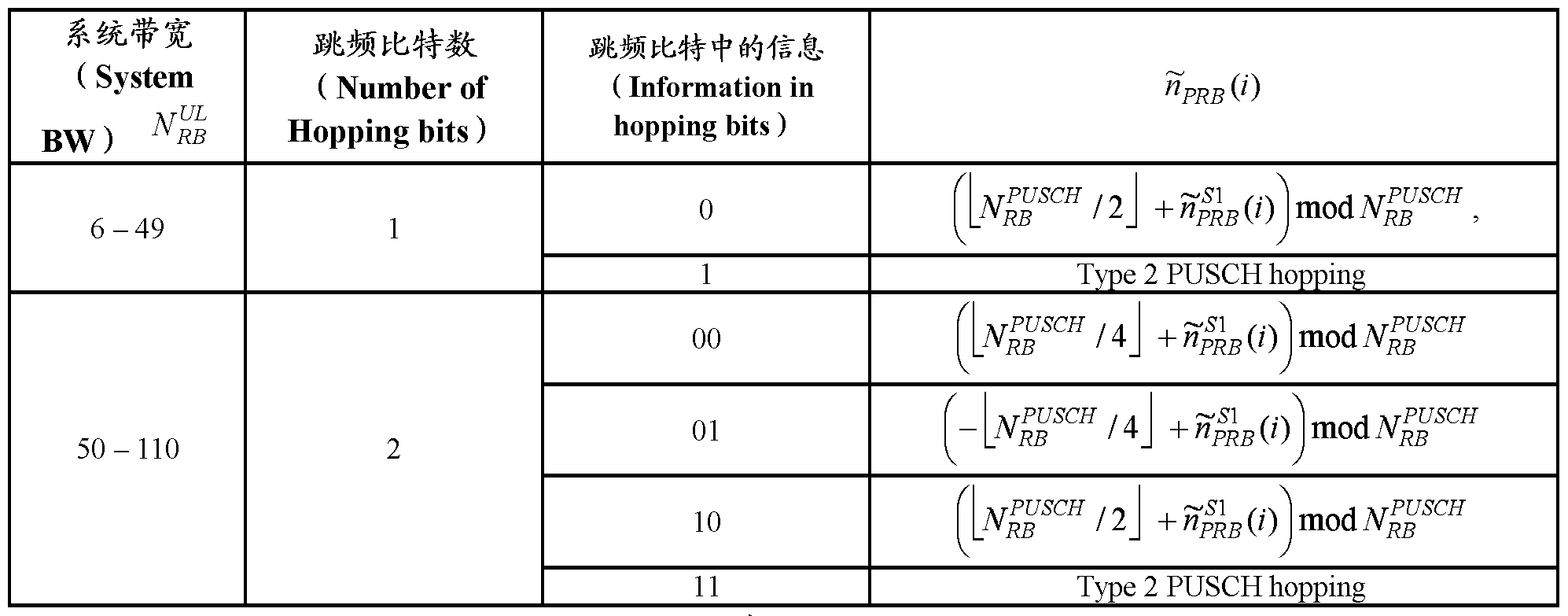
表 1 其中, 表示上行系统带宽; 表示 PDCCH中指示的用户设备在 子帧 i的第一个时隙使用的 PRB编号, 表示该用户设备跳频后使用的
PRB编号, NM 表示 PUSCH资源包含的 PRB数目。
以 20MHz系统带宽 ( 110个 PRB )为例, 如果 hopping bit指示为 00、
01或者 10, 表明用户设备使用 Typel跳频类型, 即按照 PDCCH中指示的跳
I I
频间隔进行跳频, 对于以上 3 个取值, 对应的跳频间隔分别为 L 」、
-
 使用 Type2 跳频类型, Type2跳频是一种预定义的跳频方式, 跳频后的 PRB资源位置通
过预定义的公式计算得到, 其主要取决于用户设备上一次接收到的 PDCCH 中的 PRB资源分配指示、本次传输的子帧序号 /时隙序号、无线帧序号以及小 区 ID、 子带个数等因素。 Type2跳频中用到的子带数目由高层配置。
使用 Type2 跳频类型, Type2跳频是一种预定义的跳频方式, 跳频后的 PRB资源位置通
过预定义的公式计算得到, 其主要取决于用户设备上一次接收到的 PDCCH 中的 PRB资源分配指示、本次传输的子帧序号 /时隙序号、无线帧序号以及小 区 ID、 子带个数等因素。 Type2跳频中用到的子带数目由高层配置。
但是, 目前没有针对跳频用户设备和非跳频用户设备共存情况的上行共 享资源规划方案, 因此, 很可能出现资源碎片, 从而无法保证系统资源的充 分利用以及用户设备的 QoS。 发明内容
本发明实施例提供了一种资源分配方法及装置, 用以实现在跳频用户设 备和非跳频用户设备共存的情况下的上行共享信道资源的分配。
本发明实施例提供的一种资源分配方法包括:
确定预先对物理上行共享信道 PUSCH 资源进行划分得到的跳频资源和 非跳频资源;
根据所述跳频资源和非跳频资源, 将 PUSCH 资源分配给用户设备, 其 中, 对于跳频用户设备优先分配跳频资源, 对于非跳频用户设备优先分配非 跳频资源。
本发明实施例提供的一种资源分配装置包括:
PUSCH资源划分单元,用于对物理上行共享信道 PUSCH资源进行划分, 得到跳频资源和非跳频资源;
PUSCH资源分配单元, 用于根据 PUSCH资源划分单元预先对 PUSCH 资源进行划分得到的跳频资源和非跳频资源, 将 PUSCH 资源分配给用户设 备; 其中, 对于跳频用户设备优先分配跳频资源, 对于非跳频用户设备优先 分配非跳频资源。
本发明实施例, 根据预先对物理上行共享信道 PUSCH 资源进行划分得 到的跳频资源和非跳频资源, 将 PUSCH 资源分配给用户设备; 其中, 对于 跳频用户设备优先分配跳频资源 ,对于非跳频用户设备优先分配非跳频资源 , 从而实现了在跳频用户设备和非跳频用户设备共存的情况下的上行共享信道
资源的分配方案, 并且避免出现资源碎片, 保证系统资源的充分利用以及用 户的 QoS。 附图说明
图 1为本发明实施例提供的一种资源分配方法的流程示意图;
图 2为本发明实施例提供的在 10MHz系统带宽下的针对 Typel跳频类型 的资源划分示意图;
图 3 为本发明实施例提供的在系统带宽包含三个子带的情况下的针对 Type2跳频类型的资源划分示意图;
图 4为本发明实施例提供的一种资源分配装置的结构示意图。 具体实施方式
本发明实施例提供了一种资源分配方法及装置, 用以实现在跳频用户设 备和非跳频用户设备共存的情况下的上行共享信道资源的分配。
为了降低峰均比, LTE系统上行釆用单载波频分多址(SC-FDMA, Single Carrier - Frequency Division Multiple Access )技术, 上行资源分配要求分配给 一个用户设备的资源, 在一个时隙内必须在频域保持连续, 一个子帧的两个 时隙间可以跳频。 由于跳频传输主要适用于高速移动的用户设备或者小带宽 业务, 在对系统内的各个用户设备、 各个业务进行资源分配时, 经常出现一 部分用户设备使用跳频传输, 另一部分用户设备使用非跳频传输的情况。 基 站调度器执行调度的过程, 通常是首先确定调度用户设备的优先级, 然后再 根据用户设备优先级顺序依次完成对各用户设备的资源分配, 而在对用户设 备进行资源分配时, 需要首先根据已完成的系统资源分配情况, 以及当前用 户设备是否跳频, 系统当前使用的跳频模式, 用户设备的跳频类型等因素找 到当前用户设备的可用资源, 然后, 从中挑选合适的资源分配给该用户设备。 如果系统当前使用的是帧内帧间跳频模式, 对于跳频用户设备和非跳频用户 设备在一个子帧内的两个时隙间将釆用不同的资源映射方式, 因此, 在跳频
用户设备和非跳频用户设备共存的情况下, 如果没有预先对上行共享信道资 源进行合理的规划, 很可能出现在完成对部分用户设备的资源分配后, 剩余 的资源无法分配的情况, 从而导致系统资源利用率的降低, 同时影响用户的
QoS性能。
因此, 本发明实施例提出一种跳频用户设备和非跳频用户设备共存情况 下的上行共享资源分配方案, 根据跳频用户设备和非跳频用户设备对于 PRB 资源数目的需求, 并结合跳频规则将上行共享信道资源划分为跳频资源和非 跳频资源两部分, 在实际进行资源分配时, 对于跳频用户设备优先分配跳频 资源, 对于非跳频用户设备优先分配非跳频资源。 从而, 能够大大降低系统 资源碎片出现的概率, 提高系统频谱资源利用率, 更有效地保证用户的 QoS。
为了便于描述, 本发明实施例中的 PUSCH资源划分, 是指将 PUSCH资 源划分为跳频资源和非跳频资源两部分。
本发明实施例提出的在跳频用户设备和非跳频用户设备共存情况下的上 行共享资源分配方案, 适用于帧内帧间跳频模式。
下面结合附图对本发明实施例提供的技术方案进行说明。
参见图 1 , 本发明实施例提供的一种资源分配方法包括:
5101、 确定预先对 PUSCH资源进行划分得到的跳频资源和非跳频资源。
5102、 根据预先对 PUSCH资源进行划分得到的跳频资源和非跳频资源, 将 PUSCH 资源分配给用户设备, 其中, 对于跳频用户设备优先分配跳频资 源, 对于非跳频用户设备优先分配非跳频资源。
本发明实施例中, 对 PUSCH 资源的划分釆用半静态配置。 具体地, 基 站执行动态资源分配的时间粒度为 1个传输时间间隔( TTI, Transmission Time Interval ), 即 lms。 PUSCH资源划分相对于 PUSCH资源分配(即将 PUSCH 资源分配给用户设备)具有较大的执行周期, 主要出于以下两方面原因: 原因一: 非跳频资源与跳频资源的比例, 主要根据跳频用户设备和非跳 频用户设备对 PRB资源数目的需求比例来确定。
基于目前的跳频决策思想, 是否使用跳频主要取决于用户设备的移动速
度以及用户设备使用的业务, 一般对于高速用户设备, 小带宽业务使用跳频 传输。 如果每个 TTI都进行资源进行划分, 需要先分别估算当前 TTI参与调 度的跳频用户设备和非跳频用户设备对 PRB资源数目的需求, 以此确定非跳 频资源与跳频资源的比例, 再来进行 PUSCH 资源划分。 而在实际系统中, 可以认为跳频用户设备和非跳频用户设备对 PRB资源的需求是一个相对慢变 的过程, 因此没有必要频繁地进行 PUSCH 资源划分, 更重要的是, 不频繁 地进行 PUSCH资源划分还可以减少设备的计算量。
原因二: LTE 上行釆用同步 HARQ, 为了节省信令开销, 以非自适应 HARQ为主。 所谓非自适应 HARQ, 是指用户设备重传数据使用的 PRB资源 根据该用户设备上一次接收到的 PDCCH指示来确定。 因此, 对于重传数据, 其占用的 PRB资源与上一次传输该数据占用的资源位置有关, 如果每个 ΤΉ 都进行 PUSCH资源划分, 无法保证跳频用户设备使用非自适应 HARQ方式 进行重传的重传数据占用的 PRB资源位于跳频资源范围内, 非跳频用户设备 使用非自适应 HARQ方式进行重传的重传数据占用的 PRB资源位于非跳频 资源范围内, 这样 PUSCH资源划分就失去了意义。
因此, 基于以上原因, 本发明实施例中的 PUSCH 资源划分可釆用以下 方式进行触发:
预先定义一个 PUSCH资源划分定时器,用于控制相邻两次 PUSCH资源 划分的最小时间间隔, 在每次完成 PUSCH 资源划分的时刻重启该定时器, 同时从该时刻开始, 累计统计实际分配给跳频用户设备的 PRB数目和实际分 配给非跳频用户设备的 PRB数目, 用以确定从 PUSCH资源划分定时器最近 一次启动到当前, 实际分配给跳频用户设备的资源与分配给非跳频用户设备 的资源的比例。
当 PUSCH资源划分定时器超时,并且从 PUSCH资源划分定时器最近一 次启动到当前, 实际分配给跳频用户设备的资源与分配给非跳频用户设备的 资源的比例, 和最近一次对 PUSCH 资源划分得到的非跳频资源与跳频资源 的比例相比, 差值超过预设范围 (即存在较大差异) 时, 触发对 PUSCH 资
源的重新划分。
也就是说, 触发将 PUSCH资源划分为跳频资源和非跳频资源的条件为: 预先设置的 PUSCH资源划分定时器超时; 并且,
最近一次实际分配给跳频用户设备的资源与分配给跳频用户设备的资源 的比例, 和最近一次对 PUSCH 资源划分得到的非跳频资源与跳频资源的比 例相比, 差值超过预设范围。
其中, PUSCH资源划分定时器的时长大于一个传输时间间隔 TTI。 具体 的时长, 可以根据实际需要进行配置, 时长越长, 则越容易实现, 但资源分 配的精确度越低; 时长越短, 则实现越复杂, 但资源分配的精确度越高。
具体的预设范围, 也可以根据实际需要进行配置, 设置的范围越大, 则 PUSCH资源划分的执行周期越大, 同理, 就越容易实现, 但资源分配的精确 度越低; 设置的范围越小, 则实现越复杂, 但资源分配的精确度越高。
本发明实施例中, 非跳频资源与跳频资源的比例, 是按照在相邻两次 PUSCH资源划分的间隔时间内, 实际分配给跳频用户设备的资源与实际分配 给非跳频用户设备的资源的比例确定的。 也就是说, 根据跳频用户设备和非 跳频用户设备对 PRB资源数目的需求确定非跳频资源和跳频资源的比例。
殳设相邻两次 PUSCH资源划分的时间间隔为 7 , 分别统计时间间隔 7内 实际分配给非跳频用户设备的 PRB数目 N P: 和实际分配给跳频用户设备 的 PRB 资源数目 H d , 则非跳频资源和跳频资源的比例为

具体地, 例如在 Tl时刻执行了 PUSCH资源划分, 并开始统计实际分别 分配给跳频用户设备和非跳频用户设备的资源量(PRB数目 ),到了 T2时刻, 实际分别分配给跳频用户设备的资源量为 N:h 。』 , 实际分别分配给非跳频 用户设备的资源量为
 , 并且满足了 PUSCH 资源划分的触发条件, 则 T2时刻开始重新进行 PUSCH资源划分, 此时划分的非跳频资源与跳频资 源的比例为; 7 =
 Nh P ' L
下面具体介绍一下本发明实施例是如何对 PUSCH资源进行划分的。
Nh P ' L
下面具体介绍一下本发明实施例是如何对 PUSCH资源进行划分的。
PUSCH资源划分的原则,是保证使用跳频资源的跳频用户设备在跳频后 所使用的资源仍然在跳频资源范围内, 其主要目的是为了尽量避免产生资源 碎片。 因此, PUSCH资源划分的方法需要依据跳频规则来确定, 由于 Typel 跳频类型和 Type2跳频类型遵循的跳频规律有所不同, 在进行资源划分时很 难同时兼顾到这两种跳频类型, 因此, PUSCH资源划分只针对其中一种跳频 类型。 对于不同的跳频类型, 釆用不同的 PUSCH资源划分方法。
下面分别介绍针对两种跳频类型的 PUSCH资源划分。
针对 Typel跳频的 PUSCH资源划分如下:
由于 Type 1跳频是按照 PDCCH中指示的间隔来跳频, 因此可以依据跳 频间隔来对 PUSCH资源进行划分。从表 1可以看出,在系统带宽小于 10MHz 的情况下,存在 1个跳频间隔值: VNP CH /2」;对于 10MHz以上(包括 10MHz )
, , I \τ PUSCH I I τ PUSCH ι r I , TPUSCH , 的系统带笕, 存在 2个跳频间隔值: NRB ^ ^\NRB 2Jo 其中, Ν 表 示 PUSCH资源包含的 PRB数目。
为了保证使用跳频资源的跳频用户设备在跳频后所使用的资源仍然在跳 频资源范围内,对于系统带宽小于 10MHz的情况, 可以划分出两段包含相同 PRB数目的连续 PRB资源作为跳频资源, 并且两段连续 PRB资源的间隔为 [NR P^SCH 对于 lOMHz以上系统带宽, 可以划分出四段包含相同 PRB数目 的连续 PRB资源作为跳频资源, 并且相邻两段用作跳频的连续 PRB资源的 间隔为 /4」。 非跳频资源和跳频资源的数目根据系统 PUSCH资源包含 的 PRB数目, 以及非跳频资源和跳频资源的比例 来确定。
以 10MHz系统带宽为例 , 由于跳频资源区域由四段连续的 PRB资源组 成, 可以分别以 PUSCH资源的第 1个 PRB, 第 l+ ^ ^ /4」个 PRB, 第 1+2 NRBSCH /4」个 PRB , % 1+3 χ
 /4」个 PRB作为起始 PRB,预留 连续的 PRB资源作为跳频资源。
N
/4」个 PRB作为起始 PRB,预留 连续的 PRB资源作为跳频资源。
N
其中, ^ 的计算方法为: 4 · (1 + ;/)
因此, PUSCH资源中用作跳频的 PRB资源个数为: mB
 剩余的 PUSCH资源即作为非跳频资源。 PUSCH资源划分的效果如图 2所示。
综上, 针对 Typel类型的跳频, 本发明实施例提供的对 PUSCH资源进 行划分, 得到跳频资源和非跳频资源的步骤包括:
对于系统带宽小于 10MHz的 PUSCH资源, 确定跳频资源需要的两段包 含相同数目物理资源块 PRB 的连续 PRB 资源的间隔为 L^, /2」, 其中, N H表示 PUSCH资源包含的 PRB数目; 根据非跳频资源与跳频资源的比
I I ^ ^ 例、 间隔 / 2」, 以及 PUSCH资源包含的 PRB数目, 确定 PUSCH资源 中的跳频资源和非跳频资源。
对于系统带宽大于或等于 10MHz的 PUSCH资源, 确定跳频资源需要的 四段包含相同数目物理资源块 PRB的连续 PRB资源中, 每两段相邻的连续 PRB资源的间隔为 LN«TCff / 4」;根据非跳频资源与跳频资源的比例、每两段相 邻的连续 PRB资源的间隔 [ NP SCH / 4」, 以及 PUSCH资源包含的 PRB数目, 确定 PUSCH资源中的跳频资源和非跳频资源。
针对 Type2跳频的 PUSCH资源划分如下:
Type2 跳频釆用的是一种预定义的跳频方式, 是子带跳频和镜像映射的 结合。 子带跳频使用户设备使用的 PRB资源从一个子带搬移到另一个子带, 从而获得频率分集; 此外, 为了降低多个小区位于同一个子带内的用户设备 之间的干扰, 用户设备占用的资源可能需要在子带内作镜像映射。
因此, 对于 Type2跳频, 可以在每个子带内的两侧分别划分相同数目的 连续 PRB资源作为跳频资源, 而中心部分的 PRB资源作为非跳频资源。 其 中,每个子带中非跳频资源和跳频资源的数目根据每个子带包含的 PRB个数 以及非跳频资源和跳频资源的比例 来确定。
每个子带中每一侧划分出来作为跳频资源的 PRB数目为:

每个子带中作为非跳频资源的 PRB数目为:
丄 ―丄、 ―
其中, 表示每个子带中包含的 PRB数目。
例如,在系统带宽包含三个子带的情况下,针对 Type2跳频类型的 PUSCH 资源划分的效果如图 3所示。
综上, 针对 Type2类型的跳频, 本发明实施例提供的对 PUSCH资源进 行划分, 得到跳频资源和非跳频资源的步骤包括:
根据非跳频资源与跳频资源的比例, 以及每个子带中包含的物理资源块 PRB数目, 确定 PUSCH资源中的跳频资源和非跳频资源, 其中, 在 PUSCH 资源中的每个子带中, 都包括跳频资源和非跳频资源, 并且, 跳频资源位于 子带的两侧, 该子带两侧作为跳频资源的 PRB连续且数目相同。
完成 PUSCH 资源划分后, 在为用户设备分配资源的过程中, 对于跳频 用户设备优先分配跳频资源, 对于非跳频用户设备优先分配非跳频资源。 若 跳频资源用尽, 则也可以为跳频用户设备分配非跳频资源, 同理, 若非跳频 资源用尽, 则也可以为非跳频用户设备分配跳频资源。
对于跳频用户设备, 选择使用与资源划分策略一致的跳频类型, 即都选 择针对 Typel类型划分的 PUSCH资源, 或者都选择针对 Type2类型划分的 PUSCH资源。 这样可以进一步有效地降低资源碎片的概率。
基于同一发明构思, 本发明实施例中还提供了一种资源分配装置, 由于 该装置解决问题的原理与资源分配方法相似, 因此该装置的实施可以参见方 法的实施, 重复之处不再赘述。
下面介绍一下本发明实施例中提供的装置。
参见图 4, 本发明实施例提供的一种资源分配装置包括:
PUSCH资源划分单元 101 , 用于对 PUSCH资源进行划分, 得到跳频资
源和非跳频资源。
PUSCH 资源分配单元 102 , 用于根据 PUSCH 资源划分单元预先对 PUSCH资源进行划分得到的跳频资源和非跳频资源, 将 PUSCH资源分配给 用户设备; 其中, 对于跳频用户设备优先分配跳频资源, 对于非跳频用户设 备优先分配非跳频资源。
较佳地, PUSCH资源划分单元 101包括:
定时器单元 201 , 用于根据划分单元 203 的触发, 启动或重新启动定时 器预先设置的 PUSCH资源划分定时器。
统计单元 202,用于统计从 PUSCH资源划分定时器最近一次启动到当前, 实际分配给跳频用户设备的资源与分配给非跳频用户设备的资源的比例。
划分单元 203 ,用于将 PUSCH资源划分为跳频资源和非跳频资源,以及, 当 PUSCH资源划分定时器超时, 并且, 从 PUSCH资源划分定时器最近一次 启动到当前, 实际分配给跳频用户设备的资源与分配给非跳频用户设备的资 源的比例, 和最近一次对 PUSCH 资源划分得到的非跳频资源与跳频资源的 比例相比, 差值超过预设范围时, 对 PUSCH 资源重新进行划分, 得到跳频 资源和非跳频资源, 并触发定时器单元 201重新启动所述定时器。
较佳地, 定时器单元 201 中的 PUSCH资源划分定时器的时长大于一个
TTI。
较佳地, 对于系统带宽小于 10MHz的 PUSCH资源, 划分单元 203确定 跳频资源需要的两段包含相同数目物理资源块 PRB的连续 PRB资源的间隔
I τ PUSCH I , , 为 L^ /2J, 其中, NRB 表示 PUSCH资源包含的 PRB数目; 根据非跳频
^ ^ I PUSCH I ^
资源与跳频资源的比例、间隔 / 2」,以及 PUSCH资源包含的 PRB数目, 确定 PUSCH资源中的跳频资源和非跳频资源。
较佳地,对于系统带宽大于或等于 10MHz的 PUSCH资源,划分单元 203 确定跳频资源需要的四段包含相同数目物理资源块 PRB的连续 PRB资源中, 每两段相邻的连续 PRB 资源的间隔为 LN«TCff / 4」; 根据非跳频资源与跳频资
源的比例、每两段相邻的连续 PRB资源的间隔 [ NP SCH / 4」, 以及 PUSCH资源 包含的 PRB数目, 确定 PUSCH资源中的跳频资源和非跳频资源。
较佳地, 划分单元 203根据非跳频资源与跳频资源的比例, 以及每个子 带中包含的物理资源块 PRB数目, 确定 PUSCH资源中的跳频资源和非跳频 资源, 其中, 在 PUSCH 资源中的每个子带中, 都包括跳频资源和非跳频资 源, 并且, 跳频资源位于子带的两侧, 并且该子带两侧作为跳频资源的 PRB 连续且数目相同。
较佳地, 划分单元 203确定的非跳频资源与跳频资源的比例, 是按照在 相邻两次 PUSCH 资源划分的间隔时间内, 实际分配给跳频用户设备的资源 与实际分配给非跳频用户设备的资源的比例确定的。
较佳地, 本发明实施例提供的资源分配装置为基站。
综上所述, 本发明实施例提出一种跳频用户设备和非跳频用户设备共存 情况下的 PUSCH资源分配方案,根据跳频规律将 PUSCH资源划分为跳频资 源和非跳频资源两部分, 在进行资源分配时, 对于跳频用户设备优先分配跳 频资源, 对于非跳频用户设备优先分配非跳频资源。 从而, 能够大大降低系 统资源碎片出现的概率, 提高系统频谱资源利用率, 更有效地保证用户设备 的 QoS。
本领域内的技术人员应明白, 本发明的实施例可提供为方法、 系统、 或 计算机程序产品。 因此, 本发明可釆用完全硬件实施例、 完全软件实施例、 或结合软件和硬件方面的实施例的形式。 而且, 本发明可釆用在一个或多个 其中包含有计算机可用程序代码的计算机可用存储介质 (包括但不限于磁盘 存储器和光学存储器等 )上实施的计算机程序产品的形式。
本发明是参照根据本发明实施例的方法、 设备(系统)、 和计算机程序产 品的流程图和 /或方框图来描述的。 应理解可由计算机程序指令实现流程图 和 /或方框图中的每一流程和 /或方框、 以及流程图和 /或方框图中的流程 和 /或方框的结合。 可提供这些计算机程序指令到通用计算机、 专用计算机、
嵌入式处理机或其他可编程数据处理设备的处理器以产生一个机器, 使得通 过计算机或其他可编程数据处理设备的处理器执行的指令产生用于实现在流 程图一个流程或多个流程和 /或方框图一个方框或多个方框中指定的功能的 装置。
这些计算机程序指令也可存储在能引导计算机或其他可编程数据处理设 备以特定方式工作的计算机可读存储器中, 使得存储在该计算机可读存储器 中的指令产生包括指令装置的制造品, 该指令装置实现在流程图一个流程或 多个流程和 /或方框图一个方框或多个方框中指定的功能。
这些计算机程序指令也可装载到计算机或其他可编程数据处理设备上, 使得在计算机或其他可编程设备上执行一系列操作步骤以产生计算机实现的 处理, 从而在计算机或其他可编程设备上执行的指令提供用于实现在流程图 一个流程或多个流程和 /或方框图一个方框或多个方框中指定的功能的步 骤。 发明的精神和范围。 这样, 倘若本发明的这些修改和变型属于本发明权利要 求及其等同技术的范围之内, 则本发明也意图包含这些改动和变型在内。
Claims
1、 一种资源分配方法, 其特征在于, 该方法包括:
确定预先对物理上行共享信道 PUSCH 资源进行划分得到的跳频资源和非 跳频资源;
根据确定的跳频资源和非跳频资源,将 PUSCH资源分配给用户设备,其中, 对于跳频用户设备优先分配跳频资源, 对于非跳频用户设备优先分配非跳频资 源。
2、 根据权利要求 1所述的方法, 其特征在于, 触发将 PUSCH资源划分为 跳频资源和非跳频资源的条件为:
预先设置的 PUSCH资源划分定时器超时; 并且,
从所述定时器最近一次启动到当前, 实际分配给跳频用户设备的资源与分 配给非跳频用户设备的资源的比例,和最近一次对 PUSCH资源划分得到的非跳 频资源与跳频资源的比例相比, 差值超过预设范围。
3、 根据权利要求 2所述的方法, 其特征在于, 所述 PUSCH资源划分定时 器的时长大于一个传输时间间隔 ΤΉ。
4、 根据权利要求 1所述的方法, 其特征在于, 根据下列步骤对 PUSCH资 源进行划分包括:
对于系统带宽小于 10MHz的 PUSCH资源, 确定跳频资源需要的两段包含
、 , , I I ,
相同数目物理资源块 PRB的连续 PRB资源的间隔为 L^ /2」, 其中, N^ 表 示 PUSCH资源包含的 PRB数目;
确定跳频资源和非跳频资源包括:
根据非跳频资源与跳频资源的比例、 所述间隔, 以及 PUSCH 资源包含的 PRB数目, 确定所述 PUSCH资源中的跳频资源和非跳频资源。
5、 根据权利要求 1所述的方法, 其特征在于, 根据下列步骤对 PUSCH资 源进行划分包括: 对于系统带宽大于或等于 10MHz的 PUSCH资源, 确定跳频资源需要的四 段包含相同数目物理资源块 PRB的连续 PRB资源中, 每两段相邻的连续 PRB 资源的间隔为 L^rff / 4」;
确定跳频资源和非跳频资源包括:
根据非跳频资源与跳频资源的比例、 所述每两段相邻的连续 PRB资源的间 隔, 以及 PUSCH资源包含的 PRB数目,确定所述 PUSCH资源中的跳频资源和 非跳频资源。
6、 根据权利要求 1所述的方法, 其特征在于, 确定跳频资源和非跳频资源 包括:
根据非跳频资源与跳频资源的比例, 以及每个子带中包含的物理资源块 PRB数目, 确定所述 PUSCH资源中的跳频资源和非跳频资源;
其中, 在 PUSCH资源中的每个子带中, 都包括跳频资源和非跳频资源, 并 且, 跳频资源位于子带的两侧, 该子带两侧作为跳频资源的 PRB连续且数目相 同。
7、 根据权利要求 4 ~ 6任一所述的方法, 其特征在于, 所述非跳频资源与 跳频资源的比例, 是按照在相邻两次 PUSCH资源划分的间隔时间内, 实际分配 给跳频用户设备的资源与实际分配给非跳频用户设备的资源的比例确定的。
8、 一种资源分配装置, 其特征在于, 该装置包括:
PUSCH资源划分单元, 用于对 PUSCH资源进行划分, 得到跳频资源和非 跳频资源;
PUSCH资源分配单元, 用于根据 PUSCH资源划分单元预先对 PUSCH资 源进行划分得到的跳频资源和非跳频资源, 将 PUSCH资源分配给用户设备; 其 中, 对于跳频用户设备优先分配跳频资源, 对于非跳频用户设备优先分配非跳 频资源。
9、 根据权利要求 8所述的装置, 其特征在于, 所述 PUSCH资源划分单元 包括: 定时器单元, 用于根据划分单元的触发, 启动或重新启动定时器预先设置 的 PUSCH资源划分定时器;
统计单元, 用于统计从所述定时器最近一次启动到当前, 实际分配给跳频 用户设备的资源与分配给非跳频用户设备的资源的比例;
划分单元, 用于将 PUSCH资源划分为跳频资源和非跳频资源, 以及, 当所 述定时器超时, 并且, 从所述定时器最近一次启动到当前, 实际分配给跳频用 户设备的资源与分配给非跳频用户设备的资源的比例,和最近一次对 PUSCH资 源划分得到的非跳频资源与跳频资源的比例相比, 差值超过预设范围时, 对 PUSCH资源重新进行划分, 得到跳频资源和非跳频资源, 并触发所述定时器单 元重新启动所述定时器。
10、 根据权利要求 9 所述的装置, 其特征在于, 所述定时器单元中的所述 PUSCH资源划分定时器的时长大于一个传输时间间隔 ΤΉ。
11、 根据权利要求 9所述的装置, 其特征在于, 所述划分单元具体用于: 对于系统带宽小于 10MHz的 PUSCH资源, 确定跳频资源需要的两段包含
、 , , I I ,
相同数目物理资源块 PRB的连续 PRB资源的间隔为 L^ /2」, 其中, N^ 表 示 PUSCH资源包含的 PRB数目; 根据非跳频资源与跳频资源的比例、 所述间 隔, 以及 PUSCH资源包含的 PRB数目,确定所述 PUSCH资源中的跳频资源和 非跳频资源;
对于系统带宽大于或等于 10MHz的 PUSCH资源, 确定跳频资源需要的四 段包含相同数目物理资源块 PRB的连续 PRB资源中, 每两段相邻的连续 PRB 资源的间隔为 LN«TCff / 4」; 根据非跳频资源与跳频资源的比例、 所述每两段相邻 的连续 PRB资源的间隔,以及 PUSCH资源包含的 PRB数目,确定所述 PUSCH 资源中的跳频资源和非跳频资源。
12、 根据权利要求 9所述的装置, 其特征在于, 所述划分单元具体用于: 根据非跳频资源与跳频资源的比例, 以及每个子带中包含的物理资源块
PRB数目, 确定所述 PUSCH资源中的跳频资源和非跳频资源; 其中, 在 PUSCH资源中的每个子带中, 都包括跳频资源和非跳频资源, 并 且, 跳频资源位于子带的两侧, 该子带两侧作为跳频资源的 PRB连续且数目相 同。
13、 根据权利要求 11或 12所述的装置, 其特征在于, 所述划分单元确定 的所述非跳频资源与跳频资源的比例,是按照在相邻两次 PUSCH资源划分的间 隔时间内, 实际分配给跳频用户设备的资源与实际分配给非跳频用户设备的资 源的比例确定的。
Applications Claiming Priority (2)
| Application Number | Priority Date | Filing Date | Title |
|---|---|---|---|
| CN201010269358.6 | 2010-08-31 | ||
| CN201010269358.6A CN102387589B (zh) | 2010-08-31 | 2010-08-31 | 一种资源分配方法及装置 |
Publications (1)
| Publication Number | Publication Date |
|---|---|
| WO2012028065A1 true WO2012028065A1 (zh) | 2012-03-08 |
Family
ID=45772150
Family Applications (1)
| Application Number | Title | Priority Date | Filing Date |
|---|---|---|---|
| PCT/CN2011/078811 Ceased WO2012028065A1 (zh) | 2010-08-31 | 2011-08-24 | 一种资源分配方法及装置 |
Country Status (2)
| Country | Link |
|---|---|
| CN (1) | CN102387589B (zh) |
| WO (1) | WO2012028065A1 (zh) |
Cited By (2)
| Publication number | Priority date | Publication date | Assignee | Title |
|---|---|---|---|---|
| GB2498773A (en) * | 2012-01-27 | 2013-07-31 | Renesas Mobile Corp | Mapping control channels to hop in the frequency domain while user data channels use opportunistically other parts of the same total band |
| CN112436864A (zh) * | 2019-08-26 | 2021-03-02 | 中兴通讯股份有限公司 | 跳频频点的共享方法、回收方法、控制器和基站系统 |
Families Citing this family (4)
| Publication number | Priority date | Publication date | Assignee | Title |
|---|---|---|---|---|
| WO2014110757A1 (en) * | 2013-01-17 | 2014-07-24 | Broadcom Corporation | Method and apparatus for facilitating extended time-domain granularity for uplink frequency hopping |
| CN105307270A (zh) * | 2014-07-31 | 2016-02-03 | 中国移动通信集团公司 | 数据传输方法及系统、基站及用户设备 |
| CN106961316B (zh) * | 2016-01-11 | 2020-02-04 | 上海诺基亚贝尔股份有限公司 | LTE-A Pro中的物理上行共享信道的传输方法和设备 |
| CA3082736C (en) * | 2017-11-16 | 2024-07-02 | Ntt Docomo, Inc. | USER TERMINAL AND WIRELESS COMMUNICATION METHOD |
Citations (5)
| Publication number | Priority date | Publication date | Assignee | Title |
|---|---|---|---|---|
| CN1132009A (zh) * | 1994-08-03 | 1996-09-25 | 诺基亚电信公司 | 在一个蜂窝式通信系统中的信道分配方法 |
| CN101132264A (zh) * | 2007-09-29 | 2008-02-27 | 中兴通讯股份有限公司 | 一种harq重传资源配置方法 |
| WO2009022706A1 (ja) * | 2007-08-14 | 2009-02-19 | Ntt Docomo, Inc. | 基地局装置 |
| CN101815325A (zh) * | 2010-03-09 | 2010-08-25 | 上海华为技术有限公司 | 跳频的实现方法、装置和通信系统 |
| CN101835159A (zh) * | 2010-03-29 | 2010-09-15 | 普天信息技术研究院有限公司 | 一种跳频用户和非跳频用户的频域复用方法和系统 |
-
2010
- 2010-08-31 CN CN201010269358.6A patent/CN102387589B/zh active Active
-
2011
- 2011-08-24 WO PCT/CN2011/078811 patent/WO2012028065A1/zh not_active Ceased
Patent Citations (5)
| Publication number | Priority date | Publication date | Assignee | Title |
|---|---|---|---|---|
| CN1132009A (zh) * | 1994-08-03 | 1996-09-25 | 诺基亚电信公司 | 在一个蜂窝式通信系统中的信道分配方法 |
| WO2009022706A1 (ja) * | 2007-08-14 | 2009-02-19 | Ntt Docomo, Inc. | 基地局装置 |
| CN101132264A (zh) * | 2007-09-29 | 2008-02-27 | 中兴通讯股份有限公司 | 一种harq重传资源配置方法 |
| CN101815325A (zh) * | 2010-03-09 | 2010-08-25 | 上海华为技术有限公司 | 跳频的实现方法、装置和通信系统 |
| CN101835159A (zh) * | 2010-03-29 | 2010-09-15 | 普天信息技术研究院有限公司 | 一种跳频用户和非跳频用户的频域复用方法和系统 |
Cited By (3)
| Publication number | Priority date | Publication date | Assignee | Title |
|---|---|---|---|---|
| GB2498773A (en) * | 2012-01-27 | 2013-07-31 | Renesas Mobile Corp | Mapping control channels to hop in the frequency domain while user data channels use opportunistically other parts of the same total band |
| CN112436864A (zh) * | 2019-08-26 | 2021-03-02 | 中兴通讯股份有限公司 | 跳频频点的共享方法、回收方法、控制器和基站系统 |
| CN112436864B (zh) * | 2019-08-26 | 2023-04-18 | 中兴通讯股份有限公司 | 跳频频点的共享方法、回收方法、控制器和基站系统 |
Also Published As
| Publication number | Publication date |
|---|---|
| CN102387589B (zh) | 2014-04-09 |
| CN102387589A (zh) | 2012-03-21 |
Similar Documents
| Publication | Publication Date | Title |
|---|---|---|
| RU2676873C2 (ru) | Устройство и способ для синхронного мультиплексирования и множественного доступа для различных целей запаздывания, используя тонкое управление | |
| JP5675358B2 (ja) | 移動通信システム、移動局装置、基地局装置、移動局装置の通信方法、および基地局装置の通信方法 | |
| CN114208076B (zh) | 由多个配置授权资源共享harq进程 | |
| CN102137496B (zh) | Pusch资源和phich资源的联合调度方法及其装置 | |
| CN103391583B (zh) | 一种传输资源分配方法、装置及系统和基站设备 | |
| WO2018103702A1 (zh) | 一种上行信息处理的方法及装置 | |
| CN109586854B (zh) | 数据传输方法及装置 | |
| WO2012079517A1 (zh) | 一种资源调度的方法、装置和基站 | |
| US20190320416A1 (en) | Data transmission method, user equipment, and radio access device | |
| US8774160B2 (en) | Method and system for scheduling frequency physical resources based on frequency hopping | |
| JP2014509123A (ja) | Gsmシステムとlteシステムが周波数スペクトルを共有する方法及びシステム | |
| US20150180621A1 (en) | Data transmission method and device | |
| WO2014071619A1 (zh) | 频谱共享的方法和基站 | |
| WO2012028065A1 (zh) | 一种资源分配方法及装置 | |
| US20150016430A1 (en) | METHOD AND SYSTEM FOR COVERAGE ENHANCEMENT OF UPLINK VoIP | |
| CN118301768A (zh) | 一种参数配置方法、设备及存储介质 | |
| CN105210398B (zh) | 资源处理方法和资源处理装置 | |
| CN111342942B (zh) | 上行控制信息的上报方法及装置、存储介质、用户终端 | |
| CN102315921B (zh) | 确定重传资源位置的方法和模块、基站和中继节点 | |
| US10772114B2 (en) | Scheduling method and system | |
| JP2013179417A (ja) | 無線リソース割当装置、無線リソース割当方法およびコンピュータプログラム | |
| JP5292214B2 (ja) | 無線リソース割当装置、無線リソース割当方法、及び無線リソース割当プログラム | |
| HK1233830B (zh) | 用於利用薄控制的针对不同的时延目标的同步复用和多址的装置和方法 |
Legal Events
| Date | Code | Title | Description |
|---|---|---|---|
| 121 | Ep: the epo has been informed by wipo that ep was designated in this application |
Ref document number: 11821091 Country of ref document: EP Kind code of ref document: A1 |
|
| NENP | Non-entry into the national phase |
Ref country code: DE |
|
| 122 | Ep: pct application non-entry in european phase |
Ref document number: 11821091 Country of ref document: EP Kind code of ref document: A1 |