WO2012008254A1 - 腹部脂肪量測定装置 - Google Patents
腹部脂肪量測定装置 Download PDFInfo
- Publication number
- WO2012008254A1 WO2012008254A1 PCT/JP2011/063572 JP2011063572W WO2012008254A1 WO 2012008254 A1 WO2012008254 A1 WO 2012008254A1 JP 2011063572 W JP2011063572 W JP 2011063572W WO 2012008254 A1 WO2012008254 A1 WO 2012008254A1
- Authority
- WO
- WIPO (PCT)
- Prior art keywords
- impedance
- abdominal
- size
- unit
- measured
- Prior art date
- Legal status (The legal status is an assumption and is not a legal conclusion. Google has not performed a legal analysis and makes no representation as to the accuracy of the status listed.)
- Ceased
Links
Images




Classifications
-
- A—HUMAN NECESSITIES
- A61—MEDICAL OR VETERINARY SCIENCE; HYGIENE
- A61B—DIAGNOSIS; SURGERY; IDENTIFICATION
- A61B5/00—Measuring for diagnostic purposes; Identification of persons
- A61B5/05—Detecting, measuring or recording for diagnosis by means of electric currents or magnetic fields; Measuring using microwaves or radio waves
- A61B5/053—Measuring electrical impedance or conductance of a portion of the body
- A61B5/0537—Measuring body composition by impedance, e.g. tissue hydration or fat content
-
- A—HUMAN NECESSITIES
- A61—MEDICAL OR VETERINARY SCIENCE; HYGIENE
- A61B—DIAGNOSIS; SURGERY; IDENTIFICATION
- A61B5/00—Measuring for diagnostic purposes; Identification of persons
- A61B5/68—Arrangements of detecting, measuring or recording means, e.g. sensors, in relation to patient
- A61B5/6801—Arrangements of detecting, measuring or recording means, e.g. sensors, in relation to patient specially adapted to be attached to or worn on the body surface
- A61B5/6813—Specially adapted to be attached to a specific body part
- A61B5/6823—Trunk, e.g., chest, back, abdomen, hip
-
- A—HUMAN NECESSITIES
- A61—MEDICAL OR VETERINARY SCIENCE; HYGIENE
- A61B—DIAGNOSIS; SURGERY; IDENTIFICATION
- A61B5/00—Measuring for diagnostic purposes; Identification of persons
- A61B5/68—Arrangements of detecting, measuring or recording means, e.g. sensors, in relation to patient
- A61B5/6801—Arrangements of detecting, measuring or recording means, e.g. sensors, in relation to patient specially adapted to be attached to or worn on the body surface
- A61B5/683—Means for maintaining contact with the body
- A61B5/6831—Straps, bands or harnesses
Definitions
- the present invention relates to an abdominal fat mass measuring apparatus, and more particularly to an abdominal fat mass measuring apparatus that measures the abdominal fat mass using bioimpedance.
- Patent Document 1 A conventional apparatus for measuring bioimpedance and calculating visceral fat mass and subcutaneous fat mass according to a predetermined conversion formula based on the measured bioimpedance and physique information is disclosed in Japanese Patent Application Laid-Open No. 2003-52659 (Patent Document 1). This is disclosed in Japanese Unexamined Patent Application Publication No. 2006-288734 (Patent Document 2) and Japanese Unexamined Patent Application Publication No. 2005-288023 (Patent Document 3). As shown in these patent documents, since the bioelectrical impedance and the physique information are used for the calculation of the visceral fat mass and the subcutaneous fat mass, when the person to be measured eats or drinks, the influence appears in the bioelectrical impedance and the physique information. Therefore, in order to guarantee the measurement accuracy, it is generally assumed that the measurement is performed when two hours or more have passed after eating and drinking so that the influence of eating and drinking is not exerted.
- Patent Document 2 An example of a measurement method that takes into consideration the eating and drinking of the measurement subject is disclosed in Japanese Patent Application Laid-Open No. 2006-288734 (Patent Document 2). According to paragraphs 0081 and FIG. 13 of Japanese Patent Laid-Open No. 2006-288734 (Patent Document 2), it is determined whether the bioelectrical impedance indicates a value within the normal allowable range. , A message notification and a buzzer notification regarding condition abnormality are performed. This prompts the person to be measured to perform the measurement in the best environment without the influence of eating and drinking.
- Patent Document 2 Japanese Patent Application Laid-Open No. 2006-288734
- an object of the present invention is to provide an abdominal fat mass measuring device that enables accurate measurement irrespective of eating and drinking.
- An abdominal fat mass measuring device includes a size measurement unit that measures the size of the abdomen of the measurement subject, an impedance acquisition unit that acquires bioimpedance of the abdomen, and a calculation unit that calculates the fat mass of the abdomen.
- a size measurement part contains the size correction
- the calculation unit calculates the fat mass according to a predetermined conversion formula using the bioelectrical impedance acquired by the impedance acquisition unit and the size of the abdomen corrected by the size correction unit.
- the amount of fat can be accurately measured regardless of food and drink.
- the “abdomen” is a portion centering on the umbilicus, and is a portion excluding the chest of the trunk.
- the “body axis” is an axis in a direction substantially perpendicular to the cross section of the abdomen.
- the “abdomen front surface” includes a portion of the abdomen that is visible when the measurement subject is observed from the front. For example, a portion that is visible when the subject is observed from the umbilicus side along an axis that passes through the navel and spine and is perpendicular to the body axis in the abdomen of the subject is included.
- the “abdomen rear surface” includes a portion of the abdomen that can be visually recognized when the subject is observed from behind.
- the portion of the abdomen of the subject includes a portion that passes through the navel and spine and is visible when the subject is observed from the spine side along an axis perpendicular to the body axis.
- the length of the abdomen refers to the length in the direction in which the body axis of the abdomen extends
- the width of the abdomen refers to the length in the direction substantially orthogonal to the body axis.
- FIG. 1 shows a configuration of an abdominal fat mass measuring apparatus 1 according to the present embodiment.
- the control unit 10 of the abdominal fat mass measuring apparatus 1 includes a microprocessor including a CPU (Central Processing Unit), and includes an arithmetic processing unit 11.
- the arithmetic processing unit 11 includes a size correction unit 12, an impedance calculation unit 13, and a calculation unit 15 for calculating various fat amounts.
- a physique information measuring unit 24 and an information input unit 25 for obtaining measured person information used for the connection are connected.
- the food and beverage information input unit 20 and the information input unit 25 may be replaced with a computer or an input terminal outside the abdominal fat mass measuring device 1. Information may be transmitted from these computers or input terminals to the abdominal fat mass measuring apparatus 1 by wire or wirelessly.
- the subject information means information about the subject, and includes, for example, age, sex, physique information, information on exercise amount, information on smoking, information on diseases, information on past medical history, and the like.
- the physique information is information about the size of a specific part of the body of the measurement subject at the start of measurement, for example, information including waist length (abdominal circumference), abdominal length / width and abdominal thickness, height, Information such as weight.
- the physique information measuring unit 24 is a part that automatically measures the physique information at the start of measurement of the measurement subject, and outputs the measured physique information to the control unit 10.
- the information input unit 25 is a part for inputting measurement subject information, and outputs the input measurement subject information to the control unit 10.
- the physique information may be configured to be automatically measured by the physique information measuring unit 24, or the measured person manually measures and inputs the physique information. Also good.
- the size correction unit 12 corrects the vertical and horizontal sizes of the measurement subject's abdomen measured by the physique information measurement unit 24, more specifically, the vertical and horizontal sizes around the umbilicus of the measurement subject. Specifically, the size correction unit 12 uses the measured food size inputted from the food / beverage information input unit 20 and the elapsed time from when the measured person eats and drinks until the measurement time to the size before eating and drinking. Correct so that
- Impedance calculation unit 13 acquires bioelectrical impedance. More specifically, it has a function of measuring bioimpedance using an impedance measurement electrode brought into contact with the body surface.
- the impedance calculation unit 13 uses the content of eating and drinking input from the eating and drinking information input unit 20 and the elapsed time from when the measured person eats and drinks to the time of measurement to the impedance before the eating and drinking.
- An impedance correction unit 14 for correcting Details of the size correction by the size correction unit 12 and the bioelectrical impedance correction by the impedance correction unit 14 will be described later.
- the calculation unit 15 uses the bioelectrical impedance calculated by the impedance calculation unit 13 and the physique information of the measurement subject to calculate various fat amounts of the abdomen according to a predetermined conversion formula.
- the calculation unit 15 includes a fat area calculation unit 16 that calculates the fat area of the abdomen as the fat amount of the abdomen.
- the abdominal fat mass measuring device 1 is a constant current generation unit 21, a terminal switching unit 22, a potential difference detection unit 23, a display unit 26, an operation unit 27, a power supply unit 28, a memory unit 29, and a measurement result for printing out.
- the printing unit 30 includes a plurality of electrodes.
- the display unit 26 displays information on various fat amounts calculated by the arithmetic processing unit 11.
- the display unit 26 for example, an LCD (Liquid Crystal Display) can be used.
- the operation unit 27 is a part for the measurement subject to input a command to the abdominal fat mass measurement apparatus 1, and is configured by, for example, a key switch that can be pressed by the measurement subject.
- the power supply unit 28 is a part for supplying power to each unit such as the control unit 10, and includes an internal power source such as a battery and an external power source such as a commercial power source.
- the memory unit 29 is a part for storing various data and programs related to the table group TB including various tables and the abdominal fat mass measuring apparatus 1, and includes, for example, the above-described subject information and the calculated visceral fat mass , And a body fat measurement program for executing a body fat measurement process to be described later.
- the abdominal fat mass measuring apparatus 1 includes, as a plurality of electrodes, abdominal electrode pairs AP1 to AP4 attached to the back of the abdomen of the subject, upper limb electrodes H11 and H21 attached to the upper limb of the subject, and the subject. Lower limb electrodes F11 and F21 attached to the lower limbs.
- the control unit 10 performs overall control of the abdominal fat mass measuring apparatus 1. Specifically, the control unit 10 sends commands to the various functional blocks described above and performs various arithmetic processes based on the obtained information. Among these, various arithmetic processes are performed by the arithmetic processing unit 11 provided in the control unit 10.
- the abdominal electrode pairs AP1 to AP4 are mounted on the surface of the back of the abdomen of the measurement subject in the body axis direction.
- the upper limb electrodes H11 and H21 are preferably mounted on the surface of the wrist of the right hand and the surface of the wrist of the left hand, respectively.
- the lower limb electrodes F11 and F21 are preferably mounted on the ankle surface of the right foot and the ankle surface of the left foot, respectively.
- the abdominal electrode pairs AP1 to AP4, the upper limb electrodes H11 and H21, and the lower limb electrodes F11 and F21 are electrically connected to the terminal switching unit 22, respectively.
- the terminal switching unit 22 is constituted by a plurality of relay circuits, for example.
- the terminal switching unit 22 electrically connects the specific electrode pair selected from the plurality of electrodes described above and the constant current generation unit 21 based on the command received from the control unit 10, and A specific electrode pair selected from the electrodes and the potential difference detection unit 23 are electrically connected.
- the electrode pair electrically connected to the constant current generating unit 21 by the terminal switching unit 22 functions as a constant current applying electrode pair, and is electrically connected to the potential difference detecting unit 23 by the terminal switching unit 22.
- the electrode pair thus formed functions as a potential difference detection electrode pair.
- Various electrical connections by the terminal switching unit 22 are switched during the measurement operation.
- the constant current generation unit 21 generates a constant current based on a command received from the control unit 10 and supplies the generated constant current to the terminal switching unit 22.
- the constant current generator 21 supplies, for example, a high-frequency current (for example, 50 kHz, 500 ⁇ A) that is preferably used for measuring body composition information.
- a constant current is applied to the measurement subject via the electrode pair electrically connected to the constant current generating unit 21 by the terminal switching unit 22, that is, the constant current applying electrode pair.
- the potential difference detection unit 23 detects a potential difference between the electrodes of the electrode pair electrically connected to the potential difference detection unit 23 by the terminal switching unit 22, that is, the potential difference detection electrode pair, and outputs the detected potential difference to the control unit 10. Thereby, the potential difference between the electrodes of the potential difference detection electrode pair in a state where the constant current is applied to the measurement subject is detected.
- the impedance calculation unit 13 calculates various impedances based on the current value of the constant current generated by the constant current generation unit 21 and the potential difference information detected by the potential difference detection unit 23 and received by the control unit 10.
- impedance calculation unit 13 calculates two types of impedance based on the current value generated in constant current generation unit 21 and the potential difference detected in potential difference detection unit 23.
- One of the two types of impedance is impedance (hereinafter, impedance is also referred to as Zt) reflecting the lean mass in the abdomen of the subject.
- the other impedance is an impedance reflecting the amount of subcutaneous fat in the abdomen of the measurement subject (hereinafter, impedance is also referred to as Zs).
- the fat area calculation unit 16 calculates the abdominal area according to the following (Equation 1).
- the visceral fat area (unit: cm 2 ) is calculated. From the calculation according to (Equation 1), the visceral fat area of the abdomen is estimated.
- the value calculated according to (Equation 1) is referred to as abdominal fat area Fv.
- Equation 1 includes the umbilical abdomen lateral width A and vertical width B, impedances Zs and Zt calculated by the impedance calculation unit 13, and predetermined coefficients ⁇ 1 , ⁇ 2 , ⁇ 3 , ⁇ 4 and ⁇ .
- Equation 1 is “Papers: Development of a visceral fat estimation model using a bioimpedance method”: “Intelligence and Information” (Journal of the Japan Intelligence Information Fuzzy Society) Vol20, No. 1, pp. 90-99 (2008) ".
- FIG. 2 shows an arrangement example of electrodes on the body surface when measuring the abdominal fat mass according to the embodiment.
- FIG. 2 shows a state in which four pairs of electrodes are arranged.
- the abdominal fat mass measuring device 1 includes an electrode sheet 40.
- the electrode sheet 40 is formed by integrally forming abdominal electrode pairs AP1, AP2, AP3, AP4 and a sheet material.
- the abdominal electrode pair AP1 includes abdominal electrodes A11 and A21.
- the abdominal electrode pair AP2 includes abdominal electrodes A12 and A22.
- the abdominal electrode pair AP3 includes abdominal electrodes A13 and A23.
- the abdominal electrode pair AP4 includes abdominal electrodes A14 and A24.
- the abdominal electrode pairs AP1, AP2, AP3, AP4 are arranged in the body axis direction on the back side of the abdomen of the measurement subject, and are arranged at intervals from each other in a direction substantially perpendicular to the body axis.
- the abdominal electrode pair AP2 is arranged at a predetermined distance from an axis passing through the abdominal electrodes A11 and A21 of the abdominal electrode pair AP1.
- the distance between the electrodes of the abdominal electrode pairs AP1, AP2, AP3, AP4 is substantially equal.
- the distance between the abdominal electrodes A11 and A21 of the abdominal electrode pair AP1 and the distance between the abdominal electrodes A12 and A22 of the abdominal electrode pair AP2 are substantially equal.
- Each of the electrodes of the abdominal electrode pairs AP1, AP2, AP3, AP4 is arranged in alignment with the electrodes of the corresponding other electrode pairs in a direction substantially perpendicular to the body axis. That is, the abdominal electrodes A11, A12, A13, A14 are arranged in a line in a direction substantially perpendicular to the body axis.
- the abdominal electrodes A21, A22, A23, A24 are arranged in a line in a direction substantially perpendicular to the body axis.
- the constant current generator 21 causes a current to flow between electrodes of an electrode pair (hereinafter also referred to as a current electrode pair) electrically connected to the constant current generator 21 by the terminal switching unit 22.
- the potential difference detection unit 23 detects a potential difference between electrodes of an electrode pair (hereinafter also referred to as a voltage electrode pair) electrically connected to the potential difference detection unit 23 by the terminal switching unit 22.
- the impedance calculation unit 13 calculates a bioimpedance based on the potential difference between the electrodes of the voltage electrode pair detected by the potential difference detection unit 23, and the fat area calculation unit 16 of the calculation unit 15 uses the calculated bioimpedance.
- the abdominal fat area Fv and various fat amounts of the measurer are calculated.
- the inventors measured the effects of eating and drinking elapsed time and eating and drinking contents on bioimpedance and physique information through experiments. The results of the experiment are shown in FIGS.
- FIGS. 3 to 6 show changes in the abdominal length according to the elapsed time from eating and drinking and the contents of eating and drinking (FIG. 3), changes in bioimpedance (FIG. 4), weight and Changes in waist circumference (waist length) (FIG. 5) and changes in abdominal fat area (FIG. 6) are shown.
- time is taken on the horizontal axis, and the abdominal width is displaced on the vertical axis.
- the displacement refers to the magnitude of change and the direction of change.
- the direction of change refers to an increase or decrease.
- the abdominal length continues to increase as time passes immediately after ingestion of water-containing food and drink, and when the increase reaches a peak, it then decreases and returns to the original length. Recognize. It can also be seen that the time taken to return to the original height is shorter when only water is ingested than when both food and water are ingested.
- the horizontal axis indicates the passage of time
- the vertical axis indicates the displacement of the bioimpedance Zt measured with the electrodes in contact as shown in FIG.
- the bioimpedance Zt changes according to the elapsed time by taking a meal or water.
- the displacement of the bioelectrical impedance measured after 1 hour and a half after eating and drinking is smaller in the case where only water is ingested than in the case where both food and water are ingested.
- time is taken on the horizontal axis, and the weight and the displacement of the waist circumference (waist size) are taken on the vertical axis.
- the displacement measured after an hour and a half after the ingestion of the abdominal circumference is greater than that in the case of ingesting only water.
- the weight measured after 1 hour and a half after ingesting only water is smaller than that in the case of ingesting food and water.
- 3 is compared with the change in the abdominal circumference in FIG. 5, it is estimated that the abdominal circumference width hardly changes even when eating or drinking.
- FIG. 6 time is taken on the horizontal axis, and the displacement of the abdominal fat area Fv is taken on the vertical axis.
- the abdominal fat area Fv changes with time by taking food and water.
- this change is associated with FIG. 3, it can be seen that this change roughly matches the change in the abdominal length. From this, it can be seen that the abdominal fat area Fv varies according to the fluctuation of the abdominal circumference (more specifically, the vertical width of the abdomen) according to the elapsed time since the person to be measured eats and drinks.
- FIG. 7 shows a food and drink table 31 included in the table group TB.
- the data of the influence at the time of taking 1 gram of the said food and drink are stored.
- the influence degree data includes data of influence degrees ⁇ A, ⁇ B, ⁇ Zt, and ⁇ Zs per gram for the abdominal width A and width B and impedances Zs and Zt in (Equation 1).
- the time constant is a parameter of time focusing on the elapsed time from eating and drinking, and is a value characterizing the speed that affects the living body (for example, the lateral width A of the abdomen) per gram of food and drink ingested. is there.
- the degree of influence ⁇ B is the height of the abdomen per 1 gram when a healthy and normal physique adult ingests each food and drink k.
- the inventors have learned through experiments that the various time constants described above vary depending on the gender and age of the person being measured. That is, the knowledge that a difference arises in the speed at which food and drink are digested with age and sex was acquired.
- the various time constants described above are normalized by multiplying the time constant by the coefficient hi read from the table 32 of FIG. 8 based on the sex and age of the person being measured. To do.
- FIG. 8 shows the tables 32 included in the table group TB.
- the table 32 includes tables 321 and 322 for each gender.
- the inventors have obtained through experiments the knowledge that the various time constants described above vary depending on the momentum (Kcal) performed by the person to be measured between eating and drinking and the measurement. That is, the knowledge that a difference arises in the speed at which food and drink are digested by exercise was acquired.
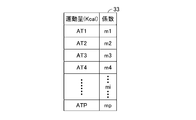
- FIG. 9 shows a table 33 included in the table group TB indicating the relationship between the momentum and the coefficient.
- Coefficients mi are stored corresponding to various types of momentum (Kcal). Note that the amount of exercise is determined based on the type of exercise, such as walking, jogging, sports, cooking at home, and laundry, and the duration of exercise.
- the inventors obtained knowledge that the degree of influence according to the contents of eating and drinking and the elapsed time can be calculated using (Expression 2) to (Expression 4).
- the elapsed time t from eating and drinking and the amount g (unit: grams) of eating and drinking are used.
- a procedure for calculating the degree of influence ⁇ A by the size correction unit 12 using (Formula 2) to (Formula 4) will be described as an example.
- (Formula 2) the sum M ⁇ A of the degree of influence ⁇ A according to the contents of eating and drinking and the elapsed time is calculated.
- the variable TAK (t) in (Equation 2) is calculated by (Equation 3), and the variable Ak is read out by searching the food / drink table 31 based on the information input from the food / beverage information input unit 20.
- the variable gn is determined based on information input from the food and beverage information input unit 20.
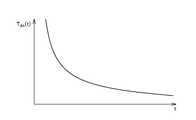
- FIG. 10 schematically shows a graph of the exponential function. As shown in FIG. 10, it can be seen that the value of the variable T AK (t) becomes smaller according to the exponential function as the elapsed time (t) after eating and drinking is longer. That is, it is understood that the total M ⁇ A becomes smaller as the elapsed time (t) after eating and drinking becomes longer, that is, the influence degree becomes smaller.
- the inventors have found through experiments that the total sum M ⁇ A of the degree of influence of (Equation 2) varies depending on the height of the person to be measured even if the same waist circumference, the same food and drink content, and the same elapsed time length. Got. Therefore, in order to obtain measurement accuracy, the size correction unit 12 divides the sum M ⁇ A calculated in (Equation 2) by the height H of the person to be measured as in (Equation 4), and the normalized influence degree. You may acquire (DELTA) A. The height of the measurement subject is acquired from the physique information from the information input unit 25.
- a time change model of the degree of influence ⁇ A is defined by a linear function expression (see FIG. 11).
- the vertical axis represents the value of the degree of influence ⁇ A
- the horizontal axis represents the elapsed time (t) from eating and drinking.
- ⁇ A the time of the uniform for the impact ⁇ A.
- (Expression 2) to (Expression 4) for calculating the influence degree ⁇ A can be changed to simple (Expression 5) to (Expression 6) with a small amount of calculation.
- the size correction unit 12 calculates the value of the variable T AK (t) in accordance with (Equation 7) incorporating the coefficient hi and the coefficient mi read from the tables 32 and 33 based on the information input from the information input unit 25. To do. Therefore, the degree of influence ⁇ A calculated using (Equation 7) varies depending on the gender, age, and amount of exercise of the person to be measured, even if the same waist circumference, the same food and drink content, and the same elapsed time are used. It can be a normalized value.
- the degree of influence ⁇ A of the abdominal width A can be acquired by the above calculation procedure.
- the size correction unit 12 can also obtain the degree of influence ⁇ B for the abdomen vertical width B by the same procedure.
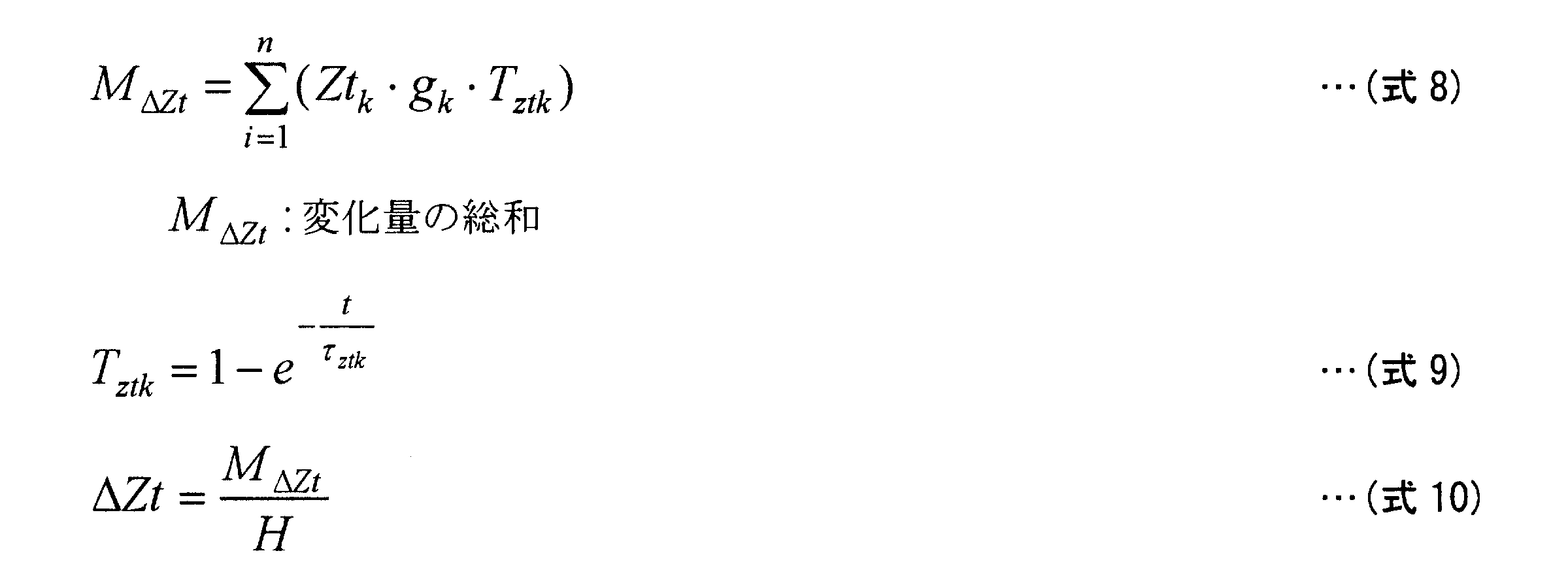
- the impedance correction unit 14 also searches the various tables in the table group TB for the bioelectrical impedances Zt and Zs calculated by the impedance calculation unit 13, and acquires the influence levels ⁇ Zt and ⁇ Zs in the same manner as the above calculation procedure. can do. Equations (8) to (10) are shown as equations for calculating the influence degree ⁇ Zt.
- influence degree (DELTA) A, (DELTA) B, (DELTA) Zt, and (DELTA) Zs was normalized based on a to-be-measured person's height, sex, age classification, and exercise amount, it is not limited to this.
- the values of the influences ⁇ A, ⁇ B, ⁇ Zt, and ⁇ Zs are input from the information input unit 25, smoking, disease, and medical history. Normalization may be performed based on the information.
- the CPU of the control unit 10 accepts input of measured person information including physique information (step S2).
- the measured person information received here is temporarily stored in the memory unit 29, for example.
- step S4 the CPU of the control unit 10 determines whether or not there is an instruction to start measurement via the operation unit 27 (step S4).
- the CPU of the control unit 10 waits until there is an instruction to start measurement (NO in step S4). If an instruction to start measurement is detected (YES in step S4), an electrode is set (step S8).
- the CPU of the control unit 10 first performs an impedance Zt calculation process. That is, for example, one pair of upper limb electrode H11, lower limb electrode F11 and one pair of upper limb electrode H21, lower limb electrode F21 are selected as current electrode pairs, and abdominal electrode pair AP1 is selected as a voltage electrode pair.
- the terminal switching unit 22 electrically connects the pair of upper limb electrodes H11 and the lower limb electrodes F11 and the pair of upper limb electrodes H21 and the lower limb electrodes F21 to the constant current generation unit 21 based on the control of the control unit 10, and
- the abdominal electrode pair AP1 is electrically connected to the potential difference detection unit 23 (step S8).
- the terminal switching unit 22 disconnects the electrical connection between the unselected electrode and the constant current generation unit 21 and the potential difference detection unit 23 based on the control of the CPU of the control unit 10.
- the constant current generation unit 21 causes a current to flow from the upper limb to the lower limb based on the control of the CPU of the control unit 10.
- the constant current generation unit 21 causes a current to flow from the upper limb electrode H11 and the upper limb electrode H21 to the lower limb electrode F11 and the lower limb electrode F21 (step S10).
- the terminal switching unit 22 is preferably configured to short-circuit the upper limb electrode H11 and the upper limb electrode H21 and to short-circuit the lower limb electrode F11 and the lower limb electrode F21.
- the constant current generation unit 21 and the terminal switching unit 22 may have a configuration in which a current flows from any one of the upper limb electrodes H11 and H21 to any one of the lower limb electrodes F11 and F21.
- the potential difference detector 23 detects a potential difference between the abdominal electrodes A11 and A21 of the abdominal electrode pair AP1 based on the control of the CPU of the control unit 10 (step S12).
- the CPU of the control unit 10 selects the abdominal electrode pairs AP2, AP3, AP4 as voltage electrode pairs in order. That is, the terminal switching unit 22 electrically connects the abdominal electrode pairs AP2, AP3, AP4 to the potential difference detection unit 23 in order based on the control of the CPU of the control unit 10 (step S8). Then, the potential difference detection unit 23 sequentially detects the potential difference between the electrodes of the abdominal electrode pairs AP2, AP3, AP4 based on the control of the control unit 10 (step S12).
- the impedance calculation unit 13 ends the detection of the potential difference for all combinations of electrode pairs, here, when the detection of the potential difference between the electrodes of the abdominal electrode pairs AP1, AP2, AP3, AP4 is completed (step Based on the current value supplied by the constant current generator 21 and the potential differences detected by the potential difference detector 23, impedances Zt1 to Zt4 are calculated (step S14).
- the values of the impedances Zt1 to Zt4 calculated by the impedance calculation unit 13 are temporarily stored in the memory unit 29, for example.
- the CPU of the control unit 10 performs an impedance Zs calculation process. That is, the abdominal electrode pair AP1 is selected as the current electrode pair, and the abdominal electrode pair AP2 is selected as the voltage electrode pair.
- the terminal switching unit 22 electrically connects the abdominal electrode pair AP1 to the constant current generating unit 21 and electrically connects the abdominal electrode pair AP2 to the potential difference detecting unit 23 based on the control of the control unit 10 (step). S16).
- the terminal switching unit 22 selectively electrically connects each abdominal electrode pair to the potential difference detection unit 23 based on the control of the CPU of the control unit 10, and selects the abdominal electrode pair, the upper limb electrode, and the unselected abdominal electrode pair.
- the electrical connection between the lower limb electrode and the constant current generator 21 and the potential difference detector 23 is disconnected.
- the constant current generating unit 21 causes a current to flow between the abdominal electrodes A11 and A21 of the abdominal electrode pair AP1 based on the control of the CPU of the control unit 10 (step S18).
- the potential difference detector 23 detects a potential difference between the abdominal electrodes A12 and A22 of the abdominal electrode pair AP2 based on the control of the CPU of the control unit 10 (step S20).
- the control unit 10 selects the abdominal electrode pairs AP3 and AP4 as voltage electrode pairs in order. That is, the terminal switching unit 22 electrically connects the abdominal electrode pairs AP3 and AP4 to the potential difference detection unit 23 in order based on the control of the CPU of the control unit 10 (step S16). Then, the potential difference detection unit 23 sequentially detects a potential difference between each electrode of the abdominal electrode pair AP3 and AP4 based on the control of the CPU of the control unit 10 (step S20).
- the CPU of the control unit 10 selects the abdominal electrode pair AP2 as the current electrode pair, and selects the abdominal electrode pair AP1 as the voltage electrode pair. That is, the terminal switching unit 22 electrically connects the abdominal electrode pair AP2 to the constant current generating unit 21 and electrically connects the abdominal electrode pair AP1 to the potential difference detecting unit 23 based on the control of the CPU of the control unit 10. Connect (step S16).
- the constant current generation unit 21 causes a current to flow between the abdominal electrodes A12 and A22 of the abdominal electrode pair AP2 based on the control of the CPU of the control unit 10 (step S18).
- the potential difference detector 23 detects a potential difference between the abdominal electrodes A11 and A21 of the abdominal electrode pair AP1 based on the control of the CPU of the control unit 10 (step S20).
- the CPU of the control unit 10 selects the abdominal electrode pairs AP3 and AP4 as voltage electrode pairs in order. That is, the terminal switching unit 22 electrically connects the abdominal electrode pairs AP3 and AP4 to the potential difference detection unit 23 in order based on the control of the CPU of the control unit 10 (step S16). Then, the potential difference detection unit 23 sequentially detects a potential difference between each electrode of the abdominal electrode pair AP3 and AP4 based on the control of the CPU of the control unit 10 (step S20).
- the CPU of the control unit 10 sequentially selects the abdominal electrode pairs AP3 and AP4 as current electrode pairs, and for each of the abdominal electrode pairs AP3 and AP4, abdominal parts other than the current electrode pair of the abdominal electrode pairs AP1 to AP4.
- the electrode pairs are sequentially selected as voltage electrode pairs, and potential differences between the electrodes of the voltage electrode pairs are detected (steps S16 to S20).
- the impedance calculation unit 13 determines that the current value passed by the constant current generation unit 21 and the potential difference detection unit 23 Based on the detected potential differences, impedances Zs1 to Zs12 are calculated (step S22).
- the values of the impedances Zs1 to Zs12 calculated by the impedance calculation unit 13 are temporarily stored in the memory unit 29, for example.
- the abdominal fat area Fv is calculated according to (Equation 1).
- the information of (Expression 2) to (Expression 4) is used.
- the degrees of influence ⁇ A and ⁇ B are calculated.
- the abdomen width and the abdomen length input from the information input unit 25 or the physique information measurement unit 24 are corrected by adding the calculated degrees of influence ⁇ A and ⁇ B, respectively.
- the impedance correction unit 14 corrects the impedances Zs and Zt of (Equation 1) based on the contents of eating and drinking and the elapsed time from eating and drinking (step S26).
- the four impedances Zt1 to Zt4 calculated by the impedance calculation unit 13 are read from the memory unit 29, and an impedance Zt that is an average value thereof is calculated. Similarly, an impedance Zs that is an average value of the twelve impedances Zs1 to Zs12 is calculated. Then, using the calculated average impedances Zt and Zs, the influences ⁇ Zt and ⁇ Zs are calculated according to (Expression 7) to (Expression 10), respectively. Then, the average impedances Zt and Zs are corrected by adding the calculated degrees of influence ⁇ Zt and ⁇ Zs.
- the fat area calculation unit 16 calculates the abdominal fat area Fv according to (Equation 1) using the corrected abdominal width A and abdomen vertical width B and the corrected impedances Zs and Zt (step S30). ).
- Step S32 based on the control of the CPU of the control unit 10, measurement results such as the abdominal fat area Fv are stored in the memory unit 29, displayed via the display unit 26, and printed out via the printing unit 30.
- the fat area Fv corrected using the contents of eating and drinking and the elapsed time since the eating and drinking using the influence levels ⁇ A, ⁇ B, ⁇ Zs, and ⁇ Zt, and the fat area Fv before correction may be output. Also, the difference between the two may be output. Moreover, you may make it output the value of the calculated influence degree (DELTA) A, (DELTA) B, (DELTA) Zs, and (DELTA) Zt.
- DELTA calculated influence degree
- the fat area calculation unit 16 calculates the abdominal fat area Fv, and the calculation result is output in step S32.
- steps S24 and S26 although the influence degree was calculated based on the contents of eating and drinking and the elapsed time for correction in steps S24 and S26, the inventors' knowledge (from the experimental results of FIGS. 3, 4, and 6) According to the measurement, it is necessary to correct at least based on the elapsed time from eating and drinking.)
- steps S24 and S26 the influences ⁇ A, ⁇ B, ⁇ Zt, and ⁇ Zs are the contents of eating and drinking and the progress from eating and drinking. Instead of calculating based on both of the times, the calculation may be performed based on the elapsed time.
- the terms of the variables A k and g k may be deleted from (Expression 2), and the influence ⁇ A of (Expression 4) may be calculated. Even with this method, it is possible to measure the amount of fat with less influence of food and drink.
- the output destination of the measurement result of step S32 is not limited to the display part 26 and the printing part 30 connected to the abdominal fat mass measuring apparatus 1.
- the abdominal fat mass measuring apparatus 1 may include a communication interface, and may be transmitted to an external device (computer, television, portable terminal, etc.) via the communication interface and output from the external device.
- 1 abdominal fat mass measuring device 10 control unit, 12 size correction unit, 13 impedance calculation unit, 14 impedance correction unit, 15 calculation unit, 16 fat area calculation unit, 20 food and beverage information input unit, 21 constant current generation unit, 22 terminals Switching unit, 23 Potential difference detection unit, 24 Body size information measurement unit, 25 Information input unit, 26 Display unit, 29 Memory unit, 30 Printing unit, 31 Food and drink table, 32, 33, 321, 322 table, 40 Electrode sheet, A Abdominal width, B abdominal length, FFM lean mass, Fv abdominal fat area, TB table group
Landscapes
- Health & Medical Sciences (AREA)
- Life Sciences & Earth Sciences (AREA)
- Biomedical Technology (AREA)
- Heart & Thoracic Surgery (AREA)
- Radiology & Medical Imaging (AREA)
- Biophysics (AREA)
- Pathology (AREA)
- Engineering & Computer Science (AREA)
- Nuclear Medicine, Radiotherapy & Molecular Imaging (AREA)
- Physics & Mathematics (AREA)
- Medical Informatics (AREA)
- Molecular Biology (AREA)
- Surgery (AREA)
- Animal Behavior & Ethology (AREA)
- General Health & Medical Sciences (AREA)
- Public Health (AREA)
- Veterinary Medicine (AREA)
- Measurement And Recording Of Electrical Phenomena And Electrical Characteristics Of The Living Body (AREA)
Abstract
装置は、被測定者の腹部のサイズを計測するサイズ計測部と、腹部の生体インピーダンスを取得するインピーダンス取得手段と、腹部の脂肪量を算出する算出部(15)と、を備える。サイズ計測部は、計測された腹部のサイズを、被測定者が飲食してからの経過時間を用いて補正するサイズ補正部(12)を含む。算出部(15)は、インピーダンス取得部により取得された生体インピーダンスと、サイズ補正部(12)によって補正された腹部のサイズとを用いて、所定換算式に従って被測定者の腹部の脂肪量を算出する。
Description
この発明は腹部脂肪量測定装置に関し、特に、生体インピーダンスを用いて腹部の脂肪量を測定する腹部脂肪量測定装置に関する。
従来の生体インピーダンスを測定し、測定した生体インピーダンスと体格情報に基づき、所定の換算式に従って内臓脂肪量および皮下脂肪量を算出する装置が、特開2003-52659号公報(特許文献1)、特開2006-288734号公報(特許文献2)および特開2005-288023号公報(特許文献3)に示される。これら特許文献に示されるように、内臓脂肪量および皮下脂肪量の算出には、生体インピーダンスと体格情報を用いるので、被測定者が飲食した場合、その影響は生体インピーダンスと体格情報に表れる。したがって、測定精度を保証するために、一般的には、飲食の影響が及ばないように飲食後2時間以上経過したときに測定を行うことが条件とされている。
被測定者の飲食を考慮した測定方法の一例が、特開2006-288734号公報(特許文献2)に示される。特開2006-288734号公報(特許文献2)の段落0081および図13などによれば、生体インピーダンスが正常許容範囲内の値を指すかを判定し、正常許容範囲を超えると判定した場合には、コンディション異常に関するメッセージ報知およびブザー報知をする。これにより、被測定者に飲食の影響がない最善の環境で測定に臨んでもらうように促している。
しかしながら、特開2006-288734号公報(特許文献2)の方法であれば、被測定者は食事の影響がなくなった時に再度、測定を行う必要があり、被測定者は食事の影響がなくなるまで上述した2時間以上は待つ必要があり、実用性に優れない。
それゆえにこの発明の目的は、飲食に関わり無く正確な測定を可能にする腹部脂肪量測定装置を提供することである。
本発明に係る腹部脂肪量測定装置は、被測定者の腹部のサイズを計測するサイズ計測部と、腹部の生体インピーダンスを取得するインピーダンス取得部と、腹部の脂肪量を算出する算出部と、を備える。サイズ計測部は、計測された腹部のサイズを、被測定者が飲食してからの経過時間を用いて補正するサイズ補正部を含む。算出部は、インピーダンス取得部により取得された生体インピーダンスと、サイズ補正部によって補正された腹部のサイズとを用いて、所定換算式に従って脂肪量を算出する。
発明によれば、飲食に関わり無く正確に脂肪量を測定することができる。
本発明の実施の形態について図面を参照しながら詳細に説明する。なお、各図中同一または相当部分には、同一符号を付してその説明は繰返さない。
なお、本実施の形態で「腹部」とは、臍を中心とした部分であり、体幹部のうちの胸部を除く部分である。「体軸」とは、腹部の横断面に対し略垂直な方向の軸である。また、「腹部前面」とは、腹部のうち、被測定者を正面から観察した場合に視認可能な部分を含む。たとえば、被測定者の腹部のうち、臍および背骨を通るとともに体軸と垂直な軸に沿って、被測定者を臍側から観察した場合に視認可能な部分を含む。また、「腹部背面」とは、腹部のうち、被測定者を後ろから観察した場合に視認可能な部分を含む。たとえば、被測定者の腹部のうち、臍および背骨を通るとともに体軸と垂直な軸に沿って、被測定者を背骨側から観察した場合に視認可能な部分を含む。また、腹部の縦は、腹部の体軸が延びる方向の長さを指し、腹部の横とは体軸と略直交する方向の長さを指す。
図1には、本実施の形態に係る腹部脂肪量測定装置1の構成が示される。腹部脂肪量測定装置1の制御部10は、CPU(Central Processing Unit)を含むマイクロプロセッサからなり、演算処理部11を有する。演算処理部11は、サイズ補正部12、インピーダンス算出部13および各種脂肪量を算出するための算出部15を含む。
制御部10には、被測定者の飲食内容(飲食物の量および種類)および飲食してからの経過時間に関する情報を入力するための飲食情報入力部20、演算処理部11において行なわれる演算処理に利用される被測定者情報を得るための体格情報計測部24および情報入力部25が接続される。なお、飲食情報入力部20と情報入力部25は、腹部脂肪量測定装置1外部のコンピュータまたは入力端末に代替してもよい。そして、これらコンピュータまたは入力端末から有線もしくは無線により腹部脂肪量測定装置1に情報を伝送するようにしてもよい。
ここで、被測定者情報とは、被測定者に関する情報を意味し、たとえば年齢、性別、体格情報、運動量に関する情報、喫煙に関する情報、疾患に関する情報、過去の病歴に関する情報の情報などを含む。
また、体格情報とは、測定開始時の被測定者の身体の特定の部位におけるサイズに関する情報、たとえば、ウエスト長(腹部周長)、腹部縦/横幅および腹部厚みなどを含む情報と、身長および体重などの情報とを含む。
体格情報計測部24は、被測定者の測定開始時の体格情報を自動計測する部位であり、計測した体格情報を制御部10へ出力する。情報入力部25は、被測定者情報を入力するための部位であり、入力された被測定者情報を制御部10へ出力する。
なお、被測定者情報のうち、体格情報については、体格情報計測部24で自動計測を行なうように構成してもよいし、被測定者自らが手動で体格情報を計測して入力する構成としてもよい。
サイズ補正部12は、体格情報計測部24によって計測された被測定者の腹部の縦および横のサイズ、より特定的には被測定者の臍周りにおける縦および横のサイズを補正する。具体的には、サイズ補正部12は、計測されたサイズを、飲食情報入力部20から入力した飲食内容と被測定者が飲食してから測定時までの経過時間とを用いて飲食前のサイズとなるように補正する。
インピーダンス算出部13は、生体インピーダンスを取得する。より具体的には、体表面に接触させたインピーダンス測定電極を用いて生体インピーダンスを計測する機能を有する。インピーダンス算出部13は、計測された生体インピーダンスを、飲食情報入力部20から入力した飲食内容と被測定者が飲食してから測定時までの経過時間とを用いて、飲食前のインピーダンスとなるように補正するインピーダンス補正部14を有する。サイズ補正部12によるサイズの補正およびインピーダンス補正部14による生体インピーダンスの補正の詳細は後述する。
算出部15は、インピーダンス算出部13が算出した生体インピーダンスと、被測定者の体格情報とを用いて、所定換算式に従って腹部の各種脂肪量を算出する。算出部15は、腹部の脂肪量として腹部の脂肪面積を算出する脂肪面積算出部16を含む。
さらに、腹部脂肪量測定装置1は、定電流生成部21、端子切替部22、電位差検出部23、表示部26、操作部27、電源部28、メモリ部29、測定結果を印刷出力するための印刷部30、および複数の電極を備える。
表示部26は、演算処理部11において算出された各種脂肪量の情報を表示する。表示部26としては、たとえばLCD(Liquid Crystal Display)が利用可能である。
操作部27は、腹部脂肪量測定装置1に対して被測定者が命令を入力するための部位であり、たとえば被測定者が押下可能なキー・スイッチなどで構成される。
電源部28は、制御部10など各部に電力を供給するための部位であり、バッテリなどの内部電源および商用電源などの外部電源等を含む。
メモリ部29は、各種のテーブルを含むテーブル群TBと、腹部脂肪量測定装置1に関する各種のデータおよびプログラムを記憶するための部位であり、たとえば上述した被測定者情報、算出された内臓脂肪量、および後述する体脂肪測定処理を実行するための体脂肪測定プログラムなどを記憶している。
腹部脂肪量測定装置1は、複数の電極として、被測定者の腹部背面に装着される腹部電極対AP1~AP4と、被測定者の上肢に装着される上肢電極H11,H21と、被測定者の下肢に装着される下肢電極F11,F21とを備えている。
制御部10は、腹部脂肪量測定装置1の全体的な制御を行なう。具体的には、制御部10は、上述した各種機能ブロックに対して指令を送出したり、得られた情報に基づいて各種の演算処理を行なったりする。このうち各種の演算処理については、制御部10に設けられた演算処理部11によって行なわれる。
腹部電極対AP1~AP4は、それぞれ体軸方向に被測定者の腹部背面の表面に装着される。上肢電極H11,H21は、好適には右手の手首の表面と左手の手首の表面とにそれぞれ装着される。下肢電極F11,F21は、好適には右足の足首の表面と左足の足首の表面とにそれぞれ装着される。腹部電極対AP1~AP4、上肢電極H11,H21、および下肢電極F11,F21は、それぞれ端子切替部22と電気的に接続されている。
端子切替部22は、たとえば複数のリレー回路によって構成される。端子切替部22は、制御部10から受けた指令に基づいて、上述した複数の電極の中から選択した特定の電極対と定電流生成部21とを電気的に接続するとともに、上述した複数の電極の中から選択した特定の電極対と電位差検出部23とを電気的に接続する。これにより、端子切替部22によって定電流生成部21と電気的に接続された電極対が定電流印加電極対として機能するようになるとともに、端子切替部22によって電位差検出部23と電気的に接続された電極対が電位差検出電極対として機能するようになる。端子切替部22による電気的な接続は、測定動作中において種々切り替えられる。
定電流生成部21は、制御部10から受けた指令に基づいて定電流を生成し、生成した定電流を端子切替部22に供給する。定電流生成部21は、たとえば、体組成情報を測定するために好適に使用される高周波電流(たとえば、50kHz,500μA)を供給する。これにより、端子切替部22によって定電流生成部21と電気的に接続された電極対、すなわち定電流印加電極対を介して定電流が被測定者に印加されることになる。
電位差検出部23は、端子切替部22によって電位差検出部23と電気的に接続された電極対、すなわち電位差検出電極対の電極間における電位差を検出し、検出した電位差を制御部10へ出力する。これにより、定電流が被測定者に印加された状態における電位差検出電極対の電極間の電位差が検出されることになる。
インピーダンス算出部13は、定電流生成部21によって生成された定電流の電流値と、電位差検出部23において検出されて制御部10が受けた電位差情報とに基づいて各種インピーダンスを算出する。
次に、本発明の実施の形態に係る腹部脂肪面積の算出の際に脂肪面積算出部16により実施される演算処理を例示する。
図1を参照して、インピーダンス算出部13は、定電流生成部21において生成される電流値と、電位差検出部23において検出される電位差とに基づいて、2種類のインピーダンスを算出する。2種類のインピーダンスの一方は、被測定者の腹部における除脂肪量を反映するインピーダンス(以下、インピーダンスをZtとも称する。)である。他方のインピーダンスは、被測定者の腹部における皮下脂肪量を反映するインピーダンス(以下、インピーダンスをZsとも称する。)である。
脂肪面積算出部16は、インピーダンス算出部13により算出された2種類のインピーダンスZt,Zsと、被測定者の腹部の縦幅および横幅とに基づいて、以下のような(式1)に従って腹部の内臓脂肪面積(単位:cm2)を算出する。(式1)に従う算出より、腹部の内臓脂肪面積が推定される。以下、(式1)に従って算出される値を、腹部脂肪面積Fvと称する。

(式1)は、臍位腹部横幅Aと縦幅B、ならびにインピーダンス算出部13により算出されるインピーダンスZsとZtと、所定の係数α1、α2、α3、α4およびεを含む。
(式1)は、“論文:生体インピーダンス法を用いた内臓脂肪推定モデルの開発”:「知能と情報」(日本知能情報ファジィ学会誌)Vol20,No.1,pp.90-99(2008)”から引用したものである。
図2には、実施の形態に係る腹部脂肪量を測定する場合における体表面における電極の配置例が示される。図2では、4対の電極が配置された状態が示されている。
図2を参照して、腹部脂肪量測定装置1は、電極シート40を備える。電極シート40は、腹部電極対AP1,AP2,AP3,AP4とシート材とが一体的に形成されたものである。腹部電極対AP1は、腹部電極A11およびA21を含む。腹部電極対AP2は、腹部電極A12およびA22を含む。腹部電極対AP3は、腹部電極A13およびA23を含む。腹部電極対AP4は、腹部電極A14およびA24を含む。
腹部電極対AP1,AP2,AP3,AP4は、被測定者の腹部背面において体軸方向に配置され、かつ体軸と略垂直な方向に互いに間隔をあけて配置される。たとえば、腹部電極対AP2は、腹部電極対AP1の腹部電極A11,A21を通る軸から所定距離離れて配置される。
腹部電極対AP1,AP2,AP3,AP4の各々の電極間距離は略等しい。たとえば、腹部電極対AP1の腹部電極A11,A21間の距離と腹部電極対AP2の腹部電極A12,A22間の距離とは略等しい。腹部電極対AP1,AP2,AP3,AP4の電極の各々は、対応する他の電極対の電極と体軸に略垂直な方向に整列して配置される。すなわち、腹部電極A11,A12,A13,A14は体軸と略垂直な方向に一列に配置される。腹部電極A21,A22,A23,A24は体軸と略垂直な方向に一列に配置される。
定電流生成部21は、端子切替部22によって定電流生成部21と電気的に接続された電極対(以下、電流電極対とも称する)の電極間に電流を流す。
そして、電位差検出部23は、端子切替部22によって電位差検出部23と電気的に接続された電極対(以下、電圧電極対とも称する)の電極間の電位差を検出する。
インピーダンス算出部13は、電位差検出部23によって検出された電圧電極対の電極間の電位差に基づき生体インピーダンスを算出し、算出部15の脂肪面積算出部16は、算出された生体インピーダンスを用いて被測定者の腹部脂肪面積Fvおよび各種脂肪量を算出する。
図2では、一般的に、皮下脂肪は腹部前面よりも腹部背面の方が多いことに鑑みて、腹部背面の体表面に腹部電極対を接触させているが、腹部前面に接触させた場合であっても同様に腹部脂肪面積Fvを含む腹部脂肪量を算出することができる。
発明者らは、飲食経過時間と飲食内容が生体インピーダンスおよび体格情報に与える影響を実験により測定した。実験の結果が図3~図6に示される。
図3~図6には、健康的な標準体格の成人を対象にして、飲食からの経過時間および飲食内容に従う腹部縦幅の変化(図3)、生体インピーダンスの変化(図4)、体重・腹囲(ウェスト長)の変化(図5)、および腹部脂肪面積の変化(図6)が示される。
図3には、横軸には時間経過が取られ、縦軸には腹部横幅の変位がとられている。なお、変位は変化の大きさと変化の方向を指す。変化の方向は、増加または減少を指す。
図3に示されるように、水分を含む飲食物を摂取した直後から時間が経過するにつれて腹部縦幅は増加し続け、増加がピークに達すると、その後は減少し元の縦幅に戻ることがわかる。また、水分のみを摂取した場合は、食事と水分の両方を摂取した場合よりも、元の縦幅に戻るのに要する時間が短いことがわかる。
図4には、横軸には時間経過が取られ、縦軸には図2のように電極を接触させた状態で測定される生体インピーダンスZtの変位が取られている。図示されるように、食事または水分を摂ることにより、経過時間に従って生体インピーダンスZtが変化することがわかる。また、飲食後に1時間半経過後に測定される生体インピーダンスの変位は、水分のみを摂取した場合の方が、食事および水分の両方を摂取した場合に比べて小さいことがわかる。
図5には、横軸には時間経過が取られ、縦軸には体重およびお臍周りの腹囲(ウェストサイズ)の変位が取られている。図示されるように、腹囲は食事の摂取により、摂取後1時間半経過後に測定される変位は、水分のみを摂取した場合に比較して大きいことがわかる。一方、体重は水分のみを摂取後1時間半経過後に測定される変位は、食事と水分を摂取した場合よりも小さいことがわかる。なお、図3の腹部縦幅の変化および図5の腹囲の変化を比べると、腹囲横幅は飲食によってもほとんど変化しないことが推定される。
図6には、横軸には時間経過が取られ、縦軸には腹部脂肪面積Fvの変位が取られている。図示されるように、食事および水分を摂ることにより、腹部脂肪面積Fvは時間経過に従って変化する。この変化は図3と対応付けると、腹部縦幅の変化におおよそ一致していることがわかる。このことから、腹部脂肪面積Fvは、被測定者が飲食してからの経過時間に従う腹囲(より特定的には腹部の縦幅)の変動に従って変動することがわかる。
これらの実験結果から、発明者らは、飲食に関わり無く正確に腹部脂肪面積Fvを測定するには、(式1)の腹囲(腹部の横幅Aと縦幅B)と生体インピーダンス(インピーダンスZtとZs)を、被測定者が飲食してからの経過時間と飲食内容に基づき補正することが必要であるとの知見を得た。また、摂取した飲食内容による腹囲と生体インピーダンスの変位(影響)は、飲食からの経過時間に従って出現するとの知見を得た。
さらに、図3と図4の実験結果では、飲食による生体インピーダンスの変位は、腹部横幅の変位よりも小さいことから、発明者らは、(式1)の少なくとも、腹囲(腹部の横幅Aと縦幅B)を、被測定者が飲食してからの経過時間と飲食内容に基づき補正することが必要であるとの知見を得た。
また、図3と図4と図6の実験結果では、生体インピーダンスと腹部縦幅は、飲食内容よりも飲食してからの経過時間に方に従って顕著に変位することから、発明者らは、被測定者が飲食してからの経過時間と飲食内容のうち、少なくとも、飲食からの経過時間に基づき補正することが必要であるとの知見を得た。
図7には、テーブル群TBに含まれる飲食物テーブル31が示される。発明者らが提案する飲食物テーブル31は、飲料水を含む食物の種類(飲食物k(k=1,2,3,・・・n))のデータと、各飲食物kに対応して、当該飲食物を1グラム摂取した場合の影響度のデータが格納されている。
影響度のデータは、(式1)の腹部の横幅Aおよび縦幅B、ならびにインピーダンスZsとZtのそれぞれについて、1グラム当たりの影響度ΔA、ΔB、ΔZt、ΔZsのデータを含む。影響度ΔAは、健康的で標準体格の成人が、各飲食物kを摂取した場合の1グラムを当たりの腹部の横幅の平均的な変化の大きさAk(k=1,2,3,・・・n)と、時定数τAK(k=1,2,3,・・・n)とを含む。
ここでの時定数とは、飲食からの経過時間に着目した時間のパラメータであり、摂取した飲食物1グラム当りの生体(たとえば、腹部の横幅A)に影響を与る速さを特徴付ける値である。
他の影響度ΔB、ΔZt、ΔZsについても同様である、つまり、影響度ΔBは、健康的で標準体格の成人が、各飲食物kを摂取した場合の1グラムを当たりの腹部の縦幅の平均的な変化の大きさBk(k=1,2,3,・・・n)と、時定数τBK(k=1,2,3,・・・n)とを含む。影響度ΔZtは、健康的で標準体格の成人が、各飲食物kを摂取した場合の1グラムを当たりのインピーダンスZtの平均的な変化の大きさZtk(k=1,2,3,・・・n)と、時定数τZtK(k=1,2,3,・・・n)とを含む。影響度ΔZsは、健康的で標準体格の成人が、各飲食物kを摂取した場合の1グラムを当たりのインピーダンスZsの平均的な変化の大きさZsk(k=1,2,3,・・・n)と、時定数τZSK(k=1,2,3,・・・n)とを含む。
発明者らは、実験により、上述した各種の時定数は、被測定者の性別および年齢によりばらつくとの知見を得た。つまり、年齢・性別により飲食物が消化される速さに差が生じるとの知見を得た。
そこで、本実施の形態では、上述した各種の時定数には、被測定者の性別および年齢に基づき図8のテーブル32から読出した係数hiを、時定数に乗じることで、時定数を正規化する。
図8には、テーブル群TBに含まれるテーブル32が示される。テーブル32は、性別毎にテーブル321と322を含む。テーブル321と322は、年齢別に、時定数に乗じる係数hi(i=1,2,3・・・m)が格納されている。
また、発明者らは、実験により、上述した各種の時定数は、飲食してから測定時までに被測定者が行った運動量(Kcal)により、ばらつくとの知見を得た。つまり、運動により飲食物が消化される速さに差が生じるとの知見を得た。
そこで、本実施の形態では、上述した各種の時定数には、運動量に基づき図9のテーブル33から読出した係数mi(i=1,2,3・・・p)を、時定数に乗じることで、時定数を正規化する。
図9には、運動量と係数の関係を示すテーブル群TBに含まれるテーブル33が示される。各種の運動量(Kcal)に対応して係数miが格納されている。なお、運動量は、ウォーキング、ジョギング、スポーツの種類もしくは、家庭での炊事、洗濯などの運動の強度と運動の時間とに基づき決定される。
実験の結果に基づき、発明者らは、飲食内容と経過時間に従う影響度は(式2)~(式4)を用いて算出できるとの知見を得た。式では、飲食からの経過時間t、飲食した量g(単位:グラム)が用いられている。
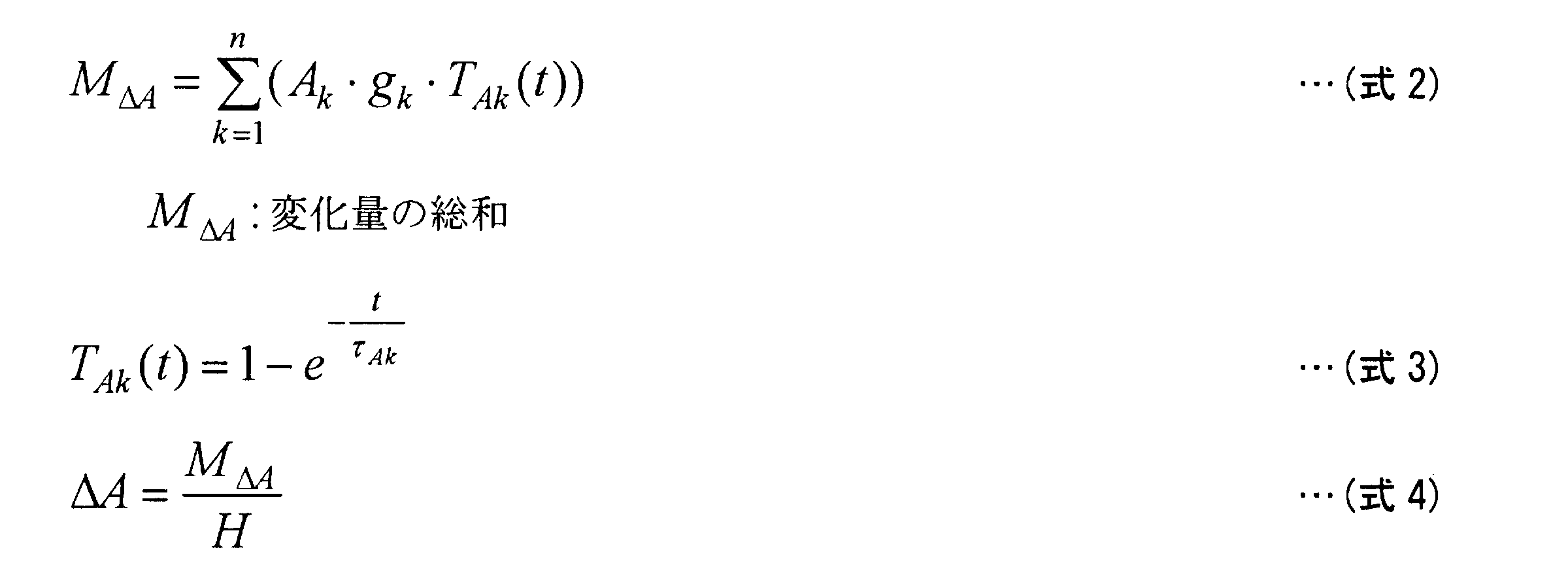
サイズ補正部12による、(式2)~(式4)を用いて一例として影響度ΔAを算出する手順を説明する。(式2)に従えば、飲食内容と経過時間に従う影響度ΔAの総和MΔAが算出される。ここで(式2)の変数TAK(t)は(式3)により算出されて、変数Akは飲食情報入力部20から入力された情報に基づき、飲食物テーブル31を検索することにより、読出され、変数gnは、飲食情報入力部20から入力された情報に基づき決定される。
(式3)により変数TAK(t)を算出することにより、(式2)では、影響度ΔAの時間変化が考慮された総和MΔAが算出されることが示される。
(式3)の変数TAK(t)の経過時間tに従う変化のモデルは、対数eに基づく指数関数で示されて、図10には指数関数のグラフが模式的に示される。図10に示すように、飲食してからの経過時間(t)が長いほど、変数TAK(t)の値は指数関数に従って小さくなることがわかる。つまり、総和MΔAは、飲食してからの経過時間(t)が長いほど小さくなる、すなわち影響度は小さくなることがわかる。
また、発明者らは、実験により、同じ腹囲、同じ飲食内容および同じ経過時間の長さであったとしても被測定者の身長によって(式2)の影響度の総和MΔAがばらつくとの知見を得た。そこで、測定精度を得るために、サイズ補正部12は(式2)で算出された総和MΔAを(式4)のように被測定者の身長Hにより除して、正規化された影響度ΔAを取得してもよい。なお、被測定者の身長は、情報入力部25からの体格情報により取得される。
サイズ補正部12による影響度ΔAを算出するための他の算出式が、(式5)と(式6)に示される。

上述した(式2)~(式4)では指数関数を採用しているために、これらの式の演算量は比較的多く、処理に時間がかかる。そこで、演算量を削減するために、影響度ΔAの時間変化モデルを、一次関数の式で定義する(図11参照)。図11では、縦軸に影響度ΔAの値が取られて、横軸には飲食からの経過時間(t)が取られている。また、時定数については、食物毎に想定せずに、影響度ΔAについて一律の時定数αAtを用いる。この場合は、影響度ΔAの算出するための(式2)~(式4)は、演算量が少ない簡単な(式5)~(式6)に変更することができる。
また、(式6)では被測定者の身長Hを用いた正規化を行っていないが、行なうようにしてもよい。
上述のサイズ補正部12の演算により算出される影響度ΔAは、性別・年齢別・運動量に応じて算出される場合には、より高い測定精度を得ることができる。具体的には、上述の(式3)を(式7)に変更して、(式4)に従って影響度ΔAを算出する。

サイズ補正部12は、情報入力部25から入力された情報に基づきテーブル32および33から読出した係数hiと係数miとを組込んだ(式7)に従って、変数TAK(t)の値を算出する。したがって、(式7)を用いて算出される影響度ΔAは、同じ腹囲、同じ飲食内容および同じ経過時間の長さであったとしても、被測定者の性別・年齢別・運動量に応じてばらつくことはなく、正規化された値とすることができる。
上述の算出手順により腹部横幅Aの影響度ΔAを取得できる。なお、サイズ補正部12は、腹部縦幅Bについても同様の手順により影響度ΔBを取得することができる。
また、インピーダンス補正部14は、インピーダンス算出部13が算出する生体インピーダンスZtおよびZsについても、テーブル群TBの各種テーブルを検索して、上述の算出手順と同様にして、影響度ΔZtおよびΔZsを取得することができる。影響度ΔZtの算出式として(式8)~(式10)を示す。
なお、影響度ΔA、ΔB、ΔZt、ΔZsの値は、被測定者の身長・性別・年齢別・運動量に基づき正規化したがこれに限定されない。たとえば、喫煙、疾患および病歴によっても飲食物テーブル31の各種の時定数にはばらつきが生じるので、影響度ΔA、ΔB、ΔZt、ΔZsの値を、情報入力部25から入力した喫煙、疾患および病歴の情報に基づき正規化するようにしてもよい。
なお、上述した身長Hによる正規化、性別・年齢別・運動量に応じた正規化、喫煙、疾患および病歴の情報に基づく正規化を行うか否かについては、情報入力部25を介して被測定者が選択的に指定可能としてもよい。
次に、図12のフローチャートに従って、本発明の実施の形態に係る腹部脂肪量測定装置1による脂肪量の測定処理について説明する。図12のフローチャートに示す処理は、予めプログラムとしてメモリ部29に格納されており、制御部10のCPUがこのプログラムを読み出して実行することにより、測定処理の機能が実現される。
なお、被測定者の体表面には、図1と図2で説明をしたように体表面に電極が接触していると想定する。また、説明を簡単にするために、影響度ΔA,ΔBは、(式2)~(式4)を用いて算出されて、影響度ΔZt、ΔZsは(式8)~(式10)を用いて算出されると想定する。
図12のフローチャートを参照して、制御部10のCPUは、体格情報を含む被測定者情報の入力を受け付ける(ステップS2)。ここで受け付けた被測定者情報は、たとえばメモリ部29に一時的に保存される。
次に、制御部10のCPUは、操作部27を介して測定開始の指示があったか否かを判断する(ステップS4)。制御部10のCPUは、測定開始の指示があるまで待機する(ステップS4においてNO)。測定開始の指示を検知した場合(ステップS4においてYES)、電極の設定を行なう(ステップS8)。
より具体的には、制御部10のCPUは、まずインピーダンスZtの算出処理を行なう。すなわち、たとえば1対の上肢電極H11,下肢電極F11および1対の上肢電極H21,下肢電極F21をそれぞれ電流電極対として選択し、腹部電極対AP1を電圧電極対として選択する。端子切替部22は、制御部10の制御に基づいて、1対の上肢電極H11,下肢電極F11および1対の上肢電極H21,下肢電極F21を定電流生成部21と電気的に接続し、かつ腹部電極対AP1を電位差検出部23と電気的に接続する(ステップS8)。ここで、端子切替部22は、制御部10のCPUの制御に基づいて、選択されていない電極と定電流生成部21および電位差検出部23との電気的接続を切断する。
定電流生成部21は、制御部10のCPUの制御に基づいて、上肢から下肢の方向に電流を流す。たとえば、定電流生成部21は、上肢電極H11および上肢電極H21から下肢電極F11および下肢電極F21へ電流を流す(ステップS10)。この場合、端子切替部22は、上肢電極H11と上肢電極H21とを短絡し、かつ下肢電極F11と下肢電極F21とを短絡させる構成であることが好ましい。なお、定電流生成部21および端子切替部22は、上肢電極H11,H21のいずれか1個から下肢電極F11,F21のいずれか1個へ電流を流す構成であってもよい。
この状態において、電位差検出部23は、制御部10のCPUの制御に基づいて、腹部電極対AP1の腹部電極A11,A21間の電位差を検出する(ステップS12)。
そして、制御部10のCPUは、腹部電極対AP2,AP3,AP4を順番に電圧電極対として選択する。すなわち、端子切替部22は、制御部10のCPUの制御に基づいて、腹部電極対AP2,AP3,AP4を順番に電位差検出部23と電気的に接続する(ステップS8)。そして、電位差検出部23は、制御部10の制御に基づいて、腹部電極対AP2,AP3,AP4の各々の電極間の電位差を順番に検出する(ステップS12)。
インピーダンス算出部13は、すべての電極対の組み合わせに対して電位差の検出が終了した場合、ここでは腹部電極対AP1,AP2,AP3,AP4の各々の電極間における電位差の検出が終了した場合(ステップS13でYES)、定電流生成部21が流した電流値と、電位差検出部23が検出した各電位差とに基づいて、インピーダンスZt1~Zt4を算出する(ステップS14)。インピーダンス算出部13が算出したインピーダンスZt1~Zt4の値は、たとえばメモリ部29に一時的に保存される。
次に、制御部10のCPUは、インピーダンスZsの算出処理を行なう。
すなわち、腹部電極対AP1を電流電極対として選択し、腹部電極対AP2を電圧電極対として選択する。端子切替部22は、制御部10の制御に基づいて、腹部電極対AP1を定電流生成部21と電気的に接続し、かつ腹部電極対AP2を電位差検出部23と電気的に接続する(ステップS16)。ここで、端子切替部22は、制御部10のCPUの制御に基づいて、各腹部電極対を選択的に電位差検出部23と電気的に接続し、選択されていない腹部電極対、上肢電極および下肢電極と定電流生成部21および電位差検出部23との電気的接続を切断する。
すなわち、腹部電極対AP1を電流電極対として選択し、腹部電極対AP2を電圧電極対として選択する。端子切替部22は、制御部10の制御に基づいて、腹部電極対AP1を定電流生成部21と電気的に接続し、かつ腹部電極対AP2を電位差検出部23と電気的に接続する(ステップS16)。ここで、端子切替部22は、制御部10のCPUの制御に基づいて、各腹部電極対を選択的に電位差検出部23と電気的に接続し、選択されていない腹部電極対、上肢電極および下肢電極と定電流生成部21および電位差検出部23との電気的接続を切断する。
定電流生成部21は、制御部10のCPUの制御に基づいて、腹部電極対AP1の腹部電極A11,A21間に電流を流す(ステップS18)。
この状態において、電位差検出部23は、制御部10のCPUの制御に基づいて、腹部電極対AP2の腹部電極A12,A22間の電位差を検出する(ステップS20)。
そして、制御部10は、腹部電極対AP3およびAP4を順番に電圧電極対として選択する。すなわち、端子切替部22は、制御部10のCPUの制御に基づいて、腹部電極対AP3およびAP4を順番に電位差検出部23と電気的に接続する(ステップS16)。そして、電位差検出部23は、制御部10のCPUの制御に基づいて、腹部電極対AP3およびAP4の各々の電極間の電位差を順番に検出する(ステップS20)。
次に、制御部10のCPUは、腹部電極対AP2を電流電極対として選択し、腹部電極対AP1を電圧電極対として選択する。すなわち、端子切替部22は、制御部10のCPUの制御に基づいて、腹部電極対AP2を定電流生成部21と電気的に接続し、かつ腹部電極対AP1を電位差検出部23と電気的に接続する(ステップS16)。
定電流生成部21は、制御部10のCPUの制御に基づいて、腹部電極対AP2の腹部電極A12,A22間に電流を流す(ステップS18)。
この状態において、電位差検出部23は、制御部10のCPUの制御に基づいて、腹部電極対AP1の腹部電極A11,A21間の電位差を検出する(ステップS20)。
そして、制御部10のCPUは、腹部電極対AP3およびAP4を順番に電圧電極対として選択する。すなわち、端子切替部22は、制御部10のCPUの制御に基づいて、腹部電極対AP3およびAP4を順番に電位差検出部23と電気的に接続する(ステップS16)。そして、電位差検出部23は、制御部10のCPUの制御に基づいて、腹部電極対AP3およびAP4の各々の電極間の電位差を順番に検出する(ステップS20)。
同様に、制御部10のCPUは、腹部電極対AP3およびAP4を順番に電流電極対として選択し、腹部電極対AP3およびAP4の各々について腹部電極対AP1~AP4のうちの電流電極対以外の腹部電極対を順番に電圧電極対として選択し、電圧電極対の電極間の電位差をそれぞれ検出する(ステップS16~S20)。
インピーダンス算出部13は、すべての電極対の組み合わせに対して電流の印加および電位差の検出が終了した場合(ステップS21でYES)、定電流生成部21が流した電流値と、電位差検出部23が検出した各電位差とに基づいて、インピーダンスZs1~Zs12を算出する(ステップS22)。インピーダンス算出部13が算出したインピーダンスZs1~Zs12の値は、たとえばメモリ部29に一時的に保存される。
次に、腹部脂肪面積Fvを(式1)に従って算出する。
まず、サイズ補正部12は、(式1)の腹部横幅Aおよび腹部縦幅Bを飲食内容および飲食からの経過時間に基づき補正する(ステップS24)。
まず、サイズ補正部12は、(式1)の腹部横幅Aおよび腹部縦幅Bを飲食内容および飲食からの経過時間に基づき補正する(ステップS24)。
具体的には、情報入力部25から入力された、または体格情報または計測部24により計測がされた腹部横幅および腹部縦幅を補正するために、(式2)~(式4)の情報を用いて影響度ΔA,ΔBをそれぞれ算出する。そして、情報入力部25または体格情報計測部24から入力した腹部横幅および腹部縦幅それぞれを、算出された影響度ΔA,ΔBそれぞれを加算することにより補正する。
次にインピーダンス補正部14は、(式1)のインピーダンスZsおよびZtを飲食内容および飲食からの経過時間に基づき補正する(ステップS26)。
具体的には、インピーダンス算出部13により算出された4個のインピーダンスZt1~Zt4をメモリ部29から読出し、その平均値であるインピーダンスZtを算出する。同様に、12個のインピーダンスZs1~Zs12の平均値であるインピーダンスZsを算出する。そして、算出した平均のインピーダンスZtとZsのそれぞれを用いて、(式7)~(式10)に従って、影響度ΔZt,ΔZsをそれぞれ算出する。そして、算出された影響度ΔZt,ΔZsそれぞれを加算することにより、平均のインピーダンスZtとZsを補正する。
次に、脂肪面積算出部16は、補正後の腹部横幅Aおよび腹部縦幅B、ならびに補正後のインピーダンスZsおよびZtを用いて、(式1)に従って、腹部脂肪面積Fvを算出する(ステップS30)。
そして、制御部10のCPUの制御に基づいて、腹部脂肪面積Fvなどの測定結果がメモリ部29に格納されるとともに、表示部26を介して表示され、また、印刷部30を介して印字出力される(ステップS32)。
出力態様としては、影響度ΔA,ΔB,ΔZs,ΔZtを用いて飲食内容および飲食からの経過時間を用いて補正がされた脂肪面積Fvと、補正前の脂肪面積Fvとを出力してもよく、また、両者の差分を出力してもよい。また、算出された影響度ΔA,ΔB,ΔZs,ΔZtの値を出力するようにしてもよい。
上述の図12のステップS30の処理では、脂肪面積算出部16による腹部脂肪面積Fvの算出が実行されて、その算出結果がステップS32で出力される。
以上で、腹部脂肪量測定装置1の測定処理は終了する。
図12では、ステップS24と26で腹囲および生体インピーダンスの両方を補正したが、上述した発明者らの知見(図3と図4の実験結果から、正確な測定のためには、(式1)のうち少なくとも、腹囲(腹部の横幅Aと縦幅B)のパラメータを補正する必要である)によれば、サイズ補正部12によるステップS24の腹囲(腹部縦幅と横幅)補正の処理のみを実行し、インピーダンス補正部14によるステップS26の処理は省略するとしても、飲食の影響を少なくした脂肪量の測定が可能である。
図12では、ステップS24と26で腹囲および生体インピーダンスの両方を補正したが、上述した発明者らの知見(図3と図4の実験結果から、正確な測定のためには、(式1)のうち少なくとも、腹囲(腹部の横幅Aと縦幅B)のパラメータを補正する必要である)によれば、サイズ補正部12によるステップS24の腹囲(腹部縦幅と横幅)補正の処理のみを実行し、インピーダンス補正部14によるステップS26の処理は省略するとしても、飲食の影響を少なくした脂肪量の測定が可能である。
図12では、ステップS24とS26で補正のために飲食内容と経過時間に基づき影響度を算出したが、上述した発明者らの知見(図3と図4と図6の実験結果から、正確な測定のためには、少なくとも、飲食からの経過時間に基づき補正することが必要である)によれば、ステップS24とS26では、影響度ΔA、ΔB、ΔZt、ΔZsは飲食内容と飲食からの経過時間の両方に基づき算出するのに代替して、経過時間に基づき算出するとしてもよい。つまり、たとえば(式2)について変数Ak,gkの項を削除して、(式4)の影響ΔAが算出されてもよい。この方法であっても、飲食の影響を少なくした脂肪量の測定が可能である。
なお、ステップS32の測定結果の出力先は、腹部脂肪量測定装置1に接続された表示部26と印刷部30に限定されない。たとえば、腹部脂肪量測定装置1が通信インターフェィスを備えて、通信インターフェィスを介して、外部機器(コンピュータ、テレビ、携帯端末など)に送信し、外部機器で出力されるようにしてもよい。
今回開示された実施の形態はすべての点で例示であって制限的なものではないと考えられるべきである。本発明の範囲は上記した説明ではなくて請求の範囲によって示され、請求の範囲と均等の意味および範囲内でのすべての変更が含まれることが意図される。
1 腹部脂肪量測定装置、10 制御部、12 サイズ補正部、13 インピーダンス算出部、14 インピーダンス補正部、15 算出部、16 脂肪面積算出部、20 飲食情報入力部、21 定電流生成部、22 端子切替部、23 電位差検出部、24 体格情報計測部、25 情報入力部、26 表示部、29 メモリ部、30 印刷部、31 飲食物テーブル、32,33,321,322 テーブル、40 電極シート、A 腹部横幅、B 腹部縦幅、FFM 除脂肪量、Fv 腹部脂肪面積、TB テーブル群
Claims (8)
- 被測定者の腹部のサイズを計測するサイズ計測手段(24,11)と、
前記腹部の生体インピーダンスを取得するインピーダンス取得手段(13)と、
前記腹部の脂肪量を算出する算出手段(15)と、を備え、
前記サイズ計測手段は、
計測された前記腹部のサイズを、前記被測定者が飲食してからの経過時間を用いて補正するサイズ補正手段(12)を含み、
前記算出手段は、
前記インピーダンス取得手段により取得された前記生体インピーダンスと、前記サイズ補正手段によって補正された前記腹部のサイズとを用いて、所定換算式に従って前記脂肪量を算出する、腹部脂肪量測定装置。 - 前記インピーダンス取得手段は、
前記腹部の体表面に接触させたインピーダンス測定電極を用いて生体インピーダンスを計測する、請求項1に記載の腹部脂肪量測定装置。 - 前記インピーダンス取得手段は、
計測された前記生体インピーダンスを、前記被測定者が飲食してからの経過時間を用いて補正するインピーダンス補正手段(14)を、含み、
前記算出手段は、
前記インピーダンス補正手段によって補正されたインピーダンスと、前記サイズ補正手段によって補正された前記腹部のサイズとを用いて、前記所定換算式に従って前記脂肪量を算出する、請求項2に記載の腹部脂肪量測定装置。 - 前記サイズ補正手段は、
前記サイズ計測手段によって計測された前記腹部のサイズを、前記被測定者が飲食してからの経過時間と飲食内容とに基づき補正し、
前記インピーダンス補正手段は、
前記インピーダンス計測手段によって計測されたインピーダンスを、前記被測定者が飲食してからの経過時間と飲食内容とに基づき補正する、請求項3に記載の腹部脂肪量測定装置。 - 前記飲食内容は、飲食物の量を含む、請求項4に記載の腹部脂肪量測定装置。
- 前記飲食内容は、飲食物の種類を含む、請求項4に記載の腹部脂肪量測定装置。
- 前記サイズ補正手段は、計測された前記腹部のサイズを、前記被測定者が飲食してからの経過時間、および所定係数を用いて補正し、
前記所定係数は、被測定者の性別と年齢に基づく係数を含む、請求項1に記載の腹部脂肪量測定装置。 - 前記所定係数は、被測定者の飲食してからの運動量に基づく係数を含む、請求項7に記載の腹部脂肪量測定装置。
Applications Claiming Priority (2)
| Application Number | Priority Date | Filing Date | Title |
|---|---|---|---|
| JP2010160837A JP5494311B2 (ja) | 2010-07-15 | 2010-07-15 | 腹部脂肪量測定装置 |
| JP2010-160837 | 2010-07-15 |
Publications (1)
| Publication Number | Publication Date |
|---|---|
| WO2012008254A1 true WO2012008254A1 (ja) | 2012-01-19 |
Family
ID=45469264
Family Applications (1)
| Application Number | Title | Priority Date | Filing Date |
|---|---|---|---|
| PCT/JP2011/063572 Ceased WO2012008254A1 (ja) | 2010-07-15 | 2011-06-14 | 腹部脂肪量測定装置 |
Country Status (2)
| Country | Link |
|---|---|
| JP (1) | JP5494311B2 (ja) |
| WO (1) | WO2012008254A1 (ja) |
Citations (3)
| Publication number | Priority date | Publication date | Assignee | Title |
|---|---|---|---|---|
| JP2002238871A (ja) * | 2001-02-22 | 2002-08-27 | Kao Corp | 体脂肪測定方法及びその装置 |
| JP2002369806A (ja) * | 2001-04-13 | 2002-12-24 | Kao Corp | 体脂肪測定装置 |
| JP2006288734A (ja) * | 2005-04-11 | 2006-10-26 | Tanita Corp | 体幹内臓脂肪測定方法および装置 |
-
2010
- 2010-07-15 JP JP2010160837A patent/JP5494311B2/ja active Active
-
2011
- 2011-06-14 WO PCT/JP2011/063572 patent/WO2012008254A1/ja not_active Ceased
Patent Citations (3)
| Publication number | Priority date | Publication date | Assignee | Title |
|---|---|---|---|---|
| JP2002238871A (ja) * | 2001-02-22 | 2002-08-27 | Kao Corp | 体脂肪測定方法及びその装置 |
| JP2002369806A (ja) * | 2001-04-13 | 2002-12-24 | Kao Corp | 体脂肪測定装置 |
| JP2006288734A (ja) * | 2005-04-11 | 2006-10-26 | Tanita Corp | 体幹内臓脂肪測定方法および装置 |
Also Published As
| Publication number | Publication date |
|---|---|
| JP5494311B2 (ja) | 2014-05-14 |
| JP2012019996A (ja) | 2012-02-02 |
Similar Documents
| Publication | Publication Date | Title |
|---|---|---|
| JP4905197B2 (ja) | 内臓脂肪測定装置 | |
| US8150507B2 (en) | Body fat measurement device | |
| US8135457B2 (en) | Apparatus for measurement of living body | |
| CN102858237B (zh) | 体脂肪测定装置 | |
| US20060229527A1 (en) | Body composition estimation method and body composition measuring apparatus | |
| US8498687B2 (en) | Body fat measurement device | |
| JPWO2002047548A1 (ja) | 身体インピーダンス測定装置 | |
| US20130006086A1 (en) | Body fat measurement device | |
| JP4071979B2 (ja) | 立位型身体組成測定装置 | |
| JP5287079B2 (ja) | 内臓脂肪測定装置 | |
| WO2007043271A1 (ja) | 内臓脂肪量を精度良く測定することのできる体脂肪測定装置 | |
| US7966063B2 (en) | Body composition measuring apparatus | |
| US8670822B2 (en) | Body fat measurement device | |
| JP4393492B2 (ja) | 立位型身体組成測定装置 | |
| US20130301060A1 (en) | Trunk area dimension measurement device and body fat measurement device | |
| JP5494311B2 (ja) | 腹部脂肪量測定装置 | |
| EP1479339A1 (en) | Method and apparatus for estimation of muscle mass | |
| JP5050595B2 (ja) | 電極クリップ | |
| JP2007130072A (ja) | 体脂肪測定装置および測定ユニット | |
| JP5030659B2 (ja) | 体組成計 |
Legal Events
| Date | Code | Title | Description |
|---|---|---|---|
| 121 | Ep: the epo has been informed by wipo that ep was designated in this application |
Ref document number: 11806585 Country of ref document: EP Kind code of ref document: A1 |
|
| NENP | Non-entry into the national phase |
Ref country code: DE |
|
| 122 | Ep: pct application non-entry in european phase |
Ref document number: 11806585 Country of ref document: EP Kind code of ref document: A1 |