WO2011149068A1 - 植物油脂の製造方法 - Google Patents
植物油脂の製造方法 Download PDFInfo
- Publication number
- WO2011149068A1 WO2011149068A1 PCT/JP2011/062252 JP2011062252W WO2011149068A1 WO 2011149068 A1 WO2011149068 A1 WO 2011149068A1 JP 2011062252 W JP2011062252 W JP 2011062252W WO 2011149068 A1 WO2011149068 A1 WO 2011149068A1
- Authority
- WO
- WIPO (PCT)
- Prior art keywords
- phosphorus
- medium
- deficient
- plant
- producing vegetable
- Prior art date
- Legal status (The legal status is an assumption and is not a legal conclusion. Google has not performed a legal analysis and makes no representation as to the accuracy of the status listed.)
- Ceased
Links
Images





Classifications
-
- C—CHEMISTRY; METALLURGY
- C11—ANIMAL OR VEGETABLE OILS, FATS, FATTY SUBSTANCES OR WAXES; FATTY ACIDS THEREFROM; DETERGENTS; CANDLES
- C11B—PRODUCING, e.g. BY PRESSING RAW MATERIALS OR BY EXTRACTION FROM WASTE MATERIALS, REFINING OR PRESERVING FATS, FATTY SUBSTANCES, e.g. LANOLIN, FATTY OILS OR WAXES; ESSENTIAL OILS; PERFUMES
- C11B1/00—Production of fats or fatty oils from raw materials
- C11B1/02—Pretreatment
Definitions
- the present invention relates to a method for producing vegetable oils and fats.
- Patent Literature 1 and Non-Patent Literature 1 describe an extension unit in a fatty acid chain length elongation reaction. It has been disclosed that the total fatty acid content, mainly oleic acid, is improved by introducing an Arabidopsis-derived acetyl CoA carboxylase (ACCase) gene involved in malonyl-CoA synthesis into rapeseed.
- ACCase Arabidopsis-derived acetyl CoA carboxylase
- Non-Patent Document 2 an excess of diacylglycerol acyltransferase (DGAT), which performs an acyl transfer reaction to a diacylglycerol (DAG) skeleton, which is the final stage of triacylglycerol (TAG) biosynthesis, is excessive in Arabidopsis thaliana. It has been reported that the total lipid content is improved by expression. Further, Non-Patent Document 3 increases the production of TAG by overexpressing a specific regulatory factor gene, and Patent Document 3 discloses a chalcone synthase gene, a chalcone isomerase gene, or a flavone-3 involved in specific pigment synthesis in Arabidopsis thaliana.
- DGAT diacylglycerol acyltransferase
- Non-Patent Document 4 reports TAG accumulation in leaves in a TGD1-deficient strain known as an Arabidopsis lipid transfer protein.
- Patent Document 5 discloses a method of accumulating oil droplets on leaves by treating Arabidopsis lacking a fatty acid degradation system by genetic recombination technology for several days in the dark.
- the present invention is characterized by cultivating a plant in which tissues are sufficiently grown in a state deficient in phosphorus and collecting neutral lipids accumulated in tissues other than seeds as follows (1) to (15) It concerns on the manufacturing method of any vegetable oil of these.
- Cultivate plants with fully grown tissues in a phosphorus-deficient state or cultivate mutant plants that have been deficient in phosphorus and collect neutral lipids accumulated in tissues other than seeds The manufacturing method of the vegetable oil characterized by the above-mentioned.
- Cultivation in a state deficient in phosphorus is carried out by transplanting a plant with fully grown tissues to a medium deficient in phosphorus or substituting the medium with a medium deficient in phosphorus, or in the cultivation process
- cultivation using the culture medium which does not contain soluble phosphate, and the culture medium containing 1 mM soluble phosphate The graph which shows the TAG accumulation
- the present invention relates to providing a method for efficiently producing vegetable oils and fats from plant tissues other than seeds while continuing photosynthesis of the plant body.
- the present inventors have cultivated under normal conditions and fully grown plants in a state deficient in phosphorus, while continuing photosynthesis, while adding vegetable oils and fats containing neutral lipids other than seeds. It was found that it can be efficiently accumulated in plant tissues.
- the method for producing vegetable oils and fats of the present invention can be used for non-genetically modified plants by arbitrary control of cultivation conditions, while many of the conventional methods for accumulating neutral lipids use gene recombination techniques. It is. According to the method of the present invention, neutral fat can be accumulated in plant tissues other than seeds at an early stage without stopping the photosynthetic ability of the plant and without waiting for seed maturation. Can be produced. Furthermore, it is expected that functional components such as plant sterols and polyphenols can be efficiently produced by dissolving fat-soluble components in lipids accumulated in plant tissues other than seeds.
- a plant body with a sufficiently grown tissue is cultivated in a state deficient in phosphorus, and neutral lipids accumulated in tissues other than seeds are recovered.
- the term “plant with sufficiently grown tissue” means a plant with sufficiently grown plant tissues such as roots, stems and leaves under normal conditions, that is, germinated from seeds. In this case, it means a plant that has grown to such an extent that rooting and two or more true leaves can be observed.
- it is cultivated in a medium containing an appropriate amount of phosphorus, and plant tissues such as roots, stems, and leaves grow.
- a plant body having a sufficient plant body amount (biomass amount) that is, a plant body in which the plant body weight grows 10 times or more of the seed weight can be mentioned.
- the type of “plant” is not particularly limited as long as it is a land plant. Preferably, it is advantageous for efficient production to use a seed plant from the growth rate, the amount of plant body obtained (biomass amount) and the like.
- examples of angiosperms include monocotyledonous plants such as coconut family and gramineous family, or legumes, Brassicaceae, Asteraceae, Euphorbiaceae, Sesameaceae, Spiraceae, Tricholomaceae, Perillaceae, Seriaceae, Akaza
- dicotyledonous plants such as family and mallow, and gymnosperm include pine family and ginkgo family.
- the said plant body is not restricted to the wild-type plant body which exists naturally,
- the mutant by which one part gene was mutated may be sufficient.
- it may be a mutant that interferes with lipid metabolism, sugar metabolism, starch biosynthesis and the like.
- plant species include Cocos nucifera , Palmae ( Elaeis guineensi , Elaeis oleifera ), gramineous rice ( Oryza sativa , Oryza glaberrima ), corn ( Zea mays ), Miscanthus (Miscanthus giganteus), barnyardgrass (Echinochloa crus-galli), etc., leguminous soybean (Glycine max), etc., cruciferous of rapeseed (Brassica rapa, Brassica napus), Arabidopsis (Arabidopsis thaliana), Naga Mino flax shepherd's purse (Camelina sativa) , Chinese cabbage (Brassica rapa var.
- angiosperms are preferable, more preferably dicotyledonous plants, and even more preferably, cruciferous plants.
- Arabidopsis thaliana, tomatoes, rapeseed, barnyard grass or tobacco are more preferable.
- “cultivate in a state deficient in phosphorus” means, for example, 1) transplanting a plant with fully grown tissues to a medium deficient in phosphorus and 2) deficient in the medium in phosphorus For example, cultivating the plant by substituting for the medium, and 3) cultivating while maintaining the deficient state of phosphorus produced in the medium of the cultivation process.
- the medium used for cultivation is not limited in any of the plant growth stage and the oil accumulation stage, and soil, hydroponic liquid (culture liquid), solid medium, or the like can be used. Both outdoor sunshine and indoor artificial lighting can be used, and the amount of light and irradiation time are not particularly limited, but it is desirable to use optimum conditions specific to the plant.
- the “phosphorus-deficient state” means a state in which no phosphorus is contained in the medium or the concentration of phosphorus in the medium is extremely low. Specifically, from the viewpoint of promoting the accumulation of neutral lipids, it is desirable that the phosphorus concentration in the medium is close to zero, but even if it is not zero, it is preferably less than 1/30 of the phosphate concentration used in normal cultivation. Is 1/100 or less, more preferably 1/300 or less, and still more preferably 1/1000 or less.
- the medium containing an extremely low concentration of phosphorus has a phosphorus concentration of less than 33 ⁇ M, preferably 10 ⁇ M or less, more preferably Is preferably 3.3 ⁇ M or less, optimally 1 ⁇ M or less, or 0.33 ⁇ M or less.
- a mutant plant in which phosphorus is deficient means a mutant plant having a low phosphorus concentration in the plant due to, for example, a problem in phosphate transport.
- the hindrance to phosphate transport includes, for example, a hindrance to a gene involved in phosphate transport.
- Examples of such mutants include pho1 and pho2 in Arabidopsis (Reference: Journal of Plant Physiology (1991) 97, 1087). Even if such a mutant plant is not cultivated in a state deficient in phosphorus, that is, neutral lipid accumulation is promoted even in a medium containing phosphorus.
- Cultivation in a state deficient in phosphorus may be performed under normal temperature, humidity, pH, and light irradiation conditions.
- the cultivation period in this phosphorus-deficient condition is not particularly limited, but from the viewpoint of neutral lipid accumulation, it is preferably several days to several weeks, particularly 3 days to 3 weeks, and optimally 1 to 2 weeks.
- Arabidopsis thaliana when used as the plant body, it may be in the range of 18 to 25 ° C., light intensity of 30 to 70 ⁇ E / cm 2, and irradiation time of 6 to 24 hours / day.
- the method for preparing the medium is not particularly limited, but soil generally referred to as phosphorus-deficient soil, for example, soil having soluble phosphoric acid of 100 mg / 100 g or less, further 50 mg / 100 g or less, or this Fertilizers such as NK chemical fertilizers that do not contain phosphorus, such as fertilizers that do not contain phosphorus such as NK chemical fertilizers, and small amounts of phosphorous fertilizers such as phosphoric acid are added to such soils. It can be prepared by fertilizing. Moreover, when using a hydroponic solution or a solid culture medium, the culture solution or culture medium which mix
- Necessary nutrients other than phosphorus are not particularly limited, but potassium nitrate, ammonium nitrate, ammonium sulfate, calcium nitrate, sodium nitrate, potassium chloride.
- the gelling agent for the solid medium is not
- One aspect of cultivation in a “phosphorus-deficient state” is, for example, the composition shown in Table 1 for plants with fully grown tissues in MS medium (Physiologia Plantarum (1962) 15, pp.473).
- MS medium is replaced with the medium shown in Table 1 and does not contain phosphorus or has a very low phosphorus concentration, for example, less than 33 ⁇ M, preferably not more than 10 ⁇ M, more preferably not more than 3.3 ⁇ M.
- cultivation can be performed for several days to several weeks at 1 ⁇ M or less, or 0.33 ⁇ M or less.
- Another aspect is to cultivate while maintaining the deficient state of phosphorus generated in the cultivation process.
- the plant body is cultivated for an appropriate period and the phosphorus concentration becomes extremely low. It is sufficient to continue cultivation for several days to several weeks.
- the phosphorus concentration in the medium used in this case may be adjusted by adjusting the initial concentration so that the phosphorus concentration in the medium becomes extremely low or zero as described above after the plant body has sufficiently grown.
- the method for recovering the neutral lipid accumulated in the roots, leaves, stems, etc. of the plant body from the plant body is not particularly limited, for example, crushing, squeezing the roots, leaves, stems, etc. of the plant body
- vegetable oils and fats can be obtained by extraction with an appropriate solvent. More specifically, for example, a method of pulverizing plant roots, leaves, or stems and then extracting with normal hexane, or BlighBand Dyer method (Can. J. Biochem. Physiol. (1959) 37, 911) ) And the like can be used to efficiently extract vegetable oils and fats, and neutral lipids can be recovered in a form contained in vegetable oils and fats.
- Such vegetable fats and oils can be used as neutral lipids as they are, but can also be used after purification such as general degumming, deoxidation, decolorization, deodorization, and the method is not particularly limited.
- neutral lipids can be separated and recovered from vegetable oils and fats, and the method is not particularly limited. More specifically, for example, separation by thin layer chromatography and recovery from a silica gel plate, separation / recovery using high performance liquid chromatography, and the like can be mentioned.
- the neutral lipid thus obtained is TAG, but may contain a small amount of DAG or the like.
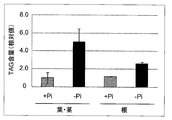
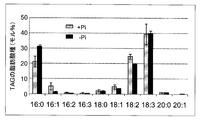
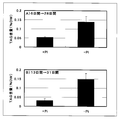
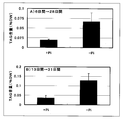
- the fatty acid chain length in neutral lipids often depends largely on the lipid biosynthesis ability inherent in plants. For example, Arabidopsis cultivated for 10 days under conditions of 23 ° C. and continuous light irradiation in MS medium was transplanted to the medium of Table 1 containing no phosphoric acid (KH 2 PO 4 ). When cultivated for a day, the accumulated amount of TAG in the stem and leaves is about 5 times that in the same medium containing 1 mM phosphate, and about 2 times in the roots (FIG. 1). In this case, the fatty acid composition (chain length: degree of unsaturation) is almost the same regardless of the presence or absence of phosphoric acid (18: 3 about 40%, 18: 2 about 20-25%, 16: 0 about 20-30%) (FIG. 2).
- fatty acid methyl ester was recovered with hexane, dried with nitrogen gas, and then recovered with 60 ⁇ l of hexane, of which 3 ⁇ l was analyzed by gas chromatography.
- Gas chromatography Shiadzu, GC-2014, column, Shinwa Chemical ULBON HR-SS-10 (25m, 0.25mm ID), column temperature 180 ° C, vaporization chamber and detector 250 ° C, inlet pressure (kPa) 68.2, column Separation and quantification were performed using a flow rate (ml / min) of 0.53, a split ratio of 68.8, and a measurement time of 15 minutes.
- Example 1 70 seeds of wild Arabidopsis thaliana seeds were seeded on MS agar medium (Physiologia Plantarum (1962) Vol. 15, 473), light intensity of 40 to 70 ⁇ E / cm 2 , irradiation time of 24 hours / day Cultivated under conditions for 10 days.
- the grown plants were carefully extracted from the MS agar medium, and 35 individuals were transplanted to the medium shown in Table 1 containing no soluble phosphate (KH 2 PO 4 ) (0 mM). Further, 35 individuals were symmetrically transplanted to the medium shown in Table 1 containing 1 mM soluble phosphate, and these were further cultivated for 10 days under the same conditions as described above.
- MS agar medium Physiologia Plantarum (1962) Vol. 15, 473
- light intensity 40 to 70 ⁇ E / cm 2
- irradiation time 24 hours / day Cultivated under conditions for 10 days.
- the grown plants were carefully extracted from the MS agar medium, and
- the cultivated plant body was extracted from the agar medium, cut into above-ground parts (leaves, stems) and roots, each weighed, ground in a liquid nitrogen mortar, and extracted with the Bligh and Dyer method. Thereafter, TAG was separated and purified by thin layer chromatography, then subjected to methanolysis with methanolic hydrochloric acid, and lipid analysis was performed using gas chromatography.
- TAG accumulation improvement effect in Arabidopsis leaves and stems cultivated in a medium containing 0 mM soluble phosphate, about five times as much as in a medium containing 1 mM soluble phosphate as a control, and about twice as much in roots.
- TAG accumulation improvement effect when the fatty acid composition analysis of the TAG accumulate
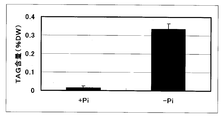
- Example 2 A tgd1 mutant strain (non-patent document 4) having a mutation in the tgd1 gene known as a lipid transporter of Arabidopsis lipid synthesis system was cultivated under the same conditions as in Example 1, and then lipid analysis was performed. As a result, even in the tgd1 mutant, a TAG accumulation improvement effect of about 8 times in the leaves and stems and about 2 times in the roots was observed in the medium not containing phosphoric acid (FIG. 3).
- Example 3 120 seeds of wild Arabidopsis thaliana seeds were seeded on MS agar medium (Physiologia Plantarum (1962) Vol. 15, 473), light intensity of 40 to 70 ⁇ E / cm 2 , irradiation time of 24 hours / day Cultivated under conditions for 10 days. The grown plants were carefully pulled out of the MS agar medium, and each of them was added to the medium shown in Table 1 having soluble phosphate (KH 2 PO 4 ) concentrations of 0 mM, 0.01 mM, 0.033 mM, 0.1 mM, and 0.33 mM. Individuals were transplanted.
- KH 2 PO 4 soluble phosphate
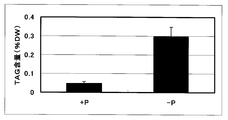
- Example 4 The Arabidopsis thaliana pho1 mutant is a mutant in which the gene of AGI code AT3G23430 is functionally damaged due to mutation and interferes with phosphate transport (Reference: Journal of Plant Physiology (1991) 97, 1087) page). After the pho1 mutant was cultivated under the same conditions as in Example 1, lipid analysis was performed on the above-ground parts (leaves and stems). As a result, about 3 times as much TAG accumulation improvement was recognized in the culture medium which does not contain phosphoric acid (FIG. 5).
- Example 5 The Arabidopsis thaliana pah1pah2 mutant strain is a mutant strain in which the functions of the AGI codes AT3G09560 ( pah1 ) and AT5G42870 ( pah2 ) have been damaged due to mutations, resulting in an obstacle to membrane lipid metabolism (Reference: Proceedings of the National Academy of Sciences of the United States of America (2009) 106, 20978).
- lipid analysis was performed on the above-ground parts (leaves, stems). As a result, about 6 times as much TAG accumulation improvement was recognized in the culture medium which does not contain phosphoric acid (FIG. 6).
- Example 6 The Arabidopsis thaliana pgm-1 mutant strain is a mutant strain in which the gene of AGI code AT5G51820 is functionally damaged due to the mutation, which hinders sugar metabolism and starch biosynthesis (Reference: Plant Physiology (1985) 79 Volume 11, p. 11, Proceedings of the National Academy of Sciences of the United States of America (1989) 86, 5830, Plant Physiology (2000) 122, 1193).
- lipid analysis was performed on the above-ground parts (leaves, stems). As a result, about 3 times as much TAG accumulation improvement was recognized in the culture medium which does not contain phosphoric acid (FIG. 7).
- Example 7 The Arabidopsis thaliana pho1 mutant is a mutant that interfered with phosphate transport.
- the inorganic phosphate content in the plant body is wild. It is a mutant strain in which about 5% of the strain and the total phosphate amount are reduced to 24-44% (reference: Journal of Plant Physiology (1991) 97, 1087).
- lipid analysis was performed on the above-ground parts (leaves and stems).
- TAG accumulation was improved about 3 times that of the wild type (FIG. 8). This was thought to be due to the suppression of phosphate uptake resulting in a condition similar to the phosphate-deficient condition in the pho1 mutant.
- Example 8 Tomato ( Solanum lycopersicum L.) used Micro-Tom (TOMJPF00001) provided by the University of Tsukuba Genetic Experiment Center through the National Bio-Resource Project (NBRP). Thirty Micro-Tom seeds were sown on MS agar medium (Physiologia Plantarum (1962) Vol. 15, 473) and irradiated at a temperature of 22 ° C. and an irradiation time of 16 hours (light intensity: 40 to 70 ⁇ E / cm 2 ). Cultivated for 6 days or 13 days. The grown plants were carefully extracted from the MS agar medium, and 10 individuals were transplanted to the medium shown in Table 1 containing no soluble phosphate (KH 2 PO 4 ) (0 mM).
- KH 2 PO 4 no soluble phosphate
- Example 9 Rapeseed Brassica napus ) used Miyauchi vegetables (Kaneko Seed and Seed Co., Ltd.). After rapeseed was cultivated under the same conditions as in Example 6 (cultivation period after transplanting to the medium of Table 1 was 55 days), lipid analysis was performed on the above-ground parts (leaves, stems). As a result, TAG accumulation improvement of 2 times or more was observed in the medium not containing phosphoric acid (FIG. 10).
- Example 10 Inhibibies Echinochloa crus-galli ) were collected from Wakayama City, Wakayama Prefecture. Lipid analysis was performed on the above-ground parts (leaves and stems) after cultivating Inbiebi under the same conditions as in Example 6 (cultivation period after transplanting to the medium of Table 1 was 28 days or 31 days). As a result, about 3.5 times as much TAG accumulation improvement was recognized in the culture medium which does not contain phosphoric acid (FIG. 11).
- Example 11 Tobacco Nicotiana tabacum cv SR1, available from Lehle Seeds, Tex., USA (http://www.arabidopsis.com/ http://www.arabidopsis.com/)), 25 ° C, irradiation time 24 hours (light After cultivation for 10 days under the conditions of intensity 40 to 70 ⁇ E / cm 2) / day, the cells were transplanted to the medium of Table 1 and the medium of Table 1 containing 1 mM soluble phosphate. These were further cultivated for 21 days under the same conditions as described above, and then lipid analysis was performed on the above-ground parts (leaves and stems). As a result, TAG accumulation improvement of 20 times or more was recognized in the medium not containing phosphoric acid (FIG. 12).
- vegetable oils can be obtained efficiently and simply.
- the obtained vegetable oil is useful for food or industrial use.
Landscapes
- Chemical & Material Sciences (AREA)
- Life Sciences & Earth Sciences (AREA)
- Engineering & Computer Science (AREA)
- Chemical Kinetics & Catalysis (AREA)
- Oil, Petroleum & Natural Gas (AREA)
- Wood Science & Technology (AREA)
- Organic Chemistry (AREA)
- Cultivation Of Plants (AREA)
- Fats And Perfumes (AREA)
- Breeding Of Plants And Reproduction By Means Of Culturing (AREA)
Abstract
植物体の光合成を継続させながら、種子以外の植物組織から植物油脂を効率的製造する方法の提供。 組織が十分に生育した植物体をリンが欠乏した状態で栽培するか、又はリンが欠乏状態となった変異植物体を栽培し、種子以外の組織に蓄積した中性脂質を回収することを特徴とする植物油脂の製造方法。
Description
本発明は、植物油脂の製造方法に関する。
植物油脂は、マーガリン、ショートニング、ドレッシング、食用硬化油等の食用、及び燃料用、潤滑油や界面活性剤原料などの工業用として世界で毎年1億トン以上が用いられており、世界的な人口増加などによりその需要は更に高まりつつある。一方、その生産量もパーム油及び大豆油を中心に、2001年から2008年までの間に約1.5倍に伸長してきているが、これらは例えばマレーシア及びインドネシアなどの主産地での植林量増加や品種改良などによるものや、特にヨーロッパにおけるバイオディーゼル用途の増加による補助金も含めた政策による影響も大きいと考えられる。
しかしながら、例えばパーム油やヤシ油は栽培可能地域が東南アジアなどの一部に限られていること、また生物多様性確保の問題から森林伐採による植林地の拡大化は望めず、単位植物体あたりの油脂生産量の増大などが望まれている。
しかしながら、例えばパーム油やヤシ油は栽培可能地域が東南アジアなどの一部に限られていること、また生物多様性確保の問題から森林伐採による植林地の拡大化は望めず、単位植物体あたりの油脂生産量の増大などが望まれている。
こうした背景から、植物の育種や栽培条件の改変による油脂生産量の増大を図る試みが成されている。古くから行われている交配によるもののほか、近年では遺伝子組換え技術を利用した育種例も報告されており、例えば、特許文献1及び非特許文献1には、脂肪酸鎖長伸長反応における伸長ユニットとなるマロニルCoA合成に関わるシロイヌナズナ由来のアセチルCoAカルボキシラーゼ(ACCase)遺伝子をナタネに導入することによりオレイン酸を中心に総脂肪酸量を向上させることが開示されている。また特許文献2及び非特許文献2には、トリアシルグリセロール(TAG)生合成の最終段階であるジアシルグリセロール(DAG)骨格へのアシル基転移反応を行うジアシルグリセロールアシルトランスフェラーゼ(DGAT)をシロイヌナズナで過剰発現させることで総脂質量を向上させることが報告されている。更に非特許文献3では特定の制御因子遺伝子の過剰発現させることによるTAGの高生産化、また特許文献3では、シロイヌナズナにおいて特定の色素合成に関与するカルコンシンターゼ遺伝子、カルコンイソメラーゼ遺伝子、またはフラボン-3-ヒドラーゼ遺伝子のいずれかの機能を欠損した組換え植物体を用いるTAGの高生産化方法が開示されている。更に加えて非特許文献4ではシロイヌナズナの脂質輸送タンパクとして知られるTGD1の欠損株において葉へのTAG蓄積が報告されている。
一方、遺伝子組換え技術を必要としない栽培条件変更により、種子以外の植物組織への油脂蓄積の試みも検討されており、例えば、非特許文献5ではヒマワリ或いはダイズの芽生えを乾燥条件下で12日間処理することで葉、茎のTAG及びDAG量が増加したことが報告されている。更に特許文献4には遺伝子組換え技術により脂肪酸分解系を欠損したシロイヌナズナを数日間、暗所処理することにより葉に油滴を蓄積させる方法も開示されている。
しかし、これらの方法のうち遺伝子組換え技術を利用する場合は、植物の栽培において遺伝子組換え体の漏出防止の対策が必要となり、また遺伝子組換え技術を用いない栽培条件を用いる場合においては、暗所や乾燥などの条件が植物の光合成を阻害する条件であるため植物油脂の高生産化効率は満足できるものではなかった。
他方、コムギ、オオムギ、トウモロコシ、イネ、ダイズ、サイトウ、アズキ、ビート、バレイショ、トマト、及びハクサイを用いた栽培検討において、培養液のリン酸濃度が、0.01ppmP以下ではいずれの植物においても生長量が減少すること、及び0.1ppmP以下ではいずれの植物においても地上部及び根部中のリン濃度が低下すること(非特許文献6)が開示されているが、リン濃度が極めて低い状態で栽培した場合に、種子以外の植物組織へ油脂が蓄積されることは全く知られていない。
Plant Physiology (1997) 11巻, 75頁
Plant Physiology (2001) 126巻, 861頁
Plant J. (2004) 40巻, 575頁
Plant Cell (2005) 17巻, 3094頁
Phytochemistry (1990) 29巻, 2119頁
日本土壌肥科学会雑誌 (1980) 51巻, 399頁
本発明は、組織が十分に生育した植物体を、リンが欠乏した状態で栽培し、種子以外の組織に蓄積した中性脂質を回収することを特徴とする以下の(1)~(15)のいずれかの植物油脂の製造方法に係るものである。
(1)組織が十分に生育した植物体をリンが欠乏した状態で栽培するか、又はリンが欠乏状態となった変異植物体を栽培し、種子以外の組織に蓄積した中性脂質を回収することを特徴とする植物油脂の製造方法。
(2)種子以外の組織が、葉、茎、または根である、(1)に記載の植物油脂の製造方法。
(3)リンが欠乏した状態での栽培が、組織が十分に生育した植物体を、リンが欠乏した媒体に移植するか或いは媒体をリンが欠乏した媒体に置換して栽培する、又は栽培過程の媒体において生じるリンの欠乏状態を維持しながら栽培するものである(1)又は(2)記載の植物油脂の製造方法。
(4)種子以外の組織の中性脂質蓄積量が、リンが欠乏しない状態で栽培した場合の2倍以上である、(1)~(3)のいずれかに記載の植物油脂の製造方法。
(5)植物体が被子植物である、(1)~(4)のいずれかに記載の植物油脂の製造方法。
(6)植物体が裸子植物である、(1)~(4)のいずれかに記載の植物油脂の製造方法。
(7)植物体が双子葉植物である、(1)~(4)のいずれかに記載の植物油脂の製造方法。
(8)植物体がシロイヌナズナ、トマト、ナタネ、イヌエビ又はタバコである、(1)~(4)のいずれかに記載の植物油脂の製造方法。
(9)リンが欠乏した状態が、媒体のリン濃度が33μM未満である(1)~(8)のいずれかに記載の植物油脂の製造方法。
(10)リンが欠乏した状態が、媒体のリン濃度が10μM以下である(1)~(8)のいずれかに記載の植物油脂の製造方法。
(11)リンが欠乏した状態が、媒体のリン濃度が3.3μM以下である(1)~(8)のいずれかに記載の植物油脂の製造方法。
(12)リンが欠乏した状態が、媒体のリン濃度が1μM以下である(1)~(8)のいずれかに記載の植物油脂の製造方法。
(13)リンが欠乏した状態が、媒体のリン濃度が0.33μM以下である(1)~(8)のいずれかに記載の植物油脂の製造方法。
(14)リンが欠乏状態となった変異植物体が、リン酸輸送に支障を生じた変異植物体である(1)に記載の植物油脂の製造方法。
(15)組織が十分に生育した植物体をリンが欠乏した状態で栽培するか、又はリンが欠乏状態となった変異植物体を栽培することによる、種子以外の組織に中性脂質を蓄積させる方法。
(1)組織が十分に生育した植物体をリンが欠乏した状態で栽培するか、又はリンが欠乏状態となった変異植物体を栽培し、種子以外の組織に蓄積した中性脂質を回収することを特徴とする植物油脂の製造方法。
(2)種子以外の組織が、葉、茎、または根である、(1)に記載の植物油脂の製造方法。
(3)リンが欠乏した状態での栽培が、組織が十分に生育した植物体を、リンが欠乏した媒体に移植するか或いは媒体をリンが欠乏した媒体に置換して栽培する、又は栽培過程の媒体において生じるリンの欠乏状態を維持しながら栽培するものである(1)又は(2)記載の植物油脂の製造方法。
(4)種子以外の組織の中性脂質蓄積量が、リンが欠乏しない状態で栽培した場合の2倍以上である、(1)~(3)のいずれかに記載の植物油脂の製造方法。
(5)植物体が被子植物である、(1)~(4)のいずれかに記載の植物油脂の製造方法。
(6)植物体が裸子植物である、(1)~(4)のいずれかに記載の植物油脂の製造方法。
(7)植物体が双子葉植物である、(1)~(4)のいずれかに記載の植物油脂の製造方法。
(8)植物体がシロイヌナズナ、トマト、ナタネ、イヌエビ又はタバコである、(1)~(4)のいずれかに記載の植物油脂の製造方法。
(9)リンが欠乏した状態が、媒体のリン濃度が33μM未満である(1)~(8)のいずれかに記載の植物油脂の製造方法。
(10)リンが欠乏した状態が、媒体のリン濃度が10μM以下である(1)~(8)のいずれかに記載の植物油脂の製造方法。
(11)リンが欠乏した状態が、媒体のリン濃度が3.3μM以下である(1)~(8)のいずれかに記載の植物油脂の製造方法。
(12)リンが欠乏した状態が、媒体のリン濃度が1μM以下である(1)~(8)のいずれかに記載の植物油脂の製造方法。
(13)リンが欠乏した状態が、媒体のリン濃度が0.33μM以下である(1)~(8)のいずれかに記載の植物油脂の製造方法。
(14)リンが欠乏状態となった変異植物体が、リン酸輸送に支障を生じた変異植物体である(1)に記載の植物油脂の製造方法。
(15)組織が十分に生育した植物体をリンが欠乏した状態で栽培するか、又はリンが欠乏状態となった変異植物体を栽培することによる、種子以外の組織に中性脂質を蓄積させる方法。
本発明は、植物体の光合成を継続させながら、種子以外の植物組織から、植物油脂を効率的に製造する方法を提供することに関する。
本発明者らは、通常条件で栽培し、十分に生育した植物体を、リンが欠乏した状態で栽培を継続することで、光合成を継続させながら、中性脂質を含有する植物油脂を種子以外の植物組織に効率的に蓄積し得ることを見出した。
本発明の植物油脂の製造方法は、従来の中性脂質蓄積方法の多くが遺伝子組換え技術を用いているのに対し、栽培条件の任意の制御により非遺伝子組換え植物に対しても利用可能である。そして、本発明の方法によれば、植物の光合成能力を停止させることなく、かつ種子の成熟を待つことなく早期に中性脂質を種子以外の植物組織に蓄積し得ることから植物油脂を効率良く生産することができる。また更に、種子以外の植物組織に蓄積した脂質中に脂溶性成分を溶解させることにより、植物ステロール類やポリフェノール類等の機能性成分を効率良く生産すること等も期待される。
本発明の植物油脂の製造方法は、組織が十分に生育した植物体を、リンが欠乏した状態で栽培し、種子以外の組織に蓄積した中性脂質を回収するものである。
本発明において、「組織が十分に生育した植物体」とは、通常の条件で、根、茎、及び葉等の植物組織が十分に生育した植物体を意味し、即ち、種子から発芽させた場合は発根及び2枚以上の本葉が観察される程度に生育した植物体を意味し、好適には、リンを適量含む媒体で栽培され、根、茎、及び葉等の植物組織が生育し、十分な植物体量(バイオマス量)を有する植物体、即ち植物体重量が種子重量の10倍以上に生育した植物体が挙げられる。
本発明において、「組織が十分に生育した植物体」とは、通常の条件で、根、茎、及び葉等の植物組織が十分に生育した植物体を意味し、即ち、種子から発芽させた場合は発根及び2枚以上の本葉が観察される程度に生育した植物体を意味し、好適には、リンを適量含む媒体で栽培され、根、茎、及び葉等の植物組織が生育し、十分な植物体量(バイオマス量)を有する植物体、即ち植物体重量が種子重量の10倍以上に生育した植物体が挙げられる。
「植物体」としては、陸上植物であればその種類は特に限定されない。好適には生育速度や得られる植物体量(バイオマス量)などから種子植物を用いることが効率的生産に有利である。種子植物のうち被子植物としては、例えばヤシ科やイネ科等の単子葉植物、あるいはマメ科、アブラナ科、キク科、トウダイグサ科、ゴマ科、モクセイ科、ミソハギ科、シソ科、セリ科、アカザ科、アオイ科等の双子葉植物、また裸子植物としては、例えばマツ科、イチョウ科等が挙げられる。
また、当該植物体は、天然に存在する野生型の植物体に限らず、一部の遺伝子が変異した変異体であってもよい。例えば、脂質代謝、糖代謝、デンプン生合成等に支障を生じた変異体であってもよい。
また、当該植物体は、天然に存在する野生型の植物体に限らず、一部の遺伝子が変異した変異体であってもよい。例えば、脂質代謝、糖代謝、デンプン生合成等に支障を生じた変異体であってもよい。
より具体的な植物種の例としては、ヤシ科のココヤシ(Cocos nucifera)、パームヤシ(Elaeis guineensi, Elaeis oleifera)等、イネ科のイネ(Oryza sativa, Oryza glaberrima)、トウモロコシ(Zea mays)、ミスカンザス(Miscanthus giganteus)、イヌビエ(Echinochloa crus-galli)等、マメ科のダイズ(Glycine max)等、アブラナ科のナタネ(Brassica rapa, Brassica napus)、シロイヌナズナ(Arabidopsis thaliana)、ナガミノアマナズナ(Camelina sativa)、ハクサイ(Brassica rapa var. glabra)、キャベツ(Brassica oleracea var. capitata)、コマツナ(Brassica rapa var. peruviridis)、ミズナ(Brassica rapa var. nipposinica)、クレソン(Nasturtium officinale)等、キク科のヒマワリ(Helianthus annuus)、ベニバナ(Carthamus tinctorius)、レタス(Lactuca sativa)等、トウダイグサ科のヒマ(Ricinus communis)、ヤトロファ(Jatropha curcas)、ゴマ科のゴマ(Sesamum indicum)等、モクセイ科のオリーブ(Olea europea)等、ミソハギ科のクフェア(Cuphea hyssopifolia)等、シソ科のアオジソ(Perilla frutescens var. crispa)、アカジソ(Perilla frutescen var. crispa)、バジル(Ocimum basilicum L.)等、セリ科のミツバ(Cryptotaenia japonica)、コリアンダー(Coriandrum sativum L.)、パセリ(Petroselium crispum)等、アカザ科のホウレンソウ(Spinacia oleracea)等、ナス科のタバコ(Nicotiana tabacum)、トマト(Solanum lycopersicum L.)等が挙げられる。このうち、被子植物が好ましく、より好適には双子葉植物、更に好適にはアブラナ科植物が挙げられ、このうちシロイヌナズナ、トマト、ナタネ、イヌビエ又はタバコがより好ましい。
本発明において、「リンが欠乏した状態で栽培する」とは、例えば、1)組織が十分に生育した植物体をリンが欠乏した媒体に移植して栽培すること、2)媒体をリンが欠乏した媒体に置換して当該植物体を栽培すること、3)栽培過程の媒体において生じるリンの欠乏状態を維持しながら栽培すること等が挙げられる。
ここで、栽培に用いる媒体は、植物体の生育段階、及び油脂蓄積段階のいずれにおいても限定されず、土壌、水耕液(培養液)、或いは固体培地等を用いることができる。また屋外での日照、及び屋内における人工照明等のいずれも利用可能であり、光量や照射時間も特に制限されないが、植物体に固有な最適条件を用いることが望ましい。
ここで、栽培に用いる媒体は、植物体の生育段階、及び油脂蓄積段階のいずれにおいても限定されず、土壌、水耕液(培養液)、或いは固体培地等を用いることができる。また屋外での日照、及び屋内における人工照明等のいずれも利用可能であり、光量や照射時間も特に制限されないが、植物体に固有な最適条件を用いることが望ましい。
「リンが欠乏した状態」とは、媒体中にリンを含まないか又は媒体中のリン濃度が極めて低い状態を意味する。具体的には、中性脂質の蓄積促進の点から、媒体中のリン濃度がゼロに近いことが望ましいが、ゼロでなくても通常の栽培で用いるリン酸濃度の1/30未満、好適には1/100以下、より好適には1/300以下、更に好ましくは1/1000以下である。
例えば、表1に示した培地を用いて水耕栽培や寒天培地での栽培を行う場合、極めて低い濃度のリンを含む媒体のリン濃度は、33μM未満であり、好ましくは10μM以下、更に好適には3.3μM以下が望ましく、最適には1μM以下、或いは0.33μM以下とすることができる。
例えば、表1に示した培地を用いて水耕栽培や寒天培地での栽培を行う場合、極めて低い濃度のリンを含む媒体のリン濃度は、33μM未満であり、好ましくは10μM以下、更に好適には3.3μM以下が望ましく、最適には1μM以下、或いは0.33μM以下とすることができる。
「リンが欠乏状態となった変異植物体」とは、例えばリン酸輸送に支障が生じる等して、植物体中のリン濃度が低値となった変異植物体を意味する。ここで、リン酸輸送に支障を生じるとは、例えばリン酸輸送に関わる遺伝子に支障が生じることが挙げられ、斯かる変異体として、例えばシロイヌナズナではpho1及びpho2が挙げられる(参考文献:Journal of Plant Physiology (1991) 97巻, 1087頁)。このような変異植物体は、リンが欠乏した状態で栽培しなくても、すなわちリンを含む媒体においても中性脂質の蓄積促進が行われる。
リンが欠乏した状態での栽培は、通常の温度、湿度、pH、光照射条件で栽培を行えばよい。このリン欠乏条件における栽培期間は特に限定されないが、中性脂質蓄積の点から、好適には数日~数週間、特には3日間~3週間、最適には1~2週間である。
例えば、植物体としてシロイヌナズナを用いる場合、18~25℃、光強度30~70μE/cm2、照射時間6~24時間/日の範囲であれば良い。
例えば、植物体としてシロイヌナズナを用いる場合、18~25℃、光強度30~70μE/cm2、照射時間6~24時間/日の範囲であれば良い。
リンが欠乏した状態での栽培において、媒体の調製方法は特に限定されないが、一般にリン欠乏土壌と言われる土壌、例えば可溶性リン酸が100mg/100g以下、更には50mg/100g以下の土壌、或いはこの様な土壌にNK化成肥料等のリンを含まない肥料の施肥を行うか、或いはこの様な土壌にNK化成肥料等のリンを含まない肥料に少量のリン酸等のリン肥料を加えた肥料の施肥を行うことにより調製することができる。また水耕液や固体培地を用いる場合は、リン以外の必要栄養素を適当に配合した培養液、或いは培地を用いることができる。リン以外の必要栄養素は特に限定されないが、硝酸カリウム、硝酸アンモニウム、硫酸アンモニウム、硝酸カルシウム、硝酸ナトリウム、塩化カリウム。塩化カルシウム、硫酸マグネシウム、硫酸ナトリウム、硫酸鉄(III)、塩化鉄(III)、硫酸鉄(III)、エチレンジアミン四酢酸二ナトリウム、エチレンジアミン四酢酸鉄ナトリウム、硫酸マンガン、硫酸亜鉛、ホウ酸、硫酸銅、モリブデン酸ナトリウム、三酸化モリブデン、ヨウ化カリウム、塩化コバルト、塩化アルミニウム、塩化ニッケル、ミオイノシトール、チアミン塩酸塩、ピリドキシン塩酸塩、ニコチン酸、葉酸、ビオチン、グリシン等を含むことができる。また固体培地のゲル化剤としては、特に限定されないが、寒天、ゼラチン、ゲルライト(和光純薬社製)等を用いることができる。
「リンが欠乏した状態」での栽培の一態様としては、例えば、MS培地(Physiologia Plantarum (1962) 15巻, 473頁)で、組織が十分に生育した植物体を表1に示した組成をもつ培地に移すか又はMS培地を表1に示した培地に置換して、リンを含まないか又はリン濃度が極めて低い状態、例えば33μM未満、好ましくは10μM以下、更に好適には3.3μM以下、最適には1μM以下、或いは0.33μM以下で更に数日間~数週間の栽培をすることが挙げられる。
また別の一態様として、栽培過程において生じるリンの欠乏状態を維持しながら栽培することが挙げられ、この場合には、植物体を適当な期間栽培してリン濃度が極めて低くなってから、更に数日~数週間の栽培を継続すればよい。この場合に用いる媒体中のリン濃度は、植物体が十分に生育した後に媒体中のリン濃度が上記に示した極めて低い濃度またはゼロとなる様に、初期濃度を調整することにより行えばよい。

かくして植物体の根、葉、或いは茎等に蓄積した中性脂質を植物体から回収する方法は、特に限定されず、例えば、植物体の根、葉、或いは茎等を粉砕、圧搾すること、或いは適当な溶剤により抽出する方法等で植物油脂を得ることができる。より具体的には例えば、植物体の根、葉、或いは茎等を粉砕後、ノルマルヘキサンにより抽出する方法、或いはBligh and Dyer法(Can.J.Biochem.Physiol. (1959) 37巻, 911頁)などの方法を用いることで効率的に植物油脂を抽出することができ、植物油脂に含まれる形で中性脂質を回収することが可能である。斯かる植物油脂は、そのまま中性脂質として用いることもできるが、一般的な脱ガム、脱酸、脱色、脱臭等の精製の後に用いることもでき、その方法は特に限定されない。更に植物油脂から中性脂質を分離・回収することもでき、その方法についても特に限定されない。より具体的に例えば、薄層クロマトグラフィーによる分離およびシリカゲルプレートからの回収、高速液体クロマトグラフィーを用いた分離・回収などが挙げられる。
斯くして得られる中性脂質はその大半がTAGであるが、少量のDAG等が含まれることもある。また中性脂質中の脂肪酸鎖長は植物体に固有な脂質生合成能力にほぼ依存することが多い。例えば、MS培地において23℃、連続光照射の条件下、10日間栽培したシロイヌナズナを、リン酸(KH2PO4)を含まない表1の培地に移植し、上記同様の条件の下、更に10日間の栽培を行うと茎、葉のTAG蓄積量はリン酸1mMを含む同培地で栽培した場合の約5倍、根においても約2倍となる(図1)。またこの際の脂肪酸組成(鎖長:不飽和度)は、リン酸の有無に関わらずほぼ同等(18:3 約40%、18:2 約20~25%、16:0 約20~30%)である(図2)。
以下、実施例により本発明を詳細に説明する。なお、植物組織中の油脂成分の分析は、下記に記載の方法により行った。
(1)抽出及び前処理
総脂質の抽出は、Bligh and Dyer法(Can. J. Biochem. Physiol. (1959) 37巻, 911頁)に基づき行った。総脂質からTAGの分離は、薄層クロマトグラフィー(TLC Silica gel 60, 20x20cm, メルク, 製品コード1.05721.0009、展開溶媒組成は、ヘキサン:ジエチルエーテル:酢酸=160:40:4(vol/vol))により行い、プレートからTAGのスポットをかきとって含量の測定を行った。
(1)抽出及び前処理
総脂質の抽出は、Bligh and Dyer法(Can. J. Biochem. Physiol. (1959) 37巻, 911頁)に基づき行った。総脂質からTAGの分離は、薄層クロマトグラフィー(TLC Silica gel 60, 20x20cm, メルク, 製品コード1.05721.0009、展開溶媒組成は、ヘキサン:ジエチルエーテル:酢酸=160:40:4(vol/vol))により行い、プレートからTAGのスポットをかきとって含量の測定を行った。
(2)中性脂質量の測定
15:0脂肪酸を内部標準試料として、TAGをメタノリシス処理した。具体的には、ネジ栓付きガラス試験管内で、TAGを含むシリカゲル粉末に100μlの1mM 15:0ヘキサン溶液(pentadecanoic acid, シグマアルドリッチ, P-6125)および350μlの5%塩化水素メタノール溶液(和光純薬, 089-03971)を添加して85℃で1時間処理した。メタノリシス処理後、ヘキサンで脂肪酸メチルエステルを回収し、窒素ガスで乾固後、60μlのヘキサンで回収し、そのうち3μlをガスクロマトグラフィーで解析した。ガスクロマトグラフィー(島津製作所、GC-2014, カラム、信和化工ULBON HR-SS-10(25m, 0.25mm ID)、カラム温度180℃、気化室および検出器250℃、入口圧(kPa)68.2、カラム流量(ml/min)0.53、スプリット比68.8、計測時間15分)を用いて分離・定量を行った。
15:0脂肪酸を内部標準試料として、TAGをメタノリシス処理した。具体的には、ネジ栓付きガラス試験管内で、TAGを含むシリカゲル粉末に100μlの1mM 15:0ヘキサン溶液(pentadecanoic acid, シグマアルドリッチ, P-6125)および350μlの5%塩化水素メタノール溶液(和光純薬, 089-03971)を添加して85℃で1時間処理した。メタノリシス処理後、ヘキサンで脂肪酸メチルエステルを回収し、窒素ガスで乾固後、60μlのヘキサンで回収し、そのうち3μlをガスクロマトグラフィーで解析した。ガスクロマトグラフィー(島津製作所、GC-2014, カラム、信和化工ULBON HR-SS-10(25m, 0.25mm ID)、カラム温度180℃、気化室および検出器250℃、入口圧(kPa)68.2、カラム流量(ml/min)0.53、スプリット比68.8、計測時間15分)を用いて分離・定量を行った。
(3)植物組織乾燥重量の測定
凍結乾燥処理を20時間行った後、重量を測定し、乾燥重量とした。
凍結乾燥処理を20時間行った後、重量を測定し、乾燥重量とした。
実施例1
シロイヌナズナ(Arabidopsis thaliana)野生株の種子70個体をMS寒天培地(Physiologia Plantarum (1962) 15巻, 473頁)に播種し、22℃、光強度40~70μE/cm2、照射時間24時間/日の条件で10日間栽培した。生育した植物体をMS寒天培地から注意深く引き抜き、可溶性リン酸(KH2PO4)を含まない(0mM)表1の培地に35個体を移植した。また対称として35個体を1mM可溶性リン酸を含む表1の培地に移植し、これらを上記と同条件で更に10日間栽培した。栽培後の植物体を寒天培地から引き抜き、地上部(葉、茎)および根に切り分け、それぞれ重量測定を行った後、液体窒素下すり鉢で粉砕し、Bligh and Dyer法で脂肪抽出を行った。この後、薄層クロマトグラフィーによりTAGを分離・精製後、塩酸メタノールでメタノリシス処理をしてガスクロマトグラフィーを用いて脂質分析を行った。この結果、図1に示した様に、可溶性リン酸0mMの培地で栽培したシロイヌナズナ葉及び茎では、対照の1mM可溶性リン酸を含む培地で栽培した場合の約5倍、根においても約2倍のTAG蓄積向上効果であった。
また、得られた各条件で蓄積したTAGの脂肪酸組成分析を行ったところ、図2に示す様にリン酸の有無によって脂肪酸組成の大きな変化は認められなかった。
シロイヌナズナ(Arabidopsis thaliana)野生株の種子70個体をMS寒天培地(Physiologia Plantarum (1962) 15巻, 473頁)に播種し、22℃、光強度40~70μE/cm2、照射時間24時間/日の条件で10日間栽培した。生育した植物体をMS寒天培地から注意深く引き抜き、可溶性リン酸(KH2PO4)を含まない(0mM)表1の培地に35個体を移植した。また対称として35個体を1mM可溶性リン酸を含む表1の培地に移植し、これらを上記と同条件で更に10日間栽培した。栽培後の植物体を寒天培地から引き抜き、地上部(葉、茎)および根に切り分け、それぞれ重量測定を行った後、液体窒素下すり鉢で粉砕し、Bligh and Dyer法で脂肪抽出を行った。この後、薄層クロマトグラフィーによりTAGを分離・精製後、塩酸メタノールでメタノリシス処理をしてガスクロマトグラフィーを用いて脂質分析を行った。この結果、図1に示した様に、可溶性リン酸0mMの培地で栽培したシロイヌナズナ葉及び茎では、対照の1mM可溶性リン酸を含む培地で栽培した場合の約5倍、根においても約2倍のTAG蓄積向上効果であった。
また、得られた各条件で蓄積したTAGの脂肪酸組成分析を行ったところ、図2に示す様にリン酸の有無によって脂肪酸組成の大きな変化は認められなかった。
実施例2
シロイヌナズナ脂質合成系の脂質トランスポーターとして知られるtgd1遺伝子に変異を持つtgd1変異株(非特許文献4)を、実施例1と同様の条件で栽培した後、脂質分析を行った。この結果、tgd1変異株においてもリン酸を含まない培地において、葉および茎で約8倍、根でも約2倍のTAG蓄積向上効果が認められた(図3)。
シロイヌナズナ脂質合成系の脂質トランスポーターとして知られるtgd1遺伝子に変異を持つtgd1変異株(非特許文献4)を、実施例1と同様の条件で栽培した後、脂質分析を行った。この結果、tgd1変異株においてもリン酸を含まない培地において、葉および茎で約8倍、根でも約2倍のTAG蓄積向上効果が認められた(図3)。
実施例3
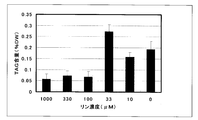
シロイヌナズナ(Arabidopsis thaliana)野生株の種子120個体をMS寒天培地(Physiologia Plantarum (1962) 15巻, 473頁)に播種し、22℃、光強度40~70μE/cm2、照射時間24時間/日の条件で10日間栽培した。生育した植物体をMS寒天培地から注意深く引き抜き、可溶性リン酸(KH2PO4)の濃度が0mM、0.01mM、0.033mM、0.1mM、0.33mMである表1の培地にそれぞれ20個体を移植した。また対称として20個体を1mM可溶性リン酸を含む表1の培地に移植し、これらを上記と同条件で更に10日間栽培した。栽培後の植物体を寒天培地から引き抜き、地上部(葉、茎)および根に切り分け、地上部の重量測定を行った後、液体窒素下すり鉢で粉砕し、Bligh and Dyer法で脂肪抽出を行った。この後、薄層クロマトグラフィーによりTAGを分離・精製後、塩酸メタノールでメタノリシス処理をしてガスクロマトグラフィーを用いて脂質分析を行った。この結果、図4に示した様に、可溶性リン酸0mM、0.01mM(10μM)、及び0.033mM(33μM)の培地で栽培したシロイヌナズナ地上部では、対照の1mM可溶性リン酸を含む培地で栽培した場合の3~5倍のTAG蓄積向上効果が認められた。尚、可溶性リン酸0.1mM(100μM)及び0.33mM(330μM)の培地での栽培におけるTAG蓄積は対照条件と同程度であった。
シロイヌナズナ(Arabidopsis thaliana)野生株の種子120個体をMS寒天培地(Physiologia Plantarum (1962) 15巻, 473頁)に播種し、22℃、光強度40~70μE/cm2、照射時間24時間/日の条件で10日間栽培した。生育した植物体をMS寒天培地から注意深く引き抜き、可溶性リン酸(KH2PO4)の濃度が0mM、0.01mM、0.033mM、0.1mM、0.33mMである表1の培地にそれぞれ20個体を移植した。また対称として20個体を1mM可溶性リン酸を含む表1の培地に移植し、これらを上記と同条件で更に10日間栽培した。栽培後の植物体を寒天培地から引き抜き、地上部(葉、茎)および根に切り分け、地上部の重量測定を行った後、液体窒素下すり鉢で粉砕し、Bligh and Dyer法で脂肪抽出を行った。この後、薄層クロマトグラフィーによりTAGを分離・精製後、塩酸メタノールでメタノリシス処理をしてガスクロマトグラフィーを用いて脂質分析を行った。この結果、図4に示した様に、可溶性リン酸0mM、0.01mM(10μM)、及び0.033mM(33μM)の培地で栽培したシロイヌナズナ地上部では、対照の1mM可溶性リン酸を含む培地で栽培した場合の3~5倍のTAG蓄積向上効果が認められた。尚、可溶性リン酸0.1mM(100μM)及び0.33mM(330μM)の培地での栽培におけるTAG蓄積は対照条件と同程度であった。
実施例4
シロイヌナズナ(Arabidopsis thaliana)pho1変異株はAGIコードAT3G23430の遺伝子が変異により機能損傷しており、リン酸輸送に支障を生じた変異株である(参考文献:Journal of Plant Physiology (1991) 97巻, 1087頁)。pho1変異株を実施例1と同様の条件で栽培した後、地上部(葉、茎)について脂質分析を行った。この結果、リン酸を含まない培地において、約3倍のTAG蓄積向上が認められた(図5)。
シロイヌナズナ(Arabidopsis thaliana)pho1変異株はAGIコードAT3G23430の遺伝子が変異により機能損傷しており、リン酸輸送に支障を生じた変異株である(参考文献:Journal of Plant Physiology (1991) 97巻, 1087頁)。pho1変異株を実施例1と同様の条件で栽培した後、地上部(葉、茎)について脂質分析を行った。この結果、リン酸を含まない培地において、約3倍のTAG蓄積向上が認められた(図5)。
実施例5
シロイヌナズナ(Arabidopsis thaliana)pah1pah2変異株はAGIコードAT3G09560(pah1)及びAT5G42870(pah2)の遺伝子が変異により機能損傷しており、膜脂質代謝に支障を生じた変異株である(参考文献:Proceedings of the National Academy of Sciences of the United States of America (2009) 106巻, 20978頁)。pah1pah2変異株を実施例1と同様の条件で栽培した後、地上部(葉、茎)について脂質分析を行った。この結果、リン酸を含まない培地において、約6倍のTAG蓄積向上が認められた(図6)。
シロイヌナズナ(Arabidopsis thaliana)pah1pah2変異株はAGIコードAT3G09560(pah1)及びAT5G42870(pah2)の遺伝子が変異により機能損傷しており、膜脂質代謝に支障を生じた変異株である(参考文献:Proceedings of the National Academy of Sciences of the United States of America (2009) 106巻, 20978頁)。pah1pah2変異株を実施例1と同様の条件で栽培した後、地上部(葉、茎)について脂質分析を行った。この結果、リン酸を含まない培地において、約6倍のTAG蓄積向上が認められた(図6)。
実施例6
シロイヌナズナ(Arabidopsis thaliana)pgm-1変異株はAGIコードAT5G51820の遺伝子が変異により機能損傷しており、糖代謝及びデンプン生合成に支障を生じた変異株である(参考文献:Plant Physiology (1985) 79巻, 11頁、Proceedings of the National Academy of Sciences of the United States of America (1989) 86巻, 5830頁, Plant Physiology (2000) 122巻, 1193頁)。pgm-1変異株を実施例1と同様の条件で栽培した後、地上部(葉、茎)について脂質分析を行った。この結果、リン酸を含まない培地において、約3倍のTAG蓄積向上が認められた(図7)。
シロイヌナズナ(Arabidopsis thaliana)pgm-1変異株はAGIコードAT5G51820の遺伝子が変異により機能損傷しており、糖代謝及びデンプン生合成に支障を生じた変異株である(参考文献:Plant Physiology (1985) 79巻, 11頁、Proceedings of the National Academy of Sciences of the United States of America (1989) 86巻, 5830頁, Plant Physiology (2000) 122巻, 1193頁)。pgm-1変異株を実施例1と同様の条件で栽培した後、地上部(葉、茎)について脂質分析を行った。この結果、リン酸を含まない培地において、約3倍のTAG蓄積向上が認められた(図7)。
実施例7
シロイヌナズナ(Arabidopsis thaliana)pho1変異株はリン酸輸送に支障を生じた変異株であり、2.5mMの無機リン酸を含むミネラル溶液の潅水による土壌栽培において、植物体中の無機リン酸含量は野生株の5%程度、また総リン酸量についても24-44%にまで低下した変異株である(参考文献:Journal of Plant Physiology (1991) 97巻, 1087頁)。pho1変異株及び野生株を実施例1と同様の条件にて1mM可溶性リン酸を含む表1の培地を用いて栽培した後、地上部(葉、茎)について脂質分析を行った。この結果、pho1変異株においては、野生株の約3倍のTAG蓄積向上が認められた(図8)。これはリン酸の取り込みが抑制されたことにより、pho1変異株において実質的にリン酸が欠乏した条件と同様の状態がもたらされたことに起因するものと考えられた。
シロイヌナズナ(Arabidopsis thaliana)pho1変異株はリン酸輸送に支障を生じた変異株であり、2.5mMの無機リン酸を含むミネラル溶液の潅水による土壌栽培において、植物体中の無機リン酸含量は野生株の5%程度、また総リン酸量についても24-44%にまで低下した変異株である(参考文献:Journal of Plant Physiology (1991) 97巻, 1087頁)。pho1変異株及び野生株を実施例1と同様の条件にて1mM可溶性リン酸を含む表1の培地を用いて栽培した後、地上部(葉、茎)について脂質分析を行った。この結果、pho1変異株においては、野生株の約3倍のTAG蓄積向上が認められた(図8)。これはリン酸の取り込みが抑制されたことにより、pho1変異株において実質的にリン酸が欠乏した条件と同様の状態がもたらされたことに起因するものと考えられた。
実施例8
トマト(Solanum lycopersicum L.)は文部科学省National Bio-Resource Project (NBRP)を通じて筑波大学遺伝子実験センターから提供されたMicro-Tom(TOMJPF00001)を用いた。Micro-Tomの種子30個体をMS寒天培地(Physiologia Plantarum (1962) 15巻, 473頁)に播種し、22℃、照射時間16時間(光強度40~70μE/cm2)照/日の条件で6日間、或いは13日間栽培した。生育した植物体をMS寒天培地から注意深く引き抜き、可溶性リン酸(KH2PO4)を含まない(0mM)表1の培地に10個体を移植した。また対称として10個体を1mM可溶性リン酸を含む表1の培地に移植し、これらを上記と同条件で更に28日間、或いは31日間栽培した。栽培後の植物体を寒天培地から引き抜き、地上部(葉、茎)および根に切り分け、地上部の重量測定を行った後、液体窒素下すり鉢で粉砕し、Bligh and Dyer法で脂肪抽出を行った。この後、薄層クロマトグラフィーによりTAGを分離・精製後、塩酸メタノールでメタノリシス処理をしてガスクロマトグラフィーを用いて脂質分析を行った。この結果、図9に示した様に、可溶性リン酸0mMの培地で栽培したMicro-Tomでは、対照の1mM可溶性リン酸を含む培地で栽培した場合の3~5倍のTAG蓄積向上が認められた。
トマト(Solanum lycopersicum L.)は文部科学省National Bio-Resource Project (NBRP)を通じて筑波大学遺伝子実験センターから提供されたMicro-Tom(TOMJPF00001)を用いた。Micro-Tomの種子30個体をMS寒天培地(Physiologia Plantarum (1962) 15巻, 473頁)に播種し、22℃、照射時間16時間(光強度40~70μE/cm2)照/日の条件で6日間、或いは13日間栽培した。生育した植物体をMS寒天培地から注意深く引き抜き、可溶性リン酸(KH2PO4)を含まない(0mM)表1の培地に10個体を移植した。また対称として10個体を1mM可溶性リン酸を含む表1の培地に移植し、これらを上記と同条件で更に28日間、或いは31日間栽培した。栽培後の植物体を寒天培地から引き抜き、地上部(葉、茎)および根に切り分け、地上部の重量測定を行った後、液体窒素下すり鉢で粉砕し、Bligh and Dyer法で脂肪抽出を行った。この後、薄層クロマトグラフィーによりTAGを分離・精製後、塩酸メタノールでメタノリシス処理をしてガスクロマトグラフィーを用いて脂質分析を行った。この結果、図9に示した様に、可溶性リン酸0mMの培地で栽培したMicro-Tomでは、対照の1mM可溶性リン酸を含む培地で栽培した場合の3~5倍のTAG蓄積向上が認められた。
実施例9
ナタネ(Brassica napus)は宮内菜(カネコ種苗(株))を使用した。ナタネを実施例6と同様の条件で栽培した後(表1の培地に移植してからの栽培期間は55日間)、地上部(葉、茎)について脂質分析を行った。この結果、リン酸を含まない培地において、2倍以上のTAG蓄積向上が認められた(図10)。
ナタネ(Brassica napus)は宮内菜(カネコ種苗(株))を使用した。ナタネを実施例6と同様の条件で栽培した後(表1の培地に移植してからの栽培期間は55日間)、地上部(葉、茎)について脂質分析を行った。この結果、リン酸を含まない培地において、2倍以上のTAG蓄積向上が認められた(図10)。
実施例10
イヌビエ(Echinochloa crus-galli)は和歌山県和歌山市内で採取したものを使用した。イヌビエを実施例6と同様の条件で栽培した後(表1の培地に移植してからの栽培期間は28日間、或いは31日間)、地上部(葉、茎)について脂質分析を行った。この結果、リン酸を含まない培地において、約3.5倍のTAG蓄積向上が認められた(図11)。
イヌビエ(Echinochloa crus-galli)は和歌山県和歌山市内で採取したものを使用した。イヌビエを実施例6と同様の条件で栽培した後(表1の培地に移植してからの栽培期間は28日間、或いは31日間)、地上部(葉、茎)について脂質分析を行った。この結果、リン酸を含まない培地において、約3.5倍のTAG蓄積向上が認められた(図11)。
実施例11
タバコ(Nicotiana tabacum cv SR1、Lehle Seeds, Tex., USA(http://www.arabidopsis.com/ http://www.arabidopsis.com/)より購入可能)を25℃、照射時間24時間(光強度40~70μE/cm2)照/日の条件で10日間栽培後、表1の培地および1mM可溶性リン酸を含む表1の培地に移植した。これらを上記と同条件で更に21日間栽培後、地上部(葉、茎)について脂質分析を行った。この結果、リン酸を含まない培地において、20倍以上のTAG蓄積向上が認められた(図12)。
タバコ(Nicotiana tabacum cv SR1、Lehle Seeds, Tex., USA(http://www.arabidopsis.com/ http://www.arabidopsis.com/)より購入可能)を25℃、照射時間24時間(光強度40~70μE/cm2)照/日の条件で10日間栽培後、表1の培地および1mM可溶性リン酸を含む表1の培地に移植した。これらを上記と同条件で更に21日間栽培後、地上部(葉、茎)について脂質分析を行った。この結果、リン酸を含まない培地において、20倍以上のTAG蓄積向上が認められた(図12)。
本発明の植物油脂の製造方法によれば、植物油脂を効率的かつ簡便に得ることができる。得られた植物油脂は食品用或いは工業用として有用である。
Claims (15)
- 組織が十分に生育した植物体をリンが欠乏した状態で栽培するか、又はリンが欠乏状態となった変異植物体を栽培し、種子以外の組織に蓄積した中性脂質を回収することを特徴とする植物油脂の製造方法。
- 種子以外の組織が、葉、茎、または根である、請求項1に記載の植物油脂の製造方法。
- リンが欠乏した状態での栽培が、組織が十分に生育した植物体を、リンが欠乏した媒体に移植するか或いは媒体をリンが欠乏した媒体に置換して栽培する、又は栽培過程の媒体において生じるリンの欠乏状態を維持しながら栽培するものである請求項1又は2記載の植物油脂の製造方法。
- 種子以外の組織の中性脂質蓄積量が、リンが欠乏しない状態で栽培した場合の2倍以上である、請求項1~3のいずれかに記載の植物油脂の製造方法。
- 植物体が被子植物である、請求項1~4のいずれかに記載の植物油脂の製造方法。
- 植物体が裸子植物である、請求項1~4のいずれかに記載の植物油脂の製造方法。
- 植物体が双子葉植物である、請求項1~4のいずれかに記載の植物油脂の製造方法。
- 植物体がシロイヌナズナ、トマト、ナタネ、イヌエビ又はタバコである、請求項1~4のいずれかに記載の植物油脂の製造方法。
- リンが欠乏した状態が、媒体のリン濃度が33μM未満である請求項1~8のいずれかに記載の植物油脂の製造方法。
- リンが欠乏した状態が、媒体のリン濃度が10μM以下である請求項1~8のいずれかに記載の植物油脂の製造方法。
- リンが欠乏した状態が、媒体のリン濃度が3.3μM以下である請求項1~8のいずれかに記載の植物油脂の製造方法。
- リンが欠乏した状態が、媒体のリン濃度が1μM以下である請求項1~8のいずれかに記載の植物油脂の製造方法。
- リンが欠乏した状態が、媒体のリン濃度が0.33μM以下である請求項1~8のいずれかに記載の植物油脂の製造方法。
- リンが欠乏状態となった変異植物体が、リン酸輸送に支障を生じた変異植物体である請求項1記載の植物油脂の製造方法。
- 組織が十分に生育した植物体をリンが欠乏した状態で栽培するか、又はリンが欠乏状態となった変異植物体を栽培することによる、種子以外の組織に中性脂質を蓄積させる方法。
Applications Claiming Priority (4)
| Application Number | Priority Date | Filing Date | Title |
|---|---|---|---|
| JP2010-123162 | 2010-05-28 | ||
| JP2010123162 | 2010-05-28 | ||
| JP2011-016848 | 2011-01-28 | ||
| JP2011016848A JP5835791B2 (ja) | 2010-05-28 | 2011-01-28 | 植物油脂の製造方法 |
Publications (1)
| Publication Number | Publication Date |
|---|---|
| WO2011149068A1 true WO2011149068A1 (ja) | 2011-12-01 |
Family
ID=45004051
Family Applications (1)
| Application Number | Title | Priority Date | Filing Date |
|---|---|---|---|
| PCT/JP2011/062252 Ceased WO2011149068A1 (ja) | 2010-05-28 | 2011-05-27 | 植物油脂の製造方法 |
Country Status (2)
| Country | Link |
|---|---|
| JP (1) | JP5835791B2 (ja) |
| WO (1) | WO2011149068A1 (ja) |
Families Citing this family (2)
| Publication number | Priority date | Publication date | Assignee | Title |
|---|---|---|---|---|
| WO2015029997A1 (ja) * | 2013-08-29 | 2015-03-05 | 国立大学法人東京工業大学 | 融合遺伝子、ベクター、トランスジェニック植物、植物油脂の製造方法、トランスジェニック植物の作出方法、およびトランスジェニック植物の作出用キット |
| US9944958B2 (en) | 2014-03-13 | 2018-04-17 | Tokyo Institute Of Technology | Method for preparing triacylglycerol high-productivity algae |
-
2011
- 2011-01-28 JP JP2011016848A patent/JP5835791B2/ja not_active Expired - Fee Related
- 2011-05-27 WO PCT/JP2011/062252 patent/WO2011149068A1/ja not_active Ceased
Non-Patent Citations (3)
| Title |
|---|
| HARTEL H ET AL.: "Can digalactosyldiacylglycerol substitute for phosphatidylcholine upon phosphate deprivation in leaves and roots of Arabidopsis?", BIOCHEMICAL SOCIETY TRANSACTIONS, vol. 28, no. 6, 2000, pages 729 - 732 * |
| KOICHI KOBAYASHI ET AL.: "Metabolic changes of membrane lipid biosynthesis under phosphate starvation and its regulation by phytohormones", JOURNAL OF THE AGRICULTURAL CHEMICAL SOCIETY OF JAPAN, vol. 78, no. 10, 1 October 2004 (2004-10-01), pages 977 - 980 * |
| MIE SHIMOJIMA ET AL.: "Chloroplast Glycolipids : The Biosynthesis and Roles in Plants", KAGAKU TO SEIBUTSU, vol. 46, no. 5, 1 May 2008 (2008-05-01), pages 330 - 338 * |
Also Published As
| Publication number | Publication date |
|---|---|
| JP2012007146A (ja) | 2012-01-12 |
| JP5835791B2 (ja) | 2015-12-24 |
Similar Documents
| Publication | Publication Date | Title |
|---|---|---|
| Rodríguez-Rodríguez et al. | Characterization of the morphological changes and fatty acid profile of developing Camelina sativa seeds | |
| Wang et al. | Influence of leaf and silique photosynthesis on seeds yield and seeds oil quality of oilseed rape (Brassica napus L.) | |
| Were et al. | Seed oil content and fatty acid composition in East African sesame (Sesamum indicum L.) accessions evaluated over 3 years | |
| Habib et al. | Response of salt stressed okra (Abelmoschus esculentus Moench) plants to foliar-applied glycine betaine and glycine betaine containing sugarbeet extract | |
| Banerjee et al. | Biochemical changes in leaves of mustard under the influence of different fertilizers and cycocel | |
| Bybordi et al. | Effects of salinity on fatty acid composition of canola (Brassica napus L.) | |
| Jafari et al. | Effects of salinity on morpho-physiological, and biochemical characteristics of stock plant (Matthiola incana L.) | |
| Rathbauer et al. | Characterisation of Jatropha curcas seeds and oil from Mali | |
| Gao et al. | The influence of flower removal on tuber yield and biomass characteristics of Helianthus tuberosus L. in a semi-arid area | |
| El-Sabagh et al. | Impact of antioxidants supplementation on growth, yield and quality traits of canola (Brassica napus L.) under irrigation intervals in North Nile Delta of Egypt. | |
| Luo et al. | Diethyl aminoethyl hexanoate increase relay strip intercropping soybean grain by optimizing photosynthesis aera and delaying leaf senescence | |
| Coban et al. | Genetic and environmental influences on fatty acid composition in different fenugreek genotypes | |
| JP5835791B2 (ja) | 植物油脂の製造方法 | |
| Jan et al. | Soil amendments of fly ash: effects on function and biochemical activity of Carthamus tinctorius L. plants | |
| Balbino | Vegetable oil yield and composition influenced by environmental stress factors | |
| Parti et al. | Effect of salinity on lipid components of mustard seeds (Brassica juncea L.) | |
| Zanetti et al. | Adaptability and sustainable management of high-erucic Brassicaceae in Mediterranean environment | |
| Thomas | Impact of elevated temperatures and carbon dioxide on development and composition of soybean seed | |
| Ahmed et al. | Physio-biochemical and yield responses of two contrasting Camelina sativa breeding lines under drought stress. | |
| JP5800311B2 (ja) | 植物油脂の製造方法 | |
| Janeczko et al. | 24-Epibrassinolide modifies seed composition in soybean, oilseed rape and wheat | |
| Saad et al. | Biochemical studies on some soybean cultivars under water stress conditions | |
| Heinrich | Jatropha curcas L.–An alternative oil crop | |
| Ma et al. | Effect of field border width for irrigation on dry matter accumulation and distribution, yield, and water use efficiency of wheat | |
| Baruah et al. | Allelopathic effect of Jatropha (Jatropha curcas) on chilli (Capsicum annum) and green gram (Vigna radiata) |
Legal Events
| Date | Code | Title | Description |
|---|---|---|---|
| 121 | Ep: the epo has been informed by wipo that ep was designated in this application |
Ref document number: 11786765 Country of ref document: EP Kind code of ref document: A1 |
|
| NENP | Non-entry into the national phase |
Ref country code: DE |
|
| 122 | Ep: pct application non-entry in european phase |
Ref document number: 11786765 Country of ref document: EP Kind code of ref document: A1 |