WO2011120334A1 - 充电电池的充电控制方法及便携式电脑 - Google Patents
充电电池的充电控制方法及便携式电脑 Download PDFInfo
- Publication number
- WO2011120334A1 WO2011120334A1 PCT/CN2011/000544 CN2011000544W WO2011120334A1 WO 2011120334 A1 WO2011120334 A1 WO 2011120334A1 CN 2011000544 W CN2011000544 W CN 2011000544W WO 2011120334 A1 WO2011120334 A1 WO 2011120334A1
- Authority
- WO
- WIPO (PCT)
- Prior art keywords
- charging
- threshold
- battery
- current
- voltage
- Prior art date
- Legal status (The legal status is an assumption and is not a legal conclusion. Google has not performed a legal analysis and makes no representation as to the accuracy of the status listed.)
- Ceased
Links
Classifications
-
- H—ELECTRICITY
- H02—GENERATION; CONVERSION OR DISTRIBUTION OF ELECTRIC POWER
- H02J—ELECTRIC POWER NETWORKS; CIRCUIT ARRANGEMENTS OR SYSTEMS FOR SUPPLYING OR DISTRIBUTING ELECTRIC POWER; SYSTEMS FOR STORING ELECTRIC ENERGY
- H02J7/00—Circuit arrangements for charging or discharging batteries or for supplying loads from batteries
- H02J7/90—Regulation of charging or discharging current or voltage
- H02J7/92—Regulation of charging or discharging current or voltage with prioritisation of loads or sources
-
- G—PHYSICS
- G06—COMPUTING OR CALCULATING; COUNTING
- G06F—ELECTRIC DIGITAL DATA PROCESSING
- G06F1/00—Details not covered by groups G06F3/00 - G06F13/00 and G06F21/00
- G06F1/26—Power supply means, e.g. regulation thereof
-
- H—ELECTRICITY
- H02—GENERATION; CONVERSION OR DISTRIBUTION OF ELECTRIC POWER
- H02J—ELECTRIC POWER NETWORKS; CIRCUIT ARRANGEMENTS OR SYSTEMS FOR SUPPLYING OR DISTRIBUTING ELECTRIC POWER; SYSTEMS FOR STORING ELECTRIC ENERGY
- H02J7/00—Circuit arrangements for charging or discharging batteries or for supplying loads from batteries
Definitions
- the present invention relates to the field of electronic device technology, and in particular, to a charging control method for a rechargeable battery and a portable computer. Background technique
- the number of times the rechargeable battery can be recycled has a certain limit.
- a threshold for example, 300 times
- the usable capacity is rapidly attenuated, such as attenuation to 70% or less of the initial capacity.
- the rechargeable battery cannot meet the requirements of the user's battery life.
- the battery cannot be used anymore, and only the battery can be replaced.
- An object of the present invention is to provide a charging control method and apparatus for a rechargeable battery and a portable computer to improve the service life of the rechargeable battery.
- an embodiment of the present invention provides a charging control method for a rechargeable battery, including: acquiring a charging current control parameter of the rechargeable battery; and modifying a charging current of the rechargeable battery from the first charging current according to the charging current control parameter a second charging current that is less than the first charging current; charging the rechargeable battery with the second charging current.
- the charging current control parameter is: a first charging duration calculated from a charging start; or a second charging duration calculated from a battery voltage after reaching a first preset voltage threshold; or charging The current battery level.
- the charging current control parameter is when the battery voltage is charged to the preset voltage threshold when the second charging duration is calculated after the battery voltage reaches the preset voltage threshold.
- the time between when the rechargeable battery is fully charged is divided into at least two time periods that do not overlap each other, and each of the at least two time periods corresponds to a charging current, and in the adjacent time period
- the charging current corresponding to the previous time period is greater than the charging current of the subsequent time period; when the second charging duration changes from the first time period to the second time period, the charging current control parameter is charged according to the charging current control parameter.
- the charging current of the battery is modified from a first charging current corresponding to the first period of time to a second charging current corresponding to the second period of time.
- the charging current of the rechargeable battery is the maximum charging current before the battery voltage is charged to the preset voltage threshold.
- the charging current control parameter further includes a battery temperature, and the higher the battery temperature, the shorter the duration of charging the rechargeable battery with a charging current exceeding a predetermined current intensity.
- an embodiment of the present invention further provides a portable computer, including a main board, a rechargeable battery connected to the main board, and a charging circuit for charging the battery, wherein the portable computer further includes a charging control
- the device is configured to perform charging control on the rechargeable battery, and the charging control device includes: a first acquiring module, configured to acquire a charging current control parameter of the rechargeable battery; and a current control module, configured to control, according to the charging current control parameter
- the charging circuit, the charging current generated by the charging circuit for charging the rechargeable battery is modified from the first charging current to a second charging current that is less than the first charging current, and the second charging current is used The rechargeable battery is charged.
- the charging current control parameter is: a first charging duration calculated from a charging start; or a second charging duration calculated from a battery voltage after reaching a first preset voltage threshold; or a rechargeable battery Current power.
- the charging current control parameter is a second charging duration that is calculated after the battery voltage reaches a preset voltage threshold, from when the battery voltage is charged to the preset voltage threshold, until the rechargeable battery is The time between full charge is divided into at least two time periods that do not overlap each other, and each of the at least two time periods corresponds to a charging current, and in the adjacent time period, the previous time period Corresponding charging current is greater than a charging current in a later period of time; the current control module is specifically configured to control the charging circuit when the second charging duration changes from being located in the first time period to being located in the second time period And causing, by the charging circuit, a charging current for charging the rechargeable battery to be modified from a first charging current corresponding to the first period of time to a second charging current corresponding to the second period of time.
- the charging current of the rechargeable battery is the maximum charging current before the battery voltage is charged to the preset voltage threshold.
- the charging current control parameter further includes a battery temperature, the higher the battery temperature, the shorter the duration of the current control module controlling the charging circuit to generate a charging current exceeding a predetermined current intensity.
- an embodiment of the present invention further provides a charging control method, including: acquiring a charging mode determining parameter; determining, according to the mode determining parameter, whether the charging mode uses the first charging mode or the second charging mode; In the mode, the rechargeable battery is charged by using a first charging voltage, and in the second charging mode, the rechargeable battery is charged by using a second charging voltage; the second charging voltage is greater than the first charging voltage.
- the charging mode determining parameter includes the number of cycles of the rechargeable battery, and determining whether the charging mode uses the first charging mode or the second charging mode according to the mode determining parameter is specifically - determining whether the number of cycles has exceeded A preset cycle number threshold, if the number of cycles exceeds the first preset cycle number threshold, it is determined that the first charging mode is used for the current charging, otherwise the second charging mode is adopted.
- the charging mode determining parameter includes an accumulation time of the battery cell voltage of the rechargeable battery being higher than a second preset voltage threshold, and determining whether the current charging adopts the first charging mode or the second charging according to the mode determining parameter.
- the mode is specifically: determining whether the accumulated time of the battery voltage of the rechargeable battery is higher than the second preset time threshold, and if yes, determining that the first charging mode is used for the current charging, otherwise adopting the second charging mode; .
- the charging mode determining parameter includes the number of cycles of the rechargeable battery and the cumulative time of the battery cell voltage of the rechargeable battery being higher than the second predetermined voltage threshold, and determining the current charging according to the mode determining parameter.
- the charging mode or the second charging mode specifically includes: determining whether the number of cycles has exceeded a first preset cycle number threshold, and whether the accumulated time of the battery cell voltage higher than the second preset voltage threshold exceeds the first accumulation time Threshold, determining that the first charging mode of the charging is performed when the number of cycles has exceeded the threshold of the first preset cycle, or the accumulated time of the battery voltage of the battery being higher than the second preset voltage threshold exceeds the first accumulated time threshold When the cycle number is lower than the first preset cycle number threshold, and the accumulated time of the battery cell voltage higher than the second preset voltage threshold is lower than the first accumulation time threshold, further determining: whether the number of cycles has been Lower than the second preset cycle number threshold, and the battery cell voltage of the battery is higher than the second preset
- the determining whether the current charging adopts the first charging mode or the second charging mode according to the mode determining parameter further includes: the number of times of the cycle is in the first preset cycle number threshold and the second preset cycle number Between the thresholds, when the battery cell voltage is higher than the second preset voltage threshold, the accumulation time is lower than the first accumulation time threshold; or the battery cell voltage is higher than the second preset voltage threshold, the accumulation time is at the first accumulation Between the time threshold and the second accumulated time threshold, when the number of cycles has been lower than the threshold of the first preset cycle, it is determined whether the battery power remains at the preset first preset power within the first duration threshold before this time. Above the threshold, if yes, judge that the first charging mode is used for this charging, otherwise it is judged that the second charging mode is adopted for the current charging.
- the determining whether the current charging adopts the first charging mode or the second charging mode according to the mode determining parameter further includes: the number of times of the cycle is in the first preset cycle number threshold and the second preset cycle number Between the thresholds, when the battery cell voltage is higher than the second preset voltage threshold, the accumulation time is lower than the first accumulation time threshold; or the battery cell voltage is higher than the second preset voltage threshold, the accumulation time is at the first accumulation Between the time threshold and the second accumulated time threshold, the number of cycles has been lower than the first preset cycle threshold, and when the last charging mode is the first charging mode, the battery power is judged within the second duration threshold before this time. Whether the number of occurrences of the second power threshold is lower than the preset threshold of the third preset number. If yes, it is determined that the second charging mode is used for the current charging, otherwise it is determined that the charging mode uses the first charging mode.
- the charging control method described above further comprising: acquiring charging current control parameters of the rechargeable battery when charging in the first charging mode or the second charging mode;
- the charging current control parameter is: a first charging duration calculated from a charging start; or a second charging duration calculated from a battery voltage after reaching a first preset voltage threshold; or charging The current battery level.
- the charging current control parameter is a second charging duration that is calculated after the battery voltage reaches a preset voltage threshold, and starts from charging the battery voltage to the preset voltage threshold to the rechargeable battery
- the time between being fully charged is divided into at least two time periods that do not overlap each other, and each of the at least two time periods corresponds to a charging current, and the adjacent time period, the previous time
- the charging current corresponding to the segment is greater than the charging current in the subsequent period; when the second charging duration is changed from the first period to the second period, the charging current of the rechargeable battery is charged according to the charging current control parameter From
- the first charging current corresponding to the first period of time is modified to a second charging current corresponding to the second period of time.
- the charging current of the rechargeable battery is the maximum charging current before the battery voltage is charged to the preset voltage threshold.
- the charging current control parameter further includes a battery temperature, and the higher the battery temperature, the shorter the duration of charging the rechargeable battery with a charging current exceeding a predetermined current intensity.
- an embodiment of the present invention further provides a portable computer, including a main board, a rechargeable battery connected to the main board, and a charging circuit for charging the battery, the portable computer further including a first charging control device.
- the first charging control device includes: a second acquiring module, configured to acquire a charging mode determining parameter; and a mode determining module, configured to determine the current mode according to the mode determining parameter Whether the charging adopts the first charging mode or the second charging mode; the voltage control module controls the charging circuit to charge the rechargeable battery by using the first charging voltage in the first charging mode, and in the second charging mode, the control station
- the charging circuit charges the rechargeable battery with a second charging voltage; the second charging voltage is greater than the first charging voltage.
- the mode determining module determines whether the number of cycles has exceeded a first preset cycle number threshold, and whether the accumulated time of the battery cell voltage higher than the second preset voltage threshold exceeds the first accumulated time threshold, and the number of cycles has exceeded the first preset cycle threshold, or Determining the first charging mode of the current charging when the battery voltage of the battery is higher than the accumulated time of the second preset voltage threshold exceeds the first accumulated time threshold; the mode determining module is still having the number of cycles lower than the first preset a threshold of the number of cycles, and when the accumulated voltage of the battery voltage of the battery is higher than the second preset time threshold is lower than the first accumulated time threshold, determining whether the number of cycles has been lower than a second preset number of times threshold, and Whether the battery cell voltage is higher than the second preset voltage threshold is lower than
- the mode judging module is between the first preset loop number threshold and the second preset loop number threshold
- the battery cell voltage is higher than the second preset voltage threshold.
- the time is lower than the first accumulated time threshold; or the battery cell voltage is higher than the second preset voltage threshold
- the first preset power threshold is set. If yes, it is determined that the first charging mode is used for the current charging, otherwise it is determined that the second charging mode is adopted for the current charging.
- the mode judging module is between the first preset loop number threshold and the second preset loop number threshold
- the battery cell voltage is higher than the second preset voltage threshold.
- the time is lower than the first accumulation time threshold; or the accumulation time of the battery cell voltage higher than the second preset voltage threshold is between the first accumulation time threshold and the second accumulation time threshold
- the number of cycles is lower than the first pre-
- the cycle number threshold it is determined whether the last charging mode is the first charging mode, and if yes, the determination continues to determine that the battery power is lower than the preset second preset power threshold within the fourth preset time threshold before this time. Whether the number of occurrences is lower than the third preset number of thresholds, and if so, it is determined that the second charging mode is used for the current charging, otherwise it is determined that the first charging mode is used for the current charging.
- the portable computer described above further comprising: a second charging control device for performing charging control when charging in the first charging mode or the second charging mode, the second charging control device comprising: a first acquiring module, Obtaining a charging current control parameter of the rechargeable battery; and a current control module, configured to control the charging circuit according to the charging current control parameter, so that a charging current generated by the charging circuit for charging the rechargeable battery is modified from the first charging current And being a second charging current that is less than the first charging current, and charging the rechargeable battery with the second charging current.
- a second charging control device for performing charging control when charging in the first charging mode or the second charging mode
- the second charging control device comprising: a first acquiring module, Obtaining a charging current control parameter of the rechargeable battery; and a current control module, configured to control the charging circuit according to the charging current control parameter, so that a charging current generated by the charging circuit for charging the rechargeable battery is modified from the first charging current And being a second charging current that is less than the first charging current, and charging
- the charging current control parameter is: a first charging duration calculated from the charging start; or a second charging duration calculated from the battery voltage after reaching the preset voltage threshold; or the current state of the rechargeable battery Electricity.
- the charging current control parameter is a second charging duration that is calculated after the battery voltage reaches a preset voltage threshold, from when the battery voltage is charged to the preset voltage threshold, until the rechargeable battery is The time between full charge is divided into at least two time periods that do not overlap each other, and each of the at least two time periods corresponds to a charging current, and in the adjacent time period, the previous time period Corresponding charging current is greater than a charging current in a later period of time; the current control module is specifically configured to control the charging circuit when the second charging duration changes from being located in the first time period to being located in the second time period And causing, by the charging circuit, a charging current for charging the rechargeable battery to be modified from a first charging current corresponding to the first period of time to a second charging current corresponding to the second period of time.
- the charging current of the rechargeable battery is the maximum charging current.
- the charging current control parameter further includes a battery temperature, and the higher the battery temperature, the shorter the duration of the charging current by the current control module to control the charging circuit to generate a charging current exceeding a predetermined current intensity.
- the charging current of the charging battery is controlled to be modified from the first charging current to a second charging current that is smaller than the first charging current, so that during a charging process, The charging current is gradually reduced, changing the existing mode of charging the battery according to the maximum current, and improving the service life of the rechargeable battery.
- the maximum current is used for charging at the beginning of the period, and only after the battery voltage reaches a threshold, the charging current is gradually reduced, achieving a balance between battery life and charging time.
- the charging mode determining parameter is further obtained, and the charging mode used in the charging is determined according to the mode determining parameter, and the charging voltage is different in different charging modes, and when the large charging voltage has a significant impact on the battery life Charging with a small charging voltage prolongs the service life of the battery. When the large charging voltage has little effect on the battery life, charging is performed with a larger charging voltage to improve the battery life. In the embodiment of the invention, not only the battery life is improved, but also the balance between the battery life and the service life is achieved.
- FIG. 1 is a schematic flow chart of controlling a charging current of a charging control method of a rechargeable battery according to an embodiment of the present invention
- FIG. 2 is a schematic structural view of a charging control device for controlling a charging current of a rechargeable battery according to an embodiment of the present invention
- FIG. 3 is a schematic flow chart of controlling a charging voltage of a charging control method of a rechargeable battery according to an embodiment of the present invention
- FIG. 4 is a schematic flowchart of a specific selection charging mode according to an embodiment of the present invention
- Fig. 5 is a view showing the configuration of a charging control device for controlling a charging voltage of a rechargeable battery according to an embodiment of the present invention. detailed description
- the charging control method, device and portable computer of the rechargeable battery during charging of the primary rechargeable battery, there is at least one time point, and the first charging of the rechargeable battery before the time point The current is greater than the second charging current of the rechargeable battery after the time point to increase the service life of the rechargeable battery and reduce safety hazards.
- the inventors have found that the key factors affecting the capacity attenuation and cycle performance of the rechargeable battery include the charging current.
- the charging current is larger, the charging speed is faster, but the charging battery capacity is attenuated and cycled. The performance degradation is also faster.
- the charging control method of the rechargeable battery of the embodiment of the present invention is as shown in FIG. 1 , including: Step 11 : acquiring charging current control parameters of the rechargeable battery;
- Step 12 Modify, according to the charging current control parameter, a charging current of the rechargeable battery from a first charging current to a second charging current that is smaller than the first charging current;
- Step 13 charging the rechargeable battery with the second charging current.
- the charging control device of the embodiment of the present invention is configured to perform charging control on the rechargeable battery 24 provided in the portable computer, and the portable computer is provided with a charging circuit 23 for charging the rechargeable battery, wherein the charging control device As shown in Figure 2, it includes:
- a first obtaining module 21 configured to acquire a charging current control parameter of the rechargeable battery
- the current control module 22 is configured to control the charging circuit 23 according to the charging current control parameter, so that the charging current generated by the charging circuit 23 for charging the rechargeable battery is modified from the first charging current to be smaller than the first charging A second charging current of the current is used to charge the rechargeable battery 24 with the second charging current.
- a portable computer includes a main board (not shown), a rechargeable battery 24 connected to the main board, and a charging circuit 23 for charging the battery, wherein the portable computer further includes a charging control device. Charging control is performed on the rechargeable battery provided in the portable computer, and the charging control device includes: a first obtaining module 21, configured to acquire a charging current control parameter of the rechargeable battery 24;
- the current control module 22 is configured to control the charging circuit 23 according to the charging current control parameter, so that the charging current generated by the charging circuit 23 for charging the rechargeable battery is modified from the first charging current to be smaller than the first charging A second charging current of the current is used to charge the rechargeable battery 24 with the second charging current.
- the charging current control parameter may be various parameters, and only needs to be able to ensure that at least one time point exists during charging of the primary rechargeable battery, and the first of the rechargeable batteries before the time point
- the charging current is greater than the second charging current of the rechargeable battery after the time point to improve charging
- the service life of the battery can be reduced, and various implementations are exemplified below.
- step 12 the charging current of the rechargeable battery is modified from the first charging current to a second charging current smaller than the first charging current according to the charging current control parameter;
- step 12 directly according to the first charging duration tl
- the current charging current can be calculated, and then the current control module 22 can modify the charging current of the rechargeable battery 24 to the calculated charging current.
- T is a preset time constant for adjusting the current changing speed.
- the selection of the constant T only needs to be greater than charging the rechargeable battery by the above method, so that the rechargeable battery is fully charged.
- the time required can be, of course, the T can be adjusted to control the charging time. If T is selected to be larger, the charging time is shorter, and if T is smaller, the charging time is longer.
- T it can also be adjusted by T so that the charging current is greater than or equal to the minimum charging current.
- the charging time can also be controlled by adjusting T.
- the charging current control parameter is the first charging duration t1 calculated from the charging start, and during the charging battery from the charging to the charging, the charging current is a decreasing function of the first charging duration
- the charging current control parameter is a first charging duration calculated from the charging start, and the time from the start charging to the charging is divided into at least two time periods that do not overlap each other according to the first charging duration. In the at least two time periods, each time period corresponds to a charging current, and adjacent time In the interval, the charging current corresponding to the previous period is greater than the charging current in the subsequent period.
- the correspondence between the time period and the charging current is divided into four time periods that do not overlap each other.
- the foregoing time period may be more or less, and the time length between each time period may be the same or different, but only needs to satisfy the adjacent time period, and the charging current corresponding to the previous time period is greater than The charging current can be in the subsequent period.
- the charging current corresponding to each period should be greater than or equal to the minimum charging current, but less than or equal to the maximum charging current.
- the charging current control parameter may further include a battery temperature.
- the charging battery charges the charging battery for a duration of 750 s with a charging current exceeding 0.75 I max , which is much smaller than the battery temperature less than or equal to 45 degrees, and exceeds 0.75 I max .
- the duration of charging current charging the rechargeable battery (3000s)
- the charging current control parameter is the second charging duration t2 that is calculated after the battery voltage reaches the first preset voltage threshold (eg, 3.9V) during the charging process (that is, the charging battery is charged during the charging process).
- the core voltage is higher than the accumulation time of the preset voltage threshold), and the time from when the battery voltage is charged to the first preset voltage threshold to the full charge is divided into at least two time periods that do not overlap each other according to the second charging duration 12
- each time period corresponds to a charging current
- the charging current corresponding to the previous time period is greater than the charging current in the subsequent time period
- the battery voltage is The charging current is the maximum charging current before charging to a preset voltage threshold.
- the charging time is divided into four periods of non-overlapping, the corresponding relationship between the time period and the charging current.
- the foregoing time period may be more or less, and the time length between each time period may be the same or different, but only needs to satisfy the adjacent time period, and the charging current corresponding to the previous time period is greater than The charging current can be in the subsequent period.
- the charging current corresponding to each period should be greater than or equal to the minimum charging current, but less than or equal to the maximum charging current.
- the charging current control parameter may further include a battery temperature.
- the higher the battery temperature the shorter the duration of charging the rechargeable battery with the maximum charging current, so as to protect the rechargeable battery, that is, the current control.
- the module controls the charging circuit to produce a maximum charging current (or a current that exceeds a predetermined current level, such as 0.75 I max ) for a shorter duration. As shown in Table 5 below:
- the charging duration parameter setting is associated with the temperature, and the higher the battery temperature, the shorter the duration of charging the rechargeable battery with a charging current exceeding a predetermined current intensity (eg, 0.8 I max ).
- a predetermined current intensity eg, 0.8 I max .
- step 12 the charging current of the rechargeable battery is modified from the first charging current to a second charging current smaller than the first charging current according to the charging current control parameter;
- a function relationship 1 ) between the current power g of the rechargeable battery and the charging current I can be established.
- the function is a subtraction function.
- the current charging is directly calculated according to the current power of the rechargeable battery. The current can be, and then the charging current of the rechargeable battery is modified to the calculated charging current. Yes.
- Imax is the maximum allowable charging current of the rechargeable battery
- Q is a preset power constant for adjusting the current change speed
- the constant Q needs to be greater than or equal to the amount of power when the rechargeable battery is fully charged, of course
- Q adjusts, you can control the charging time. If Q is larger, the charging time is shorter, Q is smaller, and charging time is longer.
- the charging current control parameter is the current power of the rechargeable battery and is in the process of charging the battery from the start charging to the full charging, and is divided into at least two non-overlapping ones according to the current power amount from the start charging to the full charging.
- each of the at least two power segments corresponds to a charging current
- the charging current corresponding to the larger power segment is greater than the charging corresponding to the smaller battery segment. Current.
- the current power is divided into four segments that do not overlap each other, and the corresponding relationship between the power segment and the charging current, where Q max is the amount of power when the rechargeable battery is fully charged.
- the above-mentioned power segments may be more or less.
- the power span between each power segment may be the same or different, but only the above conditions are required.
- the charging power corresponding to each power segment is The flow should be greater than or equal to the minimum charge current, but less than or equal to the limit of the maximum charge current.
- Step A1 charging starts
- Step A2 determining whether the battery temperature is higher than a preset temperature threshold (such as 45 degrees Celsius), if it is entering, setting the time coefficient X to XI, otherwise setting the time coefficient X to X2, proceeding to step A3; wherein XI is less than X2, in the subsequent steps In the middle, XI is equal to 1, and X2 is equal to 4;
- a preset temperature threshold such as 45 degrees Celsius
- Step A3 determining whether the battery voltage exceeds a preset voltage threshold (eg, 3.9V), and if yes, proceeding to step A4, otherwise proceeding to step Al1;
- a preset voltage threshold eg, 3.9V
- Step A4 determining whether the charging battery voltage exceeds 3.9V charging duration is less than X and unit time interval (which can be set according to requirements, such as 250s), and if so, proceeds to step A5, otherwise proceeds to step A6;
- Step A5 charging with I m ax, proceeds to step A12;
- Step A6 determining whether the charging battery voltage exceeds 3.9V charging duration is less than 2X and the unit time interval, and if so, proceeds to step A7, otherwise proceeds to step A8;
- Step A7 to 0.9 I max charging, proceeds to step A12;
- Step A8 it is determined whether the charging battery voltage exceeds 3.9V charging duration is less than 3X and the unit time interval, and if so, proceeds to step A9, otherwise proceeds to step A10;
- Step A9 charging at 0.8 I max , proceeds to step A12;
- Step A10 charging at 0.7 I max , proceeds to step A12.
- Step A1 charging with Imax , proceeds to step A12.
- step A12 it is judged whether the charging is finished, and if so, the charging is ended, otherwise the process proceeds to step A2.
- the key factors affecting the capacity attenuation and cycle performance of the rechargeable battery include the charging voltage.
- the larger the charging voltage the longer the battery life of the rechargeable battery, but the rechargeable battery The reduction in capacity attenuation and cycle performance is also faster.
- the charging control method of the rechargeable battery of the embodiment of the present invention is as shown in FIG. 3, including: Step 31: Acquire a charging mode determining parameter;
- Step 32 Determine, according to the mode determination parameter, whether the current charging mode uses the first charging mode or the second charging mode; Step 33, in the first charging mode, charging the rechargeable battery by using the first charging voltage, in the second charging mode Lowering, charging the rechargeable battery with a second charging voltage;
- the second charging voltage is greater than the first charging voltage.
- the second charging voltage can select the maximum allowable charging voltage of the rechargeable battery.
- the first charging voltage should be greater than a predetermined threshold.
- the charging mode determination parameter can be implemented in various manners, as described in detail below.
- the charging mode determining parameter is the number of cycles of the rechargeable battery.
- step 32 the charging mode can be determined as follows:
- the threshold of the first preset cycle number for example, 150 times. If the number of cycles has exceeded the threshold of the first preset cycle number, it is determined that the first charging mode is used for the current charging, otherwise the second charging mode is adopted.
- the inventors found that the charging voltage has a capacity attenuation and cycle performance on the rechargeable battery, and in the case of the same charging voltage, in comparison, a higher charging voltage pair in the charging process at the later stage of the battery cycle life.
- the effect of the battery capacity attenuation and the cycle performance is greater.
- a cycle number threshold is set, when the number of cycles of the rechargeable battery is lower than the threshold, Charging with a larger voltage, at this time, does not cause a large difference in the capacity attenuation and cycle performance of the rechargeable battery, and can improve the battery life of the rechargeable battery, and the number of cycles of the rechargeable battery is greater than or equal to the cycle.
- the charge control method of the embodiment of the present invention can significantly improve the cycle number and cycle performance of the rechargeable battery with respect to the prior art method of charging using a constant maximum voltage.
- the charging mode determining parameter is an accumulation time of the battery cell voltage of the battery being higher than a second preset voltage threshold (such as 4.1V).
- step 32 the charging mode can be determined as follows:
- the inventors found that the battery recovery capability of the rechargeable battery is closely related to the battery voltage in the idle state, and it can be found through relevant experiments that after the fully charged battery is placed for one year, the The capacity of the battery will be reduced by about 8%, and after charging the battery to 80% for one year, the capacity of the battery will only be reduced by about 4% of the original capacity, and if only the battery is charged to about 50%, place one. After the year, the battery capacity will only be reduced by about 1%.
- the prior art battery management method always maintains the battery's power level at a high level (i.e., the cell voltage is maintained at a high voltage state), resulting in battery capacity degradation.
- the battery is stored at a high voltage.
- the idle accumulation time is longer.
- the first charging mode should be used, and the charging should be performed with a lower voltage, so that the capacity of the battery is lower than the maximum capacity of the rechargeable battery, so as to reduce the capacity attenuation of the rechargeable battery. It can improve the cycle number and cycle performance of the rechargeable battery.
- the charging mode determining parameter is the number of cycles of the rechargeable battery and the accumulated time of the battery voltage of the battery being higher than the second preset voltage threshold.
- step 32 the charging mode can be determined by the following manner in conjunction with FIG. 4: In step 41, it is judged whether the number of cycles has exceeded the first preset cycle number threshold, and whether the accumulated time of the battery cell voltage higher than the second preset voltage threshold exceeds the first accumulation time threshold.
- step 43 if the result of the determination in step 41 is affirmative, that is, when the number of cycles has exceeded the threshold of the first preset number of cycles, or the cumulative time of the battery voltage of the battery being higher than the second preset voltage threshold exceeds the first When the time threshold is accumulated, the first charging mode is adopted;
- step 41 If the result of the determination in the step 41 is negative, the accumulated time of the cycle of the battery is lower than the threshold of the first preset cycle, and the accumulated time of the battery voltage of the battery is higher than the second preset voltage threshold is lower than the first accumulation time.
- step 42 further judge:
- the second preset cycle number threshold less than the first preset cycle number threshold, such as 50 times
- the second cumulative time threshold less than the first accumulated time threshold, such as 30 days
- step 44 if the determination at step 42 is affirmative, that is, the number of cycles has been lower than the threshold of the second predetermined number of cycles, and the cumulative time of the cell voltage of the battery being higher than the second predetermined voltage threshold is lower than When the second accumulated time threshold is used, the second charging mode is adopted.
- the battery should be charged at a low voltage to improve the cycle number and cycle performance of the rechargeable battery.
- the accumulation time of the battery voltage of the battery is higher than the second preset voltage threshold is lower than the second accumulation time threshold (less than the first accumulation time threshold) , indicating that the battery is used less frequently, and the accumulation time of the battery in the high voltage storage idle state is not long, so it can be charged at a high voltage.
- charging at a high voltage does not affect the rechargeable battery.
- the number of cycles and cycle performance can have a big bad effect, but it can improve the battery life.
- the number of cycles is between the first preset cycle number threshold and the second preset cycle number threshold, and the accumulated time of the battery voltage of the battery being higher than the second preset voltage threshold is lower than the first accumulation time threshold;
- the accumulation time of the battery cell voltage higher than the second preset voltage threshold is between the first accumulation time threshold and the second accumulation time threshold, and the number of cycles has been lower than the first preset cycle number threshold.
- the first charging mode can be used to charge the rechargeable battery with the first charging voltage to improve the cycle number and cycle performance of the rechargeable battery. Otherwise, it indicates that the user has used the battery heavily in the past, that is, the battery is basically used up. Therefore, in this case, the battery life should be ensured as much as possible to meet the user's needs.
- the second charging mode the rechargeable battery is charged by the second charging voltage.
- the embodiment of the present invention further provides the following determining manner.
- the second duration threshold (less than the first duration threshold, such as 16 hours) is lower than the preset second amount. Whether the threshold (less than the preset first power threshold, such as 10% of the maximum battery power) is less than the third preset threshold (such as 2 times), if yes, the user continues to need to use the battery seriously. In this case, the battery life should be ensured as much as possible to meet the user's needs. Therefore, the second charging mode is used to charge the rechargeable battery with the second charging voltage. Otherwise, the user belongs to the battery. The state, that is, the battery is not used up every time, in this case, the first charging mode can be used to charge the rechargeable battery with the first charging voltage to improve the cycle number and cycle performance of the rechargeable battery. ,
- the charging battery can be charged and controlled in combination with the charging current control method described above in each charging process, and will not be described in detail herein.
- the charging control device of the embodiment of the invention is configured to perform charging control on the rechargeable battery 55 provided in the portable computer, and the portable computer is provided with a charging circuit 54 for charging the rechargeable battery 55, ; brain 2011/ 00 0544, wherein the charging control device includes as shown in FIG. 5:
- a second obtaining module 51 configured to acquire a charging mode determining parameter
- the mode determining module 52 is configured to determine, according to the mode determining parameter, whether the charging mode uses the first charging mode or the second charging mode;
- the voltage control module 53 controls the charging circuit 54 to charge the rechargeable battery 55 by using a first charging voltage in a first charging mode, and controls the charging circuit 54 to utilize a second charging voltage in a second charging mode. Charging the rechargeable battery 55;
- the second charging voltage is greater than the first charging voltage.
- a portable computer includes a main board (not shown), a rechargeable battery 55 connected to the main board, and a charging circuit 54 for charging the battery 55, wherein the portable computer further includes a charging control device.
- the charging control device includes: a second obtaining module 51, configured to acquire a charging mode determining parameter;
- the mode determining module 52 is configured to determine, according to the mode determining parameter, whether the charging mode uses the first charging mode or the second charging mode;
- the voltage control module 53 controls the charging circuit 54 to charge the rechargeable battery 55 by using a first charging voltage in a first charging mode, and controls the charging circuit 54 to utilize a second charging voltage in a second charging mode. Charging the rechargeable battery 55;
- the second charging voltage is greater than the first charging voltage.
Landscapes
- Engineering & Computer Science (AREA)
- Theoretical Computer Science (AREA)
- Power Engineering (AREA)
- Physics & Mathematics (AREA)
- General Engineering & Computer Science (AREA)
- General Physics & Mathematics (AREA)
- Charge And Discharge Circuits For Batteries Or The Like (AREA)
- Secondary Cells (AREA)
Description
充电电池的充电控制方法及便携式电脑 技术领域
本发明涉及电子设备技术领域, 特别是一种充电电池的充电控制方法及便携式 电脑。 背景技术
目前对于部分用户而言,笔记本电脑每天都工作在使用充电电池供电的环境下, 因此, 充电电池可能需要每天充放电循环一次, 一年内充电电池的循环使用次数多 达 300次, 甚至更多。
而众所周知的是, 充电电池的可循环使用次数具有一定的限制, 在循环使用次 数超过一门限(如 300次), 其可使用容量会快速衰减, 如衰减到初始容量的 70%甚 至更低。
而充电电池可使用容量一旦衰减, 会导致充电电池无法满足用户电池使用时间 的要求, 电池无法继续使用, 只能更换电池。
发明人在实现本发明实施例的过程中发现, 按照现有的恒电压、 恒电流的方式 对充电电池进行充电, 会导致充电电池的使用寿命降低。 发明内容
本发明的目的是提供一种充电电池的充电控制方法、 装置及便携式电脑, 提高 充电电池的使用寿命。
为了实现上述目的,本发明实施例提供了一种充电电池的充电控制方法,包括- 获取充电电池的充电电流控制参数; 根据所述充电电流控制参数将充电电池的充电 电流从第一充电电流修改为小于所述第一充电电流的第二充电电流; 利用所述第二 充电电流对所述充电电池进行充电。
上述的充电控制方法, 其中, 所述充电电流控制参数为: 从充电开始计算的第 一充电持续时间; 或从电池电压达到第一预设电压门限后开始计算的第二充电持续 时间; 或充电电池的当前电量。
上述的充电控制方法, 其中, 所述充电电流控制参数为从电池电压达到预设电 压门限后开始计算的第二充电持续时间时, 从电池电压被充到所述预设电压门限开
始到充电电池被充满电之间的时间被分为互不重叠的至少两个时间段, 所述至少两 个时间段中, 每一时间段对应于一充电电流, 且相邻的时间段中, 在先时间段对应 的充电电流大于在后的时间段的充电电流; 所述第二充电持续时间从位于第一时间 段变化到位于第二时间段时, 根据所述充电电流控制参数将充电电池的充电电流从 与所述第一时间段对应的第一充电电流修改为与所述第二时间段对应的第二充电电 流。
上述的充电控制方法, 其中, 所述电池电压被充到所述预设电压门限之前, 所 述充电电池的充电电流为最大充电电流。
上述的充电控制方法, 其中, 充电电流控制参数还包括电池温度, 所述电池温 度越高, 以超过预定电流强度的充电电流对充电电池进行充电的持续时间越短。
为了实现上述目的, 本发明实施例还提供了一种便携式电脑, 包括主板、 与主 板连接的充电电池以及用于对所述电池进行充电的充电电路, 其中, 所述便携式电 脑还包括一充电控制装置, 用于对所述充电电池进行充电控制, 所述充电控制装置 包括: 第一获取模块, 用于获取充电电池的充电电流控制参数; 电流控制模块, 用 于根据所述充电电流控制参数控制所述充电电路, 使所述充电电路产生的对充电电 池进行充电的充电电流从第一充电电流修改为小于所述第一充电电流的第二充电电 流, 并利用所述第二充电电流对所述充电电池进行充电。
上述的便携式电脑, 其中, 所述充电电流控制参数为: 从充电开始计算的第一 充电持续时间; 或从电池电压达到第一预设电压门限后开始计算的第二充电持续时 间; 或充电电池的当前电量。
上述的便携式电脑, 其中, 所述充电电流控制参数为从电池电压达到预设电压 门限后开始计算的第二充电持续时间时, 从电池电压被充到所述预设电压门限开始 到充电电池被充满电之间的时间被分为互不重叠的至少两个时间段, 所述至少两个 时间段中, 每一时间段对应于一充电电流, 且相邻的时间段中, 在先时间段对应的 充电电流大于在后的时间段的充电电流; 所述电流控制模块具体用于在所述第二充 电持续时间从位于第一时间段变化到位于第二时间段时, 控制所述充电电路, 使所 述充电电路产生的对充电电池进行充电的充电电流从与所述第一时间段对应的第一 充电电流修改为与所述第二时间段对应的第二充电电流。
上述的便携式电脑, 其中, 所述电池电压被充到所述预设电压门限之前, 所述 充电电池的充电电流为最大充电电流。
上述的便携式电脑, 其中, 充电电流控制参数还包括电池温度, 所述电池温度 越高, 所述电流控制模块控制所述充电电路产生超过预定电流强度的充电电流的持 续时间越短。
为了实现上述目的, 本发明实施例还提供了一种充电控制方法, 包括: 获取充 电模式判断参数; 根据模式判断参数判断本次充电釆用第一充电模式还是第二充电 模式; 在第一充电模式下, 利用第一充电电压对所述充电电池进行充电, 在第二充 电模式下, 利用第二充电电压对所述充电电池进行充电; 所述第二充电电压大于所 述第一充电电压。
上述的充电控制方法, 其中, 所述充电模式判断参数包括充电电池的已循环次 数, 根据模式判断参数判断本次充电采用第一充电模式还是第二充电模式具体为- 判断已循环次数是否超过第一预设循环次数门限, 如已循环次数超过第一预设循环 次数门限, 则判断本次充电采用第一充电模式, 否则采用第二充电模式。
上述的充电控制方法, 其中, 所述充电模式判断参数包括充电电池的电芯电压 高于第二预设电压门限的累积时间, 根据模式判断参数判断本次充电采用第一充电 模式还是第二充电模式具体为: 判断充电电池的电芯电压高于第二预设电压门限的 累积时间是否超过第一累积时间门限, 如果是, 则判断本次充电采用第一充电模式, 否则采用第二充电模式。
上述的充电控制方法, 其中, 所述充电模式判断参数包括充电电池的已循环次 数和充电电池的电芯电压高于第二预设电压门限的累积时间, 根据模式判断参数判 断本次充电采用第一充电模式还是第二充电模式具体包括: 判断己循环次数是否超 过第一预设循环次数门限, 以及所述电池的电芯电压高于第二预设电压门限的累积 时间是否超过第一累积时间门限, 在已循环次数超过第一预设循环次数门限, 或者 所述电池的电芯电压高于第二预设电压门限的累积时间超过第一累积时间门限时, 判断本次充电第一充电模式; 在已循环次数低于第一预设循环次数门限, 且所述电 池的电芯电压高于第二预设电压门限的累积时间低于第一累积时间门限时, 进一步 判断: 已循环次数是否低于第二预设循环次数门限, 以及所述电池的电芯电压高于 第二预设电压门限的累积时间是否低于第二累积时间门限, 所述第二预设循环次数 门限小于第一预设循环次数门限, 第二累积时间门限小于第一累积时间门限; 在已 循环次数低于第二预设循环次数门限, 且所述电池的电芯电压高于第二预设电压门 限的累积时间低于第二累积时间门限时, 判断本次充电采用第二充电模式。
上述的充电控制方法, 其中, 所述根据模式判断参数判断本次充电采用第一充 电模式还是第二充电模式还包括: 在已循环次数在第一预设循环次数门限和第二预 设循环次数门限之间, 电池的电芯电压高于第二预设电压门限的累积时间低于第一 累积时间门限时; 或者电池的电芯电压高于第二预设电压门限的累积时间在第一累 积时间门限和第二累积时间门限之间, 已循环次数低于第一预设循环次数门限时, 判断在此之前的第一持续时间门限内, 电池电量是否保持在预设的第一预设电量门 限以上, 如果是, 判断本次充电采用第一充电模式, 否则判断本次充电采用采用第 二充电模式。
上述的充电控制方法, 其中, 所述根据模式判断参数判断本次充电采用第一充 电模式还是第二充电模式还包括: 在已循环次数在第一预设循环次数门限和第二预 设循环次数门限之间, 电池的电芯电压高于第二预设电压门限的累积时间低于第一 累积时间门限时; 或者电池的电芯电压高于第二预设电压门限的累积时间在第一累 积时间门限和第二累积时间门限之间, 已循环次数低于第一预设循环次数门限, 且 上次充电模式为第一充电模式时, 判断在此之前的第二持续时间门限内, 电池电量 低于预设的第二电量门限的发生次数是否低于第三预设次数门限, 如果是, 则判断 本次充电采用第二充电模式, 否则判断本次充电采用第一充电模式。
上述的充电控制方法, 其中, 还包括: 在第一充电模式或第二充电模式下充电 时, 获取充电电池的充电电流控制参数;
根据所述充电电流控制参数将充电电池的充电电流从第一充电电流修改为小于 所述第一充电电流的第二充电电流; 利用所述第二充电电流对所述充电电池进行充 电。
上述的充电控制方法, 其中, 所述充电电流控制参数为: 从充电开始计算的第 一充电持续时间; 或从电池电压达到第一预设电压门限后开始计算的第二充电持续 时间; 或充电电池的当前电量。
上述的充电控制方法, 其中, 所述充电电流控制参数为从电池电压达到预设电 压门限后开始计算的第二充电持续时间时, 从电池电压被充到所述预设电压门限开 始到充电电池被充满电之间的时间被分为互不重叠的至少两个时间段, 所述至少两 个时间段中, 每一时间段对应于一充电电流, 且相邻的时间段中, 在先时间段对应 的充电电流大于在后的时间段的充电电流; 所述第二充电持续时间从位于第一时间 段变化到位于第二时间段时, 根据所述充电电流控制参数将充电电池的充电电流从
与所述第一时间段对应的第一充电电流修改为与所述第二时间段对应的第二充电电 流。
上述的充电控制方法, 其中, 所述电池电压被充到所述预设电压门限之前, 所 述充电电池的充电电流为最大充电电流。
上述的充电控制方法, 其中, 充电电流控制参数还包括电池温度, 所述电池温 度越高, 以超过预定电流强度的充电电流对充电电池进行充电的持续时间越短。
为了实现上述目的, 本发明实施例还提供了一种便携式电脑, 包括主板、 与主 板连接的充电电池以及用于对所述电池进行充电的充电电路, 所述便携式电脑还包 括第一充电控制装置, 用于对便携式电脑中设置的充电电池进行充电控制, 所述第 一充电控制装置包括: 第二获取模块, 用于获取充电模式判断参数; 模式判断模块, 用于根据模式判断参数判断本次充电采用第一充电模式还是第二充电模式; 电压控 制模块, 在第一充电模式下, 控制所述充电电路利用第一充电电压对所述充电电池 进行充电, 在第二充电模式下, 控制所述充电电路利用第二充电电压对所述充电电 池进行充电; 所述第二充电电压大于所述第一充电电压。
上述的便携式电脑, 其中, 所述充电模式判断参数包括充电电池的已循环次数 和充电电池的电芯电压高于第二预设电压门限的累积时间, 所述模式判断模块判断 已循环次数是否超过第一预设循环次数门限, 以及所述电池的电芯电压高于第二预 设电压门限的累积时间是否超过第一累积时间门限, 在已循环次数超过第一预设循 环次数门限, 或者所述电池的电芯电压高于第二预设电压门限的累积时间超过第一 累积时间门限时, 判断本次充电第一充电模式; 所述模式判断模块还在已循环次数 低于第一预设循环次数门限, 且所述电池的电芯电压高于第二预设电压门限的累积 时间低于第一累积时间门限时, 判断己循环次数是否低于第二预设循环次数门限, 以及所述电池的电芯电压高于第二预设电压门限的累积时间是否低于第二累积时间 门限, 所述第二预设循环次数门限小于第一预设循环次数门限第一预设循环次数门 限, 第二累积时间门限小于第一累积时间门限, 在已循环次数低于第二预设循环次 数门限, 且所述电池的电芯电压高于第二预设电压门限的累积时间低于第二累积时 间门限时, 判断本次充电采用第二充电模式。
上述的便携式电脑, 其中, 所述模式判断模块在已循环次数在第一预设循环次 数门限和第二预设循环次数门限之间, 电池的电芯电压高于第二预设电压门限的累 积时间低于第一累积时间门限时; 或者电池的电芯电压高于第二预设电压门限的累
积时间在第一累积时间门限和第二累积时间门限之间, 已循环次数低于第一预设循 环次数门限时, 判断在此之前的第三预设时间门限内, 电池电量是否保持在预设的 第一预设电量门限以上, 如果是, 判断本次充电采用第一充电模式, 否则判断本次 充电采用采用第二充电模式。
上述的便携式电脑, 其中, 所述模式判断模块在已循环次数在第一预设循环次 数门限和第二预设循环次数门限之间, 电池的电芯电压高于第二预设电压门限的累 积时间低于第一累积时间门限时; 或者电池的电芯电压高于第二预设电压门限的累 积时间在第一累积时间门限和第二累积时间门限之间, 已循环次数低于第一预设循 环次数门限时, 判断上次充电模式是否为第一充电模式时, 如果是则继续判断在此 之前的第四预设时间门限内, 电池电量低于预设的第二预设电量门限的发生次数是 否低于第三预设次数门限, 如果是, 则判断本次充电采用第二充电模式, 否则判断 本次充电采用第一充电模式。
上述的便携式电脑, 其中, 还包括用于在第一充电模式或第二充电模式下充电 时, 进行充电控制的第二充电控制装置, 所述第二充电控制装置包括: 第一获取模 块, 用于获取充电电池的充电电流控制参数; 电流控制模块, 用于根据所述充电电 流控制参数控制所述充电电路, 使所述充电电路产生的对充电电池进行充电的充电 电流从第一充电电流修改为小于所述第一充电电流的第二充电电流, 并利用所述第 二充电电流对所述充电电池进行充电。
上述的便携式电脑, 其中, 所述充电电流控制参数为: 从充电开始计算的第一 充电持续时间; 或从电池电压达到预设电压门限后开始计算的第二充电持续时间; 或充电电池的当前电量。
上述的便携式电脑, 其中, 所述充电电流控制参数为从电池电压达到预设电压 门限后开始计算的第二充电持续时间时, 从电池电压被充到所述预设电压门限开始 到充电电池被充满电之间的时间被分为互不重叠的至少两个时间段, 所述至少两个 时间段中, 每一时间段对应于一充电电流, 且相邻的时间段中, 在先时间段对应的 充电电流大于在后的时间段的充电电流; 所述电流控制模块具体用于在所述第二充 电持续时间从位于第一时间段变化到位于第二时间段时, 控制所述充电电路, 使所 述充电电路产生的对充电电池进行充电的充电电流从与所述第一时间段对应的第一 充电电流修改为与所述第二时间段对应的第二充电电流。
上述的便携式电脑, 其中, 所述电池电压被充到所述预设电压门限之前, 所述
充电电池的充电电流为最大充电电流。
上述的便携式电脑, 其中, 充电电流控制参数还包括电池温度, 所述电池温度 越高, 所述电流控制模块控制所述充电电路产生超过预定电流强度的充电电流的持 续时间越短。。
本发明实施例具有以下的有益效果:
本发明实施例中, 根据获取的充电电池的充电电流控制参数, 控制充电电池的 充电电流从第一充电电流修改为小于所述第一充电电流的第二充电电流, 使得在一 次充电过程中, 充电电流逐步降低, 改变了现有的按照最大电流对电池充电的模式, 提高了充电电池的使用寿命。
而在充电电流的控制, 在开始一段时间使用最大电流进行充电, 只有在电池电 压达到一个门限后, 才逐步降低充电电流, 实现了电池寿命和充电时间的平衡。
本发明实施例中, 进一步获取充电模式判断参数, 并根据模式判断参数来确定 本次充电采用的充电模式, 不同的充电模式下的充电电压不同, 在大充电电压会对 电池寿命产生明显影响时, 采用较小的充电电压进行充电, 延长了电池的使用寿命, 而在大充电电压会对电池寿命产生的影响较小时, 采用较大的充电电压进行充电, 以提高电池的续航性能, 利用本发明实施例, 不但提高了电池寿命, 还实现了电池 的续航性能和使用寿命之间的平衡。 附图说明
图 1为本发明实施例的充电电池的充电控制方法控制充电电流的流程示意图; 图 2 为本发明实施例的充电电池的控制充电电流的充电控制装置的结构示意 图;
图 3为本发明实施例的充电电池的充电控制方法控制充电电压的流程示意图; . 图 4为本发明实施例的具体选择充电模式的详细流程示意图;
图 5 为本发明实施例的充电电池的控制充电电压的充电控制装置的结构示意 图。 具体实施方式
本发明实施例的充电电池的充电控制方法、 装置及便携式电脑中, 在一次充电 电池的充电过程中, 存在至少一个时间点, 在该时间点之前的充电电池的第一充电
电流大于在该时间点之后的充电电池的第二充电电流,以提高充电电池的使用寿命, 降低安全隐患。
发明人在实现本发明实施例的过程中发现, 影响充电电池容量衰减和循环性能 的关键因素中包括充电电流, 一般而言, 充电电流越大, 充电速度越快, 但充电电 池容量衰减和循环性能的下降也越快。
考虑到上述情况, 本发明实施例的充电电池的充电控制方法如图 1所示, 包括: 步骤 11, 获取充电电池的充电电流控制参数;
步骤 12, 根据所述充电电流控制参数将充电电池的充电电流从第一充电电流修 改为小于所述第一充电电流的第二充电电流;
步骤 13, 利用所述第二充电电流对所述充电电池进行充电。
本发明实施例的充电控制装置, 用于对便携式电脑中设置的充电电池 24进行 充电控制, 所述便携式电脑设置有用于对所述充电电池进行充电的充电电路 23, 其 中, 所述充电控制装置如图 2所示包括:
第一获取模块 21, 用于获取充电电池的充电电流控制参数;
电流控制模块 22, 用于根据所述充电电流控制参数控制所述充电电路 23, 使 所述充电电路 23 产生的对充电电池进行充电的充电电流从第一充电电流修改为小 于所述第一充电电流的第二充电电流, 并利用所述第二充电电流对所述充电电池 24 进行充电。
本发明实施例的便携式电脑, 包括主板 (未示出)、 与主板连接的充电电池 24 以及用于对所述电池进行充电的充电电路 23, 其中, 所述便携式电脑还包括充电控 制装置, 用于对便携式电脑中设置的充电电池进行充电控制, 所述充电控制装置包 括- 第一获取模块 21, 用于获取充电电池 24的充电电流控制参数;
电流控制模块 22, 用于根据所述充电电流控制参数控制所述充电电路 23, 使 所述充电电路 23 产生的对充电电池进行充电的充电电流从第一充电电流修改为小 于所述第一充电电流的第二充电电流, 并利用所述第二充电电流对所述充电电池 24 进行充电。
在本发明的具体实施例中, 该充电电流控制参数可以是各种参数, 只需要能够 保证在一次充电电池的充电过程中, 存在至少一个时间点, 在该时间点之前的充电 电池的第一充电电流大于在该时间点之后的充电电池的第二充电电流, 以提高充电
电池的使用寿命, 降低安全隐患即可, 下面对各种实现方式进行举例说明。
<实现方式一 >
在实现方式一中, 充电电流控制参数为从本次充电开始计算的第一充电持续时 间, 且在充电电池从开始充电到充满电的过程中, I=f(t)为减函数, 其中 I为充电电 流, t为从充电开始计算的第一充电持续时间。
在步骤 12中, 根据所述充电电流控制参数将充电电池的充电电流从第一充电 电流修改为小于所述第一充电电流的第二充电电流;
在实现方式一中, 可以建立第一充电持续时间 tl 和充电电流 I 的函数关系 I=f(tl), 该函数为减函数即可, 在步骤 12中, 直接根据该第一充电持续时间 tl计算 当前的充电电流即可, 然后电流控制模块 22将充电电池 24的充电电流修改为计算 得到的充电电流即可。
对于上述的第一充电持续时间 tl和充电电流 I的函数关系举例如下-

其中 Imax为充电电池的最大允许充电电流, 而 T为预先设置的用于调节电流变 化速度的时间常数,该常数 T的选择只需要大于利用上述方法对充电电池进行充电, 使充电电池充满电所需要的时间即可, 当然, 对 T进行调节, 可以控制充电时间, 如 T选择大一些, 则充电时间短一些, T选择小一些, 则充电时间长一些。
同时, 也可以通过 T来调节, 使得充电电流大于或等于最小充电电流。
对于上述的第一充电持续时间 tl和充电电流 I的函数关系另举例如下:
1=1 sin[(T— tl)7t/2T]
基于相同的道理, 也可以通过对 T进行调节来控制充电时间。
当然,上述仅仅是列举了几种可能的第一充电持续时间 tl和充电电流 I的函数 关系, 应当理解的是, 二者之间也可能是其他的连续变化的减函数, 在此不一一列 举。
<实现方式二 >
在实现方式一中, 充电电流控制参数为从充电开始计算的第一充电持续时间 tl , 且在充电电池从开始充电到充满电的过程中, 充电电流为第一充电持续时间的 减函数, 在实现方式二中, 该充电电流控制参数为从充电开始计算的第一充电持续 时间, 且从开始充电到充满电的时间按照第一充电持续时间被分为互不重叠的至少 两个时间段, 所述至少两个时间段中, 每一时间段对应于一充电电流, 且相邻的时
间段中, 在先时间段对应的充电电流大于在后的时间段的充电电流。
在第二充电持续时间从位于第一时间段变化到位于第二时间段时, 根据所述充 电电流控制参数将充电电池的充电电流从与所述第一时间段对应的第一充电电流修 改为与所述第二时间段对应的第二充电电流。
如下表 1所示, 为充电时间分为互不重叠的 4个时间段后, 时间段与充电电流 之间的对应关系。
表 1

当然, 对于上述的实现方式二, 充电电流控制参数还可以包括电池温度, 电池 温度越高, 以超过预定电流强度的充电电流对充电电池进行充电的持续时间越短,, 以保护充电电池, 举例说明如下。
在电池温度为小于等于 45度, 充电电流与持续时间的关系如下表 2所示: 表 2


<实现方式三 >
在实现方式二中, 仅考虑充电持续时间, 而在充电电池的剩余电量较小的情况 下, 充电电流的大小对充电电池容量变化和循环性能的影响较小, 因此, 在实现方 式三中, 该充电电流控制参数为本次充电过程中, 从电池电压达到第一预设电压门 限 (如 3.9V) 后开始计算的第二充电持续时间 t2 (也就是本次充电过程中, 充电电 池的电芯电压高于预设电压门限的累积时间),且从电池电压被充到第一预设电压门 限到充满电的时间按照第二充电持续时间 12被分为互不重叠的至少两个时间段, 所 述至少两个时间段中, 每一时间段对应于一充电电流, 且相邻的时间段中, 在先时 间段对应的充电电流大于在后的时间段的充电电流, 在电池电压被充到一预设电压 门限之前, 充电电流为最大充电电流。
如下表 4所示, 为电池电压被充到预设电压门限后, 充电时间分为互不重叠的 4个时间段后, 时间段与充电电流之间的对应关系。
表 4

当然, 对于上述的实现方式三, 充电电流控制参数还可以包括电池温度, 电池 温度越高, 以最大充电电流对充电电池进行充电的持续时间应该越短, 以保护充电 电池, 也就是说电流控制模块控制所述充电电路产生最大充电电流 (或者是超过预 定电流强度的电流, 如 0.75 Imax ) 的持续时间越短。 如下表 5所示:
表 5
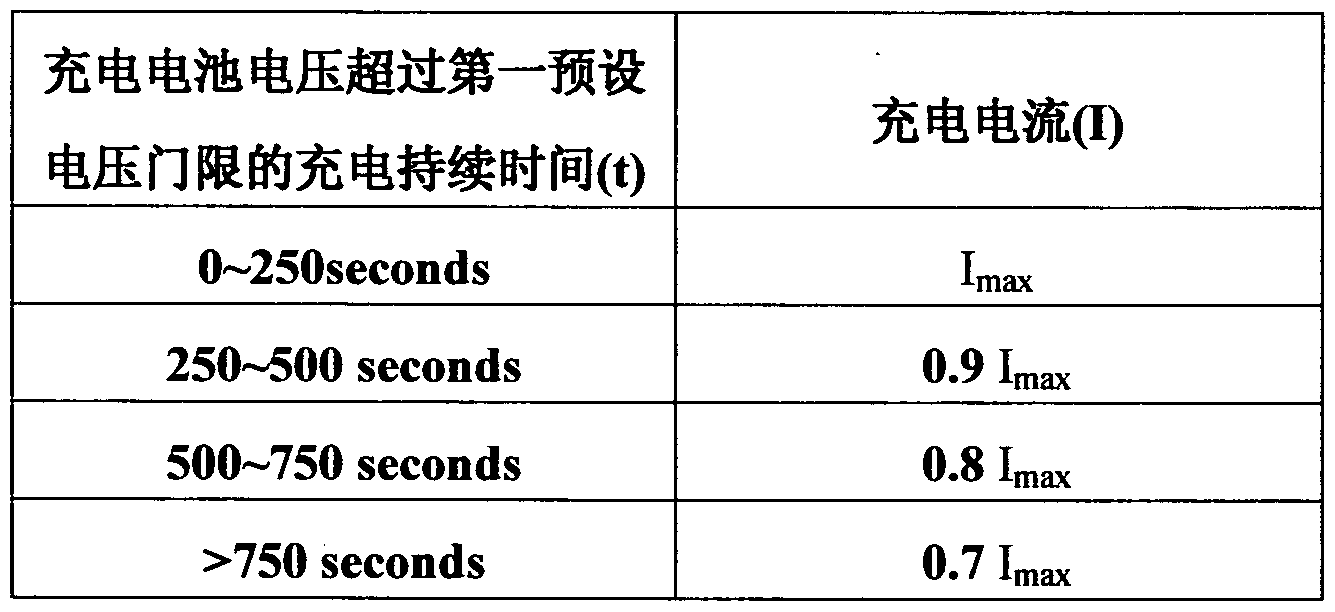
<实现方式四 >
在实现方式四中, 充电电流控制参数为充电电池的当前电量^ 且在充电电池 从开始充电到充满电的过程中, I=f( 为减函数, 其中 I为充电电流。
在步骤 12 中, 根据所述充电电流控制参数将充电电池的充电电流从第一充电 电流修改为小于所述第一充电电流的第二充电电流;
在实现方式四中, 可以建立充电电池的当前电量 g和充电电流 I 的函数关系 1= ), 该函数为减函数即可, 在步骤 12中, 直接根据该充电电池的当前电量 计 算当前的充电电流即可, 然后将充电电池的充电电流修改为计算得到的充电电流即
可。
对于上述的充电电池的当前电量 q和充电电流 I的函数关系举例如下-

其中 Imax为充电电池的最大允许充电电流,而 Q为预先设置的用于调节电流变 化速度的电量常数, 该常数 Q需要大于或等于充电电池充满电时的电量, 当然, 对
Q进行调节, 可以控制充电时间, 如 Q选择大一些, 则充电时间短一些, Q选择小 一些,.则充电时间长一些。
同时, 也可以通过 Q来调节, 使得充电电流大于或等于最小充电电流。
对于上述的当前电量 g和充电电流 I的函数关系另举例如下:

基于相同的道理, 也可以通过对 Q进行调节来控制充电时间。
当然, 上述仅仅是列举了几种可能的当前电量 g和充电电流 I的函数关系, 应 当理解的是, 二者之间也可能是其他的连续变化的减函数, 在此不一一列举。
<实现方式五 >
在实现方式五中, 充电电流控制参数为充电电池的当前电量 且在充电电池 从开始充电到充满电的过程中, 且从开始充电到充满电按照当前电量被分为互不重 叠的至少两个电量段, 所述至少两个电量段中, 每一电量段对应于一充电电流, 且 相邻的电量段中, 电量较大的电量段对应的充电电流大于电量较小的电量段对应的 充电电流。
如下表 6所示, 为当前电量分为互不重叠的 4个段后, 电量段与充电电流之间 的对应关系, 其中 Qmax为充电电池充满电时的电量。
表 6

假定在电池温度为小于等于 45度, 充电电流与持续时间的关系如下表 7所示:
表 7

步骤 A2, 判断电池温度是否高于预设温度门限(如 45摄氏度), 如果是进入则 设置时间系数 X为 XI, 否则设置时间系数 X为 X2, 进入步骤 A3 ; 其中 XI小于 X2, 在后续步骤中以 XI等于 1, X2等于 4进行说明;
步骤 A3 , 判断电池电压是否超过预设电压门限 (如 3.9V ) , 如果是, 进入步骤 A4, 否则进入步骤 Al l ;
步骤 A4, 判断充电电池电压超过 3.9V的充电持续时间是否小于 X与单位时间 间隔(其可以根据要求设置, 如 250s), 如果是, 则进入步骤 A5, 否则进入步骤 A6;
步骤 A5, 以 Imax充电, 进入步骤 A12;
步骤 A6,判断充电电池电压超过 3.9V的充电持续时间是否小于 2X与单位时间 间隔, 如果是, 则进入步骤 A7, 否则进入步骤 A8;
步骤 A7, 以 0.9 Imax充电, 进入步骤 A12;
步骤 A8,判断充电电池电压超过 3.9V的充电持续时间是否小于 3X与单位时间 间隔, 如果是, 则进入步骤 A9, 否则进入步骤 A10;
步骤 A9, 以 0.8 Imax充电, 进入步骤 A12;
步骤 A10, 以 0.7 Imax充电, 进入步骤 A12。
步骤 Al l , 以 Imax充电, 进入步骤 A12。
步骤 A12, 判断充电是否结束, 如果是, 则结束本次充电, 否则进入步骤 A2。 发明人在实现本发明实施例的过程中发现, 影响充电电池容量衰减和循环性能的关 键因素中包括充电电压, 一般而言, 充电电压越大, 充电电池的续航时间越长量, 但充电电池容量衰减和循环性能的下降也越快。
考虑到上述情况, 本发明实施例的充电电池的充电控制方法如图 3所示, 包括: 步骤 31, 获取充电模式判断参数;
步骤 32,根据模式判断参数判断本次充电采用第一充电模式还是第二充电模式; 步骤 33, 在第一充电模式下, 利用第一充电电压对所述充电电池进行充电, 在 第二充电模式下, 利用第二充电电压对所述充电电池进行充电;
所述第二充电电压大于所述第一充电电压。
当然, 在本发明的具体实施例中, 该第二充电电压可以选择充电电池的最大允 许充电电压。
当然, 为了保证充电电池的续航能力, 所述第一充电电压应该大于一预设门限。 在本发明的具体实施例中, 该充电模式判断参数可以采用多种方式来实现, 详 细说明如下。
<实现方式一 >
在实现方式一中, 该充电模式判断参数为充电电池的已循环次数。
在步骤 32中, 可以通过如下方式来确定充电模式:
判断已循环次数是否超过第一预设循环次数门限(如 150次), 如已循环次数超 过第一预设循环次数门限, 则判断本次充电采用第一充电模式, 否则采用第二充电 模式。
发明人在实现本发明实施例的过程中发现, 充电电压对充电电池容量衰减和循 环性能, 相同的充电电压情况下, 相比较而言, 在电池循环寿命后期的充电过程中 较高充电电压对充电电池容量衰减和循环性能的影响更大, 考虑到这种情况, 所以 在实现方式一中, 设置一循环次数门限, 在充电电池的已循环次数低于该门限时,
使用较大电压进行充电, 此时, 既不会对充电电池容量衰减和循环性能造成大的差 的影响, 又能提高充电电池的续航能力, 而在充电电池的已循环次数大于或等于该 循环门限时, 考虑到再使用较大充电电压进行充电, 将会导致充电电池容量衰减较 大, 循环性能更容易变差, 此时, 使用较小的电压进行充电, 以提高充电电池的可 循环次数和循环性能。
所以相对于现有技术的使用恒定的最大电压进行充电的方法, 本发明实施例的 充电控制方法能够显著提高充电电池的可循环次数和循环性能。
<实现方式二 >
在实现方式二中, 该充电模式判断参数为所述电池的电芯电压高于第二预设电 压门限 (如 4.1V) 的累积时间。
在步骤 32中, 可以通过如下方式来确定充电模式:
判断所述电池的电芯电压高于第二预设电压门限的累积时间是否超过第一累积 时间门限, 如电芯电压高于第二预设电压门限的累积时间超过第一累积时间门限, 则判断本次充电采用第一充电模式, 否则采用第二充电模式。
发明人在实现本发明实施例的过程中发现, 充电电池的电池恢复能力与电池在 闲置状态下的电芯电压密切相关, 通过相关实验可以发现, 将完全充满电的电池放 置一年以后,该电池的容量将会缩减 8%左右,而将充电到 80%的电池放置一年以后, 该电池的容量只会缩减原容量的 4%左右,而如果只将电池充电到 50%左右,放置一 年以后, 该电池的容量只会缩减 1%左右。
因此, 现有技术的电池管理方法总是将电池的电量维持在一个较高的水平 (也 就是电芯电压维持在高电压状态), 导致电池容量衰减。
而本发明实施例中, 如所述电池的电芯电压高于第二预设电压门限 (如 4.1V)的 累积时间超过第一累积时间门限 (如 90天), 则表明电池高电压存储的闲置累积时 间较长, 在这种情况下, 应该采用第一充电模式, 采用较低的电压进行充电, 使电 池的容量低于充电电池的最大容量, 以便于降低充电电池的容量衰减, 也就能够提 高充电电池的可循环次数和循环性能。
<实现方式三 >
在实现方式三中, 该充电模式判断参数为充电电池的已循环次数和所述电池的 电芯电压高于第二预设电压门限的累积时间。
在步骤 32中, 结合图 4说明可以通过如下方式来确定充电模式:
在步骤 41, 判断已循环次数是否超过第一预设循环次数门限, 以及所述电池的 电芯电压高于第二预设电压门限的累积时间是否超过第一累积时间门限。
在步骤 43, 如果步骤 41 的判断结果是肯定的, 即在己循环次数超过第一预设 循环次数门限, 或者所述电池的电芯电压高于第二预设电压门限的累积时间超过第 一累积时间门限时, 都采用第一充电模式;
如果步骤 41 的判断结果是否定的, 则在已循环次数低于第一预设循环次数门 限, 且所述电池的电芯电压高于第二预设电压门限的累积时间低于第一累积时间门 限时, 在步骤 42, 进一步判断:
已循环次数是否低于第二预设循环次数门限 (小于第一预设循环次数门限, 如 50 次), 以及所述电池的电芯电压高于第二预设电压门限的累积时间是否低于第二 累积时间门限 (小于第一累积时间门限, 如 30天)。
在步骤 44, 如果在步骤 42的判断是肯定的, 即在已循环次数低于第二预设循 环次数门限, 且所述电池的电芯电压高于第二预设电压门限的累积时间低于第二累 积时间门限时, 都采用第二充电模式。
说明如下。
在已循环次数超过第一预设循环次数门限, 或者所述电池的电芯电压高于第二 预设电压门限的累积时间超过第一累积时间门限时, 表明或者电池已经循环使用多 次, 或者电池之前高电压存储累积闲置状态已经比较长, 这两种情况下, 都应该以 低电压对电池进行充电, 以提高充电电池的可循环次数和循环性能。
而在己循环次数低于第二预设循环次数门限, 且所述电池的电芯电压高于第二 预设电压门限的累积时间低于第二累积时间门限 (小于第一累积时间门限) 时, 表 明电池循环使用次数较低, 而且电池处于高电压存储闲置状态的累积时间并不长, 所以还是可以以高电压对其进行充电, 这种情况下以高电压充电并不会对充电电池 的可循环次数和循环性能带来很大的坏的影响, 但能够提高电池的续航能力。
在实现方式三中, 还包括如下的几种情况:
已循环次数在第一预设循环次数门限和第二预设循环次数门限之间, 电池的电 芯电压高于第二预设电压门限的累积时间低于第一累积时间门限;
电池的电芯电压高于第二预设电压门限的累积时间在第一累积时间门限和第二 累积时间门限之间, 已循环次数低于第一预设循环次数门限。
在上述的两种情况下, 可以判断本次充电采用第一充电模式和第二充电模式中
的任意一种, 但在本发明具体实施例中, 为了进一步提高充电电池的可循环次数和 循环性能, 在上述两种情况下, 采用如下方式来确定。
在上述的两种情况, 按照实现方式三, 既不属于必须采用第一充电模式进行充 电的范畴, 也不属于必须采用第二充电模式进行充电的范畴, 因此, 需要进一步采 取其他的条件进行判断, 以确定采用的充电模式, 在本发明具体实施例中, 可以采 用如下参数来进行判断:
判断在此之前的第一持续时间门限 (如 120小时) 内, 电池电量是否保持在预 设的第一电量门限 (如电池最大电量的 20%) 以上, 如果是, 表明用户属于轻度使 用电池的状态, 也就是每一次使用都没有将电池电量用完, 此时, 可以采用第一充 电模式, 利用第一充电电压对所述充电电池进行充电, 以提高充电电池的可循环次 数和循环性能, 否则, 表明用户在过去的一段时间重度使用电池, 也就是将电池电 量基本用完, 所以, 在这种情况下, 应该尽可能保证电池的续航性能, 以满足用户 的使用需求, 所以采用第二充电模式, 利用第二充电电压对所述充电电池进行充电。
从以上过程可以看出, 在上述的两种情况下可能进入第一充电模式, 在这种情 况下, 如何转换到第二充电模式, 本发明实施例进一步提供如下判断方式。
上次充电模式为第一充电模式时, 在准备充电时, 判断在此之前的第二持续时 间门限(小于第一持续时间门限, 如 16小时) 内, 电池电量低于预设的第二电量门 限 (小于预设的第一电量门限, 如电池最大电量的 10%) 的发生次数是否低于第三 预设次数门限 (如 2次) 内, 如果是, 则表明用户继续需要重度使用电池在这种情 况下, 应该尽可能保证电池的续航性能, 以满足用户的使用需求, 所以采用第二充 电模式, 利用第二充电电压对所述充电电池进行充电, 否则表明用户属于轻度使用 电池的状态, 也就是每一次使用都没有将电池电量用完, 此时, 可以釆用第一充电 模式, 利用第一充电电压对所述充电电池进行充电, 以提高充电电池的可循环次数 和循环性能,
当然, 应当理解的是, 上述所有的具体数值都仅仅是举例说明, 根据不同的用 户需求, 都可以采用其他的数值。
同时, 在本发明的具体实施例中, 确定充电模式之后, 即可在每次充电的过程 中结合上述描述的充电电流控制方法对充电电池进行充电控制,在此不再详细描述。
本发明实施例的充电控制装置, 用于对便携式电脑中设置的充电电池 55进行 充电控制, 所述便携式电脑设置有用于对所述充电电池 55进行充电的充电电路 54,
;腦 2011/ 00 0544 其中, 所述充电控制装置如图 5所示包括:
第二获取模块 51, 用于获取充电模式判断参数;
模式判断模块 52, 用于根据模式判断参数判断本次充电采用第一充电模式还是 第二充电模式;
电压控制模块 53, 在第一充电模式下, 控制所述充电电路 54利用第一充电电 压对所述充电电池 55进行充电, 在第二充电模式下, 控制所述充电电路 54利用第 二充电电压对所述充电电池 55进行充电;
所述第二充电电压大于所述第一充电电压。
本发明实施例的便携式电脑, 包括主板 (未示出)、 与主板连接的充电电池 55 以及用于对所述电池 55进行充电的充电电路 54, 其中, 所述便携式电脑还包括充 电控制装置, 用于对便携式电脑中设置的充电电池 55进行充电控制, 所述充电控制 装置包括- 第二获取模块 51, 用于获取充电模式判断参数;
模式判断模块 52, 用于根据模式判断参数判断本次充电采用第一充电模式还是 第二充电模式;
电压控制模块 53, 在第一充电模式下, 控制所述充电电路 54利用第一充电电 压对所述充电电池 55进行充电, 在第二充电模式下, 控制所述充电电路 54利用第 二充电电压对所述充电电池 55进行充电;
所述第二充电电压大于所述第一充电电压。
以上所述仅是本发明的优选实施方式, 应当指出, 对于本技术领域的普通技术 人员来说, 在不脱离本发明原理的前提下, 还可以作出若干改进和润饰, 这些改进 和润饰也应视为本发明的保护范围。
Claims
1. 一种充电电池的充电控制方法, 其特征在于, 包括:
获取充电电池的充电电流控制参数;
根据所述充电电流控制参数将充电电池的充电电流从第一充电电流修改为小于 所述第一充电电流的第二充电电流;
利用所述第二充电电流对所述充电电池进行充电。
2. 根据权利要求 1所述的充电控制方法, 其特征在于, 所述充电电流控制参数 为:
从充电开始计算的第一充电持续时间; 或
从电池电压达到第一预设电压门限后开始计算的第二充电持续时间; 或 充电电池的当前电量。
3. 根据权利要求 2所述的充电控制方法, 其特征在于- 所述充电电流控制参数为从电池电压达到预设电压门限后开始计算的第二充电 持续时间时, 从电池电压被充到所述预设电压门限开始到充电电池被充满电之间的 时间被分为互不重叠的至少两个时间段, 所述至少两个时间段中, 每一时间段对应 于一充电电流, 且相邻的时间段中, 在先时间段对应的充电电流大于在后的时间段 的充电电流;
所述第二充电持续时间从位于第一时间段变化到位于第二时间段时, 根据所述 充电电流控制参数将充电电池的充电电流从与所述第一时间段对应的第一充电电流 修改为与所述第二时间段对应的第二充电电流。
4. 根据权利要求 3所述的充电控制方法, 其特征在于, 所述电池电压被充到所 述预设电压门限之前, 所述充电电池的充电电流为最大充电电流。
5. 根据权利要求 3所述的充电控制方法, 其特征在于, 充电电流控制参数还包 括电池温度, 所述电池温度越高, 以超过预定电流强度的充电电流对充电电池进行 充电的持续时间越短。
6. 一种便携式电脑, 包括主板、 与主板连接的充电电池以及用于对所述电池进 行充电的充电电路, 其中, 所述便携式电脑还包括一充电控制装置, 用于对所述充 电电池进行充电控制, 所述充电控制装置包括: 第一获取模块, 用于获取充电电池的充电电流控制参数;
电流控制模块, 用于根据所述充电电流控制参数控制所述充电电路, 使所述充 电电路产生的对充电电池进行充电的充电电流从第一充电电流修改为小于所述第一 充电电流的第二充电电流, 并利用所述第二充电电流对所述充电电池进行充电。
7. 根据权利要求 6所述的便携式电脑,其特征在于,所述充电电流控制参数为: 从充电开始计算的第一充电持续时间; 或
从电池电压达到第一预设电压门限后开始计算的第二充电持续时间; 或 充电电池的当前电量。 '
8. 根据权利要求 7所述的便携式电脑, 其特征在于,
所述充电电流控制参数为从电池电压达到预设电压门限后开始计算的第二充电 持续时间时, 从电池电压被充到所述预设电压门限开始到充电电池被充满电之间的 时间被分为互不重叠的至少两个时间段, 所述至少两个时间段中, 每一时间段对应 于一充电电流, 且相邻的时间段中, 在先时间段对应的充电电流大于在后的时间段 的充电电流;
所述电流控制模块在所述第二充电持续时间从位于第一时间段变化到位于第二 时间段时, 控制所述充电电路, 使所述充电电路产生的对充电电池进行充电的充电 电流从与所述第一时间段对应的第一充电电流修改为与所述第二时间段对应的第二 充电电流。
9. 根据权利要求 8所述的便携式电脑, 其特征在于, 所述电池电压被充到所述 预设电压门限之前, 所述充电电池的充电电流为最大充电电流。
10. 根据权利要求 8所述的便携式电脑, 其特征在于, 充电电流控制参数还包 括电池温度, 所述电池温度越高, 所述电流控制模块控制所述充电电路产生超过预 定电流强度的充电电流的持续时间越短。
11. 一种充电控制方法, 其特征在于, 包括- 获取充电模式判断参数;
根据模式判断参数判断本次充电采用第一充电模式还是第二充电模式; 在第一充电模式下, 利用第一充电电压对所述充电电池进行充电, 在第二充电 模式下, 利用第二充电电压对所述充电电池进行充电, 其中所述第二充电电压大于 所述第一充电电压。
12. 根据权利要求 11所述的充电控制方法, 其特征在于, 所述充电模式判断参 数包括充电电池的已循环次数, 根据模式判断参数判断本次充电采用第一充电模式 还是第二充电模式具体为: 判断己循环次数是否超过第一预设循环次数门限, 如已 循环次数超过第一预设循环次数门限, 则判断本次充电采用第一充电模式, 否则采 用第二充电模式。
13. 根据权利要求 11所述的充电控制方法, 其特征在于, 所述充电模式判断参 数包括充电电池的电芯电压高于第二预设电压门限的累积时间, 根据模式判断参数 判断本次充电采用第一充电模式还是第二充电模式具体为: 判断充电电池的电芯电 压高于第二预设电压门限的累积时间是否超过第一累积时间门限, 如果是, 则判断 本次充电采用第一充电模式, 否则采用第二充电模式。
14. 根据权利要求 11所述的充电控制方法, 其特征在于, 所述充电模式判断参 数包括充电电池的己循环次数和充电电池的电芯电压高于第二预设电压门限的累积 时间, 根据模式判断参数判断本次充电采用第一充电模式还是第二充电模式具体包 括- 判断己循环次数是否超过第一预设循环次数门限, 以及所述电池的电芯电压高 于第二预设电压门限的累积时间是否超过第一累积时间门限, 在已循环次数超过第 一预设循环次数门限, 或者所述电池的电芯电压高于第二预设电压门限的累积时间 超过第一累积时间门限时, 判断本次充电第一充电模式;
在已循环次数低于第一预设循环次数门限, 且所述电池的电芯电压高于第二预 设电压门限的累积时间低于第一累积时间门限时, 进一步判断:
已循环次数是否低于第二预设循环次数门限, 以及电池的电芯电压高于第二预 设电压门限的累积时间是否低于第二累积时间门限, 第二预设循环次数门限小于第 一预设循环次数门限, 第二累积时间门限小于第一累积时间门限;
在已循环次数低于第二预设循环次数门限, 且所述电池的电芯电压高于第二预 设电压门限的累积时间低于第二累积时间门限时,判断本次充电采用第二充电模式。
15. 根据权利要求 14所述的充电控制方法, 其特征在于, 所述根据模式判断参 数判断本次充电采用第一充电模式还是第二充电模式还包括:
在已循环次数在第一预设循环次数门限和第二预设循环次数门限之间, 电池的 电芯电压高于第二预设电压门限的累积时间低于第一累积时间门限时; 或者电池的 电芯电压高于第二预设电压门限的累积时间在第一累积时间门限和第二累积时间门 限之间, 已循环次数低于第一预设循环次数门限时, 判断在此之前的第一持续时间 门限内, 电池电量是否保持在预设的第一预设电量门限以上, 如果是, 判断本次充 电采用第一充电模式, 否则判断本次充电采用采用第二充电模式。
16. 根据权利要求 15所述的充电控制方法, 其特征在于, 所述根据模式判断参 数判断本次充电采用第一充电模式还是第二充电模式还包括- 在己循环次数在第一预设循环次数门限和第二预设循环次数门限之间, 电池的 电芯电压高于第二预设电压门限的累积时间低于第一累积时间门限时; 或者电池的 电芯电压高于第二预设电压门限的累积时间在第一累积时间门限和第二累积时间门 限之间, 已循环次数低于第一预设循环次数门限, 且上次充电模式为第一充电模式 时, 判断在此之前的第二持续时间门限内, 电池电量低于预设的第二电量门限的发 生次数是否低于第三预设次数门限, 如果是, 则判断本次充电采用第二充电模式, 否则判断本次充电采用第一充电模式。
17. 根据权利要求 11所述的充电控制方法, 还包括:
在第一充电模式或第二充电模式下充电时,获取充电电池的充电电流控制参数; 根据所述充电电流控制参数将充电电池的充电电流从第一充电电流修改为小于 所述第一充电电流的第二充电电流;
利用所述第二充电电流对所述充电电池进行充电。
18. 根据权利要求 17所述的充电控制方法, 其特征在于, 所述充电电流控制参 数为:
从充电开始计算的第一充电持续时间; 或
从电池电压达到第一预设电压门限后开始计算的第二充电持续时间; 或 充电电池的当前电量。
19. 根据权利要求 18所述的充电控制方法, 其特征在于:
所述充电电流控制参数为从电池电压达到预设电压门限后开始计算的第二充电 持续时间时, 从电池电压被充到所述预设电压门限开始到充电电池被充满电之间的 时间被分为互不重叠的至少两个时间段, 所述至少两个时间段中, 每一时间段对应 于一充电电流, 且相邻的时间段中, 在先时间段对应的充电电流大于在后的时间段 的充电电流; 所述第二充电持续时间从位于第一时间段变化到位于第二时间段时, 根据所述 充电电流控制参数将充电电池的充电电流从与所述第一时间段对应的第一充电电流 修改为与所述第二时间段对应的第二充电电流。
20. 根据权利要求 19所述的充电控制方法, 其特征在于, 所述电池电压被充到 所述预设电压门限之前, 所述充电电池的充电电流为最大充电电流。
21. 根据权利要求 19所述的充电控制方法, 其特征在于, 充电电流控制参数还 包括电池温度, 所述电池温度越高, 以超过预定电流强度的充电电流对充电电池进 行充电的持续时间越短。
22. 一种便携式电脑, 包括主板、 与主板连接的充电电池以及用于对所述电池 进行充电的充电电路, 其特征在于, 所述便携式电脑还包括第一充电控制装置, 用 于对便携式电脑中设置的充电电池进行充电控制, 所述第一充电控制装置包括: 第二获取模块, 用于获取充电模式判断参数;
模式判断模块, 用于根据模式判断参数判断本次充电采用第一充电模式还是第 二充电模式;
电压控制模块, 在第一充电模式下, 控制所述充电电路利用第一充电电压对所 述充电电池进行充电, 在第二充电模式下, 控制所述充电电路利用第二充电电压对 所述充电电池进行充电, 其中所述第二充电电压大于所述第一充电电压。
23. 根据权利要求 22所述的便携式电脑, 其特征在于, 所述充电模式判断参数 包括充电电池的已循环次数和充电电池的电芯电压高于第二预设电压门限的累积时 间, 所述模式判断模块判断已循环次数是否超过第一预设循环次数门限, 以及所述 电池的电芯电压高于第二预设电压门限的累积时间是否超过第一累积时间门限, 在 已循环次数超过第一预设循环次数门限, 或者所述电池的电芯电压高于第二预设电 压门限的累积时间超过第一累积时间门限时, 判断本次充电第一充电模式, 以及 所述模式判断模块在已循环次数低于第一预设循环次数门限, 且所述电池的电 芯电压高于第二预设电压门限的累积时间低于第一累积时间门限时, 判断已循环次 数是否低于第二预设循环次数门限, 以及所述电池的电芯电压高于第二预设电压门 限的累积时间是否低于第二累积时间门限, 所述第二预设循环次数门限小于第一预 设循环次数门限第一预设循环次数门限,第二累积时间门限小于第一累积时间门限, 在已循环次数低于第二预设循环次数门限, 且所述电池的电芯电压高于第二预设电 压门限的累积时间低于第二累积时间门限时, 判断本次充电采用第二充电模式。
24. 根据权利要求 23所述的便携式电脑, 其特征在于, 所述模式判断模块在已 循环次数在第一预设循环次数门限和第二预设循环次数门限之间, 电池的电芯电压 高于第二预设电压门限的累积时间低于第一累积时间门限时; 或者电池的电芯电压 高于第二预设电压门限的累积时间在第一累积时间门限和第二累积时间门限之间, 已循环次数低于第一预设循环次数门限时, 判断在此之前的第三预设时间门限内, 电池电量是否保持在预设的第一预设电量门限以上, 如果是, 判断本次充电采用第 一充电模式, 否则判断本次充电采用采用第二充电模式。
25. 根据权利要求 24所述的便携式电脑, 其特征在于, 所述模式判断模块在已 循环次数在第一预设循环次数门限和第二预设循环次数门限之间, 电池的电芯电压 高于第二预设电压门限的累积时间低于第一累积时间门限时; 或者电池的电芯电压 高于第二预设电压门限的累积时间在第一累积时间门限和第二累积时间门限之间, 已循环次数低于第一预设循环次数门限时, 判断上次充电模式是否为第一充电模式 时, 如果是则继续判断在此之前的第四预设时间门限内, 电池电量低于预设的第二 预设电量门限的发生次数是否低于第三预设次数门限, 如果是, 则判断本次充电采 用第二充电模式, 否则判断本次充电采用第一充电模式。
26. 根据权利要求 22所述的便携式电脑, 其特征在于, 还包括用于在第一充电 模式或第二充电模式下充电时, 进行充电控制的第二充电控制装置, 所述第二充电 控制装置包括:
第一获取模块, 用于获取充电电池的充电电流控制参数;
电流控制模块, 用于根据所述充电电流控制参数控制所述充电电路, 使所述充 电电路产生的对充电电池进行充电的充电电流从第一充电电流修改为小于所述第一 充电电流的第二充电电流, 并利用所述第二充电电流对所述充电电池进行充电。
27. 根据权利要求 26所述的便携式电脑, 其特征在于, 所述充电电流控制参数 为:
从充电开始计算的第一充电持续时间; 或
从电池电压达到预设电压门限后开始计算的第二充电持续时间; 或
充电电池的当前电量。
28. 根据权利要求 27所述的便携式电脑, 其特征在于, 所述充电电流控制参数为从电池电压达到预设电压门限后开始计算的第二充电 持续时间时, 从电池电压被充到所述预设电压门限开始到充电电池被充满电之间的 时间被分为互不重叠的至少两个时间段, 所述至少两个时间段中, 每一时间段对应 于一充电电流, 且相邻的时间段中, 在先时间段对应的充电电流大于在后的时间段 的充电电流;
所述电流控制模块在所述第二充电持续时间从位于第一时间段变化到位于第二 时间段时, 控制所述充电电路, 使所述充电电路产生的对充电电池进行充电的充电 电流从与所述第一时间段对应的第一充电电流修改为与所述第二时间段对应的第二 充电电、流。
29. 根据权利要求 28所述的便携式电脑, 其特征在于, 所述电池电压被充到所 述预设电压门限之前, 所述充电电池的充电电流为最大充电电流。
30. 根据权利要求 29所述的便携式电脑, 其特征在于, 充电电流控制参数还包 括电池温度, 所述电池温度越高, 所述电流控制模块控制所述充电电路产生超过预 定电流强度的充电电流的持续时间越短。
Priority Applications (2)
| Application Number | Priority Date | Filing Date | Title |
|---|---|---|---|
| US13/637,967 US9178372B2 (en) | 2010-04-02 | 2011-03-30 | Charging control method for a rechargeable battery and portable computer |
| US14/924,322 US9634511B2 (en) | 2010-04-02 | 2015-10-27 | Charging control method for a rechargeable battery and portable computer |
Applications Claiming Priority (2)
| Application Number | Priority Date | Filing Date | Title |
|---|---|---|---|
| CN201010140866.4 | 2010-04-02 | ||
| CN201010140866.4A CN102214938B (zh) | 2010-04-02 | 2010-04-02 | 充电电池的充电控制方法及便携式电脑 |
Related Child Applications (2)
| Application Number | Title | Priority Date | Filing Date |
|---|---|---|---|
| US13/637,967 A-371-Of-International US9178372B2 (en) | 2010-04-02 | 2011-03-30 | Charging control method for a rechargeable battery and portable computer |
| US14/924,322 Division US9634511B2 (en) | 2010-04-02 | 2015-10-27 | Charging control method for a rechargeable battery and portable computer |
Publications (1)
| Publication Number | Publication Date |
|---|---|
| WO2011120334A1 true WO2011120334A1 (zh) | 2011-10-06 |
Family
ID=44711342
Family Applications (1)
| Application Number | Title | Priority Date | Filing Date |
|---|---|---|---|
| PCT/CN2011/000544 Ceased WO2011120334A1 (zh) | 2010-04-02 | 2011-03-30 | 充电电池的充电控制方法及便携式电脑 |
Country Status (3)
| Country | Link |
|---|---|
| US (2) | US9178372B2 (zh) |
| CN (1) | CN102214938B (zh) |
| WO (1) | WO2011120334A1 (zh) |
Cited By (1)
| Publication number | Priority date | Publication date | Assignee | Title |
|---|---|---|---|---|
| CN103199597A (zh) * | 2012-01-06 | 2013-07-10 | 鸿富锦精密工业(深圳)有限公司 | 电池充电系统及方法 |
Families Citing this family (34)
| Publication number | Priority date | Publication date | Assignee | Title |
|---|---|---|---|---|
| CN102214938B (zh) * | 2010-04-02 | 2014-07-30 | 联想(北京)有限公司 | 充电电池的充电控制方法及便携式电脑 |
| CN102707234B (zh) * | 2012-05-04 | 2015-12-09 | 惠州市亿能电子有限公司 | 电池组剩余充电时间估算方法 |
| CN103516004B (zh) * | 2012-06-29 | 2017-03-29 | 联想(北京)有限公司 | 一种信息处理方法和装置 |
| CN105471002A (zh) * | 2014-08-21 | 2016-04-06 | 深圳富泰宏精密工业有限公司 | 快速充电系统及方法 |
| CN105846485A (zh) * | 2015-01-16 | 2016-08-10 | 广东美的制冷设备有限公司 | 蓄电池的充电电流调节方法及装置 |
| CN104578316A (zh) * | 2015-01-28 | 2015-04-29 | 深圳市良益实业有限公司 | 电池组分布多模式均衡充电方法及均衡充电电路 |
| WO2016146194A1 (de) * | 2015-03-19 | 2016-09-22 | Vorwerk & Co. Interholding Gmbh | Werkzeugkoffer mit kofferunterteil und kofferdeckel |
| CN104901401A (zh) * | 2015-05-22 | 2015-09-09 | 深圳天珑无线科技有限公司 | 一种充电方法及充电系统 |
| CN104917391B (zh) * | 2015-05-22 | 2018-08-03 | 深圳天珑无线科技有限公司 | 一种电源 |
| CN104901366A (zh) * | 2015-05-22 | 2015-09-09 | 深圳天珑无线科技有限公司 | 一种充电方法及充电系统 |
| AU2016285501B2 (en) * | 2015-06-30 | 2019-03-14 | Murata Manufacturing Co., Ltd. | Power storage system, controller, and storage battery charging and discharging method |
| KR102010021B1 (ko) * | 2015-11-18 | 2019-08-12 | 주식회사 엘지화학 | 배터리 팩 관리 장치 및 방법 |
| CN105406538B (zh) * | 2015-12-08 | 2018-12-07 | 惠州Tcl移动通信有限公司 | 一种移动终端防止充电过压的方法及系统 |
| US9939873B1 (en) * | 2015-12-09 | 2018-04-10 | International Business Machines Corporation | Reconfigurable backup and caching devices |
| CN105811033B (zh) * | 2016-03-28 | 2018-11-09 | 联想(北京)有限公司 | 一种充电方法及电子设备 |
| CN107546785B (zh) * | 2016-06-24 | 2023-06-16 | 中兴通讯股份有限公司 | 一种充电方法和装置 |
| CN106026034B (zh) * | 2016-06-30 | 2019-10-29 | 联想(北京)有限公司 | 一种电池电芯的过流保护方法及电路 |
| CN108475935B (zh) * | 2016-11-30 | 2021-06-01 | 华为技术有限公司 | 一种电池充电管理方法和终端 |
| CN106786877B (zh) * | 2016-12-20 | 2019-02-22 | 山东元齐新动力科技有限公司 | 对大功率电池进行充电的方法及装置 |
| CN107204493B (zh) * | 2017-04-28 | 2020-09-29 | 宁德时代新能源科技股份有限公司 | 电池充电方法、装置和设备 |
| TWI642255B (zh) | 2017-04-28 | 2018-11-21 | 宏碁股份有限公司 | 電池控制方法及電池控制裝置 |
| CN109037810A (zh) * | 2017-06-08 | 2018-12-18 | 宁德新能源科技有限公司 | 一种电池的充电方法、装置及电池系统 |
| US11073838B2 (en) | 2018-01-06 | 2021-07-27 | Drivent Llc | Self-driving vehicle systems and methods |
| US11056900B2 (en) * | 2018-01-31 | 2021-07-06 | Ningde Amperex Technology Limited | Charging method, charging device, and computer-readable medium for charging a battery |
| CN112204843A (zh) | 2018-05-30 | 2021-01-08 | 米沃奇电动工具公司 | 快速充电电池组 |
| WO2020028206A1 (en) * | 2018-07-30 | 2020-02-06 | Drivent Llc | Self-driving vehicle systems and methods |
| US11221622B2 (en) | 2019-03-21 | 2022-01-11 | Drivent Llc | Self-driving vehicle systems and methods |
| US11644833B2 (en) | 2018-10-01 | 2023-05-09 | Drivent Llc | Self-driving vehicle systems and methods |
| JP7174333B2 (ja) * | 2019-03-27 | 2022-11-17 | 株式会社Gsユアサ | 蓄電装置、蓄電素子の容量推定方法 |
| US12147229B2 (en) | 2019-11-08 | 2024-11-19 | Drivent Llc | Self-driving vehicle systems and methods |
| WO2021100893A1 (ko) * | 2019-11-19 | 2021-05-27 | 엘지전자 주식회사 | 전자 장치 및 전자 장치의 충전 제어 방법 |
| CN113131544A (zh) * | 2019-12-31 | 2021-07-16 | Oppo广东移动通信有限公司 | 充电控制方法及装置、电子设备以及计算机存储介质 |
| CN112803524B (zh) * | 2020-12-31 | 2023-04-28 | 科华恒盛股份有限公司 | 电池充电控制方法、装置及终端 |
| CN114487896A (zh) * | 2021-12-31 | 2022-05-13 | 深圳市驰普科达科技有限公司 | 电源设备老化测试柜 |
Citations (5)
| Publication number | Priority date | Publication date | Assignee | Title |
|---|---|---|---|---|
| CN1241042A (zh) * | 1998-05-27 | 2000-01-12 | 松下电器产业株式会社 | 蓄电池的充电方法 |
| CN1655419A (zh) * | 2004-02-13 | 2005-08-17 | 合肥同智科技发展有限公司 | 蓄电池快/慢充电控制方法 |
| CN201167243Y (zh) * | 2008-01-17 | 2008-12-17 | 青岛海信移动通信技术股份有限公司 | 充电电路及具有所述充电电路的移动通信设备 |
| JP2009033843A (ja) * | 2007-07-26 | 2009-02-12 | Panasonic Electric Works Co Ltd | 充電装置および充電方法 |
| CN101599651A (zh) * | 2009-06-30 | 2009-12-09 | 聊城大学 | 通用型快速智能充电器及充电方法 |
Family Cites Families (20)
| Publication number | Priority date | Publication date | Assignee | Title |
|---|---|---|---|---|
| US5442274A (en) * | 1992-08-27 | 1995-08-15 | Sanyo Electric Company, Ltd. | Rechargeable battery charging method |
| US5557188A (en) * | 1994-02-01 | 1996-09-17 | Sun Microsystems, Inc. | Smart battery system and interface |
| US5900718A (en) * | 1996-08-16 | 1999-05-04 | Total Battery Management, | Battery charger and method of charging batteries |
| US6337560B1 (en) * | 2000-11-28 | 2002-01-08 | Telefonaktiebolaget Lm Ericsson (Publ) | Life cycle charging for batteries |
| US7282891B2 (en) * | 2002-12-30 | 2007-10-16 | Motorola, Inc. | Method for charging a battery |
| US7352152B2 (en) * | 2003-04-04 | 2008-04-01 | Fujifilm Corporation | Portable electronic appliance with a battery having a wireless tag containing battery information |
| US7202635B2 (en) * | 2004-03-10 | 2007-04-10 | Motorola, Inc. | Method and system for charging a battery to a point less than initial maximum capacity |
| JP2006304548A (ja) * | 2005-04-22 | 2006-11-02 | Matsushita Electric Ind Co Ltd | 充電制御装置 |
| US7518340B2 (en) * | 2005-12-15 | 2009-04-14 | Dell Products L.P. | Method and system for charge rate adjustment to enhance battery cycle life |
| US7615969B2 (en) * | 2006-07-27 | 2009-11-10 | Dell Products L.P. | Systems and methods for temperature-dependent battery charging |
| TWI340489B (en) * | 2007-03-02 | 2011-04-11 | Compal Electronics Inc | Charging method and system for adjusting charging current |
| US8222870B2 (en) * | 2007-03-07 | 2012-07-17 | O2Micro, Inc | Battery management systems with adjustable charging current |
| US8018204B2 (en) * | 2007-03-26 | 2011-09-13 | The Gillette Company | Compact ultra fast battery charger |
| US20080238362A1 (en) * | 2007-03-26 | 2008-10-02 | The Gillette Company | Fast Battery Charger Device and Method |
| US20080238357A1 (en) * | 2007-03-26 | 2008-10-02 | Bourilkov Jordan T | Ultra fast battery charger with battery sensing |
| CN101515724A (zh) * | 2008-02-20 | 2009-08-26 | 中兴通讯股份有限公司 | 一种蓄电池的充放电方法及系统 |
| CN101282045B (zh) * | 2008-04-28 | 2010-08-11 | 炬力集成电路设计有限公司 | 一种电池充电装置及其控制方法 |
| US8922329B2 (en) * | 2009-07-23 | 2014-12-30 | Qualcomm Incorporated | Battery charging to extend battery life and improve efficiency |
| JP2011151891A (ja) * | 2010-01-19 | 2011-08-04 | Sony Corp | 二次電池の充電方法および充電装置 |
| CN102214938B (zh) * | 2010-04-02 | 2014-07-30 | 联想(北京)有限公司 | 充电电池的充电控制方法及便携式电脑 |
-
2010
- 2010-04-02 CN CN201010140866.4A patent/CN102214938B/zh active Active
-
2011
- 2011-03-30 US US13/637,967 patent/US9178372B2/en active Active
- 2011-03-30 WO PCT/CN2011/000544 patent/WO2011120334A1/zh not_active Ceased
-
2015
- 2015-10-27 US US14/924,322 patent/US9634511B2/en active Active
Patent Citations (5)
| Publication number | Priority date | Publication date | Assignee | Title |
|---|---|---|---|---|
| CN1241042A (zh) * | 1998-05-27 | 2000-01-12 | 松下电器产业株式会社 | 蓄电池的充电方法 |
| CN1655419A (zh) * | 2004-02-13 | 2005-08-17 | 合肥同智科技发展有限公司 | 蓄电池快/慢充电控制方法 |
| JP2009033843A (ja) * | 2007-07-26 | 2009-02-12 | Panasonic Electric Works Co Ltd | 充電装置および充電方法 |
| CN201167243Y (zh) * | 2008-01-17 | 2008-12-17 | 青岛海信移动通信技术股份有限公司 | 充电电路及具有所述充电电路的移动通信设备 |
| CN101599651A (zh) * | 2009-06-30 | 2009-12-09 | 聊城大学 | 通用型快速智能充电器及充电方法 |
Cited By (1)
| Publication number | Priority date | Publication date | Assignee | Title |
|---|---|---|---|---|
| CN103199597A (zh) * | 2012-01-06 | 2013-07-10 | 鸿富锦精密工业(深圳)有限公司 | 电池充电系统及方法 |
Also Published As
| Publication number | Publication date |
|---|---|
| CN102214938A (zh) | 2011-10-12 |
| CN102214938B (zh) | 2014-07-30 |
| US9634511B2 (en) | 2017-04-25 |
| US9178372B2 (en) | 2015-11-03 |
| US20130132742A1 (en) | 2013-05-23 |
| US20160049806A1 (en) | 2016-02-18 |
Similar Documents
| Publication | Publication Date | Title |
|---|---|---|
| WO2011120334A1 (zh) | 充电电池的充电控制方法及便携式电脑 | |
| CN105449295B (zh) | 动力电池均衡控制方法、装置和电路 | |
| TWI491142B (zh) | 電池充電裝置及其充電方法 | |
| CN102195105B (zh) | 一种蓄电池充电控制方法及装置 | |
| TWI431835B (zh) | 電池充放電管理系統及方法 | |
| TWI424656B (zh) | 充電電流控制方法 | |
| WO2015081868A1 (zh) | 一种充电方法及电子设备 | |
| FR3004857A3 (fr) | Dispositif de charge et de refroidissement d'un bloc de batteries | |
| CN102468656A (zh) | 充电控制装置、方法以及电池管理系统 | |
| CN111404228B (zh) | 终端电池的充电方法及装置、设备、存储介质 | |
| CN105207288A (zh) | 一种充电方法及电子设备 | |
| US20080169786A1 (en) | Method for charging battery module | |
| CN104078716B (zh) | 一种电池充电方法及处理器 | |
| CN107394841A (zh) | 一种存储设备及其备电电池充电方法与控制装置 | |
| CN102623768A (zh) | 一种多电池充电方法、装置以及一种手持移动终端 | |
| CN101222144B (zh) | 可携式电子装置的充电方法 | |
| CN110061316A (zh) | 储能用电池充放电管理方法、装置及充放电管理器 | |
| CN107959314A (zh) | 一种慢充电方法及智能终端 | |
| TW200917622A (en) | Battery charging method and device thereof | |
| WO2014176980A1 (zh) | 一种充电方法、装置及电子设备 | |
| WO2020192309A1 (zh) | 车辆的电池功率控制方法、装置和车辆 | |
| CN101312296B (zh) | 电池模块的充电方法 | |
| TWI727264B (zh) | 可攜式電子裝置與其電池電量管理方法 | |
| CN106063023A (zh) | 电池管理装置、移动电源和电池管理方法 | |
| WO2025179841A1 (zh) | 动力电池均衡预过温保护方法、装置、设备及存储介质 |
Legal Events
| Date | Code | Title | Description |
|---|---|---|---|
| 121 | Ep: the epo has been informed by wipo that ep was designated in this application |
Ref document number: 11761909 Country of ref document: EP Kind code of ref document: A1 |
|
| NENP | Non-entry into the national phase |
Ref country code: DE |
|
| WWE | Wipo information: entry into national phase |
Ref document number: 13637967 Country of ref document: US |
|
| 122 | Ep: pct application non-entry in european phase |
Ref document number: 11761909 Country of ref document: EP Kind code of ref document: A1 |