WO2011118306A1 - 移動局装置、基地局装置、通信システム、通信方法、集積回路および移動局装置の制御プログラム - Google Patents
移動局装置、基地局装置、通信システム、通信方法、集積回路および移動局装置の制御プログラム Download PDFInfo
- Publication number
- WO2011118306A1 WO2011118306A1 PCT/JP2011/053634 JP2011053634W WO2011118306A1 WO 2011118306 A1 WO2011118306 A1 WO 2011118306A1 JP 2011053634 W JP2011053634 W JP 2011053634W WO 2011118306 A1 WO2011118306 A1 WO 2011118306A1
- Authority
- WO
- WIPO (PCT)
- Prior art keywords
- uplink
- station apparatus
- mobile station
- random access
- condition
- Prior art date
- Legal status (The legal status is an assumption and is not a legal conclusion. Google has not performed a legal analysis and makes no representation as to the accuracy of the status listed.)
- Ceased
Links
Images






Classifications
-
- H—ELECTRICITY
- H04—ELECTRIC COMMUNICATION TECHNIQUE
- H04W—WIRELESS COMMUNICATION NETWORKS
- H04W72/00—Local resource management
- H04W72/20—Control channels or signalling for resource management
- H04W72/21—Control channels or signalling for resource management in the uplink direction of a wireless link, i.e. towards the network
-
- H—ELECTRICITY
- H04—ELECTRIC COMMUNICATION TECHNIQUE
- H04W—WIRELESS COMMUNICATION NETWORKS
- H04W72/00—Local resource management
- H04W72/12—Wireless traffic scheduling
-
- H—ELECTRICITY
- H04—ELECTRIC COMMUNICATION TECHNIQUE
- H04W—WIRELESS COMMUNICATION NETWORKS
- H04W74/00—Wireless channel access
- H04W74/02—Hybrid access
-
- H—ELECTRICITY
- H04—ELECTRIC COMMUNICATION TECHNIQUE
- H04W—WIRELESS COMMUNICATION NETWORKS
- H04W74/00—Wireless channel access
- H04W74/08—Non-scheduled access, e.g. ALOHA
- H04W74/0833—Random access procedures, e.g. with 4-step access
-
- H—ELECTRICITY
- H04—ELECTRIC COMMUNICATION TECHNIQUE
- H04W—WIRELESS COMMUNICATION NETWORKS
- H04W74/00—Wireless channel access
- H04W74/08—Non-scheduled access, e.g. ALOHA
- H04W74/0833—Random access procedures, e.g. with 4-step access
- H04W74/0838—Random access procedures, e.g. with 4-step access using contention-free random access [CFRA]
Definitions
- the present invention relates to a mobile station device, a base station device, a communication system, a communication method, an integrated circuit, and a control program for the mobile station device, and more particularly to an uplink in a case where the mobile station device receives a plurality of frequency bands simultaneously. It relates to transmission technology.
- 3GPP 3rd Generation Partnership Project
- 3GPP which is a standardization project, has evolved to realize high-speed communication by adopting OFDM (Orthogonal Frequency Frequency Division) Multiplexing (OFDM) communication method and flexible scheduling in predetermined frequency and time units called resource blocks Universal Terrestrial Radio Access (hereinafter referred to as EUTRA) is being studied.
- a mobile station apparatus requests radio resource allocation information (uplink grant) indicating transmission permission of an uplink shared channel for transmitting uplink data to the base station apparatus by making a radio resource request (scheduling request). To do.
- the radio resource request is made using an uplink control channel or a random access channel individually assigned to the mobile station apparatus (detailed description of each channel will be described later).
- Non-Patent Document 1 since a radio resource request using an uplink control channel takes time until data transmission, a base station apparatus is newly provided for a mobile station apparatus whose uplink transmission timing has been adjusted.
- An uplink radio resource common between mobile station apparatuses is allocated by an uplink grant, and a mobile station apparatus having data to transmit transmits uplink data by using an uplink radio resource common between mobile station apparatuses.
- the uplink radio resource in this case is also called a collision type (competitive type) radio resource.
- Carrier Aggregation has been proposed as a technology in Advanced EUTRA.
- Carrier aggregation is a technique for improving a data rate by aggregating and using a plurality of different frequency bands (also referred to as component carriers). Further, it has been proposed that a mobile station apparatus communicating with a base station apparatus using carrier aggregation has a plurality of uplink transmission timings (Timing Advance) for each frequency or each component carrier (Non-patent Document 2). ).
- Non-Patent Document 1 when the uplink collision-type data transmission method proposed in Non-Patent Document 1 is applied to a mobile station apparatus that is performing communication using a plurality of frequency bands (multi-carriers) like carrier aggregation. There has been no detailed study. In particular, when the mobile station apparatus needs to manage a plurality of uplink transmission timings during carrier aggregation, when radio resources for uplink transmission data are not allocated, the reception state of the mobile station apparatus Although it is necessary to select an optimal uplink transmission method according to the allocation state of the physical channel, there is a problem that it is not determined how to select the optimal uplink transmission method. In particular, the mobile station device has not yet solved whether to give priority to radio resource request or collision type data transmission through a random access channel in a plurality of uplink frequency bands, and optimal uplink transmission cannot be performed. There is a problem.
- An object of the present invention is to provide a mobile station device, a base station device, a communication system, a communication method, an integrated circuit, and a control program for the mobile station device that can perform uplink transmission by selecting an optimum transmission method combination.
- the present invention has taken the following measures. That is, the mobile station apparatus of the present invention aggregates a plurality of cells and connects to the base station apparatus, and requests the base station apparatus for uplink radio resources necessary for transmitting uplink data.
- a station apparatus selects an uplink performing a radio resource request using a random access channel from the plurality of cells based on a first condition, and uses the random access channel based on a second condition. It is characterized by selecting either the radio resource request received or the transmission of the uplink data by the uplink radio resource common with other mobile station apparatuses.
- the random access channel is set for transmission and that the uplink corresponds to the downlink of the cell having the best reception quality.
- the random access channel is set to be transmitted and that the uplink of the cell capable of transmitting the random access channel earliest is the first As a condition.
- the transmission setting of the random access channel is set, and the reception quality is the best among the uplinks of the cell that can transmit the random access channel earliest.
- the first condition is that the uplink corresponds to the downlink of the cell.
- the first condition includes that an uplink transmission timing with the base station apparatus is adjusted.
- uplink radio resources common to other mobile station apparatuses are randomly accessed for the uplink of the cell selected based on the first condition. When allocated prior to the channel, it selects transmission of uplink data using the uplink radio resource, while the uplink radio resource common to other mobile station apparatuses is higher than the random access channel. If it is not assigned first, the second condition is to select a radio resource request using a random access channel.
- an uplink corresponding to a downlink of a cell whose reception quality satisfies a predetermined quality, other than an uplink of a cell selected based on the first condition
- uplink radio resources common to other mobile station apparatuses are allocated to the uplink of the cell prior to the random access channel allocated to the uplink of the selected cell
- the uplink corresponds to the downlink of a cell whose reception quality satisfies a predetermined quality, and is selected for the cell selected based on the first condition.
- an uplink radio resource common to other mobile station apparatuses is associated with the uplink of the selected cell.
- the base station apparatus of this invention sets the said 1st condition and the said 2nd condition separately with respect to the mobile station apparatus in any one of said (1) to (7). It is characterized by that.
- a plurality of cells are aggregated to connect a base station apparatus and a mobile station apparatus, and an uplink radio necessary for the mobile station apparatus to transmit uplink data.
- a communication system that requests resources from the base station apparatus, wherein the base station apparatus individually sets a first condition and a second condition for the mobile station apparatus, and the mobile station apparatus Selects an uplink performing a radio resource request using a random access channel from the plurality of cells based on the first condition, and uses the random access channel based on a second condition. It is characterized in that either one of request or transmission of uplink data by an uplink radio resource common to other mobile station apparatuses is selected.
- the first condition is that the transmission setting of the random access channel is set and that the uplink corresponds to the downlink of the cell having the best reception quality. It is said.
- the first condition is that the transmission setting of the random access channel is set and the uplink of the cell that can transmit the random access channel earliest. It is said.
- the cell having the best reception quality among the uplinks of the cell that is set to transmit the random access channel and that can transmit the random access channel earliest is assumed that the first condition is that it is an uplink corresponding to the downlink.
- the first condition includes that an uplink transmission timing with the base station apparatus is adjusted.
- the uplink radio resource common to other mobile station apparatuses is a random access channel for the uplink of the cell selected based on the first condition. If the uplink radio resource is allocated prior to the random access channel, the uplink radio resource common to other mobile station apparatuses is selected prior to the random access channel. If the wireless resource request is not assigned, the second condition is to select a radio resource request using a random access channel.
- the uplink corresponds to the downlink of a cell whose reception quality satisfies a predetermined quality, and is a cell other than the uplink of the cell selected based on the first condition
- uplink radio resources common to other mobile station apparatuses are allocated prior to the random access channel allocated to the uplink of the selected cell for the uplink of While selecting transmission of uplink data using uplink radio resources, uplink corresponding to the downlink of a cell whose reception quality satisfies a predetermined quality, the uplink of the cell selected based on the first condition
- uplink radio resources common with other mobile station devices are uplinks of the selected cell. If not allocated prior to the random access channel allocated for, selecting a radio resource request using the random access channel, and the second condition.
- a plurality of cells are aggregated to connect a base station apparatus and a mobile station apparatus, and an uplink radio necessary for the mobile station apparatus to transmit uplink data.
- a communication method for requesting a resource to the base station apparatus wherein the base station apparatus individually sets a first condition and a second condition for the mobile station apparatus;
- the station apparatus In the station apparatus, a step of selecting an uplink performing a radio resource request using a random access channel from the plurality of cells based on the first condition, and a step of selecting the random access channel based on the second condition.
- Step for selecting either the used radio resource request or uplink data transmission using the uplink radio resource common to other mobile station apparatuses. Is characterized in that it comprises the, at least.
- the integrated circuit of the present invention is an integrated circuit that causes the mobile station apparatus to perform a plurality of functions by being mounted on the mobile station apparatus, and aggregates a plurality of cells into the base station apparatus.
- the mobile station apparatus is allowed to exhibit a series of functions including a function of selecting any one of uplink data transmissions by the mobile station apparatus.
- control program for a mobile station apparatus of the present invention aggregates a plurality of cells to connect to a base station apparatus, and transmits uplink radio resources necessary for transmitting uplink data to the base station apparatus.
- a process of selecting an uplink performing a radio resource request using a random access channel from the plurality of cells, and a radio resource request using the random access channel or another mobile station apparatus based on a second condition A series of processes including a process for selecting one of uplink data transmissions using uplink radio resources common to Is characterized in that the command of readable and executable to the Yuta.
- a mobile station apparatus connectable to a base station apparatus using a plurality of frequency bands performs uplink transmission
- an optimum one is selected from a combination of a plurality of frequency bands and an uplink transmission method.
- uplink transmission can be performed.
- a base station apparatus and a mobile station apparatus are connected by aggregating a plurality of frequency bands, and the mobile station apparatus makes an uplink radio resource request to the base station apparatus.
- a communication system using a random access channel wherein the base station apparatus allocates a plurality of random access channel transmission settings applied to at least one uplink frequency band to the mobile station apparatus, and the mobile station apparatus When requesting the uplink radio resource necessary for uplink data transmission to the base station apparatus, the uplink frequency band for performing the radio resource request using the random access channel is based on the first condition. Select a radio resource request by a random access channel or an uplink request common to the mobile station devices. And selecting based on either the uplink transmission method of an uplink transmission to the second condition by click radio resources.
- the present specification discloses the present invention in terms of improvement of a mobile station device, a base station device, a communication system, and a radio resource allocation method when the mobile station device and the base station device are connected using a plurality of frequency bands.
- the communication method to which the present invention is applicable is not limited to a communication method that is upward compatible with EUTRA, such as EUTRA or Advanced EUTRA.
- Carrier aggregation is a technology that aggregates (aggregates) a plurality of different uplink or downlink frequency bands (component carriers) and treats them as one frequency band. For example, when five component carriers having a frequency bandwidth of 20 MHz are aggregated by carrier aggregation, the mobile station apparatus can access the mobile station apparatus by regarding it as a frequency bandwidth of 100 MHz. Note that the component carriers to be aggregated may be a continuous frequency band or a frequency band in which all or part of the component carriers are discontinuous.
- the usable frequency band is the 800 MHz band, the 2.4 GHz band, and the 3.4 GHz band
- one component carrier is the 800 MHz band
- another component carrier is the 2 GHz band
- another component carrier is 3.4 GHz. It may be transmitted in a band.
- the base station apparatus determines the number of uplink or downlink component carriers to be allocated to the mobile station apparatus based on various factors such as the amount of retained data buffer, the reception quality of the mobile station apparatus, the load in the cell, and QoS. Can be increased or decreased.
- the physical broadcast information channel is transmitted for the purpose of reporting control parameters (broadcast information (system information); System information) that are commonly used by mobile station apparatuses in the cell. Broadcast information that is not notified on the physical broadcast information channel is transmitted as a layer 3 message (system information) on the downlink shared channel after the radio resource is notified on the downlink control channel.
- a cell global identifier CGI; “Cell Global Identifier”
- TAI tracking area identifier
- the downlink reference signal is a pilot signal transmitted at a predetermined power for each cell.
- the downlink reference signal is a known signal that is periodically repeated at a frequency / time position based on a predetermined rule.
- the mobile station apparatus measures the reception quality for each cell by receiving the downlink reference signal.
- the mobile station apparatus uses the downlink reference signal as a reference signal for demodulating the downlink control channel or the downlink shared channel transmitted simultaneously with the downlink reference signal.
- a sequence used for the downlink reference signal a sequence that can be identified for each cell is used.
- a downlink reference signal may be described as cell specific RS (Cell-specific reference
- the downlink control channel (PDCCH; Physical Downlink Control Channel) is transmitted with several OFDM symbols from the beginning of each subframe, and the radio resource allocation information according to the scheduling of the base station device and transmission Used to indicate the amount of power increase / decrease adjustment.
- the mobile station apparatus monitors (monitors) the downlink control channel addressed to itself before transmitting / receiving the layer 3 message (paging, handover command, etc.) that is downlink data or downlink control data, and By receiving the downlink control channel, it is necessary to acquire radio resource allocation information called an uplink grant at the time of transmission and a downlink grant at the time of reception from the downlink control channel.
- the uplink control channel (PUCCH; Physical Uplink Control Channel) is an acknowledgment of data transmitted on the downlink shared channel, downlink propagation path information (CQI: Channel Quality Indicator), and uplink radio resource request. Used to make a scheduling request (SR).
- the downlink shared channel (PDSCH; “Physical” Downlink “Shared” Channel) is used to notify paging and broadcast information as a layer 3 message that is downlink control data in addition to downlink data.
- the radio resource allocation information of the downlink shared channel is indicated by the downlink control channel.
- the uplink shared channel (PUSCH: “Physical” Uplink “Shared” Channel) mainly transmits uplink data and uplink control data, and can also include control data such as downlink reception quality and ACK / NACK. Similarly to the downlink, the radio resource allocation information of the uplink shared channel is indicated by the downlink control channel.
- the random access channel (PRACH; “Physical” Random “Access” Channel) is a channel used to notify the preamble sequence and has a guard time.
- the random access channel is used as a means for accessing the base station apparatus of the mobile station apparatus.
- the mobile station apparatus transmits a radio resource request when the uplink control channel is not set and transmission timing adjustment information (timing advance (TA)) required to match the uplink transmission timing with the reception timing window of the base station apparatus.
- the random access channel is used to request the base station apparatus.
- the mobile station apparatus that has received the transmission timing adjustment information sets the effective time (TA timer) of the transmission timing adjustment information, and manages the state as the transmission timing adjustment state during the effective time and the transmission timing non-adjustment state outside the effective period To do.
- the base station apparatus can also start random access by assigning a dedicated preamble sequence (Dedicated ⁇ ⁇ ⁇ ⁇ preamble) to the mobile station apparatus. Since other physical channels are not related to each embodiment of the present invention, detailed description thereof
- Uplink transmission method In EUTRA, the following three methods are prepared as a method for a mobile station apparatus to start transmission of uplink data to a base station apparatus.
- the base station apparatus allocates resources (transmission setting (configuration)) of an uplink control channel necessary for making a radio resource request to the mobile station apparatus
- the mobile station apparatus In this method, a radio resource request (request for uplink grant transmission) is made to a base station apparatus using an uplink control channel.
- the mobile station apparatus cannot receive the uplink grant from the base station apparatus even when the maximum number of times of transmission of the uplink control channel is reached, the mobile station apparatus releases the resources of the uplink control channel.
- the mobile station apparatus is in a transmission timing adjustment state.
- the second method is when the mobile station apparatus is in the transmission timing adjustment state, but the base station apparatus has not assigned an uplink control channel necessary for making a radio resource request to the mobile station apparatus, or TA timer.
- the mobile station apparatus with data to transmit is a mobile station.
- uplink data is transmitted using a collision type radio resource common between apparatuses.
- the third method is different from the other methods in that the base station device indicates a radio resource for transmitting the uplink shared channel regardless of the request of the mobile station device.
- FIG. 10 is a diagram illustrating an example of a communication network configuration according to the embodiment of the present invention.
- the communication network configuration has one base
- the station apparatus 2 includes transmitting apparatuses 11 to 13 (and receiving apparatuses 21 to 23 (not shown)) for each of a plurality of frequency bands, and the configuration in which each base station apparatus 2 controls each frequency band simplifies the control.
- the base station apparatus 2 may be configured to transmit a plurality of frequency bands with a single transmission apparatus, for example, because the plurality of frequency bands are continuous frequency bands.
- each frequency band controlled by the transmission apparatuses 11 to 13 of the base station apparatus 2 is regarded as a cell.
- the areas (cells) covered by each frequency band may have different sizes and shapes.
- each area covered by the frequency of the component carrier formed by the base station apparatus 2 is referred to as a cell, and this is the definition of a cell in a communication system that is actually operated. Note that it can be different. For example, in some communication systems, some of the component carriers used by carrier aggregation may be defined simply as additional radio resources rather than cells. By referring to the component carrier as a cell in the present invention, even if a case different from the definition of the cell in the actually operated communication system occurs, the gist of the present invention is not affected.
- the mobile station device 1 may be wirelessly connected to the base station device 2 via a relay station device (or repeater) for each frequency band. That is, the base station apparatus 2 of the present invention can be replaced with a relay station apparatus.
- the third generation base station apparatus 2 defined by 3GPP is referred to as a Node B (NodeB), and the base station apparatus 2 in EUTRA and Advanced EUTRA is referred to as an eNodeB (eNodeB).
- the base station device 2 manages a cell that is an area where the mobile station device 1 can communicate, and the cell is also referred to as a femto cell, a pico cell, or a nano cell depending on the size of the area that can communicate with the mobile station device 1.
- the cell of the base station device 2 is a serving cell of the mobile station device 1, and the other cells are referred to as neighboring cells.
- FIG. 11 shows the correspondence between the downlink component carrier set by the base station apparatus 2 for the mobile station apparatus 1 and the uplink component carrier when the mobile station apparatus 1 according to the embodiment of the present invention performs carrier aggregation. It is the figure which showed an example of the relationship.
- the downlink component carrier DL_CC1 and the uplink component carrier UL_CC1 are cell-specific connected (Cell Specific Linkage).
- the cell-specific connection is, for example, a correspondence relationship (linkage relationship) between uplink and downlink frequency bands accessible to the base station device 2 when the mobile station device 1 is not carrier-aggregated.
- the corresponding information is indicated for each component carrier by broadcast information.
- the relationship between the uplink and downlink frequency bands is specified explicitly as frequency information in broadcast information, or when it is not explicitly specified, the uplink and downlink specifications that are uniquely determined for each operating frequency It is implicitly instructed by using frequency difference information.
- other methods may be used as long as the correspondence relationship between uplink and downlink frequency bands can be shown for each cell.
- a plurality of component carriers may be connected to a single component carrier in a cell-specific manner.
- the base station apparatus 2 may individually set the correspondence relationship between the downlink component carrier and the uplink component carrier for each mobile station apparatus 1 separately from the cell specific connection (individual connection: UE Specific Linkage). Is possible. A plurality of component carriers may be individually connected to one component carrier. Even when the base station apparatus 2 sets a plurality of UL_CCs in the mobile station apparatus 1, the base station apparatus 2 allocates an uplink control channel for making a scheduling request only to any one UL_CC. On the other hand, the base station apparatus 2 can also assign a plurality of random access channels for each UL_CC or for each frequency band.
- the present embodiment relates to an uplink transmission method at the time of carrier aggregation of the mobile station device 1, and in particular, a component carrier selection method and an uplink transmission method when the mobile station device 1 newly starts uplink transmission.
- the selection method will be described.
- FIG. 1 is a block diagram showing a schematic configuration of a mobile station apparatus 1 according to the present invention.
- the mobile station apparatus 1 includes a receiving unit 101, a demodulating unit 103, a decoding unit 105, a measurement processing unit 107, a random access control unit 109, a coding unit 111, a modulation unit 113, a transmission unit 115, a control unit 117, and an upper layer 119. Composed.
- the upper layer 119 includes RRC (Radio Resource Control) that performs radio resource control.
- the random access control unit 109 functions as a part of a MAC (Medium Access Control) that manages the data link layer.
- MAC Medium Access Control
- mobile station apparatus control information Prior to reception, mobile station apparatus control information is input from the upper layer 119 to the control unit 117, and control information related to reception is appropriately input to the reception unit 101, the demodulation unit 103, and the decoding unit 105 as reception control information.
- the mobile station apparatus control information is set by the base station apparatus 2 and system parameters, and is input by the upper layer 119 as necessary.
- the reception control information includes information such as reception timing, multiplexing method, and radio resource arrangement information regarding each channel in addition to information on the reception frequency band.
- the received signal is received by the receiving unit 101.
- the receiving unit 101 receives a signal in the frequency band specified by the reception control information.
- the received signal is input to the demodulation unit 103.
- Demodulation section 103 demodulates the received signal, inputs the signal to decoding section 105 to correctly decode downlink data and downlink control data, and inputs each decoded data to higher layer 119.
- the measurement processing unit 107 measures the reception quality (SIR, SINR, RSRP, RSRQ, RSSI, path loss, etc.) of the downlink reference signal for each cell (component carrier) and the reception error of the downlink control channel or downlink shared channel. Based on the rate measurement result, downlink measurement information is generated, and the downlink measurement information is output to the upper layer 119.
- mobile station apparatus control information Prior to transmission, mobile station apparatus control information is input from the upper layer 119 to the control unit 117, and control information related to transmission is transmitted as control information, a random access control unit 109, a coding unit 111, a modulation unit 113, and a transmission unit 115. Is entered appropriately.
- the transmission control information includes information such as encoding information, modulation information, transmission frequency band information, transmission timing for each channel, multiplexing method, and radio resource arrangement information as uplink scheduling information of the transmission signal.
- the random access control information is input from the upper layer 119 to the random access control unit 109.
- the random access control information includes preamble information, radio resource information for random access channel transmission, and the like.
- the encoding unit 111 receives uplink data and uplink control data from the upper layer 119, and also receives random access data information related to transmission of a random access channel from the random access control unit 109.
- the encoding unit 111 appropriately encodes each data according to the transmission control information and outputs the data to the modulation unit 113.
- Modulation section 113 modulates the output from encoding section 111.
- the transmission unit 115 maps the output of the modulation unit 113 to the frequency domain, converts the frequency domain signal into a time domain signal, performs power amplification on a carrier wave of a predetermined frequency, and transmits the signal.
- An uplink shared channel in which uplink control data is arranged typically constitutes a layer 3 message (radio resource control message; RRC message).
- RRC message radio resource control message
- FIG. 2 is a block diagram showing a schematic configuration of the base station apparatus 2 according to the present invention.
- the base station apparatus 2 includes a reception unit 201, a demodulation unit 203, a decoding unit 205, an upper layer 207, an encoding unit 209, a modulation unit 211, a transmission unit 213, a control unit 215, and a network signal transmission / reception unit 217.
- the upper layer 207 inputs the downlink data and the downlink control data to the encoding unit 209.
- the encoding unit 209 encodes the input data and inputs the encoded data to the modulation unit 211.
- the modulation unit 211 modulates the encoded signal.
- a signal output from the modulation unit 211 is input to the transmission unit 213.
- the transmitter 213 maps the input signal to the frequency domain, converts the frequency domain signal into a time domain signal, performs power amplification on a predetermined frequency carrier wave, and transmits the signal.
- a downlink shared channel in which downlink control data is arranged typically constitutes a layer 3 message (RRC message).
- the receiving unit 201 converts a signal received from the mobile station device 1 (a signal may be received via the relay station device) into a baseband digital signal.
- the digital signal is input to the demodulation unit 203 and demodulated.
- the signal demodulated by the demodulating unit 203 is then input to the decoding unit 205 and decoded, and the uplink control data and uplink data decoded correctly are output to the upper layer 207.
- Base station apparatus control information necessary for control of each block is set by an upper network apparatus (MME or gateway apparatus) and system parameters, and the upper layer 207 inputs the control section 215 as necessary.
- MME upper network apparatus
- the control unit 215 transmits the base station apparatus control information related to transmission to the blocks of the encoding unit 209, the modulation unit 211, and the transmission unit 213 as transmission control information, and the base station apparatus control information related to reception to the reception control information.
- the RRC of the base station device 2 exists as part of the upper layer 207.
- the network signal transmission / reception unit 217 transmits or receives control messages between the base station apparatuses 2 or between the network apparatus and the base station apparatus 2.
- the other components of the base station apparatus 2 are omitted because they are not related to the present invention.
- the network configuration of the communication system in which the mobile station apparatus 1 and the base station apparatus 2 are arranged can be the same as that shown in FIG.
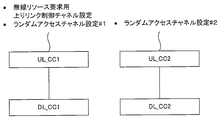
- FIG. 3 is a diagram showing an example of the configuration of component carriers set in the mobile station apparatus 1 capable of carrier aggregation and an uplink physical channel setting in the present invention.
- a component carrier that is cell-specifically connected with DL_CC1 and UL_CC1 and DL_CC2 and UL_CC2 as a pair is set for the mobile station apparatus 1.
- activation of these component carriers is explicitly or implicitly instructed from the base station apparatus 2, and the mobile station apparatus 1 uses two frequency bands for downlink reception and uplink transmission, respectively. can do.
- the component carrier When the component carrier is activated, the mobile station apparatus 1 needs to receive (monitor) at least one of the downlink control channel and the downlink shared channel transmitted by the component carrier.
- the mobile station apparatus 1 may not receive (monitor) both the downlink control channel and the downlink shared channel of the component carrier.
- the base station apparatus 2 preferably uses a MAC control element (MAC Control Element) that is MAC control information for activating or deactivating the component carrier.
- the transmission setting of the uplink control channel used for the radio resource request (uplink control channel setting for radio resource request) is set only to UL_CC1.
- transmission settings (random access channel settings) of different random access channels are made in the uplink component carriers of UL_CC1 and UL_CC2. That is, the mobile station device 1 needs to manage the UL_CC1 and UL_CC2 transmission timing adjustment information, TA timer, transmission timing adjustment state / transmission timing non-adjustment state independently for each component carrier.
- uplink and downlink component carriers set as a pair are not cell-specific and may be set individually for each mobile station device 1 by the base station device 2.
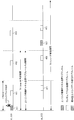
- FIG. 4 is a diagram for explaining the uplink transmission method of the mobile station apparatus 1 according to the first embodiment of the present invention.
- the horizontal axis in FIG. 4 shows the passage of time.
- the transmission timing (transmission resource) of the uplink transmission is shown. However, for simplification, the difference in frequency resources is omitted.
- One subframe is 1 ms time, and 10 subframes constitute one frame.
- the base station apparatus 2 assigns a transmission setting for the mobile station apparatus 1 to transmit a radio resource request uplink control channel using UL_CC1.
- the base station apparatus 2 is assigned transmission settings of random access channels for the mobile station apparatus 1 to transmit random access channels using UL_CC1 and UL_CC2. Also, TA timer # 1 in UL_CC1 is within the valid period, and UL_CC1 is in the transmission timing adjustment state. Similarly, TA timer # 2 in UL_CC2 is within the valid period, and UL_CC2 is in the transmission timing adjustment state.
- the mobile station apparatus 1 continuously requests a radio resource request until the uplink control channel transmission subframe valid period (uplink grant is received).
- a radio resource request is made to the base station apparatus 2 using the allocated uplink control channel (311).
- the radio resource request is transmitted to the base station again using the uplink control channel (312) at the next transmission opportunity. This is performed for the station apparatus 2.
- the mobile station apparatus 1 has an opportunity to transmit a random access channel in the random access transmission subframe (411, 412) of UL_CC1 and the random access transmission subframe (421) of UL_CC2 during this period. No radio resource request is made by the access channel.
- the uplink control channel transmission subframe valid period ends.
- the transmission setting of the uplink control channel is released.
- the mobile station apparatus 1 needs to transmit a random access channel in order to make a radio resource request. Since the transmission setting of the random access channel is set to a plurality of uplink component carriers, It is necessary to determine whether it is optimal to transmit the random access channel on the carrier. The simplest method is to transmit the random access channel with the uplink component carrier that was transmitting the uplink control channel, but whether or not the transmission setting of the random access channel is set to the uplink component carrier Depending on the setting of the base station apparatus 2, an exceptional case must be taken into account, and the processing of the mobile station apparatus 1 becomes complicated, so another method is desirable. Therefore, in the first embodiment, a method for selecting the highest quality uplink component carrier from among a plurality of uplink component carriers will be described.
- the mobile station apparatus 1 After the end of the uplink control channel transmission subframe valid period (after the uplink control channel transmission subframe (312)), the mobile station apparatus 1 transmits uplink component carriers (UL_CC1 and UL_CC2) for which transmission settings for the random access channel are set. ) And the downlink component carrier (DL_CC1 and DL_CC2) paired with the downlink reference signal path loss, and the measured path loss value is the best (received quality is the best) uplink component carrier pair Select a link component carrier. Then, in the selected uplink component carrier, a radio resource request is made using a random access channel. Alternatively, one of the path loss values is randomly selected from the uplink component carriers paired with the downlink component carrier that is better than a predetermined value, or one is selected according to the priority specified by the base station apparatus 2.
- the mobile station apparatus 1 can select a high-quality uplink component carrier based on the path loss value, thereby improving the success probability of a radio resource request.
- transmission power and transmission delay can be reduced at the same time.
- This method also has an advantage that the control of the mobile station apparatus 1 is simplified because only the path loss values are compared.
- the uplink component carrier may not have a pair of downlink component carriers. That is, an uplink component carrier may be selected based on a value derived by calculation within the mobile station apparatus 1 by adding an offset value to a path loss value of a certain downlink component carrier.
- the mobile station apparatus 1 detects the allocation of the collision type uplink data transmission subframe (321) in the uplink component carrier (UL_CC2) other than the selected uplink component carrier (UL_CC1), When the collision type uplink data transmission subframe (321) is earlier than the random access transmission subframe (413), it is determined whether or not a predetermined condition described below is satisfied. When the condition is satisfied, the mobile station apparatus 1 performs uplink transmission in the collision type uplink data transmission subframe (321), and when the condition is not satisfied, the mobile station apparatus 1 performs the collision type uplink data transmission subframe (321). ) Is not used for uplink transmission.
- the predetermined conditions are: (1) the path loss value of the downlink component carrier to be paired is better (or worse) than a predetermined threshold, and (2) the number of untransmitted uplink transmission data bits is greater than or equal to the specified value. (Or less than a specified value), (3) It is determined by one or a combination of the detected collision type uplink data transmission subframe to the random access transmission subframe over a specified time.
- These conditions may be specified for each cell in the broadcast information, or may be specified individually for each mobile station apparatus 1 from the base station apparatus 2 using an RRC message.
- the mobile station apparatus 1 detects the allocation of the collision type uplink data transmission subframe on the same uplink component carrier as the uplink component carrier selected by the mobile station apparatus 1, the mobile station apparatus 1 precedes the random access transmission subframe. Uplink transmission is performed in the collision type uplink data transmission subframe.
- the mobile station apparatus 1 when the collision type uplink data transmission subframe is allocated while waiting for a random access response (random access response) from the base station apparatus 2, the mobile station apparatus 1 is assigned to the allocated uplink component carrier. Regardless, uplink transmission is not performed in the collision type uplink data transmission subframe.
- the mobile station apparatus 1 cannot receive the random access response from the base station apparatus 2 and is assigned a collision type uplink data transmission subframe while waiting for retransmission of the next random access, the allocated uplink data Regardless of the link component carrier, retransmission of random access is canceled, and uplink transmission is performed in the collision type uplink data transmission subframe.
- the mobile station apparatus 1 may consider the above-described conditions when canceling retransmission of random access and performing uplink transmission in a collision-type uplink data transmission subframe. Also, when the mobile station apparatus 1 is performing random access with the dedicated preamble sequence allocated from the base station apparatus 2, the mobile station apparatus 1 gives priority to the random access retransmission process and performs uplink in the collision-type uplink data transmission subframe. Do not send.
- the uplink component carrier selection condition for requesting uplink radio resources necessary for uplink data transmission, and the uplink radio resources common between the radio resource of the random access channel and the mobile station apparatus 1 may individually set the selection condition for which one to use for the mobile station apparatus 1.
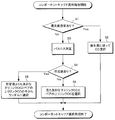
- FIG. 5 is a flowchart showing an example of uplink component carrier selection processing of the mobile station apparatus 1 according to the first embodiment of the present invention.
- the mobile station apparatus 1 selects the uplink component carrier that performs the radio resource request by the random access channel in the random access transmission component carrier selection.
- the selection method is as follows.
- the mobile station device 1 first determines whether or not a priority is designated from the base station device 2 (step S1). When the priority is designated (step S1: YES), the mobile station apparatus 1 selects one of the uplink component carriers according to the priority designated by the base station apparatus 2.
- the mobile station apparatus 1 When the priority is not specified from the base station (step S1: NO), the mobile station apparatus 1 is the uplink component carrier in which the transmission setting of the random access channel is set after the uplink control channel transmission subframe valid period ends.
- the path loss of the downlink reference signal of the downlink component carrier paired with is measured (step S3).
- it is determined whether there is a predetermined value for evaluating the path loss value (step S4). If there is a predetermined value (step S4: YES), a path loss value is randomly selected from among uplink component carriers paired with a downlink component carrier that is better than the predetermined value (step S5).
- step S6 the uplink component carrier paired with the downlink component carrier having the best measured path loss value (the best reception quality) is selected (step S6). In this way, one uplink component carrier that transmits the random access channel is selected, and the process is terminated. Note that the mobile station apparatus 1 can omit some of the steps described above according to the selection process of the component carrier to be actually used.
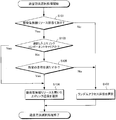
- FIG. 6 is a flowchart showing an example of an uplink transmission method selection process of the mobile station apparatus 1 according to the first embodiment of the present invention.
- the mobile station apparatus 1 has already selected an uplink component carrier that makes a radio resource request using a random access channel by the process of FIG.
- the mobile station apparatus 1 determines whether or not there is a collision type radio resource assignment before transmitting the random access channel (step S101).
- collision type radio resource allocation is not detected (step S101: NO)
- random access transmission is selected (step S102).
- step S101: YES collision-type radio resource allocation is detected (step S101: YES), that is, when collision-type radio resource allocation is detected in the uplink grant of the downlink control channel
- the mobile station apparatus 1 determines the collision-type radio resource. It is determined whether the allocation is for the same uplink component carrier as the selected uplink component carrier (step S103).
- step S104 If the uplink component carrier is the same (step S103: YES), uplink transmission is performed using the collision type radio resource without waiting for the radio resource request by the random access channel (step S104). On the other hand, if the allocation is to an uplink component carrier different from the selected uplink component carrier (step S103: NO), it is determined whether or not a predetermined condition is satisfied (step S105). Step S105: YES), uplink transmission is performed using the collision type radio resource (step S104). On the other hand, when the condition is not satisfied (step S105: NO), the mobile station waits until the transmission subframe of the random access channel without performing uplink transmission (step S102). Whether or not the predetermined condition is satisfied is determined by one or a plurality of combinations described above.
- the mobile station apparatus 1 selects the optimum uplink component carrier and performs uplink transmission. be able to. Further, even when a plurality of methods can be selected for transmitting new transmission data, an optimal transmission method can be selected.
- the selection of the optimal uplink component carrier is preferably performed by the RRC of the mobile station apparatus 1 and instructed from the RRC to the MAC (random access control unit 109).
- the base station apparatus 2 uses the broadcast information or the RRC message to determine the conditions used by the mobile station apparatus 1 for selecting the optimum uplink component carrier and the conditions used for selecting the transmission method for uplink transmission. 1 to send.
- the mobile station apparatus 1 uses the best uplink component carrier based on the reception quality of the paired downlink component carrier. Therefore, the success rate of the radio resource request can be improved, and transmission power reduction and transmission delay reduction can be realized at the same time. Moreover, the control process of the mobile station apparatus 1 can be simplified. In addition, when the mobile station device 1 can select one of the radio resource request and the collision type data transmission through the random access channel, the mobile station device 1 selects the transmission method based on a predetermined condition. Thus, it is possible to perform uplink transmission with little delay without degrading the quality of uplink transmission.
- the base station apparatus 2 can make the mobile station apparatus 1 select an optimal transmission method by notifying various information necessary for the mobile station apparatus 1 to perform optimal uplink transmission.
- a second embodiment of the present invention will be described below.
- a method for selecting an uplink component carrier capable of transmitting a random access channel at the earliest timing after transmission becomes possible will be described.
- the configurations of the mobile station device 1 and the base station device 2 used in the present embodiment may be the same as those shown in FIGS. Details of this embodiment will be described with reference to FIG. In FIG. 4, since the uplink control channel transmission subframe valid period ends and the transmission setting of the uplink control channel is released, the description is omitted because it is the same as that of the first embodiment.
- the mobile station apparatus 1 After the end of the uplink control channel transmission subframe valid period (after the uplink control channel transmission subframe (312)), the mobile station apparatus 1 has a plurality of uplink component carriers (UL_CC1) for which transmission settings for the random access channel are configured. And UL_CC2), the uplink component carrier that can transmit the random access channel earliest (that is, the random access transmission subframe is assigned earliest) is selected. By using such an uplink component carrier selection method, the mobile station apparatus 1 can transmit a random access channel at the fastest speed, so that the delay time until uplink transmission is actually started is reduced. Can be as short as possible.
- UL_CC1 uplink component carriers
- UL_CC2 uplink component carriers
- the random access transmission subframe is assigned to UL_CC2 earlier than UL_CC1, mobile station apparatus 1 selects UL_CC2 and transmits the random access channel in the random access transmission subframe (422). .
- the collision type uplink data transmission subframe (321) is instructed from the base station apparatus 2 at a timing earlier than the random access transmission subframe (422), the mobile station apparatus 1 transmits the collision type uplink data transmission. It is further necessary to determine whether or not to perform uplink transmission in the subframe (321).
- the method shown in the first embodiment can be used to determine whether or not the mobile station apparatus 1 transmits uplink data using a collision type radio resource.
- the mobile station device 1 is optimal from the path loss value of the downlink component carrier paired with the number of bits of uplink data to be transmitted. Select one uplink component carrier. Specifically, when the number of bits of uplink data to be transmitted is equal to or greater than a predetermined number of bits, the mobile station apparatus 1 has the best uplink with a path loss value of a downlink component carrier to be paired equal to or greater than a predetermined threshold. Select a link component carrier.
- the mobile station apparatus 1 selects the best uplink component carrier whose path loss value of the downlink component carrier to be paired is a predetermined threshold value or more. Alternatively, one uplink component carrier may be selected at random.
- FIG. 7 shows the uplink component carrier selection process of the mobile station apparatus 1 in the second embodiment.
- FIG. 7 is a flowchart showing component carrier selection processing according to the second embodiment of the present invention.
- the mobile station apparatus 1 first determines whether there is a random access transmission subframe with the same timing (step S201). When the timing is different (step S201: NO), an uplink component carrier capable of transmitting the random access channel earliest is selected (step S202).
- the mobile station apparatus 1 When the transmission timings of the random access transmission subframes of different uplink component carriers are the same (step S201: YES), the mobile station apparatus 1 passes the path loss of the downlink component carrier paired with the number of bits of uplink data to be transmitted.
- One optimal uplink component carrier is selected from the values of (Step S203).
- the random access transmission component carrier selection is selected based on the timing at which the random access channel can be transmitted.
- the selection process of the uplink transmission method of the mobile station apparatus 1 in the second embodiment may be the same as the flowchart shown in FIG.
- the mobile station apparatus 1 is not receiving a response of the random access channel (random access response) transmitted by the selected uplink component carrier and waiting for retransmission of random access.
- random access is performed by reselecting an uplink component carrier
- the mobile station apparatus 1 does not reselect another uplink component carrier while waiting for reception of a random access response.
- the case where the mobile station apparatus 1 changes the uplink component carrier for performing random access is effective when the frequency of allocation of random access transmission subframes is different as shown in FIG. That is, in the example of FIG. 4, after the mobile station apparatus 1 transmits the random access channel in the random access transmission subframe (422) of UL_CC2, the next transmission opportunity is two frames later. However, if transmission is possible in the UL_CC1 random access transmission subframe (413) before the next UL_CC2 transmission opportunity, it is possible to reduce the time required for actually transmitting uplink. .
- the mobile station apparatus 1 determines whether or not to switch the uplink component carrier that transmits the random access channel, the currently selected uplink component carrier (UL_CC2), and the uplink component carrier (UL_CC1) that is the switching candidate. Are compared according to the following reselection conditions.
- the path loss value of a downlink component carrier that is paired with an uplink component carrier that is a switching candidate is better than a predetermined threshold
- the uplink component carrier and pair that is a switching candidate The path loss value of the downlink component carrier to be better than the path loss value of the downlink component carrier that is the pair of the selected uplink component carrier
- (3) Random access transmission subframe of the uplink component carrier that is the switching candidate Cancels the current random access and transmits the random access channel when the time from the selected uplink component carrier to the next random access transmission subframe is longer than the specified time. Switch the uplink component carrier that.
- the mobile station apparatus 1 when the collision type uplink data transmission subframe is allocated while waiting for a random access response (random access response) from the base station apparatus 2, the mobile station apparatus 1 is assigned to the allocated uplink component carrier. Regardless, uplink transmission is not performed in the collision type uplink data transmission subframe.
- the mobile station apparatus 1 cannot receive the random access response from the base station apparatus 2 and is assigned a collision type uplink data transmission subframe while waiting for retransmission of the next random access, the allocated uplink data Regardless of the link component carrier, retransmission of random access is canceled, and uplink transmission is performed in the collision type uplink data transmission subframe.
- the mobile station apparatus 1 when the mobile station apparatus 1 is performing random access with the dedicated preamble sequence allocated from the base station apparatus 2, the mobile station apparatus 1 gives priority to the random access retransmission process and performs uplink in the collision-type uplink data transmission subframe. Do not send. Note that the mobile station apparatus 1 may consider the above-described conditions when canceling retransmission of random access and performing uplink transmission in a collision-type uplink data transmission subframe.
- FIG. 8 is a flowchart showing an example of uplink component carrier reselection processing of the mobile station apparatus 1 according to the second embodiment of the present invention.
- the random access transmission subframe is another uplink component. If it is assigned to a carrier, it is determined whether or not the uplink component carrier satisfies a reselection condition (step S301). Any of the methods described above is used as the reselection condition.
- step S301 If the reselection condition is satisfied (step S301: YES), the current random access is canceled, the uplink component carrier is reselected (step S302), and the process is terminated. On the other hand, when the reselection condition is not satisfied (step S301: NO), the uplink component carrier is not switched (step S303), and the process is terminated.
- the mobile station apparatus 1 selects the optimum uplink component carrier and performs uplink transmission. be able to. Further, even when a plurality of methods can be selected for transmitting new transmission data, an optimal transmission method can be selected. Moreover, the mobile station apparatus 1 can also switch the uplink component carrier which transmits a random access channel suitably based on a predetermined condition. Optimal uplink component carrier selection and switching, random access cancellation processing, and random access channel transmission setting reconfiguration processing are performed by the RRC of the mobile station apparatus 1, and from RRC to MAC (random access control unit 109). It is preferred to be directed to. Also, the base station apparatus 2 uses the broadcast information or the RRC message to determine the conditions used by the mobile station apparatus 1 for selecting the optimum uplink component carrier and the conditions used for selecting the transmission method for uplink transmission. 1 to send.
- the base station apparatus 2 uses the broadcast information or the RRC message to determine the conditions used by the mobile station apparatus 1 for selecting the optimum uplink component carrier and the conditions used for selecting the transmission method for uplink transmission.
- the mobile station apparatus 1 can select the uplink component carrier that can transmit the random access channel earliest when the uplink radio resource for transmitting the uplink data is not allocated. Therefore, transmission delay until uplink transmission can be reduced. Further, the mobile station apparatus 1 can reduce transmission delay by switching uplink component carriers that perform random access when a predetermined condition is satisfied. In addition, when the mobile station device 1 can select one of the radio resource request and the collision type data transmission through the random access channel, the mobile station device 1 selects the transmission method based on a predetermined condition. Thus, it is possible to perform uplink transmission with little delay without degrading the quality of uplink transmission.
- the base station apparatus 2 can make the mobile station apparatus 1 select an optimal transmission method by notifying various information necessary for the mobile station apparatus 1 to perform optimal uplink transmission.
- a third embodiment of the present invention will be described below.
- a method capable of selecting more appropriate uplink transmission by adding uplink transmission timing to the selection criterion will be described.
- the configurations of the mobile station device 1 and the base station device 2 used in the present embodiment may be the same as those shown in FIGS.
- FIG. 9 is a diagram for explaining the uplink transmission method of the mobile station apparatus 1 according to the third embodiment of the present invention.
- TA timer # 1 in UL_CC1 expires midway, and UL_CC1 enters a transmission timing non-adjusted state.
- TA timer # 2 in UL_CC2 is within the valid period, and UL_CC2 is in the transmission timing adjustment state.
- the mobile station apparatus 1 needs to transmit a random access channel in order to make a radio resource request.
- the transmission setting of the random access channel is set to a plurality of uplink component carriers, It is necessary to determine whether it is optimal to transmit the random access channel on the carrier. In particular, it is necessary to determine whether or not to transmit a random access channel on an uplink component carrier whose TA timer has expired and is in a transmission timing non-adjusted state.
- the mobile station apparatus 1 selects an uplink component carrier based on the path loss as in the first embodiment, the mobile station apparatus 1 excludes the uplink component carrier in the transmission timing non-adjusted state from the selection candidates.
- the mobile station device 1 selects an uplink component carrier in a transmission timing non-adjusted state. Remove from the candidate.
- the mobile station apparatus 1 selects the optimum uplink component carrier and uplink transmission method for the other than the uplink component carrier excluded from the selection candidates using the first embodiment or the second embodiment. . Since the mobile station device 1 does not select an uplink component carrier in a transmission timing non-adjusted state, the mobile station device 1 makes a radio resource request without activating a new TA timer with uplink transmission. Simplified.
- the mobile station device 1 may be excluded from the selection candidates.
- the mobile station apparatus 1 may also be excluded from the selection candidates for the uplink component carrier paired with the deactivated downlink component carrier.
- the deactivated downlink component carrier is activated together with the uplink transmission, and the uplink transmission is performed.
- reception (monitoring) of one of the downlink control channel and the downlink shared channel of the component carrier may be resumed.
- the radio resource that performs collision type data transmission designated by the uplink grant designates an uplink component carrier in a transmission timing non-adjusted state
- the mobile station apparatus 1 uses the radio resource to perform collision type data transmission. Do not do.
- the mobile station apparatus 1 can select an uplink component carrier in consideration of whether or not the transmission timing of the uplink component carrier is adjusted. As described above, when the uplink radio resource for transmitting the uplink data is not allocated, the mobile station apparatus 1 considers whether or not the uplink component carrier transmission timing is adjusted and determines the best uplink A link component carrier can be selected. Therefore, the mobile station apparatus 1 can make a radio resource request without activating a new TA timer with uplink transmission, so that the control process of the mobile station apparatus 1 is simplified.
- the mobile station apparatus of the present invention aggregates a plurality of frequency bands, connects to the base station apparatus, and requests the base station apparatus for uplink radio resources necessary for transmitting uplink data.
- a mobile station apparatus that selects an uplink frequency band for performing a radio resource request using a random access channel from any frequency band based on a first condition, and based on a second condition, One of the radio resource request using a random access channel and transmission of uplink data using an uplink radio resource common to other mobile station apparatuses is selected.
- the mobile station apparatus selects an uplink frequency band for performing a radio resource request using a random access channel from any frequency band based on the first condition, and based on the second condition. Since either one of the radio resource request using the random access channel or the uplink data transmission by the uplink radio resource common to other mobile station apparatuses is selected, the quality is determined based on the path loss value. A good uplink component carrier can be selected. In addition, the success probability of a radio resource request is improved, and transmission power reduction and transmission delay reduction can be realized simultaneously. Further, this method has an advantage that the control of the mobile station apparatus is simplified because only the path loss values are compared.
- the mobile station apparatus of the present invention is that the transmission setting of the random access channel is set, and the uplink frequency band corresponding to the downlink frequency band with the best reception quality, The first condition is assumed.
- the first condition is that the transmission setting of the random access channel and the uplink frequency band corresponding to the downlink frequency band with the best reception quality are used as the first condition.
- the station apparatus can select an uplink component carrier with good quality based on the path loss value.
- the success probability of a radio resource request is improved, and transmission power reduction and transmission delay reduction can be realized simultaneously.
- this method has an advantage that the control of the mobile station apparatus is simplified because only the path loss values are compared.
- the mobile station apparatus of the present invention is configured so that the random access channel is set to be transmitted, and that the first frequency band is an uplink frequency band in which the random access channel can be transmitted earliest.
- the conditions are as follows.
- the mobile station apparatus Since the random access channel can be transmitted at the fastest speed, the delay time until uplink transmission is actually started can be minimized.
- the mobile station apparatus of the present invention has the best reception quality in the uplink frequency band in which the random access channel is set to be transmitted and the random access channel can be transmitted earliest.
- the first condition is that it is an uplink frequency band corresponding to a certain downlink frequency band.
- the transmission setting of the random access channel is set, and the uplink frequency band in which the random access channel can be transmitted earliest corresponds to the downlink frequency band having the best reception quality. Since the first condition is that the frequency band is an uplink frequency band, the mobile station apparatus can select an uplink component carrier with good quality based on the path loss value. In addition, the success probability of a radio resource request is improved, and transmission power reduction and transmission delay reduction can be realized simultaneously. Further, this method has an advantage that the control of the mobile station apparatus is simplified because only the path loss values are compared. In addition, since the mobile station apparatus can transmit the random access channel at the fastest speed, the delay time until uplink transmission is actually started can be minimized.
- the mobile station apparatus of the present invention is characterized in that the first condition includes that an uplink transmission timing with the base station apparatus is adjusted.
- the mobile station device since the first condition includes that the uplink transmission timing with the base station device is adjusted, the mobile station device does not select the uplink component carrier in the transmission timing non-adjusted state. Therefore, a radio resource request can be made without starting a new TA timer with uplink transmission, and the control processing of the mobile station apparatus is simplified.
- the uplink radio resource common to the other mobile station apparatuses for the uplink frequency band selected based on the first condition is as follows: When allocated prior to the random access channel, the uplink radio resource is selected to be transmitted by the uplink radio resource, while the uplink radio resource common to other mobile station apparatuses is randomly accessed. If the channel is not allocated prior to the channel, the second condition is to select a radio resource request using a random access channel.
- the uplink radio resource common to the other mobile station apparatuses is allocated to the uplink frequency band selected based on the first condition before the random access channel.
- the uplink radio resource common with other mobile station apparatuses is not allocated prior to the random access channel. Selects a radio resource request using a random access channel, so that it is possible to perform uplink transmission with little delay without degrading the quality of uplink transmission.
- the mobile station apparatus of the present invention is an uplink frequency band corresponding to a downlink frequency band whose reception quality satisfies a predetermined threshold, and is selected based on the first condition
- the uplink radio resources common to other mobile station apparatuses for the uplink frequency bands other than the frequency band of the above are from the random access channel assigned to the selected uplink frequency band.
- the uplink frequency band corresponding to the downlink frequency band in which the reception quality satisfies a predetermined threshold while selecting transmission of the uplink data by the uplink radio resource.
- an uplink frequency band corresponding to a downlink frequency band whose reception quality satisfies a predetermined threshold, and an uplink frequency other than the uplink frequency band selected based on the first condition When the uplink radio resource common to other mobile station apparatuses is allocated to the band prior to the random access channel allocated to the selected uplink frequency band, While selecting transmission of uplink data by the uplink radio resource, an uplink frequency band corresponding to a downlink frequency band whose reception quality satisfies a predetermined threshold, based on the first condition Uplink radio shared with other mobile station devices for uplink frequency bands other than the selected uplink frequency band If the source is not assigned prior to the random access channel assigned to the selected uplink frequency band, the radio resource request using the random access channel is selected, so the uplink transmission quality It is possible to perform uplink transmission with little delay without dropping the signal.
- the base station apparatus of this invention sets the said 1st condition and the said 2nd condition separately with respect to the mobile station apparatus in any one of said (A) to (G). It is characterized by that.
- the mobile station apparatus sets the path loss value to Based on this, it is possible to select an uplink component carrier with good quality. In addition, the success probability of a radio resource request is improved, and transmission power reduction and transmission delay reduction can be realized simultaneously. Further, this method has an advantage that the control of the mobile station apparatus is simplified because only the path loss values are compared.
- a plurality of frequency bands are aggregated to connect a base station apparatus and a mobile station apparatus, and an uplink transmission required for the mobile station apparatus to transmit uplink data is provided.
- a communication system for requesting radio resources to the base station device wherein the base station device individually sets a first condition and a second condition for the mobile station device, and the mobile station The apparatus selects an uplink frequency band for performing a radio resource request using a random access channel from one of the frequency bands based on the first condition, and selects a random access channel based on the second condition. It is characterized by selecting either the used radio resource request or uplink data transmission using an uplink radio resource common with other mobile station apparatuses.
- the mobile station apparatus selects an uplink frequency band for performing a radio resource request using a random access channel from any frequency band based on the first condition, and based on the second condition. Since either one of the radio resource request using the random access channel or the uplink data transmission by the uplink radio resource common to other mobile station apparatuses is selected, the quality is determined based on the path loss value. A good uplink component carrier can be selected. In addition, the success probability of a radio resource request is improved, and transmission power reduction and transmission delay reduction can be realized simultaneously. Further, this method has an advantage that the control of the mobile station apparatus is simplified because only the path loss values are compared.
- the first condition is that the transmission setting of the random access channel and the uplink frequency band corresponding to the downlink frequency band with the best reception quality are used as the first condition.
- the station apparatus can select an uplink component carrier with good quality based on the path loss value.
- the success probability of a radio resource request is improved, and transmission power reduction and transmission delay reduction can be realized simultaneously.
- this method has an advantage that the control of the mobile station apparatus is simplified because only the path loss values are compared.
- the communication system of the present invention is configured so that the transmission setting of the random access channel is set, and that the uplink frequency band capable of transmitting the random access channel earliest is the first frequency band. Condition.
- the mobile station apparatus Since the random access channel can be transmitted at the fastest speed, the delay time until uplink transmission is actually started can be minimized.
- the transmission setting of the random access channel is set, and the reception quality is the best in the uplink frequency band in which the random access channel can be transmitted earliest.
- the first condition is that the uplink frequency band corresponds to the downlink frequency band.
- the transmission setting of the random access channel is set, and the uplink frequency band in which the random access channel can be transmitted earliest corresponds to the downlink frequency band having the best reception quality. Since the first condition is that the frequency band is an uplink frequency band, the mobile station apparatus can select an uplink component carrier with good quality based on the path loss value. In addition, the success probability of a radio resource request is improved, and transmission power reduction and transmission delay reduction can be realized simultaneously. Further, this method has an advantage that the control of the mobile station apparatus is simplified because only the path loss values are compared. In addition, since the mobile station apparatus can transmit the random access channel at the fastest speed, the delay time until uplink transmission is actually started can be minimized.
- the communication system of the present invention is characterized in that the first condition includes that an uplink transmission timing with the base station apparatus is adjusted.
- the mobile station apparatus Since the first condition includes that the uplink transmission timing with the base station apparatus is adjusted as described above, the mobile station apparatus does not select the uplink component carrier in the transmission timing non-adjusted state. Therefore, a radio resource request can be made without starting a new TA timer with uplink transmission, and the control processing of the mobile station apparatus is simplified.
- the uplink radio resource shared with other mobile station apparatuses is randomly assigned to the uplink frequency band selected based on the first condition.
- the uplink radio resource is selected to be transmitted by the uplink radio resource, while the uplink radio resource common to other mobile station apparatuses is a random access channel. If it is not assigned earlier than this, the second condition is to select a radio resource request using a random access channel.
- the uplink radio resource common to the other mobile station apparatuses is allocated to the uplink frequency band selected based on the first condition before the random access channel.
- the uplink radio resource common with other mobile station apparatuses is not allocated prior to the random access channel. Selects a radio resource request using a random access channel, so that the mobile station apparatus can perform uplink transmission with little delay without degrading the quality of uplink transmission.
- the communication system of the present invention is an uplink frequency band corresponding to a downlink frequency band whose reception quality satisfies a predetermined threshold value, and is an uplink frequency band selected based on the first condition.
- the uplink radio resource common to other mobile station apparatuses is more than the random access channel assigned to the selected uplink frequency band.
- the uplink frequency band corresponding to the downlink frequency band whose reception quality satisfies a predetermined threshold while selecting transmission of uplink data by the uplink radio resource With respect to an uplink frequency band other than the uplink frequency band selected based on the first condition, between other mobile station apparatuses
- a radio resource request using the random access channel is selected. Is the second condition.
- an uplink frequency band corresponding to a downlink frequency band whose reception quality satisfies a predetermined threshold, and an uplink frequency other than the uplink frequency band selected based on the first condition When the uplink radio resource common to other mobile station apparatuses is allocated to the band prior to the random access channel allocated to the selected uplink frequency band, While selecting transmission of uplink data by the uplink radio resource, an uplink frequency band corresponding to a downlink frequency band whose reception quality satisfies a predetermined threshold, based on the first condition Uplink radio shared with other mobile station devices for uplink frequency bands other than the selected uplink frequency band If the source is not allocated prior to the random access channel allocated for the selected uplink frequency band, the mobile station apparatus selects a radio resource request using the random access channel. It is possible to perform uplink transmission with little delay without degrading the quality of uplink transmission.
- a plurality of frequency bands are aggregated to connect a base station apparatus and a mobile station apparatus, and an uplink link necessary for the mobile station apparatus to transmit uplink data.
- a communication method for requesting radio resources to the base station apparatus wherein the base station apparatus individually sets a first condition and a second condition for the mobile station apparatus, and In the mobile station apparatus, on the basis of the first condition, a step of selecting an uplink frequency band for performing a radio resource request using a random access channel from any one of the frequency bands, and on the basis of the second condition, Either a radio resource request using a random access channel or transmission of uplink data using an uplink radio resource common to other mobile station apparatuses Characterized in that it comprises at least a step of selecting and the.
- the mobile station apparatus selects, based on the first condition, the uplink frequency band for performing the radio resource request using the random access channel from any one of the frequency bands, and the second condition. Based on the path loss value, the radio resource request using the random access channel or the uplink data transmission by the uplink radio resource common to other mobile station devices is selected. A high-quality uplink component carrier can be selected. In addition, the success probability of a radio resource request is improved, and transmission power reduction and transmission delay reduction can be realized simultaneously. Further, this method has an advantage that the control of the mobile station apparatus is simplified because only the path loss values are compared.
- the integrated circuit of the present invention is an integrated circuit that is mounted on a mobile station device to cause the mobile station device to perform a plurality of functions, and aggregates a plurality of frequency bands to form a base station device.
- the mobile station apparatus selects an uplink frequency band for performing a radio resource request using a random access channel from any frequency band based on the first condition, and based on the second condition. Since either one of the radio resource request using the random access channel or the uplink data transmission by the uplink radio resource common to other mobile station apparatuses is selected, the quality is determined based on the path loss value. A good uplink component carrier can be selected. In addition, the success probability of a radio resource request is improved, and transmission power reduction and transmission delay reduction can be realized simultaneously. Further, this method has an advantage that the control of the mobile station apparatus is simplified because only the path loss values are compared.
- the control program for a mobile station apparatus of the present invention aggregates a plurality of frequency bands and connects to a base station apparatus, and transmits uplink radio resources necessary for transmitting uplink data to the base station.
- a control program for a mobile station device that requests a device, based on a process for requesting the base station device for uplink radio resources necessary for transmitting uplink data, and a first condition
- the process of communication characterized by being readable and executable on command of the computer.
- the mobile station apparatus selects an uplink frequency band for performing a radio resource request using a random access channel from any frequency band based on the first condition, and based on the second condition. Since either one of the radio resource request using the random access channel or the uplink data transmission by the uplink radio resource common to other mobile station apparatuses is selected, the quality is determined based on the path loss value. A good uplink component carrier can be selected. In addition, the success probability of a radio resource request is improved, and transmission power reduction and transmission delay reduction can be realized simultaneously. Further, this method has an advantage that the control of the mobile station apparatus is simplified because only the path loss values are compared.
- this uplink transmission scheme can be applied to both communication systems of the FDD (frequency division duplex) scheme and the TDD (time division duplex) scheme.
- the example using the path loss as the measurement value of the downlink component carrier has been described, but other measurement values (SIR, SINR, RSRP, RSRQ, RSSI, BLER) may be used instead. It is also possible to use a combination of a plurality of these measured values.
- the mobile station device 1 and the base station device 2 of the embodiment have been described using functional block diagrams.
- each part of the mobile station device 1 and the base station device 2 is controlled by recording a program for realizing the unit on a computer-readable recording medium, causing the computer system to read and execute the program recorded on the recording medium. You can do it.
- the “computer system” includes an OS and hardware such as peripheral devices.
- the “computer-readable recording medium” refers to a semiconductor medium (eg, RAM, nonvolatile memory card, etc.), an optical recording medium (eg, DVD, MO, MD, CD, BD, etc.), a magnetic recording medium (eg, , A magnetic tape, a flexible disk, etc.) and a storage device such as a disk unit built in a computer system. Furthermore, the “computer-readable recording medium” means that a program is dynamically held for a short time, like a communication line when a program is transmitted via a network such as the Internet or a communication line such as a telephone line.
- a network such as the Internet
- a communication line such as a telephone line.
- the program may be a program for realizing a part of the functions described above, and may be a program capable of realizing the functions described above in combination with a program already recorded in a computer system. .
- each functional block or various features of the mobile station device 1 and the base station device 2 used in the above embodiments may be configured in a circuit including an LSI that is typically an IC (integrated circuit). .
- the integration density of the LSI may be realized at any density.
- Each functional block and various features may be individually chipped, or a part or all of them may be integrated into a chip.
- the method of circuit integration is not limited to LSI, and may be realized by a dedicated circuit or a general-purpose processor.
- an integrated circuit based on the technology can also be used.
Landscapes
- Engineering & Computer Science (AREA)
- Computer Networks & Wireless Communication (AREA)
- Signal Processing (AREA)
- Mobile Radio Communication Systems (AREA)
Priority Applications (4)
| Application Number | Priority Date | Filing Date | Title |
|---|---|---|---|
| CN201180014931.1A CN102812769B (zh) | 2010-03-24 | 2011-02-21 | 移动台装置、基站装置、通信系统、通信方法、集成电路及移动台装置的控制程序 |
| EP11759114.9A EP2552170B1 (en) | 2010-03-24 | 2011-02-21 | Mobile station apparatus and communication system using aggregated cells |
| US13/636,591 US8976748B2 (en) | 2010-03-24 | 2011-02-21 | Mobile station apparatus, base station apparatus, communication system, communication method, integrated circuit, and mobile station apparatus control program |
| US14/610,665 US9578631B2 (en) | 2010-03-24 | 2015-01-30 | Mobile station apparatus, base station apparatus, communication system, communication method, integrated circuit, and mobile station apparatus control program |
Applications Claiming Priority (2)
| Application Number | Priority Date | Filing Date | Title |
|---|---|---|---|
| JP2010068713A JP5425679B2 (ja) | 2010-03-24 | 2010-03-24 | 移動局装置、基地局装置、通信システム、通信方法、集積回路および移動局装置の制御プログラム |
| JP2010-068713 | 2010-03-24 |
Related Child Applications (2)
| Application Number | Title | Priority Date | Filing Date |
|---|---|---|---|
| US13/636,591 A-371-Of-International US8976748B2 (en) | 2010-03-24 | 2011-02-21 | Mobile station apparatus, base station apparatus, communication system, communication method, integrated circuit, and mobile station apparatus control program |
| US14/610,665 Division US9578631B2 (en) | 2010-03-24 | 2015-01-30 | Mobile station apparatus, base station apparatus, communication system, communication method, integrated circuit, and mobile station apparatus control program |
Publications (1)
| Publication Number | Publication Date |
|---|---|
| WO2011118306A1 true WO2011118306A1 (ja) | 2011-09-29 |
Family
ID=44672878
Family Applications (1)
| Application Number | Title | Priority Date | Filing Date |
|---|---|---|---|
| PCT/JP2011/053634 Ceased WO2011118306A1 (ja) | 2010-03-24 | 2011-02-21 | 移動局装置、基地局装置、通信システム、通信方法、集積回路および移動局装置の制御プログラム |
Country Status (5)
| Country | Link |
|---|---|
| US (2) | US8976748B2 (https=) |
| EP (1) | EP2552170B1 (https=) |
| JP (1) | JP5425679B2 (https=) |
| CN (1) | CN102812769B (https=) |
| WO (1) | WO2011118306A1 (https=) |
Cited By (2)
| Publication number | Priority date | Publication date | Assignee | Title |
|---|---|---|---|---|
| CN103312462A (zh) * | 2012-03-16 | 2013-09-18 | 上海贝尔股份有限公司 | 解决tdd上行资源配置信息和harq应答消息冲突的方法 |
| CN103391159A (zh) * | 2012-05-11 | 2013-11-13 | 上海贝尔股份有限公司 | 处理tdd中harq冲突和pusch重传冲突的方法 |
Families Citing this family (23)
| Publication number | Priority date | Publication date | Assignee | Title |
|---|---|---|---|---|
| KR101753029B1 (ko) * | 2009-10-02 | 2017-07-03 | 인터디지탈 패튼 홀딩스, 인크 | 하나보다 많은 컴포넌트 캐리어 상의 전송의 전송 전력을 제어하기 위한 방법 및 장치 |
| WO2011042336A2 (en) * | 2009-10-05 | 2011-04-14 | Telefonaktiebolaget Lm Ericsson (Publ) | Methods and arrangements in a mobile telecommunication network |
| US9094905B2 (en) * | 2011-04-02 | 2015-07-28 | Broadcom Corporation | Method, apparatus and computer program product for triggering the determination of a timing advance for one component carrier based upon another component carrier |
| JP6014263B2 (ja) * | 2012-08-28 | 2016-10-25 | エルジー エレクトロニクス インコーポレイティド | 搬送波集成技法が適用された無線通信システムにおいて端末が信号を送受信する方法及びそのための装置 |
| WO2014069587A1 (ja) * | 2012-11-02 | 2014-05-08 | シャープ株式会社 | 基地局装置、端末装置、通信システム、送信方法、受信方法、通信方法および集積回路 |
| US9204467B2 (en) * | 2012-12-11 | 2015-12-01 | Blackberry Limited | Communicating encoded traffic data |
| US9820278B2 (en) | 2013-03-14 | 2017-11-14 | Sharp Kabushiki Kaisha | Terminal apparatus, base station apparatus, communication system, communication method and integrated circuit |
| US9369247B2 (en) * | 2013-03-15 | 2016-06-14 | Blackberry Limited | Simultaneously accessing shared resources |
| WO2014155740A1 (ja) | 2013-03-29 | 2014-10-02 | 富士通株式会社 | 基地局、端末、及び通信システム |
| EP2824986B1 (en) | 2013-07-11 | 2023-03-22 | Fujitsu Limited | Buffer status reporting in small cell networks |
| JP2016163222A (ja) * | 2015-03-03 | 2016-09-05 | 株式会社リコー | 通信システム、通信方法、中継装置、およびプログラム |
| WO2016138656A1 (en) * | 2015-03-05 | 2016-09-09 | Qualcomm Incorporated | Access procedure in wireless communications |
| US10285180B2 (en) * | 2015-03-14 | 2019-05-07 | Qualcomm Incorporated | Reserved resource pool assisted access resource selection for small data transmission |
| US9775141B2 (en) * | 2015-07-14 | 2017-09-26 | Motorola Mobility Llc | Method and apparatus for reducing latency of LTE uplink transmissions |
| HUE056770T2 (hu) * | 2016-03-31 | 2022-03-28 | Ntt Docomo Inc | Felhasználói készülék |
| CN109076610B (zh) * | 2016-05-06 | 2023-05-09 | 株式会社Ntt都科摩 | 终端、无线通信方法、基站及系统 |
| TWI652962B (zh) * | 2016-09-20 | 2019-03-01 | 聯發科技股份有限公司 | 行動通訊中用於多上行鏈路載波資料傳輸之方法與裝置 |
| US10263691B2 (en) * | 2016-09-21 | 2019-04-16 | Qualcomm Incorporated | Dynamic reverse link retransmission timelines in satellite communication systems |
| KR102683090B1 (ko) | 2017-08-12 | 2024-07-10 | 주식회사 윌러스표준기술연구소 | 비면허 대역에서의 채널 액세스 방법, 장치 및 시스템 |
| KR102137311B1 (ko) | 2017-08-18 | 2020-07-24 | 아서스테크 컴퓨터 인코포레이션 | 무선 통신 시스템에서 랜덤 액세스 구성을 위한 방법 및 장치 |
| EP4301072B1 (en) | 2017-11-15 | 2025-10-29 | Nokia Technologies Oy | Random access with bandwidth part switch |
| US11910442B2 (en) * | 2018-08-03 | 2024-02-20 | Beijing Xiaomi Mobile Software Co., Ltd. | Random access control method and random access control device |
| CN111432442B (zh) * | 2019-01-09 | 2021-09-14 | 成都鼎桥通信技术有限公司 | 上行载波的切换方法和装置 |
Citations (1)
| Publication number | Priority date | Publication date | Assignee | Title |
|---|---|---|---|---|
| WO2009154102A1 (ja) * | 2008-06-19 | 2009-12-23 | シャープ株式会社 | 通信システム、基地局装置および移動局装置 |
Family Cites Families (10)
| Publication number | Priority date | Publication date | Assignee | Title |
|---|---|---|---|---|
| US7912471B2 (en) * | 2006-01-04 | 2011-03-22 | Wireless Technology Solutions Llc | Initial connection establishment in a wireless communication system |
| US20070155390A1 (en) * | 2006-01-04 | 2007-07-05 | Ipwireless, Inc. | Initial connection establishment in a wireless communication system |
| WO2008132685A2 (en) * | 2007-04-26 | 2008-11-06 | Nokia Corporation | System and method for requesting uplink resources in a communication system |
| US9215731B2 (en) * | 2007-12-19 | 2015-12-15 | Qualcomm Incorporated | Method and apparatus for transfer of a message on a common control channel for random access in a wireless communication network |
| WO2009099371A1 (en) * | 2008-02-04 | 2009-08-13 | Telefonaktiebolaget L M Ericsson (Publ) | Methods and arrangements for a mobile communications network |
| US8797977B2 (en) | 2008-09-04 | 2014-08-05 | Sharp Kabushiki Kaisha | Mobile communication system, base station apparatus, mobile station apparatus and communication method |
| CN101478824B (zh) * | 2009-02-02 | 2015-05-13 | 中兴通讯股份有限公司 | 一种随机接入过程中标识下行分量载波的方法及基站 |
| PH12012500559A1 (en) * | 2009-10-01 | 2015-10-16 | Nokia Solutions & Networks Oy | A method and apparatus to control scheduling |
| CN105306187A (zh) * | 2009-11-19 | 2016-02-03 | 交互数字专利控股公司 | Wtru及在其中实施的用于处理载波聚合的方法 |
| TW201132198A (en) * | 2009-11-30 | 2011-09-16 | Innovative Sonic Corp | Method and apparatus to improve contention based transmission |
-
2010
- 2010-03-24 JP JP2010068713A patent/JP5425679B2/ja not_active Expired - Fee Related
-
2011
- 2011-02-21 EP EP11759114.9A patent/EP2552170B1/en active Active
- 2011-02-21 WO PCT/JP2011/053634 patent/WO2011118306A1/ja not_active Ceased
- 2011-02-21 CN CN201180014931.1A patent/CN102812769B/zh active Active
- 2011-02-21 US US13/636,591 patent/US8976748B2/en active Active
-
2015
- 2015-01-30 US US14/610,665 patent/US9578631B2/en not_active Expired - Fee Related
Patent Citations (1)
| Publication number | Priority date | Publication date | Assignee | Title |
|---|---|---|---|---|
| WO2009154102A1 (ja) * | 2008-06-19 | 2009-12-23 | シャープ株式会社 | 通信システム、基地局装置および移動局装置 |
Non-Patent Citations (7)
| Title |
|---|
| ALCATEL-LUCENT SHANGHAI BELL ET AL.: "PRACH transmissions in Carrier Aggregation", TSG-RAN WG2#69, R2-101388, 3GPP, 22 February 2010 (2010-02-22), XP050421808 * |
| CATT: "Consideration on RACH in CA", 3GPP TSG RAN WG2 MEETING #69, R2-101058, 22 February 2010 (2010-02-22), XP050421372 * |
| CATT: "Impact of carrier aggregation on MAC layer", 3GPP TSG-RAN WG2 #67BIS, R2-095484, 12 October 2009 (2009-10-12), XP050390040 * |
| FUJITSU: "RACH for connected mode in carrier aggregation", 3GPP TSG-RAN WG2 MEETING #69, R2-101541, 22 February 2010 (2010-02-22), XP050421882 * |
| INTERDIGITAL: "RACH Procedures for Carrier Aggregation", 3GPP TSG-RAN WG2 MEETING #69, R2-101304, 22 February 2010 (2010-02-22), XP050421650 * |
| SAMSUNG: "UL CC selection for RACH", 3GPP TSG RAN WG2 #69, R2-101039, 22 February 2010 (2010-02-22), XP050421735 * |
| See also references of EP2552170A4 * |
Cited By (3)
| Publication number | Priority date | Publication date | Assignee | Title |
|---|---|---|---|---|
| CN103312462A (zh) * | 2012-03-16 | 2013-09-18 | 上海贝尔股份有限公司 | 解决tdd上行资源配置信息和harq应答消息冲突的方法 |
| CN103391159A (zh) * | 2012-05-11 | 2013-11-13 | 上海贝尔股份有限公司 | 处理tdd中harq冲突和pusch重传冲突的方法 |
| CN103391159B (zh) * | 2012-05-11 | 2016-06-01 | 上海贝尔股份有限公司 | 处理tdd中harq冲突和pusch重传冲突的方法 |
Also Published As
| Publication number | Publication date |
|---|---|
| US20150139172A1 (en) | 2015-05-21 |
| JP2011205242A (ja) | 2011-10-13 |
| US20130034069A1 (en) | 2013-02-07 |
| EP2552170B1 (en) | 2020-08-05 |
| EP2552170A1 (en) | 2013-01-30 |
| US8976748B2 (en) | 2015-03-10 |
| JP5425679B2 (ja) | 2014-02-26 |
| EP2552170A4 (en) | 2016-11-30 |
| CN102812769B (zh) | 2015-07-01 |
| US9578631B2 (en) | 2017-02-21 |
| CN102812769A (zh) | 2012-12-05 |
Similar Documents
| Publication | Publication Date | Title |
|---|---|---|
| JP5425679B2 (ja) | 移動局装置、基地局装置、通信システム、通信方法、集積回路および移動局装置の制御プログラム | |
| JP5856763B2 (ja) | 移動局装置、基地局装置、通信システム、移動局装置能力通知方法および集積回路 | |
| US10542552B2 (en) | Communication system, mobile station apparatus, radio link state management method, and integrated circuit | |
| US8705506B2 (en) | Time reservation for a dominant interference scenario in a wireless communication network | |
| US9220095B2 (en) | Communication system, mobile station device, base station device, random access processing method, and integrated circuit | |
| CN104412657B (zh) | 终端装置、基站装置、小区选择方法以及集成电路 | |
| WO2012039289A1 (ja) | 通信システム、基地局装置、移動局装置、ランダムアクセス送信方法、および集積回路 | |
| WO2013157362A1 (ja) | 端末装置、基地局装置、通信システム、無線リソース要求方法および集積回路 | |
| WO2014141965A1 (ja) | 端末装置、基地局装置、通信システム、通信方法および集積回路 | |
| WO2012111596A1 (ja) | 通信システム、基地局装置、移動局装置、パワーヘッドルーム報告方法、および集積回路 | |
| JP2012209649A (ja) | 通信システム、基地局装置、移動局装置、無線リソース割り当て方法および集積回路 | |
| JP2014236366A (ja) | 端末装置、基地局装置、通信システム、通信方法および集積回路 | |
| JP5695167B2 (ja) | 移動局装置、基地局装置及び処理方法 | |
| JP6532154B2 (ja) | 移動局装置 | |
| JP6230516B2 (ja) | 基地局装置、移動局装置、及び処理方法 | |
| JP2012209650A (ja) | 通信システム、移動局装置、基地局装置、通信方法および集積回路 | |
| WO2013168697A1 (ja) | 移動局装置、基地局装置、通信システム、無線リソース要求方法および集積回路 | |
| JP2012231529A (ja) | 通信システム、移動局装置、無線リンク状態管理方法及び集積回路 |
Legal Events
| Date | Code | Title | Description |
|---|---|---|---|
| WWE | Wipo information: entry into national phase |
Ref document number: 201180014931.1 Country of ref document: CN |
|
| 121 | Ep: the epo has been informed by wipo that ep was designated in this application |
Ref document number: 11759114 Country of ref document: EP Kind code of ref document: A1 |
|
| DPE1 | Request for preliminary examination filed after expiration of 19th month from priority date (pct application filed from 20040101) | ||
| WWE | Wipo information: entry into national phase |
Ref document number: 2011759114 Country of ref document: EP |
|
| NENP | Non-entry into the national phase |
Ref country code: DE |
|
| WWE | Wipo information: entry into national phase |
Ref document number: 13636591 Country of ref document: US |