WO2011114005A1 - Process for preparing micro-and nanocrystalline cellulose - Google Patents
Process for preparing micro-and nanocrystalline cellulose Download PDFInfo
- Publication number
- WO2011114005A1 WO2011114005A1 PCT/FI2011/050235 FI2011050235W WO2011114005A1 WO 2011114005 A1 WO2011114005 A1 WO 2011114005A1 FI 2011050235 W FI2011050235 W FI 2011050235W WO 2011114005 A1 WO2011114005 A1 WO 2011114005A1
- Authority
- WO
- WIPO (PCT)
- Prior art keywords
- cellulose
- acid
- process according
- hydrolyzed
- gas phase
- Prior art date
- Legal status (The legal status is an assumption and is not a legal conclusion. Google has not performed a legal analysis and makes no representation as to the accuracy of the status listed.)
- Ceased
Links
Classifications
-
- C—CHEMISTRY; METALLURGY
- C08—ORGANIC MACROMOLECULAR COMPOUNDS; THEIR PREPARATION OR CHEMICAL WORKING-UP; COMPOSITIONS BASED THEREON
- C08B—POLYSACCHARIDES; DERIVATIVES THEREOF
- C08B15/00—Preparation of other cellulose derivatives or modified cellulose, e.g. complexes
- C08B15/02—Oxycellulose; Hydrocellulose; Cellulosehydrate, e.g. microcrystalline cellulose
-
- D—TEXTILES; PAPER
- D21—PAPER-MAKING; PRODUCTION OF CELLULOSE
- D21C—PRODUCTION OF CELLULOSE BY REMOVING NON-CELLULOSE SUBSTANCES FROM CELLULOSE-CONTAINING MATERIALS; REGENERATION OF PULPING LIQUORS; APPARATUS THEREFOR
- D21C1/00—Pretreatment of the finely-divided materials before digesting
-
- C—CHEMISTRY; METALLURGY
- C08—ORGANIC MACROMOLECULAR COMPOUNDS; THEIR PREPARATION OR CHEMICAL WORKING-UP; COMPOSITIONS BASED THEREON
- C08B—POLYSACCHARIDES; DERIVATIVES THEREOF
- C08B15/00—Preparation of other cellulose derivatives or modified cellulose, e.g. complexes
Definitions
- the invention relates to a process for preparing micro- and/or nanocrystalline cellulose in the presence of an acid.
- the invention also relates to a cellulose product prepared by the said process, as well as the use thereof.
- microfibrils In plant cell walls, cellulose is organized into microfibrils, in which most of the cellulose in crystalline form.
- the microfibrils also contain less-organized or amorphous parts.
- the amorphous parts can be removed by a chemical reaction, i.e. selective acid hydrolysis, after which only the crystalline parts of the cellulose remain.
- the result is either microcrystalline or nanocrystalline cellulose, depending on the conditions. Both are actively used in modern material science applications.
- cellulose hydrolysis Due to the effect of the acid, the cellulose is hydrolyzed, meaning that it breaks at the glycosidic oxygen bridge, and at the same time one water molecule becomes attached to it.
- Cellulose hydrolysis therefore requires the presence of a water molecule.
- Organic or inorganic acids can be used in cellulose hydrolysis. High temperatures (between about 100°C and about 200°C) or large acid concentrations, for instance 65% H 2 S0 4 (aq), have been used in the manufacture of nanocrystals.
- Dong et al. 1998 (Dong er a/., Effect of microcrystalline preparation conditions on the formation of colloid crystals of cellulose. Cellulose 5: 19-32, 1998) discloses the manufacture of nanocrystalline cellulose by using liquid acid.
- Patent publication RU 2281993 discloses a process for preparing microcrystalline cellulose by using gaseous hydrochloric acid (HCI).
- HCI gas is prepared separately by a reaction between liquid HCI and calcium chloride, after which the released gaseous hydrochloric acid is mixed with air and the mixture is transferred onto the cellulose substrate that is to be hydrolyzed.
- Higgins er a/. 1982 Higgins and Ho, Hydrolysis of cellulose using hydrogen chloride: a comparison between liquid phase and gaseous phase processes.
- Agricultural Wastes 4(2):97-116, 1982 discloses the hydrolyzation of cellulose obtained from newsprint, paperboard, and wheat straws by using both liquid 41.7% hydrochloric acid and gaseous hydrochloric acid.
- Patent publication WO 1996/025553 discloses a method and equipment for hydrolyzing cellulose material in pressurized conditions in a temperature between 160°C and 230°C.
- the object of the invention is to solve the above-mentioned problems. More specifically, the object of the invention is to provide a process by which micro- and/or nanocrystalline cellulose can be prepared in the presence of an acid in the gas phase.
- the object of the invention is reached by a process for preparing micro- and/or nanycrystalline cellulose in the presence of an acid in the gas phase, the process comprising steps in which
- - cellulose material is hydrolysed in the presence of at least one acid in the gas phase, the moisture content of the cellulose being between 1% and 80%,
- the hydrolyzed cellulose is mechanically treated in order to obtain micro- and/or nanocrystals.
- the acids that can be used in the invention have such a vapour pressure that they gasify into the gas phase and adsorb onto the cellulose surface in room temperature.
- one of the following acids can be used: hydrochloric acid (HCI), nitric acid (HN0 3 ) and or trifluoroacetic acid.
- the acid is HCI.
- the concentration of the acid used can be at least 1% by volume.
- the hydrolyzed cellulose can be dispersed in water. Dispersing agent can be added to the hydrolyzed cellulose, and this may for instance comprise carboxymethyl cellulose (CMC). Hydrolyzed cellulose can be mechanically broken down. Mechanical breaking down can comprise for instance mechanical stirring and/or ultrasound treatment.
- the inventive process can be carried out in a temperature that is between 0°C and 100°C, preferably the temperature is between 10°C and 40°C, more preferably between 15°C and 35°C, more preferably between 18°C and 22°C, most preferably room temperature.
- the process is preferably carried out in normal air pressure and room temperature.
- the process comprises steps in which
- cellulose material is hydrolysed in the presence of at least one acid in the gas phase, the moisture content being between 1% and 80%,
- the hydrolyzed cellulose is dispersed in water in the presence of a dispersing agent
- the hydrolyzed cellulose is mechanically treated in order to obtain micro- and/or nanocrystals.
- a further object of the invention is a product that contains micro- and/or nanocrystalline cellulose.
- the invention also relates to a cellulose product prepared by the said process and the use thereof in food applications and in optical, cosmetic and pharmaceutical applications.
- an acid in the gas phase it is possible to avoid several of the environmentally harmful micro- and nanocrystalline cellulose manufacturing steps, which may also be difficult to apply on industrial scale.
- the inventive process large amounts of water are not needed for rinsing the sample, the recycling of the acid is easier and the dialysis used for purification can be omitted. Therefore the recycling of the material and its processability are improved.
- Fig. 1 shows an experimental arrangement for hydrolyzing cellulose in the presence of gaseous hydrochloric acid (HCI).
- HCI gaseous hydrochloric acid
- Fig. 3 shows the change of cellulose's degree of polymerization (DP) as a function of time with varying hydrochloric acid concentrations.
- the invention relates to a process for preparing micro- and nanocrystalline cellulose in the presence of an acid in the gas phase.
- the invention also relates to a cellulose product prepared by the said process and the use thereof in food and liquid crystal applications as well as in optical, cosmetic and pharmaceutical applications.
- Gaseous hydrochloric acid causes the degree of polymerization to decrease in room temperature, which is required for the formation of micro- and nanocrystalline cellulose.
- the decrease of the degree of polymerization can take place within a few hours, preferably in 30 minutes.
- Micro- and nanocrystals are obtained by mechanical breaking down following the hydrolysis, for instance by mechanical stirring and/or a following ultrasound treatment.
- an acid in the gas phase it is possible to avoid several of the environmentally harmful micro- and nanocrystalline cellulose manufacturing steps, which may also be difficult to apply on industrial scale. Large amounts of water are not needed for rinsing the sample, the recycling of the acid is easier and the dialysis used for purification can be omitted. Therefore the recycling of the material and its processability are improved.
- the cellulose On the surface of the cellulose fibre, there is a thin aqueous layer, meaning that a high local acid concentration is formed when the gaseous acid adsorbs onto the fibre surface.
- the cellulose is dry, but not entirely so.
- the moisture content of the cellulose is between 1% and 80%.
- the moisture content of the cellulose is between 1% and 10%, more preferably between 2% and 9%, and even more preferably between 3% and 8%, between 4% and 7%, or between 5% and 6%.
- the absolute amount of water on the fibre surface is so small that the local H 3 0 + concentration is high. This leads to a surprisingly high breakdown rate.
- dry hydrolyzed cellulose substrate can be obtained from which mono- and oligosaccharides, such as sugars, can be separated by using water, and the cellulose can be mechanically broken down. If necessary, the obtained micro- and/or nanocrystalline cellulose can be dispersed in water with the help of a dispersing agent, for example carboxymethyl cellulose (CMC).
- a dispersing agent for example carboxymethyl cellulose (CMC).
- One embodiment of the invention provides a process for preparing micro- and/or nanycrystalline cellulose in the presence of an acid in the gas phase, the process comprising steps in which
- - cellulose material is hydrolysed in the presence of at least one acid in the gas phase, the moisture content of the cellulose being between 1% and 80%,
- Nano- and microcrystalline cellulose differ from each other by their particle size.
- Nanocrystals are single cellulose crystals: their width corresponds to the width of the native cellulose microfibril (e.g., 7 nm in cotton cellulose) and their length the length of the crystalline area in the microfibril (e.g., between 5 nm and 300 nm in cotton cellulose).
- the diameter of microcrystalline cellulose particles is several micrometers or tens of micrometres.
- cellulose microcrystals consist of nanocrystalline particles, i.e. microcrystals are nanocrystal aggregates.
- Microcrystals are easier to manufacture than nanocrystals, since with microcrystals there is no need to control or prevent the aggregation that occurs easily.
- it is essential that the acid hydrolysis in the amorphous parts of the microfibril is completed.
- the LODP level off degree of polymerisation point is reached. After this, the acid hydrolysis decreases the degree of polymerization (DP) only marginally and very slowly.
- cellulose nanocrystals are commonly referred to as cellulose nanocrystals, nanocrystalline cellulose, cellulose whiskers, or cellulose nanowhiskers.
- nanocrystalline cellulose has also been referred to as microcrystalline cellulose.
- the cellulose material used in the invention can be obtained from wood-based or non- wood-based material.
- cellulose material that comprises pulp, such as chemical pulp, mechanical pulp, thermomechanical pulp or chemithermomechanical pulp.
- the wood-based material can be obtained from hardwood or softwood.
- the non-wood-based material can be obtained from plants, such as cotton, flax or hemp.
- the cellulose material can be cellophane.
- Mechanical treatment refers to mechanical breaking down, for instance by grinding, crushing, dispersing, ultrasound treatment or other breaking down, but not limited to these.
- the mechanical treatment can be performed by any known method of breaking down.
- the process according to the invention is preferably performed in atmospheric conditions, i.e. normal atmosphere and normal pressure.
- the process can be carried out in a temperature that is between 0°C and 100°C, preferably the temperature is between 10°C and 40°C, more preferably between 15°C and 35°C, most preferably between 18°C and 22°C.
- the temperature is for instance room temperature.
- the natural vapour pressure of the acid/water mixture for instance a HCI/water mixture, which is sufficiently great to gasify the HCI into the vapour phase can be utilized in the invention, meaning that a separate reaction is not needed.
- HCI can also be transferred onto a cellulose substrate without a separate mixing with air and without mechanical flow.
- the inventive process also utilizes adsorption and the following dissociation of HCI on the fibre surface covered by a thin aqueous layer.
- the vapour pressure of the gas used in the invention is such that it gasifies in room temperature, so that the acid adsorbs onto the cellulose surface.
- the acid hydrochloric acid, nitric acid and/or trifluoroacetic acid.
- the concentration of the acid can be at least 1% by volume.
- the concentration of the acid in the gas phase is between 2% and 99% by volume, for example 15% by volume, 38% by volume, or 68% by volume.
- the hydrolyzed cellulose can be dispersed in water.
- Dispersing agent can be added to the hydrolyzed cellulose, and this may for instance comprise carboxymethyl cellulose (CMC).
- CMC carboxymethyl cellulose
- Water-soluble mono- and oligosaccharides can be separated from the hydrolyzed cellulose by extraction.
- Mono- and oligosaccharides can comprise for instance glucose and its oligomers, arabinose, xylose, mannose and other disintegration products of hemicelluloses.
- Mono- and oligosaccharides, for instance sugars can be separated from the hydrolyzed cellulose by extraction. The TOC of the sugars is determined, they are analyzed by HPLC and the amount of eventual residual acid is measured. The separated sugars can be further fermented into ethanol.
- the inventive process can be carried out within a few hours, preferably for instance in 30 minutes.
- the viscosity of the hydrolyzed and broken-down cellulose is determined. Also the following analysis tools can be used: Cuen viscosity, gel permeation chromatography, and the CCOA method.
- the process comprises steps in which cellulose material is hydrolysed in the presence of at least one acid in the gas phase, the moisture content being between 1% and 80%,
- the hydrolyzed cellulose is dispersed in water in the presence of a dispersing agent
- a further object of the invention is a product that contains micro- and/or nanocrystalline cellulose.
- the invention also relates to a cellulose product prepared by the said process and the use thereof in food and liquid crystal applications as well as in optical, cosmetic and pharmaceutical applications.
- a filter paper sheet (type Whatman 1, solids content about 95%) was placed in an exsiccator with a small amount of liquid hydrochloric acid (HCI) on the bottom.
- the test conditions comprised normal air pressure and room temperature.
- the acid used was 2.1%, 15%, 68%, and 99% HCI in the gas phase, corresponding to 20%, 25%, 30% and 37% liquid acid, respectively.
- Table 1 shows the concentrations of gaseous hydrochloric acid as compared to the corresponding liquid hydrochloric acid.
- Table 1 The concentration of hydrochloric acid in liquid and gas phase in normal air pressure and room temperature.
- the experimental arrangement is shown in Fig. 1.
- the natural vapour pressure of liquid HCI was great enough to gasify the HCI into the gas phase in room temperature and transfer the HCI onto the cellulose substrate, which was cotton cellulose.
- the results can be analyzed for instance by the following methods:
- Fig. 2 shows the results of the acid hydrolysis when using 2.1%, 15%, 68%, and 99% gaseous hydrochloric acid, corresponding to 20%, 25%, 30%, and 37% liquid hydrochloric acid.
- concentration of the hydrochloric acid was increased in room temperature, the LODP point was reached more rapidly. Nanocrystalline cellulose was formed when the LODP value exceeded 100.
- Table 2 shows the hydrolysis time, viscosity and DPv with different acid concentrations. Table 2. Cellulose hydrolysis time, viscosity and DPv with different hydrochloric acid concentrations, 20%, 25%, 30%, and 37%.
Landscapes
- Chemical & Material Sciences (AREA)
- Chemical Kinetics & Catalysis (AREA)
- Engineering & Computer Science (AREA)
- Biochemistry (AREA)
- Materials Engineering (AREA)
- Health & Medical Sciences (AREA)
- Life Sciences & Earth Sciences (AREA)
- Medicinal Chemistry (AREA)
- Polymers & Plastics (AREA)
- Organic Chemistry (AREA)
- Polysaccharides And Polysaccharide Derivatives (AREA)
- Cosmetics (AREA)
- Pharmaceuticals Containing Other Organic And Inorganic Compounds (AREA)
Abstract
The invention relates to a process for preparing micro-and nanocrystalline cellulose in the presence of an acid. More specifically, the invention relates to a process in which cellulose material is hydrolyzed in the presence of an acid in the gas phase while the moisture content is between 1% and 80%, mono-and oligosaccharides are optionally separated from the hydrolyzed cellulose and the hydrolyzed cellulose is mechanically treated. The invention also relates to a cellulose product prepared by the said process and the use thereof in food and liquid crystal applications as well as in optical, cosmetic and pharmaceutical applications.
Description
Process for preparing micro- and nanocrystalline cellulose
FIELD OF THE INVENTION The invention relates to a process for preparing micro- and/or nanocrystalline cellulose in the presence of an acid. The invention also relates to a cellulose product prepared by the said process, as well as the use thereof.
BACKGROUND OF THE INVENTION
In plant cell walls, cellulose is organized into microfibrils, in which most of the cellulose in crystalline form. The microfibrils also contain less-organized or amorphous parts. The amorphous parts can be removed by a chemical reaction, i.e. selective acid hydrolysis, after which only the crystalline parts of the cellulose remain. The result is either microcrystalline or nanocrystalline cellulose, depending on the conditions. Both are actively used in modern material science applications.
Due to the effect of the acid, the cellulose is hydrolyzed, meaning that it breaks at the glycosidic oxygen bridge, and at the same time one water molecule becomes attached to it. Cellulose hydrolysis therefore requires the presence of a water molecule. Organic or inorganic acids can be used in cellulose hydrolysis. High temperatures (between about 100°C and about 200°C) or large acid concentrations, for instance 65% H2S04 (aq), have been used in the manufacture of nanocrystals. Dong et al. 1998 (Dong er a/., Effect of microcrystalline preparation conditions on the formation of colloid crystals of cellulose. Cellulose 5: 19-32, 1998) discloses the manufacture of nanocrystalline cellulose by using liquid acid.
Patent publication RU 2281993 discloses a process for preparing microcrystalline cellulose by using gaseous hydrochloric acid (HCI). The HCI gas is prepared separately by a reaction between liquid HCI and calcium chloride, after which the released gaseous hydrochloric acid is mixed with air and the mixture is transferred onto the cellulose substrate that is to be hydrolyzed. Higgins er a/. 1982 (Higgins and Ho, Hydrolysis of cellulose using hydrogen chloride: a comparison between liquid phase and gaseous phase processes. Agricultural Wastes 4(2):97-116, 1982) discloses the hydrolyzation of cellulose obtained from newsprint,
paperboard, and wheat straws by using both liquid 41.7% hydrochloric acid and gaseous hydrochloric acid.
Patent publication WO 1996/025553 discloses a method and equipment for hydrolyzing cellulose material in pressurized conditions in a temperature between 160°C and 230°C.
However, the above-presented prior art solutions entail problems. In the known processes, the manufacture of cellulose requires high acid concentrations, heating and large amounts of water for the rinsing performed after the hydrolysis. Efficient and fast cellulose hydrolysis has required high acid concentration. Furthermore, the use of liquid acid and its handling is difficult in high concentrations. In addition, the dialysis used for purification is difficult to perform on industrial scale, and considerable amounts of waste water are formed.
BRIEF DESCRIPTION OF THE INVENTION
The object of the invention is to solve the above-mentioned problems. More specifically, the object of the invention is to provide a process by which micro- and/or nanocrystalline cellulose can be prepared in the presence of an acid in the gas phase.
The object of the invention is reached by a process for preparing micro- and/or nanycrystalline cellulose in the presence of an acid in the gas phase, the process comprising steps in which
- cellulose material is hydrolysed in the presence of at least one acid in the gas phase, the moisture content of the cellulose being between 1% and 80%,
- soluble mono- and/or oligosaccharides are optionally separated from the hydrolyzed cellulose, and
- the hydrolyzed cellulose is mechanically treated in order to obtain micro- and/or nanocrystals.
The acids that can be used in the invention have such a vapour pressure that they gasify into the gas phase and adsorb onto the cellulose surface in room temperature. For instance, one of the following acids can be used: hydrochloric acid (HCI), nitric acid (HN03) and or trifluoroacetic acid. Preferably, the acid is HCI. The concentration of the acid used can be at least 1% by volume.
In the inventive process, the hydrolyzed cellulose can be dispersed in water. Dispersing agent can be added to the hydrolyzed cellulose, and this may for instance comprise carboxymethyl cellulose (CMC). Hydrolyzed cellulose can be mechanically broken down. Mechanical breaking down can comprise for instance mechanical stirring and/or ultrasound treatment.
The inventive process can be carried out in a temperature that is between 0°C and 100°C, preferably the temperature is between 10°C and 40°C, more preferably between 15°C and 35°C, more preferably between 18°C and 22°C, most preferably room temperature. The process is preferably carried out in normal air pressure and room temperature.
In one embodiment of the invention, the process comprises steps in which
cellulose material is hydrolysed in the presence of at least one acid in the gas phase, the moisture content being between 1% and 80%,
- the hydrolyzed cellulose is dispersed in water in the presence of a dispersing agent, and
mono- and/or oligosaccharides are separated from the hydrolyzed cellulose, and
- the hydrolyzed cellulose is mechanically treated in order to obtain micro- and/or nanocrystals.
A further object of the invention is a product that contains micro- and/or nanocrystalline cellulose.
The invention also relates to a cellulose product prepared by the said process and the use thereof in food applications and in optical, cosmetic and pharmaceutical applications. By using an acid in the gas phase, it is possible to avoid several of the environmentally harmful micro- and nanocrystalline cellulose manufacturing steps, which may also be difficult to apply on industrial scale. In the inventive process, large amounts of water are not needed for rinsing the sample, the recycling of the acid is easier and the dialysis used for purification can be omitted. Therefore the recycling of the material and its processability are improved.
A preferred embodiment of the disclosed invention has been discussed in the following detailed description of the invention.
BRIEF DESCRIPTION OF THE DRAWINGS
In the following, some preferred embodiments of the invention are presented in more detail by referring to the attached figures in which
Fig. 1 shows an experimental arrangement for hydrolyzing cellulose in the presence of gaseous hydrochloric acid (HCI). Liquid HCI is placed on the bottom of the exsiccator. The cellulose material, here a filter paper made of cotton, is hydrolyzed in the exsiccator in the presence of gaseous hydrochloric acid.
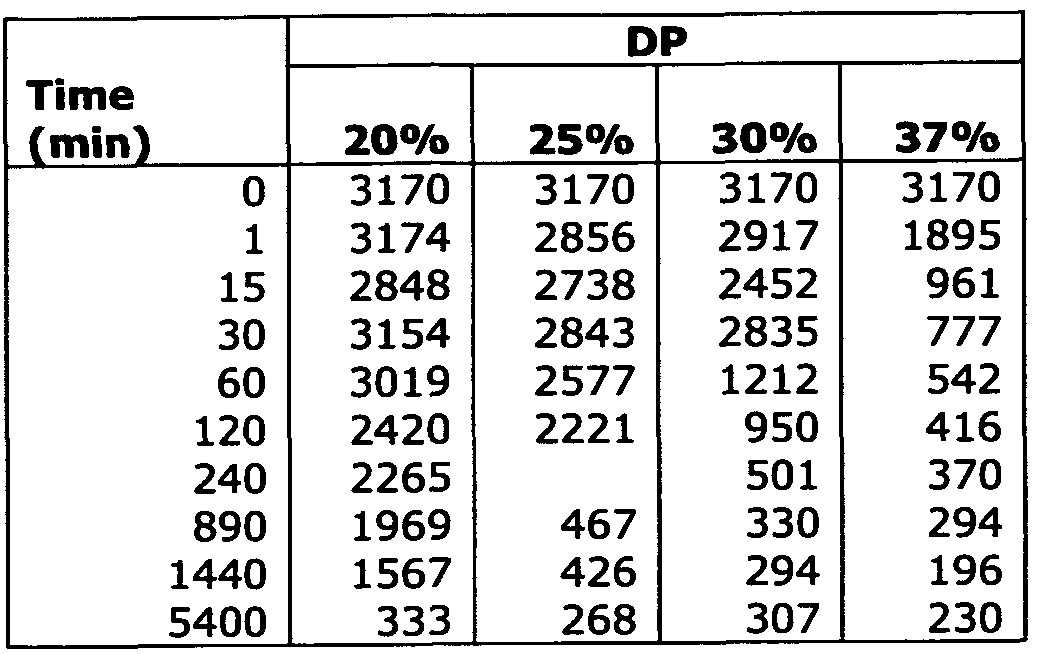
Fig. 2 demonstrates the breakdown rate with different salt concentrations, showing the time in which the LODP (LODP = level-off degree of polymerization) was reached. Fig. 3 shows the change of cellulose's degree of polymerization (DP) as a function of time with varying hydrochloric acid concentrations. DETAILED DESCRIPTION OF THE INVENTION
In the following, the invention is described in more detail referring to the exemplary preferred embodiments and the attached drawings. The terms used in the specification and claims have the meanings generally assigned to them in the field.
The invention relates to a process for preparing micro- and nanocrystalline cellulose in the presence of an acid in the gas phase. The invention also relates to a cellulose product prepared by the said process and the use thereof in food and liquid crystal applications as well as in optical, cosmetic and pharmaceutical applications.
Gaseous hydrochloric acid (HCI) causes the degree of polymerization to decrease in room temperature, which is required for the formation of micro- and nanocrystalline cellulose. The decrease of the degree of polymerization can take place within a few hours, preferably in 30 minutes. Micro- and nanocrystals are obtained by mechanical breaking down following the hydrolysis, for instance by mechanical stirring and/or a following ultrasound treatment. By using an acid in the gas phase, it is possible to avoid several of the environmentally harmful micro- and nanocrystalline cellulose manufacturing steps, which may also be difficult to apply on industrial scale. Large amounts of water are not needed for rinsing the sample, the recycling of the acid is easier and the dialysis
used for purification can be omitted. Therefore the recycling of the material and its processability are improved.
On the surface of the cellulose fibre, there is a thin aqueous layer, meaning that a high local acid concentration is formed when the gaseous acid adsorbs onto the fibre surface. Preferably the cellulose is dry, but not entirely so. The moisture content of the cellulose is between 1% and 80%. Preferably, the moisture content of the cellulose is between 1% and 10%, more preferably between 2% and 9%, and even more preferably between 3% and 8%, between 4% and 7%, or between 5% and 6%. The absolute amount of water on the fibre surface is so small that the local H30+ concentration is high. This leads to a surprisingly high breakdown rate.
By the inventive process, dry hydrolyzed cellulose substrate can be obtained from which mono- and oligosaccharides, such as sugars, can be separated by using water, and the cellulose can be mechanically broken down. If necessary, the obtained micro- and/or nanocrystalline cellulose can be dispersed in water with the help of a dispersing agent, for example carboxymethyl cellulose (CMC).
One embodiment of the invention provides a process for preparing micro- and/or nanycrystalline cellulose in the presence of an acid in the gas phase, the process comprising steps in which
- cellulose material is hydrolysed in the presence of at least one acid in the gas phase, the moisture content of the cellulose being between 1% and 80%,
- soluble mono- and/or oligosaccharides are optionally separated from the hydrolyzed cellulose, and
- the hydrolyzed cellulose is mechanically treated in order to obtain micro- and/or nanocrystals. Nano- and microcrystalline cellulose differ from each other by their particle size. Nanocrystals are single cellulose crystals: their width corresponds to the width of the native cellulose microfibril (e.g., 7 nm in cotton cellulose) and their length the length of the crystalline area in the microfibril (e.g., between 5 nm and 300 nm in cotton cellulose). The diameter of microcrystalline cellulose particles is several micrometers or tens of micrometres. In principle, cellulose microcrystals consist of nanocrystalline particles, i.e. microcrystals are nanocrystal aggregates. Microcrystals are easier to manufacture than nanocrystals, since with microcrystals there is no need to control or prevent the aggregation that occurs easily. With regard to both micro- and
nanocrystals, it is essential that the acid hydrolysis in the amorphous parts of the microfibril is completed. When all the amorphous parts have been hydrolyzed, the LODP (level off degree of polymerisation) point is reached. After this, the acid hydrolysis decreases the degree of polymerization (DP) only marginally and very slowly.
In scientific literature, cellulose nanocrystals are commonly referred to as cellulose nanocrystals, nanocrystalline cellulose, cellulose whiskers, or cellulose nanowhiskers. In older publications, nanocrystalline cellulose has also been referred to as microcrystalline cellulose.
The cellulose material used in the invention can be obtained from wood-based or non- wood-based material. In the invention, it is possible to use cellulose material that comprises pulp, such as chemical pulp, mechanical pulp, thermomechanical pulp or chemithermomechanical pulp. The wood-based material can be obtained from hardwood or softwood. The non-wood-based material can be obtained from plants, such as cotton, flax or hemp. The cellulose material can be cellophane.
Mechanical treatment refers to mechanical breaking down, for instance by grinding, crushing, dispersing, ultrasound treatment or other breaking down, but not limited to these. The mechanical treatment can be performed by any known method of breaking down.
The process according to the invention is preferably performed in atmospheric conditions, i.e. normal atmosphere and normal pressure. The process can be carried out in a temperature that is between 0°C and 100°C, preferably the temperature is between 10°C and 40°C, more preferably between 15°C and 35°C, most preferably between 18°C and 22°C. The temperature is for instance room temperature.
The natural vapour pressure of the acid/water mixture, for instance a HCI/water mixture, which is sufficiently great to gasify the HCI into the vapour phase can be utilized in the invention, meaning that a separate reaction is not needed. As a result, HCI can also be transferred onto a cellulose substrate without a separate mixing with air and without mechanical flow. The inventive process also utilizes adsorption and the following dissociation of HCI on the fibre surface covered by a thin aqueous layer.
Therefore, the vapour pressure of the gas used in the invention is such that it gasifies in room temperature, so that the acid adsorbs onto the cellulose surface. For instance
one of the following can be used as the acid: hydrochloric acid, nitric acid and/or trifluoroacetic acid. The concentration of the acid can be at least 1% by volume. Preferably, the concentration of the acid in the gas phase is between 2% and 99% by volume, for example 15% by volume, 38% by volume, or 68% by volume.
The hydrolyzed cellulose can be dispersed in water. Dispersing agent can be added to the hydrolyzed cellulose, and this may for instance comprise carboxymethyl cellulose (CMC). Water-soluble mono- and oligosaccharides can be separated from the hydrolyzed cellulose by extraction. Mono- and oligosaccharides can comprise for instance glucose and its oligomers, arabinose, xylose, mannose and other disintegration products of hemicelluloses. Mono- and oligosaccharides, for instance sugars, can be separated from the hydrolyzed cellulose by extraction. The TOC of the sugars is determined, they are analyzed by HPLC and the amount of eventual residual acid is measured. The separated sugars can be further fermented into ethanol.
The inventive process can be carried out within a few hours, preferably for instance in 30 minutes.
The viscosity of the hydrolyzed and broken-down cellulose is determined. Also the following analysis tools can be used: Cuen viscosity, gel permeation chromatography, and the CCOA method. In one preferred embodiment of the invention, the process comprises steps in which cellulose material is hydrolysed in the presence of at least one acid in the gas phase, the moisture content being between 1% and 80%,
- the hydrolyzed cellulose is dispersed in water in the presence of a dispersing agent,
- mono- and/or oligosaccharides are separated from the hydrolyzed cellulose, and
- the hydrolyzed cellulose is mechanically treated in order to obtain micro- and/or nanocrystals. A further object of the invention is a product that contains micro- and/or nanocrystalline cellulose.
The invention also relates to a cellulose product prepared by the said process and the use thereof in food and liquid crystal applications as well as in optical, cosmetic and pharmaceutical applications.
EXAMPLE
Acid hydrolysis of cotton cellulose
A filter paper sheet (type Whatman 1, solids content about 95%) was placed in an exsiccator with a small amount of liquid hydrochloric acid (HCI) on the bottom. The test conditions comprised normal air pressure and room temperature. The acid used was 2.1%, 15%, 68%, and 99% HCI in the gas phase, corresponding to 20%, 25%, 30% and 37% liquid acid, respectively. Table 1 shows the concentrations of gaseous hydrochloric acid as compared to the corresponding liquid hydrochloric acid.
Table 1. The concentration of hydrochloric acid in liquid and gas phase in normal air pressure and room temperature.

The experimental arrangement is shown in Fig. 1. The natural vapour pressure of liquid HCI was great enough to gasify the HCI into the gas phase in room temperature and transfer the HCI onto the cellulose substrate, which was cotton cellulose.
The results can be analyzed for instance by the following methods:
- Cuen viscosity: DPV
- gel permeation chromatography (GPC): DPw and DPn,
- CCOA method (carbazole-9-carboxylic acid [2-(2-amino- oxyethoxy)ethoxy]amide): the amount of carbonyl groups.
Fig. 2 shows the results of the acid hydrolysis when using 2.1%, 15%, 68%, and 99% gaseous hydrochloric acid, corresponding to 20%, 25%, 30%, and 37% liquid hydrochloric acid. When the concentration of the hydrochloric acid was increased in room temperature, the LODP point was reached more rapidly. Nanocrystalline cellulose was formed when the LODP value exceeded 100.
Table 2 shows the hydrolysis time, viscosity and DPv with different acid concentrations.
Table 2. Cellulose hydrolysis time, viscosity and DPv with different hydrochloric acid concentrations, 20%, 25%, 30%, and 37%.
Sample Time (min) Viscosity DPv
0 858 3170
20% 1 859 3174
15 779 2848
30 854 3154
60 821 3019
120 673 2420
240 634 2265
890 559 1969
1440 455 1567
5400 113 333
0 858 3170
25% 1 781 2856
15 752 2738
30 778 2843
60 712 2577
120 623 2221
890 153 467
1440 141 426
5400 93 268
0 858 3170
30% 1 796 2917
15 681 2452
30 776 2835
60 361 1212
120 290 950
240 163 501
895 112 330
1440 101 294
5400 105 307
0 858 3170
37% 1 540 1895
15 293 961
30 242 777
60 175 542
120 138 416
240 124 370
895 101 294
1440 70 196
5400 81 230
Table 3. Cellulose hydrolysis time and degree of polymerization (DP) with different hydrochloric acid concentrations, 20%, 25%, 30%, and 37%.
It is obvious for a person skilled in the art that as the technique advances, the basic principle of the invention may be implemented in several different ways. The invention and its embodiments are therefore not restricted to the above-described example but they may vary within the scope of the claims.
Claims
A process for preparing micro- and/or nanocrystalline cellulose, characterized in that the process comprises steps in which
- cellulose material is hydrolysed in the presence of at least one acid in the gas phase, the moisture content of the cellulose being between 1% and 80%,
soluble mono- and/or oligosaccharides are optionally separated from the hydrolyzed cellulose, and
- the hydrolyzed cellulose is mechanically treated in order to obtain micro- and/or nanocrystals.
2. The process according to claim 1, characterized in that the vapour pressure of the acid used is such that the acid gasifies into the gas phase in room temperature and adsorbs onto the cellulose surface.
3. The process according to claim 1 and 2, characterized in that one of the following is used as the acid: hydrochloric acid, nitric acid and/or trifluoroacetic acid.
4. The process according to any one of claims 1 to 3, characterized in that
the acid used is HCI.
5. A process according to any one of claims 1 to 4, characterized in that the concentration of the acid in the gas phase is at least 1% by volume.
6. The process according to any one of claims 1 to 5, characterized in that the hydrolyzed cellulose is dispersed in water.
7. The process according any one of claims 1 to 6, characterized in that dispersing agent, preferably carboxymethyl cellulose (CMC), is added to the hydrolyzed cellulose.
8. The process according to any one of claims 1 to 7, characterized in that the hydrolyzed cellulose is mechanically broken down.
9. The process according any one of claims 1 to 8, characterized in that the mechanical breaking down comprises mechanical stirring and/or ultrasound treatment.
10. The process according to any one of claims 1 to 9, characterized in that the process is carried out in normal air pressure.
11. The process according to any of the claims 1 to 10, characterized in that the process is carried out in a temperature that is between 0°C and 100°C, preferably between 10°C and 40°C, more preferably between 15°C and 35°C, more preferably between 18°C and 22°C, most preferably in room temperature.
12. The process according to any one of claims 1 to 11, characterized in that the process comprises steps in which
- cellulose material is hydrolysed in the presence of at least one acid in the gas phase, the moisture content being between 1% and 80%, - the hydrolyzed cellulose is dispersed in water in the presence of a dispersing agent,
soluble mono- and/or oligosaccharides are separated from the hydrolyzed cellulose, and
the hydrolyzed cellulose is mechanically treated in order to obtain micro- and/or nanocrystals.
13. A product containing micro- and/or nanocrystalline cellulose, characterized in that the product has been prepared by a process according to any one of claims 1 to 12.
14. The use of the product according to claim 13 as a reinforcement or a filler.
15. The use of the product according to claim 13 in optical and liquid crystal applications.
16. The use of the product according to claim 13 in food, cosmetic and pharmaceutical applications.
Applications Claiming Priority (2)
| Application Number | Priority Date | Filing Date | Title |
|---|---|---|---|
| FI20105275 | 2010-03-19 | ||
| FI20105275A FI20105275L (en) | 2010-03-19 | 2010-03-19 | METHOD FOR PREPARING MICRO-AND NANOCRYSTALLIZED CELLULOSE |
Publications (1)
| Publication Number | Publication Date |
|---|---|
| WO2011114005A1 true WO2011114005A1 (en) | 2011-09-22 |
Family
ID=42074387
Family Applications (1)
| Application Number | Title | Priority Date | Filing Date |
|---|---|---|---|
| PCT/FI2011/050235 Ceased WO2011114005A1 (en) | 2010-03-19 | 2011-03-18 | Process for preparing micro-and nanocrystalline cellulose |
Country Status (3)
| Country | Link |
|---|---|
| US (1) | US20140083416A1 (en) |
| FI (2) | FI20105275L (en) |
| WO (1) | WO2011114005A1 (en) |
Cited By (4)
| Publication number | Priority date | Publication date | Assignee | Title |
|---|---|---|---|---|
| CN102585017A (en) * | 2012-03-27 | 2012-07-18 | 东华大学 | Preparation method of nanoscale solidago canadensis L. microcrystalline cellulose |
| CN103174046A (en) * | 2013-04-11 | 2013-06-26 | 浙江理工大学 | Method for preparing nanometer microcrystalline cellulose by combining acid hydrolysis and ultrasonic treatment |
| WO2015145442A3 (en) * | 2014-03-27 | 2016-01-14 | Melodea Ltd. | Nanocrystaline cellulose as absorbent and encapsulation material |
| WO2020047939A1 (en) * | 2018-09-06 | 2020-03-12 | 刘永红 | Preparation method for micro-nano cellulose and application thereof |
Families Citing this family (12)
| Publication number | Priority date | Publication date | Assignee | Title |
|---|---|---|---|---|
| US9656914B2 (en) | 2013-05-01 | 2017-05-23 | Ecolab Usa Inc. | Rheology modifying agents for slurries |
| US9303360B2 (en) * | 2013-08-08 | 2016-04-05 | Ecolab Usa Inc. | Use of nanocrystaline cellulose and polymer grafted nanocrystaline cellulose for increasing retention in papermaking process |
| US9410288B2 (en) | 2013-08-08 | 2016-08-09 | Ecolab Usa Inc. | Use of nanocrystaline cellulose and polymer grafted nanocrystaline cellulose for increasing retention in papermaking process |
| US9034145B2 (en) * | 2013-08-08 | 2015-05-19 | Ecolab Usa Inc. | Use of nanocrystaline cellulose and polymer grafted nanocrystaline cellulose for increasing retention, wet strength, and dry strength in papermaking process |
| US9834730B2 (en) | 2014-01-23 | 2017-12-05 | Ecolab Usa Inc. | Use of emulsion polymers to flocculate solids in organic liquids |
| CN105175557A (en) * | 2015-08-21 | 2015-12-23 | 广西大学 | Preparation method of nano cellulose |
| WO2017066540A1 (en) | 2015-10-15 | 2017-04-20 | Ecolab Usa Inc. | Nanocrystalline cellulose and polymer-grafted nanocrystalline cellulose as rheology modifying agents for magnesium oxide and lime slurries |
| US10913837B2 (en) | 2015-11-06 | 2021-02-09 | Case Western Reserve University | Nano-emulsion and nano-latexes with functionalized cellulose nanocrystals |
| WO2018185768A1 (en) * | 2017-04-07 | 2018-10-11 | Yissum Research Development Company Of The Hebrew University Of Jerusalem Ltd. | Hair care compositions |
| CN110997593B (en) | 2017-07-17 | 2023-01-24 | 埃科莱布美国股份有限公司 | Process for modifying the rheology of slurries |
| DE102017010930A1 (en) | 2017-11-25 | 2019-05-29 | Dr. 3 Entwicklungsgesellschaft mbH i. Gr. | Topical preparations |
| CN112679621B (en) * | 2020-12-14 | 2021-12-28 | 江南大学 | A kind of cellulose nanocrystals based on papermaking deinking sludge and its application in the removal of iron and manganese from groundwater |
Citations (2)
| Publication number | Priority date | Publication date | Assignee | Title |
|---|---|---|---|---|
| EP0248252A2 (en) * | 1986-05-31 | 1987-12-09 | Wolff Walsrode Aktiengesellschaft | Process for preparing microcrystalline cellulose |
| RU2281993C1 (en) * | 2005-02-11 | 2006-08-20 | Владимир Александрович Васильев | Method for production of microcrystalline cellulose |
-
2010
- 2010-03-19 FI FI20105275A patent/FI20105275L/en not_active IP Right Cessation
-
2011
- 2011-03-18 WO PCT/FI2011/050235 patent/WO2011114005A1/en not_active Ceased
- 2011-03-21 FI FI20115274A patent/FI20115274L/en not_active IP Right Cessation
-
2012
- 2012-03-21 US US14/006,477 patent/US20140083416A1/en not_active Abandoned
Patent Citations (2)
| Publication number | Priority date | Publication date | Assignee | Title |
|---|---|---|---|---|
| EP0248252A2 (en) * | 1986-05-31 | 1987-12-09 | Wolff Walsrode Aktiengesellschaft | Process for preparing microcrystalline cellulose |
| RU2281993C1 (en) * | 2005-02-11 | 2006-08-20 | Владимир Александрович Васильев | Method for production of microcrystalline cellulose |
Non-Patent Citations (1)
| Title |
|---|
| HOLBERY J. ET AL: "A technique for production of nanocrystalline cellulose with a narrow size distritbution", CELLULOSE, vol. 16, 2009, pages 455 - 465, XP019672331 * |
Cited By (5)
| Publication number | Priority date | Publication date | Assignee | Title |
|---|---|---|---|---|
| CN102585017A (en) * | 2012-03-27 | 2012-07-18 | 东华大学 | Preparation method of nanoscale solidago canadensis L. microcrystalline cellulose |
| CN103174046A (en) * | 2013-04-11 | 2013-06-26 | 浙江理工大学 | Method for preparing nanometer microcrystalline cellulose by combining acid hydrolysis and ultrasonic treatment |
| CN103174046B (en) * | 2013-04-11 | 2015-08-26 | 浙江理工大学 | A kind of acid hydrolysis and ultrasonic process coordinate system are for the method for nano micro crystal cellulose |
| WO2015145442A3 (en) * | 2014-03-27 | 2016-01-14 | Melodea Ltd. | Nanocrystaline cellulose as absorbent and encapsulation material |
| WO2020047939A1 (en) * | 2018-09-06 | 2020-03-12 | 刘永红 | Preparation method for micro-nano cellulose and application thereof |
Also Published As
| Publication number | Publication date |
|---|---|
| US20140083416A1 (en) | 2014-03-27 |
| FI20115274A7 (en) | 2012-09-22 |
| FI20105275A0 (en) | 2010-03-19 |
| FI20115274A0 (en) | 2011-03-21 |
| FI20105275A7 (en) | 2011-09-20 |
| FI20115274L (en) | 2012-09-22 |
| FI20105275L (en) | 2011-09-20 |
Similar Documents
| Publication | Publication Date | Title |
|---|---|---|
| WO2011114005A1 (en) | Process for preparing micro-and nanocrystalline cellulose | |
| Yi et al. | From cellulose to cellulose nanofibrils—a comprehensive review of the preparation and modification of cellulose nanofibrils | |
| Mushi et al. | Nanostructured membranes based on native chitin nanofibers prepared by mild process | |
| Cheng et al. | Effects of CMC addition on bacterial cellulose production in a biofilm reactor and its paper sheets analysis | |
| de Mesquita et al. | Biobased nanocomposites from layer-by-layer assembly of cellulose nanowhiskers with chitosan | |
| Van De Ven et al. | Hairy cellulose nanocrystalloids: a novel class of nanocellulose | |
| Ma et al. | Ultrafine and carboxylated β-chitin nanofibers prepared from squid pen and its transparent hydrogels | |
| Mathew et al. | Cross-linked chitosan/chitin crystal nanocomposites with improved permeation selectivity and pH stability | |
| Hu et al. | Distinct chiral nematic self-assembling behavior caused by different size-unified cellulose nanocrystals via a multistage separation | |
| Chronopoulou et al. | Designing unconventional Fmoc-peptide-based biomaterials: Structure and related properties | |
| Operamolla et al. | Toward a reversible consolidation of paper materials using cellulose nanocrystals | |
| US20130018112A1 (en) | Cellulose nanoparticle aerogels, hydrogels and organogels | |
| US20100233481A1 (en) | Cellulose nanofiber production method of same and cellulose nanofiber dispersion | |
| Abdel-Hakim et al. | Nanocellulose and its polymer composites: preparation, characterization, and applications | |
| WO2012127110A1 (en) | Process for preparing micro- and nanocrystalline cellulose | |
| Alcântara et al. | Bionanocomposites based on polysaccharides and fibrous clays for packaging applications | |
| WO2010018808A1 (en) | Composite material, functional material, process for producing composite material, and process for producing composite-material thin film | |
| KR102109355B1 (en) | Preparing method of redispersible cellulose nanofiber, redispersible cellulose nanofiber therefrom, and dispersion method of redispersible cellulose nanofiber | |
| Batta-Mpouma et al. | Covalent crosslinking of colloidal cellulose nanocrystals for multifunctional nanostructured hydrogels with tunable physicochemical properties | |
| Khatri et al. | Bionanocomposites with enhanced physical properties from curli amyloid assemblies and cellulose nanofibrils | |
| CA3192745A1 (en) | An efficient green process for the preparation of nanocelluloses, novel modified nanocelluloses and their application | |
| Liesiene et al. | Preparation and characterization of a highly porous, rigid cellulose-based hydrogel for biomedical and biotechnological applications | |
| Wang et al. | The improved redispersibility of cellulose nanocrystals using hydroxypropyl cellulose and structure color from redispersed cellulose nanocrystals | |
| Luong et al. | Nanocellulose-alginate composite beads for improving Ciprofloxacin bioavailability | |
| Lakovaara et al. | Glass-like transparent and heat-sealable films of cellulose nanoworms via ethanol triggered swelling of esterified cellulose |
Legal Events
| Date | Code | Title | Description |
|---|---|---|---|
| 121 | Ep: the epo has been informed by wipo that ep was designated in this application |
Ref document number: 11755750 Country of ref document: EP Kind code of ref document: A1 |
|
| NENP | Non-entry into the national phase |
Ref country code: DE |
|
| 122 | Ep: pct application non-entry in european phase |
Ref document number: 11755750 Country of ref document: EP Kind code of ref document: A1 |