WO2011099082A1 - データベース管理システム - Google Patents
データベース管理システム Download PDFInfo
- Publication number
- WO2011099082A1 WO2011099082A1 PCT/JP2010/000895 JP2010000895W WO2011099082A1 WO 2011099082 A1 WO2011099082 A1 WO 2011099082A1 JP 2010000895 W JP2010000895 W JP 2010000895W WO 2011099082 A1 WO2011099082 A1 WO 2011099082A1
- Authority
- WO
- WIPO (PCT)
- Prior art keywords
- transaction
- data
- unit
- update
- search
- Prior art date
- Legal status (The legal status is an assumption and is not a legal conclusion. Google has not performed a legal analysis and makes no representation as to the accuracy of the status listed.)
- Ceased
Links
Images





Classifications
-
- G—PHYSICS
- G06—COMPUTING OR CALCULATING; COUNTING
- G06F—ELECTRIC DIGITAL DATA PROCESSING
- G06F16/00—Information retrieval; Database structures therefor; File system structures therefor
- G06F16/20—Information retrieval; Database structures therefor; File system structures therefor of structured data, e.g. relational data
- G06F16/23—Updating
- G06F16/2308—Concurrency control
Definitions
- the present invention relates to a database management system.
- the search requesting transaction uses the data updated by another transaction and the log file to restore the data before the update.
- counters are provided in the base table data part and the index part.
- the data in the base table data part is updated and the counter value is incremented by one.
- the counter value in the index part is incremented by one.
- the index part is searched according to the search condition, and the value of the counter of the search part is stored together with the search result.
- the base table data part is searched, and the counter of the data corresponding to the search result is compared with the stored counter value.
- the present invention provides a database management system capable of determining at a low processing cost whether or not data has been updated by another transaction performing an update process during the search process of one transaction. Objective.
- a database management system includes an input unit that inputs a transaction request including an update request and a search request for structured document data stored in a database and a transaction start request, and the structure according to the update request.
- An update unit that executes an update process of data to be updated in structured document data
- a search unit that executes a search process of the data to be searched in the structured document data according to the search request
- the transaction A transaction management unit that allocates one transaction ID for each transaction at the time of a transaction start request, a first storage unit that stores a log of update processing in a first transaction, and the update unit The data is updated when the data is updated.
- the data is retrieved by the second storage unit that stores the update information indicating that the data has been updated in association with the transaction ID, and the search unit in a second transaction different from the first transaction.
- the update information of the data to be searched exists in the second storage unit, the log of the transaction that updated the data is read from the log storage unit and the data is restored. A part.
- the present invention it is possible to determine at a low processing cost whether or not another transaction has performed an update process during a transaction search process and the data has been updated.
- Diagram showing the time relationship between the update process by one transaction and the search process by another transaction The block diagram showing the database management system concerning a 1st embodiment
- a flowchart showing general processing of the transaction management unit 102 An example diagram representing an XML document
- Example diagram showing the structure of an XML document The figure which shows the data of each XML document in the database Flow chart showing update processing of database management system Flowchart showing search and restoration processing of database management system
- a transaction is a collection of one or a plurality of processes including update processing and search processing for a database requested by a user as one processing unit.
- a transaction may be an update process.
- a transaction may be only a search process.
- the database management system performs an update process and a search process for XML document data stored in the database.
- FIG. 1 is a diagram showing a time relationship between an update process (transaction 1) using one transaction and a search process (transaction 2) using another transaction.
- Transactions 1 and 2 occur randomly. For example, since data is searched using a database at the start of a transaction, if the content of data is updated by another transaction (transaction 1) during the execution of search processing in one transaction (transaction 2), the output The search result at the time and the content of the data may become inconsistent.
- the database management system 10 determines whether or not data has been updated by another transaction during the processing of one transaction, and restores the database searched by the transaction.
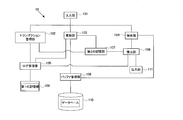
- FIG. 2 is a block diagram showing the database management system 10 according to the first embodiment.
- the database management system 10 includes an input unit 101, a transaction management unit 102, an update unit 103, a search unit 104, a log management unit 105, a buffer management unit 106, a second storage unit 107, and a restoration unit 108.
- a first storage unit 109 that stores a transaction log, a database 110, and an output unit 111.
- the log includes update processing contents, search processing contents, and transactions by transactions.
- the database 110 stores data such as XML documents. Processing corresponding to the transaction accepted by the input unit 101 is performed on the database 110. For example, if the transaction is a search, the search unit 104 searches for data requested from the database 110. If the transaction is an update, the update unit 103 updates the requested data with respect to the database 110.
- Such transaction processing is managed by the transaction management unit 102.
- the log management unit 105 records a transaction log in the first storage unit 109.
- the database management system 10 may update the data retrieved by the transaction by another transaction executed in parallel with the transaction. There is.
- the update information in the second storage unit 107 is used to determine whether or not there is data that may be updated by another transaction executed in parallel with the transaction. Judgment. If it is determined that the data exists, the update processing content of the transaction that updated the data is read from the first storage unit 109, and the restoration processing to the data before the update is performed.
- the input unit 101 receives a data update request, a transaction request including a search request, and a transaction start request from a plurality of users.
- the input unit 101 can accept requests from a plurality of users in parallel.
- the update unit 103 reads out data stored in the database 110 via the buffer management unit 106 and performs update processing.
- the update unit 103 causes the second storage unit 107 to store update information indicating that the data has been updated when the data update is completed.
- the search unit 104 reads data stored in the database 110 via the buffer management unit 106 and performs a search process.
- the transaction management unit 102 manages the update process by the update unit 103 and the search process by the search unit 104 as a series of transactions.
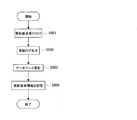
- FIG. 3 is a flowchart showing general processing of the transaction management unit 102.
- the transaction management unit 102 receives a transaction request and a transaction start request from the input unit 101 (S301).
- the transaction management unit 102 assigns one transaction ID for one transaction (S302).
- the transaction management unit 102 assigns transaction IDs in the order in which the input unit 101 receives requests.
- the transaction management unit 102 stores therein the transaction ID of a transaction that has not been committed or aborted (S303).
- the transaction management unit 102 determines whether or not all the update processing and search processing included in the transaction have succeeded (S304). If successful, the transaction is committed (S305). If it fails, the transaction is aborted (S306).
- the transaction management unit 102 holds a transaction ID that is currently being processed.
- the log management unit 105 records an update process or search process log by transaction in the first storage unit 109 at the end of each process.
- the restoration unit 108 determines whether or not there is a possibility that the data to be searched is updated by another transaction executed in parallel when the search processing by the search unit 104 is performed in one transaction. The determination is made using the update information in the second storage unit 107.
- the restoration unit 108 reads a transaction log from the first storage unit 109 when the determination is true. Restore the data using the transaction log.
- the output unit 111 outputs search results.
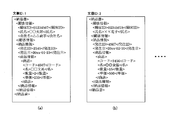
- FIG. 4 is an example diagram showing an XML document.
- delivery form data described by an XML document having a document ID is taken as an example.
- 4A and 4B each represent one XML document.
- Each XML document is assigned a document ID for identifying each XML document. For example, the document ID “1” is assigned to the XML document in FIG. 4A, and the document ID “2” is assigned to the XML document in FIG. 4B.
- FIG. 5 is an example diagram showing the structure of an XML document.
- the structure of the XML document is a tree structure, and an item ID that is an identification number is assigned to each tag and text item.
- the numbers in square brackets in FIG. 5 are item IDs.
- the item ID “5” is attached to the “name” tag
- the item ID “6” is attached to the text “name”.
- the same item ID is assigned to a tag having the same name in the same hierarchy.
- the item ID of the “product name” tag in the XML document in FIG. 4A is “13”
- the item ID of the “product name” tag in the XML document in FIG. 4B is also “13”. is there.
- FIG. 6 shows the data of each XML document in the database 110 and includes document structure information and partial data.
- the partial data is data obtained by disassembling the XML document, and includes text information and index information of the XML document.
- Document structure information is information describing the document structure of an XML document with an item ID.
- the document structure information of an XML document with document ID “1” (hereinafter, document 1) is “1, 2, 3, 4, 5, 6, 7, 8, 9, 10, 11, 12, 13, 14, 15, 16, 17, 18, 19, 20, 21, 22 ".
- the “company name” item in the document 1 does not exist. Therefore, the document structure information of the document 2 is “1, 2, 3, 4, 5, 6, 9, 10, 11, 12, 13, 14, 15, 16, 17, 18, 19, 20, 21, 22.
- the item ID “7” of the tag “company name” and the item ID “8” of the text are not included in the structure information.
- the index information is information indicating in what document and in what item each character formed by dividing a text string exists.
- Examples of the character string dividing method include an “N-gram method” and a “morpheme analysis method”. For example, as shown in FIG. 6, the index information of “XX” in the document 1 is ““ XXX ”, 1, 6, 1”. This indicates that the character string “XX” exists at the “1” character of the item ID “6” of the document 1.
- the database 110 stores XML document data in the form of document structure information and partial data. That is, an XML document as shown in FIG. 4 is created from the document structure information and the partial data.
- the database 110 stores document structure information and partial data by attaching a partial data ID to each of the document structure information and partial data.
- a partial data ID is attached to the document structure information
- the partial data ID “2” is attached to the text information.
- the database 110 stores a time data table in which each item ID is associated with the last update time that is the time when the item ID was last updated separately from the data of the XML document. . Thereby, the last update time which is the time when each item of each XML document was last updated by the update unit 103 is known.
- FIG. 7 is a flowchart showing the update process of the database management system 10.
- the input unit 101 receives a request from the user (S501). For example, in the input unit 101, the user “changes the customer information name of the document 1 from“ XX Taro ”to“ XX Jiro ”and sets the customer ID of the customer information of the document 2 as the customer ID. A request such as “change from“ 02345678 ”to“ 03345678 ”and commit the transaction” is accepted. The input unit 101 outputs the request to the transaction management unit 102 and the update unit 103.
- the transaction management unit 102 assigns one transaction ID to one transaction executed in accordance with the request, and outputs a log such as the transaction start time to the log management unit 105 (S502).
- the update unit 103 analyzes the update request and identifies the partial data ID to be updated. At this time, the update unit 103 has information that the partial data ID “2” may be specified in the design stage if the text (“Taro Taro” etc.) is updated.
- the update unit 103 requests the buffer management unit 106 to read the partial data with the specified partial data ID from the database 110, execute the update process, and output a log such as update contents and update time to the log management unit 105. (S503).
- the update unit 103 reads the partial data ID “2” of the document 1, updates “Taro XX” in the document 1 to “Jiro XX”, and also sets the partial data ID “2” of the document 1 at time t 1.
- the update log “change the item ID“ 6 ”to“ Jiro ”” is output to the log management unit 105.
- the partial data ID “4” of the document 1 is read, the “Taro” in the document 1 is updated to “Jiro”, and the item ID “4” of the partial data ID “2” of the document 2 is “02345678” at time t2.
- An update log “change from“ 03345678 ”to“ 03345678 ” is output to the log management unit 105.
- the log management unit 105 records the update log in the first storage unit 109. The same process is performed for document 2.
- the update unit 103 updates the time data table of the updated item. For example, the update unit 103 updates the last update time of the item ID “6” of the document 1 to t1. The last update time of the item ID “4” of the document 2 is updated to t2.
- the update unit 103 stores the partial data ID of the partial data updated by one transaction in the second storage unit 107 in association with the transaction ID (S504). For example, the update unit 103 updates the partial data ID “2” and the partial data ID “4” of the document 1 and the partial data ID “2” of the document 2 by the transaction with the transaction ID “1”. Update information is stored in the second storage unit 107.
- the database management system 10 performs the update process.
- FIG. 8 is a flowchart showing search and restoration processing of the database management system 10.
- the input unit 101 receives a data search request from the user (S601). For example, the input unit 101 accepts a request from the user such as “Start a transaction, search for a document whose customer information name is“ Taro XX ”or“ XX Hanako ”, and commit the transaction”.
- the input unit 101 outputs a data search request to the transaction management unit 102 and the search unit 104.
- the transaction management unit 102 assigns a transaction ID to a transaction executed according to the transaction start request, outputs the transaction start time to the log management unit 105, and stores the transaction ID and the start time in the second storage unit 107.
- the search unit 104 makes an inquiry to the transaction management unit 102, identifies a transaction that has not been committed or aborted when the search request is input, and determines the start time of the transaction with the earliest start time as the determination reference time. (S602).
- the above-described “name of customer information of document 1 is changed from“ Taro ”to“ Jiro ”and customer ID of customer information of document 2 is changed from“ 02345678 ”to“ 03345678 ”. It is assumed that only the transaction (transaction ID “1”) that has been subjected to the update process “change to” is being executed (before committing or before aborting).
- the determination reference time is the start time (set to t0) of the transaction ID “1”.
- the search unit 104 specifies partial data to be searched from the search request (S603). At this time, the search unit 104 has information that the partial data ID “2” may be specified at the design stage if the search is for text (such as “Taro XXX”). For example, the search unit 104 analyzes a search request “search for a document whose customer information name is“ XX Taro ”or“ XX Hanako ”” and sets the partial data ID “2” of all document IDs. Identify as search target.
- the search unit 104 searches for the requested search target data from among the specified partial data IDs of the search target, and acquires the last update time of the data from the time data table via the buffer management unit 106 (S604). .
- the search unit 104 outputs the acquired result to the restoration unit 108.
- the restoration unit 108 determines, for each item, whether or not the last update time of the item ID item ID of the received partial data ID is later than the determination reference time (S605).
- the restoration unit 108 determines that the last update time of the item ID “6” of the partial data ID “2” of the document 1 is greater than the determination reference time t0. It is also determined whether it is later. Since the last update time of the item ID “6” of the partial data ID “2” of the document 1 is t1 at the time of inputting the search request, the final update of the partial data ID “2” of the item ID “6” of the document 1 is performed. The time is after t0.
- the restoration unit 108 determines that the last update time of the item ID “6” of the partial data ID “2” of the document 2 is later than the determination reference time t0. It is determined whether or not. Since the item ID “6” of the partial data ID “2” of the document 2 is not updated by the update transaction of the transaction ID “1” at the time of inputting the search request, the partial data ID “2” of the document 2 is not updated. The last update time of the item ID “6” is before t0.
- the restoration unit 108 When the last update time is earlier than the determination reference time (No determination in step S605), the restoration unit 108 outputs the search result to the output unit 111 and ends the process. For example, the restoration processing unit 108 outputs the document 2 as an XML document to the output unit 111 in a state where the item ID “6” of the partial data ID “2” of the document 2 is “XX Hanako”.
- the restoration unit 108 searches the second storage unit 107, and the partial data to be searched is stored in the second storage as update information. It is determined whether it exists in the part 107 (S606).
- the restoration unit 108 determines whether or not the partial data ID “2” of the document 1 exists in the second storage unit 107.
- the restoration unit 108 If there is no update information related to the partial data to be searched in the second storage unit 107 (No in step S606), the restoration unit 108 outputs the search result as it is to the output unit 111, and ends the search process.
- the restoration unit 108 sets the transaction ID for updating the partial data to be searched for to the second storage unit 107. Get from.
- the restoration unit 108 reads the transaction update content of the acquired transaction ID from the first storage unit 109 via the log management unit 105. From the read log, a restoration process is performed to return the partial data to be searched to the partial data before the update process (S607).
- the restoration unit 108 acquires the transaction ID “1” of the transaction in which the partial data ID “2” of the document 1 is updated from the second storage unit 107.
- the restoration unit 108 reads the update processing log of the transaction ID “1” from the first storage unit 109 via the log management unit 105.
- Update log exists.
- the restoration unit 108 performs a restoration process for returning the data “XX Jiro” from the update log to “Taro XX”, which is the data before the update process.
- the restoration unit 108 restores the item ID “6” of the partial data ID “2” of the document 1 to “XX Jiro” in the search result, and outputs it to the output unit 111.
- the output unit 111 displays the search result with the partial data restored.
- the database management system 10 can determine whether or not the data has been updated by the update process of another transaction during the search process with a small processing cost.
- the present invention is not limited to the above-described embodiment as it is, and can be embodied by modifying constituent elements without departing from the scope of the invention in the implementation stage.
- various inventions can be formed by appropriately combining a plurality of components disclosed in the embodiment. For example, some components may be deleted from all the components shown in the embodiment.
- constituent elements over different embodiments may be appropriately combined.
Landscapes
- Engineering & Computer Science (AREA)
- Theoretical Computer Science (AREA)
- Data Mining & Analysis (AREA)
- Databases & Information Systems (AREA)
- Physics & Mathematics (AREA)
- General Engineering & Computer Science (AREA)
- General Physics & Mathematics (AREA)
- Information Retrieval, Db Structures And Fs Structures Therefor (AREA)
Abstract
Description
トランザクションとは、ユーザから要求されたデータベースに対する更新処理及び検索処理からなる一又は複数の処理を一の処理単位としてまとめたものである。トランザクションは、更新処理の場合もある。トランザクションは、検索処理のみの場合もある。
クションにより更新されている可能性のあるデータが存在するか否かを、第2の記憶部107にある更新情報を用いて判定する。存在すると判定した場合には、そのデータについて更新を行ったトランザクションの更新処理内容を第1の記憶部109から読みだし、更新前のデータへの復元処理を行う。
102 トランザクション管理部
103 更新部
104 検索部
105 ログ管理部
106 バッファ管理部
107 第2の記憶部
108 復元部
109 第1の記憶部
110 データベース
Claims (4)
- データベースに記憶される構造化文書データの更新要求及び検索要求を含むトランザクション要求及びトランザクションの開始要求を入力する入力部と、
前記更新要求に従って、前記構造化文書データ中の更新対象となるデータの更新処理を実行する更新部と、
前記検索要求に従って、前記構造化文書データ中の検索対象となる前記データの検索処理を実行する検索部と、
前記トランザクションを複数管理し、前記トランザクションの開始要求時に一の前記トランザクションにつき一のトランザクションIDを割り当てるトランザクション管理部と、
第1のトランザクションにおける更新処理のログを記憶する第1の記憶部と、
前記更新部により前記データが更新された場合に、前記データの更新がなされたことを示す更新情報を前記トランザクションIDに対応付けて記憶する第2の記憶部と、
第1のトランザクションとは別の第2のトランザクションにおける前記検索部により前記データが検索された際、検索対象となる前記データの更新情報が、前記第2の記憶部に存在する場合に、前記データを更新したトランザクションのログを前記ログ記憶部から読み出し、前記データの復元処理を行う復元部と
を備えることを特徴とするデータベース管理システム。 - 前記データベースは、
前記構造化文書データの構造情報を表す文書構造情報と、前記構造化文書データのテキスト内容を表すテキスト情報と、前記テキストを分割した文字の索引を表す索引情報とを含む部分データを記憶し、
前記第2の記憶部は、
前記更新部により更新された前記データを特定する部分データを更新情報として記憶する
ことを特徴とする、請求項1記載のデータベース管理システム。 - 前記部分データは、識別子である部分データIDを有し、
前記第2の記憶部は、
前記更新部により更新された前記データを特定する前記部分データの前記部分データIDを記憶し、
前記復元部は、
前記検索の際に、検索対象となる前記データを特定する前記部分データの部分データIDが前記第2の記憶部に存在するか否かを判定する
ことを特徴とする、請求項2記載のデータベース管理システム。 - 前記トランザクション管理部は、
前記部分データに対応付けられた前記トランザクションをコミット又はアボートした場合、前記第2の記憶部の前記部分データを消去する
ことを特徴とする、請求項3記載のデータベース管理システム。
Priority Applications (3)
| Application Number | Priority Date | Filing Date | Title |
|---|---|---|---|
| JP2011553654A JP5377672B2 (ja) | 2010-02-15 | 2010-02-15 | データベース管理システム |
| CN201080039794.2A CN102754083B (zh) | 2010-02-15 | 2010-02-15 | 数据库管理系统 |
| PCT/JP2010/000895 WO2011099082A1 (ja) | 2010-02-15 | 2010-02-15 | データベース管理システム |
Applications Claiming Priority (1)
| Application Number | Priority Date | Filing Date | Title |
|---|---|---|---|
| PCT/JP2010/000895 WO2011099082A1 (ja) | 2010-02-15 | 2010-02-15 | データベース管理システム |
Publications (1)
| Publication Number | Publication Date |
|---|---|
| WO2011099082A1 true WO2011099082A1 (ja) | 2011-08-18 |
Family
ID=44367396
Family Applications (1)
| Application Number | Title | Priority Date | Filing Date |
|---|---|---|---|
| PCT/JP2010/000895 Ceased WO2011099082A1 (ja) | 2010-02-15 | 2010-02-15 | データベース管理システム |
Country Status (3)
| Country | Link |
|---|---|
| JP (1) | JP5377672B2 (ja) |
| CN (1) | CN102754083B (ja) |
| WO (1) | WO2011099082A1 (ja) |
Cited By (1)
| Publication number | Priority date | Publication date | Assignee | Title |
|---|---|---|---|---|
| US10002158B2 (en) | 2014-11-04 | 2018-06-19 | International Business Machines Corporation | Apparatus and method for processing a query |
Families Citing this family (2)
| Publication number | Priority date | Publication date | Assignee | Title |
|---|---|---|---|---|
| CN104375995A (zh) * | 2013-08-13 | 2015-02-25 | 苏州广海信息科技有限公司 | 一种数据库管理系统 |
| CN106775468B (zh) * | 2016-12-06 | 2020-01-10 | 曙光信息产业(北京)有限公司 | 分布式事务的实现方法和系统 |
Citations (5)
| Publication number | Priority date | Publication date | Assignee | Title |
|---|---|---|---|---|
| JP2002351727A (ja) * | 2001-05-29 | 2002-12-06 | Fujitsu Ltd | データベース管理システム,データベース管理処理方法,データベース管理システム用のプログラムおよびその記録媒体 |
| JP2004046357A (ja) * | 2002-07-09 | 2004-02-12 | Toshiba Corp | 文書編集方法、文書編集システム、サーバ装置および文書編集プログラム |
| JP2005025432A (ja) * | 2003-07-01 | 2005-01-27 | Fujitsu Ltd | トランザクション処理方法,トランザクション制御装置およびトランザクション制御プログラム |
| JP2005234945A (ja) * | 2004-02-20 | 2005-09-02 | Toshiba Corp | 同時実行制御方法及び装置 |
| JP2009175854A (ja) * | 2008-01-22 | 2009-08-06 | Fujitsu Ltd | データ整合性を確保するためのプログラム、方法及びコンピュータ・システム |
-
2010
- 2010-02-15 JP JP2011553654A patent/JP5377672B2/ja active Active
- 2010-02-15 CN CN201080039794.2A patent/CN102754083B/zh active Active
- 2010-02-15 WO PCT/JP2010/000895 patent/WO2011099082A1/ja not_active Ceased
Patent Citations (5)
| Publication number | Priority date | Publication date | Assignee | Title |
|---|---|---|---|---|
| JP2002351727A (ja) * | 2001-05-29 | 2002-12-06 | Fujitsu Ltd | データベース管理システム,データベース管理処理方法,データベース管理システム用のプログラムおよびその記録媒体 |
| JP2004046357A (ja) * | 2002-07-09 | 2004-02-12 | Toshiba Corp | 文書編集方法、文書編集システム、サーバ装置および文書編集プログラム |
| JP2005025432A (ja) * | 2003-07-01 | 2005-01-27 | Fujitsu Ltd | トランザクション処理方法,トランザクション制御装置およびトランザクション制御プログラム |
| JP2005234945A (ja) * | 2004-02-20 | 2005-09-02 | Toshiba Corp | 同時実行制御方法及び装置 |
| JP2009175854A (ja) * | 2008-01-22 | 2009-08-06 | Fujitsu Ltd | データ整合性を確保するためのプログラム、方法及びコンピュータ・システム |
Non-Patent Citations (2)
| Title |
|---|
| KIN'YA FUJIZUKA: "Enterprise Riyo ga Kasoku suru Nidai Open-Source RDBMS PostgreSQL to MySQL no 'Mechanism' to 'Chigai' o Shiru", COMPUTERWORLD GET TECHNOLOGY RIGHT, vol. 2, no. 8, 1 August 2005 (2005-08-01), pages 78 - 83 * |
| KIN'YA FUJIZUKA: "Open-Source DB no Kihon Kozo o Shiru", NIKKEI SYSTEM KOCHIKU, 26 September 2004 (2004-09-26), pages 198 - 203 * |
Cited By (2)
| Publication number | Priority date | Publication date | Assignee | Title |
|---|---|---|---|---|
| US10002158B2 (en) | 2014-11-04 | 2018-06-19 | International Business Machines Corporation | Apparatus and method for processing a query |
| US10120894B2 (en) | 2014-11-04 | 2018-11-06 | International Business Machines Corporation | Apparatus and method for processing a query |
Also Published As
| Publication number | Publication date |
|---|---|
| CN102754083B (zh) | 2015-08-05 |
| JPWO2011099082A1 (ja) | 2013-06-13 |
| CN102754083A (zh) | 2012-10-24 |
| JP5377672B2 (ja) | 2013-12-25 |
Similar Documents
| Publication | Publication Date | Title |
|---|---|---|
| US8290991B2 (en) | Atomic deletion of database data categories | |
| EP2784665B1 (en) | Program and version control method | |
| CN105630863B (zh) | 用于多版本并发提交状态的事务控制块 | |
| CA2941074C (en) | Managing storage of individually accessible data units | |
| JP5922716B2 (ja) | 個別にアクセス可能なデータユニットの記憶の取り扱い方法 | |
| US9916313B2 (en) | Mapping of extensible datasets to relational database schemas | |
| US8214411B2 (en) | Atomic deletion of database data categories | |
| US8473955B2 (en) | Reducing processing overhead and storage cost by batching task records and converting to audit records | |
| US20120078859A1 (en) | Systems and methods to update a content store associated with a search index | |
| CN109902130A (zh) | 一种数据存储方法、数据查询方法和装置、存储介质 | |
| US20060069672A1 (en) | Query forced indexing | |
| US8055646B2 (en) | Prevention of redundant indexes in a database management system | |
| CN107958023A (zh) | 数据同步方法、数据同步装置和计算机可读存储介质 | |
| JPWO2010084754A1 (ja) | データベースシステム、データベース管理方法、及びデータベース構造 | |
| JP5377672B2 (ja) | データベース管理システム | |
| CN106503186A (zh) | 一种数据管理方法、客户端及系统 | |
| JP2015176407A (ja) | 検索装置、検索方法、検索用プログラムおよび検索用データ構造 | |
| JP7274293B2 (ja) | 情報処理装置、情報処理方法及びプログラム | |
| JP2020194335A (ja) | 情報処理システム | |
| US8037113B2 (en) | Techniques for file system searching | |
| JP2009037359A (ja) | データ登録検索方法、データ登録検索プログラムおよびデータベースシステム | |
| JP4825504B2 (ja) | データ登録・検索システムおよびデータ登録・検索方法 | |
| JP2003208346A (ja) | データベース更新情報の反映システムおよびそのためのプログラム | |
| US20170262512A1 (en) | Search processing method, search processing apparatus, and non-transitory computer-readable recording medium storing search processing program | |
| JP5226445B2 (ja) | データベースに対する問合せを処理する装置、処理方法、プログラムおよび記録媒体 |
Legal Events
| Date | Code | Title | Description |
|---|---|---|---|
| WWE | Wipo information: entry into national phase |
Ref document number: 201080039794.2 Country of ref document: CN |
|
| 121 | Ep: the epo has been informed by wipo that ep was designated in this application |
Ref document number: 10845687 Country of ref document: EP Kind code of ref document: A1 |
|
| WWE | Wipo information: entry into national phase |
Ref document number: 2011553654 Country of ref document: JP |
|
| NENP | Non-entry into the national phase |
Ref country code: DE |
|
| 122 | Ep: pct application non-entry in european phase |
Ref document number: 10845687 Country of ref document: EP Kind code of ref document: A1 |