WO2011089753A1 - 超分子ファイバーの製造方法 - Google Patents
超分子ファイバーの製造方法 Download PDFInfo
- Publication number
- WO2011089753A1 WO2011089753A1 PCT/JP2010/066131 JP2010066131W WO2011089753A1 WO 2011089753 A1 WO2011089753 A1 WO 2011089753A1 JP 2010066131 W JP2010066131 W JP 2010066131W WO 2011089753 A1 WO2011089753 A1 WO 2011089753A1
- Authority
- WO
- WIPO (PCT)
- Prior art keywords
- supramolecular
- fiber
- gel
- fibers
- hydrogel
- Prior art date
- Legal status (The legal status is an assumption and is not a legal conclusion. Google has not performed a legal analysis and makes no representation as to the accuracy of the status listed.)
- Ceased
Links
Images





Classifications
-
- G—PHYSICS
- G01—MEASURING; TESTING
- G01N—INVESTIGATING OR ANALYSING MATERIALS BY DETERMINING THEIR CHEMICAL OR PHYSICAL PROPERTIES
- G01N21/00—Investigating or analysing materials by the use of optical means, i.e. using sub-millimetre waves, infrared, visible or ultraviolet light
- G01N21/75—Systems in which material is subjected to a chemical reaction, the progress or the result of the reaction being investigated
- G01N21/76—Chemiluminescence; Bioluminescence
-
- D—TEXTILES; PAPER
- D01—NATURAL OR MAN-MADE THREADS OR FIBRES; SPINNING
- D01D—MECHANICAL METHODS OR APPARATUS IN THE MANUFACTURE OF ARTIFICIAL FILAMENTS, THREADS, FIBRES, BRISTLES OR RIBBONS
- D01D5/00—Formation of filaments, threads, or the like
-
- D—TEXTILES; PAPER
- D01—NATURAL OR MAN-MADE THREADS OR FIBRES; SPINNING
- D01D—MECHANICAL METHODS OR APPARATUS IN THE MANUFACTURE OF ARTIFICIAL FILAMENTS, THREADS, FIBRES, BRISTLES OR RIBBONS
- D01D5/00—Formation of filaments, threads, or the like
- D01D5/28—Formation of filaments, threads, or the like while mixing different spinning solutions or melts during the spinning operation; Spinnerette packs therefor
- D01D5/30—Conjugate filaments; Spinnerette packs therefor
- D01D5/34—Core-skin structure; Spinnerette packs therefor
-
- D—TEXTILES; PAPER
- D01—NATURAL OR MAN-MADE THREADS OR FIBRES; SPINNING
- D01F—CHEMICAL FEATURES IN THE MANUFACTURE OF ARTIFICIAL FILAMENTS, THREADS, FIBRES, BRISTLES OR RIBBONS; APPARATUS SPECIALLY ADAPTED FOR THE MANUFACTURE OF CARBON FILAMENTS
- D01F6/00—Monocomponent artificial filaments or the like of synthetic polymers; Manufacture thereof
- D01F6/88—Monocomponent artificial filaments or the like of synthetic polymers; Manufacture thereof from mixtures of polycondensation products as major constituent with other polymers or low-molecular-weight compounds
- D01F6/94—Monocomponent artificial filaments or the like of synthetic polymers; Manufacture thereof from mixtures of polycondensation products as major constituent with other polymers or low-molecular-weight compounds of other polycondensation products
-
- D—TEXTILES; PAPER
- D01—NATURAL OR MAN-MADE THREADS OR FIBRES; SPINNING
- D01F—CHEMICAL FEATURES IN THE MANUFACTURE OF ARTIFICIAL FILAMENTS, THREADS, FIBRES, BRISTLES OR RIBBONS; APPARATUS SPECIALLY ADAPTED FOR THE MANUFACTURE OF CARBON FILAMENTS
- D01F8/00—Conjugated, i.e. bi- or multicomponent, artificial filaments or the like; Manufacture thereof
- D01F8/18—Conjugated, i.e. bi- or multicomponent, artificial filaments or the like; Manufacture thereof from other substances
Definitions
- the present invention relates to a method for producing a supramolecular fiber elongated linearly.
- Supramolecular hydrogel is a non-covalent hydrogel in which molecules that are supramolecular hydrogelators are self-assembled, and are specifically described in, for example, Dojin News, 118, pp.1-17, 2006.
- the molecules that make up the supramolecular gel (for convenience, this molecule may be referred to as “supermolecular monomer”) generally have a hydrophobic part and a hydrophilic part, and this supramolecular monomer self-assembles.
- a supramolecular hydrogel is formed by the three-dimensional formation of the fibers (the central micellar fiber in FIG. 1 is referred to as “supermolecular fiber” in this specification).
- Supramolecular hydrogels have been shown to have excellent functions as smart biomaterials that function in response to external stimuli (Nat. Biotechnol., 21, pp.1171, 2003). Although the structure and function of supramolecular hydrogels can be controlled according to the molecular design (Dojin ⁇ News, 118, pp.1-17, 2006), supramolecules constituting supramolecular hydrogels have been attracting attention in recent years. Fibers are also expected to be useful as biomaterials. For example, since the supramolecular monomer is bonded by a weak interaction due to non-covalent bonding, it is possible to incorporate another substance into the fiber structure and to move the substance in the gel axis direction. Therefore, supramolecular fibers are expected to be useful as molecular sensors and molecular transporters.
- supramolecular fibers In order to use supramolecular fibers as biomaterials, it is essential to develop a method for linearly extending a supramolecular fiber in a desired direction and a method for aligning a plurality of supramolecular fibers.
- a supramolecular fiber is formed from a supramolecular monomer by self-assembly, in general, a three-dimensional entanglement naturally forms a hydrogel. It is difficult to isolate.
- supramolecular fibers are a structure in which supramolecular monomers are self-assembled into a micellar state, so there is a problem that they are extremely fragile to physical stimuli. It is very difficult to adjust the direction of the fiber. For these reasons, no technique has been developed in the past to align a plurality of supramolecular fibers in a certain direction.
- An object of the present invention is to provide means for producing a supramolecular fiber elongated linearly. Another object of the present invention is to provide a method for producing a plurality of supramolecular fibers linearly aligned in a certain direction. More specifically, a plurality of supramolecular fibers are straightened in a certain direction. It is an object of the present invention to provide a method of extending simultaneously while aligning in a shape.
- the present inventors produce linear supramolecular fibers oriented in the direction of flow in the fluid when the supramolecular monomers are self-assembled in the microchannel. It has been found that a plurality of supramolecular fibers can be extended in a linearly aligned state by appropriately adjusting the concentration of supramolecular monomers and / or the flow rate of the microchannel. It has also been found that a core-shell type fiber in which a linear supramolecular fiber elongated in a microchannel is coated with a hydrogel such as alginate gel can be easily prepared. The present invention has been completed based on these findings.
- a method for producing a linear supramolecular fiber including a step of self-assembling supramolecular monomers in a microchannel.
- the present invention also provides a method for producing a fiber bundle including a plurality of linearly aligned supramolecular fibers, the method comprising the step of self-assembling supramolecular monomers in a microchannel.
- a method for producing a gel fiber obtained by coating a linear supramolecular fiber with a hydrogel which can be obtained by self-assembling supramolecular monomers in a microchannel.
- a method comprising the step of coating a shaped supramolecular fiber with a hydrogel in a microchannel.
- a method comprising the step of coating a fiber bundle comprising a plurality of linearly aligned supramolecular fibers with a hydrogel in a microchannel.
- a method for producing a linear organic polymer comprising the steps of: (a) self-assembling supramolecular monomers in a microchannel to form a linear supramolecular fiber or linear A step of producing a fiber bundle containing a plurality of aligned supramolecular fibers; (b) a core-shell type supramolecular fiber or fiber bundle having an organic polymer in the core portion by polymerizing monomers inside the supramolecular fiber; And (c) removing the supramolecular fiber in the shell portion is provided.
- the step (a) further comprises a step of coating a supramolecular fiber with an alginate gel.
- a linear supramolecular fiber, and a gel fiber comprising a linear supramolecular fiber coated with a hydrogel, and a fiber bundle comprising a plurality of linearly aligned supramolecular fibers, and a hydrogel
- a gel fiber comprising the coated fiber bundle is provided by the present invention.
- a supramolecular fiber that is extremely brittle to physical stimulation can be stretched linearly, and a plurality of supramolecular fibers can be stretched as a fiber bundle while being linearly aligned.
- the gel fiber produced by the method of the present invention has a core-shell structure in which a supramolecular fiber or fiber bundle is coated with a hydrogel, and is characterized by excellent mechanical strength.
- the gel fiber is isolated, or an external force is applied to form the gel fiber into a two-dimensional or three-dimensional structure, and then the hydrogel in the shell portion is removed to remove any of the supramolecular fiber or the supramolecular fiber bundle.
- a structure can be manufactured.
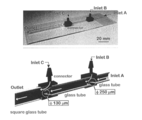
- FIG. 2 shows an example of a dual coaxial microfluidic device that can be used in the method of the present invention.
- 3 is a diagram showing a gel fiber having a core-shell structure obtained by the method of Example 1.
- FIG. 3 (a) is a light intensity profile showing a core-shell structure, and the upper end (Top view) in FIG. 3 (b) shows a coaxial core-shell structure.
- FIG. 1 It is the figure which showed a mode that the core part diameter and shell part coating thickness in a gel fiber change according to the flow rate ratio ( Qcore / Qshell ) of a core part fluid and a shell part fluid.
- a core part (supermolecular fiber) 1 ⁇ l / min, shell part (sodium alginate gel) 19 ⁇ l / min
- b core part (supermolecular fiber) 5 ⁇ l / min, shell part (sodium alginate gel) 15 ⁇ l / min
- C Core part (supermolecular fiber) 10 ⁇ l / min, shell part (sodium alginate gel) 10 ⁇ l / min
- d Core part (supermolecular fiber) 15 ⁇ l / min, shell part (sodium alginate gel) 5 ⁇ l / min
- a fluorescent image and a bright field image respectively.
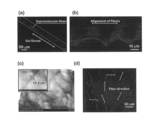
- (c) shows the results of preparing a supramolecular hydrogel in a flask as a control and observing it with a transmission electron microscope
- (d) shows sodium alginate (1.5 wt%) and supramolecular monomers (0.1 wt%) under a confocal laser microscope. wt%) is flowed through double coaxial microchannels, and the gel fiber supramolecular fiber is stained with rhodamine B chloride and observed. It is the figure which showed the result of having investigated the recovery process of the fluorescence intensity after quenching by quenching a part of the core of the core-shell type supramolecular fiber incorporating the FITC lipid using a 488 nm laser.
- (a) is an image under a confocal laser scanning microscope immediately after irradiation (0 sec) and after 946 seconds, and squares indicate laser irradiation sites.
- (b) is the figure which showed the fluorescence intensity in an irradiation part with time. It is the figure which showed the method of manufacturing a fiber-like organic polymer using a supramolecular fiber as a casting_mold
- the term “supermolecular fiber” means a structure in which supramolecular monomers are self-assembled to form a thermodynamically stable micellar fiber (see FIG. 1), usually 10 nm. It is a linear fiber having an outer diameter of about 50 nm. In general, the supramolecular fiber is entangled in the formation process of the supramolecular hydrogel to form a gel, but the term “supramolecular fiber” as used herein does not include supramolecular hydrogels. There is a need to.
- the term “supramolecular monomer” means a low molecular compound capable of forming a supramolecular hydrogel and a supramolecular fiber, but is used when the supramolecular hydrogel is assumed to correspond to a polymer. It is a convenient term and does not mean that a polymerization process is required to form the supramolecular hydrogel. Supramolecular monomers are sometimes referred to as “supermolecular hydrogels”.
- the kind of the supramolecular monomer is not particularly limited, and any monomer may be used as long as it can self-assemble and form a thermodynamically stable micellar fiber.
- Supramolecular monomers capable of forming supramolecular hydrogels typically have hydrophobic and hydrophilic moieties, and optionally linker moieties that join them, although such amphiphilic supergels. Molecular monomers can be preferably used.
- Examples of the partial structure of the supramolecular monomer include various functional groups such as alkyl groups, alkenyl groups, alkynyl groups, alkoxy groups, carboxyl groups, alkoxycarbonyl groups, amino groups, sulfonic acid groups, phosphoric acid groups, hydroxyl groups, and oxo groups.
- a lipid compound, a sugar compound, a peptide compound, an amino compound, a quaternary salt compound, a phosphoric acid compound or an ester thereof, a carboxylic acid compound or an ester thereof, or a sulfonic acid compound or an ester thereof is optional. Although it may have the residue of these compounds, or those combinations, it is not limited to these.
- the supramolecular monomer is specifically described in, for example, Dojin News, 118, pp.1-17, 2006, and by referring to this publication and the publications cited therein, those skilled in the art An appropriate supramolecular monomer can be selected according to the purpose.
- One type of supramolecular monomer can usually be used, but two or more types may be used in combination.
- the supramolecular fiber is taken up and the supramolecular fiber is stretched, and the supramolecular fiber is aligned. A bundle is obtained.
- the type of the compound incorporated into the supramolecular fiber is not particularly limited, but is retained in the hydrophilic part or the hydrophobic part of the micelle structure of the supramolecular fiber depending on the properties of the compound.
- an amphiphilic compound when used, it becomes a part of a micelle structure and is oriented with a supramolecular monomer.
- low molecular weight compounds can be used as such compounds.
- physiologically active compounds such as pharmaceutical compounds and neurotransmitters, lipid compounds, peptide compounds, and dyes can be used. It is not limited to.
- one of the combinations of molecules having specific interaction may be incorporated into the supramolecular fiber.
- the specific binding of biotin-avidin can be used.
- biotinylated lipid into a supramolecular fiber
- the resulting fiber is specifically recognized for avidin.
- avidin Have a function.
- the “micellar structure” means a state in which the hydrophobic portions of the supramolecular monomer are aggregated and associated so that the hydrophilic portions are on the outside, and a typical micelle structure is shown in FIG.
- this term should not be construed as limiting in any way and should be interpreted in the broadest sense.
- the method of the present invention is a method for producing a linear supramolecular fiber, and includes a step of self-assembling supramolecular monomers in a microchannel.
- the term “straight” means that the supramolecular fiber is stretched substantially linearly, but does not mean that the supramolecular fiber is completely straight. It must be interpreted as originally stretched.
- the supramolecular fiber may be entirely or partially curved, or may include partial distortion or twist.
- the outer diameter of the supramolecular fiber is not particularly limited, but is generally about 10 to 50 nm.
- the cross section of the supramolecular fiber is generally circular, but a cross section other than circular may be given depending on the type of supramolecular monomer used.
- the length of the supramolecular fiber is not particularly limited, but is several micrometers or more, preferably several millimeters or more, and may have a length of about several centimeters.
- the method of the present invention is a method for producing a fiber bundle including a plurality of linearly aligned supramolecular fibers, and includes a step of self-assembling supramolecular monomers in a microchannel.
- alignment means that a plurality of supramolecular fibers maintain a generally parallel relationship as a whole, but the parallel relationship is partially lost in two or more supramolecular fibers. This term should be construed in the broadest sense and not in a limited sense in any sense, including cases where some or all of a plurality of supramolecular fibers are twisted and overlapped.
- the term “fiber bundle” means an assembly including two or more aligned supramolecular fibers.
- the number of supramolecular fibers contained in the fiber bundle is not particularly limited as long as it is 2 or more, but is generally 5 or more, preferably 10 or more, more preferably 20 or more.
- the upper limit is not particularly limited, but is preferably 1,000 or less, more preferably 100 or less, and still more preferably 50 or less.
- the length of the fiber bundle is not particularly limited, but is several centimeters or more, preferably tens of centimeters or more, and may have a length of about several meters.
- the outer diameter of the supramolecular fiber contained in the fiber bundle is not particularly limited, but is generally about 10 to 50 nm.
- the plurality of supramolecular fibers generally have substantially the same outer diameter, but may have different outer diameters.
- the cross-sectional shape of the fiber bundle may be various shapes such as a circle, an elliptical system, or a polygon such as a quadrangle or a pentagon, but the cross-sectional shape is preferably a circle.
- the outer diameter of the fiber bundle is not particularly limited, and can be appropriately selected depending on the number of fibers. For example, about 20 to 100 ⁇ m can be exemplified, but the outer diameter can be appropriately selected depending on the application.
- the microchannel used in the method of the present invention is not particularly limited.
- the diameter of the injection port is about 130 ⁇ m, and the supramolecular monomer solution is injected into the microchannel at a rate of about 1 to 20 ⁇ l / min. It is preferred to use an apparatus that can.
- the inner diameter of the microchannel is, for example, about 600 ⁇ m, but is not limited thereto.
- the microchannel for example, those described in Lab. Chip, 4, pp.576-580, 2004 can be used.
- supramolecular monomer When a solution of supramolecular monomer is injected into the microchannel, the monomer moves along the fluid flow in the channel and self-assembles to form a supramolecular fiber.
- a single supramolecular fiber or a plurality of supramolecular fibers are formed depending on conditions such as the flow rate of the channel, preferably the flow rate of the microchannel.
- the formed supramolecular fiber is oriented and elongated in the flow direction of the microchannel to give a linear supramolecular fiber.
- a plurality of supramolecular fibers are aligned in the flow direction while extending in a straight line while being oriented in the direction of fluid flow.
- a fiber bundle containing supramolecular fibers is formed.
- the concentration of the supramolecular monomer injected into the microchannel can be appropriately selected according to the type of supramolecular monomer used, the flow rate in the microchannel, the number of supramolecular fibers to be formed in the microchannel, and the like. Although it is not performed, it can be easily selected by referring to conditions specifically described in the examples of the present specification, for example.
- a metal ion or the like can be added to the microchannel in order to promote self-assembly. For example, by adding calcium ions or the like into the microchannel, self-assembly of the supramolecular monomer may be promoted, and this aspect is a preferable aspect in the present invention.
- a gel fiber in which a single supramolecular fiber or a fiber bundle containing a plurality of supramolecular fibers is coated with a hydrogel.
- a formable coaxial microfluidic device is used. Using this device, two fluids can be injected separately into a core part and a shell part so as to be coaxial, a supramolecular monomer solution as an inner (core part) fluid, and an outer (shell part) fluid.
- a gelling agent solution capable of forming a hydrogel supramolecular fibers or fiber bundles coated with hydrogel can be prepared.
- the dual microfluidic device is specifically illustrated in Fig. 1 of, for example, Lab Chip, 4, pp.576-580, 2004.
- a coaxial microfluidic device preferably used in the method of the present invention is shown in FIG.
- hydrogel for example, a hydrogel based on chitosan gel, collagen gel, gelatin, peptide gel, fibrin gel, or a mixture thereof can be used.
- Matrigel Natural Becton Dickinson Co., Ltd.
- a hydrogel that can be formed by irradiating a water-soluble polymer such as polyvinyl alcohol, polyethylene oxide, or polyvinylpyrrolidone with ultraviolet rays or radiation may be used.
- a high-strength hydrogel having excellent mechanical strength is also preferable to use as the hydrogel.
- the type of the high-strength hydrogel is not particularly limited, but it is preferable to use a hydrogel having substantially the same or higher mechanical strength than, for example, a collagen gel or a polyvinyl alcohol hydrogel. Examples of such gel include alginic acid gel and agarose gel, but are not limited thereto.
- strength hydrogel the hydrogel which has the property to gelatinize in presence of metal ions, such as a calcium ion, can be used preferably. From such a viewpoint, an alginate gel is preferable.
- agarose gel a photocurable gel that is cured by UV irradiation, or the like can also be used.
- the mechanical strength of the gel the tensile strength and load strength can be measured by a method using a tensile tester in water according to a method well known to those skilled in the art.
- a gel fiber in which a single supramolecular fiber or a bundle of fibers containing a plurality of supramolecular fibers is coated with a hydrogel may be coated with a single hydrogel.
- it is coated with two or more different hydrogels in multiple layers. May be.
- a coating with a hydrogel having two or more different strengths for example, a coating with a polyvinyl alcohol hydrogel and a coating with an alginate gel formed on the outside thereof may be included.
- the outer diameter of the core-shell structured gel fiber is not particularly limited, but is, for example, in the range of 200 nm to 2,000 ⁇ m, and preferably in the range of 50 to 1,000 ⁇ m.
- Supramolecular fibers, fiber bundles, and gel fibers can be generally prepared using water as a solvent, but an aqueous organic solvent having a property of mixing with water, such as ethanol, acetone, ethylene glycol, propylene glycol, glycerin. , Dimethylformamide, dimethyl sulfoxide or the like may be added.
- an appropriate component or solvent can be blended. From such a viewpoint, for example, dimethyl sulfoxide can be added as a solvent for the preparation of polyvinyl alcohol hydrogel.
- a supramolecular fiber forming a core portion is used. Inject the supramolecular monomer solution from the inlet A and inject it from the injection port, and inject the sodium alginate solution before crosslinking from the inlet B and inject it from the injection port so that it is coaxial.
- a shell-state fluid Forming a shell-state fluid and introducing into the fluid an aqueous solution containing CaCl 2 from inlet C to gel the alginic acid in the shell part, and self-assemble the supramolecular monomer in the core part to form a supramolecular fiber or
- a fiber bundle, supramolecular fiber or fiber bundle on the inner side (core part) and algin on the outer side (shell part which is the covering part) It is possible to construct a gel fiber containing the gel.
- the rate of introduction into the aqueous solution containing calcium ions is not particularly limited, but can be, for example, about 1 to 10 ml / min.
- the fiber bundle and / or hydrogel part in the gel fiber coated with such supramolecular fiber bundle includes, for example, One or more biological components such as cells, proteins, lipids, saccharides, nucleic acids, or antibodies can be added.
- the type of cell is not particularly limited.
- various stem cells having pluripotency hematopoietic stem cells, neural stem cells, mesenchymal stem cells, etc.
- differentiation unity Stem cells hepatic stem cells, reproductive stem cells, etc.
- various types of differentiated cells such as muscle cells such as skeletal muscle cells and cardiomyocytes, nerve cells, fibroblasts, epithelial cells, hepatocytes, pancreatic ⁇ cells, skin A cell etc.
- the cells and biological components are not limited to those exemplified above.
- fibers such as carbon nanofibers, inorganic substances such as catalytic substances, beads coated with antibodies, or artificial objects such as microchips may be added to the fiber bundle or gel fiber. Is possible.
- the supramolecular fiber can be given recognition ability for various molecules and biopolymers.
- metal particles Au , Pt, or Pd
- it is possible to produce a supramolecular fiber coated with metal by aggregating the surface metal particles of the supramolecular fiber obtained in this way at a high concentration, and further having the supramolecular fiber coated with metal as a core part.
- Gel fibers can also be produced.
- an organic polymer monomer such as thiophene
- the supramolecular fiber is used as a template to perform advanced processing.
- organic polymer monomer is not specifically limited, For example, various monomers including a conductive ⁇ -conjugated molecule can be used.
- the core-like organic polymer formed in the fiber shape by removing the supermolecules of the shell portion from the core-shell type supramolecular fiber having the fiber-like organic polymer obtained in this way in the core portion. Can also be isolated.
- the removal of the supramolecular fiber can be easily performed by destroying the self-assembled state of the supramolecular monomer by applying an appropriate physicochemical stimulus such as pH adjustment or temperature change.
- an embodiment in which a supramolecular fiber or a supramolecular fiber bundle is used as a template for forming a fiber-like organic polymer is also a preferred embodiment of the present invention.
- the fiber-like organic polymer can be isolated by removing the supramolecular fiber after removing the alginic acid gel.
- the hydrogel in the shell part can be removed from the gel fiber having a core / shell structure obtained by the method of the present invention to expose the supramolecular fiber or the supramolecular fiber bundle.
- a calcium ion is removed by applying a chelating agent such as EDTA at an appropriate concentration. Only the hydrogel can be removed to prepare supramolecular fibers or supramolecular fiber bundles. You may perform said removal operation, after shape
- an arbitrary two-dimensional or three-dimensional structure can be prepared with a supramolecular fiber or a supramolecular fiber bundle.
- a supramolecular hydrogel having a desired microstructure by preparing a core-shell structure gel fiber and then building a three-dimensional structure with a specific structure and then removing the shell portion.
- a supramolecular hydrogel having a woven structure by preparing a woven structure using gel fibers having a core / shell structure and then removing the shell portion.
- a three-dimensional structure or woven fabric structure containing a composite material By using an alginate gel fiber, agarose gel fiber or the like when preparing a three-dimensional structure or woven fabric structure, a three-dimensional structure or woven fabric structure containing a composite material can also be prepared.
- the use of the linear supramolecular fiber or the supramolecular fiber bundle prepared by the method of the present invention, the gel fiber of the core / shell structure, and the above two-dimensional or three-dimensional structure is not particularly limited. It can be used for various applications such as various sensors, transporters for various substances, and cell culture.
- a hollow fiber made of hydrogel by removing the supramolecular fiber or the supramolecular fiber bundle in the core part from the gel fiber having a core / shell structure as necessary.
- an agarose gel is used as a hydrogel
- a gel fiber is produced by coating a supramolecular fiber or a bundle of supramolecular fibers, and then the supramolecules in the core part are applied by applying appropriate physicochemical stimulation such as pH adjustment or temperature change.
- the self-assembled state of the monomer can be destroyed and the core part can be removed. You may perform said removal operation, after shape
- Example 1 Using a double coaxial laminar flow device (Lab. Chip, 4, pp. 576, 2004, Fig. 1) shown in FIG. 2, a core-shell gel fiber having a diameter of 80 ⁇ m was manufactured. 0.1% w / v phosphoric acid head type supramolecular monomer aqueous solution as a core fluid (compound with the structure shown on the left side of Fig. 1: J. Am. Chem.
- FIG. 3 shows the gel fiber having a core-shell structure obtained.
- the presence of fluorescent beads incorporated into the alginate gel was confirmed by the light intensity profile shown in FIG. 3 (a), and it was proved that the obtained gel fiber had a coaxial core-shell structure.
- a coaxial core-shell structure was also confirmed from the cross-sectional image of the gel fiber (top view in FIG. 3 (b): Top view).
- This gel fiber had a mechanical strength that could be manipulated with tweezers.
- the core part diameter and shell part coating thickness in the obtained gel fiber changed according to the flow rate ratio (Q core / Q shell ) of the core part fluid and the shell part fluid (FIG. 4).
- the blue fluorescence shows the alginate gel of the shell part in which the fluorescent beads are incorporated, and it is shown that rhodamine lipid (red) and FITC lipid (green) are incorporated in the supramolecular fiber in the core part as shown in FIG. 5 (a) and It is clear from the result of (b).
- FIG. 5 (c) shows the result of visualizing biotin in the gel fiber with a streptavidin-binding dye (streptavidin-Alexa-Fluor 488, Invitrogen: green). From this result, it is clear that the supramolecular fiber recognized the streptavidin binding dye by the specific binding of biotin and avidin, and the supramolecular fiber or gel fiber provided by the present invention was used as a member of a sensor or a diagnostic tool. It was shown that it can be applied.
- a streptavidin-binding dye streptavidin-Alexa-Fluor 488, Invitrogen: green
- FIG. 6 (b) is an enlarged view of (a), and a plurality of supramolecular fibers oriented in the extending direction of the linear gel fibers can be confirmed.
- supramolecular hydrogel (supramolecular monomer 0.1%) was prepared in a flask and observed with a transmission electron microscope (TEM).
- FIG. 6 (c) shows the result. A network in which supramolecular fibers were randomly entangled in three dimensions was formed, and no linearly isolated supramolecular fibers or linearly aligned supramolecular fibers were observed.
- a hydrogel composed of sodium alginate and supramolecular monomer 15: 1 (wt%) was stained with rhodamine B chloride and observed under a confocal laser microscope, a random three-dimensional network constituting the gel was observed ( FIG. 6 (d)).
- normal supramolecular hydrogels do not form linearly isolated supramolecular fibers or linearly aligned supramolecular fibers, and a plurality of supramolecules linearly aligned by the method of the present invention. It has been shown that fiber bundles containing fibers can be produced.
- FIG. 7 shows the results of monitoring over time how the fluorophore which has not been quenched moves to the quenching portion and the fluorescence is restored.
- FIG. 7 (a) is an image under a confocal laser scanning microscope immediately after irradiation (0 ⁇ sec) and after 946 seconds. Laser irradiation was performed on a portion surrounded by a square.
- FIG. 7 (b) is a diagram showing the fluorescence recovery in the irradiated part over time. As a result, 16% fluorescence intensity recovery was confirmed after 946 seconds, indicating a slow dispersion state and fluidity in the supramolecular fiber.
- Example 2 A fiber-like organic polymer was manufactured using a supramolecular fiber as a template by utilizing hydrophobic nano-space in the supramolecular fiber.
- FIGS. 8 (a) and 8 (b) show schematic diagrams of the production method. Phosphoric head type supramolecular monomer as supramolecule, 0.1% w / v phosphoric acid head type supramolecular monomer aqueous solution and 1.5% w / v sodium alginate aqueous solution as shell fluid, 20 mM chloride as sheath fluid
- a supramolecular fiber coated with alginate gel was formed in the same manner as in Example 1 under the condition using a calcium solution. The diameter of the internal space of this supramolecular fiber is approximately 5-10 nm.
- FIG. 8 (c) is a photomicrograph of a polymer coated with supramolecular fibers and alginic acid.
- a polymer in which a plurality of fiber-like organic polymers formed by removing alginic acid gel from the obtained fiber under the condition of chelating agent and further removing supermolecules under the same condition of Ca 2+ chelating agent are bundled A bunch was obtained.
- the diameter of the fiber-like organic polymer was about 20-30 nm reflecting the supramolecular fiber diameter, and the length of the fiber was at least millimeter scale.
- a photomicrograph of the fiber-like organic polymer is shown in FIG. 8 (d).
Landscapes
- Engineering & Computer Science (AREA)
- Chemical & Material Sciences (AREA)
- Textile Engineering (AREA)
- Chemical Kinetics & Catalysis (AREA)
- Physics & Mathematics (AREA)
- Health & Medical Sciences (AREA)
- Mechanical Engineering (AREA)
- General Chemical & Material Sciences (AREA)
- Analytical Chemistry (AREA)
- Life Sciences & Earth Sciences (AREA)
- Plasma & Fusion (AREA)
- Biochemistry (AREA)
- General Health & Medical Sciences (AREA)
- General Physics & Mathematics (AREA)
- Immunology (AREA)
- Pathology (AREA)
- Toxicology (AREA)
- Spinning Methods And Devices For Manufacturing Artificial Fibers (AREA)
- Materials For Medical Uses (AREA)
- Treatments For Attaching Organic Compounds To Fibrous Goods (AREA)
- Artificial Filaments (AREA)
Abstract
Description
また、本発明の別の課題は、一定方向に直線状に整列した複数の超分子ファイバーを製造する方法を提供することにあり、より具体的には、複数の超分子ファイバーを一定方向に直線状に整列させながら同時に伸長させる方法を提供することが本発明の課題である。
また、本発明により、直線状に整列した複数の超分子ファイバーを含むファイバー束を製造する方法であって、マイクロ流路中で超分子モノマーを自己集合させる工程を含む方法が提供される。
また、本発明により、直線状に整列した複数の超分子ファイバーを含むファイバー束をヒドロゲルで被覆したゲルファイバーを製造する方法であって、マイクロ流路中で超分子モノマーを自己集合させることにより得ることができる直線状に整列した複数の超分子ファイバーを含むファイバー束をマイクロ流路中でヒドロゲルにより被覆する工程を含む方法が提供される。
例1
図2に示す二重の同軸の層流装置(Lab. Chip, 4, pp.576, 2004, Fig.1)を用いて80μmの直径を有するコア・シェル構造のゲルファイバーを製造した。コア用流体として0.1% w/vリン酸ヘッド型超分子モノマー水溶液(図1の左側に示す構造の化合物: J. Am. Chem. Soc., 131, pp.5580-5585, 2009)及びシェル用流体として1.5% w/vアルギン酸ナトリウム水溶液を用い、鞘部の流体として20 mM塩化カルシウム溶液(Qsheath=3.2 ml/min)を用いた。
超分子ファイバーの内部に存在する疎水性ナノ空間を利用して超分子ファイバを鋳型としてファイバ状の有機高分子を製造した。図8(a)及び(b)に製造方法の模式図を示す。超分子としてリン酸ヘッド型超分子モノマーを用いて0.1% w/vリン酸ヘッド型超分子モノマー水溶液及びシェル用流体として1.5% w/vアルギン酸ナトリウム水溶液を用い、鞘部の流体として20 mM塩化カルシウム溶液を用いた条件によりアルギン酸ゲルで被覆された超分子ファイバーを例1と同様に形成した。この超分子ファイバーの内部空間の直径は大凡5-10nmである。この超分子ファイバーの内部に有機高分子モノマーとして 3,4-エチレンジオキシチオフェンをジメチルスルホキシドに溶解させ、超分子ファイバーを浸漬させることで充填し、酸化重合により重合を行った。図8(c)は超分子ファイバー及びアルギン酸により被覆された高分子の顕微鏡写真である。得られたファイバーからアルギン酸ゲルをキレート剤の条件により除去し、さらに超分子を同様にCa2+キレート剤の条件により除去することにより形成された複数のファイバー状有機高分子が束になったポリマー束が得られた。ファイバー状の有機高分子の直径はおおむね超分子ファイバ径を反映した20-30 nm程度であり、ファイバーの長さは少なくともミリメートル・スケールであった。ファイバー状の有機高分子の顕微鏡写真を図8(d)に示した。
Claims (8)
- 直線状の超分子ファイバーを製造する方法であって、マイクロ流路中で超分子モノマーを自己集合させる工程を含む方法。
- 直線状に整列した複数の超分子ファイバーを含むファイバー束を製造する方法であって、マイクロ流路中で超分子モノマーを自己集合させる工程を含む方法。
- 直線状の超分子ファイバーをヒドロゲルで被覆したゲルファイバーを製造する方法であって、マイクロ流路中で超分子モノマーを自己集合させることにより得ることができる直線状の超分子ファイバーをマイクロ流路中でヒドロゲルにより被覆する工程を含む方法。
- 直線状に整列した複数の超分子ファイバーを含むファイバー束をヒドロゲルで被覆したゲルファイバーを製造する方法であって、マイクロ流路中で超分子モノマーを自己集合させることにより得ることができる直線状に整列した複数の超分子ファイバーを含むファイバー束をマイクロ流路中でヒドロゲルにより被覆する工程を含む方法。
- 請求項1に記載の方法により得ることができる直線状の超分子ファイバー。
- 請求項2に記載の方法により得ることができる直線状に整列した複数の超分子ファイバーを含むファイバー束。
- 請求項3又は4に記載の方法により得ることができるゲルファイバー。
- 直線状の有機高分子を製造する方法であって、下記の工程:
(a)マイクロ流路中で超分子モノマーを自己集合させて直線状の超分子ファイバー又は直線状に整列した複数の超分子ファイバーを含むファイバー束を製造する工程;
(b)該超分子ファイバーの内部でモノマーを重合させて有機高分子をコア部に有するコア・シェル型の超分子ファイバー又はファイバー束を製造する工程;及び
(c)シェル部の超分子ファイバーを除去する工程
を含む方法。
Priority Applications (2)
| Application Number | Priority Date | Filing Date | Title |
|---|---|---|---|
| JP2011550788A JP5654499B2 (ja) | 2010-01-20 | 2010-09-17 | 超分子ファイバーの製造方法 |
| US13/522,155 US9476834B2 (en) | 2010-01-20 | 2010-09-17 | Process for producing supramolecular fiber |
Applications Claiming Priority (2)
| Application Number | Priority Date | Filing Date | Title |
|---|---|---|---|
| JP2010-009728 | 2010-01-20 | ||
| JP2010009728 | 2010-01-20 |
Publications (1)
| Publication Number | Publication Date |
|---|---|
| WO2011089753A1 true WO2011089753A1 (ja) | 2011-07-28 |
Family
ID=44306570
Family Applications (1)
| Application Number | Title | Priority Date | Filing Date |
|---|---|---|---|
| PCT/JP2010/066131 Ceased WO2011089753A1 (ja) | 2010-01-20 | 2010-09-17 | 超分子ファイバーの製造方法 |
Country Status (3)
| Country | Link |
|---|---|
| US (1) | US9476834B2 (ja) |
| JP (1) | JP5654499B2 (ja) |
| WO (1) | WO2011089753A1 (ja) |
Cited By (5)
| Publication number | Priority date | Publication date | Assignee | Title |
|---|---|---|---|---|
| KR20160117068A (ko) * | 2015-03-31 | 2016-10-10 | 동아대학교 산학협력단 | 미세유체 장치를 이용한 고분자 섬유의 제조방법 및 이를 이용하여 제조된 고분자 섬유 |
| WO2020230697A1 (ja) * | 2019-05-10 | 2020-11-19 | 国立大学法人九州大学 | 脂質ペプチド型ゲル化剤とポリアルキレンオキシドとを含有する高分子複合材料 |
| WO2021095834A1 (ja) * | 2019-11-15 | 2021-05-20 | 学校法人慶應義塾 | X線不透過マイクロゲルファイバ |
| JPWO2022186399A1 (ja) * | 2021-03-05 | 2022-09-09 | ||
| JP2024120692A (ja) * | 2023-02-24 | 2024-09-05 | 株式会社豊田中央研究所 | 重合体ナノファイバー集積体の製造方法、重合体ナノファイバー集積体、一軸配向重合体ナノファイバー集積基板、及び、レーザー脱離/イオン化質量分析基板 |
Families Citing this family (2)
| Publication number | Priority date | Publication date | Assignee | Title |
|---|---|---|---|---|
| CN104695052B (zh) * | 2013-12-04 | 2017-06-13 | 中国科学院大连化学物理研究所 | 一种制备具球形空腔聚合物纤维的方法及专用微流控芯片 |
| EP4269671A1 (en) * | 2022-04-26 | 2023-11-01 | EMPA Eidgenössische Materialprüfungs- und Forschungsanstalt | Microfluidic-based wet spinning of individual solid polymer fibers |
Citations (2)
| Publication number | Priority date | Publication date | Assignee | Title |
|---|---|---|---|---|
| JP2008221370A (ja) * | 2007-03-09 | 2008-09-25 | Kyushu Univ | 超分子ナノ集合体の製造方法および超分子ナノ集合体 |
| WO2009005152A1 (ja) * | 2007-07-05 | 2009-01-08 | Nissan Chemical Industries, Ltd. | 新規脂質トリペプチド性ヒドロゲル化剤及びヒドロゲル |
Family Cites Families (6)
| Publication number | Priority date | Publication date | Assignee | Title |
|---|---|---|---|---|
| US6902932B2 (en) * | 2001-11-16 | 2005-06-07 | Tissue Regeneration, Inc. | Helically organized silk fibroin fiber bundles for matrices in tissue engineering |
| JP2010529313A (ja) * | 2007-05-30 | 2010-08-26 | ダウ グローバル テクノロジーズ インコーポレイティド | 高生産性溶媒系電界紡糸 |
| US8968886B2 (en) * | 2008-03-26 | 2015-03-03 | Yeda Research And Development Co., Ltd. | Doubly reduced perylene-diimides and supramolecular polymers derived from perylene-diimides |
| US8049061B2 (en) * | 2008-09-25 | 2011-11-01 | Abbott Cardiovascular Systems, Inc. | Expandable member formed of a fibrous matrix having hydrogel polymer for intraluminal drug delivery |
| US8784988B2 (en) * | 2008-11-25 | 2014-07-22 | Dow Global Technologies Llc | Polymer inorganic-particulate composite fibers |
| EP2421549B1 (en) * | 2009-04-20 | 2013-06-12 | Allergan, Inc. | Silk fibroin hydrogels and uses thereof |
-
2010
- 2010-09-17 JP JP2011550788A patent/JP5654499B2/ja active Active
- 2010-09-17 US US13/522,155 patent/US9476834B2/en active Active
- 2010-09-17 WO PCT/JP2010/066131 patent/WO2011089753A1/ja not_active Ceased
Patent Citations (2)
| Publication number | Priority date | Publication date | Assignee | Title |
|---|---|---|---|---|
| JP2008221370A (ja) * | 2007-03-09 | 2008-09-25 | Kyushu Univ | 超分子ナノ集合体の製造方法および超分子ナノ集合体 |
| WO2009005152A1 (ja) * | 2007-07-05 | 2009-01-08 | Nissan Chemical Industries, Ltd. | 新規脂質トリペプチド性ヒドロゲル化剤及びヒドロゲル |
Non-Patent Citations (1)
| Title |
|---|
| WONJE JEONG ET AL.: "Hydrodynamic microfabrication via ''on the fly'' photopolymerization of microscale fibers and tubes", LAB CHIP, vol. 4, 2004, pages 576 - 580 * |
Cited By (9)
| Publication number | Priority date | Publication date | Assignee | Title |
|---|---|---|---|---|
| KR20160117068A (ko) * | 2015-03-31 | 2016-10-10 | 동아대학교 산학협력단 | 미세유체 장치를 이용한 고분자 섬유의 제조방법 및 이를 이용하여 제조된 고분자 섬유 |
| KR101693598B1 (ko) * | 2015-03-31 | 2017-01-06 | 동아대학교 산학협력단 | 미세유체 장치를 이용한 고분자 섬유의 제조방법 및 이를 이용하여 제조된 고분자 섬유 |
| WO2020230697A1 (ja) * | 2019-05-10 | 2020-11-19 | 国立大学法人九州大学 | 脂質ペプチド型ゲル化剤とポリアルキレンオキシドとを含有する高分子複合材料 |
| WO2021095834A1 (ja) * | 2019-11-15 | 2021-05-20 | 学校法人慶應義塾 | X線不透過マイクロゲルファイバ |
| JPWO2021095834A1 (ja) * | 2019-11-15 | 2021-05-20 | ||
| JP7629608B2 (ja) | 2019-11-15 | 2025-02-14 | 慶應義塾 | X線不透過マイクロゲルファイバ |
| JPWO2022186399A1 (ja) * | 2021-03-05 | 2022-09-09 | ||
| JP2024120692A (ja) * | 2023-02-24 | 2024-09-05 | 株式会社豊田中央研究所 | 重合体ナノファイバー集積体の製造方法、重合体ナノファイバー集積体、一軸配向重合体ナノファイバー集積基板、及び、レーザー脱離/イオン化質量分析基板 |
| JP7695625B2 (ja) | 2023-02-24 | 2025-06-19 | 株式会社豊田中央研究所 | 重合体ナノファイバー集積体の製造方法、重合体ナノファイバー集積体、一軸配向重合体ナノファイバー集積基板、及び、レーザー脱離/イオン化質量分析基板 |
Also Published As
| Publication number | Publication date |
|---|---|
| JPWO2011089753A1 (ja) | 2013-05-20 |
| US9476834B2 (en) | 2016-10-25 |
| JP5654499B2 (ja) | 2015-01-14 |
| US20130071948A1 (en) | 2013-03-21 |
Similar Documents
| Publication | Publication Date | Title |
|---|---|---|
| JP5654499B2 (ja) | 超分子ファイバーの製造方法 | |
| Ha et al. | Electro-responsive hydrogel-based microfluidic actuator platform for photothermal therapy | |
| EP2401225B1 (en) | A supramolecular approach for preparation of size controllable nanoparticles | |
| Xue et al. | Shaped stimuli-responsive hydrogel particles: syntheses, properties and biological responses | |
| Chen et al. | Engineering inorganic nanoemulsions/nanoliposomes by fluoride‐silica chemistry for efficient delivery/co‐delivery of hydrophobic agents | |
| Shim et al. | Elaborate design strategies toward novel microcarriers for controlled encapsulation and release | |
| Leggio et al. | Mastering the tools: natural versus artificial vesicles in nanomedicine | |
| Lim et al. | Multi stimuli-responsive hydrogel microfibers containing magnetite nanoparticles prepared using microcapillary devices | |
| Arduino et al. | Microfluidic preparation and in vitro evaluation of iRGD-functionalized solid lipid nanoparticles for targeted delivery of paclitaxel to tumor cells | |
| Li et al. | A decade of developing applications exploiting the properties of polyelectrolyte multilayer capsules | |
| Martins et al. | Engineered fluorescent carbon dots and G4-G6 PAMAM dendrimer nanohybrids for bioimaging and gene delivery | |
| EP2868781A1 (en) | Method for fabrication of porous fibrous microstructure with various 3-dimensional structures | |
| Xiao et al. | Design of functional electrospun nanofibers for cancer cell capture applications | |
| Simon et al. | Exploring the role of polymers to overcome ongoing challenges in the field of extracellular vesicles | |
| Wang et al. | Conventional electrospinning vs. emulsion electrospinning: A comparative study on the development of nanofibrous drug/biomolecule delivery vehicles | |
| EP2066305A2 (de) | Polymermatrix, verfahren zu deren herstellung sowie deren verwendung | |
| Wang et al. | Non-dye cell viability monitoring by using pH-responsive inverse opal hydrogels | |
| CN114957759A (zh) | 一种核壳结构微载体及其制备方法 | |
| Sun et al. | Recent Advances in Micro/Nanoneedle Arrays Mediated Intracellular Delivery of Biomacromolecules In Vitro and In Vivo | |
| KR101726063B1 (ko) | 3차원 생체 내 조직 모사 시스템을 이용한 종양 진단용 핵산형광-리포솜 나노입자체의 진단효율 증가 및 검증방법 | |
| Choi et al. | Tendon-inspired hydrogel with segmental change of stiffness modulated by carboxymethylated cellulose nanofibers | |
| KR20160036523A (ko) | 피브로인 미립구를 포함하는 약물 전달체 및 그 제조방법 | |
| US10894020B2 (en) | Hybrid nanoparticles containing boron-doped graphene quantum dots and applications thereof | |
| Magnani et al. | Recent advances in microfluidically spun microfibers for tissue engineering and drug delivery applications | |
| Nair et al. | Transmembrane molecular transport through nanopores formed by protein nanotubes |
Legal Events
| Date | Code | Title | Description |
|---|---|---|---|
| 121 | Ep: the epo has been informed by wipo that ep was designated in this application |
Ref document number: 10843917 Country of ref document: EP Kind code of ref document: A1 |
|
| WWE | Wipo information: entry into national phase |
Ref document number: 2011550788 Country of ref document: JP |
|
| NENP | Non-entry into the national phase |
Ref country code: DE |
|
| WWE | Wipo information: entry into national phase |
Ref document number: 13522155 Country of ref document: US |
|
| 122 | Ep: pct application non-entry in european phase |
Ref document number: 10843917 Country of ref document: EP Kind code of ref document: A1 |