NOVEL COMPOUNDS FOR ELECTRONIC MATERIAL AND
ORGANIC ELECTRONIC DEVICE USING THE SAME
FIELD OF THE INVENTION
The present invention relates to novel compounds for electronic material, and organic electronic devices comprising the same. More specifically, the invention relates to novel compounds for electronic material having high efficiency, and organic electronic devices employing the compounds as phosphorescent dopant for forming an electroluminescent layer.
BACKGROUND OF THE INVENTION
The most important factor to determine luminous efficiency in an organic light-emitting diode (OLED) is electroluminescent material. Though fluorescent materials have been widely used as electroluminescent material up to the present, development of phosphorescent materials is one of the best ways to improve the luminous efficiency theoretically up to four (4) times, in view of electroluminescent mechanism.
Up to now, iridium (III) complexes have been widely known as phosphorescent material, including (acac) Ir (btp) 2 , Ir(ppy)3 and Firpic, as the red, green and blue one, respectively. In
particular, a lot of phosphorescent materials have been recently investigated in Japan, Europe and America.
(acac)lr(btp)2 Irippy'ta Firpic
Among conventional red phosphorescent materials, several materials have been reported to have good EL (electroluminescent) properties. However, very rare materials among them have reached the level of commercialization. As the most preferable material, an iridium complex of 1-phenyl isoquinoline may be mentioned, which is known to have excellent EL property and to exhibit color purity of dark red with high luminous efficiency. [See A. Tsuboyama et al., J. Am. Chem. Soc. 2003 , 125(42), 12971-12979.]
1 -phenyl isoquinoline
Moreover, the red materials, having no significant problem of lifetime, have tendency of easy commercialization if they have good color purity or luminous efficiency. Thus, the above-
mentioned iridium complexes are those having noticeable viability of commercialization due to their excellent color purity and luminous efficiency.
However, the iridium complex is still construed as a material which is merely applicable to small displays (thereby having limitation to be applied to medium to large sized OLED panels) because they cannot provide pure red color and high luminous efficiency at the same time, while higher levels of EL properties than those of known materials are practically required for an OLED panel of medium to large size.
SUMMARY OF THE INVENTION
With intensive efforts to overcome the problems of conventional techniques as described above, the present inventors have researched for developing novel compounds for electronic material to realize an organic EL device having excellent quantum efficiency and noticeably improved lifetime. Eventually, the inventors found that excellent luminous efficiency and life property with pure red color could be obtained when using an iridium complex, which was synthesized by introducing fused benzo [f] quinoline or benzo [h] quinoline, in which [f] or [h] of quinoline ring has been fused, as a primary ligand of iridium
complex, instead of pyridine (as was for conventional iridium complex), and completed the present invention.
Thus, the object of the invention is to provide novel compounds for electronic material having the backbone to give more excellent electroluminescent properties as compared to those of conventional phosphorescent materials, with overcoming disadvantages of them.
Another object of the invention is to provide novel compounds for electronic material which are applicable to OLED panels of medium to large size, and organic electronic devices comprising the same.
Still another object of the invention is to provide organic solar cells comprising the novel compounds for electronic material .
Thus, the present invention relates to novel compounds for electronic material, and organic electronic devices comprising the same. Specifically, the novel compounds for electronic material according to the invention are represented by Chemical Formula (1) :
wherein, L represents an organic ligand;
Ri and R2, or R3 and R4 are independently linked via (C3- C12)alkylene or (C3-C12 ) alkenylene to form at least one fused ring(s), and the substituents which do not form a fused ring are independently substituted by hydrogen, deuterium, halogen, (Cl- C60) alkyl, (C6-C60) aryl, (C4-C60) heteroaryl, 5- or 6-membered heterocycloalkyl containing one or more heteroatom ( s ) selected from N, 0 and S, (C3-C60 ) cycloalkyl , tri (C1-C60 ) alkylsilyl , di (C1-C60) alkyl (C6-C60 ) arylsilyl , tri (C6-C60 ) arylsilyl , adamantyl, (C7-C60)bicycloalkyl, (C2-C60 ) alkenyl , (C2-C60) alkynyl, cyano, (C1-C60) alkylamino, (C6-C60 ) arylamino, (C6-C60 ) ar (C1-C60 ) alkyl , (C1-C60) alkyloxy, (C1-C60 ) alkylthio, (C6-C60 ) aryloxy, (C6-. C60) arylthio, (C1-C60 ) alkoxycarbonyl, (C1-C60 ) alkylcarbonyl , (C6- C60 ) arylcarbonyl , carboxyl, nitro or hydroxyl;
the fused ring formed by linkage from Ri and R2, or R3 and R4 via (C3-C12) alkylene or (C3-C12 ) alkenylene, or the alkyl, alkenyl, alkynyl, cycloalkyl, heterocycloalkyl, aryl, heteroaryl,
arylsilyl, alkylsilyl, alkylamino or arylamino of other substituents which do not form a fused ring may be further substituted by one or more substituent (s) selected from deuterium, halogen, (C1-C60) alkyl, (C6-C60 ) aryl , (C4-C60) heteroaryl, 5- or 6-membered heterocycloalkyl containing one or more heteroatom (s) selected from N, 0 and S, (C3-C60 ) cycloalkyl , tri (Cl- C60) alkylsilyl, di (C1-C60) alkyl (C6-C60) arylsilyl, tri (C6-
C60) arylsilyl, adamantyl, (C7-C60) bicycloalkyl, (C2-C60 ) alkenyl, (C2-C60) alkynyl, cyano, (C1-C60) alkylamino, (C6-C60) arylamino, (C6-C60) ar (C1-C60) alkyl, (C1-C60 ) alkyloxy, (C1-C60 ) alkylthio, (C6-C60) aryloxy, (C6-C60 ) arylthio, (C1-C60) alkoxycarbonyl, (Cl- C60) alkylcarbonyl, (C6-C60 ) arylcarbonyl , carboxyl, nitro or hydroxyl ;
R5 and R6 independently represent hydrogen, deuterium, halogen, (C1-C60 ) alkyl, (C6-C60 ) aryl , (C4-C60) heteroaryl, 5- or 6-membered heterocycloalkyl containing one or more heteroatom ( s ) selected from N, O and S, (C3-C60) cycloalkyl, tri (Cl- C60) alkylsilyl, di (C1-C60) alkyl (C6-C60) arylsilyl, tri(C6-
C60) arylsilyl, adamantyl, (C7-C60 ) bicycloalkyl , (C2-C60 ) alkenyl , (C2-C60) alkynyl, cyano, (C1-C60 ) alkylamino, (C6-C60 ) arylamino, (C6-C60) ar (C1-C60) alkyl, (C1-C60 ) alkyloxy, (C1-C60) alkylthio, (C6-C60) aryloxy, (C6-C60 ) arylthio, (C1-C60) alkoxycarbonyl, (CI-
C60) alkylcarbonyl, (C6-C60 ) arylcarbonyl, carboxyl, nitro or hydroxyl ;
R7 and Rs independently represent hydrogen, deuterium, halogen, (C1-C60 ) alkyl , (C6-C60 ) aryl , (C4-C60) heteroaryl, 5- or 6-membered heterocycloalkyl containing one or more heteroatom ( s ) selected from N, 0 and S, (C3-C60 ) cycloalkyl , tri(Cl- C60) alkylsilyl, di (C1-C60) alkyl (C6-C60) arylsilyl, tri(C6-
C60) arylsilyl, adamantyl, (C7-C60 ) bicycloalkyl , (C2-C60 ) alkenyl, (C2-C60) alkynyl, cyano, (C1-C60 ) alkylamino, (C6-C60 ) arylamino, (C6-C60) ar (C1-C60) alkyl, (C1-C60 ) alkyloxy, (C1-C60 ) alkylthio, (C6-C60) aryloxy, (C6-C60) arylthio, (C1-C60 ) alkoxycarbonyl, (Cl- C60) alkylcarbonyl, (C6-C60 ) arylcarbonyl , carboxyl, nitro or hydroxyl, or R7 and R8 may be linked via (C3-C60) alkylene or (C3- C60 ) alkenylene with or without a fused ring to form an alicyclic ring, or a monocyclic or polycyclic aromatic ring;
the alkyl, alkenyl, alkynyl, cycloalkyl, heterocycloalkyl, aryl, heteroaryl, arylsilyl, alkylsilyl, alkylamino, arylamino of R5, R6, R7 and Rg, or the alicyclic ring, or the monocyclic or polycyclic aromatic ring formed therefrom by linkage via (C3- C60) alkylene or (C3-C60 ) alkenylene with or without a fused ring may be further substituted by one or more substituent ( s ) selected from deuterium, halogen, (C1-C60 ) alkyl, halo (C1-C60) alkyl, (C6-
C60)aryl, (C4-C60) heteroaryl, 5- or 6-membered heterocycloalkyl containing one or more heteroatom ( s ) selected from N, 0 and S, (C3-C60) cycloalkyl, tri (C1-C60 ) alkylsilyl, di (C1-C60 ) alkyl (C6- C60) arylsilyl, tri (C6-C60) arylsilyl, adamantyl, (C7-
C60)bicycloalkyl, (C2-C60) alkenyl, (C2-C60 ) alkynyl , cyano, (Cl- C60) alkylamino, (C6-C60 ) arylamino, (C6-C60) ar (C1-C60) alkyl, (Cl- C60) alkyloxy, (C1-C60 ) alkylthio, (C6-C60 ) aryloxy, (C6-
C60) arylthio, (C1-C60 ) alkoxycarbonyl , (C1-C60) alkylcarbonyl , (C6- C60 ) arylcarbonyl , carboxyl, nitro and hydroxyl; and
n is an integer from 1 to 3;
provided that, if the ring formed from R
3 and R
4 of
by linkage via alkylene or alkenylene is benzene, the ring formed from R
7 and R
8 of
by linkage via alkylene or alkenylene is not benzene.
BRIEF DESCRIPTION OF THE DRAWINGS
Fig. 1 is a cross-sectional view of an OLED.
DETAILED DESCRIPTION OF THE INVENTION
Referring now to the Drawings, Fig. 1 illustrates a cross- sectional view of an OLED of the present invention comprising a Glass 1, Transparent electrode 2, Hole injecting layer 3, Hole transport layer 4, Electroluminescent layer 5, Electron transport layer 6, Electron injecting layer 7 and Al cathode 8.
The term "alkyl" and other substituents containing "alkyl" moiety includes linear and branched species.
The term "aryl" described herein means an organic radical derived from aromatic hydrocarbon via elimination of one hydrogen atom. Each ring suitably comprises a monocyclic or fused ring system containing from 4 to 7, preferably from 5 to 6 cyclic atoms. Specific examples include phenyl, naphthyl, biphenyl, anthryl, indenyl, fluorenyl, phenanthryl, triphenylenyl , pyrenyl, perylenyl, chrysenyl, naphthacenyl and fluoranthenyl , but they are not restricted thereto.
The term "heteroaryl" described herein means an aryl group containing from 1 to 4 heteroatom ( s ) selected from N, 0 and S for the aromatic cyclic backbone atoms, and carbon atom(s) for remaining aromatic cyclic backbone atoms. The heteroaryl may be 5- or 6-membered monocyclic heteroaryl or a polycyclic heteroaryl which is fused with one or more benzene ring(s), and may be partially saturated. The heteroaryl groups may include divalent
aryl groups of which the heteroatoms are oxidized or quarternized to form N-oxides, quaternary salts, or the like. Specific examples include monocyclic heteroaryl groups such as furyl, thiophenyl, pyrrolyl, imidazolyl, pyrazolyl, thiazolyl, thiadiazolyl, isothiazolyl , isoxazolyl, oxazolyl, oxadiazolyl, triazinyl, tetrazinyl, triazolyl, tetrazolyl, furazanyl, pyridyl, pyrazinyl, pyrimidinyl, pyridazinyl; polycyclic heteroaryl groups such as benzofuranyl, benzothiophenyl , isobenzofuranyl , benzimidazolyl, benzothiazolyl , benzoisothiazolyl, benzoisoxazolyl , benzoxazolyl , isoindolyl, indolyl, indazolyl, benzothiadiazolyl, quinolyl, isoquinolyl, cinnolinyl, quinazolinyl, quinoxalinyl, carbazolyl, phenanthridinyl and benzodioxolyl; and corresponding N-oxides (for example, pyridyl N-oxide, quinolyl N-oxide) and quaternary salts thereof; but they are not restricted thereto.
The naphthyl mentioned herein may be 1-naphthyl or 2- naphthyl; the anthryl may be 1-anthryl, 2-anthryl or 9-anfhryl; and the fluorenyl may be 1-fluorenyl, 2-fluorenyl, 3-fluorenyl, 4-fluorenyl or 9-fluorenyl.
The substituents comprising " (C1-C60 ) alkyl" moiety described herein may contain 1 to 60 carbon atoms, 1 to 20 carbon atoms, or 1 to 10 carbon atoms. The substituents comprising
(C6-C60) aryl" moiety may contain 6 to 60 carbon atoms, 6 to 20 carbon atoms, or 6 to 12 carbon atoms. The substituents comprising " (C3-C60 ) heteroaryl" moiety may contain 3 to 60 carbon atoms, 4 to 20 carbon atoms, or 4 to 12 carbon atoms. The substituents comprising " (C3-C60 ) cycloalkyl" moiety may contain 3 to 60 carbon atoms, 3 to 20 carbon atoms, or 3 to 7 carbon atoms. The substituents comprising " (C2-C60) alkenyl or alkynyl" moiety may contain 2 to 60 carbon atoms, 2 to 20 carbon atoms, or 2 to 10 carbon atoms.
The novel compounds for electronic material according to the invention are represented by Chemical Formula (2) or (3) :
Chemical Formula 2
Chemical Formula 3
wherein, L, R
lf R
2, R
3, R
4, R
5, R
6, R
7, Rs and n are defined as in Chemical Formula (1);
Rii through Ri4 independently represent hydrogen, deuterium, halogen, (C1-C60) alkyl, (C6-C60 ) aryl , (C4-C60) heteroaryl, a 5- or 6-membered heterocycloalkyl containing one or more heteroatom ( s ) selected from N, 0 and S, (C3-C60) cycloalkyl, tri (Cl- C60) alkylsilyl, di (C1-C60 ) alkyl (C6-C60 ) arylsilyl , tri (C6-
C60) arylsilyl, adamantyl, (C7-C60) bicycloalkyl, (C2-C60) alkenyl, (C2-C60) alkynyl, cyano, (C1-C60 ) alkylamino, (C6-C60 ) arylamino, (C6-C60) ar (C1-C60) alkyl, (C1-C60 ) alkyloxy, (C1-C60 ) alkylthio, (C6-C60) aryloxy, (C6-C60 ) arylthio, (C1-C60 ) alkoxycarbonyl , (Cl- C60) alkylcarbonyl, (C6-C60 ) arylcarbonyl , carboxyl, nitro or hydroxy1; and
the alkyl, alkenyl, alkynyl, cycloalkyl, heterocycloalkyl, aryl, heteroaryl, arylsilyl, alkylsilyl, alkylamino or arylamino of R through RX4 may be further substituted by one or more substituent (s ) selected from deuterium, halogen, (C1-C60) alkyl, (C6-C60) aryl, (C4-C60) heteroaryl, a 5- or 6-membered heterocycloalkyl containing one or more heteroatom ( s ) selected from N, 0 and S, (C3-C60 ) cycloalkyl, tri (C1-C60 ) alkylsilyl , di (C1-C60) alkyl (C6-C60 ) arylsilyl , tri (C6-C60 ) arylsilyl, adamantyl, (C7-C60)bicycloalkyl, (C2-C60 ) alkenyl , (C2-C60) alkynyl, cyano,
(C1-C60) alkylamino, (C6-C60) arylamino, (C6-C60 ) ar (C1-C60 ) alkyl , (C1-C60) alkyloxy, (C1-C60 ) alkylthio, (C6-C60 ) aryloxy, (C6- C60) arylthio, (C1-C60) alkoxycarbonyl, (C1-C60 ) alkylcarbonyl, (C6- C60 ) arylcarbonyl, carboxyl, nitro and hydroxyl.
In the compounds represented by Chemical Formula (1) according to the present invention, the alicyclic ring, or the monocyclic or polycyclic aromatic ring formed from R7 and Rs by linkage via (C3-C12 ) alkylene or (C3-C12 ) alkenylene with or without a fused ring may be naphthalene, anthracene, fluorene, indene or phenanthrene, without restriction.
The compound within the square bracket ([]) in Chemical Formula (1) according to the present invention serves as a primary ligand of iridium, and L serves as a subsidiary ligand. The organic compounds for electronic material according to the present invention also include the complex with the ratio of primary ligand: subsidiary ligand = 2:1 (n=2) and the complex with the ratio of primary ligand: subsidiary ligand = 1:2 (n=l) , as well as tris-chelated complexes without subsidiary ligand (L) (n=3) .
The organic compounds for electronic material according to the present invention can be exemplified by compounds represented by one of Chemical Formulas (4) to (13) :
Chemical Formula 4
Chemical Formula 7
Chemical Formula 10
Chemical Formula 13
wherein, L, Ri, R2, R3, R , R5, R6, R7 and n are defined as in Chemical Formula (1);
ii i2i R13 and Ri4 are defined as in Chemical Formula (2) or (3);
R21 through R25 , R31 through R38, and R41 through R4s independently represent hydrogen, deuterium, halogen, (Cl- C60) alkyl, (C6-C60 ) aryl, (C4-C60) heteroaryl, 5- or 6-membered heterocycloalkyl containing one or more heteroatom ( s ) selected from N, 0 and S, (C3-C60) cycloalkyl, tri (C1-C60) alkylsxlyl, di (C1-C60) alkyl (C6-C60 ) arylsilyl , tri (C6-C60 ) arylsilyl , adamantyl, (C7-C60) bicycloalkyl, (C2-C60 ) alkenyl , (C2-C60) alkynyl, cyano, (C1-C60) alkylamino, (C6-C60 ) arylamino, (C6-C60 ) ar (C1-C60 ) alkyl, (C1-C60) alkyloxy, (C1-C60 ) alkylthio, (C6-C60 ) aryloxy, (C6- C60) arylthio, (C1-C60) alkoxycarbonyl, (C1-C60 ) alkylcarbonyl , (C6- C60 ) arylcarbonyl , carboxyl, nitro or hydroxyl, or each of them may be linked to an adjacent substituent via (C3-C60) alkylene or
(C3-C60 ) alkenylene with or without a fused ring to form an alicyclic ring, or a monocyclic or polycyclic aromatic ring;
R39 and R40 independently represent hydrogen, deuterium, halogen, (C1-C60) alkyl, (C6-C60) aryl, (C4-C60 ) heteroaryl, 5- or 6-membered heterocycloalkyl containing one or more heteroatom (s) selected from N, 0 and S, (C3-C60 ) cycloalkyl , tri (Cl- C60) alkylsilyl, di (C1-C60) alkyl (C6-C60) arylsilyl, tri (C6-
C60) arylsilyl, adamantyl, (C7-C60 ) bicycloalkyl , (C2-C60) alkenyl, (C2-C60) alkynyl, cyano, (C1-C60 ) alkylamino, (C6-C60 ) arylamino, (C6-C60)ar(Cl-C60)alkyl, (C1-C60 ) alkyloxy, (C1-C60 ) alkylthio,
(C6-C60) aryloxy, (C6-C60 ) arylthio, (C1-C60 ) alkoxycarbonyl, (Cl- C60) alkylcarbonyl, (C6-C60 ) arylcarbonyl , carboxyl, nitro or hydroxyl, or R39 and R40 may be linked via (C3-C60 ) alkylene or (C3-C60 ) alkenylene with or without a fused ring to form an alicyclic ring, or a monocyclic or polycyclic aromatic ring;
the alkyl, alkenyl, alkynyl, cycloalkyl, heterocycloalkyl, aryl, heteroaryl, arylsilyl, alkylsilyl, alkylamino, arylamino of R21 through R25, and R31 through R45, or the alicyclic ring, or the monocyclic or polycyclic aromatic ring formed therefrom by linkage to an adjacent substituent via (C3-C60 ) alkylene or (C3- C60 ) alkenylene with or without a fused ring may be further substituted by one or more substituent (s) selected from deuterium,
halogen, (C1-C60 ) alkyl, (C6-C60) aryl, (C4-C60 ) heteroaryl, 5- or 6-membered heterocycloalkyl containing one or more heteroatora (s) selected from N, 0 and S, (C3-C60) cycloalkyl, tri (Cl- C60) alkylsilyl, di (C1-C60) alkyl (C6-C60) arylsilyl, tri (C6-
C60) arylsilyl, adamantyl, (C7-C60) bicycloalkyl, (C2-C60) alkenyl, (C2-C60) alkynyl, cyano, (C1-C60 ) alkylamino, (C6-C60 ) arylamino, (C6-C60)ar (C1-C60 ) alkyl , (C1-C60 ) alkyloxy, (C1-C60 ) alkylthio, (C6-C60) aryloxy, (C6-C60) arylthio, (C1-C60) alkoxycarbonyl, (Cl- C60) alkylcarbonyl, (C6-C60 ) arylcarbonyl , carboxyl, nitro and hydroxyl .
In Chemical Formula (1) , Ri through R8 independently represent hydrogen, deuterium, methyl, ethyl, n-propyl, i-propyl, n-butyl, i-butyl, t-butyl, n-pentyl, i-pentyl, n-hexyl, n-heptyl, n-octyl, 2-ethylhexyl, n-nonyl, decyl, dodecyl, hexadecyl, fluoro, cyano, methoxy, ethoxy, n-propoxy, i-propoxy, n-butoxy, i-butoxy, t-butoxy, n-pentoxy, n-hexyloxy, n-heptoxy, cyclopropyl, cyclobutyl, cyclopentyl, cyclohexyl, cycloheptyl, cyclooctyl, cyclononyl, cyclodecyl, trifluoromethyl, perfluorethyl, trifluoroethyl, perfluoropropyl , perfluorobutyl, phenyl, naphthyl, biphenyl, fluorenyl, phenanthryl, anthryl, fluoranthenyl , triphenylenyl, pyrenyl, chrysenyl, naphthacenyl, perylenyl, pyridyl, pyrrolyl, furanyl, thiophenyl, imidazolyl,
benzimidazolyl, pyrazinyl, pyrimidinyl, pyridazinyl, quinolyl, triazinyl, benzofuranyl , benzothiophenyl , pyrazolyl, indolyl, carbazolyl, thiazolyl, oxazolyl, benzothiazolyl , benzoxazolyl , trimethylsilyl , triethylsilyl, tripropylsilyl , tri (t-butyl) silyl, t-butyldimethylsilyl, dimethylphenylsilyl , triphenylsilyl or benzyl; and
the phenyl, naphthyl, biphenyl, fluorenyl, phenanthryl, anthryl, fluoranthenyl , triphenylenyl , pyrenyl, chrysenyl, naphthacenyl, perylenyl, pyridyl, pyrrolyl, furanyl, thiophenyl, imidazolyl, benzimidazolyl, pyrazinyl, pyrimidinyl, pyridazinyl, quinolyl, triazinyl, benzofuranyl , benzothiophenyl, pyrazolyl, indolyl, carbazolyl, thiazolyl, oxazolyl, benzothiazolyl or benzoxazolyl of Ri through Ra may be further substituted by one or more substituent ( s ) selected from deuterium, methyl, ethyl, n- propyl, i-propyl, n-butyl, i-butyl, t-butyl, n-pentyl, i-pentyl, n-hexyl, n-heptyl, n-octyl, 2-ethylhexyl , n-nonyl, decyl, dodecyl, hexadecyl, trifluoromethyl, perfluorethyl, trifluoroethyl , perfluoropropyl, perfluorobutyl , methoxy, ethoxy, butoxy, hexyloxy, cyclopropyl, cyclopentyl, cyclohexyl, fluoro, cyano, phenyl, naphthyl, anthryl, trimethylsilyl, triethylsilyl, tripropylsilyl, tri (t-butyl) silyl, t-butyldimethylsilyl, dimethylphenylsilyl and triphenylsilyl.
The organic compounds for electronic material according to the present invention can be specifically exemplified by the following compounds, but they are not restricted thereto:
wherein, L, Ri, R2, R3, R4, R5, e, 7, Rii R12, R13, i4 and n are defined as in Chemical Formula (2) or (3);
R46 and R47 independently represent hydrogen, deuterium, halogen, (C1-C60 ) alkyl, (C6-C60 ) aryl , (C4-C60) heteroaryl, 5- or 6-membered heterocycloalkyl containing one or more heteroatom ( s ) selected from N, 0 and S, (C3-C60) cycloalkyl, tri (Cl- C60) alkylsilyl, di (C1-C60 ) alkyl (C6-C60 ) arylsilyl, tri (C6-
C60) arylsilyl, adamantyl, (C7-C60 ) bicycloalkyl, (C2-C60 ) alkenyl , (C2-C60) alkynyl, cyano, (C1-C60 ) alkylamino, (C6-C60) arylamino, (C6-C60) ar (C1-C60) alkyl, (C1-C60 ) alkyloxy, (C1-C60 ) alkylthio, (C6-C60) aryloxy, (C6-C60 ) arylthio, (C1-C60 ) alkoxycarbonyl , (Cl- C60) alkylcarbonyl, (C6-C60 ) arylcarbonyl , carboxyl, nitro or hydroxyl; or R46 and R47 may be linked via (C3-C60 ) alkylene or (C3-C60) alkenylene with or without a fused ring to form an alicyclic ring, or a monocyclic or polycyclic aromatic ring;
R 8 independently represents hydrogen, deuterium, halogen, (C1-C60) alkyl, (C6-C60) aryl, (C4-C60 ) heteroaryl , 5- or 6-membered
heterocycloalkyl containing one or more heteroatom ( s ) selected from N, 0 and S, (C3-C60) cycloalkyl, tri (C1-C60 ) alkylsilyl , di (C1-C60) alkyl (C6-C60) arylsilyl, tri (C6-C60 ) arylsilyl , adamantyl, (C7-C60) bicycloalkyl, (C2-C60 ) alkenyl, (C2-C60 ) alkynyl , cyano, (C1-C60) alkylamino, (C6-C60 ) arylamino, (C6-C60) ar (C1-C60) alkyl, (C1-C60) alkyloxy, (C1-C60 ) alkylthio, (C6-C60 ) aryloxy, (C6- C60) arylthio, (C1-C60 ) alkoxycarbonyl , (C1-C60 ) alkylcarbonyl , (C6- C60 ) arylcarbonyl , carboxyl, nitro or hydroxyl;
the alkyl, alkenyl, alkynyl, cycloalkyl, heterocycloalkyl, aryl, heteroaryl, arylsilyl, alkylsilyl, alkylamino, arylamino of R46 through R48, or the alicyclic ring, or the monocyclic or polycyclic aromatic ring formed therefrom by linkage to an adjacent substituent via (C3-C60 ) alkylene or (C3-C60 ) alkenylene with or without a fused ring may be further substituted by one or more substituent ( s ) selected from deuterium, halogen, (Cl- C60) alkyl, (C6-C60 ) aryl, (C4-C60) heteroaryl, 5- or 6-membered heterocycloalkyl containing one or more heteroatom ( s ) selected from N, 0 and S, (C3-C60) cycloalkyl, tri (C1-C60) alkylsilyl, di (C1-C60) alkyl (C6-C60) arylsilyl, tri (C6-C60 ) arylsilyl , adamantyl, (C7-C60)bicycloalkyl, (C2-C60) alkenyl, (C2-C60) alkynyl, cyano, (C1-C60) alkylamino, (C6-C60 ) arylamino, (C6-C60) ar (C1-C60) alkyl, (C1-C60) alkyloxy, (C1-C60 ) alkylthio, (C6-C60) aryloxy, (C6-
C60) arylthio, (C1-C60) alkoxycarbonyl , (C1-C60) alkylcarbonyl, (C6- C60) arylcarbonyl, carboxyl, nitro and hydroxyl; and
m is an integer from 1 to 5.
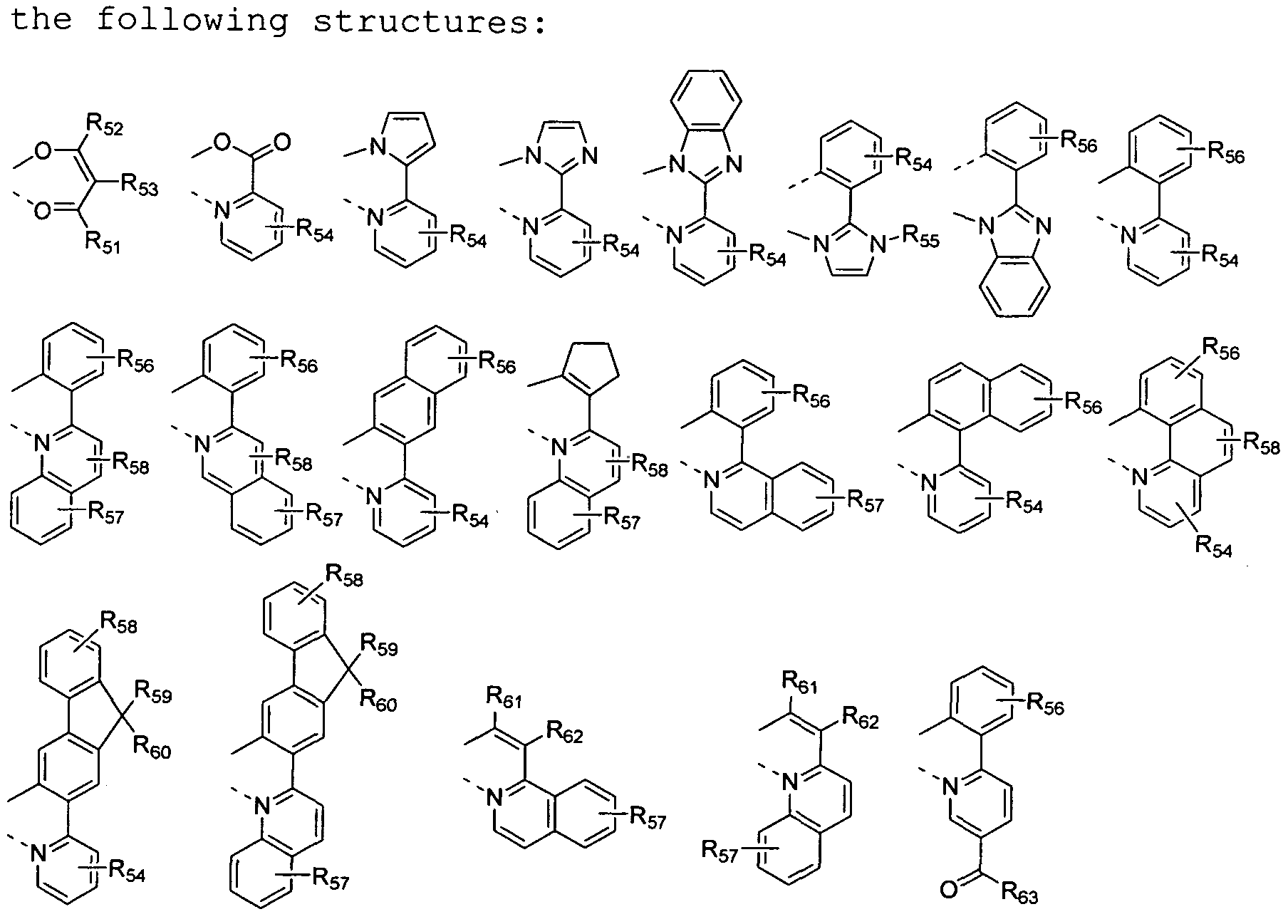
The subsidiary ligands (L) of the organic compounds for electronic material according to the present invention include
wherein, R5i through R63 independently represent hydrogen, deuterium, halogen, (C1-C60) alkyl, (C6-C60) aryl, (C4-
C60 ) heteroaryl, 5- or 6-membered heterocycloalkyl containing one or more heteroatom (s) selected from N, 0 and S, (C3- C60) cycloalkyl, tri (C1-C60) alkylsilyl, di (C1-C60 ) alkyl (C6-
C60) arylsilyl, tri (C6-C60 ) arylsilyl , adamantyl, (C7-
C60)bicycloalkyl, (C2-C60 ) alkenyl, (C2-C60 ) alkynyl, cyano, (Cl- C60) alkylamino, (C6-C60 ) arylamino, (C6-C60) ar (C1-C60) alkyl, (Cl- C60) alkyloxy, (C1-C60 ) alkylthio, (C6-C60 ) aryloxy, (C6-
C60) arylthio, (C1-C60 ) alkoxycarbonyl , (C1-C60) alkylcarbonyl, (C6- C60 ) arylcarbonyl, carboxyl, nitro or hydroxyl, or each of R51 through R63 may be linked to an adjacent substituent via (C3- C60)alkylene or (C3-C60 ) alkenylene with or without a fused ring to form an alicyclic ring, or a monocyclic or polycyclic aromatic ring; and the alkyl, alkenyl, alkynyl, cycloalkyl, heterocycloalkyl, aryl, heteroaryl, arylsilyl, alkylsilyl, alkylamino or arylamino of R51 through R63, or the alicyclic ring, or the monocyclic or polycyclic aromatic ring formed therefrom by linkage to an adjacent substituent via (C3-C60 ) alkylene or (C3- C60) alkenylene with or without a fused ring may be further substituted by one or more substituent ( s ) selected from deuterium, halogen, (C1-C60) alkyl, (C6-C60 ) aryl , (C4-C60) heteroaryl, 5- or 6-membered heterocycloalkyl containing one or more heteroatom ( s ) selected from N, 0 and S, (C3-C60 ) cycloalkyl, tri (Cl- C60) alkylsilyl, di (C1-C60 ) alkyl (C6-C60 ) arylsilyl , tri (C6-
C60) arylsilyl, adamantyl, (C7-C60) bicycloalkyl, (C2-C60) alkenyl, (C2-C60) alkynyl, cyano, (C1-C60 ) alkylamino, (C6-C60 ) arylamino, (C6-C60) ar (C1-C60) alkyl, (C1-C60 ) alkyloxy, (C1-C60 ) alkylthio,
(C6-C60) aryloxy, (C6-C60 ) arylthio, (C1-C60 ) alkoxycarbonyl , (Cl- C60) alkylcarbonyl, (C6-C60) arylcarbonyl, carboxyl, nitro and hydroxyl .
The subsidiary ligands (L) of the organic compounds for electronic material according to the present invention can be exemplified by the following structures, but they are not r stricted thereto:
The processes for preparing the organic compounds for electronic material according to the present invention are illustrated on the basis of Reaction Schemes (1) to (3) shown
below :
Reaction Scheme
wherein, Ri, R2, R3, R-a, R5/ R6, R7, Rs and L are defined as in Chemical Formula (1) .
Reaction Scheme (1) provides a compound of Chemical Formula (1) with n=l, in which iridium trichloride (IrCl3) and subsidiary ligand compound (L-H) are mixed in a solvent at a molar ratio of 1:2-3, and the mixture is heated under reflux before isolating diiridium dimer. In the reaction stage, preferable solvent is alcohol or a mixed solvent of alcohol/water, such as 2- ethoxyethanol , and 2-ethoxyethanol/water mixtures. The isolated diiridium dimer is then heated with a primary ligand compound in organic solvent to provide an organic phosphorescent iridium compound having the ratio of primary ligand: subsidiary ligand of 1:2 as the final product. The reaction is carried out with AgCF3SC>3, Na2C03 or NaOH being admixed with organic solvent such as 2-ethoxyethanol and 2-methoxyethylether.
Reaction Scheme (2) provides a compound of Chemical Formula (1) with n=2, in which iridium trichloride (IrCl3) and a primary ligand compound are mixed in a solvent at a molar ratio of 1:2~3, and the mixture is heated under reflux before isolating diiridium dimer. In the reaction stage, preferable solvent is alcohol or a mixed solvent of alcohol/water, such as 2-ethoxyethanol, and 2- ethoxyethanol/water mixtures. The isolated diiridium dimer is then heated with the subsidiary ligand compound (L-H) in organic solvent to provide an organic phosphorescent iridium compound
having the ratio of primary ligand: subsidiary ligand of 2:1 as the final product.
The molar ratio of the primary ligand compound to the subsidiary ligand (L) in the final product is determined by appropriate molar ratio of the reactant depending on the composition. The reaction may be carried out with AgCF3S03, Na2C03 or NaOH being admixed with organic solvent such as 2- ethoxyethanol , 2-methoxyethylether and 1 , 2-dichloroethane .
Reaction Scheme (3) provides a compound of Chemical Formula (1) with n=3, in which iridium complex prepared according to Reaction Scheme (1) or (2) and the primary ligand compound are mixed in glycerol at a molar ratio of 1:2~3, and the mixture is heated under reflux to obtain organic phosphorescent iridium complex coordinated with three primary ligands.
The compounds employed as a primary ligand in the present invention can be prepared, without limitation, according to the process illustrated by Reaction Scheme (4), on the basis of conventional processes.
wherein, Ri through Rs are defined as in Chemical Formula
(1) ·
The present invention also provides organic solar cells, which comprises one or more organic compound (s) for electronic material represented by Chemical Formula (1) .
The present invention also provides an organic electronic device which is comprised of a first electrode; a second electrode; and at least one organic layer (s) interposed between the first electrode and the second electrode; wherein the organic layer comprises one or more organic compound (s) for electronic material represented by Chemical Formula (1) .
The organic electronic device according to the present invention is characterized in that the organic layer comprises an electroluminescent region, which comprises one or more organic compound (s) for electronic material represented by Chemical Formula (1) as electroluminescent dopant in an amount of 0.01 to 10% by weight, and one or more host(s) . The host to be applied to the organic electronic device according to the invention is
not particularly restricted, but may be exemplified by 1,3,5- tricarbazolylbenzene, polyvinylcarbazole, m-biscarbazolylphenyl, 4,4' 4"-tri (N-carbazolyl) triphenylamine, 1, 3, 5-tri (2- carbazolylphenyl ) benzene, 1/3, 5-tris ( 2-carbazolyl-5- methoxyphenyl) benzene, bis (4-carbazolylphenyl) silane or the compounds represented by one of Chemical Formulas (14) to (17) .
In Chemical Formula (14) , R9i through R94 independently represent hydrogen, deuterium, halogen, (C1-C60 ) alkyl , (C6- C60)aryl, (C4-C60) heteroaryl, 5- or 6-membered heterocycloalkyl containing one or more heteroatom ( s ) selected from N, 0 and S, (C3-C60) cycloalkyl, tri (C1-C60 ) alkylsilyl , di (C1-C60 ) alkyl (C6- C60) arylsilyl, . tri (C6-C60 ) arylsilyl , adamantyl, (C7-
C60)bicycloalkyl, (C2-C60) alkenyl, (C2-C60 ) alkynyl , cyano, (Cl- C60) alkylamino, (C6-C60) arylamino, (C6-C60) ar (C1-C60) alkyl, (Cl- C60) alkyloxy, (C1-C60) alkylthio, (C6-C60 ) aryloxy, (C6-
C60) arylthio, (C1-C60 ) alkoxycarbonyl, (C1-C60 ) alkylcarbonyl , (C6- C60) arylcarbonyl, carboxyl, nitro or hydroxyl, or each of R91 through Rg4 may be linked to an adjacent substituent via (C3- C60)alkylene or (C3-C60) alkenylene with or without a fused ring
to form an alicyclic ring, or a monocyclic or polycyclic aromatic ring; and
the alkyl, alkenyl, alkynyl, cycloalkyl, heterocycloalkyl , aryl, heteroaryl, arylsilyl, alkylsilyl, alkylamino, or arylamino of R91 through R94, or the alicyclic ring, or the monocyclic or polycyclic aromatic ring formed therefrom by linkage to an adjacent substituent via (C3-C60 ) alkylene or (C3-C60 ) alkenylene with or without a fused ring may be further substituted by one or more substituent ( s ) selected from deuterium, halogen, (Cl- C60) alkyl, (C6-C60 ) aryl , (C4-C60 ) heteroaryl, 5- or 6-membered heterocycloalkyl containing one or more heteroatom ( s ) selected from N, 0 and S, (C3-C60 ) cycloalkyl, tri (C1-C60 ) alkylsilyl , di (C1-C60) alkyl (C6-C60) arylsilyl, tri (C6-C60 ) arylsilyl, adamantyl, (C7-C60)bicycloalkyl, (C2-C60 ) alkenyl , (C2-C60 ) alkynyl , cyano, (C1-C60) alkylamino, (C6-C60 ) arylamino, (C6-C60 ) ar (C1-C60 ) alkyl , (C1-C60) alkyloxy, (C1-C60 ) alkylthio, (C6-C60 ) aryloxy, (C6- C60) arylthio, (C1-C60) alkoxycarbonyl, (C1-C60 ) alkylcarbonyl , (C6- C60) arylcarbonyl, carboxyl, nitro and hydroxyl .
Chemical Formula 16
Chemical Formula 17
L (Q)y
In Chemical Formula (17), the ligands L1
ndependently selected from the following structures
wherein, 1 represents a bivalent or trivalent metal;
y is 0 when M1 is a bivalent metal, while y is 1 when M1 is a trivalent metal;'
Q is (C6-C60) aryloxy or tri (C6-C60 ) arylsilyl , and the aryloxy or triarylsilyl of Q may be further substituted by (CI-
C60) alkyl or (C6-C60 ) aryl ;
X is 0, S or Se;
ring A represents oxazole, thiazole, imidazole, oxadiazole, thiadiazole, benzoxazole, benzothiazole, benzimidazole , pyridine or quinoline;
ring B represents pyridine or quinoline which may be further substituted by (C1-C60 ) alkyl , or phenyl or naphthyl with or without (C1-C60 ) alkyl substituent ( s ) ;
Rioi through R104 independently represent hydrogen, deuterium, halogen, (C1-C60) alkyl, (C6-C60) aryl, (C4-C60 ) heteroaryl, a 5- or 6-membered heterocycloalkyl containing one or more heteroatom ( s ) selected from N, 0 and S, (C3-C60 ) cycloalkyl , tri (Cl- C60) alkylsilyl, di (C1-C60) alkyl (C6-C60) arylsilyl, tri (C6-
C60) arylsilyl, adamantyl, (C7-C60) bicycloalkyl, (C2-C60 ) alkenyl , (C2-C60) alkynyl, cyano, (C1-C60 ) alkylamino, (C6-C60 ) arylamino, (C6-C60) ar (C1-C60) alkyl, (C1-C60 ) alkyloxy, (C1-C60) alkylthio, (C6-C60) aryloxy, (C6-C60 ) arylthio, (C1-C60 ) alkoxycarbonyl , (Cl- C60) alkylcarbonyl, (C6-C60 ) arylcarbonyl , carboxyl, nitro or hydroxyl; or each of Ri0i through R104 may be linked to an adjacent substituent via (C3-C60 ) alkylene or (C3-C60 ) alkenylene with or without a fused ring to form an alicyclic ring, or a monocyclic or polycyclic aromatic ring; and
ring A, or the alkyl, alkenyl, alkynyl, cycloalkyl, heterocycloalkyl, aryl, heteroaryl, arylsilyl, alkylsilyl, alkylamino or arylamino of Rioi through R104, and the alicyclic ring, or the monocyclic or polycyclic aromatic ring formed therefrom by linkage to an adjacent substituent via (C3- C60)alkylene or (C3-C60 ) alkenylene with or without a fused ring may be further substituted by one or more substituent ( s ) selected from deuterium, halogen, (C1-C60) alkyl, (C6-C60 ) aryl , (C4- C60) heteroaryl, a 5- or 6-membered heterocycloalkyl containing one or more heteroatom ( s ) selected from N, 0 and S, (C3- C60) cycloalkyl, tri (C1-C60 ) alkylsilyl , di (C1-C60 ) alkyl (C6-
C60) arylsilyl, tri (C6-C60 ) arylsilyl , adamantyl, (C7-
C60)bicycloalkyl, (C2-C60 ) alkenyl, (C2-C60) alkynyl, cyano, (Cl- C60) alkylamino, (C6-C60) arylamino, (C6-C60 ) ar (C1-C60 ) alkyl , (Cl- C60) alkyloxy, (C1-C60) alkylthio, (C6-C60 ) aryloxy, (C6-
C60) arylthio, (C1-C60 ) alkoxycarbonyl , (C1-C60 ) alkylcarbonyl , (C6- C60 ) arylcarbonyl, carboxyl, nitro and hydroxyl .
The ligands, L1 and L2 are independently selected from the following structures:
wherein, X represents 0, S or Se;
Rioi through R104 independently represent hydrogen, deuterium, halogen, (C1-C60 ) alkyl, (C6-C60) aryl, (C4-C60 ) heteroaryl , 5- or 6-membered heterocycloalkyl containing one or more heteroatom ( s ) selected from N, 0 and S, (C3-C60) cycloalkyl, tri (Cl- C60) alkylsilyl, di (C1-C60) alkyl (C6-C60) arylsilyl, tri (C6-
C60) arylsilyl, adamantyl, (C7-C60 ) bicycloalkyl , (C2-C60 ) alkenyl , (C2-C60) alkynyl, cyano, (C1-C60 ) alkylamino, (C6-C60 ) arylamino, (C6-C60) ar(Cl-C60) alkyl, (C1-C60 ) alkyloxy, (C1-C60 ) alkylthio, (C6-C60) aryloxy, (C6-C60 ) arylthio, (C1-C60 ) alkoxycarbonyl , (Cl- C60) alkylcarbonyl, (C6-C60 ) arylcarbonyl , carboxyl, nitro or hydroxyl, or each of R101 through Ri04 may be linked to an adjacent substituent via (C3-C60 ) alkylene or (C3-C60 ) alkenylene with or without a fused ring to form an alicyclic ring, or a monocyclic
or polycyclic aromatic ring;
Ri through R116 and R121 through Ri39 independently represent hydrogen, deuterium, halogen, (C1-C60) alkyl, (C6-C60) aryl, (C4- C60 ) heteroaryl , 5- or 6-membered heterocycloalkyl containing one or more heteroatom(s) selected from N, 0 and S, (C3- C60) cycloalkyl, tri (C1-C60) alkylsilyl, di (C1-C60) alkyl (C6-
C60) arylsilyl, tri (C6-C60 ) arylsilyl , adamantyl, (C7-
C60) bicycloalkyl, (C2-C60) alkenyl, (C2-C60 ) alkynyl , cyano, (Cl- C60) alkylamino, (C6-C60 ) arylamino, (C6-C60) ar (C1-C60) alkyl, (Cl- C60) alkyloxy, (C1-C60 ) alkylthio, (C6-C60 ) aryloxy, (C6-
C60) arylthio, (C1-C60 ) alkoxycarbonyl , (C1-C60) alkylcarbonyl , (C6- C60) arylcarbonyl, carboxyl, nitro or hydroxyl, or each of Rm through Rn6 and Ri2i through Ri39 may be linked to an adjacent substituent via (C3-C60 ) alkylene or (C3-C60 ) alkenylene with or without a fused ring to form an alicyclic ring, or a monocyclic or polycyclic aromatic ring; and
the alkyl, alkenyl, alkynyl, cycloalkyl, heterocycloalkyl, aryl, heteroaryl, arylsilyl, alkylsilyl, alkylamino, or arylamino of R101 through R104, Rm through Rn6 and R121 through Ri39, or the alicyclic ring, or the monocyclic or polycyclic aromatic ring formed therefrom by linkage to an adjacent substituent via (C3- C60) alkylene or (C3-C60 ) alkenylene with or without a fused ring
may be further substituted by one or more substituent ( s ) selected from deuterium, halogen, (C1-C60) alkyl, (C6-C60 ) aryl, (C4- C60 ) heteroaryl , 5- or 6-membered heterocycloalkyl containing one or more heteroatom (s) selected from N, 0 and S, (C3- C60) cycloalkyl, tri (C1-C60 ) alkylsilyl , di (C1-C60) alkyl (C6-
C60) arylsilyl, tri (C6-C60) arylsilyl, adamantyl, (C7-
C60)bicycloalkyl, (C2-C60) alkenyl, (C2-C60) alkynyl, cyano, (Cl- C60) alkylamino, (C6-C60 ) arylamino, (C6-C60) ar (C1-C60) alkyl, (Cl- C60) alkyloxy, (C1-C60 ) alkylthio, (C6-C60 ) aryloxy, (C6-
C60) arylthio, (C1-C60 ) alkoxycarbonyl , (C1-C60) alkylcarbonyl, (C6- C60) arylcarbonyl, carboxyl, nitro and hydroxyl .
In Chemical Formula (17), 1 is a bivalent metal selected from Be, Zn, Mg, Cu and Ni, or a trivalent metal selected from Al, Ga, In and B, and Q is selected from the following structures.
The compounds of Chemical Formula (14) may be specifically exemplified by the compounds represented by the following structures, but they are not restricted thereto.
The compounds represented by one of Chemical Formulas (15) to (17) may be specifically exemplified by the compounds having one of the following structures, but they are not restricted thereto.
The electroluminescent layer means the layer where electroluminescence occurs, and it may be a single layer or a multi-layer consisting of two or more layers laminated. When a mixture of- host-dopant is used according to the constitution of the present invention, noticeable improvement in device life as well as in luminous efficiency may be confirmed.
The organic electronic device according to the invention may further comprise one or more compound (s) selected from a group consisting of arylamine compounds and styrylarylamine
compounds, as well as the organic compound for electronic material represented by Chemical Formula (1) . Examples of the arylamine or styrylarylamine compounds include the compounds represented by Chemical Formula (18), but they are not restricted thereto :
wherein, Arn and Ari2 independently represent (C1-C60 ) alkyl, (C6-C60) aryl, (C -C60 ) heteroaryl , (C6-C60 ) arylamino, (Cl- C60 ) alkylamino, . 5- or 6-membered heterocycloalkyl containing one or more heteroatom ( s ) selected from N, 0 and S, or (C3- C60) cycloalkyl, or Arn and Ari2 may be linked via (C3- C60)alkylene or (C3-C60 ) alkenylene with or without a fused ring to form an alicyclic ring, or a monocyclic or polycyclic aromatic ring;
when g is 1, Ari3 represents (C6-C60) aryl, (C4- C60) heteroaryl, or aryl represented by one of the following structural formulas:
when g is 2, Ari
3 represents (C6-C60 ) arylene, (C4-
C60 ) heteroarylene, or arylene represented by one of the following structural formulas:
wherein Ar2i and Ar22 independently represent (C6-C60 ) arylene or (C4-C60) heteroarylene;
Ri5i/ Ri52 and Ri53 independently represent hydrogen, deuterium, (C1-C60 ) alkyl or (C6-C60 ) aryl ;
t is an integer from 1 to 4, w is an integer of 0 or 1; and the alkyl, aryl, heteroaryl, arylamino, alkylamino, cycloalkyl or heterocycloalkyl of Arn and ArX2; the aryl, heteroaryl, arylene or heteroarylene of Ari3; the arylene or heteroarylene of Ar2i and Ar22; or the alkyl or aryl of R151 through Ri53 may be further substituted by one or more substituent (s) selected from a group consisting of deuterium, halogen, (C1-C60 ) alkyl , (C6-C60 ) aryl , (C4-C60) heteroaryl, 5- or 6-membered heterocycloalkyl containing one or more heteroatom ( s ) selected from N, O and S, (C3-C60) cycloalkyl, tri(Cl- C60)alkylsilyl, di (C1-C60 ) alkyl (C6-C60 ) arylsilyl , tri (C6-
C60) arylsilyl, adamantyl, (C7-C60) bicycloalkyl, (C2-C60 ) alkenyl ,
(C2-C60) alkynyl, cyano, (C1-C60) alkylamino, (C6-C60 ) arylamino, (C6-C60) ar (C1-C60) alkyl, (C6-C60 ) aryloxy, (C1-C60) alkyloxy, (C6- C60) arylthio, (C1-C60) alkylthio, (C1-C60 ) alkoxycarbonyl , (Cl- C60) alkylcarbonyl, (C6-C60 ) arylcarbonyl , carboxyl, nitro and hydroxyl .
The arylamine compounds and styrylarylamine compounds may be more specifically exemplified by the following compounds, but are not restricted thereto.
In an organic electronic device according to the present invention, the organic layer may further comprise one or more metal (s) selected from a group consisting of organometals of Group 1, Group 2, 4th period and 5th period transition metals, lanthanide metals and d-transition elements in the Periodic Table of Elements, as well as the organic compounds for electronic material represented by Chemical Formula (1) . The organic layer may comprise a charge generating layer in addition to the electroluminescent layer.
The present invention can realize an organic electronic device having a pixel structure of independent light-emitting mode, which comprises an organic electronic device containing the
compound of Chemical Formula (1) as a sub-pixel and one or more sub-pixel (s) comprising one or more compound(s) selected from a group consisting of arylamine compounds and styrylarylamine compounds, patterned in parallel at the same time.
Further, the organic electronic device may comprise, in addition to the organic compound for electronic material, organic or organometallic compound (s) with green or blue electroluminescence, which can be exemplified the compounds represented by one of Chemical Formulas (19) to (23) .
19
In Chemical Formula (20) , Arioi and Ari02 independently represent (C1-C60) alkyl, (C6-C60) aryl, (C4-C60) heteroaryl, (C6- C60) arylamino, (C1-C60 ) alkylamino, 5- or 6-membered heterocycloalkyl containing one or more heteroatom(s) selected from N, 0 and S, or (C3-C60) cycloalkyl, or Arioi and Ar102 may be linked via (C3-C60 ) alkylene or (C3-C60) alkenylene with or without
a fused ring to form an alicyclic ring, or a monocyclic or polycyclic aromatic ring;
when h is 1, Ari
03 represents (C6-C60 ) aryl , (C4- C60) heteroaryl, or a substituent represented by one of the following structural formulas:
when h is 2, Ario
3 represents (C6-C60 ) arylene , (C4- C60 ) heteroarylene, or a substituent represented by one of the following structural formulas:
wherein Ar2oi and Ar202 independently represent (C6- C60) arylene or (C4-C60) heteroarylene;
Ri6i through Ri63 independently represent hydrogen, deuterium, (C1-C60) alkyl or (C6-C60 ) aryl ;
i is an integer from 1 to 4, j is an integer of 0 or 1; and the alkyl, aryl, heteroaryl, arylamino, alkylamino, cycloalkyl or heterocycloalkyl of Arioi and Ari02; the aryl, heteroaryl, arylene or heteroarylene of Ari03; the arylene or
heteroarylene of Ar20i and Ar2o2; or the alkyl or aryl of Ri6i through Ri63 may be further substituted by one or more substituent ( s ) selected from a group consisting of deuterium, halogen, (C1-C60) alkyl, (C6-C60) aryl, (C4-C60) heteroaryl, 5- or 6-membered heterocycloalkyl containing one or more heteroatom ( s ) selected from N, 0 and S, (C3-C60) cycloalkyl, tri (Cl- C60) alkylsilyl, di (C1-C60 ) alkyl (C6-C60 ) arylsilyl, tri (C6-
C60) arylsilyl, adamantyl, (C7-C60 ) bicycloalkyl , (C2-C60) alkenyl, (C2-C60) alkynyl, cyano, (C1-C60) alkylamino, (C6-C60 ) arylamino, (C6-C60) ar (C1-C60) alkyl, (C6-C60) aryloxy, (C1-G60 ) alkyloxy, (C6- C60) arylthio, (C1-C60 ) alkylthio, (C1-C60 ) alkoxycarbonyl , (Cl- C60) alkylcarbonyl, (C6-C60 ) arylcarbonyl , carboxyl, nitro and hydroxyl .
Chemical Formula 21
In Chemical Formula (21) , R30i through R304 independently represents hydrogen, deuterium, halogen, (C1-C60 ) alkyl, (C6- C60)aryl, (C4-C60) heteroaryl, 5- or 6-membered heterocycloalkyl containing one or more heteroatom ( s ) selected from N, 0 and S,
(C3-C60) cycloalkyl, tri (C1-C60) alkylsilyl, di (C1-C60 ) alkyl (C6- C60) arylsilyl, tri (C6-C60 ) arylsilyl , adamantyl, (C7-
C60)bicycloalkyl, (C2-C60) alkenyl, (C2-C60 ) alkynyl , cyano, (Cl- C60) alkylamino, (C6-C60 ) arylamino, (C6-C60 ) ar (C1-C60 ) alkyl , (Cl- C60) alkyloxy, (C1-C60 ) alkylthio, (C6-C60) aryloxy, (C6-
C60) arylthio, (C1-C60 ) alkoxycarbonyl , (C1-C60) alkylcarbonyl, (C6- C60) arylcarbonyl, carboxyl, nitro or hydroxyl, or each of R301 through R304 may be linked to an adjacent substituent via (C3- C60)alkylene or (C3-C60 ) alkenylene with or without a fused ring to form an alicyclic ring, or a monocyclic or polycyclic aromatic ring; and
the alkyl, alkenyl, alkynyl, cycloalkyl, heterocycloalkyl , aryl, heteroaryl, arylsilyl, alkylsilyl, alkylamino or arylamino of R301 through R304, or the alicyclic ring, or the monocyclic or polycyclic aromatic ring formed therefrom by linkage to an adjacent substituent via (C3-C60 ) alkylene or (C3-C60 ) alkenylene with or without a fused ring may be further substituted by one or more substituent ( s ) selected from deuterium, halogen, (Cl- C60) alkyl, (C6-C60 ) aryl, (C4-C60) heteroaryl, 5- or 6-membered heterocycloalkyl containing one or more heteroatom(s) selected from N, 0 and S, (C3-C60 ) cycloalkyl , tri (C1-C60 ) alkylsilyl, di (C1-C60) alkyl (C6-C60 ) arylsilyl, tri (C6-C60) arylsilyl, adamantyl,
(C7-C60)bicycloalkyl, (C2-C60) alkenyl, (C2-C60) alkynyl, cyano, (C1-C60) alkylamino, (C6-C60 ) arylamino, (C6-C60) ar (C1-C60) alkyl, (C1-C60) alkyloxy, (C1-C60 ) alkylthio, (C6-C60 ) aryloxy, (C6-
C60) arylthio, (C1-C60 ) alkoxycarbonyl , (C1-C60 ) alkylcarbonyl , (C6-
C60) arylcarbonyl, carboxyl, nitro and hydroxyl .
Chemical Formula 22
(Ar30i ) p-Lii- (Ar302) q
Chemical Formula 23
(Ar3o3) r-Li2- (Ar304 ) s
In Chemical Formulas (22) and (23),
Lii represents (C6-C60 ) arylene or (C4-C60) heteroarylene;
Li2 represents anthracenylene;
Ar30i through Ar30 are independently selected from hydrogen, deuterium, (C1-C60 ) alkyl, (C1-C60 ) alkoxy, halogen, (C4- C60) heteroaryl, (C5-C60 ) cycloalkyl and (C6-C60 ) aryl ; the cycloalkyl, aryl or heteroaryl of Ar30i through Ar30 may be further substituted by one or more substituent ( s ) selected from a group consisting of (C6-C60)aryl or (C4-C60 ) heteroaryl with or without one or more substituent ( s ) selected from a .group consisting of (C1-C60 ) alkyl with. or without halogen substituent (s) , (C1-C60 ) alkoxy, (C3-C60 ) cycloalkyl, halogen, cyano, tri (C1-C60 ) alkylsilyl , di (C1-C60) alkyl (C6-C60) arylsilyl
and tri (C6-C60) arylsilyl; deuterium, (C1-C60 ) alkyl with or without halogen substituent ( s ) , (C1-C60 ) alkoxy, (C3-
C60) cycloalkyl, halogen, cyano, tri (C1-C60 ) alkylsilyl , di (Cl- C60) alkyl (C6-C60) arylsilyl and tri (C6-C60 ) arylsilyl ; and
p, q, r and s independently represent an integer from 0 to
4.
The compounds represented by Chemical Formula (22) or (23) can be exemplified by anthracene derivatives or benz [a ] anthracene derivatives represented by one of Chemical Formulas (24) to (26):
Chemical Formula 25
Chemical Formula 26
In Chemical Formulas (24) through (26),
R311 and R312 independently represent (C6-C60) aryl, (C4- C60) heteroaryl, 5- or 6-membered heterocycloalkyl containing one or more heteroatom ( s ) selected from N, 0 and S, or (C3- C60 ) cycloalkyl ; the aryl or heteroaryl of R311 and R312 may be further substituted by one or more substituent ( s ) selected from a group consisting of deuterium, (C1-C60) alkyl, halo (C1-C60) alkyl, (C1-C60) alkoxy, (C3-C60 ) cycloalkyl , (C6-C60) aryl, (C4-
C60) heteroaryl, halogen, cyano, tri (C1-C60 ) alkylsilyl , di (Cl- C60) alkyl (C6-C60) arylsilyl and tri (C6-C60 ) arylsilyl ;
R313 through R316 independently represent hydrogen, deuterium, (C1-C60) alkyl, (C1-C60 ) alkoxy, halogen, (C4-C60 ) heteroaryl, (C5- C60 ) cycloalkyl or (C6-C60 ) aryl , and the heteroaryl, cycloalkyl or aryl of R313 through R3i6 may be further substituted by one or more substituent ( s ) selected from a group consisting of deuterium, (C1-C60 ) alkyl with or without halogen substituent ( s ) , (Cl- C60) alkoxy, (C3-C60 ) cycloalkyl , halogen, cyano, tri (Cl- C60) alkylsilyl, di (C1-C60) alkyl (C6-C60) arylsilyl and tri (C6- C60) arylsilyl;
Gi and G2 independently represent a chemical bond, or (C6- C60)arylene with or without one or more substituent (s) selected from (C1-C60) alkyl, (C1-C60 ) alkoxy, (C6-C60) aryl, (C4-
C60 ) heteroaryl and halogen;
Ar4i and Ar42 represent (C4-C60 ) heteroaryl or aryl selected from the followin structures:
the aryl or heteroaryl of Ari and Ar42 may be substituted by one or more substituent ( s ) selected from deuterium, (Cl- C60)alkyl, (C1-C60 ) alkoxy, (C6-C60)aryl and (C4-C60 ) heteroaryl ;
L
3i represents (C6-C60) arylene, (C4-C60 ) heteroarylene or a compound represented by the following structural formula:
the arylene or heteroarylene of L3i may be substituted by one or more substituent (s) selected from deuterium, (C1-C60 ) alkyl , (C1-C60) alkoxy, (C6-C60 ) aryl , (C4-C60 ) heteroaryl and halogen;
R321 through R324 independently represent hydrogen, deuterium,
(C1-C60 ) alkyl or (C6-C60 ) aryl , or each of them may be linked to an adjacent substituent via (C3-C60) alkylene or (C3- C60) alkenylene with or without a fused ring to form an alicyclic ring, or a monocyclic or polycyclic. aromatic ring; and
R331 through R334 independently represent hydrogen, deuterium, (C1-C60) alkyl, (C1-C60 ) alkoxy, (C6-C60 ) aryl , (C4-C60) heteroaryl or halogen, or each of them may be linked to an adjacent substituent via (C3-C60 ) alkylene or (C3-C60 ) alkenylene with or without a fused ring to form an alicyclic ring, or a monocyclic or polycyclic aromatic ring.
The organic compounds and organometallic compounds with green or blue electroluminescence can be more specifically exemplified by the following compounds, but they are not restricted thereto.
In an organic electronic device according to the present invention, it is preferable to place one or more layer (s) (here- in-below, referred to as the "surface layer") selected from chalcogenide layers, metal halide layers and metal oxide layers, on the inner surface of at least one side of the pair of electrodes. Specifically, it is preferable to arrange a chalcogenide layer of silicon and aluminum metal (including oxides) on the anode surface of the EL medium layer, and a metal halide layer or a metal oxide layer on the cathode surface of the EL medium layer. As the result, stability in operation can be obtained.
Examples of chalcogenides preferably include SiOx (1≤X≤2), A10x (1<X<1.5), SiON, SiAlON, or the like. Examples of metal halides preferably include LiF, MgF2, CaF2, fluorides of rare earth metal, or the like. Examples of metal oxides preferably include Cs20, Li20, gO, SrO, BaO, CaO, or the like.
In an organic electronic device according to the present
invention, it is also preferable to arrange, on at least one surface of the pair of electrodes thus manufactured, a mixed region of electron transport compound and a reductive dopant, or a mixed region of a hole transport compound with an oxidative dopant. Accordingly, the electron transport compound is reduced to an anion, so that injection and transportation of electrons from the mixed region to an EL medium are facilitated. In addition, since the hole, transport compound is oxidized to form a cation, injection and transportation of holes from the mixed region to an EL medium are facilitated. Preferable oxidative dopants include various Lewis acids and acceptor compounds. Preferable reductive dopants include alkali metals, alkali metal compounds, alkaline earth metals, rare-earth metals, and mixtures thereof .
The compounds for electronic material according to the invention have the backbone to provide higher electroluminescent properties and better thermal stability with, higher quantum efficiency and lowered operation voltage than those of conventional phosphorescent material. Thus, it is expected that applying the compounds for electronic material according to the invention to OLED panels would provide one step forward development of medium or large sized OLED's. Further, it is
anticipated that organic solar cells employing those compounds as a material of high efficiency would exhibit far better properties as compared to those employing conventional materials.
Best Mode
The present invention is further described with respect to the representative compounds of the invention, by describing the organic compounds for electronic material, the processes for preparing the same, and luminescent properties of the device manufactured therefrom in the Examples below, which are provided for illustration of the embodiments only but are not intended to limit the scope of the invention by any means.
Preparation Examples
[Preparation Example 1] Preparation of Compound
Preparation of Compound (A)
A reaction vessel was charged with 2-aminonaphthalen-l- aldehyde (5.0 g, 29.2 mmol) , 1-acetonaphthalene (4.1 mL, 35.1 mmol), potassium hydroxide (3.3 g, 58.4 mmol) and ethanol (100
mL) , and the mixture was stirred under reflux in the presence of argon atmosphere. When the reaction was completed, the reaction mixture was cooled to room temperature, and an excess amount of aqueous ammonium hydroxide solution was added thereto. The mixture was extracted with chloromethane, and the extract was filtered under reduced pressure. Purification via column chromatography gave Compound (A) (4.8 g, 64%).
Preparation of Compound (B)
Compound (A) (4.0 g, 15.7 mmol) and iridium chloride (2.1 g, 7.1 mmol) were dissolved in 2-ethoxyethanol (38 mL) and distilled water (13 mL) , and the solution was stirred under reflux in the presence of argon atmosphere for 24 hours. When the reaction was completed, the reaction mixture was cooled to room temperature. Solid precipitate thus produced was filtered and dried to obtain Compound (B) (8.9 g, 85%).
Preparation of Compound (2)
Compound (B) (8.0 g, 5.4 mmol), 2 , 4-pentanedione (1.7 mL, 16.3 mmol) and sodium carbonate (3.5 g, 32.6 mmol) were dissolved in 2-ethoxyethanol (100 mL) , and the solution was heated for 4 hours. When the reaction was completed, the reaction mixture was
cooled to room temperature, and the solid precipitate thus produced was filtered. Purification via silica gel column chromatography and recrystallization gave Compound (2) (1.5 g, 35%) as red crystal.
Preparation of Compound (C)
A reaction vessel was charged with 2-aminonaphthalen-3- aldehyde (5.0 g, 29.2 mmol) , acetophenone (4.1 mL, 35.1 mmol) , potassium hydroxide (3.3 g, 58.4 mmol) and ethanol (100 mL) , and the mixture was stirred under reflux in the presence of argon atmosphere. When the reaction was completed, the reaction mixture was cooled to room temperature, and an excess amount of aqueous ammonium hydroxide solution was added thereto. The mixture was extracted with chloromethane, and the extract was filtered under reduced pressure. Purification via column chromatography gave Compound (C) (4.8 g, 64%).
Preparation of Compound (D)
Compound (C) (4.0 g, 15.7 mmol) and iridium chloride (2.1 g, 7.1 mmol) were dissolved in 2-ethoxyethanol (38 mL) and distilled water (13 mL) , and the solution was stirred under reflux in the presence of argon atmosphere for 24 hours. When the reaction was completed, the reaction mixture was cooled to room temperature. Solid precipitate thus produced was . filtered and dried to. obtain Compound (D) (8.9 g, 85%)..
Preparation of Compound (21)
Compound (D) (8.0 g, 5.4 mmol), 2 , -pentanedione (1.7 mL, 16.3 mmol) and sodium carbonate (3.5 g, 32.6 mmol) were dissolved in 2-ethoxyethanol (100 mL) , and the solution was heated for 4 hours. When the reaction was completed, the reaction mixture was cooled to room temperature, and the solid precipitate thus produced was filtered. Purification via silica gel column chromatography and recrystallization gave Compound (21) (1.5 g, 35%) as red crystal.
[Preparation Example 3] Preparation of Compound
Preparation of Compound (E)
A reaction vessel was charged with 2-aminonaphthalen-3- aldehyde (5.0 g, 29.2 mmol), 3-methylacetophenone (4.1 mL, 35.1 mmol), potassium hydroxide (3.3 g, 58.4 mmol) and ethanol (100 mL) , and the mixture was stirred under reflux in the presence of argon atmosphere. When the reaction was completed, the reaction mixture was cooled to room temperature, and an excess amount of aqueous ammonium hydroxide solution was added thereto. The mixture was extracted with chloromethane, and the extract was filtered under reduced pressure. Purification via column chromatography gave Compound (E) (4.8 g, 64%).
Preparation of Compound (F)
Compound (E) (4.0 g, 15.7 mmol) and iridium chloride (2.1 g, 7.1 mmol) were dissolved in 2-ethoxyethanol (38 mL) and distilled water (13 mL) , and the solution was stirred under reflux in the presence of argon atmosphere for 24 hours. When the reaction was completed, the reaction mixture was cooled to room temperature. Solid precipitate thus produced was filtered and dried to obtain Compound (F) (8.9 g, 85%).
Preparation of Compound (75)
Compound (F) (8.0 g, 5.4 mmol), 2 , 4-pentanedione (1.7 mL, 16.3 mmol) and sodium carbonate (3.5 g, 32.6 mmol) were dissolved in 2-ethoxyethanol (100 mL) , and the solution was heated for 4 hours. When the reaction was completed, the reaction mixture was cooled to room temperature, and the solid precipitate thus produced was filtered. Purification via silica gel column chromatography and recrystallization gave Compound (75) (1.5 g, 35%) as red crystal.
[Preparation Example 4] Preparation of Compound (1044)
Preparation of Compound ("G)
In THF (50 mL) , dissolved was 2-aminonaphthalene-3- carbaldehyde (1.0 g, 5.4 mmol), and the solution was chilled to
0°C. After slowly adding phenyl lithium (11.9 mL, 21.4 mmol) thereto, the mixture was stirred for 2 hours. The reaction was quenched by adding aqueous ammonium chloride solution. The
mixture was then extracted with diethyl ether, and the extract was filtered under reduced pressure. Purification via column chromatography gave Compound (G) (0.79 g, 60%).
Preparation of. Compound (H)
A reaction vessel was charged with Compound (G) (1.29 g, 5.24 mmol) , 1-methylacetophenone (0.55 mL, 4.76 mmol), glacial acetic acid (7.13 mL) and sulfuric acid (0.04 mL) , and the mixture was stirred under reflux in the presence of argon atmosphere. When the reaction was completed, the reaction mixture was cooled to room temperature, and an excess amount of aqueous ammonium hydroxide solution was added thereto. Solid thus produced was filtered, washed with distilled water. Purification via column chromatography gave Compound (H) (1.27 g, 80%) .
Preparation of Compound (I)
Compound (H) (0.6 g, 1.81 mmol) and iridium chloride (0.25 g, 0.82 mmol) were dissolved in 2-ethoxyethanol (9 mL) and distilled water (3 mL) , and the solution was stirred under reflux in the presence of argon atmosphere for 24 hours. When the reaction was completed, the reaction mixture was cooled to room
temperature. Solid precipitate thus produced was filtered and dried to obtain Compound (I) (0.37- g, 11%).
Preparation of Compound (1044)
Compound (I) (0.37 g, 0.21 mmol) , 2 , 4-pentanedione (0.06 mL, 0.62 mmol) and sodium carbonate (0.13 g, 1.25 mmol) were dissolved in 2-ethoxyethanol (10 mL) , and the solution was heated for 4 hours. When the reaction was completed, the reaction mixture was cooled to room temperature, and the solid precipitate thus produced was filtered. Purification via column chromatography and recrystallization gave Compound (1044) (0.14 g, 37%) as red crystal.
[Preparation Example 5] Preparation of Compound (1446)
Preparation of Compound (J)
In THF (50 mL) , dissolved was 2-aminonaphthalene-3- carbaldehyde (1.0 g, 5.4 mmol) , and the solution was chilled to
0°C. After slowly adding 4-fluorophenyllithium (11.9 mL, 21.4 mmol) thereto, the mixture was stirred for 2 hours. The reaction was quenched by adding aqueous ammonium chloride solution. The mixture was then extracted with diethyl ether, and the - extract was filtered under reduced pressure. Purification via column chromatography gave Compound (J) (0.79 g, 60%).
Preparation of Compound (K)
A reaction vessel was charged with Compound (J) (1.29 g, 5.24 mmol), 1-methylacetophenone (0.55 mL, 4.76 mmol), acetic acid (7.13 mL) and sulfuric acid (0.04 mL) , and the mixture was stirred under reflux in the presence of argon atmosphere. When the reaction was completed, the reaction mixture was cooled to room temperature, and an excess amount of aqueous ammonium hydroxide solution was added thereto. Solid thus produced was filtered, washed with distilled water. Purification via column chromatography gave Compound (K) (1.27 g, 80%).
Preparation of Compound (L)
Compound (K) (0.6 g, 1.81 mmol) and iridium chloride (0.25 g, 0.82 mmol) were dissolved in 2-ethoxyethanol (9 mL) and distilled water (3 mL) , and the solution was stirred under reflux in the presence of argon atmosphere for 24 hours. When the reaction was completed, the reaction mixture was cooled to room temperature. Solid precipitate thus produced was filtered and dried to obtain Compound (L) (0.37 g, 11%).
Preparation of Compound (1446)
Compound (L) (0.37 g, 0.21 mmol), 2 , 4-pentanedione (0.06 mL, 0.62 mmol) and sodium carbonate (0.13 g, 1.25 mmol) were dissolved in 2-ethoxyethanol (10 mL) , and the solution was heated for 4 hours. When the reaction was completed, the reaction mixture was cooled to room temperature, and the solid precipitate thus produced was filtered. Purification via silica gel column chromatography and recrystallization gave Compound (1446) (0.14 g, 37%) as red crystal.
[Preparation Example 6] Preparation of Compound (1033)
Preparation of Compound (M)
In THF (50 mL) , dissolved was 2-aminonaphthalene-l- carbaldehyde (1.0 g, 5.4 mmol) , and the solution was chilled to
0°C. After slowly adding 4-methylphenyllithium (11.9 mL, 21.4 mmol) thereto, the mixture was stirred for 2 hours. The reaction was quenched by adding aqueous ammonium chloride solution. The mixture was then extracted with diethyl ether, and the extract was filtered under reduced pressure. Purification via column chromatography gave Compound (M) (0.79 g, 60%).
Preparation of Compound (N)
A reaction vessel was charged with Compound (M) (1.29 g, 5.24 mmol), 1-methylacetophenone (0.55 mL, 4.76 mmol), glacial acetic acid (7.13 mL) and sulfuric acid (0.04 mL) , and the mixture was stirred under reflux in the presence of argon
atmosphere. When the reaction was completed, the reaction mixture was cooled to room temperature, and an excess amount of aqueous ammonium hydroxide solution was added thereto. Solid thus produced was filtered, washed with distilled water. Purification via column chromatography gave Compound (N) (1.27 g, 80%).
Preparation of Compound (0)
Compound (N) (0.6 g, 1.81 mmol) and iridium chloride (0.25 g, 0.82 mmol) were dissolved in 2-ethoxyethanol (9 mL) and distilled water (3 mL) , and the solution was stirred under reflux in the presence of argon atmosphere for 24 hours. When the reaction was completed, the reaction mixture was cooled to room temperature. Solid precipitate thus produced was filtered and dried to obtain Compound (0) (0.37 g, 11%).
Preparation of Compound (1033)
Compound (0) (0.37 g, 0.21 mmol), 2 , 4-pentanedione (0.06 mL, 0.62 mmol) and sodium carbonate (0.13 g, 1.25 mmol) were dissolved in 2-ethoxyethanol (10 mL) , and the solution was heated for 4 hours. When the reaction was completed, the reaction mixture was cooled to room temperature, and the solid precipitate
thus produced was filtered. Purification via silica gel column chromatography and recrystallization gave Compound (1033) (0.14 g, 37%) as red crystal.
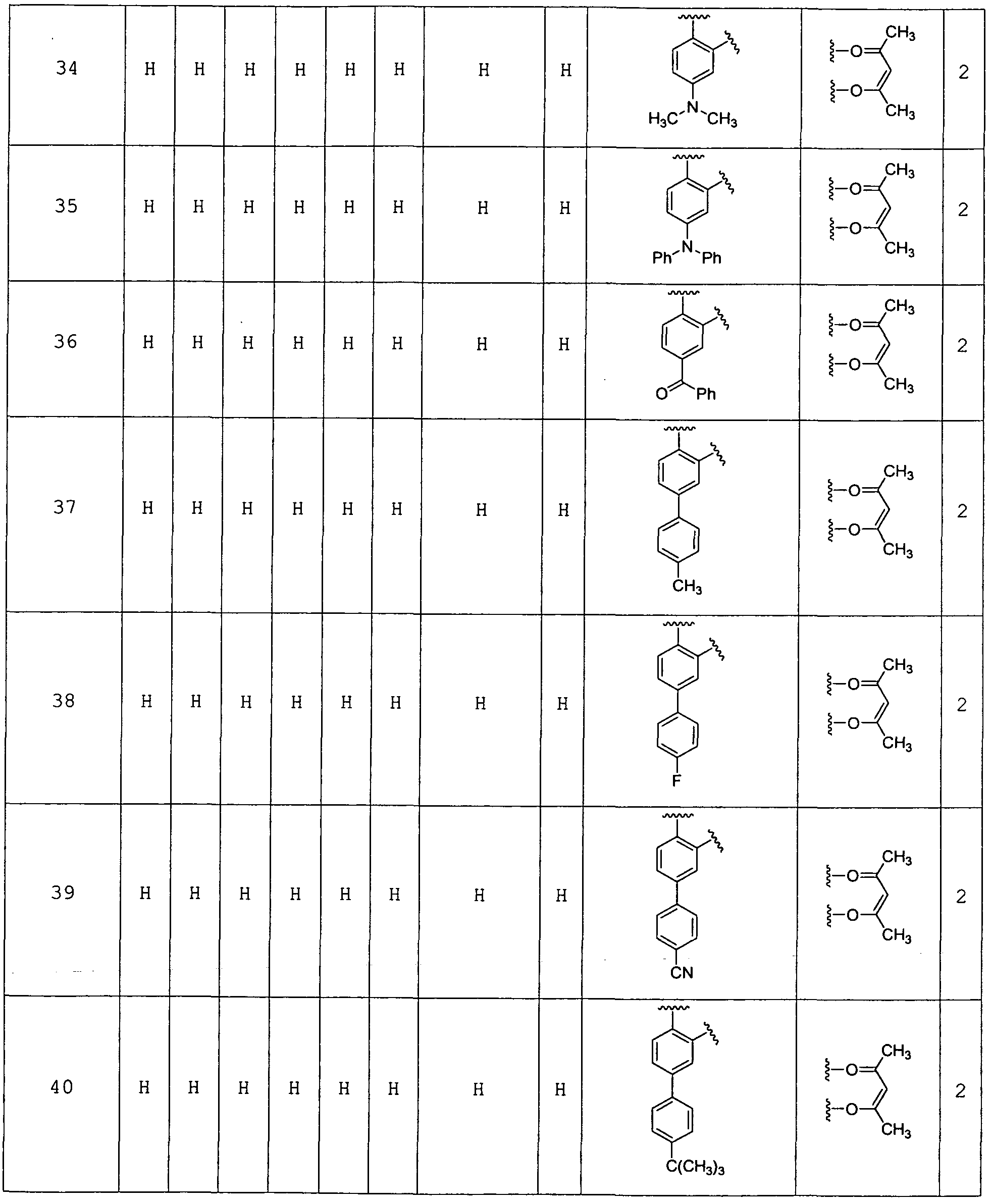
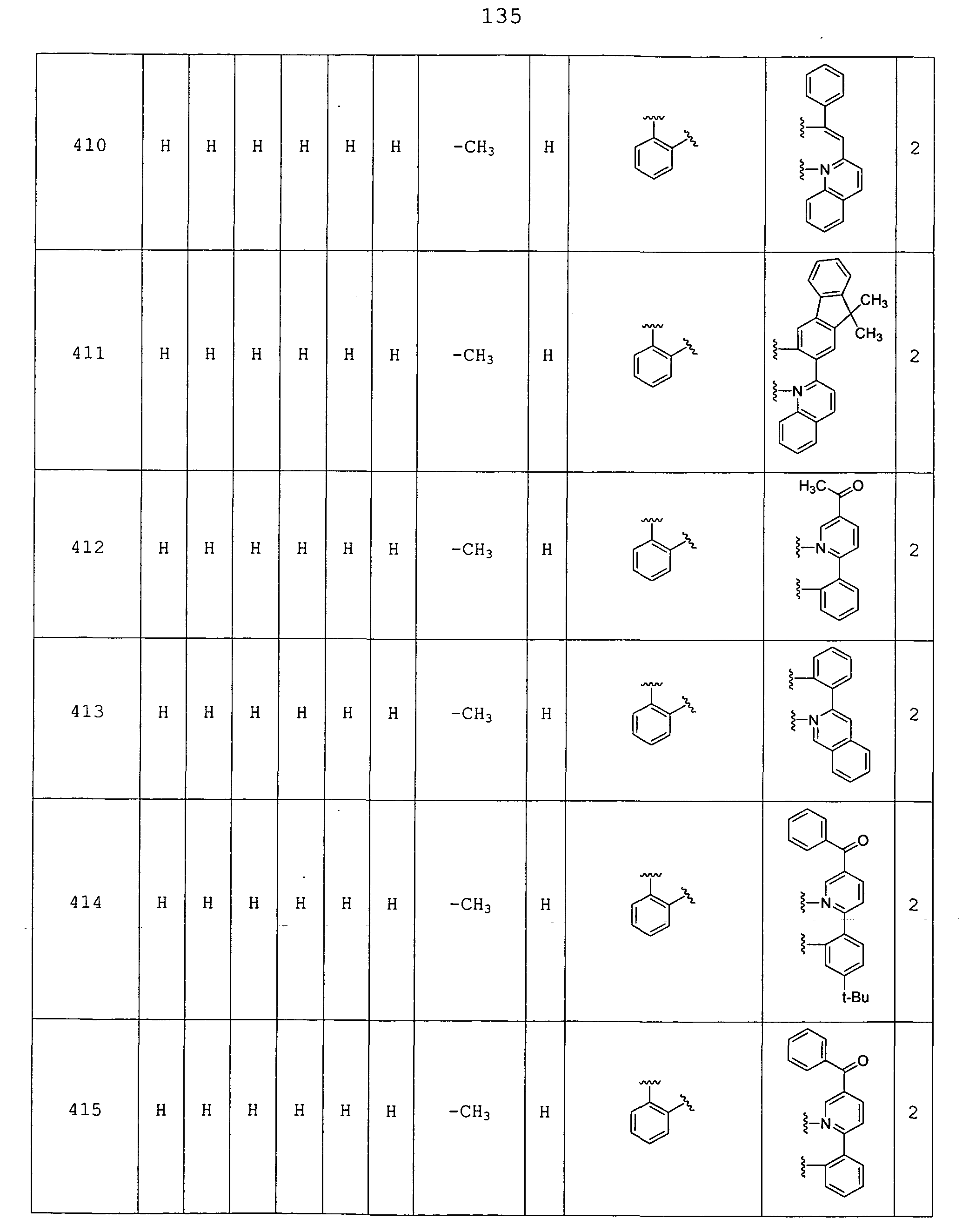
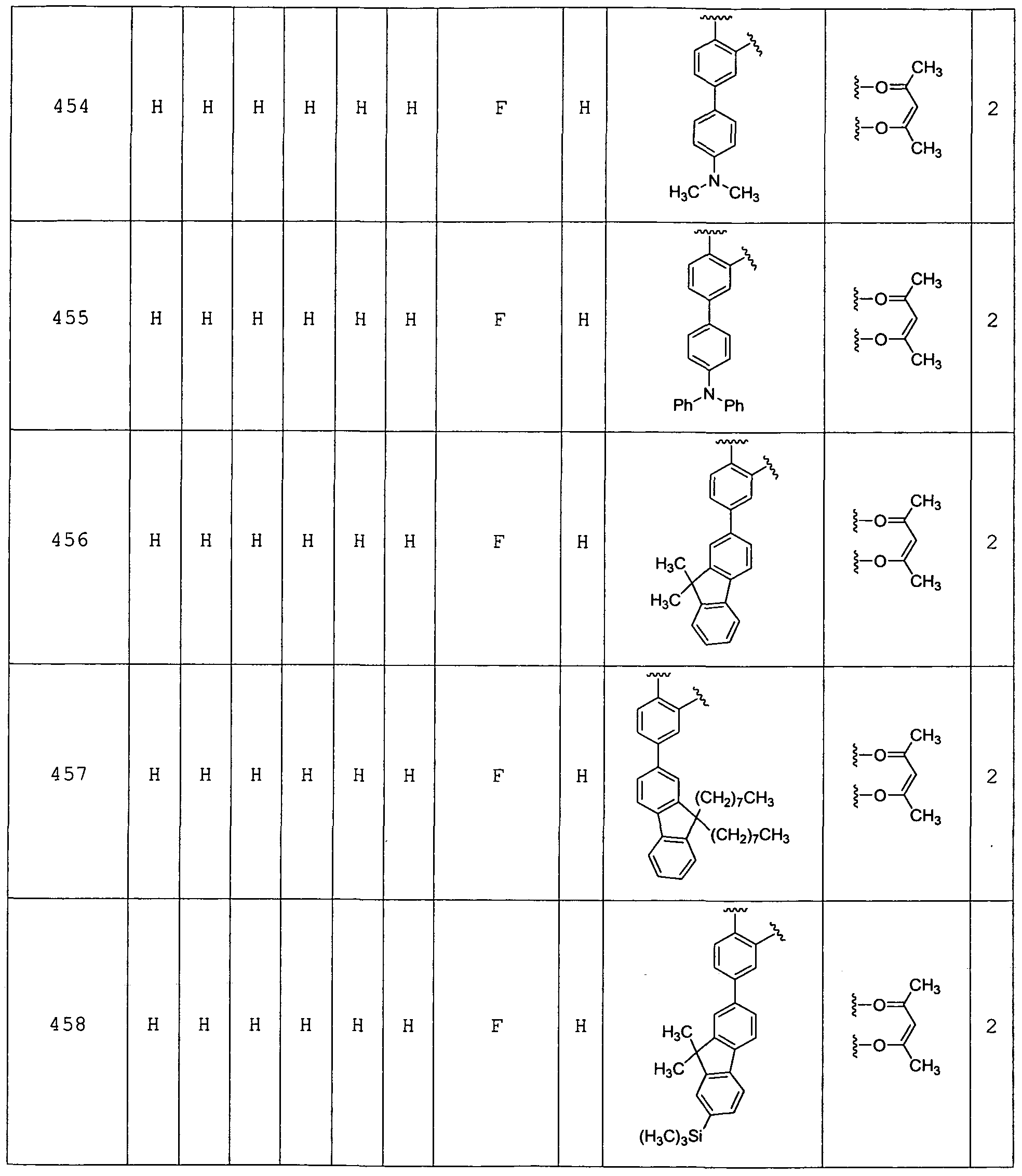
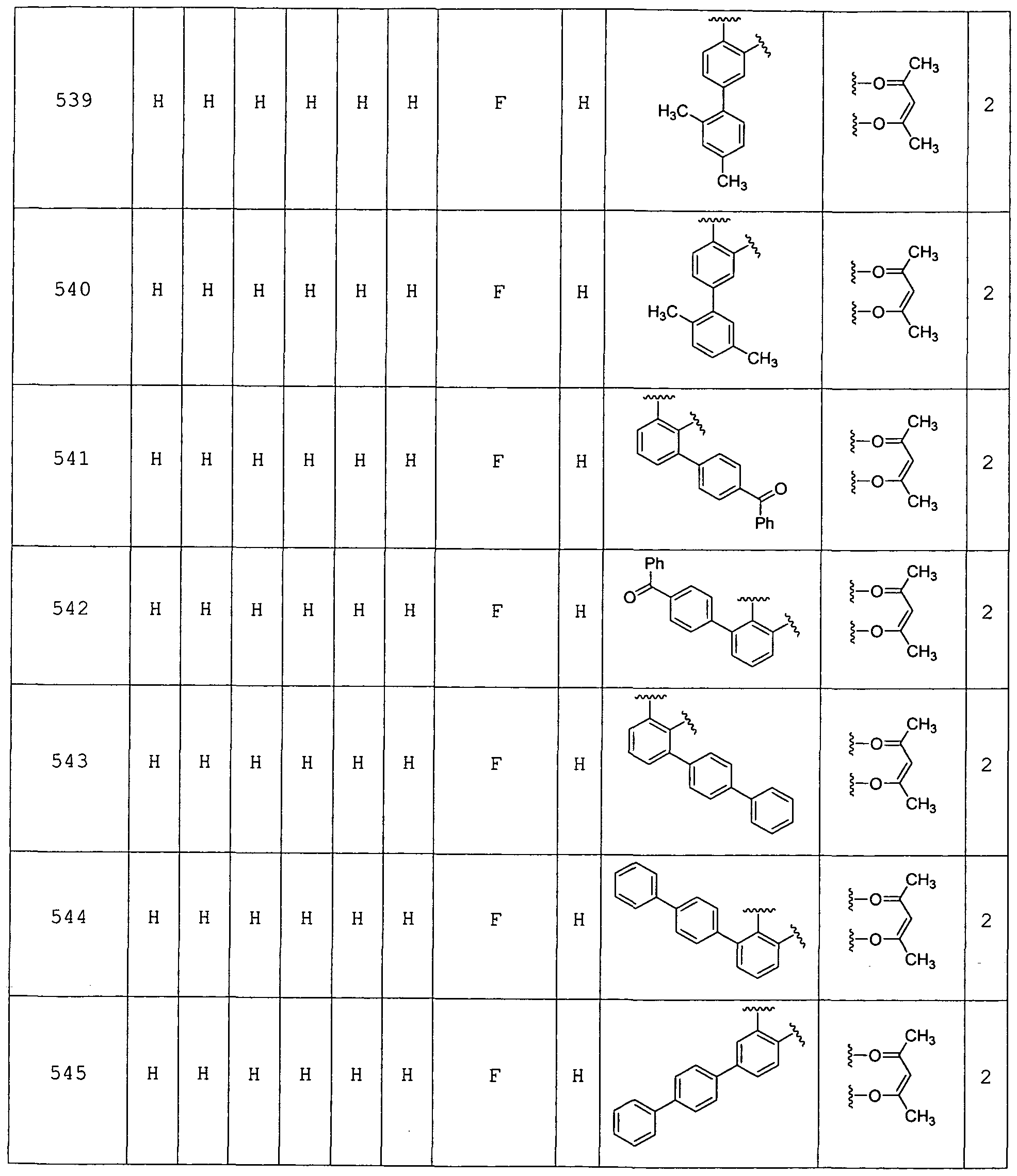
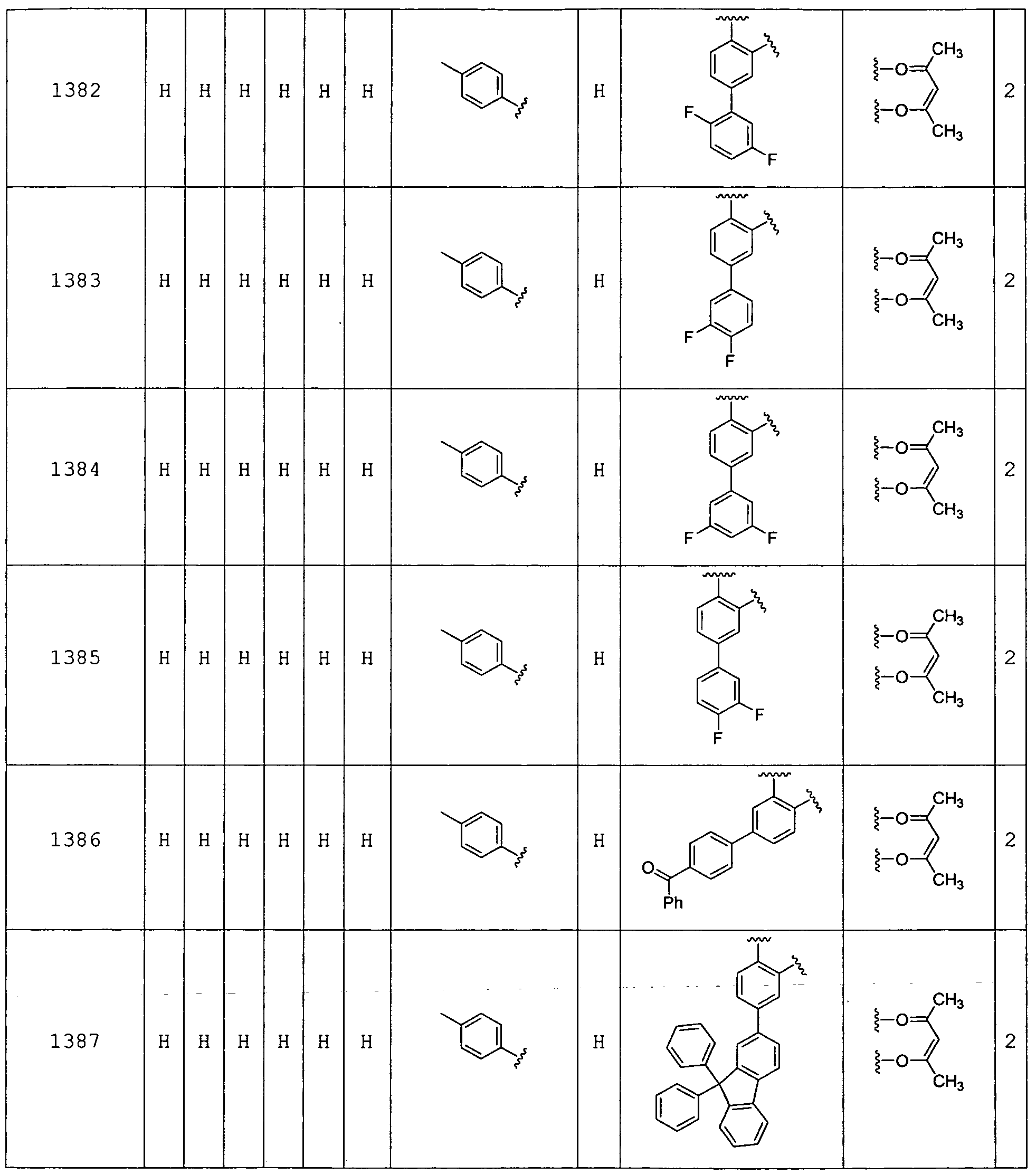
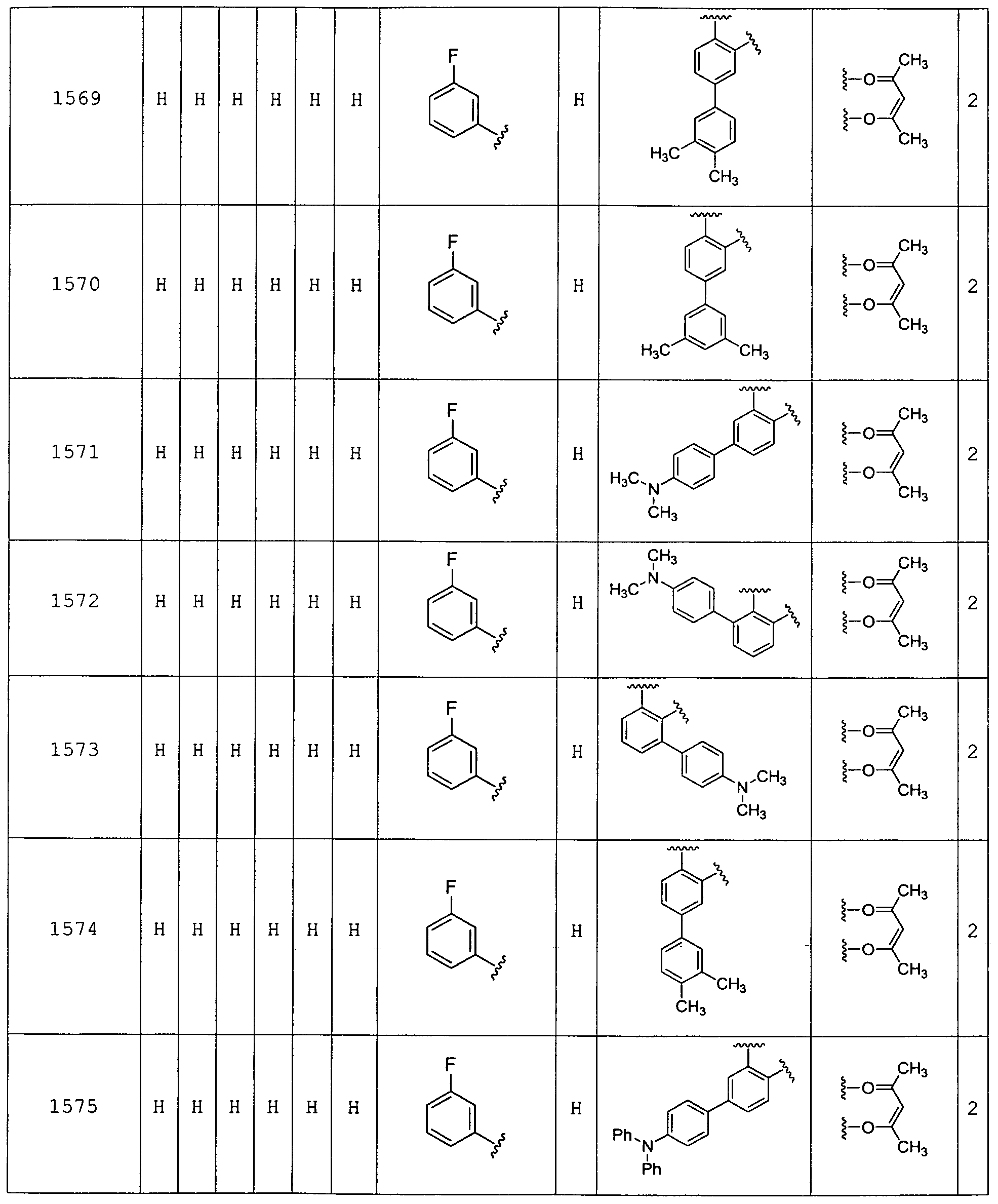
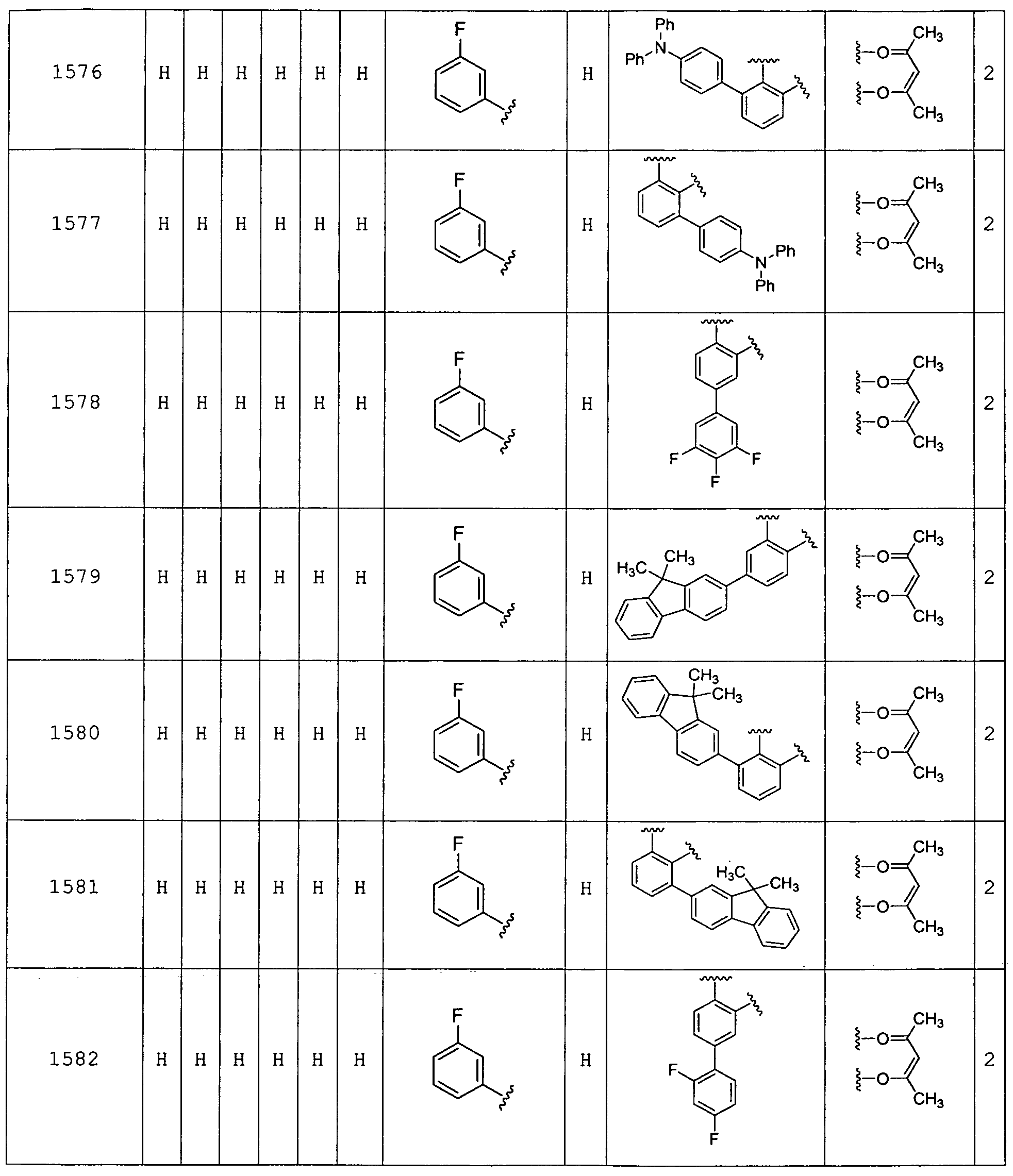
Organic compounds for electronic material (Compounds 1 to 20) shown in Table 1 were prepared according to the same procedure as described in Preparation Example 1; those shown in Table 2 (Compounds 21 to 1028) according to the procedure of Preparation Example 2 or 3; those shown in Table 3 (Compounds 1029 to 1043) according to the procedure of Preparation Example 6; and those shown in Table 4 (Compounds 1044 to 2060) according to the procedure of Preparation Example 4 or 5; the 1H NMR and MS/FAB data of those compounds are shown in Table 5.
Table 2
1012 H H H H H H -Si(CH
3)
3 H 2
1013 H H H H H H -Si(CH3)3 H 2
1014 H H H H H H -Si(CH
3)
3 H 2
1015 H H H H H H -Si(CH3)3 H 2
1016 H H H H H H -Si(CH3)3 H 2
t-Bu
1017 H H H H H H -Si(CH
3)
3 H 2
Table 4
Compound
Ri R2 Rii R12 Rl3 R14 R5 R6 L n No .
Table 5
Compound MS/FAB
1H NMR(CDC13, 200 MHz)
[Example 1] Manufacture of an OLED (1)
An OLED device was manufactured by using a compound for
electronic material according to the invention.
First, a transparent electrode ITO thin film (15 Ω/D) (2) prepared from glass for OLED (produced by Samsung Corning) (1) was subjected to ultrasonic washing with trichloroethylene, acetone, ethanol and distilled water, sequentially, and stored in isopropanol before use.
Then, an ITO substrate was equipped in a substrate folder of a vacuum vapor-deposit device, and 4 , 4 ' , 4"-tris (N, N- (2- naphthyl) -phenylamino) triphenylamine (2-TNATA) was placed in a cell of the vacuum vapor-deposit device, which was then ventilated up to 10~6 torr of vacuum in the chamber. Electric current was applied to the cell to evaporate 2-TNATA, thereby providing vapor-deposit of a hole injecting layer (3) having 60 nm thickness on the ITO substrate.
2-TNATA
Then, to another cell of the vacuum vapor-deposit device,
charged was N, NT -bis (a-naphthyl ) -N, ' -diphenyl-4 , 4 ' -diamine (NPB) , and electric current was applied to the cell to evaporate NPB, thereby providing vapor-deposit of a hole transport layer (4) of 20 nm e injecting layer.
NPB
To another cell of said vacuum vapor-deposit device, charged was 4 , ' -N, N' -dicarbazole-biphenyl (CBP) as an electroluminescent host material, and a compound for electronic material (e.g., Compound 2) according to the present invention was charged to still another cell. The two substances were evaporated at different rates to carry out doping, thereby vapor- depositing an electroluminescent layer (5) with 30 nm thickness on the hole transport layer. The suitable doping concentration is 4 to 10% by weight on the basis of CBP.
Then, on the electroluminescent layer, bis (2-methyl-8- quinolinato) (p-phenylphenolato) aluminum (III) (BAlq) was vapor- deposited as a hole blocking layer with a thickness of 10 nm in the same manner for NPB, tris ( 8-hydroxyquinoline) aluminum (III) (Alq) was vapor-deposited as an electron transport layer (6) with a thickness of 20 nm, and then lithium quinolate (Liq) was vapor- deposited as an electron injecting layer (7) in a thickness of 1 to 2 nm. Thereafter, an Al cathode (8) was vapor-deposited with a thickness of 150 nm by using another vacuum vapor-deposit device to manufacture an OLED.
BAlq Alq Liq
[Example 2] Manufacture of an OLED (2)
A hole injecting layer and a hole transport layer were formed according to the procedure of Example 1, and an electroluminescent layer was vapor-deposited as follows. In another cell of said vacuum vapor-deposit device, charged was H-5 as an electroluminescent host material according to the present
invention, and a compound for electronic material according to the present invention (Compound 52) was charged to still another cell. The two substances were evaporated at different rates to carry out doping, thereby vapor-depositing an electroluminescent layer (5) with 30 nm thickness on the hole transport layer. The suitable doping concentration is 4 to 10% by weight on the basis of the host. Then, a hole blocking layer, an electron transport layer and an electron injecting layer were vapor-deposited according to the same procedure as in Example 1, and then Al cathode was vapor-deposited with a thickness of 150 nm by using another vacuum vapor-deposit device to manufacture an OLED.
[Example 3] Manufacture of an OLED (3)
A hole injecting layer, a hole transport layer and an electroluminescent layer were formed according to the same procedure as in Example 2, and then an electron transport layer and an electron injecting layer were vapor-deposited. Thereafter,
Al cathode was vapor-deposited with a thickness of 150 nm by using another vacuum vapor-deposit device to manufacture an OLED.
[Experimental Example 1] Evaluation of optical properties of electroluminescent materials
The complexes having high synthetic yield were purified by vacuum sublimation at 10"6 torr and used as a dopant for an electroluminescent layer of an OLED. In order to examine the performances of OLED' s manufactured from Examples 1 to 3, external quantum efficiency of OLED' s was. measured at 10 mA/cm2. Various properties of the compounds according to the invention are shown in Table 6.
Table 6
Material Host Hole EL Operation External
blocking color voltage quantum
layer efficiency (%)
Compound 2 CBP BAlq Red 8.2 6.8
Compound 21 CBP BAlq Red 8.1 7.7
Compound 46 CBP BAlq Red 7.9 8.2
Compound 79 CBP BAlq Red 7.7 7.1
" Compound 108 CBP BAlq Red 7.9 7.9
Compound 290 CBP BAlq Red 7.7 •7.8
Compound 401 CBP BAlq Red 8.2 5.8
Compound 687 CBP BAlq Red 7.9 6.1
Ex.1 Compound 750 CBP BAlq Red 8.0 5.9
Compound 821 CBP BAlq Red 8.3 6.4
Compound 907 CBP BAlq Red 7.7 6.0
Compound 1044 CBP BAlq Red 8.2 5.6
Compound 1245 CBP BAlq Red 7.7 6.4
Compound 1508 CBP BAlq Red 7.9 6.1
Compound 1712 CBP BAlq Red 8.0 5.8
Compound 1890 CBP BAlq Red 8.0 6.9
Compound 2043 CBP BAlq Red 7.6 6.7
Compound 52 H-5 BAlq Red 6.6 6.8
Compound 68 ■ H-33 BAlq Red 6.5 5.9
Ex.2
Compound 1026 H-10 BAlq Red 7.5 6.3
Compound 1980 H-17 BAlq Red 6.4 6.2
Compound 106 H-7 - Red 7.0 6.3
Ex.3 Compound 1007 H-5 - Red 6.9 6.7
Compound 1745 H-64 - Red 6.6 7.4
In Example 1, Compound 46 showed good properties in voltage and external quantum efficiency; in Example 2, Compound 52; and in Example 3, Compound (1745) showed good properties in voltage and external quantum efficiency.