WO2011027809A1 - 義歯者用口腔用組成物 - Google Patents
義歯者用口腔用組成物 Download PDFInfo
- Publication number
- WO2011027809A1 WO2011027809A1 PCT/JP2010/064998 JP2010064998W WO2011027809A1 WO 2011027809 A1 WO2011027809 A1 WO 2011027809A1 JP 2010064998 W JP2010064998 W JP 2010064998W WO 2011027809 A1 WO2011027809 A1 WO 2011027809A1
- Authority
- WO
- WIPO (PCT)
- Prior art keywords
- denture
- antibacterial
- oral composition
- oral
- grass
- Prior art date
- Legal status (The legal status is an assumption and is not a legal conclusion. Google has not performed a legal analysis and makes no representation as to the accuracy of the status listed.)
- Ceased
Links
Images





Classifications
-
- A—HUMAN NECESSITIES
- A01—AGRICULTURE; FORESTRY; ANIMAL HUSBANDRY; HUNTING; TRAPPING; FISHING
- A01N—PRESERVATION OF BODIES OF HUMANS OR ANIMALS OR PLANTS OR PARTS THEREOF; BIOCIDES, e.g. AS DISINFECTANTS, AS PESTICIDES OR AS HERBICIDES; PEST REPELLANTS OR ATTRACTANTS; PLANT GROWTH REGULATORS
- A01N65/00—Biocides, pest repellants or attractants, or plant growth regulators containing material from algae, lichens, bryophyta, multi-cellular fungi or plants, or extracts thereof
-
- A—HUMAN NECESSITIES
- A01—AGRICULTURE; FORESTRY; ANIMAL HUSBANDRY; HUNTING; TRAPPING; FISHING
- A01N—PRESERVATION OF BODIES OF HUMANS OR ANIMALS OR PLANTS OR PARTS THEREOF; BIOCIDES, e.g. AS DISINFECTANTS, AS PESTICIDES OR AS HERBICIDES; PEST REPELLANTS OR ATTRACTANTS; PLANT GROWTH REGULATORS
- A01N65/00—Biocides, pest repellants or attractants, or plant growth regulators containing material from algae, lichens, bryophyta, multi-cellular fungi or plants, or extracts thereof
- A01N65/40—Liliopsida [monocotyledons]
-
- A—HUMAN NECESSITIES
- A61—MEDICAL OR VETERINARY SCIENCE; HYGIENE
- A61K—PREPARATIONS FOR MEDICAL, DENTAL OR TOILETRY PURPOSES
- A61K8/00—Cosmetics or similar toiletry preparations
- A61K8/18—Cosmetics or similar toiletry preparations characterised by the composition
- A61K8/96—Cosmetics or similar toiletry preparations characterised by the composition containing materials, or derivatives thereof of undetermined constitution
- A61K8/97—Cosmetics or similar toiletry preparations characterised by the composition containing materials, or derivatives thereof of undetermined constitution from algae, fungi, lichens or plants; from derivatives thereof
- A61K8/9783—Angiosperms [Magnoliophyta]
- A61K8/9794—Liliopsida [monocotyledons]
-
- A—HUMAN NECESSITIES
- A61—MEDICAL OR VETERINARY SCIENCE; HYGIENE
- A61P—SPECIFIC THERAPEUTIC ACTIVITY OF CHEMICAL COMPOUNDS OR MEDICINAL PREPARATIONS
- A61P31/00—Antiinfectives, i.e. antibiotics, antiseptics, chemotherapeutics
-
- A—HUMAN NECESSITIES
- A61—MEDICAL OR VETERINARY SCIENCE; HYGIENE
- A61Q—SPECIFIC USE OF COSMETICS OR SIMILAR TOILETRY PREPARATIONS
- A61Q11/00—Preparations for care of the teeth, of the oral cavity or of dentures; Dentifrices, e.g. toothpastes; Mouth rinses
- A61Q11/02—Preparations for deodorising, bleaching or disinfecting dentures
-
- A—HUMAN NECESSITIES
- A61—MEDICAL OR VETERINARY SCIENCE; HYGIENE
- A61Q—SPECIFIC USE OF COSMETICS OR SIMILAR TOILETRY PREPARATIONS
- A61Q17/00—Barrier preparations; Preparations brought into direct contact with the skin for affording protection against external influences, e.g. sunlight, X-rays or other harmful rays, corrosive materials, bacteria or insect stings
- A61Q17/005—Antimicrobial preparations
Definitions
- the present invention relates to a composition for oral cavity for dentures, and more particularly to a composition for oral cavity for dentures subjected to antibacterial treatment. Furthermore, this invention relates to the manufacturing method of the composition for oral cavity for dentures.
- dentures Since dentures are worn in the oral cavity, it is important to prevent biofilm formation by antibacterial and antimicrobial effects and prevent opportunistic infections caused by oral bacteria and fungi in the oral cavity and stomatitis due to dentures. is there.
- Many denture cleaning agents are commercially available to keep the denture hygienic. In general, peroxides do not have a strong detrimental effect, but have little cleaning effect. Hypozinc acid system has a strong cleaning effect, but denture materials are also easily damaged. The enzyme system has a mild cleaning effect but is less harmful.
- a denture If a denture is worn over a long period of time, indentation or distortion will occur in the oral mucosa or the condition of the ridge of the jaw will be deformed, and the conformity will deteriorate and the adsorptive power of the denture will be insufficient. Sometimes the denture can easily come off.
- a treatment is performed in which a soft lining material is disposed on the inner surface of the denture for a while.
- the tissue conditioner is a material used for this treatment, and is also called a temporary denture lining material. Tissue conditioners are required to have a low hardness and very soft performance.
- the softness restores local deformations such as indentation and distortion of the mucous membrane to the original normal state, stabilizes the denture adsorption, and improves the condition of the jaw ridge (Patent Document 1).
- the tissue conditioner is a backing material (lining material) that comes in contact with the denture, and is widely used for adjusting the mucosa under the denture base.
- Tissue conditioners are seen as a problem that due to the outflow of components over time, surface properties deteriorate, plaque is formed, and there is an increased risk of systemic effects on the elderly with reduced resistance .
- Patent Document 2 a tissue conditioner containing an inorganic component having antibacterial properties
- metal ions such as silver are stable, but dentures are attached to the oral cavity, and problems such as biocompatibility problems and metal allergies cannot be denied.
- the cost is high because of the noble metal such as silver.
- the tissue conditioner deteriorates with time, and the antibacterial component may be eluted. In such a case, it is desired that the antibacterial component is particularly safe for the living body.
- Non-patent Document 1 a report on research on antibacterial properties of bamboo extract and its application to dentistry.
- biologically-derived antibacterial substances contain various compounds, and safety issues such as these have not been fully elucidated.
- tissue conditioners containing bamboo extract The reality is that it has not been reached.
- denture stabilizers are often used. Types of stabilizers are classified into powder type, cream type and cushion type according to their properties. From the viewpoints of ingredients and effects, powders mainly composed of highly sticky substances, cream-like ones are classified as adhesives, and rubber-like ones with cushions are classified as adhesives.
- the pressure-sensitive adhesive adheres to the denture and the oral mucosa, and the pressure-sensitive adhesive improves the maintenance power of the denture by filling the gap between the denture and the oral mucosa.
- Denture stabilizers are also installed in the oral cavity, and it is necessary to pay attention to hygiene as with dentures. Several denture stabilizer compositions having antibacterial properties have been reported.
- a denture stabilizer comprising a denture stabilizer containing vinyl acetate resin and ethanol and tea tree oil or eucalyptus globulus oil is disclosed. Yes (Patent Document 4).
- An object of the present invention is to provide a composition for oral cavity for dentures which contains an antibacterial substance derived from a living organism, is gentle to the living body and has antibacterial activity.
- the present inventors paid attention to a substance having an antibacterial activity derived from a living body, and as a result of earnest research, the herb-derived component is mixed with the material component of the oral denture composition, The present invention was completed by finding out having excellent antibacterial activity. Further, since the oral denture composition for dentures is to be worn in the oral cavity, the oral denture composition containing a herb-derived component that can be used as a food additive is safe for the living body. Yes and useful. Thus, the present invention was completed with an antibacterial denture oral composition containing a grass-derived component.
- this invention consists of the following.
- An antibacterial denture oral composition comprising a grass-derived component.
- Denture oral composition is tissue conditioner, denture stabilizer, denture coating agent, denture dentifrice, wound covering after denture oral surgery, denture temporary cement, immediate denture polymerisation 3.
- the antibacterial denture oral composition according to item 1 or 2 which is any one selected from a range, a denture gum, and a denture lozenge. 4).
- a raw material for preparing an oral composition for antibacterial dentures comprising a grass-derived component and a resin composition for a tissue conditioner or a denture stabilizer. 7).
- a method for preparing an oral composition for antibacterial dentures comprising mixing a component derived from licorice into a resin composition. 8).
- the antibacterial denture oral composition of the present invention Candida albicans showed superior results compared to the control. Furthermore, Porphyromonas gingivalis also showed antibacterial activity.
- the tissue conditioner is within the standard values in the consistency test, penetration test and penetration ratio test, and satisfies the mechanical properties required for the tissue conditioner. It was. Further, the antibacterial denture oral cavity composition of the present invention also has an excellent deodorizing effect. Therefore, the antibacterial denture oral composition of the present invention contains a herb-derived component that can also be used as a food additive, and has an excellent antibacterial activity and antibacterial oral denture composition Things can be provided.
- the antibacterial denture oral composition of the present invention can be prepared in advance by using a resin composition for preparing a denture oral composition containing a herb-derived component, or a denture oral composition. It can also be prepared by mixing a grass-derived component in use in a resin composition for product preparation.
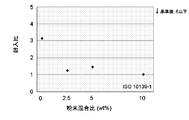
- Example 1-2 It is a figure which shows the penetration after 2 hours of the antibacterial tissue conditioner test piece which mixed the grass powder of each density
- Example 1-3 It is a figure which shows the penetration after 7 days of the antibacterial tissue conditioner test piece which mixed the grass powder of each density
- Example 1-3 It is a figure which shows the penetration ratio of 2 hours after and 7 days after the antibacterial tissue conditioner test piece which mixed the grass powder of each density
- Example 1-3 It is a figure which shows the result of having confirmed the deodorizing effect of the antibacterial tissue conditioner test piece which mixed the grass powder of each density
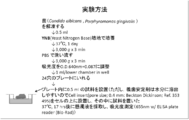
- Example 1-4 It is a figure which shows the experimental method for measuring the antibacterial activity with respect to Candida albicans and Porphyromonas gingivalis by the antibacterial denture stabilizer mixed with the grass powder of each density
- Example 2 It is a figure which shows the antibacterial activity with respect to C. albicans by the antibacterial denture stabilizer which mixed the grass powder of each density
- Example 2 It is a figure which shows the antibacterial activity with respect to P. gingivalis by the antibacterial denture stabilizer which mixed the grass powder of each density
- the present invention relates to an antibacterial denture oral composition characterized by containing a component derived from grass.
- the oral composition for dentures is not particularly limited as long as the person wearing the dentures is used in the oral cavity.
- the denture may be a complete denture or a partial denture.
- the resin composition may be a resin that can be used in the oral cavity, and may be a resin known per se or a resin that will be developed in the future. Specifically, it may be a natural resin or a synthetically produced resin.
- a resin used for a tissue conditioner a commercially available tissue conditioner resin composition may be used. Specifically, a soft liner TM (Soft-Liner: made by GC Dental) or a Matsukaze TM tissue conditioner (Tissue -Conditioner: Made by Matsukaze).
- the temporary lining material resin composition described in Patent Document 1 can also be used.
- resins used for denture stabilizers include alkyl vinyl ether-maleic anhydride copolymers, salts and derivatives thereof, polyacrylic acid or polyacrylic acid copolymer precursors, and methyl vinyl ether-maleic acid copolymers.
- examples thereof include a substantially anhydrous mixture of a polymer Na / Ca mixed salt, sodium carboxymethylcellulose and a trivalent cation, and other resins shown in Patent Documents 3 and 4.
- the antibacterial denture oral cavity composition is characterized by including a grass-derived component.
- the component derived from a grass can use the thing which dried and crushed cut grass and made it into the powder form.
- moisture content to the powdered grass could be used.
- the degree of crushing of grass to make it into powder is not particularly limited, but it is in the form of particles that can uniformly disperse the grass-derived component in the antibacterial denture oral composition during mixing. Is preferred.
- the antibacterial denture oral composition of the present invention may contain 2.5 to 20% by weight, more preferably 2.5 to 10% by weight, of a powdered licorice-derived component.
- the herb-derived component contained in the antibacterial denture oral composition of the present invention can be uniformly and easily mixed into the resin composition used in the preparation of the antibacterial denture oral composition. . Thereby, an antibacterial effect is exhibited in a uniform state.
- mixing with the resin composition used in the preparation of the antibacterial denture oral composition for the denture oral component for example, when an unfavorable coloring is concerned, May further include other components to address such problems.
- the antibacterial denture oral composition of the present invention exhibits antibacterial activity in C. albicans and P. gingivalis antibacterial tests. Antibacterial activity is also expected against Streptococcus mutans .
- the antibacterial denture oral composition of the present invention exhibits excellent antibacterial activity against C. albicans .
- C. albicans forms so-called denture plaques and biofilms that cause subfloor inflammation, in particular denture stomatitis, such as complete dentures and partial dentures (Jan. J. Mycol. Vol. 40, 233-242 (2005)). Since it exhibits particularly excellent antibacterial activity against C. albicans , it is useful for denture wearers.
- the present invention extends to a method for preparing an oral composition for antibacterial dentures.
- an antibacterial denture oral composition it may be prepared by adding a herb-derived component to a denture oral composition resin beforehand, or for an oral denture oral composition in advance. You may produce using the material in which the component derived from a grass is mixed in resin.
- the present invention extends to a raw material for preparing an oral composition for antibacterial dentures in which a herb-derived component is mixed into a resin composition as a material for preparing an oral composition for antibacterial dentures.
- the oral composition for antibacterial dentures of the present invention is specifically an antibacterial tissue conditioner
- it extends to a method for producing an antibacterial tissue conditioner.
- a herb-derived component may be added to the tissue conditioner resin composition at the time of use, or the herb-derived component was previously mixed in the tissue conditioner resin composition. You may produce using a material.
- the present invention extends to a raw material for producing an antibacterial tissue conditioner in which a component derived from grass is mixed in a resin composition as a material for producing an antibacterial tissue conditioner.
- Example 1 Preparation of Antibacterial Tissue Conditioner
- a resin composition for preparing an antibacterial tissue conditioner of the present invention a commercially available tissue conditioner (manufactured by GC Corporation, Tokyo) was used. Yatsushiro) was used. The resin composition was mixed at a powder / liquid ratio specified by the manufacturer, and the grass powder was further added to 0, 2.5, 5, and 10% by weight.
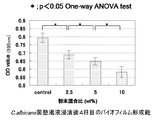
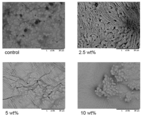
- Example 1-1 Biofilm Formation Inhibition Test Using the antibacterial tissue conditioner mixed with each concentration of grass powder prepared in Example 1, a disk-shaped test piece having a diameter of 13 mm and a height of 2 mm was prepared. . The prepared test piece was sterilized with ultraviolet rays for 24 hours, and then immersed in 1 ⁇ 10 5 CFU / ml C. albicans suspension. After 2 days and 4 days after immersion, the sample was thoroughly washed with water and the biofilm on the surface of the test piece was collected. Then, the absorbance at 595 nm of the solution was measured, and the biofilm forming ability of each test piece was evaluated. Moreover, the shape of Candida albicans bacteria on each test piece was observed.
- the test piece containing 2.5% by weight or more of grass powder showed a significant decrease in absorbance compared to the control test piece containing no grass powder. It was confirmed that film formation was suppressed (FIGS. 1 and 2). Further, on the fourth day after immersion, the form of Candida albicans was condensed and deformed as the mixed concentration of the grass powder increased, and the antibacterial effect of the grass-derived component was confirmed (FIG. 3).
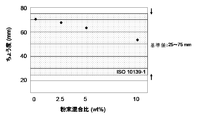
- Example 1-2 Consistency Test A consistency test is one of the methods for measuring the hardness and fluidity of a material. This is one of the mechanical property evaluation methods for tissue conditioners, and it is necessary to satisfy the ISO10139-1 standard.
- each sample of antibacterial tissue conditioner mixed with each concentration of grass powder prepared in Example 1 was weighed to 2 ml, mixed and placed on a glass plate. 30 seconds after the completion of mixing, another glass plate (100 g) was allowed to stand on the sample. 120 seconds after mixing was completed, a 1000 g weight was gently placed vertically on a glass plate, and a load of 1100 g was applied. The weight was removed after 60 seconds, and the maximum and minimum dimensions between the parallel tangents of the sample that spread 8 minutes after the start of mixing were measured. This test was performed 4 times, and the average was taken as the consistency.
- the standard value of consistency was 25 to 75 mm, and as a result of the above, the consistency of each sample showed a value within the standard value (FIG. 4).
- the antibacterial tissue conditioner of the present invention was confirmed to be sufficient for clinical application in terms of mechanical properties using consistency as an index.
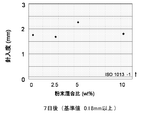
- the penetration test is one of methods for measuring the hardness of a material. A needle having a specified weight is vertically penetrated into the sample, and the hardness of the sample is expressed by the depth. The penetration value is 1/10 mm, where the penetration is 1, and the larger the number, the softer the material. This is one of the mechanical property evaluation methods for tissue conditioners, and it is necessary to satisfy the ISO10139-1 standard.
- each antibacterial tissue conditioner sample mixed with each concentration of grass powder prepared in Example 1 was put in a mold having a diameter of 10 mm and a height of 15 mm, and a cylindrical test piece for penetration test was used. Produced.
- the standard value of penetration after 120 minutes is 1.8 mm or less, and the standard value of penetration after 7 days is 0.18 mm or more.
- the penetration for each sample showed a value within the reference value (FIGS. 5 and 6).
- the reference value of the penetration ratio was 5 or less, and the penetration ratio of each sample showed a value within the reference value (FIG. 7).
- the antibacterial tissue conditioner of the present invention was confirmed to be sufficient for clinical application in terms of mechanical properties with the penetration and penetration ratio as indices.
- Example 1-4 Deodorization Test
- a deodorization test was performed using antibacterial tissue conditioner samples each mixed with the grass powder of each concentration of Example 1 using a mold having a diameter of 10 mm and a height of 15 mm.
- a test piece was prepared. The test piece was immersed in distilled water in a 37 ° C. constant temperature bath, and after 10 days, the test piece was taken out and the odor intensity was measured using a handy odor monitor OMX-SR (Shinei Technology Co., Ltd.). Five measurements were taken for each condition.
- OMX-SR Greeninei Technology Co., Ltd.
- Example 2 Preparation of Antibacterial Denture Stabilizer
- a resin composition for preparing an antibacterial denture stabilizer of the present invention a commercially available denture stabilizer (Earth Pharmaceutical Co., Ltd.) was used, and herb powder (Inada) , Yatsushiro) was used. The grass powder was added so that it might become 0, 5, 10 weight% with respect to the denture stabilizer.
- Example 2 Antimicrobial activity test About the antimicrobial denture stabilizer produced in Example 2, the antimicrobial activity with respect to C. albicans and P. gingivalis was confirmed.
- the antibacterial denture stabilizer 0.5 ml was used as a sample.
- the sample was sterilized with ultraviolet rays for 24 hours before being used for the experiment.
- the various strains cryopreserved were thawed and cultured at 37 ° C. for 1 day using a YNB (Yeast nitrogen base) medium (manufactured by Sigma).
- the culture solution is centrifuged at 3000 g ⁇ 3 minutes, the precipitate is washed with PBS, further centrifuged at 3000 g ⁇ 3 minutes, and then diluted with PBS so that the absorbance (OD) at a wavelength of 640 nm is 0.087.
- OD absorbance
- Each diluted bacterial solution was placed in a 24-well plate, the above samples were added, and after culturing at 37 ° C.
- the denture stabilizer containing the herb powder after 17 hours of culture exhibits excellent antibacterial activity against C. albicans , and P. gingivalis also contains 10% by weight of the herb component. In some cases, some antibacterial activity was observed (FIGS. 10 and 11).
- the antibacterial denture oral cavity composition of the present invention As described above in detail, according to the antibacterial denture oral cavity composition of the present invention, C. albicans showed superior results compared to the control. Furthermore, P. gingivalis also showed some antibacterial activity.
- the tissue conditioner is within the standard values in the consistency test, penetration test and penetration ratio test, and satisfies the mechanical properties required for the tissue conditioner. It was. Further, the antibacterial denture oral cavity composition of the present invention also has an excellent deodorizing effect. Therefore, the antibacterial denture oral composition of the present invention contains a herb-derived component that can also be used as a food additive, and has an excellent antibacterial activity and antibacterial oral denture composition Things can be provided.
- the antibacterial denture oral composition of the present invention can be prepared in advance by using a resin composition for preparing a denture oral composition containing a herb-derived component, or a denture oral composition. It can also be prepared by mixing a grass-derived component in use in a resin composition for product preparation.
- the oral composition for dentures excellent in antibacterial properties by the antibacterial denture oral composition of the present invention specifically, tissue conditioner, denture stabilizer, denture coating agent, denture dentifrice, oral denture Surface covering material after internal surgery, temporary denture cement, denturer immediate polymerization range, denture gum, denture lozenge, denture artificial saliva, denture cleaner, denture mouthwash, etc. Can be provided.
Landscapes
- Health & Medical Sciences (AREA)
- Life Sciences & Earth Sciences (AREA)
- General Health & Medical Sciences (AREA)
- Engineering & Computer Science (AREA)
- Veterinary Medicine (AREA)
- Public Health (AREA)
- Animal Behavior & Ethology (AREA)
- Mycology (AREA)
- Microbiology (AREA)
- Biotechnology (AREA)
- Agronomy & Crop Science (AREA)
- Plant Pathology (AREA)
- Dentistry (AREA)
- Wood Science & Technology (AREA)
- Zoology (AREA)
- Environmental Sciences (AREA)
- Natural Medicines & Medicinal Plants (AREA)
- Birds (AREA)
- Oral & Maxillofacial Surgery (AREA)
- Botany (AREA)
- Dermatology (AREA)
- Epidemiology (AREA)
- Medicinal Chemistry (AREA)
- Organic Chemistry (AREA)
- Nuclear Medicine, Radiotherapy & Molecular Imaging (AREA)
- Pharmacology & Pharmacy (AREA)
- General Chemical & Material Sciences (AREA)
- Chemical Kinetics & Catalysis (AREA)
- Chemical & Material Sciences (AREA)
- Oncology (AREA)
- Communicable Diseases (AREA)
- Dental Preparations (AREA)
- Agricultural Chemicals And Associated Chemicals (AREA)
- Cosmetics (AREA)
Abstract
Description
1.イ草由来成分を含むことを特徴とする抗菌性義歯者用口腔組成物。
2.イ草由来成分が、イ草を乾燥させて破砕し、粉末状にしたものである前項1に記載の抗菌性義歯者用口腔組成物。
3.義歯者用口腔組成物が、ティッシュコンディショナー、義歯安定剤、義歯コーティング剤、義歯用歯摩剤、義歯者用口腔内手術後の創面被覆材、義歯者用仮封用セメント、義歯者用即時重合レンジ、義歯者用ガム、義歯者用トローチから選択されるいずれかである、前項1又は2に記載の抗菌性義歯者用口腔組成物。
4.義歯者用口腔組成物が、ティッシュコンディショナー又は義歯安定剤である前項3に記載の抗菌性義歯者用口腔組成物。
5.イ草由来成分が、ティッシュコンディショナー用又は義歯安定剤用の樹脂組成物に対して、2.5~20重量%含むことを特徴とする前項4に記載の抗菌性義歯者用口腔組成物。
6.イ草由来成分とティッシュコンディショナー用又は義歯安定剤用の樹脂組成物を含む、抗菌性義歯者用口腔組成物作製用原料。
7.樹脂組成物に、イ草由来成分を混入させることを特徴とする抗菌性義歯者用口腔組成物の作製方法。
8.イ草由来成分が、イ草を乾燥させて破砕し、粉末状にしたものである前項7に記載の抗菌性義歯者用口腔組成物の作製方法。
9.イ草由来成分を樹脂組成物に対して、2.5~20重量%混入させることを特徴とする前項8に記載の抗菌性義歯者用口腔組成物の作製方法。
10.抗菌性義歯者用口腔組成物が、ティッシュコンディショナー又は義歯安定剤である前項7~9のいずれか1に記載の抗菌性義歯者用口腔組成物の作製方法。
さらに、本発明の抗菌性義歯者用口腔組成物は、予め義歯者用口腔組成物作製用樹脂組成物にイ草由来成分を含むものを用いて作製することもできるし、義歯者用口腔組成物作製用樹脂組成物にイ草由来成分を用時混入させて作製することもできる。
本発明の抗菌性ティッシュコンディショナー作製用樹脂組成物として、市販のティッシュコンディショナー(ジーシー社製,東京)を用い、イ草由来成分としてイ草粉末(イナダ,八代)を用いた。製造業者指定の粉液比にて、樹脂組成物を混和し、さらに0、2.5、5、10重量%となるようにイ草粉末を添加した。
実施例1で作製した各濃度のイ草粉末を混入した抗菌性ティッシュコンディショナーを用いて、直径13mm、高さ2mmの円板状試験片を作製した。作製した試験片を紫外線で24時間滅菌後、1×10⁵CFU/mlのC. albicans菌懸濁液に浸漬した。浸漬後2日及び4日後によく水洗し、試験片表面のバイオフィルムを回収した後、溶液について595nmの吸光度を測定し、各試験片のバイオフィルム形成能を評価した。また、各試験片上のカンジダ・アルビカンス菌の形状を観察した。
ちょう度試験とは、材料の硬軟性、流動性などを測定する方法のひとつである。ティッシュコンディショナーの機械的性質評価方法のひとつであり、ISO10139-1規格を満たすことが必要である。本試験例では、実施例1で作製した各濃度のイ草粉末を混入した抗菌性ティッシュコンディショナー各試料が2mlになるように計量し、混和後、ガラス板上に置いた。混和終了から30秒後、試料上にもう一枚のガラス板(100g)を静置した。混和終了から120秒後にガラス板上に1000gのおもりを静かに垂直に載せ、1100gの荷重を掛けた。60秒後におもりを除き、混和開始から8分後に広がった試料の平行接線間の最大部と最小部の寸法を測定した。この試験を4回行い、その平均をちょう度とした。
針入度試験とは、材料の硬さを測定する方法のひとつである。規定重量の針を試料中に垂直に貫入させ、その深さにより試料の硬さを表す。針入度の値は、1/10mmが針入度1とされ、数字が大きいほど柔らかい材料と判断される。ティッシュコンディショナーの機械的性質評価方法のひとつであり、ISO10139-1規格を満たすことが必要である。本試験例では、実施例1で作製した各濃度のイ草粉末を混入した抗菌性ティッシュコンディショナー各試料を直径10mm、高さ15mmの金型に入れ、円柱状の針入度試験用試験片を作製した。混和開始から10分後に試験片を金型から取り出し、120分後にビガー針を試験片表面に接触させ、1.5秒後にダイヤルゲージで針入深さを測定した。試験片の新しい部分に同じ試験を更に2回行い、計3回の平均値を求め、これを針入度Aとした。試験片を再び37℃恒温水槽に入れ、7日後に試験を繰り返し、これを針入度Bとした。σ=A/B(σ:針入比、A:120分後の針入度、B:7日後の針入度)の式で計算し、針入度を求めた。
本試験例では、直径10mm、高さ15mmの金型を用い、実施例1の各濃度のイ草粉末を混入した抗菌性ティッシュコンディショナー各試料により除臭試験用試験片を作製した。37℃恒温槽内で蒸留水中に試験片を浸漬し、10日後、試験片を取り出し、ハンディにおいモニターOMX-SR(神栄テクノロジー株式会社)を用いてにおいの強さを測定した。それぞれの条件に対して5回計測した。
本発明の抗菌性義歯安定剤作製用樹脂組成物として、市販の義歯安定剤(アース製薬製)を用い、イ草由来成分としてイ草粉末(イナダ,八代)を用いた。義歯安定剤に対して、0、5、10重量%となるようにイ草粉末を添加した。
実施例2で作製した抗菌性義歯安定剤について、C. albicans及びP. gingivalisに対する抗菌活性を確認した。
Claims (10)
- イ草由来成分を含むことを特徴とする抗菌性義歯者用口腔組成物。
- イ草由来成分が、イ草を乾燥させて破砕し、粉末状にしたものである請求項1に記載の抗菌性義歯者用口腔組成物。
- 義歯者用口腔組成物が、ティッシュコンディショナー、義歯安定剤、義歯コーティング剤、義歯用歯摩剤、義歯者用口腔内手術後の創面被覆材、義歯者用仮封用セメント、義歯者用即時重合レンジ、義歯者用ガム、義歯者用トローチから選択されるいずれかである、請求項1又は2に記載の抗菌性義歯者用口腔組成物。
- 義歯者用口腔組成物が、ティッシュコンディショナー又は義歯安定剤である請求項3に記載の抗菌性義歯者用口腔組成物。
- イ草由来成分が、ティッシュコンディショナー用又は義歯安定剤用の樹脂組成物に対して、2.5~20重量%含むことを特徴とする請求項4に記載の抗菌性義歯者用口腔組成物。
- イ草由来成分とティッシュコンディショナー用又は義歯安定剤用の樹脂組成物を含む、抗菌性義歯者用口腔組成物作製用原料。
- 樹脂組成物に、イ草由来成分を混入させることを特徴とする抗菌性義歯者用口腔組成物の作製方法。
- イ草由来成分が、イ草を乾燥させて破砕し、粉末状にしたものである請求項7に記載の抗菌性義歯者用口腔組成物の作製方法。
- イ草由来成分を樹脂組成物に対して、2.5~20重量%混入させることを特徴とする請求項8に記載の抗菌性義歯者用口腔組成物の作製方法。
- 抗菌性義歯者用口腔組成物が、ティッシュコンディショナー又は義歯安定剤である請求項7~9のいずれか1に記載の抗菌性義歯者用口腔組成物の作製方法。
Priority Applications (2)
| Application Number | Priority Date | Filing Date | Title |
|---|---|---|---|
| US13/392,905 US20120195838A1 (en) | 2009-09-04 | 2010-09-02 | Oral composition for denture wearers |
| JP2011529929A JPWO2011027809A1 (ja) | 2009-09-04 | 2010-09-02 | 義歯者用口腔用組成物 |
Applications Claiming Priority (2)
| Application Number | Priority Date | Filing Date | Title |
|---|---|---|---|
| JP2009-204992 | 2009-09-04 | ||
| JP2009204992 | 2009-09-04 |
Publications (1)
| Publication Number | Publication Date |
|---|---|
| WO2011027809A1 true WO2011027809A1 (ja) | 2011-03-10 |
Family
ID=43649343
Family Applications (1)
| Application Number | Title | Priority Date | Filing Date |
|---|---|---|---|
| PCT/JP2010/064998 Ceased WO2011027809A1 (ja) | 2009-09-04 | 2010-09-02 | 義歯者用口腔用組成物 |
Country Status (3)
| Country | Link |
|---|---|
| US (1) | US20120195838A1 (ja) |
| JP (1) | JPWO2011027809A1 (ja) |
| WO (1) | WO2011027809A1 (ja) |
Cited By (1)
| Publication number | Priority date | Publication date | Assignee | Title |
|---|---|---|---|---|
| JP2015071639A (ja) * | 2011-07-15 | 2015-04-16 | 株式会社王樹製薬 | 抗菌剤とその製造方法 |
Citations (3)
| Publication number | Priority date | Publication date | Assignee | Title |
|---|---|---|---|---|
| JP2001081027A (ja) * | 1999-09-09 | 2001-03-27 | Ichimaru Pharcos Co Ltd | 抗菌・防腐剤 |
| JP2001079020A (ja) * | 1999-09-14 | 2001-03-27 | Tokuyama Corp | 歯科用粘膜調整材組成物 |
| JP2006022006A (ja) * | 2004-07-06 | 2006-01-26 | Ichimaru Pharcos Co Ltd | スフィンゴ脂質含有美容健康用組成物 |
Family Cites Families (4)
| Publication number | Priority date | Publication date | Assignee | Title |
|---|---|---|---|---|
| JP2000053557A (ja) * | 1998-08-11 | 2000-02-22 | Ichimaru Pharcos Co Ltd | 保湿性植物抽出物を含有する化粧料組成物 |
| US6905672B2 (en) * | 1999-12-08 | 2005-06-14 | The Procter & Gamble Company | Compositions and methods to inhibit tartar and microbes using denture adhesive compositions with colorants |
| US6379712B1 (en) * | 2000-09-13 | 2002-04-30 | Globoasia, L.L.C. | Nanosilver-containing antibacterial and antifungal granules and methods for preparing and using the same |
| KR20040074771A (ko) * | 2003-02-18 | 2004-08-26 | 염동순 | 구취 제거제 |
-
2010
- 2010-09-02 JP JP2011529929A patent/JPWO2011027809A1/ja active Pending
- 2010-09-02 US US13/392,905 patent/US20120195838A1/en not_active Abandoned
- 2010-09-02 WO PCT/JP2010/064998 patent/WO2011027809A1/ja not_active Ceased
Patent Citations (3)
| Publication number | Priority date | Publication date | Assignee | Title |
|---|---|---|---|---|
| JP2001081027A (ja) * | 1999-09-09 | 2001-03-27 | Ichimaru Pharcos Co Ltd | 抗菌・防腐剤 |
| JP2001079020A (ja) * | 1999-09-14 | 2001-03-27 | Tokuyama Corp | 歯科用粘膜調整材組成物 |
| JP2006022006A (ja) * | 2004-07-06 | 2006-01-26 | Ichimaru Pharcos Co Ltd | スフィンゴ脂質含有美容健康用組成物 |
Cited By (1)
| Publication number | Priority date | Publication date | Assignee | Title |
|---|---|---|---|---|
| JP2015071639A (ja) * | 2011-07-15 | 2015-04-16 | 株式会社王樹製薬 | 抗菌剤とその製造方法 |
Also Published As
| Publication number | Publication date |
|---|---|
| US20120195838A1 (en) | 2012-08-02 |
| JPWO2011027809A1 (ja) | 2013-02-04 |
Similar Documents
| Publication | Publication Date | Title |
|---|---|---|
| Zhang et al. | Development of a multifunctional adhesive system for prevention of root caries and secondary caries | |
| CA2321192A1 (en) | Antimicrobial denture adhesive composition | |
| Yu et al. | The stability of dentin surface biobarrier consisting of mesoporous delivery system on dentinal tubule occlusion and Streptococcus mutans biofilm inhibition | |
| US11944701B2 (en) | Protection of materials by sphingosine based compounds | |
| CN108618980A (zh) | 一种多功能液体牙膏 | |
| Liu et al. | Antibacterial effects and physical properties of a glass ionomer cement containing BioUnion filler with acidity-induced ability to release zinc ion | |
| Zabrovsky et al. | Biocompatibility and functionality of dental restorative materials | |
| JP2005232043A (ja) | 抗菌性歯科用組成物 | |
| Huang et al. | Novel dental resin infiltrant containing smart monomer dodecylmethylaminoethyl methacrylate | |
| EP3461335A1 (en) | Method for producing orthopaedic and dental acrylic materials having antimicrobial properties, using copper nanoparticle technology | |
| Leirskar et al. | Mechanism of toxicity of dental materials. | |
| Rajendran et al. | Development and elemental analysis of a novel strontium-doped nano-hydroxyapatite paste and evaluation of its remineralization potential: An in vitro study | |
| Heravi et al. | Incorporation of CPP-ACP into luting and lining GIC: Influence on wear rate (in the presence of artificial saliva) and compressive strength | |
| WO2011027809A1 (ja) | 義歯者用口腔用組成物 | |
| Mayta-Tovalino et al. | The abrasive and remineralising efficacy of coturnix eggshell | |
| Ren et al. | Applied research glass ionomer cement with TiO2 nanoparticles in orthodontic treatment | |
| JP7773173B2 (ja) | 歯科用樹脂材料及び抗菌性義歯 | |
| Sasanka L et al. | Review on Caries Preventive Effect of Fluoride Toothpaste. | |
| Faria et al. | The effect of chlorhexidine on plaque index and mutans streptococci in orthodontic patients: a pilot study | |
| Sudiartha et al. | ADDITION OF ZINC OXIDE NANOPARTICLES IN TYPE II GLASS IONOMER CEMENT TO THE ADHESION OF STREPTOCOCCUS MUTANS. | |
| Febriani et al. | The potential of hydroxyapatite toothpaste towards the hypersensitive tooth | |
| Wanitwisutchai et al. | Antibacterial properties among different concentration of bioactive glasses | |
| Rinastiti | Biomaterials in dentistry | |
| Liu | Antibacterial effects of a glass-ionomer cement | |
| Gupta et al. | Comparative Efficacy of Different Remineralizing Agents and Iontophoresis-enhanced Remineralization on Surface Microhardness: An In Vitro Study |
Legal Events
| Date | Code | Title | Description |
|---|---|---|---|
| 121 | Ep: the epo has been informed by wipo that ep was designated in this application |
Ref document number: 10813757 Country of ref document: EP Kind code of ref document: A1 |
|
| WWE | Wipo information: entry into national phase |
Ref document number: 2011529929 Country of ref document: JP |
|
| NENP | Non-entry into the national phase |
Ref country code: DE |
|
| WWE | Wipo information: entry into national phase |
Ref document number: 13392905 Country of ref document: US |
|
| 122 | Ep: pct application non-entry in european phase |
Ref document number: 10813757 Country of ref document: EP Kind code of ref document: A1 |