WO2011021587A1 - 無線基地局及び移動局 - Google Patents
無線基地局及び移動局 Download PDFInfo
- Publication number
- WO2011021587A1 WO2011021587A1 PCT/JP2010/063768 JP2010063768W WO2011021587A1 WO 2011021587 A1 WO2011021587 A1 WO 2011021587A1 JP 2010063768 W JP2010063768 W JP 2010063768W WO 2011021587 A1 WO2011021587 A1 WO 2011021587A1
- Authority
- WO
- WIPO (PCT)
- Prior art keywords
- cell
- propagation delay
- information
- reference signal
- assigned
- Prior art date
- Legal status (The legal status is an assumption and is not a legal conclusion. Google has not performed a legal analysis and makes no representation as to the accuracy of the status listed.)
- Ceased
Links
Images
Classifications
-
- H—ELECTRICITY
- H04—ELECTRIC COMMUNICATION TECHNIQUE
- H04W—WIRELESS COMMUNICATION NETWORKS
- H04W64/00—Locating users or terminals or network equipment for network management purposes, e.g. mobility management
-
- H—ELECTRICITY
- H04—ELECTRIC COMMUNICATION TECHNIQUE
- H04W—WIRELESS COMMUNICATION NETWORKS
- H04W48/00—Access restriction; Network selection; Access point selection
- H04W48/08—Access restriction or access information delivery, e.g. discovery data delivery
- H04W48/12—Access restriction or access information delivery, e.g. discovery data delivery using downlink control channel
Definitions
- the present invention relates to a radio base station and a mobile station.
- the mobile station UE measures PDS (Positioning Reference Signal) with higher density than CRS (Common Reference Signal) in order to measure the propagation delay from each cell. Consideration has been made to introduce the transmission of.
- PDS Physical Reference Signal
- CRS Common Reference Signal
- the PRS power density is higher than the CRS power density. Therefore, if the cell allocation plan in the LTE-Rel. There is a problem that there is a high possibility that a PRS collision will occur.
- An object of the present invention is to provide a radio base station and a mobile station capable of performing the above.
- a first feature of the present invention is a radio base station, a synchronization signal transmitting unit configured to transmit a synchronization signal including a cell ID assigned to a subordinate cell, and a cell assigned to the cell.
- a broadcast information transmitting unit configured to transmit broadcast information including a pseudo cell ID, and a first reference signal configured to transmit a first reference signal uniquely determined by the cell ID
- a transmitter, and a second reference signal transmitter configured to transmit a second reference signal uniquely determined by the pseudo cell ID, and a range of values that can be assigned as the pseudo cell ID
- the gist is that the cell ID is configured to be larger than the range of values that can be assigned.
- a second feature of the present invention is a mobile station, which is configured to receive a synchronization signal in a specific cell, and a synchronization signal receiver configured to receive the synchronization signal in the specific cell.
- the broadcast information receiving unit configured and the first reference signal receiving unit configured to receive the first reference signal in the specific cell using the cell ID included in the received synchronization signal
- a second reference signal receiving unit configured to receive a second reference signal in the specific cell using a pseudo cell ID included in the received broadcast information
- the gist of the invention is that the range of values that can be assigned as cell IDs is configured to be larger than the range of values that can be assigned as cell IDs.
- a radio base station capable of reducing the possibility of occurrence of a PRS collision having the same sequence without re-doing a cell allocation plan designed in terms of CRS, and A mobile station can be provided.
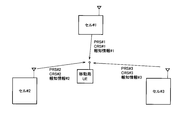
- FIG. 1 is an overall configuration diagram of a mobile communication system according to a first embodiment of the present invention.
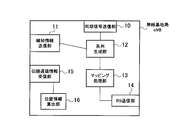
- FIG. 2 is a functional block diagram of the radio base station according to the first embodiment of the present invention.
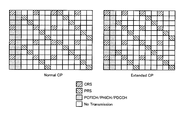
- FIG. 3 is a diagram for explaining the PRS transmitted by the radio base station according to the first embodiment of the present invention.
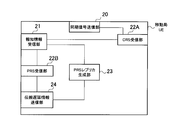
- FIG. 4 is a functional block diagram of the mobile station according to the first embodiment of the present invention.
- FIG. 5 is a sequence diagram showing operations of the mobile communication system according to the first embodiment of the present invention.
- the mobile communication system according to the present embodiment is an LTE-Rel.9 mobile communication system.
- the mobile station UE includes a plurality of cells # 1. To # 3, broadcast information # 1 to # 3, PRS # 1 to # 3, and CRS # 1 to # 3 can be received.
- the mobile station UE has completed connection to the cell # 1, is located in the cell # 1, and the propagation delay from the cells # 1 to # 3 is reduced with respect to the mobile station UE.
- the description will be given on the assumption that measurement is performed and reported to the radio base station eNB.
- the cells # 1 to # 3 may be managed by the same radio base station eNB or may be managed by a plurality of radio base stations eNB.
- or 3 is demonstrated as what is managed by the same radio base station eNB.
- the radio base station eNB includes a synchronization signal transmission unit 10, a broadcast information transmission unit 11, a sequence generation unit 12, a mapping processing unit 13, an RS transmission unit 14, and a propagation delay information reception unit. 15 and a position information calculation unit 16.
- the synchronization signal transmission unit 10 is configured to transmit a synchronization signal in a cell under the radio base station eNB.
- the synchronization signal is composed of two synchronization signals, Primary Synchronization Signal (P-SS) and Secondary Synchronization Signal (S-SS), and these synchronization signals are in one-to-one correspondence with the cell ID (Cell ID). It corresponds.
- P-SS Primary Synchronization Signal
- S-SS Secondary Synchronization Signal
- the broadcast information transmitting unit 11 is configured to transmit broadcast information in a cell under the radio base station eNB.
- the broadcast information includes pseudo cell IDs (Virtual Cell IDs) assigned to the cells # 1 to # 3, and the pseudo information assigned to the target cell for which the mobile station UE wants to measure the delay amount.
- the cell ID is notified.
- the sequence generation unit 12 is configured to generate a CRS sequence and a PRS sequence.
- the sequence generation unit 12 may be configured to generate a CRS sequence (CRS defined by 3GPP TS 36.211) and a PRS sequence according to (Equation 1).
- r l, ns (m) indicates the m th sample in the l th OFDM symbol in the slot of slot number ns.
- N RB RS indicates the number of resource blocks (RB: Resource Block) that transmit CRS or PRS, and is a parameter included in the broadcast information.
- C (m) is a random sequence, and is initialized by (Equation 2) in the case of CRS.
- N ID cell is a cell ID assigned to each cell
- N CP is a variable defined by (Equation 3).
- N ID virtual_cell is a pseudo cell ID assigned to each cell.
- the CRS sequence is uniquely determined by the cell ID
- the PRS sequence is uniquely determined by the pseudo cell ID.
- the range of values that can be assigned as pseudo cell IDs is configured to be larger than the range of values that can be assigned as cell IDs.
- the range of values that can be assigned as pseudo cell IDs may be “0 to 1007”, and the range of values that can be assigned as cell IDs may be “0 to 504”.
- the mapping processing unit 13 is configured to map the CRS sequence generated by the sequence generation unit 12 and the PRS # 1 to # 3 sequences to resource elements (RE: Resource Element).
- the mapping processing unit 13 may be configured to map a CRS sequence and a PRS sequence to each resource element in each resource block.
- mapping processing unit 13 may be configured to map the PRS sequence to the resource element specified by (Equation 5).
- a k, l indicates the symbol of the resource element in the kth subcarrier and the lth OFDM symbol.
- the subcarrier k and the OFDM symbol index l are determined by (Equation 6).
- the RS transmission unit 14 is configured to transmit the resource block in which the CRS and the PRS are mapped by the mapping processing unit 13 in each cell.
- the RS transmission unit 14 is configured to be notified from the upper layer about the frequency bandwidth (number of resource blocks) and transmission interval (transmission timing) for transmitting the PRS.
- the RS transmission unit 14 may be configured not to transmit downlink data on PDSCH (Physical Downlink Channel) in the resource block that transmits the PRS. As a result, the PRS timing detection accuracy can be improved.
- PDSCH Physical Downlink Channel
- the propagation delay information receiving unit 15 is configured to receive the propagation delay information transmitted by the mobile station UE via PUSCH (Physical Uplink Shared Channel, physical uplink shared channel).
- PUSCH Physical Uplink Shared Channel, physical uplink shared channel
- the location information calculation unit 16 is configured to calculate the location information of the mobile station UE based on the propagation delay information received by the propagation delay information reception unit 15.
- the position information calculation unit 16 may be configured to calculate the position information of the mobile station UE by an OTDOA (Observed Time Difference OF Arrival) method.
- the propagation delay information includes propagation delays in at least three cells designated by the broadcast information from the radio base station eNB.
- the mobile station UE since the mobile station UE measures the propagation delay by PRS from the cells # 1 to # 3, the mobile station UE reports the propagation delay from the cells # 1 to # 3 to the radio base station eNB. .
- the location information calculation unit 16 may be provided as a function of the radio base station eNB, or a node different from the radio base station eNB, for example, a higher level node, a Serving Mobile Location Center (SMLC). May be provided.
- SMLC Serving Mobile Location Center
- the mobile station UE includes a synchronization signal receiving unit 20, a broadcast information receiving unit 21, a CRS receiving unit 22A, a PRS receiving unit 22B, a PRS replica 23, and a propagation delay information transmitting unit 24. It has.
- the synchronization signal receiving unit 20 is configured to receive a synchronization signal including the cell ID of the radio base station eNB to which the mobile station UE is connected.
- the broadcast information receiving unit 21 is configured to receive broadcast information from a cell specified by the cell ID detected by the synchronization signal, that is, a cell to which the mobile station UE is connected.
- the CRS receiving unit 22A is configured to receive a CRS in a cell to which the mobile station UE is connected, using a cell ID included in the received synchronization signal. Specifically, the CRS receiving unit 22A receives the CRS in the cells # 1 to # 3 with reference to the above (Formula 1) to (Formula 3), (Formula 5), and (Formula 6). It is configured.
- the mobile station UE estimates the propagation state from the cell # 1 from the received CRS using the replica signal of the cell # 1 to which the mobile station UE is connected, and the broadcast information and the data signal such as PDSCH transmitted from the cell # 1 Is demodulated.
- the PRS receiving unit 22B is configured to receive PRSs in the cells # 1 to # 3. Specifically, the PRS receiving unit 22B is configured to receive the PRSs in the cells # 1 to # 3 with reference to the above (Formula 1), (Formula 3) to (Formula 6), and the like. .
- the PRS replica generation unit 23 is configured to generate PRS replicas in the cells # 1 to # 3 using the pseudo cell ID included in the received broadcast information. Specifically, the PRS replica generation unit 23 is configured to generate a PRS replica in the cells # 1 to # 3 with reference to the above (Expression 1), (Expression 3) to (Expression 6), and the like. Has been.
- the propagation delay information transmitting unit 24 is configured to generate a cell based on the PRS received in the cells # 1 to # 3 received by the PRS receiving unit 22B and the PRS replicas generated in the cells # 1 to # 3 generated by the PRS replica generating unit 23.
- the propagation delays in # 1 to # 3 are calculated, and the propagation delay information indicating the propagation delay and the pseudo cell ID measured for the propagation delay are transmitted to the radio base station eNB.
- the mobile station UE not only uses the PRS from the pseudo cell ID specified by the received broadcast information, but also the delay amount from the pseudo cell ID that can be accurately detected using the PRS from other pseudo cell IDs. May be measured.
- step S1001 the radio base station eNB transmits broadcast information including pseudo cell IDs assigned to the cells # 1 to # 3 as cells for which propagation delay is to be measured.
- the mobile station UE receives the broadcast information # 1 from the connection destination cell # 1 notified from the radio base station eNB.
- step S1002 the radio base station eNB transmits PRS # 1 to # 3 in the cells # 1 to # 3.
- step S1003 the mobile station UE receives the PRSs # 1 to # 3 in the cells # 1 to # 3 using the pseudo cell ID included in the received broadcast information # 1.
- step S1004 the mobile station UE calculates the propagation delay in the cells # 1 to # 3 using the received broadcast information # 1 and PRS # 1 to # 3, and transmits the propagation delay information indicating the propagation delay to the PUSCH. Is transmitted to the radio base station eNB.
- step S1005 the radio base station eNB calculates location information of the mobile station UE using the received propagation delay information.
- a CRS sequence is uniquely determined by a cell ID
- a PRS sequence is uniquely determined by a pseudo cell ID
- a value that can be assigned as a pseudo cell ID Is configured to be larger than the range of values that can be assigned as cell IDs, the distance between cells in which the same sequence of PRS is used is greater than the distance between cells in which the same sequence of CRS is used. Therefore, cells designed from the viewpoint of CRS can reduce the occurrence of PRS collision of the same sequence without revising one plan.
- the location information of the mobile station UE is calculated based on the propagation delay in the plurality of cells calculated by the mobile station UE, whereby LCS (Location Service) can be provided.
- LCS Location Service
- a first feature of the present embodiment is a radio base station eNB, which is configured to transmit a synchronization signal including a cell ID assigned to the cell # 1 in the subordinate cell # 1.
- Transmitter 10 broadcast information transmitter 11 configured to transmit broadcast information including a pseudo cell ID assigned to cell # 1, and a CRS (first reference signal) uniquely determined by the cell ID )
- an RS transmitter 14 configured to transmit a PRS (second reference signal) uniquely determined by the pseudo cell ID, and a range of values that can be assigned as the pseudo cell ID is
- the gist is that the cell ID is configured to be larger than the range of values that can be assigned.
- the propagation delay information acquisition unit 15 configured to acquire propagation delay information from the mobile station UE, and the location information of the mobile station UE based on the acquired propagation delay information. You may comprise the position information calculation part 15 comprised so that it might calculate.
- a second feature of the present embodiment is a mobile station, which is configured to receive broadcast information in the cell # 1 and the synchronization signal receiving unit 20 configured to receive the synchronization signal in the cell # 1.
- the broadcast information receiving unit 21 configured in the above, the CRS receiving unit 25 configured to receive the CRS in the cell # 1 using the cell ID included in the received synchronization signal, and the received broadcast
- the PRS receiving unit 22 configured to receive the PRSs in the cells # 1 to # 3 using the pseudo cell ID included in the information, and the range of values that can be assigned as the pseudo cell ID is
- the gist is that the cell ID is configured to be larger than the range of values that can be assigned.
- the propagation delay from the plurality of cells # 1 to # 3 is calculated based on the PRS received in the plurality of cells # 1 to # 3, and a predetermined radio base station eNB is calculated.
- a propagation delay information transmission unit 24 configured to transmit propagation delay information indicating the propagation delay may be provided.
- radio base station eNB and the mobile station UE described above may be implemented by hardware, may be implemented by a software module executed by a processor, or may be implemented by a combination of both. .
- Software modules include RAM (Random Access Memory), flash memory, ROM (Read Only Memory), EPROM (Erasable Programmable ROM), EEPROM (Electronically Erasable and Programmable, Removable ROM, and Hard Disk). Alternatively, it may be provided in a storage medium of an arbitrary format such as a CD-ROM.
- Such a storage medium is connected to the processor so that the processor can read and write information from and to the storage medium. Further, such a storage medium may be integrated in the processor. Such a storage medium and processor may be provided in the ASIC. Such an ASIC may be provided in the radio base station eNB or the mobile station UE. Further, the storage medium and the processor may be provided as a discrete component in the radio base station eNB or the mobile station UE.
Landscapes
- Engineering & Computer Science (AREA)
- Computer Networks & Wireless Communication (AREA)
- Signal Processing (AREA)
- Mobile Radio Communication Systems (AREA)
Abstract
Description
図1乃至図4を参照して、本発明の第1の実施形態に係る移動通信システムの構成について説明する。





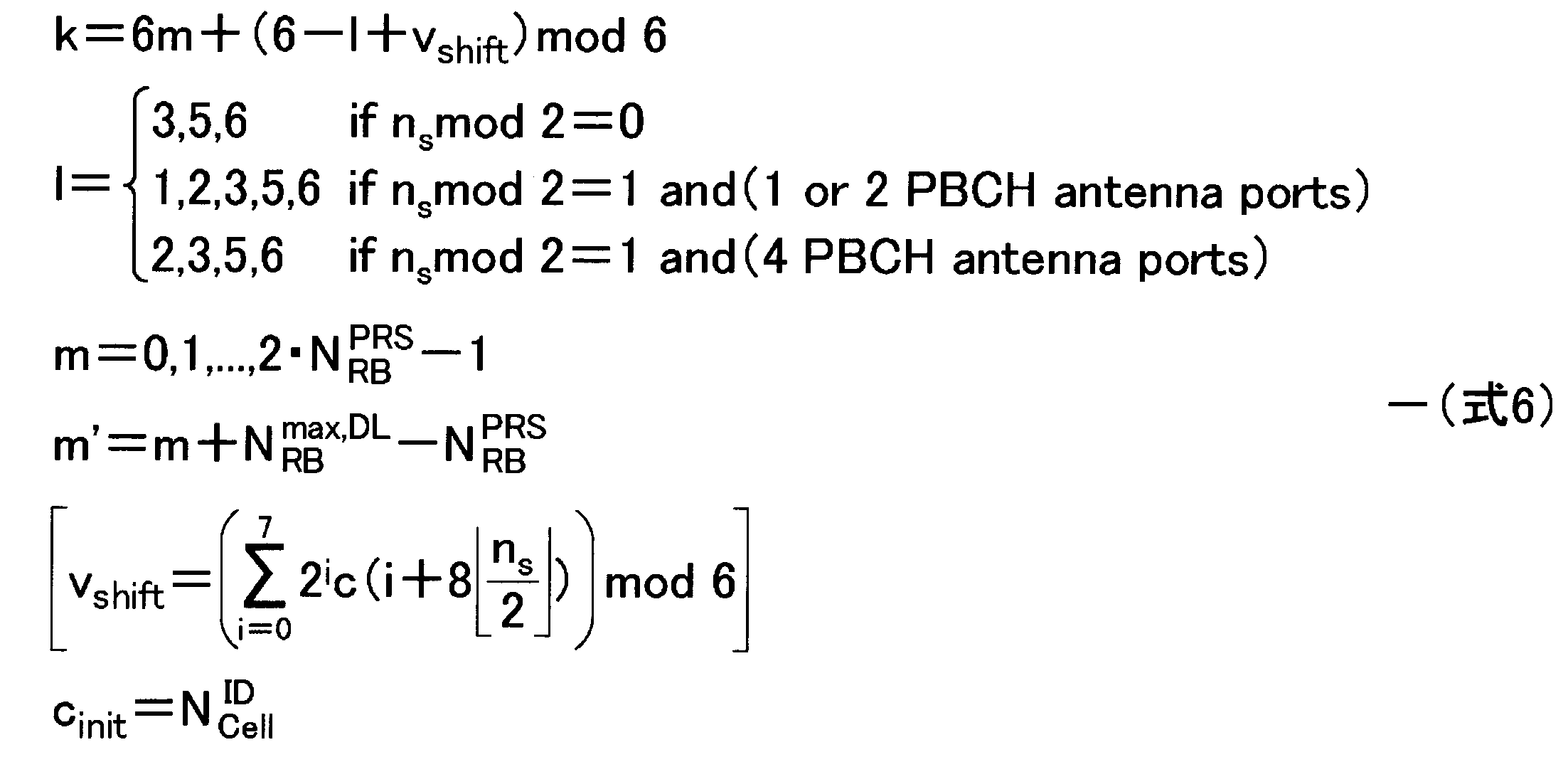
図5を参照して、本発明の第1の実施形態に係る移動通信システムの動作について説明する。
本発明の第1の実施形態に係る移動通信システムによれば、CRSの系列がセルIDによって一意に決定され、PRSの系列が擬似セルIDによって一意に決定され、擬似セルIDとして割り当て可能な値の範囲がセルIDとして割り当て可能な値の範囲よりも大きくなるように構成されているため、同一の系列のPRSが用いられるセル間の距離を同一の系列のCRSが用いられるセル間の距離よりも離すことができるため、CRSの観点で設計されたセルは一計画を見直すことなく、同一の系列のPRSの衝突の発生を低減することができる。
Claims (4)
- 配下のセルに割り当てられているセルIDを含む同期信号を送信するように構成されている同期信号送信部と、
該セルに割り当てられている擬似セルIDを含む報知情報を送信するように構成されている報知情報送信部と、
前記セルIDによって一意に決定される第1参照信号を送信するように構成されている第1参照信号送信部と、
前記擬似セルIDによって一意に決定される第2参照信号を送信するように構成されている第2参照信号送信部とを具備し、
前記擬似セルIDとして割り当て可能な値の範囲は、前記セルIDとして割り当て可能な値の範囲よりも大きくなるように構成されていることを特徴とする無線基地局。 - 移動局から伝搬遅延情報を取得するように構成されている伝搬遅延情報取得部と、
取得した前記伝搬遅延情報に基づいて、前記移動局の位置情報を算出するように構成されている位置情報算出部とを具備することを特徴とする請求項1に記載の無線基地局。 - 特定のセルにおいて、同期情報を受信するように構成されている同期情報受信部と、
前記特定のセルにおいて、報知情報を受信するように構成されている報知情報受信部と、
受信した前記同期信号に含まれているセルIDを用いて、前記特定のセルにおける第1参照信号を受信するように構成されている第1参照信号受信部と、
受信した前記報知情報に含まれている擬似セルIDを用いて、前記特定のセルにおける第2参照信号を受信するように構成されている第2参照信号受信部とを具備し、
前記擬似セルIDとして割り当て可能な値の範囲は、前記セルIDとして割り当て可能な値の範囲よりも大きくなるように構成されていることを特徴とする移動局。 - 複数のセルにおいて受信した前記第2参照信号に基づいて、該複数のセルからの伝搬遅延を算出し、所定の無線基地局に対して、該伝搬遅延を示す伝搬遅延情報を送信するように構成されている伝搬遅延情報送信部を具備することを特徴とする請求項3に記載の移動局。
Priority Applications (2)
| Application Number | Priority Date | Filing Date | Title |
|---|---|---|---|
| US13/390,853 US20120182951A1 (en) | 2009-08-17 | 2010-08-13 | Radio base station and mobile station |
| CN2010800365585A CN102474725A (zh) | 2009-08-17 | 2010-08-13 | 无线基站和移动台 |
Applications Claiming Priority (2)
| Application Number | Priority Date | Filing Date | Title |
|---|---|---|---|
| JP2009188645A JP5055329B2 (ja) | 2009-08-17 | 2009-08-17 | 無線基地局及び移動局 |
| JP2009-188645 | 2009-08-17 |
Publications (1)
| Publication Number | Publication Date |
|---|---|
| WO2011021587A1 true WO2011021587A1 (ja) | 2011-02-24 |
Family
ID=43607042
Family Applications (1)
| Application Number | Title | Priority Date | Filing Date |
|---|---|---|---|
| PCT/JP2010/063768 Ceased WO2011021587A1 (ja) | 2009-08-17 | 2010-08-13 | 無線基地局及び移動局 |
Country Status (4)
| Country | Link |
|---|---|
| US (1) | US20120182951A1 (ja) |
| JP (1) | JP5055329B2 (ja) |
| CN (1) | CN102474725A (ja) |
| WO (1) | WO2011021587A1 (ja) |
Cited By (1)
| Publication number | Priority date | Publication date | Assignee | Title |
|---|---|---|---|---|
| WO2014007539A1 (ko) * | 2012-07-03 | 2014-01-09 | 엘지전자 주식회사 | 무선 통신 시스템에서 하향링크 신호 수신 방법 및 장치 |
Families Citing this family (11)
| Publication number | Priority date | Publication date | Assignee | Title |
|---|---|---|---|---|
| US9258718B2 (en) * | 2011-02-22 | 2016-02-09 | Qualcomm Incorporated | Positioning location for remote radio heads (RRH) with same physical cell identity (PCI) |
| CN103703734B (zh) * | 2011-07-27 | 2019-03-19 | Lg电子株式会社 | 在多节点系统中发送上行链路参考信号的方法和使用该方法的终端 |
| US9294875B2 (en) * | 2011-09-30 | 2016-03-22 | Electronics And Telecommunications Research Institute | Method for determining position of terminal in cellular mobile communication system |
| US9967069B2 (en) * | 2012-03-24 | 2018-05-08 | Lg Electronics Inc. | Method and apparatus for transmitting and receiving reference signal in wireless communication system |
| AU2013250063B2 (en) * | 2012-04-19 | 2017-11-02 | Samsung Electronics Co., Ltd. | Method and apparatus for quasi co-location identification of reference symbol ports for coordinated multi-point communication systems |
| CN103634899B (zh) * | 2012-08-20 | 2018-04-27 | 华为技术有限公司 | 终端定位方法、基站及用户设备 |
| US9768898B2 (en) * | 2013-01-18 | 2017-09-19 | Lg Electronics Inc. | Method for reception in cooperative transmission environment and terminal |
| US9426673B2 (en) | 2013-04-05 | 2016-08-23 | Qualcomm Incorporated | Virtual cell management for interference suppression and interference cancellation in LTE |
| US10855407B2 (en) * | 2016-05-09 | 2020-12-01 | Apple Inc. | Extended physical broadcast channel design for 5G standalone system |
| US11122535B2 (en) | 2016-07-15 | 2021-09-14 | Qualcomm Incorporated | Techniques for locating devices using narrowband positioning reference signals |
| CN108270470B (zh) * | 2016-12-30 | 2021-02-23 | 华为技术有限公司 | 一种数据传输的方法及发送端设备、接收端设备 |
Family Cites Families (6)
| Publication number | Priority date | Publication date | Assignee | Title |
|---|---|---|---|---|
| US6785550B1 (en) * | 2000-11-28 | 2004-08-31 | Lucent Technologies Inc. | Mobile location estimation in a wireless communication system |
| US7194275B2 (en) * | 2003-10-02 | 2007-03-20 | Telefonaktiebolaget Lm Ericsson (Publ) | Position determination of mobile stations |
| CN103312486B (zh) * | 2006-04-27 | 2017-12-26 | 德克萨斯仪器股份有限公司 | 在无线通信系统中分配参考信号的方法和装置 |
| CN101447802A (zh) * | 2007-11-27 | 2009-06-03 | 杰脉通信技术(上海)有限公司 | 一种捕获移动用户终端的方法 |
| US9544776B2 (en) * | 2008-03-25 | 2017-01-10 | Qualcomm Incorporated | Transmission and reception of dedicated reference signals |
| US8467346B2 (en) * | 2009-06-19 | 2013-06-18 | Futurewei Technologies, Inc. | Method and apparatus for generating time-frequency patterns for reference signal in an OFDM wireless communication system |
-
2009
- 2009-08-17 JP JP2009188645A patent/JP5055329B2/ja not_active Expired - Fee Related
-
2010
- 2010-08-13 US US13/390,853 patent/US20120182951A1/en not_active Abandoned
- 2010-08-13 WO PCT/JP2010/063768 patent/WO2011021587A1/ja not_active Ceased
- 2010-08-13 CN CN2010800365585A patent/CN102474725A/zh active Pending
Non-Patent Citations (2)
| Title |
|---|
| "3GPP TSG RAN WG1 Meeting #57, Rl-092176, 2009.05.04", article ZTE: "Some Considerations on Positioning Function in LTE R9" * |
| QUALCOMM EUROPE: "Analysis of PCI extension schemes", 3GPP TSG-RAN WG1 #54, RL-083160, 18 August 2008 (2008-08-18) * |
Cited By (3)
| Publication number | Priority date | Publication date | Assignee | Title |
|---|---|---|---|---|
| WO2014007539A1 (ko) * | 2012-07-03 | 2014-01-09 | 엘지전자 주식회사 | 무선 통신 시스템에서 하향링크 신호 수신 방법 및 장치 |
| US9621316B2 (en) | 2012-07-03 | 2017-04-11 | Lg Electronics Inc. | Method and device for receiving downlink signal in wireless communication system |
| US9641298B2 (en) | 2012-07-03 | 2017-05-02 | Lg Electronics Inc. | Method and device for receiving downlink signal in wireless communication system |
Also Published As
| Publication number | Publication date |
|---|---|
| US20120182951A1 (en) | 2012-07-19 |
| JP2011041150A (ja) | 2011-02-24 |
| JP5055329B2 (ja) | 2012-10-24 |
| CN102474725A (zh) | 2012-05-23 |
Similar Documents
| Publication | Publication Date | Title |
|---|---|---|
| JP5055329B2 (ja) | 無線基地局及び移動局 | |
| US10869165B2 (en) | Base station apparatus, location server, and communication method | |
| CN107750437B (zh) | 用于定位的定位参考信号样式的发送方法及装置 | |
| JP4918580B2 (ja) | 無線基地局、移動局、移動通信方法及び測定方法 | |
| ES2745756T3 (es) | Procedimiento y aparato para generar una señal de referencia de localización en un sistema de comunicación que utiliza una configuración de múltiples antenas transmisoras | |
| JP6652138B2 (ja) | 無線通信システムにおける電子機器及び無線通信方法 | |
| EP3120491B1 (en) | Reference signal enhancement for shared cell | |
| US8326318B2 (en) | Position location for wireless communication systems | |
| JP5624212B2 (ja) | 無線通信システムにおいて位置を決定する方法及び装置 | |
| US9869750B2 (en) | OTDOA in unlicensed band for enhancements of horizontal and vertical positioning | |
| US20110176440A1 (en) | Restrictions on autonomous muting to enable time difference of arrival measurements | |
| KR101539054B1 (ko) | 무선 신호 처리 장치와 위치 측정 장치, 및 그의 위치 측정 방법 | |
| US20230048739A1 (en) | Positioning in a wireless communication network | |
| WO2011024938A1 (ja) | 無線基地局、移動局及び測定方法 | |
| US20250324388A1 (en) | Open pnt access to cellular network supporting accurate and resilient pnt services | |
| US10613189B2 (en) | Location information based on counters of grid cells | |
| CN117294403A (zh) | 侧行链路-定位参考信号配置方法、装置及存储介质 |
Legal Events
| Date | Code | Title | Description |
|---|---|---|---|
| WWE | Wipo information: entry into national phase |
Ref document number: 201080036558.5 Country of ref document: CN |
|
| 121 | Ep: the epo has been informed by wipo that ep was designated in this application |
Ref document number: 10809932 Country of ref document: EP Kind code of ref document: A1 |
|
| NENP | Non-entry into the national phase |
Ref country code: DE |
|
| WWE | Wipo information: entry into national phase |
Ref document number: 13390853 Country of ref document: US |
|
| 122 | Ep: pct application non-entry in european phase |
Ref document number: 10809932 Country of ref document: EP Kind code of ref document: A1 |