WO2011004254A1 - The yeast strain saccharomyces cerevisiae dbvpg24p, its use as an inoculant for the fermentative production of food, in particular prosecco wine, and a relative inoculant - Google Patents
The yeast strain saccharomyces cerevisiae dbvpg24p, its use as an inoculant for the fermentative production of food, in particular prosecco wine, and a relative inoculant Download PDFInfo
- Publication number
- WO2011004254A1 WO2011004254A1 PCT/IB2010/001686 IB2010001686W WO2011004254A1 WO 2011004254 A1 WO2011004254 A1 WO 2011004254A1 IB 2010001686 W IB2010001686 W IB 2010001686W WO 2011004254 A1 WO2011004254 A1 WO 2011004254A1
- Authority
- WO
- WIPO (PCT)
- Prior art keywords
- strain
- wine
- yeast
- prosecco
- fermentation
- Prior art date
- Legal status (The legal status is an assumption and is not a legal conclusion. Google has not performed a legal analysis and makes no representation as to the accuracy of the status listed.)
- Ceased
Links
Classifications
-
- C—CHEMISTRY; METALLURGY
- C12—BIOCHEMISTRY; BEER; SPIRITS; WINE; VINEGAR; MICROBIOLOGY; ENZYMOLOGY; MUTATION OR GENETIC ENGINEERING
- C12G—WINE; PREPARATION THEREOF; ALCOHOLIC BEVERAGES; PREPARATION OF ALCOHOLIC BEVERAGES NOT PROVIDED FOR IN SUBCLASSES C12C OR C12H
- C12G1/00—Preparation of wine or sparkling wine
- C12G1/02—Preparation of must from grapes; Must treatment and fermentation
- C12G1/0203—Preparation of must from grapes; Must treatment and fermentation by microbiological or enzymatic treatment
-
- C—CHEMISTRY; METALLURGY
- C12—BIOCHEMISTRY; BEER; SPIRITS; WINE; VINEGAR; MICROBIOLOGY; ENZYMOLOGY; MUTATION OR GENETIC ENGINEERING
- C12N—MICROORGANISMS OR ENZYMES; COMPOSITIONS THEREOF; PROPAGATING, PRESERVING, OR MAINTAINING MICROORGANISMS; MUTATION OR GENETIC ENGINEERING; CULTURE MEDIA
- C12N1/00—Microorganisms; Compositions thereof; Processes of propagating, maintaining or preserving microorganisms or compositions thereof; Processes of preparing or isolating a composition containing a microorganism; Culture media therefor
- C12N1/14—Fungi; Culture media therefor
- C12N1/16—Yeasts; Culture media therefor
- C12N1/18—Baker's yeast; Brewer's yeast
- C12N1/185—Saccharomyces isolates
-
- C—CHEMISTRY; METALLURGY
- C12—BIOCHEMISTRY; BEER; SPIRITS; WINE; VINEGAR; MICROBIOLOGY; ENZYMOLOGY; MUTATION OR GENETIC ENGINEERING
- C12R—INDEXING SCHEME ASSOCIATED WITH SUBCLASSES C12C - C12Q, RELATING TO MICROORGANISMS
- C12R2001/00—Microorganisms ; Processes using microorganisms
- C12R2001/645—Fungi ; Processes using fungi
- C12R2001/85—Saccharomyces
- C12R2001/865—Saccharomyces cerevisiae
Definitions
- This invention regards a yeast strain belonging to the species Saccharomyces cerevisiae suitable for alcoholic fermentation, particularly of grapes. Furthermore, the invention refers to the use of the yeast strain in the fermentative production of food and particularly in the vinification process, especially in the production of Prosecco wine, and a relative inoculant.
- Selected yeast or selected starter therefore intends a strain characterized by physiological, biochemical, and enological properties that are optimized in relation to the technological needs of varietal fermentation processes (Pretorius, 2000).
- the first yeasts were selected with the goal of enhancing the technological characteristics (fermentative vigor, alcohol tolerance) so as to obtain products without defects.
- Today the latest generation yeasts are selected on the basis of characteristics that can improve the quality of the wines through the expression of precursors already present in the musts and the production of secondary metabolites (higher alcohols, esters, ketones, aldehydes).
- yeasts may also present some non-negligible disadvantages, and could lead to an excessive standardization resulting in a reduction of the biodiversity of the wine yeast strains associated with the winery environment.
- ecotypic starters are exclusively used in the isolation area and have been selected following the typicality characteristics of the local product. In reality they are the yeasts that originally gave rise to spontaneous fermentation and thus contributed to constructing the wine's typicality characteristics.
- the fermentative or alcohol-generating power which according to Delfini is the maximum alcohol content (intended as % ethanol) produced by a yeast through fermentation of a must containing excess sugar (Delfini, 1995) is among the principal technological characteristics.
- Ethanol the principal product of the yeasts' activity under anoxic conditions, is the compound that exerts an inhibitory action on all microorganisms. Since notable performance is required from yeasts in enology (for example the requirement for the production of wines with high alcohol content), the resistance (alcohol tolerance) toward this compound also evidently assumes fundamental importance.
- the yeasts of southern musts have an alcohol-generating power that is on average higher than that coming from northern musts of the same species (Zambonelli et al., 2000).
- fermentative vigor expresses the capacity to give rise to ready and rapid fermentation, also in the presence of antiseptics at the doses allowed by law and at temperatures between 2O 0 C and 3O 0 C.
- Another very important factor is resistance to sulfur dioxide SO 2 , i.e. the capacity to maintain the fermentation velocity unaltered or sufficiently elevated in the presence of the selective doses of SO 2 added to the musts. It is important to select the strains that are most resistant to this antiseptic to avoid start-up problems in the fermentative process.
- the development mode i.e. the behavior of the yeast cells at the end of the budding process, distinguishing from among powdery development, flocculant development, or development in aggregates.
- the most common development in S. cerevisiae is the powdery one; this is also the most desirable in a starter selected for primary fermentation.
- the sedimentation speed is another positive characteristic as it facilitates the subsequent clarification and filtration operations. The sedimentation speed can be measured by the clarification time expressed in days.
- the strains that make the wine murky in the most annoying and persistent manner are the foaming ones.
- the foaming power results from the fact that in many strains (20-30%) the cells adhere to the CO 2 bubbles that are produced during fermentation. Instead of breaking once they arrive at the surface, they blend together and increase in volume, giving rise to foams that assume a gray-brown color due to the presence of the cells.
- the height of the foam is evaluated to measure this parameter.
- the absence or lack of foam production is surely a positive characteristic in both primary fermentations and in re-fermentation, because it reduces the volume occupied by the must.
- Another aspect is the film-forming power. At the end of normal alcoholic fermentation, some strains give rise to a film on the surface of the wine, where development continues under oxidizing conditions (flor). The flor strains oxidize the ethanol and form a series of aromatic compounds.
- Adhesiveness instead is the capacity of the yeast cells to grow adherent to the surfaces of wine vessels; this is a negative characteristic because it complicates the sanitization of the tanks at the end of processing (Vincenzini et al., 2005).
- the principal quality characteristics i.e. the characteristics relative to the production of substances that are important from an organoleptic point of view, are described below.
- Glycerol after ethanol and CO 2 , is the compound produced in the greatest quantities during alcoholic fermentation. It greatly influences the "body of the wine”, and contributes to giving wines the characteristics of "fullness” and “sweetness” (perception threshold 5.2 g/l).
- Saccharomyces of vinification can produce from 2 to 10 g/l as a function of the species and strain of yeast.
- S. cerevisiae is the yeast that forms the smallest quantities of glycerol and this is the principal reason for its high ethanol yield.
- Glycerol is appreciated at higher concentrations in red wines, to which it gives the sensation of "aged", and is for the same reason not appreciated in the case of wines that must conserve their original freshness.
- This compound in reality, is not a secondary product of fermentation because it derives directly from the sugars and its amount of formation, with the same strain, is proportional to their concentration (Zambonelli et al. 2000).
- acetic acid that derives from the degradation of sugars during fermentation by the oxidation of acetaldehyde (Ribereau-Gayon, 2000).
- the capacity to produce higher or lower amounts of acetic acid is a characteristic of the species and strain, and is hereditary and stable.
- This characteristic is currently defined with the term of fermentative purity, and is expressed as the relationship between the volatile acidity formed and the ethanol produced.
- the best strains are those that have the lowest value of fermentative purity. In principle, for a wine with 10% alcohol, a value of this characteristic less than 0.3 g/l is already considered to be very good.
- the volatile acidity of wines may have different origins and does not derive only from the activity of the yeast; often the must also has a significant acetic acid content as a consequence of acid rot or the development of acetic acid bacteria on the grapes (Zambonelli, 2003).
- Acetaldehyde is the most important carbonyl compound formed during fermentation and represents over 90% of the wine's total aldehyde content. It is a normal product of alcoholic fermentation and its content in wine can vary notably (10-300 mg/l); the evaluation of its content is used as an indicator of the degree of oxidation of a wine.
- a high acetaldehyde level is undesirable and wines containing 500 mg/l are considered unmarketable.
- White wines generally have an average value of 80 mg/l. It confers a pleasant fruit aroma when present in wine at low levels, but already at concentrations of 100-125 mg/l it liberates a pungent and irritating odor. Sulfur dioxide induces the production of acetaldehyde by the yeast and this seems to be correlated to the resistance of yeast to dioxide itself.
- the main factor determining the variability of acetaldehyde content is the species of yeast. S. cerevisiae is among the major producers of the molecule (50-120 mg/l) (Vincenzini, et al. 2005).
- the higher alcohols predominantly represented are: n-propanol, isobutanol, amyl alcohol, and 2-phenyl ethyl alcohol. These compounds are derived from the catabolism of the corresponding amino acids present in the must, but also from the metabolism of glucose without the involvement of amino acid precursors.
- Sulfur compounds from a qualitative point of view, consist primarily of hydrogen sulfide (H 2 S) and sulfur dioxide (SO 2 ), which derive directly from the reduction of sulfates present in the musts; they are always produced by S. cerevisiae, even if at quantities that vary according to the strain.
- Malic acid is one of the principal organic acids in musts and wines. Some non-Saccharomyces yeasts can consume it through malolactic fermentation. On the other hand, some strains of Saccharomyces, generally those among the cold-resistant ones, have been identified that can also produce malic acid during the fermentative process (Fatichenti et al., 1981).
- esters are produced, obtained from the union of acetic acid or other primarily medium-chain fatty acids with ethanol or other higher alcohols present in the wine and also produced by the yeast's metabolism.
- the influence on the wine's quality can be negative and unappreciated, especially in the case of ethyl acetate, which confers a typical vinegar (or even solvent) smell.
- Others are instead quite desired, as for example the ester ethyl caproate, especially in those wines characterized by hints of white fruit (e.g. Prosecco).
- yeasts can modify the composition of wines indirectly, i.e. by mediating the secretion of hydrolytic enzymes into the medium.
- ⁇ -glucosidase activity acts on the glycosylated aromatic precursors that characterize the different grape varieties, liberating the fragrant molecule responsible for the varietal aroma. It has long been known that these molecules (belonging to the classes of terpenes, benzenes, and norisoprenoids) play a very important role in conferring the taste and smell of the grape and wines. These compounds are primarily present in the form of glycosidic complexes that are inactive from a sensorial point of view.
- the hydrolysis of the glycosidic complexes and the consequent liberation of monoterpenes can be obtained with physical methods (temperature), chemical methods (acidification), and with biochemical methods (by enzyme); the latter are the most effective.
- the enzymes in question represented by the class of ⁇ -glucosidases, are widespread in the plant world and, in particular, in the grape itself (Gunata et al., 1985). In S. cerevisiae, ⁇ -glucosidase activity is present in a very limited group of strains, while it is quite frequent in the apiculates (Zambonelli, 2003).
- the most important nutrient during vinification is readily assimilable nitrogen; it can be present in the form of ammonium or also amino acids.
- the concentration of nitrogen in the grape decreases during the latter's maturation. Grape must often contains insufficient quantities of readily assimilable nitrogen. In this case it is necessary to add nitrogen, e.g. in the form of diammonium phosphate, during fermentation.
- EP 1 482 029 A1 describes two strains of ecotypic Saccharomyces cerevisiae isolated in Spain. Particularly favorable characteristics are described, such as a good sugar/ethanol yield and particular fruity and fresh aromas. The document does not however describer the chemical analysis of particular chemical components.
- the purpose of the invention is to provide a yeast strain of the species Saccharomyces cerevisiae ecotypic of the DOC area of Conegliano and Valdobbiadene (Veneto Region - Italy) that is equipped with technological and enological characteristics that allow a good fermentation of the must obtained, above all with the Prosecco grape, allowing the production of a pleasant wine.
- Another purpose is to provide a strain that produces higher alcohols in low quantities and that simultaneously has an elevated production of aromas that give the Prosecco wine the typical hints of white fruit and citrus.
- a particularly important purpose of the invention is to provide a yeast strain of the species Saccharomyces cerevisiae that can also be used in the fermentation of musts with a low content of readily assimilable nitrogen, and that can also preferably be used without the addition of readily assimilable nitrogen.
- Another purpose of the invention is to provide a yeast strain that can be used in alcoholic fermentation for the production of food in general and a relative inoculate that contains this strain.
- the yeast strain Saccharomyces cerevisiae according to the invention has optimal enological characteristics, both technological and chemical, and is ecotypic to the DOC area of Conegliano and Valdobbiadene.
- the strain has been identified with the denomination P301.9 and has been deposited according to the Budapest Treaty on 05/26/2009 at the "Industrial Yeasts Collection" DBVPG in Perugia (Department of Applied Biology, Section of Microbiology, Faculty of Agriculture - University of Perugia, Borgo XX Giugno, 74 - 06121 PERUGIA - IT) with deposit number 24P and protocol number PROT. 521/P/2009.
- a fundamental characteristic of the selected strain is to represent an optimum compromise between technological characteristics and aspects of typicality linked to Prosecco wine.
- the isolated strain is selected and overwhelmingly characterized by a very low need for assimilable nitrogen. This fact makes it universally utilizable even in musts with a low content of readily assimilable nitrogen.
- vinification carried out with the addition of inocula of this yeast does not require the addition of assimilable nitrogen or only at low concentrations.
- the strain presents a very low production of higher alcohols (1-propanol and 3-methyl-1-butanol) and the absence of the production of 1-butanol. Furthermore, the ethyl acetate concentration is very low. The wine obtained with this yeast is free of pungent solvent odors.
- the strain according to the invention produces less than the commercial control strain (Premium Prosecco, Enologica Vason SrI, Nassar, Pedemonte, Verona, containing a strain of the species Saccharomyces cerevisiae), which is the most used in the Prosecco area and is considered to be a good enological strain.
- commercial control strain Premium Prosecco, Enologica Vason SrI, Nassar, Pedemonte, Verona, containing a strain of the species Saccharomyces cerevisiae
- the P301.9 strain is therefore absolutely superior to currently available strains for its olfactory qualities. It furthermore produces geraniol (citrus aroma); this terpenic alcohol is not found in detectable concentrations in the wine produced with the commercial strain currently rated as the best strain available. These molecules give the typical desired aromas to the Prosecco.
- the good beta-glucosidase activity of the strain surely plays an important role in the development of the varietal aromas which are essential for defining the typicality as characterizing.
- the ITS and D1/D2 sequences that genetically characterize the strain are represented in the list of sequences with the sequence identification numbers SEQ ID NOs 19 (D1/D2) and 20 (ITS).
- the yeast according to the invention has the following physiological characteristics: sporulates on acetate agar, with persistent asci, containing from one to four spherical spores. Does not grow in the presence of 10 mg/l cycloheximide.
- the yeast subject of this invention has the enological characteristics reported below: glucose consumed after 2 days (fermentative vigor) 3.6 g; glucose consumed after 7 days 15.1 g; glucose consumed at the end of fermentation 18.3 g; 15 days of fermentation, maximum height of the foam produced 18 mm; clarification time 14 days, adhesiveness 2 mm.
- yeast strain according to the invention has a nitrogen requirement less than 50 mg/l in the tested experimental conditions cited above.
- the strain has been genetically and enologically characterized.
- Example 2 describes the genetic characterization of the strain in detail, while example 3 describes the enological characteristics in detail.
- the strain is preferably stored desiccated, lyophilized, or as a paste. These forms make it suitable for transport and sale.
- the strain can also be stored at low temperatures or in frozen form.
- the desiccated strain can be in the form of dust or pellets. Freezing or dehydration occurs through methods well known to the expert.
- the strain according to the invention is suitable to be used in the production of food obtained through alcoholic fermentation.
- Foods produced with this yeast include, for example, bread, dairy-based products, cider, beer, sparkling wine, and wine.
- Other alcoholic beverages obtained by the alcoholic fermentation of other fruits, cereals (such as wheat or rice), or potatoes by using the strain proposed in this invention are however conceivable.
- Another aspect of the invention therefore regards the use of the strain identified as P301.9 according to the invention as an inoculate for the production of food obtained through alcoholic fermentation.
- the strain can be used not only in vinification, but also generally in the production of food obtained through alcoholic fermentation.
- the inoculate is a set of cells, generally selected and genetically homogeneous, that is introduced in the raw material (e.g. must) to produce food (e.g. wine).
- the food is preferably a wine; alcoholic fermentation is a vinification process and the inoculate is a wine starter.
- the wine starter is the dose of yeast necessary to activate fermentation.
- the use of the strain in vinification refers to a white wine produced from Prosecco grapes. This because it produces the apple and citrus aromas that are highly desired in Prosecco. Other white wines, red wines, rose wines, etc. are obviously conceivable.
- vinification using the strain according to the invention as a starter, occurs without the addition of readily assimilable nitrogen.
- the Prosecco produced has a concentration of ethyl caproate naturally produced by the strain > 800 ⁇ g/l. These concentrations give the wine a pleasant apple aroma.
- the Prosecco produced with the strain according to the invention as a starter contains geraniol naturally produced by the strain.
- the geraniol gives the wine an aroma of rose and citrus.
- Another important aspect concerns an alimentary inoculate that includes the strain identified as P301.9 (DBVPG 24P).
- the inoculate is a wine starter.
- the strain is particularly suited for the production of wines, as it produces pleasant aromas with a low production of higher alcohols.
- the Prosecco grapes used for the production of Prosecco wine with the strain according to the invention are preferably produced in the DOC zone of
- the P301.9 strain can easily be cultivated and is therefore highly suited to be used to produce biomass, also at an industrial scale, with noted standard methods. Its cultivation preferably occurs on a YM medium containing 3 g/l yeast extract, 3 g/l malt extract, 5 g/l peptone, and 10 g/l glucose.
- Its growth preferably occurs at a temperature of 25°C. Cultivation can also occur on a YPD media (10 g/l yeast extract, 20 g/l peptone, 20 g/l glucose) at 25°C. The recommended subculture period is from 24-48 hours. The preferred storage conditions are in glycerol (YM media containing 40% v/v glycerol) at -80 0 C. Dangerous characteristics for the health of people, animals, or for the environment are not known; the strain is not pathogenic. The type of coupling is not known. Sporulation preferably occurs on PRE5 media (Codon et al., 1995, Applied Environ. Microbiol. 61 , p.
- the colony counting method on a Petri dish, using the YM growth medium, can be used to check for the presence of living cells.
- the wine is obtained in this process without the addition of readily assimilable nitrogen.
- readily assimilable nitrogen makes it particularly suitable for this process, thus avoiding a possible overdose of artificial nitrogen sources.
- This strain is therefore particularly suitable for fermentations in which the fermentation media is poor in readily assimilable nitrogen.
- a Prosecco wine obtained through the alcoholic fermentation of Prosecco must with the strain according to the invention comports many advantages, including elevated concentrations of ethyl caproate (apple flavor) and low concentrations of higher alcohols (absence of pungent odors).
- the very low ethyl acetate content makes it superior to wines produced with other yeasts.
- the strain according to the invention has optimal enological qualities, both chemical and technological, making it particularly suited to the production of a good Prosecco wine.
- Vinification can be executed in an optimal way by introducing the strain in the form of an inoculate prepared according to the protocols described in example 1 , e.g. at point 1.9, which regards microvinification.
- the method allows ecotypic strains with olfactory, sensorial, technological, and chemical qualities suitable for the vinification of Prosecco grapes to be selected.
- the technological, chemical, and olfactory parameters examined can vary according to the characteristics that are required for the strain and also depend on the type of wine that must be produced with the selected strain.
- the selection of the most appropriate strains for individual phases is preferably a combined selection, considering all of the results of all of the analyses carried out.
- the choice of the combination of analyses to be carried out is determined by the yeast's desired characteristics. Olfactory/sensorial parameters also represent an important factor for defining a reduction in the number of strains in the pool to be considered in the next phase and to choose the strain that also satisfies aromatic requirements from among many strains with comparable technological characteristics.
- Example 1 describes the different phases occurring during the isolation of strains suited to vinification.
- strain according to the invention was chosen on the basis of its readily assimilable nitrogen requirement (see example 3, point 3.6: Nitrogen requirement) and elevated production of ethyl caproate and geraniol.
- the sampling territory in which the strain covered by the invention was isolated constitutes the DOC production zone of Conegliano and Valdobbiadene, which prevalently extends through the hilly portion of the Treviso province (a group of hills with east-west directionality that reach the Alps); only toward Conegliano are the vineyards planted in more low-lying areas.
- the vines are cultivated only in the sunniest part of the hills, at an altitude between 50 and 500 meters above sea level.
- Prosecco grapes The strain has been isolated from Prosecco grapes.
- the ampelographic findings have demonstrated the existence of significant differences relative to 22 characteristics among the biotypes of Prosecco tondo and Prosecco lungo present in the DOC area of Conegliano-Valdobbiadene.
- Prosecco lungo differs from Prosecco tondo primarily for having a sprout that is a little hairier and more colorful, leaves that are slightly larger, leathery, and with the petiolar sinus less closed, a slightly shorter bunch, and a grape with an elliptical-short shape instead of a spherical one.
- the Conegliano and Valdobbiadene DOC area was subdivided into 37 micro-areas in which the sampling of the bunches was carried out. Bunches from 11 of the 37 localities were obtained, allowing yeasts of technological interest (Saccharomyces sensu stricto) to be isolated after fermentation.
- the strain P301.9 comes from the "CoI de Roer" area (in the municipality of Valdobbiadene) in which the highest biodiversity (the 192 isolates coming from this region were grouped into 12 genetic profiles that correspond to as many strains) was found.
- the Saccharomyces yeasts collected in this area constitute 16.2% of the total of isolates identified as belonging to this group.
- - Fig. 1 shows the karyotype of yeast strain P301.9 obtained by pulsed electrophoresis
- Fig. 2 shows the analysis of the microsatellite sequences of strain P301.9
- - Fig. 3 shows the restriction profile of the mitochondrial DNA of strain P301.9.
- Fig. 1 shows the result of an electrophoresis carried out with TBE 0.5x buffer at 9°C, agarose at 1.2% concentration, a voltage gradient of 5.1 V/m, a length (run time) of 34 h with an initial switch of 60 seconds and a final switch of 120 seconds.
- the strain YPH755 is the reference marker.
- M represents the molecular weight marker (mix of Marker III + Marker Vl, Roche, Milan). They mean:
- M is the GeneRulerTM 1 kb DNA Ladder (Fermentas Life Sciences,
- strain P301.9 determines the electrophoretic profiles obtained from the enzymatic digestion of the mitochondrial DNA restriction profile and from the amplification of the microsatellite sequences represented in Fig. 2.
- the sampling was carried out by collecting individual bunches of grapes within the DOC Prosecco area of Conegliano and Valdobbiadene in the days immediately preceding the harvest.
- the collection was carried out at each phase by avoiding touching the bunches with the hands and periodically sterilizing the scissors, with the aim of limiting contaminations as much as possible.
- the salient characteristic of the media used is that it contains a colorant, bromocresol green, which can be variably absorbed by yeast. It is therefore possible to characterize the microorganism on the basis of the colony's morphology and the coloration that it assumes.
- the pure culture obtained after the last plate passage was withdrawn with a sterile spatula, and the material was inserted in 0.5 ml Eppendorf tubes containing a sterile solution of 20% glycerol in water (approx. 300 ⁇ l) and resuspended through vortex agitation.
- the tubes containing the yeast were stored at -20 0 C.
- the method allowed this group of yeast to be discriminated with respect to others present in the enological environment on the basis of differences between nucleotides within the region of DNA encoding for ribosomal RNA (rDNA).
- the section of DNA that carries the most information relative to the differences between the yeast species is the D1/D2 region of DNA 26S; information on it relative to the sequence characteristics of many yeast species is available in the public nucleotide database GenBank.
- yeast belonging to the group Saccharomyces sensu stricto gave rise to the amplification of two DNA fragments (with lengths of 460 and
- the aforementioned amplified fragments can easily be visualized as distinct bands through gel electrophoresis on agarose gel.
- the DNA sample for the amplification was prepared by resuspending a single yeast colony of 1-2 mm in diameter in 20 ⁇ l of sterile deionized water with a tip.
- DNA amplification mixture Lysis of the cells occurs during the first step of the heat protocol reported below, by heating at 94°C for 5 minutes.
- the PCR tests were carried out in reaction volumes of 25 ⁇ l.
- SAC26F with a length of 22 nt corresponds to SEQ ID NO: 1
- SAC26R with a length of 27 nt corresponds to SEQ ID NO: 2
- SAC18F with a length of 23 nt corresponds to SEQ ID NO: 3
- SAC18R with a length of 25 nt corresponds to SEQ ID NO: 4.
- each of the 308 yeast collected were submitted to fermentation tests using synthetic must (0.1 g/l CaCb, 0.1 g/l NaCI, 1 g/l KH 2 PO 4 , 0.5 g/l MgSO 4 -7H 2 O, 3 g/l tartaric acid, 0.2 mg/l NaMoO 4 -2 H 2 O, 0.004 mg/l ZnSO 4 -7H 2 O, 0.5 mg/l H 3 BO 3 , 0.04 mg/l CuSO 4 -5 H 2 O, 0.1 mg/l KJ, 0.004 mg/l FeCI 3 -6H 2 O, 0.4 mg/l MnSO 4 H 2 O, 400 ⁇ g/l pyroxidine hydrochloride, 400 ⁇ g/l thiamine hydrochloride, 2000 ⁇ g/l inosite, 20 ⁇ g/l biotin, 400 ⁇ g/l calcium pantothenate, 400 ⁇ g/l nicotinic amide, 200 ⁇ g/l/l
- the inoculate was prepared by diluting the film obtained from a culture grown in GPY media (10 g/l yeast extract, 20 g/l peptone, 20 g/l glucose, 20 g/l agar) in 10 ml of synthetic must until achieving an optical density at 620 nm (OD 62 o) of 1.5. With this procedure, a final concentration in the must of approximately 1.5 x 10 6 cells/g is obtained. The OD 62 o was measured with a Pharmacia spectrophotometer mod. Ultrospec 2000 using an aliquot of 1 ml of culture transferred to the appropriate tube.
- GPY media 10 g/l yeast extract, 20 g/l peptone, 20 g/l glucose, 20 g/l agar
- the suspension was inoculated in a flask containing 90 ml of synthetic must and incubated at 20 0 C.
- the decrease in weight due to the loss of CO 2 from the flasks prepared for the fermentation tests was monitored daily, choosing the decrease in weight at 2 days, 7 days, and at the end of fermentation as parameters for comparison between the strains.
- the clarification time of the media was evaluated as the number of days necessary for the sedimentation of the yeast beginning at the moment of inoculation.
- the capacity of the cells to grow adherent to the walls of the flask was determined for each isolate grown in synthetic must.
- the height (in mm) of the ring of cell growth from the bottom of the flask was measured. The measurement was carried out at the end of fermentation.
- each isolate was inoculated on Biggy agar media so as to obtain the growth of an individual colony.
- the plates were incubated at 25°C for 4 days, after which the coloration of the individual colonies developed was evaluated.
- the quantity of hydrogen sulphide is proportional to the intensity of coloration, due to the development of bismuth sulphite (dark brown if present in significant quantities).
- the fermented material was submitted to an olfactory evaluation to identify the presence of abnormal odors.
- the following DNA extraction procedure was carried out for each of the 308 isolates.
- the film obtained from a culture grown in Petri dishes containing YM media for 48 h at 25°C was resuspended in 1 ml of sterile water and then centrifuged at 14000 rpm for 3 minutes in an Eppendorf microcentrifuge.
- the cells were resuspended again in 500 ml of a solution containing lytic enzyme obtained from Rhizoctonia solani (25 mg/ml in 1M sorbitol, 0.1 M EDTA, pH 7.5). The suspension was briefly agitated with a vortex. The samples were incubated at 45°C for two hours during which time they were periodically agitated to maintain the cells in suspension. At the end of incubation, the samples were centrifuged at 14000 rpm for 5 minutes and the supernatant was removed.
- lytic enzyme obtained from Rhizoctonia solani
- the cells were then resuspended in 500 ml of TE (50 mM Tris-HCI, 20 mM EDTA at pH 7.4) and 50 ⁇ l of 10% SDS (sodium dodecyl sulfate) were added.
- the samples were incubated in a water bath at 65°C for 30 minutes. At the end, 200 ⁇ l of 5M potassium acetate were added and the samples were left in ice for 30 minutes.
- the tubes were centrifuged at 14000 rpm for 5 minutes and the supernatant was transferred to a 1.5 ml Eppendorf tube. After having added 600 ⁇ l of cold isopropanol, the samples were kept at ambient temperature for 5 minutes, mixing them by inverting the tubes, and then centrifuged at 14000 rpm for 10 minutes.
- the supernatant was eliminated and 500 ⁇ l of 70% ethanol was added. After centrifugation at 14000 rpm for 5 minutes and removal of the supernatant, the pellet was dried for 1 h at 37°C.
- the samples were resuspended in 50 ⁇ l of sterile water, to which 1.5 ⁇ l of RNases (10 mg/ml) were added, and left at ambient temperature for 20 minutes.
- the samples obtained in this way were stored at -20 0 C.
- the enzymatic digestion of whole DNA was carried out in reaction volumes of 15 ⁇ l containing 10 ⁇ l of DNA and 10 U of H/nfl enzyme. The reactions were conducted at 37°C for 2 hours. The linear DNA fragments were separated through electrophoresis on 1% agarose gel.
- the selection criteria in addition to the best fermentation performances, also included the genetic profile and the geographical origin of the isolate so as to represent, also in subsequent tests, the microbial biodiversity collected from both a genetic point of view and from the point of view of representativeness of the territory.
- the 66 samples chosen were submitted to a further genetic investigation to determine the species of membership among those included in the group Saccharomyces sensu stricto.
- the section of DNA between those encoding the subunits 18S and 26S, encoding the rRNA of subunit 5.8S and containing the two adjacent zones denominated ITS (Internal Transcribed Spacers), particularly interesting because they demonstrate a much higher sequence polymorphism than that associated with the genes encoding the rRNA of the 18S and 26S subunits (Cai et al., 1996; James et al., 1996) was taken into consideration.
- This variability is extremely high, if organisms belonging to different species are considered, while it drops dramatically when strains of the same species are considered.
- This intra-specific polymorphism can be revealed through amplification by PCR of the ITS region and subsequent analysis of the restriction profile using opportune enzymes (Esteve-Zarzoso et al., 1999). It is a fast and easy method for the identification of yeast that has the advantage of providing information relative not only to strain to be recognized but also to the rest of the microbial population.
- the primers used are ITS1 with a length of 19 bp with SEQ ID NO: 5 and ITS4 with a length of 20 bp with SEQ ID NO: 6 (White T. J. et al. 1990).
- the amplification products of the ITS1-5, 8S-ITS2 region of the rDNA were digested with the enzymes Haelll and Mae ⁇ .
- the digestions were carried out in reaction volumes of 20 ⁇ l containing 10 U of enzyme and 10 ⁇ l of amplified product.
- the reactions were conducted at 37°C for 16 hours.
- the digestion products were visualized on a 1.5% agarose gel.
- Technological characterization of the chosen isolates in Prosecco must The 66 strains chosen on the basis of the fermentations in synthetic must were further assayed through growth tests in flasks, this time using Prosecco must. For this analysis, the characteristics taken into consideration were the decrease in weight at 2 days (fermentative vigor) and at 7 days, the duration of the fermentation, the height of the foam produced and the velocity of clarification of the fermented product.
- the inoculate was prepared by diluting the film obtained from a culture grown in GPY media in 23 ml of 18% sucrose solution until the achievement of an OD 62 o of 1.6, which corresponds to approx. 3.5 x 10 6 cells/ml.
- the suspension was centrifuged at 8000 rpm for 10 minutes, the pellet resuspended with 10 ml of natural must, and inoculated in a flask containing 190 ml of the same must.
- the culture was incubated at 25 0 C.
- the product (approx. 200 ml of basic wine) was transferred into two 100 ml bottles, closed with a crown cap and stored at 10 0 C.
- the wines obtained in this way were subjected to a sensorial evaluation by a panel composed of 8 tasters between 25 and 50 years of age. Expert tasters, technicians in the sector, and experts in Prosecco production technology were chosen.
- the samples were presented anonymously, and the wine was served at a temperature of approximately 10 0 C.
- the specially prepared evaluation form asked for a judgment expressed numerically with a scale from 1 to 10, in relation to the following parameters: typicality, presence of any defects, presence of pleasing organoleptic notes.
- a judgment of preference was also requested, numerically reordering the samples beginning with that with the best characteristics.
- microvinification tests were carried out with the aim of further evaluating the 9 strains with the best results during tasting together with a control consisting of a strain of commercial yeast (Premium Prosecco, Enologica Vason SrI, containing a strain of Saccharomyces cerevisiae).
- the 10 yeast proposed for the microvinification were cultivated on modified Malt agar (30 g/l malt extract, 5 g/l plant peptone, 15 g/l agar, pH 5.4), using the plant peptone instead of the traditional meat protein extract, in view of the use of the wines obtained for tasting.
- a definite quantity of yeast was withdrawn from these plates to inoculate 20 ml of an 18% sucrose solution in order to have an OD 6 oo equal to 1, corresponding to about 10 7 cell/ml.
- CFU colony-forming units
- the microvinification tests were conducted using pre-sulphited Prosecco must stored at 15°C (50 mg/l total SO 2 ) transported in 100 I bins to the processing room, which was maintained at 10 0 C for the inoculate. The must was subdivided into 10 carboys (container volume 34 I) with 30 I in each and brought to ambient temperature for approximately 12 hours so as to bring the temperature to 16-18°C.
- the inoculation was carried out by adding 3 I of yeast culture to 30 I of must. In conjunction with the inoculate, an activator was added (ammonium phosphate 59.88%, thiamine hydrochloride 0.6%, cellulose 39.52%) at a concentration of 10 g/hl. The day after the inoculation, 100 ml of material were sampled for the chemical analyses. The sampling for these analyses was carried out daily in the first fermentation period and then every 2-3 days.
- the SO 2 level was checked again and brought to a value of 1.2 mg/l.
- WineScan is a spectrophotometer dedicated to the analysis of liquid matrices and is prevalently used for the analysis of wines, musts, beer, and balsamic vinegars.
- the instrument operates in the infrared spectral range, using an IR source as the light beam and a special optical-electronic device called an interferometer as the system to measure the wavelength; the latter exploits the principal of the interference of light waves, and can measure the various wavelengths of the individual components of the liquid matrix.
- the instrument In the case of the analysis of musts and wines, the instrument is equipped with respective calibration curves that can interpret the measured values in a specific way.
- the must was sampled at intervals of approximately 2-3 days and the principal chemical parameters were determined: pH, sugar content, alcohol content, volatile acidity, concentration of malic acid, lactic acid, tartaric acid, total acidity, and glycerol.
- the microvinifications were blocked when the concentration of sugars was less than 1 g/l.
- the 10 wines obtained were stabilized, filtered, and bottled, and conserved at ambient temperature. They were then subjected to sensorial analysis.
- the evaluations were carried out analogously to the sensorial profile procedure (ISO13299), using a form with points structured in the following way: the descriptors (odor intensity, flavor intensity, sweet, salty, acid, bitter, pleasantness, typicality) were evaluated through the use of a continuous scale from 0 to 10 points, while the olfactory characteristics (acacia, wisteria, rose, green apple, ripe apple, pear, lemon, other citrus fruits, banana, pineapple, peach, apricot, bread, yeast, honey, spices) were detected through a discontinuous scale of points which included three intensities, absent, weak, and medium-high, in correspondence to 0, 5, and 10 points.
- the 4 most interesting strains, along with a commercial control strain were produced "in a paste" according to standard methods known to producers specialized in the preparation of commercial starters.
- the inoculate was calibrated with the purpose of obtaining an initial concentration of yeast of approximately 10 6 cell/ml in the fermentation tanks containing 50 hi of Prosecco grape must.
- the vinifications were conducted according to corporate protocols.
- the must was sampled at intervals of approximately 2-3 days and the principal chemical parameters were determined: pH, sugar content, alcohol content, volatile acidity, concentration of malic acid, lactic acid, tartaric acid, total acidity, and glycerol.
- the vinifications were blocked when the concentration of sugars was less than 1 g/l.
- the 5 wines obtained were stabilized, filtered, and bottled, and stored at ambient temperature. They were then subjected to sensorial analysis following the method described above.
- PFGE Pulsed-Field Gel Electrophoresis
- the karyotype of the yeast strain can be obtained with this particular separation system by gel electrophoresis as this system, unlike traditional electrophoresis in which the direction of the electric field is constant, varies the electric field's direction over time thanks to a system of electrodes, allowing the separation of large DNA molecules such as those of the yeast chromosomes.
- the DNA extraction protocol involves the collection by centrifugation of the proper quantity of cells beginning with an overnight culture in YM media incubated at 28 0 C 1 with agitation at 120 rpm.
- the cells are then washed with 1.5 ml of cold (5°C) distilled water and then with 50 mM cold EDTA pH 8.0. The pellet is gently resuspended in 0.9 ml of
- SPG buffer (10 mM NaH 2 PO 4 in 50% glycerol) containing 25 mg/ml of lytic enzyme from Rhizoctonia solani and incubated in a water bath at 30 0 C for
- the spheroplasts (yeast cells without their walls) obtained in this way are incubated in a thermostat at 37°C for
- the suspension is left to cool at 0-4 0 C for 30 min to allow the agarose to solidify.
- the agarose blocks obtained from each mold are first incubated at 30 0 C for 4 hours in 3 ml of LET buffer (500 mM EDTA, 10 mM Tris, pH 7.5) and then washed with 50 mM cold EDTA pH 8.0.
- LET buffer 500 mM EDTA, 10 mM Tris, pH 7.5
- the agarose blocks were incubated overnight at 50 0 C in 1.5 ml of NDS buffer (500 mM EDTA, 500 mM Tris, 1% laurylsarcosine, pH 7.5) containing 2 mg/ml of K proteinases.
- NDS buffer 500 mM EDTA, 500 mM Tris, 1% laurylsarcosine, pH 7.5
- proteolytic treatment was concluded with three washes using a solution of 50 mM cold EDTA at pH 8.0. Before loading the blocks on the gel, they were cut into 2-3 mm thick slices with a sterile scalpel and stored at 4°C in 500 mM EDTA at pH 9.0.
- microsatellites are small sequences of DNA repeated in tandem (from one to six bases) that vary in the number of repetitions and can also be localized within encoding genomic regions (Legras et al., 2005).
- the analysis of the polymorphism of the microsatellites is a highly reproducible method because specific primers at high annealing temperatures are used for their amplification.
- the DNA sample for the amplification is prepared through the method already described above in example 1 , point 1.6 (Genetic characterization of the strains).
- the PCR tests were carried out in reaction volumes of 25 ⁇ l.
- the various components of the reaction mixture were used at the final concentrations reported in the following Table 5:
- the six pairs of primers used are (sequence 5'-3'): C4 F (SEQ ID NO: 7), C4 R (SEQ ID NO: 8), C5 F (SEQ ID NO: 9), C5 R (SEQ ID NO: 10), C8 F (SEQ ID NO: 11), C8 R (SEQ ID NO: 12), C11 F (SEQ ID NO: 13), C11 R (SEQ ID NO: 14), ScYOR267c F (SEQ ID NO: 15) and ScYOR267c R (SEQ ID NO: 16).
- This method provides for the determination of the restriction profile of the mitochondrial DNA through enzymatic digestion of whole DNA.
- rDNA 5.8S subunit of the ribosomal RNA
- ITS1 and ITS2 denominated Internal Transcribed Spacers
- ITS1 length 19 bp, SEQ ID NO: 5
- ITS4 length 20 bp, SEQ ID NO: 6
- the heat protocol used is reported in Table 4 of chapter 1.7 Characterization at the level of species.
- BLAST Basic Local Alignment Search Tool
- the genomic region D1/D2 located in the initial section of the gene encoding the large subunit (LS) is used by modern taxonomy for the identification of species or groups of species of yeast, as yeast belonging to the same group are characterized by the same sequence in the D1/D2 section.
- the DNA sample for the amplification was prepared through the method described in example 1, point 1.6 (Characterization of the strains).
- the sequence of the pair of primers used is as follows: NL-1 (SEQ ID NO: 17) and NL-4
- D1/D2 sequence is composed of 507 nucleotides and is represented in the sequence listing with SEQ ID NO: 19.
- the yeast covered by this patent has the enological characteristics reported below. Some were determined through growth in synthetic must (the characteristics of the test were described in example 1 , point 1.5).
- the alcohol-generating power was evaluated by growth in synthetic must in which the glucose concentration (300 g/l) was varied.
- a commercial control strain (Premium Prosecco, Enologica Vason SrI, containing a strain of Saccharomyces cerevisiae) used by many producers that operate in the DOC Prosecco area of Conegliano and Valdobbiadene was also tested. The tests were conducted in triplicate.
- the alcohol-generating power of strain P301.9 is 16.4% while the commercial strain has an alcohol-generating power of 16.1%.
- This activity is linked to the yeast's capacity to liberate the varietal aromas present in the must that are primarily present in the glycosylated form and thus odorless.
- a fluorimetric method based on the emission of a fluorescent signal by the substrate 4-methylumbelliferyl ⁇ -D-glucopyranoside once this molecule is cleaved by the ⁇ -glucosidase enzyme was carried out.
- the activity was assayed during the growth of the strain in synthetic must (the tests were conducted in triplicate) and was measured at pH 5 and pH 3.5 (enological situation).
- the strain showed to possess a good activity, especially at pH 3.5.
- a commercial control strain (Premium Prosecco, Enologica Vason SrI, containing a strain of Saccharomyces cerevisiae) used by many producers that operate in the DOC Prosecco area of Conegliano and Valdobbiadene was also tested.
- the fermentation was conducted by maintaining the fermentation speed constant at 0.7 g I ⁇ V 1 through the addition of amino acidic nitrogen beginning with 5 g I "1 of CO 2 released up to 75 g I "1 of CO 2 .
- the fermentation was monitored by automatically measuring the drop in weight every twenty minutes.
- the strain P301.9 has a nitrogen requirement of 49 mg/l, while the commercial one shows a higher requirement (79 mg/l).
- the strain was assayed in the laboratory by setting up an in-flask vinification
- the wines produced were submitted to sensorial analyses as described in example 1 , point 1.9 (Microvinification).
- the wine produced with the P301.9 strain has a high aromatic intensity (greater than that detected for other experimental yeasts). It is distinct with respect to that obtained with the commercial yeast for an equilibrium between the aromatic intensity and the characteristics of the olfactory attributes. Furthermore, good characteristics of typicality were encountered with hints of acacia and wisteria and in particular green apple, ripe apple, and citrus.
- the strain next to a commercial control was tested in vinification trials in Prosecco must in 50 hectoliter wine makers, as described in example 1, point 1.10 (Vinification).
- the concentration of the P301.9 strain in the paste was equal to (5.97 ⁇ 0.57)*10 9 CFU/ml while that of the control yeast was (8.60 ⁇ 0.6) * 10 9 CFU/ml.
- the inoculate for both was 2.5*10 6 CFU/ml.
- the SEQ ID Nos 1-18 regard primers with their respective names.
Landscapes
- Life Sciences & Earth Sciences (AREA)
- Chemical & Material Sciences (AREA)
- Engineering & Computer Science (AREA)
- Health & Medical Sciences (AREA)
- Organic Chemistry (AREA)
- Genetics & Genomics (AREA)
- Mycology (AREA)
- Zoology (AREA)
- Bioinformatics & Cheminformatics (AREA)
- Wood Science & Technology (AREA)
- Biotechnology (AREA)
- General Engineering & Computer Science (AREA)
- General Health & Medical Sciences (AREA)
- Biochemistry (AREA)
- Microbiology (AREA)
- Molecular Biology (AREA)
- Botany (AREA)
- Medicinal Chemistry (AREA)
- Tropical Medicine & Parasitology (AREA)
- Virology (AREA)
- Biomedical Technology (AREA)
- Micro-Organisms Or Cultivation Processes Thereof (AREA)
- Alcoholic Beverages (AREA)
- Distillation Of Fermentation Liquor, Processing Of Alcohols, Vinegar And Beer (AREA)
Abstract
The invention regards a strain of Saccharomyces cerevisiae identified as P301.9 and deposited at the DBVPG with deposit number 24P. The strain was isolated from Prosecco grapes cultivated in the DOC area of Conegliano and Valdobbiadene in the Treviso province in Italy. The strain represents an optimum compromise between technological characteristics and aspects of typicality linked to Prosecco wine. Furthermore, it differs from other similar strains for its very low nitrogen requirement. The invention also concerns the use of the strain as inoculate in the production of food obtained by alcoholic fermentation, particularly in vinification, and a relative inoculate.
Description
THE YEAST STRAIN Saccharomyces cerevisiae DBVPG24P, ITS USE AS AN INOCULANT FOR THE FERMENTATIVE PRODUCTION OF FOOD, IN PARTICULAR PROSECCO WINE, AND A RELATIVE INOCULANT.
DESCRIPTION
Technical field
This invention regards a yeast strain belonging to the species Saccharomyces cerevisiae suitable for alcoholic fermentation, particularly of grapes. Furthermore, the invention refers to the use of the yeast strain in the fermentative production of food and particularly in the vinification process, especially in the production of Prosecco wine, and a relative inoculant.
Prior art
Until the end of the nineteenth century the fermentation of grape musts was conducted naturally, using the mixed populations of yeasts present in the vineyard. At the beginning of the 1900's the concept of selected yeast began to be introduced to the wine industry, with the aim of fermenting musts and wines with predictable and programmable results.
Selected yeast or selected starter therefore intends a strain characterized by physiological, biochemical, and enological properties that are optimized in relation to the technological needs of varietal fermentation processes (Pretorius, 2000).
The use of commercial yeasts as starters has revolutionized the enological world. Their use, in fact, ensures a prompt start to fermentation because the quality and quantity of the yeast added during pre-fermentation is carefully chosen; it permits a greater control of the fermentative process by the operator, who chooses how to conduct the fermentation without it being at the mercy of the natural yeasts present in the grape; it reduces the problems of process shutdown or slowdown which are typical of spontaneous fermentation; it speeds up the fermentative process in a carefully considered way; it achieves good transformation yields of sugars into alcohol, reducing the possibility that other microorganisms establish themselves in the wine, thus damaging it (e.g. acetic acid bacteria); it reduces or eliminates abnormal organoleptic characteristics; it contributes to the standardization of the production of a given wine, allowing it to be recognizable by the consumer year after year (Fleet and Heard, 1993).
The first yeasts were selected with the goal of enhancing the technological
characteristics (fermentative vigor, alcohol tolerance) so as to obtain products without defects. Today the latest generation yeasts are selected on the basis of characteristics that can improve the quality of the wines through the expression of precursors already present in the musts and the production of secondary metabolites (higher alcohols, esters, ketones, aldehydes).
Potentially, the use of selected yeasts may also present some non-negligible disadvantages, and could lead to an excessive standardization resulting in a reduction of the biodiversity of the wine yeast strains associated with the winery environment.
The worst prospect however seems the loss of biodiversity in the vineyard; in fact, approximately 73% of the commercial yeasts that are in the winery are found in the vineyard after the harvest; 94% of these are disseminated by the grape harvesting machines in a radius ranging from 10 to 200 m from the winery (Valero et al., 2005).
Furthermore, the commercially available starters, while possessing characteristics of undoubted enological importance precisely because they come from outside of the winery, are not always capable of fully developing a wine's typical tastes and aromas (Pretorius, 2000).
To overcome these problems, both microbiological and technological, it is opportune to introduce the use of ecotypic starters. The ecotypic strains are exclusively used in the isolation area and have been selected following the typicality characteristics of the local product. In reality they are the yeasts that originally gave rise to spontaneous fermentation and thus contributed to constructing the wine's typicality characteristics.
In every pedoclimatic area and perhaps in every single vineyard over time, a complex of S. cerevisiae strains have settled that are adapted and evolved to live in that place, but above all responsible for the specific organoleptic characteristics of the locally produced wine.
Almost all of the currently available strains are the fruit of more or less accurate clonal selections. In fact there exists an objective difficulty in establishing which characteristics the yeasts must possess in order to be considered enologically "good" and, in any case, in measuring the characteristics and numerically expressing the intensity with which they occur. The important enological characteristics can be subdivided into two groups: those of technological importance, which influence the progression of the
fermentative processes, and those of quality, which influence the wines' chemical characteristics (Zambonelli, 2003).
The fermentative or alcohol-generating power, which according to Delfini is the maximum alcohol content (intended as % ethanol) produced by a yeast through fermentation of a must containing excess sugar (Delfini, 1995) is among the principal technological characteristics. Ethanol, the principal product of the yeasts' activity under anoxic conditions, is the compound that exerts an inhibitory action on all microorganisms. Since notable performance is required from yeasts in enology (for example the requirement for the production of wines with high alcohol content), the resistance (alcohol tolerance) toward this compound also evidently assumes fundamental importance. The yeasts of southern musts have an alcohol-generating power that is on average higher than that coming from northern musts of the same species (Zambonelli et al., 2000).
Another important technological characteristic is the fermentative vigor (or fermentation velocity), which expresses the capacity to give rise to ready and rapid fermentation, also in the presence of antiseptics at the doses allowed by law and at temperatures between 2O0C and 3O0C.
The most significant differences in behavior have been identified as occurring on the second day of fermentation. The ready start-up of the fermentative process is one of the characteristics that the starter must have regardless of its type of use; for this reason it should be considered fundamental in the selection of yeasts for winemaking.
Another very important factor is resistance to sulfur dioxide SO2, i.e. the capacity to maintain the fermentation velocity unaltered or sufficiently elevated in the presence of the selective doses of SO2 added to the musts. It is important to select the strains that are most resistant to this antiseptic to avoid start-up problems in the fermentative process.
Another important aspect regards the development mode, i.e. the behavior of the yeast cells at the end of the budding process, distinguishing from among powdery development, flocculant development, or development in aggregates. The most common development in S. cerevisiae is the powdery one; this is also the most desirable in a starter selected for primary fermentation. The sedimentation speed is another positive characteristic as it facilitates the subsequent clarification and filtration operations. The sedimentation speed can
be measured by the clarification time expressed in days.
The strains that make the wine murky in the most annoying and persistent manner are the foaming ones. The foaming power results from the fact that in many strains (20-30%) the cells adhere to the CO2 bubbles that are produced during fermentation. Instead of breaking once they arrive at the surface, they blend together and increase in volume, giving rise to foams that assume a gray-brown color due to the presence of the cells.
The height of the foam is evaluated to measure this parameter. The absence or lack of foam production is surely a positive characteristic in both primary fermentations and in re-fermentation, because it reduces the volume occupied by the must.
Another aspect is the film-forming power. At the end of normal alcoholic fermentation, some strains give rise to a film on the surface of the wine, where development continues under oxidizing conditions (flor). The flor strains oxidize the ethanol and form a series of aromatic compounds.
Adhesiveness instead is the capacity of the yeast cells to grow adherent to the surfaces of wine vessels; this is a negative characteristic because it complicates the sanitization of the tanks at the end of processing (Vincenzini et al., 2005).
The principal quality characteristics, i.e. the characteristics relative to the production of substances that are important from an organoleptic point of view, are described below.
Glycerol, after ethanol and CO2, is the compound produced in the greatest quantities during alcoholic fermentation. It greatly influences the "body of the wine", and contributes to giving wines the characteristics of "fullness" and "sweetness" (perception threshold 5.2 g/l).
The Saccharomyces of vinification can produce from 2 to 10 g/l as a function of the species and strain of yeast. S. cerevisiae is the yeast that forms the smallest quantities of glycerol and this is the principal reason for its high ethanol yield.
Glycerol is appreciated at higher concentrations in red wines, to which it gives the sensation of "aged", and is for the same reason not appreciated in the case of wines that must conserve their original freshness.
This compound, in reality, is not a secondary product of fermentation because it derives directly from the sugars and its amount of formation, with the same
strain, is proportional to their concentration (Zambonelli et al. 2000).
Among the secondary products, a very important role, even if completely negative, is played by the acetic acid that derives from the degradation of sugars during fermentation by the oxidation of acetaldehyde (Ribereau-Gayon, 2000). The capacity to produce higher or lower amounts of acetic acid is a characteristic of the species and strain, and is hereditary and stable.
This characteristic is currently defined with the term of fermentative purity, and is expressed as the relationship between the volatile acidity formed and the ethanol produced. The best strains are those that have the lowest value of fermentative purity. In principle, for a wine with 10% alcohol, a value of this characteristic less than 0.3 g/l is already considered to be very good.
The volatile acidity of wines may have different origins and does not derive only from the activity of the yeast; often the must also has a significant acetic acid content as a consequence of acid rot or the development of acetic acid bacteria on the grapes (Zambonelli, 2003).
Acetaldehyde is the most important carbonyl compound formed during fermentation and represents over 90% of the wine's total aldehyde content. It is a normal product of alcoholic fermentation and its content in wine can vary notably (10-300 mg/l); the evaluation of its content is used as an indicator of the degree of oxidation of a wine.
A high acetaldehyde level is undesirable and wines containing 500 mg/l are considered unmarketable. White wines generally have an average value of 80 mg/l. It confers a pleasant fruit aroma when present in wine at low levels, but already at concentrations of 100-125 mg/l it liberates a pungent and irritating odor. Sulfur dioxide induces the production of acetaldehyde by the yeast and this seems to be correlated to the resistance of yeast to dioxide itself.
The main factor determining the variability of acetaldehyde content is the species of yeast. S. cerevisiae is among the major producers of the molecule (50-120 mg/l) (Vincenzini, et al. 2005).
The higher alcohols predominantly represented are: n-propanol, isobutanol, amyl alcohol, and 2-phenyl ethyl alcohol. These compounds are derived from the catabolism of the corresponding amino acids present in the must, but also from the metabolism of glucose without the involvement of amino acid precursors.
In fact, there is not a direct relationship between the quantity of amino acids
present in the must and that of the higher alcohols in the wine. The production of these compounds is principally due to the action of the yeast strains, which can provide between 100 and 500 mg/l according to the composition of the medium, the availability of oxygen, a nitrogen source, and the initial sugar concentration. The species S. cerevisiae is the biggest producer.
Small quantities of higher alcohols contribute to the wine's quality in a positive way, while high quantities give the product negative qualities. An exception is 2-phenylethanol, which releases a rose fragrance and contributes positively to the wine's aroma even at high concentrations (Vincenzini et al., 2005).
Sulfur compounds, from a qualitative point of view, consist primarily of hydrogen sulfide (H2S) and sulfur dioxide (SO2), which derive directly from the reduction of sulfates present in the musts; they are always produced by S. cerevisiae, even if at quantities that vary according to the strain.
An excessive concentration of H2S in the wines causes unpleasant rotten egg odors, and its production by selected cultures must therefore always be at the lowest levels.
There is a wide variability in SO2 production by yeast, as described above. The capacity of the yeast strains to stabilize wine is tied to SO2 production. However, some strains that produce significant quantities of SO2 (100-120 mg/l) also have the tendency to produce notable quantities of acetaldehyde (to defend themselves against this antiseptic). The result, at the end of fermentation, is a high concentration of combined SO2 that can compromise the wine's quality.
Therefore, during the selection of a wine starter, preference should be given to strains that produce low levels of SO2 (maximum 10-20 mg/l) (Vincenzini, et al. 2005).
Another aspect concerns the action on malic acid. Malic acid is one of the principal organic acids in musts and wines. Some non-Saccharomyces yeasts can consume it through malolactic fermentation. On the other hand, some strains of Saccharomyces, generally those among the cold-resistant ones, have been identified that can also produce malic acid during the fermentative process (Fatichenti et al., 1981).
These two different abilities (degradation and production of malic acid) could be used in reference to the characteristics of the must and the type of wine that you want to obtain (Vincenzini et al., 2005).
The esterasic activity possessed by yeast is very important in the vinification process as it has a strong effect on the sensorial characteristics of the wine, producing the principal and most important fermentation aromas.
During the development of the yeast in a must, many esters are produced, obtained from the union of acetic acid or other primarily medium-chain fatty acids with ethanol or other higher alcohols present in the wine and also produced by the yeast's metabolism. The influence on the wine's quality can be negative and unappreciated, especially in the case of ethyl acetate, which confers a typical vinegar (or even solvent) smell. Others are instead quite desired, as for example the ester ethyl caproate, especially in those wines characterized by hints of white fruit (e.g. Prosecco).
Extracellular enzymatic activities represent an important characteristic of technological yeasts. In fact, yeasts can modify the composition of wines indirectly, i.e. by mediating the secretion of hydrolytic enzymes into the medium.
In particular, β-glucosidase activity acts on the glycosylated aromatic precursors that characterize the different grape varieties, liberating the fragrant molecule responsible for the varietal aroma. It has long been known that these molecules (belonging to the classes of terpenes, benzenes, and norisoprenoids) play a very important role in conferring the taste and smell of the grape and wines. These compounds are primarily present in the form of glycosidic complexes that are inactive from a sensorial point of view.
The hydrolysis of the glycosidic complexes and the consequent liberation of monoterpenes can be obtained with physical methods (temperature), chemical methods (acidification), and with biochemical methods (by enzyme); the latter are the most effective. The enzymes in question, represented by the class of β-glucosidases, are widespread in the plant world and, in particular, in the grape itself (Gunata et al., 1985). In S. cerevisiae, β-glucosidase activity is present in a very limited group of strains, while it is quite frequent in the apiculates (Zambonelli, 2003).
The most important nutrient during vinification, as it is present in small quantities that are definitely not balanced with respect to the carbon source, is readily assimilable nitrogen; it can be present in the form of ammonium or also amino acids.
The concentration of nitrogen in the grape decreases during the latter's
maturation. Grape must often contains insufficient quantities of readily assimilable nitrogen. In this case it is necessary to add nitrogen, e.g. in the form of diammonium phosphate, during fermentation.
However, remains of this ammonium in the case of overdose create problems for the wine, affecting its microbiological stability. An elevated production of H2S and a slowing of the fermentation are often the result of a lack of nitrogen. In the absence of ammonium, already-stored amino acids can be decomposed by the yeast, resulting in the formation of undesired higher alcohols (Ribereau- Gayon, et al. 2000).
The document EP 1 482 029 A1 describes two strains of ecotypic Saccharomyces cerevisiae isolated in Spain. Particularly favorable characteristics are described, such as a good sugar/ethanol yield and particular fruity and fresh aromas. The document does not however describer the chemical analysis of particular chemical components.
Description of the invention
The purpose of the invention is to provide a yeast strain of the species Saccharomyces cerevisiae ecotypic of the DOC area of Conegliano and Valdobbiadene (Veneto Region - Italy) that is equipped with technological and enological characteristics that allow a good fermentation of the must obtained, above all with the Prosecco grape, allowing the production of a pleasant wine. Another purpose is to provide a strain that produces higher alcohols in low quantities and that simultaneously has an elevated production of aromas that give the Prosecco wine the typical hints of white fruit and citrus.
A particularly important purpose of the invention is to provide a yeast strain of the species Saccharomyces cerevisiae that can also be used in the fermentation of musts with a low content of readily assimilable nitrogen, and that can also preferably be used without the addition of readily assimilable nitrogen.
Another purpose of the invention is to provide a yeast strain that can be used in alcoholic fermentation for the production of food in general and a relative inoculate that contains this strain.
The aforementioned purposes are achieved by the yeast strain as characterized in claim 1.
The yeast strain Saccharomyces cerevisiae according to the invention has optimal enological characteristics, both technological and chemical, and is
ecotypic to the DOC area of Conegliano and Valdobbiadene.
The strain has been identified with the denomination P301.9 and has been deposited according to the Budapest Treaty on 05/26/2009 at the "Industrial Yeasts Collection" DBVPG in Perugia (Department of Applied Biology, Section of Microbiology, Faculty of Agriculture - University of Perugia, Borgo XX Giugno, 74 - 06121 PERUGIA - IT) with deposit number 24P and protocol number PROT. 521/P/2009. A fundamental characteristic of the selected strain is to represent an optimum compromise between technological characteristics and aspects of typicality linked to Prosecco wine.
The isolated strain is selected and overwhelmingly characterized by a very low need for assimilable nitrogen. This fact makes it universally utilizable even in musts with a low content of readily assimilable nitrogen. Advantageously, vinification carried out with the addition of inocula of this yeast does not require the addition of assimilable nitrogen or only at low concentrations.
So far the technical specifications that accompany the enological strains on the market do not contain information that regards their nitrogen requirement, obscuring a very important fact for the strain's technological characteristics. In reality it is of fundamental importance, as there are completely different fermentative behaviors according to the nitrogen needs at equal concentrations of this element. This is reflected in the fermentative capacities and in the quantity of secondary products. It is clear that the lower the need for nitrogen, the greater the versatility of the strain and its capacity to adapt itself to different conditions. This attitude has been measured in laboratory conditions on synthetic must and the result obtained expressed in available nitrogen per liter used is that necessary to pass, at the maximum of the fermentative velocity (0.7 g l'1h-1), from 5 g to 75 g of CO2 produced. Under these conditions a nitrogen requirement equal to 49 mg/l was much lower than that of other commercial strains.
The experimental conditions in which the test was conducted allowed the determination of a comparable value, independent of particular natural must compositions. The low requirement for nitrogen makes the strain according to the invention extremely versatile and guarantees it a good and constant fermentation performance, even in musts that contain very different concentrations of readily assimilable nitrogen.
Surprisingly, the strain presents a very low production of higher alcohols
(1-propanol and 3-methyl-1-butanol) and the absence of the production of 1-butanol. Furthermore, the ethyl acetate concentration is very low. The wine obtained with this yeast is free of pungent solvent odors.
The strain according to the invention produces less than the commercial control strain (Premium Prosecco, Enologica Vason SrI, Nassar, Pedemonte, Verona, containing a strain of the species Saccharomyces cerevisiae), which is the most used in the Prosecco area and is considered to be a good enological strain.
Another positive aspect encountered in this yeast regards the production of aromatic compounds. In fact, the strain produces unexpectedly high quantities of ethyl caproate (apple flavor) in Prosecco must at concentrations (> 800 μg/l) superior to those of other enological yeasts.
In fact, the aforementioned commercial strain currently used for the production of Prosecco DOC does not produce the ethyl caproate responsible for the hint of apple.
The P301.9 strain is therefore absolutely superior to currently available strains for its olfactory qualities. It furthermore produces geraniol (citrus aroma); this terpenic alcohol is not found in detectable concentrations in the wine produced with the commercial strain currently rated as the best strain available. These molecules give the typical desired aromas to the Prosecco.
The good beta-glucosidase activity of the strain surely plays an important role in the development of the varietal aromas which are essential for defining the typicality as characterizing.
The strain has been characterized and classified taxonomically at the species level as belonging to the species Saccharomyces cerevisiae by analysis with restriction enzymes of the ITS (Internal Transcribed Spacer) section of ribosomal DNA by using the enzymes Haelll and Mae\ (Esteve-Zaezoso et al., 1999; the value Mol% G+C = 38-41% corresponds to the published values for the species) according to a method described in detail in example 1 point 1.7 and through sequencing of the D1/D2 region as described in detail in example 2, point 2.5. The ITS and D1/D2 sequences that genetically characterize the strain are represented in the list of sequences with the sequence identification numbers SEQ ID NOs 19 (D1/D2) and 20 (ITS).
The yeast according to the invention has the following physiological characteristics: sporulates on acetate agar, with persistent asci, containing
from one to four spherical spores. Does not grow in the presence of 10 mg/l cycloheximide.
Other positive aspects encountered in this yeast were observed during growth in synthetic must (see example 1).
The yeast subject of this invention has the enological characteristics reported below: glucose consumed after 2 days (fermentative vigor) 3.6 g; glucose consumed after 7 days 15.1 g; glucose consumed at the end of fermentation 18.3 g; 15 days of fermentation, maximum height of the foam produced 18 mm; clarification time 14 days, adhesiveness 2 mm.
Another positive aspect encountered in this yeast regards H2S production, which is modest. The alcohol-generating power is 16.4%. The strain is resistant to an SO2 concentration of at least 50 mg/l and demonstrates a good beta-glucosidase activity, especially at a pH of 3.5 (the enological situation). Surprisingly and very advantageously, the yeast strain according to the invention has a nitrogen requirement less than 50 mg/l in the tested experimental conditions cited above.
The strain has been genetically and enologically characterized.
Example 2 describes the genetic characterization of the strain in detail, while example 3 describes the enological characteristics in detail.
The strain is preferably stored desiccated, lyophilized, or as a paste. These forms make it suitable for transport and sale. The strain can also be stored at low temperatures or in frozen form. The desiccated strain can be in the form of dust or pellets. Freezing or dehydration occurs through methods well known to the expert.
The strain according to the invention is suitable to be used in the production of food obtained through alcoholic fermentation. Foods produced with this yeast include, for example, bread, dairy-based products, cider, beer, sparkling wine, and wine. Other alcoholic beverages obtained by the alcoholic fermentation of other fruits, cereals (such as wheat or rice), or potatoes by using the strain proposed in this invention are however conceivable.
Another aspect of the invention therefore regards the use of the strain identified as P301.9 according to the invention as an inoculate for the production of food obtained through alcoholic fermentation. The strain can be used not only in vinification, but also generally in the production of food obtained through alcoholic fermentation.
In the food sector, the inoculate is a set of cells, generally selected and genetically homogeneous, that is introduced in the raw material (e.g. must) to produce food (e.g. wine).
The food is preferably a wine; alcoholic fermentation is a vinification process and the inoculate is a wine starter. The wine starter is the dose of yeast necessary to activate fermentation.
Advantageously, the use of the strain in vinification refers to a white wine produced from Prosecco grapes. This because it produces the apple and citrus aromas that are highly desired in Prosecco. Other white wines, red wines, rose wines, etc. are obviously conceivable.
In a preferred variant of the invention, vinification, using the strain according to the invention as a starter, occurs without the addition of readily assimilable nitrogen.
Advantageously, the Prosecco produced has a concentration of ethyl caproate naturally produced by the strain > 800 μg/l. These concentrations give the wine a pleasant apple aroma.
In an advantageous variant of the invention, the Prosecco produced with the strain according to the invention as a starter contains geraniol naturally produced by the strain. The geraniol gives the wine an aroma of rose and citrus.
Another important aspect concerns an alimentary inoculate that includes the strain identified as P301.9 (DBVPG 24P).
Advantageously, the inoculate is a wine starter.
The strain is particularly suited for the production of wines, as it produces pleasant aromas with a low production of higher alcohols.
The Prosecco grapes used for the production of Prosecco wine with the strain according to the invention are preferably produced in the DOC zone of
Conegliano and Valdobbiadene in Italy.
The P301.9 strain can easily be cultivated and is therefore highly suited to be used to produce biomass, also at an industrial scale, with noted standard methods. Its cultivation preferably occurs on a YM medium containing 3 g/l yeast extract, 3 g/l malt extract, 5 g/l peptone, and 10 g/l glucose.
Its growth preferably occurs at a temperature of 25°C. Cultivation can also occur on a YPD media (10 g/l yeast extract, 20 g/l peptone, 20 g/l glucose) at 25°C. The recommended subculture period is from 24-48 hours. The
preferred storage conditions are in glycerol (YM media containing 40% v/v glycerol) at -800C. Dangerous characteristics for the health of people, animals, or for the environment are not known; the strain is not pathogenic. The type of coupling is not known. Sporulation preferably occurs on PRE5 media (Codon et al., 1995, Applied Environ. Microbiol. 61 , p. 630-638) at a temperature of 300C. Sporulation is abundant with a high vitality of ascospores. There is no information regarding killer toxins or killer characteristics in general. It is not known if the strain is sensitive or resistant to toxins produced by other strains. Whether or not the strain decomposes particular substances has not been tested. The strain produces ethanol and therefore has a special application in alimentary fermentation.
The colony counting method on a Petri dish, using the YM growth medium, can be used to check for the presence of living cells.
In a highly preferred variant of the invention, the wine is obtained in this process without the addition of readily assimilable nitrogen. The low requirement for readily assimilable nitrogen makes it particularly suitable for this process, thus avoiding a possible overdose of artificial nitrogen sources. This strain is therefore particularly suitable for fermentations in which the fermentation media is poor in readily assimilable nitrogen.
A Prosecco wine obtained through the alcoholic fermentation of Prosecco must with the strain according to the invention comports many advantages, including elevated concentrations of ethyl caproate (apple flavor) and low concentrations of higher alcohols (absence of pungent odors).
Furthermore, the very low ethyl acetate content makes it superior to wines produced with other yeasts. Furthermore, the strain according to the invention has optimal enological qualities, both chemical and technological, making it particularly suited to the production of a good Prosecco wine.
Vinification can be executed in an optimal way by introducing the strain in the form of an inoculate prepared according to the protocols described in example 1 , e.g. at point 1.9, which regards microvinification.
The selection of a group of strains suitable for the vinification of the Prosecco grape can occur through a sequential method that combines technological, chemical, olfactory, sensorial, and genetic analyses in an advantageous way. Various phases of the method applied were described in the doctoral thesis of Elena De Bortoli "Microbiological aspects tied to the enological production of
the DOC territories of Conegliano, September 2008" carried out at the University of Padua, Italy.
The method allows ecotypic strains with olfactory, sensorial, technological, and chemical qualities suitable for the vinification of Prosecco grapes to be selected.
Naturally, it could also be applied to the selection of yeasts from other grapes or other fruits or varied in terms of the order of the different phases.
The technological, chemical, and olfactory parameters examined can vary according to the characteristics that are required for the strain and also depend on the type of wine that must be produced with the selected strain.
The selection of the most appropriate strains for individual phases is preferably a combined selection, considering all of the results of all of the analyses carried out. The choice of the combination of analyses to be carried out (technological, olfactory, sensorial, and chemical exams) is determined by the yeast's desired characteristics. Olfactory/sensorial parameters also represent an important factor for defining a reduction in the number of strains in the pool to be considered in the next phase and to choose the strain that also satisfies aromatic requirements from among many strains with comparable technological characteristics.
Example 1 describes the different phases occurring during the isolation of strains suited to vinification.
Finally, the strain according to the invention was chosen on the basis of its readily assimilable nitrogen requirement (see example 3, point 3.6: Nitrogen requirement) and elevated production of ethyl caproate and geraniol.
The sampling territory in which the strain covered by the invention was isolated constitutes the DOC production zone of Conegliano and Valdobbiadene, which prevalently extends through the hilly portion of the Treviso province (a group of hills with east-west directionality that reach the Alps); only toward Conegliano are the vineyards planted in more low-lying areas. The vines are cultivated only in the sunniest part of the hills, at an altitude between 50 and 500 meters above sea level.
The strain has been isolated from Prosecco grapes. The ampelographic findings have demonstrated the existence of significant differences relative to 22 characteristics among the biotypes of Prosecco tondo and Prosecco lungo present in the DOC area of Conegliano-Valdobbiadene.
Prosecco lungo differs from Prosecco tondo primarily for having a sprout that is a little hairier and more colorful, leaves that are slightly larger, leathery, and with the petiolar sinus less closed, a slightly shorter bunch, and a grape with an elliptical-short shape instead of a spherical one.
Other differences between the two vines regard the average weight of the bunch (Prosecco tondo 230 - 350 g, Prosecco lungo 280 - 360 g) and the average dimensions of the grape (Prosecco tondo 1.89 - 2.20 cm in length and 1.00 - 1.05 cm in width, Prosecco lungo 2.07 - 3.06 cm in length, and 1.11 - 1.15 cm in width).
During the sampling phase, the Conegliano and Valdobbiadene DOC area was subdivided into 37 micro-areas in which the sampling of the bunches was carried out. Bunches from 11 of the 37 localities were obtained, allowing yeasts of technological interest (Saccharomyces sensu stricto) to be isolated after fermentation.
The strain P301.9 comes from the "CoI de Roer" area (in the municipality of Valdobbiadene) in which the highest biodiversity (the 192 isolates coming from this region were grouped into 12 genetic profiles that correspond to as many strains) was found. The Saccharomyces yeasts collected in this area constitute 16.2% of the total of isolates identified as belonging to this group.
Brief description of the figures
- Fig. 1 shows the karyotype of yeast strain P301.9 obtained by pulsed electrophoresis;
- Fig. 2 shows the analysis of the microsatellite sequences of strain P301.9;
- Fig. 3 shows the restriction profile of the mitochondrial DNA of strain P301.9.
In particular, Fig. 1 shows the result of an electrophoresis carried out with TBE 0.5x buffer at 9°C, agarose at 1.2% concentration, a voltage gradient of 5.1 V/m, a length (run time) of 34 h with an initial switch of 60 seconds and a final switch of 120 seconds. The strain YPH755 is the reference marker.
The electrophoresis is described in detail in example 2, point 2.1.
In the analysis shown in Fig. 2, the microsatellites C4, C5, C8, C11 and SCYOR267C described in Legras et al. (2005) were considered. Every sample was analyzed in duplicate.
M represents the molecular weight marker (mix of Marker III + Marker Vl, Roche, Milan).
They mean:
Well 1: strain P301.9 with microsatellite C4
Well 2: strain P301.9 with microsatellite C4
Well 3: strain P301.9 with microsatellite C5
Well 4: strain P301.9 with microsatellite C5
Well 5: strain P301.9 with microsatellite C8
Well 6: strain P301.9 with microsatellite C8
Well 7: strain P301.9 with microsatellite C11
Well 8: strain P301.9 with microsatellite C11
Well 9: strain P301.9 with microsatellite SCYOR267C
Well 10: strain P301.9 with microsatellite SCYOR267C.
In Fig. 3, M is the GeneRuler™ 1 kb DNA Ladder (Fermentas Life Sciences,
Ontario, Canada).
The genome of strain P301.9 determines the electrophoretic profiles obtained from the enzymatic digestion of the mitochondrial DNA restriction profile and from the amplification of the microsatellite sequences represented in Fig. 2.
The genetic characteristics of the strain were studied with molecular methods described in example 2 and example 3.
Description of the executive examples
EXAMPLE 1 - Isolation phases and selection of the strain according to the invention
1.1 Sampling
The sampling was carried out by collecting individual bunches of grapes within the DOC Prosecco area of Conegliano and Valdobbiadene in the days immediately preceding the harvest.
Within each vineyard, the rows farthest away from roads and buildings
(sources of possible contamination with non-indigenous microorganisms) were chosen. Bunches were chosen that were low, close to the ground, as mature as possible, and not visibly contaminated with mold.
The collection was carried out at each phase by avoiding touching the bunches with the hands and periodically sterilizing the scissors, with the aim of limiting contaminations as much as possible.
Sterile stomacher bags were used, each of which was filled with approximately
500 g of grapes (corresponding to approximately one or two bunches, according to the dimensions), and temporarily closed for transport to the
laboratory, which occurred in polystyrene containers.
For each sample, at the moment of collection, a sheet containing information on the date of sampling, name of the company, location, exposure of the vineyard, any antibiotic treatments carried out, and the age and variety of the vine was compiled.
Upon arrival in the laboratory, 10 g of sugars (5 g of fructose and 5 g of glucose) and 500 μl of 5% sulfur dioxide (v/v) were added to each sample. Each bag was closed with a foam rubber cap that had previously been sterilized in order to avoid an increase in the pressure within the bag following the development of CO2 while maintaining the internal environment isolated from the external one from a microbiological point of view. Every bunch was then squeezed by hand and left to ferment spontaneously (at ambient temperature) from 2 to 3 weeks in the presence of skins, stems, and seeds. The fermentation's progression was monitored by measuring the decrease in weight for each bag (index of the fermentation of sugars in CO2) and estimating the alcohol content produced according to the formula proposed by Delfini: alcohol content = % decrease in weight * 1.285.
1.2 Isolation of the strains from the samples
At the end of fermentation, 3 ml of product were withdrawn from each bag, and 6 serial dilutions (1 :10) were carried out in Ringer solution. 100 μl of the last three dilutions were inoculated on WL isolation media (4.0 g/l yeast extract, 5.0 g/l tryptone, 50 g/l glucose, 0.55 g/l potassium hydrogen phosphate, 0.425 g/l calcium chloride, 0.125 g/l magnesium sulfate, 0.0025 g/l iron chloride, 0.0025 g/l manganese sulfate, 0.022 g/l bromocresol green, 15 g/l agar).
The colonies that assumed a color varying from cream to light green, corresponding the most to strains belonging to the group Saccharomyces sensu stricto, were isolated. 484 colonies were isolated. The salient characteristic of the media used is that it contains a colorant, bromocresol green, which can be variably absorbed by yeast. It is therefore possible to characterize the microorganism on the basis of the colony's morphology and the coloration that it assumes.
Strains belonging to the group Saccharomyces sensu stricto do not absorb very much bromocresol green and their colonies therefore assume a variable coloration from cream to light green. The use of bromocresol green therefore
allows the number of strains to be reduced simply and at an initial selection phase.
1.3 Purification and conservation of the isolates
All 484 colonies withdrawn from the isolation plates were re-inoculated on YM growth media (3 g/l yeast extract, 3 g/l malt extract, 5 g/l peptone, 10 g/l glucose, 15 g/l agar). The procedure was repeated to guarantee that each isolate definitely came from a single colony.
The pure culture obtained after the last plate passage was withdrawn with a sterile spatula, and the material was inserted in 0.5 ml Eppendorf tubes containing a sterile solution of 20% glycerol in water (approx. 300 μl) and resuspended through vortex agitation. The tubes containing the yeast were stored at -200C.
1.4 Identification of the yeast belonging to the group Saccharomvces sensu stricto
To confirm the membership in the group Saccharomyces sensu stricto and therefore exclude individuals belonging to different genera from the pool of yeast collected, a genetic characterization method that involves the use of the PCR technique was used.
The method allowed this group of yeast to be discriminated with respect to others present in the enological environment on the basis of differences between nucleotides within the region of DNA encoding for ribosomal RNA (rDNA).
The section of DNA that carries the most information relative to the differences between the yeast species is the D1/D2 region of DNA 26S; information on it relative to the sequence characteristics of many yeast species is available in the public nucleotide database GenBank.
It was therefore possible to identify two short sections of DNA that, on the basis of a multiple alignment of the sequences (ClustalW) of this section in a certain number of reference yeast belonging to various genera, resulted to be highly conserved only in the group Saccharomyces sensu stricto. The two sections of DNA were used to construct a pair of specific amplification primers (SAC26F and SAC26R, with SEQ ID NO: 1 and SEQ ID NO: 2 respectively). A second pair of primers (SAC18F and SAC18R, SEQ ID NO: 3 and SEQ ID NO: 4 respectively) was designed to have an internal amplification control: in this case a sequence belonging to the 18S region of the rDNA, highly
conserved in all yeast, was chosen.
Consequently the yeast belonging to the group Saccharomyces sensu stricto gave rise to the amplification of two DNA fragments (with lengths of 460 and
862 bp respectively) while all of the others only produced the control fragment
(862 bp); the aforementioned amplified fragments can easily be visualized as distinct bands through gel electrophoresis on agarose gel.
The DNA sample for the amplification was prepared by resuspending a single yeast colony of 1-2 mm in diameter in 20 μl of sterile deionized water with a tip.
Two microliters of the aforementioned yeast solution were used directly in the
DNA amplification mixture. Lysis of the cells occurs during the first step of the heat protocol reported below, by heating at 94°C for 5 minutes. The PCR tests were carried out in reaction volumes of 25 μl.
The components of the reaction mixture were used at the final concentrations reported in Table 1 :
Table 1

The sequences of the primers used are reported in the attached sequence listing where SAC26F with a length of 22 nt corresponds to SEQ ID NO: 1 , SAC26R with a length of 27 nt corresponds to SEQ ID NO: 2, SAC18F with a length of 23 nt corresponds to SEQ ID NO: 3, and SAC18R with a length of 25 nt corresponds to SEQ ID NO: 4.
The heat protocol used is reported in the following Table 2:
Table 2

(the number of repetitions per each cycle is reported in parentheses)
The separation of the linear fragments of amplified DNA occurred through electrophoresis on 1.2% agarose gel. Used subsequently to the analysis of the morphologies of the colonies on media, the method allowed a more precise evaluation to be made on the membership of the isolates to the group Saccharomyces sensu stricto. In fact, of 484 isolates with morphology typical of Saccharomyces on WL, only 308 were genetically identified as effectively belonging to that taxonomic group.
1.5 Technological characterization of the isolates belonging to the group Saccharomvces sensu stricto
To evaluate the fermentation characteristics, each of the 308 yeast collected were submitted to fermentation tests using synthetic must (0.1 g/l CaCb, 0.1 g/l NaCI, 1 g/l KH2PO4, 0.5 g/l MgSO4-7H2O, 3 g/l tartaric acid, 0.2 mg/l NaMoO4-2 H2O, 0.004 mg/l ZnSO4-7H2O, 0.5 mg/l H3BO3, 0.04 mg/l CuSO4-5 H2O, 0.1 mg/l KJ, 0.004 mg/l FeCI3-6H2O, 0.4 mg/l MnSO4 H2O, 400 μg/l pyroxidine hydrochloride, 400 μg/l thiamine hydrochloride, 2000 μg/l inosite, 20 μg/l biotin, 400 μg/l calcium pantothenate, 400 μg/l nicotinic amide, 200 μg/l p-aminobenzoic acid, 0.3 g/l (NH4)2SO4, 0.3 g/l (NH4J2HPO4, 200 g/l glucose, 2 g/l malic acid, 0.2 g/l hydrolyzed casein acid, pH 3.2).
For each strain the inoculate was prepared by diluting the film obtained from a culture grown in GPY media (10 g/l yeast extract, 20 g/l peptone, 20 g/l glucose, 20 g/l agar) in 10 ml of synthetic must until achieving an optical density at 620 nm (OD62o) of 1.5.
With this procedure, a final concentration in the must of approximately 1.5 x 10⁶ cells/g is obtained. The OD62o was measured with a Pharmacia spectrophotometer mod. Ultrospec 2000 using an aliquot of 1 ml of culture transferred to the appropriate tube.
The suspension was inoculated in a flask containing 90 ml of synthetic must and incubated at 200C.
The decrease in weight due to the loss of CO2 from the flasks prepared for the fermentation tests was monitored daily, choosing the decrease in weight at 2 days, 7 days, and at the end of fermentation as parameters for comparison between the strains.
The calculation of the quantity of sugar consumed was obtained with the following formula: % weight loss• 1.285.
The capacity for foam production during the fermentation was evaluated for each isolate grown in synthetic must by measuring the height in mm daily.
Furthermore, the clarification time of the media was evaluated as the number of days necessary for the sedimentation of the yeast beginning at the moment of inoculation.
The capacity of the cells to grow adherent to the walls of the flask was determined for each isolate grown in synthetic must. The height (in mm) of the ring of cell growth from the bottom of the flask was measured. The measurement was carried out at the end of fermentation.
Finally, for the evaluation of the production of hydrogen sulphide, each isolate was inoculated on Biggy agar media so as to obtain the growth of an individual colony. The plates were incubated at 25°C for 4 days, after which the coloration of the individual colonies developed was evaluated. The quantity of hydrogen sulphide is proportional to the intensity of coloration, due to the development of bismuth sulphite (dark brown if present in significant quantities).
At the end of each fermentation, the fermented material was submitted to an olfactory evaluation to identify the presence of abnormal odors.
1.6 Genetic characterization of the strains
To obtain a strain-specific characterization of the isolates identified as belonging to the group Saccharomyces sensu stricto, a method present in the literature (Querol et al., 1996) was chosen that provides for the analysis of mitochondrial DNA restriction profiles through enzymatic digestion of whole
DNA.
The following DNA extraction procedure was carried out for each of the 308 isolates. The film obtained from a culture grown in Petri dishes containing YM media for 48 h at 25°C was resuspended in 1 ml of sterile water and then centrifuged at 14000 rpm for 3 minutes in an Eppendorf microcentrifuge.
Once the liquid was removed, the cells were resuspended again in 500 ml of a solution containing lytic enzyme obtained from Rhizoctonia solani (25 mg/ml in 1M sorbitol, 0.1 M EDTA, pH 7.5). The suspension was briefly agitated with a vortex. The samples were incubated at 45°C for two hours during which time they were periodically agitated to maintain the cells in suspension. At the end of incubation, the samples were centrifuged at 14000 rpm for 5 minutes and the supernatant was removed.
The cells were then resuspended in 500 ml of TE (50 mM Tris-HCI, 20 mM EDTA at pH 7.4) and 50 μl of 10% SDS (sodium dodecyl sulfate) were added. The samples were incubated in a water bath at 65°C for 30 minutes. At the end, 200 μl of 5M potassium acetate were added and the samples were left in ice for 30 minutes. The tubes were centrifuged at 14000 rpm for 5 minutes and the supernatant was transferred to a 1.5 ml Eppendorf tube. After having added 600 μl of cold isopropanol, the samples were kept at ambient temperature for 5 minutes, mixing them by inverting the tubes, and then centrifuged at 14000 rpm for 10 minutes.
The supernatant was eliminated and 500 μl of 70% ethanol was added. After centrifugation at 14000 rpm for 5 minutes and removal of the supernatant, the pellet was dried for 1 h at 37°C.
The samples were resuspended in 50 μl of sterile water, to which 1.5 μl of RNases (10 mg/ml) were added, and left at ambient temperature for 20 minutes. The samples obtained in this way were stored at -200C.
The enzymatic digestion of whole DNA was carried out in reaction volumes of 15 μl containing 10 μl of DNA and 10 U of H/nfl enzyme. The reactions were conducted at 37°C for 2 hours. The linear DNA fragments were separated through electrophoresis on 1% agarose gel.
The restriction profiles were compared using the software GelComparll (Applied Maths, Belgium) which can, through the construction of a matrix, calculate the level of similarity between profiles and express them graphically through a dendrogram.
This analysis, conducted on 308 isolates, previously attributed to the group Saccharomyces sensu stricto through PCR, allowed them to be grouped into 38 different strains, each characterized by a different genetic profile, common to all of the isolates belonging to that group.
On the basis of the genetic and physiologic data collected, it was possible to carry out a first selection of the yeast collected that led to the reduction of the number of individuals from 308 to 66.
The selection criteria, in addition to the best fermentation performances, also included the genetic profile and the geographical origin of the isolate so as to represent, also in subsequent tests, the microbial biodiversity collected from both a genetic point of view and from the point of view of representativeness of the territory.
1.7 Characterization at the level of species
The 66 samples chosen were submitted to a further genetic investigation to determine the species of membership among those included in the group Saccharomyces sensu stricto.
The information associated with the regions of DNA encoding the ribosomal RNA were also considered in this case as before.
In particular, the section of DNA between those encoding the subunits 18S and 26S, encoding the rRNA of subunit 5.8S and containing the two adjacent zones denominated ITS (Internal Transcribed Spacers), particularly interesting because they demonstrate a much higher sequence polymorphism than that associated with the genes encoding the rRNA of the 18S and 26S subunits (Cai et al., 1996; James et al., 1996) was taken into consideration.
This variability is extremely high, if organisms belonging to different species are considered, while it drops dramatically when strains of the same species are considered. This intra-specific polymorphism can be revealed through amplification by PCR of the ITS region and subsequent analysis of the restriction profile using opportune enzymes (Esteve-Zarzoso et al., 1999). It is a fast and easy method for the identification of yeast that has the advantage of providing information relative not only to strain to be recognized but also to the rest of the microbial population.
The DNA samples from each of the 66 strains were prepared as described previously and submitted to amplification of the ITS1-5.8S-ITS2 region of the rDNA.
The various components of the reaction mixture were used at the final concentrations reported in the following Table 3:
Table 3

The primers used are ITS1 with a length of 19 bp with SEQ ID NO: 5 and ITS4 with a length of 20 bp with SEQ ID NO: 6 (White T. J. et al. 1990).
The heat protocol used is reported in the following Table 4:
Table 4

(the number of repetitions per each cycle is reported in parentheses)
The amplification products of the ITS1-5, 8S-ITS2 region of the rDNA were digested with the enzymes Haelll and Mae\. The digestions were carried out in reaction volumes of 20 μl containing 10 U of enzyme and 10 μl of amplified product. The reactions were conducted at 37°C for 16 hours. The digestion products were visualized on a 1.5% agarose gel.
1.8 Technological characterization of the chosen isolates in Prosecco must The 66 strains chosen on the basis of the fermentations in synthetic must were further assayed through growth tests in flasks, this time using Prosecco must. For this analysis, the characteristics taken into consideration were the decrease in weight at 2 days (fermentative vigor) and at 7 days, the duration of the fermentation, the height of the foam produced and the velocity of clarification of the fermented product.
The inoculate was prepared by diluting the film obtained from a culture grown in GPY media in 23 ml of 18% sucrose solution until the achievement of an OD62o of 1.6, which corresponds to approx. 3.5 x 10⁶ cells/ml. The suspension was centrifuged at 8000 rpm for 10 minutes, the pellet resuspended with 10 ml of natural must, and inoculated in a flask containing 190 ml of the same must. The culture was incubated at 250C.
At the end of each fermentation, the product (approx. 200 ml of basic wine) was transferred into two 100 ml bottles, closed with a crown cap and stored at 100C.
The wines obtained in this way were subjected to a sensorial evaluation by a panel composed of 8 tasters between 25 and 50 years of age. Expert tasters, technicians in the sector, and experts in Prosecco production technology were chosen. The samples were presented anonymously, and the wine was served at a temperature of approximately 100C. The specially prepared evaluation form asked for a judgment expressed numerically with a scale from 1 to 10, in relation to the following parameters: typicality, presence of any defects, presence of pleasing organoleptic notes. Furthermore, for the ten best samples, a judgment of preference was also requested, numerically reordering the samples beginning with that with the best characteristics.
1.9 Microvinifications
The microvinification tests were carried out with the aim of further evaluating the 9 strains with the best results during tasting together with a control consisting of a strain of commercial yeast (Premium Prosecco, Enologica Vason SrI, containing a strain of Saccharomyces cerevisiae).
The 10 yeast proposed for the microvinification were cultivated on modified Malt agar (30 g/l malt extract, 5 g/l plant peptone, 15 g/l agar, pH 5.4), using the plant peptone instead of the traditional meat protein extract, in view of the use of the wines obtained for tasting.
A definite quantity of yeast was withdrawn from these plates to inoculate 20 ml of an 18% sucrose solution in order to have an OD6oo equal to 1, corresponding to about 107 cell/ml. Fifteen ml of the cellular suspension obtained in this way were added to 300 ml of Prosecco must (must from the 2004 grape harvest stored at -200C), plus 0.75 g/l of ammonium sulfate added at the end to favor an increase in the cellular mass. The flasks were incubated at 25°C, without agitation. Once an OD6oo equal to 1 was reached again, the culture was transferred into 3 I of the same must, leaving the yeast to grow under the same conditions until an absorbance value equal to 1.
In order to estimate the time necessary for the preparation of the cultures and to be able to carry out the inoculation of all of the strains simultaneously in a carboy, some preliminary tests were carried out, mimicking the preparation procedure until the start of tumultuous fermentation (OD6oo = 1) in the 300 ml flask. This test allowed the moment of pre-inoculation to be varied according to the growth speed of the different strains. The cellular concentration in the final flasks and the potential inoculate due to the starting must (non-pasteurized) was verified by counting on YM plates.
For each subsequent inoculate, the correspondence between the optical density and the desired number of colony-forming units (CFU), i.e. 106 cell/ml, was verified. The microvinification tests were conducted using pre-sulphited Prosecco must stored at 15°C (50 mg/l total SO2) transported in 100 I bins to the processing room, which was maintained at 100C for the inoculate. The must was subdivided into 10 carboys (container volume 34 I) with 30 I in each and brought to ambient temperature for approximately 12 hours so as to bring the temperature to 16-18°C.
The inoculation was carried out by adding 3 I of yeast culture to 30 I of must. In conjunction with the inoculate, an activator was added (ammonium phosphate 59.88%, thiamine hydrochloride 0.6%, cellulose 39.52%) at a concentration of 10 g/hl. The day after the inoculation, 100 ml of material were sampled for the chemical analyses. The sampling for these analyses was carried out daily in the first fermentation period and then every 2-3 days.
Two days after the inoculation, 10 g/hl of activator were added again.
At the end of alcoholic fermentation (when the concentration of sugars estimated with the enzymatic method is less than 1 g/l) they were transferred to 12°C and the next day they were poured into 28 liter containers.
5 days after the transfer, 6 g/l of potassium metabisulphite were added. For those strains that had not completed alcoholic fermentation after 5 days, 5 g/hl of activator were added again.
In cases where this operation did not lead to an exhaustion of the sugars, 5 g/l of oxygen were injected 10 days after the inoculation. This procedure was repeated at 15 days when necessary. After fermentation, the treatment was the same for all.
A control of the sulfur dioxide, pH, and copper was then carried out, and potassium metabisulphite was added in order to obtain 0.8 g/l of molecular sulfur dioxide. The dregs were periodically stirred (every 10 days) for all of the samples.
Approximately three months after the inoculation, a protein stability test was carried out and bentonite was added in different quantities according to the type of yeast. After 2 days the wine was decanted into 25 I containers. Subsequently (after another 3 days) a pre-filtration by counterpressure with filters of 10-5-3 μm porosity was carried out, reducing the volume to 20 I.
After approximately one month, the SO2 level was checked again and brought to a value of 1.2 mg/l. The wine, after filtration (filters with a porosity of 2-1- 0.65 μm), was bottled and stored at 15°C.
All of the analyses conducted on the musts, including the monitoring of the microvinifications, were carried out using the WineScan™ (FOSS) instrument. WineScan is a spectrophotometer dedicated to the analysis of liquid matrices and is prevalently used for the analysis of wines, musts, beer, and balsamic vinegars. The instrument operates in the infrared spectral range, using an IR source as the light beam and a special optical-electronic device called an interferometer as the system to measure the wavelength; the latter exploits the principal of the interference of light waves, and can measure the various wavelengths of the individual components of the liquid matrix.
In the case of the analysis of musts and wines, the instrument is equipped with respective calibration curves that can interpret the measured values in a specific way.
To verify the progression of the fermentations, the must was sampled at intervals of approximately 2-3 days and the principal chemical parameters were determined: pH, sugar content, alcohol content, volatile acidity, concentration of malic acid, lactic acid, tartaric acid, total acidity, and glycerol.
The microvinifications were blocked when the concentration of sugars was less than 1 g/l.
The 10 wines obtained were stabilized, filtered, and bottled, and conserved at ambient temperature. They were then subjected to sensorial analysis. The evaluations were carried out analogously to the sensorial profile procedure (ISO13299), using a form with points structured in the following way: the descriptors (odor intensity, flavor intensity, sweet, salty, acid, bitter, pleasantness, typicality) were evaluated through the use of a continuous scale from 0 to 10 points, while the olfactory characteristics (acacia, wisteria, rose, green apple, ripe apple, pear, lemon, other citrus fruits, banana, pineapple, peach, apricot, bread, yeast, honey, spices) were detected through a discontinuous scale of points which included three intensities, absent, weak, and medium-high, in correspondence to 0, 5, and 10 points.
Each judge received the 10 samples characterized by a three-digit code, following a balanced distribution plan. The use of plain water and unsalted crackers was recommended to the judges between one sample and the next to neutralize residual sensations.
The results of the evaluations were entered directly by scanner in the FIZZ program (Biosystemes, France), which allows the immediate processing and reading of the test results.
The averages derived from the individual judgments of the tasters were calculated for each of the descriptors. In this way it was possible to obtain a ranking that allowed the choice of the 4 best yeasts.
1.10 Vinification in the winery
The 4 most interesting strains, along with a commercial control strain (Premium Prosecco, Enologica Vason SrI, containing a strain of Saccharomyces cerevisiae) were produced "in a paste" according to standard methods known to producers specialized in the preparation of commercial starters. The inoculate was calibrated with the purpose of obtaining an initial concentration of yeast of approximately 106 cell/ml in the fermentation tanks containing 50 hi of Prosecco grape must. The vinifications were conducted according to corporate protocols.
Also in this case, to verify the progression of the fermentations, the must was sampled at intervals of approximately 2-3 days and the principal chemical parameters were determined: pH, sugar content, alcohol content, volatile
acidity, concentration of malic acid, lactic acid, tartaric acid, total acidity, and glycerol. The vinifications were blocked when the concentration of sugars was less than 1 g/l.
At the end of fermentation, the 5 wines obtained were stabilized, filtered, and bottled, and stored at ambient temperature. They were then subjected to sensorial analysis following the method described above.
Also in this case it was possible to obtain a ranking based on the degree of pleasantness that allowed the choice of the best yeast.
EXAMPLE 2 - Genetic characterization of the yeast
2.1 Pulsed-field gel electrophoresis (PFGE) with the CHEF system (Bio-Rad
Laboratories)
PFGE (Pulsed-Field Gel Electrophoresis) is a labor-intensive but also very efficient technique to identify variability at the level of strain. The karyotype of the yeast strain can be obtained with this particular separation system by gel electrophoresis as this system, unlike traditional electrophoresis in which the direction of the electric field is constant, varies the electric field's direction over time thanks to a system of electrodes, allowing the separation of large DNA molecules such as those of the yeast chromosomes.
The DNA extraction protocol involves the collection by centrifugation of the proper quantity of cells beginning with an overnight culture in YM media incubated at 280C1 with agitation at 120 rpm.
The cells are then washed with 1.5 ml of cold (5°C) distilled water and then with 50 mM cold EDTA pH 8.0. The pellet is gently resuspended in 0.9 ml of
SPG buffer (10 mM NaH2PO4 in 50% glycerol) containing 25 mg/ml of lytic enzyme from Rhizoctonia solani and incubated in a water bath at 300C for
2 hours, frequently and gently agitating. The spheroplasts (yeast cells without their walls) obtained in this way are incubated in a thermostat at 37°C for
5 min.
100 μl of the cellular suspension incubated with lytic enzyme are then withdrawn, gently mixed with 120 μl of 1.6% Low Melting Point Agarose (in
0.5X TBE buffer) at 42°C, and then loaded in the wells of the appropriate mold.
The suspension is left to cool at 0-40C for 30 min to allow the agarose to solidify.
The agarose blocks obtained from each mold are first incubated at 300C for 4 hours in 3 ml of LET buffer (500 mM EDTA, 10 mM Tris, pH 7.5) and then
washed with 50 mM cold EDTA pH 8.0.
To remove the cellular protein component, the agarose blocks were incubated overnight at 500C in 1.5 ml of NDS buffer (500 mM EDTA, 500 mM Tris, 1% laurylsarcosine, pH 7.5) containing 2 mg/ml of K proteinases.
The proteolytic treatment was concluded with three washes using a solution of 50 mM cold EDTA at pH 8.0. Before loading the blocks on the gel, they were cut into 2-3 mm thick slices with a sterile scalpel and stored at 4°C in 500 mM EDTA at pH 9.0.
The electrophoretic separation of the chromosomes occurred on an agarose (1.2%) gel in 0.5X TBE buffer at the following running conditions: potential difference 5.1 V/cm, temperature 9°C, run length 34 hours, with variation of the initial electric field every 60 seconds and then increased continuously up to 120 seconds at the end of the run. The result is shown in Fig. 1.
2.2 Analysis of the microsatellite regions present in the genome
The method of investigation involves the use of the PCR technique through the employment of primers complementary to the DNA regions known as microsatellites, which are small sequences of DNA repeated in tandem (from one to six bases) that vary in the number of repetitions and can also be localized within encoding genomic regions (Legras et al., 2005).
They are extremely variable in length as a result of DNA replication errors, and therefore demonstrate a certain degree of polymorphism among individuals of the same species. Some authors have proposed the use of combinations of complementary primers at different loci of microsatellites to characterize S. cerevisiae.
The analysis of the polymorphism of the microsatellites is a highly reproducible method because specific primers at high annealing temperatures are used for their amplification.
The DNA sample for the amplification is prepared through the method already described above in example 1 , point 1.6 (Genetic characterization of the strains). The PCR tests were carried out in reaction volumes of 25 μl.
The various components of the reaction mixture were used at the final concentrations reported in the following Table 5:
Table 5

The six pairs of primers used are (sequence 5'-3'): C4 F (SEQ ID NO: 7), C4 R (SEQ ID NO: 8), C5 F (SEQ ID NO: 9), C5 R (SEQ ID NO: 10), C8 F (SEQ ID NO: 11), C8 R (SEQ ID NO: 12), C11 F (SEQ ID NO: 13), C11 R (SEQ ID NO: 14), ScYOR267c F (SEQ ID NO: 15) and ScYOR267c R (SEQ ID NO: 16).
The heat protocol used is reported in the following Table 6:
Table 6

(the number of repetitions per each cycle is reported in parentheses)
The amplification products were separated on an agarose gel at a concentration of 2.5%. The result is shown in Fig. 2.
2.3 Analysis of the mitochondrial DNA
This method provides for the determination of the restriction profile of the mitochondrial DNA through enzymatic digestion of whole DNA.
The characteristics of the method and the procedure are described in detail in example 1.6 (Genetic characterization of the strains). The profile of strain P301.9 is reported in Fig. 3.
2.4 Sequence of the ITS1-5. 8S-ITS2 section of the rDNA
This DNA fragment, located in the section encoding the 5.8S subunit of the ribosomal RNA (rDNA) and the two adjacent areas, denominated Internal Transcribed Spacers (ITS1 and ITS2) was sequenced with the enzymatic method of di-deoxynucleotides (Sanger et al., 1997) with a 3130 Genetic Analyzer (Applied Biosystems) automatic sequencer using the following primers:
ITS1 (length 19 bp, SEQ ID NO: 5) and ITS4 (length 20 bp, SEQ ID NO: 6). The heat protocol used is reported in Table 4 of chapter 1.7 Characterization at the level of species.
The analysis of the nucleotide sequence by consultation with the data in the GenBank public sequences database carried out with the program BLAST (Basic Local Alignment Search Tool) demonstrated 100% identity with those of other strains of Saccharomyces cerevisiae present in the database. The resulting ITS sequence has 608 nucleotides and is reported in the sequence listing with the SEQ ID NO: 20.
2.5 Sequence of the D1/D2 section of the rDNA
The genomic region D1/D2 located in the initial section of the gene encoding the large subunit (LS) is used by modern taxonomy for the identification of species or groups of species of yeast, as yeast belonging to the same group are characterized by the same sequence in the D1/D2 section. The DNA sample for the amplification was prepared through the method described in example 1, point 1.6 (Characterization of the strains). The sequence of the pair of primers used is as follows: NL-1 (SEQ ID NO: 17) and NL-4
(SEQ ID NO: 18). The resulting D1/D2 sequence is composed of 507 nucleotides and is represented in the sequence listing with SEQ ID NO: 19.
The PCR reactions were carried out in reaction volumes of 25 μl. The various components of the reaction mixture were used at the final concentrations reported in the following Table 7:
Table 7
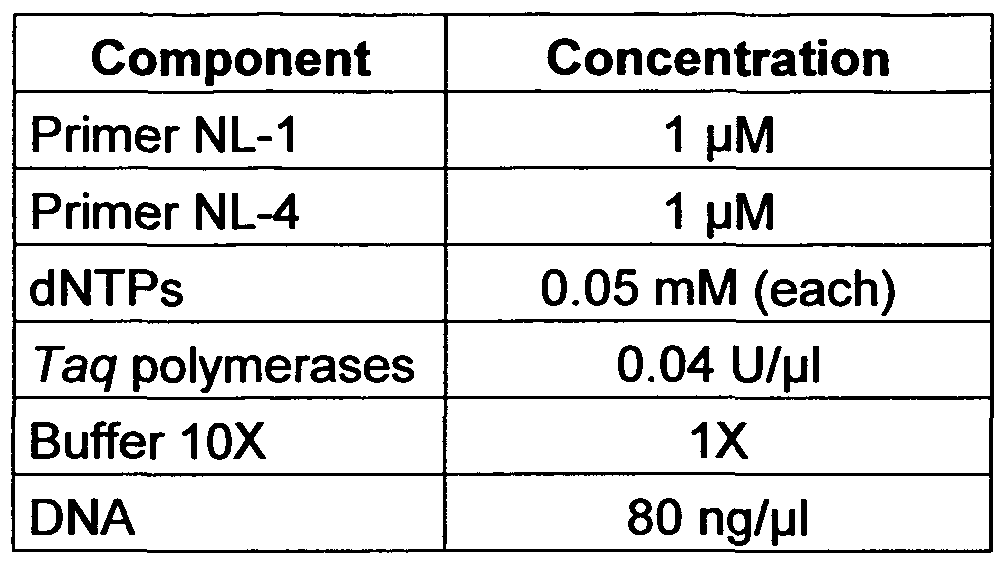
The amplification conditions are represented in the following Table 8:
Table 8

(the number of repetitions per each cycle is reported in parentheses)
The analysis of the nucleotide sequence by consulting the GenBank database carried out with the program BLAST (Basic Local Alignment Search Tool) demonstrated 100% identity with that of other strains belonging to the species Saccharomyces cerevisiae present in the database.
EXAMPLE 3 - Enological characteristics
3.1 Growth in synthetic must
The yeast covered by this patent has the enological characteristics reported below. Some were determined through growth in synthetic must (the characteristics of the test were described in example 1 , point 1.5).
A. Glucose consumed after 2 days (fermentative vigor): 3.6 g
B. Glucose consumed after 7 days: 15.1 g
C. Glucose consumed at the end of fermentation: 18.3 g
D. Days of fermentation: 15
E. Maximum height of the foam produced: 18 mm
F. Clarification time: 14 days
G. Adhesiveness: 2 mm.
3.2 Production of hydrogen sulfide
Hydrogen sulfide production was assayed by growth on Biggy agar media. The resulting coloration of the colonies (light brown) demonstrated a modest production of that compound. The olfactory analysis demonstrated that the fermented product had pleasant characteristics.
3.3 Alcohol-generating power
The alcohol-generating power was evaluated by growth in synthetic must in which the glucose concentration (300 g/l) was varied. A commercial control strain (Premium Prosecco, Enologica Vason SrI, containing a strain of Saccharomyces cerevisiae) used by many producers that operate in the DOC Prosecco area of Conegliano and Valdobbiadene was also tested. The tests were conducted in triplicate.
The alcohol-generating power of strain P301.9 is 16.4% while the commercial strain has an alcohol-generating power of 16.1%.
3.4 Resistance to sulfur dioxide
Resistance to sulfur dioxide was assayed by growth in flasks containing YPD media to which different concentrations of sulfur dioxide were added. The tests were conducted in triplicate. The strain proved to be resistant to a concentration of at least 50 mg/l.
3.5 Beta-glucosidase activity
This activity is linked to the yeast's capacity to liberate the varietal aromas present in the must that are primarily present in the glycosylated form and thus odorless.
A fluorimetric method based on the emission of a fluorescent signal by the substrate 4-methylumbelliferyl β-D-glucopyranoside once this molecule is cleaved by the β-glucosidase enzyme was carried out. The activity was assayed during the growth of the strain in synthetic must (the tests were conducted in triplicate) and was measured at pH 5 and pH 3.5 (enological situation). The strain showed to possess a good activity, especially at pH 3.5.
3.6 Nitrogen reguirement
Some fermentations in synthetic must in 1 I bioreactors were carried out in order to evaluate the different nitrogen requirements.
A commercial control strain (Premium Prosecco, Enologica Vason SrI,
containing a strain of Saccharomyces cerevisiae) used by many producers that operate in the DOC Prosecco area of Conegliano and Valdobbiadene was also tested. The fermentation was conducted by maintaining the fermentation speed constant at 0.7 g I~V1 through the addition of amino acidic nitrogen beginning with 5 g I"1 of CO2 released up to 75 g I"1 of CO2. The fermentation was monitored by automatically measuring the drop in weight every twenty minutes.
The strain P301.9 has a nitrogen requirement of 49 mg/l, while the commercial one shows a higher requirement (79 mg/l).
3.7 Nanovinification (about 200 ml of volume)
The strain was assayed in the laboratory by setting up an in-flask vinification
(nanovinification) as described in example 1, point 1.8 (Technological characterization of the isolates in Prosecco must).
The chemical characteristics of the must used for the test are reported in the following Table 9:
Table 9

*RAN = readily assimilable nitrogen
The enological characteristics identified are as follows:
A. Glucose consumed after 2 days (fermentative vigor): 4.6 g
B. Glucose consumed after 7 days: 17.4 g
C. Glucose consumed at the end of fermentation: exhausted
D. Days of fermentation: 14
E. Maximum height of the foam produced: 18 mm
F. Clarification times: 12 days.
During the sensorial evaluation, conducted as described in example 1 , point 1.8 (Technological characterization of the isolates in Prosecco must), a strain able to respect the organoleptic characteristics of Prosecco wine was identified.
3.8 Microvinification (about 30 liters of volume)
The strain next to a commercial control (Premium Prosecco, Enologica Vason SrI, containing a strain of Saccharomyces cerevisiae) was tested in microvinification trials in Prosecco must in 30 I carboys, as described in example 1 , point 1.9 (Microvinification). The chemical characteristics of the must used for the test are reported in the following Table 10:
Table 10

*RAN = readily assimilable nitrogen
The enological characteristics identified are listed in the following Table 11 :
Table 11
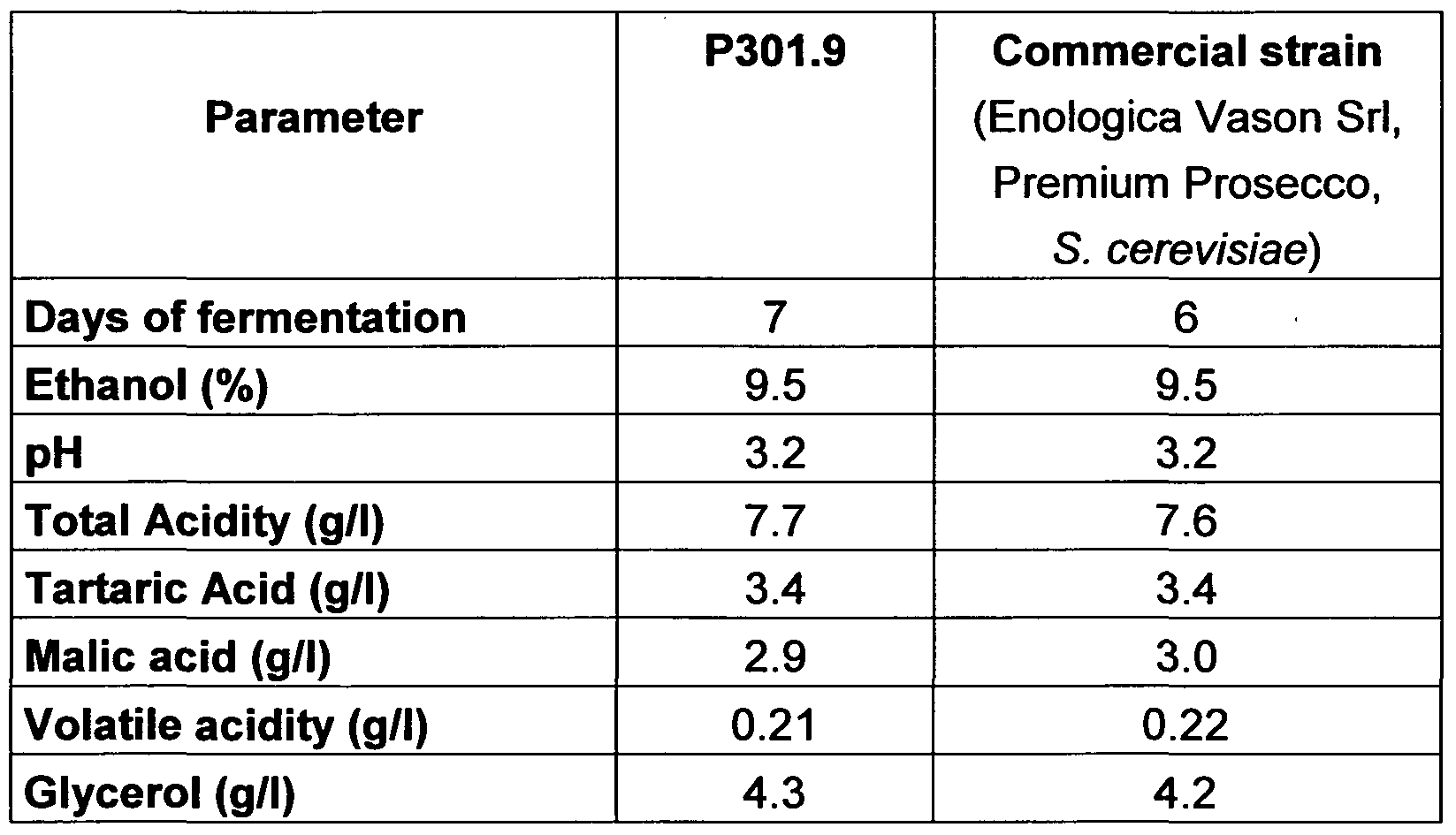
Gas-chromatographic analyses were carried out for the determination of the aromatic compounds contained in the wine obtained.
The results are reported in the following Table 12:
Table 12

The wines produced were submitted to sensorial analyses as described in example 1 , point 1.9 (Microvinification). The wine produced with the P301.9 strain has a high aromatic intensity (greater than that detected for other experimental yeasts). It is distinct with respect to that obtained with the commercial yeast for an equilibrium between the aromatic intensity and the characteristics of the olfactory attributes. Furthermore, good characteristics of typicality were encountered with hints of acacia and wisteria and in particular green apple, ripe apple, and citrus.
3.9 Vinification in the winery
The strain next to a commercial control (Premium Prosecco, Enologica Vason SrI, containing a strain of Saccharomyces cerevisiae) was tested in vinification trials in Prosecco must in 50 hectoliter wine makers, as described in example 1, point 1.10 (Vinification). The concentration of the P301.9 strain in the paste was equal to (5.97± 0.57)*109 CFU/ml while that of the control yeast was (8.60± 0.6)*109 CFU/ml. The inoculate for both was 2.5*106 CFU/ml.
The chemical characteristics of the must used for the test are reported in the following Table 13:
Table 13

*RAN = readily assimilable nitrogen
The following Table 14 reports the enological characteristics detected for the commercial strain and the strain according to the invention:
Table 14

The wines produced were submitted to sensorial analyses as described above in example 1 , point 1.9 (Microvinification). The judgments expressed in the microvinifications were confirmed.
REFERENCES
Cai J., Roberts I.N. and Collins M. D. 1996. Phylogenetic relationships among members of the ascomycetous yeast genera Brettanomyces, Debaryomices, Dekkera, and Kluyveromyces deduced by small-subunit rRNA gene sequences. Int. J. Syst. Bacteriol. 46: 542-549.
Delfini C. 1995. Scienza e tecnica di microbiologia enologica. Edizioni Il Lievito, Asti.
Esteve-Zaezoso B., Belloch C, Uruburu F. and Querol A. 1999. Identification of yeasts by RFLP analysis of the 5.8S rRNA gene and the two ribosomal internal transcribed spacers. Int. J. Syst. Bacteriol. 49: 329-337.
Fatichenti F., Farris G.A., Deiana P., Ceccarelli S. and Serra M. 1981. Commercial trial of winemaking using two selected starters of Saccharomyces cerevisiae which do not reduce malic acid content. Am J Enol. Viticult. 32: 236- 240.
Fleet G. H. and Heard G. M. 1993. Yeasts growth during fermentation. In Wine Microbiology and Biotechnology, Fleet GH (ed). Harwood Academic: Reading; 27-54.
Gunata Z., Bayonove C.L., Baumes R.L., Cordonnier R.E. 1985. The aroma of grapes. I Extraction and determination of free and glycosidicalli bound fraction of some aroma components. J Chromatogr. 331 : 83-90.
James S.A., Collins M.D. and Roberts I.N. 1996. Use of an rRNA internal transcribed spacer region to distinguish phylogenetically closely related species of the genera Zygosaccharomyces and Tonjlaspor. Int. J. Syst. Bacteriol. 46: 189-194.
Legras J. L., Ruh O., Merdinoglu D., Karst F. 2005. "Selection of hypervariable micro satellite loci for the characterization of Saccharomyces cerevisiae strains", International Journal of Food Microbiology 102: 73-83.
Pretorius I. S. 2000. Tailoring wine yeast for the new millennium: novel approaches to the ancient art of winemaking. Yeast 16: 675-729.
Querol A. and Ramon D. 1996. The application of molecular techniques in wine microbiology. Trends Food Sci. Tech. 7: 73-78.
Ribereau-Gayon P., Dubordieu D., Doneche B., Lonvaud A., 2000. Handbook of Enology Volume 1 The Microbiology of Wine and Vinification, John Wiley & Sons Ltd.
Sanger F., Nicklen S., Coulson A. R. 1977. DNA sequencing with chain- terminating inhibitors. Proc Natl Acad Sci U S A. 74 (12):5463-7.
Valero E., Shuller D., Cambon B., Casal M. and Dequin S. 2005. Dissemination and survival of commercial wine yeast in the vineyard: A large- scale, three-years study. FEMS Yeast Res. 5: 959-969.
Vincenzini M., Romano P. e Farris G.A. 2005. Microbiologia del vino. Edizioni
Ambrosiana.
White T.J., Bruns T., Lee S. and Taylor J. 1990. PCR protocols. A guide to methods and applications. In Amplification and direct sequencing of fungal ribosomal RNA genes for phylogenetics, pp. 315-322. lnnis M.A., Gelfand D.H., Sninsky J.J., White T.J. (Eds) Academic Press, San Diego.
Zambonelli C, Tini V. and Castellari L. 2000. Guida all'uso dei lieviti selezionati in enologia (a cura del Centro Ricerche Produzioni Vegetali) Ed. agricole.
Zambonelli C. 2003. Microbiologia e Biotecnologia dei Vini. Edizioni Agricole. Free text in the sequence listing:
The SEQ ID NOs 1-18 regard primers with their respective names.
Claims
I) A strain of Saccharomyces cerevisiae identified as P301.9 and deposited at the DBVPG with deposit number 24P and protocol number 521/P/2009.
2) The strain identified as P301.9 (DBVPG 24P) according to claim 1) characterized in that its nitrogen demand during fermentation in synthetic most is less than 50 mg/l of available nitrogen per liter used, in which the value corresponds to that necessary to pass, at the maximum fermentation speed of 0.7 g I"1 h"1, from 5 g to 75 g of CO2 produced.
3) The strain according to claim 1) or 2) in a desiccated form, lyophilized form, or in the form of a paste.
4) The use of the strain of Saccharomyces cerevisiae identified as P301.9 (DBVPG 24P) according to one of the preceding claims as inoculate in the production of food obtained through alcoholic fermentation.
5) Use according to claim 4) characterized in that the food is a wine, the alcoholic fermentation is a vinification process, and the inoculate is a wine starter.
6) Use according to claim 5) characterized in that the wine is a white wine produced from Prosecco grapes.
7) Use according to any of the claims from 4) to 6) characterized in that the vinification occurs without the addition of readily assimilable nitrogen.
8) Use according to any of the claims from 6) to 7) characterized in that the wine produced has a concentration of ethyl caproate naturally produced by the strain > 800 μg/l.
9) Use according to any of the claims from 6) to 8) characterized in that the wine produced contains geraniol naturally produced by the strain.
10) Alimentary inoculate including the strain identified as P301.9 (DBVPG 24P).
I I) Inoculate according to claim 10) characterized in that the inoculate is a wine starter.
Applications Claiming Priority (2)
| Application Number | Priority Date | Filing Date | Title |
|---|---|---|---|
| ITVI2009A000169A IT1398806B1 (en) | 2009-07-10 | 2009-07-10 | YEAST OF YEAST SACCHAROMYCES CEREVISIAE DBVPG24P AND ITS USE FOR THE FERMENTATIVE PRODUCTION OF FOOD, PARTICULARLY OF PROSECCO WINE |
| ITVI2009A000169 | 2009-07-10 |
Publications (1)
| Publication Number | Publication Date |
|---|---|
| WO2011004254A1 true WO2011004254A1 (en) | 2011-01-13 |
Family
ID=41697958
Family Applications (1)
| Application Number | Title | Priority Date | Filing Date |
|---|---|---|---|
| PCT/IB2010/001686 Ceased WO2011004254A1 (en) | 2009-07-10 | 2010-07-08 | The yeast strain saccharomyces cerevisiae dbvpg24p, its use as an inoculant for the fermentative production of food, in particular prosecco wine, and a relative inoculant |
Country Status (2)
| Country | Link |
|---|---|
| IT (1) | IT1398806B1 (en) |
| WO (1) | WO2011004254A1 (en) |
Cited By (8)
| Publication number | Priority date | Publication date | Assignee | Title |
|---|---|---|---|---|
| EP2634247A1 (en) * | 2012-02-29 | 2013-09-04 | Guserbiot S.L.U. | Strain of saccharomyces cerevisiae and its use for the production of alcoholic beverages |
| MD4203C1 (en) * | 2012-04-06 | 2013-09-30 | Общественное Учреждение Научно-Практический Институт Садоводства И Пищевых Технологий | Strain of yeast Saccharomyces cerevisiae for the production of white dry wines |
| ITUB20160092A1 (en) * | 2016-01-25 | 2017-07-25 | Univ Degli Studi Padova | YEAST STRAIN Saccharomyces cerevisiae DBVPG35P, ITS USE FOR THE FERMENTATIVE PRODUCTION OF FOOD, PARTICULARLY OF LISON AND LISON CLASSIC WINE, A RELATIVE PRODUCT AND A METHOD FOR THE SELECTION OF THE STRAINER |
| CN110343625A (en) * | 2019-07-25 | 2019-10-18 | 江西师范大学 | A kind of Wine brewing yeast strain and its application |
| WO2021134138A1 (en) * | 2019-12-31 | 2021-07-08 | Universidad De Santiago De Chile | Genetically improved non-transgenic strains of the yeast saccharomyces cerevisiae useful in the production of alcoholic beverages |
| CN114149932A (en) * | 2021-11-08 | 2022-03-08 | 泸州老窖股份有限公司 | Saccharomyces cerevisiae LJ-2 and application thereof |
| CN114149933A (en) * | 2021-11-08 | 2022-03-08 | 泸州老窖股份有限公司 | Saccharomyces cerevisiae LJ-1 and application thereof |
| CN120591122A (en) * | 2025-05-26 | 2025-09-05 | 中国农业大学 | A high-glycerol-yielding yeast strain and its application in wine fermentation in Ningxia |
Citations (1)
| Publication number | Priority date | Publication date | Assignee | Title |
|---|---|---|---|---|
| EP1482029A1 (en) | 2003-05-27 | 2004-12-01 | Instituto Madrileno de Investigacion Agraria y Alimentari - IMIA | CECT 11774 and CECT 11775 Saccharomyces cerevisiae strains and their use in the production by alcoholic fermentation of alcoholic drinks and other foodstuff |
-
2009
- 2009-07-10 IT ITVI2009A000169A patent/IT1398806B1/en active
-
2010
- 2010-07-08 WO PCT/IB2010/001686 patent/WO2011004254A1/en not_active Ceased
Patent Citations (1)
| Publication number | Priority date | Publication date | Assignee | Title |
|---|---|---|---|---|
| EP1482029A1 (en) | 2003-05-27 | 2004-12-01 | Instituto Madrileno de Investigacion Agraria y Alimentari - IMIA | CECT 11774 and CECT 11775 Saccharomyces cerevisiae strains and their use in the production by alcoholic fermentation of alcoholic drinks and other foodstuff |
Non-Patent Citations (20)
| Title |
|---|
| CAI J.; ROBERTS I.N.; COLLINS M.D.: "Phylogenetic relationships among members of the ascomycetous yeast genera Brettanomyces, Debaryomices, Dekkera, and Kluyveromyces deduced by small-subunit rRNA gene sequences", INT. J. SYST. BACTERIOL., vol. 46, 1996, pages 542 - 549 |
| CODON ET AL., APPLIED ENVIRON. MICROBIOL., vol. 61, 1995, pages 630 - 638 |
| DE BORTOLI, ELENA: "Aspetti microbiologici legati alle produzioni enologiche dei territori delle DOC di Conegliano. [Tesi di dottorato]", 5 September 2008 (2008-09-05), Padova, XP007912014, Retrieved from the Internet <URL:http://paduaresearch.cab.unipd.it/753/> [retrieved on 20100301] * |
| ELENA DE BORTOLI, MICROBIOLOGICAL ASPECTS TIED TO THE ENOLOGICAL PRODUCTION OF THE DOC TERRITORIES OF CONEGLIANO, September 2008 (2008-09-01) |
| ESTEVE-ZAEZOSO B.; BELLOCH C.; URUBURU F.; QUEROL A.: "Identification of yeasts by RFLP analysis of the 5.8S rRNA gene and the two ribosomal internal transcribed spacers", INT J. SYST. BACTERIOL., vol. 49, 1999, pages 329 - 337 |
| FATICHENTI F.; FARRIS G.A.; DEIANA P.; CECCARELLI S.; SERRA M.: "Commercial trial of winemaking using two selected starters of Saccharomyces cerevisiae which do not reduce malic acid content", AM J ENOL. VITICULT., vol. 32, 1981, pages 236 - 240 |
| FLEET G.H.; HEARD G.M.: "Wine Microbiology and Biotechnology", 1993, HARWOOD ACADEMIC, article "Yeasts growth during fermentation", pages: 27 - 54 |
| GUNATA Z.; BAYONOVE C.L.; BAUMES R.L.; CORDONNIER R.E.: "The aroma of grapes. I Extraction and determination of free and glycosidicalli bound fraction of some aroma components", J CHROMATOGR, vol. 331, 1985, pages 83 - 90 |
| JAMES S.A.; COLLINS M.D.; ROBERTS I.N.: "Use of an rRNA internal transcribed spacer region to distinguish phylogenetically closely related species of the genera Zygosaccharomyces and Torulaspor", INT. J. SYST. BACTERIOL., vol. 46, 1996, pages 189 - 194 |
| LEGRAS J. L.; RUH O.; MERDINOGLU D.; KARST F.: "Selection of hypervariable micro satellite loci for the characterization of Saccharomyces cerevisiae strains", INTERNATIONAL JOURNAL OF FOOD MICROBIOLOGY, vol. 102, 2005, pages 73 - 83 |
| PRETORIUS I.S.: "Tailoring wine yeast for the new millennium: novel approaches to the ancient art of winemaking", YEAST, vol. 16, 2000, pages 675 - 729 |
| PRETORIUS ISAK S: "Tailoring wine yeast for the new millennium: Novel approaches to the ancient art of winemaking", YEAST, JOHN WILEY & SONS LTD, GB, vol. 16, no. 8, 15 June 2000 (2000-06-15), pages 675 - 729, XP002428303, ISSN: 0749-503X * |
| QUEROL A.; RAMON D.: "The application of molecular techniques in wine microbiology", TRENDS FOOD SCI. TECH., vol. 7, 1996, pages 73 - 78 |
| RIB6REAU-GAYON P.; DUBORDIEU D.; DONECHE B.; LONVAUD A.: "Handbook of Enology Volume 1 The Microbiology of Wine and Vinification", vol. 1, 2000, JOHN WILEY & SONS LTD. |
| SANGER F.; NICKLEN S.; COULSON A.R.: "DNA sequencing with chain- terminating inhibitors", PROC NATL ACAD SCI U S A., vol. 74, no. 12, 1977, pages 5463 - 7 |
| VALERO E.; SHULLER D.; CAMBON B.; CASAL M.; DEQUIN S.: "Dissemination and survival of commercial wine yeast in the vineyard: A large- scale, three-years study", FEMS YEAST RES., vol. 5, 2005, pages 959 - 969 |
| VINCENZINI M.; ROMANO P.; FARRIS G.A.: "Microbiologia del vino", 2005 |
| WHITE T.J.; BRUNS T.; LEE S.; TAYLOR J.: "Amplification and direct sequencing of fungal ribosomal RNA genes for phylogenetics", 1990, ACADEMIC PRESS, article "PCR protocols. A guide to methods and applications", pages: 315 - 322 |
| ZAMBONE!!I C.; TINI V.; CASTELLARI L.: "Guida all'uso dei lieviti selezionati in enologia", 2000 |
| ZAMBONELLI C.: "Microbiologia e Biotecnologia dei Vini", 2003 |
Cited By (8)
| Publication number | Priority date | Publication date | Assignee | Title |
|---|---|---|---|---|
| EP2634247A1 (en) * | 2012-02-29 | 2013-09-04 | Guserbiot S.L.U. | Strain of saccharomyces cerevisiae and its use for the production of alcoholic beverages |
| MD4203C1 (en) * | 2012-04-06 | 2013-09-30 | Общественное Учреждение Научно-Практический Институт Садоводства И Пищевых Технологий | Strain of yeast Saccharomyces cerevisiae for the production of white dry wines |
| ITUB20160092A1 (en) * | 2016-01-25 | 2017-07-25 | Univ Degli Studi Padova | YEAST STRAIN Saccharomyces cerevisiae DBVPG35P, ITS USE FOR THE FERMENTATIVE PRODUCTION OF FOOD, PARTICULARLY OF LISON AND LISON CLASSIC WINE, A RELATIVE PRODUCT AND A METHOD FOR THE SELECTION OF THE STRAINER |
| CN110343625A (en) * | 2019-07-25 | 2019-10-18 | 江西师范大学 | A kind of Wine brewing yeast strain and its application |
| WO2021134138A1 (en) * | 2019-12-31 | 2021-07-08 | Universidad De Santiago De Chile | Genetically improved non-transgenic strains of the yeast saccharomyces cerevisiae useful in the production of alcoholic beverages |
| CN114149932A (en) * | 2021-11-08 | 2022-03-08 | 泸州老窖股份有限公司 | Saccharomyces cerevisiae LJ-2 and application thereof |
| CN114149933A (en) * | 2021-11-08 | 2022-03-08 | 泸州老窖股份有限公司 | Saccharomyces cerevisiae LJ-1 and application thereof |
| CN120591122A (en) * | 2025-05-26 | 2025-09-05 | 中国农业大学 | A high-glycerol-yielding yeast strain and its application in wine fermentation in Ningxia |
Also Published As
| Publication number | Publication date |
|---|---|
| IT1398806B1 (en) | 2013-03-18 |
| ITVI20090169A1 (en) | 2011-01-11 |
Similar Documents
| Publication | Publication Date | Title |
|---|---|---|
| del Monaco et al. | Selection and characterization of a Patagonian Pichia kudriavzevii for wine deacidification | |
| Hidalgo et al. | Effect of inoculation on strawberry fermentation and acetification processes using native strains of yeast and acetic acid bacteria | |
| Maturano et al. | Yeast population dynamics during prefermentative cold soak of Cabernet Sauvignon and Malbec wines | |
| Vigentini et al. | Indigenous Georgian wine-associated yeasts and grape cultivars to edit the wine quality in a precision oenology perspective | |
| Morata et al. | Wine yeast selection in the Iberian Peninsula: Saccharomyces and non-Saccharomyces as drivers of innovation in Spanish and Portuguese wine industries | |
| ITVI20090169A1 (en) | YEAST OF YEAST SACCHAROMYCES CEREVISIAE DBVPG24P, ITS USE FOR THE FERMENTATIVE PRODUCTION OF FOOD, PARTICULARLY OF WINE PROSECCO, A RELATIVE PRODUCT AND A METHOD FOR THE SELECTION OF THE STRAINER | |
| Ciani et al. | Growth and fermentation behaviour of Brettanomyces/Dekkera yeasts under different conditions of aerobiosis | |
| CN109906269B (en) | Yeast strain saccharomyces cerevisiae subspecies eucalyptus DBVPG36P, application thereof in food fermentation production and method for selecting strain | |
| ES2330709B1 (en) | FERMENTING MICROORGANISM PRODUCER OF HIGH CONCENTRATIONS OF GLICEROL AND ITS APPLICATIONS IN THE PRODUCTION OF ALCOHOLIC DRINKS / WINE. | |
| CN104017740B (en) | Glycerin high-yielding saccharomyces cerevisiae strain and application thereof to dry white wine | |
| EP1482029B1 (en) | CECT 11774 and CECT 11775 Saccharomyces cerevisiae strains and their use in the production by alcoholic fermentation of alcoholic drinks and other foodstuff | |
| JP2022084483A (en) | Methods for producing yeast strains having reduced 4-vinyl guaiacol productivity | |
| Puig-Pujol et al. | Yeast biodiversity from Vitis vinifera L., subsp. sylvestris (Gmelin) Hegi to face up the oenological consequences of climate change | |
| KR101486222B1 (en) | Pichia guilliermondii SY46 strain and preparation of Kiwi wine by using the strain | |
| Badotti et al. | Brazilian cachaça: fermentation and production | |
| Jankura et al. | Identification and technological characteristics of yeast strains from vineyards in Slovakia. | |
| Yoncheva et al. | Alcoholic Fermentation, Chemical Composition and Organoleptic Profile of Spontaneously Fermented White and Red Wines | |
| ES2356011A1 (en) | Microorganism fermenter producer of high concentrations of glicerol and its applications in the production of alcoholic beverages/wine. (Machine-translation by Google Translate, not legally binding) | |
| ONACHE et al. | STUDY ON THE OENOLOGICAL POTENTIAL OF SOME NATIVE YEASTS STRAINS ISOLATED FROM WINE CENTER STEFANESTI. | |
| Soldatenco et al. | The influence of new yeast strains from the indigenous flora of” Trifeshti” Vineyard on the alcoholic fermentation process | |
| Prestianni | INNOVATIVE MICROBIAL STRATEGIES FOR MODULATING THE AROMATIC PROFILE OF WINES AND PROTECTION AGAINST ALTERATION PROCESSES | |
| HK40007585B (en) | A strain of yeast saccharomyces bayanus subsp. uvarum dbvpg36p, its use in the fermentative production of foods and a method for the selection of the strain | |
| Arslan | The Effects of Sequential Inoculation of Non-Saccharomyces and Saccharomyces Yeasts From Spontaneously Fermented Grape Must Varieties on Kalecik Karasi Wine and Molecular Characterization of Saccharomyces and Lachancea thermotolerans Isolates | |
| Pietrafesa | Non-Saccharomyces yeasts for reduction of ethanol content in wine | |
| Spano et al. | Indigenous Georgian Wine-Associated Yeasts and Grape |
Legal Events
| Date | Code | Title | Description |
|---|---|---|---|
| 121 | Ep: the epo has been informed by wipo that ep was designated in this application |
Ref document number: 10752145 Country of ref document: EP Kind code of ref document: A1 |
|
| NENP | Non-entry into the national phase |
Ref country code: DE |
|
| 122 | Ep: pct application non-entry in european phase |
Ref document number: 10752145 Country of ref document: EP Kind code of ref document: A1 |