WO2010133640A2 - Dyeing composition comprising a secondary para-phenylenediamine oxidation base and a heterocyclic oxidation base - Google Patents
Dyeing composition comprising a secondary para-phenylenediamine oxidation base and a heterocyclic oxidation base Download PDFInfo
- Publication number
- WO2010133640A2 WO2010133640A2 PCT/EP2010/056897 EP2010056897W WO2010133640A2 WO 2010133640 A2 WO2010133640 A2 WO 2010133640A2 EP 2010056897 W EP2010056897 W EP 2010056897W WO 2010133640 A2 WO2010133640 A2 WO 2010133640A2
- Authority
- WO
- WIPO (PCT)
- Prior art keywords
- radical
- amino
- alkyl
- optionally substituted
- formula
- Prior art date
- Legal status (The legal status is an assumption and is not a legal conclusion. Google has not performed a legal analysis and makes no representation as to the accuracy of the status listed.)
- Ceased
Links
- 0 CC1C(*)*(*)*(C)C1C Chemical compound CC1C(*)*(*)*(C)C1C 0.000 description 1
- WXNIONGRRWVPHQ-UHFFFAOYSA-N Nc(cc1)ccc1NCCN(CCO)CCO Chemical compound Nc(cc1)ccc1NCCN(CCO)CCO WXNIONGRRWVPHQ-UHFFFAOYSA-N 0.000 description 1
Classifications
-
- A—HUMAN NECESSITIES
- A61—MEDICAL OR VETERINARY SCIENCE; HYGIENE
- A61K—PREPARATIONS FOR MEDICAL, DENTAL OR TOILETRY PURPOSES
- A61K8/00—Cosmetics or similar toiletry preparations
- A61K8/18—Cosmetics or similar toiletry preparations characterised by the composition
- A61K8/30—Cosmetics or similar toiletry preparations characterised by the composition containing organic compounds
- A61K8/40—Cosmetics or similar toiletry preparations characterised by the composition containing organic compounds containing nitrogen
- A61K8/41—Amines
- A61K8/411—Aromatic amines, i.e. where the amino group is directly linked to the aromatic nucleus
-
- A—HUMAN NECESSITIES
- A61—MEDICAL OR VETERINARY SCIENCE; HYGIENE
- A61K—PREPARATIONS FOR MEDICAL, DENTAL OR TOILETRY PURPOSES
- A61K8/00—Cosmetics or similar toiletry preparations
- A61K8/18—Cosmetics or similar toiletry preparations characterised by the composition
- A61K8/19—Cosmetics or similar toiletry preparations characterised by the composition containing inorganic ingredients
- A61K8/22—Peroxides; Oxygen; Ozone
-
- A—HUMAN NECESSITIES
- A61—MEDICAL OR VETERINARY SCIENCE; HYGIENE
- A61K—PREPARATIONS FOR MEDICAL, DENTAL OR TOILETRY PURPOSES
- A61K8/00—Cosmetics or similar toiletry preparations
- A61K8/18—Cosmetics or similar toiletry preparations characterised by the composition
- A61K8/30—Cosmetics or similar toiletry preparations characterised by the composition containing organic compounds
- A61K8/33—Cosmetics or similar toiletry preparations characterised by the composition containing organic compounds containing oxygen
- A61K8/38—Percompounds, e.g. peracids
-
- A—HUMAN NECESSITIES
- A61—MEDICAL OR VETERINARY SCIENCE; HYGIENE
- A61K—PREPARATIONS FOR MEDICAL, DENTAL OR TOILETRY PURPOSES
- A61K8/00—Cosmetics or similar toiletry preparations
- A61K8/18—Cosmetics or similar toiletry preparations characterised by the composition
- A61K8/30—Cosmetics or similar toiletry preparations characterised by the composition containing organic compounds
- A61K8/49—Cosmetics or similar toiletry preparations characterised by the composition containing organic compounds containing heterocyclic compounds
- A61K8/494—Cosmetics or similar toiletry preparations characterised by the composition containing organic compounds containing heterocyclic compounds with more than one nitrogen as the only hetero atom
- A61K8/4946—Imidazoles or their condensed derivatives, e.g. benzimidazoles
-
- A—HUMAN NECESSITIES
- A61—MEDICAL OR VETERINARY SCIENCE; HYGIENE
- A61Q—SPECIFIC USE OF COSMETICS OR SIMILAR TOILETRY PREPARATIONS
- A61Q5/00—Preparations for care of the hair
- A61Q5/10—Preparations for permanently dyeing the hair
-
- A—HUMAN NECESSITIES
- A61—MEDICAL OR VETERINARY SCIENCE; HYGIENE
- A61K—PREPARATIONS FOR MEDICAL, DENTAL OR TOILETRY PURPOSES
- A61K2800/00—Properties of cosmetic compositions or active ingredients thereof or formulation aids used therein and process related aspects
- A61K2800/80—Process related aspects concerning the preparation of the cosmetic composition or the storage or application thereof
- A61K2800/88—Two- or multipart kits
Definitions
- One subject of the invention is a dyeing composition
- a dyeing composition comprising at least one particular secondary para- phenylenediamine oxidation base and at least one heterocyclic oxidation base selected from pyrazolopyridine, diaminopyrazolinone, diaminopyrazole or their addition salts with an acid or with a base.
- oxidation bases such as ortho- or para- phenylenediamines, ortho- or para-aminophenols and heterocyclic compounds.
- oxidation bases are colourless or weakly coloured compounds which, in combination with oxidizing products, can give rise, by an oxidative condensation process, to coloured compounds.
- the "permanent" colouring obtained by virtue of these oxidation dyes furthermore has to satisfy a certain number of requirements.
- it must be without disadvantage toxicologically, it must make it possible to obtain shades within the desired intensity and it must behave well in the face of external agents, such as light, bad weather, washing, permanent waving, perspiration and rubbing.
- the dyes must also make it possible to cover white hair and, finally, be as unselective as possible, that is to say make it possible to obtain the smallest possible differences in colouring along the same keratin fibre, which is generally differently sensitized (i.e. damaged) between its tip and its root .
- the aim of the present invention is to obtain a composition for colouring hair that exhibits enhanced dyeing properties in terms of intensity or chromaticity, and/or selectivity and/or resistance to external agents.
- composition for dyeing keratin fibres comprising, in a suitable dyeing medium: one or more oxidation bases chosen from the compound of formula (I) or its addition salts with an acid,
- heterocyclic oxidation base selected from pyrazolopyridine of formula (II) or (III) ; diamino- N, N-dihydropyrazolone of formula (IV) ; 4, 5-diaminopyrazole of formula (V) or their addition salts with an acid or a base,
- R' represents an oxygen or nitrogen atom
- Q represents an oxygen atom or an NH or NH (Ci-C 4 ) alkyl group
- Y represents a hydroxyl, amino, Ci-C 4 alkyl, (Ci- C 4 ) alkoxy, (Ci-C 4 ) alkylamino or di (Ci-C 4 ) alkylamino radical
- Zi and Z 2 independently represent: - a simple covalent bond, - a divalent radical chosen from:
- Zi can also represent a divalent radical -S-, -SO- or -SO2- when R' 1 is a methyl radical,
- R' 1 and R' 2 independently represent:
- ring a saturated, unsaturated or aromatic and substituted or unsubstituted 5- to 8-membered ring optionally comprising one or more heteroatoms or groups chosen from N, 0, S, SO 2 or -CO-, it being possible for the ring to be cationic and/or substituted with a cationic radical,
- Ri 7 , Rig and R 19 being linear or branched Ci-C 5 alkyls which are optionally substituted with one or more hydroxyl groups,
- R'i when Zi, respectively Z 2 , represents a covalent bond, then R'i, respectively R'2, can also represent:
- Ci-C ⁇ alkylcarbonyl radical an optionally substituted Ci-C ⁇ alkylcarbonyl radical
- R' 3, R' 4 and R' 5 which are identical or different, represent: a hydrogen atom, a hydroxyl radical, a Ci-C ⁇ alkoxy radical, a Ci-C ⁇ alkylthio radical, an amino radical, a monoalkylamino radical, a Ci-C ⁇ dialkylamino radical in which the alkyl radicals can form, with the nitrogen atom to which they are attached, a saturated or unsaturated and aromatic or non-aromatic 5- to 8-membered heterocycle which can include one or more heteroatoms or groups chosen from N, O, S, SO2 or CO, it being possible for the heterocycle to be cationic and/or substituted with a cationic radical, an optionally substituted Ci-C ⁇ alkylcarbonyl radical,
- R' an -O-CO-R, -CO-O-R, NR-CO-R' or -CO-NRR' radical with R and R' as defined above, - a halogen, an -NHSO 3 H radical, an optionally substituted Ci-C 4 alkyl radical, a saturated, unsaturated or aromatic and optionally substituted carbon ring, - it being possible for R' 3, R' 4 and R' 5 to form, in pairs, a ring which is or is not partially saturated, • X represents an ion or group of ions which makes it possible to provide the electronegativity of the derivative of formula (II), with the condition that at least one of the groups R' 1 and R' 2 represents a cationic radical ;
- R ' , R " , R '" and R which are identical or different, represent: a linear or branched, C1-C10, preferably Ci-C ⁇ alkyl radical optionally substituted with one or more radicals chosen from the group constituted by an ORi 5 radical, an NRi 6 Ri7 radical, a carboxyl radical, a sulphonic radical, a CONRi 6 Ri7 carboxamido radical, an SO2NR6R7 sulphonamido radical, a heteroaryl or an aryl optionally substituted with one or more (Ci-C 4 ) alkyl, hydroxyl, C1-C2 alkoxy, amino or (di) (C1-C2) alkylamino groups; an aryl radical optionally substituted with one or more (C1-C4) alkyl, hydroxyl, C1-C2 alkoxy, amino or (di) (C1-C2) alkylamino radicals; a 5- or 6-membered
- R "' and R may also represent a hydrogen atom
- Ri5, R16 and Ri 7 which are identical or different, represent: a hydrogen atom; - a linear or branched Ci-C 4 alkyl radical optionally substituted with one or more radicals chosen from a hydroxyl radical, C1-C2 alkoxy radical, CONR 8 R 9 carboxamido radical, SO2R8 sulphonyl radical, or an aryl radical optionally substituted with a (Ci-C 4 ) alkyl, hydroxyl, C1-C2 alkoxy, amino or (di) (C1-C2) alkylamino radical; an aryl radical optionally substituted with a (Ci-C 4 ) alkyl, hydroxyl, C1-C2 alkoxy, amino or (di) (C1-C2) alkylamino radical;
- R16 and Ri7 which are identical or different, may also represent a CONRi 8 Ri 9 carboxamido radical or an SO2R18 sulphonyl radical;
- R18 and Ri 9 which are identical or different, represent a hydrogen atom; a linear or branched Ci-C 4 alkyl radical optionally substituted with one or more hydroxyl or C1-C2 alkoxy radicals;
- R ' and R " on the one hand, and R “' and R on the other hand, may form with the nitrogen atom(s) to which they are attached, a saturated or unsaturated 5- to 7-membered heterocycle, optionally substituted with one or more radicals chosen from the group constituted by halogen atoms, amino, (di) (Ci-C 4 ) alkylamino, hydroxyl, carboxyl, carboxamido or (C1-C2) alkoxy radicals, or Ci-C 4 alkyl radicals optionally substituted with one or more hydroxyl, amino, (di) alkylamino, alkoxy, carboxyl or sulphonyl radicals;
- R"' and R may also form, together with the nitrogen atom to which they are attached, a 5- or 7-membered heterocycle, the carbon atoms of which may be replaced with an optionally substituted oxygen or nitrogen atom ;
- X represents un oxygen atom, or a group NH
- Y represents a hydrogen atom or a Ci-C 4 alkyl radical
- Z represents a methyl radical when n is 0, r Z reprssents a Ci-C 4 alkyle radical, a group OR or NR' 'R' ' ' when n is 1 or higher, R' ' et R' ' ', identical or the same being a hydrogen atom, a Ci- C 4 alkyl radical; or R 5 forms with the nitrogen atom of NR 3 R 4 in position 5 a heterocyclic group having at least 4 members, at least one of R21, R22, R23 et R24 being a hydrogen atom.
- Another subject of the invention is a dyeing method using this composition.
- composition of the present invention for dyeing keratin fibres, in particular human keratin fibres such as the hair.
- the invention also relates to multicompartment devices comprising compositions employing one or more oxidation bases chosen from the compound of formula (I) or its addition salts with an acid and one or more heterocyclic oxidation bases chosen from the oxidation bases of formula (II) , (III) (IV) and (V) or their addition salts with an acid or with a base.
- the composition of the present invention makes it possible, in particular, to obtain a composition for colouring keratin fibres that is suitable for use in oxidation dyeing and that makes it possible to obtain a colouring with varied, intense or chromatic, attractive and not very selective shades which is highly resistant to the various attacks to which the hair may be subjected such as shampoos, sweat, permanent deformations and light. It should be noted that in what follows, and unless otherwise indicated, the limits of a range of values are included in this range.
- the compounds of formula (I), (II), (III) (IV) or (V) may be in the form of addition salts especially chosen from the addition salts with an acid such as hydrochlorides, hydrobromides, sulphates, citrates, succinates, tartrates, lactates, tosylates, benzenesulphonates, phosphates and acetates .
- an acid such as hydrochlorides, hydrobromides, sulphates, citrates, succinates, tartrates, lactates, tosylates, benzenesulphonates, phosphates and acetates .
- the compounds of formula (I), (II), (III) (IV) or (V) are each generally present in an amount of between 0.001% and 10% by weight approximately and preferably between 0.005% and 6% by weight relative to the total weight of the dyeing composition .
- alkyl used for the alkyl radicals and for the groups comprising an alkyl part means a linear or branched carbon chain comprising from 1 to 4 carbon atoms which is unsubstituted or substituted with one or more heterocycles or by one or more phenyl groups or by one or more groups chosen from halogen atoms, such as chlorine, bromine, iodine and fluorine; or hydroxyl, alkoxy, amino, carbonyl, carboxamido, sulphonyl, -CO2H, -SO3H, -PO3H2, - PO4H2, -NHSO3H, sulphonamide, mono (C1-C4) alkylamino or tri (Ci- C 4 ) alkylammonium radicals, or else by a di (Ci-C 4 ) alkylamino radical in which the two alky
- alkoxy used for alkoxy radicals and for the groups comprising an alkoxy part means a linear or branched O-carbon chain comprising from 1 to 4 carbon atoms which is unsubstituted or substituted with one or more groups chosen from heterocycles; halogen atoms, such as chlorine, bromine, iodine and fluorine; or hydroxyl, amino, carbonyl, carboxamido, sulphonyl, -CO2H, -SO 3 H, -PO 3 H 2 , -PO 4 H 2 , -NHSO 3 H, sulphonamido, mono (Ci- C 4 ) alkylamino or tri (Ci-C 4 ) alkylammonium radicals, or else by a di (Ci-C 4 ) alkylamino radical in which the two alkyl groups can form, together with the nitrogen atom of said di (Ci-C 4 ) alkylamino group
- heterocycle is understood to mean a 5-, 6-, 7- or 8-membered aromatic or non- aromatic ring comprising from 1 to 3 heteroatoms chosen from nitrogen, sulphur and oxygen atoms. These heterocycles can be fused to other heterocycles or to a phenyl group.
- these heterocycles can be quaternized by a (Ci-C 4 ) alkyl radical .
- phenyl is understood to mean a phenyl radical which is unsubstituted or substituted with one or more cyano, carbonyl, carboxamido, sulphonyl, -CO 2 H, -SO 3 H, -PO 3 H 2 , -PO 4 H 2 , hydroxyl, amino, mono (Ci-C 4 ) alkylamino or di (Ci-C 4 ) alkylamino radicals, in which, in the case of the last radical, the two alkyl groups may form, together with the nitrogen atom of said di (Ci-C 4 ) alkylamino group to which they are bonded, a ring which can be interrupted by one or more nitrogen, oxygen or sulphur atoms.
- -NHSO3H radical an amino radical; a (Ci-C 4 ) alkylamino radical; a di (Ci-C 4 ) alkylamino radical in which the two alkyl groups can, jointly with the nitrogen atom to which they are bonded, form a ring which can be interrupted by one or more nitrogen, oxygen or sulphur atoms; a heterocycle as defined above; a sulphonamide radical; a carbonyl radical; a (Ci-C 4 ) alkoxy- carbonyl radical; a carboxamido radical; or a group of formula:
- R'" represents an oxygen or nitrogen atom
- Q represents an oxygen atom or an NH or NH (Ci-C 4 ) alkyl group
- Y represents a hydroxyl, amino, Ci-C 4 alkyl, (Ci-C 4 ) alkoxy, (Ci-C 4 ) alkylamino or di (Ci-C 4 ) alkylamino radical.
- cationic ring or "cationic heterocycle” is understood to mean a ring comprising one or more quaternary ammonium groups .
- Ri 7 Ri 8 Ri 9 type of the trimethylammonium, triethylammonium, dimethyIethy1ammonium, diethylmethylammonium, diisopropylmethylammonium, diethylpropylammonium, ( ⁇ -hydroxy- ethyl) diethylammonium, di ( ⁇ -hydroxyethyl) methylammonium or tri ( ⁇ -hydroxyethyl) ammonium radicals .
- the compounds of formula (III) can optionally be salified with strong inorganic acids, such as, for example, HCl, HBr, HI, H 2 SO 4 or H 3 PO 4 , or organic acids, such as, for example, acetic acid, lactic acid, tartaric acid, citric acid, succinic acid, benzenesulphonic acid, para-toluenesulphonic acid, formic acid or methanesulphonic acid.
- strong inorganic acids such as, for example, HCl, HBr, HI, H 2 SO 4 or H 3 PO 4
- organic acids such as, for example, acetic acid, lactic acid, tartaric acid, citric acid, succinic acid, benzenesulphonic acid, para-toluenesulphonic acid, formic acid or methanesulphonic acid.
- anionic groups such as -CO 2 H, -SO3H, -POsH 2 or
- the compounds of formula (II) or (III) can be salified by alkali metal or alkaline earth metal hydroxides, such as sodium hydroxide or potassium hydroxide, by aqueous ammonia or by organic amines.
- solvates for example a hydrate or a solvate of a linear or branched alcohol, such as ethanol or isopropanol.
- derivative of formula (III) is understood to mean all mesomeric or isomeric forms .
- R' i or R' 2 denote a heterocycle
- this heterocycle is preferably a cationic heterocycle or a heterocycle substituted with a cationic radical.
- Mention may be made, by way of example, of imidazoles substituted with a quaternary ammonium radical or imidazoliums, piperazines substituted with a quaternary ammonium radical or piperaziniums, pyrrolidines substituted with a quaternary ammonium radical or pyrrolidiniums, or diazepanes substituted with a quaternary ammonium radical or diazepaniums .
- R' i or R' 2 represent an -N + Ri 7 Ri 8 Ri 9 group, Ri 7 , Rig and Rig being linear or branched Ci-C 5 alkyls which are optionally substituted with one or more hydroxyl groups, such as trialkylammonium, tri (hydroxyalkyl) ammonium, (hydroxylalkyl) dialkylammonium or di (hydroxyalkyl) alkylammonium.
- hydroxyl groups such as trialkylammonium, tri (hydroxyalkyl) ammonium, (hydroxylalkyl) dialkylammonium or di (hydroxyalkyl) alkylammonium.
- R' 3, R' 4 and R' 5 radicals can independently be a hydrogen atom or an optionally substituted Ci-C 4 alkyl radical. Mention may be made, by way of example, of the methyl, ethyl, hydroxyethyl, aminoethyl, propyl or butyl radicals. According to a specific embodiment, R' 3/ R' and R' 5 independently represent a hydrogen atom or a Ci-C 4 alkyl radical.
- R' 4 and R' 5 together form a partially saturated or unsaturated 5- or 8-membered ring, in particular a cyclopentene or cyclohexene, which is optionally substituted.
- the compound of formula (III) corresponds to the following formula (III') :
- ⁇ l represents covalent bond, an -NR' 6 (CH 2 ) q ⁇ radical or an - O(CH 2 ) P - radical and R' i is a cationic radical.
- Ci-C ⁇ alkyl radical optionally substituted with a hydroxyl, (C1-C2) alkoxy, amino or (di) (C1-C2) alkylamino radical;
- radicals R and R which may be identical or different, are chosen from methyl, ethyl, 2-hydroxyethyl, 3-hydroxypropyl, 2-hydroxypropyl and phenyl radicals.
- radicals R ' and R " form, together with the nitrogen atoms to which they are attached, a saturated or unsaturated, optionally substituted 5- or 6- membered ring.
- the radicals R ' and R " form, together with the nitrogen atoms to which they are attached, a pyrazolidine or pyridazolidine ring, optionally substituted with one or more C1-C4 alkyl, hydroxyl, (C1-C2) alkoxy, carboxyl, carboxamido, amino or (di) (C1-C2) alkylamino radicals.
- the radicals R and R form, together with the nitrogen atoms to which they are attached, a pyrazolidine or pyridazolidine ring.
- the radicals R "' and R which may be identical or different, they are more particularly chosen from a hydrogen atom; a linear or branched Ci-C ⁇ alkyl radical optionally substituted with one or more hydroxyl, (C1-C2) alkoxy, amino or (di) (C1-C2) alkylamino radicals; a phenyl radical optionally substituted with one or more hydroxyl, amino or (C1-C2) alkoxy radicals .
- the radicals R and R' which may be identical or different, are chosen from a hydrogen atom and a methyl, ethyl, isopropyl, 2-hydroxyethyl, 3-hydroxypropyl, 2-hydroxypropyl or 2-carboxyethyl radical.
- the radicals R and R represent a hydrogen atom.
- the radicals R "' and R form, together with the nitrogen atom to which they are attached, a 5- or 7-membered ring chosen from pyrrolidine, piperidine, homopiperidine, piperazine and homopiperazine heterocycles; said rings possibly being substituted with one or more hydroxyl, amino, (di) (C1-C2) alkylamino, carboxyl, carboxamido or C1-C4 alkyl radicals optionally substituted with one or more hydroxyl, amino or C1-C2 (di) alkylamino radicals.
- radicals R "' and R form, together with the nitrogen atom to which they are attached, a 5- or 7-membered ring chosen from pyrrolidine, 2, 5-dimethylpyrrolidine, pyrrolidine-2-carboxylic acid, 3-hydroxypyrrolidine-2-carboxylic acid, 4-hydroxypyrrolidine-2-carboxylic acid,
- the radicals R "' and R form, together with the nitrogen atom to which they are attached, a 5- or 7-membered ring chosen from pyrrolidine, 3-hydroxypyrrolidine, 3-aminopyrrolidine, 3-dimethylaminopyrrolidine, pyrrolidine-2- carboxylic acid, 3-hydroxypyrrolidine-2-carboxylic acid, piperidine, hydroxypiperidine, homopiperidine, diazepane, N-methylhomopiperazine and N- ⁇ -hydroxyethylhomopiperazine .
- a 5- or 7-membered ring chosen from pyrrolidine, 3-hydroxypyrrolidine, 3-aminopyrrolidine, 3-dimethylaminopyrrolidine, pyrrolidine-2- carboxylic acid, 3-hydroxypyrrolidine-2-carboxylic acid, piperidine, hydroxypiperidine, homopiperidine, diazepane, N-methylhomopiperazine and N- ⁇ -hydroxyethylhomopiperazine .
- the radicals R "' and R form, together with the nitrogen atom to which they are attached, a 5-membered ring such as pyrrolidine, 3-hydroxypyrrolidine, 3-aminopyrrolidine or 3-dimethylaminopyrrolidine .
- the diamino-N, N-dihydropyrazolone derivatives of formula (IV), or the addition salts thereof, which are particularly preferred are the following: 2, 3-diamino-6, 7-dihydro-lH, 5H-pyrazolo[l,2-a] pyrazol-1-one ; ⁇
- the compound of formula (II) is N-(2-aminoethyl)-2-aminoethyl-N-(2-aminoethyl)-2-aminoethyl-N-(2-aminoethyl)-2-aminoethyl-N-(2-aminoethyl)-2-aminoethyl-N-(2-aminoethyl)-2-aminoethyl
- the following compounds are particularly useful in the present invention 4, 5-diamino-l- methylpyrazole, 4, 5-diamino-l- (2-hydroxyethyl) -pyrazole, 4,5- diamino-1- (4 ' -chlorobenzyl) -pyrazole, 4, 5-diamino-l, 3- dimethyl-pyrazole, 4, 5-diamino-3-methyl-l-phenyl-pyrazole, 4, 5-diamino-l-methyl-3-phenylpyrazole, 4-amino-l, 3-dimethyl- 5-hydrazino-pyrazole, l-benzyl-4, 5-diamino-3-methylpyrazole, 4, 5-diamino-3-tert-butyl-l-methylpyrazole, 4, 5-diamino-l- tert-butyl-3-methyl-pyrazole, 4, 5-diamino-l- ( ⁇ -hydroxyethyl) - 3-methylpyrazole,
- the diaminopyrazole (V) is such that R26 is a hydrogen atom.
- R21, R22, R23, R24 represent a hydrogen atom or a C1-C4 alkyl radical and R25 is a alkyl, hydroxyalkyl or alkoxyalkyl radical.
- Prefered compounds of formula (V) are 4, 5-diamino-l- (2- hydroxyethyl) -lH-pyrazole and the corresponding salt such as 4, 5-diamino-l- (2-hydroxyethyl) -lH-pyrazole sulfate having the following formula :
- the dyeing composition according to the invention may contain and preferably does contain one or more couplers conventionally used for dyeing keratin fibres.
- couplers conventionally used for dyeing keratin fibres.
- couplers mention may especially be made of meta- phenylenediamines, meta-aminophenols, meta-diphenols, naphthalene-based couplers, heterocyclic couplers, and the addition salts thereof.
- couplers examples include 2-methyl- 5-aminophenol, 5-N- ( ⁇ -hydroxyethyl) amino-2-methylphenol, 6-chloro-2-methyl-5-aminophenol, 3-aminophenol, 2, 4-dichloro-3- aminophenol, 5-amino-4-chloro-o-cresol, 1, 3-dihydroxybenzene, 1, 3-dihydroxy-2-methylbenzene, 4-chloro-l, 3-dihydroxybenzene, 2, 4-diamino-l- ( ⁇ -hydroxyethyloxy) benzene, 2-amino-4- ( ⁇ - hydroxyethylamino) -1-methoxybenzene, 1, 3-diaminobenzene, 1,3- bis (2, 4-diaminophenoxy) propane, 3-ureidoaniline, 3-ureido-l- dimethylaminobenzene, sesamol, l- ⁇ -hydroxyethylamino-3, 4- methylenedioxybenzene, ⁇
- the coupler (s) is (are) each generally present in an amount of between 0.001% and 10% by weight approximately and preferably between 0.005% and 6% by weight relative to the total weight of the dyeing composition .
- the dyeing composition of the invention may optionally comprise one or more additional oxidation bases conventionally used for dyeing keratin fibres other than the compounds of formula (I), (II) (III) (IV) and (V) or the salts thereof.
- these additional oxidation bases are chosen from para-phenylenediamines other than the compound of formula (I) or the salts thereof, bis (phenyl) alkylenediamines, para-aminophenols, bis-para-aminophenols, ortho-aminophenols and heterocyclic bases other than the oxidation bases of formula (II) (III), (IV) and (V) and the addition salts thereof .
- para-phenylenediamines mention may be made, for example, of para-phenylenediamine, para-toluenediamine, 2- chloro-para-phenylenediamine, 2, 3-dimethyl-para- phenylenediamine, 2, 6-dimethyl-para-phenylenediamine, 2,6- diethyl-para-phenylenediamine, 2, 5-dimethyl-para- phenylenediamine, N, N-dimethyl-para-phenylenediamine, N, N- diethyl-para-phenylenediamine, N, N-dipropyl-para- phenylenediamine, 4-amino-N, N-diethyl-3-methylaniline, N, N- bis ( ⁇ -hydroxyethyl) -para-phenylenediamine, 4-N,N-bis( ⁇ - hydroxyethyl) amino-2-methylaniline, 4-N,N-bis ( ⁇ - hydroxyethyl)
- para-phenylenediamine para-toluenediamine, 2-isopropyl-para- phenylenediamine, 2- ⁇ -hydroxyethyl-para-phenylenediamine, 2- ⁇ - hydroxyethyloxy-para-phenylenediamine, 2, 6-dimethyl-para- phenylenediamine, 2, 6-diethyl-para-phenylenediamine, 2,3- dimethyl-para-phenylenediamine, N,N-bis ( ⁇ -hydroxyethyl) -para- phenylenediamine, 2-chloro-para-phenylenediamine and 2- ⁇ -acetylaminoethyloxy-para-phenylenediamine, and the addition salts thereof with an acid are particularly preferred.
- the bis (phenyl) alkylenediamines mention may be made, for example, of N, N'-bis ( ⁇ -hydroxyethyl) -N, N' -bis (4'- aminophenyl) -1, 3-diaminopropanol, N, N'-bis ( ⁇ -hydroxyethyl) -N, N'- bis (4'-aminophenyl) ethylenediamine, N,N'-bis(4- aminophenyl) tetramethylenediamine, N, N' -bis ( ⁇ -hydroxyethyl) - N, N' -bis (4-aminophenyl) tetramethylenediamine, N, N' -bis (4- methylaminophenyl) tetramethylenediamine, N, N' -bis (ethyl) -N, N' - bis (4'-amino-3'-methylphenyl) ethylenediamine and l,8-bis(2,5
- para-aminophenol examples include para-aminophenol, 4-amino-3-methylphenol, 4-amino- 3-fluorophenol, 4-amino-3-hydroxymethylphenol, 4-amino-2- methylphenol, 4-amino-2-hydroxymethylphenol, 4-amino-2- methoxymethylphenol, 4-amino-2-aminomethylphenol, 4-amino- 2- ( ⁇ -hydroxyethylaminomethyl) phenol, 4-amino-2-fluorophenol, 1- hydroxy-4-methylaminobenzene and 2, 2' -methylenebis (4-amino- phenol) and the addition salts thereof with an acid.
- para-aminophenol 4-amino-3-methylphenol, 4-amino- 3-fluorophenol, 4-amino-3-hydroxymethylphenol, 4-amino-2- methylphenol, 4-amino-2-hydroxymethylphenol, 4-amino-2- methoxymethylphenol, 4-amino-2-aminomethylphenol, 4-amino- 2- ( ⁇ -hydroxye
- ortho-aminophenols mention may be made, for example, of 2-aminophenol, 2-amino-5-methylphenol, 2-amino-6- methylphenol and 5-acetamido-2-aminophenol, and the addition salts thereof with an acid.
- heterocyclic bases mention may be made, for example, of pyridine derivatives, pyrimidine derivatives and pyrazole derivatives.
- pyridine derivatives mention may be made of the compounds described, for example, in patents GB 1 026 978 and GB 1 153 196, such as 2, 5-diaminopyridine, 2- (4- methoxyphenyl) amino-3-aminopyridine, 2, 3-diamino-6- methoxypyridine, 2- ( ⁇ -methoxyethyl) amino-3-amino-6- methoxypyridine and 3, 4-diaminopyridine, and the addition salts thereof with an acid.
- pyrimidine derivatives mention may be made of the compounds described, for example, in patents DE 2359399, JP 88-169571; JP 05-63124; EP 0 770 375 or patent application WO 96/15765, such as 2, 4, 5, 6-tetraaminopyrimidine, 4-hydroxy- 2, 5, 6-triaminopyrimidine, 2-hydroxy-4, 5, 6-triaminopyrimidine, 2 , 4-dihydroxy-5, 6-diaminopyrimidine and 2, 5, 6-triaminopyrimidine, and pyrazolopyrimidine derivatives such as those mentioned in patent application FR-A-2 750 048 and among which mention may be made of pyrazolo [ 1, 5-a] pyrimidine-3, 7-diamine; 2 , 5-dimethylpyrazolo [ 1 , 5-a] pyrimidine-3, 7-diamine; pyrazolo [1, 5-a] pyrimidine-3, 5-diamine; 2, 7-dimethylpyrazol
- addition salts of the additional oxidation bases and of the couplers that may be used in the context of the invention are chosen especially from the addition salts with an acid, such as the hydrochlorides, hydrobromides, sulphates, citrates, succinates, tartrates, lactates, tosylates, benzenesulphonates, phosphates and acetates, and the addition salts with a base, such as sodium hydroxide, potassium hydroxide, ammonium hydroxide, amines or alkanolamines .
- an acid such as the hydrochlorides, hydrobromides, sulphates, citrates, succinates, tartrates, lactates, tosylates, benzenesulphonates, phosphates and acetates
- a base such as sodium hydroxide, potassium hydroxide, ammonium hydroxide, amines or alkanolamines .
- the dyeing composition in accordance with the invention may also contain one or more direct dyes which may, in particular, be chosen from nitrobenzene dyes, azo direct dyes or methine direct dyes. These direct dyes may be of nonionic, anionic or cationic nature.
- the medium suitable for dyeing also known as dyeing vehicle, generally comprises water or a mixture of water and of one or more solvents such as, for example, Ci-C 4 lower alkanols, for instance ethanol and isopropanol, polyols such as propylene glycol, dipropylene glycol or glycerol, and polyol ethers such as dipropylene glycol monomethyl ether.
- the solvent (s) is (are) in general present in proportions which may be between 1% and 40% by weight approximately, and more preferably between 3% and 30% by weight approximately, relative to the total weight of the dyeing composition.
- the dyeing composition in accordance with the invention may also contain various adjuvants conventionally used in compositions for dyeing the hair, such as anionic, cationic, nonionic, amphoteric or zwitterionic surfactants or mixtures thereof, anionic, cationic, nonionic, amphoteric or zwitterionic polymers or mixtures thereof, inorganic or organic thickening agents and in particular anionic, cationic, nonionic and amphoteric polymeric associative thickeners, antioxidants, penetrants, sequestrants, fragrances, buffers, dispersants, conditioning agents such as, for example, volatile or non-volatile, modified or unmodified silicones, film-forming agents, ceramides, preservatives or opacifying agents .
- adjuvants conventionally used in compositions for dyeing the hair, such as anionic, cationic, nonionic, amphoteric or zwitterionic surfactants or mixtures thereof, anionic, cationic, nonionic,
- the above adjuvants are generally present in an amount, for each of them, of between 0.01% and 20% by weight relative to the weight of the composition.
- the pH of the dyeing composition in accordance with the invention is generally between 3 and 12 approximately, and preferably between 5 and 11 approximately. It may be adjusted to the desired value by using acidifying or basifying agents commonly used in the dyeing of keratin fibres or else by means of conventional buffering systems.
- acidifying agents mention may be made, by way of example, of inorganic or organic acids such as hydrochloric acid, orthophosphoric acid, sulphuric acid, carboxylic acids such as acetic acid, tartaric acid, citric acid or lactic acid or sulphonic acids.
- basifying agents mention may be made, by way of example, of aqueous ammonia, alkaline carbonates, alkanolamines such as mono-, di- and triethanolamines and also derivatives thereof, sodium or potassium hydroxides and compounds of formula (A) below:
- R a , R b , R c and R d which are identical or different, represent a hydrogen atom, a Ci-C 4 alkyl radical or a Ci-C 4 hydroxyalkyl radical.
- composition according to the invention may comprise one or more oxidizing agents.
- the oxidizing agents are those conventionally used for the oxidation dyeing of keratin fibres, which are, for example, hydrogen peroxide, urea peroxide, alkali metal bromates, persalts such as perborates and persulphates, peracids and oxidase enzymes, among which mention may be made of peroxidases, 2-electron oxidoreductases such as uricases and 4-electron oxygenases such as laccases. Hydrogen peroxide is particularly preferred.
- composition with or without oxidizing agent according to the invention may be in various forms, such as in the form of liquids, creams, gels, or in any other form suitable for dyeing keratin fibres, and especially human hair. It may result from the mixing of several compositions at the time of use.
- compositions one comprising one or more oxidation bases chosen from the compound of formula (I) or its addition salts with an acid, optionally one or more additional oxidation bases other than the compounds of formula (I) or of formulae (II) (III) (IV) (V) or salts thereof, and optionally one or more couplers, a second composition comprising the oxidation base(s) of formula (II) (III) (IV) (V) or salts thereof and optionally a third composition comprising one or more oxidizing agents as described previously.
- compositions one comprising one or more oxidation bases chosen from the compound of formula (I) or its addition salts with an acid, the oxidation base(s) of formula (II) (III) (IV) (V) or salts thereof, optionally one or more additional oxidation bases other than the compounds of formula (I) or of formula (II) (III) (IV) (V) or salts thereof, and optionally one or more couplers, another composition comprising one or more oxidizing agents as described previously.
- the composition of the invention is therefore applied to the hair for colouring keratin fibres either as is, or in the presence of one or more oxidizing agents for colouring keratin fibres .
- the method of the present invention is a method in which, applied to the fibres, is the composition without oxidizing agent according to the present invention as defined previously, either alone or in the presence of an oxidizing agent for a sufficient time to develop the desired colouring.
- the colour may be developed at acid, neutral or alkaline pH and the oxidizing agent may be added to the composition of the invention only at the time of use or it may be used starting from an oxidizing composition containing it, applied simultaneously with or sequentially to the composition of the invention.
- the composition without oxidizing agent according to the present invention is mixed, preferably at the time of use, with a composition containing, in a medium suitable for dyeing, one or more oxidizing agents.
- the mixture obtained is then applied to the keratin fibres. After a leave-in time of 3 to 50 minutes approximately, preferably 5 to 30 minutes approximately, the keratin fibres are rinsed, washed with shampoo, rinsed again, then dried.
- the oxidizing agents are those indicated previously.
- the oxidizing composition may also contain various additives conventionally used in compositions for dyeing hair and as defined previously.
- the pH of the oxidizing composition containing the oxidizing agent is such that after mixing with the dyeing composition, the pH of the resulting composition applied to the keratin fibres preferably varies between 3 and 12 approximately, and more preferably still between 5 and 11. It may be adjusted to the desired value by means of acidifying or basifying agents customarily used in the dyeing of keratin fibres and as defined previously.
- Another subject of the invention is a dyeing kit or multicompartment device in which a first compartment contains the dyeing composition without oxidizing agent of the present invention defined above comprising one or more oxidation bases chosen from the compounds of formula (I) or its addition salts with an acid and one or more oxidation bases chosen from the compounds of formula (II) (III) (IV) (V) or their addition salts with an acid or a base and a second compartment contains one or more oxidizing agents.
- a second device is constituted by a first compartment containing a composition comprising one or more oxidation bases chosen from the compound of formula (I) or its addition salts with an acid, optionally one or more additional oxidation bases other than those of formula (I), (II) (III)
- a third device may optionally comprise the two compartments from the second device plus a third compartment containing a composition that comprises one or more oxidizing agents.
- composition was diluted extemporaneously with 1 times its weight of 20-volume aqueous hydrogen peroxide solution, the pH of which is 3.
- each of the extemporaneous mixtures thus produced was applied to grey hair containing 90% white hair in an amount of 10 g per 1 g of hair. After leaving in for 30 minutes at ambient temperature, the hair was then rinsed, washed with a standard shampoo and dried.
- composition C3 was prepared :
- composition was diluted extemporaneously with 1 times its weight of 20-volume aqueous hydrogen peroxide solution, the pH of which is 3.
- the extemporaneous mixture thus produced was applied at ambient temperature to grey hair containing 90% white hair in an amount of 10 g per 1 g of hair. After leaving in for 30 minutes, the hair was then rinsed, washed with a standard shampoo and dried.
- composition C4 was prepared :
- composition was diluted extemporaneously with 1 times its weight of 20-volume aqueous hydrogen peroxide solution, the pH of which is 3.
- the extemporaneous mixture thus produced was applied at ambient temperature to grey hair containing 90% white hair in an amount of 10 g per 1 g of hair. After leaving in for 30 minutes, the hair was then rinsed, washed with a standard shampoo and dried.
- the hair colouring was evaluated visually. A chestnut colouring of the hair with red highlights was obtained.
Landscapes
- Health & Medical Sciences (AREA)
- Life Sciences & Earth Sciences (AREA)
- Animal Behavior & Ethology (AREA)
- General Health & Medical Sciences (AREA)
- Public Health (AREA)
- Veterinary Medicine (AREA)
- Birds (AREA)
- Epidemiology (AREA)
- Emergency Medicine (AREA)
- Chemical & Material Sciences (AREA)
- Inorganic Chemistry (AREA)
- Cosmetics (AREA)
Abstract
The subject of the present invention is a composition for dyeing keratin fibres comprising, in a suitable dyeing medium: one or more oxidation bases chosen from the compound of Formula (I) or its addition salts with an acid, and one or more heterocyclic oxidation base selected from pyrazolopyridine of formula (II) or (III); diamino-N, N-dihydropyrazolone of formula (IV); 4,5- diaminopyrazole of formula (V) or their addition salts with an acid or a base The composition of the present invention makes it possible, in particular, to obtain a colouring with varied, intense and/or chromatic, attractive and not very selective shades which is highly resistant to the various attacks to which hair may be subjected.
Description
DYEING COMPOSITION COMPRISING A SECONDARY PARA- PHENYLENEDIAMINE OXIDATION BASE AND A HETEROCYCLIC OXIDATION
BASE
One subject of the invention is a dyeing composition comprising at least one particular secondary para- phenylenediamine oxidation base and at least one heterocyclic oxidation base selected from pyrazolopyridine, diaminopyrazolinone, diaminopyrazole or their addition salts with an acid or with a base.
It is known to dye keratin fibres, in particular human hair, with dyeing compositions containing oxidation dye precursors, generally known as oxidation bases, such as ortho- or para- phenylenediamines, ortho- or para-aminophenols and heterocyclic compounds. These oxidation bases are colourless or weakly coloured compounds which, in combination with oxidizing products, can give rise, by an oxidative condensation process, to coloured compounds.
It is also known that it is possible to vary the shades obtained with these oxidation bases by combining them with couplers or colouring modifiers, the latter being chosen in particular from aromatic meta-diamines, meta-aminophenols, meta-diphenols and certain heterocyclic compounds, such as indole compounds. The variety of the molecules employed as oxidation bases and couplers makes it possible to obtain a rich palette of colours .
The "permanent" colouring obtained by virtue of these oxidation dyes furthermore has to satisfy a certain number of requirements. Thus, it must be without disadvantage toxicologically, it must make it possible to obtain shades within the desired intensity and it must behave well in the face of external agents, such as light, bad weather, washing, permanent waving, perspiration and rubbing. The dyes must also make it possible to cover white hair and, finally, be as unselective as possible, that is to say make it possible to obtain the smallest possible differences in colouring along the same keratin fibre, which is generally
differently sensitized (i.e. damaged) between its tip and its root .
It is already known to use secondary para-phenylenediamine oxidation bases of formula (I) below for dyeing keratin fibres, especially the hair. In particular, such a base is disclosed in documents EP 1 580 184 and EP 0 055 386. This base has the drawbacks of resulting in colourings that are insufficiently intense or chromatic and/or that are too selective . Furthermore, it is known, within the field of the colouring of keratinous fibres, to use dyeing compositions employing a pyrazolopyridine base, diaminopyrazole base or diaminopyrazolinone base.
The aim of the present invention is to obtain a composition for colouring hair that exhibits enhanced dyeing properties in terms of intensity or chromaticity, and/or selectivity and/or resistance to external agents.
This aim is achieved with the present invention, one subject of which is a composition for dyeing keratin fibres comprising, in a suitable dyeing medium: one or more oxidation bases chosen from the compound of formula (I) or its addition salts with an acid,

in which :
Ri, R2, R3, R4 and R5, which are identical or different, represent a hydrogen or halogen atom; an -NHSO3H radical; a hydroxyl radical; a (Ci-C4) alkyl radical; a (Ci-C4) alkoxy radical; a (Ci-C4) alkylthio radical; a mono (Ci-C4) alkylamino radical; a di (Ci-C4) alkylamino radical in which the two alkyl groups can, jointly with the nitrogen atom to which they are bonded, form a ring which can be interrupted by one or more nitrogen, oxygen or sulphur atoms; a heterocycle; a nitro radical; a phenyl radical; a carbonyl radical; a (Ci- C4) alkoxycarbonyl radical; a carboxamido radical; a cyano radical; an amino radical; a sulphonyl radical; a -CO2H radical; an -SO3H radical; a -PO3H2 radical; a -PO4H2 radical; or a group:


• Zi and Z2 independently represent: - a simple covalent bond, - a divalent radical chosen from:
-an -O (CH2) p- radical, p denoting an integer ranging from 0 to 6,
-an -NR' 6 (CH2) q (CδH4) t- radical, q denoting an integer ranging from 0 to 6, t denoting 0 or 1, and R' 6 representing a hydrogen atom or a Ci-Cε alkyl
radical optionally substituted with one or more hydroxyl groups,
• Zi can also represent a divalent radical -S-, -SO- or -SO2- when R' 1 is a methyl radical,
• R' 1 and R' 2 independently represent:
- a hydrogen, an optionally substituted C1-C10 alkyl radical, optionally interrupted by a heteroatom or a group chosen from O, N, Si, S, SO or SO2,
- a halogen,
- an SO3H radical,
- a saturated, unsaturated or aromatic and substituted or unsubstituted 5- to 8-membered ring optionally comprising one or more heteroatoms or groups chosen from N, 0, S, SO2 or -CO-, it being possible for the ring to be cationic and/or substituted with a cationic radical,
- an -N+Ri7Ri8Ri9 group, Ri7, Rig and R19 being linear or branched Ci-C5 alkyls which are optionally substituted with one or more hydroxyl groups,
when Zi, respectively Z2, represents a covalent bond, then R'i, respectively R'2, can also represent:
- an optionally substituted Ci-Cε alkylcarbonyl radical, - an -O-CO-R, -CO-O-R, NR-CO-R' or -CO-NRR' radical in which R and R' independently represent a hydrogen atom or an optionally substituted Ci-Cε alkyl radical,
• R' 3, R' 4 and R' 5, which are identical or different, represent: a hydrogen atom, a hydroxyl radical, a Ci-Cε alkoxy radical, a Ci-Cε alkylthio radical,
an amino radical, a monoalkylamino radical, a Ci-Cε dialkylamino radical in which the alkyl radicals can form, with the nitrogen atom to which they are attached, a saturated or unsaturated and aromatic or non-aromatic 5- to 8-membered heterocycle which can include one or more heteroatoms or groups chosen from N, O, S, SO2 or CO, it being possible for the heterocycle to be cationic and/or substituted with a cationic radical, an optionally substituted Ci-Cε alkylcarbonyl radical,
- an -O-CO-R, -CO-O-R, NR-CO-R' or -CO-NRR' radical with R and R' as defined above, - a halogen, an -NHSO3H radical, an optionally substituted Ci-C4 alkyl radical, a saturated, unsaturated or aromatic and optionally substituted carbon ring, - it being possible for R' 3, R' 4 and R' 5 to form, in pairs, a ring which is or is not partially saturated, • X represents an ion or group of ions which makes it possible to provide the electronegativity of the derivative of formula (II), with the condition that at least one of the groups R' 1 and R' 2 represents a cationic radical ;

in which: R' , R", R'" and R, which are identical or different, represent: a linear or branched, C1-C10, preferably Ci-Cε alkyl radical optionally substituted with one or more radicals chosen from the group constituted by an ORi5 radical, an NRi6Ri7 radical, a carboxyl radical, a sulphonic radical, a CONRi6Ri7 carboxamido
radical, an SO2NR6R7 sulphonamido radical, a heteroaryl or an aryl optionally substituted with one or more (Ci-C4) alkyl, hydroxyl, C1-C2 alkoxy, amino or (di) (C1-C2) alkylamino groups; an aryl radical optionally substituted with one or more (C1-C4) alkyl, hydroxyl, C1-C2 alkoxy, amino or (di) (C1-C2) alkylamino radicals; a 5- or 6-membered heteroaryl radical, optionally substituted with one or more radicals chosen from a (C1-C4) alkyl or (C1-C2) alkoxy radical;
R"' and R may also represent a hydrogen atom;
Ri5, R16 and Ri7, which are identical or different, represent: a hydrogen atom; - a linear or branched Ci-C4 alkyl radical optionally substituted with one or more radicals chosen from a hydroxyl radical, C1-C2 alkoxy radical, CONR8R9 carboxamido radical, SO2R8 sulphonyl radical, or an aryl radical optionally substituted with a (Ci-C4) alkyl, hydroxyl, C1-C2 alkoxy, amino or (di) (C1-C2) alkylamino radical; an aryl radical optionally substituted with a (Ci-C4) alkyl, hydroxyl, C1-C2 alkoxy, amino or (di) (C1-C2) alkylamino radical;
R16 and Ri7, which are identical or different, may also represent a CONRi8Ri9 carboxamido radical or an SO2R18 sulphonyl radical;
R18 and Ri9, which are identical or different, represent a hydrogen atom; a linear or branched Ci-C4 alkyl radical optionally substituted with one or more hydroxyl or C1-C2 alkoxy radicals;
R' and R", on the one hand, and R"' and R on the other hand, may form with the nitrogen atom(s) to which they are attached, a saturated or unsaturated 5- to 7-membered heterocycle, optionally substituted with one or more radicals chosen from the group constituted by halogen atoms, amino, (di) (Ci-C4) alkylamino, hydroxyl, carboxyl, carboxamido or
(C1-C2) alkoxy radicals, or Ci-C4 alkyl radicals optionally substituted with one or more hydroxyl, amino, (di) alkylamino, alkoxy, carboxyl or sulphonyl radicals;
R"' and R may also form, together with the nitrogen atom to which they are attached, a 5- or 7-membered heterocycle, the carbon atoms of which may be replaced with an optionally substituted oxygen or nitrogen atom ;

Wherein :
R21, R22, R23, R24 , R25 et R26, which are identical or different, represent a hydrogen atom, a alkyl radical from Ci- Ce optionally substituted with at least one group selected from OR, NHR, NRR', SR, SOR, S02R, COR, COOH, CONH2, CONHR, CONRR', PO(OH)2, SH, SO3X, a non cationic heterocycle, Cl, Br or I, X being a hydrogen atom, Na, K, or NH4, and R and R', identical or different representing a C2-C4 alkyl or alkenyl radical; a C2-C4 aminoalkyle radical ; a phenyl radical ; a phenyl radical substituted with a halogen atom or a Ci-C4 alcoxy, Ci-C4alkyl radical, nitro, trifluoromethyl, amino or Ci-C4 alkylamino ; a benzyl radical ; a benzyl radical substituted with a haogen atom or a Ci-C4 alkyl radical , a Ci-C4 alcoxy radical, methylenedioxy or amino ; a radical
-(CH2L-X-(CH)^5Z
Y
Wherein m and n , identical or different are integer from 0 and 3 included, X represents un oxygen atom, or a group NH, Y represents a hydrogen atom or a Ci-C4 alkyl radical, and Z represents a methyl radical when n is 0, r Z reprssents a Ci-C4
alkyle radical, a group OR or NR' 'R' ' ' when n is 1 or higher, R' ' et R' ' ', identical or the same being a hydrogen atom, a Ci- C4 alkyl radical; or R5 forms with the nitrogen atom of NR3R4 in position 5 a heterocyclic group having at least 4 members, at least one of R21, R22, R23 et R24 being a hydrogen atom.
Another subject of the invention is a dyeing method using this composition.
Another subject of the invention is the use of the composition of the present invention for dyeing keratin fibres, in particular human keratin fibres such as the hair.
The invention also relates to multicompartment devices comprising compositions employing one or more oxidation bases chosen from the compound of formula (I) or its addition salts with an acid and one or more heterocyclic oxidation bases chosen from the oxidation bases of formula (II) , (III) (IV) and (V) or their addition salts with an acid or with a base. The composition of the present invention makes it possible, in particular, to obtain a composition for colouring keratin fibres that is suitable for use in oxidation dyeing and that makes it possible to obtain a colouring with varied, intense or chromatic, attractive and not very selective shades which is highly resistant to the various attacks to which the hair may be subjected such as shampoos, sweat, permanent deformations and light. It should be noted that in what follows, and unless otherwise indicated, the limits of a range of values are included in this range.
The compounds of formula (I), (II), (III) (IV) or (V) may be in the form of addition salts especially chosen from the addition salts with an acid such as hydrochlorides, hydrobromides, sulphates, citrates, succinates, tartrates, lactates, tosylates, benzenesulphonates, phosphates and acetates .
The compounds of formula (I), (II), (III) (IV) or (V) are each generally present in an amount of between 0.001% and 10% by weight approximately and preferably between 0.005% and 6%
by weight relative to the total weight of the dyeing composition .
In the compounds of formulae (II) (III) (IV) or (V) above and unless otherwise indicated, the expression "alkyl" used for the alkyl radicals and for the groups comprising an alkyl part means a linear or branched carbon chain comprising from 1 to 4 carbon atoms which is unsubstituted or substituted with one or more heterocycles or by one or more phenyl groups or by one or more groups chosen from halogen atoms, such as chlorine, bromine, iodine and fluorine; or hydroxyl, alkoxy, amino, carbonyl, carboxamido, sulphonyl, -CO2H, -SO3H, -PO3H2, - PO4H2, -NHSO3H, sulphonamide, mono (C1-C4) alkylamino or tri (Ci- C4) alkylammonium radicals, or else by a di (Ci-C4) alkylamino radical in which the two alkyl groups can form, together with the nitrogen atom of said di (Ci-C4) alkylamino group to which they are bonded, a ring which can be interrupted by one or more nitrogen, oxygen or sulphur atoms.
Likewise, according to the invention, the expression "alkoxy" used for alkoxy radicals and for the groups comprising an alkoxy part means a linear or branched O-carbon chain comprising from 1 to 4 carbon atoms which is unsubstituted or substituted with one or more groups chosen from heterocycles; halogen atoms, such as chlorine, bromine, iodine and fluorine; or hydroxyl, amino, carbonyl, carboxamido, sulphonyl, -CO2H, -SO3H, -PO3H2, -PO4H2, -NHSO3H, sulphonamido, mono (Ci- C4) alkylamino or tri (Ci-C4) alkylammonium radicals, or else by a di (Ci-C4) alkylamino radical in which the two alkyl groups can form, together with the nitrogen atom of said di (Ci-C4) alkylamino group to which they are bonded, a ring which can be interrupted by one or more nitrogen, oxygen or sulphur atoms .
According to the invention, the term "heterocycle" is understood to mean a 5-, 6-, 7- or 8-membered aromatic or non- aromatic ring comprising from 1 to 3 heteroatoms chosen from nitrogen, sulphur and oxygen atoms. These heterocycles can be fused to other heterocycles or to a phenyl group. They can be substituted with a halogen atom; a (Ci-C4) alkyl radical; a (Ci- C4) alkoxy radical; a hydroxyl radical; an amino radical; a
(Ci-C4) alkylamino radical; or a di (Ci-C4) alkylamino radical in which the two alkyl groups can, together with the nitrogen atom to which they are bonded, form a ring which can be interrupted by one or more nitrogen, oxygen or sulphur atoms. In addition, these heterocycles can be quaternized by a (Ci-C4) alkyl radical .
Mention may in particular be made, among these optionally fused heterocycles, by way of example, of the following rings: thiadiazole, triazole, isoxazole, oxazole, azaphosphole, thiazole, isothiazole, imidazole, pyrazole, triazine, thiazine, pyrazine, pyridazine, pyrimidine, pyridine, diazepine, oxazepine, benzotriazole, benzoxazole, benzimidazole, benzothiazole, morpholine, piperidine, piperazine, azetidine, pyrrolidine, aziridine, 3- (2-hydroxyethyl) benzothiazol-3-ium and 1- (2-hydroxyethyl) pyridinium.
According to the invention, the term "phenyl" is understood to mean a phenyl radical which is unsubstituted or substituted with one or more cyano, carbonyl, carboxamido, sulphonyl, -CO2H, -SO3H, -PO3H2, -PO4H2, hydroxyl, amino, mono (Ci-C4) alkylamino or di (Ci-C4) alkylamino radicals, in which, in the case of the last radical, the two alkyl groups may form, together with the nitrogen atom of said di (Ci-C4) alkylamino group to which they are bonded, a ring which can be interrupted by one or more nitrogen, oxygen or sulphur atoms.
Mention may in particular be made, among the
 groups, of the acetamide, dimethylurea, O-methylcarbamate, methylcarbonate and N-dimethylcarbamate groups and the esters.
Preference is given, among the compounds of formula (II) above, to the 3-aminopyrazolo [ 1, 5-a] pyridines corresponding to the following subformula, and their addition salts with an acid or with a base:
 in which:
Ri, R2 and R3, which are identical or different, represent a hydrogen or halogen atom; a hydroxyl radical; a (Ci-C4) alkyl radical; a (Ci-C4) alkylthio radical; a (Ci-C4) alkoxy radical; an
-NHSO3H radical; an amino radical; a (Ci-C4) alkylamino radical; a di (Ci-C4) alkylamino radical in which the two alkyl groups can, jointly with the nitrogen atom to which they are bonded, form a ring which can be interrupted by one or more nitrogen, oxygen or sulphur atoms; a heterocycle as defined above; a sulphonamide radical; a carbonyl radical; a (Ci-C4) alkoxy- carbonyl radical; a carboxamido radical; or a group of formula:

Mention may in particular be made, among the 3-amino- pyrazolo [ 1 , 5-a] pyridines of formula (II) which can be used as oxidation base in the dyeing compositions in accordance with the invention, of:
- pyrazolo[l,5-a] pyridin-3-ylamine;
- 2-acetylaminopyrazolo [ 1 , 5-a] pyridin-3-ylamine;
- 2- (morpholin-4-yl) pyrazolo [1, 5-a] pyridin-3-ylamine;
- 3-aminopyrazolo [ 1 , 5-a] pyridine-2-carboxylic acid; - 2-methoxypyrazolo [ 1, 5-a] pyridin-3-ylamine;
- (3-aminopyrazolo [ 1 , 5-a] pyridin-7-yl) methanol ;
- 2- (3-aminopyrazolo [1, 5-a]pyridin-5-yl) ethanol;
- 2- (3-aminopyrazolo [1, 5-a] pyridin-7-yl) ethanol;
- (3-aminopyrazolo [1, 5-a]pyridin-2-yl) methanol; - 3, 6-diaminopyrazolo [ 1, 5-a] pyridine;
- 3, 4-diaminopyrazolo [1, 5-a] pyridine;
- pyrazolo [ 1 , 5-a] pyridine-3, 7-diamine ;
- 7- (morpholin-4-yl) pyrazolo [ 1, 5-a] pyridin-3-ylamine;
- pyrazolo [ 1 , 5-a] pyridine-3, 5-diamine ;
- 5- (morpholin-4-yl) pyrazolo [ 1, 5-a] pyridin-3-ylamine; - 2- [ (3-aminopyrazolo [ 1, 5-a] pyridin-5-yl) (2-hydroxy- ethyl) amino] ethanol;
- 2- [ (3-aminopyrazolo [ 1, 5-a] pyridin-7-yl) (2-hydroxy- ethyl) amino] ethanol;
- 3-aminopyrazolo [ 1 , 5-a] pyridin-5-ol ; - 3-aminopyrazolo [ 1, 5-a] pyridin-4-ol;
- 3-aminopyrazolo [ 1 , 5-a] pyridin-6-ol ;
- 3-aminopyrazolo [ 1, 5-a]pyridin-7-ol;
- 2-methoxy-6, 7-dimethylpyrazolo [ 1, 5-a] pyridin-3-amine;
- 2- [ (3-aminopyrazolo [1, 5-a]pyridin-2-yl) oxy] ethanol; - 4-ethyl-2-methoxy-7-methylpyrazolo [ 1, 5-a] pyridin-3-amine hydrochloride;
- 1- (3-aminopyrazolo [ 1 , 5-a] pyridin-2-yl) pyrrolidin-3-ol ;
- 2, 2' - [ (3-aminopyrazolo [ 1, 5-a] pyridin-2-yl) imino] diethanol;
- 2- [ (3-aminopyrazolo [1, 5-a] pyridin-2-yl) amino] -ethanol; - N2- (2- (pyridin-3-yl)ethyl)pyrazolo [1, 5-a] pyridine-2, 3- diamine; and their addition salts with an acid or with a base.
The great majority of the 3-aminopyrazolo [ 1, 5-a] pyridines of formula (II) are compounds known in the pharmaceutical field and are described in particular in Patent US 5 457 200. These compounds can be prepared according to methods of synthesis well known in the literature and such as described, for example, in Patent US 5 457 200.
The term "cationic ring" or "cationic heterocycle" is understood to mean a ring comprising one or more quaternary ammonium groups .
Mention may be made, as examples of radicals of the
-N+Ri7Ri8Ri9 type, of the trimethylammonium, triethylammonium, dimethyIethy1ammonium, diethylmethylammonium, diisopropylmethylammonium, diethylpropylammonium, (β-hydroxy- ethyl) diethylammonium, di (β-hydroxyethyl) methylammonium or tri (β-hydroxyethyl) ammonium radicals .
Mention may be made, as example of cationic heterocycle, of imidazolium, pyridinium, piperazinium, pyrrolidinium, morpholinium, pyrimidinium, thiazolium, benzimidazolium, benzothiazolium, oxazolium, benzotriazolium, pyrazolium, triazolium or benzoxazolium heterocycles .
Mention may be made, as example of cationic heterocycle, of imidazoliums, pyridiniums, piperaziniums, pyrrolidiniums, morpholiniums, pyrimidiniums, thiazoliums, benzimidazoliums, benzothiazoliums, oxazoliums, benzotriazoliums, pyrazoliums, triazoliums or benzoxazoliums .
The compounds of formula (III) can optionally be salified with strong inorganic acids, such as, for example, HCl, HBr, HI, H2SO4 or H3PO4, or organic acids, such as, for example, acetic acid, lactic acid, tartaric acid, citric acid, succinic acid, benzenesulphonic acid, para-toluenesulphonic acid, formic acid or methanesulphonic acid.
If they have anionic groups, such as -CO2H, -SO3H, -POsH2 or
-PO4H2 groups, the compounds of formula (II) or (III) can be salified by alkali metal or alkaline earth metal hydroxides, such as sodium hydroxide or potassium hydroxide, by aqueous ammonia or by organic amines.
They can also be in the form of solvates, for example a hydrate or a solvate of a linear or branched alcohol, such as ethanol or isopropanol. In the context of the invention, the term "derivative of formula (III)" is understood to mean all mesomeric or isomeric forms .
Mention may be made, as examples of derivatives of formula (III), of the following compounds, in which X~ is as defined above:

[2- (3-Aminopyrazolo [ 1 , 5-a] pyridin-2-ylamino) ethyl ]- trimethylammonium salt


N—
1^/
3- [2- (3-Amino-4- (dimethylamino) pyrazolo [1, 5-a]pyridin-2- yloxy) ethyl] -l-methyl-3H-imidazol-l-ium salt

[2- (3-Amino-4- (dimethylamino) pyrazolo [1, 5-a]pyridin-2- yloxy) ethyl] trimethylammonium salt

{ 1- [2- (3-Amino-4- (dimethylamino) pyrazolo [1, 5-a]pyridin-2- yloxy) ethyl] pyrrolidin-3-yl} trimethylammonium salt

(3-Amino-2- (methanesulphonyl) pyrazolo [1, 5-a]pyridin-4-yi; trimethylammonium salt

(3-Amino-2-methoxypyrazolo [1, 5-a]pyridin-4-yl) trimethylammonium salt
The nature of the counter-ion is not determining with regard to the dyeing power of the compounds of formula (III) .
When R' i or R' 2 denote a heterocycle, this heterocycle is preferably a cationic heterocycle or a heterocycle substituted with a cationic radical. Mention may be made, by way of
example, of imidazoles substituted with a quaternary ammonium radical or imidazoliums, piperazines substituted with a quaternary ammonium radical or piperaziniums, pyrrolidines substituted with a quaternary ammonium radical or pyrrolidiniums, or diazepanes substituted with a quaternary ammonium radical or diazepaniums .
According to a different embodiment, R' i or R' 2 represent an -N+Ri7Ri8Ri9 group, Ri7, Rig and Rig being linear or branched Ci-C5 alkyls which are optionally substituted with one or more hydroxyl groups, such as trialkylammonium, tri (hydroxyalkyl) ammonium, (hydroxylalkyl) dialkylammonium or di (hydroxyalkyl) alkylammonium.
The R' 3, R' 4 and R' 5 radicals can independently be a hydrogen atom or an optionally substituted Ci-C4 alkyl radical. Mention may be made, by way of example, of the methyl, ethyl, hydroxyethyl, aminoethyl, propyl or butyl radicals. According to a specific embodiment, R' 3/ R' and R' 5 independently represent a hydrogen atom or a Ci-C4 alkyl radical.
According to a specific embodiment, R' 4 and R' 5 together form a partially saturated or unsaturated 5- or 8-membered ring, in particular a cyclopentene or cyclohexene, which is optionally substituted.
According to a specific embodiment, the compound of formula (III) corresponds to the following formula (III') :

in which Zx, R'i, R 3, R' 4 and R' 5 are as defined above, According to a specific embodiment of this formula, ώl represents covalent bond, an -NR' 6 (CH2) q ~ radical or an - O(CH2)P- radical and R' i is a cationic radical.
Preference is given, among these compounds, to 2-[(3- aminopyrazolo [ 1 , 5-a] pyridin-2-yl) oxy] ethanol hydrochloride, 4- [ (3-aminopyrazolo [1, 5-a]pyridin-2-yl-l, 1-dimethylpiperazin-l-
ium chloride hydrochloride, 1- { 2- [ (3-aminopyrazolo [ 1, 5- a] pyridin-2-yl) amino] ethyl } -3-methyl-lH-imidazol-3-ium chloride hydrochloride, 2- [ (3-aminopyrazolo [1, 5-a] pyridin-2- yl) oxy] -N, N, N-trimethylethanaminium chloride hydrochloride. More particularly, in formula (IV), the radicals R' and R", which may be identical or different, are chosen from:
- a Ci-Cε alkyl radical optionally substituted with a hydroxyl, (C1-C2) alkoxy, amino or (di) (C1-C2) alkylamino radical;
- a phenyl, methoxyphenyl, ethoxyphenyl or benzyl radical. Preferably, the radicals R and R , which may be identical or different, are chosen from methyl, ethyl, 2-hydroxyethyl, 3-hydroxypropyl, 2-hydroxypropyl and phenyl radicals.
According to another embodiment, the radicals R' and R" form, together with the nitrogen atoms to which they are attached, a saturated or unsaturated, optionally substituted 5- or 6- membered ring.
Preferably, the radicals R' and R" form, together with the nitrogen atoms to which they are attached, a pyrazolidine or pyridazolidine ring, optionally substituted with one or more C1-C4 alkyl, hydroxyl, (C1-C2) alkoxy, carboxyl, carboxamido, amino or (di) (C1-C2) alkylamino radicals.
More advantageously still, the radicals R and R form, together with the nitrogen atoms to which they are attached, a pyrazolidine or pyridazolidine ring. As regards the radicals R"' and R which may be identical or different, they are more particularly chosen from a hydrogen atom; a linear or branched Ci-Cεalkyl radical optionally substituted with one or more hydroxyl, (C1-C2) alkoxy, amino or (di) (C1-C2) alkylamino radicals; a phenyl radical optionally substituted with one or more hydroxyl, amino or (C1-C2) alkoxy radicals .
Preferably, the radicals R and R' which may be identical or different, are chosen from a hydrogen atom and a methyl, ethyl, isopropyl, 2-hydroxyethyl, 3-hydroxypropyl, 2-hydroxypropyl or 2-carboxyethyl radical. According to one particular embodiment, the radicals R and R represent a hydrogen atom.
According to another embodiment, the radicals R"' and R form, together with the nitrogen atom to which they are attached, a 5- or 7-membered ring chosen from pyrrolidine, piperidine, homopiperidine, piperazine and homopiperazine heterocycles; said rings possibly being substituted with one or more hydroxyl, amino, (di) (C1-C2) alkylamino, carboxyl, carboxamido or C1-C4 alkyl radicals optionally substituted with one or more hydroxyl, amino or C1-C2 (di) alkylamino radicals.
More particularly, the radicals R"' and R form, together with the nitrogen atom to which they are attached, a 5- or 7-membered ring chosen from pyrrolidine, 2, 5-dimethylpyrrolidine, pyrrolidine-2-carboxylic acid, 3-hydroxypyrrolidine-2-carboxylic acid, 4-hydroxypyrrolidine-2-carboxylic acid,
2, 4-dicarboxypyrrolidine, 3-hydroxy-2-hydroxymethylpyrrolidine, 2-carboxamidopyrrolidine, 3-hydroxy-2-carboxamidopyrrolidine, 2- (diethylcarboxamido) pyrrolidine, 2-hydroxymethylpyrrolidine, 3, 4-dihydroxy-2-hydroxymethylpyrrolidine, 3-hydroxypyrrolidine, 3, 4-dihydroxypyrrolidine, 3-aminopyrrolidine,
3-methylaminopyrrolidine, 3-dimethylaminopyrrolidine, 4-amino- 3-hydroxypyrrolidine, 3-hydroxy-
4- (2-hydroxyethyl) aminopyrrolidine, piperidine,
2 , 6-dimethylpiperidine, 2-carboxypiperidine, 2-carbox- amidopiperidine, 2-hydroxymethylpiperidine, 3-hydroxy- 2-hydroxymethylpiperidine, 3-hydroxypiperidine, 4-hydroxypiperidine, 3-hydroxymethylpiperidine, homopiperidine, 2-carboxyhomopiperidine, 2-carboxamido- homopiperidine, homopiperazine, N-methylhomopiperazine and N- (2-hydroxyethyl) homopiperazine .
Preferably, the radicals R"' and R form, together with the nitrogen atom to which they are attached, a 5- or 7-membered ring chosen from pyrrolidine, 3-hydroxypyrrolidine, 3-aminopyrrolidine, 3-dimethylaminopyrrolidine, pyrrolidine-2- carboxylic acid, 3-hydroxypyrrolidine-2-carboxylic acid, piperidine, hydroxypiperidine, homopiperidine, diazepane, N-methylhomopiperazine and N-β-hydroxyethylhomopiperazine .
In accordance with one even more preferred embodiment of the invention, the radicals R"' and R form, together with the nitrogen atom to which they are attached, a 5-membered ring
such as pyrrolidine, 3-hydroxypyrrolidine, 3-aminopyrrolidine or 3-dimethylaminopyrrolidine .
Examples of derivatives of formula (II) that may be mentioned include the compounds presented below, or the addition salts thereof:
4, 5-diamino-l, 2-dimethyl-1, 2-dihydropyrazol-3-one;
4-amino-5-methylamino-l, 2-dimethyl-l, 2-dihydropyrazol-3-one;
4-amino-5-dimethylamino-l, 2-dimethyl-l, 2-dihydropyrazol-3-one;
4-amino-5- (2-hydroxyethyl) amino-1, 2-dimethyl-l, 2- dihydropyrazol-3-one;
4-amino-5- (pyrrolidin-1-yl) -1, 2-dimethyl-l, 2-dihydropyrazol-3- one;
4-amino-5- (piperid-1-yl) -1, 2-dimethyl-l, 2-dihydropyrazol-3- one;
4, 5-diamino-l, 2-di (2-hydroxyethyl) -1, 2-dihydropyrazol-3-one;
4-amino-5-methylamino-l , 2-di (2-hydroxyethyl) -1, 2- dihydropyrazol-3-one;
4-amino-5-dimethylamino-l, 2-di (2-hydroxyethyl) -1, 2- dihydropyrazol-3-one;
4-amino-5- (2-hydroxyethyl) amino-1, 2-di (2-hydroxyethyl) -1, 2- dihydropyrazol-3-one;
4-amino-5- (pyrrolidin-1-yl) -1, 2-di (2-hydroxyethyl) -1, 2- dihydropyrazol-3-one; 4-amino-5- (piperid-1-yl) -1, 2-di (2-hydroxyethyl) -1, 2- dihydropyrazol-3-one;
4, 5-diamino-l, 2-diethyl-l, 2-dihydropyrazol-3-one;
4, 5-diamino-l, 2-phenyl-l, 2-dihydropyrazol-3-one; 4, 5-diamino-l-ethyl-2-methyl-l, 2-dihydropyrazol-3-one;
4, 5-diamino-2-ethyl-l-methyl-l, 2-dihydropyrazol-3-one;
4, 5-diamino-l-phenyl-2-methyl-l, 2-dihydropyrazol-3-one;
4, 5-diamino-2-phenyl-l-methyl-l, 2-dihydropyrazol-3-one;
4, 5-diamino-l- (2-hydroxyethyl) -2-methyl-l, 2-dihydropyrazol-3- one;
4, 5-diamino-2- (2-hydroxyethyl) -1-methyl-l, 2-dihydropyrazol-3- one;
2, 3-diamino-6, 7-dihydro-lH, 5H-pyrazolo[l,2-a]pyrazol-l-one;
2-amino-3-methylamino-6, 7-dihydro-lH, 5H-pyrazolo[l,2- a]pyrazol-l-one;
2-amino-3-dimethylamino-6, 7-dihydro-lH, 5H-pyrazolo[l,2- a] pyrazol-1-one;
2-amino-3-ethylamino-6, 7-dihydro-lH, 5H-pyrazolo [1,2-a] pyrazol- 1-one ;■
2-amino-3-isopropylamino-6, 7-dihydro-lH, 5H-pyrazolo[l,2- a] pyrazol-1-one ; 2-amino-3- (2-hydroxyethyl) amino-6, 7-dihydro-lH, 5H- pyrazolo [1,2-a] pyrazol-1-one;
2-amino-3- (2-hydroxypropyl) amino-6, 7-dihydro-lH, 5H- pyrazolo [1,2-a] pyrazol-1-one;
2-amino-3-bis (2-hydroxyethyl) amino-6, 7-dihydro-lH, 5H- pyrazolo [1,2-a] pyrazol-1-one;
2-amino-3- (pyrrolidin-1-yl) -6, 7-dihydro-lH, 5H-pyrazolo[l,2- a] pyrazol-1-one;
2-amino-3- (3-hydroxypyrrolidin-l-yl) -6, 7-dihydro-lH, 5H- pyrazolo [1,2-a] pyrazol-1-one; 2-amino-3- (piperid-1-yl) -6, 7-dihydro-lH, 5H-pyrazolo[l,2- a] pyrazol-1-one;
2, 3-diamino-6-hydroxy- 6, 7-dihydro-lH, 5H-pyrazolo[l,2- a] pyrazol-1-one;
2, 3-diamino-6-methyl-6, 7-dihydro-lH, 5H-pyrazolo [1,2-a] pyrazol- 1-one;
2, 3-diamino-6-dimethyl-6, 7-dihydro-lH, 5H-pyrazolo[l,2- a] pyrazol-1-one;
2, 3-diamino-5, 6,7, 8-tetrahydro-lH, 6H-pyridazino [1,2-a] pyrazol- 1-one ; 2, 3-diamino-5, 8-dihydro-lH, 6H-pyridazino[ 1,2-a] pyrazol-1-one ;
4-amino-5-dimethylamino-l, 2-diethyl-1, 2-dihydropyrazol-3-one; 4-amino-l, 2-diethyl-5-ethylamino-l, 2-dihydropyrazol-3-one; 4-amino-1, 2-diethyl-5-isopropylamino-l, 2-dihydropyrazol-3-one; 4-amino-l, 2-diethyl-5- (2-hydroxyethylamino) -1, 2- dihydropyrazol-3-one;
4-amino-5- (2-dimethylaminoethylamino) -1, 2-diethyl-l, 2- dihydropyrazol-3-one;
4-amino-5- [bis (2-hydroxyethyl) amino] -1, 2-diethyl-l, 2- dihydropyrazol-3-one;
4-amino-l, 2-diethyl-5- (3-imidazol-l-ylpropylamino) -1, 2- dihydropyrazol-3-one; 4-amino-5-dimethylamino-l, 2-diethyl-l, 2-dihydropyrazol-3-one;
4-amino-l, 2-diethyl-5-ethylamino-l, 2-dihydropyrazol-3-one;
4-amino-l, 2-diethyl-5-isopropylamino-l, 2-dihydropyrazol-3-one;
4-amino-l, 2-diethyl-5- (2-hydroxyethylamino) -1, 2- dihydropyrazol-3-one; 4-amino-5- (2-dimethylaminoethylamino) -1, 2-diethyl-l, 2- dihydropyrazol-3-one;
4-amino-5- [bis (2-hydroxyethyl) amino] -1, 2-diethyl-l, 2- dihydropyrazol-3-one;
4-amino-l, 2-diethyl-5- (3-imidazol-l-ylpropylamino) -1, 2- dihydropyrazol-3-one;
4-amino-l, 2-diethyl-5- (3-hydroxypyrrolidin-l-yl) -1, 2- dihydropyrazol-3-one;
4-amino-l, 2-diethyl-5-ρyrrolidin-l-yl-l, 2-dihydropyrazol-3- one; 4-amino-5- (3-dimethylaminopyrrolidin-l-yl) -1, 2-diethyl-l, 2- dihydropyrazol-3-one;
4-amino-l, 2-diethyl-5- (4-methylpiperazin-l-yl) pyrazolidin-3- one;
2, 3-diamino-6-hydroxy- 6, 7-dihydro-5H-pyrazolo [l,2-a]pyrazol-l- one;
some of which are given below to illustrate the names with chemical structures:

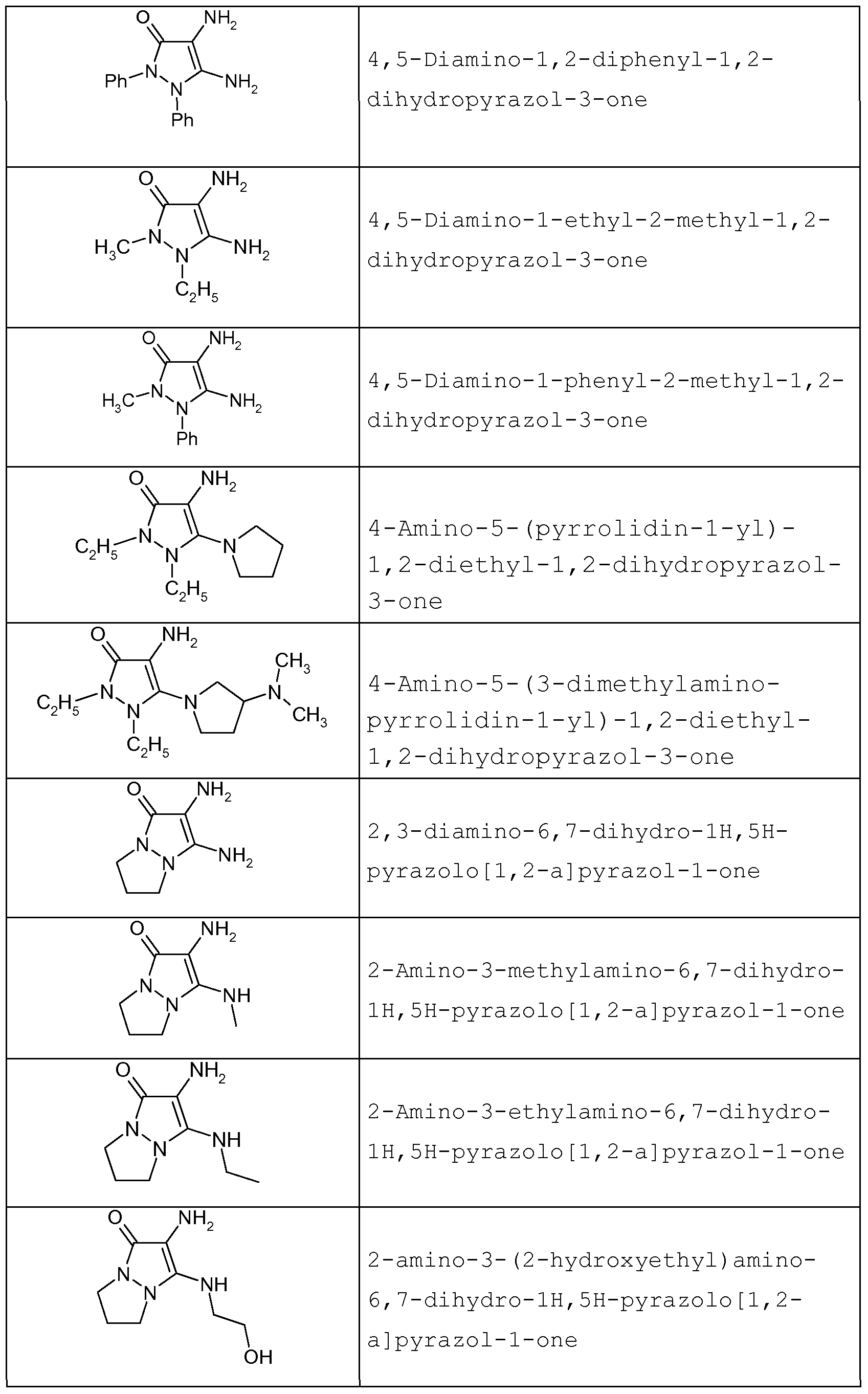


Among these compounds, the diamino-N, N-dihydropyrazolone derivatives of formula (IV), or the addition salts thereof, which are particularly preferred are the following: 2, 3-diamino-6, 7-dihydro-lH, 5H-pyrazolo[l,2-a] pyrazol-1-one ;■
2-amino-3-ethylamino-6, 7-dihydro-lH, 5H-pyrazolo [1,2-a] pyrazol- 1-one ,•
2-amino-3-isopropylamino-6, 7-dihydro-lH, 5H-pyrazolo [1,2- a] pyrazol-1-one; 2-amino-3- (pyrrolidin-1-yl) -6, 7-dihydro-lH, 5H-pyrazolo[l,2- a] pyrazol-1-one ;
4, 5-diamino-l, 2-dimethyl-1, 2-dihydropyrazol-3-one;
4, 5-diamino-l, 2-diethyl-l, 2-dihydropyrazol-3-one;
4, 5-diamino-l, 2-di (2-hydroxyethyl) -1, 2-dihydropyrazol-3-one; 2-amino-3- (2-hydroxyethyl) amino-6, 7-dihydro-lH, 5H- pyrazolo [1,2-a] pyrazol-1-one;
2-amino-3-dimethylamino-6, 7-dihydro-lH, 5H-pyrazolo[l,2- a] pyrazol-1-one;
2, 3-diamino-5, 6,7, 8-tetrahydro-lH, 6H-pyridazino[ 1,2-a] pyrazol- 1-one;
4-amino-l, 2-diethyl-5-pyrrolidin-l-yl-l, 2-dihydropyrazol-3- one;
4-amino-5- (3-dimethylaminopyrrolidin-l-yl) -1, 2-diethyl-l, 2- dihydropyrazol-3-one; 2, 3-diamino-6-hydroxy- 6, 7-dihydro-lH, 5H-pyrazolo[l,2- a]pyrazol-l-one.
According to one embodiment, the compound of formula (II) is
2 , 3-diamino-6, 7-dihydro-lH, 5H-pyrazol-l-one or a salt thereof. As examples of compounds of formula (V) , the compounds cited in the following documents are useful : DE-A-38 43 892, DE-A-41 33 957 and WO 94/08969, WO 94/08970, FR-A-2 733 749 and DE-A-195 43 988. The following compounds are particularly useful in the present invention 4, 5-diamino-l- methylpyrazole, 4, 5-diamino-l- (2-hydroxyethyl) -pyrazole, 4,5- diamino-1- (4 ' -chlorobenzyl) -pyrazole, 4, 5-diamino-l, 3- dimethyl-pyrazole, 4, 5-diamino-3-methyl-l-phenyl-pyrazole, 4, 5-diamino-l-methyl-3-phenylpyrazole, 4-amino-l, 3-dimethyl- 5-hydrazino-pyrazole, l-benzyl-4, 5-diamino-3-methylpyrazole, 4, 5-diamino-3-tert-butyl-l-methylpyrazole, 4, 5-diamino-l- tert-butyl-3-methyl-pyrazole, 4, 5-diamino-l- (β-hydroxyethyl) - 3-methylpyrazole, 4, 5-diamino-l-ethyl-3-methylpyrazole, 4,5- diamino-l-ethyl-3- (4 ' -methoxy-phenyl) -pyrazole, 4, 5-diamino- l-ethyl-3-hydroxy-methyl-pyrazole, 4, 5-diamino-3- hydroxymethyl-1-methyl-pyrazole, 4, 5-diamino-3-hydroxymethyl- 1-isopropyl-pyrazole, 4, 5-diamino-3-methyl-
1-isopropylpyrazole, 4-amino-5- (2 ' -aminoethyl) amino-
1, 3-dimethyl-pyrazole, and the corresponding addition salts.
According to a one embodiment, the diaminopyrazole (V) is such that R26 is a hydrogen atom. According to another embodiment, R21, R22, R23, R24 represent a hydrogen atom or a C1-C4 alkyl radical and R25 is a alkyl, hydroxyalkyl or alkoxyalkyl radical.
Prefered compounds of formula (V) are 4, 5-diamino-l- (2- hydroxyethyl) -lH-pyrazole and the corresponding salt such as
4, 5-diamino-l- (2-hydroxyethyl) -lH-pyrazole sulfate having the following formula :

The dyeing composition according to the invention may contain and preferably does contain one or more couplers conventionally used for dyeing keratin fibres. Among these couplers, mention may especially be made of meta- phenylenediamines, meta-aminophenols, meta-diphenols, naphthalene-based couplers, heterocyclic couplers, and the addition salts thereof.
Examples of couplers that may be mentioned include 2-methyl- 5-aminophenol, 5-N- (β-hydroxyethyl) amino-2-methylphenol, 6-chloro-2-methyl-5-aminophenol, 3-aminophenol, 2, 4-dichloro-3- aminophenol, 5-amino-4-chloro-o-cresol, 1, 3-dihydroxybenzene, 1, 3-dihydroxy-2-methylbenzene, 4-chloro-l, 3-dihydroxybenzene, 2, 4-diamino-l- (β-hydroxyethyloxy) benzene, 2-amino-4- (β- hydroxyethylamino) -1-methoxybenzene, 1, 3-diaminobenzene, 1,3- bis (2, 4-diaminophenoxy) propane, 3-ureidoaniline, 3-ureido-l- dimethylaminobenzene, sesamol, l-β-hydroxyethylamino-3, 4- methylenedioxybenzene, α-naphthol, 2-methyl-l-naphthol, 1,5- dihydroxynaphthalene, 2, 7-naphthalenediol, l-acetoxy-2- methylnaphthalene, 6-hydroxyindole, 4-hydroxyindole, 4-hydroxy-N-methy1indole, 2-amino-3-hydroxypyridine,
6-hydroxybenzomorpholine, 3, 5-diamino-2, 6-dimethoxypyridine, 2 , 6-dihydroxy-3-4-dimethylpyridine, 3-amino-2-methylamino-6- methoxypyridine, 1-N- (β-hydroxyethyl) amino-3, 4-methylene- dioxybenzene, 2, 6-bis (β-hydroxyethylamino) toluene and 3-methyl- l-phenyl-5-pyrazolone, and the addition salts thereof with an acid. In the composition of the present invention, the coupler (s) is (are) each generally present in an amount of between 0.001% and 10% by weight approximately and preferably between 0.005% and 6% by weight relative to the total weight of the dyeing composition .
The dyeing composition of the invention may optionally comprise one or more additional oxidation bases conventionally used for dyeing keratin fibres other than the compounds of formula (I), (II) (III) (IV) and (V) or the salts thereof. By way of example, these additional oxidation bases are chosen from para-phenylenediamines other than the compound of formula (I) or the salts thereof, bis (phenyl) alkylenediamines, para-aminophenols, bis-para-aminophenols, ortho-aminophenols and heterocyclic bases other than the oxidation bases of formula (II) (III), (IV) and (V) and the addition salts thereof .
Among the para-phenylenediamines, mention may be made, for example, of para-phenylenediamine, para-toluenediamine, 2- chloro-para-phenylenediamine, 2, 3-dimethyl-para- phenylenediamine, 2, 6-dimethyl-para-phenylenediamine, 2,6- diethyl-para-phenylenediamine, 2, 5-dimethyl-para- phenylenediamine, N, N-dimethyl-para-phenylenediamine, N, N- diethyl-para-phenylenediamine, N, N-dipropyl-para- phenylenediamine, 4-amino-N, N-diethyl-3-methylaniline, N, N- bis (β-hydroxyethyl) -para-phenylenediamine, 4-N,N-bis(β- hydroxyethyl) amino-2-methylaniline, 4-N,N-bis (β- hydroxyethyl) amino-2-chloroaniline, 2-β-hydroxyethyl-para- phenylenediamine, 2-fluoro-para-phenylenediamine, 2-isopropyl- para-phenylenediamine, N- (β-hydroxypropyl) -para-phenyl- enediamine, 2-hydroxymethyl-para-phenylenediamine, N, N- dimethyl-3-methyl-para-phenylenediamine, N-ethyl-N- (β- hydroxyethyl) -para-phenylenediamine, N- (β,γ-dihydroxypropyl) - para-phenylenediamine, N- (4' -aminophenyl) -para- phenylenediamine, N-phenyl-para-phenylenediamine, 2-β-hydroxyethyloxy-para-phenylenediamine, 2-β-acetylamino- ethyloxy-para-phenylenediamine, N- (β-methoxyethyl) -para- phenylenediamine, 4-aminophenylpyrrolidine, 2-thienyl-para- phenylenediamine, 2-β-hydroxyethylamino-5-aminotoluene and 3-hydroxy-l- (4 ' -aminophenyl) pyrrolidine, and the addition salts thereof with an acid.
Among the para-phenylenediamines mentioned above, para- phenylenediamine, para-toluenediamine, 2-isopropyl-para- phenylenediamine, 2-β-hydroxyethyl-para-phenylenediamine, 2-β-
hydroxyethyloxy-para-phenylenediamine, 2, 6-dimethyl-para- phenylenediamine, 2, 6-diethyl-para-phenylenediamine, 2,3- dimethyl-para-phenylenediamine, N,N-bis (β-hydroxyethyl) -para- phenylenediamine, 2-chloro-para-phenylenediamine and 2-β-acetylaminoethyloxy-para-phenylenediamine, and the addition salts thereof with an acid are particularly preferred.
Among the bis (phenyl) alkylenediamines, mention may be made, for example, of N, N'-bis (β-hydroxyethyl) -N, N' -bis (4'- aminophenyl) -1, 3-diaminopropanol, N, N'-bis (β-hydroxyethyl) -N, N'- bis (4'-aminophenyl) ethylenediamine, N,N'-bis(4- aminophenyl) tetramethylenediamine, N, N' -bis (β-hydroxyethyl) - N, N' -bis (4-aminophenyl) tetramethylenediamine, N, N' -bis (4- methylaminophenyl) tetramethylenediamine, N, N' -bis (ethyl) -N, N' - bis (4'-amino-3'-methylphenyl) ethylenediamine and l,8-bis(2,5- diaminophenoxy) -3, 6-dioxaoctane, and the addition salts thereof with an acid.
Among the para-aminophenols, mention may be made, for example, of para-aminophenol, 4-amino-3-methylphenol, 4-amino- 3-fluorophenol, 4-amino-3-hydroxymethylphenol, 4-amino-2- methylphenol, 4-amino-2-hydroxymethylphenol, 4-amino-2- methoxymethylphenol, 4-amino-2-aminomethylphenol, 4-amino- 2- (β-hydroxyethylaminomethyl) phenol, 4-amino-2-fluorophenol, 1- hydroxy-4-methylaminobenzene and 2, 2' -methylenebis (4-amino- phenol) and the addition salts thereof with an acid. Among the ortho-aminophenols, mention may be made, for example, of 2-aminophenol, 2-amino-5-methylphenol, 2-amino-6- methylphenol and 5-acetamido-2-aminophenol, and the addition salts thereof with an acid.
Among the heterocyclic bases, mention may be made, for example, of pyridine derivatives, pyrimidine derivatives and pyrazole derivatives.
Among the pyridine derivatives, mention may be made of the compounds described, for example, in patents GB 1 026 978 and GB 1 153 196, such as 2, 5-diaminopyridine, 2- (4- methoxyphenyl) amino-3-aminopyridine, 2, 3-diamino-6- methoxypyridine, 2- (β-methoxyethyl) amino-3-amino-6- methoxypyridine and 3, 4-diaminopyridine, and the addition salts thereof with an acid.
Among the pyrimidine derivatives, mention may be made of the compounds described, for example, in patents DE 2359399, JP 88-169571; JP 05-63124; EP 0 770 375 or patent application WO 96/15765, such as 2, 4, 5, 6-tetraaminopyrimidine, 4-hydroxy- 2, 5, 6-triaminopyrimidine, 2-hydroxy-4, 5, 6-triaminopyrimidine, 2 , 4-dihydroxy-5, 6-diaminopyrimidine and 2, 5, 6-triaminopyrimidine, and pyrazolopyrimidine derivatives such as those mentioned in patent application FR-A-2 750 048 and among which mention may be made of pyrazolo [ 1, 5-a] pyrimidine-3, 7-diamine; 2 , 5-dimethylpyrazolo [ 1 , 5-a] pyrimidine-3, 7-diamine; pyrazolo [1, 5-a] pyrimidine-3, 5-diamine; 2, 7-dimethylpyrazolo-
[1, 5-a] pyrimidine-3, 5-diamine; 3-aminopyrazolo [1, 5-a] - pyrimidin-7-ol; 3-aminopyrazolo [1, 5-a] pyrimidin-5-ol; 2- (3- aminopyrazolo [ 1 , 5-a] pyrimidin-7-ylamino) ethanol, 2- (7- aminopyrazolo [ 1, 5-a] pyrimidin-3-ylamino) ethanol, 2-[(3- aminopyrazolo [ 1 , 5-a] pyrimidin-7-yl) (2-hydroxyethyl) amino] - ethanol, 2- [ (7-aminopyrazolo [ 1, 5-a] pyrimidin-3-yl) (2- hydroxyethyl) amino] ethanol, 5, 6-dimethylpyrazolo [1, 5-a] - pyrimidine-3, 7-diamine, 2, 6-dimethylpyrazolo [1, 5-a] pyrimidine- 3, 7-diamine, 2, 5, N7, N7-tetramethylpyrazolo [ 1, 5-a] pyrimidine- 3, 7-diamine and 3-amino-5-methyl-7-imidazolylpropylamino- pyrazolo [ 1, 5-a] pyrimidine, and the addition salts thereof with an acid and the tautomeric forms thereof, when a tautomeric equilibrium exists. In general, the addition salts of the additional oxidation bases and of the couplers that may be used in the context of the invention are chosen especially from the addition salts with an acid, such as the hydrochlorides, hydrobromides, sulphates, citrates, succinates, tartrates, lactates, tosylates, benzenesulphonates, phosphates and acetates, and the addition salts with a base, such as sodium hydroxide, potassium hydroxide, ammonium hydroxide, amines or alkanolamines .
The dyeing composition in accordance with the invention may also contain one or more direct dyes which may, in particular, be chosen from nitrobenzene dyes, azo direct dyes or methine direct dyes. These direct dyes may be of nonionic, anionic or cationic nature.
The medium suitable for dyeing, also known as dyeing vehicle, generally comprises water or a mixture of water and of one or more solvents such as, for example, Ci-C4 lower alkanols, for instance ethanol and isopropanol, polyols such as propylene glycol, dipropylene glycol or glycerol, and polyol ethers such as dipropylene glycol monomethyl ether.
The solvent (s) is (are) in general present in proportions which may be between 1% and 40% by weight approximately, and more preferably between 3% and 30% by weight approximately, relative to the total weight of the dyeing composition.
The dyeing composition in accordance with the invention may also contain various adjuvants conventionally used in compositions for dyeing the hair, such as anionic, cationic, nonionic, amphoteric or zwitterionic surfactants or mixtures thereof, anionic, cationic, nonionic, amphoteric or zwitterionic polymers or mixtures thereof, inorganic or organic thickening agents and in particular anionic, cationic, nonionic and amphoteric polymeric associative thickeners, antioxidants, penetrants, sequestrants, fragrances, buffers, dispersants, conditioning agents such as, for example, volatile or non-volatile, modified or unmodified silicones, film-forming agents, ceramides, preservatives or opacifying agents .
The above adjuvants are generally present in an amount, for each of them, of between 0.01% and 20% by weight relative to the weight of the composition.
Of course, a person skilled in the art will take care to choose this or these optional additional compounds so that the advantageous properties intrinsically linked to the oxidation dyeing composition according to the invention are not, or not substantially, impaired by the envisaged addition (s).
The pH of the dyeing composition in accordance with the invention is generally between 3 and 12 approximately, and preferably between 5 and 11 approximately. It may be adjusted to the desired value by using acidifying or basifying agents commonly used in the dyeing of keratin fibres or else by means of conventional buffering systems.
Among the acidifying agents mention may be made, by way of example, of inorganic or organic acids such as hydrochloric acid, orthophosphoric acid, sulphuric acid, carboxylic acids such as acetic acid, tartaric acid, citric acid or lactic acid or sulphonic acids.
Among the basifying agents, mention may be made, by way of example, of aqueous ammonia, alkaline carbonates, alkanolamines such as mono-, di- and triethanolamines and also derivatives thereof, sodium or potassium hydroxides and compounds of formula (A) below:
N W N
Rc Rd (A) in which W is a propylene residue optionally substituted with a hydroxyl group or a Ci-C4 alkyl radical; Ra, Rb, Rc and Rd, which are identical or different, represent a hydrogen atom, a Ci-C4 alkyl radical or a Ci-C4 hydroxyalkyl radical.
The composition according to the invention may comprise one or more oxidizing agents.
The oxidizing agents are those conventionally used for the oxidation dyeing of keratin fibres, which are, for example, hydrogen peroxide, urea peroxide, alkali metal bromates, persalts such as perborates and persulphates, peracids and oxidase enzymes, among which mention may be made of peroxidases, 2-electron oxidoreductases such as uricases and 4-electron oxygenases such as laccases. Hydrogen peroxide is particularly preferred.
The composition with or without oxidizing agent according to the invention may be in various forms, such as in the form of liquids, creams, gels, or in any other form suitable for dyeing keratin fibres, and especially human hair. It may result from the mixing of several compositions at the time of use.
In a first particular variant, it results from the mixing of at least two compositions, one comprising one or more oxidation bases chosen from the compound of formula (I) or its addition salts with an acid, optionally one or more additional
oxidation bases other than the compounds of formula (I) or of formulae (II) (III) (IV) (V) or salts thereof, and optionally one or more couplers, a second composition comprising the oxidation base(s) of formula (II) (III) (IV) (V) or salts thereof and optionally a third composition comprising one or more oxidizing agents as described previously.
In a second particular variant, it results from the mixing of two compositions, one comprising one or more oxidation bases chosen from the compound of formula (I) or its addition salts with an acid, the oxidation base(s) of formula (II) (III) (IV) (V) or salts thereof, optionally one or more additional oxidation bases other than the compounds of formula (I) or of formula (II) (III) (IV) (V) or salts thereof, and optionally one or more couplers, another composition comprising one or more oxidizing agents as described previously.
The composition of the invention is therefore applied to the hair for colouring keratin fibres either as is, or in the presence of one or more oxidizing agents for colouring keratin fibres . The method of the present invention is a method in which, applied to the fibres, is the composition without oxidizing agent according to the present invention as defined previously, either alone or in the presence of an oxidizing agent for a sufficient time to develop the desired colouring. The colour may be developed at acid, neutral or alkaline pH and the oxidizing agent may be added to the composition of the invention only at the time of use or it may be used starting from an oxidizing composition containing it, applied simultaneously with or sequentially to the composition of the invention.
According to one particular embodiment, the composition without oxidizing agent according to the present invention is mixed, preferably at the time of use, with a composition containing, in a medium suitable for dyeing, one or more oxidizing agents. The mixture obtained is then applied to the keratin fibres. After a leave-in time of 3 to 50 minutes approximately, preferably 5 to 30 minutes approximately, the
keratin fibres are rinsed, washed with shampoo, rinsed again, then dried.
The oxidizing agents are those indicated previously. The oxidizing composition may also contain various additives conventionally used in compositions for dyeing hair and as defined previously.
The pH of the oxidizing composition containing the oxidizing agent is such that after mixing with the dyeing composition, the pH of the resulting composition applied to the keratin fibres preferably varies between 3 and 12 approximately, and more preferably still between 5 and 11. It may be adjusted to the desired value by means of acidifying or basifying agents customarily used in the dyeing of keratin fibres and as defined previously. Another subject of the invention is a dyeing kit or multicompartment device in which a first compartment contains the dyeing composition without oxidizing agent of the present invention defined above comprising one or more oxidation bases chosen from the compounds of formula (I) or its addition salts with an acid and one or more oxidation bases chosen from the compounds of formula (II) (III) (IV) (V) or their addition salts with an acid or a base and a second compartment contains one or more oxidizing agents.
A second device is constituted by a first compartment containing a composition comprising one or more oxidation bases chosen from the compound of formula (I) or its addition salts with an acid, optionally one or more additional oxidation bases other than those of formula (I), (II) (III)
(IV) or (V) or their addition salts with an acid or base, optionally one or more couplers and a second compartment containing a composition that comprises one or more oxidation bases chosen from the compounds of formula (II) (III) (IV) (V) or their addition salts with an acid or a base and optionally one or more couplers . A third device may optionally comprise the two compartments from the second device plus a third compartment containing a composition that comprises one or more oxidizing agents.
These devices may be equipped with a means that makes it possible to deliver the desired mixture to the hair, such as the devices described in patent FR-2 586 913 in the name of the applicant.
The examples that follow serve to illustrate the invention without however exhibiting a limiting nature.
EXAMPLES
DYEING EXAMPLES
EXAMPLE 1

Ammonium acetate 0.8 g 0.8 g
Antioxidant, sequestrant qs qs
Fragrance, preservative qs qs
Aqueous ammonia containing 20% NH3 10.2 g 10.2 g
Demineralized water qs for 100 g qs for 100 g
Method of application
Each composition was diluted extemporaneously with 1 times its weight of 20-volume aqueous hydrogen peroxide solution, the pH of which is 3.
Each of the extemporaneous mixtures thus produced was applied to grey hair containing 90% white hair in an amount of 10 g per 1 g of hair. After leaving in for 30 minutes at ambient temperature, the hair was then rinsed, washed with a standard shampoo and dried.
Results
The hair colouring obtained was evaluated visually. The following colourings were obtained:

EXAMPLE 2
The following composition C3 was prepared :

Oleic acid 3 g
2 EO oleylamine sold under the name Ethomeen 012 7 g AM by Akzo
Diethylaminopropyl laurylaminosuccinamate, sodium 3 g AM salt, containing 55% AM
Oleyl alcohol 5 g
Monoethanolamide of alkyl (C13/C15 70/30, 50% 10 g AM linear) ether carboxylic acid (2 EO)
Propylene glycol 9. 5 g
Ethyl alcohol 5 g
Hexylene glycol 9. 3 g
Sodium metabisulphite in aqueous solution 0. 455 g AM containing 35% AM
Ammonium acetate 0. 8 g
Antioxidant, sequestrant qs
Fragrance, preservative qs
Aqueous ammonia containing 20% NH3 10 .2 g
Demineralized water qs for 100 g
Method of application
The composition was diluted extemporaneously with 1 times its weight of 20-volume aqueous hydrogen peroxide solution, the pH of which is 3.
The extemporaneous mixture thus produced was applied at ambient temperature to grey hair containing 90% white hair in an amount of 10 g per 1 g of hair. After leaving in for 30 minutes, the hair was then rinsed, washed with a standard shampoo and dried.
Results
The hair colouring was evaluated visually. A dark blonde colouring of the hair with coppery brown highlights was obtained.
EXEMPLE 3
The following composition C4 was prepared :

Method of application
The composition was diluted extemporaneously with 1 times its weight of 20-volume aqueous hydrogen peroxide solution, the pH of which is 3.
The extemporaneous mixture thus produced was applied at ambient temperature to grey hair containing 90% white hair in an amount of 10 g per 1 g of hair. After leaving in for 30 minutes, the hair was then rinsed, washed with a standard shampoo and dried.
Results
The hair colouring was evaluated visually. A chestnut colouring of the hair with red highlights was obtained.
Claims
1. Composition for dyeing keratin fibres comprising, in a medium suitable for dyeing keratin fibres: one or more oxidation bases chosen from the compound of formula (I) or its addition salts with an acid,

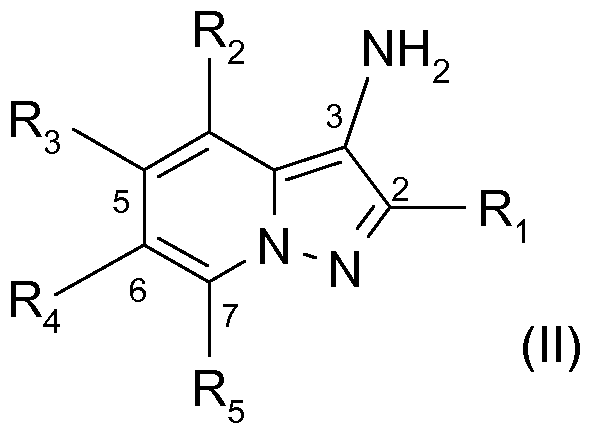
Ri, R2, R3, R4 and R5, which are identical or different, represent a hydrogen or halogen atom; an -NHSO3H radical; a hydroxyl radical; a (Ci-C4) alkyl radical; a (Ci-C4) alkoxy radical; a (Ci-C4) alkylthio radical; a mono (Ci-C4) alkylamino radical; a di (Ci- C4) alkylamino radical in which the two alkyl groups can, jointly with the nitrogen atom to which they are bonded, form a ring which can be interrupted by one or more nitrogen, oxygen or sulphur atoms; a heterocycle; a nitro radical; a phenyl radical; a carbonyl radical; a (Ci-C4) alkoxycarbonyl radical; a carboxamido radical; a cyano radical; an amino radical; a sulphonyl radical; a -CO2H radical; an -SO3H radical; a -PO3H2 radical; a -PO4H2 radical; or a group:  in which R'" represents an oxygen or nitrogen atom, Q represents an oxygen atom or an NH or NH (Ci-C4) alkyl group and Y represents a hydroxyl, amino, Ci-C4 alkyl, (Ci-C4) alkoxy, (Ci-C4) alkylamino or di (Ci- C4) alkylamino radical,

• Zi and Z2 independently represent:
- a simple covalent bond, - a divalent radical chosen from:
-an -O (CH2) p- radical, p denoting an integer ranging from 0 to 6,
-an -NR' 6 (CH2) q (CδH4) t- radical, q denoting an integer ranging from 0 to 6, t denoting 0 or 1, and R' 6 representing a hydrogen atom or a Ci-Cε alkyl radical optionally substituted with one or more hydroxyl groups,
• Zi can also represent a divalent radical -S-, -SO- or -SO2- when R' i is a methyl radical, • R' i and R' 2 independently represent:
- a hydrogen,
- an optionally substituted Ci-Cio alkyl radical, optionally interrupted by a heteroatom or a group chosen from O, N, Si, S, SO or SO2, - a halogen,
- an SO3H radical,
- a saturated, unsaturated or aromatic and substituted or unsubstituted 5- to 8-membered ring optionally comprising one or more heteroatoms or groups chosen from N, O, S, SO2 or -CO-, it being possible for the ring to be cationic and/or substituted with a cationic radical,
- an -N+Ri7Ri8Ri9 group, Ri7, Rig and R19 being linear or branched Ci-C5 alkyls which are optionally substituted with one or more hydroxyl groups,
when Zi, respectively Z2, represents a covalent bond, then R'i, respectively R' 2, can also represent: - an optionally substituted Ci-Cε alkylcarbonyl radical,
- an -O-CO-R, -CO-O-R, NR-CO-R' or -CO-NRR' radical in which R and R' independently represent a hydrogen atom or an optionally substituted Ci-Cε alkyl radical,
• R' 3, R' 4 and R' 5, which are identical or different, represent: a hydrogen atom, - a hydroxyl radical, a Ci-Cε alkoxy radical, a Ci-Cε alkylthio radical, an amino radical, a monoalkylamino radical, - a Ci-Cε dialkylamino radical in which the alkyl radicals can form, with the nitrogen atom to which they are attached, a saturated or unsaturated and aromatic or non-aromatic 5- to 8-membered heterocycle which can include one or more heteroatoms or groups chosen from N, 0, S,
SO2 or CO, it being possible for the heterocycle to be cationic and/or substituted with a cationic radical, an optionally substituted Ci-Cε alkyl- carbonyl radical, - an -O-CO-R, -CO-O-R, NR-CO-R' or -CO-NRR' radical with R and R' as defined above, a halogen,
- an -NHSO3H radical, - an optionally substituted Ci-C4 alkyl radical, a saturated, unsaturated or aromatic and optionally substituted carbon ring, it being possible for R' 3, R' 4 and R' 5 to form, in pairs, a ring which is or is not partially saturated,
• X represents an ion or group of ions which makes it possible to provide the electronegativity of the derivative of formula (II), with the condition that at least one of the groups R' 1 and R' 2 represents a cationic radical ;

in which: R , R , R and R, which are identical or different, represent : a linear or branched, C1-C10, preferably Ci-Cε alkyl radical optionally substituted with one or more radicals chosen from the group constituted by an ORi5 radical, an NRi6Ri7 radical, a carboxyl radical, a sulphonic radical, a CONR16R17 carboxamido radical, an SO2NR6R7 sulphonamido radical, a heteroaryl or an aryl optionally substituted with one or more (Ci-C4) alkyl, hydroxyl, C1-C2 alkoxy, amino or (di) (C1-C2) alkylamino groups; an aryl radical optionally substituted with one or more (Ci-C4) alkyl, hydroxyl, C1-C2 alkoxy, amino or (di) (C1-C2) alkylamino radicals; a 5- or 6-membered heteroaryl radical, optionally substituted with one or more radicals chosen from a (Ci-C4) alkyl or (C1-C2) alkoxy radical;
R"' and R may also represent a hydrogen atom;
Ri5, R16 and Ri7, which are identical or different, represent : a hydrogen atom; a linear or branched C1-C4 alkyl radical optionally substituted with one or more radicals chosen from a hydroxyl radical, C1-C2 alkoxy radical, CONR8R9 carboxamido radical, SO2R8 sulphonyl radical, or an aryl radical optionally substituted with a (Ci-C4) alkyl, hydroxyl, C1-C2 alkoxy, amino or (di) (C1-C2) alkylamino radical; an aryl radical optionally substituted with a
(Ci-C4) alkyl, hydroxyl, C1-C2 alkoxy, amino or
(di) (C1-C2) alkylamino radical;
R16 and Ri7, which are identical or different, may also represent a CONRl8Rl9 carboxamido radical or an SO2RI8 sulphonyl radical;
Rl8 and Rl9, which are identical or different, represent a hydrogen atom; a linear or branched Ci-C4 alkyl radical optionally substituted with one or more hydroxyl or C1-C2 alkoxy radicals;
R' and R", on the one hand, and R"' and R on the other hand, may form with the nitrogen atom(s) to which they are attached, a saturated or unsaturated 5- to 7- membered heterocycle, optionally substituted with one or more radicals chosen from the group constituted by halogen atoms, amino, (di) (Ci-C4) alkylamino, hydroxyl, carboxyl, carboxamido or (C1-C2) alkoxy radicals, or Ci-C4 alkyl radicals optionally substituted with one or more hydroxyl, amino, (di) alkylamino, alkoxy, carboxyl or sulphonyl radicals; R"' and R may also form, together with the nitrogen atom to which they are attached, a 5- or 7-membered heterocycle, the carbon atoms of which may be replaced with an optionally substituted oxygen or nitrogen atom;

(V)
Wherein :
- R21, R22, R23, R24 t R25 et R26, which are identical or different, represent a hydrogen atom, a alkyl radical from Ci-Cε optionally substituted with at least one group selected from OR, NHR, NRR' , SR, SOR, SO2R, COR, COOH, CONH2, CONHR, CONRR', PO(OH)2, SH, SO3X, a non cationic heterocycle, Cl, Br or I, X being a hydrogen atom, Na, K, or NH4, and R and R', identical or different representing a C2-C4 alkyl or alkenyl radical; a C2-C4 aminoalkyle radical ; a phenyl radical ; a phenyl radical substituted with a halogen atom or a Ci- C4 alcoxy, Ci-C4alkyl radical, nitro, trifluoromethyl, amino or Ci-C4 alkylamino ; a benzyl radical ; a benzyl radical substituted with a haogen atom or a Ci-C4 alkyl radical , a Ci-C4 alcoxy radical, methylenedioxy or amino ; a radical
-(CH2)m- X-(CH)n-Z
Y Wherein m and n , identical or different are integer from 0 and 3 included, X represents un oxygen atom, or a group NH, Y represents a hydrogen atom or a Ci-C4 alkyl radical, and Z represents a methyl radical when n is 0, r Z reprssents a Ci-C4 alkyle radical, a group OR or NR1 1R''' when n is 1 or higher, R'' et R''', identical or the same being a hydrogen atom, a Ci-C4 alkyl radical; or R5 forms with the nitrogen atom of NR3R4 in position 5 a heterocyclic group having at least 4 members, at least one of R21, R22, R23 et R24 being a hydrogen atom.
2. Composition according to Claim 1, in which the compound of formula (II) or its addition salts with an acid or a base correspond to the following formula:

(C1-C4) alkylthio radical; a (Ci-C4) alkoxy radical; an
-NHSO3H radical; an amino radical; a (Ci-C4) alkylamino radical; a di (Ci-C4) alkylamino radical in which the two alkyl groups can, jointly with the nitrogen atom to which they are bonded, form a ring which can be interrupted by one or more nitrogen, oxygen or sulphur atoms; a heterocycle as defined above; a sulphonamide radical; a carbonyl radical; a (Ci-C4) alkoxycarbonyl radical; a carboxamido radical; or a group of formula:

3. Composition according to Claim 1, in which the compound of formula (III) or its addition salts with an acid or a base correspond to the following formula:  in which R' 3, R' 4 and R' 5 are as defined previously,
Zi represents a covalent bond, an -NR' 6 (CH2) q- radical or an -0 (CH2) p- radical and R' 1 is a cationic radical. 4. Composition according to claim 1 to 3 wherein the compounds of formula (II) or (III) are selected from 2-
[ (3-aminopyrazolo [1, 5-a]pyridin-2-yl) oxy] ethanol hydrochloride,
4- [ (3-aminopyrazolo [ 1 , 5-a] pyridin-2-yl-
1, 1-dimethylpiperazin-l-ium chloride hydrochloride, 1- { 2- [ (3-aminopyrazolo [1, 5-a]pyridin-2-yl) amino] ethyl } -3- methyl-lH-imidazol-3-ium chloride hydrochloride, 2-[(3- aminopyrazolo [ 1 , 5-a] pyridin-2-yl) oxy] -N, N, N-trimethy1- ethanaminium chloride hydrochloride.
5. Composition according to Claim 1, in which the compound of formula (IV) is chosen from:
2 , 3-diamino-6, 7-dihydro-lH, 5H-pyrazolo [ 1 , 2-a] pyrazol- 1-one;
2-amino-3-ethylamino-6, 7-dihydro-lH, 5H-pyrazolo [ 1 , 2-a] - pyrazol-1-one; 2-amino-3-isopropylamino-6, 7-dihydro-lH, 5H-pyrazolo-
[ 1,2-a] pyrazol-1-one ;
2-amino-3- (pyrrolidin-1-yl) -6, 7-dihydro-lH, 5H-pyrazolo-
[ 1,2-a] pyrazol-1-one ;
4, 5-diamino-l, 2-dimethyl-l, 2-dihydropyrazol-3-one; 4, 5-diamino-l, 2-diethyl-l, 2-dihydropyrazol-3-one;
4, 5-diamino-l, 2-di (2-hydroxyethyl) -1, 2-dihydropyrazol-
3-one;
2-amino-3- (2-hydroxyethyl) amino-6, 7-dihydro-lH, 5H- pyrazolo[ 1,2-a] pyrazol-1-one ; 2-amino-3-dimethylamino-6, 7-dihydro-lH, 5H-pyrazolo-
[1, 2-a] pyrazol-1-one ;
2, 3-diamino-5, 6,7, 8-tetrahydro-lH, 6H-pyridazino[ 1,2-a] - pyrazol-1-one;
4-amino-l, 2-diethyl-5-pyrrolidin-l-yl-l, 2-dihydro- pyrazol-3-one; 4-amino-5- (3-dimethylaminopyrrolidin-l-yl) -1, 2-diethyl-
1, 2-dihydropyrazol-3-one;
2 , 3-diamino-6, 7-dihydro-lH, 5H-pyrazolo [ 1 , 2-a] pyrazol- 1-one; 2-amino-3-ethylamino-6, 7-dihydro-lH, 5H-pyrazolo [ 1 , 2-a] - pyrazol-1-one;
2-amino-3-isopropylamino-6, 7-dihydro-lH, 5H-pyrazolo-
[ 1, 2-a] pyrazol-1-one ;
2-amino-3- (pyrrolidin-1-yl) -6, 7-dihydro-lH, 5H-pyrazolo- [ 1, 2-a] pyrazol-1-one;
4, 5-diamino-l, 2-dimethyl-l, 2-dihydropyrazol-3-one;
4, 5-diamino-l, 2-diethyl-l, 2-dihydropyrazol-3-one;
4, 5-diamino-l, 2-di (2-hydroxyethyl) -1, 2-dihydropyrazol-
3-one; 2-amino-3- (2-hydroxyethyl) amino-6, 7-dihydro-lH, 5H- pyrazolo[l, 2-a] pyrazol-1-one ;
2-amino-3-dimethylamino-6, 7-dihydro-lH, 5H-pyrazolo-
[1, 2-a] pyrazol-1-one ;
2, 3-diamino-5, 6,7, 8-tetrahydro-lH, 6H-pyridazino[l,2-a]- pyrazol-1-one;
4-amino-l, 2-diethyl-5-pyrrolidin-l-yl-l, 2-dihydro- pyrazol-3-one;
4-amino-5- (3-dimethylaminopyrrolidin-l-yl) -1, 2-diethyl-
1, 2-dihydropyrazol-3-one . 6. Composition according to claim 5, characterized in that the compound of formula (IV) is 2,3-diamino-
6, 7-dihydro-lH, 5H-pyrazol-l-one or a salt thereof.
7. Composition according to claim 1 wherein in formula (V) R26 is a hydrogen atom, R2i, R22, R23, R24 represent a hydrogen atom or a Ci-C4 alkyl radical and R25 is a alkyl, hydroxyalkyl or alkoxyalkyl radical.
8. Composition according to claim 7 wherein the compound of formula (V) is 4, 5-diamino-l- (2- hydroxyethyl) -lH-pyrazole et the corresponding salts such as 4, 5-diamino-l- (2-hydroxyethyl) -lH-pyrazole sulfate .
9. Composition according to any one of the preceding claims, characterized in that it contains one or more couplers chosen from meta-phenylenediamines, meta- aminophenols, meta-diphenols, naphthalene couplers, heterocyclic couplers and addition salts thereof.
10. Composition according to any one of the preceding claims, characterized in that it contains one or more oxidizing agents.
11. Composition according to the preceding claim, characterized in that the oxidizing agent is chosen from hydrogen peroxide, urea peroxide, alkali metal bromates, persalts, peracids and oxidase enzymes, and preferably hydrogen peroxide.
12. Method for dyeing keratin fibres, in which the composition as defined in any one of Claims 1 to 11 is applied to the keratin fibres in the presence of one or more oxidizing agents for a time sufficient to develop the desired colouring.
13. Multicompartment device, in which a first compartment contains a dyeing composition as defined in any one of Claims 1 to 11 and a second compartment contains one or more oxidizing agents.
Applications Claiming Priority (12)
| Application Number | Priority Date | Filing Date | Title |
|---|---|---|---|
| FR0953350A FR2945740B1 (en) | 2009-05-19 | 2009-05-19 | TINCTORIAL COMPOSITION COMPRISING A PARA-PHENYLENE DIAMINE SECONDARY OXIDATION BASE AND DIAMINOPYRAZOLE OXIDATION BASE |
| FR0953351A FR2945741B1 (en) | 2009-05-19 | 2009-05-19 | TINCTORIAL COMPOSITION COMPRISING A PARA-PHENYLENE DIAMINE SECONDARY OXIDATION BASE AND A DIAMINOPYRAZOLINONE BASE |
| FR0953349 | 2009-05-19 | ||
| FR0953351 | 2009-05-19 | ||
| FR0953349A FR2945739B1 (en) | 2009-05-19 | 2009-05-19 | TINCTORIAL COMPOSITION COMPRISING A PARA-PHENYLENE DIAMINE SECONDARY OXIDATION BASE AND AN AMINOPYRAZOLOPYRIDINE OXIDATION BASE |
| FR0953350 | 2009-05-19 | ||
| US18407809P | 2009-06-04 | 2009-06-04 | |
| US18407009P | 2009-06-04 | 2009-06-04 | |
| US61/184,070 | 2009-06-04 | ||
| US61/184,078 | 2009-06-04 | ||
| US18441909P | 2009-06-05 | 2009-06-05 | |
| US61/184,419 | 2009-06-05 |
Publications (2)
| Publication Number | Publication Date |
|---|---|
| WO2010133640A2 true WO2010133640A2 (en) | 2010-11-25 |
| WO2010133640A3 WO2010133640A3 (en) | 2011-01-13 |
Family
ID=43126574
Family Applications (1)
| Application Number | Title | Priority Date | Filing Date |
|---|---|---|---|
| PCT/EP2010/056897 Ceased WO2010133640A2 (en) | 2009-05-19 | 2010-05-19 | Dyeing composition comprising a secondary para-phenylenediamine oxidation base and a heterocyclic oxidation base |
Country Status (1)
| Country | Link |
|---|---|
| WO (1) | WO2010133640A2 (en) |
Cited By (20)
| Publication number | Priority date | Publication date | Assignee | Title |
|---|---|---|---|---|
| EP2651386A2 (en) * | 2010-12-17 | 2013-10-23 | L'Oréal | Dye composition comprising at least four dye precursors including at least one oxidation base and at least one coupler |
| US20130312203A1 (en) * | 2010-12-17 | 2013-11-28 | L'oreal | Dyeing composition comprising a fatty substance, a pyrazolopyridine oxidation base and a coupler |
| US8663341B2 (en) | 2012-06-25 | 2014-03-04 | The Procter & Gamble Company | Hair colorant compositions comprising 2-Methoxymethy1-1,4-diaminobenzene, methods, and kits comprising the compositions |
| US20140259454A1 (en) * | 2010-12-17 | 2014-09-18 | L'oreal | Dye composition comprising a heterocyclic oxidation base and a 4-aminoindole coupler |
| US9012691B2 (en) | 2012-10-26 | 2015-04-21 | The Procter & Gamble Company | Process for preparing primary intermediates for dyeing keratin fibers |
| US20150202125A1 (en) * | 2012-08-02 | 2015-07-23 | L'oreal | Dye composition comprising nonionic guar gum or a nonionic derivative thereof, process and device for the same |
| WO2015173322A1 (en) * | 2014-05-16 | 2015-11-19 | L'oreal | Composition comprising a particular phenolic coupler and an oxidation base |
| US9309185B2 (en) | 2012-10-26 | 2016-04-12 | The Procter & Gamble Company | Process for preparing primary intermediates for dyeing keratin fibers |
| US9539192B2 (en) | 2014-04-02 | 2017-01-10 | Noxell Corporation | Hair colouring compositions, kits, method, and use thereof |
| US9587116B2 (en) | 2014-11-04 | 2017-03-07 | Noxell Corporation | Azo direct dyes and method for dyeing hair using these dyes |
| US9688609B2 (en) | 2014-11-04 | 2017-06-27 | Noxell Corporation | Telescoping synthesis of 2-methoxymethyl-P-phenylenediamine |
| US9695109B2 (en) | 2014-11-04 | 2017-07-04 | Noxell Corporation | Telescoping synthesis of 2-methoxymethyl-p-phenylenediamine |
| US9758469B2 (en) | 2014-11-04 | 2017-09-12 | Noxell Corporation | Process for the preparation of 2-substituted-1,4-benzenediamines and salts thereof |
| US9827185B2 (en) | 2012-08-02 | 2017-11-28 | L'oreal | Dyeing composition comprising at least one fatty substance, at least one oxidizing agent and at least one non-ionic, anionic and amphoteric surfactant |
| US9993409B2 (en) | 2014-05-16 | 2018-06-12 | L'oreal | Composition for dyeing keratin fibres, comprising an oxidation base and a particular heteroaryl coupler |
| CN108472235A (en) * | 2015-12-21 | 2018-08-31 | 莱雅公司 | The composition for including heterocycle oxidation base and 2- amino -5- ethyl -phenol colour couplers for hair dyeing |
| US10201483B2 (en) | 2012-08-02 | 2019-02-12 | L'oreal | Dye composition in cream form comprising at least one oil and little or no solid fatty alcohol, dyeing process and suitable device |
| US10226411B2 (en) | 2012-08-02 | 2019-03-12 | L'oreal | Dyeing composition comprising a fatty substance, a non-ionic guar gum, an amphoteric surfactant and a non-ionic or anionic surfactant, and an oxidizing agent, dyeing process and suitable device |
| US11213471B2 (en) | 2015-12-21 | 2022-01-04 | L'oreal | Composition for dyeing the hair, comprising an oxidation base, a 2-amino-5-ethylphenol coupler and a fatty substance |
| US11324682B2 (en) | 2015-12-21 | 2022-05-10 | L'oreal | Composition for dyeing the hair, comprising an oxidation base of para-phenylenediamine type and a 2-amino-5-ethylphenol coupler |
Family Cites Families (5)
| Publication number | Priority date | Publication date | Assignee | Title |
|---|---|---|---|---|
| DE3047105A1 (en) * | 1980-12-13 | 1982-07-29 | Henkel KGaA, 4000 Düsseldorf | HAIR DYE |
| FR2801308B1 (en) * | 1999-11-19 | 2003-05-09 | Oreal | KERATINIC FIBER DYEING COMPOSITIONS CONTAINING 3-AMINO PYRAZOLO- [1, (- a] -PYRIDINES, DYEING PROCESS, NEWS 3-AMINO PYRAZOLO- [1,5-a] -PYRIDINES |
| FR2866876B1 (en) * | 2004-02-27 | 2006-06-02 | Oreal | N-ALKYLPOLYHYDROXYLATED SECONDARY PARA-PHENYLENEDIAMINES, TINCTORIAL COMPOSITION COMPRISING SAME, METHODS AND USES |
| US7591860B2 (en) * | 2004-02-27 | 2009-09-22 | L'oreal, S.A. | N-alkylpolyhydroxylated secondary para-phenylenediamines, dye compositions comprising them, processes, and uses thereof |
| FR2915881B1 (en) * | 2007-05-09 | 2009-08-21 | Oreal | TINCTORIAL COMPOSITION COMPRISING AN AMINOPYRAZOLOPYRIDINE OXIDATION BASE, A COUPLER AND A CATIONIC DIRECT DYE |
-
2010
- 2010-05-19 WO PCT/EP2010/056897 patent/WO2010133640A2/en not_active Ceased
Cited By (30)
| Publication number | Priority date | Publication date | Assignee | Title |
|---|---|---|---|---|
| US9125834B2 (en) * | 2010-12-17 | 2015-09-08 | L'oreal | Dye composition comprising a heterocyclic oxidation base and a 4-aminoindole coupler |
| US20140259454A1 (en) * | 2010-12-17 | 2014-09-18 | L'oreal | Dye composition comprising a heterocyclic oxidation base and a 4-aminoindole coupler |
| US20140007358A1 (en) * | 2010-12-17 | 2014-01-09 | L'oreal | Dye composition comprising at least four dye precursors including at least one oxidation base and at least one coupler |
| US9370477B2 (en) * | 2010-12-17 | 2016-06-21 | L'oreal | Dyeing composition comprising a fatty substance, a pyrazolopyridine oxidation base and a coupler |
| US9220671B2 (en) * | 2010-12-17 | 2015-12-29 | L'oreal | Dye composition comprising at least four dye precursors including at least one oxidation base and at least one coupler |
| EP2651386A2 (en) * | 2010-12-17 | 2013-10-23 | L'Oréal | Dye composition comprising at least four dye precursors including at least one oxidation base and at least one coupler |
| US20130312203A1 (en) * | 2010-12-17 | 2013-11-28 | L'oreal | Dyeing composition comprising a fatty substance, a pyrazolopyridine oxidation base and a coupler |
| US8702814B2 (en) | 2012-06-25 | 2014-04-22 | The Procter & Gamble Company | Hair colorant compositions comprising 2-methoxymethyl-1,4-diaminobenzene and 2,6-diaminopyridine, methods, and kits comprising the compositions |
| US8709100B2 (en) | 2012-06-25 | 2014-04-29 | The Procter & Gamble Company | Hair colorant compositions comprising 2-methoxymethyl-1,4-diaminobenzene and 5-amino-4-chloro-o-cresol, methods, and kits comprising the compositions |
| US8663341B2 (en) | 2012-06-25 | 2014-03-04 | The Procter & Gamble Company | Hair colorant compositions comprising 2-Methoxymethy1-1,4-diaminobenzene, methods, and kits comprising the compositions |
| US10226411B2 (en) | 2012-08-02 | 2019-03-12 | L'oreal | Dyeing composition comprising a fatty substance, a non-ionic guar gum, an amphoteric surfactant and a non-ionic or anionic surfactant, and an oxidizing agent, dyeing process and suitable device |
| US9827185B2 (en) | 2012-08-02 | 2017-11-28 | L'oreal | Dyeing composition comprising at least one fatty substance, at least one oxidizing agent and at least one non-ionic, anionic and amphoteric surfactant |
| US10201483B2 (en) | 2012-08-02 | 2019-02-12 | L'oreal | Dye composition in cream form comprising at least one oil and little or no solid fatty alcohol, dyeing process and suitable device |
| US20150202125A1 (en) * | 2012-08-02 | 2015-07-23 | L'oreal | Dye composition comprising nonionic guar gum or a nonionic derivative thereof, process and device for the same |
| US10137063B2 (en) * | 2012-08-02 | 2018-11-27 | L'oreal | Dye composition comprising nonionic guar gum or a nonionic derivative thereof, process and device for the same |
| US9012691B2 (en) | 2012-10-26 | 2015-04-21 | The Procter & Gamble Company | Process for preparing primary intermediates for dyeing keratin fibers |
| US9309185B2 (en) | 2012-10-26 | 2016-04-12 | The Procter & Gamble Company | Process for preparing primary intermediates for dyeing keratin fibers |
| US9539192B2 (en) | 2014-04-02 | 2017-01-10 | Noxell Corporation | Hair colouring compositions, kits, method, and use thereof |
| US9993409B2 (en) | 2014-05-16 | 2018-06-12 | L'oreal | Composition for dyeing keratin fibres, comprising an oxidation base and a particular heteroaryl coupler |
| WO2015173322A1 (en) * | 2014-05-16 | 2015-11-19 | L'oreal | Composition comprising a particular phenolic coupler and an oxidation base |
| FR3020943A1 (en) * | 2014-05-16 | 2015-11-20 | Oreal | COMPOSITION COMPRISING A PARTICULAR PHENOLIC COUPLER, AND AN OXIDATION BASE |
| US9758469B2 (en) | 2014-11-04 | 2017-09-12 | Noxell Corporation | Process for the preparation of 2-substituted-1,4-benzenediamines and salts thereof |
| US9587116B2 (en) | 2014-11-04 | 2017-03-07 | Noxell Corporation | Azo direct dyes and method for dyeing hair using these dyes |
| US9695109B2 (en) | 2014-11-04 | 2017-07-04 | Noxell Corporation | Telescoping synthesis of 2-methoxymethyl-p-phenylenediamine |
| US9688609B2 (en) | 2014-11-04 | 2017-06-27 | Noxell Corporation | Telescoping synthesis of 2-methoxymethyl-P-phenylenediamine |
| CN108472235A (en) * | 2015-12-21 | 2018-08-31 | 莱雅公司 | The composition for including heterocycle oxidation base and 2- amino -5- ethyl -phenol colour couplers for hair dyeing |
| US20180369104A1 (en) * | 2015-12-21 | 2018-12-27 | L'oreal | Composition for dyeing the hair, comprising a heterocyclic oxidation base and a 2-amino-5-ethylphenol coupler |
| US11213471B2 (en) | 2015-12-21 | 2022-01-04 | L'oreal | Composition for dyeing the hair, comprising an oxidation base, a 2-amino-5-ethylphenol coupler and a fatty substance |
| US11324682B2 (en) | 2015-12-21 | 2022-05-10 | L'oreal | Composition for dyeing the hair, comprising an oxidation base of para-phenylenediamine type and a 2-amino-5-ethylphenol coupler |
| US11730688B2 (en) * | 2015-12-21 | 2023-08-22 | L'oreal | Composition for dyeing the hair, comprising a heterocyclic oxidation base and a 2-amino-5-ethylphenol coupler |
Also Published As
| Publication number | Publication date |
|---|---|
| WO2010133640A3 (en) | 2011-01-13 |
Similar Documents
| Publication | Publication Date | Title |
|---|---|---|
| WO2010133640A2 (en) | Dyeing composition comprising a secondary para-phenylenediamine oxidation base and a heterocyclic oxidation base | |
| US9125834B2 (en) | Dye composition comprising a heterocyclic oxidation base and a 4-aminoindole coupler | |
| EP2155153B1 (en) | Dyeing composition comprising a specific aminopyrazolopyridine oxidation base, a coupler and a specific surfactant | |
| KR100954717B1 (en) | 2,3-diamino-6,7-dihydro-1H, 5H-pyrazolo [1,2-a] pyrazol-1-one, para-phenylenediamine, meta-aminophenol and oxidizing agent Acid pH dye composition | |
| US9220671B2 (en) | Dye composition comprising at least four dye precursors including at least one oxidation base and at least one coupler | |
| KR100906590B1 (en) | Process for the predictable dyeing of keratinous fibres by application of a composition comprising a diamino-n,n-dihydropyrazolone derivative and of a fundamental or golden-highlights composition | |
| JP5456966B2 (en) | Acid pH dye composition comprising 2,3-diamino-6,7-dihydro-1H, 5H-pyrazolo [1,2-a] pyrazol-1-one, coupler, specific surfactant and oxidizing agent | |
| FR2945739A1 (en) | Composition useful for dyeing keratin fibers comprises in a medium, specific secondary paraphenylenediamine oxidation base or its addition salt with acid, and heterocyclic oxidation base e.g. pyrazolopyridine compounds with acid/base | |
| US7648536B2 (en) | Method of coloring keratinous fibers comprising application of at least one aminopyrazolopyridine oxidation base in the absence of chemical oxidizing agents | |
| MX2007007348A (en) | COLORATION COMPOSITION OF THE QUERATINIC FIBERS CONTAINING 2,3-DIAMINO-6,7-DIHIDRO-1H, 5H-PIRAZOL [1,2-A] PIRAZOL-1-ONA, 6-CHLORO-2-METHYL-5-AMINOPHENOL AND A SUBSTITUTED METAAMINOPHENOL. | |
| EP2464424B1 (en) | Dye composition comprising a heterocyclic oxidation base and an indole coupler | |
| WO2008138845A2 (en) | Colouring composition comprising an aminopyrazolopyridine oxidation base and exhibiting an acidic ph | |
| WO2008037778A2 (en) | Composition for dyeing keratin fibres, comprising a diamino-n, n-dihydropyrazolone derivative and a stabilizer | |
| WO2012080286A2 (en) | Dyeing composition comprising a heterocyclic oxidation base and a cationic 3,5-diaminopyridine coupler | |
| FR2937864A1 (en) | COMPOSITION COMPRISING 2,3-DIAMINO-6,7-DIHYDRO-1H, 5H-PYRAZOLLO-1,2-A! PYRAZOL-1-ONE, 4,5-DIAMINO 1- (BETA-HDROXYETHYL) PYRAZOLE AND 2 -CHLORO 6-METHYL 3-AMINO PHENOL | |
| FR2852241A1 (en) | Composition for oxidation dyeing of human hair, comprises a heterocyclic base and, as coupler, a 2,3,5-trisamino-pyridine derivative, provides gray or black shades | |
| FR2906462A1 (en) | KERATIN FIBER COLORING COMPOSITION COMPRISING A DIAMINO-N, N-DIHYDRO-PYRAZOLONE DERIVATIVE AND VITAME E OR ONE OF ITS ESTERS | |
| FR2906460A1 (en) | Stable oxidation dyeing compositions for keratin fibers, especially human hair, contain 4,5-diamino-1,2-dihydro-pyrazol-3-one derivative and dithionite | |
| FR2906461A1 (en) | Stable oxidation dyeing compositions for keratin fibers, especially human hair, contain 4,5-diamino-1,2-dihydro-pyrazol-3-one derivative and thioglycerol | |
| FR2949054A1 (en) | Composition, useful for dyeing keratin fibers, comprises coupler comprising 1-(2-hydroxy-ethyl)-1H-indol-4-ol and oxidation bases comprising aminopyrazolopyridine compound in a medium | |
| FR2968964A1 (en) | Composition, useful for dyeing keratin fibers, comprises, in a medium, at least one oxidation base comprising diamino-N,N-dihydro-pyrazolone derivatives, coupler comprising cationic 4-aminopyridine derivatives and benzene couplers |
Legal Events
| Date | Code | Title | Description |
|---|---|---|---|
| 121 | Ep: the epo has been informed by wipo that ep was designated in this application |
Ref document number: 10723042 Country of ref document: EP Kind code of ref document: A2 |
|
| NENP | Non-entry into the national phase |
Ref country code: DE |
|
| 122 | Ep: pct application non-entry in european phase |
Ref document number: 10723042 Country of ref document: EP Kind code of ref document: A2 |