WO2010108498A1 - Genetic markers for mastitis resistance - Google Patents
Genetic markers for mastitis resistance Download PDFInfo
- Publication number
- WO2010108498A1 WO2010108498A1 PCT/DK2010/050071 DK2010050071W WO2010108498A1 WO 2010108498 A1 WO2010108498 A1 WO 2010108498A1 DK 2010050071 W DK2010050071 W DK 2010050071W WO 2010108498 A1 WO2010108498 A1 WO 2010108498A1
- Authority
- WO
- WIPO (PCT)
- Prior art keywords
- seq
- genetic marker
- mastitis
- bovine
- resistance
- Prior art date
- Legal status (The legal status is an assumption and is not a legal conclusion. Google has not performed a legal analysis and makes no representation as to the accuracy of the status listed.)
- Ceased
Links
Classifications
-
- C—CHEMISTRY; METALLURGY
- C12—BIOCHEMISTRY; BEER; SPIRITS; WINE; VINEGAR; MICROBIOLOGY; ENZYMOLOGY; MUTATION OR GENETIC ENGINEERING
- C12Q—MEASURING OR TESTING PROCESSES INVOLVING ENZYMES, NUCLEIC ACIDS OR MICROORGANISMS; COMPOSITIONS OR TEST PAPERS THEREFOR; PROCESSES OF PREPARING SUCH COMPOSITIONS; CONDITION-RESPONSIVE CONTROL IN MICROBIOLOGICAL OR ENZYMOLOGICAL PROCESSES
- C12Q1/00—Measuring or testing processes involving enzymes, nucleic acids or microorganisms; Compositions therefor; Processes of preparing such compositions
- C12Q1/68—Measuring or testing processes involving enzymes, nucleic acids or microorganisms; Compositions therefor; Processes of preparing such compositions involving nucleic acids
- C12Q1/6876—Nucleic acid products used in the analysis of nucleic acids, e.g. primers or probes
- C12Q1/6883—Nucleic acid products used in the analysis of nucleic acids, e.g. primers or probes for diseases caused by alterations of genetic material
-
- C—CHEMISTRY; METALLURGY
- C12—BIOCHEMISTRY; BEER; SPIRITS; WINE; VINEGAR; MICROBIOLOGY; ENZYMOLOGY; MUTATION OR GENETIC ENGINEERING
- C12Q—MEASURING OR TESTING PROCESSES INVOLVING ENZYMES, NUCLEIC ACIDS OR MICROORGANISMS; COMPOSITIONS OR TEST PAPERS THEREFOR; PROCESSES OF PREPARING SUCH COMPOSITIONS; CONDITION-RESPONSIVE CONTROL IN MICROBIOLOGICAL OR ENZYMOLOGICAL PROCESSES
- C12Q2600/00—Oligonucleotides characterized by their use
- C12Q2600/156—Polymorphic or mutational markers
-
- C—CHEMISTRY; METALLURGY
- C12—BIOCHEMISTRY; BEER; SPIRITS; WINE; VINEGAR; MICROBIOLOGY; ENZYMOLOGY; MUTATION OR GENETIC ENGINEERING
- C12Q—MEASURING OR TESTING PROCESSES INVOLVING ENZYMES, NUCLEIC ACIDS OR MICROORGANISMS; COMPOSITIONS OR TEST PAPERS THEREFOR; PROCESSES OF PREPARING SUCH COMPOSITIONS; CONDITION-RESPONSIVE CONTROL IN MICROBIOLOGICAL OR ENZYMOLOGICAL PROCESSES
- C12Q2600/00—Oligonucleotides characterized by their use
- C12Q2600/16—Primer sets for multiplex assays
-
- C—CHEMISTRY; METALLURGY
- C12—BIOCHEMISTRY; BEER; SPIRITS; WINE; VINEGAR; MICROBIOLOGY; ENZYMOLOGY; MUTATION OR GENETIC ENGINEERING
- C12Q—MEASURING OR TESTING PROCESSES INVOLVING ENZYMES, NUCLEIC ACIDS OR MICROORGANISMS; COMPOSITIONS OR TEST PAPERS THEREFOR; PROCESSES OF PREPARING SUCH COMPOSITIONS; CONDITION-RESPONSIVE CONTROL IN MICROBIOLOGICAL OR ENZYMOLOGICAL PROCESSES
- C12Q2600/00—Oligonucleotides characterized by their use
- C12Q2600/172—Haplotypes
Definitions
- the present invention relates to a method for determining resistance to mastitis in a bovine subject comprising detecting at least one genetic marker located on the bovine chromosomes BTA1 1. Furthermore, the present invention relates to a diagnostic kit for detecting the presence or absence of at least one genetic marker associated with resistance to mastitis. Also provided is a kit comprising a detection member for determining a genetic marker located on the bovine chromosome BTA1 1 in the region flanked by and including the ZAP70 and CD8B genes, and the use of that kit for determining mastitis resistance in a bovine subject.
- Mastitis is the inflammation of the mammary gland or udder of the cow resulting from infection or trauma and mastitis is believed to be the most economically important disease in cattle.
- the disease may be caused by a variety of agents.
- the primary cause of mastitis is the invasion of the mammary gland via the teat end by microorganisms.
- Mastitis may be clinical or sub-clinical, with sub-clinical infection preceding clinical manifestations.
- Clinical mastitis (CM) can be detected visually through observing red and swollen mammary glands i.e. red swollen udder, and through the production of clotted milk. Once detected, the milk from mastitic cows is kept separate from the vat so that it will not affect the overall milk quality.
- Subclinical mastitis is a type of mastitis characterized by high somatic cell counts (SCC), a normal or elevated body temperature, and milk samples that should test positive on culture.
- SCC somatic cell counts
- milk samples that should test positive on culture.
- sub-clinical mastitis cannot be detected visually by swelling of the udder or by observation of the gland or the milk produced. Because of this, farmers do not have the option of diverting milk from sub-clinical mastitic cows. However, this milk is of poorer quality than that from non-infected cows and can thus contaminate the rest of the milk in the vat.
- Mastitis can be detected by the use of somatic cell counts (SCC) in which a sample of milk from a cow is analysed for the presence of somatic cells (white blood cells). Somatic cells are part of the cow's natural defence mechanism and cell counts rise when the udder becomes infected. The number of somatic cells in a milk sample can be estimated indirectly by rolling-ball viscometer and Coulter counter. As mastitis results in reduced quantity and quality of milk and products from milk, mastitis results in economic losses to the farmer and dairy industry. Therefore, the ability to determine the genetic basis of resistance to mastitis in a bovine is of im- mense economic significance to the dairy industry both in terms of daily milk production but also in breeding management, selecting for bovine subjects with resistance to mastitis. A method of genetically selecting bovine subjects with improved resistance that will yield cows less prone to mastitis would be desirable.
- SCC somatic cell counts
- SCC somatic cell count
- LDLA linkage disequilibrium and linkage analysis
- QTL Quantitative Trait Locus
- quantitative trait loci or linked genetic markers associated to clinical mastitis and/or SCS have been identified on bovine chromosome BTA9 which allows for a method for determining whether a bovine subject will be resistant to mas- titis.
- the genetic predisposition for resistance to mastitis may be detected by the present invention.
- the present invention offers a method for determining the resistance to mastitis in a bovine subject based on genetic markers which are associated with and/or linked to resistance to mastitis.
- One aspect of the present invention relates to a method for determining resistance to mastitis in a bovine subject, comprising detecting in a sample from said bovine subject the presence or absence of at least one genetic marker that is associated with at least one trait indicative of mastitis resistance of said bovine subject and/or off-spring therefrom, wherein said at least one genetic marker is located on the bovine chromosome BTA11 in the region flanked by and including the ZAP70 and CD8B genes, wherein the presence or absence of said at least one genetic marker is indicative of mastitis resistance.
- the present invention relates to a method for estimating breeding value in respect of susceptibility to mastitis of a bovine subject, comprising detecting in a sample from said bovine subject the presence or absence of at least one genetic marker that is associated with at least one trait indicative of mastitis resistance of said bovine subject and/or off-spring therefrom, wherein said at least one genetic marker is located on the bovine chromosome BTA11 in the region flanked by and including the ZAP70 and CD8B genes, wherein the presence or absence of said at least one genetic marker is indicative of mastitis resistance.
- the breeding value is calculated according to any suitable method, including those available to the skilled preson, such as a marker-assisted single trait Best Linear Unbiased Prediction (MA- BLUP).
- the at least one genetic marker of the methods for determining mastitis resistance or estimating breeding value is located on the bovine chromosome BTA1 1 in a gene selected from the group consisting of MAP4K4, I L18R1 , ZAP70, AUP1 and/or CD8B, including upstream and downstream regulatory sequences as well as both exonic and intronic sequences.
- the at least one genetic marker is located in the region flanked by and including the ZAP70 and AUP1 genes of BTA11 , for example the genetic marker is located in a gene selected from MAP4K4, IL18R1 , ZAP70, or AUP1.
- the at least one genetic marker is located on the bovine chromosome BTA1 1 in the MAP4K4 gene, and most preferred, the at least one genetic marker is the T/C polymorphism in position 51 of SEQ ID NO: 3.
- the presence of a C in position 51 of SEQ 3 is indicative of clinical mastitis resistance.
- the at least one genetic marker is located on the bovine chromosome BTA1 1 in the IL18RA1 gene, such as preferably the at least one genetic marker is the T/C polymorphism in position 51 of SEQ ID NO: 4.
- the at least one genetic marker is the T/C polymor- phism in position 51 of SEQ ID NO: 4, wherein the presence of a C in position 51 of SEQ 4 is indicative of clinical mastitis resistance.
- the at least one genetic marker may also be located on the bovine chromosome BTA1 1 in the ZAP70 gene, and is in one example the T/C SNP in position 51 of SEQ ID NO: 5.
- the at least one genetic marker is located on the bovine chromosome BTA1 1 in the AUP1 gene, and is in one example the G/A polymorphism in position 51 of SEQ ID NO: 1.
- the at least one genetic marker is in another embodiment located on the bovine chromosome BTA1 1 in the CD8B gene, and is for example the G/A polymorphism in position 51 of SEQ ID NO: 2.
- a trait indicative of mastitis resistance for example reduced incidents of clinical mastitis, reduced somatic cell count (SCC), and/or reduced somatic cell score (SCS), when compared to a bovine subject or bovine population, which is not resistant to mastitis.
- SCC reduced somatic cell count
- SCS reduced somatic cell score
- the presence or absence of at least one genetic marker that is associated with at least one trait indicative of mastitis resistance is detected by any suitable method available in the art, including standard DNA detec- tion techniques such as southern blotting, and other hybridization techniques as well as PCR techniques and other nucleic acid amplification methods.
- the genetic marker is detected by nucleic acid amplification, which for example employ at least one oligonucleotide primer comprising at least 5 consecutive nucleotides selected from any of SEQ ID NO.: 1 to SEQ ID NO.: 5 or the complement thereof.
- the genetic marker is detected by nucleic acid amplification using at least one oligonucleotide primer selected from the group consisting of SEQ ID NO.: 6 to SEQ ID NO.:15, or the complement thereof and/or SEQ ID NO: 20-67 or the complement thereof.
- a MAP4K4 polymorphism is detected in the provided method for determining resistance to mas- titis and/or estimating a breeding value by nucleic acid amplification using at least one oligonucleotide primer comprising at least 5 consecutive nucleotides selected from any region of any one of SEQ ID NO.: 3, 10, 1 1 , 16, 17, 22, 23 or the complement thereof.
- a MAP4K4 polymorphism is detected by nucleic acid amplification using at least one oligonucleotide primer corresponding to SEQ ID NO.: 10 and/or SEQ ID NO.:1 1.
- an IL18R1 polymorphism is detected by nucleic acid amplification using at least one oligonucleotide primer comprising at least 5 consecutive nucleotides selected from any region of any one of SEQ ID NO.: 4, 12, 13, 18, 19, 24, 25 or the complement thereof.
- an IL18R1 polymorphism is detected by nucleic acid amplification us- ing at least one oligonucleotide primer corresponding to SEQ ID NO.: 12 and/or
- a ZAP70 polymorphism is detected by nucleic acid amplification using at least one oligonucleotide primer corresponding to SEQ ID NO.: 14 and/or SEQ ID NO.:15; and in yet another embodiment, an AUP1 polymorphism is detected by nucleic acid amplification using at least one oligonucleotide primer corresponding to SEQ ID NO.: 6 and/or SEQ ID NO.:7.
- a CD8B polymorphism is detected by nucleic acid amplification using at least one oligonucleotide primer corresponding to SEQ ID NO.: 8 and/or SEQ ID NO.:9.
- the provided method for determining mastitis resistance may also comprise estimating a breeding value of the bovine subject on the basis of its genotype with respect to at least one of the genetic markers detected in the method of the present invention.
- the at least one genetic marker indicative of mastitis resistance is used to estimate the breeding value of said bovine subject.
- the methods of the invention is applicable to any bovine subject, but in particular, the methods may be applied to any Nordic cattle breed, such as specifically Holstein breeds, as well as members of Finnish Ayrshire, Swedish Red and White, and/or Danish Red cattle breeds.
- the invention provides a method for selecting a bovine subject for breeding purposes.
- resistance to mastitis of the bovine subject and/or off-spring therefrom is determined by the method for determining mastitis resistance and/or the method for estimating a breeding value of the present invention as defined herein above.
- a breeding value is estimated for the bovine subject selected for breeding.
- the breeding value is estimated on the basis of the presence or absence of any genetic marker as described herein in regards to the method for determining mastitis resistance or the method for estimating a breeding value of a bovine subject.
- the present invention relates to a kit for use in detecting the pres- ence or absence in a bovine subject of at least one genetic marker associated with resistance to mastitis, comprising at least one detection member for determining a genetic marker located on the bovine chromosome BTA11 in the region flanked by and including the polymorphic microsatellite markers ZAP70 and CD8B.
- the present invention relates to a kit comprising at least one detection member for determining a genetic marker located on the bovine chromosome BTA11 in the region flanked by and including the ZAP70 and CD8B genes.
- the detection members of the kits are preferably capable of detecting a genetic marker, such as those defined in the methods for determining mastitis resistance and/or estimating a breeding value.
- the genetic marker is located on the bovine chromosome BTA1 1 in a gene selected from the group consisting of MAP4K4, IL18R1 , ZAP70, AUP1 and/or CD8B, including upstream and downstream regulatory sequences as well as both exonic and intronic sequences.
- the genetic marker is located in the region flanked by and including the ZAP70 and AUP1 genes of BTA1 1 , for example the genetic marker is lo- cated in a gene selected from MAP4K4, IL18R1 , ZAP70, or AUP1.
- the genetic marker is located on the bovine chromosome BTA1 1 in the MAP4K4 gene, and most preferred, the genetic marker is the T/C polymorphism in position 51 of SEQ ID NO: 3.
- the kit comprises a detection member capable of detecting the presence of a C in position 51 of SEQ 3, which is indicative of clinical mastitis resistance.
- the genetic marker is located on the bovine chromosome BTA1 1 in the IL18RA1 gene, such as preferably the genetic marker is the T/C polymorphism in position 51 of SEQ ID NO: 4.
- the genetic marker is the T/C polymorphism in position 51 of SEQ ID NO: 4, wherein the presence of a C in position 51 of SEQ 4 is indicative of clinical mastitis resistance.
- the genetic marker may also be located on the bovine chromosome BTA1 1 in the ZAP70 gene, and is in one example the T/C SNP in position 51 of SEQ ID NO: 5.
- the genetic marker is located on the bovine chromo- some BTA1 1 in the AUP1 gene, and is in one example the G/A polymorphism in position 51 of SEQ ID NO: 1.
- the genetic marker is in another embodiment located on the bovine chromosome BTA11 in the CD8B gene, and is for example the G/A polymorphism in position 51 of SEQ ID NO: 2.
- the genetic marker is a MAP4K4 SNP allele corresponding to position 51 of SEQ 3 comprising a C, and/or an IL18RA SNP allele at position 51 of SEQ 4 comprising a C.
- the detection member of the claimed kits is in a specific embodiment an oligonucleotide primer and/or an oligonucleotide probe.
- the oligonucleotide comprises at least 5 consecutive nucleotides, such as between 5 and 100, for ex- ample between 5 and 50, such as between 5 and 30, for example between 5 and 15 consecutive nucleotides, selected from any of SEQ ID NO.: 1 to SEQ ID NO.: 5 or the complement thereof.
- the oligonucleotide is selected from any of SEQ ID NO.: 6 to SEQ ID NO.: 15, or part thereof.
- the detection member is an oligonucleotide primer or probe comprising at least 5 consecutive nucleotides, such as between 5 and 100, for example between 5 and 50, such as between 5 and 30, for example between 5 and 15 consecutive nucleotides, selected from any region of any one of SEQ ID NO.: 3, 10, 11 , 16, 17, 22, 23 or the complement thereof.
- the detection member is an oligonucleotide primer or probe corresponding to SEQ ID NO.: 10 and/or SEQ ID NO.:11 , or part thereof for use in detecting a MAP4K4 polymorphism.
- the detection member is an oligonucleotide primer or probe comprising at least 5 consecutive nucleotides, such as between 5 and 100, for example between 5 and 50, such as between 5 and 30, for example between 5 and 15 consecutive nucleotides, selected from any region of any one of SEQ ID NO.: 4, 12, 13, 18, 19, 24, 25 or the complement thereof.
- the detection member is an oligonucleotide primer or probe corresponding to SEQ ID NO.: 12 and/or SEQ ID NO.:13 for use in detecting an IL18R1 polymorphism.
- the kit may further comprise at least one reference sample comprising a nucleic acid sequence comprising a genetic marker associated with mastitis resistance.
- the kit may further comprise at least one reference sample comprising a nucleic acid sequence comprising a genetic marker associated with susceptibility to mastitis.
- the reference nucleic acid sequence comprising a genetic marker associated with mastitis resistance comprises at least 10 con- secutive nucleotides selected from nucleotide position 42-60 of SEQ ID NO: 16,
- the reference nucleic acid sequence comprising a genetic marker associated with mastitis resistance comprises at least 10 consecutive nucleotides spanning position 51 of SEQ ID NO: 16, SEQ ID NO: 18, or the complement thereof.
- the reference nucleic acid sequence comprising a genetic marker associated with susceptibility to mastitis comprises at least 10 consecutive nucleotides selected from nucleotide position 42-60 of SEQ ID NO: 17, SEQ ID NO: 19, or the complement thereof.
- the reference nucleic acid sequence comprising a genetic marker associated with mastitis resistance comprises at least 10 consecutive nucleotides spanning position 51 of SEQ ID NO: 17, SEQ ID NO: 19, or the complement thereof.
- the kit of the present invention may further comprise instructions for performance of the detection method of the kit and for the interpretation of the results.
- the present invention relates to a use of a kit of the invention, such as those defined above for determining mastitis resistance in a bovine subject, said use comprising detecting the presence or absence in a bovine subject of at least one genetic marker associated with resistance to mastitis.
- the genetic markers associated with mastitis resistance include any one of those defined in the methods for determining mastitis resistance and/or estimating a breeding value.
- the genetic marker is located on the bovine chromosome BTA1 1 in a gene selected from the group consisting of MAP4K4, IL18R1 , ZAP70, AUP1 and/or CD8B, including upstream and downstream regulatory sequences as well as both exonic and intronic sequences.
- the genetic marker associated with resistance to mastitis is located in the region flanked by and including the ZAP70 and AUP1 genes of BTA11 , for example the genetic marker is located in a gene selected from MAP4K4, IL18R1 , ZAP70, or AUP1.
- the genetic marker associated with resistance to mastitis is located on the bovine chromosome BTA11 in the MAP4K4 gene, and most preferred, the genetic marker is the T/C polymorphism in position 51 of SEQ ID NO: 3.
- the kit comprises a detection member capable of detecting the presence of a C in position 51 of SEQ 3, which is indicative of clinical mastitis resistance.
- the genetic marker associated with resistance to mastitis is located on the bovine chromosome BTA1 1 in the IL18RA1 gene, such as preferably the genetic marker is the T/C polymorphism in position 51 of SEQ ID NO: 4.
- the genetic marker associated with resistance to mastitis is the T/C polymorphism in position 51 of SEQ ID NO: 4, wherein the presence of a C in position 51 of SEQ 4 is indicative of clinical mastitis resistance.
- the genetic marker associated with resistance to mastitis may also be located on the bovine chromosome BTA1 1 in the ZAP70 gene, and is in one example the T/C SNP in position 51 of SEQ ID NO: 5.
- the genetic marker associated with resistance to mastitis is located on the bovine chromosome BTA1 1 in the AUP1 gene, and is in one example the G/A polymorphism in position 51 of SEQ ID NO: 1. Furthermore, the genetic marker is in another embodiment located on the bovine chromosome BTA1 1 in the CD8B gene, and is for example the G/A polymorphism in position 51 of SEQ ID NO: 2. In a specifically preferred embodiment, the genetic marker associated with resistance to mastitis is a MAP4K4 SNP allele corresponding to position 51 of SEQ 3 comprising a C, and/or an IL18RA SNP allele at position 51 of SEQ 4 comprising a C. In a specific embodiment of the provided use of the kit, the genetic marker is the
- the genetic marker is a MAP4K4 SNP allele corresponding to position 51 of SEQ 3 comprising a C, and/or an IL18RA SNP allele at position 51 of SEQ 4 comprising a C.
- the use of the kit is claimed for estimating breeding value in respect of susceptibility to mastitis in a bovine subject.
- the invention relates to the use of the kit mentioned above for detecting the presence or absence in a bovine subject of at least one genetic marker associated with resistance to mastitis.
- the present invention relates to a method for estimating breeding value in respect of susceptibility to mastitis in a bovine subject, comprising detecting in a sample from said bovine subject the presence or absence of at least one genetic marker that is associated with at least one trait indicative of mastitis resistance of said bovine subject and/or off-spring therefrom, wherein said at least one genetic marker is located on the bovine chromosome BTA1 1 in the region flanked by and including the ZAP70 and CD8B genes, wherein the presence or absence of said at least one genetic marker is indicative of mastitis resistance.
- Figure 3 QTL profiles on BTA1 1 for 2-trait models for clinical mastitis (CM) and SCS in the across three breed analysis.
- MT P is a 2-trait model with a pleiotropic QTL affecting both CM and SCS; MT S cs snd MT CM sre 2-trait models where the QTL is affecting only one trait SCS or CM respectively.
- the present invention relates to genetic determinants of mastitis resistance in dairy cattle.
- the occurrence of mastitis, both clinical and sub-clinical mastitis involves substantial economic loss for the dairy industry. Therefore, it is of economic interest to identity those bovine subjects that have a genetic predisposition for mastitis resistance.
- Bovine subjects with such genetic predisposition are carriers of desired traits, which can be passed on to their offspring.
- variable nucleotide sequence refers to a variable nucleotide sequence (polymorphism) of the DNA on the bovine chromosome and distinguishes one allele from another.
- the variable nucleotide sequence can be identified by methods known to a person skilled in the art for example by using specific oligonucleotides in for example amplification methods and/or observation of a size difference. However, the variable nu- cleotide sequence may also be detected by sequencing or for example restriction fragment length polymorphism analysis.
- the variable nucleotide sequence may be represented by a deletion, an insertion, repeats, and/or a point mutation.
- microsatellite markers refer to short sequences repeated after each other. In short sequences are for example one nucleotide, such as two nucleotides, for example three nucleotides, such as four nucleotides, for example five nucleotides, such as six nucleotides, for example seven nucleotides, such as eight nucleotides, for example nine nucleotides, such as ten nucleotides.
- changes sometimes occur and the number of repeats may increase or decrease.
- the specific definition and locus of the polymorphic microsatellite markers can be found in the USDA genetic map (Kappes et al.
- the genetic marker of the present invention is a single nucleotide polymorphism (SNP).
- SNP is a variation in the genetic code at a specific point on the DNA, i.e. a genetic change that is caused by substitution of a single nucleotide (such as an A is changed to G).
- An SNP locus comprises at least two alleles, and an SNP locus comprising two, three, and four alleles are referred to as bi-, tri-, or tetra-allelic polymorphisms, respectively.
- the bovine genome comprise large amounts of SNPs, and SNP markers are therefore highly suitable for use in selection for desirable phenotypic traits, which are genetically linked to the SNPs.
- nucleotide sequences of the genetic markers of the present invention are genetically linked to traits for mastitis resistance in a bovine subject. Consequently, it is also understood that a number of genetic markers may be generated from the nucleotide sequence of the DNA region(s) flanked by and including the genetic markers according to the method of the present invention.
- QTL Quality of Life
- mastitis resistance e.g., mastitis resistance, somatic cell count, or clinical mastitis.
- QTLs are regions of DNA that are closely linked to the genes that underlie the trait in question.
- genetic marker allele and/or combination of genetic marker alleles and phenotypic traits is meant to comprise both direct and indirect genetic linkages.
- a genetic marker allele and/or combination of genetic marker alleles which are associated with a trait according to the present invention may be coupled to said trait by direct or indirect genetic linkages.
- trait associated with as used herein in regards to a specific phenotype, relates to any phenotypic traits, which to any extent contribute to said phenotype.
- the traits somatic cell count (SCC), somatic cell score (SCS), udder conformation (which comprises several quantitative measures, such as fore udder attachment, udder depth, udder texture etc.), and diagnostic variables (such as treated cases of clinical mastitis within a specific timeframe) contribute to the overall mastitis phenotype.
- the "traits associated with mastitis resistance”, or “mastitis resistance phenotypic traits” comprise SCC, SCS, udder conformation and diagnostic variables, including the subindexes of any of said phenotypic traits.
- the term “genetically coupled” is used herein about two genomic loci, which tend to segregate together.
- an SNP marker allele which is genetically coupled to another genetic marker allele associated with a specific phenotypic trait according to the present invention, is indicative of said genetic marker, and may consequently be detected in a sample as an alternative of detecting said genetic marker associated with said phenotypic traits, for example traits associated with mastitis resistance.
- nucleotide sequences of the genetic marker allele or combination of marker alleles of the present invention are genetically asso- ciated with phenotypic traits of the present invention in a bovine subject. Consequently, it is also understood that a number of genetic markers may be comprised in the nucleotide sequence of the DNA region(s) flanked by and including the genetic markers according to the method of the present invention.
- a genetic marker "located in a gene” may be locate- din exons, introns, or upstream or downstream of the open reading frame, for example in the area of 1000 nucleotides or more upstream or downstream of the open reading frame of the gene in question, in the present invention any of the ZAP70, MAP4K4, IL18R1 , AUP1 and/or CD8B genes.
- the transcribed region of a gene is considered to be comprised in the term "gene", and markers located in a gene, thus, includes any marker located in a transcribed region of that gene.
- Linkage disequilibrium reflects recombination events dating back in history and the use of LD mapping within families increases the resolution of mapping.
- LD exists when observed haplotypes in a population do not agree with the haplotype frequencies predicted by multiplying together the frequency of individual genetic markers in each haplotype.
- haplotype means a set of closely linked genetic markers present on one chromosome which tend to be inherited together.
- the density of genetic markers needs to be compatible with the distance across which LD extends in the given population.
- bovine subject refers to cattle of any breed and is meant to include both cows and bulls, whether adult or newborn animals. No particular age of the animals are denoted by this term.
- a bovine subject is a member of the HoI- stein breed.
- the bovine subject is a member of the Holstein-Friesian cattle population.
- the bovine subject is a member of the Holstein Swartbont cattle population.
- the bovine subject is a member of the Deutsche Holstein Schwarzbunt cattle population.
- the bovine subject is a member of the US Holstein cattle population.
- the bovine subject is a member of the Red and White Holstein breed.
- the bovine subject is a member of the Deutsche Holstein Schwarzbunt cattle population.
- the present invention broadly relates to methods for determining mastitis resistance of a bovine subject, and methods for estimating a breeding value in respect of sus- ceptibility to mastitis of a bovine subject.
- the invention also relates to the use of a kit provided herein for determining mastitis resistance in a bovine subject.
- the bovine subject is a member of any family, which include members of the Holstein breed.
- the bovine subject is a member of the Danish Red popula- tion.
- the bovine subject is a member of the Finnish Ayrshire population.
- the bovine subject is a member of the Swedish Red and White population.
- the bovine subject is a member of the Danish Holstein population. In another embodiment, the bovine subject is a member of the Swedish Red and White population. In yet another em- bodiment, the bovine subject is a member of the Nordic Red population. In one embodiment of the methods, kits, and uses of the present invention, the bovine subject is selected from the group consisting of Swedish Red and White, Danish Red, Finnish Ayrshire, Holstein-Friesian, Danish Holstein and Nordic Red. In another embodiment of the present invention, the bovine subject is selected from the group consisting of Finnish Ayrshire and Swedish Red and White cattle. In another embodiment of the present invention, the bovine subject is selected from the group consisting of Finnish Ayrshire and Swedish Red and White cattle.
- the bovine subject is a member of Finnish Ayrshire, Swedish Red and White, or Danish Red cattle breed.
- the bovine subject is a member of Finnish Ayrshire cattle breed.
- the bovine subject is a member of Swedish Red and White cattle breed, and in even another preferred embodiment, the bovine subject is a member of the Danish Red cattle breed.
- the bovine subject is selected from the group of breeds shown in table 1 a
- Table 1 a Breed names and breed codes assigned by ICAR (International Committee for Animal Recording)
- the bovine subject is a member of a breed selected from the group of breeds shown in table 1 b
- the bovine subject is a member of a breed selected from the group of breeds shown in table 1c
- Mastitis resistance relates to the inflammation of the mammary gland of the udder of a cow.
- the term “mastitis” is used to describe both the sub-clinical mastitis characterized for example by high or increased somatic cell score (SCS), and clinical mastitis.
- SCS somatic cell score
- the terms "mastitis resistance” and 'resistance to mastitis' are used interchangeable and relates to the fact that some bovine subjects are not as prone to mastitis as are other bovine subjects, in other words, some bovine subjects are less susceptible to mastitis than other bovine subjects.
- the term "resistance” as used herein re- fers to any level of reduction in mastitis, ranging from a minute reduction of 0.5 % or less to complete absence of mastitis, i.e. complete resistance.
- the traits implying resistance to mastitis may be observed by the presence or absence of ge- netic markers linked to occurrence of clinical mastitis and/or sub-clinical mastitis in the bovine subjects analyzed. It is understood that mastitis resistance comprise resistance to traits, which affect udder health in the bovine subject or its off-spring. Thus, mastitis resistance of a bull is physically manifested by its female off-spring.
- Mastitis resistance is inversely correlated with susceptibility to mastitis, i.e. a bovine subject with high mastitis resistance has low susceptibility to mastitis.
- susceptible to mastitis as used herein in meant to indicate that a bovine subject has a relatively higher likelihood of suffering from a trait indicative of mastitis.
- mastitis resistance may be observed according to the present invention on the basis of specific traits, which are indicative of mastitis resistance.
- One such trait indicative of mastitis resis- tance is recorded cases of clinical mastitis and somatic cell count (SCC) or Somatic cell score (SCS), which is defined as the mean of log 10 transformed somatic cell count values (in 10,000/mL) obtained from the milk recording scheme. The mean is for example taken over the period 10 to 180 days after calving.
- SCC clinical mastitis and somatic cell count
- SCS Somatic cell score
- Clinical mastitis in Denmark Treated cases of clinical mastitis in the period -5 to 50 days after 1 st calving.
- Clinical mastitis in Sweden and Finland Treated cases of clinical mastitis in the period -7 to 150 days after 1 st calving.
- SCS in Denmark Mean SCS in period 10-180 days after 1 st calving.
- SCS in Sweden Mean SCS in period 10-150 days after 1 st calving.
- SCS in Finland Mean SCS in period 10-305 days after 1 st calving.
- the methods and kits described herein relates to mastitis resistance, such as resistance to clinical mastitis and/or resistance to sub-clinical mastitis, such as detected by somatic cell counts or SCS.
- the method and kit of the present invention primarily relates to resistance to clinical mastitis in combination with resistance to sub-clinical mastitis such as detected by somatic cell counts or SCS.
- the methods and kits of the present invention comprise detecting the presence or absence of at least one genetic marker that is associated with at least one trait indicative of mastitis resistance of a bovine subject or off-spring therefrom, wherein said at least one trait is selected from somatic cell count (SCC), somatic cell score (SCS) and/or clinical mastitis.
- SCC somatic cell count
- SCS somatic cell score
- clinical mastitis is measured in terms of treated cases of clinical mastitis in the period from -7 to 150 days after 1 st calving.
- Subclinical mastitis may be measured in terms of mean SCS in a period from 10-305, such as a period of 10- 180, such as a period of 10-150 days after 1 st calving.
- increased levels of SCS are indicative of mastitis, e.g. subclinical mastitis.
- the level of SCC may be increased compared to previous measures for the same bovine subject, or compared to an average SCC for the given population, breed, or family.
- the SCS level may be measured at any time, and may be separate measures or a mean value over one lactation period.
- an SCC level above 100.000 cells/ml milk, such as above 200.000, for example above 300.000 cells/ml milk, such as above 400.000, for example above 500.000 cells/ml milk, such as above 600.000, cell/ml milk is indicative of mastitis, such as clinical or subclinical mastitis.
- SCC levels of such magnitudes are considered as traits indicative of mastitis or increased susceptibility to mastitis according to the present invention.
- SCC levels of about 100.000 cells/ml milk or below is considered as a trait indicative of mastitis resistance or reduced susceptibility to mastitis according to the present invention.
- the level of SCC indicative of mastitis resis- tance or susceptibility to mastitis may vary for different bovine subjects, breeds and families.
- a trait indicative of mastitis resistance is for example reduced incidents of clinical mastitis, reduced somatic cell count (SCC), and/or reduced somatic cell score (SCS), when compared to a bovine subject or bovine population, which is not resistant to mastitis.
- SCC reduced somatic cell count
- SCS reduced somatic cell score
- the present invention can be used to estimate breeding values in respect of mastitis resistance or susceptibility to mastitis.
- True breeding value is the genetic merit of an individual which can be conceptually defined as twice the average deviation of its offspring from the population mean when mated randomly to an infinite population. It is an estimate of the ability of an individual to produce superior offspring.
- True breeding values are not known but can be estimated from the animals own performance and/or the performance of its offspring and/or other relatives.
- information about animals genotypes at certain genes or markers associated with the trait of interest can be used in breeding value estimation procedures. Use of such information can increase the reliability of the breeding values and make, for example, selection possible at a younger age.
- the at least on genetic marker indicative of mastitis resistance is used to estimate the breeding value of a bovine subject.
- the trait indicative of mastitis resistance may be recalculated into a breeding value for every bovine subject, for example every sire.
- the genetic markers of the methods and kits of the present invention may be used for selection of bovine subjects with increased breeding values, and detection of at least on genetic marker indicative of mastitis resistance according to the present invention is indicative of an increased breeding value of the bovine subject.
- the breeding value is increased by at least 0.5%, such as at least 1 %, such as at least 2, 3, 4,5 ,6 ,7, 8, 9, for example at least 10%.
- EBV embryonic estimated breeding value
- GEBV genomic estimated breeding value
- the appearance and performance of a bovine subject is influenced by multiple both genetic and environmental factors.
- the term "estimated breeding value" is also abbreviated EBV throughout herein.
- An estimated breeding value is an estimate of an animals (herein bovine subjects) genetic merit for a range of commercially relevant phenotypes or production traits.
- An estimated breeding value is used as a measure of the genetic potential of an animal, for example as a measure of its genetic capacity for calving, susceptibility to disease etc., which it can pass on to its offspring.
- EBVs Estimated Breeding Values
- indexes are normally calculated from animals' individual performance records as well as those of their known relatives, where the environmental effects (feeding, management, disease, climate etc) are sifted out to leave an estimate of the genetic value for each trait.
- EBV are normally calculated using information from several sources, such as measurements from the animal itself, measurements from the animal's herd mates (con- temporaries), measurements from the animal's relatives and their contemporaries, the degree to which one trait influences another (correlation), and/or the degree to which each trait is passed on to the next generation (i.e. heritability).
- a conventional EBV calculation involves solving a set of simultaneous equations where the unknown variables are the genetic value of the animal and the environmental effect on its performance. When carried out many times, using all the information on the animal, the equations are able to quantify the unknown genetic component.
- an estimated breeding value is an estimation of how much better than the average an animal's genetics should be, based on the animal's performance, as well as the performance of all its relatives.
- the accuracy of the EBV increases with the number of relatives included in the phe- notypic registration records.
- the end result of the calculations is an EBV and over time, as more pedigree and performance data is added, the solution to the equa- tions becomes more accurate and the EBV approaches the true (empiric/observed) breeding value of the bovine subject.
- EBV of all animals of interest can be estimated using an appropriate model, such as a BLUP model integrating a genetic relationship matrix which is constructed from the pedigree of the animals.
- the reliability of the EBV is equal to 1/4 reliability of sire EBV + 1/16 reliability of maternal grandsire EBV.
- the method according to the present invention includes analyzing a sample of a bovine subject, wherein said sample may be any suitable sample capable of providing the bovine genetic material for use in the method.
- mastitis resistance is determined by detecting the absence or presence of a genetic marker allele in a sample of any source comprising genetic material.
- the bovine genetic material may for example be extracted, isolated and/or purified if necessary.
- the samples may be fresh or frozen. Detection of a genetic marker may be performed on samples selected from the group consisting of blood, semen (sperm), urine, liver tissue, muscle, skin, hair, follicles, ear, tail, fat, testicular tissue, lung tissue, saliva, spinal cord biopsy and/or any other tissue.
- the sample is selected from the group consisting of blood, urine, skin, hair, ear, tail, liver and muscle. In another preferred embodiment the sample is selected from the group consisting of blood, liver tissue and muscle. In particularly preferred embodiments the sample is blood. In another particularly preferred embodiment the sample is liver tissue. In yet another particularly preferred embodiment the sample is muscle.
- nucleic acid may be extracted from the samples by a variety of techniques.
- Genomic DNA may be isolated from the sample by treatment with proteinase K followed by extraction with phenol (see e.g. Sambrook et al. 1989).
- the sample may also be used directly.
- the amount of the nucleic acid used for microsatellite or SNP genotyping for detection of a genetic marker according to the method of the present invention is in the range of nanograms to micrograms. It is appreciated by the person skilled in the art that in practical terms no upper limit for the amount of nucleic acid to be analysed exists. The problem that the skilled person encounters is that the amount of sample to be analysed is limited. Therefore, it is beneficial that the method of the present invention can be performed on a small amount of sample and thus a limited amount of nucleic acid in the sample is required.
- the amount of the nucleic acid to be analysed is thus at least 1 ng, such as at least 10 ng, for example at least 25 ng, such as at least 50 ng, for example at least 75 ng, such as at least 100 ng, for example at least 125 ng, such as at least 150 ng, for example at least 200 ng, such as at least 225 ng, for example at least 250 ng, such as at least 275 ng, for example at least 300 ng, 400 ng, for example at least 500 ng, such as at least 600 ng, for example at least 700 ng, such as at least 800, ng, for example at least 900 ng or such as at least 1000 ng.
- the amount of nucleic acid as the starting material for the method of the present invention is 20-50 ng. In a specifically preferred embodiment, the starting material for the method of the present invention is at 30-40 ng.
- the grand daughter design includes analysing data from DNA-based markers for grand sires that have been used extensively in breeding and for sons of grand sires where the sons have produced offspring.
- the phenotypic data that are to be used together with the DNA-marker data are derived from the daughters of the sons. Such phenotypic data could be for example milk production features, features relating to calving, meat quality, or disease.
- One group of daughters have inherited one allele from their father whereas a second group of daughters have inherited the other allele form their father.
- By comparing data from the two groups information can be gained whether a fragment of a particular chromosome is harbouring one or more genes that affect the trait in question. It may be concluded whether a QTL is present within this fragment of the chromosome.
- a prerequisite for performing a grand daughter design is the availability of detailed phenotypic data. In the present invention such data have been available
- DNA markers can be used directly to provide information of the traits passed on from parents to one or more of their off spring when a number of DNA markers on a chromosome have been determined for one or both parents and their off-spring. The markers may be used to calculate the genetic history of the chromosome linked to the DNA markers.
- One aspect of the present invention relates to a method for determining resistance to mastitis in a bovine subject, comprising detecting in a sample from said bovine subject the presence or absence of at least one genetic marker that is associated with at least one trait indicative of mastitis resistance of said bovine subject and/or off-spring therefrom, wherein said at least one genetic marker is located on the bovine chromo-some BTA11 in the region flanked by and including the polymorphic microsa-tellite markers ZAP70 and CD8B, wherein the presence or absence of said at least one genetic marker is indicative of mastitis resistance.
- the present invention also relates to determining the resistance to mastitis in a bovine subject, wherein the at least one genetic marker is linked or genetically coupled to a bovine trait for resistance to mastitis.
- the at least one genetic marker may be a combination of at least two or more genetic markers such that the accuracy may be increased, such as at least three genetic markers, for example four genetic markers, such as at least five genetic markers, for example six genetic markers, such as at least seven genetic markers, for example eight genetic markers, such as at least nine genetic markers, for example ten genetic markers.
- the at least one genetic marker may be located on at least one bovine chromosome, such as two chromosomes, for example three chromosomes, such as four chromosomes, for example five chromosomes, and/or such as six chromosomes.
- the at least one genetic marker may be located on the bovine chromosome 9.
- the at least one genetic marker may be a combination of markers located on different chromosomes.
- the at least one genetic marker is selected from any of the individual markers of the tables shown herein below.
- the at least one genetic marker is located on the bovine chromosome BTA11. In one embodiment the at least one genetic marker is located on the bovine chromosome BTA11 in the region flanked by and including the markers HELMTT43 and BM3501. In one embodiment of the present invention, the at least one genetic marker is located in the region from about 2.249 cM to about 97.223 cM on the bovine chromosome BTA1 1. The at least one genetic marker is selected from the group of markers shown in Table 2 Table 2
- the at least one genetic marker is located on the bovine chromosome BTA1 1 in the region flanked by and including the markers ZAP70 and CD8B. In one embodiment of the present invention, the at least one genetic marker is located in the region from about 5.4 cM to about 56.9 cM (according to the positions employed in the present analysis) on the bovine chromosome BTA11. The at least one genetic marker is selected from the group of markers shown in Table 3. Table 3
- the at least one genetic marker is located on the bovine chromosome BTA1 1 in the region flanked by and including the markers ZAP70 and AUP1. In one embodiment of the present invention, the at least one genetic marker is located in the region from about 5.4 cM to about 17.6 cM on the bovine chromosome BTA1 1.
- the at least one genetic marker is selected from the group of markers shown in Table 4. Table 4
- the at least one genetic marker is located on the bovine chromosome BTA11. In one embodiment the at least one genetic marker is located on the bovine chromosome BTA11 in the region flanked by and including the markers IL18RA and AUP1. In one embodiment of the present invention, the at least one genetic marker is located in the region from about 12.3 cM (according to the positions employed in this analysis) to about 17.6 cM (according to the positions employed in this analysis) on the bovine chromosome BTA11. The at least one genetic marker is selected from the group of markers shown in Table 5. Table 5
- the at least one genetic marker is located on the bovine chromosome BTA1 1 in the region flanked by and including the markers IL18RA and MNB-40. In one embodiment of the present invention, the at least one genetic marker is located in the region from about 12.3 cM (according to the positions employed in this analysis) to about 19.440 cM (according to the MARC marker map) on the bovine chromosome BTA1 1.
- the at least one genetic marker is selected from the group of markers shown in Table 6. Table 6
- the at least one genetic marker is located on the bovine chromosome BTA11 in the region flanked by and including the markers MNB-40 and AUP1. In one embodiment of the present invention, the at least one genetic marker is located in the region from about 19.440 cM (according to the MARC marker map) to about 17.6 cM (according to the positions employed in this analysis) on the bovine chromosome BTA11. The at least one genetic marker is selected from the group of markers shown in Table 7. Table 7a
- the at least one genetic marker is located on the bovine chromosome BTA1 1 in the region flanked by and including the markers ZAP70 and IL18RA. In one embodiment of the present invention, the at least one genetic marker is located in the region from about 5.4 cM to about 12.3 cM on the bovine chromosome BTA1 1. The at least one genetic marker is selected from the group of markers shown in Table 7b. Table 7b
- the at least one genetic marker is located on the bovine chromosome BTA1 1 in the region flanked by and including the markers MAP4K4 and IL18RA. In one embodiment of the present invention, the at least one genetic marker is located in the region from about 10.5 cM to about 12.3 cM on the bovine chromosome BTA1 1. The at least one genetic marker is selected from the group of markers shown in Table 7c. Table 7c
- the at least one genetic marker is located on the bovine chromosome BTA1 1 in the region including or consisting of the marker genes ZAP70, MAP4K4, IL18RA, MNB-40, AUP1 and/or CD8B.
- the at least one genetic marker is located in the region flanked by and including the genetic markers genes ZAP70 and AUP1 of BTA1 1.
- the at least one genetic marker of the present invention is located on the bovine chromosome BTA11 in a gene selected from the group consisting of ZAP70, MAP4K4, IL18R1 , AUP1 and/or CD8B.
- the at least one genetic marker is located on the bovine chromosome BTA1 1 in the ZAP70 gene.
- That genetic marker is for example the T/C single nucleotide polymorphism (SNP) in position 51 of SEQ ID NO: 5.
- the at least one genetic marker is located on the bovine chromosome BTA11 in the MAP4K4 gene; for example the at least one genetic marker is the T/C polymorphism in position 51 of SEQ ID NO: 3.
- the genetic marker allele associated with mastitis resistance is the C-allele; i.e. the presence of a C in position 51 of SEQ 3 is indicative of mastitis resistance or increased mastitis resistance and/or complete or partial resistance to any trait indicative of mastitis, such as SCC, SCS or clinical mastitis.
- the genetic marker allele associated with elevated susceptibility to mastitis is the T-allele; i.e.
- the presence of a T in position 51 of SEQ 3 is indicative of increased susceptibility to mastitis and/or any trait indicative of mastitis, such as SCC, SCS or clinical mastitis.
- the at least one genetic marker is located on the bovine chromosome BTA11 in the IL18RA1 gene; for example the at least one genetic marker is the T/C polymorphism in position 51 of SEQ ID NO: 4.
- the genetic marker allele associated with mastitis resistance is the C-allele; i.e.
- the presence of a C in position 51 of SEQ 4 is indicative of mastitis resistance or increased mastitis resistance and/or complete or partial resistance to any trait indicative of mastitis, such as SCC, SCS or clinical mastitis.
- the genetic marker allele associated with elevated susceptibility to mastitis is the T-allele; i.e. the presence of a T in position 51 of SEQ 4 is indicative of increased susceptibility to mastitis and/or any trait indicative of mastitis, such as SCC, SCS or clinical mastitis.
- the at least one genetic marker is located on the bovine chromosome BTA1 1 in the AUP1 gene; for example, the at least one genetic marker is the G/A polymorphism in position 51 of SEQ ID NO: 1.
- the at least one genetic marker is located on the bovine chromosome BTA1 1 in the CD8B gene, for example, the at least one genetic marker is the G/A polymorphism in position 51 of SEQ ID NO: 2.
- the method for determining mastitis resistance in a bovine subject comprises detecting in a sample from said bovine subject the presence or absence of at least one single nucleotide polymorphism (SNP) genetic marker that is associated with at least one trait indicative of mastitis resistance of said bovine subject and/or off-spring therefrom.
- SNP single nucleotide polymorphism
- the at least one SNP genetic marker is located on the bovine chromo-some BTA1 1 in the region flanked by and including the polymorphic microsatellite markers ZAP70 and CD8B.
- the SNP associated with at least one trait indicative of mastitis resistance is selected from the group consisting of ss86338360, ss86338360, rs41572840, rs41621842, ss86321143, ss86335728, rs43661333, rs43024195,
- the trait somatic cell count is indicative if mastitis
- the SNP marker determined according to the method of the invention, wherein said SNP is associated with SCC is selected from the group consisting of ss86338360, rs41621842, ss86321 143, ss86335728, rs43661333, rs43024195, ss86337237, rs41578974, rs41589323, ss86306343, rs41592128, rs41616745, ss86323548, rs43675012, ss86309968, ss86336376, rs43674735, ss86319565, rs41591463, SS86274123, ss86312155, rs29022104, and ss86292684.
- the trait indicative of mastitis is clinical mastitis in the period from -15 days before calving to +50 days after calving (CM1 ), and the genetic marker is an SNP selected from the group consisting of ss86338360, rs41572840, SS86340248, rs41593932, and ss86312180.
- the trait indicative of mastitis is clinical mastitis in the period from 51 days to 300 days after calving (CM2), and the genetic marker is an SNP selected from the group consisting of ss86294264, rs41592158, rs43675012, and rs29022104.
- the method according to the present invention for determining mastitis resistance of a bovine subject comprises detecting in a sample from said bovine subject the presence or absence of at least one genetic marker allele that is associated with at least one trait indicative of mastitis resistance of said bovine subject and/or off-spring therefrom, wherein said at least one genetic marker is located on the bovine chro- mosome BTA11 in the region flanked by and including the polymorphic microsatel- lite markers ZAP70 and CD8B, wherein the presence or absence of said at least one genetic marker is indicative of mastitis resistance.
- the genetic markers including microsatellite markers and/or SNPs, or a comple- mentary sequence as well as transciptional (mRNA) and translational products
- polypeptides, proteins therefrom may be identified by any method known to those of skill within the art.
- PCR polymerase chain reaction
- the method according to the present invention includes a step for amplification of the nucleotide sequence of interest in the presence of primers based on the nucleotide sequence of the variable nucleotide sequence.
- the methods may be used in combination with a number of signal generation systems, a selection of which is listed further below.
- the detection of genetic markers can according to one embodiment of the present invention be achieved by a number of techniques known to the skilled person, in- eluding typing of microsatellites or short tandem repeats (STR), restriction fragment length polymorphisms (RFLP), detection of deletions or insertions, random amplified polymorphic DNA (RAPIDs) or the typing of single nucleotide polymorphisms by methods such as restriction fragment length polymerase chain reaction, allele- specific oligomer hybridisation, oligomer-specific ligation assays, hybridisation with PNA or locked nucleic acids (LNA) probes.
- STR microsatellites or short tandem repeats
- RFLP restriction fragment length polymorphisms
- RAPIDs random amplified polymorphic DNA
- LNA locked nucleic acids
- a primer of the present invention is a nucleic acid molecule sufficiently complementary to the sequence on which it is based and of sufficiently length to selectively hybridise to the corresponding region of a nucleic acid molecule intended to be amplified.
- the primer is able to prime the synthesis of the corresponding region of the intended nucleic acid molecule in the methods described above.
- a probe of the present invention is a molecule for example a nucleic acid molecule of sufficient length and sufficiently complementary to the nucleic acid sequence of interest which selectively binds to the nucleic acid sequence of interest under high or low stringency conditions.
- the genetic marker associated with mastitis resistance according to the present invention can be detected by a number of methods known to those of skill within the art.
- the genetic marker may be identified by genotyping using a method selected from the group consisting of single nucleotide polymorphisms (SNPs), microsatellite markers, restriction fragment length polymorphisms (RFLPs), DNA chips, amplified fragment length polymorphisms (AFLPs), randomly amplified polymorphic sequences (RAPDs), sequence characterised amplified regions (SCARs), cleaved amplified polymorphic sequences (CAPSs), nucleic acid sequencing, and microsatellite genotyping.
- SNPs single nucleotide polymorphisms
- RFLPs restriction fragment length polymorphisms
- DNA chips amplified fragment length polymorphisms
- AFLPs amplified fragment length polymorphisms
- RAPDs randomly amplified polymorphic sequences
- SCARs sequence characterised amplified regions
- CASs cleaved amplified polymorphic sequences
- the genetic markers associated with mastitis resistance traits as disclosed in the present invention is detected by SNP or microsatellite genotyping.
- SNP or microsatellite genotyping may be performed by amplification of the SNP or microsatellite marker by sequence specific oligonucleotide primers, and subsequent analysis of the amplification product, in terms of for example length, quantity and/or sequence of the amplification product.
- the at least one genetic marker according to the present invention may be detected by use of at least one oligonucleotide selected from the group consisting of SEQ ID NO: 6 to SEQ ID NO: 15, and/or SEQ ID NO: 20 to SEQ ID
- the ZAP70 polymorphism is detected by nucleic acid amplification using at least one oligonucleotide primer corresponding to SEQ ID NO.: 14 and/or SEQ ID N0.:15.
- the MAP4K4 polymorphism is detected by nucleic acid amplification using at least one oligonucleotide primer corresponding to SEQ ID NO.: 10 and/or SEQ ID N0.:1 1.
- the IL18R1 polymorphism is detected by nucleic acid amplification using at least one oligonucleotide primer corresponding to SEQ ID NO.: 12 and/or SEQ ID N0.:13, and in another embodiment, the AUP1 polymorphism is detected by nucleic acid amplification using at least one oligonucleotide primer corresponding to SEQ ID NO.: 6 and/or SEQ ID N0.:7. In yet an- other embodiment, the CD8B polymorphism is detected by nucleic acid amplification using at least one oligonucleotide primer corresponding to SEQ ID NO.: 8 and/or SEQ ID NO. :9.
- the at least one genetic marker is detected by nucleic acid amplification using at least one oligonucleotide primer or probe comprising at least 5 consecutive nucleotides, such as between 5 and 100, for example between 5 and 50, such as between 5 and 30, for example between 5 and 15 consecutive nucleotides, selected from the genetic region flanked by and including the ZAP70 and CD8B genes.
- the at least one oligonucleotide primer or probe comprises at least 5 consecutive nucleotides, such as between 5 and 100, for example between 5 and 50, such as between 5 and 30, for example between 5 and 15 consecutive nucleotides se- lected from any of the genes ZAP70, MAP4K4, IL18R1 , AUP1 and/or CD8B or the complement thereof, for example selected from the group consisting of from SEQ ID NO.: 1 to SEQ ID NO.: 5 or the complement thereof.
- the oligonucleotide primer comprises at least 10, such as 1 1 , 12, 13, 14, 15, 16, 17, 18, 19, 20, such as at least 21 , or at least 25 consecutive nucleotides selected from any of the genes ZAP70, MAP4K4, IL18R1 , AUP1 and/or CD8B or the complement thereof, for example selected from the group consisting of from SEQ ID NO.: 1 to SEQ ID NO.: 5 or the complement thereof.
- the primers of the present invention may be used individually or in combination with one or more primers or primer pairs, such as any primer of the present invention.
- primers or probes will be apparent to the molecular biologist of ordinary skill.
- Such primers are of any convenient length such as up to 50 bases, up to 40 bases, more conveniently up to 30 bases in length, such as for example 8-25 or 8-15 bases in length.
- such primers will comprise base sequences entirely complementary to the corresponding wild type or variant locus in the region.
- one or more mismatches may be introduced, provided that the discriminatory power of the oligonucleotide probe is not unduly affected.
- the primers/probes of the invention may carry one or more labels to facilitate detection.
- the primers and/or probes are capable of hybridizing to and/or amplifying a subsequence hybridizing to a single nucleotide polymorphism containing the sequence delineated by the markers as shown herein.
- the primer nucleotide sequences of the invention further include: (a) any nucleotide sequence that hybridizes to a nucleic acid molecule comprising a genetic marker sequence or its complementary sequence or RNA products under stringent condi- tions, e.g., hybridization to filter-bound DNA in 6x sodium chloride/sodium citrate (SSC) at about 45°C followed by one or more washes in 0.2x SSC/0.1 % Sodium Dodecyl Sulfate (SDS) at about 50-65 0 C, or (b) under highly stringent conditions, e.g., hybridization to filter-bound nucleic acid in 6x SSC at about 45°C followed by one or more washes in 0.1 x SSC/0.2% S
- nucleic acid molecule that hybridizes to the nucleotide sequence of (a) and (b), above, is one that comprises the complement of a nu- cleic acid molecule of the genomic DNA comprising the genetic marker sequence or a complementary sequence or RNA product thereof.
- oli- gos deoxyoligonucleotides
- TM melting temperature
- Exemplary highly stringent conditions may refer, e.g., to washing in 6x SSC/0.05% sodium pyrophosphate at 37°C (for about 14-base oligos), 48°C (for about 17-base oligos), 55°C (for about 20-base oligos), and 60 0 C (for about 23-base oligos).
- the invention further provides nucleotide primers or probes which detect the polymorphisms of the invention.
- the assessment may be conducted by means of at least one nucleic acid primer or probe, such as a primer or probe of DNA, RNA or a nucleic acid analogue such as peptide nucleic acid (PNA) or locked nucleic acid (LNA).
- PNA peptide nucleic acid
- LNA locked nucleic acid
- an allele-specific oligonucleotide probe capable of detecting a polymorphism at one or more of positions in the delineated regions.
- the allele-specific oligonucleotide probe is preferably 5-50 nucleotides, more preferably about 5-35 nucleotides, more preferably about 5-30 nucleotides, more preferably at least 9 nucleotides.
- a permutation test can be applied (Doerge and Churchill, 1996), or the Piepho-method can be applied (Piepho, 2001 ).
- the principle of the permutation test is well described by Doerge and Churchill (1996), whereas the Piepho-method is well described by Piepho (2001 ).
- a threshold at the 5% chromosome wide level was considered to be significant evidence for linkage between the genetic marker and the mastitis resistance and somatic cell count traits.
- the QTL was confirmed in different sire families.
- the Piepho- method was used to determine the significance level (Piepho, 2001 ).
- a threshold at the 5% chromosome wide level was considered to be significant evidence for linkage between the genetic marker and the mastitis resistance and somatic cell count traits.
- the present invention further relates to a method for selecting a bovine subject for breeding purposes.
- This method for selecting a bovine subject for breeding purposes comprises determining resistance to mastitis of said bovine subject and/or off-spring therefrom by any method as defined herein, such as determining resistance to mastitis in a bovine subject, by detecting in a sample from said bovine subject the presence or absence of at least one genetic marker that is associated with at least one trait indicative of mastitis resistance of said bovine subject and/or off-spring therefrom, wherein said at least one genetic marker is located on the bovine chromosome BTA1 1 in the region flanked by and including the polymorphic microsatellite markers ZAP70 and CD8B, wherein the presence or absence of said at least one genetic marker is indicative of mastitis resistance.
- the purpose of selecting a bovine subject for breeding purposes is to select bovine subjects for breeding with increased breeding value.
- selection of bovine subjects for breeding according to the present invention serve to increase the mean breeding value of the next generation of bovine subjects, compared to the mean breeding value of the previous (parent) generation of bovine subjects.
- the method of the present invention for selecting a bovine subject for breeding purposes comprises estimating a breeding value of said selected bovine subject.
- the breeding value is estimated on the basis of the presence or absence of a genetic marker of the present invention.
- the present invention relates to a diagnostic kit for detecting the presence or absence in a bovine subject of at least one genetic marker as described herein.
- the present invention relates to a kit for use in detecting the presence or absence in a bovine subject of at least one genetic marker associ- ated with resistance to mastitis, comprising at least one detection member for determining a genetic marker located on the bovine chromosome BTA11 in the region flanked by and including the polymorphic microsatellite markers ZAP70 and CD8B.
- the present invention relates to a kit comprising at least one detection member for determining a genetic marker located on the bovine chromo- some BTA1 1 in the region flanked by and including the ZAP70 and CD8B genes.
- the detection members of the kits are preferably capable of detecting a genetic marker, such as those defined in the methods for determining mastitis resistance and/or estimating a breeding value.
- the genetic marker is located on the bovine chromosome BTA1 1 in a gene selected from the group consisting of MAP4K4, IL18R1 , ZAP70, AUP1 and/or CD8B, including upstream and downstream regulatory sequences as well as both exonic and intronic sequences.
- the present invention relates to a diagnostic kit for detecting the presence or absence in a bovine subject of two or more genetic marker alleles as described elsewhere herein, said kit comprising at least one detection member.
- the diagnostic kit is suitable for detection of the presence or absence of at least one genetic marker allele, such as two or more genetic markers, which are associated with at least one trait indicative of mastitis resistance of said bovine sub- ject and/or off-spring therefrom.
- at least one genetic marker allele such as two or more genetic markers
- traits which are indicative of mastitis resistance are disclosed elsewhere herein. Such traits include, SCS, SCC, and treated cases of clinical mastitis.
- Detection members of the present invention include any entity, which is suitable for detecting a genetic marker on the genomic (including epigenomic), transcriptional or translational level. Detection members comprise oligonucleotide primers and/or probes, antibodies, aptamers, chemical substances etc. In one embodiment, the diagnostic kit comprises at least one oligonucleotide for detecting said genetic marker allele in said bovine subject.
- the detection member is an oligonucleotide primer and/or an oligonucleotide probe.
- the detection member is an oligonucleotide primer as described elsewhere herein, or an oligonucleotide probe with a sequence corresponding to any oligonucleotide primer as defined herein.
- the at least one oligonucleotide of the kit preferably comprises or consists of between 5 and 100 consecutive nucleotides, such as between 10 and 30 consecutive nucleotides, or at least 5, such as 6, 7, 8, 9, 10, 11 , 12, 13, 14, 15, 16, 17, 18, 19, 20, 21 , 22, 23, 24 or at least 25 consecutive nucleotides.
- the oligonucleotide primer or probe comprise or consists of at least 3, 4, 5, 6, 7, 8, 9, 10, 11 , 12, 13, 14, 15, 16, 17, 18, 19, 20, 21 , 22, 23, 24 or at least 25 consecutive nucleotides selected from any region of ZAP70, MAP4K4, IL18R1 , AUP1 and/or CD8B or the complement thereof, or selected from any of SEQ ID NO.: 1 to SEQ ID NO.: 5 or the complement thereof.
- the at least one oligonucleotide primer or probe comprise or consists of a nucleic acid sequence selected from any of SEQ ID NO.: 6 to SEQ ID NO.: 15.
- the present invention relates to a kit for use in detecting the presence or absence in a bovine subject of at least one genetic marker associated with resistance to mastitis, comprising at least one detection member for determining a ge- netic marker located on the bovine chromosome BTA1 1 in the region flanked by and including the ZAP70 and CD8B genes.
- the genetic markers to be detected by the detection members of the kit of the present invention are disclosed elsewhere herein.
- the genetic marker is for example any genetic marker as described herein, such as two or more genetic marker alleles located in a gene selected from the group consisting of ZAP70, MAP4K4, IL18R1 , AUP1 and/or CD8B.
- the genetic marker to be detected by a kit of the present invention is a C in position 51 of SEQ 3, and/or a C in position 51 of SEQ ID NO: 4.
- kits of the present invention may further comprise at least one reference sam- pie.
- said reference sample comprises a nucleic acid sequence comprising a genetic marker associated with mastitis resistance, such as described herein, preferably a nucleic acid sequence comprises at least 3, such as at least 5, such as at least 10 consecutive nucleotides of SEQ ID NO: 3 or 4 with C in position 51 , or the complement thereof.
- the reference sample com- prises a nucleic acid sequence comprising a genetic marker associated with susceptibility to mastitis, such as described herein, preferably a nucleic acid sequence comprises at least 3, such as at least 5, such as at least 10 consecutive nucleotides of SEQ ID NO: 3 or 4 with T in position 51 , or the complement thereof.
- kits of the present invention further comprise in specific embodiments instructions for performance of the detection method of the kit and for the interpretation of the results.
- the genetic markers such as two or more genetic marker al- leles are single nucleotide polymorphisms, such as single nucleotide polymorphism selected from the group consisting of XM_865562:c.1599T>C, NC_007309.3:g.21 1229T>C, NC_007309.3:g.633T>C, NC_007309.3:g.2822G>A, and/or NM_001105344:c.293G>A.
- the at least one genetic marker is SNP XM_865562:c.1599T>C. In another embodiment, the at least one genetic marker is SNP
- the at least one genetic marker is SNP NC_007309.3:g.211229T>C.
- the at least one genetic marker is SNP NC_007309.3:g.633T>C.
- the at least one genetic marker is SNP NC_007309.3:g.2822G>A.
- the at least one genetic marker is SNP NM_001 105344:c.293G>A.
- Genotyping of a bovine subject in order to establish the genetic determinants of resistance to mastitis for that subject according to the present invention can be based on the analysis of DNA and/or RNA.
- genomic DNA which can be provided using standard DNA extraction methods as described herein.
- the genomic DNA may be isolated and amplified using standard techniques such as the polymerase chain reaction using oligonucleotide primers corresponding (complementary) to the polymorphic marker regions. Additional steps of purifying the DNA prior to amplification reaction may be included.
- a diagnostic kit for establishing mastitis resistance and somatic cell count characteristics comprises, in a separate packing, at least one oligonucleotide sequence selected from the group of sequences shown in table 8 and any combinations thereof.
- the present invention also relates in one aspect to any use of a kit as described herein for detecting the presence or absence in a bovine subject of at least one ge- netic marker associated with resistance to mastitis, for example any genetic marker associated with mastitis resistance as described herein.
- the genetic marker is the SNP in position 51 of a nucleic acid sequence selected from the group consisting of SEQ ID NO: 1 to SEQ ID NO: 5, such as preferably, a C in position 51 of SEQ ID NO: 3 or 4.
- the present invention relates to the use of a kit of the present invention for estimating breeding value in respect of susceptibility to mastitis in a bovine subject.
- the present invention relates to a use of a kit of the invention, such as those defined above for determining mastitis resistance in a bovine subject, said use comprising detecting the presence or absence in a bovine subject of at least one genetic marker associated with resistance to mastitis.
- the genetic markers associated with mastitis resistance include any one of those defined in the methods provided herein for determining mastitis resistance and/or estimating a breeding value.
- the genetic marker is located on the bovine chromosome BTA11 in a gene selected from the group consisting of MAP4K4, IL18R1 , ZAP70, AUP1 and/or CD8B, including upstream and downstream regula- tory sequences as well as both exonic and intronic sequences.
- the genetic marker associated with resistance to mastitis is located in the region flanked by and including the ZAP70 and AUP1 genes of BTA11 , for example the genetic marker is located in a gene selected from MAP4K4, IL18R1 , ZAP70, or AUPL
- the genetic marker associated with resistance to mastitis is located on the bovine chromosome BTA11 in the MAP4K4 gene, and most preferred, the genetic marker is the T/C polymorphism in position 51 of SEQ ID NO: 3.
- the kit comprises a detection member capable of detecting the presence of a C in position 51 of SEQ 3, which is indicative of clinical mastitis resistance.
- the genetic marker associated with resistance to mastitis is located on the bovine chromosome BTA1 1 in the IL18RA1 gene, such as preferably the genetic marker is the T/C polymorphism in position 51 of SEQ ID NO: 4.
- the genetic marker associated with resistance to mastitis is the T/C polymorphism in position 51 of SEQ ID NO: 4, wherein the pres- ence of a C in position 51 of SEQ 4 is indicative of clinical mastitis resistance.
- the genetic marker associated with resistance to mastitis may also be located on the bovine chromosome BTA1 1 in the ZAP70 gene, and is in one example the T/C SNP in position 51 of SEQ ID NO: 5.
- the genetic marker associated with resistance to masti- tis is located on the bovine chromosome BTA1 1 in the AUP1 gene, and is in one example the G/A polymorphism in position 51 of SEQ ID NO: 1.
- the genetic marker is in another embodiment located on the bovine chromosome BTA1 1 in the CD8B gene, and is for example the G/A polymorphism in position 51 of SEQ ID NO: 2.
- the genetic marker associated with resistance to mastitis is a MAP4K4 SNP allele corresponding to position 51 of SEQ 3 comprising a C, and/or an IL18RA SNP allele at position 51 of SEQ 4 comprising a C.
- the genetic marker is the
- the genetic marker is a MAP4K4 SNP allele corresponding to position 51 of SEQ 3 comprising a C, and/or an IL18RA SNP allele at position 51 of SEQ 4 comprising a C.
- the use of the kit is claimed for estimating breeding value in respect of susceptibility to mastitis in a bovine subject.
- the present invention also relates to determination of estimated breeding values.
- the present invention relates to a method for estimating breeding value in respect of susceptibility to mastitis in a bovine subject, comprising detecting in a sample from said bovine subject the presence or absence of at least one genetic marker that is associated with at least one trait indicative of mastitis resistance of said bovine subject and/or off-spring therefrom, wherein said at least one genetic marker is located on the bovine chromosome BTA1 1 in the region flanked by and including the ZAP70 and CD8B genes, wherein the presence or absence of said at least one genetic marker is indicative of mastitis resistance.
- the breeding value is calculated using a marker-assisted single trait Best Linear Unbiased Prediction (MA-BLUP).
- both ends of the straw were cut away with a pair of scissors and the content of semen transferred to a 1.5 ml eppendorf tube. 1 ml of 0.9% NaCI was used to flush the straw into the tube. The tube was then centrifuged for 5 minutes at 2000 rpm, followed by removal of the supernatant. This washing step was repeated twice.
- 300 ⁇ l buffer S (10 mM Tris HCI pH 8, 100 mM NaCI, 10 mM EDTA pH 8; 0,5 % SDS), 20 ⁇ l 1 M DTT and 20 ⁇ l pronase (20 mg/ml) (Boehringer )are added to the tube.
- the tubes are incubated over night with slow rotation where after 180 ⁇ l saturated NaCI is added followed by vigorous agitation for 15 seconds.
- the tube is the centrifuged for 15 minutes at 11000 rpm.
- 0.4 ml of the supernatant is transferred to a 2 ml tube and 1 ml of 96% ethanol is added, mixing is achieved by slow rotation of the tube.
- the tube is then centrifuged for 10 minutes at 1 1000 rpm. Remove the supernatant by pouring away the liquid, wash the pellet with 70% ethanol (0.2 ml) and centrifuge again for 10 minutes at 11000 rpm. Pour away the ethanol, dry the pellet and resuspend in 0.5 ml of TE-buffer) for 30 minutes at 55°C.
- PCR reactions were run in a volume of 8 ⁇ l using TEMPase (GeneChoice) polymerase and reaction buffer I as provided by the supplier (GeneChoice). Usually 5 different markers are included in each multiplex PCR. 1 ⁇ l DNA, 0.1 ⁇ l TEMPase enzyme, 0.2 mM dNTPs, 1.2 mM MgCI2, 0.3 ⁇ M each primer.
- the PCR mixtures were subjected to initial denaturation at 94°C for 15 min (for TEMPase). Subsequently, the samples were cycled for 10 cycles with touchdown, i.e. the temperature is lowered 1 °C at each cycle (denaturation at 94°C 30", annealing at 67°C 45", elongation 72°C 30"), after which the samples were cycled for 20 cycles with normal PCR conditions (denaturation at 94°C 30", annealing at 58°C 45", elongation 72°C 30) PCR cycling was terminated by 1 cycle at 72°C 30' and the PCR machine was programmed to cooling down the samples at 4°C for ' ever ' .
- Quantitative trait loci affecting clinical mastitis and somatic cell score were mapped on bovine chromosome 11.
- the mapping population consisted of 14 grandsire families belonging to three Nordic red cattle breeds: Finnish Ayrshire, Swedish Red and White and Danish Red. The families had previously been shown to segregate for udder health QTL. A total of 524 progeny tested bulls were included in the analysis. A linkage map including 33 microsatellite and 5 SNP markers was constructed.
- LDLA linkage disequilibrium and linkage analysis
- SRB White
- DR Danish Red
- CM and SCS The udder health traits analyzed were CM and SCS.
- Clinical mastitis was defined as a binary trait and based on mastitis treatments done by a veterinarian.
- the trait SCS was defined as the lactation mean of Iog10 transformed somatic cell count. The measurement periods for both traits varied slightly between countries (details in Lund ef a/. 2007).
- the selected families were genotyped for a total of 38 microsatellite and SNP mark- ers covering approximately 75 percent of chromosome 1 1 (BTA1 1 ). Out of these, 33 were microsatellite markers selected from the USDA-MARC map (www.marc.usda.gov/genome/genome.html), and 5 were new SNP markers, from immunological candidate genes, that were developed within the project. Two regions on BTA11 were targeted for fine mapping of QTL affecting CM and SCS (Lund et al. 2007).
- Candidate genes ZAP70, MAP4K4, IL-WRa, AUP1 and CD8B are located in the QTL regions and were selected for SNP screening.
- the ZAP70 (zeta-chain (TCR) associated protein kinase 7OkDa, LOC504509) gene is known to have an integral role in T-cell activation.
- the gene MAP4K4 (Bos taurus similar to mitogen-activated protein kinase kinase kinase kinase kinase kinase 4, XR_028610) is a potential pseudogene on BTA11.
- the MAP4K4 pathway is shown to be involved with regulation of T-cell differentiation (Mack et al. 2005) and macrophages (Dror et al. 2007).
- the IL-WRa (interleukin W receptor alpha, XM_590497) gene has not yet been characterized well but it has the ability to activate NF-kappa-B in response to IL18 (Torigoe et al. 1997).
- the AUP1 ancient ubiquitous protein 1, NM_001015555.1
- the CDdB (T-cell glycoprotein, LOC508633) gene is a T-cell glycoprotein expressed only in cytotoxic T cells that recognize antigen in context with class I major histocompatibility antigens.
- the PCR reaction conditions varied, depending on the marker being genotyped. All reactions contained 20 ng of genomic DNA extracted from the semen samples, a total reaction volume being 10 ⁇ l. The PCR products were analyzed for fragment length using ALFexpress Il (Amersham Biosciences, UK) or MegaBacei OOO sequencers (Amersham Biosciences, UK) and AlleleLinks v 1.02 (Amersham Biosciences, UK) and Fragment Profile v 1.2 (Amersham Biosciences, UK) software, respectively.
- allelic discrimination using fluorogenic probes were used for genotyping discovered SNPs.
- the detection of allelic differences was done by ABI PRISM 7700 real-time PCR (Applied Biosystems, USA) and the genotypes were analyzed with the SDS 1.7a software package (Applied Biosystems, USA).
- the ZAP70 SNP was genotyped by sequencing with the MegaBace 1000 (Amersham Biosciences, UK) and genotyping was done with Se- quencher 4.6 (Gene Codes Corporation, USA).
- Marker order and map distances were estimated using CRIMAP 2.4 software (Green et al. 1990) and the map was drawn using the MapChart software (Voorrips 2002) (Supplementary file).
- Option BUILD was used to order markers in a linkage group and option FLIPS was used to get the best order of the markers.
- CHROMPIC option was used to detect double (or triple) recombinants and potential genotyping errors.
- the linkage map was compared to the bovine genome sequence (Btau_3.1 http://www.ensembl.org/) to solve unclear marker order. Markers MNB-40 and BM716 are in different position/order compared to the USDA-MARC linkage map
- the random variables u, q, and e are assumed to be multivariate normally distributed and mutually uncorrelated. Specification of pleiotropic and linked QTL models can be seen in Lund et al. (2003). The variance components were estimated using the average information restricted maximum likelihood algorithm (Jensen et al. 1997), as implemented in the software package DMU (Madsen et al. 2006). The QTL intervals were defined by the1-LOD support interval (Lynch & Walsh 1998).
- the sire haplotypes and the paternally inherited haplotypes of the sons were used to compute the probability of inheriting the paternal or maternal allele from the sire at the putative QTL and the identical-by-descent (IBD) matrix was computed using a recursive algorithm (Wang et al. 1995).
- the IBD probabilities between QTL alleles of any two founder haplotypes were calculated using the method described by Meu Giveaway & Goddard (2001 ). Windows of 10 mark- ers (5 markers at the left and 5 markers at the right of the putative position) were considered in order to compute the IBD probabilities.
- IL18R1 , AUP1 , CD8B (Table 9). Three of these were intronic SNPs and two located in the coding region. The exonic SNP in CD8B was nonsynonymous with an amino acid substitution from Serine to Asparagine.
- a QTL affecting CM was detected on BTA11 with the STLDLA analysis in the com- bined data set (FA+SRB+DA).
- the QTL was located at 16.8 cM (p ⁇ 0.05), within the marker interval MNB-40 and AUP1.
- the chromosomal length of the 4-marker haplotype ⁇ MNB40-AUP1-BM716- DIK2653 was 2.1 cM. At this putative QTL position, 340 distinct founder haplotypes were found, which grouped into 63 clusters. There was a total of 9 haplotypes with frequencies higher than 5%. The haplotype 292-30-167-244 had the largest estimated effect (-0.13 ⁇ 0.09 SD EBV ) on CM and a frequency of 9% in the population.
- Four of the candidate genes ⁇ ZAP70, MAP4K4, ILI8RA, AUP1 were located in the part of the chromosome where the QTL affecting CM was located. One of them,
- Multi-trait QTL analysis As it was shown with the single-trait analysis that QTL for both CM and SCS are segregating on BTA11 , two-trait analyses with MTL , MTP , MTSCS and MTCM models were carried out. The comparison of the three models indicates that the QTL around 62 cM is affecting SCS ( Figure 3).
- the MT L model located a QTL for CM at 14.2 cM and a QTL for SCS at 61.6 cM (p ⁇ 0.01 ) (Table 10).
- the MT P model with one QTL affecting both CM and SCS had the highest LRT value at 62.5 cM
- the MTscs model had the highest LRT value at 61.1 cM (p ⁇ 0.01 ), while the MTc M model was not significant (Table 10).
- the QTL interval of the SCS-QTL identified by Lund et al. (2007) could not be reduced through the LDLA analysis due to absence of LD between the QTL and the markers typed in this region. There could also be a third QTL affecting udder health segregating on BTA1 1.
- the highest LRT values for this QTL from the LD and LDLA single trait analysis for SCS in FA and SRB were 4.6 cM apart (32.7 and 28.1 cM respectively). However, we did not have linkage support for this QTL.
- the marker density at this region was not dense enough to fully exploit the LD and to verify if the same QTL was segregating in these two breeds.
- MAP4K4 had a significant association with CM when analysed as a single marker and AUP1 was included in the 4-marker haplotype associated with the trait. It would be interesting to further investigate the role of MAP4K4 in mastitis resistance. MAP4K4 is a good candidate as it belongs to a pathway that regulates many pro-inflammatory genes in macrophages (Dror et al. 2007).
- the identified SNP is located in the intronic region of the gene it can't be the causative polymorphism but instead in LD with it.
- no LD peak was observed in the variance component analysis at this SNP position, but it could be due to the use of haplotypes rather than single markers in the LD analysis.
- More SNPs should be searched for and typed at MAP4K4, preferably from the coding regions of the gene, in order to find out if MAP4K4 is the candidate gene underlying the CM-QTL on BTA1 1 in Finnish Ayrshire cattle.
- the intronic SNP in AUP1 did not show significant association when analyzed as a single marker but was included in the associated haplotype. This is also an interesting candidate gene for further SNP typing.
- SNP identified in candidate genes are listed in Table 9 SNP identified in candidate genes. SNP nomenclature and numbering is based on the Human genome variation society's Nomenclature for the description of sequence variations (http://www.genomic.unimelb.edu.au/mdi/mutnomen/). Exon- intron boundaries for the genes that are not yet annotated in bovine are inferred from information received from other species
- Table 10 Results from the 2-trait analyses for the combined three breed data with the pleiotropic model (MT P ) (QTL affecting both CM and SCS) vs. the two linked QTL model (MT L ) (each QTL affecting one trait).
- MT CM and MT S cs are 2-trait models with the QTL affecting only CM or SCS respectively.
- CM clinical mastitis
- SCS sematic cell score
- CM is based on treatments for mastitis (of daughters of the bull) by a veterinarian within 7 days before and 150 days after calving or culling due to udder health disorders within the same time period. It is a binary trait, recorded 1 or 0 (treatment or no treatment).
- the phenotypes used for the Finnish data were daughter yield deviations (DVD) calculated with a sire model according to the method by VanRaden and Wiggans (1991 ). As it was a sire model the contribution of the mates was not removed. First lactation records were used in the calculations.
- Locus is the name of the gene from which the analyzed SNP was detected.
- F_Marker is the F-value from the F-test.
- P_marker is the point-wise p-value for the F-test.
- #perm_Marker is the number of permutations that where used in the permutation test.
- P-adj_Marker is the p-value after adjustment for multiple markers (tests).
- Rsq_Marker is the Rsquare of the marker.
- CM and SCS columns have the lsmeans for the effects.
- Genotype is the actual genotype as it is coded in the data. Bases are the bases that correspond to the codes.
- a total of 1324 Finnish Ayrshire bulls were genotyped using the lllumina BovineSNP BeadChip (lllumina Inc., San Diego). The bulls had a half-sib family structure. The total number of single nucleotide polymorphism (SNP) markers available for analy- ses on BTA1 1 after quality control was 1682. The marker order was based on the UMD3 assembly.
- SNP single nucleotide polymorphism
- lactation average somatic cell score which is a logarithmic transformation of somatic cell count
- CM1 clinical mastitis in the period from -15 days before calving to +50 days after calving
- CM2 clinical mastitis in the period from 51 days to 300 days after calving
- CM2 lactation average somatic cell score
- Table 13 Summary of association analysis corresponding to the bovine chromosome 1 1 regions.
- SEQ ID NO: 1 Gene: AUP1 SNP position/ SNP ID: rs43658467 intron 1 1-12
- Exon-intron boundaries are based on: bovine gene NM_001015555.1 AGACGCTTAGAGGACAACCAGTAGGAAAGGGCAGGTTGGAGAAAGG- GAAT[GZA]ATACAGCAAAGCCCATACAATGTTTTCTTGTGTCCCACAGGCGATTC ACA
- Exon-intron boundaries are based on: bovine gene N M_001 105344
- Exon-intron boundaries are based on: human transcript NM_145686
- SEQ ID NO: 4 Gene: IL18RA SNP positionZ SNP ID: bp 633 at the NC_007309.3 intron 1-2
- Exon-intron boundaries are based on: bovine transcript Q75R58_BOVIN CCAGAAGTCTTGCCTGGGAAGTCCCAGGGACACTGGAGTTTGACGGG- CTA[TZC]GTTTCATAGGGTCACAAGAGGCAGACACGGCTGAAGCTACTTAGCAA GCA
- Exon-intron boundaries are based on: bovine gene XM_865562
- SEQ ID NO: 16 Gene MAP4K4 Sequence comprising the SNP allele (C in position 51 , underscored), which is associated with mastitis resistance, or low susceptibility to mastitis.
- SEQ ID NO: 19 Gene: IL18RA Sequence comprising the SNP allele (T in position 51 , underscored), which is associated with low mastitis resistance, i.e. susceptibility to mastitis.
- a method for determining resistance to mastitis in a bovine subject comprising detecting in a sample from said bovine subject the presence or absence of at least one genetic marker that is associated with at least one trait indicative of mastitis resistance of said bovine subject and/or off-spring therefrom, wherein said at least one genetic marker is located on the bovine chromosome BTA11 in the region flanked by and including the ZAP70 and CD8B genes, wherein the presence or absence of said at least one genetic marker is indicative of mastitis resistance.
- said trait is selected from somatic cell count (SCC), somatic cell score (SCS) and/or clinical mastitis.
- the at least on genetic marker indicative of mastitis resistance is used to estimate the breeding value of said bovine subject.
- said sample is selected from blood, semen (sperm), urine, liver tissue, muscle, skin, hair, follicles, ear, tail, fat, testicular tissue, lung tissue, saliva, spinal cord biopsy and/or any other tissue. 5. The method according to any of the preceding items, wherein said sample is blood, muscle tissue or liver tissue.
- said at least one genetic marker is at least two genetic markers, such as 3, 4, 5, 6, 7, 8, 9, for example at least 10 genetic markers.
- the at least one genetic marker is located in the region flanked by and including the genetic markers ZAP70 and AUP1 of BTA11.
- the at least one genetic marker is located on the bovine chromosome BTA11 in a gene selected from the group consisting of ZAP70, MAP4K4, IL18R1 , AUP1 and/or CD8B.
- a method for selecting a bovine subject for breeding purposes comprising determining resistance to mastitis of said bovine subject and/or off-spring therefrom by a method as defined in any of the preceding items.
- 32. The method according to item 31 comprising estimating a breeding value of said selected bovine subject.
- a kit for use in detecting the presence or absence in a bovine subject of at least one genetic marker associated with resistance to mastitis comprising at least one detection member for determining a genetic marker located on the bovine chromosome BTA1 1 in the region flanked by and including the ZAP70 and CD8B genes.
- said genetic marker is as defined in any of items 1 to 30.
- oligonucleotide is consists of between 5 and 100 consecutive nucleotides, such as between 10 and 30 consecutive nucleotides.
- kit according to any of items 37 or 38, wherein said oligonucleo- tide comprises at least 5 consecutive nucleotides selected from any of SEQ ID NO.:
- kit according to item 39 wherein said oligonucleotide is selected from any of SEQ ID NO.: 6 to SEQ ID NO.: 15.
- kit according to any of items 34 to 40 further comprising at least one reference sample.
- said reference sample comprises a nucleic acid sequence comprising a genetic marker associated with mastitis resistance.
- kits according to item 41 wherein said reference sample comprises a nucleic acid sequence comprising a genetic marker associated with susceptibility to mastitis.
- said nucleic acid sequence comprises at least 10 consecutive nucleotides of SEQ ID NO: 3 or 4 with T in position 50, or the complement of SEQ ID NO: 3 or 4 with T in position 51.
- kit according to any of items 34 to 45, further comprising instructions for performance of the detection method of the kit and for the interpretation of the results.
- kit according to any of items 34 to 46 for detecting the presence or absence in a bovine subject of at least one genetic marker associated with resistance to mastitis.
- a method for estimating breeding value in respect of susceptibility to mastitis in a bovine subject comprising detecting in a sample from said bovine subject the presence or absence of at least one genetic marker that is associated with at least one trait indicative of mastitis resistance of said bovine subject and/or off- spring therefrom, wherein said at least one genetic marker is located on the bovine chromosome BTA1 1 in the region flanked by and including the ZAP70 and CD8B genes, wherein the presence or absence of said at least one genetic marker is indicative of mastitis resistance.
- the method according to item 51 is calculated using a marker-assisted single trait Best Linear Unbiased Prediction (MA-BLUP). 53. The method according to item 51 , as further defined in any of item 1 to
Landscapes
- Chemical & Material Sciences (AREA)
- Life Sciences & Earth Sciences (AREA)
- Proteomics, Peptides & Aminoacids (AREA)
- Health & Medical Sciences (AREA)
- Organic Chemistry (AREA)
- Wood Science & Technology (AREA)
- Analytical Chemistry (AREA)
- Zoology (AREA)
- Genetics & Genomics (AREA)
- Engineering & Computer Science (AREA)
- Pathology (AREA)
- Immunology (AREA)
- Microbiology (AREA)
- Molecular Biology (AREA)
- Biotechnology (AREA)
- Biophysics (AREA)
- Physics & Mathematics (AREA)
- Biochemistry (AREA)
- Bioinformatics & Cheminformatics (AREA)
- General Engineering & Computer Science (AREA)
- General Health & Medical Sciences (AREA)
- Measuring Or Testing Involving Enzymes Or Micro-Organisms (AREA)
Abstract
Methods are provided as well as kits and uses thereof for determining resistance to mastitis in a bovine subject. The provided methods and kits relates to the detection of genetic markers associated with mastitis resistance. Specifically, the genetic markers are located on the bovine chromosome BTA11 in the region flanked by and including the ZAP70 and CD8B genes. In particular, specific SNPs are provided in the MAP4K4, IL18R1, ZAP70, AUP1 and/or CD8B genes, which are associated with mastitis resistance in cattle.
Description
Genetic markers for mastitis resistance
Field of invention
The present invention relates to a method for determining resistance to mastitis in a bovine subject comprising detecting at least one genetic marker located on the bovine chromosomes BTA1 1. Furthermore, the present invention relates to a diagnostic kit for detecting the presence or absence of at least one genetic marker associated with resistance to mastitis. Also provided is a kit comprising a detection member for determining a genetic marker located on the bovine chromosome BTA1 1 in the region flanked by and including the ZAP70 and CD8B genes, and the use of that kit for determining mastitis resistance in a bovine subject.
Background of invention
Mastitis is the inflammation of the mammary gland or udder of the cow resulting from infection or trauma and mastitis is believed to be the most economically important disease in cattle. The disease may be caused by a variety of agents. The primary cause of mastitis is the invasion of the mammary gland via the teat end by microorganisms. Mastitis may be clinical or sub-clinical, with sub-clinical infection preceding clinical manifestations. Clinical mastitis (CM) can be detected visually through observing red and swollen mammary glands i.e. red swollen udder, and through the production of clotted milk. Once detected, the milk from mastitic cows is kept separate from the vat so that it will not affect the overall milk quality. Subclinical mastitis is a type of mastitis characterized by high somatic cell counts (SCC), a normal or elevated body temperature, and milk samples that should test positive on culture. Thus, sub-clinical mastitis cannot be detected visually by swelling of the udder or by observation of the gland or the milk produced. Because of this, farmers do not have the option of diverting milk from sub-clinical mastitic cows. However, this milk is of poorer quality than that from non-infected cows and can thus contaminate the rest of the milk in the vat.
Mastitis can be detected by the use of somatic cell counts (SCC) in which a sample of milk from a cow is analysed for the presence of somatic cells (white blood cells). Somatic cells are part of the cow's natural defence mechanism and cell counts rise when the udder becomes infected. The number of somatic cells in a milk sample can be estimated indirectly by rolling-ball viscometer and Coulter counter.
As mastitis results in reduced quantity and quality of milk and products from milk, mastitis results in economic losses to the farmer and dairy industry. Therefore, the ability to determine the genetic basis of resistance to mastitis in a bovine is of im- mense economic significance to the dairy industry both in terms of daily milk production but also in breeding management, selecting for bovine subjects with resistance to mastitis. A method of genetically selecting bovine subjects with improved resistance that will yield cows less prone to mastitis would be desirable.
Many studies have attempted to detect quantitative trait loci (QTL) affecting mastitis (e.g. Schrooten et al. 2000; Boichard et al. 2003), so that the QTL information could be utilized through marker assisted selection (MAS). Most studies, so far, have identified QTL for somatic cell score (SCS), an indicator trait for clinical mastitis (CM), and not directly for CM. Although these two traits have a high genetic correlation (Lund et al. 1999), it is not known if the QTL that have been identified for SCS also affect CM. It has been shown that persistently high somatic cell count (SCC) levels are mainly a sign of subclinical mastitis which is most often caused by contagious bacteria such as Streptococcus aureus and Streptococcus agalactiae (de Haas et al., 2002). Incidences of acute clinical mastitis are more often caused by environ- mental bacteria such as Escherichia coli and in these infections the SCC levels increase rapidly but are soon dropping to normal level when the infection is cured. Therefore an acute infection may not be detected by high SCC levels. Another limitation of earlier studies is that the QTL were detected by linkage analysis (LA) with low precision for QTL position and, furthermore, LA associations between markers and the trait can only be used for selection within families. On the contrary, a combined linkage disequilibrium and linkage analysis (LDLA) can potentially fine-map a QTL to a chromosomal region less than 1 cM using closely linked markers (Meuwis- sen & Goddard 2000). The markers within the LDLA confidence interval can be used to identify haplotypes with predictive ability in the general population. These haplo- types are easier to use in MAS than the LA markers.
Lund et al. (2007) detected a QTL for SCS on bovine chromosome 1 1 (BTA11 ) and found evidence for a QTL affecting CM in a joint analysis of three Nordic red cattle breeds. The QTL were identified using LA only and thus their utility is limited. These three Nordic red breeds are distinct but with both historic and recent genetic links.
Combined they therefore form a powerful resource for fine-mapping. If the QTL is assumed to be descended from a single ancestor allele, it is likely that the common ancestor is many generations away from the current population. Therefore, it is expected that the LD between markers and QTL is limited to a smaller region such that greater precision of the QTL position can be obtained. Once mapped, a Quantitative Trait Locus (QTL) can be usefully applied in marker assisted selection. In the present invention quantitative trait loci or linked genetic markers associated to clinical mastitis and/or SCS have been identified on bovine chromosome BTA9 which allows for a method for determining whether a bovine subject will be resistant to mas- titis.
Summary of invention
It is of significant economic interest within the cattle industry to be able to select bovine subjects with increased resistance to mastitis and thereby avoid economic losses in connection with animals suffering from mastitis. The genetic predisposition for resistance to mastitis may be detected by the present invention. The present invention offers a method for determining the resistance to mastitis in a bovine subject based on genetic markers which are associated with and/or linked to resistance to mastitis.
One aspect of the present invention relates to a method for determining resistance to mastitis in a bovine subject, comprising detecting in a sample from said bovine subject the presence or absence of at least one genetic marker that is associated with at least one trait indicative of mastitis resistance of said bovine subject and/or off-spring therefrom, wherein said at least one genetic marker is located on the bovine chromosome BTA11 in the region flanked by and including the ZAP70 and CD8B genes, wherein the presence or absence of said at least one genetic marker is indicative of mastitis resistance.
In another aspect, the present invention relates to a method for estimating breeding value in respect of susceptibility to mastitis of a bovine subject, comprising detecting in a sample from said bovine subject the presence or absence of at least one genetic marker that is associated with at least one trait indicative of mastitis resistance of said bovine subject and/or off-spring therefrom, wherein said at least one genetic marker is located on the bovine chromosome BTA11 in the region flanked by and
including the ZAP70 and CD8B genes, wherein the presence or absence of said at least one genetic marker is indicative of mastitis resistance. The breeding value is calculated according to any suitable method, including those available to the skilled preson, such as a marker-assisted single trait Best Linear Unbiased Prediction (MA- BLUP).
Specifically, the at least one genetic marker of the methods for determining mastitis resistance or estimating breeding value is located on the bovine chromosome BTA1 1 in a gene selected from the group consisting of MAP4K4, I L18R1 , ZAP70, AUP1 and/or CD8B, including upstream and downstream regulatory sequences as well as both exonic and intronic sequences. In a more specific embodiment, the at least one genetic marker is located in the region flanked by and including the ZAP70 and AUP1 genes of BTA11 , for example the genetic marker is located in a gene selected from MAP4K4, IL18R1 , ZAP70, or AUP1. In a preferred embodiment, the at least one genetic marker is located on the bovine chromosome BTA1 1 in the MAP4K4 gene, and most preferred, the at least one genetic marker is the T/C polymorphism in position 51 of SEQ ID NO: 3. In accordance with the methods of the invention for determining resistance to mastitis or estimating breeding value, the presence of a C in position 51 of SEQ 3 is indicative of clinical mastitis resistance.
In another embodiment, the at least one genetic marker is located on the bovine chromosome BTA1 1 in the IL18RA1 gene, such as preferably the at least one genetic marker is the T/C polymorphism in position 51 of SEQ ID NO: 4. In an even more preferred embodiment, the at least one genetic marker is the T/C polymor- phism in position 51 of SEQ ID NO: 4, wherein the presence of a C in position 51 of SEQ 4 is indicative of clinical mastitis resistance.
The at least one genetic marker may also be located on the bovine chromosome BTA1 1 in the ZAP70 gene, and is in one example the T/C SNP in position 51 of SEQ ID NO: 5. In yet another embodiment, the at least one genetic marker is located on the bovine chromosome BTA1 1 in the AUP1 gene, and is in one example the G/A polymorphism in position 51 of SEQ ID NO: 1. Furthermore, the at least one genetic marker is in another embodiment located on the bovine chromosome BTA1 1 in the CD8B gene, and is for example the G/A polymorphism in position 51 of SEQ ID NO: 2.
In the method provided for determining resistance to mastitis and/or estimating a breeding value a trait indicative of mastitis resistance for example reduced incidents of clinical mastitis, reduced somatic cell count (SCC), and/or reduced somatic cell score (SCS), when compared to a bovine subject or bovine population, which is not resistant to mastitis.
The presence or absence of at least one genetic marker that is associated with at least one trait indicative of mastitis resistance according the provided methods is detected by any suitable method available in the art, including standard DNA detec- tion techniques such as southern blotting, and other hybridization techniques as well as PCR techniques and other nucleic acid amplification methods. In one example, the genetic marker is detected by nucleic acid amplification, which for example employ at least one oligonucleotide primer comprising at least 5 consecutive nucleotides selected from any of SEQ ID NO.: 1 to SEQ ID NO.: 5 or the complement thereof. In another embodiment, the genetic marker is detected by nucleic acid amplification using at least one oligonucleotide primer selected from the group consisting of SEQ ID NO.: 6 to SEQ ID NO.:15, or the complement thereof and/or SEQ ID NO: 20-67 or the complement thereof. In a more specific embodiment, a MAP4K4 polymorphism is detected in the provided method for determining resistance to mas- titis and/or estimating a breeding value by nucleic acid amplification using at least one oligonucleotide primer comprising at least 5 consecutive nucleotides selected from any region of any one of SEQ ID NO.: 3, 10, 1 1 , 16, 17, 22, 23 or the complement thereof. Even more specifically, a MAP4K4 polymorphism is detected by nucleic acid amplification using at least one oligonucleotide primer corresponding to SEQ ID NO.: 10 and/or SEQ ID NO.:1 1. In another specific embodiment, an IL18R1 polymorphism is detected by nucleic acid amplification using at least one oligonucleotide primer comprising at least 5 consecutive nucleotides selected from any region of any one of SEQ ID NO.: 4, 12, 13, 18, 19, 24, 25 or the complement thereof. For example, an IL18R1 polymorphism is detected by nucleic acid amplification us- ing at least one oligonucleotide primer corresponding to SEQ ID NO.: 12 and/or
SEQ ID NO.:13. In another example, a ZAP70 polymorphism is detected by nucleic acid amplification using at least one oligonucleotide primer corresponding to SEQ ID NO.: 14 and/or SEQ ID NO.:15; and in yet another embodiment, an AUP1 polymorphism is detected by nucleic acid amplification using at least one oligonucleotide primer corresponding to SEQ ID NO.: 6 and/or SEQ ID NO.:7. Moreover, a CD8B
polymorphism is detected by nucleic acid amplification using at least one oligonucleotide primer corresponding to SEQ ID NO.: 8 and/or SEQ ID NO.:9. The provided method for determining mastitis resistance may also comprise estimating a breeding value of the bovine subject on the basis of its genotype with respect to at least one of the genetic markers detected in the method of the present invention. For example, in one embodiment of the provided method for determining mastitis resistance, the at least one genetic marker indicative of mastitis resistance is used to estimate the breeding value of said bovine subject. The methods of the invention is applicable to any bovine subject, but in particular, the methods may be applied to any Nordic cattle breed, such as specifically Holstein breeds, as well as members of Finnish Ayrshire, Swedish Red and White, and/or Danish Red cattle breeds.
In another aspect, the invention provides a method for selecting a bovine subject for breeding purposes. According to this method resistance to mastitis of the bovine subject and/or off-spring therefrom is determined by the method for determining mastitis resistance and/or the method for estimating a breeding value of the present invention as defined herein above. Thus, in a preferred embodiment, a breeding value is estimated for the bovine subject selected for breeding. Specifically, the breeding value is estimated on the basis of the presence or absence of any genetic marker as described herein in regards to the method for determining mastitis resistance or the method for estimating a breeding value of a bovine subject.
In another aspect, the present invention relates to a kit for use in detecting the pres- ence or absence in a bovine subject of at least one genetic marker associated with resistance to mastitis, comprising at least one detection member for determining a genetic marker located on the bovine chromosome BTA11 in the region flanked by and including the polymorphic microsatellite markers ZAP70 and CD8B. Thus, in one aspect, the present invention relates to a kit comprising at least one detection member for determining a genetic marker located on the bovine chromosome BTA11 in the region flanked by and including the ZAP70 and CD8B genes. The detection members of the kits are preferably capable of detecting a genetic marker, such as those defined in the methods for determining mastitis resistance and/or estimating a breeding value. For example, the genetic marker is located on the bovine chromosome BTA1 1 in a gene selected from the group consisting of
MAP4K4, IL18R1 , ZAP70, AUP1 and/or CD8B, including upstream and downstream regulatory sequences as well as both exonic and intronic sequences. In a more specific embodiment, the genetic marker is located in the region flanked by and including the ZAP70 and AUP1 genes of BTA1 1 , for example the genetic marker is lo- cated in a gene selected from MAP4K4, IL18R1 , ZAP70, or AUP1.
In a preferred embodiment, the genetic marker is located on the bovine chromosome BTA1 1 in the MAP4K4 gene, and most preferred, the genetic marker is the T/C polymorphism in position 51 of SEQ ID NO: 3. In the kit comprises a detection member capable of detecting the presence of a C in position 51 of SEQ 3, which is indicative of clinical mastitis resistance.
In another embodiment, the genetic marker is located on the bovine chromosome BTA1 1 in the IL18RA1 gene, such as preferably the genetic marker is the T/C polymorphism in position 51 of SEQ ID NO: 4. In an even more preferred embodiment, the genetic marker is the T/C polymorphism in position 51 of SEQ ID NO: 4, wherein the presence of a C in position 51 of SEQ 4 is indicative of clinical mastitis resistance.
The genetic marker may also be located on the bovine chromosome BTA1 1 in the ZAP70 gene, and is in one example the T/C SNP in position 51 of SEQ ID NO: 5. In yet another embodiment, the genetic marker is located on the bovine chromo- some BTA1 1 in the AUP1 gene, and is in one example the G/A polymorphism in position 51 of SEQ ID NO: 1. Furthermore, the genetic marker is in another embodiment located on the bovine chromosome BTA11 in the CD8B gene, and is for example the G/A polymorphism in position 51 of SEQ ID NO: 2. In a specifically preferred embodiment, the genetic marker is a MAP4K4 SNP allele corresponding to position 51 of SEQ 3 comprising a C, and/or an IL18RA SNP allele at position 51 of SEQ 4 comprising a C.
The detection member of the claimed kits is in a specific embodiment an oligonucleotide primer and/or an oligonucleotide probe. For example, the oligonucleotide comprises at least 5 consecutive nucleotides, such as between 5 and 100, for ex- ample between 5 and 50, such as between 5 and 30, for example between 5 and 15 consecutive nucleotides, selected from any of SEQ ID NO.: 1 to SEQ ID NO.: 5 or the complement thereof. In another embodiment of the kit of the invention, the oligonucleotide is selected from any of SEQ ID NO.: 6 to SEQ ID NO.: 15, or part thereof. In another embodiment, the detection member is an oligonucleotide primer or probe comprising at least 5 consecutive nucleotides, such as between 5 and 100,
for example between 5 and 50, such as between 5 and 30, for example between 5 and 15 consecutive nucleotides, selected from any region of any one of SEQ ID NO.: 3, 10, 11 , 16, 17, 22, 23 or the complement thereof. In a specific embodiment of the kit of the invention, the detection member is an oligonucleotide primer or probe corresponding to SEQ ID NO.: 10 and/or SEQ ID NO.:11 , or part thereof for use in detecting a MAP4K4 polymorphism.
In another example, the detection member is an oligonucleotide primer or probe comprising at least 5 consecutive nucleotides, such as between 5 and 100, for example between 5 and 50, such as between 5 and 30, for example between 5 and 15 consecutive nucleotides, selected from any region of any one of SEQ ID NO.: 4, 12, 13, 18, 19, 24, 25 or the complement thereof. In a specific embodiment, the detection member is an oligonucleotide primer or probe corresponding to SEQ ID NO.: 12 and/or SEQ ID NO.:13 for use in detecting an IL18R1 polymorphism. The kit may further comprise at least one reference sample comprising a nucleic acid sequence comprising a genetic marker associated with mastitis resistance. Also, the kit may further comprise at least one reference sample comprising a nucleic acid sequence comprising a genetic marker associated with susceptibility to mastitis. In a preferred embodiment, the reference nucleic acid sequence comprising a genetic marker associated with mastitis resistance comprises at least 10 con- secutive nucleotides selected from nucleotide position 42-60 of SEQ ID NO: 16,
SEQ ID NO: 18, or the complement thereof. In particular, the reference nucleic acid sequence comprising a genetic marker associated with mastitis resistance comprises at least 10 consecutive nucleotides spanning position 51 of SEQ ID NO: 16, SEQ ID NO: 18, or the complement thereof. In another embodiment, the reference nucleic acid sequence comprising a genetic marker associated with susceptibility to mastitis comprises at least 10 consecutive nucleotides selected from nucleotide position 42-60 of SEQ ID NO: 17, SEQ ID NO: 19, or the complement thereof. In particular, the reference nucleic acid sequence comprising a genetic marker associated with mastitis resistance comprises at least 10 consecutive nucleotides spanning position 51 of SEQ ID NO: 17, SEQ ID NO: 19, or the complement thereof.
Moreover, the kit of the present invention may further comprise instructions for performance of the detection method of the kit and for the interpretation of the results.
In yet another aspect, the present invention relates to a use of a kit of the invention, such as those defined above for determining mastitis resistance in a bovine subject, said use comprising detecting the presence or absence in a bovine subject of at least one genetic marker associated with resistance to mastitis.
The genetic markers associated with mastitis resistance include any one of those defined in the methods for determining mastitis resistance and/or estimating a breeding value. For example, the genetic marker is located on the bovine chromosome BTA1 1 in a gene selected from the group consisting of MAP4K4, IL18R1 , ZAP70, AUP1 and/or CD8B, including upstream and downstream regulatory sequences as well as both exonic and intronic sequences. In a more specific embodiment, the genetic marker associated with resistance to mastitis is located in the region flanked by and including the ZAP70 and AUP1 genes of BTA11 , for example the genetic marker is located in a gene selected from MAP4K4, IL18R1 , ZAP70, or AUP1.
In a preferred embodiment, the genetic marker associated with resistance to mastitis is located on the bovine chromosome BTA11 in the MAP4K4 gene, and most preferred, the genetic marker is the T/C polymorphism in position 51 of SEQ ID NO: 3. In the kit comprises a detection member capable of detecting the presence of a C in position 51 of SEQ 3, which is indicative of clinical mastitis resistance.
In another embodiment, the genetic marker associated with resistance to mastitis is located on the bovine chromosome BTA1 1 in the IL18RA1 gene, such as preferably the genetic marker is the T/C polymorphism in position 51 of SEQ ID NO: 4. In an even more preferred embodiment, the genetic marker associated with resistance to mastitis is the T/C polymorphism in position 51 of SEQ ID NO: 4, wherein the presence of a C in position 51 of SEQ 4 is indicative of clinical mastitis resistance. The genetic marker associated with resistance to mastitis may also be located on the bovine chromosome BTA1 1 in the ZAP70 gene, and is in one example the T/C SNP in position 51 of SEQ ID NO: 5. In yet another embodiment, the genetic marker associated with resistance to mastitis is located on the bovine chromosome BTA1 1 in the AUP1 gene, and is in one example the G/A polymorphism in position 51 of SEQ ID NO: 1. Furthermore, the genetic marker is in another embodiment located on the bovine chromosome BTA1 1 in the CD8B gene, and is for example the G/A polymorphism in position 51 of SEQ ID NO: 2.
In a specifically preferred embodiment, the genetic marker associated with resistance to mastitis is a MAP4K4 SNP allele corresponding to position 51 of SEQ 3 comprising a C, and/or an IL18RA SNP allele at position 51 of SEQ 4 comprising a C. In a specific embodiment of the provided use of the kit, the genetic marker is the
SNP in position 51 of a nucleic acid sequence selected from the group consisting of SEQ ID NO: 1 to SEQ ID NO: 5. In another specific embodiment the genetic marker is a MAP4K4 SNP allele corresponding to position 51 of SEQ 3 comprising a C, and/or an IL18RA SNP allele at position 51 of SEQ 4 comprising a C. Moreover, the use of the kit is claimed for estimating breeding value in respect of susceptibility to mastitis in a bovine subject.
In a further aspect, the invention relates to the use of the kit mentioned above for detecting the presence or absence in a bovine subject of at least one genetic marker associated with resistance to mastitis.
In a another aspect, the present invention relates to a method for estimating breeding value in respect of susceptibility to mastitis in a bovine subject, comprising detecting in a sample from said bovine subject the presence or absence of at least one genetic marker that is associated with at least one trait indicative of mastitis resistance of said bovine subject and/or off-spring therefrom, wherein said at least one genetic marker is located on the bovine chromosome BTA1 1 in the region flanked by and including the ZAP70 and CD8B genes, wherein the presence or absence of said at least one genetic marker is indicative of mastitis resistance.
Description of Drawings
Figure 1 QTL profiles on BTA11 (Δ LA; 0 LDLA; x LD; -- 5% significant threshold corresponds to approximately LRT=7) for clinical mastitis in Finish Ayrshire, analyzed with a 4-marker haplotype window for IBD estimation.
Figure 2 QTL profiles on BTA1 1 (Δ LA; 0 LDLA; x LD; — 5% significant threshold corresponds to approximately LRT=7.5) for somatic cell score in the combined three breed data, analyzed across families with a single trait model.
Figure 3 QTL profiles on BTA1 1 for 2-trait models for clinical mastitis (CM) and SCS in the across three breed analysis. MTP is a 2-trait model with a pleiotropic QTL affecting both CM and SCS; MTScs snd MTCM sre 2-trait models where the QTL is affecting only one trait SCS or CM respectively.
Detailed description of the invention
The present invention relates to genetic determinants of mastitis resistance in dairy cattle. The occurrence of mastitis, both clinical and sub-clinical mastitis involves substantial economic loss for the dairy industry. Therefore, it is of economic interest to identity those bovine subjects that have a genetic predisposition for mastitis resistance. Bovine subjects with such genetic predisposition are carriers of desired traits, which can be passed on to their offspring.
Terms and definitions The term "genetic marker" refers to a variable nucleotide sequence (polymorphism) of the DNA on the bovine chromosome and distinguishes one allele from another. The variable nucleotide sequence can be identified by methods known to a person skilled in the art for example by using specific oligonucleotides in for example amplification methods and/or observation of a size difference. However, the variable nu- cleotide sequence may also be detected by sequencing or for example restriction fragment length polymorphism analysis. The variable nucleotide sequence may be represented by a deletion, an insertion, repeats, and/or a point mutation.
One type of genetic marker is a microsatellite marker, which may be linked to a quantitative trait locus. Microsatellite markers refer to short sequences repeated after each other. In short sequences are for example one nucleotide, such as two nucleotides, for example three nucleotides, such as four nucleotides, for example five nucleotides, such as six nucleotides, for example seven nucleotides, such as eight nucleotides, for example nine nucleotides, such as ten nucleotides. However, changes sometimes occur and the number of repeats may increase or decrease. The specific definition and locus of the polymorphic microsatellite markers can be found in the USDA genetic map (Kappes et al. 1997; or by following the link to U.S. Meat Animal Research Center http://www.marc.usda.gov/genome/cattle/cattle.html).
In a preferred embodiment, the genetic marker of the present invention is a single nucleotide polymorphism (SNP). An SNP is a variation in the genetic code at a specific point on the DNA, i.e. a genetic change that is caused by substitution of a single nucleotide (such as an A is changed to G). An SNP locus comprises at least two alleles, and an SNP locus comprising two, three, and four alleles are referred to as bi-, tri-, or tetra-allelic polymorphisms, respectively. The bovine genome comprise large amounts of SNPs, and SNP markers are therefore highly suitable for use in selection for desirable phenotypic traits, which are genetically linked to the SNPs.
It is furthermore appreciated that the nucleotide sequences of the genetic markers of the present invention are genetically linked to traits for mastitis resistance in a bovine subject. Consequently, it is also understood that a number of genetic markers may be generated from the nucleotide sequence of the DNA region(s) flanked by and including the genetic markers according to the method of the present invention.
The term 'Quantitative trait locus (QTL)' is a region of DNA that is associated with a particular trait (e.g., mastitis resistance, somatic cell count, or clinical mastitis). Though not necessarily genes themselves, QTLs are regions of DNA that are closely linked to the genes that underlie the trait in question.
The term "associated with" as used herein in regards to the genetic marker allele and/or combination of genetic marker alleles and phenotypic traits, is meant to comprise both direct and indirect genetic linkages. Thus, a genetic marker allele and/or combination of genetic marker alleles which are associated with a trait according to the present invention may be coupled to said trait by direct or indirect genetic linkages. Moreover, the term "trait associated with" as used herein in regards to a specific phenotype, relates to any phenotypic traits, which to any extent contribute to said phenotype. For example, the traits somatic cell count (SCC), somatic cell score (SCS), udder conformation (which comprises several quantitative measures, such as fore udder attachment, udder depth, udder texture etc.), and diagnostic variables (such as treated cases of clinical mastitis within a specific timeframe) contribute to the overall mastitis phenotype. Thus, the "traits associated with mastitis resistance", or "mastitis resistance phenotypic traits" comprise SCC, SCS, udder conformation and diagnostic variables, including the subindexes of any of said phenotypic traits.
The term "genetically coupled" is used herein about two genomic loci, which tend to segregate together. Thus, an SNP marker allele, which is genetically coupled to another genetic marker allele associated with a specific phenotypic trait according to the present invention, is indicative of said genetic marker, and may consequently be detected in a sample as an alternative of detecting said genetic marker associated with said phenotypic traits, for example traits associated with mastitis resistance.
It is furthermore appreciated that the nucleotide sequences of the genetic marker allele or combination of marker alleles of the present invention are genetically asso- ciated with phenotypic traits of the present invention in a bovine subject. Consequently, it is also understood that a number of genetic markers may be comprised in the nucleotide sequence of the DNA region(s) flanked by and including the genetic markers according to the method of the present invention.
The term "gene" is as used herein is meant to comprise coding regions as well as non-coding region of any genes, as well as upstream and downstream regions of the open reading frame. Thus, a genetic marker "located in a gene" may be locate- din exons, introns, or upstream or downstream of the open reading frame, for example in the area of 1000 nucleotides or more upstream or downstream of the open reading frame of the gene in question, in the present invention any of the ZAP70, MAP4K4, IL18R1 , AUP1 and/or CD8B genes.
Specifically, the transcribed region of a gene is considered to be comprised in the term "gene", and markers located in a gene, thus, includes any marker located in a transcribed region of that gene.
Linkage disequilibrium
Linkage disequilibrium reflects recombination events dating back in history and the use of LD mapping within families increases the resolution of mapping. LD exists when observed haplotypes in a population do not agree with the haplotype frequencies predicted by multiplying together the frequency of individual genetic markers in each haplotype. In this respect the term haplotype means a set of closely linked genetic markers present on one chromosome which tend to be inherited together. In order for LD mapping to be efficient the density of genetic markers needs to be compatible with the distance across which LD extends in the given
population. In a study of LD in dairy cattle population using a high number of genetic markers (284 autosomal microsatellite markers) it was demonstrated that LD extends over several tens of centimorgans for intrachromosomal markers (Farnir et al. 2000). Similarly, Georges, M (2000) reported that the location of a genetic marker that is linked to a particular phenotype in livestock typically has a confidence interval of 20-30 cM (corresponding to maybe 500-1000 genes) (Georges, M., 2000). The existence of linkage disequilibrium is taken into account in order to use maps of particular regions of interest with high confidence.
Bovine subject
The term "bovine subject" refers to cattle of any breed and is meant to include both cows and bulls, whether adult or newborn animals. No particular age of the animals are denoted by this term. One example of a bovine subject is a member of the HoI- stein breed. In one preferred embodiment, the bovine subject is a member of the Holstein-Friesian cattle population. In another embodiment, the bovine subject is a member of the Holstein Swartbont cattle population. In another embodiment, the bovine subject is a member of the Deutsche Holstein Schwarzbunt cattle population. In another embodiment, the bovine subject is a member of the US Holstein cattle population. In one embodiment, the bovine subject is a member of the Red and White Holstein breed. In another embodiment, the bovine subject is a member of the Deutsche Holstein Schwarzbunt cattle population.
The present invention broadly relates to methods for determining mastitis resistance of a bovine subject, and methods for estimating a breeding value in respect of sus- ceptibility to mastitis of a bovine subject. The invention also relates to the use of a kit provided herein for determining mastitis resistance in a bovine subject. In one embodiment of the methods, kits, and uses of the present invention, the bovine subject is a member of any family, which include members of the Holstein breed. In one preferred embodiment the bovine subject is a member of the Danish Red popula- tion. In another preferred embodiment the bovine subject is a member of the Finnish Ayrshire population. In yet another embodiment the bovine subject is a member of the Swedish Red and White population. In a further embodiment the bovine subject is a member of the Danish Holstein population. In another embodiment, the bovine subject is a member of the Swedish Red and White population. In yet another em- bodiment, the bovine subject is a member of the Nordic Red population.
In one embodiment of the methods, kits, and uses of the present invention, the bovine subject is selected from the group consisting of Swedish Red and White, Danish Red, Finnish Ayrshire, Holstein-Friesian, Danish Holstein and Nordic Red. In another embodiment of the present invention, the bovine subject is selected from the group consisting of Finnish Ayrshire and Swedish Red and White cattle. In another embodiment of the present invention, the bovine subject is selected from the group consisting of Finnish Ayrshire and Swedish Red and White cattle.
In one embodiment of the methods, kits, and uses of the present invention, the bovine subject is a member of Finnish Ayrshire, Swedish Red and White, or Danish Red cattle breed. In a preferred embodiment, the bovine subject is a member of Finnish Ayrshire cattle breed. However in another preferred embodiment, the bovine subject is a member of Swedish Red and White cattle breed, and in even another preferred embodiment, the bovine subject is a member of the Danish Red cattle breed.
In one embodiment, the bovine subject is selected from the group of breeds shown in table 1 a
Table 1 a Breed names and breed codes assigned by ICAR (International Committee for Animal Recording)

Table 1 b Breed names

Table 1 c Breed names

Mastitis resistance The term "mastitis" relates to the inflammation of the mammary gland of the udder of a cow. In the present application, the term "mastitis" is used to describe both the sub-clinical mastitis characterized for example by high or increased somatic cell score (SCS), and clinical mastitis.
The terms "mastitis resistance" and 'resistance to mastitis' are used interchangeable and relates to the fact that some bovine subjects are not as prone to mastitis as are other bovine subjects, in other words, some bovine subjects are less susceptible to mastitis than other bovine subjects. Thus, the term "resistance" as used herein, re- fers to any level of reduction in mastitis, ranging from a minute reduction of 0.5 % or less to complete absence of mastitis, i.e. complete resistance. When performing analyses of a number of bovine subjects as in the present invention in order to determine genetic markers that are associated with resistance to mastitis, the traits implying resistance to mastitis may be observed by the presence or absence of ge- netic markers linked to occurrence of clinical mastitis and/or sub-clinical mastitis in the bovine subjects analyzed. It is understood that mastitis resistance comprise resistance to traits, which affect udder health in the bovine subject or its off-spring. Thus, mastitis resistance of a bull is physically manifested by its female off-spring.
Mastitis resistance is inversely correlated with susceptibility to mastitis, i.e. a bovine subject with high mastitis resistance has low susceptibility to mastitis. Thus, the term "susceptible to mastitis" as used herein in meant to indicate that a bovine subject has a relatively higher likelihood of suffering from a trait indicative of mastitis.
Traits indicative of mastitis resistance
Daughters of bulls may be scored for mastitis resistance on the basis of a number of different quantitative and qualitative parameters. Specifically, mastitis resistance may be observed according to the present invention on the basis of specific traits, which are indicative of mastitis resistance. One such trait indicative of mastitis resis- tance is recorded cases of clinical mastitis and somatic cell count (SCC) or Somatic cell score (SCS), which is defined as the mean of log10 transformed somatic cell count values (in 10,000/mL) obtained from the milk recording scheme. The mean is for example taken over the period 10 to 180 days after calving. Estimated breeding values (EBV) for traits of sons may be calculated using a single trait Best Linear Unbiased Prediction (BLUP) animal model ignoring family structure. Examples of individual traits indicative of mastitis resistance are:
Clinical mastitis in Denmark: Treated cases of clinical mastitis in the period -5 to 50 days after 1st calving.
Clinical mastitis in Sweden and Finland: Treated cases of clinical mastitis in the period -7 to 150 days after 1st calving.
SCS in Denmark: Mean SCS in period 10-180 days after 1st calving. SCS in Sweden: Mean SCS in period 10-150 days after 1st calving. SCS in Finland: Mean SCS in period 10-305 days after 1st calving.
In one embodiment of the present invention, the methods and kits described herein relates to mastitis resistance, such as resistance to clinical mastitis and/or resistance to sub-clinical mastitis, such as detected by somatic cell counts or SCS. In yet another embodiment, the method and kit of the present invention primarily relates to resistance to clinical mastitis in combination with resistance to sub-clinical mastitis such as detected by somatic cell counts or SCS. The methods and kits of the present invention comprise detecting the presence or absence of at least one genetic marker that is associated with at least one trait indicative of mastitis resistance of a bovine subject or off-spring therefrom, wherein said at least one trait is selected from somatic cell count (SCC), somatic cell score (SCS) and/or clinical mastitis. For example, the trait clinical mastitis is measured in terms of treated cases of clinical mastitis in the period from -7 to 150 days after 1st calving. Subclinical mastitis may be measured in terms of mean SCS in a period from 10-305, such as a period of 10- 180, such as a period of 10-150 days after 1st calving.
In general, increased levels of SCS are indicative of mastitis, e.g. subclinical mastitis. The level of SCC may be increased compared to previous measures for the same bovine subject, or compared to an average SCC for the given population, breed, or family. The SCS level may be measured at any time, and may be separate measures or a mean value over one lactation period. For example, an SCC level above 100.000 cells/ml milk, such as above 200.000, for example above 300.000 cells/ml milk, such as above 400.000, for example above 500.000 cells/ml milk, such as above 600.000, cell/ml milk is indicative of mastitis, such as clinical or subclinical mastitis. Therefore, SCC levels of such magnitudes are considered as traits indicative of mastitis or increased susceptibility to mastitis according to the present invention. Conversely, SCC levels of about 100.000 cells/ml milk or below is considered as a trait indicative of mastitis resistance or reduced susceptibility to mastitis according to the present invention. However, the level of SCC indicative of mastitis resis- tance or susceptibility to mastitis may vary for different bovine subjects, breeds and families.
In the methods, uses and kits of the present invention, a trait indicative of mastitis resistance is for example reduced incidents of clinical mastitis, reduced somatic cell count (SCC), and/or reduced somatic cell score (SCS), when compared to a bovine subject or bovine population, which is not resistant to mastitis.
The present invention can be used to estimate breeding values in respect of mastitis resistance or susceptibility to mastitis. True breeding value is the genetic merit of an individual which can be conceptually defined as twice the average deviation of its offspring from the population mean when mated randomly to an infinite population. It is an estimate of the ability of an individual to produce superior offspring. True breeding values are not known but can be estimated from the animals own performance and/or the performance of its offspring and/or other relatives. In addition to, or instead of, phenotypic performance, information about animals genotypes at certain genes or markers associated with the trait of interest can be used in breeding value estimation procedures. Use of such information can increase the reliability of the breeding values and make, for example, selection possible at a younger age. In one embodiment, the at least on genetic marker indicative of mastitis resistance is used to estimate the breeding value of a bovine subject.
The trait indicative of mastitis resistance may be recalculated into a breeding value for every bovine subject, for example every sire. Thus, the genetic markers of the methods and kits of the present invention may be used for selection of bovine subjects with increased breeding values, and detection of at least on genetic marker indicative of mastitis resistance according to the present invention is indicative of an increased breeding value of the bovine subject. For example the breeding value is increased by at least 0.5%, such as at least 1 %, such as at least 2, 3, 4,5 ,6 ,7, 8, 9, for example at least 10%.
Estimated breeding value (EBV) and genomic estimated breeding value (GEBV).
The appearance and performance of a bovine subject is influenced by multiple both genetic and environmental factors. The term "estimated breeding value" is also abbreviated EBV throughout herein. An estimated breeding value is an estimate of an animals (herein bovine subjects) genetic merit for a range of commercially relevant phenotypes or production traits. An estimated breeding value is used as a measure
of the genetic potential of an animal, for example as a measure of its genetic capacity for calving, susceptibility to disease etc., which it can pass on to its offspring. Estimated Breeding Values (EBVs) and indexes are normally calculated from animals' individual performance records as well as those of their known relatives, where the environmental effects (feeding, management, disease, climate etc) are sifted out to leave an estimate of the genetic value for each trait.
EBV are normally calculated using information from several sources, such as measurements from the animal itself, measurements from the animal's herd mates (con- temporaries), measurements from the animal's relatives and their contemporaries, the degree to which one trait influences another (correlation), and/or the degree to which each trait is passed on to the next generation (i.e. heritability). A conventional EBV calculation involves solving a set of simultaneous equations where the unknown variables are the genetic value of the animal and the environmental effect on its performance. When carried out many times, using all the information on the animal, the equations are able to quantify the unknown genetic component. Thus, an estimated breeding value is an estimation of how much better than the average an animal's genetics should be, based on the animal's performance, as well as the performance of all its relatives. The more closely related the relative is to the individual, the more it can contribute to the EBV. Therefore siblings, progeny and parents are normally used for calculating EBVs, as they share the most genes with the animal. The accuracy of the EBV increases with the number of relatives included in the phe- notypic registration records. The end result of the calculations is an EBV and over time, as more pedigree and performance data is added, the solution to the equa- tions becomes more accurate and the EBV approaches the true (empiric/observed) breeding value of the bovine subject.
Thus, the conventional methods for estimating a breeding value of a subject are based on the phenotypic record of the individual and the records of its relatives. For example, an animal has one record of protein yield 300 kg, its mother has one record 280 kg, and the animal does not have any other relatives' record in the data available. Assume that the population mean is 250 kg and the variance is Vp=900, and heritability of protein yield is h2=0.3. Breeding value of protein yield for this animal is estimated as EBV = b1 (300-250) + b2(280-250).
b1 and b2 are solved by mixed model equations b1Vp + b20.5h2Vp = h2Vp b10.5h2Vp + b2Vp = 0.5h2Vp, which leads to b1 =0.284, b2=0.107, and EBV = 0.284*50 + 0.107*30 =17.41
In fact, an animal usually has a number of relatives in the dataset, EBV of all animals of interest can be estimated using an appropriate model, such as a BLUP model integrating a genetic relationship matrix which is constructed from the pedigree of the animals.
In conventional genetic prediction, breeding value of a candidate bull without progeny records can be estimated from parent average EBV (i.e., pedigree index). If EBV of sire and dam or maternal grandsire are available, conventional EBV of a candidate bull without progeny records are usually estimated as: EBV=1/2 x sire EBV + 1/4 x maternal grandsire EBV or EBV=1/2 x sire EBV + 1/2 x dam EBV
When EBV of a bovine subject is obtained from its sire and maternal grandsire EBV, the reliability of the EBV is equal to 1/4 reliability of sire EBV + 1/16 reliability of maternal grandsire EBV.
Sample
The method according to the present invention includes analyzing a sample of a bovine subject, wherein said sample may be any suitable sample capable of providing the bovine genetic material for use in the method. Thus, mastitis resistance is determined by detecting the absence or presence of a genetic marker allele in a sample of any source comprising genetic material. The bovine genetic material may for example be extracted, isolated and/or purified if necessary. The samples may be fresh or frozen. Detection of a genetic marker may be performed on samples selected from the group consisting of blood, semen (sperm), urine, liver tissue, muscle, skin, hair, follicles, ear, tail, fat, testicular tissue, lung tissue, saliva, spinal cord biopsy and/or any other tissue.
In preferred embodiments the sample is selected from the group consisting of blood, urine, skin, hair, ear, tail, liver and muscle. In another preferred embodiment the sample is selected from the group consisting of blood, liver tissue and muscle. In particularly preferred embodiments the sample is blood. In another particularly preferred embodiment the sample is liver tissue. In yet another particularly preferred embodiment the sample is muscle.
For microsatellite or SNP genotyping, nucleic acid may be extracted from the samples by a variety of techniques. For example Genomic DNA may be isolated from the sample by treatment with proteinase K followed by extraction with phenol (see e.g. Sambrook et al. 1989). However, the sample may also be used directly.
The amount of the nucleic acid used for microsatellite or SNP genotyping for detection of a genetic marker according to the method of the present invention is in the range of nanograms to micrograms. It is appreciated by the person skilled in the art that in practical terms no upper limit for the amount of nucleic acid to be analysed exists. The problem that the skilled person encounters is that the amount of sample to be analysed is limited. Therefore, it is beneficial that the method of the present invention can be performed on a small amount of sample and thus a limited amount of nucleic acid in the sample is required. The amount of the nucleic acid to be analysed is thus at least 1 ng, such as at least 10 ng, for example at least 25 ng, such as at least 50 ng, for example at least 75 ng, such as at least 100 ng, for example at least 125 ng, such as at least 150 ng, for example at least 200 ng, such as at least 225 ng, for example at least 250 ng, such as at least 275 ng, for example at least 300 ng, 400 ng, for example at least 500 ng, such as at least 600 ng, for example at least 700 ng, such as at least 800, ng, for example at least 900 ng or such as at least 1000 ng.
In one preferred embodiment the amount of nucleic acid as the starting material for the method of the present invention is 20-50 ng. In a specifically preferred embodiment, the starting material for the method of the present invention is at 30-40 ng.
Grand daughter design
The grand daughter design includes analysing data from DNA-based markers for grand sires that have been used extensively in breeding and for sons of grand sires
where the sons have produced offspring. The phenotypic data that are to be used together with the DNA-marker data are derived from the daughters of the sons. Such phenotypic data could be for example milk production features, features relating to calving, meat quality, or disease. One group of daughters have inherited one allele from their father whereas a second group of daughters have inherited the other allele form their father. By comparing data from the two groups information can be gained whether a fragment of a particular chromosome is harbouring one or more genes that affect the trait in question. It may be concluded whether a QTL is present within this fragment of the chromosome. A prerequisite for performing a grand daughter design is the availability of detailed phenotypic data. In the present invention such data have been available
(bltfil/ΔfMwJr^ )■ Genes conferring quantitative traits to an individual may be found in an indirect manner by observing pieces of chromosomes that act as if one or more gene(s) is located within that piece of the chromosome. In contrast, DNA markers can be used directly to provide information of the traits passed on from parents to one or more of their off spring when a number of DNA markers on a chromosome have been determined for one or both parents and their off-spring. The markers may be used to calculate the genetic history of the chromosome linked to the DNA markers.
Chromosomal regions and markers
BTA is short for Bos taurus autosome.
One aspect of the present invention relates to a method for determining resistance to mastitis in a bovine subject, comprising detecting in a sample from said bovine subject the presence or absence of at least one genetic marker that is associated with at least one trait indicative of mastitis resistance of said bovine subject and/or off-spring therefrom, wherein said at least one genetic marker is located on the bovine chromo-some BTA11 in the region flanked by and including the polymorphic microsa-tellite markers ZAP70 and CD8B, wherein the presence or absence of said at least one genetic marker is indicative of mastitis resistance.
Due to linkage disequilibrium as described herein, the present invention also relates to determining the resistance to mastitis in a bovine subject, wherein the at least one genetic marker is linked or genetically coupled to a bovine trait for resistance to mastitis.
In order to determine resistance to mastitis in a bovine subject, it is appreciated that more than one genetic marker may be employed in the present invention. For example the at least one genetic marker may be a combination of at least two or more genetic markers such that the accuracy may be increased, such as at least three genetic markers, for example four genetic markers, such as at least five genetic markers, for example six genetic markers, such as at least seven genetic markers, for example eight genetic markers, such as at least nine genetic markers, for example ten genetic markers.
The at least one genetic marker may be located on at least one bovine chromosome, such as two chromosomes, for example three chromosomes, such as four chromosomes, for example five chromosomes, and/or such as six chromosomes. The at least one genetic marker may be located on the bovine chromosome 9. However, the at least one genetic marker may be a combination of markers located on different chromosomes. The at least one genetic marker is selected from any of the individual markers of the tables shown herein below.
In one embodiment of the invention the at least one genetic marker is located on the bovine chromosome BTA11. In one embodiment the at least one genetic marker is located on the bovine chromosome BTA11 in the region flanked by and including the markers HELMTT43 and BM3501. In one embodiment of the present invention, the at least one genetic marker is located in the region from about 2.249 cM to about 97.223 cM on the bovine chromosome BTA1 1. The at least one genetic marker is selected from the group of markers shown in Table 2 Table 2
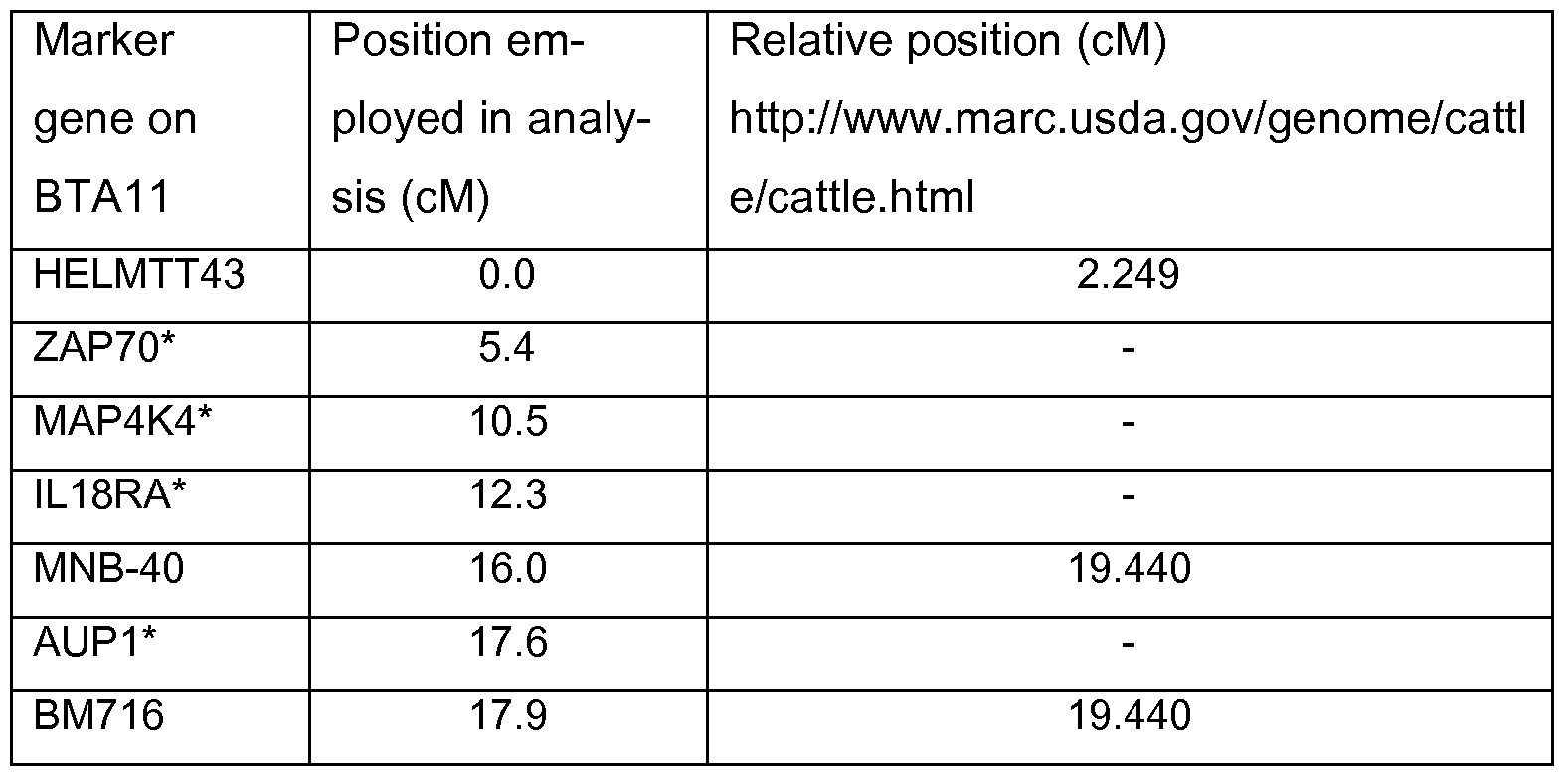

* These markers are not listed in the MARC marker map of BTA11 , but identified by the present inventors. This is applicable throughout the tables herein.
In another embodiment the at least one genetic marker is located on the bovine chromosome BTA1 1 in the region flanked by and including the markers ZAP70 and CD8B. In one embodiment of the present invention, the at least one genetic marker is located in the region from about 5.4 cM to about 56.9 cM (according to the
positions employed in the present analysis) on the bovine chromosome BTA11. The at least one genetic marker is selected from the group of markers shown in Table 3. Table 3

In a further embodiment the at least one genetic marker is located on the bovine chromosome BTA1 1 in the region flanked by and including the markers ZAP70 and AUP1. In one embodiment of the present invention, the at least one genetic marker is located in the region from about 5.4 cM to about 17.6 cM on the bovine chromosome BTA1 1. The at least one genetic marker is selected from the group of markers shown in Table 4.
Table 4

In one embodiment of the invention the at least one genetic marker is located on the bovine chromosome BTA11. In one embodiment the at least one genetic marker is located on the bovine chromosome BTA11 in the region flanked by and including the markers IL18RA and AUP1. In one embodiment of the present invention, the at least one genetic marker is located in the region from about 12.3 cM (according to the positions employed in this analysis) to about 17.6 cM (according to the positions employed in this analysis) on the bovine chromosome BTA11. The at least one genetic marker is selected from the group of markers shown in Table 5. Table 5

In one embodiment the at least one genetic marker is located on the bovine chromosome BTA1 1 in the region flanked by and including the markers IL18RA and MNB-40. In one embodiment of the present invention, the at least one genetic marker is located in the region from about 12.3 cM (according to the positions employed in this analysis) to about 19.440 cM (according to the MARC marker map) on the bovine chromosome BTA1 1. The at least one genetic marker is selected from the group of markers shown in Table 6. Table 6


In one embodiment the at least one genetic marker is located on the bovine chromosome BTA11 in the region flanked by and including the markers MNB-40 and AUP1. In one embodiment of the present invention, the at least one genetic marker is located in the region from about 19.440 cM (according to the MARC marker map) to about 17.6 cM (according to the positions employed in this analysis) on the bovine chromosome BTA11. The at least one genetic marker is selected from the group of markers shown in Table 7. Table 7a

In a further embodiment the at least one genetic marker is located on the bovine chromosome BTA1 1 in the region flanked by and including the markers ZAP70 and IL18RA. In one embodiment of the present invention, the at least one genetic marker is located in the region from about 5.4 cM to about 12.3 cM on the bovine chromosome BTA1 1. The at least one genetic marker is selected from the group of markers shown in Table 7b. Table 7b

In a further embodiment the at least one genetic marker is located on the bovine chromosome BTA1 1 in the region flanked by and including the markers MAP4K4 and IL18RA. In one embodiment of the present invention, the at least one genetic marker
is located in the region from about 10.5 cM to about 12.3 cM on the bovine chromosome BTA1 1. The at least one genetic marker is selected from the group of markers shown in Table 7c. Table 7c

In a preferred embodiment, the at least one genetic marker is located on the bovine chromosome BTA1 1 in the region including or consisting of the marker genes ZAP70, MAP4K4, IL18RA, MNB-40, AUP1 and/or CD8B. For example, the at least one genetic marker is located in the region flanked by and including the genetic markers genes ZAP70 and AUP1 of BTA1 1. More specifically, the at least one genetic marker of the present invention is located on the bovine chromosome BTA11 in a gene selected from the group consisting of ZAP70, MAP4K4, IL18R1 , AUP1 and/or CD8B.
That is in one embodiment, the at least one genetic marker is located on the bovine chromosome BTA1 1 in the ZAP70 gene. That genetic marker is for example the T/C single nucleotide polymorphism (SNP) in position 51 of SEQ ID NO: 5.
In another embodiment, the at least one genetic marker is located on the bovine chromosome BTA11 in the MAP4K4 gene; for example the at least one genetic marker is the T/C polymorphism in position 51 of SEQ ID NO: 3. In particular, the genetic marker allele associated with mastitis resistance is the C-allele; i.e. the presence of a C in position 51 of SEQ 3 is indicative of mastitis resistance or increased mastitis resistance and/or complete or partial resistance to any trait indicative of mastitis, such as SCC, SCS or clinical mastitis. Conversely, the genetic marker allele associated with elevated susceptibility to mastitis is the T-allele; i.e. the presence of a T in position 51 of SEQ 3 is indicative of increased susceptibility to mastitis and/or any trait indicative of mastitis, such as SCC, SCS or clinical mastitis.
In another embodiment, the at least one genetic marker is located on the bovine chromosome BTA11 in the IL18RA1 gene; for example the at least one genetic marker is the T/C polymorphism in position 51 of SEQ ID NO: 4. In particular, the genetic marker allele associated with mastitis resistance is the C-allele; i.e. the presence of a C in position 51 of SEQ 4 is indicative of mastitis resistance or increased mastitis resistance and/or complete or partial resistance to any trait indicative of mastitis, such as SCC, SCS or clinical mastitis. Conversely, the genetic marker allele associated with elevated susceptibility to mastitis is the T-allele; i.e. the presence of a T in position 51 of SEQ 4 is indicative of increased susceptibility to mastitis and/or any trait indicative of mastitis, such as SCC, SCS or clinical mastitis.
In another embodiment, the at least one genetic marker is located on the bovine chromosome BTA1 1 in the AUP1 gene; for example, the at least one genetic marker is the G/A polymorphism in position 51 of SEQ ID NO: 1.
In yet another embodiment, the at least one genetic marker is located on the bovine chromosome BTA1 1 in the CD8B gene, for example, the at least one genetic marker is the G/A polymorphism in position 51 of SEQ ID NO: 2.
In one aspect of the present invention, the method for determining mastitis resistance in a bovine subject comprises detecting in a sample from said bovine subject the presence or absence of at least one single nucleotide polymorphism (SNP) genetic marker that is associated with at least one trait indicative of mastitis resistance of said bovine subject and/or off-spring therefrom. The at least one SNP genetic marker is located on the bovine chromo-some BTA1 1 in the region flanked by and including the polymorphic microsatellite markers ZAP70 and CD8B.
In one embodiment, the SNP associated with at least one trait indicative of mastitis resistance is selected from the group consisting of ss86338360, ss86338360, rs41572840, rs41621842, ss86321143, ss86335728, rs43661333, rs43024195,
SS86337237, rs41578974, ss86294264, rs41589323, ss86306343, rs41592128, rs41616745, ss86323548, rs41592158, rs43675012, rs43675012, ss86309968, SS86336376, rs43674735, ss86319565, rs41591463, ss86274123, ss86312155, SS86340248, rs41593932, ss86312180, rs29022104, rs29022104, and ss86292684 (cf. table 13).
In one embodiment, the trait somatic cell count (SCC) is indicative if mastitis, and the SNP marker determined according to the method of the invention, wherein said SNP is associated with SCC is selected from the group consisting of ss86338360, rs41621842, ss86321 143, ss86335728, rs43661333, rs43024195, ss86337237, rs41578974, rs41589323, ss86306343, rs41592128, rs41616745, ss86323548, rs43675012, ss86309968, ss86336376, rs43674735, ss86319565, rs41591463, SS86274123, ss86312155, rs29022104, and ss86292684.
In another embodiment, the trait indicative of mastitis is clinical mastitis in the period from -15 days before calving to +50 days after calving (CM1 ), and the genetic marker is an SNP selected from the group consisting of ss86338360, rs41572840, SS86340248, rs41593932, and ss86312180.
In yet another embodiment, the trait indicative of mastitis is clinical mastitis in the period from 51 days to 300 days after calving (CM2), and the genetic marker is an SNP selected from the group consisting of ss86294264, rs41592158, rs43675012, and rs29022104.
Detection The method according to the present invention for determining mastitis resistance of a bovine subject comprises detecting in a sample from said bovine subject the presence or absence of at least one genetic marker allele that is associated with at least one trait indicative of mastitis resistance of said bovine subject and/or off-spring therefrom, wherein said at least one genetic marker is located on the bovine chro- mosome BTA11 in the region flanked by and including the polymorphic microsatel- lite markers ZAP70 and CD8B, wherein the presence or absence of said at least one genetic marker is indicative of mastitis resistance.
The genetic markers, including microsatellite markers and/or SNPs, or a comple- mentary sequence as well as transciptional (mRNA) and translational products
(polypeptides, proteins) therefrom may be identified by any method known to those of skill within the art.
It will be apparent to the person skilled in the art that there are a large number of analytical procedures which may be used to detect the presence or absence of vari-
ant nucleotides at one or more of positions mentioned herein in the specified region. Mutations or polymorphisms within or flanking the specified region can be detected by utilizing a number of techniques. Nucleic acid from any nucleated cell can be used as the starting point for such assay techniques, and may be isolated according to standard nucleic acid preparation procedures that are well known to those of skill in the art. In general, the detection of allelic variation requires a mutation discrimination technique, optionally an amplification reaction and a signal generation system.
A number of mutation detection techniques are listed below. Some of the methods listed are based on the polymerase chain reaction (PCR), wherein the method according to the present invention includes a step for amplification of the nucleotide sequence of interest in the presence of primers based on the nucleotide sequence of the variable nucleotide sequence. The methods may be used in combination with a number of signal generation systems, a selection of which is listed further below.


Further amplification techniques are found elsewhere herein. Many current methods for the detection of allelic variation are reviewed by Nollau et al., Clin. Chem. 43, 1 114-1 120, 1997; and in standard textbooks, for example "Laboratory Protocols for Mutation Detection", Ed. by U. Landegren, Oxford University Press, 1996 and
"PCR", 2nd Edition by Newton & Graham, BIOS Scientific Publishers Limited, 1997.
The detection of genetic markers can according to one embodiment of the present invention be achieved by a number of techniques known to the skilled person, in- eluding typing of microsatellites or short tandem repeats (STR), restriction fragment length polymorphisms (RFLP), detection of deletions or insertions, random amplified polymorphic DNA (RAPIDs) or the typing of single nucleotide polymorphisms by methods such as restriction fragment length polymerase chain reaction, allele- specific oligomer hybridisation, oligomer-specific ligation assays, hybridisation with PNA or locked nucleic acids (LNA) probes.

A primer of the present invention is a nucleic acid molecule sufficiently complementary to the sequence on which it is based and of sufficiently length to selectively hybridise to the corresponding region of a nucleic acid molecule intended to be amplified. The primer is able to prime the synthesis of the corresponding region of the intended nucleic acid molecule in the methods described above. Similarly, a probe of the present invention is a molecule for example a nucleic acid molecule of sufficient length and sufficiently complementary to the nucleic acid sequence of interest which selectively binds to the nucleic acid sequence of interest under high or low stringency conditions. The genetic marker associated with mastitis resistance according to the present invention can be detected by a number of methods known to those of skill within the art. For example, the genetic marker may be identified by genotyping using a method selected from the group consisting of single nucleotide polymorphisms (SNPs), microsatellite markers, restriction fragment length polymorphisms (RFLPs), DNA chips, amplified fragment length polymorphisms (AFLPs), randomly amplified polymorphic sequences (RAPDs), sequence characterised amplified regions (SCARs), cleaved amplified polymorphic sequences (CAPSs), nucleic acid sequencing, and microsatellite genotyping.
In a preferred embodiment, the genetic markers associated with mastitis resistance traits as disclosed in the present invention is detected by SNP or microsatellite genotyping. SNP or microsatellite genotyping may be performed by amplification of the SNP or microsatellite marker by sequence specific oligonucleotide primers, and subsequent analysis of the amplification product, in terms of for example length, quantity and/or sequence of the amplification product.
Specifically, the at least one genetic marker according to the present invention may be detected by use of at least one oligonucleotide selected from the group
consisting of SEQ ID NO: 6 to SEQ ID NO: 15, and/or SEQ ID NO: 20 to SEQ ID
NO: 67, as disclosed in table 8
The nucleotide sequence of the primers used for detecting the markers is shown in
Table 8. The nucleotide sequence is listed from the 5' end.
Table 8


In one embodiment of the methods and kits of the present invention, the ZAP70 polymorphism is detected by nucleic acid amplification using at least one oligonucleotide primer corresponding to SEQ ID NO.: 14 and/or SEQ ID N0.:15. In another embodiment, the MAP4K4 polymorphism is detected by nucleic acid amplification using at least one oligonucleotide primer corresponding to SEQ ID NO.: 10 and/or SEQ ID N0.:1 1. In yet another embodiment, the IL18R1 polymorphism is detected by nucleic acid amplification using at least one oligonucleotide primer corresponding to SEQ ID NO.: 12 and/or SEQ ID N0.:13, and in another embodiment, the AUP1 polymorphism is detected by nucleic acid amplification using at least one oligonucleotide primer corresponding to SEQ ID NO.: 6 and/or SEQ ID N0.:7. In yet an- other embodiment, the CD8B polymorphism is detected by nucleic acid amplification using at least one oligonucleotide primer corresponding to SEQ ID NO.: 8 and/or SEQ ID NO. :9.
However, in another embodiment of the methods and kits of the present invention, the at least one genetic marker is detected by nucleic acid amplification using at least one oligonucleotide primer or probe comprising at least 5 consecutive nucleotides, such as between 5 and 100, for example between 5 and 50, such as between 5 and 30, for example between 5 and 15 consecutive nucleotides, selected from the genetic region flanked by and including the ZAP70 and CD8B genes. More specifically, the at least one oligonucleotide primer or probe comprises at least 5 consecutive nucleotides, such as between 5 and 100, for example between 5 and 50, such as between 5 and 30, for example between 5 and 15 consecutive nucleotides se- lected from any of the genes ZAP70, MAP4K4, IL18R1 , AUP1 and/or CD8B or the complement thereof, for example selected from the group consisting of from SEQ ID NO.: 1 to SEQ ID NO.: 5 or the complement thereof. More preferably, the oligonucleotide primer comprises at least 10, such as 1 1 , 12, 13, 14, 15, 16, 17, 18, 19, 20, such as at least 21 , or at least 25 consecutive nucleotides selected from any of the genes ZAP70, MAP4K4, IL18R1 , AUP1 and/or CD8B or the complement thereof, for example selected from the group consisting of from SEQ ID NO.: 1 to SEQ ID NO.: 5 or the complement thereof.
The primers of the present invention may be used individually or in combination with one or more primers or primer pairs, such as any primer of the present invention.
The design of such primers or probes will be apparent to the molecular biologist of ordinary skill. Such primers are of any convenient length such as up to 50 bases, up to 40 bases, more conveniently up to 30 bases in length, such as for example 8-25 or 8-15 bases in length. In general such primers will comprise base sequences entirely complementary to the corresponding wild type or variant locus in the region. However, if required one or more mismatches may be introduced, provided that the discriminatory power of the oligonucleotide probe is not unduly affected. The primers/probes of the invention may carry one or more labels to facilitate detection.
In one embodiment, the primers and/or probes are capable of hybridizing to and/or amplifying a subsequence hybridizing to a single nucleotide polymorphism containing the sequence delineated by the markers as shown herein.
The primer nucleotide sequences of the invention further include: (a) any nucleotide sequence that hybridizes to a nucleic acid molecule comprising a genetic marker sequence or its complementary sequence or RNA products under stringent condi- tions, e.g., hybridization to filter-bound DNA in 6x sodium chloride/sodium citrate (SSC) at about 45°C followed by one or more washes in 0.2x SSC/0.1 % Sodium Dodecyl Sulfate (SDS) at about 50-650C, or (b) under highly stringent conditions, e.g., hybridization to filter-bound nucleic acid in 6x SSC at about 45°C followed by one or more washes in 0.1 x SSC/0.2% SDS at about 68°C, or under other hybridiza- tion conditions which are apparent to those of skill in the art (see, for example,
Ausubel F. M. et al., eds., 1989, Current Protocols in Molecular Biology, Vol. I, Green Publishing Associates, Inc., and John Wiley & sons, Inc., New York, at pp. 6.3.1- 6.3.6 and 2.10.3). Preferably the nucleic acid molecule that hybridizes to the nucleotide sequence of (a) and (b), above, is one that comprises the complement of a nu- cleic acid molecule of the genomic DNA comprising the genetic marker sequence or a complementary sequence or RNA product thereof.
Among the nucleic acid molecules of the invention are deoxyoligonucleotides ("oli- gos") which hybridize under highly stringent or stringent conditions to the nucleic acid molecules described above. In general, for probes between 14 and 70 nucleotides in length the melting temperature (TM) is calculated using the formula:
Tm(°C)=81.5+16.6(log [monovalent cations (molar)])+0.41 (% G+C)-(500/N)
where N is the length of the probe. If the hybridization is carried out in a solution containing formamide, the melting temperature is calculated using the equation Tm(°C)=81.5+16.6(log[monovalent cations (molar)])+0.41 (% G+C)-(0.61 % forma- mide)-(500/N) where N is the length of the probe. In general, hybridization is carried out at about 20-25 degrees below Tm (for DNA-DNA hybrids) or 10-15 degrees be- low Tm (for RNA-DNA hybrids).
Exemplary highly stringent conditions may refer, e.g., to washing in 6x SSC/0.05% sodium pyrophosphate at 37°C (for about 14-base oligos), 48°C (for about 17-base oligos), 55°C (for about 20-base oligos), and 600C (for about 23-base oligos).
Accordingly, the invention further provides nucleotide primers or probes which detect the polymorphisms of the invention. The assessment may be conducted by means of at least one nucleic acid primer or probe, such as a primer or probe of DNA, RNA or a nucleic acid analogue such as peptide nucleic acid (PNA) or locked nucleic acid (LNA).
According to one aspect of the present invention there is provided an allele-specific oligonucleotide probe capable of detecting a polymorphism at one or more of positions in the delineated regions.
The allele-specific oligonucleotide probe is preferably 5-50 nucleotides, more preferably about 5-35 nucleotides, more preferably about 5-30 nucleotides, more preferably at least 9 nucleotides.
Determination of linkage
In order to detect if the genetic marker is present in the genetic material, standard methods well known to persons skilled in the art may be applied, e.g. by the use of nucleic acid amplification. In order to determine if the genetic marker is genetically linked to mastitis resistance traits, a permutation test can be applied (Doerge and Churchill, 1996), or the Piepho-method can be applied (Piepho, 2001 ). The principle of the permutation test is well described by Doerge and Churchill (1996), whereas the Piepho-method is well described by Piepho (2001 ). Significant linkage in the within family analysis using the regression method, a 10000 permutations were made using the permutation test (Doerge and Churchill, 1996). A threshold at the 5% chromosome wide level was considered to be significant evidence for linkage between the genetic marker and the mastitis resistance and somatic cell count traits. In addition, the QTL was confirmed in different sire families. For the across family analysis and multi-trait analysis with the variance component method, the Piepho- method was used to determine the significance level (Piepho, 2001 ). A threshold at the 5% chromosome wide level was considered to be significant evidence for linkage between the genetic marker and the mastitis resistance and somatic cell count traits.
Method for selecting a bovine subject
In one aspect, the present invention further relates to a method for selecting a bovine subject for breeding purposes. This method for selecting a bovine subject for breeding purposes comprises determining resistance to mastitis of said bovine subject and/or off-spring therefrom by any method as defined herein, such as determining resistance to mastitis in a bovine subject, by detecting in a sample from said bovine subject the presence or absence of at least one genetic marker that is associated with at least one trait indicative of mastitis resistance of said bovine subject and/or off-spring therefrom, wherein said at least one genetic marker is located on the bovine chromosome BTA1 1 in the region flanked by and including the polymorphic microsatellite markers ZAP70 and CD8B, wherein the presence or absence of said at least one genetic marker is indicative of mastitis resistance.
The purpose of selecting a bovine subject for breeding purposes is to select bovine subjects for breeding with increased breeding value. For example, selection of bovine subjects for breeding according to the present invention serve to increase the mean breeding value of the next generation of bovine subjects, compared to the mean breeding value of the previous (parent) generation of bovine subjects.
In one embodiment, the method of the present invention for selecting a bovine subject for breeding purposes comprises estimating a breeding value of said selected bovine subject. For example, the breeding value is estimated on the basis of the presence or absence of a genetic marker of the present invention.
Kit
In one aspect, the present invention relates to a diagnostic kit for detecting the presence or absence in a bovine subject of at least one genetic marker as described herein. In another aspect, the present invention relates to a kit for use in detecting the presence or absence in a bovine subject of at least one genetic marker associ- ated with resistance to mastitis, comprising at least one detection member for determining a genetic marker located on the bovine chromosome BTA11 in the region flanked by and including the polymorphic microsatellite markers ZAP70 and CD8B. Thus, in one aspect, the present invention relates to a kit comprising at least one detection member for determining a genetic marker located on the bovine chromo- some BTA1 1 in the region flanked by and including the ZAP70 and CD8B genes.
The detection members of the kits are preferably capable of detecting a genetic marker, such as those defined in the methods for determining mastitis resistance and/or estimating a breeding value. For example, the genetic marker is located on the bovine chromosome BTA1 1 in a gene selected from the group consisting of MAP4K4, IL18R1 , ZAP70, AUP1 and/or CD8B, including upstream and downstream regulatory sequences as well as both exonic and intronic sequences. Thus, in one embodiment, the present invention relates to a diagnostic kit for detecting the presence or absence in a bovine subject of two or more genetic marker alleles as described elsewhere herein, said kit comprising at least one detection member.
Specifically, the diagnostic kit is suitable for detection of the presence or absence of at least one genetic marker allele, such as two or more genetic markers, which are associated with at least one trait indicative of mastitis resistance of said bovine sub- ject and/or off-spring therefrom. Examples of specific traits which are indicative of mastitis resistance are disclosed elsewhere herein. Such traits include, SCS, SCC, and treated cases of clinical mastitis.
Detection members of the present invention include any entity, which is suitable for detecting a genetic marker on the genomic (including epigenomic), transcriptional or translational level. Detection members comprise oligonucleotide primers and/or probes, antibodies, aptamers, chemical substances etc. In one embodiment, the diagnostic kit comprises at least one oligonucleotide for detecting said genetic marker allele in said bovine subject.
In one embodiment, the detection member is an oligonucleotide primer and/or an oligonucleotide probe. In a preferred embodiment, the detection member is an oligonucleotide primer as described elsewhere herein, or an oligonucleotide probe with a sequence corresponding to any oligonucleotide primer as defined herein. The at least one oligonucleotide of the kit preferably comprises or consists of between 5 and 100 consecutive nucleotides, such as between 10 and 30 consecutive nucleotides, or at least 5, such as 6, 7, 8, 9, 10, 11 , 12, 13, 14, 15, 16, 17, 18, 19, 20, 21 , 22, 23, 24 or at least 25 consecutive nucleotides. In one embodiment, the oligonucleotide primer or probe comprise or consists of at least 3, 4, 5, 6, 7, 8, 9, 10, 11 , 12, 13, 14, 15, 16, 17, 18, 19, 20, 21 , 22, 23, 24 or at least 25 consecutive nucleotides
selected from any region of ZAP70, MAP4K4, IL18R1 , AUP1 and/or CD8B or the complement thereof, or selected from any of SEQ ID NO.: 1 to SEQ ID NO.: 5 or the complement thereof. In a specific embodiment, the at least one oligonucleotide primer or probe comprise or consists of a nucleic acid sequence selected from any of SEQ ID NO.: 6 to SEQ ID NO.: 15.
In one aspect, the present invention relates to a kit for use in detecting the presence or absence in a bovine subject of at least one genetic marker associated with resistance to mastitis, comprising at least one detection member for determining a ge- netic marker located on the bovine chromosome BTA1 1 in the region flanked by and including the ZAP70 and CD8B genes. The genetic markers to be detected by the detection members of the kit of the present invention are disclosed elsewhere herein. Thus, the genetic marker is for example any genetic marker as described herein, such as two or more genetic marker alleles located in a gene selected from the group consisting of ZAP70, MAP4K4, IL18R1 , AUP1 and/or CD8B. Specifically, the genetic marker to be detected by a kit of the present invention is a C in position 51 of SEQ 3, and/or a C in position 51 of SEQ ID NO: 4.
The kits of the present invention may further comprise at least one reference sam- pie. In one embodiment, said reference sample comprises a nucleic acid sequence comprising a genetic marker associated with mastitis resistance, such as described herein, preferably a nucleic acid sequence comprises at least 3, such as at least 5, such as at least 10 consecutive nucleotides of SEQ ID NO: 3 or 4 with C in position 51 , or the complement thereof. In another embodiment, the reference sample com- prises a nucleic acid sequence comprising a genetic marker associated with susceptibility to mastitis, such as described herein, preferably a nucleic acid sequence comprises at least 3, such as at least 5, such as at least 10 consecutive nucleotides of SEQ ID NO: 3 or 4 with T in position 51 , or the complement thereof.
The kits of the present invention further comprise in specific embodiments instructions for performance of the detection method of the kit and for the interpretation of the results.
In one embodiment, the genetic markers, such as two or more genetic marker al- leles are single nucleotide polymorphisms, such as single nucleotide polymorphism
selected from the group consisting of XM_865562:c.1599T>C, NC_007309.3:g.21 1229T>C, NC_007309.3:g.633T>C, NC_007309.3:g.2822G>A, and/or NM_001105344:c.293G>A.
In one embodiment, the at least one genetic marker is SNP XM_865562:c.1599T>C. In another embodiment, the at least one genetic marker is SNP
NC_007309.3:g.211229T>C. In another embodiment, the at least one genetic marker is SNP NC_007309.3:g.633T>C. In another embodiment, the at least one genetic marker is SNP NC_007309.3:g.2822G>A. In another embodiment, the at least one genetic marker is SNP NM_001 105344:c.293G>A.
Genotyping of a bovine subject in order to establish the genetic determinants of resistance to mastitis for that subject according to the present invention can be based on the analysis of DNA and/or RNA. One example is genomic DNA which can be provided using standard DNA extraction methods as described herein. The genomic DNA may be isolated and amplified using standard techniques such as the polymerase chain reaction using oligonucleotide primers corresponding (complementary) to the polymorphic marker regions. Additional steps of purifying the DNA prior to amplification reaction may be included. Thus, a diagnostic kit for establishing mastitis resistance and somatic cell count characteristics comprises, in a separate packing, at least one oligonucleotide sequence selected from the group of sequences shown in table 8 and any combinations thereof.
The present invention also relates in one aspect to any use of a kit as described herein for detecting the presence or absence in a bovine subject of at least one ge- netic marker associated with resistance to mastitis, for example any genetic marker associated with mastitis resistance as described herein. In one embodiment, the genetic marker is the SNP in position 51 of a nucleic acid sequence selected from the group consisting of SEQ ID NO: 1 to SEQ ID NO: 5, such as preferably, a C in position 51 of SEQ ID NO: 3 or 4.
Furthermore, the present invention relates to the use of a kit of the present invention for estimating breeding value in respect of susceptibility to mastitis in a bovine subject.
Thus, in a key aspect, the present invention relates to a use of a kit of the invention, such as those defined above for determining mastitis resistance in a bovine subject, said use comprising detecting the presence or absence in a bovine subject of at least one genetic marker associated with resistance to mastitis. The genetic markers associated with mastitis resistance include any one of those defined in the methods provided herein for determining mastitis resistance and/or estimating a breeding value. For example, the genetic marker is located on the bovine chromosome BTA11 in a gene selected from the group consisting of MAP4K4, IL18R1 , ZAP70, AUP1 and/or CD8B, including upstream and downstream regula- tory sequences as well as both exonic and intronic sequences. In a more specific embodiment, the genetic marker associated with resistance to mastitis is located in the region flanked by and including the ZAP70 and AUP1 genes of BTA11 , for example the genetic marker is located in a gene selected from MAP4K4, IL18R1 , ZAP70, or AUPL In a preferred embodiment, the genetic marker associated with resistance to mastitis is located on the bovine chromosome BTA11 in the MAP4K4 gene, and most preferred, the genetic marker is the T/C polymorphism in position 51 of SEQ ID NO: 3. In the kit comprises a detection member capable of detecting the presence of a C in position 51 of SEQ 3, which is indicative of clinical mastitis resistance. In another embodiment, the genetic marker associated with resistance to mastitis is located on the bovine chromosome BTA1 1 in the IL18RA1 gene, such as preferably the genetic marker is the T/C polymorphism in position 51 of SEQ ID NO: 4. In an even more preferred embodiment, the genetic marker associated with resistance to mastitis is the T/C polymorphism in position 51 of SEQ ID NO: 4, wherein the pres- ence of a C in position 51 of SEQ 4 is indicative of clinical mastitis resistance.
The genetic marker associated with resistance to mastitis may also be located on the bovine chromosome BTA1 1 in the ZAP70 gene, and is in one example the T/C SNP in position 51 of SEQ ID NO: 5. In yet another embodiment, the genetic marker associated with resistance to masti- tis is located on the bovine chromosome BTA1 1 in the AUP1 gene, and is in one example the G/A polymorphism in position 51 of SEQ ID NO: 1. Furthermore, the genetic marker is in another embodiment located on the bovine chromosome BTA1 1 in the CD8B gene, and is for example the G/A polymorphism in position 51 of SEQ ID NO: 2.
In a specifically preferred embodiment, the genetic marker associated with resistance to mastitis is a MAP4K4 SNP allele corresponding to position 51 of SEQ 3 comprising a C, and/or an IL18RA SNP allele at position 51 of SEQ 4 comprising a C. In a specific embodiment of the provided use of the kit, the genetic marker is the
SNP in position 51 of a nucleic acid sequence selected from the group consisting of SEQ ID NO: 1 to SEQ ID NO: 5. In another specific embodiment the genetic marker is a MAP4K4 SNP allele corresponding to position 51 of SEQ 3 comprising a C, and/or an IL18RA SNP allele at position 51 of SEQ 4 comprising a C. Moreover, the use of the kit is claimed for estimating breeding value in respect of susceptibility to mastitis in a bovine subject.
Method of estimating breeding value.
The present invention also relates to determination of estimated breeding values. Thus, in one aspect, the present invention relates to a method for estimating breeding value in respect of susceptibility to mastitis in a bovine subject, comprising detecting in a sample from said bovine subject the presence or absence of at least one genetic marker that is associated with at least one trait indicative of mastitis resistance of said bovine subject and/or off-spring therefrom, wherein said at least one genetic marker is located on the bovine chromosome BTA1 1 in the region flanked by and including the ZAP70 and CD8B genes, wherein the presence or absence of said at least one genetic marker is indicative of mastitis resistance. In one embodiment, the breeding value is calculated using a marker-assisted single trait Best Linear Unbiased Prediction (MA-BLUP).
The specific mastitis resistances traits, genetic markers and marker alleles, samples, bovine subjects, detection methods etc. are defined elsewhere herein.
Examples Example 1
Purification of genomic DNA and DNA amplification
Genomic DNA was purified from semen according to the following protocol:
After thawing the semen-straw, both ends of the straw were cut away with a pair of scissors and the content of semen transferred to a 1.5 ml eppendorf tube. 1 ml of
0.9% NaCI was used to flush the straw into the tube. The tube was then centrifuged for 5 minutes at 2000 rpm, followed by removal of the supernatant. This washing step was repeated twice.
Then 300 μl buffer S (10 mM Tris HCI pH 8, 100 mM NaCI, 10 mM EDTA pH 8; 0,5 % SDS), 20 μl 1 M DTT and 20 μl pronase (20 mg/ml) (Boehringer )are added to the tube. After mixing the tubes are incubated over night with slow rotation where after 180 μl saturated NaCI is added followed by vigorous agitation for 15 seconds. The tube is the centrifuged for 15 minutes at 11000 rpm. 0.4 ml of the supernatant is transferred to a 2 ml tube and 1 ml of 96% ethanol is added, mixing is achieved by slow rotation of the tube. The tube is then centrifuged for 10 minutes at 1 1000 rpm. Remove the supernatant by pouring away the liquid, wash the pellet with 70% ethanol (0.2 ml) and centrifuge again for 10 minutes at 11000 rpm. Pour away the ethanol, dry the pellet and resuspend in 0.5 ml of TE-buffer) for 30 minutes at 55°C.
Amplification procedures
PCR reactions were run in a volume of 8 μl using TEMPase (GeneChoice) polymerase and reaction buffer I as provided by the supplier (GeneChoice). Usually 5 different markers are included in each multiplex PCR. 1 μl DNA, 0.1 μl TEMPase enzyme, 0.2 mM dNTPs, 1.2 mM MgCI2, 0.3μM each primer.
The PCR mixtures were subjected to initial denaturation at 94°C for 15 min (for TEMPase). Subsequently, the samples were cycled for 10 cycles with touchdown, i.e. the temperature is lowered 1 °C at each cycle (denaturation at 94°C 30", annealing at 67°C 45", elongation 72°C 30"), after which the samples were cycled for 20 cycles with normal PCR conditions (denaturation at 94°C 30", annealing at 58°C 45", elongation 72°C 30) PCR cycling was terminated by 1 cycle at 72°C 30' and the PCR machine was programmed to cooling down the samples at 4°C for 'ever'.
Example 2 Quantitative trait loci (QTL) affecting clinical mastitis and somatic cell score were mapped on bovine chromosome 11. The mapping population consisted of 14 grandsire families belonging to three Nordic red cattle breeds: Finnish Ayrshire, Swedish Red and White and Danish Red. The families had previously been shown to segregate for udder health QTL. A total of 524 progeny tested bulls were included in the analysis. A linkage map including 33 microsatellite and 5 SNP markers was
constructed. We performed combined linkage disequilibrium and linkage analysis (LDLA) using the whole data. Further analyses were performed for Finnish Ayrshire and Swedish Red and White separately to study the origin of the identified QTL/haplotype and to examine if it was common in both populations. Finally, differ- ent two-trait models were fitted. These postulated either a pleiotropic-QTL affecting both traits, two linked-QTL each affecting one trait or one QTL affecting a single trait. A QTL affecting clinical mastitis was fine-mapped. In Finnish Ayrshire, a haplo- type having a strong association with a high negative effect on mastitis resistance was identified. The mapping precision of an earlier detected SCS-QTL was not im- proved by the LDLA analysis due to lack of linkage disequilibrium between the markers used and the QTL in the region.
Materials and Methods Animals Animals from three Nordic cattle breeds, Finnish Ayrshire (FA), Swedish Red and
White (SRB) and Danish Red (DR) were used in the study. Fourteen grandsire families consisting of 8 FA, 5 SRB and 1 DR were included with a total of 524 (324 FA, 170 SRB and 30 DR) progeny tested sons ranging from 23 to 83 sons per family. These 14 families were selected from 46 families included in the joint analysis of three Nordic red dairy cattle breeds (Lund et al. 2007). The selected families had at least one QTL affecting CM and/or SCS segregating on BTA11. Segregation of the QTL was determined by within-family linear regression. A liberal threshold of 10% was used for selecting families segregating for the QTL. This was done in order to have enough families for the fine-mapping experiment.
Phenotypes
The udder health traits analyzed were CM and SCS. Clinical mastitis was defined as a binary trait and based on mastitis treatments done by a veterinarian. The trait SCS was defined as the lactation mean of Iog10 transformed somatic cell count. The measurement periods for both traits varied slightly between countries (details in Lund ef a/. 2007).
Marker data
The selected families were genotyped for a total of 38 microsatellite and SNP mark- ers covering approximately 75 percent of chromosome 1 1 (BTA1 1 ). Out of these, 33 were microsatellite markers selected from the USDA-MARC map
(www.marc.usda.gov/genome/genome.html), and 5 were new SNP markers, from immunological candidate genes, that were developed within the project. Two regions on BTA11 were targeted for fine mapping of QTL affecting CM and SCS (Lund et al. 2007).
Candidate genes ZAP70, MAP4K4, IL-WRa, AUP1 and CD8B are located in the QTL regions and were selected for SNP screening. The ZAP70 (zeta-chain (TCR) associated protein kinase 7OkDa, LOC504509) gene is known to have an integral role in T-cell activation. The gene MAP4K4 (Bos taurus similar to mitogen-activated protein kinase kinase kinase kinase 4, XR_028610) is a potential pseudogene on BTA11. The MAP4K4 pathway is shown to be involved with regulation of T-cell differentiation (Mack et al. 2005) and macrophages (Dror et al. 2007). The IL-WRa (interleukin W receptor alpha, XM_590497) gene has not yet been characterized well but it has the ability to activate NF-kappa-B in response to IL18 (Torigoe et al. 1997). The AUP1 (ancient ubiquitous protein 1, NM_001015555.1 ) gene possesses domains related to signal transduction, this suggests involvement of AUP1 in the integrin signaling (Kato et al. 2002). The CDdB (T-cell glycoprotein, LOC508633) gene is a T-cell glycoprotein expressed only in cytotoxic T cells that recognize antigen in context with class I major histocompatibility antigens.
PCR reactions and genotyping
The PCR reaction conditions varied, depending on the marker being genotyped. All reactions contained 20 ng of genomic DNA extracted from the semen samples, a total reaction volume being 10 μl. The PCR products were analyzed for fragment length using ALFexpress Il (Amersham Biosciences, UK) or MegaBacei OOO sequencers (Amersham Biosciences, UK) and AlleleLinks v 1.02 (Amersham Biosciences, UK) and Fragment Profile v 1.2 (Amersham Biosciences, UK) software, respectively.
Gene sequences for the SNP search were obtained from Genebank and Ensembl (http://www.ncbi.nlm.nih.gov/, http://www.ensembl.org/) and primers for the SNP search were designed with Primer 3 (hHp://frodo.wi.mit.edu/cgi- MQ/PlLθ]M.3ipii.mer3...wj^¥.c.q|) (primer sequences available on request). Several samples were sequenced (MegaBace 1000, Amersham Biosciences, UK) with de-
signed primers and the obtained sequences were analyzed with Sequencher 4.6 (Gene Codes Corporation, USA).
Allelic discrimination using fluorogenic probes (TaqMan chemistry; Applied Biosys- terns, USA) were used for genotyping discovered SNPs. The detection of allelic differences was done by ABI PRISM 7700 real-time PCR (Applied Biosystems, USA) and the genotypes were analyzed with the SDS 1.7a software package (Applied Biosystems, USA). The ZAP70 SNP was genotyped by sequencing with the MegaBace 1000 (Amersham Biosciences, UK) and genotyping was done with Se- quencher 4.6 (Gene Codes Corporation, USA).
Linkage Map
Marker order and map distances were estimated using CRIMAP 2.4 software (Green et al. 1990) and the map was drawn using the MapChart software (Voorrips 2002) (Supplementary file). Option BUILD was used to order markers in a linkage group and option FLIPS was used to get the best order of the markers. CHROMPIC option was used to detect double (or triple) recombinants and potential genotyping errors. The linkage map was compared to the bovine genome sequence (Btau_3.1 http://www.ensembl.org/) to solve unclear marker order. Markers MNB-40 and BM716 are in different position/order compared to the USDA-MARC linkage map
(www.marc.usda.gov/genome/genome.html). For marker pairs appearing at identical positions, the genome sequence order was used.
QTL Analysis First the phase of the paternally and maternally inherited chromosomes for the grandsires and sires were constructed using the GDQTL software (B. GuId- brandtsen, unpublished) which is a likelihood based method developed for granddaughter designs. The QTL analysis based on combined linkage disequilibrium and linkage analysis (LDLA) was carried out with a single trait model (STLDLA) with the combined data across the three breeds (FA+SRB+DA). Further, FA and SRB were analysed separately. Also single trait LA models (STLA) and LD models (STLD) were fitted across and within breeds (FA and SRB) to compare results from STLDLA with ST|_A and STLD- Then, two-trait LA models were used to quantify if a pleiotropic-QTL model (MTP) or a two-linked-QTL model (MTL) was the most probable, and to inves- tigate if one QTL is affecting only one trait either CM (MTCM) or SCS (MTScs)- The
linear model described below was used for both LDLA and LA analysis. These two analyses differ in the way the identity-by-descent matrices were calculated (described later). In the LD analysis, the maternal haplotypes were fitted as a random effect in the model, in comparison with LDLA and LA analyses, where both the hap- lotypes carried by an individual were fitted as a random effect.
Variance Component Analysis The multivariate mixed model following Lund et al. (2003) can be written as:
 where y is a n x t vector of observations on t = {1 , 2} traits, X is a design matrix, β is a vector of fixed effects, Z is a matrix relating records to individuals, u is a vector of additive polygenic effects, W is a matrix relating the record of each individual to its' QTL effect, qi is a vector of additive QTL effects corresponding to the ith QTL, and e is a vector of residuals. The number of QTL, nqtl, is here assumed to be equal to one or two. The random variables u, q, and e are assumed to be multivariate normally distributed and mutually uncorrelated. Specification of pleiotropic and linked QTL models can be seen in Lund et al. (2003). The variance components were estimated using the average information restricted maximum likelihood algorithm (Jensen et al. 1997), as implemented in the software package DMU (Madsen et al. 2006). The QTL intervals were defined by the1-LOD support interval (Lynch & Walsh 1998).
Estimation of IBD probabilities
The sire haplotypes and the paternally inherited haplotypes of the sons were used to compute the probability of inheriting the paternal or maternal allele from the sire at the putative QTL and the identical-by-descent (IBD) matrix was computed using a recursive algorithm (Wang et al. 1995). In the combined LDLA analysis, the IBD probabilities between QTL alleles of any two founder haplotypes were calculated using the method described by Meuwissen & Goddard (2001 ). Windows of 10 mark- ers (5 markers at the left and 5 markers at the right of the putative position) were considered in order to compute the IBD probabilities. We also used marker windows of e.g. 6-markers, 4-markers etc. to calculate IBD probabilities within the region of a LDLA peak to examine if fewer markers were sufficient to explain the QTL variance detected by the 10-marker haplotypes. Founder haplotypes were grouped into dis-
tinct clusters. Two haplotypes with IBD probabilities greater than 0.90 were considered to carry the same QTL allele and were grouped into the same cluster (details in Sahana ef a/. 2007).
Test Statistics
Hypothesis tests for the presence of QTL were based on the asymptotic distribution of the likelihood ratio test (LRT) statistic, LRT = -2ln(LnuN - Lqtι), where Lnuιι and Lqtι were the maximized likelihoods under the null-model and the qtl-model, respectively. For the one-QTL model, the null model excluded the QTL effect being analyzed. The two linked QTL two-trait models were compared with the one-QTL models where one QTL affected only one trait. Thresholds to control the type I error rate were calculated using the method presented by Piepho (2001 ).
Single marker association analysis Within breed single marker association analysis for the SNPs from the candidate genes were carried out using a generalized linear model fitting sire and genotype as fixed effects. Adjustment for multiple testing was done by a permutation test with 10 000 permutations. The analysis was done using software TASSEL
Results
Identification of SNP in candidate genes
We found and genotyped SNP markers in five candidate genes ZAP70, MAP4K4,
IL18R1 , AUP1 , CD8B (Table 9). Three of these were intronic SNPs and two located in the coding region. The exonic SNP in CD8B was nonsynonymous with an amino acid substitution from Serine to Asparagine.
Single-trait QTL analysis, clinical mastitis
A QTL affecting CM was detected on BTA11 with the STLDLA analysis in the com- bined data set (FA+SRB+DA). The QTL was located at 16.8 cM (p<0.05), within the marker interval MNB-40 and AUP1.
As it was a general trend observed in haplotype clustering at this putative QTL position that the haplotypes with larger frequencies (>5%) were clustering with only a few SRB and DR haplotypes (details not presented), FA and SRB were also ana- lysed separately. In FA, the QTL was detected at the same position (p<0.01 ) as
with the whole data and there was no evidence of this CM-QTL segregating in the SRB families. When a 4-marker haplotype window was used, a sharp QTL peak was observed in FA at 17.8 cM (p<0.05) between markers AUP1 and BM716 (Figure 1 ). The chromosomal length of the 4-marker haplotype {MNB40-AUP1-BM716- DIK2653) was 2.1 cM. At this putative QTL position, 340 distinct founder haplotypes were found, which grouped into 63 clusters. There was a total of 9 haplotypes with frequencies higher than 5%. The haplotype 292-30-167-244 had the largest estimated effect (-0.13 ± 0.09 SDEBV) on CM and a frequency of 9% in the population. Four of the candidate genes {ZAP70, MAP4K4, ILI8RA, AUP1) were located in the part of the chromosome where the QTL affecting CM was located. One of them,
AUP1, was included in the 4-marker haplotype window at the LRT peak. When single marker association analyses were done between these SNP markers and CM only MAP4K4 was significant (p<0.05) after adjustment for multiple testing in Finnish Ayrshire.
Single-trait QTL analysis, somatic cell score
A QTL affecting SCS was detected with the STLDLA analysis in the combined data. The highest LRT peak was at 61.4 cM (p<0.05) (Figure 2). Although there was strong evidence from the STLA analysis (p<0.01 ) for a QTL affecting SCS segregat- ing on BTA11 in this area, it was not possible to narrow down the QTL location using the STLDLA analysis due to the lack of linkage disequilibrium between the markers used and the QTL. There were 9 markers within the QTL linkage interval of 12 cM . However, the markers were not uniformly distributed over the region and some of the marker intervals were as big as 2.7 cM. As the SCS-QTL interval was large, a 2- QTL LA model was fitted to examine if there were more than one linked QTL affecting SCS segregating on BTA1 1. A QTL at 62.4 cM affecting SCS was fixed and the chromosome was scanned for another QTL affecting SCS. There was no evidence for a second QTL segregating for SCS in this region. When the breeds were analysed separately there was some evidence for a second QTL affecting SCS segregating on BTA1 1. In FA results from the STLD model showed a significant (p<0.05) LRT peak at 32.7 cM. The location of the second QTL on BTA1 1 in SRB was at 28.1 cM where both the STLDLA and STLD models were significant (p < 0.05). However, neither across-family analyses (Figure 2), nor within family analyses had any LA evidence for this QTL.
No significant associations between SCS and the candidate gene SNPs were detected.
Multi-trait QTL analysis As it was shown with the single-trait analysis that QTL for both CM and SCS are segregating on BTA11 , two-trait analyses with MTL , MTP , MTSCS and MTCM models were carried out. The comparison of the three models indicates that the QTL around 62 cM is affecting SCS (Figure 3). The MTL model located a QTL for CM at 14.2 cM and a QTL for SCS at 61.6 cM (p<0.01 ) (Table 10). The MTP model with one QTL affecting both CM and SCS had the highest LRT value at 62.5 cM
(p<0.01 ). The MTscs model had the highest LRT value at 61.1 cM (p<0.01 ), while the MTcM model was not significant (Table 10).
Discussion In this example, two QTL affecting udder health is fine-mapped on BTA1 1. The first QTL affecting CM was fine mapped and a haplotype (2.1 cM long) with strong association with CM was identified in Finnish Ayrshire cattle. The QTL was also detected when the breeds were combined, but at lower significance. The decrease in the significance level of the QTL in the combined data compared to that observed in FA may be due to inclusion of SRB and DR families, which did not segregate for this CM-QTL. We were able to identify a haplotype with high negative effect on mastitis resistance. This QTL was only segregating in the FA population, where 30 individuals out of a total of 332 carried the haplotype with the largest effect. While in the combined data, this haplotype was carried by 32 individuals (including 30 from FA) out of 538.We did not find any evidence of this mastitis QTL affecting SCS in any of the populations.
The QTL interval of the SCS-QTL identified by Lund et al. (2007) could not be reduced through the LDLA analysis due to absence of LD between the QTL and the markers typed in this region. There could also be a third QTL affecting udder health segregating on BTA1 1. The highest LRT values for this QTL from the LD and LDLA single trait analysis for SCS in FA and SRB were 4.6 cM apart (32.7 and 28.1 cM respectively). However, we did not have linkage support for this QTL. The marker density at this region was not dense enough to fully exploit the LD and to verify if the same QTL was segregating in these two breeds.
In a previous QTL fine mapping study with the same three cattle populations (Sa- hana et al. 2008) we observed advantage of combining the data from three genetically related breeds for QTL fine-mapping. However, such advantage was not observed in the present study. The probable reason for this might be that in our previ- ous study on BTA9 the QTL affecting CM was segregating in all three populations while in the present study the CM-QTL was only segregating in FA. While the QTL on BTA9 may have a common origin, the CM-QTL on BTA1 1 is specific to Finnish Ayrshire. Though the SCS-QTL was segregating in all the three breeds, we could not fine map it. A denser marker map may help in finding haplotypes in linkage dis- equilibrium with the SCS-QTL.
In this study we identified SNPs in candidate genes in order to get more markers for fine-mapping. Three of the SNPs were intronic, (IL-WRa, MAP4K4, AUP1), one synonymous (ZAP70) and one nonsynonymous (CD8B). MAP4K4 had a significant association with CM when analysed as a single marker and AUP1 was included in the 4-marker haplotype associated with the trait. It would be interesting to further investigate the role of MAP4K4 in mastitis resistance. MAP4K4 is a good candidate as it belongs to a pathway that regulates many pro-inflammatory genes in macrophages (Dror et al. 2007). As the identified SNP is located in the intronic region of the gene it can't be the causative polymorphism but instead in LD with it. However, no LD peak was observed in the variance component analysis at this SNP position, but it could be due to the use of haplotypes rather than single markers in the LD analysis. More SNPs should be searched for and typed at MAP4K4, preferably from the coding regions of the gene, in order to find out if MAP4K4 is the candidate gene underlying the CM-QTL on BTA1 1 in Finnish Ayrshire cattle. The intronic SNP in AUP1 did not show significant association when analyzed as a single marker but was included in the associated haplotype. This is also an interesting candidate gene for further SNP typing.
Table 9 SNP identified in candidate genes. SNP nomenclature and numbering is based on the Human genome variation society's Nomenclature for the description of sequence variations (http://www.genomic.unimelb.edu.au/mdi/mutnomen/). Exon- intron boundaries for the genes that are not yet annotated in bovine are inferred from information received from other species


Table 10 Results from the 2-trait analyses for the combined three breed data with the pleiotropic model (MTP) (QTL affecting both CM and SCS) vs. the two linked QTL model (MTL) (each QTL affecting one trait). MTCM and MTScs are 2-trait models with the QTL affecting only CM or SCS respectively.

Example 3
Data for association of genetic markers with traits indicative of mastitis resistance: clinical mastitis and somatic cell score.
Trait indicates the trait that has been analyzed, either CM=clinical mastitis or SCS=somatic cell score. CM is based on treatments for mastitis (of daughters of the bull) by a veterinarian within 7 days before and 150 days after calving or culling due to udder health disorders within the same time period. It is a binary trait, recorded 1 or 0 (treatment or no treatment). The phenotypes used for the Finnish data were daughter yield deviations (DVD) calculated with a sire model according to the method by VanRaden and Wiggans (1991 ). As it was a sire model the contribution of the mates was not removed. First lactation records were used in the calculations. The results mean that for example cows with allele C at the MAP4K4 SNP are less likely to need treatments for mastitis than cows with the T allele. It also means that bulls with the CC or CT genotype will have daughters with C alleles that are less likely to need treatment for mastitis.
Locus is the name of the gene from which the analyzed SNP was detected. F_Marker is the F-value from the F-test. P_marker is the point-wise p-value for the F-test. #perm_Marker is the number of permutations that where used in the permutation test. P-adj_Marker is the p-value after adjustment for multiple markers (tests). Rsq_Marker is the Rsquare of the marker. Genotype is coded as 1 ="first" homozy- gote, 2=heterozygote, 3=other homozygote. CM and SCS columns have the lsmeans for the effects. Genotype is the actual genotype as it is coded in the data. Bases are the bases that correspond to the codes.


Example 4
Genetic markers on bovine chromosome 11 are associated with mastitis resistance.
Animals and genotypes
A total of 1324 Finnish Ayrshire bulls were genotyped using the lllumina BovineSNP BeadChip (lllumina Inc., San Diego). The bulls had a half-sib family structure. The total number of single nucleotide polymorphism (SNP) markers available for analy- ses on BTA1 1 after quality control was 1682. The marker order was based on the UMD3 assembly.
Traits and phenotypes
Three traits related to mastitis resistance were analyzed: lactation average somatic cell score (SCS) which is a logarithmic transformation of somatic cell count, clinical mastitis in the period from -15 days before calving to +50 days after calving (CM1 ), and clinical mastitis in the period from 51 days to 300 days after calving (CM2). The phenotypes used were daughter yield deviations calculated in a single trait animal model provided by Martin Lidauer, MTT Agrifood Research Finland.
Single-marker analysis
The linear model tested associations between phenotypes and marker genotypes by successively fitting single SNPs into the following additive model. y,j = μ + S, + bg,j + e,j where y,, is the phenotype of bull j, belonging to half-sib family i; μ is the population mean; S1 is the effect of i-th half-sib family; g,j is number of copies of allele I of the SNP (corresponding to 0, 1 or 2 copies) carried by individual j of the i-th half-sib family; b is the allele substitution effect; and e,j is the random residual. The analyses were done in statistical package R (R Development Core Team 2009). The significance of the allele substitution effect was tested with a t-test against a null hypothesis of b = 0.
Results
As can be seen from table 13, a number of significant SNP associations exist at areas close to genetic regions associated with mastitis resistance according to the present invention in Finnish Ayrshire (Table 13).
Table 13. Summary of association analysis corresponding to the bovine chromosome 1 1 regions.

SEQ ID NO: 1 Gene: AUP1 SNP position/ SNP ID: rs43658467 intron 1 1-12
Exon-intron boundaries are based on: bovine gene NM_001015555.1 AGACGCTTAGAGGACAACCAGTAGGAAAGGGCAGGTTGGAGAAAGG- GAAT[GZA]ATACAGCAAAGCCCATACAATGTTTTCTTGTGTCCCACAGGCGATTC ACA
Accession number for primer design: NM_001015555.1
SEQ ID NO: 2
Gene: CD8B SNP position/ SNP ID: bp 342 at the sequence BE750305.1 exon 2, S98N
Exon-intron boundaries are based on: bovine gene N M_001 105344
CAAGGAGGTGGACTCGGAGAAGTTGACTGTGCATGGAAATCCCCCC-
CAGA[GZA]TGTGCTCACGCTCCAAAATGTGAAGCCTGCCGACAGTGGTGTCTAC TTCT
Accession number for primer design: BE750305.1
SEQ ID NO: 3
Gene: MAP4K4 SNP position/ SNP ID: bp 21 1229 at the NC_007309.3 intron 23-24
Exon-intron boundaries are based on: human transcript NM_145686
TCTTCCTCGGCAAAGAGTGGGTCTCAACATGAATCTTTCATGGACGC-
TTA[TZC]TGGGGAAGGGAGCAGGCCCAGCCCTCACGGAGACAGAAGTAATTCC AGTG
Accession number for primer design: NIVM45686
SEQ ID NO: 4 Gene: IL18RA SNP positionZ SNP ID: bp 633 at the NC_007309.3
intron 1-2
Exon-intron boundaries are based on: bovine transcript Q75R58_BOVIN CCAGAAGTCTTGCCTGGGAAGTCCCAGGGACACTGGAGTTTGACGGG- CTA[TZC]GTTTCATAGGGTCACAAGAGGCAGACACGGCTGAAGCTACTTAGCAA GCA
Accession number for primer design: XM_590497
SEQ ID NO: 5
Gene: ZAP70 SNP position/ SNP ID: bp 318 at the sequence CK953485.1 exoni 1 , synonymous
Exon-intron boundaries are based on: bovine gene XM_865562
CGCAGCGACGTCTGGAGCTACGGAGTCACCATGTGGGAGGCCTTC-
TCCTA[TZC]GGGCAGAAGCCCTACAAGAAGATGAAGGGCCCGGAGGTCATGGC CTTCAT
Accession number for primer design: CK953485.1
SEQ ID NO: 6 AUP1 Forward primer CCCTGTCCTGACGTCTGTTT
SEQ ID NO: 7 AUP1 Reverse primer CACAACCAAGGGAAAAGGAA
SEQ ID NO: 8
CD8B Forward primer
ACACACGCATCTACTGGCT
SEQ ID NO: 9
CD8B Reverse primer CACACTCAGCTGAGTTCCC
SEQ ID NO: 10 MAP4K4 Forward primer
TGGTGAGCACGCGTAGTGGT
SEQ ID NO: 11 MAP4K4 Reverse primer TTACTTCTGTCTCCGTGAGGGCTG
SEQ ID NO: 12 IL18RA Forward primer CCATCCCAAAGGGAGGTTAT
SEQ ID NO: 13
IL18RA Reverse primer
TCCCTTTGACTGCATTTTGA
SEQ ID NO: 14
ZAP70 Forward primer GGAGCTACGGAGTCACCATGT
SEQ ID NO: 15 ZAP70 Reverse primer
GTAGGTCCAGCAATCGCTCAT
SEQ ID NO: 16 Gene: MAP4K4 Sequence comprising the SNP allele (C in position 51 , underscored), which is associated with mastitis resistance, or low susceptibility to mastitis. TCTTCCTCGGCAAAGAGTGGGTCTCAACATGAATCTTTCATGGACGCTTACTGG GGAAGGGAGCAGGCCCAGCCCTCACGGAGACAGAAGTAATTCCAGTG
SEQ ID NO: 17
Gene: MAP4K4
Sequence comprising the SNP allele (T in position 51 , underscored), which is associated with low mastitis resistance, i.e. susceptibility to mastitis. TCTTCCTCGGCAAAGAGTGGGTCTCAACATGAATCTTTCATGGACGCTTAITGG GGAAGGGAGCAGGCCCAGCCCTCACGGAGACAGAAGTAATTCCAGTG
SEQ ID NO: 18 Gene: IL18RA
Sequence comprising the SNP allele (C in position 51 , underscored), which is associated with mastitis resistance, or low susceptibility to mastitis. CCAGAAGTCTTGCCTGGGAAGTCCCAGGGACACTGGAGTTTGACGGGCTACG
TTTCATAGGGTCACAAGAGGCAGACACGGCTGAAGCTACTTAGCAAGCA
SEQ ID NO: 19 Gene: IL18RA Sequence comprising the SNP allele (T in position 51 , underscored), which is associated with low mastitis resistance, i.e. susceptibility to mastitis. CCAGAAGTCTTGCCTGGGAAGTCCCAGGGACACTGGAGTTTGACGGGCTAIGT TTCATAGGGTCACAAGAGGCAGACACGGCTGAAGCTACTTAGCAAGCA
SEQ ID NO: 20-67:
See table 8.
Items The following items represent preferred embodiments of the present invention.
1. A method for determining resistance to mastitis in a bovine subject, comprising detecting in a sample from said bovine subject the presence or absence of at least one genetic marker that is associated with at least one trait indicative of mastitis resistance of said bovine subject and/or off-spring therefrom, wherein said at least one genetic marker is located on the bovine chromosome BTA11 in the region flanked by and including the ZAP70 and CD8B genes, wherein the presence or absence of said at least one genetic marker is indicative of mastitis resistance. 2. The method according to item 1 , wherein said trait is selected from somatic cell count (SCC), somatic cell score (SCS) and/or clinical mastitis. 3. The method according to any of the preceding items, wherein the at least on genetic marker indicative of mastitis resistance is used to estimate the breeding value of said bovine subject.
4. The method according to any of the preceding items, wherein said sample is selected from blood, semen (sperm), urine, liver tissue, muscle, skin, hair, follicles, ear, tail, fat, testicular tissue, lung tissue, saliva, spinal cord biopsy and/or any other tissue. 5. The method according to any of the preceding items, wherein said sample is blood, muscle tissue or liver tissue.
6. The method according to any of the preceding items, wherein said sample is blood.
7. The method according to any of the preceding items, wherein said bovine subject is a member of the Holstein breed.
8. The method according to any of the preceding items, wherein said bovine subject is a member of the Danish Holstein cattle population
9. The method according to any of the preceding items, wherein said at least one genetic marker is at least two genetic markers, such as 3, 4, 5, 6, 7, 8, 9, for example at least 10 genetic markers.
10. The method according to any of the preceding items, wherein the at least one genetic marker is located in the region flanked by and including the genetic markers ZAP70 and AUP1 of BTA11.
1 1. The method according to any of the preceding items, wherein the at least one genetic marker is located on the bovine chromosome BTA11 in a gene selected from the group consisting of ZAP70, MAP4K4, IL18R1 , AUP1 and/or CD8B.
12. The method according to any of the preceding items, wherein the at least one genetic marker is located on the bovine chromosome BTA11 in the ZAP70 gene.
13. The method according to item 12, wherein said genetic marker is the T/C SNP in position 51 of SEQ ID NO: 5.
14. The method according to any of the preceding items, wherein the at least one genetic marker is located on the bovine chromosome BTA11 in the MAP4K4 gene.
15. The method according to item 14, wherein said at least one genetic marker is the T/C polymorphism in position 51 of SEQ ID NO: 3
16. The method according to item 14, wherein presence of a C in position 51 of SEQ 3 is indicative of mastitis resistance.
17. The method according to any of the preceding items, wherein the at least one genetic marker is located on the bovine chromosome BTA1 1 in the IL18RA1 gene.
18. The method according to item 17, wherein said at least one genetic marker is the T/C polymorphism in position 51 of SEQ ID NO: 4
19. The method according to item 18, wherein presence of a C in position 51 of SEQ 4 is indicative of mastitis resistance.
20. The method according to any of the preceding items, wherein the at least one genetic marker is located on the bovine chromosome BTA11 in the AUP1 gene.
21. The method according to item 20, wherein said at least one genetic marker is the G/A polymorphism in position 51 of SEQ ID NO: 1.
22. The method according to any of the preceding items, wherein the at least one genetic marker is located on the bovine chromosome BTA11 in the CD8B gene.
23. The method according to item 22, wherein said at least one genetic marker is the G/A polymorphism in position 51 of SEQ ID NO: 2.
24. The method according to any of the preceding items, wherein the genetic marker is detected by nucleic acid amplification using at least one oligonucleo- tide primer comprising at least 5 consecutive nucleotides selected from any of SEQ ID NO.: 1 to SEQ ID NO.: 5 or the complement thereof.
25. The method according to any of the preceding items, wherein the genetic marker is detected by nucleic acid amplification using at least one oligonucleotide primer selected from the group consisting of SEQ ID NO.: 6 to SEQ ID NO.:15 and/or SEQ ID NO: 20-67.
26. The method according to any of the preceding items, wherein the ZAP70 polymorphism is detected by nucleic acid amplification using at least one oligonucleotide primer corresponding to SEQ ID NO.: 14 and/or SEQ ID NO.:15.
27. The method according to any of the preceding items, wherein the MAP4K4 polymorphism is detected by nucleic acid amplification using at least one oligonucleotide primer corresponding to SEQ ID NO.: 10 and/or SEQ ID NO.:1 1.
28. The method according to any of the preceding items, wherein the IL18R1 polymorphism is detected by nucleic acid amplification using at least one oligonucleotide primer corresponding to SEQ ID NO.: 12 and/or SEQ ID NO.:13.
29. The method according to any of the preceding items, wherein the AUP1 polymorphism is detected by nucleic acid amplification using at least one oligonucleotide primer corresponding to SEQ ID NO.: 6 and/or SEQ ID NO.:7.
30. The method according to any of the preceding items, wherein the CD8B polymorphism is detected by nucleic acid amplification using at least one oligonucleotide primer corresponding to SEQ ID NO.: 8 and/or SEQ ID NO.:9.
31. A method for selecting a bovine subject for breeding purposes, said method comprising determining resistance to mastitis of said bovine subject and/or off-spring therefrom by a method as defined in any of the preceding items. 32. The method according to item 31 , comprising estimating a breeding value of said selected bovine subject.
33. The method according to item 32, wherein said breeding value is estimated on the basis of the presence or absence of a genetic marker as defined in any of items 1 or 9 to 23. 34. A kit for use in detecting the presence or absence in a bovine subject of at least one genetic marker associated with resistance to mastitis, comprising at least one detection member for determining a genetic marker located on the bovine chromosome BTA1 1 in the region flanked by and including the ZAP70 and CD8B genes. 35. The kit according to item 34, wherein said genetic marker is as defined in any of items 1 to 30.
36. The kit according to item 34, wherein said genetic marker is a C in position 51 of SEQ 3.
37. The kit according to item 34 or item 36, wherein said detection mem- ber is an oligonucleotide primer and/or an oligonucleotide probe.
38. The kit according to item 37, wherein said oligonucleotide is consists of between 5 and 100 consecutive nucleotides, such as between 10 and 30 consecutive nucleotides.
39. The kit according to any of items 37 or 38, wherein said oligonucleo- tide comprises at least 5 consecutive nucleotides selected from any of SEQ ID NO.:
1 to SEQ ID NO.: 5 or the complement thereof.
40. The kit according to item 39, wherein said oligonucleotide is selected from any of SEQ ID NO.: 6 to SEQ ID NO.: 15.
41. The kit according to any of items 34 to 40, further comprising at least one reference sample.
42. The kit according to item 41 , wherein said reference sample comprises a nucleic acid sequence comprising a genetic marker associated with mastitis resistance.
43. The kit according to item 42, wherein said nucleic acid sequence com- prises at least 10 consecutive nucleotides of SEQ ID NO: 3 with C in position 51 , or the complement thereof.
44. The kit according to item 41 , wherein said reference sample comprises a nucleic acid sequence comprising a genetic marker associated with susceptibility to mastitis. 45. The kit according to item 44, wherein said nucleic acid sequence comprises at least 10 consecutive nucleotides of SEQ ID NO: 3 or 4 with T in position 50, or the complement of SEQ ID NO: 3 or 4 with T in position 51.
46. The kit according to any of items 34 to 45, further comprising instructions for performance of the detection method of the kit and for the interpretation of the results.
47. Use of a kit according to any of items 34 to 46 for detecting the presence or absence in a bovine subject of at least one genetic marker associated with resistance to mastitis.
48. The use according to item 47, wherein said genetic marker is as de- fined in any of items 1 to 30
49. The use according to item 47, wherein said genetic marker is the SNP in position 51 of a nucleic acid sequence selected from the group consisting of SEQ ID NO: 1 to SEQ ID NO: 5.
50. The use according to any of items 47 to 49 for estimating breeding value in respect of susceptibility to mastitis in a bovine subject.
51. A method for estimating breeding value in respect of susceptibility to mastitis in a bovine subject, comprising detecting in a sample from said bovine subject the presence or absence of at least one genetic marker that is associated with at least one trait indicative of mastitis resistance of said bovine subject and/or off- spring therefrom, wherein said at least one genetic marker is located on the bovine chromosome BTA1 1 in the region flanked by and including the ZAP70 and CD8B genes, wherein the presence or absence of said at least one genetic marker is indicative of mastitis resistance.
52. The method according to item 51 is calculated using a marker-assisted single trait Best Linear Unbiased Prediction (MA-BLUP).
53. The method according to item 51 , as further defined in any of item 1 to
33.
Claims
1. A method for determining resistance to mastitis in a bovine subject, comprising detecting in a sample from said bovine subject the presence or absence of at least one genetic marker that is associated with at least one trait indicative of mastitis resistance of said bovine subject and/or off-spring therefrom, wherein said at least one genetic marker is located on the bovine chromosome BTA1 1 in the region flanked by and including the ZAP70 and CD8B genes, wherein the presence or absence of said at least one genetic marker is indicative of mastitis resistance.
2. The method according to claim 1 , wherein the at least one genetic marker is located on the bovine chromosome BTA11 in a gene selected from the group consisting of MAP4K4, IL18R1 , ZAP70, AUP1 and/or CD8B.
3. The method according to any of the preceding claims, wherein the at least one genetic marker is located in the region flanked by and including ZAP70 and AUP1 of BTA1 1.
4. The method according to any of the preceding claims, wherein the at least one genetic marker is an SNP selected from the group consisting of SS86338360, ss86338360, rs41572840, rs41621842, ss86321143, SS86335728, rs43661333, rs43024195, ss86337237, rs41578974,
SS86294264, rs41589323, ss86306343, rs41592128, rs41616745, SS86323548, rs41592158, rs43675012, rs43675012, ss86309968, SS86336376, rs43674735, ss86319565, rs41591463, ss86274123, SS86312155, ss86340248, rs41593932, ss86312180, rs29022104, rs29022104, and ss86292684.
5. The method according to any of the preceding claims, wherein said trait indicative of mastitis resistance is reduced incidents of clinical mastitis, reduced somatic cell count (SCC), and/or reduced somatic cell score (SCS), when compared to a bovine subject or bovine population, which is not resis- tant to mastitis..
6. The method according to any of the preceding claims, wherein the at least one genetic marker is located on the bovine chromosome BTA1 1 in the MAP4K4 gene.
7. The method according to claim 3, wherein said at least one genetic marker is the T/C polymorphism in position 51 of SEQ ID NO: 3
8. The method according to any one of claims 3 and 7, wherein presence of a C in position 51 of SEQ 3 is indicative of clinical mastitis resistance.
9. The method according to any of the preceding claims, wherein the at least one genetic marker is located on the bovine chromosome BTA1 1 in the IL18RA1 gene.
10. The method according to claim 9, wherein said at least one genetic marker is the T/C polymorphism in position 51 of SEQ ID NO: 4 1 1. The method according to any one of claims 9 and 10, wherein presence of a
C in position 51 of SEQ 4 is indicative of clinical mastitis resistance.
12. The method according to any of the preceding claims, wherein the at least one genetic marker is located on the bovine chromosome BTA1 1 in the ZAP70 gene.
13. The method according to claim 12, wherein said genetic marker is the T/C
SNP in position 51 of SEQ ID NO: 5.
14. The method according to any of the preceding claims, wherein the at least one genetic marker is located on the bovine chromosome BTA1 1 in the AUP1 gene.
15. The method according to claim 14, wherein said at least one genetic marker is the G/A polymorphism in position 51 of SEQ ID NO: 1.
16. The method according to any of the preceding claims, wherein the at least one genetic marker is located on the bovine chromosome BTA1 1 in the CD8B gene.
17. The method according to claim 16, wherein said at least one genetic marker is the G/A polymorphism in position 51 of SEQ ID NO: 2.
18. The method according to any of the preceding claims, wherein the genetic marker is detected by nucleic acid amplification using at least one oligonucleotide primer comprising at least 5 consecutive nucleotides selected from any of SEQ ID NO.: 1 to SEQ ID NO.: 5 or the complement thereof.
19. The method according to any of the preceding claims, wherein the genetic marker is detected by nucleic acid amplification using at least one oligonucleotide primer selected from the group consisting of SEQ ID NO.: 6 to SEQ ID NO.:15, or the complement thereof and/or SEQ ID NO: 20-67 or the com- plement thereof.
20. The method according to any of the preceding claims, wherein the MAP4K4 polymorphism is detected by nucleic acid amplification using at least one oligonucleotide primer comprising at least 5 consecutive nucleotides selected from any region of any one of SEQ ID NO.: 3, 10, 1 1 , 16, 17, 22, 23 or the complement thereof.
21. The method according to any of the preceding claims, wherein the MAP4K4 polymorphism is detected by nucleic acid amplification using at least one oligonucleotide primer corresponding to SEQ ID NO.: 10 and/or SEQ ID NO.:11.
22. The method according to any of the preceding claims, wherein the IL18R1 polymorphism is detected by nucleic acid amplification using at least one oligonucleotide primer comprising at least 5 consecutive nucleotides selected from any region of any one of SEQ ID NO.: 4, 12, 13, 18, 19, 24, 25 or the complement thereof.
23. The method according to any of the preceding claims, wherein the IL18R1 polymorphism is detected by nucleic acid amplification using at least one oligonucleotide primer corresponding to SEQ ID NO.: 12 and/or SEQ ID NO.:13.
24. The method according to any of the preceding claims, wherein the ZAP70 polymorphism is detected by nucleic acid amplification using at least one oligonucleotide primer corresponding to SEQ ID NO.: 14 and/or SEQ ID NO.:15.
25. The method according to any of the preceding claims, wherein the AUP1 polymorphism is detected by nucleic acid amplification using at least one oli- gonucleotide primer corresponding to SEQ ID NO.: 6 and/or SEQ ID NO.:7.
26. The method according to any of the preceding claims, wherein the CD8B polymorphism is detected by nucleic acid amplification using at least one oligonucleotide primer corresponding to SEQ ID NO.: 8 and/or SEQ ID NO.:9.
27. The method according to any of the preceding claims, wherein the at least one genetic marker indicative of mastitis resistance is used to estimate the breeding value of said bovine subject.
28. The method according to any of the preceding claims, wherein said bovine subject is a member of Finnish Ayrshire, Swedish Red and White, or Danish
Red cattle breed.
29. A method for estimating breeding value in respect of susceptibility to mastitis of a bovine subject, comprising detecting in a sample from said bovine subject the presence or absence of at least one genetic marker that is associ- ated with at least one trait indicative of mastitis resistance of said bovine subject and/or off-spring therefrom, wherein said at least one genetic marker is located on the bovine chromosome BTA1 1 in the region flanked by and including the ZAP70 and CD8B genes, wherein the presence or absence of said at least one genetic marker is indicative of mastitis resistance.
30. The method according to claim 29, wherein said breeding value is calculated using a marker-assisted single trait Best Linear Unbiased Prediction (MA- BLUP).
31. The method according to any one or claims 29 and 30, as further defined in any one of claims 1 to 28.
32. A method for selecting a bovine subject for breeding purposes, said method comprising determining resistance to mastitis of said bovine subject and/or off-spring therefrom by a method as defined in any of the preceding claims.
33. The method according to claim 32, comprising estimating a breeding value of said selected bovine subject.
34. The method according to claim 33, wherein said breeding value is estimated on the basis of the presence or absence of a genetic marker as defined in any one of claims 1 to 28.
35. A kit comprising at least one detection member for determining a genetic marker located on the bovine chromosome BTA11 in the region flanked by and including the ZAP70 and CD8B genes.
36. The kit according to claim 35, wherein said genetic marker is as defined in any one of claims 1 to 17.
37. The kit according to any one of claims 35 and 36, wherein said genetic marker is a MAP4K4 SNP allele corresponding to position 51 of SEQ 3 comprising a C, and/or an IL18RA SNP allele at position 51 of SEQ 4 comprising a C.
38. The kit according to claim 35 or claim 37, wherein said detection member is an oligonucleotide primer and/or an oligonucleotide probe.
39. The kit according to claim 38, wherein said oligonucleotide comprises at least 5 consecutive nucleotides selected from the genetic region flanked by and including the ZAP70 and CD8B genes.
40. The kit according to claim 38, wherein said oligonucleotide comprises at least 5 consecutive nucleotides selected from any of SEQ ID NO.: 1 to SEQ ID NO.: 5 or the complement thereof.
41. The kit according to claim 40, wherein said oligonucleotide is selected from any of SEQ ID NO.: 6 to SEQ ID NO.: 15.
42. The kit according to any one of the preceding claims 35 to 41 , wherein said detection member is an oligonucleotide primer or probe comprising at least 5 consecutive nucleotides selected from any region of any one of SEQ ID NO.: 3, 10, 11 , 16, 17, 22, 23 or the complement thereof.
43. The kit according to claim 42, wherein said detection member is an oligonu- cleotide primer or probe corresponding to SEQ ID NO.: 10 and/or SEQ ID
NO.:11 for use in detecting a MAP4K4 polymorphism.
44. The kit according to any one of the preceding claims 35 to 41 , wherein said detection member is an oligonucleotide primer or probe comprising at least 5 consecutive nucleotides selected from any region of any one of SEQ ID NO.: 4, 12, 13, 18, 19, 24, 25 or the complement thereof.
45. The kit according to claim 44, wherein said detection member is an oligonucleotide primer or probe corresponding to SEQ ID NO.: 12 and/or SEQ ID NO.:13 for use in detecting an IL18R1 polymorphism.
46. The kit according to any of claims 35 to 41 , said kit further comprising at least one reference sample comprising a nucleic acid sequence comprising a genetic marker associated with mastitis resistance, and/or at least one refer- ence sample comprising a nucleic acid sequence comprising a genetic marker associated with susceptibility to mastitis.
47. The kit according to claim 46, wherein said nucleic acid sequence comprising a genetic marker associated with mastitis resistance comprises at least 10 consecutive nucleotides selected from nucleotide position 42-60 of SEQ
ID NO: 16, SEQ ID NO: 18, or the complement thereof.
48. The kit according to claim 46, wherein said nucleic acid sequence comprising a genetic marker associated with susceptibility to mastitis comprises at least 10 consecutive nucleotides selected from nucleotide position 42-60 of SEQ ID NO: 17, SEQ ID NO: 19, or the complement thereof.
49. The kit according to any of claims 35 to 48, further comprising instructions for performance of the detection method of the kit and for the interpretation of the results.
50. Use of a kit according to any of claims 35 to 49 for determining mastitis resis- tance in a bovine subject, said use comprising detecting the presence or absence in a bovine subject of at least one genetic marker associated with resistance to mastitis.
51. The use according to claim 50, wherein said genetic marker is as defined in any of claims 1 , 2, and 6 to 17.
52. The use according to claim 50, wherein said genetic marker is the SNP in position 51 of a nucleic acid sequence selected from the group consisting of SEQ ID NO: 1 to SEQ ID NO: 5.
53. The use according to claim 50, wherein said genetic marker is a MAP4K4 SNP allele corresponding to position 51 of SEQ 3 comprising a C, and/or an IL18RA SNP allele at position 51 of SEQ 4 comprising a C
54. The use according to any of claims 50 to 52 for estimating breeding value in respect of susceptibility to mastitis in a bovine subject.
Applications Claiming Priority (2)
| Application Number | Priority Date | Filing Date | Title |
|---|---|---|---|
| DKPA200900422 | 2009-03-26 | ||
| DKPA200900422 | 2009-03-26 |
Publications (1)
| Publication Number | Publication Date |
|---|---|
| WO2010108498A1 true WO2010108498A1 (en) | 2010-09-30 |
Family
ID=42269537
Family Applications (1)
| Application Number | Title | Priority Date | Filing Date |
|---|---|---|---|
| PCT/DK2010/050071 Ceased WO2010108498A1 (en) | 2009-03-26 | 2010-03-26 | Genetic markers for mastitis resistance |
Country Status (1)
| Country | Link |
|---|---|
| WO (1) | WO2010108498A1 (en) |
Cited By (4)
| Publication number | Priority date | Publication date | Assignee | Title |
|---|---|---|---|---|
| WO2014033181A1 (en) * | 2012-08-28 | 2014-03-06 | Aarhus Universitet | Genetic markers for mastitis resistance |
| JP2023141560A (en) * | 2022-03-24 | 2023-10-05 | 国立大学法人東京農工大学 | Dna marker for use in determining risk of onset of mammitis, and method for determining risk of mammitis using the same |
| CN120888675A (en) * | 2025-09-30 | 2025-11-04 | 山东省农业科学院畜牧兽医研究所 | Application of PRR30 gene SNPs and haplotype combinations in identifying bull semen quality |
| CN121204263A (en) * | 2025-11-26 | 2025-12-26 | 西北农林科技大学 | Application of a kit for detecting SNP molecular markers in the identification of mastitis traits in dairy cows |
Citations (1)
| Publication number | Priority date | Publication date | Assignee | Title |
|---|---|---|---|---|
| WO2007090399A2 (en) * | 2006-02-06 | 2007-08-16 | Aarhus Universitet | Qtls for mastitis resistance in cattle |
-
2010
- 2010-03-26 WO PCT/DK2010/050071 patent/WO2010108498A1/en not_active Ceased
Patent Citations (1)
| Publication number | Priority date | Publication date | Assignee | Title |
|---|---|---|---|---|
| WO2007090399A2 (en) * | 2006-02-06 | 2007-08-16 | Aarhus Universitet | Qtls for mastitis resistance in cattle |
Non-Patent Citations (5)
| Title |
|---|
| "Current Protocols in Molecular Biology", 1989, GREEN PUBLISHING ASSOCIATES, INC., AND JOHN WILEY & SONS, INC., pages: 6.3.1 - 6.3.6,2. |
| "Laboratory Protocols for Mutation Detection", 1996, OXFORD UNIVERSITY PRESS |
| "PCR", 1997, BIOS SCIENTIFIC PUBLISHERS LIMITED |
| NOLLAU ET AL., CLIN. CHEM., vol. 43, 1997, pages 1114 - 1120 |
| SCHULMAN N F ET AL: "Fine mapping of quantitative trait loci for mastitis resistance on bovine chromosome 11", ANIMAL GENETICS, vol. 40, no. 4, August 2009 (2009-08-01), pages 509 - 515, XP002589413 * |
Cited By (7)
| Publication number | Priority date | Publication date | Assignee | Title |
|---|---|---|---|---|
| WO2014033181A1 (en) * | 2012-08-28 | 2014-03-06 | Aarhus Universitet | Genetic markers for mastitis resistance |
| JP2023141560A (en) * | 2022-03-24 | 2023-10-05 | 国立大学法人東京農工大学 | Dna marker for use in determining risk of onset of mammitis, and method for determining risk of mammitis using the same |
| JP7465485B2 (en) | 2022-03-24 | 2024-04-11 | 国立大学法人東京農工大学 | DNA marker for use in determining risk of developing mastitis and method for determining risk of mastitis using the same |
| JP2024079746A (en) * | 2022-03-24 | 2024-06-11 | 国立大学法人東京農工大学 | DNA marker for use in determining risk of developing mastitis and method for determining risk of mastitis using the same |
| JP7690175B2 (en) | 2022-03-24 | 2025-06-10 | 国立大学法人東京農工大学 | DNA marker for use in determining risk of developing mastitis and method for determining risk of mastitis using the same |
| CN120888675A (en) * | 2025-09-30 | 2025-11-04 | 山东省农业科学院畜牧兽医研究所 | Application of PRR30 gene SNPs and haplotype combinations in identifying bull semen quality |
| CN121204263A (en) * | 2025-11-26 | 2025-12-26 | 西北农林科技大学 | Application of a kit for detecting SNP molecular markers in the identification of mastitis traits in dairy cows |
Similar Documents
| Publication | Publication Date | Title |
|---|---|---|
| JP2015526099A (en) | Genetic markers for mastitis resistance | |
| Khatib et al. | Association of the protease inhibitor gene with production traits in Holstein dairy cattle | |
| Ferreira et al. | Genetic diversity and population structure of different varieties of Morada Nova hair sheep from Brazil | |
| AU2009275988B2 (en) | A genetic marker test for Brachyspina and fertility in cattle | |
| EP2069531B1 (en) | Qtls for mastitis resistance in cattle | |
| WO2010108498A1 (en) | Genetic markers for mastitis resistance | |
| CN106755371B (en) | A method for detecting single nucleotide polymorphism of sheep PCNP gene by PCR-RFLP and its application | |
| US20050059021A1 (en) | Insulin-like growth factor-1 receptor (IGF-1R) polymorphic alleles and use of the same to identify DNA markers for reproductive longevity | |
| JP2009525733A5 (en) | ||
| Schulman et al. | Fine mapping of quantitative trait loci for mastitis resistance on bovine chromosome 11 | |
| US20090176224A1 (en) | Udder Health Characteristics | |
| CN101415842A (en) | QTLs for mastitis resistance in cattle | |
| US20090181386A1 (en) | Calving Characteristics | |
| WO2009097862A1 (en) | Genetic markers for fertility | |
| Sutopo et al. | Toll-Like Receptor 4 Gene Diversity, Its Potential as a Molecular Marker in Indonesian Dairy Cattle | |
| AU2004276248A1 (en) | Adrenergic receptor SNP for improved milking characteristics | |
| Kumar et al. | Molecular genetic characterization of four White Leghorn strains using microsatellite markers | |
| US20070209084A1 (en) | Adrenergic Receptor SNP for Improved Milking Characteristics | |
| Xu | Human alpha defensin CNV haplotype diversity | |
| EP2149611A1 (en) | A genetic marker test for brachyspina and fertility in cattle | |
| NZ330201A (en) | Diagnosis of animals resistant to nematode parasite infection |
Legal Events
| Date | Code | Title | Description |
|---|---|---|---|
| 121 | Ep: the epo has been informed by wipo that ep was designated in this application |
Ref document number: 10713111 Country of ref document: EP Kind code of ref document: A1 |
|
| 122 | Ep: pct application non-entry in european phase |
Ref document number: 10713111 Country of ref document: EP Kind code of ref document: A1 |