WO2010093176A2 - Iridium complex and organic light-emitting diodes - Google Patents
Iridium complex and organic light-emitting diodes Download PDFInfo
- Publication number
- WO2010093176A2 WO2010093176A2 PCT/KR2010/000855 KR2010000855W WO2010093176A2 WO 2010093176 A2 WO2010093176 A2 WO 2010093176A2 KR 2010000855 W KR2010000855 W KR 2010000855W WO 2010093176 A2 WO2010093176 A2 WO 2010093176A2
- Authority
- WO
- WIPO (PCT)
- Prior art keywords
- iridium complex
- ring
- complex compound
- iridium
- substituent
- Prior art date
- Legal status (The legal status is an assumption and is not a legal conclusion. Google has not performed a legal analysis and makes no representation as to the accuracy of the status listed.)
- Ceased
Links
- 0 C1CC=C*C1 Chemical compound C1CC=C*C1 0.000 description 2
- XDTMQSROBMDMFD-UHFFFAOYSA-N C1CCCCC1 Chemical compound C1CCCCC1 XDTMQSROBMDMFD-UHFFFAOYSA-N 0.000 description 1
Classifications
-
- C—CHEMISTRY; METALLURGY
- C07—ORGANIC CHEMISTRY
- C07F—ACYCLIC, CARBOCYCLIC OR HETEROCYCLIC COMPOUNDS CONTAINING ELEMENTS OTHER THAN CARBON, HYDROGEN, HALOGEN, OXYGEN, NITROGEN, SULFUR, SELENIUM OR TELLURIUM
- C07F15/00—Compounds containing elements of Groups 8, 9, 10 or 18 of the Periodic Table
- C07F15/0006—Compounds containing elements of Groups 8, 9, 10 or 18 of the Periodic Table compounds of the platinum group
- C07F15/0033—Iridium compounds
-
- C—CHEMISTRY; METALLURGY
- C09—DYES; PAINTS; POLISHES; NATURAL RESINS; ADHESIVES; COMPOSITIONS NOT OTHERWISE PROVIDED FOR; APPLICATIONS OF MATERIALS NOT OTHERWISE PROVIDED FOR
- C09K—MATERIALS FOR MISCELLANEOUS APPLICATIONS, NOT PROVIDED FOR ELSEWHERE
- C09K11/00—Luminescent materials, e.g. electroluminescent or chemiluminescent
- C09K11/06—Luminescent materials, e.g. electroluminescent or chemiluminescent containing organic luminescent materials
-
- H—ELECTRICITY
- H05—ELECTRIC TECHNIQUES NOT OTHERWISE PROVIDED FOR
- H05B—ELECTRIC HEATING; ELECTRIC LIGHT SOURCES NOT OTHERWISE PROVIDED FOR; CIRCUIT ARRANGEMENTS FOR ELECTRIC LIGHT SOURCES, IN GENERAL
- H05B33/00—Electroluminescent light sources
- H05B33/12—Light sources with substantially two-dimensional [2D] radiating surfaces
- H05B33/14—Light sources with substantially two-dimensional [2D] radiating surfaces characterised by the chemical or physical composition or the arrangement of the electroluminescent material, or by the simultaneous addition of the electroluminescent material in or onto the light source
-
- H—ELECTRICITY
- H05—ELECTRIC TECHNIQUES NOT OTHERWISE PROVIDED FOR
- H05B—ELECTRIC HEATING; ELECTRIC LIGHT SOURCES NOT OTHERWISE PROVIDED FOR; CIRCUIT ARRANGEMENTS FOR ELECTRIC LIGHT SOURCES, IN GENERAL
- H05B33/00—Electroluminescent light sources
- H05B33/12—Light sources with substantially two-dimensional [2D] radiating surfaces
- H05B33/26—Light sources with substantially two-dimensional [2D] radiating surfaces characterised by the composition or arrangement of the conductive material used as an electrode
-
- H—ELECTRICITY
- H10—SEMICONDUCTOR DEVICES; ELECTRIC SOLID-STATE DEVICES NOT OTHERWISE PROVIDED FOR
- H10K—ORGANIC ELECTRIC SOLID-STATE DEVICES
- H10K50/00—Organic light-emitting devices
- H10K50/10—OLEDs or polymer light-emitting diodes [PLED]
- H10K50/11—OLEDs or polymer light-emitting diodes [PLED] characterised by the electroluminescent [EL] layers
-
- H—ELECTRICITY
- H10—SEMICONDUCTOR DEVICES; ELECTRIC SOLID-STATE DEVICES NOT OTHERWISE PROVIDED FOR
- H10K—ORGANIC ELECTRIC SOLID-STATE DEVICES
- H10K85/00—Organic materials used in the body or electrodes of devices covered by this subclass
- H10K85/30—Coordination compounds
- H10K85/341—Transition metal complexes, e.g. Ru(II)polypyridine complexes
- H10K85/342—Transition metal complexes, e.g. Ru(II)polypyridine complexes comprising iridium
-
- C—CHEMISTRY; METALLURGY
- C09—DYES; PAINTS; POLISHES; NATURAL RESINS; ADHESIVES; COMPOSITIONS NOT OTHERWISE PROVIDED FOR; APPLICATIONS OF MATERIALS NOT OTHERWISE PROVIDED FOR
- C09K—MATERIALS FOR MISCELLANEOUS APPLICATIONS, NOT PROVIDED FOR ELSEWHERE
- C09K2211/00—Chemical nature of organic luminescent or tenebrescent compounds
- C09K2211/10—Non-macromolecular compounds
- C09K2211/1003—Carbocyclic compounds
- C09K2211/1007—Non-condensed systems
-
- C—CHEMISTRY; METALLURGY
- C09—DYES; PAINTS; POLISHES; NATURAL RESINS; ADHESIVES; COMPOSITIONS NOT OTHERWISE PROVIDED FOR; APPLICATIONS OF MATERIALS NOT OTHERWISE PROVIDED FOR
- C09K—MATERIALS FOR MISCELLANEOUS APPLICATIONS, NOT PROVIDED FOR ELSEWHERE
- C09K2211/00—Chemical nature of organic luminescent or tenebrescent compounds
- C09K2211/10—Non-macromolecular compounds
- C09K2211/1018—Heterocyclic compounds
- C09K2211/1022—Heterocyclic compounds bridged by heteroatoms, e.g. N, P, Si or B
-
- C—CHEMISTRY; METALLURGY
- C09—DYES; PAINTS; POLISHES; NATURAL RESINS; ADHESIVES; COMPOSITIONS NOT OTHERWISE PROVIDED FOR; APPLICATIONS OF MATERIALS NOT OTHERWISE PROVIDED FOR
- C09K—MATERIALS FOR MISCELLANEOUS APPLICATIONS, NOT PROVIDED FOR ELSEWHERE
- C09K2211/00—Chemical nature of organic luminescent or tenebrescent compounds
- C09K2211/10—Non-macromolecular compounds
- C09K2211/1018—Heterocyclic compounds
- C09K2211/1025—Heterocyclic compounds characterised by ligands
- C09K2211/1029—Heterocyclic compounds characterised by ligands containing one nitrogen atom as the heteroatom
-
- C—CHEMISTRY; METALLURGY
- C09—DYES; PAINTS; POLISHES; NATURAL RESINS; ADHESIVES; COMPOSITIONS NOT OTHERWISE PROVIDED FOR; APPLICATIONS OF MATERIALS NOT OTHERWISE PROVIDED FOR
- C09K—MATERIALS FOR MISCELLANEOUS APPLICATIONS, NOT PROVIDED FOR ELSEWHERE
- C09K2211/00—Chemical nature of organic luminescent or tenebrescent compounds
- C09K2211/10—Non-macromolecular compounds
- C09K2211/1018—Heterocyclic compounds
- C09K2211/1025—Heterocyclic compounds characterised by ligands
- C09K2211/1044—Heterocyclic compounds characterised by ligands containing two nitrogen atoms as heteroatoms
-
- C—CHEMISTRY; METALLURGY
- C09—DYES; PAINTS; POLISHES; NATURAL RESINS; ADHESIVES; COMPOSITIONS NOT OTHERWISE PROVIDED FOR; APPLICATIONS OF MATERIALS NOT OTHERWISE PROVIDED FOR
- C09K—MATERIALS FOR MISCELLANEOUS APPLICATIONS, NOT PROVIDED FOR ELSEWHERE
- C09K2211/00—Chemical nature of organic luminescent or tenebrescent compounds
- C09K2211/18—Metal complexes
- C09K2211/185—Metal complexes of the platinum group, i.e. Os, Ir, Pt, Ru, Rh or Pd
Definitions
- the present invention relates to an iridium complex and an organic light-emitting diode (OLED) comprising the same, and more particularly, to an iridium complex having superior blue light- emitting property and improved phosphorescence quantum yield as compared to existing iridium complexes and an OLED comprising the same .
- OLED organic light-emitting diode
- OLED organic light-emitting diode
- LCD liquid crystal displays
- OLEDs provide a good viewing angle, consume less power and are capable of processing high-quality images because of remarkably improved response time. Thus, OLEDs are preferred as next-generation display devices.
- Radiation emitted from an OLED may be either fluorescence or phosphorescence.
- Fluorescence refers to an emission of light occurring when an- organic molecule in the singlet excited state relaxes to the singlet ground state
- phosphorescence refers to an emission of light occurring when an organic molecule in the triplet excited state relaxes to the ground state.
- An organic compound doped in the OLED is formed via carbon-carbon covalent bonding or covalent bonding between carbon and other atom. In the organic molecule, a pair of atomic orbitals is combined to form a bonding molecular orbital and an anti-bonding molecular orbital.
- the band formed by interaction of a lot of bonding molecular orbitals is called the valence band, and the band formed by a lot of anti-bonding molecular orbitals is called the conduction band.
- the highest energy level of the valence band is called the highest occupied molecular orbital (HOMO), and the lowest energy level of the conduction band is called the lowest unoccupied molecular orbital (LUMO) .
- the energy difference between the HOMO and the LUMO is called the band gap.
- An electron and a hole injected to the LUMO and the HOMO of the organic electroluminescent layer of the OLED respectively are recombined to form an exciton. The electrical energy of the exciton is converted into light.
- the color of the light is determined by the band gap of the electroluminescent layer where the exciton is formed.
- singlet excitons with a total spin 0 and triplet excitons with a total spin 1 are produced at a proportion of about 1:3.
- the spin selection rule for electric dipole transition a transition from the excited state to the ground state accompanying a change in total spin is very difficult to occur. Since the organic molecule in the ground state is in the singlet state, the singlet exciton may be effectively transited and relaxed to the ground state while emitting fluorescence. However, the triplet exciton can not be effectively transited and relaxed to the ground state because the spin quantum number has to be changed.
- the maximum internal quantum yield of an OLED is limited to ca . 25%. If the spin-orbital coupling can be enhanced significantly, a mixed state of singlet and triplet increases and the efficiency of intersystem crossing between singlet and triplet states increases greatly. As a result, the triplet exciton may efficiently relax to the singlet ground state while emitting phosphorescence. If all of the triplet excitons are able to be used to emit light, the internal quantum yield of the OLED can be improved to 100% in theory.
- Phosphorescent OLEDs which are capable of improving the emission efficiency of the OLED remarkably were studied and developed by Professor S. R. Forrest at the Princeton University and Professor M. E. Thompson at the USC in 1999.
- complexes of heavy atoms such as platinum (Pt) , iridium (Ir), europium (Eu) and terbium (Tb) have high efficiency of intersystem crossing and good phosphorescence efficiency.
- Pt platinum
- Ir iridium
- Eu europium
- Tb terbium
- the triplet exciton having the lowest energy is the ligand-centered (LC) exciton and has a generally longer lifetime.
- the triplet exciton having the lowest energy is the metal-to-ligand charge transfer (MLCT) state. Therefore, the iridium complex forms stronger spin-orbital coupling than the platinum complex and, thereby, exhibits high phosphorescence efficiency while having a much shorter triplet exciton lifespan.
- MLCT metal-to-ligand charge transfer
- a blue light-emitting phosphorescent material called FIrpic (iridium (III) bis[2,2',4'-difluorophenylpyridinato-N,C 2 ']picolinate) and a red light-emitting phosphorescent material called Ir(btp) 2 (acac) (iridium(III)bis(2-(2'-benzothienyl)pyridinato-
- electroluminescent layer the electroluminescent materials
- An object of the present invention is to provide a
- Another object of the present invention is to provide an
- electroluminescent material including the iridium complex.
- Another object of the present invention is to provide an organic compound
- OLED light-emitting diode
- Another object of the present invention is to provide a display
- the present invention provides an iridium complex represented by Chemical Formula I :
- E 1 represents an aromatic or heteroaromatic ring, which may be further condensed with an aromatic or non-aromatic ring and have one or more substituent ( s ) , the ring E 1 optionally having one or more substituent ( s ) which may selectively form a condensation structure with a ring including E 2 and being coordinated by Ir metal by means of sp 2 -hybridized carbon;
- E 2 represents a nitrogen-containing aromatic ring, which may be further condensed with an aromatic or non-aromatic ring, the ring E 2 optionally having one or more substituent (s ) which may selectively form a condensation structure with a ring including E 1 and being coordinated by Ir metal by means of sp 2 -hybridized nitrogen;
- Ri and R 2 independently represent N, NR 4 or CR 4 ;
- R 3 and R 4 independently represent the same or different electron- donating group selected from a group consisting of H, F, Cl, Br, straight or branched Ci_ 2 o alkyl, C 3-2O cyclic alkyl, straight or branched Ci- 20 alkoxy, straight or branched Ci -2O dialkylamino, C 4 - I4 aryl, C 4-14 heteroaryl, C 4 - I4 aryl with one or more subst ituent ( s ) , C 4-14 heteroaryl with one or more substituent ( s ) ; and n represents an integer 2.
- present invention provides an electroluminescent material including
- OLED organic light-emitting diode
- the iridium complex according to the present invention has
- electroluminescent material including the iridium complex may be any electroluminescent material including the iridium complex.
- OLED organic light diode
- Fig. 1 shows a cross-sectional view of a display device comprising the organic electroluminescent material of the present invention
- Fig. 2 shows absorption and emission spectra of iridium complex 1
- Fig. 3 shows absorption and emission spectra of iridium complex 2
- Fig. 4 shows absorption and emission spectra of iridium complex 3
- Fig. 5 shows absorption and emission spectra of iridium complex
- Fig. 6 shows absorption and emission spectra of iridium complex 5
- Fig. 7 shows absorption and emission spectra of iridium complex 6
- Figs. 8 to 10 show absorption and emission spectra of iridium
- Fig. 11 shows cyclic voltammograms of iridium complexes 1 to 6,
- the present invention provides an iridium complex represented by
- E 1 represents an aromatic or heteroaromatic ring, which may be further condensed with an aromatic or non-aromatic ring and have one or more substituent (s ) , the ring E 1 optionally having one or more substituent ( s ) which may selectively form a condensation structure with a ring including E 2 and being coordinated by Ir metal by means of sp 2 -hybridized carbon;
- E 2 represents a nitrogen-containing aromatic ring, which may be further condensed with an aromatic or non-aromatic ring, the ring E 2 optionally having one or more substituent ( s ) which may selectively form a condensation structure with a ring including El and being coordinated by Ir metal by means of sp 2 -hybridized nitrogen;
- R 1 and R 2 independently represent N, NR 4 or CR 4 ;
- R 3 and R 4 independently represent the same or different electron- donating group selected from ' a group consisting of H, F, Cl, Br, straight or branched Ci -20 alkyl, C 3 - 2 o cyclic alkyl, straight or branched Ci_ 2 o alkoxy, straight or branched Ci -2O dialkylamino, C 4-I4 aryl, C 4 - I4 heteroaryl, C 4-I4 aryl with one or more subst ituent ( s ) , C 4-14 heteroaryl with one or more substituent (s) ; and n represents an integer 2.
- the present invention also provides an electroluminescent
- the present invention further provides an organic light-emitting
- OLED organic light diode
- the ligand is selected from
- the phenylpyridine ligand is selected from the
- the phenylpyridine ligand is selected from the followings :
- R 1 may be NR 4
- R 2 may be CH and n may be 2, or R 1 may be CH, R 2 may be NR 4 and n may be 2 to form an imidazole ligand. In case both R 1 and R 2 are CH, a pyrrole ligand is obtained .
- the iridium complex may be selected from the f ol l owings :
- an iridium complex having an imidazole derivative ligand exhibits better absorption and emission properties than one having a pyrrole derivative ligand.
- the iridium complex having an imidazole derivative or a pyrrole derivative may be used as an electroluminescent material.
- the iridium complex according to the present invention may be synthesized easily from a reaction of a ⁇ -chloro- bridged iridium dimer comprising two main phenyl pyridines ligands, and an ancillary ligand.
- the iridium complex according to the present invention may be used as an electroluminescent material in an electroluminescent layer of an OLED. Also, the iridium complex according to the present invention may be used as a phosphorescent material to manufacture an OLED, and may be used as a phosphorescent dopant in a host layer under an appropriate condition. An appropriate host material is selected from those capable of electroluminescence when a voltage is applied to the device.
- An OLED according to the present invention comprises, as illustrated in Fig. 1, a substrate 1; an anode 2; optionally a hole transport layer (HTL) 3; an electroluminescent layer (EML) 4 ; optionally a hole blocking layer (HBL) 5; an electron transport layer ( ETL ) 6 ; and a cathode 7 .
- HTL hole transport layer
- EML electroluminescent layer
- HBL hole blocking layer
- ETL electron transport layer
- the present invention further provides a display device comprising the OLED.
- the main ligand, 2- ( 2 ' , 4 ' -difluorophenyl ) -4-methylpyridine (9) and 2-(2',4'-difluoro-3- ( trifluoromethyl ) phenyl) -4-methylpyridine (11) were prepared by using Suzuki coupling reaction.
- the reaction mixture was stirred at room temperature.
- the mixture was washed with 14% ammonia water (40 mL) and extracted three times with methylene chloride.
- the organic layer was washed with water (40 mL ) and aqueous NaCl solution (40 mL), dried with anhydrous magnesium sulfate, and then concentrated.
- the mixture was purified by column chromatography using ethyl acetate and hexane as eluent (yield: 25%) .
- the cyclometalated iridium ( I II ) - ⁇ -chloro-bridged dimers (12, 13) were synthesized by refluxing IrCl 3 -IiH 2 O with the main ligand (9) and (11) in a 3:1 mixture of 2-ethoxyethanol and water according to the method reported by Nonoyama .
- Synthesis of the iridium complexes (1 ⁇ 6) was performed by refluxing pyrrole-2-carboxylic acid, imidazole-2-carboxylic acid (8) or imidazole-5-carboxlic acid in 2-ethoxyethanol in the presence of cyclometalated iridium ( III ) - ⁇ -chloro-bridged dimer (12) or (13) .
- UV absorption and emission properties of iridium ( III ) complex 3 and iridium ( III ) complex 6 were measured in methanol solution.
- the film for emission property measurement was prepared by spin coating I l Il on a glass plate of the methanol or chloroform solution containing I l Il the iridium complex and polymethyl methacrylate (PMMA) .
- the iridium(III) complexes showed strong absorption and emission properties.
- the absorption spectrum exhibited absorption bands in the region between 350 and 470 nm.
- the absorption spectrum in film state was similar to that in solution state or showed a very slight shift toward shorter wavelength by about 1-2 nm.
- the material (Ir(tpy) 3 ) was used as reference for the measurement of phosphorescence quantum yield, and quantum yields ( ⁇ ) of iridium complexes 1-6 were obtained as shown in Table 1.
- Table 1 The result is shown in Table 1.
- MLCT a means the maximum UV absorption peak for transition to the singlet excited state
- MLCT b means the maximum absorption peak for transition to the triplet excited state
- ⁇ c means the quantum yield obtained with the phosphorescence iridium complex
- ⁇ v (cm ) means the Stokes shift, i.e. the difference in frequency between the maximum absorption peak for transition to the triplet excited state and the maximum phosphorescence peak.
- Example 7 Measurement of HOMO and LUMP energy level
- Electrochemical property of an electrochemical cell comprising a platinum electrode (diameter: 2 mm), a platinum wire counter electrode and an Ag/AgCl reference electrode was measured using CHI600 (CH Instruments Inc., USA) .
- CHI600 CH Instruments Inc., USA
- electrolyte solution scan rate: 50 mVs "1 )
- Fig. 11 shows the cyclic voltammograms of the iridium complexes of the present invention.
- HOMO and LUMO measurement results for iridium complexes 1 to 6 are summarized in Table 2. As seen in Table 2,
- the HOMO levels for iridium complexes 1 to 6 are -5.55 eV, -5.61 eV, -5.57 eV, -5.71 eV, -5.8 eV and -5.65 eV, respectively, and the
- LUMO levels are -2.72 eV, -2.73 eV, -2.68 eV, -2.81 eV, -2.85 eV and
- the iridium complexes of the present invention showed band gap of 2.83 ⁇ 2.98 eV.
- iridium complexes 5 ⁇ 6 which contain a imidazole carboxylate as an ancillary ligand exhibit their emissions at shorter wavelength in the blue color region (5:458nm 6:459nm) in their film states comprising to ones in solution state.
- electroluminescent layer of an OLED may be used in a display
Landscapes
- Chemical & Material Sciences (AREA)
- Organic Chemistry (AREA)
- Engineering & Computer Science (AREA)
- Materials Engineering (AREA)
- Physics & Mathematics (AREA)
- Optics & Photonics (AREA)
- Crystallography & Structural Chemistry (AREA)
- Inorganic Chemistry (AREA)
- Electroluminescent Light Sources (AREA)
Abstract
An iridium complex compound represented by Chemical Formula I is disclosed [Chemical Formula I] The iridium complex compound represented by Chemical Formula I provides luminescent materials with superior blue light-emitting property and significantly improved quantum yield as compared to existing iridium complexes. The luminescent material may be employed in an electroluminescent layer of an organic light-emitting diode (OLED) and may be used in a display device.
Description
[DESCRIPTION]
[invention Title]
Iridium complex and organic light-emitting diodes
[Technical Field]
The present invention relates to an iridium complex and an organic light-emitting diode (OLED) comprising the same, and more particularly, to an iridium complex having superior blue light- emitting property and improved phosphorescence quantum yield as compared to existing iridium complexes and an OLED comprising the same .
[Background Art]
An organic light-emitting diode (OLED) is a display device using light-emitting organic materials. When an electric field is applied to the organic material, an electron and a hole are transported respectively from the cathode and the anode and they recombine in the organic material. The recombination causes an emission of radiation resulting from a drop in the energy level of the electron. This is also called organic electroluminescence. When compared with liquid crystal displays (LCDs), OLEDs provide a good viewing angle, consume
less power and are capable of processing high-quality images because of remarkably improved response time. Thus, OLEDs are preferred as next-generation display devices.
Radiation emitted from an OLED may be either fluorescence or phosphorescence. Fluorescence refers to an emission of light occurring when an- organic molecule in the singlet excited state relaxes to the singlet ground state, whereas phosphorescence refers to an emission of light occurring when an organic molecule in the triplet excited state relaxes to the ground state. An organic compound doped in the OLED is formed via carbon-carbon covalent bonding or covalent bonding between carbon and other atom. In the organic molecule, a pair of atomic orbitals is combined to form a bonding molecular orbital and an anti-bonding molecular orbital. The band formed by interaction of a lot of bonding molecular orbitals is called the valence band, and the band formed by a lot of anti-bonding molecular orbitals is called the conduction band. The highest energy level of the valence band is called the highest occupied molecular orbital (HOMO), and the lowest energy level of the conduction band is called the lowest unoccupied molecular orbital (LUMO) . The energy difference between the HOMO and the LUMO is called the band gap.
An electron and a hole injected to the LUMO and the HOMO of the organic electroluminescent layer of the OLED respectively are recombined to form an exciton. The electrical energy of the exciton is converted into light. The color of the light is determined by the band gap of the electroluminescent layer where the exciton is formed. During the procedure, singlet excitons with a total spin 0 and triplet excitons with a total spin 1 are produced at a proportion of about 1:3. According to the spin selection rule for electric dipole transition, a transition from the excited state to the ground state accompanying a change in total spin is very difficult to occur. Since the organic molecule in the ground state is in the singlet state, the singlet exciton may be effectively transited and relaxed to the ground state while emitting fluorescence. However, the triplet exciton can not be effectively transited and relaxed to the ground state because the spin quantum number has to be changed. Accordingly, when a fluorescent material is used as the electroluminescent layer or doped in the electroluminescent layer, the maximum internal quantum yield of an OLED is limited to ca . 25%. If the spin-orbital coupling can be enhanced significantly, a mixed state of singlet and triplet increases and the efficiency of
intersystem crossing between singlet and triplet states increases greatly. As a result, the triplet exciton may efficiently relax to the singlet ground state while emitting phosphorescence. If all of the triplet excitons are able to be used to emit light, the internal quantum yield of the OLED can be improved to 100% in theory.
Phosphorescent OLEDs which are capable of improving the emission efficiency of the OLED remarkably were studied and developed by Professor S. R. Forrest at the Princeton University and Professor M. E. Thompson at the USC in 1999. In particular, since the spin-orbital coupling occurs in proportion to the fourth power of the atomic number, complexes of heavy atoms such as platinum (Pt) , iridium (Ir), europium (Eu) and terbium (Tb) have high efficiency of intersystem crossing and good phosphorescence efficiency. In the case of a platinum complex, the triplet exciton having the lowest energy is the ligand-centered (LC) exciton and has a generally longer lifetime. But, in the case of an iridium complex, the triplet exciton having the lowest energy is the metal-to-ligand charge transfer (MLCT) state. Therefore, the iridium complex forms stronger spin-orbital coupling than the platinum complex and, thereby, exhibits high phosphorescence efficiency while having a much shorter triplet exciton lifespan.
In this regard, C. Adachi et al . developed an OLED having a maximum emission yield of 60 lm/W and a maximum internal quantum yield of about 87% by doping a green phosphorescent material bis (2- phenylpyridine ) iridium ( I II ) acetylacetonate [ (ppy ) 2Ir ( acac ) ] having iridium as the central heavy metal atom into 3-phenyl-4- ( 1 ' - naphthyl ) -5-phenyl-l , 2 , 4 -triazole (TAZ) . And, Universal Display Corp.
(UDC) announced that they attained the high emission yield of 82 lm/W by doping the same green phosphorescence material into an electroluminescent layer and using a hole injection material developed by LG Chem.
Although the phosphorescent OLEDs emitting blue, green and red light were developed as described above, the development of the phosphorescent OLEDs having excellent emission yield, color coordinate and lifespan is still insufficient. As one example, a blue light-emitting phosphorescent material called FIrpic (iridium (III) bis[2,2',4'-difluorophenylpyridinato-N,C2']picolinate) and a red light-emitting phosphorescent material called Ir(btp)2(acac) (iridium(III)bis(2-(2'-benzothienyl)pyridinato-
N, C2') (acetylacetonate)) were developed recently. However, there is much to be improved in color purity, efficiency and solubility.
US Patent No. 7,329,898 discloses that an iridium complex
containing phenylpyridine and heterocyclic ring ligands is capable of
emitting blue and white light, and exhibits low driving voltage as
well as excellent durability and high efficiency. US Patent
Application No. 2008-0217606 discloses an OLED employing an iridium
complex having triazole, imidazole or pyrazole group in an
electroluminescent layer. However, the electroluminescent materials
disclosed in the patents do not show sufficient efficiency and
brightness in the blue region.
[ Disclosure] [Technical Problem]
An object of the present invention is to provide a
phosphorescent iridium complex exhibiting good external quantum yield
and brightness property in the blue region.
Another object of the present invention is to provide an
electroluminescent material including the iridium complex.
Another object of the present invention is to provide an organic
light-emitting diode (OLED) wherein the electroluminescent material
including the iridium complex is injected into an electroluminescent
l ayer .
Another object of the present invention is to provide a display
device employing the OLED including the iridium complex.
[Technical Solution]
To achieve the object of the present invention, the present invention provides an iridium complex represented by Chemical Formula I :
[Chemical Formula I]
Ra

wherein
E1 represents an aromatic or heteroaromatic ring, which may be further condensed with an aromatic or non-aromatic ring and have one or more substituent ( s ) , the ring E1 optionally having one or more substituent ( s ) which may selectively form a condensation structure with a ring including E2 and being coordinated by Ir metal by means of sp2-hybridized carbon;
E2 represents a nitrogen-containing aromatic ring, which may be further condensed with an aromatic or non-aromatic ring, the ring E2 optionally having one or more substituent (s ) which may selectively form a condensation structure with a ring including E1 and being coordinated by Ir metal by means of sp2-hybridized nitrogen;
Ri and R2 independently represent N, NR4 or CR4;
R3 and R4 independently represent the same or different electron- donating group selected from a group consisting of H, F, Cl, Br, straight or branched Ci_2o alkyl, C3-2O cyclic alkyl, straight or branched Ci-20 alkoxy, straight or branched Ci-2O dialkylamino, C4-I4 aryl, C4-14 heteroaryl, C4-I4 aryl with one or more subst ituent ( s ) , C4-14 heteroaryl with one or more substituent ( s ) ; and n represents an integer 2.
To achieve the another object of the present invention, the
present invention provides an electroluminescent material including
the iridium complex represented by Chemical Formula I.
To achieve the another object of the present invention, the
present invention provides an organic light-emitting diode (OLED)
including the electroluminescent material in an electroluminescent
layer .
[Advantageous Effects]
The iridium complex according to the present invention has
remarkably improved phosphorescence quantum yield and emission yield
in the blue region as compared with existing iridium complexes. The
electroluminescent material including the iridium complex may be
employed in an electroluminescent layer of an organic light-emitting
diode (OLED) and may be used to manufacture a display device.
[Description of Drawings]
The above and other objects, features and advantages of the present invention will become apparent from the following description of preferred embodiments given in conjunction with the accompanying drawings, in which:
Fig. 1 shows a cross-sectional view of a display device comprising the organic electroluminescent material of the present invention;
Fig. 2 shows absorption and emission spectra of iridium complex 1;
Fig. 3 shows absorption and emission spectra of iridium complex 2;
Fig. 4 shows absorption and emission spectra of iridium complex 3; Fig. 5 shows absorption and emission spectra of iridium complex
4;
Fig. 6 shows absorption and emission spectra of iridium complex 5;
Fig. 7 shows absorption and emission spectra of iridium complex 6;
Figs. 8 to 10 show absorption and emission spectra of iridium
complexes 1 and 4, 2 and 5, and 3 and 6, respectively; and
Fig. 11 shows cyclic voltammograms of iridium complexes 1 to 6,
respectively .
[Best Mode]
Hereinafter, the embodiments of the present invention will be
described in detail with reference to accompanying drawings.
The present invention provides an iridium complex represented by
Chemical Formula I :
[Chemical Formula I]

wherein
E1 represents an aromatic or heteroaromatic ring, which may be further condensed with an aromatic or non-aromatic ring and have one or more substituent (s ) , the ring E1 optionally having one or more substituent ( s ) which may selectively form a condensation structure with a ring including E2 and being coordinated by Ir metal by means of sp2-hybridized carbon; E2 represents a nitrogen-containing aromatic ring, which may be
further condensed with an aromatic or non-aromatic ring, the ring E2 optionally having one or more substituent ( s ) which may selectively form a condensation structure with a ring including El and being coordinated by Ir metal by means of sp2-hybridized nitrogen; R1 and R2 independently represent N, NR4 or CR4;
R3 and R4 independently represent the same or different electron- donating group selected from 'a group consisting of H, F, Cl, Br, straight or branched Ci-20 alkyl, C3-2o cyclic alkyl, straight or branched Ci_2o alkoxy, straight or branched Ci-2O dialkylamino, C4-I4 aryl, C4-I4 heteroaryl, C4-I4 aryl with one or more subst ituent ( s ) , C4-14 heteroaryl with one or more substituent (s) ; and n represents an integer 2.
The present invention also provides an electroluminescent
material comprising the iridium complex represented by Chemical
Formula I .
The present invention further provides an organic light-emitting
diode (OLED) comprising the electroluminescent material in an
electroluminescent layer.
Preferably, in Chemical Formula I, the ligand
 is selected
from a phenylpyridine derivative ligand with at least one fluorine
atom substituted at the phenyl ring.
Preferably, the phenylpyridine ligand is selected from the
followings :

More preferably, the phenylpyridine ligand is selected from the followings :

Preferably, in Chemical Formula I, R1 may be NR4, R2 may be CH
and n may be 2, or R1 may be CH, R2 may be NR4 and n may be 2 to form an imidazole ligand. In case both R1 and R2 are CH, a pyrrole ligand is obtained .
Preferably, the iridium complex may be selected from the f ol l owings :


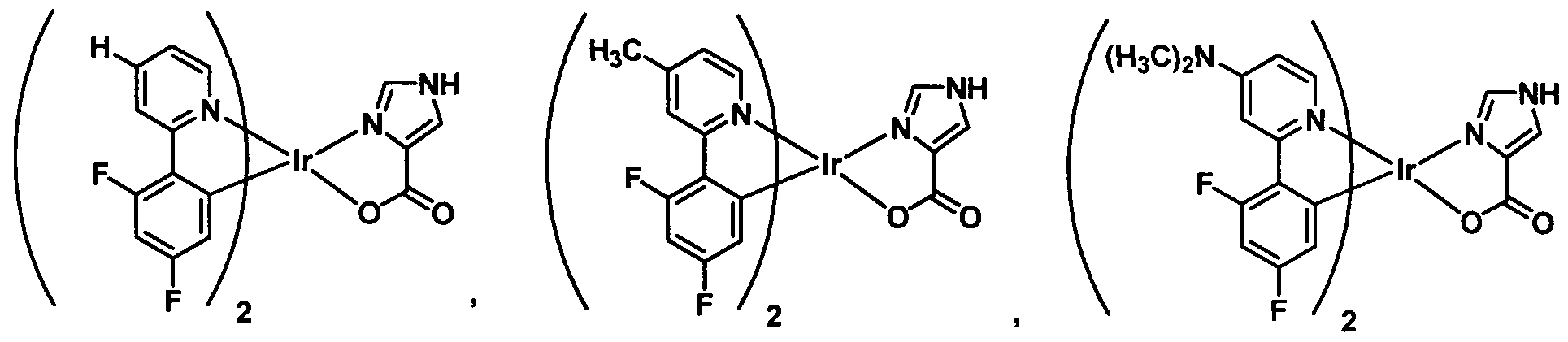


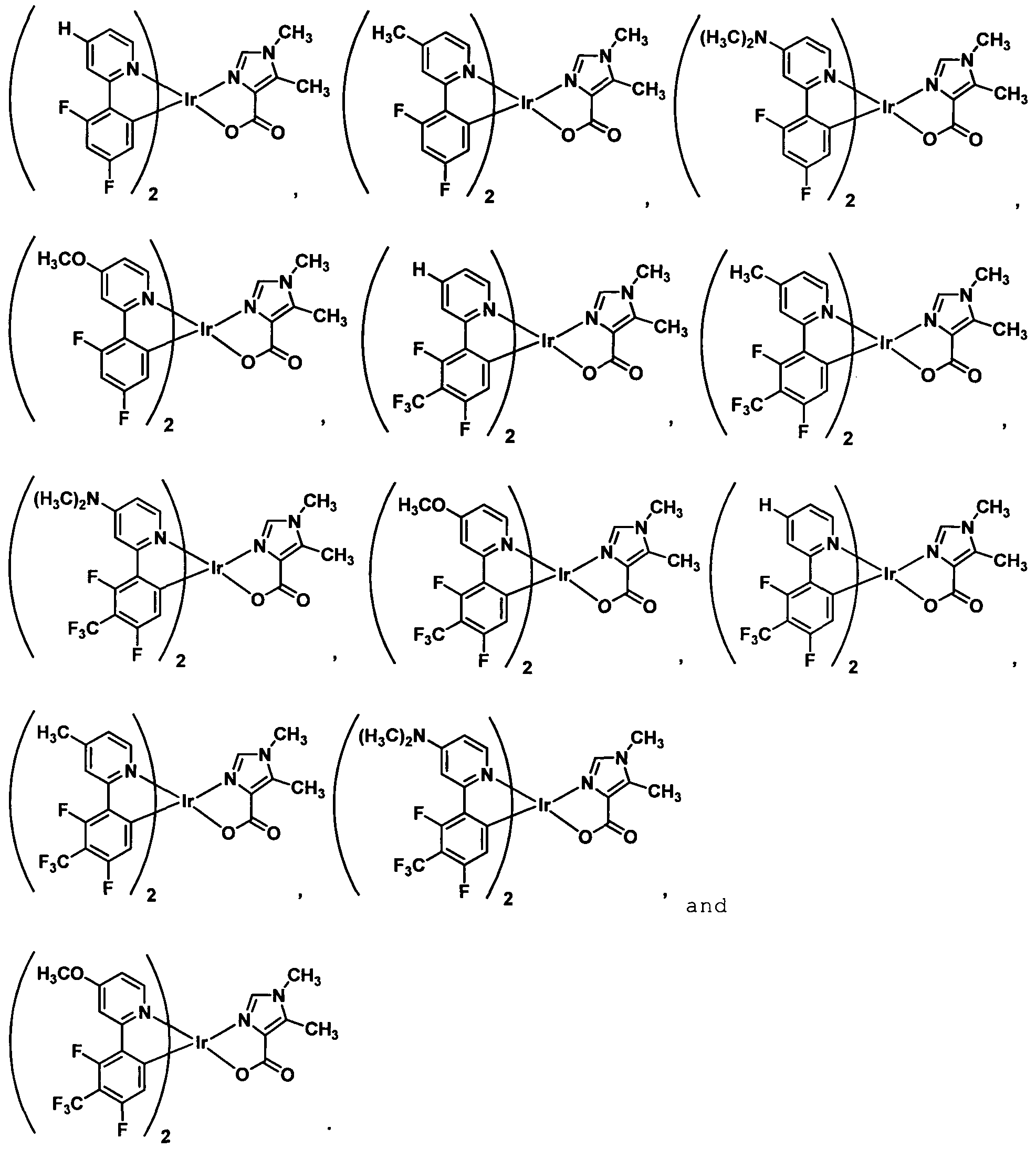
The presence of the ancillary ligand having one or more electron-donating group (s) on the right side of the iridium complex improves the phosphorescence quantum yield (PQY) of the electroluminescent material. Preferably, an iridium complex having
an imidazole derivative ligand exhibits better absorption and emission properties than one having a pyrrole derivative ligand. The iridium complex having an imidazole derivative or a pyrrole derivative may be used as an electroluminescent material. In general, the iridium complex according to the present invention may be synthesized easily from a reaction of a μ-chloro- bridged iridium dimer comprising two main phenyl pyridines ligands, and an ancillary ligand.
The iridium complex according to the present invention may be used as an electroluminescent material in an electroluminescent layer of an OLED. Also, the iridium complex according to the present invention may be used as a phosphorescent material to manufacture an OLED, and may be used as a phosphorescent dopant in a host layer under an appropriate condition. An appropriate host material is selected from those capable of electroluminescence when a voltage is applied to the device.
An OLED according to the present invention comprises, as illustrated in Fig. 1, a substrate 1; an anode 2; optionally a hole transport layer (HTL) 3; an electroluminescent layer (EML) 4 ; optionally a hole blocking layer (HBL) 5; an electron transport layer
( ETL ) 6 ; and a cathode 7 .
The present invention further provides a display device comprising the OLED.
[Mode for Invention!
The examples and experiments will now be described. The following examples and experiments are for illustrative purposes only and not intended to limit the scope of the present invention.
Example 1: Synthesis of imidazole carboxylic acid
1-1. Synthesis of N- (2, 2-dimethoxyethyl ) trichloroacetamidine (7) Trichloroacetonitrile (14.4 g, 100 mmol) in THF (25 mL ) was added to a 100 mL two-bulb flask. Then, aminoacetaldehyde dimethyl acetal(10.9 mL, 10.5 g, 100 mmol) was added dropwise at -35 to -40 0C (under an argon atmosphere) . After removing the cooling bath, the reaction mixture was diluted with ethyl acetate when the temperature reached room temperature. The solution was washed with water and dried with anhydrous sodium sulfate. After removing the solvent under reduced pressure, an oil was obtained (90%) . 1H-NMR (CDCl3, 300 M Hz) δ (ppm) = 3.42 (s, 6H), 3.47 (d, 2H, J
= 5 . 4 H z ) , 4 . 54 ( t , I H , J = 5 . 4 H z ) .
1-2. Synthesis of 2-imidazole carboxylic acid (8)
N- ( 2 , 2-Dimethoxyethyl ) trichloroacetamidine (7, 2.00 g, 8.0 mmol) was added to trifluoroacetic acid (TFA, 2 mL) at 0 °C. The solution was kept for 24 hours at room temperature. After removing the solvent under reduced pressure, benzene was added to the residue.
The mixture was evaporated under reduced pressure and dried.
Water (5 mL) was added to the solution of 2- ( trichloromethyl ) imidazole in TFA prepared from N- (2,2- dimethoxyethyl ) trichloroacetamidine (7, 2.00 g) . The solution was heated for 1 hour at refluxing temperature. After removing the solvent under reduced pressure and adding benzene to the residue, the mixture was dried by distilling twice under reduced pressure. The solid residue was crystallized in 2-propanol-THF to obtain pure 2- imidazole carboxylic acid (yield: = 50%, m.p. = 162-164 0C) .
CCI3CN + H2NCH2CH(OMe)2 ; ; * CCI3 TCNHCH2CH(OMe)2

8
Example 2: Synthesis of main liqands
The main ligand, 2- ( 2 ' , 4 ' -difluorophenyl ) -4-methylpyridine (9) and 2-(2',4'-difluoro-3- ( trifluoromethyl ) phenyl) -4-methylpyridine (11) were prepared by using Suzuki coupling reaction.
2-1. Synthesis of 2- ( 2 ' , 4 ' -difluorophenyl ) -4 -methylpyridine (9) 2 , 4 -Difluorophenylboric acid (2.5 g, 15.8 mmol) , 2-bromo-4- methylpyridine (2.2 g, 12.6 mmol), barium hydroxide (15 g, 47.4 mmol) and 1 , 4-dioxane : H2O (3:1) were added to a 100 mL two-bulb flask equipped with a reflux condenser. Then, tetrakis (triphenylphosphine) palladium ( 0 ) (0.9 g, 0.8 mmol) was added to the flask. Then, N2 gas was filled in the flask at vacuum. The reaction mixture stirred overnight at 110 0C and cooled to room temperature. After removing the solvent, methylene chloride (50 mL)
was added to the residue. Then, precipitate was removed using filter paper. The organic phase was washed with 1 M NaOH (2 * 50 mL ) and then with saturated aqueous NaCl solution (50 mL) , dried with anhydrous magnesium sulfate, and then concentrated. The mixture was purified by column chromatography using ethyl acetate and hexane as eluent (yield: 50% ) .
1H-NMR (CDCl3, 300M Hz) δ (ppm) = 2.41 (s, 3H) , 6.86-6.94 (m, IH) , 6.95-7.02 (m, IH) , 7.09 (d, IH, J = 5.1 Hz) , 7.55 (s, IH), 7.91- 7.99 (m, IH) , 8.02 (d, 2H, J = 4.8 Hz) .
2-2. Synthesis o_f 2-(2',4'-difluoro-3' -iodophenyl) -A- methylpyridine (10)
A 2 M lithium diisopropylamide (LDA) solution in heptane (16.4 mL) was added dropwise to a solution of 2- ( 2 ' , 4 ' -dif luorophenyl ) -4 - methylpyridine (9, 4.5 g, 21.9 mmol) in THF (50 mL) at -78 °C and stirred for 1 hour. Then, iodine (7.8 g, 30.7 mmol) dissolved in THF
(40 mL) was added to the solution. The mixture was stirred at -78 0C for 3 hours and heated to room temperature. Then, after adding water
(300 ml), the solution was extracted twice with diethyl ether (300 mL x 2) . The ether solution was washed with water (300 mL) , saturated
sodium thiosulfate (Na2S2O3) aqueous solution (300 mL) and NaCl (300
HiL) . After drying the solution with sodium sulfate, the residue was evaporated under reduced pressure. The mixture was purified by column chromatography using ethyl acetate and hexane as eluent (yield: 46%) .
1H-NMR (CDCl3, 300M Hz) δ (ppm) = 2.40 (s, 3H), 6.97-7.03 (m, IH), 7.09 (d, IH, J = 5.1 Hz), 7.54 (s, IH), 7.89-8.55 (m, IH) .
2-3. Synthesis of 2- (2 ' , 4 ' -difluoro-3 ' - (trifluoromethyl) - phenyl ) -4 -methylpyridine (11)
Copper (I) iodide (2.6 g, 13.6 mmol) and spray-dried anhydrous potassium fluoride (0.79 g, 13.6. mmol) were added to a 100 mL two- bulb flask and heated mildly under reduced pressure using a burner until the color turned yellow. Then, after adding 2- (2 ' , 4 ' -difluoro- 3 ' -iodophenyl ) -4-methylpyridine (10, 3 g, 9.1 mmol) followed by purging with argon gas and addition of N-methylpyrrolidone (NMP), (trifluoromethyl ) trimethylsilane (2.7 mL, 18.2 mmol) was added to the flask. The reaction mixture was stirred at room temperature. The mixture was washed with 14% ammonia water (40 mL) and extracted three times with methylene chloride. The organic layer was washed with
water (40 mL ) and aqueous NaCl solution (40 mL), dried with anhydrous magnesium sulfate, and then concentrated. The mixture was purified by column chromatography using ethyl acetate and hexane as eluent (yield: 25%) .
1H-NMR (CDCl3, 300M Hz) δ (ppm) = 2.40 (s, 3H), 7.07-7.17 (m, IH), 7.57 (s, IH), 8.11-8.21 (m, IH), 8.57 (d, IH, J = 5.1 Hz) .
Example 3
The cyclometalated iridium ( I II ) -μ-chloro-bridged dimers (12, 13) were synthesized by refluxing IrCl3-IiH2O with the main ligand (9) and (11) in a 3:1 mixture of 2-ethoxyethanol and water according to the method reported by Nonoyama .
3-1. Synthesis of [ (2- (2 ' , 4 '-difluorophenyl)-4- methylpyridine) 2Ir (μ-Cl) ]2 (12)
2- (2' , 4 ' -Difluorophenyl-4-methylpyridine (9, 0.55 g, 2.68 mmol),
IrCl3-H2O-HCl (Aldrich, 0.32 g, 0.89 mmol) and 2-ethoxyethanol : H2O
(3:1) were added to a 100 mL two-bulb flask equipped with a reflux condenser. The flask was purged and filled with N2 gas. Then, the reaction mixture was stirred at 140 0C for 16 hours. After cooling
to room temperature, the solvent was removed by evaporation. After washing with water and then with 3 times the volume of ethanol, the residue was filtered. The resulting solid was dried (yield: 74%) .
1H-NMR (CDCl3, 300M Hz) δ (ppm) = 2.67 (s, 12H), 5.32 (d, 4H, J = 4.8 Hz), 6.31(t, 10.2 Hz), 6.61 (d, 4H, J = 6 Hz), 8.10 (s, 4H), 8.91 (d, 4H, J = 6 Hz) .
3-2. Synthesis of [2- ( 2 ' , 4 ' -difluoro-3' - ( trifluoromethyl ) phenyl- 4-methylpyridine)^Ir(μ-Cl) ] 2 (13) 2-(2',4'-Difluoro-3'-( trif luoromethyl ) phenyl-4-methylpyridine
(11, 0.55 g, 2.68 mmol), IrCl3-H2O-HCl (Aldrich, 0.32 g, 0.89 mmol) and 2-ethoxyethanol : H2O (3:1) were added to a 100 mL two-bulb flask equipped with a reflux condenser. The flask was purged and filled with N2 gas. Then, the reaction mixture was stirred at 140 0C for 15 hours. After cooling to room temperature, the solvent was removed by evaporation. After washing with water (40 mL) and filtering, the residue was extracted with 3 times the volume of chloromethanol . The organic layer was washed with water (40 mL) and aqueous NaCl solution
(4OmL), dried with anhydrous magnesium sulfate, and then concentrated. The resulting solid residue was recrystallized using methylene
chloride and π-hexane to obtain pure product (yield: 50% ) .
1H-NMR (CDCl3, 300M Hz) δ (ppm) = 2.69 (s, 12H) , 5.41 (d, 4H, J
= 10.8 Hz] 6.71 (d, 4H, J = 5.7 Hz) .21 (s, 4H) (d, 4H, J =
5.7 Hz) .


10 11

12
Example 4
Synthesis of iridium complexes (1~6!
Synthesis of the iridium complexes (1~6) was performed by refluxing pyrrole-2-carboxylic acid, imidazole-2-carboxylic acid (8) or imidazole-5-carboxlic acid in 2-ethoxyethanol in the presence of cyclometalated iridium ( III ) -μ-chloro-bridged dimer (12) or (13) .

13
4-1. Synthesis of iridium complex [ 2- ( 2 ' , 4 ' -difluorophenyl ) -4- methylpyridine) ] 2Ir (pyrrole-2-carboxylate) (1) (yield:
1H-NMR (CDCl3, 300M Hz) δ (ppm) = 2.53 (d, 6H, J = 5.7 Hz), 5.7
(d, 2H, J = 10.8 Hz), 5.98 (q, IH, J = 1.8 Hz), 6.10 (t, IH, J = 1.5
Hz), 6.29-6.42 (m, 2H), 6.68 (d, IH, J = 3.6 Hz), 6.98 (dd, 2H, J = 6
Hz, 5.7 Hz), 7.30 (d, IH, J = 6 Hz), 8.04 (d, 2H, J = 6 Hz), 8.60 (d,
IH, J = 5.7 Hz), HRMS (FAB) (M+H+, 711.1122, Calcd 710.1)
4-2. Synthesis of iridium complex [2- (2 ', 4 ' -difluorophenyl ) -4 - methylpyridine] 2Ir ( imidazole-2-carboxylate ) (2) (yield: 70%)
1H-NMR (CDCl3, 300M Hz) δ (ppm) = 2.54 (d, 6H, J = 3.6 Hz), 5.72
(dd, 2H, J = 9 Hz, 7 Hz), 6.30-6.42 (m, 2H), 6.51 (s, IH), 6.90 (dd,
2H, J = 6 Hz, 5.7 Hz) , 7.09 IH), 7.47 (d, IH, J = 6 Hz), 8.04 (d,
2H, J = 12.9 Hz), 8.46 (d, IH, J = 6 Hz), HRMS (FAB) (M+H+, 713.1147,
Calcd 711.6866) .
4-3. Synthesis of iridium complex [ 2- ( 2 ' , 4 ' -difluorophenyl ) -4- methylpyridine] ^Ir ( imidazole-5-carboxylate ) (3) (yield: 88%)
1H-NMR (DMSO-d6 , 300M Hz) : δ (ppm) = 2.53 (s, 6H), 5.58 (dd, 2H, J = 10.5, 9.0 Hz), 6.69 (t, 2H, J = 9.6, 12.0 Hz), 7.17 (d, IH, J = 6.0 Hz), 7.30 (d, 2H, J = 6.9 Hz), 7.56 (s, IH), 7.58 (d, IH, J = 5.7 Hz), 8.02 (d, 2H, J = 12.0 Hz), 8.41 (d, IH, J = 5.7 Hz), HRMS (FAB) (M+H+, 713.11, Calcd 712.11) .
4-4. Synthesis of iridium complex [ 2- ( 2 ' , 4 ' -dif luoro-3-
( trif luoromethyl ) phenyl- 4 -methylpyridine) ] 2Ir (pyrrole-2-carboxylate)
(4) (yield: 80%)
1H-NMR (CDCl3, 300M Hz) δ (ppm) = 2.48 (s, 6H), 5.73 (t, 2H, J =
11.4, 11.1 Hz), 6.11 (d, IH, J = 1.8 Hz), 6.35 (s, IH), 6.47 (d, IH, J = 3 Hz), 6.85 (d, 2H, J = 5.4 Hz), 7.22 (d, IH, J = 5.7 Hz), 7.81
(t, 2H, J = 11.1, 6 Hz), 8.04 (s, IH), HRMS (FAB) (M+ H+ , 847.09,
Calcd 846.08) .
4-5. Synthesis of iridium complex [2- (2 ' , 4 ' -difluoro-3- (trifluoromethyl ) phenyl- 4 -methylpyridine) ] 2Ir (imidazole-2-
carboxylate) (5) (yield: 70%)
1H-NMR (CDCl3, 300M Hz) δ (ppm) = 2.54 (d, 6H, J = 5.1 Hz), 5.83
(dd, 2H, J = 11.1, 10.8 Hz), 6.57 (s, IH), 6.94 (d, IH, J = 5.7 Hz]
7.10 (t, 2H, J = 10.8, 6.6 Hz), 7.48 (d, IH, J = 6 Hz), 8.13 (d, 2H,
J = 11.4 Hz) , 8.46 (d, IH, J = 6 Hz), HRMS (FAB) (M+H+, 849.0892,
Calcd 848.08) .
4-6. Synthesis of iridium complex [ 2- ( 2 ' , 4 ' -difluoro-3-
( trif luoromethyl ) phenyl- 4 -methylpyridine ) ] 2 Ir (imidazole-5-carboxylic acid) (6) (yield: 65%;
1H-NMR (DMSO-d6 , 300M Hz) δ (ppm) = 2.54 (d, 6H, J = 2.4 Hz)
5.86 (dd, 2H, J = IO 11.1 Hz), 7.25 (dd, 2H, J = 6, 5.7 Hz! 7.50
IH! 7.72 (t, 2H, J = 10.2, 6 Hz) ,20 (d, 2H, J = 9 Hz) , 8.47
(d, 2H, J = 6 Hz), HRMS (FAB) (M+H+, 849.0889, Calcd 848.08)

1. R1 = CH 1 R2 = CH
2. R1 = CH , R2 = NH
3. R1 = NH , R2 = CH

Example 5: UV absorption and emission property
UV absorption and emission properties of iridium ( III ) complex 3 and iridium ( III ) complex 6 were measured in methanol solution.
Absorption and emission spectra of other materials, iridium complexes
2, 4, and 5 were measured in chloroform (2.7*1CT4 M) solution. The film for emission property measurement was prepared by spin coating Il Il on a glass plate of the methanol or chloroform solution containing Il Il the iridium complex and polymethyl methacrylate (PMMA) . The iridium(III) complexes showed strong absorption and emission properties. The absorption spectrum exhibited absorption bands in the region between 350 and 470 nm. The absorption spectrum in film state was similar to that in solution state or showed a very slight shift toward shorter wavelength by about 1-2 nm.
Tris ( 2-tolylpyridine ) iridium (Ir(tpy>3), which was used as reference, exhibits strong phosphorescence bands and is reported to
have a phosphorescence quantum yield of 0.45 (Φ = 0.45) . The material (Ir(tpy)3) was used as reference for the measurement of phosphorescence quantum yield, and quantum yields (Φ) of iridium complexes 1-6 were obtained as shown in Table 1. The iridium complex with an imidazole derivative having one more N atom in the heterocycle as the ancillary ligand showed phosphorescence emission band in the shorter-wavelength blue region but decreased phosphorescence quantum yield (Φ = 0.1~ 0.2) as compared to the iridium complex with a pyrrole derivative (Φ = 0.3 and 0.5) as the ancillary ligand. The result is shown in Table 1.
Table 1


In Table 1, MLCTa means the maximum UV absorption peak for transition to the singlet excited state, and MLCTb means the maximum absorption peak for transition to the triplet excited state. Φc means the quantum yield obtained with the phosphorescence iridium complex
Ir(tpy)3 as the reference. Δv (cm ) means the Stokes shift, i.e. the difference in frequency between the maximum absorption peak for transition to the triplet excited state and the maximum phosphorescence peak.
Example 7 : Measurement of HOMO and LUMP energy level
Electrochemical property of an electrochemical cell comprising a platinum electrode (diameter: 2 mm), a platinum wire counter electrode and an Ag/AgCl reference electrode was measured using CHI600 (CH Instruments Inc., USA) . For supporting electrolyte solution (scan rate: 50 mVs"1), 0.1 M tetrabutylammonium perchlorate
(Bu4NClO4, TBAP) in dichloromethane (Aldrich, HPLC grade) was used.
Fig. 11 shows the cyclic voltammograms of the iridium complexes of the present invention. HOMO and LUMO measurement results for
iridium complexes 1 to 6 are summarized in Table 2. As seen in Table
2, the HOMO levels for iridium complexes 1 to 6 are -5.55 eV, -5.61 eV, -5.57 eV, -5.71 eV, -5.8 eV and -5.65 eV, respectively, and the
LUMO levels are -2.72 eV, -2.73 eV, -2.68 eV, -2.81 eV, -2.85 eV and
-2.67 eV, respectively. The iridium complexes of the present invention showed band gap of 2.83~2.98 eV. Among the iridium complexes of the present invention, iridium complex 6 had the largest band gap (2.98 eV) between the HOMO and the LUMO and emission at the shortest wavelength in solution with a large quantum yield (Φ = 0.2) . Iridium complex 5 also exhibits emission at almost the same wavelength as the complex 6 in a film state (Φ = 0.2) . Importantly iridium complexes 5~6 which contain a imidazole carboxylate as an ancillary ligand exhibit their emissions at shorter wavelength in the blue color region (5:458nm 6:459nm) in their film states comprising to ones in solution state.
Table 2


As described above, the iridium complexes of the present
invention show emission in the blue region of 457 nm . This means
that they are appropriate to be used as efficient blue
phosphorescence compounds in an OLED. Further, they exhibit very
high phosphorescence quantum yield. This superior performance means
that the iridium complexes of the present invention are good
candidates for electroluminescent materials. An electroluminescent
material comprising the iridium complex may be used in an
electroluminescent layer of an OLED and may be used in a display
device .
The present application contains subject matter related to Korean Patent Application No. 10-2009-0011745, filed in the Korean Intellectual Property Office on February 13. 2009, the entire content of which is incorporated herein by reference.
While the present invention has been described with respect to
the specific embodiments, it will be apparent to those skilled in the art that various changes and modifications may be made without departing from the spirit and scope of the invention as defined in the following claims.
Claims
[CLAIMS]
[Claim l]
An iridium complex compound represented by Chemical Formula I
[Chemical Formula I]

wherein
Ei represents an aromatic or heteroaromatic ring, which may be further condensed with an aromatic or non-aromatic ring and have one or more substituent ( s ) , the ring Ei optionally having one or more substituent ( s ) which may selectively form a condensation structure with a ring including E2 and being coordinated by Ir metal by means of sp2-hybridi zed carbon;
E2 represents a nitrogen-containing aromatic ring, which may be further condensed with an aromatic or non-aromatic ring, the ring E2 optionally having one or more substituent (s ) which may selectively form a condensation structure with a ring including Ei and being coordinated by Ir metal by means of sp2-hybridized nitrogen; Ri and R2 independently represent N, NR4 or CR4;
R3 and R4 independently represent the same or different electron- donating group selected from a group consisting of H, F, Cl, Br, straight or branched Ci-20 alkyl, C3-2O cyclic alkyl, straight or branched Ci-20 alkoxy, straight or branched Ci-20 dialkylamino, C4-I4 aryl,
C4-I4 heteroaryl, C4-14 aryl with one or more substituent (s ), C4-14 heteroaryl with one or more substituent ( s ) ; and n represents an integer 2.
[Cl aim 2]
The iridium complex compound according to claim 1, wherein a
ligand of the  portion is selected from a phenylpyridine derivative ligand with one or more fluorine atom(s) substituted on the
phenyl ring.
[Claim 3]
The iridium complex compound according to claim 2, wherein the
phenylpyridine ligand is selected from a group consisting of the
following chemical structures:


[ Claim 4 ]
The iridium complex compound according to claim 1, wherein Ri is
NH, R2 is CH, R3 is H, and n is 2.
[Claim 5]
The iridium complex compound according to claim 1, wherein Ri is
CH, R2 is NH, R3 is H, an n is 2.
[Claim 6]
The iridium complex compound according to claim 1, which is selected from a group consisting of the following compounds:


[Claim 7]
A luminescent material comprising the iridium complex compound according to any one of claims 1 to 6.
[Claim 8]
An organic light-emitting diode comprising the luminescent material according to claim 7 in an electroluminescent layer.
[Claim 9]
A display device employing the organic light-emitting diode according to claim 8.
Applications Claiming Priority (2)
| Application Number | Priority Date | Filing Date | Title |
|---|---|---|---|
| KR1020090011745A KR101066743B1 (en) | 2009-02-13 | 2009-02-13 | Iridium complex and organic light emitting device comprising the same |
| KR10-2009-0011745 | 2009-02-13 |
Publications (2)
| Publication Number | Publication Date |
|---|---|
| WO2010093176A2 true WO2010093176A2 (en) | 2010-08-19 |
| WO2010093176A3 WO2010093176A3 (en) | 2010-11-25 |
Family
ID=42562182
Family Applications (1)
| Application Number | Title | Priority Date | Filing Date |
|---|---|---|---|
| PCT/KR2010/000855 Ceased WO2010093176A2 (en) | 2009-02-13 | 2010-02-11 | Iridium complex and organic light-emitting diodes |
Country Status (2)
| Country | Link |
|---|---|
| KR (1) | KR101066743B1 (en) |
| WO (1) | WO2010093176A2 (en) |
Cited By (42)
| Publication number | Priority date | Publication date | Assignee | Title |
|---|---|---|---|---|
| WO2012142387A1 (en) * | 2011-04-14 | 2012-10-18 | Arizona Board Of Regents Acting For And On Behalf Of Arizona State University | Pyridine-oxyphenyl coordinated iridium (iii) complexes and methods of making and using |
| WO2014035210A3 (en) * | 2012-08-31 | 2014-05-08 | 삼성디스플레이 주식회사 | Organic light-emitting material and organic electroluminescence device using same |
| CN103965880A (en) * | 2013-01-30 | 2014-08-06 | 海洋王照明科技股份有限公司 | Blue light-emitting organic electroluminescent material and its preparation method and use |
| US9312502B2 (en) | 2012-08-10 | 2016-04-12 | Arizona Board Of Regents Acting For And On Behalf Of Arizona State University | Iridium complexes demonstrating broadband emission through controlled geometric distortion and applications thereof |
| US9530973B2 (en) | 2013-01-30 | 2016-12-27 | Samsung Display Co., Ltd. | Organometallic complex and organic light-emitting diode including the same |
| US9617291B2 (en) | 2015-06-03 | 2017-04-11 | Arizona Board Of Regents On Behalf Of Arizona State University | Tetradentate and octahedral metal complexes containing naphthyridinocarbazole and its analogues |
| US9711741B2 (en) | 2012-08-24 | 2017-07-18 | Arizona Board Of Regents On Behalf Of Arizona State University | Metal compounds and methods and uses thereof |
| US9818959B2 (en) | 2014-07-29 | 2017-11-14 | Arizona Board of Regents on behlaf of Arizona State University | Metal-assisted delayed fluorescent emitters containing tridentate ligands |
| US9865825B2 (en) | 2014-11-10 | 2018-01-09 | Arizona Board Of Regents On Behalf Of Arizona State University | Emitters based on octahedral metal complexes |
| US10033003B2 (en) | 2014-11-10 | 2018-07-24 | Arizona Board Of Regents On Behalf Of Arizona State University | Tetradentate metal complexes with carbon group bridging ligands |
| US10056567B2 (en) | 2014-02-28 | 2018-08-21 | Arizona Board Of Regents On Behalf Of Arizona State University | Chiral metal complexes as emitters for organic polarized electroluminescent devices |
| US10158091B2 (en) | 2015-08-04 | 2018-12-18 | Arizona Board Of Regents On Behalf Of Arizona State University | Tetradentate platinum (II) and palladium (II) complexes, devices, and uses thereof |
| US10177323B2 (en) | 2016-08-22 | 2019-01-08 | Arizona Board Of Regents On Behalf Of Arizona State University | Tetradentate platinum (II) and palladium (II) complexes and octahedral iridium complexes employing azepine functional groups and their analogues |
| US10263197B2 (en) | 2010-04-30 | 2019-04-16 | Arizona Board Of Regents Acting For And On Behalf Of Arizona State University | Synthesis of four coordinated palladium complexes and their applications in light emitting devices thereof |
| US10367155B2 (en) | 2013-02-13 | 2019-07-30 | Samsung Display Co., Ltd. | Organometallic complex and organic light-emitting diode including the same |
| US10516117B2 (en) | 2017-05-19 | 2019-12-24 | Arizona Board Of Regents On Behalf Of Arizona State University | Metal-assisted delayed fluorescent emttters employing benzo-imidazo-phenanthridine and analogues |
| US10804476B2 (en) | 2011-05-26 | 2020-10-13 | Arizona Board Of Regents, Acting For And On Behalf Of Arizona State University | Synthesis of platinum and palladium complexes as narrow-band phosphorescent emitters for full color displays |
| US10822363B2 (en) | 2016-10-12 | 2020-11-03 | Arizona Board Of Regents On Behalf Of Arizona State University | Narrow band red phosphorescent tetradentate platinum (II) complexes |
| US10886478B2 (en) | 2014-07-24 | 2021-01-05 | Arizona Board Of Regents On Behalf Of Arizona State University | Tetradentate platinum (II) complexes cyclometalated with functionalized phenyl carbene ligands and their analogues |
| US10964897B2 (en) | 2014-07-28 | 2021-03-30 | Arizona Board Of Regents On Behalf Of Arizona State University | Tridentate cyclometalated metal complexes with six-membered coordination rings |
| US10995108B2 (en) | 2012-10-26 | 2021-05-04 | Arizona Board Of Regents On Behalf Of Arizona State University | Metal complexes, methods, and uses thereof |
| US11011712B2 (en) | 2014-06-02 | 2021-05-18 | Arizona Board Of Regents On Behalf Of Arizona State University | Tetradentate cyclometalated platinum complexes containing 9,10-dihydroacridine and its analogues |
| US11101435B2 (en) | 2017-05-19 | 2021-08-24 | Arizona Board Of Regents On Behalf Of Arizona State University | Tetradentate platinum and palladium complexes based on biscarbazole and analogues |
| US11114626B2 (en) | 2012-09-24 | 2021-09-07 | Arizona Board Of Regents On Behalf Of Arizona State University | Metal compounds, methods, and uses thereof |
| US11183670B2 (en) | 2016-12-16 | 2021-11-23 | Arizona Board Of Regents On Behalf Of Arizona State University | Organic light emitting diode with split emissive layer |
| US11189808B2 (en) | 2013-10-14 | 2021-11-30 | Arizona Board Of Regents On Behalf Of Arizona State University | Platinum complexes and devices |
| US11329244B2 (en) | 2014-08-22 | 2022-05-10 | Arizona Board Of Regents On Behalf Of Arizona State University | Organic light-emitting diodes with fluorescent and phosphorescent emitters |
| US11335865B2 (en) | 2016-04-15 | 2022-05-17 | Arizona Board Of Regents On Behalf Of Arizona State University | OLED with multi-emissive material layer |
| US11495756B2 (en) | 2019-05-07 | 2022-11-08 | Universal Display Corporation | Organic electroluminescent materials and devices |
| US11594691B2 (en) | 2019-01-25 | 2023-02-28 | Arizona Board Of Regents On Behalf Of Arizona State University | Light outcoupling efficiency of phosphorescent OLEDs by mixing horizontally aligned fluorescent emitters |
| US11594688B2 (en) | 2017-10-17 | 2023-02-28 | Arizona Board Of Regents On Behalf Of Arizona State University | Display and lighting devices comprising phosphorescent excimers with preferred molecular orientation as monochromatic emitters |
| US11647643B2 (en) | 2017-10-17 | 2023-05-09 | Arizona Board Of Regents On Behalf Of Arizona State University | Hole-blocking materials for organic light emitting diodes |
| US11708385B2 (en) | 2017-01-27 | 2023-07-25 | Arizona Board Of Regents On Behalf Of Arizona State University | Metal-assisted delayed fluorescent emitters employing pyrido-pyrrolo-acridine and analogues |
| US11785838B2 (en) | 2019-10-02 | 2023-10-10 | Arizona Board Of Regents On Behalf Of Arizona State University | Green and red organic light-emitting diodes employing excimer emitters |
| US11878988B2 (en) | 2019-01-24 | 2024-01-23 | Arizona Board Of Regents On Behalf Of Arizona State University | Blue phosphorescent emitters employing functionalized imidazophenthridine and analogues |
| US11930698B2 (en) | 2014-01-07 | 2024-03-12 | Arizona Board Of Regents On Behalf Of Arizona State University | Tetradentate platinum and palladium complex emitters containing phenyl-pyrazole and its analogues |
| US11930662B2 (en) | 2015-06-04 | 2024-03-12 | Arizona Board Of Regents On Behalf Of Arizona State University | Transparent electroluminescent devices with controlled one-side emissive displays |
| US11945985B2 (en) | 2020-05-19 | 2024-04-02 | Arizona Board Of Regents On Behalf Of Arizona State University | Metal assisted delayed fluorescent emitters for organic light-emitting diodes |
| US12037348B2 (en) | 2018-03-09 | 2024-07-16 | Arizona Board Of Regents On Behalf Of Arizona State University | Blue and narrow band green and red emitting metal complexes |
| US12043611B2 (en) | 2014-08-15 | 2024-07-23 | Arizona Board Of Regents On Behalf Of Arizona State University | Non-platinum metal complexes for excimer based single dopant white organic light emitting diodes |
| US12091429B2 (en) | 2018-07-16 | 2024-09-17 | Arizona Board Of Regents On Behalf Of Arizona State University | Fluorinated porphyrin derivatives for optoelectronic applications |
| US12503644B2 (en) | 2020-05-19 | 2025-12-23 | Arizona Board Of Regents On Behalf Of Arizona State University | Metal assisted delayed fluorescent emitters for organic light-emitting diodes |
Families Citing this family (1)
| Publication number | Priority date | Publication date | Assignee | Title |
|---|---|---|---|---|
| KR101252603B1 (en) * | 2011-02-01 | 2013-04-10 | 부산대학교 산학협력단 | Deep-Blue Phosphorescent Iridium(III) Complexes Utilizing N-Methylimidazolyltriazoles |
Family Cites Families (3)
| Publication number | Priority date | Publication date | Assignee | Title |
|---|---|---|---|---|
| ATE488522T1 (en) | 2005-02-03 | 2010-12-15 | Merck Patent Gmbh | METAL COMPLEXES |
| US20100219397A1 (en) | 2005-08-05 | 2010-09-02 | Idemitsu Kosan Co., Ltd. | Transition metal complex compound and organic electroluminescent device using same |
| GB2440367A (en) | 2006-07-26 | 2008-01-30 | Oled T Ltd | Electroluminescent device |
-
2009
- 2009-02-13 KR KR1020090011745A patent/KR101066743B1/en not_active Expired - Fee Related
-
2010
- 2010-02-11 WO PCT/KR2010/000855 patent/WO2010093176A2/en not_active Ceased
Cited By (75)
| Publication number | Priority date | Publication date | Assignee | Title |
|---|---|---|---|---|
| US10263197B2 (en) | 2010-04-30 | 2019-04-16 | Arizona Board Of Regents Acting For And On Behalf Of Arizona State University | Synthesis of four coordinated palladium complexes and their applications in light emitting devices thereof |
| US10727422B2 (en) | 2010-04-30 | 2020-07-28 | Arizona Board Of Regents On Behalf Of Arizona State University | Synthesis of four coordinated palladium complexes and their applications in light emitting devices thereof |
| US10414785B2 (en) | 2011-04-14 | 2019-09-17 | Arizona Board Of Regents Acting For And On Behalf Of Arizona State University | Pyridine-oxyphenyl coordinated iridium (III) complexes and methods of making and using |
| US9221857B2 (en) | 2011-04-14 | 2015-12-29 | Arizona Board Of Regents Acting For And On Behalf Of Arizona State University | Pyridine-oxyphenyl coordinated iridium (III) complexes and methods of making and using |
| US9598449B2 (en) | 2011-04-14 | 2017-03-21 | Arizona Board Of Regents Acting For And On Behalf Of Arizona State University | Pyridine-oxyphenyl coordinated iridium (III) complexes and methods of making and using |
| WO2012142387A1 (en) * | 2011-04-14 | 2012-10-18 | Arizona Board Of Regents Acting For And On Behalf Of Arizona State University | Pyridine-oxyphenyl coordinated iridium (iii) complexes and methods of making and using |
| US11121328B2 (en) | 2011-05-26 | 2021-09-14 | Arizona Board Of Regents On Behalf Of Arizona State University | Synthesis of platinum and palladium complexes as narrow-band phosphorescent emitters for full color displays |
| US10804476B2 (en) | 2011-05-26 | 2020-10-13 | Arizona Board Of Regents, Acting For And On Behalf Of Arizona State University | Synthesis of platinum and palladium complexes as narrow-band phosphorescent emitters for full color displays |
| US9312502B2 (en) | 2012-08-10 | 2016-04-12 | Arizona Board Of Regents Acting For And On Behalf Of Arizona State University | Iridium complexes demonstrating broadband emission through controlled geometric distortion and applications thereof |
| US9711741B2 (en) | 2012-08-24 | 2017-07-18 | Arizona Board Of Regents On Behalf Of Arizona State University | Metal compounds and methods and uses thereof |
| WO2014035210A3 (en) * | 2012-08-31 | 2014-05-08 | 삼성디스플레이 주식회사 | Organic light-emitting material and organic electroluminescence device using same |
| US11114626B2 (en) | 2012-09-24 | 2021-09-07 | Arizona Board Of Regents On Behalf Of Arizona State University | Metal compounds, methods, and uses thereof |
| US12232411B2 (en) | 2012-09-24 | 2025-02-18 | Arizona Board Of Regents On Behalf Of Arizona State University | Metal compounds, methods, and uses thereof |
| US12043633B2 (en) | 2012-10-26 | 2024-07-23 | Arizona Board Of Regents On Behalf Of Arizona State University | Metal complexes, methods, and uses thereof |
| US10995108B2 (en) | 2012-10-26 | 2021-05-04 | Arizona Board Of Regents On Behalf Of Arizona State University | Metal complexes, methods, and uses thereof |
| US9530973B2 (en) | 2013-01-30 | 2016-12-27 | Samsung Display Co., Ltd. | Organometallic complex and organic light-emitting diode including the same |
| CN103965880A (en) * | 2013-01-30 | 2014-08-06 | 海洋王照明科技股份有限公司 | Blue light-emitting organic electroluminescent material and its preparation method and use |
| US10367155B2 (en) | 2013-02-13 | 2019-07-30 | Samsung Display Co., Ltd. | Organometallic complex and organic light-emitting diode including the same |
| US11189808B2 (en) | 2013-10-14 | 2021-11-30 | Arizona Board Of Regents On Behalf Of Arizona State University | Platinum complexes and devices |
| US12167676B2 (en) | 2013-10-14 | 2024-12-10 | Arizona Board Of Regents On Behalf Of Arizona State University | Platinum complexes and devices |
| US11930698B2 (en) | 2014-01-07 | 2024-03-12 | Arizona Board Of Regents On Behalf Of Arizona State University | Tetradentate platinum and palladium complex emitters containing phenyl-pyrazole and its analogues |
| US10056567B2 (en) | 2014-02-28 | 2018-08-21 | Arizona Board Of Regents On Behalf Of Arizona State University | Chiral metal complexes as emitters for organic polarized electroluminescent devices |
| US11011712B2 (en) | 2014-06-02 | 2021-05-18 | Arizona Board Of Regents On Behalf Of Arizona State University | Tetradentate cyclometalated platinum complexes containing 9,10-dihydroacridine and its analogues |
| US11839144B2 (en) | 2014-06-02 | 2023-12-05 | Arizona Board Of Regents On Behalf Of Arizona State University | Tetradentate cyclometalated platinum complexes containing 9,10-dihydroacridine and its analogues |
| US10886478B2 (en) | 2014-07-24 | 2021-01-05 | Arizona Board Of Regents On Behalf Of Arizona State University | Tetradentate platinum (II) complexes cyclometalated with functionalized phenyl carbene ligands and their analogues |
| US12082486B2 (en) | 2014-07-24 | 2024-09-03 | Arizona Board Of Regents On Behalf Of Arizona State University | Tetradentate platinum (II) complexes cyclometalated with functionalized phenyl carbene ligands and their analogues |
| US10964897B2 (en) | 2014-07-28 | 2021-03-30 | Arizona Board Of Regents On Behalf Of Arizona State University | Tridentate cyclometalated metal complexes with six-membered coordination rings |
| US11145830B2 (en) | 2014-07-29 | 2021-10-12 | Arizona Board Of Regents On Behalf Of Arizona State University | Metal-assisted delayed fluorescent emitters containing tridentate ligands |
| US9818959B2 (en) | 2014-07-29 | 2017-11-14 | Arizona Board of Regents on behlaf of Arizona State University | Metal-assisted delayed fluorescent emitters containing tridentate ligands |
| US12082488B2 (en) | 2014-07-29 | 2024-09-03 | Arizona Board Of Regents On Behalf Of Arizona State University | Metal-assisted delayed fluorescent emitters containing tridentate ligands |
| US10790457B2 (en) | 2014-07-29 | 2020-09-29 | Arizona Board Of Regents On Behalf Of Arizona State University | Metal-assisted delayed fluorescent emitters containing tridentate ligands |
| US12043611B2 (en) | 2014-08-15 | 2024-07-23 | Arizona Board Of Regents On Behalf Of Arizona State University | Non-platinum metal complexes for excimer based single dopant white organic light emitting diodes |
| US12565486B2 (en) | 2014-08-15 | 2026-03-03 | Arizona Board Of Regents On Behalf Of Arizona State University | Non-platinum metal complexes for excimer based single dopant white organic light emitting diodes |
| US12492336B2 (en) | 2014-08-22 | 2025-12-09 | Arizona Board Of Regents On Behalf Of Arizona State University | Organic light-emitting diodes with fluorescent and phosphorescent emitters |
| US11329244B2 (en) | 2014-08-22 | 2022-05-10 | Arizona Board Of Regents On Behalf Of Arizona State University | Organic light-emitting diodes with fluorescent and phosphorescent emitters |
| US10033003B2 (en) | 2014-11-10 | 2018-07-24 | Arizona Board Of Regents On Behalf Of Arizona State University | Tetradentate metal complexes with carbon group bridging ligands |
| US11653560B2 (en) | 2014-11-10 | 2023-05-16 | Arizona Board Of Regents On Behalf Of Arizona State University | Tetradentate metal complexes with carbon group bridging ligands |
| US10944064B2 (en) | 2014-11-10 | 2021-03-09 | Arizona Board Of Regents On Behalf Of Arizona State University | Tetradentate metal complexes with carbon group bridging ligands |
| US10991897B2 (en) | 2014-11-10 | 2021-04-27 | Arizona Board Of Regents On Behalf Of Arizona State University | Emitters based on octahedral metal complexes |
| US11856840B2 (en) | 2014-11-10 | 2023-12-26 | Arizona Board Of Regents On Behalf Of Arizona State University | Emitters based on octahedral metal complexes |
| US12302745B2 (en) | 2014-11-10 | 2025-05-13 | Arizona Board Of Regents On Behalf Of Arizona State University | Tetradentate metal complexes with carbon group bridging ligands |
| US9865825B2 (en) | 2014-11-10 | 2018-01-09 | Arizona Board Of Regents On Behalf Of Arizona State University | Emitters based on octahedral metal complexes |
| US9879039B2 (en) | 2015-06-03 | 2018-01-30 | Arizona Board Of Regents On Behalf Of Arizona State University | Tetradentate and octahedral metal complexes containing naphthyridinocarbazole and its analogues |
| US10836785B2 (en) | 2015-06-03 | 2020-11-17 | Arizona Board Of Regents On Behalf Of Arizona State University | Tetradentate and octahedral metal complexes containing naphthyridinocarbazole and its analogues |
| US9617291B2 (en) | 2015-06-03 | 2017-04-11 | Arizona Board Of Regents On Behalf Of Arizona State University | Tetradentate and octahedral metal complexes containing naphthyridinocarbazole and its analogues |
| US11472827B2 (en) | 2015-06-03 | 2022-10-18 | Arizona Board Of Regents On Behalf Of Arizona State University | Tetradentate and octahedral metal complexes containing naphthyridinocarbazole and its analogues |
| US12312366B2 (en) | 2015-06-03 | 2025-05-27 | Arizona Board Of Regents On Behalf Of Arizona State University | Tetradentate and octahedral metal complexes containing naphthyridinocarbazole and its analogues |
| US11930662B2 (en) | 2015-06-04 | 2024-03-12 | Arizona Board Of Regents On Behalf Of Arizona State University | Transparent electroluminescent devices with controlled one-side emissive displays |
| US10930865B2 (en) | 2015-08-04 | 2021-02-23 | Arizona Board Of Regents On Behalf Of Arizona State University | Tetradentate platinum (II) and palladium (II) complexes, devices, and uses thereof |
| US10158091B2 (en) | 2015-08-04 | 2018-12-18 | Arizona Board Of Regents On Behalf Of Arizona State University | Tetradentate platinum (II) and palladium (II) complexes, devices, and uses thereof |
| US11335865B2 (en) | 2016-04-15 | 2022-05-17 | Arizona Board Of Regents On Behalf Of Arizona State University | OLED with multi-emissive material layer |
| US10566554B2 (en) | 2016-08-22 | 2020-02-18 | Arizona Board Of Regents On Behalf Of Arizona State University | Tetradentate platinum (II) and palladium (II) complexes and octahedral iridium complexes employing azepine functional groups and their analogues |
| US10177323B2 (en) | 2016-08-22 | 2019-01-08 | Arizona Board Of Regents On Behalf Of Arizona State University | Tetradentate platinum (II) and palladium (II) complexes and octahedral iridium complexes employing azepine functional groups and their analogues |
| US10822363B2 (en) | 2016-10-12 | 2020-11-03 | Arizona Board Of Regents On Behalf Of Arizona State University | Narrow band red phosphorescent tetradentate platinum (II) complexes |
| US11183670B2 (en) | 2016-12-16 | 2021-11-23 | Arizona Board Of Regents On Behalf Of Arizona State University | Organic light emitting diode with split emissive layer |
| US11708385B2 (en) | 2017-01-27 | 2023-07-25 | Arizona Board Of Regents On Behalf Of Arizona State University | Metal-assisted delayed fluorescent emitters employing pyrido-pyrrolo-acridine and analogues |
| US11101435B2 (en) | 2017-05-19 | 2021-08-24 | Arizona Board Of Regents On Behalf Of Arizona State University | Tetradentate platinum and palladium complexes based on biscarbazole and analogues |
| US12010908B2 (en) | 2017-05-19 | 2024-06-11 | Arizona Board Of Regents On Behalf Of Arizona State University | Metal-assisted delayed fluorescent emitters employing benzo-imidazo-phenanthridine and analogues |
| US11974495B2 (en) | 2017-05-19 | 2024-04-30 | Arizona Board Of Regents On Behalf Of Arizona State University | Tetradentate platinum and palladium complexes based on biscarbazole and analogues |
| US11063228B2 (en) | 2017-05-19 | 2021-07-13 | Arizona Board Of Regents On Behalf Of Arizona State University | Metal-assisted delayed fluorescent emitters employing benzo-imidazo-phenanthridine and analogues |
| US10516117B2 (en) | 2017-05-19 | 2019-12-24 | Arizona Board Of Regents On Behalf Of Arizona State University | Metal-assisted delayed fluorescent emttters employing benzo-imidazo-phenanthridine and analogues |
| US11594688B2 (en) | 2017-10-17 | 2023-02-28 | Arizona Board Of Regents On Behalf Of Arizona State University | Display and lighting devices comprising phosphorescent excimers with preferred molecular orientation as monochromatic emitters |
| US11647643B2 (en) | 2017-10-17 | 2023-05-09 | Arizona Board Of Regents On Behalf Of Arizona State University | Hole-blocking materials for organic light emitting diodes |
| US12120945B2 (en) | 2017-10-17 | 2024-10-15 | Arizona Board Of Regents On Behalf Of Arizona State University | Display and lighting devices comprising phosphorescent excimers with preferred molecular orientation as monochromatic emitters |
| US12037348B2 (en) | 2018-03-09 | 2024-07-16 | Arizona Board Of Regents On Behalf Of Arizona State University | Blue and narrow band green and red emitting metal complexes |
| US12091429B2 (en) | 2018-07-16 | 2024-09-17 | Arizona Board Of Regents On Behalf Of Arizona State University | Fluorinated porphyrin derivatives for optoelectronic applications |
| US11878988B2 (en) | 2019-01-24 | 2024-01-23 | Arizona Board Of Regents On Behalf Of Arizona State University | Blue phosphorescent emitters employing functionalized imidazophenthridine and analogues |
| US12448405B2 (en) | 2019-01-24 | 2025-10-21 | Arizona Board Of Regents On Behalf Of Arizona State University | Blue phosphorescent emitters employing functionalized imidazophenthridine and analogues |
| US12082490B2 (en) | 2019-01-25 | 2024-09-03 | Arizona Board Of Regents On Behalf Of Arizona State University | Light outcoupling efficiency of phosphorescent OLEDs by mixing horizontally aligned fluorescent emitters |
| US11594691B2 (en) | 2019-01-25 | 2023-02-28 | Arizona Board Of Regents On Behalf Of Arizona State University | Light outcoupling efficiency of phosphorescent OLEDs by mixing horizontally aligned fluorescent emitters |
| US11495756B2 (en) | 2019-05-07 | 2022-11-08 | Universal Display Corporation | Organic electroluminescent materials and devices |
| US12120946B2 (en) | 2019-10-02 | 2024-10-15 | Arizona Board Of Regents On Behalf Of Arizona State University | Green and red organic light-emitting diodes employing excimer emitters |
| US11785838B2 (en) | 2019-10-02 | 2023-10-10 | Arizona Board Of Regents On Behalf Of Arizona State University | Green and red organic light-emitting diodes employing excimer emitters |
| US11945985B2 (en) | 2020-05-19 | 2024-04-02 | Arizona Board Of Regents On Behalf Of Arizona State University | Metal assisted delayed fluorescent emitters for organic light-emitting diodes |
| US12503644B2 (en) | 2020-05-19 | 2025-12-23 | Arizona Board Of Regents On Behalf Of Arizona State University | Metal assisted delayed fluorescent emitters for organic light-emitting diodes |
Also Published As
| Publication number | Publication date |
|---|---|
| WO2010093176A3 (en) | 2010-11-25 |
| KR101066743B1 (en) | 2011-09-21 |
| KR20100092572A (en) | 2010-08-23 |
Similar Documents
| Publication | Publication Date | Title |
|---|---|---|
| KR101066743B1 (en) | Iridium complex and organic light emitting device comprising the same | |
| Sun et al. | Highly efficient deep-red organic light-emitting devices based on asymmetric iridium (III) complexes with the thianthrene 5, 5, 10, 10-tetraoxide moiety | |
| JP4198654B2 (en) | Iridium compound and organic electroluminescence device employing the same | |
| EP2197980B1 (en) | Complexes with tridentate ligands | |
| TWI432552B (en) | Stable OLED material and device with improved stability | |
| JP5514732B2 (en) | Iridium complex having carbazole pyridine and phenyl derivative as main ligands, and organic electroluminescent device containing the same | |
| TWI409317B (en) | Electro luminescent metal complexes | |
| CN102227438B (en) | Novel compound and utilization of same | |
| KR101443397B1 (en) | Luminescent material | |
| CN102344465B (en) | Cyclometalated transition metal complex and organic electroluminescence device using the same | |
| US8372977B2 (en) | Luminescent gold(III) compounds containing bidentate ligand for organic light-emitting devices and their preparation | |
| KR101105242B1 (en) | Iridium-based blue light emitting compound having a picolinic acid or a picolinic acid-en-oxide derivative capable of solution processing as an auxiliary ligand and an organic light emitting device comprising the same | |
| KR101252603B1 (en) | Deep-Blue Phosphorescent Iridium(III) Complexes Utilizing N-Methylimidazolyltriazoles | |
| US20090200920A1 (en) | Light-Emitting Material | |
| KR101057175B1 (en) | Novel Iridium (III) Complexes and Organic Electroluminescent Devices Comprising the Same | |
| KR101014957B1 (en) | Iridium-based light emitting compound having picolinic acid-ene-oxide as an auxiliary ligand and organic light emitting device comprising the same | |
| Cho et al. | Phosphorescent, green-emitting Ir (III) complexes with carbazolyl-substituted 2-phenylpyridine ligands: Effect of binding mode of the carbazole group on photoluminescence and electrophosphorescence | |
| KR100851519B1 (en) | Iridium complex compound with improved luminescence properties and organic light emitting device comprising the same | |
| US20140005397A1 (en) | Metal complex comprising a ligand having a combination of donor-acceptor substituents | |
| Lee et al. | Effects of the Trifluoromethyl Group on the Emission Efficiency of Red Phosphorescent Iridium (III) Complexes | |
| KR101481147B1 (en) | Iridium (III) Complexes, method for preparaion of Iridium (III) Complexes, and Organic Light-Emitting Diodes comprising thereof | |
| KR20100133359A (en) | Iridium complex, organic electroluminescent device comprising the same | |
| Turner | Luminescent cyclometalated platinum and palladium complexes with novel photophysical properties | |
| WO2012008637A1 (en) | Iridium-based blue light-emittting compound having solution processable picolinic acid or picolinic acid-n-oxide derivatives as ancillary ligand and organic electric-field light-emitting element comprising same |
Legal Events
| Date | Code | Title | Description |
|---|---|---|---|
| 121 | Ep: the epo has been informed by wipo that ep was designated in this application |
Ref document number: 10741394 Country of ref document: EP Kind code of ref document: A2 |
|
| NENP | Non-entry into the national phase |
Ref country code: DE |
|
| 122 | Ep: pct application non-entry in european phase |
Ref document number: 10741394 Country of ref document: EP Kind code of ref document: A2 |