WO2010081882A2 - Synthesis of new protected azahistidines, their processes and their use in synthesises - Google Patents
Synthesis of new protected azahistidines, their processes and their use in synthesises Download PDFInfo
- Publication number
- WO2010081882A2 WO2010081882A2 PCT/EP2010/050467 EP2010050467W WO2010081882A2 WO 2010081882 A2 WO2010081882 A2 WO 2010081882A2 EP 2010050467 W EP2010050467 W EP 2010050467W WO 2010081882 A2 WO2010081882 A2 WO 2010081882A2
- Authority
- WO
- WIPO (PCT)
- Prior art keywords
- fmoc
- boc
- protecting groups
- chosen
- synthesis
- Prior art date
- Legal status (The legal status is an assumption and is not a legal conclusion. Google has not performed a legal analysis and makes no representation as to the accuracy of the status listed.)
- Ceased
Links
- 0 *C(C(Cc1c[n](*)nn1)N(*)P)=O Chemical compound *C(C(Cc1c[n](*)nn1)N(*)P)=O 0.000 description 2
Classifications
-
- C—CHEMISTRY; METALLURGY
- C07—ORGANIC CHEMISTRY
- C07D—HETEROCYCLIC COMPOUNDS
- C07D249/00—Heterocyclic compounds containing five-membered rings having three nitrogen atoms as the only ring hetero atoms
- C07D249/02—Heterocyclic compounds containing five-membered rings having three nitrogen atoms as the only ring hetero atoms not condensed with other rings
- C07D249/04—1,2,3-Triazoles; Hydrogenated 1,2,3-triazoles
Definitions
- the present invention relates to new protected azahistidines (azaHis) to the processes for their preparation, to their use in organic synthesis and in particular peptide synthesis.
- azaHis protected azahistidines
- Unnatural ⁇ -amino acids are key components for recent developments in peptides or proteins research. These synthetic compounds have been incorporated in biologically active peptides mostly to enhance proteolytic stability or to confer peculiar properties to these peptides. In addition, conformational flexibility, selectivity, pharmacokinetics and bioavailability can also be tuned based on well-designed amino acids. In the field of nanotechnology, there is also a growing interest in synthetic amino acids that can present specific properties (metal binding ability, polymerisation precursors, electron transfer).
- histidine is often strongly involved in the chemistry of enzymes due to the ability of the imidazole side chain to take part in acid- base catalysis. Indeed, histidine can act both as a donor or an acceptor of protons: developing analogues could pave the way to new applications.
- One of the most obvious parent compounds is azahistidine where the imidazole ring has been replaced by a 1,2,3- triazole.
- azahistidines depending on the position of the unsaturation and consequently of the position of the hydrogen of N-H in the side chain: azahistidine I', called azahistidine-(l,4) and azahistidine I", called azahistidine-(l,5):
- Triazole analogues of histidine Triazole analogues of histidine: azahistidines
- the nitrogen of the NH 2 groups, as shown in the above molecules and if need be in other amino acids, will be referred to the "N- ⁇ " nitrogens when described in a single amino acid, and to "N terminal” extremity or nitrogen when described in a peptide chain.
- the carbon of the COOH groups as shown in the above molecules and if need be in other amino acids will be referred to the "C- ⁇ -carboxyl” carbon when described in a single amino acid, and to "C terminal" extremity or carbon when described in a peptide chain.
- C- ⁇ The carbon directly linked to the N- ⁇ and to the C- ⁇ -carboxyl as shown in the above molecules and if need be in other amino acids, will be referred to the "C- ⁇ " carbon.
- the chain defined by the direct succession of N- ⁇ , C- ⁇ , C- ⁇ -carboxyl will be called the "primary chain” of the amino acid, as shown in the above molecules and if need be in other amino acids.
- the succession of these primary chains, linked by amide bonds also called peptide bonds, between the N- ⁇ and C- ⁇ -carboxyl of two amino acids, will be called the "backbone" of the peptide.
- Solid phase peptide synthesis for example, has a particular success due to its ease of use and flexibility, enabling to obtain natural and unnatural molecules very quickly.
- These azahistidines need to be adapted in such a way for example, that the side chain groups and N- ⁇ , present little if at all reactivity to enable the C- ⁇ -carboxyl to react with the N terminal extremity only of a given peptide, or to one of its side chains only, or directly to the resin, etc.
- azahistidines suitable for organic synthesis and in particular for peptide synthesis.
- Said azahistidines obtained in a one step synthesis based on "click chemistry", comprise at least two protecting groups Some deprotection steps are described enabling the use of such fully- protected azahistidines in peptide synthesis.
- the applicant was able to obtain either azahistidine-(l,4), or azahistidine-(l,5) specifically.
- the applicant also used a protected azahistidine to synthesize a peptide of biological interest: a GHK analogue.
- This invention relates to compounds of formula (Ia) and (Ib):
- Rl is chosen between hydrogen, Ci-C ⁇ alkyl; aryl-Ci-C ⁇ alkyl-; Rl is most preferably hydrogen
- R2 is chosen between hydroxy, Ci-C ⁇ alkyloxy, aryl-Ci-C ⁇ alkyloxy; R2 is most preferably hydroxy or ethoxy.
- Ci-C ⁇ alkyl refers to straight or branched chain substituted or unsubstituted alkyl radicals containing from 1 to 6 carbon atoms including, but not limited to, methyl, ethyl, n-propyl, iso-propyl, n-butyl, iso- butyl, sec-butyl, t-butyl, n-pentyl, n-hexyl and the like.
- aryl refers to a monocyclic or bicyclic carbocyclic ring system having one or more aromatic rings including, but not limited to, phenyl, naphthyl, tetrahydronaphthyl, indanyl and the like.
- Ci-C ⁇ alkyloxy refers to any -O-R radical, wherein R is a Ci-C ⁇ alkyl as defined above including, methyl, ethyl, propyl, tert-butyl, etc.
- a nitrogen protecting group is a chemical moiety linked to the nitrogen, stopping the nitrogen to react whilst the protecting group is on it, ideally said protecting group is selectively removed, or "cleaved", from the nitrogen by using specific and selective conditions.
- Pl and P2 are chosen between Fmoc, POM, ethoxycarbonyl, Boc, Bn, Bz, CBz, allyl, Alloc, Ac, formyl, DMB, PMB or all other protecting groups used in organic chemistry.
- Pl is most preferably the Boc or Fmoc or Ac group.
- P2 is most preferably the POM group.
- Fmoc group refers to 9-Fluorenylmethyloxycarbonyl
- POM group refers to pivaloyl oxymethyl, the nitrogen to be protected being linked to the CH 2 - in the following structure:
- Boc (also called t-Boc or l Boc) group refers to (tert-butoxy)carbonyl
- Bn group refers to benzyl
- Bz group refers to benzoyl
- CBz (also called Z) group refers to benzyloxycarbonyl Alloc group refers to allyloxycarbonyl Ac group refers to acetyl
- DMB group refers to 3,5-dimethoxybenzyl
- PMB group refers to 4-methoxybenzyl
- Peptide synthesis is a particular type of organic synthesis which relates to peptides, i.e. polymers of amino acids.
- An amino acid is an organic molecule comprising at least one amine group and at least one carboxylic acid group.
- the Fmoc strategy SPPS uses basic conditions (usually 20% piperidine in DMF) to remove the Fmoc protecting group from the growing peptide chain. This method was introduced by Carpino in 1972 and further applied by Atherton in 1978. It was first described as a protecting group by Carpino in 1970. Removal of the peptide from the resin is usually achieved by incubating in trifluoroacetic acid (TFA), deionized water, and triisopropylsilane. These conditions often remove the side-chain protecting groups also.
- TFA trifluoroacetic acid
- deionized water deionized water
- triisopropylsilane triisopropylsilane
- the removal of the protecting groups P 1 and/or P 2 is achieved by using soft conditions.
- soft conditions it is meant room temperature and pH ranging from 2.0 to 14.0.
- azahistidines (Ia) or (Ib) described in the present invention can be used in Fmoc or Boc solid phase peptide synthesis (SPPS).
- Pl and P2 can be sensitive to basic conditions.
- Protecting groups sensitive to basic conditions are for example Fmoc and POM.
- Fmoc group which is base sensitive.
- organic or inorganic bases may be used. Suitable organic bases include amines, either primary, secondary or tertiary.
- Suitable amines include cyclohexylamine, l,5-diazobicyclo-[5,4,0]-undec- 5ene, piperidine, ethanolamine, pyrrolidine, diethylamine, morpholine, piperazine, dicyclohexylamine, hydroxylamine, hydrazine, N,N'-isopropylethylamine, N,N,N',N'- tetramethyl-l,8-naphtalenediamine, tributylamine, triethylamine and triethylendiamine.
- Inorganic bases include sodium hydroxide, potassium hydroxide and ammonia.
- the inorganic bases are preferably employed in conjunction with one or more organic solvents.
- sodium hydroxide is used typically in the form of Tesser's base, i.e., dioxane-methanol-4N sodium hydroxide and ammonia as a 5 molar solution in methanol-methylene chloride.
- Lower concentrations of sodium hydroxide or potassium hydroxide can be sufficient to deprotect the Fmoc group.
- Each base may of course interact with the Fmoc in a varying manner.
- Piperidine is a particularly preferred base for cleavage of the Fmoc group.
- the cleavage reaction is carried out in an organic solvent conventionally employed in solid phase peptide synthesis.
- Suitable solvents include the halogenated Ci-C ⁇ alkyls, such as methylene chloride. Room temperature is most conveniently employed for the cleavage reaction.
- Derivatives bearing a POM group on the triazole ring appear to be good candidates for SPPS since selective deprotection of either the side chain or the amino- acid nitrogen group proved to be possible.
- Azahistidine bearing a Fmoc group as Pl and a POM group as P2 is particulary interesting since the deprotection of the Fmoc group takes place with piperidine while the POM deprotection requires more basic conditions thus allowing the use of compound in SPPS as exemplified in the synthesis of a GHK analogue described herein (example 3).
- the deprotection conditions used to remove POM in the present invention are:
- concentrations of the NaOH aq or K0H aq range from 1 mole per litre of water to 5 moles per litre of water, preferably 1 mole per litre of water.
- the quantity of KOH should range from 1 equivalent to 10 equivalents in moles for every equivalent of (Ia) and/or (Ib).
- the same treatment can be done to a peptide or another organic molecule to remove the
- the quantity of NaOH should range from 1 equivalent to 10 equivalents in moles for every equivalent of (Ia) and/or (Ib).
- the same treatment can be done to a peptide or another organic molecule to remove the
- Pl and P2 can be sensitive to acidic conditions.
- Protecting groups sensitive to acidic conditions are for example Boc, ethoxycarbonyl, benzyloxycarbonyl.
- one protecting group of interest in peptide chemistry is the Boc group, which is acid sensitive.
- organic or inorganic acids may be used.
- Suitable organic acids include trifluoroacetic acid (TFA), acetic acid, para- toluenesulfonic acid, methanesulfonic acid and all other conditions well known from the man skilled in the art.
- Suitable inorganic acids include hydrochloric acid (HCl), hydrofluoric acid
- a scavenger can be added: for example, a type of silane with deionized water act as a perfect scavenger.
- the silane usually used is triisopropylsilane.
- the cleavage reaction can be carried out directly into the acid with scavengers like it is usually the case with TFA or in an organic solvent conventionally employed in solid phase peptide synthesis.
- Suitable solvents include the halogenated Ci-C ⁇ alkyls, such as methylene chloride. Room temperature is most conveniently employed for the cleavage reaction.
- Protecting groups sensitive to the treatment with palladium (0) conditions, with or without hydrogen, are for example benzyl, benzoyl, benzyloxycarbonyl, allyl, allyloxycarbonyl, PMB, DMB.
- Pd 0 Palladium (O) treatment is obtained by usual organic chemistry techniques.
- the palladium used can be Pd/C (palladium on carbon), or a palladium (0) precursor like Pd(OAc) 2 , in a adequate solvent, which can be chosen between ethanol, tetrahydrofurane (THF), with or without triphenylphosphine, with or without hydrogen bubbling, and with or without acid (acetic acid, TFA) depending on the protecting group to be removed.
- THF tetrahydrofurane
- TFA acetic acid
- Pl and P2 can be sensitive to oxidative conditions.
- Protecting groups sensitive to the treatment with oxidative conditions are for example PMB, DMB.
- Oxidative conditions can be induced by the use for example of CAN, DDQ and the conditions well known from the man skilled in the art.
- CAN refers to eerie ammonium nitrate
- DDQ refers to 2,3-dichloro-5,6-dicyanobenzoquinone
- Azahistidine (Ia) or (Ib) with Pl and P2 being non-sensitive to all of the above listed conditions can be used.
- Such protecting groups can be Ac, which is actually used to block the synthesis of certain unwanted peptides during a SPPS. This process which is called the capping process, usually uses acetic anhydride in large excess with a base like pyridine or diisopropylethylamine.
- Pl and P2 are orthogonal and chosen between Fmoc, POM, ethoxycarbonyl, Boc, Bn, Bz, CBz, allyl, Alloc, Ac, formyl, DMB, PMB or all other protecting groups used in organic chemistry.
- Orthogonal means in this case that the deprotecting conditions for Pl do not remove or affect structurally P2, or the deprotecting conditions for P2 do not remove or affect structurally Pl.
- orthogonal groups in this particular invention can be Boc and Fmoc, or Boc and POM, or Fmoc and POM for either which of Pl and P2.
- P 1 is either Fmoc or Boc.
- P 2 can then be chosen between POM, ethoxycarbonyl, Bn, Bz, CBz, allyl, Alloc, Ac, formyl, DMB, PMB.
- Rl is hydrogen
- R2 is hydroxy
- the protecting group P 1 is chosen between Fmoc and Boc
- the protective group P 2 is POM.
- the final protected azahistidines (Ia) and/or (Ib) can be unnatural amino acids of the L series, in which case all the components of the synthesis are chosen in consequence. Indeed, the configuration of the C- ⁇ carbon and enantiomeric purity, or excess of the azahistidines, are the same as the starting material, which is commercial.
- the final protected azahistidines (Ia) and/or (Ib) can be unnatural amino acids of the D series, in which case all the components of the synthesis are chosen in consequence. Indeed, the configuration of the C- ⁇ carbon and enantiomeric purity, or excess of the azahistidines, are the same as the starting material, which is commercial.
- different regioisomers can be obtained: azahistidines (Ia) were obtained using the copper-catalysed click chemistry. The more recently described ruthenium-catalysed cycloaddition, afforded the azahistidines (Ib). Using either condition, rapid access to protected azahistidines was demonstrated and the regioisomers were obtained with fair to satisfactory yields (example 1).
- Rl is chosen between hydrogen, Ci-C ⁇ alkyl; aryl-Ci-C ⁇ alkyl-; Rl is most preferably hydrogen
- R2 is chosen between hydroxy, Ci-C ⁇ alkyloxy, aryl-Ci-C ⁇ alkyloxy; R2 is most preferably hydroxy or ethoxy.
- Ci-C ⁇ alkyl refers to straight or branched chain substituted or unsubstituted alkyl radicals containing from 1 to 6 carbon atoms including, but not limited to, methyl, ethyl, n-propyl, iso-propyl, n-butyl, iso- butyl, sec-butyl, t-butyl, n-pentyl, n-hexyl and the like.
- aryl refers to a monocyclic or bicyclic carbocyclic ring system having one or more aromatic rings including, but not limited to, phenyl, naphthyl, tetrahydronaphthyl, indanyl and the like.
- Ci-C 6 alkyloxy refers to any -O-R radical, wherein R is a Ci-C ⁇ alkyl as defined above including, methyl, ethyl, propyl, tert-butyl, etc.
- the compound of formula (A) is called “protected propargyl amino acid” or “Pl protected propargyl amino acid” and the compound (B) is called “protected azide” or “P2 protected azide”.
- Pl in the compound of formula (A) is either an identical or different nitrogen protecting group to P2 in compound of formula (B).
- Pl and P2 are chosen between Fmoc, POM, ethoxycarbonyl, Boc, Bn, Bz, CBz, allyl, Alloc, Ac, formyl, DMB, PMB or all other protecting groups used in organic chemistry.
- Pl is most preferably the Boc or Fmoc or Ac group.
- P2 is most preferably the POM group.
- Fmoc group refers to 9-Fluorenylmethyloxycarbonyl
- POM group refers to pivaloyl oxymethyl, the nitrogen to be protected being linked to the CH 2 - in the following structure:
- Boc (also called t-Boc or l Boc) group refers to (tert-butoxy)carbonyl Bn group will refer to benzyl Bz group refers to benzamide
- CBz (also called Z) group refers to benzyloxycarbonyl
- Alloc group refers to allyloxycarbonyl Ac group refers to acetyl
- DMB group refers to 3,5-dimethoxybenzyl
- PMB group refers to 4-methoxybenzyl
- (I), preferably chosen is between: Cu(OAc) 2 with sodium ascorbate, Cu/C,
- 2,6-lutidine being: 2,6-dimethylpyridine
- Zeolites used being: Y, USY, MOR, ZSM5
- Cp* being: pentamethylcyclopentadienyl
- COD being: cyclooctadienyl
- NBD being: bicyclo[2.2.1]hepta-2,5-diene
- a solvent which can be chosen from any one of the group consisting of: water, tert-butanol, acetonitrile, dimethylformamide (DMF), benzene, toluene or mixture thereof.
- the copper catalysed version of Huisgen cycloaddition wherein the copper catalyst is Cu(OAc) 2 , is used with a solvent comprising tert-butanol /water.
- the ruthenium catalysed version of Huisgen cycloaddition wherein the ruthenium catalyst is Cp RuCl(PPli 3 ) 2 , is used with a solvent comprising toluene or benzene or a mixture thereof.
- a solvent is a substance that can dissolve another substance, or in which another substance is dissolved, forming a solution.
- a catalyst is a substance, usually used in small amounts relative to the reactants, that modifies and increases the rate of a reaction without being consumed in the process.
- the ratio between Pl protected propargyl amino acid and P2 protected azide should be comprised between 200 and 10 % in mass.
- the ratio between Fmoc protected propargyl amino acid and POM protected azide should be comprised between 200 and 10 % in mass.
- the ratio between Boc protected propargyl amino acid and POM protected azide should be comprised between 200 and 10 % in mass.
- the ratio between the catalyst and Pl protected propargyl amino acid should be comprised between 1 and 50% in mass.
- the ratio between Cu(OAc) 2 catalyst and Fmoc protected propargyl amino acid should be comprised between 5 and 20% in mass.
- the ratio between Cu(OAc) 2 catalyst and Boc protected propargyl amino acid should be comprised between 2 and 20 % in mass.
- the ratio between Cu(OAc) 2 catalyst and sodium ascorbate should be comprised between 100 and 10 % in mass.
- the ratio between the solvent and Pl protected propargyl amino acid should be comprised between 1000 and 50000 % in mass.
- the ratio between tBuOH as solvent and Boc protected propargyl amino acid should be comprised between 5000 and 20000 % in mass.
- the ratio between tBuOH as solvent and Fmoc protected propargyl amino acid should be comprised between 5000 and 20000 % in mass.
- the ratio between tBuOH as solvent and water as solvent should be comprised between 2000 and 100 % in mass.
- the protected azahistidines can also be used in solution phase or solid phase organic synthesis to prepare new derivatives.
- AU protecting groups of the secondary chains of the amino acids of the peptide will need to be removed either with all other protecting groups at the end of the synthesis, or selectively to work on this secondary chain specifically (oxidation, reduction, react the chain to other organic molecules, etc.), whilst the other protecting groups of the peptide are still in place.
- azahistidines with an ester for example or another alterable group into the C ⁇ -carboxylic acid might be useful.
- the present invention also enables the access to such azahistidines (Ia) or (Ib).
- Example 1 structures of some synthesized azahistidines
- Boc- ⁇ -(l-(4-methoxybenzyl)-l,2,3-triazol-4-yl)-Alanine 3 was purified by flash chromatography using an isocratic elution consisting in DCM/MeOH/acetic acid 90:10:1. The fractions were pooled, dissolved in chloroform and crystallised from hexane.
- Boc- ⁇ -(l-(3,5-dimethoxybenzyl)-l,2,3-triazol-4-yl)-Alanine 4 was obtained as a colourless oil without crystallization.
- Boc- ⁇ -(l-pivaloyloxymethyl)-l,2,3-triazol-4-yl)-Alanine 5 were purified by flash chromatography using an isocratic elution consisting in DCM/MeOH/acetic acid
- Fmoc- ⁇ -((l-benzyl)-l,2,3-triazol-4-yl)-Alanine 6 was dissolved in ethyl acetate and crystallised with pentane.
- Fmoc- ⁇ -(l(-4-methoxybenzyl)-l,2,3-triazol-4-yl)-Alanine 7 was dissolved in chloroform and crystallised with hexane.
- Fmoc- ⁇ -(l-(3,5-dimethoxybenzyl)-l,2,3-triazol-4-yl)-Alanine 8 was dissolved in ethyl acetate and crystallised with cyclohexane.
- Fmoc- ⁇ -(l-pivaloyloxymethyl)-l,2,3-triazol-4-yl)-Alanine 9 was purified by flash chromatography using an isocratic elution consisting in DCM/MeOH/acetic acid 97:3:5 %.
- This protecting group is orthogonal when used with BOC and it is possible to remove POM and Fmoc in a "one pot" synthesis if needed.
- the crude mixture was clarified on a syringe Millipore separation filter and analysed by LC/MS, revealing a peak of expected m/z accounting for more than 90 % of the total UV signal area
- the crude product is purified by preparative HPLC using a water/acetonitrile gradient with formic acid as ion pairing agent. 32.2 mg of pure white solid are obtained with a yield of 44 %.
- compound 9 was used for the solid phase synthesis of a Gly-His- Lys analogue, an endogenous tripeptide known as a growth-modulating factor, as a strong activator of wound healing and as a copper chelator.
- the synthesis was performed on a chlorotrityl resin using Fmoc-glycine, compound 9 (D enantiomer) and Fmoc-D-lysine(Boc). After cleavage of the peptide from the resin using TFA, the two remaining protecting groups (id est Fmoc on the glycine and POM on the azahistidine side chain) were removed using NaOH in MeOH. After trituration in cold ether, GHK analogue 14 was obtained as a single isomer.
- Amino acid derivatives were purchased from Bachem, Fluka and Acros Organics. Reagents and solvents for synthesis and RP-HPLC were from Sigma, Fluka or Normapur products and used without further purification. Aryl-azide derivatives were prepared by standard protocol.
- HPLC Waters system (2525 binary gradient module, in-line degasser, 2767 sample manager, 2996 Photodiode Array Detector), eluents: A: 99.9% water / 0.1% HCOOH; B: 99.9% ACN / 0.1% HCOOH analytical RP-HPLC column: X-bridge Cl 8 column (100x4.6 mm, 3.5 ⁇ m particle size, 135 A pore size), 1 mL/min flow rate, 20 ⁇ L sample is injected preparative RP-HPLC column: X-bridge C18 column (150x19 mm, 5 ⁇ m particle size, 135 A pore size), 17 mL/min flow rate using a 8 or 25 min gradient of 95% A/5% B to 100% B for analysis and purification respectively.
- MS * Waters Micromass ZQ system (electrospray ionization), ZQ2000 quadrupole analyser, Mass Lynx 4.0 software, source temperature 120 0 C, cone voltage 20V, continuous sample injection at 0.3 mL/min flow rate, mass spectra were recorded in positive ion mode in the m/z 100-1000 range.
Landscapes
- Chemical & Material Sciences (AREA)
- Organic Chemistry (AREA)
- Peptides Or Proteins (AREA)
Abstract
The synthesis of various protected azahistidine derivatives are obtained via 1,3-dipolar cycloaddition reactions. The newly obtained amino acids can in particular be selectively deprotected either at the side chain or at the N-terminus of the amino acid and should thus allow the use of these derivatives in (solid phase) peptide synthesis
Description
SYNTHESIS OF NEW PROTECTED AZAHISTIDINE, THEIR PROCESSES AND THEIR USE IN SYNTHESISES
The present invention relates to new protected azahistidines (azaHis) to the processes for their preparation, to their use in organic synthesis and in particular peptide synthesis.
Unnatural α-amino acids are key components for recent developments in peptides or proteins research. These synthetic compounds have been incorporated in biologically active peptides mostly to enhance proteolytic stability or to confer peculiar properties to these peptides. In addition, conformational flexibility, selectivity, pharmacokinetics and bioavailability can also be tuned based on well-designed amino acids. In the field of nanotechnology, there is also a growing interest in synthetic amino acids that can present specific properties (metal binding ability, polymerisation precursors, electron transfer...).
Among the natural amino acids, histidine is often strongly involved in the chemistry of enzymes due to the ability of the imidazole side chain to take part in acid- base catalysis. Indeed, histidine can act both as a donor or an acceptor of protons: developing analogues could pave the way to new applications. One of the most obvious parent compounds is azahistidine where the imidazole ring has been replaced by a 1,2,3- triazole. At this point two molecules can be distinguished as being azahistidines, depending on the position of the unsaturation and consequently of the position of the hydrogen of N-H in the side chain: azahistidine I', called azahistidine-(l,4) and azahistidine I", called azahistidine-(l,5):

Triazole analogues of histidine: azahistidines
The nitrogen of the NH2 groups, as shown in the above molecules and if need be in other amino acids, will be referred to the "N-α" nitrogens when described in a single amino acid, and to "N terminal" extremity or nitrogen when described in a peptide chain. The carbon of the COOH groups as shown in the above molecules and if need be in other amino acids, will be referred to the "C-α-carboxyl" carbon when described in a single amino acid, and to "C terminal" extremity or carbon when described in a peptide chain.
The carbon directly linked to the N-α and to the C-α-carboxyl as shown in the above molecules and if need be in other amino acids, will be referred to the "C-α" carbon.
The chain defined by the direct succession of N-α, C-α, C-α-carboxyl will be called the "primary chain" of the amino acid, as shown in the above molecules and if need be in other amino acids. The succession of these primary chains, linked by amide bonds also called peptide bonds, between the N-α and C-α-carboxyl of two amino acids, will be called the "backbone" of the peptide.
The rest of the molecule i.e. comprising the 1,2,3-triazole group, as shown in the above molecule will be called the "side chain". Although the preparation of such a histidine surrogates (I') and (I") have been already described (Losikina VI, Sokolov VI (1991) Doklady Akademii Nauk SSSR 320:339-342), to the best of our knowledge, the synthetic routes published to date to obtain the fully deprotected amino acids are usually rather long (7 steps, Ikeda Y, Kawahara S-I, Taki M, Kuno A, Hasegawa T, Taira K (2003) Protein Engineering 16 : 699-706).
Recent applications based on analogues (I') and (I") include the synthesis of 99mTc radiolabeled amino acids as well as metal chelating compounds (Mindt TL, Struthers H, Brans L, Anguelov T, Schweinsberg C, Maes V, Tourwe D, Schibli R (2006) J Am Chem Soc 128 : 15096-15097; Mindt TL, Muller C, Melis M, de Jong M, Schibli R (2008) Bioconjugate Chem 19 :1689- 1695). It has also been demonstrated that histidine-auxotrophic bacteria (E. CoIi), i.e. bacteria that can not synthesize histidine, can be supplemented with compound (I') or (I") leading to in vivo incorporation of this
amino-acid in proteins (Ikeda Y, Kawahara S-I, Taki M, Kuno A, Hasegawa T, Taira K (2003) Protein Engineering 16 : 699-706)'
However, other means than using biological organisms or biomolecules such as enzymes, to produce peptides or small proteins in a flexible way, are well known to the man skilled in the art. Solid phase peptide synthesis for example, has a particular success due to its ease of use and flexibility, enabling to obtain natural and unnatural molecules very quickly.
The triazole analogues of histidine (I') and (I")? also called azahistidines, can not be used as such in chemical peptide synthesis (solid phase particularly). These azahistidines need to be adapted in such a way for example, that the side chain groups and N-α, present little if at all reactivity to enable the C-α-carboxyl to react with the N terminal extremity only of a given peptide, or to one of its side chains only, or directly to the resin, etc. To enable this, it is critical to have protecting groups on the side chain, N-α or C-α-carboxyl according to whatever is wished for the synthesis. The same complies for more general solution phase organic chemistry using this compound.
Although there have been some routes to protected (I') or (I") or derivatives, none of them deals with analogues presenting two protecting groups, especially on the N-α and on the side chain. In order for these analogues to be used in peptide synthesis it is critical to have an access to the orthogonally protected analogues. However, no derivative of azahistidine (I') or (I") found in the literature can easily be used in a typical solid phase peptide synthesis (i.e. at most one step for coupling and one step per deprotection). In order to efficiently use such compounds in (solid phase) peptide synthesis, access to orthogonally-protected derivatives is a necessity. In WO 2005/021514Al, a compound presenting one protecting group on the N-α is described. Admittedly, it presents one Boc group on the N-α, but no protecting group on the side chain. A few drawbacks are noticed with this method. First, this method is not enantioselective as racemisation occurs in the process. One also has to bear in mind that this is a 6 steps synthesis to obtain the N-α mono-boc protected azahistidine. For this reason the applicant looked for a faster way to synthesise azahistidines.
T. L. Mindt et al, describe a one step synthesis of a mono-substituted azahistidine using a copper catalyst in water (Mindt TL, Struthers H, Brans L, Anguelov
T, Schweinsberg C, Maes V, Tourwe D, Schibli R (2006) J Am Chem Soc 128 : 15096- 15097). Indeed, the recent development of Huisgen cyclo addition, so called click chemistry, which has been described using ruthenium based catalysts ( a) Zhang L, Chen X, Xue P, Sun HHY, Williams ID, Sharpless KB, Fokin VV, Jia G, (2005) J Am Chem Soc 127:15998-15999 b) Oppilliart S, Mousseau G, Zhang L, Jia G, Thuery P, Rousseau B, Cintrat J-C (2007) Tetrahedron 63:8094-8098) or copper catalysts allows the rapid access to 1,2,3-triazoles ( a) KoIb HC, Finn MG, Sharpless KB (2001) Angew Chem Int Ed Engl, 40:2004-2021. For recent reviews see : b)Lipshutz, BH, Taft BR (2006) Angew Chem Int Ed 45:8235-8238 c) Bock VD, Hiemstra H, Van Maarseveen JH (2006) Eur J Org Chem 51-68). However using this approach, azahistidine derivatives have been obtained but no real attention has been paid to the removal of the protecting groups. The removal of such protecting groups can reveal itself quite tricky especially when said protecting groups are one or more benzyl groups.
The applicant discovered a new way to obtain fully-protected azahistidines, suitable for organic synthesis and in particular for peptide synthesis. Said azahistidines, obtained in a one step synthesis based on "click chemistry", comprise at least two protecting groups Some deprotection steps are described enabling the use of such fully- protected azahistidines in peptide synthesis. Using different catalysts the applicant was able to obtain either azahistidine-(l,4), or azahistidine-(l,5) specifically. At last, the applicant also used a protected azahistidine to synthesize a peptide of biological interest: a GHK analogue.
This invention relates to compounds of formula (Ia) and (Ib):

The term "Ci-Cδalkyl" as used in the present invention refers to straight or branched chain substituted or unsubstituted alkyl radicals containing from 1 to 6 carbon atoms including, but not limited to, methyl, ethyl, n-propyl, iso-propyl, n-butyl, iso- butyl, sec-butyl, t-butyl, n-pentyl, n-hexyl and the like.
The term "aryl" as used in the present invention refers to a monocyclic or bicyclic carbocyclic ring system having one or more aromatic rings including, but not limited to, phenyl, naphthyl, tetrahydronaphthyl, indanyl and the like.
The term "Ci-Cδalkyloxy" as used in the present invention refers to any -O-R radical, wherein R is a Ci-Cβalkyl as defined above including, methyl, ethyl, propyl, tert-butyl, etc.
Pl and P2 in compounds of formula (Ia) or (Ib) are either identical or different nitrogen protecting groups.
A nitrogen protecting group is a chemical moiety linked to the nitrogen, stopping the nitrogen to react whilst the protecting group is on it, ideally said protecting group is selectively removed, or "cleaved", from the nitrogen by using specific and selective conditions.
In the present invention Pl and P2 are chosen between Fmoc, POM, ethoxycarbonyl, Boc, Bn, Bz, CBz, allyl, Alloc, Ac, formyl, DMB, PMB or all other protecting groups used in organic chemistry.
Pl is most preferably the Boc or Fmoc or Ac group. P2 is most preferably the POM group.
Fmoc group refers to 9-Fluorenylmethyloxycarbonyl
POM group refers to pivaloyl oxymethyl, the nitrogen to be protected being linked to the CH2- in the following structure:
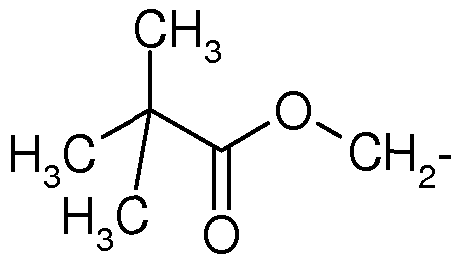
POM
Boc (also called t-Boc or lBoc) group refers to (tert-butoxy)carbonyl
Bn group refers to benzyl Bz group refers to benzoyl
CBz (also called Z) group refers to benzyloxycarbonyl Alloc group refers to allyloxycarbonyl Ac group refers to acetyl
DMB group refers to 3,5-dimethoxybenzyl PMB group refers to 4-methoxybenzyl
Peptide synthesis is a particular type of organic synthesis which relates to peptides, i.e. polymers of amino acids. An amino acid is an organic molecule comprising at least one amine group and at least one carboxylic acid group.
When, Merrifϊeld invented solid phase peptide synthesis (SPPS) in 1963, it was according to the Boc method. To remove Boc from a growing peptide chain, acidic conditions are used (usually neat TFA). Removal of side-chain protecting groups and the peptide from the resin at the end of the synthesis is achieved by incubating in hydrofluoric acid (which can be dangerous or even deadly), although generally safe, and using only small quantities, HF cleavage needs to be done using specialized equipment, so it is generally disfavored. However for complex syntheses Boc is favourable. When synthesizing nonnatural peptide analogs which are base-sensitive (such as depsipeptides), Boc is necessary. Depsipeptides are peptides in which a peptide bond, or amide bond, in the backbone of said peptide, has been replaced by an ester bond.
In contrast to the Boc strategy SPPS described above, the Fmoc strategy SPPS uses basic conditions (usually 20% piperidine in DMF) to remove the Fmoc protecting group from the growing peptide chain. This method was introduced by Carpino in 1972 and further applied by Atherton in 1978. It was first described as a protecting group by Carpino in 1970. Removal of the peptide from the resin is usually achieved by incubating in trifluoroacetic acid (TFA), deionized water, and triisopropylsilane. These conditions often remove the side-chain protecting groups also. The main advantage of Fmoc chemistry is that no hydrofluoric acid is needed. It is therefore used for most routine synthesis. Other protecting group strategies can be used of course, but Fmoc solid phase peptide synthesis strategy (SPPS) and Boc solid phase peptide synthesis (SPPS) strategy are preferred because of their practical aspects and ease of realisation.
With the above azahistidines (Ia) or (Ib) in hand, the next step was to selectively remove the protecting group.
Preferably, the removal of the protecting groups P1 and/or P2 is achieved by using soft conditions. By "soft conditions" it is meant room temperature and pH ranging from 2.0 to 14.0.
The azahistidines (Ia) or (Ib) described in the present invention can be used in Fmoc or Boc solid phase peptide synthesis (SPPS).
Pl and P2 can be sensitive to basic conditions. Protecting groups sensitive to basic conditions are for example Fmoc and POM. As previously mentioned, one protecting group of interest in peptide chemistry is the Fmoc group, which is base sensitive. Thus organic or inorganic bases may be used. Suitable organic bases include amines, either primary, secondary or tertiary. Examples of suitable amines include cyclohexylamine, l,5-diazobicyclo-[5,4,0]-undec- 5ene, piperidine, ethanolamine, pyrrolidine, diethylamine, morpholine, piperazine, dicyclohexylamine, hydroxylamine, hydrazine, N,N'-isopropylethylamine, N,N,N',N'- tetramethyl-l,8-naphtalenediamine, tributylamine, triethylamine and triethylendiamine.
Inorganic bases include sodium hydroxide, potassium hydroxide and ammonia.
The inorganic bases are preferably employed in conjunction with one or more organic solvents. Thus sodium hydroxide is used typically in the form of Tesser's base, i.e., dioxane-methanol-4N sodium hydroxide and ammonia as a 5 molar solution in methanol-methylene chloride. Lower concentrations of sodium hydroxide or potassium hydroxide can be sufficient to deprotect the Fmoc group. Each base may of course interact with the Fmoc in a varying manner. Thus most efficient cleavage (<15 min) is obtained with piperidine, cyclohexylamine, l,5-diazabicyclo-[5,4,0]-undec-5-ene, ethanolamine, pyrrolidine or tesser's base. Piperidine is a particularly preferred base for cleavage of the Fmoc group.
The cleavage reaction is carried out in an organic solvent conventionally employed in solid phase peptide synthesis. Suitable solvents include the halogenated Ci-Cβalkyls, such as methylene chloride. Room temperature is most conveniently employed for the cleavage reaction.
Derivatives bearing a POM group on the triazole ring appear to be good candidates for SPPS since selective deprotection of either the side chain or the amino-
acid nitrogen group proved to be possible. Azahistidine bearing a Fmoc group as Pl and a POM group as P2 is particulary interesting since the deprotection of the Fmoc group takes place with piperidine while the POM deprotection requires more basic conditions thus allowing the use of compound in SPPS as exemplified in the synthesis of a GHK analogue described herein (example 3).
Therefore, the removal of the protecting groups P 1 and/or P2 can be achieved by using
NaOH or KOH.
The deprotection conditions used to remove POM in the present invention are
K0Haq in methanol or NaOHaq in MeOH or NaOHaq in tetrahydrofurane (THF) or K0Haq in tetrahydrofurane (THF). The concentrations of the NaOHaq or K0Haq range from 1 mole per litre of water to 5 moles per litre of water, preferably 1 mole per litre of water.
The use and the conditions of use of methanol or THF in the POM deprotection reaction are well known from the man skilled in the art. To remove the POM group from (Ia) or (Ib), the quantity of KOH should range from 1 equivalent to 10 equivalents in moles for every equivalent of (Ia) and/or (Ib).
The same treatment can be done to a peptide or another organic molecule to remove the
POM group of the azahistidine moities.
To remove the POM group from (Ia) or (Ib), the quantity of NaOH should range from 1 equivalent to 10 equivalents in moles for every equivalent of (Ia) and/or (Ib).
The same treatment can be done to a peptide or another organic molecule to remove the
POM group of the azahistidine moities.
Pl and P2 can be sensitive to acidic conditions. Protecting groups sensitive to acidic conditions are for example Boc, ethoxycarbonyl, benzyloxycarbonyl. As previously mentioned, one protecting group of interest in peptide chemistry is the Boc group, which is acid sensitive. Thus organic or inorganic acids may be used.
Suitable organic acids include trifluoroacetic acid (TFA), acetic acid, para- toluenesulfonic acid, methanesulfonic acid and all other conditions well known from the man skilled in the art. Suitable inorganic acids include hydrochloric acid (HCl), hydrofluoric acid
(HF), hydrobromide (HBr), sulphuric acid (H2SO4), Lewis acids and all other conditions well known from the man skilled in the art.
To cleave a Boc group cleanly, a scavenger can be added: for example, a type of silane with deionized water act as a perfect scavenger. The silane usually used is triisopropylsilane.
The cleavage reaction can be carried out directly into the acid with scavengers like it is usually the case with TFA or in an organic solvent conventionally employed in solid phase peptide synthesis. Suitable solvents include the halogenated Ci-Cβalkyls, such as methylene chloride. Room temperature is most conveniently employed for the cleavage reaction.
In particular types of peptide chemistry strategies, other means to remove the protecting groups Pl or P2 are sometimes necessary. Azahistidine (Ia) and (Ib) can be used in such strategies: Pl and P2 can be sensitive to the treatment with palladium (0) conditions.
Protecting groups sensitive to the treatment with palladium (0) conditions, with or without hydrogen, are for example benzyl, benzoyl, benzyloxycarbonyl, allyl, allyloxycarbonyl, PMB, DMB.
Pd0 (Palladium (O)) treatment is obtained by usual organic chemistry techniques. The palladium used can be Pd/C (palladium on carbon), or a palladium (0) precursor like Pd(OAc)2, in a adequate solvent, which can be chosen between ethanol, tetrahydrofurane (THF), with or without triphenylphosphine, with or without hydrogen bubbling, and with or without acid (acetic acid, TFA) depending on the protecting group to be removed. These techniques are well known from the man skilled in the art.
Pl and P2 can be sensitive to oxidative conditions. Protecting groups sensitive to the treatment with oxidative conditions, are for example PMB, DMB. Oxidative conditions can be induced by the use for example of CAN, DDQ and the conditions well known from the man skilled in the art. CAN refers to eerie ammonium nitrate DDQ refers to 2,3-dichloro-5,6-dicyanobenzoquinone
In particular types of peptide chemistry strategies, Azahistidine (Ia) or (Ib) with Pl and P2 being non-sensitive to all of the above listed conditions can be used. Such protecting groups can be Ac, which is actually used to block the synthesis of certain unwanted peptides during a SPPS.
This process which is called the capping process, usually uses acetic anhydride in large excess with a base like pyridine or diisopropylethylamine.
Preferably, in the present invention Pl and P2 are orthogonal and chosen between Fmoc, POM, ethoxycarbonyl, Boc, Bn, Bz, CBz, allyl, Alloc, Ac, formyl, DMB, PMB or all other protecting groups used in organic chemistry.
Orthogonal means in this case that the deprotecting conditions for Pl do not remove or affect structurally P2, or the deprotecting conditions for P2 do not remove or affect structurally Pl.
An example of orthogonal groups in this particular invention can be Boc and Fmoc, or Boc and POM, or Fmoc and POM for either which of Pl and P2.
For peptide synthesis in particular, it is preferable that P1 is either Fmoc or Boc. P2 can then be chosen between POM, ethoxycarbonyl, Bn, Bz, CBz, allyl, Alloc, Ac, formyl, DMB, PMB.
More preferably in compound (Ia), Rl is hydrogen, R2 is hydroxy, the protecting group P1 is chosen between Fmoc and Boc, and the protective group P2 is POM.
The final protected azahistidines (Ia) and/or (Ib) can be unnatural amino acids of the L series, in which case all the components of the synthesis are chosen in consequence. Indeed, the configuration of the C-α carbon and enantiomeric purity, or excess of the azahistidines, are the same as the starting material, which is commercial.
The final protected azahistidines (Ia) and/or (Ib) can be unnatural amino acids of the D series, in which case all the components of the synthesis are chosen in consequence. Indeed, the configuration of the C-α carbon and enantiomeric purity, or excess of the azahistidines, are the same as the starting material, which is commercial. Depending on the choice of the catalyst and the solvent, different regioisomers can be obtained: azahistidines (Ia) were obtained using the copper-catalysed click chemistry. The more recently described ruthenium-catalysed cycloaddition, afforded the azahistidines (Ib). Using either condition, rapid access to protected azahistidines was demonstrated and the regioisomers were obtained with fair to satisfactory yields (example 1).
To obtain the desired protected azahistidines, the following reaction is the key step of the invention:

Scheme 1. Azahistidine (Ia) and (Ib) obtained via [3+2] Huisgen cycloaddition wherein
Rl is chosen between hydrogen, Ci-Cδalkyl; aryl-Ci-Cδalkyl-; Rl is most preferably hydrogen
R2 is chosen between hydroxy, Ci-Cβalkyloxy, aryl-Ci-Cδ alkyloxy; R2 is most preferably hydroxy or ethoxy.
The term "Ci-Cδalkyl" as used in the present invention refers to straight or branched chain substituted or unsubstituted alkyl radicals containing from 1 to 6 carbon atoms including, but not limited to, methyl, ethyl, n-propyl, iso-propyl, n-butyl, iso- butyl, sec-butyl, t-butyl, n-pentyl, n-hexyl and the like.
The term "aryl" as used in the present invention refers to a monocyclic or bicyclic carbocyclic ring system having one or more aromatic rings including, but not limited to, phenyl, naphthyl, tetrahydronaphthyl, indanyl and the like. The term "Ci-C6alkyloxy" as used in the present invention refers to any -O-R radical, wherein R is a Ci-Cδalkyl as defined above including, methyl, ethyl, propyl, tert-butyl, etc.
The compound of formula (A) is called "protected propargyl amino acid" or "Pl protected propargyl amino acid" and the compound (B) is called "protected azide" or "P2 protected azide".
Pl in the compound of formula (A) is either an identical or different nitrogen protecting group to P2 in compound of formula (B).
In the present invention Pl and P2 are chosen between Fmoc, POM, ethoxycarbonyl, Boc, Bn, Bz, CBz, allyl, Alloc, Ac, formyl, DMB, PMB or all other protecting groups used in organic chemistry.
Pl is most preferably the Boc or Fmoc or Ac group.
P2 is most preferably the POM group.
Fmoc group refers to 9-Fluorenylmethyloxycarbonyl
POM group refers to pivaloyl oxymethyl, the nitrogen to be protected being linked to the CH2- in the following structure:

Boc (also called t-Boc or lBoc) group refers to (tert-butoxy)carbonyl Bn group will refer to benzyl Bz group refers to benzamide
CBz (also called Z) group refers to benzyloxycarbonyl Alloc group refers to allyloxycarbonyl Ac group refers to acetyl DMB group refers to 3,5-dimethoxybenzyl PMB group refers to 4-methoxybenzyl
The success of the method depending on Pl, P2, Rl, R2 and the regioisomers (Ia) or (Ib) wanted is therefore determined by the choice of : a) a catalyst chosen between: copper catalysed version of Huisgen cycloaddition, wherein the copper is copper
(I), preferably chosen is between: Cu(OAc)2 with sodium ascorbate, Cu/C,
CuI/DiPEA, CuI(PPh3), CuBr(Et3N), CuBr(2,6-lutidine), copper found in zeolites or CuSO4 with sodium ascorbate; ruthenium catalysed version of Huisgen cycloaddition, wherein the ruthenium catalyst is preferably chosen between from Cp*RuCl(PPh3)2, Cp* RuC 1(C OD) or
Cp*RuCl(NBD).
2,6-lutidine being: 2,6-dimethylpyridine Zeolites used being: Y, USY, MOR, ZSM5
Cp* being: pentamethylcyclopentadienyl
COD being: cyclooctadienyl
NBD being: bicyclo[2.2.1]hepta-2,5-diene
b) a solvent which can be chosen from any one of the group consisting of: water, tert-butanol, acetonitrile, dimethylformamide (DMF), benzene, toluene or mixture thereof.
Preferably, the copper catalysed version of Huisgen cycloaddition, wherein the copper catalyst is Cu(OAc)2, is used with a solvent comprising tert-butanol /water.
Preferably, the ruthenium catalysed version of Huisgen cycloaddition, wherein the ruthenium catalyst is Cp RuCl(PPli3)2, is used with a solvent comprising toluene or benzene or a mixture thereof.
A solvent is a substance that can dissolve another substance, or in which another substance is dissolved, forming a solution.
A catalyst is a substance, usually used in small amounts relative to the reactants, that modifies and increases the rate of a reaction without being consumed in the process.
To obtain the corresponding azahistidines as described in the present invention, the ratio between Pl protected propargyl amino acid and P2 protected azide should be comprised between 200 and 10 % in mass.
Preferably, to obtain the corresponding azahistidines as described in the present invention, the ratio between Fmoc protected propargyl amino acid and POM protected azide should be comprised between 200 and 10 % in mass.
Preferably, to obtain the corresponding azahistidines as described in the present invention, the ratio between Boc protected propargyl amino acid and POM protected azide should be comprised between 200 and 10 % in mass.
To obtain the corresponding azahistidines as described in the present invention, the ratio between the catalyst and Pl protected propargyl amino acid should be comprised between 1 and 50% in mass. Preferably, to obtain the corresponding azahistidines as described in the present invention, the ratio between Cu(OAc)2 catalyst and Fmoc protected propargyl amino acid should be comprised between 5 and 20% in mass.
Preferably, to obtain the corresponding azahistidines as described in the present invention, the ratio between Cu(OAc)2 catalyst and Boc protected propargyl amino acid should be comprised between 2 and 20 % in mass.
Preferably, to obtain the corresponding azahistidines as described in the present invention, the ratio between Cu(OAc)2 catalyst and sodium ascorbate should be comprised between 100 and 10 % in mass.
To obtain the corresponding azahistidines as described in the present invention, the ratio between the solvent and Pl protected propargyl amino acid should be comprised between 1000 and 50000 % in mass.
Preferably, to obtain the corresponding azahistidines as described in the present invention, the ratio between tBuOH as solvent and Boc protected propargyl amino acid should be comprised between 5000 and 20000 % in mass. Preferably, to obtain the corresponding azahistidines as described in the present invention, the ratio between tBuOH as solvent and Fmoc protected propargyl amino acid should be comprised between 5000 and 20000 % in mass.
Preferably, to obtain the corresponding azahistidines as described in the present invention, the ratio between tBuOH as solvent and water as solvent should be comprised between 2000 and 100 % in mass.
The protected azahistidines can also be used in solution phase or solid phase organic synthesis to prepare new derivatives.
For example, it is possible to hydrolyse R2, by saponification for example, if R2 is not a hydroxy, to obtain a carboxylic acid. Said carboxylic acid is then usable in a peptide synthesis or more generally in an organic synthesis.
In organic synthesis, liquide phase peptide synthesis and solid phase peptide synthesis, the use in a synthesis of the protected azahistidine (Ia) or (Ib) can imply the removal of the protecting groups P1 and/or P2. Indeed, the selective removal Of P1 or P2 enables to selectively work on one function/group of the molecule whilst the others are blocked by protecting groups.
For example, in the case of peptide synthesis, when a azahistidine (Ia) or (Ib) is positioned at the N terminal end of the chain, both protecting groups Pl and P2 can be removed at the same time. No orthogonal protecting groups are needed, though in routine the last residue can have orthogonal protecting groups even so. When azahistidine (Ia) or(Ib) are positioned in the middle of a peptide chain, Pl and P2 of the azahistidine derivative(s) need to be orthogonal. AU protecting groups of the secondary chains of the amino acids of the peptide will need to be removed either
with all other protecting groups at the end of the synthesis, or selectively to work on this secondary chain specifically (oxidation, reduction, react the chain to other organic molecules, etc.), whilst the other protecting groups of the peptide are still in place.
The classical way to elongate a peptide in peptide synthesis is from the C terminal extremity towards the N terminal. Sometimes for experimental reasons, it is necessary to work specifically on the C terminus extremity. In this case, azahistidines with an ester for example or another alterable group into the Cα-carboxylic acid might be useful. The present invention also enables the access to such azahistidines (Ia) or (Ib).
The following examples further illustrate, but do not limit the invention.
Example 1: structures of some synthesized azahistidines
Using the copper-catalyzed version of the reaction, we were able to react either Fmoc- or lBoc- protected propargylglycine with a range of azides (Entries 1-8 in Table
1) yielding the expected triazoles. It was found that the purification of the acid products was sometimes difficult resulting in low yields. When the N-acetyl, ethyl ester of propargylglycine was used as a starting material, in conjunction with ruthenium catalyst, the expected 1,5-regioisomer was also cleanly obtained (Entries 9 and 10 in Table 1). The cycloaddition starting from lBoc or Fmoc protected propargylglycine yielded the expected pivaloyloxymethyl (POM) azahistidine cleanly (Entries 4 and 8 in
Table 1).
Table 1. Synthesis of azahistidine analogues


Conditions A: Cu(OAc)2/sodium ascorbate in Bu0H/H20 at r.t.. B: Cp RuCl(PPh3)2 in toluene at 80 0C.
General method (A): Synthesis of Boc-β-(l-benzyl)-l,2,3-triazol-4-yl)- Alanine 2
107 mg (0.5 mmol) of jV-Boc-propargylglycine were introduced in a 100 rnL round- bottom flask in 15 rnL Of 1BuOH together with 70 mg (0.5 mmol, leq.) of benzylazide. 10 mg (0.05 mmol, 0.01 eq.) of Cu(O Ac)2. xH2O dissolved in 3 mL of water and 20 mg (0.1 mmol, 0.02 eq.) of Na-ascorbate in 2 mL of water were further introduced. The mixture was stirred overnight at room temperature. 1BuOH was then removed by rotary- evaporation and the pH of the resulting aqueous mixture was adjusted to 2 with a 1 M HCl solution. The aminoacid was extracted three times with ethylacetate (50 mL) and the organic phases, pooled together were washed with brine and dried over anhydrous MgSO4. After filtration, the crude product was evaporated and dissolved in ethyl acetate. After crystallisation in cyclohexane and filtration 104.3 mg of the expected Boc-β-(l-benzyl)-l,2,3-triazol-4-yl-Alanine 2 were obtained (60 % yield).
Purification conditions for the other derivatives were as follows:
Boc-β-(l-(4-methoxybenzyl)-l,2,3-triazol-4-yl)-Alanine 3 was purified by flash chromatography using an isocratic elution consisting in DCM/MeOH/acetic acid 90:10:1. The fractions were pooled, dissolved in chloroform and crystallised from hexane.
Boc-β-(l-(3,5-dimethoxybenzyl)-l,2,3-triazol-4-yl)-Alanine 4 was obtained as a colourless oil without crystallization.
Boc-β-(l-pivaloyloxymethyl)-l,2,3-triazol-4-yl)-Alanine 5 were purified by flash chromatography using an isocratic elution consisting in DCM/MeOH/acetic acid
96:4:5 %.
Fmoc-β-((l-benzyl)-l,2,3-triazol-4-yl)-Alanine 6 was dissolved in ethyl acetate and crystallised with pentane.
Fmoc-β-(l(-4-methoxybenzyl)-l,2,3-triazol-4-yl)-Alanine 7 was dissolved in chloroform and crystallised with hexane.
Fmoc-β-(l-(3,5-dimethoxybenzyl)-l,2,3-triazol-4-yl)-Alanine 8 was dissolved in ethyl acetate and crystallised with cyclohexane. Fmoc-β-(l-pivaloyloxymethyl)-l,2,3-triazol-4-yl)-Alanine 9 was purified by flash chromatography using an isocratic elution consisting in DCM/MeOH/acetic acid 97:3:5 %.
General method (B): Synthesis of Ac-(l-(3,5-dimethoxybenzyl)-l,2,3-triazol-5-yl)- AIa-OEt 10
In a 50 mL two-necked round bottom flask was introduced 10 mL of anhydrous toluene. This solvent was then degassed by three vacuum freeze/thaw cycles. 100 mg (0.54 mmol) of jV-acetylpropargylglycine ethyl ester were then introduced together with 145 mg (1.09 mmol, 2 eq.) of benzyl azide and the mixture was degassed once more. Finally 21.7 mg (27.3 μmol, 0.05 eq.) of Cp*RuCl(PPh3)2 were introduced and the mixture was degassed once again. The reaction mixture was then heated to 80 0C under nitrogen for 15 h. The resulting mixture was then evaporated to afford 205.9 mg of crude product. This product is dissolved in acetonitrile and filtered. The liquid was further purified by preparative HPLC using a water/acetonitrile/formic acid gradient, yielding 97.12 mg of viscous oil for a yield of 44 %.
Analytical data: Boc-β-(l-benzyl)-l,2,3-triazol-4-yl)-Alanine 2
1H NMR (400 MHz; CDCl3): δ 1.27 (s, 9H, 1Bu), 3.15 (br. s, 2H, QHH'), 4.32 (br. s, IH, C«H), 5.32 (d, J = 15.0, IH, CH-BzI), 5.38 (d, IH, J = 15.0, CH'-Bzl), 5.97 (br. s, IH, HNCα), 7.13-7.19 (m, 2H, BzI), 7.23-7.28 (m, 3H, BzI), 7.32 (br. s, IH, CH triazol). MS (ESI): 347.1 (M+H)+
Boc-β-(l-(4-methoxybenzyl)-l,2,3-triazol-4-yl)- Alanine 3 1H NMR (400 MHz; CDCl3): δ 1.42 (s, 9H, 1Bu), 3.15-3.25 (m, IH, QH), 3.29-3.39 (m, IH, QH'), 3.81 (s, 3H, p-methoxy), 4.49 (bs, IH, CnH), 5.43 (s, 2H, CH2-BzI), 5.73
(br. s, IH, HNC «), 6.90 (d, J= 8.4, 2H, H-3,5 BzI), 7.22 (d, J= 8.4 Hz, 2H, H-2,6 BzI), 7.31 (br. s, IH, CH triazol) MS (ESI): 377.1 (M+H)+
Boc-β-(l-(3,5-dimethoxybenzyl)-l,2,3-triazol-4-yl)-Alanine 4
1H NMR (400 MHz; CD3OD): δ 1.36 (s, 9H, 1Bu), 3.05 (dd, J= 14.9, J= 4.5, IH, QgH), 3.25 (dd, J= 14.9 , J= 8.9, IH, QgH'), 3.74 (s, 6H, m,m -dimethoxy), 4.37 (dd, J= 8.9, J = 4.5, IH, CαH), 5.48 (s, 2H, CH2-BzI), 6.43 (bs, 3H, BzI), 7.73 (s, IH, CH triazol) MS (ESI): 407.1 (M+H)+
Boc-β-(l-(pivaloyloxymethyl)-l,2,3-triazol-4-yl)- Alanine 5
1H NMR (400 MHz; d6-DMSO): δ 1.11 (s, 9H, 1Bu), 1.45 (s, 9H, 1Bu), 2.94 (dd, IH , J = 14.5, J = 9.7, QgH), 3.09 (dd, IH , J = 14.5, J = 4.1, QgH), 4.10-4.19 (m, IH, C«H), 6.27 (s, 2H, CH2 POM), 7.08 (d, IH, J= 7.9, NH), 7.94 (s, IH, CH triazol). 13C NMR (1H) (100 MHz, d6-DMSO): δ 26.87, 27.44, 28.53, 38.60, 53.80, 70.27, 78.52, 124.45, 144.14, 155.76, 173.52, 176.84. MS (ESI): 371.7 (M+H)+ IR (KBr): 3386, 3151, 2981, 2938, 2576, 1747, 1716, 1517 cm"1
Fmoc-β-((l-benzyl)-l,2,3-triazol-4-yl)-Alanine 6
1H NMR (400 MHz; CDCl3): δ 3.36 (dd, J= 14.8, J= 5.4, IH, QgH), 3.42 (dd, J= 14.8, J= 3.8, IH, QgH'), 4.16 (t, J= 6.6, IH, CH Fmoc), 4.30-4.41 (m, 2H, CH2 Fmoc), 4.57- 4.66 (m, IH, CαH), 5.37 (d, J = 14.9, IH), 5.51 (d, J= 14.9, IH, CH2-BzI), 5.93 (d, J = 5.6, IH, HNCα), 7.12-7.20 (m, 2H, Ar), 7.23 (bs, IH, CH triazol), 7.27-7.33 (m, 5H, Ar), 7.34-7.44 (m, 3H, Ar), 7.55 (d, J= 7.3, 2H, Ar), 7.74 (t, J= 8.2, 2H, Ar).
13C NMR (1H) (400 MHz; CDCl3): δ 27.51, 47.10, 53.25, 54.35, 66.78, 119.93, 123.18, 125.10, 127.06, 127.69, 127.92, 128.80, 129.08, 134.03, 141.19, 142.33, 143.67, 155.72, 172.55. MS (ESI): 469.1 (M+H)+
Fmoc-β-(l(-4-methoxybenzyl)-l,2,3-triazol-4-yl)- Alanine 7
1R NMR (400 MHz; CDCl3): δ 3.28 (dd, J= 14.8, J= 6.7, IH, QH), 3.40 (bd, J= 14.8, IH, QH'), 3.74 (s, 3H, /?-methoxy), 4.19 (t, J= 6.9, IH, CH Fmoc), 4.37 (d, J= 6.9 Hz, 2H, CH2 Fmoc), 4.59 (bs, IH, C0H), 5.35 (d, J = 14.8, IH, CH-BzI), 5.46 (d, J = 14.8, IH, CH-BzI), 5.95 (d, J = 5.4, IH, HNC0), 6.84 (d, J = 8.2, 2H, Ar), 7.16 (d, J = 8.6, 2H, Ar), 7.21 (s, IH, CH triazol), 7.28-7.34 (m, 2H, Ar), 7.37-7.43 (m, 2H, Ar), 7.55- 7.61 (m, 2H, Ar), 7.74-7.80 (m, 2H, Ar). MS (ESI): 499.1 (M+H)+
Fmoc-β-(l-(3,5-dimethoxybenzyl)-l,2,3-triazol-4-yl)-Alanine 8 1H NMR (400 MHz; CD3CN): δ 3.10 (dd, J = 14.9, J = 7.6, IH, QH), 3.20 (dd, J = 14.9, J= 4.7, IH, QH'), 3.70 (bs, 6H, m,m-dimethoxy), 4.20 (t, J= 7.1, IH, CH Fmoc), 4.30 (d, J = 7.1, 2H, CH2 Fmoc), 4.41-4.46 (m, IH, C«H), 5.40 (s, 2H, CH2-BzI), 6.38 (bs, 3H, BzI), 7.32 (t, J = 7.5, 2H, Fmoc), 7.42 (dd, J = 7.5, J = 7.1, 2H, Fmoc), 7.58- 7.64 (m, 3H, Fmoc + CH triazol), 7.83 (d, J= 7.5 , 2H, Fmoc). MS (ESI): 529.2 (M+H)+
Fmoc-β-(l-pivaloyloxymethyl)-l,2,3-triazol-4-yl)-Alanine 9
1H NMR (400 MHz; d6-DMSO): δ 1.07 (s, 9H, 1Bu), 3.00 (dd, IH, J = 14.5, J = 9.6,
QH), 3.15 (dd, IH, J= 14.5, J= 4.6, QH'), 3.30 (s, IH, CH Fmoc), 4.10-4.30 (m, 3H, C«H + CH2 Fmoc), 6.26 (s, 2H, CH2 POM), 7.31 (bt, J= 7.6, 2H, Fmoc), 7.41 (bt, 2H, J
= 7.4, Fmoc), 7.67 (bt, 2H, J= 6.2, Fmoc), 7.88 (d, IH, J= 7.6 triazol), 7.96 (s, IH, CH triazol).
13C NMR (1H) (100 MHz, CDCl3): δ 26.72, 27.47, 38.73, 47.05, 53.18, 67.06, 69.81,
119.93, 124.57, 124.89, 125.08, 127.07, 127.68, 141.20, 141.21, 142.66, 143.64, 143.73, 155.89, 172.75, 177.65.
MS (ESI): 493.1 (M+H)+
IR (KBr): 3411, 3129, 2966, 1738, 1725, 1529 cm"1
Ac-β-(l-benzyl)-l,2,3-triazol-5-yl)-Ala-OEtlO 1R NMR (400 MHz; CDCl3): δ 1.22 (t, J = 7.2, 3H, CH3 ethyl), 1.96 (s, 3H, acetyl), 3.10 (dd, J= 15.8, J= 5.9, IH, QH), 3.16 (dd, J= 15.8, J= 6.2, IH, QH'), 4.12-4.24 (m, 2H, CH2 ethyl), 4.73 (ddd, J = 7.1, J= 6.2, J= 5.9, IH, HC«), 5.46 (d, J= 16.0, IH,
CH-BzI), 5.60 (d, J = 16.0, IH, CH'-Bzl), 6.38 (d, J = 7.1, IH, NH), 7.12-7.20 (m, 2H, BzI), 7.30-7.38 (m, 3H, BzI), 7.43 (s, IH, CH triazol)
13C NMR (1H) (100 MHz, CDCl3): δ 14.00, 22.95, 25.72, 51.28, 51.65, 51.18, 127.15, 128.37, 128.97, 132.20, 133.36, 134.70, 170.05, 170.51. MS (ESI): 317.2 (M+H)+
Ac-β-(l-(3,5-dimethoxybenzyl)-l,2,3-triazol-5-yl)- AIa-OEt 11
1H NMR (400 MHz; CDCl3): δ 1.21 (t, J = 7.1, 3H, CH3 ethyl), 1.96 (s, 3H, acetyl), 3.08 (dd, J= 15.8, J= 5.5, IH, QgH), 3.15 (dd, J= 15.8 Hz, J= 6.4 Hz, IH, QgH'), 3.71 (s, 6H, m,m-dimethoxy), 4.13 (qd, J= 9.6, J= 7.1, IH, CH ethyl), 4.18 (qd, J= 9.6, J = 7.1, IH, CH ethyl), 4.73 (ddd, J= 7.1, J= 6.4, J= 5.5, IH, CaH), 5.38 (d, J= 15.6, IH, CH-BzI), 5.51 (d, J= 15.6, IH, CH-BzI), 6.27 (d, J= 2.1, 2H, BzI), 6.35 (t, J= 2.1, IH, BzI), 6.59 (d, J= 7.1, IH, NH), 7.41 (s, IH, CH triazol). MS (ESI): 377.1 (M+H)+
Example 2: removal of protecting groups
As expected the hydrogenolysis of benzyl, p-methoxybenzyl and dimethoxybenzyl derivatives turned out to be very difficult. By using harsh conditions we managed to remove the protecting groups on compounds 2 and 10 but the same protocols applied to compounds bearing a Fmoc protecting group (6-8) afforded debenzylated compounds along with partial hydrogenation of the benzyl ring as well as removal of Fmoc group. Alternative, oxidising conditions using CAN were not satisfactory. Some difficulties where encountered with the selective deprotection of the P2 protecting groups. The best results were obtained using the protecting group described by Sharpless, i.e. azidomethyl pivalate (POM-N3). Noteworthy is that this protecting group has been recently used in a very elegant synthesis of α-CF3-substitued azahistidine.
This protecting group is orthogonal when used with BOC and it is possible to remove POM and Fmoc in a "one pot" synthesis if needed.
A. Selective removal of Benzyl protecting group: • affording Ac-β-(l,2,3-triazol-5-yl)-Ala-OEt
30 mg (95 μmol) of Ac-β-(l-benzyl)-l,2,3-triazol-5-yl)-Ala-OEt 10 were introduced in 1.5 rnL of MeOH into a one-neck round-bottom flask. 101.3 mg (95 μmol, 1 eq.) of palladium 10 % on charcoal were added and the mixture was put under H2 atmosphere and stirred at R.T. during 72 h. The crude mixture was then filtered through celite and a Millipore HVLP membrane, to yield to 22.9 mg of product. The yield was quantitative.
• affording Boc-β-(l,2,3-triazol-4-yl)- Alanine
In a pressure tank, 5 mg (14.4 μmol) of Boc-β-(l-benzyl)-l,2,3-triazol-4-yl)- alanine 2 were introduced to 3.84 mg (3.6 μmol, 0.25 eq.) of Pearlman catalyst i.e. Pd(OH)2 on charcoal (20 % pure, 50 % water in weight) in 2 mL of MeOH. The tank was flushed with N2 for 5 min and then 10 bars of H2 were admitted. The reaction was stirred at 45 0C over 72 h.
The crude mixture was clarified on a syringe Millipore separation filter and analysed by LC/MS, revealing a peak of expected m/z accounting for more than 90 % of the total UV signal area
B. Selective removal of either POM or Boc protecting groups:

12 5 13 Scheme 2. Selective deprotection of Boc-protected azahistidine derivative 5.
At this stage, selective deprotection of the lBoc group on compound 5 was achieved using HCl in ethyl acetate to furnish 12. In parallel, selective removal of the pivaloyl group was cleanly achieved using IM NaOH in MeOH without affecting the lBoc group to afford compound 13 (Scheme 2).
We checked the potential racemization of the azahistidine compounds under the deprotection conditions. Treatment of compound 5 (5 mg) overnight with NaOD/D2O
(100 μL of a 40% solution) in CD3OD (400 μL) resulted in removal of the POM group without incorporation of deuterium at the alpha position (checked by 1H NMR).
Selective removal of BOC protecting group, affording H-β-((l- pivaloyloxymethyl)-l,2,3-triazol-4-yl)-Alanine 12
2.2 mL of HCl 35 % were introduced on 100 mg (0.27 mmol) of Boc-β-(l- pivaloyloxymethyl)-l,2,3-triazol-4-yl)-Ala-OH 5 in 7.8 mL of ethyl acetate. Under stirring at R.T. the reacting mixture, initially biphasic, turned rapidly to a homogenous yellowish liquid. After 3 h, the mixture is diluted in water and washed three times with dichloromethane. The aqueous phase was then freeze dried to obtain 94 mg of a yellowish solid.
The crude product is purified by preparative HPLC using a water/acetonitrile gradient with formic acid as ion pairing agent. 32.2 mg of pure white solid are obtained with a yield of 44 %.
Selective removal of POM protecting group, affording Boc-β-(l, 2, 3- triazol-4-yl)-Alanine 13
150 mg (0.40 mmol) of Boc-β-(l-(pivaloyloxymethyl)-l,2,3-triazol-4-yl)-Ala-OH 5 were added to 2.1 mL of methanol with 2.5 mL of NaOH IM (2.5 mmol, 6.2 eq.). The mixture was stirred for one day at R.T., then acidified to pH 3 and extracted with ethyl acetate. The organic fractions were pooled and dried with MgSO4. After evaporation 92.6 mg of amorphous solid were obtained with a yield of 61 %.
C. Selective removal of either Fmoc protecting group in the presence of POM:

9 12
Scheme 3. Selective deprotection of Fmoc-protected azahistidine derivative 9.
In a similar fashion, when compound 9 was treated under classical conditions for removal of the Fmoc protecting group (piperidine), we obtained compound 12 (Scheme 3). This last result should permit the use of compound 9 for insertion of azahistidine derivatives in peptides using standard SPPS strategies.
Selective removal of Fmoc protecting group, affording H-β-((l- pivaloyloxymethyl)-l,2,3-triazol-4-yl)-Alanine 12
99 mg (0,20 mmol) of Fmoc-β-(l-pivaloyloxymethyl)-l,2,3-triazol-4-yl)-Ala-OH 9 were introduced in 5 mL of DMF with 13.5 μl (0.22 mmol, 1.1 eq.) of piperidine. The mixture was stirred at R.T. for 3 h 45 min and evaporated to obtain a white solid. The crude product was then triturated with diethyl ether to remove the dibenzofulvene- piperidine adduct. After drying, 29.3 mg (53 %) of purified solid were obtained.
Analytical data:
Ac-β-(l,2,3-triazol-5-yl)- AIa-OEt from 10

1H NMR (400 MHz; CDCl3): δ 1.19 (t, J = 7.0, 3H, CH3 ethyl), 1.89 (s, 3H, acetyl), 3.10-3.30 (m, 2H, QjHH'), 4.13 (q, J = 7.0, 2H, CH2 ethyl), 4.86 (bs, IH, C«H), 7.18 (bs, IH, C«NH), 7.41 (s, IH, CH triazol), 7.75 (bs, NH triazol).
H-β-(l-(pivaloVloxymethyl)-l,2,3-triazol-4-yl)-Alanine n
1H NMR (400 MHz; D2O): δ 1.26 (s, 9H, 1Bu), 3.30 (dd, IH, J = 15.8, J = 6.8, QgH), 3.36 (dd, IH, J = 15.8, J = 5.2, QH), 4.06 (dd, IH, J = 6.8, J = 5.2, CaH), 6.33 (s, 2H, CH2 POM), 8.06 (s, IH, CH triazol).
13C NMR (1H) (100 MHz, D2O): δ 25.81, 26.16, 38.41, 54.16, 71.22, 125.42, 142.14,
172.91, 179.74.
MS (ESI): 271.1 (M+H)+
IR (KBr): 3142, 3044, 2969, 2591, 2088, 1740, 1617, 1586 cm"1
Boc-β-(l,2,3-triazol-4-yl)-Alanine 13
1H NMR (400 MHz; CD3OD): δ 1.37 (s, 9H, 1Bu), 3.06 (dd, IH, J= 14.9, J= 8.7, QgH), 3.24 (dd, IH, J = 14.9, J = 4.6, Cβϋ), 4.38 (dd, J = 8.7, J = 4.6, C«H), 7.57 (s, IH, CH triazol). 13C NMR (1H) (100 MHz, d6-DMSO): δ 26.72, 28.15, 53.39, 78.19, 131.5, 142.8, 155.30, 173.08 MS (ESI): 257.1 IR (KBr): 3159, 3981, 2602, 2360, 1694, 1520 cm-
Example 3: the GHK analogue
As an example, compound 9 was used for the solid phase synthesis of a Gly-His- Lys analogue, an endogenous tripeptide known as a growth-modulating factor, as a strong activator of wound healing and as a copper chelator. The synthesis was performed on a chlorotrityl resin using Fmoc-glycine, compound 9 (D enantiomer) and Fmoc-D-lysine(Boc). After cleavage of the peptide from the resin using TFA, the two remaining protecting groups (id est Fmoc on the glycine and POM on the azahistidine side chain) were removed using NaOH in MeOH. After trituration in cold ether, GHK analogue 14 was obtained as a single isomer.

Scheme 4. SPPS of a GHK analogue, Gly-D-azaHis-D-Lys
Synthesis of Gly-D-azaHis-D-Lys 14 The synthesis of the tripeptide was achieved according to a literature protocol using DIC and HOBt as coupling reagents. Fmoc-Lys(Mtt)-OH and Fmoc-His(Mtt)-OH were replaced by Fmoc-D-Lys(Boc)-OH and Fmoc-D-azaHis(POM)-OH, respectively. Cleavage from the resin was performed using 10 mL of a cocktail composed of TFA/TIS/H2O (9.5/0.3/0.2) for 4 hours at room temperature. After filtration, TFA was removed by evaporation, the resulting solid was dissolved in water and the solution was lyophilized. 100 mg of the peptide TFA salt was then subjected to deprotection (Fmoc and POM) by addition of 650 μL of a 1 M NaOH aqueous solution (2.2 eq.) in 3.5 mL of MeOH for 5 hours at room temperature. After addition of HCl (IM) to reach pH 4, the solution was evaporated and the solid was taken up in MeOH. NaCl was filtrated and the resulting solution was evaporated. The resulting solid was triturated in cold diethyl ether yielding peptide 14 (yield 36 %) as a white solid with a purity of 90% (estimated by LC/MS and 1H NMR). Configuration of the compound 14 was checked
by HPLC and 1H NMR. As previously mentionned, no epimerisation of the azahistidine moiety was noticed, and no epimerisation of the lysine moiety was noticed.
Analytical Data: 1H NMR (400 MHz; D2O): δ 1.19-1.31 (m, 2H, CH2 δ Lys), 1.50-1.80 (m, 4H, CH2 β and γ Lys), 2.88 (t, 2H, J = 7.2 CH2 ε Lys), 3.13 (dd, IH, J = 7.7, J = 15.2, CH2 β azaHis), 3.20 (dd, IH, J= 6.2, J= 15.2, CH2 β azaHis), 3.74 (AB system, 2H, J= 16.1, CH2 GIy), 4.13 (dd, IH, J = 5.4, J = 7.5, CH α Lys), 4.51-4.82 (m, IH superimposed with water, CH α azaHis), 7.68 (s, IH, CH triazol). 13C NMR (1H) (100 MHz, D2O): δ 21.84, 26.14, 26.69, 30.36, 39.08, 40.24, 53.26, 53.84, 127.29, 140.06, 166.8, 171.58, 176.73. HRMS (ES-) calcd for C13H22N7O4 : 340.1733; found : 340.1723.
Material and Methods
Chemicals
Amino acid derivatives were purchased from Bachem, Fluka and Acros Organics. Reagents and solvents for synthesis and RP-HPLC were from Sigma, Fluka or Normapur products and used without further purification. Aryl-azide derivatives were prepared by standard protocol.
Equipment
LC/MS analysis
HPLC: Waters system (2525 binary gradient module, in-line degasser, 2767 sample manager, 2996 Photodiode Array Detector), eluents: A: 99.9% water / 0.1% HCOOH; B: 99.9% ACN / 0.1% HCOOH analytical RP-HPLC column: X-bridge Cl 8 column (100x4.6 mm, 3.5 μm particle size, 135 A pore size), 1 mL/min flow rate, 20 μL sample is injected preparative RP-HPLC column: X-bridge C18 column (150x19 mm, 5 μm particle size, 135 A pore size), 17 mL/min flow rate using a 8 or 25 min gradient of 95% A/5% B to 100% B for analysis and purification respectively.
MS*: Waters Micromass ZQ system (electrospray ionization), ZQ2000 quadrupole analyser, Mass Lynx 4.0 software, source temperature 1200C, cone voltage 20V, continuous sample injection at 0.3 mL/min flow rate, mass spectra were recorded in positive ion mode in the m/z 100-1000 range.
NMR analysis
1H- and 13C-NMR spectra were recorded at room temperature at a frequency of 400 MHz and 100 MHz respectively using a Bruker Avance 400 Ultrashield. Samples were dissolved in 400 μL of deuterated solvent. Chemical shifts are given in ppm and the coupling constants in Hz.
Claims
Claims
We claim:
1) Compounds of formula (Ia) and (Ib) :

Rl is chosen between hydrogen, Ci-Cδalkyl; aryl-Ci-Cβalkyl; R2 is chosen between hydroxy, Ci-Cδalkyloxy, aryl-Ci-Cδalkyloxy; Pl and P2 are either identical or different nitrogen protecting groups;
Pl and P2 are chosen between Fmoc, POM, ethoxycarbonyl, Boc, Bn, Bz, CBz, allyl, Alloc, Ac, formyl, DMB, PMB or all other protecting groups used in organic chemistry.
2) A compound according to claim 1, wherein the protecting groups Pi and P2 are orthogonal and chosen between Fmoc, POM, ethoxycarbonyl, Boc, Bn, Bz, CBz, allyl, Alloc, Ac, formyl, DMB, PMB or all other protecting groups used in organic chemistry.
3) A compound according to claim 1 or 2, wherein the protecting group Pi is either
Fmoc or Boc.
4) A compound according to any of one of the precedent claims, wherein the protecting group P2 is chosen between POM, ethoxycarbonyl, Bn, Bz, CBz, allyl, Alloc, Ac, formyl, DMB, PMB or all other protecting groups used in organic chemistry.
5) A compound (Ia) according to any one of the precedent claims, wherein Rl is hydrogen, R2 is hydroxy, the protecting group P1 is chosen between Fmoc and Boc, and the protective group P2 is POM.
6) A compound according to any one of the precedent claims, wherein the compound is an unnatural amino acid of the L series.
7) A compound according to any one of the precedent claims, wherein the compound is an unnatural amino acid of the D series.
8) A method to prepare a compound of any one of the precedent claims using the copper catalysed version of Huisgen cycloaddition comprising: a) the use of a catalyst chosen between: Cu(OAc)2 and sodium ascorbate, Cu/C, CuI/DiPEA, CuI(PPh3), CuBr(Et3N), CuBr(2,6-lutidine), copper found in zeolites or CuSO4 and sodium ascorbate, Cp*RuCl(PPh3)2, Cp*RuCl(COD) or
Cp*RuCl(NBD); b) the use of a solvent which can be chosen from any one of the group consisting of: water, tert-butanol, acetonitrile, dimethylformamide (DMF), benzene, toluene or a mixture thereof.
9) Use of a compound according to any one of the claims 1 to 7 in organic synthesis, either in liquid phase or on solid phase.
10) Use according to claim 9, characterised in that the organic synthesis is a peptide synthesis.
11) Use according to claim 9 or 10, characterised in that the synthesis implicates the removal of the protecting groups P1 and/or P2.
12) Use according to claim 11, characterised in that the removal of the protecting groups P1 and/or P2 is achieved by using soft conditions, in particular NaOH IM in MeOH or KOH IM in MeOH.
13) Use according to any one of the claims 9 to 12, for enabling to obtain a compound of the following formula:

Applications Claiming Priority (2)
| Application Number | Priority Date | Filing Date | Title |
|---|---|---|---|
| EP09305040A EP2210882A1 (en) | 2009-01-16 | 2009-01-16 | Synthesis of new protected azahistidine, their processes and their use in synthesises |
| EP09305040.9 | 2009-01-16 |
Publications (2)
| Publication Number | Publication Date |
|---|---|
| WO2010081882A2 true WO2010081882A2 (en) | 2010-07-22 |
| WO2010081882A3 WO2010081882A3 (en) | 2010-11-11 |
Family
ID=40636882
Family Applications (1)
| Application Number | Title | Priority Date | Filing Date |
|---|---|---|---|
| PCT/EP2010/050467 Ceased WO2010081882A2 (en) | 2009-01-16 | 2010-01-15 | Synthesis of new protected azahistidines, their processes and their use in synthesises |
Country Status (2)
| Country | Link |
|---|---|
| EP (1) | EP2210882A1 (en) |
| WO (1) | WO2010081882A2 (en) |
Cited By (3)
| Publication number | Priority date | Publication date | Assignee | Title |
|---|---|---|---|---|
| CN103172617A (en) * | 2011-12-20 | 2013-06-26 | 天津市国际生物医药联合研究院 | Application of 1,5-2 substituent-1,2,3-triazole trifluoromethyl compound |
| CN104001553A (en) * | 2014-06-20 | 2014-08-27 | 武汉工程大学 | N-substituted 1,2,3-triazole derivative/Cu(I) composite catalyst and synthesis and application thereof |
| JP2018520148A (en) * | 2012-12-13 | 2018-07-26 | イミューノメディクス、インコーポレイテッドImmunomedics, Inc. | Antibody-SN-38 immunoconjugate with CL2A linker |
Families Citing this family (2)
| Publication number | Priority date | Publication date | Assignee | Title |
|---|---|---|---|---|
| WO2014201377A1 (en) * | 2013-06-14 | 2014-12-18 | Rutgers, The State University Of New Jersey | Light emitting hybrid semiconductors based on ib-vii binary compounds |
| WO2026077975A1 (en) * | 2024-10-07 | 2026-04-16 | Univerza V Ljubljani | Polypeptides having nh-triazole functionalizations |
Citations (1)
| Publication number | Priority date | Publication date | Assignee | Title |
|---|---|---|---|---|
| WO2005021514A1 (en) | 2003-08-29 | 2005-03-10 | The University Of Tokyo | Novel unnatural histidine analog amino acid |
Family Cites Families (4)
| Publication number | Priority date | Publication date | Assignee | Title |
|---|---|---|---|---|
| GB0428012D0 (en) * | 2004-12-22 | 2005-01-26 | Hammersmith Imanet Ltd | Radiolabelling methods |
| WO2007147482A1 (en) * | 2006-06-20 | 2007-12-27 | Paul Scherrer Institut | Triazole containing metal chelating agents |
| US7759495B2 (en) * | 2006-08-11 | 2010-07-20 | Bristol-Myers Squibb Company | Hepatitis C virus inhibitors |
| US7741347B2 (en) * | 2007-05-17 | 2010-06-22 | Bristol-Myers Squibb Company | Hepatitis C virus inhibitors |
-
2009
- 2009-01-16 EP EP09305040A patent/EP2210882A1/en not_active Withdrawn
-
2010
- 2010-01-15 WO PCT/EP2010/050467 patent/WO2010081882A2/en not_active Ceased
Patent Citations (1)
| Publication number | Priority date | Publication date | Assignee | Title |
|---|---|---|---|---|
| WO2005021514A1 (en) | 2003-08-29 | 2005-03-10 | The University Of Tokyo | Novel unnatural histidine analog amino acid |
Non-Patent Citations (9)
| Title |
|---|
| BOCK VD; HIEMSTRA H; VAN MAARSEVEEN JH, EUR J ORG CHEM, 2006, pages 51 - 68 |
| IKEDA Y; KAWAHARA S-I; TAKI M; KUNO A; HASEGAWA T; TAIRA K, PROTEIN ENGINEERING, vol. 16, 2003, pages 699 - 706 |
| KOLB HC; FINN MG; SHARPLESS KB, ANGEW CHEM INT ED ENGL, vol. 40, 2001, pages 2004 - 2021 |
| LIPSHUTZ, BH; TAFT BR, ANGEW CHEM INT ED, vol. 45, 2006, pages 8235 - 8238 |
| LOSIKINA VI; SOKOLOV VI, DOKLADY AKADEMII NAUK SSSR, vol. 320, 1991, pages 339 - 342 |
| MINDT TL; MULLER C; MELIS M; DE JONG M; SCHIBLI R, BIOCONJUGATE CHEM, vol. 19, 2008, pages 1689 - 1695 |
| MINDT TL; STRUTHERS H; BRANS L; ANGUELOV T; SCHWEINSBERG C; MAES V; TOURWE D; SCHIBLI R, J AM CHEM SOC, vol. 128, 2006, pages 15096 - 15097 |
| OPPILLIART S; MOUSSEAU G; ZHANG L; JIA G; THUERY P; ROUSSEAU B; CINTRAT J-C, TETRAHEDRON, vol. 63, 2007, pages 8094 - 8098 |
| ZHANG L; CHEN X; XUE P; SUN HHY; WILLIAMS ID; SHARPLESS KB; FOKIN VV; JIA G, J AM CHEM SOC, vol. 127, 2005, pages 15998 - 15999 |
Cited By (4)
| Publication number | Priority date | Publication date | Assignee | Title |
|---|---|---|---|---|
| CN103172617A (en) * | 2011-12-20 | 2013-06-26 | 天津市国际生物医药联合研究院 | Application of 1,5-2 substituent-1,2,3-triazole trifluoromethyl compound |
| JP2018520148A (en) * | 2012-12-13 | 2018-07-26 | イミューノメディクス、インコーポレイテッドImmunomedics, Inc. | Antibody-SN-38 immunoconjugate with CL2A linker |
| CN104001553A (en) * | 2014-06-20 | 2014-08-27 | 武汉工程大学 | N-substituted 1,2,3-triazole derivative/Cu(I) composite catalyst and synthesis and application thereof |
| CN104001553B (en) * | 2014-06-20 | 2016-02-24 | 武汉工程大学 | 1,2,3-triazoles derivative/Cu (I) composite catalyst that N replaces and Synthesis and application thereof |
Also Published As
| Publication number | Publication date |
|---|---|
| WO2010081882A3 (en) | 2010-11-11 |
| EP2210882A1 (en) | 2010-07-28 |
Similar Documents
| Publication | Publication Date | Title |
|---|---|---|
| JP7832269B2 (en) | Method for synthesizing peptides containing N-substituted amino acids | |
| JP7139511B2 (en) | Method for producing peptide compound, protecting group-forming reagent, and condensed polycyclic aromatic hydrocarbon compound | |
| KR20210121181A (en) | Method for producing a peptide compound, a reagent for forming a protecting group, and an aromatic heterocyclic compound | |
| TWI866995B (en) | Method for manufacturing peptide compound, reagent for forming protecting group, and condensed polycyclic aromatic hydrocarbon compound | |
| KR102826649B1 (en) | Solution-phase peptide synthesis method and corresponding protection strategy | |
| WO2010081882A2 (en) | Synthesis of new protected azahistidines, their processes and their use in synthesises | |
| EP4251632A1 (en) | Compositions and methods for chemical synthesis | |
| CN114667136A (en) | Composition of TROFINETIDE | |
| Buchardt et al. | Novel methodology for the solid-phase synthesis of phosphinic peptides | |
| EP4269423A1 (en) | Method for producing peptide, reagent for forming protective group, and fused polycyclic compound | |
| KR101136633B1 (en) | Preparation of somatostatin peptides | |
| Roux et al. | Synthesis of orthogonally protected azahistidine: application to the synthesis of a GHK analogue | |
| WO2022196797A1 (en) | Method for producing amino acid or peptide, reagent for forming protecting group, and compound | |
| AU2005335632A1 (en) | Novel coupling agent and uses thereof | |
| JP7459121B2 (en) | Method for producing peptide compounds, reagent for forming protecting group, and hydrazine derivative | |
| WO2025229966A1 (en) | Method for removing fmoc group, method for producing peptide, and method for producing compound | |
| JP2748897B2 (en) | Novel arginine derivative and method for producing peptide using the same | |
| WO2025154779A1 (en) | Method for producing peptide, compound, and peptide synthesis reagent | |
| WO2025229967A1 (en) | Method for producing peptide | |
| WO2025063265A1 (en) | Method for producing peptide compound, reagent for protective group formation use, and dinaphthylmethyl compound | |
| Kleineweischede et al. | Chemoselective Peptide Cyclization via Induced Traceless Staudinger Ligation | |
| HK40036634A (en) | Method for solution-phase peptide synthesis and protecting strategies therefore | |
| De Cola | Synthesis and properties of linear and cyclic peptoids | |
| HK1167865A1 (en) | Method for the manufacture of degarelix | |
| HK1167865B (en) | Method for the manufacture of degarelix |
Legal Events
| Date | Code | Title | Description |
|---|---|---|---|
| 121 | Ep: the epo has been informed by wipo that ep was designated in this application |
Ref document number: 10700992 Country of ref document: EP Kind code of ref document: A2 |
|
| NENP | Non-entry into the national phase |
Ref country code: DE |
|
| 122 | Ep: pct application non-entry in european phase |
Ref document number: 10700992 Country of ref document: EP Kind code of ref document: A2 |