WO2010057515A1 - Levocetirizine by menthyl intermediate - Google Patents
Levocetirizine by menthyl intermediate Download PDFInfo
- Publication number
- WO2010057515A1 WO2010057515A1 PCT/EP2008/009977 EP2008009977W WO2010057515A1 WO 2010057515 A1 WO2010057515 A1 WO 2010057515A1 EP 2008009977 W EP2008009977 W EP 2008009977W WO 2010057515 A1 WO2010057515 A1 WO 2010057515A1
- Authority
- WO
- WIPO (PCT)
- Prior art keywords
- group
- compound
- formula
- chiral carbon
- conformation
- Prior art date
- Legal status (The legal status is an assumption and is not a legal conclusion. Google has not performed a legal analysis and makes no representation as to the accuracy of the status listed.)
- Ceased
Links
- UZKBSZSTDQSMDR-UHFFFAOYSA-N Clc1ccc(C(c2ccccc2)N2CCNCC2)cc1 Chemical compound Clc1ccc(C(c2ccccc2)N2CCNCC2)cc1 UZKBSZSTDQSMDR-UHFFFAOYSA-N 0.000 description 2
- 0 *C(N(CCCl)CCCl)=O Chemical compound *C(N(CCCl)CCCl)=O 0.000 description 1
- JUQGYTLIFLVABO-UHFFFAOYSA-N Cc(cc1)ccc1S(N(CC1)CCN1C(c1ccccc1)c(cc1)ccc1Cl)(=O)=O Chemical compound Cc(cc1)ccc1S(N(CC1)CCN1C(c1ccccc1)c(cc1)ccc1Cl)(=O)=O JUQGYTLIFLVABO-UHFFFAOYSA-N 0.000 description 1
- ZKLPARSLTMPFCP-UHFFFAOYSA-N OC(COCCN(CC1)CCN1C(c1ccccc1)c(cc1)ccc1Cl)=O Chemical compound OC(COCCN(CC1)CCN1C(c1ccccc1)c(cc1)ccc1Cl)=O ZKLPARSLTMPFCP-UHFFFAOYSA-N 0.000 description 1
Classifications
-
- C—CHEMISTRY; METALLURGY
- C07—ORGANIC CHEMISTRY
- C07C—ACYCLIC OR CARBOCYCLIC COMPOUNDS
- C07C69/00—Esters of carboxylic acids; Esters of carbonic or haloformic acids
- C07C69/96—Esters of carbonic or haloformic acids
-
- C—CHEMISTRY; METALLURGY
- C07—ORGANIC CHEMISTRY
- C07C—ACYCLIC OR CARBOCYCLIC COMPOUNDS
- C07C271/00—Derivatives of carbamic acids, i.e. compounds containing any of the groups, the nitrogen atom not being part of nitro or nitroso groups
- C07C271/06—Esters of carbamic acids
- C07C271/32—Esters of carbamic acids having oxygen atoms of carbamate groups bound to carbon atoms of rings other than six-membered aromatic rings
- C07C271/34—Esters of carbamic acids having oxygen atoms of carbamate groups bound to carbon atoms of rings other than six-membered aromatic rings with the nitrogen atoms of the carbamate groups bound to hydrogen atoms or to acyclic carbon atoms
-
- C—CHEMISTRY; METALLURGY
- C07—ORGANIC CHEMISTRY
- C07D—HETEROCYCLIC COMPOUNDS
- C07D295/00—Heterocyclic compounds containing polymethylene-imine rings with at least five ring members, 3-azabicyclo [3.2.2] nonane, piperazine, morpholine or thiomorpholine rings, having only hydrogen atoms directly attached to the ring carbon atoms
- C07D295/04—Heterocyclic compounds containing polymethylene-imine rings with at least five ring members, 3-azabicyclo [3.2.2] nonane, piperazine, morpholine or thiomorpholine rings, having only hydrogen atoms directly attached to the ring carbon atoms with substituted hydrocarbon radicals attached to ring nitrogen atoms
- C07D295/08—Heterocyclic compounds containing polymethylene-imine rings with at least five ring members, 3-azabicyclo [3.2.2] nonane, piperazine, morpholine or thiomorpholine rings, having only hydrogen atoms directly attached to the ring carbon atoms with substituted hydrocarbon radicals attached to ring nitrogen atoms substituted by singly bound oxygen or sulfur atoms
- C07D295/084—Heterocyclic compounds containing polymethylene-imine rings with at least five ring members, 3-azabicyclo [3.2.2] nonane, piperazine, morpholine or thiomorpholine rings, having only hydrogen atoms directly attached to the ring carbon atoms with substituted hydrocarbon radicals attached to ring nitrogen atoms substituted by singly bound oxygen or sulfur atoms with the ring nitrogen atoms and the oxygen or sulfur atoms attached to the same carbon chain, which is not interrupted by carbocyclic rings
- C07D295/088—Heterocyclic compounds containing polymethylene-imine rings with at least five ring members, 3-azabicyclo [3.2.2] nonane, piperazine, morpholine or thiomorpholine rings, having only hydrogen atoms directly attached to the ring carbon atoms with substituted hydrocarbon radicals attached to ring nitrogen atoms substituted by singly bound oxygen or sulfur atoms with the ring nitrogen atoms and the oxygen or sulfur atoms attached to the same carbon chain, which is not interrupted by carbocyclic rings to an acyclic saturated chain
-
- C—CHEMISTRY; METALLURGY
- C07—ORGANIC CHEMISTRY
- C07D—HETEROCYCLIC COMPOUNDS
- C07D295/00—Heterocyclic compounds containing polymethylene-imine rings with at least five ring members, 3-azabicyclo [3.2.2] nonane, piperazine, morpholine or thiomorpholine rings, having only hydrogen atoms directly attached to the ring carbon atoms
- C07D295/16—Heterocyclic compounds containing polymethylene-imine rings with at least five ring members, 3-azabicyclo [3.2.2] nonane, piperazine, morpholine or thiomorpholine rings, having only hydrogen atoms directly attached to the ring carbon atoms acylated on ring nitrogen atoms
- C07D295/20—Heterocyclic compounds containing polymethylene-imine rings with at least five ring members, 3-azabicyclo [3.2.2] nonane, piperazine, morpholine or thiomorpholine rings, having only hydrogen atoms directly attached to the ring carbon atoms acylated on ring nitrogen atoms by radicals derived from carbonic acid, or sulfur or nitrogen analogues thereof
- C07D295/205—Radicals derived from carbonic acid
-
- C—CHEMISTRY; METALLURGY
- C07—ORGANIC CHEMISTRY
- C07C—ACYCLIC OR CARBOCYCLIC COMPOUNDS
- C07C2601/00—Systems containing only non-condensed rings
- C07C2601/12—Systems containing only non-condensed rings with a six-membered ring
- C07C2601/14—The ring being saturated
Definitions
- This anti-allergy drug is marketed by the company UCB (which is also the originator of the drug) and/or Pfizer under the brand nameZyrtec®, as a dihydrochloride salt (often referred to as "cetirizine hydrochloride”) .
- the drug is indicated for the relief of symptoms associated with seasonal allergic rhinitis or perennial allergic rhinitis, as well as for the treatment of the uncomplicated skin manifestations of chronic idiopathic urticaria in adults and children 6 months of age and older.
- Cetirizine has one asymmetric carbon, therefore it may be resolved into enantiomers.
- the pharmaceutically active enantiomer in the racemic cetirizine is the levocetirizine, which is the (R) enantiomer of cetirizine.
- a medicament comprising levocetirizine was launched in the first quarter of 2001 in Germany followed by a pan-European launch.
- Levocetirizine is also marketed as the dihydrochloride salt, under the brand name Xyzaal®.
- Cetirizine was disclosed in US 4,525,358 (EP 58146).
- Levocetirizine was specifically disclosed in GB2225321.
- the method of use of levocetirizine has been disclosed in US 5,698,558 (EP 663828).
- Levocetirizine may be obtained by resolution of the cetirizine enantiomers as generally suggested, e.g., in WO 94/06429. However, the effectiveness of such process is apparently not high and therefore it is preferred to make levocetirizine from an enantiopure intermediate.
- the compound (1) may be obtained as a racemate or as a single enantiomer, particularly as the (R) enantiomer. It is known that the racemic compound (1) can be resolved into enantiomers by a fractional crystallization, preferably by the crystallization of salts with L- tartaric acid, (see US 5,478,941). This makes the compound (1) an important intermediate, particularly in the synthesis of an enantiomerically pure (4).
- the compound (5a) is an extremely toxic compound ("mustard gas"), and second the reaction is accompanied with a large amount of side products arising particularly from the self-condensation of the compound (5).
- the use of an N- protected bis-haloethylamine is clearly preferable.
- other potentially useful N- protected compounds e.g. a carbonyl, alkyl or a triphenylmethyl protecting group, have been reported as unsatisfactory.
- US 5,478,941 and EP 955295 teach that the above mentioned N-tosyl compound of formula (2) is the only useful compound for the coupling reaction with (1).
- the protected analogues (a carbonyl, alkyl, or trityl protecting group) caused important racemization of the compound (1) during the coupling reaction and/or the formation of undesired by-products.
- the present invention relates to the discovery of a convenient process and intermediates for making levocetirizine from achiral precursors. Accordingly a first aspect of the invention relates to a process for the making of levocetirizine, which comprises:
- Z is C1-C20 straight or branched alkyl/cycloalkyl /aralkyl/alkylaryl group, whereby each of which groups can be optionally substituted by one to four halogen, alkoxy, amino, and/or nitro groups and whereby the group Z comprises at least one chiral carbon atom
- said pair being characterised by a single conformation on the chiral carbon(s) within the group Z and either R- or S- conformation on the chiral carbon outside the group Z
- the step a) comprises i) reacting a racemic compound of formula (1) with a compound of formula (7) in the presence of a base,
- X is a leaving group reactive with an amine, for instance a halo group such as chloro or bromo group; or a sulphonyl group such as mesyloxy, besyloxy or tosyloxy group; and preferably X is a chloro group; and Z is as defined above.
- the step a) comprises ii) reacting the compound of the formula (4) with a haloformate of the formula ( 9) wherein X is a halogen group, preferably a chloro-group and and Z are the same as defined above
- the compound of a formula (8) intois an acid addition salt with a suitable inorganic or organic acid, and one diastereomer of such salt is obtained by fractional crystallization from a suitable solvent.
- the diastereomer obtained by the above fractional crystallization is the diastereomer of the compound of formula (8) with R-conformation on the chiral carbon outside the group Z.
- the group Z is a menthyl group ( 2-isopropyl- 5-methylcyclohexyl group), preferably with the conformation (1R,2S,5R) or ( 1S,2R,5S).
- the invention provides a process for converting the racemic compound (4) into enantiomers, such process comprising the steps of
- Z is C1-C20 straight or branched alkyl/cycloalkyl /aralkyl/alkylaryl group, whereby each of which groups can be optionally substituted by one to four halogen, alkoxy, amino, and/or nitro groups and, whereby the group Z comprises at least one chiral carbon atom said pair being characterised by a single conformation on the chiral carbon(s) within the group Z and either R- or S- conformation on the chiral carbon outside the group Z b) resolving the pair of diastereomers of the compound (8) into single diastereomers having either R- or S- conformation on the chiral carbon outside the group Z c) converting , such as by hydrolysis, the single diastereomer of the compound (8) into single enantiomer of the compound (4)
- the Z group in the above process is preferably a (-) menthyl or a (+)-menthyl group.
- the compounds of formula (8) particularly any and each of diastereomers thereof inclusive mixtures of said diastereomers, form a particular aspect of the present invention.
- Each of the above formulas includes acid addition salts of the compounds.
- the preferred compound of the formula (8) is the compound of the formula (8a), a single diastereomer thereof, as well as an acid addition salt thereof, particularly the sulfate salt.
- Another aspect of the invention relates to the compounds of formulas (7) and (9).
- X is chloro and Z is (+)-menthyl or (-)-menthyl group .
- Still another aspect of the invention relates to the use of the compounds of formula (8) and (7) in the making of levocetirizine and/or the compound of formula (4).
- the present invention deals with an alternate process for making the single, preferably (R), enantiomer of a compound of formula (4), which is the key intermediate in the synthesis of pharmaceutically useful compound levocetirizine .
- the process is characterized by using a specific optically active substituent in the course of the synthesis, which allows to resolve one of the intermediates in the synthesis of (4) into enantiomers without a need of using any optically active acid.
- any process of making levocetirizine via the intermediate (4) requires the use of optically active acids as resolution agents, the finding that such acids are no more necessary is surprising.
- the optically active substituent is preferably used in the synthesis of compound (4), the process can essentially serve two functions at once.
- the chiral carbon in the methyl group bridging two phenyl groups in the compounds (1), (4) and (8) is called " chiral carbon outside group Z" , regardless whether group Z is actually present.
- All chemical formulas having such chiral carbon present include both mixtures of the enantiomers such as a racemate as well as single enantiomers.
- the "enantiomerically pure " enantiomers or diastereomers are compounds with at least 90% optical purity, preferably at least 95% optical purity, and including at least 98% and at least 99% optical purity.
- all chemical formulas, e.g., (1) to (8) include the acid addition salts thereof unless explicitly stated to the contrary.
- a compound of the formula (8) is provided as a pair of diastereomers .
- the compound of the formula (8) comprises a chiral group Z, which is C1-C20 straight or branched alkyl/cycloalkyl /aralkyl/alkylaryl group, whereby each of which groups can be optionally substituted by one to four halogen, alkoxy, amino, and/or nitro groups.
- the group Z comprises at least one chiral carbon atom.
- the chiral carbon atom(s) in the group Z have the substituents oriented in a single way . i.e.
- the chiral carbon outside the group Z may have an orientation of substituents in either R- or S- configuration .
- the compound (8) is provided as a pair of diastereomers ; if, for example, the group Z comprises one chiral carbon with the orientation (R) of substituents , the pair of diastereomers of the compound (8) have the conformation (R,R) and/or (S,R), resp. .
- the group Z is the menthyl group (2-isopropyl- 5-methylcyclohexyl group ).
- This group has three chiral carbons allowing for 8 stereoisomers ; any single combination of spatial arrangement of substituents is allowable, provided however that the resulting conformation is singular; i.e. always a single stereoisomer must be used.
- the menthyl group should have the same conformation as has the natural (-) menthol, i.e. (1R,2S,5R),
- menthyl group will be denoted herein as (-)-menthyl group, or the opposite conformation corresponding to (+)-menthol, i.e. ( 1S,2R,5S), such menthyl group will be denoted herein as (+)- menthyl group .
- Another example of a suitable group Z is camphenyl group.
- the compound (8) may be obtained by various ways.
- the compound (8) is obtained by a reaction of the racemic compound (4) with a haloformate of the formula (9)
- X is a halo group such as chloro or bromo group and preferably X is a chloro group; and Z is as defined above.
- the Z represents a single stereoisomer of a menthyl group, particularly (-)menthyl group , and X represents chlorine.
- the preferred compound for the reaction with the compound (4) is a menthyl chloroformate of the formula (9a).
- the reaction between compound (4) and (9) generally proceeds in an inert , preferably water immiscible, solvent , e.g. in a hydrocarbon or a halogenated hydrocarbon , preferably under presence of a base, which may be advantageously an organic base, for instance a primary, secondary or tertiary amine.
- a base which may be advantageously an organic base, for instance a primary, secondary or tertiary amine.
- the reaction temperature may be ambient or close to ambient ( 0- 50C) .
- the side product (a salt of the amine) is conventionally removed by an extraction by water and the product is optionally isolated from the organic layer, e.g. by a removal of the solvent.
- the crude product may be purified, if necessary, or may be used in the next step in the crude state.
- the compound (8) may also be isolated as an acid addition salt.
- the racemic compound of formula (1) reacts, generally in a liquid phase, with the compound of the general formula (7) to yield the compound of formula (8).
- Z is the same group as defined above ; preferably, Z is a menthyl group.
- the compound (7) contains two equal leaving groups X that are reactive with the primary amine in the compound (1) to form the piperazine ring.
- groups X may be represented by a halogen group, or a sulphonyl group such as mesyloxy, besyloxy, anisylsulfonyloxy or tosyloxy group; preferably X is a chloro-group.
- the reaction between compounds (1) and (7) proceeds in the presence of a base, which is preferably an organic base.
- a liquid organic base is employed, whereby the liquid organic base serves also as the solvent of the reaction.
- the preferred liquid organic base is diisopropylethylamine.
- the reaction preferably proceeds at an enhanced temperature, e.g., at a temperature between 50-150°C, suitably at reflux.
- potassium iodide may be added as an initiator .
- the reaction progress may be monitored by a suitable analytical technique, e.g. HPLC.
- the reaction mixture containing the product (8) may be used for the next step (advantageously, after removal of amine salts formed and/or after removal of at least part of the solvent) or is elaborated to isolate the reaction product (8).
- the reaction mixture is partitioned between an aqueous and organic phase (whereby the organic solvent may be conveniently a hydrocarbon or a chlorinated hydrocarbon) and the product is isolated from the organic phase.
- the crude product may be purified, if necessary, or may be used in the next step in the crude state.
- the compound (8) may also be isolated as an acid addition salt.
- the pair of diastereomers of the compound (8) is resolved to obtain a single diastereomer , preferably having the chiral methyl group in the (R)-conformation; i.e., in the correct orientation for completing a levocetirizine synthesis.
- the compound (8) may be resolved into single diastereomers without a need of any resolution agent, i.e. , e.g., without a need of an optically active acid.
- a suitable process comprises a fractional crystallization of the compound (8) from a suitable solvent.
- Another suitable process comprises chromatography on a suitable column , such as HPLC.
- the compound (8) is first converted into a suitable acid addition salt before the fractional crystallization by contacting with a suitable acid in a suitable solvent, which may be the same or different from the solvent used for the crystallization.
- Suitable acid addition salts are, without limitation, a hydrochloride, a hydrobromide, sulfate, phosphate, acetate, formate, maleate, fumarate , tartrate or oxalate etc.
- a suitable solvents for the fractional crystallization are, without limitation, water, an C1-C6 aliphatic alcohol, a C3-C8 aliphatic ketone, a C2-C8 aliphatic or cyclic ether , C2-C10 ester , C1-C4 nitrile, and mixtures thereof.
- one diastereomer of the compound (8) preferentially precipitates and the second one preferentially remains in the solution.
- the word preferentially illustrates the fact that the precipitate and/or solute does not comprise 100%, but comprises a majority, such as more than 70% of the desired enantiomer.
- the conformation of the diastereomer in the precipitated / crystallized product depends on the choice of the group Z, on the solvent and on the nature of the compound (8), i.e. whether the compound (8) is a base or a salt.
- the solid product obtained by crystallization may be advantageously , but not necessarily, the product with the desired (R)-orientation on the chiral carbon atom outside the chiral group Z. It may be isolated by filtration and optionally washed and dried. The second of the pair of diastereomers that remained in the solution may be isolated by evaporation of the solvent.
- the fractional crystallization of any of the obtained fraction may be repeated.
- the preferred compound (8a) is fractionally crystallized as a base or is converted into a salt with sulfuric acid. If crystallized as a base, e.g. from an etheral solvent, the product with the desired (R) orientation preferentially remains in the solution . On the other hand , the sulfate salt crystallizes ( e.g. from ethyl acetate and/or acetonitrile) as a solid preferentially with the (R) orientation, while the (S)-diastereomer is concentrated in the solution.
- the single diastereomer of the compound (8) is subjected to a hydrolysis/solvolysis of the carbamate group.
- the hydrolysis is advantageously performed by an aqueous or alcoholic acid or by an aqueous alkali.
- the acid may be , e.g., hydrochloric or sulfuric acid.
- the "aqueous alkali" comprises an aqueous solution or suspension of lithium, sodium, potassium or calcium hydroxide or carbonate.
- the reaction may proceed in the presence of an inert co-solvent.
- reaction product comprising the single, preferably the (R)- enantiomer of the compound (4) is then advantageously extracted by a water-insoluble organic solvent , preferably by ethyl acetate and/or toluene, and isolated from the organic phase.
- a water-insoluble organic solvent preferably by ethyl acetate and/or toluene
- Side products if any, may be efficiently removed if the above extraction is done under acidic or alkaline conditions.
- the formed compound of formula (4) is isolated from the reaction mixture, and/or purified. It may be isolated as a free base or may be isolated after converting it into an acid addition salt with an organic or inorganic acid that is isolatable as a solid, preferably crystalline, product.
- An advantageous salt in this respect is the oxalate salt as it may be isolated as a stable crystalline material.
- the oxalate salt of the compound (4) is a suitable form that allows storage of the compound (4), particularly the (R)- enantiomer thereof, for an enhanced period of time.
- the single enantiomer of the compound (4) may be however isolated also as a free base, which is preferably a solid product, for instance by a suitable extraction process.
- the reaction mixture is partitioned between an organic layer and acidified aqueous layer (in which the product concentrates), the aqueous layer is neutralized, the free base of (4) is extracted by an organic solvent and isolated from this solvent.
- the compound of formula (7) may be obtained, for instance, by the condensation of the compound (5)
- N,N-bis(2-chloroethyl) (-) menthyl carbamate of the formula (7a) is thus obtained by the reaction of the bis(2- chloroethyl)amine with a (-)menthylchloroformate of formula (9a).
- N,N-bis(2-chloroethyl) (+) menthyl carbamate by the reaction of the bis(2-chloroethyl)amine with a (+)menthylchloroformate.
- the reaction is advantageously performed in an inert solvent, e.g., in a hydrocarbon solvent or a halogenated hydrocarbon solvent, preferably in the presence of a base.
- the compound of formula (7) may be obtained from bis (2- hydroxyethyl) amine and a haloformate (9) according to the scheme
- Z * is (lS)-(-)-menthyl
- a mixture containing 5.48 g ( ⁇ ) Carbamate (8a) in 25 ml isopropyl ether were stirred at 4O 0 C for
- the isolated solid was suspended in 10 ml isopropyl ether. The suspension was stirred for 2 hours at 4 0 C. The solid was isolated again by filtration and dried.
- the isolated solid was suspended in 20 ml isopropyl ether. The suspension was stirred ambient temperature for 4 hours. The solid was isolated again by filtration and dried.
- Z * is (l S)-(-)-menthyl
- a mixture containing 3.91g ( ⁇ ) Carbamate in 10 ml isopropyl ether was refluxed for 1 hour. Then it was stirred at ambient temperature for 4 hours. Solid was collected by filtration and dried. Enriched carbamate was suspended in 5 ml isopropyl ether. The suspension was refluxed for 1 hour. Then it was stirred at ambient temperature for 4 hours. Solid was collected by filtration and dried at 4O 0 C under vacuum. The isolated carbamate compound (1.22g) had a 97.2% in S enantiomeric purity.
- Step 3 Resolution of the compound (8a) less soluble more soluble
Landscapes
- Chemical & Material Sciences (AREA)
- Organic Chemistry (AREA)
- Organic Low-Molecular-Weight Compounds And Preparation Thereof (AREA)
- Pharmaceuticals Containing Other Organic And Inorganic Compounds (AREA)
Abstract
The invention relates to a process for making levocetirizine, to a process for converting the racemic compound (4) into enantiomers, and to compounds used thereby.
Description
LEVOCETIRIZINE BY MENTHYL INTERMEDIATE
[0001] Cetirizine, chemically 2-[4-[(4-chlorophenyl)-phenyl-methyl] piperazin-l-yl]ethoxy] acetic acid, of the formula (A)

The drug is indicated for the relief of symptoms associated with seasonal allergic rhinitis or perennial allergic rhinitis, as well as for the treatment of the uncomplicated skin manifestations of chronic idiopathic urticaria in adults and children 6 months of age and older.
[00021 Cetirizine has one asymmetric carbon, therefore it may be resolved into enantiomers. The pharmaceutically active enantiomer in the racemic cetirizine is the levocetirizine, which is the (R) enantiomer of cetirizine. A medicament comprising levocetirizine was launched in the first quarter of 2001 in Germany followed by a pan-European
launch. Levocetirizine is also marketed as the dihydrochloride salt, under the brand name Xyzaal®.
[0003] Cetirizine was disclosed in US 4,525,358 (EP 58146). Levocetirizine was specifically disclosed in GB2225321. The method of use of levocetirizine has been disclosed in US 5,698,558 (EP 663828).
[0004] Levocetirizine may be obtained by resolution of the cetirizine enantiomers as generally suggested, e.g., in WO 94/06429. However, the effectiveness of such process is apparently not high and therefore it is preferred to make levocetirizine from an enantiopure intermediate.
[0005] One such useful intermediate is the compound of formula (4)

[0006] The presence of a quarternary carbon in the formula (4) indicates that the compound may be obtained as a single enantiomer, particularly as the (R) enantiomer. Resolution of the intermediate (4) into enantiomers by L-tartaric acid as well as the process for making levocetirizine from the corresponding enantiomer of (4) was disclosed in GB2225321. However, the yield and effectiveness of the resolution is insufficient, as shown in US 5,478,941.
[0007] The useful starting material for making the compound (4) is the well known and commercially available compound of formula (1),

[0008] Similarly as the above compound (4), the compound (1) may be obtained as a racemate or as a single enantiomer, particularly as the (R) enantiomer. It is known that the racemic compound (1) can be resolved into enantiomers by a fractional crystallization, preferably by the crystallization of salts with L- tartaric acid, (see US 5,478,941). This makes the compound (1) an important intermediate, particularly in the synthesis of an enantiomerically pure (4).
[0009] In a known process for making compound (4) disclosed in EP 617028 (US 5,478,941), the compound of formula (1) is subjected to a condensation with the N-sulfonated bis-chloroethylamine compound of formula (2),


The compound (3) is then deprotected to form the compound of general formula (4).
[0010] In principle, one could expect that also an unprotected compound of the formula (5a)

[0011] Opalka CJ. et al. (Synthesis 1995 (7), p. 766-768) reports that the coupling reaction failed if the amides of formula (6) , wherein R represents a carbon-terminated substituent, were used.

Thus other protecting groups have proven to be unsuitable so far.
It would be desirable to have an alternative process for making the compound of general formula (A), particularly for making the R-enantiomer thereof, the levocetirizine .
Summary of the Invention
[0012] The present invention relates to the discovery of a convenient process and intermediates for making levocetirizine from achiral precursors. Accordingly a first aspect of the invention relates to a process for the making of levocetirizine, which comprises:
a) providing a pair of diastereomers of a compound of formula (8)

wherein Z is C1-C20 straight or branched alkyl/cycloalkyl /aralkyl/alkylaryl group, whereby each of which groups can be optionally substituted by one to four halogen, alkoxy, amino, and/or nitro groups and whereby the group Z comprises at least one chiral carbon atom
said pair being characterised by a single conformation on the chiral carbon(s) within the group Z and either R- or S- conformation on the chiral carbon outside the group Z
b) resolving the pair of diastereomers of the compound (8) into single diastereomers and isolating the enantiomerically pure diastereomer having R- conformation on the chiral carbon outside the group Z
c) converting , such as by hydrolysis, the single diastereomer of the compound (8) with R- conformation on the chiral carbon outside the group Z into (R)-enantiomer of the compound (4)

In particular, the step a) comprises i) reacting a racemic compound of formula (1) with a compound of formula (7) in the presence of a base,

wherein X is a leaving group reactive with an amine, for instance a halo group such as chloro or bromo group; or a sulphonyl group such as mesyloxy, besyloxy or tosyloxy group; and preferably X is a chloro group; and Z is as defined above.
Alternately, the step a) comprises ii) reacting the compound of the formula (4) with a haloformate of the formula ( 9)
 wherein X is a halogen group, preferably a chloro-group and and Z are the same as defined above
In a particular aspect, the compound of a formula (8) intois an acid addition salt with a suitable inorganic or organic acid, and one diastereomer of such salt is obtained by fractional crystallization from a suitable solvent.
In a particular aspect, the diastereomer obtained by the above fractional crystallization is the diastereomer of the compound of formula (8) with R-conformation on the chiral carbon outside the group Z.
Advantageously, the group Z is a menthyl group ( 2-isopropyl- 5-methylcyclohexyl group), preferably with the conformation (1R,2S,5R) or ( 1S,2R,5S).
In another aspect, the invention provides a process for converting the racemic compound (4) into enantiomers, such process comprising the steps of
a) converting the racemic compound (4) into a pair of diastereomers of a compound of formula (8)

wherein Z is C1-C20 straight or branched alkyl/cycloalkyl /aralkyl/alkylaryl group, whereby each of which groups can be optionally substituted by one to four halogen, alkoxy, amino, and/or nitro groups and, whereby the group Z comprises at least one chiral carbon atom said pair being characterised by a single conformation on the chiral carbon(s) within the group Z and either R- or S- conformation on the chiral carbon outside the group Z b) resolving the pair of diastereomers of the compound (8) into single diastereomers having either R- or S- conformation on the chiral carbon outside the group Z c) converting , such as by hydrolysis, the single diastereomer of the compound (8) into single enantiomer of the compound (4)

The compounds of formula (8) , particularly any and each of diastereomers thereof inclusive mixtures of said diastereomers, form a particular aspect of the present invention. Each of the above formulas includes acid addition salts of the compounds.
In particular, the preferred compound of the formula (8) is the compound of the formula (8a),
 a single diastereomer thereof, as well as an acid addition salt thereof, particularly the sulfate salt.
[0013] Another aspect of the invention relates to the compounds of formulas (7) and (9). Typically X is chloro and Z is (+)-menthyl or (-)-menthyl group .
[0014] Still another aspect of the invention relates to the use of the compounds of formula (8) and (7) in the making of levocetirizine and/or the compound of formula (4).
Detailed Description of the Invention.
[0015] The present invention deals with an alternate process for making the single, preferably (R), enantiomer of a compound of formula (4), which is the key intermediate in the synthesis of pharmaceutically useful compound levocetirizine . The process is characterized by using a specific optically active substituent in the course of the synthesis, which allows to resolve one of the intermediates in the synthesis of (4) into enantiomers without a need of using any optically active acid. As any process of making levocetirizine via the intermediate (4) requires the use of optically active acids as resolution agents, the finding that such acids are no more necessary is surprising. And in as much as the optically active substituent is preferably used in the synthesis of compound (4), the process can essentially serve two functions at once.
[0016] As used herein, the chiral carbon in the methyl group bridging two phenyl groups in the compounds (1), (4) and (8) is called " chiral carbon outside group Z" , regardless whether group Z is actually present. All chemical formulas having such chiral carbon present include both mixtures of the enantiomers such as a racemate as well as single enantiomers. The "enantiomerically pure " enantiomers or diastereomers are compounds with at least 90% optical purity, preferably at least 95% optical purity, and including at least 98% and at least 99% optical purity. Similarly, all chemical formulas, e.g., (1) to (8), include the acid addition salts thereof unless explicitly stated to the contrary.
[0017] In the first step of the process of the present invention , a compound of the formula (8) is provided as a pair of diastereomers . The compound of the formula (8) comprises a chiral group Z, which is C1-C20 straight or branched alkyl/cycloalkyl /aralkyl/alkylaryl group, whereby each of which groups can be optionally substituted by one to four halogen, alkoxy, amino, and/or nitro groups. The group Z comprises at least one chiral carbon atom. In an important aspect, the chiral carbon atom(s) in the group Z have the substituents oriented in a single way . i.e. there are no alternatives in the conformation of substituents around the chiral carbon. On the other hand , the chiral carbon outside the group Z ( the carbon bridging the phenyl groups) may have an orientation of substituents in either R- or S- configuration . As a result, the compound (8) is provided as a pair of diastereomers ; if, for example, the group Z comprises one chiral carbon with the orientation (R) of substituents , the pair of diastereomers of the compound (8) have the conformation (R,R) and/or (S,R), resp. .
An advantageous example of the group Z is the menthyl group (2-isopropyl- 5-methylcyclohexyl group ). This group has three chiral carbons allowing for 8 stereoisomers ; any single combination of spatial arrangement of substituents is allowable, provided however that the resulting conformation is
singular; i.e. always a single stereoisomer must be used.. Advantageously, the menthyl group should have the same conformation as has the natural (-) menthol, i.e. (1R,2S,5R),

such menthyl group will be denoted herein as (-)-menthyl group, or the opposite conformation corresponding to (+)-menthol, i.e. ( 1S,2R,5S), such menthyl group will be denoted herein as (+)- menthyl group .
Another example of a suitable group Z is camphenyl group.
[0018] The compound (8) may be obtained by various ways.
[0019] In a first process, the compound (8) is obtained by a reaction of the racemic compound (4) with a haloformate of the formula (9)


The reaction between compound (4) and (9) generally proceeds in an inert , preferably water immiscible, solvent , e.g. in a hydrocarbon or a halogenated hydrocarbon , preferably under presence of a base, which may be advantageously an organic base, for instance a primary, secondary or tertiary amine. The reaction temperature may be ambient or close to ambient ( 0- 50C) .
[0020] The side product ( a salt of the amine) is conventionally removed by an extraction by water and the product is optionally isolated from the organic layer, e.g. by a removal of the solvent. The crude product may be purified, if necessary, or may be used in the next step in the crude state. The compound (8) may also be isolated as an acid addition salt.
[0021] In a second process, the racemic compound of formula (1) reacts, generally in a liquid phase, with the compound of the general formula (7) to yield the compound of formula (8).

(1) (7) (8)
In the formulas (7) and (8), Z is the same group as defined above ; preferably, Z is a menthyl group.
[0022] The compound (7) contains two equal leaving groups X that are reactive with the primary amine in the compound (1) to form the piperazine ring. Such groups X may be represented by a halogen group, or a sulphonyl group such as mesyloxy, besyloxy, anisylsulfonyloxy or tosyloxy group; preferably X is a chloro-group.
[0023] Thus, the preferred example of the compound of the general formula (7) is the compound of formula (7a),

[0024] The reaction between compounds (1) and (7) proceeds in the presence of a base, which is preferably an organic base. In a convenient embodiment, a liquid organic base is employed, whereby the liquid organic base serves also as the solvent of the reaction. The preferred liquid organic base is diisopropylethylamine. The reaction preferably proceeds at an enhanced temperature, e.g., at a temperature between 50-150°C, suitably at reflux. Advantageously, potassium iodide may be added as an initiator . The reaction progress may be monitored by a suitable analytical technique, e.g. HPLC. After the reaction, the reaction mixture containing the product (8) may be used for the next step (advantageously, after removal of amine salts formed and/or after removal of at least part of the solvent) or is elaborated to
isolate the reaction product (8). In a suitable way of isolation, the reaction mixture is partitioned between an aqueous and organic phase (whereby the organic solvent may be conveniently a hydrocarbon or a chlorinated hydrocarbon) and the product is isolated from the organic phase. The crude product may be purified, if necessary, or may be used in the next step in the crude state. The compound (8) may also be isolated as an acid addition salt.
[0025] If the preferred compound (7a) or (9a), respectively, is used, the reaction product is the compound of formula (8a),

[0026] In a second step, the pair of diastereomers of the compound (8) is resolved to obtain a single diastereomer , preferably having the chiral methyl group in the (R)-conformation; i.e., in the correct orientation for completing a levocetirizine synthesis.
The compound (8) , particularly the compound (8a), may be resolved into single diastereomers without a need of any resolution agent, i.e. , e.g., without a need of an optically active acid. In practice, a suitable process comprises a fractional crystallization of the compound (8) from a suitable solvent. Another suitable process comprises chromatography on a suitable column , such as HPLC. Advantageously, but not necessarily, the compound (8) is first
converted into a suitable acid addition salt before the fractional crystallization by contacting with a suitable acid in a suitable solvent, which may be the same or different from the solvent used for the crystallization. Examples of suitable acid addition salts are, without limitation, a hydrochloride, a hydrobromide, sulfate, phosphate, acetate, formate, maleate, fumarate , tartrate or oxalate etc.. Examples of a suitable solvents for the fractional crystallization are, without limitation, water, an C1-C6 aliphatic alcohol, a C3-C8 aliphatic ketone, a C2-C8 aliphatic or cyclic ether , C2-C10 ester , C1-C4 nitrile, and mixtures thereof.
In the fractional crystallization, one diastereomer of the compound (8) preferentially precipitates and the second one preferentially remains in the solution. The word preferentially" illustrates the fact that the precipitate and/or solute does not comprise 100%, but comprises a majority, such as more than 70% of the desired enantiomer. The conformation of the diastereomer in the precipitated / crystallized product depends on the choice of the group Z, on the solvent and on the nature of the compound (8), i.e. whether the compound (8) is a base or a salt. The solid product obtained by crystallization may be advantageously , but not necessarily, the product with the desired (R)-orientation on the chiral carbon atom outside the chiral group Z. It may be isolated by filtration and optionally washed and dried. The second of the pair of diastereomers that remained in the solution may be isolated by evaporation of the solvent.
If the isolated product has not sufficient optical purity, the fractional crystallization of any of the obtained fraction may be repeated.
Typically, the preferred compound (8a) is fractionally crystallized as a base or is converted into a salt with sulfuric acid. If crystallized as a base, e.g. from an etheral solvent, the product with the desired (R) orientation preferentially remains in the solution . On the other
hand , the sulfate salt crystallizes ( e.g. from ethyl acetate and/or acetonitrile) as a solid preferentially with the (R) orientation, while the (S)-diastereomer is concentrated in the solution.
Any and each diastereomer of the compound (8) forms a particular aspect of the present invention.
In the third step, the single diastereomer of the compound (8) is subjected to a hydrolysis/solvolysis of the carbamate group. The hydrolysis is advantageously performed by an aqueous or alcoholic acid or by an aqueous alkali. The acid may be , e.g., hydrochloric or sulfuric acid. The "aqueous alkali" comprises an aqueous solution or suspension of lithium, sodium, potassium or calcium hydroxide or carbonate. The reaction may proceed in the presence of an inert co-solvent. The reaction product comprising the single, preferably the (R)- enantiomer of the compound (4) is then advantageously extracted by a water-insoluble organic solvent , preferably by ethyl acetate and/or toluene, and isolated from the organic phase. Side products, if any, may be efficiently removed if the above extraction is done under acidic or alkaline conditions.
[0027] In an advantageous mode, the formed compound of formula (4) is isolated from the reaction mixture, and/or purified. It may be isolated as a free base or may be isolated after converting it into an acid addition salt with an organic or inorganic acid that is isolatable as a solid, preferably crystalline, product. An advantageous salt in this respect is the oxalate salt as it may be isolated as a stable crystalline material. The oxalate salt of the compound (4) is a suitable form that allows storage of the compound (4), particularly the (R)- enantiomer thereof, for an enhanced period of time. The single enantiomer of the compound (4) may be however isolated also as a free base, which is preferably a solid product, for instance by a suitable extraction process. In an example, the reaction mixture is partitioned between an organic layer
and acidified aqueous layer (in which the product concentrates), the aqueous layer is neutralized, the free base of (4) is extracted by an organic solvent and isolated from this solvent.
[0028] The starting (4-chlorophenyl)phenylmethylamine of formula (1) and the compound of formula (4) are known, commercially available compounds.
[0029] The compound of formula (7) may be obtained, for instance, by the condensation of the compound (5)


Similarly, one may prepare N,N-bis(2-chloroethyl) (+) menthyl carbamate by the reaction of the bis(2-chloroethyl)amine with a (+)menthylchloroformate.
[0030] The reaction is advantageously performed in an inert solvent, e.g., in a hydrocarbon solvent or a halogenated hydrocarbon solvent, preferably in the presence of a base.
[0031] Alternatively, the compound of formula (7) may be obtained from bis (2- hydroxyethyl) amine and a haloformate (9) according to the scheme

[0032] The single (R)-enantiomer of the compound of formula (4), as well as acid addition salts thereof, prepared by the above process, may be converted into a levocetirizine compound by known means as described in the above cited patents.
[0033] The invention is illustrated by the following non-limiting examples.
[0034] EXAMPLES
Example 1: (preparation of menthylcarbamate)

14.35 g (0.05 mol) piperazine derivative of the formula (4) was dissolved in 100 ml dried dichloromethane, followed by addition of 15 ml (-)-menthyl chloroformate dropwise, while stirring at room temperature. The addition was completed within 15 minutes. 7 ml triethylamine
was added in ~2 minutes. Mixture was further stirred over night. 200 ml H2O was added, and the mixture was sirred for another 30 minutes. Layers were separated. Water layer was extracted again with dichloromethane (25 ml). Combined organic layer was concentrated in vacuo to give a oily /semisolid material.
Example 2: (chiral separation of free base)

Z* is (lS)-(-)-menthyl
A mixture containing 7.62 g (±) carbamate(8a) in 30 ml diethyl ether were stirred at ~4°C for 2 hours. Solid was collected by filtration and dried. Enantiomeric enriched solid was suspended again in 7.5 ml diethyl ether and stirred for 2 hours at ~4°C. The solid was isolated by filtration and dried. Enriched solid was suspended again in 5 ml diethyl ether and stirred for 6 hours at -40C. The isolated carbamate compound (1.Og) had a 97.5% in S enantiomeric purity.
Example 3: (chiral separation of free base)

Z* is (lS)-(-)-menthyl
A mixture containing 5.48 g (±) Carbamate (8a) in 25 ml isopropyl ether were stirred at 4O0C for
30 minutes. Formed suspension was stirred at ambient temperature for 3 hours, and further at
~4°C overnight. Enriched solid was isolated by filtration and dried.
The isolated solid was suspended in 10 ml isopropyl ether. The suspension was stirred for 2 hours at 40C. The solid was isolated again by filtration and dried.
Above procedure was repeated twice using 5 ml isopropyl ether. The isolated carbamate compound (1.36g) had a 96% in S enantiomeric purity.
Example 4: (chiral separation of free base)

Z* is (lS)-(-)-menthyl
A mixture containing 1 1.84 g (±) Carbamate (8a) in 40 ml isopropyl ether were stirred at ambient temperature for 4 hours. Enriched solid was isolated by filtration and dried.
The isolated solid was suspended in 20 ml isopropyl ether. The suspension was stirred ambient temperature for 4 hours. The solid was isolated again by filtration and dried.
Above procedure was repeated once using 25 ml isopropyl ether. The isolated carbamate compound (2.62g) had a 96.5% in S enantiomeric purity.
Example 5: (chiral separation of free base)

Z* is (l S)-(-)-menthyl
A mixture containing 3.91g (±) Carbamate in 10 ml isopropyl ether was refluxed for 1 hour. Then it was stirred at ambient temperature for 4 hours. Solid was collected by filtration and dried. Enriched carbamate was suspended in 5 ml isopropyl ether. The suspension was refluxed for 1 hour. Then it was stirred at ambient temperature for 4 hours. Solid was collected by filtration and dried at 4O0C under vacuum. The isolated carbamate compound (1.22g) had a 97.2% in S enantiomeric purity.
Example 6: (chiral separation of sulphuric acid salt)

Z is (lS)-(-)-menthyl
Crude (-) menthyl carbamate (prepared from 14.35g piperazine derivative) was dissolved in 200 ml ethyl acetate. With stirring at room temperature, 4.9 g sulphuric acid was added dropwise in ~2 minutes. Mixture was stirred for 2 hours. 25 ml acetonitrile was added, and the mixture was further stirred over night. Solid was filtered off, which showed an enantiomeric purity of -73%. Crude solid was refluxed in a mixed solvent of 150 ml ethyl acetate and 25 ml acetonitrile for 1 hour and stirred at room temperature for 2 hours. Solid was collected by filtration. The washing process was repeated for 4 times. Final obtained solid showed >98% in R enantiomeric purity. 1 1.41 g solid was obtained after drying (-40%).
Example 7: (hydrolysis of the carbamate)
 Z* is (lS)-(-)-menthyl
2.5 g carbamate salt was suspended in 5 ml isopropanol. With stirring at room temperature, 2 ml sulphuric acid was added dropwise. Formed solution was stirred at 9O0C (heating temp.) for 5 hours.
After cooling down to room temperature, 20 ml isopropyl ether and 20 ml water were added. Mixture was stirred for 20 minutes. Separated aquous layer was neutrallized to pHr8, by addition of a 2 N NaOH solution. Mixture was extracted with ethyl acetate (2x20 ml). Combined ethyl acetate layer was washed with H2O, brine, dried and concentrated to give an oily material. The oil was re-dissolved in 10 ml dried toluene. After partly evaporated on rotorvapor, solid was precipitated. The solid was filtered off.
960 mg of a solid product was obtained after drying at 400C in vacuo over night.
Example 8
Step 1 - compound (7a)
CIv^ Cl^
NH- HCl ~ NCO2-menthyl*
To a suspended bis(chloroethyl)amine HCl salt (5.0 g) in 30 ml dry dichloromethane, with cooling (ice water) and stirring, (-)-menthyl chloroformate (6.4 ml) was added dropwise. The addition was completed within 20 min followed by addition of triethylamine (8.9 ml) in 55
min. The mixture was further stirred at room temperature for 30 min. Water (10 ml) was added, and the mixture was stirred for 20 min. Separated dichcloromethane layer was washed with HCl IM(IO ml), brine (10 ml), dried and concentrated in vacuo to give an oily product (7.5 g, -83% yield).
Step 2- Compound (8a)

A mixture containing (4-chlorophenyl)phenyl methylamine hydrochloride salt (4.1 g), bis(chloroethyl)amine menthyl carbamate (7.0 g), potassium iodide (1.7 g) and diisopropyl ethylamine (10 ml) was stirred at 12O0C (14O0C oil bath) for 6 hours.
After cooling down, 60 ml dichloromethane was added. Mixture was stirred at ambient temperature for 30 min. and organic layer was separated. The separated organic layer was washed with HCl solution (IM, 30 ml) and brine (20 ml). It was dried and concentrated to give an oily material (10 g).
Step 3 - Resolution of the compound (8a)
 less soluble more soluble
Z is (lS)-(-)-menthyl
Above crude material was dissolved in ethyl acetate (40 ml). With stirring at room temperature, sulphuric acid (0.88 g) was added dropwise and sticky solid was appeared. The stirring was stopped for a while, and the supernatant was decanted.
The sticky solid was triturated in diisopropylether (10 ml) over night. Solid was filtered off, which was ~5.5 g in total, after drying.
The solid was suspended in a mix-solvent (10 ml acetonitrile and 60 ml ethyl acetate) and stirred with refluxing for ~1 hour. Solid was filtered off. The washing process was repeated twice. Desired salt was obtained (1.1 g, enantiomeric purity is >97.1%).
Each of the patents, patent applications, and journal articles mentioned above are incorporated herein by reference. The invention having been described it will be obvious that the same may be varied in many ways and all such modifications are contemplated as being within the scope of the invention as defined by the following claims.
Claims
1. A process for making levocetirizine, which comprises:
a) providing a pair of diastereomers of a compound of formula (8)

wherein Z is C1-C20 straight or branched alkyl/cycloalkyl /aralkyl/alkylaryl group, whereby each of which groups can be optionally substituted by one to four halogen, alkoxy, amino, and/or nitro groups and whereby the group Z comprises at least one chiral carbon atom
said pair being characterised by a single conformation on the chiral carbon(s) within the group Z and either R- or S- conformation on the chiral carbon outside the group Z
b) resolving the pair of diastereomers of the compound (8) into single diastereomers and isolating the enantiomerically pure diastereomer having R- conformation on the chiral carbon outside the group Z
c) converting , such as by hydrolysis, the single diastereomer of the compound (8) with R- conformation on the chiral carbon outside the group Z into (R)-enantiomer of the compound (4) 
d) converting the (R)-enantiomer of the compound of the formula (4) into levocetirizine.
2. The process according to claim 1, wherein the step a) comprises
i) reacting a racemic compound of formula (1) with a compound of formula (7) in the presence of a base,

wherein X is a leaving group reactive with an amine, for instance a halo group such as chloro or bromo group; or a sulphonyl group such as mesyloxy, besyloxy or tosyloxy group; and preferably X is a chloro group; and Z is as defined above.
3. The process according to the claim 1 , wherein the step a) comprises
ii) reacting the compound of the formula (4) with a haloformate of the formula ( 9)  wherein X and Z are the same as defined above
4. The process according to the claims 1-3 , wherein the compound of a formula (8) is the acid addition salt with a suitable inorganic or organic acid, and one diastereomer of such salt is obtained by fractional crystallization from a suitable solvent.
5. The process according to the claims 1-4, wherein the diastereomer obtained by the above fractional crystallization is the diastereomer of the compound of formula (8) with R- conformation on the chiral carbon outside the group Z.
6. The process according to the claims 1-5, wherein the group Z is a menthyl group ( 2-isopropyl- 5-methylcyclohexyl group), preferably with the conformation (1R,2S,5R) or ( 1S,2R,5S), or a camphenyl group.
7. A process for converting the racemic compound (4) into enantiomers, such process comprising the steps of
a) converting the racemic compound (4) into a pair of diastereomers of a compound of formula (8)

wherein Z is C1-C20 straight or branched alkyl/cycloalkyl /aralkyl/alkylaryl group, whereby each of which groups can be optionally substituted by one to four halogen, alkoxy, amino, and/or nitro groups and, whereby the group Z comprises at least one chiral carbon atom
said pair being characterised by a single conformation on the chiral carbon(s) within the group Z and either R- or S- conformation on the chiral carbon outside the group Z
b) resolving the pair of diastereomers of the compound (8) into single diastereomers having either R- or S- conformation on the chiral carbon outside the group Z
c) converting , such as by hydrolysis, the single diastereomer of the compound (8) into single enantiomer of the compound (4)

8. The process according to the claim 7, wherein the Z - group is (-) menthyl or a (+)-menthyl group or camphenyl group.
9. The process according to claim 1-8, wherein the acid addition salt is the sulphate salt.
10. The compound of formula (8)  or an acid addition salt with a suitable inorganic or organic acid thereof, and wherein any and each of diastereomers thereof including mixtures of said diastereomers ,
wherein Z is C1-C20 straight or branched alkyl/cycloalkyl /aralkyl/alkylaryl group, whereby each of which groups can be optionally substituted by one to four halogen, alkoxy, amino, and/or nitro groups and, whereby the group Z comprises at least one chiral carbon atom
said compound being characterised by a single conformation on the chiral carbon(s) within the group Z and either R- or S- conformation on the chiral carbon outside the group Z,
11. The compound according to the claim 10 in a form of an acid addition salt, preferably the sulphate salt.
12. The compound according to the claims 10 or 1 1, which is the compound of the formula (8a),
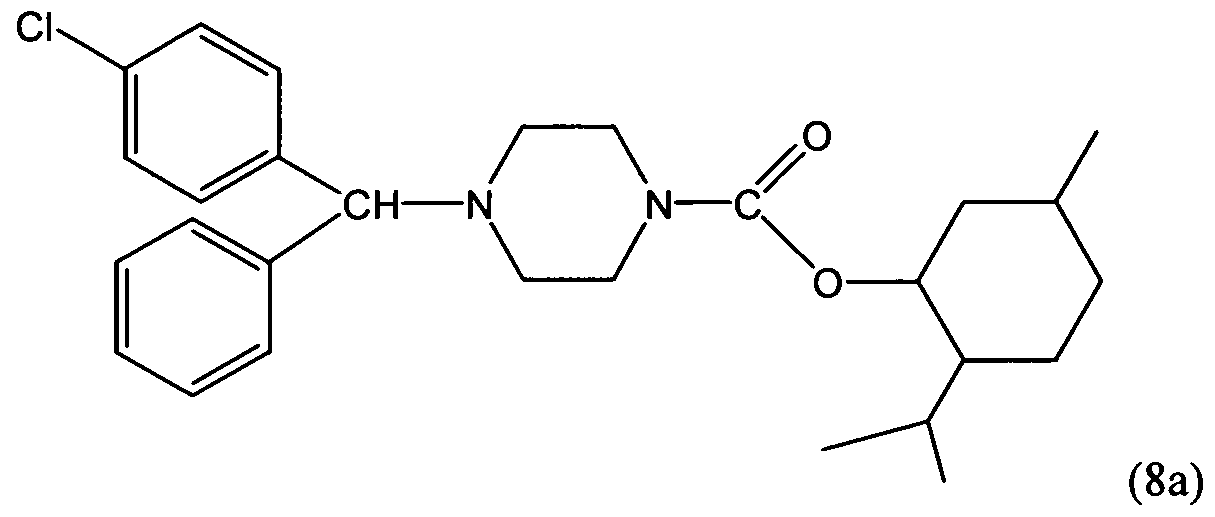
13. The compound of formula (7)  wherein X is a leaving group reactive with an amine, for instance a halo group such as chloro or bromo group; or a sulphonyl group such as mesyloxy, besyloxy or tosyloxy group; and preferably X is a chloro group;
Z is C1-C20 straight or branched alkyl/cycloalkyl /aralkyl/alkylaryl group, whereby each of which groups can be optionally substituted by one to four halogen, alkoxy, amino, and/or nitro groups and whereby the group Z comprises at least one chiral carbon atom.
14. The compound of formula (9)
X- C(=O)-O-Z (9)
wherein X is a halogen group, preferably a chloro-group , and
Z is C1-C20 straight or branched alkyl/cycloalkyl /aralkyl/alkylaryl group, whereby each of which groups can be optionally substituted by one to four halogen, alkoxy, amino, and/or nitro groups and whereby the group Z comprises at least one chiral carbon atom.
15. Use of a compound according to claim 1 1-14 in the making of levocetirizine and/or of the compound of formula (4).
Priority Applications (2)
| Application Number | Priority Date | Filing Date | Title |
|---|---|---|---|
| PCT/EP2008/009977 WO2010057515A1 (en) | 2008-11-21 | 2008-11-21 | Levocetirizine by menthyl intermediate |
| NL1037485A NL1037485C2 (en) | 2008-11-21 | 2009-11-20 | Levocetirizine by menthyl intermediate. |
Applications Claiming Priority (1)
| Application Number | Priority Date | Filing Date | Title |
|---|---|---|---|
| PCT/EP2008/009977 WO2010057515A1 (en) | 2008-11-21 | 2008-11-21 | Levocetirizine by menthyl intermediate |
Publications (1)
| Publication Number | Publication Date |
|---|---|
| WO2010057515A1 true WO2010057515A1 (en) | 2010-05-27 |
Family
ID=40848666
Family Applications (1)
| Application Number | Title | Priority Date | Filing Date |
|---|---|---|---|
| PCT/EP2008/009977 Ceased WO2010057515A1 (en) | 2008-11-21 | 2008-11-21 | Levocetirizine by menthyl intermediate |
Country Status (2)
| Country | Link |
|---|---|
| NL (1) | NL1037485C2 (en) |
| WO (1) | WO2010057515A1 (en) |
Cited By (1)
| Publication number | Priority date | Publication date | Assignee | Title |
|---|---|---|---|---|
| WO2012101475A1 (en) * | 2011-01-27 | 2012-08-02 | Jubilant Life Sciences Limited | An improved process for the preparation of antihistaminic drugs via a novel carbamate intermediate |
Citations (9)
| Publication number | Priority date | Publication date | Assignee | Title |
|---|---|---|---|---|
| DE2629657A1 (en) * | 1975-07-07 | 1977-01-27 | Leo Ab | PROCESS FOR THE CARBAMOYLATION OF PHENOLIC HYDROXY GROUPS FOR THE PRODUCTION OF PHENOLIC N-DISUBSTITUTED CARBAMATE STARS AND THE ION PAIR SOLUTIONS USED THEREFORE |
| EP0266042A2 (en) * | 1986-09-03 | 1988-05-04 | University of Strathclyde | Optically active pteridine derivatives |
| US5756774A (en) * | 1997-02-04 | 1998-05-26 | Bittman; Robert | Synthesis of myo-inositol phosphates |
| WO1999040944A2 (en) * | 1998-02-12 | 1999-08-19 | De Montfort University | Hydroxylation activated drug release |
| EP1236722A1 (en) * | 2001-02-22 | 2002-09-04 | Sumitomo Chemical Company, Limited | Optically active 4-(tert-butoxycarbonyl) piperazine compound, and method for producing the same |
| US20030055035A1 (en) * | 1998-10-28 | 2003-03-20 | Carroll Willilam A. | Pyrano piperidino and thiopyrano compounds and methods of use |
| WO2006072599A2 (en) * | 2005-01-10 | 2006-07-13 | Glaxo Group Limited | Androstane 17-alpha carbonate derivatives for use in the treatment of allergic and inflammatory conditions |
| WO2007066163A2 (en) * | 2005-12-08 | 2007-06-14 | Egis Gyógyszergyár Nyilvanosan Mukodo Reszvenytarsasag | Optically active carbamates, process for preparation thereof and use thereof as pharmaceutical intermediates |
| EP2062881A1 (en) * | 2007-11-21 | 2009-05-27 | Synthon B.V. | Process for making N-(diphenylmethyl)piperazines |
-
2008
- 2008-11-21 WO PCT/EP2008/009977 patent/WO2010057515A1/en not_active Ceased
-
2009
- 2009-11-20 NL NL1037485A patent/NL1037485C2/en not_active IP Right Cessation
Patent Citations (9)
| Publication number | Priority date | Publication date | Assignee | Title |
|---|---|---|---|---|
| DE2629657A1 (en) * | 1975-07-07 | 1977-01-27 | Leo Ab | PROCESS FOR THE CARBAMOYLATION OF PHENOLIC HYDROXY GROUPS FOR THE PRODUCTION OF PHENOLIC N-DISUBSTITUTED CARBAMATE STARS AND THE ION PAIR SOLUTIONS USED THEREFORE |
| EP0266042A2 (en) * | 1986-09-03 | 1988-05-04 | University of Strathclyde | Optically active pteridine derivatives |
| US5756774A (en) * | 1997-02-04 | 1998-05-26 | Bittman; Robert | Synthesis of myo-inositol phosphates |
| WO1999040944A2 (en) * | 1998-02-12 | 1999-08-19 | De Montfort University | Hydroxylation activated drug release |
| US20030055035A1 (en) * | 1998-10-28 | 2003-03-20 | Carroll Willilam A. | Pyrano piperidino and thiopyrano compounds and methods of use |
| EP1236722A1 (en) * | 2001-02-22 | 2002-09-04 | Sumitomo Chemical Company, Limited | Optically active 4-(tert-butoxycarbonyl) piperazine compound, and method for producing the same |
| WO2006072599A2 (en) * | 2005-01-10 | 2006-07-13 | Glaxo Group Limited | Androstane 17-alpha carbonate derivatives for use in the treatment of allergic and inflammatory conditions |
| WO2007066163A2 (en) * | 2005-12-08 | 2007-06-14 | Egis Gyógyszergyár Nyilvanosan Mukodo Reszvenytarsasag | Optically active carbamates, process for preparation thereof and use thereof as pharmaceutical intermediates |
| EP2062881A1 (en) * | 2007-11-21 | 2009-05-27 | Synthon B.V. | Process for making N-(diphenylmethyl)piperazines |
Non-Patent Citations (2)
| Title |
|---|
| BEAK P AND HARRIS B R: "Reactions of Apotricyclyl, Apocamphor, and Apobornenyl Chloroformates with Silver (I). Generation and Aromatic Substitution of a Bridgehead Radical and a Bridgehead Cation", JOURNAL OF THE AMERICAN CHEMICAL SOCIETY, vol. 96, no. 20, 1974, pages 6363 - 6372, XP002538444 * |
| OPALKA C J ET AL: "A NOVEL SYNTHESIS OF THE ENANTIOMERS OF AN ANTIHISTAMINE DRUG BY PIPERAZINE FORMATION FROM A PRIMARY AMINE", SYNTHESIS, GEORG THIEME VERLAG, STUTTGART, DE, vol. 7, no. 7, 1 July 1995 (1995-07-01), pages 766 - 768, XP000979124, ISSN: 0039-7881 * |
Cited By (1)
| Publication number | Priority date | Publication date | Assignee | Title |
|---|---|---|---|---|
| WO2012101475A1 (en) * | 2011-01-27 | 2012-08-02 | Jubilant Life Sciences Limited | An improved process for the preparation of antihistaminic drugs via a novel carbamate intermediate |
Also Published As
| Publication number | Publication date |
|---|---|
| NL1037485C2 (en) | 2010-07-27 |
| NL1037485A (en) | 2010-05-28 |
Similar Documents
| Publication | Publication Date | Title |
|---|---|---|
| US8703955B2 (en) | Process for the resolution of isoquinoline derivatives | |
| JP3911545B2 (en) | Crystallization of levobupivacaine and its analogues | |
| US20090093650A1 (en) | Resolution of alpha-(phenoxy)phenylacetic acid derivatives with naphthyl-alkylamines | |
| US4847301A (en) | Methods of use of α-(aminoalkyl)-arylacetic acid derivatives | |
| JP2011503122A (en) | Separation of 4,5-dimethoxy-1- (methylaminomethyl) -benzocyclobutane | |
| EP2062881B1 (en) | Process for making N-(diphenylmethyl)piperazines | |
| WO2009062036A2 (en) | Processes for preparing levocetirizine and pharmaceutically acceptable salts thereof | |
| US7612215B2 (en) | Process for preparing 2-oxo-1-pyrrolidine derivatives by intramolecular allylation | |
| CA2561866A1 (en) | Process for the optical resolution and recycling of tomoxetine | |
| EP1963296B1 (en) | Optically active carbamates, process for preparation thereof and use thereof as pharmaceutical intermediates | |
| SI22489A (en) | New procedure for preparation of levocetirizine and its intermediates | |
| US7989623B2 (en) | Process for making n-(diphenylmethyl)piperazines | |
| US20110065755A1 (en) | Stable r(+)-lansoprazole amine salt and a process for preparing the same | |
| WO2010057515A1 (en) | Levocetirizine by menthyl intermediate | |
| JP3187905B2 (en) | Process for producing racemic and optically active 1,2,3,4-tetrahydroisoquinoline-3-carboxylic acid and precursors thereof | |
| WO1994002473A1 (en) | N-cycloalkylpiperazine derivatives, methods of obtaining them and pharmaceutical compositions containing them | |
| US20100145049A1 (en) | Process for making n-(diphenylmethyl)piperazines | |
| US5583259A (en) | 2-(RO)-1-(R) ethylamines | |
| NO864525L (en) | PROCEDURE FOR THE PREPARATION OF ARYLEDIC DIETIC ACID DERIVATIVES. | |
| CN1442407A (en) | Chemical resolution preparation method of optically pure fesufenadin and its hydrochloride salt | |
| Schjelderup et al. | The absolute configuration of oxyphencyclimine, a parasympatholytic drug. Syntheses of both enantiomers | |
| CA2599498C (en) | Pyroglutamate salts and their use in the optical resolution of intermediates for the synthesis of dextrocetirizine and levocetirizine | |
| EP0570443B1 (en) | Aminoalcohols useful as optical resolving agents | |
| WO2018167631A1 (en) | Process for the separation of optical isomers of racemic 3-alkylpiperidine-carboxylic acid ethyl esters | |
| WO2012101475A1 (en) | An improved process for the preparation of antihistaminic drugs via a novel carbamate intermediate |
Legal Events
| Date | Code | Title | Description |
|---|---|---|---|
| 121 | Ep: the epo has been informed by wipo that ep was designated in this application |
Ref document number: 08875036 Country of ref document: EP Kind code of ref document: A1 |
|
| NENP | Non-entry into the national phase |
Ref country code: DE |
|
| 122 | Ep: pct application non-entry in european phase |
Ref document number: 08875036 Country of ref document: EP Kind code of ref document: A1 |