WO2010010941A1 - シリカ質粉末及び/又はアルミナ質粉末中の金属質粒子の分析方法 - Google Patents
シリカ質粉末及び/又はアルミナ質粉末中の金属質粒子の分析方法 Download PDFInfo
- Publication number
- WO2010010941A1 WO2010010941A1 PCT/JP2009/063245 JP2009063245W WO2010010941A1 WO 2010010941 A1 WO2010010941 A1 WO 2010010941A1 JP 2009063245 W JP2009063245 W JP 2009063245W WO 2010010941 A1 WO2010010941 A1 WO 2010010941A1
- Authority
- WO
- WIPO (PCT)
- Prior art keywords
- metallic particles
- powder
- acid
- siliceous
- particles
- Prior art date
- Legal status (The legal status is an assumption and is not a legal conclusion. Google has not performed a legal analysis and makes no representation as to the accuracy of the status listed.)
- Ceased
Links
Classifications
-
- G—PHYSICS
- G01—MEASURING; TESTING
- G01N—INVESTIGATING OR ANALYSING MATERIALS BY DETERMINING THEIR CHEMICAL OR PHYSICAL PROPERTIES
- G01N31/00—Investigating or analysing non-biological materials by the use of the chemical methods specified in the subgroup; Apparatus specially adapted for such methods
- G01N31/22—Investigating or analysing non-biological materials by the use of the chemical methods specified in the subgroup; Apparatus specially adapted for such methods using chemical indicators
Definitions
- the present invention relates to a method for analyzing metallic particles in siliceous powder and / or alumina powder.
- a semiconductor encapsulant for packaging (sealing) a semiconductor is a siliceous powder for the purpose of lowering the coefficient of thermal expansion, increasing the thermal conductivity, improving flame retardancy, and improving moisture resistance.
- fillers such as alumina powder and the like are filled with fine metal particles as foreign matters in the manufacturing process. This is because part of the manufacturing equipment for fillers such as siliceous powder and alumina powder is generally made of metal such as iron or stainless steel, and the surface is used for pulverizing the powder or air flow. This is because it is scraped by powder when it is transported, classified, sieved, blended, etc.
- the object of the present invention is to analyze the degree of electrical conductivity simply and accurately by utilizing the difference in acid solubility of metallic particles in the analysis of metallic particles in siliceous powder and / or alumina powder. Is to provide a method.
- An acidic solution and a reagent showing a color reaction to metal ions are added to siliceous powder and / or alumina powder containing metallic particles, and a part or all of them are covered with an acid-resistant substance.
- Acidic solution is hydrochloric acid or mixed acid containing hydrochloric acid
- metal ion is iron ion
- reagent is hexacyanoiron (II) acid salt, hexacyanoiron (III) acid salt, thiocyanate, 4 (-2-pyridylazo) resorcinol
- the method for analyzing metallic particles in siliceous powder and / or alumina powder as described in (1) or (2) above which is one selected from the group consisting of 1,10-phenanthroline.
- (4) Determining the degree of conductivity of the metal particles based on the degree of presence of acid-soluble metal particles that are not partially or entirely covered with an acid-resistant substance.
- the method for analyzing metallic particles in the siliceous powder and / or the alumina powder according to any one of 1).
- a method capable of simply and accurately analyzing the degree of conductivity of metallic particles by utilizing the difference in acid solubility of metallic particles in siliceous powder and / or alumina powder.
- a siliceous powder and / or aluminous powder containing metallic particles is added with an acid solution and a reagent that exhibits a color reaction to metal ions, and a part or all thereof is covered with an acid-resistant substance.
- This is a method for detecting the degree of presence of non-acid-soluble metallic particles, and a method for determining the degree of conductivity of metallic particles based on the detection result.
- Most of the metallic particles contained in the siliceous powder and the alumina-based powder are iron-based or stainless steel-based particles and oxide particles thereof, so in ion-exchanged water or organic solvents, they are derived from the metal particles. It is difficult for metal ions to elute.
- an acidic solution As the acidic solution, sulfuric acid, hydrochloric acid, or a mixed acid thereof, which can elute metal ions from both iron and stainless steel. Is preferred.
- hydrochloric acid or a mixed acid containing hydrochloric acid is preferable in that metal ions can be eluted in a short time.
- concentration of the acidic solution is low, metal ions are not sufficiently eluted from the metal particles, and when the concentration is high, there is a problem such as danger in handling.
- sulfuric acid when sulfuric acid is used, the concentration is 20 to 60.
- mass% hydrochloric acid the concentration is preferably 5 to 30 mass%.
- hydrochloric acid is contained in an amount of 5 to 30% by mass.
- reagent to be added examples include hexacyanoferrate (II) and hexacyanoferrate (III), which show a bright amber color reaction with iron ions, thiocyanate (4) -2-pyridylazo)
- examples include resorcinol, 1,10-phenanthroline, and diphenylcarbazide aqueous solution that exhibits a reddish purple color reaction with chromium ions.
- hexacyanoiron (II) salt hexacyanoiron (III) salt showing a bright amber color reaction on iron ions
- thiocyanate showing a bright red blood color
- 4 (-2-pyridylazo) resorcinol 1,10-phenanthroline is preferred.
- the acid solution and the reagent that exhibits the color reaction are added to the metal ion, and the acid solution and the reagent that exhibits the color reaction may be added in this order, or they may be added at the same time or mixed in advance. Liquid may be added.
- the reagent showing a color reaction when a reagent showing a color reaction is added to a metal ion after about 1 to 15 minutes have passed since the acid solution was added, the color reaction is most easily observed.
- the reagent in the form of an aqueous solution or an organic solvent solution having an appropriate concentration.
- the siliceous powder and / or alumina powder containing the metallic particles may be spread thinly so that the color change can be easily observed.
- the amount of the acidic solution and reagent added is sufficient to wet the siliceous powder and the alumina powder, and if the powder becomes pasty or slurry, it becomes difficult to observe the color change.
- an optical microscope, a microscope, or the like can be used. As the microscope, for example, a trade name KH-3000 model manufactured by HIROX can be used.
- Measurement can be performed based on the manual of the measuring instrument. Specifically, the sample is set in the observation field of the microscope and observed at 50 to 200 times. If the sample does not fit in one field of view, the entire area of the sample is moved while counting the metallic particles and their coloration.
- the composition of most metallic particles in the siliceous powder and the alumina powder is stainless steel (74% Fe-18% Cr-8% Ni) and iron (Fe).
- hematite Fe 2 O 3
- magnetite Fe 3 O 4
- an oxide such as wustite
- the degree of acid solubility (presence / absence) of the metal particles can be detected, the degree of conductivity (presence / absence) of the metal particles can also be determined at the same time. That is, when metal ions are eluted from the surface of the metallic particles by the action of acid and a reagent is added, it is determined that the metallic particles in the case of vivid color reaction have conductivity, and the color reaction is performed. When not shown, it can be determined that the metallic particles do not have conductivity.
- the metallic particles are preferably magnetized metallic particles. This is because magnetized metal particles are collected from the siliceous powder and / or alumina powder containing the metal particles using magnetic force, and the collected magnetized metal particles are colored to an acidic solution and metal ions. By adding a reagent indicating the presence of acid-soluble metal particles that are not partially or entirely covered with acid-resistant substances, the metal particles can be analyzed more accurately. Because it can be done.
- the collection of the magnetized metallic particles using the magnetic force from the siliceous powder and the alumina powder is not particularly limited, but can be performed by, for example, the method described in JP-A-2008-145246.
- By collecting by such a method only the metallic particles are collected from the siliceous powder and the alumina powder, so that the detection accuracy of the degree (presence / absence) of the acid-soluble metallic particles is increased.
- the worn stainless steel particles and iron particles have magnetism, but the metal particles that have undergone thermal history and are oxidized also contain ferromagnetic magnetite and have magnetism. Even if it is additionally performed, the measurement accuracy does not decrease.
- Heated and oxidized stainless steel powder and iron powder were prepared for 3 hours.
- the electrical conductivity of these heat-oxidized stainless steel powder and iron powder was measured using an insulation resistance meter “DG-8, manufactured by Sanwa Co., Ltd.”, and the resistance value was 40 M ⁇ ⁇ cm or more. It was confirmed that the powder and iron powder are insulators having no conductivity. In addition, it was confirmed that the stainless steel powder and iron powder not subjected to heat oxidation measured by the same method had a resistance value of about 10 ⁇ 5 to 10 ⁇ 6 ⁇ ⁇ cm and exhibited conductivity.
- a microscope was used, and a commercially available metal needle for sewing was attached to the tip of the probe so that the probe of the insulation resistance meter was easily brought into contact with the powder.
- siliceous powder containing metallic particles, alumina powder For each 1 kg of spherical silica powder “trade name FB-950X manufactured by Denki Kagaku Kogyo Co., Ltd.”, add 0.002 g of stainless steel powder or iron powder, and heat-oxidized stainless steel powder or iron powder prepared by the above method. The following two types of siliceous powders containing metallic particles were prepared. Both A powder and B powder contain 0.004g of metallic powder with respect to 1kg of siliceous powder.
- each 50 g of siliceous powder A containing metallic particles is precisely weighed and magnetic force is applied from siliceous powder A by the method described in paragraphs (0023) to (0025) of JP-A-2008-145246.
- Collect magnetic metallic foreign matter add reagents under the conditions shown in the table, and use a microscope "trade name KH-3000 manufactured by HIROX" to remove metallic particles and their coloring at a magnification of 100 times. I counted. This operation was performed five times for different samples, and the average value and standard deviation of the analytical values of the metallic particles in the siliceous powder A powder were determined.
- the presence or absence of conductivity of the metal particles was determined based on the presence or absence of coloration.
- the metallic particles when there was coloration were determined to be conductive, and the metallic particles when there was no coloration were determined to be non-conductive.
- the presence or absence of coloration in advance was used to determine the presence or absence of conductivity of the metal particles.
- Sex was determined.
- Metallic particles having metallic luster were determined to be conductive, and metallic particles having no metallic luster were determined to be nonconductive.
- the degree of conductivity (presence / absence) of the metallic particles in the siliceous powder and / or the alumina powder is easily and accurately determined. Can be analyzed.
- the analysis method of the present invention includes a semiconductor encapsulant used for automobiles, portable electronic devices, personal computers, home appliances, etc., and siliceous powder and / or alumina used as a filler for laminates on which semiconductors are mounted. It is used as a method for analyzing metallic particles in powder.
Landscapes
- Life Sciences & Earth Sciences (AREA)
- Health & Medical Sciences (AREA)
- Analytical Chemistry (AREA)
- Molecular Biology (AREA)
- Physics & Mathematics (AREA)
- Chemical & Material Sciences (AREA)
- Biophysics (AREA)
- Biochemistry (AREA)
- General Health & Medical Sciences (AREA)
- General Physics & Mathematics (AREA)
- Immunology (AREA)
- Pathology (AREA)
- Investigating Or Analyzing Non-Biological Materials By The Use Of Chemical Means (AREA)
- Investigating Or Analysing Materials By The Use Of Chemical Reactions (AREA)
Abstract
本発明の課題は、シリカ質粉末及び/又はアルミナ質粉末中の金属質粒子の分析において、金属質粒子の酸溶解度の差異を利用して、これらの導電性の程度を簡便かつ精度良く分析できる方法を提供することである。 シリカ質粉末及び/又はアルミナ質粉末中の金属質粒子の分析方法は、金属質粒子を含有するシリカ質粉末及び/又はアルミナ質粉末に、酸性溶液、及び金属イオンに呈色反応を示す試薬を加えて、一部又は全部が耐酸性の物質で覆われていない酸溶解性の金属質粒子の存在の程度を検出する工程を有する。金属質粒子は着磁性金属質粒子であることが好ましい。酸性溶液が塩酸又は塩酸を含有する混酸、金属イオンが鉄イオン、試薬がヘキサシアノ鉄(II)酸塩、ヘキサシアノ鉄(III)酸塩、チオシアン酸塩、4(-2-ピリジルアゾ)レゾルシノール、及び1、10-フェナントロリンからなる群より選ばれた1種であることが好ましい。
Description
本発明は、シリカ質粉末及び/又はアルミナ質粉末中の金属質粒子の分析方法に関する。
電子機器の小型軽量化及び高性能化の要求に対応して、半導体の小型化、薄型化、及び高密度実装化が急速に進展している。このため、半導体の構造は、従来のQFPやSOPなどのリード端子型の構造よりも、薄型化及び高密度実装化に有利なBGAやLGAなどのエリアアレイ型の構造が増えつつある。さらに、近年では、一つの半導体パッケージ内に複数のICチップが積層されたスタックドチップ構造も積極的に採用されるようになっており、半導体構造の複雑化及び高密度実装化がますます進んでいる。また、半導体の小型化、薄型化、及び高密度実装化に伴い、半導体内部の金ワイヤーの配線間隔も狭くなっており、最新の半導体では、金ワイヤーの間隔が50μm程度のものも実用化され始めている。
一方、半導体をパッケージング(封止)する半導体封止材には、熱膨張率を下げる、熱伝導率を上げる、難燃性を向上させる、耐湿性を向上させる等の目的で、シリカ質粉末やアルミナ質粉末などのフィラーが充填されているが、これらの粉末には、その製造工程において、微細な金属質粒子が異物として混入することがある。これは、シリカ質粉末及びアルミナ質粉末などのフィラーの製造設備の一部が、一般には、鉄やステンレス鋼などの金属で作られており、その表面が、上記粉末を粉砕する際や、気流で輸送する際、分級、篩分けを行う際、ブレンドを行う際などに、粉末により削られるためである。このように、半導体封止材に充填されるシリカ質粉末及びアルミナ質粉末などに導電性の金属質粒子が混入していると、この導電性の金属質粒子によって半導体のワイヤー等の配線間の短絡(ショート)が引き起こされる可能性が高くなってしまう。このため、シリカ質粉末及びアルミナ質粉末などに混入している導電性の金属質粒子を除去あるいは無害化(非導電化)する試みが種々検討されている。
シリカ質粉末及びアルミナ質粉末中の金属質粒子を分析する技術としては、シリカ質粉末1kgを超純水に分散させ、磁石をスラリーへ浸漬し、10分間に亘り攪拌した後、磁石に付着した粒子を透明な粘着テープで回収し、この粒子の写真を、実体顕微鏡を用いて撮り、異物粒子の個数を計数する手法が開示されている(特許文献1)。しかしながら、この手法では、着磁性のある金属質粒子は回収されるものの、最も重要視されている金属質粒子の導電性については何ら情報が得られないという問題がある。また、回収した金属質粒子を顕微鏡にて観察し、光沢の差異等により酸化または非酸化を識別し、導電性を推測する手法も開示されているが(特許文献2)、この手法は、目視での金属質粒子の一面の光沢に基づいて導電性の有無を判断するだけであり、精度の良い分析技術と言えるものではなかった。
本発明の目的は、シリカ質粉末及び/又はアルミナ質粉末中の金属質粒子の分析において、金属質粒子の酸溶解度の差異を利用して、これらの導電性の程度を簡便かつ精度良く分析できる方法を提供することである。
(1)金属質粒子を含有するシリカ質粉末及び/又はアルミナ質粉末に、酸性溶液、及び金属イオンに呈色反応を示す試薬を加えて、一部又は全部が耐酸性の物質で覆われていない酸溶解性の金属質粒子の存在の程度を検出するシリカ質粉末及び/又はアルミナ質粉末中の金属質粒子の分析方法。
(2)金属質粒子が着磁性金属質粒子である前記(1)に記載のシリカ質粉末及び/又はアルミナ質粉末中の金属質粒子の分析方法。
(3)酸性溶液が塩酸又は塩酸を含有する混酸、金属イオンが鉄イオン、試薬がヘキサシアノ鉄(II)酸塩、ヘキサシアノ鉄(III)酸塩、チオシアン酸塩、4(-2-ピリジルアゾ)レゾルシノール、及び1、10-フェナントロリンからなる群より選ばれた1種である前記(1)又は(2)に記載のシリカ質粉末及び/又はアルミナ質粉末中の金属質粒子の分析方法。
(4)一部又は全部が耐酸性の物質で覆われていない酸溶解性の金属質粒子の存在の程度に基づいて、金属質粒子の導電性の程度を判別する前記(1)から(3)のいずれか一項に記載のシリカ質粉末及び/又はアルミナ質粉末中の金属質粒子の分析方法。
(2)金属質粒子が着磁性金属質粒子である前記(1)に記載のシリカ質粉末及び/又はアルミナ質粉末中の金属質粒子の分析方法。
(3)酸性溶液が塩酸又は塩酸を含有する混酸、金属イオンが鉄イオン、試薬がヘキサシアノ鉄(II)酸塩、ヘキサシアノ鉄(III)酸塩、チオシアン酸塩、4(-2-ピリジルアゾ)レゾルシノール、及び1、10-フェナントロリンからなる群より選ばれた1種である前記(1)又は(2)に記載のシリカ質粉末及び/又はアルミナ質粉末中の金属質粒子の分析方法。
(4)一部又は全部が耐酸性の物質で覆われていない酸溶解性の金属質粒子の存在の程度に基づいて、金属質粒子の導電性の程度を判別する前記(1)から(3)のいずれか一項に記載のシリカ質粉末及び/又はアルミナ質粉末中の金属質粒子の分析方法。
本発明によれば、シリカ質粉末及び/又はアルミナ質粉末中の金属質粒子の酸溶解度の差異を利用し、金属質粒子の導電性の程度を簡便かつ精度良く分析できる方法が提供される。
以下、本発明を詳細に説明する。
本発明は、金属質粒子を含有するシリカ質粉末及び/又はアルミナ質粉末に、酸性溶液及び金属イオンに呈色反応を示す試薬を加えて、一部又は全部が耐酸性の物質で覆われていない酸溶解性の金属質粒子の存在の程度を検出する方法であり、その検出結果に基づいて金属質粒子の導電性の程度を判別する方法である。シリカ質粉末及びアルミナ質粉末に含まれる金属質粒子のほとんどは、鉄系かステンレス鋼系の粒子、およびこれらの酸化物粒子であるため、イオン交換水又は有機溶剤などでは、その金属粒子に由来する金属イオンが溶出しにくい。金属質粒子から金属イオンを溶出させるためには酸性溶液を加えることが必要であり、酸性溶液としては、鉄、ステンレス鋼の両方から金属イオンを溶出させることができる硫酸、塩酸、またはこれらの混酸が好ましい。なかでも、金属イオンを短時間で溶出させることができるという点では、塩酸、または塩酸を含有する混酸が好ましい。酸性溶液の濃度は、低ければ金属質粒子から金属イオンの溶出が十分に行われず、高ければハンドリング時に危険をともなう等の問題があることから、例えば、硫酸を用いる場合は、濃度が20~60質量%、塩酸を用いる場合は、濃度が5~30質量%であることが好ましい。また混酸を用いる場合にも、塩酸が5~30質量%含まれていることが好ましい。
金属イオンに呈色反応を示す試薬を加えない場合、金属質粒子から溶出した金属イオン自体が着色すれば、一部又は全部が耐酸性の物質で覆われていない酸溶解性の金属質粒子と、酸不溶性又は酸難溶性の金属質粒子との判別が可能ではあるが、判別がしにくいうえに、無色の金属イオンが溶出する際には判別が不可能であるという問題がある。したがって、金属イオンに呈色反応を示す試薬を加えることが必要である。加える試薬としては、鉄イオンに鮮やかな紺色の呈色反応を示すヘキサシアノ鉄(II)酸塩、ヘキサシアノ鉄(III)酸塩、鮮やかな赤血色を示すチオシアン酸塩、4(-2-ピリジルアゾ)レゾルシノール、1、10-フェナントロリン、クロムイオンに赤紫色の呈色反応を示すジフェニルカルバジド水溶液などが挙げられる。この中でも、特に、鉄イオンに鮮やかな紺色の呈色反応を示すヘキサシアノ鉄(II)酸塩、ヘキサシアノ鉄(III)塩、鮮やかな赤血色を示すチオシアン酸塩、4(-2-ピリジルアゾ)レゾルシノール、1、10-フェナントロリンが好適である。酸性溶液、金属イオンに呈色反応を示す試薬を加える順序としては、特に制限はなく、酸性溶液、呈色反応を示す試薬の順に加えてもよく、同時に加えるか、これらを事前に混合した混合液を加えてもよい。ただし、酸性溶液を加えた後、1~15分程度経過した後に、金属イオンに呈色反応を示す試薬を加えると、呈色反応を最も観察しやすい。また、呈色反応を観察しやすくするために、試薬は適当な濃度の水溶液又は有機溶剤の溶液の形態で加える方が好ましい。
酸性溶液や、金属イオンに呈色反応を示す試薬を加える際は、色の変化が観察しやすいように、金属質粒子を含有するシリカ質粉末及び/又はアルミナ質粉末を薄く広げておくことが好ましい。また、酸性溶液、試薬を加える量は、シリカ質粉末、アルミナ質粉末が湿潤する程度で足り、粉末がペースト状又はスラリー状になる程であると、逆に色の変化が観察しづらくなる。着色により一部又は全部が耐酸性の物質で覆われていない酸溶解性の金属質粒子の存在の程度(有無)を検出するためには、光学顕微鏡、マイクロスコープ等を使用することができる。マイクロスコープとしては、例えば、HIROX社製商品名KH-3000モデル等が使用できる。測定は、測定機器のマニュアルに基づいて行なうことができるが、具体的には、サンプルをマイクロスコープの観察視野にセットし、50~200倍にして観察する。サンプルが一視野に入らない場合には、金属質粒子およびそれらの着色をカウントしつつ、サンプルの全領域を移動する。
ここで、酸溶解性と導電性との関係は以下のとおりである。シリカ質粉末、アルミナ質粉末中のほとんどの金属質粒子の組成は、ステンレス鋼(74%Fe-18%Cr-8%Ni)、鉄(Fe)である。また、シリカ質粉末、アルミナ質粉末中の製造工程において極短時間であっても300℃以上の熱履歴を経た金属質粒子は、その外層から、ヘマタイト(Fe2O3)、マグネタイト(Fe3O4)、ウスタイト(FeO)のような酸化物で構成されている。このうち、ステンレス鋼、鉄は酸溶解性及び導電性を有する一方、ヘマタイトは酸溶解性がなく、導電性もほとんどない絶縁体である。したがって、金属質粒子の酸溶解性の程度(有無)が検出できれば、金属質粒子の導電性の程度(有無)も同時に判別することができることになる。すなわち、酸の作用により金属質粒子の表面から金属イオンが溶出し、試薬を加えた際に、鮮やかな呈色反応を示す場合の金属質粒子は導電性を有すると判別し、呈色反応を示さない場合の金属質粒子は導電性を有しないと判別することができる。
本発明においては、金属質粒子が着磁性金属質粒子であることが好ましい。これは、金属質粒子を含有するシリカ質粉末及び/又はアルミナ質粉末から磁力を用いて着磁性金属質粒子を収集し、収集した着磁性金属質粒子に、酸性溶液及び金属イオンに呈色反応を示す試薬を加えて、一部又は全部が耐酸性の物質で覆われていない酸溶解性の金属質粒子の存在の程度(有無)を検出することによって、さらに精度良く金属質粒子の分析を行うことができるからである。
シリカ質粉末、アルミナ質粉末からの磁力を用いた着磁性金属質粒子の収集は、特に限定されないが、例えば、特開2008-145246号公報に記載された方法によって行うことができる。このような方法で収集を行うことによって、シリカ質粉末、アルミナ質粉末中から金属質粒子のみが収集されるので、酸溶解性の金属質粒子の存在の程度(有無)の検出精度が増す。摩耗したステンレス鋼粒子、鉄粒子が着磁性を有するのは言うまでもないが、これらが熱履歴を受け酸化された金属質粒子も強磁性のマグネタイトを含み着磁性を有するため、磁力を用いた操作を追加的に行っても、測定精度が落ちることはない。
以下、本発明について、実施例及び比較例により、更に、詳細に説明する。
(金属質粒子の調製)
ステンレス鋼粉末「大同特殊鋼株式会社製商品名DAP304L」および、純鉄粉「JFE株式会社製商品名JIP304A」を、それぞれ45μm、75μmの目開きのJIS標準ふるいを用いて篩い分け、粒度を45~75μmに調整した。また、これらの粒度調整したステンレス鋼粉および鉄粉の一部を、石英ガラス製ボートに入れ、管状炉「株式会社アサヒ理化製作所社製商品名ARF-30KC」中、大気開放下、1100℃で3時間加熱し、加熱酸化されたステンレス鋼粉および鉄粉を調製した。これらの加熱酸化したステンレス鋼粉、鉄粉の導電性を、絶縁抵抗計「サンワ株式会社製DG-8」を用いて測定したところ、抵抗値が40MΩ・cm以上であり、加熱酸化したステンレス鋼粉、鉄粉は導電性を有しない絶縁体であることが確認された。また、同様の方法で測定した加熱酸化していないステンレス鋼粉および鉄粉は、抵抗値が約10-5~10-6Ω・cmであり、導電性を示すことを確認した。なお、抵抗値を測定する際は、マイクロスコープを用い、粉末に絶縁抵抗計のプローブを接触させやすいように、プローブ先端に市販の裁縫用金属針を取り付けて行った。
(金属質粒子の調製)
ステンレス鋼粉末「大同特殊鋼株式会社製商品名DAP304L」および、純鉄粉「JFE株式会社製商品名JIP304A」を、それぞれ45μm、75μmの目開きのJIS標準ふるいを用いて篩い分け、粒度を45~75μmに調整した。また、これらの粒度調整したステンレス鋼粉および鉄粉の一部を、石英ガラス製ボートに入れ、管状炉「株式会社アサヒ理化製作所社製商品名ARF-30KC」中、大気開放下、1100℃で3時間加熱し、加熱酸化されたステンレス鋼粉および鉄粉を調製した。これらの加熱酸化したステンレス鋼粉、鉄粉の導電性を、絶縁抵抗計「サンワ株式会社製DG-8」を用いて測定したところ、抵抗値が40MΩ・cm以上であり、加熱酸化したステンレス鋼粉、鉄粉は導電性を有しない絶縁体であることが確認された。また、同様の方法で測定した加熱酸化していないステンレス鋼粉および鉄粉は、抵抗値が約10-5~10-6Ω・cmであり、導電性を示すことを確認した。なお、抵抗値を測定する際は、マイクロスコープを用い、粉末に絶縁抵抗計のプローブを接触させやすいように、プローブ先端に市販の裁縫用金属針を取り付けて行った。
(金属質粒子を含有するシリカ質粉末、アルミナ質粉末の調製)
球状シリカ粉末「電気化学工業株式会社製商品名FB-950X」1kgにつき、ステンレス鋼粉又は鉄粉、上記方法で調製した加熱酸化されたステンレス鋼粉又は鉄粉を0.002gずつ添加し、充分に混合して、下に示す2種類の、金属質粒子を含有するシリカ質粉末を調製した。A粉、B粉ともに、シリカ質粉末1kgに対し、金属質粉末を0.004g含有する。
(A) 球状シリカ粉末+ステンレス鋼粉+加熱ステンレス鋼粉
(B) 球状シリカ粉末+鉄粉+加熱鉄粉
同様の方法で、球状アルミナ粉末「電気化学工業株式会社製商品名DAB-30SI」1kgにつき、ステンレス鋼粉又は鉄粉、上記方法で調製した加熱酸化されたステンレス鋼粉又は鉄粉を0.002gずつ添加し、充分に混合して、下に示す2種類の、金属質粒子を含有するアルミナ質粉末を調製した。C粉、D粉ともに、アルミナ質粉末1kgに対し、金属質粉末を0.004g含有する。
(C) 球状アルミナ質粉末+ステンレス鋼粉+加熱ステンレス鋼粉
(D) 球状アルミナ質粉末+鉄粉+加熱鉄粉
球状シリカ粉末「電気化学工業株式会社製商品名FB-950X」1kgにつき、ステンレス鋼粉又は鉄粉、上記方法で調製した加熱酸化されたステンレス鋼粉又は鉄粉を0.002gずつ添加し、充分に混合して、下に示す2種類の、金属質粒子を含有するシリカ質粉末を調製した。A粉、B粉ともに、シリカ質粉末1kgに対し、金属質粉末を0.004g含有する。
(A) 球状シリカ粉末+ステンレス鋼粉+加熱ステンレス鋼粉
(B) 球状シリカ粉末+鉄粉+加熱鉄粉
同様の方法で、球状アルミナ粉末「電気化学工業株式会社製商品名DAB-30SI」1kgにつき、ステンレス鋼粉又は鉄粉、上記方法で調製した加熱酸化されたステンレス鋼粉又は鉄粉を0.002gずつ添加し、充分に混合して、下に示す2種類の、金属質粒子を含有するアルミナ質粉末を調製した。C粉、D粉ともに、アルミナ質粉末1kgに対し、金属質粉末を0.004g含有する。
(C) 球状アルミナ質粉末+ステンレス鋼粉+加熱ステンレス鋼粉
(D) 球状アルミナ質粉末+鉄粉+加熱鉄粉
(金属質粒子を含有するシリカ質粉末、アルミナ質粉末中の金属質粒子の分析)
金属質粒子を含有するシリカ質粉末A、B、アルミナ質粉末C、Dを各50g精秤し、ろ紙「アドバンテック東洋株式社製No.131 JISP3801化学分析用3種」に約0.1mm以下の厚さになるように、ウレタン製スキージを用いて、A~D粉末を薄く広げた。次に、表に示す各条件の試薬(いずれも2質量%水溶液)を加え、マイクロスコープ「HIROX社製商品名KH-3000」を用いて、100倍の倍率で、金属質粒子およびそれらの呈色をカウントした。異なるサンプルについて、この操作を5回行い、A~D粉末中の金属質粒子の分析値の平均値、標準偏差を求めた。
金属質粒子を含有するシリカ質粉末A、B、アルミナ質粉末C、Dを各50g精秤し、ろ紙「アドバンテック東洋株式社製No.131 JISP3801化学分析用3種」に約0.1mm以下の厚さになるように、ウレタン製スキージを用いて、A~D粉末を薄く広げた。次に、表に示す各条件の試薬(いずれも2質量%水溶液)を加え、マイクロスコープ「HIROX社製商品名KH-3000」を用いて、100倍の倍率で、金属質粒子およびそれらの呈色をカウントした。異なるサンプルについて、この操作を5回行い、A~D粉末中の金属質粒子の分析値の平均値、標準偏差を求めた。
また、金属質粒子を含有するシリカ質粉末Aを各50g精秤し、特開2008-145246号公報の段落(0023)~(0025)に記載された方法で、シリカ質粉末Aから磁力を用いて着磁性金属質異物を収集し、表に示す各条件の試薬を加え、マイクロスコープ「HIROX社製商品名KH-3000」を用いて、100倍の倍率で、金属質粒子およびそれらの着色をカウントした。異なるサンプルについて、この操作を5回行い、シリカ質粉末A粉末中の金属質粒子の分析値の平均値、標準偏差を求めた。
実施例では、呈色の有無で金属質粒子の導電性の有無を判別した。呈色があった場合の金属質粒子を導電性ありと判別し、呈色がなかった場合の金属質粒子を導電性なしと判別した。
比較例では、事前に呈色の有無によって金属質粒子の導電性の有無を判別したところ、すべての比較例で呈色が無かった(表2)ので、金属光沢の有無で金属質粒子の導電性を判別した。金属光沢のあった金属質粒子を導電性ありと判別し、金属光沢のなかった金属質粒子を導電性なしと判別した。
金属質粒子の抵抗値を測定し、導電性粒子の判別エラー率を算出した(n=5の平均値)。判別エラー率は、下記の式により、絶対値で表す。
判別エラー率(%)=
|100-(実際に導電性があった粒子の個数/導電性ありと判別した粒子の個数)×100|
比較例では、事前に呈色の有無によって金属質粒子の導電性の有無を判別したところ、すべての比較例で呈色が無かった(表2)ので、金属光沢の有無で金属質粒子の導電性を判別した。金属光沢のあった金属質粒子を導電性ありと判別し、金属光沢のなかった金属質粒子を導電性なしと判別した。
金属質粒子の抵抗値を測定し、導電性粒子の判別エラー率を算出した(n=5の平均値)。判別エラー率は、下記の式により、絶対値で表す。
判別エラー率(%)=
|100-(実際に導電性があった粒子の個数/導電性ありと判別した粒子の個数)×100|

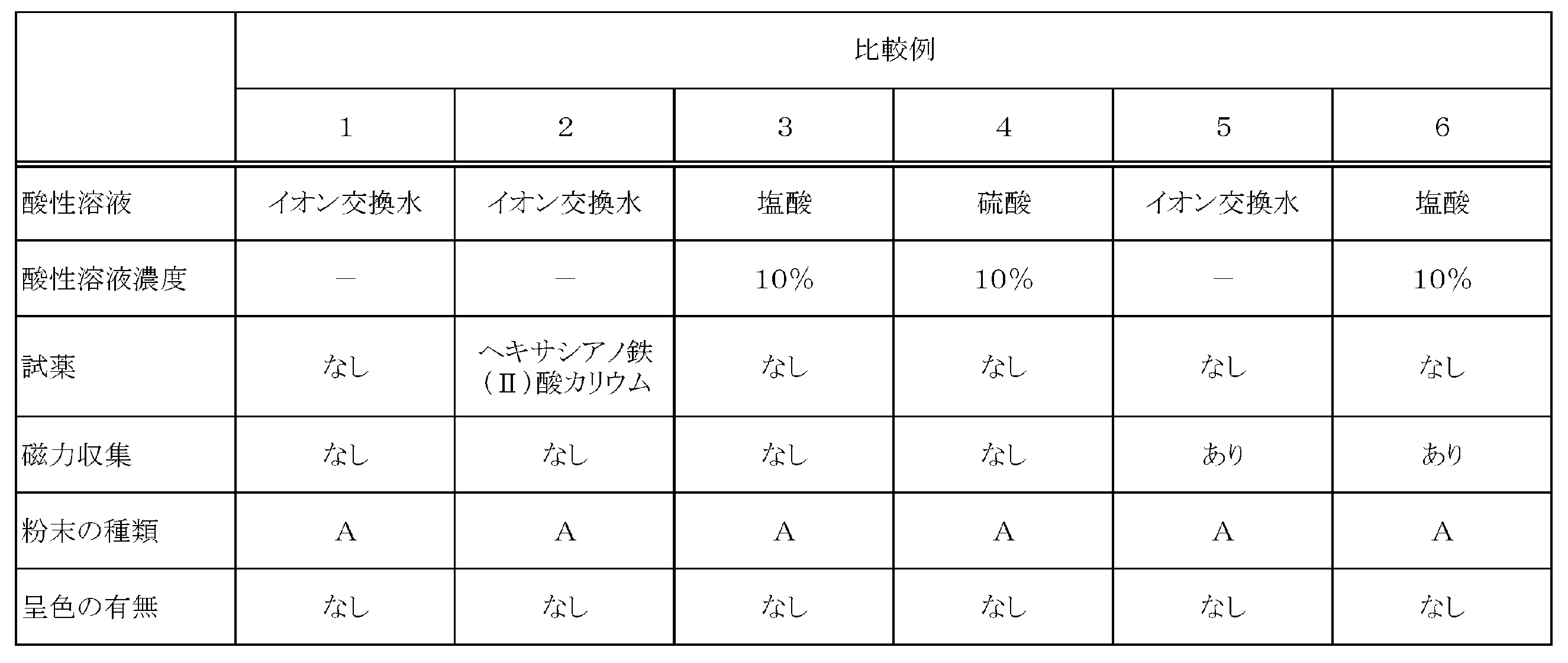


実施例と比較例との対比から明らかなように、本発明の分析方法によれば、シリカ質粉末及び/又はアルミナ質粉末中の金属質粒子の導電性の程度(有無)を簡便かつ精度良く分析することができる。
本発明の分析方法は、自動車、携帯電子機器、パソコン、家庭電化製品等に使用される半導体封止材および、半導体が搭載される積層板などのフィラーとして使用されるシリカ質粉末及び/又はアルミナ質粉末中の金属質粒子の分析方法として利用される。
Claims (4)
- 金属質粒子を含有するシリカ質粉末及び/又はアルミナ質粉末に、酸性溶液、及び金属イオンに呈色反応を示す試薬を加えて、一部又は全部が耐酸性の物質で覆われていない酸溶解性の金属質粒子の存在の程度を検出するシリカ質粉末及び/又はアルミナ質粉末中の金属質粒子の分析方法。
- 前記金属質粒子が着磁性金属質粒子である請求項1に記載のシリカ質粉末及び/又はアルミナ質粉末中の金属質粒子の分析方法。
- 前記酸性溶液が塩酸又は塩酸を含有する混酸、前記金属イオンが鉄イオン、前記試薬がヘキサシアノ鉄(II)酸塩、ヘキサシアノ鉄(III)酸塩、チオシアン酸塩、4(-2-ピリジルアゾ)レゾルシノール、及び1、10-フェナントロリンからなる群より選ばれた1種である請求項1又は2に記載のシリカ質粉末及び/又はアルミナ質粉末中の金属質粒子の分析方法。
- 一部又は全部が耐酸性の物質で覆われていない酸溶解性の金属質粒子の存在の程度に基づいて、金属質粒子の導電性の程度を判別する請求項1から3のいずれか一項に記載のシリカ質粉末及び/又はアルミナ質粉末中の金属質粒子の分析方法。
Priority Applications (1)
| Application Number | Priority Date | Filing Date | Title |
|---|---|---|---|
| JP2010521744A JP5373794B2 (ja) | 2008-07-25 | 2009-07-24 | シリカ質粉末及び/又はアルミナ質粉末中の金属質粒子の分析方法 |
Applications Claiming Priority (4)
| Application Number | Priority Date | Filing Date | Title |
|---|---|---|---|
| JP2008192713 | 2008-07-25 | ||
| JP2008-192713 | 2008-07-25 | ||
| JP2008-300770 | 2008-11-26 | ||
| JP2008300770 | 2008-11-26 |
Publications (1)
| Publication Number | Publication Date |
|---|---|
| WO2010010941A1 true WO2010010941A1 (ja) | 2010-01-28 |
Family
ID=41570401
Family Applications (1)
| Application Number | Title | Priority Date | Filing Date |
|---|---|---|---|
| PCT/JP2009/063245 Ceased WO2010010941A1 (ja) | 2008-07-25 | 2009-07-24 | シリカ質粉末及び/又はアルミナ質粉末中の金属質粒子の分析方法 |
Country Status (2)
| Country | Link |
|---|---|
| JP (1) | JP5373794B2 (ja) |
| WO (1) | WO2010010941A1 (ja) |
Citations (2)
| Publication number | Priority date | Publication date | Assignee | Title |
|---|---|---|---|---|
| JP2004010420A (ja) * | 2002-06-06 | 2004-01-15 | Mitsubishi Rayon Co Ltd | 高純度非磁性金属酸化物粉末及びその製造方法 |
| JP2004175825A (ja) * | 2002-11-25 | 2004-06-24 | Matsushita Electric Works Ltd | 封止材料の製造方法およびこれにより製造した封止材料 |
-
2009
- 2009-07-24 JP JP2010521744A patent/JP5373794B2/ja active Active
- 2009-07-24 WO PCT/JP2009/063245 patent/WO2010010941A1/ja not_active Ceased
Patent Citations (2)
| Publication number | Priority date | Publication date | Assignee | Title |
|---|---|---|---|---|
| JP2004010420A (ja) * | 2002-06-06 | 2004-01-15 | Mitsubishi Rayon Co Ltd | 高純度非磁性金属酸化物粉末及びその製造方法 |
| JP2004175825A (ja) * | 2002-11-25 | 2004-06-24 | Matsushita Electric Works Ltd | 封止材料の製造方法およびこれにより製造した封止材料 |
Non-Patent Citations (2)
| Title |
|---|
| "Annual Meeting on Chemical Society of Japan in 87 Spring -Koen Yokoshu I, 12 March, 2007, (12.03.07)", article TETSUYA NISHIDA: "Tetsu Ion no Seishitsu no Hitotsu, Turnbull's Blue-no Aoiro Chinden no Seisei o Yuko ni Kansatsu Rikai saseru Tame no Kufu", pages: 327 * |
| PICHOT V. ET AL.: "An efficient purification method for detonation nanodiamonds", DIAM. RELAT. MATER., vol. 17, no. 1, January 2008 (2008-01-01), pages 13 - 22 * |
Also Published As
| Publication number | Publication date |
|---|---|
| JPWO2010010941A1 (ja) | 2012-01-05 |
| JP5373794B2 (ja) | 2013-12-18 |
Similar Documents
| Publication | Publication Date | Title |
|---|---|---|
| Baghayeri et al. | A novel electrochemical sensor based on a glassy carbon electrode modified with dendrimer functionalized magnetic graphene oxide for simultaneous determination of trace Pb (II) and Cd (II) | |
| Zhou et al. | Individual and simultaneous electrochemical detection toward heavy metal ions based on L-cysteine modified mesoporous MnFe2O4 nanocrystal clusters | |
| Kong et al. | An electrochemical sensor based on Fe 3 O 4@ PANI nanocomposites for sensitive detection of Pb 2+ and Cd 2+ | |
| Ensafi et al. | Retracted Article: NiFe 2 O 4 nanoparticles decorated with MWCNTs as a selective and sensitive electrochemical sensor for the determination of epinephrine using differential pulse voltammetry | |
| Chen et al. | Coordination of mercury (II) to gold nanoparticle associated nitrotriazole towards sensitive colorimetric detection of mercuric ion with a tunable dynamic range | |
| CN107290389B (zh) | 用于室温检测低浓度甲醛的气敏材料及其制备方法、气敏传感器 | |
| CN103884669A (zh) | 检测汞离子用纳米银探针的制备方法及其应用 | |
| Tajik et al. | Fabrication of magnetic iron oxide-supported copper oxide nanoparticles (Fe 3 O 4/CuO): Modified screen-printed electrode for electrochemical studies and detection of desipramine | |
| US20240241114A1 (en) | Analysis kit and analysis method | |
| Dai et al. | Label-free fluorescence detection of mercury ions based on the regulation of the Ag autocatalytic reaction | |
| Xu et al. | A lanthanide-based magnetic nanosensor as an erasable and visible platform for multi-color point-of-care detection of multiple targets and the potential application by smartphone | |
| Cao et al. | Detection of trace Hg (II) in cosmetics and aqueous solution by a gold nanospikes electrochemical sensor | |
| Joz-Yarmohammadi et al. | Improvement of a Lu3+ carbon paste electrode based on MWCNT/nanosilica/binder/ionophore nanocomposite | |
| Wang et al. | A facile route to synthesize DyF3/Bi2O3 nanowires and sensitive L-cysteine sensing properties | |
| Yuan et al. | Improved potentiometric response of solid-contact lanthanum (III) selective electrode | |
| CN102798633A (zh) | 一种不锈钢中铜含量快速检测方法 | |
| JP5373794B2 (ja) | シリカ質粉末及び/又はアルミナ質粉末中の金属質粒子の分析方法 | |
| CN105466989B (zh) | 一种酱油中铅的电化学检测方法 | |
| CN109115940B (zh) | 一种测定铁酸铋基无铅压电陶瓷中氧空位浓度的碘量方法 | |
| Ramzannezhad et al. | Magnetic nanobiosensors in detecting Microalbuminuria (MAU), using Fe3O4 nanorods synthesized via microwave-assisted method | |
| Nadiki et al. | Fabrication of a new multi-walled carbon nanotube paste electrode for stripping voltammetric determination of Ag (I) | |
| CN115524382B (zh) | 一种电化学电极传感器及其应用 | |
| Bhattacharjee et al. | A Simple Nano NiMn 2 O 4 Functionalized Graphite Electrode for Electrochemical Detection of Cinnamic Acid in Cinnamon Bark | |
| US10254268B2 (en) | Method for detecting toxic metal ions in sample | |
| Karimian et al. | Construction of a New Lutetium (III) PVC-Membrane Electrochemical Sensor Based on 4'-carboxybenzo-18-crown-6 |
Legal Events
| Date | Code | Title | Description |
|---|---|---|---|
| 121 | Ep: the epo has been informed by wipo that ep was designated in this application |
Ref document number: 09800455 Country of ref document: EP Kind code of ref document: A1 |
|
| WWE | Wipo information: entry into national phase |
Ref document number: 2010521744 Country of ref document: JP |
|
| NENP | Non-entry into the national phase |
Ref country code: DE |
|
| 122 | Ep: pct application non-entry in european phase |
Ref document number: 09800455 Country of ref document: EP Kind code of ref document: A1 |