WO2008009832A1 - Device and method for monitoring the turn command to a steered rear wheel - Google Patents
Device and method for monitoring the turn command to a steered rear wheel Download PDFInfo
- Publication number
- WO2008009832A1 WO2008009832A1 PCT/FR2007/051281 FR2007051281W WO2008009832A1 WO 2008009832 A1 WO2008009832 A1 WO 2008009832A1 FR 2007051281 W FR2007051281 W FR 2007051281W WO 2008009832 A1 WO2008009832 A1 WO 2008009832A1
- Authority
- WO
- WIPO (PCT)
- Prior art keywords
- steering
- vehicle
- threshold
- setpoint
- template
- Prior art date
- Legal status (The legal status is an assumption and is not a legal conclusion. Google has not performed a legal analysis and makes no representation as to the accuracy of the status listed.)
- Ceased
Links
Classifications
-
- B—PERFORMING OPERATIONS; TRANSPORTING
- B62—LAND VEHICLES FOR TRAVELLING OTHERWISE THAN ON RAILS
- B62D—MOTOR VEHICLES; TRAILERS
- B62D7/00—Steering linkage; Stub axles or their mountings
- B62D7/06—Steering linkage; Stub axles or their mountings for individually-pivoted wheels, e.g. on king-pins
- B62D7/14—Steering linkage; Stub axles or their mountings for individually-pivoted wheels, e.g. on king-pins the pivotal axes being situated in more than one plane transverse to the longitudinal centre line of the vehicle, e.g. all-wheel steering
- B62D7/15—Steering linkage; Stub axles or their mountings for individually-pivoted wheels, e.g. on king-pins the pivotal axes being situated in more than one plane transverse to the longitudinal centre line of the vehicle, e.g. all-wheel steering characterised by means varying the ratio between the steering angles of the steered wheels
- B62D7/159—Steering linkage; Stub axles or their mountings for individually-pivoted wheels, e.g. on king-pins the pivotal axes being situated in more than one plane transverse to the longitudinal centre line of the vehicle, e.g. all-wheel steering characterised by means varying the ratio between the steering angles of the steered wheels characterised by computing methods or stabilisation processes or systems, e.g. responding to yaw rate, lateral wind, load, road condition
Definitions
- the present invention relates to the field of land vehicle control systems, particularly wheeled motor vehicles.
- motor vehicles are provided with a chassis, a passenger compartment, wheels connected to the chassis by a suspension mechanism with front wheels steering controlled by a steering wheel available to the driver in the passenger compartment of the vehicle.
- Document FR-A-2 681 303 describes a rear-wheel steering device for a motor vehicle with four steering wheels, comprising a cam plate and two rollers arranged in the same vertical median plane containing the longitudinal axis of a bar of rear direction controlling the pivoting of the rear wheels.
- This document also describes that in order to obtain the best possible road behavior of the vehicle, it is necessary to steer the rear wheels in the same direction as the front wheels for a steering angle value of the steering wheel lower than a predetermined threshold value and in the opposite direction to the front wheels when the steering angle value exceeds the threshold value.
- the steering angle is relatively small as it is when the vehicle is traveling relatively quickly.
- the patent application FR-A-2 864 001 (Renault) is directed to a method and a control system of steering rear wheel steering for a vehicle. Depending on the steering angle of the front wheel, vehicle travel data, and a setpoint front wheel steering wheel, a rear wheel steering setpoint is developed. This method is satisfactory and reduces the risk of loss of control, which may be due to an inadequate vehicle response because too bright, not enough damped or unpredictable.
- the Applicant has found that it is desirable to further increase operational safety and to monitor the rear wheel steering setpoint, outliers of which may be due to defective components, for example a corrupted memory zone or an implantation. missed an algorithm.
- a complete redundancy of hardware and software components would have offered a solution that is much too expensive and cumbersome.
- the present invention aims to overcome the disadvantages of the devices mentioned above. It is an object of the present invention to economically provide increased safety with rapid reaction to a steering system of the steering rear wheel steering for a vehicle.
- the steering wheel steering control monitoring method for a vehicle with at least three steered wheels comprises comparing a steered steering wheel steering setpoint to a template, said comparison being made by a calculator generating the instruction .
- the same computer is used to generate the setpoint and monitor the appearance of outliers, which is very economical and compact and easy to implement in a computer configured for the generation of steering setpoint.
- a steering wheel reference static steering setpoint is compared to a template.
- the template can occupy a small memory location.
- the template includes a minorizer and an enhancer.
- the upper bound may have a value of zero up to a first threshold, is linearly increasing between the first threshold and a second threshold, and has a constant value beyond the second threshold.
- the first threshold may have a null value.
- the first threshold may have a value greater than zero.
- the minorizer has a zero value.
- the lower bound has a zero value up to a third threshold, is linearly increasing between the third threshold and a fourth threshold, and has a constant value beyond the fourth threshold.
- the slope of the upper bound between the first threshold and the second threshold and the slope of the lower threshold between the third threshold and the fourth threshold may be identical.
- the third threshold is between the first threshold and the second threshold.
- the fourth threshold may be greater than the second threshold.
- the jig is a function of the steering angle of the front wheels or the angle of the steering wheel.
- an alarm is generated in case of crossing the template by the setpoint.
- the setpoint is limited to the template.
- the guiding rear wheel steering control monitoring system for a vehicle with at least three steered wheels comprises a means for comparing a steerable steering wheel steering set point to a jig, said comparison being made by the calculator generating setpoint.
- the template is stored in a nonvolatile memory.
- FIG. 1 is a schematic view of an equipped vehicle a control system
- FIG. 2 is a logic diagram of the control system equipped with a monitoring system
- FIG. 3 is a curve showing the calculation of a static part of a steering setpoint
- FIGS. 4 and 5 are curves showing examples of templates.
- the vehicle 1 comprises a chassis 2, two front guide wheels 3 and 4 and two rear guide wheels 5 and 6, the wheels being connected to the chassis 2 by a not shown suspension mechanism.
- the vehicle 1 is completed by a steering system 7 comprising a rack 8 arranged between the front wheels 3 and 4, a rack actuator 9 adapted to orient the front wheels 3 and 4 via the rack 8 as a function of orders received, mechanically or electrically, from a steering wheel, not shown, available to a driver of the vehicle.
- the steering assist control system 10 is given here as an example of a system that can be monitored to increase operational reliability.
- the steering assist control system 10 comprises a control unit 11, a sensor
- a sensor 13 of the speed of rotation of the front wheels to determine the speed V of the vehicle a sensor 14 of the yaw rate ⁇ of the vehicle, that is to say the speed of rotation of the vehicle around its center of gravity along an axis vertical, and a sensor 15 of the lateral acceleration at the center of gravity of the vehicle.
- the system 10 includes sensors 17 and 18 of the steering angle of the rear wheels 5 and 6, and actuators 19 and 20 for orienting said rear wheels 5 and 6.
- sensors 17 and 18 of the steering angle of the rear wheels 5 and 6, and actuators 19 and 20 for orienting said rear wheels 5 and 6.
- a single sensor 17 and a only actuator 19 may be sufficient to detect the steering angle and the orientation of the rear wheels 5 and 6.
- the position and speed sensors may be of the optical or magnetic type, for example Hall effect, cooperating with an encoder integral with a moving part while the sensor is non-rotating.
- the control unit 11 can be implemented in the form of a microprocessor equipped with a random access memory, a read only memory, a central unit and input / output interfaces making it possible to receive information from the sensors and to send instructions, in particular to the actuators 19 and 20.
- the control unit 11 comprises an input block 12 receiving the signals coming from the sensors 12 to 14, and in particular the vehicle speed V, the yaw rate ⁇ and the front wheel angle or.
- the speed of the vehicle can be obtained by averaging the speed of the front wheels or the rear wheels as measured by the sensors of an anti-lock braking system.
- a sensor 13 per wheel the anti-lock system comprising an output connected to an input of the control unit 1 1 to provide the vehicle speed information.
- each sensor 13 is connected to an input of the control unit 1 1, the control unit 1 1 then performing the average speed of the wheels.
- the control unit 11 also comprises a state observer 23, making it possible to estimate the information which is not measured and which is necessary for the control, among others the disturbances that affect the vehicle.
- the state observer 23 may, for example, be constructed from a non-dangling two-wheeled vehicle model assuming that a step-type disturbance can directly affect the yaw rate of the vehicle on a finite time interval. A dynamics that models the behavior of the actuator can be added.
- the state equation associated with the model extended by the perturbation is as follows:
- M the total mass of the vehicle
- Iz the vehicle 's inertia around a vertical axis passing through its center of gravity
- L l the distance from the center of gravity to the front axle
- L2 the distance from the center of gravity to the rear axle
- L the vehicle wheelbase equal to L 1 + L2
- D l the forward drift rigidity
- D2 the rear drift rigidity
- ⁇ the front wheel angle with the longitudinal axis of the vehicle
- ⁇ 2 the setpoint angle of the rear wheels
- ⁇ f2 the actual steering angle of the rear wheels
- V the speed of the vehicle
- ⁇ the yaw rate the drift angle
- the drift angle that is, the angle of the vehicle speed vector with the longitudinal axis of the vehicle.
- ⁇ the response time of the actuator.
- ⁇ which means that the values are estimated
- d the disturbance experienced by the vehicle
- Ko (V) the setting parameter of the state observer which changes according to the speed of the vehicle.
- the four estimated values ⁇ , ⁇ , f f2 and d provide an estimate of the condition of the vehicle that could be used by other elements of the control unit 11.
- the control unit 11 further comprises a block 24 for calculating the transients.
- the block 24 calculates the control value of the steering angle of the rear wheels 5 and 6 noted ⁇ 2 - transient which acts on the dynamics of the transient response.
- the calculation can be performed by a pole placement technique.
- Kautsky, J. and NK Nichols "Robust Pole Assignment in Linear State Feedback", Int. J. Control, 41 (1985), pp. 1129-1155.
- Tdynl 1, Tdynl 2, Tdyn21, Tdyn22, Tdyn3 1, Tdyn32 being the adjustment parameters (variable according to the speed of the vehicle V of the transient response of the vehicle.
- the corrector K (Vo) can be calculated, for each chosen speed Vo, by the method of placement of poles described in the aforementioned document.
- the corrector K (V) is then interpolated according to the speed. This gives the control variable:
- adjustment parameters are equal to 1, the dynamic response of the vehicle is not modified, that a parameter greater than 1 results in an increase in the liveliness of the vehicle response and that a parameter less than 1 1 results in a decrease in the liveliness of the response of the vehicle.
- adjustment parameters are equal to 1, the dynamic response of the vehicle is not modified, that a parameter greater than 1 results in an increase in the liveliness of the vehicle response and that a parameter less than 1 1 results in a decrease in the liveliness of the response of the vehicle.
- the control unit 1 1 furthermore comprises a block for calculating the static command denoted 012-static receiving as input the steering angle ⁇ 1 of the front wheels as measured by the sensor 12, the coefficients K1, K2 and K3 calculated the block 24 and the speed V of the vehicle measured by the sensor 13.
- the 012-static control makes it possible to act on the static response of the vehicle and to modify the stabilized value of the yaw rate obtained following a steering wheel stroke. of given amplitude. The result can be expressed by comparison with the static gain that would be obtained on the vehicle whose rear wheels are non-steered.
- Tgs the parameter of a ARD has 2RD setting which can vary, if necessary, depending on the speed V.
- G , G Jk + h ⁇ ) ⁇ 1 (V LD 1 )
- the control unit 1 1 is completed by a subtracter 26, an output 27 and a unit delay 28.
- the subtractor 26 receives on its positive input the control output ⁇ 2-transient of the block 24 and on its negative input the control output ⁇ 2 -s tatique the block 25.
- the output of the subtractor 26 is connected, on the one hand, to the main output 27 of the control unit 1 1 and, on the other hand, the unit delay 28, the output is connected to an input of the state observer 23 to provide the steering angle of the rear wheels at a previous time.
- the rear wheel steering system has a closed-loop structure by means of a controller for modifying the dynamics of the system and a gain for adjusting the static gain, all of which varies with speed.
- the control strategy adjusts the transient portion of the vehicle's lateral response to a steering wheel stroke.
- it is possible to adjust the speed of the response as well as its damping.
- the final adjustment depending on the speed of the vehicle, makes it possible to optimize the efficiency and the ease of passage of a double change of lane or the maneuver at low speed.
- the control strategy adjusts the static portion of the vehicle's lateral response to a steering wheel stroke.
- the final adjustment which is a function of the speed of the vehicle, makes it possible, for example, to optimize the efficiency and ease of passage of a double change of lane and / or the maneuver at low speed.
- the static and dynamic parts of the vehicle response can be adjusted independently.
- the closed loop structure ensures excellent accuracy and high robustness.
- an open loop structure can be envisaged.
- the setting of the parameters is fast and intuitive, since said parameters are linked. the minimum performance of the vehicle, that is to say the performance of a non-steered rear wheel vehicle. Indeed, setting parameters equal to 1 do not change the behavior of the vehicle, while setting parameters greater than 1 make the behavior more vivid and more direct and vice versa.
- the 1 controller 1 comprises a monitoring system 29 of the static portion ⁇ 2 -s tatique the setpoint.
- a part of the dynamic monitoring system of ⁇ 2- yn amic setpoint may also be implemented.
- the monitoring system 29 may be in the form of a software part stored in a non-volatile memory of the control unit 11 and executed by the microprocessor of the control unit 11 or a dedicated dedicated microcircuit. to the microprocessor.
- the monitoring system 29 determines whether the static portion ⁇ 2 -satic state conforms to a template and emits an alarm when crossing the template. The alarm is transmitted to an external device not shown. Alternatively, the alarm causes a modification of the static part 012-static by substituting the limit imposed by the template.
- the nominal 012-static steering setpoint is calculated as follows:
- the monitoring system 29 separately controls the sign and the absolute value thereof.
- the sign is determined:
- the monitoring system 29 verifies that
- the monitoring system 29 signals an error when a predetermined deviation ⁇ from the nominal value causes the calculated setpoint to be outside the template defined by the upper and lower bounds.
- this strategy works well in about 95% of real driving situations, if the deviations that must be detected are those greater than 0.3 °. In addition, the remaining situations occur for speeds below 55 km / h, and therefore not dangerous.
- the monitoring system 29 establishes the template of FIG.
- the verification of the sign of ⁇ 2 is done as previously described for the first mode.
- This embodiment is therefore more crude and more robust.
- the invention provides increased security of the steering set of the rear wheels with economical means.
Landscapes
- Engineering & Computer Science (AREA)
- Physics & Mathematics (AREA)
- Mathematical Physics (AREA)
- Theoretical Computer Science (AREA)
- Chemical & Material Sciences (AREA)
- Combustion & Propulsion (AREA)
- Transportation (AREA)
- Mechanical Engineering (AREA)
- Steering Control In Accordance With Driving Conditions (AREA)
- Steering-Linkage Mechanisms And Four-Wheel Steering (AREA)
- Regulating Braking Force (AREA)
- Devices For Checking Fares Or Tickets At Control Points (AREA)
Abstract
Description
Dispositif et procédé de surveillance de la commande du braquage de roue arrière directrice Device and method for monitoring the steering wheel steering control
La présente invention relève du domaine des systèmes de commande de véhicules terrestres, en particulier de véhicules automobiles à roues.The present invention relates to the field of land vehicle control systems, particularly wheeled motor vehicles.
De façon classique, les véhicules automobiles sont pourvus d'un châssis, d'un habitacle, de roues reliées au châssis par un mécanisme de suspension avec des roues avant directrices commandées par un volant à la disposition du conducteur dans l'habitacle du véhicule.Traditionally, motor vehicles are provided with a chassis, a passenger compartment, wheels connected to the chassis by a suspension mechanism with front wheels steering controlled by a steering wheel available to the driver in the passenger compartment of the vehicle.
Le document FR-A-2 681 303 décrit un dispositif de commande de direction arrière pour véhicule automobile à quatre roues directrices, comprenant une plaque formant came et deux galets disposés dans un même plan médian vertical contenant l' axe longitudinal d'une barre de direction arrière commandant le pivotement des roues arrière.Document FR-A-2 681 303 describes a rear-wheel steering device for a motor vehicle with four steering wheels, comprising a cam plate and two rollers arranged in the same vertical median plane containing the longitudinal axis of a bar of rear direction controlling the pivoting of the rear wheels.
Ce document décrit également que pour obtenir le meilleur comportement routier possible du véhicule, il est nécessaire de braquer les roues arrière dans le même sens que les roues avant pour une valeur d' angle de braquage du volant inférieure à une valeur de seuil prédéterminée et dans le sens opposé aux roues avant lorsque la valeur d' angle de braquage dépasse la valeur de seuil. On obtiendrait ainsi un effet « survireur » souhaitable du véhicule lorsque l' angle de braquage est relativement important, par exemple lorsqu' on gare le véhicule dans un garage ou un parc de stationnement, et un effet « sous-vireur » également souhaitable lorsque l' angle de braquage est relativement petit comme c' est le cas lorsque le véhicule roule relativement rapidement.This document also describes that in order to obtain the best possible road behavior of the vehicle, it is necessary to steer the rear wheels in the same direction as the front wheels for a steering angle value of the steering wheel lower than a predetermined threshold value and in the opposite direction to the front wheels when the steering angle value exceeds the threshold value. This would result in a desirable "oversteer" effect of the vehicle when the steering angle is relatively large, for example when parking the vehicle in a garage or parking lot, and a "sub-turn" effect also desirable when the vehicle is parked. The steering angle is relatively small as it is when the vehicle is traveling relatively quickly.
Toutefois, un tel dispositif, relativement fruste, ne permet pas d' agir finement sur le comportement du véhicule.However, such a device, relatively rough, does not allow to act finely on the behavior of the vehicle.
La demande de brevet FR-A-2 864 001 (Renault) vise un procédé et un système de commande du braquage de roue arrière directrice destiné à un véhicule. En fonction de l' angle de braquage de roue avant, de données de déplacement du véhicule, et d'une consigne antérieure de braquage de roue arrière, une consigne actuelle de braquage de roue arrière est élaborée. Ce procédé donne satisfaction et permet de réduire les risques de perte de contrôle, qui peuvent être dus à une réponse du véhicule inadaptée car trop vive, pas assez amortie ou encore peu prévisible.The patent application FR-A-2 864 001 (Renault) is directed to a method and a control system of steering rear wheel steering for a vehicle. Depending on the steering angle of the front wheel, vehicle travel data, and a setpoint front wheel steering wheel, a rear wheel steering setpoint is developed. This method is satisfactory and reduces the risk of loss of control, which may be due to an inadequate vehicle response because too bright, not enough damped or unpredictable.
La demanderesse s' est aperçue qu' il était souhaitable d' augmenter encore la sécurité de fonctionnement et de surveiller la consigne de braquage de roue arrière dont des valeurs aberrantes peuvent être dues à des composants défectueux, par exemple une zone mémoire corrompue ou une implantation ratée d'un algorithme. Une redondance complète des composants matériels et logiciels aurait offert une solution qui s ' avère beaucoup trop coûteuse et encombrante.The Applicant has found that it is desirable to further increase operational safety and to monitor the rear wheel steering setpoint, outliers of which may be due to defective components, for example a corrupted memory zone or an implantation. missed an algorithm. A complete redundancy of hardware and software components would have offered a solution that is much too expensive and cumbersome.
La présente invention vise à remédier aux inconvénients des dispositifs évoqués ci-dessus. La présente invention a pour but de fournir de façon économique une sécurité accrue avec une réaction rapide à un système de commande du braquage de roue arrière directrice destiné à un véhicule.The present invention aims to overcome the disadvantages of the devices mentioned above. It is an object of the present invention to economically provide increased safety with rapid reaction to a steering system of the steering rear wheel steering for a vehicle.
Le procédé de surveillance de la commande du braquage de roue arrière directrice pour un véhicule à au moins trois roues directrices, comprend la comparaison d'une consigne de braquage de roue arrière directrice à un gabarit, ladite comparaison étant effectuée par un calculateur générant la consigne.The steering wheel steering control monitoring method for a vehicle with at least three steered wheels, comprises comparing a steered steering wheel steering setpoint to a template, said comparison being made by a calculator generating the instruction .
On se sert du même calculateur pour générer la consigne et surveiller l'apparition de valeurs aberrantes, ce qui s' avère très économique et peu encombrant donc facile à implanter dans un calculateur configuré pour la génération de consigne de braquage.The same computer is used to generate the setpoint and monitor the appearance of outliers, which is very economical and compact and easy to implement in a computer configured for the generation of steering setpoint.
Dans un mode de réalisation, on compare une consigne statique de braquage de roue arrière directrice à un gabarit. Le gabarit peut occuper un emplacement de mémoire de faible taille.In one embodiment, a steering wheel reference static steering setpoint is compared to a template. The template can occupy a small memory location.
Dans un mode de réalisation, le gabarit comprend un minorant et un majorant. Le majorant peut avoir une valeur nulle jusqu'à un premier seuil, est croissant linéairement entre le premier seuil et un deuxième seuil, et a une valeur constante au-delà du deuxième seuil. Le premier seuil peut avoir une valeur nulle. Le premier seuil peut avoir une valeur supérieure à zéro.In one embodiment, the template includes a minorizer and an enhancer. The upper bound may have a value of zero up to a first threshold, is linearly increasing between the first threshold and a second threshold, and has a constant value beyond the second threshold. The first threshold may have a null value. The first threshold may have a value greater than zero.
Dans un mode de réalisation, le minorant a une valeur nulle. Dans un mode de réalisation, le minorant a une valeur nulle jusqu' à un troisième seuil, est croissant linéairement entre le troisième seuil et un quatrième seuil, et a une valeur constante au-delà du quatrième seuil. La pente du majorant entre le premier seuil et le deuxième seuil et la pente du minorant entre le troisième seuil et le quatrième seuil peuvent être identiques.In one embodiment, the minorizer has a zero value. In one embodiment, the lower bound has a zero value up to a third threshold, is linearly increasing between the third threshold and a fourth threshold, and has a constant value beyond the fourth threshold. The slope of the upper bound between the first threshold and the second threshold and the slope of the lower threshold between the third threshold and the fourth threshold may be identical.
Dans un mode de réalisation, le troisième seuil est compris entre le premier seuil et le deuxième seuil. Le quatrième seuil peut être supérieur au deuxième seuil.In one embodiment, the third threshold is between the first threshold and the second threshold. The fourth threshold may be greater than the second threshold.
Dans un mode de réalisation, le gabarit est une fonction de l' angle de braquage des roues avant ou de l' angle du volant de direction.In one embodiment, the jig is a function of the steering angle of the front wheels or the angle of the steering wheel.
Dans un mode de réalisation, une alarme est générée en cas de franchissement du gabarit par la consigne.In one embodiment, an alarm is generated in case of crossing the template by the setpoint.
Dans un mode de réalisation, la consigne est limitée au gabarit.In one embodiment, the setpoint is limited to the template.
Le système de surveillance de la commande du braquage de roue arrière directrice pour un véhicule à au moins trois roues directrices, comprend un moyen de comparaison d'une consigne de braquage de roue arrière directrice à un gabarit, ladite comparaison étant effectuée par le calculateur générant la consigne.The guiding rear wheel steering control monitoring system for a vehicle with at least three steered wheels, comprises a means for comparing a steerable steering wheel steering set point to a jig, said comparison being made by the calculator generating setpoint.
Dans un mode de réalisation, le gabarit est stocké dans une mémoire non volatile.In one embodiment, the template is stored in a nonvolatile memory.
Grâce à l' invention, la sécurité du véhicule est augmentée par réduction du risque de consigne dangereuse ou aberrante provoquée par un dysfonctionnement des moyens de génération de la consigne. La présente invention sera mieux comprise à l 'étude de la description détaillée de quelques modes de réalisation pris à titre d' exemples nullement limitatifs et illustrés par les dessins annexés, sur lesquels : -la figure 1 est une vue schématique d'un véhicule équipé d'un système de commande;Thanks to the invention, the safety of the vehicle is increased by reducing the risk of dangerous or aberrant setpoint caused by a malfunction of the means for generating the setpoint. The present invention will be better understood on studying the detailed description of some embodiments taken as non-limiting examples and illustrated by the appended drawings, in which: FIG. 1 is a schematic view of an equipped vehicle a control system;
-la figure 2 est un schéma logique du système de commande muni d'un système de surveillance;FIG. 2 is a logic diagram of the control system equipped with a monitoring system;
- la figure 3 est une courbe montrant le calcul d'une partie statique de consigne de braquage; etFIG. 3 is a curve showing the calculation of a static part of a steering setpoint; and
-les figures 4 et 5 sont des courbes montrant des exemples de gabarits.FIGS. 4 and 5 are curves showing examples of templates.
Comme on peut le voir sur la figure 1 , le véhicule 1 comprend un châssis 2, deux roues avant directrices 3 et 4 et deux roues arrière directrices 5 et 6, les roues étant reliées au châssis 2 par un mécanisme de suspension non représenté.As can be seen in FIG. 1, the vehicle 1 comprises a chassis 2, two front guide wheels 3 and 4 and two rear guide wheels 5 and 6, the wheels being connected to the chassis 2 by a not shown suspension mechanism.
Le véhicule 1 se complète par un système de direction 7 comprenant une crémaillère 8 disposée entre les roues avant 3 et 4, un actionneur de crémaillère 9 apte à orienter les roues avant 3 et 4 par l' intermédiaire de la crémaillère 8 en fonction d'ordres reçus, de façon mécanique ou électrique, en provenance d'un volant de direction non représenté, à disposition d'un conducteur du véhicule.The vehicle 1 is completed by a steering system 7 comprising a rack 8 arranged between the front wheels 3 and 4, a rack actuator 9 adapted to orient the front wheels 3 and 4 via the rack 8 as a function of orders received, mechanically or electrically, from a steering wheel, not shown, available to a driver of the vehicle.
Le système de commande d' aide au braquage 10 est donné ici à titre d' exemple d'un système pouvant faire l' objet d'une surveillance en vus d'accroître la sûreté de fonctionnement. Le système de commande d' aide au braquage 10 comprend une unité de commande 1 1 , un capteurThe steering assist control system 10 is given here as an example of a system that can be monitored to increase operational reliability. The steering assist control system 10 comprises a control unit 11, a sensor
12 de la position de braquage des roues avant 3 et 4, par exemple positionné sur l'actionneur 9, un capteur 13 de la vitesse de rotation des roues avant permettant de déterminer la vitesse V du véhicule, un capteur 14 de la vitesse de lacet ψ du véhicule, c' est-à-dire de la vitesse de rotation du véhicule autour de son centre de gravité suivant un axe vertical, et un capteur 15 de l' accélération latérale au centre de gravité du véhicule.12 of the steering position of the front wheels 3 and 4, for example positioned on the actuator 9, a sensor 13 of the speed of rotation of the front wheels to determine the speed V of the vehicle, a sensor 14 of the yaw rate ψ of the vehicle, that is to say the speed of rotation of the vehicle around its center of gravity along an axis vertical, and a sensor 15 of the lateral acceleration at the center of gravity of the vehicle.
En outre, le système 10 comprend des capteurs 17 et 18 de l' angle de braquage des roues arrière 5 et 6, et des actionneurs 19 et 20 permettant d' orienter lesdites roues arrière 5 et 6. Toutefois, un seul capteur 17 et un seul actionneur 19 peuvent suffire à la détection de l' angle de braquage et à l' orientation des roues arrière 5 et 6. Les capteurs de position et de vitesse peuvent être de type optique ou encore magnétique, par exemple à effet Hall, coopérant avec un codeur solidaire d'une partie mobile tandis que le capteur est non tournant.In addition, the system 10 includes sensors 17 and 18 of the steering angle of the rear wheels 5 and 6, and actuators 19 and 20 for orienting said rear wheels 5 and 6. However, a single sensor 17 and a only actuator 19 may be sufficient to detect the steering angle and the orientation of the rear wheels 5 and 6. The position and speed sensors may be of the optical or magnetic type, for example Hall effect, cooperating with an encoder integral with a moving part while the sensor is non-rotating.
L'unité de commande 1 1 peut être réalisée sous la forme d'un microprocesseur équipé d'une mémoire vive, d'une mémoire morte, d'une unité centrale et d'interfaces d' entrée/sortie permettant de recevoir des informations des capteurs et d' envoyer des instructions, notamment aux actionneurs 19 et 20.The control unit 11 can be implemented in the form of a microprocessor equipped with a random access memory, a read only memory, a central unit and input / output interfaces making it possible to receive information from the sensors and to send instructions, in particular to the actuators 19 and 20.
Plus précisément, l'unité de commande 1 1 comprend un bloc d' entrée 12 recevant les signaux en provenance des capteurs 12 à 14, et notamment la vitesse du véhicule V, la vitesse de lacet ψ et l' angle de roues avant ou. La vitesse du véhicule peut être obtenue en faisant la moyenne de la vitesse des roues avant ou des roues arrière telle que mesurée par les capteurs d'un système antiblocage de roues. Dans ce cas, il est prévu un capteur 13 par roue, le système antiblocage de roues comprenant une sortie reliée à une entrée de l'unité de commande 1 1 pour fournir l'information de vitesse du véhicule. Alternativement, chaque capteur 13 est relié à une entrée de l'unité de commande 1 1 , l'unité de commande 1 1 effectuant alors la moyenne de la vitesse des roues.More precisely, the control unit 11 comprises an input block 12 receiving the signals coming from the sensors 12 to 14, and in particular the vehicle speed V, the yaw rate ψ and the front wheel angle or. The speed of the vehicle can be obtained by averaging the speed of the front wheels or the rear wheels as measured by the sensors of an anti-lock braking system. In this case, there is provided a sensor 13 per wheel, the anti-lock system comprising an output connected to an input of the control unit 1 1 to provide the vehicle speed information. Alternatively, each sensor 13 is connected to an input of the control unit 1 1, the control unit 1 1 then performing the average speed of the wheels.
L 'unité de commande 1 1 comprend également un observateur d' état 23 , permettant d' estimer les informations qui ne sont pas mesurées et qui sont nécessaires à la commande, entre autres les perturbations qui agissent sur le véhicule. L' observateur d' état 23 peut par exemple être construit à partir d'un modèle de véhicule à deux roues directrices sans ballant en faisant l'hypothèse qu'une perturbation d de type échelon peut agir directement sur la vitesse de lacet du véhicule sur un intervalle de temps fini. Une dynamique qui modélise le comportement de l'actionneur peut être ajoutée. L' équation d' état associée au modèle étendu par la perturbation, est la suivante :The control unit 11 also comprises a state observer 23, making it possible to estimate the information which is not measured and which is necessary for the control, among others the disturbances that affect the vehicle. The state observer 23 may, for example, be constructed from a non-dangling two-wheeled vehicle model assuming that a step-type disturbance can directly affect the yaw rate of the vehicle on a finite time interval. A dynamics that models the behavior of the actuator can be added. The state equation associated with the model extended by the perturbation is as follows:


dans laquelle on note y la sortie considérée, M la masse totale du véhicule, Iz l' inertie du véhicule autour d'un axe vertical passant par son centre de gravité, L l la distance du centre de gravité à l' essieu avant, L2 la distance du centre de gravité à l 'essieu arrière, L l' empattement du véhicule égal à L 1 +L2, D l la rigidité de dérive avant, D2 la rigidité de dérive arrière, α l l 'angle des roues avant avec l' axe longitudinal du véhicule, α2 l' angle de consigne des roues arrière, αf2 l' angle de braquage réel des roues arrière, V la vitesse du véhicule, ψ la vitesse de lacet, β l' angle de dérive, c' est-à-dire de l' angle que fait le vecteur vitesse du véhicule avec l' axe longitudinal dudit véhicule. , et τ le temps de réponse de l' actionneur. À partir de ce modèle, on développe la théorie classique des observateurs linéaires. L'observateur d'état 23 permet d'estimer les états du véhicule et l'ensemble des perturbations qui agissent sur le véhicule. L'observateur d'état peut donc utiliser l'équation suivante :in which there is noted the output considered, M the total mass of the vehicle, Iz the vehicle 's inertia around a vertical axis passing through its center of gravity, L l the distance from the center of gravity to the front axle, L2 the distance from the center of gravity to the rear axle, L the vehicle wheelbase equal to L 1 + L2, D l the forward drift rigidity, D2 the rear drift rigidity, α the front wheel angle with the longitudinal axis of the vehicle, α2 the setpoint angle of the rear wheels, αf2 the actual steering angle of the rear wheels, V the speed of the vehicle, ψ the yaw rate, β the drift angle, that is, the angle of the vehicle speed vector with the longitudinal axis of the vehicle. , and τ the response time of the actuator. From this model, we develop the classical theory of linear observers. The state observer 23 makes it possible to estimate the states of the vehicle and all the disturbances that act on the vehicle. The state observer can therefore use the following equation:


avec Λ qui signifie que les valeurs sont estimées, d la perturbation subie par le véhicule, et Ko(V) le paramètre de réglage de l'observateur d'état qui évolue en fonction de la vitesse du véhicule. Les quatre valeurs estimées ψ,β,âf2etd fournissent une estimation de l'état du véhicule qui pourrait être utilisée par d'autres éléments de l'unité de commande 11.with Λ which means that the values are estimated, d the disturbance experienced by the vehicle, and Ko (V) the setting parameter of the state observer which changes according to the speed of the vehicle. The four estimated values ψ, β, f f2 and d provide an estimate of the condition of the vehicle that could be used by other elements of the control unit 11.
L'unité de commande 11 comprend en outre un bloc 24 de calcul des transitoires. Le bloc 24 calcule la valeur de commande de l'angle de braquage des roues arrière 5 et 6 noté α2 - transitoire qui permet d'agir sur la dynamique de la réponse transitoire. Le calcul peut être effectué par une technique de placement de pôles. On peut se référer à cet égard au document Kautsky, J. et N. K. Nichols, « Robust Pôle Assignment in Linear State Feedback », Int. J. Control, 41 (1985), pages 1129-1155. Si on note [al(V)+bl(V)i (a2(V)+b2(V)i (a3(V)+b3(V)i]. Les trois pôles du système décrit ci-dessus sans la perturbation, a(V) et b(V) correspondant respectivement aux parties réelles et imaginaires de chacun des pôles à la vitesse V, on cherche le correcteur K=[Kl (V) K2(V) K3(V)] qui placera les pôles du système bouclé en [Tdynl l (V).al (V)+Tdynl 2(V).b l (V).iThe control unit 11 further comprises a block 24 for calculating the transients. The block 24 calculates the control value of the steering angle of the rear wheels 5 and 6 noted α 2 - transient which acts on the dynamics of the transient response. The calculation can be performed by a pole placement technique. Reference can be made in this regard to Kautsky, J. and NK Nichols, "Robust Pole Assignment in Linear State Feedback", Int. J. Control, 41 (1985), pp. 1129-1155. If we denote [al (V) + b1 (V) i (a2 (V) + b2 (V) i (a3 (V) + b3 (V) i], the three poles of the system described above without the perturbation, a (V) and b (V) respectively corresponding to the real and imaginary parts of each of the poles at the speed V, we seek the corrector K = [K1 (V) K2 (V) K3 (V)] which will place the poles of the looped system in [Tdynl l (V) .al (V) + Tdynl 2 (V) .bl (V) .i
Tdyn21 (V).a2(V)+Tdyn22(V).b2(V).iTdyn21 (V) .a2 (V) + Tdyn22 (V) .b2 (V) .i
Tdyn3 1 (V).a3(V)+Tdyn32(V).b3(V).i]Tdyn3 1 (V) .a3 (V) + Tdyn32 (V) .b3 (V) .i]
Tdynl 1 , Tdynl 2, Tdyn21 , Tdyn22, Tdyn3 1 , Tdyn32 étant les paramètres de réglage (variables en fonction de la vitesse du véhicule V de la réponse transitoire du véhicule.Tdynl 1, Tdynl 2, Tdyn21, Tdyn22, Tdyn3 1, Tdyn32 being the adjustment parameters (variable according to the speed of the vehicle V of the transient response of the vehicle.
Le correcteur K(Vo) peut se calculer, pour chaque vitesse Vo choisie, par la méthode de placement de pôles décrite dans le document précité. Le correcteur K(V) est ensuite interpolé en fonction de la vitesse. On obtient ainsi la variable de commande :The corrector K (Vo) can be calculated, for each chosen speed Vo, by the method of placement of poles described in the aforementioned document. The corrector K (V) is then interpolated according to the speed. This gives the control variable:
^2-τransιtoιre = K1 (V).ψ + K2 (V) β + K3 (V)άf 2 ^ 2 -τ ransretary = K 1 (V) .ψ + K 2 (V) β + K 3 (V) ά f 2
On notera que si les paramètres de réglage sont égaux à 1 , on ne modifie pas la réponse dynamique du véhicule, qu'un paramètre supérieur à 1 se traduit par une augmentation de la vivacité de la réponse du véhicule et qu'un paramètre inférieur à 1 se traduit par une diminution de la vivacité de la réponse du véhicule. On peut prévoir, à titre d' exemple de réglage:It should be noted that if the adjustment parameters are equal to 1, the dynamic response of the vehicle is not modified, that a parameter greater than 1 results in an increase in the liveliness of the vehicle response and that a parameter less than 1 1 results in a decrease in the liveliness of the response of the vehicle. One can provide, as an example of adjustment:
Tdynl 1 = 0,8 Tdynl 2 = 0 Tdyn21 = 0,8 Tdyn22 = 0Tdynl 1 = 0.8 Tdynl 2 = 0 Tdyn21 = 0.8 Tdyn22 = 0
Tdyn3 1 = 0,8 Tdyn32 = 0 Un tel réglage permet de ralentir la réponse dynamique du véhicule et de supprimer les oscillations en vitesse de lacet et dérive du véhicule. À vitesse élevée, 90 km/h par exemple, ce réglage permet d' optimiser le passage d'un double changement de file. L'unité de commande 1 1 comprend en outre un bloc 25 de calcul de la commande statique notée 012-statique recevant en entrée l' angle de braquage α l de roues avant tel que mesuré par le capteur 12, les coefficients Kl , K2 et K3 calculés le bloc 24 et la vitesse V du véhicule mesurée par le capteur 13. La commande 012-statique permet d' agir sur la réponse statique du véhicule et de modifier la valeur stabilisée de la vitesse de lacet obtenue suite à un coup de volant d' amplitude donnée. Le résultat peut être exprimé par comparaison avec le gain statique qu' on obtiendrait sur le véhicule dont les roues arrière sont non directrices.Tdyn3 1 = 0.8 Tdyn32 = 0 Such an adjustment makes it possible to slow down the dynamic response of the vehicle and to suppress oscillations in yaw rate and drift of the vehicle. At high speed, 90 km / h for example, this setting optimizes the passage of a double line change. The control unit 1 1 furthermore comprises a block for calculating the static command denoted 012-static receiving as input the steering angle α 1 of the front wheels as measured by the sensor 12, the coefficients K1, K2 and K3 calculated the block 24 and the speed V of the vehicle measured by the sensor 13. The 012-static control makes it possible to act on the static response of the vehicle and to modify the stabilized value of the yaw rate obtained following a steering wheel stroke. of given amplitude. The result can be expressed by comparison with the static gain that would be obtained on the vehicle whose rear wheels are non-steered.
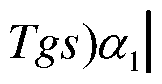
Ψ STABILISE = Tgs. Ψ STABILISE où Tgs est le paramètre de a ARD a 2RD réglage qui peut varier, si nécessaire, en fonction de la vitesse V.Ψ STABILIZED = Tgs. Ψ STABILIZED where Tgs is the parameter of a ARD has 2RD setting which can vary, if necessary, depending on the speed V.
Afin de rendre les parties transitoire et stabilisée indépendantes, on réalise la correction suivante sur α2transitoire a2 = a 2tramιtoιre ~ FF- (X1 où le gain « FF » est défini par la formule ci-dessous :In order to make the transient and stabilized parts independent, the following correction is made on α2transitoire a 2 = a 2tramιterre ~ FF- (X 1 where the gain "FF" is defined by the formula below:
(1 -(Tgs(V)). ( 1 +K3 (V))+Tgs(V). (Kl (V). Gψ+K2(V).Gβ2)+K2 (V) avec : V(1 - (Tgs (V)). (1 + K3 (V)) + Tgs (V). (K1 (V) .Gψ + K2 (V) .Gβ2) + K2 (V) with: V
Gψ =Gψ =
M(L1D1 - L1D1)M (L 1 D 1 - L 1 D 1 )
L LD, D,LD, D,
G, =GJk + h≡) βl { V LD1 ) G , = G Jk + h≡) β 1 (V LD 1 )
Ceci permet de garantir que α2stabihsé = ( l -Tgs).αiThis ensures that α 2s tabihsed = (l-Tgs) .αi
Si Tgs est égal à 1 , la réponse statique du véhicule n' est pas modifiée et donc identique à celle d'un véhicule à roues arrière non directrices. Une valeur du coefficient Tgs supérieure à 1 se traduit par une augmentation de la réponse statique du véhicule, tandis qu'une valeur inférieure à 1 se traduit par une diminution de la réponse statique du véhicule. On peut prévoir TgS= I , 2 pour une vitesse de 90 km/h, ce qui permet de rendre la réponse du véhicule plus directe et donc d' optimiser le passage d'un double changement de file.If Tgs is equal to 1, the static response of the vehicle is not modified and therefore identical to that of a non-steered rear wheel vehicle. A value of the Tgs coefficient greater than 1 results in an increase in the static response of the vehicle, while a value less than 1 results in a decrease in the static response of the vehicle. It is possible to provide TgS = I, 2 for a speed of 90 km / h, which makes the response of the vehicle more direct and thus to optimize the passage of a double change of lane.
L'unité de commande 1 1 se complète par un soustracteur 26, une sortie 27 et un retard unitaire 28. Le soustracteur 26 reçoit sur son entrée positive la sortie de commande α2-transitoire du bloc 24 et sur son entrée négative la sortie de commande α2-statique du bloc 25. La sortie du soustracteur 26 est reliée, d'une part, à la sortie générale 27 de l'unité de commande 1 1 , et, d' autre part, au retard unitaire 28 , dont la sortie est reliée à une entrée de l' observateur d' état 23 pour lui fournir l' angle de braquage des roues arrière à un instant précédent.The control unit 1 1 is completed by a subtracter 26, an output 27 and a unit delay 28. The subtractor 26 receives on its positive input the control output α2-transient of the block 24 and on its negative input the control output α2 -s tatique the block 25. the output of the subtractor 26 is connected, on the one hand, to the main output 27 of the control unit 1 1 and, on the other hand, the unit delay 28, the output is connected to an input of the state observer 23 to provide the steering angle of the rear wheels at a previous time.
Le système de commande de braquage de roues arrière présente une structure en boucle fermée au moyen d'un contrôleur permettant de modifier la dynamique du système et un gain permettant le réglage du gain statique, le tout variable en fonction de la vitesse.The rear wheel steering system has a closed-loop structure by means of a controller for modifying the dynamics of the system and a gain for adjusting the static gain, all of which varies with speed.
La stratégie de commande permet de régler la partie transitoire de la réponse latérale du véhicule à un coup de volant. En particulier, on peut régler la vitesse de la réponse ainsi que son amortissement. Le réglage final, fonction de la vitesse du véhicule, permet d' optimiser l' efficacité et la facilité de passage d'un double changement de file ou encore la manœuvre à basse vitesse.The control strategy adjusts the transient portion of the vehicle's lateral response to a steering wheel stroke. In particular, it is possible to adjust the speed of the response as well as its damping. The final adjustment, depending on the speed of the vehicle, makes it possible to optimize the efficiency and the ease of passage of a double change of lane or the maneuver at low speed.
La stratégie de commande permet de régler la partie statique de la réponse latérale du véhicule à un coup de volant. Le réglage final, fonction de la vitesse du véhicule, permet par exemple d' optimiser l' efficacité et la facilité de passage d'un double changement de file et/ou la manœuvre à basse vitesse.The control strategy adjusts the static portion of the vehicle's lateral response to a steering wheel stroke. The final adjustment, which is a function of the speed of the vehicle, makes it possible, for example, to optimize the efficiency and ease of passage of a double change of lane and / or the maneuver at low speed.
Les parties statique et dynamique de la réponse du véhicule peuvent faire l' objet d'un réglage indépendant. La structure en boucle fermée assure une excellente précision et une robustesse élevée. En variante, une structure en boucle ouverte peut être envisagée. En outre, il est possible de tenir compte de la dynamique de l' actionneur 9 des roues avant 3 et 4 et des actionneurs 19 et 20 des roues arrière 5 et 6. Le réglage des paramètres est rapide et intuitif, car lesdits paramètres sont liés aux performances minimales du véhicule, c' est-à-dire aux performances d'un véhicule à roues arrière non directrices. En effet, des paramètres de réglage égaux à 1 ne modifient pas le comportement du véhicule, alors que des paramètres de réglage supérieurs à 1 rendent le comportement plus vif et plus direct et vice-versa.The static and dynamic parts of the vehicle response can be adjusted independently. The closed loop structure ensures excellent accuracy and high robustness. Alternatively, an open loop structure can be envisaged. In addition, it is possible to take into account the dynamics of the actuator 9 of the front wheels 3 and 4 and the actuators 19 and 20 of the rear wheels 5 and 6. The setting of the parameters is fast and intuitive, since said parameters are linked. the minimum performance of the vehicle, that is to say the performance of a non-steered rear wheel vehicle. Indeed, setting parameters equal to 1 do not change the behavior of the vehicle, while setting parameters greater than 1 make the behavior more vivid and more direct and vice versa.
L'unité de commande 1 1 comprend un système de surveillance 29 de la partie statique α2-statique de la consigne. Un système de surveillance de la partie dynamique α2-dynamique de la consigne peut également être mis en œuvre. Le système de surveillance 29 peut se présenter sous la forme d'une partie logicielle stockée dans une mémoire rémanente de l'unité de commande 1 1 et exécutée par le microprocesseur de l'unité de commande 1 1 ou encore d'un microcircuit dédié associé au microprocesseur. Le système de surveillance 29 détermine si la partie statique α2-statique est conforme à un gabarit et émet une alarme en cas de franchissement du gabarit. L' alarme est transmise à un dispositif extérieur non représenté. Alternativement, l' alarme provoque une modification de la partie statique 012-statique en lui substituant la limite imposée par le gabarit.The 1 controller 1 comprises a monitoring system 29 of the static portion α2 -s tatique the setpoint. A part of the dynamic monitoring system of α 2- yn amic setpoint may also be implemented. The monitoring system 29 may be in the form of a software part stored in a non-volatile memory of the control unit 11 and executed by the microprocessor of the control unit 11 or a dedicated dedicated microcircuit. to the microprocessor. The monitoring system 29 determines whether the static portion α2 -satic state conforms to a template and emits an alarm when crossing the template. The alarm is transmitted to an external device not shown. Alternatively, the alarm causes a modification of the static part 012-static by substituting the limit imposed by the template.
Pour chaque vitesse, la consigne de braquage 012-statique nominale est calculée comme suit :For each speed, the nominal 012-static steering setpoint is calculated as follows:
a 2max si ^2NonSatur > α2max a2_STAT1QUEnominale = - a INonSatur si Uy > d et <a 2max if ^ 2NonSatur> α 2max has 2 _ nominal STAT1QUE = - a INonSatur if Uy> d and <
^2NonSatι r — ^"2max^ 2NonSatι r - ^ "2max
0 si Uy < d0 if Uy <d
avec α,2NonSatur = K( I -TgS)(Ot1-(I), voir figure 3 , où K est un facteur de forme qui vérifie O≤K≤ l , lequel est calculé en imposant une pente s au point oti=d, et d est une zone morte pour laquelle le braquage arrière est nul. α2max est une valeur plafond de la partie statique de la consigne.with α, 2NonSatur = K (I -TgS) (Ot 1 - (I), see Figure 3, where K is a form factor that satisfies O≤K≤ 1, which is computed by imposing a slope s at the point oti = d, and d is a dead zone for which the rear deflection is zero, α2max is a ceiling value of the static part of the setpoint.
Le paramètre Tgs est toujours positif et dépend uniquement de la vitesse. Si TgS= I , alors la consigne statique α2-statique=0, ce qui équivaut en régime permanent, une fois la vitesse de lacet stabilisée, à un véhicule 2 roues directrices.The Tgs parameter is always positive and depends only on the speed. If TgS = I, then the static setpoint -s tatique α2 = 0, which is equivalent in steady state, once the stabilized speed of yaw, in a vehicle two-wheel steering.
Dans la vérification de la consigne statique de braquage, le système de surveillance 29 contrôle séparément le signe et la valeur absolue de celle-ci.In the verification of the static steering setpoint, the monitoring system 29 separately controls the sign and the absolute value thereof.
Selon un premier mode de réalisation, on détermine le signe :According to a first embodiment, the sign is determined:
sign(α2 - statique)=sign(α i ) si 0<Tgs< l ( 1 ) sign(α2 - statique)=-sign(α i ) si Tgs> l (2) α2-statique≈0 Sl TgS= I (3)sign (α 2 - stat i que ) = sign (α i) if 0 <Tgs <l (1) sign (α 2 - stat i que ) = - sign (α i) if Tgs> l (2) α2- s tatic≈0 Sl TgS = I (3)
On signalera donc une erreur si l'une de ces trois relations n' est pas vérifiée.An error will be reported if one of these three relationships is not verified.
Afin de surveiller la valeur absolue de la consigne statique de braquage, le système de surveillance 29 établit les droites qui décrivent un majorant et un minorant de celle-ci.
Majorant :
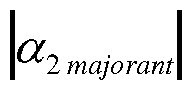
Minorant : |«2mmoraJ = |(1 -
Avec b l =-( l -Tgs)*d et b2 calculé de sorte que le minorant soit parallèle au maj orant et tangeant à la courbe minorée I ot2-statiquenominale | , voir figure 4.With b l = - (l-Tgs) * d and b2 calculated so that the lower bound is parallel to the major and tangent to the lower curve I ot2-statiquenominal | , see figure 4.
Ainsi, pour tout Tgs≠l , le système de surveillance 29 vérifie queThus, for any Tgs ≠ l, the monitoring system 29 verifies that
( 1 -TgS)(X1 I +b2< I α2-statique I ≤ I ( 1 -TgS)(X1 I +b l (6)(1 -TgS) (X 1 I + b 2 <I α 2 -satatic I ≤ I (1 -TgS) (X 1 I + bl (6)
et si Tgs≈l , le système de surveillance 29 vérifie que la consigne est petite :and if Tgs≈l, the monitoring system 29 verifies that the setpoint is small:
Ct2-statique I ≈0 (7)Ct2-static I ≈ 0 (7)
Le système de surveillance 29 signale une erreur quand un écart Δ prédéterminé par rapport à la valeur nominale fait que la consigne calculée est à l' extérieur du gabarit défini par le majorant et le minorant.The monitoring system 29 signals an error when a predetermined deviation Δ from the nominal value causes the calculated setpoint to be outside the template defined by the upper and lower bounds.
A titre indicatif, cette stratégie fonctionne bien dans environ 95% des situations réelles de conduite, si les écarts qu' il faut détecter sont ceux supérieurs à 0.3° . Par ailleurs, les situations restantes ont lieu pour des vitesses inférieures à 55 km/h, donc non dangereuses.As an indication, this strategy works well in about 95% of real driving situations, if the deviations that must be detected are those greater than 0.3 °. In addition, the remaining situations occur for speeds below 55 km / h, and therefore not dangerous.
Afin de mettre en œuvre cette stratégie à des fins sécuritaires, il est nécessaire de disposer en temps réel des informations fiables des angles de braquage des roues avant, de la vitesse véhicule, et de la valeur Tgs=f(V) sécurisée. Dans un deuxième mode de réalisation, on vise à s' affranchir de l' information Tgs=f(V), ce qui peut être utile dans les cas où cette information, qui doit être disponible en temps réel, n' est pas sécurisée.In order to implement this strategy for security purposes, it is necessary to have real-time reliable information of the steering angles of the front wheels, the vehicle speed, and the value Tgs = f (V) secure. In a second embodiment, it is intended to overcome the information Tgs = f (V), which may be useful in cases where this information, which must be available in real time, is not secured.
A sa place, sont utilisées les valeurs maximales et minimales de Tgs, ainsi que la vitesse pour laquelle Tgs change de signe. Pour chaque vitesse, le système de surveillance 29 établit le gabarit de la figure 5.In its place are used the maximum and minimum values of Tgs, as well as the speed for which Tgs changes sign. For each speed, the monitoring system 29 establishes the template of FIG.
Ainsi, si Tgs> l , le système de surveillance 29 vérifie queThus, if Tgs> l, the monitoring system 29 verifies that
0< I α2-statique I ≤ I ( 1 -Tgsmax)αi I (8)0 <I α 2-st ati q ue I ≤ I (1-Tgs max ) α i I (8)
Si 0<Tgs< l , le système de surveillance 29 vérifie queIf 0 <Tgs <l, the monitoring system 29 verifies that
0< I α2-statique I ≤ I ( 1 -TgSm1n)(X1 I (9)0 <I α 2 -satic I ≤ I (1 -TgSm 1n ) (X 1 I (9)
Si Tgs≈ l , le système de surveillance 29 vérifie que la consigne est petite :If Tgs≈ l, the monitoring system 29 verifies that the setpoint is small:
Ct2-statique I ≈0 ( 1 0)Ct2-static I ≈ 0 (1 0)
On considère que ai et V sont des informations sécurisées en entrée, mais on n' a plus besoin du paramètre Tgs=f(V) en temps réel et sécurisé pour mettre en œuvre cette stratégie de contrôle, puisque seules les valeurs Tgsmax et Tgsmm et la vitesse pour laquelle Tgs change de signe sont utilisées pour le calcul des gabarits.It is considered that ai and V are secure input information, but the parameter Tgs = f (V) in real time and secure is no longer needed to implement this control strategy, since only the values Tgs max and Tgs mm and the speed for which Tgs changes sign are used for the calculation of the templates.
Dans ce mode de réalisation, la vérification du signe de α2 est faite comme décrite précédemment pour le premier mode.In this embodiment, the verification of the sign of α 2 is done as previously described for the first mode.
Ce mode de réalisation est donc plus fruste et plus robuste. L ' invention offre une sécurité accrue de la consigne de braquage des roues arrière avec des moyens économiques. This embodiment is therefore more crude and more robust. The invention provides increased security of the steering set of the rear wheels with economical means.
Claims
Priority Applications (6)
| Application Number | Priority Date | Filing Date | Title |
|---|---|---|---|
| AT07766055T ATE473143T1 (en) | 2006-07-21 | 2007-05-16 | DEVICE AND METHOD FOR MONITORING THE TURN COMMAND TO A STEERED REAR WHEEL |
| CN2007800352140A CN101516716B (en) | 2006-07-21 | 2007-05-16 | Device and method for monitoring the turn command to a steered rear wheel |
| JP2009521303A JP5208110B2 (en) | 2006-07-21 | 2007-05-16 | Apparatus and method for monitoring turning command for rear steered wheel |
| EP07766055A EP2043901B1 (en) | 2006-07-21 | 2007-05-16 | Device and method for monitoring the turn command to a steered rear wheel |
| DE602007007621T DE602007007621D1 (en) | 2006-07-21 | 2007-05-16 | DEVICE AND METHOD FOR MONITORING THE ENTRY COMMAND TO A RECTED REAR WHEEL |
| US12/374,122 US8165755B2 (en) | 2006-07-21 | 2007-05-16 | Device and method for monitoring the turn command to a steered rear wheel |
Applications Claiming Priority (2)
| Application Number | Priority Date | Filing Date | Title |
|---|---|---|---|
| FR0606666A FR2903952B1 (en) | 2006-07-21 | 2006-07-21 | DEVICE AND METHOD FOR MONITORING CONTROL OF DIRECT REAR WHEEL BRAKE. |
| FR0606666 | 2006-07-21 |
Publications (1)
| Publication Number | Publication Date |
|---|---|
| WO2008009832A1 true WO2008009832A1 (en) | 2008-01-24 |
Family
ID=37832865
Family Applications (1)
| Application Number | Title | Priority Date | Filing Date |
|---|---|---|---|
| PCT/FR2007/051281 Ceased WO2008009832A1 (en) | 2006-07-21 | 2007-05-16 | Device and method for monitoring the turn command to a steered rear wheel |
Country Status (9)
| Country | Link |
|---|---|
| US (1) | US8165755B2 (en) |
| EP (1) | EP2043901B1 (en) |
| JP (1) | JP5208110B2 (en) |
| CN (1) | CN101516716B (en) |
| AT (1) | ATE473143T1 (en) |
| DE (1) | DE602007007621D1 (en) |
| ES (1) | ES2348631T3 (en) |
| FR (1) | FR2903952B1 (en) |
| WO (1) | WO2008009832A1 (en) |
Cited By (2)
| Publication number | Priority date | Publication date | Assignee | Title |
|---|---|---|---|---|
| CN102378713B (en) * | 2009-03-30 | 2013-11-06 | 沃尔沃拉斯特瓦格纳公司 | A steerable vehicle and a method for controlling the same |
| EP3964502A1 (en) | 2009-03-19 | 2022-03-09 | The Johns Hopkins University | Psma-targeting compounds and uses thereof |
Families Citing this family (5)
| Publication number | Priority date | Publication date | Assignee | Title |
|---|---|---|---|---|
| FR2916180B1 (en) * | 2007-05-14 | 2009-07-03 | Renault Sas | METHOD AND DEVICE FOR MANAGING A STEERING SETTING APPLIED TO AT LEAST ONE REAR WHEEL ROTATING ACTUATOR OF A MOTOR VEHICLE |
| EP2450668B1 (en) * | 2010-11-04 | 2014-01-15 | u-blox AG | A method for tracking the position and the heading of a vehicle using dead reckoning and a tracking device for carrying out the method |
| JP7077738B2 (en) * | 2018-04-11 | 2022-05-31 | 株式会社ジェイテクト | Four-wheel steering device |
| US11685434B2 (en) | 2021-01-11 | 2023-06-27 | Hyundai Mobis Co., Ltd. | Method for rear steering control of a vehicle |
| FR3132483B1 (en) * | 2022-02-09 | 2024-02-16 | Renault Sas | Method of guiding a motor vehicle. |
Citations (2)
| Publication number | Priority date | Publication date | Assignee | Title |
|---|---|---|---|---|
| EP0601588A1 (en) * | 1992-12-10 | 1994-06-15 | Mazda Motor Corporation | Four-wheel steering system for vehicle |
| FR2864001A1 (en) * | 2003-12-18 | 2005-06-24 | Renault Sas | METHOD AND SYSTEM FOR CONTROLLING THE DIRECT REAR WHEEL BRAKE AND CORRESPONDING VEHICLE |
Family Cites Families (16)
| Publication number | Priority date | Publication date | Assignee | Title |
|---|---|---|---|---|
| JPH0270577A (en) * | 1988-09-07 | 1990-03-09 | Nissan Motor Co Ltd | Integrated control device of auxiliary steering and differential limiting force |
| JP2900615B2 (en) * | 1991-02-01 | 1999-06-02 | 日産自動車株式会社 | Friction measuring device and load measuring device for motor steering unit |
| JPH04362478A (en) * | 1991-06-07 | 1992-12-15 | Mitsubishi Motors Corp | Four-wheel steering device for automobile |
| JPH05583U (en) * | 1991-06-21 | 1993-01-08 | 株式会社アツギユニシア | 4-wheel steering system |
| JP3001294B2 (en) * | 1991-07-10 | 2000-01-24 | マツダ株式会社 | Vehicle rear wheel steering system |
| DE4341636A1 (en) * | 1993-12-07 | 1995-06-08 | Zahnradfabrik Friedrichshafen | Vehicle with steerable front and rear wheels |
| DE69506741T2 (en) * | 1994-01-14 | 1999-09-02 | Matsushita Electric Industrial Co. | Steering angle control device |
| DE19634728C1 (en) * | 1996-08-28 | 1998-04-02 | Daimler Benz Ag | Vehicle steering |
| JPH10324264A (en) * | 1997-05-27 | 1998-12-08 | Mitsubishi Motors Corp | Rear wheel steering control device |
| DE19749005A1 (en) * | 1997-06-30 | 1999-01-07 | Bosch Gmbh Robert | Method and device for regulating movement variables representing vehicle movement |
| DE10212582B4 (en) * | 2002-03-15 | 2013-11-07 | Volkswagen Ag | Method and device for controlling the driving dynamics |
| JP4186605B2 (en) * | 2002-12-06 | 2008-11-26 | 日産自動車株式会社 | Steering angle control device for vehicle |
| US7584042B2 (en) * | 2004-05-13 | 2009-09-01 | Toyota Jidosha Kabushiki Kaisha | Vehicle running control device |
| JP2005335631A (en) * | 2004-05-28 | 2005-12-08 | Nissan Motor Co Ltd | Four-wheel steering control device |
| DE102004035004A1 (en) * | 2004-07-20 | 2006-02-16 | Bayerische Motoren Werke Ag | Method for increasing the driving stability of a motor vehicle |
| DE102004036565B4 (en) * | 2004-07-28 | 2008-12-18 | Robert Bosch Gmbh | Device and method for stabilizing a vehicle |
-
2006
- 2006-07-21 FR FR0606666A patent/FR2903952B1/en not_active Expired - Fee Related
-
2007
- 2007-05-16 EP EP07766055A patent/EP2043901B1/en not_active Not-in-force
- 2007-05-16 US US12/374,122 patent/US8165755B2/en not_active Expired - Fee Related
- 2007-05-16 ES ES07766055T patent/ES2348631T3/en active Active
- 2007-05-16 WO PCT/FR2007/051281 patent/WO2008009832A1/en not_active Ceased
- 2007-05-16 DE DE602007007621T patent/DE602007007621D1/en active Active
- 2007-05-16 CN CN2007800352140A patent/CN101516716B/en not_active Expired - Fee Related
- 2007-05-16 AT AT07766055T patent/ATE473143T1/en not_active IP Right Cessation
- 2007-05-16 JP JP2009521303A patent/JP5208110B2/en not_active Expired - Fee Related
Patent Citations (2)
| Publication number | Priority date | Publication date | Assignee | Title |
|---|---|---|---|---|
| EP0601588A1 (en) * | 1992-12-10 | 1994-06-15 | Mazda Motor Corporation | Four-wheel steering system for vehicle |
| FR2864001A1 (en) * | 2003-12-18 | 2005-06-24 | Renault Sas | METHOD AND SYSTEM FOR CONTROLLING THE DIRECT REAR WHEEL BRAKE AND CORRESPONDING VEHICLE |
Cited By (2)
| Publication number | Priority date | Publication date | Assignee | Title |
|---|---|---|---|---|
| EP3964502A1 (en) | 2009-03-19 | 2022-03-09 | The Johns Hopkins University | Psma-targeting compounds and uses thereof |
| CN102378713B (en) * | 2009-03-30 | 2013-11-06 | 沃尔沃拉斯特瓦格纳公司 | A steerable vehicle and a method for controlling the same |
Also Published As
| Publication number | Publication date |
|---|---|
| CN101516716A (en) | 2009-08-26 |
| CN101516716B (en) | 2012-05-30 |
| ATE473143T1 (en) | 2010-07-15 |
| US8165755B2 (en) | 2012-04-24 |
| FR2903952A1 (en) | 2008-01-25 |
| JP5208110B2 (en) | 2013-06-12 |
| JP2009544519A (en) | 2009-12-17 |
| DE602007007621D1 (en) | 2010-08-19 |
| FR2903952B1 (en) | 2009-06-12 |
| US20090326762A1 (en) | 2009-12-31 |
| EP2043901B1 (en) | 2010-07-07 |
| EP2043901A1 (en) | 2009-04-08 |
| ES2348631T3 (en) | 2010-12-10 |
Similar Documents
| Publication | Publication Date | Title |
|---|---|---|
| EP4037947B1 (en) | Control device for a self-driving motor vehicle | |
| EP2043901B1 (en) | Device and method for monitoring the turn command to a steered rear wheel | |
| WO2014006327A1 (en) | Device and method for controlling the trajectory of a vehicle | |
| EP1544080B1 (en) | Rear wheel steering angle control system and method and corresponding vehicle | |
| FR2864003A1 (en) | METHOD AND SYSTEM FOR CONTROLLING THE DIRECT REAR WHEEL BRAKE AND CORRESPONDING VEHICLE | |
| FR2880859A1 (en) | METHOD FOR CONTROLLING THE ORIENTATION OF THE REAR WHEELS OF A VEHICLE | |
| EP1901933B1 (en) | Anti-rolling method and system for a vehicle and corresponding vehicle | |
| FR3092914A1 (en) | Method for determining the trajectory of a vehicle comprising four steered wheels | |
| FR2878220A1 (en) | SYSTEM AND METHOD FOR CONTROLLING THE ROTATING ANGLE OF THE STEERING WHEELS OF A MOTOR VEHICLE | |
| EP2027004B1 (en) | Process and control system for vehicle steering wheel | |
| EP2656107B1 (en) | Method of supervising a function for aiding the following of a traffic lane comprising two lines | |
| EP2032415B1 (en) | Method and system for controlling the steering of a steered rear wheel and corresponding vehicle | |
| WO2007071853A1 (en) | Anti-roll device for vehicles | |
| FR2864002A1 (en) | METHOD AND SYSTEM FOR CONTROLLING THE DIRECT REAR WHEEL BRAKE AND CORRESPONDING VEHICLE | |
| FR2895349A1 (en) | METHOD AND SYSTEM FOR DRIVING A FRONT OR REVERSIBLE ACTIVE BODY DEVICE FOR A MOTOR VEHICLE. | |
| WO2008107613A1 (en) | System and method for open loop control of an active anti-roll system by characterizing the yaw rate of a vehicle based on a nonlinear two-wheel model | |
| FR2914258A1 (en) | SYSTEM AND METHOD FOR CONTROLLING A DECOUPLE BRAKE DEVICE OF A MOTOR VEHICLE. | |
| FR2896753A1 (en) | Torque variation compensating method for vehicle, involves developing compensation torque set point according to displacement data and camber set point, and sending torque set point to actuator that exerts torque on steering wheel | |
| FR2968628A1 (en) | Method for controlling traffic lane monitoring assistance function using steering system of motor vehicle, involves calculating assistance torque, and adding base angle regulation torque and assistance torque to obtain set point torque | |
| FR2931437A1 (en) | METHOD FOR CONTROLLING TURNING OF A CHENILLE OR NON-STEERING VEHICLE AND DEVICE IMPLEMENTING SUCH A METHOD | |
| FR2895721A1 (en) | METHOD FOR CONTROLLING THE FRONT OR REAR WHEEL BODY OF A MOTOR VEHICLE EQUIPPED WITH PILOT BRAKING AND SYSTEM FOR IMPLEMENTING THE SAME | |
| FR2888194A1 (en) | METHOD AND SYSTEM FOR ACTIVE BODY CONTROL AND VEHICLE THUS EQUIPPED | |
| FR2981035A1 (en) | DEVICE AND METHOD FOR INCREASING THE OPERATING SAFETY OF A PARKING MANEUVER SYSTEM |
Legal Events
| Date | Code | Title | Description |
|---|---|---|---|
| WWE | Wipo information: entry into national phase |
Ref document number: 200780035214.0 Country of ref document: CN |
|
| 121 | Ep: the epo has been informed by wipo that ep was designated in this application |
Ref document number: 07766055 Country of ref document: EP Kind code of ref document: A1 |
|
| WWE | Wipo information: entry into national phase |
Ref document number: 2007766055 Country of ref document: EP |
|
| WWE | Wipo information: entry into national phase |
Ref document number: 2009521303 Country of ref document: JP |
|
| NENP | Non-entry into the national phase |
Ref country code: DE |
|
| NENP | Non-entry into the national phase |
Ref country code: RU |
|
| WWE | Wipo information: entry into national phase |
Ref document number: 12374122 Country of ref document: US |