WO2007115473A1 - Pyrrole derivatives inhibitors, their curative uses - Google Patents
Pyrrole derivatives inhibitors, their curative uses Download PDFInfo
- Publication number
- WO2007115473A1 WO2007115473A1 PCT/CN2007/000980 CN2007000980W WO2007115473A1 WO 2007115473 A1 WO2007115473 A1 WO 2007115473A1 CN 2007000980 W CN2007000980 W CN 2007000980W WO 2007115473 A1 WO2007115473 A1 WO 2007115473A1
- Authority
- WO
- WIPO (PCT)
- Prior art keywords
- group
- methyl
- pyrrole
- cancer
- ethyl
- Prior art date
- Legal status (The legal status is an assumption and is not a legal conclusion. Google has not performed a legal analysis and makes no representation as to the accuracy of the status listed.)
- Ceased
Links
Classifications
-
- C—CHEMISTRY; METALLURGY
- C07—ORGANIC CHEMISTRY
- C07D—HETEROCYCLIC COMPOUNDS
- C07D487/00—Heterocyclic compounds containing nitrogen atoms as the only ring hetero atoms in the condensed system, not provided for by groups C07D451/00 - C07D477/00
- C07D487/02—Heterocyclic compounds containing nitrogen atoms as the only ring hetero atoms in the condensed system, not provided for by groups C07D451/00 - C07D477/00 in which the condensed system contains two hetero rings
- C07D487/04—Ortho-condensed systems
-
- A—HUMAN NECESSITIES
- A61—MEDICAL OR VETERINARY SCIENCE; HYGIENE
- A61P—SPECIFIC THERAPEUTIC ACTIVITY OF CHEMICAL COMPOUNDS OR MEDICINAL PREPARATIONS
- A61P17/00—Drugs for dermatological disorders
- A61P17/06—Antipsoriatics
-
- A—HUMAN NECESSITIES
- A61—MEDICAL OR VETERINARY SCIENCE; HYGIENE
- A61P—SPECIFIC THERAPEUTIC ACTIVITY OF CHEMICAL COMPOUNDS OR MEDICINAL PREPARATIONS
- A61P19/00—Drugs for skeletal disorders
- A61P19/02—Drugs for skeletal disorders for joint disorders, e.g. arthritis, arthrosis
-
- A—HUMAN NECESSITIES
- A61—MEDICAL OR VETERINARY SCIENCE; HYGIENE
- A61P—SPECIFIC THERAPEUTIC ACTIVITY OF CHEMICAL COMPOUNDS OR MEDICINAL PREPARATIONS
- A61P29/00—Non-central analgesic, antipyretic or antiinflammatory agents, e.g. antirheumatic agents; Non-steroidal antiinflammatory drugs [NSAID]
-
- A—HUMAN NECESSITIES
- A61—MEDICAL OR VETERINARY SCIENCE; HYGIENE
- A61P—SPECIFIC THERAPEUTIC ACTIVITY OF CHEMICAL COMPOUNDS OR MEDICINAL PREPARATIONS
- A61P3/00—Drugs for disorders of the metabolism
- A61P3/08—Drugs for disorders of the metabolism for glucose homeostasis
- A61P3/10—Drugs for disorders of the metabolism for glucose homeostasis for hyperglycaemia, e.g. antidiabetics
-
- A—HUMAN NECESSITIES
- A61—MEDICAL OR VETERINARY SCIENCE; HYGIENE
- A61P—SPECIFIC THERAPEUTIC ACTIVITY OF CHEMICAL COMPOUNDS OR MEDICINAL PREPARATIONS
- A61P35/00—Antineoplastic agents
-
- A—HUMAN NECESSITIES
- A61—MEDICAL OR VETERINARY SCIENCE; HYGIENE
- A61P—SPECIFIC THERAPEUTIC ACTIVITY OF CHEMICAL COMPOUNDS OR MEDICINAL PREPARATIONS
- A61P43/00—Drugs for specific purposes, not provided for in groups A61P1/00-A61P41/00
-
- A—HUMAN NECESSITIES
- A61—MEDICAL OR VETERINARY SCIENCE; HYGIENE
- A61P—SPECIFIC THERAPEUTIC ACTIVITY OF CHEMICAL COMPOUNDS OR MEDICINAL PREPARATIONS
- A61P7/00—Drugs for disorders of the blood or the extracellular fluid
-
- A—HUMAN NECESSITIES
- A61—MEDICAL OR VETERINARY SCIENCE; HYGIENE
- A61P—SPECIFIC THERAPEUTIC ACTIVITY OF CHEMICAL COMPOUNDS OR MEDICINAL PREPARATIONS
- A61P9/00—Drugs for disorders of the cardiovascular system
Definitions
- the present invention relates to a novel 2-acetamido-3-carbomethoxy-5(6,7-dihydro-6-oxo-4-aryl) Aminopyrrole[2,3-d]pyrimidin-5-ylidene)methyl-1H-pyrrole derivatives, processes for their preparation and pharmaceutical compositions containing them and their use as therapeutic agents, in particular as protein kinase inhibitors use.
- BACKGROUND OF THE INVENTION Signal transduction of cells is a basic mechanism of action. During signal transduction, extracellular stimuli are transmitted to the interior of cells, thereby regulating the progression of different cells.
- Protein kinases are enzymes that catalyze the phosphorylation of hydroxyl groups on tyrosine, serine, and threonine residues of proteins.
- the reverse mechanism of protein kinases and phosphorylating enzymes balances and regulates signal flow during signaling.
- a protein phosphorylation state can affect its conformation, enzyme activity, cell localization, and the corresponding roles of protein kinases and phosphatases are modified.
- Phosphorylation is an important regulatory mechanism in signal transduction, and abnormalities during signal transduction. Lead to abnormal differentiation, transformation and growth of cells.
- a cell can become a cancer cell by converting a portion of its DNA into an oncogene, a growth factor receptor protein encoded by such an oncogene; a tyrosine kinase can also be mutated into an activated form resulting in a variety of Human cell variation, it can be said that over-expressed normal tyrosine kinase can cause abnormal cell proliferation.
- Tyrosine kinases can be conveniently divided into two classes: protein tyrosine kinases (FTKs) and serine-threonine kinases (STKs). PTKs phosphorylate tyrosine residues on proteins, and STKs phosphorylate serine and threonine residues on proteins. Tyrosine kinases can be not only receptor type (including extracellular domain, intracellular domain and transmembrane cell domain) but also non-receptor type (including all intracellular domains). A major aspect of PTK activity is that they are involved as cell surface protein growth factor receptors.
- RTKs receptor tyrosine kinases
- 90 tyrosine kinases are recognized in human genes, of which about 60 are receptor types and about 30 are non-receptive.
- the growth factor receptor family can be further divided into 20 receptor tyrosine kinase subfamilies and 10 non-receptor tyrosine kinase subfamilies (Robinson et al, Oncogene. 2000, 19, 5548-5557).
- the RTKs subfamily includes the following: (1) EGF families, such as EGF, TGFa, Neu and erbB; (2) Insulin family, including insulin receptor, insulin-like growth factor I receptor (IGF1) and insulin receptor-related Sex receptors (IRR); (3) family 111, such as platelet-derived growth factor receptor (PDGF, including PDGFa and PDGFp receptors), stem cell factor RTKs (SCF RTK, commonly referred to as c-Kit), fms- Related tyrosine kinase 3 (FIt3) receptor tyrosine kinase and colony hedgehog factor 1 receptor (CSF-1R) tyrosine kinase and the like.
- EGF families such as EGF, TGFa, Neu and erbB
- Insulin family including insulin receptor, insulin-like growth factor I receptor (IGF1) and insulin receptor-related Sex receptors (IRR)
- family 111 such as platelet-derived growth factor receptor (PDGF, including PDGFa
- a portion of the non-limiting kinases include Abl, ARaf, ATK, ATM, bcr-abl, Blk, BRaf, Brk, Btk, CD 1 , CDK2, CDK3, CDK4, CDK5, CDK6, CDK7, CDK8, CD 9, CHK, AuroraA, AuroraB, AviroraC, cfms, c-fms, c-Kit, c-Met, cRafl, CSF1R, CSK, c-Src, EGFR, ErbB2, ErbB3, ErbB4, ERK, ERK1, ERK2, Fak, fes, FGF 1, FGFR2 , FGFR3, FGFR4, FGFR5, Fgr, FLK-4, Fps
- PKs are thought to be associated with central nervous system diseases such as Alzheimer's disease (see Mandelkow, EM et al. FEBS L ⁇ tt. 1992, 314, 315; Sengupta, A. et al. Mol. Cell. Biochem. 1997, 167, 99) ⁇ Pain (See Yashpal, . J. Neurosci. 1995, 15, 3263-72), inflammation such as arthritis (see Badger, J. Pharmn Exp. Titer. 1996, 279, 1453), psoriasis (see Dvir, et al., J. Cell) Biol.
- central nervous system diseases such as Alzheimer's disease (see Mandelkow, EM et al. FEBS L ⁇ tt. 1992, 314, 315; Sengupta, A. et al. Mol. Cell. Biochem. 1997, 167, 99) ⁇ Pain (See Yashpal, . J. Neurosci. 1995, 15, 3263-72), inflammation such as arthritis (see Badger
- osteoporosis see Taka et al, Nature, 1996, 383, 528
- cancer see Hunter and Pines, Cell 1994, 79, 573
- atherosclerosis see Hajjar and Pomerantz, FASEB J. 1992, 6, 2933
- thrombosis see Salari, FEBS 1990, 263, 104
- metabolic disorders such as diabetes (see Borthwick, AC et al. Biochem. Biophys. Res. Commun. 1995, 210, 738)
- Angiogenic diseases such as angiogenesis (see Strawn et al. Cancer Res. 1996, 56, 3540; Jackson et al J Pharm. Exp. Ther.
- PTKs signaling specific growth factors (ligands) interact extracellularly, followed by receptor dimerization, which activates the intrinsic activity of protein kinases and phosphorylates.
- the binding site of the internal signaling molecule is generated to form a complex with the cytoplasmic signaling molecule, which promotes various cellular responses such as cell division (proliferation) and expression of extracellular microenvironment metabolism.
- the binding site for phosphorylation of the receptor tyrosine kinase is also a binding site with a high affinity for the SH2 (synchronous to src) domain of the signaling molecule.
- Many intracellular substrate proteins associated with receptor tyrosine kinases have been Determined, can be divided into two categories: (1) there is a catalytic zone substrate (2) no catalytic zone substrate, but can be used as a combination, and related to some catalytically active molecules.
- the specificity of the interaction of a receptor or protein with the substrate SH2 domain is determined by the amino acid sequence near the phosphorylated tyrosine residue, the amino acid sequence surrounding the SH2 domain and the phosphorylated tyrosine sequence and the specific receptor The difference in binding is consistent with the difference in substrate phosphorylation.
- Protein tyrosine kinase function can be determined by expression pattern and ligand availability, and can also be determined by downstream region signaling pathways activated by specific receptors. Thus, phosphorylation provides an important, regulatable step that determines the selectivity of signaling and the differentiation factor receptor that is activated by a particular receptor. Abnormal expression or mutation of a receptor tyrosine kinase may result in uncontrolled cell proliferation (such as malignant tumor growth) or loss of key developmental processes.
- Tyrosine kinase in most human tumors, such as leukemia, breast cancer, prostate cancer, non-small cell lung cancer (including adenocarcinoma, lung squamous cell carcinoma), gastrointestinal cancer (including colon cancer, rectal cancer, and gastric cancer)
- non-small cell lung cancer including adenocarcinoma, lung squamous cell carcinoma
- gastrointestinal cancer including colon cancer, rectal cancer, and gastric cancer
- cancers such as bladder cancer, esophageal cancer, ovarian cancer, and pancreatic cancer.
- mutations or overexpression may occur.
- the broadness and relevance of tyrosine kinases have been further confirmed by detection of human tumor cells.
- EGFR tyrosine kinase is mutated and overexpressed.
- the "HER” or "Erb” receptor tyrosine kinase subfamily includes EGFR, HER2, HER3 and HER4. These subfamilies consist of an extracellular glycosylation ligand binding domain, a transmembrane domain, and an intracellular cytoplasmic catalytic domain that phosphorylates the tyrosine sequence on the protein.
- the receptor tyrosine kinase catalytic activity can be activated by receptor overexpression or ligand-mediated dimerization.
- the HER2 family of polymers has both homodimers and heterodimers.
- homodimerization is the polymerization of HER1 (EGFR) with EGF family ligands (including EGF, transforming growth factor a, betacellulin, heparin-binding EGF, epiregulin), between four HER tyrosine kinases.
- EGF EGF family ligands
- the heterodimerization can be accelerated by binding to the heregulin (also known as neuregulin) family of ligands.
- the receptors for HER3 is not enzymatically active, heterodimerization of HER2 with HER3, or HER3 and HER4, can also significantly stimulate tyrosine kinase receptor dimerization. In various cell types, receptor overexpression activates the activity of HER2 kinase.
- MAP kinases microtubule-associated protein kinases
- PI3 kinase phosphatidylinosides Alcohol
- RTK insulin receptor
- IGF-1R insulin-like growth factor-1 receptor
- IRR insulin receptor-associated receptor
- IGF-1R interacts with insulin, IGF-I and IGF-II, resulting from two fully extracellular glycosylated alpha subunits and two tyrosine kinase domain beta subunits that cross the cell membrane Heterotetramer.
- the third subgroup of RTK refers to the platelet-derived growth factor receptor (PDGFR) family, including PDGFRct, PDGFR, CSFIR, c-Kit and c-fms. These receptors are composed of a variety of immunoglobulin-like cyclic glycosylated extracellular domains and an extracellular domain, in which the tyrosine kinase domain in the intracellular domain is blocked by an unrelated amino acid sequence. Broken.
- PDGFRct platelet-derived growth factor receptor
- Platelet-derived growth factor receptors such as PDGFRa and PDGFRp are also transmembrane tyrosine kinase receptors. When they are combined with a ligand, either a homodimer (PDGF-AA, PDGF-BB), or a heterodimer (PDGF-AB) is formed. Subsequent receptor dimerization, tyrosine kinase is activated, signaling downstream regions to promote tumor growth. Mutations in genes are responsible for receptors that are not dependent on binding to ligands and are a driving force for tumorigenesis.
- c-Kit is a member of the PDGF receptor family and is activated when it binds to the ligand SCF (stem cell factor:).
- SCF stem cell factor
- the c-Kit expression pattern was studied in various solid tumors, and c-Kit was overexpressed in sarcoma, gastrointestinal glioma (GIST), seminoma and carcinoid tumors. [See Weber et al, J. Clin. Oncol. 22 (14S), 9642 (2004)].
- GIST is a non-epithelial cell tumor, most of which is found in the stomach, a few in the small intestine, rarely in the esophagus, but also in the liver, peritoneal cavity and other parts.
- GIST is derived from Cajal interstitial cells (ICC), which can form part of the intestinal autonomic nervous system and participate in the control of gastric motility. Most (50 ⁇ 80%) GIST production is due to mutation of c-Kit gene. In the digestive tract, c-Kit/CD117 staining is generally GIST, and c-Kit mutation can make it independent of SCF activation. c-Kit function, resulting in increased cell division rate, leading to instability of the genome.
- ICC Cajal interstitial cells
- c-Kit expression can also be detected, and c-Kit expression is also found in acute AML and malignant lymphoma, in small cells. Bronchial carcinoma, seminoma, dysgerminoma, testis, intraepithelial neoplasia, melanoma, breast cancer, neuroblastoma, Ewing's sarcoma have c-Kit expression (see Schutte et al" innovartis 3/ 2001). It is well known that RET (rearranged during transfection;).
- Proto-oncogene point genetic mutation is tumorigenic, patients with multiple endocrine neoplasia 2 (MEN 2) may cause pheochromocytoma, thyroid marrow Diseases such as carcinoma and parathyroid adenoma and hyperplasia (see Huang et al., Cancer Res. 60, 6223-6 (2000)).
- MEN 2 multiple endocrine neoplasia 2
- fetal liver kinase (Flk) receptor subfamily is very similar to the PDGFR subfamily, it is sometimes attributed to this family.
- This subfamily consists of a kinase-containing insertion domain-receptor fetal liver kinase-1 (KDR/FLK-1, VEGFR2), Flk-1R, Flk-4 and fms-like tyrosine kinase 1 CFlt-1).
- FGF fibroblast growth factor
- This subfamily consists of four receptors, FGFR1-4, seven ligands and FGF1-7. Although not yet determined, these receptors are composed of an extracellular domain comprising various immunoglobulin-like circular glycosylation and an intracellular domain in which the tyrosine kinase sequence is blocked by an unrelated amino acid sequence.
- VEGF vascular endothelial growth factor
- PDGF vascular endothelial growth factor
- VEGFR is involved in angiogenesis and inhibits angiogenesis by inhibiting VEGFRs. It is being used in clinical treatment of tumors and has achieved good results.
- VEGF is strongly expressed in various malignant solid tumors such as lung cancer, breast cancer, non-Hodgkin's malignant lymphoma, ovarian cancer, pancreatic cancer, malignant pleural mesothelioma, and melanoma, and is associated with the progression of cancer, in white blood cells.
- VEGFR vascular endothelial growth factor
- VEGF vascular endothelial growth factor
- PDGF vascular endothelial growth factor
- vascular endothelial cells activates angiogenesis and has been shown to stimulate the production of vascular endothelial cells in vivo.
- Some peptides have been identified, including acidic, basic fibroblast growth factors (aFGF and bFGF) and vascular endothelial growth factor. Due to the restricted expression of the VEGF receptor, its growth factor activity is relatively specific to endothelial cells compared to aFGF and bFGF activity. Recent evidence suggests that VEGF is a very important stimulator during angiogenesis and vascular infiltration in both normal and pathological conditions.
- VEGF can induce vascular sprouting phenotype, which induces endothelial cell proliferation, protease expression and migration to promote capillary formation, thereby forming a super-osmotic, immature vascular network, which is a typical characteristic of pathological angiogenesis. It is expected that antagonizing VEGF activity can be of value in the treatment of diseases associated with angiogenesis or vascular permeability, such as tumors, particularly tumor growth inhibition.
- FLT3 Fms-like tyrosine kinase
- PTK tyrosine kinase
- AML acute myeloid leukemia
- MMT tyrosine kinase
- myelodysplastic syndrome In many cases, the FLT3 gene is abnormally expressed. In 35 % of patients with acute myeloid leukemia, FLT3 mutations are activated and the prognosis is poor. Most of the mutations have intrastructural replication in the proximal membrane domain, and 5-10% of patients have a point mutation in asparagine 835.
- FLT3 The tyrosine kinase activity of FLT3 is activated, resulting in the presence of a signal and proliferation in the absence of a ligand. According to the study, patients with mutant form of receptor expression are less likely to be cured. In conclusion, in human leukemia and myelodysplastic syndromes, FLT3 mutations are associated with tumorigenesis.
- Hepatocyte growth factor (HGF) receptor (c-MET or HGFR) tyrosine kinases have been shown to be closely associated with tumorigenesis, cell motility, invasion and metastasis (see Ma, PC et al. (2003b). Cancer Metastasis Rev, 22, 309-25; Maulik, G. et al. (2002b). Cytokine Growth Factor Rev, 13, 41-59). Overexpression or mutation in various tumors, including small cell lung cancer (SCLC), activates C-MET (HGFR) (see Ma, P.C. et al. (2003a). Cancer Res, 63, 6272-6281).
- SCLC small cell lung cancer
- the proto-oncogene c-Met encodes a hepatocyte growth factor receptor, which is a membrane prion protein with tyrosine kinase activity, which has important physiological regulation effects on various cell proliferation and differentiation.
- the c-met gene has been used in many malignant tumors. Expression is an important factor in the carcinogenesis of thyroid follicular epithelial cells and is closely related to the pathological stage, invasion and metastasis of thyroid cancer. W.
- PKT subfamily Plowman et al. are described in more detail in DN & P 7(6): 334-339 (1994), which is incorporated herein by reference in its entirety.
- CTK receptor tyrosine kinase inhibitors
- STKs serine-threonine kinases or STKs are dominant in the cell, although there are only a few STK-type receptor kinases.
- STKs are the most prevalent cytosolic kinases, ie, they function in part of the cytoplasm, not in cytoplasmic organelles.
- the cytosol is a region within the cell where metabolic and biosynthetic activities occur in most cells; for example, proteins are synthesized on cytosol ribosomes.
- the present invention relates to novel 2-acetamido-3-carbomethoxy-5(6,7-dihydro-6-oxo-4-arylaminopyrrole[2,3-d]pyrimidine-5- Subunit)methyl-1H-pyrrole derivatives, which are represented by the following formula (I):
- X is selected from W(CH 2 ), (CH 2 )W or W, wherein W is 0, S, SO or S0 2 ; or X is -NR 6 , wherein R 6 is a hydrogen atom or an alkyl group;
- Y is an oxygen atom or a hydrogen atom
- R 6 may form a 4 to 8 membered heterocyclic group; wherein the 5 to 8 membered heterocyclic ring may contain one or more atoms of ⁇ , 0 or S, And the 4 to 8 membered heterocyclic ring may be further selected from one or more selected from the group consisting of fluorenyl, halogen, aryl, heteroaryl, haloalkyl, haloalkoxy, hydroxy, amino, alkylamino, amide, aminyl, cyanide Substituted by a substituent of a group, an alkoxy group, an aryloxy group, an amine group, a hydroxyalkyl group, a heterocycloalkyl group, a carboxylic acid, a carboxylic acid ester or -NR 7 R 8 ;
- aryl, arylalkyl or heteroarylalkyl group may be further selected from one or more selected from the group consisting of alkyl, halogen, aryl, hydroxy, amino, guanidino, amide, aminyl, alkoxy, aryloxy, hetero Substituted by a cycloalkyl group, a carboxylic acid, a carboxylic acid ester or a substituent of -NR 7 R 8 ; wherein the aryl, heteroaryl, arylalkyl or heteroarylalkyl group may
- R 3 is selected from a hydrogen atom, a fluorenyl group, an aryl group, a halogen-substituted aryl group or a trifluoromethyl group;
- R 5 is selected from the group consisting of hydroxyl, alkoxy, aryloxy, heterocycloalkoxy, aralkyloxy, -N(R 7 )(CH 2 ) n R 8 , -NR 7 [CH 2 CH 2 0] n R 8 or -NR 6 (C3 ⁇ 4) n [CH(OH)CH 2 ] r Z (wherein Z is aryl, heteroaryl, heterocycloalkyl, -NR 7 R 8 , -COOR 6 or CONR 7 R 8 ) ;
- R 6 is a hydrogen atom or an alkyl group
- R 7 and R 8 are each independently selected from a hydrogen atom, an alkyl group, a cycloalkyl group, a heterocycloalkyl group, an aryl group, a heteroaryl group or a heteroarylalkyl group, wherein the alkyl group, the cycloalkyl group, the heterocyclic fluorenyl group Or an aryl, heteroaryl or heteroaryl group may be further substituted by one or more alkyl, halogen, aryl, hydroxy, amino, alkylamino, amide, aminyl Substituted with a cyano group, a cyano group, an alkoxy group, an aryloxy group, an amine alkyl group, a hydroxyalkyl group, a heterocycloalkyl group, a carboxylic acid, a carboxylic acid ester or -NR 7 R 8 ;
- R 7 and may form a 4 to 8 membered heterocyclic group; wherein the 5 to 8 membered heterocyclic ring may contain one or more N, 0 or S atoms, and the 4 to 8 membered heterocyclic ring may be further subjected to one or a plurality of alkyl, halogen, aryl, heteroaryl, haloalkyl, haloalkoxy, hydroxy, amino, amide, aminyl, cyano, alkoxy, aryloxy, amidino, hydroxyalkyl Substituted by a heterocycloalkyl group, a carboxylic acid, a carboxylic acid ester or -NR 7 .
- n 0 ⁇ 6
- r is 1 to 2.
- X is -NH, a hydrogen atom, an alkyl group, a cycloalkyl group, a heterocycloalkyl group, an aryl group, a heteroaryl group, An aralkyl or heteroarylalkyl group, wherein the alkyl, cycloalkyl, heterocycloalkyl, aryl, heteroaryl, aralkyl or heteroaryl group may be further protected by one or more fluorenyl, halogen, aromatic Substituted by a hydroxy group, an amino group, an alkylamino group, an amide group, an aminoacyl group, an alkoxy group, an aryloxy group, a heterocycloalkyl group, a carboxylic acid or a carboxylic acid ester.
- Y is an oxygen atom.
- the compound of the formula I-lc is subjected to selective hydrolysis of a lithium hydroxide solution at room temperature to obtain a compound of the formula I-ld.
- the compound of the formula (I) of the present invention or a salt thereof comprises:
- a pharmaceutical composition comprising a compound of the formula (I) according to the invention or a pharmaceutically acceptable salt or prodrug thereof And a pharmaceutically acceptable carrier.
- a method of modulating protein kinase catalytic activity comprising contacting a protein kinase with a compound of formula (I) or a pharmaceutically acceptable salt of the invention.
- This protein kinase is selected from the group consisting of a receptor tyrosine kinase, a non-receptor tyrosine kinase, and a serine-threonine kinase.
- the pharmaceutically acceptable salt of the present invention is a salt of the compound of the present invention and a compound with an acid selected from the group consisting of malic acid, lactic acid, maleic acid, hydrochloric acid, methanesulfonic acid, sulfuric acid, phosphoric acid, citric acid , tartaric acid, acetic acid or trifluoroacetic acid.
- a method of treating or preventing a mammal associated with a protein kinase comprising administering to the mammal a therapeutically effective amount of a pharmaceutical composition of the invention, the composition comprising a compound of the invention or A pharmaceutically acceptable salt thereof, and a pharmaceutically acceptable carrier or excipient.
- the disease associated with protein kinases is selected from the group consisting of VEGFR-2, EGFR, HER-2, HER-3, HER-4, PDGFR, c-Kit, c-Met, FGFR, Flt3 related diseases.
- Diseases associated with protein kinases can also be leukemia, diabetes, autoimmune diseases, hyperproliferative diseases, psoriasis, osteoarthritis, rheumatoid arthritis, angiogenesis, cardiovascular disease, Von-Heppd-Lindau's disease, inflammation, Fibrosis disease.
- the disease can also be squamous cell carcinoma, renal cell carcinoma, Kaposi sarcoma, non-small cell lung cancer, small cell lung cancer, lymphoma, thyroid cancer, breast cancer, head and neck cancer, uterine cancer, esophageal cancer, melanoma, bladder. Cancer, genitourinary cancer, gastrointestinal cancer, glial cancer, colorectal cancer and ovarian cancer.
- the mammal is a human.
- the method of the above-mentioned mammal for treating or preventing a protein kinase-related disease comprises simultaneously administering to a mammal in need of treatment a therapeutically effective amount of another selected from the group consisting of taxol Or carboplatin anticancer drugs.
- the mammal is preferably a human.
- Another aspect of the invention relates to the use of a compound of the invention in the manufacture of a medicament for the treatment of a disease associated with a protein kinase.
- the protein kinase-associated disease is selected from the group consisting of a disease associated with VEGFR-2, EGFR, HER-2, HER-3, HER-4, PDGFR, c-Kit, c-Met, FGFR or Flt3;
- the protein kinase-related disease is selected from the group consisting of leukemia, diabetes, autoimmune disease, hyperproliferative disease, psoriasis, osteoarthritis, rheumatoid arthritis, angiogenesis, cardiovascular disease, Von-Heppel-Lindau's disease , inflammation or fibrosis; or the protein kinase-related disease is cancer, selected from the group consisting of squamous cell carcinoma, renal cell carcinoma, Kaposi sarcoma, non-small cell lung cancer, small cell lung cancer, lymphoma, thyroid cancer, breast cancer, Head and neck cancer, uterine cancer, esophageal cancer, melanoma, bladder cancer, genitourinary cancer
- the I-lc compound is subjected to selective hydrolysis of an alkali metal hydroxide solution, preferably a lithium hydroxide solution, at room temperature to obtain a compound of the formula I-ld;
- an alkali metal hydroxide solution preferably a lithium hydroxide solution
- the I-lf compound is subjected to formylation with phosphorus oxychloride in an anhydrous system to obtain a compound of the formula I-lg;
- X is selected from W(CH 2 ), (CH 2 )W or W, wherein W is 0, S, SO or S0 2 ; or X is -NR 6 ; wherein is a hydrogen atom or an alkyl group;
- R 6 may form a 4 to 8 membered heterocyclic group; wherein the 5 to 8 membered heterocyclic ring may contain one or more N, 0 or S atoms, and The 4 to 8 membered heterocyclic ring may be further substituted with one or more alkyl groups, halogens, aryl groups, heteroaryl groups, haloalkyl groups, haloalkoxy groups, hydroxyl groups, Substituted with amino, alkylamino, amido, aminoacyl, cyano, alkoxy, aryloxy, aminalkyl, hydroxyalkyl, heterocycloalkyl, carboxylic acid, carboxylic acid ester or -NR 7 R 8 ;
- aryl, aralkyl or heteroarylalkyl group may be further substituted by one or more alkyl, halogen, aryl, hydroxy, amino, alkylamino, amide, aminoacyl, alkoxy, aryloxy, heterocycloalkane Substituted with a carboxylic acid, a carboxylic acid ester or -NR 7 R 8 ; wherein the aryl, heteroaryl, aralkyl or heteroarylalkyl group may be combined into a bicyclic ring;
- R 3 is selected from a hydrogen atom, a fluorenyl group, an aryl group, a halogen-substituted aryl group or a trifluoromethyl group;
- R 5 is selected from a hydroxyl group, an alkoxy group, an aryloxy group, a heterocyclic methoxy group, an aralkyloxy group, -NCR 7 ) CH 2 ) n R 8 , -NR 7 ⁇ CH 2 CH 2 0] n or -NR 6 (CH 2 ) n [CH(OH)CH 2 ] r Z ; wherein Z is aryl, heteroaryl, heterocycloalkyl, -NR 7 R 8 , -COOR 6 or CONR 7 R 8 ;
- R 6 is a hydrogen atom or a fluorenyl group
- R 7 and R 8 are each independently selected from a hydrogen atom, an alkyl group, a cycloalkyl group, a heterocycloalkyl group, an aryl group, a heteroaryl group or a heteroarylalkyl group, wherein a fluorenyl group, a cycloalkyl group, a heterocycloalkyl group , aryl, heteroaryl or heteroarylalkyl may be further substituted by one or more alkyl, halogen, aryl, hydroxy, amino, alkylamino, amide, aminoacyl, cyano, decyloxy, aryloxy Substituted with an amino group, an aminoalkyl group, a hydroxymethyl group, a heterocyclic fluorenyl group, a carboxylic acid, a carboxylic acid ester or -NR 7 R 8 ;
- 1 7 and may form a 4 to 8 membered heterocyclic group; wherein the 5 to 8 membered heterocyclic ring may contain one or more N, 0 or S atoms, and the 4 to 8 membered heterocyclic ring may be further subjected to one or a plurality of fluorenyl, halogen, aryl, heteroaryl, haloalkyl, haloalkoxy, hydroxy, amino, amide, aminyl, cyano, alkoxy, aryloxy, aminyl, hydroxyalkyl Substituted by a heterocycloalkyl group, a carboxylic acid, a carboxylic acid ester or -NR 7 R 8 .
- n 0 ⁇ 6
- r is 1 to 2. .
- the present invention relates to a compound which discriminates the catalytic activity of a protein kinase, which contacts a cell expressing the protein kinase with a compound or salt of the present invention, and then measures the effect on the cell.
- the present invention also relates to a compound for identifying a catalytic activity of a protein kinase, which allows artificially recombinant synthesis of a kinase protein and The compound or salt of the present invention is contacted, and then the effect on kinase activity is examined by the Elisa method. DETAILED DESCRIPTION OF THE INVENTION Unless otherwise stated, the following terms used in the specification and claims have the following meanings.
- Mercapto refers to a saturated aliphatic hydrocarbon group including straight chain and branched chain groups of 1 to 20 carbon atoms. Preference is given to medium-sized mercapto groups having 1 to 10 carbon atoms, such as methyl, ethyl, propyl, 2-propyl, n-butyl, isobutyl, tert-butyl, pentyldenyl. More preferred are lower alkyl groups having 1 to 4 carbon atoms, such as methyl, ethyl, propyl, 2-propyl, n-butyl, isobutyl or t-butyl groups and the like.
- Cycloalkyl means a 3 to 8 membered all carbon monocyclic, all carbon 5/6 or 6/6 fused or polycyclic fused ring ("fused" ring system means each in the system The rings share an adjacent pair of carbon atoms) groups with other rings in the system, wherein one or more of the rings may contain one or more double bonds, and none of the rings have a fully conjugated pi-electron system.
- Examples of cycloalkyl groups are cyclopropyl, cyclobutyl, cyclopentyl, cyclopentene, cyclohexane, cyclohexadiene, adamantane, cycloheptane, cycloheptatriene and the like.
- the cycloalkyl group can be substituted or unsubstituted.
- the substituent is preferably one or more substituents independently selected from lower alkyl, trihaloalkyl, halogen, hydroxy, lower alkoxy, aryl (optionally selected from one or more groups) a group substituted, the substituents are independently of each other a halogen, a hydroxyl group, a lower fluorenyl group or a lower decyloxy group, an aryloxy group (which may be selected by one or more groups, and the substituents are independently of each other a halogen, a hydroxyl group, Lower alkyl or lower alkoxy), 6-membered heteroaryl (having from 1 to 3 nitrogen atoms in the ring, the carbon in the ring is optionally substituted by one or more groups, the substituents being independently of each other halogen, a hydroxy, lower alkyl or lower alkoxy), 5-membered heteroaryl (having 1 to 3
- alkenyl refers to an alkyl group as defined above consisting of at least two carbon atoms and at least one carbon-carbon double bond. Representative examples include, but are not limited to, vinyl, 1-propenyl, 2-propenyl, 1-, 2- or 3-butenyl, and the like.
- the alkenyl group may be optionally substituted by one or more substituents selected from the group consisting of halogen, trihalomethyl, hydroxy, nitro, cyano, alkoxy, alkyl, carboxylic acid, carboxylic acid esters.
- Alkynyl means an alkyl group as defined above consisting of at least two carbon atoms and at least one carbon-carbon triple bond. Generation Illustrative examples include, but are not limited to, ethynyl, 1-propynyl, 2-propynyl, 1-, 2- or 3-butynyl, and the like.
- Aryl means a group having at least one aromatic ring structure, that is, an aromatic ring having a conjugated ⁇ -electron system, including a carbocyclic aryl group, a heteroaryl group, and a biaryl group.
- Heteroaryl means an aryl group having from 1 to 3 heteroatoms as ring atoms, the remaining ring atoms being carbon, and heteroatoms including oxygen, sulfur and nitrogen.
- the ring may be a 5- or 6-membered ring.
- the heterocyclic aryl group include a furyl group, a thienyl group, a pyridyl group, a pyrrole, an N-fluorenylpyrrolyl group, a pyrimidinyl group, a pyrazinyl group, an imidazolyl group and the like.
- Heterocycloalkyl means a monocyclic or fused ring radical having from 5 to 9 ring atoms in the ring wherein one or two ring atoms are selected from nitrogen, oxygen or S(0)n (where n is an integer) From 0 to 2), the remaining ring atoms are carbon. These rings may also have one or more double bonds, however, these rings do not have a fully conjugated pi-electron system.
- Unsubstituted heterocycloalkyl includes, but is not limited to, pyrrolidinyl, piperidino, piperazino, morpholinyl, thiomorpholinyl, homopiperazine, etc., heterocycloalkyl can be substituted or Unsubstituted.
- Haldroxy means an -OH group.
- Alkoxy means - ⁇ -(alkyl) and -O- (unsubstituted cycloalkyl). Representative examples include, but are not limited to, methoxy, ethoxy, propoxy, butoxy, cyclopropoxy, cyclobutoxy, cyclopentyloxy, cyclohexyloxy, and the like.
- Halooxyl means -O-(haloalkyl). Representative examples include, but are not limited to, trifluoromethoxy, tribromomethoxy, and the like.
- Aryloxy means -O-aryl and -0-heteroaryl, and aryl and heteroaryl are as defined above. Representative examples include, but are not limited to, phenoxy, pyridyloxy, furanoxy, thienyloxy, pyrimidinyloxy, pyrazinyloxy, and the like, and derivatives thereof.
- the aryloxy group may be optionally substituted by one or more substituents selected from the group consisting of halogen, trihalomethyl, hydroxy, nitro, cyano, alkoxy, alkyl, carboxylic acid, carboxylic acid esters.
- Halogen means fluoro, chloro, bromo or iodo, preferably fluoro or chloro.
- Trihalomethyl means -CX 3 wherein X is a halogen as defined above.
- Optional or “optionally” means that the event or environment described subsequently may, but need not, occur, including where the event or environment occurs or does not occur.
- “optionally substituted with an alkyl group to a heterocyclic group” means that a fluorenyl group may, but need not be, the case where the heterocyclic group is substituted by a thiol group and the case where the heterocyclic group is not substituted by an alkyl group.
- “Pharmaceutical composition” means a mixture of one or more of the compounds described herein, or a physiologically/pharmaceutically acceptable salt or prodrug thereof, with other chemical components, such as a physiological/pharmaceutically acceptable carrier. And excipients.
- the purpose of the pharmaceutical composition is to facilitate the administration of the compound to the organism.
- the compounds of the invention can be synthesized by methods known in the art. Suitable synthetic methods for these compounds are provided in the Examples. Generally, these compounds can be prepared according to the following synthetic scheme:
- the obtained compound I is cyclized by Knorr Pyrrole to obtain a compound of the formula I-lc, and the I-lc compound is subjected to a base at room temperature.
- the metal hydroxide solution preferably a lithium hydroxide solution, is selectively hydrolyzed to obtain a compound of the formula I-ld, and the amine of the I-ld compound is amidated to give a compound of the formula I-le, and the compound of the formula I-le is obtained in three Decarboxylation under the action of fluoroacetic acid gives a compound of the formula I-lf.
- the i-if compound is subjected to a formylation reaction with phosphorus oxychloride in an anhydrous system to obtain a compound of the formula I-lg, and the compound of the formula I-lg is finally
- the condensation of different ketones gives the target compound of the formula I, wherein the effect of selectively hydrolyzing the substrate I-ld with lithium hydroxide is equivalent.
- the configuration of the double bond in the molecule of the general formula (I) is the Z configuration (cis), which can be inferred from the nuclear magnetic data.
- the chemical shift of NH on the pyrrole ring is about 9 ppm, and the NH on the pyrrole ring in the obtained compound is about 14 ppm, mainly because the NH on the pyrrole ring has an intramolecular hydrogen bond with the oxygen of the adjacent fluorenone carbonyl. , causing the chemical shift of NH to shift to the lower field. This is also described in the patent WOO 160814 (Su-11248).
- the present invention relates to a pharmaceutical composition
- a pharmaceutical composition comprising a therapeutically effective amount of a compound of the present invention or a salt thereof and a pharmaceutical carrier.
- the present invention relates to the use of a compound of the formula (I) or a salt thereof for the preparation of a tyrosine kinase inhibitor drug.
- the present invention also provides a composition comprising the above compound in an effective amount, and the use of the compound and/or a pharmaceutical composition containing the same in the preparation of a tyrosine kinase inhibitor.
- the invention is further described below in conjunction with the examples, but these examples are not intended to limit the scope of the invention.
- the structure of the example compounds was determined by nuclear magnetic resonance (NMR) or mass spectrometry (MS).
- the NMR shift ( ⁇ ) is given in parts per million (ppm).
- the NMR was measured by a Bruker AVANCE-400 nuclear magnetic apparatus.
- the solvent was deuterated chloroform (CDC1 3 ), deuterated dimethyl sulfoxide (DMSO-D 6 ), and the internal standard was tetramethylsilyl (TMS). shifts are 10- 6 (ppm) given as a unit.
- the MS was measured using a FINNIGAN LCQAd (ESI) mass spectrometer.
- the average inhibition rate of the kinase VEGFR was measured using an HTScan microplate reader (Cell Signaling).
- the average inhibition rate of the kinase EGFR/HER-2 was measured using a NovoStar plate reader (BMG, Germany).
- Thin layer silica gel is used in Yantai Yellow Sea HSGF254 or Qingdao GF254 silica gel plate.
- DMSO-D 6 deuterated dimethyl sulfoxide
- the reaction was allowed to warm to room temperature and stirred overnight. After the next day, the material Id completely disappeared, and cold water (40 ml) was added to the reaction mixture under vigorous stirring. The liquid was separated, and the reaction liquid was extracted with dichloromethane (50 ml ⁇ 3). The organic phase was combined and the organic phase was saturated with water. The potassium carbonate solution (50 ml), water (50 ml ⁇ 1) and saturated sodium chloride solution (50 ml ⁇ l) was evaporated.
- anhydrous N'N-dimethylformamide (0.12 ml, 1.25 mmol) was added to a 25 ml single-mouth bottle, cooled to 0 ° C in an ice bath, and phosphorus oxychloride was slowly added dropwise with stirring. 0.05 ml, 0.55 mmol), after completion of the dropwise addition, stir at room temperature for 15 minutes, then continue cooling in an ice salt bath, and add 4-methyl-2-[(3-morpholine-4-yl-propyl) to the reaction flask.
- reaction was allowed to warm to room temperature and stirred overnight. After the next day the plate to the raw material Id disappeared completely, cold water (5 ml) was added to the reaction solution under vigorous stirring, and the solution was allowed to stand for separation. The reaction solution (50 ml ⁇ 3) was extracted with dichloromethane, and the organic phase was combined. The saturated potassium carbonate solution (5 ml ⁇ 1), water (5 ml ⁇ l) and saturated sodium chloride solution (25 ml ⁇ l) was washed, and the methylene chloride layer was dried over anhydrous sodium sulfate and filtered.
- anhydrous N'N-dimethylformamide (0.3 ml) was added to a 25 ml single-mouth bottle, cooled to 0 ° C in an ice bath, and phosphorus oxychloride (112 ul) was slowly added dropwise with stirring. 1.1 mmol), after the addition was completed, stir at room temperature for 15 minutes, continue to cool in an ice salt bath, and add 2-[(2-diethylamino-ethylcarbamoyl)-methyl]-4- to the reaction flask.
- reaction was allowed to warm to room temperature and stirred overnight. After the next day the plate to the raw material Id disappeared completely, cold water (40 ml) was added to the reaction solution under vigorous stirring, and the mixture was allowed to stand for separation. The reaction liquid was extracted with dichloromethane (50 ml ⁇ 3), and the organic phase was combined, and the organic phase was sequentially saturated. The potassium carbonate solution (50 ml ⁇ 1), water (50 ml ⁇ 1), and saturated sodium chloride solution (50 ml ⁇ l) was evaporated.
- anhydrous N'N-dimethylformamide (0.58 ml, 7.5 mmol) was added to a 25 ml single-mouth bottle, cooled to 0 ° C in an ice bath, and phosphorus oxychloride was slowly added dropwise with stirring. 0.307 ml, 3.3 mmol), after the addition was completed, stir at room temperature for 15 minutes, then continue cooling in an ice salt bath, and add 4-methyl-2-[(2-piperidinyl-ethylamino) to the reaction flask.
- reaction was allowed to warm to room temperature and stirred overnight. . After the next day the plate to the raw material Id completely disappeared, 40 ml of cold water was added to the reaction solution under vigorous stirring, and the solution was allowed to stand for separation. The reaction liquid was extracted with dichloromethane (50 ml ⁇ 3), and the organic phase was combined, and the organic phase was sequentially saturated potassium carbonate.
- anhydrous N'N-dimethylformamide (0.2 ml, 2.5 mmol) was added to a 25 ml single-mouth bottle, cooled to 0 ° C in an ice bath, and phosphorus oxychloride was slowly added dropwise with stirring. 0.1 ml, 1.1 mmol), after the addition was completed, stir at room temperature for 15 minutes, continue cooling in an ice salt bath, and add 2-[2-(3,5-dimethyl-piperazine small group) to the reaction flask.
- the reaction was allowed to warm to room temperature and stirred overnight. After the next day, the plate is completely disappeared after the raw material Id disappears. 40 ml of cold water was added to the solution, and the solution was separated, and the reaction mixture was extracted with dichloromethane (50 ml ⁇ 3). The organic phase was combined, and the organic phase was successively saturated with potassium carbonate (50 ml ⁇ l), water (50 ml ⁇ l) and saturated chlorination The sodium solution (50 ml ⁇ 1) was evaporated.
- the aqueous phase is extracted with dichloromethane (100 ml ⁇ 4), and the organic phase is combined.
- the mixture was washed with a saturated aqueous solution of sodium chloride (25 ml.).
- -ethylcarbamoyl)-methyl]-1 hydrogen-pyrrole-3-carboxylic acid ethyl ester 5b (1.68 g, tan viscous liquid), the crude product was directly put into the next reaction.
- anhydrous N'N-dimethylformamide (0.4 ml, 5.0 mmol) was added to a 25 ml single-mouth bottle, cooled to 0 ° C in an ice bath, and phosphorus oxychloride was slowly added dropwise with stirring. 0.2 ml, 2.2 mmol), after the addition was completed, stir at room temperature for 15 minutes, continue cooling in an ice salt bath, and add 4-methyl-2-[(2-pyrrole-1-yl-B) to the reaction flask.
- anhydrous N'N-dimethylformamide (1.6 ml, 20 mmol) was added to a 25 ml single-mouth bottle, cooled to 0 ° C in an ice bath, and phosphorus oxychloride was slowly added dropwise with stirring. 0.75 ml, 8.0 mmol), after completion of the dropwise addition, stir at room temperature for 15 minutes, continue cooling in an ice salt bath, and add 4-methyl-2-[(2-morpholine-4-yl-ethylamino) to the reaction flask.
- anhydrous N'N-dimethylformamide (0.66 ml, 8.25 mmol) was added to a 25 ml single-mouth bottle, cooled to 0 ° C in an ice bath, and phosphorus oxychloride was slowly added dropwise with stirring. 0.3 ml, 3.3 mmol), after the addition was completed, stir at room temperature for 15 minutes, continue cooling in an ice salt bath, and add 4-methyl-2- ⁇ [3-(2-methyl-piperidine) to the reaction flask.
- anhydrous N'N-dimethylformamide (0.37 ml, 4.625 mmol) was added to a 25 ml single-mouth bottle, cooled to 0 ° C in an ice bath, and phosphorus oxychloride was slowly added dropwise with stirring. 0.17 ml, 1.87 mmol), after completion of the dropwise addition, stir at room temperature for 15 minutes, then continue cooling in an ice salt bath, and add 4-methyl-2-[2-(4-methyl-pyrazine-) to the reaction flask.
- reaction was allowed to warm to room temperature and stirred overnight. After the next day the plate to the raw material Id completely disappeared, 40 ml of cold water was added to the reaction solution under vigorous stirring, and the mixture was allowed to stand for separation. The reaction liquid was extracted with dichloromethane (50 ml ⁇ 3), and the organic phase was combined, and the organic phase was sequentially saturated potassium carbonate.
- anhydrous N'N-dimethylformamide (0.3 ml, 3.9 mmol) was added to a 25 ml single-mouth bottle, cooled to 0 ° C in an ice bath, and phosphorus oxychloride was slowly added dropwise with stirring. 112 ul, 1.1 mmol), after completion of the dropwise addition, stir at room temperature for 15 minutes, continue to cool in an ice salt bath, and add 4-methyl-2-[2 ⁇ 4-morpholin-4-yl- to the reaction flask.
- Ethyl 2-ethoxycarbonylmethyl-4-phenyl-1hydro-pyrrole-3-carboxylate llb (20.387 g, 0.068 mmol) was dissolved in a mixture of 102 ml of methanol and 102 ml of tetrahydrofuran with stirring under an argon atmosphere.
- a lithium hydroxide aqueous solution (11.38 g, 0.27 mol dissolved in 154 ml of water) was added, and the mixture was reacted at room temperature for 0.5 hour, and then heated to reflux for 2 hours. The spot was traced until the starting material disappeared, the reaction was terminated, and the methanol was removed by vacuum distillation under reduced pressure.
- Tetrahydrofuran was diluted with water (50 ml), and 20% hydrochloric acid was added dropwise to the reaction solution under ice-cooling to pH 4. At this time, a large amount of white solid was formed, and filtered to give the title product 4-phenyl-1 hydrogen-pyrrole. Ethyl 3-carboxylate-2-carboxylate (18.48 g, white solid), yield 100%.
- N,N-Diethylethylenediamine (10.155 ml, 0.074 mmol)
- N-ethyl-N,-(dimethylaminopropyl)-carbodiimide (33.85 g, 0.135 mmol) was added sequentially with stirring.
- 1-hydroxybenzotriazole (10.188 g, 0.068 mmol)
- the reaction was allowed to warm to room temperature and stirred overnight. From the next day, the material to the raw material 11c disappeared completely.
- 50 ml of cold water was added to the reaction solution under vigorous stirring, and the mixture was allowed to stand for separation.
- the reaction liquid was extracted with dichloromethane (100 ml ⁇ 3), and the organic phase was combined. The organic phase was sequentially saturated with potassium carbonate solution.
- anhydrous N'N-dimethylformamide (0.58 ml, 7.5 mmol) was added to a 25 ml single-mouth bottle, cooled to 0 ° C in an ice bath, and phosphorus oxychloride was slowly added dropwise with stirring. 0.42 ml, 4.5 mmol), after completion of the dropwise addition, stir at room temperature for 15 minutes, continue cooling in an ice salt bath, and add 2-[(2-diethylamino-ethylcarbamoyl)-methyl to the reaction flask.
- tert-butyl 4,4,4-trifluoro-2-indolyl-3-carbonyl-butyrate 12b tert-butyl 4,4,4-trifluoro-3-carbonyl-butyrate under ice-bath conditions 12a (42.4 g, 0.2 mol) was dissolved in 60 ml of glacial acetic acid, and an aqueous solution of sodium nitrite (20 ml, 10 mol/L, 0.2 mol) was added dropwise with stirring, and the reaction temperature was controlled to 0 to 5 throughout the process. °C.
- Aqueous lithium hydroxide solution (134 ml, 2.36 mol/L, 0.316 mol) was reacted at room temperature for 1.5 hours, and the spot was traced until the starting material completely disappeared.
- water 200 ml was added to the concentrate, and then the mixture was extracted with diethyl ether (100 ml ⁇ 5), and the aqueous phase was transferred to a 1000 ml single-mouth bottle, and the mixture was stirred in an ice bath.
- the reaction was allowed to warm to room temperature and stirred overnight. After the next day the plate to the raw material Id disappeared completely, cold water (5 ml) was added to the reaction solution under vigorous stirring, and the liquid was separated, and the reaction liquid was extracted with dichloromethane (50 ml ⁇ 3), and the organic phase was combined, and the organic phase was sequentially saturated.
- the potassium carbonate solution (5 ml ⁇ 1), water (5 ml ⁇ 1), and saturated sodium chloride solution (25 ml ⁇ l) was washed, and the methylene chloride layer was dried over anhydrous sodium sulfate.
- Ethyl 2-carboxymethyl-4-methyl-1hydro-pyrrole-3-carboxylate 13a (1.55 g, 7.3 mmol), 4-pyrrolidine small methyl-piperidine under argon atmosphere Pyridin-4-hydroxy (3.29 g, 11 mmol), dichloromethane (37 ml), hydrazine, hydrazine-dimethylformamide (3.7 ml), N-ethyl-N,-(dimethylaminopropyl) - carbodiimide (3.7 g, 14.6 mmol) and 1-hydroxybenzotriazole (U mg, 7.3 mmol), triethylamine (10 ml, 75 mmol) in a 100 ml eggplant-shaped flask, stirred at room temperature overnight .
- Ethyl 2-carboxymethyl-4-methyl-1 hydrogen-pyrrole-3-carboxylate 13a (316 mg, 1.5 mmol), 4-piperidin-4-yl under argon Base-piperidin-4-hydroxy (707 mg, 2.25 mmol), dichloromethane (7.6 ml), hydrazine, hydrazine-dimethylformamide (0.76 ml), N-ethyl-N,-dimethylamino Propyl)-carbodiimide (748 mg, 2.25 mmol) and 1-hydroxybenzotriazole (304 mg, 2.25 mmol), triethylamine (2.09 ml, 15 mmol) in a 25 ml eggplant bottle, at room temperature Stir overnight.
- reaction system was re-cooled in a dry ice-acetone bath to give 2-[2-(4-hydroxy-4-piperidin-1-methyl-piperidin-1-yl)-2-oxo-ethyl]-4 -methyl-1H-pyrrole-3-carboxylic acid ethyl ester 14a (7.9 g, 0.02 mol) dissolved in dichloromethane (30 ml) and a mixed solvent of hydrazine, hydrazine-dimethylformamide (1 ml) Medium, slowly added dropwise to the reaction system. The reaction solution was further reacted in a dry ice-acetone bath for 1.5 hours, reacted in an ice bath for 1.5 hours, and reacted at room temperature for 3 hours.
- Ethyl 2-carboxymethyl-4-methyl-1hydro-pyrrole-3-carboxylate 13a (316 mg, 1.5 mmol), 4-diethylaminomethyl- under argon atmosphere Piperidine-4-hydroxy (420 mg, 2.25 mmol), dichloromethane (8 ml), hydrazine, hydrazine-dimethylformamide (0.76 ml), N-ethyl-N,-(dimethylaminopropyl) - carbodiimide (748 mg, 2.25 mmol) and 1-hydroxybenzotriazole (304 mg, 2.25 mmol), triethylamine (2.09 ml, 15 mmol) in a 25 ml eggplant-shaped flask, stirred at room temperature overnight.
- the title compound (2-[2-) was obtained.
- Ethyl 2-carboxymethyl-4-methyl-1hydro-pyrrole-3-carboxylate 13a (3 g, 14.2 mmol), 2-(4-methyl-piperidine) under argon atmosphere Pyrazin-1-yl)-ethylamine (2.23 g, 14.2 mmol), dichloromethane (71 ml), N,N-dimethylformamide (7.1 ml), N-ethyl-N, - Aminopropyl)-carbodiimide (5.43 g, 28.4 mmol) and 1-hydroxybenzotriazole (1.92 g, 14.2 mmol) were added to a 25 ml eggplant-shaped flask and stirred at room temperature overnight.
- Ethyl 2-carboxymethyl-4-methyl-1hydro-pyrrole-3-carboxylate 13a (638 mg, 3.0 mmol), 4-morpholine-4-methyl under argon atmosphere - piperidin-4-hydroxyl (1.425 g, 4.5 mmol), dichloromethane (15.5 ml), hydrazine, hydrazine-dimethylformamide (1.55 ml), N-ethyl- ⁇ '- (dimethylaminopropyl) -carbodiimide (1.49 g, 4.5 mmol) and 1-hydroxybenzotriazole (609 mg, 4.5 mmol), triethylamine (4.22 ml, 30 mmol) in a 25 ml eggplant bottle, at room temperature Stir overnight.
- the pH of the reaction mixture was adjusted to about 11 with sodium hydroxide, and the reaction mixture was extracted (dichloromethane: methanol 20:1, 60 ml ⁇ 8), and the organic layer was dried over anhydrous sodium sulfate.
- 2-carboxymethyl-4-methyl-1 hydrogen-P than ethyl-3-carboxylate 13a (2.11 g, 10 mmol), 3-(4-methyl) -piperazin-1-yl)-propylamine (1.73 g, 11 mmol), dichloromethane (50 ml), hydrazine, hydrazine-dimethylformamide (5 ml), N-ethyl-N, - (dimethylaminopropyl)-carbodiimide (3.8 g, 20 mmol) and 1-hydroxybenzotriazole (1.35 g, 10 mmol), triethylamine (3.5 ml, 25 mmol) added to 100 ml of eggplant Stir at room temperature overnight in a vial.
- the in vitro cell assay described below can determine the anti-angiogenic activity and the proliferative activity of the test compound against VEGFR-expressing tumor cells, and the activity can be expressed by the IC 5Q value.
- the general protocol for such an experiment is as follows: First, human tumor cells with high expression of VEGFR are selected, seeded in 96-well culture plates at a suitable cell concentration (exp 5000 cells/ml medium), and then cultured in a carbon dioxide incubator. When they grow to 85% confluence, the medium is changed to a medium containing a series of concentration (usually 6 to 7 concentrations) of the test compound solution, and the plate is returned to the incubator for 72 hours.
- test compound was tested for its ability to inhibit cell proliferation using the sulforhodamine B (SRB) method.
- SRB sulforhodamine B
- HUVEC cells were cultured in a 100 mm corning plate in a growth medium (DMEM/F12 + 10% fetal bovine serum as a medium) (37 O, 5 % C0 2 ) until the cells were fully confluent;
- a growth medium DMEM/F12 + 10% fetal bovine serum as a medium
- test compound Dissolve the test compound in DMSO, dispose the 20 mM mother liquor, and dilute the mother liquor with DMSO to obtain a series of solutions of the test compound, ie 2 mM, 1 mM, 0.2 mM, 20 ⁇ , 2 ⁇ , 0.2 ⁇ ;
- the medium is changed to a new medium supplemented with DMEM/F12 +10% fetal bovine serum, and 180 ⁇ l of the culture medium and 20 ⁇ M are added to each well.
- the test compound solution prepared in the fifth step.
- 20 ⁇ L of culture medium containing 0.5% DMSO was added, so that the final concentration of HUVEC cells exposed to the test compound solution was 100 ⁇ , 10 ⁇ , 5 ⁇ , 1 ⁇ , 0.1 ⁇ , 0.01 ⁇ , and 0.001.
- the mixed colorant is dissolved in a volume of Sulforhodamine B.
- the solubilizing solution (10 mM Tris) is the same as the original volume of the medium.
- the plate is allowed to stand at room temperature for 5 minutes, and the mixture is slowly stirred with a shaker to accelerate the mixing with the dye. ;
- the absorbance values are the absorbance at 565 nm minus the background absorbance at 96 nm for 690 nm;
- IR ⁇ (absorbance value of the control group - absorbance value of the drug group) / % absorbance value of the control group.
- the IC 50 value can be calculated from the ratio of compound inhibition rates at different concentrations.
- the biochemical activity of the compound of the present invention was measured by the above test, and the measured IC50 values are shown in the following table.
- the in vitro cell assay described below can determine the anti-angiogenic activity and the proliferative activity of the test compound against tumor cells highly expressing EGFR, the activity of which can be expressed by the IC 5Q value.
- the general protocol for such an experiment is as follows: First, human tumor cells with high expression of EGFR are selected, seeded in 96-well culture plates at a suitable cell concentration (exp 5000 cells/ml medium), and then the cells are cultured in a carbon dioxide incubator. When they grow to 85% confluence, the medium is changed to a medium containing a series of concentration (usually 6 to 7 concentrations) of the test compound solution, and the plate is returned to the incubator for 72 hours.
- test compound was tested for its ability to inhibit cell proliferation using the sulforhodamine B (SRB) method.
- SRB sulforhodamine B
- A431 cells were cultured in a 100 mm corning plate in a growth medium (DMEM/F12 + 10% fetal bovine serum as a medium) (37 ° C, 5 % C0 2 ) until the cells were fully confluent;
- a growth medium DMEM/F12 + 10% fetal bovine serum as a medium
- the medium was changed to a new medium supplemented with DMEM/F12 +10% fetal bovine serum, and 180 ⁇ l of the culture medium and 20 ⁇ M were added to each well.
- the test compound solution prepared in the fifth step.
- 20 ⁇ M medium containing 0.5% DMSO was added, so that the final concentration of A431 cells exposed to the test compound solution was 100 ⁇ , 10 ⁇ , 5 ⁇ , 1 ⁇ , 0.1 ⁇ , 0.01 ⁇ , and 0.001.
- the culture plate is placed in an incubator and continuously cultured at 37 ° C, 5 % C0 2 for 72 hours;
- the mixed colorant is dissolved in a volume of Sulforhodamine B.
- the solubilizing solution (10 mM Tris) is the same volume as the original medium.
- the plate is placed at room temperature for 5 minutes, and the mixture is slowly stirred with a shaker to accelerate the mixing with the dye. ;
- IR ⁇ (absorbance value of the control group - absorbance value of the drug group) / % absorbance value of the control group.
- the IC 50 value can be calculated from the ratio of compound inhibition rates at different concentrations.
- biochemical activity of the compounds of the present invention was determined by the above test, and the measured IC50 values are shown in the following table.
- reaction stop buffer 50 mM EDTA, pH 8.0.
- DELFIA® Signal Multiplier PerkinElmer Life Sciences #1244-105
- DELFIA® Streptavidin 96-well yellow plate PerkinElmer Life Sciences #AAAND-0005
- EGFR kinase 50 mM Tris-HCl (pH 8.0), 100 mM NaCl, 5 mM DTT, 15 mM glutamylcysteinylglycine And 20% glycerol, Cell signaling technology #7908)
- PTP1B (Tyr66) biotinylated protein (Cell signaling technology #1325).
- the IC 50 value can be calculated from the ratio of inhibition rates at different concentrations of the test compound.
- biochemical activity of the compounds of the present invention was determined by the above test, and the measured IC50 values are shown in the following table.
Landscapes
- Health & Medical Sciences (AREA)
- Chemical & Material Sciences (AREA)
- Organic Chemistry (AREA)
- Veterinary Medicine (AREA)
- Life Sciences & Earth Sciences (AREA)
- General Chemical & Material Sciences (AREA)
- Medicinal Chemistry (AREA)
- Nuclear Medicine, Radiotherapy & Molecular Imaging (AREA)
- Chemical Kinetics & Catalysis (AREA)
- Pharmacology & Pharmacy (AREA)
- Public Health (AREA)
- Animal Behavior & Ethology (AREA)
- General Health & Medical Sciences (AREA)
- Engineering & Computer Science (AREA)
- Bioinformatics & Cheminformatics (AREA)
- Diabetes (AREA)
- Hematology (AREA)
- Rheumatology (AREA)
- Heart & Thoracic Surgery (AREA)
- Emergency Medicine (AREA)
- Endocrinology (AREA)
- Obesity (AREA)
- Pain & Pain Management (AREA)
- Cardiology (AREA)
- Immunology (AREA)
- Orthopedic Medicine & Surgery (AREA)
- Physical Education & Sports Medicine (AREA)
- Dermatology (AREA)
- Pharmaceuticals Containing Other Organic And Inorganic Compounds (AREA)
- Plural Heterocyclic Compounds (AREA)
Description
吡咯衍生物抑制剂及其在医药上的应用 技术领域 本发明涉及一种新的 2-乙酰胺基 -3-甲酯基 -5(6,7-二氢 -6-氧代 -4-芳胺基吡咯 [2,3-d]嘧啶 -5-亚基)甲基 -1H-吡咯衍生物、 其制备方法及其含有它们的药物组合 物和它们作为治疗剂特别是作为蛋白激酶抑制剂的用途。 背景技术 细胞的信号传导是一种基础的作用机制,在信号传导过程中,来自细胞外的 剌激被传递到细胞内部,进而调节不同细胞的进程。这些信号可调节多种生理响 应, 包括细胞增殖、 分化、 凋亡和运动等, 它们以不同种类溶解因子形式存在, 包括以旁分泌因子、 自分泌因子和内分泌因子为主的生长因子。通过与特定跨膜 受体结合,生长因子配体将细胞外信号传递到细胞内信号途径,从而引起个体细 胞对细胞外信号的反应。很多信号传递过程是利用蛋白磷酸化的可逆过程,涉及 到特定蛋白激酶和磷酰化酶。
蛋白激酶(PKs)是对蛋白质的酪氨酸、丝氨酸、苏氨酸残基上的羟基的磷酸 化起催化作用的酶。在信号传导过程中,蛋白激酶和磷酰化酶的反向机制能够平 衡和调节信号流。 一个蛋白质磷酸化状态能影响其构象、 酶的活性、 细胞定位, 蛋白激酶和磷酸酶的相应作用被修改,磷酰化在信号传导中是一个重要的调节机 制, 在信号传导过程中的异常会导致细胞的非正常分化、转化和生长。例如, 细 胞可通过将其一部分 DNA转化为致癌基因而成为癌细胞,酪氨酸激酶就是这样 的致癌基因所编码的生长因子受体蛋白;酪氨酸激酶还可以突变为活化形式而导 致多种人类细胞的变异,也可以说,过度表达的正常酪氨酸激酶可以引起不正常 细胞增殖。
酪氨酸激酶 (PKs)可以方便地分成两类: 蛋白酪氨酸激酶 (FTKs)和丝氨酸一 苏氨酸激酶 (STKs)。 PTKs使蛋白质上的酪氨酸残基磷酸化, STKs使蛋白质上 的丝氨酸、 苏氨酸残基磷酸化。 酪氨酸激酶不仅可以是受体型 (包括细胞外域、 细胞内域和跨膜细胞域)还可以是非受体型 (包括全部细胞内域)。 PTK活性的一 个主要方面是它们涉及到作为细胞表面蛋白生长因子受体。 具有 PTK活性的生 长因子受体被称为受体酪氨酸激酶("RTKs"),在人类基因中 90种酪氨酸激酶被 识别, 其中约 60种是受体型, 约 30种是非受体型,这些生长因子受体家族可进 一步分为 20种受体酪氨酸激酶亚族和 10种非受体酪氨酸激酶亚族 (Robinson等, Oncogene. 2000, 19, 5548-5557)。
RTKs亚族包括以下几种: (l)EGF族, 如 EGF, TGFa, Neu和 erbB等; (2) 胰岛素家族, 包括胰岛素受体、胰岛素样生长因子 I受体 (IGF1)和胰岛素受体相 关性受体 (IRR)) ; (3)111型家族,如血小板衍生生长因子受体 (PDGF,包括 PDGFa 和 PDGFp受体)、 干细胞因子 RTKs(SCF RTK, 通常称作 c-Kit)、 fms-相关酪氨 酸激酶 3(FIt3)受体酪氨酸激酶和集落刺潋因子 1受体 (CSF-1R)酪氨酸激酶等。它 们在控制细胞生长及分化方面起着关键的作用,也是导致产生生长因子和细胞因 子的细胞信号的关键传递者 (参见 ScMessinger and Ullrich, Neuron 1992, 9, 383)。 一部分非限制性激酶包括 Abl, ARaf, ATK, ATM, bcr-abl, Blk, BRaf, Brk, Btk, CD 1 , CDK2, CDK3, CDK4, CDK5, CDK6, CDK7, CDK8, CD 9, CHK, AuroraA, AuroraB, AviroraC, cfms, c-fms, c-Kit, c-Met, cRafl, CSF1R, CSK, c-Src, EGFR, ErbB2, ErbB3, ErbB4, ERK, ERK1, ERK2, Fak, fes, FGF 1, FGFR2, FGFR3, FGFR4, FGFR5, Fgr, FLK-4, Fps, Frk, Fyn, GSK, gsk3a, gsk3b, Hck, Chk, Axl, Pim-1, Plh-1, IGF-1 , IKK, IKK1, I K2, IKK3, INS- , Integrin-linked kinase, Jal , JAK1, JAK2, JAK3, JNK, J K, Lck, Lyn, MEK, MEK1, MEK2, p38, PDGFR, PIK, PKBl, PKB2, PKB3, PKC, PKCa, PKCb, PKCd, PKCe, PKCg, PKCl, PKCm, PKCz, PLK1, Polo-like kinase, PYK2, tiel5 tie2, TrlcA, Trl B, TrkC, UL13, UL97, VEGF-R1, VEGF-R2, Yes和 Zap70等。人们认为 PKs与中枢神经系统疾病如老年痴呆症 (参 见 Mandelkow, E. M. 等. FEBS L^tt. 1992, 314, 315; Sengupta, A.等. Mol. Cell. Biochem. 1997, 167,99) ^ 痛感 (参见 Yashpal, . J. Neurosci. 1995, 15, 3263-72)、 炎症例如关节炎(参见 Badger, J. Pharmn Exp. Titer. 1996, 279, 1453)、 牛皮癣 (参见 Dvir,等, J. Cell Biol. 1991, 113, 857)、 骨骼疾病例如骨质疏松 (参见 Ta aka 等, Nature, 1996, 383, 528)、 癌症(参见 Hunter and Pines, Cell 1994, 79, 573)、动 脉硬化症 (参见 Hajjar and Pomerantz, FASEB J. 1992, 6, 2933)、血栓症(参见 Salari, FEBS 1990,263,104)、 代谢紊乱如糖尿病(参见 Borthwick, A. C.等. Biochem. Biophys. Res. Commun. 1995,210,738)、 血管增生性疾病如血管生成 (参见 Strawn 等 Cancer Res. 1996, 56, 3540; Jackson等 J Pharm. Exp. Ther. 1998, 284, 687)、自 身免疫疾病和移植排斥反应(参见 Bolen and Bmgge, ^而. Rev. Immunol 1997, 15, 371)、 传染病如病毒(参见 Littler, E. Nature 1992,358,160)和真菌感染 (参见 Lum, R. T. PCT Int Appl., WO 9805335 Al 980212)等疾病的靶点有密切的联系。
PTKs信号传导过程中, 特定生长因子 (配体)之间在细胞外相互作用, 随后 受体二聚, 瞬间内激活蛋白激酶的内在活性, 并进行磷酰化。 内部信号传导分子 的结合位点产生,生成了与细胞质信号分子的复合物,促进各种细胞应答例如细 胞分裂 (增殖), 对胞外微环境代谢作用的表达等。
受体酪氨酸激酶磷酰化的结合位点也是与信号传导分子 SH2(与 src同源)域 具有高度亲和力的结合位点。很多与受体酪氨酸激酶相关的细胞内底物蛋白已被
确定, 可分为两类: (1)有催化区底物 (2)无催化区底物, 但可作为结合体, 且与 某些有催化活性的分子相关。 受体或蛋白与底物 SH2域相互作用的特异性是通 过靠近磷酰化酪氨酸残基的氨基酸序列来确定的, SH2域与磷酰化酪氨酸序列周 围的氨基酸序列与特定受体结合的差异性与底物磷酰化的差异性是一致的。蛋白 酪氨酸激酶机能可通过表达模式和配体可用性来确定,也可由特定受体激活的下 游区信号传导路径来确定。 因此, 磷酰化提供了一个重要可调节的步骤, 此歩骤 可确定由特定受体激活的信号传导的选择性和分化因子受体。受体酪氨酸激酶的 非正常表达或突变可能导致不可控制的细胞增殖 (如恶性肿瘤生长)或关键发展 过程的缺失等。
酪氨酸激酶, 在大部分人类肿瘤, 如白血病、乳腺癌、前列腺癌、非小细胞 肺癌 (包括腺癌、 肺鳞状上皮细胞癌)、 胃肠癌 (包括结肠癌、 直肠癌和胃癌)、 膀 胱癌、食管癌、 卵巢癌、胰腺癌等癌症中, 都会出现突变或过度表达。通过对人 类肿瘤细胞进行检测, 酪氨酸激酶广泛性与关联性进一步得到了确认。例如:在 人类癌症包括肺癌、 脑癌、 颈癌、 胃肠癌、 乳腺癌、 食管癌、 卵巢癌、 子宫癌、 膀胱癌和甲状腺癌中, EGFR酪氨酸激酶会发生突变和过度表达。
"HER"或 "Erb"受体酪氨酸激酶亚族包括 EGFR,HER2,HER3和 HER4。这 些亚族由胞外糖基化配体结合域、跨膜域及可将蛋白质上的酪氨酸序列进行磷酰 化的胞内细胞质催化域所组成。受体酪氨酸激酶催化活性可通过受体过度表达或 配体介导二聚合被激活。 HER2 家族聚合体有同型二聚体和异型二聚体两种形 式。 同型二聚化的一个例子是 HERl(EGFR)与 EGF家族配体 (;包括 EGF,转化生 长因子 a, betacellulin,与肝磷脂结合的 EGF, epiregulin) 的聚合, 四种 HER酪 氨酸激酶之间的异型二聚合可通过与 heregulin (也叫 neuregulin)家族配体的结合 被加速。 虽然 HER3的受体之一没有酶活性, 但 HER2与 HER3,或 HER3 与 HER4 的异型二聚也可显著地刺激酪氨酸激酶受体二聚合。 在各种类型细胞中, 受体过度表达可激活 HER2激酶的活性。受体同型二聚体和异型二聚体的激活可 将受体和其他细胞内蛋白质酪氨酸序列进行磷酰化,随后细胞内信号途径如微管 相关蛋白激酶 (MAP激酶)和磷脂酰肌醇 (-3)激酶 (PI3激酶)也被激活,这些信号途 径的激活促使细胞增殖, 抑制细胞调亡。
RTK另一个亚族包括胰岛素受体 (IR), 胰岛素样生长因子 -1受体 (IGF-1R), 胰岛素受体相关受体 (IRR)。 IR, IGF-1R与胰岛素, IGF-I和 IGF- II相互作用, 生成了由两种完全胞外糖基化 α亚基和两个穿过细胞膜且含有酪氨酸激酶域 β 亚基构成的异四聚体。
RTK第三个亚族是指血小板源生长因子受体 (PDGFR)族,其中包括 PDGFRct, PDGFR , CSFIR, c-Kit和 c-fms。 这些受体由含有各种免疫球蛋白样环糖基化胞 外域和一个胞外域所组成,其中胞内域中酪氨酸激酶区被不相关的氨基酸序列阻
断。
血小板源生长因子受体, 如 PDGFRa和 PDGFRp等也是跨膜酪氨酸激酶受 体。 当它们与配体相结合时, 或形成同型二聚物 (PDGF-AA, PDGF-BB), 或异型 二聚物 (PDGF-AB)。 随后受体二聚, 酪氨酸激酶被活化, 向下游区发信号来促进 肿瘤生长。基因突变是受体不依赖于与配体结合而被激活的原因,也是肿瘤生成 的驱动力。在多种不同的肿瘤细胞株内, 特别是乳房癌、 结肠癌、 卵巢癌、前列 酰癌、 肉瘤和胶质瘤的细胞中, 都发现能够激活 PDGFR生长因子一 PDGF的表 达, 其中脑瘤, 前列腺癌 (包括腺癌和骨转移癌)恶性神经胶质过多症研究数据有 研究价值。
c-Kit是 PDGF受体家族的成员,当其与配体 SCF (干细胞因子:)相结合时,活性 被激活。在各种不同的实体瘤中对 c-Kit表达模式进行了研究, 在肉瘤, 胃肠道胶 质瘤 (GIST), 精原细胞瘤和类癌瘤中, c-Kit有过量表达。 [参见 Weber等, J. Clin. Oncol. 22(14S), 9642 (2004)]。 GIST是一种非上皮细胞瘤, 大多数存在于胃部, 少数分布于小肠, 在食道中存在很少, 也有分布在肝、 腹膜腔等部位。 GIST源 于 Cajal 间质细胞 (ICC), ICC可部分形成肠自主神经系统, 参与控制胃动力。 大 多数 (50 〜 80%)GIST产生是由于 c-Kit基因发生突变,在消化道内, c-Kit/CD117 染色阳性的一般都为 GIST, c-Kit突变能够使其不依赖于 SCF激活便具有 c-Kit机 能, 从而使细胞分裂率增加, 导致基因组的不稳定。在畸变肥大细胞瘤、肥大细 胞增生病、骨髓增生综合征、荨麻疹等疾病中, 也可检测到 c-Kit的表达, 在急性 AML和恶性淋巴瘤中也有 c-Kit的表达, 在小细胞支气管癌、 精原细胞瘤、 无性 细胞瘤、睾丸、 上皮内瘤样变、 黑素瘤、乳房癌、成神经细胞瘤、 尤因肉瘤都有 c-Kit表达 (参见 Schutte et al" innovartis 3/2001)。 众所周知, RET(rearranged during transfection;)。 原癌基因点遗传突变是致瘤的, 患有多发性内分泌腺瘤病 2 (MEN 2)病人可能会导致患有嗜铬细胞瘤、 甲状腺髓样癌和甲状旁腺腺瘤和增 生等病症 (见 Huang et al., Cancer Res. 60, 6223-6 (2000))。
因胎肝激酶 (Flk)受体亚族与 PDGFR亚族很相似, 有时被归于该族。 此亚族 由含激酶插入域-受体胎肝激酶 -1(KDR/FLK-1, VEGFR2)、 Flk-1R, Flk-4和 fms样 酪氨酸激酶 1 CFlt-1)所组成。
酪氨酸激酶生长因子受体家族的另外一个成员是成纤维细胞生长因子 (FGF) 受体亚族。此亚族由四个受体, FGFRl-4、七个配体和 FGF1-7组成。 虽然目前尚 未确定,但这些受体是由包含各种免疫球蛋白样环糖基化的一个胞外域和一个其 中酪氨酸激酶序列被不相关的氨基酸序列所阻断的细胞内域组成。
酪氨酸激酶生长因子受体家族的另外一个成员是血管内皮生长因子 (VEGF) 受体亚族。 与 PDGF相似, 是二聚糖蛋白, 但生物学功能和体内靶细胞特 异性不同。特别是, VEGFR与血管生成有关,通过抑制 VEGFRs来抑制血管生成,
正应用于临床治疗肿瘤, 且取得了较好疗效。 VEGF在各种恶性实体肿瘤中, 如 肺癌、 乳腺癌、 非霍奇金恶性淋巴瘤、 卵巢癌、胰腺癌、 恶性胸膜间皮瘤和黑素 瘤有强烈表达, 且与癌变进程相关, 在白血球过多症和淋巴瘤中也有表达。除了 其血管生成活性, VEGFR, VEGF配体也可以通过在肿瘤细胞内直接通过 pro-survival性质促进肿瘤生长, PDGF也具有血管生成作用。 新生血管生成的过 程对于肿瘤持续生长起着关键作用,正常情况下,新生血管的生成在人的生理过 程如胚胎生长、伤口愈合和女性生殖的各个过程都是非常重要的。然而, 非预料 或者病理学上的血管生成却与疾病的一系列状态相关,如糖尿病视网膜病、牛皮 癣、 癌症、 类风湿性关节炎、 动脉粥样化、 卡波济 (氏)肉瘤和血管瘤等。 血管内 皮细胞的生成激活血管生成,具有刺激体内血管内皮细胞中的的生成活性一些多 肽已经被确认, 包括酸性、 碱性的成纤维细胞生长因子 (aFGF and bFGF)和血管 内皮生长因子。由于 VEGF受体的限制表达,其生长因子的活性与 aFGF and bFGF 活性相比, 对内皮细胞相对来讲具有特异性。 最近的证据表明, VEGF在正常情 况和病理学情况下的血管生成和血管渗透过程中, 都是非常重要的刺激剂。 VEGF能够诱导血管萌芽表型, 它诱导内皮细胞增殖、 蛋白酶的表达和迁移来促 进毛细血管生成, 从而形成超渗透、不成熟的血管网络, 这是典型的病理学血管 生成的典型特征。 人们期望拮抗 VEGF活性在治疗与血管生成作用或者血管渗透 性相关的疾病如肿瘤特别是抑制肿瘤生长能够有应用的价值。
FLT3(Fms样酪氨酸激酶)是酪氨酸激酶 (PTK)I11型家族成员, 在成人和幼儿 急性髓细胞样白血病 (AML:)、急性髓细胞样白血病、骨髓增生异常综合征等白血 球过多症中, FLT3 基因非正常表达。 35 %的急性髓细胞样白血病病人的 FLT3 突变被激活且预后不良, 大多数的突变都有在近膜域的结构内复制的现象, 5— 10 %的病人天冬酰氨 835发生点突变, FLT3的酪氨酸激酶活性被激活, 致使在 配体缺失的情况下也有信号存在且发生增殖。据研究,有突变形式受体表达的患 者治愈的几率降低。 总之, 在人白血球过多症和骨髓增生异常综合征中, FLT3 突变都与肿瘤的发生相关。
经证实肝细胞生长因子 (HGF)受体 (c-MET或 HGFR)酪氨酸激酶与肿瘤生 成、 增强细胞运动性、 侵袭和转移密切相关 (参见 Ma, P.C等 (2003b). Cancer Metastasis Rev, 22, 309-25; Maulik, G.等(2002b). Cytokine Growth Factor Rev, 13, 41-59)。 各种肿瘤包括小细胞肺癌(SCLC)中的过度表达或突变可激活 C- MET(HGFR)(参见 Ma, P.C.等 (2003a). Cancer Res, 63, 6272-6281)。
原癌基因 c-Met编码肝细胞生长因子受体,是具有酪氨酸激酶活性的细胞膜 糠蛋白,对多种细胞增殖、分化具有重要的生理调节作用. c-met基因在许多恶性肿 瘤中过表达,是甲状腺滤泡上皮细胞癌变的重要因素,并与甲状腺癌的病理分期、 侵袭及转移密切相关。
W 关于 PKT亚族, Plowman等在 DN&P 7(6): 334-339 (1994)中有更为详细描 述, 该文献作为一整体通过引用结合到本文中。
除了 PTKs以外, 还存在另外的细胞酶家族, 称作受体酪氨酸激酶抑制剂, 并在此使用后一名称, 缩写为 "CTK"。 CTKs本身缺少细胞外域和跨膜域。 目前, 已经在 11个亚族 (Src, Frk, Btk, Csk, Abl, Zap70, Fes/Fps, Fak, Jak, Ack禾卩 LIMK) 中已经鉴定超过 24种 CTKs。 在目前为止, Src亚族 CTKs数目似乎最多, 包括 Src, Yes, Fyn, Lyn, Lck, Blk, Hck, Fgr和 Yrk, 且 Src亚族酶与肿瘤生成有关。 关 于 CTKs更为详尽的描述,可参见 iBolen, 1993, Oncogen 8: 2025-2031 ,其全文包 括任何附图作为一整体提出, 通过引用结合到本文中。
与 CTKs相类似, 丝氨酸-苏氨酸激酶或 STKs, 在细胞内占据主导地位, 虽 然仅有几种 STK型受体激酶。 STKs是最普遍的细胞溶质激酶, 即它发挥其功能 在部分细胞质中, 而不是在胞质细胞器中。胞质溶胶是细胞内一个区域,在此大 多数细胞中间代谢和生物合成活性发生;如蛋白质是在胞质溶胶核糖体上进行合 成的。
与过度增殖相关疾病如癌症等的特征之一是对细胞传导途径进行破坏,细胞 传导途径通过细胞周期来控制进程。在真核细胞中,细胞周期与蛋白质的磷酰化 有序的级联反应密切相关,在信号传导的机制中, PKs很多家族似乎在细胞分裂 周期级联中都起着关键的作用。
关于癌症, 提出两个主要的假设解释过度细胞增殖, 该增殖驱动与已知由 PK调节的功能相关的肿瘤发展。 即, 人们觉得恶性肿瘤生长是由于控制细胞分 裂或增殖的机制被破坏引起的。原癌基因蛋白质产物能够干扰调节细胞生长和增 殖的信号传导途径, 这些原癌基因的蛋白质产物包括上面讨论的细胞外生长因 子, 跨膜生长因子 PTK受体 (RTKs), 细胞质 PTKs(CTKs)和细胞溶质 STKs。
人们期待着能够合成具有抗肿瘤细胞增殖活性的抑制剂, 希望能够抑制 PTKs、 CTKs或者 STKs中的一种或者多种, 有效地治疗和改善由 PTKs、 CTKs或 者 STKs以及血管生成作用介导的超增殖生理紊乱。 发明内容 本发明涉及新型的 2-乙酰胺基 -3-甲酯基 -5(6,7-二氢 -6-氧代 -4-芳胺基吡咯 [2,3-d]嘧啶 -5-亚基)甲基 -1H-吡咯类衍生物, 它们通式如下通式 (I)所示:

其中:
X选自 W(CH2)、 (CH2)W或 W,其中 W是 0、 S、 SO或 S02; 或 X为 -NR6, 其中 R6是氢原子或烷基;
Y为氧原子或氢原子;
当 X是 -NR6, R6是烷基,则 R6可以和 形成一个 4〜8元杂环基;其中 5〜 8元杂环内可以含有一个或多个^^、 0或 S原子, 并且 4〜8元杂环上可以进一 步被一个或多个选自焼基、 卤素、芳基、杂芳基、 卤代烷基、 卤代烷氧基、羟基、 氨基、 烷氨基、 酰胺基、 胺酰基、 氰基、 烷氧基、 芳氧基、 胺垸基、 羟烷基、 杂 环烷基、 羧酸、 羧酸酯或 -NR7R8的取代基所取代;
选自氢原子、 烷基、 环烷基、 杂环烷基、 芳基、 杂芳基、 芳垸基或杂芳 烷基, 其中烷基、 环烷基、 杂环垸基、 芳基、 杂芳基、 芳垸基或杂芳烷基可以进 一步被一个或多个选自烷基、 卤素、 芳基、 羟基、 氨基、 垸氨基、 酰胺基、 胺酰 基、 烷氧基、 芳氧基、 杂环烷基、 羧酸、 羧酸酯或 -NR7R8的取代基所取代; 其 中芳基、 杂芳基、 芳垸基或杂芳烷基可以并成双环;
选自氢原子、 烷基、 环烷基、 杂环烷基、 -(CH2CH20)n 、 烯基或炔基、 -COOR7、 -CONR7R8、 -C(=S)NR7 、 -COR7、 -SOR7、 -S02R7、 -S02NR7R8或者 -P(=0)(OR7)(OR8), 其中垸基、 环烷基、 杂环烷基、 烯基或炔基可以进一步被一 个或多个选自烷基、 羟基、 烷氧基、 氰基、 氨基、 垸氨基、 羧酸或羧酸酯的取代 基所取代;
R3选自氢原子、 垸基、 芳基、 卤素取代的芳基或三氟甲基;
选自羟基、 烷氧基、 芳氧基、 杂环烷氧基、 芳垸氧基、 -(OCH2CH2)nR6、 -N(R7)(CH2)nR8, -NR7[CH2CH20]n 或者 -NR6(CH2)n[CH(OH)CH2]rZ ,其中 Z是 芳基、 杂芳基、 杂环烷基、 -NR7R8、 -COORe或 CONH7R8 ;
R5选自羟基、 烷氧基、 芳氧基、 杂环烷氧基、 芳烷氧基、 -N(R7)(CH2)nR8、 -NR7[CH2CH20]nR8或者 -NR6(C¾)n[CH(OH)CH2]rZ (其中 Z是芳基、 杂芳基、 杂 环烷基、 -NR7R8、 -COOR6或 CONR7R8);
R6是氢原子或烷基;
R7和 R8分别选自分别选自氢原子、 烷基、 环烷基、 杂环烷基、 芳基、 杂芳 基或杂芳垸基, 其中烷基、 环烷基、 杂环垸基、 芳基、 杂芳基或者杂芳垸基可以 进一步被一个或多个的烷基、 卤素、 芳基、 羟基、 氨基、 烷氨基、 酰胺基、 胺酰
基、氰基、烷氧基、芳氧基、胺烷基、羟烷基、杂环烷基、羧酸、羧酸酯或 -NR7R8 所取代;
同时, R7和 可以形成一个 4〜8元杂环基; 其中 5〜8元杂环内可以含有 一个或多个 N、 0或 S原子, 并且 4〜8元杂环上可以进一步被一个或多个的烷 基、 卤素、 芳基、 杂芳基、 卤代烷基、 卤代烷氧基、 羟基、 氨基、 酰胺基、 胺酰 基、氰基、烷氧基、芳氧基、胺垸基、羟烷基、杂环烷基、羧酸、羧酸酯或 -NR7 所取代。
n是 0〜6;
r是 1〜 2。 在本发明的通式 (I)所述的化合物或其盐中, 更优选的是 X是 -NH, 是氢 原子、烷基、环烷基、杂环烷基、 芳基、杂芳基、 芳烷基或杂芳垸基, 其中烷基、 环烷基、 杂环烷基、 芳基、 杂芳基、 芳烷基或杂芳垸基可以进一步被一个或多个 垸基、 卤素、 芳基、 羟基、 氨基、 烷氨基、 酰胺基、 胺酰基、 烷氧基、 芳氧基、 杂环烷基、 羧酸、 羧酸酯所取代。
在本发明的通式 (I)所述的化合物或其盐中, 优选的是 Y是氧原子。
在本发明的通式 (I)所述的化合物或其盐中, 优选的是 是氢原子。
在本发明的通式 (I)所述的化合物或其盐中, 通式 I-lc化合物在室温条件下 经氢氧化锂溶液的选择性水解后得到通式 I-ld化合物。
具体地, 本发明的通式 (I) 所述的化合物或其盐包括:
实 施 结构 名称
5-[4-(3-氯 -4-氟-苯胺) -6-氧代 -6,7-二氢 -吡咯 [2,3-d]嘧啶 -5-亚 甲基-甲基] -4-甲基 -2-[(3-吗啡啉 -4-基-丙氨基甲酰) -甲基 ]-1 氢- 吡咯 -3-甲酸乙酯
5-[4-(3-氯 -4-氟 -苯胺 )-6-氧代 -6,7-二氢-吡咯 [2,3-d]嘧啶 -5-亚 甲基-甲基] -2-[(2-二乙安基 -乙氨
 基甲酰)-甲基] -4-甲基 -1 氢-吡 咯 -3-甲酸乙酯
5-[4-(3-氯 -4-氟 -苯胺)-6-氧代
基甲酰)-甲基] -4-甲基 -1 氢-吡 咯 -3-甲酸乙酯
5-[4-(3-氯 -4-氟 -苯胺)-6-氧代
-6,7-二氢 -吡咯 [2,3-d]嘧啶 -5-亚 甲基-甲基] -4-甲基 -2-[(2-哌啶 -1- 基-乙氨基甲酰)-甲基] -1氢-吡咯 -3-甲酸乙酯
5-[4-(3-氯 -4-氟-苯胺 )-6-氧代 -6,7-二氢 -吡咯 [2,3-d]嘧啶 -5-亚 甲基-甲基] -2-[2-(3,5-二甲基-哌 嗪 -1-基) -2-氧代-乙基] -4-甲基 -1 氢 -吡咯 -3-甲酸乙酯
5-[4-(3-氯 -4-氟 -苯胺 )-6-氧代 -6,7-二氢-吡咯 [2,3-d]嘧啶 -5-亚 甲基 -甲基 ]-4-甲基 -2-[(2-吡咯烷 -1-基-乙氨基甲酰) -甲基 ]-1 氢- 吡咯 -3-甲酸乙酯
5-[4-(3-氯 -4-氟-苯胺 )-6-氧代 -6,7-二氢-吡咯 [2,3-d]嘧啶- 5-亚 甲基-甲基] -4-甲基 -2-[(2-吗啉 -4- 基-乙氨基甲酰)-甲基] -1氢-吡咯 -3-甲酸乙酯
5-[4-(3-氯 -4-氟 -苯胺)-6-氧代 -6,7-二氢 -吡咯 [2,3-d]嘧啶 -5-亚 甲基-甲基] -4-甲基 -2-{[3-(2-甲 基 -哌啶 -1-基)-丙氨基甲酰] -甲 基}-1氢-口比咯 -3-甲酸乙酯 5-[4-(3-氯 -4-氟-苯胺) -6-氧代 -6,7-二氢 -吡咯 [2,3-d]嘧啶 -5-亚 甲基-甲基] -4-甲基 -2-[2-(4-甲基- 派嗪 -1-基 )-2-氧代-乙基] -1 氢- 吡咯 -3-甲酸乙酯
5-[4-(3-氯 -4-氟-苯胺 )-6-氧代 -6,7-二氢-吡咯 [2,3-d]嘧啶 -5-亚 甲基-甲基] -4-甲基 -2-[2-(4-吗 t# -4-基-哌啶- 1-基) -2-氧代-乙基〕

-1氢 -吡咯 -3-甲酸乙酯
5-[4-(3-氯 -4-氟-苯胺) -6-氧代
-6,7-二氢 -吡咯 [2,3-d]嘧啶 -5-亚 甲基-甲基] -4-甲基 -2-[2-氧代 -2-(2-吡咯烷 -1-基甲基-吡咯烷 小基) -乙基] -1 氢-吡咯 -3-甲酸 乙酯
5-[4-(3-氯 -4-氟-苯胺) -6-氧代 -6,7-二氢-口比咯 [2,3-d]嘧啶 -5-亚 甲基-甲基] -2-[(2-二乙胺基-乙氨 基甲酰)-甲基] - 4-苯基 -1 氢-吡 咯 -3-甲酸乙酯
5-[4-(3-氯 -4-氟 -苯胺 )-6-氧代 -6,7-二氢-吡咯 [2,3-d]嘧啶 -5-亚 甲基-甲基] -2-[(2-二乙胺基 -乙氨 基甲酰)-甲基] -4-三氟甲基 -1氢 -口比咯 -3-甲酸乙酯
5-[4-(3-氯 -4-氟-苯氨基) -6-氧代 -6,7-二氢-吡咯 [2,3-d]嘧啶 -5-次 甲基] -2-[2-(4-羟基 -4-吡咯烷基 -1-甲基 -哌啶 -1-基) -2-氧代-乙

基] -4-甲基 -1 氢 -吡咯 -3-羧酸乙 酯
5-[4-(3-氯 -4-氟-苯氨基) -6-氧代 -6,7-二氢-吡咯 [2,3-d]嘧啶 -5-次 甲基] -2-[2-(4-羟基 -4-哌啶 -1-甲 基 -哌啶 -1-基) -2-氧代-乙基] -4- 甲基 -1氢 -吡咯 -3-羧酸乙酯 5-[4-(3-氯 -4-氟-苯氨基) -6-氧代 -6,7-二氢 -P比咯 [2,3-d]p 嘧啶 -5- 次甲基 ]-2-[2-(4-二乙基氨基甲
 基 -4-羟基-哌啶 -1-基) -2-氧代-乙 基] -4-甲基 -1 氢 -B比咯 -3-羧酸乙 酯
5-[4-(3-氯 -4-氟-苯氨基) -6-氧代
基 -4-羟基-哌啶 -1-基) -2-氧代-乙 基] -4-甲基 -1 氢 -B比咯 -3-羧酸乙 酯
5-[4-(3-氯 -4-氟-苯氨基) -6-氧代
-6,7-二氢 -吡咯 [2,3-d]嘧啶 -5-次 甲基] -4-甲基 -2-{[2-(4-甲基-哌 嗪 -1-基) -乙基氨基甲酰基] -甲 基}-1氢 -吡咯 -3-羧酸乙酯
5-[4-P-氯 -4-氟-苯氨基) -6-氧代 -6,7-二氢-吡咯 [2,3 -d]嘧啶 -5 -次 甲基] -2-[2-(4-羟基 -4-吗啡啉 -4- 甲基 -哌啶 -1-基) -2-氧代-乙 基 ]-4-甲基- 氢 -P比咯 -3-羧酸乙 酯
5-[4-(3-氯 -4-氟-苯氨基) -6-氧代 -6,7-二氢-吡咯 [2,3-d]嘧啶 -5-次 甲基] -4-甲基 -2-{[3-(4-甲基-哌 嗪 -1-基) -丙基氨基甲酰基] -甲

基) -1氢-吡咯 -3-羧酸乙酯 在本发明的另一个方面,是一种药物组合物,含有本发明通式 (I)的化合物或 其药学上可接受的盐或前药, 及药学上可以接受的载体。 在本发明的另一个方面,是涉及蛋白激酶催化活性的调节方法,包括使蛋白 激酶与本发明通式 (I)的化合物或药学上可接受的盐接触。此蛋白激酶选自受体酪 氨酸激酶、 非受体酪氨酸激酶和丝氨酸-苏氨酸激酶。 其中,本发明所述的药学上可接受的盐为本发明化合物与化合物与选自以下 的酸形成的盐: 苹果酸、 乳酸、 马来酸、 盐酸、 甲磺酸、 硫酸、 磷酸、 柠檬酸、 酒石酸、 乙酸或三氟乙酸。 在本发明的另一个方面,是治疗或预防与蛋白质激酶有关的疾病的哺乳动物 的方法,包括对该哺乳动物给药治疗有效剂量的本发明药物组合物,该组合物中 含有本发明化合物或其药学上可接受的盐, 以及药学上可接受的载体或赋形剂。 与蛋白质激酶有关的疾病选自 VEGFR-2, EGFR, HER- 2, HER-3, HER-4, PDGFR, c-Kit, c-Met, FGFR, Flt3相关的疾病。与蛋白质激酶有关的疾病还可以是白血病, 糖尿病, 自免疫病, 过度增生病, 牛皮癣, 骨关节炎, 类风湿性关节炎, 血管生 成, 心血管病, Von-Heppd-Lindau 氏病, 炎症, 纤维变性病。 与蛋白质激酶有
关的疾病还可以是鳞状细胞癌, 肾细胞癌, Kaposi肉瘤, 非小细胞肺癌, 小细胞 肺癌, 淋巴癌, 甲状腺癌, 乳腺癌, 头颈癌, 子宫癌, 食道癌, 黑素癌, 膀胱癌, 生殖泌尿癌, 胃肠癌, 神经胶质癌, 结肠直肠癌和卵巢癌。优选的, 所述的哺乳 动物是人。 进一步, 本发明上述治疗或预防与蛋白质激酶有关的疾病的哺乳动物的方 法, 优选治疗患有癌症的哺乳动物的方法包括同时向需要治疗的哺乳动物给药 治疗有效量的其它选自紫杉酚或卡铂的抗癌药物。 所述哺乳动物优选为人。 本 发明的另一方面涉及本发明化合物在制备治疗与蛋白质激酶有关的疾病的药物 中的用途。 其中所述与蛋白质激酶有关的疾病选自与 VEGFR-2, EGFR, HER-2, HER-3, HER-4, PDGFR, c-Kit, c-Met, FGFR或 Flt3相关的疾病; 或者, 其中所 述与蛋白激酶有关的疾病选自白血病, 糠尿病, 自免疫病, 过度增生病, 牛皮 癣, 骨关节炎, 类风湿性关节炎, 血管生成, 心血管病, Von-Heppel-Lindau氏 病, 炎症或纤维变性病; 或者所述与蛋白激酶有关的疾病是癌症, 选自鱗状细 胞癌, 肾细胞癌, Kaposi肉瘤, 非小细胞肺癌, 小细胞肺癌, 淋巴癌, 甲状腺 癌, 乳腺癌, 头颈癌, 子宫癌, 食道癌, 黑素癌, 膀胱癌, 生殖泌尿癌, 胃肠 癌, 神经胶质癌, 结肠直肠癌或卵巢癌。 在本发明的另一个方面, 是制备通式 (I) 所示化合物的制备方法, 包括以 下步骤:

以易得的原料 I-la为起始原料, 与亚硝酸钠反应得到通式 I-lb化合物;

将所得 I-lb化合物经过 Knorr Pyrrole成环得到通式 I-lc化合物;


I-ld化合物与 R5NH2进行酰胺化反应得到通式 I-le化合物;
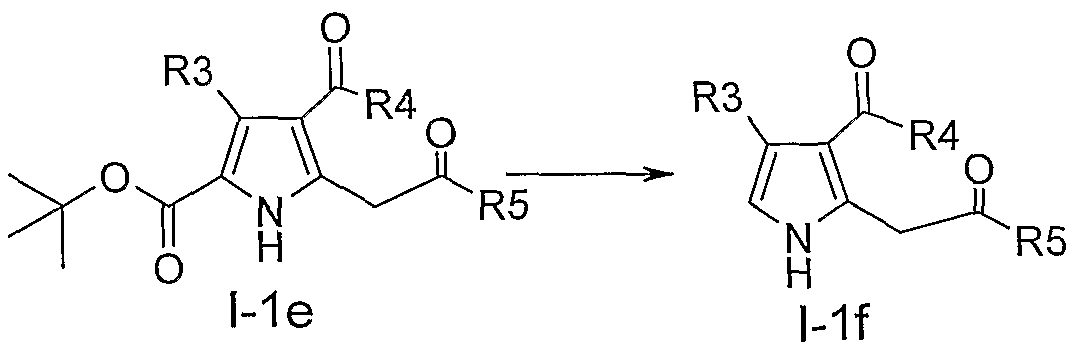
I-le化合物经在三氟醋酸作用下的脱羧得到通式 I-lf化合物;

I-lf化合物在无水体系中, 与三氯氧磷经甲酰化反应得到通式 I-lg化合物;
最后,

其中
X选自 W(CH2)、 (CH2)W或 W,其中 W是 0、 S、 SO或 S02; 或 X为 -NR6; 其中 是氢原子或烷基;
当 X是 -NR6, R6是焼基,则 R6可以和 形成一个 4〜8元杂环基;其中 5〜 8元杂环内可以含有一个或多个N、 0或 S原子, 并且 4〜8元杂环上可以进一 步被一个或多个的烷基、 卤素、 芳基、 杂芳基、 卤代烷基、 卤代烷氧基、 羟基、
氨基、 烷氨基、 酰胺基、 胺酰基、 氰基、 烷氧基、 芳氧基、 胺烷基、 羟烷基、 杂 环烷基、 羧酸、 羧酸酯或 -NR7R8所取代;
选自氢原子、 烷基、 环烷基、 杂环烷基、 芳基、 杂芳基、 芳烷基或杂芳 垸基, 其中烷基、 环垸基、 杂环垸基、 芳基、 杂芳基、 芳烷基或杂芳烷基可以进 一步被一个或多个烷基、 卤素、 芳基、 羟基、 氨基、 烷氨基、 酰胺基、 胺酰基、 烷氧基、 芳氧基、 杂环烷基、 羧酸、 羧酸酯或 -NR7R8所取代; 其中芳基、 杂芳 基、 芳烷基或杂芳烷基可以并成双环;
选自氢原子、 烷基、 环烷基、 杂环烷基、 - (CH2CH20)nR6、 烯基或炔基、 -COOR7、 -CONR7R8、 -C(=S)NR7R8、 -COR7、 -SOR7、 -S02R7 -S02NR7 或者 -P(=0)(OR7)(OR8), 其中垸基、 环烷基、 杂环垸基、 烯基或炔基可以进一步被一 个或多个烷基、 羟基、 烷氧基、 氰基、 氨基、 烷氨基、 羧酸或羧酸酯所取代;
R3选自氢原子、 垸基、 芳基、 卤素取代的芳基或三氟甲基;
选自羟基、 烷氧基、 芳氧基、 杂环烷氧基、 芳烷氧基、 -(OCH2CH2)nR6、 -N(R7)(CH2)nRs、 -NR7[CH2C¾0]nRs或者 -NR6(C¾)n[CH(OH)CH2]rZ ;其中 Z是 芳基、 杂芳基、 杂环烷基、 -NR7R8、 -COOR6或 CONR7R8 ;
R5选自羟基、 烷氧基、 芳氧基、 杂环垸氧基、 芳烷氧基、 -NCR7) CH2)nR8、 -NR7〖CH2CH20]n 或者 -NR6(CH2)n[CH(OH)CH2]rZ ; 其中 Z是芳基、 杂芳基、 杂环垸基、 -NR7R8、 -COOR6或 CONR7R8;
R6是氢原子或垸基;
R7和 R8分别选自分别选自氢原子、 烷基、 环烷基、 杂环烷基、 芳基、 杂芳 基或杂芳烷基, 其中垸基、 环烷基、 杂环烷基、 芳基、 杂芳基或者杂芳烷基可以 进一步被一个或多个的烷基、 卤素、 芳基、 羟基、 氨基、 烷氨基、 酰胺基、 胺酰 基、氰基、垸氧基、芳氧基、胺烷基、羟垸基、杂环垸基、羧酸、羧酸酯或 -NR7R8 所取代;
同时, 1 7和 可以形成一个 4〜8元杂环基; 其中 5〜8元杂环内可以含有 一个或多个 N、 0或 S原子, 并且 4〜8元杂环上可以进一步被一个或多个的垸 基、 卤素、 芳基、 杂芳基、 卤代烷基、 卤代烷氧基、 羟基、 氨基、 酰胺基、 胺酰 基、氰基、烷氧基、芳氧基、胺烷基、羟烷基、杂环烷基、羧酸、羧酸酯或 -NR7R8 所取代。
n是 0〜6;
r是 1〜2。。
本发明涉及鉴别蛋白激酶催化活性的化合物, 使表达该蛋白激酶的细胞与本 发明化合物或盐接触, 然后捡测对细胞的效果。 本发明还涉及鉴别蛋白激酶催化活性的化合物,使人工重组合成激酶蛋白与
本发明化合物或盐接触, 然后用 Elisa方法检测对激酶活性的影响。 发明详述 除非有相反陈述, 下列用在说明书和权利要求书中的术语具有下述含义。
"垸基 "指饱和的脂族烃基团, 包括 1至 20个碳原子的直链和支链基团。 优 选含有 1至 10个碳原子的中等大小垸基, 例如甲基、 乙基、 丙基、 2-丙基、 正 丁基、 异丁基、 叔丁基、 戊基登。 更优选的是含有 1至 4个碳原子的低级烷基, 例如甲基、 乙基、 丙基、 2-丙基、 正丁基、 异丁基或叔丁基等。 垸基可以取代的 或未取代的, 当被取代时, 优选的基团为卤素、羟基、 低级烷氧基、 芳基、 芳氧 基、 杂芳基、 杂环烷基、 -COOR7、 -CONR7R8、 -C(=S)NR7R8、 -COR7、 -SOR7、 -S02R7、 -S02NR7R8和 -P(=0)(OR7)(OR8)。
"环烷基"指 3至 8元全碳单环、全碳 5元 /6元或 6元 /6元稠合环或多环稠合 环 ("稠合"环系意味着系统中的每个环与体系中的其他环共享毗邻的一对碳原子) 基团,其中一个或多个环可以含有一个或多个双键,单没有一个环具有完全共轭 的 π电子系统。 环烷基的实例有环丙基、环丁基、环戊基、 环戊烯、环己烷、环 己二烯、金刚烷、环庚烷、环庚三烯等。环烷基可以是取代或未取代的。 当被取 代时, 取代基优选为一个或多个取代基, 独立地选自由低级烷基、三卤烷基、 卤 素、 羟基、 低级烷氧基、 芳基 (可选自被一个或多个基团取代, 取代基是彼此独 立地是卤素、 羟基、 低级垸基或低级垸氧基)、 芳氧基 (可选自被一个或多个基团 取代,取代基彼此独立地是卤素、羟基、低级烷基或低级烷氧基)、 6元杂芳基 (环 中具有 1至 3个氮原子,环中的碳可选地被一个或多个基团取代,取代基彼此独 立地是卤素、羟基、低级烷基或低级烷氧基)、 5元杂芳基 (具有 1至 3个选自氮、 氧和硫的杂原子,该基团的碳和氮原子可选地被一个或多个基团取代,取代基彼 此独立地是卤素、 羟基、 低级垸基或低级烷氧基)、 或 5或 6元杂环烷基 (具有 1 至 3个选自氮、 氧和硫地杂原子, 该基团的碳和氮原子 (如果有的话), 可选地被 一个或多个基团取代,取代基彼此独立地是卤素、羟基、低级烷基或低级烷氧基)、 巯基、 (低级烷基)硫基、 氰基、 硝基、 羧酸、 羧酸酯、 -OR8、 -NR8R9、 -COR8、 -NR8COR9和 -S02NR8 。
"链烯基"指由至少两个碳原子和至少一个碳-碳双键组成的如上述定义的烷 基。 代表性实例包括但不限于乙烯基、 1-丙烯基、 2-丙烯基、 1-, 2-或 3-丁烯基 等。所述的链烯基可以由一个或多个选自以下的取代基任选取代: 卤素、三卤甲 基、羟基、硝基、氰基、烷氧基、烷基、羧酸、羧酸酯、 -CONR7R8、 -C(=S)NR7R8、 -COR7、 -SOR7、 -S02R7、 -S02NR7R8和 -P(=0)(OR7)(OR8)。
"炔基 "指至少两个碳原子和至少一个碳 -碳三键组成的如上所定义的烷基。代
表性实例包括但不限于乙炔基、 1-丙炔基、 2-丙炔基、 1-, 2-或 3-丁炔基等。 所 述的炔基可以由一个或多个选自以下的取代基任选取代: 卤素、三卤甲基、羟基、 硝基、 氰基、 垸氧基、 垸基、 羧酸、 羧酸酯、 -CONR7R8、 -C(=S)NR7R8、 -COR7、 -SOR7、 -S02R7、 -S02 R7R8和 -P(=0)(OR7)(OR8)。
"芳基"指具有至少一个芳环结构的基团, 即具有共轭的 π电子体系的芳环, 包括碳环芳基、杂芳即和联芳基。所述的芳基可以由一个或多个选自以下的取代 机任选取代: 卤素、 三卤甲基、 羟基、 硝基、 氰基、 烷氧基、 烷基、 羧酸、 羧酸 酯、 -CONR7R8、 -C(=S)NR7R8、 -COR?、 -SOR7、 -S02R7、 -S02NR7R8 和

"杂芳基"指具有 1至 3个杂原子作为环原子, 其余的环原子为碳的芳基, 杂 原子包括氧、硫和氮。所述环可以是 5元或 6元环。 杂环芳基基团的实例包括呋 喃基、 噻吩基、 吡啶基、 吡咯、 N-垸基吡咯基、 嘧啶基、 吡嗪基、 咪唑基等。 所 述的杂芳基可以由一个或多个选自以下的取代基任选取代: 卤素、三卤甲基、羟 基、硝基、氰基、垸氧基、烷基、羧酸、羧酸酯、 -CONR7R8、 -C(=S)NR7RS、 -COR7、 -SOR7、 -S02R7、 -S02NR7R8和 -P(=0)(OR7)(OR8)。
"杂环烷基"指单环或稠环基团, 在环中, 具有 5至 9个环原子, 其中一个或 两个环原子选自氮、 氧或 S(0)n (其中 n是整数 0至 2)的杂原子, 其余环原子为 碳。这些环还可以具有一个或多个双键、不过, 这些环不具有完全共轭的 π电子 系统。未取代的杂环烷基包括但不限于吡咯烷基、哌啶子基、哌嗪子基、吗啉基、 硫代吗啉基、 高哌嗪其等、 杂环烷基可以是取代的或未取代的。 当被取代时, 取 代基优选为一个或多个选自以下的取代基任选取代: 卤素、 三卤甲基、 羟基、 硝 基、 氰基、 烷氧基、 烷基、 羧酸、 羧酸酯、 -CONR7R8、 -C(=S)NR7R8、 -COR7、 -SOR7、 -S02R7、 -S02NR7R8和 -P(=0)(OR7)(OR8)。
"羟基 "指 -OH基团。
"烷氧基"指 -◦- (烷基)和 -O- (未取代地环烷基)。代表性实例包括但不限于甲氧 基、 乙氧基、 丙氧基、 丁氧基、 环丙氧基、 环丁氧基、 环戊氧基、 环己氧基等。 所述的烷氧基可以由一个或多个选自以下的取代基任选取代: 卤素、 三卤甲基、 羟基、 硝基、 氰基、 烷氧基、 烷基、 羧酸、 羧酸酯、 -CONR7R8、 -C(=S)NR7R8、 -COR7、 -SOR7、 -S02R7, -S02NR7R8和 -P(=0)(OR7)(OR8)。
"卤代垸氧基,,指 -O- (卤代烷基)。代表性实例包括但不限于三氟甲氧基、三溴 甲氧基等。
"芳氧基"指 -0-芳基和 -0-杂芳基, 芳基和杂芳基定义同上。 代表性实例包括 但不限于苯氧基、 吡啶氧基、 呋喃氧基、 噻吩氧基、 嘧啶氧基、 吡嗪氧基等及其 衍生物。所述的芳氧基可以由一个或多个选自以下的取代基任选取代: 卤素、三 卤甲基、羟基、硝基、氰基、烷氧基、烷基、羧酸、羧酸酯、 -CONR7R8、 -C(=S)NR7R8,
-COH7、 -SOR7、 -S02R7、 -S02NR7R8和 -P(=0)(OR7)(OR8)。
"卤素"指氟、 氯、 溴或碘, 优选氟或氯。
"三卤甲基"指 -CX3, 其中 X是如上所定义的卤素。
"可选 "或"可选地 "意味着随后所描述地事件或环境可以但不必发生,该说明 包括该事件或环境发生或不发生地场合。 例如, "可选被烷基取代地杂环基团" 意味着垸基可以但不必存在,该说明包括杂环基团被垸基取代的情形和杂环基团 不被烷基取代的情形。
"药物组合物 "表示一种或多种本文所述化合物或其生理学上 /药学上可接受 的盐或前体药物与其他化学组分的混合物, 其他组分例如生理学 /药学上可接受 的载体和赋形剂。 药物组合物的目的是促进化合物对生物体的给药。 本发明化合物的合成方法
为了完成本发明的目的, 本发明采用如下技术方案:
本发明化合物可通过本领域已知的方法合成。在实施例中提供了这些化合物 的合适的合成方法。 通常, 这些化合物可根据下列合成流程制备:

本发明涉及一种药物组合物,其含有治疗有效剂量的本发明化合物或其盐和 药学载体。
进一步,本发明涉及通式 (I)化合物或其盐在制备酪氨酸激酶抑制剂药物中的 用途。换言之, 本发明还提供含有药物有效剂量的上述化合物组合物, 以及所述 的化合物和 /或含有该化合物的药物组合物在制备酪氨酸激酶抑制剂中的用途。
以下结合实施例用于进一步描述本发明,但这些实施例并不限制着本发明的 范围。 实施例 化合物的结构是通过核磁共振 (NMR)或质谱 (MS)来确定的。 NMR位移 (δ)以 百万分之一 (ppm)的单位给出。 NMR的测定是用 Bruker AVANCE-400核磁仪, 测定溶剂为氘代氯仿 (CDC13)、 氘代二甲基亚砜 (DMSO-D6), 内标为四甲基硅垸 (TMS), 化学位移是以 10—6(ppm)作为单位给出。
MS的测定用 FINNIGAN LCQAd (ESI)质谱仪。
激酶 VEGFR平均抑制率的测定使用 HTScan酶标仪 (Cell Signaling公司)。 激酶 EGFR/HER— 2平均抑制率的测定用 NovoStar酶标仪 (德国 BMG公司)。 薄层硅胶使用烟台黄海 HSGF254或青岛 GF254硅胶板。
柱层析一般使用烟台黄海硅胶 200~300目硅胶为载体。
DMSO-D6: 氘代二甲基亚砜;
CDC13: 氘代氯仿; 制备实施例:
实施例 1
5-[4-(3-氯 -4-氟-苯胺) -6-氧代 -6,7-二氢 -P比咯 [2,3-d]嘧啶 -5-亚甲基 -甲基 ]-4-甲基 -2-[(3-吗啡啉 -4-基-丙氨基甲酰)-甲基] -1氢-吡咯 -3-甲酸乙酯 1的制备

2-肟基 -3-羰基 -丁酸叔丁酯 lb的制备
冰浴条件下,在一个 250 ml三口烧瓶中,将 3-羰基 -丁酸叔丁酯 la(32 g, 0.2 mol)搅拌下溶解于 60 ml冰醋酸,搅拌下逐滴滴加亚硝酸钠溶液 (20 ml, 10 mol/L, 0.2 mol), 控制反应温度为 0〜5°C。 滴加结束后, 于冰水浴中反应 1小时, 彻去 冰水浴,在室温下继续反应约 3小时,点板跟踪至原料基本反应完全,反应结束, 得到标题产物 2-肟基 -3-羰基 -丁酸叔丁酯 lb的溶液, 直接投下一步反应。
5-乙氧羰甲基 -3-甲基 -1氢 -吡咯 -2,4-二羧酸 -2-叔丁酯 -4-乙酯 lc的制备 向一个配有温度计, 滴液漏斗的 250 ml的三颈烧瓶中, 将 3-羰基-戊二酸二 乙酯 (40 g, 0.2 mmol)搅拌下溶解于 90 ml冰醋酸,搅拌下升温至 65°C,加入 1/8 量的锌粉 (;共 26 g, 0.4 mmol), 再滴加 1/8量的第一步反应液 lb, 水浴控制体系 温度不能上升太快, 待温度低于 65Ό后, 再加入 1/8量的锌粉及 1/8量的第一步 反应液。如此重复至锌粉及第一步反应液 lb全部加完。升髙温度至 75°C, 反应 约 2小时后点板跟踪反应结束。 搅拌条件下, 将反应液倒入 100 ml冰水中, 继 续搅拌至室温, 过滤除掉未反应的锌粉, 用乙酸乙酯 (100 mlx3)提取反应液, 合 并有机相,依次用水 (100 mlx3)、饱和碳酸氢钠水 (100 mlx4)溶液、饱和氯化钠水 溶液 (lOO mlxl)洗涤, 有机层用无水硫酸钠干燥, 浓缩得到标题产物 5-乙氧羰甲 基 -3-甲基 -1氢-吡咯 -2,4-二羧酸 -2-叔丁酯 -4-乙酯 lc(60 g, 油状产物), 产率 88.5
%。
MS: 340.3(M+1)。
5-羧甲基 -3-甲基 -1氢-吡咯 -2,4-二羧酸 -2-叔丁酯 -4-乙酯 Id的制备 在 1000 ml的单口瓶中, 5-乙氧羰甲基 -3-甲基 -1氢 -吡咯 -2,4-二羧酸 -2-叔丁 酯 -4-乙酯 lc (30 g, 0.088 mol)溶解于 268 ml四氢呋喃 (268 ml)和 134 ml甲醇, 搅拌下加入氢氧化锂水溶液 (134 ml, 2.36 mol/L, 0.316 mol), 室温条件下反应 1.5小时, 点板跟踪至原料完全消失。 将反应液减压浓缩除去大部分四氢呋喃及 甲醇后, 向浓缩液加 200 ml水, 然后用乙醚 (100 mlx5)萃取混合液, 水相转移至 1000 ml的单口瓶中, 冰浴搅拌下滴加 20%的盐酸至 pH为 1〜3, 有大量淡黄色 沉淀析出, 抽滤, 固体用少量乙醚洗涤, 真空干燥, 得到标题标题产物 5-羧甲基 -3-甲基 -1氢-吡咯 -2,4-二羧酸 -2-叔丁酯 -4-乙酯 ld(20 g, 淡黄色固体), 产率 72.3 %。
3-甲基 -5-[(3-吗啡啉 -4-基-丙氨基甲酰)-甲基] - 1氢-吡咯 -2,4-二甲酸 -2-叔丁酯 -4-乙 酯 le的制备
将 5-羧甲基 -3-甲基 -1氢 -吡咯 -2,4-二羧酸 -2-叔丁酯 -4-乙酯 ld(2.18 g, 7 mmol) 溶解于 35 ml二氯甲烷和 3.5 ml N'N-二甲基甲酰胺的混合溶剂中,冰浴冷却,搅 拌下依次加入 3-吗啡啉 -4-基 -丙胺 (1.1 g, 7.7 mmol), N-乙基 -N,- (二甲氨基丙基) - 碳二亚胺 (2.67 g, 14 mmol)及 1-羟基苯并三唑 (0.945 g, 7 mmol), 反应体系自然 升至室温, 搅拌过夜。 次日点板至原料 Id完全消失后, 剧烈撹拌下向反应液中 加入冷水 (40 ml), 静置分液, 二氯甲烷萃取反应液 (50 mlx3), 合并有机相, 有机 相依次用饱和碳酸钾溶液 (50 ml l), 水 (50 mlxl)及饱和氯化钠溶液 (50 mlxl)洗 涤, 二氯甲烷层用无水硫酸钠干燥, 过滤, 滤液减压浓缩得到标题产物 3-甲基 -5-[(3-吗啡啉 -4-基-丙氨基甲酰) -甲基 ]-1 氢 -吡咯 -2,4-二甲酸 -2-叔丁酯 -4-乙酯 le(4.49 g, 棕褐色油状物), 粗产品直接投入下一步反应。
MS m/z (ESI): 438.5(M+1)。
4-甲基 -2-[(3-吗啡啉 - 4-基-丙氨基甲酰)-甲基] -1氢 -吡咯 -3-甲酸乙酯 If的制备 氩气氛下, 将 3-甲基 -5-[(3-吗啡啉 -4-基-丙氨基甲酰)-甲基] -1氢 -P比咯 -2,4-二 甲酸 -2-叔丁酯 -4-乙酯 le(4.49 g, 7 mmol)搅拌下溶解于 224 ml二氯甲烷及 56 ml 三氟乙酸中, 加热回流 2小时, 撤去油浴, 室温继续搅拌 2小时, 点板跟踪至原 料完全消失。 冰浴冷却, 剧烈搅拌下缓慢滴加 30%氢氧化钠水溶液至反应液的 pH为 9, 静置, 分液, 水相用二氯甲烷萃取混合液 (100 mlx4), 合并有机相, 有 机相用饱和氯化钠溶液洗 (25 mlxl), 二氯甲垸层用无水硫酸钠干燥, 过滤, 滤液
减压浓缩, 得到标题产物 4-甲基 -2-[(3-吗啡啉 -4-基-丙氨基甲酰) -甲基 ]-1氢 -吡咯 -3-甲酸乙酯 lf(2.01 g, 棕褐色粘稠固体)。 粗产品直接投入下一步反应。
MS m/z (ESI): 338·5(Μ+1)。
5-甲酰基 -4-甲基 -2-[(3-吗啡啉 -4-基-丙氨基甲酰) -甲基 ]-1氢 -吡咯 -3-甲酸乙酯 lg 的制备
氩气氛下, 在一个 25 ml的单口瓶中加入无水 N'N-二甲基甲酰胺 (0.12 ml, 1.25 mmol), 冰浴冷却至 0°C, 搅拌下缓慢滴加三氯氧磷 (0.05 ml, 0.55 mmol), 滴加完毕后于室温下搅拌 15分钟, 再继续冰盐浴冷却, 向反应瓶中滴加 4-甲基 -2-[(3-吗啡啉 -4-基-丙氨基甲酰)-甲基] -1氢-吡咯 -3-甲酸乙酯 If的无水 N'N-二甲 基甲酰胺溶液 (169 mg, 0.5 mmol, 溶解于 0.6 ml N'N-二甲基甲酰胺中), 保持反 应温度为 0°C反应 2小时, 点板跟踪至原料消失后, 向反应液中加入冰水 (15 ml) 淬灭反应, 搅拌 5分钟, 再用 30%的氢氧化钠溶液调节 pH为 12。 反应液用乙 酸乙酯 (15 mlx6)萃取, 合并有机相, 有机相用饱和氯化钠水溶液 (10 mlx2)洗涤, 乙酸乙酯层用无水硫酸钠干燥, 过滤, 滤液减压浓缩得到标题产物 5-甲酰基 -4- 甲基 -2-[(3-吗啡啉 -4-基-丙氨基甲酰)-甲基] -1氢 -吡咯 -3-甲酸乙酯 lg(0.192 g, 红 棕色粘稠固体), 粗产品直接投入下一步反应。
MS m/z (ESI): 364.3(M+1)。
5-[4-(3-氯 -4-氟-苯胺) -6-氧代 -6,7-二氢 -吡咯 [2,3-d]嘧啶 -5-亚甲基 -甲基 ]-4-甲基 — 2-[(3-吗啡啉 -4-基-丙氨基甲酰) -甲基 ]-1氢-吡咯 -3-甲酸乙酯 1的制备 氩气氛下, 在一个 10 ml的单口瓶中, 依次加入 5-甲酰基 -4-甲基 -2-[(3-吗啡 啉 -4-基-丙氨基甲酰) -甲基 ]-1氢-吡咯 -3-甲酸乙酯 lg(0.183 g, 0.5 mmol), 4-(3- 氯 _4-氟-苯胺) -5,7-二氢 -吡咯 [2,3-d]嘧啶 -6-酮 (0.139 g, 0.5 mniol)(Bioorganic & Medicinal Chemistry letters 2002, 12(16), 2153-2157. ),哌啶 (0.125 ml, 1.25 mmol) 及乙醇 (1.5 ml), 加热回流 1.5小时, 点板跟踪至 4-(3-氯 -4-氟-苯胺) -5,7-二氢-吡 咯 [2,3-d]嘧啶 -6-酮完全消失, 将反应液自然冷却至室温, 有大量固体产生, 减压 抽滤, 得到标题产物 5-[4-(3-氯 -4-氟-苯胺) -6-氧代 -6,7-二氢 -P比咯 [2,3-d]嘧啶 -5-亚 甲基-甲基] -4-甲基 -2-[(3-吗啡啉 -4-基-丙氨基甲酰)-甲基] -1 氢 -吡咯 -3-甲酸乙酯 1(0.129 g, 黄色固体), 产率 41.3 %。
MS m/z (ESI): 626.4(M+1)。
1H NMR (DMSO-D6,400MHz)58.324(s, 1H, -CH=N), 7.704(dd, 1H, -ArH), 7.389~7.337(m, 3H, -ArH; -CH=C), 4.237; 4.184(q, 2H, -C02CH2-), 3.540(t, 4H, 2x-OCH2-), 3.289(s, 2H, -CH2CON-), 3.108(t, 2H, -CONCH2-), 2.363(s, 3H, -ArCH3): 2.320~2.266(m, 6H, 3 -NCH2-,), 1.628-1.560(m, 2H, -CH2-), 1.273(t, 3H, -CH3)。
实施例 2
5-[4-(3-氯 _4-氟-苯胺) -6-氧代 -6,7-二氢 -吡咯 [2,3-d]嘧啶 -5-亚甲基 -甲基 ]-2-[(2-二 乙胺基-乙氨基甲酰)-甲基] -4-甲基 -1氢 -吡咯 -3-甲酸乙酯 2的制备

5-[(2-二乙胺基-乙氨基甲酰) -甲基 ]-3-甲基 -1氢 -吡咯 -2,4-二甲酸 -2-叔丁酯 -4-乙酯
2a的制备
将 5-羧甲基 -3-甲基 -1氢 -P比咯 -2,4-二羧酸 -2-叔丁酯 -4-乙酯 ld(125 mg , 0.4ml ) 搅拌下溶解于 2 ml二氯甲烷和 0.2 mlN'N-二甲基甲酰胺的混合溶剂中, 冰浴冷 却, 搅拌下依次加入 N,N-二乙基乙二胺 (60ul,0.44mmol), N-乙基 -N,- (二甲氨基 丙基) -碳二亚胺 (154 mg , 0.8 mmol)及 1-羟基苯并三唑 (56 mg , 0.4 mrnol),反应体 系自然升至室温, 搅拌过夜。 次日点板至原料 Id完全消失后, 剧烈搅拌下向反 应液中加入冷水 (5 ml), 静置分液, 二氯甲垸萃取反应液 (50 mlx3), 合并有机相, 有机相依次用饱和碳酸钾溶液 (5 mlxl), 水 (5 mlxl)及饱和氯化钠溶液 (25 mlxl) 洗涤, 二氯甲烷层用无水硫酸钠干燥, 过滤, 滤液减压浓缩得到标题产物 5-[(2- 二乙胺基-乙氨基甲酰) -甲基 ]-3-甲基 -1 氢 -吡咯 -2,4-二甲酸 -2-叔丁酯 -4-乙酯 2a(136 mg ,浅黄色粘液), 产率 83 %。
2-[(2-二乙胺基-乙氨基甲酰)-甲基] -4-甲基 -1氢-吡咯 -3-甲酸乙酯 2b的制备 氩气氛下, 将 5-[(2-二乙胺基-乙氨基甲酰)-甲基] -3-甲基 -1氢-吡咯 -2,4-二甲 酸 -2-叔丁酯 -4-乙酯 2a( 420 mg , 1 mmol)搅拌下溶解于 40 ml二氯甲烷及 10 ml 三氟乙酸中, 加热回流 2小时, 撤去油浴, 室温继续搅拌 2小时, 点板跟踪至原
料完全消失。 冰浴冷却, 剧烈搅拌下缓慢滴加 30%氢氧化钠水溶液至反应液的 pH为 12, 加 30 ml冰水, 静置分液, 水相用二氯甲烷萃取混合液 (30 mlx4), 合 并有机相,有机相用饱和氯化钠溶液洗 (25 mlxl),二氯甲垸层用无水硫酸钠干燥, 过滤, 滤液减压浓缩, 得到标题产物 2-[(2-二乙胺基-乙氨基甲酰) -甲基 ]-4-甲基 -1 氢 -吡咯 -3-甲酸乙酯 2b( 300 mg, 灰色粘液)。 产率 95%。
MS m/z (ESI): 310.5(M+1)。
2-[(2-二乙胺基-乙氨基甲酰) -甲基 ]-5-甲酰基 -4-甲基 -1氢-吡咯 -3-甲酸乙酯 2c制 备
氩气氛下, 在一个 25 ml的单口瓶中加入无水 N'N-二甲基甲酰胺 (0.3 ml), 冰浴冷却至 0°C, 搅拌下缓慢滴加三氯氧磷 (112 ul, 1.1 mmol), 滴加完毕后于室 温下搅拌 15分钟, 继续冰盐浴冷却, 向反应瓶中滴加 2-[(2-二乙胺基-乙氨基甲 酰) -甲基 ]-4-甲基 -1 氢-吡咯 -3-甲酸乙酯 2b 的无水 N'N-二甲基甲酰胺溶液 (309 mg, l mmol, 溶解于 0.6 ml N'N-二甲基甲酰胺中), 保持反应温度为 0°C反应 2 小时, 点板跟踪至原料消失, 向反应液中加入冰水 (4 ml)淬灭反应, 搅拌 5分钟, 再用 30%的氢氧化钠溶液调节 pH为 12。 反应液用乙酸乙酯 (15 mlx4)萃取, 合 并有机相,有机相用饱和氯化钠水溶液 (10 mlxl)洗涤, 乙酸乙酯层用无水硫酸钠 干燥, 过滤, 滤液减压浓缩得到标题产物 2-[(2-二乙胺基-乙氨基甲酰) -甲基 ]-5- 甲酰基 -4-甲基 -1氢 -P比咯 -3-甲酸乙酯 2c(283 mg, 灰白色固体), 产率 84%。
MS m/z (ESI): 338·7(Μ+1)。
5-[4-(3-氯 -4-氟-苯胺) -6-氧代 -6,7-二氢 -吡咯 [2,3-d]嘧啶 -5-亚甲基 -甲基 ]-2-[(2-二 乙胺基-乙氨基甲酰)-甲基] -4-甲基 -1氢 -吡咯 -3-甲酸乙酯 2的制备 氩气氛下,在一个 10 ml的单口瓶中,依次加入 2-[(2-二乙胺基-乙氨基甲酰) - 甲基] -5-甲酰基 -4-甲基 -1氢 -吡咯 -3-甲酸乙酯 2c(0.077 g, 0.23 mmol), 4-(3-氯 -4- 氟-苯胺) -5,7-二氢 -吡咯 [2,3-d]嘧啶 -6-酮 (0.056 g, 0.2 mmol), 哌啶 (0.05 ml, 0.5 mmol)及乙醇 (0.5 ml), 加热回流 1.5小时, 点板跟踪至 4-(3-氯 -4-氟-苯胺) -5,7-二 氢-吡咯 [2,3-d]嘧啶 -6-酮完全消失, 将反应液自然冷却至室温, 有大量固体产生, 减压抽滤, 得到标题产物 5-[4-(3-氯 -4-氟-苯胺) -6-氧代 -6,7-二氢 -P比咯 [2,3-d]嘧啶 -5-亚甲基 -甲基 ]-2-[(2-二乙胺基-乙氨基甲酰) -甲基] -4-甲基 -1 氢-吡咯- 3-甲酸乙 酯 2(0.049 g, 黄色固体), 产率 41 %。
MS m/z (ESI): 598.3(M+1)。
1H NMR (DMSO-D6,400MHz)58.323(s, 1H, -CH=N), 7.686(dd, 1H, -ArH), 7.394~7.360(m, 3H, -ArH; -CH=C)5 4.187(q, 2H, -C02CH2 -), 3.474(s, 2H, -CH2CON-), 3.188(t, 2H, -CONCH2-), 2.351~2.329(m, 9H, 3 -NCH2-; -ArCH3),
1.486-1.358(m, 6H, 2x-CH3), 1.275(t, 3H, -CH3)。 实施例 3
5-[4-(3-氯 -4-氟-苯胺) -6-氧代 -6,7-二氢-吡咯 [2,3-d]嘧啶 -5-亚甲基-甲基] -4-甲基 -2-[(2-哌啶小基-乙氨基甲酰)-甲基] -1氢 -吡咯 -3-甲酸乙酯 3的制备

3-甲基 -5-[(2-哌啶 -1-基-乙氨基甲酰)-甲基] -1氢 -P比咯 -2,4-二甲酸 -2-叔丁酯 -4-乙酯
3a的制备
将 5-羧甲基 -3-甲基 -1氢-吡咯 -2,4-二羧酸 -2-叔丁酯 -4-乙酯 ld( 4.351 g, 14 mmol:)搅拌下溶解于 70 ml二氯甲烷和 7 mlN'N-二甲基甲酰胺的混合溶剂中,冰 浴冷却, 搅拌下依次加入 2-哌啶 -1-基 -乙胺 (1.971 g, 154 mmol), N-乙基 -Ν'- (二 甲氨基丙基) -碳二亚胺 (5.351 g, 28 mmol)及 1-羟基苯并三唑 (1.891 g, 14 mmol), 反应体系自然升至室温, 搅拌过夜。 次日点板至原料 Id完全消失后, 剧烈搅拌 下向反应液中加入冷水 (40 ml), 静置分液, 二氯甲烷萃取反应液 (50 mlx3), 合并 有机相,有机相依次用饱和碳酸钾溶液 (50 mlxl),水 (50 mlxl)及饱和氯化钠溶液 (50 mlxl)洗涤,二氯甲烷层用无水硫酸钠干燥, 过滤, 滤液减压浓缩得到标题产 物 3-甲基 -5-[(2-哌啶 -1-基-乙氨基甲酰) -甲基 ]-1 氢-吡咯 -2,4-二甲酸 -2-叔丁酯 -4- 乙酯 3a(4.818 g, 棕褐色粘稠液体), 粗产品直接投入下一步反应。
MS m/z (ESI): 422·3(Μ+1)。
4-甲基 -2-[(2-哌啶小基-乙氨基甲酰) -甲基 ]-1氢 -吡咯 -3-甲酸乙酯 3b的制备 氩气氛下, 将 3-甲基 -5-[(2-哌啶小基-乙氨基甲酰) -甲基 ]-1氢-吡咯 -2,4-二甲
酸 -2-叔丁酯 -4-乙酯 3a(4.81 g, 11.4 mmol)溶解于 365 ml二氯甲烷中及 68 ml三 氟乙酸中, 加热回流 2小时, 撤去油浴, 室温继续搅拌 2小时, 点板跟踪至原料 完全消失。 冰浴冷却, 剧烈搅拌下缓慢滴加 30 %氢氧化钠水溶液至反应液的 pH 为 9, 静置, 分液, 水相用二氯甲烷萃取混合液 (100 mlx4), 合并有机相, 有机 相用饱和氯化钠溶液洗 (25 mlxl), 二氯甲烷层用无水硫酸钠干燥, 过滤,滤液减 压浓缩, 得到标题产物 4-甲基 -2-[(2-哌啶 -1-基-乙氨基甲酰)-甲基] - 1 氢 -吡咯 -3- 甲酸乙酯 3b(2.39 g, 棕褐色粘稠液体), 粗产品直接投入下一步反应。
MS m/z (ESI): 322·5(Μ+1)。
5-甲酰基 -4-甲基 -2-[(2-哌啶小基-乙氨基甲酰) -甲基 ]-1氢 -吡咯 -3-甲酸乙酯 3c制 备
氩气氛下, 在一个 25 ml的单口瓶中加入无水 N'N-二甲基甲酰胺 (0.58 ml, 7.5 mmol), 冰浴冷却至 0°C, 搅拌下缓慢滴加三氯氧磷 (0.307 ml, 3.3 mmol), 滴 加完毕后于室温下搅拌 15 分钟, 再继续冰盐浴冷却, 向反应瓶中滴加 4-甲基 -2-[(2-哌啶小基-乙氨基甲酰)-甲基] -1氢-吡咯 -3-甲酸乙酯 3b的无水 N'N-二甲基 甲酰胺溶液 (0.963 mg, 3 mmol, 溶解于 3.6 ml N'N-二甲基甲酰胺中 ), 保持反应 温度为 0°C反应 2小时, 点板跟踪至原料消失后, 向反应液中加入冰水 (15 ml) 淬灭反应, 搅拌 5分钟, 再用 30%的氯氧化钠溶液调节 pH为 12。 反应液用乙 酸乙酯 (15 mlx6)萃取, 合并有机相, 有机相用饱和氯化钠水溶液 (10 mlx2)洗涤, 乙酸乙酯层用无水硫酸钠干燥, 过滤, 滤液减压浓缩得到标题产物 5-甲酰基 -4- 甲基 -2-[(2-哌啶 -1-基-乙氨基甲酰)-甲基] -1氢 -B比咯 -3-甲酸乙酯 3c(0.952 g, 橙黄 色固体), 粗产品直接投入下一步反应。
MS m/z (ESI): 350.4(M+1)。
5-[4-(3-氯 -4-氟-苯胺) -6-氧代 -6,7-二氢-吡咯 [23-d]嘧啶 -5-亚甲基 -甲基 ]-4-甲 基 -2-[(2-哌啶 -1-基-乙氨基甲酰) -甲基 ]-1氢-吡咯 -3-甲酸乙酯 3的制备 氩气氛下, 在一个 10 ml的单口瓶中, 依次加入 5-甲酰基 -4-甲基 -2-[(2-哌啶 - 1-基-乙氨基甲酰) -甲基 ]-1氢-吡咯 -3-甲酸乙酯 3c(0.233 g, 0.66 mmol), 4-(3-氯 -4- 氟-苯胺)- 5,7-二氢-卩比咯 [2,3-d]嘧啶 -6-酮 (0.169 g, 0.6 mmol), 哌啶 (0.15 ml, 1.5 mmol)及乙醇 (1.5 ml), 加热回流 1.5小时, 点板跟踪至 4-(3-氯 -4-氟-苯胺) -5,7-二 氢 -吡咯 [2,3-d]嘧啶 -6-酮完全消失, 将反应液自然冷却至室温, 有大量固体产生, 减压抽滤, 得到标题产物 5-[4-(3-氯 -4-氟-苯胺) -6-氧代- 6,7-二氢-吡咯 [2,3-d]嘧啶 -5-亚甲基 -甲基 ]-4-甲基 -2-[(2-哌啶 -1-基-乙氨基甲酰) -甲基 ]-1 氢-吡咯 -3-甲酸乙 酯 3(0.289 g, 黄色固体), 产率 79%。
MS m/z (ESI): 610·6(Μ+1)。
1H NMR (DMSO-D6,400MHz)58.318(s, 1H, -CH-N), 7.687(dd, 1H, -ΑιΉ), 7.405~7.333(m, 3H, -ΑιΉ; -CH=C), 4.183(q, 2H, -C02CH2-), 3.482(s, 2H: -CH2CON-), 3.139(t, 2H, -CONCH2-), 2.491~2.438(m, 6H, 3 -NCH2-), 2.348(s, 3H: -Ai-CH3), 1.273(t, 3H, -CH3), 0.915(t, 6H, 3x-CH2-)。 实施例 4
5- [4-(3-氯 -4-氟-苯胺) -6-氧代 -6,7-二氢 -吡咯 [2,3-d]嘧啶 -5-亚甲基 -甲基 ]-2-[2-(3,5- 二甲基 -哌嗪 -1-基) -2-氧代-乙基] -4-甲基 -1氢 -吡咯 -3-甲酸乙酯 4的制备

5-[2-(3,5-二甲基 -哌嗪 -1-基)- 2-氧代-乙基] - 3-甲基 -1氯-吡咯 -2,4-二甲酸 -2-叔丁酯
-4-乙酯 4a的制备
将 5-羧甲基 -3-甲基 -1 氢 -吡咯 -2,4-二羧酸 -2-叔丁酯 -4-乙酯 ld(0.933 g, 3 mmol)溶解于 15 ml二氯甲烷和 1.5 mlN'N-二甲基甲酰胺的混合溶剂中, 冰浴冷 却,搅拌下依次加入 (2S, 6R)-2,6-二甲基 -哌嗪 (0.377 g, 3.3 mmol), N-乙基 -N,- (二 甲氨基丙基) -碳二亚胺 (1.146 g, 6 mmol)及 1-羟基苯并三唑 (0.405 g, 3 mmol), 反应体系自然升至室温, 搅拌过夜。 次日点板至原料 Id完全消失后, 剧烈搅拌 下向反应液中加入 40 ml冷水, 静置分液, 二氯甲烷萃取反应液 (50 mlx3), 合并 有机相,有机相依次用饱和碳酸钾溶液 (50 mlxl),水 (50 mlxl)及饱和氯化钠溶液 (50 mlxl)洗涤, 二氯甲烷层用无水硫酸钠干燥, 过滤, 滤液减压浓缩得到标题产 物 5-[2-(3,5-二甲基 -哌嗪小基) -2-氧代-乙基] -3-甲基 -1氢-吡咯 -2,4-二甲酸 -2-叔丁
酯 -4-乙酯 4a(0.710 g, 棕褐色粘稠液体), 粗产品直接投入下一步反应。
MS m/z (ESI): 權.4(M+1)。
2-[2- (3,5-二甲基 -哌嗪 -1-基) -2-氧代-乙基] -4-甲基 -1氢-吡咯 -3-甲酸乙酯 4b的制备 氩气氛下,将 5-[2-(3,5-二甲基 -哌嗪 -1-基) -2-氧代-乙基] -3-甲基 -1氢-吡咯 -2,4- 二甲酸 -2-叔丁酯 -4-乙酯 4a(0.710 g, 1.7 mmol)搅拌下溶解于 55.8 ml二氯甲烷 (55.8 ml)及 7 ml三氟乙酸中,加热回流 2小时,撤去油浴,室温继续搅拌 2小时, 点板跟踪至原料完全消失。 冰浴冷却, 剧烈搅拌下缓慢滴加 30%氢氧化钠水溶 液至反应液的 pH为 9, 静置, 分液, 水相用二氯甲烷萃取混合液 (100 mlx4), 合 并有机相,有机相用饱和氯化钠溶液洗 (25 mlxl),二氯甲烷层用无水硫酸钠干燥, 过滤,滤液减压浓缩,得到标题产物 2-[2-(3,5-二甲基 -哌嗪 -1-基 2-氧代-乙基] -4- 甲基 -1氢 -吡咯 -3-甲酸乙酯 4b(0.309 g, 棕褐色粘稠液体), 粗产品直接投入下一 步反应。
MS m/z (ESI): 308.4(M+1)。
2-[2-(3,5-二甲基 -哌嗪 -1-基) -2-氧代-乙基] -5-甲酰基 -4-甲基 -1氢 -吡咯 -3-甲酸乙酯
4c的制备
氩气氛下,在一个 25 ml的单口瓶中加入无水 N'N-二甲基甲酰胺 (0.2 ml, 2.5 mmol), 冰浴冷却至 0°C, 搅拌下缓慢滴加三氯氧磷 (0.1 ml, 1.1 mmol), 滴加完 毕后于室温下搅拌 15分钟, 再继续冰盐浴冷却, 向反应瓶中滴加 2-[2-(3,5-二甲 基-哌嗪小基 )-2-氧代-乙基] -4-甲基 -1氢 -吡咯 -3-甲酸乙酯 4b的无水 N'N-二甲基 甲酰胺溶液( 0.309 g, 1 mmol, 溶解于 1.2 ml N'N-二甲基甲酰胺中), 保持反应 温度为 0°C反应 2小时, 点板跟踪至原料消失后, 向反应液中加入冰水 (15 ml) 淬灭反应, 搅拌 5分钟, 再用 30%的氢氧化钠溶液调节 pH为 12。 反应液用乙 酸乙酯 (15 mlx6)萃取, 合并有机相, 有机相用饱和氯化钠水溶液 (10 mlx2)洗涤, 乙酸乙酯层用无水硫酸钠干燥, 过滤, 滤液减压浓缩得到标题产物 2-[2-(3,5-二 甲基 -哌嗪 -1-基) -2-氧代-乙基] -5-甲酰基 -4-甲基 -1氢-吡咯 -3-甲酸乙酯 4c(0.329 g, 深酒红色粘稠液体), 粗产品直接投入下一步反应。
MS m/z (ESI): 336.4(M+1)。
5-[4-(3-氯 -4-氟-苯胺) -6-氧代 -6,7-二氢-吡咯 [2,3-d]嘧啶 -5-亚甲基 -甲基 ]-2-[2-(3,5- 二甲基 -哌嗪小基) -2-氧代-乙基] -4-甲基 -1氢-吡咯 -3-甲酸乙酯 4的制备 氩气氛下,在一个 10 ml的单口瓶中,依次加入2-[2-(3,5-二甲基-哌嗪-l-基)-2- 氧代-乙基]-5-甲酰基-4-甲基-l氢-吡咯-3-甲酸乙酯4c(0.114 g, 0.34 mmol), 4-(3- 氯 -4-氟-苯胺)- 5,7-二氢 -吡咯 [2,3-d]嘧啶 -6-酮 (0.086 g, 0.3 mmol), 哌啶 (0.08 ml,
0.8 mmol)及乙醇 (0.8 ml),加热回流 1.5小时,点板跟踪至 4-(3-氯 -4-氟-苯胺) -5,7- 二氢-吡咯 [2,3-d]嘧啶 -6-酮完全消失, 将反应液自然冷却至室温, 有大量固体产 生, 减压抽滤, 得到标题产物 5-[4-(3-氯 -4-氟-苯胺) -6-氧代 -6,7-二氢 -吡咯 [2,3-d] 嘧啶 -5-亚甲基 -甲基 ]-2-[2-(3,5-二甲基 -哌嗪 -1-基) -2-氧代-乙基] -4-甲基 -1氢 -吡咯 -3-甲酸乙酯 4(0.049 g, 黄色固体), 产率 27.4%。
MS m/z (ESI): 5%·6(Μ+1)。
1H NMR (DMSO-D6,400MHz)58.324(s, 1H, -CH=N), 7.713(dd, 1H, -ArH), 7.409-7.341 (m, 3H, -ArH; -CH=C), 4.166(q, 2H, -C02CH2-), 3.434~3.377(m, 6H, -CH2CON-; 2 -CONCH2-), 2.668~2.563(ra, 2H, 2x-NCHR-), 2.378(s, 3H, -ArCH3), 1.255(t, 3H, -CH3), 0.964(d, 6H, 2x-CH3)。 实施例 5
5-[4- (3-氯 -4-氟-苯胺) -6-氧代 -6,7-二氢 -吡咯 [2,3-d]嘧啶 -5-亚甲基 -甲基 ]-4-甲基 -2-[(2-吡咯垸 -1-基-乙氨基甲酰) -甲基 ]-1氢-吡咯 -3-甲酸乙酯 5的制备
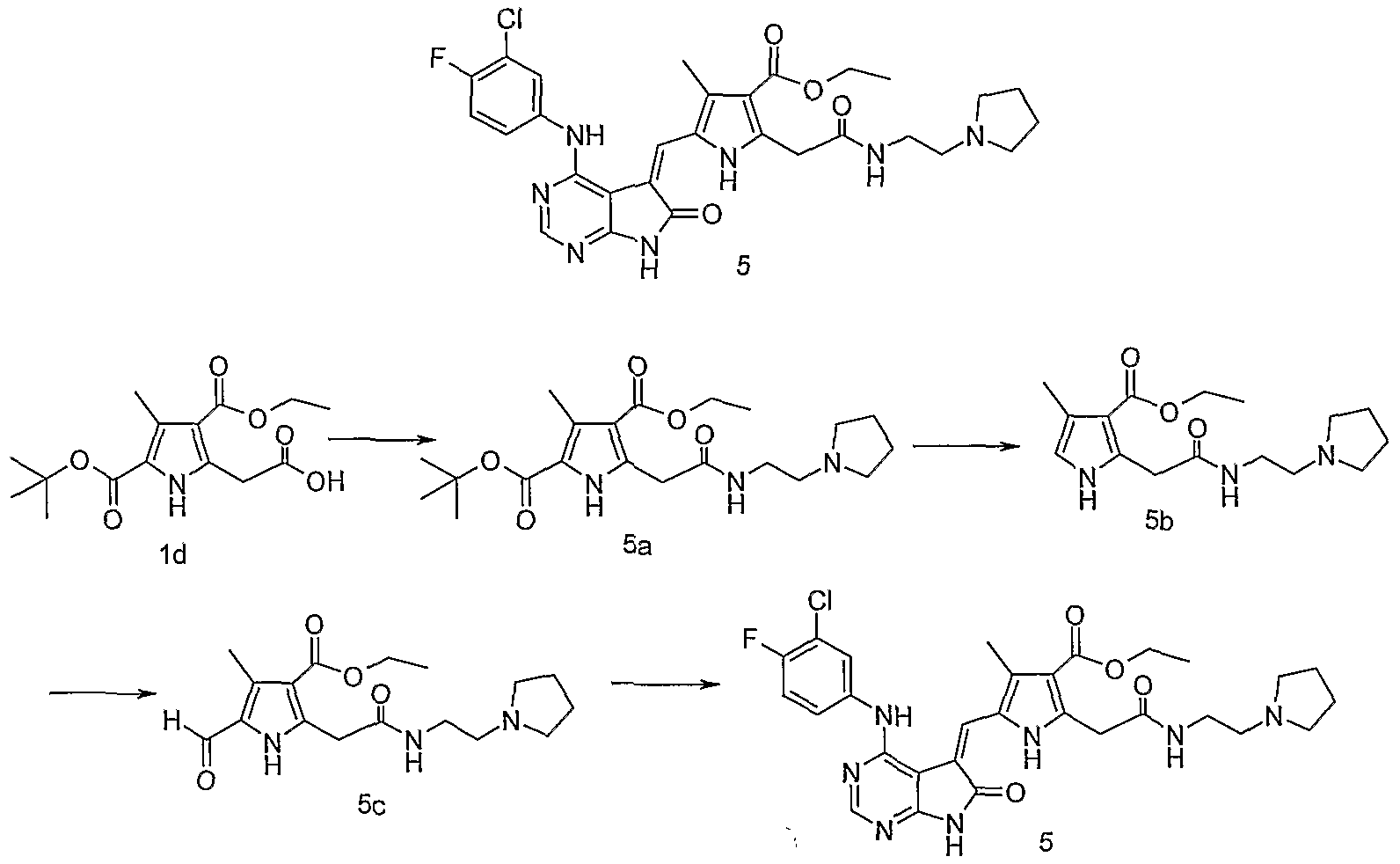
3-甲基 -5-[(2-吡咯烷小基-乙氨基甲酰) -甲基 ]-1氢 -P比咯 -2,4-二甲酸 -2-叔丁酯 -4-乙 酯 5a的制备
将 5-羧甲基 -3-甲基 -1氢 -吡咯 -2,4-二羧酸 -2-叔丁酯 -4-乙酯 ld( 2.8 g, 9 mmol )溶解于 45 ml二氯甲烷和 4.5 mlN'N-二甲基甲酰胺的混合溶剂中, 冰浴冷 却, 搅拌下依次加入 2-吡咯烧 -1-基 -乙胺 (1.13 g, 909 mmol), N-乙基 -Ν'- (二甲氨 基丙基) -碳二亚胺 (3.44 g, 18 mmol)及 1-羟基苯并三唑 (1.22 g, 9 mmol), 反应体 系自然升至室温, 搅拌过夜。 次日点板至原料 Id完全消失后, 剧烈搅拌下向反
应液中加入 40 ml冷水,静置分液,二氯甲烷萃取反应液 (50 mlx3),合并有机相, 有机相依次用饱和碳酸钾溶液 (50 mlxl),水 (50 mlxl)及饱和氯化钠溶液 (50 mlxl) 洗涤, 二氯甲烷层用无水硫酸钠干燥, 过滤,滤液减压浓缩得到标题产物 3-甲基 -5-[(2-吡咯烷 -1-基-乙氨基甲酰) -甲基 ]-1 氢-吡咯 -2,4-二甲酸 -2-叔丁酯 -4-乙酯 5a(4.48 g, 棕褐色粘稠液体), 粗产品直接投入下一步反应。
MS m/z (ESI): 408.3(M+1)。
4-甲基 -2-[(2-吡咯烷 -1-基-乙氨基甲酰) -甲基 ]-1氢-吡咯 -3-甲酸乙酯 5b的制 备
氩气氛下, 将 3-甲基 -5-[(2-吡咯烷小基-乙氨基甲酰)-甲基] -1氢 -吡咯 -2,4-二 甲酸 -2-叔丁酯 -4-乙酯 5a(4.48 g, 9 nimol)搅拌下溶解于 288 ml二氯甲烷及 54 ml 三氟乙酸中, 加热回流 2小时, 撤去油浴, 室温继续搅拌 2小时, 点板跟踪至原 料完全消失。 冰浴冷却, 剧烈搅拌下缓慢滴加 30 %氢氧化钠水溶液至反应液的 pH为 9, 静置, 分液, 水相用二氯甲烷萃取混合液 (100 mlx4), 合并有机相, 有 机相用饱和氯化钠溶液洗 (25 mlxl), 二氯甲烷层用无水硫酸钠干燥, 过滤, 滤液 减压浓缩, 得到标题产物 4-甲基 -2-[(2-吡咯烷 -1-基-乙氨基甲酰) -甲基 ]-1氢-吡咯 -3-甲酸乙酯 5b(1.68 g, 棕褐色粘稠液体), 粗产品直接投入下一步反应。
MS m/z (ESI): 308.4(M+1)。
5-甲酰基 -4-甲基 -2-[(2-P比咯烷小基-乙氨基甲酰) -甲基 ]-1氢-吡咯 -3-甲酸乙酯 5c 的制备
氩气氛下, 在一个 25 ml的单口瓶中加入无水 N'N-二甲基甲酰胺 (0.4 ml, 5.0mmol), 冰浴冷却至 0°C, 搅拌下缓慢滴加三氯氧磷( 0.2 ml, 2.2 mmol), 滴加 完毕后于室温下搅拌 15分钟,再继续冰盐浴冷却,向反应瓶中滴加 4-甲基 -2-[(2- 吡咯垸 -1-基-乙氨基甲酰)-甲基] -1氢 -吡咯 -3-甲酸乙酯 5b的无水 N'N-二甲基甲酰 胺溶液(0.614 g, 2 mmol, 溶解于 2.4 ml N'N-二甲基甲酰胺中), 保持反应温度 为 0°C反应 2小时, 点板跟踪至原料消失后, 向反应液中加入冰水 (15 ml)淬灭反 应,搅拌 5分钟,再用 30 %的氢氧化钠溶液调节 pH为 12。反应液用乙酸乙酯 (15 mlx6)萃取, 合并有机相, 有机相用饱和氯化钠水溶液 (10 mlx2)洗涤, 乙酸乙酯 层用无水硫酸钠干燥,过滤,滤液减压浓缩得到标题产物 5-甲酰基 -4-甲基 -2-[(2- 吡咯垸 -1-基-乙氨基甲酰) -甲基 ]-1氢 -吡咯 -3-甲酸乙酯 5c(0.517 g,棕色固体),产 率 77 %。
MS nVz (ESI): 336·6(Μ+1)。
5-[4-(3-氯 -4-氟-苯胺)- 6-氧代 -6,7-二氢 -吡咯 [2,3-d]嘧啶 -5-亚甲基 -甲基 ]-4-甲基 -2
-[(2-吡咯烷小基-乙氨基甲酰) -甲基 ]-1氢-吡咯- 3-甲酸乙酯 5的制备 氩气氛下, 在一个 10 ml的单口瓶中, 依次加入 5-甲酰基 -4-甲基 -2-[(2-吡咯 烷 -1-基-乙氨基甲酰)-甲基] -1氢 -吡咯 -3-甲酸乙酯 5c(0.26 g, 0.782 mmol), 4-(3- 氯 -4-氟-苯胺) -5,7-二氢 -吡咯 [2,3-d]嘧啶 -6-酮 (0.112 g, 0.403 mmol),哌啶 (0.15 ml, 1.5 mmol)及乙醇 (1.5 ml),加热回流 1.5小时,点板跟踪至 4-(3-氯 -4-氟-苯胺) -5,7- 二氢-吡咯 [2,3-d]嘧啶 -6-酮完全消失, 将反应液自然冷却至室温, 有大量固体产 生, 减压抽滤, 得到标题产物 5-[4-(3-氯 -4-氟-苯胺) -6-氧代 -6,7-二氢-吡咯 [2,3-d] 嘧啶 -5-亚甲基 -甲基 ]-4-甲基 -2-[(2-吡咯烷小基-乙氨基甲酰) -甲基 ]-1 氢-吡咯 -3- 甲酸乙酯 5(39 mg, 黄褐色固体), 产率 16.3 %。
MS m/z (ESI): 596·4(Μ+1)。
1H NMR (DMSO-D6,400MHz)58.320(s, 1H, -CH=N), 7.684(dd, 1H, -ArH), 7.392~7.356(m, 3H, -ArH; -CH=C), 4.185(q, 2H, -C02CH2-), 3.478(s, 2H, -CH2CON-), 3.200(t, 2H, -CONCH2-), 2.567(t5 2H, -NCH2-), 2.475~2.408(m, 4H, 2x-NCH2- ), 2.350(s, 3H, -Ai H3), 1.660(q, 4H, 2x-CH2- ), 1.274(t, 3H, -CH3)。 实施例 6
5-[4-(3-氯 -4-氟-苯胺)- 6-氧代 -6,7-二氢 -吡咯 [2,3- d]嘧啶 -5-亚甲基 -甲基 ]-4-甲基 -2-[(2-吗啉 -4-基-乙氨基甲酰)-甲基] -1氢 -吡咯 -3-甲酸乙酯 6的制备

3-甲基 -5- [(2-吗啉 -4-基-乙氨基甲酰)-甲基] -1氢-吡咯 -2,4-二甲酸 -2-叔丁酯 -4-乙酯
6a的制备
将 5-羧甲基 -3-甲基 -1 氢-吡咯 -2,4-二羧酸 -2-叔丁酯 -4-乙酯 ld(10.9 g, 35
mmol)溶解于 175 ml二氯甲烷和 17.5 mlN'N-二甲基甲酰胺的混合溶剂中, 冰浴 冷却, 搅拌下依次加入 2-吗啉 -4-基 -乙胺 (5.0 g, 38.5 mmol), N-乙基- Ν'- (二甲氨 基丙基) -碳二亚胺 (13.37 g, 70 mmol)及 1-羟基苯并三唑(4.73 g, 35 mmol), 反应 体系自然升至室温, 搅拌过夜。 次日点板至原料 Id完全消失后, 剧烈搅拌下向 反应液中加入 35 ml冷水, 静置分液, 二氯甲烷萃取反应液 (50 mlx3), 合并有机 相, 有机相依次用饱和碳酸钾溶液 (50 mlxl), 水 (50 mlxl)及饱和氯化钠溶液 (50 mlxl)洗涤, 二氯甲烷层用无水硫酸钠干燥, 过滤, 滤液减压浓缩得到标题产物 3-甲基 -5- [(2-吗啉 -4-基-乙氨基甲酰) -甲基 ]-1氢-吡咯 -2,4-二甲酸 -2-叔丁酯 -4-乙酯 6a(12.88 g, 棕褐色粘稠液体), 粗产品直接投入下一步反应。
MS m/z (ESI): 424.4(M+1)。
4-甲基 -2-[(2-吗啉 -4-基-乙氨基甲酰) -甲基 ]-1氢-吡咯 -3-甲酸乙酯 6b的制备 氩气氛下,将 3-甲基 -5-[(2-吗啉 -4-基-乙氨基甲酰) -甲基 ]-1氢 -吡咯 -2,4-二甲 酸 -2-叔丁酯 -4-乙酯 6a(4.23 g, 10 mmol)搅拌下溶解于 320 ml二氯甲烷及 60 ml 三氟乙酸中, 加热回流 2小时, 撤去油浴, 室温继续搅拌 2小时, 点板跟踪至原 料完全消失。 冰浴冷却, 剧烈搅拌下缓慢滴加 30%氢氧化钠水溶液至反应液的 pH为 9, 静置, 分液, 水相用二氯甲烷萃取混合液 (100 mlx4), 合并有机相, 有 机相用饱和氯化钠溶液洗 (25 mlxl), 二氯甲烷层用无水硫酸钠干燥, 过滤, 滤液 减压浓缩,得到标题产物 4-甲基 -2-[(2-吗啉 -4-基-乙氨基甲酰) -甲基 ]- 1氢-吡咯 -3- 甲酸乙酯 6b(2.35 g, 棕褐色粘稠液体:), 粗产品直接投入下一步反应。
MS m/z (ESI): 324·3(Μ+1)。
5-甲酰基 -4-甲基 -2-[(2-吗啉 -4-基-乙氨基甲酰) -甲基 ]-1氢-吡咯 -3-甲酸乙酯 6c制 备
氩气氛下,在一个 25 ml的单口瓶中加入无水 N'N-二甲基甲酰胺 (1.6 ml, 20 mmol), 冰浴冷却至 0°C, 搅拌下缓慢滴加三氯氧磷 (0.75 ml, 8.0 mmol), 滴加完 毕后于室温下搅拌 15分钟, 继续冰盐浴冷却, 向反应瓶中滴加 4-甲基 -2-[(2-吗 啉 _4-基-乙氨基甲酰)-甲基] -1氢 -B比咯 -3-甲酸乙酯 6b的无水 N,N-二甲基甲酰胺溶 液 (2.346 mg, 7.26 mmol, 溶解于 8.7 ml N'N-二甲基甲酰胺中), 保持反应温度为 0°C反应 2小时,点板跟踪至原料消失后,向反应液中加入冰水 (15 ml)淬灭反应, 搅拌 5分钟后用 30%的氢氧化钠溶液调节 pH为 12。反应液用乙酸乙酯 (15 mlx6) 萃取,合并有机相,有机相用饱和氯化钠水溶液 (10 mlx2)洗涤, 乙酸乙酯层用无 水硫酸钠干燥,过滤,滤液减压浓缩得到标题产物 5-甲酰基 -4-甲基 -2-[(2-吗啉 -4- 基-乙氨基甲酰) -甲基 ]-1氢-吡咯 -3-甲酸乙酯 6c(1.105 g, 棕褐色粘稠液体), 产率 43.3 %。
MS m/z (ESI): 352.5(M+1)。
5-[4-(3-氯 -4-氟-苯胺) -6-氧代 -6,7-二氢 -P比咯 [2,3-d]嘧啶 -5-亚甲基 -甲基 ]-4-甲基 -2 -[(2-吗啉 -4-基-乙氨基甲酰)-甲基] -1氢-吡咯 -3-甲酸乙酯 6的制备 氩气氛下, 在一个 10 ml的单口瓶中, 依次加入 5-甲酰基 -4-甲基 -2-[(2-吗啉 -4-基-乙氨基甲酰)-甲基] -1氢-吡咯- 3-甲酸乙酯 6c(0.253 g, 0.72 mmol), 4-(3-氯 -4- 氟-苯胺) -5,7-二氢 -吡咯 [2,3-d]嘧啶 -6-酮 (0.169 g, 0.6 mmol), 哌啶 (0.15 ml, 1.5 mmol)及乙醇 (3 ml), 加热回流 1.5小时, 点板跟踪至 4-(3-氯 -4-氟-苯胺) -5,7-二氢 -P比咯 [2,3-d]嘧啶 -6-酮完全消失, 将反应液自然冷却至室温, 有大量固体产生, 减压抽滤, 得到标题产物 5-[4-(3-氯- 4-氟-苯胺) -6-氧代 -6,7-二氢-吡咯 [2,3-d]嘧啶 -5-亚甲基-甲基] -4-甲基 -2-[(2-吗啉 -4-基-乙氨基甲酰) -甲基 ]-1 氢-吡咯 -3-甲酸乙 酯 6(0.204 g, 黄色固体), 产率 54.8%。
MS m/z (ESI): 612·2(Μ+1)。
1H NMR (DMSO-D6,400MHz): S8.325(s, 1H, -CH=N), 7.685(dd, 1H, -ΑιΉ), 7.394~7.359(m, 3H, -ArH; -CH=C), 4.190(q, 2H, -C02CH2 -), 3.541(t, 4H, 2x-OCH2-)5 3.476(s, 2H, -C¾CON-), 3.213(t, 2H, -CONC¾-), 2.404~2.334(m, 9H, 3 -NCH2-5 -ArCH3), 1.276(t, 3H, - C¾)。 实施例 7
5-[4-(3-氯 -4-氟-苯胺) -6-氧代 -6,7-二氢 -P比咯 [2,3-d]嘧啶 -5-亚甲基 -甲基 ]-4-甲基 -2-{[3-(2-甲基 -哌啶小基) -丙氨基甲酰] -甲基 }-1氢 -吡咯 -3-甲酸乙酯 Ί的制备

将 5-羧甲基 -3-甲基 -1 氢-吡咯 -2,4-二羧酸 -2-叔丁酯 -4-乙酯 ld(4.35 g, 14 mmol)溶解于 70 ml二氯甲烷和 7 mlN'N-二甲基甲酰胺的混合溶剂中,冰浴冷却, 搅拌下依次加入 (2R)-3-(2-甲基 -哌啶小基) -丙胺 (2.41 g, 15.4 mmol), N-乙基 -Ν'- (二甲氨基丙基) -碳二亚胺 (5.35 g, 28 mmol)及 1-羟基苯并三唑 (1.89 g, 14 mmol), 反应体系自然升至室温, 搅拌过夜。 次日点板至原料 Id完全消失后, 剧烈搅拌下向反应液中加入 40 ml冷水, 静置分液, 二氯甲烷萃取反应液 (50 mlx3), 合并有机相, 有机相依次用饱和碳酸钾溶液 (50 mix 1), 水 (50 mlxl)及饱 和氯化钠溶液 (50 mlxl)洗涤,二氯甲烷层用无水硫酸钠干燥, 过滤, 滤液减压浓 缩得到标题产物 3-甲基 -5-{[3-(2-甲基 -哌啶 -1-基) -丙氨基甲酰]-甲基 }-1 氢 -吡咯 -2,4-二甲酸 -2-叔丁酯 -4-乙酯 7a(6.617 g, 棕褐色油状物), 粗产品直接投入下一 步反应。
MS m/z (ESI): 450·3(Μ+1)。
4-甲基 -2-{[3-(2-甲基 -哌啶小基)-丙氨基甲酰] -甲基 }-1氢 -吡咯 -3-甲酸乙酯 7b制 备
氩气氛下, 在 500 ml的三口瓶中依次加入 3-甲基 -5-{[3-(2-甲基 -哌啶 -1-基) - 丙氨基甲酰] -甲基 }-1氢 -吡咯 -2,4-二甲酸 -2-叔丁酯 -4-乙酯 7a(63 g, 14 mmol)搅 拌下溶解于 450 ml二氯甲垸及 84 ml三氟乙酸, 加热回流 2小时, 撖去油浴, 室温继续搅拌 2小时, 点板跟踪至原料完全消失。冰浴冷却, 剧烈搅拌下缓慢滴 加 30%氢氧化钠水溶液至反应液的 pH为 9, 静置, 分液, 水相用二氯甲垸萃取 混合液 (100 mlx4), 合并有机相, 有机相用饱和氯化钠溶液洗 (25 mlxl), 二氯甲 烷层用无水硫酸钠干燥, 过滤, 滤液减压浓缩, 得到标题产物 4-甲基 -2-{[3-(2- 甲基 -哌啶 -1-基) -丙氨基甲酰] -甲基 }-1 氢 -吡咯 -3-甲酸乙酯 7b(3.348 g, 白色固 体), 粗产品直接投入下一步反应。
MS m/z (ESI): 350.4(M+1)。
5-甲酰基 -4-甲基- 2-{[3-(2-甲基 -哌啶 -1-基) -丙氨基甲酰] -甲基 }-1氢-吡咯 -3-甲酸 乙酯 7c的制备
氩气氛下, 在一个 25 ml的单口瓶中加入无水 N'N-二甲基甲酰胺 (0.66 ml, 8.25 mmol), 冰浴冷却至 0°C, 搅拌下缓慢滴加三氯氧磷 (0.3 ml, 3.3 mmol), 滴 加完毕后于室温下搅拌 15 分钟, 再继续冰盐浴冷却, 向反应瓶中滴加 4-甲基 -2-{[3-(2-甲基 -哌啶 -1-基)-丙氨基甲酰] -甲基 }-1 氢-吡咯 -3-甲酸乙酯 7b 的无水
N'N-二甲基甲酰胺溶液 (1.048 mg, 3 mmol,溶解于 3.6 ml N'N-二甲基甲酰胺中), 保持反应温度为 0°C反应 2小时, 点板跟踪至原料消失后, 向反应液中加入冰水 (15 ml)淬灭反应, 搅拌 5分钟, 再用 30%的氢氧化钠溶液调节 pH为 12。 反应 液用乙酸乙酯 (15 mlx6)萃取,合并有机相,有机相用饱和氯化钠水溶液 (10 ιώχ2) 洗涤, 乙酸乙酯层用无水硫酸钠干燥, 过滤, 滤液减压浓缩得到标题产物 5-甲酰 基 -4-甲基 -2-{[3- (2-甲基 -哌啶 -1-基) -丙氨基甲酰]-甲基) -1 氢 -吡咯 -3-甲酸乙酯 7c(1.422 g, 棕色固体), 粗产品直接投入下一步反应。
MS m/z (ESI): 378.5(M+1)。
5-[4-(3-氯 -4-氟-苯胺) -6-氧代 -6,7-二氢-吡咯 [2,3-d]嘧啶 -5-亚甲基-甲基] -4-甲基 -2 -{[3-(2-甲基-哌啶小基)-丙氨基甲酷] -甲基 }-1氢-吡咯 -3-甲酸乙酯 7的制备 氩气氛下, 在一个 10 ml的单口瓶中, 依次加入 5-甲酰基 -4-甲基 -2-{[3-(2- 甲基-哌啶小基)-丙氨基甲酰] -甲基 }-1氢 -吡咯 -3-甲酸乙酯 7c(0.226 g, 0.6 mmol), 4-(3-氯 -4-氟-苯胺) -5,7-二氢-吡咯 [2,3-d]嘧啶 -6-酮 (0.167 g, 0.6 mmol), 哌啶 (0.15 ml, 1.5 mmol)及乙醇 (1.5 ml), 加热回流 1.5小时, 点板跟踪至 4-(3-氯 -4-氟 -苯胺 )-5,7-二氢 -吡咯 [2,3-d]嘧啶- 6-酮完全消失, 将反应液自然冷却至室温, 有大 量固体产生, 减压抽滤, 得到标题产物 5-[4-(3-氯 -4-氟-苯胺) -6-氧代 -6,7-二氢-吡 咯 [2,3-d]嘧啶 -5-亚甲基 -甲基 ]-4-甲基 -2-{[3-(2-甲基 -哌啶 -1-基)-丙氨基甲酰] -甲 基}-1氢-吡咯 -3-甲酸乙酯 7(102 mg, 黄色固体), 产率 26.6%。
MS m/z (ESI): 639.3(M+1)。
1H NMR (DMSO-D6,400MHz): 58.324(s, 1H, -CH=N), 7.684(dd, 1H, -ΑιΉ), 7.393〜7.359(m, 3H, -ArH; -CH=C), 4.187(q, 2H, -C02CH2-), 3.454(s, 2H, -CH2CON-), 3.08 l(t, 2H, -CONCH2-), 2.350~2.334(m5 6H, -NCH2-, -NCHR-, -ArCH3 ), 2.233(t, 2H, -NCH2-), 1.579〜1.526(m, 6H, 3 -CH2-), 1.273(t, 3H, -CH3), 1.204-1.156(m, 2H, -CH2-), 0.952(d, 3H, -C¾)。 实施例 8
5-[4-(3-氯 -4-氟-苯胺) -6-氧代 -6,7-二氢 -吡咯 [2,3-d]嘧啶 -5-亚甲基 -甲基 ]-4-甲基 -2-[2-(4-甲基-派嗪 -1-基) -2-氧代-乙基] -1氢 -吡咯 -3-甲酸乙酯 8的制备


3-甲基 -5- [2-(4-甲基 -派嗪 -1-基) -2-氧代-乙基] - 1氢 -吡咯 -2,4-二甲酸 -2-叔丁酯 -4- 乙酯 8a的制备
将 5-羧甲基 -3-甲基 -1 氢 -吡咯 -2,4-二羧酸 -2-叔丁酯 -4-乙酯 ld( 933 mg, 3 mmol)溶解于 15 ml二氯甲垸和 1.5 mlN'N-二甲基甲酰胺的混合溶剂中, 冰浴冷 却, 搅拌下依次加入 1-甲基 -派嗪(331 mg, 3.3 mmol), N-乙基 -Ν'- (二甲氨基丙 基) -碳二亚胺 (1.146 g, 6 mmol)及 1-羟基苯并三唑 (405 mg, 3 mmol), 反应体系 自然升至室温, 搅拌过夜。 次日点板至原料 Id完全消失后, 剧烈搅拌下向反应 液中加入 40 ml冷水, 静置分液, 二氯甲烷萃取反应液 (50 mlx3), 合并有机相, 有机相依次用饱和碳酸钾溶液 (50 mlxl),水 (50 mlxl)及饱和氯化钠溶液 (50 mlxl) 洗涤,二氯甲烷层用无水硫酸钠干燥,过滤,滤液减压浓缩得到标题产物 3-甲基 -5-[2-(4-甲基 -派嗪 -1-基) -2-氧代-乙基] -1 氢 -吡咯 -2,4-二甲酸 -2-叔丁酯 -4-乙酯 8a(676 mg, 棕色油状物), 粗产品直接投入下一步反应。
MS m/z (ESI): 394.4(M+1)。
4-甲基 -2-[2-(4-甲基 -派嗪 -1-基) -2-氧代-乙基] - 1氢-吡咯 -3-甲酸乙酯 8b的制备 氩气氛下, 将 3-甲基 -5-[2-(4-甲基 -派嗪 -1-基) -2-氧代-乙基] -1氢-吡咯 -2,4-二 甲酸 -2-叔丁酯 -4-乙酯 8a(676 mg, 1.7 mmol)搅拌下溶解于 180 ml二氯甲烷及 30 ml三氟乙酸, 加热回流 2小时, 撤去油浴, 室温继续搅拌 2小时, 点板跟踪至 原料完全消失。 冰浴冷却, 剧烈搅拌下缓慢滴加 30%氢氧化钠水溶液至反应液 的 pH为 9, 静置, 分液, 水相用二氯甲烷萃取混合液 (100 mlx4), 合并有机相, 有机相用饱和氯化钠溶液洗 (25 mlxl),二氯甲烷层用无水硫酸钠干燥,过滤, 滤 液减压浓缩, 得到标题产物 4-甲基 -2-[2-(4-甲基-派嗪 -1-基) -2-氧代 -乙基 ]- 1 氢- 吡咯 -3-甲酸乙酯 8b(504 mg, 棕色油状物), 粗产品直接投入下一步反应。
MS m/z (ESI): 294.3(M+1)。
5-甲酰基 -4-甲基- 2-[2-(4-甲基-派嗪小基 )-2-氧代-乙基] - 1氢-吡咯 -3-甲酸乙酯 8c
的制备
氩气氛下, 在一个 25 ml的单口瓶中加入无水 N'N-二甲基甲酰胺 (0.37 ml, 4.625 mmol), 冰浴冷却至 0°C, 搅拌下缓慢滴加三氯氧磷 (0.17 ml, 1.87 mmol), 滴加完毕后于室温下搅拌 15分钟, 再继续冰盐浴冷却, 向反应瓶中滴加 4-甲基 _2-[2-(4-甲基 -派嗪 -1-基)- 2-氧代-乙基]- 1氢 -吡咯 -3-甲酸乙酯 8b的无水 N'N-二甲 基甲酰胺溶液(501 mg, 1.7 mmol, 溶解于 2 ml N'N-二甲基甲酰胺中), 保持反 应温度为 0°C反应 2小时, 点板跟踪至原料消失后, 向反应液中加入冰水 (15 ml) 淬灭反应, 搅拌 5分钟, 再用 30%的氢氧化钠溶液调节 pH为 12。 反应液用乙 酸乙酯 (15 mlx6)萃取, 合并有机相, 有机相用饱和氯化钠水溶液 (10 mlx2)洗涤, 乙酸乙酯层用无水硫酸钠干燥, 过滤, 滤液减压浓缩得到标题产物 5-甲酰基 -4- 甲基 -2-[2-(4-甲基-派嗪 -1-基) -2-氧代-乙基] - 1氢-吡咯- 3-甲酸乙酯 8c(404 mg, 褐 色油状物), 粗产品直接投入下一步反应。
MS m/z (ESI): 324.3(M+1)。
5-[4-(3-氯- 4-氟-苯胺) -6-氧代 -6,7-二氢-吡咯 [2,3-d]嘧啶 -5-亚甲基-甲基] -4-甲基 -2-[2-(4-甲基-派嗪- 1-基) -2-氧代-乙基] -1氢-吡咯 -3-甲酸乙酯 8的制备 氩气氛下, 在一个 10 ml的单口瓶中, 依次加入 5-甲酰基 -4-甲基 -2-[2-(4-甲 基-派嗪小基 )-2-氧代-乙基] - 1氢 -吡咯 -3-甲酸乙酯 8c(192 mg, 0.6 mmol), 4-(3- 氯 -4-氟-苯胺) -5,7-二氢-吡咯 [2,3-d]嘧啶 -6-酮 (167 mg, 0.6 mmol), 哌啶 (0.15 ml, 1.5 mmol)及乙醇 (1.5 ml), 加热回流 1.5 小时, 点板跟踪至 4-(3-氯 -4-氟-苯 胺) -5,7-二氢 -吡咯 [2,3-d]嘧啶 -6-酮完全消失, 将反应液自然冷却至室温, 有大量 固体产生, 减压抽滤, 得到标题产物 5-[4-(3-氯 -4-氟-苯胺) -6-氧代 -6,7-二氢 -P比咯 [2,3-d]嘧啶 -5-亚甲基 -甲基 ]-4-甲基 -2-[2-(4-甲基 -派嗪小基) -2-氧代-乙基] -1氢-吡 咯—3-甲酸乙酯 8(168 mg, 黄色固体), 产率 48.1 %。
MS m/z (ESI): 582.5(M+1)。
1H NMR (DMSO-D6,400MHz): 58.324(s, 1H, -CH=N), 7.694(dd, 1H, -ArH), 7.403~7.340(m, 3H, -ArH; -CH=C), 4.167(q, 2H, -C02CH2-)5 3.534~3.477(m, 6H, -CH2CON-; 2x-CONCH2-), 2.366(s, 3H, -ArCH3), 2.344~2.290(m, 4H, 2 -NCH2 -), 2.190(s, 3¾ -NCH3), 1.257(t, 3H, -CH3)。 实施例 9
5-[4-(3-氯 -4-氟-苯胺) -6-氧代 -6,7-二氢 -吡咯 [2,3-d]嘧啶 -5-亚甲基 -甲基 ]-4-甲基 _2-[2-(4-吗啉 -4-基-哌啶小基 )- 2-氧代-乙基] -1氢 -吡咯 -3-甲酸乙酯 9的制备

3-甲基 -5-[2-(4 -吗啉—4-基-哌啶小基 )-2-氧代-乙基] - 1氢 -吡咯 -2,4-二甲酸 -2-叔丁 酯 -4-乙酯 9a的制备
将 5-羧甲基 -3-甲基 -1氢-吡咯 -2,4-二羧酸 -2-叔丁酯 -4-乙酯 ld(1.236 g, 3.97 mmol)溶解于 20 ml二氯甲垸和 2 mIN'N-二甲基甲酰胺的混合溶剂中,冰浴冷却, 搅拌下依次加入 4-哌啶 -4-基 -吗啉 (0.75 g, 4.4 mmol), N-乙基 -N,- (二甲氨基丙基) - 碳二亚胺 (2 g, 7.94 mmol)及 1-羟基苯并三唑 (0.6 g, 3.97 mmol), 反应体系自然 升至室温, 搅拌过夜。 次日点板至原料 Id完全消失后, 剧烈搅拌下向反应液中 加入 40 ml冷水, 静置分液, 二氯甲烷萃取反应液 (50 mlx3), 合并有机相, 有机 相依次用饱和碳酸钾溶液 (50 mlxl), 水 (50 mlxl)及饱和氯化钠溶液 (50 mlxl)洗 涤, 二氯甲烷层用无水硫酸钠干燥, 过滤, 滤液减压浓缩得到标题产物 3-甲基 _5—[2— (4-吗啉 -4-基-哌啶 -1-基) -2-氧代-乙基] -1 氢-吡咯 -2,4-二甲酸 -2-叔丁酯 -4-乙 酯 9a(1.673 g, 棕褐色粘稠液体), 产率 90.33 %。
MS m/z (ESI): 464.7(M+1)。
4-甲基 -2-[2-(4-吗啉 -4-基 -哌啶 -1-基) -2-氧代-乙基] - 1氢 -吡咯 -3-甲酸乙酯%的制 备
氩气氛下, 将 3-甲基 -5-[2-(4 -吗啉 -4-基-哌啶 -1-基) -2-氧代-乙基] -1氢-吡咯 -2,4-二甲酸 -2-叔丁酯 -4-乙酯 9a(1.673 g, 3.6 mmol)搅拌下溶解于 113 ml二氯甲 烷及 20 ml三氟乙酸中, 加热回流 2小时, 撤去油浴, 室温继续搅拌 2小时, 点 板跟踪至原料完全消失。 冰浴冷却, 剧烈搅拌下缓慢滴加 30%氢氧化钠水溶液 至反应液的 pH为 9, 静置, 分液, 水相用二氯甲烷萃取混合液 (100 mlx4), 合并
W 有机相, 有机相用饱和氯化钠溶液洗 (25 mlx l), 二氯甲烷层用无水硫酸钠千燥, 过滤, 滤液减压浓缩, 得到标题产物 4-甲基 -2-[2-(4-吗啉 -4-基 -哌啶 -1 -基) -2-氧代 -乙基 ]-1氢 -吡咯 -3-甲酸乙酯 9b(1.141 g, 棕褐色油状液体)。 产率 86.99 %。
MS m/z (ESI): 364.5(M+1)。
5-甲酰基 -4-甲基 -2-[2-(4-吗啉 -4-基 -哌啶 -1-基) -2-氧代-乙基] -1氢 -吡咯 -3-甲酸乙 酯 9c的制备
氩气氛下,在一个 25 ml的单口瓶中加入无水 N'N-二甲基甲酰胺 (0.3 ml, 3.9 mmol), 冰浴冷却至 0°C, 搅拌下缓慢滴加三氯氧磷 (112 ul, 1.1 mmol), 滴加完 毕后于室温下搅拌 15分钟,再继续冰盐浴冷却, 向反应瓶中滴加 4-甲基 -2-[2<4- 吗啉 -4-基-哌啶小基 )-2-氧代-乙基] - 1氢-吡咯 -3-甲酸乙酯 9b的无水 N,N-二甲基 甲酰胺溶液 (363 mg, 1 mmol,溶解于 0.6 ml N'N-二甲基甲酰胺中), 保持反应温 度为 0°C反应 2小时, 点板跟踪至原料消失后, 向反应液中加入冰水 (15 ml)淬灭 反应, 搅拌 5分钟, 再用 30 %的氢氧化钠溶液调节 pH为 12。 反应液用乙酸乙 酯 (15 mlx6)萃取,合并有机相,有机相用饱和氯化钠水溶液 (10 mlx l)洗涤, 乙酸 乙酯层用无水硫酸钠干燥, 过滤, 滤液减压浓缩得到标题产物 5-甲酰基 -4-甲基 -2-[2-(4-吗啉 -4-基-哌啶小基 )-2-氧代-乙基] -1氢-吡咯- 3-甲酸乙酯 9c(0.292 g, 红 棕色固体), 产率 74.68 %。
MS m/z (ESI): 392.6(M+1)。
5-[4- (3-氯 -4-氟-苯胺) -6-氧代 -6,7-二氢 -B比咯 [2,3-d]嘧啶 -5-亚甲基 -甲基 ]-4-甲基 —2— [2-(4-吗啉- 4-基 -哌啶 -1-基) -2-氧代-乙基] -1氢-吡咯 -3-甲酸乙酯 9的制备 氩气氛下, 在一个 10 ml的单口瓶中, 依次加入 5-甲酰基 -4-甲基 -2-[2-(4-吗 啉 _4-基-哌啶小基) -2-氧代-乙基] -1氢 -P比咯 -3-甲酸乙酯 9c(0.292 g, 0.75 mmol), 4-(3-氯 -4-氟-苯胺) -5,7-二氢-吡咯 [2,3- d]嘧啶 -6-酮 (0.115 g, 0.75 mmol),哌啶 (0.15 ml, 1.5 mmol)及乙醇 (1.2 ml), 加热回流 1.5小时, 点板跟踪至 4-(3-氯 -4-氟-苯 胺) -5,7-二氢 -吡咯 [2,3-d]嘧啶 -6-酮完全消失, 将反应液自然冷却至室温, 有大量 固体产生, 减压抽滤, 得到标题产物 5-[4-(3-氯 -4-氟-苯胺) -6-氧代 -6,7-二氢-吡咯 [2,3-d]嘧啶- 5-亚甲基 -甲基 ]-4-甲基 -2-[2-(4-吗啉 -4-基-哌啶 -1-基) -2-氧代-乙基] -1 氢 _p比咯—3-甲酸乙酯 9(40 mg, 棕黄色固体), 产率 16.43 %。
MS m/z (ESI): 652·5(Μ+1)。
1H NMR (DMSO-D6,400MHz): 58.321(s, 1H, -CH=N), 7.692(dd, 1H, -ArH), 7.425~7.337(m, 3H, -ArH; -CH=C), 4.165(q, 2H, -C02CH2-), 3.529(t, 4H, 2x-OCH2-)5 3.474(s, 2H, -C¾CON-), 3.049(t, 4H, 2x-CONCH2-), 2.441~2.435(m, 5H, 2x-NCH2-, -NCHR-), 2.346(s, 3H, -ArC¾), 1.798-1.768(m, 4H, 2x-CH2-),
1.273(t, 3H, -C¾)。 实施例 10
5-[4-(3-氯 -4-氟-苯胺) -6-氧代 -6,7-二氢 -吡咯 [2,3-d]嘧啶 -5-亚甲基 -甲基 ]-4-甲基
-2-[2-氧代 -2-(2-吡咯烷 -1-基甲基-吡咯焼 -1-基)-乙基] -1氢
-吡咯 _3-甲酸乙酯 10的制备

3-甲基 -5-[2-氧代 -2-(2-吡咯烷 -1-基甲基-吡咯垸 -1-基)-乙基] - 1氢-吡咯 -2,4-二甲 酸 -2-叔丁酯 -4-乙酯 10a的制备
将 5-羧甲基 -3-甲基 -1 氢 -吡咯 -2,4-二羧酸 -2-叔丁酯 -4-乙酯 ld(1.244 g, 4 mmol)溶解于 20 ml二氯甲垸和 2 mlN'N-二甲基甲酰胺的混合溶剂中,冰浴冷却, 搅拌下依次加入 (s)-2- (吡咯烷- 1-基甲基) -吡咯烷 (0.72 ml, 4.4mmol), N-乙基 -N,- (二甲氨基丙基) -碳二亚胺 (2 g, 8 mmol)及 1-羟基苯并三唑 (0.6 g, 4 mmol), 反应体系自然升至室温, 搅拌过夜。 次日点板至原料 Id完全消失后, 剧烈搅拌 下向反应液中加入 40 ml冷水中, 静置分液, 二氯甲烷萃取反应液 (50 mlx3), 合 并有机相,有机相依次用饱和碳酸钾溶液 (50 mlxl),水 (50 mlxl)及饱和氯化钠溶 液 (50 mlxl)洗涤, 二氯甲烷层用无水硫酸钠干燥, 过滤, 滤液减压浓缩得到标题 产物 3-甲基 -5-[2-氧代 -2-(2-吡咯烷 -1-基甲基-吡咯垸 -1-基)-乙基] -1氢 -P比咯 -2,4-二 甲酸 -2-叔丁酯 -4-乙酯 10a(1.755 g, 棕黄色油状物), 产率 98.15 %。
MS m/z (ESI): 448.3(M+1)。
4-甲基 -2-[2-氧代 -2-(2-吡咯烷 -1-基甲基-吡咯烷 -1-基) -乙基 ]- 1氢 -口比咯 -3-甲酸乙 酯 10b的制备
氩气氛下, 将 3-甲基 -5-[2-氧代 -2-(2-吡咯烷 -1-基甲基-吡咯烷 -1-基) -乙基] - 1 氢 -吡咯 -2,4-二甲酸 -2-叔丁酯 -4-乙酯 10a (1.255 g, 3.93 mmol)搅拌下溶解于 124 ml二氯甲烷及 22 ml三氟乙酸中, 加热回流 2小时, 撤去油浴, 室温继续搅拌 2 小时, 点板跟踪至原料完全消失。 冰浴冷却, 剧烈搅拌下缓慢滴加 30 %氢氧化 钠水溶液至反应液的 pH为 9, 静置, 分液, 水相用二氯甲烷萃取混合液 (100 mlx4), 合并有机相, 有机相用饱和氯化钠溶液洗 (25 mlxl), 二氯甲垸层用无水 硫酸钠干燥, 过滤, 滤液减压浓缩, 得到标题产物 4-甲基 -2-[2-氧代 -2-(2-吡咯烷 -1-基甲基-吡咯烷— 1-基)—乙基] - 1 氢-口比咯 -3-甲酸乙酯 10b(0.566 g, 棕黄色油状 物)。 产率 41.63 %。
MS m/z (ESI): 348.3(M+1)。
5-甲酰基 -4-甲基 -2-[2-氧代 -2-(2-吡咯烷 -1-基甲基-吡咯烷 -1-基)-乙基] -1氢-吡咯
-3-甲酸乙酯 10c的制备
氩气氛下, 在一个 25 ml 的单口瓶中加入无水 N'N-二甲基甲酰胺( ml, mmol), 冰浴冷却至 0°C , 搅拌下缓慢滴加三氯氧磯 (183 ul, 1.8 mmol), 滴加完 毕后于室温下搅拌 15分钟, 再继续冰盐浴冷却, 向反应瓶中滴加 4-甲基 -2-[2- 氧代 -2-(2-吡咯烷 -1-基甲基-吡咯烷 -1-基)-乙基]- 1氢 -吡咯 -3-甲酸乙酯 10b的无水 N'N-二甲基甲酰胺溶液 (566 mg, 1.63 mmol,溶解于 2 ml N'N-二甲基甲酰胺中), 保持反应温度为 0°C反应 2小时, 点板跟踪至原料消失后, 向反应液中加入冰水 (15 ml)淬灭反应, 搅拌 5分钟, 再用 30%的氢氧化钠溶液调节 pH为 12。 反应 液用乙酸乙酯 (15 mlx6)萃取,合并有机相,有机相用饱和氯化钠水溶液 (10 mlxl) 洗涤, 乙酸乙酯层用无水硫酸钠干燥,过滤,滤液减压浓缩得到标题产物 5-甲酰 基 _4-甲基 -2-[2-氧代 -2-(2-吡咯烷 -1-基甲基-吡咯烷 -1-基)-乙基] -1 氢-吡咯 -3-甲酸 乙酯 10c(0.536 g, 红棕色固体), 产率 87.72%。
MS m/z(ESI): 376.4(M+1)。
5-[4- (3-氯 -4-氟-苯胺) -6-氧代 -6,7-二氢 -P比咯 [2,3-d]嘧啶 -5-亚甲基 -甲基 ]-4-甲基 -2-[2-氧代 -2-(2-吡咯烷 -1基甲基 -P比咯烷 -1-基) -乙基 ]-1氢 -吡咯 -3-甲酸乙酯 10制 备
氩气氛下, 在一个 10 ml的单口瓶中, 依次加入 5-甲酰基 -4-甲基 -2-[2-氧代 -2-(2-吡咯烷 -1-基甲基-吡咯烷小基)-乙基] -1氢 -吡咯 -3-甲酸乙酯 10c(0.2 g, 0.5 mmol), 4-(3-氯 -4-氟-苯胺) -5,7-二氢-口比咯 [2,3-d]嘧啶 -6-酮 (0.14 g, 2.5 mmol), 哌
啶 (0.1 ml, 1 mmol)及乙醇 (1.2 ml), 加热回流 1.5小时, 点板跟踪至 4-(3-氯 -4-氟 -苯胺 )-5,7-二氢 -吡咯 [2,3-d]嘧啶 -6-酮完全消失, 将反应液自然冷却至室温, 有大 量固体产生, 减压抽滤, 得到标题产物 5-[4-(3-氯 -4-氟-苯胺) -6-氧代 -6,7-二氢-吡 咯 [2,3-d]嘧啶 -5-亚甲基 -甲基 ]-4-甲基 -2-[2-氧代 -2-(2-吡咯烷 -1基甲基 -P比咯烷 -1- 基)-乙基] -1氢-吡咯 -3-甲酸乙酯 10(0.103 g, 黄色固体), 产率 37.44%。
MS m/z (ESI): 636.5(M+1)。
1H NMR (DMSO-D6,400MHz): S8.323(s, 1H, -CH=N), 7.710(dd, 1H, -AxH), 7.398~7.339(m, 3H, -ΑιΉ; -CH=C), 4.209~4.063(m, 3H, -C02C¾-, -CONCHR-), 3.522(t, 2H, -CONCH2-), 3.291(s, 2H, -CH2CON-), 2.465~2.433(m, 6H, 3x-NCH2-), 2.371(s, 3H, -ArCH3), 1.944-1.837(m, 4H, 2x-CH2- ), 1.666-1.653(m, 4H, 2x-CH2- ): 1.251(t, 3H, -CH3) o 实施例 11
5— [4-(3-氯 -4-氟-苯胺) -6-氧代 -6,7-二氢-吡咯 [2,3-d]嘧啶 -5-亚甲基 -甲基 ]-2-[(2-二 乙胺基-乙氨基甲酰)-甲基] - 4-苯基 -1氢-吡咯- 3-甲酸乙酯 11的制备

2-乙氧羰甲基 -4-苯基 -1氢 -吡咯 -3-羧酸乙酯 lib的制备
在一个配有回流冷凝管的 250 ml的三口烧瓶中, 加入 2-氨基 -1-苯基 -乙酮 lla(10.3 g, 0.06 mol)及醋酸钠 (9.86 g, 0.12 mol), 油泵抽至真空, 搅拌下加入 3-羰基-戊二酸二乙酯 (10.9 ml, 0.06 mol)及水 (60 ml)搅拌, 加热回流 5小时后停 止加热, 室温搅拌过夜。 次日, 点板跟踪至原料基本消失, 结束反应。 反应液用
乙酸乙酯 (50mlx7)萃取, 合并有机相, 用水 (50 mlxl)洗, 乙酸乙酯层用无水硫酸 钠干燥,过滤,滤液减压浓缩得标题产物干燥有机相,浓縮得到产物 2-乙氧羰甲 基 _4-苯基 -1氢-吡咯 -3-羧酸乙酯 llb(16.802 g, 浅黄色固体), 产率 93.03 %。
MS m/z (ESI): 302·2(Μ+1)。
4-苯基 -1氢 -吡咯 -3-羧酸乙酯 -2-羧酸 11c的制备
氩气氛下,将 2-乙氧羰甲基 -4-苯基 -1氢 -吡咯 -3-羧酸乙酯 llb(20.387 g, 0.068 mmol)搅拌下溶解于 102 ml甲醇和 102 ml四氢呋喃的混合溶液中, 加入氢氧化 锂水溶液 (11.38 g, 0.27 mol溶解于 154 ml的水中), 室温反应 0.5小时后, 加热 回流 2小时, 点板跟踪至原料消失, 结束反应, 减压旋蒸除去甲醇及四氢呋喃, 加水 (50 ml)稀释, 冰浴条件下向反应液中滴加 20 %的盐酸至 pH为 4, 此时有大 量白色固体生成, 抽滤得到标题产物 4-苯基 -1 氢 -吡咯 -3-羧酸乙酯 -2-羧酸 llc(18.48 g, 白色固体), 产率 100 %。
MS m/z (ESI): 274(M+1)。
2-[(2-二乙胺基-乙氨基甲酰) -甲基 ]-4-苯基 -1氢-吡咯 -3-甲酸乙酯 lid的制备 将 5-甲基 -4-苯基 -1氢 -吡咯 -3-羧酸乙酯 -2-羧酸 11c (18.48 g , 0.068 mol )溶解 于 34 ml二氯甲烷和 34 mlN'N-二甲基甲酰胺的混合溶剂中, 冰浴冷却, 搅拌下 依次加入 N,N-二乙基乙二胺 (10.155ml, 0.074 mmol), N-乙基 -N,- (二甲氨基丙基) - 碳二亚胺 (33.85 g, 0.135 mmol)及 1-羟基苯并三唑 (10.188 g, 0.068 mmol), 反应 体系自然升至室温, 搅拌过夜。次日点板至原料 11c完全消失, 剧烈搅拌下向反 应液中加入 50 ml冷水, 静置分液, 二氯甲烷萃取反应液 (100 mlx3), 合并有机 相, 有机相依次用饱和碳酸钾溶液 (50 mlxl), 水 (50 mix 1)及饱和氯化钠溶液 (50 mlxl)洗漆, 二氯甲烷层用无水硫酸钠干燥, 过滤, 滤液减压浓缩得到标题产物 2-[(2-二乙胺基-乙氨基甲酰) -甲基 ]-4-苯基 -1氢 -吡咯 -3-甲酸乙酯 lld(22.94 g ,棕 色油状物), 产率 91.33 %。
MS m/z (ESI): 372(M+1)。
2-[(2-二乙胺基-乙氨基甲酰) -甲基 ]-5-甲酰基 -4-苯基 -1氢-吡咯 -3-甲酸乙酯 lie制 备
氩气氛下, 在一个 25 ml的单口瓶中加入无水 N'N-二甲基甲酰胺 (0.58 ml, 7.5 mmol), 冰浴冷却至 0°C, 搅拌下缓慢滴加三氯氧磷 (0.42 ml, 4.5 mmol), 滴 加完毕后于室温下搅拌 15分钟,再继续冰盐浴冷却, 向反应瓶中滴加 2-[(2-二乙 胺基-乙氨基甲酰) -甲基 ]-4-苯基 -1氢 -吡咯 -3-甲酸乙酯 lid的无水 N'N-二甲基甲 酰胺溶液 (1.113 g, 3 mmol, 溶解于 3.6 ml N'N-二甲基甲酰胺中), 保持反应温度
为 0°C反应 2小时, 点板跟踪至原料消失后, 向反应液中加入冰水 (25 ml)淬灭反 应,搅拌 5分钟,再用 30%的氢氧化钠溶液调节 pH为 12。反应液用乙酸乙酯 (25 mlx6)萃取, 合并有机相, 有机相用饱和氯化钠水溶液 (15 mlx2)洗涤, 乙酸乙酯 层用无水硫酸钠干燥, 过滤, 滤液减压浓缩得到标题产物 2-[(2-二乙胺基-乙氨基 甲酰) -甲基 ]-5-甲酰基 -4-苯基 -1氢-吡咯 -3-甲酸乙酯 lle(1.19g, 棕色油状物), 产 率 99.33 %, 粗产品直接投入下一步反应。
MS m/z (ESI): 概 1(M+1)。
5— [4-(3-氯 -4-氟-苯胺) -6-氧代 -6,7-二氢-吡咯 [2,3-d]嘧啶 -5-亚甲基 -甲基 ]-2-[(2-二 乙胺基-乙氨基甲酰) -甲基 ]- 4-苯基 -1氢-吡咯- 3-甲酸乙酯 11的制备 氩气氛下,在一个 10 ml的单口瓶中,依次加入 2-[(2-二乙胺基-乙氨基甲酰) - 甲基] -5-甲酰基 -4-甲基 -1氢 -P比咯 -3-甲酸乙酯 2c(0.14 g, 0.35 mmol), 4-(3-氯 -4- 氟-苯胺) -5,7-二氢-卩比咯 [2,3-d]嘧啶 -6-酮 (0.097 g, 0.35 mmol), 哌啶 (0.07 ml, 0.7 mmol)及乙醇 (0.84 ml), 加热回流 1.5小时, 点板跟踪至 4-(3-氯 -4-氟-苯胺) -5,7- 二氢 -吡咯 [2,3-d]嘧啶 -6-酮完全消失, 将反应液自然冷却至室温, 有大量固体产 生, 减压抽滤, 得到标题产物 5-[4-(3-氯 -4-氟-苯胺) -6-氧代 -6,7-二氢 -吡咯 [2,3-d] 嘧啶 -5-亚甲基 -甲基 ]-2-[(2-二乙胺基-乙氨基甲酰)-甲基] - 4-苯基 -1 氢-吡咯 -3-甲 酸乙酯 11(0.041 g, 黄色固体), 产率 17%。
MS m/z (ESI): 660.8(M+1)。
1H NMR (DMSO-D6,400MHz)513.70(s, 1H, NH), 8.84(s, 1H, -NH), 7.36(s, 1H, -CH=C), 7.43(dd, 1H, -ArH), 7.29-7.35(m, 5H, -ArH), 7.22-7.27(m, 2H, -ArH), 7.16(s, 1H, -ArH), 4.02(t, 2H, -C02CH2-), 3.99(s, 2H, -CH2CON-), 3.19(t, 2H, -CONCH2-), 2.50(t, 2H, -NCH2-), 2.49(q, 4H, 2x-NCH2-), 1.00(t, 3H, CH3), 0.95(t,
 实施例 12
5-[4-(3-氯 -4-氟-苯胺) -6-氧代 -6,7-二氢 -吡咯 [2,3-d]嘧啶 -5-亚甲基 -甲基 ]-2-[(2-二 乙胺基-乙氨基甲酰) -甲基] -4-三氟甲基 -1氢-吡咯 -3-甲酸乙酯 12的制备


4,4,4-三氟 -2-肟基 -3-羰基 -丁酸叔丁酯 12b的制备 冰浴条件下, 将 4,4,4-三氟 -3-羰基 -丁酸叔丁酯 12a(42.4 g, 0.2 mol)溶解于 60ml冰醋酸中,搅拌下逐滴滴加亚硝酸钠的水溶液 (20 ml, 10 mol/L, 0.2 mol), 在整个过程中控制反应温度为 0〜5 °C。 滴加结束后, 于冰水浴中反应 1小时, 撤去冰水浴, 在室温下继续反应约 3小时, 点板跟踪至原料消失, 反应结束, 得到标题产物 4,4,4-三氟 -2-肟基 -3-羰基 -丁酸叔丁酯 12b的溶液,直接投下一步 反应。
5-乙氧羰甲基 -3-三氟甲基 -1氢-吡咯 -2,4-二羧酸 -2-叔丁酯 -4-乙酯 12c的制备 向一个配有温度计, 滴液漏斗的 250 ml的三颈烧瓶中依次加入 3-羰基 -戊二 酸二乙酯 (48.2 g, 0.2 mmol)及冰醋酸 (90 ml), 搅拌下升温至 65Ό, 称量锌粉 (共 26 g, 0.4 mol), 加入 1/8量的锌粉 (3.25 g, 0.05 mmol), 用滴液漏斗滴加 1/8量 的第一步反应液 12b,水浴控制体系温度不能上升太快, 待温度低于 65 °C后, 再 加入 1/8量的锌粉及 1/8量的第一步反应液。如此重复至锌粉及第一步反应液 12b 全部加完。 升高温度至 75 °C, 反应约 2小时, 点板跟踪反应结束。 搅拌条件下, 将反应液倒入 100 ml冰水中, 继续搅拌至室温, 过滤除掉未反应的锌粉, 用乙 酸乙酯 (100 mlx3)提取反应液,合并有机相,依次用水 (100 mlx3)、饱和碳酸氢钠 水 (100 mlx4)溶液、饱和氯化钠水溶液 (100 mlxl)洗涤,有机层用无水硫酸钠干燥,
过滤, 减压浓缩得到标题产物 5-乙氧羰甲基 -3-三氟甲基 -1氢―吡咯 -2,4-二羧酸 -2- 叔丁酯 -4-乙酯 12c(67.6g, 白色蜡状固体), 产率 86%。
MS m/z (ESI): 394(M+1)。
5-羧甲基 -3-三氟甲基 -1氢 -吡咯 -2,4-二羧酸 -2-叔丁酯 -4-乙酯 12d的制备 将 5-乙氧羰甲基 -3-三氟甲基 -1氢-吡咯 -2,4-二羧酸 -2-叔丁酯 -4-乙酯 12c (34.6 g, 0.088 mol)溶解于 268 ml四氢呋喃及 134 ml甲醇中, 搅拌下加入氢氧化锂水 溶液 (134 ml, 2.36 mol/L, 0.316 mol), 室温条件下反应 1.5小时, 点板跟踪至原 料完全消失。 将反应液减压浓缩除去大部分四氢呋喃及甲醇后, 向浓缩液加水 (200 ml), 然后用乙醚 (100 mlx5)萃取混合液, 水相转移至 1000 ml的单口瓶中, 冰浴搅拌下滴加 20 %的盐酸至 pH为 1〜3, 有大量淡黄色沉淀析出, 抽滤, 固 体用少量乙醚洗涤, 真空干燥, 得到标题标题产物 5-羧甲基 -3-三氟甲基 -1氢 -P比 咯 -2,4-二羧酸 -2-叔丁酯 - 4-乙酯 12d(24 g, 白色固体), 产率 74.7%。
MS m/z (ESI): 364(M— 1)。
5-[(2-二乙胺基-乙氨基甲酰)-甲基] -3-三氟甲基 -1氢 -吡咯 -2,4-二甲酸 -2-叔丁酯 -4- 乙酯 12e的制备
将 5-羧甲基 -3-三氟甲基 -1氢 -吡咯 -2,4-二羧酸 -2-叔丁酯 -4-乙酯 12d(146 mg , 0.4 mmol )溶解于 2 ml二氯甲烷和 0.2 mlN'N-二甲基甲酰胺的混合溶剂中, 冰浴 冷却, 搅拌下依次加入 N'N-二乙基乙二胺 (60 ul , 0.44 mmol), N-乙基 -N,- (二甲 氨基丙基)-碳二亚胺 (154 mg , 0.8 mmol)及 1-羟基苯并三唑 (56 mg , 0.4 mmol),反 应体系自然升至室温, 搅拌过夜。 次日点板至原料 Id完全消失后, 剧烈搅拌下 向反应液中加入冷水 (5 ml), 静置分液, 二氯甲烷萃取反应液 (50 mlx3), 合并有 机相, 有机相依次用饱和碳酸钾溶液 (5 mlxl), 水 (5 mlxl)及饱和氯化钠溶液 (25 mlxl)洗涤, 二氯甲烷层用无水硫酸钠干燥, 过滤, 滤液减压浓縮得到标题产物 5-[(2-二乙胺基-乙氨基甲酰) -甲基 ]-3-三氟甲基 -1氢-吡咯 -2,4-二甲酸 -2-叔丁酯 -4- 乙酯 12e(154 mg ,浅黄色粘液), 产率 83 %。
MS m/z (ESI): 464(M+1)。
5-[(2-二乙胺基-乙氨基甲酰)-甲基] -3-三氟甲基 -1氢 -P比咯 -2,4-二甲酸 4-乙酯 12f 的制备
在 100 ml的三口瓶中, 将 5-[(2-二乙胺基-乙氨基甲酰) -甲基 ]-3-三氟甲基 -1 氢 -P比咯 -2,4-二甲酸 -2-叔丁酯 -4-乙酯 12e (5.87 g, 12.67 mmol)溶解于二氯甲烷 (35 ml)中, 搅拌下加入三氟醋酸 (5 ml, 67.4 mmol), 室温反应 1.5小时, 点板跟踪原
料基本消失, 将反应液减压浓缩旋干溶剂, 得到标题产物 5-[(2-二乙胺基-乙氨基 甲酰) -甲基 ]-3-三氟甲基 -1氢-吡咯- 2,4-二甲酸 4-乙酯 12f (5.17 g, 浅黄色固体), 产率 100%。 直接用于下一步反应。
2-[(2-二乙胺基-乙氨基甲酰) -甲基 ]-5-轻基甲基 -4-三氟甲基 -1氢-吡咯 -3-甲酸乙酯
12g的制备
氮气氛下, 在 250 ml 圆底烧瓶中, 将 5-[(2-二乙胺基-乙氨基甲酰) -甲基 ]-3- 三氟甲基 -1氢-吡咯- 2,4-二甲酸 4-乙酯 12f (13.594 g, 33.4 mmol)搅拌下溶解于 20 ml无水四氢呋喃中, 向反应液中滴加硼垸的四氢呋喃溶液 (100 ml, 1 mol/L, 100 mmol), 室温反应过夜。 点板跟踪至原料消失, 冷至 0°C, 向反应液中慢慢滴加 稀盐酸 (50 ml, lmol/L)以淬灭反应, 搅拌 15分钟后, 用 10%氢氧化钠中和至 pH12, 再用乙酸乙酯提取反应液 (50 mlx3)o 合并有机相, 乙酸乙酯层用无水硫 酸镁干燥, 过滤, 滤液减压浓缩, 用硅胶柱色谱法纯化所得残余物, 得到标题产 物 2-[(2-二乙胺基-乙氨基甲酰)-甲基] -5-轻基甲基 -4-三氟甲基 -1氢-吡咯 -3-甲酸乙 酯 12g(2.94 g, 白色固体), 产率 55%。
MS m/z (ESI): 394(M+1)。
2-[(2-二乙胺基-乙氨基甲酰)-甲基] -5-甲酰基 -4-三氟甲基 -1氢 -吡咯 -3-甲酸乙酯
12h的制备
将吡啶三氧化铬盐酸盐 (4.3 g, 20 mmol), 醋酸钠 (1.0 g, 12.19 mmol)及二氯 甲烷 (50 ml)加至一个 250 ml 圆底烧瓶中, 搅拌下缓慢滴加 2-[(2-二乙胺基 -乙氨 基甲酰)-甲基] -5-羟基甲基 -4-三氟甲基 -1氢-吡咯 -3-甲酸乙酯 12g的二氯甲烷混悬 溶液 (7.14 g, 18.7 mmol, 溶解于 80 ml二氯甲烷), 室温反应 5小时, 点板跟踪 原料基本消失。反应液经硅藻土过滤, 减压浓缩, 用硅胶柱色谱法纯化所得残余 物, 得到标题产物 2-[(2-二乙胺基-乙氨基甲酰) -甲基 ]-5-甲酰基 -4-三氟甲基 -1氢- 吡咯 -3-甲酸乙酯 12h (4.985 g, 白色固体), 产率 70%。
MS m/z (ESI): 392(M+1)。
5-[4-(3-氯 -4-氟-苯胺) -6-氧代 -6,7-二氢 -吡咯 [2,3-d]嘧啶 -5-亚甲基 -甲基 ]-2-[(2-二 乙胺基-乙氨基甲酰) -甲基] -4-三氟甲基 -1氢-吡咯 -3-甲酸乙酯 12的制备 氩气氛下,在一个 10 ml的单口瓶中,依次加入 2-[(2-二乙胺基-乙氨基甲酰) - 甲基] -5-甲酰基 -4-三氟甲基 -1氢-吡咯 -3-甲酸乙酯 12h(90 mg, 0.23 mmol), 4-(3- 氯 -4-氟-苯胺) -5,7-二氢 -吡咯 [2,3-d]嘧啶 -6-酮 (56 mg, 0.2 mmol), 哌啶 (0.05 ml, 0.5 mmol)及乙醇 (0.5 ml),加热回流 1.5小时,点板跟踪至 4-(3-氯 -4-氟-苯胺) -5,7- 二氢-吡咯 [2,3-d]嘧啶 -6-酮完全消失, 将反应液自然冷却至室温, 有大量固体产
生, 减压抽滤, 用少量乙醇多次洗涤黄色固体, 得到标题产物 5-[4-(3-氯 -4-氟- 苯胺) -6-氧代 -6,7-二氢 -P比咯 [2,3-d]嘧啶 -5-亚甲基 -甲基 ]-2-[(2-二乙胺基-乙氨基甲 酰) -甲基 ] -4-三氟甲基 -1氢 -吡咯 -3-甲酸乙酯 12(61 mg, 黄色固体), 产率 41 %。 MS m/z (ESI): 652(M+1)。 实施例 13
5-[4-(3-氯 -4-氟-苯氨基) -6-氧代- 6,7-二氢-吡咯 [2,3-d]嘧啶 -5-次甲基 ]-2-[2-(4- -4-吡咯烷基小甲基 -哌啶 -1-基) -2-氧代-乙基] -4-甲基 -1氢-吡咯 -3-羧酸乙酯 13的 制备

13
2-[2-(4-羟基 -4-吡咯烷基 -1-甲基 -哌啶 -1-基) -2-氧代-乙基] -4-甲基 -1氢 -P比咯 -3-羧 酸乙酯 13b的制备
氩气氛下, 冰浴条件下, 将 2-羧甲基 -4-甲基 -1氢-吡咯 -3-羧酸乙酯 13a (1.55 g, 7.3 mmol), 4-吡咯烷小甲基 -哌啶 -4-羟基 (3.29 g, 11 mmol), 二氯甲烷 (37 ml), Ν,Ν-二甲基甲酰胺 (3.7 ml) , N-乙基 -N,- (二甲氨基丙基)-碳二亚胺 (3.7 g, 14.6 mmol)及 1-羟基苯并三唑 (U mg, 7.3 mmol),三乙胺 (10 ml, 75 mmol) 加入 100 ml 茄形瓶中,室温下搅拌过夜。次日点板至原料 13a反应完全,加入冰块淬灭反应, 分液, 有机层依次用饱和氯化钠溶液 (40 mlx5)和饱和碳酸钠溶液 (30 ml <3)洗涤, 无水硫酸钠干燥, 抽滤, 滤液减压浓缩, 得到标题产物 2-[2-(4-羟基 -4-吡咯烷基 小甲基 -哌啶小基) -2-氧代-乙基] -4-甲基 -1氢-吡咯 -3-羧酸乙酯 13b(2 g,褐色油状 物), 产率: 74%。
MS m/z (ESI): 378·7(Μ+1)。
5-甲酰基 -2-[2-(4-羟基 -4-吡咯烷基小甲基-哌啶小基 )-2-氧代-乙基] -4-甲基 -1氢- 吡咯 -3-羧酸乙酯 13c的制备
氩气氛下,将 100 ml无水二氯甲垸加入 250 ml三口瓶中,干冰-丙酮浴冷却, 同时加入 二甲基甲酰胺(3.9 ml, 0.05 mol), 再缓慢滴加三氯氧磷 (3.7 ml, 0.04 mol), 在干冰-丙酮浴下搅拌 5分钟后, 于室温下继续搅拌 20分钟, 此时反应体 系呈微黄色透明溶液。 反应体系重新于干冰-丙酮浴中冷却, 将 2-[2-(4-羟基 -4- 吡咯烷基 -1-甲基 -哌啶 -1-基) -2-氧代-乙基] -4-甲基 -1氢 -吡咯 -3-羧酸乙酯 13b (2 g, 5.3 imnol)搅拌下溶解于二氯甲烷 (27 ml)和 Ν,Ν-二甲基甲酰胺 (1.1 ml)的混合溶剂 中, 缓慢滴加到反应体系中。 反应液继续于干冰一丙酮浴中反应 1.5小时, 冰浴 中反应 1.5小时, 室温下反应 3小时, 点板跟踪反应至原料 13b点消失, 加入冰 块淬灭反应。 冰浴下, 用氢氧化钠调节反应液 pH至 10左右, 再用盐酸调节 pH 至微酸性,乙酸乙酯萃取反应液 (70 mlx9),有机层干燥用无水硫酸钠干燥,抽滤, 滤液减压浓缩, 得到黑褐色油状残余物, 用硅胶柱色谱法纯化 (二氯甲烷: 甲醇: 醋酸 = 10: 0.4: 0.02)得到标题产物 5-甲酰基 -2-[2-(4-羟基 -4-吡咯烷基 -1-甲基-哌 啶 -1-基) -2-氧代-乙基] -4-甲基 -1氢-吡咯 -3-羧酸乙酯 13c(1.29 g,褐色油状物), 产 率: 60%
MS m/z (ESI): 406.9(M+1)。
5-[4-(3-氯- 4-氟-苯氨基) -6-氧代 -6,7-二氢-吡咯 [2,3-d]嘧啶 -5-次甲基 ]-2-[2-(4-羟基 -4-吡咯烷基 -1-甲基-哌啶 -1-基) -2-氧代-乙基] -4-甲基 -1氢-吡咯 -3-羧酸乙酯 13的 制备
在氩气氛下, 在一个 10 ml的单口瓶中, 依次加入 5-甲酰基 -2-[2-(4-羟基 -4- 吡咯烷基小甲基 -哌啶小基) -2-氧代-乙基] -4-甲基 -1氢-吡咯 -3-羧酸乙酯 13c(0.103 g, 0.255 mmol), 4-(3-氯 -4-氟-苯胺) -5,7-二氢-口比咯 [2,3-d]嘧啶 -6-酮 (0.071 g, 0.255 mmol)(Bioorganic & Medicinal Chemistry letters., 2002, 12(16), 2153-2157. ), 哌啶 (0.637 ml, 0.637 mmol)及乙醇 (0.7 ml), 加热回流 1.5小时, 点板跟踪至 4-(3-氯 -4-氟-苯胺) -5,7-二氢 -吡咯 [2,3-d]嘧啶 -6-酮完全消失, 将反应液自然冷却至室温, 有大量固体产生, 减压抽滤, 得到标题产物 5-[4-(3-氯 -4-氟-苯氨基) -6-氧代 -6,7- 二氢- P比咯 [2,3-d]嘧啶 -5-次甲基 ]-2-[2-(4-羟基 -4-吡咯烷基 -1-甲基 -哌啶 -1-基) -2-氧 代-乙基] -4-甲基 -1氢 -吡咯 -3-羧酸乙酯 14 (78 mg, 黄色固体), 产率 46.0%。
MS m/z (ESI): 666.7(M+1)。
^MR (DMSO-D6,400MHz) 8.315(s, 1H, -NH), 7.707〜7.685(dd, 1H, -ArH), 4.210-4.156(dd, 2H, -CH2), 2.450~2.414(d, -4H, 2xCH2), 2.355(s, 3H, -CH3), 1.484-1.459 (m, 4H, 2><CH2), 1.281~1.246(t, 3H, -CH3)。
实施例 14
5-[4-(3-氯 -4-氟-苯氨基) -6-氧代 -6,7-二氢 -吡咯 [2,3-d]嘧啶 -5-次甲基 ]-2-[2-(4-羟基 _4—哌啶小甲基—哌啶— 1_基 )_2—氧代 -乙基 ]_4-甲基 -1氢 -吡咯 -3-羧酸乙酯 14的制备

2-[2-(4-羟基 -4-哌啶 -1-甲基 -哌啶 -1-基) -2-氧代-乙基] -4-甲基 -1H-吡咯 -3-羧酸乙酯
14a的制备
氩气氛下,在冰浴条件下,将 2-羧甲基 -4-甲基 -1氢 -吡咯 -3-羧酸乙酯 13a (316 mg, 1.5 mmol), 4-哌啶 -4-甲基 -哌啶 -4-羟基(707 mg, 2.25 mmol), 二氯甲烷 (7.6 ml), Ν,Ν-二甲基甲酰胺 (0.76 ml), N-乙基 -N,- (二甲氨基丙基) -碳二亚胺 (748 mg, 2.25 mmol)及 1-羟基苯并三唑 (304 mg, 2.25 mmol),三乙胺 (2.09 ml, 15 mmol)加 入 25 ml茄形瓶, 室温下搅拌过夜。 次日点板至原料反应完全, 加入冰块淬灭反 应, 分液, 有机层依次用饱和氯化钠溶液 (20 mlx5)和饱和碳酸钾溶液 (20 mlxl) 洗涤, 无水硫酸钠干燥, 抽滤, 滤液减压浓缩得到标题产物 2-[2-(4-羟基 -4-哌啶 -1-甲基 -哌啶 -1-基) -2-氧代-乙基] -4-甲基 -1H-吡咯 -3-羧酸乙酯 14a(557 mg, 褐色 油状物), 产率: 95 %
MS m/z (ESI): 392·6(Μ+1)。
5-甲酰基 -2-[2-(4-羟基 -4-哌啶 -1-甲基-哌啶 -1-基) -2-氧代-乙基] -4-甲基 -1氢-吡咯
-3-羧酸乙酯 14b的制备
氩气氛下, 将 100 ml无水二氯甲烷加入三口瓶中, 干冰-丙酮浴冷却, 加入 ^二甲基甲酰胺(3.9 ml, 0.05 mol), 再缓慢滴加三氯氧磷 (3.7 ml, 0.04 mol)在干 冰一丙酮浴下搅拌 5分钟后, 于室温下继续搅拌 20分钟, 此时反应体系呈微黄
色透明溶液。反应体系重新于干冰-丙酮浴中冷却,将 2-[2-(4-羟基 -4-哌啶 -1-甲基 -哌啶 -1-基) -2-氧代-乙基] -4-甲基 -1H-吡咯 -3-羧酸乙酯 14a(7.9 g, 0.02 mol)搅拌下 溶解于二氯甲烷 (30 ml)和 Ν,Ν-二甲基甲酰胺 (1 ml)的混合溶剂中, 缓慢滴加到反 应体系中。 反应液继续于干冰一丙酮浴中反应 1.5小时, 冰浴中反应 1.5小时, 室温下反应 3小时,点板跟踪反应至原料 14a消失,加入冰块淬灭反应。冰浴下, 用氢氧化钠调节反应液 pH至 10左右, 再用盐酸调节 pH至微酸性,萃取反应液 (二氯甲烷: 甲醇 = 10: 1, 100 mlx9), 有机层用无水硫酸钠干燥, 抽滤, 滤液减 压浓縮得到黑褐色油状残余物, 用硅胶柱色谱法纯化所得残余物 (二氯甲烷: 甲 醇: 醋酸 = 10: 0.4: 0.02), 得到标题产物 5-甲酰基 -2-[2-(4-羟基 -4-哌啶 -1-甲基- 哌啶 -1-基) -2-氧代-乙基] -4-甲基 -1氢-吡咯 -3-羧酸乙酯 14b(3.5 g, 褐色油状物), 产率: 36.1 %。
MS m/z (ESI): 420.7(M+1)。
5-[4-(3-氯 -4-氟-苯氨基) - 6-氧代 -6,7-二氢 -吡咯 [2,3-d]嘧啶 -5-次甲基 ]-2-[2-(4-羟基 _4 -哌啶小甲基 -哌啶 μ基 )_2_氧代-乙基] _4—甲基— 1氢 -Ρ比咯 -3-羧酸乙酯 14的制备 在氩气氛下, 在一个 10 ml的单口瓶中, 依次加入 5-甲酰基 -2-[2-(4-羟基 -4- 哌啶 -1-甲基 -哌啶 -1-基)- 2-氧代-乙基] -4-甲基 -1氢-吡咯 -3-羧酸乙酯 14b(0.113 g, 0.27 mmol) , 4-(3-氯 -4-氟-苯胺) -5,7-二氢-吡咯 [2,3-d]嘧啶 -6-酮 (0.075 g, 0.27 mmol)(Bioorganic & Medicinal Chemistry letters., 2002, 12(16), 2153-2157. ), 哌啶 (0.675 ml, 0.675 mmol)及乙醇 (0.8 ml), 加热回流 1.5小时, 点板跟踪至 4-(3-氯 -4-氟-苯胺) -5,7-二氢 -P比咯 [2,3-d]嘧啶 -6-酮完全消失, 将反应液自然冷却至室温, 有大量固体产生, 减压抽滤, 得到标题产物 5-[4-(3-氯 -4-氟-苯氨基) -6-氧代 -6,7- 二氢 -吡咯 [2,3- d]嘧啶 -5-次甲基 ]-2-[2-(4-羟基 -4-哌啶 -1-甲基 -哌啶 -1-基) -2-氧代- 乙基]—4-甲基 -1氢-吡咯 -3-羧酸乙酯 14 (0.103 g, 黄色固体), 产率 56.1 %。
MS m/z (ESI): 680.5(M+1)。
1HNMR (DMSO-D6,400MHz) 13.642(s, 1H, -NH), 9.284(s, 1H, -NH), 8.334(s, 1H, -CH), 7.400~7.378(d, 1H, -ΑιΉ), 3.292(s, 2H, -CH2), 2.431~2.388(t, 4H, 2x-CH2), 2.190(s, 2H, -CH2), 1.303-1.267(t, 6H, 2x-CH3)。 实施例 15
5-[4-(3-氯 -4-氟-苯氨基) -6-氧代 -6,7-二氢 -吡咯 [2,3- d]p嘧啶 -5-次甲基 ]-2-[2-(4-二 乙基氨基甲基 -4-羟基 -哌啶 -1-基) -2-氧代-乙基] -4-甲基 -1氢-吡咯 -3-羧酸乙酯 15
的制备
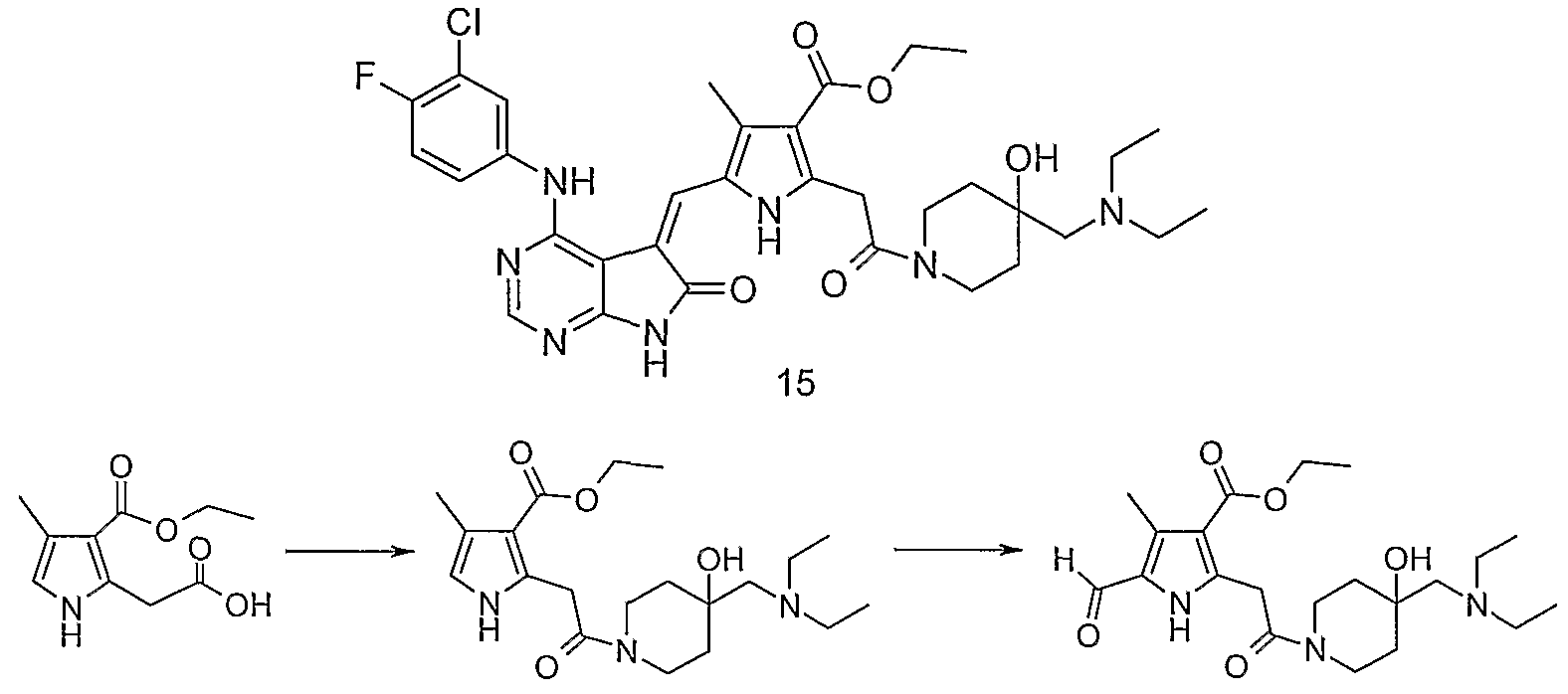
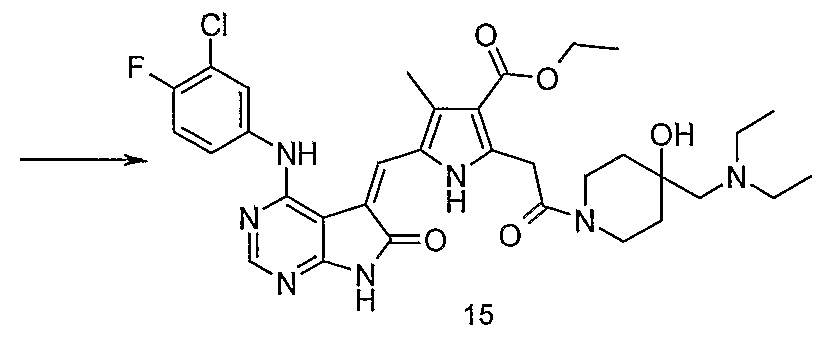
2-[2-(4-二乙基氨基甲基 -4-羟基 -哌啶 - 1-基) -2-氧代-乙基] - 4-甲基 -1氢 -P比咯- 3-羧 酸乙酯 15a的制备
氩气氛下, 冰浴条件下, 将 2-羧甲基 -4-甲基 -1氢-吡咯 -3-羧酸乙酯 13a (316 mg, 1.5 mmol), 4-二乙基氨基甲基 -哌啶 -4-羟基(420 mg, 2.25 mmol), 二氯甲烷 (8 ml), Ν,Ν-二甲基甲酰胺 (0.76 ml), N-乙基 -N,- (二甲氨基丙基) -碳二亚胺 (748 mg, 2.25 mmol)及 1-羟基苯并三唑 (304 mg, 2.25 mmol),三乙胺 (2.09 ml, 15 mmol) 加入 25 ml茄形瓶中, 室温下搅拌过夜。次日点板至原料 13a反应完全, 加入冰 块淬灭反应,分液,有机层依次用饱和氯化钠溶液 (20 mlx5)和饱和碳酸钾溶液 (20 mlxl)洗涤, 无水硫酸钠干燥, 抽滤, 滤液减压浓缩, 得到标题产物 2-[2-(4-二乙 基氨基甲基- 4-羟基 -哌啶 -1-基) -2-氧代-乙基] -4-甲基 -1 氢-吡咯 -3-羧酸乙酯
15a(570 mg, 褐色油状物), 直接进行下步反应。
MS m/z (ESI): 380.7(M+l) o
2-[2-(4-二乙基氨基甲基 -4-羟基 -哌啶 -1-基) -2-氧代-乙基] -5-甲酰基 -4-甲基 -1氢- 吡咯 -3-羧酸乙酯 15b的制备
氩气氛下, 将 17 ml无水二氯甲烷加入三口瓶中, 干冰-丙酮浴冷却, 加入 Ν,Ν-二甲基甲酰胺 (0.77 ml, 10 mmol),再缓慢滴加三氯氧磷 (0.62 ml, 6.68 mmol), 干冰一丙酮浴下搅拌 10分钟后,于室温下继续搅拌 20分钟,此时反应体系呈微 黄色透明溶液。 反应体系重新于干冰-丙酮浴中冷却, 将 2-[2- (4-二乙基氨基甲基 -4-轻基 -哌啶小基) -2-氧代-乙基] -4-甲基 -1氢-吡咯 -3-羧酸乙酯 15a (1.265 g, 3.34 mmol)搅拌下溶解于 5 ml二氯甲烷和 1 mlN,N-二甲基甲酰胺的混合溶剂中,缓慢
滴加到反应体系中。反应液继续于干冰一丙酮浴中反应 1.5小时,冰浴中反应 1.5 小时,室温下反应 3小时,点板跟踪反应至原料 15a点消失,加入冰块淬灭反应。 冰浴下, 用氢氧化钠调节反应液 pH至 10左右, 再用盐酸调节 pH至微酸性, 萃 取反应液 (二氯甲烷: 甲醇 = 10: 1, 100 mlx9),有机层用无水硫酸钠干燥,抽滤, 滤液减压浓缩, 得到黑褐色油状物残余物, 用硅胶柱色谱法纯化所得残余物 (二 氯甲烷: 甲醇: 醋酸 = 10: 0.4: 0.02)得到标题产物 2-[2-(4-二乙基氨基甲基 -4- 羟基 -哌啶 -1-基) -2-氧代-乙基] -5-甲雕基 -4-甲基 -1氢 -吡咯 -3-羧酸乙酯 15b(297 mg, 黄褐色固体), 产率: 21.9%。
MS m/z (ESI): 409.0(M+1)。
5_[4-(3-氯 -4-氟-苯氨基) - 6-氧代 -6,7-二氢 -吡咯 [2,3-d]p嘧啶 -5-次甲基 ]-2-[2-(4-二 乙基氨基甲基 -4-羟基 -哌啶 -1-基) -2-氧代-乙基] -4-甲基 -1氢-吡咯 -3-羧酸乙酯 15
的制备
在氩气氛下,在一个 10 ml的单口瓶中,依次加入 2-[2-(4-二乙基氨基甲基 -4- 羟基 -哌啶 -1-基) -2-氧代-乙基] -5-甲酰基 -4-甲基 -1 氢-吡咯 -3-羧酸乙酯 15b(0.037 g, 0.09 mmol), 4-(3-氯 -4-氟-苯胺) -5,7-二氢-吡咯 [2,3-d]嘧啶 -6-酮 (0.025 g, 0.09 mmol)(Bioorganic & Medicinal Chemistry letters., 2002, 12(16), 2153-2157. ), 哌啶 (0.225 ml, 0.225 mmol)及乙醇 (0.3 ml), 加热回流 1.5小时, 点板跟踪至 4-(3-氯 -4-氟-苯胺) -5,7-二氢 -吡咯 [2,3-d]嘧啶 -6-酮完全消失, 将反应液自然冷却至室温, 有大量固体产生, 减压抽滤, 得到标题产物 5-[4-(3-氯 -4-氟-苯氨基) -6-氧代 -6,7- 二氢 -P比咯 [2,3-d]p嘧啶 -5-次甲基 ]-2-[2-(4-二乙基氨基甲基 -4-羟基 -哌啶 -1-基) -2- 氧代-乙基] -4-甲基 -1氢 -吡咯 -3-羧酸乙酯 15 (22 mg, 黄色固体), 产率 36.6%。
MS mJz (ESI): 668·7(Μ+1)。
1HNMR (DMSO-D6,400MHz) 13.623(s, 1H, -NH), 9.285(s, 1H, -NH), 8.336(s, 1H, -CH), 7.740~7.735(d, 1H, -ArH), 2.514~2.506(s, 3H, -CH3), 2.282(s, 2H, -CH2), 1.462〜1.435(dd, 4H, 2x-CH2), 0.931-0.896 (t, 6H, 2x-CH3)。 实施例 16
5-[4-(3-氯 -4-氟-苯氨基) -6-氧代 -6,7-二氢 -吡咯 [2,3-d]嘧啶 -5-次甲基 ]-4-甲基 — 2-{[2-(4-甲基 -哌嗪 -1-基) -乙基氨基甲酰基] -甲基 }-1氢 -吡咯 -3-羧酸乙酯 16的制


4-甲基 -2-{[2-(4-甲基 -哌嗪 -1-基) -乙基氨基甲酰基] -甲基 }-l氢 -吡咯 -3-羧酸乙酯
16a的制备
氩气氛下, 冰浴条件下, 将 2-羧甲基 -4-甲基 -1氢 -吡咯 -3-羧酸乙酯 13a (3 g, 14.2 mmol), 2-(4-甲基 -哌嗪 -1-基) -乙胺(2.23 g, 14.2 mmol), 二氯甲烷 (71 ml), N,N-二甲基甲酰胺 (7.1 ml), N-乙基 -N,- (二甲氨基丙基) -碳二亚胺 (5.43 g, 28.4 mmol)及 1-羟基苯并三唑 (1.92 g, 14.2 mmol)加入 25 ml茄形瓶中, 室温下搅拌 过夜。 次日点板至原料 14a反应完全, 加入冰块淬灭反应, 分液, 有机层依次用 饱和氯化钠溶液 (50 mlx5)和饱和碳酸钾溶液 (20 mlxl)洗涤,无水硫酸钠干燥,抽 滤, 滤液减压浓缩, 得到标题产物 4-甲基 -2-{[2-(4-甲基 -哌嗪 -1-基:) -乙基氨基甲 酰基]-甲基 1氢 -吡咯 -3-羧酸乙酯 16a(1.2 g, 黄色固体), 产率: 25.1 %
5-甲酰基 -4-甲基 -2-{ [2-(4-甲基 -哌嗪 -1 -基)-乙基氨基甲酰基] -甲基 }-1氢 -吡咯 -3- 羧酸乙酯 16b的制备
氩气氛下, 将二氯甲烷 (18 ml, 干燥)加入三口瓶中, 干冰-丙酮浴冷却, 加 入 Ν,Ν-二甲基甲酰胺 (0.7 ml, 8.93 mmol) , 再缓慢滴加三氯氧磷 (0.5 ml, 5.36 mmol), 在干冰-丙酮浴下搅拌 5分钟后, 于室温下继续搅拌 20分钟, 此时反应 体系呈微黄色透明溶液。反应体系重新于干冰-丙酮浴中冷却,将 4-甲基 -2-{[2-(4- 甲基 -哌嗪 -1-基) -乙基氨基甲酰基] -甲基 }-1 氢-吡咯 -3-羧酸乙酯 16a(1.2 g, 3.57 mmol)搅拌下溶解于 6 ml二氯甲烷中,缓慢滴加到反应体系中。反应液继续于干 冰-丙酮浴中反应 1.5小时, 冰浴中反应 1.5小时, 室温下反应 3小时, 点板跟踪 反应至原料 16a点消失, 加入冰块淬灭反应。 冰浴下, 用氢氧化钠调节反应液 pH至 11左右, 萃取反应液 (二氯甲垸: 甲醇 =20: 1, 60 mlx8), 有机层用无水 硫酸钠干燥, 抽滤, 滤液减压浓缩, 得到褐色固体残余物, 用硅胶柱色谱法纯化 所得残余物, 得到标题产物 5-甲酰基 -4-甲基 -2-{[2-(4-甲基 -哌嗪 -1-基) -乙基氨基 甲酰基] -甲基 }-1氢 -吡咯 -3-羧酸乙酯 110b(892 mg,黄色固体), 产率: 68.4%。
MS:365.5(M+l) c
5-[4-(3-氯 -4-氟-苯氨基) -6-氧代 -6,7-二氢 -吡咯 [2,3-d]嘧啶 -5-次甲基 ]-4-甲基 _2_{[2_(4—甲基 -哌嗪小基) -乙基氨基甲酰基] -甲基 }—1氢 -吡咯 -3-羧酸乙酯 16的制 在氩气氛下, 在一个 10 ml的单口瓶中, 依次加入 5-甲酰基 -4-甲基 -2-{[2-(4- 甲基 -哌嗪 -1-基) -乙基氨基甲酰基] -甲基 }-1氢 -吡咯 -3-羧酸乙酯 16b(0.055 g, 0.15 mmol) , 4-(3-氯 -4-氟-苯胺)- 5,7-二氢-吡咯 [2,3-d]嘧啶 -6-酮(0.042 g, 0.15 mmol)(Bioorganic & Medicinal Chemistry letters., 2002, 12(16), 2153-2157. ), 哌啶 (0.375 ml, 0.375 mmol)及乙醇 (0.5 ml), 加热回流 1.5小时, 点板跟踪至 4-(3-氯 -4-氟-苯胺) -5,7-二氢 -吡咯 [2,3-d]嘧啶 -6-酮完全消失, 将反应液自然冷却至室温, 有大量固体产生, 减压抽滤, 得到标题产物 5-[4-(3-氯 -4-氟-苯氨基) -6-氧代 -6,7- 二氢 -吡咯 [2,3-d]嘧啶 -5-次甲基 ]-4-甲基 -2-{[2-(4-甲基 -哌嗪 -1-基) -乙基氨基甲酰 基]-甲基 }-1氢-吡咯 -3-羧酸乙酯 16(44 mg, 黄色固体), 产率 47.1 %。
MS ni/z (ESI): 625.9(M+1)。
^MR (DMSO-D6,400MHz) 8.323(s, 1H, -NH), 7.712~7.689(d, 1H, -ArH), 4.238~4.185(q, 2H, -CH2), 3.219〜3.185(t, 2H, -CH2), 2.445(s, 3H, -CH3)。 实施例 17
5-[4-(3-氯 -4-氟-苯氨基) -6-氧代 -6,7-二氢 -吡咯 [2,3-d]嘧啶 -5-次甲基 ]-2-[2-(4-羟基 —4-吗啡啉 -4-甲基 -哌啶小基) -2-氧代-乙基] -4-甲基 -1氢 -吡咯 -3-羧酸乙酯 17的制


2— [2-(4-羟基 -4-吗啡啉 -4-甲基-哌啶- 1-基) -2-氧代-乙基] -4-甲基 -1氢-吡咯 -3-羧酸 乙酯 17a的制备
氩气氛下, 冰浴条件下, 将 2-羧甲基 -4-甲基 -1氢 -吡咯 -3-羧酸乙酯 13a (638 mg, 3.0 mmol), 4-吗啡啉 -4-甲基 -哌啶 -4-羟基(1.425 g, 4.5 mmol),二氯甲烷 (15.5 ml), Ν,Ν-二甲基甲酰胺 (1.55 ml), N-乙基 -Ν'- (二甲氨基丙基) -碳二亚胺 (1.49 g, 4.5 mmol)及 1-羟基苯并三唑 (609 mg, 4.5 mmol),三乙胺 (4.22 ml, 30 mmol)加入 25 ml茄形瓶中, 室温下搅拌过夜。 次日点板至原料 13a反应完全, 加入冰块淬 灭反应, 分液, 有机层依次用饱和氯化钠溶液 (40 mlx5)和饱和碳酸钾溶液 (40 mlx l)洗涤, 无水硫酸钠干燥, 抽滤, 滤液减压浓缩得到标题产物 2-[2-(4-羟基 -4- 吗啡啉—4-甲基-哌啶小基 )—2-氧代-乙基] -4-甲基 -1 氢-吡咯 -3-羧酸乙酯 17a(1.742 g, 褐色油状物), 直接进行下步反应。
MS m/z (ESI): 394.1(M+1)。
5-甲酰基 -2-[2-(4-羟基 -4-吗啡啉 -4-甲基 -哌啶 -1-基) -2-氧代-乙基] -4-甲基 -1氢 -卩比 咯 -3-羧酸乙酯 17b的制备
氩气氛下, 将二氯甲烷 (23 ml, 干燥)加入三口瓶中, 干冰-丙酮浴冷却, 同 时加入 N,N-二甲基甲酰胺 (1.0 ml, 0.012 mol), 再缓慢滴加三氯氧磷 (0.83 ml, 8.87 mmol), 在干冰-丙酮浴下搅拌 5分钟后, 于室温下继续搅拌 20分钟, 此时反应 体系呈微黄色透明溶液。反应体系重新于干冰-丙酮浴中冷却, 将 2-[2-(4-羟基 -4- 吗啡啉—4-甲基 -哌啶 -1-基) -2-氧代-乙基] -4-甲基 -1氢 -吡咯 -3-羧酸乙酯 17a (1.742 g, 4.43 mmol)搅拌下溶解于 7 ml二氯甲烷中,缓慢滴加到反应体系中。反应液继 续于干冰一丙酮浴中反应 1.5小时, 冰浴中反应 1.5小时, 室温下反应 3小时, 点板跟踪反应至原料 17a点消失, 加入冰块淬灭反应。冰浴下, 用氢氧化钠调节 反应液 pH至 11左右, 萃取反应液 (二氯甲烷: 甲醇二 20: 1, 60 mlx8), 有机层 用无水硫酸钠干燥,抽滤, 滤液减压浓缩得到黑褐色固体残余物, 用硅胶柱层析 法纯化 (二氯甲烷: 甲醇: 氨水 =8: 0.2: 0.02)得到标题产物 5-甲酰基 -2-[2-(4-羟
基—4—吗啡啉—4—甲基-哌啶- i -基)—2—氧代-乙基] _4-甲基 _i 氢 -吡咯 -3-羧酸乙酯 17b(660 mg,淡黄色固体), 产率: 35.3 %。
MS m/z (ESI): 422.7(M+l)c
5-[4-(3-氯 -4-氟-苯氨基) -6-氧代 -6,7-二氢 -吡咯 [2,3-d]嘧啶 -5-次甲基 ]-2-[2-(4-羟基 _4-吗啡啉 -4-甲基 -哌啶小基) -2-氧代-乙基] -4-甲基 -1氢 -吡咯 -3-羧酸乙酯 17的制 备
在氩气氛下, 在一个 10 ml的单口瓶中, 依次加入 5-甲酰基 -2-[2-(4-羟基 -4- 吗啡啉—4-甲基 -哌啶小基) -2-氧代-乙基] -4-甲基 -1氢 -吡咯 -3-羧酸乙酯 17b(0.057 g, 0.136 mmol), 4-(3-氯 -4-氟-苯胺) -5,7-二氢 -吡咯 [2,3-d]嘧啶 -6-酮 (0.038 g, 0.136 mmol) (Bioorganic & Medicinal Chemistry letters., 2002, 12(16), 2153-2157. ),哌啶 (0.342 ml, 0.342 mmol)及乙醇 (0.4 ml), 加热回流 1.5小时, 点板跟踪至 4-(3-氯 -4-氟-苯胺) -5,7-二氢 -吡咯 [2,3-d]嘧啶 -6-酮完全消失, 将反应液自然冷却至室温, 有大量固体产生, 减压抽滤, 得到标题产物 5-[4-(3-氯 -4-氟-苯氨基: )-6-氧代 -6,7- 二氢 -吡咯 [2,3-d]嘧啶 -5-次甲基 ]-2-[2- (4-羟基 -4-吗啡啉 -4-甲基 -哌啶 -1-基) -2-氧代 -乙基 ]-4-甲基 -1氢 -吡咯 -3-羧酸乙酯 17(25 mg, 黄色固体), 产率 26.8%。
MS m/z (ESI): 682.6(M+1)。
1HNMR (DMSO- D6,400MHz) 13.642(s, 1H, -NH), 9.284(s, 1H, -NH), 8.334(s, 1H, -CH), 7.400~7.378(d, 1H, -ArH), 3.292(s, 2H, -CH2), 2.431-2.388(t, 4H, 2x-CH2), 2.190(s, 2H, -CH2), 1.303-1.267(t, 6H, 2x-CH3)。 实施例 18
5-[4-(3-氯 -4-氟-苯氨基) -6-氧代 -6,7-二氢-吡咯 [2,3-d]嘧啶 -5-次甲基 ]-4-甲基 _2— {[3—(4-甲基 -哌嗪小基) -丙基氨基甲酰基] -甲基 }—1氢-吡咯 -3-羧酸乙酯 18的制 备

18

4-甲基 -2-{[3-(4-甲基 -哌嗪小基) -丙基氨基甲酰基] -甲基 }-l氢 -P比咯 -3-羧酸乙酯
18a的制备
氩气氛下,冰浴条件下, 将 2-羧甲基 -4-甲基 -1氢 -P比咯 -3-羧酸乙酯 13a (2.11 g, lO mmol), 3-(4-甲基 -哌嗪 -1-基)-丙基胺(1.73 g, 11 mmol), 二氯甲垸 (50 ml), Ν,Ν-二甲基甲酰胺 (5 ml), N-乙基 -N,- (二甲氨基丙基) -碳二亚胺 (3.8 g, 20 mmol) 及 1-羟基苯并三唑 (1.35 g, 10 mmol), 三乙胺 (3.5 ml, 25 mmol)加入 100 ml茄形 瓶中, 室温下搅拌过夜。次日点板至原料 13a反应完全, 加入冰块淬灭反应, 分 液,有机层依次用饱和氯化钠溶液 (20 mlx5)和饱和碳酸钾溶液 (20 mlxl)洗涤,无 水硫酸钠干燥, 抽滤, 滤液减压浓缩, 得到标题产物 4-甲基 -2-{[3-(4-甲基 -哌嗪 -1-基) -丙基氨基甲酰基] -甲基 }-1氢 -吡咯 -3-羧酸乙酯 18a(3 g, 褐色油状物), 产 率: 85.7%
MS m/z (ESI): 351.8(M+1)。
5-甲酰基 -4-甲基 -2-{[3-(4-甲基 -哌嗪小基) -丙基氨基甲酰基] -甲基 }-1氢 -吡咯 -3- 羧酸乙酯 18b的制备
氩气氛下,将 44 ml无水二氯甲烷加入 100 ml三口瓶中,干冰-丙酮浴冷却, 同时加 ΛΝ,Ν-二甲基甲酰胺 (1.8 ml, 0.02 mol),再缓慢滴加三氯氧磷 (1.41 ml, 9.43 mmol), 搅拌 5分钟后, 彻去干冰-丙酮浴, 室温下继续搅拌 20分钟至反应体系 呈微黄色透明溶液。 反应体系重新于干冰一丙酮浴中冷却, 将 4-甲基 -2-{[3-(4- 甲基 -哌嗪 -1-基)-丙基氨基甲酰基] -甲基 }-1 氢 -吡咯 -3-羧酸乙酯 18a (3 g, 8.57 mmol)搅拌下溶解于 10 ml二氯甲垸和 0.5 mlN,N-二甲基甲酰胺的混合溶剂中, 缓慢滴加到反应体系中。反应液分别在千冰-丙酮浴中反应 1.5小时,冰浴中反应 1.5小时, 室温下反应 3小时, 点板跟踪反应至原料 18a点消失, 加入冰块淬灭 反应。 冰浴下, 用 1M氢氧化钠溶液调节反应液 pH至 11左右, 萃取反应液 (二 氯甲垸: 甲醇 = 10: 1, 50 mlx6), 有机层用无水硫酸钠干燥, 抽滤, 滤液减压 浓缩得到黑褐色油状残余物, 用硅胶柱色谱法纯化 (二氯甲烷: 甲醇: 醋酸 =50: 1 : 0.1)得到标题产物 5-甲酰基 -4-甲基 -2-{[3-(4-甲基-哌嗪小基) -丙基氨基甲酰基] -
甲基 }-l氢 -吡咯 -3-羧酸乙酯 18b(200 mg,褐色油状物), 产率: 6.1 %。
MS m/z (ESI): 379舉 +1)。
5_[4-(3-氯 -4-氟-苯氨基) - 6-氧代 -6,7-二氢 -吡咯 [2,3-d]嘧啶 -5-次甲基 ]-4-甲基 _2-{[3-(4-甲基 -哌嗪小基) -丙基氨基甲酰基] -甲基 }-1氢 -吡咯 -3-羧酸乙酯 18的制 备
氩气氛下, 在一个 10 ml的单口瓶中, 将 5-甲酰基 -4-甲基- 2-{[3-(4-甲基-哌 嗪 -1-基) -丙基氨基甲酰基] -甲基 }-1 氢 -吡咯 -3-羧酸乙酯 18b(0.049 g, 0.129 mmol), 4- (3-氯 -4-氟-苯胺) -5,7-二氢 -吡咯 [2,3-d]嘧啶 -6-酮 (0.036 g, 0.129 mmol) (Bioorganic & Medicinal Chemistry letters., 2002, 12(16), 2153-2157. )和哌啶 (0.322 ml, 0.322 mmol)搅拌下溶解于 0.4 ml乙醇中, 加热回流 1.5小时, 点板跟踪至 4-(3-氯 -4-氟-苯胺) -5,7-二氢 -吡咯 [2,3-d]嘧啶 -6-酮完全消失,将反应液自然冷却至 室温, 有大量固体产生, 减压抽滤, 得到标题产物 5-[4- (3-氯 -4-氟-苯氨基) -6-氧 代 -6,7-二氢-吡咯 [2,3-d]嘧啶 -5-次甲基 ]-4-甲基 -2-{[3-(4-甲基 -哌嗪 -1-基) -丙基氨 基甲酰基] -甲基 }-1氢-吡咯 -3-羧酸乙酯 18(35 mg, 黄色固体), 产率 42.5 %。
MS m/z (ESI): 639.7(M+l)c
lHNMR (DMSO-D6,400MHz) 13.642(s, 1H, -NH), 9.284(s, 1H, -NH), 8.334(s, 1H, -CH), 7.400~7.378(d, 1H, -ArH), 3.292(s, 2H, -CH2), 2.431~2.388(t, 4H, 2x-CH2), 2.190(s, 2H, -CH2), 1.303-1.267(t, 6H, 2x-CH3)。
激酶抑制活性的测定
例 1: 抑制细胞增殖测试
下面的体外试验是用来测定本发明化合物对于人类肿瘤细胞 HUVEC VEGFR高表达的细胞株抑制增殖活性。
下面所述的体外细胞试验可确定受试化合物的对高表达 VEGFR的肿瘤细胞 的抗血管生成活性和抑制增殖活性,其活性可用 IC5Q值来表示。此类试验的一般 方案如下: 首先选择高表达 VEGFR的人类肿瘤细胞, 以适宜细胞浓度下 (exp 5000个细胞 /ml medium)接种在 96孔培养板上, 然后将细胞在二氧化碳恒温箱 内进行培养, 当它们生长至 85 %汇合, 更换培养基为加有一系列浓度递度 (一 般 6到 7个浓度)受试化合物溶液的培养基, 将培养板重新放回培养箱,连续培 养 72个小时。 72小时后, 可用 sulforhodamine B (SRB)方法进行测试化合物对 于抑制细胞增殖活性。 IC5Q值可通过一系列不同浓度下, 受试化合物对于细胞的
抑制数值进行计算。 材料和方法:
a. 二甲基亚砜 (Sinophma chemical reagent company, 目录 T20050806号) b. HUVEC细胞 (贝勾于 Institute of biochemistry and cell biology)
c. Falcon 100 mm细胞培养板 (Baton Dickison Labware, Baton Dicldson and company, 目录 18677号)
d. corning 96孑 L培养板 (Coming Incorporated, 目录 3599号)
e. Fisher移液管(Fisher scientific, 目录 03-692-164号)
f. DMEM/F12细胞培养基(Gibco, 目录 l2400-024号)
g. 澳大利亚胎牛血清(Gibco, 目录 10099-141号)
h. 磷酸盐缓冲盐水(Gibco, 目录 10010-072号)
i. 0.25 %胰岛素 -EDTA (Gibco, 目录 25200-056号)
j. Sulforhodamine B (Sigma, 目录 3520-42-1号)
k. 醋酸(Sinophma chemical reagent company, 目录 T20060508号)
1. 三氯醋酸(Sinophma chemical reagent company, 目录 T20060305号) m. Tris碱(Amresco, 目录 0826号)
n. II级 A/B3 型生物学安全工作橱 (ThermoForma目录. HB0053-03号)
0. 系列 II水套式二氧化碳培养箱(ThermoForma模型: 3111)
ρ· 离心机(Fisher Scientific Marathon 8 k, 目录 0027-02号)
q. Novastar板读取器(BMG Labtech, 目录 700-0081号)
r. 定轨摇床(Qilinbeier, 目录 TS-1号) 方案:
下面的方案用来测试本发明受试化合物对于 HUVEC细胞的抑制细胞增殖 IC5o 值。
1. 将 HUVEC细胞殖于 100mm corning培养板在生长基(以 DMEM/F12+10%胎 牛血清为培养液)中进行培养 (37 O, 5 % C02), 直至细胞充分汇合;
2. 在 100 mm培养板中用胎牛血清洗涤 HUVEC细胞, 以 Tyrpsin消化细胞后, 再将细胞接种在 coming 96孔细胞培养板上, 浓度为 50000 cells/ml,每个板空 6 孔, 作为对照孔.;
3. 在 37 °C, 5 % C02条件下, 将细胞在 96孔板中培养, 直至达到约 85 %汇合;
4. 用 DMSO溶解受试化合物, 配置 20 mM母液, 后用 DMSO稀释母液, 得到 一系列浓度的受试化合物的溶液,即 2 mM, 1 mM, 0.2 mM, 20 μΜ, 2 μΜ, 0.2 μΜ;
5. 使用细胞培养基(DMEM/F12 +10 %胎牛血清为培养液)稀释上面所配置的
化合物溶液。每个 DMSO系列浓度化合物溶液稀释 20倍,每次在细胞培养基中 加入 5μ1 DMSO化合物溶液和 95μ1培养液, 确保 HUVEC细胞暴露在 DMSO溶 液中的浓度不超过 0.5 %, 用祸旋混合,;
6. 当 HUVEC细胞贴壁, 生长达到 85%汇合后, 将培养基换为加有 DMEM/F12 +10 %胎牛血清培养液的新培养基,每孔中再加入 180μ1培养液和 20 μΐ在第五步 中所制备的受试化合物溶液。阴性对照细胞组,加入含有 0.5 %DMSO的 20 μΐ培 养液,这样 HUVEC细胞暴露在受试化合物溶液中的最终浓度为 100 μΜ, 10 μΜ, 5 μΜ, 1 μΜ, 0.1 μΜ, 0.01 μΜ, and 0.001 μΜ;
7. 将培养板放入恒温箱内, 在 37 °C , 5 % C02条件下, 连续培养 72小时;
8. 72小时后, 将培养板从恒温箱中转移到无菌工作室;
9. 将试药级纯水加入到 TCA中制备固定剂(50 %三氯醋酸 -TCA),将细胞慢慢 地分层放在 50 μΐ冷 TCA溶液中;
10.在 4°C下, 培养 1小时, 后用水洗涤数次以除去 TCA、 血清蛋白等。 培养板 在空气中干燥,存储待用。空白背景光学密度值的测定是在没有细胞生长的培养 基中温育培养所得的数值。
11.用 10 %醋酸溶液制备 0.4 % Sulforhodamine B溶液, 并向每孔中加入 50 μΐ sulforhodamine B溶液;
12.细胞着色 30分钟;
13.制备 10 %醋酸洗涤溶液。当着色将要完毕时, 弃去着色剂, 用 10 %的醋酸溶 液快速冲洗细胞。重复上述的操作直至着色剂洗净为止,尽量减少冲洗次数以减 少与蛋白结合的着色剂的去吸附。 冲洗完毕后, 将培养板在空气中干燥;
14.混合的着色剂溶解在一定体积的 Sulforhodamine B中,增溶溶液(10 mM Tris) 与培养基原体积相同,将培养板在室温下放置 5分钟,用摇床缓慢搅拌加快与染 料的混合;
15.用分光光度测量, 在波长 565 nm下读取吸光度值。 吸光度数值为 565 nm下 吸光度减去 690 nm下 96孔板背景吸光度所得的数值;
16.使用如下方法计算抑制率比值:
IR= ΙΟΟχ (对照组吸光度值 -用药组吸光度值) /对照组吸光度值%.
IC50值可通过不同浓度下化合物抑制率比值计算得到。 本发明化合物的活性
本发明化合物的生化学活性通过以上的试验进行测定, 测得的 IC50值见下 表。
IC50 (VEGFR/HUVEC)^M)
2.4
4.7
2.9
4.2
3.3 例 3: 抑制细胞增殖测试
下面的体外试验是用来测定本发明化合物对于人类肿瘤细胞 A431 EGFR高 表达的细胞株抑制增殖活性。
下面所述的体外细胞试验可确定受试化合物的对高表达 EGFR的肿瘤细胞 的抗血管生成活性和抑制增殖活性,其活性可用 IC5Q值来表示。此类试验的一般 方案如下:首先选择高表达 EGFR的人类肿瘤细胞,以适宜细胞浓度下(exp 5000 个细胞 /ml medium)接种在 96孔培养板上, 然后将细胞在二氧化碳恒温箱内进 行培养, 当它们生长至 85 %汇合, 更换培养基为加有一系列浓度递度 (一般 6 到 7个浓度)受试化合物溶液的培养基, 将培养板重新放回培养箱, 连续培养 72个小时。 72小时后, 可用 sulforhodamine B (SRB)方法进行测试化合物对于 抑制细胞增殖活性。 IC5Q值可通过一系列不同浓度下, 受试化合物对于细胞的抑 制数值进行计算。 材料和方法:
s. 二甲基亚砜 (Sinoplima chemical reagent company, 目录 T20050806号) t. A431 细胞 (贝勾于 Institute of biochemistry and cell biology)
u. Falcon 100 mm细胞培养板 (Baton Dickison Labware, Baton Dickison and company, 目录 18677号)
v. corning 96孔培养板 (Corning Incorporated, 目录 3599号)
w. Fisher移液管(Fisher scientific, 目录 03-692-164号)
x. DMEM/F12细胞培养基(Gibco, 目录 12400-024号)
y. 澳大利亚胎牛血清(Gibco, 目录 10099-141号)
z. 磷酸盐缓冲盐水(Gibco, 目录 10010-072号)
aa. 0.25 %胰岛素 -EDTA (Gibco, 目录 25200-056号)
bb. Sulforhodamine B (Sigma, 目录 3520-42-1号)
cc.酉昔酸 (Sinophma chemical reagent company, 目录 T20060508号)
dd.三氯醋酸(Sinophma chemical reagent company, 目录 T20060305号) ee. Tris碱(Amresco, 目录 0826号)
ff. II级 A/B3 型生物学安全工作橱 (ThermoForma目录. HB0053-03号)
gg.系列 II水套式二氧化碳培养箱(ThermoForma模型: 3111)
li.离心机(Fisher Scientific Marathon 8 k, 目录 0027-02号)
ii. Novastar板读取器(BMG Labtech, 目录 700-0081号)
jj. 定轨摇床(Qilinbeier, 目录 TS-1号) 方案:
下面的方案用来测试本发明受试化合物对于 A431细胞的抑制细胞增殖 IC5Q值。
17.将 A431细胞殖于 100mm corning培养板在生长基(以 DMEM/F12+10%胎牛 血清为培养液)中进行培养 (37 °C, 5 % C02), 直至细胞充分汇合;
18.在 100 mm培养板中用胎牛血清洗涤 A431细胞, 以 Tyrpsin消化细胞后, 再 将细胞接种在 coming 96孔细胞培养板上, 浓度为 50000 cells/ml,每个板空 6孔, 作为对照孔.;
19.在 37 V, 5 % C02条件下, 将细胞在 96孔板中培养, 直至达到约 85 %汇合;
20.用 DMSO溶解受试化合物, 配置 20 mM母液, 后用 DMSO稀释母液, 得到 一系列浓度的受试化合物的溶液,即 2 mM, 1 mM, 0.2 mM, 20 μΜ, 2 μΜ, 0.2 μΜ;
21.使用细胞培养基(DMEM/F12 +10 %胎牛血清为培养液)稀释上面所配置的 化合物溶液。每个 DMSO系列浓度化合物溶液稀释 20倍, 每次在细胞培养基中 加入 5μ1 DMSO化合物溶液和 95μ1培养液, 确保 A431细胞暴露在 DMSO溶液 中的浓度不超过 0.5 %, 用涡旋混合,;
22.当 A431细胞贴壁,生长达到 85%汇合后,将培养基换为加有 DMEM/F12 +10 %胎牛血清培养液的新培养基, 每孔中再加入 180μ1培养液和 20 μΐ在第五步中 所制备的受试化合物溶液。 阴性对照细胞组, 加入含有 0.5 %DMSO的 20 μΐ培 养液, 这样 A431细胞暴露在受试化合物溶液中的最终浓度为 100 μΜ, 10 μΜ, 5 μΜ, 1 μΜ, 0.1 μΜ, 0.01 μΜ, and 0.001 μΜ;
23.将培养板放入恒温箱内, 在 37 °C, 5 % C02条件下, 连续培养 72小时;
24. 72小时后, 将培养板从恒温箱中转移到无菌工作室;
25.将试药级纯水加入到 TCA中制备固定剂(50 %三氯醋酸 -TCA),将细胞慢慢 地分层放在 50 μΐ冷 TCA溶液中;
26.在 4°C下, 培养 1小时, 后用水洗涤数次以除去 TCA、 血清蛋白等。 培养板 在空气中干燥,存储待用。空白背景光学密度值的测定是在没有细胞生长的培养 基中温育培养所得的数值。
27.用 10 %醋酸溶液制备 0.4 % Sulforhodamine B溶液, 并向每孔中加入 50 μΐ sulforhodamine B溶液;
28.细胞着色 30分钟;
29.制备 10%醋酸洗涤溶液。当着色将要完毕时, 弃去着色剂, 用 10%的醋酸溶
液快速冲洗细胞。重复上述的操作直至着色剂洗净为止,尽量减少冲洗次数以减 少与蛋白结合的着色剂的去吸附。 冲洗完毕后, 将培养板在空气中干燥;
30.混合的着色剂溶解在一定体积的 Sulforhodamine B中,增溶溶液(10 mM Tris) 与培养基原体积相同,将培养板在室温下放置 5分钟,用摇床缓慢搅拌加快与染 料的混合;
31.用分光光度测量, 在波长 565 nm下读取吸光度值。 吸光度数值为 565 nm下 吸光度减去 690 nm下 96孔板背景吸光度所得的数值;
32.使用如下方法计算抑制率比值:
IR= ΙΟΟχ (对照组吸光度值 -用药组吸光度值) /对照组吸光度值%.
IC50值可通过不同浓度下化合物抑制率比值计算得到。 本发明化合物的活性
本发明化合物的生化学活性通过以上的试验进行测定, 测得的 IC50值见下表。
实施例编号 IC5Q (EGFR/A431)^M)
2 0.28
3 6.77
4 5.94
7 1.44
10 1.02
11 2.16
14 0.17
15 7.13
17 0.56
18 0.5
EXAMPLE 4: EGFR激酶活性测定
体外 EGFR激酶活性通过以下的方法进行测试。 材料与试剂- a.洗涤缓冲液(PBS-T缓冲液): lx PBS (137 mM NaCl, 2.7 mM KC1, 4.3 mM Na2HP04, 1.4 mM KH2P04,调 pH至 7.2)和 0.05 % Tween-20
b. 1 %牛血清白蛋白 (BSA, Calbiochem #136593)PBS-T缓冲液
c. 反应中止缓冲液: 50 mM EDTA , pH 8.0.
d. DELFIA®铕标记抗鼠 IgG (PerkinElmer Life Sciences #AD0124)
e. DELFIA®信号倍增液 (PerkinElmer Life Sciences #1244-105)
f. DELFIA® Streptavidin包 96孔黄板(PerkinElmer Life Sciences#AAAND-0005) g. EGFR激酶 (50 mM Tris-HCl (pH 8.0), 100 mM NaCl, 5 mM DTT, 15 mM谷酰 基胱氨酰甘氨酸和 20 %甘油, Cell signaling technology #7908)
h. lO mM ATP溶液(Cell signaling technology #9804).
i. PTP1B (Tyr66)生物素酰化蛋白 (Cell signaling technology #1325).
j. Phospho-酪氨酸鼠 mAb (P-Tyr-100) (Cell signaling technology #9411).
k. HTScan™酪氨酸激酶缓冲液(4x)
lx激酶缓冲液:
60 mM HEPES
5 mM MgCl2
5 mM MnCl2

(Cell signaling technology #9805).
1. 1.25 M DTT (lOOOx) (Cell signaling technology). 方案:
使用如下方案进行测试:
1.用 DMSO稀释受试化合物达到最终浓度值;
在每个试验中加入 1 μΐ受试化合物、阴性对照和空白对照 (不接受任何受试化合 物) , 只加入 1 l DMSO;
2.用 dH201 :l稀释 6 μΜ底物蛋白 (Tyr589), 并加 15 μΐ到每个测试;
3.将酶从 -80°C直接转移到冰上, EGFR酶解冻在冰上;
4.取 3 EGFR酶到每个测试中;
5.加入 10 μΐ DTT (1.25 M)到 2.5 ml 4x HTScan™酪氨酸激酶缓冲液 (240 mM HEPES pH 7.5, 20 mM MgCI2, 20 mM MnCI2, 12 μΜ Na3V04) 中,制得 DTT/激酶 缓冲液;
6.转移 0.75 ml DTT/激酶缓冲液到每个每个测试中,制得 4x反应混合液,并在 每个测试中加入 7.5 μ14χ反应液;
7.加入 2 μΙ ΑΤΡ (10 mM)至 496 μΐ d¾0中,并在每个测试中加入 7.5 μΐ; 30 μΐ反应最终测试条件为:
60 mM HEPES pH 7.5
5 mM MgCl2
5 mM MnCl2

1.25 mM DTT
20 μΜΑΤΡ
I.5 μΜ多肽底物
30 ng EGFR激酶
8.在 25°C下, 将反应管温育 45分钟;
9.每个测试中加入 30 μΐ中止反应缓冲液 (50 mM EDTA, pH 8.0)中止反应;
10.在 96孔 streptavidin包被培养板每孔中加入 25 μΐ反应液和 75 μΐ d¾0,在室 温下, 并振摇 60分钟;
II.每孔用 200 l PBS-T缓冲液洗涤 3次, 在纸巾上轻拍以除去剩余的液体;
12.用 1 %牛血清白蛋白 PBS-T缓冲液 1:1000稀释抗体 Phospho-酪氨酸 mAb (P-Tyr-100), 在每孔中加入 100 μΐ稀释的抗体;
13.在室温下, 振摇温育 60分钟;
14.按第 11歩所述方法洗涤;
15.用 1 %牛血清白蛋白 PBS-T缓冲液 1 :500稀释铕标记抗鼠 IgG, 并在每孔中 加入 100 μΐ稀释抗体;
16.在室温下, 振摇温育 30分钟;
17.每孔用 PBS-T缓冲液 200 μΐ洗涤 5次, 在纸巾上轻拍以除去剩余的液体;
18.每孔中加入 100 DELFIA®信号倍增液;
19.在室温下, 振摇温育 5分钟;
20.在 615 nm处, 用合适的时间分辨板读取器读取荧光强度。。
计算抑制率比值: IR (%) =100- 100*(X-B)/ (N-B)
X=受试化合物荧光值
N-阴性对照
B=空白
IC50值可通过受试化合物不同浓度递度下的抑制率比值计算得到。 本发明化合物的活性
本发明化合物的生化学活性通过以上的试验进行测定, 测得的 IC50值见下表。
实施例编号 IC5() (EGFR/bio)^M)
2 0.13 15 0.06
17 0.007
18 0.025
Claims
1. 一种由下面通式 (I)表示的化合物或其药学上可接受的盐:

其中:
X选自 W(CH2)、(CH2)W、或 W,其中 W是 0、 S、 SO或 S02;或 X为 -NR6; 其中 R6是氢原子或烷基;
Y为氧原子或氢原子;
当 X是 -NR6, R6是烷基,则 R6可以和 形成一个 4〜8元杂环基;其中 5〜 8元杂环内可以含有一个或多个N、 0、 S原子, 并且 4〜8元杂环进一步被一个 或多个选自烷基、 卤素、 芳基、 杂芳基、 卤代烷基、 卤代烷氧基、 羟基、 氨基、 烷氨基、酰胺基、 胺酰基、 氰基、烷氧基、 芳氧基、 胺垸基、羟烷基、 杂环烷基、 羧酸、 羧酸酯或 -NR7R8的取代基所取代;
选自氢原子、 烷基、 环烷基、 杂环烷基、 芳基、 杂芳基、 芳烷基或杂芳 烷基, 其中烷基、 环烷基、 杂环垸基、 芳基、 杂芳基、 芳烷基或杂芳烷基进一步 被一个或多个选自烷基、 卤素、 芳基、 羟基、 氨基、 烷氨基、 酰胺基、 胺酰基、 垸氧基、 芳氧基、 杂环烷基、 羧酸、 羧酸酯或 -NR7R8的取代基所取代; 其中芳 基、 杂芳基、 芳烷基或杂芳烷基并成双环;
R2选自氢原子、 烷基、 环烷基、 杂环烷基、 -(CH2CH20)nR6、 烯基或炔基、 -C00R7、 -CONR7R8、 -C(=S)NR7R8、 -C0R7、 -S0R7、 -S02R7、 -S02NR7R8或者 -P(=0)(OR7)(OR8), 其中烷基、 环烷基、 杂环烷基、 烯基或炔基进一步被一个或 多个选自烷基、 羟基、 垸氧基、 氰基、 氨基、 垸氨基、 羧酸或羧酸酯的取代基所 取代;
选自氢原子、 烷基、 芳基、 卤素取代的芳基或三氟甲基;
FU选自羟基、 烷氧基、 芳氧基、 杂环烷氧基、 芳垸氧基、 -(OCH2CH2)nR6、 -N(R7)(C¾)nR8、 -NR7[CH2C¾0]nR8或者 -NR6(C¾)n[CH(OH)CH2]rZ ; 其中 Z是 芳基、 杂芳基、 杂环烷基、 -NR7R8、 -C00R6或 CONR7R8 ;
R5选自羟基、 烷氧基、 芳氧基、 杂环烷氧基、 芳垸氧基、 -N(R7)(CH2)nR8、 -NR7[C¾CH20]nR8或者 -NR6(CH2)n[CH(OH)C¾]rZ ; 其中 Z是芳基、 杂芳基、 杂环烷基、 -NR7R8、 -C00R6或 C0NR7Rs ;
R6是氢原子或烷基;
R7和 R8分别选自氢原子、 烷基、 环烷基、 杂环烷基、 芳基、 杂芳基或杂芳 垸基, 其中烷基、 环烷基、 杂环垸基、 芳基、 杂芳基或者杂芳烷基进一步被一个 或多个选自烷基、 卤素、 芳基、 羟基、 氨基、 垸氨基、 酰胺基、 胺酰基、 氰基、 烷氧基、 芳氧基、 胺烷基、 羟烷基、 杂环垸基、 羧酸、 羧酸酯或 -NR7R8的取代 基所取代;
同时, R7和 R8可以形成一个 4〜8元杂环基; 其中 5〜8元杂环内含有一个 或多个 N、 0、 S原子, 并且 4〜8元杂环进一步被一个或多个选自烷基、 卤素、 芳基、 杂芳基、 卤代烷基、 卤代烷氧基、 羟基、 氨基、 酰胺基、 胺酰基、 氰基、 烷氧基、 芳氧基、 胺烷基、 羟垸基、 杂环烷基、 羧酸、 羧酸酯或- NR7R8的取代 基所取代。
n是 0〜 6;
r是 1〜 2。
2. 根据权利要求 1所述的化合物或其药学上可接受的盐, 其中 X是 -NH, Ri是氢原子、 烷基、 环烷基、 杂环烷基、 芳基、 杂芳基、 芳烷基或杂芳烷基, 其中烷基、 环烷基、 杂环烷基、 芳基、 杂芳基、 芳烷基或杂芳烷基进一步被一个 或多个选自烷基、 卤素、 芳基、羟基、氨基、烷氨基、酰胺基、 胺酰基、烷氧基、 芳氧基、 杂环烷基、 羧酸、 羧酸酯的取代基所取代。
3. 根据权利要求 1所述的化合物或其药学上可接受的盐,其中 Y是氧原子。
4. 根据权利要求 1所述的化合物或其药学上可接受的盐,其中 R2是氢原子。
5. 根据权利要求 1所述的化合物或其药学上可接受的盐, 其中所述的药学 上可接受的盐为化合物与选自以下的酸形成的盐:苹果酸、乳酸、马来酸、盐酸、 甲磺酸、 硫酸、 磷酸、 柠檬酸、 酒石酸、 乙酸或三氟乙酸。
6. 根据权利要求 1〜5任一项所述的化合物或其盐, 其中包括-


7. 权利要求 1所述的通式 (I)化合物或其药学上可接受的盐的制备方法, 包括以下步骤:

以 I-la为起始原料, 与亚硝酸钠反应得到通式 I-lb化合 ¾
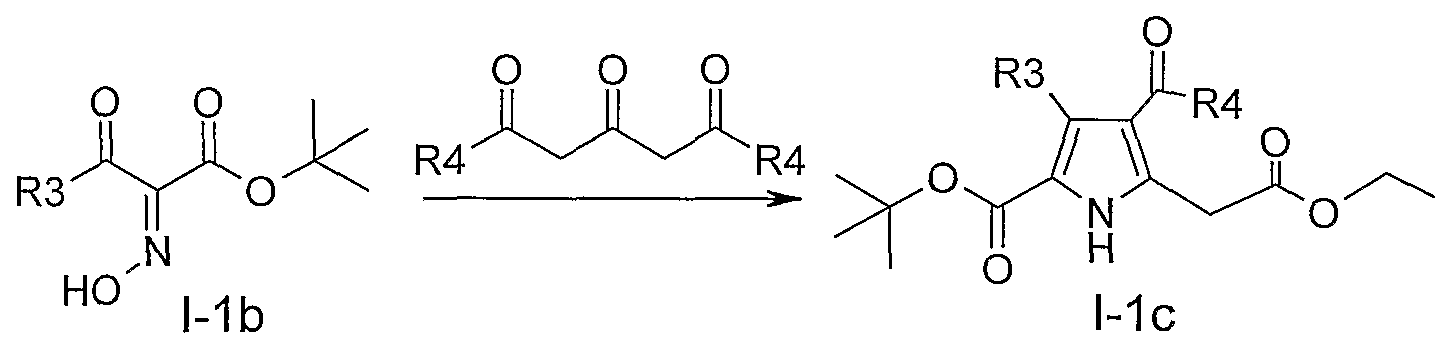
将所得 I-lb化合物经过 norr Pyrrole成环得到通式 I-lc化合物;

所述 I-lc化合物室温下经碱金属氢氧化物溶液的选择性水解后得到通式 I- Id化合物;


I-le化合物经在三氟醋酸作用下的脱羧得到通式 I-lf化合物;

I-lf化合物在无水体系中, 与三氯氧磷经甲酰化反应得到通式 I-lg化合物;
通式

8. 根据权利要求书 7所述的制备方法, 其中所述碱金属氢氧化物溶液为氢 氧化锂溶液。
9. 一种药物组合物,其含有治疗有效剂量的根据权利要求 1〜6中任何一项 所述的化合物或其药学上可接受的盐和药学载体。
10.一种调节蛋白激酶催化活性的方法, 其中包括将所述的蛋白激酶与权利 要求 1〜6中任何一项所述的化合物或其药学上可接受的盐接触。
11.根据权利要求 10所述的方法, 其中所述蛋白激酶选自受体酪氨酸激酶、 非受体酪氨酸激酶或丝氨酸-苏氨酸激酶。
12.一种治疗患有与蛋白质激酶有关的疾病的哺乳动物的方法, 所述方法包 括对所述哺乳动物给药治疗有效剂量的根据权利要求 9所述的药物组合物。
13.根据权利要求 12所述的方法,其中所述与蛋白质激酶有关的疾病选自与 VEGFR-2, EGFR, HER-2, HER-3, HER-4, PDGFR, c-Kit, c-Met, FGFR或 Flt3相关 的疾病。
14.根据权利要求 12所述的方法, 其中所述的哺乳动物是人。
15.根据权利要求 12所述的方法,其中所述与蛋白激酶有关的疾病选自白血 病, 糖尿病, 自免疫病, 过度增生病, 牛皮癣, 骨关节炎, 类风湿性关节炎, 血 管生成, 心血管病, Von-Heppel-Lindau氏病, 炎症或纤维变性病。
16.根据权利要求 12所述的方法, 其中所述与蛋白激酶有关的疾病是癌症, 选自鳞状细胞癌, 肾细胞癌, Kaposi肉瘤,非小细胞肺癌,小细胞肺癌,淋巴癌, 甲状腺癌, 乳腺癌, 头颈癌, 子宫癌, 食道癌, 黑素癌, 膀胱癌, 生殖泌尿癌, 胃肠癌, 神经胶质癌, 结肠直肠癌或卵巢癌。
17.根据权利要求 16所述的方法,该方法进一步包括同时向需要治疗的患者 给药治疗有效量的其它抗癌药物。
18.根据权利要求 17所述的方法,其中所述的其它抗癌药物选自紫杉酚或卡 铂。
19.一种权利要求 1所述的化合物在制备治疗与蛋白质激酶有关的疾病的药 物中的用途。
20.根据权利要求 19所述的用途,其中所述与蛋白质激酶有关的疾病选自与 VEGFR-2, EGFR, HER-2, HER-3, HER-4, PDGFR, c-Kit, c-Met, FGFR或 Flt3相关 的疾病。
21.根据权利要求 19所述的方法,其中所述与蛋白激酶有关的疾病选自白血 病, 糖尿病, 自免疫病, 过度增生病, 牛皮癣, 骨关节炎, 类风湿性关节炎, 血 管生成, 心血管病, Von-Heppel-Lindau氏病, 炎症或纤维变性病。
22.根据权利要求 19所述的方法, 其中所述与蛋白激酶有关的疾病是癌症, 选自鳞状细胞癌, 肾细胞癌, Kaposi肉瘤, 非小细胞肺癌, 小细胞肺癌,淋巴癌, 甲状腺癌, 乳腺癌, 头颈癌, 子宫癌, 食道癌, 黑素癌, 膀胱癌, 生殖泌尿癌, 胃肠癌, 神经胶质癌, 结肠直肠癌或卵巢癌。
Applications Claiming Priority (2)
| Application Number | Priority Date | Filing Date | Title |
|---|---|---|---|
| CN200610072406.6 | 2006-04-11 | ||
| CNA2006100724066A CN101054379A (zh) | 2006-04-11 | 2006-04-11 | 吡咯取代的嘧啶酮衍生物、其制备方法及其在医药上的用途 |
Publications (1)
| Publication Number | Publication Date |
|---|---|
| WO2007115473A1 true WO2007115473A1 (en) | 2007-10-18 |
Family
ID=38580698
Family Applications (1)
| Application Number | Title | Priority Date | Filing Date |
|---|---|---|---|
| PCT/CN2007/000980 Ceased WO2007115473A1 (en) | 2006-04-11 | 2007-03-27 | Pyrrole derivatives inhibitors, their curative uses |
Country Status (2)
| Country | Link |
|---|---|
| CN (1) | CN101054379A (zh) |
| WO (1) | WO2007115473A1 (zh) |
Families Citing this family (1)
| Publication number | Priority date | Publication date | Assignee | Title |
|---|---|---|---|---|
| CN112500425B (zh) * | 2020-10-30 | 2022-04-15 | 太原理工大学 | 一种3-硫代吡咯化合物及其合成方法 |
Citations (5)
| Publication number | Priority date | Publication date | Assignee | Title |
|---|---|---|---|---|
| US6451838B1 (en) * | 2000-05-24 | 2002-09-17 | Pharmacia & Upjohn Company | 1-(pyrrolidin-1-ylmethyl)-3-(pyrrol-2-ylmethylidene)-2-indolinone derivatives |
| US6465507B2 (en) * | 2000-02-28 | 2002-10-15 | Sugen, Inc. | 3-(pyrolyllactone)-2-indolinone compounds as kinase inhibitors |
| US6610688B2 (en) * | 1999-12-21 | 2003-08-26 | Sugen, Inc. | 4-substituted 7-aza-indolin-2-ones and their use as protein kinase inhibitors |
| US6797725B2 (en) * | 2001-04-09 | 2004-09-28 | Sugen, Inc. | Prodrugs of a 3-(pyrrol-2-ylmethylidene)-2-indolinone derivatives |
| WO2005053686A1 (en) * | 2003-11-26 | 2005-06-16 | The Scripps Research Institute | Indolinone based protein kinase inhibitors |
-
2006
- 2006-04-11 CN CNA2006100724066A patent/CN101054379A/zh active Pending
-
2007
- 2007-03-27 WO PCT/CN2007/000980 patent/WO2007115473A1/zh not_active Ceased
Patent Citations (6)
| Publication number | Priority date | Publication date | Assignee | Title |
|---|---|---|---|---|
| US6610688B2 (en) * | 1999-12-21 | 2003-08-26 | Sugen, Inc. | 4-substituted 7-aza-indolin-2-ones and their use as protein kinase inhibitors |
| US6465507B2 (en) * | 2000-02-28 | 2002-10-15 | Sugen, Inc. | 3-(pyrolyllactone)-2-indolinone compounds as kinase inhibitors |
| US6451838B1 (en) * | 2000-05-24 | 2002-09-17 | Pharmacia & Upjohn Company | 1-(pyrrolidin-1-ylmethyl)-3-(pyrrol-2-ylmethylidene)-2-indolinone derivatives |
| US6482848B2 (en) * | 2000-05-24 | 2002-11-19 | Sugen Incorporated | Prodrugs of 3-(pyrrol-2-ylmethylidene)-2-indolinone derivatives |
| US6797725B2 (en) * | 2001-04-09 | 2004-09-28 | Sugen, Inc. | Prodrugs of a 3-(pyrrol-2-ylmethylidene)-2-indolinone derivatives |
| WO2005053686A1 (en) * | 2003-11-26 | 2005-06-16 | The Scripps Research Institute | Indolinone based protein kinase inhibitors |
Non-Patent Citations (2)
| Title |
|---|
| CHRISTENSEN J.G.: "High levels of HER-2 expression alter the ability of epidermal growth factor receptor (EGFR) family tyrosine kinase inhibitors to inhibit EGFR phosphorylation in vivo", CLINICAL CANCER RESEARCH, vol. 7, no. 12, 2001, pages 4230 - 4238, XP009044605 * |
| SUN L. ET AL.: "Rational design of 4,5-disubstituted-5,7-dihydro-pyrrolo[2,3-d]pyrimidin-6-ones as a novel class of inhibitors of epidermal growth factor receptor (EGF-R) and Her2(p185erbB) tyrosine kinases", BIOORGANIC & MEDICINAL CHEMISTRY LETTERS, vol. 12, no. 16, 2002, pages 2153 - 2157 * |
Also Published As
| Publication number | Publication date |
|---|---|
| CN101054379A (zh) | 2007-10-17 |
Similar Documents
| Publication | Publication Date | Title |
|---|---|---|
| TWI409263B (zh) | 吡咯并氮雜環類衍生物的製備方法及其在醫藥上的應用 | |
| EP1973910B1 (en) | Pyrrolo[3,2-c]pyridine-4-one 2-indolinone protein kinase inhibitors | |
| WO2007085205A1 (en) | Pyrrole substituted 2-indolinone derivatives, the preparation methods and medical uses thereof | |
| CN101367794B (zh) | 喹唑啉类衍生物的制备方法及其在医药上的应用 | |
| WO2007082470A1 (en) | Pyrrolo-pyridazine derivatives,their preparation methods and uses | |
| CN101880273A (zh) | 苯并六元n杂环类衍生物、其制备方法及其在医药上的应用 | |
| WO2007115473A1 (en) | Pyrrole derivatives inhibitors, their curative uses | |
| WO2008138232A1 (en) | Pyrrolo-nitrogenous heterocyclic derivatives, the preparation and the pharmaceutical use thereof | |
| KR101245559B1 (ko) | 신규 다중치환 벤즈옥사졸로 치환된 피리딘 유도체 또는 이의 약학적으로 허용가능한 염, 이의 제조방법 및 이를 유효성분으로 함유하는 이상세포 성장 질환의 예방 및 치료용 약학적 조성물 | |
| KR20110033395A (ko) | 신규 다중치환 벤즈옥사졸로 치환된 피리딘 유도체 또는 이의 약학적으로 허용가능한 염, 이의 제조방법 및 이를 유효성분으로 함유하는 이상세포 성장 질환의 예방 및 치료용 약학적 조성물 | |
| RU2473543C2 (ru) | Гетероциклические азотистые производные пиррола, их получение и фармацевтическое применение | |
| CN101781285A (zh) | 喹唑啉类衍生物、其制备方法及其在医药上的应用 | |
| HK1115879B (zh) | 吡咯[3,2-c]吡啶-4-酮2-吲哚啉蛋白激酶抑制剂 | |
| HK1121757B (zh) | 吡咯并n杂环类衍生物的制备方法及其在医药上的应用 | |
| TW201016683A (en) | Preparing method of quinazoline derivatives and medicinal use thereof | |
| HK1137027B (zh) | 吡咯并n杂环类衍生物及其在医药上的应用 |
Legal Events
| Date | Code | Title | Description |
|---|---|---|---|
| 121 | Ep: the epo has been informed by wipo that ep was designated in this application |
Ref document number: 07720554 Country of ref document: EP Kind code of ref document: A1 |
|
| NENP | Non-entry into the national phase |
Ref country code: DE |
|
| 122 | Ep: pct application non-entry in european phase |
Ref document number: 07720554 Country of ref document: EP Kind code of ref document: A1 |