WO2007100583A2 - Propargylated aminoindans, processes for preparation, and uses thereof - Google Patents
Propargylated aminoindans, processes for preparation, and uses thereof Download PDFInfo
- Publication number
- WO2007100583A2 WO2007100583A2 PCT/US2007/004505 US2007004505W WO2007100583A2 WO 2007100583 A2 WO2007100583 A2 WO 2007100583A2 US 2007004505 W US2007004505 W US 2007004505W WO 2007100583 A2 WO2007100583 A2 WO 2007100583A2
- Authority
- WO
- WIPO (PCT)
- Prior art keywords
- compound
- disorder
- indan
- methyl
- ester
- Prior art date
- Legal status (The legal status is an assumption and is not a legal conclusion. Google has not performed a legal analysis and makes no representation as to the accuracy of the status listed.)
- Ceased
Links
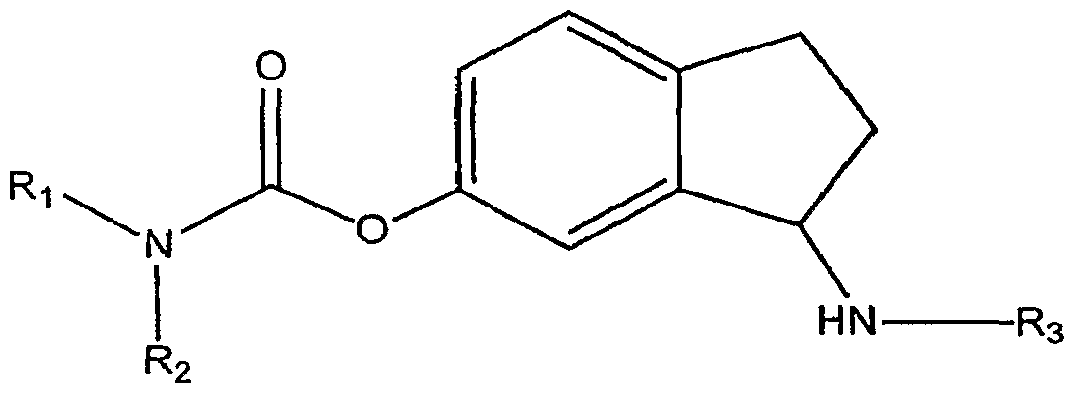
- 0 *NC(CC1)c2c1ccc(OC(N(*)*)=O)c2 Chemical compound *NC(CC1)c2c1ccc(OC(N(*)*)=O)c2 0.000 description 2
Classifications
-
- C—CHEMISTRY; METALLURGY
- C07—ORGANIC CHEMISTRY
- C07C—ACYCLIC OR CARBOCYCLIC COMPOUNDS
- C07C271/00—Derivatives of carbamic acids, i.e. compounds containing any of the groups, the nitrogen atom not being part of nitro or nitroso groups
- C07C271/06—Esters of carbamic acids
- C07C271/40—Esters of carbamic acids having oxygen atoms of carbamate groups bound to carbon atoms of six-membered aromatic rings
- C07C271/42—Esters of carbamic acids having oxygen atoms of carbamate groups bound to carbon atoms of six-membered aromatic rings with the nitrogen atoms of the carbamate groups bound to hydrogen atoms or to acyclic carbon atoms
- C07C271/48—Esters of carbamic acids having oxygen atoms of carbamate groups bound to carbon atoms of six-membered aromatic rings with the nitrogen atoms of the carbamate groups bound to hydrogen atoms or to acyclic carbon atoms to carbon atoms of hydrocarbon radicals substituted by singly-bound oxygen atoms
-
- A—HUMAN NECESSITIES
- A61—MEDICAL OR VETERINARY SCIENCE; HYGIENE
- A61K—PREPARATIONS FOR MEDICAL, DENTAL OR TOILETRY PURPOSES
- A61K31/00—Medicinal preparations containing organic active ingredients
- A61K31/21—Esters, e.g. nitroglycerine, selenocyanates
- A61K31/27—Esters, e.g. nitroglycerine, selenocyanates of carbamic or thiocarbamic acids, meprobamate, carbachol, neostigmine
-
- A—HUMAN NECESSITIES
- A61—MEDICAL OR VETERINARY SCIENCE; HYGIENE
- A61K—PREPARATIONS FOR MEDICAL, DENTAL OR TOILETRY PURPOSES
- A61K31/00—Medicinal preparations containing organic active ingredients
- A61K31/325—Carbamic acids; Thiocarbamic acids; Anhydrides or salts thereof
-
- A—HUMAN NECESSITIES
- A61—MEDICAL OR VETERINARY SCIENCE; HYGIENE
- A61P—SPECIFIC THERAPEUTIC ACTIVITY OF CHEMICAL COMPOUNDS OR MEDICINAL PREPARATIONS
- A61P25/00—Drugs for disorders of the nervous system
-
- A—HUMAN NECESSITIES
- A61—MEDICAL OR VETERINARY SCIENCE; HYGIENE
- A61P—SPECIFIC THERAPEUTIC ACTIVITY OF CHEMICAL COMPOUNDS OR MEDICINAL PREPARATIONS
- A61P25/00—Drugs for disorders of the nervous system
- A61P25/28—Drugs for disorders of the nervous system for treating neurodegenerative disorders of the central nervous system, e.g. nootropic agents, cognition enhancers, drugs for treating Alzheimer's disease or other forms of dementia
-
- C—CHEMISTRY; METALLURGY
- C07—ORGANIC CHEMISTRY
- C07C—ACYCLIC OR CARBOCYCLIC COMPOUNDS
- C07C271/00—Derivatives of carbamic acids, i.e. compounds containing any of the groups, the nitrogen atom not being part of nitro or nitroso groups
- C07C271/06—Esters of carbamic acids
- C07C271/40—Esters of carbamic acids having oxygen atoms of carbamate groups bound to carbon atoms of six-membered aromatic rings
- C07C271/42—Esters of carbamic acids having oxygen atoms of carbamate groups bound to carbon atoms of six-membered aromatic rings with the nitrogen atoms of the carbamate groups bound to hydrogen atoms or to acyclic carbon atoms
- C07C271/44—Esters of carbamic acids having oxygen atoms of carbamate groups bound to carbon atoms of six-membered aromatic rings with the nitrogen atoms of the carbamate groups bound to hydrogen atoms or to acyclic carbon atoms to hydrogen atoms or to carbon atoms of unsubstituted hydrocarbon radicals
-
- C—CHEMISTRY; METALLURGY
- C07—ORGANIC CHEMISTRY
- C07B—GENERAL METHODS OF ORGANIC CHEMISTRY; APPARATUS THEREFOR
- C07B2200/00—Indexing scheme relating to specific properties of organic compounds
- C07B2200/07—Optical isomers
-
- C—CHEMISTRY; METALLURGY
- C07—ORGANIC CHEMISTRY
- C07C—ACYCLIC OR CARBOCYCLIC COMPOUNDS
- C07C2602/00—Systems containing two condensed rings
- C07C2602/02—Systems containing two condensed rings the rings having only two atoms in common
- C07C2602/04—One of the condensed rings being a six-membered aromatic ring
- C07C2602/08—One of the condensed rings being a six-membered aromatic ring the other ring being five-membered, e.g. indane
Definitions
- PROPARGYLATED AMINOINDANS 7 PROCESSES FOR PREPARATION, AND USES THEREOF
- b is 1 or 2; when a is 1, b is 1, m is from 0-3, X is 0 or S, Y is halogeno, Ri is hydrogen or C1-4 alkyl, R 2 is hydrogen, Ci-4 alkyl, or optionally substituted propargyl and R 3 and R4 are each independently hydrogen, Ci-s alkyl, CQ- X ⁇ aryl, C6-12 aralkyl, each optionally substituted.
- ADD Attention .Deficit Disorder
- ADHD Attention Deficit and Hyperactivity Disorder
- Tourett ' s Syndrome Alzheimer's Disease and other, dementias such as senile dementia, dementia of the Parkinson's type, vascular dementia and Lewy body dementia .
- salts are disclosed, including the 1/2 L- tartrate salt. This salt has been given the nonproprietary name ladostigil tartrate. Its CAS registry number is 209394- 46-7. Disclosed herein are novel related compounds.
- the subject invention provides a pharmaceutical composition
- a pharmaceutical composition comprising a compound having the structure:
- Ri is methyl and R 2 is H, or Ri is ethyl and R2 is hydroxymethyl
- R 3 is H or propargyl; or an enantiomer or a pharmaceutically acceptable salt thereof; and a pharmaceutically acceptable carrier.
- the subject invention also provides a method of treating a subject afflicted with a psychiatric disorder, Parkinson's disease, Alzheimer' s disease, dementia, or a neurological disorder comprising administering to the subject a therapeutically effective amount of a compound having the structure:
- Ri is methyl and R 2 is H, or Ri is ethyl and R 2 is hydroxymethyl
- R 3 is H or propargyl; or an enantiomer or a pharmaceutically acceptable salt thereof.
- the subject invention also provides a process for making a compound having the structure:
- Ri is methyl and R 2 is H, or Ri is ethyl and R 2 is hydroxymethyl
- R 3 is H or propargyl
- the subject invention also provides a process for making a compound having the structure:
- the subject invention also provides a process for making a o compound having the structure:
- R is a protecting group, with paraformaldehyde and water in an organic solvent in the presence of an acidic moiety so as to produce a product; b) reacting the product of step a) with an acidifying agent so as to thereby remove the protecting group and make the compound; and c) recovering the compound made in step b) .
- the subject invention also provides a process for making a compound having the structure:
- Ri is H or propargyl, comprising a ) reacting a compound having the structure :
- R 1 is H or propargyl and R 2 is a protecting group, with methylamine to form a product having the structure:
- step b) reacting the product formed in step a) with an acidifying agent so as to make the compound; and c) recovering the compound made in step b) .
- the subject invention provides an isolated compound having the structure: wherein Ri is methyl and R 2 is H, or Ri is ethyl and R2 is hydroxymethyl ;
- R 3 is H or propargyl
- R 4 is either H or t-butyloxycarbonyl; -or an enantiomer or a pharmaceutically acceptable salt thereof.
- the subject invention also provides a method for assaying the amount of ethyl-hydroxymethyl-carbamic acid 3-R- (prop-2- ynylamino) -indan-5-yl ester in a sample comprising the steps : a) obtaining a sample; and b) determining the amount of ethyl-hydroxymethyl-carbamic acid 3- (prop-2-ynylamino) -indan-5-yl ester in the sample .
- the subject invention also provides a method for assaying the amount of methyl-carbamic acid 3-R-amino-indan-5-yl ester in a sample comprising the steps: a) obtaining a sample; and b) determining the amount of methyl-carbamic acid 3-R-amino- indan-5-yl ester in the sample.
- the subject invention also provides a method for assaying the amount of methyl-carbamic acid 3- (prop-2-ynylamino) - indan-5-yl ester in a comprising the steps: a) obtaining a sample; and b) determining the amount of methyl-carbamic acid 3- (prop- 2-ynylamino) -indan-5-yl ester in the sample.
- a) obtaining a sample determining the amount of methyl-carbamic acid 3- (prop- 2-ynylamino) -indan-5-yl ester in the sample.
- the subject invention also provides a use of a compound having the structure:
- Ri is methyl and R 2 is H, or Ri is ethyl and R2 is hydroxymethyl
- R 3 is H or propargyl; or an enantiomer or a pharmaceutically acceptable salt thereof, for the preparation of a medicament for treating a subject afflicted with a psychiatric disorder, Parkinson's disease,
- Alzheimer's disease dementia, or a neurological disorder.
- the subject invention provides a pharmaceutical composition
- a pharmaceutical composition comprising a compound having the structure:
- Ri is methyl and R 2 is H, or R 1 is ethyl and R 2 is hydroxymethyl;
- R 3 is H or propargyl; or an enantiomer or a pharmaceutically acceptable salt thereof; and a pharmaceutically acceptable carrier.
- the pharmaceutical composition can comprise any one of the specific compounds described herein.
- the compound has the structure:
- the compound has the structure:
- the compound has the structure:
- the form of the composition is a solid.
- the subject invention also provides a method of treating a subject afflicted with a psychiatric disorder, Parkinson's disease, Alzheimer's disease, dementia, or a neurological disorder comprising administering to the subject a therapeutically effective amount of a compound having the structure:
- Ri is methyl and R 2 is H, or R 1 is ethyl and R2 is hydroxymethyl;
- R 3 is H or propargyl; or an enantiomer or a pharmaceutically acceptable salt thereof.
- the subject is afflicted with a psychiatric disorder.
- the psychiatric disorder may be depression, generalized anxiety disorder, obsessive-compulsive disorder, panic attacks and panic disorder, phobic disorder, stress disorder, depersonalized disorder, dissociative amnesia, dissociative fugue, dissociative identity disorder, personality disorder, delusional disorder, schizoaffective disorder, schizophrenia, schizophreniform disorder, substance-induced psychotic disorder, gender identity disorder, paraphilias, body dysmorphic disorder, hypochondriasis, Munchausen' s syndrome, pain disorder, or somatization disorder.
- Depression is an illness that involves the body, mood and thoughts and comes in a variety of types, including, major ' depression, dysthymia and bipolar' disorder.
- Major depression is manifested by a combination of symptoms that interfere with the ability to work, study, sleep, eat, and enjoy pleasurable activities. Such a disabling episode of depression may occur only once but more commonly occurs several times in a lifetime.
- Dysthymia is a less severe type of depression involving long-term, chronic symptoms that do not disable a person, but prevent one from functioning well or feeling good.
- Another type of depression is bipolar disorder (manic-depressive illness) . It is not as common as other depressive disorders.
- the subject is afflicted with a neurological disorder.
- the neurological disorder may be epilepsy, narcolepsy, amyotrophic lateral sclerosis ("ALS”), memory disorders, panic, post-traumatic stress disorder (“PTSD”) , sexual dysfunction, attention deficit and hyperactivity syndrome (“ADHD”) , attention deficit disorder, or Tourette' s syndrome.
- ALS amyotrophic lateral sclerosis
- PTSD post-traumatic stress disorder
- ADHD attention deficit and hyperactivity syndrome
- the subject • is afflicted with dementia.
- the dementia may be static dementia, Alzheimer' s-type dementia, senile dementia, presenile dementia, progressive dementia, vascular dementia or Lewy body dementia.
- the subject is afflicted with Alzheimer's disease.
- the subject is afflicted with Parkinson's disease.
- the subject is afflicted with depression.
- the compound has the structure:
- the compound has the structure:
- the compound has the structure:
- the subject invention also provides a process for making a compound having the structure:
- Ri is methyl and R2 is H, or R 1 is ethyl -and R 2 is hydroxymethyl;
- R 3 is H or propargyl
- the compound can be recovered from the subject, production of the compound in the subject may be the goal. This process can be used to produce any one of the specific compounds described . herein by the selection of appropriate starting materials.
- the compound administered to the human subject is R (+) -6- (N-methyl, N-ethyl- carbamoyloxy) -N' -propargyl-1-aminoindan ⁇ tartrate.
- the subject invention also provides a process for making a compound having the structure:
- the compound produced by this process can be any one of the compounds described herein, including ethyl-hydroxymethyl- carbamic acid 3-R- (prop-2-ynylamino) -indan-5-yl ester, methyl-carbamic acid 3-R-amino-indan-5-yl ester or methyl- carbamic acid 3-R- (prop-2-ynylamino) -indan-5-yl ester.
- reaction of step a) is performed in the presence of an acidifying agent.
- the acidifying agent is HCl, acetic acid, or a cation exchange resin.
- recovery in step b) is performed using chromatography, extraction or flash column chromatography.
- the subject invention also provides a process for making a compound having the structure:
- R is a protecting group, with paraformaldehyde and water in an ' organic solvent in the presence of an acidic moiety so as to produce a product; b) reacting the product of step a) with an acidifying agent so as to thereby remove the protecting group and make the compound; and c) recovering the compound made in step b) .
- the acidic moiety can be HCl or a cation exchange resin, or the HCl anion of the starting material of step a) , as exemplified in Example 3d, infra.
- the protecting group is t- butyloxycarbonyl .
- the organic solvent is dioxane or tetrahydrofuran.
- the acidifying agent is HCl in ethyl acetate.
- the subject invention also provides a process for making a compound having the structure:
- Ri is H or propargyl, comprising a) reacting a compound having the structure
- R x is H or propargyl and R 2 is a protecting group, with methylamine to form a produce having the structure
- step b) reacting the product formed in step a) with an acidifying agent to make the compound; and c) recovering the compound made in step b) .
- R 2 is t-butyloxycarbonyl .
- the acidifying agent is HCl in ethyl acetate.
- the subject invention provides an isolated compound having the structure:
- Ri is methyl and R 2 is H, or .
- Ri is ethyl and R2 is hydroxymethyl;
- R 3 is H or propargyl
- R 4 is either H or t-butyloxycarbonyl; or an enantiorner or a pharmaceutically acceptable salt thereof.
- R 4 is H.
- the compound has the structure:
- the compound is ethyl-hydroxymethyl- carbamic acid 3- (prop-2-ynylamino) -indan-5-yl ester fumarate (2:1) .
- the compound is ethyl-hydroxymethyl- carbamic acid 3-R- (prop-2-ynylamino) -indan-5-yl ester, or a pharmaceutically acceptable salt thereof.
- the compound is ethyl-hydroxymethyl- carbamic acid 3-R- (prop-2-ynylamino) -indan-5-yl ester fumarate (2:1) .
- the compound has the structure:
- the compound is methyl-carbamic. acid 3-amino-indan-5-yl ester hydrochloride.
- the compound is methyl-carbamic acid 3-R-amino-indan-5-yl ester, or a pharmaceutically acceptable salt thereof.
- the compound is methyl-carbamic acid 3-R-amino-indan-5-yl ester hydrochloride.
- the compound has the structure:
- the compound is methyl-carbamic acid 3- (prop-2-ynylamino) -indan-5-yl ester hydrochloride.
- the compound is methyl-carbamic acid 3-JR- (prop-2-ynylamino) -indan-5-yl ester, or a pharmaceutically acceptable salt thereof.
- the compound is methyl-carbamic acid 3 ⁇ R ⁇ (prop-2-ynylamino) -indan-.5-yl ester hydrochloride.
- the compound has the structure:
- R 4 is t-butyloxycarbonyl .
- Ri is methyl
- R ⁇ is H
- R 3 is propargyl
- Ri is methyl
- R 2 is H
- R3 is H.
- R 1 is ethyl
- R 2 is hydroxymethyl
- R 3 is propargyl
- the subject invention also provides a method for assaying the amount of ethyl-hydroxymethyl-carbamic acid 3-R- (prop-2- ynylamino) -indan-5-yl ester in a sample comprising the steps : a) obtaining a sample; and b) determining the amount of ethyl-hydroxymethyl-carbamic acid 3- (prop-2-ynylamino) -indan-5-yl ester in the sample.
- the subject invention also provides a method for assaying the amount of methyl-carbamic acid 3-R-amino-indan-5-yl ester in a sample comprising the steps: a) obtaining a sample; and b) determining the amount of methyl-carbamic acid 3-R-amino- indan-5-yl ester in the sample.
- the subject invention also provides a method for assaying the amount of methyl-carbamic acid 3- (prop-2-ynylamino) - indan-5-yl ester in a sample comprising the steps: a) obtaining a sample; and b) determining the amount of methyl-carbamic acid 3- (prop-2- ynylamino) -indan-5-yl ester in the sample.
- the subject invention also provides use of a compound having the structure:
- R 1 is methyl and R 2 is H, or Ri is ethyl and R 2 is hydroxymethyl;
- R 3 is H or propargyl; or an enantiomer or a pharmaceutically acceptable salt thereof, for the preparation of a medicament for treating a subject afflicted with a psychiatric disorder, Parkinson' s disease,
- Alzheimer's disease dementia, or a neurological disorder.
- the subject is afflicted with a psychiatric disorder.
- the psychiatric disorder may be depression, generalized anxiety disorder, obsessive- compulsive disorder, panic attacks and panic disorder, phobic disorder, stress disorder, depersonalized disorder, dissociative amnesia, dissociative fugue, dissociative identity disorder, personality disorder, delusional disorder, schizoaffective disorder, schizophrenia, schizophreniform disorder, substance-induced psychotic disorder, gender identity disorder, paraphilias, body dysmorphic disorder, hypochondriasis, Munchausen's syndrome, pain disorder, or somatization disorder.
- the subject is afflicted with a neurological disorder.
- the neurological disorder is epilepsy, narcolepsy, amyotrophic lateral sclerosis ("ALS”), memory disorders, panic, post-traumatic stress disorder (“PTSD”), sexual dysfunction, attention deficit and hyperactivity syndrome (“ADHD”), attention deficit disorder, or Tourette's syndrome.
- ALS amyotrophic lateral sclerosis
- PTSD post-traumatic stress disorder
- ADHD attention deficit and hyperactivity syndrome
- the subject is afflicted with dementia.
- dementia in another embodiment of the use dementia is static dementia, Alzheimer' s-type dementia, senile dementia, presenile dementia, progressive dementia, vascular dementia or Lewy body dementia.
- the subject is afflicted with Alzheimer's disease.
- the subject is afflicted with Parkinson's disease.
- the subject is afflicted with depression!
- the compound has the structure:
- the compound has the structure :
- the compound has the structure :
- MAO monoamine oxidase
- ALS amyothrophic lateral sclerosis
- Acetylcholinesterase (“AChE”) inhibition is a route implicated in certain neurological disorders, but is a different route from the route of MAO inhibition.
- the disclosed compounds are both MAO inhibitors and AChE inhibitors .
- compositions may comprise the compound and/or pharmaceutically acceptable salts thereof, together with pharmaceutically acceptable carriers and/or excipients.
- Pharmaceutically acceptable salts include, but are not limited to, the mesylate, maleate, fumarate, tartrate, hydrochloride, hydrobromide, esylate, p-tolunesulfonate, benzoate, acetate, phosphate and sulfate salts .
- compositions may be prepared as medicaments to be administered orally, parenterally, rectally or transdermally .
- suitable forms for oral administration include tablets, compressed or coated pills, dragees, sachets, hard or soft gelatin capsules, sublingual tablets, syrups and suspensions; for parenteral administration the invention provides ampoules or vials that include an aqueous or non-aqueous solution or emulsion; for rectal administration there are provided suppositories with hydrophilic or hydrophobic vehicles; and for topical application as ointments and transdermal delivery there are provided suitable delivery systems as ' known in the art.
- Tablets may contain suitable binders, lubricants, disintegrating agents, coloring agents, flavoring agents, flow-inducing agents, and melting agents.
- the active drug component can be combined with an oral, non-toxic, pharmaceutically acceptable, inert carrier such as lactose, gelatin, agar, starch, sucrose, glucose, methyl cellulose, dicalcium phosphate, calcium sulfate, mannitol, sorbitol, macrocrystalline cellulose and the like.
- Suitable binders include starch, gelatin, natural sugars such as glucose or beta-lactose, corn starch, natural and synthetic gums such as acacia, tragacanth, or sodium alginate, povidone, carboxymethylcellulose, polyethylene glycol, waxes, and the like.
- Lubricants used in these dosage forms include sodium oleate, sodium stearate, sodium benzoate, sodium acetate, sodium chloride, stearic acid, sodium stearyl fumarate, talc and the like.
- Disintegrators include, without limitation, starch, methyl cellulose, agar, bentonite, xanthan gum, croscarmellose sodium, sodium starch glycolate and the like.
- an "isolated" compound is a compound that is separate from the mixture of components normally found in or excreted by an animal, for example a human, such as cells, organs, blood, saliva, urine, etc. Thus, an isolated compound is not part of the mixture which constitutes animal, blood, saliva, urine, etc., nor is it part of an animal cell or organ. An isolated compound may be obtained by separation from the animal, or, alternatively, by a chemical synthesis process.
- a "pharmaceutically acceptable" carrier is one that is suitable for use with humans and/or animals without undue adverse side effects (such as toxicity, irritation, and allergic response) commensurate with a reasonable benefit/risk ratio, and is not blood or blood plasma .
- Example 1 Preparation of ethyl-carbamic acid 3-R- (N-Boc- prop-2-ynylamino) -indan-5-yl ester
- Ethyl-carbamic acid 3-R- (prop-2-ynylamino) -indan-5-yl ester HCl was prepared as described in United States Patent 6,303,650 (compound 56 in table 5) using the R-enantiomer starting material.
- Ethyl-carbamic acid 3-J?-prop-2- ynylamino-indan—5-yl ester HCl (0.5g, 1.70 mmol) was converted to its free base by dissolving it in a mixture of water (20 ml) , 30% ammonium hydroxide (20 ml) , and dichloromethane (30 ml).
- the layers were separated, and the aqueous layer was re-extracted with dichloromethane (8 x 30 ml) .
- the combined organic layers were dried (Na 2 SC> 4 ) , and evaporated to dryness at reduced pressure to give 400 mg of the free base as a viscous oil.
- the free base (0.4Og, 1.55 mmol) was dissolved in absolute ethanol (20 ml) , and a solution of di-tert-butyl dicarbonate (0.35g, 1.60 mmol) in ethanol (10 ml) was added. The mixture was stirred at 25 0 C under nxtrogen for 24 h, and the solvent was removed at reduced pressure.
- Example 3a Preparation of ethyl-hydroxymethyl-carbamic acid 3-f?-prop-2-ynylamxno-indan-5-yl ester
- the eluting solution (3%EtOH/CHCl 3 +NH 3 ) was prepared as follows:
- Ethyl-hydroxymethyl-carbamic acid 3-.R- (prop- 2-ynylamino) -indan-5-yl ester was eluted by the same solution and monitored by TLC (run in the same medium and detected by UV plus ninhydrin) , to give 3.3 g of a viscous colorless oil (68%) containing about 7% CHCl 3 (w/w, by NMR) .
- Example 3d Preparation of ethyl-hydroxymethyl-carbamic acid 3-.R- (prop-2-ynylamino) -indan-5-yl ester
- Example 3e Preparation of ethyl-hydroxymethyl-carbamic acid 3-.R- (prop-2-ynylamino) -indan-5-yl ester
- the title compound is prepared using the starting material ethyl-carbamic acid 3-S- (N-Boc-prop-2-ynylamino) -indan-5-yl ester according to the procedures described in Examples 1- 3e.
- Fumaric acid (0.49 g, 4.25 mmol, 0.5 eq) was added to a solution of ethyl-hydroxymethyl-carbamic acid 3-R- (prop-2- ynylamino) -indan-5-yl ester free base (2.45 g, 8.5 mmol) in iPrOH (49 ml), and the resulting suspension slightly warmed for a few seconds by a heat gun. A white suspension was formed, and the mixture was stirred at room temperature for
- Example 7a Preparation of methyl-carba ⁇ iic acid 3-R-amino- indan-5-yl ester HCl
- Example 8 Preparation of carbonic acid chloromethyl ester 3-R- (N-Boc-prop-2-ynylamino) -indan-5-yl ester
- 3-R- (N-Boc-prop-2-ynylamino) -indan-5-ol was prepared as described in PCT Application Publication No. WO 03/072055, Figure 1.
- a solution of 3-R- (N-Boc-prop-2-ynylamino) -indan- 5-ol (10.2 g) and triethylamine (3.74 g) in methylene chloride (30 ml) was added dropwise to a stirred and ice- cooled solution of chloromethyl chloroformate (4.8 g) in methylene chloride (35 ml) .
- the mixture was stirred for 2 h at rt, washed with 5 % NaHC ⁇ 3 solution and water, dried and evaporated to dryness to give 13.45 g (100 %) of the title compound as an oil.
- Example 10a Preparation of methyl carbamic acid 3-R- (prop- 2-ynylamino) -indan-5-yl ester HCl
- Methyl carbamic acid 3-S- (prop-2-ynylamino) -indan-5-yl ester HCl was prepared from 3-S- (N-Boc-prop-2-ynylamino) - indan-5-ol according to the procedures described in Examples 8-1Oa.
- the MAO enzyme source was a homogenate of rat brain in 0.3M sucrose.
- the homogenate was diluted appropriately, and pre- incubated with serial dilutions of test compounds - diluted in phosphate buffer containing clogyline when 2- phenylethylamine (PEA) is the substrate, and diluted in phosphate buffer containing selegiline when 5- hydroxytryptamine (5-HT) is the substrate - for 60 minutes at 37 0 C.
- PEA 2- phenylethylamine
- 5-HT 5- hydroxytryptamine
- Substrate concentrations used were 10 ⁇ M (PEA) and lOOuM (5-HT) . Enzyme concentration was chosen so that not more than 10% of the substrate was metabolized during the course of the reaction. Deaminated products were extracted into toluene- ethyl acetate (1:1 v/v) containing 0.4% (w/v) 2,5- diphenyloxazole (ppo) prior to determination by liquid scintillation counting. Radioactivity in the eluate indicated the production of neutral and acidic metabolites formed as a result of MAO activity. Activity of MAO in the sample was expressed as a percentage of control activity in the absence of inhibitor after subtraction of appropriate blank values. The activity determined using PEA as substrate is referred to as MAO-B, and that determined using 5-HT as MAO-A.
- Example 12a Inhibition of Acetylcholinesterase (AChE) activity in vitro
- Recombinant human AChE (C-1682) , acetylthiocholine iodide (AcTh, A5771), bovine serum albumin (BSA, A-2153) , and 5, 5' -dithiobis (2-nitrobenzoic acid) (DTNB, D8130) were obtained from Sigma-Aldrich Israel.
- AChE was found to be in a tetrameric form by sucrose gradient.
- AChE was dissolved in phosphate buffer pH 8.0 containing 0.01% sodium azide NaAz and ImM EDTA and diluted to give a concentration of 15 units/ml. This solution was divided into aliquots of 0.5 ml, which were stored at -70 0 C until use.
- the inhibition of AChE by carbamates involves the formation of a reversible complex (EOH-CX) , followed by carbamoylation of the enzyme to form (EOC) and a leaving group (HX) .
- EOC carbamoylation of the enzyme to form
- HX leaving group
- the carbamoylated enzyme is then hydrolyzed by water to regenerate the free enzyme (EOH) .
- R-HCPAI is a weak inhibitor of acetylcholinesterase.
- BuChE from human serum (C-9971) , butyrylthiocholine iodide (BuTh, B3253), bovine serum albumin (BSA, A-2153) 5,5'- dithiobis (2-nitrobenzoic acid) (DTNB, D8130) were obtained from Sigma-Aldrich Israel.
- BuChE was dissolved in phosphate buffer pH 8.0 containing 0.01% sodium azide (NaAz) and ImM EDTA and diluted to give a concentration of 35.9units/ml . This solution was divided into aliquots of 0.5 ml, which were stored at -70 0 C until use.
- the inhibitory activity against BuChE was determined by the method of Ellmann et al. (Biochemical Pharmacology, 1961 (7) 88-95) using BuTh as a substrate.
- a traditional stopped time assay was performed, in which BuChE was incubated at 37°C with a minimum of 5 different concentrations of inhibitor in the assay buffer, and aliquots were transferred to an ELISA multiscan microplate reader (Labsystems) at various times for the determination of residual BuChE activity, with Ascent PC ® software. The rate of reaction was measured at
- the inhibition of BuChE by carbamates involves the formation of a reversible complex (EOH-CX) , followed by carbamoylation of the enzyme to form (EOC) and a leaving group (HX) .
- EOC carbamoylation of the enzyme to form
- HX leaving group
- the carbarnoylated enzyme is then hydrolyzed by water to regenerate the free enzyme (EOH) .
- R-MCPAI 0 . 65 ⁇ 0 . 03 31 . 3 ⁇ 2 . 0 0 . 021+0 . 002
- R-HCPAI is a weak inhibitor of butyrylcholinesterase.
- Example 13 Use of synthetic ethyl-hydroxymethyl-carbamic acid 3-R- (prop-2-ynylamino) -indan-5-yl ester fumarate (2:1) as a reference standard for assay determination of ethyl-hydroxymethyl- carbamic acid 3-R- (prop-2-ynylamino) -indan-5-yl ester in biological samples
- the objective of the method is the detection of ladostigil and its known metabolite ethyl-hydroxymethyl-carbamic acid 3-R- (prop-2-ynylamino) -indan-5-yl ester in plasma.
- the method consists of solid phase extraction (SPE) with both manual and automatic options for sample preparation and LC- MS/MS analysis- Ethyl-hydroxymethyl-carbamic acid 3-R- (prop-2-ynylamino) -indan-5-yl ester in plasma is quantified using ethyl-hydroxymethyl-carbamic acid 3-R- (prop-2- ynylamino) -indan-5-yl ester fumarate 2:1 analytical standard and its own isotopic internal standard ( 13 C-ethyl- hydroxymethyl-carbamic acid 3- (prop-2-ynylamino) -indan-5-yl ester fumarate (2:1) .
- LC-MS/MS analyses is carried out using a Perkin Elmer Sciex API 2000 mass spectrometer, which is connected to the HPLC system via a TIS interface operated at 350 0 C.
- the mass spectrometer is programmed to admit the protonated molecules [M + H]+ via the first quadropole filter (Ql) , with collision-induced fragmentation at Q2.
- the product ion is monitored via Q3.
- the precursor and product ions are 289 and 133, respectively.
- the LC conditions include Waters Symmetry C18 3.5 ⁇ 2.1x50 mm column with Pre-column Filter 1/16", Peek, 2 ⁇ rn and mobile phase composition of acetonitrile, 0.1% formic acid and 1% THF in water in gradient mode up to 40% of acetonitrile content.
- Plasma sample is spiked with Internal Standard, then centrifuged and the supernatant is diluted with 2% cc NH 4 OH and 5% methanol in water (Solvent B) .
- the volume of the sample is loaded on a STRATA X 33 ⁇ Polymeric Sorbent 30mg/lmL Extraction Cartridge, which is pre-conditioned first with methanol (Solvent A) and then with Solvent B.
- the cartridge is washed with Solvent B and sample is eluted with 2% glacial Acetic acid and 80% methanol in water (Solvent C) .
- the eluted sample is evaporated at about 37°C to dryness and reconstituted with 0.1% formic acid and 1% THF in water.
- the sample is then filtered through 0.2 ⁇ filter before injection into LC-MS/MS. Quantification
- the amount of ethyl-hydroxymethyl-carbamic acid 3-R- (prop- 2-ynylamino) -indan-5-yl ester in plasma sample is quantified vs. plasma calibration curve of ethyl- hydroxymethyl-carbamic acid 3-R- (prop-2-ynylamino) -indan-5- yl ester and using its own isotopic internal standard.
- Ethyl-hydroxymethyl-carbamic acid 3-R- (prop-2-ynylamino) - indan-5-yl ester has been found to be a metabolite of ladostigil in vivo. It can be used as a reference standard or marker in investigating the pharmacokinetics and metabolic profile of ladostigil.
- Example 14 Chronic administration of ethyl-hydroxymethyl- carbamic acid 3-R- (prop-2-ynylamino) -indan-5- yl ester fumarate (2:1) and ladostigil tartrate to rats
- Group 1 was the control group to which no drug was administered.
- Ethyl-hydroxymethyl-carbamic acid 3-R— (prop-2-ynylamino) -indan-5-yl ester fumarate (2:1) was administered to groups 2, 3, 4 in dosages of 150, 75, and 37.5 ⁇ mol/kg respectively, daily, perorally ("P.O.") for seven consecutive days. Water was used as a vehicle.
- Rats were sacrificed, out of sight of the other rats, 2 hours after the last administration. Brains were removed into Petri dishes on ice, the cerebellums were rolled out, and the brains cut into halves for analysis. Livers and intestines were removed for MAO determination. Organs were homogenated for enzyme inhibition analysis. The MAO inhibition after administration of hydroxymethyl- carbamic acid 3-R- (prop-2-ynylamino) -indan-5-yl ester fumarate (2:1) in various organs is listed in Table 4 calculated in percent relative to the control group.
- the data indicates that administration of ethyl hydroxymethyl-carbamic acid 3-JR- (prop-2-ynylamino) -indan-5- yl ester fumarate (2:1) causes brain-selective MAO inhibition.
- Example 15 Administration of ladostigil tartrate .tablets to humans
- Tablets were prepared through wet granulation using isopropanol. The tablets were made with the e ' xcipients listed in Table 5:
- Week 1 70 mg (50+20) once daily.
- Week 2 70 mg (50+20) twice daily.
- Week 3 - Week 9 100 mg (50*2) twice daily.
- Pharmacokinetic analysis was performed on Week 4 (maintenance analysis) and on Week 9 (termination analysis) .
- Week 4 maintenance analysis
- Week 9 termination analysis
- samples were collected pre-dose and at 0.25, 0.5, 1, 2, 3, 4 and 6 hours post-dose.
- R-CPAI ladostigil ;
- Monoamine oxidase B inhibition in plasma samples from the aforementioned patients was determined at baseline and at termination analysis (see Example 11, supra, for determination of MAO B inhibition in samples) .
- DHPG 4-dihydroxyphenylglycol
- the decrease in DHPG concentration in the six patients was determined.
- the average decrease in DHPG concentration was determined to be 57% with a standard deviation of 29.
Landscapes
- Health & Medical Sciences (AREA)
- Chemical & Material Sciences (AREA)
- Organic Chemistry (AREA)
- Medicinal Chemistry (AREA)
- Pharmacology & Pharmacy (AREA)
- Life Sciences & Earth Sciences (AREA)
- Animal Behavior & Ethology (AREA)
- General Health & Medical Sciences (AREA)
- Public Health (AREA)
- Veterinary Medicine (AREA)
- Epidemiology (AREA)
- Bioinformatics & Cheminformatics (AREA)
- Engineering & Computer Science (AREA)
- Biomedical Technology (AREA)
- Neurology (AREA)
- Neurosurgery (AREA)
- Chemical Kinetics & Catalysis (AREA)
- General Chemical & Material Sciences (AREA)
- Nuclear Medicine, Radiotherapy & Molecular Imaging (AREA)
- Emergency Medicine (AREA)
- Hospice & Palliative Care (AREA)
- Psychiatry (AREA)
- Acyclic And Carbocyclic Compounds In Medicinal Compositions (AREA)
- Organic Low-Molecular-Weight Compounds And Preparation Thereof (AREA)
Abstract
This invention provides compounds having the structure (I) wherein R1 is methyl and R2 is H, or R1 is ethyl and R2 is hydroxymethyl; R3 is H or propargyl; and R4 is either H or t-butyloxycarbonyl; or an enantiomer or a pharmaceutically acceptable salt thereof. This invention further provides the use of a therapeutically effective amount of such compounds to treat a subject afflicted with a psychiatric disorder, Parkinson's disease, Alzheimer's disease, dementia, or a neurological disorder.
Description
PROPARGYLATED AMINOINDANS7 PROCESSES FOR PREPARATION, AND USES THEREOF
Throughout this application various publications, published patent applications, and patents are referenced. The disclosures of these documents in their entireties are hereby incorporated by reference into this application in order to more fully describe the state of the art to which this invention pertains.
Background, of the Invention
PCT International Application Publication No. WO 98/27055 (United States Patent Number 6,303,650, issued October 16, 2001 to Chorev) discloses molecules of general formula I:

(I)
wherein when a is 0, b is 1 or 2; when a is 1, b is 1, m is from 0-3, X is 0 or S, Y is halogeno, Ri is hydrogen or C1-4 alkyl, R2 is hydrogen, Ci-4 alkyl, or optionally substituted propargyl and R3 and R4 are each independently hydrogen, Ci-s alkyl, CQ-X∑ aryl, C6-12 aralkyl, each optionally substituted. These compounds have been disclosed as monoamine oxidase inhibitors that additionally inhibit acetylcholinesterase, and are useful to treat depression, Attention .Deficit Disorder ("ADD") , Attention Deficit and Hyperactivity Disorder ("ADHD"), Tourett ' s Syndrome, Alzheimer's Disease and other, dementias such as senile dementia, dementia of
the Parkinson's type, vascular dementia and Lewy body dementia .
One of the compounds disclosed in WO 98/27055 is R (+) -6- (Dimethyl, N-ethyl-carbamoyloxy) -N1 -propargyl-1-aminoindan, also known as (3R) -3- (prop-2-ynylamino) -2, 3, -dihydro-lH- inden-5-yl ethyl methyl carbamate (compound 76 in Table 5) . In addition, salts are disclosed, including the 1/2 L- tartrate salt. This salt has been given the nonproprietary name ladostigil tartrate. Its CAS registry number is 209394- 46-7. Disclosed herein are novel related compounds.
Summary of the Invention
The subject invention provides a pharmaceutical composition comprising a compound having the structure:

R3 is H or propargyl; or an enantiomer or a pharmaceutically acceptable salt thereof; and a pharmaceutically acceptable carrier.
The subject invention also provides a method of treating a subject afflicted with a psychiatric disorder, Parkinson's disease, Alzheimer' s disease, dementia, or a neurological disorder comprising administering to the subject a therapeutically effective amount of a compound having the structure:

R3 is H or propargyl; or an enantiomer or a pharmaceutically acceptable salt thereof.
The subject invention also provides a process for making a compound having the structure:

R3 is H or propargyl; comprising administering to a human subject an amount of
R(+) -6- (N-methyl, N-ethyl-carbamoyloxy) -N1 -propargyl-1- aminoindan, or a pharmaceutically acceptable salt thereof.
The subject invention also provides a process for making a compound having the structure:


The subject invention also provides a process for making a
o compound having the structure:


wherein R is a protecting group, with paraformaldehyde and water in an organic solvent in the presence of an acidic moiety so as to produce a product; b) reacting the product of step a) with an acidifying agent so as to thereby remove the protecting group and make the compound; and c) recovering the compound made in step b) .
The subject invention also provides a process for making a compound having the structure:

wherein Ri is H or propargyl, comprising a ) reacting a compound having the structure :


b) reacting the product formed in step a) with an acidifying agent so as to make the compound; and c) recovering the compound made in step b) .
The subject invention provides an isolated compound having the structure:
 wherein Ri is methyl and R2 is H, or Ri is ethyl and R2 is hydroxymethyl ;
R3 is H or propargyl; and
R4 is either H or t-butyloxycarbonyl; -or an enantiomer or a pharmaceutically acceptable salt thereof.
The subject invention also provides a method for assaying the amount of ethyl-hydroxymethyl-carbamic acid 3-R- (prop-2- ynylamino) -indan-5-yl ester in a sample comprising the steps : a) obtaining a sample; and b) determining the amount of ethyl-hydroxymethyl-carbamic acid 3- (prop-2-ynylamino) -indan-5-yl ester in the sample .
The subject invention also provides a method for assaying the amount of methyl-carbamic acid 3-R-amino-indan-5-yl ester in a sample comprising the steps: a) obtaining a sample; and b) determining the amount of methyl-carbamic acid 3-R-amino- indan-5-yl ester in the sample.
The subject invention also provides a method for assaying the amount of methyl-carbamic acid 3- (prop-2-ynylamino) - indan-5-yl ester in a comprising the steps: a) obtaining a sample; and b) determining the amount of methyl-carbamic acid 3- (prop- 2-ynylamino) -indan-5-yl ester in the sample.
_ g _
The subject invention also provides a use of a compound having the structure:
R3 is H or propargyl; or an enantiomer or a pharmaceutically acceptable salt thereof, for the preparation of a medicament for treating a subject afflicted with a psychiatric disorder, Parkinson's disease,
Alzheimer's disease, dementia, or a neurological disorder.
— Q —
De-tailed Description of the Invention
The subject invention provides a pharmaceutical composition comprising a compound having the structure:

R3 is H or propargyl; or an enantiomer or a pharmaceutically acceptable salt thereof; and a pharmaceutically acceptable carrier. The pharmaceutical composition can comprise any one of the specific compounds described herein.
In an embodiment of the pharmaceutical composition, the compound has the structure:

In another embodiment of the pharmaceutical composition, the compound has the structure:

In another embodiment of the pharmaceutical composition the form of the composition is a solid.
The subject invention also provides a method of treating a subject afflicted with a psychiatric disorder, Parkinson's disease, Alzheimer's disease, dementia, or a neurological disorder comprising administering to the subject a therapeutically effective amount of a compound having the structure:

R3 is H or propargyl; or an enantiomer or a pharmaceutically acceptable salt thereof.
In an embodiment of the method the subject is afflicted with a psychiatric disorder.
In another embodiment of the method the psychiatric disorder may be depression, generalized anxiety disorder, obsessive-compulsive disorder, panic attacks and panic disorder, phobic disorder, stress disorder, depersonalized
disorder, dissociative amnesia, dissociative fugue, dissociative identity disorder, personality disorder, delusional disorder, schizoaffective disorder, schizophrenia, schizophreniform disorder, substance-induced psychotic disorder, gender identity disorder, paraphilias, body dysmorphic disorder, hypochondriasis, Munchausen' s syndrome, pain disorder, or somatization disorder.
Depression is an illness that involves the body, mood and thoughts and comes in a variety of types, including, major' depression, dysthymia and bipolar' disorder. Major depression is manifested by a combination of symptoms that interfere with the ability to work, study, sleep, eat, and enjoy pleasurable activities. Such a disabling episode of depression may occur only once but more commonly occurs several times in a lifetime. Dysthymia is a less severe type of depression involving long-term, chronic symptoms that do not disable a person, but prevent one from functioning well or feeling good. Another type of depression is bipolar disorder (manic-depressive illness) . It is not as common as other depressive disorders. Individuals with bipolar disorder experience cycling mood changes involving severe highs (mania) and lows (depression) . Depressive disorders are primarily treated medically with selective serotonin reuptake inhibitors (SSRIs) and monoamine • oxidase inhibitors (MAOIs) . (National Institute of Mental Health, "Depression" 2002)
In an embodiment of the method, the subject is afflicted with a neurological disorder.
In another embodiment of the method the neurological disorder may be epilepsy, narcolepsy, amyotrophic lateral sclerosis ("ALS"), memory disorders, panic, post-traumatic stress disorder ("PTSD") , sexual dysfunction, attention
deficit and hyperactivity syndrome ("ADHD") , attention deficit disorder, or Tourette' s syndrome.
In another embodiment of the method, the subject • is afflicted with dementia.
In another embodiment the dementia may be static dementia, Alzheimer' s-type dementia, senile dementia, presenile dementia, progressive dementia, vascular dementia or Lewy body dementia.
In another embodiment of the method, the subject is afflicted with Alzheimer's disease.
In another embodiment of the method, the subject is afflicted with Parkinson's disease.
In another embodiment of the method, the subject is afflicted with depression.
In yet another embodiment of the method, the compound has the structure:

In yet another embodiment of the method, the compound has the structure:

In yet another embodiment of the method, the compound has the structure:

The subject invention also provides a process for making a compound having the structure:

R3 is H or propargyl; comprising administering to a human subject an amount of
R (+) -6- (N-methyl, N-ethyl-carbamoyloxy) -N ' -propargyl-1- arainoindan, or a pharmaceutically acceptable salt thereof.
Although the compound can be recovered from the subject, production of the compound in the subject may be the goal. This process can be used to produce any one of the specific compounds described . herein by the selection of appropriate starting materials.
In an embodiment of the process, the compound administered to the human subject is R (+) -6- (N-methyl, N-ethyl- carbamoyloxy) -N' -propargyl-1-aminoindan ^ tartrate.
The subject invention also provides a process for making a compound having the structure:


The compound produced by this process can be any one of the compounds described herein, including ethyl-hydroxymethyl- carbamic acid 3-R- (prop-2-ynylamino) -indan-5-yl ester, methyl-carbamic acid 3-R-amino-indan-5-yl ester or methyl- carbamic acid 3-R- (prop-2-ynylamino) -indan-5-yl ester.
In an embodiment of the process, the reaction of step a) is performed in the presence of an acidifying agent.
In another embodiment of the process, the acidifying agent
is HCl, acetic acid, or a cation exchange resin.
In yet another embodiment of the process, recovery in step b) is performed using chromatography, extraction or flash column chromatography.
The subject invention also provides a process for making a compound having the structure:


wherein R is a protecting group, with paraformaldehyde and water in an' organic solvent in the presence of an acidic moiety so as to produce a product; b) reacting the product of step a) with an acidifying agent so as to thereby remove the protecting group and make the compound; and c) recovering the compound made in step b) .
In specific embodiments of the process, the acidic moiety
can be HCl or a cation exchange resin, or the HCl anion of the starting material of step a) , as exemplified in Example 3d, infra.
In an embodiment of the process, the protecting group is t- butyloxycarbonyl .
In another embodiment of the process, the organic solvent is dioxane or tetrahydrofuran.
In yet another embodiment of the process, the acidifying agent is HCl in ethyl acetate.
The subject invention also provides a process for making a compound having the structure:

wherein Ri is H or propargyl, comprising a) reacting a compound having the structure


b) reacting the product formed in step a) with an acidifying agent to make the compound; and c) recovering the compound made in step b) .
In an embodiment of the process, R2 is t-butyloxycarbonyl .
In another embodiment of the process, the acidifying agent is HCl in ethyl acetate.
In yet another embodiment of the process, prior to step a) a compound of having the structure:

wherein Ri is H or propargyl and R2 is a protecting group, is reacted with chloromethyl chloroformate to produce the compound as which the reaction of step a) is performed.
The subject invention provides an isolated compound having the structure:

R3 is H or propargyl; and
R4 is either H or t-butyloxycarbonyl; or an enantiorner or a pharmaceutically acceptable salt thereof.
In an embodiment of the compound, R4 is H.
In another embodiment, the compound has the structure:

;or an enantiomer or a pharmaceutically acceptable salt thereof.
In another embodiment, the compound is ethyl-hydroxymethyl- carbamic acid 3- (prop-2-ynylamino) -indan-5-yl ester fumarate (2:1) .
In another embodiment, the compound is ethyl-hydroxymethyl- carbamic acid 3-R- (prop-2-ynylamino) -indan-5-yl ester, or a pharmaceutically acceptable salt thereof.
In another embodiment, the compound is ethyl-hydroxymethyl- carbamic acid 3-R- (prop-2-ynylamino) -indan-5-yl ester fumarate (2:1) .
In yet another embodiment, the compound has the structure:

In yet another embodiment, the compound is methyl-carbamic. acid 3-amino-indan-5-yl ester hydrochloride.
In yet another embodiment, the compound is methyl-carbamic acid 3-R-amino-indan-5-yl ester, or a pharmaceutically acceptable salt thereof.
In yet another embodiment, the compound is methyl-carbamic acid 3-R-amino-indan-5-yl ester hydrochloride.
In a further embodiment, the compound has the structure:

In a further embodiment, the compound is methyl-carbamic acid 3- (prop-2-ynylamino) -indan-5-yl ester hydrochloride.
In a further embodiment, the compound is methyl-carbamic
acid 3-JR- (prop-2-ynylamino) -indan-5-yl ester, or a pharmaceutically acceptable salt thereof.
In a further embodiment, the compound is methyl-carbamic acid 3~R~ (prop-2-ynylamino) -indan-.5-yl ester hydrochloride.
In yet a further embodiment, the compound has the structure:

wherein R4 is t-butyloxycarbonyl .
In yet a further embodiment of the compound, Ri is methyl, R≤ is H, and R3 is propargyl .
In yet a further embodiment of the compound, Ri is methyl, R2 is H, and R3 is H.
In yet a further embodiment of the compound, R1 is ethyl, R2 is hydroxymethyl, and R3 is propargyl.
The subject invention also provides a method for assaying the amount of ethyl-hydroxymethyl-carbamic acid 3-R- (prop-2- ynylamino) -indan-5-yl ester in a sample comprising the steps : a) obtaining a sample; and b) determining the amount of ethyl-hydroxymethyl-carbamic acid 3- (prop-2-ynylamino) -indan-5-yl ester in the sample.
The subject invention also provides a method for assaying the amount of methyl-carbamic acid 3-R-amino-indan-5-yl ester in a sample comprising the steps: a) obtaining a sample; and b) determining the amount of methyl-carbamic acid 3-R-amino- indan-5-yl ester in the sample.
The subject invention also provides a method for assaying the amount of methyl-carbamic acid 3- (prop-2-ynylamino) - indan-5-yl ester in a sample comprising the steps: a) obtaining a sample; and b) determining the amount of methyl-carbamic acid 3- (prop-2- ynylamino) -indan-5-yl ester in the sample.
The subject invention also provides use of a compound having the structure:

R3 is H or propargyl; or an enantiomer or a pharmaceutically acceptable salt thereof, for the preparation of a medicament for treating a subject afflicted with a psychiatric disorder, Parkinson' s disease,
Alzheimer's disease, dementia, or a neurological disorder.
In an embodiment of the use, the subject is afflicted with a psychiatric disorder.
In another embodiment of the use the psychiatric disorder may be depression, generalized anxiety disorder, obsessive-
compulsive disorder, panic attacks and panic disorder, phobic disorder, stress disorder, depersonalized disorder, dissociative amnesia, dissociative fugue, dissociative identity disorder, personality disorder, delusional disorder, schizoaffective disorder, schizophrenia, schizophreniform disorder, substance-induced psychotic disorder, gender identity disorder, paraphilias, body dysmorphic disorder, hypochondriasis, Munchausen's syndrome, pain disorder, or somatization disorder.
In an embodiment of the use, the subject is afflicted with a neurological disorder.
In another embodiment of the use, the neurological disorder is epilepsy, narcolepsy, amyotrophic lateral sclerosis ("ALS"), memory disorders, panic, post-traumatic stress disorder ("PTSD"), sexual dysfunction, attention deficit and hyperactivity syndrome ("ADHD"), attention deficit disorder, or Tourette's syndrome.
In another embodiment of the use, the subject is afflicted with dementia.
In another embodiment of the use dementia is static dementia, Alzheimer' s-type dementia, senile dementia, presenile dementia, progressive dementia, vascular dementia or Lewy body dementia.
In another embodiment of the use, the subject is afflicted with Alzheimer's disease.
In another embodiment of the use, the subject is afflicted with Parkinson's disease.
In another embodiment of the use, the subject is afflicted
with depression!
In yet another embodiment of the use, the compound has the structure:

In yet another embodiment of the use, the compound has the structure :

In yet another embodiment of the use, the compound has the structure :

The enzyme monoamine oxidase ("MAO") plays an essential role in the metabolic degradation of important amine neurotransmitters including dopamine, serotonin and noradrenaline. Thus, agents that inhibit MAO are of potential therapeutic benefit for a variety of neurological disease indications, including Parkinson's disease,
Alzheimer' s disease, depression, epilepsy, narcolepsy, amyothrophic lateral sclerosis ("ALS"), etc. (Szelnyi, I . ; Bentue-Ferrer et al . ; Loscher et al . ; White et al.; U.S. Patent No. 5,744,500).
Acetylcholinesterase ("AChE") inhibition is a route implicated in certain neurological disorders, but is a different route from the route of MAO inhibition.
The disclosed compounds are both MAO inhibitors and AChE inhibitors .
The compounds of the present invention may be prepared as pharmaceutical compositions. Such compositions may comprise the compound and/or pharmaceutically acceptable salts thereof, together with pharmaceutically acceptable carriers and/or excipients. Pharmaceutically acceptable salts include, but are not limited to, the mesylate, maleate, fumarate, tartrate, hydrochloride, hydrobromide, esylate, p-tolunesulfonate, benzoate, acetate, phosphate and sulfate salts .
The compositions may be prepared as medicaments to be administered orally, parenterally, rectally or transdermally . Suitable forms for oral administration include tablets, compressed or coated pills, dragees, sachets, hard or soft gelatin capsules, sublingual tablets, syrups and suspensions; for parenteral administration the invention provides ampoules or vials that include an aqueous or non-aqueous solution or emulsion; for rectal administration there are provided suppositories with hydrophilic or hydrophobic vehicles; and for topical application as ointments and transdermal delivery there are provided suitable delivery systems as' known in the art.
Specific examples of pharmaceutical acceptable carriers and excipients that may be used to formulate oral dosage forms of the present invention are described, e.g., in U.S. Patent No. 3,903,297 to Robert, issued Sept. 2, 1975. Techniques and compositions for making dosage forms useful in the present invention are described-in the following references: 7 Modern Pharmaceutics, Chapters 9 and 10 (Banker & Rhodes, Editors, 1979) ; Pharmaceutical Dosage Forms: Tablets (Lieberman et al . , 1981); Ansel, Introduction to Pharmaceutical Dosage Forms 2nd Edition (1976); Remington's Pharmaceutical Sciences, 17th ed. (Mack Publishing Company, Easton, Pa., 1985); Advances in Pharmaceutical Sciences (David Ganderton, Trevor Jones, Eds., 1992); Advances in Pharmaceutical Sciences VoI 7. (David Ganderton, Trevor Jones, James McGinity, Eds., 1995); Aqueous Polymeric Coatings for Pharmaceutical Dosage Forms (Drugs and the Pharmaceutical Sciences, Series 36 (James McGinity, Ed., 1989); Pharmaceutical Particulate Carriers: Therapeutic Applications: Drugs and the Pharmaceutical Sciences, VoI 61 (Alain Rolland, Ed., 1993); Drug Delivery to the Gastrointestinal Tract (Ellis Horwood Books in the Biological Sciences. Series in Pharmaceutical Technology; J. G. Hardy, S. S. Davis, Clive G. Wilson, Eds.); Modern Pharmaceutics Drugs and the Pharmaceutical Sciences, VoI 40 (Gilbert S. Banker, Christopher T. Rhodes, Eds . ) .
Tablets may contain suitable binders, lubricants, disintegrating agents, coloring agents, flavoring agents, flow-inducing agents, and melting agents. For instance, for oral administration in the dosage unit form of a tablet or capsule, the active drug component can be combined with an oral, non-toxic, pharmaceutically acceptable, inert carrier such as lactose, gelatin, agar, starch, sucrose, glucose, methyl cellulose, dicalcium phosphate, calcium sulfate,
mannitol, sorbitol, macrocrystalline cellulose and the like. Suitable binders include starch, gelatin, natural sugars such as glucose or beta-lactose, corn starch, natural and synthetic gums such as acacia, tragacanth, or sodium alginate, povidone, carboxymethylcellulose, polyethylene glycol, waxes, and the like. Lubricants used in these dosage forms include sodium oleate, sodium stearate, sodium benzoate, sodium acetate, sodium chloride, stearic acid, sodium stearyl fumarate, talc and the like. Disintegrators include, without limitation, starch, methyl cellulose, agar, bentonite, xanthan gum, croscarmellose sodium, sodium starch glycolate and the like.
As used herein, an "isolated" compound is a compound that is separate from the mixture of components normally found in or excreted by an animal, for example a human, such as cells, organs, blood, saliva, urine, etc. Thus, an isolated compound is not part of the mixture which constitutes animal, blood, saliva, urine, etc., nor is it part of an animal cell or organ. An isolated compound may be obtained by separation from the animal, or, alternatively, by a chemical synthesis process.
As used herein, a "pharmaceutically acceptable" carrier is one that is suitable for use with humans and/or animals without undue adverse side effects (such as toxicity, irritation, and allergic response) commensurate with a reasonable benefit/risk ratio, and is not blood or blood plasma .
Experimental Details
Example 1: Preparation of ethyl-carbamic acid 3-R- (N-Boc- prop-2-ynylamino) -indan-5-yl ester
Ethyl-carbamic acid 3-R- (prop-2-ynylamino) -indan-5-yl ester HCl was prepared as described in United States Patent 6,303,650 (compound 56 in table 5) using the R-enantiomer starting material. Ethyl-carbamic acid 3-J?-prop-2- ynylamino-indan—5-yl ester HCl (0.5g, 1.70 mmol) was converted to its free base by dissolving it in a mixture of water (20 ml) , 30% ammonium hydroxide (20 ml) , and dichloromethane (30 ml). The layers were separated, and the aqueous layer was re-extracted with dichloromethane (8 x 30 ml) . The combined organic layers were dried (Na2SC>4) , and evaporated to dryness at reduced pressure to give 400 mg of the free base as a viscous oil. The free base (0.4Og, 1.55 mmol) was dissolved in absolute ethanol (20 ml) , and a solution of di-tert-butyl dicarbonate (0.35g, 1.60 mmol) in ethanol (10 ml) was added. The mixture was stirred at 250C under nxtrogen for 24 h, and the solvent was removed at reduced pressure. Hexane (50 ml) was added to the residue, the mixture was stirred at room temperature for 30 min, and the hexane was decanted off. The hexane washing and decanting steps were repeated (5x30 ml) , and the combined hexane washings were evaporated to dryness at reduced pressure. The residue was dried under vacuum for 24 h to give 550 mg (90%) of the title compound as an off-white solid.
Example 2: Preparation of ethyl-hydroxymethyl-carbamic acid 3-R- (N-Boc-prop-2-ynylamino) -indan-5-yl ester
A mixture of ethyl-carbamic acid 3-R- (N-Boc-prop-2- ynylamino) -indan-5-yl ester prepared in Example 1 (1.08 g, 3
mmol) , paraformaldehyde (180 rag, 6 itunol) , pretreated Lewatit SPC 108 (a polystyrene sulfonic acid cation exchange resin,) (180 mg, 0.75 mequiv. of H+), dioxane (6 ml), and water (21.6 mg, 1.2 mmol) was stirred and heated at 600C under nitrogen for 24 hr. The mixture was cooled to 25°C and filtered. The residue on the filter was washed with dioxane, and the filtrate was evaporated to dryness at reduced pressure. The crude residue which resulted after evaporation of the dioxane was purified by flash column chromatography (elution with ethyl acetate/hexane 70/30) to give 450 mg (38% yield) of the title compound as a viscous oil.
13C-NMR (CD3CN) δ 14.19 and 15.03 (MeCH2), 28.45 (Me3C), 30.30 (C-2), 31.37 (C-I), 34.11 and 35.42 (NCH2CCH), 42.40 and 42.62 (MeCH2), 62.21 and 63.71 (C-3) , 72.01 and 72.30 (NCH2OH, NCH2CCH), 80.95 (Me3C), 82.48 (NCH2CCH), 118.30 (C- A), 122.34 (C-6) , 126.22 (C-7), 141.44 (C-3a) , 151.43 (C-5) , 155.80 (NCO) .
Example 3a: Preparation of ethyl-hydroxymethyl-carbamic acid 3-f?-prop-2-ynylamxno-indan-5-yl ester
Α solution of ethyl-hydroxymethyl-carbamic acid 3-.R- (N-Boc- prop-2~ynylamino) -indan-5-yl ester prepared in Example 2 (150 mg, 0.386 mmol) and 2N HCl in ethyl acetate (20 ml, 40mmol) was stirred at room temperature for 2 hr. The mixture was evaporated to dryness at reduced pressure, and the residue was treated with water (10 ml) , dichloromethane (20 ml), and enough 5% sodium bicarbonate solution to bring the pH of the aqueous layer to 8.5-9.0. The layers were separated, and the aqueous layer was re-extracted with dichloromethane (4x15 ml) . The organic layers were combined and evaporated to dryness to give 90 mg of a viscous oil. Purification by flash column chromatography gave 11 mg (9%) of the title compound (free base) (90% pure by NMR) .
Example 3b: Preparation of ethyl-hydroxymethyl-carbamic acid
3-2?- (prop-2-ynylamino) -indan-5-yl ester
A mixture of ethyl-carbamic acid 3-2?- (prop-2-ynylamino) - indan-5-yl ester HCl salt (5.0 g, 16.' 96 mmol) , water (41.5 ml), paraformaldehyde (2.03 g, 67.6 mmol), and IN HCl (9 ml, 9.0 mmol) was stirred and heated in a glass stoppered flask at 37-400C for 7 hours. The mixture was cooled in an ice bath, and water (40 ml) and dichloromethane (60 ml) were added. Saturated sodium bicarbonate (enough to bring the pH to 8.5-9.0) was added slowly while stirring. The two layers were separated, and the aqueous layer was re-extracted with dichloromethane (7x40 ml) . The organic layers were combined, dried (sodium sulfate) , filtered, and evaporated to dryness at 25 °C under vacuum to give 5.0 g of crude ethyl- hydroxymethyl-carbamic acid 3-2?- (prop-2-ynylamino) -indan-5- yl ester as a white solid. This was stored in the freezer until purified by flash column chromatography as detailed below .
The eluting solution (3%EtOH/CHCl3+NH3) was prepared as follows:
A mixture of CHCl3 (800 ml) and 25 % NH4OH (40 ml) was placed in a 1 L separatory funnel, shaken vigorously, left to stand (tightly sealed) for 1 hr, and the phases separated. Most of the organic phase (about 750" ml) was collected in an Erlenmeyer flask containing NaSC-4 (40 g) , and the mixture filtered rapidly (gravitationally, through a cotton-filled funnel) into a measuring cylinder, to give about 720 ml of ammoniacal chloroform solution (pH=10) , which was then transferred into a tightly sealed bottle. The appropriate amount of EtOH was then added to give the required 3 % v/v solution.
A solution of crude ethyl-hydroxymethyl-carbamic acid 3-1?-
(prop-2-ynylaπιino) -indan-5-yl ester free base (5 g) in minimum amount of CHCI3 was charged on a 4.5 cm wide column filled (35 cm height) with silica previously wetted with the above solution. Ethyl-hydroxymethyl-carbamic acid 3-.R- (prop- 2-ynylamino) -indan-5-yl ester was eluted by the same solution and monitored by TLC (run in the same medium and detected by UV plus ninhydrin) , to give 3.3 g of a viscous colorless oil (68%) containing about 7% CHCl3 (w/w, by NMR) .
Spectral and analytical data of ethyl-hydroxymethyl-carbamic acid 3-iR- (prop-2-ynylamino) -indan-5-yl ester:
1H-NMR (CD3CN, δ) :
Major rotamer:
1.18 (brt, J = 7 Hz, 3H, MeCH2), 1.82 (m, IH, H-2), 2.40 (m, IH, H-2), 2.45 (t, J = 2.5 Hz, IH7 NCH2CCH) , 2.77 (brdt, J = 15.5, 7 Hz, IH, H-I), 2.94 (ddd, J= 15.5, 8, 5
Hz, IH, H-I), 3.40 (m, 2H, MeCH2) , 3.44 (m, 2H, NCH2CCH) ,
4.31 (t, J= 6.5 Hz, IH, H-3) , 4.88 (brs, 2H, NCH2OH) , 6.92 (dd, J = 8, 2 Hz, IH, H-6) , 7.04 (d, J = 2 Hz, IH, H-4),
7.21 (d, J = 8 Hz, IH, H-7) ppm.
Minor rotamer:
1.26 (brt, J = 7 Hz, 3H, MeCR2 ) , 1.82 (m, IH, H-2) , 2.40 (m, IH, H-2) , 2.45 (t, J = 2.5 Hz, IH, NCH2CCH) , 2.77 (brdt, J = 15.5, 7 Hz, IH, H-I), 2.94 (ddd, J = 15.5, 8, 5
Hz, IH, H-I), 3.44 (m, 2H, NCH2CCH) , 3.50 (m, 2H, MeCH2),
4.31 (t, J = 6.5 Hz, IH, H-3), 4.78 (brs, 2H, NCH2OH) , 6.92 (dd, J = 8, 2 Hz, IH, H-6), 7.04 (d, J = 2 Hz, IH, H-4) ,
7.21 (d, J" = 8 Hz, IH, H-7) ppm.
13C-NMR (CD3CN, δ) : major rotamer:
14.26 (MeCH2), 30.53 (C-2) , 34.62 (C-I), 36.65 (NCH2CCH),
42.69 (MeCH2), 62.87 (C-3) , 72.07 (NCH2OH), 72.35 (NCH2CCH),
83.78 (NCH2CCH), 118.83 (C-4), 121.99 (C-6) , 126.03 (C-7),
141.74 (C-3a) , 147.61 (C-7a) , 151.21 (C-5) ppm. minor rotamer:
15.09 (WeCH2), 30.53 (C-2) , 34.62 (C-I), 36.65 (NCH2CCH), 42.44 (MeCH2), 62.87 (C-3) , 72.35 (NCH2OH and NCH2CCH), 83.78
(NCH2CCH), 118.83 (C-4), 121.99 (C-6) , 126.03 (C-7), 141.74
(C-3a) , 147.61 (C-7a) , 151.21 (C-5) ppm. MS: 289 (MH+, 12.17), 234 (100), 216 (29.64), 133 (92.66).
Example 3c: Preparation of ethyl-hydroxymethyl-carbamic acid
3—R- (prop-2-ynylamino) -indan-5-yl ester
A mixture of ethyl-carbamic acid 3-R- (prop-2-ynylamino) - indan-5-yl ester free base (80 rug, 0.31 mmol) , water (0.8 ml) r paraformaldehyde (40 mg, 4 eq) , and AcOH (36 μl, 2 eq) was stirred and heated in a glass stoppered flask at 37-400C for 48 hr. Water (1 ml) and paraformaldehyde (30 mg) were added and the mixture stirred at the same temperature for additional 24 hr, at which point LC/ϋV analysis indicated about 50% of ethyl-hydroxymethyl-carbamic acid 3-R- (prop-2- ynylamino) -indan-5-yl ester (the rest being mostly starting ethyl-carbamic acid 3-JR- (prop-2-ynylamino) -indan-5-yl ester.
Example 3d.: Preparation of ethyl-hydroxymethyl-carbamic acid 3-.R- (prop-2-ynylamino) -indan-5-yl ester
A mixture of ethyl-carbamic acid 3—R— (prop-2-ynylamino) - indan-5-yl ester HCl salt (50 mg, 0.17 mmol) , water (0.41 ml, 22.8 mmol) and paraformaldehyde (20.3 mg, 0.67 mmol) was stirred at 40 °C for 48 hours. HPLC of the reaction mixture indicated 63% of ethyl-hydroxymethyl-carbamic acid 3-2?- (prop-2-ynylamino) -indan-5-yl ester (plus 24 % of ethyl- carbamic acid 3-2?- (prop-2-ynylamino) -indan-5-yl ester) .
Example 3e: Preparation of ethyl-hydroxymethyl-carbamic acid 3-.R- (prop-2-ynylamino) -indan-5-yl ester
A mixture of ethyl-carbamic acid 3-2?- (prop-2-ynylamino) -
indan-5-yl ester HCl (223 mg, 0.75 ramol) , paraformaldehyde (45 mg, 1.5 ramol), pretreated Lewatit SPC 108 (a polystyrene sulfonic acid cation exchange resin,) (45 mg, 0.19 mequiv. of H+), dioxane (3 ml), and water (6 mg, 0.33 mmol) was stirred and heated at 4O0C under nitrogen for 8 hr. The mixture was cooled to 25°C and filtered. The residue on the Buchner funnel was washed with dioxane and the filtrate was evaporated to dryness at reduced pressure. The residue which resulted after the dioxane evaporation was treated with water (10 ml), dichloromethane (20 ml), and enough 5% sodium bicarbonate to bring the pH to 8.5-9.0. The layers were separated, and the aqueous layer was re-extracted with dichloromethane (4x15 ml) . The combined organic layer was dried and evaporated to dryness at 250C under vacuum to give a viscous oil. HPLC analysis showed about 30-35% of ethyl- hydroxymethyl-carbamic acid 3—.R-prop-2-ynylamino-indan-5-yl ester free base.
Example 3f : Preparation of ethyl-hydroxymethyl-carbamic acid 3-S- (prop-2-ynylamino) -indan-5-yl ester
The title compound is prepared using the starting material ethyl-carbamic acid 3-S- (N-Boc-prop-2-ynylamino) -indan-5-yl ester according to the procedures described in Examples 1- 3e.
Example 4: Preparation of ethyl-hydroxymethyl-carbamic acid 3-R- (prop-2-ynylamino) -indan-5-yl ester fumarate (2:1)
Fumaric acid (0.49 g, 4.25 mmol, 0.5 eq) was added to a solution of ethyl-hydroxymethyl-carbamic acid 3-R- (prop-2- ynylamino) -indan-5-yl ester free base (2.45 g, 8.5 mmol) in iPrOH (49 ml), and the resulting suspension slightly warmed for a few seconds by a heat gun. A white suspension was
formed, and the mixture was stirred at room temperature for
1 hr, and cooled in an ice bath for 30 min. The suspension was filtered, washed with cold iPrOH and dried under vacuum overnight to give the title compound as a white solid (2.45 g, 7.1 mmol, 83 %) , mp: 114-6°C.
Spectral and analytical data of ethyl-hydroxymethyl-carbamic acid 3-R- (prop-2-ynylamino) -indan-5-yl ester fumarate (2:1): 1H-NMR (D2O, δ) : major rotamer:
1.18 (brt, J = I Hz, 3H, MeCH2), 2.28 (m, IH, H-2), 2.58 (m, IH, H-2), 2.96 (ddd, J = 16, 9, 4 Hz, IH, H-I), 2.99 (t, J = 2.5 Hz, IH, NCH2CCH), 3.12 (dt, J= 16, 8 Hz, IH, H-I), 3.43 (brq, J= I Hz, 2H, MeCH2), 3.93 (m, 2H, NCH2CCH), 4.92 (dd, J = 8, 3 Hz, IH, H-3), 5.0 (brs, 2H, NCH2OH), 6.44 (s, 2H, fumarate-CH) , 7.16 (dd, J = 8 , 2 Hz, IH, H-6) , 7.28 (d, J =
2 Hz, IH, H-4), 7.40 (d, J = 8 Hz, IH, H-7) ppm. minor rotamer:
1.27 (brt, J = I Hz, 3H, MeCH2), 2.28 (m, IH, H-2), 2.58 (m, IH, H-2), 2.96 (ddd, J= 16, 9, 4 Hz, IH, H-I), 2.99 <t, J= 2.5 Hz, IH, NCH2CCH), 3.12 (dt, J"= 16, 8 Hz, IH, H-I), 3.56 (brq, J = I Hz, 2H, MeCH2), 3.93 (m, 2H, NCH2CCH), 4.87 (brs, 2H, NCH2OH), 4.92 (dd, J= 8, 3 Hz, IH, H-3), 6.44 (s, 2H, fumarate-CH), 7.16 (dd, J = 8 , 2 Hz, IH, H-6), 7.28 (d, J = Z Hz, IH, H-4), 7.40 (d, J = 8 Hz, IH, H-7) ppm.
13C-NMR (D2O, δ) : major rotamer:
13.62 (MeCH2), 29.51 (C-2) , 29.81 (C-I), 34.89 (NCH2CCH), 43.17 (MeCH2), 62.23 (C-3), 71.46 (NCH2OH), 73.86 (NCH2CCH), 78.76 (NCH2CCH), 119.52 (C-4), 124.52 (C-6) , 127.19 (C-7) , 135.93 (fumarate CH), 137.91 (C-3a) , 143.72 (C-7a) , 150.17 (C-5) , 156.62 (NCO), 174.93 (fumarate CO2). minor rotamer
14.32 (MeCH2), 29.51 (C-2) , 29.81 (C-I), 34.89 (NCH2CCH), 42.86 (MeCH2), 62.23 (C-3) , 71.71 (NCH2OH), 73.86 (NCH2CCH), 78.76 (NCH2CCH), 119.52 (C-4), 124.52 (C-6) , 127.19 (C-7), 135.93 (fumarate CH), 137.91 (C-3a) , 143.72 (C-7a) , 150.17 (C-5) , 156.62 (NCO), 174.93 (fumarate CO2) ppm. MS: 289 (MH+, 6), 234 (100), 216 (30), 133 (71). Elemental analysis: calcd for C32H40N4O6 • C4H4O4 : C, 62.42; H, 6.40; N, 8.09. found: C, -62.30%, H-6.63%, N-7.85%.
Example 5: Preparation of carbonic acid 3-R- (N-Boc-amino) - indan-5-yl ester chloromethyl ester
3-R- (N-Boc-arαino) -indan-5-ol was synthesized as described in U.S. Patent No. 6,303,650, Column 6. A solution of 3-R-
(N-Boc-amino) -indan-5-ol (15.0 g) and triethylamine (8.7 ml) in methylene chloride (60 ml) was added dropwise to a stirred and ice-cooled solution of chloromethyl chloroformate (8.16 g) in methylene chloride (20 ml). The mixture was stirred for 2 h at rt, washed with 5 % NaHCO3 solution and water, dried and evaporated to dryness. The residue was crystallized (toluene/hexane) to give 13.0 g
(63.3 %) of the title compound.
1H NMR (DMSO-de, δ) : 7.35 (d, IH, NH), 7.30 (d, IH, Ph),
7.08 (m, 2H, Ph), 6.0 (s, 2H, CH2Cl), 4.95 (q, IH, C3-H) ,
2.9-2.6 (m, 2H, Cl), 2.35 (m, IH, C2-H) , 1.82 (m, IH, C2- H1), 1.40 (s, 9H, tBu) ppm.
Example 6: Preparation of methyl-carbamic acid 3-R-(N-BoC- amino) -indan-5-yl ester
Carbonic acid 3-R- (N-Boc-amino) -indan-5-yl ester chloromethyl ester prepared in Example 5 (12.6 g) was combined with ethanolic methylamine (14 ml of a 33 % solution) in dioxane (110 ml) and was stirred at rt for 3 h and evaporated to dryness. The residue was dissolved in
EtOAc (200 ml) , and the solution was filtered, washed with water, dried and evaporated to dryness. The residue was crystallized from EtOAc/ether to give the title compound (10.3 g, 91.1 %) .
1H NMR (DMSO-de, δ): 7.60 (m, IH, NHMe), 7.33 (d, IH,
NHBoc) , 7.20 (d, IH, Ph), 6.90 (m, 2H, Ph), 4.95 (q, IH,
C3-H) , 2.9-2.6 (m, 2H, Cl), 2.65 (d, 3H, Me), 2.35 (m, IH,
C2-H) , 1.85 (m, IH, C2-H1), 1.44 (s, 9H, tBu) ppm.
Example 7a: Preparation of methyl-carbaπiic acid 3-R-amino- indan-5-yl ester HCl
A 10 % solution of HCl in EtOAc (150 ml) was added to a solution of methyl-carbamic acid 3-R- (N-Boc-amino) -indan-5- yl ester prepared in Example 6 (10.3 g) in EtOAc (220 ml). The suspension was stirred at rt for 15 min, and the solid collected by filtration (7.03 g, 86.3 %).
1H NMR (DMSO-de, δ) : 8.75 (br s, 3H, NH3 +), 7.70 (m, IH,
NHMe), 7.40 (s, IH, Ph), 7.30 (d, IH, Ph), 7.05 (d, IH,
Ph), 4.65 (br s, IH, -C3-H) , 3.05 (m, IH, Cl-H), 2.80 (m,
IH, Cl-H'), 2.65 (d, 3H, Me), 2.45 (m, IH, C2-H) , 2.05 (m, IH, C2-H1 ) .
Example 7b: Preparation of methyl-carbamic acid 3-S-amino- indan-5-yl ester HCl
The title compound is prepared using the starting material 3-S- (N-Boc-amino) -indan-5-ol according to the procedures described in Examples 5-7a.
Example 8: Preparation of carbonic acid chloromethyl ester 3-R- (N-Boc-prop-2-ynylamino) -indan-5-yl ester
3-R- (N-Boc-prop-2-ynylamino) -indan-5-ol was prepared as described in PCT Application Publication No. WO 03/072055, Figure 1. A solution of 3-R- (N-Boc-prop-2-ynylamino) -indan- 5-ol (10.2 g) and triethylamine (3.74 g) in methylene chloride (30 ml) was added dropwise to a stirred and ice- cooled solution of chloromethyl chloroformate (4.8 g) in methylene chloride (35 ml) . The mixture was stirred for 2 h at rt, washed with 5 % NaHCθ3 solution and water, dried and evaporated to dryness to give 13.45 g (100 %) of the title compound as an oil.
1H NMR (DMSO-d6, δ) , mixture of two rotamers : 7.35 (d, IH, Ph), 7.16 (d, IH, Ph), 7.03 (s, IH, Ph), 6.0 (s, 2H, CH2Cl), 5.62,5.20 (2m, IH, C3-H) , 4.16,3.88 (2m, 2H, CH2CCH), 3.1 (S, IH, CCsH) , 3.0 (m, ' IH, Cl-H), 2.84 (m, IH, Cl-H1), 2.45 (m, IH, C2-H) , 2.19 (m, IH, C2-H'), 1.50,1.20 (2s, 9H, tBu) ppm.
Example 9: Preparation of methyl-carbamic acid 3-R- (N-Boc- prop-2-ynylamino) -indan-5-yl ester
Carbonic acid chloromethyl ester 3-R- (N-Boc-prop-2- ynylamino) -indan-5-yl ester prepared in Example 8 (13.45 g) was combined with ethanolic methylamine (12.5 ml of a 33 % solution) in dioxane (165 ml) and was stirred at rt for 2 h and evaporated to dryness. The residue was dissolved in EtOAc (200 ml) , and the solution was filtered, washed with water, dried and evaporated to dryness. The residue was crystallized from ether/hexane to give the title compound (9.35 g, 77.3 %) .
1H NMR (DMSO-d6, δ) , mixture of two rotamers: 7.55 (m, IH,
NH) , 7.23 (d, IH, Ph) , 6.92 (d, IH, Ph) , 6.80 (s, IH, Ph) , 5.62,5.20 (2m, IH, C3-H) , 4.16,3.80 (2m, 2H, CH2CCH) , 3.1 (s, IH, CC≡H) , 2.95 (m, IH, Cl-H) , '2.78 (m, IH, Cl-H1 ) , 2.65 (d, 3H, Me) , 2.40, (m, IH, C2-H) , 2.15 (m, IH, C2-H1 ) , 1.50,1.20 (2s, 9H, tBu) ppm.
Example 10a: Preparation of methyl carbamic acid 3-R- (prop- 2-ynylamino) -indan-5-yl ester HCl
A 10% solution of HCl in EtOAc (100 ml) was added to a solution of methyl-carbamic acid 3-R- (N-Boc-prop-2- ynylamino) -indan-5-yl ester prepared in Example 9 (9.0 g) in EtOAc (90 ml) . The suspension was stirred at rt for 15 min, and the solid collected by filtration (7.3 g, 98.6 %).
1H NMR (DMSO-d6, δ): 10.3 (br s, 3H, NH3 +), 7.70 (m, IH, NHMe), 7.50 (s, IH, Ph), 7.30 (d, IH, Ph), 7.05 (d, IH, Ph), 4.80 (br s, IH, C3-H) , 3.95 (m, ' 2H, CH2CCH), 3.75 (s, IH, CC≡H) , 3.10 (m, IH, Cl-H), 2.80 (m, IH, Cl-H'), 2.65 (d, 3H, Me), 2.45 (m, IH, C2-H) , 2.30 (m, IH, C2-H1)-.
Example 10b: Preparation of Methyl carbamic acid 3-S- (prop-
2-ynylamino) -indan-5-yl ester HCl
Methyl carbamic acid 3-S- (prop-2-ynylamino) -indan-5-yl ester HCl was prepared from 3-S- (N-Boc-prop-2-ynylamino) - indan-5-ol according to the procedures described in Examples 8-1Oa.
Xn vitro studies
Example 11: Inhibition of MAO activity in vitro
The MAO enzyme source was a homogenate of rat brain in 0.3M sucrose. The homogenate was diluted appropriately, and pre-
incubated with serial dilutions of test compounds - diluted in phosphate buffer containing clogyline when 2- phenylethylamine (PEA) is the substrate, and diluted in phosphate buffer containing selegiline when 5- hydroxytryptamine (5-HT) is the substrate - for 60 minutes at 370C. i^C-Labeled substrates (PEA for MAO-B determination and 5-HT for MAO-A determination) were then added, and the incubation continued for a further 20 minutes (PEA) or 30 minutes (5-HT) . Substrate concentrations used were 10 μM (PEA) and lOOuM (5-HT) . Enzyme concentration was chosen so that not more than 10% of the substrate was metabolized during the course of the reaction. Deaminated products were extracted into toluene- ethyl acetate (1:1 v/v) containing 0.4% (w/v) 2,5- diphenyloxazole (ppo) prior to determination by liquid scintillation counting. Radioactivity in the eluate indicated the production of neutral and acidic metabolites formed as a result of MAO activity. Activity of MAO in the sample was expressed as a percentage of control activity in the absence of inhibitor after subtraction of appropriate blank values. The activity determined using PEA as substrate is referred to as MAO-B, and that determined using 5-HT as MAO-A.
The experiment was performed using three inhibitors: Ethyl- hydroxymethyl-carbamic acid 3-.R- (prop-2-ynylamino) -indan-5- yl ester fumarate (2:1) ("R-HCPAI"), Methyl-carbarnic acid 3-jR- (prop-2-ynylamino) -indan-5-yl ester hydrochloride ("R- MCPAI"), and Methyl-carbamic acid 3-JR-amino-indan-5-yl ester hydrochloride ("R-MCAI") .
Concentrations of each inhibitor producing 50% inhibition of substrate metabolism (IC50) were calculated from the inhibition curves, and are shown in Table 1.
Table 1

Example 12a: Inhibition of Acetylcholinesterase (AChE) activity in vitro
Enzyme and Reagents
Recombinant human AChE (C-1682) , acetylthiocholine iodide (AcTh, A5771), bovine serum albumin (BSA, A-2153) , and 5, 5' -dithiobis (2-nitrobenzoic acid) (DTNB, D8130) were obtained from Sigma-Aldrich Israel.- AChE was found to be in a tetrameric form by sucrose gradient. AChE was dissolved in phosphate buffer pH 8.0 containing 0.01% sodium azide NaAz and ImM EDTA and diluted to give a concentration of 15 units/ml. This solution was divided into aliquots of 0.5 ml, which were stored at -700C until use.
Enzyme Inhibition
The inhibitory activity against AChE was determined by the method of Ellmann et al . (Biochemical Pharmacology, 1961
(7) 88-95) using AcTh as a substrate. To characterize the carbamoylation step, a traditional stopped tiπie assay was performed, in which AChE was incubated at 370C with a minimum of 5 different concentrations of inhibitor in the assay buffer, and aliquots were transferred to an ELISA multiscan microplate reader (Labsystems) at various times for the determination of residual AChE activity, with Ascent PC software. The rate of reaction was measured at
412λ at 37°C in 0.2 ml wells containing AChE 0.023 units per ml, DTNB 0.4-0.5 mM, AcTh 0.50 or ImM and BSA (0.05%) in 50 mM phosphate buffer as described above. Measurements were made every 5 min for up to 5 hours .
The experiment was performed using three inhibitors: Ethyl- hydroxymethyl-carbamic acid 3-2R- (prop-2-ynylamino) -indan-5- yl ester fumarate (2:1) ("R-HCPAI"), Methyl-carbamic acid 3--R- (prop-2-ynylamino) -indan-5-yl ester hydrochloride ("R- MCPAI") , and Methyl-carbamic acid 3-i?-amino-indan-5-yl ester hydrochloride ("R-MCAI") .
The inhibition of AChE by carbamates involves the formation of a reversible complex (EOH-CX) , followed by carbamoylation of the enzyme to form (EOC) and a leaving group (HX) . The carbamoylated enzyme is then hydrolyzed by water to regenerate the free enzyme (EOH) .
The formation of the reversible complex is represented by the equilibrium constant: KD. For the carbamoylation phase of the inhibition process the unimolecular rate constant is represented by kmax, and the bimolecular rate constant by Ic1.
Table 2
Inhibitor kmax (mm"1 ) (mM*min ) KD (mM)
R-MCPAI 0 . 435 13 . 00+0 . 91 0 . 034
R-MCAI 1 . 63 76 • 9±4 . 7 0 . 021
R-HCPAI 0 . 033 0 . 106+0 . 008 0 . 306
This experiment shows that R-MCPAI and R-MCAI are potent inhibitors of acetylcholinesterase.
This experiment also shows that R-HCPAI is a weak inhibitor of acetylcholinesterase.
Example 12b: Inhibition of Butyrylcholinesterase (BuChE) activity In vitro
Enzyme and Reagents
BuChE from human serum (C-9971) , butyrylthiocholine iodide (BuTh, B3253), bovine serum albumin (BSA, A-2153) 5,5'-
dithiobis (2-nitrobenzoic acid) (DTNB, D8130) were obtained from Sigma-Aldrich Israel. BuChE was dissolved in phosphate buffer pH 8.0 containing 0.01% sodium azide (NaAz) and ImM EDTA and diluted to give a concentration of 35.9units/ml . This solution was divided into aliquots of 0.5 ml, which were stored at -700C until use.
Enzyme Inhibition
The inhibitory activity against BuChE was determined by the method of Ellmann et al. (Biochemical Pharmacology, 1961 (7) 88-95) using BuTh as a substrate. To characterize the carbamoylation step, a traditional stopped time assay was performed, in which BuChE was incubated at 37°C with a minimum of 5 different concentrations of inhibitor in the assay buffer, and aliquots were transferred to an ELISA multiscan microplate reader (Labsystems) at various times for the determination of residual BuChE activity, with Ascent PC® software. The rate of reaction was measured at
412λ at 37°C in 0.2 ml wells containing AChE 0.023 units per ml, DTNB 0.4-0.5 mM, AcTh 0.50 or ImM and BSA (0.05%) in 50 mM phosphate buffer as described above. For all compounds measurements were made every 2 min for 15 min and then every 15 min for 3 hr.
The experiment was performed using three inhibitors: Ethyl- hydroxyrnethyl-carbamic acid 3-R- (prop-2-ynylamino) -indan-5- yl ester fumarate (2:1) ("R-HCPAI") , Methyl-carbamic acid 3-.R- (prop-2-ynylamino) -indan-5-yl ester hydrochloride ("R- MCPAI"), and Methyl-carbamic acid 3-i?-amino-indan-5-yl ester PR-MCAI") hydrochloride.
The inhibition of BuChE by carbamates involves the formation of a reversible complex (EOH-CX) , followed by carbamoylation of the enzyme to form (EOC) and a leaving
group (HX) . The carbarnoylated enzyme is then hydrolyzed by water to regenerate the free enzyme (EOH) .
The formation of the reversible complex is represented by the equilibrium constant: K0. For the carbamoylation phase of the inhibition process the unimolecular rate constant is represented by kmax/ and the bimolecular rate constant by
Ic1.
Table 3
Inhibitor kmax (rain ) kx (mM*min~ KD (mM)
R-MCPAI 0 . 65±0 . 03 31 . 3±2 . 0 0 . 021+0 . 002
R-MCAI 0 . 516+0 . 050 14 . 5±0 . 42 0 . 036±0 . 005
R-HC PAI 0 . 104±0 . 043 0 . 936±0 . 06 0 . lll±O . 05
This experiment shows that R-MCPAI and R-MCAI are potent inhibitors of butyrylcholinesterase .
This experiment also shows that R-HCPAI is a weak inhibitor of butyrylcholinesterase.
Example 13 : Use of synthetic ethyl-hydroxymethyl-carbamic acid 3-R- (prop-2-ynylamino) -indan-5-yl ester fumarate (2:1) as a reference standard for assay determination of ethyl-hydroxymethyl- carbamic acid 3-R- (prop-2-ynylamino) -indan-5-yl ester in biological samples
The objective of the method is the detection of ladostigil and its known metabolite ethyl-hydroxymethyl-carbamic acid 3-R- (prop-2-ynylamino) -indan-5-yl ester in plasma. The method consists of solid phase extraction (SPE) with both manual and automatic options for sample preparation and LC- MS/MS analysis- Ethyl-hydroxymethyl-carbamic acid 3-R- (prop-2-ynylamino) -indan-5-yl ester in plasma is quantified using ethyl-hydroxymethyl-carbamic acid 3-R- (prop-2- ynylamino) -indan-5-yl ester fumarate 2:1 analytical
standard and its own isotopic internal standard (13C-ethyl- hydroxymethyl-carbamic acid 3- (prop-2-ynylamino) -indan-5-yl ester fumarate (2:1) .
LC-MS/MS conditions
LC-MS/MS analyses is carried out using a Perkin Elmer Sciex API 2000 mass spectrometer, which is connected to the HPLC system via a TIS interface operated at 3500C. The mass spectrometer is programmed to admit the protonated molecules [M + H]+ via the first quadropole filter (Ql) , with collision-induced fragmentation at Q2. The product ion is monitored via Q3. The precursor and product ions are 289 and 133, respectively.
The LC conditions include Waters Symmetry C18 3.5μ 2.1x50 mm column with Pre-column Filter 1/16", Peek, 2μrn and mobile phase composition of acetonitrile, 0.1% formic acid and 1% THF in water in gradient mode up to 40% of acetonitrile content.
Sample preparation
Plasma sample is spiked with Internal Standard, then centrifuged and the supernatant is diluted with 2% cc NH4OH and 5% methanol in water (Solvent B) . The volume of the sample is loaded on a STRATA X 33μ Polymeric Sorbent 30mg/lmL Extraction Cartridge, which is pre-conditioned first with methanol (Solvent A) and then with Solvent B. The cartridge is washed with Solvent B and sample is eluted with 2% glacial Acetic acid and 80% methanol in water (Solvent C) . The eluted sample is evaporated at about 37°C to dryness and reconstituted with 0.1% formic acid and 1% THF in water. The sample is then filtered through 0.2μ filter before injection into LC-MS/MS.
Quantification
The amount of ethyl-hydroxymethyl-carbamic acid 3-R- (prop- 2-ynylamino) -indan-5-yl ester in plasma sample is quantified vs. plasma calibration curve of ethyl- hydroxymethyl-carbamic acid 3-R- (prop-2-ynylamino) -indan-5- yl ester and using its own isotopic internal standard.
Conclusion
Ethyl-hydroxymethyl-carbamic acid 3-R- (prop-2-ynylamino) - indan-5-yl ester has been found to be a metabolite of ladostigil in vivo. It can be used as a reference standard or marker in investigating the pharmacokinetics and metabolic profile of ladostigil.
In vivo studies
Example 14: Chronic administration of ethyl-hydroxymethyl- carbamic acid 3-R- (prop-2-ynylamino) -indan-5- yl ester fumarate (2:1) and ladostigil tartrate to rats
30 rats were separated randomly into 5 testing groups of 6 rats each. Group 1 was the control group to which no drug was administered. Ethyl-hydroxymethyl-carbamic acid 3-R— (prop-2-ynylamino) -indan-5-yl ester fumarate (2:1) was administered to groups 2, 3, 4 in dosages of 150, 75, and 37.5 μmol/kg respectively, daily, perorally ("P.O.") for seven consecutive days. Water was used as a vehicle.
Rats were sacrificed, out of sight of the other rats, 2 hours after the last administration. Brains were removed into Petri dishes on ice, the cerebellums were rolled out, and the brains cut into halves for analysis. Livers and intestines were removed for MAO determination. Organs were homogenated for enzyme inhibition analysis.
The MAO inhibition after administration of hydroxymethyl- carbamic acid 3-R- (prop-2-ynylamino) -indan-5-yl ester fumarate (2:1) in various organs is listed in Table 4 calculated in percent relative to the control group.
Table 4

The data indicates that administration of ethyl hydroxymethyl-carbamic acid 3-JR- (prop-2-ynylamino) -indan-5- yl ester fumarate (2:1) causes brain-selective MAO inhibition.
Example 15: Administration of ladostigil tartrate .tablets to humans
Tablets were prepared through wet granulation using isopropanol. The tablets were made with the e'xcipients listed in Table 5:
Table 5

Administration of ladostigil tartrate to Alzheimer's disease patients
8 patients, 7 female and 1 male, ages 62-81 with a median age of 68 and above with diagnosis of probable Alzheimer' s disease according to DSM-IV (290.00 or 290.10) and NINCDS- ADRDA criteria were administered ladostigil tartrate according to the following schedule:
Week 1: 70 mg (50+20) once daily.
Week 2: 70 mg (50+20) twice daily.
Week 3 - Week 9: 100 mg (50*2) twice daily.
4 patients (3 male and 1 female) aged 70 to 84 years old were in the placebo group.
Pharmacokinetic Analysis
Pharmacokinetic analysis was performed on Week 4 (maintenance analysis) and on Week 9 (termination analysis) . At maintenance analysis, samples were collected pre-dose and at 0.25, 0.5, 1, 2, and 3 hours post-dose. At termination analysis, samples were collected pre-dose and at 0.25, 0.5, 1, 2, 3, 4 and 6 hours post-dose.
Table 61

HCPAI= R-HCPAI= Ethyl-hydroxymethyl-carbamic acid 3--R- (prop-2- ynylamino ) -indan-5-yl ester;
MCPAI= R-MCPAI= Methyl-carbamic acid 3-R- (prop-2-ynylaitιino) -indan-5- yl ester; and
MCAI= R-MCAI= Methyl-carbamic acid 3-f?-amino-indan-5-yl ester .
Mean Cmaκ after dosing and mean Cmin ( concentration at pre- dose ) of ladostigil tartrate and 3 of its metabolites at maintenance analysis (M) and at termination analys is (T ) were determined and are listed in Table 6 , as well as half life ( ti/2) at termination . The concentration measurements are expressed in nmol/ml and the ti/2 is expressed in terms of hours .
Table 7

MAO-B inhibition
Monoamine oxidase B inhibition in plasma samples from the aforementioned patients was determined at baseline and at termination analysis (see Example 11, supra, for determination of MAO B inhibition in samples) . The percent inhibition was calculated for each patient, and the mean percent inhibition was then determined to be 75% (standard deviation=16) at the termination analysis.
HPLC analysis of MAO-A inhibition
Decrease of 3, 4-dihydroxyphenylglycol ("DHPG") in plasma is indicative of monoamine oxidase inhibition, especially in the brain. DHPG plasma concentrations were measured in 6 of the aforementioned patients at baseline and at termination analysis, using HPLC equipped with an electrochemical detector .
The decrease in DHPG concentration in the six patients was determined. The average decrease in DHPG concentration was determined to be 57% with a standard deviation of 29.
Discussion
The data show that the analytes were present at pre-dose (which corresponds to 12 hours after the previous dose) both at maintenance and at termination analyses.
There is evidence of significant MAO-B inhibition.
Cholinesterase inhibition at pre-dose administration both at maintenance and at termination analyses was also evident.
Claims
Claims :
A pharmaceutical composition comprising a compound having the structure:

R3 is H or propargyl; or an enantiomer or a pharmaceutically acceptable salt thereof; and a pharmaceutically acceptable carrier.
The pharmaceutical composition of claim 1, wherein the compound has the structure:

3. The pharmaceutical composition of claim 1, wherein the compound has the structure:

4. The pharmaceutical composition of claim 1, wherein the compound has the structure:
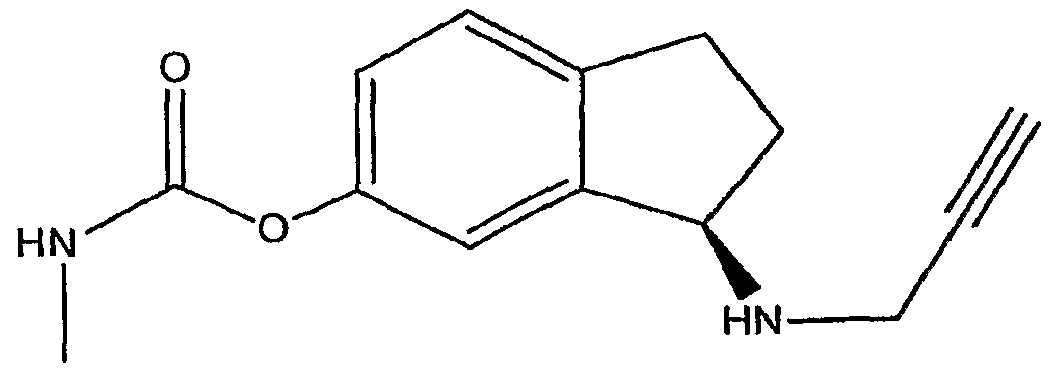
5. The pharmaceutical composition of any one of claims 1- 4, wherein the form of the composition is a solid.
A method of treating a subject afflicted with a psychiatric disorder, Parkinson's disease, Alzheimer's disease, dementia, or a neurological disorder comprising administering to the subject a therapeutically effective amount of a compound having the structure:
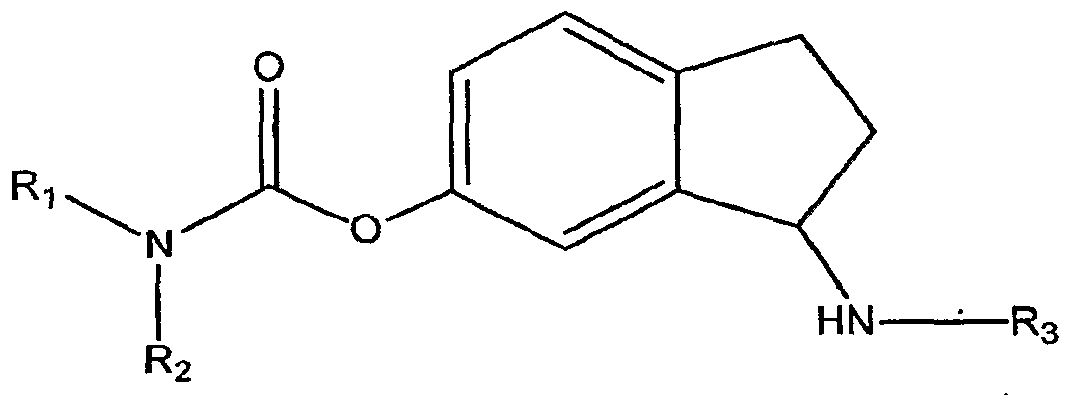
R3 is H or propargyl; or an enantiomer or a pharmaceutically acceptable salt thereof.
The method of claim 6, wherein the subject is afflicted with a psychiatric disorder.
The method of claim 6, wherein the psychiatric disorder is depression, generalized anxiety disorder, obsessive-compulsive disorder, panic attacks and panic disorder, phobic disorder, stress disorder, depersonalized disorder, dissociative amnesia,
dissociative fugue, dissociative identity disorder, personality disorder, delusional disorder, schizoaffective disorder, schizophrenia, schizophreniform disorder, substance-induced psychotic disorder, gender identity disorder, paraphilias, body dysmorphic disorder, hypochondriasis, Munchausen's syndrome, pain disorder, or somatization disorder.
9. The method of claim 6, wherein the subject is afflicted with a neurological disorder.
10. The method of claim 9, wherein the neurological disorder is epilepsy, narcolepsy, amyotrophic -lateral sclerosis ("ALS") , memory disorders, panic, posttraumatic stress disorder ("PTSD") , sexual dysfunction, attention deficit and hyperactivity syndrome ("ADHD") , attention deficit disorder, or Tourette' s syndrome.
11. The method of claim 6, wherein the subject is afflicted with dementia.
12. The method of claim 11, wherein the dementia is static dementia, Alzheimer' s-type dementia, senile dementia, presenile dementia, progressive dementia, vascular dementia, or Lewy body dementia.
13. The method of claim 6, wherein the subject is afflicted with Alzheimer's disease.
14. The method of claim 6, wherein the subject is afflicted with Parkinson's disease.
15. The method of claim 6, wherein the subject is afflicted with depression.
16. The method of any one of any one of claims 6-15, wherein the compound has the structure:

17. The method of any one of claims 6-15, wherein the compound has the structure:

18. The method of any one of claims 6-15, wherein the compound has the structure:

19 . Α process for making a compound having the structure :
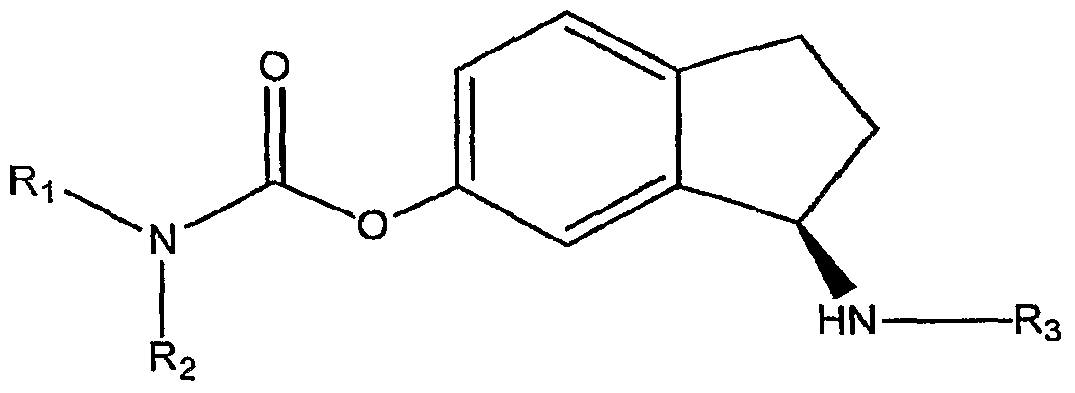
R3 is H or propargyl; comprising administering to a human subject an amount of R (+) -6- (N-methyl, N-ethyl-carbarnoyloxy) -N' - propargyl-1-aminoindan, or a pharmaceutically acceptable salt thereof.
20. The process of claim 19, wherein the compound administered to the human subject is R(+)-6-(N- methyl, N-ethyl-carbamoyloxy) -N' -propargyl-1- aminoindan ^ tartrate.
21. A process for making a compound having the structure:


22. The process of claim 21, wherein the reaction of step a) is performed in the presence of an acidifying
agent .
23. The process of claim 22, wherein the acidifying agent is HCl, acetic acid, or a cation exchange resin.
24. The process of claim 21, wherein recovering in step b) is performed using chromatography.
25. A process for making a compound having the structure:


wherein R is a protecting group, with paraformaldehyde and water in an organic solvent in the presence of an acidic moiety so as to produce a product; b) reacting the product of step a) with an acidifying agent, so as to thereby remove the protecting group and make the compound; and c) recovering the compound made in step b) .
26. The process of claim 25, wherein the protecting group is t-butyloxycarbonyl.
27. The process of claim 25, wherein the organic solvent is dioxane or tetrahydrofuran.
28. The process of claim 25, wherein the acidifying agent is HCl in ethyl acetate.
29. A process for making a compound having the structure:

wherein Rx is H or propargyl, comprising a) reacting a compound having the structure


b) reacting the product formed in step a) with an acidifying agent to make the compound; and c) recovering the compound made in step b) .
30. The process of claim 29, wherein R2 is t- butyloxycarbonyl .
31. The process of claim 29, wherein the acidifying agent is HCl in ethyl acetate.
32. The process of claim 29, wherein prior to step a) a compound of having the structure:

wherein Ri is H or propargyl and R2 is a protecting group, is reacted with chloromethyl chloroformate to produce the compound as which the reaction of step a) is performed.
33. An isolated compound having the structure:
 wherein R1 is methyl and R2 is H, or R1 is ethyl and R2 is hydroxymethyl;
R3 is H or propargyl; and
R4 is either H or t-butyloxycarbonyl; or an enantiomer or a pharmaceutically acceptable salt thereof .
34. The compound of claim 33, wherein R4 is H.
35. The compound of claim 34, having the structure:

;or an enantiomer or a pharmaceutically acceptable salt thereof .
36. The compound of claim 35, wherein the compound is ethyl-hydroxymethyl-carbamic acid 3- (prop-2- ynylamino) -indan-5-yl ester fumarate (2:1).
37. The compound of claim 35, wherein the compound is ethyl-hydroxymethyl-carbamic acid 3-R- (prop-2- ynylamino) -indan-5-yl ester, or a pharmaceutically
acceptable salt thereof.
38. The compound of claim 35, wherein the compound is ethyl-hydroxymethyl-carbamic acid 3-R- (prop-2- ynylamino) -indan-5-yl ester fumarate (2:1).
39. The compound of claim 34, having the structure:

40. The compound of claim 39, wherein the compound methyl- carbamic acid 3-amino-indan-5-yl ester hydrochloride.
41. The compound of claim 39, wherein the compound is methyl-carbamic acid 3-R-amino-indan-5-yl ester, or a pharmaceutically acceptable salt thereof.
42. The compound of claim 39, wherein the compound is methyl-carbamic acid 3-R-amino-indan-5-yl ester hydrochloride .
43. The compound .of claim 34, having the structure:

44. The compound of claim 43, wherein the compound is methyl-carbamic acid 3- (prop-2-ynylamino) -indan-5-yl ester hydrochloride.
45. The compound of claim 43, wherein the compound is methyl-carbamic acid 3-R- (prop-2-ynylamino) -indan-5-yl ester, or a pharmaceutically acceptable salt thereof.
46. The compound of claim 43, wherein the compound is methyl-carbamic acid 3-JR- (prop-2-ynylamino) -indan-5-yl ester hydrochloride.
47. The compound of claim 33, having the structure:

wherein R4 is t-butyloxycarbonyl .
48. The compound of claim 47, wherein Ri is methyl, R2 is H, and R3 is propargyl.
49. The compound of claim 47, wherein Ri is methyl, R2 is H, and R3 is H.
50. The compound of claim 47, wherein Ri is ethyl, R2 is hydroxymethyl, and R3 is propargyl.
51. A method for assaying the' amount of ethyl- hydroxymethyl-carbamic acid 3-R- (prop-2-ynylamino) - indan-5-yl ester in a sample comprising the steps:
a) obtaining a sample; and b) determining the amount of ethyl-hydroxymethyl- carbamic acid 3- (prop—2-ynylamino) -indan-5-yl ester in the sample.
52. A method for assaying the amount of methyl-carbamic acid 3-R-amino-indan~5-yl ester in a sample comprising the steps : a) obtaining a sample; and b) determining the amount of methyl-carbamic acid 3-R- amino-indan-5-yl ester in the sample.
53. A method for assaying the amount of methyl-carbamic acid 3- (prop-2-ynylamino) -indan-5-yl ester in a sample comprising the steps: a) obtaining a sample; and b) determining the amount of methyl-carbamic acid 3-
(prop-2-ynylamino) -indan-5-yl ester in the sample .
54 Use of compound having the structure :

55. The use of claim 54 , wherein the subject is afflicted with a psychiatric disorder.
56. The use of claim 55 wherein the psychiatric disorder is depression, generalized anxiety disorder, obsessive-compulsive disorder, panic attacks and panic disorder, phobic disorder, stress disorder, depersonalized disorder, dissociative amnesia, dissociative fugue, dissociative identity disorder, personality disorder, delusional disorder, schizoaffective disorder, schizophrenia, schizophreniform disorder, substance-induced psychotic disorder, gender identity disorder, paraphilias, body dysmorphic disorder, hypochondriasis, Munchausen's syndrome, pain disorder, or somatization disorder.
57. The use of claim 54, wherein the subject is afflicted with a neurological disorder.
58. The use of claim 57 wherein the neurological disorder is epilepsy, narcolepsy, amyotrophic lateral sclerosis ("ALS"), memory disorders, panic, post-traumatic stress disorder ("PTSD") , sexual dysfunction, attention deficit and hyperactivity syndrome ("ADHD"), attention deficit disorder, or Tourette's syndrome.
59. The use of claim 54, wherein the subject is afflicted with dementia.
60. The use of claim 59, wherein the dementia is static dementia, Alzheimer' s-type dementia, senile' dementia, presenile dementia, progressive dementia, vascular dementia or Lewy body dementia.
61. The use of claim 54, wherein the subject is afflicted
with Alzheimer's disease.
62. The use of claim 54, wherein the subject is afflicted with Parkinson's disease.
63. The use of claim 54, wherein the subject is afflicted with depression.
64. The use of any one of claims 54-63, wherein the compound has the structure:

65. The use of any one of claims 54-63, wherein the compound has the structure:

66. The use of any one of claims 54-63, wherein the compound has the structure:

Applications Claiming Priority (2)
| Application Number | Priority Date | Filing Date | Title |
|---|---|---|---|
| US77638606P | 2006-02-24 | 2006-02-24 | |
| US60/776,386 | 2006-02-24 |
Publications (2)
| Publication Number | Publication Date |
|---|---|
| WO2007100583A2 true WO2007100583A2 (en) | 2007-09-07 |
| WO2007100583A3 WO2007100583A3 (en) | 2008-11-06 |
Family
ID=38459533
Family Applications (1)
| Application Number | Title | Priority Date | Filing Date |
|---|---|---|---|
| PCT/US2007/004505 Ceased WO2007100583A2 (en) | 2006-02-24 | 2007-02-21 | Propargylated aminoindans, processes for preparation, and uses thereof |
Country Status (4)
| Country | Link |
|---|---|
| US (2) | US7625946B2 (en) |
| AR (1) | AR059625A1 (en) |
| TW (1) | TW200744576A (en) |
| WO (1) | WO2007100583A2 (en) |
Cited By (2)
| Publication number | Priority date | Publication date | Assignee | Title |
|---|---|---|---|---|
| US7625946B2 (en) | 2006-02-24 | 2009-12-01 | Yissum Research Development Company Of The Hebrew University Of Jerusalem | Propargylated aminoindans, processes for preparation, and uses thereof |
| US8022104B2 (en) | 2005-02-24 | 2011-09-20 | Yissum Research Development Company Of The Hebrew University Of Jerusalem | Formulations of ladostigil tartrate |
Families Citing this family (7)
| Publication number | Priority date | Publication date | Assignee | Title |
|---|---|---|---|---|
| JP2009518433A (en) * | 2005-12-09 | 2009-05-07 | イッサム リサーチ ディベロップメント カンパニー オブ ザ ヘブライ ユニバーシティー オブ エルサレム | Use of low-dose radostigil for neuroprotection |
| US20070135518A1 (en) * | 2005-12-09 | 2007-06-14 | Marta Weinstock-Rosin | Use of low-dose ladostigil for neuroprotection |
| WO2007126898A2 (en) * | 2006-03-31 | 2007-11-08 | Teva Pharmaceutical Industries, Ltd. | Use of ladostigil for the treatment of schizophrenia |
| EP2609093B1 (en) * | 2010-08-24 | 2018-10-17 | SGC Pharma Inc. | Salt compound |
| WO2012059920A1 (en) * | 2010-11-02 | 2012-05-10 | Yissum Research Development Company Of The Hebrew University Of Jerusalem Ltd. | Ladostigil dosage regime |
| WO2013118126A1 (en) | 2012-02-12 | 2013-08-15 | Yissum Research Development Company Of The Hebrew University Of Jerusalem Ltd. | Ladostigil therapy for immunomodulation |
| EP3976188A1 (en) * | 2019-05-28 | 2022-04-06 | Yissum Research Development Company of the Hebrew University of Jerusalem Ltd. | Compositions for delivery of ladostigil |
Family Cites Families (89)
| Publication number | Priority date | Publication date | Assignee | Title |
|---|---|---|---|---|
| US3201470A (en) | 1965-08-17 | Chsx c cech | ||
| US3123642A (en) | 1964-03-03 | Indanyl and tetrahydronaphthyl | ||
| US2982783A (en) | 1961-05-02 | Amevoevdanes | ||
| US2916490A (en) | 1959-12-08 | Ocjhs | ||
| SE371190B (en) | 1972-03-24 | 1974-11-11 | Kabi Ab | |
| US2573645A (en) | 1949-05-25 | 1951-10-30 | Smith Kline French Lab | N-hydroxyethyl aminoindanes |
| GB852735A (en) | 1956-04-13 | 1960-11-02 | Schering Ag | Manufacture of 1-aminoindanes |
| US3178478A (en) | 1961-02-13 | 1965-04-13 | Ciba Geigy Corp | 2-amino-5-halo-indanes |
| US3060091A (en) | 1961-02-13 | 1962-10-23 | Ciba Geigy Corp | Analgesic composition consisting of morphines and amino-indanes |
| US3253037A (en) | 1962-06-19 | 1966-05-24 | Ciba Geigy Corp | N-2-alkynyl-amino-benzocylo-alkanes |
| US3709996A (en) | 1963-08-02 | 1973-01-09 | Aspro Nicholas Ltd | Pharmaceutical compositions containing n-cyclopropyl-1-aminoindane compounds and adapted for administration to obtain inhibition of monoamine oxidase enzyme and process |
| GB1187017A (en) | 1966-07-16 | 1970-04-08 | Aspro Nicholas Ltd | Substituted 1-Amino Indanes and Tetrahydronaphthalens |
| NL6408165A (en) | 1964-07-17 | 1966-01-18 | ||
| US3308157A (en) | 1964-08-07 | 1967-03-07 | Colgate Palmolive Co | N-(benzocyclobutene-1-loweralkyl)-carboxylic acid amides |
| US3637740A (en) | 1969-04-21 | 1972-01-25 | Pfizer | Aminobenzocycloalkane compounds |
| US3507962A (en) | 1969-05-09 | 1970-04-21 | Thompson Chem Co Hayward | Controlling leafminer insects with selected carbamate insecticides,including 3,5-dimethyl-4-dimethylamino-methyl phenyl-n-methylcarbamate |
| US3704323A (en) | 1969-12-23 | 1972-11-28 | Squibb & Sons Inc | Indane derivatives |
| NL7011683A (en) | 1970-08-07 | 1972-02-09 | ||
| US3991207A (en) | 1971-03-18 | 1976-11-09 | Pfizer Inc. | Combination therapy for Parkinson's disease |
| US3751420A (en) | 1971-04-01 | 1973-08-07 | Squibb & Sons Inc | Monoolmonoene amines |
| BE786748A (en) | 1971-07-26 | 1973-01-26 | Basf Ag | 1-AMINOMETHYL-INDANES-N-SUBSTITUTES |
| US3903297A (en) | 1973-11-01 | 1975-09-02 | Upjohn Co | Method of treatment and prophylaxis of gastric hypersecretion and gastric and duodenal ulcers using prostaglandin analogs |
| US4029731A (en) | 1974-11-06 | 1977-06-14 | Pfizer Inc. | Aminophenyltetralin compounds |
| US4134997A (en) | 1977-03-01 | 1979-01-16 | University Of Iowa Research Foundation | Effect of an aminotetralin derivative on coronary blood flow in infarcted hearts |
| US4096173A (en) | 1977-03-28 | 1978-06-20 | Eli Lilly And Company | Chlorinated 1-aminoindane N-methyl transferase inhibitors |
| US4128666A (en) | 1977-08-18 | 1978-12-05 | Smithkline Corporation | 4 AND 5-Halo substituted 2-indanamine compounds |
| US4132737A (en) | 1978-02-27 | 1979-01-02 | Eli Lilly And Company | Trifluoromethyl substituted 1-aminoindanes |
| US5286747A (en) | 1981-05-08 | 1994-02-15 | Per A. E. Carlsson | 1-alkyl-2-aminotetralin derivatives |
| KR910003337B1 (en) | 1983-03-04 | 1991-05-27 | 오오쓰까세이야꾸 가부시끼가이샤 | Process for the preparation of indan derivatives |
| US4529723A (en) | 1983-04-29 | 1985-07-16 | William H. Rorer, Inc. | Bicyclic benzenoid aminoalkylene ethers and thioethers, pharmaceutical compositions and use |
| US5242919A (en) | 1984-08-31 | 1993-09-07 | Otsuka Pharmaceutical Co., Ltd. | 2,3-dihydro-1H-indene derivatives |
| JPS6169747A (en) | 1984-08-31 | 1986-04-10 | Otsuka Pharmaceut Co Ltd | 2,3-dihydro-1h-indene derivative |
| US5378729A (en) | 1985-02-15 | 1995-01-03 | Research Corporation Technologies, Inc. | Amino acid derivative anticonvulsant |
| US5654301A (en) | 1985-02-15 | 1997-08-05 | Research Corporation Technologies, Inc. | Amino acid derivative anticonvulsant |
| IL74497A (en) | 1985-03-05 | 1990-02-09 | Proterra Ag | Pharmaceutical compositions containing phenyl carbamate derivatives and certain phenyl carbamate derivatives |
| US4632939A (en) | 1985-03-15 | 1986-12-30 | Eli Lilly And Company | Anticonvulsant agents |
| US4833273A (en) | 1986-02-03 | 1989-05-23 | Warner-Lambert Company | Process for the resolution of 1-aminoindanes |
| DE3779500T2 (en) | 1986-06-10 | 1993-01-21 | Chiesi Farma Spa | LEVODOPA METHYL ESTER CONTAINING PHARMACEUTICAL COMPOSITIONS, THEIR PRODUCTION AND THERAPEUTIC USE. |
| US5153225A (en) | 1986-12-10 | 1992-10-06 | Bayer Aktiengesellschaft | Substituted basic 2-aminotetralin in pharmaceuticals |
| NL195004C (en) | 1987-03-04 | 2003-11-04 | Novartis Ag | Pharmaceutical preparation containing phenyl carbamate. |
| US5011995A (en) | 1987-07-28 | 1991-04-30 | Ciba-Geigy Corporation | Process for the preparation of optically active secondary amines |
| US4873241A (en) | 1988-10-31 | 1989-10-10 | Fisons Corporation | 2-amino-N-(2-phenylindan-2-yl)acetamides useful as anti-epileptics |
| US5225596A (en) | 1989-01-09 | 1993-07-06 | The Upjohn Company | Halo substituted aminotetralins |
| CA1335106C (en) | 1989-02-27 | 1995-04-04 | John Mehnert Schaus | Ring-substituted 2-amino-1,2,3,4-tetra-hydronaphthalenes |
| JP2725378B2 (en) | 1989-05-29 | 1998-03-11 | 武田薬品工業株式会社 | Carbamate derivatives |
| IE902294A1 (en) | 1989-07-06 | 1991-01-16 | Abbott Lab | Alkynyl amines that regulate cholinergic neurotransmission |
| US5118704A (en) | 1989-08-30 | 1992-06-02 | Whitby Research, Inc. | Substituted 2-aminotetralins useful as dopaminergics |
| US5071875A (en) | 1989-09-25 | 1991-12-10 | Northwestern University | Substituted 2-amidotetralins as melatonin agonists and antagonists |
| FR2654104B1 (en) | 1989-11-07 | 1992-01-03 | Adir | NOVEL 1,2-BENZISOXAZOLE DERIVATIVES, PROCESSES FOR THEIR PREPARATION AND THE PHARMACEUTICAL COMPOSITIONS CONTAINING THEM. |
| JPH03176457A (en) | 1989-12-04 | 1991-07-31 | Nippon Paint Co Ltd | Novel propargyl compound, its production and coating material containing the same compound |
| US5744500A (en) | 1990-01-03 | 1998-04-28 | Teva Pharmaceutical Industries, Ltd. | Use of R-enantiomer of N-propargyl-1-aminoindan, salts, and compositions thereof |
| IL92952A (en) | 1990-01-03 | 1994-06-24 | Teva Pharma | R-enantiomers of n-propargyl-1-aminoindan compounds, their preparation and pharmaceutical compositions containing them |
| FR2662162B1 (en) | 1990-05-18 | 1995-01-20 | Adir | NOVEL DERIVATIVES OF AMINO PIPERIDINE, AMINO PYRROLIDINE AND AMINO PERHYDROAZEPINE, PROCESSES FOR THEIR PREPARATION AND THE PHARMACEUTICAL COMPOSITIONS CONTAINING THEM. |
| TW197435B (en) | 1990-11-22 | 1993-01-01 | Takeda Pharm Industry Co Ltd | |
| US5844003A (en) | 1991-04-04 | 1998-12-01 | Innovations Foundation | Use of deprenyl compounds to maintain, prevent loss, or recover nerve cell function |
| IL99759A (en) | 1991-10-16 | 1997-06-10 | Teva Pharma | Mono-fluorinated derivatives of n-propargyl-1-aminoindan, their preparation and pharmaceutical compositions containing them |
| SE9103745D0 (en) | 1991-12-18 | 1991-12-18 | Wikstroem Haakan | ARYL-TRIFLATES AND RELATED COMPOUNDS |
| US5646181A (en) * | 1992-07-02 | 1997-07-08 | Research Foundation Of State University Of New York | Method and compositions for treating impotence |
| ES2149213T3 (en) | 1992-10-05 | 2000-11-01 | Ube Industries | PIRIMIDINE COMPOUND. |
| US5350762A (en) | 1993-03-08 | 1994-09-27 | Hoechst-Roussel Pharmaceuticals Incorporated | Tetrahydrocyclopent[B]indole methanamines and related compounds |
| EP0697894A4 (en) | 1993-03-31 | 1996-05-01 | Univ Pennsylvania | DOPAMIN D-3 AND SEROTONIN (5-HT 1A?) RECEPTOR LIGANDS AND IMAGING AGENTS |
| GB9315600D0 (en) | 1993-07-28 | 1993-09-08 | Smithkline Beecham Plc | Compounds |
| ES2139750T3 (en) | 1993-08-06 | 2000-02-16 | Upjohn Co | 2-AMINOINDANES AS SELECTIVE D3 LIGANDS OF DOPAMINE. |
| US5516943A (en) | 1993-09-14 | 1996-05-14 | Sepracor, Inc. | Process for preparing cyclic CIS-1-amino-2-alkanols |
| US5401758A (en) | 1993-10-07 | 1995-03-28 | Bristol-Myers Squibb Company | Pyridinyl cyanoguanidine compounds |
| IL111240A (en) | 1993-10-18 | 2001-10-31 | Teva Pharma | Salts of r(+) - enantiomers of n- propargyl-1-aminoindan and pharmaceutical compositions comprising them |
| EP0738149B1 (en) | 1994-01-10 | 2006-11-29 | Teva Pharmaceutical Industries, Ltd. | 1-aminoindan derivatives and compositions thereof |
| US5914349A (en) | 1994-01-10 | 1999-06-22 | Teva Pharmaceutical Industries, Ltd. | Compositions containing and methods of using 1-aminoindan and derivatives thereof and process for preparing optically active 1-aminoindan derivatives |
| FR2717175B1 (en) | 1994-03-11 | 1996-06-14 | Adir | New alkylaminoindane compounds, processes for their preparation and pharmaceutical compositions containing them. |
| IT1271679B (en) | 1994-07-18 | 1997-06-04 | Mediolanum Farmaceutici Srl | PHENYL CARBAMATE DERIVATIVES FOR USE AS AN ANTICOLINESTERASIC |
| US5646188A (en) | 1995-07-05 | 1997-07-08 | Teva Pharmaceutical Industries, Ltd. | Polyamine derivatives of 1-aminoindan |
| DE19529604A1 (en) | 1995-08-11 | 1997-02-13 | Bayer Ag | Endoparasiticidal agents based on didepsipeptides, new didepsipeptides and a process for their preparation |
| IL115357A (en) | 1995-09-20 | 2000-01-31 | Teva Pharma | Stable compositions containing N-propargyl-1-aminoindan and polyhydric alcohols |
| IL118836A (en) | 1996-07-11 | 2001-01-11 | Teva Pharma | Pharmaceutical compositions comprising s-(-)-n-propargyl-1-aminoindan |
| AU5620998A (en) | 1996-12-18 | 1998-07-15 | Technion Research & Development Foundation Ltd. | Phenylethylamine derivatives |
| US6251938B1 (en) | 1996-12-18 | 2001-06-26 | Teva Pharmaceutical Industries, Ltd., | Phenylethylamine derivatives |
| CA2275425C (en) | 1996-12-18 | 2009-08-04 | Michael Chorev | Aminoindan derivatives |
| AU2003219913A1 (en) | 2002-02-27 | 2003-09-09 | Teva Pharmaceutical Industries, Ltd. | Propargylamino indan derivatives and propargylamino tetralin derivatives as brain-selective mao inhibitors |
| US20040010038A1 (en) | 2002-02-27 | 2004-01-15 | Eran Blaugrund | Propargylamino indan derivatives and propargylamino tetralin derivatives as brain-selective MAO inhibitors |
| GB0322140D0 (en) | 2003-09-22 | 2003-10-22 | Pfizer Ltd | Combinations |
| CA2566204A1 (en) | 2004-05-14 | 2005-12-01 | The Johns Hopkins University | Method for improving cognitive function by co-administration of a gabab receptor antagonist and an acetylcholinesterase inhibitor |
| JP4738019B2 (en) * | 2005-02-23 | 2011-08-03 | 任天堂株式会社 | GAME PROGRAM, GAME DEVICE, GAME CONTROL METHOD, AND GAME SYSTEM |
| WO2006091836A1 (en) | 2005-02-24 | 2006-08-31 | Teva Pharmaceutical Industries, Ltd. | Formulations of ladostigil tartrate |
| US7335685B2 (en) | 2005-02-24 | 2008-02-26 | Teva Pharmaceutical Industries, Ltd. | Crystals of ladostigil tartrate, methods of production and pharmaceutical compositions thereof |
| WO2006130726A2 (en) | 2005-06-01 | 2006-12-07 | Teva Pharmaceutical Industries, Ltd. | Use of ladostigil for the treatment of multiple sclerosis |
| US20070135518A1 (en) | 2005-12-09 | 2007-06-14 | Marta Weinstock-Rosin | Use of low-dose ladostigil for neuroprotection |
| JP2009518433A (en) | 2005-12-09 | 2009-05-07 | イッサム リサーチ ディベロップメント カンパニー オブ ザ ヘブライ ユニバーシティー オブ エルサレム | Use of low-dose radostigil for neuroprotection |
| TW200744576A (en) | 2006-02-24 | 2007-12-16 | Teva Pharma | Propargylated aminoindans, processes for preparation, and uses thereof |
| WO2007126898A2 (en) | 2006-03-31 | 2007-11-08 | Teva Pharmaceutical Industries, Ltd. | Use of ladostigil for the treatment of schizophrenia |
-
2007
- 2007-02-16 TW TW096106255A patent/TW200744576A/en unknown
- 2007-02-21 WO PCT/US2007/004505 patent/WO2007100583A2/en not_active Ceased
- 2007-02-23 AR ARP070100776A patent/AR059625A1/en unknown
- 2007-02-23 US US11/710,118 patent/US7625946B2/en active Active
-
2009
- 2009-10-20 US US12/582,491 patent/US8609719B2/en not_active Expired - Fee Related
Non-Patent Citations (1)
| Title |
|---|
| No further relevant documents disclosed * |
Cited By (3)
| Publication number | Priority date | Publication date | Assignee | Title |
|---|---|---|---|---|
| US8022104B2 (en) | 2005-02-24 | 2011-09-20 | Yissum Research Development Company Of The Hebrew University Of Jerusalem | Formulations of ladostigil tartrate |
| US7625946B2 (en) | 2006-02-24 | 2009-12-01 | Yissum Research Development Company Of The Hebrew University Of Jerusalem | Propargylated aminoindans, processes for preparation, and uses thereof |
| US8609719B2 (en) | 2006-02-24 | 2013-12-17 | Yissum Research Development Company Of The Hebrew University Of Jerusalem | Propargylated aminoindans, processes for preparation, and uses thereof |
Also Published As
| Publication number | Publication date |
|---|---|
| US20100093848A1 (en) | 2010-04-15 |
| US7625946B2 (en) | 2009-12-01 |
| TW200744576A (en) | 2007-12-16 |
| US20070203232A1 (en) | 2007-08-30 |
| WO2007100583A3 (en) | 2008-11-06 |
| AR059625A1 (en) | 2008-04-16 |
| US8609719B2 (en) | 2013-12-17 |
Similar Documents
| Publication | Publication Date | Title |
|---|---|---|
| US8609719B2 (en) | Propargylated aminoindans, processes for preparation, and uses thereof | |
| US20090131535A1 (en) | Propargylamino indan derivatives and propargylamino tetralin derivatives as brain-selective mao inhibitors | |
| KR20140023872A (en) | Deuterium enriched rasagiline | |
| US6780891B2 (en) | Tramadol analogs and uses thereof | |
| EP2182809B1 (en) | Therapeutic isoxazole compounds | |
| US6251938B1 (en) | Phenylethylamine derivatives | |
| KR20230021075A (en) | Forms and Compositions of Beta Adrenergic Agonists | |
| EP4228756B1 (en) | Tetrazole derivatives as trpa1 inhibitors | |
| EP4045053B1 (en) | Novel tetrazoles | |
| CN111518020A (en) | MAGL inhibitor and preparation method and application thereof | |
| JP4116085B2 (en) | Phenylethylamine derivatives | |
| AU734394B2 (en) | Compounds | |
| CA2477218A1 (en) | Propargylamino indan derivatives and propargylamino tetralin derivatives as brain-selective mao inhibitors | |
| CN111051302B (en) | Haloperidine compounds as pure 5-HT6 receptor antagonists | |
| US12134608B2 (en) | Benzimidazole derivatives as dual histamine H1 and histamine H4 receptor ligands | |
| HK40092835A (en) | Tetrazole derivatives as trpa1 inhibitors | |
| HK40092835B (en) | Tetrazole derivatives as trpa1 inhibitors | |
| KR20010012951A (en) | Salts of optically active sulfoxide derivative | |
| CZ388999A3 (en) | Compounds | |
| MXPA00001586A (en) | Process for the creation of an optical plane that generates a three-dimensional vision. |
Legal Events
| Date | Code | Title | Description |
|---|---|---|---|
| NENP | Non-entry into the national phase |
Ref country code: DE |
|
| 122 | Ep: pct application non-entry in european phase |
Ref document number: 07751275 Country of ref document: EP Kind code of ref document: A2 |