WO2007100387A2 - Process for preparing tadalafil - Google Patents
Process for preparing tadalafil Download PDFInfo
- Publication number
- WO2007100387A2 WO2007100387A2 PCT/US2006/060514 US2006060514W WO2007100387A2 WO 2007100387 A2 WO2007100387 A2 WO 2007100387A2 US 2006060514 W US2006060514 W US 2006060514W WO 2007100387 A2 WO2007100387 A2 WO 2007100387A2
- Authority
- WO
- WIPO (PCT)
- Prior art keywords
- formula
- tadalafil
- reacting
- acid
- compound
- Prior art date
- Legal status (The legal status is an assumption and is not a legal conclusion. Google has not performed a legal analysis and makes no representation as to the accuracy of the status listed.)
- Ceased
Links
- SATCULPHIDQDRE-UHFFFAOYSA-N O=Cc(cc1)cc2c1OCO2 Chemical compound O=Cc(cc1)cc2c1OCO2 SATCULPHIDQDRE-UHFFFAOYSA-N 0.000 description 2
- 0 C[C@@](*)(Cc1c[n]c2ccccc12)N Chemical compound C[C@@](*)(Cc1c[n]c2ccccc12)N 0.000 description 1
- MDXJJOKTGDJRNN-RHSMWYFYSA-N OC([C@@H](Cc1c2[nH]c3ccccc13)N[C@@H]2c(cc1)cc2c1OCO2)=O Chemical compound OC([C@@H](Cc1c2[nH]c3ccccc13)N[C@@H]2c(cc1)cc2c1OCO2)=O MDXJJOKTGDJRNN-RHSMWYFYSA-N 0.000 description 1
Classifications
-
- C—CHEMISTRY; METALLURGY
- C07—ORGANIC CHEMISTRY
- C07D—HETEROCYCLIC COMPOUNDS
- C07D471/00—Heterocyclic compounds containing nitrogen atoms as the only ring hetero atoms in the condensed system, at least one ring being a six-membered ring with one nitrogen atom, not provided for by groups C07D451/00 - C07D463/00
- C07D471/02—Heterocyclic compounds containing nitrogen atoms as the only ring hetero atoms in the condensed system, at least one ring being a six-membered ring with one nitrogen atom, not provided for by groups C07D451/00 - C07D463/00 in which the condensed system contains two hetero rings
- C07D471/04—Ortho-condensed systems
-
- C—CHEMISTRY; METALLURGY
- C07—ORGANIC CHEMISTRY
- C07D—HETEROCYCLIC COMPOUNDS
- C07D471/00—Heterocyclic compounds containing nitrogen atoms as the only ring hetero atoms in the condensed system, at least one ring being a six-membered ring with one nitrogen atom, not provided for by groups C07D451/00 - C07D463/00
- C07D471/12—Heterocyclic compounds containing nitrogen atoms as the only ring hetero atoms in the condensed system, at least one ring being a six-membered ring with one nitrogen atom, not provided for by groups C07D451/00 - C07D463/00 in which the condensed system contains three hetero rings
- C07D471/14—Ortho-condensed systems
Definitions
- the present invention relates to a process for the preparation of tadalafil.
- it relates to a process for the preparation of (1 R,3R)-1 ,2,3,4-tetrahydro- 1 -(3,4-methylenedioxyphenyl)-9H-pyrido[3,4-b] indole-3-carboxylic acid (hereinafter referred to as "beta-carboline acid”) or salts thereof and its conversion to tadalafil.
- Tadalafil is chemically known as (6R,12aR)-2,3,6,7,12,12a-hexahydro-2- methyl-6-(3, 4-methylene dioxyphenyl)-pyrazino [2',1 ':6, 1] pyrido [3,4-b] indole-, 1 ,4-dione (hereinafter referred to by the adopted name "tadalafil”), and is structurally represented by Formula I.
- Tadalafil is a potent and selective inhibitor of cyclic guanosine monophosphate (cGMP)-specific phosphodiesterase type 5 (PDE5). Tadalafil is used in the treatment of erectile dysfunction. It is available in the market under the brand name CIALISTM as tablets for oral administration, each tablet containing 5, 10, or 20 mg of tadalafil.
- CIALISTM as tablets for oral administration, each tablet containing 5, 10, or 20 mg of tadalafil.
- U.S. Patent No. 5,859,006 describes tadalafil, its related compounds, and methods for their synthesis. The patent describes the preparation of tadalafil as depicted by Scheme 1.
- the process involves condensation of D-tryptophan methyl ester of Formula VII with piperonal of Formula IV to yield a mixture of isomers of the beta carboline ester of Formula VIII which are separated using column chromatography.
- Reacting the required isomer of beta-carboline ester of Formula Villa with a haloacetyl halide like chloroacetyl chloride in a suitable solvent in the presence of a base or an alkaline metal carbonate to give (1 R,3R)- methyl 1 ,2,3,4-tetrahydro-2-chloroacetyl-(3,4-methylenedioxyphenyl)-9H-pyrido[3, 4-b] indole 3-carboxylate of Formula IX, which on treatment with a primary amine in a suitable solvent such as alcohol gives tadalafil of Formula I.
- the present invention provides a process for the preparation of tadalafil having a reduced number of stages, which is easily scalable, cost effective, safe, and has a shorter time cycle.
- the present invention relates to a process for the preparation of tadalafil.
- the present invention provides a process for the preparation of tadalafil of Formula I using beta-carboline acid, its derivatives and salts thereof.
- the process for the preparation of tadalafil of Formula I comprises condensation of beta-carboline acid, its derivatives or salts thereof of Formula Il with sarcosine derivatives or salts thereof having Formula Vl in the presence of a suitable reagent.
- R is hydrogen, or a Ci to C 6 straight chain branched or cyclic alkyl, Ci to C 6 straight chain branched or cyclic alkoxy, or an aryloxy group and the like; Ri is a halogen, Ci to C 6 straight chain branched or cyclic alkoxy, aryloxy or hydroxy group, and X is an inorganic or organic acid.
- the present invention provides substantially pure beta- carboline acid or its salts of Formula Ma.
- the present invention provides a process for preparation of the beta-carboline acid or its salts of Formula Na.
- the process for preparation of beta-carboline acid or its salts of Formula Ma comprises: a) reacting D-tryptophan of Formula III with piperonal of Formula IV in the presence of an acid and a suitable solvent to afford a mixture of cis- and trans- isomers of 1 ,2,3,4-tetrahydro-1- (3,4-methylenedioxyphenyl)-9H-pyrido[3,4- b]indole-3-carboxylic acid represented by Formula V;
- Formula III Formula IV b) conversion of mixture of cis- and trans-isomers of Formula V into the cis- isomer of Formula Na, optionally followed by purification by recrystallization or slurrying in a suitable solvent.
- Still another aspect of the present invention provides a pharmaceutical composition
- a pharmaceutical composition comprising substantially pure tadalafil or its pharmaceutically acceptable salts along with one or more pharmaceutically acceptable carriers, excipients or diluents.
- An embodiment of the invention includes a process for preparing tadalafil, comprising reacting a compound having a formula:
- R is hydrogen, a Ci to C 6 straight chain branched or cyclic alkyl group, a Ci to C 6 straight chain branched or cyclic alkoxy group, or an aryloxy group
- X is an inorganic or organic acid, with a compound having a formula:
- R 1 is a halogen, a Ci to C 6 straight chain branched or cyclic alkoxy group, or an aryloxy or hydroxy group, or a salt thereof, to form tadalafil.
- Another embodiment of the invention includes a process for preparing tadalafil, comprising: a) reacting a compound having a formula:
- R is hydrogen, a Ci to C 6 straight chain branched or cyclic alkyl group, a Ci to C ⁇ straight chain branched or cyclic alkoxy group, or an aryloxy group, and X is an inorganic or organic acid, and further reacting with a compound having a formula:
- R 1 is a halogen, a Ci to C ⁇ straight chain branched or cyclic alkoxy group, or an aryloxy or hydroxy group, or a salt thereof, to form tadalafil.
- a still further embodiment of the invention includes tadalafil, containing about 0.005 to about 0.2, or about 0.005 to about 0.1 , or about 0.005 to about 0.05, percent by weight of piperonal.
- Fig. 1 is a schematic representation of an embodiment of a process for the preparation of tadalafil.
- Fig. 2 is an X-ray powder diffraction pattern of beta-carboline acid hydrochloride prepared in Example 6.
- Fig. 3 is an infrared absorption spectrum of beta-carboline acid hydrochloride prepared in Example 6.
- Fig. 4 is a differential scanning calorimethc curve of beta-carboline acid hydrochloride prepared in Example 6.
- the present invention relates to a process for the preparation of tadalafil.
- One aspect of the present invention provides a process for the preparation of tadalafil of Formula I using beta-carboline acid, its derivatives or salts thereof of Formula II.
- the process for the preparation of tadalafil of Formula I comprises condensation of beta-carboline acid, its derivatives or salts thereof of Formula Il with sarcosine derivatives or salts thereof having Formula Vl in the presence of a suitable reagent.
- R is hydrogen, or a Ci to C ⁇ straight chain branched or cyclic alkyl, Ci to C ⁇ straight chain branched or cyclic alkoxy, or an aryloxy group and the like; Ri is a halogen, or a Ci to C 6 straight chain branched or cyclic alkoxy, or an aryloxy or hydroxy group, and X is an inorganic or organic acid.
- Suitable solvents which can be used for the above reaction include but are not limited to: alcoholic solvents such as methanol, ethanol, isopropanol, n- butanol, tertiary butanol, and the like; ethers such as diethyl ether, dimethyl ether, diisopropyl ether, tetrahydrofuran, 1 ,4 dioxane, and the like; hydrocarbon solvents such as toluene, xylene, and the like; polar aprotic solvents like dimethylformamide, dimethylsulphoxide, diemthylacetamide, and the like; chlorinated solvents like dichloromethane, chloroform, carbon tetrachloride, chlorobenzene and the like; and mixtures of such solvents and aqueous solvents in various proportions.
- alcoholic solvents such as methanol, ethanol, isopropanol, n- butanol, tertiary butan
- Suitable temperatures for conducting the reaction range from about -20 to about 100 0 C, or from about -10 to about 4O 0 C.
- Suitable reagents which can be used for condensation include but are not limited to bases like alkali metal alkoxides such as potassium alkoxide, sodium methoxide; alkali metal hydroxides such as sodium hydroxide, potassium hydroxide; alkali metal carbonates such as sodium carbonate, sodium bicarbonate; alkali metal hydrides comprising sodium hydride and the like; organic bases such as thethylamine, trimethyl amine, di-isopropylethylamine and the like; and mixtures thereof; and coupling agents like 1 -ethyl-3-(3-dimethylaminopropyl) carbodiimide (EDCI), dicyclohexyl carbodiimide (DCC), and diisopropylcarbodiimide (DIPCDI).
- bases like alkali metal alkoxides such as potassium alkoxid
- the compound of Formula Il is the beta-carboline acid of Formula Ma.
- a catalytic auxiliary nucleophile may be used to activate the carboxyl group.
- Suitable catalytic auxiliary nucleophiles which can be used to promote the reaction include, but are not limited to 1 -hydroxybenzothazole (HOBt), N-hydroxysuccinimede (HOSu), and N- hydroxy-5-norbene-endo-2,3-dicarboxamide (HONB).
- the amount of the catalytic auxiliary nucleophile may range from 0.5 to 2 moles per mole of the compound of
- Formula Vl or it can be used in equimolar quantities.
- Formula Ma is carried out with dicyclohexyl carbodiimide (DCC), in the presence of the auxiliary nucleophile 1 -hydroxybenzothazole (HOBt).
- DCC dicyclohexyl carbodiimide
- HOBt auxiliary nucleophile 1 -hydroxybenzothazole
- the acid of Formula Ma is treated with dicyclohexyl carbodiimide (DCC) which leads to the formation of an active ester compound 2-[(1 R,3R)-1 ,2,3,4-tetrahydro-1 -(3,4-methylene dioxyphenyl)-9H-pyrido
- DCC dicyclohexyl carbodiimide
- a catalytic auxiliary nucleophile 1 -hydroxybenzotriazole (HOBt) is added to promote the reaction.
- the catalytic auxiliary nucleophiles are introduced in carodiimide mediated couplings to reduce possible side reactions, including racemization, and to increase reaction rate when active esters are used.
- all the additives are capable of acting as proton acceptors aiding deprotonation of the ammonium ion intermediate and thereby greatly increasing reaction rate.
- the cyclohexylurea formed during the course of the reaction as a byproduct can be separated by filtration.
- the active ester can be generated through use of a phosphonium reagent like benzothazole-1-yloxy-trisphosphonium hexafluorophosphate (PyBOP).
- PyBOP benzothazole-1-yloxy-trisphosphonium hexafluorophosphate
- This reagent is used in tandem with a tertiary amine base, which abstracts the acidic carboxyl proton.
- the pH of the reaction mixture can range from about 5 to about 14.
- the reaction will be conducted to completion, frequently requiring time periods ranging from about 10 hours to about 60 hours, or longer, depending upon the reactants and conditions chosen.
- the product is extracted into an organic solvent such as: chlorinated solvents like dichloromethane, chloroform, carbon tetrachloride, chlorobenzene and the like; and hydrocarbon solvents such as toluene, xylene, and the like.
- organic solvent such as: chlorinated solvents like dichloromethane, chloroform, carbon tetrachloride, chlorobenzene and the like; and hydrocarbon solvents such as toluene, xylene, and the like.
- the organic layer is then suitably washed with water to wash out the water soluble salts.
- an alcohol such as methanol may be added for clearing any emulsions formed during extractions or water washings.
- the compound of Formula Il where R is a Ci to C ⁇ straight chain branched or cyclic alkyl, Ci to C 6 straight chain branched or cyclic alkoxy, or aryloxy group and the like may be prepared from the corresponding acid of Formula Na using processes known to one skilled in the art.
- the process used for condensation of the derivatives of Formula Il with the compound of Formula Vl is similar to the process described above for the condensation of the beta-carboline acid or a salt thereof of Formula Il with the compound of Formula Vl.
- Tadalafil obtained above may be further purified by recrystallization or slurrying in a suitable solvent.
- Recrystallization involves providing a solution of tadalafil in a suitable solvent and then crystallizing the solid from the solution.
- Suitable organic solvents which can be used for recrystallization or slurrying include but are not limited to: alcoholic solvents such as methanol, ethanol, isopropyl alcohol, n-propanol, and the like; halogenated solvents such as dichloromethane, 1 ,2-dichloroethane, chloroform, carbon tetrachloride and the like; ketonic solvents such as acetone, ethyl methyl ketone, methyl isobutyl ketone and the like; esters such as ethyl acetate, n-propyl acetate, n-butyl acetate, t-butyl acetate and the like; ether solvents such as diethyl ether,dimethyl ether, di- isopropyl ether, methyl tertiary-butyl ether, tetrahydrofuran, 1 ,4-dioxane and the like; hydrocarbon solvents such as
- the concentration of tadalafil in the solvent can range from 40 to 80% or more.
- a solution can be prepared at an elevated temperature if desired to achieve a desired concentration. Any temperature is acceptable for the dissolution as long as a clear solution of the tadalafil is obtained and is not detrimental to the drug substance chemically or physically.
- the solution may be brought down to room temperature for further processing if required or an elevated temperature may be used. A higher temperature will allow the precipitation from solutions with higher concentrations of tadalafil resulting in better economies of manufacture.
- the compound obtained can be further dried suitably using a tray dryer, vacuum oven, air oven, fluidized bed drier, spin flash dryer, flash dryer and the like.
- the drying can be carried out at temperatures of about 35° C to about 70° C.
- the drying can be carried out for any desired time periods to achieve the desired product purity, times from about 1 to 20 hours, or longer, frequently being sufficient.
- the present invention provides substantially pure beta- carboline acid of Formula Ma or its salts.
- the beta-carboline acid is capable of forming a wide variety of mono or di- acid salts with various inorganic and organic acids.
- the acids that may be used include, but are not limited to, those that form anions like acetate, benzoate, bicarbonate, bitartarate, citrate, iodide, chloride, bromide, mesylate, tartarate, and the like.
- the beta-carboline acid is also capable of forming base salts with various cations.
- Examples of such salts include alkali metal, alkaline earth metal, and transition metal salts like salts of calcium, magnesium, sodium, lithium, zinc, potassium and the like.
- the acid is hydrochloric acid and the salt obtained is hydrochloride salt of the beta-carboline acid.
- Crystalline beta-carboline acid hydrochloride obtained using the above process is characterized by any of its X-ray powder diffraction ("XRPD”) patterns, infrared absorption (“IR”) spectra, and differential scanning calohmetry (“DSC”) curves.
- XRPD X-ray powder diffraction
- IR infrared absorption
- DSC differential scanning calohmetry
- Crystalline beta-carboline acid hydrochloride obtained in the present invention is characterized by its XRPD pattern.
- the XRPD data reported herein was obtained using Cu Ka radiation, having the wavelength 1.541 A and were obtained using a Bruker Axe D8 Advance Powder X-ray Diffractometer.
- the crystalline beta-carboline acid hydrochloride is characterized by its
- XRPD pattern substantially in accordance with the pattern of Fig. 2. It is also characterized by an XRPD pattern having significant peaks at about 6.6, 9.9, 11.2, 13.4, 13.7, 17.1 , and 21.5, ⁇ 0.2 degrees 2 ⁇ . It is also characterized by the additional XRPD peaks at about 22.7, 29.4, and 23.9, ⁇ 0.2 degrees 2 ⁇ .
- the infrared (IR) absorption spectrum of crystalline beta-carboline acid hydrochloride has been recorded on a Perkin Elmer System Spectrum 1 model spectrophotometer, between 450 cm “1 and 4000 cm “1 , with a resolution of 4 cm “1 , the test compound being at the concentration of 1 % by mass in a potassium bromide pellet.
- the crystalline beta-carboline acid hydrochloride is characterized by an infrared absorption spectrum in potassium bromide comprising peaks at about 753, 1040, 1205, 1252, 1757, 3226, 3621 , and 1451 , ⁇ 5 cm "1 .
- Crystalline beta- carboline acid is also characterized by its infrared absorption spectrum in potassium bromide substantially in accordance with the spectrum of Fig. 3.
- Differential scanning calorimetric analysis was carried out using a DSC Q1000 model from TA Instruments with a ramp of 10°C/minute. The starting temperature was 4O 0 C and ending temperature was 300 0 C.
- the crystalline beta-carboline acid hydrochloride has a characteristic differential scanning calorimetry curve substantially in accordance with Fig. 4, having an endotherm at about 217 0 C.
- substantially pure beta-carboline acid it is meant that the acid or its salts prepared according to the process of the present invention contain less than about 5%, or less than about 1 %, of any process related impurities, especially, impurities like the trans-isomeric impurity of beta carboline, the ester impurity of beta carboline, D-tryptophan, N-acetyl D-tryptophan, and piperonal, as characterized by a high performance liquid chromatography (“HPLC”) chromatogram obtained from a mixture comprising the desired compound and one or more of the said impurities.
- HPLC high performance liquid chromatography
- the percentage here is a weight percentage derived from the area-% of the peaks representing the said impurities.
- trans isomeric impurity of beta-carboline refers to (1 S, aR ⁇ i ⁇ .a ⁇ -tetrahydro-i -ta ⁇ -methylenedioxyphenyO- ⁇ H-pyridop ⁇ -blindole-a- carboxylic acid represented by Formula Mb;
- esters impurity of beta-carboline refers to methyl 1 ,2,3,4-tetrahydro-1 -(3,4- methylenedioxyphenyl)-9H-pyrido[3,4-b]indole-3-carboxylate represented by Formula Mc
- the present invention provides a process for the preparation of beta-carboline acid or its salts of Formula Ma.
- a process for the preparation of beta-carboline acid or its salts of Formula Na comprises: a) reacting D-tryptophan of Formula III with piperonal of Formula IV in the presence of an acid and a suitable solvent to afford a mixture of cis- and trans- isomers of 1 ,2,3,4-tetrahydro-1 -(3,4-methylenedioxyphenyl)-9H-pyrido[3,4- b]indole-3-carboxylic acid or its salts represented by Formula V;
- Formula III Formula IV b) conversion of a mixture of cis- and trans-isomers of the compound of Formula V into the cis-isomer of beta-carboline acid hydrochloride of Formula Ma, optionally followed by purification by recrystallization or slurrying in a suitable solvent.
- Step a) involves the reaction of D-tryptophan of Formula III with piperonal of Formula V in the presence of an acid and optionally a suitable solvent to afford a mixture of cis- and trans-isomers represented by Formula V.
- Suitable solvents which can be used for the reaction include, but are not limited to: halogenated solvents such as dichloromethane, 1 ,2-dichloroethane, chloroform, carbon tetrachloride and the like; ketonic solvents such as acetone, ethyl methyl ketone, methyl isobutyl ketone and the like; esters such as ethyl acetate, n-propyl acetate, n-butyl acetate, t-butyl acetate and the like; alcoholic solvents such as methanol, ethanol, isopropyl alcohol, n-propanol, and the like; hydrocarbon solvents such as toluene, xylene, n-heptane, cyclohexane, n-hexane and the like; and mixtures thereof.
- halogenated solvents such as dichloromethane, 1 ,2-dichloroethane, chloroform
- Suitable acids which can be used include but are not limited to: inorganic acids such as hydrochloric acid, sulphuric acid, and the like; organic acids such as oxalic acid, thfluoroacetic acid, tartaric acid, formic acid, acetic acid, para-toluene sulfonic acid and the like; and mixtures thereof.
- reaction can be conducted with the acid being used as the medium of the reaction without the use of any solvent system.
- the reaction temperatures can range from about 40 0 C to about -20 0 C, or at temperatures as high as about 40 0 C or about 70 0 C or more.
- the time period required for the completion of reaction will vary depending on the conditions chosen, and frequently will range from about 5 hours to about 50 hours, or about 20 hours to about 30 hours.
- the product obtained may contain a 1 :9 to 9:1 mixture of the cis- and trans- isomers of the beta-carboline acid of Formula V.
- the isomeric mixture is used for the next step without isolating the product.
- the reaction medium containing the mixture of isomers can be taken directly into the next step, or it can be extracted into an organic layer and the solvent distilled off to form a residue.
- Step b) involves the conversion of the cis- and trans-isomeric mixture of Formula V into the desired isomer of Formula Ma by treatment with an acid, optionally followed by purification by recrystallization or slurrying in a suitable solvent.
- Suitable acids which can be used include but are not limited to: inorganic acids such as hydrochloric acid, sulphuric acid, and the like; organic acids such as oxalic acid, tartaric acid, acetic acid, para-toluene sulfonic acid, formic acid and the like; and mixtures thereof.
- the mixture of isomers of Formula V may be taken into the aqueous or non-aqueous acid solution in the form of a residue, or in the form of a solution in a suitable solvent.
- Suitable solvents which can be used for the dissolution of a residue include but are not limited to: ketonic solvents such as acetone, ethyl methyl ketone, methyl isobutyl ketone and the like; alcoholic solvents such as methanol, ethanol, isopropyl alcohol, n-propanol, and the like; and mixtures thereof.
- the treatment with acid is continued until the desired amount of conversion is achieved. This frequently involves stirring of the reaction mixture for a period of about 5 hours to about 50 hours, or about 25 hours to about 35 hours.
- the quantity of acid which can be used for the reaction may range from about 1 to about 30 molar equivalents, per equivalent of the isomeric mixture compound of Formula V.
- the pH of the mass may range from about 0.1 to about 5, or from about 0.1 to about 2.
- the required isomer of the acid obtained of Formula Ma may be further purified by recrystallization or slurrying in a suitable solvent to increase the purity of the compound.
- Recrystallization involves providing a solution of the intermediate in a suitable solvent and then crystallizing the solid from the solution.
- Suitable organic solvents which can be used for recrystallization or slurrying include but are not limited to: alcoholic solvents such as methanol, ethanol, isopropyl alcohol, n-propanol, and the like; halogenated solvents such as dichloromethane, 1 ,2-dichloroethane, chloroform, carbon tetrachloride and the like; ketonic solvents such as acetone, ethyl methyl ketone, methyl isobutyl ketone and the like; esters such as ethyl acetate, n-propyl acetate, n-butyl acetate, t-butyl acetate and the like; ether solvents such as diethyl ether,dimethyl ether, di- isopropyl ether, methyl tertiary-butyl ether,
- the concentration of the compound in the solvent can range from 40 to 80% or more.
- a solution can be prepared at an elevated temperature if desired to achieve a desired concentration. Any temperature is acceptable for the dissolution as long as a clear solution of the tadalafil is obtained and is not detrimental to the drug substance chemically or physically.
- the solution may be brought down to room temperature for further processing if required or an elevated temperature may be used. A higher temperature will allow the precipitation from solutions with higher concentrations, resulting in better economies of manufacture.
- the compound obtained can be further dried suitably using a tray dryer, vacuum oven, air oven, fluidized bed drier, spin flash dryer, flash dryer and the like.
- the drying can be carried out at temperatures of about 35° C to about 70° C.
- the drying can be carried out for any desired time periods to achieve a desired purity, times from about 1 to 20 hours frequently being sufficient.
- Tadalafil obtained by the process of the present invention is “substantially pure.”
- substantially pure it is meant that tadalafil or any of the pharmaceutically acceptable salts prepared in accordance with the present invention contains less than about 1 %, or less than about 0.5%, of process related impurities as characterized by a high performance liquid chromatography ("HPLC") chromatogram obtained from a mixture comprising the desired compound and one or more of the said impurities. The percentage here is weight percent derived from the area-% of the peaks representing the said impurities. Substantially pure tadalafil is considered to be “substantially free” from these impurities.
- Tadalafil prepared according to the process of the present invention has a low level of impurities as determined by HPLC. For example, it contains less than about 0.15%, or about 0.05%, of (6S.12aS)-2,3,6,7,12,12a-hexahydro-2-methyl-6- (3,4-methylenedioxyphenyl)pyrazino [2',1 ':6,1]pyhdo[3,4-b]indole-1 ,4-dione represented by Formula 1a (hereinafter referred to as "tadalafil chiral impurity");
- Formula Ia it contains less than about 0.15%, or about 0.03%, of (6S,12aR)-2,3,6,7,12,12a- hexahydro-2-nnethyl-6-(3,4-nnethylenedioxyphenyl)pyrazino[2',1 ':6,1]pyhdo[3,4- b]indole-1 ,4-dione represented by Formula Ib (hereinafter referred to as "trans- tadalafil impurity"); and
- Formula Ib it contains about 0.005% to about 0.2%, about 0.005% to about 0.1 %, or about 0.005% to about 0.05%, of piperonal.
- Tadalafil obtained according to the process of the present invention has a particle size (D 90 ) of about 100 ⁇ m to about 200 ⁇ m and a bulk density of about 0.25 to 0.5 g/ml.
- the D 90 refers to the value for the particle size for which at least 90 volume percent of the particles have a size smaller than the value.
- Methods for determining D 90 include laser diffraction, such as using Malvern Instruments Ltd. (of Malvern, Worcestershire, United Kingdom) equipment.
- Tadalafil obtained by the process of the present invention has a D 90 Of about 100 ⁇ m to about 200 ⁇ m.
- Tadalafil obtained by the process of the present invention has a bulk density of about 0.25 g/ml to about 0.5 g/ml.
- the bulk densities are determined using Test 616 "Bulk Density and Tapped Density," United States Pharmacopeia 24, pages 1913-4 (United States Pharmacopeial Convention, Inc., Rockville, Maryland, 1999).
- Still another aspect of the present invention provides a pharmaceutical composition comprising pure tadalafil or its pharmaceutically acceptable salts along with one or more pharmaceutically acceptable carriers, diluents and/or other excipients.
- the pharmaceutical composition may be formulated as: solid oral dosage forms such as, but not limited to, powders, granules, pellets, tablets, and capsules; liquid oral dosage forms such as but not limited to syrups, suspensions, dispersions, and emulsions; and injectable preparations such as but not limited to solutions, dispersions, and freeze dried compositions.
- Formulations may be in the form of immediate release, delayed release or modified release.
- immediate release compositions may be conventional, dispersible, chewable, mouth dissolving, or flash melt preparations, and modified release compositions that may comprise hydrophilic or hydrophobic, or combinations of hydrophilic and hydrophobic, release rate controlling substances to form matrix or reservoir or combination of matrix and reservoir systems.
- compositions may be prepared by direct blending, dry granulation or wet granulation or by extrusion and spheronization.
- Compositions may be presented as uncoated, film coated, sugar coated, powder coated, enteric coated or modified release coated.
- Compositions of the present invention may further comprise one or more pharmaceutically acceptable excipients.
- compositions of present invention tadalafil or its pharmaceutically acceptable salts is a useful active ingredient in the range of 0.5 mg to 50 mg, or 1 mg to 25 mg, per dosage form unit.
- the resultant suspension was stirred for about for 15 minutes followed by addition of 300 ml of methanol and stirring for about 15 minutes.
- Organic and aqueous layers were separated and the organic layer was taken into a clean and dry round bottom flask.
- the organic layer was distilled completely at 40 0 C followed by addition of 1500 ml of 1 N hydrochloric acid.
- the resultant reaction mass was heated to 50 0 C followed by stirring for about for 40 hours.
- the reaction mass was then slowly cooled to 5 0 C and maintained for 10 minutes followed by filtration of the separated solid.
- the solid was washed with pre-cooled (to 5 0 C) water.
- the solid was dried at 60 0 C for 7 hours under a vacuum of about 600 mm Hg to afford 220 g of the title compound.
- Step A Preparation of methylamino-acetic acid ethyl ester (Formula Vl) 335 ml of dichloromethane was taken into a round bottom flask and 67 g of methylamino-acetic acid ethyl ester hydrochloride was added to it at 28 0 C. A mixture of 67 ml of 20% aqueous ammonia solution and 67 ml of water was added to it at 28 0 C. The mixture was stirred at 28 0 C for 20 minutes. The organic layer was separated and washed with 134 ml of water. The organic layer was taken into a round bottom flask and distilled off under vacuum at 40 0 C. To the residue obtained, 250 ml of dimethylformamide was added, and the solution was kept aside for further use during condensation.
- Step B Preparation Of (6R,12aR)-2,3,6,7,12,12a-Hexahvdro-2-Methyl-6- (3,4-Methylene DioxyphenvD-Pyrazino f2'.1 ':6. 11 Pyrido [3, 4-bl Indole-, 1.4- Dione: Tadalafil (Formula I)
- reaction mass was raised to 28 0 C.
- the reaction mass was maintained at 28 0 C for 34 hours.
- the reaction mass was then filtered and the separated solid washed with 100 ml of dichloromethane.
- the filtrate was taken into a round bottom flask and 500 ml of water and 500 ml of dichloromethane were added to it.
- the reaction mass was stirred at 28 0 C for 10 minutes.
- the organic layer was separated.
- the aqueous layer was extracted into 100 ml of dichloromethane.
- the combined organic layer was washed with 100 ml of water followed by 400 ml of 10% sodium bicarbonate solution.
- the organic layer was then washed with 400 ml of 5% aqueous oxalic acid solution, followed by 400 ml of water.
- the organic layer was dried over sodium sulfate and 50% of the solvent was distilled off atmospherically at 46 0 C.
- the remaining reaction mass was cooled gradually to 3 0 C and maintained for 1 hour.
- the separated solid was filtered and washed with 25 ml of methanol. The compound was then suction dried under vacuum for about 30 minutes to yield 26 g of the title compound.
- reaction mass was maintained at 28 0 C for about 2 days. Reaction completion was checked using thin layer chromatography. After completion of the reaction, the reaction mass was filtered to separate the unwanted by-product. The filter cake was washed with 50 ml of dichloromethane. The combined filtrate was taken into a round bottom flask and 100 ml of water, and 50 ml of dichloromethane was added to it. The reaction mass was stirred for 20 minutes. The aqueous and organic layers were separated, and the aqueous layer was extracted into 20 ml of dichloromethane. The combined organic layer was washed with 50 ml of water followed by 50 ml of 10% aqueous sodium bicarbonate solution.
- the reaction mass was heated to reflux, and checked for clear dissolution. After clear dissolution was obtained, 50% of the acetone was distilled from the reaction mass. The reaction mass was then cooled to 3 0 C, and stirred for 30 minutes. The solid was filtered and washed with 5 ml of chilled acetone. The solid was suction dried under vacuum followed by drying at 50 to 6O 0 C for 1 to 2 hours to yield 1.2 g of the title compound.
- reaction mass 500 ml of dichloromethane was taken into a round bottom flask and 50 g of D-tryptophan was added. 44.1 g of piperonal was added at 28 0 C. 36.2 ml of trifluoroacetic acid was then added and the reaction mass was heated to 4O 0 C. The reaction mass was maintained at 4O 0 C for 9 hours. Reaction completion was checked using thin layer chromatography. After the reaction was complete, the reaction mass was allowed to cool to 28 0 C and 250 ml of dichloromethane and 250 ml of methanol was added. The reaction mass was then quenched with 250 ml of 8% sodium bicarbonate solution.
Landscapes
- Chemical & Material Sciences (AREA)
- Organic Chemistry (AREA)
- Pharmaceuticals Containing Other Organic And Inorganic Compounds (AREA)
- Nitrogen Condensed Heterocyclic Rings (AREA)
Abstract
A process for preparing tadalafil.
Description
PROCESS FOR PREPARING TADALAFIL
INTRODUCTION TO THE INVENTION
The present invention relates to a process for the preparation of tadalafil. In particular, it relates to a process for the preparation of (1 R,3R)-1 ,2,3,4-tetrahydro- 1 -(3,4-methylenedioxyphenyl)-9H-pyrido[3,4-b] indole-3-carboxylic acid (hereinafter referred to as "beta-carboline acid") or salts thereof and its conversion to tadalafil.
Tadalafil is chemically known as (6R,12aR)-2,3,6,7,12,12a-hexahydro-2- methyl-6-(3, 4-methylene dioxyphenyl)-pyrazino [2',1 ':6, 1] pyrido [3,4-b] indole-, 1 ,4-dione (hereinafter referred to by the adopted name "tadalafil"), and is structurally represented by Formula I.


Chloroacetyl chloride
Chloroform
Sodiumbicarbon ate
Methanol
Methylamine solution

 Scheme 1
The method described in the above patent employs toxic reagents like chloroacetyl chloride involves the purification of intermediates by column chromatography at various stages, the process is time consuming, taking 4-5 days for completion of the reaction, and the overall yield obtained is also very low. All these factors make the process uneconomical and difficult for scaling up.
International Application Publication No. WO 2005/068464 describes a process, which follows the same scheme, but involves the usage of molecular sieves in stage a, which makes the process less time consuming, and avoids fractional crystallization of the product. The process described in this application, although showing considerable advantages over the previous process, does not reduce the number of stages, and also does not avoid the use of hazardous reagents like chloroacetyl chloride.
Processes for the preparation of tadalafil have also been described in International Application Publication Nos. WO 2005/068464, WO 2006/091980, and WO2006/091975.
The processes described in the above mentioned documents do not reduce the number of stages, and also do not avoid use of the reagents like chloroacetyl chloride.
Thus there is a need to develop a process, which involves the use of safer reagents, avoids column chromatography of the intermediates and final product, and gives higher yields. A process, which involves a fewer number of stages, thereby reducing the process time cycle also would be helpful.
The present invention provides a process for the preparation of tadalafil having a reduced number of stages, which is easily scalable, cost effective, safe, and has a shorter time cycle.
SUMMARY OF THE INVENTION
The present invention relates to a process for the preparation of tadalafil. In one aspect, the present invention provides a process for the preparation of tadalafil of Formula I using beta-carboline acid, its derivatives and salts thereof. In an embodiment, the process for the preparation of tadalafil of Formula I comprises condensation of beta-carboline acid, its derivatives or salts thereof of Formula Il with sarcosine derivatives or salts thereof having Formula Vl in the presence of a suitable reagent.

In another aspect, the present invention provides substantially pure beta- carboline acid or its salts of Formula Ma.

Formula Ma where X is defined above.
In yet another aspect, the present invention provides a process for preparation of the beta-carboline acid or its salts of Formula Na.
In an embodiment, the process for preparation of beta-carboline acid or its salts of Formula Ma comprises: a) reacting D-tryptophan of Formula III with piperonal of Formula IV in the presence of an acid and a suitable solvent to afford a mixture of cis- and trans- isomers of 1 ,2,3,4-tetrahydro-1- (3,4-methylenedioxyphenyl)-9H-pyrido[3,4- b]indole-3-carboxylic acid represented by Formula V;

Formula III Formula IV b) conversion of mixture of cis- and trans-isomers of Formula V into the cis- isomer of Formula Na, optionally followed by purification by recrystallization or slurrying in a suitable solvent.

Formula V Formula Ma
Still another aspect of the present invention provides a pharmaceutical composition comprising substantially pure tadalafil or its pharmaceutically
acceptable salts along with one or more pharmaceutically acceptable carriers, excipients or diluents.
An embodiment of the invention includes a process for preparing tadalafil, comprising reacting a compound having a formula:

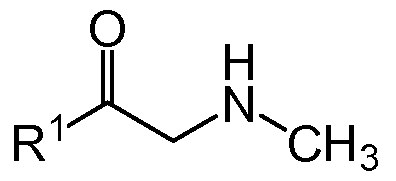
wherein R1 is a halogen, a Ci to C6 straight chain branched or cyclic alkoxy group, or an aryloxy or hydroxy group, or a salt thereof, to form tadalafil.
Another embodiment of the invention includes a process for preparing tadalafil, comprising: a) reacting a compound having a formula:


wherein R1 is a halogen, a Ci to Cβ straight chain branched or cyclic alkoxy group, or an aryloxy or hydroxy group, or a salt thereof, to form tadalafil.
A further embodiment of the invention includes a compound having a formula:

A still further embodiment of the invention includes tadalafil, containing about 0.005 to about 0.2, or about 0.005 to about 0.1 , or about 0.005 to about 0.05, percent by weight of piperonal.
BRIEF DESCRIPTION OF THE DRAWINGS
Fig. 1 is a schematic representation of an embodiment of a process for the preparation of tadalafil. Fig. 2 is an X-ray powder diffraction pattern of beta-carboline acid hydrochloride prepared in Example 6.
Fig. 3 is an infrared absorption spectrum of beta-carboline acid hydrochloride prepared in Example 6.
Fig. 4 is a differential scanning calorimethc curve of beta-carboline acid hydrochloride prepared in Example 6.
DETAILED DESCRIPTION OF THE INVENTION The present invention relates to a process for the preparation of tadalafil. One aspect of the present invention provides a process for the preparation of tadalafil of Formula I using beta-carboline acid, its derivatives or salts thereof of Formula II.
In an embodiment, the process for the preparation of tadalafil of Formula I comprises condensation of beta-carboline acid, its derivatives or salts thereof of Formula Il with sarcosine derivatives or salts thereof having Formula Vl in the presence of a suitable reagent.

Suitable solvents which can be used for the above reaction include but are not limited to: alcoholic solvents such as methanol, ethanol, isopropanol, n- butanol, tertiary butanol, and the like; ethers such as diethyl ether, dimethyl ether, diisopropyl ether, tetrahydrofuran, 1 ,4 dioxane, and the like; hydrocarbon solvents such as toluene, xylene, and the like; polar aprotic solvents like dimethylformamide, dimethylsulphoxide, diemthylacetamide, and the like; chlorinated solvents like dichloromethane, chloroform, carbon tetrachloride,
chlorobenzene and the like; and mixtures of such solvents and aqueous solvents in various proportions.
Suitable temperatures for conducting the reaction range from about -20 to about 1000C, or from about -10 to about 4O0C. Suitable reagents which can be used for condensation include but are not limited to bases like alkali metal alkoxides such as potassium alkoxide, sodium methoxide; alkali metal hydroxides such as sodium hydroxide, potassium hydroxide; alkali metal carbonates such as sodium carbonate, sodium bicarbonate; alkali metal hydrides comprising sodium hydride and the like; organic bases such as thethylamine, trimethyl amine, di-isopropylethylamine and the like; and mixtures thereof; and coupling agents like 1 -ethyl-3-(3-dimethylaminopropyl) carbodiimide (EDCI), dicyclohexyl carbodiimide (DCC), and diisopropylcarbodiimide (DIPCDI).
In an embodiment, the compound of Formula Il is the beta-carboline acid of Formula Ma.
Optionally, in addition to the coupling agent, a catalytic auxiliary nucleophile may be used to activate the carboxyl group. Suitable catalytic auxiliary nucleophiles which can be used to promote the reaction include, but are not limited to 1 -hydroxybenzothazole (HOBt), N-hydroxysuccinimede (HOSu), and N- hydroxy-5-norbene-endo-2,3-dicarboxamide (HONB). The amount of the catalytic auxiliary nucleophile may range from 0.5 to 2 moles per mole of the compound of
Formula Vl, or it can be used in equimolar quantities.
It is desirable to use from about 1 to 5 moles, or from about 1 to about 3 moles, of coupling agent per mole of the acid of Formula Ma. In an embodiment, the activation of carboxyl group of the compound of
Formula Ma is carried out with dicyclohexyl carbodiimide (DCC), in the presence of the auxiliary nucleophile 1 -hydroxybenzothazole (HOBt).
For activation of the carboxyl group, the acid of Formula Ma, is treated with dicyclohexyl carbodiimide (DCC) which leads to the formation of an active ester compound 2-[(1 R,3R)-1 ,2,3,4-tetrahydro-1 -(3,4-methylene dioxyphenyl)-9H-pyrido
[S^-bJindole-S-carbonylJ-I .S-dicyclohexyl-isourea of Formula Mi, which may or may not be isolated as an intermediate following the reaction of the present invention.

Formula Ni
Suitably, a catalytic auxiliary nucleophile 1 -hydroxybenzotriazole (HOBt) is added to promote the reaction. The catalytic auxiliary nucleophiles are introduced in carodiimide mediated couplings to reduce possible side reactions, including racemization, and to increase reaction rate when active esters are used. In addition to providing excellent leaving groups, all the additives are capable of acting as proton acceptors aiding deprotonation of the ammonium ion intermediate and thereby greatly increasing reaction rate. The cyclohexylurea formed during the course of the reaction as a byproduct can be separated by filtration.
Alternatively, the active ester can be generated through use of a phosphonium reagent like benzothazole-1-yloxy-trisphosphonium hexafluorophosphate (PyBOP). This reagent is used in tandem with a tertiary amine base, which abstracts the acidic carboxyl proton. The pH of the reaction mixture can range from about 5 to about 14.
The reaction will be conducted to completion, frequently requiring time periods ranging from about 10 hours to about 60 hours, or longer, depending upon the reactants and conditions chosen.
Suitably, the product is extracted into an organic solvent such as: chlorinated solvents like dichloromethane, chloroform, carbon tetrachloride, chlorobenzene and the like; and hydrocarbon solvents such as toluene, xylene, and the like. The organic layer is then suitably washed with water to wash out the water soluble salts.
Optionally, an alcohol such as methanol may be added for clearing any emulsions formed during extractions or water washings.
In another embodiment, the compound of Formula Il where R is a Ci to Cβ straight chain branched or cyclic alkyl, Ci to C6 straight chain branched or cyclic
alkoxy, or aryloxy group and the like may be prepared from the corresponding acid of Formula Na using processes known to one skilled in the art.
The process used for condensation of the derivatives of Formula Il with the compound of Formula Vl is similar to the process described above for the condensation of the beta-carboline acid or a salt thereof of Formula Il with the compound of Formula Vl.
Tadalafil obtained above may be further purified by recrystallization or slurrying in a suitable solvent.
Recrystallization involves providing a solution of tadalafil in a suitable solvent and then crystallizing the solid from the solution.
Suitable organic solvents which can be used for recrystallization or slurrying include but are not limited to: alcoholic solvents such as methanol, ethanol, isopropyl alcohol, n-propanol, and the like; halogenated solvents such as dichloromethane, 1 ,2-dichloroethane, chloroform, carbon tetrachloride and the like; ketonic solvents such as acetone, ethyl methyl ketone, methyl isobutyl ketone and the like; esters such as ethyl acetate, n-propyl acetate, n-butyl acetate, t-butyl acetate and the like; ether solvents such as diethyl ether,dimethyl ether, di- isopropyl ether, methyl tertiary-butyl ether, tetrahydrofuran, 1 ,4-dioxane and the like; hydrocarbon solvents such as toluene, xylene, n-hexane, n-heptane, cyclohexane and the like; nitrile solvents such as acetonitrile, propionithle and the like; and mixtures thereof in various proportions.
The concentration of tadalafil in the solvent can range from 40 to 80% or more. For recrystallization, a solution can be prepared at an elevated temperature if desired to achieve a desired concentration. Any temperature is acceptable for the dissolution as long as a clear solution of the tadalafil is obtained and is not detrimental to the drug substance chemically or physically. The solution may be brought down to room temperature for further processing if required or an elevated temperature may be used. A higher temperature will allow the precipitation from solutions with higher concentrations of tadalafil resulting in better economies of manufacture.
The compound obtained can be further dried suitably using a tray dryer, vacuum oven, air oven, fluidized bed drier, spin flash dryer, flash dryer and the like. The drying can be carried out at temperatures of about 35° C to about 70° C.
The drying can be carried out for any desired time periods to achieve the desired product purity, times from about 1 to 20 hours, or longer, frequently being sufficient.
In another aspect, the present invention provides substantially pure beta- carboline acid of Formula Ma or its salts.
The beta-carboline acid is capable of forming a wide variety of mono or di- acid salts with various inorganic and organic acids. The acids that may be used include, but are not limited to, those that form anions like acetate, benzoate, bicarbonate, bitartarate, citrate, iodide, chloride, bromide, mesylate, tartarate, and the like.
The beta-carboline acid is also capable of forming base salts with various cations. Examples of such salts include alkali metal, alkaline earth metal, and transition metal salts like salts of calcium, magnesium, sodium, lithium, zinc, potassium and the like. In one embodiment the acid is hydrochloric acid and the salt obtained is hydrochloride salt of the beta-carboline acid.
Crystalline beta-carboline acid hydrochloride obtained using the above process is characterized by any of its X-ray powder diffraction ("XRPD") patterns, infrared absorption ("IR") spectra, and differential scanning calohmetry ("DSC") curves.
Crystalline beta-carboline acid hydrochloride obtained in the present invention is characterized by its XRPD pattern. The XRPD data reported herein was obtained using Cu Ka radiation, having the wavelength 1.541 A and were obtained using a Bruker Axe D8 Advance Powder X-ray Diffractometer. The crystalline beta-carboline acid hydrochloride is characterized by its
XRPD pattern substantially in accordance with the pattern of Fig. 2. It is also characterized by an XRPD pattern having significant peaks at about 6.6, 9.9, 11.2, 13.4, 13.7, 17.1 , and 21.5, ± 0.2 degrees 2Θ. It is also characterized by the additional XRPD peaks at about 22.7, 29.4, and 23.9, ± 0.2 degrees 2Θ. The infrared (IR) absorption spectrum of crystalline beta-carboline acid hydrochloride has been recorded on a Perkin Elmer System Spectrum 1 model spectrophotometer, between 450 cm"1 and 4000 cm"1, with a resolution of 4 cm"1, the test compound being at the concentration of 1 % by mass in a potassium bromide pellet.
The crystalline beta-carboline acid hydrochloride is characterized by an infrared absorption spectrum in potassium bromide comprising peaks at about 753, 1040, 1205, 1252, 1757, 3226, 3621 , and 1451 , ± 5 cm"1. Crystalline beta- carboline acid is also characterized by its infrared absorption spectrum in potassium bromide substantially in accordance with the spectrum of Fig. 3.
Differential scanning calorimetric analysis was carried out using a DSC Q1000 model from TA Instruments with a ramp of 10°C/minute. The starting temperature was 4O0C and ending temperature was 3000C.
The crystalline beta-carboline acid hydrochloride has a characteristic differential scanning calorimetry curve substantially in accordance with Fig. 4, having an endotherm at about 2170C.
By "substantially pure beta-carboline acid" it is meant that the acid or its salts prepared according to the process of the present invention contain less than about 5%, or less than about 1 %, of any process related impurities, especially, impurities like the trans-isomeric impurity of beta carboline, the ester impurity of beta carboline, D-tryptophan, N-acetyl D-tryptophan, and piperonal, as characterized by a high performance liquid chromatography ("HPLC") chromatogram obtained from a mixture comprising the desired compound and one or more of the said impurities. The percentage here is a weight percentage derived from the area-% of the peaks representing the said impurities.
As used herein: "trans isomeric impurity of beta-carboline" refers to (1 S, aR^i ^.a^-tetrahydro-i -ta^-methylenedioxyphenyO-ΘH-pyridop^-blindole-a- carboxylic acid represented by Formula Mb; and
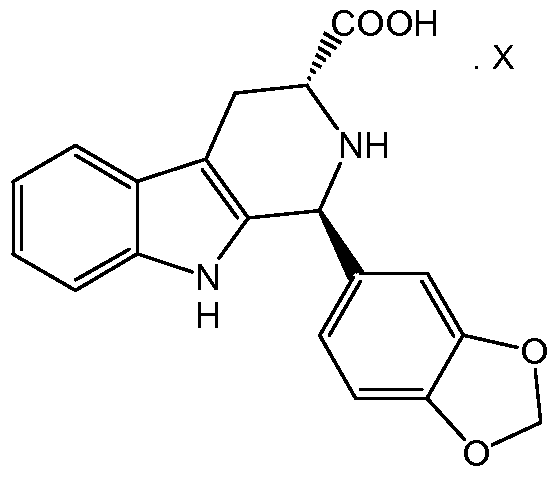
"ester impurity of beta-carboline" refers to methyl 1 ,2,3,4-tetrahydro-1 -(3,4- methylenedioxyphenyl)-9H-pyrido[3,4-b]indole-3-carboxylate represented by Formula Mc

Formula Mc where X is an inorganic or organic acid.
In yet another aspect, the present invention provides a process for the preparation of beta-carboline acid or its salts of Formula Ma.
In an embodiment, a process for the preparation of beta-carboline acid or its salts of Formula Na comprises: a) reacting D-tryptophan of Formula III with piperonal of Formula IV in the presence of an acid and a suitable solvent to afford a mixture of cis- and trans- isomers of 1 ,2,3,4-tetrahydro-1 -(3,4-methylenedioxyphenyl)-9H-pyrido[3,4- b]indole-3-carboxylic acid or its salts represented by Formula V;

Formula III Formula IV b) conversion of a mixture of cis- and trans-isomers of the compound of Formula V into the cis-isomer of beta-carboline acid hydrochloride of Formula Ma, optionally followed by purification by recrystallization or slurrying in a suitable solvent.

Formula V Formula Na
This process is shown schematically as the first two steps in Fig. 1.
Step a) involves the reaction of D-tryptophan of Formula III with piperonal of Formula V in the presence of an acid and optionally a suitable solvent to afford a mixture of cis- and trans-isomers represented by Formula V.
Suitable solvents which can be used for the reaction include, but are not limited to: halogenated solvents such as dichloromethane, 1 ,2-dichloroethane, chloroform, carbon tetrachloride and the like; ketonic solvents such as acetone, ethyl methyl ketone, methyl isobutyl ketone and the like; esters such as ethyl acetate, n-propyl acetate, n-butyl acetate, t-butyl acetate and the like; alcoholic solvents such as methanol, ethanol, isopropyl alcohol, n-propanol, and the like; hydrocarbon solvents such as toluene, xylene, n-heptane, cyclohexane, n-hexane and the like; and mixtures thereof.
Suitable acids which can be used include but are not limited to: inorganic acids such as hydrochloric acid, sulphuric acid, and the like; organic acids such as oxalic acid, thfluoroacetic acid, tartaric acid, formic acid, acetic acid, para-toluene sulfonic acid and the like; and mixtures thereof.
Optionally, the reaction can be conducted with the acid being used as the medium of the reaction without the use of any solvent system.
The reaction temperatures can range from about 40 0C to about -20 0C, or at temperatures as high as about 40 0C or about 70 0C or more. The time period required for the completion of reaction will vary depending on the conditions chosen, and frequently will range from about 5 hours to about 50 hours, or about 20 hours to about 30 hours.
The product obtained may contain a 1 :9 to 9:1 mixture of the cis- and trans- isomers of the beta-carboline acid of Formula V. Optionally, the isomeric mixture is used for the next step without isolating the product. The reaction medium containing the mixture of isomers can be taken directly into the next step, or it can be extracted into an organic layer and the solvent distilled off to form a residue.
Step b) involves the conversion of the cis- and trans-isomeric mixture of Formula V into the desired isomer of Formula Ma by treatment with an acid, optionally followed by purification by recrystallization or slurrying in a suitable solvent.
Suitable acids which can be used include but are not limited to: inorganic acids such as hydrochloric acid, sulphuric acid, and the like; organic acids such as oxalic acid, tartaric acid, acetic acid, para-toluene sulfonic acid, formic acid and the like; and mixtures thereof. The mixture of isomers of Formula V may be taken into the aqueous or non-aqueous acid solution in the form of a residue, or in the form of a solution in a suitable solvent.
Suitable solvents which can be used for the dissolution of a residue include but are not limited to: ketonic solvents such as acetone, ethyl methyl ketone, methyl isobutyl ketone and the like; alcoholic solvents such as methanol, ethanol, isopropyl alcohol, n-propanol, and the like; and mixtures thereof.
The treatment with acid is continued until the desired amount of conversion is achieved. This frequently involves stirring of the reaction mixture for a period of about 5 hours to about 50 hours, or about 25 hours to about 35 hours. The quantity of acid which can be used for the reaction may range from about 1 to about 30 molar equivalents, per equivalent of the isomeric mixture compound of Formula V.
The pH of the mass may range from about 0.1 to about 5, or from about 0.1 to about 2. Optionally, the required isomer of the acid obtained of Formula Ma may be further purified by recrystallization or slurrying in a suitable solvent to increase the purity of the compound.
Recrystallization involves providing a solution of the intermediate in a suitable solvent and then crystallizing the solid from the solution. Suitable organic solvents which can be used for recrystallization or slurrying include but are not limited to: alcoholic solvents such as methanol, ethanol, isopropyl alcohol, n-propanol, and the like; halogenated solvents such as dichloromethane, 1 ,2-dichloroethane, chloroform, carbon tetrachloride and the like; ketonic solvents such as acetone, ethyl methyl ketone, methyl isobutyl ketone and the like; esters such as ethyl acetate, n-propyl acetate, n-butyl acetate, t-butyl acetate and the like; ether solvents such as diethyl ether,dimethyl ether, di- isopropyl ether, methyl tertiary-butyl ether, tetrahydrofuran, 1 ,4-dioxane and the like; hydrocarbon solvents such as toluene, xylene, n-hexane, n-heptane,
cyclohexane and the like; nitrile solvents such as acetonitrile, propionithle and the like; and mixtures thereof in various proportions.
The concentration of the compound in the solvent can range from 40 to 80% or more. A solution can be prepared at an elevated temperature if desired to achieve a desired concentration. Any temperature is acceptable for the dissolution as long as a clear solution of the tadalafil is obtained and is not detrimental to the drug substance chemically or physically. The solution may be brought down to room temperature for further processing if required or an elevated temperature may be used. A higher temperature will allow the precipitation from solutions with higher concentrations, resulting in better economies of manufacture.
The compound obtained can be further dried suitably using a tray dryer, vacuum oven, air oven, fluidized bed drier, spin flash dryer, flash dryer and the like. The drying can be carried out at temperatures of about 35° C to about 70° C. The drying can be carried out for any desired time periods to achieve a desired purity, times from about 1 to 20 hours frequently being sufficient.
Tadalafil obtained by the process of the present invention is "substantially pure." By "substantially pure" it is meant that tadalafil or any of the pharmaceutically acceptable salts prepared in accordance with the present invention contains less than about 1 %, or less than about 0.5%, of process related impurities as characterized by a high performance liquid chromatography ("HPLC") chromatogram obtained from a mixture comprising the desired compound and one or more of the said impurities. The percentage here is weight percent derived from the area-% of the peaks representing the said impurities. Substantially pure tadalafil is considered to be "substantially free" from these impurities.
Tadalafil prepared according to the process of the present invention has a low level of impurities as determined by HPLC. For example, it contains less than about 0.15%, or about 0.05%, of (6S.12aS)-2,3,6,7,12,12a-hexahydro-2-methyl-6- (3,4-methylenedioxyphenyl)pyrazino [2',1 ':6,1]pyhdo[3,4-b]indole-1 ,4-dione represented by Formula 1a (hereinafter referred to as "tadalafil chiral impurity");
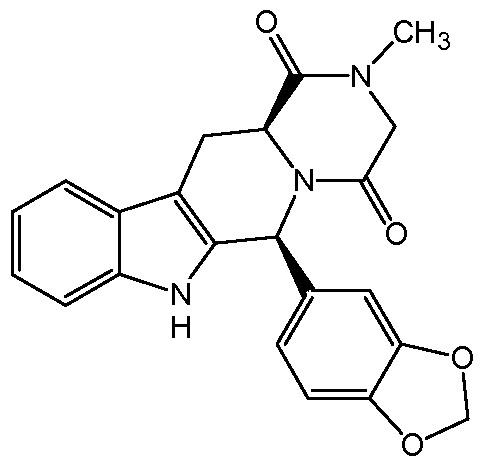
Formula Ia it contains less than about 0.15%, or about 0.03%, of (6S,12aR)-2,3,6,7,12,12a- hexahydro-2-nnethyl-6-(3,4-nnethylenedioxyphenyl)pyrazino[2',1 ':6,1]pyhdo[3,4- b]indole-1 ,4-dione represented by Formula Ib (hereinafter referred to as "trans- tadalafil impurity"); and
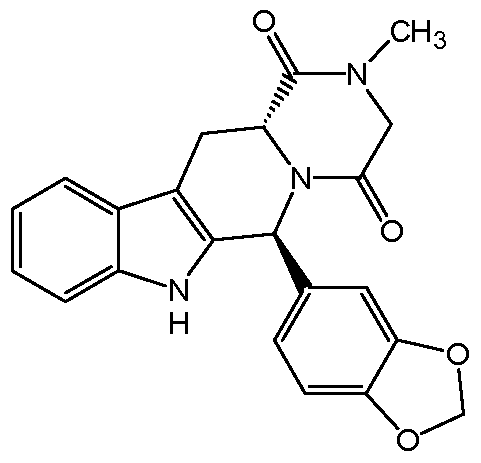
Formula Ib it contains about 0.005% to about 0.2%, about 0.005% to about 0.1 %, or about 0.005% to about 0.05%, of piperonal.
Tadalafil obtained according to the process of the present invention has a particle size (D90) of about 100 μm to about 200 μm and a bulk density of about 0.25 to 0.5 g/ml.
The D90 refers to the value for the particle size for which at least 90 volume percent of the particles have a size smaller than the value. Methods for determining D90 include laser diffraction, such as using Malvern Instruments Ltd. (of Malvern, Worcestershire, United Kingdom) equipment.
Tadalafil obtained by the process of the present invention has a D90 Of about 100 μm to about 200 μm.
Tadalafil obtained by the process of the present invention has a bulk density of about 0.25 g/ml to about 0.5 g/ml. The bulk densities are determined using Test 616 "Bulk Density and Tapped Density," United States Pharmacopeia 24, pages 1913-4 (United States Pharmacopeial Convention, Inc., Rockville, Maryland, 1999).
Still another aspect of the present invention provides a pharmaceutical composition comprising pure tadalafil or its pharmaceutically acceptable salts along with one or more pharmaceutically acceptable carriers, diluents and/or other excipients. The pharmaceutical composition may be formulated as: solid oral dosage forms such as, but not limited to, powders, granules, pellets, tablets, and capsules; liquid oral dosage forms such as but not limited to syrups, suspensions, dispersions, and emulsions; and injectable preparations such as but not limited to solutions, dispersions, and freeze dried compositions. Formulations may be in the form of immediate release, delayed release or modified release. Further, immediate release compositions may be conventional, dispersible, chewable, mouth dissolving, or flash melt preparations, and modified release compositions that may comprise hydrophilic or hydrophobic, or combinations of hydrophilic and hydrophobic, release rate controlling substances to form matrix or reservoir or combination of matrix and reservoir systems. The compositions may be prepared by direct blending, dry granulation or wet granulation or by extrusion and spheronization. Compositions may be presented as uncoated, film coated, sugar coated, powder coated, enteric coated or modified release coated. Compositions of the present invention may further comprise one or more pharmaceutically acceptable excipients.
Pharmaceutically acceptable excipients that find use in the present invention include, but are not limited to: diluents such as starch, pregelatinized starch, lactose, powdered cellulose, microcrystalline cellulose, dicalcium phosphate, tricalcium phosphate, mannitol, sorbitol, sugar and the like; binders such as acacia, guar gum, tragacanth, gelatin, polyvinylpyrrolidone, hydroxypropyl cellulose, hydroxypropyl methylcellulose, pregelatinized starch and the like; disintegrants such as starch, sodium starch glycolate, pregelatinized starch, crospovidone, croscarmellose sodium, colloidal silicon dioxide and the like; lubricants such as stearic acid, magnesium stearate, zinc stearate and the like; glidants such as colloidal silicon dioxide and the like; solubility or wetting enhancers such as anionic or cationic or neutral surfactants; complex forming agents such as various grades of cyclodexthns, resins; release rate controlling agents such as hydroxypropyl cellulose, hydroxymethyl cellulose, hydroxypropyl methylcellulose, ethyl cellulose, methyl cellulose, various grades of methyl
methacrylates, waxes and the like. Other pharmaceutically acceptable excipients that are of use include but are not limited to film formers, plasticizers, colorants, flavoring agents, sweeteners, viscosity enhancers, preservatives, antioxidants and the like. In the compositions of present invention tadalafil or its pharmaceutically acceptable salts is a useful active ingredient in the range of 0.5 mg to 50 mg, or 1 mg to 25 mg, per dosage form unit.
Certain specific aspects and embodiments of this invention are described in further detail by the examples below, which examples are only illustrative and not intended to limit the scope of the appended claims in any manner.
EXAMPLE 1
PREPARATION OF (1 R,3R)-1 ,2,3,4-TETRAHYDRO-i -(3,4-METHYLENE DIOXYPHENYL)-QH-PYRIDO[S^b]INDOLE-S-CARBOXYLIC ACID HYDROCHLORIDE (FORMULA Ma)
1500 ml of dichloromethane and 150 g of D-tryptophan were taken into a clean and dry round bottom flask followed by stirring for 10 minutes. 132.3 g of piperonal was added followed by cooling to 3 0C. 90 ml of thfluoroacetic acid was added followed by heating to 42 0C and stirring for about 25 hours. After the completion of the reaction, the reaction mass was cooled to 28 0C followed by addition of 1500 ml of dichloromethane and 750 ml of 10% aqueous sodium bicarbonate solution. The resultant suspension was stirred for 10 minutes followed by addition of 600 ml of methanol and then stirring for about 15 minutes. Organic and aqueous layers were separated and the aqueous layer was extracted with 300 ml of dichloromethane. The combined organic layer was taken into a clean and dry round bottom flask followed by addition of 750 ml of water.
The resultant suspension was stirred for about for 15 minutes followed by addition of 300 ml of methanol and stirring for about 15 minutes. Organic and aqueous layers were separated and the organic layer was taken into a clean and dry round bottom flask. The organic layer was distilled completely at 40 0C followed by addition of 1500 ml of 1 N hydrochloric acid. The resultant reaction mass was heated to 50 0C followed by stirring for about for 40 hours. The reaction mass was then slowly cooled to 5 0C and maintained for 10 minutes followed by
filtration of the separated solid. The solid was washed with pre-cooled (to 50C) water. The solid was dried at 60 0C for 7 hours under a vacuum of about 600 mm Hg to afford 220 g of the title compound.
Purity by HPLC: 93.31 %. Ester impurity: 0.72%.
Trans-isomehc impurity: 0.74%.
EXAMPLE 2 PREPARATION OF (6R.12aR)-2.3.6.7.12, 12a-HEXAHYDRO-2-METHYL-6-(3,4- METHYLENE DIOXYPHENYD-PYRAZINO [2',1 ':6, 11 PYRIDO [3, 4-bl INDOLE-, 1.4-DIONE (FORMULA IIa)
Step A: Preparation of methylamino-acetic acid ethyl ester (Formula Vl) 335 ml of dichloromethane was taken into a round bottom flask and 67 g of methylamino-acetic acid ethyl ester hydrochloride was added to it at 28 0C. A mixture of 67 ml of 20% aqueous ammonia solution and 67 ml of water was added to it at 28 0C. The mixture was stirred at 28 0C for 20 minutes. The organic layer was separated and washed with 134 ml of water. The organic layer was taken into a round bottom flask and distilled off under vacuum at 40 0C. To the residue obtained, 250 ml of dimethylformamide was added, and the solution was kept aside for further use during condensation.
Step B: Preparation Of (6R,12aR)-2,3,6,7,12,12a-Hexahvdro-2-Methyl-6- (3,4-Methylene DioxyphenvD-Pyrazino f2'.1 ':6. 11 Pyrido [3, 4-bl Indole-, 1.4- Dione: Tadalafil (Formula I)
2500 ml of dimethylformamide was taken into a dry round bottom flask and 50 g of the beta-carboline acid of Formula I obtained in Example 1 was added to it. The reaction mass was cooled to 4 0C. 24.4 g of triethylamine was added to the above reaction mass at the same temperature. The reaction mass was maintained at 4 0C for 20 minutes. 33.2 g of dicyclohexylcarbodiimide was added to the reaction mass, and stirred at 40C for 1 hour. 27 g of 1 -hydroxybenzotriazole was added to the reaction mass at 4 0C. The methylamino-acetic acid ethyl ester solution prepared above was added to the reaction mass at 2 0C over 20 minutes. After the addition was complete, the temperature of the reaction mass was raised to 28 0C. The reaction mass was maintained at 28 0C for 34 hours. The reaction
mass was then filtered and the separated solid washed with 100 ml of dichloromethane. The filtrate was taken into a round bottom flask and 500 ml of water and 500 ml of dichloromethane were added to it. The reaction mass was stirred at 28 0C for 10 minutes. The organic layer was separated. The aqueous layer was extracted into 100 ml of dichloromethane. The combined organic layer was washed with 100 ml of water followed by 400 ml of 10% sodium bicarbonate solution. The organic layer was then washed with 400 ml of 5% aqueous oxalic acid solution, followed by 400 ml of water. The organic layer was dried over sodium sulfate and 50% of the solvent was distilled off atmospherically at 46 0C. The remaining reaction mass was cooled gradually to 3 0C and maintained for 1 hour. The separated solid was filtered and washed with 25 ml of methanol. The compound was then suction dried under vacuum for about 30 minutes to yield 26 g of the title compound.
Purity by HPLC: 99.8%.
EXAMPLE 3 PROCESS FOR THE PURIFICATION OF TADALAFIL (FORMULA I)
25 g of the tadalafil from Example 2 and 4750 ml of methanol were charged into a clean and dry round bottom flask followed by heating to 650C. 2400 ml of methanol were distilled off at about 650C from the solution followed by cooling to about 40C. The mass was stirred at 40C for 45 minutes followed by filtration of separated solid. The solid was washed with 25 ml of methanol. 1201.5 ml of acetone was added to it, followed by heating to about 6O0C for 2 hours. 600 ml of acetone was distilled from the reaction solution followed by cooling to 3 0C for 2.5 hours. The separated solid was filtered and the solid was washed with 20 ml of chilled acetone. The solid was dried at about 620C for 5 hours under a vacuum of about 600 mm Hg to afford 16.3 g of the title compound. Purity by HPLC: 99.98%. Individual impurities: Less than 0.01 %.
EXAMPLE 4
PREPARATION OF (1 R.3R)-1.2.3.4-TETRAHYDRO-1 -(3.4-METHYLENE DIOXYPHENYL) -9H-PYRIDO rS^-bllNDOLE-S-CARBOXYLIC ACID (FORMULA Na) 500 ml of dichloromethane was taken into a round bottom flask, and 100 g of (1 R,3R)-Methyl 1 ,2,3,4-tetrahydro-1-(3,4-methylene dioxy phenyl)-9H- pyhdo[3,4-b]indole-3-carboxylate was added to it. The mixture was stirred at 30 0C for 15 minutes. A solution of 150 ml of aqueous ammonia and 150 ml water was added to the reaction mixture. The reaction mixture was stirred at 30 0C for another 20 minutes. The organic and aqueous layers were separated and the organic layer was distilled off under vacuum. To the obtained residue 500 ml of water was added. 20.8 g of sodium hydroxide flakes were added to the reaction mass and heated to 70 0C. The reaction mass was maintained at 70 0C for 4 hours. Reaction completion was monitored using thin layer chromatography. After the reaction was complete, the reaction mass was cooled to 3 0C. pH of the reaction mass was adjusted to 2.0 with hydrochloric acid at 3 0C. The reaction mass was stirred at 3 0C for 60 minutes. The separated solid was filtered and washed with 100 ml of chilled water. The solid was dried under vacuum for 30 to 60 minutes followed by drying at 60 to 70° C for 4 to 5 hours to yield 78 g of the title compound.
EXAMPLE 5
PREPARATION OF (6R.12aR)-2.3.6.7.12.12A-HEXAHYDRO-2-METHYL-6-(3.4- METHYLENE DIOXYPHENYD-PYRAZINO [2',1 ':6, 11 PYRIDO [3, 4-bl INDOLE- 1 ,4-DIONE (FORMULA I)
100 ml of dimethylformamide was taken into a dry round bottom flask and 10 g of the beta-carboline acid obtained in Example 4 was added to it. The reaction mass was cooled to 5 0C. 4.5 g of triethylamine was added to the reaction mass at the same temperature. 7.4 g of dicyclohexylcarbodiimide was added to the reaction mass, and stirred at 4 0C for 1 hour. 6.1 g of 1-hydroxybenzothazole was added to the reaction mass, followed by addition of the methylamino-acetic acid ethyl ester, prepared by a process similar to Example 2, Step A, at 3 0C. The temperature of the reaction mass was raised to 28 0C. The reaction mass was
maintained at 28 0C for about 2 days. Reaction completion was checked using thin layer chromatography. After completion of the reaction, the reaction mass was filtered to separate the unwanted by-product. The filter cake was washed with 50 ml of dichloromethane. The combined filtrate was taken into a round bottom flask and 100 ml of water, and 50 ml of dichloromethane was added to it. The reaction mass was stirred for 20 minutes. The aqueous and organic layers were separated, and the aqueous layer was extracted into 20 ml of dichloromethane. The combined organic layer was washed with 50 ml of water followed by 50 ml of 10% aqueous sodium bicarbonate solution. Then the organic layer was washed with 40 ml of 5% oxalic acid solution, and finally it was washed with 50 ml of water. The organic layer was dried over sodium sulfate. The organic layer was distilled under vacuum. The obtained residue was cooled to 280C, and 20 ml of methanol was added to it. The reaction mass was then cooled to 30C. The reaction mass was stirred at 30C for 60 minutes. The separated solid was filtered, and washed with 5 ml of chilled methanol. The compound was suction dried under vacuum for 30 minutes. The wet compound was taken into a round bottom flask and 50 ml of acetone was added to it. The reaction mass was heated to reflux, and checked for clear dissolution. After clear dissolution was obtained, 50% of the acetone was distilled from the reaction mass. The reaction mass was then cooled to 30C, and stirred for 30 minutes. The solid was filtered and washed with 5 ml of chilled acetone. The solid was suction dried under vacuum followed by drying at 50 to 6O0C for 1 to 2 hours to yield 1.2 g of the title compound.
EXAMPLE 6 PREPARATION OF M R.3R)-1.2.3.4-TETRAHYDRO-1 -(3.4-METHYLENE DIOXYPHENYL) -9H-PYRIDO r3,4-bllNDOLE-3-CARBOXYLIC ACID HYDROCHLORIDE (FORMULA Na)
500 ml of dichloromethane was taken into a round bottom flask and 50 g of D-tryptophan was added. 44.1 g of piperonal was added at 280C. 36.2 ml of trifluoroacetic acid was then added and the reaction mass was heated to 4O0C. The reaction mass was maintained at 4O0C for 9 hours. Reaction completion was checked using thin layer chromatography. After the reaction was complete, the reaction mass was allowed to cool to 280C and 250 ml of dichloromethane and
250 ml of methanol was added. The reaction mass was then quenched with 250 ml of 8% sodium bicarbonate solution. The organic layer was separated, and the aqueous layer was extracted into 100 ml of dichloromethane. The combined organic layer was distilled under atmospheric pressure at 450C. 250 ml of 1 N hydrochloric acid was added to the residue obtained and the reaction mass was heated to 5O0C. The reaction mass was maintained at 540C for 14 hours. 150 ml toluene was added and the mass cooled to 17 0C. The reaction mass was maintained at 170C for 30 minutes. The separated solid was filtered and washed with 100 ml of toluene followed by washing with 50 ml of water. The compound was dried at 670C for 4 hours to yield 79 g of the title compound (yield: 86.5%). Purity by HPLC: 98.45%. Ester impurity: 0.5%. Trans-isomeric impurity: 0.6%. Piperonal: 0.05%
EXAMPLE 7
PREPARATION OF (6R.12AF0-2.3.6.7.12,12A-HEXAHYDRO-2-METHYL-6-(3,4- METHYLENE DIOXYPHENYD-PYRAZINO [2',1 ':6, 11 PYRIDO [3,4-bl INDOLE- 1 ,4-DIONE (FORMULA I) 25 g of (1 R,3R)-1 ,2,3,4-tetrahydro-1 -(3,4-methylene dioxyphenyl) -9H- pyrido [3,4-b]lndole-3-carboxylic acid hydrochloride obtained in Example 6 and 200 ml of dimethylformamide were taken into a round bottom flask and 10.15 g of triethylamine was added. 13.5 g of 1-hydroxybenzotriazole was added under stirring. 33 g of sarcosine ethyl ester, and 16.7 g of dicyclohexylcarbodiimide were added. The reaction mass was heated to 53 0C and maintained for 4 hours. Reaction completion was checked using thin layer chromatography. After the reaction was completed, the reaction mass was cooled to 12 0C and maintained for 60 minutes. The reaction mass was then filtered and the filter bed was washed with 50 ml of dichloromethane. To the combined filtrate 250 ml of dichloromethane and 250 ml of water were added and the layers separated. The aqueous layer was extracted with 50 ml of dichloromethane. To the combined organic layer another 75 ml of dichloromethane was added. The combined organic layer was washed with a solution of 16 g of sodium bicarbonate in 125 ml of water. 75 ml of
methanol was added to the organic layer and the organic layer was washed with 100 ml of water. The organic layer was distilled atmospherically at 440C to distill off 50% of the solvent. The remaining solution was cooled to 30C and maintained for 2 hours. The separated solid was filtered and washed with chilled methanol. The wet compound was dried under suction for 30 minutes to yield 19.4 g of the title compound (yield: 74.3%). Purity by HPLC: 99.92%.
EXAMPLE 8 PREPARATION OF (6R.12aR)-2.3.6.7.12,12A-HEXAHYDRO-2-METHYL-6-(3,4- METHYLENE D IQXYP H EN YL)-PYRAZI NO [2'.1 ':6. 11 PYRIDO [3.4-bl INDOLE- 1 ,4-DIONE (FORMULA I)
625 ml of methanol and 625 ml of acetone were taken into a clean round bottom flask and 25 g of tadalafil was added to it. The mixture was heated to 550C and maintained for 20 minutes. 50 % of the solvent was distilled off atmospherically at 560C. The remaining mixture was cooled to 20C and maintained for 1 hour. The separated solid was filtered and washed with 25 ml of methanol. The wet material was taken into another round bottom flask and 1500 ml of acetone was added to it. The mixture was heated to 5O0C and maintained for 30 minutes. The solution was filtered in the hot condition through a celite bed and the bed was washed with 50 ml of acetone. 50% of the solvent was distilled off from the filtrate atmospherically at 550C. The resulting solution was cooled to 20C and maintained for 1 hour. The separated solid was filtered and washed with 12.5 ml of acetone. The wet compound was dried at 550C for 5 hours to yield 14.6 g of the title compound (yield: 58.4%) Purity by HPLC: 99.98%. Piperonal: 0.01 % Other individual impurities: less than 0.01 %.
EXAMPLE 9
DETERMINATION OF IMPURITIES IN TADALAFIL
The HPLC analysis conditions are as described in Table 1.
Table 1


EXAMPLE 10
DETERMINATION OF IMPURITIES IN BETA-CARBOLINE ACID The HPLC analysis conditions are described in Table 2.
Table 2


Claims
1. A process for preparing tadalafil, comprising reacting a compound having a formula:


wherein R1 is a halogen, a Ci to Cβ straight chain branched or cyclic alkoxy group, or an aryloxy or hydroxy group, or a salt thereof, to form tadalafil.
2. The process of claim 1 , wherein reacting occurs in the presence of a coupling agent.
3. The process of claim 1 , wherein reacting occurs in the presence of dicyclohexylcarbodiimide and 1 -hydroxybenzothazole.
4. The process of claim 1 , wherein reacting occurs in the presence of a chlorinated solvent.
5. The process of claim 1 , wherein reacting occurs in the presence of dichloromethane.
6. The process of claim 1 , wherein tadalafil obtained is further purified in a solvent or a mixture of solvents.
7. The process of claim 6, wherein a solvent comprises a ketone, or an alcohol.
8. The process of claim 1 , wherein a compound having a formula:  is prepared by reacting a compound having a formula:


9. The process of claim 8, wherein reacting to form an intermediate occurs in the presence of an organic solvent.
10. The process of claim 8, wherein reacting to form an intermediate occurs in the presence of dimethylformamide.
11. The process of claim 8, wherein an intermediate is not isolated before reacting with an acid.
12. A process for preparing tadalafil, comprising: a) reacting a compound having a formula:


wherein R1 is a halogen, a Ci to Cβ straight chain branched or cyclic alkoxy group, or an aryloxy or hydroxy group, or a salt thereof, to form tadalafil.
13. The process of claim 12, wherein reacting to form an intermediate occurs in the presence of an organic solvent.
14. The process of claim 12, wherein reacting to form an intermediate occurs in the presence of dimethylformamide.
15. The process of claim 12, wherein an intermediate is not isolated before reacting with an acid.
16. The process of claim 12, wherein reacting to form tadalafil occurs in the presence of a coupling agent.
17. The process of claim 12, wherein reacting to form tadalafil occurs in the presence of dicyclohexylcarbodiimide and 1-hydroxybenzotriazole.
18. The process of claim 12, wherein reacting to form tadalafil occurs in the presence of a chlorinated solvent.
19. The process of claim 12, wherein reacting to form tadalafil occurs in the presence of dichloromethane.
20. A compound having a formula:  and being substantially free of isomeric impurities.
21. Tadalafil, containing about 0.005 to about 0.2 percent by weight of piperonal.
22. Tadalafil, containing about 0.005 to about 0.1 percent by weight of piperonal.
23. Tadalafil, containing about 0.005 to about 0.05 percent by weight of piperonal.
Applications Claiming Priority (8)
| Application Number | Priority Date | Filing Date | Title |
|---|---|---|---|
| IN1606/CHE/2005 | 2005-11-03 | ||
| IN1606CH2005 | 2005-11-03 | ||
| IN91/CHE/2006 | 2006-01-19 | ||
| IN91CH2006 | 2006-01-19 | ||
| US74608206P | 2006-05-01 | 2006-05-01 | |
| US60/746,082 | 2006-05-01 | ||
| US80303606P | 2006-05-24 | 2006-05-24 | |
| US60/803,036 | 2006-05-24 |
Publications (2)
| Publication Number | Publication Date |
|---|---|
| WO2007100387A2 true WO2007100387A2 (en) | 2007-09-07 |
| WO2007100387A3 WO2007100387A3 (en) | 2008-03-06 |
Family
ID=38459475
Family Applications (1)
| Application Number | Title | Priority Date | Filing Date |
|---|---|---|---|
| PCT/US2006/060514 Ceased WO2007100387A2 (en) | 2005-11-03 | 2006-11-03 | Process for preparing tadalafil |
Country Status (1)
| Country | Link |
|---|---|
| WO (1) | WO2007100387A2 (en) |
Cited By (11)
| Publication number | Priority date | Publication date | Assignee | Title |
|---|---|---|---|---|
| EP2107059A1 (en) | 2008-03-31 | 2009-10-07 | LEK Pharmaceuticals D.D. | Conversion of tryptophan into ß-carboline derivatives |
| EP2181997A1 (en) | 2008-10-30 | 2010-05-05 | Chemo Ibérica, S.A. | A process for the preparation of tadalafil |
| US20100324294A1 (en) * | 2008-02-22 | 2010-12-23 | Valerio Borzatta | Process for the preparation of 2,3,4,9-tetrahydro-1h-beta-carbolin-3-carboxylic acid esters |
| CN102796098A (en) * | 2011-05-27 | 2012-11-28 | 首都医科大学 | (1S, 3S)-1-1, 3-benzodioxole-1, 2, 3, 4-tetrahydrophthalic anhydride-beta-carboline-3-formyl-amino acid methyl ester, and preparation method and application thereof |
| CN106279155A (en) * | 2016-08-02 | 2017-01-04 | 扬子江药业集团四川海蓉药业有限公司 | Impurity reference substance of tadanafil and preparation method thereof |
| CN109053724A (en) * | 2018-08-22 | 2018-12-21 | 上海青平药业有限公司 | The purification process and purposes of the preparation method and Tadalafei of a kind of impurity prepared during Tadalafei and the impurity |
| CN109796461A (en) * | 2018-12-30 | 2019-05-24 | 杭州康本医药科技有限公司 | A kind of preparation process of Tadalafei impurity I |
| CN110790764A (en) * | 2019-11-27 | 2020-02-14 | 四川省通园制药集团有限公司 | Method for preparing tadalafil by one-pot method |
| CN111116583A (en) * | 2019-12-23 | 2020-05-08 | 平光制药股份有限公司 | Preparation method of tadalafil intermediate |
| CN111253399A (en) * | 2020-03-30 | 2020-06-09 | 苏州弘森药业股份有限公司 | Production process of tadalafil raw material medicine |
| CN115184531A (en) * | 2021-04-07 | 2022-10-14 | 浙江康恩贝制药股份有限公司 | Method for simultaneously determining contents of 3 impurities in tadalafil |
Families Citing this family (1)
| Publication number | Priority date | Publication date | Assignee | Title |
|---|---|---|---|---|
| CN110684025B (en) * | 2019-10-29 | 2020-09-04 | 株洲千金药业股份有限公司 | Preparation method of tadalafil |
Family Cites Families (5)
| Publication number | Priority date | Publication date | Assignee | Title |
|---|---|---|---|---|
| GB9401090D0 (en) * | 1994-01-21 | 1994-03-16 | Glaxo Lab Sa | Chemical compounds |
| US6046199A (en) * | 1998-01-14 | 2000-04-04 | Cell Pathways, Inc. | Method of inhibiting neoplastic cells with tetracyclic pyrido[3,4-B]indole derivatives |
| US6451807B1 (en) * | 1999-04-30 | 2002-09-17 | Lilly Icos, Llc. | Methods of treating sexual dysfunction in an individual suffering from a retinal disease, class 1 congestive heart failure, or myocardial infarction using a PDE5 inhibitor |
| WO2002010166A1 (en) * | 2000-08-02 | 2002-02-07 | Lilly Icos Llc | Fused heterocyclic derivatives as phosphodiesterase inhibitors |
| ATE337320T1 (en) * | 2000-11-06 | 2006-09-15 | Lilly Icos Llc | INDOLE DERIVATIVES AS PDE5 INHIBITORS |
-
2006
- 2006-11-03 WO PCT/US2006/060514 patent/WO2007100387A2/en not_active Ceased
Cited By (14)
| Publication number | Priority date | Publication date | Assignee | Title |
|---|---|---|---|---|
| US20100324294A1 (en) * | 2008-02-22 | 2010-12-23 | Valerio Borzatta | Process for the preparation of 2,3,4,9-tetrahydro-1h-beta-carbolin-3-carboxylic acid esters |
| US8357803B2 (en) * | 2008-02-22 | 2013-01-22 | Endura S.P.A. | Process for the preparation of 2,3,4,9-tetrahydro-1H-β-carbolin-3-carboxylic acid esters |
| EP2107059A1 (en) | 2008-03-31 | 2009-10-07 | LEK Pharmaceuticals D.D. | Conversion of tryptophan into ß-carboline derivatives |
| WO2009121791A1 (en) * | 2008-03-31 | 2009-10-08 | Lek Pharmaceuticals D.D. | CONVERSION OF TRYPTOPHAN INTO ß-CARBOLINE DERIVATIVES |
| EP2181997A1 (en) | 2008-10-30 | 2010-05-05 | Chemo Ibérica, S.A. | A process for the preparation of tadalafil |
| CN102796098A (en) * | 2011-05-27 | 2012-11-28 | 首都医科大学 | (1S, 3S)-1-1, 3-benzodioxole-1, 2, 3, 4-tetrahydrophthalic anhydride-beta-carboline-3-formyl-amino acid methyl ester, and preparation method and application thereof |
| CN106279155A (en) * | 2016-08-02 | 2017-01-04 | 扬子江药业集团四川海蓉药业有限公司 | Impurity reference substance of tadanafil and preparation method thereof |
| CN109053724A (en) * | 2018-08-22 | 2018-12-21 | 上海青平药业有限公司 | The purification process and purposes of the preparation method and Tadalafei of a kind of impurity prepared during Tadalafei and the impurity |
| CN109796461A (en) * | 2018-12-30 | 2019-05-24 | 杭州康本医药科技有限公司 | A kind of preparation process of Tadalafei impurity I |
| CN110790764A (en) * | 2019-11-27 | 2020-02-14 | 四川省通园制药集团有限公司 | Method for preparing tadalafil by one-pot method |
| CN111116583A (en) * | 2019-12-23 | 2020-05-08 | 平光制药股份有限公司 | Preparation method of tadalafil intermediate |
| CN111253399A (en) * | 2020-03-30 | 2020-06-09 | 苏州弘森药业股份有限公司 | Production process of tadalafil raw material medicine |
| CN115184531A (en) * | 2021-04-07 | 2022-10-14 | 浙江康恩贝制药股份有限公司 | Method for simultaneously determining contents of 3 impurities in tadalafil |
| CN115184531B (en) * | 2021-04-07 | 2024-06-11 | 浙江康恩贝制药股份有限公司 | Method for simultaneously measuring content of 3 impurities in tadalafil |
Also Published As
| Publication number | Publication date |
|---|---|
| WO2007100387A3 (en) | 2008-03-06 |
Similar Documents
| Publication | Publication Date | Title |
|---|---|---|
| CA2707790C (en) | Processes for the preparation of sitagliptin and pharmaceutically acceptable salts thereof | |
| EP2470542A2 (en) | Preparation of sitagliptin and salts thereof | |
| EP2474547A2 (en) | Process for the Synthesis of Moxifloxacin Hydrochloride | |
| WO2011060213A2 (en) | Preparation of sitagliptin and salts thereof | |
| WO2007100387A2 (en) | Process for preparing tadalafil | |
| KR20150045458A (en) | Process for the preparation of pemetrexed and lysin salt thereof | |
| EP1904499A1 (en) | Process for the preparation of zopiclone | |
| EP3360858B1 (en) | Process for producing an aminopyrrolidine derivative | |
| US12486286B2 (en) | Process and polymorphic forms of bictegravir and its pharmaceutically acceptable salts or co-crystals thereof | |
| US20240239791A1 (en) | Processes for the synthesis of valbenazine | |
| US8552193B2 (en) | Alternative forms of the phosphodiesterase-4 inhibitor N-cyclopropyl-1-{3-[(1-oxidopryidin-3-yl)ethynyl]phenyl}-4-oxo-1,4-dihydro-1,8-naphthyridine-3-carboxyamide | |
| EP1590353B1 (en) | A process for the preparation of cefpodoxime proxetil | |
| US20110136855A1 (en) | Gemifloxacin process and polymorphs | |
| US20120259116A1 (en) | Novel Process for the Preparation of Paliperidone | |
| WO2025215593A1 (en) | An improved process for preparation of zastaprazan | |
| CA1192189A (en) | E-homo-eburnane derivatives and a process for preparing same | |
| WO2012001357A1 (en) | Crystalline form of prulifloxacin and processes for its preparation | |
| HK1256344B (en) | Process for producing an aminopyrrolidine derivative |
Legal Events
| Date | Code | Title | Description |
|---|---|---|---|
| NENP | Non-entry into the national phase |
Ref country code: DE |
|
| WWE | Wipo information: entry into national phase |
Ref document number: 2343/CHENP/2008 Country of ref document: IN |
|
| 121 | Ep: the epo has been informed by wipo that ep was designated in this application |
Ref document number: 06850096 Country of ref document: EP Kind code of ref document: A2 |
|
| 122 | Ep: pct application non-entry in european phase |
Ref document number: 06850096 Country of ref document: EP Kind code of ref document: A2 |